


автордың кітабын онлайн тегін оқу A Day with Keats
Project Gutenberg's A Day with Keats, by May (Clarissa Gillington) Byron
This eBook is for the use of anyone anywhere at no cost and with
almost no restrictions whatsoever. You may copy it, give it away or
re-use it under the terms of the Project Gutenberg License included
with this eBook or online at www.gutenberg.org
Title: A Day with Keats
Author: May (Clarissa Gillington) Byron
Illustrator: William James Neatby
Release Date: November 11, 2009 [EBook #30451]
Language: English
*** START OF THIS PROJECT GUTENBERG EBOOK A DAY WITH KEATS ***
Produced by Delphine Lettau and the Online Distributed
Proofreading Team at http://www.pgdp.net
Click to ENLARGE
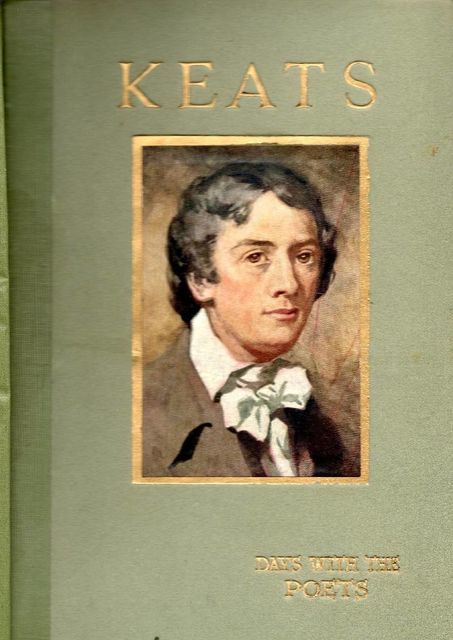
DAYS WITH THE GREAT POETS
KEATS
BY MAY BYRON
HODDER & STOUGHTON
LTD., PUBLISHERS LONDON
Uniform with this Volume
DAYS WITH THE POETS
BROWNING BURNS KEATS LONGFELLOW SHAKESPEARE TENNYSON
DAYS WITH THE COMPOSERS
BEETHOVEN CHOPIN GOUNOD MENDELSSOHN TSCHAIKOVSKY WAGNERMade and Printed in Great Britain for Hodder & Stoughton, Limited,
by C. Tinling & Co., Ltd., Liverpool, London and Prescot.

A DAY WITH KEATS
About eight o'clock one morning in early summer, a young man may be seen sauntering to and fro in the garden of Wentworth Place, Hampstead. Wentworth Place consists of two houses only; in the first, John Keats is established along with his friend Charles Armitage Brown. The second is inhabited by a Mrs. Brawne and her family. They are wooden houses, with festooning draperies of foliage: and the clean countrified air of Hampstead comes with sweet freshness through the gardens, and fills the young man with ecstatic delight. He gazes around him, with his weak dark eyes, upon the sky, the flowers, the various minutiæ of nature which mean so much to him: and although he has severely tried a never robust physique by sitting up half the night in study, a new exhilaration now throbs through his veins. For, in his own words, he loves the principle of beauty in all things: and he repeats to himself, as he loiters up and down in the sunshine, the lines into which he has crystallized, for all time, sensations similar to those of the present:—
A thing of beauty is a joy for ever:
Its loveliness increases; it will never
Pass into nothingness; but still will keep
A bower quiet for us, and a sleep
Full of sweet dreams, and health, and quiet breathing.
Therefore, on every morrow, are we wreathing
A flowery band to bind us to the earth,
Spite of despondence, of the inhuman dearth
Of noble natures, of the gloomy days,
Of all the unhealthy and o'er-darken'd ways
Made for our searching: yes, in spite of all,
Some shape of beauty moves away the pall
From our dark spirits. Such the sun, the moon,
Trees old and young, sprouting a shady boon
For simple sheep; and such are daffodils
With the green world they live in; and clear rills
That for themselves a cooling covert make
'Gainst the hot season; the mid-forest brake,
Rich with a sprinkling of fair musk-rose blooms:
And such too is the grandeur of the dooms
We have imagined for the mighty dead;
All lovely tales that we have heard or read:
An endless fountain of immortal drink,
Pouring unto us from the heaven's brink.
Nor do we merely feel these essences
For one short hour; no, even as the trees
That whisper round a temple become soon
Dear as the temple's self, so does the moon,
The passion poesy, glories infinite,
Haunt us till they become a cheering light
Unto our souls, and bound to us so fast,
That, whether there be shine, or gloom o'ercast,
They alway must be with us, or we die.
Endymion.
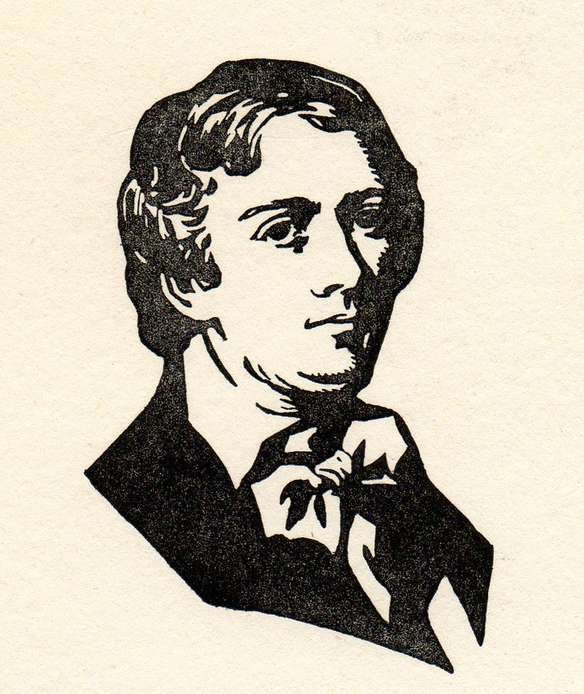
Yet John Keats is in some respects out of keeping with the magnificent phraseology of which he is the mouthpiece. "Little Keats," as his fellow medical students termed him, is a small, undersized man, not over five feet high—the shoulders too broad, the legs too spare—"death in his hand," as Coleridge said, the slack moist hand of the incipient consumptive. The only "thing of beauty" about him is his face. "It is a face," to quote his friend Leigh Hunt, "in which energy and sensibility" (i.e., sensitiveness) "are remarkably mixed up—an eager power, wrecked and made impatient by ill-health. Every feature at once strongly cut and delicately alive." There is that femininity in the cast of his features, which Coleridge classed as an attribute of true genius. His beautiful brown hair falls loosely over those eyes, large, dark, glowing, which appeal to all observers by their mystical illumination of rapture—eyes which seem as though they had been dwelling on some glorious sight—which have, as Haydon said, "an inward look perfectly divine, like a Delphian priestess who saw visions."
And he is seeing visions all the while. Some chance sight or sound has wrapt him away from the young greenness of the May morning, and plunged him deep into the opulent colour of September. His prophetic eye sees all the apple-buds as golden orbs of fruit, and the swallows, that now build beneath the eaves, making ready for their departure. And these future splendours shape themselves into lines as richly coloured.

Season of mists and mellow fruitfulness!
Close bosom-friend of the maturing sun;Conspiring with him how to load and bless
With fruit the vines that round the thatch-eaves run;To bend with apples the moss'd cottage-trees,
And fill all fruit with ripeness to the core;To swell the gourd, and plump the hazel shells
With a sweet kernel; to set budding more,And still more, later flowers for the bees,
Until they think warm days will never cease,
For Summer has o'er-brimmed their clammy cells.
Who hath not seen thee oft amid thy store?
Sometimes whoever seeks abroad may findThee sitting careless on a granary floor,
Thy hair soft-lifted by the winnowing wind;Or on a half-reap'd furrow sound asleep,
Drowsed with the fume of poppies, while thy hook Spares the next swath and all its twined flowers;And sometimes like a gleaner thou dost keep
Steady thy laden head across a brook; Or by a cider-press, with patient look, Thou watchest the last oozings, hours by hours.
Where are the songs of Spring? Ay, where are they?
Think not of them, thou hast thy music too,While barrèd clouds bloom the soft-dying day,
And touch the stubble-plains with rosy hue;Then in a wailful choir the small gnats mourn
Among the river sallows, borne aloft Or sinking as the light wind lives or dies;And full-grown lambs loud bleat from hilly bourn;
Hedge-crickets sing; and now with treble soft The red-breast whistles from a garden-croft. And gathering swallows twitter in the skies.Autumn.
The voice of Charles Brown at the open window, hailing him cheerily, breaks the spell; Keats goes in, and they sit down together to a simple breakfast-table, and Brown "quizzes" Keats, as the current phrase goes, on his inveterate abstractedness. The young man, with his sweet and merry laugh, defends himself by producing the result of his last-night's meditations, in praise of the selfsame wandering fancy.
Ever let the Fancy roam,
Pleasure never is at home:
At a touch sweet Pleasure melteth,
Like to bubbles when rain pelteth;
Then let wingèd Fancy wander
Through the thought still spread beyond her:
Open wide the mind's cage door,
She'll dart forth, and cloudward soar.
O, sweet Fancy! let her loose;
Summer's joys are spoilt by use,
And the enjoying of the Spring
Fades as does its blossoming:
Autumn's red-lipp'd fruitage too,
Blushing through the mist and dew,
Cloys with tasting: What do then?
Sit thee by the ingle, when
The sear faggot blazes bright,
Spirit of a winter's night;
When the soundless earth is muffled,
And the caked snow is shuffled
From the ploughboy's heavy shoon….
Fancy, high-commission'd:—send her!
She has vassals to attend her:
She will bring, in spite of frost,
Beauties that the earth hath lost;
She will bring thee, all together,
All delights of summer weather;
All the buds and bells of May,
From dewy sward or thorny spray;
All the heapèd Autumn's wealth,
With a still, mysterious stealth:
She will mix these pleasures up,
Like three fit wines in a cup,
And thou shalt quaff it….
Fancy.
Breakfast over, the business of the day begins: and that, with Keats, is poetry, and all that can foster poetic stimulus. He takes no real heed of anything else. A devoted son and brother, one ready to sacrifice himself and his slender resources to the uttermost farthing for his mother, brothers, sister and friends—yet he has no vital interest in other folks' affairs, nor in current events, nor in ordinary social topics. Other people's poetry does not appeal to him, except that of Shakespeare, and of Homer—whom he does not know in the original, but who, through the poor medium of translation, has filled his soul with Grecian fantasies.
Much have I travell'd in the realms of gold,
And many goodly states and kingdoms seen; Round many western islands have I beenWhich bards in fealty to Apollo hold.
Oft of one wide expanse had I been told
That deep-brow'd Homer ruled as his demesne: Yet did I never breathe its pure sereneTill I heard Chapman speak out loud and bold:
Then felt I like some watcher of the skies
When a new planet swims into his ken;Or like stout Cortez when with eagle eyes
He stared at the Pacific—and all his menLook'd at each other with a wild surmise—
Silent upon a peak in Darien.Sonnet.
This is what he wrote after sitting up one night till daybreak with his friend Cowden Clarke, shouting with delight over the vistas newly revealed to him. And from that time on, he has luxuriated in dreams of classic beauty, warmed to new life by the sorcery of Romance. Immortal shapes arise upon him from the "infinite azure of the past:" and he sees how
Deep in the shady sadness of a vale
Far sunken from the healthy breath of morn,
Far from the fiery noon, and eve's one star,
Sat gray-hair'd Saturn, quiet as a stone,
Still as the silence round about his lair;
Forest on forest hung about his head
Like cloud on cloud. No stir of air was there,
Not so much life as on a summer's day
Robs not one light seed from the feather'd grass,
But where the dead leaf fell, there did it rest.
A stream went voiceless by, still deadened more
By reason of his fallen divinity
Spreading a shade: the Naiad 'mid her reeds
Press'd her cold finger closer to her lips.
Hyperion.
He is studying French, Latin, and especially Italian—all with a view of furthering his poetic ability: though no great reader, he has soaked himself in the atmosphere of old Italian tales, and the very spirit of mediæval Florence breathes from the story, borrowed from Boccaccio, "an echo in the north-wind sung," which narrates how the hapless Isabelle hid away the head of her murdered lover.
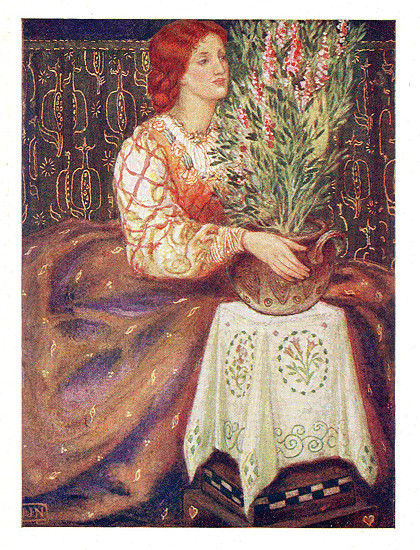
And she forgot the stars, the moon, the sun,
And she forgot the blue above the trees,And she forgot the dells where waters run,
And she forgot the chilly autumn breeze;She had no knowledge when the day was done,
And the new moon she saw not: but in peaceHung over her sweet Basil evermore,
And moisten'd it with tears unto the core.
Then in a silken scarf,—sweet with the dews
Of precious flowers pluck'd in Araby,And divine liquids come with odorous ooze
Through the cold serpent-pipe refreshfully,—She wrapp'd it up; and for its tomb did choose
A garden pot, wherein she laid it by,And covered it with mould, and o'er it set
Sweet Basil, which her tears kept ever wet.
And she forgot the stars, the moon, and sun,
And she forgot the blue above the trees,And she forgot the dells where waters run,
And she forgot the chilly autumn breeze;She had no knowledge when the day was done,
And the new moon she saw not: but in peaceHung over her sweet Basil evermore,
And moisten'd it with tears unto the core.
Isabella.
Keats has brought himself with difficulty, however, to the perusal of modern poets. His boyish enthusiasm for Leigh Hunt's work has long since evaporated: and after reading Shelley's Revolt of Islam, all he has found to say is, "Poor Shelley, I think he has his quota of good qualities!" But, for the rest, he is not attracted to any kind of knowledge which cannot be "made applicable and subservient to the purposes of poetry,"—his own poetry. For his one desire is to win an immortal name—and he has begun life "full of hopes, fiery, impetuous, and ungovernable, expecting the world to fall at once beneath his pen. Poor fellow!" (Haydon's diary).
But "men of genius," Keats himself has said, "are as great as certain ethereal chemicals, operating in a mass of created matter: but they have not any determined character." That indefiniteness of literary aim—that want of willpower, without which genius is a curse, which have hampered the young man all along—are now still further emphasised by the restlessness of a passionate lover. John Keats cannot stay indoors this fine May morning, "fitting himself for verses fit to live," when the girl who is to him the incarnation of all poetry is visible in the next-door garden. He throws down his pen and hurries out to join her.
Contemporary portraits of Fanny Brawne have not succeeded in representing her as beautiful: and at first sight Keats has complained, that, although she "manages to make her hair look well," she "wants sentiment in every feature." Propinquity, however, has achieved the usual result; and now the young poet believes his inamorata to be the very apotheosis of loveliness: he is never weary of adoring her
Sweet voice, sweet lips, soft hand, and softer breast,
Warm breath, light whisper, tender semitone,
Bright eyes, accomplished shape!
If the truth be told, Fanny Brawne is a fairly good-looking young woman, blue-eyed and long-nosed, her hair arranged with curls and ribbons over her brow: she has a curious but striking resemblance to the draped figure in Titian's "Sacred and Profane Love": and for the rest, she is by no means poetic or sentimental, but a voluminous reader, whose strong point is an extraordinary knowledge of the history of costume. She accepts the homage of Keats, much as she accepts the fact of their tacit betrothal, and the fact that her mother disapproves of it—without taking it too seriously in any sense. And now, though not particularly keen on open-air enjoyment, she accepts his daily suggestion of a walk with her; and they go out into the beautiful meadows which were part of Hampstead a hundred years ago.
Keats is in his glory in the fields. Always, the humming of a bee, the sight of a flower, the glitter of the sun, have "seemed to make his nature tremble: then his eyes flashed, his cheek glowed, his mouth quivered." Peculiarly sensitive, as he is, to external influences, his chief delight is to "think of green fields … I muse with the greatest affection on every flower I have known from my infancy." The man who is so soon to "feel the daisies growing over him," takes one of his intensest pleasures in watching the growth of flowers; and now, as an exquisite music, "notes that pierce and pierce," descends through the young green oak-leaves, the poet seizes this golden moment of the May world and transmutes it into song.
My heart aches, and a drowsy numbness pains
My sense, as though of hemlock I had drunk,Or emptied some dull opiate to the drains
One minute past, and Lethe-wards had sunk:'Tis not with envy of thy happy lot,
But being too happy in thine happiness,— That thou, light-wingèd Dryad of the trees, In some melodious plotOf beechen green, and shadows numberless,
Singest of summer in full-throated ease.
O, for a draught of vintage, that hath been
Cool'd a long age in the deep-delvèd earth,Tasting of Flora and the country-green,
Dance, and Provençal song, and sunburnt mirth!O for a beaker full of the warm South,
Full of the true, the blushful Hippocrene, With beaded bubbles winking at the brim, And purple-stainèd mouth;That I might drink, and leave the world unseen,
And with thee fade away into the forest dim:
Fade far away, dissolve, and quite forget
What thou among the leaves hast never known,The weariness, the fever, and the fret
Here, where men sit and hear each other groan;Where palsy shakes a few, sad, last grey hairs,
Where youth grows pale, and spectre-thin, and dies; Where but to think is to be full of sorrow And leaden-eyed despairs;Where beauty cannot keep her lustrous eyes,
Or new Love pine at them beyond tomorrow….
Thou wast not born for death, immortal Bird!
No hungry generations tread thee down;The voice I hear this passing night was heard
In ancient days by emperor and clown:Perhaps the self-same song that found a path
Through the sad heart of Ruth, when sick for home, She stood in tears amid the alien corn; That same that oft-times hathCharm'd magic casements, opening on the foam
Of perilous seas, in faery lands forlorn.
Forlorn! the very word is like a bell
To toll me back from thee to my sole self!Adieu! the fancy cannot cheat so well
As she is famed to do, deceiving elf.Adieu! adieu! thy plaintive anthem fades
Past the near meadows, over the still stream, Up the hill-side; and now 'tis buried deep In the next valley-glades:Was it a vision, or a waking dream?
Fled is that music:—do I wake or sleep?Ode to a Nightingale.
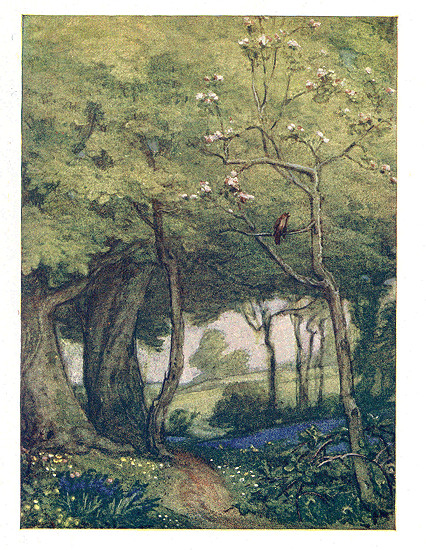
Thou, light-wingèd Dryad of the trees,
In some melodious plotOf beechen green, and shadows numberless,
Singest of summer in full-throated ease.
The poet is recalled from these rapturous flights to the fugitive sweetness of the present: he is wandering in May meadows, young and impetuous, on fire with hopes, and his heart's beloved beside him. It is almost too good to be true. "I have never known any unalloyed happiness for many days together," he tells Fanny; "the death or sickness of someone has always spoilt my home. I almost wish we were butterflies, and lived but three summer days—three such days with you I could fill with more delight than fifty common years could ever contain." He talks to her earnestly of his dreams, his aspirations, his ambitions: and then the sordid facts of every-day life begin to cast a blighting shadow over his effulgent hopes. What has he, indeed, to offer, worth her taking? A young man of twenty-three, ex-dresser at a hospital, who has abandoned his surgical career without adopting any other: with slender resources, and no occupation beyond that of producing verses which are held up to absolute derision by the great reviews. "I would willingly have recourse to other means," he tells her again, as he has told his friend Dilke, "I cannot: I am fit for nothing else but literature." He talks of taking up journalism—but in his heart he feels unfit for any regular profession, by reason both of physical weakness and a certain lack of system in mental work. The future becomes blackly, blankly overcast; the res augusta domi descend like a curtain between the sublimity of Keats and the calm commonsense of Fanny. They turn homewards in silence, the poet revolving melancholy musings.
But when the melancholy fit shall fall
Sudden from heaven like a weeping cloud,That fosters the droop-headed flowers all,
And hides the green hill in an April shroud;Then glut thy sorrow on a morning rose,
Or on the rainbow of the salt sand-wave,Or on the wealth of globèd peonies;
Or if thy mistress some rich anger shows,Emprison her soft hand, and let rave,
And feed deep, deep upon her peerless eyes.
She dwells with Beauty—Beauty that must die;
And Joy, whose hand is ever at his lipsBidding adieu; and aching Pleasure nigh,
Turning to poison while the bee-mouth sips.Ay, in the very temple of Delight
Veil'd Melancholy has her sovran shrine,Though seen of none save him whose strenuous tongue
Can burst Joy's grape against his palate fine;His soul shall taste the sadness of her might,
And be among her cloudy trophies hung.Ode to Melancholy.
Fanny Brawne enters her mother's house, and John Keats goes into his room and sits down, brooding, brooding. "O," he says, "that something fortunate had ever happened to me or my brothers! Then I might hope—but despair is forced upon me as a habit." And he is only too well aware, that although he is naturally "the very soul of courage and manliness," this habit of despair is growing upon him, and eating his energy away. A wintry chill settles down upon the May-time, and his misery finds vent in lovely lines—
In a drear-nighted December,
Too happy, happy tree,Thy branches ne'er remember
Their green felicity: The north cannot undo them, With a sleety whistle through them; Nor frozen thawings glue them From budding at the prime.
In a drear-nighted December,
Too happy, happy brook,Thy bubblings ne'er remember
Apollo's summer look; But with a sweet forgetting, They stay their crystal fretting, Never, never petting About the frozen time.
Ah! would 'twere so with many
A gentle girl and boy!But were there ever any
Writh'd not at passed joy? To know the change and feel it, When there is none to heal it, Nor numbed sense to steal it, Was never said in rhyme.
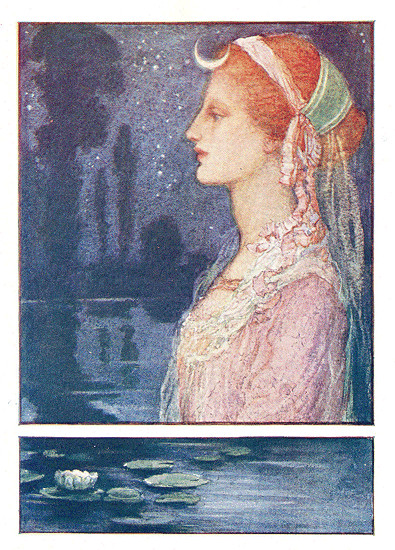
As she spake, into her face there came
Light, as reflected from a silver flame,
… In her eyes a brighter day
Dawn'd blue and full of love.
Yet Keats is young, and youth means buoyancy. With an effort—increasingly difficult—he is able to shake off this sombre fit for awhile; and he makes use of the simplest means to that end. "Whenever I feel vapourish," he has said, "I rouse myself, wash, and put on a clean shirt; brush my hair and clothes, tie my shoe-strings neatly, and in fact adonize as if I were going out: then, all clean and comfortable, I sit down to write." These very prosaic methods adopted, he abandons himself to the full flood of inspiration, and lets his mind suffuse itself in antique glory. As Endymion, he receives the divine commands of the passionately bright Moon-Lady, as she stoops at last to bless him.
And as she spake, into her face there came
Light, as reflected from a silver flame:
Her long black hair swelled ample, in display
Full golden: in her eyes a brighter day
Dawn'd blue and full of love.
Endymion.
Or, as Lycius, he succumbs to the serpentine grace of Lamia; or as Porphyro, hidden in the silence, watches Madeline at prayer.
A casement high and triple-arch'd there was, All garlanded with carven imageries Of fruits, and flowers, and bunches of knot grass, And diamonded with panes of quaint device, Innumerable of stains and splendid dyes, As are the tiger-moth's deep-damask'd wings; And in the midst, 'mong thousand heraldries, And twilight saints, and dim emblazonings,A shielded scutcheon blush'd with blood of queens and kings.
Full on this casement shone the wintry moon, And threw warm gules on Madeline's fair breast, As down she knelt for heaven's grace and boon Rose-bloom fell on her hands, together prest, And on her silver cross soft amethyst, And on her hair a glory, like a saint: She seem'd a splendid angel, newly drest, Save wings, for heaven: Porphyro grew faint:
She knelt, so pure a thing, so free from mortal taint.
Eve of St. Agnes.
But the inspiration does not well up to-day: its flow is frustrated, in view of the mountainous difficulties which hedge him in. Ill-health, stinted means, hopeless love, and continual lack of success—these are calculated to give the bravest pause. And presently Keats, snatching a few hurried mouthfuls of lunch, is off to the studio of his friend, the painter Haydon—the one man among all his acquaintance who is capable of really understanding him. He sits down morbid and silent in the painting room: for a while nothing will evoke a word from him, good or bad. But his keen interest in matters of art, and the entry of various friends one by one—Wentworth Dilke, Hamilton Reynolds, Bailey and Leigh Hunt—soon arouse him to animated conversation. Keats is shy and ill at ease in women's society: but a "delightful combination of earnestness and pleasantry distinguishes his intercourse with men." He says fine things finely, jokes with ready humour, and at the mention of any oppression or wrong rises "into grave manliness at once, seeming like a tall man." No wonder that his society is much sought after, and himself greatly beloved by these congenial spirits; no wonder that here, at least, he meets with that appreciation of which elsewhere his genius has been starved. In this young fellow of twenty-three, who unites winning, affectionate ways, and habitual gentleness of manner, with the loftiest and most nobly-worded ideals, few would discover that imaginary "Johnny Keats, the apothecary's assistant," upon whom the Blackwood reviewer had lavished such vials of vituperation. He is here openly acknowledged as one of the "bards of passion and of mirth," and his poems are each accepted, as
Not a senseless, tranced thing,
But divine melodies of truth,
Philosophic numbers smooth,
Tales and golden histories
Of heaven and its mysteries….
"No one else in English poetry, save Shakespeare, has in expression quite the fascinating felicity of Keats, his perfection of loveliness." (Matthew Arnold). But only these few friends of his are able to recognise that perfection. Outside their charmed circle, lies an obstinately unappreciative world.
The afternoon wears on, and the friends disperse. Keats, returning to Wentworth Place flushed with hectic exhilaration, finds a veritable douche of cold water awaiting him, in the shape of a letter from his publishers. They refer to his unlucky first volume of poems, brought out in 1817. "By far the greater number of persons who have purchased it from us," they say, "have found fault with it in such plain terms, that we have in many cases offered to take the book back, rather than be annoyed with the ridicule which has time after time been showered upon it. In fact, it was only on Sunday last that we were under the mortification of having our own opinion of its merits flatly contradicted by a gentleman who told us that he considered it 'no better than a take-in.'"
For a few minutes the pendulum swings back to despair. A man whose whole business in life is the creation of the best work, who "never wrote a line of poetry with the least shadow of public thought," who believes that after his death he will be among the English poets, and that if he only has time now, he will make himself remembered—that such a one should be merely the butt and laughing-stock of his readers! It is an unendurable position. Not that Keats attaches undue importance to popular applause. "Praise or blame," he says, "has but a momentary effect upon the man whose love of beauty in the abstract makes him a severe critic on his own works…. In Endymion I leaped headlong into the sea, and thereby have become better acquainted with the soundings, the quicksands, and the rocks, than if I had stayed upon the green shore and took tea and comfortable advice. I was never afraid of failure: for I would sooner fail than not be among the greatest."
But what will Fanny think of such a letter? He falls to miserable meditation over the slings and arrows of outrageous Fortune, and the constant erection of new obstacles in the course of his luckless love. And of Fanny's love he always has had a smouldering doubt: yet he remains her vassal, from the first, as he has told her—irrevocably her slave. He conceives himself an outcast on the wintry hillside, exiled from all his heart's desires.
Ah, what can ail thee, wretched wight,
Alone and palely loitering?The sedge is wither'd from the lake,
And no birds sing.
Ah what can ail thee, wretched wight,
So haggard and so woe-begone?The squirrel's granary is full,
And the harvest's done.
I see a lily on thy brow,
With anguish moist and fever dew;And on thy cheek a fading rose
Fast withereth too.
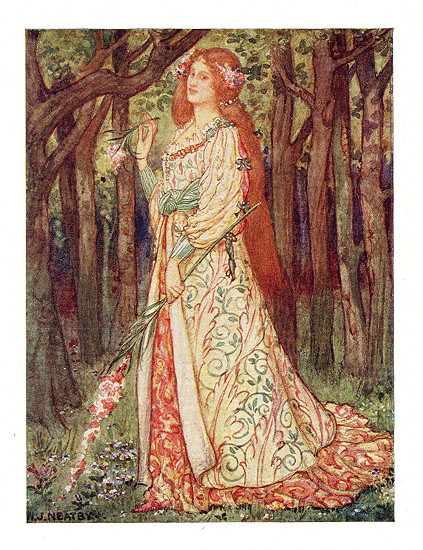
I met a lady in the meads
Full beautiful, a faery's child;Her hair was long, her foot was light,
And her eyes were wild.
I set her on my pacing steed,
And nothing else saw all day long;And sideways would she lean, and sing
A faery's song.
I made a garland for her head,
And bracelets too, and fragrant zone;She look'd at me and she did love,
And made sweet moan.
She found me roots of relish sweet,
And honey wild, and manna dew;And sure in language strange she said,
I love thee true.
She took me to her elfin grot,
And there she gaz'd and sighed deep,And there I shut her wild sad eyes—
So kiss'd to sleep.
And there we slumber'd on the moss,
And there I dream'd, ah woe betide,The latest dream I ever dream'd
On the cold hill side.
I saw pale kings, and princes too,
Pale warriors, death-pale were they all;Who cried—"La belle Dame sans merci
Hath thee in thrall!"
I saw their starv'd lips in the gloam
With horrid warning gaped wide,And I awoke, and found me here
On the cold hill side.
And this is why I sojourn here
Alone and palely loitering,Though the sedge is wither'd from the lake,
And no birds sing.La Belle Dame sans merci.
And now he hears the voice of his Belle Dame ringing light across the garden; while he sits here, a prey to every distress, she is gaily gossiping with her next-door neighbour Brown. At once the unhappy Keats is tormented by a thousand jealous fears. Fanny is transferring her affection to Brown: of that he is quite certain. He rushes out: his black looks banish the much-amused Brown, and very nearly produce an immediate rupture between Fanny and himself. But after a few bitter words, he permits himself to be reassured—or is it cajoled?—and tells her, "I must confess that I love you the more, in that I believe you have liked me for my own sake and for nothing else." The poor boy, from a worldly point of view, has "nothing else" to offer.
The lovers' quarrel is over for the nonce. Visitors begin to drop in for the evening; there is music and singing in Brown's little drawing room. Keats is very fond of music, and can himself, though possessing hardly any voice, "produce a pleasing musical effect." He will sit and listen for hours to a sympathetic performer: but his ear, like all his faculties, is abnormally sensitive: and a wrong note will drive him into a frenzy. As the room grows fuller, he becomes restive. "The poetical character," he has observed, "is not itself—it has no character. When I am in a room with people, the identity of everyone in the room begins to press upon me so that I am in a little time annihilated."
In the light chit-chat of small talk and badinage he has no part: it bewilders and annoys him. Those about him—especially the women—seem to show up in their worst colours. Fanny herself appears, as he has described her at their first meeting, an absolute minx. And presently he contrives to slip stealthily away, and seats himself in some quiet chamber, alone with the darkness and the May-scents of leaf and blossom. "I hope I shall never marry," he groans once more; "the roaring wind is my wife, and the stars through the window-panes are my children: the mighty abstract idea of Beauty I have in all things, stifles the more divided and minute domestic happiness. I do not live in this world alone, but in a thousand worlds. No sooner am I alone, than shapes of epic greatness are stationed round me, and serve my spirit the office which is equivalent to a King's Bodyguard."
The young man now lights his candles, and takes up a familiar and favourite occupation;—the writing of a long letter to his brother George in America. This epistle is, as one might expect, almost entirely concerned with the art of poetry—what else has Keats to write about?—whether from the side of technique, or inspiration. He dwells on the adroit management of open and close vowels—he shows how "the poetry of earth is never dead;" he discusses the need of constant application to work, and how "the genius of poetry must work out its own salvation in a man." And meanwhile, as fitful strains of song reach him from the distance, and his roving gaze rivets itself upon a Wedgwood copy of a Grecian vase—one of Brown's chief treasures—the fleeting wafts of sound, and the lovely symmetry of shape, and the golden chain of figures, blend themselves into one harmonious whole of word-music.
Thou still unravish'd bride of quietness,
Thou foster-child of Silence and slow Time,Sylvan historian, who canst thus express
A flowery tale more sweetly than our rhyme:What leaf-fring'd legend haunts about thy shape
Of deities or mortals, or of both, In Tempe or the dales of Arcady? What men or gods are these? what maidens loath?What mad pursuit? What struggle to escape?
What pipes and timbrels? What wild ecstasy?
Heard melodies are sweet, but those unheard
Are sweeter; therefore, ye soft pipes, play on;Not to the sensual ear, but, more endear'd,
Pipe to the spirit ditties of no tone:Fair youth, beneath the trees, thou canst not leave
Thy song, nor ever can those trees be bare; Bold Lover, never, never canst thou kiss,Though winning near the goal—yet, do not grieve;
She cannot fade, though hast not thou thy bliss, For ever wilt thou love, and she be fair!
Ah, happy, happy boughs! that cannot shed
Your leaves, nor ever bid the Spring adieu;And, happy melodist, unwearied,
For ever piping songs for ever new;More happy love! more happy, happy love!
For ever warm and still to be enjoy'd, For ever panting, and for ever young;All breathing human passion far above,
That leaves a heart high sorrowful and cloy'd, A burning forehead, and a parching tongue.
Who are these coming to the sacrifice?
To what green altar, O mysterious priest,Lead'st thou that heifer lowing at the skies,
And all her silken flanks with garlands drest?What little town by river or sea-shore,
Or mountain-built with peaceful citadel, Is emptied of its folk, this pious morn?And, little town, thy streets for evermore
Will silent be; and not a soul to tell Why thou art desolate, can e'er return.
O Attic shape! Fair attitude! with brede
Of marble men and maidens overwrought,With forest branches and trodden weed;
Thou, silent form! dost tease us out of thoughtAs doth eternity: Cold Pastoral!
When old age shall this generation waste, Thou shalt remain, in midst of other woeThan ours, a friend to man, to whom thou say'st,
"Beauty is truth, truth beauty"—that is all Ye know on earth, and all ye need to know.Ode to a Grecian Urn.
The "shapes of epic greatness" throng closer and mightier around him. The storm and stress of the day's thoughts have utterly drained his small reserve of strength. Outworn by the vehemence of his own conflicting emotions, John Keats lays his aching eyes and dark brown head upon his arm as it rests along the table, and sinks into a dreamless slumber of exhaustion; while, a
"Happy melodist, unwearied,
For ever singing songs for ever new,"
the nightingale chants on outside.
End of the Project Gutenberg EBook of A Day with Keats, by
May (Clarissa Gillington) Byron
*** END OF THIS PROJECT GUTENBERG EBOOK A DAY WITH KEATS ***
***** This file should be named 30451-h.htm or 30451-h.zip *****
This and all associated files of various formats will be found in:
http://www.gutenberg.org/3/0/4/5/30451/
Produced by Delphine Lettau and the Online Distributed
Proofreading Team at http://www.pgdp.net
Updated editions will replace the previous one--the old editions
will be renamed.
Creating the works from public domain print editions means that no
one owns a United States copyright in these works, so the Foundation
(and you!) can copy and distribute it in the United States without
permission and without paying copyright royalties. Special rules,
set forth in the General Terms of Use part of this license, apply to
copying and distributing Project Gutenberg-tm electronic works to
protect the PROJECT GUTENBERG-tm concept and trademark. Project
Gutenberg is a registered trademark, and may not be used if you
charge for the eBooks, unless you receive specific permission. If you
do not charge anything for copies of this eBook, complying with the
rules is very easy. You may use this eBook for nearly any purpose
such as creation of derivative works, reports, performances and
research. They may be modified and printed and given away--you may do
practically ANYTHING with public domain eBooks. Redistribution is
subject to the trademark license, especially commercial
redistribution.
*** START: FULL LICENSE ***
THE FULL PROJECT GUTENBERG LICENSE
PLEASE READ THIS BEFORE YOU DISTRIBUTE OR USE THIS WORK
To protect the Project Gutenberg-tm mission of promoting the free
distribution of electronic works, by using or distributing this work
(or any other work associated in any way with the phrase "Project
Gutenberg"), you agree to comply with all the terms of the Full Project
Gutenberg-tm License (available with this file or online at
http://gutenberg.org/license).
Section 1. General Terms of Use and Redistributing Project Gutenberg-tm
electronic works
1.A. By reading or using any part of this Project Gutenberg-tm
electronic work, you indicate that you have read, understand, agree to
and accept all the terms of this license and intellectual property
(trademark/copyright) agreement. If you do not agree to abide by all
the terms of this agreement, you must cease using and return or destroy
all copies of Project Gutenberg-tm electronic works in your possession.
If you paid a fee for obtaining a copy of or access to a Project
Gutenberg-tm electronic work and you do not agree to be bound by the
terms of this agreement, you may obtain a refund from the person or
entity to whom you paid the fee as set forth in paragraph 1.E.8.
1.B. "Project Gutenberg" is a registered trademark. It may only be
used on or associated in any way with an electronic work by people who
agree to be bound by the terms of this agreement. There are a few
things that you can do with most Project Gutenberg-tm electronic works
even without complying with the full terms of this agreement. See
paragraph 1.C below. There are a lot of things you can do with Project
Gutenberg-tm electronic works if you follow the terms of this agreement
and help preserve free future access to Project Gutenberg-tm electronic
works. See paragraph 1.E below.
1.C. The Project Gutenberg Literary Archive Foundation ("the Foundation"
or PGLAF), owns a compilation copyright in the collection of Project
Gutenberg-tm electronic works. Nearly all the individual works in the
collection are in the public domain in the United States. If an
individual work is in the public domain in the United States and you are
located in the United States, we do not claim a right to prevent you from
copying, distributing, performing, displaying or creating derivative
works based on the work as long as all references to Project Gutenberg
are removed. Of course, we hope that you will support the Project
Gutenberg-tm mission of promoting free access to electronic works by
freely sharing Project Gutenberg-tm works in compliance with the terms of
this agreement for keeping the Project Gutenberg-tm name associated with
the work. You can easily comply with the terms of this agreement by
keeping this work in the same format with its attached full Project
Gutenberg-tm License when you share it without charge with others.
1.D. The copyright laws of the place where you are located also govern
what you can do with this work. Copyright laws in most countries are in
a constant state of change. If you are outside the United States, check
the laws of your country in addition to the terms of this agreement
before downloading, copying, displaying, performing, distributing or
creating derivative works based on this work or any other Project
Gutenberg-tm work. The Foundation makes no representations concerning
the copyright status of any work in any country outside the United
States.
1.E. Unless you have removed all references to Project Gutenberg:
1.E.1. The following sentence, with active links to, or other immediate
access to, the full Project Gutenberg-tm License must appear prominently
whenever any copy of a Project Gutenberg-tm work (any work on which the
phrase "Project Gutenberg" appears, or with which the phrase "Project
Gutenberg" is associated) is accessed, displayed, performed, viewed,
copied or distributed:
This eBook is for the use of anyone anywhere at no cost and with
almost no restrictions whatsoever. You may copy it, give it away or
re-use it under the terms of the Project Gutenberg License included
with this eBook or online at www.gutenberg.org
1.E.2. If an individual Project Gutenberg-tm electronic work is derived
from the public domain (does not contain a notice indicating that it is
posted with permission of the copyright holder), the work can be copied
and distributed to anyone in the United States without paying any fees
or charges. If you are redistributing or providing access to a work
with the phrase "Project Gutenberg" associated with or appearing on the
work, you must comply either with the requirements of paragraphs 1.E.1
through 1.E.7 or obtain permission for the use of the work and the
Project Gutenberg-tm trademark as set forth in paragraphs 1.E.8 or
1.E.9.
1.E.3. If an individual Project Gutenberg-tm electronic work is posted
with the permission of the copyright holder, your use and distribution
must comply with both paragraphs 1.E.1 through 1.E.7 and any additional
terms imposed by the copyright holder. Additional terms will be linked
to the Project Gutenberg-tm License for all works posted with the
permission of the copyright holder found at the beginning of this work.
1.E.4. Do not unlink or detach or remove the full Project Gutenberg-tm
License terms from this work, or any files containing a part of this
work or any other work associated with Project Gutenberg-tm.
1.E.5. Do not copy, display, perform, distribute or redistribute this
electronic work, or any part of this electronic work, without
prominently displaying the sentence set forth in paragraph 1.E.1 with
active links or immediate access to the full terms of the Project
Gutenberg-tm License.
1.E.6. You may convert to and distribute this work in any binary,
compressed, marked up, nonproprietary or proprietary form, including any
word processing or hypertext form. However, if you provide access to or
distribute copies of a Project Gutenberg-tm work in a format other than
"Plain Vanilla ASCII" or other format used in the official version
posted on the official Project Gutenberg-tm web site (www.gutenberg.org),
you must, at no additional cost, fee or expense to the user, provide a
copy, a means of exporting a copy, or a means of obtaining a copy upon
request, of the work in its original "Plain Vanilla ASCII" or other
form. Any alternate format must include the full Project Gutenberg-tm
License as specified in paragraph 1.E.1.
1.E.7. Do not charge a fee for access to, viewing, displaying,
performing, copying or distributing any Project Gutenberg-tm works
unless you comply with paragraph 1.E.8 or 1.E.9.
1.E.8. You may charge a reasonable fee for copies of or providing
access to or distributing Project Gutenberg-tm electronic works provided
that
- You pay a royalty fee of 20% of the gross profits you derive from
the use of Project Gutenberg-tm works calculated using the method
you already use to calculate your applicable taxes. The fee is
owed to the owner of the Project Gutenberg-tm trademark, but he
has agreed to donate royalties under this paragraph to the
Project Gutenberg Literary Archive Foundation. Royalty payments
must be paid within 60 days following each date on which you
prepare (or are legally required to prepare) your periodic tax
returns. Royalty payments should be clearly marked as such and
sent to the Project Gutenberg Literary Archive Foundation at the
address specified in Section 4, "Information about donations to
the Project Gutenberg Literary Archive Foundation."
- You provide a full refund of any money paid by a user who notifies
you in writing (or by e-mail) within 30 days of receipt that s/he
does not agree to the terms of the full Project Gutenberg-tm
License. You must require such a user to return or
destroy all copies of the works possessed in a physical medium
and discontinue all use of and all access to other copies of
Project Gutenberg-tm works.
- You provide, in accordance with paragraph 1.F.3, a full refund of any
money paid for a work or a replacement copy, if a defect in the
electronic work is discovered and reported to you within 90 days
of receipt of the work.
- You comply with all other terms of this agreement for free
distribution of Project Gutenberg-tm works.
1.E.9. If you wish to charge a fee or distribute a Project Gutenberg-tm
electronic work or group of works on different terms than are set
forth in this agreement, you must obtain permission in writing from
both the Project Gutenberg Literary Archive Foundation and Michael
Hart, the owner of the Project Gutenberg-tm trademark. Contact the
Foundation as set forth in Section 3 below.
1.F.
1.F.1. Project Gutenberg volunteers and employees expend considerable
effort to identify, do copyright research on, transcribe and proofread
public domain works in creating the Project Gutenberg-tm
collection. Despite these efforts, Project Gutenberg-tm electronic
works, and the medium on which they may be stored, may contain
"Defects," such as, but not limited to, incomplete, inaccurate or
corrupt data, transcription errors, a copyright or other intellectual
property infringement, a defective or damaged disk or other medium, a
computer virus, or computer codes that damage or cannot be read by
your equipment.
1.F.2. LIMITED WARRANTY, DISCLAIMER OF DAMAGES - Except for the "Right
of Replacement or Refund" described in paragraph 1.F.3, the Project
Gutenberg Literary Archive Foundation, the owner of the Project
Gutenberg-tm trademark, and any other party distributing a Project
Gutenberg-tm electronic work under this agreement, disclaim all
liability to you for damages, costs and expenses, including legal
fees. YOU AGREE THAT YOU HAVE NO REMEDIES FOR NEGLIGENCE, STRICT
LIABILITY, BREACH OF WARRANTY OR BREACH OF CONTRACT EXCEPT THOSE
PROVIDED IN PARAGRAPH F3. YOU AGREE THAT THE FOUNDATION, THE
TRADEMARK OWNER, AND ANY DISTRIBUTOR UNDER THIS AGREEMENT WILL NOT BE
LIABLE TO YOU FOR ACTUAL, DIRECT, INDIRECT, CONSEQUENTIAL, PUNITIVE OR
INCIDENTAL DAMAGES EVEN IF YOU GIVE NOTICE OF THE POSSIBILITY OF SUCH
DAMAGE.
1.F.3. LIMITED RIGHT OF REPLACEMENT OR REFUND - If you discover a
defect in this electronic work within 90 days of receiving it, you can
receive a refund of the money (if any) you paid for it by sending a
written explanation to the person you received the work from. If you
received the work on a physical medium, you must return the medium with
your written explanation. The person or entity that provided you with
the defective work may elect to provide a replacement copy in lieu of a
refund. If you received the work electronically, the person or entity
providing it to you may choose to give you a second opportunity to
receive the work electronically in lieu of a refund. If the second copy
is also defective, you may demand a refund in writing without further
opportunities to fix the problem.
1.F.4. Except for the limited right of replacement or refund set forth
in paragraph 1.F.3, this work is provided to you 'AS-IS' WITH NO OTHER
WARRANTIES OF ANY KIND, EXPRESS OR IMPLIED, INCLUDING BUT NOT LIMITED TO
WARRANTIES OF MERCHANTIBILITY OR FITNESS FOR ANY PURPOSE.
1.F.5. Some states do not allow disclaimers of certain implied
warranties or the exclusion or limitation of certain types of damages.
If any disclaimer or limitation set forth in this agreement violates the
law of the state applicable to this agreement, the agreement shall be
interpreted to make the maximum disclaimer or limitation permitted by
the applicable state law. The invalidity or unenforceability of any
provision of this agreement shall not void the remaining provisions.
1.F.6. INDEMNITY - You agree to indemnify and hold the Foundation, the
trademark owner, any agent or employee of the Foundation, anyone
providing copies of Project Gutenberg-tm electronic works in accordance
with this agreement, and any volunteers associated with the production,
promotion and distribution of Project Gutenberg-tm electronic works,
harmless from all liability, costs and expenses, including legal fees,
that arise directly or indirectly from any of the following which you do
or cause to occur: (a) distribution of this or any Project Gutenberg-tm
work, (b) alteration, modification, or additions or deletions to any
Project Gutenberg-tm work, and (c) any Defect you cause.
Section 2. Information about the Mission of Project Gutenberg-tm
Project Gutenberg-tm is synonymous with the free distribution of
electronic works in formats readable by the widest variety of computers
including obsolete, old, middle-aged and new computers. It exists
because of the efforts of hundreds of volunteers and donations from
people in all walks of life.
Volunteers and financial support to provide volunteers with the
assistance they need, are critical to reaching Project Gutenberg-tm's
goals and ensuring that the Project Gutenberg-tm collection will
remain freely available for generations to come. In 2001, the Project
Gutenberg Literary Archive Foundation was created to provide a secure
and permanent future for Project Gutenberg-tm and future generations.
To learn more about the Project Gutenberg Literary Archive Foundation
and how your efforts and donations can help, see Sections 3 and 4
and the Foundation web page at http://www.pglaf.org.
Section 3. Information about the Project Gutenberg Literary Archive
Foundation
The Project Gutenberg Literary Archive Foundation is a non profit
501(c)(3) educational corporation organized under the laws of the
state of Mississippi and granted tax exempt status by the Internal
Revenue Service. The Foundation's EIN or federal tax identification
number is 64-6221541. Its 501(c)(3) letter is posted at
http://pglaf.org/fundraising. Contributions to the Project Gutenberg
Literary Archive Foundation are tax deductible to the full extent
permitted by U.S. federal laws and your state's laws.
The Foundation's principal office is located at 4557 Melan Dr. S.
Fairbanks, AK, 99712., but its volunteers and employees are scattered
throughout numerous locations. Its business office is located at
809 North 1500 West, Salt Lake City, UT 84116, (801) 596-1887, email
business@pglaf.org. Email contact links and up to date contact
information can be found at the Foundation's web site and official
page at http://pglaf.org
For additional contact information:
Dr. Gregory B. Newby
Chief Executive and Director
gbnewby@pglaf.org
Section 4. Information about Donations to the Project Gutenberg
Literary Archive Foundation
Project Gutenberg-tm depends upon and cannot survive without wide
spread public support and donations to carry out its mission of
increasing the number of public domain and licensed works that can be
freely distributed in machine readable form accessible by the widest
array of equipment including outdated equipment. Many small donations
($1 to $5,000) are particularly important to maintaining tax exempt
status with the IRS.
The Foundation is committed to complying with the laws regulating
charities and charitable donations in all 50 states of the United
States. Compliance requirements are not uniform and it takes a
considerable effort, much paperwork and many fees to meet and keep up
with these requirements. We do not solicit donations in locations
where we have not received written confirmation of compliance. To
SEND DONATIONS or determine the status of compliance for any
particular state visit http://pglaf.org
While we cannot and do not solicit contributions from states where we
have not met the solicitation requirements, we know of no prohibition
against accepting unsolicited donations from donors in such states who
approach us with offers to donate.
International donations are gratefully accepted, but we cannot make
any statements concerning tax treatment of donations received from
outside the United States. U.S. laws alone swamp our small staff.
Please check the Project Gutenberg Web pages for current donation
methods and addresses. Donations are accepted in a number of other
ways including checks, online payments and credit card donations.
To donate, please visit: http://pglaf.org/donate
Section 5. General Information About Project Gutenberg-tm electronic
works.
Professor Michael S. Hart is the originator of the Project Gutenberg-tm
concept of a library of electronic works that could be freely shared
with anyone. For thirty years, he produced and distributed Project
Gutenberg-tm eBooks with only a loose network of volunteer support.
Project Gutenberg-tm eBooks are often created from several printed
editions, all of which are confirmed as Public Domain in the U.S.
unless a copyright notice is included. Thus, we do not necessarily
keep eBooks in compliance with any particular paper edition.
Most people start at our Web site which has the main PG search facility:
http://www.gutenberg.org
This Web site includes information about Project Gutenberg-tm,
including how to make donations to the Project Gutenberg Literary
Archive Foundation, how to help produce our new eBooks, and how to
subscribe to our email newsletter to hear about new eBooks.