


автордың кітабын онлайн тегін оқу The Spy of the Rebellion / Being a True History of the Spy System of the United States / Army during the Late Rebellion
The Project Gutenberg EBook of The Spy of the Rebellion, by Allan Pinkerton
This eBook is for the use of anyone anywhere at no cost and with
almost no restrictions whatsoever. You may copy it, give it away or
re-use it under the terms of the Project Gutenberg License included
with this eBook or online at www.gutenberg.org
Title: The Spy of the Rebellion
Being a True History of the Spy System of the United States
Army during the Late Rebellion,
Author: Allan Pinkerton
Release Date: January 15, 2011 [EBook #34973]
Language: English
*** START OF THIS PROJECT GUTENBERG EBOOK THE SPY OF THE REBELLION ***
Produced by Suzanne Shell, Josephine Paolucci and the
Online Distributed Proofreading Team at http://www.pgdp.net.
THE SPY OF THE REBELLION
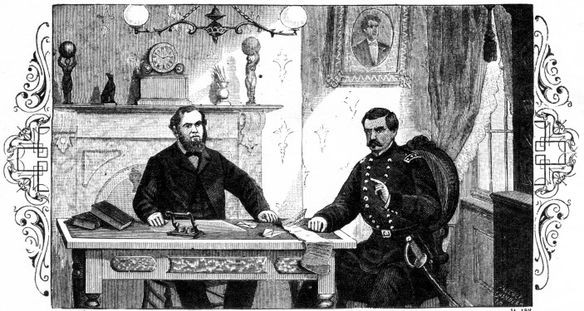
Frontispiece. P. 158. Allan Pinkerton and General McClellan in Private Consultation.
THE
SPY OF THE REBELLION;
BEING
A TRUE HISTORY
OF THE
SPY SYSTEM OF THE UNITED STATES ARMY
DURING THE LATE REBELLION.
REVEALING MANY SECRETS OF THE WAR HITHERTO NOT MADE PUBLIC.
COMPILED FROM OFFICIAL REPORTS
PREPARED FOR
PRESIDENT LINCOLN, GENERAL McCLELLAN AND THE PROVOST-MARSHAL-GENERAL.
BY
ALLAN PINKERTON,
WHO
(UNDER THE NOM-DE-PLUME OF MAJOR E. J. ALLEN)
WAS
CHIEF OF THE UNITED STATES SECRET SERVICE.
WITH NUMEROUS ILLUSTRATIONS.
Introduction by Patrick Bass
University of Nebraska Press
Lincoln and London
Introduction copyright © 1989 by the University of Nebraska Press
All rights reserved
Manufactured in the United States of America
First Bison Book printing: 1989
Most recent printing indicated by the last digit below:
10 9 8 7 6 5 4 3 2 1
Library of Congress Cataloging-in-Publication Data
Pinkerton, Allan, 1819-1884.
The spy of the rebellion: being a true history of the spy system of the United States Army during the late rebellion, revealing many secrets of the war hitherto not made public / by Allan Pinkerton: introduction by Patrick Bass.
p. cm.
"Compiled from official reports prepared for President Lincoln, General McClellan, and the provost-marshal-general."
Reprint. Originally published: Hartford, Conn.: M. A. Winter & Hatch, 1883.
ISBN 0-8032-3686-7 (alk. paper) ISBN 0-8032-8722-4 (pbk.)
1. United States—History—Civil War, 1861-1865—Secret service.
2. United States—History—Civil War, 1861-1865—Personal narratives.
3. Pinkerton, Allan, 1819-1884. I. Title.
E608.P65 1989
973.7'86—dc20 89-33081 CIP
Reprinted from the 1883 edition published by M. A. Winter & Hatch, Hartford, Connecticut. An appendix, "Rebel Forces before Richmond," has been omitted from this Bison Book edition.

CONTENTS.
Preface 23
CHAPTER I.
PAGE
An Unwritten Page of History.—A Political Resumé.—Abraham Lincoln is Elected President. 33
CHAPTER II.
Opposition to Mr. Lincoln's Inauguration.—A Plot to Assassinate him.—The Journey from Springfield, Illinois. 45
CHAPTER III.
The Conspirators at Work.—Detectives on their Trail.—Webster as a Soldier. 58
CHAPTER IV.
The Conspirators in Council.—My Operative Joins the Conspiracy. 74
CHAPTER V.
The Presidential Party Arrives in Philadelphia.—Independence Hall.—The Departure from Harrisburg.—Telegraph Wires Cut.—Through the Lines of Treason.—Safe Arrival at Washington. 81
CHAPTER VI.
My Connection with the Rebellion.—Timothy Webster Accepts a Mission. 104
CHAPTER VII.
Webster on his Way to the Capital.—Wrecked Trains and Broken Bridges.—An Adventure with a Cavalryman.—A Rebel Emissary.—President Lincoln and Timothy Webster. 114
CHAPTER VIII.
Timothy Webster in Washington.—The Return to Philadelphia.—I go to the Capital.—An Important Letter. 131
CHAPTER IX.
An Adventure in Pittsburg.—A Mob at Bay.—An Explanation.—Good Feeling Restored. 142
CHAPTER X.
General McClellan in Command of Ohio.—I am Engaged for the War.—The Secret Service.—A Consultation.—Webster Starts for Rebeldom. 151
CHAPTER XI.
Webster Fraternizes with the Rebel Officers.—A Secession Hat.—A Visit to a Rebel Camp.—"The Committee of Safety."—A Friendly Stranger.—A Warning.—The Escape. 168
CHAPTER XII.
I Take a Trip to the South.—Danger in Memphis.—A Timely Warning.—A Persistent Barber.—An Unfortunate Memory.—Return to Cincinnati. 182
CHAPTER XIII.
East and West Virginia.—Seceding from Secession.—My Scouts in Virginia.—A Rebel Captain Entertains "My Lord."—An Old Justice dines with Royalty.—A Lucky Adventure.—A Runaway Horse.—A Rescue. 203
CHAPTER XIV.
The Rebels Attempt to Occupy West Virginia.—General McClellan Ordered to Drive Them Out.—Early Battles.—The Federals Victorious.—West Virginia Freed from Rebel Soldiers. 227
CHAPTER XV.
General McClellan is Called to Washington, and Placed in Command of the Armies after the Battle of Bull Run.—The Secret Service Department.—Its Duties and Responsibilities. 237
CHAPTER XVI.
A Female Traitor.—Suspicious Correspondence.—A Close Watch under Difficulties.—I am Arrested.—Exposure of the Treason of a Trusted Officer.—A Disgraced Captain. 250
CHAPTER XVII.
Timothy Webster in Baltimore.—An Encounter with a Fire-eater.—Webster Defends Himself.—Treason Rampant in the Monumental City. 271
CHAPTER XVIII.
Webster Makes a Journey to the South.—A Secret Organization.—The "Knights of Liberty."—Webster Becomes a Member.—A Sudden Intrusion of the Military.—The Conspiracy Broken Up. 283
CHAPTER XIX.
Suspicions in Washington.—"Uncle Gallus."—Property Searched.—A Rebel Family sent South.—Webster Starts for Richmond. 301
CHAPTER XX.
The Spy at Richmond.—Earthworks Around the Rebel Capital.—An Unexpected Meeting.—Pistols for Two.—A Reconciliation.—Safe Return to Washington. 314
CHAPTER XXI.
Again in Baltimore.—A Warning.—The Spy is Arrested.—And Escapes. 326
CHAPTER XXII.
Webster and Scobell.—A Negro as a Spy.—A Traitor Deserts from the Army.—He Carries Dispatches to the Rebels.—Which Fail of Their Destination.—An Attack in the Woods.—"The Loyal League."—Slaves as Patriots. 343
CHAPTER XXIII.
A Negro Spy.—Passage on a Steam-Packet.—Lyrical Melodies.—Scobell Deserts the Ship.—His Tramps Through Rebeldom. 358
CHAPTER XXIV.
A Perilous Ride.—A Suspicious Peddler.—Uncle Gallus Again.—Scobell Investigating.—Doubts and Suspicions. 367
CHAPTER XXV.
The Journey Resumed.—A Midnight Pursuit.—A Brave Woman.—A Deadly Encounter.—Scobell Defends Himself.—Death of a Rebel Spy. 381
CHAPTER XXVI.
A Woman's Discoveries.—An Infernal Machine.—The Shipping in Danger.—Discovery and Destruction of the Submarine Battery. 394
CHAPTER XXVII.
"Stuttering Dave."—His Tramp Through the Rebel Lines.—An Ammunition Train.—"Dave's" Plan Succeeds in its Destruction.—A Man who Stuttered and "Had Fits." 404
CHAPTER XXVIII.
Another Trip to Richmond.—A Rebel General Taken In.—Curtis Makes Valuable Acquaintances.—"The Subterranean Headquarters." 414
CHAPTER XXIX.
A Virginia Home.—Unwelcome Visitors.—Mr. Harcourt Arrested and Released.—Dan McCowan makes Forcible Love to Mary Harcourt.—The Girl in Peril.—A Timely Rescue.—The Villain Punished. 429
CHAPTER XXX.
Curtis Again on His Travels.—A Loving Episode.—Dan McCowan Again Turns up.—The Capture of Curtis.—A Fight for Life.—And Escape.—A Bit of Matrimony. 445
CHAPTER XXXI.
McClellan and his Enemies.—The Peninsula Campaign.—The Rebel Forces Before Richmond.—The Union Forces Outnumbered by the Enemy, and their Commander Hampered by Superiors.—An Honest Opinion. 457
CHAPTER XXXII.
Webster's Expedition.—His Gallantry.—A Stormy Passage.—A Mysterious Package.—Treason Discovered and Punished. 468
CHAPTER XXXIII.
Activity in Washington.—Webster's Journey Through the South.—His Return to the Capital. 481
CHAPTER XXXIV.
Webster's Last Mission.—Anxiety at his Long Absence.—No Tidings of the Faithful Scout.—Operatives Sent in Search of Him.—Webster Ill in Richmond. 485
CHAPTER XXXV.
McClellan and the Government.—Lewis and Scully Arrested as Spies.—An Attempted Escape.—Trial and Conviction.—Condemned to Die.—Before the Gallows their Mouths are Opened. 498
CHAPTER XXXVI.
Webster Arrested as a Spy.—A Woman's Devotion, and a Patriot's Heroism.—Webster is Convicted.—The Execution.—A Martyr's Grave. 530
CHAPTER XXXVII.
The Defeat of General Pope at the Second Battle of Manassas.—McClellan Again Called to the Command.—The Battle of Antietam.—A Union Victory.—A Few Thoughts About the Union Commander.—McClellan's Removal from Command, and His Farewell Address. 561
CHAPTER XXXVIII.
General Burnside in Command.—My Connection with the Secret Service Severed.—Reflections upon Important Events.—Conclusion. 579
APPENDIX. 587
LIST OF ILLUSTRATIONS.
PAGE
Allan Pinkerton and General McClellan in Private Consultation. Frontispiece
The Oath to Assassinate the President. 65
Swearing in of Howard. 76
Lincoln Raising the Old Flag. 87
The Departure for Washington. 94
Safe Arrival. 98
Attempt to Capture Webster. 146
A Visit to a Rebel Camp. 171
Timely Warning. 195
The Barber's Recognition. 201
An English Lord and a Rebel Captain. 215
Captured by the Guards. 260
An Encounter with a Fire-eater. 277
A Sudden Intrusion of the Military. 299
The Spy is Arrested. 334
Escape of the Spy. 339
Scobell Engaged as Deck-hand on a Steamboat. 364
Death of a Rebel Spy. 389
Timely Interruption to a Love Scene. 441
Webster's Gallant Bravery. 474
Webster Discovers a Mysterious Package. 475
The Prisoners Recaptured. 522
Webster's Death Warrant. 542
A Narrow Escape. 569

PREFACE.
Nearly a score of years have passed since the occurrence of the events related in the following pages. The "Rebellion," with its bloody scenes, has ended, and the country is at peace. The grass is waving green and beautiful over many Southern fields that once ran with human blood, as the contending forces met in the deadly encounter. The birds are carolling sweetly in the air, which then was laden with the clarion notes of the trumpet; the fierce, wild yell of assaulting soldiery; the booming of cannon, and the groans of the wounded and dying. The merchant, the mechanic, and the husbandman have returned to the pursuits which they followed before the dark clouds of war had overshadowed this fair land, and they shouldered their muskets in defense of the Union. From the desolation and the ravages of war, the country has emerged into the sunshine of abiding peace, and now, in the evening twilight, the gray-haired veterans gather around their family hearthstones to repeat the stories of bravery and devotion associated with those trying hours of their country's history.
In the twilight of my days I have been tempted to the recitals which follow, and in relating my experiences as the Chief of the Secret Service of the Government during the Rebellion, I have been governed by a desire to acquaint the public with the movements of those brave men who rendered invaluable service to their country, although they never wore a uniform or carried a musket. Working quietly, and frequently under disguises, their assistance to the Union commanders was of incalculable advantage, and many acts of courage and daring were performed by these men which, until now, have never been revealed. Indeed, as to my own nom-de-plume, "E. J. Allen," many of the officers of the army and officials of the Government, with whom I was in constant communication, never knew me by any other name, and the majority of them are to this day in ignorance of the fact that E. J. Allen, late Chief of the Secret Service, and Allan Pinkerton are one and the same person.
During the progress of the struggle, and the years which have since elapsed, many of my old acquaintances, who held important positions in the army and in governmental departments, have passed away from earth. Some of them falling in the heat of battle, in the courageous discharge of duty, while others, passing through the fiery ordeal, have died amid the comforts and the charms of home.
President Lincoln, Edwin M. Stanton, William H. Seward and Salmon P. Chase, all giants in their day, have departed from the sphere of their usefulness, and have gone to their long home. Soldiers and civilians, generals and privates, with whom I was connected, and their name is legion, have taken up their journey to "that bourne from whence no traveler e'er returns."
In detailing the various events which follow, I have been careful to offer nothing but that which actually transpired. I have avoided giving expression to any thoughts or feelings of antagonism to the South, because the time for such utterances has passed. Indeed, except for the existence of slavery, I always cherished a warm affection for the Southern people. But this institution of human bondage always received my most earnest opposition. Believing it to be a curse to the American nation, and an evidence of barbarism, no efforts of mine were ever spared in behalf of the slave, and to-day I have not a single regret for the course I then pursued.
Many times before the war, when I was associated with those philanthrophic spirits who controlled the so-called "Underground Railroad," I have assisted in securing safety and freedom for the fugitive slave, no matter at what hour, under what circumstances, or at what cost, the act was to be performed. John Brown, the white-haired abolitionist of Kansas fame, was my bosom friend; and more than one dark night has found us working earnestly together in behalf of the fleeing bondman, who was striving for his liberty. After his gallant effort at Harper's Ferry, and while he was confined in a Virginia prison, my efforts in his behalf were unceasing; and had it not been for the excessive watchfulness of those having him in charge, the pages of American history would never have been stained with a record of his execution. As it is, though his fate may have been in accordance with the decrees of the laws then existing, I can recall with all the old enthusiasm that I then experienced, the thundering effect of thousands of our brave "boys in blue," joining in that electric war cry, the refrain of which was:
"John Brown's body lies mouldering in the grave, But his soul goes marching along,"
while they hurried in solid phalanx to meet the enemy upon the field of battle.
In the preliminary chapters, I have detailed with accuracy the facts connected with the conspiracy to assassinate Abraham Lincoln, when he was first elected to the Presidency. The part I took in discovering the existence of that plot and the efforts of my men in ferreting out the prime movers of that murderous compact, are told for the first time in these pages, and the correctness of their relation is undoubted; though in the dark days that followed, the bullet of the assassin removed the martyred President, while engaged in the fulfillment of his mission. I cannot repress a sense of pride in the fact, that at the commencement of his glorious career I had averted the blow that was aimed at his honest, manly heart.
In the events which transpired during the years 1861 and 1862, I took an active part. From the early days of April until after the battle of Antietam had been fought and won, I was connected with the military operations of the government. In Washington I acted under the directions of the Secretaries of War, and Colonel Andrew Porter, the provost-marshal; and in the field, I was under the immediate direction of General George B. McClellan.
My relations with the various departments were always of the most cordial and confidential character. To particularize in this matter is almost impossible; but I cannot refrain from mentioning, in the highest terms of respect and friendship, Colonel Thomas A. Scott of Pennsylvania. In the early days of the nation's peril, he occupied the position of Assistant Secretary of War. In him I always found a warm friend and advocate, and in many emergencies his prompt and intelligent action was most potent in accomplishing good results in that era of confusion, of doubt and hesitation.
Of my service with the military department while in active duty, little needs to be said here. From the time of his commission by Governor Dennison of Ohio, to the day when he was relieved, after his splendid victory at Antietam, I followed the fortunes of General McClellan. Never doubting his ability or his loyalty—always possessing his confidence and esteem, I am at this time proud and honored in ranking him foremost among my invaluable friends. When secret enemies were endeavoring to prejudice the mind of the President against his chosen commander; when wily politicians were seeking to belittle him in the estimation of the people, and when jealous minded officers were ignorantly criticising his plans of campaign, General McClellan pursued his course with unflinching courage and with a devotion to his country unsurpassed by any who have succeeded him, and upon whose brows are entwined the laurels of the conqueror.
His marvelous reorganization of the army, the enthusiasm with which his presence invariably inspired the soldiers under his command, and the grand battles which he fought against enemies in front and in rear, have all passed into history—and to-day the intelligent and unprejudiced reader finds in a calm and dispassionate review of his career, an ample and overwhelming justification of his course as a loyal and capable commander-in-chief.
Self-constituted critics, whose avenues of information were limited and unreliable, have attempted to prove that the force opposed to General McClellan was much less than was really the case; and upon this hypothesis have been led into unjust and undeserved censure of the commanding general. From my own experience, I know to the contrary. My system of obtaining knowledge upon this point was so thorough and complete, my sources of information were so varied, that there could be no serious mistake in the estimates which I then made and reported to General McClellan. From every available field the facts were gleaned. From prisoners of war, contrabands, loyal Southerners, deserters, blockade-runners and from actual observations by trustworthy scouts, my estimates were made, and to-day I affirm as strongly as I then did, that the force opposed to General McClellan before Richmond approximated nearer to 200,000 men, than they did to the numerous estimates of irresponsible historians who have placed the strength of the rebel forces at that time below 100,000 men. In this connection I must refer also to the valuable assistance rendered both General McClellan and myself by that indefatigable Aid-de-camp Colonel Key. Though he no longer mingles with the things of earth, the memory of his devotion and his intelligent services to the cause of the Union is imperishable. No truer, braver man ever drew a sword than did this noble and efficient staff officer, now deceased.
Of Timothy Webster, who so ably assisted me in my various and delicate duties, and whose life was sacrificed for the cause he held so dear, I have only words of warmest commendation. Brave, honest and intelligent, he entered into the contest to perform his whole duty, and right nobly did he fulfill his pledge. No danger was too great, no trust too responsible, no mission too delicate for him to attempt, and though executed as a spy in a Richmond prison, his name shall ever be cherished with honor and friendship by those who knew his worth, and who appreciated the unswerving devotion of a loyal heart. No dishonor can ever attach to the memory of a patriot who died in the service of his country.
The events narrated have all occurred. The record is a truthful one. Although not so complete as I could wish, they must serve the purpose for which they are intended. In the disastrous fire which swept over Chicago in 1871, my records were mainly destroyed, and to this fact must be attributed the failure to more elaborately detail the multitudinous operations of my men. With the able assistance of Mr. George H. Bangs, my efficient General Superintendent, "we did what we could," and the approbation of our commanding officers attest the efficiency of our efforts.
After leaving the service, the conduct of the war passed into other hands. Other men were chosen to the command of the armies, and other sources of information were resorted to. Succeeding battles have been fought, defeats have been sustained, victories have been achieved, and the war is happily ended. The slave is free, and in the enjoyment of the rights of citizenship. The country is at peace, her prosperity is assured, and now that passion and prejudice have died away, and honest judgments are given of the events that have transpired, I leave to the impartial reader, and historian, the question whether the course I pursued, and the General whom I loved and faithfully served, are deserving of censure, or are entitled to the praises of a free and enlightened people.
Allan Pinkerton.
THE SPY
OF
THE REBELLION.
CHAPTER I.
"An Unwritten Page of History."—A Political Resumé.—Mr. Lincoln is Elected President.
Many years have elapsed since the occurrence of the events which I am about to relate. Years that have been full of mighty import to the nation. A bitter, prolonged and bloody war has laid its desolating hands upon a once united country. For years the roar of cannon and the clash of steel reverberated through the bright valleys and the towering hills of the fruitful South. In those years when brother arose against his brother, when ties of kindred and association were broken asunder like frail reeds, glorious deeds were wrought and grand results have been accomplished. America has taught the world a lesson of bravery and endurance; the shackles have been stricken from the slave; an error of a century has been crushed, and freedom is now no longer an empty name, but a beautiful and enduring realism.
To-day peace spreads her broad, sheltering arms over a reunited and enlightened nation. The roll of the drum and the tramp of armed men are now no longer heard. North and South have again clasped hands in a renewal of friendship and in a perpetuity of union.
But a short time ago a Republican President elected by but a slight majority of the voters of this great community, left his peaceful home in the West and journeyed to the capital of the nation, to take the oath of office and to assume the high duties of a chief magistrate. As he passed through the towns and cities upon his route a general plaudit of welcome was his greeting, even noted political foes joining in the demonstrations. His road was arched with banners and his path was strewn with flowers. Everywhere he found an enthusiasm of welcome, a universal prayer for success, and the triumphal train entered the capital amid the ovations of the populace, which reached almost a climax of patriotic and effervescing joy.
Twenty years ago witnessed a different condition of affairs. The political horizon was dark and obscured. The low mutterings of the storm that was soon to sweep over our country, and to deluge our fair land with fratricidal blood, were distinctly heard. Sectional differences were developing into widespread dissensions. Cherished institutions were threatened with dissolution, and political antagonism had aroused a contented people into a frenzy of hate.
On the twenty-second of May, 1856, an American Senator was assaulted in the Senate-house by a political opponent for daring to give utterance to opinions that were hostile to the slave-holding interests of the South. Later in the same year a Republican candidate, with professed anti-slavery views, was nominated for the presidency, and although defeated, gave evidence of such political strength that Southern leaders became alarmed.
At this time the Hon. Stephen A. Douglas was a prominent leader of the Democratic party, but through his opposition to what was known as the Lecompton Bill, he incurred the displeasure of his political friends of the South, who vainly endeavored to enact such legislation as would practically lead to his retirement from the party.
In 1858 the famous contest between Abraham Lincoln and Stephen A. Douglas for the United States Senatorship from Illinois took place, and during its progress absorbed public attention throughout the country. The two candidates indulged in open discussions of questions of public policy, which were remarkable for their brilliancy and for the force and vigor with which their different views were uttered. It was during this canvass that Mr. Lincoln made the forcible and revolutionizing declaration that: "The Union cannot permanently endure half slave and half free." Mr. Lincoln was defeated, however, and Mr. Douglas was returned to the Senate, much against the wishes of those Democrats who desired the unlimited extension of the institution of Slavery.
In the following year occurred the slave insurrection in Virginia, under the leadership of that bold abolitionist, John Brown. The movement was frustrated, however, and John Brown, after a judicial trial for his offense, was sentenced to be hung. Up to the day of his execution he remained firm in the belief that he had but performed his duty toward enslaved humanity, and he died avowing the justice of his cause and the hope of its ultimate success.
All of these occurrences tended to engender a spirit of fierce opposition in the minds of the Southern leaders. The growing sentiment of abolitionism throughout the North, and the manifest disposition to prevent its increase or extension, aroused the advocates of Slavery to a degree of alarm, which led to the commission of many actions, both absurd and unjustifiable.
The year of 1860 opened upon a scene of political agitation which threatened to disrupt long united associations, and to erect sectional barriers which appeared almost impossible to overcome.
In April, 1860, the Democratic National Convention assembled in Charleston, South Carolina, for the purpose of nominating a candidate for the presidency. During its session loud and angry debates occurred, in which the Southern element endeavored to obtain a strong indorsement of the institution of Slavery, and of the right to carry slaves into the Territories of the United States. They were met by the more conservative portion of the party, who desired to leave the question to be decided by the States themselves. After a prolonged discussion the majority of the Southern States withdrew their delegates from the convention, and the remainder proceeded to ballot for a candidate of their choice.
After a protracted sitting, during which several ballots were taken and no decided result obtained, the convention adjourned, to meet in the city of Baltimore on the eighteenth day of June succeeding. Stephen A. Douglas, of Illinois, received a large percentage of the votes that were cast, but failed to obtain a sufficient number to secure his nomination.
The withdrawing delegates organized a rival convention, but, without transacting any business of a decisive character, also adjourned, to meet in Baltimore at a date nearly coincident with that of the regular body.
On the nineteenth day of May, the Constitutional Union (being the old American) party held their convention in the city of Baltimore, and nominated John Bell, of Tennessee, for President, and Edward Everett, of Massachusetts, for the Vice-Presidency.
The Republican Convention was held on the sixteenth day of May, in the city of Chicago, and upon the third ballot nominated Abraham Lincoln, of Illinois, for the office of President, and Hannibal Hamlin, of Maine, for the second office.
This convention also adopted a platform very pronounced upon the subject of Slavery, and which was calculated to give but little encouragement to the extension or perpetuity of the slave-holding power.
On the eighteenth day of June the regular Democratic Convention assembled, pursuant to adjournment, in the city of Baltimore, and named Stephen A. Douglas, of Illinois, and Herschel V. Johnson, of Georgia, as their standard-bearers in the political conflict that was to ensue.
On the twenty-eighth day of the same month the seceding delegates met in the same city, and after pronouncing their ultra views upon the question of Slavery, nominated John C. Breckinridge, of Kentucky (then the Vice-President of the country), and General Joseph Lane, of Oregon, as the candidates of their choice.
The lines of battle were now drawn, and from that time until the election, in November, a fierce contest was waged between the opposing parties. Never before in the history of parties was a canvass conducted with more bitterness or with a greater amount of vituperation. The whole country was engrossed with the gigantic struggle. Business interests, questions of finance and of international import were all made subservient to the absorbing consideration of the election of a national President.
The Southern "Fire-eaters," as they were called, fully realized their inability to elect the candidates they had named, but strove with all their power to prevent the success of the regular Democratic nominees, and when at last the day of election came, and the votes were counted, it was found that the Republican party had been victorious and that Abraham Lincoln had been elected.
In many portions of the South this result was hailed with joyful enthusiasm. The anti-slavery proclivities of the successful party was instantly made a plausible pretext for secession and the withdrawal of the slave-holding States from the Union was boldly advocated.
The same power that threatened in 1856, in the words of Governor Wise of Virginia: "That if Fremont had been elected, he would have marched at the head of twenty thousand men to Washington, and taken possession of the capital, preventing by force Fremont's inauguration at that place"—was again aroused, and an open opposition to the Republican inauguration was for a time considered.
The absorbing and exciting question in the South was: "Would the South submit to a Black Republican President and a Black Republican Congress?" and the answer to the question was a loud and decisive negative.
Among the bolder advocates of secession the election of Mr. Lincoln was regarded with pleasure, and meetings were held in Charleston, rejoicing in the triumph of the Republican party. Secession and disunion were loudly advocated, and the slave oligarchy of South Carolina regarded this event as the opportunity to achieve her long-cherished purpose of breaking up the Union, and forming a new confederacy, founded upon the peculiar ideas of the South.
Says Horace Greeley: "Men thronged the streets, talking, laughing, cheering, like mariners long becalmed upon a hateful, treacherous sea, when a sudden breeze had swiftly wafted them within sight of their looked for haven, or like a seedy prodigal, just raised to affluence by the death of some far-off, unknown relative, and whose sense of decency is not strong enough to repress his exultation."
Open threats were made to withdraw at once from the Union, and these demonstrations seemed to find sympathy among other nations than our own, and soon foreign intrigue was hand and glove with domestic treason, in the attempt to sap the foundations of our government, and seeking peculiar advantages from its overthrow.
It is unnecessary to detail the various phases of this great agitation, which, firing the Southern heart with the frenzy of disunion, finally led to the secession of the Southern States. Various compromises were attempted, but all failed of beneficial result. The "masterly inactivity" of the administration contributed in no small degree to the accomplishment of this object, and in the end the Southern Confederacy was organized and Jefferson Davis was elected as its President.
The Palmetto waved over the custom-house and post-office at Charleston; government forts and arsenals were seized by the volunteers to the Southern cause, and on February 1, 1861, the Federal mint and custom-house at New Orleans were taken possession of by the secessionists.
The removal of Major Anderson from Fort Moultrie to the more secure stronghold of Fort Sumter, in Charleston harbor, had been accomplished, and as yet no measures had been taken by the government to prevent further demonstrations of a warlike character on the part of the Southern Confederacy. The administration remained passive and inert, while every effort was being made to calm the public fears of hostilities, and the organization of an open revolt.
The city of Baltimore was, at this time, a slave-holding city, and the spirit of Slavery was nowhere else more rampant and ferocious. The mercantile and social aristocracy of that city had been sedulously and persistently plied, by the conspirators for disunion, with artful and tempting suggestions of her future greatness and advancement as the chief city of the new government.
If a Confederacy composed of the fifteen slave-holding States was organized, Baltimore, it was urged, would naturally be the chief city of the new Republic. In time it would become the rival of New York, and occupy to the Confederacy the same relations which New York does to the Union, and would be the great ship-building, shipping, importing and commercial emporium.
These glittering prophecies had not been uttered without effect. The ambition of the aristocracy was aroused. Already they saw the ocean whitened with her sails, and the broad domain of Maryland adorned with the palaces reared from her ample and ever-expanding profits. Under these hallucinations, their minds were corrupted, and they seemed eager to rush into treason.
Being a border State, Maryland occupied a position of particular importance. Emissaries were sent to her from South Carolina and elsewhere, and no effort was spared to secure her co-operation in these revolutionary movements. It is to be regretted that they were too successful, and the result was that the majority of the wealthier classes and those in office were soon in sympathy with the rebellion, and the spirit of domestic treason, for a time, swept like a tornado over the State.
Added to the wealthier classes was the mob element of the city of Baltimore—reckless and unscrupulous, as mobs generally are—and this portion of her community were avowedly in full accord with the prospective movement, and ready to do the bidding of the slave power. Between these, however, there existed a great middle class, who were loyally and peacefully inclined. But this class, large as it was, had hitherto been divided in their political opinions, and had as yet arrived at no common and definite understanding with regard to the novel circumstances of the country and the events which seemed to be visibly impending.
The government of the city of Baltimore was under the control of that branch of the Democracy who supported Breckinridge, and who had attained power under a popular cry for reform, and it was soon learned that these leaders were deep in the counsels of the secessionists.
The newspaper press was no small factor of this excitement—their utterances had much to do in leading public opinion, and though their efforts "to fire the Southern heart," many were led to sanction the deeds of violence and outrage which were contemplated.
Especial efforts had been made to render Mr. Lincoln personally odious and contemptible, and his election formed the pretexts of these reckless conspirators, who had long been plotting the overthrow of the Union. No falsehood was too gross, no statement too exaggerated, to be used for that purpose, and so zealously did these misguided men labor in the cause of disunion, and so systematically concerted was their action, that the mass of the people of the slave States were made to believe that this pure, patient, humane, Christian statesman was a monster whose vices and passions made him odious, and whose political beliefs made him an object of just abhorrence.
This was the condition of affairs at the dawning of the year 1861.
How prophetic his words were, the succeeding years too fully proved.
Webster could not overcome a feeling of unrest and suspicion, as he conversed with the man, and he felt considerably relieved when, after expressing his thanks, he took his departure.
"Gentlemen, we have had enough of this nonsense. You can talk about hanging me, and perhaps there are enough of you to do it, but, by God, the first one that attempts to put his hands upon me is a dead man!"
that he turned around as though suspecting he was followed, but as he did not stop I reassured myself and plodded on. I could not, however, disabuse my mind of the fear that I had been seen, I could not relax my vigilance, and I resolved to take my chances of discovery. I knew who my man was, at all events, and now I must ascertain where he was going.
emotional pathos and sweetness, was such a novelty to them that all were anxious to learn where he had heard them. Scobell briefly and modestly informed them that he had been raised by a gentleman who was a native of Scotland, who was himself a good singer, and that his master had taught him the music he loved so well. The Captain, who was also a Scotchman, and who had listened to the melodies with the tears trickling over his rubicund nose, now stepped forward and said heartily:
The information she received was invaluable, but as yet the meetings of the chief conspirators had not been entered. Mrs. Warne displayed upon her breast, as did many of the ladies of Baltimore, the black and white cockade, which had been temporarily adopted as the emblem of secession, and many hints were dropped in her presence which found their way to my ears, and were of great benefit to me.
Price Lewis looked around him as the faint streaks of sunrise illumined the horizon, and to his dismay saw that nearly all of his late companions had disappeared, and that only three others beside himself remained.
Allen was the nom-de-plume I generally used when on detective operations.)
and Webster was able to be in daily attendance.
and thus their approach to the opposite shore was accomplished by slow and labored degrees. The ladies were huddled together in the stern, clasping their frightened children nervously in their arms, while Webster, active and alert, rendered such assistance in managing the boat as was in his power.
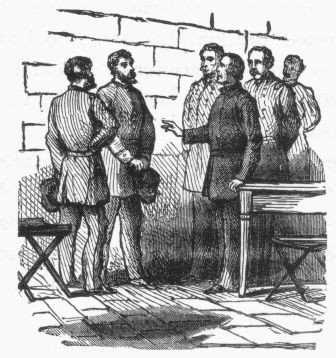
A COUNCIL OF WAR.

CHAPTER II.
Opposition to Mr. Lincoln's Inauguration.—A Plot to Assassinate him.—The Journey from Springfield.
With the opening of the new year, the political condition evinced alarming symptoms. As the day of the inauguration of the new President drew near, the excitement became intense. Loud threats were made that Mr. Lincoln should never be permitted to take the oath of office, and the hostility of the South manifested itself in such a manner as to excite the fears of those who desired the peaceful solution of the important question of continued union.
The events about to be related have been for a long time shrouded in a veil of mystery. While many are aware that a plot existed at this time to assassinate the President-elect upon his contemplated journey to the capital, but few have any knowledge of the mode by which the conspiracy was detected, or the means employed to prevent the accomplishment of that murderous design.
Considerations which affected the personal safety of those who actively participated in this detection, precluded a disclosure at the time, but that such a conspiracy existed no doubt can be entertained. Now, however, that the dark clouds have passed away, and the bright sunshine of an enduring peace is throwing its beneficent rays over a united country, the truth may be disclosed, and a desire to peruse a hidden page of history may now be gratified.
Early in the year 1861 I was at my headquarters in the city of Chicago, attending to the manifold duties of my profession. I had, of course, perused the daily journals which contained the reports of doings of the malcontents of the South, but in common with others, I entertained no serious fears of an open rebellion, and was disposed to regard the whole matter as of trivial importance. The same tones had been listened to before, and although the disunionists had hitherto never taken such aggressive steps, I was inclined to believe that with the incoming of the new administration, determined or conciliatory measures would be adopted, and that secession and rebellion would be either averted or summarily crushed.
At this time I received a letter from Mr. Samuel H. Felton, the president of "The Philadelphia, Wilmington and Baltimore Railroad," requesting my presence in Philadelphia upon a matter of great importance. From his communication it appeared that rumors were afloat as to the intention of the roughs and secessionists of Maryland to injure the road of which he was the President. From what had already been learned, it was feared that their designs were to prevent travel upon the road either by destroying the ferry-boats which then carried the trains across the Susquehanna river at Havre de Grace or by demolishing the railroad bridges over the Gunpowder river and other streams. This road was the great connecting link between the metropolis of the country and the capital of the nation, and it was of the utmost importance that no interruption should be permitted to the free communication between Washington and the great cities of the North and West.
This letter at once aroused me to a realization of the danger that threatened the country, and I determined to render whatever assistance was in my power towards preventing the successful operation of these ill-advised and dangerous men.
I lost no time, therefore, in making my arrangements, and soon after receiving Mr. Felton's communication, in company with four members of my force was upon the train speeding towards Philadelphia. Upon arriving in that city, I went directly to the office of Mr. Felton and obtained from him all the information he possessed of the movements and designs of the Maryland secessionists. I also had a consultation with Mr. H. F. Kenney, the superintendent of the road, with reference to a plan of operation which I proposed, and which was considered would result in obtaining the information so much to be desired.
I resolved to locate my men at the various towns along the road, selecting such places where, it was believed, disaffection existed. With a view, therefore, of acquiring the facts necessary for an intelligent prosecution of the inquiry, I took passage on one of the trains of the road, intending to see for myself how affairs stood, and to distribute my men in such a manner as to me seemed best.
At the city of Wilmington, in Delaware, I found evidences of a great political excitement, but nothing that indicated a hostile disposition or which led me to believe that any danger was to be apprehended at this place. Nothing that savored of organization was apparent, and I was therefore compelled to look further for the existence of any antagonism to the railroad or any desire to prevent the running of their trains.
At Perryville I found the same excitable condition of affairs, but nothing of a more aggressive character than at Wilmington. Men indulged in fierce arguments, in which both sides were forcibly represented, but aside from this I discovered no cause for apprehension, and no occasion for active detective work as yet.
At Havre de Grace, however, the lines were more clearly drawn and the popular feeling much more bitter. It was at this point that the boats which carried the trains crossed the Susquehanna river, and where serious damage might be done to the company, should the ferries be destroyed. I therefore left one man at this place, with instructions to become acquainted with such men as he might, on observation, consider suspicious, and to endeavor to obtain from them, by association, a knowledge of their intentions.
At Perrymansville, in Maryland, the feeling was considerably more intense. Under the influence of bad men the secession movement had gained many supporters and sympathizers. Loud threats were uttered against the railroad company, and it was boastfully asserted that "no d—d abolitionist should be allowed to pass through the town alive."
I have always found it a truism that "a barking dog never bites," and although I had but little fear that these blatant talkers would perform any dangerous deeds, I considered it best to be fully posted as to their movements, in order to prevent a catastrophe, if possible.
I accordingly directed Timothy Webster, a daring and discreet man upon my force, to locate himself at this point, and to carefully note everything that transpired which had any relation to attempted violence or a disposition to resort to aggressive measures.
As I neared the city of Baltimore the opposition to the government and the sympathy with secession was manifestly more intense. At Magnolia, particularly, I observed a very dangerous feeling, and among men of all classes the general sentiment was in favor of resistance and force. Another operative, John Seaford, was accordingly left at this place, with instructions similar to those which had been given to the others.
I then proceeded on to Baltimore, and there I found the greatest amount of excitement that I had yet experienced. I took quarters at the Howard House, and proceeded to inquire closely and carefully into the political situation. I soon found that the fears of the railroad officials were not wholly without foundation. The opposition to Mr. Lincoln's inauguration was most violent and bitter, and a few days' sojourn in this city convinced me that great danger was to be apprehended, and that the sentiment of disunion was far more widespread and deeply rooted than I had before imagined.
The police force of the city was under the control of Marshal George P. Kane, and was almost entirely composed of men with disunion proclivities. Their leader was pronouncedly in favor of secession, and by his orders the broadest license was given to disorderly persons and to the dissemination of insurrectionary information. This individual was subsequently arrested, and, after a brief sojourn in Fort McHenry, fled in 1863 to the more congenial associations of Richmond.
From the knowledge I gained of the situation in Baltimore, I resolved to establish my headquarters in that city. I accordingly engaged a building situated on South street, and in a position where I could receive prompt reports from all quarters of the metropolis. I also sent for an additional force of men, whom I distributed among the people of all grades and conditions of life. The building I had selected was admirably adapted for my purpose, and was so constructed that entrance could be gained to it from all four sides, through alleyways that led in from neighboring streets.
Day by day, the reports of my men contained many important revelations of the designs of the opposition, and as a matter of additional precaution, I advised Mr. Felton to employ a small number of men to guard the various bridges and ferries, who could be warned in time to resist attack should such be made.
The chief opposition seemed to be to the inauguration of President Lincoln, and the plan of the conspirators was to excite and exasperate the popular feeling against the President-elect to the utmost, and so successfully had this been done that a majority of the wealthier classes, with few exceptions—those in office—and the mob element in general were in full accord in their desire to prevent the inauguration from taking place.
On the eleventh day of February, Mr. Lincoln, with a few of his personal friends, left his quiet home in Springfield to enter upon that tempestuous political career which eventually carried him to a martyr's grave. Among the party who accompanied the President were Norman B. Judd, Esq., Col. Ward H. Lamon, Judge Davis, Col. Sumner, a brave and impetuous officer, Major Hunter, Capt. John Pope, Col. Ellsworth, whose heroic death took place shortly afterwards, and John G. Nicolay, the President's private secretary.
As the President was about leaving his home, the people turned out en masse to bid him farewell, and to them Mr. Lincoln addressed the following pathetic words of parting:
"My Friends: No one who has never been placed in a like position can understand my feelings at this hour, nor the oppressive sadness I feel at this parting. For more than a quarter of a century I have lived among you, and during all that time I have received nothing but kindness at your hands. Here I have lived from youth until now I am an old man; here the most sacred ties of earth were assumed; here all my children were born, and here one of them lies buried. To you, dear friends, I owe all that I have, and all that I am. All the strange checkered past seems now to crowd upon my mind. To-day I leave you. I go to assume a task more difficult than that which devolved upon Washington. Unless the great God who assisted him shall be with me and aid me, I must fail; but if the same Omniscient Mind and Almighty Arm that directed and protected him shall guide and support me, I shall not fail—I shall succeed. Let us all pray that the God of our fathers may not forsake us now. To Him I commend you all. Permit me to ask that with equal sincerity and faith you will invoke His wisdom and guidance for me. With these few words I must leave you, for how long I know not. Friends, one and all, I must bid you an affectionate farewell."
How touchingly simple and earnest seem these words. A strange and almost weird presentiment of grief and suffering give his utterances a pathos that becomes profoundly impressive when linked with subsequent events. How prophetic too—full of tears and fraught with the prescience of a future terrible and bloody war—they bear yet an echo like that of the voice that sounded in the ear of Halleck's dying hero—for surely in their tones are heard the thanks of millions yet to be. How more than prophetic they seemed when, four years later, "a funeral train, covered with the emblems of splendid mourning, rolled into the same city, bearing a corpse whose obsequies were being celebrated in every part of the civilized world."
From Springfield the passage was a perfect continuous ovation. Cities and towns, villages and hamlets, vied with each other in testifying their devotion to Union and their determination to uphold the chief magistrate in the great trial before him. Immense crowds surrounded the stations at which the special train halted, and in the cities of Indianapolis, Cincinnati, Columbus, Pittsburg, Cleveland, Erie, Buffalo, Albany, New York, Trenton, Newark, Philadelphia and Harrisburg, public demonstrations of an imposing character were given in his honor, and vast concourses of people assembled to greet him. Everywhere he was received and honored as the chief of a free people, and in reply to complimentary addresses which he day by day received, the President endeavored to utter cheering words, and indicated a disbelief in any bloody issue of our domestic complications.
On the day prior to the departure of Mr. Lincoln from his home, I received a letter from the master mechanic of the railroad, of which the following is an extract:
"I am informed that a son of a distinguished citizen of Maryland said that he had taken an oath with others to assassinate Mr. Lincoln before he gets to Washington, and they may attempt to do it while he is passing over our road. I think you had better look after this man, if possible. This information is perfectly reliable. I have nothing more to say at this time, but will try to see you in a few days."
This communication was confirmatory of reports of an indefinite character which had reached me prior to this, and the information was far too important to be disregarded. I determined, therefore, to probe the matter to the bottom, and obtaining the authority of Mr. Felton for such action, I immediately set about the discovery of the existence of the conspiracy and the intention of its organization, and then, if coolness, courage and skill could save the life of Mr. Lincoln, and prevent the revolution which would inevitably follow his violent death, I felt sure of accomplishing it.
My plans were soon perfected, and they were to have several of my men, together with myself, announced as residents of Charleston and New Orleans, and by assuming to be secessionists of the most ultra type, to secure entrance into their secret societies and military organizations, and thus become possessed of their secret designs. In looking over the qualifications of the members of my corps I found two men admirably adapted to the object I had in view. They were both young and both fully able to assume and successfully carry out the character of a hot-blooded, fiery secessionist.
One of these men, whom I shall call Joseph Howard, was a young man of fine personal appearance, and of insinuating manners. He was of French descent, and in his youth had been carefully educated for a Jesuit priest, but finding the vocation distasteful to him, he had abandoned it. Added to his collegiate studies, he possessed the advantage of extensive foreign travel, and the ability to speak, with great facility, several foreign languages. He had a thorough knowledge of the South, its localities, prejudices, customs and leading men, which had been derived from several years residence in New Orleans and other Southern cities, and was gifted with the power of adaptation to persons whom they wish to influence, so popularly attributed to the Jesuits.
Howard was instructed to assume the character of an extreme secessionist, to obtain quarters at one of the first-class hotels, and register his name, with residence at New Orleans. This was done because he was well acquainted with the city, having resided there for a long time, and was consequently enabled to talk familiarly of prominent individuals of that city whom he had met.
The other man whom I selected for this important work was Timothy Webster. He was a man of great physical strength and endurance, skilled in all athletic sports, and a good shot. Possessed of a strong will and a courage that knew no fear, he was the very man to operate upon the middle and lower classes who composed the disunion element.
His subsequent career as a Union spy—one of the most perilous and thankless positions—and his ignominious death at Richmond, at the hands of the rebels, have passed into history, but no historian will ever relate the thousand perils through which he passed in the service of his country; of his boldness and ingenuity in acquiring information that was of incalculable value to the Union officers, nor of his wonderful fertility of invention, which frequently enabled him to escape from dangers which would have appalled a less brave or less devoted man. Arrested at last, he was condemned as a spy, and on the thirtieth day of April, 1862, he was executed in the City of Richmond, by order of Jefferson Davis. Even then he would have succeeded in effecting a well-devised plan of escape, had he not been rendered incapable of movement by reason of a prostrating sickness. His name is unknown to fame, but fewer hearts beat truer to the Union, and fewer arms performed more devoted service in its cause, and a record of his daring and romantic adventures as a Union spy, would certainly equal, if not surpass, those of the Harvey Birch of Cooper.
It was not long before I received undoubted evidence of the existence of a systematized organization whose avowed object was to assist the rebellious States, but which was in reality formed to compass the death of the President, and thus accomplish the separation of the States. I learned also that a branch of this conspiracy existed at Perrymansville, under the guise of a company of cavalry, who met frequently and drilled regularly. Leaving Harwood to operate in Baltimore with the others, I dispatched Timothy Webster back to Perrymansville, and in twenty-four hours thereafter he had enrolled himself as a member of the company, and was recognized as a hail fellow among his rebel associates.
CHAPTER III.
The Conspirators at Work.—Detectives on Their Trail.—Webster as a Soldier.
Every day reports would be brought to me from the numerous men I had detailed along the line of the railroad, and regularly on alternate days I would make the journey from Baltimore to Philadelphia for consultation with the officers of the company.
At every visit which I made to the suspected localities, I could not fail to notice an increase in the excitement and the indications of a disposition to open revolt became more evident. Everywhere the ruling principle seemed to be opposition to the new administration and a decided inclination to aid the Confederacy. As the daily papers, which chronicled the events which occurred upon the journey of Mr. Lincoln towards Washington, or the desperate movements of the Southern ringleaders, were perused by the people, or were read aloud in tavern or store, they would be greeted by alternate expressions of hate and malignity for the abolitionist and wild cheers for the rebellion.
This feeling, too, was largely increased by the visits which prominent villagers would make to Baltimore, and who, upon their return, would relate marvelous stories of what they had seen and heard of the courage, the unity and the determination of the Southern people. Everything calculated to inflame the popular mind was seized upon, and the wonderful spirit of invention which these men evinced was simply astonishing. As a consequence, the ignorant residents of these villages and towns, having no authoritative information of their own, relied implicitly upon the exaggerated statements and untruthful reports of their leaders, and were kept in a condition of excitement that made them ready tools of their unscrupulous and better-informed managers. As far as could be learned, however, no definite plan of action had been arranged, and no public outbreak had as yet occurred.
Barnum's Hotel, in Baltimore, appeared to be the favorite resort of the Southern element. The visitors from all portions of the South located at this house, and in the evenings the corridors and parlors would be thronged by the tall, lank forms of the long-haired gentlemen who represented the aristocracy of the slave-holding interests. Their conversations were loud and unrestrained, and any one bold enough or sufficiently indiscreet to venture an opinion contrary to the righteousness of their cause, would soon find himself in an unenviable position and frequently the subject of violence.
As this hotel was so largely patronized by the so-called "Fire-eaters," I instructed Howard to go there in order to secure quarters and to ingratiate himself with these extremists. It was not long after this, that, joining a company of gentlemen who were loudly declaiming against the ruling powers of the country, he entered into their discussion, and by blatant expressions of the most rebellious nature, he was warmly welcomed by the coterie and instantly made one of their number.
Hailing as he did from New Orleans, his residence was a ready passport to their favor and confidence, and his fine personal appearance, gentlemanly address and the fervor of his utterances soon won the favor of those with whom he associated. To a general inquiry he stated that private affairs of a financial nature required his presence in Baltimore, but as his acquaintance with the trustworthy emissaries of rebeldom increased, he quietly insinuated that affairs of a national character were far more dear to him than individual interests or private concerns.
By continued intercourse with these men, he greatly increased the circle of his acquaintances, and soon became a welcome guest at the residences of many of the first families of that refined and aristocratic city. Here his accomplishments appeared to the best advantage. His romantic disposition and the ease of his manner captivated many of the susceptible hearts of the beautiful Baltimore belles, whose eyes grew brighter in his presence, and who listened enraptured to the poetic utterances which were whispered into their ears under the witching spell of music and moonlit nature.
He gradually neared the circle of which Marshal George P. Kane appeared to be the leader, and in a short time he had succeeded in entirely winning his confidence, and from this gentleman Howard acquired many important items of information. The entire police force of the city—officers and men—were in full sympathy with the rebellion, and it became apparent to him that a strict watch was kept over every man who expressed Northern opinions, or who was not identified with the cause which they had espoused.
To all of these arrangements Howard signified his hearty indorsement, and by every means in his power he sought to convince the leaders of his full sympathy with their efforts and his resolve to take a leading part in the struggle that seemed to be impending.
Accepting the invitation of Mr. Kane, he one evening accompanied that gentleman to a meeting of one of the secret societies that then existed, the first one he had succeeded in gaining entrance to. Arriving at the place of assembly, he was surprised at the many familiar faces which greeted him. Men whose aristocratic doors had opened to his entrance and whose social positions were unquestioned; young men who traced their lineage through several generations, and whose wealth and intelligence gave them a social status of no ordinary character, were found in full accord and upon perfect equality with tradesmen, artificers, and even with those whose vocation was decidedly doubtful, and some of whom had heard the key of a prison lock turned upon them for offenses committed in days gone by.
The leader and President of this society was a Captain Fernandina, who was known as one of the most active of the conspirators. This individual at one time occupied the exalted position of a barber at Barnum's Hotel, but treason and conspiracy had elevated him to the station of a military captain whose orders were to be obeyed, and a leader whose mandates compelled respect. He was an Italian or of Italian descent, and having lived in the South for a number of years he was thoroughly impressed with the idea of Southern wrongs, and that the election of Mr. Lincoln was an outrage which must not be tamely submitted to by the high-toned and chivalrous people of the South.
He was an enthusiast and fanatic, a dangerous man in any crisis, and particularly so in the one now impending, which threatened a civil war and all its direful consequences. Educated with Italian ideas and possessed of the temperament of his people, he openly justified the use of the stiletto, and fiercely advocated assassination as the means of preventing the President-elect from taking his seat in the executive chair. He was also the captain of a military company which drilled regularly and whose members were believed to fully indorse the views of their chief.
At this meeting Fernandina delivered an address which, for its treasonable nature and its violent opposition to all laws, human or divine, has scarcely a parallel. He boldly advocated the doctrine of State rights; he fiercely denounced the party who had succeeded in obtaining power; he inveighed in violent language against the policy of the so-called abolitionists, and his arraignment of Mr. Lincoln was most vile and repulsive. As these words fell from his lips the excitement became intense. Faces were eagerly turned towards him, eyes glistened with the fires of hate, and hands were clenched as though each one present was imbued with the same feelings which animated their sanguinary leader.
As he proceeded, overcome by the violence of his emotions, he drew from his breast a long, glittering knife, and waving it aloft, exclaimed:
"This hireling Lincoln shall never, never be President. My life is of no consequence in a cause like this, and I am willing to give it for his. As Orsini gave his life for Italy, I am ready to die for the rights of the South and to crush out the abolitionist."
As he stood before them, his black eyes flashing with excitement, his sallow face pale and colorless and his long hair brushed fiercely back from his low forehead, he seemed a fitting representative of so desperate a cause, and his influence over the assemblage was wonderful to behold. Loud cheers and wild clapping of hands greeted his utterances, and all seemed in perfect accord with his declared intentions.
There could be no mistaking the fact, that the object of these men was dangerous, and that they had fully determined to oppose and prevent the inauguration of Mr. Lincoln, but the exact plan of operation had not as yet been agreed upon.
Upon these facts being conveyed to me by Howard on the following morning, I resolved to interview this desperate leader of the conspiracy myself, and endeavor to learn from him further particulars of their movements and designs.
In the immediate vicinity of Barnum's Hotel at that time there was a famous restaurant, popularly known as "Guy's," and this place was much frequented by the secessionists who were in the city. Fernandina spent much of his time there, either in drinking or in consultation with his numerous political friends, who all seemed to regard him as an important personage, and one who was eventually to perform giant service in the cause.
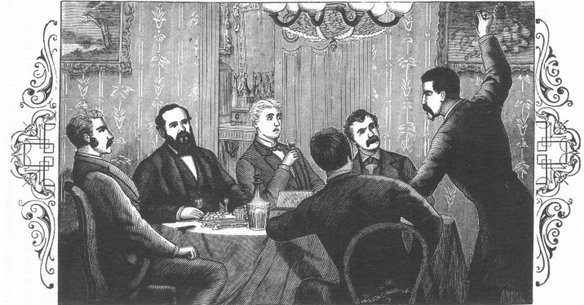
"He must die, and if necessary we will die together!" P. 65
Howard having effecting an introduction to Fernandina, and convinced him of his devotion to the interests of the South, I experienced no difficulty in obtaining the desired interview. About three o'clock on the following afternoon Howard and myself carelessly entered the saloon, and were gratified to perceive that Fernandina was also there, accompanied by several members of the military company which he commanded. Walking directly up to these gentlemen, Howard introduced me as a resident of Georgia, who was an earnest worker in the cause of secession, and whose sympathy and discretion could be implicitly relied upon.
Fernandina cordially grasped my hand, and we all retired to a private saloon, where, after ordering the necessary drinks and cigars, the conversation became general, and to me, absorbingly interesting.
The question of assassinating the President was freely discussed, and Captain Fernandina expressed himself vehemently in its favor.
Some one in the party remarked:
"Are there no other means of saving the South except by assassination?"
"No," replied Fernandina; "as well might you attempt to move the Washington Monument yonder with your breath, as to change our purpose. He must die—and die he shall. And," he continued, turning to Captain Trichot, a fellow-conspirator who stood near, "if necessary, we will die together."
"There seems to be no other way," interposed Howard, "and while bloodshed is to be regretted, it will be done in a noble cause."
Fernandina gazed approvingly at Howard, and then added:
"Yes, the cause is a noble one, and on that day every captain will prove himself a hero. With the first shot the chief traitor, Lincoln, will die, then all Maryland will be with us, and the South will be forever free."
"But," said I, "have all the plans been matured, and are there no fears of failure? A misstep in so important a direction would be fatal to the South and ought to be well considered."
"Our plans are fully arranged," answered the Captain, "and they cannot fail; and," he added, with a wicked gleam in his eyes—"if I alone must strike the blow, I shall not hesitate or shrink from the task. Lincoln shall certainly not depart from this city alive."
"Yes," added Captain Trichot, "it is determined that this G—d d—d Lincoln shall never pass through here alive, and no d—d abolitionist shall ever set foot upon Southern soil except to find a grave."
"But about the authorities"—I asked—"is there no danger to be apprehended from them?"
"Oh, no," said the Captain, assuringly, "they are all with us. I have seen Col. Kane, the Chief Marshal of Police, and he is all right. In a week from to-day the North shall want another President, for Lincoln will be a corpse."
All the company gave approving responses to these threats, with but one exception, and he remained silent, with a doubtful, troubled expression upon his face. This young man was one of the fast "bloods" of the city, who proudly wore upon his breast a gold Palmetto badge, and who was a Lieutenant in the Palmetto Guards, a secret military organization of Baltimore, and I determined to select this man for the purpose of obtaining the information I so much desired; and as the company shortly afterwards broke up, Howard and myself accompanied Lieutenant Hill from the saloon.
Hill soon proved a pliant tool in our hands. Being of a weak nature and having been reared in the lap of luxury, he had entered into this movement more from a temporary burst of enthusiasm and because it was fashionable, than from any other cause. Now that matters began to assume such a warlike attitude, he was inclined to hesitate before the affair had gone too far, but still he seemed to be enamored with the glory of the undertaking.
By my directions Howard, the ardent secessionist from Louisiana, and Hill, of the Palmetto Guards, became bosom friends and inseparable companions. They drank together, and visited theaters and places of amusement in each other's company.
By reason of his high social position Hill was enabled to introduce his friend to the leading families and into the most aristocratic clubs and societies of which the city boasted, and Howard made many valuable acquaintances through the influence of this rebellious scion of Baltimore aristocracy.
Finally the young man was induced to open to his companion the secrets of the plot to assassinate the President. It was evident, however, that Hill was playing his part in the conspiracy with great reluctance, and one day he said to Howard:
"What a pity it is that this glorious Union must be destroyed all on account of that monster Lincoln." From Hill it was learned that the plans of the conspirators were first to excite and exasperate the popular feeling against Mr. Lincoln to the utmost, and thus far this had been successfully accompanied. From the published programme Mr. Lincoln was to reach Baltimore from Harrisburg by the Northern Central Railroad on the twenty-third day of February, now but a few days distant. He would, therefore, reach the city about the middle of the day. A vast crowd would meet him at the Calvert street depot, at which point it was expected that he would enter an open carriage and ride nearly half a mile to the Washington depot. Here it was arranged that but a small force of policemen should be stationed, and as the President arrived a disturbance would be created which would attract the attention of these guardians of the peace, and this accomplished, it would be an easy task for a determined man to shoot the President, and, aided by his companions, succeed in making his escape.
Agents of the conspirators had been dispatched to all the principal Northern cities, to watch the movements of the presidential party, and ready to telegraph to Baltimore any change of route or delay in arrival. A cipher had been agreed upon between them, so that the conspirators could communicate with each other without the possibility of detection, and everything seemed to be satisfactorily arranged except to depute one of their number to commit the fatal deed. This was to be determined by ballot, and as yet no one knew upon whom might devolve the bloody task.
Meanwhile, the idea of assassination was preying heavily upon the mind of the Lieutenant of the Palmetto Guards; he grew sad and melancholy, and plunged still deeper into dissipation. Howard had now become a necessity to him and they were scarcely ever separated. Under the influence of the master spirit, the disposition of Hill underwent wonderful changes. At times, he would be thoughtful and morose, and then would suddenly break out into enthusiastic rhapsodies. His sleep became tormented with dreams in which he saw himself the martyr to a glorious cause and the savior of his country.
At such times he would address himself to Howard, in the most extravagant language.
"I am destined to die," said he one day, "shrouded with glory. I shall immortalize myself by plunging a knife into Lincoln's heart."
Howard endeavored to calm his transports, but without avail. Raising himself to his full height, he exclaimed: "Rome had her Brutus, why should not we? I swear to you, Howard, if it falls to me I will kill Lincoln before he reaches the Washington depot, not that I love Lincoln less, but my country more."
As the day drew nearer for the arrival of the President, he became more nervous and excited, and would more frequently indulge in extravagant expressions, which would have been regarded as absurd, but for the fact that he was but one of a large number of fanatics, who seriously entertained the same ideas of murder, and his expressions but the reflex of others, more determined.
Timothy Webster was still at Perrymansville, and by this time had fully identified himself with the rebel cause, and the company of cavalry of which he was a member. On several occasions he had given undoubted indications of his loyalty and devotion to the South, and was generally looked upon as a man who could be trusted. He became quite intimate with the officers of the company, and succeeded in gaining their entire confidence. As yet, however, he had learned but little of the important movement which we believed was in contemplation, as all conversations upon that subject appeared to be between the officers of the company, at their secret meetings, to which he had not been able as yet to gain an entrance.
At length one morning, after the usual daily drill, and when the company had been dismissed, the Captain addressed Webster and requested him to be present at his house that evening, as he desired to consult with him upon important affairs, at the same time cautioning him to say nothing to any one concerning the matter.
Promptly at the time appointed Webster presented himself at the residence of the Captain, and was ushered into a room upon the upper floor, where there were several men already assembled. The curtains had been drawn close, and heavy quilts had been hung over the windows, which effectually prevented any one from the outside from discovering a light in the room. On his entrance he was introduced to the gentlemen present, three of whom were unknown to him, who were members of the secret league from Baltimore, and who were evidently impressed with the solemnity and importance of their undertaking. They greeted Webster cordially, however, and made room for him at the table around which they were sitting.
A few minutes satisfied Webster as to the nature of the meeting, and that it was a conclave of the conspirators, who had met to discuss a plan of action. Intensely eager as he was to acquire all possible information, he was obliged to restrain his impetuosity and to listen calmly to the developments that were made. From what transpired that evening there could be no doubt of the desperation of the men engaged in the conspiracy, or of the widespread interest which was taken in their movements.
The plans for the assassination of the President had been fully matured, and only needed the selection of the person to perform the deed, in order to carry them into effect. In the meantime, however, other important measures required attention and consideration. If the affair stopped simply with the assassination of the President, but little, if any, good would be accomplished. The North would rise as one man to avenge the death of their leader, and they would only hasten a disaster they were anxious to avoid. It was necessary, therefore, that the work should be thoroughly done, and the plan suggested was as follows:
As soon as the deed had been accomplished in Baltimore, the news was to be telegraphed along the line of the road, and immediately upon the reception of this intelligence the telegraph wires were to be cut, the railroad bridges destroyed and the tracks torn up, in order to prevent for some time any information being conveyed to the cities of the North, or the passage of any Northern men towards the capital.
Wild as the scheme was, it found instant favor with the reckless men assembled together, and all signified their hearty assent to the propositions and offered their aid in successfully carrying them out. Among the most earnest in their protestations was Timothy Webster, and as he announced his intention to perform his duty in the affair he was warmly congratulated.
Matters were evidently getting warm, and but little time was left for action.
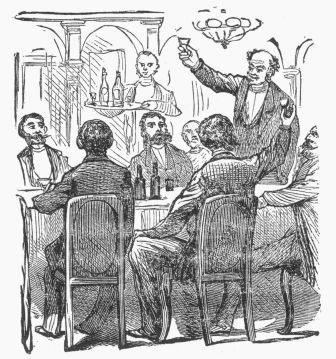
"WARMING UP."
CHAPTER IV.
The Conspirators in Council.—My Operative Joins the Conspiracy.
I had already written to Mr. Norman B. Judd as the party reached Cincinnati, informing him that I had reason to believe that there was a plot on foot to murder the President on his passage through Baltimore, and promising to advise him further as the party progressed eastward.
This information Mr. Judd did not divulge to any one, fearing to occasion undue anxiety or unnecessary alarm, and knowing that I was upon the ground and could be depended upon to act at the proper time.
When the party reached Buffalo another note from me awaited Mr. Judd, informing him of the accumulation of evidence, but conveying no particulars. The party were now journeying towards New York city, and I determined to learn all that there was to learn before many hours.
Previous to this, in addition to the men engaged in Baltimore, I had sent for Mrs. Kate Warne, the lady superintendent of my agency. This lady had arrived several days before, and had already made remarkable progress in cultivating the acquaintance of the wives and daughters of the conspirators.
Mrs. Warne was eminently fitted for this task. Of rather a commanding person, with clear-cut, expressive features, and with an ease of manner that was quite captivating at times, she was calculated to make a favorable impression at once. She was of Northern birth, but in order to vouch for her Southern opinions, she represented herself as from Montgomery, Alabama, a locality with which she was perfectly familiar, from her connection with the detection of the robbery of the Adams Express Company, at that place. Her experience in that case, which is fully detailed in "The Expressman and the Detective," fully qualified her for the task of representing herself as a resident of the South.
She was a brilliant conversationalist when so disposed, and could be quite vivacious, but she also understood that rarer quality in womankind, the art of being silent.
The information she received was invaluable, but as yet the meetings of the chief conspirators had not been entered. Mrs. Warne displayed upon her breast, as did many of the ladies of Baltimore, the black and white cockade, which had been temporarily adopted as the emblem of secession, and many hints were dropped in her presence which found their way to my ears, and were of great benefit to me.
As I have said, the Presidential party were in Buffalo, and I had resolved upon prompt and decisive measures to discover the inward workings of the conspirators. Accordingly I obtained an interview with Howard, and gave him such instructions as I deemed necessary under the circumstances. He was to insist upon Hill taking him to the meeting at which the ballots were to be drawn, and where he, too, would have an opportunity to immortalize himself, and then, that being accomplished, the rest would be easy and all further danger would be over.
Accordingly, that day Howard broached the matter to Hill in a manner which convinced him of his earnestness, and the young Lieutenant promised his utmost efforts to secure his admission. At five o'clock in the afternoon they again met, and Hill joyfully informed his companion that his request had been granted, and that, upon his vouching for the fidelity of his friend, he had succeeded in obtaining permission for him to enter their society.
That evening Howard accompanied his friend Hill to the rendezvous of the league, and as they entered the darkened chamber, they found many of the conspirators already assembled. The members were strangely silent, and an ominous awe seemed to pervade the entire assembly. About twenty men comprised the number, but many entered afterward. After a few preliminary movements, Howard was conducted to the station of the President of the assembly and duly sworn, the members gathering around him in a circle as this was being done.

"Howard was conducted to the station of the President, and duly sworn." P. 76.
Having passed through the required formula, Howard was warmly taken by the hand by his associates, many of whom he had met in the polite circles of society. After quiet had been restored, the President, who was none other than Captain Fernandina, arose, and in a dramatic manner detailed the particulars of the plot.
It had been fully determined that the assassination should take place at the Calvert street depot. A vast crowd of secessionists were to assemble at that place to await the arrival of the train with Mr. Lincoln. They would appear early and fill the narrow streets and passages immediately surrounding it. No attempt at secrecy was made of the fact that the Marshal of Police was conversant with their plans, and that he would detail but a small force of policemen to attend the arrival, and nominally clear and protect a passage for Mr. Lincoln and his suite. Nor was the fact disguised that these policemen were in active sympathy with the movement. George P. Kane's animus was fully shown when he was subsequently arrested by General Banks, and afterwards became an officer in the rebel army.
When the train entered the depot, and Mr. Lincoln attempted to pass through the narrow passage leading to the streets, a party already delegated were to engage in a conflict on the outside, and then the policemen were to rush away to quell the disturbance. At this moment—the police being entirely withdrawn—Mr. Lincoln would find himself surrounded by a dense, excited and hostile crowd, all hustling and jamming against him, and then the fatal blow was to be struck.
A swift steamer was to be stationed in Chesapeake Bay, with a boat awaiting upon the shore, ready to take the assassin on board as soon as the deed was done, and convey him to a Southern port, where he would be received with acclamations of joy and honored as a hero.
The question to be decided this evening was: "Who should do the deed?" "Who should assume the task of liberating the nation of the foul presence of the abolitionist leader?" For this purpose the meeting had been called to-night, and to-night the important decision was to be reached.
It was finally determined that ballots should be prepared and placed in a box arranged for that purpose, and that the person who drew a red ballot should perform the duty of assassination.
In order that none should know who drew the fatal ballot, except he who did so, the room was rendered still darker, and every one was pledged to secrecy as to the color of the ballot he drew. The leaders, however, had determined that their plans should not fail, and doubting the courage of some of their number, instead of placing but one red ballot in the box, they placed eight of the designated color, and these eight ballots were drawn—each man who drew them believing that upon him, his courage, strength and devotion, depended the cause of the South—each supposing that he alone was charged with the execution of the deed.
After the ballots had been drawn the President again addressed the assembly. He violently assailed the enemies of the South, and in glowing words pointed out the glory that awaited the man who would prove himself the hero upon this great occasion, and finally, amid much restrained enthusiasm, the meeting adjourned, and their duties had thus far been accomplished.
My time for action had now arrived; my plans had been perfected and I resolved to act at once. Taking Mrs. Warne with me I reached New York city on the same day that the presidential party arrived there, and leaving Mrs. Warne to perfect arrangements, I proceeded at once to Philadelphia. That evening Mrs. Warne repaired to the Astor House and requested an interview with Mr. Judd. Her request being granted, Mrs. Warne informed that gentleman, that, fearing to trust the mail in so important a matter, she had been delegated by me to arrange for a personal interview, at which all the proofs relating to the conspiracy could be submitted to him. It was suggested that immediately after the arrival of the party in Philadelphia, I should inform Mr. Judd of my plans for an interview, and that he would be governed accordingly.
While they were conversing, Col. E. S. Sandford, President of the American Telegraph Company, called, and was introduced by Mrs. Warne to Mr. Judd. This gentleman had been made fully acquainted with what I had learned, and had promised all the assistance within his power, and he accordingly tendered to Mr. Judd his own personal service and the unlimited use of the telegraph lines under his control, for any communications he might desire to make.
On arriving at Philadelphia, I proceeded directly to the office of Mr. Felton, and acquainted him with all the information I had received, of the designs of the conspirators with regard to Mr. Lincoln, and of their intention to destroy the railroad should their plot be successful. The situation was truly alarming, and cautious measures were absolutely necessary. It was therefore resolved to obtain an interview with Mr. Lincoln, submit the facts to him, and be governed by his suggestions, whatever they might be.
This interview took place on the 20th day of February, and Mr. Lincoln was expected to arrive on the following day. Great preparations had been made for his reception, and the military, of which Philadelphia was justly proud, were to escort the President-elect from the depot to the Continental Hotel, where quarters had been engaged for him, and where he would receive the congratulations of the people.

CHAPTER V.
The Presidential Party arrives in Philadelphia.—Independence Hall.—The Departure from Harrisburg.—Telegraph wires Cut.—Through the Lines of Treason and Safe Arrival at Washington.
The twenty-first dawned bright and sunny, and the streets were alive with the eager populace, all anxious to do honor to the new President, and to witness the scenes attendant upon his reception. In due time the train containing the party arrived, and after an informal welcome they took carriages, and, escorted by the troops, the procession took up the line of march for the hotel. Vast crowds lined the sidewalks and the enthusiasm of the people was unbounded. The President graciously acknowledged their courtesies as he passed along. On each side of the carriage in which Mr. Lincoln was seated, accompanied by Mr. Judd, was a file of policemen, whose duty it was to prevent the mass of people from pressing too closely to the vehicle. As the procession reached the corner of Broad and Chestnut streets, a young man approached the file of policemen and endeavored to attract the attention of the occupants of the carriage. Finding this impossible, he boldly plunged through the ranks of the officers, and coming to the side of the carriage, he handed to Mr. Judd a slip of paper, on which was written:
"St. Louis Hotel, ask for J. H. Hutchinson."
This young man was Mr. George H. Burns, an attaché of the American Telegraph Company and confidential agent of E. S. Sandford, Esq., who acted as my messenger, and who afterwards distinguished himself for his courage and daring in the rebellion. It is needless to add that J. H. Hutchinson was the name I had assumed in registering at the hotel, in order to avoid any suspicion or curiosity in case any emissary of the conspirators should ascertain my real name and thus be warned of the discovery of their scheme.
Shortly after the arrival of Mr. Lincoln at the Continental, Mr. Judd was announced at the St. Louis Hotel as desiring to see me. Mr. Felton was with me at the time, and in a few minutes Mr. Judd made his appearance. More than an hour was occupied in going over the proofs which I produced of the existence of the conspiracy, at the end of which time Mr. Judd expressed himself fully convinced that the plot was a reality, and that prompt measures were required to secure the safety of the President.
"My advice is," said I, after I had succeeded in convincing Mr. Judd that my information was reliable, "that Mr. Lincoln shall proceed to Washington this evening by the eleven o'clock train, and then once safe at the capital, General Scott and his soldiery will afford him ample protection."
"I fear very much that Mr. Lincoln will not accede to this," replied Mr. Judd; "but as the President is an old acquaintance and friend of yours and has had occasion before this to test your reliability and prudence, suppose you accompany me to the Continental Hotel, and we can then lay this information before him in person and abide by his decision."
This idea was at once adopted and we proceeded to the hotel. Here we found the entrances blocked up by a surging multitude which effectually prevented our admission, and we were obliged to enter by the rear of the building through a door used by the servants.
On reaching the room occupied by Mr. Judd that gentleman summoned Mr. Nicolay, the President's private secretary, and dispatched him with a note requesting the presence of Mr. Lincoln upon a matter of urgent importance.
The President at that time was in one of the large parlors surrounded by a number of ladies and gentlemen, all eager to extend to him the hospitalities of the city and to express their good wishes for the success of his administration. Upon receiving the message, however, he at once excused himself, and forcing his way through the crowd came directly to us.
Up to this time Mr. Lincoln had been kept in entire ignorance of any threatened danger, and as he listened to the facts that were now presented to him, a shade of sadness fell upon his face. He seemed loth to credit the statement, and could scarce believe it possible that such a conspiracy could exist. Slowly he went over the points presented, questioning me minutely the while, but at length finding it impossible to discredit the truthfulness of what I stated to him, he yielded a reluctant credence to the facts.
After he had been fully made acquainted with the startling disclosures, Mr. Judd submitted to him the plan proposed by me, that he should leave Philadelphia for Washington that evening.
"But," added Mr. Judd, "the proofs that have just been laid before you cannot be published, as it will involve the lives of several devoted men now on Mr. Pinkerton's force, especially that of Timothy Webster, who is now serving in a rebel cavalry company under drill at Perrymansville in Maryland."
Mr. Lincoln at once acknowledged the correctness of this view, but appeared at a loss as to what course to pursue.
"You will therefore perceive"—continued Mr. Judd—"that if you follow the course suggested—that of proceeding to Washington to-night—you will necessarily be subjected to the scoffs and sneers of your enemies, and the disapproval of your friends who cannot be made to believe in the existence of so desperate a plot."
"I fully appreciate these suggestions," replied Mr. Lincoln, "and I can stand anything that is necessary, but," he added rising to his feet, "I cannot go to-night. I have promised to raise the flag over Independence Hall to-morrow morning, and to visit the legislature at Harrisburg in the afternoon—beyond that I have no engagements. Any plan that may be adopted that will enable me to fulfill these promises I will accede to, and you can inform me what is concluded upon to-morrow."
Saying which Mr. Lincoln left the room and joined the people in the parlor. During the entire interview, he had not evinced the slightest evidence of agitation or fear. Calm and self-possessed, his only sentiments appeared to be those of profound regret, that the Southern sympathizers could be so far led away by the excitement of the hour, as to consider his death a necessity for the furtherance of their cause.
From his manner, it was deemed useless to attempt to induce him to alter his mind, and after a few minutes' further conversation, which was participated in by Mr. Sandford, who had entered the room, I left for the purpose of finding Thomas A. Scott, Esq., the Vice-President of the Pennsylvania Central Railroad, in order to make arrangements for the carrying out of a plan which had occurred to me, and which would enable Mr. Lincoln to fulfill his engagements.
I was unable, however, to find Mr. Scott, but succeeded in reaching Mr. G. C. Franciscus, the general manager of the road, and at twelve o'clock that night, in company with that gentleman and Mr. Sandford, we called again upon Mr. Judd.
At this meeting a full discussion of the entire matter was had between us, and after all possible contingencies had been considered, the following programme was agreed upon.
After the formal reception at Harrisburg had taken place, a special train, consisting of a baggage-car and one passenger-coach, should leave there at six o'clock P. M. to carry Mr. Lincoln and one companion back to Philadelphia; this train was to be under the immediate control of Mr. Franciscus and Mr. Enoch Lewis, the general superintendent. In order to avoid the possibility of accident, the track was to be cleared of everything between Harrisburg and Philadelphia from half-past five o'clock until after the passage of the special train. Mr. Felton was to detain the eleven o'clock P. M. Baltimore train until the arrival of the special train from Harrisburg, Mrs. Warne in the meantime engaging berths in the sleeping-car bound for Baltimore.
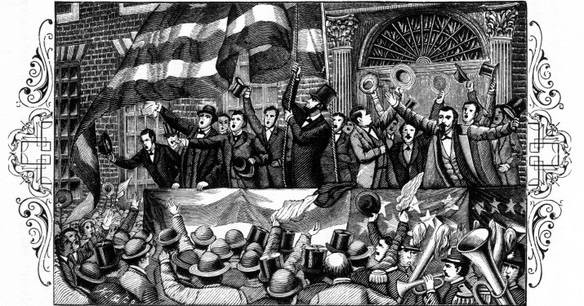
"Mr. Lincoln raising the flag on Independence Hall." P. 87
I was to remain in Philadelphia in order that no accident might occur in conveying the President from one depot to another, and Mr. Judd was to manage the affair at Harrisburg. Everything that could be suggested in relation to this matter was fully considered, and having at length perfected our plans, the party separated at half-past four o'clock in the morning, fully prepared to carry out the programme agreed upon.
At six o'clock on the morning of the 22d, a vast concourse of people assembled in front of Independence Hall on Chestnut street, and at precisely the hour appointed, Mr. Lincoln made his appearance. With his own hands he drew to the top of the staff surmounting the edifice a beautiful new American flag, and as its Stripes and Stars floated out gracefully to the breeze, the air was rent with the shouts of the multitude and the music of the band.
Mr. Lincoln's speech upon this occasion was the most impressive and characteristic of any which he had delivered upon his journey to the capital, while a tinge of sadness pervaded his remarks, never noticed before, and which were occasioned no doubt by the revelations of the preceding night. He gave a most eloquent expression to the emotions and associations which were suggested by the day and by the historic old hall where he then stood. He declared that all his political sentiments were drawn from the inspired utterances of those who had sat within the walls of that ancient edifice. He alluded most feelingly to the dangers and toils and sufferings of those who had adopted and made good the Declaration of Independence—a declaration which gave promise that "in due time the weight would be lifted from the shoulders of all men." Conscious of the dangers that threatened his country, and feeling also that those dangers originated in opposition to the principles enunciated in the Declaration of Independence, knowing that his own life was even then threatened because of his devotion to liberty, and that his way to the national capital was beset by assassins, he did not hesitate to declare boldly and fearlessly "that he would rather be assassinated on the spot than surrender those principles" so dear to him.
After these proceedings, Mr. Lincoln was driven back to the Continental Hotel, and sending for Mr. Judd, he introduced him to Mr. Frederick H. Seward, a son of the late William H. Seward, who was in the room with the President. Mr. Lincoln then informed Mr. Judd that Mr. Seward had been sent from Washington by his father and General Scott to warn him of the danger of passing through Baltimore, and to urge him to come direct to Washington.
From whom this information was originally obtained did not appear, but the facts were deemed of sufficient moment to be brought to the ears of the President, and hence Mr. Seward's visit to Philadelphia. Mr. Lincoln evinced no further hesitancy in the matter, and signified his readiness to do whatever was required of him. Mr. Judd then directed Mr. Seward to inform his father that all had been arranged, and that, so far as human foresight could predict, Mr. Lincoln would be in Washington before the evening of the following day, and cautioned him to preserve the utmost secrecy in regard to the matter. No particulars were given and none were asked.
At the time appointed Mr. Lincoln started for Harrisburg, and I busied myself with the preparations that were necessary to successfully carry our plans into operation. From reports which I received from Baltimore, the excitement in that city had grown more intense, and the arrival of the President was awaited with the most feverish impatience. The common and accepted belief was that Mr. Lincoln would journey from Harrisburg to Baltimore over the Northern Central Railroad, and the plans of the conspirators were arranged accordingly.
It became a matter of the utmost importance, therefore, that no intimation of our movements should reach that city. I had no doubt but that trusty agents of the conspirators were following the presidential party, and after the absence of Mr. Lincoln had been discovered, the telegraph would be put into active operation to apprise the movers of this scheme of the change that had been made. To effectually prevent this I determined that the telegraph wires which connected Harrisburg with her neighboring cities should be so "fixed" as to render communication impossible.
To arrange this matter Capt. Burns was sent to the office of the American Telegraph Company, and obtaining from Mr. H. E. Thayer, the manager of the company, a competent and trustworthy man for the purpose, departed for Harrisburg, in order to carry out the proposed measures. Mr. Thayer, in the meantime, was to remain in the office during the night, in order to intercept any dispatches that might be sent over the wires from any point between Harrisburg and Baltimore, and to immediately deliver any messages that might be sent to me.
Mr. W. P. Westervelt, the superintendent, and Mr. Andrew Wynne, the line-man of the telegraph company, were delegated to Harrisburg to "fix" the wires leading from that place in such a manner as to prevent any communication from passing over them, and to report to Capt. Burns upon their arrival.
After the train containing Mr. Lincoln and his party had left Philadelphia, Mr. Judd sought the first favorable opportunity of conversing with Mr. Lincoln alone, and fully detailed to him the plan that had been agreed upon, all of which met with the hearty approval of the President, who signified a cheerful willingness to adapt himself to the novel circumstances.
It was evident, from the manner of several of the gentlemen of the party, that they suspected something was transpiring of which they had not been advised, but they all very judiciously refrained from asking any questions. Mr. Judd, however, who felt the responsibility of his position, finally suggested to Mr. Lincoln the propriety and advisability of informing them of what had taken place, and of consulting with them upon the proper carrying out of the contemplated journey. To this Mr. Lincoln yielded a ready assent, adding, with an amused smile:
"I suppose they will laugh at us, Judd, but I think you had better get them together."
It was therefore arranged that after the reception at the State House had taken place, and before they sat down to dinner, the matter should be fully laid before the following gentlemen of the party: Judge David Davis, Col. Sumner, Major David Hunter, Capt. John Pope and Ward H. Lamon, Esq.
Mr. Lincoln arrived at Harrisburg at noon, and was introduced to the people from the balcony of the Jones House, where an address was delivered by Gov. Andrew G. Curtin, whose fame became widespread during the dark days of the rebellion that followed, as the "War Governor of Pennsylvania." From the hotel the party proceeded to the House of Representatives, where he was welcomed by the Speaker, to which he replied in a few well-chosen words.
After a short time spent in congratulations and hand-shaking they returned to the hotel, and the gentlemen who have been previously named were invited (in company with the Governor) to confer with the President in the parlor. At this meeting the information of the discovery of the plot to assassinate the President was laid before them, and also the details of the proposed journey to Washington. After the matter had been fully explained, a great diversity of opinion manifested itself among the gentlemen present, and some warm discussion was indulged in. Finally, Judge Davis, who had expressed no opinion upon the subject as yet, addressed the President, saying:
"Well, Mr. Lincoln, what is your own judgment upon this matter?"
"I have thought over this matter considerably since I went over the ground with Mr. Pinkerton last night," answered Mr. Lincoln, "and the appearance of Mr. Frederick Seward, with warning from another source, confirms my belief in Mr. Pinkerton's statement; therefore, unless there are some other reasons than a fear of ridicule, I am disposed to carry out Mr. Judd's plan."
Judge Davis turned to the others, and said:
"That settles the matter, gentlemen."
"So be it," exclaimed Col. Sumner. "It is against my judgment, but I have undertaken to go to Washington with Mr. Lincoln, and I shall do it."
Mr. Judd endeavored in vain to convince the gallant old soldier that every additional person only added to the risk, but the fiery spirit of the veteran was aroused and debate was useless.
Having arranged the matter thus satisfactorily the party, at about four o'clock in the afternoon, repaired to the dining-room for dinner.
All the preliminaries had now been successfully arranged. The special train, ostensibly to take the officers of the railroad company back to Philadelphia, was waiting upon a side track just outside of the town. The telegraph operators had performed their work admirably. Walking out of the city nearly two miles, Mr. Wynne climbed the poles and placing fine copper ground wires upon the regular lines, the city was soon entirely isolated from her neighbors. No message could possibly be sent from Harrisburg, and the capital of Pennsylvania was cut off temporarily from the rest of the world.
The preparations in Philadelphia had also been fully made. Mrs. Warne had succeeded in engaging the rear half of a sleeping-car for the accommodation of her invalid brother, and that portion of the car was to be entirely separated from the rest by a curtain, so arranged that no one in the forward part of the car would be aware of the occupants of the same coach.
In order to detain the Baltimore train until the arrival of Mr. Lincoln, the conductor was directed not to start his train until he received personal instructions to that effect from Mr. H. F. Kinney, the superintendent, who would hand him an important parcel, which President Felton desired should be delivered early on the following morning to Mr. E. J. Allen at Willard's Hotel, in Washington. (E. J. Allen was the nom-de-plume I generally used when on detective operations.)
At a quarter to six o'clock everything was in readiness. A carriage was in waiting at the side entrance of the hotel, and the entire party were still at the table. A message was delivered to the President by Mr. Nicolay, and upon receiving it, he immediately arose, and, accompanied by Mr. Curtin, Mr. Lamon and Mr. Judd, he left the dining-room. Mr. Lincoln exchanged his dinner dress for a traveling suit, and soon returned with a shawl upon his arm and a soft felt hat protruding from his coat pocket.
The halls, stairways and pavement were filled with a mass of people, who, seeing the President in company with the Governor, at once imagined that they were going to the executive mansion, where a reception was to be held in the evening.
Mr. Judd whispered to Mr. Lamon to proceed in advance, adding:
"As soon as Mr. Lincoln is in the carriage, drive off."
As the party, consisting of Mr. Lincoln, Governor Curtin, and Mr. Lamon, entered the carriage, Col. Sumner attempted to follow them, but Mr. Judd gently put his hand upon the old gentleman's shoulder, and as he turned quickly around to inquire what was wanted, the carriage was driven rapidly away.
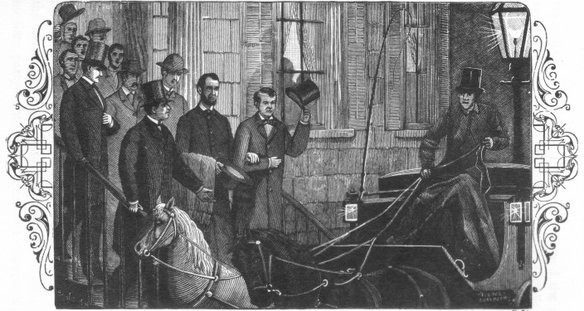
"The party, consisting of Mr. Lincoln, Governor Curtin and Mr. Lamon, entered the carriage." P. 94.
Thus far everything had passed off admirably, and in a short time Mr. Lincoln was upon the special train, accompanied only by Mr. Lamon and the railroad officials, and speeding along toward Philadelphia.
Without accident the party arrived at the Quaker City shortly after ten o'clock, where I was waiting with a carriage, in company with Mr. Kinney. Without a word Mr. Lincoln, Mr. Lamon and myself entered the vehicle, while Mr. Kinney seated himself alongside of the driver, and we proceeded directly to the depot of the Philadelphia, Wilmington and Baltimore Railroad.
Driving up to the sidewalk on Carpenter street, and in the shadow of a tall fence, the carriage was stopped and the party alighted. As we approached the train, Mrs. Warne came forward, and, familiarly greeting the President as her brother, we entered the sleeping-car by the rear door without unnecessary delay, and without any one being aware of the distinguished passenger who had arrived.
A carefully inclosed package, which resembled a formidable official document, but which contained only some neatly folded daily papers, was placed in the hands of the unsuspecting conductor—the whistle sounded, and soon the train was in motion, whirling on towards the capital of the nation.
So carefully had all our movements been conducted, that no one in Philadelphia saw Mr. Lincoln enter the car, and no one on the train, except his own immediate party—not even the conductor, knew of his presence, and the President, feeling fatigued from the labors and the journeys of the day, at once retired to his berth.
In order to prevent the possibility of accident, I had arranged with my men a series of signals along the road. It was barely possible that the work of destroying the railroad might be attempted by some reckless individuals, or that a suspicion of our movements might be entertained by the conspirators, and therefore, the utmost caution must be observed.
As the train approached Havre de Grace, I went to the rear platform of the car, and as the train passed on a bright light flashed suddenly upon my gaze and was as quickly extinguished, and then I knew that thus far all was well.
From this point all the way to Baltimore, at every bridge-crossing these lights flashed, and their rays carried the comforting assurance "All's Well!"
We reached Baltimore at about half-past three o'clock in the morning, and as the train rumbled into the depot an officer of the road entered the car and whispered in my ear the welcome words "All's Well!"
The city was in profound repose as we passed through. Darkness and silence reigned over all. Perhaps, at this moment, however, the reckless conspirators were astir perfecting their plans for a tragedy as infamous as any which has ever disgraced a free country—perhaps even now the holders of the red ballots were nerving themselves for their part in the dreadful work, or were tossing restlessly upon sleepless couches.
Be that as it may, our presence in Baltimore was entirely unsuspected, and as the sleeping-car in which we were, was drawn by horses through the streets from the Philadelphia, Wilmington and Baltimore depot, until we reached the Washington station, no sign of life was apparent in the great slumbering city. At the depot, however, a number of people were gathered, awaiting the arrival and departure of the various trains, and here the usual bustle and activity were manifested.
We were compelled to remain here fully two hours, owing to the detention of the train from the West, and during that time, Mr. Lincoln remained quietly in his berth, joking with rare good humor with those around him.
Ever and anon some snatches of rebel harmony would reach our ears, as they were rather discordantly sung by the waiting passengers in and around the depot. "My Maryland" and "Dixie" appeared to be the favorites, and once, after an intoxicated individual had roared through one stanza of the latter song, Mr. Lincoln turned quietly and rather sadly to me and said:
"No doubt there will be a great time in Dixie by and by."
How prophetic his words were, the succeeding years too fully proved.
At length the train arrived and we proceeded on our way, arriving in Washington about six o'clock in the morning. Mr. Lincoln wrapped his traveling shawl about his shoulders, and in company with Mr. Lamon, started to leave the car. I followed close behind, and on the platform found two of my men awaiting our arrival. A great many people were gathered about the depot, but Mr. Lincoln entirely escaped recognition, until as we were about leaving the depot, Mr. Washburne, of Illinois, came up and cordially shook him by the hand.
The surprise of this gentleman was unbounded, and many of those standing around, observing his movements, and the tall form of Mr. Lincoln exciting curiosity, I feared that danger might result in case he was recognized at this time. I accordingly went up to them hurriedly, and pressing between them whispered rather loudly:
"No talking here!"
Mr. Washburne gazed inquiringly at me, and was about to resent my interference, when Mr. Lincoln interposed:
"That is Mr. Pinkerton, and everything is all right."
Thus satisfied, Mr. Washburne quickly led the way to a carriage in waiting outside, where we met Mr. Seward, who warmly greeted the President, and then the party were rapidly driven down Pennsylvania Avenue to Willard's Hotel—I following closely behind them with my men, in another vehicle.
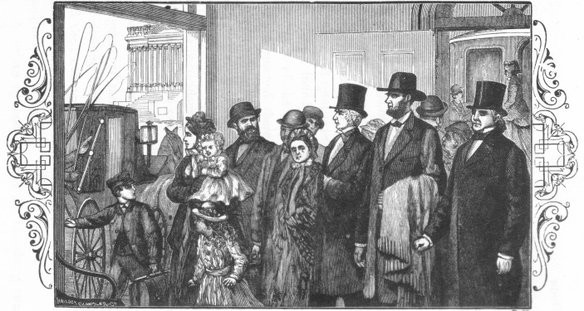
"The safe arrival at Washington." P. 98.
On his arrival at the hotel Mr. Lincoln was warmly greeted by his friends, who were rejoiced at his safe arrival, and leaving him in the hands of those whose fealty was undoubted, I withdrew, and engaged temporary quarters at another hotel.
During the forenoon I received a note from Mr. Lincoln requesting an interview, and received his warm expressions of thankfulness for the part I had performed in securing his safety, after which, finding that my object had been fully accomplished, I took the train and returned to Baltimore.
Here I found the utmost excitement prevailing. The news of the safe arrival of Mr. Lincoln had already reached there, and a general sentiment of rage and disappointment pervaded the entire circle of conspirators and secessionists. I lost no time in securing an interview with Howard, and learned from him the particulars attendant upon the discovery that Mr. Lincoln had outwitted his enemies and was now safely quartered in Washington. Finding that their plans had been discovered, and fearing that the vengeance of the government would overtake them, the leading conspirators had suddenly disappeared. All their courage and bravado was gone, and now, like the miserable cowards that they were, they had sought safety in flight.
A curious episode occurred at Harrisburg immediately after the departure of Mr. Lincoln from that city. Two newspaper correspondents connected with prominent New York journals had accompanied the party from Springfield, and had faithfully noted the incidents which had occurred upon the journey. As soon as the train which carried Mr. Lincoln away from Harrisburg was on its way, a gentlemanly individual, well-known to me, went to the room occupied by these journalists, and found them engaged in preparations to witness the further proceedings of the presidential party.
The visitor quickly informed the gentlemen that Mr. Lincoln had left the city and was now flying over the road in the direction of Washington, which he would no doubt reach in the morning. This was the signal for renewed activity, and both gentlemen hastily arose, and, grasping their hats, started for the door. Their visitor however, was too quick for them, and standing before the door with a revolver in each hand, he addressed them: "You cannot leave this room, gentlemen, without my permission!"
"What does this mean?" inquired one of the surprised gentlemen, blinking through his spectacles.
"It means that you cannot leave this room until the safety of Mr. Lincoln justifies it," calmly replied the other.
"I want to telegraph to the Herald," said the second correspondent—"what is the use of obtaining news if we cannot utilize it?"
"You cannot utilize anything at present, gentlemen. The telegraph will not be of any service to you, for the wires are all down, and Harrisburg will be separated from the rest of the world for some hours yet."
"When do you propose to let us out?" humbly asked one.
"Well, I'll tell you, gentlemen. If you will sit down calmly, and bide your time and mine, I will make matters interesting for you, by informing you all about this flank movement on the Baltimoreans."
Their indignation and fright subsided at once, and they quietly sat down. Refreshments were sent for, and soon the nimble pencils of the reporters were rapidly jotting down as much of the information as was deemed advisable to be made public at that time. After they had heard all, they prepared their dispatches for New York, both correspondents writing long and interesting accounts of the affair.
When daylight dawned, and the gladsome tidings had been received that Mr. Lincoln was safe, these knights of the quill were liberated, and, rushing to the telegraph offices, which were now in running order again, the news was transmitted to New York and in less than an hour the types were being set which would convey to the public the startling news of the discovered conspiracy, and the manner in which the conspirators had been outwitted.
As the later train arrived at Baltimore, I went to the depot and found the remaining members of the President's party, who also brought Mrs. Lincoln with them.
Mr. Judd was jubilant at the success of the adventure, but Col. Sumner had not yet recovered his good humor. I have no doubt, however, that Mr. Lincoln succeeded in placating his irascible friend, and I know that in the bloody scenes which followed Col. Sumner bore an honorable and courageous part.
Thus ends the narration of this important episode in one of the most interesting epochs of the country's history, and a truthful record has been given. Exaggerated stories and unauthorized statements have been freely made with regard to this journey of Mr. Lincoln. The caricaturist has attempted to throw ridicule upon the great man who now sleeps in a martyr's grave. A silly story of his being disguised in a Scotch cap and plaid obtained a temporary currency, but the fact remains that Mr. Lincoln, as a gentleman, and in the company of gentlemen, successfully passed through the camp of the conspirators and reached in safety the capital of the country.
Now the war is ended. Peace reigns throughout the borders of the great Republic. And when, during the last dying throes of the rebellion, this great man was stricken down by the hand of an assassin, North and South alike united in lamenting his death, and in execrating the damnable deed and its reckless perpetrators.
I had informed Mr. Lincoln in Philadelphia that I would answer with my life for his safe arrival in Washington, and I had redeemed my pledge.
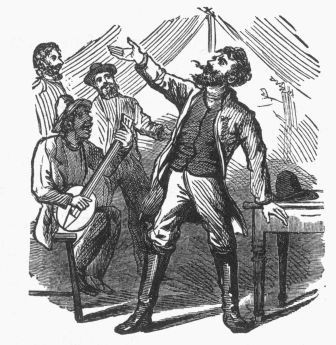
A CAMP SONG.
CHAPTER VI.
My Connection with the Rebellion.—Timothy Webster Accepts a Mission.
My connection with the "Great Rebellion" of 1861 began almost from the inception of that gigantic struggle. During the days that intervened between the inauguration of Abraham Lincoln and the memorable 12th day of April, 1861, treason was busy in the South, and secession resolved itself into an accomplished fact. Scarcely had the reverberating tones of the guns upon the batteries in Charleston Harbor died away upon the air, than I was called into the service of the military branch of the government. At that time I was engaged in the energetic practice of my profession as a detective, which, large as it was, and constantly increasing, required a personal supervision, which absorbed my undivided attention. When, however, it became evident that a conflict was unavoidable, I soon found my services were needed, and putting aside all considerations of a private or business nature, I yielded a ready and cheerful response to the call, and during my connection with what was afterwards known as the secret service of the government, I rendered every assistance that lay in my power to further the cause of union, and to serve the country of my adoption.
The month of April, 1861, was an important one in the history of the country. Whatever fears and apprehensions had filled the minds of the Northern people as to the solution of the great political questions then pending, a resort to arms had, until that time, been regarded as not likely to occur. A people who had been reared amid the blessings of a long and undisturbed peace, and whose lives, under this benign influence, had been prosperous and happy, they were almost entirely unprepared for a serious contest or a warlike struggle. Many times before the political horizon had grown dark and threatening, but the storm had subsided almost instantly, under that wise yielding of obedience to law and to the will of majorities, which it was hoped would now exercise its power for the preservation and continuance of amity.
When, therefore, on the 12th of April, the attack upon Fort Sumter in Charleston Harbor was made, the Northern people were almost startled by surprise. Though entirely unprepared for such an event, it was clearly demonstrated to all that war could now no longer be honorably avoided. It was now too late to inquire into original causes of the contest; it remained only for the loyal heart to resent the insult to a nation's flag, and to sustain the government in upholding its constitution and in enforcing its laws. This act fired the patriotic heart and solidified the patriotic ranks, and, with the crumbling of the walls upon Fort Sumter, were shattered all the hopes previously entertained of a peaceful solution of the problems which were then before the country. I have very little doubt that the assault upon Fort Sumter was ordered by the rebel government, under the fallacious hope and groundless belief that it would not provoke immediate or widespread civil war. The Southern leaders were well aware of the fact that the frontier could not be entirely stripped of regulars, and assuming, or pretending to, that the existing laws contained no provision authorizing a call of the militia, they inferred that it would be difficult for the new administration to obtain at once legislation of a coercive character. Then, too, they relied, in a great measure, upon a friendly feeling toward the South from their late political associates in the North; but in this their reckoning was at fault, and the roar of Beauregard's guns in Charleston Harbor cleared up the political horizon as if by magic.
There could no longer be any doubt as to the position and intentions of the Confederates. Seven disloyal States, with all their machinery of a separate government, stood behind those batteries, and the cool deliberation of the assault gave evidence of plan, of purpose and of confidence. What had been believed to be a mere conspiracy for the gaining of certain political ends, now gave way to a revolution, which menaced the perpetuity of the government and which required the armed force of the government to combat and subdue.
The news of the assault upon Sumter reached Washington on Saturday, the 13th day of April, and on the following day, Sunday though it was, President Lincoln assembled his Cabinet to discuss the duty of the hour, and on Monday morning a proclamation was issued, calling forth an army of seventy-five thousand men, for objects entirely lawful and constitutional.
The effect of this proclamation upon the people of the North was almost electrical, and the heart of the whole nation throbbed with its patriotic emotions as that of a single individual. The general sentiment appeared to be in entire accord with the utterance of Stephen A. Douglas, a live-long Democrat, that "every man must be for the United States, or against it; there can be no neutrals in this war—only patriots and traitors." More than double the number of men that were required tendered their services, and before the lapse of forty-eight hours armed companies and regiments of volunteers were in motion toward the expected border of conflict. Nor was there exhibited that division of Northern sentiment that had been so boastfully predicted by the Southern leaders, and all men, of every belief, Democrats and Republicans, Conservatives and Radicals, natives and foreigners, from Maine to Oregon, responded to the call, and came to the defense of the constitution, the government and the Union.
At this time the position of Maryland was rather a precarious one. There could be no doubt that the Unionists were greatly in the majority, but it was also true that there was a large and influential minority of her people in favor of secession. Here, as elsewhere, conspiracy had been at work for months, and many of the prominent political leaders were in full accord with the rebel government. The legislature was believed to be unreliable, and treason had obtained so firm a foothold in the populous city of Baltimore, that a secret recruiting office was sending enlisted men to Charleston. The venomous germ of treason, once planted, grew in magnitude and virulence, until it finally culminated in the infamous riot of April 19th, when the blood of the citizen soldiery of Massachusetts was first shed in defense of the Union. A spirit of opposition to the passage of Northern troops through the city, on their way to the seat of government, had been engendered among the "rough" element of Baltimore, and the excitement reached its climax upon the arrival of the Sixth Massachusetts Regiment, which was the first to answer the call for troops. When their presence became known the traitorous element could no longer be restrained, and while the men were passing quietly through the city, on their way from one railroad station to another, they were murderously attacked by a reckless, howling mob, which resulted in bloodshed and carnage, and some of the most fiendish outrages were perpetrated that ever blackened a page of American history.
The crowning act of disloyalty, and one which threatened the most serious consequences to the government, was committed about midnight of the same day. A secret order was issued by the mayor and police officers to burn the nearest bridges on the railroads leading into Baltimore from the free States, and parties, under the command of the police authorities were dispatched to execute the order.
Before daylight the following morning, the bridges at Melvale, Relay House and Cockeysville, on the Harrisburg road and over the Bush and Gunpowder rivers and Harris Creek, were completely destroyed by fire, thus effectually severing railroad communication with the North. The telegraph wires leading to and from the capital were also cut, completely shutting off Washington, and the government from the loyal Northern States. These acts, committed by the orders of the very men who that morning had risked their lives in defending the soldiers of the Union, are sufficient to show the rapid and overmastering influence of revolutionary madness.
Of course, the news of these outrages spread far and wide over the country, and while they aroused universal indignation, they nevertheless were the occasion of grave fears for the safety of the capital.
It was on the 21st of April, two days after the occurrence of these events that my services were required. Several gentlemen of prominence in Chicago, intimate friends of President Lincoln, and men of influence and intelligence in the State, desired to communicate with the President upon questions connected with the existing condition of affairs, and applied to me for the purpose of having letters and dispatches conveyed directly to Washington by the hands of a trusty messenger.
I at once accepted the duty, and selected a man for its performance. Experience proved that I was not mistaken in my selection, and as the messenger chosen for this duty is to bear an important part in the event, which I am about to relate, a description of him will at once acquaint the reader with his personal appearance.
He was a tall, broad-shouldered, good-looking man of about forty years of age. In height he was about five feet ten inches; his brown hair, which was brushed carelessly back from a broad, high forehead, surmounted a face of a character to at once attract attention.
There was such a decided mixture of sternness and amiability, of innate force and gentle feelings, of frankness and resolution stamped upon his features, that he instinctively impressed the beholder at a glance.
The deep gray eyes could twinkle and sparkle with good humor, or they would grow dark and menacing, and seem to flash under the influence of anger. The mouth, almost concealed by the heavy brown mustaches which he wore, and the square, firm chin evinced a firmness that was unmistakable. His nose, large and well-formed, and the prominent cheek bones all seemed in perfect harmony with the bold spirit which leaped from the eyes, and the strong will that lurked about the set lips. In figure, he was rather stout, but his shoulders were so broad, his feet and hands so shapely, and the lithe limbs so well formed, that he did not appear of as full habit as he really was. A casual observer on meeting this man would almost immediately and insensibly be impressed with the conviction that he was a man who could be trusted; that any duty devolving upon him would be sacredly kept; and as he stood before me on this sunny afternoon in April, I felt that I could implicitly rely upon him in any emergency in which he might be placed, and to perform any service for which he might be selected.
This man was Timothy Webster, a faithful officer, a true friend, and an ardent patriot.
I had known this man for years. He had been in my employ for a long time, and had been engaged upon operations of a varied and diverse nature, consequently I knew precisely what his capabilities were, and how entirely he could be trusted. Though not a man of great enlightenment, he was gifted with a large amount of natural shrewdness, which enabled him to successfully meet any emergency which might arise. From his association with people in the various walks of life, he had acquired that habit of easy adaptation which made him appear, and feel, perfectly at home in almost any society, whether in the drawing-room or the tavern, in the marts of trade, or laboring at the plow.
From my knowledge of Timothy Webster, and my confidence in his wisdom and reliability, I had chosen him to be the bearer of the dispatches to Mr. Lincoln. I therefore called him into my office and explained to him the nature of the duties he was to perform, the possible dangers he would encounter, and the importance of the trust that was to be reposed in him, and when I had concluded, I asked:
"Timothy, knowing what you do of the task before you, will you undertake its performance?"
"I understand all perfectly," he replied, drawing himself up to his full height, while his eyes flashed with a patriotic fire, "I know that my country demands my services, and that, if it shall cost me my life, I am ready to perform my full duty."
The preparations for his departure did not occupy a very long time; the services of Miss Kate Warne, my female superintendent, were requested, and in a few minutes the important dispatches, some twelve in number, were securely sewed between the linings of his coat collar, and in the body of his waistcoat, and Timothy Webster was on his way to the capital of the country.
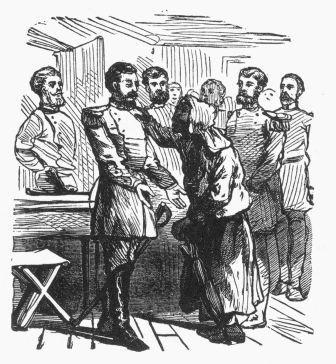
A COLORED CONTRABAND
CHAPTER VII.
Webster on his Way to the Capital.—Wrecked Trains and Broken Bridges.—An Adventure with a Cavalryman.—Rebel Emissary.—President Lincoln and Timothy Webster.
Everywhere along the route the greatest excitement prevailed, and the people were in a state of wildest commotion. A rumor had spread throughout the country that the government, indignant at the riotous conduct of the Baltimoreans, had ordered the guns of Fort McHenry to fire upon the city, that the bombardment was now going on, and that half the town was reduced to ashes. This rumor was false, as Webster learned on arriving in Philadelphia, although even in the staid old Quaker City there was manifest a degree of excitement scarcely to be expected in a community so sedate and easy-going as Philadelphians usually are.
Leaving the train at Philadelphia, Webster made his way through the crowded streets to the center of the city. He deemed it best to take counsel with some of the railroad and express officials, with whom he was very well acquainted, by reason of his connection with the discovery of the conspiracy to assassinate President Lincoln in Baltimore in the month of February immediately preceding.
At that time Webster had been enrolled as a member of a volunteer company of cavalry at Perrymansville, in Maryland, and, gaining the confidence of his officers, had assisted in discovering the plans of the conspirators, and partly through his efforts, I had been successful in frustrating their murderous designs. This operation had brought him in close association with several gentlemen who were connected with the railroad and express companies, whose travel lay between Philadelphia and the now riotous and isolated city of Baltimore. As he was walking leisurely down Chestnut street he was accosted by Mr. Dunn, a gentleman who was connected with a leading express company in the city, and who was now upon his return from a visit to the Philadelphia, Wilmington and Baltimore depot. After an interchange of salutations, Webster inquired of Mr. Dunn the condition of affairs in and around Baltimore.
"Very bad, indeed," replied that gentleman; "the bridges are all down, and the tracks have been torn up all along the road from Perrysville to Baltimore. The telegraph-wires have been cut, and no communications have been received from Baltimore or Washington except through couriers. The roads are guarded with soldiery, whose sympathies are with the rebellion, and it is almost impossible for any one who cannot identify himself as a Southern man to pass the guards who are stationed along the highways."
"It does not look very favorable for my reaching Washington to-morrow, then?" said Webster, inquiringly.
"No, sir. I am afraid that you will find it difficult, if not dangerous, to attempt such a journey, particularly by the way of Baltimore; and perhaps you had better delay your departure until it can be more safely accomplished," said Mr. Dunn.
"It may be as you say," replied Webster, "but I left Chicago for Washington, and my line of travel was laid out through Baltimore. I will obey my orders to the letter, and I will arrive in Washington to-morrow night, or lose my life in attempting it!"
"I see that you are determined to go," said Mr. Dunn, "and further argument would be of no avail; but I assure you, that you cannot travel further by rail than Perrysville; you may succeed in getting across the river to Havre de Grace, but after that you will have to rely entirely upon yourself."
"Never fear for me," replied Webster, with a smile, "I will get through all right, I feel confident. I will have but little time now to catch the train, Mr. Dunn, and if you will be kind enough to telegraph to Mr. Pinkerton according to my directions, I will esteem it a great favor."
"Certainly, Webster; anything I can do for you, or Mr. Pinkerton, will be done cheerfully."
Writing out a message, informing me of his arrival in Philadelphia and of his intentions, he requested Mr. Dunn to forward the same, and then, bidding that gentleman good-bye, he made his way to the Baltimore depot, and was soon on the road to that city.
As the train went speeding along upon its journey, Webster had ample time for the consideration of his plans. He was pretty well acquainted with the country between Havre de Grace and Baltimore, and had no fear of losing his way, even if the journey must be made by foot. He was impressed, however, with the necessity of using the utmost caution. While he did not fear for his own personal safety—for fear was an element entirely unknown to him—he realized the importance of his mission too well to rashly imperil its success by any useless exposure, or unnecessary risk. To reach Washington, however, he was determined, and to accomplish that object no danger would be too great, no hardship too severe. He nevertheless felt that he must rely solely upon himself, that he would have no one to advise him, and his own discretion and wisdom would have to be depended upon under all circumstances. Arriving at the Perrysville station, he found that the train could go no further, and that, to reach Havre de Grace, upon the opposite side of the Susquehanna River, the passengers would be required to take small boats and be rowed over, after which each man must make his way as best he could.
As the boat touched the land Webster sprang ashore, and, going directly to the hotel, inquired for the landlord. He found that gentleman engaged in earnest conversation with an individual who at once instinctively awakened the suspicions of my operative. This gentleman was a tall, fine-looking man, with the erect carriage and self-reliant air of the soldier, but there was something in the nervousness of his manner, and in the furtive glances of his eyes, which convinced Webster that he was concealing something and would bear watching.
Approaching the spot where the two men were conversing, Webster at once addressed the landlord in a hearty manner. "Landlord, I must get to Baltimore to-day. How am I going to do it?"
"I do not know," replied the hotel-keeper, "this gentleman is anxious to do the same thing, but I am afraid I cannot help either of you."
The gentleman thus referred to turned to Webster, saying:
"Yes, I am very anxious to get through. I am a bearer of dispatches to the British Consul at Washington, and it is of the utmost importance that they should be delivered at once."
While he was speaking a man drove up to the front of the hotel with a fine, strong team of horses attached to a covered road wagon, and throwing the reins across the back of his horses, leaped lightly to the ground.
"Here is a man who can help you," said the landlord, as the new-comer entered the room; and then he called out:
"Harris, come here!"
The driver of the team came over to where the three men were standing, and the landlord at once made known to him the wishes of Webster and the messenger of the British Consul.
"Harris, these gentlemen want to get to Baltimore to-day. Do you think you can manage it for them?"
The man addressed as Harris gazed at Webster and his companion in a scrutinizing manner, and finally, apparently satisfied with his investigation, signified his willingness to make the attempt, provided the price he demanded, which was fifty dollars, was agreed to.
Both men assented to the payment of the sum named, and after dinner had been partaken of, the two men took their seats in the vehicle, the driver cracked his whip, and they were upon their way.
"I cannot promise to take you through to Baltimore," remarked the driver, after they had started; "I was stopped twice on the road yesterday, and I may not be able to pass the guards to-day."
"Do the best you can," said Webster, good-naturedly, "and we will take the risk of a safe arrival."
Webster then turned to his companion, who had remained silent and watchful ever since they had set out, and endeavored to engage him in conversation. The bearer of dispatches, however, was very little inclined to be sociable, and Webster had great difficulty in breaking through the reserve which he resolved to maintain.
The further they journeyed, the more Webster became convinced that this man was not what he assumed to be, but he vailed his suspicions carefully, and appeared as frank and cordial in his manner as though they were brothers.
Nothing worthy of note transpired upon the route until the party arrived at the outskirts of Perrymansville, which had been the scene of Webster's first experience in military service, and where, a few months before, he had been a member of a company of cavalry. They were trotting along quietly, and as the day was balmy and bright the ride was quite an enjoyable one, and for a moment the detective forgot the grave duties which he had undertaken and the dangers that might surround him, and gave himself up to the full enjoyment of the scenes around him. His pleasant reflections were short-lived, however, for just as they were entering the town they saw a mounted cavalryman approaching, who, as he reached the carriage, commanded them to halt.
The driver suddenly pulled up his horses, and then the soldier, in a tone of authority: "Who are you, and where are you going?"
"We are residents of Baltimore," answered Webster, not at all dismayed by the stern appearance and manner of his soldierly interlocutor, "and we are endeavoring to get home."
"You will have to go with me," replied the soldier, decisively, "you can't go any further without permission."
Here was a detention as unwelcome as it was unexpected, but Webster had recognized the uniform worn by the soldier as that of the very company of cavalry he had previously been a member of, and a duplicate of one in which he had previously arrayed himself. The man who had accosted him, however, was unknown to him, and he could, therefore, do nothing but submit quietly to his orders and await a favorable operation of circumstances.
As Webster glanced casually at his companion, the British messenger, he was surprised at the change which was apparent in the expression of his features. Instead of the calm, dignified air of watchful repose which he had observed before, his face had grown pale, and there was such an unmistakable evidence of fear about the man, that Webster's suspicions were confirmed, and come what might he resolved to ascertain the nature of his business before they parted company.
They had traveled but a short distance under the escort of their guard when they met another man dressed in a similar uniform, and evidently a member of the same company, and as Webster gazed at the new-comer he experienced a sensation of relief and joy, for in him he recognized an old companion in arms.
As this man approached nearer, Webster called out from the carriage, in a cheery voice:
"Hello, Taylor! how are you?"
Thus suddenly accosted, the soldier rode up to the vehicle, and after a momentary glance at the features of the detective, he reached forth his hand and cordially saluted him.
"Why, Webster, how do you do? The boys said you would not come back, now that the war had commenced, but I knew better, and I am glad to see you."
The face of the reputed Englishman cleared in an instant, as he found that his companion was among friends, and this effect was not lost upon Webster, who had been furtively observing him. He turned his attention, however, to the soldier who had addressed him.
"Oh, yes," he replied, "I have come back; and my friend here and I are anxious to get to Baltimore as soon as possible."
"That will be all right," said the soldier; and then, turning to his comrade, he said: "These men are all right, you will permit them to pass."
After a few minutes spent in a pleasant conversation, the soldier handed to Webster a pass which would prevent further interruption to their journey, and with a mutual pull at a flask with which Webster had provided himself before starting, the parties separated, and they proceeded on their way.
This little incident produced a marked change in the demeanor of Webster's companion, and on being informed that the soldiers were Southerners, and not Federals, he seemed quite relieved.
By the time they were approaching the suburbs of Baltimore the stranger had grown exceedingly communicative, and upon Webster hinting to him that he also was engaged in the cause of the South, he without hesitation informed my operative that he was similarly employed, and that he was at present carrying dispatches to prominent Southern sympathizers then residing in Washington.
As he communicated this important item of information Webster grasped him warmly by the hand, and greeted him as a fellow-patriot, after which, with rare good humor, they cemented their acquaintance and confidence with a friendly draught from the spirit bottle.
Several times on their journey they were halted by the guards along the roads, but the talismanic pass obtained at Perrymansville avoided all questioning, and gained for the travelers a safe passage to their destination. Arriving safely at the outskirts of Baltimore, the two men left the carriage, and walking a short distance, they entered a street car, and were driven to a retired hotel, where Webster had frequently stopped when in the city on former occasions. Here they engaged quarters for the night, and Webster's companion had by this time formed such an attachment for his fellow-traveler that communicating rooms were engaged, and after partaking of a hearty repast, the two men lighted their cigars and strolled out through the city.
There were still many evidences of the riotous affrays which had but lately taken place. The people were in a feverish state of excitement, the drinking saloons and the corridors of the hotels were filled with crowds of excited men, each of whom seemed to vie with the other in giving loud expressions of their opinions, and of denouncing the attempt of the government to transport armed troops through the streets of a peaceful city. Ever mindful of the important duty devolving upon him, Webster wisely forebore to engage in any conversation with those whom he met, and among the number of the most outspoken of the Southern sympathizers were many whom he had previously met, and to whom he was known as an adherent of the South. At an early hour he and his newly found companion returned to their hotel, and shortly afterward retired for the night.
Arising early on the following morning, they found the same difficulty was to be encountered that had been successfully overcome at the commencement of their journey. The railroads between Baltimore and Washington had also been torn up, so as to render the running of the trains an impossibility. This fact necessitated the procuring of a team that would convey them to the capital; but this time Webster's acquaintance with the proprietors of the hotel, and several of the permanent guests of the house, enabled them without difficulty or delay to secure a pair of horses and a road wagon, with a trusty driver, who guaranteed to carry them to Washington for the same amount which had been paid upon the other portion of their journey, and at an early hour they were upon the road to the seat of government.
Meantime Webster had been seriously considering his course of action with regard to his fellow-passenger. That he was an agent of the Confederacy he had already admitted, and that he was the bearer of dispatches to prominent sympathizers with the South who were now living in Washington, was also well known to the detective. How, therefore, to arrange his plans, so that these papers would be intercepted and the ambassador detained without arousing his suspicion? It must be accomplished so that no delay should result to his own journey, as he had resolved that his dispatches must be delivered that day. Just before starting out an idea occurred to him, and requesting the driver to wait a few minutes, as he had forgotten something in his room, he re-entered the hotel, and going to the room they had occupied the evening before, he hurriedly wrote a note which he folded up and placed in his pocket. The note was as follows:
"To Whom it may Concern:
"My companion is an emissary of the Confederacy, carrying dispatches to Southern sympathizers in Washington. Apprehend him, but do so discreetly and without compromising me.
T. W."
He then descended the stairs, and entering the wagon, they were driven away towards Washington. The day was exceedingly warm, and the horses, unused to long journeys, early began to show signs of weakness, but they kept on without incident, save an occasional question from a passer-by as to their destination, and about noon arrived at a hotel known as the "Twelve-Mile House," so called from its being located at that distance from Washington.
Here the party halted for dinner, and while engaged at their repast Webster noticed at an opposite table a friend of years ago, who wore the uniform of a Lieutenant of infantry. Fortunately, however, the officer did not appear to recognize him, and during the progress of the dinner Webster kept his face hidden as much as possible from his new-found friend. As the Lieutenant ceased eating and arose from the table, Webster, who also had about completed the bill of fare, arose, and excusing himself to the driver and his companion, passed out into the hallway and met the officer face to face. Cordial greetings were interchanged, and in a few minutes Webster had detailed to his friend the circumstances attending his meeting with the so-called British messenger, and his suspicions concerning them. It was not long before a plan had been arranged for the carrying out of the project of arresting the pseudo Englishman without occasioning the slightest suspicion to fall upon Timothy Webster, and shortly afterwards the Lieutenant mounted his horse and rode off in the direction of Washington.
After smoking their after-dinner cigars, Webster and his companion again resumed their journey. By this time they had become thoroughly acquainted, and they enlivened their drive with many a pleasing anecdote of experience or of invention, until they came in sight of Washington city. Here a difficulty awaited them, apparently unexpected by both travelers. A Lieutenant at the head of eight men emerged from a house by the wayside, and in a voice of authority directed the driver to stop his horses, after which he advanced to the vehicle and saluted the occupants with the utmost courtesy, saying:
"Gentlemen, I am sorry to discommode you, but I have orders to intercept all persons entering the city, and hold them until they can satisfactorily account for themselves. You will be kind enough to consider yourselves under arrest and follow me."
Blank astonishment was depicted on the countenances of both Webster and his companion, but realizing that to parley would be useless, the two men dismounted and followed the lieutenant and his men into the building, which proved to be a military guard-house.
Here they were separated and conducted to different apartments, where they were securely locked in, Webster's companion standing outside of the door of the room in which Webster was placed, and after witnessing the operation which confined Webster a prisoner, he was conducted to the room assigned to him, and the key was turned upon him.
In a few minutes afterwards Webster was quietly released by the Lieutenant who had effected his arrest, and who was none other than the friend to whom he had given the information. In less than half an hour thereafter my detective was ascending the steps of the White House, inquiring for his Excellency, the President of the United States.
Having also been provided with a letter to the President's private secretary, Mr. Nicolay, Webster was soon ushered into the presence of Mr. Lincoln, to whom he made known the nature of his business, and taking off his coat and vest, he removed the dispatches and letters, and handed them to the President, who had been silently watching his movements with a great deal of amused interest.
"You have brought quite a mail with you, Mr. Webster," said the President, "more, perhaps, than it would be quite safe to attempt to carry another time."
"Yes, sir," replied Webster. "I don't think I would like to carry so much through Baltimore another time."
The President carefully looked over the papers he had just received, and finding that they required more consideration than could be given to them at that time, he turned to Webster and said:
"Mr. Webster, I have a Cabinet conference this evening, and I will not be able to give these matters my attention until to-morrow. Come to me at ten o'clock and I will see you at that time."
Again thanking the detective for the service he had so successfully rendered, he bade him good evening, and Webster sought his hotel, thoroughly exhausted with his journey, and soon after he was sound asleep.
The next morning, on repairing to the White House, he was at once admitted, and the President greeted him with marked evidences of cordiality.
"Mr. Webster, you have rendered the country an invaluable service. The bearer of dispatches who was arrested last evening by your efforts, proved, as you suspected, to be an emissary of the South, and the letters found upon him disclose a state of affairs here in Washington quite alarming. Several prominent families here are discovered to be in regular communication with the Southern leaders, and are furnishing them with every item of information. Until this time we had only a suspicion of this, but suspicion has now resolved itself into a certainty. You have performed your duty well, and before many days there will be an account demanded of some of these people which they are far from expecting."
"I am glad to be of any service," replied Webster; "and I have done nothing more than my duty. If you have any further commands for me, Mr. President, I am ready to obey them."
"Very well," said the President; "take these telegrams, and when you have reached a point where communication is possible, send them to General McClellan, at Columbus, Ohio; they are important and must be sent without delay. Also telegraph to Mr. Pinkerton to come to Washington at once; his services are, I think, greatly needed by the government at this time."
Rolling up the papers which he received, Webster placed them in the center of a hollow cane, which he carried; then, replacing the handle, and promising to attend faithfully to the duties assigned him, he left the executive mansion.

CHAPTER VIII.
Timothy Webster in Washington.—The Return to Philadelphia.—I go to the Capital.—An Important Letter.
After leaving the White House, Timothy Webster went immediately in quest of a conveyance that would enable him to reach Baltimore without unnecessary delay. He expected to encounter greater difficulties in obtaining what he desired here in Washington than he had met with in Baltimore, for the reason that in the capital he was a comparative stranger, while in the latter city he had numerous friends, who believed him to be in sympathy with the Confederacy, and whose assistance he could rely upon on that account. His only hope, therefore, lay in his being able to find some friendly Baltimorean, upon whose influence he could depend to procure him a mode of conveyance for his return. Having arrived late on the preceding evening and being terribly fatigued by the journey he had made, Webster had retired almost immediately after he reached his hotel, and consequently he was surprised at the busy scenes which greeted him now. The capital was swarming with soldiers and civilians. Regiments continually arriving and were being assigned to quarters and positions around the city, and the streets were filled with eager and excited multitudes. The position which Maryland had assumed was vehemently discussed everywhere, and the riotous conduct of the Baltimoreans was loudly denounced by Northern men, and secretly applauded by those whose sympathies were with the cause of the South. The prompt action of General Butler, with his regiment of Massachusetts soldiers, who followed quickly after the sixth, in going by boat directly to Annapolis, in order to reach Washington without hindrance or delay, and his patriotic and determined response to those in authority, who sought to induce him to change his plans for reaching the capital, were everywhere warmly commended. There could be no doubt that the North was thoroughly aroused, and were dreadfully in earnest in their determination to suppress a rebellion which they believed to be causeless, unlawful and threatening the future of a great country.
As Webster walked along Pennsylvania Avenue, carefully scanning the faces of every one he met in the hope of discovering some one whom he knew and who might be of service to him, he recognized the driver who had brought him from Baltimore on the day before, and who started in astonishment at finding the man whom he had last seen a prisoner in the hands of United States troops now walking the streets free and unattended. This man was accompanied by three others, with two of whom Webster was slightly acquainted, and he at once advanced toward them and greeted them cordially.
"Why, Webster, is that you?" inquired the foremost of the party, a well-known "sympathizer" of the name of John Maull. "We heard you had been taken prisoner—how did you get out so soon?"
"That is easily accounted for," said Webster, with a laugh; "I was simply arrested on suspicion, and when they could find nothing about me that was at all suspicious, they were compelled to let me go."
"This country is coming upon strange times," remarked a sallow-faced Baltimorean who boasted of having been one of the most prominent of the rioters a few days before, "when a man can be arrested in this way and have no means of redress."
"That is very true," replied Webster, "but we will have a decided change before long, or I am very much mistaken. 'Uncle Jeff' means business, and there will be long faces in Washington before many days."
"Give me your hand, old boy," exclaimed Maull heartily, "you are of the right stripe; but don't talk so loud; let us go around the corner to a quiet little place where we can talk without danger."
The party repaired to a drinking saloon, in a retired neighborhood, and on entering it they were greeted warmly by several parties who were standing before the bar. Webster was immediately introduced to these gentlemen, and it was not long before he had firmly established himself in their good opinions as a devoted friend of the South.
The conversation soon became general, and the most extravagant ideas were expressed with regard to the wonderful achievements that were expected of the Southern soldiers, and no doubt was entertained that the Yankees, as they called the Northern men, would be quickly vanquished by the chivalrous armies of the "Sunny South."
To all of these suggestions Webster yielded a ready assent, and not one among the number was more pronounced in his belief in the needs of the Southern cause than was my trusty operative, who, in the cane he flourished so conspicuously, carried important dispatches from the President of the United States to a General in command of Northern soldiers.
All the time, however, he was growing very restive under the enforced delay in his journey, and seeking a favorable opportunity during a lull in the conversation, he turned to the driver of the wagon and inquired of him when he was going to return to Baltimore.
"Not for a day or two, at least," replied the man.
"That is very bad," said Webster. "I must get there this evening; it is of the utmost importance that I should do so."
At this one of the party approached Webster and informed him that he was going back that day and had engaged a conveyance for that purpose, and as there was room enough for two, he would be most happy to have his company. Webster at once accepted the invitation, and having thus relieved his anxiety upon the point of reaching Baltimore, he joined heartily in the conversation that was going on around him. No one, to have heard him, would doubt for a moment his loyalty to the South, or his firm belief in the eventual triumph of her armies.
After remaining in the saloon for some time, Webster noticed that the men were becoming intoxicated, and fearing that they would become noisy and probably get into trouble, he suggested to the gentleman with whom he was to drive to Baltimore the propriety of leaving the rest to their enjoyment while they arranged matters for their departure. His advice was at once accepted, and the two men bade their associates farewell and repaired to the hotel, where they had their dinner, and about two o'clock they were upon their journey. Webster's fears were proven to be well-founded, for as they were passing the locality where they had spent the morning, they saw their former companions between a file of soldiers, and there was little doubt that they had allowed their libations to overcome their judgments, and that they would be allowed to recover their reason in a guard-house.
The journey was made without event, the carriage and driver being apparently very well known along the route, and Webster arrived in Baltimore late that evening. He was desirous of pushing on without delay, as it was important that the dispatches which he carried should be forwarded at once, and he therefore went immediately to the hotel he had occupied when he first arrived in the city. Requesting the landlord to use his best efforts to procure him a conveyance to Havre de Grace, he sat down to his supper, and did ample justice to a plenteous repast. When he had finished the landlord entered the room and informed him that he had succeeded in providing a team for his service, but that grave doubts were entertained whether he would succeed in reaching his destination. Expressing his willingness to assume any responsibility of that kind, Webster bade his entertainer good-bye, and entering the wagon, he started upon his midnight journey to Havre de Grace.
Again fortune favored him, and although repeatedly halted, he was able to give such a straightforward account of himself that they were allowed to proceed, and he arrived in Havre de Grace in time for breakfast. Crossing the river, he went directly to the headquarters of Colonel Dare, who was in charge of the Union troops at Perrysville, and requested that officer to forward the telegram to General McClellan at once. This the Colonel promised to do, and in a few minutes the important message was flying over the wires to its destination at Columbus, Ohio, and the President's request for my appearance at Washington followed soon after, and was received by me in due time.
Recognizing the importance of the call, I lost no time in answering the dispatch of Mr. Lincoln, and started at once on my journey to Washington, accompanied only by a trusty member of my force. Before leaving I left orders that should I fail to meet with Webster upon the way he should be directed to await my return in the city of Pittsburg.
On my arrival at Perrysville I found that a mode of communication had been hurriedly established with Washington, by means of a boat which sailed down the Chesapeake Bay and landed their passengers at Annapolis, from which point the railroad travel to Washington was uninterrupted.
Arriving at the capital I found a condition of affairs at once peculiar and embarrassing, and the city contained a strange admixture of humanity, both patriotic and dangerous. Here were gathered the rulers of the nation and those who were seeking its destruction. The streets were filled with soldiers, armed and eager for the fray; officers and orderlies were seen galloping from place to place; the tramp of armed men was heard on every side, and strains of martial music filled the air. Here, too, lurked the secret enemy, who was conveying beyond the lines the coveted information of every movement made or contemplated. Men who formerly occupied places of dignity, power and trust were now regarded as objects of suspicion, whose loyalty was impeached and whose actions it was necessary to watch. Aristocratic ladies, who had previously opened the doors of their luxurious residences to those high in office and who had hospitably entertained the dignitaries of the land, were now believed to be in sympathy with the attempt to overthrow the country, and engaged in clandestine correspondence with Southern leaders. The criminal classes poured in from all quarters, and almost every avenue of society was penetrated by these lawless and unscrupulous hordes. An adequate idea can be formed of the transformation which had been effected within a few short weeks in this city of national government.
On the day following my arrival I wended my way to the White House and sought an interview with the President. Around the executive mansion everything was in a state of activity and bustle. Messengers were running frantically hither and thither; officers in uniform were gathered in clusters, engaged in animated discussions of contemplated military operations; department clerks were bustling about, and added to these was a crowd of visitors, all anxious, like myself, to obtain an interview with the Chief Executive.
I was not required to wait an unusual length of time, and I was soon ushered into the presence of Mr. Lincoln, who greeted me cordially and introduced me to the several members of the Cabinet who were engaged with him. I was at once informed that the object in sending for me was that the authorities had for some time entertained the idea of organizing a secret-service department of the government, with the view of ascertaining the social, political and patriotic status of the numerous suspected persons in and around the city. As yet, no definite plans had been adopted, and I was requested to detail my views upon the subject, in order that the matter might be intelligently considered, and such action taken as would lead to definite and satisfactory results. I accordingly stated to them the ideas which I entertained upon the subject, as fully and concisely as I was able to do at the time, and, after I had concluded, I took my departure, with the understanding that I would receive further communications from them in a few days.
It was very evident to me, however, that in the confusion and excitement which were necessarily incident to the novel and perplexing condition of affairs then existing, that anything approaching to a systematized organization or operation would be for a time impossible. The necessity for war had come so suddenly upon a peaceful community that there had been as yet but little time for thorough preparation or system. The raising of a large army, with all the various contingencies of uniforming, arming and drilling; the furnishing of supplies, and the assigning of quarters, were occupying the attention of the rulers of the government, and I felt confident that I would be required to wait a longer time than I could then conveniently spare from my business, ere I would be favored with any definite instructions from those in authority. This opinion was fully confirmed, after several unsuccessful attempts to obtain satisfying particulars from the heads of several of the departments, and leaving my address with the secretary of the President, I returned to Philadelphia.
I had directed, prior to leaving Chicago, that all important communications addressed to me should be forwarded to that city, and on my arrival there I found a number of letters which required immediate attention.
Among the number was the following, which had been somewhat delayed in its transmission.
"Columbus, Ohio, April 24, 1861. "Allan Pinkerton, Esq., "Dear Sir:—
"I wish to see you with the least possible delay, to make arrangements with you of an important nature. I will be either here or in Cincinnati for the next few days—here to-morrow—Cincinnati next day. In this city you will find me at the Capitol, at Cincinnati at my residence.
"If you telegraph me, better use your first name alone. Let no one know that you come to see me, and keep as quiet as possible.
"Very truly yours,
"Geo. B. McClellan,
"Maj. Gen'l Comd'g Ohio Vols.
This letter at once decided me. Anxious as I was to serve the country in this, the hour of her need, I sought the first opportunity for active duty that presented itself, and I left Philadelphia at once, in order to comply with the instructions contained in this message of Gen. McClellan.
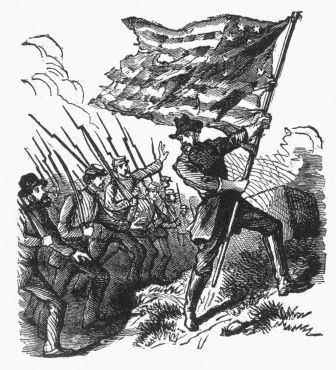
STORMING A FORT.

CHAPTER IX.
An Adventure in Pittsburg.—A Mob at Bay.—An Explanation.—Good-feeling Restored.
Several influences operated in my mind to induce me to respond at once to this letter, and some of them of a directly personal nature. I had been acquainted with General McClellan for a long time before this, and had been intimately associated with him while engaged upon various important operations connected with the Illinois Central and the Ohio and Mississippi Railroads, of the latter of which he was then president. From the friendship and esteem I entertained for him growing out of my relations with him in those matters, both as an individual and as an executive officer, I felt the more anxious to enter into his service, now that he had assumed the command of a military department, and was about to take an active part in the impending struggle.
At Philadelphia I ascertained that Timothy Webster had already departed for Pittsburg, according to previous instructions, and hastily telegraphing to the General that I would instantly respond to his letter in person, I took the first train leading westward and was soon upon my way.
Timothy Webster, meanwhile, had proceeded on his journey from Perrysville, and arrived without accident or adventure in Philadelphia. He immediately repaired to the office of Mr. Dunn, who informed him that he had just received a dispatch for him from Chicago. Webster hastily opened the message and found my directions for him to await my return at the city of Pittsburg. Remaining in the Quaker City until the following day, he took the western train and in due time arrived at his destination. On inquiring at the telegraph office in Pittsburg he received another message to the same effect as the first one, and he therefore engaged quarters at a hotel, patiently awaiting my coming. On the second day after his arrival in the Smoky City, which was Sunday, he again went to the telegraph office, where he received information that I would probably arrive there in the course of that day.
Returning to the hotel, Webster entered the bar-room, and while he was being attended to two men came in, apparently engaged in excited conversation. They advanced to the bar and requested drinks. The excitement in the city, attendant upon the news from Baltimore, had not abated in the least since Webster had passed through several days before, and these two men were discussing the action of the government in regard to this matter. One of them, an excitable, empty-headed fellow, was cursing the President and General Scott, in very loud tones and in unmeasured terms, for not burning the city of Baltimore to ashes, and thus teaching the rebels a lesson they would be apt to remember. The remonstrances of his friend seemed only to excite him still more, and Webster, feeling desirous of avoiding any controversy at that time, started to leave the saloon, when the angry disputant turned to him, and arrogantly demanded his opinion of the matter.
"I think," said Webster, "that the President and General Scott understand their duties much better than I can inform them, and I suppose they do not wish to destroy the property of many who are true to the government."
"That is all nonsense," replied the other, sharply, "there is not a single Union man in the whole city."
"I think you are mistaken," said Webster, coolly. "I am sure there are thousands of them there."
This answer seemed to infuriate the man, and striding up to Webster, he asked, with an air of impertinence:
"Are you a Southern man?"
"No, sir, I was born in New York," was the reply.
"What is your name?" impudently demanded the fellow.
"You will find my name upon the register of the hotel, if you desire it, and as I do not wish to have any further controversy with you, I bid you good morning," replied Webster, still remaining cool and unruffled.
By this time a crowd of about twenty men had gathered about them, and as Webster turned to leave the room, one of them demanded to know the contents of the telegram he had just received.
This demand, added to the previous suggestion that Webster was a Southern man, was sufficient to excite the entire crowd, who had been living upon excitement for more than a week, and they began to press around him in a threatening manner, one of them calling out:
"I believe he is a d—d spy; let us see what he has got!"
Webster broke loose from those nearest to him, and retreating backwards toward the door, exclaimed, in a determined voice:
"Gentlemen, I am no spy, and if any of you attempt to trouble me further, some of you will assuredly get hurt!"
At this the crowd grew boisterous and violent, and several called out, "Hang him!" "Hang the spy!" while some of them made a rush toward where he stood.
Drawing his revolver, Webster faced his angry assailants, who drew back involuntarily when they saw that he was both well armed and undismayed.
"Gentlemen, we have had enough of this nonsense. You can talk about hanging me, and perhaps there are enough of you to do it, but, by God, the first one that attempts to put his hands upon me is a dead man!"
Matters began to look serious. It seemed evident that these excited people were determined to resort to violence, and that there would be bloodshed in consequence. Webster, whose relations with the government were of so intensely loyal a character, was filled with regret at having allowed himself to become a party to a conversation which would lead to such serious consequences. He was resolved, however, to maintain his position. To show signs of weakness, therefore, would be dangerous, if not fatal, to him, and he stood bravely in front of the angry mob, who had drawn back at the sight of the revolver which was leveled so menacingly at them.
Only for a moment, however, did the crowd stand awed and irresolute—one moment of silence, in which every man appeared to be deciding for himself his course of action. Then one tall, stalwart man stepped from their midst, and waving his hand toward his companions, he cried out:
"Come on, he is only one against twenty, and we will take him dead, or alive!"
The crowd took a few steps in advance, and Webster had braced himself to receive their attack, when suddenly, close beside him stood a form, and a loud voice called out:
"Stop, gentlemen, where you are! This man is no traitor, and I will defend him with my life!" and the muzzles of two revolvers ranged themselves beside that presented by the suspected, but undismayed detective.
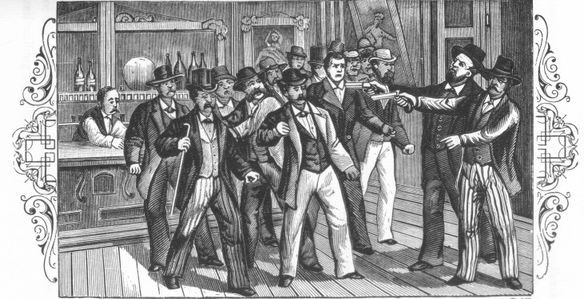
"Stop, Gentlemen, where you are." P. 146.
Involuntarily the crowd stood still at this unexpected arrival of reinforcements, and Webster, who had recognized the voice, looked up in surprise and relief at this unlooked-for, though timely, assistance.
I had arrived just in the nick of time, and I was resolved to defend my undaunted operative to the last.
At this moment the proprietor of the hotel entered the saloon, and in a calm voice and quiet manner attempted to subdue the angry feelings of the bystanders.
"Gentlemen," said he, "there need be no trouble about this matter; Mr. Webster can fully explain his position, and I think the best plan would be for you all to repair to the office of the mayor, where any explanation can be given."
"I am perfectly willing to do that," said I; "I know this man, and will answer for him under any circumstances; we will accompany you to the office of the mayor at once, and I think I can convince him that he is no spy."
This proposition was eagerly accepted by some, and reluctantly by others, and finally the entire party marched out of the hotel on their way to the office of the chief magistrate of the city; Webster and myself walking together.
The crowd increased as we went on, and frequent calls were still made to "hang the traitor," but no further attempts were made to molest us, and we reached the office without any event of a troublesome nature occurring.
The noise of the crowd attracted the attention of the chief of police, who, during the temporary absence of the mayor, was in charge of affairs of this nature, and he came to the door to ascertain the occasion of the tumult.
As the crowd, with Webster and myself in the van, reached the steps which led up to the municipal office, I at once recognized the chief of police, having been connected with him some time before in the detection of some burglars from the city of Pittsburg, and that officer was not slow to identify me as the detective, who had frequently enabled him to secure the desperate criminals whom the law had at various times pursued.
As we reached the platform where the officer was standing, I stretched forth my hand, which the chief cordially grasped.
"Why, Mr. Pinkerton, what are you doing here?" inquired the chief, with some surprise.
"I have come to defend one of my men, whom these people insist upon hanging as a rebel spy, but who is loyal to the core," I answered, laughingly.
"I will take care of that," replied the chief, "and your word is sufficient for me," at the same time extending his disengaged hand and warmly greeting Webster, who stood beside me.
As the crowd noticed the evident acquaintance and good-feeling that existed between the reputed spy and their chief of police, they drew back instinctively, while some of them looked as if they were not insensible to a feeling of shame. The chief realized the state of affairs at once, and turning to the now crestfallen and subdued gathering, he addressed them:
"Gentlemen, I will be responsible for the loyalty and integrity of these gentlemen, and you will instantly disperse."
The leaders of this assault on Webster looked terribly ashamed of themselves when they found how ridiculously they had been acting, and as the door of the chief's office closed on our retreating figures, they slowly and silently retired.
In an hour afterwards, when Webster and I returned to the hotel, we found the gentlemen who a short time before were anxious to hang him, awaiting our arrival, and we received from them their heartfelt apologies for their hasty and inconsiderate conduct, all of which were received with a spirit of good nature that won the regards of all present, and when the time of our departure arrived, they accompanied us to the depot in a body, and cheered us lustily as the train slowly moved away.
Thus an adventure, which promised to be very serious in its results, terminated in a manner satisfactory to all, and Webster and myself, instead of being lynched by a Pittsburg mob, departed in safety on our journey, and arrived in Cincinnati upon the following day, prepared to receive from General McClellan such instructions as were deemed necessary by him for the furtherance of the cause in which he was engaged.
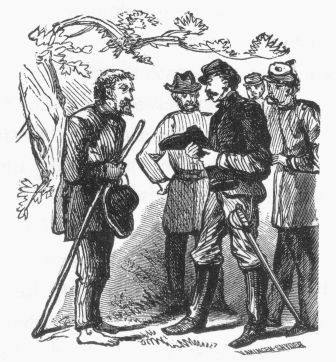
BETRAYED BY HIS BOOTS.
CHAPTER X.
General McClellan in Command of Ohio.—I am Engaged for the War.—The Secret Service.—A Consultation.—Webster starts for Rebeldom.
At the outbreak of the rebellion many difficulties were encountered which the people and their leaders were ill-prepared to surmount, and many expedients were resorted to in order to equip and officer the troops as they arrived. The State of Ohio, the militia of which General McClellan had been called upon to command by Governor Dennison, was no exception to this rule; but that gentleman realized the importance of calling some one to the command of the volunteers, upon whose knowledge, judgment and experience he could place implicit reliance. He therefore turned to Captain McClellan, who was a graduate of West Point, and had been a captain in the regular army, but who had for some years past been devoting himself to the management of a prominent railroad enterprise in the State.
The Governor at once sent a communication to the general government, requesting that McClellan should be restored to his old rank in the army, and that the duty of organizing the Ohio volunteers should be assigned to him. To this request no answer was received, and it was afterwards learned that the Governor's letter, owing to the interruption of communications with Washington from all points, had not reached its destination. Failing, therefore, to receive any reply from the general government, and being thus forced to rely upon his own resources, Governor Dennison at once summoned McClellan to Columbus, where the latter applied himself earnestly to the work of organizing the numerous volunteer regiments which offered their services to the country. The State laws were changed in such a manner as to allow the Governor to select commanding officers for these volunteers outside of the members of the State militia, and very soon afterward the Ohio troops were commanded by thoroughly competent men, who had made military movements the subject of scientific study.
On the third day of May a "Department of the Ohio" was formed, consisting of the combined forces of Ohio, Indiana and Illinois, and this department, by order of General Scott, was placed under the command of General McClellan.
The Ohio troops, as they arrived, were mainly located at Camp Dennison, which was situated in a valley about sixteen miles northwesterly from the city of Cincinnati. This was the largest and the chief camp in the State, and here the volunteers received that thorough instruction and training so essential in preparing for the rigors of war.
As I have stated, my personal acquaintance with George B. McClellan had, from its earliest incipiency, been of the most agreeable and amicable nature, and when I called at his house in Ludlow street, as I did immediately upon my arrival in Cincinnati, I was received with genuine cordiality. After we were closeted together I explained fully to him the character of the business that had called me to Washington, and how the complication of affairs at the seat of government necessitated so much delay that I had found it imperative upon me to leave without arriving at any definite understanding with the President.
The General had already been advised of his elevation in rank, and among other things desired to consult with me in relation to his affairs at the War Department.
I need not stop to give the details of that interview. His object in sending for me was to secure my aid and co-operation in the organization of a secret service for his department, and finding me more than willing to do all in my power to help along the cause of the Union, he immediately laid before me all his plans.
Our business was settled. It arranged that I should assume full management and control of this new branch of the service, and that I should at once enter upon the discharge of the multifarious duties attending so responsible a position. The General then informed me that he would write to General Scott for permission to organize this department under his own personal supervision; and he also agreed to submit the project to Governor Dennison, of Ohio, with a request to that gentleman to solicit the co-operation of the Governors of Illinois, Indiana, Michigan and Wisconsin, in sustaining the organization.
To this arrangement I gave a ready assent, and we then entered upon the discussion of affairs requiring immediate attention. Several measures, more or less important, had suggested themselves to my mind while the General was talking, and in the course of the conversation which followed, I presented them for his consideration. It was a relief to me to find that at the outset there was no clash of opinion between us, and I felt confident that there was not likely to be any in the future.
For several days my time was principally taken up in private consultations with General McClellan, in laying out a line of operations, by which I was to assist in making arrangements for bringing my own force into active duty at the earliest possible hour. I rented a suite of rooms and fitted up an office in Cincinnati, where I called about me some of the most capable and trustworthy detectives in my employ, and impressed upon them the great importance of the tasks that were about to be imposed upon them.
The general informed me that he would like observations made within the rebel lines, and I resolved to at once send some scouts into the disaffected region lying south of us, for the purpose of obtaining information concerning the numbers, equipments, movements and intentions of the enemy, as well as to ascertain the general feeling of the Southern people in regard to the war. I fully realized the delicacy of this business, and the necessity of conducting it with the greatest care, caution and secrecy. None but good, true, reliable men could be detailed for such service, and knowing this, I made my selections accordingly; my thoughts reverting first of all to Timothy Webster.
Within six hours after the commander had expressed his wishes to me, Timothy Webster was on his way to Louisville, with instructions to proceed southward from that city to Memphis, stopping at Bowling Green and Clarkesville on the way.
In Webster's case it was not necessary to devote much time to instructions, except as to his line of travel, for he was a man who understood the whole meaning of a mission like this, and one who would perform his duty with that faithfulness and ability by which he had fairly earned the confidence I now reposed in him.
Within a few days I also sent out other scouts, singly and in pairs, on the different routes that had been carefully prepared for them, and in a short time quite a number of my best operatives were engaged upon more or less difficult and dangerous tasks, all tending to the same end.
In organizing and controlling this secret service, I endeavored to conceal my own individual identity so far as my friends and the public were concerned. The new field of usefulness into which I had ventured was designed to be a secret one in every respect, and for obvious reasons I was induced to lay aside the name of Allan Pinkerton—a name so well known that it had grown to be a sort of synonym for detective. I accordingly adopted the less suggestive one of E. J. Allen; a nom de guerre which I retained during the entire period of my connection with the war. This precautionary measure was first proposed by the General himself, and in assenting to it I carried out his views as well as my own. This ruse to conceal my identity was a successful one. My true name was known only to General McClellan, and those of my force who were in my employ before the breaking out of the rebellion, and by them it was sacredly kept. Indeed, I doubt if McClellan has ever divulged it to this day, if I may judge by the frequent occurrence of such incidents as the following:
A short time since, while on a visit to my New York agency, I chanced to meet one of my old army friends, General Fitz-John Porter. He recognized me, gave me a hearty greeting, and proceeded to address me as Major Allen, after the custom of by-gone days. I permitted the conversation to go on for some time, and then said:
"Are you not aware, General, that the name of E. J. Allen, which I used during the war, was a fictitious one?"
He looked at me, as if to satisfy himself that I was not jesting, and then exclaimed:
"Fictitious! You are not in earnest, Major?"
I assured him that I was never more so.
"Why, I never suspected such a thing. What, then, is your true name?"
"Allan Pinkerton," I replied.
"Allan Pinkerton!" he ejaculated.
His astonishment knew no bounds, and he declared it was the first intimation he had ever had that Allan Pinkerton and Major Allen were one and the same person.
It was on the thirteenth of May that Timothy Webster left Cincinnati on his trip southward. He arrived at Louisville, Ky., late in the night, and remained there until the following day, when he pursued his course into the heart of that self-satisfied State which only desired to be "let alone."
It is not my purpose to give in detail all the events of Webster's journey, as there was much that would only prove tedious at this late day, though at that time regarded as of the utmost importance to the country. Shrewd, wide-awake, and keen as a blood-hound on the scent, he allowed nothing to escape him, but quietly jotted down every item of intelligence that could possibly be of advantage to the Union army, and picked up many important points, which would have escaped the notice of a man of less detective experience and ability.
He stopped a day or two at Bowling Green, Ky., and then proceeded on to Clarkesville, Tenn. He made friends of all he met, and cleverly ingratiated himself into the good graces of those whom he believed might be of service to him. He was a "Hail, fellow! well met," "A prince of good fellows," a genial, jovial, convivial spirit, with an inexhaustible fund of anecdote and amusing reminiscences, and a wonderful faculty for making everybody like him. He partook of soldiers' fare in the rebel camp, shook hands warmly with raw recruits, joked and laughed with petty officers, became familiar with colonels and captains, and talked profoundly with brigadier-generals. He was apparently an enthusiastic and determined rebel, and in a few cunningly-worded sentences he would rouse the stagnant blood of his hearers till it fairly boiled with virtuous indignation against Yankees in general, and "Abe Linkin" in particular.
Webster's talent in sustaining a role of this kind amounted to positive genius, and it was this that forced me to admire the man as sincerely as I prized his services. Naturally, he was of a quiet, reserved disposition, seldom speaking unless spoken to, and never betraying emotion or excitement under any pressure of circumstances. His face always wore that calm, imperturbable expression denoting a well-balanced mind and a thorough self-control, while the immobile countenance and close-set lips showed that he was naturally as inscrutable as the Sphinx. Many of his associates were of the opinion that he was cold and unfeeling, but I knew there could be no greater mistake than this; I knew that a manlier, nobler heart never existed than that which beat within the broad breast of Timothy Webster; and I knew that, reserved and modest as he was, he was never wanting in courtesy, never derelict in his duty, never behind his fellows in acts of kindness and mercy.
It was when he was detailed for such operations as the one in question that his disposition underwent a complete metamorphosis. Then his reserve vanished, and he became the chatty, entertaining boon companion, the hero of the card-table, the story-teller of the bar-room, or the lion of the social gathering, as the exigencies of the case might require. He could go into a strange place and in one day surround himself with warm friends, who would end by telling him all he desired to know. In a life-time of varied detective experience, I have never met one who could more readily and agreeably adapt himself to circumstances.
Webster represented himself as a resident of Baltimore, and gave graphic accounts of the recent troubles in that city; of the unpleasant position in which the "friends of the cause" were placed by the proximity and oppression of Northern troops, and of the outraged feelings of the populace when the "Lincoln hirelings" marched through the streets of the Monumental City. His eyes seemed to flash with indignation during the recital, and it would have been difficult indeed to induce his audience to believe that he was acting a part, or that his heart was not with the South.
On the morning of his departure from Clarkesville quite a number of soldiers and citizens, who had become attached to him during his brief sojourn with them, accompanied him to the depot, shook him warmly by the hand at parting, and earnestly wished him God-speed. He told them all that he hoped to see them again soon, and waved them a smiling adieu from the platform of the car, as the train whirled him away toward Memphis.
As the train stopped on the east bank of the Tennessee river, and the passengers swarmed out of the cars, Webster noticed a man take the conductor aside and engage in earnest conversation with him for a few moments. This man was a dark-complexioned, sharp-visaged, long-haired individual, clad in civilian's garb, and wearing a broad-brimmed hat. There was an air of mystery about him which attracted more than a passing glance from the scout, and caused the latter to keep an eye on him thereafter.
The passengers were obliged to cross the river in a ferry-boat. The train going south was in waiting on the other side, and its conductor stood on the bank alone, making entries in his memorandum-book. As soon as the boat touched the land the man with the long hair and broad-brimmed hat sprang ashore and approached the conductor, to whom he began to talk in the same hurried, nervous manner that he had done to the one on the other side. As the time for starting approached, the mysterious stranger and the conductor walked toward the train together, conversing excitedly as they went.
"There's something up," thought Webster, as he boarded the train. "Perhaps that fellow is on the look-out for new-comers like myself; but we'll see whether he is sharp enough to catch a weasel asleep."
For the first twenty miles after leaving the Tennessee river, the road lay through an uncultivated region of swamps and heavy timber. At every station along the route uniformed men, heavy guns, car-loads of muskets and ammunition were seen, indicating general and active preparations for war, while the secession flag was flying in the breeze, and the music of fife and drum was frequently borne to the ear. At Humboldt, where the train arrived at four o'clock in the afternoon, they were delayed for some time, and Webster improved the opportunity to look around him and to procure his dinner. The man with the broad-brimmed hat seated himself almost opposite Webster at table, who noticed that his restless, inquisitive eyes were kept busy scrutinizing every face that came within range of his vision. He did not address himself to any one during the progress of the repast, and after hurriedly satisfying his own appetite, he walked out upon the platform of the depot, where he stood intently watching the other passengers as they returned to the train.
Webster, as he crossed the platform, instinctively felt that those searching eyes were riveted upon him as if they would pierce him through, but he did not evince the slightest degree of trepidation or uneasiness under the ordeal. Assuming an air of quiet unconsciousness, he sauntered past the man without seeming to notice him, and entered the smoking-car, coolly lighted a cigar, drew a Nashville newspaper from his pocket, and settled himself to his reading. He saw no more of the mysterious stranger during the remainder of the journey, but on alighting from the train at the Memphis depot, the first object that met his gaze was the wearer of the broad-brimmed hat.
Arriving in Memphis at nine o'clock in the evening, Webster went directly to the Worsham House, where he intended to stay while in the city. While registering his name he observed a military officer in full uniform standing at his elbow, watching him closely as he wrote. Several other new arrivals placed their signatures after Webster, and he then noticed that the officer was engaged in making a copy of names and addresses on a piece of paper.
While watching this proceeding, his attention was distracted by some one hastily entering the hotel office. It was his mysterious fellow-traveler, who, stepping into the center of the room, glanced quickly around, apparently looking for some particular face. The search was evidently successful, for, walking up to one of the men who had just arrived on the train from the North, he tapped him on the shoulder and beckoned him.
After a few moments' conversation, during which the new-comer appeared to be both surprised and frightened, the two left the hotel together and walked up the street arm in arm.
Two citizens who were lounging near the door had been interested spectators of this incident, and Webster heard one of them inquire:
"What does that mean?"
"It means that the stranger is under arrest," replied his companion.
"Under arrest? And who is the man who arrested him?"
"Oh, he is a member of the safety committee."
"But what crime has the stranger committed, that he should thus be taken into custody?"
"Nothing, perhaps; but the fact that he is a stranger from the North, is sufficient to mark him as an object of suspicion."
"Isn't that a little severe?"
"Severe? It's a necessity in these times. For my part, I am in for hanging every Northern man who comes here, unless he can give the most satisfactory proof that he is not a spy."
The rest of the conversation did not reach Webster's ear, and, being much fatigued by his day's journey, he soon retired, to seek that much needed rest which slumber only could afford.
He rose at an early hour in the morning, feeling much refreshed. On entering the dining-room he found it crowded with guests, the majority of whom wore the uniform and shoulder-straps of Confederate officers. The conversation around the table was upon the all-absorbing theme which at that time was uppermost in every mind, and the scout was both amused and edified by what he heard. He did not long remain a silent listener, but taking his cue at the proper moment he entered easily and naturally into the conversation himself, and his pleasing address and intelligent observations commanded at once the respectful attention of those around him.
After breakfast Webster determined to ascertain whether or not he was under the surveillance of the vigilance committee, and he accordingly left the hotel, and wended his way toward the post-office.
He had not proceeded far when he noticed a man who appeared to be following him on the opposite side of the street. Desiring to satisfy himself upon this point he walked on for several blocks, and then dropped into a saloon. Remaining there a sufficient length of time for the man to pass from view, in case he did not stop in his onward course, he emerged from the saloon and retraced his steps toward the hotel. As he did so he noticed the stranger on the other side of the street, dogging him as before. This left no doubt in his mind that he was being shadowed, and he resolved to be guarded in his movements, to refrain from writing any reports or making any notes that could possibly betray him. He returned to the office and bar-room of the Worsham Hotel, and spent an hour or two reading and smoking. While thus occupied, three military officers entered and stood near the bar engaged in animated conversation. Webster sauntered toward them, and heard one of the trio—a man whom the others addressed as "Doctor"—remark emphatically:
"Yes, gentlemen, that is a true principle. It will not do to let a man set foot on Kentucky soil until the Northern troops disregard the neutrality of that State."
Catching the drift of the conversation, Webster stepped forward and said:
"I beg pardon, sir; will you permit me to ask one question?"
The three officers turned toward him, with expressions of mild surprise in their faces, and the Doctor replied:
"Certainly, sir; certainly."
"Do you suppose," added Webster, "that Kentucky will allow the Northern army to march through the State without showing fight?"
"Not by a jug-full," was the prompt response. "The moment the Northern army crosses the Ohio river, Kentucky will rise in arms and take sides with the South."
"If she doesn't," said Webster, with much apparent warmth, "she will prove herself unworthy of the respect of any true Southern men!"
The Doctor's face brightened up, and he laid his hand approvingly on the scout's shoulder.
"May I ask where you are from?"
"I was born in Kentucky and reared in Maryland," was the quiet reply, "and I am now direct from Baltimore."
"Baltimore!" ejaculated the whole trio in chorus; and the next moment were all shaking hands in the most vigorous fashion.
"Baltimore!" repeated the Doctor, his face red with his recent exertion. "My friend, we are always glad to meet a Baltimorean, for we know there is many a true man in that city who would help us if he could. May I ask your name, sir?"
"Webster—Timothy Webster."
"A devilish good name. Mine is Burton. My friends all call me Doctor Burton. Allow me to introduce you to Colonel Dalgetty and to Captain Stanley of the Arkansas Rifles."
The introduction was cordially acknowledged on both sides, and Webster then said:
"Gentlemen, I was about to call for a drink when I heard you speak of Kentucky. I am happy to know that there is still hopes for that State. Will you drink her health with me?"
And in the clinking of the glasses, and the quaffing of their favorite beverages, the new link of friendship was forged.
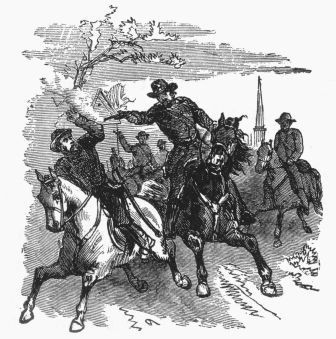
RUN DOWN BY CAVALRY.
CHAPTER XI.
Webster Fraternizes with the Rebel Officers.—A Secession Hat.—A Visit to a Rebel Camp.—"The Committee of Safety."—A Friendly Stranger.—A Warning.—The Escape.
Webster's new friends were men whom he believed he could use to good advantage, and he determined to improve the chance that had thrown him in contact with them. He found them not only very well informed, but disposed to be communicative, and he therefore applied the "pumping" process with all the skill at his command. He experienced no difficulty in making this mode of operation effectual, for these officers were exceedingly willing to air their knowledge for the benefit of their Baltimore friend, and enjoyed his frequent expressions of agreeable surprise at the extent of the preparations made by the people of the South to defend their rights.
Dr. Burton was the most conspicuous one of the group, from his very pompousness. He wore a superfluity of gorgeous gold lace on his uniform, and assumed the dignity of a major-general. He was a flabby-faced, bulbous-eyed individual, with a wonderful stomach for harboring liquor, and that unceasing flow of spirits arising from a magnified sense of his own importance. It was evident, even upon a short acquaintance, that the doctor found his chief entertainment in listening to himself talk, a species of recreation in which he indulged with great regularity, sharing the pleasure with as many others as would grant him a hearing.
In Webster he found an attentive auditor, which so flattered his vanity that he at once formed a strong attachment for my operative, and placed himself on familiar and confidential terms with him.
"Webster, we've got to do some hard fighting in these parts, and that before we are many days older," said the Doctor, with a wise shake of the head.
"I think you are right," conceded the scout. "We must fight it out. From what you have told me, however, I am sure the Lincoln troops will find you fully prepared to give them a warm reception here."
"That they will, sir; that they will!" was the emphatic rejoinder. "We have one full regiment and four or five companies besides, at Camp Rector, and General Pillow has thirty-seven hundred men at the camp in the rear of Fort Harris, which is a little above us on this side of the river. We expect to move with him, and if there is an attack made upon us every man in the town will instantly become a soldier."
"Have you arms enough for all of them?"
"Arms? Let the Yankees count on our not having arms, and they will meet with a surprise party. In two hours' notice we can have from eight to ten thousand men ready to march."
"No doubt of it, Doctor; but how do you expect to get two hours' notice?"
"Lord bless you, Webster, we have men watching the movements of the Yankees at Cairo, and the minute they make a move we are notified. Then our signal gun is fired, and every man is mustered."
"A good arrangement, truly," said the detective quietly.
"You look as if you could do some hard fighting yourself, Mr. Webster," remarked Colonel Dalgetty.
The detective smiled.
"I have been fighting against great odds for the past two months in Baltimore. The last battle I fought was to get away from there with my life."
"Yes, and we are confounded glad to receive you here," exclaimed the enthusiastic Doctor, shaking Webster by the hand for the twentieth time. "Come, gentlemen, we must have another drink. Step up and nominate your 'pizen.'"
The glasses were filled, and some one proposed the toast: "Death to the Yankees!" Under his breath, however, the detective muttered, "Confusion to the rebels!" and drained his glass. The toast was no sooner drank than Lieutenant Stanley, who was evidently beginning to feel the influence of the liquor he had drank, took off his uniform hat and put it on Webster's head.
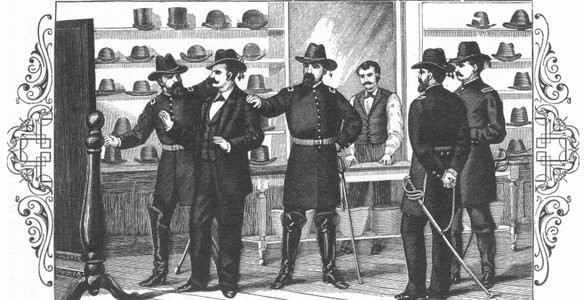
"Now, my dear fellow, you can consider yourself perfectly at home!" P. 171.
"Excuse me, Mr. Webster," he said, "I merely wish to see how you look in one of our hats." Then stepping back, he added: "By the gods, nothing could be more becoming! My dear fellow, you must have one by all means, if you stay among us."
Webster endeavored laughingly to object, but they all refused to accept "no" for an answer. So, finding it impossible to resist, he went with them to a neighboring hat store.
"Fit a hat to Mr. Webster's head—a hat just like mine," said Dr. Burton, to the proprietor; then turning to the scout, he added: "We will have you a cord and tassel of blue, as that will show that you are true to the cause, although you do not belong to the military."
The hatter produced a secession chapeau of the kind and size required, and Webster at once put it on, much to the delight of the Doctor, who slapped Webster familiarly on the shoulder, with the exclamation:
"Now, my dear fellow, you can consider yourself at home!"
"Perfectly at home," echoed Colonel Dalgetty.
"Henceforward you are one of us," put in the Lieutenant.
Webster thanked them cordially for their kindness, and promised to wear it in preference to any other. As they stepped outside of the store, however, all thoughts of the new hat were temporarily driven from his mind, for, standing on the sidewalk, within a few yards of the store door, and looking directly at him, was the identical individual whom he had noticed on the train, who had arrested the Northern stranger the night before.
The gaze which this vigilant agent of the safety committee now bent upon Webster was full of dark suspicion, but after one swift glance at him the detective turned away with an air of perfect composure and unconcern, and walked off between his companions. To say that he felt some uneasiness at this evidence that he was still being closely followed, would be only to tell the truth. His first impulse was to speak to his companions about it, but a second thought decided him not to mention the matter to any one, nor to betray by word or act that he had the slightest hint of a suspicion that he was being watched.
The three officers introduced Webster to a large number of soldiers and citizens, and before the day was over he had quite an extended circle of acquaintance in Memphis. Dr. Burton, who had conceived a fancy for him, as sudden as it was pronounced, assumed a sort of paternal control over Webster, hovering about him with an air of protection and solicitude, and drawing the scout's arm through his when they walked together.
That afternoon, Webster, desiring to be alone for awhile, hired one of the hackmen at the door of the hotel to drive him three or four miles into the country. He went down the river road, and as it was a beautiful day, he enjoyed himself admiring the picturesque scenery along the way.
Just below the town, on the bank of the river, he found a small encampment of soldiers with a battery, who were on the lookout for boats coming up the river, and during his ride he saw several encampments of the same nature. After spending several hours inspecting the fortifications along the river, Webster returned to the hotel, which he reached about dark.
The next day Doctor Burton and several of his military friends sought out the detective, and urged him to go with them to Camp Rector.
"Gentlemen, I am at your service," said Webster, earnestly. "I think I would enjoy a visit to your camp to-day above all things."
They went to the levee, and at ten o'clock were on the boat, steaming up the river toward Mound City, where Camp Rector was located.
A distance of some six or seven miles, passing on their way up, various objects of interest, among them Fort Harris, which was merely an embankment thrown up, to answer the purpose. Arriving at Mound City, the party disembarked and walked to the hotel. After dinner the party visited the camp-ground, a distance of about one-fourth of a mile from the hotel, and here Dr. Burton and the other officers took much pride in showing Webster around. They talked volubly about the unexampled bravery of the Confederate soldier; had much to say on the subject of Southern chivalry as opposed to Northern braggadocio; told how well they were prepared to meet the onslaught of the enemy; and found a special delight in exhibiting to the visitor a portion of General Bragg's artillery, which they had in the camp.
After that they seated themselves around a table in one of the larger tents, to rest and enjoy the grateful shade, as it was a warm and sunny afternoon. While engaged in the most bombastic utterances of their prowess, and of the wonderful exploits that might be expected of the Southern army, their conversation was interrupted by a shadow falling across the strip of sunlight that streamed in through the opening of the tent. Every one around the table glanced up, and there at the entrance stood the man with the broad-brimmed hat! The intruder did not tarry a moment, but turned and walked away. Evidently he had stopped only to look in; but in that single instant he had shot a keen, and apparently satisfactory, glance at Timothy Webster, which was fortunately not observed by any one save the detective himself.
"That fellow is one of the safety committee," said Dr. Burton, filling his glass.
"He appears to be looking for some one," remarked Lieutenant Stanley.
"Reckon he is," answered the Doctor. "He's always looking for some one. And, by-the-bye, those chaps are doing a heap of good for the cause just now. A Northern man stands no show for his life in these parts if the safety committee spots him. They hang 'em on suspicion."
"That's right," said Webster, coolly. "I believe in hanging every Northern man that comes prowling around. They don't deserve a trial, for they have no right here anyway."
But cool and collected as Webster outwardly appeared, it must be admitted that he was inwardly ill at ease. There was now no longer the shadow of a doubt in his mind that this long-haired agent of the safety committee was following him and watching his every movement, and that any attempt on his part to return to the North would betray him and cause his arrest.
"The only reason I have not already been arrested," mused the scout, "is because they are not sure whether I came from the North or not. They merely suspect, and are watching me to see if I undertake to return northward. Such an act would confirm their suspicions, and I would be arrested and probably put to death as a spy. It stands me in hand to give them the slip before I take the back track."
After spending a very pleasant day at the camp, he returned to Memphis on the latest boat that night, informing Dr. Burton that he was going to Chattanooga to look up a brother whom he had not seen in twelve years.
"You'll come back?" said the Doctor, as he wrung his hand.
"Oh, certainly," was the cheerful response. "I'll be with you again before long."
Colonel Gaines, of the artillery, who heard this conversation, now grasped the scout's hand.
"Webster, you'd make a good soldier," he said, bluntly. "Hang me if I wouldn't like to have you on my force."
Webster smiled good-naturedly.
"I have some family business to attend to before I could think of entering the army. After that I may remind you of your remark."
"All right," said the Colonel, "any time that you are ready, come; I will make room for you."
On his way down the river Webster found, to his relief, that the man with the broad-brimmed hat was not aboard the boats. He now had a hope of being able to give his shadow the slip by leaving Memphis on early train in the morning.
Arriving in sight of their destination, the passengers on the ferry-boat were surprised to see that the levee was crowded with people. Shortly after, they learned that this unusual gathering was caused by the capture of the steamboat "Prince of Wales" by the rebels.
Webster went to the Worsham Hotel, where he spent the night, and at five o'clock in the morning, after making a few preparations, and dispatching an early breakfast, he repaired to the depot. Arriving there he looked carefully about on all sides, but saw no one who seemed to take any interest in his movements. "So far, so good," he muttered, as he boarded the train; and the next minute he was leaving the scene of his most recent exploits with the speed of the wind.
He was himself too shrewd and cunning to feel absolutely sure that he was not followed. His own experience in the art of "shadowing" told him he had not yet escaped the vigilant eyes of the safety committee, but he resolved to elude them if it was possible to do so.
Innumerable troops were being transported at this time, and the train was crowded with soldiers. Webster amused himself by making the acquaintance of the officers, and skillfully drawing on their fund of information, until the train arrived at Grand Junction, where he decided to change cars for Jackson, Tennessee.
Accordingly, he abandoned the Chattanooga cars and boarded the north-bound train, which was in waiting at the junction, and again he was whirled away across the verdure-clad country, this time toward the "land of the free." But no sooner was the train well under way than something which came under Webster's observation removed from his mind all doubt as to whether he would be permitted to pursue his journey unmolested. He occupied a seat in the forward part of the car, and on turning carelessly away from the window after gazing out upon the landscape for awhile, he was somewhat surprised at seeing an individual standing on the front platform of the car, looking in through the glass door.
It was a person whose face and figure had already become quite familiar to him, being no other than the man who had so persistently followed him for the past few days.
"He seems determined not to let me get away," thought the scout; but neither in his face nor manner did he betray any of the disappointment he felt.
He noticed that his pursuer was not alone this time, but was accompanied by another person—an ill-looking man of herculean proportions—with whom he conversed in an earnest, confidential way.
When the train arrived at Jackson, Webster stepped out upon the platform of the depot, and the two agents of the safety committee did the same. The conductor stood near by, and Webster spoke to him in a tone which he meant his shadows to hear, asking:
"How soon will there be a train for Humboldt?"
"In twenty minutes," replied the conductor.
"Do you know anything about the hotels there?" inquired the scout. "I've got to stop two or three days in the town, and it's a strange place to me."
The conductor recommended him to a good house convenient to the depot, and thanking him for the information, Webster turned away. He had spoken in a tone that he knew must have been distinctly heard by his enemies, and he hoped this bit of stratagem would have the desired effect.
He boarded the train for Humboldt, and the brace of shadows promptly followed him, taking seats in the same car.
While the train was speeding on its way, Webster was aroused from a reverie by the voice of a woman saying:
"Pardon me, sir; may I occupy a portion of this seat?"
He looked up; a tall, very respectable looking lady was standing in the aisle, and he saw in an instant that she was the person who had addressed him.
"Certainly, madam, certainly;" he replied; and quickly made room for her.
She sat down beside him, and then, to his great surprise, she began to talk to him in a low, earnest tone, without once turning her face toward him.
"You are going to Humboldt?" she inquired.
"I am," he answered, surprised at the question.
"You are a Northern man?"
"Madam!" A suspicion flashed, lightning-like, across his mind.
"Believe me, I am not an enemy," the lady went on, "I have been sitting in the rear part of this car I heard two men talking, and have reason to believe they were speaking about you. They said they would stop at the same hotel with you in Humboldt, and keep a close watch over you, and if you attempt to go northward they will arrest you, take you back to Memphis, and deal with you as they would with any Northern spy. I advise you to be very careful, sir, for your life depends upon it."
The train by this time was approaching Humboldt, and the lady arose and disappeared before the astonished detective could tender his thanks for the warning. She was destined to remain an utter stranger to him for all time to come, for he never heard of her afterwards. As they entered the depot, Webster passed out at the rear end of the car, and he noticed, with a smile of satisfaction, that his attendant shadows were making their way out at the front. As he stepped from the car he noticed a pile of baggage near him, and quickly stepping behind this, he watched the movements of the two men. Apparently fully satisfied that their game would be safely bagged at the hotel, they left the depot and walked rapidly away in the direction of the public-house. His ruse worked to a charm. A violent shower happened to be passing over at this time, and it was only natural for the two "safety" men to suppose that Webster had stopped to seek shelter in the depot for a few minutes.
The express train from Memphis was soon due, and as it came dashing in "on time," Webster jumped aboard, and was on his way toward Louisville, smiling in his sleeve as he thought of those two crafty foxes, whose cunning had overreached themselves, patiently awaiting his arrival at the hotel in Humboldt.
Before crossing the Kentucky line, Webster put his rebel hat out of sight, and once more donned the one he had worn from the North.
The remainder of his journey was made without incident, and in due time he arrived in Cincinnati, and reported to me.
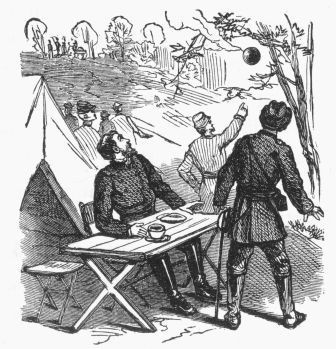
A HOT LUNCH.
CHAPTER XII.
I take a Trip to the South.—Danger in Memphis.—A Timely Warning.—A Persistent Barber.—An Unfortunate Memory.—Return to Cincinnati.
Timothy Webster had scarcely departed upon his trip to Memphis, when I was summoned for consultation with General McClellan. Upon repairing to his office, which I did immediately on receiving his message, I found him awaiting my arrival, and in a few minutes I was informed of his wishes. He was desirous of ascertaining, as definitely as possible, the general feeling of the people residing South of the Ohio river, in Kentucky, Tennessee, Mississippi and Louisiana, and requested that measures be at once taken to carry out his purposes.
It was essentially necessary at the outset to become acquainted with all the facts that might be of importance hereafter, and no time offered such opportunities for investigations of this nature as the present, while the war movement was in its incipiency, and before the lines between the opposing forces had been so closely drawn as to render traveling in the disaffected district unsafe, if not utterly impossible.
As this mission was of a character that required coolness and tact, as well as courage, and as most of my men had been detailed for duties in other sections of the rebellious country, I concluded to make the journey myself, and at once stated my intention to the General, who received it with every evidence of satisfaction and approval.
"The very thing I should have proposed, Major," said he; "and if you will undertake this matter, I have no fears of a failure, and every confidence in obtaining important developments."
My action had been prompted by two impelling reasons. The first was the absence of the men whom I had thus far engaged, and who, as I have before stated, had been detailed upon missions of investigations in various parts of the South and West, and the other was a desire to see for myself the actual condition of affairs as they existed at that time. I have invariably found that a personal knowledge is far more satisfactory than that gleamed from others, and whenever it was possible, I have endeavored to acquire my information by such means. Another advantage to be derived from a personal observation was that I would be necessarily forced to rely in many matters to which it would be impossible for me to devote my personal attention.
Having arranged everything to my satisfaction, in order that my absence would occasion no disarrangement in the proper conduct of the investigations already commenced, I left my office in the charge of Mr. George H. Bangs, my general superintendent, and started upon my journey, intending to be as rapid in my movements as circumstances would permit, and to return at as early a date as I could, consistently with the proper performance of the duties intrusted to me.
My first objective point was the city of Louisville, in Kentucky. The position of this State at the present time was a peculiar one. Her Governor, if not a Southern conspirator, was, if his own language was to be relied upon, both in opinion and expectation, a disunionist. He had at first remonstrated against the action of the Cotton States, but after that action had been taken, he was unqualifiedly opposed to coercing them back to obedience, and in addition to this, he had endeavored to excite his own people to a resistance to the principles and policy of the party in power.
The people, however, did not sustain his views, and while the popular sentiment was deeply pro-slavery, and while her commerce bound her strongly to the South, the patriotic example and teachings of Henry Clay had impressed upon them a reverence and love for Union higher and purer than any mere pressing interests or selfish advantage.
At Louisville, therefore, I found a degree of excitement prevailing that was naturally to be expected from the unsettled condition of public affairs. The Governor had refused to comply with the President's call for troops, and the State had been in a state of hopeless bewilderment and conflict of opinion in consequence. A strong minority, arrogating to themselves an undue importance, were endeavoring, by self-assertion and misapplied zeal, to carry the State into the secession fold, but thus far they had made no substantial progress against an overwhelming undercurrent of Union sentiment. Failing in this, their energies were now devoted to an effort to place the State in a neutral attitude, which would prevent her from taking a decided stand upon the question of supporting the Union. Thus far they had been temporarily successful, and on the 16th day of May the house of representatives passed resolutions declaring that Kentucky "should during the contest occupy the position of strict neutrality."
This was the existing condition of affairs when I arrived in Louisville, and which I found prevalent throughout all the sections of the State I passed.
Representing myself as a Southern man, a resident of Georgia, I had no difficulty in engaging in conversation with the prominent men of both elements, and I decided then, from my own observations, that Kentucky would not cast her fortunes with the South, but that, after the bubble of unnatural excitement had burst and expended itself, the loyal heart would be touched, and "Old Kaintuck" would eventually keep step to the music of the Union. Results proved that I was not mistaken, and not many weeks elapsed before Union camps were established within her domain, and the broad-shouldered Kentuckians were swearing allegiance to the old flag, and, shouldering their muskets, entered into the contest with a determination to support the government.
Passing on undisturbed, but everywhere on the alert, and making copious notes of everything that transpired, that I considered at all material to the furtherance of the loyal cause, I reached Bowling Green.
At this place I found a very decided Union sentiment, the Stars and Stripes were floating from the various buildings, and the Union men were largely in the majority. There was one great cause for disquietude, however, which was very manifest even to a casual observer. Many residents of Bowling Green and the vicinity were slave owners, and the impression had become general throughout the negro communities that the opening of the war naturally and inevitably involved their freedom, an opinion, however, without sure foundation, at that time, but which was eventually to be justified by subsequent events. The slaves had heard their masters discussing the various questions which naturally grew out of a conflict of this chance character, and in which it was generally admitted, that emancipation must follow the commencement and continuance of hostilities between the two sections. It was not surprising therefore, that this opinion should spread among the entire colored element, or that it should be greedily accepted by these down-trodden blacks as the harbinger of a freedom for which they had been praying. In conversation with one of the leading men of Bowling Green, I was thoroughly impressed with the importance of this phase of circumstances.
"Mr. Allen," said he, "you have no idea of the danger we are apprehending from the blacks. We know that the moment that Lincoln sends his abolition soldiers among our niggers, they will break out and murder all before them. Why, sir," continued he, "we cannot sleep sound at nights for fear of the niggers. They think Lincoln is going to set them free."
"Why," I interrupted, "what can they know about Lincoln?"
"They know too much about him," he replied; "there has been so much talk about this matter all through the State, that the niggers know as much about it as we do."
"You should not talk before your niggers; it is not safe, and I never do it." As I never owned a negro this was perfectly true.
"I know we should not, but it is too late now; they know as much as we do, and too much for our safety or peace of mind. Why, sir, we are compelled to mount guard at nights ourselves for mutual protection, and though there has been no outbreak as yet, and I believe that this is the only thing that keeps them in check."
"It would be a good plan," said I, anxious to preserve my reputation as a Southern pro-slavery man, "to take all the men and boys over fifteen years of age and sell them South."
"That's the devil of it," he replied, "we cannot do that; it was tried only last week, and a nigger that I was offered $1,500 for last year, I could not sell at any price."
Already, it seemed, the fruits of the slavery agitation were being made apparent. The very institution for which these misguided men were periling their lives, and sacrificing their fortunes, was threatened with demolition; and the slaves who had so long and so often felt the lash of their masters, were now becoming a source of fear to the very men who had heretofore held them in such utter subjection.
This state of affairs I found to be prevalent all over the country which I visited. Bright visions of freedom danced before the eyes of the slaves, and they awaited anxiously the dawning of the day, when the coming of the soldiers of the North would strike from their limbs the shackles they had worn so long. In the after years of this bloody struggle, many deeds of self-sacrifice were performed by these slaves, when, resisting the dazzling opportunities to obtain their coveted liberty, they cast their lot with the families of their old masters, whose male members were fighting to continue their bondage. Many cases could be cited where, but for the faithful labors and devotion of the despised slave, the families of many of the proud aristocrats would have starved. But the faithful heart of the negro ever beat warmly for those whom he had served so long, and disregarding the tempting allurements of freedom, he devoted himself to the service and to the maintenance of those who had regarded him as so much merchandise, or simply as a beast of burden.
At Bowling Green I purchased a splendid bay horse, whose swiftness and powers of endurance I felt assured could be relied upon, intending to make the rest of my journey on horseback. By this means I would be the better able to control my movements than if I were compelled to depend upon the railroads for transportation. I would also be enabled to stop at any place where I might find the necessity, or a favorable opportunity for observation. I had no cause to regret the purchase I had made, for right nobly did the spirited animal which I had selected perform the arduous duties that were imposed upon him. Day after day he would be urged forward, and under his flying feet the distance sped away almost imperceptibly, and each morning found my charger rested and refreshed, and ready for the day's journey, be the weather fair or foul, or the roads easy or rugged.
I reached Nashville, Tennessee, in due season, and resolved to devote several days to my investigations. Here the disunion element was more united and outspoken, but even here, I detected evidences of a Union sentiment which was none the less profound, because of the danger which its utterances would have incurred. There could be no doubt that this State had resolved to cast her fortunes with the confederacy, and the rebel General Pillow had been for some time engaged in fortifying the city of Memphis. At Nashville I met a number of officers of the rebel army, all of whom were full of enthusiasm, and whose bombastic utterances in view of the eventual results, seem at this time almost too absurd to be repeated. Here also I came in contact with an army surgeon, whose head was full of wild Quixotic schemes for destroying the Northern armies by other processes than that of legitimate warfare. One of his plans I remember was to fill a commissary wagon with whisky, in which had been previously mixed a generous quantity of strychnine. The wagon was then to be broken and abandoned and left upon the road so as to fall into the hands of the Union soldiers. Of course, the liquor would be consumed by the finders, and the valiant Doctor, with evident satisfaction to himself, but to the equally evident disgust of his companions, loudly vaunted his death-dealing and barbarous scheme. This brave warrior, however, I learned afterward, had fled in terror at the first fire, and was afterwards dishonorably dismissed from the service he was so well calculated to disgrace. So far as I was afterward able to learn, this grand project for wholesale slaughter, of the valorous Doctor, received no sympathy or support from his more honorable associates, and the soldiers were enabled to drink their whiskey untainted with any other poisonous influences than is naturally a part of its composition.
Leaving Nashville, I spurred on in the direction of Memphis, and in due time reached the city, which now presented a far different aspect than when I visited it only a few years before. Then the country was at peace. The war cloud had not burst with all its fury over a happy land, and the people were quietly pursuing their avocations. I was engaged in a detective operation which required my presence in the city, and had been in consultation with some of the express company's officials, for whom I was attempting to discover the perpetrators of a robbery of one of their safes. Turning a corner I came upon a scene that stirred my feelings to the utmost.
It was the market square, and the merchandise disposed of were human beings. There was the auction-block and the slave-pen. Men, women and children were being knocked down to the highest bidder. Wives were sold away from their husbands, and children from their parents. Old and young were submitted to the vulgar speculators in flesh and blood, and their value was approximated by their apparent age, strength and healthfulness. My blood boiled in my veins as I witnessed, for the first time, the heart-rendering scenes which I had only heard or read of before. The cold cruelty of the buyers and abject misery of the sold, filled me with a spirit of opposition to this vile traffic that gave me renewed strength to fulfill my duty as an active abolitionist, and to labor earnestly in the cause of emancipation. I shall never forget the events of that day, and I can recall the feeling of intense satisfaction which I experienced on my second visit, when even then, I could see the dawning of that liberty for which I had labored, and I knew that the day of emancipation could not be far distant. Then the fair fame of independent America would no longer be blackened by the pressure of the slave or the master, but all men under the protection of the starry banner would be free and equal under the law.
Now the streets were filled with soldiers, some of them fully armed and equipped, and others provided with but ordinary clothing, and furnished with such inefficient arms as they had brought with them from their homes. A most motley gathering they were, and their awkward and irregular evolutions at this time gave but little promise of the splendid army of which they were destined in the near future to form so important a part. The work of fortifying the city had been progressing in earnest; earthworks had been thrown up all along the banks of the Mississippi, and batteries were already in position, whose guns frowned threateningly upon the river.
Here to be known or suspected as a Union man was to merit certain death, and to advocate any theory of compromise between the two sections was to be exiled from the city. Here rebeldom was rampant and defiant, and I had some difficulty in evading the suspicions of the watchful and alert Southron, who regarded all strange civilians with doubtful scrutiny, and whose "committee of safety" were ever on the qui vive to detect those whose actions savored in the least of a leaning towards the North. Fearlessly, however, I mingled with these men, and as I lost no opportunity in pronouncing my views upon the righteousness of the cause of secession, and of my belief in its certain triumph, I obtained a ready passport to the favor and confidence of the most prominent of their leaders. I talked unreservedly with the private soldier and the general officer, with the merchant and the citizen, and by all was regarded as a stanch Southern man, whose interests and sympathies were wedded to rebellion.
General Pillow was in command at this point, and almost every citizen was enrolled as a soldier, whose services would be cheerfully and promptly rendered whenever the call should be made upon them.
Even this redoubtable chieftain was not proof against my blandishments, and he little dreamed when on one occasion he quietly sipped his brandy and water with me, that he was giving valuable information to his sworn foe, and one to whom every idea gained was an advantage to the government he was attempting to destroy.
It is needless to relate the valuable items of information which I was enabled to glean upon this journey—information which in later days was of vast importance to the Union commanders, but which at this time would only burden a narrative of the events which they so ably assisted to successful results.
Here, as in many other places, I found that my best source of information was the colored men, who were employed in various capacities of a military nature which entailed hard labor. The slaves, without reserve, were sent by their masters to perform the manual labor of building earthworks and fortifications, in driving the teams and in transporting cannon and ammunition, and, led by my natural and deep-seated regard for these sable bondsmen, I mingled freely with them, and found them ever ready to answer questions and to furnish me with every fact which I desired to possess.
Here and there I found an unassuming white man whose heart was still with the cause of the Union, but whose active sympathy could not at this time be of service to the country, as he dared not utter a voice in defense of his opinions. From all these sources, however, I was successful in posting myself fully in regard to the movements and intentions of the rebel authorities and officers, and, as I believed, had also succeeded in concealing my identity.

"Fo' God, Massa Allen, ye'll be a dead man in de mo'nin'!" P. 195.
On the third evening of my sojourn in Memphis, however, my dreams of fancied security were suddenly dispelled, and I was brought face to face with the reality of danger.
I had retired early to my room, according to my general custom, and had scarcely been seated when I was disturbed by a faint but quick and distinct knocking at my door. I arose hastily, as it was something unusual for me to receive visitors after I had retired, and throwing open the door, I was somewhat surprised to see, standing before me, in a state of unmistakable excitement, the colored porter of the hotel.
Before I had time to question him, he sprang into the room and closed the door behind him. His countenance evinced a degree of terror that immediately filled me with alarm. His eyes were fixed wildly upon me, his lips were quivering, and his knees trembled under him, as though unable to sustain the weight of his body. Indeed, so frightened was he, that he appeared to be struggling forcibly to do so.
"What is the matter, Jem?" I inquired, in as calm a tone as I could assume, and with a view of reassuring him. "What has happened to frighten you so?"
"'Fore God, Massa Allen," ejaculated the black, succeeding by a great effort in finding his voice, "you done can't sleep in this housn to-night, ef ye do, ye'll be a dead man before morning."
As may be imagined, this information was not of a very agreeable nature, indefinite as it was; I felt assured that my informant could be relied on that something had occurred to endanger my safety, and I became impatient to learn what he knew.
"Out with it, Jem," said I, "and let me know what it is all about." I spoke cheerfully and confidently, and the coolness of my manner had the effect of restoring the equilibrium of my sable friend, and, recovering himself with an effort, he began to explain:
"I tell you what it is, Massa Allen, and I'se gwan to tell it mighty quick. Ye see, de General hab got a lot of spies up de river at Cairo, a watching of the Linkum sogers, and one o' dem fellows jes came in as you were going up stairs. De berry minit dat he seed you he said to de man what was wid him, 'Dat man is 'spicious; I seed him in Cincinnati two weeks ago, and he ain't down here for no good,' and he started right off for de General, to tell him all about it. I kem right up heah, massa, and you must git away as fast as ye can."
This was too important to be ignored. I had no desire to be captured at that time, and I had no doubt of the correctness of the porter's story. I resolved to act at once upon the suggestion, and to make good my escape before it was too late. My admonitory friend was fearfully in earnest about getting me away, and he quickly volunteered to procure my horse, which I had quartered in close proximity to the hotel, and to furnish me with a guide who would see me safely through the lines and outside of the city. Bidding Jem make all possible haste in his movements, I gathered together my few belongings, and in a few minutes I descended the stairs and made my exit through the rear of the house. Through the faithfulness of Jem, and the careful guidance of the watchful negro he had provided me with, I was soon riding away from threatened danger and ere morning broke I had proceeded far upon my way. How much service these faithful blacks had been to me, I did not fully learn until some time afterwards, when I was informed by Timothy Webster, who arrived in Memphis following my departure, and who thus learned the full particulars of the exhausting pursuit of one of Lincoln's spies, who had mysteriously disappeared from the chief hotel, while a guard was being detailed to effect his arrest.
I met the faithful Jem several years later, when he had worked his way as a refugee from his native State and entered the Union lines in Virginia, and he was soon afterwards attached to my force, where he proved his devotion in a manner that was quite convincing. My faithful steed, who had become thoroughly rested after his long journey, bore me safely through this danger, and in due time I entered the State of Mississippi. Here rebellion and disunion were the order of the day, and a widespread determination existed to fight the cause of the South to the bitter end. Stopping one night at Grenada, I pushed on my way to Jackson, and here I resolved to remain a day or two, in order to make a thorough investigation of the place and its surroundings.
Putting up my horse, I engaged quarters for myself at the principal hotel in the city, and feeling very much fatigued with my long journey, I retired early to my room and passed a long night in refreshing sleep.
In the morning I arose about five o'clock, as is my general custom. I was feeling in excellent health and spirits; my journey had thus far been fully as successful as I could have desired; and safely concealed about my person I had items of value that would amply repay me for the fatigues I had undergone and the dangers I had passed. I had plans of the roads, a description of the country, a pretty correct estimate of the troops and their various locations and conditions, and altogether I felt very well satisfied with myself and with the results of my mission.
As I descended the stairs, I noticed a fine soldierly officer standing in the doorway, and after bidding him a hearty good-morning, I invited him to accompany me to the saloon of the hotel, where we mutually indulged in a decoction as is the universal custom in Southern cities. After I had obtained my breakfast, it occurred to me that, before attempting any active measures for the day, I owed it to myself to procure the services of a barber for a much-needed shave. I had been traveling for a number of days, and my face had been a stranger to a razor for a long time, and I concluded I would be more presentable if I consulted a tonsorial artist.
This was an unfortunate idea, and I soon had occasion to regret having entertained it for a moment. I would have been far more contented if I had bestowed no thoughts upon my grizzled beard, and allowed nature to take its course with my hirsute appendage.
Entirely unconscious, however, of what was in store for me, I entered the well-fitted saloon of the hotel, and patiently waited my turn to submit myself to the deft fingers of the knight of the razor.
In response to the universal and well-understood call of "next!" I took my seat in the luxuriously upholstered chair, and in a few minutes my face was covered with the foamy lather applied by the dapper little German into whose hands I had fallen.
I noticed when I sat down that the man wore a puzzled and speculative look, as though he was struggling with some vexing lapse of memory, and as he drew the keen edge of the razor across my face, his eyes were fixed intensely upon my features. His manner annoyed me considerably, and I was at a loss to account for his strange demeanor. Whatever ideas I may have entertained with regard to this singular action were, however, soon set at rest, only to give place to a feeling of unrestful anger.
He had just cleared one side of my face of its stubby growth of hair, when a smile irradiated his face, and with a look of self-satisfied recognition and pride, he addressed me:
"Vy, how do you do, Mr. Bingerdon?"
Had a thunderbolt fallen at my feet I could not have been more perfectly amazed, and for a moment I could scarcely tell whether I was afoot or on horseback. I devoutly wished that I was anywhere than with this Dutch barber, whose memory was so uncomfortably retentive.
I had been too accustomed to sudden surprises, however, to lose my self-control, and I replied to him, with an unmoved face and as stern a voice as I could command:
"I am not Mr. Bingerdon, and I don't know the man."
"Oh yes, your name is Bingerdon, and you leev in Geecago."
The face of the German was so good-natured, and he appeared quite delighted at recognizing me, but for myself I was feeling very uncomfortable indeed. I did not know the man, nor what he knew of me. I knew, however, that he was perfectly right about my identity, and I knew also that it would be very dangerous for his knowledge to become general.
"I tell you I don't know the man you are speaking of," said I, sternly.
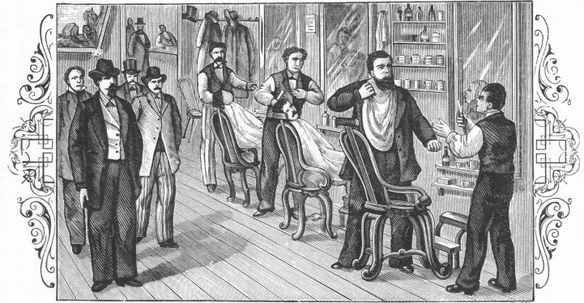
"If you say another word to me, I'll whip you on the spot." P. 201.
"Oy, Mr. Bingerdon," he replied, in a grieved tone, "I know you well. Don't you mind me shaving you in the Sherman House in Geecago, you was a customer of mine."
The pertinacity of the man was simply exasperating, and fearing that his memory would be likely to get me into trouble, as several people were listening to our conversation, I resolved to end the difficulty at once. Jerking the towel from around my neck and wiping the lather from the unshaved portion of my face, I leapt from the chair, exclaiming angrily:
"I tell you I know nothing of you Mr. Bingerdon, or any other d——d Yankee abolitionist, and if you say another word to me upon this subject, I'll whip you on the spot!"
The barber presented a most ridiculous appearance; he was utterly frightened at my manner, and yet so convinced was he that I was the man he took me for, that he appeared more amazed at my denial, than at my threats of violence.
Meanwhile, the occupants of the saloon began to crowd around us, and several came in from the adjoining rooms. Turning to them with well-simulated anger, I told them the story I had invented; I lived near Augusta, Georgia; never was in Chicago, did not know Mr. Pinkerton or any of his gang. Then I denounced the discomfited barber in round terms, and finished by inviting the entire crowd to take a drink with me.
This they all did with alacrity, and by the time they had drained their glasses, every one of the party were strong adherents of mine. We then returned to the barber-shop, and so thoroughly was the crowd convinced of my truthfulness, that they were eager to punish the innocent occasion of my anger. One impetuous individual wanted to hang him on sight, and his proposition was received with general favor; but finding I had succeeded in evading detection for myself, I interfered in the poor fellow's behalf and he was finally let off.
After another drink all round I managed to get away from the party, and it was not long before I was upon my horse, and traveling away from the possibility of a recurrence of such an accidental discovery. I procured a razor and shaving materials, and performed that operation for myself, as I did not care to excite curiosity by exhibiting my half-shaved face to any more inquisitive barbers.
A few miles outside of the town I sold my horse, and concluding that I had obtained as much information as was desirable at that time, and as I had already been absent from headquarters longer than I had intended, I made my way back to Cincinnati by a circuitous route, and reached there in safety, well pleased with my work, and quite rejoiced to find that General McClellan was fully satisfied with what I had learned.
CHAPTER XIII.
East and West Virginia.—Seceding from Secession.—My Scouts in Virginia.—A Rebel Captain Entertains "My Lord."—An old Justice Dines with Royalty.—A Lucky Adventure.—A Runaway Horse.—A Rescue.
At this time the condition of affairs in the State of Virginia—the "Old Dominion," as it was generally denominated—presented a most perplexing and vexatious problem. The antagonistic position of the two sections of that state demanded early consideration and prompt action on the part of the Federal Government, both in protecting the loyal people in the Western section, and of preserving their territory to the Union cause. Within the borders of this commonwealth there existed two elements, directly opposed to each other, and both equally pronounced in the declaration of their political opinions. The lines of demarkation between these diverse communities were the Allegheny Mountains, which extended through the very middle of the state, from north-east to south-west, and divided her territory into two divisions, slightly unequal in size, but evidently different in topographical features and personal characteristics.
From the nature of its earlier settlement, and by reason of climate, soil and situation, Eastern Virginia remained the region of large plantations, with a heavy slave population, and of profitable agriculture, especially in the production of tobacco. West Virginia, on the contrary, having been first settled by hunters, pioneers, lumbermen and miners, possessed little in common with her more wealthy and aristocratic neighbors beyond the mountains. They made their homes in the wilds of the woods, and among the rocky formations, under which was hidden the wealth they were seeking to develop, and in time this western country became the seat of a busy manufacturing industry, with a diversified agriculture for local consumption, while the east was largely given up to the production of great staples for export. As a natural result, the population and wealth of the eastern portion, which was thus made to stand in the relation of a mere tributary province to her grasping neighbor, who selfishly absorbed the general taxes for local advantage.
The slave interest also entered largely into the creation and continuance of this antagonistic feeling. According to a census, which had been recently taken, it was ascertained that Eastern Virginia held but a few thousands. It was not a matter of surprise, therefore that secessionism should be rampant in the east, and that a Union sentiment should almost universally prevail in the west. As the institution of slavery was more or less the cause of the war, here, as in other parts of the South, secession reared its most formidable front where the slave interest predominated, and treason was more alert in the centers of accumulated wealth and family pride, whose foundations were laid by the suffering and the toil of the African bondsmen. The war had been waged to defend the "Divine institution," and it was scarcely to be expected that such a cause would be valiantly championed by men whose self-reliance and personal independence had endeared to them the rights of free and honorable manhood.
When the Convention of Virginia met to consider the question of secession, the slave-holding dignitaries were somewhat startled by the logical, but novel, declaration of one of the western members, that "the right of revolution can be exercised as well by a portion of the citizens of a State against their State government, as it can be exercised by the whole people of a State against their Federal Government." This was followed by another, more pointed and revolutionary, "that any change in the relation Virginia now sustains to the Federal Government, against the wishes of even a respectable minority of her people, would be sufficient to justify them in changing their relation to the State government by separating themselves from that section of the State that had thus wantonly disregarded their interests and defied their will."
The convention, however, denying the pertinency of this logic, passed its secret ordinance of secession on the 17th day of April, and within a week popular movements were on foot in the various towns and counties of Western Virginia, to effect a division of the State. The people united in a unanimous protest against the efforts of the slave-holding aristocrats to carry them into a cotton confederacy, and a determination to "secede from secession," was manifested everywhere. The loyal determination was rapidly followed by popular organization, an appeal for assistance was made to the government at Washington, who promised them countenance and support, and on the 13th day of May, delegates from twenty-five counties of West Virginia met at Wheeling, to devise such action as would enable them to fully and finally repudiate the treasonable revolt of East Virginia.
Many circumstances favored their position. The state of Ohio, immediately adjoining, was organizing her military force of volunteers, and Western Virginia was, not long after, attached to the department of the Ohio under command of General McClellan. The blockade of Washington, and other events, had operated to keep the Western troops on the Ohio line, and the Unionists of West Virginia found a protecting military force at once in their immediate vicinity, with a commanding officer who was instructed to give them every encouragement and support.
Meanwhile, Governor Letcher, of Virginia, ignoring the attitude assumed by the people of the West, had issued his proclamation calling for the organization of the state militia, and including Western Virginia in the call. Prompted by a spirit of arrogance or over-confidence, he at an early day dispatched officers to that locality to collect and organize the militia of Western Virginia. Owing to the sparsity of the population, and the hilly and mountainous situation of the country, there were but two principal localities or lines of travel, where a concentration of forces could be best effected—one of these being the line of the Baltimore and Ohio Railroad, and the other the valley of the Great Kanawha river. In these districts Governor Letcher sent his recruiting agents, but they soon returned reports of a very discouraging character. The rebel emissaries found the feeling very bitter: that Union organizations existed in most of the counties, and that while fragments of rebel companies were here and there springing up, it was very evident that no local force sufficient to hold the country, would respond to the Confederate appeal, while the close proximity of Union forces at several points along the Ohio, pointed to a short tenure of Confederate authority.
This information was not at all cheering to the rebel Governor of the State, and he determined to maintain his authority in the disaffected districts with armed forces from the eastern portion of the State. To accomplish this, he detailed a few available companies from Staunton to march toward Beverly, from which point they could menace and overawe the town of Grafton, the junction of the main stem of the Baltimore and Ohio Railroad, with its branches extending to Parkersburg and Wheeling. The inhabitants showed more alacrity, however, to take up arms for the government than for Governor Letcher or General Lee. A Union Western Virginia regiment, under the command of Colonel Kelley, began to gather recruits rapidly at Wheeling, while the rebel camps between Beverly and Grafton were comparatively deserted, and Colonel Porterfield, who had been sent under orders of Governor Letcher, found his efforts at recruiting decidedly unsuccessful.
On the 23rd day of May the State voted upon the ordinance of secession, and East Virginia, under complete military domination, accepted the ordinance, while West Virginia, comparatively free, voted to reject the idea of secession.
Immediately after the result was ascertained, the rebel troops became aggressive, and Colonel Porterfield dispatched several of his companies to burn the bridge on the Baltimore & Ohio Railroad.
The appearance of these troops was quickly brought to the notice of the Federal authorities at Washington. On the 24th day of May the Secretary of War and General Scott telegraphed this information to General McClellan, and inquired "whether its influence could not be counteracted." General McClellan at once replied in the affirmative, and this was the sole order he received from Washington regarding a campaign in Virginia.
On the 26th, the General ordered two regiments to cross the river at Wheeling, and two others at Parkersburg. They were to move forward simultaneously by the branch railroads from each of these points to their junction at Grafton. The burnt bridges were restored in their passage, and after a most brilliant strategic movement, Porterfield was completely surprised, and the rebels were forced to disperse, in utter rout and confusion.
This complete success of the first dash at the enemy had the most inspiriting effect upon the Union troops, and also encouraged and fortified the Western Virginia unionists, in their determination to break away from the East and to form a new State. This movement was successfully accomplished, and early in July they elected two United States senators, who were admitted to, and took part in the national legislature.
Governor Pierpont, who was head of this provisional State government, organized at Wheeling, made a formal application to the United States for aid to suppress the rebellion and protect the people against domestic violence. General McClellan, in furtherance of this object, ordered additional forces into the State from his department.
In order to act intelligently in the matter, it was necessary that some definite information should be derived respecting the country which was now to be protected, and from which it was necessary the invading rebels should be driven. For this purpose the General desired that I should dispatch several of my men, who, by assuming various and unsuspicious characters, would be able to travel over the country, obtain a correct idea of its topography, ascertain the exact position and designs of the secessionists.
For this duty I selected a man named Price Lewis, who had just returned from a trip to the South, and whom I had reason to be satisfied was equal to the task. I resolved, therefore, that he should be one of the party to make this journey, together with several others who were delegated for the same purpose. In order to afford variety to the professions of my operatives, and because of his fitness for the character, I decided that Price Lewis should represent himself as an Englishman traveling for pleasure, believing that he would thus escape a close scrutiny or a rigid examination, should he, by any accident, fall into the hands of the rebels.
Procuring a comfortable-looking road-wagon and a pair of strong gray horses, which were both substantial-looking and good roadsters, I stocked the vehicle with such articles of necessity and luxury as would enable them to subsist themselves if necessary, and at the same time give the appearance of truth to such professions as the sight-seeing Englishman might feel authorized to make. I provided him also with a number of English certificates of various kinds, and I also supplied him with English money which could be readily exchanged for such currency that would best suit his purposes in the several localities which he would be required to visit.
Lewis wore a full beard, and this was trimmed in the most approved English fashion, and when fully equipped for his journey he presented the appearance of a thorough well-to-do Englishman, who might even be suspected of having "blue blood" in his veins. In order that he might the more fully sustain the new character he was about to assume, and to give an added dignity to his position, I concluded to send with him a member of my force who would act in the capacity of coachman, groom and body servant, as occasion should demand. The man whom I selected for this role was a jolly, good-natured, and fearless Yankee named Samuel Bridgeman, a quick, sharp-witted young man, who had been in my employment some time, and who had on several occasions proved himself worthy of trust and confidence in matters that required tact as well as boldness, and good sense as well as keen wit.
Calling Sam into my office, I explained to him fully the nature of the duties he would be required to perform, and when I had concluded I saw by the merry twinkle in his eyes, and from the readiness with which he caught at my suggestions, that he thoroughly understood and had decided to carry out his part of the programme to the very letter.
In addition to these, I arranged a route for two other men of my force. They were to travel through the valley of the Great Kanawha river, and to observe carefully everything that came under their notice, which might be of importance in perfecting a military campaign, in case the rebels should attempt hostile measures, or that General McClellan might find it necessary to promptly clear that portion of Virginia from the presence of secession troops. These two men were to travel ostensibly as farm laborers, and their verdant appearance was made to fully conform to such avocations.
Everything being in readiness, the two parties were started, and we will follow their movements separately, as they were to travel by different routes.
Price Lewis, the pseudo Englishman, and Sam Bridgeman, who made quite a smart-looking valet in his new costume, transferred their horses, wagon and stores on board the trim little steamer "Cricket," at Cincinnati, intending to travel along the Ohio River, and effect a landing at Guyandotte, in Western Virginia, at which point they were to disembark and pursue their journey overland through the country.
I accompanied Lewis to the wharf, and after everything had been satisfactorily arranged, I bade him good-bye, and the little steamer sailed away up the river.
There were the usual number of miscellaneous passengers upon the boat, and added to these were a number of Union officers, who had been dispatched upon various missions throughout that portion of the State of Ohio. These men left the steamer as their points of destination were reached, and after they had departed, several of the passengers who had hitherto remained silent, became very talkative. They began in a cautious manner to express their opinions, with a view of eliciting some knowledge of the sympathies of their fellow-travelers in the important struggle that was now impending. Lewis had maintained a quiet, dignified reserve, which, while it did not forbid any friendly approaches from his fellow-passengers, at the same time rendered them more respectful, and prevented undue familiarity. Sam Bridgeman contributed materially to this result; his deference to "my lord" was very natural, and the respect with which he received his commands convinced the passengers at once that the English-looking gentleman was a man of some importance.
The passengers all appeared to be Union men, and while they expressed their regrets that the war had commenced, they regarded their separation from Eastern Virginia, with undisguised satisfaction.
At midnight, on the second evening, the boat landed at Guyandotte, and Samuel, with a great deal of importance, attended to the transfer of his master and the equipage from the boat to the wharf. Here they found a number of men in uniform, who were ascertained to be representatives of the "Home Guard," and in a few minutes Bridgeman had secured the services of two of them, to assist him in safely landing their effects. This being satisfactorily accomplished, he, apparently in a sly manner, treated them to a drop of good whisky, which formed part of the stores they had been provided with. Stopping at the hotel over night, they continued their journey on the following morning. They drove leisurely along, and at about ten o'clock they stopped at a farm-house to rest their horses. They remained here until nearly three o'clock in the afternoon, conversing with the old farmer, who seemed to be much pained at the condition of affairs, but who had two sons who had joined the rebel army. They renewed their journey in the afternoon, and in about two hours reached the little village of Colemouth, where there was a rebel encampment. On passing this they were halted by the guard, who inquired their business and destination. Lewis told him he was an Englishman, accompanied only by his servant, and that he was traveling through the country for pleasure. The guard informed them that he could not let them pass, and asked Lewis to go with him to the Captain's headquarters, which was located in a large stone house, a few hundred yards distant. My operative willingly consented, and leaving Sam in charge of his carriage, he accompanied the soldier to the officer's quarters. He was ushered into a large and well-furnished apartment on the second floor, and in a few minutes the Captain came in.
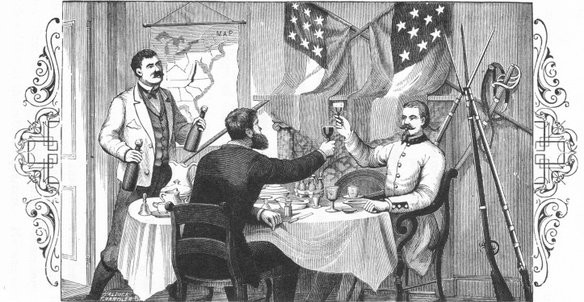
An English Lord and a Rebel Captain. P. 215.
He greeted my operative pleasantly, and informed him that he regretted the necessity of detaining him, but orders had to be obeyed. Lewis related in substance what he had already stated to the guard, which statement the Captain unhesitatingly received, and after a pleasant conversation, he invited the detective to accept the hospitality of the camp.
An English gentleman traveling for pleasure was not to be treated with discourtesy, and upon Lewis' accepting of his invitation, a soldier was dispatched to bring the horses and carriage and their impatient driver into camp.
Supper was ordered, and in a short time the Captain and his guest were discussing a repast which was far more appetizing than soldiers' fare usually is. During the meal Sam stood behind the chair of Lewis, and awaited upon him in the most approved fashion, replying invariably with a deferential,
"Yes, my lord."
After full justice had been done to the repast, Price directed Bridgeman to bring in from the carriage a couple of bottles of champagne, and by the time the hour of retiring had arrived the detective had succeeded in impressing his entertainer with a very exalted opinion of his rank and standing when at home.
Lewis, being an Englishman by birth, was very well posted about English affairs, and he entertained his host with several very well invented anecdotes of the Crimea, in which he was supposed to have taken an active part, and his intimacy with Lord Raglan, the commander of the British army, gained for him the unbounded admiration and respect of the doughty Captain.
From this officer Lewis learned that there were a number of troops in Charleston, but a few miles distant, and that General Wise, who was then in command, had arrived there that day.
After a refreshing sleep and a bounteous breakfast, Lewis informed the Captain that he would continue his journey toward Charleston, and endeavor to obtain an interview with General Wise. The Captain cordially recommended him to do so, and furnished him with passports which would carry him without question or delay upon the road. As they were about taking their leave the Captain put into Lewis' hands an unsealed letter, at the same time remarking with great earnestness:
"My lord, I beg of you to accept the inclosed letter of introduction to General Wise; as I am personally acquainted with him, this letter may be of some service to you, and I should be only too happy if it will be so."
"Thank you," replied Lewis, "but you have been far too kind already, and believe me I shall always recall my entertainment at your hands with pleasure."
The valiant Captain was not aware that he had been furnishing very valuable information to his gentlemanly visitor, and that while he was unsuspectingly answering his well-directed questions, his servant, the quiet Sam Bridgeman, was unobservedly making notes of all that he heard in relation to the situation of affairs and with regard to the probable movements of the rebel troops.
A rather ridiculous incident occurred to our two travelers after leaving the camp. They had proceeded but a short distance upon their way, when one of the horses they were driving cast a shoe, which made it necessary for them to stop at a little village and secure the services of a blacksmith.
Driving up to the hotel, Lewis alighted from the wagon, while Bridgeman drove to the blacksmith-shop in order to have his horse attended to. As Lewis ascended the steps of the hotel he noticed a tall, rather commanding-looking gentleman seated upon the porch, who was evidently scrutinizing his appearance, very carefully. The stranger was a man about sixty years of age, but remarkably well preserved, and the lines on his face scarcely gave but little indication of his years. There was an air of seeming importance about him which impressed Lewis with the fact that he must be one of the dignitaries of the place, and as he approached him he very politely raised his hat and saluted him.
The old gentleman returned the salutation with an inquiring gaze, and Lewis, in order to pave the way to his acquaintance, invited him to partake of a drink, which was cordially accepted. In a few minutes, under its influence, the two men were conversing with all the freedom of old friends.
Lewis ascertained that his companion was a justice of the peace, an office of some importance in that locality, and that the old gentleman was disposed to give to his judicial position all the dignity which a personal appreciation of his standing demanded. In a quiet manner, Lewis at once gave the justice to understand his appreciating the honor he had received in meeting him, and by a few well-administered flatteries, succeeded in completely winning the kind regards of the old gentleman. Their pleasant conversation was progressing with very favorable success, when Sam Bridgeman drove up with the team, having succeeded in finding a smithy and in having the lost shoe replaced.
With a deferential, semi-military salute, he addressed Lewis:
"We are all ready, my lord." At the mention of the title the old fellow jumped to his feet in blank amazement, and in the most obsequious manner, and with an air of humility, that, compared with his bombastic tone of a few moments before, was perfectly ridiculous. Jerking off his hat and placing it under his left arm, he advanced, and said:
"If my lord would do me the honor to accept my poor hospitality, I would only be too happy to have the pleasure of his company for dinner; my house is only a short distance off, on the road to Charleston, and will detain you no longer than to rest and feed your horses, and partake of a true Southern meal."
Lewis hesitated a moment, and then remembering that he had represented himself as traveling purely for pleasure, he did not see how he could avoid accepting his kind invitation.
"I have heard, sir, of the hospitable character of the Southern gentlemen, and I assure you I shall be most happy to avail myself of your kindness."
The old Justice could not conceal his pleasure at the prospect of entertaining a "live lord" in his own house, and with evident delight he accepted a seat in Lewis' carriage. He directed the way to his dwelling, which stood back from the road, surrounded by a grove of lofty pines, and then invited his guest within; intrusting the care of the team to the care of Sam and one of the servants, they entered the house, and were soon engaged in discussing the situation of affairs, both North and South. Lewis informed the old Justice that his name was Henry Tracy, of Oxford, England, and that his object was to reach Charleston, but that he was not aware that the country was so unsettled, or he would not have ventured on this trip. He then related his adventure of the day before, and commented favorably on the gentlemanly bearing of the Captain, and the manner in which he had been treated. They indulged in pleasant conversation, on various topics, until dinner was announced.
When they had done justice to an excellent repast, they repaired to a shaded porch in the rear of the house, and Lewis instructed Sam to bring out a bottle of champagne and a bottle of brandy. These, as already intimated, had been labeled with foreign wrappers, so that the deception was complete. The brandy was a very ordinary article, and the wine of an inferior quality, but the old gentlemen went into ecstasies over it, and under its mellowing influence, he became familiar and confidential, and gave to my shrewd operative much valuable information. Finally the justice grew profusely demonstrative, and leaning across the table, he said:
"My lord, I have never tasted such brandy as you carry in all my life, I have a couple of warm friends outside whom I have taken the liberty to send for, and whom I know will be delighted to see you, and still more pleased to taste this excellent liquor."
"Certainly," replied Lewis, "bring them in; I shall be happy to meet them."
Lewis supposed, of course, that the two men whom he had referred were planters and neighbors, but imagine his surprise when the justice returned, accompanied by the blacksmith and cobbler of the village.
After being introduced to "my Lord Tracy," Lewis invited them to take a glass with them, and with evident pleasure, yet with visible embarrassment, they accepted the invitation and seated themselves at the table.
It was now that the old gentleman grew loquacious; he was loud and profuse in his praises of the brandy; he asserted again and again, that it had never been his good fortune to taste such liquor, in which encomiums the blacksmith and cobbler heartily joined. As the afternoon wore away, and the present supply was exhausted, Sam was dispatched after another bottle, and the social meeting continued until evening. Lewis was careful as to the amount he drank, and intensely enjoyed the whole affair. The idea of the blacksmith and cobbler hobnobbing with an English lord, struck him as being so ridiculously funny, that he laughed again and again at the absurdity of the situation. Often during the evening he laughed immoderately, at what they supposed their own jokes and wit, when he was really thinking of the ridiculous comedy in which he was playing the leading part. When the hour for retiring arrived, the old man begged as a special favor that he would be allowed to keep one of the empty bottles, as a memento of the occasion of his lordship's dining with him, and to remind him of the pleasure he had enjoyed of drinking some rare old imported brandy (made in Cincinnati). The blacksmith and cobbler also looked so longingly at the empty bottles before them, that Lewis could scarcely refrain from laughing heartily, as he graciously complied with their request for a souvenir of the occasion. The evident satisfaction with which they appropriated a bottle apiece, as they started for home, and their hearty thanks as they bid him good-night, was heartily echoed by the old justice, who carefully laid his bottle away as a sacred relic of a never-to-be-forgotten event.
While the party were enjoying themselves on the porch, Sam Bridgeman had been using his time well among the servants, and had gleaned much valuable information from them. They remained over night with the old gentleman, and on the following morning, after bidding him a kind farewell, they started on their journey. Lewis did not forget, however, before leaving, to take a parting glass with his host, who seemed very reluctant to have them depart. They continued on their way towards Charleston, traveling but slowly, as the roads were heavy from the recent rains. About noon they arrived at a farm-house, to which they had been recommended by their host of the night before. Here they stopped for dinner, and after refreshing themselves, they again went on. The afternoon was warm and pleasant, and their journey lay through a beautiful stretch of country. Driving quietly along, they beguiled the time admiring the beautiful scenery spread before them, and in pleasant converse. Their enjoyment was, however, suddenly interrupted by the sound of loud voices and the clattering of horses' hoofs immediately behind him. Quickly turning around, the cause of this unusual excitement was at once apparent. A fine black horse, covered with foam, was tearing down the turnpike at break-neck speed, and evidently running away. Upon his back was seated a young lady, who bravely held her seat, and who was vainly attempting to restrain the unmanageable animal. Some distance behind were a party of ladies and gentlemen on horseback, all spurring their horses to the utmost, as if with the intention of overtaking the flying steed in front of them. Intense fear was depicted upon the countenances of those in the rear, and not without reason, for the situation of the young lady was dangerous indeed.
Quick as a flash, my operatives realized the situation of affairs, and the necessity for prompt action. Without uttering a word, Sam Bridgeman turned his horses directly across the road, intending by that means to stop the mad course of the fiery charger approaching them. As he did so, Lewis sprang from the wagon, and with the utmost coolness advanced to meet the approaching horse. On came the frightened animal at a speed that threatened every moment to hurl the brave girl from her seat, until he approached nearly to the point at which my operatives had stationed themselves, and then, evidently perceiving the obstructions in his path, he momentarily slackened pace. In that instant Lewis sprang forward, and grasping the bridle firmly with a strong hand, he forced the frightened animal back upon his haunches. The danger was passed. The horse, feeling the iron grip upon the bridle, and recognizing the voice of authority, stood still and trembling in every joint, his reeking sides heaving, and his eyes flashing fire. The young lady, with a sudden revulsion of feeling, fell back in the saddle, and would have fallen but that Sam Bridgeman, hastening to the relief of his companion, was fortunately in time to catch the fainting figure in his arms. Extricating her quickly from the saddle, he set her gently on the ground, and as he did so the fair head fell forward on his shoulder, and she lost consciousness.
By this time Lewis had succeeded in quieting the excited animal, and had fastened him to a tree by the wayside, and as he turned to the assistance of Bridgeman, the companions of the unconscious girl rode up. Hastily dismounting, they rushed to her aid, and in a few minutes, under their ministrations, the dark eyes were opened, and the girl gazed wonderingly around.
After being assisted to her feet, she gratefully expressed her thankfulness to the men who had probably saved her life, in which she was warmly joined by the remainder of the party.
Sam Bridgeman received these grateful expressions with an air of modest confusion, which was indeed laughable, and then said:
"It ain't no use thanking me, Miss, it was my lord here, that stopped the animal."
At the words "my lord," a look of curiosity came over the faces of the new-comers, and Lewis stepped gracefully forward and introduced himself.
"I am glad, ladies and gentlemen, to have been of service to this young lady, and permit me to introduce myself as Henry Tracy, of Oxford, England, now traveling in America."
The three gentlemen who were of the riding party grasped the hand of their new-made English acquaintance, and in a few words introduced him to the ladies who accompanied them, all of whom were seemingly delighted to make the acquaintance of a gentleman who had been addressed by his servant as "my lord."
This adventure proved to be a most fortunate one for my two operatives. The gentlemen, upon introducing themselves, were discovered to be connected with the rebel army, and to be recruiting officers sent by Governor Letcher to organize such rebel volunteers as were to be gathered in Western Virginia. By them Lewis was cordially invited to join their company to Charleston, which he as cordially accepted. Suggesting that as the young lady, who had scarcely recovered from the accident, might not feel able to ride her horse into town, he politely offered her a seat in his carriage, which offer was gratefully accepted, and attaching the runaway horse to the rear of the vehicle, the party proceeded on their way to Charleston, at which point they arrived without further event or accident.
The young lady whom Lewis had so providentially rescued was the only daughter of Judge Beveridge, one of the wealthiest and most influential men in the State, and upon conducting her to her home, the detective was received with the warmest emotions by the overjoyed father. Lewis was pressed to make the house of the Judge his home during his stay, but gratefully declining the invitation, he took up his quarters at the hotel, where he could more readily extend his acquaintance, and where his movements would be more free.
The young officers whom he had met upon the road had their quarters at the hotel at which Lewis had stopped, and under their friendly guidance no one thought of questioning his truthfulness, or impeaching his professions.
By this means he was enabled to acquire a wonderful amount of information, both of value and importance to the cause of the North, all of which was duly reported to me at headquarters, and by me communicated directly to General McClellan.
CHAPTER XIV.
The Rebels Attempt to Occupy West Virginia.—General McClellan Ordered to Drive them Out.—Early Battle.—The Federals Victorious.—West Virginia Freed from Rebel Soldiers.
Recognizing the importance of holding West Virginia, and of preventing the Union forces from penetrating through the mountains in the direction of Staunton, the rebel authorities had sent two new commanders into that region. Ex-Governor Wise was dispatched to the Kanawha Valley, and General Garnett, formerly a Major in the Federal army, was sent to Beverly to attempt to gather up and reorganize the remnants of Colonel Porterfield's scattered command, and to adopt immediate measures to reinforce them.
General Wise having been assigned to the Kanawha Valley, was expected to arrive at Charleston on the day following the appearance of my operatives, and the city was in a state of subdued excitement in anticipation of his coming.
In the evening, Lewis, in company with the officers whom he had met in the morning, proceeded to the residence of Judge Beveridge, where he was cordially received by that gentleman and his charming daughter, who had now thoroughly recovered from the effects of her dangerous ride. With rare grace she greeted my operative, and her expressions of thankfulness were couched in such delicate language, that the pretended Englishman felt a strange fluttering in his breast, which was as novel to him as it was delicious. He passed a very delightful evening, and by his knowledge of English affairs, and his unqualified approval of the cause of the South, added to the fact that he was believed to be a gentleman of rank and fortune, he succeeded in materially increasing the high opinion which had previously been entertained regarding him.
The next morning General Wise arrived, and his appearance was hailed with delight by the disunion element of the city, while those whose sympathies were with the North looked with apprehension and disfavor upon the demonstrations that were being made in his honor.
At the first opportune moment, Price Lewis, with the assistance of his new-found friends, the rebel officers, succeeded in obtaining an introduction to the ancient-looking individual whose career had been marked by such exciting events, and who was so prominent a figure in the tragedy that was now being enacted. He was a small, intelligent-looking man, whose age appeared to be nearly seventy years, and whose emaciated appearance gave every token that he had not long to live. His eyes shone with the brilliancy of youth, and the fires of ambition seemed to be burning brightly in his breast. Perhaps no other man in the South had contributed in so great a degree to hasten the folly of secession, and certainly none rejoiced more heartily at its final realization.
By his eloquence, and the magnetic power of his presence, he had led the ignorant classes of the State to firm belief in the justice of his cause, and by his teachings he had imbued them with a firm conviction that they were acting for their own best interests, and for the furtherance of the Southern supremacy and success.
Stern and determined, he allowed nothing to stand between him and the accomplishment of his purposes. But a few months before, he had ordered the execution of John Brown, who, with a mere handful of men, had attempted to strike a blow in behalf of the slave. This ardent abolitionist attacked and captured Harper's Ferry, a government arsenal, by overpowering the men who were stationed at that place, but the authorities had been called upon, and then, yielding to superior numbers, he was compelled to surrender. In this encounter the majority of his men were slain, and John Brown, with six of his associates, was taken prisoner. This occurred on the 16th day of October, 1859, and on the 22d day of December, after a hurried trial, the prisoners were ordered by Governor Wise to be publicly hanged. The sentence was duly carried into effect, and the action of John Brown was used by the secession advocates to inflame the minds of the Southern people against the North. Now that secession had become an established fact, it was a matter of question whether the leaders of the Southern cause would not, in the end, strike a far more forcible blow in favor of the emancipation of the slave, than did the impetuous old man who gave up his life at the behest of the Southern leaders.
The General had been previously informed of the presence of Lewis in the hotel, and of his adventure on the day previous, consequently, when he was presented to the new commander, he was received with warm cordiality. The General inquired particularly into his history, and his present movements, all of which were replied to by Lewis in a dignified and satisfactory manner. Under the influence of Lewis' good-nature the General became social and familiar, and invited him to dine with him in his apartments.
Leaving no opportunity that offered, the detective took advantage of every available suggestion, and the result was he became fully posted upon everything that was of importance, and was enabled to render such an account of his labors as was satisfactory in the extreme. Sam Bridgeman, too, had not been idle, but mingling freely with the soldiers, he had succeeded in learning much of the conditions of the country that was of immense advantage in the after events of the campaign in Western Virginia.
They remained in Charleston about eight days, and then, taking leave of the many friends they had made, they made their way safely back to Cincinnati and reported. The other two men whom I had dispatched upon the same mission traveled by rail across the State of Ohio and reached the West Virginia line at Point Pleasant. Here they began their investigations, and passing unquestioned they roamed through the country, passing eastward as far as Lynchburg. Thence, they made a detour to the South, and journeyed as far as Chattanooga and Nashville, in Tennessee, and thence to Louisville, Ky. Throughout their entire pilgrimage they were ever on the alert to acquire knowledge, and the immense amount of information which they gathered would only prove tedious to both myself and the reader. It is enough to say that they performed their duty in a manner creditable to themselves and valuable to the cause they represented, and I will simply summarize the situation.
General Garnett had posted himself in the pass at Laurel Hill, with an additional force at Beverly, while another detachment, under Col. Pegram, had established himself in the pass at Rich Mountain. Here he had intended to fortify himself and to await a favorable opportunity for breaking the railroad. He found affairs upon his arrival in a miserable condition; the troops were disorganized and without discipline, arms or ammunition, and General Lee immediately sent him re-enforcements.
This was the condition of affairs, when, early in July, General McClellan resolved to take the offensive and drive the rebels from West Virginia. In this campaign he received material aid and assistance from that brave officer General Rosecrans, who by superhuman exertions penetrated the pathless forest cutting and climbing his way to the very crest of Rich Mountain.
This movement, difficult as it was, to the South of the rebels, was a complete surprise to the enemy, who was expecting their arrival from the North.
They made a gallant resistance, however, but the Union forces had such an advantage that the contest was quickly decided. The rebel forces were driven from their breast-works and were compelled to take refuge in thickets or the mountains. Their confusion was deplorable, and their defeat unmistakable.
This victory placed the enemy in a very precarious position. McClellan was in his front and Rosecrans in secure possession of the road behind him, and Pegram, realizing the danger that threatened him, returned to his camp and, hastily spiking his guns, he abandoned all his stores and equipments, and endeavored to escape by marching northward along the mountain, intending, if possible, to join Garnett at Laurel Hill.
For the time being, he was successful in eluding the Federal commanders, and after a most laborious march of eighteen hours, found himself within three miles of Leedsville. Here he was doomed to disappointment, for he learned that Garnett had also retreated, and that a strong Union column was in close pursuit. Thus he was again caught between two Union armies, and despairing of effecting his escape, he sent a proposal to General McClellan, offering a total surrender of his command. The Union General accepted the proposition, and on the following day the half-famished rebel fugitives laid down their arms and became prisoners of war, only too glad to receive once more comfortable quarters and hunger-appeasing rations.
The fugitives who had escaped from the battle of Rich Mountain carried the news of that disaster to Beverly, and to General Garnett, at Laurel Hill, and an immediate retreat was ordered. But he was closely pressed by the advancing Union armies, and when General Garnett reached Leedsville, he heard that General McClellan was at Beverly, thus cutting off effectually his further passage southward. He now resolved upon the desperate attempt of turning to the North and reaching St. George and West Union by a rough and difficult mountain road, during which his troops naturally became very much scattered and disorganized. Although he was nearly fifteen hours in advance of his pursuers, they gained rapidly upon him, and notwithstanding every effort was made by the rebels to impede his progress by felling trees in the narrow mountain defiles, the Union advance overtook the rebel wagon-train at Carrick's Ford, one of the crossings of Cheat River, about twenty-six miles north-west of Laurel Hill. Here Garnett resolved to risk an encounter, and facing about his troops, he took a position on a favorable and precipitous elevation on the river bank, and planting his guns so as to command the ford and the approaching road, he prepared to defend his retreat. A brisk engagement at once ensued, and after a sharp contest the rebel lines broke and fled, abandoning one of their guns.
Retreat and pursuit were once more commenced, and at the next ford, a quarter of a mile further on, during a desultory skirmish fire between small parties of sharpshooters, General Garnett was killed. Here the Federal pursuit was discontinued, and the rebels left in the hands of the victors their entire baggage train, one gun, two stands of colors and fifty prisoners.
Estimated according to mere numbers, these battles of Rich Mountain and Carrick's Ford appear somewhat insignificant in contrast with the great battles of the rebellion, which occurred during the succeeding three years. Hundreds of engagements of greater magnitude, and attended with much more serious loss of life, followed these encounters, and decided the mighty problem of Northern success, but this early skirmish with the rebels on Rich Mountain, and this rout of Garnett's rear-guard at Carrick's Ford, were speedily followed by great political and military results, which exercised a powerful influence upon the after-conduct of the war. They closed a campaign, dispersed a rebel army, which had for a long time been harassing a State whose sympathies were with the Union, and they permanently pushed back the military frontier to the borders of rebellious territory. Now, is it too much to say that the brilliant success which attended this first aggressive movement of General McClellan had a marked effect upon the public mind? That they gave a general impression of his military skill is not to be doubted, and he was from that time the hero of the hour. Certain it is that a train of circumstances started from these achievements which eventually led to his being called to Washington after the reverses at Manassas and Bull Run, and made him, on the first day of November following, the General-in-Chief of all the armies of the United States.
It is not necessary for me to follow the subsequent operations in West Virginia, as my duties were connected with General McClellan and his campaigns in that district ended with the death of General Garnett and the dispersion of his army. About a week afterwards he was called to a new field of duty at Washington city, and it is not my purpose to touch upon events in which I took no part. It is enough to say that, with somewhat fluctuating changes, the rebels were gradually forced back from the Great Kanawha Valley, and the eventual result left West Virginia in possession of the Federal troops, her own inherent loyalty having contributed largely in producing this condition. The Union sentiment of the people was everywhere made manifest, and the new State government was consolidated and heartily sustained, ending in her ultimate admission as a separate member of the Federal Union in June, 1863.
CHAPTER XV.
General McClellan is called to Washington and placed in Command of the Armies, after the Battle of Bull Run.—The Secret Service Department.—Its Duties and Responsibilities.
As I am not attempting to write a history of the Civil War, but merely relating, as best I can, the leading incidents connected with my labors in the secret service, I shall not dwell upon the details of the military movements of the war, except as they are necessarily connected with my own movements. It is necessary, however, to make cursory mention of that remarkable chain of circumstances which followed General McClellan's campaign in West Virginia, resulting in entire and unexpected change of circumstances to him, and a consequent enlargement of my own field of operations. Therefore, without pausing to describe the various movements and enterprises in West Virginia during the remainder of the year 1861, or detailing the campaign of the three months' volunteers under General Patterson, and their bloodless victory at Harper's Ferry, I will pass on to other scenes and events which lead directly to the turning-point in my story.
Patriotism in the North was excited to such a pitch that the people were impatient of delay, and eager to strike a decisive blow—a blow that would at once annihilate treason and wipe out the insult to a nation's flag, and maintain a nation's honor. The resounding echoes of the rebel guns that had done their work of destruction on Sumter's walls, were still vibrating in the air.
The Confederate seat of government had been transferred from Montgomery to Richmond, immediately after Virginia's indorsement of the secession ordinance, and this enthronement of rebellion so close to the very stronghold of freedom, caused patriotic resentment to blaze up with fresh intensity.
In the month of June a determined movement against Manassas was resolved upon at Washington.
As a preliminary step to the advancement upon the rebel capital, General Scott gave Patterson orders to offer Johnston battle, or detain him in the Shenandoah Valley by other demonstrations, in order that his army might not unite with Beauregard's and defeat the movement. But Patterson failed to perform the task assigned to him, and his failure lost to the Union cause the first great battle of the war.
General Beauregard was in possession of Manassas with six thousand men, and this force was being very materially increased by the arrival of reinforcements from time to time; but notwithstanding this fact, it was believed that every chance of success would be provided for by the strength of the Union army at the capital, if only Johnston could be held in check for a few days.
Delay in starting this expedition against the enemy's works was unavoidable, and it was not until the afternoon of the 16th of July that the march of McDowell's army commenced. Even then the progress was painfully slow, owing to inexperience and lack of discipline on the part of the troops.
Manassas Junction was defended by about two thousand rebels, with fourteen or fifteen heavy guns, while at Bull Run, some three miles east of Manassas, was stationed Beauregard's main army, over twenty thousand strong, posted at the various fords of the stream, in a line fully eight miles long. McDowell, as a strategic movement to conceal his real purpose, directed his march upon Centreville, at which place Tyler's Division arrived on the morning of July 18th, to find that it had been evacuated by the rebels, who were all behind Bull Run. From Centreville, which is situated on a hill, Tyler and his men had a view of the whole valley spread out before them, with Manassas on the high plateau beyond. It has been hinted that Tyler was inspired with over confidence by the utter absence of opposition to his advance, and was thus betrayed into the indiscretion of a further advance and an experimental assault. This provoked a skirmish, which speedly culminated in the battle of Blackburn's Ford, the result of which was much loss and demoralization.
Two more days elapsed before the great fight occurred. Those two days were occupied by the engineers in efforts to find an unfortified ford over Bull Run, which was accomplished in time to permit McDowell to call his officers together on Saturday night, and announce to them his plan of battle for the following day. This brought the main contest on Sunday, July 21st, and before daylight on the morning of that eventful day, both armies were up and astir, each intending to take the initiative. There was much unnecessary confusion and delay, mingled with undue excitement and impetuosity, showing that everything was raw and awkward on both sides. Perhaps no troops ever engaged in warfare with as little knowledge of the privations, hardships and dangers of soldier-life, as did the Union and Confederate armies on this bloody field.
The day passed; the shades of evening fell, and the battle of Bull Run had been fought and lost! Victory had perched itself on the rebel banners, and the Union army was in full retreat towards Washington. The engagement had been well contested, and fought with equal courage and persistence by both sides, and the result was quite as unexpected to the Confederates as to the Federals.
But Johnston had not been kept out of the fray, as it was calculated he would be. His army had been permitted to arrive on the battle-field in the nick of time to take a decisive part in the famous conflict, and to turn the fortunes of the day at a moment when the signs of victory were all in favor of the Federal troops. Totally unconscious of the fact that they had been fighting Johnston all day, the Union soldiers had not once lost confidence in themselves, and fully believed that they must win; but when a fresh assault from a new quarter convinced them that Johnston's forces had arrived, the realization and acknowledgment of coming defeat pervaded the whole army, and the quick instinct of retreat was aroused. They believed that success had now become hopeless, and nothing could change this belief, or check or control the impulse of flight, once started. The day was lost; the evidence of a great disaster became suddenly overwhelming to the non-combatants in the rear; the retreating brigades, and the nearer approach of cannonade and musketry soon confirmed the worst fears of a terrible defeat and a hot pursuit; and then began that insane scramble and stampede for safety.
The sights and scenes encountered on the way to Fairfax Court-House will never be effaced from the memory of those who witnessed it. The story of that memorable retreat has been told over and over again; of the mad flight of civilians, in carriages and on horseback, lashing their steeds to the top of their speed; of soldiers of all regiments mingled confusedly together, some in complete uniform, others stripped of everything but trousers, shirts and shoes, and all foot-sore, haggard and half-starved; of arms, clothing and other valuables abandoned, that the progress of the runaways might not be impeded by such incumbrances; of vehicles, and even ambulances, bearing wounded men, left standing in the road, while the frightened teamsters rode away like the wind, on horses unhitched or cut out of their harness; of army wagons emptied of their loads and filled with stragglers, thundering along the crowded highway; of the dash and clatter of artillery carriages; of confusion, panic, demoralization and headlong hurry everywhere along the route.
By midnight, mounted officers and civilians began to arrive in Washington; but not until the next day, when the rain was pouring down in torrents—that dreadful, drenching rain that continued for thirty-six hours, with but slight intermission—did the poor, hungry, fagged-out soldiers commence straggling in. That they were promptly and properly fed by the people, rich and poor, who threw open their doors and gave what they could to alleviate the suffering of these brave but unfortunate men, speaks volumes for the unselfish generosity of the loyal families of the capital during that period.
It was while this discouraging state of affairs existed that General McClellan was called to Washington, to assume control of the lately defeated troops, General Rosecrans having succeeded him in the command of the Army of the West. Considering his recent success in West Virginia, and the military skill and judgment there displayed by him, it is but natural that McClellan should have been selected to re-create the army, which was destined to defend the Capital for the next three years.
His arrival in Washington, on the 27th of July, was hailed with genuine delight by officers and citizens, for at that date he held the esteem and confidence and admiration of all loyal people. It was an immense responsibility which devolved upon him, but he accepted it cheerfully, and took up his task with that energy, tact and perseverance which precluded all possibility of failure. When first called to the command, he found a mere collection of regiments, undisciplined, undrilled and dispirited, cowering on the banks of the Potomac, and with only such material to work upon, he soon organized, equipped, and trained with rare skill, that grand body of troops, which he afterwards led in the campaign of the Peninsula.
The war was but just commenced, at a time when most people thought it would be over. The "ninety days" theory was completely exploded. Those who had flattered themselves that the conflict would be "sharp and short"—that a single victorious and glorious campaign would crush the rebellion—were now undeceived. My own hopes had controlled my judgment on this subject, and made me visionary. I had hoped for myself to be able speedily to return to congenial pursuits and my domestic circle, and that a speedy collapse of their frenzy would save the Southern people from the inevitable ruin which must result from a protracted war. I had hoped for my country, that the spectacle she now presented to the world—exciting the derision of her enemies, and the melancholy pity of her friends—would soon be changed by the "returning good sense of the people," as it was so easily and egotistically phrased by many individuals at that time. Above all, I had hoped for the oppressed and shackled race of the South, that the downfall of slavery would be early accomplished, and their freedom permanently established. Being myself an old line abolitionist, and by no means the least active or energetic of those who had controlled and operated the famous "underground railroad," I had the Anti-Slavery cause very much at heart, and would never have been satisfied until that gigantic curse was effectually removed.
Indeed, during the whole time that I labored for the cause of the Union, the dearest object I had in view was the abolition of the most cruel system of oppression that ever cursed any people—an oppression long ago so justly characterized by John Wesley as "the sum of all villainy"—in comparison with which Egyptian bondage appeared simply burdensome. All these hopes were dissipated by the results of the late campaign. The war had developed into a reality to estimate. "The Federal Union—it must and shall be preserved!" was the sentiment that now prevailed, and all realized that the time for doubt and hesitation had gone by.
There was no mistaking the duty of every loyal heart—the Republic must be saved at whatever cost.
As I have previously stated, my connection with General McClellan was not interrupted by this change in his position. By my own preference, as well as at his request, I accompanied him to Washington, and cast my lot with those who were rallying there to protect and defend the government of the United States.
Among the first things the General did, after being assigned to the command of the troops around that city, was to organize a secret service force, under my management and control. I was to have such strength of force as I might require; my headquarters were for the time located in Washington. It was arranged that whenever the army moved I was to go forward with the General, so that I might always be in close communication with him. My corps was to be continually occupied in procuring, from all possible sources, information regarding the strength, positions and movements of the enemy. All spies, "contrabands," deserters, refugees and prisoners of war, coming into our lines from the front, were to be carefully examined by me, and their statements taken in writing.
This was the first real organization of the secret service. How much benefit was rendered to the country by this branch of the army will probably never be known—the destruction of nearly all my papers in the great fire of Chicago preventing their full publication—but that our operations were of immense practical value to the Union commander is a fact attested to by every one connected with the leading movements of our forces.
It was about this time that the city of Washington was placed under martial law—a measure deemed necessary to correct the serious evils which existed, and to restore order in the city. Colonel Andrew Porter, of the Sixteenth United States Infantry, was appointed Provost-Marshal, and under his command was placed all the available infantry, a battery, and a squadron of cavalry. In addition to these, the assistance of a detective police force was deemed indispensable, and in answering this requirement I found work enough to keep myself and entire corps busy during our stay in Washington. A better understanding of my position and the nature of my duties at this time may be gained from the following extracts from a letter which I addressed to General McClellan when the organization of this department was yet in its incipiency.
"General:
"In accordance with your expressed desire, I beg leave to submit to you my views with regard to the duties of my detective police force, should the services of the same be required by the government.
"In order to promote the efficiency of such a force, it is highly necessary that its existence should be known to as few persons as possible. It is an admitted and self-evident fact that the movements of the various departments of the government, civil and military, are closely watched, and it is beyond a doubt that from some source the rebels have received early, and to them, valuable notice of the intended actions of the government. I am also led to believe that the rebels have spies who are in the employment of this government, or who possess facilities for acquiring information from the civil and military authorities, or bureaus, and that this information is imparted to others, and transmitted, within a very short time, to the rebel government. Many of the parties thus leagued with the enemy are said to be persons of wealth and position.
"In operating with my detective force, I shall endeavor to test all suspected persons in various ways. I shall seek access to their houses, clubs, and places of resort, managing that among the members of my force shall be ostensible representatives of every grade of society, from the highest to the most menial. Some shall have the entree to the gilded salon of the suspected aristocratic traitors, and be their honored guests, while others will act in the capacity of valets, or domestics of various kinds, and try the efficacy of such relations with the household to gain evidence. Other suspected ones will be tracked by the 'shadow' detective, who will follow their every foot-step, and note their every action.
"I also propose to employ a division of my force for the discovery of any secret traitorous organization which may be in existence; and if any such society is discovered, I will have my operatives become members of the same, with a view to ascertaining the means employed in transmitting messages through the lines, and also for the purpose of learning, if possible, the plans of the rebels. All strangers arriving in the city, whose associations or acts may lay them open to suspicion, will be subjected to a strict surveillance.
"Another and more dangerous feature of the service contemplated to be rendered to the government by my detectives, is that of entering the rebel lines, and endeavoring to obtain accurate information of the nature of their defences, the number of troops under their command at various points, etc.
"In order to give efficiency to this movement, operations should be commenced in Baltimore as well as at Washington.
"Considering the amount of labor to be done and the necessity of immediate action on my part, in case these plans are to be carried out, I purpose concentrating my entire detective force of both sexes into this work.
"The amount of force necessary to carry out such an undertaking as I have indicated, will necessarily be very large, and the assumption of disguises and characters by my operatives, will be a very important item in itself," etc., etc., etc.
My views were carried out just as they were set forth in this letter, and I was soon hard at work in my efforts to "regulate" the District of Columbia. It was too true that a great majority of the local police were disloyal, and could not be depended upon to faithfully discharge their duties to the government that employed them; therefore, in addition to my other work, I exerted myself to the utmost in aiding the municipal authorities to reorganize and discipline the police of the district.
Many personal incidents worthy of note occurred during this period, but there was one which I recall at this moment with a laugh at my own expense—an incident in which I was reluctantly compelled to occupy the wrong side of a guard-house over night, and instead of capturing a prisoner became a prisoner myself.
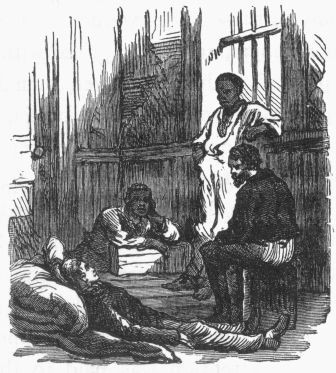
GUARD-HOUSE PRISONERS.
CHAPTER XVI.
A Female Traitor.—Suspicious Correspondence.—A Close Watch under Difficulties.—I am Arrested.—Exposure of the Treason of a Trusted Officer.—A Disgraced Captain.
During the earlier stages of the rebellion, a number of Southern sympathizers were domiciled in the city of Washington, and among the number were many ladies of refinement and wealth, from the South, who had been leaders of fashion and of society in the brilliant days of previous administrations. Many of these ladies were extremely fascinating in their manners, and being gifted with great personal beauty and with rare conversational qualities, they had gathered around them a brilliant circle of acquaintances, to whom they dispensed regal hospitalities and most delicate courtesies.
When the war broke out, these ladies thoroughly identified themselves with the cause of the South, and upon all occasions were unreserved in the expression of opinions favorable to the rebels, and of fervent hopefulness for the eventual success of the disunionists. But little attention was paid to these grand dames of the old regime, as it was not deemed possible that any danger could result from the utterances of non-combatant females, nor was it considered chivalrous that resolute measures should be adopted toward those of the weaker sex.
That this policy was a mistaken one was soon fully proved, and when it was discovered that these fine ladies were secretly giving information to the enemy, it was deemed of great importance that such means should be adopted as would prevent their treasonable actions from being made valuable to the opponents of the government, and who were seeking its overthrow.
From information received from reliable sources, it was shown that the rebel authorities were as fully conversant with the plans of the Union commanders as they were themselves. That they knew of the position of every regiment and brigade, and the contemplated movements of the commanders, and the time of proposed action, far in advance of any publicity being given to them, and when the utmost secrecy was the only true passport to victory. Indeed, it was openly boasted that the secret information given to the rebel generals had been mainly the cause of the defeat of our armies at Bull Run and Manassas.
Upon these facts being fully proven, the government resolved to effectually prevent a continuance of these practices, and that if they were persisted in, the guilty parties should either be confined or exiled to the more congenial climate of Dixie.
My department was in its infancy when the event occurred which I am about to relate. I had secured a house in Washington, and had gathered around me a number of resolute, trustworthy men and discreet women, who were devoted to the cause of their country, but were scarcely in such a condition as to move properly or with any systematized regularity. I had not been many days in the city when one afternoon I was called upon by the Hon. Thomas A. Scott, of Pennsylvania, who was then acting as the Assistant-Secretary of War, who desired my services in watching a lady whose movements had excited suspicion, and who, it was believed, was engaged in corresponding with the rebel authorities, and furnishing them with much valuable information.
This lady was Mrs. Rose Greenhow, a Southern woman of pronounced rebel proclivities, and who had been unsparing in her denunciation of the "Abolition North," and who had openly declared that "instead of loving and worshiping the old flag of the Stars and Stripes," she saw "in it only the symbol of murder, plunder, oppression and shame." Mrs. Greenhow had occupied a prominent position in the social circles of the capital, and was personally acquainted with all of the leading men of the country, many of whom had partaken of her hospitality and had enjoyed a social intercourse that was both pleasurable and fascinating.
She had now become an avowed hater of the Union, and it was feared, from her previous association with officers in the army, that she was using her talents in procuring information from them which would be immediately communicated to the rebel government at Richmond.
The residence of Mrs. Greenhow was situated at the corner of Thirteenth and I streets—quite a fashionable quarter of the city, and within a short distance of the White House. The building, while not at all imposing in appearance, was large, roomy, and was furnished with every consideration for wealth and tasteful refinement. It was a two-story and basement brick building, the parlors of which were elevated several feet above the ground, and entrance was obtained by ascending a flight of steps in the center of the edifice. This lady was a widow, her husband having died some years before, and being possessed of considerable means, and mingling with the highest circles of Washington society, her home was the resort of most of the prominent people of the city.
The instructions of the Secretary of War were, that a strict watch should be kept upon this house, and that every person entering or leaving the same should come under the close surveillance of my men, who should endeavor to ascertain who they were, and if they attempted in any manner to communicate with any suspicious persons. I was to report to him daily, and to continue my espionage until I received definite and official orders for its discontinuance. My further instructions were, that in case any of the visitors of Mrs. Greenhow should attempt to pass the lines of our troops, they should be arrested at once, and a rigorous search of their persons instituted, in order that nothing should be allowed to pass through without a thorough examination by the Secretary of War or Mr. Scott.
After the departure of the Secretary I took with me two of my men, and proceeded to the vicinity of the residence of Mrs. Greenhow. I was then quite a stranger in Washington, and localities were not as familiar to me as they afterward became, and I therefore preferred to reconnoiter by daylight, to depending upon a survey after nightfall.
The entire day had been dark, gloomy and threatening; clouds had been gathering in the heavens, and everything indicated the imminence of a severe storm. As I left my headquarters, a slight shower of rain was falling, which I knew was but the precursor of a storm more violent. On arriving at the designated locality I found everything to be as they had already been described to me. The inside shutters to the windows were closed, and no sign was apparent that the house was occupied, and after carefully noting the situation and the exposed condition of the premises, I left the two men within a convenient distance of the place, and returned for the additional aid which I thought might be needed. Selecting three of my most discreet men, I again repaired to the scene of operations. We had not proceeded far, when the storm burst upon us in all its fury. The wind blew strong and chill, and the rain fell in deluging torrents. Umbrellas were a useless commodity, and, unprotected, we were compelled to breast the elements, which now were warring with terrible violence.
Arriving at Mrs. Greenhow's, under cover of the darkness I posted my men in such positions as I thought would be most advantageous for our purpose, and then calling in the two whom I had left there during the afternoon, I approached to within a short distance of the house. The darkness and storm, while decidedly uncomfortable, were of some benefit to us, as but few people were abroad, and these paid no attention to passing events, seeming to be only too anxious to reach their destination and to escape the pitiless rain.
The blinds at the windows were still closed, but a light was observed in two rooms upon the parlor floor, and I knew that the house was occupied. Of course I could see nothing within, as my view was entirely obstructed by the closed blinds, and, at length, becoming impatient at this unprofitable and unsatisfactory waiting, I determined to obtain a glimpse, at least, of the interior, and to ascertain, if possible, some knowledge of its occupants.
The parlor windows, through which the lights were gleaming, were too high from the ground to permit me to see within, and summoning the two men who were awaiting instructions I made use of their strong, broad shoulders in a manner quite novel to me, and quite ludicrous, no doubt, to a passer-by who did not understand the situation.
Ranging the two men side by side under the broad windows in front of the house, I removed my boots and was soon standing upon their shoulders and elevated sufficiently high to enable me to accomplish the object I had in view. I was now on a level with the windows, and noiselessly raising the sash and turning the slats of the blinds I obtained a full view of the interior of the room. The furniture was rich and luxurious, valuable pictures hung upon the walls, and several pieces of statuary and various articles of artistic ornamentation were arranged about the apartment, but to my disappointment, it was unoccupied.
I was about to give expression to my chagrin at this discovery, when a warning "Sh!" from one of my sturdy supporters induced me to be silent. Some one was approaching the house, and hastily clambering down from my perch, we hid ourselves under the stoop which led up to the front door. Scarcely had we ensconced ourselves in this convenient shelter when we heard the footsteps of the new-comer, and to our satisfaction, he stopped in front of the house, and ascending the steps rang the bell and in a short time was admitted.
By this time we were drenched to the skin—the rain had fallen in copious showers and during all the time we had been exposed to its dampening influences—but paying but little heed to this, we again took our position in front of the window, and I was soon remounted upon the shoulders of my operatives, prepared to take notes of what transpired.
As the visitor entered the parlor and seated himself awaiting the appearance of the lady of the house, I immediately recognized him as an officer of the regular army, whom I had met that day for the first time. He was a Captain of infantry and was in command of one of the stations of the Provost-Marshal, and not desiring to divulge the real name of the gentleman, who has since died, I will call him Captain Ellison.
He was a tall, handsome man of a commanding figure and about forty years of age. He had removed his cloak, and as he sat there in his blue uniform, and in the full glare of the gaslight, he looked a veritable ideal soldier. As I watched him closely, however, I noticed that there was a troubled, restless look upon his face; he appeared ill at ease and shifted nervously upon his chair, as though impatient for the entrance of his hostess. In a few moments Mrs. Greenhow entered and cordially greeted her visitor, who acknowledged her salutations with a courtly bow, while his face lighted up with pleasure as he gazed upon her.
Just at this moment I again received a warning from my supporters, and hastily jumping to the ground, we hid ourselves until the pedestrians had passed out of sight and hearing. When I resumed my station the Captain and Mrs. Greenhow were seated at a table in the rear part of the room, and their conversation was carried on in such low tones that, in consequence of the storm that was still raging, I could not catch but fragmentary sentences. At last, however, accustoming myself to the noise, I heard enough to convince me that this trusted officer was then and there engaged in betraying his country, and furnishing to his treasonably-inclined companion such information regarding the disposition of our troops as he possessed.
Presently, he took from an inner pocket of his coat a map which, as he held it up before the light, I imagined that I could identify as a plan of the fortifications in and around Washington, and which also designated a contemplated plan of attack.
My blood boiled with indignation as I witnessed this scene, and I longed to rush into the room and strangle the miscreant where he sat, but I dared not utter a word, and was compelled to stand by, with the rain pouring down upon me, and silently witness this traitorous proceeding.
After watching their movements for some time, during which they would frequently refer to the map before them, as though pointing out particular points or positions, I was again compelled to hide myself under the shelter of the convenient stoop, and when I resumed my position the room was empty. The delectable couple had disappeared. I waited impatiently for more than an hour, taking occasional glimpses into the room and watching for their re-appearance. At the end of that time they re-entered the parlor arm in arm, and again took their seats.
Again came the warning voice, and again I hastily descended, and as the retreating figures disappeared in the distance, I could hear the front door open and the step of the traitor Captain above me.
With a whispered good-night, and something that sounded very much like a kiss, he descended the steps, and then, without paying any attention to the fact that I was without shoes, I started in pursuit of him, and through the blinding mist and pelting storms kept him in view as he rapidly walked away. It was then about half-past twelve o'clock, and the storm evinced no sign of a discontinuance.
I was not sufficiently acquainted with the city at that time to tell in what direction he was going, but I determined to ascertain his destination before I left him. I was compelled to keep pretty close to him, owing to the darkness of the night, and several times I was afraid that he would hear the footsteps of the man who accompanied me—mine I was confident would not be detected as, in my drenched stockings, I crept along as stealthily as a cat. Twice, I imagined that he turned around as though suspecting he was followed, but as he did not stop I reassured myself and plodded on. I could not, however, disabuse my mind of the fear that I had been seen, I could not relax my vigilance, and I resolved to take my chances of discovery. I knew who my man was, at all events, and now I must ascertain where he was going.
As we reached the corner of Pennsylvania avenue and Fifteenth street I imagined that I saw a revolver glistening in his hand, but it was too dark for me to determine that fact with any degree of certainty. At this point he passed a guard on duty, and quickly passed into a building immediately in advance of me.
This movement was so unexpected, that I had no time to turn back, and I was so close to him that it would have been very unwise to have done so, but I was more surprised when, as I reached the building into which the Captain had disappeared, I was suddenly confronted by four armed soldiers, who rushed suddenly out upon me, with fixed bayonets pointed at my breast.
"Halt, or I fire!" called out the officer of the guard.
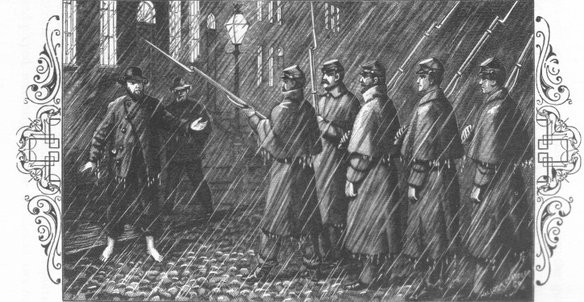
"Halt, or I fire!" P. 260.
Realizing that an attempt at resistance or escape would be both foolish and useless, I attempted to make an explanation. All to no purpose, however. I informed them that I had been out late and had lost my way, but they refused to listen, and ordered my companion and myself to march at once into the guard-house. I endeavored to make the best of my misfortune, and entering the building we seated ourselves and awaited developments.
After waiting for about half an hour, I was informed that my presence was required by the Captain; and the guard conducted me up-stairs to his room. As I entered, I found myself face to face with Captain Ellison, who was pacing excitedly up and down the floor; stopping immediately in front of me, he glared fiercely at me for some minutes without uttering a word.
I was a sorry figure to look at, and as I surveyed my weather-soaked and mud-stained garments, and my bare feet, I could scarcely repress a laugh, although I was deeply angered at the sudden and unexpected turn affairs had taken.
"What is your name?" imperatively inquired the Captain, after he had fully recovered himself, and had taken his seat at a table which stood in the room.
"E. J. Allen," I replied.
"What is your business?"
"I have nothing further to say," I coolly replied, "and I decline to answer any further questions."
"Ah!" said the Captain, "so you are not going to speak. Very well, sir, we will see what time will bring forth."
He endeavored to impress me with his importance and played restlessly with the handles of two revolvers that lay before him on the table, but I saw too plainly through his bravado, and I knew that the scoundrel was really alarmed.
Finding that he could not compel me to answer his questions, he turned to the sergeant and ordered:
"Take this man to the guard-house, but allow no one whatever to converse with him; we will attend further to his case in the morning."
I made a profound bow to the discomfited officer as I departed, to which he replied with an oath, and then I was conducted down-stairs and placed among the other prisoners.
I found myself in a mixed and incongruous assembly indeed. Most of my fellow-prisoners were stupidly drunk, and lay about the floor like logs; others were laughing and singing, while some were indulging in wild threats against the men who arrested them. Here I found my companion, who, representing himself as a Southern man had already become acquainted with two secessionists, who were laughing and talking about what they would have to tell when they obtained their release. He soon ingratiated himself with these men, and before daylight had obtained from them a revelation of certain matters that subsequently proved of great value to us in our operations.
As for myself, my feelings can better be imagined than described. Inwardly chafing against the unfortunate and disagreeable position in which I found myself, I was deeply concerned regarding the situation of affairs at the residence of Mrs. Greenhow. I had given no definite orders to my men, and they would be doubtful as to what course to pursue until they heard from me, and here was I a prisoner in the hands of the man against whom I had grave charges to prefer, and whom I had detected in treasonable correspondence. Added to this, my wet garments and the cold atmosphere of the room in which I was confined, affected me with a degree of chilliness that was distressing in the utmost. I shook like an aspen, and my teeth for a time chattered like castanets. It may be imagined that the hilarity of my fellow-prisoners had but little charm for me, until at length one of the guards very kindly brought me a blanket and an overcoat, which I wrapped about me, and soon began to feel more comfortable.
Despite the aggravating circumstances under which I suffered, I could not refrain from smiling at the ridiculous appearance I must have presented as I stood before the irate Captain who had caused my arrest. My hat was battered down over my face, and my clothing was spattered with mud from head to foot, and were dripping with water as I stood there. One might more readily imagine that I had been fished out of the Potomac than that I was the chief of the secret service of the government, in the performance of duty.
By the Captain's orders I was prevented from conversing with my fellow-prisoners, so I turned my attention to the guard. My chief desire was to apprise Mr. Scott of my captivity, as early as possible, in order that my release could be effected without unnecessary delay, and I therefore applied myself to the entertainment of my jailer.
The soldier who had charge of me I soon found to be a jolly, kind-hearted fellow, and I amused him immensely by relating some ridiculous anecdotes which I had heard, and before the time came for him to be relieved I had entirely won his favor.
Seizing a favorable opportunity I asked him if he would deliver a note for me after his time for standing guard had expired, at the same time offering to repay him for his trouble. To this he readily assented, and by the dim light afforded us I managed to scribble a few hasty lines to the Assistant Secretary of War, informing him of my imprisonment, and requesting him to order my release as soon as possible, and in a manner which would not excite the suspicion of Captain Ellison.
At about six o'clock the guards were changed, and my messenger departed upon his mission. He was fortunate enough to find the servants of Mr. Scott astir, and informing them that his message was of extreme public importance, he had it delivered to the Secretary in his chamber at once. At seven o'clock the guard returned, and coming to the door, he conversed a few minutes with the soldier who had succeeded him, when I called out:
"How is the weather outside?"
"All right, sir!" replied the man, with a sly wink, and then I knew that my note had been safely delivered, and my liberation simply a question of time.
At about half-past eight o'clock the sergeant of the guard came to the door with a paper in his hand, and called out:
"E. J. Allen and William Ascot!"
Ascot was the name of my operative who had been arrested with me, and with whom I had not exchanged a word since I had been imprisoned. We responded to our names, and following the sergeant, were again taken to the room occupied by Captain Ellison.
"The Secretary of War has been informed of your arrest, and you will be conducted to him at once, and then we shall see whether you will remain silent any longer."
The manner of the Captain was imperious and commanding, and I laughed to myself as I thought of the possible result of our interview with the Secretary. The Captain led the way, and in the company of four soldiers, we left the place, arriving in a few minutes at the residence of Mr. Scott. He was awaiting our arrival, and as we entered the room he ordered the guard to release me, and directed me to accompany him to his room. I followed him immediately, and as the door closed behind us, he burst into a hearty laugh at my uncouth and unkempt appearance. I was a sorry spectacle indeed, and as I surveyed myself in the mirror, I joined in his merriment, for a more realistic picture of a "drowned rat" I never beheld.
I at once detailed what had transpired on the preceding night, and as I related the interview which I had witnessed between Captain Ellison and Mrs. Greenhow, his brow became clouded, and starting to his feet, he paced the room rapidly and excitedly.
"Mrs. Greenhow must be attended to. She is becoming a dangerous character. You will therefore maintain your watch upon her, and should she be detected in attempting to convey any information outside of the lines, she must be arrested at once. And now we will attend to Captain Ellison."
Tapping a bell which stood upon his table, he ordered:
"Request Captain Ellison to come here."
As the Captain made his appearance, he seemed to be very ill at ease, and gazed searchingly at Mr. Scott and myself, as though he suspected something was wrong.
"Captain," said Mr. Scott, addressing him, "will you give me the particulars of the arrest of this man?" pointing to me.
The Captain answered that he had gone to visit some friends, who resided in the outskirts of the city, in the evening, and on returning at a late hour, he had noticed that he was being followed, and supposing me to be a foot-pad or a burglar, had ordered my arrest.
"Did you see any one last evening who is inimical to the cause of the government?"
The Captain became flushed and nervous under this direct question. He darted a quick glance at me, and after hesitating for some moments he answered in a faltering voice:
"No, sir; I have seen no person of that character."
"Are you quite sure of that?" sternly inquired Mr. Scott.
"I am, sir."
"In that case, Captain, you will please consider yourself under arrest, and you will at once surrender your sword to Captain Mehaffy."
The Captain was completely unmanned as these words fell from the lips of the Secretary, and sinking into a chair, he buried his face in his hands, seemingly overcome by his emotions.
But little remains to be told. Captain Ellison was arrested, and a search among his effects discovered sufficient evidence to prove that he was engaged in furnishing information to the enemy, and he was confined for more than a year in Fort McHenry. He was finally released but broken in spirit and in health, and fully realizing the disgrace he had brought upon himself, he died shortly afterward.
After leaving the residence of Mr. Scott, I took a carriage and went directly to my headquarters, and dispatched new men to relieve those who had been on duty all night, and who had been so anxious for my safety that they had sent several times to make inquiries, and who were unable to account for my absence. They had, I was rejoiced to learn, taken care to recover my shoes, which I was afraid would be found by some one connected with the house, and thus lead to the suspicion that the premises were the object of espionage.
We continued our watching of the premises, and during its continuance a number of prominent gentlemen were received by the fascinating widow, and among the number were several earnest and sincere Senators and Representatives, whose loyalty was above question, and who were, perhaps, in entire ignorance of the lady's true character.
Almost every evening one particular individual was observed to call at the house, and his visits invariably were of long duration. He was therefore made the object of especial attention by me, and in a short time I succeeded in learning his true character, and the nature of the business which he followed. Ostensibly an attorney, I ascertained that he was undoubtedly engaged in the vocation of a Southern spy, and that he had a number of men and women under him by whom the information was forwarded to the rebel authorities. This gentleman, therefore, found himself, in a very few days, a prisoner of war.
About eight days after this, orders were given for the arrest of Mrs. Greenhow herself. She was confined in her own house, and all her papers were seized and handed over to the custody of the Department of War. The intention of the government was to treat her as humanely and considerately as possible, but disdaining all offers of kindness or courtesy, the lady was discovered on several occasions attempting to send messages to her rebel friends, and finally her removal to the Old Capitol prison was ordered, and she was conveyed there, where she was imprisoned for several months. After this she was conveyed across the lines, and reached in safety the rebel capital, where she was greeted by the more congenial spirits of rebeldom.
Mrs. Greenhow afterwards went to Europe, in some trustworthy capacity for the Confederacy, and while there was noted for her bitter animosity to the Union, and her vituperation of Northern men and measures, but retribution may be said to have followed her, and some time subsequent to this, having returned again to the South, she made her way to Charleston, S. C., from thence she took passage upon a blockade-runner, upon some secret mission for the Confederacy. Her person was loaded down with gold, which was packed in a belt close to her body. After passing Fort Sumter, a severe storm arose, and the little vessel began to pitch and roll in the angry waters, which swept in huge waves over her deck. Mrs. Greenhow was, I was since informed, washed over-board, and the weight upon her person carried her down and she was lost. No trace of her was ever afterwards discovered.
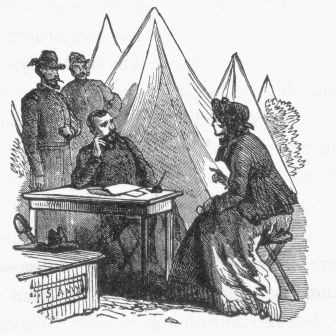
A FEMALE SPY.
CHAPTER XVII.
Timothy Webster in Baltimore.—An Encounter with a Fire-eater.—Webster Defends Himself.—Treason Rampant in the Monumental City.
The city of Baltimore at this time was also under military rule. It was garrisoned by United States troops, commanded successively by Butler, Banks and Dix, for the purpose of enforcing respect and obedience to the laws, and of presenting any violations of order within its limits, by the malignant and traitorous element of the people. Marshal Kane, the Chief of Police, as well as the active members of the police commissioners, were arrested and held in custody at Fort McHenry, because of the alleged encouragement and protection which were given to those unlawful combinations of men who were secretly aiding in numerous ways the people at war with the government. General Banks appointed a Provost-Marshal for the proper execution of the laws, in conjunction with the subordinate officers of the police department. This condition of things was of course a direct result of the great riot of the 19th of April, and the intention was to curb those mutinous spirits, whose passions otherwise would have led them into committing all sorts of crimes and outrages against the government. Notwithstanding these measures, however, the disturbing element was not by any means passive and inert, although appearances may have warranted such a conclusion. Secret bands of conspirators were still in existence, and were working assiduously for the advancement of the Southern cause.
By direction of General McClellan, I sent several of my best operatives to Baltimore, chief among whom was Timothy Webster, with whom the others were to co-operate whenever their assistance were required by him. The principal object in this was to enable Webster to associate with the secessionists of that city, and by becoming familiar and popular with them, to pave his way for an early trip into the rebel lines.
During his residence in Baltimore he was directed to represent himself as a gentleman of means and leisure, and to enable him the better to carry out this idea, I provided him with a span of fine horses and a carriage, for his own pleasure. He made his home at Miller's Hotel, lived in good style, and in his own irresistible way he set about establishing himself in the good graces of a large number of people, of that class whose confidence it was desirable to obtain. This task was made comparatively easy by the fact that he already had numerous acquaintances in the city, who introduced him about with great enthusiasm, representing him to be—as they really believed he was—a gentleman whose whole heart and soul was in the cause of the South. Thus, by easy stages, he soon reached the distinction of being the center and principal figure of an admiring crowd. Before a week had elapsed he had become a quietly-recognized leader in the clique with which he associated, and soon regarded as a man of superior judgment and power in all matters relating to political and state affairs.
During fair weather he would frequently drive out with one or more of his friends, and his handsome equipage became well known on the streets, and at the race-course. He was introduced into the houses of many warm sympathizers with the South, and by his agreeable and fascinating manners he became a favorite with the female members of the family. Through all, he was apparently an earnest and consistent advocate of Southern rights, never overdoing the matter by any exhibition of strained excitement or loud avowals, but always conversing on the subject with an air of calm conviction, using the strongest arguments he could invent in support of his pretended views. In compliance with the request of many of his Southern friends, he and John Scully, another of my operatives, went to a photograph gallery one day and had their pictures taken, holding a large Confederate flag between them, while Webster wore the rebel hat which the doughty Dr. Burton had presented to him in Memphis.
During all this time Webster was gathering information from every quarter concerning the secret plots and movements of the disloyal citizens, and promptly conveying it to me, and for this purpose he made frequent trips to Washington for verbal instructions, and to report in person the success of his operations. Sometimes he would be accompanied by one or more of his intimate associates, and these occasions were not without profit, for when thus accompanied, although necessarily prevented from reaching my office, he was enabled to increase his acquaintance with the traitorous element of Washington, and finally was enabled to unmask several guilty ones whose loyalty had never been impeached or suspected.
Once, on returning to Baltimore, after a longer absence than usual, his friends greeted him warmly.
"By Jove, Webster, we had begun to think you were in trouble," one of them exclaimed.
"No danger of that," was the laughing response. "I have no intention of being trapped before I fulfill my mission. I have some valuable work to do for the Southern Confederacy before the Yankees can get the upper hand of me."
They were in a saloon—a favorite rendezvous of these men—and Webster was in the midst of his crowd. He was telling them about some imaginary "points" which he had picked up in Washington, and assuring them he would in some manner transmit the information he had received to the rebel commanders before he was a week older. While thus entertaining his hearers, his attention was attracted by a man who entered the saloon with a swaggering gait, his hands in his pockets, and his hat tipped over one side of his head. He knew this man as a ruffian and bully of the worst stripe, Bill Zigler, and one of the ringleaders of the mob that had attacked the Union troops on the 19th of April; consequently, he entertained a wholesome contempt for the fellow, and avoided him as much as possible.
He was much surprised when the new-comer stopped in the middle of the room, and exclaimed, gruffly:
"Hello, Webster! You're here, are you? By G—d, I've been looking for you!"
Webster turned toward him a look of surprised inquiry.
"Did you speak to me, sir?" he asked, quietly.
"Yes, I spoke to you, sir!" mimicked Bill Zigler, in a bullying voice. "I say I've been lookin' for you, and when I've spoke my piece I reckon this town will be too hot to hold you many hours longer."
"I don't understand you," protested Webster.
"Ha! ha! ha!" laughed the ruffian, a glitter of triumph and hatred in his eyes. "You've been playin' it fine on the boys here for the last three weeks, but d—n you, I'll spoil your little game!"
"What do you mean?" demanded Webster, his anger beginning to rise. "You speak in riddles."
"I'll tell you what I mean!" blustered the bully. "Gentlemen," turning toward the crowd, and pointing his finger toward the detective; "that man is leagued with the Yankees, and comes among you as a spy."
There was a general start of astonishment, and Webster himself was dumfounded.
"Oh, nonsense, Zigler," spoke up one of the men, after a death-like silence of several moments. "You must be drunk to make such an assertion as that. There is not a better Southern man in Baltimore than Mr. Webster."
"I am as sober as the soberest man here," declared Zigler; "and I reckon I know what I am talking about. I saw that fellow in Washington yesterday."
"I can well believe that you saw me in Washington yesterday," said Webster, quietly, "for I certainly was there. I have just been telling these gentlemen what I saw and heard while there."
"Maybe you have, but I'll bet ten dollars you didn't tell 'em that you had a conversation with the chief of the detective force while you were there!"
Webster, it must be admitted, was wholly unprepared for this, but he realized in an instant that the bully's insinuation must be denied and overcome. With an assumption of uncontrollable rage he cried out "You are a liar and a scoundrel!"
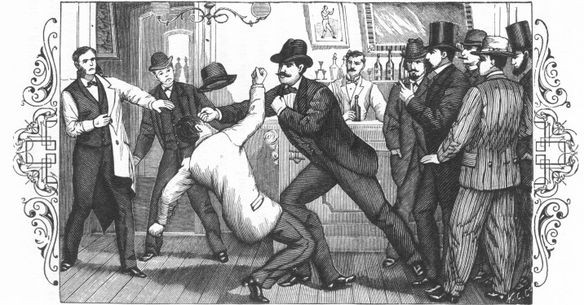
"The man reeled half way across the room, and fell prostrate between two tables." P. 277.
"I am, eh?" hissed Zigler through his clenched teeth, and before any one could make a movement to restrain him he sprang furiously toward Webster.
Quick as was this movement, however, Webster was prepared for him. Like a flash of lightning his fist flew straight out from the shoulder, striking the ruffian between the eyes, with a force that would have felled an ox. The man reeled half-way across the room, and fell prostrate between two tables.
With a roar like that of a baffled beast, Zigler gathered himself up and rushed at Webster, flourishing above his head a murderous-looking knife. But, as if by magic, a revolver appeared in the detective's hand, the muzzle of which covered his adversary's heart.
"Stop!" cried Webster, in a tone of stern command. "Hold your distance, you miserable cur, or your blood will be upon your own head!"
Zigler involuntarily recoiled. The frowning muzzle of the pistol, the unmistakable meaning of those words, and the deadly purpose expressed in the cold, calm face before him, were too much even for his boasted bravery. He turned pale and drew back, muttering and growling.
"Coward!" exclaimed Webster, "if I served you right I would shoot you down like a dog; and I am afraid I can't resist the temptation to do so anyway, if you don't immediately leave the room. Go! and in future be careful who you accuse of being in league with the accursed Yankees."
By this time a number of the other men had recovered from their astonishment, and they immediately joined their threats to those of Webster, commanding Zigler to leave the saloon at once, if he desired to "save his bacon."
Zigler did not dare to disobey. Sullenly putting up his knife, and muttering curses on the whole crowd, he slunk out, stopping at the door long enough to glance back at Webster, with the exclamation:
"I'll fix you yet, d—n you!"
When he was gone, Webster said:
"I cannot conceive what that fellow has against me, that he should try to defame my character by such an accusation."
Several of the men broke into a derisive laugh.
"I'd as soon suspect Jeff Davis of being a Yankee spy," said one, with a boisterous guffaw.
"Lord, Webster," spoke up another, "you needn't calculate that anything that fellow can say is going to injure you with the people here."
"I reckon Zigler is mad because you won't clique in with him and his gang," said a third. "Nobody takes any stock in him. It would have been considered a good riddance if your pistol had gone off while it covered his heart. Bah! he isn't worth a thought. Come, boys, let's licker."
And the affair ended in a witty cross-fire of jokes, frequent explosions of hearty laughter, and numerous bumpers of sparkling wine.
So far from proving disastrous to Webster or his mission, this little episode with Bill Zigler rather elevated him in the estimation of his companions. The neat knock-down with which he had met the bully's unprovoked assault; his air of virtuous indignation in resenting the imputation of disloyalty to the South, and the manner in which he had defeated and put to flight a man who was much feared among his fellows, only won for him new laurels, and caused him to be regarded as brave as he was loyal. His intimate acquaintances reposed such firm faith in him, that not one of them entertained for a moment the thought that there might possibly be a grain of justice in Zigler's accusation.
One morning, not long after this little episode, Webster left his hotel to walk down town, when he noticed that there was some unusual excitement on the streets. On every corner on Baltimore street, from the Exchange office, large numbers of men were standing in groups, evidently absorbed in some particular topic of conversation.
While wondering what all this meant, the detective was accosted by a man named Sam Sloan, one of the most faithful of his adherents.
"Webster, I was just going up to see you. Have you heard the news?"
"I have heard nothing, Sam," was the reply. "Is there a new sensation this morning?"
"Another of Lincoln's outrages," said Sloan, with an indignant oath. "Major Brown, Ross Winans, and several others were arrested last night, and taken to Fort McHenry."
"What for?"
"For no other purpose, I suppose, than to break up the election, which is to take place next month."
"But how can that interfere with the election?"
"By making us all afraid to go to the polls, or speak our minds."
The two walked down the street together, and dropped into a drug store, which was known as one of the resorts of the unterrified. There they found a number of men conversing somewhat excitedly. The proprietor, a Mr. Rogers, turned toward the new-comers and said:
"Good morning, Mr. Webster; we were just talking over last night's proceedings."
"It beats anything I ever heard of," said Webster, warmly. "But what can we do?"
"Nothing just now," returned Rogers; "but I think there will soon be a time when we will have a chance to do something. In the meantime, gentlemen, we must make up our minds to say nothing. We have all been too free with our tongues. Hereafter, we must keep mum, or we will all get into Fort McHenry."
"We must just lay low, and wait till Jeff crosses the Potomac," said one of the loungers.
"If we only had arms," said Webster, musingly.
"Arms!" echoed Rogers; "why, sir, we have from five to six thousand stand of arms right here in Baltimore."
"That may be true," said Webster, "but nobody seems to know where they are."
"I am satisfied they will turn up at the right time," said Rogers. "Marshal Kane, before he was arrested, put them in the hands of men who will take good care of them until they are wanted."
"And let us hope they will be wanted inside of two weeks," put in Sloan. "We can afford to be quiet now, boys, but when the Southern army comes this way, we'll rise ten thousand strong, and help take Washington."
The opinion seemed to have fixed itself in the minds of nearly all the Southern sympathizers in the city, that in a very brief space of time, three or four weeks at the utmost limit, Baltimore would be occupied by rebel soldiers, and Jeff Davis would be there in person.
"One thing is certain," said Webster, firmly. "If this thing goes on much longer, there will be a general uprising one of these days, and the streets of Baltimore will run with blood a thousand times worse than they did on the 19th of April."
"You are right, there," said Rogers; "but for heaven's sake don't let any one outside of your circle hear you use that expression, or you will be the next one in limbo."
"If they want me, now is their time," replied the detective, with a smile, "for I have made up my mind to undertake a journey down into southern Maryland and Virginia, at an early day."
"The devil you have! You will find that a difficult and dangerous undertaking."
"Nevertheless, I shall attempt it. I find that if I can make the trip successfully I may be of service to some of our people here, by carrying letters and messages to their friends and relatives, with whom they are unable to communicate in any other way."
Webster made this intention known to all of his associates, and gave them to understand that he desired to sell his horses and carriage before leaving. The sale was accomplished in a manner that seemed legitimate enough to all, though it was a mere pretense. One of my operatives, whom I sent to Baltimore for that purpose, made a sham purchase of the team and turned it over to me in Washington.
CHAPTER XVIII.
Webster Makes a Journey to the South.—A Secret Organization.—The "Knights of Liberty."—Webster Becomes a Member.—A Sudden Intrusion of the Military.—The Conspiracy Broken Up.
In accordance with my instructions, Webster commenced his tour through southern Maryland, on Thursday, September 26th. He was accompanied by John Scully, who had been assisting him in his Baltimore operations, and they followed a line of travel which I laid out for them. Taking passage on the steamboat "Mary Washington," they baffled the officers who stopped them by showing a pass issued by the Provost-Marshal of Baltimore, and were soon steaming down the Chesapeake toward Fair Haven, which was their pretended destination. Arriving at that point they went ashore, and proceeded to the village of Friendship. From there they worked their way south-west to Prince Frederick, then across the Big Patuxent to Bendict, from which place they proceeded to Charlotte Hall, and thence on foot to Leonardtown, a distance of twenty miles. At the last-named place they found Wm. H. Scott, another of my operatives, awaiting them, and were accompanied by him during the remainder of the journey.
A number of messages, written and verbal, which had been intrusted to Webster by his Baltimore associates, were delivered at various points on the route, thus enabling them to form the acquaintance of certain secessionists who were men of prominence and influence in their respective neighborhoods, and who in turn provided them with letters of introduction to others of like ilk further on. Through this medium they secured attention and hospitality wherever they stopped, and had the advantage of valuable advice and assistance in the matter of pursuing their journey safely.
They represented themselves to be rebel sympathizers on their way to the Potomac, for the purpose of finding a safe place where goods could be shipped across the river into Virginia. They were frequently cautioned to be very careful, as there were Union soldiers stationed all along the river, and people whose hearts were with the South were not permitted to express their sentiments with impunity. They penetrated as far as a point called Allen's Fresh, and deciding that they had gained all the information that could be picked up in that part of the country, they returned to Washington and reported to me.
When Webster re-appeared on the streets of Baltimore, after completing this trip, he was more than ever lionized by his numerous friends who were in the secret of his Southern journey, and its supposed object. By endangering his life in the Southern cause, as it was believed he had done, he had made himself a hero in the eyes of the traitors who were attached to him.
"Are you still keeping mum?" he asked, as he stood in the center of a group at Dickinson's billiard hall, adjoining the Exchange.
"Those who have any regard for their personal safety are doing so," replied Rogers; "and I think the majority of the boys have learned that lesson. Baltimore is comparatively quiet now. Only one man has been arrested since you left, and we have hopes that he will be released."
"Who is he?"
"A man from Washington. He was fool enough to think he could talk as he pleased in Baltimore."
"By the way," remarked some one present, "Webster must join our——"
"Sh," cautioned Dave Dickinson, the proprietor of the billiard room. "Have you no more sense than to reveal yourself here? Remember that your lips are sealed by an oath on that subject."
There was a moment's silence; Webster looked from one to another, and noticed that an air of mystery had settled upon every countenance present.
"What's this?" he demanded with a laugh. "Is it a conspiracy to betray me into the hands of the enemy?"
"Not exactly," replied Dickinson, whose laugh was echoed by the crowd. "Sloan, you will give Mr. Webster his cue when a favorable opportunity occurs. We want him with us, by all means."
Webster's curiosity was satisfied an hour later, when he and Sam Sloan walked toward Miller's Hotel together.
"The fact is," said Sam, in a guarded tone, "since you went away we've formed a secret organization."
"A secret organization?"
"Yes; and we have held several meetings."
"Is it a success?"
"A perfect success. Some of the best in town are among our members. We may be forced to keep silent, but, by Heaven! they can't compel us to remain idle. We are well organized, and we mean undying opposition to a tyrannical government. I tell you, Webster, we will not down!"
"Never!" responded Webster, copying the boastful tone and bearing of his companion. "It does not lie in the power of these white-livered Yankees to make slaves of Southern men! I should like to become a member of your society, Sloan."
"They all want you," said Sloan, eagerly. "They passed a resolution to that effect at the last meeting. They want the benefit of your counsel and influence."
"What is your society called?"
"The Knights of Liberty."
"When will your next meeting be held?"
"To-night."
"So soon?"
"And you are expected to attend. Have you any objections?"
"None whatever. But how will I get there?"
"I am delegated to be your escort," replied Sloan.
"What is your hour of meeting?"
"Twelve o'clock."
"Ah, a midnight affair. All right, Sam; you'll find me waiting for you at the hotel."
Here they separated. Webster realized that quite an important period in his Baltimore experience was opening up before him, and that all his detective skill would probably be called into play to foil a band of conspirators. How to thwart the schemes of these Knights of Liberty, whose purpose, as he understood, was to assist in the overthrow of the Government of the United States, was now the question to be solved.
He did not, however, attempt to form any plans at this time, but waited for such developments as he had no doubt would be made that night. He resolved to learn the nature of the plots that were in existence, before he commenced counterplotting.
Promptly at eleven o'clock Sam Sloan put in an appearance at the hotel, and he and Webster proceeded toward the place of meeting. The night was dark and stormy, just the right sort of night, Webster thought, for the concocting of hellish plots and the performance of evil deeds.
"That night, a chiel might understand, The Deil had business on his hand."
The stars were hidden from view by masses of flying clouds; the wind whistled shrilly through the trees and spires; while the deep, threatening murmurs of distant thunder were accompanied by fitful flashes of lightning, which illumined the scene with a weird, quivering light. Few shops were open in the localities through which they passed. Occasionally a light was seen struggling through the screened window of a saloon, and the sound of midnight orgies within indicated that business had not been suspended there; but elsewhere all was dark and still.
Sloan led the way to a remote quarter of the city, and into a street which bore a particularly bad reputation. Here he stopped, and said:
"I must blindfold you, Webster, before proceeding further. This is a rule of the order which cannot, under any circumstances, be departed from."
Webster submitted quietly, while a thick bandage was placed over his eyes and securely fastened. Then Sloan took him by the arm and led him forward.
Blindfolded as he was, he knew that they turned suddenly into an alleyway, and he also knew when they passed through a gate, which Sloan closed behind them. He rightly conjectured that they were now in a sort of paved court, in the rear of a building.
"Come this way and make no noise," whispered Sloan.
The next moment the latter knocked on a door with a low, peculiar rap, that was like a signal. Immediately a guarded voice on the inside was heard:
"Are you white?"
"Down with the blacks!" responded Sloan.
Nothing more was said. A chain clanked inside, a bolt shot back, and the door creaked on its hinges as it swung open.
Webster was led through, and he and his conductor began to ascend a flight of stairs, so thickly carpeted that they emitted no sound from the footsteps upon them.
At the head of the stairs they were again accosted:
"Halt! Who comes there?"
"Long live Jeff Davis," muttered Sloan.
Passing on through another door, they found themselves in a small, square apartment, although, so far as Webster was concerned, there was no ocular proof of this. There seemed to be several persons here, and a voice, that was evidently meant to be tragical and impressive, demanded:
"Whom have we here?"
"Most Noble Chief," said Sloan, humbly, "I have a friend in charge, who wishes to become a worthy member of this league."
"His name?"
"Timothy Webster."
"Have the objects of the league been fully explained to him?"
"They have."
The gruff-voiced speaker then said:
"Mr. Webster, is it your desire to become a member of this knightly band?"
"It is," responded the detective, firmly.
There was a sound as of a number of swords leaping from their scabbards, and the clank and ring of the steel as the blades seemed to meet above his head. Then the Grand Chief continued:
"You will now kneel upon one knee, and place your right hand upon your heart, while I administer to you the binding obligation of our brotherhood."
Webster did as he was directed, and in this attitude repeated the following oath, as it was dictated to him:
"I, Timothy Webster, citizen of Baltimore, having been informed of the objects of this association, and being in full accord with the cause which it seeks to advance, do solemnly declare and affirm, upon my sacred honor, that I will keep forever secret all that I may see or hear, in consequence of being a member of this league; that I will implicitly obey all orders, and faithfully discharge all duties assigned to me, no matter of what nature or character they may be; and that life or death will be held subordinate to the success and advancement of the cause of the Confederacy and the defeat of the bloody tyrants who are striving to rule by oppression and terrorism. Should I fail in the proper performance of any task imposed upon me, or should I prove unfaithful to the obligations I have here assumed, may I suffer the severest penalty for treason and cowardice, as well as the odium and contempt of my brother knights."
The swords clanked again as they were returned to their scabbards, and the new-made member, having taken the oath, was commanded to rise. He did so in silence, and the bandage was removed from his eyes.
At first the light of the room almost blinded him, but his eyes soon became accustomed to the change, and he looked about him with some curiosity. He found that he was in the presence of seven stalwart men, besides Sloan, all of whom wore swords at their sides, dark cloaks drooping from their shoulders, and black masks upon their faces. The masks, however, were now removed, and Webster discovered, to his relief, that they were all familiar to him.
"Mr. Webster," said the Chief, dropping his tragic tone of voice, "without further ceremony, I pronounce you a Knight of Liberty. I greet you heartily;" and then, extending his hand—"Come with me."
As they emerged into the main council-chamber, Webster quietly examined his surroundings. It was a spacious apartment, very plain in its appointments, with a low ceiling and bare walls, and furnished with chairs arranged in rows around the room. At the head of the hall was a low platform on which were tables and chairs. Behind these, on the wall, were suspended two Confederate flags, artistically draped, above which were the initials "K. of L." Some forty men were already assembled, and others were quietly dropping in at intervals. Webster noticed that all these men were from the better class of citizen secessionists, and that the low, rowdy element was not represented. They were mostly men who had not thus far been suspected of disloyalty to the Union cause.
The Grand Chief and other officers now took their positions on the platform, and Webster was assigned to a seat where he could observe all that was said or done.
Presently a clock in the room struck twelve. Instantly all the doors opening into the chamber were securely locked, and the secret conclave was in session. The Grand Chief rose and opened the meeting in regular form; and again, after the secretary had read the journal, made an address of some length. At the conclusion of his remarks, some one arose and said:
"Most Worthy Chief, I believe we can now claim Mr. Webster as a member of this body. I understand that he has just returned from an interesting and somewhat dangerous mission, and I now move that he be invited to address this meeting relative to his experiences during the journey he has just completed."
Webster, taken by surprise, undertook to combat the proposition, but the motion was unanimously concurred in, and no excuses were accepted. He therefore yielded good-naturedly, and mounting the platform, he proceeded to relate some of the particulars of his trip to the Potomac. He made the recital as entertaining and agreeable as possible, and although his statements did not always possess the merit of being strictly true, they were such as could not fail to meet the approval of his hearers, and were therefore received with great favor. Concluding with a well-timed panegyric on the "faithful" of Baltimore, he resumed his seat amid the congratulations of his many admiring friends.
After this, the regular business of the meeting was taken up, in which Webster took no other part than that of a close listener and observer. Motions were made, resolutions were adopted, and various duties assigned to volunteer committees. The proceedings grew more and more interesting to the detective as they progressed, and it was not long before he began to feel considerable surprise, if not alarm, at the unexpected revelations which were made. It became evident to him that these conspirators had by some means succeeded in placing themselves in direct communication with the Confederate leaders, and that a gigantic plot was now in preparation to make a united and irresistible movement against Washington. Nearly ten thousand Baltimoreans, it was alleged, were prepared to rise in arms at a moment's notice, and join the rebel army, whenever such a movement might seem feasible. It appeared, also, that the Baltimoreans were not alone in this plot against the government, but that branches of their organization existed in a number of the outlying towns, and that the secessionists of the entire State were working harmoniously together for the accomplishment of one great purpose. There was no lack of arms, for these had already been secured, but their place of concealment was known only to a few and they were not to be brought to light until they should be needed.
The main portion of the plot seemed to be well matured, and was most perfect in its details. The arrival of the rebel army in Maryland was expected in a very short time, as they had the promises of the Southern commanders themselves that they would soon cross the Potomac. Their coming was to be the signal for a simultaneous uprising of all the secessionists in the Western and Southern portions of the State, who were to unite in a movement that could scarcely fail to carry everything before it. There were also deep-laid schemes by which the Federals were to be kept in ignorance of the real designs of the Confederates, until too late to avert the blow.
The extent of the conspiracy rather startled Webster, although some of the projects sounded rather visionary, and he made up his mind to consult with me at once. Accordingly, the very next day, he proceeded to Washington, and was closeted with me for several hours. As soon as he had explained the situation, I devised a plan of procedure, and gave him full instructions as to the manner in which he should proceed. The great object, of course, was to break up the organization, and defeat the conspiracy in a manner that would not compromise Webster; but it was not deemed prudent to go about this with any inordinate haste.
I advised Webster to continue attending the meetings, in the character of an active conspirator; to learn all he could, and report to me as often as possible. In the meantime, I would send him two other operatives, and he was to secure their admission into the secret society, as members thereof. In a week or two the final act in the little drama would be introduced by first making a confidant of Mr. McPhail, the deputy Provost-Marshal of Baltimore, and then confronting the conspirators with a company of armed soldiers.
Webster returned to Baltimore with a clear understanding of the course he was to pursue, and he followed that course with the untiring zeal with which he performed every duty assigned to him. He attended the midnight meetings regularly, and gained much information concerning the plans and movements of the Southern commanders, which proved of incalculable value to the government. The two operatives soon contrived to join the society, not through Webster's recommendation, as that was to be avoided, if possible, but by making the acquaintances of men whom he pointed out to them, and representing themselves as secessionists who were capable of keeping their own counsel.
This done, the rest was comparatively easy. By the rules of the society, no one could enter the secret chamber of the conspirators without passing two guards, and giving sundry pass-words. These guards were appointed by the Chief from those who volunteered for the positions. At stated periods, new pass-words were arranged, by which every man was required to answer the questions of the guards, and any one who failed to commit these to memory sufficiently to satisfy these sentinels that he was a member of the society, found himself barred out of the meeting.
Our plan worked to perfection. There came a night when my two operatives were on duty, as guards, they having volunteered their services at the last preceding meeting. This was the night set apart for the surprise. It had been announced that Webster would speak that night, and it had been arranged with the guards, that a certain part in his speech should be taken as the signal for the grand finale that had been decided upon.
The hour of midnight approached. The old building in which the secret conclaves were held was shrouded in silence and darkness. At intervals one or more dark figures might have been seen to enter the covered archway leading thereto, and pass through the gate into the narrow court. Then, one at a time, they approached a certain door, and after a signal rap, and a low, muttered conversation with the guards, they passed in and ascended the dimly-lighted stairs. Another brief dialogue with the inside guard, and they entered the council-chamber, where they dropped their mysterious manner, and were ready to answer to their names at the calling of the roll.
The clock struck twelve. The sound rang through the apartment in solemn, measured tones, and as the twelfth stroke was still vibrating in the air, all the doors, even those communicating with the ante-rooms, were promptly locked, no one being admitted after that hour.
The meeting was opened after the regular form, and the business disposed of without interruption. When the time which was set apart for addresses arrived, Webster was called upon for his speech. He ascended the platform with a serious expression on his face, and after thanking his fellow-knights for the honor conferred upon him, he launched forth into a stirring address, the treasonable nature of which was calculated to fire the Southern blood of his hearers, and to add much to his own popularity. As the speaker appeared to warm up with his subject he lifted his voice and exclaimed:
"The dissolution of the Union is one of the inevitable necessities of Lincoln's election, and it will be our mission to strike directly at the heart of the abolition party, and bury its foul carcass beneath the smoking ruins of Washington city!"
This was the signal. The words had no sooner passed the lips of the speaker, than a startling noise, like that of a battering-ram being applied to one of the ante-room doors, cut short the speech, and caused every man present to spring to his feet in astonishment and alarm. Bang! bang! bang! sounded the heavy blows. The door burst open with a crash, and a stream of blue-coated soldiers, all fully armed, came pouring into the council-chamber, and quickly deployed around three sides of the room, effectually cutting off the retreat of the inmates before they could make a movement.
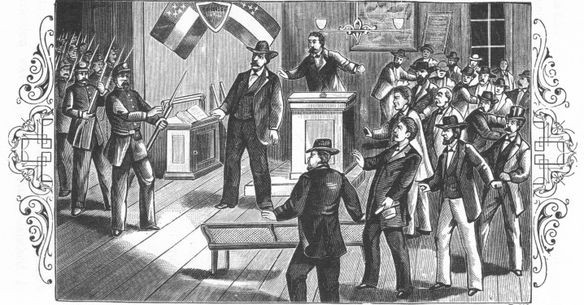
"The door burst open and a stream of blue coated soldiers came pouring in." P 298
The sudden and unexpected appearance of these intruders had a paralyzing effect upon the conspirators. Had so many ghosts confronted them they could not have been more surprised. Horrified consternation was depicted on every blanched face; startled eyes looked wildly around for some avenue of escape, and exclamations of terror or baffled rage broke from many white lips. Some of the most desperate seemed for a moment to entertain thoughts of breaking through the line of soldiers and reaching the door, but no such mad attempt was made. McPhail stepped forward with a revolver in each hand, and in a low, thrilling voice, said:
"Gentlemen, you are our prisoners. I advise you to give in gracefully. We are too many for you."
His advice did not go unheeded. They surrendered as gracefully as possible under the circumstances, and resigned themselves to the custody of their armed foes. The chamber in which they had maliciously plotted the overthrow of the government became the scene of their own downfall, and it was with dejected countenances that they submitted to the inevitable, and permitted themselves to be marched in a body before the Provost-Marshal. It was not observed, however, until they were being removed, that Timothy Webster had somehow contrived to make good his escape.
The leading spirits of this conspiracy—those who did the actual plotting, and who were known to be the arch traitors and prime movers in the secret enterprise—were taken to Fort McHenry. The rest, after taking the oath of allegiance, were released.
My two operatives disappeared from Baltimore immediately after this occurrence, as well they might, for of course the suspicion of the defeated conspirators fastened upon them at once. As they did not show themselves in that city again, however, they never were made the victims of the terrible vengeance which some of their late associates swore to bring down upon their luckless heads at the first opportunity. As for Webster, instead of being suspected of any complicity in the betrayal, he was congratulated upon his fortunate and remarkable escape from the fate which befell his unfortunate brother knights.
With the defeat of the "Knights of Liberty" in Baltimore, ended the existence of the branch lodges all over the State. The organization, which had so carefully planned the destruction of the Union at a single blow, was completely broken up. The conspirators, taking warning by the fate of their leaders, became mute and inactive, and although skilled detectives were sent to all outlying towns, no new signs of an uprising were discovered.
CHAPTER XIX.
Suspicions in Washington.—"Uncle Gallus."—Property Searched.—A Rebel Family sent South.—Webster starts for Richmond.
Aside from the operations of Timothy Webster and his assistants in Baltimore, there was work enough to do in Washington to keep myself and all the members of my large force constantly employed. Innumerable persons, suspected of treasonable designs, were closely shadowed; whole families became objects of distrust, and fell under the watchful eye of my department; while the ungracious task of searching the homes of people who stood upon the highest round of the social ladder became of frequent occurrence.
Among the latter class were the wife and family of ex-Governor Morton, of Florida, who at this time were sojourning in Washington. Mrs. Morton was known to be in sympathy with the South, and the unceasing vigilance of my men soon developed the fact that she was in secret communication with certain officials of the rebel government, to whom she was giving information concerning affairs at the North. She was a lady of eminent respectability and refinement, and much esteemed by all who knew her, but this did not render it less advisable, under the circumstances, to have all her movements watched, and her house constantly shadowed by detectives. Her pleasant residence at No. 288 "I" street, was therefore placed under strict surveillance, and its inmates followed whenever they went out for a walk or drive, while all visitors at the house were invariably shadowed when they went away.
There was an old negro servant, known as Uncle Gallus, who went to and from the house oftener than any one else, on errands for the family. Finally one of my operatives drew the old fellow into conversation, and found him so cheerful and communicative, and so firm in his loyalty to the Northern cause, that when the fact was reported to me, I concluded to talk with Uncle Gallus myself. Accordingly, I gave orders to have him brought to my office, if it could be done without opposition on his part. The friendship I bore for the colored race, and my long experience as an underground railroad conductor, had given me such an insight into the character of the negro, that I believed I could gain his confidence and good-will if I should meet him.
Uncle Gallus came to my office quite willingly. He was a powerfully-built darky, though evidently well advanced in years, as attested by the bleached appearance of his wool and eyebrows. His skin was as black and shone as bright as polished ebony, and it took but little provocation to set him on a broad grin, which displayed two unbroken rows of glistening ivory.
This interesting specimen appeared before me one afternoon, when Timothy Webster was with me in my office. We had just finished a discussion concerning some delicate point in Webster's Baltimore operations, and had lapsed into a desultory conversation. My sable visitor stood bowing and scraping, and turning his hat round and round in his hands, till I bid him be seated.
"Your name is Gallus?" I said.
"Yes, sah," he replied, his mouth stretched from ear to ear. "Folks done got so dey call me uncle Gallus nowadays."
"You have been a slave all your life, I understand?"
"Yes, massa, eber sence I war knee-high to a hopper-grass. I'se done a mighty sight o' wu'k, too, 'kase I wus allus as big an stout as a sixty-dollah bull, an' I could stan' mo' hard-fisted labor dan any o' de udder niggahs on de plantation. But sence I been wid Massa Morton I ain't had nuffin' to do skursely, an' it seems as ef I'se gwine to git pow'ful lazy fur de want o' wu'k. H'yah! H'yah!"
"What is your native State, Uncle Gallus?"
"Ole Virginny, sah."
He held his head a little higher, and sat a trifle more erect as he said this, showing that inordinate pride in his State which I had so often noticed in other Virginia slaves, as well as in Virginia masters.
I asked him if the Mortons had offered him his freedom since the breaking out of the war. He shook his head and gravely replied:
"Dey hain't been nuffin' said to dis pusson on dat 'ar subjick, but I knows dey'd gimme my freedom in less'n twenty-fo' hours ef I done ax 'em fur it."
"Then you don't want to be free?"
"Oh, yes, I does, massa; yes, I does, fur sho'. But Massa Linkum an' de Yankee boys am gwine ter fetch dat aroun' all right by'm-bye. Bress your soul an' body, I can't b'ar fur to run away from missus an' ole massa, 'kase dey's been so good an' kyind to me; an' I'se done tuk an oath dat I won't leave 'em till dey gimme leaf. When missus goes back down Souf I'se gwine ter go wid her, ef she don't tole me to stay heah. It won't be long, nohow, 'kase de time am soon comin' when de darkies will all be free."
"Your mistress intends to return to the South, then?"
"Yes, sah; we'll soon be off now, ef de good Lo'd will let us. Massa, he's in Richmond, an' he hab done sent fur de family."
"Is Mrs. Morton in communication with her husband?"
"Spec' she is, sah. She writes letters, an' gits letters. She has ter be sorter keerful like, for dese 'yah Yankees is got eyes like a cat, an' kin see fru a stun wall in de dark."
"Do you know whether your mistress writes to any one besides her husband?"
Uncle Gallus leaned back in his chair, and looked at me somewhat suspiciously, the whites of his eyes shining like polished china.
"'Deed, sah, I doesn't know whedder she dusdo, or whedder she doant," he said, hesitatingly. "Please, massa, doant ax dis chile any mo' questions. My missus is de bes' woman in de wu'ld, and nebber didn't do nuffin' wrong in all her bawn days. Ole Gallus wouldn't say nuffin' to bring trubble on her for fifteen cents," he added, earnestly.
I quieted the fears of the faithful old man by assuring him that I meant no harm to his mistress, and that I had no doubt she was the good lady he represented her to be. Satisfied with the result of my investigations, I permitted Uncle Gallus to depart, first charging him, however, to say nothing to any one concerning my interview with him. He promised secrecy, and bowed himself out with all his teeth visible, saying, as he went:
"Fo' de Lawd, gemmen, I'se hopin an' prayin' de No'thun folks will be de top dog in dis wrastle, an' ef eber dis niggah hes a chance to gib yu'uns a helpin' han', yu' kin bet a hoss agin' a coon-skin he'll do it; but I hope an' trus' my missus not be boddered."
Nevertheless, I had learned enough to bring me to the decision, that Mrs. Morton's house must be searched, and under orders of the Secretary of War, I sent three of my men to No. 288 "I" street, to perform this unpleasant task. The operatives chosen to make the search were W. H. Scott, John Scully, and Pryce Lewis. Mrs. Morton received them very civilly, and told them they were at liberty to make a thorough search of the premises, which they immediately proceeded to do. They had instructions to read all letters that were found, but to keep only those that were of a treasonable nature, and in no case to destroy any property or leave anything in a disordered condition. These instructions were obeyed to the letter. Boxes that were packed ready for shipment were all carefully repacked and closed after they had been examined by my men, and when the operatives departed, they left no traces of their search behind them. Their polite and considerate conduct won for them the good will, not only of Mrs. Morton herself, but also of her daughter and two sons, who expressed themselves as being agreeably surprised, for they had been informed that the men from the Provost-Marshal's office were a set of ruffians, who did not scruple to break up boxes, and litter the house with their contents, and that their conduct towards ladies was insulting in the extreme. They even went so far as to assure the operatives, that if any of them should ever be taken prisoner and brought to Richmond, they would do all in their power to secure kind treatment for them.
Among the letters that were found, two of them were from ex-Governor Morton, to his son and daughter, requesting them to come to him at Richmond; but nothing of a criminating character was discovered, and the family were not subjected to further annoyance.
Some two weeks afterwards, when John Scully boarded a train for Baltimore, whither I had sent him with a message to Webster, he chanced to meet Mrs. Morton and family in the car which he entered. They were departing from Washington, having been required to leave the North, by the authorities, who furnished them a safe passport to Richmond, and they were accompanied by the faithful Uncle Gallus. They recognized Scully, and greeted him with cordial courtesy, the eldest son rising in his seat to shake hands with him. They told him that on arriving at Baltimore, they were to take a flag-of-truce boat to Fortress Monroe, from which point they would continue their journey to Richmond. Scully as a matter of policy, gave them distinctly to understand that he had quitted the government service and was returning to his home in the North.
This little experience with the Morton family was trifling enough in itself, and was only one of many similar episodes with which I and my force were connected during those troublous times; but I have been thus particular in detailing it because it has an important bearing upon other events which afterwards occurred.
It was about a month after the incident above mentioned, that Timothy Webster completed his preparations for making his first trip into Virginia and through the rebel lines. A large number of Baltimoreans had intrusted him with letters to their friends and relatives in the South, and he had assured them that their messages would be delivered safely and answers brought back in due time.
He left Baltimore on the 14th of October, and proceeded southward along the "Eastern Shore" of Virginia, seeking a convenient place to cross over to the mainland or "Western Shore." He arrived at Eastville, the county seat of Northampton county, on Tuesday, October 22d, where he found that he could effect a crossing with the assistance of a man named Marshall, who made a business of smuggling passengers and mails through the lines. He was compelled, however, to remain at Eastville several days, waiting for Marshall and his boat to come over from the other side, his trips being delayed on account of the bright moonlight nights, as the boatman did not dare to run the gantlet of the Federal guns, unless covered by darkness.
Some two or three months before, this man, Marshall, had owned a sloop, which he had used successfully in running the Federal blockade. One night he was caught in a calm near the western shore, and was run-down by a gunboat. His sloop was captured, and he narrowly escaped capture by deserting his vessel and reaching the shore in a smaller boat. Since that time Marshall had been pursuing his vocation with a sort of canoe, or "dugout," thirty-one feet in length and five feet in width, carrying three sails—main, fore and jib. His route was from Gloucester Point, York river, to Eastville, and his business was to transfer from one side of the bay to the other the Confederate mail and passengers, and sometimes a small cargo of merchandise. Marshall being an expert pilot and a thorough seaman, was frequently employed by the masters of sloops and schooners to pilot them past certain points, they giving him the privilege of putting his passengers and mail-bags aboard the vessel without charge. It was his invariable custom to place a stone or other heavy substance in his mail-bag before starting, for the purpose of sinking it in case of being pressed by the gunboats.
It was on a dark evening that Webster left Cherrystone Lighthouse in Marshall's canoe, to make the voyage across the Chesapeake. There were thirteen passengers, all told. Eight of these were Marylanders, mostly from Baltimore, every one of whom announced his intention of enlisting in the Confederate army or navy upon his arrival at Richmond.
On starting, Marshall rowed off a short distance from the light-house, and rested on his oars for some time, taking observations to ascertain if the bay was clear of hostile craft. The night was scarcely dark enough for safety; the clouds were thin and scattered, and the stars were peeping through the dark, ragged curtain overhead. The wind was blowing strongly from the east, and the water was exceedingly rough.
Resolving, however, to make the effort, Marshall hoisted his sails, and as they rapidly filled, the little vessel sprung forward like a thing of life. It fairly skimmed over the waves, its sharp prow cutting the water and dashing up clouds of spray that caused the men to turn up their coat-collars and pull their hats down closer upon their heads. All conversation was forbidden, lest their voices should betray them to the enemy. With sealed lips and motionless forms, they might have been so many dark phantoms speeding before the wind on some supernatural mission.
Webster, by his own wish, had been put upon the look-out by the captain of the boat, and he keenly watched for signs of danger. When they had traveled nearly half the distance across the bay, he spied a point of light to leeward, and at once called Marshall's attention to it.
"It is a gunboat with a light on her bows," said the latter. "Let her come. She can't catch us, for with oar present headway we are not to be overhauled by any boat on this water."
The canoe was headed due west for about fourteen miles, then south-west by west for ten or twelve miles, then due west again to Gloucester Point. The entire run was made in three and a half hours, the sailing distance being about thirty miles.
On nearing Gloucester Point, they were hailed by a sentinel, with the usual challenge:
"Who comes there?"
The blockade-runner sent back the answer:
"Marshall—mail boat!"
"Stand, Marshall, and give the countersign!"
"No countersign," was the reply.
The sentinel then called out:
"Sergeant of the Guard, Post No. 1!"
And another voice, further away, cried:
"Who's there?"
"Marshall, with mail boat and passengers."
"Sentinel, let them pass."
A few minutes later the passengers disembarked, and found themselves in a rebel camp.
Webster, with others, went to Marshall's shanty—a rude, wooden structure, which that worthy had built on the Point for the accommodation of his passengers—and there the remainder of the night was spent in the refreshing companionship of Morpheus.
On the following morning Webster was up and astir at an early hour. He ascertained that the encampment at Gloucester Point consisted of two regiments of infantry, two companies of cavalry, and one field battery of six guns, all under the command of Col. Charles H. Crump. The entrenchments comprised an area of about fifteen acres, and the main breastwork on the beach consisted of a heavy earth-bank, walled on the inside with split pine logs set up on end. About the center of this breastwork was a sixty-four-pound gun, mounted on a high carriage, which traversed in a circle commanding a sweep of the whole land side of the entrenchments, where there was a clean field of about seven hundred acres bounded by timber on the north and York river on the south.
General Magruder had command of this division of the army, including the forces at Gloucester Point, Yorktown and all the peninsula bounded by the James and York rivers, extending down to Fortress Monroe. The division embraced thirty-three regiments of infantry and cavalry.
Webster called at Colonel Crump's headquarters and obtained from that officer a pass to Richmond, not only for himself, but for several others who had crossed the bay with him. At about the hour of noon on Saturday, the 26th, the party were ferried across the river to Yorktown, in a small boat. The landing at Yorktown was in front of a hill which rose with a gentle slope some twenty-five feet above the beach, on the top of which, in front of the town, was an earthwork mounting six or eight guns.
From this point the party proceeded in a south-westerly direction, across the peninsula, to Grove Wharf, on James river. The distance was about ten miles, and was accomplished without difficulty or delay. On their arrival at Grove Wharf, however, they were disappointed to learn that no boat was to leave there for Richmond until the following Monday. There was no help for it, and with a rueful attempt at resignation, they took quarters at a neighboring farm-house, where they waited and rested.
CHAPTER XX.
The Spy at Richmond.—Earthworks Around the Rebel Capital.—An Unexpected Meeting.—Pistols for Two.—A Reconciliation.—Safe Return to Washington.
On Monday morning Webster left Grove Wharf, on the regular steam packet, for Richmond, where he arrived on the evening of the same day. Here he separated from his companions and made his way alone to the Spotswood Hotel, where he registered, and proceeded to make himself at home. He was now in the rebel capital, surrounded on all sides by the enemies of his country, with no friends to whom he could apply in case of danger, and burdened with a mission, upon the successful performance of which his life depended. It was a mission, too, requiring such delicate and skillful labor, that a man less iron-nerved would have trembled at the very contemplation of it; but Webster, whose courage and self-command never deserted him in the most trying moments of his life, coolly reviewed the situation and laid his plans in a systematic manner for future operations.
The next day, he busied himself about the city, delivering his letters, forming acquaintances, and paving the way for an interview with the Secretary of War, his object being to obtain from that high official, if possible, a pass to Manassas and Winchester. He was informed by General Jones, Post-Adjutant to General Winder, the Provost-Marshal at Richmond, and commander of the forces there, that no interview could be obtained with the Secretary of War, except upon business especially connected with the military department, as they were daily expecting an attack from the Federal Army of the Potomac, and the Secretary was wholly engaged with officers of the army.
Among the acquaintances which Webster formed, was a young man by the name of William Campbell, originally a Baltimorean, to whom he brought a letter of introduction from the father of the young man. Campbell treated my operative with the utmost friendliness and courtesy, and invited him to a drive during the afternoon. The invitation was accepted, and as the weather was all that could be desired, they enjoyed a very pleasant afternoon. They visited the environs for the purpose of viewing the defenses, and Webster noted the fact that there were seventeen very superior earthwork batteries around the town, forming a rude semicircle with either end resting on the James river. The entrenchments around each of these batteries were from twelve to fourteen feet wide at the top, and about ten feet deep. Some of the batteries were designed for six guns and some for sixteen. They were nearly all completed at this time, and the work upon them had been done exclusively by negro slaves. In most cases they were mounted with their full complement of guns, varying in caliber, from thirty-two to sixty-four pounds. The land around Richmond consists of hills and valleys, and the batteries were planted on the most elevated and commanding points. The heaviest of these commanded the turnpikes and railroads which formed the approaches from Manassas and Fredericksburg.
After visiting the batteries, Webster went with Campbell to the ordnance department, where he was introduced to several persons who had charge of the ordnance stores, and from whom he elicited much valuable information. Among other things, he was informed by the Colonel in charge, that the "Bermuda," an English vessel which had recently run the blockade, had brought over for the Confederate government twelve thousand Enfield rifles, a large supply of cavalry swords and a number of rifled cannon; and that, upon trial, the rifled cannon were found to be more accurate than any of their brass pieces.
On the following day Webster concluded to make another inspection of the earthworks around the city. He went alone and on foot this time, as he desired to make some notes and calculations, which he was unable to do in the presence of others without running an unnecessary risk. It was a fine, brisk morning, the air was slightly tinged with the coolness of approaching winter, and the spy occupied the entire forenoon in strolling leisurely from point to point, apparently with the single object of idling away a few leisure hours. Now he passed some men engaged in planting a cannon on one of the redoubts, and again he saw a group of slaves busily at work with pickaxes and shovels, but no one seemed to pay any attention to him.
About noon he came upon a scene, which, though characteristic of the time and place, was rather a novel sight to a Northern man, and he stopped to view it with considerable interest. In a sunny spot near the river bank about a dozen negro laborers were gathered, their surroundings showing that they had just left off work for the enjoyment of their allotted hour of rest, at noon. Having finished their mid-day repast, they were now filling their time by indulging in a species of amusement peculiar to their race. On a pine log sat a jolly-looking old negro, whose hair was white as snow and whose face was black as ebony, grinning, and rolling his head from side to side, while he patted "Juba" with great energy and skill, on his knees, chest and head. The other darkies were dancing to the "music," and apparently enjoying the sport to an unlimited degree.
The detective was amused at the spectacle, but this feeling gave way to one of surprise and curiosity, as he looked more intently at the white-haired old man who was acting as musician. There was something strikingly familiar in those black, smiling features. Surely this was not the first time he had seen that face, or witnessed that tremendous grin. Where had he met this darky before?
Suddenly his recollection was quickened. The person in question was none other than Uncle Gallus, the servant of ex-Governor Morton, whom he had seen in my office at Washington, on the day that I had questioned him about his mistress. This fact was clear enough to Webster, but somewhat surprising, withal. He remembered that Uncle Gallus had, on that occasion, represented the Mortons as very indulgent slave-owners, who never permitted him to perform any hard labor; yet here he was, in the role of a common workman, employed upon the fortifications around Richmond.
Whatever had caused this change, however, it did not appear to weigh heavily upon the old darky, for at this moment he was in the very ecstasy of delight, as he patted inspiration into the nimble feet of his companions. The other darkies danced until their faces shone with perspiration, and the manner in which their loose-jointed limbs swung and wriggled, suggested the idea that those members were hung on pivots. They leaped and vaulted, and flung their heels in the airs, as if they were so many jumping-jacks and Uncle Gallus was pulling the string.
The latter hummed snatches of plantation melodies as he warmed up to his work, and finally he sung a series of characteristic verses, of which the following are a sample: