


автордың кітабын онлайн тегін оқу The Belief in Immortality and the Worship of the Dead / Vol. II
The Project Gutenberg EBook of The Belief in Immortality and the Worship
of the Dead, by James George Frazer
This eBook is for the use of anyone anywhere at no cost and with
almost no restrictions whatsoever. You may copy it, give it away or
re-use it under the terms of the Project Gutenberg License included
with this eBook or online at www.gutenberg.org
Title: The Belief in Immortality and the Worship of the Dead
Vol. II
Author: James George Frazer
Release Date: August 24, 2010 [EBook #33524]
Language: English
*** START OF THIS PROJECT GUTENBERG EBOOK THE BELIEF IN IMMORTALITY ***
Produced by Marilynda Fraser-Cunliffe and the Online
Distributed Proofreading Team at http://www.pgdp.net (This
file was made using scans of public domain works from the
University of Michigan Digital Libraries.)
THE BELIEF IN IMMORTALITY
VOL. II
MACMILLAN AND CO., Limited
LONDON · BOMBAY · CALCUTTA · MADRAS
MELBOURNE
THE MACMILLAN COMPANY
NEW YORK · BOSTON · CHICAGO
DALLAS · SAN FRANCISCO
THE MACMILLAN CO. OF CANADA, Ltd.
TORONTO
THE
BELIEF IN IMMORTALITY
AND THE WORSHIP OF THE DEAD
BY
Sir JAMES GEORGE FRAZER, F.R.S., F.B.A.
FELLOW OF TRINITY COLLEGE, CAMBRIDGE
HON. D.C.L., OXFORD; HON. LITT.D., CAMBRIDGE AND DURHAM; HON. LL.D., GLASGOW; DOCTOR HONORIS CAUSA OF THE UNIVERSITIES OF PARIS AND STRASBOURG
VOL. II
THE BELIEF AMONG THE POLYNESIANS
MACMILLAN AND CO., LIMITED
ST. MARTIN'S STREET, LONDON
1922
COPYRIGHT
PRINTED IN GREAT BRITAIN
PREFACE
The first volume of this work, which comprised the Gifford Lectures given by me at St. Andrews in the years 1911 and 1912, dealt with the belief in immortality and the worship of the dead, as these are found among the aborigines of Australia, the Torres Straits Islands, New Guinea, and Melanesia. In the present volume I take up the subject at the point at which I broke off, and describe the corresponding belief and worship among the Polynesians, a people related to their neighbours the Melanesians by language, if not by blood. The first chapter formed the theme of two lectures delivered at the Royal Institution in 1916; the other chapters have been written for lectures at Trinity College, Cambridge, in 1921 and 1922. But in the book the lecture form has been discarded, and the treatment of the subject is somewhat fuller than comports with the limits imposed by oral delivery.
Should circumstances allow me to continue the work, I propose in the next volume to treat of the belief in immortality and the worship of the dead among the Micronesians and Indonesians.
J. G. FRAZER.
No. 1 Brick Court, Temple, London, 19th July 1922.
CONTENTS
PAGES
Preface v
Table of Contents vii-ix
CHAP.
I. The Belief in Immortality among the Maoris 1-51
§ 1. The Polynesians
1-5
§ 2. The Maoris of New Zealand
5-10
§ 3. The Beliefs of the Maoris concerning the Souls of the Living
10-19
§ 4. The Beliefs of the Maoris concerning the Souls of the Dead
19-37
§ 5. Taboo among the Maoris
37-50
§ 6. Conclusion
51II. The Belief in Immortality among the Tongans 52-147
§ 1. The Tonga or Friendly Islands
52-57
§ 2. The Tonga Islanders, their Character, Mode of Life, and Government
57-63
§ 3. The Tongan Religion: its General Principles
64-68
§ 4. The Primary or Non-human Gods
68-73
§ 5. The Temples of the Gods
73-77
§ 6. Priests and their Inspiration
77-79
§ 7. The Worship of the Gods, Prayers, and Sacrifices
79-84
§ 8. The Doctrine of the Soul and its Destiny after Death
84-91
§ 9. The Souls of the Dead as Gods
91-98
§ 10. Temples and Tombs: Megalithic Monuments
99-132
§ 11. Rites of Burial and Mourning
132-146
§ 12. The Ethical Influence of Tongan Religion
146-147III. The Belief in Immortality among the Samoans 148-218
§ 1. The Samoan Islands
148-156
§ 2. The Samoan Islanders, their character
156-163
§ 3. Houses, Agriculture, and Industries
163-169
§ 4. Rights of Property
169-171
§ 5. Government, Social Ranks, Respect for Chiefs
171-181
§ 6. Religion: Gods of Families, Villages, and Districts
181-192
§ 7. Priests and Temples
192-200
§ 8. Origin of the Samoan Gods of Families, Villages, and Districts: Relation to Totemism
200-202
§ 9. The High Gods of Samoa
202-205
§ 10. The Samoan Belief concerning the Human Soul: Funeral Customs
205-213
§ 11. The Fate of the Human Soul after Death
213-218IV. The Belief in Immortality among the Hervey Islanders 219-245
§ 1. The Hervey or Cook Islands
219-220
§ 2. The Islanders and their Mode of Life
220-223
§ 3. Social Life: the Sacred Kings
223-225
§ 4. Religion, the Gods, Traces of Totemism
225-229
§ 5. The Doctrine of the Human Soul
229-231
§ 6. Death and Funeral Rites
231-237
§ 7. The Fate of the Human Soul after Death
238-245V. The Belief in Immortality among the Society Islanders 246-327
§ 1. The Society Islands
246-248
§ 2. The Islanders and their Mode of Life
248-256
§ 3. The Religion of the Society Islanders
256-278
§ 4. The Temples and Images of the Gods
278-291
§ 5. The Sacrifices, Priests, and Sacred Recorders
291-296
§ 6. The Doctrine of the Human Soul
297-299
§ 7. Disease, Death, and Mourning
299-308
§ 8. The Disposal of the Dead
308-313
§ 9. The Fate of the Soul after Death
313-321
§ 10. The Worship of the Dead
322-327VI. The Belief in Immortality among the Marquesans 328-374
§ 1. The Marquesas Islands
328-331
§ 2. Physical Appearance of the Natives
331-333
§ 3. Food, Weapons, Tools, Houses, Canoes, Fishing
333-337
§ 4. Polyandry, Adoption, Exchange of Names
337-339
§ 5. Amusements, Dancing-places, Banqueting-halls
339-344
§ 6. Social Ranks, Taboo
344-347
§ 7. Religion and Mythology
348-352
§ 8. The Soul, Death, and Funeral Customs
352-363
§ 9. Fate of the Soul after Death
363-374VII. The Belief in Immortality among the Hawaiians 375-431
§ 1. The Sandwich or Hawaiian Islands
375-377
§ 2. The Natives and their Mode of Life
377-380
§ 3. Houses, Mechanical Arts
380-383
§ 4. Government, Social Ranks, Taboo
383-390
§ 5. Religion, the Gods
390-404
§ 6. Priests, Sorcerers, Diviners
404-406
§ 7. Temples, Images, Human Sacrifices
406-414
§ 8. Festivals
414-416
§ 9. Death and Funeral Rites
417-427
§ 10. Fate of the Soul after Death
427-431
Index 433-447
CHAPTER I
THE BELIEF IN IMMORTALITY AMONG THE MAORIS
§ 1. The Polynesians
The Polynesians are the tall brown race of men who inhabit the widely scattered islands of the Pacific, from Hawaii on the north to New Zealand on the south, and from Tonga on the west to Easter Island on the east.[1] Down to the eighteenth century they remained practically unknown to Europe; the first navigator to bring back comparatively full and accurate information concerning them was our great English explorer, Captain James Cook. Thus at the date of their discovery the natives were quite unaffected by European influence: of our civilisation they knew nothing: of Christianity, though it had existed in the world for nearly eighteen hundred years, they had never heard: they were totally ignorant of the metals, and had made so little progress in the arts of life that in most of the islands pottery was unknown,[2] and even so simple an invention as that of bows and arrows for use in war had not been thought of.[3] Hence their condition was of great interest to students of the early history of man, since it presented to their observation the spectacle of a barbaric culture evolved from an immemorial past in complete independence of those material, intellectual, and moral forces which have moulded the character of modern European nations. The lateness of their discovery may also be reckoned a fortunate circumstance for us as well as for them, since it fell at a time when scientific curiosity was fully awakened among us, and when scientific methods were sufficiently understood to allow us to study with profit a state of society which differed so widely from our own, and which in an earlier and less enlightened age might have been contemplated only with aversion and disgust.
The question of the origin of the Polynesian race is still unsettled, but the balance both of evidence and of probability seems to incline in favour of the view that the people are descended from one of the yellow Mongoloid races of South-Eastern Asia, who gradually spread eastward over the Indian Archipelago and intermingling to some extent with the black aboriginal inhabitants of the islands formed the lighter-tinted brown race which we call the Polynesian.[4] A strong argument in favour of this theory is drawn from the Polynesian language, which belongs essentially to the same family of speech as the Melanesian and Malay languages spoken by the peoples who occupy the islands that intervene between Polynesia and the south-eastern extremity of the Asiatic continent.[5] The black Melanesian race occupies the south-eastern portion of New Guinea and the chain of islands which stretches in a great curve round the north-eastern coasts of New Guinea and Australia. The brown Malays, with the kindred Indonesians and a small admixture of negritoes, inhabit the islands westward from New Guinea to the Malay Peninsula.[6] Of the two kindred languages, the Polynesian and the Melanesian, the older in point of structure appears unquestionably to be the Melanesian; for it is richer both in sounds and in grammatical forms than the Polynesian, which may accordingly be regarded as its later and simplified descendant.[7]
But whereas the three peoples, the Polynesians, the Melanesians, and the Malays speak languages belonging to the same family, their physical types are so different that it seems impossible to look on the brown straight-haired Polynesians and Malays as pure descendants of the swarthy frizzly-haired Melanesians. Accordingly in the present state of our knowledge, or rather ignorance, the most reasonable hypothesis would appear to be that the Melanesians, who occupy a central position in the great ocean, between the Polynesians on the east and the Malays on the west, represent the original inhabitants of the islands, while the Polynesians and Malays represent successive swarms of emigrants, who hived off from the Asiatic continent, and making their way eastward over the islands partially displaced and partially blent with the aborigines, modifying their own physical type in the process and exchanging their original language for that of the islanders, which, through their inability to assimilate it, they acquired only in corrupt or degenerate forms.[8] Yet a serious difficulty meets us on this hypothesis. For both the Polynesians and the Malays, as we know them, stand at a decidedly higher level of culture, socially and intellectually, than the Melanesians, and it is hard to understand why with this advantage they should have fallen into a position of linguistic subordination to them, for as a rule it is the higher race which imposes its language on its inferiors, not the lower race which succeeds in foisting its speech on its superiors.
But these are intricate questions which await future investigation. I cannot enter into them now, but must confine myself to my immediate subject, the beliefs of the Polynesians concerning the human soul and the life after death.
In spite of their diffusion over a multitude of islands separated from each other by hundreds and even thousands of miles of ocean, the Polynesians are on the whole a remarkably homogeneous race in physical type, language, and forms of society and religion. The differences of language between them are inconsiderable, amounting to little more than some well-marked dialectical variations: all dwell in settled homes and subsist partly by fishing partly by the fruits of the earth, tilling the soil and gathering coconuts and bread-fruit from the trees:[9] all are bold and expert mariners, making long voyages in large well-built canoes: all possess a copious and comparatively well developed mythology; and all at the time of their discovery enjoyed, or perhaps we should rather say suffered from, a singular institution, half social, half religious, which may be summed up in the single Polynesian word taboo. Hence it would no doubt be possible to give a general account of the belief in human immortality which would hold good in outline for all the different branches of the Polynesian race; but such an account would necessarily be somewhat meagre, inexact in detail, and liable to many exceptions. Accordingly I shall not attempt it, but shall describe the creed of each group of islanders separately. As the beliefs of the various islanders on this momentous topic are characterised by a general similarity, the method I have adopted will no doubt involve a certain sameness and repetition, but for the serious student of comparative religion I hope that these disadvantages may be more than outweighed by the greater accuracy and fulness of detail which this mode of treating the subject renders possible.
The principal groups of islands included in Polynesia are New Zealand, the Friendly or Tonga Islands, the Samoan or Navigators Islands, the Hervey or Cook Islands, the Society Islands, including Tahiti, the Marquesas Islands, and Hawaii or the Sandwich Islands.[10] All of them, except New Zealand, are within the tropics; and all of them, except Hawaii, lie to the south of the equator. I shall deal with them in the order I have mentioned, beginning with New Zealand.
§ 2. The Maoris of New Zealand
The Maoris of New Zealand are not aborigines of the islands which they inhabit: they possess long and apparently in the main trustworthy traditions of their migration to New Zealand many generations ago. The circumstances which led to the migration, the names of the canoes in which it was accomplished, the names and genealogies of the chiefs who conducted it, are all recorded, having been handed on by word of mouth from generation to generation, till they were finally written down from the lips of the natives by English enquirers.[11] The place from which the Maoris came is unanimously designated as Hawaiki, an island or group of islands lying far to the north or north-east of New Zealand. Among English scholars there is some difference of opinion whether Hawaiki is to be identified with Hawaii, that is, the Sandwich Islands, or with Savaii, one of the Samoan or Navigators Islands, since Hawaii and Savaii are both dialectical variations of the New Zealander's pronunciation of Hawaiki.[12] Though Hawaii is more than twice as far as Savaii from New Zealand, being separated from it by almost the whole breadth of the tropics and a great stretch of ocean besides, some good authorities have inclined to regard it as the original home of the Maoris, but the balance of opinion appears now to preponderate in favour of the view that Savaii was the centre from which the Polynesians dispersed all over the Pacific.[13] However, the question is one that hardly admits of a positive answer.
The Maoris are not a pure-blooded Polynesian race. Among them even at the present day two distinct racial types may be distinguished, one of them the comparatively fair Polynesian type with straight nose and good features, the other the swarthy, thick-lipped, flat-nosed, frizzly-haired Melanesian type. They have a tradition that on their arrival in New Zealand they found the country in the possession of a dark-skinned folk of repulsive appearance, tall, spare, and spindle-shanked, with flat faces, overhanging brows, and noses of which little but the upturned nostrils could in some cases be discerned. These savages wore little clothing and built no good houses, nothing but rude shelters against the inclemency of the weather. They were ignorant and treacherous, and the Maoris regarded them with dislike and contempt; but their women looked with favour on the handsome Maori men, and a mixture of the two races was the result. This tradition both explains and is confirmed by the two different racial types which still exist side by side or blent together among the Maoris. It seems, therefore, highly probable that before the advent of the Maoris the North Island of New Zealand was occupied by a people of inferior culture belonging to the Melanesian stock, who may themselves have had a strain of Polynesian blood in their veins and some Polynesian words in their language. This at least is suggested by some features in the Maori traditions about them. For these savages told the Maoris that they were the descendants of the crews of three fishing canoes which had been driven to sea from their own land in past times, and that their original home was a much warmer country than New Zealand. All these various indications may perhaps be reconciled by supposing that the dark predecessors of the Maoris in New Zealand were a Melanesian people, who had accidentally drifted from Fiji, the inhabitants of which have long been in contact with their Polynesian neighbours on the east, the Tongans.[14] They received from the Maoris the name of Maruiwi,[15] and were perhaps of the same stock as the Moriori of the Chatham Islands; for two skulls of the Moriori type have been found in an old deposit at Wanganui, near the south end of the North Island of New Zealand.[16]
At the time of their discovery the Maoris had attained to a fair level of barbaric culture. They lived in comfortable houses ornamented with carved work and with scrolls painted in red and white on the posts and beams. Their villages were fortified with earthworks, palisades, and trenches, and surrounded by large gardens planted with sweet potatoes, taro, and melons.[17] "They excel in tillage," says Captain Cook, as might naturally be expected, where the person that sows is to eat the produce, and where there is so little besides that can be eaten: when we first came to Tegadoo, a district between Poverty Bay and East Cape, their crops were just covered, and not yet begun to sprout; the mould was as smooth as in a garden, and every root had its small hillock, ranged in a regular quincunx, by lines, which with the pegs were still remaining in the field.[18] They understood the arts of irrigating their gardens[19] and of manuring them so as to render the soil light and porous and therefore better suited for the growth of the sweet potato, their favourite food. For this purpose they used sand, and in the Waikatoo district, where the root was formerly much cultivated, deep excavations, like the gravel pits of England, may still be seen, from which the natives extracted sand to fertilise their gardens.[20] Moreover, they cultivated various species of native flax and used the fibre for the manufacture of garments, first scraping it and drying it in the sun, then steeping it in water, and afterwards beating it with wooden mallets. Thus prepared the flax was dyed black or reddish brown and woven into cloth with broad borders of neat and varied patterns. The stronger and coarser fibres were made into string, lines, and cordage of all sorts.[21] The Maoris also built large and magnificently adorned canoes,[22] in which they made long voyages; for example, they invaded and conquered the Chatham Islands, which lie to the eastward across the open sea about five hundred miles distant from the nearest coast of New Zealand.[23] In hunting they had little opportunity to shine, for the simple reason that in their country there were no beasts to hunt except rats;[24] even birds they could not shoot, because they had no bows and arrows to shoot them with,[25] but they made some amends by catching them in ingeniously constructed snares.[26] They caught fish both with nets, some of which were of enormous size, and with hooks made of bone or shell.[27] They displayed great skill and infinite patience in fashioning, sharpening, and polishing their stone implements and weapons.[28] In council they were orators, and in the battlefield warriors whose courage has merited the respect, and whose military skill has won the admiration of the British troops opposed to them.[29] In short, the Maoris were and are one of the most highly gifted among the many uncivilised peoples which the English race, in its expansion over the world, has met and subdued. It is therefore of peculiar interest to learn what conceptions they had formed of man's spiritual nature and his relations to the higher powers.
§ 3. The Beliefs of the Maoris concerning the Souls of the Living
Like most other peoples, whether savage or civilised, the Maoris explained the mystery of life in man by the presence of an invisible spirit or soul, which animates his body during life and quits it at death to survive the separation for a longer or shorter time either in this world or another. But like many others who have sought to fathom this profound subject, the Maoris would seem to have experienced some difficulty in ascertaining the precise nature of the human soul. When the natural man, on the strength of his native faculties, essays to explore these dark abysses and to put his vague thoughts into words, he commonly compares his soul either to his breath or to his shadow and his reflection, and not content with a simple comparison he is led, by a natural confusion of thought, to identify more or less closely the imperceptible entity which he calls his soul with one or both of these perceptible objects. To this general rule the Maori is apparently no exception. He has two words which he specially uses to designate the human spirit or soul: one is wairua, the other is hau.[30] Of these words, wairua, the more usual name, is said to mean also a shadow, an unsubstantial image, a reflection, as of a person's face from a polished surface;[31] and we may surmise that these were the original and proper meanings of the term. Similarly hau, which is described as "the vital essence or life principle" in man,[32] appears primarily to mean "wind,"[33] from which we may infer that in its application to man it denotes properly the breath. The idea of the soul as a breath appears in the explanation which was given to Dumont d'Urville of the Maori form of salutation by rubbing noses together. The French traveller was told that the real intention of this salute was to mingle the breath and thereby the souls of the persons who gave each other this token of friendship. But as his informant was not a Maori but a certain Mr. Kendall, the truth of the explanation remains doubtful, though the Frenchman believed that he obtained confirmation of it from his own observation and the testimony of a native.[34] On the other hand the comparison of the soul to a shadow comes out in the answer given by a Maori to an Englishman who had asked him why his people did not prevent their souls from passing away to the nether world. The Maori replied by pointing to the Englishman's shadow on the wall and asking him whether he could catch it.[35]
Thus far the Maori conception of the soul does not perhaps differ very materially from the popular notion of it current among ourselves. But we come now to a marked difference between the Maori idea of the soul and our own. For whereas the European commonly believes his soul to be fixed during life immovably in his body, and only to depart from it once for all at death, the soul of the Maori is under no such narrow restrictions, but is free to quit its bodily mansion at pleasure and to return to it without prejudice to the life and health of its owner. For example, the Maori explains a dream by supposing that the soul of the sleeper has left his body behind and rambled away to places more or less distant, where it converses with the spirits of other people, whether alive or dead. Hence no well-bred Maori would waken a sleeper suddenly by shaking him or calling out to him in a loud voice. If he must rouse him, he will do it gradually, speaking to him at first in low tones and then raising his voice by degrees, in order to give the truant soul fair warning and allow it to return at leisure.[36] Believing in the power of the soul to wander far away and converse with other spiritual beings in sleep, the Maoris naturally paid great attention to dreams, which they fancied were often sent them by the gods to warn them of coming events. All dreams were supposed to have their special significance, and the Maoris had framed a fanciful system for interpreting them. Sometimes, as with ourselves, the interpretation went by contraries. For example, if a man dreamed that he saw a sick relative at the point of death, it was a sign that the patient would soon recover; but if, on the contrary, the sufferer appeared in perfect health, it was an omen of his approaching end. When a priest was in doubt as to the intentions of the higher powers, he usually waited for his god to reveal his will in a dream, and accepted the vagaries of his slumbering fancy as an infallible intimation of the divine pleasure. Spells were commonly recited in order to annul the effect of ill-omened dreams.[37]
But the departure of the soul from the body in life was not always voluntary; it might take place under the compulsion of a hostile sorcerer or magician. In a Maori legend called The curse of Manaia we read that "the priests next dug a long pit, termed the pit of wrath, into which by their enchantments they might bring the spirits of their enemies, and hang them and destroy them there; and when they had dug the pit, muttering the necessary incantations, they took large shells in their hands to scrape the spirits of their enemies into the pit with, whilst they muttered enchantments; and when they had done this, they scraped the earth into the pit again to cover them up, and beat down the earth with their hands, and crossed the pit with enchanted cloths, and wove baskets of flax-leaves to hold the spirits of the foes which they had thus destroyed, and each of these acts they accompanied with the proper spells."[38]
This mode of undoing an enemy by extracting and killing his soul was not with the Maoris a mere legendary fiction; it was practised in real life by their wizards. For we are told that when a priest desired to slay a person by witchcraft, he would often dig a hole in the ground, and standing over it with a cord in his hand would let one end of the cord hang down into the hole. He then recited an incantation which compelled the soul of the doomed man to swarm down the cord into the pit, whereupon another potent spell chanted by the magician speedily put an end to the poor soul for good and all.[39]
It seems obvious that spells of this sort may be used with great advantage in war, for if you can only contrive to kill the souls of your foes, their mere bodies will probably give you little or no trouble. Nor did this practical application of the magic art escape the sagacity of the Maoris. When they marched to attack an enemy's stronghold, it was an ancient custom to halt and kindle a fire, over which the priest recited certain spells to cause the souls of his adversaries to be drawn into the fire and there to perish miserably in the flames. In theory the idea was admirable, but unfortunately it did not always work out in practice. For magic is a game at which two can play, and it sometimes happened that the spells of the besieged proved more powerful than those of the besiegers and enabled the garrison to defy all the attempts of the enemy to filch their souls from their bodies.[40] But even when the assailants were obliged to retire discomfited, they did not always lose heart, the resources of the magic art were not yet exhausted. On their return home the priest, nothing daunted by a temporary discomfiture, might betake himself again to his spells, and by crooning his incantations over a garment or a weapon belonging to one of his party, might dash in pieces the arms of the enemy and cause their souls to perish. Thus by his ghostly skill would he snatch victory from defeat, and humble the pride of the insolent foe in the very moment of his imaginary triumph.[41] One way in which he effected his purpose was to take a bag or basket containing some sacred food, hold it to the fire, and then opening the bag point the mouth of it in the direction of the enemy. The simple recitation of a spell then sufficed to draw the souls of the adversaries into the bag, after which nothing was easier for him than to destroy them utterly by means of the appropriate incantation.[42]
But valuable as are these applications of magic to practical life, the art, like every good thing, is liable to abuse; and even where it is employed with the best intentions, the forces which it controls are so powerful that in spite of all precautions an accident will sometimes happen. For example, in sickness the patient often had recourse to a priest, who would lead him down to the nearest water, whether a pool or a stream, and there perform the magical rites necessary for the relief of his particular malady. While the wizard was engaged in this beneficent task, all the people in the village kept strictly indoors, lest their souls should wander forth to the water-side and there colliding, if I may be allowed the expression, with the mystic forces of the priest's spells be damaged or even annihilated by the collision.[43] In such a case the fatal consequences were the result of a pure accident, but sometimes they were intentional. For this fell purpose a malignant wizard would dig a hole, invoke the spirit of the man against whom he had a grudge, and when the spirit appeared over the hole in the form of a light, he would curse it, and the man whose soul was cursed would be sure to die, sooner or later; nothing could save him. The Uriwera, who dwelt dispersed among the forests and lonely hills of a wild mountainous region in the North Island, were reputed to be the greatest warlocks in all New Zealand. When they descended from their mountains to the coast, the lowlanders scarcely dared refuse them anything for fear of incurring their displeasure. It is said that in their magical rites they made a special use of the spittle of their destined victims; hence all visitors to their country were careful to conceal their spittle lest they should give these wicked folk a handle against them.[44] Another mode in which a Maori wizard could obtain power over a man's soul was by working magic on the footprints of his intended victim. The thing was done in this way. Suppose you are walking and leave your footprints behind you on the ground. I come behind you, take up the earth from your footprints, and deposit it on the sacred whata puaroa, that is, a post or pillar set up in the holy place of a village and charged in a mysterious manner with the vitality both of the people and of the land. Having laid the earth from your footprints on the sacred post, I next perform a ceremony of consecration over it, and then bury it with a seed of sweet potato in the ground. After that you are doomed. You may consider yourself for all practical purposes not only dead but buried, like the earth from your footprints.[45]
From some of the foregoing facts it seems to follow that the souls of the Maoris are not, so to say, constitutionally immortal, but that they are of a brittle and perishable nature, and that in particular they are liable to be cut short in their career and totally exterminated by the insidious arts of magicians. So frequently, indeed, did this happen in former days that the Maoris of old apparently recognised no other cause of death, but imagined that every man and woman would naturally live for ever, if the thread of his or her life were not prematurely snipped by the abhorred shears of some witch or wizard. Hence after every death it was customary to hold an inquest in order to discover the wretch who had brought about the catastrophe by his enchantments; a sage presided at the solemn enquiry, and under his direction the culprit was detected, hunted down, and killed.[46]
The Maoris tell a story to explain how death first came into the world, or at least how men were prevented from enjoying the boon of immortality. The story runs as follows.
The great mythical hero of Polynesia is Maui, a demigod or man of marvellous powers, who lived in the early ages of the world, and whose mighty deeds are the theme of tales of wonder told far and wide among the islands of the Pacific.[47] In his childhood his mother prophesied that he should thereafter climb the threshold of his great ancestress Hine-nui-te-po, and that death should have no more dominion over men. A happy prediction, but alas! never destined to be fulfilled, for even the would-be saviour Maui himself did not escape the doom of mortality. The way in which he became subject to death was this. His father took him to the water to be baptized, for infant baptism was a regular part of Maori ritual.[48] But when the baptism was over and the usual prayers had been offered for making the lad sacred and clean from all impurity, his father bethought him that through haste or forgetfulness he had omitted some of the prayers and purifications of the baptismal service. It was a fatal oversight, and the anxious father was struck with consternation at the thought, for too well he knew that the gods would punish the omission by causing his son Maui to die.[49] Yet did his son make a brave attempt to rescue all men from the doom of death and to make them live for ever. One day, after he had performed many feats and returned to his father's house, his father, heavy at heart and overcome with a foreboding of evil, said to him, "Oh, my son, I have heard from your mother and others that you are very valiant, and that you have succeeded in all feats that you have undertaken in your own country, whether they were small or great; but now that you have arrived in your father's country, you will perhaps be overcome." Then Maui asked his father, "What do you mean? what things are there that I can be vanquished by?" And his father answered him, "By your great ancestress, by Hine-nui-te-po, who, if you look, you may see flashing, and, as it were, opening and shutting there, where the horizon meets the sky." And Maui answered, "Lay aside such idle thoughts, and let us both fearlessly seek whether men are to die or live for ever." And his father said, "My child, there has been an ill omen for us; when I was baptizing you, I omitted a portion of the fitting prayers, and that I know will be the cause of your perishing." Then Maui asked his father, "What is my ancestress Hine-nui-te-po like?" and he answered, "What you see yonder shining so brightly red are her eyes, and her teeth are as sharp and hard as pieces of volcanic glass; her body is like that of a man, and as for the pupils of her eyes, they are jasper; and her hair is like the tangles of long sea-weed, and her mouth is like that of a barracouta."
Now Hine-nui-te-po was the Great Woman of Night, the Goddess of Death, who dwelt in the nether world and dragged down men to herself. But Maui was not afraid, for he had caught the great Sun himself in a snare and beaten him and caused him to go so tardily as we now see him creeping across the sky with leaden steps and slow; for of old the Sun was wont to speed across the firmament like a young man rejoicing to run a race. So forth fared the hero on his great enterprise to snatch the life of mortals from the very jaws of death. And there came to him to bear him company the small robin, and the large robin, and the thrush, and the yellow hammer, and the pied fantail (tiwakawaka, Rhipidura flabellifora), and every kind of little bird; and these all assembled together, and they started with Maui in the evening, and arrived at the dwelling of Hine-nui-te-po, and found her fast asleep.
Then Maui addressed them all, and said, "My little friends, now if you see me creep into this old chieftainess, do not laugh at what you see. Nay, nay, do not, I pray you, but when I have got altogether inside her, and just as I am coming out of her mouth, then you may shout with laughter if you please." But his little friends were frightened at what they saw, and they answered, "Oh, sir, you will certainly be killed." And he answered them again, saying, "If you burst out laughing at me as soon as I get inside her, you will wake her up, and she will certainly kill me at once; but if you do not laugh until I am quite inside her, and am on the point of coming out of her mouth, I shall live, and Hine-nui-te-po will die." And his little friends answered, "Go on then, brave sir, but pray take good care of yourself."
Then the young hero started off, and twisted the strings of his weapon tight round his wrist, and went into the house, and stripped off his clothes, and the skin on his hips was as mottled and beautiful as the skin of a mackerel by reason of the tattoo marks cut on it with the chisel of Uetongo, and he entered the old chieftainess. The little birds now screwed up their little mouths to keep back their laughter when they saw him disappearing into the body of the giantess; their cheeks swelled up and grew purple, and they almost choked with suppressed emotion. At last the pied fantail could bear it no longer, and he suddenly exploded with a loud guffaw. That woke the old woman, she opened her eyes, and shut her jaws with a snap, cutting the hero clean through the middle, so that his legs dropped out of her mouth. Thus died Maui, but before he died he begat children, and sons were born to him, and some of his descendants are alive to this day. That, according to Maori tradition, is how death came into the world; for if only Maui had passed safely through the jaws of the Goddess of Death, men would have died no more and death itself would have been destroyed. Thus the Maoris set down human mortality at the door of the pied fantail, since but for his unseasonable merriment we might all have lived for ever.[50]
§ 4. The Beliefs of the Maoris concerning the Souls of the Dead
When a chief died, a loud howl or wail announced the melancholy event, and the neighbours flocked to the scene of death to testify their sorrow. The wives and near relations, especially the women, of the deceased displayed their anguish by cutting their faces, arms, legs, and breasts with flints or shells till the blood flowed down in streams; it was not wiped off, for the more the person of a mourner was covered with clotted gore, the greater was esteemed his or her respect for the dead. Sometimes relatives would hack off joints of their fingers as a token of grief. Mourners likewise cut their hair, the men generally contenting themselves with clipping or shaving it on one side only, from the forehead to the neck. The eyes of the dead were closed by the nearest relative; and the body dressed in the finest mats, decked with feathers, and provided with weapons, lay in state for a time. After the first day a brother of the deceased used to beat the body with fresh flax gathered for the purpose; this he did to drive away any evil thing that might be hovering about the corpse. In the olden time one or more of the chief's wives would strangle themselves, that their souls might accompany their dead lord and wait upon him in the other world, and with the same intentions slaves were killed, lest the great man should lack attendants in the spirit land.[51]
The body was kept for three days because, we are told, the soul was believed not to quit its mortal habitation till the third day.[52] The mode of disposing of the corpse differed in different districts and according to the rank of the deceased. In some places a grave was dug in the house and the body buried in a sitting posture, the legs being kept in that position by bandages or doubled up against the chest. In the grave the dead man retained the fine garments in which he had been dressed together with the family ornaments of jade and shark's teeth. With him also was usually interred his property, especially the clothes which he had worn and everything else that had touched him during his last illness. The weapons of a warrior were laid near him that he might be able to fight his battles in the spirit land. In other places the corpse was laid in a box on a stage; or two pieces of an old canoe were set upright in the earth, and in the hollow between them the body was seated on a grating so as to allow the products of decomposition to drip through on the ground. In other places again, the corpse was laid in a sort of canoe-shaped coffin and deposited among the branches of a tree in a grove, where it remained for several months. This burial in the branches of a tree seems to have been usually adopted for the bodies of commoners; the corpses of chiefs, enclosed in coffins, were placed in mausoleums, carved and painted red, which were raised on pillars. Whether buried in the earth or placed in a tree or on a stage, the body was left until the flesh had so far decayed as to permit of the bones being easily detached; there was no fixed time allowed for decomposition, it might vary from three months to six months, or even a year. When decay was thought to have proceeded far enough, the bones were dug up or taken down from the stage or tree and scraped; the ornaments also were removed from the skeleton and worn by the relatives. In the south, where the custom was to bury the dead in the ground, this disinterment took place four weeks after the burial; the bones were then buried again, but only to be dug up again after a longer interval, it might be two years, for the final ceremony. When this took place, all the friends and relatives of the dead were summoned to assist, and a great feast was given: the bones were scraped, painted red, decked with feathers, and wrapped up in mats. The precious bundle was then deposited in a small canoe or a miniature house elevated on a pole; or it was carried to the top of some sacred tree and there left on a small stage. Sometimes the bones were concealed in a hollow tree in a secret place of the forest, or hidden away in one of the numerous limestone caverns or in some lonely and inaccessible chasm among the rocks. The motive for secret burial was a fear lest an enemy should get possession of the bones and profane them by making fish-hooks out of them or converting the skull into a baler for his canoe. Such a profanation was deemed a deadly insult to the surviving relatives. After a burial the persons who had dressed or carried the corpse, and all indeed who had had anything to do with it, repaired to the nearest stream and plunged themselves several times over head in the water.[53]
In some districts the removal of the bones from their temporary to their final resting-place was the occasion of a grand annual festival in which several neighbouring tribes took part. The bones of all members of the tribes who had died within the year were taken down from the stages or trees where the bodies had been temporarily deposited. The grave-clothes having been removed, the mouldering remains were wrapped in new blankets and carried in procession, attended by the crowd, to a place where they were deposited on a carpet of leaves. Should any putrid flesh be found still adhering to the bones, it was scraped off and buried on the spot. A few old women, dressed in their best, oiled from head to foot, and plastered with raddle, received the skulls into their laps. While they held them thus, a funeral ode was sung and speeches, loud and long, were delivered. Then the bones were tied up, decked with feathers of the gannet, rolled up in blankets, and carried to their last place of rest in a sacred grove, where they were left, securely fastened up and gaudily decorated with red and white. Having thus discharged their duty to the dead, the living gave themselves up to festivity; they ate and drank, danced, sang, whistled, wrestled, quarrelled, bought and sold. This Holy Fair, which went by the name of Hahunga, lasted several days. At the end of it the mourners, or revellers, dispersed and returned to their homes, laden with food which had been made ready for them by their hosts.[54] Great importance was attached to the final disposal of the remains of the dead. According to one account, the soul of the dead man could not rest till his bones were laid in the sepulchre of his ancestors, which was often a natural cave or grotto. There they were deposited on a shelf or platform a few feet above the floor of the cavern.[55]
Not uncommonly the bones of the dead, instead of being preserved, were burned.[56] But cremation, though not unusual, seems never to have been a general custom with the Maoris. They resorted to it only in exceptional circumstances, for example, in order to stay the spread of disease, or in cases where a tribe occupied open country and found no suitable place where to lay the bones of their dead after exhumation. Cremation for the latter reason is said to have been practised by the Ngati-apa tribe in the Rangatikikei District, and also by the tribes who occupied the Waimate Plains. An old earthwork fort near the present township of Manaia was the scene of many cremations of the Maori dead in former days. Again, it was a common custom for a raiding party to cremate their dead in the enemy's country, when there was no time to carry them home for the usual obsequies. The intention of burning them was to prevent the enemy from eating the bodies and making fish-hooks out of the bones. For a similar reason even the wounded, whom they could not carry with them, were sometimes thrown into great fires and burnt alive. If the slain man was a chief, only his body would be consumed in the flames; his head would be cut off, steamed, cured, and carried home, to be wept over by his friends. In the Bay of Plenty district the bodies of persons who died of a certain disease called Kai uaua, apparently consumption, used to be burnt to prevent the spread of the malady, and all the ashes were carefully buried.[57]
Often enough the heads of dead relatives were cut off, dried, and preserved by the family for many years in order to be occasionally brought forth and mourned over. Sometimes a widow would sleep with her husband's severed head at her side. After a victory, too, it was customary to decapitate the slain foes and dry their heads, which were then carried home and used as scarecrows or stuck on short stakes in the village, where they were jeered at and reviled. When the time came to plant the sweet potatoes, and the priests recited their spells for the sake of the crops, the dried heads were sometimes brought out and placed at the edge of the field, for this was believed to promote the growth of the sweet potatoes.[58] Apparently the spirits of the dead were thought able to quicken the fruits of the earth.
At all events the Maoris undoubtedly believed that the souls of the departed survive the death of their bodies for a longer or shorter time and in their disembodied state can influence the living for weal or woe. The belief in the survival of the soul is strikingly manifested in their old custom of killing widows and slaves to serve dead chiefs in the other world. It found expression in the more harmless custom of laying food beside a dead person or burying it with him in the grave; but, as usually happens in such cases, the ghost only consumed the spiritual essence of the victuals, considerately leaving the gross material substance to be despatched by the priest.[59] A dying Maori, unable to eat a loaf which a missionary had offered to him, begged that it might be kept for his ghost, who, after his death, would come and fortify himself with it for the journey to his long home.[60] At Tanaraki the child of a chief was buried in its father's house, grasping in each of its little fists a taro for consumption in the other world. Over the grave were laid boards, and the family slept on them. When they thought that the child's body was sufficiently decayed, they dug it up, scraped the bones, and hung them in the verandah, where from time to time the priest recited spells to assist the soul in its ascent to heaven. Every spell was supposed to raise the soul one stage nearer to the abode of bliss. But the ascent was long and tedious, for there were no less than ten heavens one above the other; the tenth was believed to be the principal abode of the gods. When the parents of the child who had been despatched to the happy land with taro in each hand were asked, "Why taro, if the little one is gone to heaven?" they answered that they were not quite sure whether it went up or down, and therefore as an additional precaution they planted a seed of taro in the grave, so that their offspring might find something to eat either above or below.[61]
Similar ceremonies were performed to facilitate the ascension of the souls of chiefs and priests. Before the body was taken to the place of burial, it was laid out with its feet towards the north, and all the blood-relations of the deceased, men, women, and children, assembled round it. Then the priest, standing at the head of the corpse, between the rows of the people, chanted two incantations, of which the second was supposed to assist the soul to ascend to heaven. The priest next put a bulb of taro in the left hand of the corpse and chanted another incantation. After that, flaxen cords were tied with a slip-knot to a tassel of the mat in which the body was enshrouded, and a cord was placed in the hand of each child, boy and girl, present at the ceremony. When the priest had chanted one more incantation, each child pulled the cord with a jerk, to disconnect the soul from the body, lest it should remain and afflict the relatives.[62] This last rite, with the reason assigned for it, is significant at once of the dread which the Maoris felt for departed spirits, and of the very materialistic conception which they entertained of the human soul, since they appear to have imagined that it could be detached from the body by jerking at a cord.
The wish to raise the soul to heaven was perhaps the motive for another curious rite performed at the obsequies of a chief. When the body had been buried, the chief returned to the village; but the men who had carried the body went to the nearest swamp, and having caught a swamp-sparrow (matata) sent word to the priest, who forthwith rejoined them. Each of the bearers was then provided with a stick to which certain of the feathers of the bird were tied. Then, holding the sticks in their hands, they sat on their heels in a row opposite the priest, who stood facing the east with a stick similarly adorned in his left hand. Next he moved to the south end of the row of men and chanted, and as he chanted he gradually raised his stick, while at the same time all the bearers, holding their sticks at arm's length, gradually raised them and their bodies simultaneously, keeping perfect time, till the priest had concluded his chant, when they all stood erect with outstretched arms. After that the priest collected the sticks and threw them down in front of the mua, which seems to have been a kind of altar.[63] We may surmise that the ceremony was intended to waft the soul of the dead chief upward, the feathers of the bird being naturally fitted to facilitate its heavenward flight.
At other times, however, with the inconsistency so common in such matters, it appears to have been supposed that the soul set out on its far journey across the sea, and steps were accordingly taken to equip it for the voyage. Thus we hear of a wahi tapu or sacred repository of the property of a deceased chief, which contained, among other things, a little canoe with sail and paddles, "to serve as a ferry-boat for the spirit to enter in safety into the eternal abodes." Nevertheless in the same enclosure, which was fenced with a double set of palings, "calabashes of food and water, and a dish prepared from the pigeon, were placed for the ghost to regale itself when visiting the spot; and the heathen natives aver that at night the spirit comes and feeds from the sacred calabashes."[64]
Many people in the Taranaki district thought that souls went neither up nor down, but always stayed near their mouldering bodies. Hence the sacred grove in which their remains were buried was full of disembodied spirits; and when a man died a violent death his soul wandered about disconsolate, till a priest by his spells and enchantments had brought the poor ghost within the spiritual fold.[65]
When a chief was killed in battle and eaten by his foes, as often happened, his departed spirit entered the stones of the oven in which his body had been cooked, and the stones retained their heat so long as the ghost was in them. Meanwhile his sorrowing friends at home recited their most potent spells to draw his soul out of the oven and back to the sacred grove (wahi tapu) the burial-place of his people; for otherwise the soul could find no repose, but must roam about for ever, wreaking its spite on the living, for all disembodied spirits were deemed malicious. Hence after a battle, if people could not obtain the body of a slain friend, they sought to procure at least some drops of his blood or shreds of his raiment, that by crooning over them the appropriate spell they might draw home the vagrant spirit to his place of rest. The burial-grounds were regarded with awe and fear, for sometimes a restless ghost would break bounds and spread sickness among the inhabitants of the neighbourhood. Within their sacred precincts stood altars or stages for offerings to the gods, and any living man who entered them did so at his peril. For the same reason no one would set foot in a house where a dead man or woman had been buried. Hence in nearly every village half the houses stood empty and deserted, falling into decay, tenanted only by ghosts. The living had constantly before their eyes the mansions of the dead.[66]
[38] Sir George Grey, Polynesian Mythology (London, 1855), pp. 168 sq.
[44] E. Dieffenbach, Travels in New Zealand (London, 1843), ii. 58 sq.; E. Shortland, Traditions and Superstitions of the New Zealanders, pp. 116 sq.; id., Maori Religion and Mythology (London, 1882), p. 31.
[8] This seems to be the hypothesis favoured by Dr. R. H. Codrington, The Melanesian Languages, pp. 33 sqq. Compare J. Deniker, The Races of Man, p. 505. On the other hand Sir E. B. Tylor says (Anthropology, pp. 163 sq.), "The parent language of this family may have belonged to Asia, for in the Malay region the grammar is more complex, and words are found like tasik = sea and langit = sky, while in the distant islands of New Zealand and Hawaii these have come down to tai and lai, as though the language became shrunk and formless as the race migrated further from home, and sank into the barbaric life of ocean islanders." Dr. W. H. R. Rivers suggests that the Polynesian language "arose out of a pidgin Indonesian" (The History of Melanesian Society, ii. 584).
[27] Captain James Cook, Voyages, i. 49 sq.; W. Yate, An Account of New Zealand, p. 160.
[20] E. Shortland, Traditions and Superstitions of the New Zealanders, pp. 202 sq.
[57] Elsdon Best, "Cremation amongst the Maori tribes of New Zealand," Man, xiv. (1914) pp. 110 sq.
[63] John White, "A Chapter from Maori Mythology," op. cit. p. 363. As to the meaning of mua, see E. Tregear, Maori-Polynesian Comparative Dictionary, p. 267, s.v. "mua."
[64] G. F. Angas, Savage Life and Scenes in Australia and New Zealand, ii. 70 sq.
[46] R. Taylor, Te Ika A Maui, p. 51.
[10] Horatio Hale, United States Exploring Expedition, Ethnography and Philology (Philadelphia, 1846), pp. 4 sqq.
[47] E. Tregear, Maori-Polynesian Comparative Dictionary, pp. 233 sqq., s.v. "Maui"; Horatio Hale, United States Exploring Expedition, Ethnography and Philology (Philadelphia, 1846), p. 23.
[52] J. Dumont d'Urville, op. cit. ii. 541.
[29] R. Taylor, Te Ika A Maui, p. 4. The Maoris delivered set speeches composed according to certain recognised laws of rhetoric, and their oratory was distinguished by a native eloquence and grace. See E. Shortland, Traditions and Superstitions of the New Zealanders, pp. 186 sqq.
[53] J. Dumont d'Urville, op. cit. ii. 543 sq.; W. Yate, op. cit. p. 137; Servant, "Notice sur la Nouvelle-Zélande," Annales de la Propagation de la Foi, xv. (1843) p. 25; E. Dieffenbach, Travels in New Zealand, ii. 62 sqq.; G. F. Angas, Savage Life and Scenes in Australia and New Zealand, i. 331; A. S. Thomson, The Story of New Zealand, i. 188; R. Taylor, Te Ika A Maui, pp. 218 sqq.; E. Tregear, "The Maori of New Zealand," Journal of the Anthropological Institute, xix. (1890) p. 105; Elsdon Best, "Cremation among the Maori Tribes of New Zealand," Man, xiv. (1914) p. 110.
[36] Elsdon Best, "Spiritual Concepts of the Maori," Journal of the Polynesian Society, vol. ix. no. 4 (December 1900), pp. 177 sq.
[19] The ruins of native irrigation works are to be found in New Zealand as well as in other parts of Polynesia (J. Deniker, The Races of Man, p. 501).
[12] E. Shortland, Traditions and Superstitions of the New Zealanders, p. 33.
[1] Horatio Hale, The United States Exploring Expedition, Ethnography and Philology (Philadelphia, 1846), pp. 4 sqq., 9 sqq.; J. Deniker, The Races of Man (London, 1900), pp. 500 sqq.
[56] R. Taylor, Te Ika A Maui, p. 220. This was called tahunga, "burning," a word no doubt derived from tahu, "to set on fire, kindle." See E. Tregear, Maori-Polynesian Comparative Dictionary, p. 444, s.v. "tahu."
[3] Captain James Cook, Voyages (London, 1809), v. 416; W. Mariner, Account of the Natives of the Tonga Islands, Second Edition (London, 1818), i. 67; W. Ellis, Polynesian Researches, Second Edition (London, 1832-1836), i. 220; E. Shortland, Traditions and Superstitions of the New Zealanders, Second Edition (London, 1856), p. 212; J. Deniker, The Races of Man, p. 501. In Polynesia "the bow was not a serious weapon; it was found in some islands, e.g. in Tahiti and Tonga, but was principally used for killing rats or in shooting matches" (British Museum, Handbook to the Ethnographical Collections, p. 153). As to the limited use of bows and arrows in Polynesia, see further E. Tregear, "The Polynesian Bow," Journal of the Polynesian Society, vol. i. no. 1 (April 1892), pp. 56-59; W. H. R. Rivers, The History of Melanesian Society (Cambridge, 1914), ii. 446 sqq.
[59] J. Dumont d'Urville, op. cit. ii. 542; G. F. Angas, op. cit. ii. 71; R. Taylor, Te Ika A Maui, p. 220.
[5] On the affinity of the Polynesian, Melanesian, and Malay languages, see R. H. Codrington, The Melanesian Languages (Oxford, 1885), pp. 10 sqq.; S. H. Ray, "The Polynesian Language in Melanesia," Anthropos, xiv.-xv. (1919-1920), pp. 46 sqq.
[25] E. Shortland, Traditions and Superstitions of the New Zealanders, p. 212; Elsdon Best, "Notes on the Art of War as conducted by the Maori of New Zealand," Journal of the Polynesian Society, vol. xi. no. 4 (December 1902), p. 240.
[31] E. Tregear, Maori-Polynesian Comparative Dictionary, pp. 591 sq., s.v. "wairua."
[14] Elsdon Best, "The Peopling of New Zealand," Man, xiv. (1914) pp. 73-76. The Melanesian strain in the Maoris was recognised by previous writers. See J. S. Polack, Manners and Customs of the New Zealanders (London, 1840), i. 6, "The nation consists of two aboriginal and distinct races, differing, at an earlier period, as much from each other as both are similarly removed in similitude from Europeans. A series of intermarriages for centuries has not even yet obliterated the marked difference that originally stamped the descendant of the now amalgamated races. The first may be known by a dark-brown complexion, well formed and prominent features, erect muscular proportions, and lank hair, with a boldness in the gait of a warrior, wholly differing from that of the second and inferior race, who have a complexion brown-black, hair inclining to the wool, like the Eastern African, stature short, and skin exceeding soft." The writer rightly connects the latter people with the stock which we now call Melanesian. Compare also R. Taylor, Te Ika A Maui, pp. 13 sqq., who says (p. 13), "The Melanesian preceded the Polynesian.... The remains of this race are to be seen in every part of New Zealand, especially among the Nga-ti-ka-hunu, to which the derisive name of Pokerekahu—Black Kumara—is applied. The Maori traditions preserve both the names of the canoes which brought them to New Zealand, as well as of the chiefs who commanded them; several of these records make mention of their having found this black race in occupation of the country on their arrival." The blending of two distinct races, a light-brown and a dark race, among the Maoris is clearly recognised by E. Dieffenbach, Travels in New Zealand, ii. 8-11. The dark race, he says (pp. 9 sq.), "has undoubtedly a different origin. This is proved by their less regularly shaped cranium, which is rather more compressed from the sides, by their full and large features, prominent cheek-bones, full lips, small ears, curly and coarse, although not woolly, hair, a much deeper colour of the skin, and a short and rather ill-proportioned figure. This race, which is mixed in insensible gradations with the former, is far less numerous; it does not predominate in any one part of the island, nor does it occupy any particular station in a tribe, and there is no difference made between the two races amongst themselves; but I must observe that I never met any man of consequence belonging to this race, and that, although free men, they occupy the lower grades; from this we may perhaps infer the relation in which they stood to the earliest native immigrants into the country, although their traditions and legends are silent on the subject."
[21] Captain James Cook, Voyages, ii. 30 sq., 40 sq.; W. Yate, An Account of New Zealand (London, 1835), pp. 157 sqq.; E. Shortland, Traditions and Superstitions of the New Zealanders, pp. 204 sqq.; R. Taylor, Te Ika A Maui, p. 5.
[58] Elsdon Best, "Notes on the Art of War as conducted by the Maori of New Zealand," Journal of the Polynesian Society, vol. xii. no. 4 (December 1903), pp. 195-197. Compare W. Yate, An Account of New Zealand, pp. 130 sqq.; E. Dieffenbach, Travels in New Zealand, ii. 66.
[7] Reports of the Cambridge Anthropological Expedition to Torres Straits, vol. iii. Linguistics, by Sydney H. Ray (Cambridge, 1907), p. 528 (as to the relation of the Polynesian to the Melanesian language). As to the poverty of the Polynesian language in sounds and grammatical forms by comparison with the Melanesian, see R. H. Codrington, The Melanesian Languages, p. 11.
[51] W. Yate, An Account of New Zealand, pp. 135 sqq.; J. Dumont d'Urville, Voyage autour du Monde et à la recherche de la Pérouse, Histoire du Voyage (Paris, 1832-1833), ii. 541 sq.; Servant, "Notice sur la Nouvelle-Zélande," Annales de la Propagation de la Foi, xv. (1843) p. 25; E. Dieffenbach, Travels in New Zealand, ii. 62, 118; W. Brown, New Zealand and its Inhabitants, pp. 15 sqq.; G. F. Angas, Savage Life and Scenes in Australia and New Zealand, i. 331; A. S. Thomson, The Story of New Zealand, i. 185 sqq.; R. Taylor, Te Ika A Maui, or New Zealand and its Inhabitants, Second Edition (London, 1870), pp. 217 sq.; E. Tregear, "The Maoris of New Zealand," Journal of the Anthropological Institute, xix. (1890) pp. 104 sq.
[34] J. Dumont d'Urville, Voyage autour du Monde et à la recherche de la Pérouse, Histoire du Voyage (Paris, 1832-1833), ii. 558 sq.
[40] Elsdon Best, "Spiritual Concepts of the Maori," Journal of the Polynesian Society, vol. ix. no. 4 (December 1900), p. 181.
[17] E. Shortland, Traditions and Superstitions of the Maoris, p. 202. The elaborate system of fortification employed by the Maoris, of which the remains may be seen by thousands, seems to have no exact parallel in Polynesia. See Elsdon Best, "The Peopling of New Zealand," Man, xiv. (1914) p. 75. These native forts or pas, as they were called, had often a double or even quadruple line of fence, the innermost formed by great poles twenty or thirty feet high, which were tightly woven together by the fibrous roots of a creeper. They were built by preference on hills, the sides of which were scarped and terraced to assist the defence. Some of them were very extensive and are said to have contained from one to two thousand inhabitants. Many of them were immensely strong and practically impregnable in the absence of artillery. It is believed that the habit of fortifying their villages was characteristic of the older race whom the Maoris, on landing in New Zealand, found in occupation of the country. See W. Yate, An Account of New Zealand (London, 1835), pp. 122 sqq.; G. F. Angas, Savage Life and Scenes in Australia and New Zealand (London, 1847), i. 332 sq.; Elsdon Best, "Notes on the Art of War as conducted by the Maoris of New Zealand," Journal of the Polynesian Society, vol. xii. no. 4 (December 1903), pp. 204 sqq.; W. H. Skinner, "The Ancient Fortified Pa," Journal of the Polynesian Society, vol. xx. no. 78 (June 1911), pp. 71-77.
[41] Elsdon Best, "Notes on the Art of War as conducted by the Maori of New Zealand," Journal of the Polynesian Society, vol. xi. no. 3 (September 1902), p. 141.
[23] A. Shand, "The Occupation of the Chatham Islands by the Maoris in 1835," Journal of the Polynesian Society, vol. i. no. 2 (July 1892), pp. 83 sqq.
[24] R. Taylor, op. cit. p. 496; A. R. Wallace, Australasia (London, 1913), pp. 442 sq.
[30] Elsdon Best, "Spiritual Concepts of the Maori," Journal of the Polynesian Society, vol. ix. no. 4 (December 1900), pp. 177 sqq., 189 sqq.
[9] J. Deniker, The Races of Man, p. 501. On the apparent homogeneity of the Polynesian race see W. H. R. Rivers, The History of Melanesian Society (Cambridge, 1914), ii. 280, who, however, argues (ii. 280 sqq.) that the race has been formed by the fusion of two distinct peoples.
[60] J. Dumont d'Urville, l.c.
[49] Sir George Grey, Polynesian Mythology (London, 1855), p. 32.
[13] H. Hale, Ethnography and Philology of the U.S. Exploring Expedition, pp. 119 sq.; E. Dieffenbach, Travels in New Zealand (London, 1843), ii. 85 sqq.; E. Shortland, Traditions and Superstitions of the New Zealanders, pp. 33 sqq.; A. S. Thomson, The Story of New Zealand (London, 1859), i. 57 sqq.; R. Taylor, Te Ika A Maui, p. 26; E. Tregear, Maori-Polynesian Comparative Dictionary (Wellington, N.Z., 1891), pp. 56 sqq., s.v. "Hawaiki"; A. C. Haddon, The Wanderings of Peoples (Cambridge, 1919), p. 36. Of these writers, Dieffenbach, Shortland, and Taylor decide in favour of Hawaii; Thomson, Hale, and Haddon prefer Savaii; Tregear seems to leave the question open, pointing out that "the inhabitants of those islands themselves believe in another Hawaiki, neither in Samoa nor Hawaii."
[43] Elsdon Best, "Maori Medical Lore," Journal of the Polynesian Society, vol. xiii. no. 4 (December 1904), p. 225.
[26] E. Shortland, Traditions and Superstitions of the New Zealanders, pp. 212 sqq.; R. Taylor, Te Ika A Maui, pp. 442 sq.
[50] Sir George Grey, Polynesian Mythology, pp. 56-58; John White, The Ancient History of the Maori (Wellington and London, 1887-1889), ii. 98, 105-107. For another version of the myth, told with some minor variations, see S. Percy Smith, The Lore of the Whare-wānanga, Part I. (New Plymouth, N.Z., 1913), pp. 145 sq., 176-178. For the identification of the bird tiwakawaka see E. Tregear, Maori-Polynesian Comparative Dictionary, p. 519, s.v. "Tiwaiwaka."
[32] Elsdon Best, op. cit. p. 189.
[33] E. Tregear, Maori-Polynesian Comparative Dictionary, p. 52, s.v. "hau"; Elsdon Best, op. cit. p. 190.
[15] Elsdon Best, "The Peopling of New Zealand," Man, xiv. (1914) pp. 73 sq.
[16] (Sir) Arthur Keith, "Moriori in New Zealand," Man, xiii. (1913) pp. 171 sq.
[22] Captain James Cook, Voyages, ii. 47 sq.; W. Yate, op. cit. pp. 161 sqq.
[2] J. Deniker, The Races of Man (London, 1900), pp. 154, 501; British Museum, Handbook to the Ethnographical Collections (1910), p. 147.
[42] Elsdon Best, "Notes on the Art of War as conducted by the Maori of New Zealand," Journal of the Polynesian Society, vol. xii. no. 2 (June 1903), p. 72.
[4] Compare (Sir) E. B. Tylor, Anthropology (London, 1881), p. 102; R. H. Codrington, The Melanesian Languages (Oxford, 1885), pp. 33 sqq.; S. Percy Smith, Hawaiki, the Original Home of the Maori (Christchurch, etc., New Zealand, 1910), pp. 85 sqq.; A. C. Haddon, The Wanderings of Peoples (Cambridge, 1919), pp. 34 sqq.; A. H. Keane, Man Past and Present, revised by A. Hingston-Quiggin and A. C. Haddon (Cambridge, 1920), p. 552.
[62] John White, "A Chapter from Maori Mythology," Report of the Third Meeting of the Australasian Association for the Advancement of Science, held at Christchurch, New Zealand, in January 1891, pp. 362 sq.
[39] Elsdon Best, "Spiritual Concepts of the Maori," Journal of the Polynesian Society, vol. ix. no. 4 (December 1900), p. 187.
[45] Elsdon Best, "Spiritual Concepts of the Maori," Journal of the Polynesian Society, vol. ix. no. 4 (December 1900), pp. 194 sq., 196.
[28] Captain James Cook, Voyages, ii. 49; R. Taylor, Te Ika A Maui, p. 4.
[35] William Brown, New Zealand and its Aborigines (London, 1845), p. 81.
[6] J. Deniker, The Races of Man, pp. 482 sqq.
[65] R. Taylor, Te Ika A Maui, pp. 220 sq.
[18] Captain James Cook, Voyages (London, 1809), ii. 50.
[66] R. Taylor, Te Ika A Maui, p. 221.
[11] E. Dieffenbach, Travels in New Zealand (London, 1843), ii. 85 sqq.; Horatio Hale, United States Exploring Expedition, Ethnography and Philology (Philadelphia, 1846), pp. 146 sqq.; Sir George Grey, Polynesian Mythology (London, 1855), pp. 123 sqq., 136 sqq., 162 sqq., 202 sqq.; E. Shortland, Traditions and Superstitions of the New Zealanders, Second Edition (London, 1856), pp. 1 sqq.; R. Taylor, Te Ika A Maui, or New Zealand and its Inhabitants, Second Edition (London, 1870), pp. 26, 27, 289 sqq.; John White, The Ancient History of the Maori, his Mythology and Traditions (London, 1887-1889), ii. 176 sqq.; Elsdon Best, "The Peopling of New Zealand," Man, xiv. (1914) pp. 73-76. The number of generations which have elapsed since the migration to New Zealand is variously estimated. Writing about the middle of the nineteenth century Shortland reckoned the number at about eighteen; Mr. Elsdon Best, writing in 1914, variously calculated it at about twenty-eight or twenty-nine (on p. 73) and from eighteen to twenty-eight (on p. 74).
[48] J. L. Nicholas, Narrative of a Voyage to New Zealand (London, 1817), i. 61 sq., "The New Zealanders make it an invariable practice, when a child is born among them, to take it to the Tohunga, or priest, who sprinkles it on the face with water, from a certain leaf which he holds in his hand for that purpose; and they believe that this ceremony is not only beneficial to the infant, but that the neglect of it would be attended with the most baneful consequences. In the latter case, they consider the child as either doomed to immediate death, or that, if allowed to live, it will grow up with a most perverse and wicked disposition." Before or after sprinkling the child with water the priest bestowed on the infant its name. See W. Yate, An Account of New Zealand (London, 1835), pp. 82-84; A. S. Thomson, The Story of New Zealand (London, 1859), i. 118 sqq.; R. Taylor, Te Ika A Maui, Second Edition (London, 1870), pp. 184 sqq. Compare J. Dumont d'Urville, Voyage autour du Monde et à la recherche de la Pérouse, Histoire du Voyage (Paris, 1832-1833), ii. 443 sq. (who says that the baptism was performed by women); E. Dieffenbach, Travels in New Zealand (London, 1843), ii. 28-30 (who, in contradiction to all the other authorities, says that the naming of the child was unconnected with its baptism).
[54] W. Yate, An Account of New Zealand, pp. 137-139; Servant, "Notice sur la Nouvelle-Zélande," Annales de la Propagation de la Foi, xv. (1843) pp. 26 sq. The name Hahunga is doubtless connected with the verb hahu which means "to exhume the bones of dead persons before depositing them in their final resting-place." See E. Tregear, Maori-Polynesian Comparative Dictionary, p. 42, s.v. "hahu."
[55] J. Dumont d'Urville, op. cit. ii. 543, 545.
[37] R. Taylor, Te Ika A Maui, pp. 333-335. As to omens derived from dreams see Elsdon Best, "Omens and Superstitious Beliefs of the Maori," Journal of the Polynesian Society, vol. vii. no. 27 (September 1898), pp. 124 sqq.
[61] R. Taylor, Te Ika A Maui, p. 220.
The common belief of the Maoris seems to have been that the souls of the dead pass away to a region of the underworld, which was sometimes called Po and sometimes Reinga. Properly speaking, Po was night or the primaeval darkness out of which all forms of life and light were evolved or created;[67] and Reinga was not so much the spirit land itself as the leaping-off place where the souls bade good-bye to earth and took their departure for the far country. This leaping-off place was at the North Cape, the Land's End of New Zealand. The cape terminates in a steep cliff with a sea-cave at its foot, into which the tide rushes with a thunderous roar. There the evil spirit Wiro is thought to dwell, lurking for his prey; for he battens on such of the passing souls of the dead as he can get into his clutches. On their passage to the North Cape the ghosts stop by the way at two hills; at the first, which is called Wai-hokimai, they wail, cut themselves, and strip off their clothes; at the second, which is called Wai-otioti, they turn their backs on the land of the living and set their faces to the land of the dead. Arrived at the cape they pass outward over a long narrow ledge of rock and then leap down on a flat stone. There they see a mass of sea-weed floating on the water, its roots hidden in the depth, its upper branches clinging to a pohutukawa tree. When they perceive an opening in the sea-weed they dive and soon find themselves in the lower world. But before they reach the abode of spirits they must cross a river by a plank; the river is called Waiorotane or the River of the Water of Life; and sometimes the warden of the plank will not suffer the ghosts to pass the river, but drives them back with friendly violence and bids them return to their friends on earth. Such souls come back to the bright world of light and life, and tell their friends what they have seen and heard on the journey to that bourne from which so many travellers return no more. Hence when any one has recovered from a dangerous sickness or escaped some great peril, they say of him that he has come back from the River of the Water of Life. Even if a soul has crossed that sombre stream, he may still return to the land of the living, if only he refuses to partake of the food set before him by the ghosts; but should he taste of it, he cannot come back. They say that people living near the North Cape can hear the spirits of the dead passing through the air on their way to the spirit land; and in the old days, when a battle had been fought and before the news of it could reach them by word of mouth, the natives near the cape were made aware of what had happened by the rushing sound of a great multitude flitting by overhead in the darkness.[68] Perhaps the sighing of the night-wind or the clangour of birds of passage winging their way out to sea may have contributed to create or foster these fancies.
On the day after a burial the priest used to perform a ceremony to facilitate the passage of the soul to its final rest. For this purpose some men would go out in the morning and kill a small bird of the swamps called kokata and pluck up some reeds of a certain sort (wiwi). These they brought to the priest at the grave. He asked them, "Whence came ye?" They answered, "From the seeking, from the searching." He asked them again, "Ah! what have you got? ah! what have you gained?" Then the men threw the bird and the reeds on the ground. Next the priest chose a stalk of grass or fern and put it near the grave in a direction pointing towards Hawaiki, the land far away from which the forefathers of the Maoris came long ago. Another stalk of grass or fern was laid near the place of death, and along these stalks the soul of the dead man travelled to rejoin his friends and kinsfolk who had gone before.[69]
As might be anticipated, the accounts which the Maoris gave of the spirit world and of life in it were neither clear nor consistent. According to one account, while the heavens increase in beauty as they ascend one above the other, the lower regions increase in darkness and horror as they descend, each being darker and worse than the one above it, till in the lowest of all complete darkness reigns. There the souls, deprived alike of light and food, wasted away and ultimately ceased to exist; or according to another account they assumed the shape of worms and in that guise returned to earth, where they died a second death and so finally perished. But it was only the souls of common folk which came to this melancholy end. Chiefs and priests were believed to be descended from the gods, and at death their souls ascended to heaven, there to live for ever.[70]
Other reports, however, paint the nether world in more cheerful colours. We are told that the souls of the dead live there very much as people do on earth, but all good things are more plentiful there than here. The staple food of the ghosts is sweet potatoes, and the quality of the potatoes appears to be remarkably fine; for once a woman, who had the good fortune to go to the spirit land and come back, received from her dead father in the nether regions two roots of sweet potatoes of a most prodigious size. These the ghost told her to take back to earth and plant for the benefit of his grandchild. So she hurried away with them and arriving at the foot of the North Cape had begun to clamber up the face of the cliff, when two infant spirits overtook her and attempted to drag her back to dead land by tugging at her cloak. To divert their attention she threw the two roots of sweet potato behind her, and while the sprites were munching them she made good her escape up the cliff and succeeded in reaching home. Her friends were very glad to see her again, but they always lamented that she had not brought back at least one of those gigantic roots of sweet potato, since it would unquestionably have done much to improve the quality of sweet potatoes grown here on earth.[71]
But the spirits of the dead are by no means strictly confined to the lower world; they can quit it from time to time and return to earth, there to influence the actions and fortunes of the living and to communicate with them through the priest, who can hear their voices. They speak in whistling tones, which even common folk can sometimes distinguish as they walk about in the dark. Often their communications are made to the priest or chief in dreams, and he announces the glad or mournful tidings to other people in the morning. Any commands conveyed in this manner from the other world are, or used to be, implicitly obeyed and might decide the course to be pursued in the most important affairs of life.[72] In some tribes, especially among the natives of Wangunui, it used to be customary to keep in the houses small carved images of wood, each of them dedicated to an ancestor of the family, who was believed occasionally to enter into the image in order to hold converse with his living descendants.[73] But even without the intervention of such images the priest could summon up the spirits of the dead and converse with them in the presence of the relatives or of strangers; at these interviews, which were held within doors and in the dark, the voices of the ghosts, or perhaps of the priestly ventriloquist, were sometimes distinctly audible even to sceptical Europeans. Nor was the art of necromancy confined to men; for we read of an old woman who, like the witch of Endor, professed to exercise this ghostly office, and treated an English visitor to an exhibition of her powers.[74]
The spirits of the dead were sometimes useful to the living, for commonly enough they would appear to their kinsfolk in dreams and warn them of approaching foes or other dangers. Again, they might be and were invoked by spells and enchantments to avenge a murder or even to slay an innocent person against whom the enchanter had a grudge.[75] But for the most part the ghosts were greatly dreaded as malicious demons who worked harm to man.[76] Even the nearest and dearest relations were believed to have their natures radically changed by death and to hate those whom they had loved in life.[77] And so powerful were these malignant beings supposed to be that they were confused with the gods, or rather the spirits of the dead became themselves gods to all intents and purposes, and played a much more important part in the religious life of the Maoris than the high primaeval deities, the personifications of nature, who figured in Maori mythology and cosmogony.[78] The gods whom the Maoris feared, we are told, were the spirits of the dead, who were believed to be constantly watching over the living with jealous eyes, lest they should neglect any part of the law relating to persons or things subject to the sacred restriction called taboo (tapu). These spirits, however, confined their care almost exclusively to persons among the living with whom they were connected by ties of relationship, so that every tribe and every family had its own worshipful ancestral spirit or god, whom members of the tribe or family invoked with appropriate prayers or spells (karakias). Ancestral spirits who lived in the flesh before the Maoris emigrated to New Zealand were invoked by all the tribes in New Zealand without distinction, so far as their names and memories survived in tradition. Thus the worship of these remote ancestors constituted what may be called the national religion of the Maoris as distinguished from the tribal and family religions, which consisted in the worship of nearer and better remembered progenitors. The great importance attached by the Maoris to the worship of ancestors may account, we are told, for the care with which they preserved their genealogies; since the names of ancestors often formed the groundwork of their religious formulas (karakias), and any error or even hesitation in repeating these prayers or incantations was deemed fatal to their efficacy.[79] "Ancestor worship, or rather the deification of ancestors, was essentially a Maori cult. It was a form of necrolatry, or hero worship. A man would placate the spirit of his father, grandfather, or ancestor, and make offerings to the same, that such spirit might protect his life principle, warn him of approaching danger, and give force or effectiveness to his rites and charms of black or white magic."[80]
The ancestral spirits who particularly watched over the fortunes of a tribe were the souls of its dead warriors and great men. In war these powerful, though invisible, beings were thought to attend the army and direct its movements on the march by communicating advice or warning through some one or other of their nearest living kinsmen. In battle they hovered over the combatants and inspired courage into the hearts of their own tribe. Hence when, on the eve of battle, any young man showed signs of the white feather, recourse was immediately had to the family priest, who repeated a charm, invoking the aid of his friendly spirit; for the sensation of fear was ascribed to the baneful influence of a hostile spirit. If the friendly spirit prevailed, and the craven spirit was expelled, the young man would rush into the thickest of the fight and prove himself the bravest of the brave.[81]
The interest taken by the spirits of the dead in mundane affairs seldom extended beyond the limits of the tribe to which they belonged. Hence a captive in war, who was carried away and enslaved by another tribe, ceased from that moment to be under the protection and care of any ancestral spirit or god. For the ancestral spirits of his own tribe did not trouble themselves to follow him among a hostile tribe and hostile spirits, and the ancestral spirits of the tribe whom he served as a slave would not deign to give him a thought. Hence being forsaken of god and left to their own devices, slaves were relieved from many of the burdensome restrictions which the Maori gods laid upon their worshippers; they were therefore free to perform many menial offices, particularly in regard to carrying and cooking food, which no free Maori could discharge without sinning against the sacred law of taboo and incurring the wrath of the ancestral spirits, who for such a transgression might punish the sinner with sickness or death.[82]
In addition to their deified ancestors, who had lived as men of flesh and blood on earth, the Maoris believed in certain great primaeval deities, who had existed before the human race came into being, and whose doings were the theme of many mythical stories. These mighty beings appear to have been personifications of the various forces or elements of nature, such as the sky and the earth. But though fancy wove round them a glistering web of myth and fable, they were apparently believed to stand aloof in cold abstraction from human affairs and to take no interest in the present race of men. The practical religion of the Maori was concentrated on the souls of his deceased kinsfolk and forefathers: "neither in any existing superstition nor tradition, purely such, is there to be found internal evidence that an idea of God existed more exalted than that of the spirit of a dead ancestor."[83]
The word which the Maoris applied to a god, whether a personification of nature or the spirit of a dead ancestor, was atua. The name is not confined to the Maori language, but is the common word for god throughout Polynesia.[84] When the Maoris attempt to define the nature of an atua, they have recourse to the same comparisons with a shadow and with breath which appear to underlie their conception of the human soul.[85] But though "god" is the nearest English equivalent of the word atua, we must beware of assuming that the Maori idea of godhead coincided with ours. On this subject one of our best authorities tells us that the term "god" is really not applicable to the Atua Maori, the so-called gods of the Maoris. For these beings, he says, "were, with few exceptions, malignant demons, to be feared and placated or conciliated, but not worshipped. Their principal task seems to have been the inflicting upon mankind of diverse evils, pains, and penalties. Of the few good offices performed by them, the warning of the people in regard to coming troubles, seems to have been the most important. The vast majority of the so-called gods of the Maori were simply deified ancestors."[86]
In order to illustrate the difference between the Maori conception of deity and our own, I will quote the words of another eminent authority on the native religion of the New Zealanders. He says, "Before the mythology of the Maori is further considered, it will be necessary briefly to state what were the ideas of God entertained by the natives. The word atua, or spirit, which is used for God, formerly had various significations; a plague or disease was also he atua, or God; a thief was an atua, thus also a thievish dog was he kuri atua, a god-like dog, so also he tangata atua ki te muru, a man equal to a god in stealing; a child who pilfered was he tamaiti atua, a divine child; there were great spirits and small ones, a man's spirit was an atua pore pore, a little spirit, but Maru Rongomai and other gods were Atua nui, great gods; there were atua ika, reptile or fish gods; a great chief was called He ika, a fish, sea monster, or reptile, and was regarded as a malignant god in life, and a still worse one after death; there were likewise Atua marau, as the toroa, albatross, the ruru, owl; and karu karu, the film which shades its eye from the light, was also an atua; male and female spirits presided over dreams, and were regarded as atuas, Ko nga atua moe moea o te poko, the gods of dreams; Tunui a rangi, a male, Pare kewa, a female deity, both were prayed to as gods; the atua kore and atua kiko kiko were inferior gods. The Atua ngarara or reptile gods were very abundant, and were supposed to be the cause of all diseases and death, being always ready to avail themselves of every opportunity of crawling down the throat during sleep, and thus preying upon the lives of unfortunate creatures. Atuas or spirits of the deceased were thought to be able to revisit the earth and reveal to their friends the cause of their sickness. Everything that was evil or noxious was supposed especially to belong to the gods; thus a species of euphorbium, whose milk or juice is highly poisonous, is called wai u atua, the milk of the gods."[87] "In fact, in the accounts which the natives give of their gods and their exploits, we have but a magnified history of their chiefs, their wars, murders, and lusts, with the addition of some supernatural powers; they were cannibals; influenced by like feelings and passions as men, and were uniformly bad; to them were ascribed all the evils incident to the human race; each disease was supposed to be occasioned by a different god, who resided in the part affected; thus, Tonga, the god who caused headache, took up his abode in the forehead; Moko Titi, a lizard god, was the source of all pains in the breast; Tu-tangata-kino was the god of the stomach; Titihai occasioned pains in the ankles and feet; Rongomai and Tuparitapua were the gods of consumption, and the wasting away of the legs and arms; Koro-kio-ewe presided over childbirth, and did his worst to unfortunate females in that state. In fact, the entire human body appears to have been shared out amongst those evil beings, who ruled over each part, to afflict and pain the poor creatures who worshipped them."[88]
Anything, indeed, whether good or evil, which excited the fear or wonder of the Maoris would seem in the old days to have been dubbed by them an atua and invested with the attributes of divinity. For example, when a traveller in the early years of the nineteenth century showed his watch to some Maoris, the ticking struck them with such astonishment that they deemed it nothing less than the voice of a god; and the watch itself, being looked upon as a deity (atua) in person, was treated by the whole of them with profound reverence.[89] Other travellers have had similar experiences among the Maoris,[90] and compasses and barometers have also been accorded divine honours by these ignorant savages.[91]
§ 5. Taboo among the Maoris
But the most momentous practical consequence which flowed from their belief in the spirits of the dead was the enormous influence which that creed wielded in establishing and maintaining the system of taboo, the most remarkable and characteristic institution in the life of the Maoris and of the Polynesians in general. I shall first give some account of the taboo or tapu, as the Maoris called it, and afterwards show how this extraordinary system of society and religion was directly based on a belief in the existence of ghosts and their mighty power over human destiny.
First, then, as to taboo or tapu itself. This curious institution, as I have said, prevailed throughout all the widely scattered islands of Polynesia, but nowhere to a greater extent than in New Zealand. It pervaded the whole life of the natives, affected their plans, influenced their actions, and in the absence of an efficient police provided a certain security both for their persons and their property. Sometimes it was used for political, and sometimes for religious purposes; sometimes it was the means of saving life, and at other times it was the ostensible reason for taking life away.[92] It may be defined as a system of consecration which made any person, place, or thing sacred either permanently or for a limited time.[93] The effect of this consecration was to separate the sacred person or thing from all contact with common (noa)[94] persons and things: it established a sort of quarantine for the protection not only of the sacred persons themselves, but of common folk, who were supposed to be injured or killed by mere contact with a tabooed person or object. For the sanctity which the taboo conferred on people and things was conceived of as a sort of dangerous atmosphere, charged with a spiritual electricity, which discharged itself with serious and even fatal effect on all rash intruders. A tabooed person might not be touched by any one, so long as the taboo or state of consecration lasted; he might not even put his own hand to his own head; and he was most stringently forbidden to touch food with his hands. Hence he was either fed like a child by another, who put the food into his mouth; or he had to lap up his victuals like a dog from the ground, with his hands held behind his back; or lastly he might convey the nourishment by means of a fern stalk to his mouth. When he wished to drink, somebody else poured water into his mouth from a calabash without allowing the vessel to touch his lips; for mere contact with the lips of the tabooed man would have rendered the vessel itself sacred or tabooed and therefore unfit for common use. Similarly, when he desired to wash his hands, water had to be poured on them from a distance by his attendant. This state of consecration or defilement, as we might be tempted rather to call it, was incurred by any person who had touched either a young child or a corpse or had assisted at a funeral. The taboo contracted by association with the dead was the strictest and most virulent of all. It extended not only to the persons who had handled the corpse or paid the last offices of respect to the departed; it applied to the place where the body was buried or the bones deposited. So sacred, indeed, was deemed the spot where a chief had died that in the old days everything upon it was destroyed by fire. Hence in order to avoid the destruction of a house, which a death in it would have entailed, it was customary to remove a sick or dying man to a temporary shed just large enough to shelter him from the sun or screen him from the rain; for if the man died in it, the destruction of the wretched hovel was no great loss to the survivors.[95] A widow was tabooed and had to observe the aforesaid restrictions from the death of her husband until his bones had been scraped and deposited in their last resting-place; and the same rule applied to a widower.[96] These taboos were temporary and could be removed by a priest, who performed certain rites and repeated certain spells (karakias), and thereby relieved the tabooed person from the state of sanctity or consecration under which he had laboured. The performance of the ceremony put an end to the spiritual quarantine; the man ceased to be sacred, he became common (noa) once more, and could mingle freely with his fellows. One of the ceremonies of desecration, as we may call it, was to pass a consecrated piece of wood over the right shoulder of the tabooed person, then round his loins, and back again over the left shoulder, after which the stick was broken in two and buried, burned, or cast into the sea.[97] Again, a temporary taboo was laid on all persons who were engaged in planting sweet potatoes, or in sorting the seed, or in digging and preparing the ground; they might not leave the fields where they were at work nor undertake any other labour. The fields themselves were sacred during these operations; none but the persons who were tabooed for the purpose might set foot on the ground or pluck up the weeds which grow rankly round the roots of the vegetable.[98] Similarly, in their great fishing-expeditions to catch mackerel, all concerned in making or mending the nets were under a taboo: the ground where the nets were made was sacred, and so was the river on the banks of which the work went on. No man but the tabooed persons might walk over the land or pass up or down the river in a canoe: no fire might be lighted within a prescribed distance: no food might be dressed while the taboo lasted. Not till the net had been finished and wetted with the sacred water, and the owner had caught and eaten a fish, did these burdensome restrictions come to an end by the removal of the taboo.[99] Once more, the men who took part in a warlike expedition were under a severe taboo and had to observe very strictly the customs which that mysterious state of consecration rendered obligatory.[100] Even after their return home they were not allowed to enter their houses or to hold any direct communication with their families who had remained there, till they had been rendered common (noa) by a ceremony of desecration. Before that ceremony took place, the warriors were obliged to throw away the remains of the bodies of their foes on which, as usual, they had been feasting; for being sacred food the flesh could only be touched by sacred or tabooed persons. One woman only, the wahine ariki, as she was called, that is the elder female of the elder branch of the stock from which the tribe traced their descent, was permitted to touch the sanctified meat; indeed, in order to carry out the ritual of desecration in due form she was expected and required to swallow an ear of the first enemy killed in battle.[101] A warlike expedition might lay even people at home under a taboo; for all who remained behind, including old men, women, and slaves, were often required to observe a rigid fast and to abstain from smoking till the return of the warriors.[102]
But in contrast to the temporary taboos which affected common folk and debarred them for a time from familiar intercourse with their fellows, a perpetual and very stringent taboo was laid on the persons and property of chiefs, especially of those high hereditary chiefs who bore the title of Ariki and were thought to be able at any time to hold visible converse with their dead ancestors.[103] Strictly speaking, "the ariki of a Maori tribe is the senior male descendant of the elder branch of the tribe, that is, he is a descendant of the elder son of the elder son of each generation from the time of the original ancestor down to the present day. As such, he was of old regarded almost as a god, inasmuch as he represented all that there was of măna and sacredness of his tribe. That he should have been regarded in this light is not astonishing, for the Maoris believed he was something more than human, in that he was the shrine of an hereditary Atua, the guardian spirit of the tribe, and could therefore at any time communicate with the tribal gods.... Such a man was not only tapu in person but he made everything he touched so dangerously sacred as to be a source of terror to the tribe. To smoke his pipe, or drink from any vessel he had touched, was death speedy and certain at the hands of the gods, who avenge breaches of the tapu."[104] "The gods being no more than deceased chiefs, the arikis were regarded as living ones, and thus were not to be killed by inferior men, but only by those who had more powerful atuas in them; the victorious chief who had slain numbers, swallowed their eyes, and drunk their blood, was supposed to have added the spirits of his victims to his own, and thus increased his mana or power; to keep up this idea, and hinder the lower orders from trying whether it were possible to kill such corporeal and living gods, was the grand work of the tapu."[105] The godhead of a chief was thought to reside in his eyes, especially in his left eye; that was why by swallowing the eye or eyes of a slain chief a living chief was believed to absorb the divine spirit of the dead man and thereby to strengthen his own divinity; the more eyes he swallowed, the greater god he became.[106]
Every such divine chief was under a permanent taboo; he was as it were surrounded by an atmosphere of sanctity which attached to his person and never left him; it was his birthright, a part of himself of which he could not be divested, and it was well understood and recognised by everybody at all times. And the sanctity was not confined to his person, it was an infection which extended or was communicated to all his movable property, especially to his clothes, weapons, ornaments, and tools, indeed to everything which he touched. Even the petty chiefs and fighting men, everybody indeed who could claim the title of rangatira or gentleman, possessed in some degree this mysterious quality.[107] However, in young people of rank the sanctity which appertained to them by virtue of their birth was supposed to be only latent; it did not develop or burst into full bloom till they had reached mature age and set up house on their own account. Hence noble boys and lads were under none of the irksome restrictions to which in their adult years they were afterwards bound to submit; they mixed freely with the profane vulgar and did not even disdain to carry fuel or provisions on their backs, a thing which no man of any standing could possibly do; at all events, if he did so demean himself, the food was thereby rendered taboo and could accordingly be used by nobody but himself. "If he went into the shed used as a kitchen (a thing, however, he would never think of doing except on some great emergency), all the pots, ovens, food, etc., would be at once rendered useless—none of the cooks or inferior people could make use of them, or partake of anything which had been cooked in them. He might certainly light a little fire in his own house, not for cooking, as that never by any chance could be done in his house, but for warmth; but that, or any other fire, if he should have blown upon it with his breath in lighting it, became at once tapu, and could be used for no common or culinary purpose. Even to light a pipe at it would subject any inferior person, or in many instances an equal, to a terrible attack of the tapu morbus, besides being a slight or affront to the dignity of the person himself. I have seen two or three young men fairly wearing themselves out on a wet day and with bad apparatus trying to make fire to cook with, by rubbing two sticks together, when on a journey, and at the same time there was a roaring fire close at hand at which several rangatira and myself were warming ourselves, but it was tapu, or sacred fire—one of the rangatira had made it from his own tinder-box, and blown upon it in lighting it, and as there was not another tinder-box amongst us, fast we must, though hungry as sharks, till common culinary fire could be obtained."[108]
The head of a chief was always and at all times deemed most sacred, and in consequence he might not even touch it with his own hand; if he chanced to commit the sacrilege, he was obliged at once to apply his fingers to his sacred nose and to snuff up the odour of sanctity which they had abstracted, thus restoring the holy effluvium to the place from which it had been taken.[109] For the same reason the cutting of a chief's hair was a most difficult and delicate operation. While it lasted neither the great man himself nor the barber who operated on him was allowed to do anything or partake of any food except under the restrictions imposed on all sacred or tabooed persons; to use the scissors or the shell, with which the operation was performed, for any other purpose or any other person would have been a terrible profanation of sacred things, and would have rendered the rash sacrilegious wretch, who had dared so to appropriate it, liable to the severest punishment. The severed hair was collected and buried or hung up on a tree,[110] probably to put it out of the way of common folk, who might have been struck dead by contact with the holy locks. But apparently the dangers incident to hair-cutting were by no means confined to chiefs, but extended to any one who was bold enough to submit his head to the barber's shears; for one of the early writers on the Maoris tells us that "he who has had his hair cut is in the immediate charge of the Atua; he is removed from the contact and society of his family and his tribe; he dare not touch his food himself; it is put into his mouth by another person; nor can he for some days resume his accustomed occupations, or associate with his fellow-men."[111] The hair of the first-born of a family in particular, on account of his extreme sanctity, might be cut by nobody but a priest; and for many days after the operation had been performed the priestly barber was in a state of strict taboo. He could do nothing for himself, and might not go near anybody. He might not touch food with his hands, and no less than three persons were required to feed him. One of them prepared the food at a safe distance, took it to a certain place, and retired; a second came forward, picked up the victuals, carried them to another spot and left them; finally, a third, venturing into the danger zone, actually brought the food to the priest and put it into his mouth.[112]
The atmosphere of taboo or sanctity which thus surrounded Maori chiefs and gentlemen not only imposed many troublesome and inconvenient restraints on the men themselves, it was also frequently a source of very real danger, loss, and annoyance to other people. For example, it was a rule that a chief should not blow on a fire with his mouth, because his breath being sacred would communicate its sanctity to the fire, and if a slave or a common man afterwards cooked food at the fire or merely took a brand from it, the chief's holiness would cause that man's death.[113] Again, if the blood of a high chief flowed on anything, though it were but a single drop, it rendered the thing sacred to him, so that it could be used by nobody else. Thus it once happened that a party of natives came in a fine new canoe to pay their respects to an eminent chief; the great man stepped into the canoe, and in doing so he chanced to strike a splinter into his foot, which bled. That sufficed to consecrate the canoe to him. The owner at once leaped out, drew the canoe ashore opposite to the chief's house and left it there.[114] Again, a Maori gentleman, visiting a missionary, knocked his head against a beam in the house, and his sacred blood was spilt. The natives present thereupon told the missionary that in former times his house would after such an accident have belonged to his noble visitor.[115] Even the cast garments of a chief had acquired, by contact with his holy body, so virulent a degree of sanctity that they would kill anybody else who might happen in ignorance to find and wear them. On a journey, when a chief found his blanket too heavy to carry, he has been known to throw it very considerately down a precipice where nobody would be likely to light on it, lest some future traveller should be struck dead by appropriating the sacred garment. Once a chief's lost tinder-box actually caused the death of several persons; for having found it and used it to light their pipes, they literally died of fright on learning the sacrilege which they had committed.[116] Such fatal effects consequent on the discovery of a breach of taboo were not uncommon among the Maoris. For instance, a woman once ate some peaches which, though she did not know it, had been taken from a tabooed place. As soon as she heard where the fruit had come from, the basket which she was carrying dropped from her hands, and she exclaimed in agony that the spirit (atua) of the chief whose sanctuary had thus been profaned would kill her. That happened in the afternoon, and next day by twelve o'clock she was dead.[117] Again, a slave, a strong man in the prime of life, once found the remains of a chief's dinner beside the road, and being hungry ate it up without asking any questions. No sooner, however, did he hear to whom the food had belonged than he was seized with the most extraordinary convulsions and cramps in the stomach, which never ceased till he died about sundown the same day. The English eyewitness who reports the case adds, that any European freethinker who should have denied that the man was killed by the chief's taboo would have been listened to by the Maoris with feelings of contempt for his ignorance and inability to understand plain and direct evidence.[118]
In order that a thing should be consecrated or tabooed to the exclusive use and possession of a chief, it was not necessary that his sacred blood should flow on it, or that he should merely touch it; he had only to call it his head, or his back-bone, or any other part of his body, and at once the thing, by a legal fiction, became his and might be appropriated by nobody else under pain of violating the taboo which the chief had laid upon it. For example, when a chief desired to prevent a piece of ground from being cultivated by any one but himself, he often resorted to the expedient of calling it his back-bone; after that if any man dared to set foot on the land so consecrated, the transgression was equivalent to a declaration of war. In this simple and easy fashion a chief might acquire anything that took his fancy from an axe or a canoe to a landed estate, and the rightful owner of the property dared not complain nor dispute the claim of his superior.[119]
Nevertheless in daily life even ordinary people used the taboo to secure their property or to acquire for themselves what had hitherto been common to all. For example, if a man found a piece of drift timber, he could make it his own by tying something to it or giving it a chop with his axe; he thereby set his taboo on the log, and as a general rule the taboo would be respected. Again, with a simple piece of flax he might bar the door of his house or his store of food; the contents of the house or store were thus rendered inviolable, nobody would meddle with them.[120]
It is easy to see that this form of taboo must have greatly contributed to create and confirm respect for the rights of private property. The most valuable articles might, we are told, under ordinary circumstances be left to its protection in the absence of the owners for any length of time.[121] Indeed so obvious and so useful is this function of taboo that one well-informed writer supposes the original purpose of the institution to have been no other than the preservation of private property;[122] and another observer, after eulogising its beneficent effects, declares that "it was undoubtedly the ordinance of a wise legislator."[123] But to say this is greatly to overrate the wisdom and foresight of primitive man in general and of the Polynesians in particular; it implies a fundamental misconception of the real nature and history of taboo. That curious institution was not the creation of a prudent and sagacious legislator, who devised this system of checks and restrictions for the purpose of curbing the passions of a savage race and inducing them to submit to the salutary restraints of law and morality. It was in its origin, I believe, simply a crude and barbarous form of superstition, which, like many other superstitions, has accidentally led to good results that were never contemplated by its ignorant and foolish votaries. It is thus that in the long history of mankind things which to a contemporary spectator might seem to be almost unmitigated evils turn out in the end to be fraught with incalculable good to humanity. This experience, often repeated, enables students of the past to look forward, even in the darkest hours, with cheerful confidence to the future.
The particular superstition which lies at the root of taboo and has incidentally exercised a beneficent influence by inspiring a respect for law and morality appears to be a belief in the existence of ghosts and their power to affect the fortunes of the living for good or evil. For the ultimate sanction of the taboo, in other words, that which engaged the people to observe its commandments, was a firm persuasion that any breach of these commandments would surely and speedily be punished by an atua or ghost, who would afflict the sinner with a painful malady till he died. From youth upwards the Maori was bred in the faith that the souls of his dead ancestors, jealous of any infraction of the traditionary rites, would commission some spirit of their kin to enter into the transgressor's body and prey on a vital part. The visible signs of this hidden and mysterious process they fancied to be the various forms of disease. The mildest ailments were thought to be caused by the spirits of those who had known the sufferer on earth, and who accordingly were imagined to be more merciful and more reluctant to injure an old friend and relation. On the other hand the most malignant forms of disease were attributed to the spirits of dead infants, who having never learned to love their living friends, would rend and devour the bowels of their nearest kin without compunction. With these ideas as to the origin of disease the Maoris naturally did not attempt to heal the sick through the curative properties of herbs and other drugs; their remedies consisted not in medicine but in exorcism: instead of a physician they sent for a priest, who by his spells and incantations undertook to drive the dangerous sprite from the body of the patient and to appease the ancestral spirit, whose wrath was believed to be the cause of all the mischief. If the deity proved recalcitrant and obstinately declined to accept this notice to quit, they did not hesitate to resort to the most threatening and outrageous language, sometimes telling him that they would kill and eat him, and at others that they would burn him to a cinder if he did not take himself off at once and allow the patient to recover.[124] Curiously enough, the spirit which preyed on the vitals of a sick man was supposed to assume the form of a lizard; hence these animals, especially a beautiful green species which the Maoris called kakariki, were regarded with fear and horror by the natives.[125] Once when a Maori of Herculean thews and sinews was inadvertently shown some green lizards preserved in a bottle of spirits, his massive frame shrank back as from a mortal wound, and his face betrayed signs of extreme horror. An aged chief in the room, on learning what was the matter, cried out, "I shall die! I shall die!" and crawled away on hands and knees; while the other man gallantly interposed himself as a bulwark between the fugitive and the green gods (atuas) in the bottle, shifting his position adroitly so as to screen the chief till he was out of range of the deities.[126] An old man once assured a missionary very seriously that in attending to a sick person he had seen the god come out of the sufferer's mouth in the form of a lizard, and that from the same moment the patient began to mend and was soon restored to perfect health.[127]
§ 6. Conclusion
If now we attempt to sum up the effects which the belief in human immortality exercised on the life of the Maoris we may perhaps conclude that these effects were partly good and partly evil. On the one hand by ascribing to the chiefs the special protection of the powerful spirits of the dead, it invested the governing class with a degree of authority to which on merely natural or rational grounds they could have laid no claim; hence it tended to strengthen the respect for government and to ensure the maintenance of law and order. Moreover, by lending a supernatural sanction to the rights of private property among all classes it further contributed to abolish one of the most fruitful sources of discord and crime in the community and thereby to foster economic progress, which cannot exist without some measure of peace and security for life and possessions. These were great gains, and so far as the faith in immortality helped to win them for the Maoris, it certainly ameliorated their condition and furthered the cause of civilisation among them. But on the other hand the belief in the essential malignancy of the spirits of the dead and in their great power to harm the living added a host of purely imaginary terrors to the real evils with which man's existence on earth is naturally and inevitably encompassed: it imposed a regular system of needless and vexatious restrictions on social intercourse and the simplest acts of daily life; and it erected an almost insuperable barrier to the growth of science, and particularly of that beneficent branch of science which has for its object the alleviation of human suffering, since by concentrating the whole attention of the people on a false and absurd theory of supernatural agency it diverted them from that fruitful investigation of natural causes which alone can strengthen and extend man's control over matter. This was a heavy toll to pay for the advantages incidental to a belief in immortality; and if we were asked to strike a balance between the good and the evil which that belief entailed on the Maoris, we might well hesitate to say to which side the scales of judgment should incline.
[98] W. Yate, An Account of New Zealand, p. 85; R. Taylor, Te Ika A Maui, pp. 165 sq.; Old New Zealand, by a Pakeha Maori, pp. 103 sq.
[91] E. Dieffenbach, Travels in New Zealand, ii. 118.
[109] W. Yate, An Account of New Zealand, p. 87; R. Taylor, Te Ika A Maui, p. 165.
[74] E. Shortland, Traditions and Superstitions of the New Zealanders, pp. 84 sqq.; Old New Zealand, by a Pakeha Maori (London, 1884), pp. 122 sqq. As to the belief in the reappearance of the dead among the living compare R. A. Cruise, Journal of a Ten Months' Residence in New Zealand (London, 1823), p. 186: "The belief in the reappearance of the dead is universal among the New Zealanders: they fancy they hear their deceased relatives speaking to them when the wind is high; whenever they pass the place where a man has been murdered, it is customary for each person to throw a stone upon it; and the same practice is observed by all those who visit a cavern at the North Cape, through which the spirits of departed men are supposed to pass on their way to a future world."
[122] Old New Zealand, by a Pakeha Maori, p. 94.
[80] Elsdon Best, "Maori Religion," Report of the Twelfth Meeting of the Australasian Association for the Advancement of Science, held at Brisbane, 1909, p. 459.
[81] E. Shortland, Traditions and Superstitions of the New Zealanders, pp. 81 sq.
[103] E. Dieffenbach, Travels in New Zealand, ii. 40, 112 sq., 356; E. Shortland, Traditions and Superstitions of the New Zealanders, p. 104; R. Taylor, Te Ika A Maui, pp. 149, 164, 212 sq.; E. Tregear, Maori-Polynesian Comparative Dictionary, pp. 23 sq., s.v. "Ariki." The word ariki signifies properly the first-born or heir, whether male or female, of a family.
[70] R. Taylor, Te Ika A Maui, p. 232; John White, "A Chapter from Maori Mythology," Report of the Third Meeting of the Australasian Association for the Advancement of Science, held at Christchurch, New Zealand, in January 1891, pp. 361 sq.
[110] W. Yate, An Account of New Zealand, p. 87; E. Dieffenbach, Travels in New Zealand, ii. 104.
[106] R. Taylor, Te Ika A Maui, pp. 147, 352. The soul was thought to reside especially in the left eye; accordingly it was the left eye of an enemy which was most commonly swallowed by a victorious chief who desired to increase his spiritual power. See J. Dumont d'Urville, Voyage autour du Monde et à la recherche de la Pérouse, Histoire du Voyage (Paris, 1832-1833), ii. 527; E. Dieffenbach, Travels in New Zealand, ii. 118, 128 sq.
[83] E. Shortland, Traditions and Superstitions of the New Zealanders, p. 80. Compare id., Traditions and Superstitions of the New Zealanders, p. 81; id., The Southern Districts of New Zealand, p. 294; id., Maori Religion and Mythology, pp. 10 sq. In Maori mythology Rangi is the personification of the sky, and Papa of earth. They were the primal parents, and the other great gods were their offspring. See Elsdon Best, "The Maori Genius for Personification," Transactions of the New Zealand Institute, liii. (1921) p. 2. Among the great primordial deities who were worshipped by all tribes of New Zealand may be mentioned Tane, Tu, Tangaroa, and Rongo. Of the four, Tane was the origin and tutelary deity of forests and birds: no tree might be felled and no bird caught till certain rites had been performed to placate him. Tu was the god of war. Tangaroa was the god of the ocean, the origin and tutelary deity of fish. Rongo was the god of peace, and presided over agriculture. See Elsdon Best, "Maori Religion," Report of the Twelfth Meeting of the Australasian Association for the Advancement of Science, held at Brisbane, 1909, p. 458. The same four gods, with names only dialectically different, were, as we shall see later on, the principal deities of the Sandwich Islanders, the most distant geographically from the Maoris of all the Polynesians. The coincidence furnishes an example of the homogeneity of religion which prevailed among the various branches of the Polynesian race.
[90] J. Dumont d'Urville, Voyage autour du Monde et à la recherche de la Pérouse, Histoire du Voyage (Paris, 1832-1833), ii. 516.
[73] E. Shortland, Traditions and Superstitions of the New Zealanders, p. 83.
[111] Richard A. Cruise, Journal of a Ten Months' Residence in New Zealand (London, 1823), pp. 283 sq. Compare J. Dumont d'Urville, Voyage autour du Monde et à la recherche de la Pérouse, Histoire du Voyage (Paris, 1832-1833), ii. 533.
[107] Old New Zealand, by a Pakeha Maori, p. 94.
[114] E. Dieffenbach, Travels in New Zealand, ii. 101; R. Taylor, Te Ika A Maui, pp. 164 sq.
[76] Elsdon Best, op. cit. p. 184.
[96] E. Dieffenbach, Travels in New Zealand, ii. 40.
[79] E. Shortland, Traditions and Superstitions of the New Zealanders, p. 81; id., Maori Religion and Mythology, p. 11. As to the karakias, which were prayers or invocations, spells or incantations, addressed to gods or ancestral spirits, see E. Shortland, Maori Religion and Mythology, pp. 28 sqq.; E. Tregear, Maori-Polynesian Comparative Dictionary, p. 128, s.v. "karakia." Apparently the karakia partook of the nature of a spell rather than of a prayer, since it was believed to be so potent that the mere utterance of it compelled the gods to do the will of the person who recited the formula. See R. Taylor, Te Ika A Maui, pp. 180 sq.: "The Maori, in his heathen state, never undertook any work, whether hunting, fishing, planting, or war, without first uttering a karakia; he would not even take a journey without repeating a spell to secure his safety; still he could not be said to pray, for, properly speaking, they had no such thing as prayer. As in war, they armed themselves with the most formidable weapons they could procure, and laid their plans with the greatest skill they possessed, so to secure the fruition of their desires, they used their most powerful means to compel the gods to be obedient to their wishes, whether they sought for victory over their foes, fruitful crops, successful fishings, or huntings, they called in the aid of potent incantations; when they planted their kumara [sweet potatoes], they sought to compel the god who presided over them to yield a good increase; when they prepared their nets and their hooks, they must force the ocean god to let his fish enter them; as the kingdom of heaven suffers violence, and the violent take it by storm, so the heathen Maori sought, by spells and incantations, to compel the gods to yield to their wishes; they added sacrifices and offerings at the same time, to appease as it were their anger, for being thus constrained to do what they wished them. Their ancestors were addressed as powerful familiar friends; they gave them offerings, and if it can be said that any prayers were offered up, it was to them they were made. The word karakia, which we use for prayer, formerly meant a spell, charm, or incantation."
[85] J. Dumont d'Urville, Voyage autour du Monde et à la recherche de la Pérouse, Histoire du Voyage (Paris, 1832-1833), ii. 516 sq.
[115] R. Taylor, Te Ika A Maui, p. 165.
[86] Elsdon Best, "Notes on the Art of War as conducted by the Maori of New Zealand," Journal of the Polynesian Society, vol. xi. no. 2 (June 1902). pp. 63 sq.
[68] E. Shortland, Traditions and Superstitions of the New Zealanders, pp. 150 sqq.; id., Maori Religion and Mythology, p. 45; R. Taylor, Te Ika A Maui, pp. 52, 231; W. Yate, An Account of New Zealand, p. 140; E. Dieffenbach, Travels in New Zealand, ii. 66 sq.; E. Tregear, "The Maoris of New Zealand," Journal of the Anthropological Institute, xix. (1890) pp. 118 sq.; id., Maori-Polynesian Comparative Dictionary, pp. 407 sq., 591, s.vv. "Reinga" and "Waiora"; John White, "A Chapter from Maori Mythology," Report of the Third Meeting of the Australasian Association for the Advancement of Science, held at Christchurch, New Zealand, in January 1891, pp. 361 sq.
[92] W. Yate, An Account of New Zealand, pp. 84 sq.
[69] E. Shortland, Maori Religion and Mythology, p. 44. Such a stalk to aid the spirit on its passage was called a tiri. Compare E. Tregear, Maori-Polynesian Comparative Dictionary, p. 517, s.v. "Tiri." The ceremony described in the text resembles in some points the one which seems intended to raise the soul of the deceased to heaven. See above, p. 25.
[75] Elsdon Best, "Spiritual Concepts of the Maori," Journal of the Polynesian Society, vol. ix. no. 4 (December 1900), p. 182.
[118] Old New Zealand, by a Pakeha Maori, pp. 95-97.
[88] R. Taylor, Te Ika A Maui, p. 137.
[127] W. Yate, An Account of New Zealand, p. 142.
[94] E. Tregear, Maori-Polynesian Comparative Dictionary, pp. 268 sq., s.v. "Noa."
[112] Elsdon Best, "Maori Religion," Report of the Twelfth Meeting of the Australasian Association for the Advancement of Science, held at Brisbane, 1909, p. 463.
[95] W. Yate, An Account of New Zealand, pp. 85 sq.; R. Taylor, Te Ika A Maui, pp. 163, 164.
[77] R. Taylor, Te Ika A Maui, p. 104.
[78] E. Shortland, The Southern Districts of New Zealand (London, 1851), p. 294; id., Traditions and Superstitions of the New Zealanders, pp. 80, 81; id., Maori Religion and Mythology, pp. 10 sq.; R. Taylor, Te Ika A Maui, p. 108, "Maori gods are so mixed up with the spirits of ancestors, whose worship entered largely into their religion, that it is difficult to distinguish one from the other."
[84] E. Tregear, Maori-Polynesian Comparative Dictionary, pp. 30 sq., s.v. "Atua."
[119] E. Shortland, Traditions and Superstitions of the New Zealanders, p. 111; Old New Zealand, by a Pakeha Maori, pp. 137 sqq.; R. Taylor, Te Ika A Maui, p. 168.
[67] E. Tregear, Maori-Polynesian Comparative Dictionary, p. 342, s.v. "Po."
[97] J. Dumont d'Urville, Voyage autour du Monde et à la recherche de la Pérouse, Histoire du Voyage (Paris, 1832-1833), iii. 685; W. Yate, An Account of New Zealand, p. 86; E. Dieffenbach, Travels in New Zealand, ii. 104 sq.; Servant, "Notice sur la Nouvelle-Zélande," Annales de la Propagation de la Foi, xv. (1843) p. 23; R. Taylor, Te Ika A Maui, pp. 166 sq.; Old New Zealand, by a Pakeha Maori, pp. 104 sqq. The taboo could be got rid of more simply by the tabooed man touching his child or grandchild and taking food or drink from the child's hands. But when that was done, the taboo was transferred to the child, who retained it for the rest of the day. See E. Dieffenbach, op. cit. ii. 105.
[100] Old New Zealand, by a Pakeha Maori, pp. 96, 114 sq.
[113] R. Taylor, Te Ika A Maui, p. 165.
[87] R. Taylor, Te Ika A Maui, pp. 134 sq.
[93] W. Yate, An Account of New Zealand, p. 84; R. Taylor, Te Ika A Maui, p. 163.
[120] R. Taylor, Te Ika A Maui, p. 171.
[116] R. Taylor, Te Ika A Maui, pp. 164 sq.
[101] E. Shortland, The Southern Districts of New Zealand, pp. 68 sq.
[125] Richard A. Cruise, Journal of a Ten Months' Residence in New Zealand (London, 1823), p. 320; J. Dumont d'Urville, Voyage autour du Monde et à la recherche de la Pérouse, Histoire du Voyage (Paris, 1832-1833), ii. 517; W. Yate, An Account of New Zealand, pp. 141 sq.; E. Dieffenbach, Travels in New Zealand, ii. 117; Elsdon Best, "Maori Medical Lore," Journal of the Polynesian Society, vol. xiii. no. 4 (December 1904), p. 228. As to the superstitious veneration of lizards among the peoples of the Malay-Polynesian stock, see G. A. Wilken, Verspreide Geschriften (The Hague, 1912), iv. 125 sqq.
[104] Lieut.-Col. W. E. Gudgeon, "Maori Religion," Journal of the Polynesian Society, vol. xiv. no. 3 (September 1905), p. 130. Compare id., "The Tipua-Kura and other Manifestations of the Spirit World," Journal of the Polynesian Society, vol. xv. no. 57 (March 1906), p. 38.
[121] Old New Zealand, by a Pakeha Maori, p. 97.
[117] W. Brown, New Zealand and its Aborigines (London, 1845), p. 76.
[126] G. F. Angas, Savage Life and Scenes in Australia and New Zealand, ii. 67.
[124] E. Shortland, The Southern Districts of New Zealand, pp. 30 sq., 294 sq.; id., Traditions and Superstitions of the New Zealanders, pp. 114 sqq.; id., Maori Religion and Mythology, 31 sq.; W. Yate, An Account of New Zealand, pp. 141 sq. Most malignant and dangerous of all appear to have been thought the spirits of abortions or still-born infants. See Elsdon Best, "The Lore of the Whare-Kohanga," Journal of the Polynesian Society, vol. xv. no. 57 (March 1906), pp. 12-15; Reise der Oesterreichischen Fregatte Novara um die Erde, Anthropologischer Theil, Dritte Abtheilung, Ethnographie, bearbeitet von Dr. Fr. Müller (Vienna, 1868), pp. 59 sq. Even more dangerous than the spirits of dead infants were supposed to be the spirits of human germs, which the Maoris imagined to exist in the menstrual fluid. See E. Shortland, Traditions and Superstitions of the New Zealanders, pp. 115, 292; id., Maori Religion and Mythology, pp. 107 sq. As to disease inflicted by ancestral spirits (atuas) for breaches of taboo, see further J. L. Nicholas, Narrative of a Voyage to New Zealand (London, 1817), i. 272 sq., ii. 176 sq.; E. Dieffenbach, Travels in New Zealand, ii. 105, "The breaking of the tapu, if the crime does not become known, is, they believe, punished by the Atua, who inflicts disease upon the criminal; if discovered, it is punished by him whom it regards, and often becomes the cause of war."
[99] W. Yate, An Account of New Zealand, p. 85.
[105] R. Taylor, Te Ika a Maui, p. 173. Mana means authority, especially divine authority or supernatural power. See E. Tregear, Maori-Polynesian Comparative Dictionary, p. 203, s.v. "Mana"; and for a full discussion of the conception see Lieut.-Col. W. E. Gudgeon, "Mana Tangata," Journal of the Polynesian Society, vol. xiv. no. 2 (June 1905), pp. 49-66. "Mana plays a leading part in the ability of a leader, or successes in war of celebrated warriors. When a man frequently undertakes daring deeds, which ought under ordinary circumstances to fail, but none the less prove successful, he is said to possess mana, and thereafter is regarded as one peculiarly favoured by the gods, and in such cases it is held that he can only be overcome by some act or default; such as a disregard or neglect of some religious or warlike observance, which has been shown by experience to be essential to success in war, but which our warrior, spoiled by a long career of good fortune, had come to regard as necessary to ordinary mortals only and of but little consequence to men of mana" (W. E. Gudgeon, op. cit. p. 62). "There were cases in which the mana of a man depended upon the facility with which he could communicate with the spirits of departed ancestors, that is, upon his capacity to enforce the aid and attendance of these minor deities. To this end every man with any pretension to mana had a knowledge of certain forms of invocation by which he could summon the spirits of long departed heroes and ancestors, but it must not be supposed that these invocations would necessarily have power in the mouths of all men, for such was not the case. The efficacy of a karakia or invocation depended in part on its method of delivery, and in part on the mana of the man who used it" (W. E. Gudgeon, op. cit. p. 50). Compare R. Taylor, Te Ika A Maui, pp. 172, 173; Old New Zealand, by a Pakeha Maori, p. 100.
[89] J. L. Nicholas, Narrative of a Voyage to New Zealand (London, 1817), i. 254.
[82] E. Shortland, Traditions and Superstitions of the New Zealanders, pp. 82 sq.; id., The Southern Districts of New Zealand, pp. 296 sq.
[108] Old New Zealand, by a Pakeha Maori, p. 98.
[123] E. Dieffenbach, Travels in New Zealand, ii. 100, "Ridiculous as this custom of the tapu has appeared to some, and as many of its applications really are, it was, notwithstanding, a wholesome restraint, and, in many cases, almost the only one that could have been imposed; the heavy penalties attached to the violation of its laws serving in one tribe, or in several not in actual hostility with each other, as moral and legal commandments. It was undoubtedly the ordinance of a wise legislator." Compare G. F. Angas, Savage Life and Scenes in Australia and New Zealand, i. 330, "Doubtless this law is the result of some wise regulation for the protection of property and individuals, and it has in many things a beneficial influence amongst a people who have no written or regularly established code of laws of their own." To the same effect another authority on the Maoris observes: "The most politic and useful of all the superstitious institutions of the Maori people is that which involves the rites of tapu. It has always seemed to me that this institution, with its far-reaching ramifications, must have been the conception of a very gifted mind, for, as a governing factor, it is very superior to the Hindu institution of caste. It must, moreover, have been initiated during a period of civilisation, to which the Polynesians have long been strangers, but with which at one period of their history they were sufficiently familiar." See Lieut.-Colonel Gudgeon, "The Tipua-Kura and other Manifestations of the Spirit World," Journal of the Polynesian Society, vol. xv. no. 57 (March 1906), p. 49.
[71] E. Dieffenbach, Travels in New Zealand, ii. 48 sq., 67, 118; E. Shortland, Traditions and Superstitions of the New Zealanders, pp. 153 sqq.; R. Taylor, Te Ika A Maui, pp. 233 sq.
[72] E. Dieffenbach, Travels in New Zealand, ii. 67, 118; E. Shortland, Traditions and Superstitions of the New Zealanders, ii. 83, 84.
[102] Old New Zealand, by a Pakeha Maori, pp. 114 sq.
FOOTNOTES
[1] Horatio Hale, The United States Exploring Expedition, Ethnography and Philology (Philadelphia, 1846), pp. 4 sqq., 9 sqq.; J. Deniker, The Races of Man (London, 1900), pp. 500 sqq.
[2] J. Deniker, The Races of Man (London, 1900), pp. 154, 501; British Museum, Handbook to the Ethnographical Collections (1910), p. 147.
[3] Captain James Cook, Voyages (London, 1809), v. 416; W. Mariner, Account of the Natives of the Tonga Islands, Second Edition (London, 1818), i. 67; W. Ellis, Polynesian Researches, Second Edition (London, 1832-1836), i. 220; E. Shortland, Traditions and Superstitions of the New Zealanders, Second Edition (London, 1856), p. 212; J. Deniker, The Races of Man, p. 501. In Polynesia "the bow was not a serious weapon; it was found in some islands, e.g. in Tahiti and Tonga, but was principally used for killing rats or in shooting matches" (British Museum, Handbook to the Ethnographical Collections, p. 153). As to the limited use of bows and arrows in Polynesia, see further E. Tregear, "The Polynesian Bow," Journal of the Polynesian Society, vol. i. no. 1 (April 1892), pp. 56-59; W. H. R. Rivers, The History of Melanesian Society (Cambridge, 1914), ii. 446 sqq.
[4] Compare (Sir) E. B. Tylor, Anthropology (London, 1881), p. 102; R. H. Codrington, The Melanesian Languages (Oxford, 1885), pp. 33 sqq.; S. Percy Smith, Hawaiki, the Original Home of the Maori (Christchurch, etc., New Zealand, 1910), pp. 85 sqq.; A. C. Haddon, The Wanderings of Peoples (Cambridge, 1919), pp. 34 sqq.; A. H. Keane, Man Past and Present, revised by A. Hingston-Quiggin and A. C. Haddon (Cambridge, 1920), p. 552.
[5] On the affinity of the Polynesian, Melanesian, and Malay languages, see R. H. Codrington, The Melanesian Languages (Oxford, 1885), pp. 10 sqq.; S. H. Ray, "The Polynesian Language in Melanesia," Anthropos, xiv.-xv. (1919-1920), pp. 46 sqq.
[6] J. Deniker, The Races of Man, pp. 482 sqq.
[7] Reports of the Cambridge Anthropological Expedition to Torres Straits, vol. iii. Linguistics, by Sydney H. Ray (Cambridge, 1907), p. 528 (as to the relation of the Polynesian to the Melanesian language). As to the poverty of the Polynesian language in sounds and grammatical forms by comparison with the Melanesian, see R. H. Codrington, The Melanesian Languages, p. 11.
[8] This seems to be the hypothesis favoured by Dr. R. H. Codrington, The Melanesian Languages, pp. 33 sqq. Compare J. Deniker, The Races of Man, p. 505. On the other hand Sir E. B. Tylor says (Anthropology, pp. 163 sq.), "The parent language of this family may have belonged to Asia, for in the Malay region the grammar is more complex, and words are found like tasik = sea and langit = sky, while in the distant islands of New Zealand and Hawaii these have come down to tai and lai, as though the language became shrunk and formless as the race migrated further from home, and sank into the barbaric life of ocean islanders." Dr. W. H. R. Rivers suggests that the Polynesian language "arose out of a pidgin Indonesian" (The History of Melanesian Society, ii. 584).
[9] J. Deniker, The Races of Man, p. 501. On the apparent homogeneity of the Polynesian race see W. H. R. Rivers, The History of Melanesian Society (Cambridge, 1914), ii. 280, who, however, argues (ii. 280 sqq.) that the race has been formed by the fusion of two distinct peoples.
[10] Horatio Hale, United States Exploring Expedition, Ethnography and Philology (Philadelphia, 1846), pp. 4 sqq.
[11] E. Dieffenbach, Travels in New Zealand (London, 1843), ii. 85 sqq.; Horatio Hale, United States Exploring Expedition, Ethnography and Philology (Philadelphia, 1846), pp. 146 sqq.; Sir George Grey, Polynesian Mythology (London, 1855), pp. 123 sqq., 136 sqq., 162 sqq., 202 sqq.; E. Shortland, Traditions and Superstitions of the New Zealanders, Second Edition (London, 1856), pp. 1 sqq.; R. Taylor, Te Ika A Maui, or New Zealand and its Inhabitants, Second Edition (London, 1870), pp. 26, 27, 289 sqq.; John White, The Ancient History of the Maori, his Mythology and Traditions (London, 1887-1889), ii. 176 sqq.; Elsdon Best, "The Peopling of New Zealand," Man, xiv. (1914) pp. 73-76. The number of generations which have elapsed since the migration to New Zealand is variously estimated. Writing about the middle of the nineteenth century Shortland reckoned the number at about eighteen; Mr. Elsdon Best, writing in 1914, variously calculated it at about twenty-eight or twenty-nine (on p. 73) and from eighteen to twenty-eight (on p. 74).
[12] E. Shortland, Traditions and Superstitions of the New Zealanders, p. 33.
[13] H. Hale, Ethnography and Philology of the U.S. Exploring Expedition, pp. 119 sq.; E. Dieffenbach, Travels in New Zealand (London, 1843), ii. 85 sqq.; E. Shortland, Traditions and Superstitions of the New Zealanders, pp. 33 sqq.; A. S. Thomson, The Story of New Zealand (London, 1859), i. 57 sqq.; R. Taylor, Te Ika A Maui, p. 26; E. Tregear, Maori-Polynesian Comparative Dictionary (Wellington, N.Z., 1891), pp. 56 sqq., s.v. "Hawaiki"; A. C. Haddon, The Wanderings of Peoples (Cambridge, 1919), p. 36. Of these writers, Dieffenbach, Shortland, and Taylor decide in favour of Hawaii; Thomson, Hale, and Haddon prefer Savaii; Tregear seems to leave the question open, pointing out that "the inhabitants of those islands themselves believe in another Hawaiki, neither in Samoa nor Hawaii."
[14] Elsdon Best, "The Peopling of New Zealand," Man, xiv. (1914) pp. 73-76. The Melanesian strain in the Maoris was recognised by previous writers. See J. S. Polack, Manners and Customs of the New Zealanders (London, 1840), i. 6, "The nation consists of two aboriginal and distinct races, differing, at an earlier period, as much from each other as both are similarly removed in similitude from Europeans. A series of intermarriages for centuries has not even yet obliterated the marked difference that originally stamped the descendant of the now amalgamated races. The first may be known by a dark-brown complexion, well formed and prominent features, erect muscular proportions, and lank hair, with a boldness in the gait of a warrior, wholly differing from that of the second and inferior race, who have a complexion brown-black, hair inclining to the wool, like the Eastern African, stature short, and skin exceeding soft." The writer rightly connects the latter people with the stock which we now call Melanesian. Compare also R. Taylor, Te Ika A Maui, pp. 13 sqq., who says (p. 13), "The Melanesian preceded the Polynesian.... The remains of this race are to be seen in every part of New Zealand, especially among the Nga-ti-ka-hunu, to which the derisive name of Pokerekahu—Black Kumara—is applied. The Maori traditions preserve both the names of the canoes which brought them to New Zealand, as well as of the chiefs who commanded them; several of these records make mention of their having found this black race in occupation of the country on their arrival." The blending of two distinct races, a light-brown and a dark race, among the Maoris is clearly recognised by E. Dieffenbach, Travels in New Zealand, ii. 8-11. The dark race, he says (pp. 9 sq.), "has undoubtedly a different origin. This is proved by their less regularly shaped cranium, which is rather more compressed from the sides, by their full and large features, prominent cheek-bones, full lips, small ears, curly and coarse, although not woolly, hair, a much deeper colour of the skin, and a short and rather ill-proportioned figure. This race, which is mixed in insensible gradations with the former, is far less numerous; it does not predominate in any one part of the island, nor does it occupy any particular station in a tribe, and there is no difference made between the two races amongst themselves; but I must observe that I never met any man of consequence belonging to this race, and that, although free men, they occupy the lower grades; from this we may perhaps infer the relation in which they stood to the earliest native immigrants into the country, although their traditions and legends are silent on the subject."
[15] Elsdon Best, "The Peopling of New Zealand," Man, xiv. (1914) pp. 73 sq.
[16] (Sir) Arthur Keith, "Moriori in New Zealand," Man, xiii. (1913) pp. 171 sq.
[17] E. Shortland, Traditions and Superstitions of the Maoris, p. 202. The elaborate system of fortification employed by the Maoris, of which the remains may be seen by thousands, seems to have no exact parallel in Polynesia. See Elsdon Best, "The Peopling of New Zealand," Man, xiv. (1914) p. 75. These native forts or pas, as they were called, had often a double or even quadruple line of fence, the innermost formed by great poles twenty or thirty feet high, which were tightly woven together by the fibrous roots of a creeper. They were built by preference on hills, the sides of which were scarped and terraced to assist the defence. Some of them were very extensive and are said to have contained from one to two thousand inhabitants. Many of them were immensely strong and practically impregnable in the absence of artillery. It is believed that the habit of fortifying their villages was characteristic of the older race whom the Maoris, on landing in New Zealand, found in occupation of the country. See W. Yate, An Account of New Zealand (London, 1835), pp. 122 sqq.; G. F. Angas, Savage Life and Scenes in Australia and New Zealand (London, 1847), i. 332 sq.; Elsdon Best, "Notes on the Art of War as conducted by the Maoris of New Zealand," Journal of the Polynesian Society, vol. xii. no. 4 (December 1903), pp. 204 sqq.; W. H. Skinner, "The Ancient Fortified Pa," Journal of the Polynesian Society, vol. xx. no. 78 (June 1911), pp. 71-77.
[18] Captain James Cook, Voyages (London, 1809), ii. 50.
[19] The ruins of native irrigation works are to be found in New Zealand as well as in other parts of Polynesia (J. Deniker, The Races of Man, p. 501).
[20] E. Shortland, Traditions and Superstitions of the New Zealanders, pp. 202 sq.
[21] Captain James Cook, Voyages, ii. 30 sq., 40 sq.; W. Yate, An Account of New Zealand (London, 1835), pp. 157 sqq.; E. Shortland, Traditions and Superstitions of the New Zealanders, pp. 204 sqq.; R. Taylor, Te Ika A Maui, p. 5.
[22] Captain James Cook, Voyages, ii. 47 sq.; W. Yate, op. cit. pp. 161 sqq.
[23] A. Shand, "The Occupation of the Chatham Islands by the Maoris in 1835," Journal of the Polynesian Society, vol. i. no. 2 (July 1892), pp. 83 sqq.
[24] R. Taylor, op. cit. p. 496; A. R. Wallace, Australasia (London, 1913), pp. 442 sq.
[25] E. Shortland, Traditions and Superstitions of the New Zealanders, p. 212; Elsdon Best, "Notes on the Art of War as conducted by the Maori of New Zealand," Journal of the Polynesian Society, vol. xi. no. 4 (December 1902), p. 240.
[26] E. Shortland, Traditions and Superstitions of the New Zealanders, pp. 212 sqq.; R. Taylor, Te Ika A Maui, pp. 442 sq.
[27] Captain James Cook, Voyages, i. 49 sq.; W. Yate, An Account of New Zealand, p. 160.
[28] Captain James Cook, Voyages, ii. 49; R. Taylor, Te Ika A Maui, p. 4.
[29] R. Taylor, Te Ika A Maui, p. 4. The Maoris delivered set speeches composed according to certain recognised laws of rhetoric, and their oratory was distinguished by a native eloquence and grace. See E. Shortland, Traditions and Superstitions of the New Zealanders, pp. 186 sqq.
[30] Elsdon Best, "Spiritual Concepts of the Maori," Journal of the Polynesian Society, vol. ix. no. 4 (December 1900), pp. 177 sqq., 189 sqq.
[31] E. Tregear, Maori-Polynesian Comparative Dictionary, pp. 591 sq., s.v. "wairua."
[32] Elsdon Best, op. cit. p. 189.
[33] E. Tregear, Maori-Polynesian Comparative Dictionary, p. 52, s.v. "hau"; Elsdon Best, op. cit. p. 190.
[34] J. Dumont d'Urville, Voyage autour du Monde et à la recherche de la Pérouse, Histoire du Voyage (Paris, 1832-1833), ii. 558 sq.
[35] William Brown, New Zealand and its Aborigines (London, 1845), p. 81.
[36] Elsdon Best, "Spiritual Concepts of the Maori," Journal of the Polynesian Society, vol. ix. no. 4 (December 1900), pp. 177 sq.
[37] R. Taylor, Te Ika A Maui, pp. 333-335. As to omens derived from dreams see Elsdon Best, "Omens and Superstitious Beliefs of the Maori," Journal of the Polynesian Society, vol. vii. no. 27 (September 1898), pp. 124 sqq.
[38] Sir George Grey, Polynesian Mythology (London, 1855), pp. 168 sq.
[39] Elsdon Best, "Spiritual Concepts of the Maori," Journal of the Polynesian Society, vol. ix. no. 4 (December 1900), p. 187.
[40] Elsdon Best, "Spiritual Concepts of the Maori," Journal of the Polynesian Society, vol. ix. no. 4 (December 1900), p. 181.
[41] Elsdon Best, "Notes on the Art of War as conducted by the Maori of New Zealand," Journal of the Polynesian Society, vol. xi. no. 3 (September 1902), p. 141.
[42] Elsdon Best, "Notes on the Art of War as conducted by the Maori of New Zealand," Journal of the Polynesian Society, vol. xii. no. 2 (June 1903), p. 72.
[43] Elsdon Best, "Maori Medical Lore," Journal of the Polynesian Society, vol. xiii. no. 4 (December 1904), p. 225.
[44] E. Dieffenbach, Travels in New Zealand (London, 1843), ii. 58 sq.; E. Shortland, Traditions and Superstitions of the New Zealanders, pp. 116 sq.; id., Maori Religion and Mythology (London, 1882), p. 31.
[45] Elsdon Best, "Spiritual Concepts of the Maori," Journal of the Polynesian Society, vol. ix. no. 4 (December 1900), pp. 194 sq., 196.
[46] R. Taylor, Te Ika A Maui, p. 51.
[47] E. Tregear, Maori-Polynesian Comparative Dictionary, pp. 233 sqq., s.v. "Maui"; Horatio Hale, United States Exploring Expedition, Ethnography and Philology (Philadelphia, 1846), p. 23.
[48] J. L. Nicholas, Narrative of a Voyage to New Zealand (London, 1817), i. 61 sq., "The New Zealanders make it an invariable practice, when a child is born among them, to take it to the Tohunga, or priest, who sprinkles it on the face with water, from a certain leaf which he holds in his hand for that purpose; and they believe that this ceremony is not only beneficial to the infant, but that the neglect of it would be attended with the most baneful consequences. In the latter case, they consider the child as either doomed to immediate death, or that, if allowed to live, it will grow up with a most perverse and wicked disposition." Before or after sprinkling the child with water the priest bestowed on the infant its name. See W. Yate, An Account of New Zealand (London, 1835), pp. 82-84; A. S. Thomson, The Story of New Zealand (London, 1859), i. 118 sqq.; R. Taylor, Te Ika A Maui, Second Edition (London, 1870), pp. 184 sqq. Compare J. Dumont d'Urville, Voyage autour du Monde et à la recherche de la Pérouse, Histoire du Voyage (Paris, 1832-1833), ii. 443 sq. (who says that the baptism was performed by women); E. Dieffenbach, Travels in New Zealand (London, 1843), ii. 28-30 (who, in contradiction to all the other authorities, says that the naming of the child was unconnected with its baptism).
[49] Sir George Grey, Polynesian Mythology (London, 1855), p. 32.
[50] Sir George Grey, Polynesian Mythology, pp. 56-58; John White, The Ancient History of the Maori (Wellington and London, 1887-1889), ii. 98, 105-107. For another version of the myth, told with some minor variations, see S. Percy Smith, The Lore of the Whare-wānanga, Part I. (New Plymouth, N.Z., 1913), pp. 145 sq., 176-178. For the identification of the bird tiwakawaka see E. Tregear, Maori-Polynesian Comparative Dictionary, p. 519, s.v. "Tiwaiwaka."
[51] W. Yate, An Account of New Zealand, pp. 135 sqq.; J. Dumont d'Urville, Voyage autour du Monde et à la recherche de la Pérouse, Histoire du Voyage (Paris, 1832-1833), ii. 541 sq.; Servant, "Notice sur la Nouvelle-Zélande," Annales de la Propagation de la Foi, xv. (1843) p. 25; E. Dieffenbach, Travels in New Zealand, ii. 62, 118; W. Brown, New Zealand and its Inhabitants, pp. 15 sqq.; G. F. Angas, Savage Life and Scenes in Australia and New Zealand, i. 331; A. S. Thomson, The Story of New Zealand, i. 185 sqq.; R. Taylor, Te Ika A Maui, or New Zealand and its Inhabitants, Second Edition (London, 1870), pp. 217 sq.; E. Tregear, "The Maoris of New Zealand," Journal of the Anthropological Institute, xix. (1890) pp. 104 sq.
[52] J. Dumont d'Urville, op. cit. ii. 541.
[53] J. Dumont d'Urville, op. cit. ii. 543 sq.; W. Yate, op. cit. p. 137; Servant, "Notice sur la Nouvelle-Zélande," Annales de la Propagation de la Foi, xv. (1843) p. 25; E. Dieffenbach, Travels in New Zealand, ii. 62 sqq.; G. F. Angas, Savage Life and Scenes in Australia and New Zealand, i. 331; A. S. Thomson, The Story of New Zealand, i. 188; R. Taylor, Te Ika A Maui, pp. 218 sqq.; E. Tregear, "The Maori of New Zealand," Journal of the Anthropological Institute, xix. (1890) p. 105; Elsdon Best, "Cremation among the Maori Tribes of New Zealand," Man, xiv. (1914) p. 110.
[54] W. Yate, An Account of New Zealand, pp. 137-139; Servant, "Notice sur la Nouvelle-Zélande," Annales de la Propagation de la Foi, xv. (1843) pp. 26 sq. The name Hahunga is doubtless connected with the verb hahu which means "to exhume the bones of dead persons before depositing them in their final resting-place." See E. Tregear, Maori-Polynesian Comparative Dictionary, p. 42, s.v. "hahu."
[55] J. Dumont d'Urville, op. cit. ii. 543, 545.
[56] R. Taylor, Te Ika A Maui, p. 220. This was called tahunga, "burning," a word no doubt derived from tahu, "to set on fire, kindle." See E. Tregear, Maori-Polynesian Comparative Dictionary, p. 444, s.v. "tahu."
[57] Elsdon Best, "Cremation amongst the Maori tribes of New Zealand," Man, xiv. (1914) pp. 110 sq.
[58] Elsdon Best, "Notes on the Art of War as conducted by the Maori of New Zealand," Journal of the Polynesian Society, vol. xii. no. 4 (December 1903), pp. 195-197. Compare W. Yate, An Account of New Zealand, pp. 130 sqq.; E. Dieffenbach, Travels in New Zealand, ii. 66.
[59] J. Dumont d'Urville, op. cit. ii. 542; G. F. Angas, op. cit. ii. 71; R. Taylor, Te Ika A Maui, p. 220.
[60] J. Dumont d'Urville, l.c.
[61] R. Taylor, Te Ika A Maui, p. 220.
[62] John White, "A Chapter from Maori Mythology," Report of the Third Meeting of the Australasian Association for the Advancement of Science, held at Christchurch, New Zealand, in January 1891, pp. 362 sq.
[63] John White, "A Chapter from Maori Mythology," op. cit. p. 363. As to the meaning of mua, see E. Tregear, Maori-Polynesian Comparative Dictionary, p. 267, s.v. "mua."
[64] G. F. Angas, Savage Life and Scenes in Australia and New Zealand, ii. 70 sq.
[65] R. Taylor, Te Ika A Maui, pp. 220 sq.
[66] R. Taylor, Te Ika A Maui, p. 221.
[67] E. Tregear, Maori-Polynesian Comparative Dictionary, p. 342, s.v. "Po."
[68] E. Shortland, Traditions and Superstitions of the New Zealanders, pp. 150 sqq.; id., Maori Religion and Mythology, p. 45; R. Taylor, Te Ika A Maui, pp. 52, 231; W. Yate, An Account of New Zealand, p. 140; E. Dieffenbach, Travels in New Zealand, ii. 66 sq.; E. Tregear, "The Maoris of New Zealand," Journal of the Anthropological Institute, xix. (1890) pp. 118 sq.; id., Maori-Polynesian Comparative Dictionary, pp. 407 sq., 591, s.vv. "Reinga" and "Waiora"; John White, "A Chapter from Maori Mythology," Report of the Third Meeting of the Australasian Association for the Advancement of Science, held at Christchurch, New Zealand, in January 1891, pp. 361 sq.
[69] E. Shortland, Maori Religion and Mythology, p. 44. Such a stalk to aid the spirit on its passage was called a tiri. Compare E. Tregear, Maori-Polynesian Comparative Dictionary, p. 517, s.v. "Tiri." The ceremony described in the text resembles in some points the one which seems intended to raise the soul of the deceased to heaven. See above, p. 25.
[70] R. Taylor, Te Ika A Maui, p. 232; John White, "A Chapter from Maori Mythology," Report of the Third Meeting of the Australasian Association for the Advancement of Science, held at Christchurch, New Zealand, in January 1891, pp. 361 sq.
[71] E. Dieffenbach, Travels in New Zealand, ii. 48 sq., 67, 118; E. Shortland, Traditions and Superstitions of the New Zealanders, pp. 153 sqq.; R. Taylor, Te Ika A Maui, pp. 233 sq.
[72] E. Dieffenbach, Travels in New Zealand, ii. 67, 118; E. Shortland, Traditions and Superstitions of the New Zealanders, ii. 83, 84.
[73] E. Shortland, Traditions and Superstitions of the New Zealanders, p. 83.
[74] E. Shortland, Traditions and Superstitions of the New Zealanders, pp. 84 sqq.; Old New Zealand, by a Pakeha Maori (London, 1884), pp. 122 sqq. As to the belief in the reappearance of the dead among the living compare R. A. Cruise, Journal of a Ten Months' Residence in New Zealand (London, 1823), p. 186: "The belief in the reappearance of the dead is universal among the New Zealanders: they fancy they hear their deceased relatives speaking to them when the wind is high; whenever they pass the place where a man has been murdered, it is customary for each person to throw a stone upon it; and the same practice is observed by all those who visit a cavern at the North Cape, through which the spirits of departed men are supposed to pass on their way to a future world."
[75] Elsdon Best, "Spiritual Concepts of the Maori," Journal of the Polynesian Society, vol. ix. no. 4 (December 1900), p. 182.
[76] Elsdon Best, op. cit. p. 184.
[77] R. Taylor, Te Ika A Maui, p. 104.
[78] E. Shortland, The Southern Districts of New Zealand (London, 1851), p. 294; id., Traditions and Superstitions of the New Zealanders, pp. 80, 81; id., Maori Religion and Mythology, pp. 10 sq.; R. Taylor, Te Ika A Maui, p. 108, "Maori gods are so mixed up with the spirits of ancestors, whose worship entered largely into their religion, that it is difficult to distinguish one from the other."
[79] E. Shortland, Traditions and Superstitions of the New Zealanders, p. 81; id., Maori Religion and Mythology, p. 11. As to the karakias, which were prayers or invocations, spells or incantations, addressed to gods or ancestral spirits, see E. Shortland, Maori Religion and Mythology, pp. 28 sqq.; E. Tregear, Maori-Polynesian Comparative Dictionary, p. 128, s.v. "karakia." Apparently the karakia partook of the nature of a spell rather than of a prayer, since it was believed to be so potent that the mere utterance of it compelled the gods to do the will of the person who recited the formula. See R. Taylor, Te Ika A Maui, pp. 180 sq.: "The Maori, in his heathen state, never undertook any work, whether hunting, fishing, planting, or war, without first uttering a karakia; he would not even take a journey without repeating a spell to secure his safety; still he could not be said to pray, for, properly speaking, they had no such thing as prayer. As in war, they armed themselves with the most formidable weapons they could procure, and laid their plans with the greatest skill they possessed, so to secure the fruition of their desires, they used their most powerful means to compel the gods to be obedient to their wishes, whether they sought for victory over their foes, fruitful crops, successful fishings, or huntings, they called in the aid of potent incantations; when they planted their kumara [sweet potatoes], they sought to compel the god who presided over them to yield a good increase; when they prepared their nets and their hooks, they must force the ocean god to let his fish enter them; as the kingdom of heaven suffers violence, and the violent take it by storm, so the heathen Maori sought, by spells and incantations, to compel the gods to yield to their wishes; they added sacrifices and offerings at the same time, to appease as it were their anger, for being thus constrained to do what they wished them. Their ancestors were addressed as powerful familiar friends; they gave them offerings, and if it can be said that any prayers were offered up, it was to them they were made. The word karakia, which we use for prayer, formerly meant a spell, charm, or incantation."
[80] Elsdon Best, "Maori Religion," Report of the Twelfth Meeting of the Australasian Association for the Advancement of Science, held at Brisbane, 1909, p. 459.
[81] E. Shortland, Traditions and Superstitions of the New Zealanders, pp. 81 sq.
[82] E. Shortland, Traditions and Superstitions of the New Zealanders, pp. 82 sq.; id., The Southern Districts of New Zealand, pp. 296 sq.
[83] E. Shortland, Traditions and Superstitions of the New Zealanders, p. 80. Compare id., Traditions and Superstitions of the New Zealanders, p. 81; id., The Southern Districts of New Zealand, p. 294; id., Maori Religion and Mythology, pp. 10 sq. In Maori mythology Rangi is the personification of the sky, and Papa of earth. They were the primal parents, and the other great gods were their offspring. See Elsdon Best, "The Maori Genius for Personification," Transactions of the New Zealand Institute, liii. (1921) p. 2. Among the great primordial deities who were worshipped by all tribes of New Zealand may be mentioned Tane, Tu, Tangaroa, and Rongo. Of the four, Tane was the origin and tutelary deity of forests and birds: no tree might be felled and no bird caught till certain rites had been performed to placate him. Tu was the god of war. Tangaroa was the god of the ocean, the origin and tutelary deity of fish. Rongo was the god of peace, and presided over agriculture. See Elsdon Best, "Maori Religion," Report of the Twelfth Meeting of the Australasian Association for the Advancement of Science, held at Brisbane, 1909, p. 458. The same four gods, with names only dialectically different, were, as we shall see later on, the principal deities of the Sandwich Islanders, the most distant geographically from the Maoris of all the Polynesians. The coincidence furnishes an example of the homogeneity of religion which prevailed among the various branches of the Polynesian race.
[84] E. Tregear, Maori-Polynesian Comparative Dictionary, pp. 30 sq., s.v. "Atua."
[85] J. Dumont d'Urville, Voyage autour du Monde et à la recherche de la Pérouse, Histoire du Voyage (Paris, 1832-1833), ii. 516 sq.
[86] Elsdon Best, "Notes on the Art of War as conducted by the Maori of New Zealand," Journal of the Polynesian Society, vol. xi. no. 2 (June 1902). pp. 63 sq.
[87] R. Taylor, Te Ika A Maui, pp. 134 sq.
[88] R. Taylor, Te Ika A Maui, p. 137.
[89] J. L. Nicholas, Narrative of a Voyage to New Zealand (London, 1817), i. 254.
[90] J. Dumont d'Urville, Voyage autour du Monde et à la recherche de la Pérouse, Histoire du Voyage (Paris, 1832-1833), ii. 516.
[91] E. Dieffenbach, Travels in New Zealand, ii. 118.
[92] W. Yate, An Account of New Zealand, pp. 84 sq.
[93] W. Yate, An Account of New Zealand, p. 84; R. Taylor, Te Ika A Maui, p. 163.
[94] E. Tregear, Maori-Polynesian Comparative Dictionary, pp. 268 sq., s.v. "Noa."
[95] W. Yate, An Account of New Zealand, pp. 85 sq.; R. Taylor, Te Ika A Maui, pp. 163, 164.
[96] E. Dieffenbach, Travels in New Zealand, ii. 40.
[97] J. Dumont d'Urville, Voyage autour du Monde et à la recherche de la Pérouse, Histoire du Voyage (Paris, 1832-1833), iii. 685; W. Yate, An Account of New Zealand, p. 86; E. Dieffenbach, Travels in New Zealand, ii. 104 sq.; Servant, "Notice sur la Nouvelle-Zélande," Annales de la Propagation de la Foi, xv. (1843) p. 23; R. Taylor, Te Ika A Maui, pp. 166 sq.; Old New Zealand, by a Pakeha Maori, pp. 104 sqq. The taboo could be got rid of more simply by the tabooed man touching his child or grandchild and taking food or drink from the child's hands. But when that was done, the taboo was transferred to the child, who retained it for the rest of the day. See E. Dieffenbach, op. cit. ii. 105.
[98] W. Yate, An Account of New Zealand, p. 85; R. Taylor, Te Ika A Maui, pp. 165 sq.; Old New Zealand, by a Pakeha Maori, pp. 103 sq.
[99] W. Yate, An Account of New Zealand, p. 85.
[100] Old New Zealand, by a Pakeha Maori, pp. 96, 114 sq.
[101] E. Shortland, The Southern Districts of New Zealand, pp. 68 sq.
[102] Old New Zealand, by a Pakeha Maori, pp. 114 sq.
[103] E. Dieffenbach, Travels in New Zealand, ii. 40, 112 sq., 356; E. Shortland, Traditions and Superstitions of the New Zealanders, p. 104; R. Taylor, Te Ika A Maui, pp. 149, 164, 212 sq.; E. Tregear, Maori-Polynesian Comparative Dictionary, pp. 23 sq., s.v. "Ariki." The word ariki signifies properly the first-born or heir, whether male or female, of a family.
[104] Lieut.-Col. W. E. Gudgeon, "Maori Religion," Journal of the Polynesian Society, vol. xiv. no. 3 (September 1905), p. 130. Compare id., "The Tipua-Kura and other Manifestations of the Spirit World," Journal of the Polynesian Society, vol. xv. no. 57 (March 1906), p. 38.
[105] R. Taylor, Te Ika a Maui, p. 173. Mana means authority, especially divine authority or supernatural power. See E. Tregear, Maori-Polynesian Comparative Dictionary, p. 203, s.v. "Mana"; and for a full discussion of the conception see Lieut.-Col. W. E. Gudgeon, "Mana Tangata," Journal of the Polynesian Society, vol. xiv. no. 2 (June 1905), pp. 49-66. "Mana plays a leading part in the ability of a leader, or successes in war of celebrated warriors. When a man frequently undertakes daring deeds, which ought under ordinary circumstances to fail, but none the less prove successful, he is said to possess mana, and thereafter is regarded as one peculiarly favoured by the gods, and in such cases it is held that he can only be overcome by some act or default; such as a disregard or neglect of some religious or warlike observance, which has been shown by experience to be essential to success in war, but which our warrior, spoiled by a long career of good fortune, had come to regard as necessary to ordinary mortals only and of but little consequence to men of mana" (W. E. Gudgeon, op. cit. p. 62). "There were cases in which the mana of a man depended upon the facility with which he could communicate with the spirits of departed ancestors, that is, upon his capacity to enforce the aid and attendance of these minor deities. To this end every man with any pretension to mana had a knowledge of certain forms of invocation by which he could summon the spirits of long departed heroes and ancestors, but it must not be supposed that these invocations would necessarily have power in the mouths of all men, for such was not the case. The efficacy of a karakia or invocation depended in part on its method of delivery, and in part on the mana of the man who used it" (W. E. Gudgeon, op. cit. p. 50). Compare R. Taylor, Te Ika A Maui, pp. 172, 173; Old New Zealand, by a Pakeha Maori, p. 100.
[106] R. Taylor, Te Ika A Maui, pp. 147, 352. The soul was thought to reside especially in the left eye; accordingly it was the left eye of an enemy which was most commonly swallowed by a victorious chief who desired to increase his spiritual power. See J. Dumont d'Urville, Voyage autour du Monde et à la recherche de la Pérouse, Histoire du Voyage (Paris, 1832-1833), ii. 527; E. Dieffenbach, Travels in New Zealand, ii. 118, 128 sq.
[107] Old New Zealand, by a Pakeha Maori, p. 94.
[108] Old New Zealand, by a Pakeha Maori, p. 98.
[109] W. Yate, An Account of New Zealand, p. 87; R. Taylor, Te Ika A Maui, p. 165.
[110] W. Yate, An Account of New Zealand, p. 87; E. Dieffenbach, Travels in New Zealand, ii. 104.
[111] Richard A. Cruise, Journal of a Ten Months' Residence in New Zealand (London, 1823), pp. 283 sq. Compare J. Dumont d'Urville, Voyage autour du Monde et à la recherche de la Pérouse, Histoire du Voyage (Paris, 1832-1833), ii. 533.
[112] Elsdon Best, "Maori Religion," Report of the Twelfth Meeting of the Australasian Association for the Advancement of Science, held at Brisbane, 1909, p. 463.
[113] R. Taylor, Te Ika A Maui, p. 165.
[114] E. Dieffenbach, Travels in New Zealand, ii. 101; R. Taylor, Te Ika A Maui, pp. 164 sq.
[115] R. Taylor, Te Ika A Maui, p. 165.
[116] R. Taylor, Te Ika A Maui, pp. 164 sq.
[117] W. Brown, New Zealand and its Aborigines (London, 1845), p. 76.
[118] Old New Zealand, by a Pakeha Maori, pp. 95-97.
[119] E. Shortland, Traditions and Superstitions of the New Zealanders, p. 111; Old New Zealand, by a Pakeha Maori, pp. 137 sqq.; R. Taylor, Te Ika A Maui, p. 168.
[120] R. Taylor, Te Ika A Maui, p. 171.
[121] Old New Zealand, by a Pakeha Maori, p. 97.
[122] Old New Zealand, by a Pakeha Maori, p. 94.
[123] E. Dieffenbach, Travels in New Zealand, ii. 100, "Ridiculous as this custom of the tapu has appeared to some, and as many of its applications really are, it was, notwithstanding, a wholesome restraint, and, in many cases, almost the only one that could have been imposed; the heavy penalties attached to the violation of its laws serving in one tribe, or in several not in actual hostility with each other, as moral and legal commandments. It was undoubtedly the ordinance of a wise legislator." Compare G. F. Angas, Savage Life and Scenes in Australia and New Zealand, i. 330, "Doubtless this law is the result of some wise regulation for the protection of property and individuals, and it has in many things a beneficial influence amongst a people who have no written or regularly established code of laws of their own." To the same effect another authority on the Maoris observes: "The most politic and useful of all the superstitious institutions of the Maori people is that which involves the rites of tapu. It has always seemed to me that this institution, with its far-reaching ramifications, must have been the conception of a very gifted mind, for, as a governing factor, it is very superior to the Hindu institution of caste. It must, moreover, have been initiated during a period of civilisation, to which the Polynesians have long been strangers, but with which at one period of their history they were sufficiently familiar." See Lieut.-Colonel Gudgeon, "The Tipua-Kura and other Manifestations of the Spirit World," Journal of the Polynesian Society, vol. xv. no. 57 (March 1906), p. 49.
[124] E. Shortland, The Southern Districts of New Zealand, pp. 30 sq., 294 sq.; id., Traditions and Superstitions of the New Zealanders, pp. 114 sqq.; id., Maori Religion and Mythology, 31 sq.; W. Yate, An Account of New Zealand, pp. 141 sq. Most malignant and dangerous of all appear to have been thought the spirits of abortions or still-born infants. See Elsdon Best, "The Lore of the Whare-Kohanga," Journal of the Polynesian Society, vol. xv. no. 57 (March 1906), pp. 12-15; Reise der Oesterreichischen Fregatte Novara um die Erde, Anthropologischer Theil, Dritte Abtheilung, Ethnographie, bearbeitet von Dr. Fr. Müller (Vienna, 1868), pp. 59 sq. Even more dangerous than the spirits of dead infants were supposed to be the spirits of human germs, which the Maoris imagined to exist in the menstrual fluid. See E. Shortland, Traditions and Superstitions of the New Zealanders, pp. 115, 292; id., Maori Religion and Mythology, pp. 107 sq. As to disease inflicted by ancestral spirits (atuas) for breaches of taboo, see further J. L. Nicholas, Narrative of a Voyage to New Zealand (London, 1817), i. 272 sq., ii. 176 sq.; E. Dieffenbach, Travels in New Zealand, ii. 105, "The breaking of the tapu, if the crime does not become known, is, they believe, punished by the Atua, who inflicts disease upon the criminal; if discovered, it is punished by him whom it regards, and often becomes the cause of war."
[125] Richard A. Cruise, Journal of a Ten Months' Residence in New Zealand (London, 1823), p. 320; J. Dumont d'Urville, Voyage autour du Monde et à la recherche de la Pérouse, Histoire du Voyage (Paris, 1832-1833), ii. 517; W. Yate, An Account of New Zealand, pp. 141 sq.; E. Dieffenbach, Travels in New Zealand, ii. 117; Elsdon Best, "Maori Medical Lore," Journal of the Polynesian Society, vol. xiii. no. 4 (December 1904), p. 228. As to the superstitious veneration of lizards among the peoples of the Malay-Polynesian stock, see G. A. Wilken, Verspreide Geschriften (The Hague, 1912), iv. 125 sqq.
[126] G. F. Angas, Savage Life and Scenes in Australia and New Zealand, ii. 67.
[127] W. Yate, An Account of New Zealand, p. 142.
CHAPTER II
THE BELIEF IN IMMORTALITY AMONG THE TONGANS
§ 1. The Tonga or Friendly Islands
The Tonga or Friendly Islands form an archipelago of about a hundred small islands situated in the South Pacific, between 18° and 22° South latitude and between 173° and 176° East longitude. The archipelago falls into three groups of islands, which lie roughly north and south of each other. The southern is the Tonga group, the central is the Haabai or Haapai group, and the northern is the Vavau group. In the southern group the principal islands are Tongataboo and Eua; in the central group, Namuka and Lifuka (Lefooga); in the northern group, Vavau. The largest island of the archipelago, Tongataboo, is about twenty-two miles long by eight miles wide; next to it in importance are Vavau and Eua, and there are seven or eight other islands not less than five miles in length. The rest are mere islets. Most of the islands are surrounded by dangerous coral reefs, and though the soil is deep and very fertile, there is a great lack of flowing water; running streams are almost unknown. Most of the islands consist of coral and are very low; the highest point of Tongataboo is only about sixty feet above the level of the sea.[1] However, some of the islands are lofty and of volcanic formation. When Captain Cook visited the islands in 1773 and 1777 there was apparently only one active volcano in the archipelago; it was situated in the small island of Tufoa, which lies to the west of Namuka. Cook saw the island smoking at the distance of ten leagues, and was told by the natives that it had never ceased smoking in their memory, nor had they any tradition of its inactivity.[2] In the hundred and fifty years which have elapsed since Cook's time volcanic action has greatly increased in the archipelago. A considerable eruption took place at Tufoa in 1885: the small but lofty island of Kao (5000 feet high) has repeatedly been in eruption: the once fertile and populous island of Amargura, or Funua-lai, in about 18° South latitude, was suddenly devastated in 1846 or 1847 by a terrific eruption, which reduced it to a huge mass of lava and burnt sand, without a leaf or blade of grass of any kind. Warned by violent earthquakes, which preceded the explosion, the inhabitants escaped in time to Vavau. The roar of the volcano was heard one hundred and thirty miles off; and an American ship sailed through a shower of ashes, rolling like great volumes of smoke, for forty miles. For months afterwards the glare of the tremendous fires was visible night after night in the island of Vavau, situated forty miles away.[3] Another dreadful eruption occurred on the 24th of June 1853, in Niua Foöu, an island about two hundred miles to the north-north-west of Funua-lai. The entire island seems to be the circular ridge of an ancient and vast volcano, of which the crater is occupied by a lake of clear calm water. On the occasion in question the earth was rent in the centre of a native village; the flames of a new volcano burst forth from the fissure, belching a sea of molten lava, under which ten miles of country, once covered with the richest verdure, have been encased in solid rock, averaging from eight to fifteen feet in thickness. The lake boiled like a cauldron, and long after the more powerful action of the volcano had ceased, the waters of the lake were often rent by tongues of flame, which shot up from them as well as from the clefts in the surrounding precipices.[4] In the island of Late, lying to the west of Vavau, a new volcano broke out with great violence in 1854; the roar of the volcano was heard at Lifuka, fifty miles away; the immense pillar of smoke was visible by day and the fire by night. The central portion of one side of the mountain (about 2500 feet high) was completely blown out by the explosion.[5]
But not only have new volcanoes appeared or long extinct volcanoes resumed their activity within the last century in the existing islands, new islands have been formed by volcanic action. One such island, emitting volumes of fire, smoke, and steam, issued from the surface of the sea, and was discovered by the missionary ship John Wesley in August 1857; its appearance had been heralded some years before by a strange agitation of the sea and by fire and smoke ascending from the water. This new volcanic island lies about midway between the two other volcanic islands of Tufoa and Late.[6] A third new volcanic island seems to have been formed to the south of Tufoa in 1886.[7] Another new island was thrown up from the sea about the beginning of the twentieth century; it was partly washed away again, but has again materially increased in size.[8] It is noteworthy that the volcanoes, new or old, all occur in a line running roughly north and south at a considerable distance to the west of, but parallel to, the main body of the Tongan archipelago. They clearly indicate the existence of submarine volcanic action on a great scale. Even in the coralline islands traces of volcanic agency have come to light in the shape of pumice-stones, which have been dug out of the solid coral rock at considerable depths.[9] In the lofty island of Eua an extensive dyke of basalt is found inland underlying the coral formation.[10]
These facts lend some countenance to the view that the whole archipelago forms the summit or visible ridge of a long chain of submarine volcanoes, and that the islands, even those of coralline formation, have been raised to their present level by volcanic action.[11] That very acute observer, Captain Cook, or one of the naturalists of the expedition, noticed that in the highest parts of Tongataboo, which he estimated roughly at a hundred feet above sea-level, he often met with "the same coral rock, which is found at the shore, projecting above the surface, and perforated and cut into all those inequalities which are usually seen in rocks that lie within the wash of the tide."[12] Again, on ascending the comparatively lofty island of Eua, Captain Cook observes: "We were now about two or three hundred feet above the level of the sea, and yet, even here, the coral was perforated into all the holes and inequalities which usually diversify the surface of this substance within the reach of the tide. Indeed, we found the same coral till we began to approach the summits of the highest hills; and, it was remarkable, that these were chiefly composed of a yellowish, soft, sandy stone."[13] In the island of Vavau it was remarked by Captain Waldegrave that the coral rock rises many feet above the present level of the sea, and he adds: "The action of fire is visible on it, and we saw several instances of its crystallisation."[14]
The view that even the coralline islands of the Tongan archipelago have been elevated by volcanic agency is not necessarily inconsistent with Darwin's theory that coral reefs are formed during periods of subsidence, not of elevation;[15] for it is quite possible that, after being raised ages ago by volcanic forces, these islands may be now slowly subsiding, and that it has been during the period of subsidence that they have become incrusted by coral reefs. Yet the occurrence of coral rocks, bearing all the marks of marine action, at considerable heights above the sea, appears indubitably to prove that such a general subsidence has been in some places varied by at least a temporary elevation.
In thus postulating elevation by volcanic action, as well as subsidence, to explain the formation of the Tongan islands I am glad to have the support of a good observer, the late Rev. Dr. George Brown, who spent the best years of his life in the Pacific, where his experience both of the larger and the smaller islands was varied and extensive. He writes: "I have seen islands composed of true coralline limestone, the cliffs of which rise so perpendicularly from the blue ocean that the natives have to ascend and descend by ladders in going from the ocean to the top, or vice versa. A large steamer can go so close to some of these cliffs that she could be moored alongside of them in calm weather. It is not at all improbable, I think, that in these islands we have the two factors in the formation of islands, viz. subsidence, during which these immense cliffs were formed, and subsequent upheaval. This is the only way, I think, in which we can account for these perpendicular cliffs in the midst of deep blue ocean."[16]
I have dwelt at what may seem undue length on the volcanic phenomena of the Tonga islands because the occurrence of such phenomena in savage lands has generally influenced the beliefs and customs of the natives, quite apart from the possibility, which should always be borne in mind, that man first obtained fire from an active volcano. But even if, as has been suggested, the Tonga islands formed the starting-point from which the Polynesian race spread over the islands of the Pacific,[17] it seems very unlikely that the Polynesians first learned the use of fire when they reached the Tongan archipelago. More probably they were acquainted, not only with the use of fire, but with the mode of making it long before they migrated from their original home in Southern Asia. A people perfectly ignorant of that prime necessity could hardly have made their way across such wide stretches of sea and land. But it is quite possible that the myth which the Tongans, in common with many other Polynesians, tell of the manner in which their ancestors procured their first fire, was suggested to them by the spectacle of a volcano in eruption. They say that the hero Maui Kijikiji, the Polynesian Prometheus, first procured fire for men by descending into the bowels of the earth and stealing it from his father, Maui Atalanga, who had kept it there jealously concealed.[18]
§ 2. The Tonga Islanders, their Character, Mode of Life, and Government
Physically the Tonga islanders are fine specimens of the Polynesian race and generally impress travellers very favourably. Captain Cook, the first to observe them closely, describes them as very strong and well made, some of them really handsome, and many of them with truly European features and genuine Roman noses.[19] At a later date Commodore Wilkes, the commander of the United States Exploring Expedition, speaks of them as "some of the finest specimens of the human race that can well be imagined, surpassing in symmetry and grace those of all the other groups we had visited"; and farther on he says: "A larger proportion of fine-looking people is seldom to be seen, in any portion of the globe; they are a shade lighter than any of the other islanders; their countenances are generally of the European cast; they are tall and well made, and their muscles are well developed."[20] Still later, in his account of the voyage of the Challenger, Lord George Campbell expressed himself even more warmly: "There are no people in the world," he says, "who strike one at first so much as these Friendly Islanders. Their clear, light, copper-brown coloured skins, yellow and curly hair, good-humoured, handsome faces, their tout ensemble, formed a novel and splendid picture of the genus homo; and, as far as physique and appearance go, they gave one certainly an impression of being a superior race to ours."[21] A Catholic missionary observes that "the natives of Tonga hardly differ from Europeans in stature, features, and colour; they are a little sallower, which may be set down to the high temperature of the climate. It is difficult to have a very fresh complexion with thirty degrees of heat, Réaumur, as we have it during four or five months of the year."[22] In appearance the Tonga islanders closely resemble the Samoans, their neighbours on the north; some find them a little lighter, but others somewhat darker in colour than the Samoans.[23] According to the French explorer, Dumont d'Urville, who passed about a month in Tongataboo in 1827, the Polynesian race in Tonga exhibits less admixture with the swarthy Melanesian race than in Tahiti and New Zealand, there being far fewer individuals of stunted stature, flat noses, and frizzly hair among the Tongans than among the other Polynesians.[24] Even among the Tongans the physical superiority of the chiefs to the common people is said to be conspicuous; they are taller, comelier, and lighter in colour than the lower orders. Some would explain the difference by a difference in upbringing, noblemen being more carefully nursed, better fed, and less exposed to the sun than commoners;[25] but it is possible that they come of a different and better stock.
Like most other peoples, whether savage or civilised, the Maoris explained the mystery of life in man by the presence of an invisible spirit or soul, which animates his body during life and quits it at death to survive the separation for a longer or shorter time either in this world or another. But like many others who have sought to fathom this profound subject, the Maoris would seem to have experienced some difficulty in ascertaining the precise nature of the human soul. When the natural man, on the strength of his native faculties, essays to explore these dark abysses and to put his vague thoughts into words, he commonly compares his soul either to his breath or to his shadow and his reflection, and not content with a simple comparison he is led, by a natural confusion of thought, to identify more or less closely the imperceptible entity which he calls his soul with one or both of these perceptible objects. To this general rule the Maori is apparently no exception. He has two words which he specially uses to designate the human spirit or soul: one is wairua, the other is hau.[30] Of these words, wairua, the more usual name, is said to mean also a shadow, an unsubstantial image, a reflection, as of a person's face from a polished surface;[31] and we may surmise that these were the original and proper meanings of the term. Similarly hau, which is described as "the vital essence or life principle" in man,[32] appears primarily to mean "wind,"[33] from which we may infer that in its application to man it denotes properly the breath. The idea of the soul as a breath appears in the explanation which was given to Dumont d'Urville of the Maori form of salutation by rubbing noses together. The French traveller was told that the real intention of this salute was to mingle the breath and thereby the souls of the persons who gave each other this token of friendship. But as his informant was not a Maori but a certain Mr. Kendall, the truth of the explanation remains doubtful, though the Frenchman believed that he obtained confirmation of it from his own observation and the testimony of a native.[34] On the other hand the comparison of the soul to a shadow comes out in the answer given by a Maori to an Englishman who had asked him why his people did not prevent their souls from passing away to the nether world. The Maori replied by pointing to the Englishman's shadow on the wall and asking him whether he could catch it.[35]
First, then, as to taboo or tapu itself. This curious institution, as I have said, prevailed throughout all the widely scattered islands of Polynesia, but nowhere to a greater extent than in New Zealand. It pervaded the whole life of the natives, affected their plans, influenced their actions, and in the absence of an efficient police provided a certain security both for their persons and their property. Sometimes it was used for political, and sometimes for religious purposes; sometimes it was the means of saving life, and at other times it was the ostensible reason for taking life away.[92] It may be defined as a system of consecration which made any person, place, or thing sacred either permanently or for a limited time.[93] The effect of this consecration was to separate the sacred person or thing from all contact with common (noa)[94] persons and things: it established a sort of quarantine for the protection not only of the sacred persons themselves, but of common folk, who were supposed to be injured or killed by mere contact with a tabooed person or object. For the sanctity which the taboo conferred on people and things was conceived of as a sort of dangerous atmosphere, charged with a spiritual electricity, which discharged itself with serious and even fatal effect on all rash intruders. A tabooed person might not be touched by any one, so long as the taboo or state of consecration lasted; he might not even put his own hand to his own head; and he was most stringently forbidden to touch food with his hands. Hence he was either fed like a child by another, who put the food into his mouth; or he had to lap up his victuals like a dog from the ground, with his hands held behind his back; or lastly he might convey the nourishment by means of a fern stalk to his mouth. When he wished to drink, somebody else poured water into his mouth from a calabash without allowing the vessel to touch his lips; for mere contact with the lips of the tabooed man would have rendered the vessel itself sacred or tabooed and therefore unfit for common use. Similarly, when he desired to wash his hands, water had to be poured on them from a distance by his attendant. This state of consecration or defilement, as we might be tempted rather to call it, was incurred by any person who had touched either a young child or a corpse or had assisted at a funeral. The taboo contracted by association with the dead was the strictest and most virulent of all. It extended not only to the persons who had handled the corpse or paid the last offices of respect to the departed; it applied to the place where the body was buried or the bones deposited. So sacred, indeed, was deemed the spot where a chief had died that in the old days everything upon it was destroyed by fire. Hence in order to avoid the destruction of a house, which a death in it would have entailed, it was customary to remove a sick or dying man to a temporary shed just large enough to shelter him from the sun or screen him from the rain; for if the man died in it, the destruction of the wretched hovel was no great loss to the survivors.[95] A widow was tabooed and had to observe the aforesaid restrictions from the death of her husband until his bones had been scraped and deposited in their last resting-place; and the same rule applied to a widower.[96] These taboos were temporary and could be removed by a priest, who performed certain rites and repeated certain spells (karakias), and thereby relieved the tabooed person from the state of sanctity or consecration under which he had laboured. The performance of the ceremony put an end to the spiritual quarantine; the man ceased to be sacred, he became common (noa) once more, and could mingle freely with his fellows. One of the ceremonies of desecration, as we may call it, was to pass a consecrated piece of wood over the right shoulder of the tabooed person, then round his loins, and back again over the left shoulder, after which the stick was broken in two and buried, burned, or cast into the sea.[97] Again, a temporary taboo was laid on all persons who were engaged in planting sweet potatoes, or in sorting the seed, or in digging and preparing the ground; they might not leave the fields where they were at work nor undertake any other labour. The fields themselves were sacred during these operations; none but the persons who were tabooed for the purpose might set foot on the ground or pluck up the weeds which grow rankly round the roots of the vegetable.[98] Similarly, in their great fishing-expeditions to catch mackerel, all concerned in making or mending the nets were under a taboo: the ground where the nets were made was sacred, and so was the river on the banks of which the work went on. No man but the tabooed persons might walk over the land or pass up or down the river in a canoe: no fire might be lighted within a prescribed distance: no food might be dressed while the taboo lasted. Not till the net had been finished and wetted with the sacred water, and the owner had caught and eaten a fish, did these burdensome restrictions come to an end by the removal of the taboo.[99] Once more, the men who took part in a warlike expedition were under a severe taboo and had to observe very strictly the customs which that mysterious state of consecration rendered obligatory.[100] Even after their return home they were not allowed to enter their houses or to hold any direct communication with their families who had remained there, till they had been rendered common (noa) by a ceremony of desecration. Before that ceremony took place, the warriors were obliged to throw away the remains of the bodies of their foes on which, as usual, they had been feasting; for being sacred food the flesh could only be touched by sacred or tabooed persons. One woman only, the wahine ariki, as she was called, that is the elder female of the elder branch of the stock from which the tribe traced their descent, was permitted to touch the sanctified meat; indeed, in order to carry out the ritual of desecration in due form she was expected and required to swallow an ear of the first enemy killed in battle.[101] A warlike expedition might lay even people at home under a taboo; for all who remained behind, including old men, women, and slaves, were often required to observe a rigid fast and to abstain from smoking till the return of the warriors.[102]
[19] Captain James Cook, Voyages, v. 401 sq.
The Maoris are not a pure-blooded Polynesian race. Among them even at the present day two distinct racial types may be distinguished, one of them the comparatively fair Polynesian type with straight nose and good features, the other the swarthy, thick-lipped, flat-nosed, frizzly-haired Melanesian type. They have a tradition that on their arrival in New Zealand they found the country in the possession of a dark-skinned folk of repulsive appearance, tall, spare, and spindle-shanked, with flat faces, overhanging brows, and noses of which little but the upturned nostrils could in some cases be discerned. These savages wore little clothing and built no good houses, nothing but rude shelters against the inclemency of the weather. They were ignorant and treacherous, and the Maoris regarded them with dislike and contempt; but their women looked with favour on the handsome Maori men, and a mixture of the two races was the result. This tradition both explains and is confirmed by the two different racial types which still exist side by side or blent together among the Maoris. It seems, therefore, highly probable that before the advent of the Maoris the North Island of New Zealand was occupied by a people of inferior culture belonging to the Melanesian stock, who may themselves have had a strain of Polynesian blood in their veins and some Polynesian words in their language. This at least is suggested by some features in the Maori traditions about them. For these savages told the Maoris that they were the descendants of the crews of three fishing canoes which had been driven to sea from their own land in past times, and that their original home was a much warmer country than New Zealand. All these various indications may perhaps be reconciled by supposing that the dark predecessors of the Maoris in New Zealand were a Melanesian people, who had accidentally drifted from Fiji, the inhabitants of which have long been in contact with their Polynesian neighbours on the east, the Tongans.[14] They received from the Maoris the name of Maruiwi,[15] and were perhaps of the same stock as the Moriori of the Chatham Islands; for two skulls of the Moriori type have been found in an old deposit at Wanganui, near the south end of the North Island of New Zealand.[16]
It seems obvious that spells of this sort may be used with great advantage in war, for if you can only contrive to kill the souls of your foes, their mere bodies will probably give you little or no trouble. Nor did this practical application of the magic art escape the sagacity of the Maoris. When they marched to attack an enemy's stronghold, it was an ancient custom to halt and kindle a fire, over which the priest recited certain spells to cause the souls of his adversaries to be drawn into the fire and there to perish miserably in the flames. In theory the idea was admirable, but unfortunately it did not always work out in practice. For magic is a game at which two can play, and it sometimes happened that the spells of the besieged proved more powerful than those of the besiegers and enabled the garrison to defy all the attempts of the enemy to filch their souls from their bodies.[40] But even when the assailants were obliged to retire discomfited, they did not always lose heart, the resources of the magic art were not yet exhausted. On their return home the priest, nothing daunted by a temporary discomfiture, might betake himself again to his spells, and by crooning his incantations over a garment or a weapon belonging to one of his party, might dash in pieces the arms of the enemy and cause their souls to perish. Thus by his ghostly skill would he snatch victory from defeat, and humble the pride of the insolent foe in the very moment of his imaginary triumph.[41] One way in which he effected his purpose was to take a bag or basket containing some sacred food, hold it to the fire, and then opening the bag point the mouth of it in the direction of the enemy. The simple recitation of a spell then sufficed to draw the souls of the adversaries into the bag, after which nothing was easier for him than to destroy them utterly by means of the appropriate incantation.[42]
The atmosphere of taboo or sanctity which thus surrounded Maori chiefs and gentlemen not only imposed many troublesome and inconvenient restraints on the men themselves, it was also frequently a source of very real danger, loss, and annoyance to other people. For example, it was a rule that a chief should not blow on a fire with his mouth, because his breath being sacred would communicate its sanctity to the fire, and if a slave or a common man afterwards cooked food at the fire or merely took a brand from it, the chief's holiness would cause that man's death.[113] Again, if the blood of a high chief flowed on anything, though it were but a single drop, it rendered the thing sacred to him, so that it could be used by nobody else. Thus it once happened that a party of natives came in a fine new canoe to pay their respects to an eminent chief; the great man stepped into the canoe, and in doing so he chanced to strike a splinter into his foot, which bled. That sufficed to consecrate the canoe to him. The owner at once leaped out, drew the canoe ashore opposite to the chief's house and left it there.[114] Again, a Maori gentleman, visiting a missionary, knocked his head against a beam in the house, and his sacred blood was spilt. The natives present thereupon told the missionary that in former times his house would after such an accident have belonged to his noble visitor.[115] Even the cast garments of a chief had acquired, by contact with his holy body, so virulent a degree of sanctity that they would kill anybody else who might happen in ignorance to find and wear them. On a journey, when a chief found his blanket too heavy to carry, he has been known to throw it very considerately down a precipice where nobody would be likely to light on it, lest some future traveller should be struck dead by appropriating the sacred garment. Once a chief's lost tinder-box actually caused the death of several persons; for having found it and used it to light their pipes, they literally died of fright on learning the sacrilege which they had committed.[116] Such fatal effects consequent on the discovery of a breach of taboo were not uncommon among the Maoris. For instance, a woman once ate some peaches which, though she did not know it, had been taken from a tabooed place. As soon as she heard where the fruit had come from, the basket which she was carrying dropped from her hands, and she exclaimed in agony that the spirit (atua) of the chief whose sanctuary had thus been profaned would kill her. That happened in the afternoon, and next day by twelve o'clock she was dead.[117] Again, a slave, a strong man in the prime of life, once found the remains of a chief's dinner beside the road, and being hungry ate it up without asking any questions. No sooner, however, did he hear to whom the food had belonged than he was seized with the most extraordinary convulsions and cramps in the stomach, which never ceased till he died about sundown the same day. The English eyewitness who reports the case adds, that any European freethinker who should have denied that the man was killed by the chief's taboo would have been listened to by the Maoris with feelings of contempt for his ignorance and inability to understand plain and direct evidence.[118]
In spite of their diffusion over a multitude of islands separated from each other by hundreds and even thousands of miles of ocean, the Polynesians are on the whole a remarkably homogeneous race in physical type, language, and forms of society and religion. The differences of language between them are inconsiderable, amounting to little more than some well-marked dialectical variations: all dwell in settled homes and subsist partly by fishing partly by the fruits of the earth, tilling the soil and gathering coconuts and bread-fruit from the trees:[9] all are bold and expert mariners, making long voyages in large well-built canoes: all possess a copious and comparatively well developed mythology; and all at the time of their discovery enjoyed, or perhaps we should rather say suffered from, a singular institution, half social, half religious, which may be summed up in the single Polynesian word taboo. Hence it would no doubt be possible to give a general account of the belief in human immortality which would hold good in outline for all the different branches of the Polynesian race; but such an account would necessarily be somewhat meagre, inexact in detail, and liable to many exceptions. Accordingly I shall not attempt it, but shall describe the creed of each group of islanders separately. As the beliefs of the various islanders on this momentous topic are characterised by a general similarity, the method I have adopted will no doubt involve a certain sameness and repetition, but for the serious student of comparative religion I hope that these disadvantages may be more than outweighed by the greater accuracy and fulness of detail which this mode of treating the subject renders possible.
At the time of their discovery the Maoris had attained to a fair level of barbaric culture. They lived in comfortable houses ornamented with carved work and with scrolls painted in red and white on the posts and beams. Their villages were fortified with earthworks, palisades, and trenches, and surrounded by large gardens planted with sweet potatoes, taro, and melons.[17] "They excel in tillage," says Captain Cook, as might naturally be expected, where the person that sows is to eat the produce, and where there is so little besides that can be eaten: when we first came to Tegadoo, a district between Poverty Bay and East Cape, their crops were just covered, and not yet begun to sprout; the mould was as smooth as in a garden, and every root had its small hillock, ranged in a regular quincunx, by lines, which with the pegs were still remaining in the field.[18] They understood the arts of irrigating their gardens[19] and of manuring them so as to render the soil light and porous and therefore better suited for the growth of the sweet potato, their favourite food. For this purpose they used sand, and in the Waikatoo district, where the root was formerly much cultivated, deep excavations, like the gravel pits of England, may still be seen, from which the natives extracted sand to fertilise their gardens.[20] Moreover, they cultivated various species of native flax and used the fibre for the manufacture of garments, first scraping it and drying it in the sun, then steeping it in water, and afterwards beating it with wooden mallets. Thus prepared the flax was dyed black or reddish brown and woven into cloth with broad borders of neat and varied patterns. The stronger and coarser fibres were made into string, lines, and cordage of all sorts.[21] The Maoris also built large and magnificently adorned canoes,[22] in which they made long voyages; for example, they invaded and conquered the Chatham Islands, which lie to the eastward across the open sea about five hundred miles distant from the nearest coast of New Zealand.[23] In hunting they had little opportunity to shine, for the simple reason that in their country there were no beasts to hunt except rats;[24] even birds they could not shoot, because they had no bows and arrows to shoot them with,[25] but they made some amends by catching them in ingeniously constructed snares.[26] They caught fish both with nets, some of which were of enormous size, and with hooks made of bone or shell.[27] They displayed great skill and infinite patience in fashioning, sharpening, and polishing their stone implements and weapons.[28] In council they were orators, and in the battlefield warriors whose courage has merited the respect, and whose military skill has won the admiration of the British troops opposed to them.[29] In short, the Maoris were and are one of the most highly gifted among the many uncivilised peoples which the English race, in its expansion over the world, has met and subdued. It is therefore of peculiar interest to learn what conceptions they had formed of man's spiritual nature and his relations to the higher powers.
At the time of their discovery the Maoris had attained to a fair level of barbaric culture. They lived in comfortable houses ornamented with carved work and with scrolls painted in red and white on the posts and beams. Their villages were fortified with earthworks, palisades, and trenches, and surrounded by large gardens planted with sweet potatoes, taro, and melons.[17] "They excel in tillage," says Captain Cook, as might naturally be expected, where the person that sows is to eat the produce, and where there is so little besides that can be eaten: when we first came to Tegadoo, a district between Poverty Bay and East Cape, their crops were just covered, and not yet begun to sprout; the mould was as smooth as in a garden, and every root had its small hillock, ranged in a regular quincunx, by lines, which with the pegs were still remaining in the field.[18] They understood the arts of irrigating their gardens[19] and of manuring them so as to render the soil light and porous and therefore better suited for the growth of the sweet potato, their favourite food. For this purpose they used sand, and in the Waikatoo district, where the root was formerly much cultivated, deep excavations, like the gravel pits of England, may still be seen, from which the natives extracted sand to fertilise their gardens.[20] Moreover, they cultivated various species of native flax and used the fibre for the manufacture of garments, first scraping it and drying it in the sun, then steeping it in water, and afterwards beating it with wooden mallets. Thus prepared the flax was dyed black or reddish brown and woven into cloth with broad borders of neat and varied patterns. The stronger and coarser fibres were made into string, lines, and cordage of all sorts.[21] The Maoris also built large and magnificently adorned canoes,[22] in which they made long voyages; for example, they invaded and conquered the Chatham Islands, which lie to the eastward across the open sea about five hundred miles distant from the nearest coast of New Zealand.[23] In hunting they had little opportunity to shine, for the simple reason that in their country there were no beasts to hunt except rats;[24] even birds they could not shoot, because they had no bows and arrows to shoot them with,[25] but they made some amends by catching them in ingeniously constructed snares.[26] They caught fish both with nets, some of which were of enormous size, and with hooks made of bone or shell.[27] They displayed great skill and infinite patience in fashioning, sharpening, and polishing their stone implements and weapons.[28] In council they were orators, and in the battlefield warriors whose courage has merited the respect, and whose military skill has won the admiration of the British troops opposed to them.[29] In short, the Maoris were and are one of the most highly gifted among the many uncivilised peoples which the English race, in its expansion over the world, has met and subdued. It is therefore of peculiar interest to learn what conceptions they had formed of man's spiritual nature and his relations to the higher powers.
The particular superstition which lies at the root of taboo and has incidentally exercised a beneficent influence by inspiring a respect for law and morality appears to be a belief in the existence of ghosts and their power to affect the fortunes of the living for good or evil. For the ultimate sanction of the taboo, in other words, that which engaged the people to observe its commandments, was a firm persuasion that any breach of these commandments would surely and speedily be punished by an atua or ghost, who would afflict the sinner with a painful malady till he died. From youth upwards the Maori was bred in the faith that the souls of his dead ancestors, jealous of any infraction of the traditionary rites, would commission some spirit of their kin to enter into the transgressor's body and prey on a vital part. The visible signs of this hidden and mysterious process they fancied to be the various forms of disease. The mildest ailments were thought to be caused by the spirits of those who had known the sufferer on earth, and who accordingly were imagined to be more merciful and more reluctant to injure an old friend and relation. On the other hand the most malignant forms of disease were attributed to the spirits of dead infants, who having never learned to love their living friends, would rend and devour the bowels of their nearest kin without compunction. With these ideas as to the origin of disease the Maoris naturally did not attempt to heal the sick through the curative properties of herbs and other drugs; their remedies consisted not in medicine but in exorcism: instead of a physician they sent for a priest, who by his spells and incantations undertook to drive the dangerous sprite from the body of the patient and to appease the ancestral spirit, whose wrath was believed to be the cause of all the mischief. If the deity proved recalcitrant and obstinately declined to accept this notice to quit, they did not hesitate to resort to the most threatening and outrageous language, sometimes telling him that they would kill and eat him, and at others that they would burn him to a cinder if he did not take himself off at once and allow the patient to recover.[124] Curiously enough, the spirit which preyed on the vitals of a sick man was supposed to assume the form of a lizard; hence these animals, especially a beautiful green species which the Maoris called kakariki, were regarded with fear and horror by the natives.[125] Once when a Maori of Herculean thews and sinews was inadvertently shown some green lizards preserved in a bottle of spirits, his massive frame shrank back as from a mortal wound, and his face betrayed signs of extreme horror. An aged chief in the room, on learning what was the matter, cried out, "I shall die! I shall die!" and crawled away on hands and knees; while the other man gallantly interposed himself as a bulwark between the fugitive and the green gods (atuas) in the bottle, shifting his position adroitly so as to screen the chief till he was out of range of the deities.[126] An old man once assured a missionary very seriously that in attending to a sick person he had seen the god come out of the sufferer's mouth in the form of a lizard, and that from the same moment the patient began to mend and was soon restored to perfect health.[127]
an additional precaution they planted a seed of taro in the grave, so that their offspring might find something to eat either above or below.
[5] T. West, op. cit. pp. 88 sq.
It is easy to see that this form of taboo must have greatly contributed to create and confirm respect for the rights of private property. The most valuable articles might, we are told, under ordinary circumstances be left to its protection in the absence of the owners for any length of time.[121] Indeed so obvious and so useful is this function of taboo that one well-informed writer supposes the original purpose of the institution to have been no other than the preservation of private property;[122] and another observer, after eulogising its beneficent effects, declares that "it was undoubtedly the ordinance of a wise legislator."[123] But to say this is greatly to overrate the wisdom and foresight of primitive man in general and of the Polynesians in particular; it implies a fundamental misconception of the real nature and history of taboo. That curious institution was not the creation of a prudent and sagacious legislator, who devised this system of checks and restrictions for the purpose of curbing the passions of a savage race and inducing them to submit to the salutary restraints of law and morality. It was in its origin, I believe, simply a crude and barbarous form of superstition, which, like many other superstitions, has accidentally led to good results that were never contemplated by its ignorant and foolish votaries. It is thus that in the long history of mankind things which to a contemporary spectator might seem to be almost unmitigated evils turn out in the end to be fraught with incalculable good to humanity. This experience, often repeated, enables students of the past to look forward, even in the darkest hours, with cheerful confidence to the future.
[13] Captain James Cook, Voyages, v. 381.
[1] Horatio Hale, U.S. Exploring Expedition, Ethnography and Philology (Philadelphia, 1846), pp. 4 sq.; F. H. H. Guillemard, Australasia, ii. (London, 1894) pp. 497, 499. As to the scarcity of running water, see Captain James Cook, Voyages (London, 1809), iii. 206, v. 389. He was told that there was a running stream on the high island of Kao. As to the soil of Tongataboo, see Captain James Wilson, Missionary Voyage to the Southern Pacific Ocean (London, 1899), p. 280, "The soil is everywhere prolific, and consists of a fine rich mould, upon an average about fourteen or fifteen inches deep, free from stones, except near the beach, where coral rocks appear above the surface. Beneath this mould is a red loam four or five inches thick; next is a very strong blue clay in small quantities; and in some places has been found a black earth, which emits a very fragrant smell resembling bergamot, but it soon evaporates when exposed to the air."
The atmosphere of taboo or sanctity which thus surrounded Maori chiefs and gentlemen not only imposed many troublesome and inconvenient restraints on the men themselves, it was also frequently a source of very real danger, loss, and annoyance to other people. For example, it was a rule that a chief should not blow on a fire with his mouth, because his breath being sacred would communicate its sanctity to the fire, and if a slave or a common man afterwards cooked food at the fire or merely took a brand from it, the chief's holiness would cause that man's death.[113] Again, if the blood of a high chief flowed on anything, though it were but a single drop, it rendered the thing sacred to him, so that it could be used by nobody else. Thus it once happened that a party of natives came in a fine new canoe to pay their respects to an eminent chief; the great man stepped into the canoe, and in doing so he chanced to strike a splinter into his foot, which bled. That sufficed to consecrate the canoe to him. The owner at once leaped out, drew the canoe ashore opposite to the chief's house and left it there.[114] Again, a Maori gentleman, visiting a missionary, knocked his head against a beam in the house, and his sacred blood was spilt. The natives present thereupon told the missionary that in former times his house would after such an accident have belonged to his noble visitor.[115] Even the cast garments of a chief had acquired, by contact with his holy body, so virulent a degree of sanctity that they would kill anybody else who might happen in ignorance to find and wear them. On a journey, when a chief found his blanket too heavy to carry, he has been known to throw it very considerately down a precipice where nobody would be likely to light on it, lest some future traveller should be struck dead by appropriating the sacred garment. Once a chief's lost tinder-box actually caused the death of several persons; for having found it and used it to light their pipes, they literally died of fright on learning the sacrilege which they had committed.[116] Such fatal effects consequent on the discovery of a breach of taboo were not uncommon among the Maoris. For instance, a woman once ate some peaches which, though she did not know it, had been taken from a tabooed place. As soon as she heard where the fruit had come from, the basket which she was carrying dropped from her hands, and she exclaimed in agony that the spirit (atua) of the chief whose sanctuary had thus been profaned would kill her. That happened in the afternoon, and next day by twelve o'clock she was dead.[117] Again, a slave, a strong man in the prime of life, once found the remains of a chief's dinner beside the road, and being hungry ate it up without asking any questions. No sooner, however, did he hear to whom the food had belonged than he was seized with the most extraordinary convulsions and cramps in the stomach, which never ceased till he died about sundown the same day. The English eyewitness who reports the case adds, that any European freethinker who should have denied that the man was killed by the chief's taboo would have been listened to by the Maoris with feelings of contempt for his ignorance and inability to understand plain and direct evidence.[118]
The Maoris of New Zealand are not aborigines of the islands which they inhabit: they possess long and apparently in the main trustworthy traditions of their migration to New Zealand many generations ago. The circumstances which led to the migration, the names of the canoes in which it was accomplished, the names and genealogies of the chiefs who conducted it, are all recorded, having been handed on by word of mouth from generation to generation, till they were finally written down from the lips of the natives by English enquirers.[11] The place from which the Maoris came is unanimously designated as Hawaiki, an island or group of islands lying far to the north or north-east of New Zealand. Among English scholars there is some difference of opinion whether Hawaiki is to be identified with Hawaii, that is, the Sandwich Islands, or with Savaii, one of the Samoan or Navigators Islands, since Hawaii and Savaii are both dialectical variations of the New Zealander's pronunciation of Hawaiki.[12] Though Hawaii is more than twice as far as Savaii from New Zealand, being separated from it by almost the whole breadth of the tropics and a great stretch of ocean besides, some good authorities have inclined to regard it as the original home of the Maoris, but the balance of opinion appears now to preponderate in favour of the view that Savaii was the centre from which the Polynesians dispersed all over the Pacific.[13] However, the question is one that hardly admits of a positive answer.
But in contrast to the temporary taboos which affected common folk and debarred them for a time from familiar intercourse with their fellows, a perpetual and very stringent taboo was laid on the persons and property of chiefs, especially of those high hereditary chiefs who bore the title of Ariki and were thought to be able at any time to hold visible converse with their dead ancestors.[103] Strictly speaking, "the ariki of a Maori tribe is the senior male descendant of the elder branch of the tribe, that is, he is a descendant of the elder son of the elder son of each generation from the time of the original ancestor down to the present day. As such, he was of old regarded almost as a god, inasmuch as he represented all that there was of măna and sacredness of his tribe. That he should have been regarded in this light is not astonishing, for the Maoris believed he was something more than human, in that he was the shrine of an hereditary Atua, the guardian spirit of the tribe, and could therefore at any time communicate with the tribal gods.... Such a man was not only tapu in person but he made everything he touched so dangerously sacred as to be a source of terror to the tribe. To smoke his pipe, or drink from any vessel he had touched, was death speedy and certain at the hands of the gods, who avenge breaches of the tapu."[104] "The gods being no more than deceased chiefs, the arikis were regarded as living ones, and thus were not to be killed by inferior men, but only by those who had more powerful atuas in them; the victorious chief who had slain numbers, swallowed their eyes, and drunk their blood, was supposed to have added the spirits of his victims to his own, and thus increased his mana or power; to keep up this idea, and hinder the lower orders from trying whether it were possible to kill such corporeal and living gods, was the grand work of the tapu."[105] The godhead of a chief was thought to reside in his eyes, especially in his left eye; that was why by swallowing the eye or eyes of a slain chief a living chief was believed to absorb the divine spirit of the dead man and thereby to strengthen his own divinity; the more eyes he swallowed, the greater god he became.[106]
The particular superstition which lies at the root of taboo and has incidentally exercised a beneficent influence by inspiring a respect for law and morality appears to be a belief in the existence of ghosts and their power to affect the fortunes of the living for good or evil. For the ultimate sanction of the taboo, in other words, that which engaged the people to observe its commandments, was a firm persuasion that any breach of these commandments would surely and speedily be punished by an atua or ghost, who would afflict the sinner with a painful malady till he died. From youth upwards the Maori was bred in the faith that the souls of his dead ancestors, jealous of any infraction of the traditionary rites, would commission some spirit of their kin to enter into the transgressor's body and prey on a vital part. The visible signs of this hidden and mysterious process they fancied to be the various forms of disease. The mildest ailments were thought to be caused by the spirits of those who had known the sufferer on earth, and who accordingly were imagined to be more merciful and more reluctant to injure an old friend and relation. On the other hand the most malignant forms of disease were attributed to the spirits of dead infants, who having never learned to love their living friends, would rend and devour the bowels of their nearest kin without compunction. With these ideas as to the origin of disease the Maoris naturally did not attempt to heal the sick through the curative properties of herbs and other drugs; their remedies consisted not in medicine but in exorcism: instead of a physician they sent for a priest, who by his spells and incantations undertook to drive the dangerous sprite from the body of the patient and to appease the ancestral spirit, whose wrath was believed to be the cause of all the mischief. If the deity proved recalcitrant and obstinately declined to accept this notice to quit, they did not hesitate to resort to the most threatening and outrageous language, sometimes telling him that they would kill and eat him, and at others that they would burn him to a cinder if he did not take himself off at once and allow the patient to recover.[124] Curiously enough, the spirit which preyed on the vitals of a sick man was supposed to assume the form of a lizard; hence these animals, especially a beautiful green species which the Maoris called kakariki, were regarded with fear and horror by the natives.[125] Once when a Maori of Herculean thews and sinews was inadvertently shown some green lizards preserved in a bottle of spirits, his massive frame shrank back as from a mortal wound, and his face betrayed signs of extreme horror. An aged chief in the room, on learning what was the matter, cried out, "I shall die! I shall die!" and crawled away on hands and knees; while the other man gallantly interposed himself as a bulwark between the fugitive and the green gods (atuas) in the bottle, shifting his position adroitly so as to screen the chief till he was out of range of the deities.[126] An old man once assured a missionary very seriously that in attending to a sick person he had seen the god come out of the sufferer's mouth in the form of a lizard, and that from the same moment the patient began to mend and was soon restored to perfect health.[127]
First, then, as to taboo or tapu itself. This curious institution, as I have said, prevailed throughout all the widely scattered islands of Polynesia, but nowhere to a greater extent than in New Zealand. It pervaded the whole life of the natives, affected their plans, influenced their actions, and in the absence of an efficient police provided a certain security both for their persons and their property. Sometimes it was used for political, and sometimes for religious purposes; sometimes it was the means of saving life, and at other times it was the ostensible reason for taking life away.[92] It may be defined as a system of consecration which made any person, place, or thing sacred either permanently or for a limited time.[93] The effect of this consecration was to separate the sacred person or thing from all contact with common (noa)[94] persons and things: it established a sort of quarantine for the protection not only of the sacred persons themselves, but of common folk, who were supposed to be injured or killed by mere contact with a tabooed person or object. For the sanctity which the taboo conferred on people and things was conceived of as a sort of dangerous atmosphere, charged with a spiritual electricity, which discharged itself with serious and even fatal effect on all rash intruders. A tabooed person might not be touched by any one, so long as the taboo or state of consecration lasted; he might not even put his own hand to his own head; and he was most stringently forbidden to touch food with his hands. Hence he was either fed like a child by another, who put the food into his mouth; or he had to lap up his victuals like a dog from the ground, with his hands held behind his back; or lastly he might convey the nourishment by means of a fern stalk to his mouth. When he wished to drink, somebody else poured water into his mouth from a calabash without allowing the vessel to touch his lips; for mere contact with the lips of the tabooed man would have rendered the vessel itself sacred or tabooed and therefore unfit for common use. Similarly, when he desired to wash his hands, water had to be poured on them from a distance by his attendant. This state of consecration or defilement, as we might be tempted rather to call it, was incurred by any person who had touched either a young child or a corpse or had assisted at a funeral. The taboo contracted by association with the dead was the strictest and most virulent of all. It extended not only to the persons who had handled the corpse or paid the last offices of respect to the departed; it applied to the place where the body was buried or the bones deposited. So sacred, indeed, was deemed the spot where a chief had died that in the old days everything upon it was destroyed by fire. Hence in order to avoid the destruction of a house, which a death in it would have entailed, it was customary to remove a sick or dying man to a temporary shed just large enough to shelter him from the sun or screen him from the rain; for if the man died in it, the destruction of the wretched hovel was no great loss to the survivors.[95] A widow was tabooed and had to observe the aforesaid restrictions from the death of her husband until his bones had been scraped and deposited in their last resting-place; and the same rule applied to a widower.[96] These taboos were temporary and could be removed by a priest, who performed certain rites and repeated certain spells (karakias), and thereby relieved the tabooed person from the state of sanctity or consecration under which he had laboured. The performance of the ceremony put an end to the spiritual quarantine; the man ceased to be sacred, he became common (noa) once more, and could mingle freely with his fellows. One of the ceremonies of desecration, as we may call it, was to pass a consecrated piece of wood over the right shoulder of the tabooed person, then round his loins, and back again over the left shoulder, after which the stick was broken in two and buried, burned, or cast into the sea.[97] Again, a temporary taboo was laid on all persons who were engaged in planting sweet potatoes, or in sorting the seed, or in digging and preparing the ground; they might not leave the fields where they were at work nor undertake any other labour. The fields themselves were sacred during these operations; none but the persons who were tabooed for the purpose might set foot on the ground or pluck up the weeds which grow rankly round the roots of the vegetable.[98] Similarly, in their great fishing-expeditions to catch mackerel, all concerned in making or mending the nets were under a taboo: the ground where the nets were made was sacred, and so was the river on the banks of which the work went on. No man but the tabooed persons might walk over the land or pass up or down the river in a canoe: no fire might be lighted within a prescribed distance: no food might be dressed while the taboo lasted. Not till the net had been finished and wetted with the sacred water, and the owner had caught and eaten a fish, did these burdensome restrictions come to an end by the removal of the taboo.[99] Once more, the men who took part in a warlike expedition were under a severe taboo and had to observe very strictly the customs which that mysterious state of consecration rendered obligatory.[100] Even after their return home they were not allowed to enter their houses or to hold any direct communication with their families who had remained there, till they had been rendered common (noa) by a ceremony of desecration. Before that ceremony took place, the warriors were obliged to throw away the remains of the bodies of their foes on which, as usual, they had been feasting; for being sacred food the flesh could only be touched by sacred or tabooed persons. One woman only, the wahine ariki, as she was called, that is the elder female of the elder branch of the stock from which the tribe traced their descent, was permitted to touch the sanctified meat; indeed, in order to carry out the ritual of desecration in due form she was expected and required to swallow an ear of the first enemy killed in battle.[101] A warlike expedition might lay even people at home under a taboo; for all who remained behind, including old men, women, and slaves, were often required to observe a rigid fast and to abstain from smoking till the return of the warriors.[102]
Like most other peoples, whether savage or civilised, the Maoris explained the mystery of life in man by the presence of an invisible spirit or soul, which animates his body during life and quits it at death to survive the separation for a longer or shorter time either in this world or another. But like many others who have sought to fathom this profound subject, the Maoris would seem to have experienced some difficulty in ascertaining the precise nature of the human soul. When the natural man, on the strength of his native faculties, essays to explore these dark abysses and to put his vague thoughts into words, he commonly compares his soul either to his breath or to his shadow and his reflection, and not content with a simple comparison he is led, by a natural confusion of thought, to identify more or less closely the imperceptible entity which he calls his soul with one or both of these perceptible objects. To this general rule the Maori is apparently no exception. He has two words which he specially uses to designate the human spirit or soul: one is wairua, the other is hau.[30] Of these words, wairua, the more usual name, is said to mean also a shadow, an unsubstantial image, a reflection, as of a person's face from a polished surface;[31] and we may surmise that these were the original and proper meanings of the term. Similarly hau, which is described as "the vital essence or life principle" in man,[32] appears primarily to mean "wind,"[33] from which we may infer that in its application to man it denotes properly the breath. The idea of the soul as a breath appears in the explanation which was given to Dumont d'Urville of the Maori form of salutation by rubbing noses together. The French traveller was told that the real intention of this salute was to mingle the breath and thereby the souls of the persons who gave each other this token of friendship. But as his informant was not a Maori but a certain Mr. Kendall, the truth of the explanation remains doubtful, though the Frenchman believed that he obtained confirmation of it from his own observation and the testimony of a native.[34] On the other hand the comparison of the soul to a shadow comes out in the answer given by a Maori to an Englishman who had asked him why his people did not prevent their souls from passing away to the nether world. The Maori replied by pointing to the Englishman's shadow on the wall and asking him whether he could catch it.[35]
The spirits of the dead were sometimes useful to the living, for commonly enough they would appear to their kinsfolk in dreams and warn them of approaching foes or other dangers. Again, they might be and were invoked by spells and enchantments to avenge a murder or even to slay an innocent person against whom the enchanter had a grudge.[75] But for the most part the ghosts were greatly dreaded as malicious demons who worked harm to man.[76] Even the nearest and dearest relations were believed to have their natures radically changed by death and to hate those whom they had loved in life.[77] And so powerful were these malignant beings supposed to be that they were confused with the gods, or rather the spirits of the dead became themselves gods to all intents and purposes, and played a much more important part in the religious life of the Maoris than the high primaeval deities, the personifications of nature, who figured in Maori mythology and cosmogony.[78] The gods whom the Maoris feared, we are told, were the spirits of the dead, who were believed to be constantly watching over the living with jealous eyes, lest they should neglect any part of the law relating to persons or things subject to the sacred restriction called taboo (tapu). These spirits, however, confined their care almost exclusively to persons among the living with whom they were connected by ties of relationship, so that every tribe and every family had its own worshipful ancestral spirit or god, whom members of the tribe or family invoked with appropriate prayers or spells (karakias). Ancestral spirits who lived in the flesh before the Maoris emigrated to New Zealand were invoked by all the tribes in New Zealand without distinction, so far as their names and memories survived in tradition. Thus the worship of these remote ancestors constituted what may be called the national religion of the Maoris as distinguished from the tribal and family religions, which consisted in the worship of nearer and better remembered progenitors. The great importance attached by the Maoris to the worship of ancestors may account, we are told, for the care with which they preserved their genealogies; since the names of ancestors often formed the groundwork of their religious formulas (karakias), and any error or even hesitation in repeating these prayers or incantations was deemed fatal to their efficacy.[79] "Ancestor worship, or rather the deification of ancestors, was essentially a Maori cult. It was a form of necrolatry, or hero worship. A man would placate the spirit of his father, grandfather, or ancestor, and make offerings to the same, that such spirit might protect his life principle, warn him of approaching danger, and give force or effectiveness to his rites and charms of black or white magic."[80]
But in contrast to the temporary taboos which affected common folk and debarred them for a time from familiar intercourse with their fellows, a perpetual and very stringent taboo was laid on the persons and property of chiefs, especially of those high hereditary chiefs who bore the title of Ariki and were thought to be able at any time to hold visible converse with their dead ancestors.[103] Strictly speaking, "the ariki of a Maori tribe is the senior male descendant of the elder branch of the tribe, that is, he is a descendant of the elder son of the elder son of each generation from the time of the original ancestor down to the present day. As such, he was of old regarded almost as a god, inasmuch as he represented all that there was of măna and sacredness of his tribe. That he should have been regarded in this light is not astonishing, for the Maoris believed he was something more than human, in that he was the shrine of an hereditary Atua, the guardian spirit of the tribe, and could therefore at any time communicate with the tribal gods.... Such a man was not only tapu in person but he made everything he touched so dangerously sacred as to be a source of terror to the tribe. To smoke his pipe, or drink from any vessel he had touched, was death speedy and certain at the hands of the gods, who avenge breaches of the tapu."[104] "The gods being no more than deceased chiefs, the arikis were regarded as living ones, and thus were not to be killed by inferior men, but only by those who had more powerful atuas in them; the victorious chief who had slain numbers, swallowed their eyes, and drunk their blood, was supposed to have added the spirits of his victims to his own, and thus increased his mana or power; to keep up this idea, and hinder the lower orders from trying whether it were possible to kill such corporeal and living gods, was the grand work of the tapu."[105] The godhead of a chief was thought to reside in his eyes, especially in his left eye; that was why by swallowing the eye or eyes of a slain chief a living chief was believed to absorb the divine spirit of the dead man and thereby to strengthen his own divinity; the more eyes he swallowed, the greater god he became.[106]
[6] T. West, op. cit. pp. 92-93.
It is easy to see that this form of taboo must have greatly contributed to create and confirm respect for the rights of private property. The most valuable articles might, we are told, under ordinary circumstances be left to its protection in the absence of the owners for any length of time.[121] Indeed so obvious and so useful is this function of taboo that one well-informed writer supposes the original purpose of the institution to have been no other than the preservation of private property;[122] and another observer, after eulogising its beneficent effects, declares that "it was undoubtedly the ordinance of a wise legislator."[123] But to say this is greatly to overrate the wisdom and foresight of primitive man in general and of the Polynesians in particular; it implies a fundamental misconception of the real nature and history of taboo. That curious institution was not the creation of a prudent and sagacious legislator, who devised this system of checks and restrictions for the purpose of curbing the passions of a savage race and inducing them to submit to the salutary restraints of law and morality. It was in its origin, I believe, simply a crude and barbarous form of superstition, which, like many other superstitions, has accidentally led to good results that were never contemplated by its ignorant and foolish votaries. It is thus that in the long history of mankind things which to a contemporary spectator might seem to be almost unmitigated evils turn out in the end to be fraught with incalculable good to humanity. This experience, often repeated, enables students of the past to look forward, even in the darkest hours, with cheerful confidence to the future.
The interest taken by the spirits of the dead in mundane affairs seldom extended beyond the limits of the tribe to which they belonged. Hence a captive in war, who was carried away and enslaved by another tribe, ceased from that moment to be under the protection and care of any ancestral spirit or god. For the ancestral spirits of his own tribe did not trouble themselves to follow him among a hostile tribe and hostile spirits, and the ancestral spirits of the tribe whom he served as a slave would not deign to give him a thought. Hence being forsaken of god and left to their own devices, slaves were relieved from many of the burdensome restrictions which the Maori gods laid upon their worshippers; they were therefore free to perform many menial offices, particularly in regard to carrying and cooking food, which no free Maori could discharge without sinning against the sacred law of taboo and incurring the wrath of the ancestral spirits, who for such a transgression might punish the sinner with sickness or death.[82]
[14] Captain the Hon. W. Waldegrave, R.N., "Extracts from a Private Journal," Journal of the Royal Geographical Society, iii. (1833) p. 193.
[2] Captain James Cook, Voyages, v. 277. For descriptions of the volcano see W. Mariner, Tonga Islands, Second Edition (London, 1818), i. 240 sq.; and especially Thomas West, Ten Years in South-Eastern Polynesia (London, 1865), pp. 89 sqq. Both these writers ascended the volcano.
In addition to their deified ancestors, who had lived as men of flesh and blood on earth, the Maoris believed in certain great primaeval deities, who had existed before the human race came into being, and whose doings were the theme of many mythical stories. These mighty beings appear to have been personifications of the various forces or elements of nature, such as the sky and the earth. But though fancy wove round them a glistering web of myth and fable, they were apparently believed to stand aloof in cold abstraction from human affairs and to take no interest in the present race of men. The practical religion of the Maori was concentrated on the souls of his deceased kinsfolk and forefathers: "neither in any existing superstition nor tradition, purely such, is there to be found internal evidence that an idea of God existed more exalted than that of the spirit of a dead ancestor."[83]
The Polynesians are the tall brown race of men who inhabit the widely scattered islands of the Pacific, from Hawaii on the north to New Zealand on the south, and from Tonga on the west to Easter Island on the east.[1] Down to the eighteenth century they remained practically unknown to Europe; the first navigator to bring back comparatively full and accurate information concerning them was our great English explorer, Captain James Cook. Thus at the date of their discovery the natives were quite unaffected by European influence: of our civilisation they knew nothing: of Christianity, though it had existed in the world for nearly eighteen hundred years, they had never heard: they were totally ignorant of the metals, and had made so little progress in the arts of life that in most of the islands pottery was unknown,[2] and even so simple an invention as that of bows and arrows for use in war had not been thought of.[3] Hence their condition was of great interest to students of the early history of man, since it presented to their observation the spectacle of a barbaric culture evolved from an immemorial past in complete independence of those material, intellectual, and moral forces which have moulded the character of modern European nations. The lateness of their discovery may also be reckoned a fortunate circumstance for us as well as for them, since it fell at a time when scientific curiosity was fully awakened among us, and when scientific methods were sufficiently understood to allow us to study with profit a state of society which differed so widely from our own, and which in an earlier and less enlightened age might have been contemplated only with aversion and disgust.
[10] George Brown, op. cit. p. 4.
First, then, as to taboo or tapu itself. This curious institution, as I have said, prevailed throughout all the widely scattered islands of Polynesia, but nowhere to a greater extent than in New Zealand. It pervaded the whole life of the natives, affected their plans, influenced their actions, and in the absence of an efficient police provided a certain security both for their persons and their property. Sometimes it was used for political, and sometimes for religious purposes; sometimes it was the means of saving life, and at other times it was the ostensible reason for taking life away.[92] It may be defined as a system of consecration which made any person, place, or thing sacred either permanently or for a limited time.[93] The effect of this consecration was to separate the sacred person or thing from all contact with common (noa)[94] persons and things: it established a sort of quarantine for the protection not only of the sacred persons themselves, but of common folk, who were supposed to be injured or killed by mere contact with a tabooed person or object. For the sanctity which the taboo conferred on people and things was conceived of as a sort of dangerous atmosphere, charged with a spiritual electricity, which discharged itself with serious and even fatal effect on all rash intruders. A tabooed person might not be touched by any one, so long as the taboo or state of consecration lasted; he might not even put his own hand to his own head; and he was most stringently forbidden to touch food with his hands. Hence he was either fed like a child by another, who put the food into his mouth; or he had to lap up his victuals like a dog from the ground, with his hands held behind his back; or lastly he might convey the nourishment by means of a fern stalk to his mouth. When he wished to drink, somebody else poured water into his mouth from a calabash without allowing the vessel to touch his lips; for mere contact with the lips of the tabooed man would have rendered the vessel itself sacred or tabooed and therefore unfit for common use. Similarly, when he desired to wash his hands, water had to be poured on them from a distance by his attendant. This state of consecration or defilement, as we might be tempted rather to call it, was incurred by any person who had touched either a young child or a corpse or had assisted at a funeral. The taboo contracted by association with the dead was the strictest and most virulent of all. It extended not only to the persons who had handled the corpse or paid the last offices of respect to the departed; it applied to the place where the body was buried or the bones deposited. So sacred, indeed, was deemed the spot where a chief had died that in the old days everything upon it was destroyed by fire. Hence in order to avoid the destruction of a house, which a death in it would have entailed, it was customary to remove a sick or dying man to a temporary shed just large enough to shelter him from the sun or screen him from the rain; for if the man died in it, the destruction of the wretched hovel was no great loss to the survivors.[95] A widow was tabooed and had to observe the aforesaid restrictions from the death of her husband until his bones had been scraped and deposited in their last resting-place; and the same rule applied to a widower.[96] These taboos were temporary and could be removed by a priest, who performed certain rites and repeated certain spells (karakias), and thereby relieved the tabooed person from the state of sanctity or consecration under which he had laboured. The performance of the ceremony put an end to the spiritual quarantine; the man ceased to be sacred, he became common (noa) once more, and could mingle freely with his fellows. One of the ceremonies of desecration, as we may call it, was to pass a consecrated piece of wood over the right shoulder of the tabooed person, then round his loins, and back again over the left shoulder, after which the stick was broken in two and buried, burned, or cast into the sea.[97] Again, a temporary taboo was laid on all persons who were engaged in planting sweet potatoes, or in sorting the seed, or in digging and preparing the ground; they might not leave the fields where they were at work nor undertake any other labour. The fields themselves were sacred during these operations; none but the persons who were tabooed for the purpose might set foot on the ground or pluck up the weeds which grow rankly round the roots of the vegetable.[98] Similarly, in their great fishing-expeditions to catch mackerel, all concerned in making or mending the nets were under a taboo: the ground where the nets were made was sacred, and so was the river on the banks of which the work went on. No man but the tabooed persons might walk over the land or pass up or down the river in a canoe: no fire might be lighted within a prescribed distance: no food might be dressed while the taboo lasted. Not till the net had been finished and wetted with the sacred water, and the owner had caught and eaten a fish, did these burdensome restrictions come to an end by the removal of the taboo.[99] Once more, the men who took part in a warlike expedition were under a severe taboo and had to observe very strictly the customs which that mysterious state of consecration rendered obligatory.[100] Even after their return home they were not allowed to enter their houses or to hold any direct communication with their families who had remained there, till they had been rendered common (noa) by a ceremony of desecration. Before that ceremony took place, the warriors were obliged to throw away the remains of the bodies of their foes on which, as usual, they had been feasting; for being sacred food the flesh could only be touched by sacred or tabooed persons. One woman only, the wahine ariki, as she was called, that is the elder female of the elder branch of the stock from which the tribe traced their descent, was permitted to touch the sanctified meat; indeed, in order to carry out the ritual of desecration in due form she was expected and required to swallow an ear of the first enemy killed in battle.[101] A warlike expedition might lay even people at home under a taboo; for all who remained behind, including old men, women, and slaves, were often required to observe a rigid fast and to abstain from smoking till the return of the warriors.[102]
But the spirits of the dead are by no means strictly confined to the lower world; they can quit it from time to time and return to earth, there to influence the actions and fortunes of the living and to communicate with them through the priest, who can hear their voices. They speak in whistling tones, which even common folk can sometimes distinguish as they walk about in the dark. Often their communications are made to the priest or chief in dreams, and he announces the glad or mournful tidings to other people in the morning. Any commands conveyed in this manner from the other world are, or used to be, implicitly obeyed and might decide the course to be pursued in the most important affairs of life.[72] In some tribes, especially among the natives of Wangunui, it used to be customary to keep in the houses small carved images of wood, each of them dedicated to an ancestor of the family, who was believed occasionally to enter into the image in order to hold converse with his living descendants.[73] But even without the intervention of such images the priest could summon up the spirits of the dead and converse with them in the presence of the relatives or of strangers; at these interviews, which were held within doors and in the dark, the voices of the ghosts, or perhaps of the priestly ventriloquist, were sometimes distinctly audible even to sceptical Europeans. Nor was the art of necromancy confined to men; for we read of an old woman who, like the witch of Endor, professed to exercise this ghostly office, and treated an English visitor to an exhibition of her powers.[74]
[9] T. West, op. cit. p. 94.
The body was kept for three days because, we are told, the soul was believed not to quit its mortal habitation till the third day.[52] The mode of disposing of the corpse differed in different districts and according to the rank of the deceased. In some places a grave was dug in the house and the body buried in a sitting posture, the legs being kept in that position by bandages or doubled up against the chest. In the grave the dead man retained the fine garments in which he had been dressed together with the family ornaments of jade and shark's teeth. With him also was usually interred his property, especially the clothes which he had worn and everything else that had touched him during his last illness. The weapons of a warrior were laid near him that he might be able to fight his battles in the spirit land. In other places the corpse was laid in a box on a stage; or two pieces of an old canoe were set upright in the earth, and in the hollow between them the body was seated on a grating so as to allow the products of decomposition to drip through on the ground. In other places again, the corpse was laid in a sort of canoe-shaped coffin and deposited among the branches of a tree in a grove, where it remained for several months. This burial in the branches of a tree seems to have been usually adopted for the bodies of commoners; the corpses of chiefs, enclosed in coffins, were placed in mausoleums, carved and painted red, which were raised on pillars. Whether buried in the earth or placed in a tree or on a stage, the body was left until the flesh had so far decayed as to permit of the bones being easily detached; there was no fixed time allowed for decomposition, it might vary from three months to six months, or even a year. When decay was thought to have proceeded far enough, the bones were dug up or taken down from the stage or tree and scraped; the ornaments also were removed from the skeleton and worn by the relatives. In the south, where the custom was to bury the dead in the ground, this disinterment took place four weeks after the burial; the bones were then buried again, but only to be dug up again after a longer interval, it might be two years, for the final ceremony. When this took place, all the friends and relatives of the dead were summoned to assist, and a great feast was given: the bones were scraped, painted red, decked with feathers, and wrapped up in mats. The precious bundle was then deposited in a small canoe or a miniature house elevated on a pole; or it was carried to the top of some sacred tree and there left on a small stage. Sometimes the bones were concealed in a hollow tree in a secret place of the forest, or hidden away in one of the numerous limestone caverns or in some lonely and inaccessible chasm among the rocks. The motive for secret burial was a fear lest an enemy should get possession of the bones and profane them by making fish-hooks out of them or converting the skull into a baler for his canoe. Such a profanation was deemed a deadly insult to the surviving relatives. After a burial the persons who had dressed or carried the corpse, and all indeed who had had anything to do with it, repaired to the nearest stream and plunged themselves several times over head in the water.[53]
[17] John Crawfurd, Grammar and Dictionary of the Malay Language (London, 1852), Preliminary Dissertation, p. 253, quoted by Thomas West, Ten Years in South-Central Polynesia, pp. 248 sqq. But the more usual view is that the starting-point of the dispersal of the Polynesian race in the Pacific was Samoa.
At the time of their discovery the Maoris had attained to a fair level of barbaric culture. They lived in comfortable houses ornamented with carved work and with scrolls painted in red and white on the posts and beams. Their villages were fortified with earthworks, palisades, and trenches, and surrounded by large gardens planted with sweet potatoes, taro, and melons.[17] "They excel in tillage," says Captain Cook, as might naturally be expected, where the person that sows is to eat the produce, and where there is so little besides that can be eaten: when we first came to Tegadoo, a district between Poverty Bay and East Cape, their crops were just covered, and not yet begun to sprout; the mould was as smooth as in a garden, and every root had its small hillock, ranged in a regular quincunx, by lines, which with the pegs were still remaining in the field.[18] They understood the arts of irrigating their gardens[19] and of manuring them so as to render the soil light and porous and therefore better suited for the growth of the sweet potato, their favourite food. For this purpose they used sand, and in the Waikatoo district, where the root was formerly much cultivated, deep excavations, like the gravel pits of England, may still be seen, from which the natives extracted sand to fertilise their gardens.[20] Moreover, they cultivated various species of native flax and used the fibre for the manufacture of garments, first scraping it and drying it in the sun, then steeping it in water, and afterwards beating it with wooden mallets. Thus prepared the flax was dyed black or reddish brown and woven into cloth with broad borders of neat and varied patterns. The stronger and coarser fibres were made into string, lines, and cordage of all sorts.[21] The Maoris also built large and magnificently adorned canoes,[22] in which they made long voyages; for example, they invaded and conquered the Chatham Islands, which lie to the eastward across the open sea about five hundred miles distant from the nearest coast of New Zealand.[23] In hunting they had little opportunity to shine, for the simple reason that in their country there were no beasts to hunt except rats;[24] even birds they could not shoot, because they had no bows and arrows to shoot them with,[25] but they made some amends by catching them in ingeniously constructed snares.[26] They caught fish both with nets, some of which were of enormous size, and with hooks made of bone or shell.[27] They displayed great skill and infinite patience in fashioning, sharpening, and polishing their stone implements and weapons.[28] In council they were orators, and in the battlefield warriors whose courage has merited the respect, and whose military skill has won the admiration of the British troops opposed to them.[29] In short, the Maoris were and are one of the most highly gifted among the many uncivilised peoples which the English race, in its expansion over the world, has met and subdued. It is therefore of peculiar interest to learn what conceptions they had formed of man's spiritual nature and his relations to the higher powers.
Like most other peoples, whether savage or civilised, the Maoris explained the mystery of life in man by the presence of an invisible spirit or soul, which animates his body during life and quits it at death to survive the separation for a longer or shorter time either in this world or another. But like many others who have sought to fathom this profound subject, the Maoris would seem to have experienced some difficulty in ascertaining the precise nature of the human soul. When the natural man, on the strength of his native faculties, essays to explore these dark abysses and to put his vague thoughts into words, he commonly compares his soul either to his breath or to his shadow and his reflection, and not content with a simple comparison he is led, by a natural confusion of thought, to identify more or less closely the imperceptible entity which he calls his soul with one or both of these perceptible objects. To this general rule the Maori is apparently no exception. He has two words which he specially uses to designate the human spirit or soul: one is wairua, the other is hau.[30] Of these words, wairua, the more usual name, is said to mean also a shadow, an unsubstantial image, a reflection, as of a person's face from a polished surface;[31] and we may surmise that these were the original and proper meanings of the term. Similarly hau, which is described as "the vital essence or life principle" in man,[32] appears primarily to mean "wind,"[33] from which we may infer that in its application to man it denotes properly the breath. The idea of the soul as a breath appears in the explanation which was given to Dumont d'Urville of the Maori form of salutation by rubbing noses together. The French traveller was told that the real intention of this salute was to mingle the breath and thereby the souls of the persons who gave each other this token of friendship. But as his informant was not a Maori but a certain Mr. Kendall, the truth of the explanation remains doubtful, though the Frenchman believed that he obtained confirmation of it from his own observation and the testimony of a native.[34] On the other hand the comparison of the soul to a shadow comes out in the answer given by a Maori to an Englishman who had asked him why his people did not prevent their souls from passing away to the nether world. The Maori replied by pointing to the Englishman's shadow on the wall and asking him whether he could catch it.[35]
The word which the Maoris applied to a god, whether a personification of nature or the spirit of a dead ancestor, was atua. The name is not confined to the Maori language, but is the common word for god throughout Polynesia.[84] When the Maoris attempt to define the nature of an atua, they have recourse to the same comparisons with a shadow and with breath which appear to underlie their conception of the human soul.[85] But though "god" is the nearest English equivalent of the word atua, we must beware of assuming that the Maori idea of godhead coincided with ours. On this subject one of our best authorities tells us that the term "god" is really not applicable to the Atua Maori, the so-called gods of the Maoris. For these beings, he says, "were, with few exceptions, malignant demons, to be feared and placated or conciliated, but not worshipped. Their principal task seems to have been the inflicting upon mankind of diverse evils, pains, and penalties. Of the few good offices performed by them, the warning of the people in regard to coming troubles, seems to have been the most important. The vast majority of the so-called gods of the Maori were simply deified ancestors."[86]
Every such divine chief was under a permanent taboo; he was as it were surrounded by an atmosphere of sanctity which attached to his person and never left him; it was his birthright, a part of himself of which he could not be divested, and it was well understood and recognised by everybody at all times. And the sanctity was not confined to his person, it was an infection which extended or was communicated to all his movable property, especially to his clothes, weapons, ornaments, and tools, indeed to everything which he touched. Even the petty chiefs and fighting men, everybody indeed who could claim the title of rangatira or gentleman, possessed in some degree this mysterious quality.[107] However, in young people of rank the sanctity which appertained to them by virtue of their birth was supposed to be only latent; it did not develop or burst into full bloom till they had reached mature age and set up house on their own account. Hence noble boys and lads were under none of the irksome restrictions to which in their adult years they were afterwards bound to submit; they mixed freely with the profane vulgar and did not even disdain to carry fuel or provisions on their backs, a thing which no man of any standing could possibly do; at all events, if he did so demean himself, the food was thereby rendered taboo and could accordingly be used by nobody but himself. "If he went into the shed used as a kitchen (a thing, however, he would never think of doing except on some great emergency), all the pots, ovens, food, etc., would be at once rendered useless—none of the cooks or inferior people could make use of them, or partake of anything which had been cooked in them. He might certainly light a little fire in his own house, not for cooking, as that never by any chance could be done in his house, but for warmth; but that, or any other fire, if he should have blown upon it with his breath in lighting it, became at once tapu, and could be used for no common or culinary purpose. Even to light a pipe at it would subject any inferior person, or in many instances an equal, to a terrible attack of the tapu morbus, besides being a slight or affront to the dignity of the person himself. I have seen two or three young men fairly wearing themselves out on a wet day and with bad apparatus trying to make fire to cook with, by rubbing two sticks together, when on a journey, and at the same time there was a roaring fire close at hand at which several rangatira and myself were warming ourselves, but it was tapu, or sacred fire—one of the rangatira had made it from his own tinder-box, and blown upon it in lighting it, and as there was not another tinder-box amongst us, fast we must, though hungry as sharks, till common culinary fire could be obtained."[108]
At the time of their discovery the Maoris had attained to a fair level of barbaric culture. They lived in comfortable houses ornamented with carved work and with scrolls painted in red and white on the posts and beams. Their villages were fortified with earthworks, palisades, and trenches, and surrounded by large gardens planted with sweet potatoes, taro, and melons.[17] "They excel in tillage," says Captain Cook, as might naturally be expected, where the person that sows is to eat the produce, and where there is so little besides that can be eaten: when we first came to Tegadoo, a district between Poverty Bay and East Cape, their crops were just covered, and not yet begun to sprout; the mould was as smooth as in a garden, and every root had its small hillock, ranged in a regular quincunx, by lines, which with the pegs were still remaining in the field.[18] They understood the arts of irrigating their gardens[19] and of manuring them so as to render the soil light and porous and therefore better suited for the growth of the sweet potato, their favourite food. For this purpose they used sand, and in the Waikatoo district, where the root was formerly much cultivated, deep excavations, like the gravel pits of England, may still be seen, from which the natives extracted sand to fertilise their gardens.[20] Moreover, they cultivated various species of native flax and used the fibre for the manufacture of garments, first scraping it and drying it in the sun, then steeping it in water, and afterwards beating it with wooden mallets. Thus prepared the flax was dyed black or reddish brown and woven into cloth with broad borders of neat and varied patterns. The stronger and coarser fibres were made into string, lines, and cordage of all sorts.[21] The Maoris also built large and magnificently adorned canoes,[22] in which they made long voyages; for example, they invaded and conquered the Chatham Islands, which lie to the eastward across the open sea about five hundred miles distant from the nearest coast of New Zealand.[23] In hunting they had little opportunity to shine, for the simple reason that in their country there were no beasts to hunt except rats;[24] even birds they could not shoot, because they had no bows and arrows to shoot them with,[25] but they made some amends by catching them in ingeniously constructed snares.[26] They caught fish both with nets, some of which were of enormous size, and with hooks made of bone or shell.[27] They displayed great skill and infinite patience in fashioning, sharpening, and polishing their stone implements and weapons.[28] In council they were orators, and in the battlefield warriors whose courage has merited the respect, and whose military skill has won the admiration of the British troops opposed to them.[29] In short, the Maoris were and are one of the most highly gifted among the many uncivilised peoples which the English race, in its expansion over the world, has met and subdued. It is therefore of peculiar interest to learn what conceptions they had formed of man's spiritual nature and his relations to the higher powers.
[3] Thomas West, op. cit. pp. 79 sqq.; J. E. Erskine, Journal of a Cruise among the Islands of the Western Pacific (London, 1853), p. 120; F. H. H. Guillemard, Australasia, ii. p. 497.
Anything, indeed, whether good or evil, which excited the fear or wonder of the Maoris would seem in the old days to have been dubbed by them an atua and invested with the attributes of divinity. For example, when a traveller in the early years of the nineteenth century showed his watch to some Maoris, the ticking struck them with such astonishment that they deemed it nothing less than the voice of a god; and the watch itself, being looked upon as a deity (atua) in person, was treated by the whole of them with profound reverence.[89] Other travellers have had similar experiences among the Maoris,[90] and compasses and barometers have also been accorded divine honours by these ignorant savages.[91]
Nevertheless in daily life even ordinary people used the taboo to secure their property or to acquire for themselves what had hitherto been common to all. For example, if a man found a piece of drift timber, he could make it his own by tying something to it or giving it a chop with his axe; he thereby set his taboo on the log, and as a general rule the taboo would be respected. Again, with a simple piece of flax he might bar the door of his house or his store of food; the contents of the house or store were thus rendered inviolable, nobody would meddle with them.[120]
The question of the origin of the Polynesian race is still unsettled, but the balance both of evidence and of probability seems to incline in favour of the view that the people are descended from one of the yellow Mongoloid races of South-Eastern Asia, who gradually spread eastward over the Indian Archipelago and intermingling to some extent with the black aboriginal inhabitants of the islands formed the lighter-tinted brown race which we call the Polynesian.[4] A strong argument in favour of this theory is drawn from the Polynesian language, which belongs essentially to the same family of speech as the Melanesian and Malay languages spoken by the peoples who occupy the islands that intervene between Polynesia and the south-eastern extremity of the Asiatic continent.[5] The black Melanesian race occupies the south-eastern portion of New Guinea and the chain of islands which stretches in a great curve round the north-eastern coasts of New Guinea and Australia. The brown Malays, with the kindred Indonesians and a small admixture of negritoes, inhabit the islands westward from New Guinea to the Malay Peninsula.[6] Of the two kindred languages, the Polynesian and the Melanesian, the older in point of structure appears unquestionably to be the Melanesian; for it is richer both in sounds and in grammatical forms than the Polynesian, which may accordingly be regarded as its later and simplified descendant.[7]
The common belief of the Maoris seems to have been that the souls of the dead pass away to a region of the underworld, which was sometimes called Po and sometimes Reinga. Properly speaking, Po was night or the primaeval darkness out of which all forms of life and light were evolved or created;[67] and Reinga was not so much the spirit land itself as the leaping-off place where the souls bade good-bye to earth and took their departure for the far country. This leaping-off place was at the North Cape, the Land's End of New Zealand. The cape terminates in a steep cliff with a sea-cave at its foot, into which the tide rushes with a thunderous roar. There the evil spirit Wiro is thought to dwell, lurking for his prey; for he battens on such of the passing souls of the dead as he can get into his clutches. On their passage to the North Cape the ghosts stop by the way at two hills; at the first, which is called Wai-hokimai, they wail, cut themselves, and strip off their clothes; at the second, which is called Wai-otioti, they turn their backs on the land of the living and set their faces to the land of the dead. Arrived at the cape they pass outward over a long narrow ledge of rock and then leap down on a flat stone. There they see a mass of sea-weed floating on the water, its roots hidden in the depth, its upper branches clinging to a pohutukawa tree. When they perceive an opening in the sea-weed they dive and soon find themselves in the lower world. But before they reach the abode of spirits they must cross a river by a plank; the river is called Waiorotane or the River of the Water of Life; and sometimes the warden of the plank will not suffer the ghosts to pass the river, but drives them back with friendly violence and bids them return to their friends on earth. Such souls come back to the bright world of light and life, and tell their friends what they have seen and heard on the journey to that bourne from which so many travellers return no more. Hence when any one has recovered from a dangerous sickness or escaped some great peril, they say of him that he has come back from the River of the Water of Life. Even if a soul has crossed that sombre stream, he may still return to the land of the living, if only he refuses to partake of the food set before him by the ghosts; but should he taste of it, he cannot come back. They say that people living near the North Cape can hear the spirits of the dead passing through the air on their way to the spirit land; and in the old days, when a battle had been fought and before the news of it could reach them by word of mouth, the natives near the cape were made aware of what had happened by the rushing sound of a great multitude flitting by overhead in the darkness.[68] Perhaps the sighing of the night-wind or the clangour of birds of passage winging their way out to sea may have contributed to create or foster these fancies.
First, then, as to taboo or tapu itself. This curious institution, as I have said, prevailed throughout all the widely scattered islands of Polynesia, but nowhere to a greater extent than in New Zealand. It pervaded the whole life of the natives, affected their plans, influenced their actions, and in the absence of an efficient police provided a certain security both for their persons and their property. Sometimes it was used for political, and sometimes for religious purposes; sometimes it was the means of saving life, and at other times it was the ostensible reason for taking life away.[92] It may be defined as a system of consecration which made any person, place, or thing sacred either permanently or for a limited time.[93] The effect of this consecration was to separate the sacred person or thing from all contact with common (noa)[94] persons and things: it established a sort of quarantine for the protection not only of the sacred persons themselves, but of common folk, who were supposed to be injured or killed by mere contact with a tabooed person or object. For the sanctity which the taboo conferred on people and things was conceived of as a sort of dangerous atmosphere, charged with a spiritual electricity, which discharged itself with serious and even fatal effect on all rash intruders. A tabooed person might not be touched by any one, so long as the taboo or state of consecration lasted; he might not even put his own hand to his own head; and he was most stringently forbidden to touch food with his hands. Hence he was either fed like a child by another, who put the food into his mouth; or he had to lap up his victuals like a dog from the ground, with his hands held behind his back; or lastly he might convey the nourishment by means of a fern stalk to his mouth. When he wished to drink, somebody else poured water into his mouth from a calabash without allowing the vessel to touch his lips; for mere contact with the lips of the tabooed man would have rendered the vessel itself sacred or tabooed and therefore unfit for common use. Similarly, when he desired to wash his hands, water had to be poured on them from a distance by his attendant. This state of consecration or defilement, as we might be tempted rather to call it, was incurred by any person who had touched either a young child or a corpse or had assisted at a funeral. The taboo contracted by association with the dead was the strictest and most virulent of all. It extended not only to the persons who had handled the corpse or paid the last offices of respect to the departed; it applied to the place where the body was buried or the bones deposited. So sacred, indeed, was deemed the spot where a chief had died that in the old days everything upon it was destroyed by fire. Hence in order to avoid the destruction of a house, which a death in it would have entailed, it was customary to remove a sick or dying man to a temporary shed just large enough to shelter him from the sun or screen him from the rain; for if the man died in it, the destruction of the wretched hovel was no great loss to the survivors.[95] A widow was tabooed and had to observe the aforesaid restrictions from the death of her husband until his bones had been scraped and deposited in their last resting-place; and the same rule applied to a widower.[96] These taboos were temporary and could be removed by a priest, who performed certain rites and repeated certain spells (karakias), and thereby relieved the tabooed person from the state of sanctity or consecration under which he had laboured. The performance of the ceremony put an end to the spiritual quarantine; the man ceased to be sacred, he became common (noa) once more, and could mingle freely with his fellows. One of the ceremonies of desecration, as we may call it, was to pass a consecrated piece of wood over the right shoulder of the tabooed person, then round his loins, and back again over the left shoulder, after which the stick was broken in two and buried, burned, or cast into the sea.[97] Again, a temporary taboo was laid on all persons who were engaged in planting sweet potatoes, or in sorting the seed, or in digging and preparing the ground; they might not leave the fields where they were at work nor undertake any other labour. The fields themselves were sacred during these operations; none but the persons who were tabooed for the purpose might set foot on the ground or pluck up the weeds which grow rankly round the roots of the vegetable.[98] Similarly, in their great fishing-expeditions to catch mackerel, all concerned in making or mending the nets were under a taboo: the ground where the nets were made was sacred, and so was the river on the banks of which the work went on. No man but the tabooed persons might walk over the land or pass up or down the river in a canoe: no fire might be lighted within a prescribed distance: no food might be dressed while the taboo lasted. Not till the net had been finished and wetted with the sacred water, and the owner had caught and eaten a fish, did these burdensome restrictions come to an end by the removal of the taboo.[99] Once more, the men who took part in a warlike expedition were under a severe taboo and had to observe very strictly the customs which that mysterious state of consecration rendered obligatory.[100] Even after their return home they were not allowed to enter their houses or to hold any direct communication with their families who had remained there, till they had been rendered common (noa) by a ceremony of desecration. Before that ceremony took place, the warriors were obliged to throw away the remains of the bodies of their foes on which, as usual, they had been feasting; for being sacred food the flesh could only be touched by sacred or tabooed persons. One woman only, the wahine ariki, as she was called, that is the elder female of the elder branch of the stock from which the tribe traced their descent, was permitted to touch the sanctified meat; indeed, in order to carry out the ritual of desecration in due form she was expected and required to swallow an ear of the first enemy killed in battle.[101] A warlike expedition might lay even people at home under a taboo; for all who remained behind, including old men, women, and slaves, were often required to observe a rigid fast and to abstain from smoking till the return of the warriors.[102]
At the time of their discovery the Maoris had attained to a fair level of barbaric culture. They lived in comfortable houses ornamented with carved work and with scrolls painted in red and white on the posts and beams. Their villages were fortified with earthworks, palisades, and trenches, and surrounded by large gardens planted with sweet potatoes, taro, and melons.[17] "They excel in tillage," says Captain Cook, as might naturally be expected, where the person that sows is to eat the produce, and where there is so little besides that can be eaten: when we first came to Tegadoo, a district between Poverty Bay and East Cape, their crops were just covered, and not yet begun to sprout; the mould was as smooth as in a garden, and every root had its small hillock, ranged in a regular quincunx, by lines, which with the pegs were still remaining in the field.[18] They understood the arts of irrigating their gardens[19] and of manuring them so as to render the soil light and porous and therefore better suited for the growth of the sweet potato, their favourite food. For this purpose they used sand, and in the Waikatoo district, where the root was formerly much cultivated, deep excavations, like the gravel pits of England, may still be seen, from which the natives extracted sand to fertilise their gardens.[20] Moreover, they cultivated various species of native flax and used the fibre for the manufacture of garments, first scraping it and drying it in the sun, then steeping it in water, and afterwards beating it with wooden mallets. Thus prepared the flax was dyed black or reddish brown and woven into cloth with broad borders of neat and varied patterns. The stronger and coarser fibres were made into string, lines, and cordage of all sorts.[21] The Maoris also built large and magnificently adorned canoes,[22] in which they made long voyages; for example, they invaded and conquered the Chatham Islands, which lie to the eastward across the open sea about five hundred miles distant from the nearest coast of New Zealand.[23] In hunting they had little opportunity to shine, for the simple reason that in their country there were no beasts to hunt except rats;[24] even birds they could not shoot, because they had no bows and arrows to shoot them with,[25] but they made some amends by catching them in ingeniously constructed snares.[26] They caught fish both with nets, some of which were of enormous size, and with hooks made of bone or shell.[27] They displayed great skill and infinite patience in fashioning, sharpening, and polishing their stone implements and weapons.[28] In council they were orators, and in the battlefield warriors whose courage has merited the respect, and whose military skill has won the admiration of the British troops opposed to them.[29] In short, the Maoris were and are one of the most highly gifted among the many uncivilised peoples which the English race, in its expansion over the world, has met and subdued. It is therefore of peculiar interest to learn what conceptions they had formed of man's spiritual nature and his relations to the higher powers.
But the spirits of the dead are by no means strictly confined to the lower world; they can quit it from time to time and return to earth, there to influence the actions and fortunes of the living and to communicate with them through the priest, who can hear their voices. They speak in whistling tones, which even common folk can sometimes distinguish as they walk about in the dark. Often their communications are made to the priest or chief in dreams, and he announces the glad or mournful tidings to other people in the morning. Any commands conveyed in this manner from the other world are, or used to be, implicitly obeyed and might decide the course to be pursued in the most important affairs of life.[72] In some tribes, especially among the natives of Wangunui, it used to be customary to keep in the houses small carved images of wood, each of them dedicated to an ancestor of the family, who was believed occasionally to enter into the image in order to hold converse with his living descendants.[73] But even without the intervention of such images the priest could summon up the spirits of the dead and converse with them in the presence of the relatives or of strangers; at these interviews, which were held within doors and in the dark, the voices of the ghosts, or perhaps of the priestly ventriloquist, were sometimes distinctly audible even to sceptical Europeans. Nor was the art of necromancy confined to men; for we read of an old woman who, like the witch of Endor, professed to exercise this ghostly office, and treated an English visitor to an exhibition of her powers.[74]
The spirits of the dead were sometimes useful to the living, for commonly enough they would appear to their kinsfolk in dreams and warn them of approaching foes or other dangers. Again, they might be and were invoked by spells and enchantments to avenge a murder or even to slay an innocent person against whom the enchanter had a grudge.[75] But for the most part the ghosts were greatly dreaded as malicious demons who worked harm to man.[76] Even the nearest and dearest relations were believed to have their natures radically changed by death and to hate those whom they had loved in life.[77] And so powerful were these malignant beings supposed to be that they were confused with the gods, or rather the spirits of the dead became themselves gods to all intents and purposes, and played a much more important part in the religious life of the Maoris than the high primaeval deities, the personifications of nature, who figured in Maori mythology and cosmogony.[78] The gods whom the Maoris feared, we are told, were the spirits of the dead, who were believed to be constantly watching over the living with jealous eyes, lest they should neglect any part of the law relating to persons or things subject to the sacred restriction called taboo (tapu). These spirits, however, confined their care almost exclusively to persons among the living with whom they were connected by ties of relationship, so that every tribe and every family had its own worshipful ancestral spirit or god, whom members of the tribe or family invoked with appropriate prayers or spells (karakias). Ancestral spirits who lived in the flesh before the Maoris emigrated to New Zealand were invoked by all the tribes in New Zealand without distinction, so far as their names and memories survived in tradition. Thus the worship of these remote ancestors constituted what may be called the national religion of the Maoris as distinguished from the tribal and family religions, which consisted in the worship of nearer and better remembered progenitors. The great importance attached by the Maoris to the worship of ancestors may account, we are told, for the care with which they preserved their genealogies; since the names of ancestors often formed the groundwork of their religious formulas (karakias), and any error or even hesitation in repeating these prayers or incantations was deemed fatal to their efficacy.[79] "Ancestor worship, or rather the deification of ancestors, was essentially a Maori cult. It was a form of necrolatry, or hero worship. A man would placate the spirit of his father, grandfather, or ancestor, and make offerings to the same, that such spirit might protect his life principle, warn him of approaching danger, and give force or effectiveness to his rites and charms of black or white magic."[80]
In some districts the removal of the bones from their temporary to their final resting-place was the occasion of a grand annual festival in which several neighbouring tribes took part. The bones of all members of the tribes who had died within the year were taken down from the stages or trees where the bodies had been temporarily deposited. The grave-clothes having been removed, the mouldering remains were wrapped in new blankets and carried in procession, attended by the crowd, to a place where they were deposited on a carpet of leaves. Should any putrid flesh be found still adhering to the bones, it was scraped off and buried on the spot. A few old women, dressed in their best, oiled from head to foot, and plastered with raddle, received the skulls into their laps. While they held them thus, a funeral ode was sung and speeches, loud and long, were delivered. Then the bones were tied up, decked with feathers of the gannet, rolled up in blankets, and carried to their last place of rest in a sacred grove, where they were left, securely fastened up and gaudily decorated with red and white. Having thus discharged their duty to the dead, the living gave themselves up to festivity; they ate and drank, danced, sang, whistled, wrestled, quarrelled, bought and sold. This Holy Fair, which went by the name of Hahunga, lasted several days. At the end of it the mourners, or revellers, dispersed and returned to their homes, laden with food which had been made ready for them by their hosts.[54] Great importance was attached to the final disposal of the remains of the dead. According to one account, the soul of the dead man could not rest till his bones were laid in the sepulchre of his ancestors, which was often a natural cave or grotto. There they were deposited on a shelf or platform a few feet above the floor of the cavern.[55]
First, then, as to taboo or tapu itself. This curious institution, as I have said, prevailed throughout all the widely scattered islands of Polynesia, but nowhere to a greater extent than in New Zealand. It pervaded the whole life of the natives, affected their plans, influenced their actions, and in the absence of an efficient police provided a certain security both for their persons and their property. Sometimes it was used for political, and sometimes for religious purposes; sometimes it was the means of saving life, and at other times it was the ostensible reason for taking life away.[92] It may be defined as a system of consecration which made any person, place, or thing sacred either permanently or for a limited time.[93] The effect of this consecration was to separate the sacred person or thing from all contact with common (noa)[94] persons and things: it established a sort of quarantine for the protection not only of the sacred persons themselves, but of common folk, who were supposed to be injured or killed by mere contact with a tabooed person or object. For the sanctity which the taboo conferred on people and things was conceived of as a sort of dangerous atmosphere, charged with a spiritual electricity, which discharged itself with serious and even fatal effect on all rash intruders. A tabooed person might not be touched by any one, so long as the taboo or state of consecration lasted; he might not even put his own hand to his own head; and he was most stringently forbidden to touch food with his hands. Hence he was either fed like a child by another, who put the food into his mouth; or he had to lap up his victuals like a dog from the ground, with his hands held behind his back; or lastly he might convey the nourishment by means of a fern stalk to his mouth. When he wished to drink, somebody else poured water into his mouth from a calabash without allowing the vessel to touch his lips; for mere contact with the lips of the tabooed man would have rendered the vessel itself sacred or tabooed and therefore unfit for common use. Similarly, when he desired to wash his hands, water had to be poured on them from a distance by his attendant. This state of consecration or defilement, as we might be tempted rather to call it, was incurred by any person who had touched either a young child or a corpse or had assisted at a funeral. The taboo contracted by association with the dead was the strictest and most virulent of all. It extended not only to the persons who had handled the corpse or paid the last offices of respect to the departed; it applied to the place where the body was buried or the bones deposited. So sacred, indeed, was deemed the spot where a chief had died that in the old days everything upon it was destroyed by fire. Hence in order to avoid the destruction of a house, which a death in it would have entailed, it was customary to remove a sick or dying man to a temporary shed just large enough to shelter him from the sun or screen him from the rain; for if the man died in it, the destruction of the wretched hovel was no great loss to the survivors.[95] A widow was tabooed and had to observe the aforesaid restrictions from the death of her husband until his bones had been scraped and deposited in their last resting-place; and the same rule applied to a widower.[96] These taboos were temporary and could be removed by a priest, who performed certain rites and repeated certain spells (karakias), and thereby relieved the tabooed person from the state of sanctity or consecration under which he had laboured. The performance of the ceremony put an end to the spiritual quarantine; the man ceased to be sacred, he became common (noa) once more, and could mingle freely with his fellows. One of the ceremonies of desecration, as we may call it, was to pass a consecrated piece of wood over the right shoulder of the tabooed person, then round his loins, and back again over the left shoulder, after which the stick was broken in two and buried, burned, or cast into the sea.[97] Again, a temporary taboo was laid on all persons who were engaged in planting sweet potatoes, or in sorting the seed, or in digging and preparing the ground; they might not leave the fields where they were at work nor undertake any other labour. The fields themselves were sacred during these operations; none but the persons who were tabooed for the purpose might set foot on the ground or pluck up the weeds which grow rankly round the roots of the vegetable.[98] Similarly, in their great fishing-expeditions to catch mackerel, all concerned in making or mending the nets were under a taboo: the ground where the nets were made was sacred, and so was the river on the banks of which the work went on. No man but the tabooed persons might walk over the land or pass up or down the river in a canoe: no fire might be lighted within a prescribed distance: no food might be dressed while the taboo lasted. Not till the net had been finished and wetted with the sacred water, and the owner had caught and eaten a fish, did these burdensome restrictions come to an end by the removal of the taboo.[99] Once more, the men who took part in a warlike expedition were under a severe taboo and had to observe very strictly the customs which that mysterious state of consecration rendered obligatory.[100] Even after their return home they were not allowed to enter their houses or to hold any direct communication with their families who had remained there, till they had been rendered common (noa) by a ceremony of desecration. Before that ceremony took place, the warriors were obliged to throw away the remains of the bodies of their foes on which, as usual, they had been feasting; for being sacred food the flesh could only be touched by sacred or tabooed persons. One woman only, the wahine ariki, as she was called, that is the elder female of the elder branch of the stock from which the tribe traced their descent, was permitted to touch the sanctified meat; indeed, in order to carry out the ritual of desecration in due form she was expected and required to swallow an ear of the first enemy killed in battle.[101] A warlike expedition might lay even people at home under a taboo; for all who remained behind, including old men, women, and slaves, were often required to observe a rigid fast and to abstain from smoking till the return of the warriors.[102]
Not uncommonly the bones of the dead, instead of being preserved, were burned.[56] But cremation, though not unusual, seems never to have been a general custom with the Maoris. They resorted to it only in exceptional circumstances, for example, in order to stay the spread of disease, or in cases where a tribe occupied open country and found no suitable place where to lay the bones of their dead after exhumation. Cremation for the latter reason is said to have been practised by the Ngati-apa tribe in the Rangatikikei District, and also by the tribes who occupied the Waimate Plains. An old earthwork fort near the present township of Manaia was the scene of many cremations of the Maori dead in former days. Again, it was a common custom for a raiding party to cremate their dead in the enemy's country, when there was no time to carry them home for the usual obsequies. The intention of burning them was to prevent the enemy from eating the bodies and making fish-hooks out of the bones. For a similar reason even the wounded, whom they could not carry with them, were sometimes thrown into great fires and burnt alive. If the slain man was a chief, only his body would be consumed in the flames; his head would be cut off, steamed, cured, and carried home, to be wept over by his friends. In the Bay of Plenty district the bodies of persons who died of a certain disease called Kai uaua, apparently consumption, used to be burnt to prevent the spread of the malady, and all the ashes were carefully buried.[57]
The ancestral spirits who particularly watched over the fortunes of a tribe were the souls of its dead warriors and great men. In war these powerful, though invisible, beings were thought to attend the army and direct its movements on the march by communicating advice or warning through some one or other of their nearest living kinsmen. In battle they hovered over the combatants and inspired courage into the hearts of their own tribe. Hence when, on the eve of battle, any young man showed signs of the white feather, recourse was immediately had to the family priest, who repeated a charm, invoking the aid of his friendly spirit; for the sensation of fear was ascribed to the baneful influence of a hostile spirit. If the friendly spirit prevailed, and the craven spirit was expelled, the young man would rush into the thickest of the fight and prove himself the bravest of the brave.[81]
At all events the Maoris undoubtedly believed that the souls of the departed survive the death of their bodies for a longer or shorter time and in their disembodied state can influence the living for weal or woe. The belief in the survival of the soul is strikingly manifested in their old custom of killing widows and slaves to serve dead chiefs in the other world. It found expression in the more harmless custom of laying food beside a dead person or burying it with him in the grave; but, as usually happens in such cases, the ghost only consumed the spiritual essence of the victuals, considerately leaving the gross material substance to be despatched by the priest.[59] A dying Maori, unable to eat a loaf which a missionary had offered to him, begged that it might be kept for his ghost, who, after his death, would come and fortify himself with it for the journey to his long home.[60] At Tanaraki the child of a chief was buried in its father's house, grasping in each of its little fists a taro for consumption in the other world. Over the grave were laid boards, and the family slept on them. When they thought that the child's body was sufficiently decayed, they dug it up, scraped the bones, and hung them in the verandah, where from time to time the priest recited spells to assist the soul in its ascent to heaven. Every spell was supposed to raise the soul one stage nearer to the abode of bliss. But the ascent was long and tedious, for there were no less than ten heavens one above the other; the tenth was believed to be the principal abode of the gods. When the parents of the child who had been despatched to the happy land with taro in each hand were asked, "Why taro, if the little one is gone to heaven?" they answered that they were not quite sure whether it went up or down, and therefore as an additional precaution they planted a seed of taro in the grave, so that their offspring might find something to eat either above or below.[61]
[18] Sarah S. Farmer, Tonga and the Friendly Islands (London, 1855), pp. 134-137; Le P. Reiter, "Traditions Tonguiennes," Anthropos, xii.-xiii. (1917-1918), pp. 1026-1040; E. E. Collcott, "Legends from Tonga," Folk-lore, xxxii. (1921) pp. 45-48. Miss Farmer probably obtained the story from the Rev. John Thomas, who was a missionary in the islands for twenty-five years (from 1826 to 1850). She acknowledges her obligations to him for information on the religion of the natives (p. 125). For the period of Mr. Thomas's residence in Tonga, see Miss Farmer's book, p. 161. The story is told in closely similar forms in many other islands of the Pacific. For some of the evidence see my edition of Apollodorus, The Library, vol. ii. p. 331 sqq.
But the departure of the soul from the body in life was not always voluntary; it might take place under the compulsion of a hostile sorcerer or magician. In a Maori legend called The curse of Manaia we read that "the priests next dug a long pit, termed the pit of wrath, into which by their enchantments they might bring the spirits of their enemies, and hang them and destroy them there; and when they had dug the pit, muttering the necessary incantations, they took large shells in their hands to scrape the spirits of their enemies into the pit with, whilst they muttered enchantments; and when they had done this, they scraped the earth into the pit again to cover them up, and beat down the earth with their hands, and crossed the pit with enchanted cloths, and wove baskets of flax-leaves to hold the spirits of the foes which they had thus destroyed, and each of these acts they accompanied with the proper spells."[38]
Similar ceremonies were performed to facilitate the ascension of the souls of chiefs and priests. Before the body was taken to the place of burial, it was laid out with its feet towards the north, and all the blood-relations of the deceased, men, women, and children, assembled round it. Then the priest, standing at the head of the corpse, between the rows of the people, chanted two incantations, of which the second was supposed to assist the soul to ascend to heaven. The priest next put a bulb of taro in the left hand of the corpse and chanted another incantation. After that, flaxen cords were tied with a slip-knot to a tassel of the mat in which the body was enshrouded, and a cord was placed in the hand of each child, boy and girl, present at the ceremony. When the priest had chanted one more incantation, each child pulled the cord with a jerk, to disconnect the soul from the body, lest it should remain and afflict the relatives.[62] This last rite, with the reason assigned for it, is significant at once of the dread which the Maoris felt for departed spirits, and of the very materialistic conception which they entertained of the human soul, since they appear to have imagined that it could be detached from the body by jerking at a cord.
But valuable as are these applications of magic to practical life, the art, like every good thing, is liable to abuse; and even where it is employed with the best intentions, the forces which it controls are so powerful that in spite of all precautions an accident will sometimes happen. For example, in sickness the patient often had recourse to a priest, who would lead him down to the nearest water, whether a pool or a stream, and there perform the magical rites necessary for the relief of his particular malady. While the wizard was engaged in this beneficent task, all the people in the village kept strictly indoors, lest their souls should wander forth to the water-side and there colliding, if I may be allowed the expression, with the mystic forces of the priest's spells be damaged or even annihilated by the collision.[43] In such a case the fatal consequences were the result of a pure accident, but sometimes they were intentional. For this fell purpose a malignant wizard would dig a hole, invoke the spirit of the man against whom he had a grudge, and when the spirit appeared over the hole in the form of a light, he would curse it, and the man whose soul was cursed would be sure to die, sooner or later; nothing could save him. The Uriwera, who dwelt dispersed among the forests and lonely hills of a wild mountainous region in the North Island, were reputed to be the greatest warlocks in all New Zealand. When they descended from their mountains to the coast, the lowlanders scarcely dared refuse them anything for fear of incurring their displeasure. It is said that in their magical rites they made a special use of the spittle of their destined victims; hence all visitors to their country were careful to conceal their spittle lest they should give these wicked folk a handle against them.[44] Another mode in which a Maori wizard could obtain power over a man's soul was by working magic on the footprints of his intended victim. The thing was done in this way. Suppose you are walking and leave your footprints behind you on the ground. I come behind you, take up the earth from your footprints, and deposit it on the sacred whata puaroa, that is, a post or pillar set up in the holy place of a village and charged in a mysterious manner with the vitality both of the people and of the land. Having laid the earth from your footprints on the sacred post, I next perform a ceremony of consecration over it, and then bury it with a seed of sweet potato in the ground. After that you are doomed. You may consider yourself for all practical purposes not only dead but buried, like the earth from your footprints.[45]
But valuable as are these applications of magic to practical life, the art, like every good thing, is liable to abuse; and even where it is employed with the best intentions, the forces which it controls are so powerful that in spite of all precautions an accident will sometimes happen. For example, in sickness the patient often had recourse to a priest, who would lead him down to the nearest water, whether a pool or a stream, and there perform the magical rites necessary for the relief of his particular malady. While the wizard was engaged in this beneficent task, all the people in the village kept strictly indoors, lest their souls should wander forth to the water-side and there colliding, if I may be allowed the expression, with the mystic forces of the priest's spells be damaged or even annihilated by the collision.[43] In such a case the fatal consequences were the result of a pure accident, but sometimes they were intentional. For this fell purpose a malignant wizard would dig a hole, invoke the spirit of the man against whom he had a grudge, and when the spirit appeared over the hole in the form of a light, he would curse it, and the man whose soul was cursed would be sure to die, sooner or later; nothing could save him. The Uriwera, who dwelt dispersed among the forests and lonely hills of a wild mountainous region in the North Island, were reputed to be the greatest warlocks in all New Zealand. When they descended from their mountains to the coast, the lowlanders scarcely dared refuse them anything for fear of incurring their displeasure. It is said that in their magical rites they made a special use of the spittle of their destined victims; hence all visitors to their country were careful to conceal their spittle lest they should give these wicked folk a handle against them.[44] Another mode in which a Maori wizard could obtain power over a man's soul was by working magic on the footprints of his intended victim. The thing was done in this way. Suppose you are walking and leave your footprints behind you on the ground. I come behind you, take up the earth from your footprints, and deposit it on the sacred whata puaroa, that is, a post or pillar set up in the holy place of a village and charged in a mysterious manner with the vitality both of the people and of the land. Having laid the earth from your footprints on the sacred post, I next perform a ceremony of consecration over it, and then bury it with a seed of sweet potato in the ground. After that you are doomed. You may consider yourself for all practical purposes not only dead but buried, like the earth from your footprints.[45]
First, then, as to taboo or tapu itself. This curious institution, as I have said, prevailed throughout all the widely scattered islands of Polynesia, but nowhere to a greater extent than in New Zealand. It pervaded the whole life of the natives, affected their plans, influenced their actions, and in the absence of an efficient police provided a certain security both for their persons and their property. Sometimes it was used for political, and sometimes for religious purposes; sometimes it was the means of saving life, and at other times it was the ostensible reason for taking life away.[92] It may be defined as a system of consecration which made any person, place, or thing sacred either permanently or for a limited time.[93] The effect of this consecration was to separate the sacred person or thing from all contact with common (noa)[94] persons and things: it established a sort of quarantine for the protection not only of the sacred persons themselves, but of common folk, who were supposed to be injured or killed by mere contact with a tabooed person or object. For the sanctity which the taboo conferred on people and things was conceived of as a sort of dangerous atmosphere, charged with a spiritual electricity, which discharged itself with serious and even fatal effect on all rash intruders. A tabooed person might not be touched by any one, so long as the taboo or state of consecration lasted; he might not even put his own hand to his own head; and he was most stringently forbidden to touch food with his hands. Hence he was either fed like a child by another, who put the food into his mouth; or he had to lap up his victuals like a dog from the ground, with his hands held behind his back; or lastly he might convey the nourishment by means of a fern stalk to his mouth. When he wished to drink, somebody else poured water into his mouth from a calabash without allowing the vessel to touch his lips; for mere contact with the lips of the tabooed man would have rendered the vessel itself sacred or tabooed and therefore unfit for common use. Similarly, when he desired to wash his hands, water had to be poured on them from a distance by his attendant. This state of consecration or defilement, as we might be tempted rather to call it, was incurred by any person who had touched either a young child or a corpse or had assisted at a funeral. The taboo contracted by association with the dead was the strictest and most virulent of all. It extended not only to the persons who had handled the corpse or paid the last offices of respect to the departed; it applied to the place where the body was buried or the bones deposited. So sacred, indeed, was deemed the spot where a chief had died that in the old days everything upon it was destroyed by fire. Hence in order to avoid the destruction of a house, which a death in it would have entailed, it was customary to remove a sick or dying man to a temporary shed just large enough to shelter him from the sun or screen him from the rain; for if the man died in it, the destruction of the wretched hovel was no great loss to the survivors.[95] A widow was tabooed and had to observe the aforesaid restrictions from the death of her husband until his bones had been scraped and deposited in their last resting-place; and the same rule applied to a widower.[96] These taboos were temporary and could be removed by a priest, who performed certain rites and repeated certain spells (karakias), and thereby relieved the tabooed person from the state of sanctity or consecration under which he had laboured. The performance of the ceremony put an end to the spiritual quarantine; the man ceased to be sacred, he became common (noa) once more, and could mingle freely with his fellows. One of the ceremonies of desecration, as we may call it, was to pass a consecrated piece of wood over the right shoulder of the tabooed person, then round his loins, and back again over the left shoulder, after which the stick was broken in two and buried, burned, or cast into the sea.[97] Again, a temporary taboo was laid on all persons who were engaged in planting sweet potatoes, or in sorting the seed, or in digging and preparing the ground; they might not leave the fields where they were at work nor undertake any other labour. The fields themselves were sacred during these operations; none but the persons who were tabooed for the purpose might set foot on the ground or pluck up the weeds which grow rankly round the roots of the vegetable.[98] Similarly, in their great fishing-expeditions to catch mackerel, all concerned in making or mending the nets were under a taboo: the ground where the nets were made was sacred, and so was the river on the banks of which the work went on. No man but the tabooed persons might walk over the land or pass up or down the river in a canoe: no fire might be lighted within a prescribed distance: no food might be dressed while the taboo lasted. Not till the net had been finished and wetted with the sacred water, and the owner had caught and eaten a fish, did these burdensome restrictions come to an end by the removal of the taboo.[99] Once more, the men who took part in a warlike expedition were under a severe taboo and had to observe very strictly the customs which that mysterious state of consecration rendered obligatory.[100] Even after their return home they were not allowed to enter their houses or to hold any direct communication with their families who had remained there, till they had been rendered common (noa) by a ceremony of desecration. Before that ceremony took place, the warriors were obliged to throw away the remains of the bodies of their foes on which, as usual, they had been feasting; for being sacred food the flesh could only be touched by sacred or tabooed persons. One woman only, the wahine ariki, as she was called, that is the elder female of the elder branch of the stock from which the tribe traced their descent, was permitted to touch the sanctified meat; indeed, in order to carry out the ritual of desecration in due form she was expected and required to swallow an ear of the first enemy killed in battle.[101] A warlike expedition might lay even people at home under a taboo; for all who remained behind, including old men, women, and slaves, were often required to observe a rigid fast and to abstain from smoking till the return of the warriors.[102]
But in contrast to the temporary taboos which affected common folk and debarred them for a time from familiar intercourse with their fellows, a perpetual and very stringent taboo was laid on the persons and property of chiefs, especially of those high hereditary chiefs who bore the title of Ariki and were thought to be able at any time to hold visible converse with their dead ancestors.[103] Strictly speaking, "the ariki of a Maori tribe is the senior male descendant of the elder branch of the tribe, that is, he is a descendant of the elder son of the elder son of each generation from the time of the original ancestor down to the present day. As such, he was of old regarded almost as a god, inasmuch as he represented all that there was of măna and sacredness of his tribe. That he should have been regarded in this light is not astonishing, for the Maoris believed he was something more than human, in that he was the shrine of an hereditary Atua, the guardian spirit of the tribe, and could therefore at any time communicate with the tribal gods.... Such a man was not only tapu in person but he made everything he touched so dangerously sacred as to be a source of terror to the tribe. To smoke his pipe, or drink from any vessel he had touched, was death speedy and certain at the hands of the gods, who avenge breaches of the tapu."[104] "The gods being no more than deceased chiefs, the arikis were regarded as living ones, and thus were not to be killed by inferior men, but only by those who had more powerful atuas in them; the victorious chief who had slain numbers, swallowed their eyes, and drunk their blood, was supposed to have added the spirits of his victims to his own, and thus increased his mana or power; to keep up this idea, and hinder the lower orders from trying whether it were possible to kill such corporeal and living gods, was the grand work of the tapu."[105] The godhead of a chief was thought to reside in his eyes, especially in his left eye; that was why by swallowing the eye or eyes of a slain chief a living chief was believed to absorb the divine spirit of the dead man and thereby to strengthen his own divinity; the more eyes he swallowed, the greater god he became.[106]
At the time of their discovery the Maoris had attained to a fair level of barbaric culture. They lived in comfortable houses ornamented with carved work and with scrolls painted in red and white on the posts and beams. Their villages were fortified with earthworks, palisades, and trenches, and surrounded by large gardens planted with sweet potatoes, taro, and melons.[17] "They excel in tillage," says Captain Cook, as might naturally be expected, where the person that sows is to eat the produce, and where there is so little besides that can be eaten: when we first came to Tegadoo, a district between Poverty Bay and East Cape, their crops were just covered, and not yet begun to sprout; the mould was as smooth as in a garden, and every root had its small hillock, ranged in a regular quincunx, by lines, which with the pegs were still remaining in the field.[18] They understood the arts of irrigating their gardens[19] and of manuring them so as to render the soil light and porous and therefore better suited for the growth of the sweet potato, their favourite food. For this purpose they used sand, and in the Waikatoo district, where the root was formerly much cultivated, deep excavations, like the gravel pits of England, may still be seen, from which the natives extracted sand to fertilise their gardens.[20] Moreover, they cultivated various species of native flax and used the fibre for the manufacture of garments, first scraping it and drying it in the sun, then steeping it in water, and afterwards beating it with wooden mallets. Thus prepared the flax was dyed black or reddish brown and woven into cloth with broad borders of neat and varied patterns. The stronger and coarser fibres were made into string, lines, and cordage of all sorts.[21] The Maoris also built large and magnificently adorned canoes,[22] in which they made long voyages; for example, they invaded and conquered the Chatham Islands, which lie to the eastward across the open sea about five hundred miles distant from the nearest coast of New Zealand.[23] In hunting they had little opportunity to shine, for the simple reason that in their country there were no beasts to hunt except rats;[24] even birds they could not shoot, because they had no bows and arrows to shoot them with,[25] but they made some amends by catching them in ingeniously constructed snares.[26] They caught fish both with nets, some of which were of enormous size, and with hooks made of bone or shell.[27] They displayed great skill and infinite patience in fashioning, sharpening, and polishing their stone implements and weapons.[28] In council they were orators, and in the battlefield warriors whose courage has merited the respect, and whose military skill has won the admiration of the British troops opposed to them.[29] In short, the Maoris were and are one of the most highly gifted among the many uncivilised peoples which the English race, in its expansion over the world, has met and subdued. It is therefore of peculiar interest to learn what conceptions they had formed of man's spiritual nature and his relations to the higher powers.
When a chief died, a loud howl or wail announced the melancholy event, and the neighbours flocked to the scene of death to testify their sorrow. The wives and near relations, especially the women, of the deceased displayed their anguish by cutting their faces, arms, legs, and breasts with flints or shells till the blood flowed down in streams; it was not wiped off, for the more the person of a mourner was covered with clotted gore, the greater was esteemed his or her respect for the dead. Sometimes relatives would hack off joints of their fingers as a token of grief. Mourners likewise cut their hair, the men generally contenting themselves with clipping or shaving it on one side only, from the forehead to the neck. The eyes of the dead were closed by the nearest relative; and the body dressed in the finest mats, decked with feathers, and provided with weapons, lay in state for a time. After the first day a brother of the deceased used to beat the body with fresh flax gathered for the purpose; this he did to drive away any evil thing that might be hovering about the corpse. In the olden time one or more of the chief's wives would strangle themselves, that their souls might accompany their dead lord and wait upon him in the other world, and with the same intentions slaves were killed, lest the great man should lack attendants in the spirit land.[51]
[25] J. E. Erskine, op. cit. pp. 155 sq.; Sarah S. Farmer, Tonga and the Friendly Islands, p. 140.
The question of the origin of the Polynesian race is still unsettled, but the balance both of evidence and of probability seems to incline in favour of the view that the people are descended from one of the yellow Mongoloid races of South-Eastern Asia, who gradually spread eastward over the Indian Archipelago and intermingling to some extent with the black aboriginal inhabitants of the islands formed the lighter-tinted brown race which we call the Polynesian.[4] A strong argument in favour of this theory is drawn from the Polynesian language, which belongs essentially to the same family of speech as the Melanesian and Malay languages spoken by the peoples who occupy the islands that intervene between Polynesia and the south-eastern extremity of the Asiatic continent.[5] The black Melanesian race occupies the south-eastern portion of New Guinea and the chain of islands which stretches in a great curve round the north-eastern coasts of New Guinea and Australia. The brown Malays, with the kindred Indonesians and a small admixture of negritoes, inhabit the islands westward from New Guinea to the Malay Peninsula.[6] Of the two kindred languages, the Polynesian and the Melanesian, the older in point of structure appears unquestionably to be the Melanesian; for it is richer both in sounds and in grammatical forms than the Polynesian, which may accordingly be regarded as its later and simplified descendant.[7]
At the time of their discovery the Maoris had attained to a fair level of barbaric culture. They lived in comfortable houses ornamented with carved work and with scrolls painted in red and white on the posts and beams. Their villages were fortified with earthworks, palisades, and trenches, and surrounded by large gardens planted with sweet potatoes, taro, and melons.[17] "They excel in tillage," says Captain Cook, as might naturally be expected, where the person that sows is to eat the produce, and where there is so little besides that can be eaten: when we first came to Tegadoo, a district between Poverty Bay and East Cape, their crops were just covered, and not yet begun to sprout; the mould was as smooth as in a garden, and every root had its small hillock, ranged in a regular quincunx, by lines, which with the pegs were still remaining in the field.[18] They understood the arts of irrigating their gardens[19] and of manuring them so as to render the soil light and porous and therefore better suited for the growth of the sweet potato, their favourite food. For this purpose they used sand, and in the Waikatoo district, where the root was formerly much cultivated, deep excavations, like the gravel pits of England, may still be seen, from which the natives extracted sand to fertilise their gardens.[20] Moreover, they cultivated various species of native flax and used the fibre for the manufacture of garments, first scraping it and drying it in the sun, then steeping it in water, and afterwards beating it with wooden mallets. Thus prepared the flax was dyed black or reddish brown and woven into cloth with broad borders of neat and varied patterns. The stronger and coarser fibres were made into string, lines, and cordage of all sorts.[21] The Maoris also built large and magnificently adorned canoes,[22] in which they made long voyages; for example, they invaded and conquered the Chatham Islands, which lie to the eastward across the open sea about five hundred miles distant from the nearest coast of New Zealand.[23] In hunting they had little opportunity to shine, for the simple reason that in their country there were no beasts to hunt except rats;[24] even birds they could not shoot, because they had no bows and arrows to shoot them with,[25] but they made some amends by catching them in ingeniously constructed snares.[26] They caught fish both with nets, some of which were of enormous size, and with hooks made of bone or shell.[27] They displayed great skill and infinite patience in fashioning, sharpening, and polishing their stone implements and weapons.[28] In council they were orators, and in the battlefield warriors whose courage has merited the respect, and whose military skill has won the admiration of the British troops opposed to them.[29] In short, the Maoris were and are one of the most highly gifted among the many uncivilised peoples which the English race, in its expansion over the world, has met and subdued. It is therefore of peculiar interest to learn what conceptions they had formed of man's spiritual nature and his relations to the higher powers.
[4] T. West, op. cit. pp. 82 sqq.; George Brown, Melanesians and Polynesians (London, 1910), pp. 4 sq.
It is easy to see that this form of taboo must have greatly contributed to create and confirm respect for the rights of private property. The most valuable articles might, we are told, under ordinary circumstances be left to its protection in the absence of the owners for any length of time.[121] Indeed so obvious and so useful is this function of taboo that one well-informed writer supposes the original purpose of the institution to have been no other than the preservation of private property;[122] and another observer, after eulogising its beneficent effects, declares that "it was undoubtedly the ordinance of a wise legislator."[123] But to say this is greatly to overrate the wisdom and foresight of primitive man in general and of the Polynesians in particular; it implies a fundamental misconception of the real nature and history of taboo. That curious institution was not the creation of a prudent and sagacious legislator, who devised this system of checks and restrictions for the purpose of curbing the passions of a savage race and inducing them to submit to the salutary restraints of law and morality. It was in its origin, I believe, simply a crude and barbarous form of superstition, which, like many other superstitions, has accidentally led to good results that were never contemplated by its ignorant and foolish votaries. It is thus that in the long history of mankind things which to a contemporary spectator might seem to be almost unmitigated evils turn out in the end to be fraught with incalculable good to humanity. This experience, often repeated, enables students of the past to look forward, even in the darkest hours, with cheerful confidence to the future.
The spirits of the dead were sometimes useful to the living, for commonly enough they would appear to their kinsfolk in dreams and warn them of approaching foes or other dangers. Again, they might be and were invoked by spells and enchantments to avenge a murder or even to slay an innocent person against whom the enchanter had a grudge.[75] But for the most part the ghosts were greatly dreaded as malicious demons who worked harm to man.[76] Even the nearest and dearest relations were believed to have their natures radically changed by death and to hate those whom they had loved in life.[77] And so powerful were these malignant beings supposed to be that they were confused with the gods, or rather the spirits of the dead became themselves gods to all intents and purposes, and played a much more important part in the religious life of the Maoris than the high primaeval deities, the personifications of nature, who figured in Maori mythology and cosmogony.[78] The gods whom the Maoris feared, we are told, were the spirits of the dead, who were believed to be constantly watching over the living with jealous eyes, lest they should neglect any part of the law relating to persons or things subject to the sacred restriction called taboo (tapu). These spirits, however, confined their care almost exclusively to persons among the living with whom they were connected by ties of relationship, so that every tribe and every family had its own worshipful ancestral spirit or god, whom members of the tribe or family invoked with appropriate prayers or spells (karakias). Ancestral spirits who lived in the flesh before the Maoris emigrated to New Zealand were invoked by all the tribes in New Zealand without distinction, so far as their names and memories survived in tradition. Thus the worship of these remote ancestors constituted what may be called the national religion of the Maoris as distinguished from the tribal and family religions, which consisted in the worship of nearer and better remembered progenitors. The great importance attached by the Maoris to the worship of ancestors may account, we are told, for the care with which they preserved their genealogies; since the names of ancestors often formed the groundwork of their religious formulas (karakias), and any error or even hesitation in repeating these prayers or incantations was deemed fatal to their efficacy.[79] "Ancestor worship, or rather the deification of ancestors, was essentially a Maori cult. It was a form of necrolatry, or hero worship. A man would placate the spirit of his father, grandfather, or ancestor, and make offerings to the same, that such spirit might protect his life principle, warn him of approaching danger, and give force or effectiveness to his rites and charms of black or white magic."[80]
[21] Quoted by F. H. H. Guillemard, Australasia, ii. p. 488.
Like most other peoples, whether savage or civilised, the Maoris explained the mystery of life in man by the presence of an invisible spirit or soul, which animates his body during life and quits it at death to survive the separation for a longer or shorter time either in this world or another. But like many others who have sought to fathom this profound subject, the Maoris would seem to have experienced some difficulty in ascertaining the precise nature of the human soul. When the natural man, on the strength of his native faculties, essays to explore these dark abysses and to put his vague thoughts into words, he commonly compares his soul either to his breath or to his shadow and his reflection, and not content with a simple comparison he is led, by a natural confusion of thought, to identify more or less closely the imperceptible entity which he calls his soul with one or both of these perceptible objects. To this general rule the Maori is apparently no exception. He has two words which he specially uses to designate the human spirit or soul: one is wairua, the other is hau.[30] Of these words, wairua, the more usual name, is said to mean also a shadow, an unsubstantial image, a reflection, as of a person's face from a polished surface;[31] and we may surmise that these were the original and proper meanings of the term. Similarly hau, which is described as "the vital essence or life principle" in man,[32] appears primarily to mean "wind,"[33] from which we may infer that in its application to man it denotes properly the breath. The idea of the soul as a breath appears in the explanation which was given to Dumont d'Urville of the Maori form of salutation by rubbing noses together. The French traveller was told that the real intention of this salute was to mingle the breath and thereby the souls of the persons who gave each other this token of friendship. But as his informant was not a Maori but a certain Mr. Kendall, the truth of the explanation remains doubtful, though the Frenchman believed that he obtained confirmation of it from his own observation and the testimony of a native.[34] On the other hand the comparison of the soul to a shadow comes out in the answer given by a Maori to an Englishman who had asked him why his people did not prevent their souls from passing away to the nether world. The Maori replied by pointing to the Englishman's shadow on the wall and asking him whether he could catch it.[35]
The word which the Maoris applied to a god, whether a personification of nature or the spirit of a dead ancestor, was atua. The name is not confined to the Maori language, but is the common word for god throughout Polynesia.[84] When the Maoris attempt to define the nature of an atua, they have recourse to the same comparisons with a shadow and with breath which appear to underlie their conception of the human soul.[85] But though "god" is the nearest English equivalent of the word atua, we must beware of assuming that the Maori idea of godhead coincided with ours. On this subject one of our best authorities tells us that the term "god" is really not applicable to the Atua Maori, the so-called gods of the Maoris. For these beings, he says, "were, with few exceptions, malignant demons, to be feared and placated or conciliated, but not worshipped. Their principal task seems to have been the inflicting upon mankind of diverse evils, pains, and penalties. Of the few good offices performed by them, the warning of the people in regard to coming troubles, seems to have been the most important. The vast majority of the so-called gods of the Maori were simply deified ancestors."[86]
At other times, however, with the inconsistency so common in such matters, it appears to have been supposed that the soul set out on its far journey across the sea, and steps were accordingly taken to equip it for the voyage. Thus we hear of a wahi tapu or sacred repository of the property of a deceased chief, which contained, among other things, a little canoe with sail and paddles, "to serve as a ferry-boat for the spirit to enter in safety into the eternal abodes." Nevertheless in the same enclosure, which was fenced with a double set of palings, "calabashes of food and water, and a dish prepared from the pigeon, were placed for the ghost to regale itself when visiting the spot; and the heathen natives aver that at night the spirit comes and feeds from the sacred calabashes."[64]
At the time of their discovery the Maoris had attained to a fair level of barbaric culture. They lived in comfortable houses ornamented with carved work and with scrolls painted in red and white on the posts and beams. Their villages were fortified with earthworks, palisades, and trenches, and surrounded by large gardens planted with sweet potatoes, taro, and melons.[17] "They excel in tillage," says Captain Cook, as might naturally be expected, where the person that sows is to eat the produce, and where there is so little besides that can be eaten: when we first came to Tegadoo, a district between Poverty Bay and East Cape, their crops were just covered, and not yet begun to sprout; the mould was as smooth as in a garden, and every root had its small hillock, ranged in a regular quincunx, by lines, which with the pegs were still remaining in the field.[18] They understood the arts of irrigating their gardens[19] and of manuring them so as to render the soil light and porous and therefore better suited for the growth of the sweet potato, their favourite food. For this purpose they used sand, and in the Waikatoo district, where the root was formerly much cultivated, deep excavations, like the gravel pits of England, may still be seen, from which the natives extracted sand to fertilise their gardens.[20] Moreover, they cultivated various species of native flax and used the fibre for the manufacture of garments, first scraping it and drying it in the sun, then steeping it in water, and afterwards beating it with wooden mallets. Thus prepared the flax was dyed black or reddish brown and woven into cloth with broad borders of neat and varied patterns. The stronger and coarser fibres were made into string, lines, and cordage of all sorts.[21] The Maoris also built large and magnificently adorned canoes,[22] in which they made long voyages; for example, they invaded and conquered the Chatham Islands, which lie to the eastward across the open sea about five hundred miles distant from the nearest coast of New Zealand.[23] In hunting they had little opportunity to shine, for the simple reason that in their country there were no beasts to hunt except rats;[24] even birds they could not shoot, because they had no bows and arrows to shoot them with,[25] but they made some amends by catching them in ingeniously constructed snares.[26] They caught fish both with nets, some of which were of enormous size, and with hooks made of bone or shell.[27] They displayed great skill and infinite patience in fashioning, sharpening, and polishing their stone implements and weapons.[28] In council they were orators, and in the battlefield warriors whose courage has merited the respect, and whose military skill has won the admiration of the British troops opposed to them.[29] In short, the Maoris were and are one of the most highly gifted among the many uncivilised peoples which the English race, in its expansion over the world, has met and subdued. It is therefore of peculiar interest to learn what conceptions they had formed of man's spiritual nature and his relations to the higher powers.
Anything, indeed, whether good or evil, which excited the fear or wonder of the Maoris would seem in the old days to have been dubbed by them an atua and invested with the attributes of divinity. For example, when a traveller in the early years of the nineteenth century showed his watch to some Maoris, the ticking struck them with such astonishment that they deemed it nothing less than the voice of a god; and the watch itself, being looked upon as a deity (atua) in person, was treated by the whole of them with profound reverence.[89] Other travellers have had similar experiences among the Maoris,[90] and compasses and barometers have also been accorded divine honours by these ignorant savages.[91]
The principal groups of islands included in Polynesia are New Zealand, the Friendly or Tonga Islands, the Samoan or Navigators Islands, the Hervey or Cook Islands, the Society Islands, including Tahiti, the Marquesas Islands, and Hawaii or the Sandwich Islands.[10] All of them, except New Zealand, are within the tropics; and all of them, except Hawaii, lie to the south of the equator. I shall deal with them in the order I have mentioned, beginning with New Zealand.
The common belief of the Maoris seems to have been that the souls of the dead pass away to a region of the underworld, which was sometimes called Po and sometimes Reinga. Properly speaking, Po was night or the primaeval darkness out of which all forms of life and light were evolved or created;[67] and Reinga was not so much the spirit land itself as the leaping-off place where the souls bade good-bye to earth and took their departure for the far country. This leaping-off place was at the North Cape, the Land's End of New Zealand. The cape terminates in a steep cliff with a sea-cave at its foot, into which the tide rushes with a thunderous roar. There the evil spirit Wiro is thought to dwell, lurking for his prey; for he battens on such of the passing souls of the dead as he can get into his clutches. On their passage to the North Cape the ghosts stop by the way at two hills; at the first, which is called Wai-hokimai, they wail, cut themselves, and strip off their clothes; at the second, which is called Wai-otioti, they turn their backs on the land of the living and set their faces to the land of the dead. Arrived at the cape they pass outward over a long narrow ledge of rock and then leap down on a flat stone. There they see a mass of sea-weed floating on the water, its roots hidden in the depth, its upper branches clinging to a pohutukawa tree. When they perceive an opening in the sea-weed they dive and soon find themselves in the lower world. But before they reach the abode of spirits they must cross a river by a plank; the river is called Waiorotane or the River of the Water of Life; and sometimes the warden of the plank will not suffer the ghosts to pass the river, but drives them back with friendly violence and bids them return to their friends on earth. Such souls come back to the bright world of light and life, and tell their friends what they have seen and heard on the journey to that bourne from which so many travellers return no more. Hence when any one has recovered from a dangerous sickness or escaped some great peril, they say of him that he has come back from the River of the Water of Life. Even if a soul has crossed that sombre stream, he may still return to the land of the living, if only he refuses to partake of the food set before him by the ghosts; but should he taste of it, he cannot come back. They say that people living near the North Cape can hear the spirits of the dead passing through the air on their way to the spirit land; and in the old days, when a battle had been fought and before the news of it could reach them by word of mouth, the natives near the cape were made aware of what had happened by the rushing sound of a great multitude flitting by overhead in the darkness.[68] Perhaps the sighing of the night-wind or the clangour of birds of passage winging their way out to sea may have contributed to create or foster these fancies.
[7] I infer this from the entry "Volcanic island, 1886," in Mr. Guillemard's map of the Pacific Islands. He does not mention it in the text (Australasia, ii. p. 497).
The great mythical hero of Polynesia is Maui, a demigod or man of marvellous powers, who lived in the early ages of the world, and whose mighty deeds are the theme of tales of wonder told far and wide among the islands of the Pacific.[47] In his childhood his mother prophesied that he should thereafter climb the threshold of his great ancestress Hine-nui-te-po, and that death should have no more dominion over men. A happy prediction, but alas! never destined to be fulfilled, for even the would-be saviour Maui himself did not escape the doom of mortality. The way in which he became subject to death was this. His father took him to the water to be baptized, for infant baptism was a regular part of Maori ritual.[48] But when the baptism was over and the usual prayers had been offered for making the lad sacred and clean from all impurity, his father bethought him that through haste or forgetfulness he had omitted some of the prayers and purifications of the baptismal service. It was a fatal oversight, and the anxious father was struck with consternation at the thought, for too well he knew that the gods would punish the omission by causing his son Maui to die.[49] Yet did his son make a brave attempt to rescue all men from the doom of death and to make them live for ever. One day, after he had performed many feats and returned to his father's house, his father, heavy at heart and overcome with a foreboding of evil, said to him, "Oh, my son, I have heard from your mother and others that you are very valiant, and that you have succeeded in all feats that you have undertaken in your own country, whether they were small or great; but now that you have arrived in your father's country, you will perhaps be overcome." Then Maui asked his father, "What do you mean? what things are there that I can be vanquished by?" And his father answered him, "By your great ancestress, by Hine-nui-te-po, who, if you look, you may see flashing, and, as it were, opening and shutting there, where the horizon meets the sky." And Maui answered, "Lay aside such idle thoughts, and let us both fearlessly seek whether men are to die or live for ever." And his father said, "My child, there has been an ill omen for us; when I was baptizing you, I omitted a portion of the fitting prayers, and that I know will be the cause of your perishing." Then Maui asked his father, "What is my ancestress Hine-nui-te-po like?" and he answered, "What you see yonder shining so brightly red are her eyes, and her teeth are as sharp and hard as pieces of volcanic glass; her body is like that of a man, and as for the pupils of her eyes, they are jasper; and her hair is like the tangles of long sea-weed, and her mouth is like that of a barracouta."
But the spirits of the dead are by no means strictly confined to the lower world; they can quit it from time to time and return to earth, there to influence the actions and fortunes of the living and to communicate with them through the priest, who can hear their voices. They speak in whistling tones, which even common folk can sometimes distinguish as they walk about in the dark. Often their communications are made to the priest or chief in dreams, and he announces the glad or mournful tidings to other people in the morning. Any commands conveyed in this manner from the other world are, or used to be, implicitly obeyed and might decide the course to be pursued in the most important affairs of life.[72] In some tribes, especially among the natives of Wangunui, it used to be customary to keep in the houses small carved images of wood, each of them dedicated to an ancestor of the family, who was believed occasionally to enter into the image in order to hold converse with his living descendants.[73] But even without the intervention of such images the priest could summon up the spirits of the dead and converse with them in the presence of the relatives or of strangers; at these interviews, which were held within doors and in the dark, the voices of the ghosts, or perhaps of the priestly ventriloquist, were sometimes distinctly audible even to sceptical Europeans. Nor was the art of necromancy confined to men; for we read of an old woman who, like the witch of Endor, professed to exercise this ghostly office, and treated an English visitor to an exhibition of her powers.[74]
The body was kept for three days because, we are told, the soul was believed not to quit its mortal habitation till the third day.[52] The mode of disposing of the corpse differed in different districts and according to the rank of the deceased. In some places a grave was dug in the house and the body buried in a sitting posture, the legs being kept in that position by bandages or doubled up against the chest. In the grave the dead man retained the fine garments in which he had been dressed together with the family ornaments of jade and shark's teeth. With him also was usually interred his property, especially the clothes which he had worn and everything else that had touched him during his last illness. The weapons of a warrior were laid near him that he might be able to fight his battles in the spirit land. In other places the corpse was laid in a box on a stage; or two pieces of an old canoe were set upright in the earth, and in the hollow between them the body was seated on a grating so as to allow the products of decomposition to drip through on the ground. In other places again, the corpse was laid in a sort of canoe-shaped coffin and deposited among the branches of a tree in a grove, where it remained for several months. This burial in the branches of a tree seems to have been usually adopted for the bodies of commoners; the corpses of chiefs, enclosed in coffins, were placed in mausoleums, carved and painted red, which were raised on pillars. Whether buried in the earth or placed in a tree or on a stage, the body was left until the flesh had so far decayed as to permit of the bones being easily detached; there was no fixed time allowed for decomposition, it might vary from three months to six months, or even a year. When decay was thought to have proceeded far enough, the bones were dug up or taken down from the stage or tree and scraped; the ornaments also were removed from the skeleton and worn by the relatives. In the south, where the custom was to bury the dead in the ground, this disinterment took place four weeks after the burial; the bones were then buried again, but only to be dug up again after a longer interval, it might be two years, for the final ceremony. When this took place, all the friends and relatives of the dead were summoned to assist, and a great feast was given: the bones were scraped, painted red, decked with feathers, and wrapped up in mats. The precious bundle was then deposited in a small canoe or a miniature house elevated on a pole; or it was carried to the top of some sacred tree and there left on a small stage. Sometimes the bones were concealed in a hollow tree in a secret place of the forest, or hidden away in one of the numerous limestone caverns or in some lonely and inaccessible chasm among the rocks. The motive for secret burial was a fear lest an enemy should get possession of the bones and profane them by making fish-hooks out of them or converting the skull into a baler for his canoe. Such a profanation was deemed a deadly insult to the surviving relatives. After a burial the persons who had dressed or carried the corpse, and all indeed who had had anything to do with it, repaired to the nearest stream and plunged themselves several times over head in the water.[53]
In some districts the removal of the bones from their temporary to their final resting-place was the occasion of a grand annual festival in which several neighbouring tribes took part. The bones of all members of the tribes who had died within the year were taken down from the stages or trees where the bodies had been temporarily deposited. The grave-clothes having been removed, the mouldering remains were wrapped in new blankets and carried in procession, attended by the crowd, to a place where they were deposited on a carpet of leaves. Should any putrid flesh be found still adhering to the bones, it was scraped off and buried on the spot. A few old women, dressed in their best, oiled from head to foot, and plastered with raddle, received the skulls into their laps. While they held them thus, a funeral ode was sung and speeches, loud and long, were delivered. Then the bones were tied up, decked with feathers of the gannet, rolled up in blankets, and carried to their last place of rest in a sacred grove, where they were left, securely fastened up and gaudily decorated with red and white. Having thus discharged their duty to the dead, the living gave themselves up to festivity; they ate and drank, danced, sang, whistled, wrestled, quarrelled, bought and sold. This Holy Fair, which went by the name of Hahunga, lasted several days. At the end of it the mourners, or revellers, dispersed and returned to their homes, laden with food which had been made ready for them by their hosts.[54] Great importance was attached to the final disposal of the remains of the dead. According to one account, the soul of the dead man could not rest till his bones were laid in the sepulchre of his ancestors, which was often a natural cave or grotto. There they were deposited on a shelf or platform a few feet above the floor of the cavern.[55]
But whereas the three peoples, the Polynesians, the Melanesians, and the Malays speak languages belonging to the same family, their physical types are so different that it seems impossible to look on the brown straight-haired Polynesians and Malays as pure descendants of the swarthy frizzly-haired Melanesians. Accordingly in the present state of our knowledge, or rather ignorance, the most reasonable hypothesis would appear to be that the Melanesians, who occupy a central position in the great ocean, between the Polynesians on the east and the Malays on the west, represent the original inhabitants of the islands, while the Polynesians and Malays represent successive swarms of emigrants, who hived off from the Asiatic continent, and making their way eastward over the islands partially displaced and partially blent with the aborigines, modifying their own physical type in the process and exchanging their original language for that of the islanders, which, through their inability to assimilate it, they acquired only in corrupt or degenerate forms.[8] Yet a serious difficulty meets us on this hypothesis. For both the Polynesians and the Malays, as we know them, stand at a decidedly higher level of culture, socially and intellectually, than the Melanesians, and it is hard to understand why with this advantage they should have fallen into a position of linguistic subordination to them, for as a rule it is the higher race which imposes its language on its inferiors, not the lower race which succeeds in foisting its speech on its superiors.
Thus far the Maori conception of the soul does not perhaps differ very materially from the popular notion of it current among ourselves. But we come now to a marked difference between the Maori idea of the soul and our own. For whereas the European commonly believes his soul to be fixed during life immovably in his body, and only to depart from it once for all at death, the soul of the Maori is under no such narrow restrictions, but is free to quit its bodily mansion at pleasure and to return to it without prejudice to the life and health of its owner. For example, the Maori explains a dream by supposing that the soul of the sleeper has left his body behind and rambled away to places more or less distant, where it converses with the spirits of other people, whether alive or dead. Hence no well-bred Maori would waken a sleeper suddenly by shaking him or calling out to him in a loud voice. If he must rouse him, he will do it gradually, speaking to him at first in low tones and then raising his voice by degrees, in order to give the truant soul fair warning and allow it to return at leisure.[36] Believing in the power of the soul to wander far away and converse with other spiritual beings in sleep, the Maoris naturally paid great attention to dreams, which they fancied were often sent them by the gods to warn them of coming events. All dreams were supposed to have their special significance, and the Maoris had framed a fanciful system for interpreting them. Sometimes, as with ourselves, the interpretation went by contraries. For example, if a man dreamed that he saw a sick relative at the point of death, it was a sign that the patient would soon recover; but if, on the contrary, the sufferer appeared in perfect health, it was an omen of his approaching end. When a priest was in doubt as to the intentions of the higher powers, he usually waited for his god to reveal his will in a dream, and accepted the vagaries of his slumbering fancy as an infallible intimation of the divine pleasure. Spells were commonly recited in order to annul the effect of ill-omened dreams.[37]
At all events the Maoris undoubtedly believed that the souls of the departed survive the death of their bodies for a longer or shorter time and in their disembodied state can influence the living for weal or woe. The belief in the survival of the soul is strikingly manifested in their old custom of killing widows and slaves to serve dead chiefs in the other world. It found expression in the more harmless custom of laying food beside a dead person or burying it with him in the grave; but, as usually happens in such cases, the ghost only consumed the spiritual essence of the victuals, considerately leaving the gross material substance to be despatched by the priest.[59] A dying Maori, unable to eat a loaf which a missionary had offered to him, begged that it might be kept for his ghost, who, after his death, would come and fortify himself with it for the journey to his long home.[60] At Tanaraki the child of a chief was buried in its father's house, grasping in each of its little fists a taro for consumption in the other world. Over the grave were laid boards, and the family slept on them. When they thought that the child's body was sufficiently decayed, they dug it up, scraped the bones, and hung them in the verandah, where from time to time the priest recited spells to assist the soul in its ascent to heaven. Every spell was supposed to raise the soul one stage nearer to the abode of bliss. But the ascent was long and tedious, for there were no less than ten heavens one above the other; the tenth was believed to be the principal abode of the gods. When the parents of the child who had been despatched to the happy land with taro in each hand were asked, "Why taro, if the little one is gone to heaven?" they answered that they were not quite sure whether it went up or down, and therefore as an additional precaution they planted a seed of taro in the grave, so that their offspring might find something to eat either above or below.[61]
But in contrast to the temporary taboos which affected common folk and debarred them for a time from familiar intercourse with their fellows, a perpetual and very stringent taboo was laid on the persons and property of chiefs, especially of those high hereditary chiefs who bore the title of Ariki and were thought to be able at any time to hold visible converse with their dead ancestors.[103] Strictly speaking, "the ariki of a Maori tribe is the senior male descendant of the elder branch of the tribe, that is, he is a descendant of the elder son of the elder son of each generation from the time of the original ancestor down to the present day. As such, he was of old regarded almost as a god, inasmuch as he represented all that there was of măna and sacredness of his tribe. That he should have been regarded in this light is not astonishing, for the Maoris believed he was something more than human, in that he was the shrine of an hereditary Atua, the guardian spirit of the tribe, and could therefore at any time communicate with the tribal gods.... Such a man was not only tapu in person but he made everything he touched so dangerously sacred as to be a source of terror to the tribe. To smoke his pipe, or drink from any vessel he had touched, was death speedy and certain at the hands of the gods, who avenge breaches of the tapu."[104] "The gods being no more than deceased chiefs, the arikis were regarded as living ones, and thus were not to be killed by inferior men, but only by those who had more powerful atuas in them; the victorious chief who had slain numbers, swallowed their eyes, and drunk their blood, was supposed to have added the spirits of his victims to his own, and thus increased his mana or power; to keep up this idea, and hinder the lower orders from trying whether it were possible to kill such corporeal and living gods, was the grand work of the tapu."[105] The godhead of a chief was thought to reside in his eyes, especially in his left eye; that was why by swallowing the eye or eyes of a slain chief a living chief was believed to absorb the divine spirit of the dead man and thereby to strengthen his own divinity; the more eyes he swallowed, the greater god he became.[106]
Thus far the Maori conception of the soul does not perhaps differ very materially from the popular notion of it current among ourselves. But we come now to a marked difference between the Maori idea of the soul and our own. For whereas the European commonly believes his soul to be fixed during life immovably in his body, and only to depart from it once for all at death, the soul of the Maori is under no such narrow restrictions, but is free to quit its bodily mansion at pleasure and to return to it without prejudice to the life and health of its owner. For example, the Maori explains a dream by supposing that the soul of the sleeper has left his body behind and rambled away to places more or less distant, where it converses with the spirits of other people, whether alive or dead. Hence no well-bred Maori would waken a sleeper suddenly by shaking him or calling out to him in a loud voice. If he must rouse him, he will do it gradually, speaking to him at first in low tones and then raising his voice by degrees, in order to give the truant soul fair warning and allow it to return at leisure.[36] Believing in the power of the soul to wander far away and converse with other spiritual beings in sleep, the Maoris naturally paid great attention to dreams, which they fancied were often sent them by the gods to warn them of coming events. All dreams were supposed to have their special significance, and the Maoris had framed a fanciful system for interpreting them. Sometimes, as with ourselves, the interpretation went by contraries. For example, if a man dreamed that he saw a sick relative at the point of death, it was a sign that the patient would soon recover; but if, on the contrary, the sufferer appeared in perfect health, it was an omen of his approaching end. When a priest was in doubt as to the intentions of the higher powers, he usually waited for his god to reveal his will in a dream, and accepted the vagaries of his slumbering fancy as an infallible intimation of the divine pleasure. Spells were commonly recited in order to annul the effect of ill-omened dreams.[37]
It seems obvious that spells of this sort may be used with great advantage in war, for if you can only contrive to kill the souls of your foes, their mere bodies will probably give you little or no trouble. Nor did this practical application of the magic art escape the sagacity of the Maoris. When they marched to attack an enemy's stronghold, it was an ancient custom to halt and kindle a fire, over which the priest recited certain spells to cause the souls of his adversaries to be drawn into the fire and there to perish miserably in the flames. In theory the idea was admirable, but unfortunately it did not always work out in practice. For magic is a game at which two can play, and it sometimes happened that the spells of the besieged proved more powerful than those of the besiegers and enabled the garrison to defy all the attempts of the enemy to filch their souls from their bodies.[40] But even when the assailants were obliged to retire discomfited, they did not always lose heart, the resources of the magic art were not yet exhausted. On their return home the priest, nothing daunted by a temporary discomfiture, might betake himself again to his spells, and by crooning his incantations over a garment or a weapon belonging to one of his party, might dash in pieces the arms of the enemy and cause their souls to perish. Thus by his ghostly skill would he snatch victory from defeat, and humble the pride of the insolent foe in the very moment of his imaginary triumph.[41] One way in which he effected his purpose was to take a bag or basket containing some sacred food, hold it to the fire, and then opening the bag point the mouth of it in the direction of the enemy. The simple recitation of a spell then sufficed to draw the souls of the adversaries into the bag, after which nothing was easier for him than to destroy them utterly by means of the appropriate incantation.[42]
[22] Jérôme Grange, in Annales de la Propagation de la Foi, xvii. (1845) p. 8.
At the time of their discovery the Maoris had attained to a fair level of barbaric culture. They lived in comfortable houses ornamented with carved work and with scrolls painted in red and white on the posts and beams. Their villages were fortified with earthworks, palisades, and trenches, and surrounded by large gardens planted with sweet potatoes, taro, and melons.[17] "They excel in tillage," says Captain Cook, as might naturally be expected, where the person that sows is to eat the produce, and where there is so little besides that can be eaten: when we first came to Tegadoo, a district between Poverty Bay and East Cape, their crops were just covered, and not yet begun to sprout; the mould was as smooth as in a garden, and every root had its small hillock, ranged in a regular quincunx, by lines, which with the pegs were still remaining in the field.[18] They understood the arts of irrigating their gardens[19] and of manuring them so as to render the soil light and porous and therefore better suited for the growth of the sweet potato, their favourite food. For this purpose they used sand, and in the Waikatoo district, where the root was formerly much cultivated, deep excavations, like the gravel pits of England, may still be seen, from which the natives extracted sand to fertilise their gardens.[20] Moreover, they cultivated various species of native flax and used the fibre for the manufacture of garments, first scraping it and drying it in the sun, then steeping it in water, and afterwards beating it with wooden mallets. Thus prepared the flax was dyed black or reddish brown and woven into cloth with broad borders of neat and varied patterns. The stronger and coarser fibres were made into string, lines, and cordage of all sorts.[21] The Maoris also built large and magnificently adorned canoes,[22] in which they made long voyages; for example, they invaded and conquered the Chatham Islands, which lie to the eastward across the open sea about five hundred miles distant from the nearest coast of New Zealand.[23] In hunting they had little opportunity to shine, for the simple reason that in their country there were no beasts to hunt except rats;[24] even birds they could not shoot, because they had no bows and arrows to shoot them with,[25] but they made some amends by catching them in ingeniously constructed snares.[26] They caught fish both with nets, some of which were of enormous size, and with hooks made of bone or shell.[27] They displayed great skill and infinite patience in fashioning, sharpening, and polishing their stone implements and weapons.[28] In council they were orators, and in the battlefield warriors whose courage has merited the respect, and whose military skill has won the admiration of the British troops opposed to them.[29] In short, the Maoris were and are one of the most highly gifted among the many uncivilised peoples which the English race, in its expansion over the world, has met and subdued. It is therefore of peculiar interest to learn what conceptions they had formed of man's spiritual nature and his relations to the higher powers.
But valuable as are these applications of magic to practical life, the art, like every good thing, is liable to abuse; and even where it is employed with the best intentions, the forces which it controls are so powerful that in spite of all precautions an accident will sometimes happen. For example, in sickness the patient often had recourse to a priest, who would lead him down to the nearest water, whether a pool or a stream, and there perform the magical rites necessary for the relief of his particular malady. While the wizard was engaged in this beneficent task, all the people in the village kept strictly indoors, lest their souls should wander forth to the water-side and there colliding, if I may be allowed the expression, with the mystic forces of the priest's spells be damaged or even annihilated by the collision.[43] In such a case the fatal consequences were the result of a pure accident, but sometimes they were intentional. For this fell purpose a malignant wizard would dig a hole, invoke the spirit of the man against whom he had a grudge, and when the spirit appeared over the hole in the form of a light, he would curse it, and the man whose soul was cursed would be sure to die, sooner or later; nothing could save him. The Uriwera, who dwelt dispersed among the forests and lonely hills of a wild mountainous region in the North Island, were reputed to be the greatest warlocks in all New Zealand. When they descended from their mountains to the coast, the lowlanders scarcely dared refuse them anything for fear of incurring their displeasure. It is said that in their magical rites they made a special use of the spittle of their destined victims; hence all visitors to their country were careful to conceal their spittle lest they should give these wicked folk a handle against them.[44] Another mode in which a Maori wizard could obtain power over a man's soul was by working magic on the footprints of his intended victim. The thing was done in this way. Suppose you are walking and leave your footprints behind you on the ground. I come behind you, take up the earth from your footprints, and deposit it on the sacred whata puaroa, that is, a post or pillar set up in the holy place of a village and charged in a mysterious manner with the vitality both of the people and of the land. Having laid the earth from your footprints on the sacred post, I next perform a ceremony of consecration over it, and then bury it with a seed of sweet potato in the ground. After that you are doomed. You may consider yourself for all practical purposes not only dead but buried, like the earth from your footprints.[45]
The head of a chief was always and at all times deemed most sacred, and in consequence he might not even touch it with his own hand; if he chanced to commit the sacrilege, he was obliged at once to apply his fingers to his sacred nose and to snuff up the odour of sanctity which they had abstracted, thus restoring the holy effluvium to the place from which it had been taken.[109] For the same reason the cutting of a chief's hair was a most difficult and delicate operation. While it lasted neither the great man himself nor the barber who operated on him was allowed to do anything or partake of any food except under the restrictions imposed on all sacred or tabooed persons; to use the scissors or the shell, with which the operation was performed, for any other purpose or any other person would have been a terrible profanation of sacred things, and would have rendered the rash sacrilegious wretch, who had dared so to appropriate it, liable to the severest punishment. The severed hair was collected and buried or hung up on a tree,[110] probably to put it out of the way of common folk, who might have been struck dead by contact with the holy locks. But apparently the dangers incident to hair-cutting were by no means confined to chiefs, but extended to any one who was bold enough to submit his head to the barber's shears; for one of the early writers on the Maoris tells us that "he who has had his hair cut is in the immediate charge of the Atua; he is removed from the contact and society of his family and his tribe; he dare not touch his food himself; it is put into his mouth by another person; nor can he for some days resume his accustomed occupations, or associate with his fellow-men."[111] The hair of the first-born of a family in particular, on account of his extreme sanctity, might be cut by nobody but a priest; and for many days after the operation had been performed the priestly barber was in a state of strict taboo. He could do nothing for himself, and might not go near anybody. He might not touch food with his hands, and no less than three persons were required to feed him. One of them prepared the food at a safe distance, took it to a certain place, and retired; a second came forward, picked up the victuals, carried them to another spot and left them; finally, a third, venturing into the danger zone, actually brought the food to the priest and put it into his mouth.[112]
At the time of their discovery the Maoris had attained to a fair level of barbaric culture. They lived in comfortable houses ornamented with carved work and with scrolls painted in red and white on the posts and beams. Their villages were fortified with earthworks, palisades, and trenches, and surrounded by large gardens planted with sweet potatoes, taro, and melons.[17] "They excel in tillage," says Captain Cook, as might naturally be expected, where the person that sows is to eat the produce, and where there is so little besides that can be eaten: when we first came to Tegadoo, a district between Poverty Bay and East Cape, their crops were just covered, and not yet begun to sprout; the mould was as smooth as in a garden, and every root had its small hillock, ranged in a regular quincunx, by lines, which with the pegs were still remaining in the field.[18] They understood the arts of irrigating their gardens[19] and of manuring them so as to render the soil light and porous and therefore better suited for the growth of the sweet potato, their favourite food. For this purpose they used sand, and in the Waikatoo district, where the root was formerly much cultivated, deep excavations, like the gravel pits of England, may still be seen, from which the natives extracted sand to fertilise their gardens.[20] Moreover, they cultivated various species of native flax and used the fibre for the manufacture of garments, first scraping it and drying it in the sun, then steeping it in water, and afterwards beating it with wooden mallets. Thus prepared the flax was dyed black or reddish brown and woven into cloth with broad borders of neat and varied patterns. The stronger and coarser fibres were made into string, lines, and cordage of all sorts.[21] The Maoris also built large and magnificently adorned canoes,[22] in which they made long voyages; for example, they invaded and conquered the Chatham Islands, which lie to the eastward across the open sea about five hundred miles distant from the nearest coast of New Zealand.[23] In hunting they had little opportunity to shine, for the simple reason that in their country there were no beasts to hunt except rats;[24] even birds they could not shoot, because they had no bows and arrows to shoot them with,[25] but they made some amends by catching them in ingeniously constructed snares.[26] They caught fish both with nets, some of which were of enormous size, and with hooks made of bone or shell.[27] They displayed great skill and infinite patience in fashioning, sharpening, and polishing their stone implements and weapons.[28] In council they were orators, and in the battlefield warriors whose courage has merited the respect, and whose military skill has won the admiration of the British troops opposed to them.[29] In short, the Maoris were and are one of the most highly gifted among the many uncivilised peoples which the English race, in its expansion over the world, has met and subdued. It is therefore of peculiar interest to learn what conceptions they had formed of man's spiritual nature and his relations to the higher powers.
Every such divine chief was under a permanent taboo; he was as it were surrounded by an atmosphere of sanctity which attached to his person and never left him; it was his birthright, a part of himself of which he could not be divested, and it was well understood and recognised by everybody at all times. And the sanctity was not confined to his person, it was an infection which extended or was communicated to all his movable property, especially to his clothes, weapons, ornaments, and tools, indeed to everything which he touched. Even the petty chiefs and fighting men, everybody indeed who could claim the title of rangatira or gentleman, possessed in some degree this mysterious quality.[107] However, in young people of rank the sanctity which appertained to them by virtue of their birth was supposed to be only latent; it did not develop or burst into full bloom till they had reached mature age and set up house on their own account. Hence noble boys and lads were under none of the irksome restrictions to which in their adult years they were afterwards bound to submit; they mixed freely with the profane vulgar and did not even disdain to carry fuel or provisions on their backs, a thing which no man of any standing could possibly do; at all events, if he did so demean himself, the food was thereby rendered taboo and could accordingly be used by nobody but himself. "If he went into the shed used as a kitchen (a thing, however, he would never think of doing except on some great emergency), all the pots, ovens, food, etc., would be at once rendered useless—none of the cooks or inferior people could make use of them, or partake of anything which had been cooked in them. He might certainly light a little fire in his own house, not for cooking, as that never by any chance could be done in his house, but for warmth; but that, or any other fire, if he should have blown upon it with his breath in lighting it, became at once tapu, and could be used for no common or culinary purpose. Even to light a pipe at it would subject any inferior person, or in many instances an equal, to a terrible attack of the tapu morbus, besides being a slight or affront to the dignity of the person himself. I have seen two or three young men fairly wearing themselves out on a wet day and with bad apparatus trying to make fire to cook with, by rubbing two sticks together, when on a journey, and at the same time there was a roaring fire close at hand at which several rangatira and myself were warming ourselves, but it was tapu, or sacred fire—one of the rangatira had made it from his own tinder-box, and blown upon it in lighting it, and as there was not another tinder-box amongst us, fast we must, though hungry as sharks, till common culinary fire could be obtained."[108]
[8] George Brown, Melanesians and Polynesians, p. 6.
The wish to raise the soul to heaven was perhaps the motive for another curious rite performed at the obsequies of a chief. When the body had been buried, the chief returned to the village; but the men who had carried the body went to the nearest swamp, and having caught a swamp-sparrow (matata) sent word to the priest, who forthwith rejoined them. Each of the bearers was then provided with a stick to which certain of the feathers of the bird were tied. Then, holding the sticks in their hands, they sat on their heels in a row opposite the priest, who stood facing the east with a stick similarly adorned in his left hand. Next he moved to the south end of the row of men and chanted, and as he chanted he gradually raised his stick, while at the same time all the bearers, holding their sticks at arm's length, gradually raised them and their bodies simultaneously, keeping perfect time, till the priest had concluded his chant, when they all stood erect with outstretched arms. After that the priest collected the sticks and threw them down in front of the mua, which seems to have been a kind of altar.[63] We may surmise that the ceremony was intended to waft the soul of the dead chief upward, the feathers of the bird being naturally fitted to facilitate its heavenward flight.
From some of the foregoing facts it seems to follow that the souls of the Maoris are not, so to say, constitutionally immortal, but that they are of a brittle and perishable nature, and that in particular they are liable to be cut short in their career and totally exterminated by the insidious arts of magicians. So frequently, indeed, did this happen in former days that the Maoris of old apparently recognised no other cause of death, but imagined that every man and woman would naturally live for ever, if the thread of his or her life were not prematurely snipped by the abhorred shears of some witch or wizard. Hence after every death it was customary to hold an inquest in order to discover the wretch who had brought about the catastrophe by his enchantments; a sage presided at the solemn enquiry, and under his direction the culprit was detected, hunted down, and killed.[46]
[23] Horatio Hale, United States Exploring Expedition, Ethnography and Philology, pp. 10 sq.; Charles Wilkes, Narrative of the United States Exploring Expedition, iii. 25; J. E. Erskine, Journal of a Cruise among the Islands of the Western Pacific, pp. 116, 155. The naturalist J. R. Forster thought the Tongans darker than the Tahitians. See his Observations made during a Voyage round the World (London, 1778), p. 234.
First, then, as to taboo or tapu itself. This curious institution, as I have said, prevailed throughout all the widely scattered islands of Polynesia, but nowhere to a greater extent than in New Zealand. It pervaded the whole life of the natives, affected their plans, influenced their actions, and in the absence of an efficient police provided a certain security both for their persons and their property. Sometimes it was used for political, and sometimes for religious purposes; sometimes it was the means of saving life, and at other times it was the ostensible reason for taking life away.[92] It may be defined as a system of consecration which made any person, place, or thing sacred either permanently or for a limited time.[93] The effect of this consecration was to separate the sacred person or thing from all contact with common (noa)[94] persons and things: it established a sort of quarantine for the protection not only of the sacred persons themselves, but of common folk, who were supposed to be injured or killed by mere contact with a tabooed person or object. For the sanctity which the taboo conferred on people and things was conceived of as a sort of dangerous atmosphere, charged with a spiritual electricity, which discharged itself with serious and even fatal effect on all rash intruders. A tabooed person might not be touched by any one, so long as the taboo or state of consecration lasted; he might not even put his own hand to his own head; and he was most stringently forbidden to touch food with his hands. Hence he was either fed like a child by another, who put the food into his mouth; or he had to lap up his victuals like a dog from the ground, with his hands held behind his back; or lastly he might convey the nourishment by means of a fern stalk to his mouth. When he wished to drink, somebody else poured water into his mouth from a calabash without allowing the vessel to touch his lips; for mere contact with the lips of the tabooed man would have rendered the vessel itself sacred or tabooed and therefore unfit for common use. Similarly, when he desired to wash his hands, water had to be poured on them from a distance by his attendant. This state of consecration or defilement, as we might be tempted rather to call it, was incurred by any person who had touched either a young child or a corpse or had assisted at a funeral. The taboo contracted by association with the dead was the strictest and most virulent of all. It extended not only to the persons who had handled the corpse or paid the last offices of respect to the departed; it applied to the place where the body was buried or the bones deposited. So sacred, indeed, was deemed the spot where a chief had died that in the old days everything upon it was destroyed by fire. Hence in order to avoid the destruction of a house, which a death in it would have entailed, it was customary to remove a sick or dying man to a temporary shed just large enough to shelter him from the sun or screen him from the rain; for if the man died in it, the destruction of the wretched hovel was no great loss to the survivors.[95] A widow was tabooed and had to observe the aforesaid restrictions from the death of her husband until his bones had been scraped and deposited in their last resting-place; and the same rule applied to a widower.[96] These taboos were temporary and could be removed by a priest, who performed certain rites and repeated certain spells (karakias), and thereby relieved the tabooed person from the state of sanctity or consecration under which he had laboured. The performance of the ceremony put an end to the spiritual quarantine; the man ceased to be sacred, he became common (noa) once more, and could mingle freely with his fellows. One of the ceremonies of desecration, as we may call it, was to pass a consecrated piece of wood over the right shoulder of the tabooed person, then round his loins, and back again over the left shoulder, after which the stick was broken in two and buried, burned, or cast into the sea.[97] Again, a temporary taboo was laid on all persons who were engaged in planting sweet potatoes, or in sorting the seed, or in digging and preparing the ground; they might not leave the fields where they were at work nor undertake any other labour. The fields themselves were sacred during these operations; none but the persons who were tabooed for the purpose might set foot on the ground or pluck up the weeds which grow rankly round the roots of the vegetable.[98] Similarly, in their great fishing-expeditions to catch mackerel, all concerned in making or mending the nets were under a taboo: the ground where the nets were made was sacred, and so was the river on the banks of which the work went on. No man but the tabooed persons might walk over the land or pass up or down the river in a canoe: no fire might be lighted within a prescribed distance: no food might be dressed while the taboo lasted. Not till the net had been finished and wetted with the sacred water, and the owner had caught and eaten a fish, did these burdensome restrictions come to an end by the removal of the taboo.[99] Once more, the men who took part in a warlike expedition were under a severe taboo and had to observe very strictly the customs which that mysterious state of consecration rendered obligatory.[100] Even after their return home they were not allowed to enter their houses or to hold any direct communication with their families who had remained there, till they had been rendered common (noa) by a ceremony of desecration. Before that ceremony took place, the warriors were obliged to throw away the remains of the bodies of their foes on which, as usual, they had been feasting; for being sacred food the flesh could only be touched by sacred or tabooed persons. One woman only, the wahine ariki, as she was called, that is the elder female of the elder branch of the stock from which the tribe traced their descent, was permitted to touch the sanctified meat; indeed, in order to carry out the ritual of desecration in due form she was expected and required to swallow an ear of the first enemy killed in battle.[101] A warlike expedition might lay even people at home under a taboo; for all who remained behind, including old men, women, and slaves, were often required to observe a rigid fast and to abstain from smoking till the return of the warriors.[102]
First, then, as to taboo or tapu itself. This curious institution, as I have said, prevailed throughout all the widely scattered islands of Polynesia, but nowhere to a greater extent than in New Zealand. It pervaded the whole life of the natives, affected their plans, influenced their actions, and in the absence of an efficient police provided a certain security both for their persons and their property. Sometimes it was used for political, and sometimes for religious purposes; sometimes it was the means of saving life, and at other times it was the ostensible reason for taking life away.[92] It may be defined as a system of consecration which made any person, place, or thing sacred either permanently or for a limited time.[93] The effect of this consecration was to separate the sacred person or thing from all contact with common (noa)[94] persons and things: it established a sort of quarantine for the protection not only of the sacred persons themselves, but of common folk, who were supposed to be injured or killed by mere contact with a tabooed person or object. For the sanctity which the taboo conferred on people and things was conceived of as a sort of dangerous atmosphere, charged with a spiritual electricity, which discharged itself with serious and even fatal effect on all rash intruders. A tabooed person might not be touched by any one, so long as the taboo or state of consecration lasted; he might not even put his own hand to his own head; and he was most stringently forbidden to touch food with his hands. Hence he was either fed like a child by another, who put the food into his mouth; or he had to lap up his victuals like a dog from the ground, with his hands held behind his back; or lastly he might convey the nourishment by means of a fern stalk to his mouth. When he wished to drink, somebody else poured water into his mouth from a calabash without allowing the vessel to touch his lips; for mere contact with the lips of the tabooed man would have rendered the vessel itself sacred or tabooed and therefore unfit for common use. Similarly, when he desired to wash his hands, water had to be poured on them from a distance by his attendant. This state of consecration or defilement, as we might be tempted rather to call it, was incurred by any person who had touched either a young child or a corpse or had assisted at a funeral. The taboo contracted by association with the dead was the strictest and most virulent of all. It extended not only to the persons who had handled the corpse or paid the last offices of respect to the departed; it applied to the place where the body was buried or the bones deposited. So sacred, indeed, was deemed the spot where a chief had died that in the old days everything upon it was destroyed by fire. Hence in order to avoid the destruction of a house, which a death in it would have entailed, it was customary to remove a sick or dying man to a temporary shed just large enough to shelter him from the sun or screen him from the rain; for if the man died in it, the destruction of the wretched hovel was no great loss to the survivors.[95] A widow was tabooed and had to observe the aforesaid restrictions from the death of her husband until his bones had been scraped and deposited in their last resting-place; and the same rule applied to a widower.[96] These taboos were temporary and could be removed by a priest, who performed certain rites and repeated certain spells (karakias), and thereby relieved the tabooed person from the state of sanctity or consecration under which he had laboured. The performance of the ceremony put an end to the spiritual quarantine; the man ceased to be sacred, he became common (noa) once more, and could mingle freely with his fellows. One of the ceremonies of desecration, as we may call it, was to pass a consecrated piece of wood over the right shoulder of the tabooed person, then round his loins, and back again over the left shoulder, after which the stick was broken in two and buried, burned, or cast into the sea.[97] Again, a temporary taboo was laid on all persons who were engaged in planting sweet potatoes, or in sorting the seed, or in digging and preparing the ground; they might not leave the fields where they were at work nor undertake any other labour. The fields themselves were sacred during these operations; none but the persons who were tabooed for the purpose might set foot on the ground or pluck up the weeds which grow rankly round the roots of the vegetable.[98] Similarly, in their great fishing-expeditions to catch mackerel, all concerned in making or mending the nets were under a taboo: the ground where the nets were made was sacred, and so was the river on the banks of which the work went on. No man but the tabooed persons might walk over the land or pass up or down the river in a canoe: no fire might be lighted within a prescribed distance: no food might be dressed while the taboo lasted. Not till the net had been finished and wetted with the sacred water, and the owner had caught and eaten a fish, did these burdensome restrictions come to an end by the removal of the taboo.[99] Once more, the men who took part in a warlike expedition were under a severe taboo and had to observe very strictly the customs which that mysterious state of consecration rendered obligatory.[100] Even after their return home they were not allowed to enter their houses or to hold any direct communication with their families who had remained there, till they had been rendered common (noa) by a ceremony of desecration. Before that ceremony took place, the warriors were obliged to throw away the remains of the bodies of their foes on which, as usual, they had been feasting; for being sacred food the flesh could only be touched by sacred or tabooed persons. One woman only, the wahine ariki, as she was called, that is the elder female of the elder branch of the stock from which the tribe traced their descent, was permitted to touch the sanctified meat; indeed, in order to carry out the ritual of desecration in due form she was expected and required to swallow an ear of the first enemy killed in battle.[101] A warlike expedition might lay even people at home under a taboo; for all who remained behind, including old men, women, and slaves, were often required to observe a rigid fast and to abstain from smoking till the return of the warriors.[102]
The atmosphere of taboo or sanctity which thus surrounded Maori chiefs and gentlemen not only imposed many troublesome and inconvenient restraints on the men themselves, it was also frequently a source of very real danger, loss, and annoyance to other people. For example, it was a rule that a chief should not blow on a fire with his mouth, because his breath being sacred would communicate its sanctity to the fire, and if a slave or a common man afterwards cooked food at the fire or merely took a brand from it, the chief's holiness would cause that man's death.[113] Again, if the blood of a high chief flowed on anything, though it were but a single drop, it rendered the thing sacred to him, so that it could be used by nobody else. Thus it once happened that a party of natives came in a fine new canoe to pay their respects to an eminent chief; the great man stepped into the canoe, and in doing so he chanced to strike a splinter into his foot, which bled. That sufficed to consecrate the canoe to him. The owner at once leaped out, drew the canoe ashore opposite to the chief's house and left it there.[114] Again, a Maori gentleman, visiting a missionary, knocked his head against a beam in the house, and his sacred blood was spilt. The natives present thereupon told the missionary that in former times his house would after such an accident have belonged to his noble visitor.[115] Even the cast garments of a chief had acquired, by contact with his holy body, so virulent a degree of sanctity that they would kill anybody else who might happen in ignorance to find and wear them. On a journey, when a chief found his blanket too heavy to carry, he has been known to throw it very considerately down a precipice where nobody would be likely to light on it, lest some future traveller should be struck dead by appropriating the sacred garment. Once a chief's lost tinder-box actually caused the death of several persons; for having found it and used it to light their pipes, they literally died of fright on learning the sacrilege which they had committed.[116] Such fatal effects consequent on the discovery of a breach of taboo were not uncommon among the Maoris. For instance, a woman once ate some peaches which, though she did not know it, had been taken from a tabooed place. As soon as she heard where the fruit had come from, the basket which she was carrying dropped from her hands, and she exclaimed in agony that the spirit (atua) of the chief whose sanctuary had thus been profaned would kill her. That happened in the afternoon, and next day by twelve o'clock she was dead.[117] Again, a slave, a strong man in the prime of life, once found the remains of a chief's dinner beside the road, and being hungry ate it up without asking any questions. No sooner, however, did he hear to whom the food had belonged than he was seized with the most extraordinary convulsions and cramps in the stomach, which never ceased till he died about sundown the same day. The English eyewitness who reports the case adds, that any European freethinker who should have denied that the man was killed by the chief's taboo would have been listened to by the Maoris with feelings of contempt for his ignorance and inability to understand plain and direct evidence.[118]
The Polynesians are the tall brown race of men who inhabit the widely scattered islands of the Pacific, from Hawaii on the north to New Zealand on the south, and from Tonga on the west to Easter Island on the east.[1] Down to the eighteenth century they remained practically unknown to Europe; the first navigator to bring back comparatively full and accurate information concerning them was our great English explorer, Captain James Cook. Thus at the date of their discovery the natives were quite unaffected by European influence: of our civilisation they knew nothing: of Christianity, though it had existed in the world for nearly eighteen hundred years, they had never heard: they were totally ignorant of the metals, and had made so little progress in the arts of life that in most of the islands pottery was unknown,[2] and even so simple an invention as that of bows and arrows for use in war had not been thought of.[3] Hence their condition was of great interest to students of the early history of man, since it presented to their observation the spectacle of a barbaric culture evolved from an immemorial past in complete independence of those material, intellectual, and moral forces which have moulded the character of modern European nations. The lateness of their discovery may also be reckoned a fortunate circumstance for us as well as for them, since it fell at a time when scientific curiosity was fully awakened among us, and when scientific methods were sufficiently understood to allow us to study with profit a state of society which differed so widely from our own, and which in an earlier and less enlightened age might have been contemplated only with aversion and disgust.
The spirits of the dead were sometimes useful to the living, for commonly enough they would appear to their kinsfolk in dreams and warn them of approaching foes or other dangers. Again, they might be and were invoked by spells and enchantments to avenge a murder or even to slay an innocent person against whom the enchanter had a grudge.[75] But for the most part the ghosts were greatly dreaded as malicious demons who worked harm to man.[76] Even the nearest and dearest relations were believed to have their natures radically changed by death and to hate those whom they had loved in life.[77] And so powerful were these malignant beings supposed to be that they were confused with the gods, or rather the spirits of the dead became themselves gods to all intents and purposes, and played a much more important part in the religious life of the Maoris than the high primaeval deities, the personifications of nature, who figured in Maori mythology and cosmogony.[78] The gods whom the Maoris feared, we are told, were the spirits of the dead, who were believed to be constantly watching over the living with jealous eyes, lest they should neglect any part of the law relating to persons or things subject to the sacred restriction called taboo (tapu). These spirits, however, confined their care almost exclusively to persons among the living with whom they were connected by ties of relationship, so that every tribe and every family had its own worshipful ancestral spirit or god, whom members of the tribe or family invoked with appropriate prayers or spells (karakias). Ancestral spirits who lived in the flesh before the Maoris emigrated to New Zealand were invoked by all the tribes in New Zealand without distinction, so far as their names and memories survived in tradition. Thus the worship of these remote ancestors constituted what may be called the national religion of the Maoris as distinguished from the tribal and family religions, which consisted in the worship of nearer and better remembered progenitors. The great importance attached by the Maoris to the worship of ancestors may account, we are told, for the care with which they preserved their genealogies; since the names of ancestors often formed the groundwork of their religious formulas (karakias), and any error or even hesitation in repeating these prayers or incantations was deemed fatal to their efficacy.[79] "Ancestor worship, or rather the deification of ancestors, was essentially a Maori cult. It was a form of necrolatry, or hero worship. A man would placate the spirit of his father, grandfather, or ancestor, and make offerings to the same, that such spirit might protect his life principle, warn him of approaching danger, and give force or effectiveness to his rites and charms of black or white magic."[80]
The head of a chief was always and at all times deemed most sacred, and in consequence he might not even touch it with his own hand; if he chanced to commit the sacrilege, he was obliged at once to apply his fingers to his sacred nose and to snuff up the odour of sanctity which they had abstracted, thus restoring the holy effluvium to the place from which it had been taken.[109] For the same reason the cutting of a chief's hair was a most difficult and delicate operation. While it lasted neither the great man himself nor the barber who operated on him was allowed to do anything or partake of any food except under the restrictions imposed on all sacred or tabooed persons; to use the scissors or the shell, with which the operation was performed, for any other purpose or any other person would have been a terrible profanation of sacred things, and would have rendered the rash sacrilegious wretch, who had dared so to appropriate it, liable to the severest punishment. The severed hair was collected and buried or hung up on a tree,[110] probably to put it out of the way of common folk, who might have been struck dead by contact with the holy locks. But apparently the dangers incident to hair-cutting were by no means confined to chiefs, but extended to any one who was bold enough to submit his head to the barber's shears; for one of the early writers on the Maoris tells us that "he who has had his hair cut is in the immediate charge of the Atua; he is removed from the contact and society of his family and his tribe; he dare not touch his food himself; it is put into his mouth by another person; nor can he for some days resume his accustomed occupations, or associate with his fellow-men."[111] The hair of the first-born of a family in particular, on account of his extreme sanctity, might be cut by nobody but a priest; and for many days after the operation had been performed the priestly barber was in a state of strict taboo. He could do nothing for himself, and might not go near anybody. He might not touch food with his hands, and no less than three persons were required to feed him. One of them prepared the food at a safe distance, took it to a certain place, and retired; a second came forward, picked up the victuals, carried them to another spot and left them; finally, a third, venturing into the danger zone, actually brought the food to the priest and put it into his mouth.[112]
The word which the Maoris applied to a god, whether a personification of nature or the spirit of a dead ancestor, was atua. The name is not confined to the Maori language, but is the common word for god throughout Polynesia.[84] When the Maoris attempt to define the nature of an atua, they have recourse to the same comparisons with a shadow and with breath which appear to underlie their conception of the human soul.[85] But though "god" is the nearest English equivalent of the word atua, we must beware of assuming that the Maori idea of godhead coincided with ours. On this subject one of our best authorities tells us that the term "god" is really not applicable to the Atua Maori, the so-called gods of the Maoris. For these beings, he says, "were, with few exceptions, malignant demons, to be feared and placated or conciliated, but not worshipped. Their principal task seems to have been the inflicting upon mankind of diverse evils, pains, and penalties. Of the few good offices performed by them, the warning of the people in regard to coming troubles, seems to have been the most important. The vast majority of the so-called gods of the Maori were simply deified ancestors."[86]
When a chief was killed in battle and eaten by his foes, as often happened, his departed spirit entered the stones of the oven in which his body had been cooked, and the stones retained their heat so long as the ghost was in them. Meanwhile his sorrowing friends at home recited their most potent spells to draw his soul out of the oven and back to the sacred grove (wahi tapu) the burial-place of his people; for otherwise the soul could find no repose, but must roam about for ever, wreaking its spite on the living, for all disembodied spirits were deemed malicious. Hence after a battle, if people could not obtain the body of a slain friend, they sought to procure at least some drops of his blood or shreds of his raiment, that by crooning over them the appropriate spell they might draw home the vagrant spirit to his place of rest. The burial-grounds were regarded with awe and fear, for sometimes a restless ghost would break bounds and spread sickness among the inhabitants of the neighbourhood. Within their sacred precincts stood altars or stages for offerings to the gods, and any living man who entered them did so at his peril. For the same reason no one would set foot in a house where a dead man or woman had been buried. Hence in nearly every village half the houses stood empty and deserted, falling into decay, tenanted only by ghosts. The living had constantly before their eyes the mansions of the dead.[66]
The atmosphere of taboo or sanctity which thus surrounded Maori chiefs and gentlemen not only imposed many troublesome and inconvenient restraints on the men themselves, it was also frequently a source of very real danger, loss, and annoyance to other people. For example, it was a rule that a chief should not blow on a fire with his mouth, because his breath being sacred would communicate its sanctity to the fire, and if a slave or a common man afterwards cooked food at the fire or merely took a brand from it, the chief's holiness would cause that man's death.[113] Again, if the blood of a high chief flowed on anything, though it were but a single drop, it rendered the thing sacred to him, so that it could be used by nobody else. Thus it once happened that a party of natives came in a fine new canoe to pay their respects to an eminent chief; the great man stepped into the canoe, and in doing so he chanced to strike a splinter into his foot, which bled. That sufficed to consecrate the canoe to him. The owner at once leaped out, drew the canoe ashore opposite to the chief's house and left it there.[114] Again, a Maori gentleman, visiting a missionary, knocked his head against a beam in the house, and his sacred blood was spilt. The natives present thereupon told the missionary that in former times his house would after such an accident have belonged to his noble visitor.[115] Even the cast garments of a chief had acquired, by contact with his holy body, so virulent a degree of sanctity that they would kill anybody else who might happen in ignorance to find and wear them. On a journey, when a chief found his blanket too heavy to carry, he has been known to throw it very considerately down a precipice where nobody would be likely to light on it, lest some future traveller should be struck dead by appropriating the sacred garment. Once a chief's lost tinder-box actually caused the death of several persons; for having found it and used it to light their pipes, they literally died of fright on learning the sacrilege which they had committed.[116] Such fatal effects consequent on the discovery of a breach of taboo were not uncommon among the Maoris. For instance, a woman once ate some peaches which, though she did not know it, had been taken from a tabooed place. As soon as she heard where the fruit had come from, the basket which she was carrying dropped from her hands, and she exclaimed in agony that the spirit (atua) of the chief whose sanctuary had thus been profaned would kill her. That happened in the afternoon, and next day by twelve o'clock she was dead.[117] Again, a slave, a strong man in the prime of life, once found the remains of a chief's dinner beside the road, and being hungry ate it up without asking any questions. No sooner, however, did he hear to whom the food had belonged than he was seized with the most extraordinary convulsions and cramps in the stomach, which never ceased till he died about sundown the same day. The English eyewitness who reports the case adds, that any European freethinker who should have denied that the man was killed by the chief's taboo would have been listened to by the Maoris with feelings of contempt for his ignorance and inability to understand plain and direct evidence.[118]
On the day after a burial the priest used to perform a ceremony to facilitate the passage of the soul to its final rest. For this purpose some men would go out in the morning and kill a small bird of the swamps called kokata and pluck up some reeds of a certain sort (wiwi). These they brought to the priest at the grave. He asked them, "Whence came ye?" They answered, "From the seeking, from the searching." He asked them again, "Ah! what have you got? ah! what have you gained?" Then the men threw the bird and the reeds on the ground. Next the priest chose a stalk of grass or fern and put it near the grave in a direction pointing towards Hawaiki, the land far away from which the forefathers of the Maoris came long ago. Another stalk of grass or fern was laid near the place of death, and along these stalks the soul of the dead man travelled to rejoin his friends and kinsfolk who had gone before.[69]
The great mythical hero of Polynesia is Maui, a demigod or man of marvellous powers, who lived in the early ages of the world, and whose mighty deeds are the theme of tales of wonder told far and wide among the islands of the Pacific.[47] In his childhood his mother prophesied that he should thereafter climb the threshold of his great ancestress Hine-nui-te-po, and that death should have no more dominion over men. A happy prediction, but alas! never destined to be fulfilled, for even the would-be saviour Maui himself did not escape the doom of mortality. The way in which he became subject to death was this. His father took him to the water to be baptized, for infant baptism was a regular part of Maori ritual.[48] But when the baptism was over and the usual prayers had been offered for making the lad sacred and clean from all impurity, his father bethought him that through haste or forgetfulness he had omitted some of the prayers and purifications of the baptismal service. It was a fatal oversight, and the anxious father was struck with consternation at the thought, for too well he knew that the gods would punish the omission by causing his son Maui to die.[49] Yet did his son make a brave attempt to rescue all men from the doom of death and to make them live for ever. One day, after he had performed many feats and returned to his father's house, his father, heavy at heart and overcome with a foreboding of evil, said to him, "Oh, my son, I have heard from your mother and others that you are very valiant, and that you have succeeded in all feats that you have undertaken in your own country, whether they were small or great; but now that you have arrived in your father's country, you will perhaps be overcome." Then Maui asked his father, "What do you mean? what things are there that I can be vanquished by?" And his father answered him, "By your great ancestress, by Hine-nui-te-po, who, if you look, you may see flashing, and, as it were, opening and shutting there, where the horizon meets the sky." And Maui answered, "Lay aside such idle thoughts, and let us both fearlessly seek whether men are to die or live for ever." And his father said, "My child, there has been an ill omen for us; when I was baptizing you, I omitted a portion of the fitting prayers, and that I know will be the cause of your perishing." Then Maui asked his father, "What is my ancestress Hine-nui-te-po like?" and he answered, "What you see yonder shining so brightly red are her eyes, and her teeth are as sharp and hard as pieces of volcanic glass; her body is like that of a man, and as for the pupils of her eyes, they are jasper; and her hair is like the tangles of long sea-weed, and her mouth is like that of a barracouta."
[24] J. Dumont d'Urville, Voyage de la corvette Astrolabe, Histoire du Voyage, iv. (Paris, 1832) p. 229.
First, then, as to taboo or tapu itself. This curious institution, as I have said, prevailed throughout all the widely scattered islands of Polynesia, but nowhere to a greater extent than in New Zealand. It pervaded the whole life of the natives, affected their plans, influenced their actions, and in the absence of an efficient police provided a certain security both for their persons and their property. Sometimes it was used for political, and sometimes for religious purposes; sometimes it was the means of saving life, and at other times it was the ostensible reason for taking life away.[92] It may be defined as a system of consecration which made any person, place, or thing sacred either permanently or for a limited time.[93] The effect of this consecration was to separate the sacred person or thing from all contact with common (noa)[94] persons and things: it established a sort of quarantine for the protection not only of the sacred persons themselves, but of common folk, who were supposed to be injured or killed by mere contact with a tabooed person or object. For the sanctity which the taboo conferred on people and things was conceived of as a sort of dangerous atmosphere, charged with a spiritual electricity, which discharged itself with serious and even fatal effect on all rash intruders. A tabooed person might not be touched by any one, so long as the taboo or state of consecration lasted; he might not even put his own hand to his own head; and he was most stringently forbidden to touch food with his hands. Hence he was either fed like a child by another, who put the food into his mouth; or he had to lap up his victuals like a dog from the ground, with his hands held behind his back; or lastly he might convey the nourishment by means of a fern stalk to his mouth. When he wished to drink, somebody else poured water into his mouth from a calabash without allowing the vessel to touch his lips; for mere contact with the lips of the tabooed man would have rendered the vessel itself sacred or tabooed and therefore unfit for common use. Similarly, when he desired to wash his hands, water had to be poured on them from a distance by his attendant. This state of consecration or defilement, as we might be tempted rather to call it, was incurred by any person who had touched either a young child or a corpse or had assisted at a funeral. The taboo contracted by association with the dead was the strictest and most virulent of all. It extended not only to the persons who had handled the corpse or paid the last offices of respect to the departed; it applied to the place where the body was buried or the bones deposited. So sacred, indeed, was deemed the spot where a chief had died that in the old days everything upon it was destroyed by fire. Hence in order to avoid the destruction of a house, which a death in it would have entailed, it was customary to remove a sick or dying man to a temporary shed just large enough to shelter him from the sun or screen him from the rain; for if the man died in it, the destruction of the wretched hovel was no great loss to the survivors.[95] A widow was tabooed and had to observe the aforesaid restrictions from the death of her husband until his bones had been scraped and deposited in their last resting-place; and the same rule applied to a widower.[96] These taboos were temporary and could be removed by a priest, who performed certain rites and repeated certain spells (karakias), and thereby relieved the tabooed person from the state of sanctity or consecration under which he had laboured. The performance of the ceremony put an end to the spiritual quarantine; the man ceased to be sacred, he became common (noa) once more, and could mingle freely with his fellows. One of the ceremonies of desecration, as we may call it, was to pass a consecrated piece of wood over the right shoulder of the tabooed person, then round his loins, and back again over the left shoulder, after which the stick was broken in two and buried, burned, or cast into the sea.[97] Again, a temporary taboo was laid on all persons who were engaged in planting sweet potatoes, or in sorting the seed, or in digging and preparing the ground; they might not leave the fields where they were at work nor undertake any other labour. The fields themselves were sacred during these operations; none but the persons who were tabooed for the purpose might set foot on the ground or pluck up the weeds which grow rankly round the roots of the vegetable.[98] Similarly, in their great fishing-expeditions to catch mackerel, all concerned in making or mending the nets were under a taboo: the ground where the nets were made was sacred, and so was the river on the banks of which the work went on. No man but the tabooed persons might walk over the land or pass up or down the river in a canoe: no fire might be lighted within a prescribed distance: no food might be dressed while the taboo lasted. Not till the net had been finished and wetted with the sacred water, and the owner had caught and eaten a fish, did these burdensome restrictions come to an end by the removal of the taboo.[99] Once more, the men who took part in a warlike expedition were under a severe taboo and had to observe very strictly the customs which that mysterious state of consecration rendered obligatory.[100] Even after their return home they were not allowed to enter their houses or to hold any direct communication with their families who had remained there, till they had been rendered common (noa) by a ceremony of desecration. Before that ceremony took place, the warriors were obliged to throw away the remains of the bodies of their foes on which, as usual, they had been feasting; for being sacred food the flesh could only be touched by sacred or tabooed persons. One woman only, the wahine ariki, as she was called, that is the elder female of the elder branch of the stock from which the tribe traced their descent, was permitted to touch the sanctified meat; indeed, in order to carry out the ritual of desecration in due form she was expected and required to swallow an ear of the first enemy killed in battle.[101] A warlike expedition might lay even people at home under a taboo; for all who remained behind, including old men, women, and slaves, were often required to observe a rigid fast and to abstain from smoking till the return of the warriors.[102]
[20] Charles Wilkes, Narrative of the United States Exploring Expedition, New Edition (New York, 1851), iii. 10, 25.
The particular superstition which lies at the root of taboo and has incidentally exercised a beneficent influence by inspiring a respect for law and morality appears to be a belief in the existence of ghosts and their power to affect the fortunes of the living for good or evil. For the ultimate sanction of the taboo, in other words, that which engaged the people to observe its commandments, was a firm persuasion that any breach of these commandments would surely and speedily be punished by an atua or ghost, who would afflict the sinner with a painful malady till he died. From youth upwards the Maori was bred in the faith that the souls of his dead ancestors, jealous of any infraction of the traditionary rites, would commission some spirit of their kin to enter into the transgressor's body and prey on a vital part. The visible signs of this hidden and mysterious process they fancied to be the various forms of disease. The mildest ailments were thought to be caused by the spirits of those who had known the sufferer on earth, and who accordingly were imagined to be more merciful and more reluctant to injure an old friend and relation. On the other hand the most malignant forms of disease were attributed to the spirits of dead infants, who having never learned to love their living friends, would rend and devour the bowels of their nearest kin without compunction. With these ideas as to the origin of disease the Maoris naturally did not attempt to heal the sick through the curative properties of herbs and other drugs; their remedies consisted not in medicine but in exorcism: instead of a physician they sent for a priest, who by his spells and incantations undertook to drive the dangerous sprite from the body of the patient and to appease the ancestral spirit, whose wrath was believed to be the cause of all the mischief. If the deity proved recalcitrant and obstinately declined to accept this notice to quit, they did not hesitate to resort to the most threatening and outrageous language, sometimes telling him that they would kill and eat him, and at others that they would burn him to a cinder if he did not take himself off at once and allow the patient to recover.[124] Curiously enough, the spirit which preyed on the vitals of a sick man was supposed to assume the form of a lizard; hence these animals, especially a beautiful green species which the Maoris called kakariki, were regarded with fear and horror by the natives.[125] Once when a Maori of Herculean thews and sinews was inadvertently shown some green lizards preserved in a bottle of spirits, his massive frame shrank back as from a mortal wound, and his face betrayed signs of extreme horror. An aged chief in the room, on learning what was the matter, cried out, "I shall die! I shall die!" and crawled away on hands and knees; while the other man gallantly interposed himself as a bulwark between the fugitive and the green gods (atuas) in the bottle, shifting his position adroitly so as to screen the chief till he was out of range of the deities.[126] An old man once assured a missionary very seriously that in attending to a sick person he had seen the god come out of the sufferer's mouth in the form of a lizard, and that from the same moment the patient began to mend and was soon restored to perfect health.[127]
The Polynesians are the tall brown race of men who inhabit the widely scattered islands of the Pacific, from Hawaii on the north to New Zealand on the south, and from Tonga on the west to Easter Island on the east.[1] Down to the eighteenth century they remained practically unknown to Europe; the first navigator to bring back comparatively full and accurate information concerning them was our great English explorer, Captain James Cook. Thus at the date of their discovery the natives were quite unaffected by European influence: of our civilisation they knew nothing: of Christianity, though it had existed in the world for nearly eighteen hundred years, they had never heard: they were totally ignorant of the metals, and had made so little progress in the arts of life that in most of the islands pottery was unknown,[2] and even so simple an invention as that of bows and arrows for use in war had not been thought of.[3] Hence their condition was of great interest to students of the early history of man, since it presented to their observation the spectacle of a barbaric culture evolved from an immemorial past in complete independence of those material, intellectual, and moral forces which have moulded the character of modern European nations. The lateness of their discovery may also be reckoned a fortunate circumstance for us as well as for them, since it fell at a time when scientific curiosity was fully awakened among us, and when scientific methods were sufficiently understood to allow us to study with profit a state of society which differed so widely from our own, and which in an earlier and less enlightened age might have been contemplated only with aversion and disgust.
The head of a chief was always and at all times deemed most sacred, and in consequence he might not even touch it with his own hand; if he chanced to commit the sacrilege, he was obliged at once to apply his fingers to his sacred nose and to snuff up the odour of sanctity which they had abstracted, thus restoring the holy effluvium to the place from which it had been taken.[109] For the same reason the cutting of a chief's hair was a most difficult and delicate operation. While it lasted neither the great man himself nor the barber who operated on him was allowed to do anything or partake of any food except under the restrictions imposed on all sacred or tabooed persons; to use the scissors or the shell, with which the operation was performed, for any other purpose or any other person would have been a terrible profanation of sacred things, and would have rendered the rash sacrilegious wretch, who had dared so to appropriate it, liable to the severest punishment. The severed hair was collected and buried or hung up on a tree,[110] probably to put it out of the way of common folk, who might have been struck dead by contact with the holy locks. But apparently the dangers incident to hair-cutting were by no means confined to chiefs, but extended to any one who was bold enough to submit his head to the barber's shears; for one of the early writers on the Maoris tells us that "he who has had his hair cut is in the immediate charge of the Atua; he is removed from the contact and society of his family and his tribe; he dare not touch his food himself; it is put into his mouth by another person; nor can he for some days resume his accustomed occupations, or associate with his fellow-men."[111] The hair of the first-born of a family in particular, on account of his extreme sanctity, might be cut by nobody but a priest; and for many days after the operation had been performed the priestly barber was in a state of strict taboo. He could do nothing for himself, and might not go near anybody. He might not touch food with his hands, and no less than three persons were required to feed him. One of them prepared the food at a safe distance, took it to a certain place, and retired; a second came forward, picked up the victuals, carried them to another spot and left them; finally, a third, venturing into the danger zone, actually brought the food to the priest and put it into his mouth.[112]
In order to illustrate the difference between the Maori conception of deity and our own, I will quote the words of another eminent authority on the native religion of the New Zealanders. He says, "Before the mythology of the Maori is further considered, it will be necessary briefly to state what were the ideas of God entertained by the natives. The word atua, or spirit, which is used for God, formerly had various significations; a plague or disease was also he atua, or God; a thief was an atua, thus also a thievish dog was he kuri atua, a god-like dog, so also he tangata atua ki te muru, a man equal to a god in stealing; a child who pilfered was he tamaiti atua, a divine child; there were great spirits and small ones, a man's spirit was an atua pore pore, a little spirit, but Maru Rongomai and other gods were Atua nui, great gods; there were atua ika, reptile or fish gods; a great chief was called He ika, a fish, sea monster, or reptile, and was regarded as a malignant god in life, and a still worse one after death; there were likewise Atua marau, as the toroa, albatross, the ruru, owl; and karu karu, the film which shades its eye from the light, was also an atua; male and female spirits presided over dreams, and were regarded as atuas, Ko nga atua moe moea o te poko, the gods of dreams; Tunui a rangi, a male, Pare kewa, a female deity, both were prayed to as gods; the atua kore and atua kiko kiko were inferior gods. The Atua ngarara or reptile gods were very abundant, and were supposed to be the cause of all diseases and death, being always ready to avail themselves of every opportunity of crawling down the throat during sleep, and thus preying upon the lives of unfortunate creatures. Atuas or spirits of the deceased were thought to be able to revisit the earth and reveal to their friends the cause of their sickness. Everything that was evil or noxious was supposed especially to belong to the gods; thus a species of euphorbium, whose milk or juice is highly poisonous, is called wai u atua, the milk of the gods."[87] "In fact, in the accounts which the natives give of their gods and their exploits, we have but a magnified history of their chiefs, their wars, murders, and lusts, with the addition of some supernatural powers; they were cannibals; influenced by like feelings and passions as men, and were uniformly bad; to them were ascribed all the evils incident to the human race; each disease was supposed to be occasioned by a different god, who resided in the part affected; thus, Tonga, the god who caused headache, took up his abode in the forehead; Moko Titi, a lizard god, was the source of all pains in the breast; Tu-tangata-kino was the god of the stomach; Titihai occasioned pains in the ankles and feet; Rongomai and Tuparitapua were the gods of consumption, and the wasting away of the legs and arms; Koro-kio-ewe presided over childbirth, and did his worst to unfortunate females in that state. In fact, the entire human body appears to have been shared out amongst those evil beings, who ruled over each part, to afflict and pain the poor creatures who worshipped them."[88]
Anything, indeed, whether good or evil, which excited the fear or wonder of the Maoris would seem in the old days to have been dubbed by them an atua and invested with the attributes of divinity. For example, when a traveller in the early years of the nineteenth century showed his watch to some Maoris, the ticking struck them with such astonishment that they deemed it nothing less than the voice of a god; and the watch itself, being looked upon as a deity (atua) in person, was treated by the whole of them with profound reverence.[89] Other travellers have had similar experiences among the Maoris,[90] and compasses and barometers have also been accorded divine honours by these ignorant savages.[91]
First, then, as to taboo or tapu itself. This curious institution, as I have said, prevailed throughout all the widely scattered islands of Polynesia, but nowhere to a greater extent than in New Zealand. It pervaded the whole life of the natives, affected their plans, influenced their actions, and in the absence of an efficient police provided a certain security both for their persons and their property. Sometimes it was used for political, and sometimes for religious purposes; sometimes it was the means of saving life, and at other times it was the ostensible reason for taking life away.[92] It may be defined as a system of consecration which made any person, place, or thing sacred either permanently or for a limited time.[93] The effect of this consecration was to separate the sacred person or thing from all contact with common (noa)[94] persons and things: it established a sort of quarantine for the protection not only of the sacred persons themselves, but of common folk, who were supposed to be injured or killed by mere contact with a tabooed person or object. For the sanctity which the taboo conferred on people and things was conceived of as a sort of dangerous atmosphere, charged with a spiritual electricity, which discharged itself with serious and even fatal effect on all rash intruders. A tabooed person might not be touched by any one, so long as the taboo or state of consecration lasted; he might not even put his own hand to his own head; and he was most stringently forbidden to touch food with his hands. Hence he was either fed like a child by another, who put the food into his mouth; or he had to lap up his victuals like a dog from the ground, with his hands held behind his back; or lastly he might convey the nourishment by means of a fern stalk to his mouth. When he wished to drink, somebody else poured water into his mouth from a calabash without allowing the vessel to touch his lips; for mere contact with the lips of the tabooed man would have rendered the vessel itself sacred or tabooed and therefore unfit for common use. Similarly, when he desired to wash his hands, water had to be poured on them from a distance by his attendant. This state of consecration or defilement, as we might be tempted rather to call it, was incurred by any person who had touched either a young child or a corpse or had assisted at a funeral. The taboo contracted by association with the dead was the strictest and most virulent of all. It extended not only to the persons who had handled the corpse or paid the last offices of respect to the departed; it applied to the place where the body was buried or the bones deposited. So sacred, indeed, was deemed the spot where a chief had died that in the old days everything upon it was destroyed by fire. Hence in order to avoid the destruction of a house, which a death in it would have entailed, it was customary to remove a sick or dying man to a temporary shed just large enough to shelter him from the sun or screen him from the rain; for if the man died in it, the destruction of the wretched hovel was no great loss to the survivors.[95] A widow was tabooed and had to observe the aforesaid restrictions from the death of her husband until his bones had been scraped and deposited in their last resting-place; and the same rule applied to a widower.[96] These taboos were temporary and could be removed by a priest, who performed certain rites and repeated certain spells (karakias), and thereby relieved the tabooed person from the state of sanctity or consecration under which he had laboured. The performance of the ceremony put an end to the spiritual quarantine; the man ceased to be sacred, he became common (noa) once more, and could mingle freely with his fellows. One of the ceremonies of desecration, as we may call it, was to pass a consecrated piece of wood over the right shoulder of the tabooed person, then round his loins, and back again over the left shoulder, after which the stick was broken in two and buried, burned, or cast into the sea.[97] Again, a temporary taboo was laid on all persons who were engaged in planting sweet potatoes, or in sorting the seed, or in digging and preparing the ground; they might not leave the fields where they were at work nor undertake any other labour. The fields themselves were sacred during these operations; none but the persons who were tabooed for the purpose might set foot on the ground or pluck up the weeds which grow rankly round the roots of the vegetable.[98] Similarly, in their great fishing-expeditions to catch mackerel, all concerned in making or mending the nets were under a taboo: the ground where the nets were made was sacred, and so was the river on the banks of which the work went on. No man but the tabooed persons might walk over the land or pass up or down the river in a canoe: no fire might be lighted within a prescribed distance: no food might be dressed while the taboo lasted. Not till the net had been finished and wetted with the sacred water, and the owner had caught and eaten a fish, did these burdensome restrictions come to an end by the removal of the taboo.[99] Once more, the men who took part in a warlike expedition were under a severe taboo and had to observe very strictly the customs which that mysterious state of consecration rendered obligatory.[100] Even after their return home they were not allowed to enter their houses or to hold any direct communication with their families who had remained there, till they had been rendered common (noa) by a ceremony of desecration. Before that ceremony took place, the warriors were obliged to throw away the remains of the bodies of their foes on which, as usual, they had been feasting; for being sacred food the flesh could only be touched by sacred or tabooed persons. One woman only, the wahine ariki, as she was called, that is the elder female of the elder branch of the stock from which the tribe traced their descent, was permitted to touch the sanctified meat; indeed, in order to carry out the ritual of desecration in due form she was expected and required to swallow an ear of the first enemy killed in battle.[101] A warlike expedition might lay even people at home under a taboo; for all who remained behind, including old men, women, and slaves, were often required to observe a rigid fast and to abstain from smoking till the return of the warriors.[102]
The Maoris are not a pure-blooded Polynesian race. Among them even at the present day two distinct racial types may be distinguished, one of them the comparatively fair Polynesian type with straight nose and good features, the other the swarthy, thick-lipped, flat-nosed, frizzly-haired Melanesian type. They have a tradition that on their arrival in New Zealand they found the country in the possession of a dark-skinned folk of repulsive appearance, tall, spare, and spindle-shanked, with flat faces, overhanging brows, and noses of which little but the upturned nostrils could in some cases be discerned. These savages wore little clothing and built no good houses, nothing but rude shelters against the inclemency of the weather. They were ignorant and treacherous, and the Maoris regarded them with dislike and contempt; but their women looked with favour on the handsome Maori men, and a mixture of the two races was the result. This tradition both explains and is confirmed by the two different racial types which still exist side by side or blent together among the Maoris. It seems, therefore, highly probable that before the advent of the Maoris the North Island of New Zealand was occupied by a people of inferior culture belonging to the Melanesian stock, who may themselves have had a strain of Polynesian blood in their veins and some Polynesian words in their language. This at least is suggested by some features in the Maori traditions about them. For these savages told the Maoris that they were the descendants of the crews of three fishing canoes which had been driven to sea from their own land in past times, and that their original home was a much warmer country than New Zealand. All these various indications may perhaps be reconciled by supposing that the dark predecessors of the Maoris in New Zealand were a Melanesian people, who had accidentally drifted from Fiji, the inhabitants of which have long been in contact with their Polynesian neighbours on the east, the Tongans.[14] They received from the Maoris the name of Maruiwi,[15] and were perhaps of the same stock as the Moriori of the Chatham Islands; for two skulls of the Moriori type have been found in an old deposit at Wanganui, near the south end of the North Island of New Zealand.[16]
At the time of their discovery the Maoris had attained to a fair level of barbaric culture. They lived in comfortable houses ornamented with carved work and with scrolls painted in red and white on the posts and beams. Their villages were fortified with earthworks, palisades, and trenches, and surrounded by large gardens planted with sweet potatoes, taro, and melons.[17] "They excel in tillage," says Captain Cook, as might naturally be expected, where the person that sows is to eat the produce, and where there is so little besides that can be eaten: when we first came to Tegadoo, a district between Poverty Bay and East Cape, their crops were just covered, and not yet begun to sprout; the mould was as smooth as in a garden, and every root had its small hillock, ranged in a regular quincunx, by lines, which with the pegs were still remaining in the field.[18] They understood the arts of irrigating their gardens[19] and of manuring them so as to render the soil light and porous and therefore better suited for the growth of the sweet potato, their favourite food. For this purpose they used sand, and in the Waikatoo district, where the root was formerly much cultivated, deep excavations, like the gravel pits of England, may still be seen, from which the natives extracted sand to fertilise their gardens.[20] Moreover, they cultivated various species of native flax and used the fibre for the manufacture of garments, first scraping it and drying it in the sun, then steeping it in water, and afterwards beating it with wooden mallets. Thus prepared the flax was dyed black or reddish brown and woven into cloth with broad borders of neat and varied patterns. The stronger and coarser fibres were made into string, lines, and cordage of all sorts.[21] The Maoris also built large and magnificently adorned canoes,[22] in which they made long voyages; for example, they invaded and conquered the Chatham Islands, which lie to the eastward across the open sea about five hundred miles distant from the nearest coast of New Zealand.[23] In hunting they had little opportunity to shine, for the simple reason that in their country there were no beasts to hunt except rats;[24] even birds they could not shoot, because they had no bows and arrows to shoot them with,[25] but they made some amends by catching them in ingeniously constructed snares.[26] They caught fish both with nets, some of which were of enormous size, and with hooks made of bone or shell.[27] They displayed great skill and infinite patience in fashioning, sharpening, and polishing their stone implements and weapons.[28] In council they were orators, and in the battlefield warriors whose courage has merited the respect, and whose military skill has won the admiration of the British troops opposed to them.[29] In short, the Maoris were and are one of the most highly gifted among the many uncivilised peoples which the English race, in its expansion over the world, has met and subdued. It is therefore of peculiar interest to learn what conceptions they had formed of man's spiritual nature and his relations to the higher powers.
The atmosphere of taboo or sanctity which thus surrounded Maori chiefs and gentlemen not only imposed many troublesome and inconvenient restraints on the men themselves, it was also frequently a source of very real danger, loss, and annoyance to other people. For example, it was a rule that a chief should not blow on a fire with his mouth, because his breath being sacred would communicate its sanctity to the fire, and if a slave or a common man afterwards cooked food at the fire or merely took a brand from it, the chief's holiness would cause that man's death.[113] Again, if the blood of a high chief flowed on anything, though it were but a single drop, it rendered the thing sacred to him, so that it could be used by nobody else. Thus it once happened that a party of natives came in a fine new canoe to pay their respects to an eminent chief; the great man stepped into the canoe, and in doing so he chanced to strike a splinter into his foot, which bled. That sufficed to consecrate the canoe to him. The owner at once leaped out, drew the canoe ashore opposite to the chief's house and left it there.[114] Again, a Maori gentleman, visiting a missionary, knocked his head against a beam in the house, and his sacred blood was spilt. The natives present thereupon told the missionary that in former times his house would after such an accident have belonged to his noble visitor.[115] Even the cast garments of a chief had acquired, by contact with his holy body, so virulent a degree of sanctity that they would kill anybody else who might happen in ignorance to find and wear them. On a journey, when a chief found his blanket too heavy to carry, he has been known to throw it very considerately down a precipice where nobody would be likely to light on it, lest some future traveller should be struck dead by appropriating the sacred garment. Once a chief's lost tinder-box actually caused the death of several persons; for having found it and used it to light their pipes, they literally died of fright on learning the sacrilege which they had committed.[116] Such fatal effects consequent on the discovery of a breach of taboo were not uncommon among the Maoris. For instance, a woman once ate some peaches which, though she did not know it, had been taken from a tabooed place. As soon as she heard where the fruit had come from, the basket which she was carrying dropped from her hands, and she exclaimed in agony that the spirit (atua) of the chief whose sanctuary had thus been profaned would kill her. That happened in the afternoon, and next day by twelve o'clock she was dead.[117] Again, a slave, a strong man in the prime of life, once found the remains of a chief's dinner beside the road, and being hungry ate it up without asking any questions. No sooner, however, did he hear to whom the food had belonged than he was seized with the most extraordinary convulsions and cramps in the stomach, which never ceased till he died about sundown the same day. The English eyewitness who reports the case adds, that any European freethinker who should have denied that the man was killed by the chief's taboo would have been listened to by the Maoris with feelings of contempt for his ignorance and inability to understand plain and direct evidence.[118]
The spirits of the dead were sometimes useful to the living, for commonly enough they would appear to their kinsfolk in dreams and warn them of approaching foes or other dangers. Again, they might be and were invoked by spells and enchantments to avenge a murder or even to slay an innocent person against whom the enchanter had a grudge.[75] But for the most part the ghosts were greatly dreaded as malicious demons who worked harm to man.[76] Even the nearest and dearest relations were believed to have their natures radically changed by death and to hate those whom they had loved in life.[77] And so powerful were these malignant beings supposed to be that they were confused with the gods, or rather the spirits of the dead became themselves gods to all intents and purposes, and played a much more important part in the religious life of the Maoris than the high primaeval deities, the personifications of nature, who figured in Maori mythology and cosmogony.[78] The gods whom the Maoris feared, we are told, were the spirits of the dead, who were believed to be constantly watching over the living with jealous eyes, lest they should neglect any part of the law relating to persons or things subject to the sacred restriction called taboo (tapu). These spirits, however, confined their care almost exclusively to persons among the living with whom they were connected by ties of relationship, so that every tribe and every family had its own worshipful ancestral spirit or god, whom members of the tribe or family invoked with appropriate prayers or spells (karakias). Ancestral spirits who lived in the flesh before the Maoris emigrated to New Zealand were invoked by all the tribes in New Zealand without distinction, so far as their names and memories survived in tradition. Thus the worship of these remote ancestors constituted what may be called the national religion of the Maoris as distinguished from the tribal and family religions, which consisted in the worship of nearer and better remembered progenitors. The great importance attached by the Maoris to the worship of ancestors may account, we are told, for the care with which they preserved their genealogies; since the names of ancestors often formed the groundwork of their religious formulas (karakias), and any error or even hesitation in repeating these prayers or incantations was deemed fatal to their efficacy.[79] "Ancestor worship, or rather the deification of ancestors, was essentially a Maori cult. It was a form of necrolatry, or hero worship. A man would placate the spirit of his father, grandfather, or ancestor, and make offerings to the same, that such spirit might protect his life principle, warn him of approaching danger, and give force or effectiveness to his rites and charms of black or white magic."[80]
Often enough the heads of dead relatives were cut off, dried, and preserved by the family for many years in order to be occasionally brought forth and mourned over. Sometimes a widow would sleep with her husband's severed head at her side. After a victory, too, it was customary to decapitate the slain foes and dry their heads, which were then carried home and used as scarecrows or stuck on short stakes in the village, where they were jeered at and reviled. When the time came to plant the sweet potatoes, and the priests recited their spells for the sake of the crops, the dried heads were sometimes brought out and placed at the edge of the field, for this was believed to promote the growth of the sweet potatoes.[58] Apparently the spirits of the dead were thought able to quicken the fruits of the earth.
Other reports, however, paint the nether world in more cheerful colours. We are told that the souls of the dead live there very much as people do on earth, but all good things are more plentiful there than here. The staple food of the ghosts is sweet potatoes, and the quality of the potatoes appears to be remarkably fine; for once a woman, who had the good fortune to go to the spirit land and come back, received from her dead father in the nether regions two roots of sweet potatoes of a most prodigious size. These the ghost told her to take back to earth and plant for the benefit of his grandchild. So she hurried away with them and arriving at the foot of the North Cape had begun to clamber up the face of the cliff, when two infant spirits overtook her and attempted to drag her back to dead land by tugging at her cloak. To divert their attention she threw the two roots of sweet potato behind her, and while the sprites were munching them she made good her escape up the cliff and succeeded in reaching home. Her friends were very glad to see her again, but they always lamented that she had not brought back at least one of those gigantic roots of sweet potato, since it would unquestionably have done much to improve the quality of sweet potatoes grown here on earth.[71]
At all events the Maoris undoubtedly believed that the souls of the departed survive the death of their bodies for a longer or shorter time and in their disembodied state can influence the living for weal or woe. The belief in the survival of the soul is strikingly manifested in their old custom of killing widows and slaves to serve dead chiefs in the other world. It found expression in the more harmless custom of laying food beside a dead person or burying it with him in the grave; but, as usually happens in such cases, the ghost only consumed the spiritual essence of the victuals, considerately leaving the gross material substance to be despatched by the priest.[59] A dying Maori, unable to eat a loaf which a missionary had offered to him, begged that it might be kept for his ghost, who, after his death, would come and fortify himself with it for the journey to his long home.[60] At Tanaraki the child of a chief was buried in its father's house, grasping in each of its little fists a taro for consumption in the other world. Over the grave were laid boards, and the family slept on them. When they thought that the child's body was sufficiently decayed, they dug it up, scraped the bones, and hung them in the verandah, where from time to time the priest recited spells to assist the soul in its ascent to heaven. Every spell was supposed to raise the soul one stage nearer to the abode of bliss. But the ascent was long and tedious, for there were no less than ten heavens one above the other; the tenth was believed to be the principal abode of the gods. When the parents of the child who had been despatched to the happy land with taro in each hand were asked, "Why taro, if the little one is gone to heaven?" they answered that they were not quite sure whether it went up or down, and therefore as an additional precaution they planted a seed of taro in the grave, so that their offspring might find something to eat either above or below.[61]
Many people in the Taranaki district thought that souls went neither up nor down, but always stayed near their mouldering bodies. Hence the sacred grove in which their remains were buried was full of disembodied spirits; and when a man died a violent death his soul wandered about disconsolate, till a priest by his spells and enchantments had brought the poor ghost within the spiritual fold.[65]
The question of the origin of the Polynesian race is still unsettled, but the balance both of evidence and of probability seems to incline in favour of the view that the people are descended from one of the yellow Mongoloid races of South-Eastern Asia, who gradually spread eastward over the Indian Archipelago and intermingling to some extent with the black aboriginal inhabitants of the islands formed the lighter-tinted brown race which we call the Polynesian.[4] A strong argument in favour of this theory is drawn from the Polynesian language, which belongs essentially to the same family of speech as the Melanesian and Malay languages spoken by the peoples who occupy the islands that intervene between Polynesia and the south-eastern extremity of the Asiatic continent.[5] The black Melanesian race occupies the south-eastern portion of New Guinea and the chain of islands which stretches in a great curve round the north-eastern coasts of New Guinea and Australia. The brown Malays, with the kindred Indonesians and a small admixture of negritoes, inhabit the islands westward from New Guinea to the Malay Peninsula.[6] Of the two kindred languages, the Polynesian and the Melanesian, the older in point of structure appears unquestionably to be the Melanesian; for it is richer both in sounds and in grammatical forms than the Polynesian, which may accordingly be regarded as its later and simplified descendant.[7]
The particular superstition which lies at the root of taboo and has incidentally exercised a beneficent influence by inspiring a respect for law and morality appears to be a belief in the existence of ghosts and their power to affect the fortunes of the living for good or evil. For the ultimate sanction of the taboo, in other words, that which engaged the people to observe its commandments, was a firm persuasion that any breach of these commandments would surely and speedily be punished by an atua or ghost, who would afflict the sinner with a painful malady till he died. From youth upwards the Maori was bred in the faith that the souls of his dead ancestors, jealous of any infraction of the traditionary rites, would commission some spirit of their kin to enter into the transgressor's body and prey on a vital part. The visible signs of this hidden and mysterious process they fancied to be the various forms of disease. The mildest ailments were thought to be caused by the spirits of those who had known the sufferer on earth, and who accordingly were imagined to be more merciful and more reluctant to injure an old friend and relation. On the other hand the most malignant forms of disease were attributed to the spirits of dead infants, who having never learned to love their living friends, would rend and devour the bowels of their nearest kin without compunction. With these ideas as to the origin of disease the Maoris naturally did not attempt to heal the sick through the curative properties of herbs and other drugs; their remedies consisted not in medicine but in exorcism: instead of a physician they sent for a priest, who by his spells and incantations undertook to drive the dangerous sprite from the body of the patient and to appease the ancestral spirit, whose wrath was believed to be the cause of all the mischief. If the deity proved recalcitrant and obstinately declined to accept this notice to quit, they did not hesitate to resort to the most threatening and outrageous language, sometimes telling him that they would kill and eat him, and at others that they would burn him to a cinder if he did not take himself off at once and allow the patient to recover.[124] Curiously enough, the spirit which preyed on the vitals of a sick man was supposed to assume the form of a lizard; hence these animals, especially a beautiful green species which the Maoris called kakariki, were regarded with fear and horror by the natives.[125] Once when a Maori of Herculean thews and sinews was inadvertently shown some green lizards preserved in a bottle of spirits, his massive frame shrank back as from a mortal wound, and his face betrayed signs of extreme horror. An aged chief in the room, on learning what was the matter, cried out, "I shall die! I shall die!" and crawled away on hands and knees; while the other man gallantly interposed himself as a bulwark between the fugitive and the green gods (atuas) in the bottle, shifting his position adroitly so as to screen the chief till he was out of range of the deities.[126] An old man once assured a missionary very seriously that in attending to a sick person he had seen the god come out of the sufferer's mouth in the form of a lizard, and that from the same moment the patient began to mend and was soon restored to perfect health.[127]
The Maoris of New Zealand are not aborigines of the islands which they inhabit: they possess long and apparently in the main trustworthy traditions of their migration to New Zealand many generations ago. The circumstances which led to the migration, the names of the canoes in which it was accomplished, the names and genealogies of the chiefs who conducted it, are all recorded, having been handed on by word of mouth from generation to generation, till they were finally written down from the lips of the natives by English enquirers.[11] The place from which the Maoris came is unanimously designated as Hawaiki, an island or group of islands lying far to the north or north-east of New Zealand. Among English scholars there is some difference of opinion whether Hawaiki is to be identified with Hawaii, that is, the Sandwich Islands, or with Savaii, one of the Samoan or Navigators Islands, since Hawaii and Savaii are both dialectical variations of the New Zealander's pronunciation of Hawaiki.[12] Though Hawaii is more than twice as far as Savaii from New Zealand, being separated from it by almost the whole breadth of the tropics and a great stretch of ocean besides, some good authorities have inclined to regard it as the original home of the Maoris, but the balance of opinion appears now to preponderate in favour of the view that Savaii was the centre from which the Polynesians dispersed all over the Pacific.[13] However, the question is one that hardly admits of a positive answer.
[15] Charles Darwin, Journal of Researches, etc., during the Voyage of the "Beagle" (London, 1912), pp. 471 sqq.; Sir Charles Lyell, Principles of Geology, Twelfth Edition (London, 1875), ii. 602 sqq.; T. H. Huxley, Physiography (London, 1881), pp. 256 sqq.
The great mythical hero of Polynesia is Maui, a demigod or man of marvellous powers, who lived in the early ages of the world, and whose mighty deeds are the theme of tales of wonder told far and wide among the islands of the Pacific.[47] In his childhood his mother prophesied that he should thereafter climb the threshold of his great ancestress Hine-nui-te-po, and that death should have no more dominion over men. A happy prediction, but alas! never destined to be fulfilled, for even the would-be saviour Maui himself did not escape the doom of mortality. The way in which he became subject to death was this. His father took him to the water to be baptized, for infant baptism was a regular part of Maori ritual.[48] But when the baptism was over and the usual prayers had been offered for making the lad sacred and clean from all impurity, his father bethought him that through haste or forgetfulness he had omitted some of the prayers and purifications of the baptismal service. It was a fatal oversight, and the anxious father was struck with consternation at the thought, for too well he knew that the gods would punish the omission by causing his son Maui to die.[49] Yet did his son make a brave attempt to rescue all men from the doom of death and to make them live for ever. One day, after he had performed many feats and returned to his father's house, his father, heavy at heart and overcome with a foreboding of evil, said to him, "Oh, my son, I have heard from your mother and others that you are very valiant, and that you have succeeded in all feats that you have undertaken in your own country, whether they were small or great; but now that you have arrived in your father's country, you will perhaps be overcome." Then Maui asked his father, "What do you mean? what things are there that I can be vanquished by?" And his father answered him, "By your great ancestress, by Hine-nui-te-po, who, if you look, you may see flashing, and, as it were, opening and shutting there, where the horizon meets the sky." And Maui answered, "Lay aside such idle thoughts, and let us both fearlessly seek whether men are to die or live for ever." And his father said, "My child, there has been an ill omen for us; when I was baptizing you, I omitted a portion of the fitting prayers, and that I know will be the cause of your perishing." Then Maui asked his father, "What is my ancestress Hine-nui-te-po like?" and he answered, "What you see yonder shining so brightly red are her eyes, and her teeth are as sharp and hard as pieces of volcanic glass; her body is like that of a man, and as for the pupils of her eyes, they are jasper; and her hair is like the tangles of long sea-weed, and her mouth is like that of a barracouta."
The head of a chief was always and at all times deemed most sacred, and in consequence he might not even touch it with his own hand; if he chanced to commit the sacrilege, he was obliged at once to apply his fingers to his sacred nose and to snuff up the odour of sanctity which they had abstracted, thus restoring the holy effluvium to the place from which it had been taken.[109] For the same reason the cutting of a chief's hair was a most difficult and delicate operation. While it lasted neither the great man himself nor the barber who operated on him was allowed to do anything or partake of any food except under the restrictions imposed on all sacred or tabooed persons; to use the scissors or the shell, with which the operation was performed, for any other purpose or any other person would have been a terrible profanation of sacred things, and would have rendered the rash sacrilegious wretch, who had dared so to appropriate it, liable to the severest punishment. The severed hair was collected and buried or hung up on a tree,[110] probably to put it out of the way of common folk, who might have been struck dead by contact with the holy locks. But apparently the dangers incident to hair-cutting were by no means confined to chiefs, but extended to any one who was bold enough to submit his head to the barber's shears; for one of the early writers on the Maoris tells us that "he who has had his hair cut is in the immediate charge of the Atua; he is removed from the contact and society of his family and his tribe; he dare not touch his food himself; it is put into his mouth by another person; nor can he for some days resume his accustomed occupations, or associate with his fellow-men."[111] The hair of the first-born of a family in particular, on account of his extreme sanctity, might be cut by nobody but a priest; and for many days after the operation had been performed the priestly barber was in a state of strict taboo. He could do nothing for himself, and might not go near anybody. He might not touch food with his hands, and no less than three persons were required to feed him. One of them prepared the food at a safe distance, took it to a certain place, and retired; a second came forward, picked up the victuals, carried them to another spot and left them; finally, a third, venturing into the danger zone, actually brought the food to the priest and put it into his mouth.[112]
[11] T. West, op. cit. 95.
It seems obvious that spells of this sort may be used with great advantage in war, for if you can only contrive to kill the souls of your foes, their mere bodies will probably give you little or no trouble. Nor did this practical application of the magic art escape the sagacity of the Maoris. When they marched to attack an enemy's stronghold, it was an ancient custom to halt and kindle a fire, over which the priest recited certain spells to cause the souls of his adversaries to be drawn into the fire and there to perish miserably in the flames. In theory the idea was admirable, but unfortunately it did not always work out in practice. For magic is a game at which two can play, and it sometimes happened that the spells of the besieged proved more powerful than those of the besiegers and enabled the garrison to defy all the attempts of the enemy to filch their souls from their bodies.[40] But even when the assailants were obliged to retire discomfited, they did not always lose heart, the resources of the magic art were not yet exhausted. On their return home the priest, nothing daunted by a temporary discomfiture, might betake himself again to his spells, and by crooning his incantations over a garment or a weapon belonging to one of his party, might dash in pieces the arms of the enemy and cause their souls to perish. Thus by his ghostly skill would he snatch victory from defeat, and humble the pride of the insolent foe in the very moment of his imaginary triumph.[41] One way in which he effected his purpose was to take a bag or basket containing some sacred food, hold it to the fire, and then opening the bag point the mouth of it in the direction of the enemy. The simple recitation of a spell then sufficed to draw the souls of the adversaries into the bag, after which nothing was easier for him than to destroy them utterly by means of the appropriate incantation.[42]
First, then, as to taboo or tapu itself. This curious institution, as I have said, prevailed throughout all the widely scattered islands of Polynesia, but nowhere to a greater extent than in New Zealand. It pervaded the whole life of the natives, affected their plans, influenced their actions, and in the absence of an efficient police provided a certain security both for their persons and their property. Sometimes it was used for political, and sometimes for religious purposes; sometimes it was the means of saving life, and at other times it was the ostensible reason for taking life away.[92] It may be defined as a system of consecration which made any person, place, or thing sacred either permanently or for a limited time.[93] The effect of this consecration was to separate the sacred person or thing from all contact with common (noa)[94] persons and things: it established a sort of quarantine for the protection not only of the sacred persons themselves, but of common folk, who were supposed to be injured or killed by mere contact with a tabooed person or object. For the sanctity which the taboo conferred on people and things was conceived of as a sort of dangerous atmosphere, charged with a spiritual electricity, which discharged itself with serious and even fatal effect on all rash intruders. A tabooed person might not be touched by any one, so long as the taboo or state of consecration lasted; he might not even put his own hand to his own head; and he was most stringently forbidden to touch food with his hands. Hence he was either fed like a child by another, who put the food into his mouth; or he had to lap up his victuals like a dog from the ground, with his hands held behind his back; or lastly he might convey the nourishment by means of a fern stalk to his mouth. When he wished to drink, somebody else poured water into his mouth from a calabash without allowing the vessel to touch his lips; for mere contact with the lips of the tabooed man would have rendered the vessel itself sacred or tabooed and therefore unfit for common use. Similarly, when he desired to wash his hands, water had to be poured on them from a distance by his attendant. This state of consecration or defilement, as we might be tempted rather to call it, was incurred by any person who had touched either a young child or a corpse or had assisted at a funeral. The taboo contracted by association with the dead was the strictest and most virulent of all. It extended not only to the persons who had handled the corpse or paid the last offices of respect to the departed; it applied to the place where the body was buried or the bones deposited. So sacred, indeed, was deemed the spot where a chief had died that in the old days everything upon it was destroyed by fire. Hence in order to avoid the destruction of a house, which a death in it would have entailed, it was customary to remove a sick or dying man to a temporary shed just large enough to shelter him from the sun or screen him from the rain; for if the man died in it, the destruction of the wretched hovel was no great loss to the survivors.[95] A widow was tabooed and had to observe the aforesaid restrictions from the death of her husband until his bones had been scraped and deposited in their last resting-place; and the same rule applied to a widower.[96] These taboos were temporary and could be removed by a priest, who performed certain rites and repeated certain spells (karakias), and thereby relieved the tabooed person from the state of sanctity or consecration under which he had laboured. The performance of the ceremony put an end to the spiritual quarantine; the man ceased to be sacred, he became common (noa) once more, and could mingle freely with his fellows. One of the ceremonies of desecration, as we may call it, was to pass a consecrated piece of wood over the right shoulder of the tabooed person, then round his loins, and back again over the left shoulder, after which the stick was broken in two and buried, burned, or cast into the sea.[97] Again, a temporary taboo was laid on all persons who were engaged in planting sweet potatoes, or in sorting the seed, or in digging and preparing the ground; they might not leave the fields where they were at work nor undertake any other labour. The fields themselves were sacred during these operations; none but the persons who were tabooed for the purpose might set foot on the ground or pluck up the weeds which grow rankly round the roots of the vegetable.[98] Similarly, in their great fishing-expeditions to catch mackerel, all concerned in making or mending the nets were under a taboo: the ground where the nets were made was sacred, and so was the river on the banks of which the work went on. No man but the tabooed persons might walk over the land or pass up or down the river in a canoe: no fire might be lighted within a prescribed distance: no food might be dressed while the taboo lasted. Not till the net had been finished and wetted with the sacred water, and the owner had caught and eaten a fish, did these burdensome restrictions come to an end by the removal of the taboo.[99] Once more, the men who took part in a warlike expedition were under a severe taboo and had to observe very strictly the customs which that mysterious state of consecration rendered obligatory.[100] Even after their return home they were not allowed to enter their houses or to hold any direct communication with their families who had remained there, till they had been rendered common (noa) by a ceremony of desecration. Before that ceremony took place, the warriors were obliged to throw away the remains of the bodies of their foes on which, as usual, they had been feasting; for being sacred food the flesh could only be touched by sacred or tabooed persons. One woman only, the wahine ariki, as she was called, that is the elder female of the elder branch of the stock from which the tribe traced their descent, was permitted to touch the sanctified meat; indeed, in order to carry out the ritual of desecration in due form she was expected and required to swallow an ear of the first enemy killed in battle.[101] A warlike expedition might lay even people at home under a taboo; for all who remained behind, including old men, women, and slaves, were often required to observe a rigid fast and to abstain from smoking till the return of the warriors.[102]
At the time of their discovery the Maoris had attained to a fair level of barbaric culture. They lived in comfortable houses ornamented with carved work and with scrolls painted in red and white on the posts and beams. Their villages were fortified with earthworks, palisades, and trenches, and surrounded by large gardens planted with sweet potatoes, taro, and melons.[17] "They excel in tillage," says Captain Cook, as might naturally be expected, where the person that sows is to eat the produce, and where there is so little besides that can be eaten: when we first came to Tegadoo, a district between Poverty Bay and East Cape, their crops were just covered, and not yet begun to sprout; the mould was as smooth as in a garden, and every root had its small hillock, ranged in a regular quincunx, by lines, which with the pegs were still remaining in the field.[18] They understood the arts of irrigating their gardens[19] and of manuring them so as to render the soil light and porous and therefore better suited for the growth of the sweet potato, their favourite food. For this purpose they used sand, and in the Waikatoo district, where the root was formerly much cultivated, deep excavations, like the gravel pits of England, may still be seen, from which the natives extracted sand to fertilise their gardens.[20] Moreover, they cultivated various species of native flax and used the fibre for the manufacture of garments, first scraping it and drying it in the sun, then steeping it in water, and afterwards beating it with wooden mallets. Thus prepared the flax was dyed black or reddish brown and woven into cloth with broad borders of neat and varied patterns. The stronger and coarser fibres were made into string, lines, and cordage of all sorts.[21] The Maoris also built large and magnificently adorned canoes,[22] in which they made long voyages; for example, they invaded and conquered the Chatham Islands, which lie to the eastward across the open sea about five hundred miles distant from the nearest coast of New Zealand.[23] In hunting they had little opportunity to shine, for the simple reason that in their country there were no beasts to hunt except rats;[24] even birds they could not shoot, because they had no bows and arrows to shoot them with,[25] but they made some amends by catching them in ingeniously constructed snares.[26] They caught fish both with nets, some of which were of enormous size, and with hooks made of bone or shell.[27] They displayed great skill and infinite patience in fashioning, sharpening, and polishing their stone implements and weapons.[28] In council they were orators, and in the battlefield warriors whose courage has merited the respect, and whose military skill has won the admiration of the British troops opposed to them.[29] In short, the Maoris were and are one of the most highly gifted among the many uncivilised peoples which the English race, in its expansion over the world, has met and subdued. It is therefore of peculiar interest to learn what conceptions they had formed of man's spiritual nature and his relations to the higher powers.
Like most other peoples, whether savage or civilised, the Maoris explained the mystery of life in man by the presence of an invisible spirit or soul, which animates his body during life and quits it at death to survive the separation for a longer or shorter time either in this world or another. But like many others who have sought to fathom this profound subject, the Maoris would seem to have experienced some difficulty in ascertaining the precise nature of the human soul. When the natural man, on the strength of his native faculties, essays to explore these dark abysses and to put his vague thoughts into words, he commonly compares his soul either to his breath or to his shadow and his reflection, and not content with a simple comparison he is led, by a natural confusion of thought, to identify more or less closely the imperceptible entity which he calls his soul with one or both of these perceptible objects. To this general rule the Maori is apparently no exception. He has two words which he specially uses to designate the human spirit or soul: one is wairua, the other is hau.[30] Of these words, wairua, the more usual name, is said to mean also a shadow, an unsubstantial image, a reflection, as of a person's face from a polished surface;[31] and we may surmise that these were the original and proper meanings of the term. Similarly hau, which is described as "the vital essence or life principle" in man,[32] appears primarily to mean "wind,"[33] from which we may infer that in its application to man it denotes properly the breath. The idea of the soul as a breath appears in the explanation which was given to Dumont d'Urville of the Maori form of salutation by rubbing noses together. The French traveller was told that the real intention of this salute was to mingle the breath and thereby the souls of the persons who gave each other this token of friendship. But as his informant was not a Maori but a certain Mr. Kendall, the truth of the explanation remains doubtful, though the Frenchman believed that he obtained confirmation of it from his own observation and the testimony of a native.[34] On the other hand the comparison of the soul to a shadow comes out in the answer given by a Maori to an Englishman who had asked him why his people did not prevent their souls from passing away to the nether world. The Maori replied by pointing to the Englishman's shadow on the wall and asking him whether he could catch it.[35]
In order to illustrate the difference between the Maori conception of deity and our own, I will quote the words of another eminent authority on the native religion of the New Zealanders. He says, "Before the mythology of the Maori is further considered, it will be necessary briefly to state what were the ideas of God entertained by the natives. The word atua, or spirit, which is used for God, formerly had various significations; a plague or disease was also he atua, or God; a thief was an atua, thus also a thievish dog was he kuri atua, a god-like dog, so also he tangata atua ki te muru, a man equal to a god in stealing; a child who pilfered was he tamaiti atua, a divine child; there were great spirits and small ones, a man's spirit was an atua pore pore, a little spirit, but Maru Rongomai and other gods were Atua nui, great gods; there were atua ika, reptile or fish gods; a great chief was called He ika, a fish, sea monster, or reptile, and was regarded as a malignant god in life, and a still worse one after death; there were likewise Atua marau, as the toroa, albatross, the ruru, owl; and karu karu, the film which shades its eye from the light, was also an atua; male and female spirits presided over dreams, and were regarded as atuas, Ko nga atua moe moea o te poko, the gods of dreams; Tunui a rangi, a male, Pare kewa, a female deity, both were prayed to as gods; the atua kore and atua kiko kiko were inferior gods. The Atua ngarara or reptile gods were very abundant, and were supposed to be the cause of all diseases and death, being always ready to avail themselves of every opportunity of crawling down the throat during sleep, and thus preying upon the lives of unfortunate creatures. Atuas or spirits of the deceased were thought to be able to revisit the earth and reveal to their friends the cause of their sickness. Everything that was evil or noxious was supposed especially to belong to the gods; thus a species of euphorbium, whose milk or juice is highly poisonous, is called wai u atua, the milk of the gods."[87] "In fact, in the accounts which the natives give of their gods and their exploits, we have but a magnified history of their chiefs, their wars, murders, and lusts, with the addition of some supernatural powers; they were cannibals; influenced by like feelings and passions as men, and were uniformly bad; to them were ascribed all the evils incident to the human race; each disease was supposed to be occasioned by a different god, who resided in the part affected; thus, Tonga, the god who caused headache, took up his abode in the forehead; Moko Titi, a lizard god, was the source of all pains in the breast; Tu-tangata-kino was the god of the stomach; Titihai occasioned pains in the ankles and feet; Rongomai and Tuparitapua were the gods of consumption, and the wasting away of the legs and arms; Koro-kio-ewe presided over childbirth, and did his worst to unfortunate females in that state. In fact, the entire human body appears to have been shared out amongst those evil beings, who ruled over each part, to afflict and pain the poor creatures who worshipped them."[88]
The atmosphere of taboo or sanctity which thus surrounded Maori chiefs and gentlemen not only imposed many troublesome and inconvenient restraints on the men themselves, it was also frequently a source of very real danger, loss, and annoyance to other people. For example, it was a rule that a chief should not blow on a fire with his mouth, because his breath being sacred would communicate its sanctity to the fire, and if a slave or a common man afterwards cooked food at the fire or merely took a brand from it, the chief's holiness would cause that man's death.[113] Again, if the blood of a high chief flowed on anything, though it were but a single drop, it rendered the thing sacred to him, so that it could be used by nobody else. Thus it once happened that a party of natives came in a fine new canoe to pay their respects to an eminent chief; the great man stepped into the canoe, and in doing so he chanced to strike a splinter into his foot, which bled. That sufficed to consecrate the canoe to him. The owner at once leaped out, drew the canoe ashore opposite to the chief's house and left it there.[114] Again, a Maori gentleman, visiting a missionary, knocked his head against a beam in the house, and his sacred blood was spilt. The natives present thereupon told the missionary that in former times his house would after such an accident have belonged to his noble visitor.[115] Even the cast garments of a chief had acquired, by contact with his holy body, so virulent a degree of sanctity that they would kill anybody else who might happen in ignorance to find and wear them. On a journey, when a chief found his blanket too heavy to carry, he has been known to throw it very considerately down a precipice where nobody would be likely to light on it, lest some future traveller should be struck dead by appropriating the sacred garment. Once a chief's lost tinder-box actually caused the death of several persons; for having found it and used it to light their pipes, they literally died of fright on learning the sacrilege which they had committed.[116] Such fatal effects consequent on the discovery of a breach of taboo were not uncommon among the Maoris. For instance, a woman once ate some peaches which, though she did not know it, had been taken from a tabooed place. As soon as she heard where the fruit had come from, the basket which she was carrying dropped from her hands, and she exclaimed in agony that the spirit (atua) of the chief whose sanctuary had thus been profaned would kill her. That happened in the afternoon, and next day by twelve o'clock she was dead.[117] Again, a slave, a strong man in the prime of life, once found the remains of a chief's dinner beside the road, and being hungry ate it up without asking any questions. No sooner, however, did he hear to whom the food had belonged than he was seized with the most extraordinary convulsions and cramps in the stomach, which never ceased till he died about sundown the same day. The English eyewitness who reports the case adds, that any European freethinker who should have denied that the man was killed by the chief's taboo would have been listened to by the Maoris with feelings of contempt for his ignorance and inability to understand plain and direct evidence.[118]
Like most other peoples, whether savage or civilised, the Maoris explained the mystery of life in man by the presence of an invisible spirit or soul, which animates his body during life and quits it at death to survive the separation for a longer or shorter time either in this world or another. But like many others who have sought to fathom this profound subject, the Maoris would seem to have experienced some difficulty in ascertaining the precise nature of the human soul. When the natural man, on the strength of his native faculties, essays to explore these dark abysses and to put his vague thoughts into words, he commonly compares his soul either to his breath or to his shadow and his reflection, and not content with a simple comparison he is led, by a natural confusion of thought, to identify more or less closely the imperceptible entity which he calls his soul with one or both of these perceptible objects. To this general rule the Maori is apparently no exception. He has two words which he specially uses to designate the human spirit or soul: one is wairua, the other is hau.[30] Of these words, wairua, the more usual name, is said to mean also a shadow, an unsubstantial image, a reflection, as of a person's face from a polished surface;[31] and we may surmise that these were the original and proper meanings of the term. Similarly hau, which is described as "the vital essence or life principle" in man,[32] appears primarily to mean "wind,"[33] from which we may infer that in its application to man it denotes properly the breath. The idea of the soul as a breath appears in the explanation which was given to Dumont d'Urville of the Maori form of salutation by rubbing noses together. The French traveller was told that the real intention of this salute was to mingle the breath and thereby the souls of the persons who gave each other this token of friendship. But as his informant was not a Maori but a certain Mr. Kendall, the truth of the explanation remains doubtful, though the Frenchman believed that he obtained confirmation of it from his own observation and the testimony of a native.[34] On the other hand the comparison of the soul to a shadow comes out in the answer given by a Maori to an Englishman who had asked him why his people did not prevent their souls from passing away to the nether world. The Maori replied by pointing to the Englishman's shadow on the wall and asking him whether he could catch it.[35]
The spirits of the dead were sometimes useful to the living, for commonly enough they would appear to their kinsfolk in dreams and warn them of approaching foes or other dangers. Again, they might be and were invoked by spells and enchantments to avenge a murder or even to slay an innocent person against whom the enchanter had a grudge.[75] But for the most part the ghosts were greatly dreaded as malicious demons who worked harm to man.[76] Even the nearest and dearest relations were believed to have their natures radically changed by death and to hate those whom they had loved in life.[77] And so powerful were these malignant beings supposed to be that they were confused with the gods, or rather the spirits of the dead became themselves gods to all intents and purposes, and played a much more important part in the religious life of the Maoris than the high primaeval deities, the personifications of nature, who figured in Maori mythology and cosmogony.[78] The gods whom the Maoris feared, we are told, were the spirits of the dead, who were believed to be constantly watching over the living with jealous eyes, lest they should neglect any part of the law relating to persons or things subject to the sacred restriction called taboo (tapu). These spirits, however, confined their care almost exclusively to persons among the living with whom they were connected by ties of relationship, so that every tribe and every family had its own worshipful ancestral spirit or god, whom members of the tribe or family invoked with appropriate prayers or spells (karakias). Ancestral spirits who lived in the flesh before the Maoris emigrated to New Zealand were invoked by all the tribes in New Zealand without distinction, so far as their names and memories survived in tradition. Thus the worship of these remote ancestors constituted what may be called the national religion of the Maoris as distinguished from the tribal and family religions, which consisted in the worship of nearer and better remembered progenitors. The great importance attached by the Maoris to the worship of ancestors may account, we are told, for the care with which they preserved their genealogies; since the names of ancestors often formed the groundwork of their religious formulas (karakias), and any error or even hesitation in repeating these prayers or incantations was deemed fatal to their efficacy.[79] "Ancestor worship, or rather the deification of ancestors, was essentially a Maori cult. It was a form of necrolatry, or hero worship. A man would placate the spirit of his father, grandfather, or ancestor, and make offerings to the same, that such spirit might protect his life principle, warn him of approaching danger, and give force or effectiveness to his rites and charms of black or white magic."[80]
The Maoris of New Zealand are not aborigines of the islands which they inhabit: they possess long and apparently in the main trustworthy traditions of their migration to New Zealand many generations ago. The circumstances which led to the migration, the names of the canoes in which it was accomplished, the names and genealogies of the chiefs who conducted it, are all recorded, having been handed on by word of mouth from generation to generation, till they were finally written down from the lips of the natives by English enquirers.[11] The place from which the Maoris came is unanimously designated as Hawaiki, an island or group of islands lying far to the north or north-east of New Zealand. Among English scholars there is some difference of opinion whether Hawaiki is to be identified with Hawaii, that is, the Sandwich Islands, or with Savaii, one of the Samoan or Navigators Islands, since Hawaii and Savaii are both dialectical variations of the New Zealander's pronunciation of Hawaiki.[12] Though Hawaii is more than twice as far as Savaii from New Zealand, being separated from it by almost the whole breadth of the tropics and a great stretch of ocean besides, some good authorities have inclined to regard it as the original home of the Maoris, but the balance of opinion appears now to preponderate in favour of the view that Savaii was the centre from which the Polynesians dispersed all over the Pacific.[13] However, the question is one that hardly admits of a positive answer.
The question of the origin of the Polynesian race is still unsettled, but the balance both of evidence and of probability seems to incline in favour of the view that the people are descended from one of the yellow Mongoloid races of South-Eastern Asia, who gradually spread eastward over the Indian Archipelago and intermingling to some extent with the black aboriginal inhabitants of the islands formed the lighter-tinted brown race which we call the Polynesian.[4] A strong argument in favour of this theory is drawn from the Polynesian language, which belongs essentially to the same family of speech as the Melanesian and Malay languages spoken by the peoples who occupy the islands that intervene between Polynesia and the south-eastern extremity of the Asiatic continent.[5] The black Melanesian race occupies the south-eastern portion of New Guinea and the chain of islands which stretches in a great curve round the north-eastern coasts of New Guinea and Australia. The brown Malays, with the kindred Indonesians and a small admixture of negritoes, inhabit the islands westward from New Guinea to the Malay Peninsula.[6] Of the two kindred languages, the Polynesian and the Melanesian, the older in point of structure appears unquestionably to be the Melanesian; for it is richer both in sounds and in grammatical forms than the Polynesian, which may accordingly be regarded as its later and simplified descendant.[7]
The Maoris are not a pure-blooded Polynesian race. Among them even at the present day two distinct racial types may be distinguished, one of them the comparatively fair Polynesian type with straight nose and good features, the other the swarthy, thick-lipped, flat-nosed, frizzly-haired Melanesian type. They have a tradition that on their arrival in New Zealand they found the country in the possession of a dark-skinned folk of repulsive appearance, tall, spare, and spindle-shanked, with flat faces, overhanging brows, and noses of which little but the upturned nostrils could in some cases be discerned. These savages wore little clothing and built no good houses, nothing but rude shelters against the inclemency of the weather. They were ignorant and treacherous, and the Maoris regarded them with dislike and contempt; but their women looked with favour on the handsome Maori men, and a mixture of the two races was the result. This tradition both explains and is confirmed by the two different racial types which still exist side by side or blent together among the Maoris. It seems, therefore, highly probable that before the advent of the Maoris the North Island of New Zealand was occupied by a people of inferior culture belonging to the Melanesian stock, who may themselves have had a strain of Polynesian blood in their veins and some Polynesian words in their language. This at least is suggested by some features in the Maori traditions about them. For these savages told the Maoris that they were the descendants of the crews of three fishing canoes which had been driven to sea from their own land in past times, and that their original home was a much warmer country than New Zealand. All these various indications may perhaps be reconciled by supposing that the dark predecessors of the Maoris in New Zealand were a Melanesian people, who had accidentally drifted from Fiji, the inhabitants of which have long been in contact with their Polynesian neighbours on the east, the Tongans.[14] They received from the Maoris the name of Maruiwi,[15] and were perhaps of the same stock as the Moriori of the Chatham Islands; for two skulls of the Moriori type have been found in an old deposit at Wanganui, near the south end of the North Island of New Zealand.[16]
At the time of their discovery the Maoris had attained to a fair level of barbaric culture. They lived in comfortable houses ornamented with carved work and with scrolls painted in red and white on the posts and beams. Their villages were fortified with earthworks, palisades, and trenches, and surrounded by large gardens planted with sweet potatoes, taro, and melons.[17] "They excel in tillage," says Captain Cook, as might naturally be expected, where the person that sows is to eat the produce, and where there is so little besides that can be eaten: when we first came to Tegadoo, a district between Poverty Bay and East Cape, their crops were just covered, and not yet begun to sprout; the mould was as smooth as in a garden, and every root had its small hillock, ranged in a regular quincunx, by lines, which with the pegs were still remaining in the field.[18] They understood the arts of irrigating their gardens[19] and of manuring them so as to render the soil light and porous and therefore better suited for the growth of the sweet potato, their favourite food. For this purpose they used sand, and in the Waikatoo district, where the root was formerly much cultivated, deep excavations, like the gravel pits of England, may still be seen, from which the natives extracted sand to fertilise their gardens.[20] Moreover, they cultivated various species of native flax and used the fibre for the manufacture of garments, first scraping it and drying it in the sun, then steeping it in water, and afterwards beating it with wooden mallets. Thus prepared the flax was dyed black or reddish brown and woven into cloth with broad borders of neat and varied patterns. The stronger and coarser fibres were made into string, lines, and cordage of all sorts.[21] The Maoris also built large and magnificently adorned canoes,[22] in which they made long voyages; for example, they invaded and conquered the Chatham Islands, which lie to the eastward across the open sea about five hundred miles distant from the nearest coast of New Zealand.[23] In hunting they had little opportunity to shine, for the simple reason that in their country there were no beasts to hunt except rats;[24] even birds they could not shoot, because they had no bows and arrows to shoot them with,[25] but they made some amends by catching them in ingeniously constructed snares.[26] They caught fish both with nets, some of which were of enormous size, and with hooks made of bone or shell.[27] They displayed great skill and infinite patience in fashioning, sharpening, and polishing their stone implements and weapons.[28] In council they were orators, and in the battlefield warriors whose courage has merited the respect, and whose military skill has won the admiration of the British troops opposed to them.[29] In short, the Maoris were and are one of the most highly gifted among the many uncivilised peoples which the English race, in its expansion over the world, has met and subdued. It is therefore of peculiar interest to learn what conceptions they had formed of man's spiritual nature and his relations to the higher powers.
[16] George Brown, Melanesians and Polynesians (London, 1910), pp. 13 sq.
In order that a thing should be consecrated or tabooed to the exclusive use and possession of a chief, it was not necessary that his sacred blood should flow on it, or that he should merely touch it; he had only to call it his head, or his back-bone, or any other part of his body, and at once the thing, by a legal fiction, became his and might be appropriated by nobody else under pain of violating the taboo which the chief had laid upon it. For example, when a chief desired to prevent a piece of ground from being cultivated by any one but himself, he often resorted to the expedient of calling it his back-bone; after that if any man dared to set foot on the land so consecrated, the transgression was equivalent to a declaration of war. In this simple and easy fashion a chief might acquire anything that took his fancy from an axe or a canoe to a landed estate, and the rightful owner of the property dared not complain nor dispute the claim of his superior.[119]
Not uncommonly the bones of the dead, instead of being preserved, were burned.[56] But cremation, though not unusual, seems never to have been a general custom with the Maoris. They resorted to it only in exceptional circumstances, for example, in order to stay the spread of disease, or in cases where a tribe occupied open country and found no suitable place where to lay the bones of their dead after exhumation. Cremation for the latter reason is said to have been practised by the Ngati-apa tribe in the Rangatikikei District, and also by the tribes who occupied the Waimate Plains. An old earthwork fort near the present township of Manaia was the scene of many cremations of the Maori dead in former days. Again, it was a common custom for a raiding party to cremate their dead in the enemy's country, when there was no time to carry them home for the usual obsequies. The intention of burning them was to prevent the enemy from eating the bodies and making fish-hooks out of the bones. For a similar reason even the wounded, whom they could not carry with them, were sometimes thrown into great fires and burnt alive. If the slain man was a chief, only his body would be consumed in the flames; his head would be cut off, steamed, cured, and carried home, to be wept over by his friends. In the Bay of Plenty district the bodies of persons who died of a certain disease called Kai uaua, apparently consumption, used to be burnt to prevent the spread of the malady, and all the ashes were carefully buried.[57]
As might be anticipated, the accounts which the Maoris gave of the spirit world and of life in it were neither clear nor consistent. According to one account, while the heavens increase in beauty as they ascend one above the other, the lower regions increase in darkness and horror as they descend, each being darker and worse than the one above it, till in the lowest of all complete darkness reigns. There the souls, deprived alike of light and food, wasted away and ultimately ceased to exist; or according to another account they assumed the shape of worms and in that guise returned to earth, where they died a second death and so finally perished. But it was only the souls of common folk which came to this melancholy end. Chiefs and priests were believed to be descended from the gods, and at death their souls ascended to heaven, there to live for ever.[70]
[12] Captain James Cook, Voyages, v. 344.
Then the young hero started off, and twisted the strings of his weapon tight round his wrist, and went into the house, and stripped off his clothes, and the skin on his hips was as mottled and beautiful as the skin of a mackerel by reason of the tattoo marks cut on it with the chisel of Uetongo, and he entered the old chieftainess. The little birds now screwed up their little mouths to keep back their laughter when they saw him disappearing into the body of the giantess; their cheeks swelled up and grew purple, and they almost choked with suppressed emotion. At last the pied fantail could bear it no longer, and he suddenly exploded with a loud guffaw. That woke the old woman, she opened her eyes, and shut her jaws with a snap, cutting the hero clean through the middle, so that his legs dropped out of her mouth. Thus died Maui, but before he died he begat children, and sons were born to him, and some of his descendants are alive to this day. That, according to Maori tradition, is how death came into the world; for if only Maui had passed safely through the jaws of the Goddess of Death, men would have died no more and death itself would have been destroyed. Thus the Maoris set down human mortality at the door of the pied fantail, since but for his unseasonable merriment we might all have lived for ever.[50]
This mode of undoing an enemy by extracting and killing his soul was not with the Maoris a mere legendary fiction; it was practised in real life by their wizards. For we are told that when a priest desired to slay a person by witchcraft, he would often dig a hole in the ground, and standing over it with a cord in his hand would let one end of the cord hang down into the hole. He then recited an incantation which compelled the soul of the doomed man to swarm down the cord into the pit, whereupon another potent spell chanted by the magician speedily put an end to the poor soul for good and all.[39]
Intellectually the Tongans are reported to "surpass all the other South Sea islanders in their mental development, showing great skill in the structure of their dwellings and the manufacture of their implements, weapons, and dress."[26] They are bold navigators,[27] and Captain Cook observes that "nothing can be a more demonstrative evidence of their ingenuity than the construction and make of their canoes, which, in point of neatness and workmanship, exceed everything of this kind we saw in this sea."[28] However, the Tongans appear to have acquired much of their skill in the art of building and rigging canoes through intercourse with the Fijians, their neighbours to the west, who, though their inferiors in seamanship and the spirit of marine adventure, originally surpassed them in naval architecture.[29] Indeed we are told that all the large Tongan canoes are built in Fiji, because the Tongan islands do not furnish any timber fit for the purpose. Hence a number of Tongans are constantly employed in the windward or eastern islands of the Fiji group building these large canoes, a hundred feet or more in length, a process which, it is said, lasts six or seven years.[30] The debt which in this respect the Tongans owe to the Fijians was necessarily unknown to Captain Cook, since he never reached the Fijian islands and knew of them only by report, though he met and questioned a few Fijians in Tongataboo.[31]
When Captain Cook visited the Tonga islands he found the land almost everywhere in a high state of cultivation. He says that "cultivated roots and fruits being their principal support, this requires their constant attention to agriculture, which they pursue very diligently, and seem to have brought almost to as great perfection as circumstances will permit."[32] The plants which they chiefly cultivated and which furnished them with their staple foods were yams and plantains. These were disposed in plantations enclosed by neat fences of reeds about six feet high and intersected by good smooth roads or lanes, which were shaded from the scorching sun by fruit-trees.[33] Walking on one of these roads Cook tells us, "I thought I was transported into the most fertile plains in Europe. There was not an inch of waste ground; the roads occupied no more space than was absolutely necessary; the fences did not take up above four inches each; and even this was not wholly lost, for in many places were planted some useful trees or plants. It was everywhere the same; change of place altered not the scene. Nature, assisted by a little art, nowhere appears in more splendour than at this isle."[34] Interspersed among these plantations irregularly were bread-fruit trees and coco-nut palms, of which the palms in particular, raising their tufted heads in air above the sea of perpetual verdure, formed a pleasing ornament of the landscape.[35] There were no towns or villages; most of the houses were built in the plantations, generally surrounded by trees or ornamental shrubs, whose fragrancy perfumed the air.[36]
When Captain Cook surveyed this rich and beautiful country, the islands were and had long been at peace, so that the natives were able to devote themselves without distraction to the labour of tilling the soil and providing in other ways for the necessities of life. Unhappily shortly after his visit to the islands wars broke out among the inhabitants and continued to rage more or less intermittently for many years. Even the introduction of Christianity in the early part of the nineteenth century, far from assuaging the strife, only added bitterness to it by furnishing a fresh pretext for hostilities, in which apparently the Christians were sometimes the aggressors with the connivance or even the encouragement of the missionaries.[37] In consequence cultivation was neglected and large portions of land were allowed to lie waste.[38]
Like all the Polynesians the natives of Tonga were ignorant of the metals, and their only tools were made of stone, bone, shells, shark's teeth, and rough fish-skins. They fashioned axes, or rather adzes, out of a smooth black stone, which they procured from the volcanic island of Tufoa; they used shells as knives; they constructed augers out of shark's teeth, fixed on handles; and they made rasps of the rough skin of a fish, fastened on flat pieces of wood. With such imperfect tools they built their canoes and houses, reared the massive tombs of their kings; and did all their other work.[39] The wonder is that with implements so imperfect they could accomplish so much and raise themselves to a comparatively high level among savages.
A feature of the Tongan character in which the islanders evinced their superiority to most of the Polynesians was their regard for women. In most savage tribes which practise agriculture the labour of tilling the fields falls in great measure on the female sex, but it was not so in Tonga. There the women never tilled the ground nor did any hard work, though they occupied themselves with the manufacture of bark-cloth, mats, and other articles of domestic use. Natives of Fiji, Samoa, and Hawaii, who resided in Tonga, used to remark on the easy lives led by the Tongan women, and remonstrated with the men on the subject, saying that as men underwent hardships and dangers in war and other masculine pursuits, so women ought to be made to labour in the fields and to toil for their living. But the Tongan men said that "it is not gnale fafíne (consistent with the feminine character) to let them do hard work; women ought only to do what is feminine: who loves a masculine woman? besides, men are stronger, and therefore it is but proper that they should do the hard labour."[40]
Further, it is to the credit of the Tongans that, unlike many other Polynesians, they were not generally cannibals, and indeed for the most part held in abhorrence the practice of eating human bodies. Still young warriors occasionally devoured the corpses of their enemies in imitation of the Fijians, imagining that in so doing they manifested a fierce, warlike, and manly spirit. On one occasion, returning from such a repast, they were shunned by every one, especially by the women, who upbraided them, saying, "Away! you are a man-eater."[41]
The government of the Tongan islanders was eminently monarchical and aristocratic. A strict subordination of ranks was established which has been aptly compared to the feudal system. At the head of the social edifice were two chiefs who bore some resemblance to the Emperor and the Pope of mediaeval Europe, the one being the civil and military head of the State, while the other embodied the supreme spiritual power. Nominally the spiritual chief, called the Tooitonga, ranked above the civil chief or king, who paid him formal homage; but, as usually happens in such cases, the real government was in the hands of the secular rather than of the religious monarch. The Tooitonga was acknowledged to be descended from one of the chief gods; he is spoken of by Mariner, our principal authority, as a divine chief of the highest rank, and he is said to have enjoyed divine honours. The first-fruits of the year were offered to him, and it was supposed that if this ceremony were neglected, the vengeance of the gods would fall in a signal manner upon the people. Yet he had no power or authority in matters pertaining to the civil king.[42] The existence of such a double kingship, with a corresponding distribution of temporal and spiritual functions, is not uncommon in more advanced societies; its occurrence among a people so comparatively low in the scale of culture as the Tongans is remarkable.
Below the two great chiefs or kings were many subordinate chiefs, and below them again the social ranks descended in a succession of sharply marked gradations to the peasants, who tilled the ground, and whose lives and property were entirely at the mercy of the chiefs.[43] Yet the social system as a whole seems to have worked well and smoothly. "It does not, indeed, appear," says Captain Cook, "that any of the most civilised nations have ever exceeded this people, in the great order observed on all occasions; in ready compliance with the commands of their chiefs; and in the harmony that subsists throughout all ranks, and unites them, as if they were all one man, informed with, and directed by, the same principle."[44] According to the American ethnographer, Horatio Hale, the mass of the people in the Tonga islands had no political rights, and their condition in that respect was much inferior to that of commoners in the Samoan islands, since in Tonga the government was much stronger and better organized, as he puts it, for the purpose of oppression. On the other hand, he admitted that government in Tonga was milder than in Tahiti, and infinitely preferable to the debasing despotism which prevailed in Hawaii or the Sandwich Islands.[45]
§ 3. The Tongan Religion: its General Principles
For our knowledge of the religion and the social condition of the Tongans before they came under European influence, we are indebted chiefly to an English sailor, William Mariner, who lived as a captive among them for about four years, from 1806 to 1810.[46] His account of the natives, carefully elicited from him and published by a medical doctor, Mr. John Martin, M.D., is one of the most valuable descriptions of a savage people which we possess. Mariner was a good observer and endowed with an excellent memory, which enabled him to retain and record his experiences after his return to England. He spoke the Tongan language, and he was a special favourite of the two Tongan kings, named Finow, who reigned successively in Tonga during his residence in the islands. The kings befriended and protected him, so that he had the best opportunities for becoming acquainted with the customs and beliefs of the people. His observations have been confirmed from independent sources, and we have every reason to regard them as trustworthy. So far as we can judge, they are a simple record of facts, unbiassed by theory or prejudice. In the following notice of the Tongan religion and doctrine of the human soul I shall draw chiefly on the evidence of Mariner.
According to him, the religion of the Tonga islanders rests, or rather used to rest, on the following notions.[47]
They believed that there are hotooas,[48] gods, or superior beings, who have the power of dispensing good and evil to mankind, according to their merit, but of whose origin the Tongans formed no idea, rather supposing them to be eternal.
They believed that there are other hotooas or gods, who are the souls of all deceased nobles and matabooles, that is, the companions, ministers, and counsellors of the chiefs, who form a sort of inferior nobility.[49] The souls of all these dead men were held to possess a power of dispensing good and evil to mankind like the power of the superior gods, but in a lesser degree.
They believed that there are besides several hotooa pow, or mischievous gods, who never dispense good, but only petty evils and troubles, not as a punishment, but indiscriminately to anybody, from a purely mischievous disposition.
They believed that all these superior beings, although they may perhaps have had a beginning, will have no end.
They believed that the world also is of uncertain origin, having coexisted with the gods. The sky, which they regard as solid, the heavenly bodies, and the ocean were in being before the habitable earth. The Tonga islands were drawn up out of the depth of the sea by the god Tangaloa one day when he was fishing with a line and a hook.
They believed that mankind, according to a partial tradition, came originally from Bolotoo, the chief residence of the gods, a fabulous island situated to the north-west of the Tongan archipelago. The first men and women consisted of two brothers, with their wives and attendants. They were commanded by the god Tangaloa to take up their abode in the Tonga islands, but of their origin or creation the Tongans professed to know nothing.[50]
They believed that all human evil was inflicted by the gods upon mankind on account of some neglect of religious duty, whether the neglect is the fault of the sufferers or of the chief whom they serve. In like manner the Tongans apparently referred all human good to the gods, regarding it as a reward bestowed by the divine beings on men who punctually discharged the offices of religion.[51]
They believed that nobles had souls, which existed after death in Bolotoo, not according to their moral merit, but according to their rank in this world; these had power like that of the original gods, but less in degree. The matabooles, or ministers of the nobles, also went after death to Bolotoo, where they existed as matabooles, or ministers of the gods, but they had not, like the gods and the souls of dead noblemen, the power of inspiring the priests with superhuman knowledge. Some thought that the mooas, who ranked next below the matabooles in the social hierarchy, also went after death to Bolotoo; but this was a matter of great doubt. As for the tooas or commoners, who formed the lowest rung in the social ladder, they had either no souls at all or only such as dissolved with the body after death, which consequently ended their sentient existence.
They believed that the human soul during life is not an essence distinct from the body, but only the more ethereal part of the corporeal frame, and that the moment after death it exists in Bolotoo with the form and likeness of the body which it had on earth.
They believed that the primitive gods and deceased nobles sometimes appear visibly to mankind to warn or to afford comfort and advice; and that the primitive gods also sometimes come into the living bodies of lizards, porpoises, and a species of water snake, hence these animals are much respected. When the gods thus entered into the bodies of porpoises, it was for the sake of safeguarding canoes or for other beneficent purposes.
They believed that the two personages in the Tonga islands known by the titles of Tooitonga and Veachi were descendants in a right line from two chief gods, and that all respect and veneration are therefore due to them.
They believed that some persons are favoured with the inspiration of the gods, and that while the inspiration lasts the god actually exists in the body of the inspired person or priest, who is then capable of prophesying.
They believe that human merit or virtue consists chiefly in paying respect to the gods, nobles, and aged persons; in defending one's hereditary rights; in honour, justice, patriotism, friendship, meekness, modesty, fidelity of married women, parental and filial love, observance of all religious ceremonies, patience in suffering, forbearance of temper, and so on.
They believed that all rewards for virtue or punishments for vice happen to men in this world only, and come immediately from the gods.
They believed that several acts which civilised nations regard as crimes are, under certain circumstances, matters of indifference. Such acts included the taking of revenge on an enemy and the killing of a servant who had given provocation, or indeed the killing of anybody else, always provided that the victim were not a very superior chief or noble. Further, among indifferent acts was reckoned rape, unless it were committed on a married woman or on one whom the offender was bound to respect on the score of her superior rank. Finally, the list of venial offences included theft, unless the stolen object were consecrated property; for in that case the action became sacrilege and was, as we shall see presently, a very serious crime.
They believed that omens are the direct intimations of the future vouchsafed by the gods to men. "Charms or superstitious ceremonies to bring evil upon any one are considered for the most part infallible, as being generally effective means to dispose the gods to accord with the curse or evil wish of the malevolent invoker; to perform these charms is considered cowardly and unmanly, but does not constitute a crime."[52] One such charm consisted in hiding on a grave (fytoca) some portion of the wearing apparel of an inferior relation of the deceased. The person whose garment was so hidden was believed to sicken and die. An equally effectual way of working the charm and ensuring the death of the victim was to bury the garment in the house consecrated to the tutelary god of the family. But when a grave was made use of for the malignant purpose, it was thought essential that the deceased should be of a rank superior to that of the person against whom the charm was directed; otherwise it was supposed that the charm would have no effect.[53] In either case the fatal result was clearly held to be brought about by the power of the ghost or of the god, who used the garment as an instrument for putting the charm in operation. These charms or superstitious ceremonies are what we should now call magical rites, and they were apparently supposed to effect their purpose indirectly by constraining the gods to carry out the malevolent intention of the magician. If I am right in so interpreting them, we seem driven to conclude that in Tonga magic was supposed to be ineffectual without the co-operation of the gods, although its power to compel them was deemed for the most part irresistible. Even so its assumed dependence on the consent, albeit the reluctant consent, of the deities implies a certain decadence of magic and a growing predominance of religion. Moreover, the moral reprehension of such practices for the injury of enemies is another sign that among the Tongans magic was being relegated to that position of a black art which it generally occupies among more civilised peoples. Be that as it may, certain it is that we hear extremely little about the practice of magic among the Tongans.
§ 4. The Primary or Non-human Gods
Such are, or rather used to be, the principal articles of the old Tongan creed. We may now examine some of them a little more at large. But first we may observe that on this showing the Tongans were an eminently religious people. They traced all the good and ill in human affairs to the direct intervention of the gods, who rewarded or punished mankind for their deeds in this life, bestowing the reward or inflicting the punishment in the present world and not deferring either to a distant and more or less uncertain future in a world beyond the grave. Thus with the Tongans the fear of the gods was a powerful incentive to lead a virtuous life; morality was placed under the immediate guardianship of the deities. It is true that according to their notions morality consisted largely in the performance of religious ceremonies, but it was by no means limited to a simple observance of the prescribed rites; for we have seen that their conception of a virtuous life included compliance with the dictates of justice, modesty, and friendship, the fidelity of wives to their husbands, the mutual affection of parents and children, patience in suffering, and other modes of conduct which we too should not hesitate to rank among the virtues.
When we consider the nature of the Tongan gods, we perceive that they are sharply discriminated into two classes, namely, the primitive and superior gods on the one side and the secondary and inferior gods on the other side. The primitive and superior gods are those who have always been gods and whose origin and beginning are unknown; the secondary and inferior gods are the souls of dead men, who consequently have not always been gods, because they were human beings before death elevated them to the rank of deities. The distinction between these two classes of gods is highly important, not merely for Tongan religion in particular, but for the history of religion in general. For whatever we may think of Euhemerism as a universal explanation of the gods, there can be no doubt that in many lands the ranks of the celestial hierarchy have been largely recruited by the ghosts of men of flesh and blood. But there appears to be a general tendency to allow the origin of the human gods to fall into the background and to confuse them with the true original deities, who from the beginning have always been deities and nothing else. The tendency may sometimes be accentuated by a deliberate desire to cast a veil over the humble birth and modest beginning of these now worshipful beings; but probably the obliteration of the distinction between the two classes of divinities is usually a simple result of oblivion and the lapse of time. Once a man is dead, his figure, which bulked so large and so clear to his contemporaries, begins to fade and melt away into something vague and indistinct, until, if he was a person of no importance, he is totally forgotten; or, if he was one whose actions or thoughts deeply influenced his fellows for good or evil, his memory lingers in after generations, growing ever dimmer and it may be looming ever larger through the long vista of the ages, as the evening mist appears to magnify the orb of the descending sun. Thus naturally and insensibly, as time goes on, our mortal nature fades or brightens into the immortal and divine.
As our subject is the belief in immortality and the worship of the dead, we are not directly concerned with the original Tongan deities who were believed never to have been men. But since their functions and worship appear to have been in certain respects closely analogous to those of the inferior deities, the souls of the dead, some notice of them may not be out of place, if it helps to a fuller understanding of what we may call the human gods. Besides, we must always bear in mind that some at least of the so-called original gods may have been men, whose history and humanity had been forgotten. We can hardly doubt that the celestial hierarchy has often been recruited by the souls of the dead.
The original and superior gods, Mariner tells us, were thought to be rather numerous, perhaps about three hundred all told; but the names of very few of them were known, and even those few were familiar only to some of the chiefs and their ministers, the matabooles; "for it may easily be supposed," says Mariner, "that, where no written records are kept, only those (gods) whose attributes particularly concern the affairs of this world should be much talked of; as to the rest, they are, for the most part, merely tutelar gods to particular private families, and having nothing in their history at all interesting, are scarcely known to anybody else."[54]
Among these original and superior deities was Tali-y-Toobo, the patron god of the civil king and his family. He was the god of war and was consequently always invoked in time of war by the king's family; in time of peace prayers were sometimes offered to him for the general good of the nation as well as for the particular interest and welfare of the royal house. He had no priest, unless it was the king himself, who was occasionally inspired by him; but sometimes a whole reign would pass without the king being once favoured with the divine afflatus.[55]
Another god was Tooi fooa Bolotoo, whose name means "Chief of all Bolotoo." From this it might be supposed that he was the greatest god in Bolotoo, the home of the gods and of the deified spirits of men; but in fact he was regarded as inferior to the war god, and the natives could give no explanation of his high-sounding title. He was the god of rank in society, and as such he was often invoked by the heads of great families on occasion of sickness or other trouble. He had several priests, whom he occasionally inspired.[56]
Another great god was Toobo Toty, whose name signifies "Toobo the mariner." He was the god of voyages, and in that capacity was invoked by chiefs or anybody else at sea; for his principal function was to preserve canoes from accidents. Without being himself the god of wind, he had great influence with that deity, and was thus enabled no doubt to save many who were in peril on the great deep.[57]
Another god was Alo Alo, whose name means "to fan." He was the god of wind and weather, rain, harvest, and vegetation in general. When the weather was seasonable, he was usually invoked about once a month to induce him to keep on his good behaviour; but when the weather was unseasonable, or the islands were swept by destructive storms of wind and rain, the prayers to him were repeated daily. But he was not supposed to wield the thunder and lightning, "of which, indeed," says Mariner, "there is no god acknowledged among them, as this phenomenon is never recollected to have done any mischief of consequence."[58] From this it would appear that where no harm was done, the Tongans found it needless to suppose the existence of a deity; they discovered the hand of a god only in the working of evil; fear was the mainspring of their religion. In boisterous weather at sea Alo Alo was not invoked; he had then to make room for the superior god, Toobo Toty, the protector of canoes, who with other sea gods always received the homage of storm-tossed mariners. However, Alo Alo, the weather god, came to his own when the yams were approaching maturity in the early part of November. For then offerings of yams, coco-nuts, and other vegetable products were offered to him in particular, as well as to all the other gods in general, for the purpose of ensuring a continuation of favourable weather and consequent fertility. The offering was accompanied by prayers to Alo Alo and the other gods, beseeching them to extend their bounty and make the land fruitful. Wrestling and boxing matches formed part of the ceremony, which was repeated eight times at intervals of ten days. The time for the rite was fixed by the priest of Alo Alo, and a curious feature of the ceremony was the presence of a girl of noble family, some seven or eight years old, who represented the wife of Alo Alo and resided in his consecrated house during the eighty days that the festal season lasted.[59]
Another god named Móooi was believed to support the earth on his prostrate body. In person he was bigger than any other of the gods; but he never inspired anybody, and had no house dedicated to his service. Indeed, it was supposed that this Atlas of the Pacific never budged from his painful and burdensome post beneath the earth. Only when he felt more than usually uneasy, he tried to turn himself about under his heavy load; and the movement was felt as an earthquake by the Tongans, who endeavoured to make him lie still by shouting and beating the ground with sticks.[60] Similar attempts to stop an earthquake are common in many parts of the world.[61]
Tangaloa was the god of artificers and the arts. He had several priests, who in Mariner's time were all carpenters. It was he who was said to have brought up the Tonga islands from the bottom of the sea at the end of his fishing line;[62] though in some accounts of Tongan tradition this feat is attributed to Maui.[63] The very hook on which he hauled up the islands was said to be preserved in Tonga down to about thirty years before Mariner's time. It was in the possession of the divine chief Tooitonga; but unfortunately, his house catching fire, the basket in which the precious hook was kept perished with its contents in the flames. When Mariner asked Tooitonga what sort of hook it was, the chief told him that it was made of tortoise-shell, strengthened with a piece of whalebone, and that it measured six or seven inches from the curve to the point where the line was attached, and an inch and a half between the barb and the stem. Mariner objected that such a hook could hardly have been strong enough to support the whole weight of the Tonga islands; but the chief replied that it was a god's hook and therefore could not break. The hole in the rock in which the divine hook caught on the memorable occasion was shown down to Mariner's time in the island of Hoonga. It was an aperture about two feet square.[64]
§ 5. The Temples of the Gods
Some of the primitive gods had houses dedicated to them. These sacred houses or temples, as we may call them, were built in the style of ordinary dwellings; but generally more than ordinary care was taken both in constructing them and in keeping them in good order, decorating their enclosures with flowers, and so on. About twenty of the gods had houses thus consecrated to them; some of them had five or six houses, some only one or two. For example, Tali-y-Toobo, the patron god of the royal family, had four houses dedicated to him in the island of Vavau, two in the island of Lefooga (Lifuka), and two or three others of smaller importance elsewhere.[65] Another patron god of the royal family, called Alai Valoo, had a large consecrated enclosure in the island of Ofoo; he had also at least one priest and was very frequently consulted in behalf of sick persons.[66]
To desecrate any of these holy houses or enclosures was a most serious offence. When Mariner was in the islands it happened that two boys, who had belonged to the crew of his ship, were detected in the act of stealing a bale of bark-cloth from a consecrated house. If they had been natives, they would instantly have been punished with death; but the chiefs, taking into consideration the youth and inexperience of the offenders, who were foreigners and ignorant of native customs, decided that for that time the crime might be overlooked. Nevertheless, to appease the anger of the god, to whom the house was consecrated, it was deemed necessary to address him humbly on the subject. Accordingly his priest, followed by chiefs and their ministers (matabooles), all dressed in mats with leaves of the ifi tree[67] round their necks in token of humility and sorrow, went in solemn procession to the house; they sat down before it, and the priest addressed the divinity to the following purport: "Here you see the chiefs and matabooles that have come to thee, hoping that thou wilt be merciful: the boys are young, and being foreigners, are not so well acquainted with our customs, and did not reflect upon the greatness of the crime: we pray thee, therefore, not to punish the people for the sins of these thoughtless youths: we have spared them, and hope that thou wilt be merciful and spare us." The priest then rose up, and they all retired in the same way they had come. The chiefs, and particularly the king, severely reprimanded the boys, endeavouring to impress on their minds the enormity of their offence, and assuring them that they owed their lives only to their presumed ignorance of the heinousness of the crime.[68]
Another case of sacrilege, which occurred in Mariner's time, was attended with more tragic consequences. He tells us that consecrated places might not be the scene of war, and that it would be highly sacrilegious to attack an enemy or to spill his blood within their confines. On one occasion, while Mariner was in the islands, four men, pursued by their enemies, fled for refuge to a consecrated enclosure, where they would have been perfectly safe. One of them was in the act of scrambling over the reed fence, and had got a leg over it, when he was overtaken by a foe, who struck him such a furious blow on the head that he fell dead within the hallowed ground. Conscience-stricken, the slayer fled to his canoe, followed by his men; and on arriving at the fortress where the king was stationed he made a clean breast of his crime, alleging in excuse that it had been committed in hot blood when he had lost all self-command. The king immediately ordered kava to be taken to the priest of his own tutelary god, that the divinity might be consulted as to what atonement was proper to be made for so heinous a sacrilege. Under the double inspiration of kava and the deity, the priest made answer that it was necessary a child should be strangled to appease the anger of the gods. The chiefs then held a consultation and determined to sacrifice the child of a high chief named Toobo Toa. The child was about two years old and had been born to him by a female attendant. On such occasions the child of a male chief by a female attendant was always chosen for the victim first, because, as a child of a chief, he was a worthier victim, and second, because, as a child of a female attendant, he was not himself a chief; for nobility being traced in the female line only those children were reckoned chiefs whose mothers were chieftainesses; the rank of the father, whether noble or not, did not affect the rank of his offspring. On this occasion the father of the child was present at the consultation and consented to the sacrifice. The mother, fearing the decision, had concealed the child, but it was found by one of the searchers, who took it up in his arms, while it smiled with delight at being noticed. The mother tried to follow but was held back; and on hearing her voice the child began to cry. But on reaching the place of execution it was pleased and delighted with the bandage that was put round its neck to strangle it, and looking up in the face of the executioner it smiled again. "Such a sight," we are told, "inspired pity in the breast of every one: but veneration and fear of the gods was a sentiment superior to every other, and its destroyer could not help exclaiming, as he put on the fatal bandage, O iaaoé chi vale! (poor little innocent!)." Two men then tightened the cord by pulling at each end, and the struggles of the innocent victim were soon over. The little body was next placed upon a sort of hand-barrow, supported on the shoulders of four men, and carried in a procession of priests, chiefs, and matabooles, all clothed as suppliants in mats and with wreaths of green leaves round their necks. In this way it was conveyed to various houses dedicated to different gods, before each of which it was placed on the ground, all the company sitting behind it, except one priest, who sat beside it and prayed aloud to the god that he would be pleased to accept of this sacrifice as an atonement for the heinous sacrilege committed, and that punishment might accordingly be withheld from the people. When this had been done before all the consecrated houses in the fortress, the body was given up to its relations, to be buried in the usual manner.[69]
The consecration of a house or a piece of ground to a god was denoted by the native word taboo, the general meaning of which was prohibited or forbidden.[70] It was firmly believed by the Tongans in former days that if a man committed sacrilege or broke a taboo, his liver or some other of his internal organs was liable to become enlarged and scirrhous, that is, indurated or knotty; hence they often opened dead bodies out of curiosity, to see whether the deceased had been sacrilegious in their lifetime. As the Tongans are particularly subject to scirrhous tumours, it seems probable that many innocent persons were thus posthumously accused of sacrilege on the strength of a post-mortem examination into the state of their livers.[71] Another disagreeable consequence of breaking a taboo was a peculiar liability to be bitten by sharks, which thus might be said to act as ministers of justice. As theft was included under the general head of breach of taboo, a simple way of bringing the crime home to the thief in case of doubt was to cause the accused to go into the water where sharks were known to swarm; if they bit him, he was guilty; if they did not, he was innocent.[72]
§ 6. Priests and their Inspiration
Priests were known by the title of fahe-gehe, a term which means "split off," "separate," or "distinct from," and was applied to a man who has a peculiar sort of mind or soul, different from that of ordinary men, which disposed some god occasionally to inspire him. Such inspirations frequently happened, and when the fit was on him the priest had the same reverence shown to him as if he were the god himself; at these times even the king would retire to a respectful distance and sit down among the rest of the spectators, because a god was believed to exist at that moment in the priest and to speak from his mouth. But at other times a priest had no other respect paid to him than was due to him for his private rank in society. Priests generally belonged to the lower order of chiefs or to their ministers, the matabooles; but sometimes great chiefs were thus visited by the gods, and the king himself has been inspired by Tali-y-Toobo, the chief of the gods.[73] The profession of priest was generally hereditary, the eldest son of a priest becoming, on his father's death, a priest of the same god who had inspired his deceased parent. In their uninspired moments the priests lived indiscriminately with the rest of the people and were treated with no special deference.[74]
The ceremony of inspiration, during which the priest was believed to be possessed by a god and to speak in his name, was regularly accompanied or preceded by a feast, at which the drinking of kava formed the principal feature. The priest himself presided at the feast and the people gathered in a circle round him; or, to be more exact, the people formed an ellipse, of which the priest occupied the place of honour at one of the narrow ends; while opposite him, at the other extremity of the ellipse, sat the man who was charged with the important duty of brewing the kava. At such sessions the chiefs sat indiscriminately among the people on account of the sacredness of the occasion, conceiving that such humble demeanour must be acceptable to the gods. The actual process of inspiration was often witnessed by Mariner, and is described by him in his own words as follows:
"As soon as they are all seated, the priest is considered as inspired, the god being supposed to exist within him from that moment. He remains for a considerable time in silence, with his hands clasped before him; his eyes are cast down, and he rests perfectly still. During the time that the victuals are being shared out, and the cava preparing, the matabooles sometimes begin to consult him; sometimes he answers them, at other times not; in either case he remains with his eyes cast down. Frequently he will not utter a word till the repast is finished, and the cava too. When he speaks, he generally begins in a low and very altered tone of voice, which gradually rises to nearly its natural pitch, though sometimes a little above it. All that he says is supposed to be the declaration of the god, and he accordingly speaks in the first person as if he were the god. All this is done generally without any apparent inward emotion or outward agitation; but on some occasions his countenance becomes fierce, and, as it were, inflamed, and his whole frame agitated with inward feeling; he is seized with an universal trembling; the perspiration breaks out on his forehead, and his lips, turning black, are convulsed; at length, tears start in floods from his eyes, his breast heaves with great emotion, and his utterance is choked. These symptoms gradually subside. Before this paroxysm comes on, and after it is over, he often eats as much as four hungry men, under other circumstances, could devour. The fit being now gone off, he remains for some time calm, and then takes up a club that is placed by him for the purpose, turns it over and regards it attentively; he then looks up earnestly, now to the right, now to the left, and now again at the club; afterwards he looks up again, and about him in like manner, and then again fixes his eyes upon his club, and so on, for several times: at length he suddenly raises the club, and, after a moment's pause, strikes the ground, or the adjacent part of the house, with considerable force: immediately the god leaves him, and he rises up and retires to the back of the ring among the people."[75]
§ 7. The Worship of the Gods, Prayers, and Sacrifices
The worship offered to the gods consisted as usual of prayers and sacrifices. Prayers were put up to them, sometimes in the fields, and sometimes at their consecrated houses. On ordinary occasions a simple offering consisted of a small piece of kava root deposited before a god's house.[76] But in the great emergencies of life the favour of the gods was sued with more precious offerings. When the younger daughter of Finow, a girl of six or seven years, was sick to death, the dying princess was carried from her father's house into the sacred enclosure of Tali-y-Toobo, the patron god of the kings, and there she remained for a fortnight. Almost every morning a hog was killed, dressed, and presented before the god's house to induce him to spare the life of the princess. At the same time prayers were addressed to the deity for the recovery of the patient; but as this particular god had no priest, the prayers were offered by a minister (mataboole), sometimes by two or three in succession, and they were repeated five, six, or seven times a day. Their general purport was as follows: "Here thou seest assembled Finow and his chiefs, and the principal ministers (matabooles) of thy favoured land; thou seest them humbled before thee. We pray thee not to be merciless, but to spare the life of the woman for the sake of her father, who has always been attentive to every religious ceremony. But if thy anger is justly excited by some crime or misdemeanour committed by any other of us who are here assembled, we entreat thee to inflict on the guilty one the punishment which he merits, and not to let loose thy vengeance on one who was born but as yesterday. For our own parts, why do we wish to live but for the sake of Finow? But if his family is afflicted, we are all afflicted, innocent as well as guilty. How canst thou be merciless? Have regard for Finow and spare the life of his daughter." When despite of prayers and the sacrifices of pigs, the girl grew daily worse instead of better, she was removed to many other consecrated enclosures of other gods, one after the other, where the like fond prayers and fruitless offerings were presented in the vain hope of staving off the approach of death.[77]
But more precious sacrifices than the blood of hogs were often laid at the feet of the angry gods. When a relation of a superior rank was ill, it was a very common practice for one or more of his or her inferior kinsfolk to have a little finger, or a joint of a finger, cut off as a sacrifice to induce the offended deity to spare the sick man or woman. So common was the custom in the old days that there was scarcely a person living in the Tonga islands who had not thus lost one or both of his little fingers, or a considerable portion of both. It does not appear that the operation was very painful. Mariner witnessed more than once little children quarrelling for the honour of having it performed on them. The finger was laid flat upon a block of wood: a knife, axe, or sharp stone was placed with the edge on the joint to be severed, and a powerful blow with a hammer or heavy stone effected the amputation. Sometimes an affectionate relative would perform the operation on his or her own hand. John Williams questioned a girl of eighteen who had hacked off her own little finger with a sharp shell to induce the gods to spare her sick mother. Generally a joint was taken off at a time; but some persons had smaller portions amputated to admit of the operation being often repeated in case they had many superior relations, who might be sick and require the sacrifice. When they had no more joints which they could conveniently spare, they rubbed the stumps of the mutilated fingers till the blood streamed from the wounds; then they would hold up the bleeding hands in hope of softening the heart of the angry god.[78] Captain Cook understood that the operation was performed for the benefit of the sufferers themselves to heal them in sickness,[79] and the same view was apparently taken by the French navigator Labillardière,[80] but in this they were probably mistaken; neither of them had an accurate knowledge of the language, and they may easily have misunderstood their informants. Perhaps the only person in the islands who was exempt from the necessity of occasionally submitting to the painful sacrifice was the divine chief Tooitonga, who, as he ranked above everybody, even above the king, could have no superior relation for whom to amputate a finger-joint. Certainly we know that Tooitonga had not, like the rest of his countrymen, to undergo the painful operations of tattooing and circumcision; if he desired to be tattooed or circumcised, he was obliged to go to other islands, particularly to Samoa, for the purpose.[81] Perhaps, though this is not mentioned by our authorities, it would have been deemed impious to shed his sacred blood in his native land.
But sacrifices to the gods for the recovery of the sick were not limited to the amputation of finger-joints. Not uncommonly children were strangled for this purpose.[82] Thus when Finow the king was grievously sick and seemed likely to die, the prince, his son, and a young chief went out to procure one of the king's own children by a female attendant to sacrifice it as a vicarious offering to the gods, that their anger might be appeased and the health of its father restored. They found the child sleeping in its mother's lap in a neighbouring house; they took it away by force, and retiring with it behind an adjacent burial-ground (fytoca) they strangled it with a band of bark-cloth. Then they carried it before two consecrated houses and a grave, at each place gabbling a short but appropriate prayer to the god, that he would intercede with the other gods in behalf of the dying king, and would accept of this sacrifice as an atonement for the sick man's crimes.[83] When, not long afterwards, the divine chief Tooitonga, in spite of his divinity, fell sick and seemed like to die, one or other of his young relations had a little finger cut off every day, as a propitiatory offering to the gods for the sins of the saintly sufferer. But these sacrifices remaining fruitless, recourse was had to greater. Three or four children were strangled at different times, and prayers were offered up by the priests at the consecrated houses and burial-grounds (fytocas) but all in vain. The gods remained deaf to the prayers of the priests; their hearts were not touched by the cutting off of fingers or the strangling of children; and the illness of the sacred chief grew every day more alarming. As a last resort and desperate remedy, the emaciated body of the dying man was carried into the kitchen, the people imagining that such an act of humility, performed on behalf of the highest dignitary of the Tonga islands, would surely move the deities to compassion and induce them to spare a life so precious to his subjects.[84] The same curious remedy had shortly before been resorted to for the benefit of the dying or dead king, Finow the First: his body was carried into the kitchen of the sacred chief, the Tooitonga, and there placed over the hole in the ground where the fire was lighted to cook victuals: "this was thought to be acceptable to the gods, as being a mark of extreme humiliation, that the great chief of all the Hapai islands and Vavaoo, should be laid where the meanest class of mankind, the cooks, were accustomed to operate."[85]
The custom of strangling the relations of a sick chief as a vicarious sacrifice to appease the anger of the deity and ensure the recovery of the patient was found in vogue by the first missionaries to Tonga before the arrival of Mariner. When King Moomōoe lay very sick and his death was hourly expected, one of his sons sent for a younger brother under pretence of wishing to cut off his little fingers as a sacrifice to save the life of their dying father. The young man came, whereupon his elder brother had him seized, strangled, and buried within a few yards of the house where the missionaries were living. Afterwards the fratricide came and mourned over his murdered brother by sitting on the grave with his elbows on his knees and covering his face with his hands. In this posture he remained for a long time in silence, and then departed very thoughtful. His motive for thus mourning over the brother whom he had done to death is not mentioned by the missionaries and was probably not known to them. We may conjecture that it was not so much remorse for his crime as fear of his brother's ghost, who otherwise might have haunted him.[86] Morality, or at all events a semblance of it, has often been thus reinforced by superstitious terrors.
In recording this incident the missionaries make use of an expression which seems to set the strangling of human beings for the recovery of sick relations in a somewhat different light. They say that "the prince of darkness has impressed the idea on them, that the strength of the person strangled will be transferred into the sick, and recover him."[87] On this theory the sacrifice acts, so to say, mechanically without the intervention of a deity; the life of the victim is transfused into the body of the patient as a sort of tonic which strengthens and revives him. Such a rite is therefore magical rather than religious; it depends for its efficacy on natural causes, and not on the pity and help of the gods. Yet the missionaries, who record this explanation of the custom, elsewhere implicitly accept the religious interpretation of such rites as vicarious sacrifices; for they say that among the superstitious notions of the natives concerning spirits was one that "by strangling some relations of the chief when he is sick, the deity will be appeased, and he (that is, the sick chief) will recover."[88] Perhaps both explanations, the religious and the magical, were assigned by the Tongans: consistency of thought is as little characteristic of savage as of civilised man: provided he attains his ends, he recks little of the road by which he reaches them. An English sailor named Ambler, who had resided for thirteen months in Tonga before the arrival of the missionaries, told them, "that when a great chief lay sick they often strangled their women, to the number of three or four at a time."[89] Such a sacrifice is more likely to have been religious than magical; we may suppose that the victims were rather offered to the gods as substitutes for the chief than killed to recruit his failing strength by an infusion of their health and vigour. A chief would probably have disdained the idea of drawing fresh energy from the bodies of women, though he might be ready enough to believe that the gods would consent to accept their life as a proxy for his own. It is true that elsewhere, notably in Uganda, human beings have been killed to prolong the life of the king by directly transferring their strength to him;[90] but in such cases it would seem that the victims have invariably been men and not women.
§ 8. The Doctrine of the Soul and its Destiny after Death
Thus far we have dealt with the primary or superior gods, who were believed to have been always gods, and about whose origin nothing was known. We now pass to a consideration of the secondary or inferior gods, whose origin was perfectly well known, since they were all of them the souls of dead chiefs or nobles, of whom some had died or been killed in recent years. But before we take up the subject of their worship, it will be well to say a few words on the Tongan doctrine of the human soul, since these secondary deities were avowedly neither more nor less than human souls raised to a higher power by death.
The Tongans, in their native state, before the advent of Europeans, did not conceive of the soul as a purely immaterial essence, that being a conception too refined for the thought of a savage. They imagined it to be the finer or more aeriform part of the body which leaves it suddenly at the moment of death, and which may be thought to stand in the same relation to the body as the perfume of a flower to its solid substance. They had no proper word to express this fine ethereal part of man; for the word loto, though it might sometimes be used for that purpose, yet rather means a man's disposition, inclination, passion, or sentiment. The soul was supposed to exist throughout the whole of the body, but to be particularly present in the heart, the pulsation of which they regarded as the strength and power of the soul. They did not clearly distinguish between the life and the soul, but said that the right auricle of the heart was the seat of life. They took the liver to be the seat of courage, and professed to have remarked, on opening dead bodies, that the largest livers belonged to the bravest men, in which observation they were careful to make allowance for the enlargement of livers consequent on disease.[91]
They acknowledged that the tooas or lower order of people had minds or souls; but they firmly believed that these vulgar souls died with their bodies and consequently had no future existence. In this aristocratic opinion the generality of the commoners acquiesced, though some were vain enough to think that they had souls like their betters, and that they would live hereafter in Bolotoo. But the orthodox Tongan doctrine restricted immortality to chiefs and their ministers (the matabooles); at most, by a stretch of charity, it extended the privilege to the mooas or third estate; but it held out no hope of salvation to tooas, who formed the fourth and lowest rank of society.[92]
Mariner's account, which I have followed, of the sharp distinction which the Tongans drew between the immortality of chiefs and the mortality of common people is confirmed by the testimony of other and independent observers. According to Captain Cook, while the souls of the chiefs went immediately after death to the island of Boolootoo (Bolotoo), the souls of the lower sort of people underwent a sort of transmigration or were eaten by a bird called loata, which walked upon their graves for that purpose.[93] The first missionaries, who landed in Tongataboo in 1797, report that the natives "believe the immortality of the soul, which at death, they say, is immediately conveyed in a very large fast-sailing canoe to a distant country called Doobludha, which they describe as resembling the Mahometan paradise. They call the god of this region of pleasure Higgolayo, and esteem him as the greatest and most powerful of all others, the rest being no better than servants to him. This doctrine, however, is wholly confined to the chiefs, for the tooas (or lower order) can give no account whatever; as they reckon the enjoyments of Doobludha above their capacity, so they seem never to think of what may become of them after they have served the purposes of this life."[94] One of these first missionaries was a certain George Veeson, who had been a bricklayer before he undertook to convert the heathen to Christianity. Wearying, however, of missionary work, he deserted his brethren and betook himself to the heathen, among whom he lived as one of them, adopting the native garb, marrying native women, and eagerly fighting in the wars of the natives among themselves. In this way he acquired a considerable knowledge of the Tongan language and customs, of which he made some use in the account of his experiences which he published anonymously after his return to England. Speaking of Tongan ideas concerning the immortality of the soul he says that he heard the chiefs speak much of Bulotu (Bolotoo). "Into this region, however, they believed none were admitted but themselves. The Tuas, or lower class, having no hope of sharing such bliss, seldom speculate upon a futurity, which to them appears a subject lost in shadows, clouds, and darkness."[95] The missionaries reported to Commodore Wilkes that the spirits of all chiefs were supposed to go to Bolotoo, while the souls of poor people remained in this world to feed upon ants and lizards.[96] With regard to the fate of the soul after death, the Tongans universally and positively believed in the existence of a great island, lying at a considerable distance to the north-west, which they considered to be the abode of their gods and of the souls of their dead nobles and their ministers (the matabooles). This island they supposed to be much larger than all their own islands put together, and to be well stocked with all kinds of useful and ornamental plants, always in a high state of perfection, and always bearing the richest fruits and the most beautiful flowers according to their respective natures; they thought that when these fruits or flowers were plucked, others immediately took their place, and that the whole atmosphere was filled with the most delightful fragrance that the imagination can conceive, exhaled from these immortal plants. The island, too, was well stocked with the most beautiful birds, of all imaginable kinds, as well as with abundance of hogs; and all of these creatures were immortal, except when they were killed to provide food for the gods. But the moment a hog or a bird was killed, another live hog or bird came into existence to supply its place, just as happened with the fruits and flowers; and this, so far as they could ascertain, was the only way in which plants and animals were propagated in Bolotoo. So far away was the happy island supposed to be that it was dangerous for living men to attempt to sail thither in their canoes; indeed, except by the express permission of the gods, they could not find the island, however near they might come to it. They tell, however, of a Tongan canoe which, returning from Fiji, was driven by stress of weather to Bolotoo. The crew knew not the place, and being in want of provisions and seeing the country to abound in all sorts of fruits, they landed and proceeded to pluck some bread-fruit. But to their unspeakable astonishment they could no more lay hold of the fruit than if it were a shadow; they walked through the trunks of the trees and passed through the substance of the houses without feeling any shock or resistance. At length they saw some of the gods, who passed through the men's bodies as if they were empty space. These gods recommended them to go away immediately, as they had no proper food for them, and they promised them a fair wind and a speedy passage. So the men put to sea, and sailing with the utmost speed they arrived at Samoa, where they stayed two or three days. Thence, again sailing very fast, they returned to Tonga, where in the course of a few days they all died, not as a punishment for having been at Bolotoo, but as a natural consequence, the air of that place, as it were, infecting mortal bodies with speedy death. The gods who dwell in Bolotoo have no canoes, not requiring them; for if they wish to be anywhere, there they are the moment the wish is felt.[97]
It is said that in order to people Bolotoo the god Hikuleo used to carry off the first-born sons of chiefs and other great men, whom he transported to the island of the gods. To such lengths did he go in this system of abduction that men on earth grew very uneasy. Their ranks became thinner and thinner. How was all this to end? At last the other gods were moved to compassion. The two gods Tangaloa and Maui laid hold of brother Hikuleo, passed a strong chain round his waist and between his legs, and then taking the chain by the ends they fastened one of them to the sky and the other to the earth. Thus trussed up, the deity still made many attempts to snatch away first-born sons; but all his efforts were thwarted and baffled by the chain, for no sooner did he dart out in one direction, than the chain pulled him back in another. According to another, or the same story, the excursions of the deity were further limited by the length of his tail, the end of which was tethered to the cave in which he resided; and though the tail was long and allowed him a good deal of rope, do what he would, he could not break bounds or obtain more than a very partial view of what was going on in the rest of the world.[98]
In this curious story we may perhaps detect a tradition of a time when among the Tongans, as among the Semites, religion or superstition demanded the sacrifice of all first-born sons, a barbarous custom which has been practised by not a few peoples in various parts of the earth.[99]
The human soul after its separation from the body at death was termed a hotooa or atua, that is, a god or spirit, and was believed to exist in the shape of the body and to have the same propensities as in life, but to be corrected by a more enlightened understanding, by which it readily distinguished good from evil, truth from falsehood, and right from wrong. The souls dwelt for ever in the happy regions of Bolotoo, where they bore the same names as in life and held the same rank among themselves as they had held during their mortal existence. But their lot in Bolotoo was in no way affected by the good or evil which they had done on earth; for the Tongans did not believe in a future state of retribution for deeds done in the body; they thought that the gods punished crime in this present world, without waiting to redress the balance of justice in the world to come. As many of the nobles who passed at death to Bolotoo had been warlike and turbulent in their life, it might naturally be anticipated that they should continue to wage war on each other in the land beyond the grave; but that was not so, for by a merciful dispensation their understandings were so much enlightened, or their tempers so much improved, by their residence in Bolotoo, that any differences they might have between themselves, or with the primitive gods, they adjusted by temperate discussion without resort to violence; though people in Tonga sometimes heard an echo and caught a glimpse of these high debates in the rumble of thunder and the flash of lightning.[100] In the blissful abode of Bolotoo the souls of chiefs and nobles lived for ever, being not subject to a second death, and there they feasted upon all the favourite productions of their native country, which grew also abundantly in the happy island.[101]
A less cheerful picture, however, of the state of souls in the other world was painted for Commodore Wilkes by the missionaries who furnished him with information on the native religion of the Tongans. According to them, the souls were forced to become the servants, or rather slaves, of the long-tailed deity Hikuleo, whose commands they had no choice but to execute. His house and all things in it were even constructed of the souls of the dead; and he went so far as to make fences out of them and bars to his gates, an indignity which must have been deeply resented by the proud spirits of kings and nobles.[102] How this gloomy picture of the fate of souls in Bolotoo is to be reconciled with the bright descriptions of it which I have drawn from the pages of Mariner and Cook, it is not easy to say. Apparently we must acquiesce in the discrepancy. That savages should entertain inconsistent views on the life after death need not surprise us, when we remember how little accurate information even civilised peoples possess on that momentous subject.
§ 9. The Souls of the Dead as Gods
We have seen that according to Mariner, our best authority on Tongan religion, the souls of dead nobles ranked as gods, possessing all the powers and attributes of the primary or original deities, though in an inferior degree.[103] Thus, like the primary gods, they had the power of returning to Tonga to inspire priests, relations, or other people.[104] For example, the son of Finow, the King, used to be inspired by the spirit of Toogoo Ahoo, a former king of Tonga, who had been assassinated with the connivance of his successor, Finow. One day Mariner asked this young chief how he felt when he was visited by the spirit of the murdered monarch. The chief replied that he could not well describe his feelings, but the best he could say of it was, that he felt himself all over in a glow of heat and quite restless and uncomfortable; he did not feel his personal identity, as it were, but seemed to have a mind differing from his own natural mind, his thoughts wandering upon strange and unusual topics, though he remained perfectly sensible of surrounding objects. When Mariner asked him how he knew it was the spirit of Toogoo Ahoo who possessed him, the chief answered impatiently, "There's a fool! How can I tell you how I knew it? I felt and knew it was so by a kind of consciousness; my mind told me that it was Toogoo Ahoo." Similarly Finow himself, the father of this young man, used occasionally to be inspired by the ghost of Moomooi, a former king of Tonga.[105]
Again, the souls of dead nobles, like gods, had the power of appearing in dreams and visions to their relatives and others to admonish and warn them. It was thought, for example, that Finow the king was occasionally visited by a deceased son of his; the ghost did not appear, but announced his presence by whistling. Mariner once heard this whistling when he was with the king and some chiefs in a house at night; it was dark, and the sound appeared to come from the loft of the house. In Mariner's opinion the sound was produced by some trick of Finow's, but the natives believed it to be the voice of a spirit.[106] Once more, when Finow the king was himself dead, a noble lady who mourned his death and generally slept on his grave, communicated to his widow a dream which she had dreamed several nights at the graveyard. She said that in her dream the late king appeared to her, and, with a countenance full of sorrow, asked why there yet remained so many evil-designing persons in the islands; for he declared that, since he had been at Bolotoo, he had been disturbed by the plots of wicked men conspiring against his son; therefore was he come to warn her of the danger. Finally, he bade her set in order the pebbles on his grave, and pay every attention to his burial-ground. With that he vanished.[107] In such dreams of the reappearance of the recent dead we may discover one source of the belief in the survival of the soul after death.
[97] W. Mariner, Tonga Islands, ii. 101-103.
[66] W. Mariner, Tonga Islands, ii, 107 sq.
[60] W. Mariner, op. cit. ii. 112 sq. Compare Captain James Wilson, Missionary Voyage to the Southern Pacific Ocean (London, 1799), pp. 277 sq. Móooi is the Polynesian god or hero whose name is usually spelled Maui. See Horatio Hale, United States Exploring Expedition, Ethnography and Philology, p. 23; E. Tregear, Maori-Polynesian Comparative Dictionary, pp. 233 sqq. s.v. "Maui."
[32] Captain James Cook, Voyages, v. 411 sq.
[45] Horatio Hale, United States Exploring Expedition, Ethnography and Philology, p. 32.
[69] W. Mariner, Tonga Islands, i. 216-219. As to the rule that nobility descended only in the female line, through mothers, not through fathers, see id. ii. 84, 95 sq.; J. Dumont d'Urville, Voyage de l'Astrolabe, Histoire du Voyage, iv. 239.
[85] W. Mariner, op. cit. i. 367 sq.
[41] W. Mariner, Tonga Islands, i. 194; compare id. i. 317-320.
[106] W. Mariner, Tonga Islands, ii. 110, 130 sq.
[81] W. Mariner, Tonga Islands, ii. 79, 268.
[94] Captain James Wilson, Missionary Voyage to the Southern Pacific Ocean, pp. 278 sq.
[48] The word is commonly spelled atua in the Polynesian languages. See E. Tregear, Maori-Polynesian Comparative Dictionary (Wellington, N.Z. 1891), pp. 30 sq., who gives otua as the Tongan form.
[33] Captain James Cook, Voyages, iii. 184, 195, v. 274, 316, 357, 416.
[61] Adonis, Attis, Osiris, i. 197 sqq.
[73] W. Mariner, Tonga Islands, ii. 80 sq.
[70] W. Mariner, Tonga Islands, ii. 220.
[86] Captain James Wilson, Missionary Voyage to the Southern Pacific Ocean, pp. 238-240.
[82] W. Mariner, Tonga Islands, ii. 208 sq.
[105] W. Mariner, Tonga Islands, i. 104 sq.
[95] Quoted by Miss Sarah S. Farmer, Tonga and the Friendly Islands, p. 131. As to Veeson, see id. pp. 78, 85 sqq. The title of his book is given (p. 87) as Authentic Narrative of a Four Years' Residence in Tongataboo (London: Longman & Co., 1815). I have not seen the book. The man's name is given as Vason by (Sir) Basil Thomson in his Diversions of a Prime Minister (Edinburgh and London, 1894), pp. 326, 327, 329, 331; but his real name seems to have been George Veeson. See Captain James Wilson, Missionary Voyage to the Southern Pacific Ocean, pp. 6, 230.
[49] As to the matabooles see W. Mariner, Tonga Islands, ii. 84 sqq.
[30] J. E. Erskine, op. cit. p. 132.
[74] W. Mariner, op. cit. ii. 136-138.
[98] Sarah S. Farmer, Tonga and the Friendly Islands, pp. 132 sq. As to Hikuleo and his long tail, see also Charles Wilkes, Narrative of the United States Exploring Expedition, iii. 23, "Hikuleo is the god of spirits, and is the third in order of time; he dwells in a cave in the island. Bulotu is most remarkable for a long tail, which prevents him from going farther from the cave in which he resides than its length will admit of." Here the god Hikuleo appears to be confused with the island of Bulotu (Bulotoo) in which he resided. Tradition wavers on the question whether Hikuleo was a god or goddess, "but the general suffrage seems in favour of the female sex." See E. E. V. Collocot, "Notes on Tongan Religion," Journal of the Polynesian Society, xxx. (1921) pp. 152, 153.
[43] Captain James Cook, Voyages, v. 424 sq., 429 sq.; W. Mariner, Tonga Islands, ii. 83 sqq.
[104] W. Mariner, ii. 130 sq.; compare id. pp. 99, 103 sq., 109 sq.
[77] W. Mariner, Tonga Islands, i. 350-360.
[46] Mariner was captured by the Tongans on December 1, 1806, and he escaped from the islands in 1810, apparently in November, but the exact date of his escape is not given. See W. Mariner, Tonga Islands, i. 43, ii. 15 sqq., 68, 69.
[42] Captain James Cook, Voyages, v. 424 sqq.; W. Mariner, Tonga Islands, ii. 74 sqq., 132 sqq.; J. Dumont d'Urville, Voyage de l'Astrolabe, Histoire du Voyage, iv. (Paris, 1832) pp. 90 sq., "Si tout était suivant l'ordre légal à Tonga-Tabou, on verrait d'abord à la tête de la société le toui-tonga qui est le véritable souverain nominal des îles Tonga, et qui jouit même des honneurs divins."
[90] See Adonis, Attis, Osiris, Third Edition, ii. 219 sqq.
[107] W. Mariner, op. cit. i. 423 sq.
[99] As to a custom of putting the first-born to death, see The Dying God, pp. 178 sqq.; and for other reported instances of the custom, see Mrs. James Smith, The Booandik Tribe of South Australia (Adelaide, 1880), pp. 7 sq.; C. E. Fox, "Social Organisation in San Cristoval, Solomon Islands," Journal of the R. Anthropological Institute, xlix. (1919) p. 100; E. O. Martin, The Gods of India (London and Toronto, 1914), p. 215; N. W. Thomas, Anthropological Report on the Ibo-speaking peoples of Nigeria, Part i. (London, 1913) p. 12. Compare E. Westermarck, Origin and Development of the Moral Ideas (London, 1906), i. 458 sqq.
[62] W. Mariner, Tonga Islands, ii. 109, 114 sq.; Horatio Hale, United States Exploring Expedition, Ethnography and Philology, pp. 24 sq.
[103] W. Mariner, Tongan Islands, ii. 97, 99, 103, 109 sq. See above, pp. 64 sq., 66.
[78] W. Mariner, Tonga Islands, i. 438 sq., ii. 210-212; Captain James Wilson, Missionary Voyage to the Southern Pacific Ocean, pp. 239, 278; John Williams, Narrative of Missionary Enterprises in the South Sea Islands, pp. 470 sq.; Jérôme Grange, in Annales de la Propagation de la Foi, xvii. (1845) pp. 12, 26; Sarah S. Farmer, Tonga and the Friendly Islands, p. 128.
[47] W. Mariner, Tonga Islands, ii. 97 sqq.
[71] W. Mariner, Tonga Islands, i. 194, note *; compare 434, note *.
[102] Charles Wilkes, Narrative of the United States Exploring Expedition, iii. 23. The writer here speaks of Bulotu, where he should have said Hikuleo. See above, p. 89, note1.
[54] W. Mariner, Tonga Islands, ii. 104.
[26] F. H. H. Guillemard, Australasia, ii. pp. 498 sq.
[50] According to a later account, "on Ata were born the first men, three in number, formed from a worm bred by a rotten plant, whose seed was brought by Tangaloa from heaven. These three were afterwards provided by the Maui with wives from the Underworld." See E. E. V. Collocot, "Notes on Tongan Religion," Journal of the Polynesian Society, xxx. (1921) p. 154.
[92] W. Mariner, op. cit. i. 419, ii. 99, 128 sq.
[35] Captain James Cook, Voyages, v. 274, 357.
[59] W. Mariner, Tonga Islands, ii. 205-208; compare id. 7, note *, 108.
[75] W. Mariner, Tonga Islands, i. 99-101. Compare E. E. V. Collocot, "Notes on Tongan Religion," Journal of the Polynesian Society, xxx. (1921) pp. 155-157.
[29] W. Mariner, The Tonga Islands, ii. 263 sqq.
[72] W. Mariner, op. cit. ii. 221.
[38] John Williams, Narrative of Missionary Enterprise in the South Seas (London, 1838), p. 264; Charles Wilkes, op. cit. iii. 32 sq.
[55] W. Mariner, Tonga Islands, ii. 105.
[51] So apparently we must interpret Mariner's brief statement "and the contrary of good" (Tonga Islands, ii. 98).
[91] W. Mariner, Tonga Islands, ii. 127 sq.
[64] W. Mariner, Tonga Islands, i. 272, ii. 114 sq. The Catholic missionary Jérôme Grange was told that the hook in question existed down to his time (1843), but that only the king might see it, since it was certain death to anybody else to look on it. See Annales de la Propagation de la Foi, xvii. (1845) p. 11.
[34] Captain James Cook, Voyages, iii. 184.
[76] W. Mariner, op. cit. ii. 224.
[58] W. Mariner, op. cit. ii. 108.
[67] The ifi tree, of which the leaves were used by the Tongans in many religious ceremonies, is a species of chestnut (Inocarpus edulis) which grows in Indonesia, but is thought to be a native of America. It is supposed that the Polynesians brought the seeds of this tree with them into the Pacific, where it is said to be a cultivated plant. See S. Percy Smith, Hawaiki, the Original Home of the Maori (Christchurch, etc., New Zealand, 1910), p. 146. To wear a wreath of the leaves round the neck, and to sit with the head bowed down, constituted the strongest possible expression of humility and entreaty. See E. E. V. Collocot, "Notes on Tongan Religion," Journal of the Polynesian Society, xxx. (1921) p. 159.
[39] Captain James Cook, Voyages, iii. 199, v. 414 sq. Captain Cook says that the only piece of iron he found among the Tongans was a small broad awl, which had been made of a nail. But this nail they must have procured either from a former navigator, perhaps Tasman, or from a wreck.
[83] W. Mariner, op. cit. i. 366.
[100] W. Mariner, Tonga Islands, ii. 110 sq., 130, 131, 139, 140.
[79] Captain James Cook, Voyages, iii. 204, v. 421 sq. However, in a footnote to the latter passage Captain Cook gives the correct explanation of the custom on the authority of Captain King: "It is common for the inferior people to cut off a joint of their little finger, on account of the sickness of the chiefs to whom they belong."
[88] Captain James Wilson, Missionary Voyage to the Southern Pacific Ocean, p. 257.
[63] Jérôme Grange, in Annales de la Propagation de la Foi, xvii. (1845) p. 11; Charles Wilkes, Narrative of the United States Exploring Expedition, iii. 23; Sarah S. Farmer, Tonga and the Friendly Islands, p. 133. According to this last writer it was only the low islands that were fished up by Maui; the high islands were thrown down from the sky by the god Hikuleo.
[27] W. Mariner, Tonga Islands, ii. 264.
[68] W. Mariner, Tonga Islands, i. 163 sq.
[36] Id. iii. 196.
[84] W. Mariner, Tonga Islands, i. 438 sq.; compare id. ii. 214.
[101] Captain James Cook, Voyages, v. 423.
[80] Labillardière, Relation du Voyage à la recherche de la Pérouse (Paris, 1800), ii. 151.
[53] W. Mariner, op. cit. i. 424, note *.
[93] Captain James Cook, Voyages, v. 423.
[89] Captain James Wilson, op. cit., p. 278. This Ambler was a man of very indifferent, not to say infamous, character, but he rendered the missionaries considerable service by instructing them in the Tongan language, which he spoke fluently. See Captain James Wilson, op. cit. pp. 98, 244 sq.
[87] Captain James Wilson, op. cit. p. 240.
[56] W. Mariner, Tonga Islands, ii. 105 sq.
[28] Captain James Cook, Voyages, iii. 197.
[52] W. Mariner, Tonga Islands, ii. 101.
[96] Charles Wilkes, Narrative of the United States Exploring Expedition, iii. 22.
[65] W. Mariner, Tonga Island, ii. 104 sq.
[37] This is affirmed by the Catholic missionary, Jérôme Grange (Annales de la Propagation de la Foi, xvii. (1845) pp. 15 sqq.), and though he writes with a manifest prejudice against his rivals the Protestant missionaries, his evidence is confirmed by Commodore Wilkes, the commander of the United States Exploring Expedition, who on his visit to Tongataboo found the Christians and heathens about to go to war with each other. He attempted to make peace between them, but in vain. The heathen were ready to accept his overtures, but "it was evident that King George and his advisers, and, indeed, the whole Christian party, seemed to be desirous of continuing the war, either to force the heathen to become Christians, or to carry it on to extermination, which the number of their warriors made them believe they had the power to effect. I felt, in addition, that the missionaries were thwarting my exertions by permitting warlike preparations during the pending of the negotiations." See Charles Wilkes, Narrative of the United States Exploring Expedition, iii. 7 sqq. (my quotation is from p. 16). The story is told from the point of view of the Protestant (Wesleyan) missionaries by Miss S. S. Farmer, Tonga and The Friendly Islands, pp. 293 sqq.
[31] Captain James Cook, Voyages, v. 396 sq.
[44] Captain James Cook, Voyages, v. 426.
[40] W. Mariner, The Tonga Islands, ii. 287. Compare id. ii. 124, note *; Captain James Cook, Voyages, v. 410 sq.
[57] W. Mariner, op. cit. ii. 106 sq.
But the gods appeared to mankind to warn, comfort, and advise, not only in their own divine form but also in the form of animals. Thus the primitive gods, according to Mariner, sometimes entered into the living bodies of lizards, porpoises, and a species of water snake. Hence these creatures were much respected. The reason why gods entered into porpoises was to take care of canoes. This power of assuming the form of living animals, says Mariner, belonged only to the original gods, and not to the deified souls of chiefs.[108] In thus denying that the spirits of the dead were supposed sometimes to revisit the earth in animal shapes Mariner was perhaps mistaken, for a different view on the subject was apparently taken at a later time by Miss Farmer, who had access to good sources of information. She writes as follows: "Bulotu (Bolotoo) was peopled with the spirits of departed chiefs and great persons of both sexes; and it was to these chiefly that worship was paid and that sacrifices were offered. These spirits in Bulotu were supposed to act as intercessors with the supreme gods, who were too highly exalted to be approached by men except in this way. The spirits were in the habit of revisiting earth. They would come in birds, or in fish as their shrines. The tropic-bird, king-fisher, and sea-gull, the sea-eel, shark, whale, and many other animals were considered sacred, because they were favourite shrines of these spirit-gods. The heathen never killed any of these creatures; and if, in sailing, they chanced to find themselves in the neighbourhood of a whale, they would offer scented oil or kava to him. To some among the natives the cuttle-fish and the lizard were gods; while others would lay offerings at the foot of certain trees, with the idea of their being inhabited by spirits. A rainbow or a shooting star would also command worship."[109]
This account seems to imply that the spirits which took the form of these animals, birds, and fish were believed to be the souls of the dead returning from the spirit world to revisit their old homes on earth. But even if we suppose that herein the writer was mistaken, and that, as Mariner affirmed, only the original and superior gods were deemed capable of incarnation in animal shape, the account is still valuable and interesting because it calls attention to a side of Tongan religion on which our principal authority, Mariner, is almost silent. That side comprises the worship of natural objects, and especially of animals, birds, and fish, regarded as embodiments of spirits, whether gods or ghosts. This worship of nature, and particularly of animated nature, was highly developed among the Samoans; it would be natural, therefore, to find the same system in vogue among their neighbours and near kinsmen the Tongans, though our authorities on Tongan religion say little about it. The system may with some appearance of probability be regarded as a relic of a former practice of totemism.[110]
In recent years a considerable amount of evidence bearing on the subject has been collected by Mr. E. E. V. Collocot. He distinguishes the national Tongan gods from the gods of tribes, clans, and small groups of allied households; such a group of households, it appears, formed the ordinary social unit. Indeed, he tells us that there was nothing to prevent a man from setting up a tutelary deity of his own, if he were so disposed; he might adopt almost any object for the religious reverence of his household and himself. Thus there was "a gradation in the divine hierarchy from gods of populous tribes down to deities the private possession of a very few."[111] Further, Mr. Collocot found that most of the gods had sacred animals or other natural objects associated with them,[112] and that the worshippers were generally forbidden to eat the sacred animals of their gods. He concludes that "in the period of which we have information totemism has given way to a more highly developed polytheism, but there are indications that the development was by way of totemism."[113] Among the facts which appear to support this conclusion we may note the following.
There was a great god called Boolotoo Katoa, that is, "the whole of Boolotoo (Bolotoo)," who had the dog for his sacred animal; while the deity was being worshipped, a dog lay at the side of the priest. This god had his principal shrine at Boha in the eastern part of Tongataboo: the district was of old the centre of government and the residence of the Tooitonga.[114] Another god, whose name was the King of the tribe or clan of Fonua (Tui-Haafakafonua), had for his sacred animal a lizard, and for the convenience of his departure, and presumably arrival, a tree or post was always provided for him to crawl along. A handy post or tree-stump was a regular part of his temple furnishings.[115] Another god, whose name signifies "Proud Boastfulness of the Season" (Mofuta-ae-ta'u), had for his sacred animal a great sea-eel, which dwelt in an opening of the reef opposite the village. This deity used to take it very ill if anybody appeared on the beach near his abode wearing a turban or whitened with lime; and should a man rashly disregard the feelings of the divine eel in these respects, it was believed that the deity would carry him off to his hole in the rock.[116] Another god, named Haele-feke, used to manifest himself in the form of an octopus (feke). Whenever an octopus appeared in a certain pool, it was at once recognised as the god, and the priestess immediately went and awaited him at the shrine, which seems to have been a small raised platform. Thither the people presently resorted, bringing bunches of coco-nuts and coco-nut leaves and earth. The priestess thereupon spoke as in the person of the octopus, and apparently imitated the creature, presumably by sprawling in the ungainly manner of an octopus. The worshippers of this deity abstained from eating the flesh of the octopus, and even from approaching a place where other people were eating it. If any of them transgressed the taboo, he was afflicted with complete baldness. Should any of the worshippers find a dead octopus, they buried it with all due ceremony in Teekiu, their principal village.[117] The rail bird (kalae) was worshipped by some people, who used to tie bunches of the birds together and carry them about with them when they travelled; and the priest had a bunch of the sacred birds tattooed as a badge on his throat.[118] The clan Fainga'a had for its sacred animal the mullet; and it is said that young mullets were tabooed to the men of the clan.[119] A family group in Haapai had the owl for their sacred creature; if an owl hooted near a house in the afternoon, it was a sign that there was a pregnant woman in the household.[120] The god of Uiha in Haapai was the Eel-in-the-Open-Sea (Toke-i-Moana); as usual, the worshippers might not eat the flesh of eels or approach a place where an eel was being cooked.[121] The clan Falefa worshipped two goddesses, Jiji and Fainga'a, whose sacred creature was the heron. Jiji was supposed to be incarnate in the dark-coloured heron, and Fainga'a in the light-coloured heron. When a pair of herons, one dark and the other light-coloured, were seen flying together, people said that it was the two goddesses Jiji and Fainga'a.[122] In the island of Tofua there was a clan called the King of Tofua (Tui Tofua), which had the shark for its god; members of the clan might not eat the flesh of sharks, because they believed themselves to be related to the fish; they said that long ago some of the clansmen leaped from a canoe into the sea and were turned into sharks.[123] Another god who appeared in the form of a shark was Taufa of the Sea (Taufa-tahi); but in another aspect he was a god of the land (Taufa-uta) and a notable protector of gardens. To secure his aid the husbandman had only to plait a coco-nut leaf in the likeness of a shark and to hang it up in his plantation; a garden thus protected was under a taboo which no one would dare to violate. A Christian, who ventured to thrust his hand in mockery into the maw of the sham shark, had both his arms afterwards bitten off by a real shark.[124] Other gods were recognised in the shape of flying-foxes, shell-fish, and little blue and green lizards.[125] We hear of two Tongan gods who had black volcanic pebbles for their sacred objects,[126] and of one whose shrine was the tree called fehi, the hard wood of which was commonly used for making spears and canoes.[127] The gods of Niua Fo'ou, one of the most distant islands of the Tongan group, were three in number, to wit, the octopus, pig's liver, and a large lump of coral. The worshippers of the two former deities might not eat the divine octopus and the divine pig's liver.[128] Christianity itself appears not to have wholly extinguished the reverence of the natives for the sacred animals of their clans. A much-respected native minister of the Methodist Church informed Mr. Collocot that to this day he gets a headache if he eats the sacred animal of his clan, though other people may partake of the creature, not only with impunity, but with relish.[129]
Thus the worship of natural objects, and especially of animals, fish, and birds, presents a close analogy to the Samoan system, as we shall see presently;[130] and it is not without significance that tradition points to Samoa as the original home from which the ancestors of the Tongans migrated to their present abode.[131] On the question of the nature of the divine beings who presented themselves to their worshippers in the form of animals, the evidence collected by Mr. Collocot seems to confirm the statement of Mariner, that only the primary or non-human gods were believed capable of thus becoming incarnate; at least Mr. Collocot gives no hint that the worshipful creatures were supposed to be tenanted by the souls of the human dead; in other words, there is nothing to show that the Tongan worship of animals was based on a theory of transmigration.
The statement of Miss Farmer, which I have quoted, that among the Tongans the souls of the dead were the principal object of worship and received the most sacrifices, is interesting and not improbable, though it is not confirmed by Mariner. It may indeed, perhaps, be laid down as a general principle that the worship of the dead tends constantly to encroach on the worship of the high gods, who are pushed ever farther into the background by the advent of their younger rivals. It is natural enough that this should be so. The affection which we feel for virtue, the reverence and awe inspired by great talents and powerful characters, persist long after the objects of our love and admiration have passed away from earth, and we now render to their memories the homage which we paid, or perhaps grudged, to the men themselves in their lifetime. For us they seem still to exist; with their features, their characteristic turns of thought and speech still fresh in our memories, we can hardly bring ourselves to believe that they have utterly ceased to be, that nothing of them remains but the lifeless dust which we have committed to the earth. The heart still clings fondly to the hope, if not to the belief, that somewhere beyond our ken the loved and lost ones are joined to the kindred spirits who have gone before in that unknown land, where, in due time, we shall meet them again. And as with affection, so with reverence and fear; they also are powerful incentives to this instinctive belief in the continued existence of the dead. The busy brain that explored the heights and depths of this mysterious universe—the glowing imagination that conjured up visions of beauty born, as we fondly think, for immortality—the aspiring soul and vaulting ambition that founded or overturned empires and shook the world—are they now no more than a few mouldering bones or a handful of ashes under their marble monuments? The mind of most men revolts from a conclusion so derogatory to what they deem the dignity of human nature; and so to satisfy at once the promptings of the imagination and the impulse of the heart, men gradually elevate their dead to the rank of saints and heroes, who in course of time may easily pass by an almost insensible transition to the supreme place of deities. It is thus that, almost as far back as we can trace the gropings of the human mind, man has been perpetually creating gods in his own likeness.
In a pantheon thus constantly recruited by the accession of dead men, the recruits tend to swamp the old deities by sheer force of numbers; for whereas the muster-roll of the original gods is fixed and unchangeable, the newcomers form a great host which is not only innumerable but perpetually on the increase, for who can reckon up the tale of the departed or set bounds to the ravages of death? Indeed, where the deification of the dead is carried to its logical limit, a new god is born for every man that dies; though in Tonga against such an extreme expansion of the spiritual hierarchy, and a constant overcrowding of Bolotoo, a solid barrier was interposed by the Tongan doctrine which opened the gates of paradise only to noblemen.[132]
§ 10. Temples and Tombs: Megalithic Monuments
On the whole it seems reasonable to conclude that in Tonga the distinction between the original superhuman deities and the new human gods tended to be obliterated in the minds of the people. More and more, we may suppose, the deified spirits of dead men usurped the functions and assimilated themselves to the character of the ancient divinities. Yet between these two classes of worshipful beings Mariner draws an important distinction which we must not overlook. He says that these new human gods, these souls of deified nobles, "have no houses dedicated to them, but the proper places to invoke them are their graves, which are considered sacred, and are therefore as much respected as consecrated houses."[133] If this distinction is well founded, the consecrated house or temple, as we may call it, of an original god was quite different from the grave at which a new god, that is, a dead man or woman, was worshipped. But in spite of the high authority of Mariner it seems doubtful whether the distinction which he makes between the temples of the old gods and the tombs of the new ones was always recognised in practice, and whether the two were not apt to be confounded in the minds even of the natives. The temples of the gods, as we have seen, did not differ in shape and structure from the houses of men, and similar houses, as we shall see, were also built on the graves of kings and chiefs and even of common people. What was easier than to confuse the two classes of spirit-houses, the houses of gods and the houses of dead kings or chiefs, especially when the memory of these potentates had grown dim and their human personality had been forgotten? Certainly European observers have sometimes been in doubt as to whether places to which the natives paid religious reverence were temples or graves. In view of this ambiguity I propose to examine some of the descriptions which have been given by eye-witnesses of the sacred structures and enclosure which might be interpreted either as temples or tombs. The question has a double interest and importance, first, in its bearing on the theory, enunciated by Herbert Spencer, that temples are commonly, if not universally, derived from tombs,[134] and gods from dead men; and secondly, in its bearing on the question of the origin and meaning of megalithic monuments; for not a few of the tombs of Tongan kings and sacred chiefs are constructed in part of very large stones.
I will begin with the evidence of Captain Cook, an excellent observer and faithful witness. He paid two visits to the Tonga islands, a short one in 1773, and a longer one of between two and three months in 1777. Speaking of his first visit to Tongataboo in 1773, he writes as follows:
"After sitting here some time, and distributing some presents to those about us, we signified our desire to see the country. The chief immediately took the hint, and conducted us along a lane that led to an open green, on the one side of which was a house of worship built on a mount that had been raised by the hand of man, about sixteen or eighteen feet above the common level. It had an oblong figure, and was inclosed by a wall or parapet of stone, about three feet in height. From this wall the mount rose with a gentle slope, and was covered with a green turf. On the top of it stood the house, which had the same figure as the mount, about twenty feet in length, and fourteen or sixteen broad. As soon as we came before the place, every one seated himself on the green, about fifty or sixty yards from the front of the house. Presently came three elderly men; who seated themselves between us and it, and began a speech, which I understood to be a prayer, it being wholly directed to the house. This lasted about ten minutes; and then the priests, for such I took them to be, came and sat down along with us, when we made them presents of such things as were about us. Having then made signs to them that we wanted to view the premises, my friend Attago immediately got up, and going with us, without showing the least backwardness, gave us full liberty to examine every part of it.
"In the front were two stone steps leading to the top of the wall; from this the ascent to the house was easy, round which was a fine gravel walk. The house was built, in all respects, like to their common dwelling-houses; that is, with posts and rafters; and covered with palm thatch. The eaves came down within about three feet of the ground, which space was filled up with strong matting made of palm leaves, as a wall. The floor of the house was laid with fine gravel; except in the middle, where there was an oblong square of blue pebbles, raised about six inches higher than the floor. At one corner of the house stood an image rudely carved in wood, and on one side lay another; each about two feet in length. I, who had no intention to offend either them or their gods, did not so much as touch them, but asked Attago, as well as I could, if they were Eatuas, or gods. Whether he understood me or no, I cannot say; but he immediately turned them over and over, in as rough a manner as he would have done any other log of wood, which convinced me that they were not there as representatives of the Divinity. I was curious to know if the dead were interred there, and asked Attago several questions relative thereto; but I was not sure that he understood me; at least I did not understand the answers he made, well enough to satisfy my inquiries. For the reader must know, that at our first coming among these people, we hardly could understand a word they said. Even my Otaheitean youth, and the man on board the Adventure, were equally at a loss: but more of this by and by. Before we quitted the house we thought it necessary to make an offering at the altar. Accordingly we laid down upon the blue pebbles, some medals, nails, and several other things; which we had no sooner done than my friend Attago took them up, and put them in his pocket. The stones with which the walls were made that inclosed this mount, were some of them nine or ten feet by four, and about six inches thick. It is difficult to conceive how they can cut such stones out of the coral rocks.
"This mount stood in a kind of grove open only on the side which fronted the high road, and the green on which the people were seated. At this green or open place, was a junction of five roads, two or three of which appeared to be very public ones. The groves were composed of several sorts of trees. Among others was the Etoa tree, as it is called at Otaheite, of which are made clubs, etc., and a kind of low palm, which is very common in the northern parts of New Holland.
"After we had done examining this place of worship, which in their language is called a-fiat-tou-ca, we desired to return."[135]
A little farther on, still speaking of his first visit to Tonga, Captain Cook observes: "So little do we know of their religion, that I hardly dare mention it. The buildings called afiatoucas, before mentioned, are undoubtedly set apart for this purpose. Some of our gentlemen were of opinion, that they were merely burying-places. I can only say, from my own knowledge, that they are places to which particular persons directed set speeches, which I understood to be prayers, as hath been already related. Joining my opinion with that of others, I was inclined to think that they are set apart to be both temples and burying-places, as at Otaheite, or even in Europe. But I have no idea of the images being idols; not only from what I saw myself, but from Mr. Wales's informing me that they set one of them up, for him and others to shoot at."[136]
Thus Captain Cook and his party were divided in opinion as to whether the house on the mound, within its walled enclosure built of great stones, was a temple or a tomb. Captain Cook himself called it simply a "house of worship" and a "place of worship," but he inclined to the view that it was both a temple and a burying-place, and in this opinion he was probably right. The native name which he applied to it, afiatouca, means a burial-place; for it is doubtless equivalent to fytoca, a word which Mariner explains to mean "a burying-place, including the grave, the mount in which it is sunk, and a sort of shed over it."[137] Moreover, the oblong square of blue pebbles, which Captain Cook observed on the floor of the house on the mound, and which he regarded as the altar, speaks also in favour of the house being a tomb; for Mariner has described how the mourners brought white and black pebbles to the house which stood over the grave of King Finow, and how they "strewed the inside of the house with the white ones, and also the outside about the fytoca, as a decoration to it: the black pebbles they strewed only upon those white ones, which covered the ground directly over the body, to about the length and breadth of a man, in the form of a very eccentric ellipse. After this, the house over the fytoca," continues Mariner, "was closed up at both ends with a reed fencing, reaching from the eaves to the ground, and, at the front and back, with a sort of basket-work, made of the young branches of the cocoa-nut tree, split and interwoven in a very curious and ornamental way, to remain till the next burial, when they are to be taken down, and, after the conclusion of the ceremony, new ones are to be put up in like manner."[138] This description of the house over King Finow's grave agrees so closely with Captain Cook's description of the house in the afiatouca, that we may with much probability regard the latter as a tomb, and suppose that the "oblong square of blue pebbles," which Cook regarded as an altar and on which he laid down his offering, marked the place of the body in the grave: it was at once an altar and a tombstone.
On his second and more prolonged visit to the Tonga islands, Captain Cook expressed, with more confidence, his opinion that the fiatookas, as he calls them, were at once burial-grounds and places of worship. Thus he says: "Their morais or fiatookas (for they are called by both names, but mostly by the latter), are, as at Otaheite, and many other parts of the world, burying-grounds and places of worship; though some of them seemed to be only appropriated to the first purpose; but these were small, and, in every other respect, inferior to the others."[139] Again, in another passage he describes one of the more stately of these temple-tombs. He says: "Some of us, accompanied by a few of the king's attendants, and Omai as our interpreter, walked out to take a view of a fiatooka, or burying-place, which we had observed to be almost close by the house, and was much more extensive, and seemingly of more consequence, than any we had seen at the other islands. We were told, that it belonged to the king. It consisted of three pretty large houses, situated upon a rising ground, or rather just by the brink of it, with a small one, at some distance, all ranged longitudinally. The middle house of the three first, was by much the largest, and placed in a square, twenty-four paces by twenty-eight, raised about three feet. The other houses were placed on little mounts, raised artificially to the same height. The floors of these houses, as also the tops of the mounts round them, were covered with loose, fine pebbles, and the whole was inclosed by large flat stones of hard coral rock, properly hewn, placed on their edges; one of which stones measured twelve feet in length, two in breadth, and above one in thickness. One of the houses, contrary to what we had seen before, was open on one side; and within it were two rude, wooden busts of men; one near the entrance, and the other farther in. On inquiring of the natives, who had followed us to the ground, but durst not enter here, What these images were intended for? they made us as sensible as we could wish, that they were merely memorials of some chiefs who had been buried there, and not the representations of any deity. Such monuments, it should seem, are seldom raised; for these had probably been erected several ages ago. We were told, that the dead had been buried in each of these houses; but no marks of this appeared. In one of them, was the carved head of an Otaheite canoe, which had been driven ashore on their coast, and deposited here. At the foot of the rising ground was a large area, or grass-plot, with different trees planted about it; amongst which were several of those called etoa, very large. These, as they resemble the cypresses, had a fine effect in such a place. There was also a row of low palms near one of the houses, and behind it a ditch, in which lay a great number of old baskets."[140]
Between the departure of Cook and the arrival of Mariner the first Protestant missionaries were fortunate enough to witness the burial of a king of Tonga, by name Moomōoe. Their description of it and of the royal tomb entirely bears out the observations and conclusions of Captain Cook. The fiatooka or burial-ground, they tell us, "is situated on a spot of ground about four acres. A mount rises with a gentle slope about seven feet, and is about one hundred and twenty yards in circumference at the base; upon the top stands a house neatly made, which is about thirty feet long, and half that in width. The roof is thatched, and the sides and ends left open. In the middle of this house is the grave, the sides, ends, and bottom of which are of coral stone, with a cover of the same: the floor of the house is of small stones. The etoa and other trees grow round the fiatooka."[141] Into this grave, or rather stone vault, the missionaries saw the king's body lowered. The stone which covered the vault was eight feet long, four feet broad, and one foot thick. This massive stone was first raised and held in suspense by means of two great ropes, the ends of which were wound round two strong piles driven into the ground at the end of the house. The ropes were held by about two hundred men, who, when the king's body had been deposited in the grave, slowly lowered the great stone and covered the vault.[142] Some years later Mariner witnessed the funeral of another king of Tonga, Finow the First; and he similarly describes how the tomb was a large stone vault, sunk about ten feet deep in the ground, the covering stone of which was hoisted by the main strength of a hundred and fifty or two hundred men pulling at the two ends of a rope; when the bodies of the king and his daughter had been laid side by side in the vault the massive stone was lowered by the men with a great shout.[143] The number of the men required to raise and lower these great stones gives us some idea of their weight.
Thus far we have been dealing only with the tombs of the civil kings of Tonga. But far more stately and massive are the tombs of the sacred kings or pontiffs, the Tooitongas, which still exist and still excite the curiosity and admiration of European observers. The Tongan name for these tombs is langi, which properly means "sky," also "a band of singers"; but there appears to be no connexion between these different meanings of the word.[144] The tombs are situated in Tongataboo, not far from Mooa, the old capital of the island. They stand near the south-eastern shore of the lagoon, which, under the name of the Mooa Inlet, penetrates deeply into the northern side of Tongataboo. Beginning at the northern outskirts of the village of Labaha, they stretch inland for more than half a mile into the forest.[145] They are of various constructions and shapes. Some consist of a square enclosure, on the level of the ground, the boundary walls being formed of large stones; while at each corner of the square two high stones, rising above the wall, are placed upright at right angles to each other and in a line with their respective sides.[146] But apparently the more usual and characteristic type of tomb has the form of a truncated pyramid or oblong platform raised in a series of steps or terraces, which are built of massive blocks of coral. The number of steps or terraces seems to vary from one to four according to the height of the monument.[147] It is much to be regretted that no one has yet counted and mapped out these tombs and recorded the names of their royal or divine occupants, so far as they are remembered; but a trace of the religious awe which once invested this hallowed ground still avails to keep it inviolate. A proposal which Sir Basil Thomson made to clear away the forest and preserve the tombs was very coldly received; in the eyes of the natives, professing Christians as they are, it probably savoured of sacrilege. The ancient custom was to clear the ground about every new tomb, and after the interment to suffer the tropical undergrowth to swallow it up for ever. Nowadays no holy pontiffs are borne to their last resting-place in these hallowed shades; so the forest is never cleared, and nature is left free to run wild. In consequence the tombs are so overgrown and overshadowed that it is difficult to photograph them in the gloomy and tangled thicket. Great ifi trees[148] overhang them: banyan-trees have sprouted on the terraces and thrust their roots into every crevice, mantling the stones with a lacework of tendrils, which year by year rend huge blocks asunder, until the original form of the terrace is almost obliterated. Sir Basil Thomson followed the chain of tombs for about half a mile, but on each occasion his guides told him that there were other smaller tombs farther inland. The tombs increase in size and in importance as they near the shore of the lagoon, and to seven or eight of the larger ones the names of the occupants can be assigned; but the names of the sacred chiefs who sleep in the smaller tombs inland are quite forgotten. Some of them are mere enclosures of stones, not squared, but taken haphazard from the reef.[149]
The tombs were built in the lifetime of the sacred chiefs who were to lie in them, and their size accordingly affords a certain measure of the power and influence of the great men interred in them. Among the largest is the tomb which goes by the name of Telea, though it is said to contain no body, Telea himself being buried in the tomb next to it. We are told that, dissatisfied with the first sepulchre that was built for him, he replaced it by the other, which is also of great size. The most modern of the tombs is that of Laufilitonga, the last to bear the title of Tooitonga. He died a Christian about 1840 and was buried in the tomb of very inferior size which crowns the village cemetery. The most ancient cannot be dated; but that some are older than A.D. 1535 may be inferred from the tradition that Takalaua, a Tooitonga, was assassinated about that time because he was a tyrant who compelled his people to drag great stones from Liku, at the back of the island, to the burial ground at Mooa; the distance is about a mile and a half.[150]
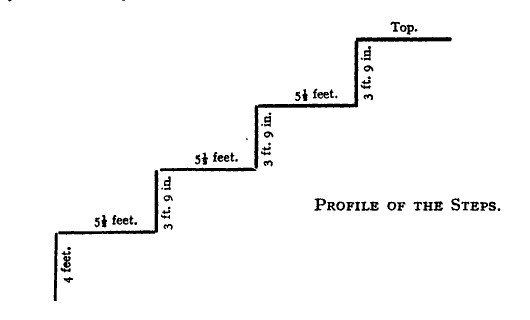
Profile of the Steps.
The first, so far as I know, to see and describe these remarkable tombs were the earliest missionaries to Tonga about the end of the eighteenth century. Speaking of the burial ground at Mooa, where lay interred the divine chiefs whose title was Tooitonga and whose family name was Futtafāihe or Fatafehi, the missionaries observe that "the fiatookas are remarkable. There lie the Futtafāihes for many generations, some vast and ruinous, which is the case with the largest; the house on the top of it is fallen, and the area and tomb itself overgrown with wood and weeds."[151] Later on they had the advantage of being conducted over the august cemetery by the Futtafāihe or Tooitonga of the day in person, who gave them some explanations concerning these sepulchres of his ancestors. To quote their description, they say that the tombs "lie ranged in a line eastward from his house, among a grove of trees, and are many in number, and of different constructions: some, in a square form, were not in the least raised above the level of the common ground; a row of large stones formed the sides, and at each corner two high stones were placed upright at right angles to each other, and in a line with their respective sides: others were such as the brethren describe that of Moomōoe to be: and a third sort were built square like the first; the largest of which was at the base one hundred and fifty-six feet by one hundred and forty; it had four steps from the bottom to the top, that run quite round the pile: one stone composed the height of each step, a part of it being sunk in the ground; and some of these stones in the wall of the lower are immensely large; one, which I measured, was twenty-four feet by twelve, and two feet thick; these Futtafāihe informed me were brought in double canoes from the island of Lefooga. They are coral stone, and are hewn into a tolerably good shape, both with respect to the straightness of their sides and flatness of their surfaces. They are now so hardened by the weather, that the great difficulty we had in breaking a specimen of one corner made it not easy to conjecture how the labour of hewing them at first had been effected; as, by the marks of antiquity which some of them bear, they must have been built long before Tasman showed the natives an iron tool. Besides the trees which grow on the top and sides of most of them, there are the etooa, and a variety of other trees about them; and these, together with the thousands of bats which hang on their branches, all contribute to the awful solemnity of those sepulchral mansions of the ancient chiefs. On our way back Futtafāihe told us that all the fiatookas we had seen were built by his ancestors, who also lay interred in them; and as there appeared no reason to doubt the truth of this, it proves that a supreme power in the government of the island must for many generations have been in the family of the Futtafāihes: for though there were many fiatookas in the island, the brethren, who had seen most of them, said they were not to be compared to these for magnitude, either in the pile or the stones which compose them."[152]
Some thirty years later the tombs of the Tooitongas were visited and described by the French explorer, J. Dumont d'Urville. His description is worth quoting. He says: "I directed my steps to the splendid faï-tokas of the Fata-Faïs. As these monuments are essentially taboo, in the absence of the Tooi-tonga no one looks after their upkeep, and they are now buried on every side among dark masses of trees and almost impenetrable thickets. Hence we had some difficulty in approaching them, and it was impossible for us to get a single general view of the whole of these structures, which must have a somewhat solemn effect when the ground is properly cleared.
"For the most part these mausoleums have the form of great rectangular spaces surrounded by enormous blocks of stone, of which some are as much as from fifteen to twenty feet long by six or eight broad and two feet thick. The most sumptuous of these monuments have four or five rows of steps, making up a total height of eighteen or twenty feet. The interior is filled up with shingle and fragments of unhewn coral. One of these faï-tokas, which I measured, was a hundred and eighty feet long by a hundred and twenty broad. At one of the upper angles I observed a block of considerable size with a deep cutting in it. I was told that it was the seat of the Tooi-tonga-fafine[153]; it was there that she sat to preside at the ceremony of the funeral of the Tooi-tonga.
"Some of these edifices were of an oval form, but they were much smaller. Each of them was surmounted by a small hut, which served as an oratory or house for the spirit of the dead; most of them have been destroyed by the lapse of time, and only traces of them are left scattered on the ground.
"The enormous blocks of coral employed in the construction of these monuments have all been brought by sea from Hifo to Mooa. They were got on the shore of the sea at Hifo, were hewn on the spot, and were transported in great canoes; then they were landed at Mooa and drawn on rollers to the place of their destination. These monuments are astonishing evidence of the patience which they must have demanded on the part of these islanders; they were ocular testimony to me of the high degree of civilisation which the natives had reached. Man must have risen to ideas of a much higher order than those of a simple savage before he would take so great pains for the single object of consecrating the memory of his chiefs.
"Such tombs are no longer built in Tongataboo: people content themselves with simple mounds surrounded by a row of posts or even an ordinary palisade. However, Singleton assured me that Finow the Younger had erected two great faï-tokas of stone in Vavao, one for the last Tooitonga, and one for his father."[154]
The Frenchman, De Sainson, who accompanied Dumont d'Urville on his visit to Tongataboo, has also described the tombs of the Tooitongas at Mooa from personal observation. I will quote his description: "It is in the heart of the forest that the ancient inhabitants of these countries, who idolized their Kings (Tooi-tongas), placed the tombs of that sacred race. These monuments of a more enterprising age still astonish the beholder by their mass and their extent. The fai-tokas, as these burial-places are called, are artificial eminences, on the top of which, in the form of a square, are three or four crosses of great granitic blocks arranged as steps, of which each block may be four or five feet high. If there is only a single step on the top of the mound, it is because only a single Tooi-tonga sleeps there in the grave; if the bones of a whole family are deposited in a common tomb, three or four steps, one above the other, mark their union in death. Some of these monuments which contain only a single body are arranged in an oval. I counted more than twelve of these immense structures, and yet we left a great many aside. I counted more than one stone between eight and fifteen feet long; and I conceived a high idea of those men of ancient days who erected over the remains of their kings these imperishable mausoleums, in an island based on coral, where it would be difficult to find a stone of two feet square. I imagined them to be very different from their effeminate descendants, those men of old who went in their canoes more than a hundred and fifty leagues to look for the enormous blocks of which these tombs are built, who cut them without the help of iron, and succeeded, by means unknown, in planting them on these hillocks, where by their own weight they are fixed for ever, like the Druidical monuments of Brittany, which one would say were dropped on earth rather by the magic of talismans than by the power of man.
"The present inhabitants of Tonga contemplate with a pious awe the fruit of the labours and patience of their forefathers, without dreaming for a moment of imitating them in their noble enterprises. A distant voyage affrights these degenerate scions of a hardy race, and the great canoes which still survive, sheltered under sheds very skilfully built, are little more than the useless encumbrance of chiefs grown languid in the long peace which has infected the whole people with habits of indolence.
"The most recent tombs consist of a small house enclosed on all sides, built on a rising ground, and shaded by a circle of mimosas, a tree sacred to the dead. Most of the illustrious graves are clustered together at Mafanga, a large village of which the whole territory is sacred on account of the hallowed relics which it contains. Along with the corpse they bury at the depth of a few inches small wooden effigies representing persons of both sexes. I had occasion to unearth a few of these little statues, and I remarked in them an astonishing feeling for artistic design."[155]
Some sixteen years later a Catholic missionary, living among the heathen population of Tongataboo, wrote thus: "Nothing equals the care which they take in the burial of their dead. As soon as a native has breathed his last, the neighbours are informed, and immediately all the women come to weep about the corpse. Here the men never weep. The body is kept thus for a day or two, during which they are busy building a tomb near the dwelling of the deceased's family. The sepulchral house is neat, built on an eminence, surrounded by a pretty fence of choice bamboos; the enclosure is planted with all kinds of odoriferous shrubs, especially evergreens. Finally, the monument is covered by a roof artistically constructed. For the tombs of kings and the greatest chiefs they go to distant islands to find huge stones to crown the grave. I have seen one twenty-four feet long by eight broad and at least eighteen inches thick. One of these tombs was built by the natives of Wallis Island, who brought the enormous blocks in immense canoes. It is wonderful for these peoples."[156]
Captain Erskine, who visited Tongataboo in 1849, says that "near the landing-place at the village of Holobeka, off which we were lying, we saw overshadowed with trees, one of the faitokas, or old burial-places of the country, which, although no longer 'tabu,' are still in some cases used as places of sepulture, and very carefully kept. This one was an oblong square platform a few feet high, surrounded by a stone wall, the interior being beautifully paved with coloured corals and gravel; the house or temple, which Captain Cook and others describe as occupying the centre, having been, I suppose, removed. I saw but one other of these monuments during our stay among the islands, the largest of which stands on several rows of steps, as described by all former visitors."[157]
Thomas West, who lived as a missionary in the Tongan islands from 1846 to 1855, tells us that "chiefs were usually interred in tombs, constructed of blocks of sandstone, cut from suitable localities by the seashore, where, at a little depth from the surface, layers of hard and durable sandstone are found, even on many of the coralline islands. In several of the ancient burial-places, similar stones, arranged in terraces, surround the whole enclosure. Some of these are of immense size, and seem to indicate the possession, on the part of former inhabitants, either of greater energy than the present race, or of better tools and appliances. The burial-places of the Tonguese are always surrounded by the most imposing foliage of the tropics, and placed in sequestered spots. A mound of earth is raised, of dimensions varying with the necessities of the place; and, whenever a grave is opened within the limits of this mound, it is always filled up with beautiful white sand, and never contains more than one body. No particle of clay or earthy mould is allowed to touch the remains of the dead. The sand is brought in baskets by the chief mourners, who sometimes sail or journey many miles to procure it; and each person pours the contents into the grave until it is sufficiently filled up. The top of the grave is, afterwards, carefully tended and decorated with black pebbles and red coral, arranged in various devices, which have a very pretty effect. Small houses are also placed over the tombs of the chiefs and gentry."[158]
In more recent years the tombs of the Tooitongas at Mooa have been visited by Sir Basil Thomson, who has described and discussed them.[159] From an anonymous pamphlet called The Wairarapa Wilderness, written by the passengers of the s.s. Wairarapa and published in 1884, Sir Basil Thomson quotes a passage containing a description of the tombs, with measurements which, he tells us, are accurate as far as they go. From it I will extract a few particulars. The writers inform us that the tombs are built of blocks of coral which vary in length and thickness; some of the largest they found to be from fifteen to eighteen feet long and from one and a half to two feet thick. The largest measured by them is twenty-two feet long and two feet thick and stands between seven and eight feet above the ground. This great stone, now split in two, is at the middle of the lowest step of one of the pyramidal tombs. The height of the steps varies much in the different pyramids; one step was found to be four feet high. The breadth of each step is three feet or more: it has been carefully levelled and covered with coral gravel. The stones fit very closely and are very regular at top and bottom throughout the tiers. The corners of one pyramid observed by the writers are formed of huge rectangular stones, which seem to have been put in position before they were finally faced. On the upper surface of the largest stone is a deep hollow about the size and shape of a large chestnut mortar. Sir Basil Thomson, who has examined this hollow, believes it to be a natural cavity which has been artificially smoothed by a workman. He suggests that it may have been lined with leaves and used as a bowl for brewing kava at the funeral ceremonies. On one mound the writers of the pamphlet remarked a large flat stone, some five and a half feet square; and in several of the tombs they noticed huge slabs of volcanic stone placed indiscriminately side by side with blocks of coral. The writers measured the bases of three of the tombs and found them to be about two chains (one hundred and thirty-two feet) long by a chain and a half (ninety-nine feet) broad; the base of a fourth was even larger.[160]
Surveying these various accounts of the tombs of the Tooitongas or sacred chiefs, we may perhaps conclude that, while the type of tomb varied in different cases, the most characteristic, and certainly the most remarkable, type was that of a stepped or terraced pyramid built of such large blocks of stone as to merit the name of megalithic monuments. So far as I have observed in the accounts given of them, this type of tomb was reserved exclusively for the sacred chiefs, the Tooitongas, whom the Tongans regarded as divine and as direct descendants of the gods. The civil kings, so far as appears, were not buried in these massive pyramids, but merely in stone vaults sunk in the summits of grassy mounds.
It is natural, with Sir Basil Thomson,[161] to compare the pyramids of the Tooitongas with the similar structures called morais or marais which are found in Tahiti and the Marquesas islands. Indeed, the very name morai was sometimes applied to them by the Tongans themselves, though more usually they called them fiatookas, which was simply the common word for burying-ground.[162] In Tahiti and the Marquesas islands these marais were in like manner truncated pyramids, rising in a series of steps or tiers, built of stones, some of which were large, but apparently not so large as in the corresponding Tongan edifices; for in describing one of the largest of the Tahitian morais or marais Cook mentions only one stone measuring as much as four feet seven inches in length by two feet four in breadth, though he found several three and a half feet long by two and a half feet broad. These dimensions can hardly compare with the size of the blocks in the tombs of the Tooitongas, some of which, as we have seen, measure fifteen, eighteen, and even twenty-two or twenty-four feet in length by eight or twelve feet in height. These Tahitian and Marquesan pyramids are commonly described as temples, and justly so, because the gods were worshipped there and human sacrifices were offered on them.[163] But they were also, like the similar structures in Tonga, used in certain cases for the burial of the dead, or at all events for the preservation of their embalmed bodies. Captain Cook seems even to have regarded the Tahitian morais primarily as burying-grounds and only secondarily as places of worship.[164] In the island of Huahine, one of the Society Islands, the sovereign chiefs were buried in a marai, where they lay, we are told, in more than Oriental state.[165] William Ellis, one of our best authorities on the religion of the Tahitians, tells us that "the family, district, or royal maraes were the general depositories of the bones of the departed, whose bodies had been embalmed, and whose skulls were sometimes preserved in the dwelling of the survivors. The marae or temple being sacred, and the bodies being under the guardianship of the gods, were in general considered secure when deposited there. This was not, however, always the case; and in times of war, the victors sometimes not only despoiled the temples of the vanquished, and bore away their idol, but robbed the sacred enclosure of the bones of celebrated individuals."[166] Moerenhout, another good authority on the Tahitian religion, informs us that the marais which belonged to individuals often served as cemeteries and were only the more respected on that account; but he says that in the public marais almost the only persons buried were the human victims offered in sacrifice, and sometimes the priests, who were laid face downwards in the grave, for the curious reason that otherwise the gaze of the dead men would blight the trees and cause the fruit to fall to the ground.[167]
In the Marquesas islands the morais appear to have been also used occasionally or even regularly as burial-places. Langsdorff, one of our earliest authorities on these islands, speaks of a morai simply as a place of burial.[168] He tells us that the mummified bodies of the dead were deposited on scaffolds in the morai or family burial-place, and that the people of neighbouring but hostile districts used to try to steal each other's dead from the morais, and deemed it a great triumph when they succeeded in the attempt. To defeat such attempts, when the inhabitants of a district expected to be attacked in force by their enemies, they were wont to remove their dead from the morai and bury them in the neighbourhood.[169] Again, in their monograph on the Marquesas islands, the French writers Vincendon-Dumoulin and Desgraz recognise only the mortuary aspect of the morais. They say: "The morais, funeral monuments where the bodies are deposited, are set up on a platform of stone, which is the base of all Nukahivan constructions. They are to be found scattered in the whole extent of the valleys; no particular condition seems to be required in the choice of the site. Near the shore of Taïohae is the morai which contains the remains of a brother of the atepeïou Patini, an uncle of Moana, who died some years ago, as they tell us."[170]
Thus to some extent, in function as well as in form, these pyramidical temples of Tahiti and the Marquesas islands corresponded to the megalithic monuments of the Tooitongas or sacred chiefs of Tonga; in fact, they were mausoleums as well as temples. We are not at liberty to assume, with one authority on the Polynesians, that they were mausoleums first and foremost, and that they only developed into temples at a later time.[171] It is possible, on the contrary, that from the outset they were temples dedicated to the worship of the high gods, and that the custom of depositing the dead in them was a later practice adopted for the sake of the protection which these holy places might be expected to afford against the efforts of enemies to carry off and desecrate the remains of the departed. Dr. Rivers propounded a theory that the custom of building these megalithic monuments in the form of pyramids was introduced into the Pacific by a people who brought with them a secret worship of the sun, and he apparently inclined to regard the monuments themselves as at least associated with that worship.[172] The theory can hardly apply to the megalithic monuments of the Tooitongas in Tongataboo; for the evidence which I have adduced seems to render it certain that these monuments were erected primarily as tombs to receive the bodies of the sacred chiefs. It is true that these tombs enjoyed a sacred character and were the scene of worship which justly entitles them to rank as temples; but so far as they were temples, they were devoted to the worship, not of the sun, but of the dead.
Thus our enquiry into the meaning and origin of these interesting monuments entirely confirms the view of the shrewd and observant Captain Cook that the fiatookas, as the Tongans called them, were both places of burial and places of worship.
Finally, the evidence which I have cited appears to render it highly probable that these imposing monuments were built, not by a prehistoric people, predecessors of the Tongans in the islands, but by the Tongans themselves; for not only do the people affirm that the tombs were erected by their ancestors, but they have definite traditions of some of the chiefs who built them, and are buried in them; and they still profess to remember some of the islands from which the huge stones were brought to Tongataboo in great double canoes.
That the graves of the great chiefs were, like temples, regarded by the people with religious reverence appears plainly from a statement of Mariner. He tells us that a place called Mafanga, in the western part of Tongataboo, being a piece of land about half a mile square, was consecrated ground. "In this spot," he says, "are the graves where the greatest chiefs from time immemorial have been buried, and the place is therefore considered sacred; it would be a sacrilege to fight here, and nobody can be prevented from landing: if the most inveterate enemies meet upon this ground, they must look upon each other as friends, under penalty of the displeasure of the gods, and consequently an untimely death, or some great misfortune. There are several of these consecrated places on different islands."[173] Thus the reverence paid to the tombs of the chiefs was like the reverence paid to the consecrated houses and enclosures of the gods; we have already seen what a sacrilege it was deemed to fight or to pursue an enemy within the consecrated enclosure of a god,[174] and we now learn that it was equally a sacrilege to fight within the ground that was hallowed by the graves of the chiefs.
Mariner has described for us the worship paid by the king and his chiefs to one of the sacred graves at Mafanga. One morning Finow the king, accompanied by several of his chiefs and their ministers (the matabooles), landed at Mafanga and immediately proceeded to his father's grave to perform a ceremony called toogi. Mariner attended the party and witnessed the ceremony. All who went to participate in it assumed the attire of mourners or suppliants, that is, they wore mats instead of their usual dress and they had wreaths, made of the leaves of the ifi tree, round their necks. They sat down before the grave, and the king and all of them beat their cheeks with their fists for about half a minute without speaking a word. One of the principal ministers (matabooles) then addressed the spirit of the king's father to the following effect: "Behold the man (meaning Finow, the king) who has come to Tonga to fight his enemies. Be pleased with him, and grant him thy protection. He comes to battle, hoping he is not doing wrong. He has always held Tooitonga in the highest respect, and has attended to all religious ceremonies with exactness." One of the attendants then went to the king and received from him a piece of kava root, which he laid down on the raised mount before the burial-place (fytoka). Several others, who had pieces of kava root in their bosoms, went up to the grave in like manner and deposited them there.[175]
Thus the king prayed to the spirit of his dead father at his grave and made an offering at the tomb. What more could he do to a god at his temple? And in general we are told that when a great blessing was desired, or a serious evil deprecated, if the people wished to enjoy health or beget children, to be successful at sea, or victorious in war, they would go to the burial grounds of their great chiefs, clean them up thoroughly, sprinkle the floor with sand, and lay down their offerings.[176] When Finow the king was dying, his friends carried him on a bier, not only to the temples of the great gods Tali-y-Toobo and Tooi-fooa-Bolotoo, where prayers for his recovery were offered; they bore him also to the grave of a chieftainess and invoked her spirit in like manner to pity and spare the expiring monarch.[177] Apparently they thought that the ghost of the chieftainess was quite as able as the great gods to heal the sick and restore the dying.
But on no occasion, perhaps, was the assimilation of dead men to gods so conspicuous as at the annual offering of first-fruits, which seems to have been the most impressive of all the yearly rites observed by the Tongans. The ceremony was observed once a year just before the yams in general had arrived at a state of maturity; the yams offered at it were of a kind which admitted of being planted sooner than the others, and which consequently, ripening earlier, were the first-fruits of the yam season. The object of the offering was to ensure the protection of the gods, that their favour might be extended to the welfare of the nation generally, and in particular to the productions of the earth, of which in Tonga yams are the most important. At this solemn ceremony the new yams, slung on poles, were brought from distant islands, carried in procession to the grave of the late Tooitonga, and deposited in front of it, their bearers sitting down beside them. Thereupon one of the ministers (matabooles) of the living Tooitonga arose, advanced, and sat down before the grave, a little in front of the men who had brought the yams. Next he addressed the gods generally, and afterwards particularly, mentioning the late Tooitonga and the names of several others. In doing so he returned thanks for their divine bounty in favouring the land with the prospect of a good harvest, and prayed that their beneficence might be continued in future. In this harvest thanksgiving the spirit of the dead Tooitonga seems to have ranked on an equality with the original or superhuman gods; indeed, in a sense he took precedence of them, since the offerings were presented at his grave. The first-fruits, we are told, were offered to the gods in the person of the divine chief Tooitonga.[178]
On the whole we may conclude that, however sharp a distinction was drawn in theory between the old gods, who had always been gods, and the new gods, who had once been men, the line which divided them in practice was wavering and blurred. The dead men and women were fast rising, if they had not already risen, to an equality with the ancient deities. We may even surmise that some of these old gods themselves were human beings, whose original humanity was forgotten.
The tombs of the kings and sacred chiefs may be described as megalithic monuments in so far as immense stones were often employed in the construction either of the enclosing walls or of the high steps which led up to the summit of the mound where the grave was dug. It is possible, and indeed probable, that great stones were similarly employed as ornaments or accessories of the consecrated houses or temples of the primary gods, but of such an employment I have met with no express notice among our authorities. So far as their descriptions allow us to judge, these megalithic monuments of the Tongans were purely sepulchral in character; they were dedicated only to the worship of the dead. But there exists at least one other remarkable megalithic monument in these islands of which the original meaning is quite uncertain, and of which consequently we cannot confidently say that it was erected for the sake of honouring or propitiating the spirits of the departed. The monument in question is situated near the eastern extremity of Tongataboo, at a distance of three or four hundred yards from the beach and facing towards the island of Eua. The land on which it stands was the private property of the Tooitongas, whose megalithic tombs are situated some eight or nine miles away to the west. In the intervening country, which is perfectly flat and partly covered with forest, partly under cultivation, there are said to be no other monuments or ruins. It is remarkable that this imposing monument, which naturally impresses the observer by its resemblance to the trilithons or gate-like structures of Stonehenge, should have apparently escaped the observation of Europeans down to the middle of the nineteenth century. It is not mentioned by Cook and Mariner, nor even by those who, like the first missionaries and Dumont d'Urville, described in some detail the tombs of the Tooitongas not many miles off. Perhaps the solitariness of the surrounding country may partly account for their ignorance and silence; for there are said to be few inhabitants in this part of the island and none at all in the immediate neighbourhood of the monument. It seems to have been first discovered by Mr. Philip Hervey of Sydney in 1850 or 1851, but his description of it was not published for some ten years. In August 1852 it was seen by Dr. Charles Forbes, Surgeon of H.M.S. Calliope, and his description of it was published by the Society of Antiquaries of London in the following year. In 1865 it was seen and briefly described by Mr. Foljambe of H.M.S. Curaçoa. Some twenty years later the passengers of the s.s. Wairarapa, on a yachting cruise from New Zealand, visited the spot and published an account of the structure. Still later Sir Basil Thomson examined the monument and discussed its history.[179]
The monument in question is a structure of the type known as a trilithon; that is, it is composed of three large stones, of which two stand upright, while the third rests horizontally on their tops. All three stones are monoliths of hardened coral, rough and much weathered on the surface, and precisely similar to the coral of the neighbouring reefs. Indeed, about halfway between the monument and the beach the coral rock is exposed in a hollow, from which it seems probable that the great blocks were hewn and brought to their present situation. The statement of Mr. Brenchley, that the stone of which the monument consists is not to be found elsewhere on the island, is erroneous. The uprights are quadrangular monoliths neatly squared. No measurements of the stones appear to be on record, but the two uprights are variously estimated to measure from fourteen to sixteen feet in height; their breadth or depth from front to back is variously given as from eight to ten or even twelve feet; but they seem to taper somewhat upwards, for the estimate which assigns twelve feet for the depth of the uprights at their base, mentions seven feet or probably more as their breadth at the top. The thickness of the uprights seems to be four feet. The space between them is variously stated at ten and twelve feet. The cross-stone, which rests on the two uprights, is reported to measure twenty-four feet in length, by four or five feet in depth, and two feet in thickness. Each of the uprights is estimated by Sir Basil Thomson to weigh not less than fifty tons. The tops of both are deeply mortised to receive the cross-stone, the ends of which are sunk into them instead of being laid flat on the top. The cross-stone lies east and west, so that the opening between the uprights faces north and south. On the upper surface of the cross-stone, and at about the middle of it, is a cup-like hollow, very carefully cut, about the size of a coco-nut shell. A large bowl of the same material is said to have formerly stood on the cross-stone, but the statement is not made by an eyewitness and is probably mistaken.[180]
The name which the natives give to this megalithic monument is Haamonga or Ho ha Mo-nga Maui, which is said to mean "Maui's burden." The name is explained by a story that the god or hero Maui brought the massive stones in a gigantic canoe from Uea (Wallis Island), where the great holes in the rock from which he quarried them may still be seen. From the canoe he bore them on his back to the spot where they now stand.[181] This story can hardly be thought to throw much light on the origin of the monument; for the natives are in the habit of referring the marvels which they do not understand to the action of the god or hero Maui, just as the ancient Greeks fathered many natural wonders on the deified hero Hercules.[182] But from Mateialona, Governor of Haapai and cousin of the King of Tonga, Sir Basil Thomson obtained a tradition of the origin of the stones which is at least free from the miraculous element and connects the monument with Tongan history. The account runs thus: "Concerning the Haamonga of Maui, they say forsooth that a Tui Tonga (the sacred line of chiefs), named Tui-ta-tui, erected it, and that he was so named because it was a time of assassination.[183] And they say that he had it built for him to sit upon during the Faikava (ceremony of brewing kava), when the people sat round him in a circle, and that the king so dreaded assassination that he had this lordly seat built for himself that he might sit out of the reach of his people. And this, they say, is the origin of the present custom of the Faikava, it being now forbidden for any one to sit behind the king." At such wassails the presiding chief sits at the apex of an oval. To this tradition Sir Basil Thomson adds: "Mr. Shirley Baker told me that he believed the Haamonga to have been erected as a fakamanatu (memorial) to the son of some Tui Tonga, a view that finds support in the fondness of Tongan chiefs for originality in the burial ceremonies of their near relations—witness Mariner's account of the funeral of Finau's daughter—but on the other hand native traditions generally have a kernel of truth, and the legend of Tui-ta-tui and its consequences finds an analogy in our own custom of guarding against an assassin's dagger at the drinking of the loving cup."[184] The tradition receives some confirmation from the bowl-like hollow on the upper surface of the cross-stone; for the hollow might have served as the king's drinking-cup to hold his kava at the customary wassails. Indeed, Mr. Philip Hervey, the first to examine the monument, describes the hollow in question as "a small cava bowl";[185] and after giving an account of the monument Mr. Brenchley adds: "Its history seems to be entirely unknown, but it is very natural to suppose from its form that it was connected with some ancient kava ceremonies."[186]
[146] Captain James Wilson, Missionary Voyage to the Southern Pacific Ocean, pp. 283 sq.
[118] E. E. V. Collocot, op. cit. pp. 161, 233.
[142] Captain James Wilson, op. cit. p. 244.
[125] E. E. V. Collocot, op. cit. pp. 230, 231, 233.
[121] E. E. V. Collocot, op. cit. pp. 234 sq.
[162] Captain James Cook, Voyages, v. 424. Elsewhere (v. 364) he speaks of "a morai or fiatooka"; and shortly afterwards, referring to the same structure, he mentions it as "this morai, or what I may as well call temple" (p. 365). As to the equivalence of the words morai and marai (marae), see J. A. Moerenhout, Voyages aux Îles du Grand Océan (Paris, 1837), i. 466; and as to the significance of the word in its various dialectical forms, see E. Tregear, Maori-Polynesian Comparative Dictionary, p. 213, s.v. "malae."
[178] W. Mariner, Tonga Islands, ii. 196-202, compare p. 78. The ceremony was also witnessed, though not understood, by Captain Cook (Voyages, v. 363 sqq.) and by the first English missionaries (Captain James Wilson, Missionary Voyage to the Southern Pacific Ocean, pp. 264 sq.).
[147] The tomb described and illustrated by the first missionaries had four massive and lofty steps, each of them five and a half feet broad and four feet or three feet nine inches high. See Captain James Wilson, l.c., with the plate facing p. 284. One such tomb, rising in four tiers, is ascribed traditionally to a female Tooitonga, whose name has been forgotten. See (Sir) Basil Thomson, "Notes upon the Antiquities of Tonga," Journal of the Anthropological Institute, xxxii. (1902) p. 88 n.2.
[171] C. E. Meinicke, Die Inseln des Stillen Oceans, ii. 180.
[109] Sarah S. Farmer, Tonga and the Friendly Islands, pp. 126 sq.
[154] J. Dumont d'Urville, Voyage de l'Astrolabe, Histoire du Voyage, iv. (Paris, 1832) pp. 106-108. Singleton was an Englishman, one of the crew of the Port-au-Prince, the ship in which Mariner sailed. When Dumont d'Urville visited Tonga, Singleton had lived as a native among the natives for twenty-three years; he was married and had children, and he hoped to end his days in Tongataboo. See J. Dumont d'Urville, op. cit. iv. 23 sq.
[126] E. E. V. Collocot, op. cit. pp. 230, 233.
[150] (Sir) Basil Thomson, "Notes upon the Antiquities of Tonga," Journal of the Anthropological Institute, xxxii. (1902) pp. 86 sq., 88 n.2. As to the legend of the tyrant Takalaua, see id. Diversions of a Prime Minister, pp. 294-302.
[122] E. E. V. Collocot, op. cit. p. 232.
[135] Captain James Cook, Voyages, iii. 182-184.
[159] (Sir) Basil Thomson, Diversions of a Prime Minister, pp. 379 sq.; id. "Notes upon the Antiquities of Tonga," Journal of the Anthropological Institute, xxxii. (1902) pp. 86-88.
[175] W. Mariner, Tonga Islands, i. 88 sq.
[129] E. E. V. Collocot, op. cit. p. 160.
[172] W. H. R. Rivers, "Sun-cult and Megaliths in Oceania," American Anthropologist, N.S. xvii. (1915) pp. 431 sqq.
[138] W. Mariner, Tonga Islands, i. 402. A little farther on (p. 424, note *) Mariner remarks that "mourners were accustomed to smooth the graves of their departed friends, and cover them with black and white pebbles."
[155] "Extrait du Journal de M. de Sainson," in J. Dumont d'Urville, Voyage de l'Astrolabe, Histoire du Voyage, iv. (Paris, 1832) pp. 361 sq.
[123] E. E. V. Collocot, op. cit. pp. 238 sq.
[151] Captain James Wilson, Missionary Voyage to the Southern Pacific Ocean, p. 252. As to Futtafāihe, the Tooitonga or divine chief of their time, the missionaries remark (l.c.) that "Futtafāihe is very superstitious, and himself esteemed as an odooa or god." Here odooa is the Polynesian word which is usually spelled atua. Mariner tells us (Tonga Islands, ii. 76) that the family name of the Tooitonga was Fatafehi, which seems to be only another way of spelling Futtafāihe, the form adopted by the missionaries. Captain Cook similarly gives Futtafāihe as the family name of the sacred kings or Tooitongas, deriving the name "from the God so called, who is probably their tutelary patron, and perhaps their common ancestor." See Captain James Cook, Voyages, v. 425.
[164] Capt. James Cook, Voyages, i. 157 sq., "Their name for such burying-grounds, which are also places of worship, is Morai." Compare id., i. 217, 219, 220, 224, vi. 37, 41; J. Turnbull, Voyage round the World (London, 1813), p. 151, "the morais, which serve the double purpose of places of worship and receptacles for the dead." Compare J. R. Forster, Observations, p. 545, "To ornament the marais and to honour by it the gods and the decayed buried there, the inhabitants plant several sorts of trees near them."
[134] Herbert Spencer, Principles of Sociology, vol. i (London, 1904) pp. 249 sqq.
[176] Sarah S. Farmer, Tonga and the Friendly Islands, p. 127.
[158] Thomas West, Ten Years in South-Central Polynesia (London, 1865), pp. 268 sq.
[167] J. A. Moerenhout, op. cit. i. 470. As to the Tahitian custom of burying the dead in the marais, see also C. E. Meinicke, Die Inseln des Stillen Oceans, ii. 183 sq., according to whom only the bodies of persons of high rank were interred in these sanctuaries.
[139] Captain Cook, Voyages, v. 424.
[183] "Tui-ta-tui, lit. 'King-strike-King.'"
[179] See the letter of Dr. Charles Forbes, in Archaeologia, or Miscellaneous Tracts relating to Antiquity, xxxv. (London, 1853) p. 496 (with a woodcut); Proceedings of the Society of Antiquaries of London [First Series], iii. 19; id. Second Series, i. 287; letter of Philip Hervey, quoted by Kenneth R. H. Mackenzie, in Proceedings of the Society of Antiquaries of London, Second Series, ii. 75-77; Julius L. Brenchley, Jottings during the Cruise of H.M.S. "Curaçoa" among the South Sea Islands in 1865 (London, 1873), p. 132 (with a woodcut); (Sir) Basil Thomson, Diversions of a Prime Minister (Edinburgh and London, 1894), pp. 380-382 (with a woodcut on p. 393); id. "Notes upon the Antiquities of Tonga," Journal of the Anthropological Institute, xxxii. (1902) pp. 81-84 (with a photograph). Views of the monument, taken apparently from photographs, have also been published by Dr. F. H. H. Guillemard (Australasia, vol. ii. London, 1894, p. 501), Dr. George Brown (Melanesians and Polynesians, London, 1910, plate facing p. 410), and by Mr. S. Percy Smith (Hawaiki, Third Edition, Christchurch, N.Z., 1910, pp. 157 sq.). Dr. W. H. R. Rivers spoke as if there were several trilithons in Tongataboo (History of Melanesian Society, ii. 430 sq.; id. "Sun-cult and Megaliths in Oceania," American Anthropologist, N.S. xvii., 1915, p. 444); but in this he seems to have been mistaken. So far as I can gather, there is only one of these remarkable monuments in Tongataboo or indeed in the whole of the Pacific.
[124] E. E. V. Collocot, op. cit. p. 229.
[120] E. E. V. Collocot, op. cit. p. 234.
[133] W. Mariner, Tonga Islands, ii. 110
[163] Captain James Cook, Voyages, i. 157 sqq.; J. R. Forster, Observations made during a Voyage round the World (London, 1788), pp. 543 sqq.; Captain James Wilson, Missionary Voyage to the Southern Pacific Ocean, pp. 207 sqq.; David Porter, Journal of a Cruise made to the Pacific Ocean (New York, 1822), ii. 38 sq.; D. Tyerman and G. Bennet, Journal of Voyages and Travels (London, 1831), i. 240-248, 265 sqq., 271, 274, 529 sq., ii. 13 sq., 38 sq.; W. Ellis, Polynesian Researches, Second Edition (London, 1832-1836), i. 340, 405; J. A. Moerenhout, Voyages aux Îles du Grand Océan, i. 466-470; G. H. von Langsdorff, Reise um die Welt (Frankfurt am Mayn, 1812), i. 115, 134; H. Melville, Typee (London, N.D.), pp. 166-169 (Everyman's Library); Matthias G——, Lettres sur les Îles Marquises (Paris, 1843), pp. 54 sq.; C. E. Meinicke, Die Inseln des Stillen Oceans (Leipzig, 1875-1876), i. 49, ii. 180, 183 sq.; G. Gerland, in Th. Waitz, Anthropologie, vi (Leipzig, 1872) pp. 376 sqq.
[127] E. E. V. Collocot, op. cit. p. 232.
[168] G. H. von Langsdorff, op. cit. i. 115.
[136] Captain James Cook, op. cit. iii. 206.
[184] (Sir) Basil Thomson, "Notes upon the Antiquities of Tonga," Journal of the Anthropological Institute, xxxii. (1902) p. 82.
[108] W. Mariner, op. cit. ii. 99, 131.
[180] For the authorities, see the preceding note. The measurements, to some extent discrepant, are given by Dr. Charles Forbes, Mr. Philip Hervey, and the passengers of s.s. Wairarapa, as reported by Sir Basil Thomson Journal of the Anthropological Institute, xxxii. 82 sq.), who had unfortunately mislaid his own notes containing the measurements. The statement that the monument was surmounted by a large bowl is made by Mr. Brenchley, in whose sketch of the structure the bowl figures. But Mr. Brenchley did not himself see the monument, and nobody else appears to have seen the bowl. I suspect that the report of the bowl may have originated in a hasty reading of Mr. Hervey's statement that "on the centre of it [the cross-stone] a small cava bowl is scooped out," though in Mr. Brenchley's account the bowl has seemingly increased in size. Similarly in his report the height of the uprights has grown to about thirty feet, which appears to be just double of their real size. Perhaps Mr. Brenchley's erroneous allegation as to the material of the monument similarly originated in a misunderstanding of Mr. Hervey's statement that "the material is the coral rock, or coral rag which are formed of stone brought from Wallis's Island."
[153] The Tooi-tonga-fafine (or fefine) was the Tooitonga's sister and ranked above him. Her title means "the lady Tooi-tonga." "Her dignity is very great. She is treated as a kind of divinity. Her rank is too high to allow of her uniting herself in marriage with any mortal: but it is not thought wrong or degrading for her to have a family, and in case of the birth of a daughter the child becomes the Tamaha. This lady rises higher than her mother in rank, and is nearer the gods. Every one approaches her with gifts and homage. Her grandfather will bring his offerings and sit down before her, with all humility, like any of the common people. Sick people come to her for cure" (Miss Sarah S. Farmer, Tonga and the Friendly Islands, p. 145, apparently from the information of Mr. John Thomas). Captain Cook learned with surprise that Poulaho, the Tooitonga of his time (whom Cook speaks of as the king) acknowledged three women as his superiors. "On our inquiring, who these extraordinary personages were, whom they distinguish by the name and title of Tammaha, we were told that the late king, Poulaho's father, had a sister of equal rank, and elder than himself; that she, by a man who came from the island of Feejee, had a son and two daughters; and that these three persons, as well as their mother, rank above Futtafaihe the king. We endeavoured, in vain, to trace the reason of this singular pre-eminence of the Tammahas; for we could learn nothing besides this account of their pedigree. The mother and one of the daughters called Tooeela-Kaipa, live at Vavaoo. Latoolibooloo, the son, and the other daughter, whose name is Moungoula-Kaipa, reside at Tongataboo. The latter is the woman who is mentioned to have dined with me on the 21st of June. This gave occasion to our discovering her superiority over the king, who would not eat in her presence, though she made no scruple to do so before him, and received from him the customary obeisance, by touching her foot." See Captain James Cook, Voyages, v. 430 sq.
[115] E. E. V. Collocot, op. cit. p. 227.
[111] E. E. V. Collocot, "Notes on Tongan Religion," Journal of the Polynesian Society, xxx. (1921) pp. 154 sq., 159.
[156] Jérôme Grange, in Annales de la Propagation de la Foi, xvii. (1845) pp. 12 sq.
[128] E. E. V. Collocot, op. cit. p. 239.
[152] Captain James Wilson, Missionary Voyage to the Southern Pacific Ocean, pp. 283-285. The description is accompanied by an engraved plate, which illustrates the three types of tombs mentioned in the text. In the foreground is the stepped pyramid, a massive and lofty structure, its flat top surmounted by a hut. To the right, in the distance, is seen the square walled enclosure, with high stones standing upright at the corners of the walls, and with a hut enclosed in the middle of the square. In the background appears a mound enclosed by a wall and surmounted by a hut. Thus a hut figures as an essential part in each type of tomb. However, Mariner tells us that "they have several fytocas which have no houses on them" (Tonga Islands, i. 392 note *).
[165] D. Tyerman and G. Bennet, op. cit. i. 271.
[137] W. Mariner, Tonga Islands, i. 144, note *. However, in another passage (i. 392, note *) Mariner tells us that, strictly speaking, the word fytoca applied only to the mound with the grave in it, and not to the house upon the mound; for there were several fytocas that had no houses on them. For other mentions of fytocas and notices of them by Mariner, see op. cit. i. pp. 386, note *, 387, 388, 392, 393, 394, 395, 402, ii. 214-218.
[131] E. E. V. Collocot, op. cit. p. 239.
[144] W. Mariner, Tonga Islands, ii. 213 sq.
[116] E. E. V. Collocot, op. cit. pp. 227 sq.
[140] Captain James Cook, Voyages, v. 342 sq.
[112] E. E. V. Collocot, op. cit. pp. 160, 161.
[157] J. E. Erskine, Journal of a Cruise among the Islands of the Western Pacific (London, 1853), p. 130.
[119] E. E. V. Collocot, op. cit. p. 234.
[166] W. Ellis, Polynesian Researches, i. 405. Elsewhere (p. 401), speaking of the Tahitian burial customs, Ellis observes that "the skull was carefully kept in the family, while the other bones, etc., were buried within the precincts of the family temple."
[160] (Sir) Basil Thomson, "Notes upon the Antiquities of Tonga," Journal of the Anthropological Institute, xxxii. (1902) pp. 87 sq.
[132] We have seen (p. 70) that according to Mariner the number of the original gods was about three hundred; but as to the deified noblemen he merely says that "of these there must be a vast number" (Tonga Islands, ii. 109). In his "Notes on Tongan Religion" (Journal of the Polynesian Society, xxx. (1921) p. 159) Mr. E. E. V. Collocot remarks: "The number of the gods, moreover, was liable to constant augmentation by the deification of the illustrious or well-beloved dead." As a notable instance he cites the case of a certain chief named Fakailoatonga, a native of Vavau, who subdued or overran a large part of Tongataboo. He was a leper, but for a long time did not know the true nature of his malady. When he learned the truth, he in disgust buried himself alive, and after his death he was elevated to the godhead. But in this deification, if Mariner is right, there was nothing exceptional; as a chief he became a god after death in the course of nature.
[145] (Sir) Basil Thomson, "Notes upon the Antiquities of Tonga," Journal of the Anthropological Institute, xxxii. (1902) p. 86.
[169] G. H. von Langsdorff, op. cit. i. 134.
[113] E. E. V. Collocot, op. cit. pp. 159 sq.
[185] Proceedings of the Society of Antiquaries of London, Second Series, ii. 77.
[141] Captain James Wilson, Missionary Voyage to the Southern Pacific Ocean, pp. 240 sq.
[181] Charles Forbes, in Archaeologia, xxxv. 496 (who gives Ho ha Mo-nga Maui as the name of the stones); (Sir) Basil Thomson, Diversions of a Prime Minister, p. 382; id., "Notes upon the Antiquities of Tonga," Journal of the Anthropological Institute, xxxii. (1902) p. 81 (who gives Haamonga as the native name of the stones).
[148] The Tahitian chestnut (Inocarpus edulis); see above, p. 74, note2.
[161] (Sir) Basil Thomson, Diversions of a Prime Minister, p. 379.
[173] W. Mariner, Tonga Islands, i. 88.
[170] Vincendon-Dumoulin et C. Desgraz, Îles Marquises ou Nouka-hiva (Paris, 1843), p. 253.
[114] E. E. V. Collocot, op. cit. p. 162.
[186] Julius L. Brenchley, Jottings during the Cruise of H.M.S. "Curaçoa" among the South Sea Islands in 1865 (London, 1873), p. 132.
[110] See below, pp. 182 sqq., 200 sqq.
[182] (Sir) Basil Thomson, "Notes upon the Antiquities of Tonga," Journal of the Anthropological Institute, xxxii. (1902) p. 81. Maui is the great hero of Polynesia, known in nearly every group of islands, generally regarded as a demigod or deified man, but sometimes and in some places rising to the dignity of full godhead. He appears, says Mr. E. Tregear, to unite the classical attributes of Hercules and Prometheus. See E. Tregear, Maori-Polynesian Comparative Dictionary, p. 233, s.v. "Maui."
[149] (Sir) Basil Thomson, Diversions of a Prime Minister (Edinburgh and London, 1894), pp. 379 sq.; id. "Notes upon the Antiquities of Tonga," Journal of the Anthropological Institute, xxxii. (1902) p. 86. According to an earlier authority, the Tongans could name and point out the tombs of no less than thirty Tooitongas. See the letter of Mr. Philip Hervey, quoted in Proceedings of the Society of Antiquaries of London, Second Series, vol. ii. p. 77.
[117] E. E. V. Collocot, op. cit. pp. 231 sq.
[130] See below, pp. 154 sq.
[174] Above, pp. 74 sqq.
[143] W. Mariner, Tonga Islands, i. 387 sq.
[177] W. Mariner, op. cit. i. 367.
The tradition which connects the erection of the monument with the reign of a Tooitonga named Tui-ta-tui is further countenanced, if not confirmed, by a list of the Tooitongas, in which the name of Tui-ta-tui occurs as the eleventh in descent from the great god Tangaloa.[187] This Tui-ta-tui is believed to have reigned in the thirteenth or fourteenth century of our era.[188] From the size and style of the masonry Sir Basil Thomson is disposed to assign the monument to a later date. He points out that for the quarrying and mortising of stones that weigh some fifty tons apiece the craft of stone-cutting must have been fully developed; and from a comparison of the megalithic tombs of the Tooitongas which can be approximately dated, he infers that the craft of stone-cutting in Tonga reached its culmination at the end of the seventeenth century, though it was still practised down to the beginning of the nineteenth century; for Mariner tells us that in his time a professional class of masons was set apart for building the stone sepulchral vaults of chiefs.[189] Yet on the whole Sir Basil Thomson concludes that "when one is left to choose between a definite native tradition on the one hand and probability on the other for the assignment of a date, I would prefer the tradition. If the Tongans had invented the story as a mere expression for antiquity they would not have pitched upon Tui-ta-tui, about whom nothing else is recorded, in preference to Takalaua, Kau-ulu-fonua-fekai, or any of the kings who loom large in traditionary history. Whether the Haamonga was built for a throne or for a memorial, doubtless it is connected with the reign of Tui-ta-tui, who lived in the fourteenth century."[190]
As an alternative to the view that the hollow on the cross-stone was a kava bowl Dr. Rivers suggests that it "may have been destined to receive the skull and other bones of the dead, so often preserved in Polynesia."[191] The suggestion accords well with the opinion that the monument is a memorial of the dead, and it might be supported by the Samoan practice of severing a dead chief's head from his body and burying it separately, to save it from being dug up and desecrated by enemies in time of war.[192] However, Dr. Rivers is careful to add that such a practice is not recorded in Tonga and appears to be incompatible with the mode of sepulture which prevails there.
In this connexion another megalithic monument of the Tonga islands deserves to be considered, though it appears to have been commonly overlooked. It was observed by Captain Cook in the island of Lefooga (Lifuka). He says: "Near the south end of the island, and on the west side, we met with an artificial mount. From the size of some trees that were growing upon it, and from other appearances, I guessed that it had been raised in remote times. I judged it to be about forty feet high; and the diameter of its summit measured fifty feet. At the bottom of this mount stood a stone, which must have been hewn out of coral rock. It was four feet broad, two and a half thick, and fourteen high; and we were told by the natives present, that not above half its length appeared above ground. They called it Tangata Arekee;[193] and said, that it had been set up, and the mount raised, by some of their forefathers, in memory of one of their kings; but how long since, they could not tell."[194]
When we remember that Tongan kings were commonly buried in such mounds as Captain Cook here describes, and further that these mounds were commonly enclosed or faced with great blocks of hewn stone, we may be disposed to accept as reasonable and probable the explanation which the natives gave of this great monolith, which, if the reported measurements of it are correct, must have been no less than twenty-eight feet high. If it was indeed a memorial of a dead king, it might be thought to strengthen the view that the great trilithon was also set up as a monument to a deceased monarch or Tooitonga.
Another possible explanation of the trilithon is, as Sir Basil Thomson points out, that it served as a gateway to some sacred spot inland. But against this view he observes that he examined the bush for some distance in the neighbourhood without finding any trace of ruins or stones of any kind. He adds that the memory of sacred spots dies very hard in Tonga, and that the natives do not believe the trilithon to have been a gateway.[195]
It is natural to compare the trilithon of Tongataboo with the famous trilithons of Stonehenge, which it resembles in plan and to which it is comparable in size. The resemblance struck Dr. Charles Forbes, the first to publish a description of the monument based on personal observation. He says: "The route we pursued led us over a country perfectly level, with the exception of occasional mounds of earth, apparently artificial, and reminding one very much of the barrows of Wilts and Dorset, which idea is still more strongly impressed upon the mind on coming in sight of the monument, which bears a most striking resemblance to the larger gateway-looking stones at Stonehenge."[196] But at the same time, as Dr. Forbes did not fail to note, the Tongan trilithon differs in some respects from those of Stonehenge. In the first place the interval (ten or twelve feet) between the uprights of the Tongan trilithon appears to be much greater than the interval between the uprights of the trilithons at Stonehenge.[197] In the second place, the cross-stone of the Tongan trilithon is mortised much more deeply into the uprights than are the cross-stones at Stonehenge. For whereas at Stonehenge these cross-stones present the appearance of being laid flat on the top of the uprights, the cross-stone of the Tongan trilithon is sunk deeply into the uprights by means of mortises or grooves about two feet wide which are cut into the uprights, so that the top of the cross-stone is nearly flush with their tops, while its ends also are nearly flush with their outside surfaces.[198]
As the origin and purpose of Stonehenge are still unknown, its massive trilithons can hardly be cited to explain the similar monument of Tongataboo. The rival theories which see in Stonehenge a memorial of the dead and a temple of the sun[199] are equally applicable or inapplicable to the Tongan monument. In favour of the mortuary character of this solitary trilithon it might be urged that the Tongans were long accustomed to erect megalithic monuments, though of a different type, at the tombs of their sacred kings, which are situated not many miles away; but against this view it may be argued that there are no traces of burial or graves in the immediate neighbourhood, and that native tradition, not lightly to be set aside, assigns a different origin to the monument. Against the solar interpretation of the trilithon it may be alleged, first, that the monument faces north and south, not east and west, as it might be expected to do if it were a temple of the sun or a gateway leading into such a temple; second, that, while a circle of trilithons, as at Stonehenge, with an opening towards the sunrise may be plausibly interpreted as a temple of the sun, such an interpretation cannot so readily be applied to a solitary trilithon facing north and south; and, third, that no trace of sun-worship has been discovered in the Tonga islands. So far as I have observed, the Tongan pantheon is nowhere said to have included a sun-god, and the Tongans are nowhere reported to have paid any special respect to the sun. Savages in general, it may be added, appear to be very little addicted to sun-worship; it is for the most part among peoples at a much higher level of culture, such as the ancient Egyptians, Babylonians, and Peruvians, that solar worship becomes an important, or even the predominant, feature of the national faith.[200] Perhaps the impulse to it came rather from the meditations of priestly astronomers than from the random fancies of common men. Some depth of thought was needed to detect in the sun the source of all life on earth; the immutable regularity of the great luminary's movements failed to rouse the interest or to excite the fear of the savage, to whom the elements of the unusual, the uncertain, and the terrible are the principal incentives to wonder and awe, and hence to reflexion. We are all naturally more impressed by extraordinary than by ordinary events; the fine edge of the mind is dulled by familiarity in the one case and whetted by curiosity in the other.
Bearing in mind the numerous other stone monuments scattered widely over the islands of the Pacific, from the Carolines to Easter Island, Dr. Guillemard concludes that some race, with a different, if not a higher civilisation preceded the Polynesian race in its present homes, and to this earlier race he would apparently refer the erection of the trilithon in Tongataboo.[201] He may be right. Yet when we consider, first, the native tradition of the setting up of the trilithon by one of the sacred kings of Tonga; second, the practice of the Tongans of building megalithic tombs for these same sacred kings; and, third, the former existence in Tonga of a professional class of masons whose business it was to construct stone vaults for the burial of chiefs,[202] we may hesitate to resort to the hypothesis of an unknown people in order to explain the origin of a monument which the Tongans, as we know them, appear to have been quite capable of building for themselves.
§ 11. Rites of Burial and Mourning
The only mode of disposing of the dead which was practised in the Tonga islands seems to have been burial in the earth. So far as appears, the corpse was not doubled up, but laid at full length in the grave; at all events I have met with no mention of burying a corpse in a contracted posture; and Captain Cook says that "when a person dies, he is buried, after being wrapped up in mats and cloth, much after our manner." He adds that, while chiefs had the special burial-places called fiatookas appropriated to their use, common people were interred in no particular spot.[203] So far as I have observed, none of our authorities speak of a practice of embalming the dead or of giving the bodies any particular direction in the grave.
After a death the mourners testified their sorrow by dressing in old ragged mats and wearing green leaves of the ifi tree round their necks. Thus attired they would repair to the tomb, where, on entering the enclosure, they would pull off the green twigs from their necks and throw them away; then sitting down they would solemnly drink kava.[204] Further, they accompanied their cries and ejaculations of grief and despair by inflicting on their own bodies many grievous wounds and injuries. They burned circles and scars on their bodies, beat their teeth with stones, struck shark's teeth into their heads till the blood flowed in streams, and thrust spears into the inner part of the thigh, into their sides below the arm-pits, and through the cheeks into the mouth.[205] Women in wailing would cut off their fingers, and slit their noses, their ears, and their cheeks.[206] At the funerals of the kings especially the mourners indulged in frantic excesses of self-torture and mutilation. Of two such funerals we have the detailed descriptions of eye-witnesses who resided in the islands at a time when the natives were as yet practically unaffected by European influence. King Moomōoe died in April 1797, and the first missionaries to Tonga witnessed and described his funeral. They have told how, when the corpse was being carried in procession to a temporary house near the royal burial-ground (fiatooka), it was preceded by relatives of the deceased in the usual mourning garb, who cut their heads with shark's teeth till the blood streamed down their faces. A few days later, when the burial was to take place, the missionaries found about four thousand people assembled at the mound where the body was to be interred. In a few minutes they heard a great shouting and blowing of conch-shells, and soon after there appeared about a hundred men, armed with clubs and spears, who, rushing into the area, began to cut and mangle themselves in a most dreadful manner. Many struck their heads such violent blows with their clubs that the sound could be heard thirty or forty yards off, and they repeated them till the blood ran down in streams. Others, who had spears, thrust them through their thighs, arms, and cheeks, all the while calling on the deceased in a most affecting manner. A native of Fiji, who had been a servant of the late king, appeared quite frantic; he entered the area with fire in his hand, and having previously oiled his hair, he set it ablaze, and ran about with it all on flame. When they had satisfied or exhausted themselves with this manner of torment, they sat down, beat their faces with their fists, and then retired. A second party then inflicted on themselves the same cruelties. A third party next entered, shouting and blowing shells; four of the foremost held stones, which they used to knock out their teeth, while those who blew the shells employed them as knives with which they hacked their heads in a shocking manner. A man who had a spear pierced his arm with it just above the elbow, and with it sticking fast in his flesh ran about the area for some time. Another, who seemed to be a principal chief, acted as if quite bereft of his senses; he ran to every corner of the area, and at each station beat his head with a club till the blood flowed down on his shoulders. At this point the missionary, unable to bear the sight of these self-inflicted tortures, quitted the scene. When his colleagues visited the place some hours later in the afternoon, they found the natives of both sexes still at the dreadful work of cutting and mangling themselves. In the course of these proceedings a party of mourners entered the area, sixteen of whom had recently cut off their little fingers. They were followed by another party with clubs and spears, who battered and wounded themselves in the usual fashion, and also disfigured their faces with coco-nut husks, which they had fastened to the knuckles of both hands. The missionaries noticed that the mourners who were either related to the dead king or had held office under him, were the most cruel to themselves; some of them thrust two, three, and even four spears into their arms, and so danced round the area, while others broke off the spear-heads in their flesh.[207]
Similar scenes were witnessed some years later by Mariner at the death and burial of Finow, another king of Tonga; and the Englishman has described from personal observation how on this occasion the mourners cut and wounded their heads and bodies with clubs, stones, knives, or sharp shells. This they did on one or other of the malais[208] or ceremonial grounds in the presence of many spectators, vying apparently with each other in the effort to surpass the rest in this public manifestation of their sorrow for the death of the king and their respect for his memory. As one ran out into the middle of the ground he would cry, "Finow! I know well your mind; you have departed to Bolotoo, and left your people under suspicion that I, or some of those about you, were unfaithful; but where is the proof of infidelity? where is a single instance of disrespect?" Then, inflicting violent blows and deep cuts on his head with a club, stone, or knife, he would again exclaim at intervals, "Is this not a proof of my fidelity? does this not evince loyalty and attachment to the memory of the departed warrior?" Some more violent than others cut their heads to the skull with such heavy and repeated blows that they reeled and lost their reason for a time.[209] The king's successor, Finow the Second, not content with the usual instruments of torture, employed a saw for the purpose, striking his skull with the teeth so violently that he staggered for loss of blood; but this he did, not at the time of the burial and in presence of the multitude, but some weeks later at a more private ceremony of mourning before the grave.[210] At the public ceremony the late king's fishermen varied the usual breaking of heads and slashing of bodies by a peculiar form of self-torment. Instead of clubs they appropriately carried the paddles of canoes, with which they battered their heads in the orthodox style; but besides every man of them had three arrows stuck through each cheek in a slanting direction, so that, while the points pierced through the cheeks into the mouth, the other ends went over the shoulder and were kept in position by another arrow, the point of which was tied to the ends of the arrows passing over one shoulder, while the other end was tied to the ends of the other arrows which passed over the other shoulder. Thus each fisherman was decorated with a triangle of arrows, of which the apex consisted of six arrow-heads in his mouth, while the base dangled on his back. With this remarkable equipment they walked round the grave, beating their faces and heads with their paddles, or pinching up the skin of the breast and sticking a spear right through it.[211]
The grave of a chief's family was a vault paved with a single large stone, while the four walls were formed each of a single block. The vault was about eight feet long, six feet broad, and eight feet deep, and was covered at the top by one large stone.[212] So heavy was this covering stone that, as we have seen, from a hundred and fifty to two hundred men were required to lift and lower it.[213] Mariner estimated that the family vault in which King Finow was interred was large enough to hold thirty bodies. When the king's corpse was being deposited in it, Mariner saw two dry and perfectly preserved bodies lying in the vault, together with the bones of several others; and he was told by old men that the well-preserved bodies had been buried when they, his informants, were boys, which must have been upwards of forty years before; whereas the bodies of which nothing but the bones remained had been buried later. The natives attributed the exceptional preservation of the two to the better constitution of their former owners; Mariner, or more probably his editor, Dr. Martin, preferred to suppose that the difference was due to the kind or duration of the disease which had carried them off. Apparently the natives did not suggest that the bodies had been embalmed, which they would almost certainly have done if they had known of such a custom.[214] No sooner was the king's body deposited in the grave, and the great stone lowered over it, than certain ministers (matabooles) and warriors ran like men frantic round and round the burial-ground, exclaiming, "Alas! how great is our loss! Finow! you are departed; witness this proof of our love and loyalty!" At the same time they cut and bruised their own heads with clubs, knives, and axes in the usual fashion.[215] Afterwards the grave was filled up with earth and strewed with sand, which a company of women and men had brought for the purpose in baskets from a place at the back of the island; what remained of the sand was scattered over the sepulchral mound (fytoca), of which it was deemed a great embellishment. The inside of the burial-ground was then spread with mats made of coco-nut leaves.[216]
Meantime the company of mourners had been seated on the green before the burial-ground, still wearing their mourning garb of mats, with leaves of the ifi tree strung round their necks. They now arose and went to their homes, where they shaved their heads and burnt their cheeks with a lighted roll of bark-cloth, by applying it once upon each cheek-bone; next they rubbed the place with an astringent berry, which caused it to bleed, and afterwards they smeared the blood in a broad circle round the wound, giving themselves a very ghastly appearance. They repeated this friction with the berry every day, making the wound bleed afresh; and the men meanwhile neglected to shave and to oil themselves during the day, though they indulged in these comforts at night. Having burnt their cheeks and shaved their heads, they built for themselves small temporary huts, where they lived during the time of mourning, which lasted twenty days.[217]
The women who had become tabooed, that is, in a state of ceremonial pollution, by touching the king's dead body, remained constantly within the burial-ground for the twenty days of mourning, except when they retired to one of the temporary huts to eat,[218] or rather to be fed by others. For it was a rule that no ordinary person, man or woman, could touch a dead chief without being tabooed, that is ceremonially polluted, for ten lunar months, during which time he or she might not touch food with their own hands. But for chiefs the period of pollution was limited to three, four, or five months, according to the superiority of the dead chief. Only when the dead body which they had touched was that of the sacred chief, the Tooitonga, they were all tabooed for ten months, however high their rank; for example, the king's wife was tabooed for that length of time during the residence of Mariner, because she had touched the dead body of the Tooitonga. During the time that a person was tabooed, he might not feed himself with his own hands, but must be fed by somebody else: he might not even use a toothpick himself, but might guide another person's hand holding the toothpick. If he was hungry and had no one to feed him, he must go down on his hands and knees, and pick up his victuals with his mouth; and if he infringed any of these rules, it was firmly expected that he would swell up and die.[219] Captain Cook observed this custom in operation at Tongataboo. On one of his walks he met with a party of women at supper, and noticed that two of them were being fed by others. On asking the reason, he was answered taboo mattee, that is, "Death taboo." It was explained to him that one of the women had washed the dead body of a chief two months before, and that consequently she might not handle any food for five months. The other had performed the same office for the corpse of another person of inferior rank, and was now under the same restriction, but not for so long a time.[220] The tabooed women at Finow's grave were supplied with food by the new king, Finow the Second. The food was brought and placed on the ground at some distance from the grave, or else it was deposited before the temporary house to which the chief of the tabooed women retired to be fed. With the provisions was also sent every day a supply of torches to light up the burial-ground by night. The torches were held up by a woman of inferior rank, who, when she was tired, was relieved in her office by another. During the twenty days of mourning, if any one passed the burial-ground, he had to go at a slow pace, with his head bowed down, and his hands clasped before him; and if he carried a burden, he must lower it from his shoulder and carry it in his hands or on his bended arms; but if he could not do so conveniently, he had to make a circuit to avoid the grave.
Such were the regular observances at the death and burial of chiefs; they were not peculiar to the obsequies of Finow the king.[221]
The twentieth day of mourning concluded the ceremonies in honour of the deceased monarch. Early in the morning all his relations, together with the members of his household, and also the women who were tabooed on account of having touched his dead body in the process of oiling and preparing it, went to the back of the island to procure a quantity of flat pebbles, principally white, but a few black, which they brought back in baskets to the grave. There they strewed the inside of the house and the outside of the burial-ground (fytoca) with the white pebbles as a decoration; the black pebbles they laid only on the top of those white ones which covered the ground directly over the body, to about the length and breadth of a man, in the form of a very eccentric ellipse. After that, the house on the burial mound was closed up at both ends with a reed fencing, which reached from the eaves to the ground; while at the front and the back the house was closed with a sort of basket-work, made of the young branches of the coco-nut tree, split and interwoven in a very curious and ornamental way. These fences were to remain until the next burial, when they would be taken down and, after the conclusion of the ceremony, replaced by new ones of similar pattern. A large quantity of food and kava was now sent by the chiefs and the king to the public place (malai) in front of the burial mound, and these provisions were served out among the people in the usual way. The company then separated and repaired to their respective houses, to prepare for the dances and the grand wrestling-match, which were to conclude the funeral rites.[222]
During the intervals of the dances, which followed, several warriors and ministers (matabooles) ran before the grave, cutting and bruising their heads with axes, clubs, and so forth as proofs of fidelity to their late chief, the dead and buried King Finow. It was on this occasion that the deceased king's fishermen demonstrated their loyalty and attachment to his memory by the self-inflicted tortures which I have already described.[223] When these exhibitions of cruelty were over, the day's ceremonies, which altogether lasted about six hours, were terminated by a grand wrestling-match. That being over, the people dispersed to their respective houses or occupations, and the obsequies of Finow, king of the Tonga islands, came to an end.[224]
The wrestling-match which wound up the funeral honours paid to the departed monarch would seem not to have been an isolated case of athletic sports held at this particular funeral. Apparently it was a general custom in Tonga to conclude burial-rites with games of this kind. At least we may infer as much from an expression made use of by the first missionaries to Tongataboo. They say that the chief of their district, after taking to himself a wife in the morning went in the afternoon "to finish the funeral ceremonies for his brother, in celebrating the games usual on that occasion."[225] The practice, which is apt to seem to us incongruous, of holding games at a funeral, was observed by the Greeks in antiquity and by not a few other peoples in modern times.[226]
On the other hand the obsequies of the sacred or divine chief, the Tooitonga, differed in certain remarkable particulars from the posthumous honours generally paid to chiefs. It is true that his burial-place was of the same form as that of other chiefs, and that the mode of his interment did not differ essentially from theirs, except that it was customary to deposit some of his most valuable property with him in the grave, including his beads, whale's teeth, fine Samoan mats, and other articles. Hence the family burying-place of the Tooitongas in the island of Tongataboo, where the whole line of these pontiffs had been interred, must have become very rich in the course of time; for no native would dare to commit the sacrilege of stealing the treasures at the holy tomb.[227] However, the sacrifice of property to the dead seems not to have been, as Mariner supposed, peculiar to the funeral of the Tooitonga; for at the burial of King Moomōoe, in May 1797, the first missionaries saw files of women and men bringing bags of valuable articles, fine mats, and bales of cloth, which they deposited in the tomb expressly as a present for the dead.[228] Again, the mourning costume worn for the Tooitonga was the same as that for any chief, consisting of ragged old mats on the body and leaves of the ifi tree round the neck; but in the case of the Tooitonga the time of mourning was extended to four months, the mats being generally left off after three months, while the leaves were still retained for another month; and the female mourners remained within the burial-ground (fytoca, fiatooka) for about two months, instead of twenty days, only retiring occasionally to temporary houses in the neighbourhood to eat or for other necessary purposes.[229]
One very remarkable peculiarity in the mourning for a Tooitonga was that, though he ranked above the king and all other chiefs, the mourners strictly abstained from manifesting their grief by wounding their heads and cutting their bodies in the manner that was customary at the funerals of all other great men. Mariner was never able to learn the reason for this abstention.[230]
Other peculiar features in the obsequies of a Tooitonga were the following. In the afternoon of the day of burial, when the body of the Tooitonga was already within the burial-ground, almost every man, woman, and child, all dressed in the usual mourning garb, and all provided with torches, used to sit down about eighty yards from the grave; in the course of an hour a multitude of several thousands would thus assemble. One of the female mourners would then come forth from the burial-ground and call out to the people, saying, "Arise ye, and approach"; whereupon the people would get up, and advancing about forty yards would again sit down. Two men behind the grave now began to blow conch-shells, and six others, with large lighted torches, about six feet high, advanced from behind the burial-ground, descended the mound, and walked in single file several times between the burial-ground and the people, waving their flaming torches in the air. After that they began to ascend the mound, whereupon all the people rose up together and made a loud crashing noise by snapping their bolatas, which were pieces of the stem of a banana tree used to receive the ashes falling from lighted torches. Having done so, the people followed the torch-bearers in single file up the mound and walked in procession round about the tomb (fytoca). As they passed at the back of the tomb, they all, torch-bearers and people, deposited their extinguished torches on the ground; while the female mourners within thanked them for providing these things. Having thus marched round, the people returned to their places and sat down. Thereupon the master of the ceremonies came forward and ordered them to divide themselves into parties according to their districts; which being done he assigned to one party the duty of clearing away the bushes and grass from one side of the grave, and to another party a similar task in regard to another side of the grave, while a third party was charged to remove rubbish, and so forth. In this way the whole neighbourhood of the burial-ground was soon cleared, and when this was done, all the people returned to the temporary houses which, as mourners, they were bound to occupy.[231]
Soon after darkness had fallen, certain persons stationed at the grave began again to sound the conches, while others chanted a song, or rather recitative, partly in the Samoan dialect, partly in an unknown language, of which the natives could give no account. None of them understood the words, nor could they explain how their forefathers came to learn them. All that they knew was that the words had been handed down from father to son among the class of people whose business it was to direct burial ceremonies. According to Mariner, some of the words were Tongan, and he thought that the language was probably an old or corrupt form of Tongan, though he could make no sense out of it. Such traditional repetition of a litany in an unknown tongue is not uncommon among savages; it occurs, for instance, very frequently among some of the aboriginal tribes of Australia, where the chants or recitatives accompanying certain dances or ceremonies are often passed on from one tribe to another, the members of which perform the borrowed dance or ceremony and repeat by rote the borrowed chants or recitatives without understanding a word of them.[232]
While the conches were sounding and the voices of the singers broke the silence of night, about sixty men assembled before the grave, where they awaited further orders. When the chanting was over, and the notes of the conches had ceased to sound, one of the women mourners came forward, and sitting down outside the graveyard addressed the men thus: "Men! ye are gathered here to perform the duty imposed on you; bear up, and let not your exertions be wanting to accomplish the work." With these words she retired into the burial-ground. The men now approached the mound in the dark, and, in the words of Mariner, or his editor, performed their devotions to Cloacina, after which they withdrew. As soon as it was daylight the next morning, the women of the first rank, wives and daughters of the greatest chiefs, assembled with their female attendants, bringing baskets and shells wherewith to clear up the deposit of the preceding night; and in this ceremonious act of humility no lady of the highest rank refused to take her part. Some of the mourners in the burial-ground generally came out to assist, so that in a very little while the place was made perfectly clean. This deposit was repeated the fourteen following nights, and as punctually cleared away by sunrise every morning. No persons but the agents were allowed to be witnesses of these extraordinary ceremonies; at least it would have been considered highly indecorous and irreligious to pry upon them. On the sixteenth day, early in the morning, the same women again assembled, but now they were dressed in the finest bark-cloth and beautiful Samoan mats, decorated with ribbons and with wreaths of flowers round their necks; they also brought new baskets, ornamented with flowers, and little brooms very tastefully made. Thus equipped, they approached and acted as if they had the same task to perform as before, pretending to clear up the dirt, and to take it away in their baskets, though there was no dirt to remove. Then they returned to the capital and resumed their mourning dress of mats and leaves. Such were the rites performed during the fifteen days; every day the ceremony of the burning torches was also repeated.[233]
For one month from the day of burial, greater or less quantities of provisions were brought every day and shared out to the people. On the first day the quantity supplied was prodigious; but day by day the supply gradually diminished till on the last day it was reduced to very little.[234] Nevertheless the consumption or waste of food on such occasions was so great that to guard against a future dearth of provisions it was deemed necessary to lay a prohibition or taboo on the eating of hogs, fowls, and coco-nuts for a period of eight or ten months, though two or three plantations were exempted from this rigorous embargo, to the end that in the meantime hogs, fowls, and coco-nuts might be furnished for occasional religious rites, and that the higher order of chiefs might be able to partake of these victuals. At the end of the eight or ten months' fast the taboo was removed and permission to eat of the forbidden foods was granted by the king at a solemn ceremony. Immense quantities of yams having been collected and piled up in columns, and some three or four hundred hogs having been killed, the people assembled from all quarters at the king's malái or public place. Of the slaughtered hogs about twenty were deposited, along with a large quantity of yams, at the grave of the deceased Tooitonga. The rest of the provisions were shared out in definite proportions among the gods, the king, the divine chief (the living Tooitonga), the inferior chiefs, and the people, so that every man in the island of Tongataboo got at least a mouthful of pork and yam. The ceremony concluded with dancing, wrestling, and other sports, after which every person retired to his home with his portion of food to share it with his family. The hogs and yams deposited at the dead Tooitonga's grave were left lying till the pork stank and the yams were rotten, whereupon the living Tooitonga ordered that they should be distributed to all who chose to apply for a portion. In strict law they belonged to the principal chiefs, but as these persons were accustomed to feed on meat in a rather less advanced stage of decomposition they kindly waived their claims to the putrid pork and rotten yams in favour of the lower orders, who were less nice in their eating.[235]
It was customary that the chief widow of the Tooitonga should be strangled and interred with his dead body.[236] But the practice of strangling a wife at her husband's funeral was not limited to the widows of the Tooitongas. A similar sacrifice seems to have been formerly offered at the obsequies of a king; for at the funeral of King Moomöoe the first missionaries to Tonga saw two of the king's widows being led away to be strangled.[237]
The funeral and mourning customs which we have passed in review serve to illustrate the Tongan conceptions of the soul and of its survival after death. The strangling of widows was probably intended here as elsewhere to despatch their spirits to attend their dead husbands in the spirit land;[238] and the deposition of valuable property in the grave can hardly have had, at least in origin, any other object than to ensure the comfort of the departed in the other world, and incidentally, perhaps, to remove from him any temptation to return to his sorrowing friends in this world for the purpose of recovering the missing articles. The self-inflicted wounds and bruises of the mourners were clearly intended to impress the ghost with the sincerity of their regret at his departure from this sublunary scene; if any doubt could linger in our minds as to the intention of these extravagant proceedings, it would be set at rest by the words with which, as we have seen, the mourners accompanied them, calling on the dead man to witness their voluntary tortures and to judge for himself of the genuineness of their sorrow. In this connexion it is to be borne in mind that all dead noblemen, in the opinion of the Tongans, were at once promoted to the rank of deities; so that it was in their power to visit any disrespect to their memory and any defalcation of their dues with the double terror of ghosts and of gods. No wonder that the Tongans sought to keep on good terms with such mighty beings by simulating, when they did not feel, a sense of the irreparable loss which the world had sustained by their dissolution.
§ 12. The Ethical Influence of Tongan Religion
Surveyed as a whole, the Tongan religion presents a singular instance of a creed which restricted the hope of immortality to the nobly born and denied it to commoners. According to the doctrine which it inculcated, the aristocratic pre-eminence accorded to chiefs in this world was more than maintained by them in the next, where they enjoyed a monopoly of immortality. And not content with sojourning in the blissful regions of Bolotoo, their departed spirits often returned to earth to warn, to direct, to threaten their people, either in dreams and visions of the night, or by the mouth of the priests whom they inspired. Such beliefs involved in theory and to some extent in practice a subjection of the living to the dead, of the seen and temporal to the unseen and eternal. In favour of the creed it may at least be alleged that, while it looked to spiritual powers, whether ghosts or gods, for the reward of virtue and the punishment of vice, it did not appeal to another life to redress the balance of justice which had been disturbed in this one. The Tongan religion inculcated a belief that the good and the bad alike receive a recompense here on earth, thus implicitly repudiating the unworthy notion that men can only be lured or driven into the narrow way of righteousness by the hope of heaven or the fear of hell. So far the creed based morality on surer foundations than any faith which would rest the ultimate sanctions of conduct on the slippery ground of posthumous rewards and punishments. In this respect, if in no other, we may compare the Tongan religion to that of the Hebrew prophets. It has been rightly observed by Renan that whereas European races in general have found in the assurance of a life to come ample compensation for the iniquities of this present life, the Hebrew prophets never appeal to rewards and punishments reserved for a future state of existence. They were not content with the conception of a lame and laggard justice that limps far behind the sinner in this world and only overtakes him in the next. According to them, God's justice is swift and sure here on earth; an unjust world was in their eyes a simple monstrosity.[239] So too, apparently, thought the Tongans, and some Europeans may be inclined to agree with them.
[215] W. Mariner, op. cit. i. 388 sq.
[190] (Sir) Basil Thomson, "Notes upon the Antiquities of Tonga," Journal of the Anthropological Institute, xxxii. (1902) pp. 83 sq.
[211] W. Mariner, Tonga Islands, i. 404 sq.
[224] W. Mariner, Tonga Islands, i. 403-405.
[199] Lord Avebury, Prehistoric Times, Seventh Edition (London, 1913), pp. 132 sqq.; Sir Norman Lockyer, Stonehenge and other British Stone Monuments astronomically considered (London, 1906); C. Schuchhardt, "Stonehenge," Zeitschrift für Ethnologie, xlii. (1910), pp. 963-968; id. in Zeitschrift für Ethnologie, xliii. (1911) pp. 169-171; id., in Sitzungsberichte der königl. preuss. Akademie der Wissenschaften, 1913, pp. 759 sqq. (for the sepulchral interpretation); W. Pastor, "Stonehenge," Zeitschrift für Ethnologie, xliii. (1911) pp. 163- (for the solar interpretation).
[218] W. Mariner, op. cit. i. 393.
[203] Captain James Cook, Voyages, v. 421.
[227] W. Mariner, Tonga Islands, ii. 213 sq.
[206] Jérôme Grange, in Annales de la Propagation de la Foi, xvii. (1845) p. 13.
[202] W. Mariner, Tonga Islands, i. 266.
[223] Above, pp. 135 sq.
[228] Captain James Wilson, Missionary Voyage to the Southern Pacific Ocean, p. 243.
[222] W. Mariner, op. cit. i. 401-403.
[235] W. Mariner, Tonga Islands, i. 112 sq., 120-126, ii. 220.
[207] Captain James Wilson, Missionary Voyage to the Southern Pacific Ocean, pp. 242-244.
[231] W. Mariner, Tonga Islands, ii. 215-217.
[191] W. H. R. Rivers, History of Melanesian Society, ii. 431.
[236] W. Mariner, op. cit. ii. 135, 209 sq., 214.
[204] Captain James Cook, Voyages, v. 345 sq. As to the mourning costume of mats and leaves, see also Captain James Wilson, Missionary Voyage to the Southern Pacific Ocean, p. 240; W. Mariner, Tonga Islands, i. 380, 392, 431, ii. 214 sq.
[232] W. E. Roth, Ethnological Studies among the North-west-central Queensland Aborigines (Brisbane and London, 1897), pp. 117 sq.; (Sir) Baldwin Spencer and F. J. Gillen, Northern Tribes of Central Australia (London, 1904), pp. 234, 235; id., Native Tribes of Central Australia (London, 1899), p. 281 note; id., Across Australia (London, 1912), i. 244.
[200] Adolph Bastian observed that "sun-worship, which people used to go sniffing about to discover everywhere, is found on the contrary only in very exceptional regions or on lofty table-lands of equatorial latitude." See his book, Die Voelker des Oestlichen Asien, iv. (Jena, 1868) p. 175. Nobody, probably, has ever been better qualified than Bastian to pronounce an opinion on such a subject; for his knowledge of the varieties of human thought and religion, acquired both by reading and travel, was immense. It is only to be regretted that through haste or negligence he too often gave out the fruits of his learning in a form which rendered it difficult to sift and almost impossible to digest them. Yet from his storehouse he brought forth a treasure, of which we may say what Macaulay said of the scholarship of Parr, that it was "too often buried in the earth, too often paraded with injudicious and inelegant ostentation, but still precious, massive, and splendid."
[188] (Sir) Basil Thomson, "Notes upon the Antiquities of Tonga," Journal of the Anthropological Institute, xxxii. (1902) p. 83; S. Percy Smith, Hawaiki, p. 158.
[239] E. Renan, Histoire du peuple d'Israël, ii. 505.
[220] Captain James Cook, Voyages, v. 336. The writer does not translate the expression taboo mattee; but mate is the regular Tongan word for "death" or "to die." See Mariner, Tonga Islands, Vocabulary, s.v. "Mate." Compare E. Tregear, Maori-Polynesian Comparative Dictionary, p. 228, s.v. "Mate."
[233] W. Mariner, Tonga Islands, ii. 217-219.
[205] Captain James Cook, Voyages v. 420.
[201] F. H. H. Guillemard, Australasia, ii. 500.
[193] "Tangata, in their language, is man; Arekee, king."
[189] W. Mariner, Tonga Islands, ii. 266. As to the size of the stones, Mariner says, "The stones used for this purpose are about a foot in thickness, and are cut of the requisite dimensions, out of the stratum found on the beaches of some of the islands."
[187] (Sir) Basil Thomson, Diversions of a Prime Minister, p. 395. In this work the author prints a list of the Tooitongas "as given by Mr. E. Tregear on the authority of the Rev. J. E. Moulton."
[208] Mariner defines a malai as "a piece of ground, generally before a large house, or chief's grave, where public ceremonies are principally held" (Tonga Islands, vol. ii., "Vocabulary" s.v.). It is the same word as malae or marae, noticed above, p. 116, note3.
[221] W. Mariner, Tonga Islands, i. 394 sq.
[196] Dr. Charles Forbes, in Archaeologia, xxxv. p. 496.
[219] W. Mariner, op. cit. i. 141 note *.
[234] W. Mariner, Tonga Islands, ii. 220.
[230] W. Mariner, Tonga Islands, ii. 213.
[213] See above, p. 105.
[237] Captain James Wilson, Missionary Voyage to the Southern Pacific Ocean, p. 240.
[209] W. Mariner, Tonga Islands, i. 379-384.
[197] I have no measurements of these intervals, but write from the impression of a recent visit to Stonehenge.
[216] W. Mariner, op. cit. i. 389-392.
[212] W. Mariner, op. cit. i. 144 note *.
[225] Captain James Wilson, Missionary Voyage to the Southern Pacific Ocean, p. 265.
[238] This was the reason assigned for the strangling of widows at their husband's funeral in Fiji. See John Williams, Narrative of Missionary Enterprises in the South Sea Islands, pp. 478 sq.
[194] Captain James Cook, Voyages, v. 298 sq. To this description of the monument Sir Basil Thomson has called attention; he rightly classes it with the tombs of the chiefs. See his "Notes upon the Antiquities of Tonga," Journal of the Anthropological Institute, xxxii. (1902) p. 85.
[217] W. Mariner, op. cit. i. 392 sq.
[192] See below, p. 212.
[226] The Golden Bough, Part III., The Dying God, pp. 92 sqq.
[229] W. Mariner, op. cit. ii. 214 sq.
[195] (Sir) Basil Thomson, "Notes upon the Antiquities of Tonga," Journal of the Anthropological Institute, xxxii. (1902) pp. 81 sq.
[214] W. Mariner, op. cit. i. 388 note *.
[210] W. Mariner, op. cit. i. 440-442.
[198] (Sir) Basil Thomson, "Notes upon the Antiquities of Tonga," Journal of the Anthropological Institute, xxxii. (1902) p. 82, quoting the anonymous pamphlet The Wairarapa Wilderness.
FOOTNOTES
[1] Horatio Hale, U.S. Exploring Expedition, Ethnography and Philology (Philadelphia, 1846), pp. 4 sq.; F. H. H. Guillemard, Australasia, ii. (London, 1894) pp. 497, 499. As to the scarcity of running water, see Captain James Cook, Voyages (London, 1809), iii. 206, v. 389. He was told that there was a running stream on the high island of Kao. As to the soil of Tongataboo, see Captain James Wilson, Missionary Voyage to the Southern Pacific Ocean (London, 1899), p. 280, "The soil is everywhere prolific, and consists of a fine rich mould, upon an average about fourteen or fifteen inches deep, free from stones, except near the beach, where coral rocks appear above the surface. Beneath this mould is a red loam four or five inches thick; next is a very strong blue clay in small quantities; and in some places has been found a black earth, which emits a very fragrant smell resembling bergamot, but it soon evaporates when exposed to the air."
[2] Captain James Cook, Voyages, v. 277. For descriptions of the volcano see W. Mariner, Tonga Islands, Second Edition (London, 1818), i. 240 sq.; and especially Thomas West, Ten Years in South-Eastern Polynesia (London, 1865), pp. 89 sqq. Both these writers ascended the volcano.
[3] Thomas West, op. cit. pp. 79 sqq.; J. E. Erskine, Journal of a Cruise among the Islands of the Western Pacific (London, 1853), p. 120; F. H. H. Guillemard, Australasia, ii. p. 497.
[4] T. West, op. cit. pp. 82 sqq.; George Brown, Melanesians and Polynesians (London, 1910), pp. 4 sq.
[5] T. West, op. cit. pp. 88 sq.
[6] T. West, op. cit. pp. 92-93.
[7] I infer this from the entry "Volcanic island, 1886," in Mr. Guillemard's map of the Pacific Islands. He does not mention it in the text (Australasia, ii. p. 497).
[8] George Brown, Melanesians and Polynesians, p. 6.
[9] T. West, op. cit. p. 94.
[10] George Brown, op. cit. p. 4.
[11] T. West, op. cit. 95.
[12] Captain James Cook, Voyages, v. 344.
[13] Captain James Cook, Voyages, v. 381.
[14] Captain the Hon. W. Waldegrave, R.N., "Extracts from a Private Journal," Journal of the Royal Geographical Society, iii. (1833) p. 193.
[15] Charles Darwin, Journal of Researches, etc., during the Voyage of the "Beagle" (London, 1912), pp. 471 sqq.; Sir Charles Lyell, Principles of Geology, Twelfth Edition (London, 1875), ii. 602 sqq.; T. H. Huxley, Physiography (London, 1881), pp. 256 sqq.
[16] George Brown, Melanesians and Polynesians (London, 1910), pp. 13 sq.
[17] John Crawfurd, Grammar and Dictionary of the Malay Language (London, 1852), Preliminary Dissertation, p. 253, quoted by Thomas West, Ten Years in South-Central Polynesia, pp. 248 sqq. But the more usual view is that the starting-point of the dispersal of the Polynesian race in the Pacific was Samoa.
[18] Sarah S. Farmer, Tonga and the Friendly Islands (London, 1855), pp. 134-137; Le P. Reiter, "Traditions Tonguiennes," Anthropos, xii.-xiii. (1917-1918), pp. 1026-1040; E. E. Collcott, "Legends from Tonga," Folk-lore, xxxii. (1921) pp. 45-48. Miss Farmer probably obtained the story from the Rev. John Thomas, who was a missionary in the islands for twenty-five years (from 1826 to 1850). She acknowledges her obligations to him for information on the religion of the natives (p. 125). For the period of Mr. Thomas's residence in Tonga, see Miss Farmer's book, p. 161. The story is told in closely similar forms in many other islands of the Pacific. For some of the evidence see my edition of Apollodorus, The Library, vol. ii. p. 331 sqq.
[19] Captain James Cook, Voyages, v. 401 sq.
[20] Charles Wilkes, Narrative of the United States Exploring Expedition, New Edition (New York, 1851), iii. 10, 25.
[21] Quoted by F. H. H. Guillemard, Australasia, ii. p. 488.
[22] Jérôme Grange, in Annales de la Propagation de la Foi, xvii. (1845) p. 8.
[23] Horatio Hale, United States Exploring Expedition, Ethnography and Philology, pp. 10 sq.; Charles Wilkes, Narrative of the United States Exploring Expedition, iii. 25; J. E. Erskine, Journal of a Cruise among the Islands of the Western Pacific, pp. 116, 155. The naturalist J. R. Forster thought the Tongans darker than the Tahitians. See his Observations made during a Voyage round the World (London, 1778), p. 234.
[24] J. Dumont d'Urville, Voyage de la corvette Astrolabe, Histoire du Voyage, iv. (Paris, 1832) p. 229.
[25] J. E. Erskine, op. cit. pp. 155 sq.; Sarah S. Farmer, Tonga and the Friendly Islands, p. 140.
[26] F. H. H. Guillemard, Australasia, ii. pp. 498 sq.
[27] W. Mariner, Tonga Islands, ii. 264.
[28] Captain James Cook, Voyages, iii. 197.
[29] W. Mariner, The Tonga Islands, ii. 263 sqq.
[30] J. E. Erskine, op. cit. p. 132.
[31] Captain James Cook, Voyages, v. 396 sq.
[32] Captain James Cook, Voyages, v. 411 sq.
[33] Captain James Cook, Voyages, iii. 184, 195, v. 274, 316, 357, 416.
[34] Captain James Cook, Voyages, iii. 184.
[35] Captain James Cook, Voyages, v. 274, 357.
[36] Id. iii. 196.
[37] This is affirmed by the Catholic missionary, Jérôme Grange (Annales de la Propagation de la Foi, xvii. (1845) pp. 15 sqq.), and though he writes with a manifest prejudice against his rivals the Protestant missionaries, his evidence is confirmed by Commodore Wilkes, the commander of the United States Exploring Expedition, who on his visit to Tongataboo found the Christians and heathens about to go to war with each other. He attempted to make peace between them, but in vain. The heathen were ready to accept his overtures, but "it was evident that King George and his advisers, and, indeed, the whole Christian party, seemed to be desirous of continuing the war, either to force the heathen to become Christians, or to carry it on to extermination, which the number of their warriors made them believe they had the power to effect. I felt, in addition, that the missionaries were thwarting my exertions by permitting warlike preparations during the pending of the negotiations." See Charles Wilkes, Narrative of the United States Exploring Expedition, iii. 7 sqq. (my quotation is from p. 16). The story is told from the point of view of the Protestant (Wesleyan) missionaries by Miss S. S. Farmer, Tonga and The Friendly Islands, pp. 293 sqq.
[38] John Williams, Narrative of Missionary Enterprise in the South Seas (London, 1838), p. 264; Charles Wilkes, op. cit. iii. 32 sq.
[39] Captain James Cook, Voyages, iii. 199, v. 414 sq. Captain Cook says that the only piece of iron he found among the Tongans was a small broad awl, which had been made of a nail. But this nail they must have procured either from a former navigator, perhaps Tasman, or from a wreck.
[40] W. Mariner, The Tonga Islands, ii. 287. Compare id. ii. 124, note *; Captain James Cook, Voyages, v. 410 sq.
[41] W. Mariner, Tonga Islands, i. 194; compare id. i. 317-320.
[42] Captain James Cook, Voyages, v. 424 sqq.; W. Mariner, Tonga Islands, ii. 74 sqq., 132 sqq.; J. Dumont d'Urville, Voyage de l'Astrolabe, Histoire du Voyage, iv. (Paris, 1832) pp. 90 sq., "Si tout était suivant l'ordre légal à Tonga-Tabou, on verrait d'abord à la tête de la société le toui-tonga qui est le véritable souverain nominal des îles Tonga, et qui jouit même des honneurs divins."
[43] Captain James Cook, Voyages, v. 424 sq., 429 sq.; W. Mariner, Tonga Islands, ii. 83 sqq.
[44] Captain James Cook, Voyages, v. 426.
[45] Horatio Hale, United States Exploring Expedition, Ethnography and Philology, p. 32.
[46] Mariner was captured by the Tongans on December 1, 1806, and he escaped from the islands in 1810, apparently in November, but the exact date of his escape is not given. See W. Mariner, Tonga Islands, i. 43, ii. 15 sqq., 68, 69.
[47] W. Mariner, Tonga Islands, ii. 97 sqq.
[48] The word is commonly spelled atua in the Polynesian languages. See E. Tregear, Maori-Polynesian Comparative Dictionary (Wellington, N.Z. 1891), pp. 30 sq., who gives otua as the Tongan form.
[49] As to the matabooles see W. Mariner, Tonga Islands, ii. 84 sqq.
[50] According to a later account, "on Ata were born the first men, three in number, formed from a worm bred by a rotten plant, whose seed was brought by Tangaloa from heaven. These three were afterwards provided by the Maui with wives from the Underworld." See E. E. V. Collocot, "Notes on Tongan Religion," Journal of the Polynesian Society, xxx. (1921) p. 154.
[51] So apparently we must interpret Mariner's brief statement "and the contrary of good" (Tonga Islands, ii. 98).
[52] W. Mariner, Tonga Islands, ii. 101.
[53] W. Mariner, op. cit. i. 424, note *.
[54] W. Mariner, Tonga Islands, ii. 104.
[55] W. Mariner, Tonga Islands, ii. 105.
[56] W. Mariner, Tonga Islands, ii. 105 sq.
[57] W. Mariner, op. cit. ii. 106 sq.
[58] W. Mariner, op. cit. ii. 108.
[59] W. Mariner, Tonga Islands, ii. 205-208; compare id. 7, note *, 108.
[60] W. Mariner, op. cit. ii. 112 sq. Compare Captain James Wilson, Missionary Voyage to the Southern Pacific Ocean (London, 1799), pp. 277 sq. Móooi is the Polynesian god or hero whose name is usually spelled Maui. See Horatio Hale, United States Exploring Expedition, Ethnography and Philology, p. 23; E. Tregear, Maori-Polynesian Comparative Dictionary, pp. 233 sqq. s.v. "Maui."
[61] Adonis, Attis, Osiris, i. 197 sqq.
[62] W. Mariner, Tonga Islands, ii. 109, 114 sq.; Horatio Hale, United States Exploring Expedition, Ethnography and Philology, pp. 24 sq.
[63] Jérôme Grange, in Annales de la Propagation de la Foi, xvii. (1845) p. 11; Charles Wilkes, Narrative of the United States Exploring Expedition, iii. 23; Sarah S. Farmer, Tonga and the Friendly Islands, p. 133. According to this last writer it was only the low islands that were fished up by Maui; the high islands were thrown down from the sky by the god Hikuleo.
[64] W. Mariner, Tonga Islands, i. 272, ii. 114 sq. The Catholic missionary Jérôme Grange was told that the hook in question existed down to his time (1843), but that only the king might see it, since it was certain death to anybody else to look on it. See Annales de la Propagation de la Foi, xvii. (1845) p. 11.
[65] W. Mariner, Tonga Island, ii. 104 sq.
[66] W. Mariner, Tonga Islands, ii, 107 sq.
[67] The ifi tree, of which the leaves were used by the Tongans in many religious ceremonies, is a species of chestnut (Inocarpus edulis) which grows in Indonesia, but is thought to be a native of America. It is supposed that the Polynesians brought the seeds of this tree with them into the Pacific, where it is said to be a cultivated plant. See S. Percy Smith, Hawaiki, the Original Home of the Maori (Christchurch, etc., New Zealand, 1910), p. 146. To wear a wreath of the leaves round the neck, and to sit with the head bowed down, constituted the strongest possible expression of humility and entreaty. See E. E. V. Collocot, "Notes on Tongan Religion," Journal of the Polynesian Society, xxx. (1921) p. 159.
[68] W. Mariner, Tonga Islands, i. 163 sq.
[69] W. Mariner, Tonga Islands, i. 216-219. As to the rule that nobility descended only in the female line, through mothers, not through fathers, see id. ii. 84, 95 sq.; J. Dumont d'Urville, Voyage de l'Astrolabe, Histoire du Voyage, iv. 239.
[70] W. Mariner, Tonga Islands, ii. 220.
[71] W. Mariner, Tonga Islands, i. 194, note *; compare 434, note *.
[72] W. Mariner, op. cit. ii. 221.
[73] W. Mariner, Tonga Islands, ii. 80 sq.
[74] W. Mariner, op. cit. ii. 136-138.
[75] W. Mariner, Tonga Islands, i. 99-101. Compare E. E. V. Collocot, "Notes on Tongan Religion," Journal of the Polynesian Society, xxx. (1921) pp. 155-157.
[76] W. Mariner, op. cit. ii. 224.
[77] W. Mariner, Tonga Islands, i. 350-360.
[78] W. Mariner, Tonga Islands, i. 438 sq., ii. 210-212; Captain James Wilson, Missionary Voyage to the Southern Pacific Ocean, pp. 239, 278; John Williams, Narrative of Missionary Enterprises in the South Sea Islands, pp. 470 sq.; Jérôme Grange, in Annales de la Propagation de la Foi, xvii. (1845) pp. 12, 26; Sarah S. Farmer, Tonga and the Friendly Islands, p. 128.
[79] Captain James Cook, Voyages, iii. 204, v. 421 sq. However, in a footnote to the latter passage Captain Cook gives the correct explanation of the custom on the authority of Captain King: "It is common for the inferior people to cut off a joint of their little finger, on account of the sickness of the chiefs to whom they belong."
[80] Labillardière, Relation du Voyage à la recherche de la Pérouse (Paris, 1800), ii. 151.
[81] W. Mariner, Tonga Islands, ii. 79, 268.
[82] W. Mariner, Tonga Islands, ii. 208 sq.
[83] W. Mariner, op. cit. i. 366.
[84] W. Mariner, Tonga Islands, i. 438 sq.; compare id. ii. 214.
[85] W. Mariner, op. cit. i. 367 sq.
[86] Captain James Wilson, Missionary Voyage to the Southern Pacific Ocean, pp. 238-240.
[87] Captain James Wilson, op. cit. p. 240.
[88] Captain James Wilson, Missionary Voyage to the Southern Pacific Ocean, p. 257.
[89] Captain James Wilson, op. cit., p. 278. This Ambler was a man of very indifferent, not to say infamous, character, but he rendered the missionaries considerable service by instructing them in the Tongan language, which he spoke fluently. See Captain James Wilson, op. cit. pp. 98, 244 sq.
[90] See Adonis, Attis, Osiris, Third Edition, ii. 219 sqq.
[91] W. Mariner, Tonga Islands, ii. 127 sq.
[92] W. Mariner, op. cit. i. 419, ii. 99, 128 sq.
[93] Captain James Cook, Voyages, v. 423.
[94] Captain James Wilson, Missionary Voyage to the Southern Pacific Ocean, pp. 278 sq.
[95] Quoted by Miss Sarah S. Farmer, Tonga and the Friendly Islands, p. 131. As to Veeson, see id. pp. 78, 85 sqq. The title of his book is given (p. 87) as Authentic Narrative of a Four Years' Residence in Tongataboo (London: Longman & Co., 1815). I have not seen the book. The man's name is given as Vason by (Sir) Basil Thomson in his Diversions of a Prime Minister (Edinburgh and London, 1894), pp. 326, 327, 329, 331; but his real name seems to have been George Veeson. See Captain James Wilson, Missionary Voyage to the Southern Pacific Ocean, pp. 6, 230.
[96] Charles Wilkes, Narrative of the United States Exploring Expedition, iii. 22.
[97] W. Mariner, Tonga Islands, ii. 101-103.
[98] Sarah S. Farmer, Tonga and the Friendly Islands, pp. 132 sq. As to Hikuleo and his long tail, see also Charles Wilkes, Narrative of the United States Exploring Expedition, iii. 23, "Hikuleo is the god of spirits, and is the third in order of time; he dwells in a cave in the island. Bulotu is most remarkable for a long tail, which prevents him from going farther from the cave in which he resides than its length will admit of." Here the god Hikuleo appears to be confused with the island of Bulotu (Bulotoo) in which he resided. Tradition wavers on the question whether Hikuleo was a god or goddess, "but the general suffrage seems in favour of the female sex." See E. E. V. Collocot, "Notes on Tongan Religion," Journal of the Polynesian Society, xxx. (1921) pp. 152, 153.
[99] As to a custom of putting the first-born to death, see The Dying God, pp. 178 sqq.; and for other reported instances of the custom, see Mrs. James Smith, The Booandik Tribe of South Australia (Adelaide, 1880), pp. 7 sq.; C. E. Fox, "Social Organisation in San Cristoval, Solomon Islands," Journal of the R. Anthropological Institute, xlix. (1919) p. 100; E. O. Martin, The Gods of India (London and Toronto, 1914), p. 215; N. W. Thomas, Anthropological Report on the Ibo-speaking peoples of Nigeria, Part i. (London, 1913) p. 12. Compare E. Westermarck, Origin and Development of the Moral Ideas (London, 1906), i. 458 sqq.
[100] W. Mariner, Tonga Islands, ii. 110 sq., 130, 131, 139, 140.
[101] Captain James Cook, Voyages, v. 423.
[102] Charles Wilkes, Narrative of the United States Exploring Expedition, iii. 23. The writer here speaks of Bulotu, where he should have said Hikuleo. See above, p. 89, note1.
[103] W. Mariner, Tongan Islands, ii. 97, 99, 103, 109 sq. See above, pp. 64 sq., 66.
[104] W. Mariner, ii. 130 sq.; compare id. pp. 99, 103 sq., 109 sq.
[105] W. Mariner, Tonga Islands, i. 104 sq.
[106] W. Mariner, Tonga Islands, ii. 110, 130 sq.
[107] W. Mariner, op. cit. i. 423 sq.
[108] W. Mariner, op. cit. ii. 99, 131.
[109] Sarah S. Farmer, Tonga and the Friendly Islands, pp. 126 sq.
[110] See below, pp. 182 sqq., 200 sqq.
[111] E. E. V. Collocot, "Notes on Tongan Religion," Journal of the Polynesian Society, xxx. (1921) pp. 154 sq., 159.
[112] E. E. V. Collocot, op. cit. pp. 160, 161.
[113] E. E. V. Collocot, op. cit. pp. 159 sq.
[114] E. E. V. Collocot, op. cit. p. 162.
[115] E. E. V. Collocot, op. cit. p. 227.
[116] E. E. V. Collocot, op. cit. pp. 227 sq.
[117] E. E. V. Collocot, op. cit. pp. 231 sq.
[118] E. E. V. Collocot, op. cit. pp. 161, 233.
[119] E. E. V. Collocot, op. cit. p. 234.
[120] E. E. V. Collocot, op. cit. p. 234.
[121] E. E. V. Collocot, op. cit. pp. 234 sq.
[122] E. E. V. Collocot, op. cit. p. 232.
[123] E. E. V. Collocot, op. cit. pp. 238 sq.
[124] E. E. V. Collocot, op. cit. p. 229.
[125] E. E. V. Collocot, op. cit. pp. 230, 231, 233.
[126] E. E. V. Collocot, op. cit. pp. 230, 233.
[127] E. E. V. Collocot, op. cit. p. 232.
[128] E. E. V. Collocot, op. cit. p. 239.
[129] E. E. V. Collocot, op. cit. p. 160.
[130] See below, pp. 154 sq.
[131] E. E. V. Collocot, op. cit. p. 239.
[132] We have seen (p. 70) that according to Mariner the number of the original gods was about three hundred; but as to the deified noblemen he merely says that "of these there must be a vast number" (Tonga Islands, ii. 109). In his "Notes on Tongan Religion" (Journal of the Polynesian Society, xxx. (1921) p. 159) Mr. E. E. V. Collocot remarks: "The number of the gods, moreover, was liable to constant augmentation by the deification of the illustrious or well-beloved dead." As a notable instance he cites the case of a certain chief named Fakailoatonga, a native of Vavau, who subdued or overran a large part of Tongataboo. He was a leper, but for a long time did not know the true nature of his malady. When he learned the truth, he in disgust buried himself alive, and after his death he was elevated to the godhead. But in this deification, if Mariner is right, there was nothing exceptional; as a chief he became a god after death in the course of nature.
[133] W. Mariner, Tonga Islands, ii. 110
[134] Herbert Spencer, Principles of Sociology, vol. i (London, 1904) pp. 249 sqq.
[135] Captain James Cook, Voyages, iii. 182-184.
[136] Captain James Cook, op. cit. iii. 206.
[137] W. Mariner, Tonga Islands, i. 144, note *. However, in another passage (i. 392, note *) Mariner tells us that, strictly speaking, the word fytoca applied only to the mound with the grave in it, and not to the house upon the mound; for there were several fytocas that had no houses on them. For other mentions of fytocas and notices of them by Mariner, see op. cit. i. pp. 386, note *, 387, 388, 392, 393, 394, 395, 402, ii. 214-218.
[138] W. Mariner, Tonga Islands, i. 402. A little farther on (p. 424, note *) Mariner remarks that "mourners were accustomed to smooth the graves of their departed friends, and cover them with black and white pebbles."
[139] Captain Cook, Voyages, v. 424.
[140] Captain James Cook, Voyages, v. 342 sq.
[141] Captain James Wilson, Missionary Voyage to the Southern Pacific Ocean, pp. 240 sq.
[142] Captain James Wilson, op. cit. p. 244.
[143] W. Mariner, Tonga Islands, i. 387 sq.
[144] W. Mariner, Tonga Islands, ii. 213 sq.
[145] (Sir) Basil Thomson, "Notes upon the Antiquities of Tonga," Journal of the Anthropological Institute, xxxii. (1902) p. 86.
[146] Captain James Wilson, Missionary Voyage to the Southern Pacific Ocean, pp. 283 sq.
[147] The tomb described and illustrated by the first missionaries had four massive and lofty steps, each of them five and a half feet broad and four feet or three feet nine inches high. See Captain James Wilson, l.c., with the plate facing p. 284. One such tomb, rising in four tiers, is ascribed traditionally to a female Tooitonga, whose name has been forgotten. See (Sir) Basil Thomson, "Notes upon the Antiquities of Tonga," Journal of the Anthropological Institute, xxxii. (1902) p. 88 n.2.
[148] The Tahitian chestnut (Inocarpus edulis); see above, p. 74, note2.
[149] (Sir) Basil Thomson, Diversions of a Prime Minister (Edinburgh and London, 1894), pp. 379 sq.; id. "Notes upon the Antiquities of Tonga," Journal of the Anthropological Institute, xxxii. (1902) p. 86. According to an earlier authority, the Tongans could name and point out the tombs of no less than thirty Tooitongas. See the letter of Mr. Philip Hervey, quoted in Proceedings of the Society of Antiquaries of London, Second Series, vol. ii. p. 77.
[150] (Sir) Basil Thomson, "Notes upon the Antiquities of Tonga," Journal of the Anthropological Institute, xxxii. (1902) pp. 86 sq., 88 n.2. As to the legend of the tyrant Takalaua, see id. Diversions of a Prime Minister, pp. 294-302.
[151] Captain James Wilson, Missionary Voyage to the Southern Pacific Ocean, p. 252. As to Futtafāihe, the Tooitonga or divine chief of their time, the missionaries remark (l.c.) that "Futtafāihe is very superstitious, and himself esteemed as an odooa or god." Here odooa is the Polynesian word which is usually spelled atua. Mariner tells us (Tonga Islands, ii. 76) that the family name of the Tooitonga was Fatafehi, which seems to be only another way of spelling Futtafāihe, the form adopted by the missionaries. Captain Cook similarly gives Futtafāihe as the family name of the sacred kings or Tooitongas, deriving the name "from the God so called, who is probably their tutelary patron, and perhaps their common ancestor." See Captain James Cook, Voyages, v. 425.
[152] Captain James Wilson, Missionary Voyage to the Southern Pacific Ocean, pp. 283-285. The description is accompanied by an engraved plate, which illustrates the three types of tombs mentioned in the text. In the foreground is the stepped pyramid, a massive and lofty structure, its flat top surmounted by a hut. To the right, in the distance, is seen the square walled enclosure, with high stones standing upright at the corners of the walls, and with a hut enclosed in the middle of the square. In the background appears a mound enclosed by a wall and surmounted by a hut. Thus a hut figures as an essential part in each type of tomb. However, Mariner tells us that "they have several fytocas which have no houses on them" (Tonga Islands, i. 392 note *).
[153] The Tooi-tonga-fafine (or fefine) was the Tooitonga's sister and ranked above him. Her title means "the lady Tooi-tonga." "Her dignity is very great. She is treated as a kind of divinity. Her rank is too high to allow of her uniting herself in marriage with any mortal: but it is not thought wrong or degrading for her to have a family, and in case of the birth of a daughter the child becomes the Tamaha. This lady rises higher than her mother in rank, and is nearer the gods. Every one approaches her with gifts and homage. Her grandfather will bring his offerings and sit down before her, with all humility, like any of the common people. Sick people come to her for cure" (Miss Sarah S. Farmer, Tonga and the Friendly Islands, p. 145, apparently from the information of Mr. John Thomas). Captain Cook learned with surprise that Poulaho, the Tooitonga of his time (whom Cook speaks of as the king) acknowledged three women as his superiors. "On our inquiring, who these extraordinary personages were, whom they distinguish by the name and title of Tammaha, we were told that the late king, Poulaho's father, had a sister of equal rank, and elder than himself; that she, by a man who came from the island of Feejee, had a son and two daughters; and that these three persons, as well as their mother, rank above Futtafaihe the king. We endeavoured, in vain, to trace the reason of this singular pre-eminence of the Tammahas; for we could learn nothing besides this account of their pedigree. The mother and one of the daughters called Tooeela-Kaipa, live at Vavaoo. Latoolibooloo, the son, and the other daughter, whose name is Moungoula-Kaipa, reside at Tongataboo. The latter is the woman who is mentioned to have dined with me on the 21st of June. This gave occasion to our discovering her superiority over the king, who would not eat in her presence, though she made no scruple to do so before him, and received from him the customary obeisance, by touching her foot." See Captain James Cook, Voyages, v. 430 sq.
[154] J. Dumont d'Urville, Voyage de l'Astrolabe, Histoire du Voyage, iv. (Paris, 1832) pp. 106-108. Singleton was an Englishman, one of the crew of the Port-au-Prince, the ship in which Mariner sailed. When Dumont d'Urville visited Tonga, Singleton had lived as a native among the natives for twenty-three years; he was married and had children, and he hoped to end his days in Tongataboo. See J. Dumont d'Urville, op. cit. iv. 23 sq.
[155] "Extrait du Journal de M. de Sainson," in J. Dumont d'Urville, Voyage de l'Astrolabe, Histoire du Voyage, iv. (Paris, 1832) pp. 361 sq.
[156] Jérôme Grange, in Annales de la Propagation de la Foi, xvii. (1845) pp. 12 sq.
[157] J. E. Erskine, Journal of a Cruise among the Islands of the Western Pacific (London, 1853), p. 130.
[158] Thomas West, Ten Years in South-Central Polynesia (London, 1865), pp. 268 sq.
[159] (Sir) Basil Thomson, Diversions of a Prime Minister, pp. 379 sq.; id. "Notes upon the Antiquities of Tonga," Journal of the Anthropological Institute, xxxii. (1902) pp. 86-88.
[160] (Sir) Basil Thomson, "Notes upon the Antiquities of Tonga," Journal of the Anthropological Institute, xxxii. (1902) pp. 87 sq.
[161] (Sir) Basil Thomson, Diversions of a Prime Minister, p. 379.
[162] Captain James Cook, Voyages, v. 424. Elsewhere (v. 364) he speaks of "a morai or fiatooka"; and shortly afterwards, referring to the same structure, he mentions it as "this morai, or what I may as well call temple" (p. 365). As to the equivalence of the words morai and marai (marae), see J. A. Moerenhout, Voyages aux Îles du Grand Océan (Paris, 1837), i. 466; and as to the significance of the word in its various dialectical forms, see E. Tregear, Maori-Polynesian Comparative Dictionary, p. 213, s.v. "malae."
[163] Captain James Cook, Voyages, i. 157 sqq.; J. R. Forster, Observations made during a Voyage round the World (London, 1788), pp. 543 sqq.; Captain James Wilson, Missionary Voyage to the Southern Pacific Ocean, pp. 207 sqq.; David Porter, Journal of a Cruise made to the Pacific Ocean (New York, 1822), ii. 38 sq.; D. Tyerman and G. Bennet, Journal of Voyages and Travels (London, 1831), i. 240-248, 265 sqq., 271, 274, 529 sq., ii. 13 sq., 38 sq.; W. Ellis, Polynesian Researches, Second Edition (London, 1832-1836), i. 340, 405; J. A. Moerenhout, Voyages aux Îles du Grand Océan, i. 466-470; G. H. von Langsdorff, Reise um die Welt (Frankfurt am Mayn, 1812), i. 115, 134; H. Melville, Typee (London, N.D.), pp. 166-169 (Everyman's Library); Matthias G——, Lettres sur les Îles Marquises (Paris, 1843), pp. 54 sq.; C. E. Meinicke, Die Inseln des Stillen Oceans (Leipzig, 1875-1876), i. 49, ii. 180, 183 sq.; G. Gerland, in Th. Waitz, Anthropologie, vi (Leipzig, 1872) pp. 376 sqq.
[164] Capt. James Cook, Voyages, i. 157 sq., "Their name for such burying-grounds, which are also places of worship, is Morai." Compare id., i. 217, 219, 220, 224, vi. 37, 41; J. Turnbull, Voyage round the World (London, 1813), p. 151, "the morais, which serve the double purpose of places of worship and receptacles for the dead." Compare J. R. Forster, Observations, p. 545, "To ornament the marais and to honour by it the gods and the decayed buried there, the inhabitants plant several sorts of trees near them."
[165] D. Tyerman and G. Bennet, op. cit. i. 271.
[166] W. Ellis, Polynesian Researches, i. 405. Elsewhere (p. 401), speaking of the Tahitian burial customs, Ellis observes that "the skull was carefully kept in the family, while the other bones, etc., were buried within the precincts of the family temple."
[167] J. A. Moerenhout, op. cit. i. 470. As to the Tahitian custom of burying the dead in the marais, see also C. E. Meinicke, Die Inseln des Stillen Oceans, ii. 183 sq., according to whom only the bodies of persons of high rank were interred in these sanctuaries.
[168] G. H. von Langsdorff, op. cit. i. 115.
[169] G. H. von Langsdorff, op. cit. i. 134.
[170] Vincendon-Dumoulin et C. Desgraz, Îles Marquises ou Nouka-hiva (Paris, 1843), p. 253.
[171] C. E. Meinicke, Die Inseln des Stillen Oceans, ii. 180.
[172] W. H. R. Rivers, "Sun-cult and Megaliths in Oceania," American Anthropologist, N.S. xvii. (1915) pp. 431 sqq.
[173] W. Mariner, Tonga Islands, i. 88.
[174] Above, pp. 74 sqq.
[175] W. Mariner, Tonga Islands, i. 88 sq.
[176] Sarah S. Farmer, Tonga and the Friendly Islands, p. 127.
[177] W. Mariner, op. cit. i. 367.
[178] W. Mariner, Tonga Islands, ii. 196-202, compare p. 78. The ceremony was also witnessed, though not understood, by Captain Cook (Voyages, v. 363 sqq.) and by the first English missionaries (Captain James Wilson, Missionary Voyage to the Southern Pacific Ocean, pp. 264 sq.).
[179] See the letter of Dr. Charles Forbes, in Archaeologia, or Miscellaneous Tracts relating to Antiquity, xxxv. (London, 1853) p. 496 (with a woodcut); Proceedings of the Society of Antiquaries of London [First Series], iii. 19; id. Second Series, i. 287; letter of Philip Hervey, quoted by Kenneth R. H. Mackenzie, in Proceedings of the Society of Antiquaries of London, Second Series, ii. 75-77; Julius L. Brenchley, Jottings during the Cruise of H.M.S. "Curaçoa" among the South Sea Islands in 1865 (London, 1873), p. 132 (with a woodcut); (Sir) Basil Thomson, Diversions of a Prime Minister (Edinburgh and London, 1894), pp. 380-382 (with a woodcut on p. 393); id. "Notes upon the Antiquities of Tonga," Journal of the Anthropological Institute, xxxii. (1902) pp. 81-84 (with a photograph). Views of the monument, taken apparently from photographs, have also been published by Dr. F. H. H. Guillemard (Australasia, vol. ii. London, 1894, p. 501), Dr. George Brown (Melanesians and Polynesians, London, 1910, plate facing p. 410), and by Mr. S. Percy Smith (Hawaiki, Third Edition, Christchurch, N.Z., 1910, pp. 157 sq.). Dr. W. H. R. Rivers spoke as if there were several trilithons in Tongataboo (History of Melanesian Society, ii. 430 sq.; id. "Sun-cult and Megaliths in Oceania," American Anthropologist, N.S. xvii., 1915, p. 444); but in this he seems to have been mistaken. So far as I can gather, there is only one of these remarkable monuments in Tongataboo or indeed in the whole of the Pacific.
[180] For the authorities, see the preceding note. The measurements, to some extent discrepant, are given by Dr. Charles Forbes, Mr. Philip Hervey, and the passengers of s.s. Wairarapa, as reported by Sir Basil Thomson Journal of the Anthropological Institute, xxxii. 82 sq.), who had unfortunately mislaid his own notes containing the measurements. The statement that the monument was surmounted by a large bowl is made by Mr. Brenchley, in whose sketch of the structure the bowl figures. But Mr. Brenchley did not himself see the monument, and nobody else appears to have seen the bowl. I suspect that the report of the bowl may have originated in a hasty reading of Mr. Hervey's statement that "on the centre of it [the cross-stone] a small cava bowl is scooped out," though in Mr. Brenchley's account the bowl has seemingly increased in size. Similarly in his report the height of the uprights has grown to about thirty feet, which appears to be just double of their real size. Perhaps Mr. Brenchley's erroneous allegation as to the material of the monument similarly originated in a misunderstanding of Mr. Hervey's statement that "the material is the coral rock, or coral rag which are formed of stone brought from Wallis's Island."
[181] Charles Forbes, in Archaeologia, xxxv. 496 (who gives Ho ha Mo-nga Maui as the name of the stones); (Sir) Basil Thomson, Diversions of a Prime Minister, p. 382; id., "Notes upon the Antiquities of Tonga," Journal of the Anthropological Institute, xxxii. (1902) p. 81 (who gives Haamonga as the native name of the stones).
[182] (Sir) Basil Thomson, "Notes upon the Antiquities of Tonga," Journal of the Anthropological Institute, xxxii. (1902) p. 81. Maui is the great hero of Polynesia, known in nearly every group of islands, generally regarded as a demigod or deified man, but sometimes and in some places rising to the dignity of full godhead. He appears, says Mr. E. Tregear, to unite the classical attributes of Hercules and Prometheus. See E. Tregear, Maori-Polynesian Comparative Dictionary, p. 233, s.v. "Maui."
[183] "Tui-ta-tui, lit. 'King-strike-King.'"
[184] (Sir) Basil Thomson, "Notes upon the Antiquities of Tonga," Journal of the Anthropological Institute, xxxii. (1902) p. 82.
[185] Proceedings of the Society of Antiquaries of London, Second Series, ii. 77.
[186] Julius L. Brenchley, Jottings during the Cruise of H.M.S. "Curaçoa" among the South Sea Islands in 1865 (London, 1873), p. 132.
[187] (Sir) Basil Thomson, Diversions of a Prime Minister, p. 395. In this work the author prints a list of the Tooitongas "as given by Mr. E. Tregear on the authority of the Rev. J. E. Moulton."
[188] (Sir) Basil Thomson, "Notes upon the Antiquities of Tonga," Journal of the Anthropological Institute, xxxii. (1902) p. 83; S. Percy Smith, Hawaiki, p. 158.
[189] W. Mariner, Tonga Islands, ii. 266. As to the size of the stones, Mariner says, "The stones used for this purpose are about a foot in thickness, and are cut of the requisite dimensions, out of the stratum found on the beaches of some of the islands."
[190] (Sir) Basil Thomson, "Notes upon the Antiquities of Tonga," Journal of the Anthropological Institute, xxxii. (1902) pp. 83 sq.
[191] W. H. R. Rivers, History of Melanesian Society, ii. 431.
[193] "Tangata, in their language, is man; Arekee, king."
[194] Captain James Cook, Voyages, v. 298 sq. To this description of the monument Sir Basil Thomson has called attention; he rightly classes it with the tombs of the chiefs. See his "Notes upon the Antiquities of Tonga," Journal of the Anthropological Institute, xxxii. (1902) p. 85.
[195] (Sir) Basil Thomson, "Notes upon the Antiquities of Tonga," Journal of the Anthropological Institute, xxxii. (1902) pp. 81 sq.
[196] Dr. Charles Forbes, in Archaeologia, xxxv. p. 496.
[197] I have no measurements of these intervals, but write from the impression of a recent visit to Stonehenge.
[198] (Sir) Basil Thomson, "Notes upon the Antiquities of Tonga," Journal of the Anthropological Institute, xxxii. (1902) p. 82, quoting the anonymous pamphlet The Wairarapa Wilderness.
[199] Lord Avebury, Prehistoric Times, Seventh Edition (London, 1913), pp. 132 sqq.; Sir Norman Lockyer, Stonehenge and other British Stone Monuments astronomically considered (London, 1906); C. Schuchhardt, "Stonehenge," Zeitschrift für Ethnologie, xlii. (1910), pp. 963-968; id. in Zeitschrift für Ethnologie, xliii. (1911) pp. 169-171; id., in Sitzungsberichte der königl. preuss. Akademie der Wissenschaften, 1913, pp. 759 sqq. (for the sepulchral interpretation); W. Pastor, "Stonehenge," Zeitschrift für Ethnologie, xliii. (1911) pp. 163- (for the solar interpretation).
[200] Adolph Bastian observed that "sun-worship, which people used to go sniffing about to discover everywhere, is found on the contrary only in very exceptional regions or on lofty table-lands of equatorial latitude." See his book, Die Voelker des Oestlichen Asien, iv. (Jena, 1868) p. 175. Nobody, probably, has ever been better qualified than Bastian to pronounce an opinion on such a subject; for his knowledge of the varieties of human thought and religion, acquired both by reading and travel, was immense. It is only to be regretted that through haste or negligence he too often gave out the fruits of his learning in a form which rendered it difficult to sift and almost impossible to digest them. Yet from his storehouse he brought forth a treasure, of which we may say what Macaulay said of the scholarship of Parr, that it was "too often buried in the earth, too often paraded with injudicious and inelegant ostentation, but still precious, massive, and splendid."
[201] F. H. H. Guillemard, Australasia, ii. 500.
[202] W. Mariner, Tonga Islands, i. 266.
[203] Captain James Cook, Voyages, v. 421.
[204] Captain James Cook, Voyages, v. 345 sq. As to the mourning costume of mats and leaves, see also Captain James Wilson, Missionary Voyage to the Southern Pacific Ocean, p. 240; W. Mariner, Tonga Islands, i. 380, 392, 431, ii. 214 sq.
[205] Captain James Cook, Voyages v. 420.
[206] Jérôme Grange, in Annales de la Propagation de la Foi, xvii. (1845) p. 13.
[207] Captain James Wilson, Missionary Voyage to the Southern Pacific Ocean, pp. 242-244.
[208] Mariner defines a malai as "a piece of ground, generally before a large house, or chief's grave, where public ceremonies are principally held" (Tonga Islands, vol. ii., "Vocabulary" s.v.). It is the same word as malae or marae, noticed above, p. 116, note3.
[209] W. Mariner, Tonga Islands, i. 379-384.
[210] W. Mariner, op. cit. i. 440-442.
[211] W. Mariner, Tonga Islands, i. 404 sq.
[212] W. Mariner, op. cit. i. 144 note *.
[214] W. Mariner, op. cit. i. 388 note *.
[215] W. Mariner, op. cit. i. 388 sq.
[216] W. Mariner, op. cit. i. 389-392.
[217] W. Mariner, op. cit. i. 392 sq.
[218] W. Mariner, op. cit. i. 393.
[219] W. Mariner, op. cit. i. 141 note *.
[220] Captain James Cook, Voyages, v. 336. The writer does not translate the expression taboo mattee; but mate is the regular Tongan word for "death" or "to die." See Mariner, Tonga Islands, Vocabulary, s.v. "Mate." Compare E. Tregear, Maori-Polynesian Comparative Dictionary, p. 228, s.v. "Mate."
[221] W. Mariner, Tonga Islands, i. 394 sq.
[222] W. Mariner, op. cit. i. 401-403.
[223] Above, pp. 135 sq.
[224] W. Mariner, Tonga Islands, i. 403-405.
[225] Captain James Wilson, Missionary Voyage to the Southern Pacific Ocean, p. 265.
[226] The Golden Bough, Part III., The Dying God, pp. 92 sqq.
[227] W. Mariner, Tonga Islands, ii. 213 sq.
[228] Captain James Wilson, Missionary Voyage to the Southern Pacific Ocean, p. 243.
[229] W. Mariner, op. cit. ii. 214 sq.
[230] W. Mariner, Tonga Islands, ii. 213.
[231] W. Mariner, Tonga Islands, ii. 215-217.
[232] W. E. Roth, Ethnological Studies among the North-west-central Queensland Aborigines (Brisbane and London, 1897), pp. 117 sq.; (Sir) Baldwin Spencer and F. J. Gillen, Northern Tribes of Central Australia (London, 1904), pp. 234, 235; id., Native Tribes of Central Australia (London, 1899), p. 281 note; id., Across Australia (London, 1912), i. 244.
[233] W. Mariner, Tonga Islands, ii. 217-219.
[234] W. Mariner, Tonga Islands, ii. 220.
[235] W. Mariner, Tonga Islands, i. 112 sq., 120-126, ii. 220.
[236] W. Mariner, op. cit. ii. 135, 209 sq., 214.
[237] Captain James Wilson, Missionary Voyage to the Southern Pacific Ocean, p. 240.
[238] This was the reason assigned for the strangling of widows at their husband's funeral in Fiji. See John Williams, Narrative of Missionary Enterprises in the South Sea Islands, pp. 478 sq.
[239] E. Renan, Histoire du peuple d'Israël, ii. 505.
"As soon as they are all seated, the priest is considered as inspired, the god being supposed to exist within him from that moment. He remains for a considerable time in silence, with his hands clasped before him; his eyes are cast down, and he rests perfectly still. During the time that the victuals are being shared out, and the cava preparing, the matabooles sometimes begin to consult him; sometimes he answers them, at other times not; in either case he remains with his eyes cast down. Frequently he will not utter a word till the repast is finished, and the cava too. When he speaks, he generally begins in a low and very altered tone of voice, which gradually rises to nearly its natural pitch, though sometimes a little above it. All that he says is supposed to be the declaration of the god, and he accordingly speaks in the first person as if he were the god. All this is done generally without any apparent inward emotion or outward agitation; but on some occasions his countenance becomes fierce, and, as it were, inflamed, and his whole frame agitated with inward feeling; he is seized with an universal trembling; the perspiration breaks out on his forehead, and his lips, turning black, are convulsed; at length, tears start in floods from his eyes, his breast heaves with great emotion, and his utterance is choked. These symptoms gradually subside. Before this paroxysm comes on, and after it is over, he often eats as much as four hungry men, under other circumstances, could devour. The fit being now gone off, he remains for some time calm, and then takes up a club that is placed by him for the purpose, turns it over and regards it attentively; he then looks up earnestly, now to the right, now to the left, and now again at the club; afterwards he looks up again, and about him in like manner, and then again fixes his eyes upon his club, and so on, for several times: at length he suddenly raises the club, and, after a moment's pause, strikes the ground, or the adjacent part of the house, with considerable force: immediately the god leaves him, and he rises up and retires to the back of the ring among the people."[75]
Another great god was Toobo Toty, whose name signifies "Toobo the mariner." He was the god of voyages, and in that capacity was invoked by chiefs or anybody else at sea; for his principal function was to preserve canoes from accidents. Without being himself the god of wind, he had great influence with that deity, and was thus enabled no doubt to save many who were in peril on the great deep.[57]
Thus far we have been dealing only with the tombs of the civil kings of Tonga. But far more stately and massive are the tombs of the sacred kings or pontiffs, the Tooitongas, which still exist and still excite the curiosity and admiration of European observers. The Tongan name for these tombs is langi, which properly means "sky," also "a band of singers"; but there appears to be no connexion between these different meanings of the word.[144] The tombs are situated in Tongataboo, not far from Mooa, the old capital of the island. They stand near the south-eastern shore of the lagoon, which, under the name of the Mooa Inlet, penetrates deeply into the northern side of Tongataboo. Beginning at the northern outskirts of the village of Labaha, they stretch inland for more than half a mile into the forest.[145] They are of various constructions and shapes. Some consist of a square enclosure, on the level of the ground, the boundary walls being formed of large stones; while at each corner of the square two high stones, rising above the wall, are placed upright at right angles to each other and in a line with their respective sides.[146] But apparently the more usual and characteristic type of tomb has the form of a truncated pyramid or oblong platform raised in a series of steps or terraces, which are built of massive blocks of coral. The number of steps or terraces seems to vary from one to four according to the height of the monument.[147] It is much to be regretted that no one has yet counted and mapped out these tombs and recorded the names of their royal or divine occupants, so far as they are remembered; but a trace of the religious awe which once invested this hallowed ground still avails to keep it inviolate. A proposal which Sir Basil Thomson made to clear away the forest and preserve the tombs was very coldly received; in the eyes of the natives, professing Christians as they are, it probably savoured of sacrilege. The ancient custom was to clear the ground about every new tomb, and after the interment to suffer the tropical undergrowth to swallow it up for ever. Nowadays no holy pontiffs are borne to their last resting-place in these hallowed shades; so the forest is never cleared, and nature is left free to run wild. In consequence the tombs are so overgrown and overshadowed that it is difficult to photograph them in the gloomy and tangled thicket. Great ifi trees[148] overhang them: banyan-trees have sprouted on the terraces and thrust their roots into every crevice, mantling the stones with a lacework of tendrils, which year by year rend huge blocks asunder, until the original form of the terrace is almost obliterated. Sir Basil Thomson followed the chain of tombs for about half a mile, but on each occasion his guides told him that there were other smaller tombs farther inland. The tombs increase in size and in importance as they near the shore of the lagoon, and to seven or eight of the larger ones the names of the occupants can be assigned; but the names of the sacred chiefs who sleep in the smaller tombs inland are quite forgotten. Some of them are mere enclosures of stones, not squared, but taken haphazard from the reef.[149]
Soon after darkness had fallen, certain persons stationed at the grave began again to sound the conches, while others chanted a song, or rather recitative, partly in the Samoan dialect, partly in an unknown language, of which the natives could give no account. None of them understood the words, nor could they explain how their forefathers came to learn them. All that they knew was that the words had been handed down from father to son among the class of people whose business it was to direct burial ceremonies. According to Mariner, some of the words were Tongan, and he thought that the language was probably an old or corrupt form of Tongan, though he could make no sense out of it. Such traditional repetition of a litany in an unknown tongue is not uncommon among savages; it occurs, for instance, very frequently among some of the aboriginal tribes of Australia, where the chants or recitatives accompanying certain dances or ceremonies are often passed on from one tribe to another, the members of which perform the borrowed dance or ceremony and repeat by rote the borrowed chants or recitatives without understanding a word of them.[232]
Intellectually the Tongans are reported to "surpass all the other South Sea islanders in their mental development, showing great skill in the structure of their dwellings and the manufacture of their implements, weapons, and dress."[26] They are bold navigators,[27] and Captain Cook observes that "nothing can be a more demonstrative evidence of their ingenuity than the construction and make of their canoes, which, in point of neatness and workmanship, exceed everything of this kind we saw in this sea."[28] However, the Tongans appear to have acquired much of their skill in the art of building and rigging canoes through intercourse with the Fijians, their neighbours to the west, who, though their inferiors in seamanship and the spirit of marine adventure, originally surpassed them in naval architecture.[29] Indeed we are told that all the large Tongan canoes are built in Fiji, because the Tongan islands do not furnish any timber fit for the purpose. Hence a number of Tongans are constantly employed in the windward or eastern islands of the Fiji group building these large canoes, a hundred feet or more in length, a process which, it is said, lasts six or seven years.[30] The debt which in this respect the Tongans owe to the Fijians was necessarily unknown to Captain Cook, since he never reached the Fijian islands and knew of them only by report, though he met and questioned a few Fijians in Tongataboo.[31]
There was a great god called Boolotoo Katoa, that is, "the whole of Boolotoo (Bolotoo)," who had the dog for his sacred animal; while the deity was being worshipped, a dog lay at the side of the priest. This god had his principal shrine at Boha in the eastern part of Tongataboo: the district was of old the centre of government and the residence of the Tooitonga.[114] Another god, whose name was the King of the tribe or clan of Fonua (Tui-Haafakafonua), had for his sacred animal a lizard, and for the convenience of his departure, and presumably arrival, a tree or post was always provided for him to crawl along. A handy post or tree-stump was a regular part of his temple furnishings.[115] Another god, whose name signifies "Proud Boastfulness of the Season" (Mofuta-ae-ta'u), had for his sacred animal a great sea-eel, which dwelt in an opening of the reef opposite the village. This deity used to take it very ill if anybody appeared on the beach near his abode wearing a turban or whitened with lime; and should a man rashly disregard the feelings of the divine eel in these respects, it was believed that the deity would carry him off to his hole in the rock.[116] Another god, named Haele-feke, used to manifest himself in the form of an octopus (feke). Whenever an octopus appeared in a certain pool, it was at once recognised as the god, and the priestess immediately went and awaited him at the shrine, which seems to have been a small raised platform. Thither the people presently resorted, bringing bunches of coco-nuts and coco-nut leaves and earth. The priestess thereupon spoke as in the person of the octopus, and apparently imitated the creature, presumably by sprawling in the ungainly manner of an octopus. The worshippers of this deity abstained from eating the flesh of the octopus, and even from approaching a place where other people were eating it. If any of them transgressed the taboo, he was afflicted with complete baldness. Should any of the worshippers find a dead octopus, they buried it with all due ceremony in Teekiu, their principal village.[117] The rail bird (kalae) was worshipped by some people, who used to tie bunches of the birds together and carry them about with them when they travelled; and the priest had a bunch of the sacred birds tattooed as a badge on his throat.[118] The clan Fainga'a had for its sacred animal the mullet; and it is said that young mullets were tabooed to the men of the clan.[119] A family group in Haapai had the owl for their sacred creature; if an owl hooted near a house in the afternoon, it was a sign that there was a pregnant woman in the household.[120] The god of Uiha in Haapai was the Eel-in-the-Open-Sea (Toke-i-Moana); as usual, the worshippers might not eat the flesh of eels or approach a place where an eel was being cooked.[121] The clan Falefa worshipped two goddesses, Jiji and Fainga'a, whose sacred creature was the heron. Jiji was supposed to be incarnate in the dark-coloured heron, and Fainga'a in the light-coloured heron. When a pair of herons, one dark and the other light-coloured, were seen flying together, people said that it was the two goddesses Jiji and Fainga'a.[122] In the island of Tofua there was a clan called the King of Tofua (Tui Tofua), which had the shark for its god; members of the clan might not eat the flesh of sharks, because they believed themselves to be related to the fish; they said that long ago some of the clansmen leaped from a canoe into the sea and were turned into sharks.[123] Another god who appeared in the form of a shark was Taufa of the Sea (Taufa-tahi); but in another aspect he was a god of the land (Taufa-uta) and a notable protector of gardens. To secure his aid the husbandman had only to plait a coco-nut leaf in the likeness of a shark and to hang it up in his plantation; a garden thus protected was under a taboo which no one would dare to violate. A Christian, who ventured to thrust his hand in mockery into the maw of the sham shark, had both his arms afterwards bitten off by a real shark.[124] Other gods were recognised in the shape of flying-foxes, shell-fish, and little blue and green lizards.[125] We hear of two Tongan gods who had black volcanic pebbles for their sacred objects,[126] and of one whose shrine was the tree called fehi, the hard wood of which was commonly used for making spears and canoes.[127] The gods of Niua Fo'ou, one of the most distant islands of the Tongan group, were three in number, to wit, the octopus, pig's liver, and a large lump of coral. The worshippers of the two former deities might not eat the divine octopus and the divine pig's liver.[128] Christianity itself appears not to have wholly extinguished the reverence of the natives for the sacred animals of their clans. A much-respected native minister of the Methodist Church informed Mr. Collocot that to this day he gets a headache if he eats the sacred animal of his clan, though other people may partake of the creature, not only with impunity, but with relish.[129]
The Tonga or Friendly Islands form an archipelago of about a hundred small islands situated in the South Pacific, between 18° and 22° South latitude and between 173° and 176° East longitude. The archipelago falls into three groups of islands, which lie roughly north and south of each other. The southern is the Tonga group, the central is the Haabai or Haapai group, and the northern is the Vavau group. In the southern group the principal islands are Tongataboo and Eua; in the central group, Namuka and Lifuka (Lefooga); in the northern group, Vavau. The largest island of the archipelago, Tongataboo, is about twenty-two miles long by eight miles wide; next to it in importance are Vavau and Eua, and there are seven or eight other islands not less than five miles in length. The rest are mere islets. Most of the islands are surrounded by dangerous coral reefs, and though the soil is deep and very fertile, there is a great lack of flowing water; running streams are almost unknown. Most of the islands consist of coral and are very low; the highest point of Tongataboo is only about sixty feet above the level of the sea.[1] However, some of the islands are lofty and of volcanic formation. When Captain Cook visited the islands in 1773 and 1777 there was apparently only one active volcano in the archipelago; it was situated in the small island of Tufoa, which lies to the west of Namuka. Cook saw the island smoking at the distance of ten leagues, and was told by the natives that it had never ceased smoking in their memory, nor had they any tradition of its inactivity.[2] In the hundred and fifty years which have elapsed since Cook's time volcanic action has greatly increased in the archipelago. A considerable eruption took place at Tufoa in 1885: the small but lofty island of Kao (5000 feet high) has repeatedly been in eruption: the once fertile and populous island of Amargura, or Funua-lai, in about 18° South latitude, was suddenly devastated in 1846 or 1847 by a terrific eruption, which reduced it to a huge mass of lava and burnt sand, without a leaf or blade of grass of any kind. Warned by violent earthquakes, which preceded the explosion, the inhabitants escaped in time to Vavau. The roar of the volcano was heard one hundred and thirty miles off; and an American ship sailed through a shower of ashes, rolling like great volumes of smoke, for forty miles. For months afterwards the glare of the tremendous fires was visible night after night in the island of Vavau, situated forty miles away.[3] Another dreadful eruption occurred on the 24th of June 1853, in Niua Foöu, an island about two hundred miles to the north-north-west of Funua-lai. The entire island seems to be the circular ridge of an ancient and vast volcano, of which the crater is occupied by a lake of clear calm water. On the occasion in question the earth was rent in the centre of a native village; the flames of a new volcano burst forth from the fissure, belching a sea of molten lava, under which ten miles of country, once covered with the richest verdure, have been encased in solid rock, averaging from eight to fifteen feet in thickness. The lake boiled like a cauldron, and long after the more powerful action of the volcano had ceased, the waters of the lake were often rent by tongues of flame, which shot up from them as well as from the clefts in the surrounding precipices.[4] In the island of Late, lying to the west of Vavau, a new volcano broke out with great violence in 1854; the roar of the volcano was heard at Lifuka, fifty miles away; the immense pillar of smoke was visible by day and the fire by night. The central portion of one side of the mountain (about 2500 feet high) was completely blown out by the explosion.[5]
On the whole it seems reasonable to conclude that in Tonga the distinction between the original superhuman deities and the new human gods tended to be obliterated in the minds of the people. More and more, we may suppose, the deified spirits of dead men usurped the functions and assimilated themselves to the character of the ancient divinities. Yet between these two classes of worshipful beings Mariner draws an important distinction which we must not overlook. He says that these new human gods, these souls of deified nobles, "have no houses dedicated to them, but the proper places to invoke them are their graves, which are considered sacred, and are therefore as much respected as consecrated houses."[133] If this distinction is well founded, the consecrated house or temple, as we may call it, of an original god was quite different from the grave at which a new god, that is, a dead man or woman, was worshipped. But in spite of the high authority of Mariner it seems doubtful whether the distinction which he makes between the temples of the old gods and the tombs of the new ones was always recognised in practice, and whether the two were not apt to be confounded in the minds even of the natives. The temples of the gods, as we have seen, did not differ in shape and structure from the houses of men, and similar houses, as we shall see, were also built on the graves of kings and chiefs and even of common people. What was easier than to confuse the two classes of spirit-houses, the houses of gods and the houses of dead kings or chiefs, especially when the memory of these potentates had grown dim and their human personality had been forgotten? Certainly European observers have sometimes been in doubt as to whether places to which the natives paid religious reverence were temples or graves. In view of this ambiguity I propose to examine some of the descriptions which have been given by eye-witnesses of the sacred structures and enclosure which might be interpreted either as temples or tombs. The question has a double interest and importance, first, in its bearing on the theory, enunciated by Herbert Spencer, that temples are commonly, if not universally, derived from tombs,[134] and gods from dead men; and secondly, in its bearing on the question of the origin and meaning of megalithic monuments; for not a few of the tombs of Tongan kings and sacred chiefs are constructed in part of very large stones.
Captain Erskine, who visited Tongataboo in 1849, says that "near the landing-place at the village of Holobeka, off which we were lying, we saw overshadowed with trees, one of the faitokas, or old burial-places of the country, which, although no longer 'tabu,' are still in some cases used as places of sepulture, and very carefully kept. This one was an oblong square platform a few feet high, surrounded by a stone wall, the interior being beautifully paved with coloured corals and gravel; the house or temple, which Captain Cook and others describe as occupying the centre, having been, I suppose, removed. I saw but one other of these monuments during our stay among the islands, the largest of which stands on several rows of steps, as described by all former visitors."[157]
The grave of a chief's family was a vault paved with a single large stone, while the four walls were formed each of a single block. The vault was about eight feet long, six feet broad, and eight feet deep, and was covered at the top by one large stone.[212] So heavy was this covering stone that, as we have seen, from a hundred and fifty to two hundred men were required to lift and lower it.[213] Mariner estimated that the family vault in which King Finow was interred was large enough to hold thirty bodies. When the king's corpse was being deposited in it, Mariner saw two dry and perfectly preserved bodies lying in the vault, together with the bones of several others; and he was told by old men that the well-preserved bodies had been buried when they, his informants, were boys, which must have been upwards of forty years before; whereas the bodies of which nothing but the bones remained had been buried later. The natives attributed the exceptional preservation of the two to the better constitution of their former owners; Mariner, or more probably his editor, Dr. Martin, preferred to suppose that the difference was due to the kind or duration of the disease which had carried them off. Apparently the natives did not suggest that the bodies had been embalmed, which they would almost certainly have done if they had known of such a custom.[214] No sooner was the king's body deposited in the grave, and the great stone lowered over it, than certain ministers (matabooles) and warriors ran like men frantic round and round the burial-ground, exclaiming, "Alas! how great is our loss! Finow! you are departed; witness this proof of our love and loyalty!" At the same time they cut and bruised their own heads with clubs, knives, and axes in the usual fashion.[215] Afterwards the grave was filled up with earth and strewed with sand, which a company of women and men had brought for the purpose in baskets from a place at the back of the island; what remained of the sand was scattered over the sepulchral mound (fytoca), of which it was deemed a great embellishment. The inside of the burial-ground was then spread with mats made of coco-nut leaves.[216]
When Captain Cook surveyed this rich and beautiful country, the islands were and had long been at peace, so that the natives were able to devote themselves without distraction to the labour of tilling the soil and providing in other ways for the necessities of life. Unhappily shortly after his visit to the islands wars broke out among the inhabitants and continued to rage more or less intermittently for many years. Even the introduction of Christianity in the early part of the nineteenth century, far from assuaging the strife, only added bitterness to it by furnishing a fresh pretext for hostilities, in which apparently the Christians were sometimes the aggressors with the connivance or even the encouragement of the missionaries.[37] In consequence cultivation was neglected and large portions of land were allowed to lie waste.[38]
There was a great god called Boolotoo Katoa, that is, "the whole of Boolotoo (Bolotoo)," who had the dog for his sacred animal; while the deity was being worshipped, a dog lay at the side of the priest. This god had his principal shrine at Boha in the eastern part of Tongataboo: the district was of old the centre of government and the residence of the Tooitonga.[114] Another god, whose name was the King of the tribe or clan of Fonua (Tui-Haafakafonua), had for his sacred animal a lizard, and for the convenience of his departure, and presumably arrival, a tree or post was always provided for him to crawl along. A handy post or tree-stump was a regular part of his temple furnishings.[115] Another god, whose name signifies "Proud Boastfulness of the Season" (Mofuta-ae-ta'u), had for his sacred animal a great sea-eel, which dwelt in an opening of the reef opposite the village. This deity used to take it very ill if anybody appeared on the beach near his abode wearing a turban or whitened with lime; and should a man rashly disregard the feelings of the divine eel in these respects, it was believed that the deity would carry him off to his hole in the rock.[116] Another god, named Haele-feke, used to manifest himself in the form of an octopus (feke). Whenever an octopus appeared in a certain pool, it was at once recognised as the god, and the priestess immediately went and awaited him at the shrine, which seems to have been a small raised platform. Thither the people presently resorted, bringing bunches of coco-nuts and coco-nut leaves and earth. The priestess thereupon spoke as in the person of the octopus, and apparently imitated the creature, presumably by sprawling in the ungainly manner of an octopus. The worshippers of this deity abstained from eating the flesh of the octopus, and even from approaching a place where other people were eating it. If any of them transgressed the taboo, he was afflicted with complete baldness. Should any of the worshippers find a dead octopus, they buried it with all due ceremony in Teekiu, their principal village.[117] The rail bird (kalae) was worshipped by some people, who used to tie bunches of the birds together and carry them about with them when they travelled; and the priest had a bunch of the sacred birds tattooed as a badge on his throat.[118] The clan Fainga'a had for its sacred animal the mullet; and it is said that young mullets were tabooed to the men of the clan.[119] A family group in Haapai had the owl for their sacred creature; if an owl hooted near a house in the afternoon, it was a sign that there was a pregnant woman in the household.[120] The god of Uiha in Haapai was the Eel-in-the-Open-Sea (Toke-i-Moana); as usual, the worshippers might not eat the flesh of eels or approach a place where an eel was being cooked.[121] The clan Falefa worshipped two goddesses, Jiji and Fainga'a, whose sacred creature was the heron. Jiji was supposed to be incarnate in the dark-coloured heron, and Fainga'a in the light-coloured heron. When a pair of herons, one dark and the other light-coloured, were seen flying together, people said that it was the two goddesses Jiji and Fainga'a.[122] In the island of Tofua there was a clan called the King of Tofua (Tui Tofua), which had the shark for its god; members of the clan might not eat the flesh of sharks, because they believed themselves to be related to the fish; they said that long ago some of the clansmen leaped from a canoe into the sea and were turned into sharks.[123] Another god who appeared in the form of a shark was Taufa of the Sea (Taufa-tahi); but in another aspect he was a god of the land (Taufa-uta) and a notable protector of gardens. To secure his aid the husbandman had only to plait a coco-nut leaf in the likeness of a shark and to hang it up in his plantation; a garden thus protected was under a taboo which no one would dare to violate. A Christian, who ventured to thrust his hand in mockery into the maw of the sham shark, had both his arms afterwards bitten off by a real shark.[124] Other gods were recognised in the shape of flying-foxes, shell-fish, and little blue and green lizards.[125] We hear of two Tongan gods who had black volcanic pebbles for their sacred objects,[126] and of one whose shrine was the tree called fehi, the hard wood of which was commonly used for making spears and canoes.[127] The gods of Niua Fo'ou, one of the most distant islands of the Tongan group, were three in number, to wit, the octopus, pig's liver, and a large lump of coral. The worshippers of the two former deities might not eat the divine octopus and the divine pig's liver.[128] Christianity itself appears not to have wholly extinguished the reverence of the natives for the sacred animals of their clans. A much-respected native minister of the Methodist Church informed Mr. Collocot that to this day he gets a headache if he eats the sacred animal of his clan, though other people may partake of the creature, not only with impunity, but with relish.[129]
That the graves of the great chiefs were, like temples, regarded by the people with religious reverence appears plainly from a statement of Mariner. He tells us that a place called Mafanga, in the western part of Tongataboo, being a piece of land about half a mile square, was consecrated ground. "In this spot," he says, "are the graves where the greatest chiefs from time immemorial have been buried, and the place is therefore considered sacred; it would be a sacrilege to fight here, and nobody can be prevented from landing: if the most inveterate enemies meet upon this ground, they must look upon each other as friends, under penalty of the displeasure of the gods, and consequently an untimely death, or some great misfortune. There are several of these consecrated places on different islands."[173] Thus the reverence paid to the tombs of the chiefs was like the reverence paid to the consecrated houses and enclosures of the gods; we have already seen what a sacrilege it was deemed to fight or to pursue an enemy within the consecrated enclosure of a god,[174] and we now learn that it was equally a sacrilege to fight within the ground that was hallowed by the graves of the chiefs.
Surveyed as a whole, the Tongan religion presents a singular instance of a creed which restricted the hope of immortality to the nobly born and denied it to commoners. According to the doctrine which it inculcated, the aristocratic pre-eminence accorded to chiefs in this world was more than maintained by them in the next, where they enjoyed a monopoly of immortality. And not content with sojourning in the blissful regions of Bolotoo, their departed spirits often returned to earth to warn, to direct, to threaten their people, either in dreams and visions of the night, or by the mouth of the priests whom they inspired. Such beliefs involved in theory and to some extent in practice a subjection of the living to the dead, of the seen and temporal to the unseen and eternal. In favour of the creed it may at least be alleged that, while it looked to spiritual powers, whether ghosts or gods, for the reward of virtue and the punishment of vice, it did not appeal to another life to redress the balance of justice which had been disturbed in this one. The Tongan religion inculcated a belief that the good and the bad alike receive a recompense here on earth, thus implicitly repudiating the unworthy notion that men can only be lured or driven into the narrow way of righteousness by the hope of heaven or the fear of hell. So far the creed based morality on surer foundations than any faith which would rest the ultimate sanctions of conduct on the slippery ground of posthumous rewards and punishments. In this respect, if in no other, we may compare the Tongan religion to that of the Hebrew prophets. It has been rightly observed by Renan that whereas European races in general have found in the assurance of a life to come ample compensation for the iniquities of this present life, the Hebrew prophets never appeal to rewards and punishments reserved for a future state of existence. They were not content with the conception of a lame and laggard justice that limps far behind the sinner in this world and only overtakes him in the next. According to them, God's justice is swift and sure here on earth; an unjust world was in their eyes a simple monstrosity.[239] So too, apparently, thought the Tongans, and some Europeans may be inclined to agree with them.
Similar scenes were witnessed some years later by Mariner at the death and burial of Finow, another king of Tonga; and the Englishman has described from personal observation how on this occasion the mourners cut and wounded their heads and bodies with clubs, stones, knives, or sharp shells. This they did on one or other of the malais[208] or ceremonial grounds in the presence of many spectators, vying apparently with each other in the effort to surpass the rest in this public manifestation of their sorrow for the death of the king and their respect for his memory. As one ran out into the middle of the ground he would cry, "Finow! I know well your mind; you have departed to Bolotoo, and left your people under suspicion that I, or some of those about you, were unfaithful; but where is the proof of infidelity? where is a single instance of disrespect?" Then, inflicting violent blows and deep cuts on his head with a club, stone, or knife, he would again exclaim at intervals, "Is this not a proof of my fidelity? does this not evince loyalty and attachment to the memory of the departed warrior?" Some more violent than others cut their heads to the skull with such heavy and repeated blows that they reeled and lost their reason for a time.[209] The king's successor, Finow the Second, not content with the usual instruments of torture, employed a saw for the purpose, striking his skull with the teeth so violently that he staggered for loss of blood; but this he did, not at the time of the burial and in presence of the multitude, but some weeks later at a more private ceremony of mourning before the grave.[210] At the public ceremony the late king's fishermen varied the usual breaking of heads and slashing of bodies by a peculiar form of self-torment. Instead of clubs they appropriately carried the paddles of canoes, with which they battered their heads in the orthodox style; but besides every man of them had three arrows stuck through each cheek in a slanting direction, so that, while the points pierced through the cheeks into the mouth, the other ends went over the shoulder and were kept in position by another arrow, the point of which was tied to the ends of the arrows passing over one shoulder, while the other end was tied to the ends of the other arrows which passed over the other shoulder. Thus each fisherman was decorated with a triangle of arrows, of which the apex consisted of six arrow-heads in his mouth, while the base dangled on his back. With this remarkable equipment they walked round the grave, beating their faces and heads with their paddles, or pinching up the skin of the breast and sticking a spear right through it.[211]
But more precious sacrifices than the blood of hogs were often laid at the feet of the angry gods. When a relation of a superior rank was ill, it was a very common practice for one or more of his or her inferior kinsfolk to have a little finger, or a joint of a finger, cut off as a sacrifice to induce the offended deity to spare the sick man or woman. So common was the custom in the old days that there was scarcely a person living in the Tonga islands who had not thus lost one or both of his little fingers, or a considerable portion of both. It does not appear that the operation was very painful. Mariner witnessed more than once little children quarrelling for the honour of having it performed on them. The finger was laid flat upon a block of wood: a knife, axe, or sharp stone was placed with the edge on the joint to be severed, and a powerful blow with a hammer or heavy stone effected the amputation. Sometimes an affectionate relative would perform the operation on his or her own hand. John Williams questioned a girl of eighteen who had hacked off her own little finger with a sharp shell to induce the gods to spare her sick mother. Generally a joint was taken off at a time; but some persons had smaller portions amputated to admit of the operation being often repeated in case they had many superior relations, who might be sick and require the sacrifice. When they had no more joints which they could conveniently spare, they rubbed the stumps of the mutilated fingers till the blood streamed from the wounds; then they would hold up the bleeding hands in hope of softening the heart of the angry god.[78] Captain Cook understood that the operation was performed for the benefit of the sufferers themselves to heal them in sickness,[79] and the same view was apparently taken by the French navigator Labillardière,[80] but in this they were probably mistaken; neither of them had an accurate knowledge of the language, and they may easily have misunderstood their informants. Perhaps the only person in the islands who was exempt from the necessity of occasionally submitting to the painful sacrifice was the divine chief Tooitonga, who, as he ranked above everybody, even above the king, could have no superior relation for whom to amputate a finger-joint. Certainly we know that Tooitonga had not, like the rest of his countrymen, to undergo the painful operations of tattooing and circumcision; if he desired to be tattooed or circumcised, he was obliged to go to other islands, particularly to Samoa, for the purpose.[81] Perhaps, though this is not mentioned by our authorities, it would have been deemed impious to shed his sacred blood in his native land.
Physically the Tonga islanders are fine specimens of the Polynesian race and generally impress travellers very favourably. Captain Cook, the first to observe them closely, describes them as very strong and well made, some of them really handsome, and many of them with truly European features and genuine Roman noses.[19] At a later date Commodore Wilkes, the commander of the United States Exploring Expedition, speaks of them as "some of the finest specimens of the human race that can well be imagined, surpassing in symmetry and grace those of all the other groups we had visited"; and farther on he says: "A larger proportion of fine-looking people is seldom to be seen, in any portion of the globe; they are a shade lighter than any of the other islanders; their countenances are generally of the European cast; they are tall and well made, and their muscles are well developed."[20] Still later, in his account of the voyage of the Challenger, Lord George Campbell expressed himself even more warmly: "There are no people in the world," he says, "who strike one at first so much as these Friendly Islanders. Their clear, light, copper-brown coloured skins, yellow and curly hair, good-humoured, handsome faces, their tout ensemble, formed a novel and splendid picture of the genus homo; and, as far as physique and appearance go, they gave one certainly an impression of being a superior race to ours."[21] A Catholic missionary observes that "the natives of Tonga hardly differ from Europeans in stature, features, and colour; they are a little sallower, which may be set down to the high temperature of the climate. It is difficult to have a very fresh complexion with thirty degrees of heat, Réaumur, as we have it during four or five months of the year."[22] In appearance the Tonga islanders closely resemble the Samoans, their neighbours on the north; some find them a little lighter, but others somewhat darker in colour than the Samoans.[23] According to the French explorer, Dumont d'Urville, who passed about a month in Tongataboo in 1827, the Polynesian race in Tonga exhibits less admixture with the swarthy Melanesian race than in Tahiti and New Zealand, there being far fewer individuals of stunted stature, flat noses, and frizzly hair among the Tongans than among the other Polynesians.[24] Even among the Tongans the physical superiority of the chiefs to the common people is said to be conspicuous; they are taller, comelier, and lighter in colour than the lower orders. Some would explain the difference by a difference in upbringing, noblemen being more carefully nursed, better fed, and less exposed to the sun than commoners;[25] but it is possible that they come of a different and better stock.
In the Marquesas islands the morais appear to have been also used occasionally or even regularly as burial-places. Langsdorff, one of our earliest authorities on these islands, speaks of a morai simply as a place of burial.[168] He tells us that the mummified bodies of the dead were deposited on scaffolds in the morai or family burial-place, and that the people of neighbouring but hostile districts used to try to steal each other's dead from the morais, and deemed it a great triumph when they succeeded in the attempt. To defeat such attempts, when the inhabitants of a district expected to be attacked in force by their enemies, they were wont to remove their dead from the morai and bury them in the neighbourhood.[169] Again, in their monograph on the Marquesas islands, the French writers Vincendon-Dumoulin and Desgraz recognise only the mortuary aspect of the morais. They say: "The morais, funeral monuments where the bodies are deposited, are set up on a platform of stone, which is the base of all Nukahivan constructions. They are to be found scattered in the whole extent of the valleys; no particular condition seems to be required in the choice of the site. Near the shore of Taïohae is the morai which contains the remains of a brother of the atepeïou Patini, an uncle of Moana, who died some years ago, as they tell us."[170]
Physically the Tonga islanders are fine specimens of the Polynesian race and generally impress travellers very favourably. Captain Cook, the first to observe them closely, describes them as very strong and well made, some of them really handsome, and many of them with truly European features and genuine Roman noses.[19] At a later date Commodore Wilkes, the commander of the United States Exploring Expedition, speaks of them as "some of the finest specimens of the human race that can well be imagined, surpassing in symmetry and grace those of all the other groups we had visited"; and farther on he says: "A larger proportion of fine-looking people is seldom to be seen, in any portion of the globe; they are a shade lighter than any of the other islanders; their countenances are generally of the European cast; they are tall and well made, and their muscles are well developed."[20] Still later, in his account of the voyage of the Challenger, Lord George Campbell expressed himself even more warmly: "There are no people in the world," he says, "who strike one at first so much as these Friendly Islanders. Their clear, light, copper-brown coloured skins, yellow and curly hair, good-humoured, handsome faces, their tout ensemble, formed a novel and splendid picture of the genus homo; and, as far as physique and appearance go, they gave one certainly an impression of being a superior race to ours."[21] A Catholic missionary observes that "the natives of Tonga hardly differ from Europeans in stature, features, and colour; they are a little sallower, which may be set down to the high temperature of the climate. It is difficult to have a very fresh complexion with thirty degrees of heat, Réaumur, as we have it during four or five months of the year."[22] In appearance the Tonga islanders closely resemble the Samoans, their neighbours on the north; some find them a little lighter, but others somewhat darker in colour than the Samoans.[23] According to the French explorer, Dumont d'Urville, who passed about a month in Tongataboo in 1827, the Polynesian race in Tonga exhibits less admixture with the swarthy Melanesian race than in Tahiti and New Zealand, there being far fewer individuals of stunted stature, flat noses, and frizzly hair among the Tongans than among the other Polynesians.[24] Even among the Tongans the physical superiority of the chiefs to the common people is said to be conspicuous; they are taller, comelier, and lighter in colour than the lower orders. Some would explain the difference by a difference in upbringing, noblemen being more carefully nursed, better fed, and less exposed to the sun than commoners;[25] but it is possible that they come of a different and better stock.
During the intervals of the dances, which followed, several warriors and ministers (matabooles) ran before the grave, cutting and bruising their heads with axes, clubs, and so forth as proofs of fidelity to their late chief, the dead and buried King Finow. It was on this occasion that the deceased king's fishermen demonstrated their loyalty and attachment to his memory by the self-inflicted tortures which I have already described.[223] When these exhibitions of cruelty were over, the day's ceremonies, which altogether lasted about six hours, were terminated by a grand wrestling-match. That being over, the people dispersed to their respective houses or occupations, and the obsequies of Finow, king of the Tonga islands, came to an end.[224]
The Tongans, in their native state, before the advent of Europeans, did not conceive of the soul as a purely immaterial essence, that being a conception too refined for the thought of a savage. They imagined it to be the finer or more aeriform part of the body which leaves it suddenly at the moment of death, and which may be thought to stand in the same relation to the body as the perfume of a flower to its solid substance. They had no proper word to express this fine ethereal part of man; for the word loto, though it might sometimes be used for that purpose, yet rather means a man's disposition, inclination, passion, or sentiment. The soul was supposed to exist throughout the whole of the body, but to be particularly present in the heart, the pulsation of which they regarded as the strength and power of the soul. They did not clearly distinguish between the life and the soul, but said that the right auricle of the heart was the seat of life. They took the liver to be the seat of courage, and professed to have remarked, on opening dead bodies, that the largest livers belonged to the bravest men, in which observation they were careful to make allowance for the enlargement of livers consequent on disease.[91]
As the origin and purpose of Stonehenge are still unknown, its massive trilithons can hardly be cited to explain the similar monument of Tongataboo. The rival theories which see in Stonehenge a memorial of the dead and a temple of the sun[199] are equally applicable or inapplicable to the Tongan monument. In favour of the mortuary character of this solitary trilithon it might be urged that the Tongans were long accustomed to erect megalithic monuments, though of a different type, at the tombs of their sacred kings, which are situated not many miles away; but against this view it may be argued that there are no traces of burial or graves in the immediate neighbourhood, and that native tradition, not lightly to be set aside, assigns a different origin to the monument. Against the solar interpretation of the trilithon it may be alleged, first, that the monument faces north and south, not east and west, as it might be expected to do if it were a temple of the sun or a gateway leading into such a temple; second, that, while a circle of trilithons, as at Stonehenge, with an opening towards the sunrise may be plausibly interpreted as a temple of the sun, such an interpretation cannot so readily be applied to a solitary trilithon facing north and south; and, third, that no trace of sun-worship has been discovered in the Tonga islands. So far as I have observed, the Tongan pantheon is nowhere said to have included a sun-god, and the Tongans are nowhere reported to have paid any special respect to the sun. Savages in general, it may be added, appear to be very little addicted to sun-worship; it is for the most part among peoples at a much higher level of culture, such as the ancient Egyptians, Babylonians, and Peruvians, that solar worship becomes an important, or even the predominant, feature of the national faith.[200] Perhaps the impulse to it came rather from the meditations of priestly astronomers than from the random fancies of common men. Some depth of thought was needed to detect in the sun the source of all life on earth; the immutable regularity of the great luminary's movements failed to rouse the interest or to excite the fear of the savage, to whom the elements of the unusual, the uncertain, and the terrible are the principal incentives to wonder and awe, and hence to reflexion. We are all naturally more impressed by extraordinary than by ordinary events; the fine edge of the mind is dulled by familiarity in the one case and whetted by curiosity in the other.
[162] Captain James Cook, Voyages, v. 424. Elsewhere (v. 364) he speaks of "a morai or fiatooka"; and shortly afterwards, referring to the same structure, he mentions it as "this morai, or what I may as well call temple" (p. 365). As to the equivalence of the words morai and marai (marae), see J. A. Moerenhout, Voyages aux Îles du Grand Océan (Paris, 1837), i. 466; and as to the significance of the word in its various dialectical forms, see E. Tregear, Maori-Polynesian Comparative Dictionary, p. 213, s.v. "malae."
A little farther on, still speaking of his first visit to Tonga, Captain Cook observes: "So little do we know of their religion, that I hardly dare mention it. The buildings called afiatoucas, before mentioned, are undoubtedly set apart for this purpose. Some of our gentlemen were of opinion, that they were merely burying-places. I can only say, from my own knowledge, that they are places to which particular persons directed set speeches, which I understood to be prayers, as hath been already related. Joining my opinion with that of others, I was inclined to think that they are set apart to be both temples and burying-places, as at Otaheite, or even in Europe. But I have no idea of the images being idols; not only from what I saw myself, but from Mr. Wales's informing me that they set one of them up, for him and others to shoot at."[136]
But the gods appeared to mankind to warn, comfort, and advise, not only in their own divine form but also in the form of animals. Thus the primitive gods, according to Mariner, sometimes entered into the living bodies of lizards, porpoises, and a species of water snake. Hence these creatures were much respected. The reason why gods entered into porpoises was to take care of canoes. This power of assuming the form of living animals, says Mariner, belonged only to the original gods, and not to the deified souls of chiefs.[108] In thus denying that the spirits of the dead were supposed sometimes to revisit the earth in animal shapes Mariner was perhaps mistaken, for a different view on the subject was apparently taken at a later time by Miss Farmer, who had access to good sources of information. She writes as follows: "Bulotu (Bolotoo) was peopled with the spirits of departed chiefs and great persons of both sexes; and it was to these chiefly that worship was paid and that sacrifices were offered. These spirits in Bulotu were supposed to act as intercessors with the supreme gods, who were too highly exalted to be approached by men except in this way. The spirits were in the habit of revisiting earth. They would come in birds, or in fish as their shrines. The tropic-bird, king-fisher, and sea-gull, the sea-eel, shark, whale, and many other animals were considered sacred, because they were favourite shrines of these spirit-gods. The heathen never killed any of these creatures; and if, in sailing, they chanced to find themselves in the neighbourhood of a whale, they would offer scented oil or kava to him. To some among the natives the cuttle-fish and the lizard were gods; while others would lay offerings at the foot of certain trees, with the idea of their being inhabited by spirits. A rainbow or a shooting star would also command worship."[109]
The women who had become tabooed, that is, in a state of ceremonial pollution, by touching the king's dead body, remained constantly within the burial-ground for the twenty days of mourning, except when they retired to one of the temporary huts to eat,[218] or rather to be fed by others. For it was a rule that no ordinary person, man or woman, could touch a dead chief without being tabooed, that is ceremonially polluted, for ten lunar months, during which time he or she might not touch food with their own hands. But for chiefs the period of pollution was limited to three, four, or five months, according to the superiority of the dead chief. Only when the dead body which they had touched was that of the sacred chief, the Tooitonga, they were all tabooed for ten months, however high their rank; for example, the king's wife was tabooed for that length of time during the residence of Mariner, because she had touched the dead body of the Tooitonga. During the time that a person was tabooed, he might not feed himself with his own hands, but must be fed by somebody else: he might not even use a toothpick himself, but might guide another person's hand holding the toothpick. If he was hungry and had no one to feed him, he must go down on his hands and knees, and pick up his victuals with his mouth; and if he infringed any of these rules, it was firmly expected that he would swell up and die.[219] Captain Cook observed this custom in operation at Tongataboo. On one of his walks he met with a party of women at supper, and noticed that two of them were being fed by others. On asking the reason, he was answered taboo mattee, that is, "Death taboo." It was explained to him that one of the women had washed the dead body of a chief two months before, and that consequently she might not handle any food for five months. The other had performed the same office for the corpse of another person of inferior rank, and was now under the same restriction, but not for so long a time.[220] The tabooed women at Finow's grave were supplied with food by the new king, Finow the Second. The food was brought and placed on the ground at some distance from the grave, or else it was deposited before the temporary house to which the chief of the tabooed women retired to be fed. With the provisions was also sent every day a supply of torches to light up the burial-ground by night. The torches were held up by a woman of inferior rank, who, when she was tired, was relieved in her office by another. During the twenty days of mourning, if any one passed the burial-ground, he had to go at a slow pace, with his head bowed down, and his hands clasped before him; and if he carried a burden, he must lower it from his shoulder and carry it in his hands or on his bended arms; but if he could not do so conveniently, he had to make a circuit to avoid the grave.
In a pantheon thus constantly recruited by the accession of dead men, the recruits tend to swamp the old deities by sheer force of numbers; for whereas the muster-roll of the original gods is fixed and unchangeable, the newcomers form a great host which is not only innumerable but perpetually on the increase, for who can reckon up the tale of the departed or set bounds to the ravages of death? Indeed, where the deification of the dead is carried to its logical limit, a new god is born for every man that dies; though in Tonga against such an extreme expansion of the spiritual hierarchy, and a constant overcrowding of Bolotoo, a solid barrier was interposed by the Tongan doctrine which opened the gates of paradise only to noblemen.[132]
They believed that all human evil was inflicted by the gods upon mankind on account of some neglect of religious duty, whether the neglect is the fault of the sufferers or of the chief whom they serve. In like manner the Tongans apparently referred all human good to the gods, regarding it as a reward bestowed by the divine beings on men who punctually discharged the offices of religion.[51]
Another god was Alo Alo, whose name means "to fan." He was the god of wind and weather, rain, harvest, and vegetation in general. When the weather was seasonable, he was usually invoked about once a month to induce him to keep on his good behaviour; but when the weather was unseasonable, or the islands were swept by destructive storms of wind and rain, the prayers to him were repeated daily. But he was not supposed to wield the thunder and lightning, "of which, indeed," says Mariner, "there is no god acknowledged among them, as this phenomenon is never recollected to have done any mischief of consequence."[58] From this it would appear that where no harm was done, the Tongans found it needless to suppose the existence of a deity; they discovered the hand of a god only in the working of evil; fear was the mainspring of their religion. In boisterous weather at sea Alo Alo was not invoked; he had then to make room for the superior god, Toobo Toty, the protector of canoes, who with other sea gods always received the homage of storm-tossed mariners. However, Alo Alo, the weather god, came to his own when the yams were approaching maturity in the early part of November. For then offerings of yams, coco-nuts, and other vegetable products were offered to him in particular, as well as to all the other gods in general, for the purpose of ensuring a continuation of favourable weather and consequent fertility. The offering was accompanied by prayers to Alo Alo and the other gods, beseeching them to extend their bounty and make the land fruitful. Wrestling and boxing matches formed part of the ceremony, which was repeated eight times at intervals of ten days. The time for the rite was fixed by the priest of Alo Alo, and a curious feature of the ceremony was the presence of a girl of noble family, some seven or eight years old, who represented the wife of Alo Alo and resided in his consecrated house during the eighty days that the festal season lasted.[59]
Intellectually the Tongans are reported to "surpass all the other South Sea islanders in their mental development, showing great skill in the structure of their dwellings and the manufacture of their implements, weapons, and dress."[26] They are bold navigators,[27] and Captain Cook observes that "nothing can be a more demonstrative evidence of their ingenuity than the construction and make of their canoes, which, in point of neatness and workmanship, exceed everything of this kind we saw in this sea."[28] However, the Tongans appear to have acquired much of their skill in the art of building and rigging canoes through intercourse with the Fijians, their neighbours to the west, who, though their inferiors in seamanship and the spirit of marine adventure, originally surpassed them in naval architecture.[29] Indeed we are told that all the large Tongan canoes are built in Fiji, because the Tongan islands do not furnish any timber fit for the purpose. Hence a number of Tongans are constantly employed in the windward or eastern islands of the Fiji group building these large canoes, a hundred feet or more in length, a process which, it is said, lasts six or seven years.[30] The debt which in this respect the Tongans owe to the Fijians was necessarily unknown to Captain Cook, since he never reached the Fijian islands and knew of them only by report, though he met and questioned a few Fijians in Tongataboo.[31]
no work might be done in the village, and no strangers might approach it. The neighbouring lagoon and reefs were taboo: no canoe might pass over the lagoon anywhere near the village, and no man might fish in it or on the reef.
The Tonga or Friendly Islands form an archipelago of about a hundred small islands situated in the South Pacific, between 18° and 22° South latitude and between 173° and 176° East longitude. The archipelago falls into three groups of islands, which lie roughly north and south of each other. The southern is the Tonga group, the central is the Haabai or Haapai group, and the northern is the Vavau group. In the southern group the principal islands are Tongataboo and Eua; in the central group, Namuka and Lifuka (Lefooga); in the northern group, Vavau. The largest island of the archipelago, Tongataboo, is about twenty-two miles long by eight miles wide; next to it in importance are Vavau and Eua, and there are seven or eight other islands not less than five miles in length. The rest are mere islets. Most of the islands are surrounded by dangerous coral reefs, and though the soil is deep and very fertile, there is a great lack of flowing water; running streams are almost unknown. Most of the islands consist of coral and are very low; the highest point of Tongataboo is only about sixty feet above the level of the sea.[1] However, some of the islands are lofty and of volcanic formation. When Captain Cook visited the islands in 1773 and 1777 there was apparently only one active volcano in the archipelago; it was situated in the small island of Tufoa, which lies to the west of Namuka. Cook saw the island smoking at the distance of ten leagues, and was told by the natives that it had never ceased smoking in their memory, nor had they any tradition of its inactivity.[2] In the hundred and fifty years which have elapsed since Cook's time volcanic action has greatly increased in the archipelago. A considerable eruption took place at Tufoa in 1885: the small but lofty island of Kao (5000 feet high) has repeatedly been in eruption: the once fertile and populous island of Amargura, or Funua-lai, in about 18° South latitude, was suddenly devastated in 1846 or 1847 by a terrific eruption, which reduced it to a huge mass of lava and burnt sand, without a leaf or blade of grass of any kind. Warned by violent earthquakes, which preceded the explosion, the inhabitants escaped in time to Vavau. The roar of the volcano was heard one hundred and thirty miles off; and an American ship sailed through a shower of ashes, rolling like great volumes of smoke, for forty miles. For months afterwards the glare of the tremendous fires was visible night after night in the island of Vavau, situated forty miles away.[3] Another dreadful eruption occurred on the 24th of June 1853, in Niua Foöu, an island about two hundred miles to the north-north-west of Funua-lai. The entire island seems to be the circular ridge of an ancient and vast volcano, of which the crater is occupied by a lake of clear calm water. On the occasion in question the earth was rent in the centre of a native village; the flames of a new volcano burst forth from the fissure, belching a sea of molten lava, under which ten miles of country, once covered with the richest verdure, have been encased in solid rock, averaging from eight to fifteen feet in thickness. The lake boiled like a cauldron, and long after the more powerful action of the volcano had ceased, the waters of the lake were often rent by tongues of flame, which shot up from them as well as from the clefts in the surrounding precipices.[4] In the island of Late, lying to the west of Vavau, a new volcano broke out with great violence in 1854; the roar of the volcano was heard at Lifuka, fifty miles away; the immense pillar of smoke was visible by day and the fire by night. The central portion of one side of the mountain (about 2500 feet high) was completely blown out by the explosion.[5]
On the other hand the obsequies of the sacred or divine chief, the Tooitonga, differed in certain remarkable particulars from the posthumous honours generally paid to chiefs. It is true that his burial-place was of the same form as that of other chiefs, and that the mode of his interment did not differ essentially from theirs, except that it was customary to deposit some of his most valuable property with him in the grave, including his beads, whale's teeth, fine Samoan mats, and other articles. Hence the family burying-place of the Tooitongas in the island of Tongataboo, where the whole line of these pontiffs had been interred, must have become very rich in the course of time; for no native would dare to commit the sacrilege of stealing the treasures at the holy tomb.[227] However, the sacrifice of property to the dead seems not to have been, as Mariner supposed, peculiar to the funeral of the Tooitonga; for at the burial of King Moomōoe, in May 1797, the first missionaries saw files of women and men bringing bags of valuable articles, fine mats, and bales of cloth, which they deposited in the tomb expressly as a present for the dead.[228] Again, the mourning costume worn for the Tooitonga was the same as that for any chief, consisting of ragged old mats on the body and leaves of the ifi tree round the neck; but in the case of the Tooitonga the time of mourning was extended to four months, the mats being generally left off after three months, while the leaves were still retained for another month; and the female mourners remained within the burial-ground (fytoca, fiatooka) for about two months, instead of twenty days, only retiring occasionally to temporary houses in the neighbourhood to eat or for other necessary purposes.[229]
In this connexion another megalithic monument of the Tonga islands deserves to be considered, though it appears to have been commonly overlooked. It was observed by Captain Cook in the island of Lefooga (Lifuka). He says: "Near the south end of the island, and on the west side, we met with an artificial mount. From the size of some trees that were growing upon it, and from other appearances, I guessed that it had been raised in remote times. I judged it to be about forty feet high; and the diameter of its summit measured fifty feet. At the bottom of this mount stood a stone, which must have been hewn out of coral rock. It was four feet broad, two and a half thick, and fourteen high; and we were told by the natives present, that not above half its length appeared above ground. They called it Tangata Arekee;[193] and said, that it had been set up, and the mount raised, by some of their forefathers, in memory of one of their kings; but how long since, they could not tell."[194]
The Tonga or Friendly Islands form an archipelago of about a hundred small islands situated in the South Pacific, between 18° and 22° South latitude and between 173° and 176° East longitude. The archipelago falls into three groups of islands, which lie roughly north and south of each other. The southern is the Tonga group, the central is the Haabai or Haapai group, and the northern is the Vavau group. In the southern group the principal islands are Tongataboo and Eua; in the central group, Namuka and Lifuka (Lefooga); in the northern group, Vavau. The largest island of the archipelago, Tongataboo, is about twenty-two miles long by eight miles wide; next to it in importance are Vavau and Eua, and there are seven or eight other islands not less than five miles in length. The rest are mere islets. Most of the islands are surrounded by dangerous coral reefs, and though the soil is deep and very fertile, there is a great lack of flowing water; running streams are almost unknown. Most of the islands consist of coral and are very low; the highest point of Tongataboo is only about sixty feet above the level of the sea.[1] However, some of the islands are lofty and of volcanic formation. When Captain Cook visited the islands in 1773 and 1777 there was apparently only one active volcano in the archipelago; it was situated in the small island of Tufoa, which lies to the west of Namuka. Cook saw the island smoking at the distance of ten leagues, and was told by the natives that it had never ceased smoking in their memory, nor had they any tradition of its inactivity.[2] In the hundred and fifty years which have elapsed since Cook's time volcanic action has greatly increased in the archipelago. A considerable eruption took place at Tufoa in 1885: the small but lofty island of Kao (5000 feet high) has repeatedly been in eruption: the once fertile and populous island of Amargura, or Funua-lai, in about 18° South latitude, was suddenly devastated in 1846 or 1847 by a terrific eruption, which reduced it to a huge mass of lava and burnt sand, without a leaf or blade of grass of any kind. Warned by violent earthquakes, which preceded the explosion, the inhabitants escaped in time to Vavau. The roar of the volcano was heard one hundred and thirty miles off; and an American ship sailed through a shower of ashes, rolling like great volumes of smoke, for forty miles. For months afterwards the glare of the tremendous fires was visible night after night in the island of Vavau, situated forty miles away.[3] Another dreadful eruption occurred on the 24th of June 1853, in Niua Foöu, an island about two hundred miles to the north-north-west of Funua-lai. The entire island seems to be the circular ridge of an ancient and vast volcano, of which the crater is occupied by a lake of clear calm water. On the occasion in question the earth was rent in the centre of a native village; the flames of a new volcano burst forth from the fissure, belching a sea of molten lava, under which ten miles of country, once covered with the richest verdure, have been encased in solid rock, averaging from eight to fifteen feet in thickness. The lake boiled like a cauldron, and long after the more powerful action of the volcano had ceased, the waters of the lake were often rent by tongues of flame, which shot up from them as well as from the clefts in the surrounding precipices.[4] In the island of Late, lying to the west of Vavau, a new volcano broke out with great violence in 1854; the roar of the volcano was heard at Lifuka, fifty miles away; the immense pillar of smoke was visible by day and the fire by night. The central portion of one side of the mountain (about 2500 feet high) was completely blown out by the explosion.[5]
To desecrate any of these holy houses or enclosures was a most serious offence. When Mariner was in the islands it happened that two boys, who had belonged to the crew of his ship, were detected in the act of stealing a bale of bark-cloth from a consecrated house. If they had been natives, they would instantly have been punished with death; but the chiefs, taking into consideration the youth and inexperience of the offenders, who were foreigners and ignorant of native customs, decided that for that time the crime might be overlooked. Nevertheless, to appease the anger of the god, to whom the house was consecrated, it was deemed necessary to address him humbly on the subject. Accordingly his priest, followed by chiefs and their ministers (matabooles), all dressed in mats with leaves of the ifi tree[67] round their necks in token of humility and sorrow, went in solemn procession to the house; they sat down before it, and the priest addressed the divinity to the following purport: "Here you see the chiefs and matabooles that have come to thee, hoping that thou wilt be merciful: the boys are young, and being foreigners, are not so well acquainted with our customs, and did not reflect upon the greatness of the crime: we pray thee, therefore, not to punish the people for the sins of these thoughtless youths: we have spared them, and hope that thou wilt be merciful and spare us." The priest then rose up, and they all retired in the same way they had come. The chiefs, and particularly the king, severely reprimanded the boys, endeavouring to impress on their minds the enormity of their offence, and assuring them that they owed their lives only to their presumed ignorance of the heinousness of the crime.[68]
Thomas West, who lived as a missionary in the Tongan islands from 1846 to 1855, tells us that "chiefs were usually interred in tombs, constructed of blocks of sandstone, cut from suitable localities by the seashore, where, at a little depth from the surface, layers of hard and durable sandstone are found, even on many of the coralline islands. In several of the ancient burial-places, similar stones, arranged in terraces, surround the whole enclosure. Some of these are of immense size, and seem to indicate the possession, on the part of former inhabitants, either of greater energy than the present race, or of better tools and appliances. The burial-places of the Tonguese are always surrounded by the most imposing foliage of the tropics, and placed in sequestered spots. A mound of earth is raised, of dimensions varying with the necessities of the place; and, whenever a grave is opened within the limits of this mound, it is always filled up with beautiful white sand, and never contains more than one body. No particle of clay or earthy mould is allowed to touch the remains of the dead. The sand is brought in baskets by the chief mourners, who sometimes sail or journey many miles to procure it; and each person pours the contents into the grave until it is sufficiently filled up. The top of the grave is, afterwards, carefully tended and decorated with black pebbles and red coral, arranged in various devices, which have a very pretty effect. Small houses are also placed over the tombs of the chiefs and gentry."[158]
But sacrifices to the gods for the recovery of the sick were not limited to the amputation of finger-joints. Not uncommonly children were strangled for this purpose.[82] Thus when Finow the king was grievously sick and seemed likely to die, the prince, his son, and a young chief went out to procure one of the king's own children by a female attendant to sacrifice it as a vicarious offering to the gods, that their anger might be appeased and the health of its father restored. They found the child sleeping in its mother's lap in a neighbouring house; they took it away by force, and retiring with it behind an adjacent burial-ground (fytoca) they strangled it with a band of bark-cloth. Then they carried it before two consecrated houses and a grave, at each place gabbling a short but appropriate prayer to the god, that he would intercede with the other gods in behalf of the dying king, and would accept of this sacrifice as an atonement for the sick man's crimes.[83] When, not long afterwards, the divine chief Tooitonga, in spite of his divinity, fell sick and seemed like to die, one or other of his young relations had a little finger cut off every day, as a propitiatory offering to the gods for the sins of the saintly sufferer. But these sacrifices remaining fruitless, recourse was had to greater. Three or four children were strangled at different times, and prayers were offered up by the priests at the consecrated houses and burial-grounds (fytocas) but all in vain. The gods remained deaf to the prayers of the priests; their hearts were not touched by the cutting off of fingers or the strangling of children; and the illness of the sacred chief grew every day more alarming. As a last resort and desperate remedy, the emaciated body of the dying man was carried into the kitchen, the people imagining that such an act of humility, performed on behalf of the highest dignitary of the Tonga islands, would surely move the deities to compassion and induce them to spare a life so precious to his subjects.[84] The same curious remedy had shortly before been resorted to for the benefit of the dying or dead king, Finow the First: his body was carried into the kitchen of the sacred chief, the Tooitonga, and there placed over the hole in the ground where the fire was lighted to cook victuals: "this was thought to be acceptable to the gods, as being a mark of extreme humiliation, that the great chief of all the Hapai islands and Vavaoo, should be laid where the meanest class of mankind, the cooks, were accustomed to operate."[85]
That the graves of the great chiefs were, like temples, regarded by the people with religious reverence appears plainly from a statement of Mariner. He tells us that a place called Mafanga, in the western part of Tongataboo, being a piece of land about half a mile square, was consecrated ground. "In this spot," he says, "are the graves where the greatest chiefs from time immemorial have been buried, and the place is therefore considered sacred; it would be a sacrilege to fight here, and nobody can be prevented from landing: if the most inveterate enemies meet upon this ground, they must look upon each other as friends, under penalty of the displeasure of the gods, and consequently an untimely death, or some great misfortune. There are several of these consecrated places on different islands."[173] Thus the reverence paid to the tombs of the chiefs was like the reverence paid to the consecrated houses and enclosures of the gods; we have already seen what a sacrilege it was deemed to fight or to pursue an enemy within the consecrated enclosure of a god,[174] and we now learn that it was equally a sacrilege to fight within the ground that was hallowed by the graves of the chiefs.
But more precious sacrifices than the blood of hogs were often laid at the feet of the angry gods. When a relation of a superior rank was ill, it was a very common practice for one or more of his or her inferior kinsfolk to have a little finger, or a joint of a finger, cut off as a sacrifice to induce the offended deity to spare the sick man or woman. So common was the custom in the old days that there was scarcely a person living in the Tonga islands who had not thus lost one or both of his little fingers, or a considerable portion of both. It does not appear that the operation was very painful. Mariner witnessed more than once little children quarrelling for the honour of having it performed on them. The finger was laid flat upon a block of wood: a knife, axe, or sharp stone was placed with the edge on the joint to be severed, and a powerful blow with a hammer or heavy stone effected the amputation. Sometimes an affectionate relative would perform the operation on his or her own hand. John Williams questioned a girl of eighteen who had hacked off her own little finger with a sharp shell to induce the gods to spare her sick mother. Generally a joint was taken off at a time; but some persons had smaller portions amputated to admit of the operation being often repeated in case they had many superior relations, who might be sick and require the sacrifice. When they had no more joints which they could conveniently spare, they rubbed the stumps of the mutilated fingers till the blood streamed from the wounds; then they would hold up the bleeding hands in hope of softening the heart of the angry god.[78] Captain Cook understood that the operation was performed for the benefit of the sufferers themselves to heal them in sickness,[79] and the same view was apparently taken by the French navigator Labillardière,[80] but in this they were probably mistaken; neither of them had an accurate knowledge of the language, and they may easily have misunderstood their informants. Perhaps the only person in the islands who was exempt from the necessity of occasionally submitting to the painful sacrifice was the divine chief Tooitonga, who, as he ranked above everybody, even above the king, could have no superior relation for whom to amputate a finger-joint. Certainly we know that Tooitonga had not, like the rest of his countrymen, to undergo the painful operations of tattooing and circumcision; if he desired to be tattooed or circumcised, he was obliged to go to other islands, particularly to Samoa, for the purpose.[81] Perhaps, though this is not mentioned by our authorities, it would have been deemed impious to shed his sacred blood in his native land.
Physically the Tonga islanders are fine specimens of the Polynesian race and generally impress travellers very favourably. Captain Cook, the first to observe them closely, describes them as very strong and well made, some of them really handsome, and many of them with truly European features and genuine Roman noses.[19] At a later date Commodore Wilkes, the commander of the United States Exploring Expedition, speaks of them as "some of the finest specimens of the human race that can well be imagined, surpassing in symmetry and grace those of all the other groups we had visited"; and farther on he says: "A larger proportion of fine-looking people is seldom to be seen, in any portion of the globe; they are a shade lighter than any of the other islanders; their countenances are generally of the European cast; they are tall and well made, and their muscles are well developed."[20] Still later, in his account of the voyage of the Challenger, Lord George Campbell expressed himself even more warmly: "There are no people in the world," he says, "who strike one at first so much as these Friendly Islanders. Their clear, light, copper-brown coloured skins, yellow and curly hair, good-humoured, handsome faces, their tout ensemble, formed a novel and splendid picture of the genus homo; and, as far as physique and appearance go, they gave one certainly an impression of being a superior race to ours."[21] A Catholic missionary observes that "the natives of Tonga hardly differ from Europeans in stature, features, and colour; they are a little sallower, which may be set down to the high temperature of the climate. It is difficult to have a very fresh complexion with thirty degrees of heat, Réaumur, as we have it during four or five months of the year."[22] In appearance the Tonga islanders closely resemble the Samoans, their neighbours on the north; some find them a little lighter, but others somewhat darker in colour than the Samoans.[23] According to the French explorer, Dumont d'Urville, who passed about a month in Tongataboo in 1827, the Polynesian race in Tonga exhibits less admixture with the swarthy Melanesian race than in Tahiti and New Zealand, there being far fewer individuals of stunted stature, flat noses, and frizzly hair among the Tongans than among the other Polynesians.[24] Even among the Tongans the physical superiority of the chiefs to the common people is said to be conspicuous; they are taller, comelier, and lighter in colour than the lower orders. Some would explain the difference by a difference in upbringing, noblemen being more carefully nursed, better fed, and less exposed to the sun than commoners;[25] but it is possible that they come of a different and better stock.
The first, so far as I know, to see and describe these remarkable tombs were the earliest missionaries to Tonga about the end of the eighteenth century. Speaking of the burial ground at Mooa, where lay interred the divine chiefs whose title was Tooitonga and whose family name was Futtafāihe or Fatafehi, the missionaries observe that "the fiatookas are remarkable. There lie the Futtafāihes for many generations, some vast and ruinous, which is the case with the largest; the house on the top of it is fallen, and the area and tomb itself overgrown with wood and weeds."[151] Later on they had the advantage of being conducted over the august cemetery by the Futtafāihe or Tooitonga of the day in person, who gave them some explanations concerning these sepulchres of his ancestors. To quote their description, they say that the tombs "lie ranged in a line eastward from his house, among a grove of trees, and are many in number, and of different constructions: some, in a square form, were not in the least raised above the level of the common ground; a row of large stones formed the sides, and at each corner two high stones were placed upright at right angles to each other, and in a line with their respective sides: others were such as the brethren describe that of Moomōoe to be: and a third sort were built square like the first; the largest of which was at the base one hundred and fifty-six feet by one hundred and forty; it had four steps from the bottom to the top, that run quite round the pile: one stone composed the height of each step, a part of it being sunk in the ground; and some of these stones in the wall of the lower are immensely large; one, which I measured, was twenty-four feet by twelve, and two feet thick; these Futtafāihe informed me were brought in double canoes from the island of Lefooga. They are coral stone, and are hewn into a tolerably good shape, both with respect to the straightness of their sides and flatness of their surfaces. They are now so hardened by the weather, that the great difficulty we had in breaking a specimen of one corner made it not easy to conjecture how the labour of hewing them at first had been effected; as, by the marks of antiquity which some of them bear, they must have been built long before Tasman showed the natives an iron tool. Besides the trees which grow on the top and sides of most of them, there are the etooa, and a variety of other trees about them; and these, together with the thousands of bats which hang on their branches, all contribute to the awful solemnity of those sepulchral mansions of the ancient chiefs. On our way back Futtafāihe told us that all the fiatookas we had seen were built by his ancestors, who also lay interred in them; and as there appeared no reason to doubt the truth of this, it proves that a supreme power in the government of the island must for many generations have been in the family of the Futtafāihes: for though there were many fiatookas in the island, the brethren, who had seen most of them, said they were not to be compared to these for magnitude, either in the pile or the stones which compose them."[152]
Physically the Tonga islanders are fine specimens of the Polynesian race and generally impress travellers very favourably. Captain Cook, the first to observe them closely, describes them as very strong and well made, some of them really handsome, and many of them with truly European features and genuine Roman noses.[19] At a later date Commodore Wilkes, the commander of the United States Exploring Expedition, speaks of them as "some of the finest specimens of the human race that can well be imagined, surpassing in symmetry and grace those of all the other groups we had visited"; and farther on he says: "A larger proportion of fine-looking people is seldom to be seen, in any portion of the globe; they are a shade lighter than any of the other islanders; their countenances are generally of the European cast; they are tall and well made, and their muscles are well developed."[20] Still later, in his account of the voyage of the Challenger, Lord George Campbell expressed himself even more warmly: "There are no people in the world," he says, "who strike one at first so much as these Friendly Islanders. Their clear, light, copper-brown coloured skins, yellow and curly hair, good-humoured, handsome faces, their tout ensemble, formed a novel and splendid picture of the genus homo; and, as far as physique and appearance go, they gave one certainly an impression of being a superior race to ours."[21] A Catholic missionary observes that "the natives of Tonga hardly differ from Europeans in stature, features, and colour; they are a little sallower, which may be set down to the high temperature of the climate. It is difficult to have a very fresh complexion with thirty degrees of heat, Réaumur, as we have it during four or five months of the year."[22] In appearance the Tonga islanders closely resemble the Samoans, their neighbours on the north; some find them a little lighter, but others somewhat darker in colour than the Samoans.[23] According to the French explorer, Dumont d'Urville, who passed about a month in Tongataboo in 1827, the Polynesian race in Tonga exhibits less admixture with the swarthy Melanesian race than in Tahiti and New Zealand, there being far fewer individuals of stunted stature, flat noses, and frizzly hair among the Tongans than among the other Polynesians.[24] Even among the Tongans the physical superiority of the chiefs to the common people is said to be conspicuous; they are taller, comelier, and lighter in colour than the lower orders. Some would explain the difference by a difference in upbringing, noblemen being more carefully nursed, better fed, and less exposed to the sun than commoners;[25] but it is possible that they come of a different and better stock.
But not only have new volcanoes appeared or long extinct volcanoes resumed their activity within the last century in the existing islands, new islands have been formed by volcanic action. One such island, emitting volumes of fire, smoke, and steam, issued from the surface of the sea, and was discovered by the missionary ship John Wesley in August 1857; its appearance had been heralded some years before by a strange agitation of the sea and by fire and smoke ascending from the water. This new volcanic island lies about midway between the two other volcanic islands of Tufoa and Late.[6] A third new volcanic island seems to have been formed to the south of Tufoa in 1886.[7] Another new island was thrown up from the sea about the beginning of the twentieth century; it was partly washed away again, but has again materially increased in size.[8] It is noteworthy that the volcanoes, new or old, all occur in a line running roughly north and south at a considerable distance to the west of, but parallel to, the main body of the Tongan archipelago. They clearly indicate the existence of submarine volcanic action on a great scale. Even in the coralline islands traces of volcanic agency have come to light in the shape of pumice-stones, which have been dug out of the solid coral rock at considerable depths.[9] In the lofty island of Eua an extensive dyke of basalt is found inland underlying the coral formation.[10]
It is natural to compare the trilithon of Tongataboo with the famous trilithons of Stonehenge, which it resembles in plan and to which it is comparable in size. The resemblance struck Dr. Charles Forbes, the first to publish a description of the monument based on personal observation. He says: "The route we pursued led us over a country perfectly level, with the exception of occasional mounds of earth, apparently artificial, and reminding one very much of the barrows of Wilts and Dorset, which idea is still more strongly impressed upon the mind on coming in sight of the monument, which bears a most striking resemblance to the larger gateway-looking stones at Stonehenge."[196] But at the same time, as Dr. Forbes did not fail to note, the Tongan trilithon differs in some respects from those of Stonehenge. In the first place the interval (ten or twelve feet) between the uprights of the Tongan trilithon appears to be much greater than the interval between the uprights of the trilithons at Stonehenge.[197] In the second place, the cross-stone of the Tongan trilithon is mortised much more deeply into the uprights than are the cross-stones at Stonehenge. For whereas at Stonehenge these cross-stones present the appearance of being laid flat on the top of the uprights, the cross-stone of the Tongan trilithon is sunk deeply into the uprights by means of mortises or grooves about two feet wide which are cut into the uprights, so that the top of the cross-stone is nearly flush with their tops, while its ends also are nearly flush with their outside surfaces.[198]
The name which the natives give to this megalithic monument is Haamonga or Ho ha Mo-nga Maui, which is said to mean "Maui's burden." The name is explained by a story that the god or hero Maui brought the massive stones in a gigantic canoe from Uea (Wallis Island), where the great holes in the rock from which he quarried them may still be seen. From the canoe he bore them on his back to the spot where they now stand.[181] This story can hardly be thought to throw much light on the origin of the monument; for the natives are in the habit of referring the marvels which they do not understand to the action of the god or hero Maui, just as the ancient Greeks fathered many natural wonders on the deified hero Hercules.[182] But from Mateialona, Governor of Haapai and cousin of the King of Tonga, Sir Basil Thomson obtained a tradition of the origin of the stones which is at least free from the miraculous element and connects the monument with Tongan history. The account runs thus: "Concerning the Haamonga of Maui, they say forsooth that a Tui Tonga (the sacred line of chiefs), named Tui-ta-tui, erected it, and that he was so named because it was a time of assassination.[183] And they say that he had it built for him to sit upon during the Faikava (ceremony of brewing kava), when the people sat round him in a circle, and that the king so dreaded assassination that he had this lordly seat built for himself that he might sit out of the reach of his people. And this, they say, is the origin of the present custom of the Faikava, it being now forbidden for any one to sit behind the king." At such wassails the presiding chief sits at the apex of an oval. To this tradition Sir Basil Thomson adds: "Mr. Shirley Baker told me that he believed the Haamonga to have been erected as a fakamanatu (memorial) to the son of some Tui Tonga, a view that finds support in the fondness of Tongan chiefs for originality in the burial ceremonies of their near relations—witness Mariner's account of the funeral of Finau's daughter—but on the other hand native traditions generally have a kernel of truth, and the legend of Tui-ta-tui and its consequences finds an analogy in our own custom of guarding against an assassin's dagger at the drinking of the loving cup."[184] The tradition receives some confirmation from the bowl-like hollow on the upper surface of the cross-stone; for the hollow might have served as the king's drinking-cup to hold his kava at the customary wassails. Indeed, Mr. Philip Hervey, the first to examine the monument, describes the hollow in question as "a small cava bowl";[185] and after giving an account of the monument Mr. Brenchley adds: "Its history seems to be entirely unknown, but it is very natural to suppose from its form that it was connected with some ancient kava ceremonies."[186]
It is natural, with Sir Basil Thomson,[161] to compare the pyramids of the Tooitongas with the similar structures called morais or marais which are found in Tahiti and the Marquesas islands. Indeed, the very name morai was sometimes applied to them by the Tongans themselves, though more usually they called them fiatookas, which was simply the common word for burying-ground.[162] In Tahiti and the Marquesas islands these marais were in like manner truncated pyramids, rising in a series of steps or tiers, built of stones, some of which were large, but apparently not so large as in the corresponding Tongan edifices; for in describing one of the largest of the Tahitian morais or marais Cook mentions only one stone measuring as much as four feet seven inches in length by two feet four in breadth, though he found several three and a half feet long by two and a half feet broad. These dimensions can hardly compare with the size of the blocks in the tombs of the Tooitongas, some of which, as we have seen, measure fifteen, eighteen, and even twenty-two or twenty-four feet in length by eight or twelve feet in height. These Tahitian and Marquesan pyramids are commonly described as temples, and justly so, because the gods were worshipped there and human sacrifices were offered on them.[163] But they were also, like the similar structures in Tonga, used in certain cases for the burial of the dead, or at all events for the preservation of their embalmed bodies. Captain Cook seems even to have regarded the Tahitian morais primarily as burying-grounds and only secondarily as places of worship.[164] In the island of Huahine, one of the Society Islands, the sovereign chiefs were buried in a marai, where they lay, we are told, in more than Oriental state.[165] William Ellis, one of our best authorities on the religion of the Tahitians, tells us that "the family, district, or royal maraes were the general depositories of the bones of the departed, whose bodies had been embalmed, and whose skulls were sometimes preserved in the dwelling of the survivors. The marae or temple being sacred, and the bodies being under the guardianship of the gods, were in general considered secure when deposited there. This was not, however, always the case; and in times of war, the victors sometimes not only despoiled the temples of the vanquished, and bore away their idol, but robbed the sacred enclosure of the bones of celebrated individuals."[166] Moerenhout, another good authority on the Tahitian religion, informs us that the marais which belonged to individuals often served as cemeteries and were only the more respected on that account; but he says that in the public marais almost the only persons buried were the human victims offered in sacrifice, and sometimes the priests, who were laid face downwards in the grave, for the curious reason that otherwise the gaze of the dead men would blight the trees and cause the fruit to fall to the ground.[167]
Thus Captain Cook and his party were divided in opinion as to whether the house on the mound, within its walled enclosure built of great stones, was a temple or a tomb. Captain Cook himself called it simply a "house of worship" and a "place of worship," but he inclined to the view that it was both a temple and a burying-place, and in this opinion he was probably right. The native name which he applied to it, afiatouca, means a burial-place; for it is doubtless equivalent to fytoca, a word which Mariner explains to mean "a burying-place, including the grave, the mount in which it is sunk, and a sort of shed over it."[137] Moreover, the oblong square of blue pebbles, which Captain Cook observed on the floor of the house on the mound, and which he regarded as the altar, speaks also in favour of the house being a tomb; for Mariner has described how the mourners brought white and black pebbles to the house which stood over the grave of King Finow, and how they "strewed the inside of the house with the white ones, and also the outside about the fytoca, as a decoration to it: the black pebbles they strewed only upon those white ones, which covered the ground directly over the body, to about the length and breadth of a man, in the form of a very eccentric ellipse. After this, the house over the fytoca," continues Mariner, "was closed up at both ends with a reed fencing, reaching from the eaves to the ground, and, at the front and back, with a sort of basket-work, made of the young branches of the cocoa-nut tree, split and interwoven in a very curious and ornamental way, to remain till the next burial, when they are to be taken down, and, after the conclusion of the ceremony, new ones are to be put up in like manner."[138] This description of the house over King Finow's grave agrees so closely with Captain Cook's description of the house in the afiatouca, that we may with much probability regard the latter as a tomb, and suppose that the "oblong square of blue pebbles," which Cook regarded as an altar and on which he laid down his offering, marked the place of the body in the grave: it was at once an altar and a tombstone.
It is natural, with Sir Basil Thomson,[161] to compare the pyramids of the Tooitongas with the similar structures called morais or marais which are found in Tahiti and the Marquesas islands. Indeed, the very name morai was sometimes applied to them by the Tongans themselves, though more usually they called them fiatookas, which was simply the common word for burying-ground.[162] In Tahiti and the Marquesas islands these marais were in like manner truncated pyramids, rising in a series of steps or tiers, built of stones, some of which were large, but apparently not so large as in the corresponding Tongan edifices; for in describing one of the largest of the Tahitian morais or marais Cook mentions only one stone measuring as much as four feet seven inches in length by two feet four in breadth, though he found several three and a half feet long by two and a half feet broad. These dimensions can hardly compare with the size of the blocks in the tombs of the Tooitongas, some of which, as we have seen, measure fifteen, eighteen, and even twenty-two or twenty-four feet in length by eight or twelve feet in height. These Tahitian and Marquesan pyramids are commonly described as temples, and justly so, because the gods were worshipped there and human sacrifices were offered on them.[163] But they were also, like the similar structures in Tonga, used in certain cases for the burial of the dead, or at all events for the preservation of their embalmed bodies. Captain Cook seems even to have regarded the Tahitian morais primarily as burying-grounds and only secondarily as places of worship.[164] In the island of Huahine, one of the Society Islands, the sovereign chiefs were buried in a marai, where they lay, we are told, in more than Oriental state.[165] William Ellis, one of our best authorities on the religion of the Tahitians, tells us that "the family, district, or royal maraes were the general depositories of the bones of the departed, whose bodies had been embalmed, and whose skulls were sometimes preserved in the dwelling of the survivors. The marae or temple being sacred, and the bodies being under the guardianship of the gods, were in general considered secure when deposited there. This was not, however, always the case; and in times of war, the victors sometimes not only despoiled the temples of the vanquished, and bore away their idol, but robbed the sacred enclosure of the bones of celebrated individuals."[166] Moerenhout, another good authority on the Tahitian religion, informs us that the marais which belonged to individuals often served as cemeteries and were only the more respected on that account; but he says that in the public marais almost the only persons buried were the human victims offered in sacrifice, and sometimes the priests, who were laid face downwards in the grave, for the curious reason that otherwise the gaze of the dead men would blight the trees and cause the fruit to fall to the ground.[167]
As an alternative to the view that the hollow on the cross-stone was a kava bowl Dr. Rivers suggests that it "may have been destined to receive the skull and other bones of the dead, so often preserved in Polynesia."[191] The suggestion accords well with the opinion that the monument is a memorial of the dead, and it might be supported by the Samoan practice of severing a dead chief's head from his body and burying it separately, to save it from being dug up and desecrated by enemies in time of war.[192] However, Dr. Rivers is careful to add that such a practice is not recorded in Tonga and appears to be incompatible with the mode of sepulture which prevails there.
The custom of strangling the relations of a sick chief as a vicarious sacrifice to appease the anger of the deity and ensure the recovery of the patient was found in vogue by the first missionaries to Tonga before the arrival of Mariner. When King Moomōoe lay very sick and his death was hourly expected, one of his sons sent for a younger brother under pretence of wishing to cut off his little fingers as a sacrifice to save the life of their dying father. The young man came, whereupon his elder brother had him seized, strangled, and buried within a few yards of the house where the missionaries were living. Afterwards the fratricide came and mourned over his murdered brother by sitting on the grave with his elbows on his knees and covering his face with his hands. In this posture he remained for a long time in silence, and then departed very thoughtful. His motive for thus mourning over the brother whom he had done to death is not mentioned by the missionaries and was probably not known to them. We may conjecture that it was not so much remorse for his crime as fear of his brother's ghost, who otherwise might have haunted him.[86] Morality, or at all events a semblance of it, has often been thus reinforced by superstitious terrors.
Thus the king prayed to the spirit of his dead father at his grave and made an offering at the tomb. What more could he do to a god at his temple? And in general we are told that when a great blessing was desired, or a serious evil deprecated, if the people wished to enjoy health or beget children, to be successful at sea, or victorious in war, they would go to the burial grounds of their great chiefs, clean them up thoroughly, sprinkle the floor with sand, and lay down their offerings.[176] When Finow the king was dying, his friends carried him on a bier, not only to the temples of the great gods Tali-y-Toobo and Tooi-fooa-Bolotoo, where prayers for his recovery were offered; they bore him also to the grave of a chieftainess and invoked her spirit in like manner to pity and spare the expiring monarch.[177] Apparently they thought that the ghost of the chieftainess was quite as able as the great gods to heal the sick and restore the dying.
But sacrifices to the gods for the recovery of the sick were not limited to the amputation of finger-joints. Not uncommonly children were strangled for this purpose.[82] Thus when Finow the king was grievously sick and seemed likely to die, the prince, his son, and a young chief went out to procure one of the king's own children by a female attendant to sacrifice it as a vicarious offering to the gods, that their anger might be appeased and the health of its father restored. They found the child sleeping in its mother's lap in a neighbouring house; they took it away by force, and retiring with it behind an adjacent burial-ground (fytoca) they strangled it with a band of bark-cloth. Then they carried it before two consecrated houses and a grave, at each place gabbling a short but appropriate prayer to the god, that he would intercede with the other gods in behalf of the dying king, and would accept of this sacrifice as an atonement for the sick man's crimes.[83] When, not long afterwards, the divine chief Tooitonga, in spite of his divinity, fell sick and seemed like to die, one or other of his young relations had a little finger cut off every day, as a propitiatory offering to the gods for the sins of the saintly sufferer. But these sacrifices remaining fruitless, recourse was had to greater. Three or four children were strangled at different times, and prayers were offered up by the priests at the consecrated houses and burial-grounds (fytocas) but all in vain. The gods remained deaf to the prayers of the priests; their hearts were not touched by the cutting off of fingers or the strangling of children; and the illness of the sacred chief grew every day more alarming. As a last resort and desperate remedy, the emaciated body of the dying man was carried into the kitchen, the people imagining that such an act of humility, performed on behalf of the highest dignitary of the Tonga islands, would surely move the deities to compassion and induce them to spare a life so precious to his subjects.[84] The same curious remedy had shortly before been resorted to for the benefit of the dying or dead king, Finow the First: his body was carried into the kitchen of the sacred chief, the Tooitonga, and there placed over the hole in the ground where the fire was lighted to cook victuals: "this was thought to be acceptable to the gods, as being a mark of extreme humiliation, that the great chief of all the Hapai islands and Vavaoo, should be laid where the meanest class of mankind, the cooks, were accustomed to operate."[85]
Among these original and superior deities was Tali-y-Toobo, the patron god of the civil king and his family. He was the god of war and was consequently always invoked in time of war by the king's family; in time of peace prayers were sometimes offered to him for the general good of the nation as well as for the particular interest and welfare of the royal house. He had no priest, unless it was the king himself, who was occasionally inspired by him; but sometimes a whole reign would pass without the king being once favoured with the divine afflatus.[55]
Intellectually the Tongans are reported to "surpass all the other South Sea islanders in their mental development, showing great skill in the structure of their dwellings and the manufacture of their implements, weapons, and dress."[26] They are bold navigators,[27] and Captain Cook observes that "nothing can be a more demonstrative evidence of their ingenuity than the construction and make of their canoes, which, in point of neatness and workmanship, exceed everything of this kind we saw in this sea."[28] However, the Tongans appear to have acquired much of their skill in the art of building and rigging canoes through intercourse with the Fijians, their neighbours to the west, who, though their inferiors in seamanship and the spirit of marine adventure, originally surpassed them in naval architecture.[29] Indeed we are told that all the large Tongan canoes are built in Fiji, because the Tongan islands do not furnish any timber fit for the purpose. Hence a number of Tongans are constantly employed in the windward or eastern islands of the Fiji group building these large canoes, a hundred feet or more in length, a process which, it is said, lasts six or seven years.[30] The debt which in this respect the Tongans owe to the Fijians was necessarily unknown to Captain Cook, since he never reached the Fijian islands and knew of them only by report, though he met and questioned a few Fijians in Tongataboo.[31]
They believed that all human evil was inflicted by the gods upon mankind on account of some neglect of religious duty, whether the neglect is the fault of the sufferers or of the chief whom they serve. In like manner the Tongans apparently referred all human good to the gods, regarding it as a reward bestowed by the divine beings on men who punctually discharged the offices of religion.[51]
On the other hand the obsequies of the sacred or divine chief, the Tooitonga, differed in certain remarkable particulars from the posthumous honours generally paid to chiefs. It is true that his burial-place was of the same form as that of other chiefs, and that the mode of his interment did not differ essentially from theirs, except that it was customary to deposit some of his most valuable property with him in the grave, including his beads, whale's teeth, fine Samoan mats, and other articles. Hence the family burying-place of the Tooitongas in the island of Tongataboo, where the whole line of these pontiffs had been interred, must have become very rich in the course of time; for no native would dare to commit the sacrilege of stealing the treasures at the holy tomb.[227] However, the sacrifice of property to the dead seems not to have been, as Mariner supposed, peculiar to the funeral of the Tooitonga; for at the burial of King Moomōoe, in May 1797, the first missionaries saw files of women and men bringing bags of valuable articles, fine mats, and bales of cloth, which they deposited in the tomb expressly as a present for the dead.[228] Again, the mourning costume worn for the Tooitonga was the same as that for any chief, consisting of ragged old mats on the body and leaves of the ifi tree round the neck; but in the case of the Tooitonga the time of mourning was extended to four months, the mats being generally left off after three months, while the leaves were still retained for another month; and the female mourners remained within the burial-ground (fytoca, fiatooka) for about two months, instead of twenty days, only retiring occasionally to temporary houses in the neighbourhood to eat or for other necessary purposes.[229]
The name which the natives give to this megalithic monument is Haamonga or Ho ha Mo-nga Maui, which is said to mean "Maui's burden." The name is explained by a story that the god or hero Maui brought the massive stones in a gigantic canoe from Uea (Wallis Island), where the great holes in the rock from which he quarried them may still be seen. From the canoe he bore them on his back to the spot where they now stand.[181] This story can hardly be thought to throw much light on the origin of the monument; for the natives are in the habit of referring the marvels which they do not understand to the action of the god or hero Maui, just as the ancient Greeks fathered many natural wonders on the deified hero Hercules.[182] But from Mateialona, Governor of Haapai and cousin of the King of Tonga, Sir Basil Thomson obtained a tradition of the origin of the stones which is at least free from the miraculous element and connects the monument with Tongan history. The account runs thus: "Concerning the Haamonga of Maui, they say forsooth that a Tui Tonga (the sacred line of chiefs), named Tui-ta-tui, erected it, and that he was so named because it was a time of assassination.[183] And they say that he had it built for him to sit upon during the Faikava (ceremony of brewing kava), when the people sat round him in a circle, and that the king so dreaded assassination that he had this lordly seat built for himself that he might sit out of the reach of his people. And this, they say, is the origin of the present custom of the Faikava, it being now forbidden for any one to sit behind the king." At such wassails the presiding chief sits at the apex of an oval. To this tradition Sir Basil Thomson adds: "Mr. Shirley Baker told me that he believed the Haamonga to have been erected as a fakamanatu (memorial) to the son of some Tui Tonga, a view that finds support in the fondness of Tongan chiefs for originality in the burial ceremonies of their near relations—witness Mariner's account of the funeral of Finau's daughter—but on the other hand native traditions generally have a kernel of truth, and the legend of Tui-ta-tui and its consequences finds an analogy in our own custom of guarding against an assassin's dagger at the drinking of the loving cup."[184] The tradition receives some confirmation from the bowl-like hollow on the upper surface of the cross-stone; for the hollow might have served as the king's drinking-cup to hold his kava at the customary wassails. Indeed, Mr. Philip Hervey, the first to examine the monument, describes the hollow in question as "a small cava bowl";[185] and after giving an account of the monument Mr. Brenchley adds: "Its history seems to be entirely unknown, but it is very natural to suppose from its form that it was connected with some ancient kava ceremonies."[186]
These facts lend some countenance to the view that the whole archipelago forms the summit or visible ridge of a long chain of submarine volcanoes, and that the islands, even those of coralline formation, have been raised to their present level by volcanic action.[11] That very acute observer, Captain Cook, or one of the naturalists of the expedition, noticed that in the highest parts of Tongataboo, which he estimated roughly at a hundred feet above sea-level, he often met with "the same coral rock, which is found at the shore, projecting above the surface, and perforated and cut into all those inequalities which are usually seen in rocks that lie within the wash of the tide."[12] Again, on ascending the comparatively lofty island of Eua, Captain Cook observes: "We were now about two or three hundred feet above the level of the sea, and yet, even here, the coral was perforated into all the holes and inequalities which usually diversify the surface of this substance within the reach of the tide. Indeed, we found the same coral till we began to approach the summits of the highest hills; and, it was remarkable, that these were chiefly composed of a yellowish, soft, sandy stone."[13] In the island of Vavau it was remarked by Captain Waldegrave that the coral rock rises many feet above the present level of the sea, and he adds: "The action of fire is visible on it, and we saw several instances of its crystallisation."[14]
The grave of a chief's family was a vault paved with a single large stone, while the four walls were formed each of a single block. The vault was about eight feet long, six feet broad, and eight feet deep, and was covered at the top by one large stone.[212] So heavy was this covering stone that, as we have seen, from a hundred and fifty to two hundred men were required to lift and lower it.[213] Mariner estimated that the family vault in which King Finow was interred was large enough to hold thirty bodies. When the king's corpse was being deposited in it, Mariner saw two dry and perfectly preserved bodies lying in the vault, together with the bones of several others; and he was told by old men that the well-preserved bodies had been buried when they, his informants, were boys, which must have been upwards of forty years before; whereas the bodies of which nothing but the bones remained had been buried later. The natives attributed the exceptional preservation of the two to the better constitution of their former owners; Mariner, or more probably his editor, Dr. Martin, preferred to suppose that the difference was due to the kind or duration of the disease which had carried them off. Apparently the natives did not suggest that the bodies had been embalmed, which they would almost certainly have done if they had known of such a custom.[214] No sooner was the king's body deposited in the grave, and the great stone lowered over it, than certain ministers (matabooles) and warriors ran like men frantic round and round the burial-ground, exclaiming, "Alas! how great is our loss! Finow! you are departed; witness this proof of our love and loyalty!" At the same time they cut and bruised their own heads with clubs, knives, and axes in the usual fashion.[215] Afterwards the grave was filled up with earth and strewed with sand, which a company of women and men had brought for the purpose in baskets from a place at the back of the island; what remained of the sand was scattered over the sepulchral mound (fytoca), of which it was deemed a great embellishment. The inside of the burial-ground was then spread with mats made of coco-nut leaves.[216]
When Captain Cook visited the Tonga islands he found the land almost everywhere in a high state of cultivation. He says that "cultivated roots and fruits being their principal support, this requires their constant attention to agriculture, which they pursue very diligently, and seem to have brought almost to as great perfection as circumstances will permit."[32] The plants which they chiefly cultivated and which furnished them with their staple foods were yams and plantains. These were disposed in plantations enclosed by neat fences of reeds about six feet high and intersected by good smooth roads or lanes, which were shaded from the scorching sun by fruit-trees.[33] Walking on one of these roads Cook tells us, "I thought I was transported into the most fertile plains in Europe. There was not an inch of waste ground; the roads occupied no more space than was absolutely necessary; the fences did not take up above four inches each; and even this was not wholly lost, for in many places were planted some useful trees or plants. It was everywhere the same; change of place altered not the scene. Nature, assisted by a little art, nowhere appears in more splendour than at this isle."[34] Interspersed among these plantations irregularly were bread-fruit trees and coco-nut palms, of which the palms in particular, raising their tufted heads in air above the sea of perpetual verdure, formed a pleasing ornament of the landscape.[35] There were no towns or villages; most of the houses were built in the plantations, generally surrounded by trees or ornamental shrubs, whose fragrancy perfumed the air.[36]
Some of the primitive gods had houses dedicated to them. These sacred houses or temples, as we may call them, were built in the style of ordinary dwellings; but generally more than ordinary care was taken both in constructing them and in keeping them in good order, decorating their enclosures with flowers, and so on. About twenty of the gods had houses thus consecrated to them; some of them had five or six houses, some only one or two. For example, Tali-y-Toobo, the patron god of the royal family, had four houses dedicated to him in the island of Vavau, two in the island of Lefooga (Lifuka), and two or three others of smaller importance elsewhere.[65] Another patron god of the royal family, called Alai Valoo, had a large consecrated enclosure in the island of Ofoo; he had also at least one priest and was very frequently consulted in behalf of sick persons.[66]
When Captain Cook visited the Tonga islands he found the land almost everywhere in a high state of cultivation. He says that "cultivated roots and fruits being their principal support, this requires their constant attention to agriculture, which they pursue very diligently, and seem to have brought almost to as great perfection as circumstances will permit."[32] The plants which they chiefly cultivated and which furnished them with their staple foods were yams and plantains. These were disposed in plantations enclosed by neat fences of reeds about six feet high and intersected by good smooth roads or lanes, which were shaded from the scorching sun by fruit-trees.[33] Walking on one of these roads Cook tells us, "I thought I was transported into the most fertile plains in Europe. There was not an inch of waste ground; the roads occupied no more space than was absolutely necessary; the fences did not take up above four inches each; and even this was not wholly lost, for in many places were planted some useful trees or plants. It was everywhere the same; change of place altered not the scene. Nature, assisted by a little art, nowhere appears in more splendour than at this isle."[34] Interspersed among these plantations irregularly were bread-fruit trees and coco-nut palms, of which the palms in particular, raising their tufted heads in air above the sea of perpetual verdure, formed a pleasing ornament of the landscape.[35] There were no towns or villages; most of the houses were built in the plantations, generally surrounded by trees or ornamental shrubs, whose fragrancy perfumed the air.[36]
Intellectually the Tongans are reported to "surpass all the other South Sea islanders in their mental development, showing great skill in the structure of their dwellings and the manufacture of their implements, weapons, and dress."[26] They are bold navigators,[27] and Captain Cook observes that "nothing can be a more demonstrative evidence of their ingenuity than the construction and make of their canoes, which, in point of neatness and workmanship, exceed everything of this kind we saw in this sea."[28] However, the Tongans appear to have acquired much of their skill in the art of building and rigging canoes through intercourse with the Fijians, their neighbours to the west, who, though their inferiors in seamanship and the spirit of marine adventure, originally surpassed them in naval architecture.[29] Indeed we are told that all the large Tongan canoes are built in Fiji, because the Tongan islands do not furnish any timber fit for the purpose. Hence a number of Tongans are constantly employed in the windward or eastern islands of the Fiji group building these large canoes, a hundred feet or more in length, a process which, it is said, lasts six or seven years.[30] The debt which in this respect the Tongans owe to the Fijians was necessarily unknown to Captain Cook, since he never reached the Fijian islands and knew of them only by report, though he met and questioned a few Fijians in Tongataboo.[31]
There was a great god called Boolotoo Katoa, that is, "the whole of Boolotoo (Bolotoo)," who had the dog for his sacred animal; while the deity was being worshipped, a dog lay at the side of the priest. This god had his principal shrine at Boha in the eastern part of Tongataboo: the district was of old the centre of government and the residence of the Tooitonga.[114] Another god, whose name was the King of the tribe or clan of Fonua (Tui-Haafakafonua), had for his sacred animal a lizard, and for the convenience of his departure, and presumably arrival, a tree or post was always provided for him to crawl along. A handy post or tree-stump was a regular part of his temple furnishings.[115] Another god, whose name signifies "Proud Boastfulness of the Season" (Mofuta-ae-ta'u), had for his sacred animal a great sea-eel, which dwelt in an opening of the reef opposite the village. This deity used to take it very ill if anybody appeared on the beach near his abode wearing a turban or whitened with lime; and should a man rashly disregard the feelings of the divine eel in these respects, it was believed that the deity would carry him off to his hole in the rock.[116] Another god, named Haele-feke, used to manifest himself in the form of an octopus (feke). Whenever an octopus appeared in a certain pool, it was at once recognised as the god, and the priestess immediately went and awaited him at the shrine, which seems to have been a small raised platform. Thither the people presently resorted, bringing bunches of coco-nuts and coco-nut leaves and earth. The priestess thereupon spoke as in the person of the octopus, and apparently imitated the creature, presumably by sprawling in the ungainly manner of an octopus. The worshippers of this deity abstained from eating the flesh of the octopus, and even from approaching a place where other people were eating it. If any of them transgressed the taboo, he was afflicted with complete baldness. Should any of the worshippers find a dead octopus, they buried it with all due ceremony in Teekiu, their principal village.[117] The rail bird (kalae) was worshipped by some people, who used to tie bunches of the birds together and carry them about with them when they travelled; and the priest had a bunch of the sacred birds tattooed as a badge on his throat.[118] The clan Fainga'a had for its sacred animal the mullet; and it is said that young mullets were tabooed to the men of the clan.[119] A family group in Haapai had the owl for their sacred creature; if an owl hooted near a house in the afternoon, it was a sign that there was a pregnant woman in the household.[120] The god of Uiha in Haapai was the Eel-in-the-Open-Sea (Toke-i-Moana); as usual, the worshippers might not eat the flesh of eels or approach a place where an eel was being cooked.[121] The clan Falefa worshipped two goddesses, Jiji and Fainga'a, whose sacred creature was the heron. Jiji was supposed to be incarnate in the dark-coloured heron, and Fainga'a in the light-coloured heron. When a pair of herons, one dark and the other light-coloured, were seen flying together, people said that it was the two goddesses Jiji and Fainga'a.[122] In the island of Tofua there was a clan called the King of Tofua (Tui Tofua), which had the shark for its god; members of the clan might not eat the flesh of sharks, because they believed themselves to be related to the fish; they said that long ago some of the clansmen leaped from a canoe into the sea and were turned into sharks.[123] Another god who appeared in the form of a shark was Taufa of the Sea (Taufa-tahi); but in another aspect he was a god of the land (Taufa-uta) and a notable protector of gardens. To secure his aid the husbandman had only to plait a coco-nut leaf in the likeness of a shark and to hang it up in his plantation; a garden thus protected was under a taboo which no one would dare to violate. A Christian, who ventured to thrust his hand in mockery into the maw of the sham shark, had both his arms afterwards bitten off by a real shark.[124] Other gods were recognised in the shape of flying-foxes, shell-fish, and little blue and green lizards.[125] We hear of two Tongan gods who had black volcanic pebbles for their sacred objects,[126] and of one whose shrine was the tree called fehi, the hard wood of which was commonly used for making spears and canoes.[127] The gods of Niua Fo'ou, one of the most distant islands of the Tongan group, were three in number, to wit, the octopus, pig's liver, and a large lump of coral. The worshippers of the two former deities might not eat the divine octopus and the divine pig's liver.[128] Christianity itself appears not to have wholly extinguished the reverence of the natives for the sacred animals of their clans. A much-respected native minister of the Methodist Church informed Mr. Collocot that to this day he gets a headache if he eats the sacred animal of his clan, though other people may partake of the creature, not only with impunity, but with relish.[129]
[98] Sarah S. Farmer, Tonga and the Friendly Islands, pp. 132 sq. As to Hikuleo and his long tail, see also Charles Wilkes, Narrative of the United States Exploring Expedition, iii. 23, "Hikuleo is the god of spirits, and is the third in order of time; he dwells in a cave in the island. Bulotu is most remarkable for a long tail, which prevents him from going farther from the cave in which he resides than its length will admit of." Here the god Hikuleo appears to be confused with the island of Bulotu (Bulotoo) in which he resided. Tradition wavers on the question whether Hikuleo was a god or goddess, "but the general suffrage seems in favour of the female sex." See E. E. V. Collocot, "Notes on Tongan Religion," Journal of the Polynesian Society, xxx. (1921) pp. 152, 153.
But not only have new volcanoes appeared or long extinct volcanoes resumed their activity within the last century in the existing islands, new islands have been formed by volcanic action. One such island, emitting volumes of fire, smoke, and steam, issued from the surface of the sea, and was discovered by the missionary ship John Wesley in August 1857; its appearance had been heralded some years before by a strange agitation of the sea and by fire and smoke ascending from the water. This new volcanic island lies about midway between the two other volcanic islands of Tufoa and Late.[6] A third new volcanic island seems to have been formed to the south of Tufoa in 1886.[7] Another new island was thrown up from the sea about the beginning of the twentieth century; it was partly washed away again, but has again materially increased in size.[8] It is noteworthy that the volcanoes, new or old, all occur in a line running roughly north and south at a considerable distance to the west of, but parallel to, the main body of the Tongan archipelago. They clearly indicate the existence of submarine volcanic action on a great scale. Even in the coralline islands traces of volcanic agency have come to light in the shape of pumice-stones, which have been dug out of the solid coral rock at considerable depths.[9] In the lofty island of Eua an extensive dyke of basalt is found inland underlying the coral formation.[10]
It is natural, with Sir Basil Thomson,[161] to compare the pyramids of the Tooitongas with the similar structures called morais or marais which are found in Tahiti and the Marquesas islands. Indeed, the very name morai was sometimes applied to them by the Tongans themselves, though more usually they called them fiatookas, which was simply the common word for burying-ground.[162] In Tahiti and the Marquesas islands these marais were in like manner truncated pyramids, rising in a series of steps or tiers, built of stones, some of which were large, but apparently not so large as in the corresponding Tongan edifices; for in describing one of the largest of the Tahitian morais or marais Cook mentions only one stone measuring as much as four feet seven inches in length by two feet four in breadth, though he found several three and a half feet long by two and a half feet broad. These dimensions can hardly compare with the size of the blocks in the tombs of the Tooitongas, some of which, as we have seen, measure fifteen, eighteen, and even twenty-two or twenty-four feet in length by eight or twelve feet in height. These Tahitian and Marquesan pyramids are commonly described as temples, and justly so, because the gods were worshipped there and human sacrifices were offered on them.[163] But they were also, like the similar structures in Tonga, used in certain cases for the burial of the dead, or at all events for the preservation of their embalmed bodies. Captain Cook seems even to have regarded the Tahitian morais primarily as burying-grounds and only secondarily as places of worship.[164] In the island of Huahine, one of the Society Islands, the sovereign chiefs were buried in a marai, where they lay, we are told, in more than Oriental state.[165] William Ellis, one of our best authorities on the religion of the Tahitians, tells us that "the family, district, or royal maraes were the general depositories of the bones of the departed, whose bodies had been embalmed, and whose skulls were sometimes preserved in the dwelling of the survivors. The marae or temple being sacred, and the bodies being under the guardianship of the gods, were in general considered secure when deposited there. This was not, however, always the case; and in times of war, the victors sometimes not only despoiled the temples of the vanquished, and bore away their idol, but robbed the sacred enclosure of the bones of celebrated individuals."[166] Moerenhout, another good authority on the Tahitian religion, informs us that the marais which belonged to individuals often served as cemeteries and were only the more respected on that account; but he says that in the public marais almost the only persons buried were the human victims offered in sacrifice, and sometimes the priests, who were laid face downwards in the grave, for the curious reason that otherwise the gaze of the dead men would blight the trees and cause the fruit to fall to the ground.[167]
It is natural to compare the trilithon of Tongataboo with the famous trilithons of Stonehenge, which it resembles in plan and to which it is comparable in size. The resemblance struck Dr. Charles Forbes, the first to publish a description of the monument based on personal observation. He says: "The route we pursued led us over a country perfectly level, with the exception of occasional mounds of earth, apparently artificial, and reminding one very much of the barrows of Wilts and Dorset, which idea is still more strongly impressed upon the mind on coming in sight of the monument, which bears a most striking resemblance to the larger gateway-looking stones at Stonehenge."[196] But at the same time, as Dr. Forbes did not fail to note, the Tongan trilithon differs in some respects from those of Stonehenge. In the first place the interval (ten or twelve feet) between the uprights of the Tongan trilithon appears to be much greater than the interval between the uprights of the trilithons at Stonehenge.[197] In the second place, the cross-stone of the Tongan trilithon is mortised much more deeply into the uprights than are the cross-stones at Stonehenge. For whereas at Stonehenge these cross-stones present the appearance of being laid flat on the top of the uprights, the cross-stone of the Tongan trilithon is sunk deeply into the uprights by means of mortises or grooves about two feet wide which are cut into the uprights, so that the top of the cross-stone is nearly flush with their tops, while its ends also are nearly flush with their outside surfaces.[198]
Below the two great chiefs or kings were many subordinate chiefs, and below them again the social ranks descended in a succession of sharply marked gradations to the peasants, who tilled the ground, and whose lives and property were entirely at the mercy of the chiefs.[43] Yet the social system as a whole seems to have worked well and smoothly. "It does not, indeed, appear," says Captain Cook, "that any of the most civilised nations have ever exceeded this people, in the great order observed on all occasions; in ready compliance with the commands of their chiefs; and in the harmony that subsists throughout all ranks, and unites them, as if they were all one man, informed with, and directed by, the same principle."[44] According to the American ethnographer, Horatio Hale, the mass of the people in the Tonga islands had no political rights, and their condition in that respect was much inferior to that of commoners in the Samoan islands, since in Tonga the government was much stronger and better organized, as he puts it, for the purpose of oppression. On the other hand, he admitted that government in Tonga was milder than in Tahiti, and infinitely preferable to the debasing despotism which prevailed in Hawaii or the Sandwich Islands.[45]
In thus postulating elevation by volcanic action, as well as subsidence, to explain the formation of the Tongan islands I am glad to have the support of a good observer, the late Rev. Dr. George Brown, who spent the best years of his life in the Pacific, where his experience both of the larger and the smaller islands was varied and extensive. He writes: "I have seen islands composed of true coralline limestone, the cliffs of which rise so perpendicularly from the blue ocean that the natives have to ascend and descend by ladders in going from the ocean to the top, or vice versa. A large steamer can go so close to some of these cliffs that she could be moored alongside of them in calm weather. It is not at all improbable, I think, that in these islands we have the two factors in the formation of islands, viz. subsidence, during which these immense cliffs were formed, and subsequent upheaval. This is the only way, I think, in which we can account for these perpendicular cliffs in the midst of deep blue ocean."[16]
On the whole it seems reasonable to conclude that in Tonga the distinction between the original superhuman deities and the new human gods tended to be obliterated in the minds of the people. More and more, we may suppose, the deified spirits of dead men usurped the functions and assimilated themselves to the character of the ancient divinities. Yet between these two classes of worshipful beings Mariner draws an important distinction which we must not overlook. He says that these new human gods, these souls of deified nobles, "have no houses dedicated to them, but the proper places to invoke them are their graves, which are considered sacred, and are therefore as much respected as consecrated houses."[133] If this distinction is well founded, the consecrated house or temple, as we may call it, of an original god was quite different from the grave at which a new god, that is, a dead man or woman, was worshipped. But in spite of the high authority of Mariner it seems doubtful whether the distinction which he makes between the temples of the old gods and the tombs of the new ones was always recognised in practice, and whether the two were not apt to be confounded in the minds even of the natives. The temples of the gods, as we have seen, did not differ in shape and structure from the houses of men, and similar houses, as we shall see, were also built on the graves of kings and chiefs and even of common people. What was easier than to confuse the two classes of spirit-houses, the houses of gods and the houses of dead kings or chiefs, especially when the memory of these potentates had grown dim and their human personality had been forgotten? Certainly European observers have sometimes been in doubt as to whether places to which the natives paid religious reverence were temples or graves. In view of this ambiguity I propose to examine some of the descriptions which have been given by eye-witnesses of the sacred structures and enclosure which might be interpreted either as temples or tombs. The question has a double interest and importance, first, in its bearing on the theory, enunciated by Herbert Spencer, that temples are commonly, if not universally, derived from tombs,[134] and gods from dead men; and secondly, in its bearing on the question of the origin and meaning of megalithic monuments; for not a few of the tombs of Tongan kings and sacred chiefs are constructed in part of very large stones.
It is natural, with Sir Basil Thomson,[161] to compare the pyramids of the Tooitongas with the similar structures called morais or marais which are found in Tahiti and the Marquesas islands. Indeed, the very name morai was sometimes applied to them by the Tongans themselves, though more usually they called them fiatookas, which was simply the common word for burying-ground.[162] In Tahiti and the Marquesas islands these marais were in like manner truncated pyramids, rising in a series of steps or tiers, built of stones, some of which were large, but apparently not so large as in the corresponding Tongan edifices; for in describing one of the largest of the Tahitian morais or marais Cook mentions only one stone measuring as much as four feet seven inches in length by two feet four in breadth, though he found several three and a half feet long by two and a half feet broad. These dimensions can hardly compare with the size of the blocks in the tombs of the Tooitongas, some of which, as we have seen, measure fifteen, eighteen, and even twenty-two or twenty-four feet in length by eight or twelve feet in height. These Tahitian and Marquesan pyramids are commonly described as temples, and justly so, because the gods were worshipped there and human sacrifices were offered on them.[163] But they were also, like the similar structures in Tonga, used in certain cases for the burial of the dead, or at all events for the preservation of their embalmed bodies. Captain Cook seems even to have regarded the Tahitian morais primarily as burying-grounds and only secondarily as places of worship.[164] In the island of Huahine, one of the Society Islands, the sovereign chiefs were buried in a marai, where they lay, we are told, in more than Oriental state.[165] William Ellis, one of our best authorities on the religion of the Tahitians, tells us that "the family, district, or royal maraes were the general depositories of the bones of the departed, whose bodies had been embalmed, and whose skulls were sometimes preserved in the dwelling of the survivors. The marae or temple being sacred, and the bodies being under the guardianship of the gods, were in general considered secure when deposited there. This was not, however, always the case; and in times of war, the victors sometimes not only despoiled the temples of the vanquished, and bore away their idol, but robbed the sacred enclosure of the bones of celebrated individuals."[166] Moerenhout, another good authority on the Tahitian religion, informs us that the marais which belonged to individuals often served as cemeteries and were only the more respected on that account; but he says that in the public marais almost the only persons buried were the human victims offered in sacrifice, and sometimes the priests, who were laid face downwards in the grave, for the curious reason that otherwise the gaze of the dead men would blight the trees and cause the fruit to fall to the ground.[167]
The grave of a chief's family was a vault paved with a single large stone, while the four walls were formed each of a single block. The vault was about eight feet long, six feet broad, and eight feet deep, and was covered at the top by one large stone.[212] So heavy was this covering stone that, as we have seen, from a hundred and fifty to two hundred men were required to lift and lower it.[213] Mariner estimated that the family vault in which King Finow was interred was large enough to hold thirty bodies. When the king's corpse was being deposited in it, Mariner saw two dry and perfectly preserved bodies lying in the vault, together with the bones of several others; and he was told by old men that the well-preserved bodies had been buried when they, his informants, were boys, which must have been upwards of forty years before; whereas the bodies of which nothing but the bones remained had been buried later. The natives attributed the exceptional preservation of the two to the better constitution of their former owners; Mariner, or more probably his editor, Dr. Martin, preferred to suppose that the difference was due to the kind or duration of the disease which had carried them off. Apparently the natives did not suggest that the bodies had been embalmed, which they would almost certainly have done if they had known of such a custom.[214] No sooner was the king's body deposited in the grave, and the great stone lowered over it, than certain ministers (matabooles) and warriors ran like men frantic round and round the burial-ground, exclaiming, "Alas! how great is our loss! Finow! you are departed; witness this proof of our love and loyalty!" At the same time they cut and bruised their own heads with clubs, knives, and axes in the usual fashion.[215] Afterwards the grave was filled up with earth and strewed with sand, which a company of women and men had brought for the purpose in baskets from a place at the back of the island; what remained of the sand was scattered over the sepulchral mound (fytoca), of which it was deemed a great embellishment. The inside of the burial-ground was then spread with mats made of coco-nut leaves.[216]
Like all the Polynesians the natives of Tonga were ignorant of the metals, and their only tools were made of stone, bone, shells, shark's teeth, and rough fish-skins. They fashioned axes, or rather adzes, out of a smooth black stone, which they procured from the volcanic island of Tufoa; they used shells as knives; they constructed augers out of shark's teeth, fixed on handles; and they made rasps of the rough skin of a fish, fastened on flat pieces of wood. With such imperfect tools they built their canoes and houses, reared the massive tombs of their kings; and did all their other work.[39] The wonder is that with implements so imperfect they could accomplish so much and raise themselves to a comparatively high level among savages.
In recording this incident the missionaries make use of an expression which seems to set the strangling of human beings for the recovery of sick relations in a somewhat different light. They say that "the prince of darkness has impressed the idea on them, that the strength of the person strangled will be transferred into the sick, and recover him."[87] On this theory the sacrifice acts, so to say, mechanically without the intervention of a deity; the life of the victim is transfused into the body of the patient as a sort of tonic which strengthens and revives him. Such a rite is therefore magical rather than religious; it depends for its efficacy on natural causes, and not on the pity and help of the gods. Yet the missionaries, who record this explanation of the custom, elsewhere implicitly accept the religious interpretation of such rites as vicarious sacrifices; for they say that among the superstitious notions of the natives concerning spirits was one that "by strangling some relations of the chief when he is sick, the deity will be appeased, and he (that is, the sick chief) will recover."[88] Perhaps both explanations, the religious and the magical, were assigned by the Tongans: consistency of thought is as little characteristic of savage as of civilised man: provided he attains his ends, he recks little of the road by which he reaches them. An English sailor named Ambler, who had resided for thirteen months in Tonga before the arrival of the missionaries, told them, "that when a great chief lay sick they often strangled their women, to the number of three or four at a time."[89] Such a sacrifice is more likely to have been religious than magical; we may suppose that the victims were rather offered to the gods as substitutes for the chief than killed to recruit his failing strength by an infusion of their health and vigour. A chief would probably have disdained the idea of drawing fresh energy from the bodies of women, though he might be ready enough to believe that the gods would consent to accept their life as a proxy for his own. It is true that elsewhere, notably in Uganda, human beings have been killed to prolong the life of the king by directly transferring their strength to him;[90] but in such cases it would seem that the victims have invariably been men and not women.
These facts lend some countenance to the view that the whole archipelago forms the summit or visible ridge of a long chain of submarine volcanoes, and that the islands, even those of coralline formation, have been raised to their present level by volcanic action.[11] That very acute observer, Captain Cook, or one of the naturalists of the expedition, noticed that in the highest parts of Tongataboo, which he estimated roughly at a hundred feet above sea-level, he often met with "the same coral rock, which is found at the shore, projecting above the surface, and perforated and cut into all those inequalities which are usually seen in rocks that lie within the wash of the tide."[12] Again, on ascending the comparatively lofty island of Eua, Captain Cook observes: "We were now about two or three hundred feet above the level of the sea, and yet, even here, the coral was perforated into all the holes and inequalities which usually diversify the surface of this substance within the reach of the tide. Indeed, we found the same coral till we began to approach the summits of the highest hills; and, it was remarkable, that these were chiefly composed of a yellowish, soft, sandy stone."[13] In the island of Vavau it was remarked by Captain Waldegrave that the coral rock rises many feet above the present level of the sea, and he adds: "The action of fire is visible on it, and we saw several instances of its crystallisation."[14]
As an alternative to the view that the hollow on the cross-stone was a kava bowl Dr. Rivers suggests that it "may have been destined to receive the skull and other bones of the dead, so often preserved in Polynesia."[191] The suggestion accords well with the opinion that the monument is a memorial of the dead, and it might be supported by the Samoan practice of severing a dead chief's head from his body and burying it separately, to save it from being dug up and desecrated by enemies in time of war.[192] However, Dr. Rivers is careful to add that such a practice is not recorded in Tonga and appears to be incompatible with the mode of sepulture which prevails there.
Thus the worship of natural objects, and especially of animals, fish, and birds, presents a close analogy to the Samoan system, as we shall see presently;[130] and it is not without significance that tradition points to Samoa as the original home from which the ancestors of the Tongans migrated to their present abode.[131] On the question of the nature of the divine beings who presented themselves to their worshippers in the form of animals, the evidence collected by Mr. Collocot seems to confirm the statement of Mariner, that only the primary or non-human gods were believed capable of thus becoming incarnate; at least Mr. Collocot gives no hint that the worshipful creatures were supposed to be tenanted by the souls of the human dead; in other words, there is nothing to show that the Tongan worship of animals was based on a theory of transmigration.
The grave of a chief's family was a vault paved with a single large stone, while the four walls were formed each of a single block. The vault was about eight feet long, six feet broad, and eight feet deep, and was covered at the top by one large stone.[212] So heavy was this covering stone that, as we have seen, from a hundred and fifty to two hundred men were required to lift and lower it.[213] Mariner estimated that the family vault in which King Finow was interred was large enough to hold thirty bodies. When the king's corpse was being deposited in it, Mariner saw two dry and perfectly preserved bodies lying in the vault, together with the bones of several others; and he was told by old men that the well-preserved bodies had been buried when they, his informants, were boys, which must have been upwards of forty years before; whereas the bodies of which nothing but the bones remained had been buried later. The natives attributed the exceptional preservation of the two to the better constitution of their former owners; Mariner, or more probably his editor, Dr. Martin, preferred to suppose that the difference was due to the kind or duration of the disease which had carried them off. Apparently the natives did not suggest that the bodies had been embalmed, which they would almost certainly have done if they had known of such a custom.[214] No sooner was the king's body deposited in the grave, and the great stone lowered over it, than certain ministers (matabooles) and warriors ran like men frantic round and round the burial-ground, exclaiming, "Alas! how great is our loss! Finow! you are departed; witness this proof of our love and loyalty!" At the same time they cut and bruised their own heads with clubs, knives, and axes in the usual fashion.[215] Afterwards the grave was filled up with earth and strewed with sand, which a company of women and men had brought for the purpose in baskets from a place at the back of the island; what remained of the sand was scattered over the sepulchral mound (fytoca), of which it was deemed a great embellishment. The inside of the burial-ground was then spread with mats made of coco-nut leaves.[216]
Another god was Tooi fooa Bolotoo, whose name means "Chief of all Bolotoo." From this it might be supposed that he was the greatest god in Bolotoo, the home of the gods and of the deified spirits of men; but in fact he was regarded as inferior to the war god, and the natives could give no explanation of his high-sounding title. He was the god of rank in society, and as such he was often invoked by the heads of great families on occasion of sickness or other trouble. He had several priests, whom he occasionally inspired.[56]
They believed that omens are the direct intimations of the future vouchsafed by the gods to men. "Charms or superstitious ceremonies to bring evil upon any one are considered for the most part infallible, as being generally effective means to dispose the gods to accord with the curse or evil wish of the malevolent invoker; to perform these charms is considered cowardly and unmanly, but does not constitute a crime."[52] One such charm consisted in hiding on a grave (fytoca) some portion of the wearing apparel of an inferior relation of the deceased. The person whose garment was so hidden was believed to sicken and die. An equally effectual way of working the charm and ensuring the death of the victim was to bury the garment in the house consecrated to the tutelary god of the family. But when a grave was made use of for the malignant purpose, it was thought essential that the deceased should be of a rank superior to that of the person against whom the charm was directed; otherwise it was supposed that the charm would have no effect.[53] In either case the fatal result was clearly held to be brought about by the power of the ghost or of the god, who used the garment as an instrument for putting the charm in operation. These charms or superstitious ceremonies are what we should now call magical rites, and they were apparently supposed to effect their purpose indirectly by constraining the gods to carry out the malevolent intention of the magician. If I am right in so interpreting them, we seem driven to conclude that in Tonga magic was supposed to be ineffectual without the co-operation of the gods, although its power to compel them was deemed for the most part irresistible. Even so its assumed dependence on the consent, albeit the reluctant consent, of the deities implies a certain decadence of magic and a growing predominance of religion. Moreover, the moral reprehension of such practices for the injury of enemies is another sign that among the Tongans magic was being relegated to that position of a black art which it generally occupies among more civilised peoples. Be that as it may, certain it is that we hear extremely little about the practice of magic among the Tongans.
The wrestling-match which wound up the funeral honours paid to the departed monarch would seem not to have been an isolated case of athletic sports held at this particular funeral. Apparently it was a general custom in Tonga to conclude burial-rites with games of this kind. At least we may infer as much from an expression made use of by the first missionaries to Tongataboo. They say that the chief of their district, after taking to himself a wife in the morning went in the afternoon "to finish the funeral ceremonies for his brother, in celebrating the games usual on that occasion."[225] The practice, which is apt to seem to us incongruous, of holding games at a funeral, was observed by the Greeks in antiquity and by not a few other peoples in modern times.[226]
Mariner's account, which I have followed, of the sharp distinction which the Tongans drew between the immortality of chiefs and the mortality of common people is confirmed by the testimony of other and independent observers. According to Captain Cook, while the souls of the chiefs went immediately after death to the island of Boolootoo (Bolotoo), the souls of the lower sort of people underwent a sort of transmigration or were eaten by a bird called loata, which walked upon their graves for that purpose.[93] The first missionaries, who landed in Tongataboo in 1797, report that the natives "believe the immortality of the soul, which at death, they say, is immediately conveyed in a very large fast-sailing canoe to a distant country called Doobludha, which they describe as resembling the Mahometan paradise. They call the god of this region of pleasure Higgolayo, and esteem him as the greatest and most powerful of all others, the rest being no better than servants to him. This doctrine, however, is wholly confined to the chiefs, for the tooas (or lower order) can give no account whatever; as they reckon the enjoyments of Doobludha above their capacity, so they seem never to think of what may become of them after they have served the purposes of this life."[94] One of these first missionaries was a certain George Veeson, who had been a bricklayer before he undertook to convert the heathen to Christianity. Wearying, however, of missionary work, he deserted his brethren and betook himself to the heathen, among whom he lived as one of them, adopting the native garb, marrying native women, and eagerly fighting in the wars of the natives among themselves. In this way he acquired a considerable knowledge of the Tongan language and customs, of which he made some use in the account of his experiences which he published anonymously after his return to England. Speaking of Tongan ideas concerning the immortality of the soul he says that he heard the chiefs speak much of Bulotu (Bolotoo). "Into this region, however, they believed none were admitted but themselves. The Tuas, or lower class, having no hope of sharing such bliss, seldom speculate upon a futurity, which to them appears a subject lost in shadows, clouds, and darkness."[95] The missionaries reported to Commodore Wilkes that the spirits of all chiefs were supposed to go to Bolotoo, while the souls of poor people remained in this world to feed upon ants and lizards.[96] With regard to the fate of the soul after death, the Tongans universally and positively believed in the existence of a great island, lying at a considerable distance to the north-west, which they considered to be the abode of their gods and of the souls of their dead nobles and their ministers (the matabooles). This island they supposed to be much larger than all their own islands put together, and to be well stocked with all kinds of useful and ornamental plants, always in a high state of perfection, and always bearing the richest fruits and the most beautiful flowers according to their respective natures; they thought that when these fruits or flowers were plucked, others immediately took their place, and that the whole atmosphere was filled with the most delightful fragrance that the imagination can conceive, exhaled from these immortal plants. The island, too, was well stocked with the most beautiful birds, of all imaginable kinds, as well as with abundance of hogs; and all of these creatures were immortal, except when they were killed to provide food for the gods. But the moment a hog or a bird was killed, another live hog or bird came into existence to supply its place, just as happened with the fruits and flowers; and this, so far as they could ascertain, was the only way in which plants and animals were propagated in Bolotoo. So far away was the happy island supposed to be that it was dangerous for living men to attempt to sail thither in their canoes; indeed, except by the express permission of the gods, they could not find the island, however near they might come to it. They tell, however, of a Tongan canoe which, returning from Fiji, was driven by stress of weather to Bolotoo. The crew knew not the place, and being in want of provisions and seeing the country to abound in all sorts of fruits, they landed and proceeded to pluck some bread-fruit. But to their unspeakable astonishment they could no more lay hold of the fruit than if it were a shadow; they walked through the trunks of the trees and passed through the substance of the houses without feeling any shock or resistance. At length they saw some of the gods, who passed through the men's bodies as if they were empty space. These gods recommended them to go away immediately, as they had no proper food for them, and they promised them a fair wind and a speedy passage. So the men put to sea, and sailing with the utmost speed they arrived at Samoa, where they stayed two or three days. Thence, again sailing very fast, they returned to Tonga, where in the course of a few days they all died, not as a punishment for having been at Bolotoo, but as a natural consequence, the air of that place, as it were, infecting mortal bodies with speedy death. The gods who dwell in Bolotoo have no canoes, not requiring them; for if they wish to be anywhere, there they are the moment the wish is felt.[97]
In the Marquesas islands the morais appear to have been also used occasionally or even regularly as burial-places. Langsdorff, one of our earliest authorities on these islands, speaks of a morai simply as a place of burial.[168] He tells us that the mummified bodies of the dead were deposited on scaffolds in the morai or family burial-place, and that the people of neighbouring but hostile districts used to try to steal each other's dead from the morais, and deemed it a great triumph when they succeeded in the attempt. To defeat such attempts, when the inhabitants of a district expected to be attacked in force by their enemies, they were wont to remove their dead from the morai and bury them in the neighbourhood.[169] Again, in their monograph on the Marquesas islands, the French writers Vincendon-Dumoulin and Desgraz recognise only the mortuary aspect of the morais. They say: "The morais, funeral monuments where the bodies are deposited, are set up on a platform of stone, which is the base of all Nukahivan constructions. They are to be found scattered in the whole extent of the valleys; no particular condition seems to be required in the choice of the site. Near the shore of Taïohae is the morai which contains the remains of a brother of the atepeïou Patini, an uncle of Moana, who died some years ago, as they tell us."[170]
In recent years a considerable amount of evidence bearing on the subject has been collected by Mr. E. E. V. Collocot. He distinguishes the national Tongan gods from the gods of tribes, clans, and small groups of allied households; such a group of households, it appears, formed the ordinary social unit. Indeed, he tells us that there was nothing to prevent a man from setting up a tutelary deity of his own, if he were so disposed; he might adopt almost any object for the religious reverence of his household and himself. Thus there was "a gradation in the divine hierarchy from gods of populous tribes down to deities the private possession of a very few."[111] Further, Mr. Collocot found that most of the gods had sacred animals or other natural objects associated with them,[112] and that the worshippers were generally forbidden to eat the sacred animals of their gods. He concludes that "in the period of which we have information totemism has given way to a more highly developed polytheism, but there are indications that the development was by way of totemism."[113] Among the facts which appear to support this conclusion we may note the following.
Some of the primitive gods had houses dedicated to them. These sacred houses or temples, as we may call them, were built in the style of ordinary dwellings; but generally more than ordinary care was taken both in constructing them and in keeping them in good order, decorating their enclosures with flowers, and so on. About twenty of the gods had houses thus consecrated to them; some of them had five or six houses, some only one or two. For example, Tali-y-Toobo, the patron god of the royal family, had four houses dedicated to him in the island of Vavau, two in the island of Lefooga (Lifuka), and two or three others of smaller importance elsewhere.[65] Another patron god of the royal family, called Alai Valoo, had a large consecrated enclosure in the island of Ofoo; he had also at least one priest and was very frequently consulted in behalf of sick persons.[66]
But the gods appeared to mankind to warn, comfort, and advise, not only in their own divine form but also in the form of animals. Thus the primitive gods, according to Mariner, sometimes entered into the living bodies of lizards, porpoises, and a species of water snake. Hence these creatures were much respected. The reason why gods entered into porpoises was to take care of canoes. This power of assuming the form of living animals, says Mariner, belonged only to the original gods, and not to the deified souls of chiefs.[108] In thus denying that the spirits of the dead were supposed sometimes to revisit the earth in animal shapes Mariner was perhaps mistaken, for a different view on the subject was apparently taken at a later time by Miss Farmer, who had access to good sources of information. She writes as follows: "Bulotu (Bolotoo) was peopled with the spirits of departed chiefs and great persons of both sexes; and it was to these chiefly that worship was paid and that sacrifices were offered. These spirits in Bulotu were supposed to act as intercessors with the supreme gods, who were too highly exalted to be approached by men except in this way. The spirits were in the habit of revisiting earth. They would come in birds, or in fish as their shrines. The tropic-bird, king-fisher, and sea-gull, the sea-eel, shark, whale, and many other animals were considered sacred, because they were favourite shrines of these spirit-gods. The heathen never killed any of these creatures; and if, in sailing, they chanced to find themselves in the neighbourhood of a whale, they would offer scented oil or kava to him. To some among the natives the cuttle-fish and the lizard were gods; while others would lay offerings at the foot of certain trees, with the idea of their being inhabited by spirits. A rainbow or a shooting star would also command worship."[109]
Tangaloa was the god of artificers and the arts. He had several priests, who in Mariner's time were all carpenters. It was he who was said to have brought up the Tonga islands from the bottom of the sea at the end of his fishing line;[62] though in some accounts of Tongan tradition this feat is attributed to Maui.[63] The very hook on which he hauled up the islands was said to be preserved in Tonga down to about thirty years before Mariner's time. It was in the possession of the divine chief Tooitonga; but unfortunately, his house catching fire, the basket in which the precious hook was kept perished with its contents in the flames. When Mariner asked Tooitonga what sort of hook it was, the chief told him that it was made of tortoise-shell, strengthened with a piece of whalebone, and that it measured six or seven inches from the curve to the point where the line was attached, and an inch and a half between the barb and the stem. Mariner objected that such a hook could hardly have been strong enough to support the whole weight of the Tonga islands; but the chief replied that it was a god's hook and therefore could not break. The hole in the rock in which the divine hook caught on the memorable occasion was shown down to Mariner's time in the island of Hoonga. It was an aperture about two feet square.[64]
The name which the natives give to this megalithic monument is Haamonga or Ho ha Mo-nga Maui, which is said to mean "Maui's burden." The name is explained by a story that the god or hero Maui brought the massive stones in a gigantic canoe from Uea (Wallis Island), where the great holes in the rock from which he quarried them may still be seen. From the canoe he bore them on his back to the spot where they now stand.[181] This story can hardly be thought to throw much light on the origin of the monument; for the natives are in the habit of referring the marvels which they do not understand to the action of the god or hero Maui, just as the ancient Greeks fathered many natural wonders on the deified hero Hercules.[182] But from Mateialona, Governor of Haapai and cousin of the King of Tonga, Sir Basil Thomson obtained a tradition of the origin of the stones which is at least free from the miraculous element and connects the monument with Tongan history. The account runs thus: "Concerning the Haamonga of Maui, they say forsooth that a Tui Tonga (the sacred line of chiefs), named Tui-ta-tui, erected it, and that he was so named because it was a time of assassination.[183] And they say that he had it built for him to sit upon during the Faikava (ceremony of brewing kava), when the people sat round him in a circle, and that the king so dreaded assassination that he had this lordly seat built for himself that he might sit out of the reach of his people. And this, they say, is the origin of the present custom of the Faikava, it being now forbidden for any one to sit behind the king." At such wassails the presiding chief sits at the apex of an oval. To this tradition Sir Basil Thomson adds: "Mr. Shirley Baker told me that he believed the Haamonga to have been erected as a fakamanatu (memorial) to the son of some Tui Tonga, a view that finds support in the fondness of Tongan chiefs for originality in the burial ceremonies of their near relations—witness Mariner's account of the funeral of Finau's daughter—but on the other hand native traditions generally have a kernel of truth, and the legend of Tui-ta-tui and its consequences finds an analogy in our own custom of guarding against an assassin's dagger at the drinking of the loving cup."[184] The tradition receives some confirmation from the bowl-like hollow on the upper surface of the cross-stone; for the hollow might have served as the king's drinking-cup to hold his kava at the customary wassails. Indeed, Mr. Philip Hervey, the first to examine the monument, describes the hollow in question as "a small cava bowl";[185] and after giving an account of the monument Mr. Brenchley adds: "Its history seems to be entirely unknown, but it is very natural to suppose from its form that it was connected with some ancient kava ceremonies."[186]
When Captain Cook visited the Tonga islands he found the land almost everywhere in a high state of cultivation. He says that "cultivated roots and fruits being their principal support, this requires their constant attention to agriculture, which they pursue very diligently, and seem to have brought almost to as great perfection as circumstances will permit."[32] The plants which they chiefly cultivated and which furnished them with their staple foods were yams and plantains. These were disposed in plantations enclosed by neat fences of reeds about six feet high and intersected by good smooth roads or lanes, which were shaded from the scorching sun by fruit-trees.[33] Walking on one of these roads Cook tells us, "I thought I was transported into the most fertile plains in Europe. There was not an inch of waste ground; the roads occupied no more space than was absolutely necessary; the fences did not take up above four inches each; and even this was not wholly lost, for in many places were planted some useful trees or plants. It was everywhere the same; change of place altered not the scene. Nature, assisted by a little art, nowhere appears in more splendour than at this isle."[34] Interspersed among these plantations irregularly were bread-fruit trees and coco-nut palms, of which the palms in particular, raising their tufted heads in air above the sea of perpetual verdure, formed a pleasing ornament of the landscape.[35] There were no towns or villages; most of the houses were built in the plantations, generally surrounded by trees or ornamental shrubs, whose fragrancy perfumed the air.[36]
Another god was Alo Alo, whose name means "to fan." He was the god of wind and weather, rain, harvest, and vegetation in general. When the weather was seasonable, he was usually invoked about once a month to induce him to keep on his good behaviour; but when the weather was unseasonable, or the islands were swept by destructive storms of wind and rain, the prayers to him were repeated daily. But he was not supposed to wield the thunder and lightning, "of which, indeed," says Mariner, "there is no god acknowledged among them, as this phenomenon is never recollected to have done any mischief of consequence."[58] From this it would appear that where no harm was done, the Tongans found it needless to suppose the existence of a deity; they discovered the hand of a god only in the working of evil; fear was the mainspring of their religion. In boisterous weather at sea Alo Alo was not invoked; he had then to make room for the superior god, Toobo Toty, the protector of canoes, who with other sea gods always received the homage of storm-tossed mariners. However, Alo Alo, the weather god, came to his own when the yams were approaching maturity in the early part of November. For then offerings of yams, coco-nuts, and other vegetable products were offered to him in particular, as well as to all the other gods in general, for the purpose of ensuring a continuation of favourable weather and consequent fertility. The offering was accompanied by prayers to Alo Alo and the other gods, beseeching them to extend their bounty and make the land fruitful. Wrestling and boxing matches formed part of the ceremony, which was repeated eight times at intervals of ten days. The time for the rite was fixed by the priest of Alo Alo, and a curious feature of the ceremony was the presence of a girl of noble family, some seven or eight years old, who represented the wife of Alo Alo and resided in his consecrated house during the eighty days that the festal season lasted.[59]
The tombs were built in the lifetime of the sacred chiefs who were to lie in them, and their size accordingly affords a certain measure of the power and influence of the great men interred in them. Among the largest is the tomb which goes by the name of Telea, though it is said to contain no body, Telea himself being buried in the tomb next to it. We are told that, dissatisfied with the first sepulchre that was built for him, he replaced it by the other, which is also of great size. The most modern of the tombs is that of Laufilitonga, the last to bear the title of Tooitonga. He died a Christian about 1840 and was buried in the tomb of very inferior size which crowns the village cemetery. The most ancient cannot be dated; but that some are older than A.D. 1535 may be inferred from the tradition that Takalaua, a Tooitonga, was assassinated about that time because he was a tyrant who compelled his people to drag great stones from Liku, at the back of the island, to the burial ground at Mooa; the distance is about a mile and a half.[150]
Intellectually the Tongans are reported to "surpass all the other South Sea islanders in their mental development, showing great skill in the structure of their dwellings and the manufacture of their implements, weapons, and dress."[26] They are bold navigators,[27] and Captain Cook observes that "nothing can be a more demonstrative evidence of their ingenuity than the construction and make of their canoes, which, in point of neatness and workmanship, exceed everything of this kind we saw in this sea."[28] However, the Tongans appear to have acquired much of their skill in the art of building and rigging canoes through intercourse with the Fijians, their neighbours to the west, who, though their inferiors in seamanship and the spirit of marine adventure, originally surpassed them in naval architecture.[29] Indeed we are told that all the large Tongan canoes are built in Fiji, because the Tongan islands do not furnish any timber fit for the purpose. Hence a number of Tongans are constantly employed in the windward or eastern islands of the Fiji group building these large canoes, a hundred feet or more in length, a process which, it is said, lasts six or seven years.[30] The debt which in this respect the Tongans owe to the Fijians was necessarily unknown to Captain Cook, since he never reached the Fijian islands and knew of them only by report, though he met and questioned a few Fijians in Tongataboo.[31]
There was a great god called Boolotoo Katoa, that is, "the whole of Boolotoo (Bolotoo)," who had the dog for his sacred animal; while the deity was being worshipped, a dog lay at the side of the priest. This god had his principal shrine at Boha in the eastern part of Tongataboo: the district was of old the centre of government and the residence of the Tooitonga.[114] Another god, whose name was the King of the tribe or clan of Fonua (Tui-Haafakafonua), had for his sacred animal a lizard, and for the convenience of his departure, and presumably arrival, a tree or post was always provided for him to crawl along. A handy post or tree-stump was a regular part of his temple furnishings.[115] Another god, whose name signifies "Proud Boastfulness of the Season" (Mofuta-ae-ta'u), had for his sacred animal a great sea-eel, which dwelt in an opening of the reef opposite the village. This deity used to take it very ill if anybody appeared on the beach near his abode wearing a turban or whitened with lime; and should a man rashly disregard the feelings of the divine eel in these respects, it was believed that the deity would carry him off to his hole in the rock.[116] Another god, named Haele-feke, used to manifest himself in the form of an octopus (feke). Whenever an octopus appeared in a certain pool, it was at once recognised as the god, and the priestess immediately went and awaited him at the shrine, which seems to have been a small raised platform. Thither the people presently resorted, bringing bunches of coco-nuts and coco-nut leaves and earth. The priestess thereupon spoke as in the person of the octopus, and apparently imitated the creature, presumably by sprawling in the ungainly manner of an octopus. The worshippers of this deity abstained from eating the flesh of the octopus, and even from approaching a place where other people were eating it. If any of them transgressed the taboo, he was afflicted with complete baldness. Should any of the worshippers find a dead octopus, they buried it with all due ceremony in Teekiu, their principal village.[117] The rail bird (kalae) was worshipped by some people, who used to tie bunches of the birds together and carry them about with them when they travelled; and the priest had a bunch of the sacred birds tattooed as a badge on his throat.[118] The clan Fainga'a had for its sacred animal the mullet; and it is said that young mullets were tabooed to the men of the clan.[119] A family group in Haapai had the owl for their sacred creature; if an owl hooted near a house in the afternoon, it was a sign that there was a pregnant woman in the household.[120] The god of Uiha in Haapai was the Eel-in-the-Open-Sea (Toke-i-Moana); as usual, the worshippers might not eat the flesh of eels or approach a place where an eel was being cooked.[121] The clan Falefa worshipped two goddesses, Jiji and Fainga'a, whose sacred creature was the heron. Jiji was supposed to be incarnate in the dark-coloured heron, and Fainga'a in the light-coloured heron. When a pair of herons, one dark and the other light-coloured, were seen flying together, people said that it was the two goddesses Jiji and Fainga'a.[122] In the island of Tofua there was a clan called the King of Tofua (Tui Tofua), which had the shark for its god; members of the clan might not eat the flesh of sharks, because they believed themselves to be related to the fish; they said that long ago some of the clansmen leaped from a canoe into the sea and were turned into sharks.[123] Another god who appeared in the form of a shark was Taufa of the Sea (Taufa-tahi); but in another aspect he was a god of the land (Taufa-uta) and a notable protector of gardens. To secure his aid the husbandman had only to plait a coco-nut leaf in the likeness of a shark and to hang it up in his plantation; a garden thus protected was under a taboo which no one would dare to violate. A Christian, who ventured to thrust his hand in mockery into the maw of the sham shark, had both his arms afterwards bitten off by a real shark.[124] Other gods were recognised in the shape of flying-foxes, shell-fish, and little blue and green lizards.[125] We hear of two Tongan gods who had black volcanic pebbles for their sacred objects,[126] and of one whose shrine was the tree called fehi, the hard wood of which was commonly used for making spears and canoes.[127] The gods of Niua Fo'ou, one of the most distant islands of the Tongan group, were three in number, to wit, the octopus, pig's liver, and a large lump of coral. The worshippers of the two former deities might not eat the divine octopus and the divine pig's liver.[128] Christianity itself appears not to have wholly extinguished the reverence of the natives for the sacred animals of their clans. A much-respected native minister of the Methodist Church informed Mr. Collocot that to this day he gets a headache if he eats the sacred animal of his clan, though other people may partake of the creature, not only with impunity, but with relish.[129]
After a death the mourners testified their sorrow by dressing in old ragged mats and wearing green leaves of the ifi tree round their necks. Thus attired they would repair to the tomb, where, on entering the enclosure, they would pull off the green twigs from their necks and throw them away; then sitting down they would solemnly drink kava.[204] Further, they accompanied their cries and ejaculations of grief and despair by inflicting on their own bodies many grievous wounds and injuries. They burned circles and scars on their bodies, beat their teeth with stones, struck shark's teeth into their heads till the blood flowed in streams, and thrust spears into the inner part of the thigh, into their sides below the arm-pits, and through the cheeks into the mouth.[205] Women in wailing would cut off their fingers, and slit their noses, their ears, and their cheeks.[206] At the funerals of the kings especially the mourners indulged in frantic excesses of self-torture and mutilation. Of two such funerals we have the detailed descriptions of eye-witnesses who resided in the islands at a time when the natives were as yet practically unaffected by European influence. King Moomōoe died in April 1797, and the first missionaries to Tonga witnessed and described his funeral. They have told how, when the corpse was being carried in procession to a temporary house near the royal burial-ground (fiatooka), it was preceded by relatives of the deceased in the usual mourning garb, who cut their heads with shark's teeth till the blood streamed down their faces. A few days later, when the burial was to take place, the missionaries found about four thousand people assembled at the mound where the body was to be interred. In a few minutes they heard a great shouting and blowing of conch-shells, and soon after there appeared about a hundred men, armed with clubs and spears, who, rushing into the area, began to cut and mangle themselves in a most dreadful manner. Many struck their heads such violent blows with their clubs that the sound could be heard thirty or forty yards off, and they repeated them till the blood ran down in streams. Others, who had spears, thrust them through their thighs, arms, and cheeks, all the while calling on the deceased in a most affecting manner. A native of Fiji, who had been a servant of the late king, appeared quite frantic; he entered the area with fire in his hand, and having previously oiled his hair, he set it ablaze, and ran about with it all on flame. When they had satisfied or exhausted themselves with this manner of torment, they sat down, beat their faces with their fists, and then retired. A second party then inflicted on themselves the same cruelties. A third party next entered, shouting and blowing shells; four of the foremost held stones, which they used to knock out their teeth, while those who blew the shells employed them as knives with which they hacked their heads in a shocking manner. A man who had a spear pierced his arm with it just above the elbow, and with it sticking fast in his flesh ran about the area for some time. Another, who seemed to be a principal chief, acted as if quite bereft of his senses; he ran to every corner of the area, and at each station beat his head with a club till the blood flowed down on his shoulders. At this point the missionary, unable to bear the sight of these self-inflicted tortures, quitted the scene. When his colleagues visited the place some hours later in the afternoon, they found the natives of both sexes still at the dreadful work of cutting and mangling themselves. In the course of these proceedings a party of mourners entered the area, sixteen of whom had recently cut off their little fingers. They were followed by another party with clubs and spears, who battered and wounded themselves in the usual fashion, and also disfigured their faces with coco-nut husks, which they had fastened to the knuckles of both hands. The missionaries noticed that the mourners who were either related to the dead king or had held office under him, were the most cruel to themselves; some of them thrust two, three, and even four spears into their arms, and so danced round the area, while others broke off the spear-heads in their flesh.[207]
In this curious story we may perhaps detect a tradition of a time when among the Tongans, as among the Semites, religion or superstition demanded the sacrifice of all first-born sons, a barbarous custom which has been practised by not a few peoples in various parts of the earth.[99]
We have seen that according to Mariner, our best authority on Tongan religion, the souls of dead nobles ranked as gods, possessing all the powers and attributes of the primary or original deities, though in an inferior degree.[103] Thus, like the primary gods, they had the power of returning to Tonga to inspire priests, relations, or other people.[104] For example, the son of Finow, the King, used to be inspired by the spirit of Toogoo Ahoo, a former king of Tonga, who had been assassinated with the connivance of his successor, Finow. One day Mariner asked this young chief how he felt when he was visited by the spirit of the murdered monarch. The chief replied that he could not well describe his feelings, but the best he could say of it was, that he felt himself all over in a glow of heat and quite restless and uncomfortable; he did not feel his personal identity, as it were, but seemed to have a mind differing from his own natural mind, his thoughts wandering upon strange and unusual topics, though he remained perfectly sensible of surrounding objects. When Mariner asked him how he knew it was the spirit of Toogoo Ahoo who possessed him, the chief answered impatiently, "There's a fool! How can I tell you how I knew it? I felt and knew it was so by a kind of consciousness; my mind told me that it was Toogoo Ahoo." Similarly Finow himself, the father of this young man, used occasionally to be inspired by the ghost of Moomooi, a former king of Tonga.[105]
It is natural, with Sir Basil Thomson,[161] to compare the pyramids of the Tooitongas with the similar structures called morais or marais which are found in Tahiti and the Marquesas islands. Indeed, the very name morai was sometimes applied to them by the Tongans themselves, though more usually they called them fiatookas, which was simply the common word for burying-ground.[162] In Tahiti and the Marquesas islands these marais were in like manner truncated pyramids, rising in a series of steps or tiers, built of stones, some of which were large, but apparently not so large as in the corresponding Tongan edifices; for in describing one of the largest of the Tahitian morais or marais Cook mentions only one stone measuring as much as four feet seven inches in length by two feet four in breadth, though he found several three and a half feet long by two and a half feet broad. These dimensions can hardly compare with the size of the blocks in the tombs of the Tooitongas, some of which, as we have seen, measure fifteen, eighteen, and even twenty-two or twenty-four feet in length by eight or twelve feet in height. These Tahitian and Marquesan pyramids are commonly described as temples, and justly so, because the gods were worshipped there and human sacrifices were offered on them.[163] But they were also, like the similar structures in Tonga, used in certain cases for the burial of the dead, or at all events for the preservation of their embalmed bodies. Captain Cook seems even to have regarded the Tahitian morais primarily as burying-grounds and only secondarily as places of worship.[164] In the island of Huahine, one of the Society Islands, the sovereign chiefs were buried in a marai, where they lay, we are told, in more than Oriental state.[165] William Ellis, one of our best authorities on the religion of the Tahitians, tells us that "the family, district, or royal maraes were the general depositories of the bones of the departed, whose bodies had been embalmed, and whose skulls were sometimes preserved in the dwelling of the survivors. The marae or temple being sacred, and the bodies being under the guardianship of the gods, were in general considered secure when deposited there. This was not, however, always the case; and in times of war, the victors sometimes not only despoiled the temples of the vanquished, and bore away their idol, but robbed the sacred enclosure of the bones of celebrated individuals."[166] Moerenhout, another good authority on the Tahitian religion, informs us that the marais which belonged to individuals often served as cemeteries and were only the more respected on that account; but he says that in the public marais almost the only persons buried were the human victims offered in sacrifice, and sometimes the priests, who were laid face downwards in the grave, for the curious reason that otherwise the gaze of the dead men would blight the trees and cause the fruit to fall to the ground.[167]
As the origin and purpose of Stonehenge are still unknown, its massive trilithons can hardly be cited to explain the similar monument of Tongataboo. The rival theories which see in Stonehenge a memorial of the dead and a temple of the sun[199] are equally applicable or inapplicable to the Tongan monument. In favour of the mortuary character of this solitary trilithon it might be urged that the Tongans were long accustomed to erect megalithic monuments, though of a different type, at the tombs of their sacred kings, which are situated not many miles away; but against this view it may be argued that there are no traces of burial or graves in the immediate neighbourhood, and that native tradition, not lightly to be set aside, assigns a different origin to the monument. Against the solar interpretation of the trilithon it may be alleged, first, that the monument faces north and south, not east and west, as it might be expected to do if it were a temple of the sun or a gateway leading into such a temple; second, that, while a circle of trilithons, as at Stonehenge, with an opening towards the sunrise may be plausibly interpreted as a temple of the sun, such an interpretation cannot so readily be applied to a solitary trilithon facing north and south; and, third, that no trace of sun-worship has been discovered in the Tonga islands. So far as I have observed, the Tongan pantheon is nowhere said to have included a sun-god, and the Tongans are nowhere reported to have paid any special respect to the sun. Savages in general, it may be added, appear to be very little addicted to sun-worship; it is for the most part among peoples at a much higher level of culture, such as the ancient Egyptians, Babylonians, and Peruvians, that solar worship becomes an important, or even the predominant, feature of the national faith.[200] Perhaps the impulse to it came rather from the meditations of priestly astronomers than from the random fancies of common men. Some depth of thought was needed to detect in the sun the source of all life on earth; the immutable regularity of the great luminary's movements failed to rouse the interest or to excite the fear of the savage, to whom the elements of the unusual, the uncertain, and the terrible are the principal incentives to wonder and awe, and hence to reflexion. We are all naturally more impressed by extraordinary than by ordinary events; the fine edge of the mind is dulled by familiarity in the one case and whetted by curiosity in the other.
Below the two great chiefs or kings were many subordinate chiefs, and below them again the social ranks descended in a succession of sharply marked gradations to the peasants, who tilled the ground, and whose lives and property were entirely at the mercy of the chiefs.[43] Yet the social system as a whole seems to have worked well and smoothly. "It does not, indeed, appear," says Captain Cook, "that any of the most civilised nations have ever exceeded this people, in the great order observed on all occasions; in ready compliance with the commands of their chiefs; and in the harmony that subsists throughout all ranks, and unites them, as if they were all one man, informed with, and directed by, the same principle."[44] According to the American ethnographer, Horatio Hale, the mass of the people in the Tonga islands had no political rights, and their condition in that respect was much inferior to that of commoners in the Samoan islands, since in Tonga the government was much stronger and better organized, as he puts it, for the purpose of oppression. On the other hand, he admitted that government in Tonga was milder than in Tahiti, and infinitely preferable to the debasing despotism which prevailed in Hawaii or the Sandwich Islands.[45]
I have dwelt at what may seem undue length on the volcanic phenomena of the Tonga islands because the occurrence of such phenomena in savage lands has generally influenced the beliefs and customs of the natives, quite apart from the possibility, which should always be borne in mind, that man first obtained fire from an active volcano. But even if, as has been suggested, the Tonga islands formed the starting-point from which the Polynesian race spread over the islands of the Pacific,[17] it seems very unlikely that the Polynesians first learned the use of fire when they reached the Tongan archipelago. More probably they were acquainted, not only with the use of fire, but with the mode of making it long before they migrated from their original home in Southern Asia. A people perfectly ignorant of that prime necessity could hardly have made their way across such wide stretches of sea and land. But it is quite possible that the myth which the Tongans, in common with many other Polynesians, tell of the manner in which their ancestors procured their first fire, was suggested to them by the spectacle of a volcano in eruption. They say that the hero Maui Kijikiji, the Polynesian Prometheus, first procured fire for men by descending into the bowels of the earth and stealing it from his father, Maui Atalanga, who had kept it there jealously concealed.[18]
"After we had done examining this place of worship, which in their language is called a-fiat-tou-ca, we desired to return."[135]
To desecrate any of these holy houses or enclosures was a most serious offence. When Mariner was in the islands it happened that two boys, who had belonged to the crew of his ship, were detected in the act of stealing a bale of bark-cloth from a consecrated house. If they had been natives, they would instantly have been punished with death; but the chiefs, taking into consideration the youth and inexperience of the offenders, who were foreigners and ignorant of native customs, decided that for that time the crime might be overlooked. Nevertheless, to appease the anger of the god, to whom the house was consecrated, it was deemed necessary to address him humbly on the subject. Accordingly his priest, followed by chiefs and their ministers (matabooles), all dressed in mats with leaves of the ifi tree[67] round their necks in token of humility and sorrow, went in solemn procession to the house; they sat down before it, and the priest addressed the divinity to the following purport: "Here you see the chiefs and matabooles that have come to thee, hoping that thou wilt be merciful: the boys are young, and being foreigners, are not so well acquainted with our customs, and did not reflect upon the greatness of the crime: we pray thee, therefore, not to punish the people for the sins of these thoughtless youths: we have spared them, and hope that thou wilt be merciful and spare us." The priest then rose up, and they all retired in the same way they had come. The chiefs, and particularly the king, severely reprimanded the boys, endeavouring to impress on their minds the enormity of their offence, and assuring them that they owed their lives only to their presumed ignorance of the heinousness of the crime.[68]
Meantime the company of mourners had been seated on the green before the burial-ground, still wearing their mourning garb of mats, with leaves of the ifi tree strung round their necks. They now arose and went to their homes, where they shaved their heads and burnt their cheeks with a lighted roll of bark-cloth, by applying it once upon each cheek-bone; next they rubbed the place with an astringent berry, which caused it to bleed, and afterwards they smeared the blood in a broad circle round the wound, giving themselves a very ghastly appearance. They repeated this friction with the berry every day, making the wound bleed afresh; and the men meanwhile neglected to shave and to oil themselves during the day, though they indulged in these comforts at night. Having burnt their cheeks and shaved their heads, they built for themselves small temporary huts, where they lived during the time of mourning, which lasted twenty days.[217]
But sacrifices to the gods for the recovery of the sick were not limited to the amputation of finger-joints. Not uncommonly children were strangled for this purpose.[82] Thus when Finow the king was grievously sick and seemed likely to die, the prince, his son, and a young chief went out to procure one of the king's own children by a female attendant to sacrifice it as a vicarious offering to the gods, that their anger might be appeased and the health of its father restored. They found the child sleeping in its mother's lap in a neighbouring house; they took it away by force, and retiring with it behind an adjacent burial-ground (fytoca) they strangled it with a band of bark-cloth. Then they carried it before two consecrated houses and a grave, at each place gabbling a short but appropriate prayer to the god, that he would intercede with the other gods in behalf of the dying king, and would accept of this sacrifice as an atonement for the sick man's crimes.[83] When, not long afterwards, the divine chief Tooitonga, in spite of his divinity, fell sick and seemed like to die, one or other of his young relations had a little finger cut off every day, as a propitiatory offering to the gods for the sins of the saintly sufferer. But these sacrifices remaining fruitless, recourse was had to greater. Three or four children were strangled at different times, and prayers were offered up by the priests at the consecrated houses and burial-grounds (fytocas) but all in vain. The gods remained deaf to the prayers of the priests; their hearts were not touched by the cutting off of fingers or the strangling of children; and the illness of the sacred chief grew every day more alarming. As a last resort and desperate remedy, the emaciated body of the dying man was carried into the kitchen, the people imagining that such an act of humility, performed on behalf of the highest dignitary of the Tonga islands, would surely move the deities to compassion and induce them to spare a life so precious to his subjects.[84] The same curious remedy had shortly before been resorted to for the benefit of the dying or dead king, Finow the First: his body was carried into the kitchen of the sacred chief, the Tooitonga, and there placed over the hole in the ground where the fire was lighted to cook victuals: "this was thought to be acceptable to the gods, as being a mark of extreme humiliation, that the great chief of all the Hapai islands and Vavaoo, should be laid where the meanest class of mankind, the cooks, were accustomed to operate."[85]
Thus the worship of natural objects, and especially of animals, fish, and birds, presents a close analogy to the Samoan system, as we shall see presently;[130] and it is not without significance that tradition points to Samoa as the original home from which the ancestors of the Tongans migrated to their present abode.[131] On the question of the nature of the divine beings who presented themselves to their worshippers in the form of animals, the evidence collected by Mr. Collocot seems to confirm the statement of Mariner, that only the primary or non-human gods were believed capable of thus becoming incarnate; at least Mr. Collocot gives no hint that the worshipful creatures were supposed to be tenanted by the souls of the human dead; in other words, there is nothing to show that the Tongan worship of animals was based on a theory of transmigration.
But more precious sacrifices than the blood of hogs were often laid at the feet of the angry gods. When a relation of a superior rank was ill, it was a very common practice for one or more of his or her inferior kinsfolk to have a little finger, or a joint of a finger, cut off as a sacrifice to induce the offended deity to spare the sick man or woman. So common was the custom in the old days that there was scarcely a person living in the Tonga islands who had not thus lost one or both of his little fingers, or a considerable portion of both. It does not appear that the operation was very painful. Mariner witnessed more than once little children quarrelling for the honour of having it performed on them. The finger was laid flat upon a block of wood: a knife, axe, or sharp stone was placed with the edge on the joint to be severed, and a powerful blow with a hammer or heavy stone effected the amputation. Sometimes an affectionate relative would perform the operation on his or her own hand. John Williams questioned a girl of eighteen who had hacked off her own little finger with a sharp shell to induce the gods to spare her sick mother. Generally a joint was taken off at a time; but some persons had smaller portions amputated to admit of the operation being often repeated in case they had many superior relations, who might be sick and require the sacrifice. When they had no more joints which they could conveniently spare, they rubbed the stumps of the mutilated fingers till the blood streamed from the wounds; then they would hold up the bleeding hands in hope of softening the heart of the angry god.[78] Captain Cook understood that the operation was performed for the benefit of the sufferers themselves to heal them in sickness,[79] and the same view was apparently taken by the French navigator Labillardière,[80] but in this they were probably mistaken; neither of them had an accurate knowledge of the language, and they may easily have misunderstood their informants. Perhaps the only person in the islands who was exempt from the necessity of occasionally submitting to the painful sacrifice was the divine chief Tooitonga, who, as he ranked above everybody, even above the king, could have no superior relation for whom to amputate a finger-joint. Certainly we know that Tooitonga had not, like the rest of his countrymen, to undergo the painful operations of tattooing and circumcision; if he desired to be tattooed or circumcised, he was obliged to go to other islands, particularly to Samoa, for the purpose.[81] Perhaps, though this is not mentioned by our authorities, it would have been deemed impious to shed his sacred blood in his native land.
The wrestling-match which wound up the funeral honours paid to the departed monarch would seem not to have been an isolated case of athletic sports held at this particular funeral. Apparently it was a general custom in Tonga to conclude burial-rites with games of this kind. At least we may infer as much from an expression made use of by the first missionaries to Tongataboo. They say that the chief of their district, after taking to himself a wife in the morning went in the afternoon "to finish the funeral ceremonies for his brother, in celebrating the games usual on that occasion."[225] The practice, which is apt to seem to us incongruous, of holding games at a funeral, was observed by the Greeks in antiquity and by not a few other peoples in modern times.[226]
There was a great god called Boolotoo Katoa, that is, "the whole of Boolotoo (Bolotoo)," who had the dog for his sacred animal; while the deity was being worshipped, a dog lay at the side of the priest. This god had his principal shrine at Boha in the eastern part of Tongataboo: the district was of old the centre of government and the residence of the Tooitonga.[114] Another god, whose name was the King of the tribe or clan of Fonua (Tui-Haafakafonua), had for his sacred animal a lizard, and for the convenience of his departure, and presumably arrival, a tree or post was always provided for him to crawl along. A handy post or tree-stump was a regular part of his temple furnishings.[115] Another god, whose name signifies "Proud Boastfulness of the Season" (Mofuta-ae-ta'u), had for his sacred animal a great sea-eel, which dwelt in an opening of the reef opposite the village. This deity used to take it very ill if anybody appeared on the beach near his abode wearing a turban or whitened with lime; and should a man rashly disregard the feelings of the divine eel in these respects, it was believed that the deity would carry him off to his hole in the rock.[116] Another god, named Haele-feke, used to manifest himself in the form of an octopus (feke). Whenever an octopus appeared in a certain pool, it was at once recognised as the god, and the priestess immediately went and awaited him at the shrine, which seems to have been a small raised platform. Thither the people presently resorted, bringing bunches of coco-nuts and coco-nut leaves and earth. The priestess thereupon spoke as in the person of the octopus, and apparently imitated the creature, presumably by sprawling in the ungainly manner of an octopus. The worshippers of this deity abstained from eating the flesh of the octopus, and even from approaching a place where other people were eating it. If any of them transgressed the taboo, he was afflicted with complete baldness. Should any of the worshippers find a dead octopus, they buried it with all due ceremony in Teekiu, their principal village.[117] The rail bird (kalae) was worshipped by some people, who used to tie bunches of the birds together and carry them about with them when they travelled; and the priest had a bunch of the sacred birds tattooed as a badge on his throat.[118] The clan Fainga'a had for its sacred animal the mullet; and it is said that young mullets were tabooed to the men of the clan.[119] A family group in Haapai had the owl for their sacred creature; if an owl hooted near a house in the afternoon, it was a sign that there was a pregnant woman in the household.[120] The god of Uiha in Haapai was the Eel-in-the-Open-Sea (Toke-i-Moana); as usual, the worshippers might not eat the flesh of eels or approach a place where an eel was being cooked.[121] The clan Falefa worshipped two goddesses, Jiji and Fainga'a, whose sacred creature was the heron. Jiji was supposed to be incarnate in the dark-coloured heron, and Fainga'a in the light-coloured heron. When a pair of herons, one dark and the other light-coloured, were seen flying together, people said that it was the two goddesses Jiji and Fainga'a.[122] In the island of Tofua there was a clan called the King of Tofua (Tui Tofua), which had the shark for its god; members of the clan might not eat the flesh of sharks, because they believed themselves to be related to the fish; they said that long ago some of the clansmen leaped from a canoe into the sea and were turned into sharks.[123] Another god who appeared in the form of a shark was Taufa of the Sea (Taufa-tahi); but in another aspect he was a god of the land (Taufa-uta) and a notable protector of gardens. To secure his aid the husbandman had only to plait a coco-nut leaf in the likeness of a shark and to hang it up in his plantation; a garden thus protected was under a taboo which no one would dare to violate. A Christian, who ventured to thrust his hand in mockery into the maw of the sham shark, had both his arms afterwards bitten off by a real shark.[124] Other gods were recognised in the shape of flying-foxes, shell-fish, and little blue and green lizards.[125] We hear of two Tongan gods who had black volcanic pebbles for their sacred objects,[126] and of one whose shrine was the tree called fehi, the hard wood of which was commonly used for making spears and canoes.[127] The gods of Niua Fo'ou, one of the most distant islands of the Tongan group, were three in number, to wit, the octopus, pig's liver, and a large lump of coral. The worshippers of the two former deities might not eat the divine octopus and the divine pig's liver.[128] Christianity itself appears not to have wholly extinguished the reverence of the natives for the sacred animals of their clans. A much-respected native minister of the Methodist Church informed Mr. Collocot that to this day he gets a headache if he eats the sacred animal of his clan, though other people may partake of the creature, not only with impunity, but with relish.[129]
According to him, the religion of the Tonga islanders rests, or rather used to rest, on the following notions.[47]
Mariner's account, which I have followed, of the sharp distinction which the Tongans drew between the immortality of chiefs and the mortality of common people is confirmed by the testimony of other and independent observers. According to Captain Cook, while the souls of the chiefs went immediately after death to the island of Boolootoo (Bolotoo), the souls of the lower sort of people underwent a sort of transmigration or were eaten by a bird called loata, which walked upon their graves for that purpose.[93] The first missionaries, who landed in Tongataboo in 1797, report that the natives "believe the immortality of the soul, which at death, they say, is immediately conveyed in a very large fast-sailing canoe to a distant country called Doobludha, which they describe as resembling the Mahometan paradise. They call the god of this region of pleasure Higgolayo, and esteem him as the greatest and most powerful of all others, the rest being no better than servants to him. This doctrine, however, is wholly confined to the chiefs, for the tooas (or lower order) can give no account whatever; as they reckon the enjoyments of Doobludha above their capacity, so they seem never to think of what may become of them after they have served the purposes of this life."[94] One of these first missionaries was a certain George Veeson, who had been a bricklayer before he undertook to convert the heathen to Christianity. Wearying, however, of missionary work, he deserted his brethren and betook himself to the heathen, among whom he lived as one of them, adopting the native garb, marrying native women, and eagerly fighting in the wars of the natives among themselves. In this way he acquired a considerable knowledge of the Tongan language and customs, of which he made some use in the account of his experiences which he published anonymously after his return to England. Speaking of Tongan ideas concerning the immortality of the soul he says that he heard the chiefs speak much of Bulotu (Bolotoo). "Into this region, however, they believed none were admitted but themselves. The Tuas, or lower class, having no hope of sharing such bliss, seldom speculate upon a futurity, which to them appears a subject lost in shadows, clouds, and darkness."[95] The missionaries reported to Commodore Wilkes that the spirits of all chiefs were supposed to go to Bolotoo, while the souls of poor people remained in this world to feed upon ants and lizards.[96] With regard to the fate of the soul after death, the Tongans universally and positively believed in the existence of a great island, lying at a considerable distance to the north-west, which they considered to be the abode of their gods and of the souls of their dead nobles and their ministers (the matabooles). This island they supposed to be much larger than all their own islands put together, and to be well stocked with all kinds of useful and ornamental plants, always in a high state of perfection, and always bearing the richest fruits and the most beautiful flowers according to their respective natures; they thought that when these fruits or flowers were plucked, others immediately took their place, and that the whole atmosphere was filled with the most delightful fragrance that the imagination can conceive, exhaled from these immortal plants. The island, too, was well stocked with the most beautiful birds, of all imaginable kinds, as well as with abundance of hogs; and all of these creatures were immortal, except when they were killed to provide food for the gods. But the moment a hog or a bird was killed, another live hog or bird came into existence to supply its place, just as happened with the fruits and flowers; and this, so far as they could ascertain, was the only way in which plants and animals were propagated in Bolotoo. So far away was the happy island supposed to be that it was dangerous for living men to attempt to sail thither in their canoes; indeed, except by the express permission of the gods, they could not find the island, however near they might come to it. They tell, however, of a Tongan canoe which, returning from Fiji, was driven by stress of weather to Bolotoo. The crew knew not the place, and being in want of provisions and seeing the country to abound in all sorts of fruits, they landed and proceeded to pluck some bread-fruit. But to their unspeakable astonishment they could no more lay hold of the fruit than if it were a shadow; they walked through the trunks of the trees and passed through the substance of the houses without feeling any shock or resistance. At length they saw some of the gods, who passed through the men's bodies as if they were empty space. These gods recommended them to go away immediately, as they had no proper food for them, and they promised them a fair wind and a speedy passage. So the men put to sea, and sailing with the utmost speed they arrived at Samoa, where they stayed two or three days. Thence, again sailing very fast, they returned to Tonga, where in the course of a few days they all died, not as a punishment for having been at Bolotoo, but as a natural consequence, the air of that place, as it were, infecting mortal bodies with speedy death. The gods who dwell in Bolotoo have no canoes, not requiring them; for if they wish to be anywhere, there they are the moment the wish is felt.[97]
Thus Captain Cook and his party were divided in opinion as to whether the house on the mound, within its walled enclosure built of great stones, was a temple or a tomb. Captain Cook himself called it simply a "house of worship" and a "place of worship," but he inclined to the view that it was both a temple and a burying-place, and in this opinion he was probably right. The native name which he applied to it, afiatouca, means a burial-place; for it is doubtless equivalent to fytoca, a word which Mariner explains to mean "a burying-place, including the grave, the mount in which it is sunk, and a sort of shed over it."[137] Moreover, the oblong square of blue pebbles, which Captain Cook observed on the floor of the house on the mound, and which he regarded as the altar, speaks also in favour of the house being a tomb; for Mariner has described how the mourners brought white and black pebbles to the house which stood over the grave of King Finow, and how they "strewed the inside of the house with the white ones, and also the outside about the fytoca, as a decoration to it: the black pebbles they strewed only upon those white ones, which covered the ground directly over the body, to about the length and breadth of a man, in the form of a very eccentric ellipse. After this, the house over the fytoca," continues Mariner, "was closed up at both ends with a reed fencing, reaching from the eaves to the ground, and, at the front and back, with a sort of basket-work, made of the young branches of the cocoa-nut tree, split and interwoven in a very curious and ornamental way, to remain till the next burial, when they are to be taken down, and, after the conclusion of the ceremony, new ones are to be put up in like manner."[138] This description of the house over King Finow's grave agrees so closely with Captain Cook's description of the house in the afiatouca, that we may with much probability regard the latter as a tomb, and suppose that the "oblong square of blue pebbles," which Cook regarded as an altar and on which he laid down his offering, marked the place of the body in the grave: it was at once an altar and a tombstone.
This account seems to imply that the spirits which took the form of these animals, birds, and fish were believed to be the souls of the dead returning from the spirit world to revisit their old homes on earth. But even if we suppose that herein the writer was mistaken, and that, as Mariner affirmed, only the original and superior gods were deemed capable of incarnation in animal shape, the account is still valuable and interesting because it calls attention to a side of Tongan religion on which our principal authority, Mariner, is almost silent. That side comprises the worship of natural objects, and especially of animals, birds, and fish, regarded as embodiments of spirits, whether gods or ghosts. This worship of nature, and particularly of animated nature, was highly developed among the Samoans; it would be natural, therefore, to find the same system in vogue among their neighbours and near kinsmen the Tongans, though our authorities on Tongan religion say little about it. The system may with some appearance of probability be regarded as a relic of a former practice of totemism.[110]
The women who had become tabooed, that is, in a state of ceremonial pollution, by touching the king's dead body, remained constantly within the burial-ground for the twenty days of mourning, except when they retired to one of the temporary huts to eat,[218] or rather to be fed by others. For it was a rule that no ordinary person, man or woman, could touch a dead chief without being tabooed, that is ceremonially polluted, for ten lunar months, during which time he or she might not touch food with their own hands. But for chiefs the period of pollution was limited to three, four, or five months, according to the superiority of the dead chief. Only when the dead body which they had touched was that of the sacred chief, the Tooitonga, they were all tabooed for ten months, however high their rank; for example, the king's wife was tabooed for that length of time during the residence of Mariner, because she had touched the dead body of the Tooitonga. During the time that a person was tabooed, he might not feed himself with his own hands, but must be fed by somebody else: he might not even use a toothpick himself, but might guide another person's hand holding the toothpick. If he was hungry and had no one to feed him, he must go down on his hands and knees, and pick up his victuals with his mouth; and if he infringed any of these rules, it was firmly expected that he would swell up and die.[219] Captain Cook observed this custom in operation at Tongataboo. On one of his walks he met with a party of women at supper, and noticed that two of them were being fed by others. On asking the reason, he was answered taboo mattee, that is, "Death taboo." It was explained to him that one of the women had washed the dead body of a chief two months before, and that consequently she might not handle any food for five months. The other had performed the same office for the corpse of another person of inferior rank, and was now under the same restriction, but not for so long a time.[220] The tabooed women at Finow's grave were supplied with food by the new king, Finow the Second. The food was brought and placed on the ground at some distance from the grave, or else it was deposited before the temporary house to which the chief of the tabooed women retired to be fed. With the provisions was also sent every day a supply of torches to light up the burial-ground by night. The torches were held up by a woman of inferior rank, who, when she was tired, was relieved in her office by another. During the twenty days of mourning, if any one passed the burial-ground, he had to go at a slow pace, with his head bowed down, and his hands clasped before him; and if he carried a burden, he must lower it from his shoulder and carry it in his hands or on his bended arms; but if he could not do so conveniently, he had to make a circuit to avoid the grave.
The name which the natives give to this megalithic monument is Haamonga or Ho ha Mo-nga Maui, which is said to mean "Maui's burden." The name is explained by a story that the god or hero Maui brought the massive stones in a gigantic canoe from Uea (Wallis Island), where the great holes in the rock from which he quarried them may still be seen. From the canoe he bore them on his back to the spot where they now stand.[181] This story can hardly be thought to throw much light on the origin of the monument; for the natives are in the habit of referring the marvels which they do not understand to the action of the god or hero Maui, just as the ancient Greeks fathered many natural wonders on the deified hero Hercules.[182] But from Mateialona, Governor of Haapai and cousin of the King of Tonga, Sir Basil Thomson obtained a tradition of the origin of the stones which is at least free from the miraculous element and connects the monument with Tongan history. The account runs thus: "Concerning the Haamonga of Maui, they say forsooth that a Tui Tonga (the sacred line of chiefs), named Tui-ta-tui, erected it, and that he was so named because it was a time of assassination.[183] And they say that he had it built for him to sit upon during the Faikava (ceremony of brewing kava), when the people sat round him in a circle, and that the king so dreaded assassination that he had this lordly seat built for himself that he might sit out of the reach of his people. And this, they say, is the origin of the present custom of the Faikava, it being now forbidden for any one to sit behind the king." At such wassails the presiding chief sits at the apex of an oval. To this tradition Sir Basil Thomson adds: "Mr. Shirley Baker told me that he believed the Haamonga to have been erected as a fakamanatu (memorial) to the son of some Tui Tonga, a view that finds support in the fondness of Tongan chiefs for originality in the burial ceremonies of their near relations—witness Mariner's account of the funeral of Finau's daughter—but on the other hand native traditions generally have a kernel of truth, and the legend of Tui-ta-tui and its consequences finds an analogy in our own custom of guarding against an assassin's dagger at the drinking of the loving cup."[184] The tradition receives some confirmation from the bowl-like hollow on the upper surface of the cross-stone; for the hollow might have served as the king's drinking-cup to hold his kava at the customary wassails. Indeed, Mr. Philip Hervey, the first to examine the monument, describes the hollow in question as "a small cava bowl";[185] and after giving an account of the monument Mr. Brenchley adds: "Its history seems to be entirely unknown, but it is very natural to suppose from its form that it was connected with some ancient kava ceremonies."[186]
Tangaloa was the god of artificers and the arts. He had several priests, who in Mariner's time were all carpenters. It was he who was said to have brought up the Tonga islands from the bottom of the sea at the end of his fishing line;[62] though in some accounts of Tongan tradition this feat is attributed to Maui.[63] The very hook on which he hauled up the islands was said to be preserved in Tonga down to about thirty years before Mariner's time. It was in the possession of the divine chief Tooitonga; but unfortunately, his house catching fire, the basket in which the precious hook was kept perished with its contents in the flames. When Mariner asked Tooitonga what sort of hook it was, the chief told him that it was made of tortoise-shell, strengthened with a piece of whalebone, and that it measured six or seven inches from the curve to the point where the line was attached, and an inch and a half between the barb and the stem. Mariner objected that such a hook could hardly have been strong enough to support the whole weight of the Tonga islands; but the chief replied that it was a god's hook and therefore could not break. The hole in the rock in which the divine hook caught on the memorable occasion was shown down to Mariner's time in the island of Hoonga. It was an aperture about two feet square.[64]
Another god named Móooi was believed to support the earth on his prostrate body. In person he was bigger than any other of the gods; but he never inspired anybody, and had no house dedicated to his service. Indeed, it was supposed that this Atlas of the Pacific never budged from his painful and burdensome post beneath the earth. Only when he felt more than usually uneasy, he tried to turn himself about under his heavy load; and the movement was felt as an earthquake by the Tongans, who endeavoured to make him lie still by shouting and beating the ground with sticks.[60] Similar attempts to stop an earthquake are common in many parts of the world.[61]
The first, so far as I know, to see and describe these remarkable tombs were the earliest missionaries to Tonga about the end of the eighteenth century. Speaking of the burial ground at Mooa, where lay interred the divine chiefs whose title was Tooitonga and whose family name was Futtafāihe or Fatafehi, the missionaries observe that "the fiatookas are remarkable. There lie the Futtafāihes for many generations, some vast and ruinous, which is the case with the largest; the house on the top of it is fallen, and the area and tomb itself overgrown with wood and weeds."[151] Later on they had the advantage of being conducted over the august cemetery by the Futtafāihe or Tooitonga of the day in person, who gave them some explanations concerning these sepulchres of his ancestors. To quote their description, they say that the tombs "lie ranged in a line eastward from his house, among a grove of trees, and are many in number, and of different constructions: some, in a square form, were not in the least raised above the level of the common ground; a row of large stones formed the sides, and at each corner two high stones were placed upright at right angles to each other, and in a line with their respective sides: others were such as the brethren describe that of Moomōoe to be: and a third sort were built square like the first; the largest of which was at the base one hundred and fifty-six feet by one hundred and forty; it had four steps from the bottom to the top, that run quite round the pile: one stone composed the height of each step, a part of it being sunk in the ground; and some of these stones in the wall of the lower are immensely large; one, which I measured, was twenty-four feet by twelve, and two feet thick; these Futtafāihe informed me were brought in double canoes from the island of Lefooga. They are coral stone, and are hewn into a tolerably good shape, both with respect to the straightness of their sides and flatness of their surfaces. They are now so hardened by the weather, that the great difficulty we had in breaking a specimen of one corner made it not easy to conjecture how the labour of hewing them at first had been effected; as, by the marks of antiquity which some of them bear, they must have been built long before Tasman showed the natives an iron tool. Besides the trees which grow on the top and sides of most of them, there are the etooa, and a variety of other trees about them; and these, together with the thousands of bats which hang on their branches, all contribute to the awful solemnity of those sepulchral mansions of the ancient chiefs. On our way back Futtafāihe told us that all the fiatookas we had seen were built by his ancestors, who also lay interred in them; and as there appeared no reason to doubt the truth of this, it proves that a supreme power in the government of the island must for many generations have been in the family of the Futtafāihes: for though there were many fiatookas in the island, the brethren, who had seen most of them, said they were not to be compared to these for magnitude, either in the pile or the stones which compose them."[152]
While the conches were sounding and the voices of the singers broke the silence of night, about sixty men assembled before the grave, where they awaited further orders. When the chanting was over, and the notes of the conches had ceased to sound, one of the women mourners came forward, and sitting down outside the graveyard addressed the men thus: "Men! ye are gathered here to perform the duty imposed on you; bear up, and let not your exertions be wanting to accomplish the work." With these words she retired into the burial-ground. The men now approached the mound in the dark, and, in the words of Mariner, or his editor, performed their devotions to Cloacina, after which they withdrew. As soon as it was daylight the next morning, the women of the first rank, wives and daughters of the greatest chiefs, assembled with their female attendants, bringing baskets and shells wherewith to clear up the deposit of the preceding night; and in this ceremonious act of humility no lady of the highest rank refused to take her part. Some of the mourners in the burial-ground generally came out to assist, so that in a very little while the place was made perfectly clean. This deposit was repeated the fourteen following nights, and as punctually cleared away by sunrise every morning. No persons but the agents were allowed to be witnesses of these extraordinary ceremonies; at least it would have been considered highly indecorous and irreligious to pry upon them. On the sixteenth day, early in the morning, the same women again assembled, but now they were dressed in the finest bark-cloth and beautiful Samoan mats, decorated with ribbons and with wreaths of flowers round their necks; they also brought new baskets, ornamented with flowers, and little brooms very tastefully made. Thus equipped, they approached and acted as if they had the same task to perform as before, pretending to clear up the dirt, and to take it away in their baskets, though there was no dirt to remove. Then they returned to the capital and resumed their mourning dress of mats and leaves. Such were the rites performed during the fifteen days; every day the ceremony of the burning torches was also repeated.[233]
After a death the mourners testified their sorrow by dressing in old ragged mats and wearing green leaves of the ifi tree round their necks. Thus attired they would repair to the tomb, where, on entering the enclosure, they would pull off the green twigs from their necks and throw them away; then sitting down they would solemnly drink kava.[204] Further, they accompanied their cries and ejaculations of grief and despair by inflicting on their own bodies many grievous wounds and injuries. They burned circles and scars on their bodies, beat their teeth with stones, struck shark's teeth into their heads till the blood flowed in streams, and thrust spears into the inner part of the thigh, into their sides below the arm-pits, and through the cheeks into the mouth.[205] Women in wailing would cut off their fingers, and slit their noses, their ears, and their cheeks.[206] At the funerals of the kings especially the mourners indulged in frantic excesses of self-torture and mutilation. Of two such funerals we have the detailed descriptions of eye-witnesses who resided in the islands at a time when the natives were as yet practically unaffected by European influence. King Moomōoe died in April 1797, and the first missionaries to Tonga witnessed and described his funeral. They have told how, when the corpse was being carried in procession to a temporary house near the royal burial-ground (fiatooka), it was preceded by relatives of the deceased in the usual mourning garb, who cut their heads with shark's teeth till the blood streamed down their faces. A few days later, when the burial was to take place, the missionaries found about four thousand people assembled at the mound where the body was to be interred. In a few minutes they heard a great shouting and blowing of conch-shells, and soon after there appeared about a hundred men, armed with clubs and spears, who, rushing into the area, began to cut and mangle themselves in a most dreadful manner. Many struck their heads such violent blows with their clubs that the sound could be heard thirty or forty yards off, and they repeated them till the blood ran down in streams. Others, who had spears, thrust them through their thighs, arms, and cheeks, all the while calling on the deceased in a most affecting manner. A native of Fiji, who had been a servant of the late king, appeared quite frantic; he entered the area with fire in his hand, and having previously oiled his hair, he set it ablaze, and ran about with it all on flame. When they had satisfied or exhausted themselves with this manner of torment, they sat down, beat their faces with their fists, and then retired. A second party then inflicted on themselves the same cruelties. A third party next entered, shouting and blowing shells; four of the foremost held stones, which they used to knock out their teeth, while those who blew the shells employed them as knives with which they hacked their heads in a shocking manner. A man who had a spear pierced his arm with it just above the elbow, and with it sticking fast in his flesh ran about the area for some time. Another, who seemed to be a principal chief, acted as if quite bereft of his senses; he ran to every corner of the area, and at each station beat his head with a club till the blood flowed down on his shoulders. At this point the missionary, unable to bear the sight of these self-inflicted tortures, quitted the scene. When his colleagues visited the place some hours later in the afternoon, they found the natives of both sexes still at the dreadful work of cutting and mangling themselves. In the course of these proceedings a party of mourners entered the area, sixteen of whom had recently cut off their little fingers. They were followed by another party with clubs and spears, who battered and wounded themselves in the usual fashion, and also disfigured their faces with coco-nut husks, which they had fastened to the knuckles of both hands. The missionaries noticed that the mourners who were either related to the dead king or had held office under him, were the most cruel to themselves; some of them thrust two, three, and even four spears into their arms, and so danced round the area, while others broke off the spear-heads in their flesh.[207]
Thus far we have been dealing only with the tombs of the civil kings of Tonga. But far more stately and massive are the tombs of the sacred kings or pontiffs, the Tooitongas, which still exist and still excite the curiosity and admiration of European observers. The Tongan name for these tombs is langi, which properly means "sky," also "a band of singers"; but there appears to be no connexion between these different meanings of the word.[144] The tombs are situated in Tongataboo, not far from Mooa, the old capital of the island. They stand near the south-eastern shore of the lagoon, which, under the name of the Mooa Inlet, penetrates deeply into the northern side of Tongataboo. Beginning at the northern outskirts of the village of Labaha, they stretch inland for more than half a mile into the forest.[145] They are of various constructions and shapes. Some consist of a square enclosure, on the level of the ground, the boundary walls being formed of large stones; while at each corner of the square two high stones, rising above the wall, are placed upright at right angles to each other and in a line with their respective sides.[146] But apparently the more usual and characteristic type of tomb has the form of a truncated pyramid or oblong platform raised in a series of steps or terraces, which are built of massive blocks of coral. The number of steps or terraces seems to vary from one to four according to the height of the monument.[147] It is much to be regretted that no one has yet counted and mapped out these tombs and recorded the names of their royal or divine occupants, so far as they are remembered; but a trace of the religious awe which once invested this hallowed ground still avails to keep it inviolate. A proposal which Sir Basil Thomson made to clear away the forest and preserve the tombs was very coldly received; in the eyes of the natives, professing Christians as they are, it probably savoured of sacrilege. The ancient custom was to clear the ground about every new tomb, and after the interment to suffer the tropical undergrowth to swallow it up for ever. Nowadays no holy pontiffs are borne to their last resting-place in these hallowed shades; so the forest is never cleared, and nature is left free to run wild. In consequence the tombs are so overgrown and overshadowed that it is difficult to photograph them in the gloomy and tangled thicket. Great ifi trees[148] overhang them: banyan-trees have sprouted on the terraces and thrust their roots into every crevice, mantling the stones with a lacework of tendrils, which year by year rend huge blocks asunder, until the original form of the terrace is almost obliterated. Sir Basil Thomson followed the chain of tombs for about half a mile, but on each occasion his guides told him that there were other smaller tombs farther inland. The tombs increase in size and in importance as they near the shore of the lagoon, and to seven or eight of the larger ones the names of the occupants can be assigned; but the names of the sacred chiefs who sleep in the smaller tombs inland are quite forgotten. Some of them are mere enclosures of stones, not squared, but taken haphazard from the reef.[149]
There was a great god called Boolotoo Katoa, that is, "the whole of Boolotoo (Bolotoo)," who had the dog for his sacred animal; while the deity was being worshipped, a dog lay at the side of the priest. This god had his principal shrine at Boha in the eastern part of Tongataboo: the district was of old the centre of government and the residence of the Tooitonga.[114] Another god, whose name was the King of the tribe or clan of Fonua (Tui-Haafakafonua), had for his sacred animal a lizard, and for the convenience of his departure, and presumably arrival, a tree or post was always provided for him to crawl along. A handy post or tree-stump was a regular part of his temple furnishings.[115] Another god, whose name signifies "Proud Boastfulness of the Season" (Mofuta-ae-ta'u), had for his sacred animal a great sea-eel, which dwelt in an opening of the reef opposite the village. This deity used to take it very ill if anybody appeared on the beach near his abode wearing a turban or whitened with lime; and should a man rashly disregard the feelings of the divine eel in these respects, it was believed that the deity would carry him off to his hole in the rock.[116] Another god, named Haele-feke, used to manifest himself in the form of an octopus (feke). Whenever an octopus appeared in a certain pool, it was at once recognised as the god, and the priestess immediately went and awaited him at the shrine, which seems to have been a small raised platform. Thither the people presently resorted, bringing bunches of coco-nuts and coco-nut leaves and earth. The priestess thereupon spoke as in the person of the octopus, and apparently imitated the creature, presumably by sprawling in the ungainly manner of an octopus. The worshippers of this deity abstained from eating the flesh of the octopus, and even from approaching a place where other people were eating it. If any of them transgressed the taboo, he was afflicted with complete baldness. Should any of the worshippers find a dead octopus, they buried it with all due ceremony in Teekiu, their principal village.[117] The rail bird (kalae) was worshipped by some people, who used to tie bunches of the birds together and carry them about with them when they travelled; and the priest had a bunch of the sacred birds tattooed as a badge on his throat.[118] The clan Fainga'a had for its sacred animal the mullet; and it is said that young mullets were tabooed to the men of the clan.[119] A family group in Haapai had the owl for their sacred creature; if an owl hooted near a house in the afternoon, it was a sign that there was a pregnant woman in the household.[120] The god of Uiha in Haapai was the Eel-in-the-Open-Sea (Toke-i-Moana); as usual, the worshippers might not eat the flesh of eels or approach a place where an eel was being cooked.[121] The clan Falefa worshipped two goddesses, Jiji and Fainga'a, whose sacred creature was the heron. Jiji was supposed to be incarnate in the dark-coloured heron, and Fainga'a in the light-coloured heron. When a pair of herons, one dark and the other light-coloured, were seen flying together, people said that it was the two goddesses Jiji and Fainga'a.[122] In the island of Tofua there was a clan called the King of Tofua (Tui Tofua), which had the shark for its god; members of the clan might not eat the flesh of sharks, because they believed themselves to be related to the fish; they said that long ago some of the clansmen leaped from a canoe into the sea and were turned into sharks.[123] Another god who appeared in the form of a shark was Taufa of the Sea (Taufa-tahi); but in another aspect he was a god of the land (Taufa-uta) and a notable protector of gardens. To secure his aid the husbandman had only to plait a coco-nut leaf in the likeness of a shark and to hang it up in his plantation; a garden thus protected was under a taboo which no one would dare to violate. A Christian, who ventured to thrust his hand in mockery into the maw of the sham shark, had both his arms afterwards bitten off by a real shark.[124] Other gods were recognised in the shape of flying-foxes, shell-fish, and little blue and green lizards.[125] We hear of two Tongan gods who had black volcanic pebbles for their sacred objects,[126] and of one whose shrine was the tree called fehi, the hard wood of which was commonly used for making spears and canoes.[127] The gods of Niua Fo'ou, one of the most distant islands of the Tongan group, were three in number, to wit, the octopus, pig's liver, and a large lump of coral. The worshippers of the two former deities might not eat the divine octopus and the divine pig's liver.[128] Christianity itself appears not to have wholly extinguished the reverence of the natives for the sacred animals of their clans. A much-respected native minister of the Methodist Church informed Mr. Collocot that to this day he gets a headache if he eats the sacred animal of his clan, though other people may partake of the creature, not only with impunity, but with relish.[129]
On the other hand the obsequies of the sacred or divine chief, the Tooitonga, differed in certain remarkable particulars from the posthumous honours generally paid to chiefs. It is true that his burial-place was of the same form as that of other chiefs, and that the mode of his interment did not differ essentially from theirs, except that it was customary to deposit some of his most valuable property with him in the grave, including his beads, whale's teeth, fine Samoan mats, and other articles. Hence the family burying-place of the Tooitongas in the island of Tongataboo, where the whole line of these pontiffs had been interred, must have become very rich in the course of time; for no native would dare to commit the sacrilege of stealing the treasures at the holy tomb.[227] However, the sacrifice of property to the dead seems not to have been, as Mariner supposed, peculiar to the funeral of the Tooitonga; for at the burial of King Moomōoe, in May 1797, the first missionaries saw files of women and men bringing bags of valuable articles, fine mats, and bales of cloth, which they deposited in the tomb expressly as a present for the dead.[228] Again, the mourning costume worn for the Tooitonga was the same as that for any chief, consisting of ragged old mats on the body and leaves of the ifi tree round the neck; but in the case of the Tooitonga the time of mourning was extended to four months, the mats being generally left off after three months, while the leaves were still retained for another month; and the female mourners remained within the burial-ground (fytoca, fiatooka) for about two months, instead of twenty days, only retiring occasionally to temporary houses in the neighbourhood to eat or for other necessary purposes.[229]
There was a great god called Boolotoo Katoa, that is, "the whole of Boolotoo (Bolotoo)," who had the dog for his sacred animal; while the deity was being worshipped, a dog lay at the side of the priest. This god had his principal shrine at Boha in the eastern part of Tongataboo: the district was of old the centre of government and the residence of the Tooitonga.[114] Another god, whose name was the King of the tribe or clan of Fonua (Tui-Haafakafonua), had for his sacred animal a lizard, and for the convenience of his departure, and presumably arrival, a tree or post was always provided for him to crawl along. A handy post or tree-stump was a regular part of his temple furnishings.[115] Another god, whose name signifies "Proud Boastfulness of the Season" (Mofuta-ae-ta'u), had for his sacred animal a great sea-eel, which dwelt in an opening of the reef opposite the village. This deity used to take it very ill if anybody appeared on the beach near his abode wearing a turban or whitened with lime; and should a man rashly disregard the feelings of the divine eel in these respects, it was believed that the deity would carry him off to his hole in the rock.[116] Another god, named Haele-feke, used to manifest himself in the form of an octopus (feke). Whenever an octopus appeared in a certain pool, it was at once recognised as the god, and the priestess immediately went and awaited him at the shrine, which seems to have been a small raised platform. Thither the people presently resorted, bringing bunches of coco-nuts and coco-nut leaves and earth. The priestess thereupon spoke as in the person of the octopus, and apparently imitated the creature, presumably by sprawling in the ungainly manner of an octopus. The worshippers of this deity abstained from eating the flesh of the octopus, and even from approaching a place where other people were eating it. If any of them transgressed the taboo, he was afflicted with complete baldness. Should any of the worshippers find a dead octopus, they buried it with all due ceremony in Teekiu, their principal village.[117] The rail bird (kalae) was worshipped by some people, who used to tie bunches of the birds together and carry them about with them when they travelled; and the priest had a bunch of the sacred birds tattooed as a badge on his throat.[118] The clan Fainga'a had for its sacred animal the mullet; and it is said that young mullets were tabooed to the men of the clan.[119] A family group in Haapai had the owl for their sacred creature; if an owl hooted near a house in the afternoon, it was a sign that there was a pregnant woman in the household.[120] The god of Uiha in Haapai was the Eel-in-the-Open-Sea (Toke-i-Moana); as usual, the worshippers might not eat the flesh of eels or approach a place where an eel was being cooked.[121] The clan Falefa worshipped two goddesses, Jiji and Fainga'a, whose sacred creature was the heron. Jiji was supposed to be incarnate in the dark-coloured heron, and Fainga'a in the light-coloured heron. When a pair of herons, one dark and the other light-coloured, were seen flying together, people said that it was the two goddesses Jiji and Fainga'a.[122] In the island of Tofua there was a clan called the King of Tofua (Tui Tofua), which had the shark for its god; members of the clan might not eat the flesh of sharks, because they believed themselves to be related to the fish; they said that long ago some of the clansmen leaped from a canoe into the sea and were turned into sharks.[123] Another god who appeared in the form of a shark was Taufa of the Sea (Taufa-tahi); but in another aspect he was a god of the land (Taufa-uta) and a notable protector of gardens. To secure his aid the husbandman had only to plait a coco-nut leaf in the likeness of a shark and to hang it up in his plantation; a garden thus protected was under a taboo which no one would dare to violate. A Christian, who ventured to thrust his hand in mockery into the maw of the sham shark, had both his arms afterwards bitten off by a real shark.[124] Other gods were recognised in the shape of flying-foxes, shell-fish, and little blue and green lizards.[125] We hear of two Tongan gods who had black volcanic pebbles for their sacred objects,[126] and of one whose shrine was the tree called fehi, the hard wood of which was commonly used for making spears and canoes.[127] The gods of Niua Fo'ou, one of the most distant islands of the Tongan group, were three in number, to wit, the octopus, pig's liver, and a large lump of coral. The worshippers of the two former deities might not eat the divine octopus and the divine pig's liver.[128] Christianity itself appears not to have wholly extinguished the reverence of the natives for the sacred animals of their clans. A much-respected native minister of the Methodist Church informed Mr. Collocot that to this day he gets a headache if he eats the sacred animal of his clan, though other people may partake of the creature, not only with impunity, but with relish.[129]
We have seen that according to Mariner, our best authority on Tongan religion, the souls of dead nobles ranked as gods, possessing all the powers and attributes of the primary or original deities, though in an inferior degree.[103] Thus, like the primary gods, they had the power of returning to Tonga to inspire priests, relations, or other people.[104] For example, the son of Finow, the King, used to be inspired by the spirit of Toogoo Ahoo, a former king of Tonga, who had been assassinated with the connivance of his successor, Finow. One day Mariner asked this young chief how he felt when he was visited by the spirit of the murdered monarch. The chief replied that he could not well describe his feelings, but the best he could say of it was, that he felt himself all over in a glow of heat and quite restless and uncomfortable; he did not feel his personal identity, as it were, but seemed to have a mind differing from his own natural mind, his thoughts wandering upon strange and unusual topics, though he remained perfectly sensible of surrounding objects. When Mariner asked him how he knew it was the spirit of Toogoo Ahoo who possessed him, the chief answered impatiently, "There's a fool! How can I tell you how I knew it? I felt and knew it was so by a kind of consciousness; my mind told me that it was Toogoo Ahoo." Similarly Finow himself, the father of this young man, used occasionally to be inspired by the ghost of Moomooi, a former king of Tonga.[105]
It is natural, with Sir Basil Thomson,[161] to compare the pyramids of the Tooitongas with the similar structures called morais or marais which are found in Tahiti and the Marquesas islands. Indeed, the very name morai was sometimes applied to them by the Tongans themselves, though more usually they called them fiatookas, which was simply the common word for burying-ground.[162] In Tahiti and the Marquesas islands these marais were in like manner truncated pyramids, rising in a series of steps or tiers, built of stones, some of which were large, but apparently not so large as in the corresponding Tongan edifices; for in describing one of the largest of the Tahitian morais or marais Cook mentions only one stone measuring as much as four feet seven inches in length by two feet four in breadth, though he found several three and a half feet long by two and a half feet broad. These dimensions can hardly compare with the size of the blocks in the tombs of the Tooitongas, some of which, as we have seen, measure fifteen, eighteen, and even twenty-two or twenty-four feet in length by eight or twelve feet in height. These Tahitian and Marquesan pyramids are commonly described as temples, and justly so, because the gods were worshipped there and human sacrifices were offered on them.[163] But they were also, like the similar structures in Tonga, used in certain cases for the burial of the dead, or at all events for the preservation of their embalmed bodies. Captain Cook seems even to have regarded the Tahitian morais primarily as burying-grounds and only secondarily as places of worship.[164] In the island of Huahine, one of the Society Islands, the sovereign chiefs were buried in a marai, where they lay, we are told, in more than Oriental state.[165] William Ellis, one of our best authorities on the religion of the Tahitians, tells us that "the family, district, or royal maraes were the general depositories of the bones of the departed, whose bodies had been embalmed, and whose skulls were sometimes preserved in the dwelling of the survivors. The marae or temple being sacred, and the bodies being under the guardianship of the gods, were in general considered secure when deposited there. This was not, however, always the case; and in times of war, the victors sometimes not only despoiled the temples of the vanquished, and bore away their idol, but robbed the sacred enclosure of the bones of celebrated individuals."[166] Moerenhout, another good authority on the Tahitian religion, informs us that the marais which belonged to individuals often served as cemeteries and were only the more respected on that account; but he says that in the public marais almost the only persons buried were the human victims offered in sacrifice, and sometimes the priests, who were laid face downwards in the grave, for the curious reason that otherwise the gaze of the dead men would blight the trees and cause the fruit to fall to the ground.[167]
Bearing in mind the numerous other stone monuments scattered widely over the islands of the Pacific, from the Carolines to Easter Island, Dr. Guillemard concludes that some race, with a different, if not a higher civilisation preceded the Polynesian race in its present homes, and to this earlier race he would apparently refer the erection of the trilithon in Tongataboo.[201] He may be right. Yet when we consider, first, the native tradition of the setting up of the trilithon by one of the sacred kings of Tonga; second, the practice of the Tongans of building megalithic tombs for these same sacred kings; and, third, the former existence in Tonga of a professional class of masons whose business it was to construct stone vaults for the burial of chiefs,[202] we may hesitate to resort to the hypothesis of an unknown people in order to explain the origin of a monument which the Tongans, as we know them, appear to have been quite capable of building for themselves.
These facts lend some countenance to the view that the whole archipelago forms the summit or visible ridge of a long chain of submarine volcanoes, and that the islands, even those of coralline formation, have been raised to their present level by volcanic action.[11] That very acute observer, Captain Cook, or one of the naturalists of the expedition, noticed that in the highest parts of Tongataboo, which he estimated roughly at a hundred feet above sea-level, he often met with "the same coral rock, which is found at the shore, projecting above the surface, and perforated and cut into all those inequalities which are usually seen in rocks that lie within the wash of the tide."[12] Again, on ascending the comparatively lofty island of Eua, Captain Cook observes: "We were now about two or three hundred feet above the level of the sea, and yet, even here, the coral was perforated into all the holes and inequalities which usually diversify the surface of this substance within the reach of the tide. Indeed, we found the same coral till we began to approach the summits of the highest hills; and, it was remarkable, that these were chiefly composed of a yellowish, soft, sandy stone."[13] In the island of Vavau it was remarked by Captain Waldegrave that the coral rock rises many feet above the present level of the sea, and he adds: "The action of fire is visible on it, and we saw several instances of its crystallisation."[14]
Another case of sacrilege, which occurred in Mariner's time, was attended with more tragic consequences. He tells us that consecrated places might not be the scene of war, and that it would be highly sacrilegious to attack an enemy or to spill his blood within their confines. On one occasion, while Mariner was in the islands, four men, pursued by their enemies, fled for refuge to a consecrated enclosure, where they would have been perfectly safe. One of them was in the act of scrambling over the reed fence, and had got a leg over it, when he was overtaken by a foe, who struck him such a furious blow on the head that he fell dead within the hallowed ground. Conscience-stricken, the slayer fled to his canoe, followed by his men; and on arriving at the fortress where the king was stationed he made a clean breast of his crime, alleging in excuse that it had been committed in hot blood when he had lost all self-command. The king immediately ordered kava to be taken to the priest of his own tutelary god, that the divinity might be consulted as to what atonement was proper to be made for so heinous a sacrilege. Under the double inspiration of kava and the deity, the priest made answer that it was necessary a child should be strangled to appease the anger of the gods. The chiefs then held a consultation and determined to sacrifice the child of a high chief named Toobo Toa. The child was about two years old and had been born to him by a female attendant. On such occasions the child of a male chief by a female attendant was always chosen for the victim first, because, as a child of a chief, he was a worthier victim, and second, because, as a child of a female attendant, he was not himself a chief; for nobility being traced in the female line only those children were reckoned chiefs whose mothers were chieftainesses; the rank of the father, whether noble or not, did not affect the rank of his offspring. On this occasion the father of the child was present at the consultation and consented to the sacrifice. The mother, fearing the decision, had concealed the child, but it was found by one of the searchers, who took it up in his arms, while it smiled with delight at being noticed. The mother tried to follow but was held back; and on hearing her voice the child began to cry. But on reaching the place of execution it was pleased and delighted with the bandage that was put round its neck to strangle it, and looking up in the face of the executioner it smiled again. "Such a sight," we are told, "inspired pity in the breast of every one: but veneration and fear of the gods was a sentiment superior to every other, and its destroyer could not help exclaiming, as he put on the fatal bandage, O iaaoé chi vale! (poor little innocent!)." Two men then tightened the cord by pulling at each end, and the struggles of the innocent victim were soon over. The little body was next placed upon a sort of hand-barrow, supported on the shoulders of four men, and carried in a procession of priests, chiefs, and matabooles, all clothed as suppliants in mats and with wreaths of green leaves round their necks. In this way it was conveyed to various houses dedicated to different gods, before each of which it was placed on the ground, all the company sitting behind it, except one priest, who sat beside it and prayed aloud to the god that he would be pleased to accept of this sacrifice as an atonement for the heinous sacrilege committed, and that punishment might accordingly be withheld from the people. When this had been done before all the consecrated houses in the fortress, the body was given up to its relations, to be buried in the usual manner.[69]
The human soul after its separation from the body at death was termed a hotooa or atua, that is, a god or spirit, and was believed to exist in the shape of the body and to have the same propensities as in life, but to be corrected by a more enlightened understanding, by which it readily distinguished good from evil, truth from falsehood, and right from wrong. The souls dwelt for ever in the happy regions of Bolotoo, where they bore the same names as in life and held the same rank among themselves as they had held during their mortal existence. But their lot in Bolotoo was in no way affected by the good or evil which they had done on earth; for the Tongans did not believe in a future state of retribution for deeds done in the body; they thought that the gods punished crime in this present world, without waiting to redress the balance of justice in the world to come. As many of the nobles who passed at death to Bolotoo had been warlike and turbulent in their life, it might naturally be anticipated that they should continue to wage war on each other in the land beyond the grave; but that was not so, for by a merciful dispensation their understandings were so much enlightened, or their tempers so much improved, by their residence in Bolotoo, that any differences they might have between themselves, or with the primitive gods, they adjusted by temperate discussion without resort to violence; though people in Tonga sometimes heard an echo and caught a glimpse of these high debates in the rumble of thunder and the flash of lightning.[100] In the blissful abode of Bolotoo the souls of chiefs and nobles lived for ever, being not subject to a second death, and there they feasted upon all the favourite productions of their native country, which grew also abundantly in the happy island.[101]
In more recent years the tombs of the Tooitongas at Mooa have been visited by Sir Basil Thomson, who has described and discussed them.[159] From an anonymous pamphlet called The Wairarapa Wilderness, written by the passengers of the s.s. Wairarapa and published in 1884, Sir Basil Thomson quotes a passage containing a description of the tombs, with measurements which, he tells us, are accurate as far as they go. From it I will extract a few particulars. The writers inform us that the tombs are built of blocks of coral which vary in length and thickness; some of the largest they found to be from fifteen to eighteen feet long and from one and a half to two feet thick. The largest measured by them is twenty-two feet long and two feet thick and stands between seven and eight feet above the ground. This great stone, now split in two, is at the middle of the lowest step of one of the pyramidal tombs. The height of the steps varies much in the different pyramids; one step was found to be four feet high. The breadth of each step is three feet or more: it has been carefully levelled and covered with coral gravel. The stones fit very closely and are very regular at top and bottom throughout the tiers. The corners of one pyramid observed by the writers are formed of huge rectangular stones, which seem to have been put in position before they were finally faced. On the upper surface of the largest stone is a deep hollow about the size and shape of a large chestnut mortar. Sir Basil Thomson, who has examined this hollow, believes it to be a natural cavity which has been artificially smoothed by a workman. He suggests that it may have been lined with leaves and used as a bowl for brewing kava at the funeral ceremonies. On one mound the writers of the pamphlet remarked a large flat stone, some five and a half feet square; and in several of the tombs they noticed huge slabs of volcanic stone placed indiscriminately side by side with blocks of coral. The writers measured the bases of three of the tombs and found them to be about two chains (one hundred and thirty-two feet) long by a chain and a half (ninety-nine feet) broad; the base of a fourth was even larger.[160]
But sacrifices to the gods for the recovery of the sick were not limited to the amputation of finger-joints. Not uncommonly children were strangled for this purpose.[82] Thus when Finow the king was grievously sick and seemed likely to die, the prince, his son, and a young chief went out to procure one of the king's own children by a female attendant to sacrifice it as a vicarious offering to the gods, that their anger might be appeased and the health of its father restored. They found the child sleeping in its mother's lap in a neighbouring house; they took it away by force, and retiring with it behind an adjacent burial-ground (fytoca) they strangled it with a band of bark-cloth. Then they carried it before two consecrated houses and a grave, at each place gabbling a short but appropriate prayer to the god, that he would intercede with the other gods in behalf of the dying king, and would accept of this sacrifice as an atonement for the sick man's crimes.[83] When, not long afterwards, the divine chief Tooitonga, in spite of his divinity, fell sick and seemed like to die, one or other of his young relations had a little finger cut off every day, as a propitiatory offering to the gods for the sins of the saintly sufferer. But these sacrifices remaining fruitless, recourse was had to greater. Three or four children were strangled at different times, and prayers were offered up by the priests at the consecrated houses and burial-grounds (fytocas) but all in vain. The gods remained deaf to the prayers of the priests; their hearts were not touched by the cutting off of fingers or the strangling of children; and the illness of the sacred chief grew every day more alarming. As a last resort and desperate remedy, the emaciated body of the dying man was carried into the kitchen, the people imagining that such an act of humility, performed on behalf of the highest dignitary of the Tonga islands, would surely move the deities to compassion and induce them to spare a life so precious to his subjects.[84] The same curious remedy had shortly before been resorted to for the benefit of the dying or dead king, Finow the First: his body was carried into the kitchen of the sacred chief, the Tooitonga, and there placed over the hole in the ground where the fire was lighted to cook victuals: "this was thought to be acceptable to the gods, as being a mark of extreme humiliation, that the great chief of all the Hapai islands and Vavaoo, should be laid where the meanest class of mankind, the cooks, were accustomed to operate."[85]
But not only have new volcanoes appeared or long extinct volcanoes resumed their activity within the last century in the existing islands, new islands have been formed by volcanic action. One such island, emitting volumes of fire, smoke, and steam, issued from the surface of the sea, and was discovered by the missionary ship John Wesley in August 1857; its appearance had been heralded some years before by a strange agitation of the sea and by fire and smoke ascending from the water. This new volcanic island lies about midway between the two other volcanic islands of Tufoa and Late.[6] A third new volcanic island seems to have been formed to the south of Tufoa in 1886.[7] Another new island was thrown up from the sea about the beginning of the twentieth century; it was partly washed away again, but has again materially increased in size.[8] It is noteworthy that the volcanoes, new or old, all occur in a line running roughly north and south at a considerable distance to the west of, but parallel to, the main body of the Tongan archipelago. They clearly indicate the existence of submarine volcanic action on a great scale. Even in the coralline islands traces of volcanic agency have come to light in the shape of pumice-stones, which have been dug out of the solid coral rock at considerable depths.[9] In the lofty island of Eua an extensive dyke of basalt is found inland underlying the coral formation.[10]
But more precious sacrifices than the blood of hogs were often laid at the feet of the angry gods. When a relation of a superior rank was ill, it was a very common practice for one or more of his or her inferior kinsfolk to have a little finger, or a joint of a finger, cut off as a sacrifice to induce the offended deity to spare the sick man or woman. So common was the custom in the old days that there was scarcely a person living in the Tonga islands who had not thus lost one or both of his little fingers, or a considerable portion of both. It does not appear that the operation was very painful. Mariner witnessed more than once little children quarrelling for the honour of having it performed on them. The finger was laid flat upon a block of wood: a knife, axe, or sharp stone was placed with the edge on the joint to be severed, and a powerful blow with a hammer or heavy stone effected the amputation. Sometimes an affectionate relative would perform the operation on his or her own hand. John Williams questioned a girl of eighteen who had hacked off her own little finger with a sharp shell to induce the gods to spare her sick mother. Generally a joint was taken off at a time; but some persons had smaller portions amputated to admit of the operation being often repeated in case they had many superior relations, who might be sick and require the sacrifice. When they had no more joints which they could conveniently spare, they rubbed the stumps of the mutilated fingers till the blood streamed from the wounds; then they would hold up the bleeding hands in hope of softening the heart of the angry god.[78] Captain Cook understood that the operation was performed for the benefit of the sufferers themselves to heal them in sickness,[79] and the same view was apparently taken by the French navigator Labillardière,[80] but in this they were probably mistaken; neither of them had an accurate knowledge of the language, and they may easily have misunderstood their informants. Perhaps the only person in the islands who was exempt from the necessity of occasionally submitting to the painful sacrifice was the divine chief Tooitonga, who, as he ranked above everybody, even above the king, could have no superior relation for whom to amputate a finger-joint. Certainly we know that Tooitonga had not, like the rest of his countrymen, to undergo the painful operations of tattooing and circumcision; if he desired to be tattooed or circumcised, he was obliged to go to other islands, particularly to Samoa, for the purpose.[81] Perhaps, though this is not mentioned by our authorities, it would have been deemed impious to shed his sacred blood in his native land.
The tradition which connects the erection of the monument with the reign of a Tooitonga named Tui-ta-tui is further countenanced, if not confirmed, by a list of the Tooitongas, in which the name of Tui-ta-tui occurs as the eleventh in descent from the great god Tangaloa.[187] This Tui-ta-tui is believed to have reigned in the thirteenth or fourteenth century of our era.[188] From the size and style of the masonry Sir Basil Thomson is disposed to assign the monument to a later date. He points out that for the quarrying and mortising of stones that weigh some fifty tons apiece the craft of stone-cutting must have been fully developed; and from a comparison of the megalithic tombs of the Tooitongas which can be approximately dated, he infers that the craft of stone-cutting in Tonga reached its culmination at the end of the seventeenth century, though it was still practised down to the beginning of the nineteenth century; for Mariner tells us that in his time a professional class of masons was set apart for building the stone sepulchral vaults of chiefs.[189] Yet on the whole Sir Basil Thomson concludes that "when one is left to choose between a definite native tradition on the one hand and probability on the other for the assignment of a date, I would prefer the tradition. If the Tongans had invented the story as a mere expression for antiquity they would not have pitched upon Tui-ta-tui, about whom nothing else is recorded, in preference to Takalaua, Kau-ulu-fonua-fekai, or any of the kings who loom large in traditionary history. Whether the Haamonga was built for a throne or for a memorial, doubtless it is connected with the reign of Tui-ta-tui, who lived in the fourteenth century."[190]
There was a great god called Boolotoo Katoa, that is, "the whole of Boolotoo (Bolotoo)," who had the dog for his sacred animal; while the deity was being worshipped, a dog lay at the side of the priest. This god had his principal shrine at Boha in the eastern part of Tongataboo: the district was of old the centre of government and the residence of the Tooitonga.[114] Another god, whose name was the King of the tribe or clan of Fonua (Tui-Haafakafonua), had for his sacred animal a lizard, and for the convenience of his departure, and presumably arrival, a tree or post was always provided for him to crawl along. A handy post or tree-stump was a regular part of his temple furnishings.[115] Another god, whose name signifies "Proud Boastfulness of the Season" (Mofuta-ae-ta'u), had for his sacred animal a great sea-eel, which dwelt in an opening of the reef opposite the village. This deity used to take it very ill if anybody appeared on the beach near his abode wearing a turban or whitened with lime; and should a man rashly disregard the feelings of the divine eel in these respects, it was believed that the deity would carry him off to his hole in the rock.[116] Another god, named Haele-feke, used to manifest himself in the form of an octopus (feke). Whenever an octopus appeared in a certain pool, it was at once recognised as the god, and the priestess immediately went and awaited him at the shrine, which seems to have been a small raised platform. Thither the people presently resorted, bringing bunches of coco-nuts and coco-nut leaves and earth. The priestess thereupon spoke as in the person of the octopus, and apparently imitated the creature, presumably by sprawling in the ungainly manner of an octopus. The worshippers of this deity abstained from eating the flesh of the octopus, and even from approaching a place where other people were eating it. If any of them transgressed the taboo, he was afflicted with complete baldness. Should any of the worshippers find a dead octopus, they buried it with all due ceremony in Teekiu, their principal village.[117] The rail bird (kalae) was worshipped by some people, who used to tie bunches of the birds together and carry them about with them when they travelled; and the priest had a bunch of the sacred birds tattooed as a badge on his throat.[118] The clan Fainga'a had for its sacred animal the mullet; and it is said that young mullets were tabooed to the men of the clan.[119] A family group in Haapai had the owl for their sacred creature; if an owl hooted near a house in the afternoon, it was a sign that there was a pregnant woman in the household.[120] The god of Uiha in Haapai was the Eel-in-the-Open-Sea (Toke-i-Moana); as usual, the worshippers might not eat the flesh of eels or approach a place where an eel was being cooked.[121] The clan Falefa worshipped two goddesses, Jiji and Fainga'a, whose sacred creature was the heron. Jiji was supposed to be incarnate in the dark-coloured heron, and Fainga'a in the light-coloured heron. When a pair of herons, one dark and the other light-coloured, were seen flying together, people said that it was the two goddesses Jiji and Fainga'a.[122] In the island of Tofua there was a clan called the King of Tofua (Tui Tofua), which had the shark for its god; members of the clan might not eat the flesh of sharks, because they believed themselves to be related to the fish; they said that long ago some of the clansmen leaped from a canoe into the sea and were turned into sharks.[123] Another god who appeared in the form of a shark was Taufa of the Sea (Taufa-tahi); but in another aspect he was a god of the land (Taufa-uta) and a notable protector of gardens. To secure his aid the husbandman had only to plait a coco-nut leaf in the likeness of a shark and to hang it up in his plantation; a garden thus protected was under a taboo which no one would dare to violate. A Christian, who ventured to thrust his hand in mockery into the maw of the sham shark, had both his arms afterwards bitten off by a real shark.[124] Other gods were recognised in the shape of flying-foxes, shell-fish, and little blue and green lizards.[125] We hear of two Tongan gods who had black volcanic pebbles for their sacred objects,[126] and of one whose shrine was the tree called fehi, the hard wood of which was commonly used for making spears and canoes.[127] The gods of Niua Fo'ou, one of the most distant islands of the Tongan group, were three in number, to wit, the octopus, pig's liver, and a large lump of coral. The worshippers of the two former deities might not eat the divine octopus and the divine pig's liver.[128] Christianity itself appears not to have wholly extinguished the reverence of the natives for the sacred animals of their clans. A much-respected native minister of the Methodist Church informed Mr. Collocot that to this day he gets a headache if he eats the sacred animal of his clan, though other people may partake of the creature, not only with impunity, but with relish.[129]
Similar scenes were witnessed some years later by Mariner at the death and burial of Finow, another king of Tonga; and the Englishman has described from personal observation how on this occasion the mourners cut and wounded their heads and bodies with clubs, stones, knives, or sharp shells. This they did on one or other of the malais[208] or ceremonial grounds in the presence of many spectators, vying apparently with each other in the effort to surpass the rest in this public manifestation of their sorrow for the death of the king and their respect for his memory. As one ran out into the middle of the ground he would cry, "Finow! I know well your mind; you have departed to Bolotoo, and left your people under suspicion that I, or some of those about you, were unfaithful; but where is the proof of infidelity? where is a single instance of disrespect?" Then, inflicting violent blows and deep cuts on his head with a club, stone, or knife, he would again exclaim at intervals, "Is this not a proof of my fidelity? does this not evince loyalty and attachment to the memory of the departed warrior?" Some more violent than others cut their heads to the skull with such heavy and repeated blows that they reeled and lost their reason for a time.[209] The king's successor, Finow the Second, not content with the usual instruments of torture, employed a saw for the purpose, striking his skull with the teeth so violently that he staggered for loss of blood; but this he did, not at the time of the burial and in presence of the multitude, but some weeks later at a more private ceremony of mourning before the grave.[210] At the public ceremony the late king's fishermen varied the usual breaking of heads and slashing of bodies by a peculiar form of self-torment. Instead of clubs they appropriately carried the paddles of canoes, with which they battered their heads in the orthodox style; but besides every man of them had three arrows stuck through each cheek in a slanting direction, so that, while the points pierced through the cheeks into the mouth, the other ends went over the shoulder and were kept in position by another arrow, the point of which was tied to the ends of the arrows passing over one shoulder, while the other end was tied to the ends of the other arrows which passed over the other shoulder. Thus each fisherman was decorated with a triangle of arrows, of which the apex consisted of six arrow-heads in his mouth, while the base dangled on his back. With this remarkable equipment they walked round the grave, beating their faces and heads with their paddles, or pinching up the skin of the breast and sticking a spear right through it.[211]
enough to witness the burial of a king of Tonga, by name Moomōoe. Their description of it and of the royal tomb entirely bears out the observations and conclusions of Captain Cook. The fiatooka or burial-ground, they tell us, "is situated on a spot of ground about four acres. A mount rises with a gentle slope about seven feet, and is about one hundred and twenty yards in circumference at the base; upon the top stands a house neatly made, which is about thirty feet long, and half that in width. The roof is thatched, and the sides and ends left open. In the middle of this house is the grave, the sides, ends, and bottom of which are of coral stone, with a cover of the same: the floor of the house is of small stones. The etoa and other trees grow round the fiatooka."
Between the departure of Cook and the arrival of Mariner the first Protestant missionaries were fortunate enough to witness the burial of a king of Tonga, by name Moomōoe. Their description of it and of the royal tomb entirely bears out the observations and conclusions of Captain Cook. The fiatooka or burial-ground, they tell us, "is situated on a spot of ground about four acres. A mount rises with a gentle slope about seven feet, and is about one hundred and twenty yards in circumference at the base; upon the top stands a house neatly made, which is about thirty feet long, and half that in width. The roof is thatched, and the sides and ends left open. In the middle of this house is the grave, the sides, ends, and bottom of which are of coral stone, with a cover of the same: the floor of the house is of small stones. The etoa and other trees grow round the fiatooka."[141] Into this grave, or rather stone vault, the missionaries saw the king's body lowered. The stone which covered the vault was eight feet long, four feet broad, and one foot thick. This massive stone was first raised and held in suspense by means of two great ropes, the ends of which were wound round two strong piles driven into the ground at the end of the house. The ropes were held by about two hundred men, who, when the king's body had been deposited in the grave, slowly lowered the great stone and covered the vault.[142] Some years later Mariner witnessed the funeral of another king of Tonga, Finow the First; and he similarly describes how the tomb was a large stone vault, sunk about ten feet deep in the ground, the covering stone of which was hoisted by the main strength of a hundred and fifty or two hundred men pulling at the two ends of a rope; when the bodies of the king and his daughter had been laid side by side in the vault the massive stone was lowered by the men with a great shout.[143] The number of the men required to raise and lower these great stones gives us some idea of their weight.
During the intervals of the dances, which followed, several warriors and ministers (matabooles) ran before the grave, cutting and bruising their heads with axes, clubs, and so forth as proofs of fidelity to their late chief, the dead and buried King Finow. It was on this occasion that the deceased king's fishermen demonstrated their loyalty and attachment to his memory by the self-inflicted tortures which I have already described.[223] When these exhibitions of cruelty were over, the day's ceremonies, which altogether lasted about six hours, were terminated by a grand wrestling-match. That being over, the people dispersed to their respective houses or occupations, and the obsequies of Finow, king of the Tonga islands, came to an end.[224]
Mariner's account, which I have followed, of the sharp distinction which the Tongans drew between the immortality of chiefs and the mortality of common people is confirmed by the testimony of other and independent observers. According to Captain Cook, while the souls of the chiefs went immediately after death to the island of Boolootoo (Bolotoo), the souls of the lower sort of people underwent a sort of transmigration or were eaten by a bird called loata, which walked upon their graves for that purpose.[93] The first missionaries, who landed in Tongataboo in 1797, report that the natives "believe the immortality of the soul, which at death, they say, is immediately conveyed in a very large fast-sailing canoe to a distant country called Doobludha, which they describe as resembling the Mahometan paradise. They call the god of this region of pleasure Higgolayo, and esteem him as the greatest and most powerful of all others, the rest being no better than servants to him. This doctrine, however, is wholly confined to the chiefs, for the tooas (or lower order) can give no account whatever; as they reckon the enjoyments of Doobludha above their capacity, so they seem never to think of what may become of them after they have served the purposes of this life."[94] One of these first missionaries was a certain George Veeson, who had been a bricklayer before he undertook to convert the heathen to Christianity. Wearying, however, of missionary work, he deserted his brethren and betook himself to the heathen, among whom he lived as one of them, adopting the native garb, marrying native women, and eagerly fighting in the wars of the natives among themselves. In this way he acquired a considerable knowledge of the Tongan language and customs, of which he made some use in the account of his experiences which he published anonymously after his return to England. Speaking of Tongan ideas concerning the immortality of the soul he says that he heard the chiefs speak much of Bulotu (Bolotoo). "Into this region, however, they believed none were admitted but themselves. The Tuas, or lower class, having no hope of sharing such bliss, seldom speculate upon a futurity, which to them appears a subject lost in shadows, clouds, and darkness."[95] The missionaries reported to Commodore Wilkes that the spirits of all chiefs were supposed to go to Bolotoo, while the souls of poor people remained in this world to feed upon ants and lizards.[96] With regard to the fate of the soul after death, the Tongans universally and positively believed in the existence of a great island, lying at a considerable distance to the north-west, which they considered to be the abode of their gods and of the souls of their dead nobles and their ministers (the matabooles). This island they supposed to be much larger than all their own islands put together, and to be well stocked with all kinds of useful and ornamental plants, always in a high state of perfection, and always bearing the richest fruits and the most beautiful flowers according to their respective natures; they thought that when these fruits or flowers were plucked, others immediately took their place, and that the whole atmosphere was filled with the most delightful fragrance that the imagination can conceive, exhaled from these immortal plants. The island, too, was well stocked with the most beautiful birds, of all imaginable kinds, as well as with abundance of hogs; and all of these creatures were immortal, except when they were killed to provide food for the gods. But the moment a hog or a bird was killed, another live hog or bird came into existence to supply its place, just as happened with the fruits and flowers; and this, so far as they could ascertain, was the only way in which plants and animals were propagated in Bolotoo. So far away was the happy island supposed to be that it was dangerous for living men to attempt to sail thither in their canoes; indeed, except by the express permission of the gods, they could not find the island, however near they might come to it. They tell, however, of a Tongan canoe which, returning from Fiji, was driven by stress of weather to Bolotoo. The crew knew not the place, and being in want of provisions and seeing the country to abound in all sorts of fruits, they landed and proceeded to pluck some bread-fruit. But to their unspeakable astonishment they could no more lay hold of the fruit than if it were a shadow; they walked through the trunks of the trees and passed through the substance of the houses without feeling any shock or resistance. At length they saw some of the gods, who passed through the men's bodies as if they were empty space. These gods recommended them to go away immediately, as they had no proper food for them, and they promised them a fair wind and a speedy passage. So the men put to sea, and sailing with the utmost speed they arrived at Samoa, where they stayed two or three days. Thence, again sailing very fast, they returned to Tonga, where in the course of a few days they all died, not as a punishment for having been at Bolotoo, but as a natural consequence, the air of that place, as it were, infecting mortal bodies with speedy death. The gods who dwell in Bolotoo have no canoes, not requiring them; for if they wish to be anywhere, there they are the moment the wish is felt.[97]
Again, the souls of dead nobles, like gods, had the power of appearing in dreams and visions to their relatives and others to admonish and warn them. It was thought, for example, that Finow the king was occasionally visited by a deceased son of his; the ghost did not appear, but announced his presence by whistling. Mariner once heard this whistling when he was with the king and some chiefs in a house at night; it was dark, and the sound appeared to come from the loft of the house. In Mariner's opinion the sound was produced by some trick of Finow's, but the natives believed it to be the voice of a spirit.[106] Once more, when Finow the king was himself dead, a noble lady who mourned his death and generally slept on his grave, communicated to his widow a dream which she had dreamed several nights at the graveyard. She said that in her dream the late king appeared to her, and, with a countenance full of sorrow, asked why there yet remained so many evil-designing persons in the islands; for he declared that, since he had been at Bolotoo, he had been disturbed by the plots of wicked men conspiring against his son; therefore was he come to warn her of the danger. Finally, he bade her set in order the pebbles on his grave, and pay every attention to his burial-ground. With that he vanished.[107] In such dreams of the reappearance of the recent dead we may discover one source of the belief in the survival of the soul after death.
It is natural, with Sir Basil Thomson,[161] to compare the pyramids of the Tooitongas with the similar structures called morais or marais which are found in Tahiti and the Marquesas islands. Indeed, the very name morai was sometimes applied to them by the Tongans themselves, though more usually they called them fiatookas, which was simply the common word for burying-ground.[162] In Tahiti and the Marquesas islands these marais were in like manner truncated pyramids, rising in a series of steps or tiers, built of stones, some of which were large, but apparently not so large as in the corresponding Tongan edifices; for in describing one of the largest of the Tahitian morais or marais Cook mentions only one stone measuring as much as four feet seven inches in length by two feet four in breadth, though he found several three and a half feet long by two and a half feet broad. These dimensions can hardly compare with the size of the blocks in the tombs of the Tooitongas, some of which, as we have seen, measure fifteen, eighteen, and even twenty-two or twenty-four feet in length by eight or twelve feet in height. These Tahitian and Marquesan pyramids are commonly described as temples, and justly so, because the gods were worshipped there and human sacrifices were offered on them.[163] But they were also, like the similar structures in Tonga, used in certain cases for the burial of the dead, or at all events for the preservation of their embalmed bodies. Captain Cook seems even to have regarded the Tahitian morais primarily as burying-grounds and only secondarily as places of worship.[164] In the island of Huahine, one of the Society Islands, the sovereign chiefs were buried in a marai, where they lay, we are told, in more than Oriental state.[165] William Ellis, one of our best authorities on the religion of the Tahitians, tells us that "the family, district, or royal maraes were the general depositories of the bones of the departed, whose bodies had been embalmed, and whose skulls were sometimes preserved in the dwelling of the survivors. The marae or temple being sacred, and the bodies being under the guardianship of the gods, were in general considered secure when deposited there. This was not, however, always the case; and in times of war, the victors sometimes not only despoiled the temples of the vanquished, and bore away their idol, but robbed the sacred enclosure of the bones of celebrated individuals."[166] Moerenhout, another good authority on the Tahitian religion, informs us that the marais which belonged to individuals often served as cemeteries and were only the more respected on that account; but he says that in the public marais almost the only persons buried were the human victims offered in sacrifice, and sometimes the priests, who were laid face downwards in the grave, for the curious reason that otherwise the gaze of the dead men would blight the trees and cause the fruit to fall to the ground.[167]
They believed that there are hotooas,[48] gods, or superior beings, who have the power of dispensing good and evil to mankind, according to their merit, but of whose origin the Tongans formed no idea, rather supposing them to be eternal.
On his second and more prolonged visit to the Tonga islands, Captain Cook expressed, with more confidence, his opinion that the fiatookas, as he calls them, were at once burial-grounds and places of worship. Thus he says: "Their morais or fiatookas (for they are called by both names, but mostly by the latter), are, as at Otaheite, and many other parts of the world, burying-grounds and places of worship; though some of them seemed to be only appropriated to the first purpose; but these were small, and, in every other respect, inferior to the others."[139] Again, in another passage he describes one of the more stately of these temple-tombs. He says: "Some of us, accompanied by a few of the king's attendants, and Omai as our interpreter, walked out to take a view of a fiatooka, or burying-place, which we had observed to be almost close by the house, and was much more extensive, and seemingly of more consequence, than any we had seen at the other islands. We were told, that it belonged to the king. It consisted of three pretty large houses, situated upon a rising ground, or rather just by the brink of it, with a small one, at some distance, all ranged longitudinally. The middle house of the three first, was by much the largest, and placed in a square, twenty-four paces by twenty-eight, raised about three feet. The other houses were placed on little mounts, raised artificially to the same height. The floors of these houses, as also the tops of the mounts round them, were covered with loose, fine pebbles, and the whole was inclosed by large flat stones of hard coral rock, properly hewn, placed on their edges; one of which stones measured twelve feet in length, two in breadth, and above one in thickness. One of the houses, contrary to what we had seen before, was open on one side; and within it were two rude, wooden busts of men; one near the entrance, and the other farther in. On inquiring of the natives, who had followed us to the ground, but durst not enter here, What these images were intended for? they made us as sensible as we could wish, that they were merely memorials of some chiefs who had been buried there, and not the representations of any deity. Such monuments, it should seem, are seldom raised; for these had probably been erected several ages ago. We were told, that the dead had been buried in each of these houses; but no marks of this appeared. In one of them, was the carved head of an Otaheite canoe, which had been driven ashore on their coast, and deposited here. At the foot of the rising ground was a large area, or grass-plot, with different trees planted about it; amongst which were several of those called etoa, very large. These, as they resemble the cypresses, had a fine effect in such a place. There was also a row of low palms near one of the houses, and behind it a ditch, in which lay a great number of old baskets."[140]
The consecration of a house or a piece of ground to a god was denoted by the native word taboo, the general meaning of which was prohibited or forbidden.[70] It was firmly believed by the Tongans in former days that if a man committed sacrilege or broke a taboo, his liver or some other of his internal organs was liable to become enlarged and scirrhous, that is, indurated or knotty; hence they often opened dead bodies out of curiosity, to see whether the deceased had been sacrilegious in their lifetime. As the Tongans are particularly subject to scirrhous tumours, it seems probable that many innocent persons were thus posthumously accused of sacrilege on the strength of a post-mortem examination into the state of their livers.[71] Another disagreeable consequence of breaking a taboo was a peculiar liability to be bitten by sharks, which thus might be said to act as ministers of justice. As theft was included under the general head of breach of taboo, a simple way of bringing the crime home to the thief in case of doubt was to cause the accused to go into the water where sharks were known to swarm; if they bit him, he was guilty; if they did not, he was innocent.[72]
Such were the regular observances at the death and burial of chiefs; they were not peculiar to the obsequies of Finow the king.[221]
In recording this incident the missionaries make use of an expression which seems to set the strangling of human beings for the recovery of sick relations in a somewhat different light. They say that "the prince of darkness has impressed the idea on them, that the strength of the person strangled will be transferred into the sick, and recover him."[87] On this theory the sacrifice acts, so to say, mechanically without the intervention of a deity; the life of the victim is transfused into the body of the patient as a sort of tonic which strengthens and revives him. Such a rite is therefore magical rather than religious; it depends for its efficacy on natural causes, and not on the pity and help of the gods. Yet the missionaries, who record this explanation of the custom, elsewhere implicitly accept the religious interpretation of such rites as vicarious sacrifices; for they say that among the superstitious notions of the natives concerning spirits was one that "by strangling some relations of the chief when he is sick, the deity will be appeased, and he (that is, the sick chief) will recover."[88] Perhaps both explanations, the religious and the magical, were assigned by the Tongans: consistency of thought is as little characteristic of savage as of civilised man: provided he attains his ends, he recks little of the road by which he reaches them. An English sailor named Ambler, who had resided for thirteen months in Tonga before the arrival of the missionaries, told them, "that when a great chief lay sick they often strangled their women, to the number of three or four at a time."[89] Such a sacrifice is more likely to have been religious than magical; we may suppose that the victims were rather offered to the gods as substitutes for the chief than killed to recruit his failing strength by an infusion of their health and vigour. A chief would probably have disdained the idea of drawing fresh energy from the bodies of women, though he might be ready enough to believe that the gods would consent to accept their life as a proxy for his own. It is true that elsewhere, notably in Uganda, human beings have been killed to prolong the life of the king by directly transferring their strength to him;[90] but in such cases it would seem that the victims have invariably been men and not women.
When Captain Cook visited the Tonga islands he found the land almost everywhere in a high state of cultivation. He says that "cultivated roots and fruits being their principal support, this requires their constant attention to agriculture, which they pursue very diligently, and seem to have brought almost to as great perfection as circumstances will permit."[32] The plants which they chiefly cultivated and which furnished them with their staple foods were yams and plantains. These were disposed in plantations enclosed by neat fences of reeds about six feet high and intersected by good smooth roads or lanes, which were shaded from the scorching sun by fruit-trees.[33] Walking on one of these roads Cook tells us, "I thought I was transported into the most fertile plains in Europe. There was not an inch of waste ground; the roads occupied no more space than was absolutely necessary; the fences did not take up above four inches each; and even this was not wholly lost, for in many places were planted some useful trees or plants. It was everywhere the same; change of place altered not the scene. Nature, assisted by a little art, nowhere appears in more splendour than at this isle."[34] Interspersed among these plantations irregularly were bread-fruit trees and coco-nut palms, of which the palms in particular, raising their tufted heads in air above the sea of perpetual verdure, formed a pleasing ornament of the landscape.[35] There were no towns or villages; most of the houses were built in the plantations, generally surrounded by trees or ornamental shrubs, whose fragrancy perfumed the air.[36]
The tombs of the kings and sacred chiefs may be described as megalithic monuments in so far as immense stones were often employed in the construction either of the enclosing walls or of the high steps which led up to the summit of the mound where the grave was dug. It is possible, and indeed probable, that great stones were similarly employed as ornaments or accessories of the consecrated houses or temples of the primary gods, but of such an employment I have met with no express notice among our authorities. So far as their descriptions allow us to judge, these megalithic monuments of the Tongans were purely sepulchral in character; they were dedicated only to the worship of the dead. But there exists at least one other remarkable megalithic monument in these islands of which the original meaning is quite uncertain, and of which consequently we cannot confidently say that it was erected for the sake of honouring or propitiating the spirits of the departed. The monument in question is situated near the eastern extremity of Tongataboo, at a distance of three or four hundred yards from the beach and facing towards the island of Eua. The land on which it stands was the private property of the Tooitongas, whose megalithic tombs are situated some eight or nine miles away to the west. In the intervening country, which is perfectly flat and partly covered with forest, partly under cultivation, there are said to be no other monuments or ruins. It is remarkable that this imposing monument, which naturally impresses the observer by its resemblance to the trilithons or gate-like structures of Stonehenge, should have apparently escaped the observation of Europeans down to the middle of the nineteenth century. It is not mentioned by Cook and Mariner, nor even by those who, like the first missionaries and Dumont d'Urville, described in some detail the tombs of the Tooitongas not many miles off. Perhaps the solitariness of the surrounding country may partly account for their ignorance and silence; for there are said to be few inhabitants in this part of the island and none at all in the immediate neighbourhood of the monument. It seems to have been first discovered by Mr. Philip Hervey of Sydney in 1850 or 1851, but his description of it was not published for some ten years. In August 1852 it was seen by Dr. Charles Forbes, Surgeon of H.M.S. Calliope, and his description of it was published by the Society of Antiquaries of London in the following year. In 1865 it was seen and briefly described by Mr. Foljambe of H.M.S. Curaçoa. Some twenty years later the passengers of the s.s. Wairarapa, on a yachting cruise from New Zealand, visited the spot and published an account of the structure. Still later Sir Basil Thomson examined the monument and discussed its history.[179]
For one month from the day of burial, greater or less quantities of provisions were brought every day and shared out to the people. On the first day the quantity supplied was prodigious; but day by day the supply gradually diminished till on the last day it was reduced to very little.[234] Nevertheless the consumption or waste of food on such occasions was so great that to guard against a future dearth of provisions it was deemed necessary to lay a prohibition or taboo on the eating of hogs, fowls, and coco-nuts for a period of eight or ten months, though two or three plantations were exempted from this rigorous embargo, to the end that in the meantime hogs, fowls, and coco-nuts might be furnished for occasional religious rites, and that the higher order of chiefs might be able to partake of these victuals. At the end of the eight or ten months' fast the taboo was removed and permission to eat of the forbidden foods was granted by the king at a solemn ceremony. Immense quantities of yams having been collected and piled up in columns, and some three or four hundred hogs having been killed, the people assembled from all quarters at the king's malái or public place. Of the slaughtered hogs about twenty were deposited, along with a large quantity of yams, at the grave of the deceased Tooitonga. The rest of the provisions were shared out in definite proportions among the gods, the king, the divine chief (the living Tooitonga), the inferior chiefs, and the people, so that every man in the island of Tongataboo got at least a mouthful of pork and yam. The ceremony concluded with dancing, wrestling, and other sports, after which every person retired to his home with his portion of food to share it with his family. The hogs and yams deposited at the dead Tooitonga's grave were left lying till the pork stank and the yams were rotten, whereupon the living Tooitonga ordered that they should be distributed to all who chose to apply for a portion. In strict law they belonged to the principal chiefs, but as these persons were accustomed to feed on meat in a rather less advanced stage of decomposition they kindly waived their claims to the putrid pork and rotten yams in favour of the lower orders, who were less nice in their eating.[235]
Priests were known by the title of fahe-gehe, a term which means "split off," "separate," or "distinct from," and was applied to a man who has a peculiar sort of mind or soul, different from that of ordinary men, which disposed some god occasionally to inspire him. Such inspirations frequently happened, and when the fit was on him the priest had the same reverence shown to him as if he were the god himself; at these times even the king would retire to a respectful distance and sit down among the rest of the spectators, because a god was believed to exist at that moment in the priest and to speak from his mouth. But at other times a priest had no other respect paid to him than was due to him for his private rank in society. Priests generally belonged to the lower order of chiefs or to their ministers, the matabooles; but sometimes great chiefs were thus visited by the gods, and the king himself has been inspired by Tali-y-Toobo, the chief of the gods.[73] The profession of priest was generally hereditary, the eldest son of a priest becoming, on his father's death, a priest of the same god who had inspired his deceased parent. In their uninspired moments the priests lived indiscriminately with the rest of the people and were treated with no special deference.[74]
Thus far we have been dealing only with the tombs of the civil kings of Tonga. But far more stately and massive are the tombs of the sacred kings or pontiffs, the Tooitongas, which still exist and still excite the curiosity and admiration of European observers. The Tongan name for these tombs is langi, which properly means "sky," also "a band of singers"; but there appears to be no connexion between these different meanings of the word.[144] The tombs are situated in Tongataboo, not far from Mooa, the old capital of the island. They stand near the south-eastern shore of the lagoon, which, under the name of the Mooa Inlet, penetrates deeply into the northern side of Tongataboo. Beginning at the northern outskirts of the village of Labaha, they stretch inland for more than half a mile into the forest.[145] They are of various constructions and shapes. Some consist of a square enclosure, on the level of the ground, the boundary walls being formed of large stones; while at each corner of the square two high stones, rising above the wall, are placed upright at right angles to each other and in a line with their respective sides.[146] But apparently the more usual and characteristic type of tomb has the form of a truncated pyramid or oblong platform raised in a series of steps or terraces, which are built of massive blocks of coral. The number of steps or terraces seems to vary from one to four according to the height of the monument.[147] It is much to be regretted that no one has yet counted and mapped out these tombs and recorded the names of their royal or divine occupants, so far as they are remembered; but a trace of the religious awe which once invested this hallowed ground still avails to keep it inviolate. A proposal which Sir Basil Thomson made to clear away the forest and preserve the tombs was very coldly received; in the eyes of the natives, professing Christians as they are, it probably savoured of sacrilege. The ancient custom was to clear the ground about every new tomb, and after the interment to suffer the tropical undergrowth to swallow it up for ever. Nowadays no holy pontiffs are borne to their last resting-place in these hallowed shades; so the forest is never cleared, and nature is left free to run wild. In consequence the tombs are so overgrown and overshadowed that it is difficult to photograph them in the gloomy and tangled thicket. Great ifi trees[148] overhang them: banyan-trees have sprouted on the terraces and thrust their roots into every crevice, mantling the stones with a lacework of tendrils, which year by year rend huge blocks asunder, until the original form of the terrace is almost obliterated. Sir Basil Thomson followed the chain of tombs for about half a mile, but on each occasion his guides told him that there were other smaller tombs farther inland. The tombs increase in size and in importance as they near the shore of the lagoon, and to seven or eight of the larger ones the names of the occupants can be assigned; but the names of the sacred chiefs who sleep in the smaller tombs inland are quite forgotten. Some of them are mere enclosures of stones, not squared, but taken haphazard from the reef.[149]
One very remarkable peculiarity in the mourning for a Tooitonga was that, though he ranked above the king and all other chiefs, the mourners strictly abstained from manifesting their grief by wounding their heads and cutting their bodies in the manner that was customary at the funerals of all other great men. Mariner was never able to learn the reason for this abstention.[230]
Mariner's account, which I have followed, of the sharp distinction which the Tongans drew between the immortality of chiefs and the mortality of common people is confirmed by the testimony of other and independent observers. According to Captain Cook, while the souls of the chiefs went immediately after death to the island of Boolootoo (Bolotoo), the souls of the lower sort of people underwent a sort of transmigration or were eaten by a bird called loata, which walked upon their graves for that purpose.[93] The first missionaries, who landed in Tongataboo in 1797, report that the natives "believe the immortality of the soul, which at death, they say, is immediately conveyed in a very large fast-sailing canoe to a distant country called Doobludha, which they describe as resembling the Mahometan paradise. They call the god of this region of pleasure Higgolayo, and esteem him as the greatest and most powerful of all others, the rest being no better than servants to him. This doctrine, however, is wholly confined to the chiefs, for the tooas (or lower order) can give no account whatever; as they reckon the enjoyments of Doobludha above their capacity, so they seem never to think of what may become of them after they have served the purposes of this life."[94] One of these first missionaries was a certain George Veeson, who had been a bricklayer before he undertook to convert the heathen to Christianity. Wearying, however, of missionary work, he deserted his brethren and betook himself to the heathen, among whom he lived as one of them, adopting the native garb, marrying native women, and eagerly fighting in the wars of the natives among themselves. In this way he acquired a considerable knowledge of the Tongan language and customs, of which he made some use in the account of his experiences which he published anonymously after his return to England. Speaking of Tongan ideas concerning the immortality of the soul he says that he heard the chiefs speak much of Bulotu (Bolotoo). "Into this region, however, they believed none were admitted but themselves. The Tuas, or lower class, having no hope of sharing such bliss, seldom speculate upon a futurity, which to them appears a subject lost in shadows, clouds, and darkness."[95] The missionaries reported to Commodore Wilkes that the spirits of all chiefs were supposed to go to Bolotoo, while the souls of poor people remained in this world to feed upon ants and lizards.[96] With regard to the fate of the soul after death, the Tongans universally and positively believed in the existence of a great island, lying at a considerable distance to the north-west, which they considered to be the abode of their gods and of the souls of their dead nobles and their ministers (the matabooles). This island they supposed to be much larger than all their own islands put together, and to be well stocked with all kinds of useful and ornamental plants, always in a high state of perfection, and always bearing the richest fruits and the most beautiful flowers according to their respective natures; they thought that when these fruits or flowers were plucked, others immediately took their place, and that the whole atmosphere was filled with the most delightful fragrance that the imagination can conceive, exhaled from these immortal plants. The island, too, was well stocked with the most beautiful birds, of all imaginable kinds, as well as with abundance of hogs; and all of these creatures were immortal, except when they were killed to provide food for the gods. But the moment a hog or a bird was killed, another live hog or bird came into existence to supply its place, just as happened with the fruits and flowers; and this, so far as they could ascertain, was the only way in which plants and animals were propagated in Bolotoo. So far away was the happy island supposed to be that it was dangerous for living men to attempt to sail thither in their canoes; indeed, except by the express permission of the gods, they could not find the island, however near they might come to it. They tell, however, of a Tongan canoe which, returning from Fiji, was driven by stress of weather to Bolotoo. The crew knew not the place, and being in want of provisions and seeing the country to abound in all sorts of fruits, they landed and proceeded to pluck some bread-fruit. But to their unspeakable astonishment they could no more lay hold of the fruit than if it were a shadow; they walked through the trunks of the trees and passed through the substance of the houses without feeling any shock or resistance. At length they saw some of the gods, who passed through the men's bodies as if they were empty space. These gods recommended them to go away immediately, as they had no proper food for them, and they promised them a fair wind and a speedy passage. So the men put to sea, and sailing with the utmost speed they arrived at Samoa, where they stayed two or three days. Thence, again sailing very fast, they returned to Tonga, where in the course of a few days they all died, not as a punishment for having been at Bolotoo, but as a natural consequence, the air of that place, as it were, infecting mortal bodies with speedy death. The gods who dwell in Bolotoo have no canoes, not requiring them; for if they wish to be anywhere, there they are the moment the wish is felt.[97]
There was a great god called Boolotoo Katoa, that is, "the whole of Boolotoo (Bolotoo)," who had the dog for his sacred animal; while the deity was being worshipped, a dog lay at the side of the priest. This god had his principal shrine at Boha in the eastern part of Tongataboo: the district was of old the centre of government and the residence of the Tooitonga.[114] Another god, whose name was the King of the tribe or clan of Fonua (Tui-Haafakafonua), had for his sacred animal a lizard, and for the convenience of his departure, and presumably arrival, a tree or post was always provided for him to crawl along. A handy post or tree-stump was a regular part of his temple furnishings.[115] Another god, whose name signifies "Proud Boastfulness of the Season" (Mofuta-ae-ta'u), had for his sacred animal a great sea-eel, which dwelt in an opening of the reef opposite the village. This deity used to take it very ill if anybody appeared on the beach near his abode wearing a turban or whitened with lime; and should a man rashly disregard the feelings of the divine eel in these respects, it was believed that the deity would carry him off to his hole in the rock.[116] Another god, named Haele-feke, used to manifest himself in the form of an octopus (feke). Whenever an octopus appeared in a certain pool, it was at once recognised as the god, and the priestess immediately went and awaited him at the shrine, which seems to have been a small raised platform. Thither the people presently resorted, bringing bunches of coco-nuts and coco-nut leaves and earth. The priestess thereupon spoke as in the person of the octopus, and apparently imitated the creature, presumably by sprawling in the ungainly manner of an octopus. The worshippers of this deity abstained from eating the flesh of the octopus, and even from approaching a place where other people were eating it. If any of them transgressed the taboo, he was afflicted with complete baldness. Should any of the worshippers find a dead octopus, they buried it with all due ceremony in Teekiu, their principal village.[117] The rail bird (kalae) was worshipped by some people, who used to tie bunches of the birds together and carry them about with them when they travelled; and the priest had a bunch of the sacred birds tattooed as a badge on his throat.[118] The clan Fainga'a had for its sacred animal the mullet; and it is said that young mullets were tabooed to the men of the clan.[119] A family group in Haapai had the owl for their sacred creature; if an owl hooted near a house in the afternoon, it was a sign that there was a pregnant woman in the household.[120] The god of Uiha in Haapai was the Eel-in-the-Open-Sea (Toke-i-Moana); as usual, the worshippers might not eat the flesh of eels or approach a place where an eel was being cooked.[121] The clan Falefa worshipped two goddesses, Jiji and Fainga'a, whose sacred creature was the heron. Jiji was supposed to be incarnate in the dark-coloured heron, and Fainga'a in the light-coloured heron. When a pair of herons, one dark and the other light-coloured, were seen flying together, people said that it was the two goddesses Jiji and Fainga'a.[122] In the island of Tofua there was a clan called the King of Tofua (Tui Tofua), which had the shark for its god; members of the clan might not eat the flesh of sharks, because they believed themselves to be related to the fish; they said that long ago some of the clansmen leaped from a canoe into the sea and were turned into sharks.[123] Another god who appeared in the form of a shark was Taufa of the Sea (Taufa-tahi); but in another aspect he was a god of the land (Taufa-uta) and a notable protector of gardens. To secure his aid the husbandman had only to plait a coco-nut leaf in the likeness of a shark and to hang it up in his plantation; a garden thus protected was under a taboo which no one would dare to violate. A Christian, who ventured to thrust his hand in mockery into the maw of the sham shark, had both his arms afterwards bitten off by a real shark.[124] Other gods were recognised in the shape of flying-foxes, shell-fish, and little blue and green lizards.[125] We hear of two Tongan gods who had black volcanic pebbles for their sacred objects,[126] and of one whose shrine was the tree called fehi, the hard wood of which was commonly used for making spears and canoes.[127] The gods of Niua Fo'ou, one of the most distant islands of the Tongan group, were three in number, to wit, the octopus, pig's liver, and a large lump of coral. The worshippers of the two former deities might not eat the divine octopus and the divine pig's liver.[128] Christianity itself appears not to have wholly extinguished the reverence of the natives for the sacred animals of their clans. A much-respected native minister of the Methodist Church informed Mr. Collocot that to this day he gets a headache if he eats the sacred animal of his clan, though other people may partake of the creature, not only with impunity, but with relish.[129]
The view that even the coralline islands of the Tongan archipelago have been elevated by volcanic agency is not necessarily inconsistent with Darwin's theory that coral reefs are formed during periods of subsidence, not of elevation;[15] for it is quite possible that, after being raised ages ago by volcanic forces, these islands may be now slowly subsiding, and that it has been during the period of subsidence that they have become incrusted by coral reefs. Yet the occurrence of coral rocks, bearing all the marks of marine action, at considerable heights above the sea, appears indubitably to prove that such a general subsidence has been in some places varied by at least a temporary elevation.
Between the departure of Cook and the arrival of Mariner the first Protestant missionaries were fortunate enough to witness the burial of a king of Tonga, by name Moomōoe. Their description of it and of the royal tomb entirely bears out the observations and conclusions of Captain Cook. The fiatooka or burial-ground, they tell us, "is situated on a spot of ground about four acres. A mount rises with a gentle slope about seven feet, and is about one hundred and twenty yards in circumference at the base; upon the top stands a house neatly made, which is about thirty feet long, and half that in width. The roof is thatched, and the sides and ends left open. In the middle of this house is the grave, the sides, ends, and bottom of which are of coral stone, with a cover of the same: the floor of the house is of small stones. The etoa and other trees grow round the fiatooka."[141] Into this grave, or rather stone vault, the missionaries saw the king's body lowered. The stone which covered the vault was eight feet long, four feet broad, and one foot thick. This massive stone was first raised and held in suspense by means of two great ropes, the ends of which were wound round two strong piles driven into the ground at the end of the house. The ropes were held by about two hundred men, who, when the king's body had been deposited in the grave, slowly lowered the great stone and covered the vault.[142] Some years later Mariner witnessed the funeral of another king of Tonga, Finow the First; and he similarly describes how the tomb was a large stone vault, sunk about ten feet deep in the ground, the covering stone of which was hoisted by the main strength of a hundred and fifty or two hundred men pulling at the two ends of a rope; when the bodies of the king and his daughter had been laid side by side in the vault the massive stone was lowered by the men with a great shout.[143] The number of the men required to raise and lower these great stones gives us some idea of their weight.
These facts lend some countenance to the view that the whole archipelago forms the summit or visible ridge of a long chain of submarine volcanoes, and that the islands, even those of coralline formation, have been raised to their present level by volcanic action.[11] That very acute observer, Captain Cook, or one of the naturalists of the expedition, noticed that in the highest parts of Tongataboo, which he estimated roughly at a hundred feet above sea-level, he often met with "the same coral rock, which is found at the shore, projecting above the surface, and perforated and cut into all those inequalities which are usually seen in rocks that lie within the wash of the tide."[12] Again, on ascending the comparatively lofty island of Eua, Captain Cook observes: "We were now about two or three hundred feet above the level of the sea, and yet, even here, the coral was perforated into all the holes and inequalities which usually diversify the surface of this substance within the reach of the tide. Indeed, we found the same coral till we began to approach the summits of the highest hills; and, it was remarkable, that these were chiefly composed of a yellowish, soft, sandy stone."[13] In the island of Vavau it was remarked by Captain Waldegrave that the coral rock rises many feet above the present level of the sea, and he adds: "The action of fire is visible on it, and we saw several instances of its crystallisation."[14]
The tradition which connects the erection of the monument with the reign of a Tooitonga named Tui-ta-tui is further countenanced, if not confirmed, by a list of the Tooitongas, in which the name of Tui-ta-tui occurs as the eleventh in descent from the great god Tangaloa.[187] This Tui-ta-tui is believed to have reigned in the thirteenth or fourteenth century of our era.[188] From the size and style of the masonry Sir Basil Thomson is disposed to assign the monument to a later date. He points out that for the quarrying and mortising of stones that weigh some fifty tons apiece the craft of stone-cutting must have been fully developed; and from a comparison of the megalithic tombs of the Tooitongas which can be approximately dated, he infers that the craft of stone-cutting in Tonga reached its culmination at the end of the seventeenth century, though it was still practised down to the beginning of the nineteenth century; for Mariner tells us that in his time a professional class of masons was set apart for building the stone sepulchral vaults of chiefs.[189] Yet on the whole Sir Basil Thomson concludes that "when one is left to choose between a definite native tradition on the one hand and probability on the other for the assignment of a date, I would prefer the tradition. If the Tongans had invented the story as a mere expression for antiquity they would not have pitched upon Tui-ta-tui, about whom nothing else is recorded, in preference to Takalaua, Kau-ulu-fonua-fekai, or any of the kings who loom large in traditionary history. Whether the Haamonga was built for a throne or for a memorial, doubtless it is connected with the reign of Tui-ta-tui, who lived in the fourteenth century."[190]
"The most recent tombs consist of a small house enclosed on all sides, built on a rising ground, and shaded by a circle of mimosas, a tree sacred to the dead. Most of the illustrious graves are clustered together at Mafanga, a large village of which the whole territory is sacred on account of the hallowed relics which it contains. Along with the corpse they bury at the depth of a few inches small wooden effigies representing persons of both sexes. I had occasion to unearth a few of these little statues, and I remarked in them an astonishing feeling for artistic design."[155]
When Captain Cook visited the Tonga islands he found the land almost everywhere in a high state of cultivation. He says that "cultivated roots and fruits being their principal support, this requires their constant attention to agriculture, which they pursue very diligently, and seem to have brought almost to as great perfection as circumstances will permit."[32] The plants which they chiefly cultivated and which furnished them with their staple foods were yams and plantains. These were disposed in plantations enclosed by neat fences of reeds about six feet high and intersected by good smooth roads or lanes, which were shaded from the scorching sun by fruit-trees.[33] Walking on one of these roads Cook tells us, "I thought I was transported into the most fertile plains in Europe. There was not an inch of waste ground; the roads occupied no more space than was absolutely necessary; the fences did not take up above four inches each; and even this was not wholly lost, for in many places were planted some useful trees or plants. It was everywhere the same; change of place altered not the scene. Nature, assisted by a little art, nowhere appears in more splendour than at this isle."[34] Interspersed among these plantations irregularly were bread-fruit trees and coco-nut palms, of which the palms in particular, raising their tufted heads in air above the sea of perpetual verdure, formed a pleasing ornament of the landscape.[35] There were no towns or villages; most of the houses were built in the plantations, generally surrounded by trees or ornamental shrubs, whose fragrancy perfumed the air.[36]
The tradition which connects the erection of the monument with the reign of a Tooitonga named Tui-ta-tui is further countenanced, if not confirmed, by a list of the Tooitongas, in which the name of Tui-ta-tui occurs as the eleventh in descent from the great god Tangaloa.[187] This Tui-ta-tui is believed to have reigned in the thirteenth or fourteenth century of our era.[188] From the size and style of the masonry Sir Basil Thomson is disposed to assign the monument to a later date. He points out that for the quarrying and mortising of stones that weigh some fifty tons apiece the craft of stone-cutting must have been fully developed; and from a comparison of the megalithic tombs of the Tooitongas which can be approximately dated, he infers that the craft of stone-cutting in Tonga reached its culmination at the end of the seventeenth century, though it was still practised down to the beginning of the nineteenth century; for Mariner tells us that in his time a professional class of masons was set apart for building the stone sepulchral vaults of chiefs.[189] Yet on the whole Sir Basil Thomson concludes that "when one is left to choose between a definite native tradition on the one hand and probability on the other for the assignment of a date, I would prefer the tradition. If the Tongans had invented the story as a mere expression for antiquity they would not have pitched upon Tui-ta-tui, about whom nothing else is recorded, in preference to Takalaua, Kau-ulu-fonua-fekai, or any of the kings who loom large in traditionary history. Whether the Haamonga was built for a throne or for a memorial, doubtless it is connected with the reign of Tui-ta-tui, who lived in the fourteenth century."[190]
There was a great god called Boolotoo Katoa, that is, "the whole of Boolotoo (Bolotoo)," who had the dog for his sacred animal; while the deity was being worshipped, a dog lay at the side of the priest. This god had his principal shrine at Boha in the eastern part of Tongataboo: the district was of old the centre of government and the residence of the Tooitonga.[114] Another god, whose name was the King of the tribe or clan of Fonua (Tui-Haafakafonua), had for his sacred animal a lizard, and for the convenience of his departure, and presumably arrival, a tree or post was always provided for him to crawl along. A handy post or tree-stump was a regular part of his temple furnishings.[115] Another god, whose name signifies "Proud Boastfulness of the Season" (Mofuta-ae-ta'u), had for his sacred animal a great sea-eel, which dwelt in an opening of the reef opposite the village. This deity used to take it very ill if anybody appeared on the beach near his abode wearing a turban or whitened with lime; and should a man rashly disregard the feelings of the divine eel in these respects, it was believed that the deity would carry him off to his hole in the rock.[116] Another god, named Haele-feke, used to manifest himself in the form of an octopus (feke). Whenever an octopus appeared in a certain pool, it was at once recognised as the god, and the priestess immediately went and awaited him at the shrine, which seems to have been a small raised platform. Thither the people presently resorted, bringing bunches of coco-nuts and coco-nut leaves and earth. The priestess thereupon spoke as in the person of the octopus, and apparently imitated the creature, presumably by sprawling in the ungainly manner of an octopus. The worshippers of this deity abstained from eating the flesh of the octopus, and even from approaching a place where other people were eating it. If any of them transgressed the taboo, he was afflicted with complete baldness. Should any of the worshippers find a dead octopus, they buried it with all due ceremony in Teekiu, their principal village.[117] The rail bird (kalae) was worshipped by some people, who used to tie bunches of the birds together and carry them about with them when they travelled; and the priest had a bunch of the sacred birds tattooed as a badge on his throat.[118] The clan Fainga'a had for its sacred animal the mullet; and it is said that young mullets were tabooed to the men of the clan.[119] A family group in Haapai had the owl for their sacred creature; if an owl hooted near a house in the afternoon, it was a sign that there was a pregnant woman in the household.[120] The god of Uiha in Haapai was the Eel-in-the-Open-Sea (Toke-i-Moana); as usual, the worshippers might not eat the flesh of eels or approach a place where an eel was being cooked.[121] The clan Falefa worshipped two goddesses, Jiji and Fainga'a, whose sacred creature was the heron. Jiji was supposed to be incarnate in the dark-coloured heron, and Fainga'a in the light-coloured heron. When a pair of herons, one dark and the other light-coloured, were seen flying together, people said that it was the two goddesses Jiji and Fainga'a.[122] In the island of Tofua there was a clan called the King of Tofua (Tui Tofua), which had the shark for its god; members of the clan might not eat the flesh of sharks, because they believed themselves to be related to the fish; they said that long ago some of the clansmen leaped from a canoe into the sea and were turned into sharks.[123] Another god who appeared in the form of a shark was Taufa of the Sea (Taufa-tahi); but in another aspect he was a god of the land (Taufa-uta) and a notable protector of gardens. To secure his aid the husbandman had only to plait a coco-nut leaf in the likeness of a shark and to hang it up in his plantation; a garden thus protected was under a taboo which no one would dare to violate. A Christian, who ventured to thrust his hand in mockery into the maw of the sham shark, had both his arms afterwards bitten off by a real shark.[124] Other gods were recognised in the shape of flying-foxes, shell-fish, and little blue and green lizards.[125] We hear of two Tongan gods who had black volcanic pebbles for their sacred objects,[126] and of one whose shrine was the tree called fehi, the hard wood of which was commonly used for making spears and canoes.[127] The gods of Niua Fo'ou, one of the most distant islands of the Tongan group, were three in number, to wit, the octopus, pig's liver, and a large lump of coral. The worshippers of the two former deities might not eat the divine octopus and the divine pig's liver.[128] Christianity itself appears not to have wholly extinguished the reverence of the natives for the sacred animals of their clans. A much-respected native minister of the Methodist Church informed Mr. Collocot that to this day he gets a headache if he eats the sacred animal of his clan, though other people may partake of the creature, not only with impunity, but with relish.[129]
It was customary that the chief widow of the Tooitonga should be strangled and interred with his dead body.[236] But the practice of strangling a wife at her husband's funeral was not limited to the widows of the Tooitongas. A similar sacrifice seems to have been formerly offered at the obsequies of a king; for at the funeral of King Moomöoe the first missionaries to Tonga saw two of the king's widows being led away to be strangled.[237]
Similar scenes were witnessed some years later by Mariner at the death and burial of Finow, another king of Tonga; and the Englishman has described from personal observation how on this occasion the mourners cut and wounded their heads and bodies with clubs, stones, knives, or sharp shells. This they did on one or other of the malais[208] or ceremonial grounds in the presence of many spectators, vying apparently with each other in the effort to surpass the rest in this public manifestation of their sorrow for the death of the king and their respect for his memory. As one ran out into the middle of the ground he would cry, "Finow! I know well your mind; you have departed to Bolotoo, and left your people under suspicion that I, or some of those about you, were unfaithful; but where is the proof of infidelity? where is a single instance of disrespect?" Then, inflicting violent blows and deep cuts on his head with a club, stone, or knife, he would again exclaim at intervals, "Is this not a proof of my fidelity? does this not evince loyalty and attachment to the memory of the departed warrior?" Some more violent than others cut their heads to the skull with such heavy and repeated blows that they reeled and lost their reason for a time.[209] The king's successor, Finow the Second, not content with the usual instruments of torture, employed a saw for the purpose, striking his skull with the teeth so violently that he staggered for loss of blood; but this he did, not at the time of the burial and in presence of the multitude, but some weeks later at a more private ceremony of mourning before the grave.[210] At the public ceremony the late king's fishermen varied the usual breaking of heads and slashing of bodies by a peculiar form of self-torment. Instead of clubs they appropriately carried the paddles of canoes, with which they battered their heads in the orthodox style; but besides every man of them had three arrows stuck through each cheek in a slanting direction, so that, while the points pierced through the cheeks into the mouth, the other ends went over the shoulder and were kept in position by another arrow, the point of which was tied to the ends of the arrows passing over one shoulder, while the other end was tied to the ends of the other arrows which passed over the other shoulder. Thus each fisherman was decorated with a triangle of arrows, of which the apex consisted of six arrow-heads in his mouth, while the base dangled on his back. With this remarkable equipment they walked round the grave, beating their faces and heads with their paddles, or pinching up the skin of the breast and sticking a spear right through it.[211]
The worship offered to the gods consisted as usual of prayers and sacrifices. Prayers were put up to them, sometimes in the fields, and sometimes at their consecrated houses. On ordinary occasions a simple offering consisted of a small piece of kava root deposited before a god's house.[76] But in the great emergencies of life the favour of the gods was sued with more precious offerings. When the younger daughter of Finow, a girl of six or seven years, was sick to death, the dying princess was carried from her father's house into the sacred enclosure of Tali-y-Toobo, the patron god of the kings, and there she remained for a fortnight. Almost every morning a hog was killed, dressed, and presented before the god's house to induce him to spare the life of the princess. At the same time prayers were addressed to the deity for the recovery of the patient; but as this particular god had no priest, the prayers were offered by a minister (mataboole), sometimes by two or three in succession, and they were repeated five, six, or seven times a day. Their general purport was as follows: "Here thou seest assembled Finow and his chiefs, and the principal ministers (matabooles) of thy favoured land; thou seest them humbled before thee. We pray thee not to be merciless, but to spare the life of the woman for the sake of her father, who has always been attentive to every religious ceremony. But if thy anger is justly excited by some crime or misdemeanour committed by any other of us who are here assembled, we entreat thee to inflict on the guilty one the punishment which he merits, and not to let loose thy vengeance on one who was born but as yesterday. For our own parts, why do we wish to live but for the sake of Finow? But if his family is afflicted, we are all afflicted, innocent as well as guilty. How canst thou be merciless? Have regard for Finow and spare the life of his daughter." When despite of prayers and the sacrifices of pigs, the girl grew daily worse instead of better, she was removed to many other consecrated enclosures of other gods, one after the other, where the like fond prayers and fruitless offerings were presented in the vain hope of staving off the approach of death.[77]
In the Marquesas islands the morais appear to have been also used occasionally or even regularly as burial-places. Langsdorff, one of our earliest authorities on these islands, speaks of a morai simply as a place of burial.[168] He tells us that the mummified bodies of the dead were deposited on scaffolds in the morai or family burial-place, and that the people of neighbouring but hostile districts used to try to steal each other's dead from the morais, and deemed it a great triumph when they succeeded in the attempt. To defeat such attempts, when the inhabitants of a district expected to be attacked in force by their enemies, they were wont to remove their dead from the morai and bury them in the neighbourhood.[169] Again, in their monograph on the Marquesas islands, the French writers Vincendon-Dumoulin and Desgraz recognise only the mortuary aspect of the morais. They say: "The morais, funeral monuments where the bodies are deposited, are set up on a platform of stone, which is the base of all Nukahivan constructions. They are to be found scattered in the whole extent of the valleys; no particular condition seems to be required in the choice of the site. Near the shore of Taïohae is the morai which contains the remains of a brother of the atepeïou Patini, an uncle of Moana, who died some years ago, as they tell us."[170]
Below the two great chiefs or kings were many subordinate chiefs, and below them again the social ranks descended in a succession of sharply marked gradations to the peasants, who tilled the ground, and whose lives and property were entirely at the mercy of the chiefs.[43] Yet the social system as a whole seems to have worked well and smoothly. "It does not, indeed, appear," says Captain Cook, "that any of the most civilised nations have ever exceeded this people, in the great order observed on all occasions; in ready compliance with the commands of their chiefs; and in the harmony that subsists throughout all ranks, and unites them, as if they were all one man, informed with, and directed by, the same principle."[44] According to the American ethnographer, Horatio Hale, the mass of the people in the Tonga islands had no political rights, and their condition in that respect was much inferior to that of commoners in the Samoan islands, since in Tonga the government was much stronger and better organized, as he puts it, for the purpose of oppression. On the other hand, he admitted that government in Tonga was milder than in Tahiti, and infinitely preferable to the debasing despotism which prevailed in Hawaii or the Sandwich Islands.[45]
Mariner's account, which I have followed, of the sharp distinction which the Tongans drew between the immortality of chiefs and the mortality of common people is confirmed by the testimony of other and independent observers. According to Captain Cook, while the souls of the chiefs went immediately after death to the island of Boolootoo (Bolotoo), the souls of the lower sort of people underwent a sort of transmigration or were eaten by a bird called loata, which walked upon their graves for that purpose.[93] The first missionaries, who landed in Tongataboo in 1797, report that the natives "believe the immortality of the soul, which at death, they say, is immediately conveyed in a very large fast-sailing canoe to a distant country called Doobludha, which they describe as resembling the Mahometan paradise. They call the god of this region of pleasure Higgolayo, and esteem him as the greatest and most powerful of all others, the rest being no better than servants to him. This doctrine, however, is wholly confined to the chiefs, for the tooas (or lower order) can give no account whatever; as they reckon the enjoyments of Doobludha above their capacity, so they seem never to think of what may become of them after they have served the purposes of this life."[94] One of these first missionaries was a certain George Veeson, who had been a bricklayer before he undertook to convert the heathen to Christianity. Wearying, however, of missionary work, he deserted his brethren and betook himself to the heathen, among whom he lived as one of them, adopting the native garb, marrying native women, and eagerly fighting in the wars of the natives among themselves. In this way he acquired a considerable knowledge of the Tongan language and customs, of which he made some use in the account of his experiences which he published anonymously after his return to England. Speaking of Tongan ideas concerning the immortality of the soul he says that he heard the chiefs speak much of Bulotu (Bolotoo). "Into this region, however, they believed none were admitted but themselves. The Tuas, or lower class, having no hope of sharing such bliss, seldom speculate upon a futurity, which to them appears a subject lost in shadows, clouds, and darkness."[95] The missionaries reported to Commodore Wilkes that the spirits of all chiefs were supposed to go to Bolotoo, while the souls of poor people remained in this world to feed upon ants and lizards.[96] With regard to the fate of the soul after death, the Tongans universally and positively believed in the existence of a great island, lying at a considerable distance to the north-west, which they considered to be the abode of their gods and of the souls of their dead nobles and their ministers (the matabooles). This island they supposed to be much larger than all their own islands put together, and to be well stocked with all kinds of useful and ornamental plants, always in a high state of perfection, and always bearing the richest fruits and the most beautiful flowers according to their respective natures; they thought that when these fruits or flowers were plucked, others immediately took their place, and that the whole atmosphere was filled with the most delightful fragrance that the imagination can conceive, exhaled from these immortal plants. The island, too, was well stocked with the most beautiful birds, of all imaginable kinds, as well as with abundance of hogs; and all of these creatures were immortal, except when they were killed to provide food for the gods. But the moment a hog or a bird was killed, another live hog or bird came into existence to supply its place, just as happened with the fruits and flowers; and this, so far as they could ascertain, was the only way in which plants and animals were propagated in Bolotoo. So far away was the happy island supposed to be that it was dangerous for living men to attempt to sail thither in their canoes; indeed, except by the express permission of the gods, they could not find the island, however near they might come to it. They tell, however, of a Tongan canoe which, returning from Fiji, was driven by stress of weather to Bolotoo. The crew knew not the place, and being in want of provisions and seeing the country to abound in all sorts of fruits, they landed and proceeded to pluck some bread-fruit. But to their unspeakable astonishment they could no more lay hold of the fruit than if it were a shadow; they walked through the trunks of the trees and passed through the substance of the houses without feeling any shock or resistance. At length they saw some of the gods, who passed through the men's bodies as if they were empty space. These gods recommended them to go away immediately, as they had no proper food for them, and they promised them a fair wind and a speedy passage. So the men put to sea, and sailing with the utmost speed they arrived at Samoa, where they stayed two or three days. Thence, again sailing very fast, they returned to Tonga, where in the course of a few days they all died, not as a punishment for having been at Bolotoo, but as a natural consequence, the air of that place, as it were, infecting mortal bodies with speedy death. The gods who dwell in Bolotoo have no canoes, not requiring them; for if they wish to be anywhere, there they are the moment the wish is felt.[97]
I have dwelt at what may seem undue length on the volcanic phenomena of the Tonga islands because the occurrence of such phenomena in savage lands has generally influenced the beliefs and customs of the natives, quite apart from the possibility, which should always be borne in mind, that man first obtained fire from an active volcano. But even if, as has been suggested, the Tonga islands formed the starting-point from which the Polynesian race spread over the islands of the Pacific,[17] it seems very unlikely that the Polynesians first learned the use of fire when they reached the Tongan archipelago. More probably they were acquainted, not only with the use of fire, but with the mode of making it long before they migrated from their original home in Southern Asia. A people perfectly ignorant of that prime necessity could hardly have made their way across such wide stretches of sea and land. But it is quite possible that the myth which the Tongans, in common with many other Polynesians, tell of the manner in which their ancestors procured their first fire, was suggested to them by the spectacle of a volcano in eruption. They say that the hero Maui Kijikiji, the Polynesian Prometheus, first procured fire for men by descending into the bowels of the earth and stealing it from his father, Maui Atalanga, who had kept it there jealously concealed.[18]
Further, it is to the credit of the Tongans that, unlike many other Polynesians, they were not generally cannibals, and indeed for the most part held in abhorrence the practice of eating human bodies. Still young warriors occasionally devoured the corpses of their enemies in imitation of the Fijians, imagining that in so doing they manifested a fierce, warlike, and manly spirit. On one occasion, returning from such a repast, they were shunned by every one, especially by the women, who upbraided them, saying, "Away! you are a man-eater."[41]
In recording this incident the missionaries make use of an expression which seems to set the strangling of human beings for the recovery of sick relations in a somewhat different light. They say that "the prince of darkness has impressed the idea on them, that the strength of the person strangled will be transferred into the sick, and recover him."[87] On this theory the sacrifice acts, so to say, mechanically without the intervention of a deity; the life of the victim is transfused into the body of the patient as a sort of tonic which strengthens and revives him. Such a rite is therefore magical rather than religious; it depends for its efficacy on natural causes, and not on the pity and help of the gods. Yet the missionaries, who record this explanation of the custom, elsewhere implicitly accept the religious interpretation of such rites as vicarious sacrifices; for they say that among the superstitious notions of the natives concerning spirits was one that "by strangling some relations of the chief when he is sick, the deity will be appeased, and he (that is, the sick chief) will recover."[88] Perhaps both explanations, the religious and the magical, were assigned by the Tongans: consistency of thought is as little characteristic of savage as of civilised man: provided he attains his ends, he recks little of the road by which he reaches them. An English sailor named Ambler, who had resided for thirteen months in Tonga before the arrival of the missionaries, told them, "that when a great chief lay sick they often strangled their women, to the number of three or four at a time."[89] Such a sacrifice is more likely to have been religious than magical; we may suppose that the victims were rather offered to the gods as substitutes for the chief than killed to recruit his failing strength by an infusion of their health and vigour. A chief would probably have disdained the idea of drawing fresh energy from the bodies of women, though he might be ready enough to believe that the gods would consent to accept their life as a proxy for his own. It is true that elsewhere, notably in Uganda, human beings have been killed to prolong the life of the king by directly transferring their strength to him;[90] but in such cases it would seem that the victims have invariably been men and not women.
The monument in question is a structure of the type known as a trilithon; that is, it is composed of three large stones, of which two stand upright, while the third rests horizontally on their tops. All three stones are monoliths of hardened coral, rough and much weathered on the surface, and precisely similar to the coral of the neighbouring reefs. Indeed, about halfway between the monument and the beach the coral rock is exposed in a hollow, from which it seems probable that the great blocks were hewn and brought to their present situation. The statement of Mr. Brenchley, that the stone of which the monument consists is not to be found elsewhere on the island, is erroneous. The uprights are quadrangular monoliths neatly squared. No measurements of the stones appear to be on record, but the two uprights are variously estimated to measure from fourteen to sixteen feet in height; their breadth or depth from front to back is variously given as from eight to ten or even twelve feet; but they seem to taper somewhat upwards, for the estimate which assigns twelve feet for the depth of the uprights at their base, mentions seven feet or probably more as their breadth at the top. The thickness of the uprights seems to be four feet. The space between them is variously stated at ten and twelve feet. The cross-stone, which rests on the two uprights, is reported to measure twenty-four feet in length, by four or five feet in depth, and two feet in thickness. Each of the uprights is estimated by Sir Basil Thomson to weigh not less than fifty tons. The tops of both are deeply mortised to receive the cross-stone, the ends of which are sunk into them instead of being laid flat on the top. The cross-stone lies east and west, so that the opening between the uprights faces north and south. On the upper surface of the cross-stone, and at about the middle of it, is a cup-like hollow, very carefully cut, about the size of a coco-nut shell. A large bowl of the same material is said to have formerly stood on the cross-stone, but the statement is not made by an eyewitness and is probably mistaken.[180]
[67] The ifi tree, of which the leaves were used by the Tongans in many religious ceremonies, is a species of chestnut (Inocarpus edulis) which grows in Indonesia, but is thought to be a native of America. It is supposed that the Polynesians brought the seeds of this tree with them into the Pacific, where it is said to be a cultivated plant. See S. Percy Smith, Hawaiki, the Original Home of the Maori (Christchurch, etc., New Zealand, 1910), p. 146. To wear a wreath of the leaves round the neck, and to sit with the head bowed down, constituted the strongest possible expression of humility and entreaty. See E. E. V. Collocot, "Notes on Tongan Religion," Journal of the Polynesian Society, xxx. (1921) p. 159.
But on no occasion, perhaps, was the assimilation of dead men to gods so conspicuous as at the annual offering of first-fruits, which seems to have been the most impressive of all the yearly rites observed by the Tongans. The ceremony was observed once a year just before the yams in general had arrived at a state of maturity; the yams offered at it were of a kind which admitted of being planted sooner than the others, and which consequently, ripening earlier, were the first-fruits of the yam season. The object of the offering was to ensure the protection of the gods, that their favour might be extended to the welfare of the nation generally, and in particular to the productions of the earth, of which in Tonga yams are the most important. At this solemn ceremony the new yams, slung on poles, were brought from distant islands, carried in procession to the grave of the late Tooitonga, and deposited in front of it, their bearers sitting down beside them. Thereupon one of the ministers (matabooles) of the living Tooitonga arose, advanced, and sat down before the grave, a little in front of the men who had brought the yams. Next he addressed the gods generally, and afterwards particularly, mentioning the late Tooitonga and the names of several others. In doing so he returned thanks for their divine bounty in favouring the land with the prospect of a good harvest, and prayed that their beneficence might be continued in future. In this harvest thanksgiving the spirit of the dead Tooitonga seems to have ranked on an equality with the original or superhuman gods; indeed, in a sense he took precedence of them, since the offerings were presented at his grave. The first-fruits, we are told, were offered to the gods in the person of the divine chief Tooitonga.[178]
The only mode of disposing of the dead which was practised in the Tonga islands seems to have been burial in the earth. So far as appears, the corpse was not doubled up, but laid at full length in the grave; at all events I have met with no mention of burying a corpse in a contracted posture; and Captain Cook says that "when a person dies, he is buried, after being wrapped up in mats and cloth, much after our manner." He adds that, while chiefs had the special burial-places called fiatookas appropriated to their use, common people were interred in no particular spot.[203] So far as I have observed, none of our authorities speak of a practice of embalming the dead or of giving the bodies any particular direction in the grave.
Thus far we have been dealing only with the tombs of the civil kings of Tonga. But far more stately and massive are the tombs of the sacred kings or pontiffs, the Tooitongas, which still exist and still excite the curiosity and admiration of European observers. The Tongan name for these tombs is langi, which properly means "sky," also "a band of singers"; but there appears to be no connexion between these different meanings of the word.[144] The tombs are situated in Tongataboo, not far from Mooa, the old capital of the island. They stand near the south-eastern shore of the lagoon, which, under the name of the Mooa Inlet, penetrates deeply into the northern side of Tongataboo. Beginning at the northern outskirts of the village of Labaha, they stretch inland for more than half a mile into the forest.[145] They are of various constructions and shapes. Some consist of a square enclosure, on the level of the ground, the boundary walls being formed of large stones; while at each corner of the square two high stones, rising above the wall, are placed upright at right angles to each other and in a line with their respective sides.[146] But apparently the more usual and characteristic type of tomb has the form of a truncated pyramid or oblong platform raised in a series of steps or terraces, which are built of massive blocks of coral. The number of steps or terraces seems to vary from one to four according to the height of the monument.[147] It is much to be regretted that no one has yet counted and mapped out these tombs and recorded the names of their royal or divine occupants, so far as they are remembered; but a trace of the religious awe which once invested this hallowed ground still avails to keep it inviolate. A proposal which Sir Basil Thomson made to clear away the forest and preserve the tombs was very coldly received; in the eyes of the natives, professing Christians as they are, it probably savoured of sacrilege. The ancient custom was to clear the ground about every new tomb, and after the interment to suffer the tropical undergrowth to swallow it up for ever. Nowadays no holy pontiffs are borne to their last resting-place in these hallowed shades; so the forest is never cleared, and nature is left free to run wild. In consequence the tombs are so overgrown and overshadowed that it is difficult to photograph them in the gloomy and tangled thicket. Great ifi trees[148] overhang them: banyan-trees have sprouted on the terraces and thrust their roots into every crevice, mantling the stones with a lacework of tendrils, which year by year rend huge blocks asunder, until the original form of the terrace is almost obliterated. Sir Basil Thomson followed the chain of tombs for about half a mile, but on each occasion his guides told him that there were other smaller tombs farther inland. The tombs increase in size and in importance as they near the shore of the lagoon, and to seven or eight of the larger ones the names of the occupants can be assigned; but the names of the sacred chiefs who sleep in the smaller tombs inland are quite forgotten. Some of them are mere enclosures of stones, not squared, but taken haphazard from the reef.[149]
It is said that in order to people Bolotoo the god Hikuleo used to carry off the first-born sons of chiefs and other great men, whom he transported to the island of the gods. To such lengths did he go in this system of abduction that men on earth grew very uneasy. Their ranks became thinner and thinner. How was all this to end? At last the other gods were moved to compassion. The two gods Tangaloa and Maui laid hold of brother Hikuleo, passed a strong chain round his waist and between his legs, and then taking the chain by the ends they fastened one of them to the sky and the other to the earth. Thus trussed up, the deity still made many attempts to snatch away first-born sons; but all his efforts were thwarted and baffled by the chain, for no sooner did he dart out in one direction, than the chain pulled him back in another. According to another, or the same story, the excursions of the deity were further limited by the length of his tail, the end of which was tethered to the cave in which he resided; and though the tail was long and allowed him a good deal of rope, do what he would, he could not break bounds or obtain more than a very partial view of what was going on in the rest of the world.[98]
Thus to some extent, in function as well as in form, these pyramidical temples of Tahiti and the Marquesas islands corresponded to the megalithic monuments of the Tooitongas or sacred chiefs of Tonga; in fact, they were mausoleums as well as temples. We are not at liberty to assume, with one authority on the Polynesians, that they were mausoleums first and foremost, and that they only developed into temples at a later time.[171] It is possible, on the contrary, that from the outset they were temples dedicated to the worship of the high gods, and that the custom of depositing the dead in them was a later practice adopted for the sake of the protection which these holy places might be expected to afford against the efforts of enemies to carry off and desecrate the remains of the departed. Dr. Rivers propounded a theory that the custom of building these megalithic monuments in the form of pyramids was introduced into the Pacific by a people who brought with them a secret worship of the sun, and he apparently inclined to regard the monuments themselves as at least associated with that worship.[172] The theory can hardly apply to the megalithic monuments of the Tooitongas in Tongataboo; for the evidence which I have adduced seems to render it certain that these monuments were erected primarily as tombs to receive the bodies of the sacred chiefs. It is true that these tombs enjoyed a sacred character and were the scene of worship which justly entitles them to rank as temples; but so far as they were temples, they were devoted to the worship, not of the sun, but of the dead.
There was a great god called Boolotoo Katoa, that is, "the whole of Boolotoo (Bolotoo)," who had the dog for his sacred animal; while the deity was being worshipped, a dog lay at the side of the priest. This god had his principal shrine at Boha in the eastern part of Tongataboo: the district was of old the centre of government and the residence of the Tooitonga.[114] Another god, whose name was the King of the tribe or clan of Fonua (Tui-Haafakafonua), had for his sacred animal a lizard, and for the convenience of his departure, and presumably arrival, a tree or post was always provided for him to crawl along. A handy post or tree-stump was a regular part of his temple furnishings.[115] Another god, whose name signifies "Proud Boastfulness of the Season" (Mofuta-ae-ta'u), had for his sacred animal a great sea-eel, which dwelt in an opening of the reef opposite the village. This deity used to take it very ill if anybody appeared on the beach near his abode wearing a turban or whitened with lime; and should a man rashly disregard the feelings of the divine eel in these respects, it was believed that the deity would carry him off to his hole in the rock.[116] Another god, named Haele-feke, used to manifest himself in the form of an octopus (feke). Whenever an octopus appeared in a certain pool, it was at once recognised as the god, and the priestess immediately went and awaited him at the shrine, which seems to have been a small raised platform. Thither the people presently resorted, bringing bunches of coco-nuts and coco-nut leaves and earth. The priestess thereupon spoke as in the person of the octopus, and apparently imitated the creature, presumably by sprawling in the ungainly manner of an octopus. The worshippers of this deity abstained from eating the flesh of the octopus, and even from approaching a place where other people were eating it. If any of them transgressed the taboo, he was afflicted with complete baldness. Should any of the worshippers find a dead octopus, they buried it with all due ceremony in Teekiu, their principal village.[117] The rail bird (kalae) was worshipped by some people, who used to tie bunches of the birds together and carry them about with them when they travelled; and the priest had a bunch of the sacred birds tattooed as a badge on his throat.[118] The clan Fainga'a had for its sacred animal the mullet; and it is said that young mullets were tabooed to the men of the clan.[119] A family group in Haapai had the owl for their sacred creature; if an owl hooted near a house in the afternoon, it was a sign that there was a pregnant woman in the household.[120] The god of Uiha in Haapai was the Eel-in-the-Open-Sea (Toke-i-Moana); as usual, the worshippers might not eat the flesh of eels or approach a place where an eel was being cooked.[121] The clan Falefa worshipped two goddesses, Jiji and Fainga'a, whose sacred creature was the heron. Jiji was supposed to be incarnate in the dark-coloured heron, and Fainga'a in the light-coloured heron. When a pair of herons, one dark and the other light-coloured, were seen flying together, people said that it was the two goddesses Jiji and Fainga'a.[122] In the island of Tofua there was a clan called the King of Tofua (Tui Tofua), which had the shark for its god; members of the clan might not eat the flesh of sharks, because they believed themselves to be related to the fish; they said that long ago some of the clansmen leaped from a canoe into the sea and were turned into sharks.[123] Another god who appeared in the form of a shark was Taufa of the Sea (Taufa-tahi); but in another aspect he was a god of the land (Taufa-uta) and a notable protector of gardens. To secure his aid the husbandman had only to plait a coco-nut leaf in the likeness of a shark and to hang it up in his plantation; a garden thus protected was under a taboo which no one would dare to violate. A Christian, who ventured to thrust his hand in mockery into the maw of the sham shark, had both his arms afterwards bitten off by a real shark.[124] Other gods were recognised in the shape of flying-foxes, shell-fish, and little blue and green lizards.[125] We hear of two Tongan gods who had black volcanic pebbles for their sacred objects,[126] and of one whose shrine was the tree called fehi, the hard wood of which was commonly used for making spears and canoes.[127] The gods of Niua Fo'ou, one of the most distant islands of the Tongan group, were three in number, to wit, the octopus, pig's liver, and a large lump of coral. The worshippers of the two former deities might not eat the divine octopus and the divine pig's liver.[128] Christianity itself appears not to have wholly extinguished the reverence of the natives for the sacred animals of their clans. A much-respected native minister of the Methodist Church informed Mr. Collocot that to this day he gets a headache if he eats the sacred animal of his clan, though other people may partake of the creature, not only with impunity, but with relish.[129]
The Tonga or Friendly Islands form an archipelago of about a hundred small islands situated in the South Pacific, between 18° and 22° South latitude and between 173° and 176° East longitude. The archipelago falls into three groups of islands, which lie roughly north and south of each other. The southern is the Tonga group, the central is the Haabai or Haapai group, and the northern is the Vavau group. In the southern group the principal islands are Tongataboo and Eua; in the central group, Namuka and Lifuka (Lefooga); in the northern group, Vavau. The largest island of the archipelago, Tongataboo, is about twenty-two miles long by eight miles wide; next to it in importance are Vavau and Eua, and there are seven or eight other islands not less than five miles in length. The rest are mere islets. Most of the islands are surrounded by dangerous coral reefs, and though the soil is deep and very fertile, there is a great lack of flowing water; running streams are almost unknown. Most of the islands consist of coral and are very low; the highest point of Tongataboo is only about sixty feet above the level of the sea.[1] However, some of the islands are lofty and of volcanic formation. When Captain Cook visited the islands in 1773 and 1777 there was apparently only one active volcano in the archipelago; it was situated in the small island of Tufoa, which lies to the west of Namuka. Cook saw the island smoking at the distance of ten leagues, and was told by the natives that it had never ceased smoking in their memory, nor had they any tradition of its inactivity.[2] In the hundred and fifty years which have elapsed since Cook's time volcanic action has greatly increased in the archipelago. A considerable eruption took place at Tufoa in 1885: the small but lofty island of Kao (5000 feet high) has repeatedly been in eruption: the once fertile and populous island of Amargura, or Funua-lai, in about 18° South latitude, was suddenly devastated in 1846 or 1847 by a terrific eruption, which reduced it to a huge mass of lava and burnt sand, without a leaf or blade of grass of any kind. Warned by violent earthquakes, which preceded the explosion, the inhabitants escaped in time to Vavau. The roar of the volcano was heard one hundred and thirty miles off; and an American ship sailed through a shower of ashes, rolling like great volumes of smoke, for forty miles. For months afterwards the glare of the tremendous fires was visible night after night in the island of Vavau, situated forty miles away.[3] Another dreadful eruption occurred on the 24th of June 1853, in Niua Foöu, an island about two hundred miles to the north-north-west of Funua-lai. The entire island seems to be the circular ridge of an ancient and vast volcano, of which the crater is occupied by a lake of clear calm water. On the occasion in question the earth was rent in the centre of a native village; the flames of a new volcano burst forth from the fissure, belching a sea of molten lava, under which ten miles of country, once covered with the richest verdure, have been encased in solid rock, averaging from eight to fifteen feet in thickness. The lake boiled like a cauldron, and long after the more powerful action of the volcano had ceased, the waters of the lake were often rent by tongues of flame, which shot up from them as well as from the clefts in the surrounding precipices.[4] In the island of Late, lying to the west of Vavau, a new volcano broke out with great violence in 1854; the roar of the volcano was heard at Lifuka, fifty miles away; the immense pillar of smoke was visible by day and the fire by night. The central portion of one side of the mountain (about 2500 feet high) was completely blown out by the explosion.[5]
In recent years a considerable amount of evidence bearing on the subject has been collected by Mr. E. E. V. Collocot. He distinguishes the national Tongan gods from the gods of tribes, clans, and small groups of allied households; such a group of households, it appears, formed the ordinary social unit. Indeed, he tells us that there was nothing to prevent a man from setting up a tutelary deity of his own, if he were so disposed; he might adopt almost any object for the religious reverence of his household and himself. Thus there was "a gradation in the divine hierarchy from gods of populous tribes down to deities the private possession of a very few."[111] Further, Mr. Collocot found that most of the gods had sacred animals or other natural objects associated with them,[112] and that the worshippers were generally forbidden to eat the sacred animals of their gods. He concludes that "in the period of which we have information totemism has given way to a more highly developed polytheism, but there are indications that the development was by way of totemism."[113] Among the facts which appear to support this conclusion we may note the following.
They acknowledged that the tooas or lower order of people had minds or souls; but they firmly believed that these vulgar souls died with their bodies and consequently had no future existence. In this aristocratic opinion the generality of the commoners acquiesced, though some were vain enough to think that they had souls like their betters, and that they would live hereafter in Bolotoo. But the orthodox Tongan doctrine restricted immortality to chiefs and their ministers (the matabooles); at most, by a stretch of charity, it extended the privilege to the mooas or third estate; but it held out no hope of salvation to tooas, who formed the fourth and lowest rank of society.[92]
Another god named Móooi was believed to support the earth on his prostrate body. In person he was bigger than any other of the gods; but he never inspired anybody, and had no house dedicated to his service. Indeed, it was supposed that this Atlas of the Pacific never budged from his painful and burdensome post beneath the earth. Only when he felt more than usually uneasy, he tried to turn himself about under his heavy load; and the movement was felt as an earthquake by the Tongans, who endeavoured to make him lie still by shouting and beating the ground with sticks.[60] Similar attempts to stop an earthquake are common in many parts of the world.[61]
The tradition which connects the erection of the monument with the reign of a Tooitonga named Tui-ta-tui is further countenanced, if not confirmed, by a list of the Tooitongas, in which the name of Tui-ta-tui occurs as the eleventh in descent from the great god Tangaloa.[187] This Tui-ta-tui is believed to have reigned in the thirteenth or fourteenth century of our era.[188] From the size and style of the masonry Sir Basil Thomson is disposed to assign the monument to a later date. He points out that for the quarrying and mortising of stones that weigh some fifty tons apiece the craft of stone-cutting must have been fully developed; and from a comparison of the megalithic tombs of the Tooitongas which can be approximately dated, he infers that the craft of stone-cutting in Tonga reached its culmination at the end of the seventeenth century, though it was still practised down to the beginning of the nineteenth century; for Mariner tells us that in his time a professional class of masons was set apart for building the stone sepulchral vaults of chiefs.[189] Yet on the whole Sir Basil Thomson concludes that "when one is left to choose between a definite native tradition on the one hand and probability on the other for the assignment of a date, I would prefer the tradition. If the Tongans had invented the story as a mere expression for antiquity they would not have pitched upon Tui-ta-tui, about whom nothing else is recorded, in preference to Takalaua, Kau-ulu-fonua-fekai, or any of the kings who loom large in traditionary history. Whether the Haamonga was built for a throne or for a memorial, doubtless it is connected with the reign of Tui-ta-tui, who lived in the fourteenth century."[190]
Some sixteen years later a Catholic missionary, living among the heathen population of Tongataboo, wrote thus: "Nothing equals the care which they take in the burial of their dead. As soon as a native has breathed his last, the neighbours are informed, and immediately all the women come to weep about the corpse. Here the men never weep. The body is kept thus for a day or two, during which they are busy building a tomb near the dwelling of the deceased's family. The sepulchral house is neat, built on an eminence, surrounded by a pretty fence of choice bamboos; the enclosure is planted with all kinds of odoriferous shrubs, especially evergreens. Finally, the monument is covered by a roof artistically constructed. For the tombs of kings and the greatest chiefs they go to distant islands to find huge stones to crown the grave. I have seen one twenty-four feet long by eight broad and at least eighteen inches thick. One of these tombs was built by the natives of Wallis Island, who brought the enormous blocks in immense canoes. It is wonderful for these peoples."[156]
There was a great god called Boolotoo Katoa, that is, "the whole of Boolotoo (Bolotoo)," who had the dog for his sacred animal; while the deity was being worshipped, a dog lay at the side of the priest. This god had his principal shrine at Boha in the eastern part of Tongataboo: the district was of old the centre of government and the residence of the Tooitonga.[114] Another god, whose name was the King of the tribe or clan of Fonua (Tui-Haafakafonua), had for his sacred animal a lizard, and for the convenience of his departure, and presumably arrival, a tree or post was always provided for him to crawl along. A handy post or tree-stump was a regular part of his temple furnishings.[115] Another god, whose name signifies "Proud Boastfulness of the Season" (Mofuta-ae-ta'u), had for his sacred animal a great sea-eel, which dwelt in an opening of the reef opposite the village. This deity used to take it very ill if anybody appeared on the beach near his abode wearing a turban or whitened with lime; and should a man rashly disregard the feelings of the divine eel in these respects, it was believed that the deity would carry him off to his hole in the rock.[116] Another god, named Haele-feke, used to manifest himself in the form of an octopus (feke). Whenever an octopus appeared in a certain pool, it was at once recognised as the god, and the priestess immediately went and awaited him at the shrine, which seems to have been a small raised platform. Thither the people presently resorted, bringing bunches of coco-nuts and coco-nut leaves and earth. The priestess thereupon spoke as in the person of the octopus, and apparently imitated the creature, presumably by sprawling in the ungainly manner of an octopus. The worshippers of this deity abstained from eating the flesh of the octopus, and even from approaching a place where other people were eating it. If any of them transgressed the taboo, he was afflicted with complete baldness. Should any of the worshippers find a dead octopus, they buried it with all due ceremony in Teekiu, their principal village.[117] The rail bird (kalae) was worshipped by some people, who used to tie bunches of the birds together and carry them about with them when they travelled; and the priest had a bunch of the sacred birds tattooed as a badge on his throat.[118] The clan Fainga'a had for its sacred animal the mullet; and it is said that young mullets were tabooed to the men of the clan.[119] A family group in Haapai had the owl for their sacred creature; if an owl hooted near a house in the afternoon, it was a sign that there was a pregnant woman in the household.[120] The god of Uiha in Haapai was the Eel-in-the-Open-Sea (Toke-i-Moana); as usual, the worshippers might not eat the flesh of eels or approach a place where an eel was being cooked.[121] The clan Falefa worshipped two goddesses, Jiji and Fainga'a, whose sacred creature was the heron. Jiji was supposed to be incarnate in the dark-coloured heron, and Fainga'a in the light-coloured heron. When a pair of herons, one dark and the other light-coloured, were seen flying together, people said that it was the two goddesses Jiji and Fainga'a.[122] In the island of Tofua there was a clan called the King of Tofua (Tui Tofua), which had the shark for its god; members of the clan might not eat the flesh of sharks, because they believed themselves to be related to the fish; they said that long ago some of the clansmen leaped from a canoe into the sea and were turned into sharks.[123] Another god who appeared in the form of a shark was Taufa of the Sea (Taufa-tahi); but in another aspect he was a god of the land (Taufa-uta) and a notable protector of gardens. To secure his aid the husbandman had only to plait a coco-nut leaf in the likeness of a shark and to hang it up in his plantation; a garden thus protected was under a taboo which no one would dare to violate. A Christian, who ventured to thrust his hand in mockery into the maw of the sham shark, had both his arms afterwards bitten off by a real shark.[124] Other gods were recognised in the shape of flying-foxes, shell-fish, and little blue and green lizards.[125] We hear of two Tongan gods who had black volcanic pebbles for their sacred objects,[126] and of one whose shrine was the tree called fehi, the hard wood of which was commonly used for making spears and canoes.[127] The gods of Niua Fo'ou, one of the most distant islands of the Tongan group, were three in number, to wit, the octopus, pig's liver, and a large lump of coral. The worshippers of the two former deities might not eat the divine octopus and the divine pig's liver.[128] Christianity itself appears not to have wholly extinguished the reverence of the natives for the sacred animals of their clans. A much-respected native minister of the Methodist Church informed Mr. Collocot that to this day he gets a headache if he eats the sacred animal of his clan, though other people may partake of the creature, not only with impunity, but with relish.[129]
The funeral and mourning customs which we have passed in review serve to illustrate the Tongan conceptions of the soul and of its survival after death. The strangling of widows was probably intended here as elsewhere to despatch their spirits to attend their dead husbands in the spirit land;[238] and the deposition of valuable property in the grave can hardly have had, at least in origin, any other object than to ensure the comfort of the departed in the other world, and incidentally, perhaps, to remove from him any temptation to return to his sorrowing friends in this world for the purpose of recovering the missing articles. The self-inflicted wounds and bruises of the mourners were clearly intended to impress the ghost with the sincerity of their regret at his departure from this sublunary scene; if any doubt could linger in our minds as to the intention of these extravagant proceedings, it would be set at rest by the words with which, as we have seen, the mourners accompanied them, calling on the dead man to witness their voluntary tortures and to judge for himself of the genuineness of their sorrow. In this connexion it is to be borne in mind that all dead noblemen, in the opinion of the Tongans, were at once promoted to the rank of deities; so that it was in their power to visit any disrespect to their memory and any defalcation of their dues with the double terror of ghosts and of gods. No wonder that the Tongans sought to keep on good terms with such mighty beings by simulating, when they did not feel, a sense of the irreparable loss which the world had sustained by their dissolution.
After a death the mourners testified their sorrow by dressing in old ragged mats and wearing green leaves of the ifi tree round their necks. Thus attired they would repair to the tomb, where, on entering the enclosure, they would pull off the green twigs from their necks and throw them away; then sitting down they would solemnly drink kava.[204] Further, they accompanied their cries and ejaculations of grief and despair by inflicting on their own bodies many grievous wounds and injuries. They burned circles and scars on their bodies, beat their teeth with stones, struck shark's teeth into their heads till the blood flowed in streams, and thrust spears into the inner part of the thigh, into their sides below the arm-pits, and through the cheeks into the mouth.[205] Women in wailing would cut off their fingers, and slit their noses, their ears, and their cheeks.[206] At the funerals of the kings especially the mourners indulged in frantic excesses of self-torture and mutilation. Of two such funerals we have the detailed descriptions of eye-witnesses who resided in the islands at a time when the natives were as yet practically unaffected by European influence. King Moomōoe died in April 1797, and the first missionaries to Tonga witnessed and described his funeral. They have told how, when the corpse was being carried in procession to a temporary house near the royal burial-ground (fiatooka), it was preceded by relatives of the deceased in the usual mourning garb, who cut their heads with shark's teeth till the blood streamed down their faces. A few days later, when the burial was to take place, the missionaries found about four thousand people assembled at the mound where the body was to be interred. In a few minutes they heard a great shouting and blowing of conch-shells, and soon after there appeared about a hundred men, armed with clubs and spears, who, rushing into the area, began to cut and mangle themselves in a most dreadful manner. Many struck their heads such violent blows with their clubs that the sound could be heard thirty or forty yards off, and they repeated them till the blood ran down in streams. Others, who had spears, thrust them through their thighs, arms, and cheeks, all the while calling on the deceased in a most affecting manner. A native of Fiji, who had been a servant of the late king, appeared quite frantic; he entered the area with fire in his hand, and having previously oiled his hair, he set it ablaze, and ran about with it all on flame. When they had satisfied or exhausted themselves with this manner of torment, they sat down, beat their faces with their fists, and then retired. A second party then inflicted on themselves the same cruelties. A third party next entered, shouting and blowing shells; four of the foremost held stones, which they used to knock out their teeth, while those who blew the shells employed them as knives with which they hacked their heads in a shocking manner. A man who had a spear pierced his arm with it just above the elbow, and with it sticking fast in his flesh ran about the area for some time. Another, who seemed to be a principal chief, acted as if quite bereft of his senses; he ran to every corner of the area, and at each station beat his head with a club till the blood flowed down on his shoulders. At this point the missionary, unable to bear the sight of these self-inflicted tortures, quitted the scene. When his colleagues visited the place some hours later in the afternoon, they found the natives of both sexes still at the dreadful work of cutting and mangling themselves. In the course of these proceedings a party of mourners entered the area, sixteen of whom had recently cut off their little fingers. They were followed by another party with clubs and spears, who battered and wounded themselves in the usual fashion, and also disfigured their faces with coco-nut husks, which they had fastened to the knuckles of both hands. The missionaries noticed that the mourners who were either related to the dead king or had held office under him, were the most cruel to themselves; some of them thrust two, three, and even four spears into their arms, and so danced round the area, while others broke off the spear-heads in their flesh.[207]
The worship offered to the gods consisted as usual of prayers and sacrifices. Prayers were put up to them, sometimes in the fields, and sometimes at their consecrated houses. On ordinary occasions a simple offering consisted of a small piece of kava root deposited before a god's house.[76] But in the great emergencies of life the favour of the gods was sued with more precious offerings. When the younger daughter of Finow, a girl of six or seven years, was sick to death, the dying princess was carried from her father's house into the sacred enclosure of Tali-y-Toobo, the patron god of the kings, and there she remained for a fortnight. Almost every morning a hog was killed, dressed, and presented before the god's house to induce him to spare the life of the princess. At the same time prayers were addressed to the deity for the recovery of the patient; but as this particular god had no priest, the prayers were offered by a minister (mataboole), sometimes by two or three in succession, and they were repeated five, six, or seven times a day. Their general purport was as follows: "Here thou seest assembled Finow and his chiefs, and the principal ministers (matabooles) of thy favoured land; thou seest them humbled before thee. We pray thee not to be merciless, but to spare the life of the woman for the sake of her father, who has always been attentive to every religious ceremony. But if thy anger is justly excited by some crime or misdemeanour committed by any other of us who are here assembled, we entreat thee to inflict on the guilty one the punishment which he merits, and not to let loose thy vengeance on one who was born but as yesterday. For our own parts, why do we wish to live but for the sake of Finow? But if his family is afflicted, we are all afflicted, innocent as well as guilty. How canst thou be merciless? Have regard for Finow and spare the life of his daughter." When despite of prayers and the sacrifices of pigs, the girl grew daily worse instead of better, she was removed to many other consecrated enclosures of other gods, one after the other, where the like fond prayers and fruitless offerings were presented in the vain hope of staving off the approach of death.[77]
Physically the Tonga islanders are fine specimens of the Polynesian race and generally impress travellers very favourably. Captain Cook, the first to observe them closely, describes them as very strong and well made, some of them really handsome, and many of them with truly European features and genuine Roman noses.[19] At a later date Commodore Wilkes, the commander of the United States Exploring Expedition, speaks of them as "some of the finest specimens of the human race that can well be imagined, surpassing in symmetry and grace those of all the other groups we had visited"; and farther on he says: "A larger proportion of fine-looking people is seldom to be seen, in any portion of the globe; they are a shade lighter than any of the other islanders; their countenances are generally of the European cast; they are tall and well made, and their muscles are well developed."[20] Still later, in his account of the voyage of the Challenger, Lord George Campbell expressed himself even more warmly: "There are no people in the world," he says, "who strike one at first so much as these Friendly Islanders. Their clear, light, copper-brown coloured skins, yellow and curly hair, good-humoured, handsome faces, their tout ensemble, formed a novel and splendid picture of the genus homo; and, as far as physique and appearance go, they gave one certainly an impression of being a superior race to ours."[21] A Catholic missionary observes that "the natives of Tonga hardly differ from Europeans in stature, features, and colour; they are a little sallower, which may be set down to the high temperature of the climate. It is difficult to have a very fresh complexion with thirty degrees of heat, Réaumur, as we have it during four or five months of the year."[22] In appearance the Tonga islanders closely resemble the Samoans, their neighbours on the north; some find them a little lighter, but others somewhat darker in colour than the Samoans.[23] According to the French explorer, Dumont d'Urville, who passed about a month in Tongataboo in 1827, the Polynesian race in Tonga exhibits less admixture with the swarthy Melanesian race than in Tahiti and New Zealand, there being far fewer individuals of stunted stature, flat noses, and frizzly hair among the Tongans than among the other Polynesians.[24] Even among the Tongans the physical superiority of the chiefs to the common people is said to be conspicuous; they are taller, comelier, and lighter in colour than the lower orders. Some would explain the difference by a difference in upbringing, noblemen being more carefully nursed, better fed, and less exposed to the sun than commoners;[25] but it is possible that they come of a different and better stock.
We have seen that according to Mariner, our best authority on Tongan religion, the souls of dead nobles ranked as gods, possessing all the powers and attributes of the primary or original deities, though in an inferior degree.[103] Thus, like the primary gods, they had the power of returning to Tonga to inspire priests, relations, or other people.[104] For example, the son of Finow, the King, used to be inspired by the spirit of Toogoo Ahoo, a former king of Tonga, who had been assassinated with the connivance of his successor, Finow. One day Mariner asked this young chief how he felt when he was visited by the spirit of the murdered monarch. The chief replied that he could not well describe his feelings, but the best he could say of it was, that he felt himself all over in a glow of heat and quite restless and uncomfortable; he did not feel his personal identity, as it were, but seemed to have a mind differing from his own natural mind, his thoughts wandering upon strange and unusual topics, though he remained perfectly sensible of surrounding objects. When Mariner asked him how he knew it was the spirit of Toogoo Ahoo who possessed him, the chief answered impatiently, "There's a fool! How can I tell you how I knew it? I felt and knew it was so by a kind of consciousness; my mind told me that it was Toogoo Ahoo." Similarly Finow himself, the father of this young man, used occasionally to be inspired by the ghost of Moomooi, a former king of Tonga.[105]
Bearing in mind the numerous other stone monuments scattered widely over the islands of the Pacific, from the Carolines to Easter Island, Dr. Guillemard concludes that some race, with a different, if not a higher civilisation preceded the Polynesian race in its present homes, and to this earlier race he would apparently refer the erection of the trilithon in Tongataboo.[201] He may be right. Yet when we consider, first, the native tradition of the setting up of the trilithon by one of the sacred kings of Tonga; second, the practice of the Tongans of building megalithic tombs for these same sacred kings; and, third, the former existence in Tonga of a professional class of masons whose business it was to construct stone vaults for the burial of chiefs,[202] we may hesitate to resort to the hypothesis of an unknown people in order to explain the origin of a monument which the Tongans, as we know them, appear to have been quite capable of building for themselves.
For our knowledge of the religion and the social condition of the Tongans before they came under European influence, we are indebted chiefly to an English sailor, William Mariner, who lived as a captive among them for about four years, from 1806 to 1810.[46] His account of the natives, carefully elicited from him and published by a medical doctor, Mr. John Martin, M.D., is one of the most valuable descriptions of a savage people which we possess. Mariner was a good observer and endowed with an excellent memory, which enabled him to retain and record his experiences after his return to England. He spoke the Tongan language, and he was a special favourite of the two Tongan kings, named Finow, who reigned successively in Tonga during his residence in the islands. The kings befriended and protected him, so that he had the best opportunities for becoming acquainted with the customs and beliefs of the people. His observations have been confirmed from independent sources, and we have every reason to regard them as trustworthy. So far as we can judge, they are a simple record of facts, unbiassed by theory or prejudice. In the following notice of the Tongan religion and doctrine of the human soul I shall draw chiefly on the evidence of Mariner.
Physically the Tonga islanders are fine specimens of the Polynesian race and generally impress travellers very favourably. Captain Cook, the first to observe them closely, describes them as very strong and well made, some of them really handsome, and many of them with truly European features and genuine Roman noses.[19] At a later date Commodore Wilkes, the commander of the United States Exploring Expedition, speaks of them as "some of the finest specimens of the human race that can well be imagined, surpassing in symmetry and grace those of all the other groups we had visited"; and farther on he says: "A larger proportion of fine-looking people is seldom to be seen, in any portion of the globe; they are a shade lighter than any of the other islanders; their countenances are generally of the European cast; they are tall and well made, and their muscles are well developed."[20] Still later, in his account of the voyage of the Challenger, Lord George Campbell expressed himself even more warmly: "There are no people in the world," he says, "who strike one at first so much as these Friendly Islanders. Their clear, light, copper-brown coloured skins, yellow and curly hair, good-humoured, handsome faces, their tout ensemble, formed a novel and splendid picture of the genus homo; and, as far as physique and appearance go, they gave one certainly an impression of being a superior race to ours."[21] A Catholic missionary observes that "the natives of Tonga hardly differ from Europeans in stature, features, and colour; they are a little sallower, which may be set down to the high temperature of the climate. It is difficult to have a very fresh complexion with thirty degrees of heat, Réaumur, as we have it during four or five months of the year."[22] In appearance the Tonga islanders closely resemble the Samoans, their neighbours on the north; some find them a little lighter, but others somewhat darker in colour than the Samoans.[23] According to the French explorer, Dumont d'Urville, who passed about a month in Tongataboo in 1827, the Polynesian race in Tonga exhibits less admixture with the swarthy Melanesian race than in Tahiti and New Zealand, there being far fewer individuals of stunted stature, flat noses, and frizzly hair among the Tongans than among the other Polynesians.[24] Even among the Tongans the physical superiority of the chiefs to the common people is said to be conspicuous; they are taller, comelier, and lighter in colour than the lower orders. Some would explain the difference by a difference in upbringing, noblemen being more carefully nursed, better fed, and less exposed to the sun than commoners;[25] but it is possible that they come of a different and better stock.
But not only have new volcanoes appeared or long extinct volcanoes resumed their activity within the last century in the existing islands, new islands have been formed by volcanic action. One such island, emitting volumes of fire, smoke, and steam, issued from the surface of the sea, and was discovered by the missionary ship John Wesley in August 1857; its appearance had been heralded some years before by a strange agitation of the sea and by fire and smoke ascending from the water. This new volcanic island lies about midway between the two other volcanic islands of Tufoa and Late.[6] A third new volcanic island seems to have been formed to the south of Tufoa in 1886.[7] Another new island was thrown up from the sea about the beginning of the twentieth century; it was partly washed away again, but has again materially increased in size.[8] It is noteworthy that the volcanoes, new or old, all occur in a line running roughly north and south at a considerable distance to the west of, but parallel to, the main body of the Tongan archipelago. They clearly indicate the existence of submarine volcanic action on a great scale. Even in the coralline islands traces of volcanic agency have come to light in the shape of pumice-stones, which have been dug out of the solid coral rock at considerable depths.[9] In the lofty island of Eua an extensive dyke of basalt is found inland underlying the coral formation.[10]
The consecration of a house or a piece of ground to a god was denoted by the native word taboo, the general meaning of which was prohibited or forbidden.[70] It was firmly believed by the Tongans in former days that if a man committed sacrilege or broke a taboo, his liver or some other of his internal organs was liable to become enlarged and scirrhous, that is, indurated or knotty; hence they often opened dead bodies out of curiosity, to see whether the deceased had been sacrilegious in their lifetime. As the Tongans are particularly subject to scirrhous tumours, it seems probable that many innocent persons were thus posthumously accused of sacrilege on the strength of a post-mortem examination into the state of their livers.[71] Another disagreeable consequence of breaking a taboo was a peculiar liability to be bitten by sharks, which thus might be said to act as ministers of justice. As theft was included under the general head of breach of taboo, a simple way of bringing the crime home to the thief in case of doubt was to cause the accused to go into the water where sharks were known to swarm; if they bit him, he was guilty; if they did not, he was innocent.[72]
The human soul after its separation from the body at death was termed a hotooa or atua, that is, a god or spirit, and was believed to exist in the shape of the body and to have the same propensities as in life, but to be corrected by a more enlightened understanding, by which it readily distinguished good from evil, truth from falsehood, and right from wrong. The souls dwelt for ever in the happy regions of Bolotoo, where they bore the same names as in life and held the same rank among themselves as they had held during their mortal existence. But their lot in Bolotoo was in no way affected by the good or evil which they had done on earth; for the Tongans did not believe in a future state of retribution for deeds done in the body; they thought that the gods punished crime in this present world, without waiting to redress the balance of justice in the world to come. As many of the nobles who passed at death to Bolotoo had been warlike and turbulent in their life, it might naturally be anticipated that they should continue to wage war on each other in the land beyond the grave; but that was not so, for by a merciful dispensation their understandings were so much enlightened, or their tempers so much improved, by their residence in Bolotoo, that any differences they might have between themselves, or with the primitive gods, they adjusted by temperate discussion without resort to violence; though people in Tonga sometimes heard an echo and caught a glimpse of these high debates in the rumble of thunder and the flash of lightning.[100] In the blissful abode of Bolotoo the souls of chiefs and nobles lived for ever, being not subject to a second death, and there they feasted upon all the favourite productions of their native country, which grew also abundantly in the happy island.[101]
The government of the Tongan islanders was eminently monarchical and aristocratic. A strict subordination of ranks was established which has been aptly compared to the feudal system. At the head of the social edifice were two chiefs who bore some resemblance to the Emperor and the Pope of mediaeval Europe, the one being the civil and military head of the State, while the other embodied the supreme spiritual power. Nominally the spiritual chief, called the Tooitonga, ranked above the civil chief or king, who paid him formal homage; but, as usually happens in such cases, the real government was in the hands of the secular rather than of the religious monarch. The Tooitonga was acknowledged to be descended from one of the chief gods; he is spoken of by Mariner, our principal authority, as a divine chief of the highest rank, and he is said to have enjoyed divine honours. The first-fruits of the year were offered to him, and it was supposed that if this ceremony were neglected, the vengeance of the gods would fall in a signal manner upon the people. Yet he had no power or authority in matters pertaining to the civil king.[42] The existence of such a double kingship, with a corresponding distribution of temporal and spiritual functions, is not uncommon in more advanced societies; its occurrence among a people so comparatively low in the scale of culture as the Tongans is remarkable.
In this connexion another megalithic monument of the Tonga islands deserves to be considered, though it appears to have been commonly overlooked. It was observed by Captain Cook in the island of Lefooga (Lifuka). He says: "Near the south end of the island, and on the west side, we met with an artificial mount. From the size of some trees that were growing upon it, and from other appearances, I guessed that it had been raised in remote times. I judged it to be about forty feet high; and the diameter of its summit measured fifty feet. At the bottom of this mount stood a stone, which must have been hewn out of coral rock. It was four feet broad, two and a half thick, and fourteen high; and we were told by the natives present, that not above half its length appeared above ground. They called it Tangata Arekee;[193] and said, that it had been set up, and the mount raised, by some of their forefathers, in memory of one of their kings; but how long since, they could not tell."[194]
The Tonga or Friendly Islands form an archipelago of about a hundred small islands situated in the South Pacific, between 18° and 22° South latitude and between 173° and 176° East longitude. The archipelago falls into three groups of islands, which lie roughly north and south of each other. The southern is the Tonga group, the central is the Haabai or Haapai group, and the northern is the Vavau group. In the southern group the principal islands are Tongataboo and Eua; in the central group, Namuka and Lifuka (Lefooga); in the northern group, Vavau. The largest island of the archipelago, Tongataboo, is about twenty-two miles long by eight miles wide; next to it in importance are Vavau and Eua, and there are seven or eight other islands not less than five miles in length. The rest are mere islets. Most of the islands are surrounded by dangerous coral reefs, and though the soil is deep and very fertile, there is a great lack of flowing water; running streams are almost unknown. Most of the islands consist of coral and are very low; the highest point of Tongataboo is only about sixty feet above the level of the sea.[1] However, some of the islands are lofty and of volcanic formation. When Captain Cook visited the islands in 1773 and 1777 there was apparently only one active volcano in the archipelago; it was situated in the small island of Tufoa, which lies to the west of Namuka. Cook saw the island smoking at the distance of ten leagues, and was told by the natives that it had never ceased smoking in their memory, nor had they any tradition of its inactivity.[2] In the hundred and fifty years which have elapsed since Cook's time volcanic action has greatly increased in the archipelago. A considerable eruption took place at Tufoa in 1885: the small but lofty island of Kao (5000 feet high) has repeatedly been in eruption: the once fertile and populous island of Amargura, or Funua-lai, in about 18° South latitude, was suddenly devastated in 1846 or 1847 by a terrific eruption, which reduced it to a huge mass of lava and burnt sand, without a leaf or blade of grass of any kind. Warned by violent earthquakes, which preceded the explosion, the inhabitants escaped in time to Vavau. The roar of the volcano was heard one hundred and thirty miles off; and an American ship sailed through a shower of ashes, rolling like great volumes of smoke, for forty miles. For months afterwards the glare of the tremendous fires was visible night after night in the island of Vavau, situated forty miles away.[3] Another dreadful eruption occurred on the 24th of June 1853, in Niua Foöu, an island about two hundred miles to the north-north-west of Funua-lai. The entire island seems to be the circular ridge of an ancient and vast volcano, of which the crater is occupied by a lake of clear calm water. On the occasion in question the earth was rent in the centre of a native village; the flames of a new volcano burst forth from the fissure, belching a sea of molten lava, under which ten miles of country, once covered with the richest verdure, have been encased in solid rock, averaging from eight to fifteen feet in thickness. The lake boiled like a cauldron, and long after the more powerful action of the volcano had ceased, the waters of the lake were often rent by tongues of flame, which shot up from them as well as from the clefts in the surrounding precipices.[4] In the island of Late, lying to the west of Vavau, a new volcano broke out with great violence in 1854; the roar of the volcano was heard at Lifuka, fifty miles away; the immense pillar of smoke was visible by day and the fire by night. The central portion of one side of the mountain (about 2500 feet high) was completely blown out by the explosion.[5]
A feature of the Tongan character in which the islanders evinced their superiority to most of the Polynesians was their regard for women. In most savage tribes which practise agriculture the labour of tilling the fields falls in great measure on the female sex, but it was not so in Tonga. There the women never tilled the ground nor did any hard work, though they occupied themselves with the manufacture of bark-cloth, mats, and other articles of domestic use. Natives of Fiji, Samoa, and Hawaii, who resided in Tonga, used to remark on the easy lives led by the Tongan women, and remonstrated with the men on the subject, saying that as men underwent hardships and dangers in war and other masculine pursuits, so women ought to be made to labour in the fields and to toil for their living. But the Tongan men said that "it is not gnale fafíne (consistent with the feminine character) to let them do hard work; women ought only to do what is feminine: who loves a masculine woman? besides, men are stronger, and therefore it is but proper that they should do the hard labour."[40]
In more recent years the tombs of the Tooitongas at Mooa have been visited by Sir Basil Thomson, who has described and discussed them.[159] From an anonymous pamphlet called The Wairarapa Wilderness, written by the passengers of the s.s. Wairarapa and published in 1884, Sir Basil Thomson quotes a passage containing a description of the tombs, with measurements which, he tells us, are accurate as far as they go. From it I will extract a few particulars. The writers inform us that the tombs are built of blocks of coral which vary in length and thickness; some of the largest they found to be from fifteen to eighteen feet long and from one and a half to two feet thick. The largest measured by them is twenty-two feet long and two feet thick and stands between seven and eight feet above the ground. This great stone, now split in two, is at the middle of the lowest step of one of the pyramidal tombs. The height of the steps varies much in the different pyramids; one step was found to be four feet high. The breadth of each step is three feet or more: it has been carefully levelled and covered with coral gravel. The stones fit very closely and are very regular at top and bottom throughout the tiers. The corners of one pyramid observed by the writers are formed of huge rectangular stones, which seem to have been put in position before they were finally faced. On the upper surface of the largest stone is a deep hollow about the size and shape of a large chestnut mortar. Sir Basil Thomson, who has examined this hollow, believes it to be a natural cavity which has been artificially smoothed by a workman. He suggests that it may have been lined with leaves and used as a bowl for brewing kava at the funeral ceremonies. On one mound the writers of the pamphlet remarked a large flat stone, some five and a half feet square; and in several of the tombs they noticed huge slabs of volcanic stone placed indiscriminately side by side with blocks of coral. The writers measured the bases of three of the tombs and found them to be about two chains (one hundred and thirty-two feet) long by a chain and a half (ninety-nine feet) broad; the base of a fourth was even larger.[160]
Mariner has described for us the worship paid by the king and his chiefs to one of the sacred graves at Mafanga. One morning Finow the king, accompanied by several of his chiefs and their ministers (the matabooles), landed at Mafanga and immediately proceeded to his father's grave to perform a ceremony called toogi. Mariner attended the party and witnessed the ceremony. All who went to participate in it assumed the attire of mourners or suppliants, that is, they wore mats instead of their usual dress and they had wreaths, made of the leaves of the ifi tree, round their necks. They sat down before the grave, and the king and all of them beat their cheeks with their fists for about half a minute without speaking a word. One of the principal ministers (matabooles) then addressed the spirit of the king's father to the following effect: "Behold the man (meaning Finow, the king) who has come to Tonga to fight his enemies. Be pleased with him, and grant him thy protection. He comes to battle, hoping he is not doing wrong. He has always held Tooitonga in the highest respect, and has attended to all religious ceremonies with exactness." One of the attendants then went to the king and received from him a piece of kava root, which he laid down on the raised mount before the burial-place (fytoka). Several others, who had pieces of kava root in their bosoms, went up to the grave in like manner and deposited them there.[175]
They believed that omens are the direct intimations of the future vouchsafed by the gods to men. "Charms or superstitious ceremonies to bring evil upon any one are considered for the most part infallible, as being generally effective means to dispose the gods to accord with the curse or evil wish of the malevolent invoker; to perform these charms is considered cowardly and unmanly, but does not constitute a crime."[52] One such charm consisted in hiding on a grave (fytoca) some portion of the wearing apparel of an inferior relation of the deceased. The person whose garment was so hidden was believed to sicken and die. An equally effectual way of working the charm and ensuring the death of the victim was to bury the garment in the house consecrated to the tutelary god of the family. But when a grave was made use of for the malignant purpose, it was thought essential that the deceased should be of a rank superior to that of the person against whom the charm was directed; otherwise it was supposed that the charm would have no effect.[53] In either case the fatal result was clearly held to be brought about by the power of the ghost or of the god, who used the garment as an instrument for putting the charm in operation. These charms or superstitious ceremonies are what we should now call magical rites, and they were apparently supposed to effect their purpose indirectly by constraining the gods to carry out the malevolent intention of the magician. If I am right in so interpreting them, we seem driven to conclude that in Tonga magic was supposed to be ineffectual without the co-operation of the gods, although its power to compel them was deemed for the most part irresistible. Even so its assumed dependence on the consent, albeit the reluctant consent, of the deities implies a certain decadence of magic and a growing predominance of religion. Moreover, the moral reprehension of such practices for the injury of enemies is another sign that among the Tongans magic was being relegated to that position of a black art which it generally occupies among more civilised peoples. Be that as it may, certain it is that we hear extremely little about the practice of magic among the Tongans.
Thus far we have been dealing only with the tombs of the civil kings of Tonga. But far more stately and massive are the tombs of the sacred kings or pontiffs, the Tooitongas, which still exist and still excite the curiosity and admiration of European observers. The Tongan name for these tombs is langi, which properly means "sky," also "a band of singers"; but there appears to be no connexion between these different meanings of the word.[144] The tombs are situated in Tongataboo, not far from Mooa, the old capital of the island. They stand near the south-eastern shore of the lagoon, which, under the name of the Mooa Inlet, penetrates deeply into the northern side of Tongataboo. Beginning at the northern outskirts of the village of Labaha, they stretch inland for more than half a mile into the forest.[145] They are of various constructions and shapes. Some consist of a square enclosure, on the level of the ground, the boundary walls being formed of large stones; while at each corner of the square two high stones, rising above the wall, are placed upright at right angles to each other and in a line with their respective sides.[146] But apparently the more usual and characteristic type of tomb has the form of a truncated pyramid or oblong platform raised in a series of steps or terraces, which are built of massive blocks of coral. The number of steps or terraces seems to vary from one to four according to the height of the monument.[147] It is much to be regretted that no one has yet counted and mapped out these tombs and recorded the names of their royal or divine occupants, so far as they are remembered; but a trace of the religious awe which once invested this hallowed ground still avails to keep it inviolate. A proposal which Sir Basil Thomson made to clear away the forest and preserve the tombs was very coldly received; in the eyes of the natives, professing Christians as they are, it probably savoured of sacrilege. The ancient custom was to clear the ground about every new tomb, and after the interment to suffer the tropical undergrowth to swallow it up for ever. Nowadays no holy pontiffs are borne to their last resting-place in these hallowed shades; so the forest is never cleared, and nature is left free to run wild. In consequence the tombs are so overgrown and overshadowed that it is difficult to photograph them in the gloomy and tangled thicket. Great ifi trees[148] overhang them: banyan-trees have sprouted on the terraces and thrust their roots into every crevice, mantling the stones with a lacework of tendrils, which year by year rend huge blocks asunder, until the original form of the terrace is almost obliterated. Sir Basil Thomson followed the chain of tombs for about half a mile, but on each occasion his guides told him that there were other smaller tombs farther inland. The tombs increase in size and in importance as they near the shore of the lagoon, and to seven or eight of the larger ones the names of the occupants can be assigned; but the names of the sacred chiefs who sleep in the smaller tombs inland are quite forgotten. Some of them are mere enclosures of stones, not squared, but taken haphazard from the reef.[149]
Thus to some extent, in function as well as in form, these pyramidical temples of Tahiti and the Marquesas islands corresponded to the megalithic monuments of the Tooitongas or sacred chiefs of Tonga; in fact, they were mausoleums as well as temples. We are not at liberty to assume, with one authority on the Polynesians, that they were mausoleums first and foremost, and that they only developed into temples at a later time.[171] It is possible, on the contrary, that from the outset they were temples dedicated to the worship of the high gods, and that the custom of depositing the dead in them was a later practice adopted for the sake of the protection which these holy places might be expected to afford against the efforts of enemies to carry off and desecrate the remains of the departed. Dr. Rivers propounded a theory that the custom of building these megalithic monuments in the form of pyramids was introduced into the Pacific by a people who brought with them a secret worship of the sun, and he apparently inclined to regard the monuments themselves as at least associated with that worship.[172] The theory can hardly apply to the megalithic monuments of the Tooitongas in Tongataboo; for the evidence which I have adduced seems to render it certain that these monuments were erected primarily as tombs to receive the bodies of the sacred chiefs. It is true that these tombs enjoyed a sacred character and were the scene of worship which justly entitles them to rank as temples; but so far as they were temples, they were devoted to the worship, not of the sun, but of the dead.
There was a great god called Boolotoo Katoa, that is, "the whole of Boolotoo (Bolotoo)," who had the dog for his sacred animal; while the deity was being worshipped, a dog lay at the side of the priest. This god had his principal shrine at Boha in the eastern part of Tongataboo: the district was of old the centre of government and the residence of the Tooitonga.[114] Another god, whose name was the King of the tribe or clan of Fonua (Tui-Haafakafonua), had for his sacred animal a lizard, and for the convenience of his departure, and presumably arrival, a tree or post was always provided for him to crawl along. A handy post or tree-stump was a regular part of his temple furnishings.[115] Another god, whose name signifies "Proud Boastfulness of the Season" (Mofuta-ae-ta'u), had for his sacred animal a great sea-eel, which dwelt in an opening of the reef opposite the village. This deity used to take it very ill if anybody appeared on the beach near his abode wearing a turban or whitened with lime; and should a man rashly disregard the feelings of the divine eel in these respects, it was believed that the deity would carry him off to his hole in the rock.[116] Another god, named Haele-feke, used to manifest himself in the form of an octopus (feke). Whenever an octopus appeared in a certain pool, it was at once recognised as the god, and the priestess immediately went and awaited him at the shrine, which seems to have been a small raised platform. Thither the people presently resorted, bringing bunches of coco-nuts and coco-nut leaves and earth. The priestess thereupon spoke as in the person of the octopus, and apparently imitated the creature, presumably by sprawling in the ungainly manner of an octopus. The worshippers of this deity abstained from eating the flesh of the octopus, and even from approaching a place where other people were eating it. If any of them transgressed the taboo, he was afflicted with complete baldness. Should any of the worshippers find a dead octopus, they buried it with all due ceremony in Teekiu, their principal village.[117] The rail bird (kalae) was worshipped by some people, who used to tie bunches of the birds together and carry them about with them when they travelled; and the priest had a bunch of the sacred birds tattooed as a badge on his throat.[118] The clan Fainga'a had for its sacred animal the mullet; and it is said that young mullets were tabooed to the men of the clan.[119] A family group in Haapai had the owl for their sacred creature; if an owl hooted near a house in the afternoon, it was a sign that there was a pregnant woman in the household.[120] The god of Uiha in Haapai was the Eel-in-the-Open-Sea (Toke-i-Moana); as usual, the worshippers might not eat the flesh of eels or approach a place where an eel was being cooked.[121] The clan Falefa worshipped two goddesses, Jiji and Fainga'a, whose sacred creature was the heron. Jiji was supposed to be incarnate in the dark-coloured heron, and Fainga'a in the light-coloured heron. When a pair of herons, one dark and the other light-coloured, were seen flying together, people said that it was the two goddesses Jiji and Fainga'a.[122] In the island of Tofua there was a clan called the King of Tofua (Tui Tofua), which had the shark for its god; members of the clan might not eat the flesh of sharks, because they believed themselves to be related to the fish; they said that long ago some of the clansmen leaped from a canoe into the sea and were turned into sharks.[123] Another god who appeared in the form of a shark was Taufa of the Sea (Taufa-tahi); but in another aspect he was a god of the land (Taufa-uta) and a notable protector of gardens. To secure his aid the husbandman had only to plait a coco-nut leaf in the likeness of a shark and to hang it up in his plantation; a garden thus protected was under a taboo which no one would dare to violate. A Christian, who ventured to thrust his hand in mockery into the maw of the sham shark, had both his arms afterwards bitten off by a real shark.[124] Other gods were recognised in the shape of flying-foxes, shell-fish, and little blue and green lizards.[125] We hear of two Tongan gods who had black volcanic pebbles for their sacred objects,[126] and of one whose shrine was the tree called fehi, the hard wood of which was commonly used for making spears and canoes.[127] The gods of Niua Fo'ou, one of the most distant islands of the Tongan group, were three in number, to wit, the octopus, pig's liver, and a large lump of coral. The worshippers of the two former deities might not eat the divine octopus and the divine pig's liver.[128] Christianity itself appears not to have wholly extinguished the reverence of the natives for the sacred animals of their clans. A much-respected native minister of the Methodist Church informed Mr. Collocot that to this day he gets a headache if he eats the sacred animal of his clan, though other people may partake of the creature, not only with impunity, but with relish.[129]
Physically the Tonga islanders are fine specimens of the Polynesian race and generally impress travellers very favourably. Captain Cook, the first to observe them closely, describes them as very strong and well made, some of them really handsome, and many of them with truly European features and genuine Roman noses.[19] At a later date Commodore Wilkes, the commander of the United States Exploring Expedition, speaks of them as "some of the finest specimens of the human race that can well be imagined, surpassing in symmetry and grace those of all the other groups we had visited"; and farther on he says: "A larger proportion of fine-looking people is seldom to be seen, in any portion of the globe; they are a shade lighter than any of the other islanders; their countenances are generally of the European cast; they are tall and well made, and their muscles are well developed."[20] Still later, in his account of the voyage of the Challenger, Lord George Campbell expressed himself even more warmly: "There are no people in the world," he says, "who strike one at first so much as these Friendly Islanders. Their clear, light, copper-brown coloured skins, yellow and curly hair, good-humoured, handsome faces, their tout ensemble, formed a novel and splendid picture of the genus homo; and, as far as physique and appearance go, they gave one certainly an impression of being a superior race to ours."[21] A Catholic missionary observes that "the natives of Tonga hardly differ from Europeans in stature, features, and colour; they are a little sallower, which may be set down to the high temperature of the climate. It is difficult to have a very fresh complexion with thirty degrees of heat, Réaumur, as we have it during four or five months of the year."[22] In appearance the Tonga islanders closely resemble the Samoans, their neighbours on the north; some find them a little lighter, but others somewhat darker in colour than the Samoans.[23] According to the French explorer, Dumont d'Urville, who passed about a month in Tongataboo in 1827, the Polynesian race in Tonga exhibits less admixture with the swarthy Melanesian race than in Tahiti and New Zealand, there being far fewer individuals of stunted stature, flat noses, and frizzly hair among the Tongans than among the other Polynesians.[24] Even among the Tongans the physical superiority of the chiefs to the common people is said to be conspicuous; they are taller, comelier, and lighter in colour than the lower orders. Some would explain the difference by a difference in upbringing, noblemen being more carefully nursed, better fed, and less exposed to the sun than commoners;[25] but it is possible that they come of a different and better stock.
They believed that there are other hotooas or gods, who are the souls of all deceased nobles and matabooles, that is, the companions, ministers, and counsellors of the chiefs, who form a sort of inferior nobility.[49] The souls of all these dead men were held to possess a power of dispensing good and evil to mankind like the power of the superior gods, but in a lesser degree.
On his second and more prolonged visit to the Tonga islands, Captain Cook expressed, with more confidence, his opinion that the fiatookas, as he calls them, were at once burial-grounds and places of worship. Thus he says: "Their morais or fiatookas (for they are called by both names, but mostly by the latter), are, as at Otaheite, and many other parts of the world, burying-grounds and places of worship; though some of them seemed to be only appropriated to the first purpose; but these were small, and, in every other respect, inferior to the others."[139] Again, in another passage he describes one of the more stately of these temple-tombs. He says: "Some of us, accompanied by a few of the king's attendants, and Omai as our interpreter, walked out to take a view of a fiatooka, or burying-place, which we had observed to be almost close by the house, and was much more extensive, and seemingly of more consequence, than any we had seen at the other islands. We were told, that it belonged to the king. It consisted of three pretty large houses, situated upon a rising ground, or rather just by the brink of it, with a small one, at some distance, all ranged longitudinally. The middle house of the three first, was by much the largest, and placed in a square, twenty-four paces by twenty-eight, raised about three feet. The other houses were placed on little mounts, raised artificially to the same height. The floors of these houses, as also the tops of the mounts round them, were covered with loose, fine pebbles, and the whole was inclosed by large flat stones of hard coral rock, properly hewn, placed on their edges; one of which stones measured twelve feet in length, two in breadth, and above one in thickness. One of the houses, contrary to what we had seen before, was open on one side; and within it were two rude, wooden busts of men; one near the entrance, and the other farther in. On inquiring of the natives, who had followed us to the ground, but durst not enter here, What these images were intended for? they made us as sensible as we could wish, that they were merely memorials of some chiefs who had been buried there, and not the representations of any deity. Such monuments, it should seem, are seldom raised; for these had probably been erected several ages ago. We were told, that the dead had been buried in each of these houses; but no marks of this appeared. In one of them, was the carved head of an Otaheite canoe, which had been driven ashore on their coast, and deposited here. At the foot of the rising ground was a large area, or grass-plot, with different trees planted about it; amongst which were several of those called etoa, very large. These, as they resemble the cypresses, had a fine effect in such a place. There was also a row of low palms near one of the houses, and behind it a ditch, in which lay a great number of old baskets."[140]
In recent years a considerable amount of evidence bearing on the subject has been collected by Mr. E. E. V. Collocot. He distinguishes the national Tongan gods from the gods of tribes, clans, and small groups of allied households; such a group of households, it appears, formed the ordinary social unit. Indeed, he tells us that there was nothing to prevent a man from setting up a tutelary deity of his own, if he were so disposed; he might adopt almost any object for the religious reverence of his household and himself. Thus there was "a gradation in the divine hierarchy from gods of populous tribes down to deities the private possession of a very few."[111] Further, Mr. Collocot found that most of the gods had sacred animals or other natural objects associated with them,[112] and that the worshippers were generally forbidden to eat the sacred animals of their gods. He concludes that "in the period of which we have information totemism has given way to a more highly developed polytheism, but there are indications that the development was by way of totemism."[113] Among the facts which appear to support this conclusion we may note the following.
The twentieth day of mourning concluded the ceremonies in honour of the deceased monarch. Early in the morning all his relations, together with the members of his household, and also the women who were tabooed on account of having touched his dead body in the process of oiling and preparing it, went to the back of the island to procure a quantity of flat pebbles, principally white, but a few black, which they brought back in baskets to the grave. There they strewed the inside of the house and the outside of the burial-ground (fytoca) with the white pebbles as a decoration; the black pebbles they laid only on the top of those white ones which covered the ground directly over the body, to about the length and breadth of a man, in the form of a very eccentric ellipse. After that, the house on the burial mound was closed up at both ends with a reed fencing, which reached from the eaves to the ground; while at the front and the back the house was closed with a sort of basket-work, made of the young branches of the coco-nut tree, split and interwoven in a very curious and ornamental way. These fences were to remain until the next burial, when they would be taken down and, after the conclusion of the ceremony, replaced by new ones of similar pattern. A large quantity of food and kava was now sent by the chiefs and the king to the public place (malai) in front of the burial mound, and these provisions were served out among the people in the usual way. The company then separated and repaired to their respective houses, to prepare for the dances and the grand wrestling-match, which were to conclude the funeral rites.[222]
The name which the natives give to this megalithic monument is Haamonga or Ho ha Mo-nga Maui, which is said to mean "Maui's burden." The name is explained by a story that the god or hero Maui brought the massive stones in a gigantic canoe from Uea (Wallis Island), where the great holes in the rock from which he quarried them may still be seen. From the canoe he bore them on his back to the spot where they now stand.[181] This story can hardly be thought to throw much light on the origin of the monument; for the natives are in the habit of referring the marvels which they do not understand to the action of the god or hero Maui, just as the ancient Greeks fathered many natural wonders on the deified hero Hercules.[182] But from Mateialona, Governor of Haapai and cousin of the King of Tonga, Sir Basil Thomson obtained a tradition of the origin of the stones which is at least free from the miraculous element and connects the monument with Tongan history. The account runs thus: "Concerning the Haamonga of Maui, they say forsooth that a Tui Tonga (the sacred line of chiefs), named Tui-ta-tui, erected it, and that he was so named because it was a time of assassination.[183] And they say that he had it built for him to sit upon during the Faikava (ceremony of brewing kava), when the people sat round him in a circle, and that the king so dreaded assassination that he had this lordly seat built for himself that he might sit out of the reach of his people. And this, they say, is the origin of the present custom of the Faikava, it being now forbidden for any one to sit behind the king." At such wassails the presiding chief sits at the apex of an oval. To this tradition Sir Basil Thomson adds: "Mr. Shirley Baker told me that he believed the Haamonga to have been erected as a fakamanatu (memorial) to the son of some Tui Tonga, a view that finds support in the fondness of Tongan chiefs for originality in the burial ceremonies of their near relations—witness Mariner's account of the funeral of Finau's daughter—but on the other hand native traditions generally have a kernel of truth, and the legend of Tui-ta-tui and its consequences finds an analogy in our own custom of guarding against an assassin's dagger at the drinking of the loving cup."[184] The tradition receives some confirmation from the bowl-like hollow on the upper surface of the cross-stone; for the hollow might have served as the king's drinking-cup to hold his kava at the customary wassails. Indeed, Mr. Philip Hervey, the first to examine the monument, describes the hollow in question as "a small cava bowl";[185] and after giving an account of the monument Mr. Brenchley adds: "Its history seems to be entirely unknown, but it is very natural to suppose from its form that it was connected with some ancient kava ceremonies."[186]
Tangaloa was the god of artificers and the arts. He had several priests, who in Mariner's time were all carpenters. It was he who was said to have brought up the Tonga islands from the bottom of the sea at the end of his fishing line;[62] though in some accounts of Tongan tradition this feat is attributed to Maui.[63] The very hook on which he hauled up the islands was said to be preserved in Tonga down to about thirty years before Mariner's time. It was in the possession of the divine chief Tooitonga; but unfortunately, his house catching fire, the basket in which the precious hook was kept perished with its contents in the flames. When Mariner asked Tooitonga what sort of hook it was, the chief told him that it was made of tortoise-shell, strengthened with a piece of whalebone, and that it measured six or seven inches from the curve to the point where the line was attached, and an inch and a half between the barb and the stem. Mariner objected that such a hook could hardly have been strong enough to support the whole weight of the Tonga islands; but the chief replied that it was a god's hook and therefore could not break. The hole in the rock in which the divine hook caught on the memorable occasion was shown down to Mariner's time in the island of Hoonga. It was an aperture about two feet square.[64]
"For the most part these mausoleums have the form of great rectangular spaces surrounded by enormous blocks of stone, of which some are as much as from fifteen to twenty feet long by six or eight broad and two feet thick. The most sumptuous of these monuments have four or five rows of steps, making up a total height of eighteen or twenty feet. The interior is filled up with shingle and fragments of unhewn coral. One of these faï-tokas, which I measured, was a hundred and eighty feet long by a hundred and twenty broad. At one of the upper angles I observed a block of considerable size with a deep cutting in it. I was told that it was the seat of the Tooi-tonga-fafine[153]; it was there that she sat to preside at the ceremony of the funeral of the Tooi-tonga.
There was a great god called Boolotoo Katoa, that is, "the whole of Boolotoo (Bolotoo)," who had the dog for his sacred animal; while the deity was being worshipped, a dog lay at the side of the priest. This god had his principal shrine at Boha in the eastern part of Tongataboo: the district was of old the centre of government and the residence of the Tooitonga.[114] Another god, whose name was the King of the tribe or clan of Fonua (Tui-Haafakafonua), had for his sacred animal a lizard, and for the convenience of his departure, and presumably arrival, a tree or post was always provided for him to crawl along. A handy post or tree-stump was a regular part of his temple furnishings.[115] Another god, whose name signifies "Proud Boastfulness of the Season" (Mofuta-ae-ta'u), had for his sacred animal a great sea-eel, which dwelt in an opening of the reef opposite the village. This deity used to take it very ill if anybody appeared on the beach near his abode wearing a turban or whitened with lime; and should a man rashly disregard the feelings of the divine eel in these respects, it was believed that the deity would carry him off to his hole in the rock.[116] Another god, named Haele-feke, used to manifest himself in the form of an octopus (feke). Whenever an octopus appeared in a certain pool, it was at once recognised as the god, and the priestess immediately went and awaited him at the shrine, which seems to have been a small raised platform. Thither the people presently resorted, bringing bunches of coco-nuts and coco-nut leaves and earth. The priestess thereupon spoke as in the person of the octopus, and apparently imitated the creature, presumably by sprawling in the ungainly manner of an octopus. The worshippers of this deity abstained from eating the flesh of the octopus, and even from approaching a place where other people were eating it. If any of them transgressed the taboo, he was afflicted with complete baldness. Should any of the worshippers find a dead octopus, they buried it with all due ceremony in Teekiu, their principal village.[117] The rail bird (kalae) was worshipped by some people, who used to tie bunches of the birds together and carry them about with them when they travelled; and the priest had a bunch of the sacred birds tattooed as a badge on his throat.[118] The clan Fainga'a had for its sacred animal the mullet; and it is said that young mullets were tabooed to the men of the clan.[119] A family group in Haapai had the owl for their sacred creature; if an owl hooted near a house in the afternoon, it was a sign that there was a pregnant woman in the household.[120] The god of Uiha in Haapai was the Eel-in-the-Open-Sea (Toke-i-Moana); as usual, the worshippers might not eat the flesh of eels or approach a place where an eel was being cooked.[121] The clan Falefa worshipped two goddesses, Jiji and Fainga'a, whose sacred creature was the heron. Jiji was supposed to be incarnate in the dark-coloured heron, and Fainga'a in the light-coloured heron. When a pair of herons, one dark and the other light-coloured, were seen flying together, people said that it was the two goddesses Jiji and Fainga'a.[122] In the island of Tofua there was a clan called the King of Tofua (Tui Tofua), which had the shark for its god; members of the clan might not eat the flesh of sharks, because they believed themselves to be related to the fish; they said that long ago some of the clansmen leaped from a canoe into the sea and were turned into sharks.[123] Another god who appeared in the form of a shark was Taufa of the Sea (Taufa-tahi); but in another aspect he was a god of the land (Taufa-uta) and a notable protector of gardens. To secure his aid the husbandman had only to plait a coco-nut leaf in the likeness of a shark and to hang it up in his plantation; a garden thus protected was under a taboo which no one would dare to violate. A Christian, who ventured to thrust his hand in mockery into the maw of the sham shark, had both his arms afterwards bitten off by a real shark.[124] Other gods were recognised in the shape of flying-foxes, shell-fish, and little blue and green lizards.[125] We hear of two Tongan gods who had black volcanic pebbles for their sacred objects,[126] and of one whose shrine was the tree called fehi, the hard wood of which was commonly used for making spears and canoes.[127] The gods of Niua Fo'ou, one of the most distant islands of the Tongan group, were three in number, to wit, the octopus, pig's liver, and a large lump of coral. The worshippers of the two former deities might not eat the divine octopus and the divine pig's liver.[128] Christianity itself appears not to have wholly extinguished the reverence of the natives for the sacred animals of their clans. A much-respected native minister of the Methodist Church informed Mr. Collocot that to this day he gets a headache if he eats the sacred animal of his clan, though other people may partake of the creature, not only with impunity, but with relish.[129]
For one month from the day of burial, greater or less quantities of provisions were brought every day and shared out to the people. On the first day the quantity supplied was prodigious; but day by day the supply gradually diminished till on the last day it was reduced to very little.[234] Nevertheless the consumption or waste of food on such occasions was so great that to guard against a future dearth of provisions it was deemed necessary to lay a prohibition or taboo on the eating of hogs, fowls, and coco-nuts for a period of eight or ten months, though two or three plantations were exempted from this rigorous embargo, to the end that in the meantime hogs, fowls, and coco-nuts might be furnished for occasional religious rites, and that the higher order of chiefs might be able to partake of these victuals. At the end of the eight or ten months' fast the taboo was removed and permission to eat of the forbidden foods was granted by the king at a solemn ceremony. Immense quantities of yams having been collected and piled up in columns, and some three or four hundred hogs having been killed, the people assembled from all quarters at the king's malái or public place. Of the slaughtered hogs about twenty were deposited, along with a large quantity of yams, at the grave of the deceased Tooitonga. The rest of the provisions were shared out in definite proportions among the gods, the king, the divine chief (the living Tooitonga), the inferior chiefs, and the people, so that every man in the island of Tongataboo got at least a mouthful of pork and yam. The ceremony concluded with dancing, wrestling, and other sports, after which every person retired to his home with his portion of food to share it with his family. The hogs and yams deposited at the dead Tooitonga's grave were left lying till the pork stank and the yams were rotten, whereupon the living Tooitonga ordered that they should be distributed to all who chose to apply for a portion. In strict law they belonged to the principal chiefs, but as these persons were accustomed to feed on meat in a rather less advanced stage of decomposition they kindly waived their claims to the putrid pork and rotten yams in favour of the lower orders, who were less nice in their eating.[235]
There was a great god called Boolotoo Katoa, that is, "the whole of Boolotoo (Bolotoo)," who had the dog for his sacred animal; while the deity was being worshipped, a dog lay at the side of the priest. This god had his principal shrine at Boha in the eastern part of Tongataboo: the district was of old the centre of government and the residence of the Tooitonga.[114] Another god, whose name was the King of the tribe or clan of Fonua (Tui-Haafakafonua), had for his sacred animal a lizard, and for the convenience of his departure, and presumably arrival, a tree or post was always provided for him to crawl along. A handy post or tree-stump was a regular part of his temple furnishings.[115] Another god, whose name signifies "Proud Boastfulness of the Season" (Mofuta-ae-ta'u), had for his sacred animal a great sea-eel, which dwelt in an opening of the reef opposite the village. This deity used to take it very ill if anybody appeared on the beach near his abode wearing a turban or whitened with lime; and should a man rashly disregard the feelings of the divine eel in these respects, it was believed that the deity would carry him off to his hole in the rock.[116] Another god, named Haele-feke, used to manifest himself in the form of an octopus (feke). Whenever an octopus appeared in a certain pool, it was at once recognised as the god, and the priestess immediately went and awaited him at the shrine, which seems to have been a small raised platform. Thither the people presently resorted, bringing bunches of coco-nuts and coco-nut leaves and earth. The priestess thereupon spoke as in the person of the octopus, and apparently imitated the creature, presumably by sprawling in the ungainly manner of an octopus. The worshippers of this deity abstained from eating the flesh of the octopus, and even from approaching a place where other people were eating it. If any of them transgressed the taboo, he was afflicted with complete baldness. Should any of the worshippers find a dead octopus, they buried it with all due ceremony in Teekiu, their principal village.[117] The rail bird (kalae) was worshipped by some people, who used to tie bunches of the birds together and carry them about with them when they travelled; and the priest had a bunch of the sacred birds tattooed as a badge on his throat.[118] The clan Fainga'a had for its sacred animal the mullet; and it is said that young mullets were tabooed to the men of the clan.[119] A family group in Haapai had the owl for their sacred creature; if an owl hooted near a house in the afternoon, it was a sign that there was a pregnant woman in the household.[120] The god of Uiha in Haapai was the Eel-in-the-Open-Sea (Toke-i-Moana); as usual, the worshippers might not eat the flesh of eels or approach a place where an eel was being cooked.[121] The clan Falefa worshipped two goddesses, Jiji and Fainga'a, whose sacred creature was the heron. Jiji was supposed to be incarnate in the dark-coloured heron, and Fainga'a in the light-coloured heron. When a pair of herons, one dark and the other light-coloured, were seen flying together, people said that it was the two goddesses Jiji and Fainga'a.[122] In the island of Tofua there was a clan called the King of Tofua (Tui Tofua), which had the shark for its god; members of the clan might not eat the flesh of sharks, because they believed themselves to be related to the fish; they said that long ago some of the clansmen leaped from a canoe into the sea and were turned into sharks.[123] Another god who appeared in the form of a shark was Taufa of the Sea (Taufa-tahi); but in another aspect he was a god of the land (Taufa-uta) and a notable protector of gardens. To secure his aid the husbandman had only to plait a coco-nut leaf in the likeness of a shark and to hang it up in his plantation; a garden thus protected was under a taboo which no one would dare to violate. A Christian, who ventured to thrust his hand in mockery into the maw of the sham shark, had both his arms afterwards bitten off by a real shark.[124] Other gods were recognised in the shape of flying-foxes, shell-fish, and little blue and green lizards.[125] We hear of two Tongan gods who had black volcanic pebbles for their sacred objects,[126] and of one whose shrine was the tree called fehi, the hard wood of which was commonly used for making spears and canoes.[127] The gods of Niua Fo'ou, one of the most distant islands of the Tongan group, were three in number, to wit, the octopus, pig's liver, and a large lump of coral. The worshippers of the two former deities might not eat the divine octopus and the divine pig's liver.[128] Christianity itself appears not to have wholly extinguished the reverence of the natives for the sacred animals of their clans. A much-respected native minister of the Methodist Church informed Mr. Collocot that to this day he gets a headache if he eats the sacred animal of his clan, though other people may partake of the creature, not only with impunity, but with relish.[129]
After a death the mourners testified their sorrow by dressing in old ragged mats and wearing green leaves of the ifi tree round their necks. Thus attired they would repair to the tomb, where, on entering the enclosure, they would pull off the green twigs from their necks and throw them away; then sitting down they would solemnly drink kava.[204] Further, they accompanied their cries and ejaculations of grief and despair by inflicting on their own bodies many grievous wounds and injuries. They burned circles and scars on their bodies, beat their teeth with stones, struck shark's teeth into their heads till the blood flowed in streams, and thrust spears into the inner part of the thigh, into their sides below the arm-pits, and through the cheeks into the mouth.[205] Women in wailing would cut off their fingers, and slit their noses, their ears, and their cheeks.[206] At the funerals of the kings especially the mourners indulged in frantic excesses of self-torture and mutilation. Of two such funerals we have the detailed descriptions of eye-witnesses who resided in the islands at a time when the natives were as yet practically unaffected by European influence. King Moomōoe died in April 1797, and the first missionaries to Tonga witnessed and described his funeral. They have told how, when the corpse was being carried in procession to a temporary house near the royal burial-ground (fiatooka), it was preceded by relatives of the deceased in the usual mourning garb, who cut their heads with shark's teeth till the blood streamed down their faces. A few days later, when the burial was to take place, the missionaries found about four thousand people assembled at the mound where the body was to be interred. In a few minutes they heard a great shouting and blowing of conch-shells, and soon after there appeared about a hundred men, armed with clubs and spears, who, rushing into the area, began to cut and mangle themselves in a most dreadful manner. Many struck their heads such violent blows with their clubs that the sound could be heard thirty or forty yards off, and they repeated them till the blood ran down in streams. Others, who had spears, thrust them through their thighs, arms, and cheeks, all the while calling on the deceased in a most affecting manner. A native of Fiji, who had been a servant of the late king, appeared quite frantic; he entered the area with fire in his hand, and having previously oiled his hair, he set it ablaze, and ran about with it all on flame. When they had satisfied or exhausted themselves with this manner of torment, they sat down, beat their faces with their fists, and then retired. A second party then inflicted on themselves the same cruelties. A third party next entered, shouting and blowing shells; four of the foremost held stones, which they used to knock out their teeth, while those who blew the shells employed them as knives with which they hacked their heads in a shocking manner. A man who had a spear pierced his arm with it just above the elbow, and with it sticking fast in his flesh ran about the area for some time. Another, who seemed to be a principal chief, acted as if quite bereft of his senses; he ran to every corner of the area, and at each station beat his head with a club till the blood flowed down on his shoulders. At this point the missionary, unable to bear the sight of these self-inflicted tortures, quitted the scene. When his colleagues visited the place some hours later in the afternoon, they found the natives of both sexes still at the dreadful work of cutting and mangling themselves. In the course of these proceedings a party of mourners entered the area, sixteen of whom had recently cut off their little fingers. They were followed by another party with clubs and spears, who battered and wounded themselves in the usual fashion, and also disfigured their faces with coco-nut husks, which they had fastened to the knuckles of both hands. The missionaries noticed that the mourners who were either related to the dead king or had held office under him, were the most cruel to themselves; some of them thrust two, three, and even four spears into their arms, and so danced round the area, while others broke off the spear-heads in their flesh.[207]
Priests were known by the title of fahe-gehe, a term which means "split off," "separate," or "distinct from," and was applied to a man who has a peculiar sort of mind or soul, different from that of ordinary men, which disposed some god occasionally to inspire him. Such inspirations frequently happened, and when the fit was on him the priest had the same reverence shown to him as if he were the god himself; at these times even the king would retire to a respectful distance and sit down among the rest of the spectators, because a god was believed to exist at that moment in the priest and to speak from his mouth. But at other times a priest had no other respect paid to him than was due to him for his private rank in society. Priests generally belonged to the lower order of chiefs or to their ministers, the matabooles; but sometimes great chiefs were thus visited by the gods, and the king himself has been inspired by Tali-y-Toobo, the chief of the gods.[73] The profession of priest was generally hereditary, the eldest son of a priest becoming, on his father's death, a priest of the same god who had inspired his deceased parent. In their uninspired moments the priests lived indiscriminately with the rest of the people and were treated with no special deference.[74]
Other peculiar features in the obsequies of a Tooitonga were the following. In the afternoon of the day of burial, when the body of the Tooitonga was already within the burial-ground, almost every man, woman, and child, all dressed in the usual mourning garb, and all provided with torches, used to sit down about eighty yards from the grave; in the course of an hour a multitude of several thousands would thus assemble. One of the female mourners would then come forth from the burial-ground and call out to the people, saying, "Arise ye, and approach"; whereupon the people would get up, and advancing about forty yards would again sit down. Two men behind the grave now began to blow conch-shells, and six others, with large lighted torches, about six feet high, advanced from behind the burial-ground, descended the mound, and walked in single file several times between the burial-ground and the people, waving their flaming torches in the air. After that they began to ascend the mound, whereupon all the people rose up together and made a loud crashing noise by snapping their bolatas, which were pieces of the stem of a banana tree used to receive the ashes falling from lighted torches. Having done so, the people followed the torch-bearers in single file up the mound and walked in procession round about the tomb (fytoca). As they passed at the back of the tomb, they all, torch-bearers and people, deposited their extinguished torches on the ground; while the female mourners within thanked them for providing these things. Having thus marched round, the people returned to their places and sat down. Thereupon the master of the ceremonies came forward and ordered them to divide themselves into parties according to their districts; which being done he assigned to one party the duty of clearing away the bushes and grass from one side of the grave, and to another party a similar task in regard to another side of the grave, while a third party was charged to remove rubbish, and so forth. In this way the whole neighbourhood of the burial-ground was soon cleared, and when this was done, all the people returned to the temporary houses which, as mourners, they were bound to occupy.[231]
Intellectually the Tongans are reported to "surpass all the other South Sea islanders in their mental development, showing great skill in the structure of their dwellings and the manufacture of their implements, weapons, and dress."[26] They are bold navigators,[27] and Captain Cook observes that "nothing can be a more demonstrative evidence of their ingenuity than the construction and make of their canoes, which, in point of neatness and workmanship, exceed everything of this kind we saw in this sea."[28] However, the Tongans appear to have acquired much of their skill in the art of building and rigging canoes through intercourse with the Fijians, their neighbours to the west, who, though their inferiors in seamanship and the spirit of marine adventure, originally surpassed them in naval architecture.[29] Indeed we are told that all the large Tongan canoes are built in Fiji, because the Tongan islands do not furnish any timber fit for the purpose. Hence a number of Tongans are constantly employed in the windward or eastern islands of the Fiji group building these large canoes, a hundred feet or more in length, a process which, it is said, lasts six or seven years.[30] The debt which in this respect the Tongans owe to the Fijians was necessarily unknown to Captain Cook, since he never reached the Fijian islands and knew of them only by report, though he met and questioned a few Fijians in Tongataboo.[31]
Again, the souls of dead nobles, like gods, had the power of appearing in dreams and visions to their relatives and others to admonish and warn them. It was thought, for example, that Finow the king was occasionally visited by a deceased son of his; the ghost did not appear, but announced his presence by whistling. Mariner once heard this whistling when he was with the king and some chiefs in a house at night; it was dark, and the sound appeared to come from the loft of the house. In Mariner's opinion the sound was produced by some trick of Finow's, but the natives believed it to be the voice of a spirit.[106] Once more, when Finow the king was himself dead, a noble lady who mourned his death and generally slept on his grave, communicated to his widow a dream which she had dreamed several nights at the graveyard. She said that in her dream the late king appeared to her, and, with a countenance full of sorrow, asked why there yet remained so many evil-designing persons in the islands; for he declared that, since he had been at Bolotoo, he had been disturbed by the plots of wicked men conspiring against his son; therefore was he come to warn her of the danger. Finally, he bade her set in order the pebbles on his grave, and pay every attention to his burial-ground. With that he vanished.[107] In such dreams of the reappearance of the recent dead we may discover one source of the belief in the survival of the soul after death.
But not only have new volcanoes appeared or long extinct volcanoes resumed their activity within the last century in the existing islands, new islands have been formed by volcanic action. One such island, emitting volumes of fire, smoke, and steam, issued from the surface of the sea, and was discovered by the missionary ship John Wesley in August 1857; its appearance had been heralded some years before by a strange agitation of the sea and by fire and smoke ascending from the water. This new volcanic island lies about midway between the two other volcanic islands of Tufoa and Late.[6] A third new volcanic island seems to have been formed to the south of Tufoa in 1886.[7] Another new island was thrown up from the sea about the beginning of the twentieth century; it was partly washed away again, but has again materially increased in size.[8] It is noteworthy that the volcanoes, new or old, all occur in a line running roughly north and south at a considerable distance to the west of, but parallel to, the main body of the Tongan archipelago. They clearly indicate the existence of submarine volcanic action on a great scale. Even in the coralline islands traces of volcanic agency have come to light in the shape of pumice-stones, which have been dug out of the solid coral rock at considerable depths.[9] In the lofty island of Eua an extensive dyke of basalt is found inland underlying the coral formation.[10]
The consecration of a house or a piece of ground to a god was denoted by the native word taboo, the general meaning of which was prohibited or forbidden.[70] It was firmly believed by the Tongans in former days that if a man committed sacrilege or broke a taboo, his liver or some other of his internal organs was liable to become enlarged and scirrhous, that is, indurated or knotty; hence they often opened dead bodies out of curiosity, to see whether the deceased had been sacrilegious in their lifetime. As the Tongans are particularly subject to scirrhous tumours, it seems probable that many innocent persons were thus posthumously accused of sacrilege on the strength of a post-mortem examination into the state of their livers.[71] Another disagreeable consequence of breaking a taboo was a peculiar liability to be bitten by sharks, which thus might be said to act as ministers of justice. As theft was included under the general head of breach of taboo, a simple way of bringing the crime home to the thief in case of doubt was to cause the accused to go into the water where sharks were known to swarm; if they bit him, he was guilty; if they did not, he was innocent.[72]
A less cheerful picture, however, of the state of souls in the other world was painted for Commodore Wilkes by the missionaries who furnished him with information on the native religion of the Tongans. According to them, the souls were forced to become the servants, or rather slaves, of the long-tailed deity Hikuleo, whose commands they had no choice but to execute. His house and all things in it were even constructed of the souls of the dead; and he went so far as to make fences out of them and bars to his gates, an indignity which must have been deeply resented by the proud spirits of kings and nobles.[102] How this gloomy picture of the fate of souls in Bolotoo is to be reconciled with the bright descriptions of it which I have drawn from the pages of Mariner and Cook, it is not easy to say. Apparently we must acquiesce in the discrepancy. That savages should entertain inconsistent views on the life after death need not surprise us, when we remember how little accurate information even civilised peoples possess on that momentous subject.
Another possible explanation of the trilithon is, as Sir Basil Thomson points out, that it served as a gateway to some sacred spot inland. But against this view he observes that he examined the bush for some distance in the neighbourhood without finding any trace of ruins or stones of any kind. He adds that the memory of sacred spots dies very hard in Tonga, and that the natives do not believe the trilithon to have been a gateway.[195]
The grave of a chief's family was a vault paved with a single large stone, while the four walls were formed each of a single block. The vault was about eight feet long, six feet broad, and eight feet deep, and was covered at the top by one large stone.[212] So heavy was this covering stone that, as we have seen, from a hundred and fifty to two hundred men were required to lift and lower it.[213] Mariner estimated that the family vault in which King Finow was interred was large enough to hold thirty bodies. When the king's corpse was being deposited in it, Mariner saw two dry and perfectly preserved bodies lying in the vault, together with the bones of several others; and he was told by old men that the well-preserved bodies had been buried when they, his informants, were boys, which must have been upwards of forty years before; whereas the bodies of which nothing but the bones remained had been buried later. The natives attributed the exceptional preservation of the two to the better constitution of their former owners; Mariner, or more probably his editor, Dr. Martin, preferred to suppose that the difference was due to the kind or duration of the disease which had carried them off. Apparently the natives did not suggest that the bodies had been embalmed, which they would almost certainly have done if they had known of such a custom.[214] No sooner was the king's body deposited in the grave, and the great stone lowered over it, than certain ministers (matabooles) and warriors ran like men frantic round and round the burial-ground, exclaiming, "Alas! how great is our loss! Finow! you are departed; witness this proof of our love and loyalty!" At the same time they cut and bruised their own heads with clubs, knives, and axes in the usual fashion.[215] Afterwards the grave was filled up with earth and strewed with sand, which a company of women and men had brought for the purpose in baskets from a place at the back of the island; what remained of the sand was scattered over the sepulchral mound (fytoca), of which it was deemed a great embellishment. The inside of the burial-ground was then spread with mats made of coco-nut leaves.[216]
When Captain Cook surveyed this rich and beautiful country, the islands were and had long been at peace, so that the natives were able to devote themselves without distraction to the labour of tilling the soil and providing in other ways for the necessities of life. Unhappily shortly after his visit to the islands wars broke out among the inhabitants and continued to rage more or less intermittently for many years. Even the introduction of Christianity in the early part of the nineteenth century, far from assuaging the strife, only added bitterness to it by furnishing a fresh pretext for hostilities, in which apparently the Christians were sometimes the aggressors with the connivance or even the encouragement of the missionaries.[37] In consequence cultivation was neglected and large portions of land were allowed to lie waste.[38]
There was a great god called Boolotoo Katoa, that is, "the whole of Boolotoo (Bolotoo)," who had the dog for his sacred animal; while the deity was being worshipped, a dog lay at the side of the priest. This god had his principal shrine at Boha in the eastern part of Tongataboo: the district was of old the centre of government and the residence of the Tooitonga.[114] Another god, whose name was the King of the tribe or clan of Fonua (Tui-Haafakafonua), had for his sacred animal a lizard, and for the convenience of his departure, and presumably arrival, a tree or post was always provided for him to crawl along. A handy post or tree-stump was a regular part of his temple furnishings.[115] Another god, whose name signifies "Proud Boastfulness of the Season" (Mofuta-ae-ta'u), had for his sacred animal a great sea-eel, which dwelt in an opening of the reef opposite the village. This deity used to take it very ill if anybody appeared on the beach near his abode wearing a turban or whitened with lime; and should a man rashly disregard the feelings of the divine eel in these respects, it was believed that the deity would carry him off to his hole in the rock.[116] Another god, named Haele-feke, used to manifest himself in the form of an octopus (feke). Whenever an octopus appeared in a certain pool, it was at once recognised as the god, and the priestess immediately went and awaited him at the shrine, which seems to have been a small raised platform. Thither the people presently resorted, bringing bunches of coco-nuts and coco-nut leaves and earth. The priestess thereupon spoke as in the person of the octopus, and apparently imitated the creature, presumably by sprawling in the ungainly manner of an octopus. The worshippers of this deity abstained from eating the flesh of the octopus, and even from approaching a place where other people were eating it. If any of them transgressed the taboo, he was afflicted with complete baldness. Should any of the worshippers find a dead octopus, they buried it with all due ceremony in Teekiu, their principal village.[117] The rail bird (kalae) was worshipped by some people, who used to tie bunches of the birds together and carry them about with them when they travelled; and the priest had a bunch of the sacred birds tattooed as a badge on his throat.[118] The clan Fainga'a had for its sacred animal the mullet; and it is said that young mullets were tabooed to the men of the clan.[119] A family group in Haapai had the owl for their sacred creature; if an owl hooted near a house in the afternoon, it was a sign that there was a pregnant woman in the household.[120] The god of Uiha in Haapai was the Eel-in-the-Open-Sea (Toke-i-Moana); as usual, the worshippers might not eat the flesh of eels or approach a place where an eel was being cooked.[121] The clan Falefa worshipped two goddesses, Jiji and Fainga'a, whose sacred creature was the heron. Jiji was supposed to be incarnate in the dark-coloured heron, and Fainga'a in the light-coloured heron. When a pair of herons, one dark and the other light-coloured, were seen flying together, people said that it was the two goddesses Jiji and Fainga'a.[122] In the island of Tofua there was a clan called the King of Tofua (Tui Tofua), which had the shark for its god; members of the clan might not eat the flesh of sharks, because they believed themselves to be related to the fish; they said that long ago some of the clansmen leaped from a canoe into the sea and were turned into sharks.[123] Another god who appeared in the form of a shark was Taufa of the Sea (Taufa-tahi); but in another aspect he was a god of the land (Taufa-uta) and a notable protector of gardens. To secure his aid the husbandman had only to plait a coco-nut leaf in the likeness of a shark and to hang it up in his plantation; a garden thus protected was under a taboo which no one would dare to violate. A Christian, who ventured to thrust his hand in mockery into the maw of the sham shark, had both his arms afterwards bitten off by a real shark.[124] Other gods were recognised in the shape of flying-foxes, shell-fish, and little blue and green lizards.[125] We hear of two Tongan gods who had black volcanic pebbles for their sacred objects,[126] and of one whose shrine was the tree called fehi, the hard wood of which was commonly used for making spears and canoes.[127] The gods of Niua Fo'ou, one of the most distant islands of the Tongan group, were three in number, to wit, the octopus, pig's liver, and a large lump of coral. The worshippers of the two former deities might not eat the divine octopus and the divine pig's liver.[128] Christianity itself appears not to have wholly extinguished the reverence of the natives for the sacred animals of their clans. A much-respected native minister of the Methodist Church informed Mr. Collocot that to this day he gets a headache if he eats the sacred animal of his clan, though other people may partake of the creature, not only with impunity, but with relish.[129]
Thus the king prayed to the spirit of his dead father at his grave and made an offering at the tomb. What more could he do to a god at his temple? And in general we are told that when a great blessing was desired, or a serious evil deprecated, if the people wished to enjoy health or beget children, to be successful at sea, or victorious in war, they would go to the burial grounds of their great chiefs, clean them up thoroughly, sprinkle the floor with sand, and lay down their offerings.[176] When Finow the king was dying, his friends carried him on a bier, not only to the temples of the great gods Tali-y-Toobo and Tooi-fooa-Bolotoo, where prayers for his recovery were offered; they bore him also to the grave of a chieftainess and invoked her spirit in like manner to pity and spare the expiring monarch.[177] Apparently they thought that the ghost of the chieftainess was quite as able as the great gods to heal the sick and restore the dying.
Similar scenes were witnessed some years later by Mariner at the death and burial of Finow, another king of Tonga; and the Englishman has described from personal observation how on this occasion the mourners cut and wounded their heads and bodies with clubs, stones, knives, or sharp shells. This they did on one or other of the malais[208] or ceremonial grounds in the presence of many spectators, vying apparently with each other in the effort to surpass the rest in this public manifestation of their sorrow for the death of the king and their respect for his memory. As one ran out into the middle of the ground he would cry, "Finow! I know well your mind; you have departed to Bolotoo, and left your people under suspicion that I, or some of those about you, were unfaithful; but where is the proof of infidelity? where is a single instance of disrespect?" Then, inflicting violent blows and deep cuts on his head with a club, stone, or knife, he would again exclaim at intervals, "Is this not a proof of my fidelity? does this not evince loyalty and attachment to the memory of the departed warrior?" Some more violent than others cut their heads to the skull with such heavy and repeated blows that they reeled and lost their reason for a time.[209] The king's successor, Finow the Second, not content with the usual instruments of torture, employed a saw for the purpose, striking his skull with the teeth so violently that he staggered for loss of blood; but this he did, not at the time of the burial and in presence of the multitude, but some weeks later at a more private ceremony of mourning before the grave.[210] At the public ceremony the late king's fishermen varied the usual breaking of heads and slashing of bodies by a peculiar form of self-torment. Instead of clubs they appropriately carried the paddles of canoes, with which they battered their heads in the orthodox style; but besides every man of them had three arrows stuck through each cheek in a slanting direction, so that, while the points pierced through the cheeks into the mouth, the other ends went over the shoulder and were kept in position by another arrow, the point of which was tied to the ends of the arrows passing over one shoulder, while the other end was tied to the ends of the other arrows which passed over the other shoulder. Thus each fisherman was decorated with a triangle of arrows, of which the apex consisted of six arrow-heads in his mouth, while the base dangled on his back. With this remarkable equipment they walked round the grave, beating their faces and heads with their paddles, or pinching up the skin of the breast and sticking a spear right through it.[211]
The original and superior gods, Mariner tells us, were thought to be rather numerous, perhaps about three hundred all told; but the names of very few of them were known, and even those few were familiar only to some of the chiefs and their ministers, the matabooles; "for it may easily be supposed," says Mariner, "that, where no written records are kept, only those (gods) whose attributes particularly concern the affairs of this world should be much talked of; as to the rest, they are, for the most part, merely tutelar gods to particular private families, and having nothing in their history at all interesting, are scarcely known to anybody else."[54]
Thus far we have been dealing only with the tombs of the civil kings of Tonga. But far more stately and massive are the tombs of the sacred kings or pontiffs, the Tooitongas, which still exist and still excite the curiosity and admiration of European observers. The Tongan name for these tombs is langi, which properly means "sky," also "a band of singers"; but there appears to be no connexion between these different meanings of the word.[144] The tombs are situated in Tongataboo, not far from Mooa, the old capital of the island. They stand near the south-eastern shore of the lagoon, which, under the name of the Mooa Inlet, penetrates deeply into the northern side of Tongataboo. Beginning at the northern outskirts of the village of Labaha, they stretch inland for more than half a mile into the forest.[145] They are of various constructions and shapes. Some consist of a square enclosure, on the level of the ground, the boundary walls being formed of large stones; while at each corner of the square two high stones, rising above the wall, are placed upright at right angles to each other and in a line with their respective sides.[146] But apparently the more usual and characteristic type of tomb has the form of a truncated pyramid or oblong platform raised in a series of steps or terraces, which are built of massive blocks of coral. The number of steps or terraces seems to vary from one to four according to the height of the monument.[147] It is much to be regretted that no one has yet counted and mapped out these tombs and recorded the names of their royal or divine occupants, so far as they are remembered; but a trace of the religious awe which once invested this hallowed ground still avails to keep it inviolate. A proposal which Sir Basil Thomson made to clear away the forest and preserve the tombs was very coldly received; in the eyes of the natives, professing Christians as they are, it probably savoured of sacrilege. The ancient custom was to clear the ground about every new tomb, and after the interment to suffer the tropical undergrowth to swallow it up for ever. Nowadays no holy pontiffs are borne to their last resting-place in these hallowed shades; so the forest is never cleared, and nature is left free to run wild. In consequence the tombs are so overgrown and overshadowed that it is difficult to photograph them in the gloomy and tangled thicket. Great ifi trees[148] overhang them: banyan-trees have sprouted on the terraces and thrust their roots into every crevice, mantling the stones with a lacework of tendrils, which year by year rend huge blocks asunder, until the original form of the terrace is almost obliterated. Sir Basil Thomson followed the chain of tombs for about half a mile, but on each occasion his guides told him that there were other smaller tombs farther inland. The tombs increase in size and in importance as they near the shore of the lagoon, and to seven or eight of the larger ones the names of the occupants can be assigned; but the names of the sacred chiefs who sleep in the smaller tombs inland are quite forgotten. Some of them are mere enclosures of stones, not squared, but taken haphazard from the reef.[149]
They believed that mankind, according to a partial tradition, came originally from Bolotoo, the chief residence of the gods, a fabulous island situated to the north-west of the Tongan archipelago. The first men and women consisted of two brothers, with their wives and attendants. They were commanded by the god Tangaloa to take up their abode in the Tonga islands, but of their origin or creation the Tongans professed to know nothing.[50]
Between the departure of Cook and the arrival of Mariner the first Protestant missionaries were fortunate enough to witness the burial of a king of Tonga, by name Moomōoe. Their description of it and of the royal tomb entirely bears out the observations and conclusions of Captain Cook. The fiatooka or burial-ground, they tell us, "is situated on a spot of ground about four acres. A mount rises with a gentle slope about seven feet, and is about one hundred and twenty yards in circumference at the base; upon the top stands a house neatly made, which is about thirty feet long, and half that in width. The roof is thatched, and the sides and ends left open. In the middle of this house is the grave, the sides, ends, and bottom of which are of coral stone, with a cover of the same: the floor of the house is of small stones. The etoa and other trees grow round the fiatooka."[141] Into this grave, or rather stone vault, the missionaries saw the king's body lowered. The stone which covered the vault was eight feet long, four feet broad, and one foot thick. This massive stone was first raised and held in suspense by means of two great ropes, the ends of which were wound round two strong piles driven into the ground at the end of the house. The ropes were held by about two hundred men, who, when the king's body had been deposited in the grave, slowly lowered the great stone and covered the vault.[142] Some years later Mariner witnessed the funeral of another king of Tonga, Finow the First; and he similarly describes how the tomb was a large stone vault, sunk about ten feet deep in the ground, the covering stone of which was hoisted by the main strength of a hundred and fifty or two hundred men pulling at the two ends of a rope; when the bodies of the king and his daughter had been laid side by side in the vault the massive stone was lowered by the men with a great shout.[143] The number of the men required to raise and lower these great stones gives us some idea of their weight.
In recording this incident the missionaries make use of an expression which seems to set the strangling of human beings for the recovery of sick relations in a somewhat different light. They say that "the prince of darkness has impressed the idea on them, that the strength of the person strangled will be transferred into the sick, and recover him."[87] On this theory the sacrifice acts, so to say, mechanically without the intervention of a deity; the life of the victim is transfused into the body of the patient as a sort of tonic which strengthens and revives him. Such a rite is therefore magical rather than religious; it depends for its efficacy on natural causes, and not on the pity and help of the gods. Yet the missionaries, who record this explanation of the custom, elsewhere implicitly accept the religious interpretation of such rites as vicarious sacrifices; for they say that among the superstitious notions of the natives concerning spirits was one that "by strangling some relations of the chief when he is sick, the deity will be appeased, and he (that is, the sick chief) will recover."[88] Perhaps both explanations, the religious and the magical, were assigned by the Tongans: consistency of thought is as little characteristic of savage as of civilised man: provided he attains his ends, he recks little of the road by which he reaches them. An English sailor named Ambler, who had resided for thirteen months in Tonga before the arrival of the missionaries, told them, "that when a great chief lay sick they often strangled their women, to the number of three or four at a time."[89] Such a sacrifice is more likely to have been religious than magical; we may suppose that the victims were rather offered to the gods as substitutes for the chief than killed to recruit his failing strength by an infusion of their health and vigour. A chief would probably have disdained the idea of drawing fresh energy from the bodies of women, though he might be ready enough to believe that the gods would consent to accept their life as a proxy for his own. It is true that elsewhere, notably in Uganda, human beings have been killed to prolong the life of the king by directly transferring their strength to him;[90] but in such cases it would seem that the victims have invariably been men and not women.
It is natural to compare the trilithon of Tongataboo with the famous trilithons of Stonehenge, which it resembles in plan and to which it is comparable in size. The resemblance struck Dr. Charles Forbes, the first to publish a description of the monument based on personal observation. He says: "The route we pursued led us over a country perfectly level, with the exception of occasional mounds of earth, apparently artificial, and reminding one very much of the barrows of Wilts and Dorset, which idea is still more strongly impressed upon the mind on coming in sight of the monument, which bears a most striking resemblance to the larger gateway-looking stones at Stonehenge."[196] But at the same time, as Dr. Forbes did not fail to note, the Tongan trilithon differs in some respects from those of Stonehenge. In the first place the interval (ten or twelve feet) between the uprights of the Tongan trilithon appears to be much greater than the interval between the uprights of the trilithons at Stonehenge.[197] In the second place, the cross-stone of the Tongan trilithon is mortised much more deeply into the uprights than are the cross-stones at Stonehenge. For whereas at Stonehenge these cross-stones present the appearance of being laid flat on the top of the uprights, the cross-stone of the Tongan trilithon is sunk deeply into the uprights by means of mortises or grooves about two feet wide which are cut into the uprights, so that the top of the cross-stone is nearly flush with their tops, while its ends also are nearly flush with their outside surfaces.[198]
The name which the natives give to this megalithic monument is Haamonga or Ho ha Mo-nga Maui, which is said to mean "Maui's burden." The name is explained by a story that the god or hero Maui brought the massive stones in a gigantic canoe from Uea (Wallis Island), where the great holes in the rock from which he quarried them may still be seen. From the canoe he bore them on his back to the spot where they now stand.[181] This story can hardly be thought to throw much light on the origin of the monument; for the natives are in the habit of referring the marvels which they do not understand to the action of the god or hero Maui, just as the ancient Greeks fathered many natural wonders on the deified hero Hercules.[182] But from Mateialona, Governor of Haapai and cousin of the King of Tonga, Sir Basil Thomson obtained a tradition of the origin of the stones which is at least free from the miraculous element and connects the monument with Tongan history. The account runs thus: "Concerning the Haamonga of Maui, they say forsooth that a Tui Tonga (the sacred line of chiefs), named Tui-ta-tui, erected it, and that he was so named because it was a time of assassination.[183] And they say that he had it built for him to sit upon during the Faikava (ceremony of brewing kava), when the people sat round him in a circle, and that the king so dreaded assassination that he had this lordly seat built for himself that he might sit out of the reach of his people. And this, they say, is the origin of the present custom of the Faikava, it being now forbidden for any one to sit behind the king." At such wassails the presiding chief sits at the apex of an oval. To this tradition Sir Basil Thomson adds: "Mr. Shirley Baker told me that he believed the Haamonga to have been erected as a fakamanatu (memorial) to the son of some Tui Tonga, a view that finds support in the fondness of Tongan chiefs for originality in the burial ceremonies of their near relations—witness Mariner's account of the funeral of Finau's daughter—but on the other hand native traditions generally have a kernel of truth, and the legend of Tui-ta-tui and its consequences finds an analogy in our own custom of guarding against an assassin's dagger at the drinking of the loving cup."[184] The tradition receives some confirmation from the bowl-like hollow on the upper surface of the cross-stone; for the hollow might have served as the king's drinking-cup to hold his kava at the customary wassails. Indeed, Mr. Philip Hervey, the first to examine the monument, describes the hollow in question as "a small cava bowl";[185] and after giving an account of the monument Mr. Brenchley adds: "Its history seems to be entirely unknown, but it is very natural to suppose from its form that it was connected with some ancient kava ceremonies."[186]
The women who had become tabooed, that is, in a state of ceremonial pollution, by touching the king's dead body, remained constantly within the burial-ground for the twenty days of mourning, except when they retired to one of the temporary huts to eat,[218] or rather to be fed by others. For it was a rule that no ordinary person, man or woman, could touch a dead chief without being tabooed, that is ceremonially polluted, for ten lunar months, during which time he or she might not touch food with their own hands. But for chiefs the period of pollution was limited to three, four, or five months, according to the superiority of the dead chief. Only when the dead body which they had touched was that of the sacred chief, the Tooitonga, they were all tabooed for ten months, however high their rank; for example, the king's wife was tabooed for that length of time during the residence of Mariner, because she had touched the dead body of the Tooitonga. During the time that a person was tabooed, he might not feed himself with his own hands, but must be fed by somebody else: he might not even use a toothpick himself, but might guide another person's hand holding the toothpick. If he was hungry and had no one to feed him, he must go down on his hands and knees, and pick up his victuals with his mouth; and if he infringed any of these rules, it was firmly expected that he would swell up and die.[219] Captain Cook observed this custom in operation at Tongataboo. On one of his walks he met with a party of women at supper, and noticed that two of them were being fed by others. On asking the reason, he was answered taboo mattee, that is, "Death taboo." It was explained to him that one of the women had washed the dead body of a chief two months before, and that consequently she might not handle any food for five months. The other had performed the same office for the corpse of another person of inferior rank, and was now under the same restriction, but not for so long a time.[220] The tabooed women at Finow's grave were supplied with food by the new king, Finow the Second. The food was brought and placed on the ground at some distance from the grave, or else it was deposited before the temporary house to which the chief of the tabooed women retired to be fed. With the provisions was also sent every day a supply of torches to light up the burial-ground by night. The torches were held up by a woman of inferior rank, who, when she was tired, was relieved in her office by another. During the twenty days of mourning, if any one passed the burial-ground, he had to go at a slow pace, with his head bowed down, and his hands clasped before him; and if he carried a burden, he must lower it from his shoulder and carry it in his hands or on his bended arms; but if he could not do so conveniently, he had to make a circuit to avoid the grave.
"Such tombs are no longer built in Tongataboo: people content themselves with simple mounds surrounded by a row of posts or even an ordinary palisade. However, Singleton assured me that Finow the Younger had erected two great faï-tokas of stone in Vavao, one for the last Tooitonga, and one for his father."[154]
It was customary that the chief widow of the Tooitonga should be strangled and interred with his dead body.[236] But the practice of strangling a wife at her husband's funeral was not limited to the widows of the Tooitongas. A similar sacrifice seems to have been formerly offered at the obsequies of a king; for at the funeral of King Moomöoe the first missionaries to Tonga saw two of the king's widows being led away to be strangled.[237]
CHAPTER III
THE BELIEF IN IMMORTALITY AMONG THE SAMOANS
§ 1. The Samoan Islands
About three hundred and fifty or four hundred miles nearly due north of Tonga lies Samoa, a group of islands situated between 13° 30' and 14° 30' South latitude and between 168° and 173° West longitude. The native name of the group is Samoa, which has this singularity, that it is apparently the only name that designates a group of islands in the Pacific; native names for all the other groups are wanting, though each particular island has its own individual name. Samoa is also known to Europeans as the Navigators' Islands, a name bestowed on them by the French explorer De Bougainville, who visited the group in 1768. The three most easterly islands were discovered in 1722 by Jacob Roggewein, a Dutch navigator, but he appears not to have sighted the principal islands of the group, which lie a good deal farther to the westward. There is no record of any visit paid by a European vessel to the islands in the interval between the visits of Roggewein and De Bougainville. The whole archipelago was not explored till 1787, when the French navigator La Pérouse determined the position of all the islands.[1]
The islands are disposed in a line running from west to east. The most westerly, Savaii, is also the largest, measuring about forty miles in length. Next follow two small, but important islands, Apolima and Manona. Then about three miles to the east of Manona comes Upolu, the second of the islands in size, but the first in importance, whether we regard population, harbours, or the extent of soil available for cultivation. The channel which divides Upolu from Savaii is from fifteen to twenty miles broad. About forty miles to the east, or rather south-east, of Upolu lies the island of Tutuila, with the fine and almost landlocked harbour of Pangopango. It was in this island that the French navigator La Pérouse lost his second in command and twelve men in a fierce encounter with the natives. The place where the fight took place is now known as Massacre Cove.[2] Some fifty miles to the east of Tutuila is situated a group of three small islands, Tau, Ofu, and Olosenga, which are collectively known as Manua.
The islands are of volcanic formation and for the most part surrounded by coral reefs, but the intervening seas are quite free from danger, and the possession of good harbours renders Samoa politically important. Viewed from the sea the islands are mountainous and for the most part wooded to the water's edge, except where a stretch of fertile plain is interposed between the foot of the mountains and the sea. The whole group presents to the voyager a succession of enchanting views as he sails along the coast. The eye is delighted by the prospect of lofty and rugged mountains, their tops sometimes lost in clouds, their slopes mantled in the verdure of evergreen forests, varied here and there by rich valleys, by grey and lofty cliffs, or by foaming waterfalls tumbling from heights of hundreds of feet and showing like silvery threads against the sombre green of the woods. Along the shore rocks of black lava alternate with white sands dazzling in the sunlight and fringed by groves of coco-nut palms, their feathery tops waving and dancing in the breeze, while the brilliant cobalt blue of the calm lagoon contrasts with the olive-green of the deep sea, which breaks in a long line of seething foam on the barrier reef. The scenery as a whole combines romantic grandeur with wild and rank luxuriance, thus winning for Samoa the reputation of being among the loveliest of the islands which stud like gems the bosom of the Pacific.[3]
The island of Upolu in particular is wooded from its summit to the water's edge, where in some places the roots of the trees are washed by the surf, while in many places clumps of mangrove trees spread out into the lagoon. The forests are dense and more sombre even than those of Brazil. The lofty trees shoot up to a great height before sending out branches. At their feet grow ferns of many sorts, while climbing vines and other creepers mantle their trunks and sometimes even their tops. But the gloom of the tropical forest is seldom or never relieved by flowers of brilliant tints; the few flowers that bloom in them are of a white or greyish hue, as if bleached for want of the sunbeams, which are shut out by the thick umbrageous foliage overhead.[4]
Very different from the aspect presented by this luxuriant vegetation is a great part of the interior of Savaii, the largest island of the group. Here the desolate and forbidding character of the landscape constantly reminds the traveller of the dreadful forces which slumber beneath his feet. Extinct volcanoes tower above him to heights of four and five thousand feet, their steep and almost perpendicular sides formed of volcanic ashes and denuded of vegetation. For miles around these gloomy peaks the ground presents nothing to the eye but black rocks, scoriae, and ashes; the forlorn wayfarer seems to be traversing a furnace barely extinguished, so visible are the traces of fire on the sharp-pointed stones among which he picks his painful way, and which in their twisted and tormented forms seem still to preserve something of the movement of the once boiling flood of molten lava. The whole country is a barren and waterless wilderness, a solitude destitute alike of animal and of vegetable life, alternately parched by the fierce rays of the tropical sun and deluged by hurricanes of torrential rain. Even the natives cannot traverse these dreary deserts; a European who strayed into them was found, after five or six days, prostrate and almost dead on the ground.[5]
In Samoa, as in Tonga, volcanic activity has ominously increased within less than a hundred years. Near the island of Olosenga, in 1866 or 1867, a submarine volcano suddenly burst out in eruption, vomiting forth rocks and mud to a height, as it was estimated, of two thousand feet, killing the fish and discolouring the sea for miles round.[6] Still later, towards the end of 1905, another volcano broke out in the bottom of a deep valley in the island of Savaii, and rose till it attained a height of about four thousand feet. Down at least to the year 1910 this immense volcano was still in full action, and had covered many miles of country under a bed of lava some ten or twelve feet thick, while with the same river of molten matter it completely filled up the neighbouring lagoon and replaced the level shore by an iron-bound coast of volcanic cliffs.[7]
A remarkable instance of these volcanic cliffs is furnished by the little island of Apolima between Savaii and Upolu. The islet, which is in fact the crater of an extinct volcano, is only about a mile long by half to three-quarters of a mile in width. On every side but one it presents to the sea a precipitous wall of basaltic rock some thousand feet high, while the interior is scooped out in the likeness of a great cauldron. Only at one place is there a break in the cliffs where a landing can be effected, and there the operation is difficult and dangerous even in fine weather. In bad weather the island is completely isolated. Thus it forms a strong natural fortress, which under the conditions of native warfare was almost impregnable.[8]
As might be expected from their volcanic formation, the islands are subject to frequent and sometimes severe shocks of earthquake. The veteran missionary, J. B. Stair, has recorded that the shocks increased in number and violence during the last years of his residence in Samoa. The last of them was preceded by loud subterranean noises, which lasted for hours, to the great alarm of the natives. At the north-west of Upolu also, Mr. Stair used often to hear a muffled sound, like the rumble of distant thunder, proceeding apparently from the sea under the reef. This curious noise always occurred on hot, sultry days, and seemed to strike a note of warning, which filled natives and Europeans alike with a sense of awe and insecurity.[9] Thus if, beheld from some points of view, the Samoan islands appear an earthly paradise, from others they present the aspect, and emit the sounds, of an inferno.
And with all their natural beauty and charm the islands cannot be said to enjoy a healthy climate. There is much bad weather, particularly during the winter months, when long and heavy rains, attended at times with high winds and gales, are frequent. The air is more moist than in Tahiti, and the vegetation in consequence is more rank and luxuriant. Decaying rapidly under the ardent rays of a tropical sun, it exhales a poisonous miasma. But the heat, oppressive and exhausting at times, is nevertheless tempered by the sea and land breezes, which blow daily, alternating with intervals of calm between them. Besides these daily breezes the trade wind blows regularly from the east during the fine season, when the sky is constantly blue and cloudless. Yet with all these alleviations the climate is enervating, and a long residence in it is debilitating to the European frame.[10] Nor are the natives exempt from the noxious effects of an atmosphere saturated with moisture and impregnated with the fumes of vegetable decay. The open nature of their dwellings, which were without walls, exposed them to the heavy night dews and rendered them susceptible to diseases of the chest and lungs, from which they suffered greatly; consumption in its many forms, coughs, colds, inflammation of the chest and lungs, fevers, rheumatism, pleurisy, diarrhœa, lumbago, diseases of the spine, scrofula, and many other ailments are enumerated among the disorders which afflicted them. But the prevailing disease is elephantiasis, a dreadful malady which attacks Europeans and natives alike. There are many cases of epilepsy, and though idiots are rare, lunatics are less infrequent. Hunchbacks are very common in both sexes, and virulent ophthalmia is prevalent; many persons lose the sight of one eye, and some are totally blinded; not less than a fifth part of the population is estimated to suffer from this malady.[11] Curiously enough, hunchbacks, who are said to be very numerous on account of scrofula, used to be looked on as special favourites of the spirits, and many of them, on growing to manhood, were accordingly admitted to the priesthood.[12]
During the stormy season, which lasts from December to April, hurricanes sometimes occur, and are greatly dreaded by the natives on account of the havoc which they spread both among the crops and the houses. A steady rain, the absence of the sun, a deathlike stillness of the birds and domestic animals, and above all the dark and lowering aspect of the sky, are the premonitory symptoms of the coming calamity and inspire general consternation, while the thunderous roar of the torrents and waterfalls in the mountains strike on the ear with redoubled distinctness in the prevailing silence which preludes the storm. Warned by these ominous signs, the natives rush to secure their property from being swept away by the fury of the blast. Some hurry their canoes inland to places of comparative safety; others pile trunks of banana-trees on the roofs of their houses or fasten down the roofs by hanging heavy stones over them; while yet others bring rough poles, hastily cut in the forest, and set them up inside the houses as props against the rafters, to prevent the roof from falling in. Sometimes these efforts are successful, sometimes futile, the hurricane sweeping everything before it in its mad career, while the terrified natives behold the fruits of months of toil, sometimes the growth of years, laid waste in an hour. On such occasions the shores have been seen flooded by the invading ocean, houses carried clean away, and a forest turned suddenly into a bare and treeless plain. Men have been forced to fling themselves flat on the ground and to dig their hands into the earth to save themselves from being whirled away and precipitated into the sea or a torrent. In April 1850 the town of Apia, the capital of the islands, was almost destroyed by one of these cyclones. When the rage of the tornado is spent and calm has returned, the shores of a harbour are apt to present a melancholy scene of ruin and desolation, their shores strewn with the wrecks of gallant ships which lately rode there at anchor, their pennons streaming to the wind. So it happened in the harbour of Apia on March 16th, 1889. Before the tempest burst, there were many ships of various nations anchored in the bay, among them five or six American and German warships. When it was over, all were wrecked and their shattered fragments littered the reefs. One vessel alone, the British man-of-war, Calliope, was saved by the courage and skill of the captain, who, seconded by the splendid seamanship of the crew, forced his ship, in the very teeth of the hurricane, out into the open sea, where he safely weathered the storm.[13]
A special interest attaches to Samoa in so far as it is now commonly believed to be the original seat of the Polynesian race in the Pacific, from which their ancestors gradually dispersed to the other islands of that vast ocean, where their descendants are settled to this day. Polynesian traditions point to such a dispersal from Samoa as a centre, and they are confirmed by the name which the various branches of the race give to their old ancestral home. The original form of that name appears to have been Savaiki, which through dialectical variations has been altered to Hawaiki in New Zealand, to Hawaii in the Sandwich Islands, to Havaii in Tahiti, to Havaiki in the Marquesas, and to Avaiki in Rarotonga. In the Samoan dialect, which of all the Polynesian dialects alone retains the letter S, the word presumably appears as Savaii, the name of the largest island of the group, which accordingly may be regarded, with some probability, as the cradle-land of the Polynesians in the Pacific; though native traditions indicate rather Upolu or Manua as the place from which the canoes started on their long and adventurous voyages. On the other hand in favour of Savaii it has been pointed out that the island holds a decided superiority over the other islands of the group in respect of canoe-building; for it possesses extensive forests of hard and durable timber, which is much sought after for the keels and other parts of vessels; indeed, the large sea-going canoes were generally, if not always, built on Savaii, and maritime expeditions appear sometimes to have started from its shores.[14] In proof that the Samoans have long been settled in the islands which they now occupy, it may be alleged that they appear to have no tradition of any other home from which their ancestors migrated to their present abode. With the single exception of a large village called Matautu in Savaii, the inhabitants of which claim that they came originally from Fiji, all the Samoans consider themselves indigenous.[15] The Samoans and Tongans, says Mr. S. Percy Smith, "formed part of the first migration into the Pacific, and they have been there so long that they have forgotten their early history. All the numerous legends as to their origin seem to express their own belief in their being autochthones, created in the Samoan Islands."[16]
§ 2. The Samoan Islanders, their character
In spite of the many diseases prevalent among them, the Samoans are commonly reckoned among the finest, as well as the purest, specimens of the Polynesian race. Like the Tongans, whom they closely resemble, they are generally tall and shapely, with full rounded faces and limbs, but without that grossness and laxity of fibre common in the Tahitians. The average height of the men is said to be five feet ten inches, but some of them are over six feet with the thews and sinews of a Hercules. Their features, though not always regular, are commonly pleasing; and in particular the forehead is remarkable for its ample development, which, with the breadth between the eyes, gives to the countenance an expression of nobleness and dignity. Some of the young men especially are models of manly beauty; we read of one who, having decked his hair with the flowers of the scarlet hibiscus, might have sat for an Antinous. The women are comely enough, but strikingly inferior to the men in point of personal beauty. The prevailing colour is a light copper or olive brown, but the shade varies a good deal, deepening somewhat in fishermen and others who are much exposed to the sun; but it never approaches the dark chocolate tint, or Vandyke brown, of the Melanesians. Their hair is usually black and wavy, sometimes curly; but hardly a vestige is to be seen among them of the crisped and woolly hair and dusky complexion of the Melanesians, their neighbours on the west.[17]
The prepossessing appearance of the Samoans on the whole does not belie their character. They are reputed to be the most refined and civilised of all the native races of the Pacific, and this superiority is said to manifest itself in their social and domestic life.[18] The Samoans, we are told, are a nation of gentlemen and contrast most favourably with the generality of the Europeans who come among them.[19] They are said to carry their habits of cleanliness and decency to a higher point than the most fastidious of civilised nations;[20] and the Samoan women appear to be honourably distinguished by their modest behaviour and fidelity in marriage, qualities which contrast with the profligacy of their sex in other branches of the Polynesian race.[21] Equally honourable to the men are the respect and kindness which, according to the testimony of observers, they pay to their women, whom they are said to regard as their equals.[22] The aged were treated with respect and never abandoned; and strangers were always received in the best house and provided with food specially prepared for them.[23] Infanticide, which was carried to an appalling and almost incredible extent among some of the Polynesians,[24] was unknown in Samoa; abortion, indeed, was not uncommon, but once born children were affectionately cared for and never killed or exposed.[25] Wives and slaves were never put to death at a chief's burial, that their souls might attend their dead lord to the spirit land[26], as was the practice in some of the other islands, even in Tonga. Again, human sacrifices were not offered by the Samoans to the gods within the time during which the islands have been under the observation of Europeans; but in some of the more remote traditions mention is made of such sacrifices offered to the sun. Thus it is said that in the mythical island of Papatea, somewhere away in the east, the sun used to call for two victims every day, one at his rising and another at his setting. This lasted for eighty days. At such a rate of consumption the population of the island was rapidly wasting away. To escape the threatened doom, a brother and sister, named Luama and Ui, fled from Papatea to Manua, the most easterly of the Samoan islands, but they found to their consternation that there too, the sun was demanding his daily victims. Every house had to supply a victim in succession, and, when all had yielded the tribute, it came to the first house in turn to renew the sacrifice. The victim was laid out on a pandanus tree, and there the sun devoured him or her. When the lot fell on Luama, his heroic sister Ui insisted on taking his place, and lying down, she cried, "O cruel sun! come and eat your victim, we are all being devoured by you." But the amorous sun fell in love with her and took her to wife, at the same time putting an end to the human sacrifices. Another story affirms that the heroine was a daughter of the King of Manua, and that he yielded her up as an offering to the sun in order to end the sacrifices by making her the saviour of the people.[27]
The Samoans, when they became known to Europe in the nineteenth century, did not habitually indulge in cannibalism; indeed, according to John Williams, one of the earliest missionaries to the islands, they spoke of the practice with great horror and detestation.[28] But we have the testimony of other early missionaries that in their wars they occasionally resorted to it as a climax of hatred and revenge, devouring some portion of an enemy who had rendered himself peculiarly obnoxious by his cruelty or his provocations. Traditions, too, are on record of chiefs who habitually killed and devoured their fellow-creatures. A form of submission which a conquered party used to adopt towards their conquerors has also been interpreted as a relic of an old custom of cannibalism. Representatives of the vanquished party used to bow down before the victors, each holding in his hands a piece of firewood and a bundle of leaves, such as are used in dressing a pig for the oven. This was as much as to say, "Kill us and cook us, if you please." Criminals, too, were sometimes bound hand and foot, slung on a pole, and laid down before the persons they had injured, like pigs about to be killed and cooked. Combining these and other indications we may surmise that cannibalism was formerly not infrequent among the ancestors of the Samoans, though among their descendants in the nineteenth century the practice had almost wholly died out.[29] It is further to the credit of the Samoans that their public administration of justice was on the whole mild and humane. Torture was never employed to wring the truth from witnesses or the accused, and there seems to be only a single case on record of capital punishment inflicted by judicial sentence. At the same time private individuals were free to avenge the adultery of a wife or the murder of a kinsman by killing the culprit, and no blame attached to them for so doing. The penalties imposed by the sentence of a court or judicial assembly (fono) included fines, banishment, and the destruction of houses, fruit-trees, and domestic animals. But a criminal might also be condemned by a court to suffer corporal punishment in one form or another. He might, for example, be obliged to wound himself by beating his head and chest with a stone till the blood flowed freely; if he seemed to spare himself, he would be ordered by the assembled chiefs to strike harder, and if he still faltered, the prompt and unsparing application of a war club to his person effectually assisted the execution of the sentence. Again, he might be condemned to bite a certain acrid and poisonous root (called in the native language tevi) which caused the mouth to swell and the culprit to suffer intense agony for a considerable time afterwards. Or he might have to throw up a spiny and poisonous fish into the air and to catch it in his naked hand as it fell; the sharp-pointed spines entered into the flesh and inflicted acute pain and suffering. Or he might be suspended by hands and feet from a pole and in this attitude exposed to the broiling sun for many hours together; or he might be hung by the feet, head downward, from the top of a tall coco-nut tree and left there to expiate his crime for a long time. For certain offences the culprit was condemned to have his nose tattooed or his ears split. In sentences of banishment the term of exile was never specified, but when the sentence had been pronounced in full assembly, and the offence was great, the culprit might live in exile for years. When the punishment consisted in the destruction of houses, plantations, and live stock, it was immediately inflicted by the whole force of the district, under the direction and superintendence of the leading men, who had taken part in the assembly and passed the sentence. A whole family might suffer in this way for the offence of one of its members, and be driven into exile, after witnessing the burning of their house, the killing of their pigs, and the barking of their breadfruit trees.[30] If such penalties seem to us in some cases needlessly severe, they at least testify to a strong sense of public justice developed among the Samoans, who had thus advanced far enough to transfer, in some measure, the redress of wrongs to judicial assemblies instead of leaving it to the caprice of the injured individuals. Nevertheless the transference was but imperfect: the administration of justice was loose and irregular: for the most part every man was a law to himself, and did what was right in his own eyes. An aggrieved party would become his own judge, jury, and executioner. The thirst for vengeance was slaked only by the blood of a victim.[31]
It is another sign of the intellectual enlightenment of the Samoans that they rose apparently superior to that system of malignant magic, which kept their neighbours the Melanesians in lifelong bondage. The experienced missionary, Dr. George Brown, could not find in Samoa any trace of the practice of that particular form of the black art with which he was familiar in New Britain and other Melanesian islands, the practice of procuring some object which has belonged to an enemy or been touched by him, and taking it to a sorcerer, that he may perform over it a ceremony for the purpose of injuring the person from whom the object has been obtained. The proceeding is one of the commonest forms of sympathetic magic, but the Samoans appear to have ignored or despised it.[32] Again, the silence of our authorities on the subject of amulets and talismans leaves us to infer that the Samoans were equally indifferent to that branch of magic which seeks to ensure the safety and prosperity of the individual by attaching a miscellaneous collection of rubbish to his person, a system of ensurance against evil and misfortune which has attained a prodigious development among some savages, notably in Africa,[33] and is very far from being unknown in Europe at the present day. Again, unlike most savages, the Samoans were close observers of the stars, not only reckoning the time of night by the rising of particular stars, but steering by them when they were out of sight of land.[34]
Against these amiable and enlightened traits in the Samoan character must be set their cruelty in war. If they opened hostilities with a great deal of formal politeness, they conducted them with great ferocity. No quarter was given to men in battle, and captives were ruthlessly slaughtered. Women were sometimes spared for the use of their captors. Nor did death save the conquered from the insults and outrages of the insolent victors. The slain on the battlefield were treated with great indignity. Their heads were cut off and carried in triumph to the village, where they were piled up in a heap in the place of public assembly, the head of the most important chief being given the place of honour on the top of the pile. However, they were not kept as trophies, but after remaining for some hours exposed to public gaze were either claimed by the relatives or buried on the spot. The headless trunks were given to children to drag about the village and to spear, stone, or mutilate at pleasure.[35] The first missionary to Samoa was told in Manua that the victors used to scalp their victims and present the scalps, with kava, either to the king or to the relatives of the slain in battle, by whom these gory trophies were highly prized. He mentions as an example the case of a young woman, whose father had been killed. A scalp of a foe having been brought to her, she burnt it, strewed the ashes on the fire with which she cooked her food, and then devoured the meat with savage satisfaction.[36] But the climax of cruelty and horror was reached in a great war which the people of A‛ana, in Upolu, waged against a powerful combination of enemies. After a brave resistance they were at last defeated, and the surviving warriors, together with the aged and infirm, the women and children, fled to the mountains, where they endeavoured to hide themselves from their pursuers in the caves and the depths of the forest. But they were hunted out and brought down to the seashore; and an immense pit having been dug and filled with firewood, they were all, men, women, and children, thrown into it and burnt alive. The dreadful butchery went on for days. Four hundred victims are said to have perished. The massacre was perpetrated at the moment when the first missionaries were landing in Samoa. From the opposite shore they beheld the mountains enveloped in the flames and smoke of the funeral pile. The decisive battle had been fought that very morning. For many years a great black circle of charcoal marked the scene and preserved the memory of the fatal transaction.[37]
§ 3. Houses, Agriculture, and Industries
Like all the Polynesians, the Samoans are not nomadic, but live in settled villages. The typical Samoan house is commonly described as oval or elliptical, though in fact it would seem to be of oblong shape with semicircular ends. But many houses were circular in shape, and with their conical thatched roofs resembled gigantic beehives. From the Tongans the Samoans also borrowed the custom of building oblong quadrangular houses, which were called afolau. The best houses, in particular those of important chiefs, were built on raised platforms of stones about three feet high. One of the circular houses would measure about thirty-five feet in diameter by a hundred in circumference. Two or three posts in the centre of the house, some twenty feet high, supported the roof, the lower end of which rested on a series of short posts, four or five feet high, placed at intervals of about four feet all round the house. The intervals between these posts were sometimes closed by thatch neatly tied to sticks, which were planted upright in the ground and fastened to the eaves; but more commonly, it would seem, the intervals between the posts were left open and only closed at night by blinds made of coco-nut leaves, which could be let down or pulled up like Venetian blinds. During the day these blinds were drawn up, so that there was a free current of air all through the house. The roofs of the best houses were made of bread-fruit wood carefully thatched with leaves of the wild sugar-cane; when well made, the thatch might last seven years. The circular roofs were so constructed that they could be lifted clean off the posts and removed anywhere, either by land or on a raft of canoes. The whole house could also be transported; and as Samoan houses were often bartered, or given as presents, or paid as fines, it frequently happened that they were removed from place to place. In the whole house there was not a single nail or spike: all joints were made by exactly corresponding notches and secured by cinnet, that is cordage made from the dried fibre of the coco-nut husk. The timber of the best houses was the wood of the bread-fruit tree; and, if protected against damp, it would last fifty years. The floor of the house was composed of stones, overlaid with fine gravel and sand. In the centre of the floor was the fire-place, a circular hollow two or three feet in diameter and a few inches deep, lined with hardened clay. It was not used for cooking, but for the purpose of lighting up the house by night. The cooking was never done in the house, but always in the open air outside on an oven of hot stones. An ordinary Samoan house consisted of a single apartment, which served as the common parlour, dining-room, and bedroom of the family. But at night small tents made of bark-cloth were hung from the ridge-pole, and under them the various members of the family slept separately, the tents serving them at the same time as curtains to protect them against the mosquitoes. Formerly, the houses of the principal chiefs were surrounded with two fences; the outer of the two was formed of strong posts and had a narrow zigzag entrance, several yards long, leading to an opening in the inner fence, which was made of reeds. But with the advent of a more peaceful epoch these fortified enclosures for the most part disappeared. Houses constructed on the Tongan model were often very substantially built: a double row of posts and cross-beams supported the roof. These houses were found better able to resist the high winds which prevail at one season of the year.[38]
Like the rest of the Polynesians, the Samoans are an agricultural people, and subsist mainly by the fruits of the earth, though the lagoons and reefs furnish them with a large supply of fish and shell-fish, of which they are very fond. They all, but especially persons of rank, occasionally regaled themselves on pigs, fowls, and turtle. But bread-fruit, taro, yams, bananas, and coco-nuts formed the staff of life in Samoa. As the soil is very rich and the hot, damp climate is eminently favourable to the growth of vegetation, food was always abundant, and the natives could procure the necessaries and even the luxuries of life at the cost of very little labour; if they tilled the soil, it was rather to vary their diet than to wring a scanty subsistence from a niggardly nature. Coco-nut palms, bread-fruit and chestnut trees, and wild yams, bananas, and plantains abound throughout the islands, and require little attention to make them yield an ample crop. For about half the year the Samoans have a plentiful supply of food from the bread-fruit trees: during the other half they depend principally upon their taro plantations. While the bread-fruit is in season, every family lays up a quantity of the ripe fruit in a pit lined with leaves and covered with stones. The fruit soon ferments and forms a soft mass, which emits a very vile smell every time the pit is opened. In this state it may be kept for years, for the older and more rotten the fruit is, the better the natives like it. They bake it, with the juice of the coco-nut, into flat cakes, which are eaten when the ripe fruit is out of season or when taro is scarce. For taro is on the whole the staple food of the Samoans; it grows all the year round. The water of the coco-nut furnishes a cool, delicious, slightly effervescing beverage, which is peculiarly welcome to the hot and weary wayfarer far from any spring or rivulet.[39]
To obtain land for cultivation the Samoans went into the forest and cut down the brushwood and creeping vines with small hatchets or large knives. The large forest-trees they destroyed by chopping away the bark in a circle round the trunk and then kindling a fire of brushwood at the foot of the tree. Thus in the course of a few days a fair-sized piece of ground would be cleared, nothing of the forest remaining but charred trunks and leafless branches. Then followed the planting. The agricultural instruments employed were of the simplest pattern. A dibble, or pointed stick of hard wood, was used to make the hole in which the plant was deposited. This took the place of a plough, and a branch served the purpose of a harrow. Sometimes the earth was dug and smoothed with the blade of a canoe paddle. The labour of clearing and planting the ground was done by the men, but the task of weeding it generally devolved on the women. The first crop taken from a piece of land newly cleared in the forest was yams, which require a peculiar culture and frequent change of site, two successive crops being seldom obtained from the same land. After the first crop of yams had been cleared off, taro was planted several times in succession; for this root does not, like yams, require a change of site. However, we are told that a second crop of taro grown on the same land was very inferior to the first, and that as a rule the land was allowed to remain fallow until the trees growing on it were as thick as a man's arm, when it was again cleared for cultivation. In the wet season taro was planted on the high land from one to four miles inland from the village; other kinds of taro were planted in the swamps, and these were considered more succulent than the taro grown on the uplands. The growing crops of taro were weeded at least twice a year. The natives resorted to irrigation, when they had the means; and they often dug trenches to drain away the water from swampy ground. Yams also required attention; for sticks had to be provided on which the plants could run. The fruit ripens only once a year, but it was stored up, and with care would keep till the next season. The natives found neither yams nor bread-fruit so nourishing as taro.[40]
The degree of progress which any particular community has made in civilisation may be fairly gauged by the degree of subdivision of labour among its members; for it is only by restricting his energies to a particular craft that a man can attain to any perfection in it. Judged by this standard the Samoans had advanced some way on the road to civilisation, since among them the division of labour was carried out to a considerable extent: in their native state they had not a few separate trades or professions, some of which may even be said to have developed the stability and organisation of trade guilds. Among them, for example, house-building, canoe-building, tattooing, and the making of nets and fish-hooks were distinct crafts, which, though not strictly hereditary, were usually confined to particular families. Thus by long practice and experience handed down from generation to generation a considerable degree of skill was acquired, and a considerable degree of reputation accrued to the family. Every trade had its particular patron god and was governed by certain well-known rules. The members formed, indeed, we are told, a trade union which was remarkably effective. Thus they had rules which prescribed the time and proportions of payment to be made at different stages of the work, and these rules were strictly observed and enforced by the workmen. For example, in the house-building trade, it was a standing custom that after the sides and one end of a house were finished, the principal part of the payment should be made. If the carpenters were dissatisfied with the amount of payment, they simply left off work and walked away, leaving the house unfinished, and no carpenter in the whole length and breadth of Samoa would dare to finish it, for it would have been as much as his business or even his life was worth to undertake the job. Anyone so foolhardy as thus to set the rules of the trade at defiance would have been attacked by the other workmen and robbed of his tools; at the best he would receive a severe thrashing, at the worst he might be killed. A house might thus stand unfinished for months or even years. Sooner or later, if he was to have a roof over his head, the unfortunate owner had to yield to the trade union and agree to such terms as they might dictate. If it happened that the house was almost finished before the fourth and final payment was made, and the builder at that stage of the proceedings took offence, he would remove a beam from the roof before retiring in dudgeon, and no workman would dare to replace it. The rules in the other trades, such as canoe-building and tattooing, were practically the same. In canoe-building, for example, five separate payments were made to the builders at five stages of the work; and if at any stage the workmen were dissatisfied with the pay, they very unceremoniously abandoned the work until the employer apologised or came to terms. No other party of workmen would have the temerity to finish the abandoned canoe upon pain of bringing down on their heads the wrath of the whole fraternity of canoe-builders; any such rash offenders against the rules of the guild would be robbed of their tools, expelled from their clan, and prohibited from exercising their calling during the pleasure of the guild. Such strides had the Samoans made in the direction of trade unionism.[41]
In addition to their household duties women engaged in special work of their own, particularly in the manufacture of bark-cloths and of fine mats; but among them there seems to have been no subdivision of labour and consequently no professional guilds. In all families the making of bark-cloth and mats was carried on by the women indifferently, though some no doubt excelled others in the skill of their handiwork. The cloth was made from the bark of the paper-mulberry (Morus papyrifera), which was beaten out on boards with a grooved beetle. The sound of these beetles ringing on the boards, though not very musical, was a familiar sound in a Samoan village. The fine mats, on the manufacture of which the Samoans particularly prided themselves, were worn as dresses on ceremonial occasions. They were made from the leaves of a large plant which the natives call lau ie; the leaves closely resemble those of the pandanus, but are larger. These mats were of a straw or cream colour, and were sometimes fringed with tufts of scarlet feathers of the paroquet. They were thin and almost as flexible as calico. Many months, sometimes even years, were spent over the making of a single mat. Another kind of fine mat was made from the bark of a plant of the nettle tribe (Hibiscus tiliaceus), which grows wild over the islands. Mats of the latter sort were shaggy on one side, and, being bleached white, resembled fleecy sheep-skins. These fine mats, especially those made from the leaves of the pandanus-like plant, were considered by the Samoans to be their most valuable property; they were handed down as heirlooms from father to son, and were so much coveted that wars were sometimes waged to obtain possession of them. The pedigrees of the more famous mats, particularly those fringed with red feathers, were carefully kept, and when they changed hands, their history was related with solemn precision. Age enhanced their value; and their tattered condition, deemed a proof of antiquity, rather added to than detracted from the estimation in which they were held. The wealth of a family consisted of its mats; with them it remunerated the services of carpenters, boat-builders, and tattooers. The mats formed, indeed, a sort of currency or medium of exchange; for while the Samoans were not in general a trading people, and there was little or no actual buying and selling among them, there was nevertheless a considerable exchange of property on many occasions; at marriage, for example, it was customary for the bride's family to give mats and bark-cloth as her dowry, while the bridegroom's family provided a house, canoes, and other articles. But though the fine mats were thus paid away or given in exchange, they had no fixed negotiable value, and thus did not serve the purpose of money.[42]
§ 4. Rights of Property
In Samoa the rights of private property, both personal and landed, were fully recognised, but with certain limitations. The lands were owned alike by chiefs and by heads of families; the laws regulating their possession were very definite. In no case did the whole of the land belong to the chiefs. Every family owned portions of land not only in the village and adjoining gardens, but far away in the unreclaimed forests of the interior. The title, which passed by inheritance, generally vested in the family; but the family was represented by the head, who often claimed the right to dispose of it by sale or otherwise. Yet he dared not do anything without consulting all concerned; were he to persist in thwarting the wishes of the rest, they would take his title from him and give it to another. Sometimes, however, the title to landed property vested in individual owners. The legitimate heir was the oldest surviving brother, but occasionally he waived his right in favour of one of the sons. Women might hold land when the male side of a family was extinct. The boundaries of land were well defined, being marked by pathways, natural limits, such as a river, or by trenches and stones half buried in the ground. Every inch of ground had its owner, even to the tops of the mountains. Trespass by a neighbouring village would be resisted, if necessary, by force of arms.[43]
In regard to personal property it may be said that, like landed property, it belonged rather to the family than to the individual; for no Samoan could refuse to give, without an equivalent, anything which any member of his family asked for. In this way boats, tools, garments, and so forth passed freely from hand to hand. Nay, a man could enter the plantation of a relative and help himself to the fruit without asking the owner's leave; such an appropriation was not considered to be stealing. Under this communistic system, as it has been called, accumulation of property was scarcely possible, and industry was discouraged. Why should a diligent man toil when he knew that the fruit of his labour might all be consumed by lazy kinsfolk? He might lay out a plantation of bananas, and when they were full-grown, bunch after bunch might be plucked and eaten by his less industrious relations, until, exasperated beyond endurance, the unfortunate owner would cut down all the remaining trees. No matter how hard a man worked, he could not keep his earnings; they all soon passed out of his hands into the common stock of the clan. The system, we are told, ate like a canker-worm at the roots of individual and national progress.[44]
§ 5. Government, Social Ranks, Respect for Chiefs
The native government of Samoa was not, like that of Tonga, a centralised despotism. Under the form of a monarchy and aristocracy the political constitution was fundamentally republican and indeed democratic. The authority of the king and chiefs was limited and more or less nominal; practically Samoa consisted of a large number of petty independent and self-governing communities, which sometimes combined for defence or common action in a sort of loose federation.[45]
To a superficial observer the aristocratic cast of Samoan society might at first sight seem very marked. The social ranks were sharply divided from each other, and the inferior orders paid great formal deference to their superiors. At the head of all ranked the chiefs (alii); but even among them the ordinary chiefs were distinct from the sacred chiefs (alii paia), who enjoyed the highest honours. These sacred chiefs preserved their pedigrees for twenty or more generations with as great care as the oldest and proudest families in Europe, and they possessed many feudal rights and privileges which were as well known and as fully acknowledged as are, or were, those of any lord of a manor in England. The task of preserving a record of a chief's pedigrees was entrusted to his orator or spokesman, who belonged to a lower social rank (that of the tulafales).[46] The influence of chiefs was supported by the belief that they possessed some magical or supernatural power, by which they could enforce their decisions.[47] Their persons were sacred or taboo. They might not be touched by any one. No one might sit beside them. In the public assemblies a vacant place was left on each side of the seat of honour which they occupied. Some chiefs were so holy that they might not even be looked at by day. Their food might not be handed to them, but was thrown to them, and it was so sacred that no one might eat any of it which they had left over.[48]
"The sacredness attributed to many chiefs of high rank gave rise to observances which were irksome to their families and dependents, since whatever they came in contact with required to undergo the ceremony of lulu‛u, or sprinkling with a particular kind of cocoanut-water (niu-ui); both to remove the sanctity supposed to be communicated to the article or place that had touched the chief, and also to counteract the danger of speedy death, which was believed to be imminent to any person who might touch the sacred chief, or anything that he had touched; so great was the mantle of sanctity thrown around these chiefs, although unconnected with the priesthood. Thus the spot where such a chief had sat or slept was sprinkled with water immediately he had left it, as were also the persons who had sat on either side of him when he received company, as well as all the attendants who had waited upon him.
"This remarkable custom was also observed on other occasions. It was always used on the occasion of deposing a chief, and depriving him of his Ao, or titles, in which case the ceremony was performed by some of those who had either conferred the titles or had the power to do so. In the case of O le Tamafainga, the usurper who was killed in A‛ana in 1829, his body was first sprinkled with cocoanut-water, and his title of O le Tuia‛ana recalled from him, before he was hewn in pieces. The ceremony consisted of sprinkling the body with cocoanut-water, and the officiating chief or Tulafale saying, 'Give us back our Ao,' by which means the title was recalled, and the sacredness attaching to it was dispelled. It was also used over persons newly tattooed, and upon those who contaminated themselves by contact with a dead body. In each of these cases the ceremony was carefully observed, and reverently attended to, as very dire consequences were considered certain to follow its omission."[49] Thus the sacredness of a chief was deemed dangerous to all persons with whom he might come, whether directly or indirectly, into contact; it was apparently conceived as a sort of electric fluid which discharged itself, it might be with fatal effect, on whatever it touched. And the sacredness of a chief was clearly classed with the uncleanness of a dead body, since contact with a dead body involved the same dangerous consequences as contact with the sacred person of a chief and had to be remedied in precisely the same manner. The two conceptions of holiness and uncleanness, which to us seem opposite and even contradictory, blend in the idea of taboo, in which both are implicitly held as it were in solution. It requires the analytic tendency of more advanced thought to distinguish the two conceptions, to precipitate, as it were, the components of the solution in the testing-tube of the mind.
The profound respect which the Samoans entertained for their chiefs manifested itself in yet another fashion. A special form of speech was adopted in addressing a chief, in conversing in his presence, or even in alluding to him in his absence. Thus there arose what is called a chiefs' language, or polite diction, which was used exclusively in speaking to or of a chief, whether the speaker was a common man or a chief of lower rank. But it was never used by a chief when he was speaking of himself. Persons of high rank, in addressing others and alluding to themselves, always employed ordinary language and sometimes the very lowest terms; so that it was often amusing to listen to expressions of feigned humility uttered by a proud man, who would have been indignant indeed if the same terms which he applied to himself had been applied to him by others. Thus, for example, the actions of sitting, talking, eating, sleeping, and dying were expressed by different terms according as the agent was a chief or a common man. The ordinary word for a house was fale; but a chief's house was called maota. The common word for anger was ita; the polite term was toasa. To sleep in ordinary language was moe, but in polite language it was tofā or toá. To be sick in common speech was mai, but in polite language it was ngasengase, faatafa, pulu pulusi. To die was mate or pe (said of animals), or oti (said of men); but the courtly expressions for death were maliu ("gone"), folau ("gone on a voyage"), fale-lauasi, ngasololo ao, and a number of others. The terms substituted in the court language sometimes had a meaning the very opposite of that borne by the corresponding terms in the ordinary language. For example, in the court language firewood was called polata, which properly means the stem of the banana plant, a wood that is incombustible. If the use of an ordinary word in the presence of a chief were unavoidable, it had to be prefaced by the apologetic phrase veaeane, literally "saving your presence," every time the word was spoken. Nay, the courtly language itself varied with the rank of the chief addressed or alluded to. For example, if you wished to say that a person had come, you would say alu of a common man; alala of a head of a household or landowner (tulafale); maliu of a petty chief; susu of a chief of the second class; and afiu of a chief of the highest rank.[50] The same respect which was shown in the use of words descriptive of a chief's actions or possessions was naturally extended to his own name, when he belonged to the class of sacred chiefs. If his name happened to be also the name of a common object, it ceased to be used to designate the thing in question, and a new word or phrase was substituted for it. Henceforth the old name of the object was dropped and might never again be pronounced in the chief's district nor indeed anywhere in his presence. In one district, for example, the chief's name was Flying-fox; hence the ordinary word for flying-fox (re'a) was dropped, and that species of bat was known as "bird of heaven" (manu langi).[51] Again, when the chief of Pango-pango, in the island of Tutuila, was called Maunga, which means "mountain," that word might never be used in his presence, and a courtly term was substituted for it.[52] This is only one instance of the ways in which the dialects of savages tend to vary from each other under the influence of superstition.
Yet despite the extraordinary deference thus paid to chiefs in outward show, the authority which they possessed was for the most part very limited; indeed in the ordinary affairs of life the powers and privileges of a chief were little more than nominal, and he moved about among the people and shared their everyday employments just like a common man. Thus, for example, he would go out with a fishing party, work in his plantation, help at building a house or a canoe, and even lend a hand in cooking at a native oven. So strong was the democratic spirit among the Samoans. The ordinary duties of a chief consisted in administering the law, settling disputes, punishing transgressors, appointing feasts, imposing taboos, and leading his people in war. It was in time of war that a chief's dignity and authority were at their highest, but even then he could hardly maintain strict discipline.[53] However, the influence of chiefs varied a good deal and depended in great measure on their personal character. If besides his hereditary rank a chief was a man of energy and ability, he might become practically supreme in his village or district. Some chiefs even used their power in a very tyrannical manner.[54]
But for the abuse of power by their nominal rulers the Samoans had a remedy at hand. When a chief rendered himself odious to his people by tyranny and oppression, the householders or gentry (tulafales) and neighbouring chiefs would not uncommonly depose him and transfer his office to another; in extreme cases they might banish him or even put him to death. The place of banishment for exiled chiefs was the island of Tutuila. Thither the fallen potentate was conveyed under custody in a canoe, and on landing he was made to run the gauntlet between two rows of the inhabitants, who belaboured him with sticks, pelted him with stones, or subjected him to other indignities. He was lucky if he escaped with nothing worse than bruises, for sometimes the injuries inflicted were severe or actually fatal.[55] Chieftainship was hereditary in the male line, but did not necessarily pass from father to son; the usual heir would seem to have been the eldest surviving brother, and next to him one of the sons. But a dying chief might nominate his successor, though the final decision rested with the heads of families. Failing a male heir, a daughter might be appointed to, or might assume, the prerogative of chieftainship.[56]
In addition to their hereditary nobility chiefs might be raised to higher rank by the possession of titles (ao), which were in the gift of certain ruling towns or villages. When four or, according to another account, five of these titles were conferred upon a single chief, he was called o le tupu, or King of Samoa. But if the constituencies were not unanimous in their choice of a candidate, the throne might remain vacant for long periods. Thus the monarchy of Samoa was elective; the king was chosen by a hereditary aristocracy, and his powers were tempered by the rights and privileges of the nobility. Yet under the show of a limited monarchy the constitution was essentially a federal republic.[57] The ceremony of anointing a King of Samoa in ancient times appears to have curiously resembled a similar solemnity in monarchical Europe. It took place in presence of a large assembly of chiefs and people. A sacred stone was consecrated as a throne, or rather stool, on which the king stood, while a priest, who must also be a chief, called upon the gods to behold and bless the king, and pronounced denunciations against such as should fail to obey him. He then poured scented oil from a native bottle over the head, shoulders, and body of the king, and proclaimed his several titles and honours.[58]
Next below the chiefs ranked an inferior order of nobility called tulafales or faipules, who are variously described as householders, councillors, and secondary chiefs. They formed a very powerful and influential class; indeed we are told that they generally exercised greater authority than the chiefs, and that the real control of districts often centred in their hands. They usually owned large lands: they were the principal advisers of the chiefs: the orators were usually selected from their number: the ao or titles of districts were always in their gift; and they had the power, which they did not scruple to use, of deposing and banishing an unpopular chief. Sometimes a chief contrived to bring them into subjection to himself; but as a rule they were a sturdy class, who did not shrink from speaking out their minds to their social superiors, often uttering very unpalatable truths and acting with great determination when the conduct of a chief incurred their displeasure. In short, they made laws, levied fines, and generally ruled the village.[59]
Below the tulafales ranked the faleupolu or House of Upolu, and the tangata nuu or Men of the Land. The former were considerable landowners and possessed much influence; the latter were the humblest class, bearing arms in time of war, and cultivating the soil, fishing, and cooking in time of peace. But they were far from being serfs; most of them were eligible for the position of head of a family, if, when a vacancy occurred, the choice of the family fell upon them.[60] For the title of head of a family was not hereditary. A son might succeed his father in the dignity; but the members of the family would sometimes pass over the son and confer the title on an uncle, a cousin, or even a perfect stranger, if they desired to increase the numerical strength of the family.[61]
The villages of the Samoans were practically self-governing and independent communities, though every village was more or less loosely federated with the other villages of its district. Each district or confederation of villages had its capital (laumua) or ruling town. These federal capitals, however, possessed no absolute authority over the other villages of the district; and though great respect was always shown to them, the people of the district, or even of a particular village, would often dissent from the decisions of the capital and assert their independence of action.[62] Of this independence a notable instance occurred when the Catholic missionaries first settled in Samoa. Under the influence of the Protestant missionaries a federal assembly had passed a decree strictly forbidding the admission of Roman Catholics to the islands, and threatening with war any community that should dare to harbour the obnoxious sect. The better to enforce the decree, prayers were publicly offered up in the chapels that God would be pleased to keep all Papists out of Samoa. To these charitable petitions the deity seems to have turned a deaf ear; for, in spite of prayers and prohibitions, two Catholic priests and a lay brother landed and were hospitably received and effectually protected by the people of a village, who paid no heed either to the remonstrances of the chiefs or to the thunders of the federal assembly.[63]
The population of a village might be from two to five hundred persons, and there might be eight or ten villages in a district. Throughout the Samoan islands there were in all eight of these separate districts. The union of the villages in a district was voluntary; they formed by common consent a petty state for their mutual protection. When war was threatened by another district, no single village acted alone; the whole district, or state, assembled at their capital and held a special parliament to concert the measures to be taken.[64] The boundaries of the districts were well known and zealously guarded, if necessary, by force of arms against the aggression of a neighbouring state. The wardenship of the marches was committed to the two nearest villages on either side, the inhabitants of which were called Boundary-Keepers. Between two such villages in former days mutual ill-feeling constantly existed and border feuds were frequent.[65]
The form of government both of the village and of the district was parliamentary. Affairs were discussed and settled in a representative assembly (fono), composed of the leading men of each village or district. These representatives included the chiefs, together with the householders or landowners (tulafales) and the inferior gentry (the faleupolu). The more weighty affairs, such as declaring war or making peace, or any matters of importance which concerned the whole district, were debated in the general parliament of the district, while business of purely local interest was transacted in the parliament of the village. It was the privilege of the capital to convene the district parliament, to preside over its deliberations, to settle disputed points, to sum up the proceedings, and to dismiss the assembly. These meetings were usually conducted with much formality and decorum. They were always held in the large public place (malae or marae) of the village or town. It was an open green spot surrounded by a circle of trees and houses. The centre was occupied by a large house which belonged to the chief and was set apart as a caravansary for the entertainment of strangers and visitors. Members of all the three orders which composed the parliament had the right to address it; but the speaking was usually left to the householders or landowners (tulafales). Each chief had generally attached to him one of that order who acted as his mouthpiece; and in like manner each settlement retained the services of a member of the order, who was the leading orator of the district. Decisions were reached not by voting but by general consent, the discussion being prolonged until some conclusion, satisfactory to the greater part of the members, and particularly to the most influential, was arrived at. One of the principal prerogatives of the king seems to have been that of convoking a parliament; though, if he refused to do so, when circumstances seemed to require it, the assembly would undoubtedly have met without him. The functions of these assemblies were judicial as well as legislative and deliberative. Offenders were arraigned before them and, if found guilty, were condemned and punished.[66]
It says much for the natural ability of the Samoans that they should have attained to a level of culture so comparatively high with material resources so scanty and defective. Nature, indeed, supplied them with abundance of food and timber, but she denied them the metals, which were unknown in the islands until they were introduced from Europe. In their native state, accordingly, the Samoans were still in the Stone Age, their principal tools being stone axes and adzes, made mainly from a close-grained basalt which is found in the island of Tutuila. Of these axes the rougher were chipped, but the finer were ground. Shells were used as cutting instruments and as punches to bore holes in planks; and combs, neatly carved out of bone, were employed as instruments in tattooing. A wooden dibble served them instead of a plough to turn up the earth. The only skins they prepared were those of sharks and some other fish, which they used as rasps for smoothing woodwork. The art of pottery was unknown.[67] Food was cooked in ovens of hot stones;[68] fire was kindled by the friction of wood, the method adopted being what is called the stick-and-groove process.[69]
We now pass to a consideration of the religion of these interesting people, especially in regard to the human soul and its destiny after death.
§ 6. Religion: Gods of Families, Villages, and Districts
The first missionary to Samoa, John Williams, was struck by the contrast between the religion of the Samoans and the religion of the other Polynesian peoples whom he had studied. "The religious system of the Samoans," he says, "differs essentially from that which obtained at the Tahitian, Society, and other islands with which we are acquainted. They have neither maraes, nor temples, nor altars, nor offerings; and, consequently, none of the barbarous and sanguinary rites observed at the other groups. In consequence of this, the Samoans were considered an impious race, and their impiety became proverbial with the people of Rarotonga; for, when upbraiding a person who neglected the worship of the gods, they would call him 'a godless Samoan.' But, although heathenism was presented to us by the Samoans in a dress different from that in which we had been accustomed to see it, having no altars stained with human blood, no maraes strewed with the skulls and bones of its numerous victims, no sacred groves devoted to rites of which brutality and sensuality were the most obvious features, this people had 'lords many and gods many';—their religious system was as obviously marked as any other with absurdity, superstition, and vice."[70]
This account of the Samoan religion, written at a time when the islands were not yet fully opened up to Europeans, must be modified by the testimony of later writers, in particular with regard to the alleged absence of temples and offerings; but in its broad outlines it holds good, in so far as the Samoan ritual was honourably distinguished from that of many other islands in the Pacific by its freedom from human sacrifice and from the gross and licentious practices which prevailed in other branches of the Polynesian race. The notion of the Rarotongans that the Samoans were a godless people has proved to be totally mistaken. On closer acquaintance it was found that they lived under the influence of a host of imaginary deities who exercised their faith and demanded their obedience. Among these deities the most numerous and perhaps the most influential were the aitu, which were the gods of individuals, of families, of towns or villages, and of districts.[71] These gods were supposed to appear in some visible embodiment or incarnation, and the particular thing, or class of things, in which his god was in the habit of appearing, was to the Samoan an object of veneration, and he took great care never to injure it or treat it with contempt. In the great majority of cases the thing in which the deity presented himself to his worshippers was a class of natural objects, most commonly a species of animal, bird, or fish, less frequently a tree or plant or an inanimate object, such as a stone, the rainbow, or a meteor. One man, for example, saw his god in the eel, another in the shark, another in the turtle, another in the owl, another in the lizard, and so on throughout all the fish of the sea, the birds, the four-footed beasts, and creeping things. In some of the shell-fish, such as the limpets on the rocks, gods were supposed to be present. It was not uncommon to see an intelligent chief muttering prayers to a fly, an ant, or a lizard, which chanced to alight or crawl in his presence. A man would eat freely of the incarnation of another man's god, but would most scrupulously refrain from eating of the incarnation of his own particular god, believing that death would be the consequence of such sacrilege. The offended god was supposed to take up his abode in the body of the impious eater and to generate there the very thing which he had eaten, till it caused his death. For example, if a man, whose family god was incarnate in the prickly sea-urchin (Echinus), were to eat of a sea-urchin, it was believed that a prickly sea-urchin would grow in his body and kill him. If his family god were incarnate in the turtle, and he was rash enough to eat a turtle, the god would enter into him, and his voice would be heard from within the sinner's body, saying, "I am killing this man; he ate my incarnation." Occasionally, however, the penalty exacted by the deity was less severe. If, for instance, a man's god was in cockles, and he ate one of these shell-fish, a cockle would grow on his nose; if he merely picked up a cockle on the shore and walked away with it, the shell-fish would appear on some part of his person. But in neither case, apparently, would the kindly cockle take the life of the offender. It was not a bloodthirsty deity. Again, a man whose god was in coco-nuts would never drink the refreshing beverage which other people were free to extract from the nuts. But the worshipper who shrank from eating or drinking his god in the shape, say, of an octopus or of coco-nut water, would often look on with indifference while other people partook of these his divinities. He might pity their ignorance or envy their liberty, but he would not seek to enlighten the one or to restrain the other.[72] Indeed this indifference was sometimes carried to great lengths. For example, a man whose god was incarnate in the turtle, though he would not himself dare to partake of turtle, would have no scruple in helping a neighbour to cut up and cook a turtle; but in doing so he took the precaution to tie a bandage over his mouth to prevent an embryo turtle from slipping down his throat and sealing his doom by growing up in his stomach.[73] Sometimes the incarnate deity, out of consideration perhaps for the weakness of the flesh, would limit his presence to a portion of an animal, it might be the left wing of a pigeon, or the tail of a dog, or the right leg of a pig.[74] The advantages of such a restriction to a worshipper are obvious. A man, for instance, to whom it would have been death to eat the right leg of a pig, might partake of a left leg of pork with safety and even with gusto. And so with the rest of the divine menagery.
[40] Violette, "Notes d'un Missionnaire sur l'archipel de Samoa," Les Missions Catholiques, iii. (1870) p. 188; S. Ella, op. cit. p. 635; J. B. Stair, Old Samoa, pp. 54 sq.; G. Brown, Melanesians and Polynesians, pp. 130 sqq., 338 sqq.
[49] J. B. Stair, Old Samoa, pp. 127 sq. Compare Violette, op. cit. p. 168; G. Brown, Melanesians and Polynesians, pp. 231, 280, 285. In this work Dr. Brown remarks (p. 231) that there is no clear explanation of the custom of sprinkling coco-nut water as a purificatory rite. But the explanation given by Stair, which I have quoted in the text, is clear and satisfactory, and elsewhere (p. 285) Dr. Brown implicitly adopts the same explanation, where he says that the man who had served kava to a sacred chief "sprinkled himself all over to wash away the sacredness (paia)."
[73] G. Turner, Samoa, pp. 67 sq.
[12] S. Ella, "Samoa," Report of the Fourth Meeting of the Australasian Association for the Advancement of Science, held at Hobart, Tasmania, in January 1892, p. 622.
[56] Violette, op. cit. p. 119; G. Turner, Samoa, p. 174; S. Ella, op. cit. p. 631; G. Brown, Melanesians and Polynesians, pp. 282, 286, 430.
[6] F. H. H. Guillemard, op. cit. ii. 504; J. B. Stair, Old Samoa, p. 43.
[52] J. E. Erskine, Journal of a Cruise among the Islands of the Western Pacific, p. 44.
[25] G. Turner, Samoa, p. 79. Compare J. Williams, op. cit. p. 479; S. Ella, op. cit. p. 621; G. Brown, Melanesians and Polynesians, p. 47.
[21] Ch. Wilkes, op. cit. ii. 125; J. E. Erskine, op. cit. p. 110
[9] T. H. Hood, Notes of a Cruise in H.M.S. "Fawn" in the Western Pacific (Edinburgh, 1863), p. 145; J. B. Stair, op. cit. pp. 41 sq.
[42] Ch. Wilkes, Narrative of the United States Exploring Expedition, ii. 142 sq.; J. E. Erskine, Journal of a Cruise among the Islands of the Western Pacific, pp. 109 sq.; W. T. Pritchard, Polynesian Reminiscences, pp. 129-132; Violette, "Notes d'un Missionnaire sur l'archipel de Samoa," Les Missions Catholiques, iii. (1870) p. 135; G. Turner, Samoa, pp. 119-121; S. Ella, "Samoa," Report of the Fourth Meeting of the Australasian Association for the Advancement of Science, held at Hobart, Tasmania, in January 1892, p. 636; J. B. Stair, Old Samoa, pp. 143 sq.; G. Brown, Melanesians and Polynesians, pp. 304 sq., 305, 315, 434.
[57] Violette, op. cit. pp. 118 sq.; J. B. Stair, Old Samoa, pp. 65 sqq.; G. Brown, Melanesians and Polynesians, p. 283. Compare H. Hale, Ethnography and Philology of the United States Exploring Expedition, p. 29.
[5] Violette, "Notes d'un Missionnaire sur l'archipel de Samoa," Les Missions Catholiques, iii. (1870) pp. 71 sq.; F. H. H. Guillemard, Australasia, ii. 502 sq.; J. B. Stair, Old Samoa, p. 34; G. Brown, Melanesians and Polynesians, pp. 1 sqq.
[53] G. Turner, Samoa, pp. 174 sq.; S. Ella, "Samoa," Report of the Fourth Meeting of the Australasian Association for the Advancement of Science, held at Hobart, Tasmania, in January 1892, pp. 631 sq.; J. B. Stair, Old Samoa, p. 70; G. Brown, Melanesians and Polynesians, p. 286.
[26] G. Brown, Melanesians and Polynesians, p. 219.
[22] Ch. Wilkes, op. cit. ii. 148; Violette, " Notes d'un Missionnaire sur l'archipel de Samoa," Les Missions Catholiques, iii. (1870) p. 156; J. L. Brenchley, op. cit. p. 77; S. Ella, op. cit. pp. 628 sq.; G. Brown, op. cit. pp. 43, 410.
[29] G. Turner, Samoa, pp. 108-111; G. Brown, Melanesians and Polynesians, pp. 149 sq., 290; J. E. Erskine, op. cit. pp. 39, 101 sq.; W. T. Pritchard, Polynesian Reminiscences (London, 1866), pp. 125 sq.; Violette, "Notes d'un Missionnaire sur l'archipel de Samoa," Les Missions Catholiques, iii. (1870) p. 168; J. B. Stair, Old Samoa, pp. 240 sq.
[71] W. T. Pritchard, Polynesian Reminiscences (London, 1866), pp. 106 sqq.; T. H. Hood, Notes of a Cruise in H.M.S. "Fawn" in the Western Pacific, p. 141; G. Turner, Samoa, pp. 16 sqq.; J. B. Stair, Old Samoa, pp. 211, 215 sqq.
[41] G. Turner, Samoa, pp. 157 sqq., 162 sqq.; J. B. Stair, Old Samoa, pp. 141 sqq., 145 sqq., 153 sqq., 157 sqq.; G. Brown, Melanesians and Polynesians, pp. 268, 305-308. Compare Ch. Wilkes, op. cit. ii. 143 sqq.; Violette, op. cit. pp. 134 sq.; S. Ella, op. cit. pp. 635 sq.
[69] G. Brown, Melanesians and Polynesians, p. 129.
[14] Horatio Hale, Ethnography and Philology of the United States Exploring Expedition (Philadelphia, 1846), pp. 119 sqq.; J. E. Erskine, Journal of a Cruise among the Islands of the Western Pacific, pp. 102 sq.; J. B. Stair, Old Samoa, pp. 271 sqq. (compare id. p. 34 as to the timber and canoe-building of Savaii); G. Brown, Melanesians and Polynesians, pp. 358, 371 sq.; A. C. Haddon, The Wanderings of Peoples (Cambridge, 1919), p. 36; A. H. Keane, Man Past and Present (Cambridge, 1920), p. 552. That the Samoan language, alone of the Polynesian dialects, retains the S sound, is affirmed by Ch. Wilkes (Narrative of the United States Exploring Expedition, ii. 123). In some of the islands the name of the ancient fatherland of the race (Hawaiki, etc.) has been applied or transferred to the spirit-land to which the souls of the dead are supposed to pass as their final abode. See S. Percy Smith, Hawaiki, pp. 46 sqq.; E. Tregear, Maori-Polynesian Comparative Dictionary, pp. 56 sqq., s.v. "Hawaiki."
[54] J. B. Stair, Old Samoa, p. 70; G. Brown, Melanesians and Polynesians, p. 286.
[50] H. Hale, Ethnography and Philology of the United States Exploring Expedition, pp. 28 sq.; Violette, "Notes d'un Missionnaire sur l'archipel de Samoa," Les Missions Catholiques, iii. (1870) p. 190; J. B. Stair, Old Samoa, pp. 67 sqq.; G. Brown, Melanesians and Polynesians, pp. 380 sq. Compare G. Turner, Samoa, p. 175.
[17] Horatio Hale, Ethnography and Philology of the United States Exploring Expedition, pp. 10 sq.; Ch. Wilkes, Narrative of the United States Exploring Expedition, ii. 125 sq.; J. E. Erskine, Journal of a Cruise among the Islands of the Western Pacific, pp. 41, 51; C. E. Meinicke, Die Inseln des Stillen Oceans (Leipzig, 1875-1876), ii. 110 sq.; G. Turner, Samoa, p. 3; J. B. Stair, Old Samoa, p. 58; G. Brown, Melanesians and Polynesians, pp. 55 sq.
[7] G. Brown, Melanesians and Polynesians, p. 3.
[30] J. B. Stair, Old Samoa, pp. 91 sqq.; G. Brown, Melanesians and Polynesians, pp. 288-291. Compare Violette, "Notes d'un Missionnaire sur l'archipel de Samoa," Les Missions Catholiques, iii. (1870) pp. 119, 120.
[70] John Williams, Narrative of Missionary Enterprises in the South Sea Islands, pp. 465 sq.
[38] Ch. Wilkes, op. cit.. ii. 145 sqq.; J. E. Erskine, op. cit. pp. 45-47; T. H. Hood, Notes of a Cruise in H.M.S. "Fawn" in the Western Pacific (Edinburgh, 1863), p. 32; Violette, "Notes d'un Missionnaire sur l'archipel de Samoa," Les Missions Catholiques, iii. (1870) p. 135; G. Turner, Samoa, pp. 152 sqq.; S. Ella, op. cit. pp. 634 sq.; J. B. Stair, Old Samoa, pp. 105 sqq., 153 sqq.; G. Brown, Melanesians and Polynesians, pp. 24 sqq.
[55] J. Williams, Narrative of Missionary Enterprises in the South Sea Islands, p. 454; H. Hale, Ethnography and Philology of the United States Exploring Expedition, p. 28; Violette, "Notes d'un Missionnaire sur l'archipel de Samoa," Les Missions Catholiques, iii. (1870) p. 119; G. Turner, Samoa, p. 177; J. B. Stair, Old Samoa, pp. 71 sqq.
[51] G. Brown, Melanesians and Polynesians, pp. 280, 381.
[33] See, for example, E. W. Smith and A. M. Dale, The Ila-speaking Peoples of Northern Rhodesia (London, 1920), i. 252 sqq.
[18] S. Ella, "Samoa," Report of the Fourth Meeting of the Australasian Association for the Advancement of Science, held at Hobart, Tasmania, in January 1892, p. 634.
[34] G. Brown, Melanesians and Polynesians, p. 348.
[58] S. Ella, "Samoa," Report of the Fourth Meeting of the Australasian Association for the Advancement of Science, held at Hobart, Tasmania, in January 1892, p. 631.
[8] J. B. Stair, Old Samoa, pp. 33 sq.; G. Brown, Melanesians and Polynesians, p. 171.
[2] J. B. Stair, Old Samoa, pp. 27 sq.; F. H. H. Guillemard, op. cit. pp. 500, 504.
[39] Ch. Wilkes, op. cit. ii. 147; W. T. Pritchard, Polynesian Reminiscences (London, 1866), pp. 126-128; Violette, "Notes d'un Missionnaire sur l'archipel de Samoa," Les Missions Catholiques, iii. (1870) pp. 87 sq.; G. Turner, Samoa, pp. 105-107; J. B. Stair, Old Samoa, pp. 53-55; G. Brown, Melanesians and Polynesians, pp. 130 sqq. According to Dr. Brown, there are generally three crops of bread-fruit in the year, one of them lasting about three months.
[37] J. Williams, op. cit. pp. 286 sq., 456; J. B. Stair, Old Samoa, pp. 254-258.
[46] H. Hale, op. cit. p. 28; Violette, op. cit. p. 168; G. Turner, Samoa, pp. 173 sqq.; J. B. Stair, Old Samoa, pp. 65 sqq.; G. Brown, Melanesians and Polynesians, pp. 283, 430.
[15] G. Brown, Melanesians and Polynesians, pp. 360 sq. As to the Fijian colony in Savaii, compare T. H. Hood, Notes of a Cruise in H.M.S. "Fawn" in the Western Pacific (Edinburgh, 1863), pp. 117 sq.
[59] H. Hale, op. cit. p. 28; Ch. Wilkes, op. cit. ii. 152; Violette, op. cit. p. 119; S. Ella, op. cit. p. 629; J. B. Stair, Old Samoa, pp. 70 sq.; G. Brown, Melanesians and Polynesians, pp. 285 sq., 287.
[13] Ch. Wilkes, Narrative of the United States Exploring Expedition, ii. 72; Violette, "Notes d'un Missionnaire sur l'archipel de Samoa," Les Missions Catholiques, iii. (1870) p. 72; F. H. H. Guillemard, Australasia, ii. 504; J. B. Stair, Old Samoa, pp. 38-41.
[3] J. E. Erskine, Journal of a Cruise among the Islands of the Western Pacific (London, 1853), p. 110; T. H. Hood, Notes of a Cruise in H.M.S. "Fawn" in the Western Pacific (Edinburgh, 1863), p. 40; J. L. Brenchley, Jottings during the Cruise of H.M.S. "Curaçoa" among the South Sea Islands in 1865 (London, 1873), pp. 37-39, 61 sq.; F. H. H. Guillemard, Australasia, ii. 502 sq.; John B. Stair, Old Samoa, pp. 26 sqq.
[68] G. Turner, Samoa, pp. 111 sq.; G. Brown, Melanesians and Polynesians, p. 130.
[66] H. Hale, Ethnography and Philology of the United States Exploring Expedition, p. 29; Ch. Wilkes, Narrative of the United States Exploring Expedition, ii. 153 sq.; Violette, "Notes d'un Missionnaire sur l'archipel de Samoa," Les Missions Catholiques, iii. (1870) p. 119; G. Turner, Samoa, pp. 177 sqq., 180 sqq.; S. Ella, op. cit. pp. 632 sq.; J. B. Stair, Old Samoa, pp. 84 sqq.; G. Brown, Melanesians and Polynesians, pp. 286 sq., 288 sqq.
[62] G. Turner, Samoa, p. 180; G. Brown, Melanesians and Polynesians, p. 333.
[31] S. Ella, "Samoa," Report of the Fourth Meeting of the Australasian Association for the Advancement of Science, held at Hobart, Tasmania, in January 1892, p. 633.
[47] G. Brown, Melanesians and Polynesians, p. 431.
[43] G. Turner, Samoa, pp. 176 sq.; J. B. Stair, Old Samoa, pp. 83 sq.; G. Brown, Melanesians and Polynesians, pp. 287 sq., 314, 339.
[16] S. Percy Smith, Hawaiki, pp. 114 sq.
[10] Ch. Wilkes, Narrative of the United States Exploring Expedition, ii. 118; Violette, "Notes d'un Missionnaire sur l'archipel de Samoa," Les Missions Catholiques, iii. (1870) p. 72 (who, however, affirms that the climate is not unhealthy); T. H. Hood, Notes of a Cruise in H.M.S. "Fawn" in the Western Pacific (Edinburgh, 1863), pp. 144 sq.; J. B. Stair, Old Samoa, pp. 16, 35 sqq.
[4] J. B. Stair, Old Samoa, pp. 31 sq., 52 sq.
[19] T. H. Hood, Notes of a Cruise in H.M.S. "Fawn" in the Western Pacific (Edinburgh, 1863), pp. 59 sq.
[67] G. Brown, Melanesians and Polynesians, p. 319; G. Turner, Samoa, p. 158; J. B. Stair, Old Samoa, pp. 146, 149, 154, 159. As to the wooden dibbles, see Ella, op. cit. p. 635 (above, p. 166).
[35] J. Williams, op. cit. p. 456; Ch. Wilkes, op. cit. ii. 150 sq.; W. T. Pritchard, Polynesian Reminiscences, p. 61; J. B. Stair, Old Samoa, pp. 247 sqq.; G. Brown, Melanesians and Polynesians, pp. 170, 172 sq. Dr. Brown here speaks as if captive women were regularly spared and married by the victors. As to the elaborate civilities which passed between the vanguards of two hostile armies at their first meeting, see Dr. Brown, op. cit. pp. 166 sq.
[63] Violette, "Notes d'un Missionnaire sur l'archipel de Samoa," Les Missions Catholiques, iii. (1870) pp. 119 sq.
[32] G. Brown, Melanesians and Polynesians, p. 245. Compare S. Ella, op. cit. p. 638.
[44] G. Turner, Samoa, pp. 160 sq.; G. Brown, Melanesians and Polynesians, pp. 247, 262 sq., 434.
[72] J. Williams, Narrative of Missionary Enterprises in the South Sea Islands, p. 468; Ch. Wilkes, Narrative of the United States Exploring Expedition, ii. 131 sq.; T. H. Hood, Notes of a Cruise in H.M.S. "Fawn" in the Western Pacific, p. 141; W. T. Pritchard, Polynesian Reminiscences, pp. 106 sqq.; Violette, "Notes d'un Missionnaire sur l'archipel de Samoa," Les Missions Catholiques, iii. (1870) p. 111; G. Turner, Samoa, pp. 16 sqq., 40, 50 sq.; J. B. Stair, Old Samoa, pp. 211, 216 sq.; G. Brown, Melanesians and Polynesians, pp. 137, 218. The account of these deities given by Dr. G. Turner is by far the fullest and best.
[11] Ch. Wilkes, Narrative of the United States Exploring Expedition, ii. 124 sq.; J. B. Stair, Old Samoa, pp. 165 sq., 169 sq.; G. Brown, Melanesians and Polynesians, pp. 180 sqq.
[1] Ch. Wilkes, Narrative of the United States Exploring Expedition, New Edition (New York, 1851), ii. 117; J. B. Stair, Old Samoa (London, 1897), pp. 21 sq.; F. H. H. Guillemard, Australasia, ii. (London, 1894) p. 500; G. Brown, Melanesians and Polynesians (London, 1910), pp. 1, 360.
[24] For some evidence of the practice see John Turnbull, Voyage round the World (London, 1813), pp. 363 sq.; C. S. Stewart, Journal of a Residence in the Sandwich Islands (London, 1828), pp. 251 sqq.; P. Dillon, Voyage in the South Seas (London, 1829), ii. 134; William Ellis, Polynesian Researches, Second Edition (London, 1832-1836), i. 248 sqq.; J. Williams, Narrative of Missionary Enterprises in the South Sea Islands (London, 1838), pp. 479-486. According to Stewart, in those parts of Hawaii to which the influence of the missionaries had not penetrated, two-thirds of the infants born were murdered by their parents within the age of two years. In Tahiti three women, questioned by Mr. Williams, acknowledged that they had killed twenty-one of their children between them. Another, at the point of death, confessed to him, in an anguish of remorse, that she had destroyed sixteen of her children.
[64] G. Turner, Samoa, pp. 173, 180 sq. A third local division, intermediate between the village and the district, is mentioned by Stair, who calls it a settlement (Old Samoa, p. 83); but the other authorities whom I have consulted appear not to recognise such an intermediate division.
[20] J. E. Erskine, op. cit. p. 110
[36] J. Williams, op. cit. p. 458.
[60] J. B. Stair, Old Samoa, pp. 74 sq.; G. Brown, Melanesians and Polynesians, p. 432.
[45] J. Williams, Narrative of Missionary Enterprises in the South Sea Islands, p. 454; H. Hale, Ethnography and Philology of the United States Exploring Expedition, p. 29; T. H. Hood, Notes of a Cruise in H.M.S. "Fawn" in the Western Pacific (Edinburgh, 1863), p. 118; G. Turner, Samoa, p. 173; S. Ella, "Samoa," Report of the Fourth Meeting of the Australasian Association for the Advancement of Science, held at Hobart, Tasmania, in January 1892, p. 631; J. B. Stair, Old Samoa, pp. 83 sq., 89; G. Brown, Melanesians and Polynesians, p. 333.
[27] G. Turner, Samoa, pp. 201 sq. Compare G. Brown, Melanesians and Polynesians, pp. 230 sq.; J. Williams, Narrative of Missionary Enterprises in the South Sea Islands, p. 471; J. B. Stair, Old Samoa, p. 210.
[23] G. Brown, op. cit. p. 410.
[48] G. Brown, Melanesians and Polynesians, pp. 280, 283, 285; Violette, op. cit. p. 168 (as to chiefs too holy to be seen by day).
[65] J. B. Stair, Old Samoa, p. 83.
[61] G. Turner, Samoa, p. 173.
[74] W. T. Pritchard, op. cit. p. 107. Similarly some people had pig's heart for their god, or the embodiment of their god, and they scrupulously avoided eating pigs' hearts lest pigs' hearts should grow in their bodies and so cause their death. See G. Turner, Samoa, p. 72.
[28] J. Williams, Narrative of Missionary Enterprises in the South Sea Islands, p. 456.
However, even if the worst had happened, that is to say, if the deity had been killed, cooked and eaten, the consequences were not necessarily fatal to his worshippers; there were modes of redeeming the lives of the sinners and of expiating their sin. Suppose, for example, that the god of a household was the cuttle-fish, and that some visitor to the house had, either in ignorance or in bravado, caught a cuttle-fish and cooked it, or that a member of the family had been present where a cuttle-fish was eaten, the family would meet in conclave to consult about the sacrilege, and they would select one of their number, whether a man or a woman, to go and lie down in a cold oven and be covered over with leaves, just as in the process of baking, all to pretend that the person was being offered up as a burnt sacrifice to avert the wrath of the deity. While this solemn pretence was being enacted, the whole family would engage in prayer, saying, "O bald-headed cuttle-fish, forgive what has been done. It was all the work of a stranger." If they did not thus abase themselves before the divine cuttle-fish, they believed that the god would visit them and cause a cuttle-fish to grow internally in their bodies and so be the death of some of them.[75] Similar modes of appeasing the wrath of divine eels, mullets, stinging ray fish, turtles, wild pigeons, and garden lizards were adopted with equal success.[76]
Apparently the Samoans were even more concerned to defend their village gods or district gods against injury and insult than to guard the deities of simple individuals. We are told that all the inhabitants of a district would thus unite for the protection of the local divinity.[77] For example, it happened that in a village where the first native Christian teachers settled one of them caught a sea-eel (Muraena) and cooked it, and two of the village lads, who were their servants, ate some of the eel for their supper. But the eel was the village god, and when the villagers heard that the lads had eaten the god, they administered a sound thrashing to the culprits, and dragged them off to a cooking-house where they laid them down in the oven pit and covered them with leaves in the usual way, as if the lads had been killed and were now to be cooked as a peace-offering to avert the wrath of the deity.[78] When John Williams had caused some Christian natives to kill a large sea-snake and dry it on the rocks to be preserved as a specimen, the heathen fishermen of the island at sight of it raised a most terrific yell, and, seizing their clubs, rushed upon the Christian natives, saying, "You have killed our god! You have killed our god!" It was with difficulty that Mr. Williams restrained their violence on condition that the reptile should be immediately carried back to the boat from which the missionary had landed.[79] The island in which this happened belonged to the Tongan group, but precisely the same incident might have occurred in Samoa. In some parts of Upolu a goddess was believed to be incarnate in bats, and if a neighbour chanced to kill one of these creatures, the indignant worshippers of the bat might wage a war to avenge the insult to their deity.[80] If people who had the stinging ray fish for the incarnation of their god heard that their neighbours had caught a fish of that sort, they would go and beg them to give it up and not to cook it. A refusal to comply with the request would be followed by a fight.[81]
Accordingly, when the Samoans were converted to Christianity, they gave the strongest proof of the genuineness of their conversion by killing and eating their animal gods. Thus when a chief named Malietoa renounced heathenism, he caused an eel to be publicly caught, cooked, and eaten by many persons who had hitherto regarded the eel as their god. His own sons had a different sort of fish, called anae, for their private deity, and to demonstrate their faith in the new religion they had a quantity of the fish caught, cooked, and served up in the presence of a large party of friends and relations. There, with trembling hearts, they partook of the once sacred morsel; but, their fears getting the better of them, they immediately retired from the feast and swallowed a powerful emetic, lest the divine fish should lie heavy on their stomachs and devour their vitals.[82] As nothing particular happened after these daring innovations, the people took heart of grace, and concerted further plans for the destruction of their ancient deities. Among these was a certain Papo, who was nothing more or less than a piece of old rotten matting, about three yards long and four inches wide; but being a god of war and, in that capacity, always attached to the canoe of the leader when they went forth to battle, he was regarded with great veneration by the people. At the assembly convoked to decide on his fate, the first proposal was to throw him into the fire. But the idea was too shocking to the general sense of the community, and by way of making death as little painful as possible to the deity, they decided to take him out to sea in a canoe and there consign him to a watery grave. Even from this mitigated doom Papo was rescued by the efforts of the missionaries, and he now adorns a museum.[83]
But even when the career of one of these animal gods was not prematurely cut short by being killed, cooked, and eaten, he was still liable to die in the course of nature; and when his dead body was discovered, great was the sorrow of his worshippers. If, for example, the god of a village was an owl, and a dead owl was found lying beside a road or under a tree, it would be reverently covered up with a white cloth by the person who discovered it, and all the villagers would assemble round the dead god and burn their bodies with firebrands and beat their foreheads with stones till the blood flowed. Then the corpse of the feathered deity would be wrapped up and buried with as much care and ceremony as if it were a human body. However, that was not the death of the god. He was supposed to be yet alive and incarnate in all the owls in existence.[84]
The offerings to these deities consisted chiefly of cooked food,[85] which was apparently deemed as essential to the sustenance of gods as of men, and that even when the gods were not animals but stones. For example, two oblong smooth stones, which stood on a platform of loose stones near a village, were regarded as the parents of the rain-god, and when the people were making ready to go off to the woods for the favourite sport of pigeon-catching, they used to lay offerings of cooked taro and fish on the stones, accompanied by prayers for fine weather and no rain. These stone gods were also believed to cause yams to grow; hence in time of dearth a man would present them with a yam in hope of securing their favour.[86]
At the feasts the first cup of kava was dedicated to the god, the presiding chief either pouring it out on the ground or waving it towards the sky. Afterwards all the chiefs drank from the same cup according to their rank; then the food brought as an offering was divided and eaten there before the god.[87] Even within the circle of the family it was customary to pour out on the ground a little kava as an offering to the family god before any one else drank of it.[88]
Annual feasts were held in honour of the gods, and the season of the feast was often in May, but sometimes in April or June.[89] In some cases the feasts were regulated by the appearance of the bird which was believed to be the incarnation of the god. Whenever the bird was seen, the priest would say that the god had come, and he would fix upon a day for the entertainment of the deity.[90] At these festivals all the people met in the place of public assembly, where they had collected heaps of cooked food. First, they made their offerings to the god and prayed to him to avert calamity and grant prosperity; then they feasted with and before their god, and after that any strangers present might eat. Some of the festivals included games, such as wrestling, spear-throwing, club exercises, sham-fights, and nocturnal dances; and they lasted for days.[91] At one of these annual festivals held in the month of June, the exercise with clubs assumed a serious and indeed sanguinary form. All the people, old and young, men, women, and children, took part in it, and battered their scalps till the blood streamed down over their faces and bodies. This proof of their devotion was supposed to be acceptable to the deity, who, gratified by the sight of their flowing blood, would answer their prayers for health, good crops, and victory in war.[92] At the feast of the cockle god in May prayers were offered up to the divine shell-fish that he would be pleased to cure the coughs and other ailments usually prevalent at that season, which in Samoa forms the transition from the wet to the dry months.[93] At the festival of an owl god, which fell about the month of April, the offerings and prayers were particularly directed towards the removal of caterpillars from the plantations; for these insects were believed to be the servants of the owl god, who could send them as his ministers of vengeance to lay waste the fields and orchards of the impious.[94] Elsewhere the owl was a war god, and at the beginning of the annual fish festivals the chiefs and people of the village assembled round the opening of the first oven and gave the first fish to the god.[95] A family, who had the eel for their household god, showed their gratitude to him for his kindness by presenting him with the first fruits of their taro plantation.[96] Another family believed their deity to be incarnate in centipedes; and if a member of the family fell ill or was bitten by a centipede, they would offer the divine reptile a fine mat and a fan, with a prayer for the recovery of the patient.[97] The utility of a fine mat and a fan to a centipede is too obvious to be insisted on. Sometimes offerings were made to a god, not to persuade him to come, but to induce him to go away. For example, where gods or spirits were believed to voyage along the coast, offerings of food were often set down on the beach as an inducement to the spirits to take the victuals and pass on without calling at that particular place.[98]
Formal prayers were offered to the god by the head of a family, and public prayer was put up when the men were setting out for war. On such occasions they prayed that stones, stumps of trees, and other obstacles might be taken out of the way of the warriors, and that their path might be wet with the blood of their foes. All their prayers were for temporal benefits, such as protection against enemies, plenty of food, and other desirable objects. They attached great importance to confession of wrongdoing in times of danger, but, so far as appears, they expressed no repentance, promised no amendment, and offered no prayer for forgiveness. If, for example, a canoe, crossing the channel between Savaii and Upolu, were caught in a squall and seemed likely to be swamped, the steersman would head the canoe to the wind, and every man on board would make a clean breast of his sins. One would say, "I stole a fowl at such and such a village." Another would confess an intrigue with a married woman somewhere else; and so on. When all had either confessed their guilt or declared their innocence, the helmsman would put the helm about and scud before the wind, in perfect confidence of bringing the canoe and crew safe to land.[99]
When a god was believed to be incarnate in a species of birds or animals or fish, omens were naturally drawn from the appearance and behaviour of the creatures. This happened particularly in time of war, when hopes and fears were rife among the people. Thus, if their war god was an owl, and the bird fluttered above the troops on the march, the omen was good; but if the owl flew away in the direction of the enemy, it was an evil omen, the god had deserted them and joined the foe;[100] if it crossed the path of the warriors or flew back on them, it was a warning to retreat.[101] So in places where the war-god was a rail-bird, if the bird screeched and flew before the army, the people marched confidently to battle; but if it turned and flew back, they hesitated. If the plumage of the rail showed glossy red, it was a sign to go to war; but if the feathers were dark and dingy, it was a warning to stay at home. And if the bird were heard chattering or scolding, as they called it, at midnight, it prognosticated an attack next day, and they would at once send off the women and children to a place of safety.[102] In like manner omens were drawn from the flight of herons, kingfishers, the Porphyris Samoensis, and flying-foxes, where these creatures were supposed to incarnate the war god.[103] People who saw their war god in the lizard used to take omens from a lizard before they went forth to fight. They watched the movements of a lizard in a bundle of spears. If the creature ran about the outside of the bundle and the points of the spears, the omen was favourable; but if it crept into the bundle for concealment, it was an evil sign.[104] The inhabitants of several villages looked upon dogs, especially white dogs, as the incarnation of their war god; accordingly if the dog wagged his tail, barked, and dashed ahead in sight of the enemy, it was a good omen; but if he retreated or howled, their hearts failed them.[105] Again, where the cuttle-fish was the war god, the movements of that fish at sea were anxiously observed in time of war. If the fish swam inshore while the people were mustering for battle, it augured victory; but if it swam far away, it portended defeat.[106]
When a god was supposed to dwell in some inanimate object, the art of divination was similarly employed to elicit a knowledge of the future from an observation of the object, whatever it might be. In several villages, for example, the people viewed a rainbow as the representative of their war god. If, when they were going to battle by land or sea, a rainbow appeared in the sky right in front of them, with the arch, as it were, straddling across the line of march or the course that the fleet was steering, it was a warning to turn back. But if the bow shone on the right or left of the army or of the fleet, it meant that the god was marching with them, and cheering on the advance.[107] Another village revered its god in the lightning. When lightning flashed frequently in time of war, it was believed that the god had come to help and direct his people. A constant play of lightning over a particular spot was a warning that the enemy was lurking there in ambush. A rapid succession of flashes in front meant that the foe was being driven back; but if the lightning flashed from front to rear, it was a signal to retreat.[108] In one large village the war god resided in two teeth of the sperm whale, which were kept in a cave and observed by a priest in time of war. If the teeth were found lying east and west, it was a good omen; but if they lay north and south, it prognosticated defeat.[109] In another place the war god was present in a bundle of shark's teeth, and the people consulted the bundle before they went out to fight. If the bundle felt heavy, it foreboded ill; but if it was light, it was an omen of victory, and the troops marched with hearts correspondingly light.[110]
When the god was incarnate in a live creature, it was an obvious advantage to ensure his constant presence and blessing by owning a specimen of his incarnation and feeding it. Hence some folk kept a tame god on their premises. For instance, some people possessed a war god in the shape of a pet owl;[111] others had a divine pigeon, which was carefully kept and fed by the different members of the family in turn.[112] Yet others were so fortunate as to capture the thunder god and to keep him in durance, which effectually prevented him from doing mischief. Having caught him, they tied him up with pandanus leaves and frightened him by poking firebrands at him. And lest, as an old offender, he should attempt to break prison and relapse into his former career of crime, they filled a basket with pandanus leaves and charred firebrands and hung it up on a tree in terrorem, to signify what he might expect to get if he took it into his head to strike houses again.[113]
Vegetable gods were much less plentiful than animal gods in Samoa. Still they occurred. Thus, the god of one family lived in a large tree (Hernandia peltata); hence no member of the family dared to pluck a leaf or break a branch of that tree.[114] The household deity of another family dwelt in a tree of a different sort (Conanga odorata), which has yellow and sweet-scented flowers.[115] In Savaii the special abode of a village god called Tuifiti or "King of Fiji" was a grove of large and durable trees (Afzelia bijuga). No one dared to cut that timber. It is said that a party of natives from another island once tried to fell one of these trees; but blood flowed from the trunk, and all the sacrilegious strangers fell ill and died.[116] One family saw their god in the moon. On the appearance of the new moon all the members of the family called out, "Child of the moon, you have come." They assembled also, presented offerings of food, feasted together, and joined in praying, "Oh, child of the moon! Keep far away disease and death." And they also prayed to the moon before they set out on the war path.[117] But in Samoa, as in Tonga, there seems to be no record of a worship of the sun, unless the stories of human sacrifices formerly offered to the great luminary be regarded as reminiscences of sun-worship.[118]
§ 7. Priests and Temples
The father of a family acted as the priest of the household god. He usually offered a short prayer at the evening meal, begging the deity to guard them all from war, sickness, death, and the payment of fines. Sometimes he would direct the family to hold a feast in honour of their god, and on these occasions a cup of kava was poured out as a libation to the divinity. Such simple domestic rites were celebrated in the house, where the whole family assembled; for the gods were believed to be present with men in a spiritual and invisible form as well as in the material objects which were regarded as their visible embodiments. Often the deity spoke through the father or other members of the family, telling them what to do in order to remove a present evil or avert a threatened one.[119]
But while every head of a family might thus act as a domestic priest and mouthpiece of the deity, there was also a professional class of priests set apart for the public worship of the gods, particularly of the war gods, who in their nature did not differ essentially from the gods of families, of villages, and of districts, being commonly embodied either in particular material objects or in classes of such objects, especially in various species of birds, animals, and fish, such as owls, rails, kingfishers, dogs, lizards, flying-foxes, and cuttle-fish. Sometimes the ruling chiefs acted as priests; but in general some one man in a particular family claimed the dignity of the priesthood and professed to declare the will of the god. His office was hereditary. He fixed the days for the annual feasts in honour of the deity, received the offerings, and thanked the people for them. He decided also whether the people might go to war.[120] The priests possessed great authority over the minds of the people, and they often availed themselves of their influence to amass wealth.[121] The gods were supposed from time to time to take possession of the priests and to speak through their mouths, answering enquiries and issuing commands. Thus consulted as an oracle the priest, or the god through him, might complain that the people had been slack in making offerings of food and property, and he would threaten them with vengeance if they did not speedily bring an ample supply to the human representative of the deity. At other times the god required a whole family to assemble and build him a large canoe or a house, and such a command was always obeyed with alacrity and a humble apology tendered for past neglect. The priests were also consulted oracularly for the healing of the sick, the recovery of stolen property, and the cursing of enemies. Thus they kept the people in constant fear by their threats and impoverished them by their exactions.[122]
The outward signs of divine inspiration or possession were such as priests or prophets have manifested in many lands and ages as conclusive evidence of their being the vehicles of higher powers. The approach or presence of the god was indicated by the priest beginning to gape, yawn, and clear his throat; but soon his countenance changed, his body underwent violent contortions, and in loud, unearthly tones, which the trembling and awe-stricken hearers interpreted as the voice of an indwelling deity, he delivered his message of exhortation or warning, of menace, or comfort, or hope.[123]
Spirit-houses (fale-aitu) or temples were erected for some, but not all, of the class of deities (aitu) which we are now considering. It was chiefly the war gods who were thus honoured. Such temples were built with the same materials and in the same style as the houses of men, with nothing to distinguish them from ordinary dwellings, except that they almost always stood on platforms of stones, which varied in height and size with the respect felt for the particular deity. They were usually situated on the principal public place or green (malae) of the village and surrounded by a low fence. Sometimes they were mere huts; yet being viewed as the abode of gods they were held sacred and regarded with great veneration by the Samoans in the olden time. Whatever emblems of deity were in possession of the village were always placed in these houses under the watchful care of keepers.[124] In one temple, for instance, might be seen a conch shell hung from the roof in a basket. This shell the god was supposed to blow when he wished the people to go to war. In another a cup made of the shell of a coco-nut was suspended from the roof, and before it prayers were uttered and offerings presented. The cup was also used in an ordeal for the detection of theft. In a trial before chiefs the cup would be sent for, and each of the suspected culprits would lay his hand on it and say, "With my hand on this cup, may the god look upon me, and send swift destruction, if I took the thing which has been stolen." They firmly believed that it would be death to touch the cup and tell a lie.[125]
The temples were always built by the united exertions of a whole family, village, or district.[126] For example, when the inhabitants of a village whose god was the cuttle-fish erected a new temple to that deity, every man, woman, and child in the village contributed something to it, if it was only a stick or a reed of thatch. While some of the villagers were drafted off to put up the house, the rest engaged in a free fight, which appears to have been considered as a necessary part of the proceedings. On this occasion many old scores were settled, and he who got most wounds was believed to have earned the special favour of the deity. With the completion of the temple the fighting ended, and ought not to be renewed for a year, till the anniversary of the building of the temple came round, when the worshippers were again at liberty to break each other's heads in honour of the divine cuttle-fish.[127]
At one place in Savaii there was a temple in which a priest constantly resided. The sick used to be carried to him in the temple and there laid down with offerings of fine mats. Thereupon the priest stroked the diseased part, and the patient was supposed to recover.[128] We hear of another temple in which fine mats were brought as offerings to the priests and stored up in large numbers among the temple treasures. Thus in time the temples might have amassed a considerable degree of wealth and might even, if economic progress had not been arrested by European intervention, have developed into banks. However, when the people were converted to Christianity, they destroyed this particular temple and dissipated the accumulated treasures in a single feast by way of celebrating their adhesion to the new faith.[129] Where the bat was the local deity, many bats used to flock about the temple in time of war.[130] Where the kingfisher received the homage of the people as the god of war, the old men of the village were wont to enter his temple in times of public emergency and address the kingfisher; and people outside could hear the bird replying, though, singularly enough, his voice was that of a man, and not that of a bird. But as usual the god was invisible.[131] In one place a temple of the great god Tangaloa was called "the House of the Gods," and it was carefully shut up all round, the people thinking that, if this precaution were not taken, the gods would get out and in too easily and be all the more destructive.[132] Such a temple might be considered rather as a prison than a house of the gods.
To the rule that Samoan temples were built of the same perishable materials as ordinary houses a single exception is known. About ten miles inland from the harbour of Apia, in the island of Upolu, are the ruins of a temple, of which the central and side posts and the rafters were all constructed of stone. The ground plan seems to have resembled that of an ordinary Samoan house of the best style, forming an ellipse which measured fifty feet in one direction by forty feet in the other. Two central pillars appear to have supported the roof, each fashioned of a single block of stone some thirteen feet high, twelve inches thick one way and nine inches the other. The rafters were in lengths of twelve feet and six feet, by four inches square. Of the outside pillars, which upheld the lower edge of the sloping roof, eighteen were seen standing by Pritchard, who has described the ruins. Each pillar stood three feet high and measured nine inches thick in one way by six inches in the other. Each had a notch or shoulder on the inner side for supporting the roof. Pillars and rafters were quarried from an adjoining bluff, distant only some fifty yards from the ruins. Some squared stones lying at the foot of the bluff seem to show that the temple was never completed. The site of the ruins is a flat about three acres in area. The natives call the ruins Fale-o-le-Fe‛e, that is, the House of the Fe‛e. This Fe‛e was a famous war god of A‛ana and Faleata, two native towns of Upolu; he was commonly incarnated in the cuttle-fish. As the Samoans were unacquainted with the art of cutting stones, and had no tools suitable for the work, they thought that this temple, with its columns and rafters of squared stone, must have been built by the gods, and they explained its unfinished state by alleging that the divine builders had quarrelled among themselves before they had brought the work to completion.[133]
For the sake of completeness I will mention another stone monument, of more imposing dimensions, which has been discovered in Samoa, though its origin and meaning are unknown. It stands on a tableland in the high mountainous interior of Upolu and appears to be not altogether easy of access. The discoverer, Mr. H. B. Sterndale, reached it by clambering up from what he describes as a broad and dangerous ravine. In making his way to the tableland he passed through a gap which from a distance he had supposed to be a natural fissure in the rocks; but on arriving at it he discovered, to his surprise, that the gap was in fact a great fosse formed by the hand of man, being excavated in some places and built up at others, while on one side, next to the rise of the hill, it was further heightened by a parapet wall. When, passing through the fosse, he issued upon the tableland, which is a level space of some twenty acres in extent, he perceived the monument, "a truncated conical structure or Heidenmauer of such huge dimensions as must have required the labour of a great multitude to construct. So little did I expect," he says, "in this neighbourhood to meet with any example of human architecture, and so rudely monstrous was the appearance of this cyclopean building, that from its peculiar form, and from the vegetation with which it was overgrown, I might have passed it by, supposing it to have been a volcanic hillock, had not my attention been attracted by the stonework of the fosse. I hastened to ascend it. It was about twenty feet high by one hundred in diameter. It was circular with straight [perpendicular?] sides; the lower tiers of stone were very large, they were lava blocks, some of which would weigh at least a ton, which must have been rolled or moved on skids to their present places. They were laid in courses; and in two places near the top seemed to have been entrances to the inside, as in one appeared a low cave choked with rocks and tree roots. If there had been chambers within, they were probably narrow and still existing, as there was no sign of depression on the crown of the work, which was flat and covered with flat stones, among which grew both trees and shrubs. It is likely that it was not in itself intended as a place of defence, but rather as a base or platform upon which some building of importance, perhaps of timber, had been erected, no doubt in the centre of a village, as many foundations of a few feet high were near it. The fosse, when unbroken, and its inner wall entire, was probably crossed by a foot-bridge, to be withdrawn on the approach of an enemy; and the little gap, by which I had entered, closed, so that this must have been a place of great security. The Samoan natives, as far as I have been able to learn, have no tradition of what people inhabited this mountain fastness."[134]
On an adjoining tableland, approached by a steep and narrow ridge, Mr. Sterndale saw a great number of cairns of stone, apparently graves, disposed in rows among huge trees, the roots of which had overturned and destroyed very many of the cairns. Here, within the numerous trunks of a great spreading banyan tree, Mr. Sterndale found what he calls an inner chamber, or cell, about ten feet square, the floor being paved with flat stones and the walls built of enormous blocks of the same material, while the roof was composed of the twisted trunks of the banyan tree, which had grown into a solid arch and, festooned by creepers, excluded even the faint glimmer of twilight that dimly illuminated the surrounding forest. Disturbed by a light which the traveller struck to explore the gloomy interior, bats fluttered about his head. In the centre of the chamber he discovered a cairn, or rather cromlech, about four feet high, which was formed of several stones arranged in a triangle, with a great flat slab on the top. On the flat slab lay a large conch shell, white with age, and encrusted with moss and dead animalculae. The chamber or cell, enclosed by the trunks of the banyan-tree, might have been inaccessible, if it were not that, under the pressure of the tree-trunks, several of the great slabs composing the wall had been displaced, leaving a passage.[135]
What were these remarkable monuments? Mr. Sterndale believed the stone chamber to be the tomb of some man of authority in ancient days, the antiquity of the structure being vouched for by the great banyan-tree which had so completely overgrown it. This view is likely enough, and is confirmed by the large number of cairns about it, which appear to be sepulchral. But what was the massive circular monument or platform, built of huge blocks of lava laid in tiers? From Mr. Sterndale's description it would seem that the structure closely resembled the tombs of the sacred kings of Tonga, though these tombs are oblong instead of circular. But they often supported a house or hut of wood and thatch; and Mr. Sterndale may well be right in supposing that the circular Samoan monument in like manner served as a platform to support a wooden building. In this connexion we must not forget that the typical Samoan house was circular or oval in contrast to the typical Tongan house, which was oblong. The openings, which seemed to lead into the interior of the monument, may have given access to the sepulchral chamber where the bodies of the dead were deposited.
Slight as are these indications, they apparently point to the use of the monument as a tomb. There is nothing, except perhaps its circular shape, to suggest that it was a temple of the sun. As no such stone buildings have been erected by the Samoans during the time they have been under European observation, it may be, as Mr. Sterndale supposed, that all the ruins described by him were the work of a people who inhabited the islands before the arrival of the existing race.[136]
§ 8. Origin of the Samoan Gods of Families, Villages, and Districts: Relation to Totemism
If we ask, What was the origin of the peculiar Samoan worship of animals and other natural objects? the most probable answer seems to be that it has been developed out of totemism. The system is not simple totemism, for in totemism the animals, plants, and other natural objects are not worshipped, that is, they do not receive offerings nor are approached with prayers; in short, they are not gods, but are regarded as the kinsfolk of the men and women who have them for totems. Further, the local distribution of the revered objects in Samoa, according to villages and districts, differs from the characteristic distribution of totems, which is not by place but by social groups or clans, the members of which are usually more or less intermixed with each other in every district. It is true that in Samoa we hear of family or household gods as well as of gods of villages and districts, and these family gods, in so far as they consist of species of animals and plants which the worshippers are forbidden to kill or eat, present a close analogy to totems. But it is to be observed that these family gods were, so to say, in a state of unstable equilibrium, it being always uncertain whether a man would inherit his father's or his mother's god or would be assigned a god differing from both of them. This uncertainty arose from the manner of determining a man's god at birth. When a woman was in travail, the help of several gods was invoked, one after the other, to assist the birth; and the god who happened to be invoked at the moment when the child saw the light, was his god for life. As a rule, the god of the father's family was prayed to first; so that generally, perhaps, a man inherited the god of his father. But if the birth was tedious and difficult, the god of the mother's family was next invoked. When the child was born, the mother would call out, "To whom were you praying?" and the god prayed to just before was carefully remembered, and his incarnation duly acknowledged throughout the future life of the child.[137] Such a mode of selecting a divine patron is totally different from the mode whereby, under pure totemism, a person obtains his totem; for his totem is automatically determined for him at birth, being, in the vast majority of cases, inherited either from his father or from his mother, without any possibility of variation or selection. Lastly, the Samoan system differs from most, though not all, systems of totemism, in that it is quite independent of exogamy; in other words, there is no rule forbidding people who revere the same god to marry each other.
Thus, while the Samoan worship of certain classes of natural objects, especially species of animals, is certainly not pure totemism, it presents points of analogy to that system, and might easily, we may suppose, have been developed out of it, the feeling of kinship for totemic animals and plants having been slowly transformed and sublimated into a religious reverence for the creatures and a belief in their divinity; while at the same time the clans, which were originally intermixed, gradually sorted out from each other and settled down in separate villages and districts. This gradual segregation of the clans may have been facilitated by a change from maternal to paternal descent of the totem; for when a man transmits his totem to his offspring, his descendants in the male line tend naturally to expand into a local group in which the totem remains constant from generation to generation instead of alternating with each successive generation, as necessarily happens when a man's children take their totem not from him but from their mother. That the Samoan worship of aitu was developed in some such way out of simple totemism appears to have been the view of Dr. George Brown, one of our best authorities on Samoan society and religion; for he speaks without reserve of the revered objects as totems.[138] A similar derivation of the Samoan aitu was favoured by Dr. Rivers, who, during a visit to Samoa, found some evidence confirmatory of this conclusion.[139]
§ 9. The High Gods of Samoa
But besides these totemic gods of Samoa, as we may term them, which were restricted in the circle of their worshippers to particular families, villages, or districts, there were certain superior deities who were worshipped by all the people in common and might accordingly be called the national divinities of Samoa; indeed the worship of some of them was not confined to Samoa, but was shared by the inhabitants of other groups of islands in Polynesia. These high gods were considered the progenitors of the inferior deities, and were believed to have formed the earth and its inhabitants. They themselves dwelt in heaven, in the sea, on the earth, or under the earth; but they were invisible and did not appear to their worshippers in the form of animals or plants. They had no temples and no priests, and were not invoked like their descendants.[140]
Among these high gods the chief was Tangaloa, or, as he was sometimes called, Tangaloa-langi, that is, Tangaloa of the Skies. He was always spoken of as the principal god, the creator of the world and progenitor of the other gods and of mankind.[141] It is said that after existing somewhere in space he made the heavens as an abode for himself, and that wishing to have also a place under the heavens he created this lower world (Lalolangi, that is, "Under the heavens"). According to one account, he formed the islands of Savaii and Upolu by rolling down two stones from the sky; but according to another story he fished them up from the depths of the sea on a fishing-hook. Next he made the Fee or cuttle-fish, and told it to go down under the earth; hence the lower regions of sea or land are called Sa he fee or "sacred to the cuttle-fish." In its turn the cuttle-fish brought forth all kinds of rocks, including the great one on which we live.[142] Another myth relates how Tangaloa sent down his son or daughter in the likeness of a bird called turi, a species of plover or snipe (Charadrius fulvus). She flew about, but could find no resting-place, for as yet there was nothing but ocean; the earth had not been created or raised above the sea. So she returned to her father in heaven and reported her fruitless search; and at last he gave her some earth and a creeping plant. These she took down with her on her next visit to earth; and after a time the leaves of the plant withered and produced swarms of worms or maggots, which gradually developed into men and women. The plant which thus by its corruption gave birth to the human species was the convolvulus. According to another version of the myth, it was in reply to the complaint of his daughter or son that the sky-god Tangaloa fished up the first islands from the bottom of the sea.[143]
Another of the national gods of Samoa was Mafuie, who was supposed to dwell in the subterranean regions and to cause earthquakes by shaking the pillar on which the earth reposes. In a tussle with the hero Ti'iti'i, who descended to the lower world to rob Mafuie of his fire, the earthquake god lost one of his arms, and the Samoans considered this as a very fortunate circumstance; for otherwise they said that, if Mafuie had had two arms, he would have shaken the world to pieces.[144] It is said that during a shock of earthquake the natives used to rush from their houses, throw themselves upon the ground, gnaw the grass, and shriek in the most frantic manner to Mafuie to desist, lest he should shake the earth to bits.[145]
It seems to be doubtful whether among the Samoan gods are to be numbered the souls of deceased ancestors. Certainly the evidence for the practice of a worship of the dead is far less full and clear in Samoa than in Tonga. On this subject Dr. George Brown writes as follows: "Traces of ancestor worship are few and indistinct. The word tupua is supposed by some to mean the deified spirits of chiefs, and to mean that they constituted a separate order from the atua, who were the original gods. The word itself is the name of a stone, supposed to be a petrified man, and is also generally used as the name of any image having some sacred significance, and as representing the body into which the deified spirit was changed. What appears certain is that ancestor worship had amongst the Samoans gradually given place to the worship of a superior order of supernatural beings not immediately connected with men, but having many human passions and modes of action and life. There are, however, some cases which seem to point to ancestor worship in olden days, as in the case of the town of Matautu, which is said to have been settled by a colony from Fiji. Their principal deity was called Tuifiti, the King of Fiji. He was considered to be the head of that family, and a grove of trees, ifilele (the green-heart of India), was sacred to him and could not be cut or injured in any way."[146] This god was supposed to be incarnate in a man who walked about, but he was never visible to the people of the place, though curiously enough he could be seen by strangers.[147]
However, another experienced missionary, J. B. Stair, who knew Samoa a good many years before Dr. Brown arrived in it, speaks apparently without hesitation of the tupua as being "the deified spirits of chiefs, who were also supposed to dwell in Pulotu," where they became posts in the house or temple of the gods. Many beautiful emblems, he says, were chosen to represent the immortality of these deified spirits; among them were some of the heavenly bodies, including the Pleiades and the planet Jupiter, also the rainbow, the marine rainbow, and many more. He adds that the embalmed bodies of some chiefs were worshipped under the significant title of "sun-dried gods"; and that people prayed and poured libations of kava at the graves of deceased relatives.[148]
§ 10. The Samoan Belief concerning the Human Soul: Funeral Customs
Whether the Samoans practised the worship of the dead in a developed form or not, they certainly possessed the elements out of which the worship might under favourable circumstances be evolved. These elements are a belief in the survival of the human soul after death, and a fear of disembodied spirits or ghosts.
The Samoans believed that every man is animated by a soul, which departs from the body temporarily in faints and dreams and permanently at death. The soul of the dreamer, they thought, really visited the places which he saw in his dream. At death it departed to the subterranean world of the dead which the Samoans called Pulotu, a name which clearly differs only dialectically from the Tongan Bolotoo or Bulotu. Some people professed to see the parting soul when it had quitted its mortal body and was about to take flight to the nether region. It was always of the same shape as the body. Such apparitions at the moment of death were much dreaded, and people tried to drive them away by shouting and firing guns. The word for soul is anganga, which is a reduplicated form of anga, a verb meaning "to go" or "to come." Thus apparently the Samoans did not, like many people, identify the soul with the shadow; for in Samoan the word for shadow is ata.[149]
However, they seem to have in a dim way associated a man's soul with his shadow. This appears from a remarkable custom which they observed in the case of the unburied dead. The Samoans were much concerned for the lot of these unfortunates and stood in great dread of their ghosts. They believed that the spirits of those who had not received the rites of burial wandered about wretched and forlorn and haunted their relatives everywhere by day and night, crying in doleful tones, "Oh, how cold! oh, how cold!" Hence when the body of a dead kinsman was lost because he had been drowned at sea or slain on a battlefield, some of his relatives would go down to the seashore or away to the battlefield where their friend had perished; and there spreading out a cloth on the ground they would pray to some god of the family, saying, "Oh, be kind to us; let us obtain without difficulty the spirit of the young man!" After that the first thing that lighted on the cloth was supposed to be the spirit of the dead. It might be a butterfly, a grasshopper, an ant, a spider, or a lizard; whatever it might be, it was carefully wrapt up and taken to the family, who buried the bundle with all due ceremony, as if it contained the body of their departed friend. Thus the unquiet spirit was believed to find rest. Now the insect, or whatever it happened to be, which thus acted as proxy at the burial was supposed to be the ata or shadow of the deceased. The same word ata served to express likeness; a photographer, for example, is called pue-ata, "shadow-catcher." The Samoans do not appear to have associated the soul with the breath.[150]
They attributed disease and death to the anger of a god, to the agency of an evil spirit, or to the ghost of a dead relative who had entered into the body of the sufferer. Epilepsy, delirium, and mania were always thus explained by the entrance into the patient of a god or demon. The Samoan remedy for all such ailments was not medicine but exorcism. Sometimes a near relative of the sick person would go round the house brandishing a spear and striking the walls to drive away the spirit that was causing the sickness.[151] Hence when a member of a family fell seriously ill, his friends did not send for a doctor, but repaired to the high priest of the village to enquire of him the cause of the sickness, to learn why the family god (aitu) was angry with them, and to implore his mercy and forgiveness. Often the priest took advantage of their anxiety to demand a valuable piece of property, such as a canoe or a parcel of ground, as the best means of propitiating the angry deity and so ensuring the recovery of the patient. With all these demands the anxious and unsuspecting relatives readily complied. But if the priest happened not to want anything in particular at the time, he would probably tell the messengers to gather the family about the bed of the sufferer and there confess their sins. The command was implicitly obeyed, and every member of the family assembled and made a clean breast of his or her misdeeds, especially of any curse which he or she might have called down either on the family generally or on the invalid in particular. Curiously enough, the curse of a sister was peculiarly dreaded; hence in such cases the sister of the sick man was closely questioned as to whether she had cursed him and thus caused his illness; if so, she was entreated to remove the curse, that he might recover. Moved by these pleadings, she might take some coco-nut water in her mouth and spurt it out towards or upon the body of the sufferer. By this action she either removed the curse or declared her innocence; a similar ceremony might be performed by any other member of the family who was suspected of having cursed the sick man.[152]
When an illness seemed likely to prove fatal, messengers were despatched to friends at a distance that they might come and bid farewell to the dying man. Every one who came to visit the sufferer in his last moments brought a present of a fine mat or other valuable piece of property as a token of regard, and to defray the cost of the illness and funeral. The best of the mats would be laid on the body of the dying man that he might have the comfort of seeing them before he closed his eyes for ever. Dr. George Brown thought that the spirits of the mats thus laid on the body of the dying chief were supposed to accompany his soul to the other world. It is possible that their spirits did so, but it is certain that their material substance did not; for after the funeral all the mats and other valuables so presented were distributed among the mourners and friends assembled on the occasion, so that every one who had brought a gift took away something in return on his departure.[153]
If the dying man happened to be a chief, numbers crowded round him to receive a parting look or word, while in front of the house might be seen men and women wildly beating their heads and bodies with great stones, thus inflicting on themselves ghastly wounds, from which the blood poured as an offering of affection and sympathy to their departing friend or lord. It was hoped that, pleased and propitiated by the sight of their devotion, the angry god might yet stay his hand and spare the chief to his people. Above all the tumult and uproar would rise the voice of one who prayed aloud for the life then trembling in the balance. But if the prayer seemed likely to prove ineffectual, it was exchanged for threats and upbraiding. "O thou shameless spirit," the voice would now be heard exclaiming, "could I but grasp you, I would smash your skull to pieces! Come here and let us fight together. Don't conceal yourself, but show yourself like a man, and let us fight, if you are angry."[154]
Immediately after death, all the mats on the floor of the house were thrown outside, and the thatched sides of the house were either torn down or knocked in with clubs; while the relatives and assembled crowds wrought themselves up to frenzy, uttering loud shrieks, rending their garments, tearing out their hair by handfuls, burning their bodies with firebrands, beating their faces and heads with clubs and stones, or gashing themselves with shells and shark's teeth, till the blood ran freely down. This they called an offering of blood for the dead. In their fury some of the mourners fell on the canoes and houses, breaking them up and tearing them down, felling the bread-fruit trees, and devastating the plantations of yams and taro.[155]
As decomposition is rapid in the hot moist climate of Samoa, it was customary to bury commoners a few hours after death. The body was laid out on a mat, anointed with scented oil, and the face tinged with turmeric, to soften the cadaverous look. It was then wound up in several folds of native cloth and the chin propped up, the head and face being left uncovered, while for some hours longer the body was surrounded by weeping relatives, who kept constant watch over it, so long as it remained in the house. These watchers were always women, and none of them might quit her post under any pretext till she was relieved by another. A fire was kept burning brightly in the house all the time. If the deceased had died of a complaint which had previously carried off other members of the family, they would probably open the body to "search for the disease." Any inflamed substance which they happened to find they would take away and burn, thinking thus to prevent any other member of the family from being similarly afflicted. Such a custom betrays an incipient sense of death from natural, instead of supernatural, causes, and must have contributed to diffuse a knowledge of human anatomy.[156]
So long as a corpse remained in the house no food might be eaten under the roof; the family had their meals outside or in another house. Those who had attended to the deceased or handled the corpse were taboo: they might not feed themselves or touch food with their hands. For days they were fed by others as if they were helpless infants. Baldness and the loss of teeth were supposed to be the punishment inflicted by the household god for a breach of the rule. Many people fasted at such times, eating nothing during the day, but taking a meal in the evening. The fifth day was a day of purification. The tabooed persons then washed their faces and hands with hot water and were clean; after that they were free to eat at the usual time and in the usual manner.[157]
The ordinary mode of disposing of the dead was by interment either in a stone vault or in a shallow grave. But occasionally other modes were adopted, such as embalming, putting the corpse in a canoe and setting it adrift on the sea, or exposing it on a stage erected in the forest, where it was left to decay, the bones being afterwards collected and buried. Upon the death of a chief his body was generally deposited in a family vault, the sides and bottom of which were lined with large slabs of sandstone or basalt, while another large slab of the same material formed the roof. Such vaults were sometimes large and massive. The stones used in their construction were found in various parts of the islands. Commoners were buried in shallow graves.[158]
Ordinary people were usually buried the day after they died. As many friends as could be present attended the funeral. Every one brought a present, but on the day after the funeral all these presents, like those which had previously been made to the dying man, were distributed again, so that none went empty-handed away. The corpse was generally buried without a coffin; but chiefs were laid in hollow logs or canoes. However, even the bodies of common people were sometimes interred in rude coffins similarly constructed. There were no common burying-grounds; all preferred to bury their dead on their own land. Often the grave was dug close to the house. The body was laid in it with the head to the east and the feet to the west. When it had been thus committed to its last resting-place, a near relative of the deceased, a sister, if one survived, seated herself at the grave, and waving a white cloth over the corpse, began an address to the dead. "Compassion to you," she said, "go with goodwill, and without bearing malice towards us. Take with you all our diseases, and leave us life." Then pointing to the west, she exclaimed, "Misery there!" Next pointing to the east, she cried, "Prosperity there!" Lastly, pointing to the grave, she said, "Misery there; but leave happiness with us!" With the body they deposited in the grave several things which had been used by the deceased during his illness, such as his clothing, his drinking-cup, and his bamboo pillow. The wooden pickaxes and coco-nut shells employed as shovels in digging the grave were also carefully buried with the corpse. It was not, we are told, because the people believed these things to be of use to the dead; but because it was supposed that, if they were left and handled by others, further disease and death would be the consequence. Valuable mats and other articles of property were sometimes buried with the corpse, and the grave of a warrior was surrounded with spears stuck upright in the ground. Graves were sometimes enclosed with stones and strewn with sand or crumbled coral.[159]
The obsequies of a chief of high rank were more elaborate. The body was kept unburied for days until his clansfolk had assembled from various parts of the islands and paraded the body, shoulder high, through the village, chanting a melancholy dirge.[160] The mourning and ceremonies lasted from ten to fifteen days. All that time the house of death was watched night and day by men appointed for the purpose. After the burial, and until the days of mourning were ended, the daytime was generally spent in boxing and wrestling matches, and sham-fights, while the nights were occupied with dancing and practising a kind of buffoonery, which was customary at these seasons of mourning for the dead. The performance was called O le tau-pinga. The performers amused themselves by making a variety of ludicrous faces and grimaces at each other, to see who could excite the other to laugh first. Thus they whiled away the hours of night till the days of mourning were expired.[161] So long as the funeral ceremonies and feasts lasted no work might be done in the village, and no strangers might approach it. The neighbouring lagoon and reefs were taboo: no canoe might pass over the lagoon anywhere near the village, and no man might fish in it or on the reef.[162] For a chief or man of distinction fires were kept burning day and night in a line from the house to the grave; these fires were maintained for ten days after the funeral. The reason assigned for this custom, according to Ella, was to keep away evil spirits. Even common people observed a similar custom. After burial they kept a fire blazing in the house all night, and they were careful to clear the intervening ground so that a stream of light went forth from the house to the grave. The account which the Samoans gave of the custom, according to Turner, was that it was merely a light burning in honour of the departed, and a mark of their tender regard for him. Dr. George Brown believed that the original motive for the custom was to warm the ghost, and probably at the same time to protect the mourners against dangerous spirits.[163]
The head was deemed a very sacred part, and in olden days the bodies of chiefs were often buried near their houses until decomposition had set in, when the head was cut off and interred in some family burying-place inland, to save it from insult in time of war. This interment of the head was accompanied with feasts, dances, and sham-fights. The skull was borne to the appointed place on a kind of stage, attended by a troop of armed men. With these sham-fights Dr. George Brown, who records the custom, compares the sham-fights which used to take place among the Melanesians of the Duke of York Island when the body of a chief was laid on a high platform in front of his house, one company of warriors striving to deposit the corpse on the platform, while their adversaries attempted to prevent them from doing so.[164] The meaning of these curious sham-fights is obscure. Perhaps the attacking party represented a band of evil spirits, who endeavoured to snatch away the chief's body, but were defeated in the nefarious attempt.
One or two families of chiefs in the island of Upolu used to practise a rude kind of embalming. The work was done exclusively by women. The viscera having been removed and buried, the women anointed the body daily with a mixture of oil and aromatic juices. To let the fluids escape, they punctured the body all over with fine needles. Finally, wads of native cloth, saturated with oil or resinous gums, were inserted in the abdomen, the apertures were closed up, and the body wrapt in native cloth. The face, hands, and feet were left exposed, and were repeatedly anointed with oil, mixed with turmeric powder, to give a fresh and life-like appearance to the mummy. The whole process lasted about two months. On its completion the mummy was placed in a house built specially for the purpose, where, loosely covered with a sheet of native cloth, it rested on a raised platform. Strangers were freely admitted to see it. Four of these mummies, laid out in a house, were to be seen down to about the year 1864. They were the bodies of a chief, his wife, and two sons. Dr. George Turner judged that they must have been embalmed upwards of thirty years, and although they had been exposed all that time, they were in a remarkably good state of preservation. The people assigned no particular reason for the practice, further than that it sprang from an affectionate desire to keep the bodies of their departed friends with them, as if they were still alive.[165]
§ 11. The Fate of the Human Soul after Death
With regard to the fate of human souls after death the Samoans appear to have believed in their immortality, or at all events in their indefinite survival. On this subject Dr. Brown observes: "All souls survived after death, and so far as I know they had no idea of their dying a second death or being destroyed. I do not think that a Samoan could give any reason for his belief that the soul does not perish with the body, but he certainly does believe this, and I never heard any one question the fact."[166] Thus, according to Dr. Brown the Samoans, unlike the Tongans, drew no invidious distinction between the souls of noblemen and the souls of commoners, but liberally opened the doors of immortality to gentle and simple alike. So far, they carried their republican or democratic spirit into the world beyond the grave.
However, according to the American ethnologist, Horatio Hale, some of the Samoans agreed with the Tongans in taking an aristocratic view of the destiny of souls after death; and as he had good opportunities for acquainting himself with the Samoan religion during the prolonged stay of the American Exploring Expedition at Samoa in 1839, when the islands were as yet but little affected by European influence, I will quote his account. He says: "All believe in the existence of a large island, situated far to the north-west called Pulótu, which is the residence of the gods. Some suppose that while the souls of the common people perish with their bodies, those of the chiefs are received into this island, which is described as a terrestrial elysium, and become there inferior divinities. Others hold (according to Mr. Heath) that the spirits of the departed live and work in a dark subterraneous abode, and are eaten by the gods. A third, and very common opinion is, that the souls of all who die on an island, make their way to the western extremity, where they plunge into the sea; but what then becomes of them is not stated. The rock from which they leap, in the island of Upolu, was pointed out to us; the natives term it 'Fatu-asofia,' which was rendered the 'jumping-off stone.'"[167]
Of these various opinions described by Hale the third would seem to have been by far the most prevalent. It was commonly believed that the disembodied spirit retained the exact resemblance of its former self, by which we are probably to understand the exact resemblance of its former body. Immediately on quitting its earthly tabernacle it began its solitary journey to Fafa, which was the subterranean abode of the dead, lying somewhere to the west of Savaii, the most westerly island of the group. Thus, if a man died in Manua, the most easterly of the islands, his soul would journey to the western end of that island, then dive into the sea and swim across to Tutuila. There it would walk along the beach to the extreme westerly point of the island, when it would again plunge into the sea and swim across to the next island, and so on to the most westerly cape of Savaii, where it finally dived into the ocean and pursued its way to the mysterious Fafa.[168]
At the western end of Savaii, near the village of Falealupo, there are two circular openings among the rocks, not far from the beach. Down these two openings the souls of the dead were supposed to go on their passage to the spirit-world. The souls of chiefs went down the larger of the openings, and the souls of common people went down the smaller. Near the spot stood a coco-nut tree, and if a passing soul chanced to collide with it, the soul could not proceed farther, but returned to its body. When a man recovered from a deep swoon, his friends supposed that his soul had been arrested in its progress to the other world by knocking against the coco-nut tree, and they rejoiced, saying, "He has come back from the tree of the Watcher," for that was the name by which the coco-nut tree was known. So firmly did the people of the neighbourhood believe in the passage of the souls near their houses, that at night they kept down the blinds to exclude the ghosts.[169] The "jumping-off stone" at the west end of Upolu was also dreaded on account of the passing ghosts. The place is a narrow rocky cape. The Samoans were much astonished when a Christian native boldly built himself a house on the haunted spot.[170] According to one account, the souls of the dead had not to make their way through the chain of islands by the slow process of walking and swimming, but were at once transported to the western end of Savaii by a band of spirits, who hovered over the house of the dying man, and catching up his parting spirit conveyed it in a straight course westward.[171]
[163] G. Turner, Samoa, p. 149; S. Ella, op. cit. pp. 640 sq.; G. Brown, Melanesians and Polynesians, p. 402.
[161] J. B. Stair, Old Samoa, pp. 183 sq.
[130] G. Turner, Samoa, pp. 56 sq.
[102] G. Turner, Samoa, pp. 52, 61, 65.
[77] J. B. Stair, Old Samoa, pp. 216 sq.
[146] G. Brown, Melanesians and Polynesians, p. 223. See also above, p. 192.
[170] J. B. Stair, Old Samoa, p. 219.
[142] G. Turner, Samoa, p. 7.
[115] G. Turner, Samoa, p. 71.
[94] G. Turner, Samoa, p. 47.
[111] G. Turner, Samoa, pp. 25 sq.
[90] G. Turner, Samoa, pp. 20 sq.
[149] G. Turner, Samoa, pp. 8, 16; J. B. Stair, Old Samoa, p. 220; G. Brown, Melanesians and Polynesians, pp. 218 sq.; E. Tregear, Maori-Polynesian Comparative Dictionary, p. 26, s.v. "Ata."
[118] See above, p. 158.
[162] W. T. Pritchard, Polynesian Reminiscences, pp. 149 sq.; S. Ella, op. cit. p. 642; G. Brown, Melanesians and Polynesians, pp. 403 sq.
[93] G. Turner, Samoa, p. 41.
[131] G. Turner, Samoa, pp. 54 sq.
[78] G. Turner, Samoa, p. 58.
[129] G. Turner, Samoa, p. 55.
[171] G. Turner, Samoa, p. 257; S. Ella, op. cit. p. 643.
[106] G. Turner, Samoa, p. 29.
[85] G. Turner, Samoa, p. 20.
[81] G. Turner, Samoa, p. 75.
[119] G. Turner, Samoa, p. 18. For the offering of kava to the household god, compare id. p. 51.
[159] W. T. Pritchard, Polynesian Reminiscences, pp. 150 sq.; G. Turner, Samoa, pp. 146 sq.; S. Ella, op. cit. pp. 640 sq.; J. B. Stair, Old Samoa, pp. 179 sq., 182 sq.; G. Brown, Melanesians and Polynesians, p. 403.
[144] Ch. Wilkes, Narrative of the United States Exploring Expedition, ii. 131; W. T. Pritchard, Polynesian Reminiscences, pp. 112, 114 sqq.; G. Turner, Samoa, pp. 209-211; J. B. Stair, Old Samoa, pp. 238 sq.
[126] J. B. Stair, Old Samoa, pp. 227 sq.
[140] W. T. Pritchard, Polynesian Reminiscences, pp. 111 sq.; J. B. Stair, Old Samoa, pp. 211 sq.
[122] J. B. Stair, Old Samoa, pp. 223-225; G. Brown, Melanesians and Polynesians, pp. 246 sq.
[107] G. Turner, Samoa, p. 35; compare p. 43.
[86] G. Turner, Samoa, pp. 24 sq.
[82] J. Williams, op. cit. pp. 373 sq.
[147] G. Turner, Samoa, pp. 62 sq. The town or village of Matautu is in the island of Savaii. According to G. Turner, the sacred tree of Tuifiti was the Afzelia bijuga.
[143] G. Turner, Samoa, pp. 7 sq.; J. B. Stair, Old Samoa, pp. 212-214. The bird turi or tuli is spoken of by Turner as the daughter, but by Stair as the son, of Tangaloa. According to Turner, the bird is a species of snipe; according to Stair, a species of plover. As to Tangaloa and the stories told about him, compare John Williams, Narrative of Missionary Enterprises in the South Sea Islands, pp. 469 sq.; H. Hale, Ethnography and Philology of the United States Exploring Expedition, p. 22; Violette, "Notes d'un Missionnaire sur l'archipel de Samoa," Les Missions Catholiques, iii. (1870) pp. 111 sq.; E. Tregear, Maori-Polynesian Comparative Dictionary, p. 463, s.v. "Tangaroa."
[160] G. Turner, Samoa, p. 146
[158] J. B. Stair, Old Samoa, pp. 178 sq.
[89] G. Turner, Samoa, pp. 20, 26, 29, 41, 44, 47, 53, 57.
[127] G. Turner, Samoa, pp. 29 sq.
[123] J. B. Stair, p. 223; G. Brown, Melanesians and Polynesians, pp. 228, 246 sq.
[98] G. Brown, Melanesians and Polynesians, p. 229.
[135] H. B. Sterndale, op. cit. pp. 351 sq.
[104] G. Turner, pp. 46 sq.
[148] J. B. Stair, Old Samoa, pp. 210 sq., 215.
[155] W. T. Pritchard, Polynesian Reminiscences, p. 148; G. Turner, Samoa, p. 144; S. Ella, op. cit. p. 640; J. B. Stair, Old Samoa, p. 182; G. Brown, Melanesians and Polynesians, pp. 401 sq.
[151] S. Ella, op. cit. pp. 639, 643; G. Brown, Melanesians and Polynesians, pp. 223 sq., 402.
[124] J. B. Stair, Old Samoa, pp. 226-228.
[120] G. Turner, Samoa, p. 20. For a full account of the priesthood, see J. B. Stair, Old Samoa, pp. 220 sqq. As to the Samoan war-gods, see G. Turner, Samoa, pp. 23, 25 sq., 27 sq., 28, 32, 33, 35, 42, 46 sq., 48, 49, 51, 52, 54 sq., 55, 57, 60, 61, 64, 65; J. B. Stair, Old Samoa, pp. 215 sq.
[164] G. Brown, Melanesians and Polynesians, pp. 388 sq., 404 sq.
[99] G. Brown, Melanesians and Polynesians, pp. 229 sq.
[136] H. B. Sterndale, op. cit. p. 352.
[84] G. Turner, Samoa, pp. 21, 26, 60 sq. Compare W. T. Pritchard, Polynesian Reminiscences, pp. 110 sq.
[105] G. Turner, Samoa, p. 49.
[80] G. Turner, Samoa, p. 57.
[139] W. H. R. Rivers, "Totemism in Polynesia and Melanesia," Journal of the Royal Anthropological Institute, xxxix. (1909) pp. 159 sq.
[108] G. Turner, Samoa, pp. 59 sq.
[87] G. Turner, Samoa, p. 20; W. T. Pritchard, Polynesian Reminiscences, pp. 121 sqq.
[156] W. T. Pritchard, Polynesian Reminiscences, pp. 148 sq.; G. Turner, Samoa, pp. 144 sq.; J. B. Stair, Old Samoa, 182; G. Brown, Melanesians and Polynesians, p. 402.
[83] J. Williams, op. cit. p. 375.
[152] W. T. Pritchard, Polynesian Reminiscences, pp. 146 sq.; G. Turner, Samoa, pp. 140 sq.; S. Ella, op. cit. p. 639; J. B. Stair, Old Samoa, pp. 180 sq.; G. Brown, Melanesians and Polynesians, pp. 223 sq., 401.
[125] G. Turner, Samoa, p. 19.
[121] J. B. Stair, Old Samoa, pp. 70, 222 sq., 225; G. Brown, Melanesians and Polynesians, pp. 228, 246 sq.
[165] G. Turner, Samoa, pp. 148 sq.; S. Ella, op. cit. p. 641; J. B. Stair, Old Samoa, pp. 184 sq.; G. Brown, Melanesians and Polynesians, p. 405.
[128] G. Turner, Samoa, p. 49.
[100] G. Turner, Samoa, pp. 25 sq.
[75] G. Turner, Samoa, pp. 31 sq.
[168] J. B. Stair, Old Samoa, pp. 218 sq. Compare G. Turner, Samoa, p. 257; S. Ella, op. cit. pp. 643 sq.
[109] G. Turner, Samoa, p. 35.
[88] G. Brown, Melanesians and Polynesians, p. 229.
[103] G. Turner, Samoa, pp. 35, 51, 54 sq., 64.
[97] G. Turner, Samoa, pp. 47 sq.
[134] H. B. Sterndale, quoted by R. A. Sterndale, "Asiatic Architecture in Polynesia," The Asiatic Quarterly Review, x. (July-October 1890) pp. 347-350. The writer of this article reports the discoveries of his brother, Mr. Handley Bathurst Sterndale.
[116] G. Turner, Samoa, p. 63.
[95] G. Turner, Samoa, pp. 25 sq.
[112] G. Turner, Samoa, p. 64.
[91] G. Turner, Samoa, pp. 20, 26, 29; W. T. Pritchard, Polynesian Reminiscences, p. 123.
[76] G. Turner, Samoa, pp. 38, 58, 59, 69 sq., 72.
[169] G. Turner, Samoa, pp. 257 sq.; S. Ella, op. cit. pp. 643 sq.; G. Brown, Melanesians and Polynesians, p. 221.
[137] G. Turner, Samoa, pp. 17, 78 sq.
[154] J. B. Stair, Old Samoa, pp. 181 sq.
[150] G. Brown, Melanesians and Polynesians, pp. 170 sq., 218 sq.; G. Turner, Samoa, pp. 150 sq.; S. Ella, "Samoa," Report of the Fourth Meeting of the Australasian Association for the Advancement of Science, held at Hobart, Tasmania, in January 1892, pp. 641 sq.; J. B. Stair, Old Samoa, p. 184. According to Brown and Stair the ceremony described in the text was observed when a man had died a violent death, even when the relatives were in possession of the body, and in that case the insect, or whatever it might be, was buried with the corpse. I have followed Turner and Ella in supposing that the ceremony was only observed when the corpse could not be found. As to the fear of the spirits of the unburied dead, see also W. T. Pritchard, Polynesian Reminiscences, pp. 58 sq., 151.
[132] G. Turner, Samoa, p. 53.
[79] J. Williams, op. cit. p. 469.
[117] G. Turner, Samoa, p. 67.
[96] G. Turner, Samoa, pp. 70 sq.
[157] G. Turner, Samoa, p. 145; W. T. Pritchard, op. cit. p. 149; S. Ella, op. cit. p. 640; J. B. Stair, Old Samoa, p. 182; G. Brown, Melanesians and Polynesians, p. 402.
[113] G. Turner, Samoa, p. 34.
[92] G. Turner, Samoa, p. 57.
[153] W. T. Pritchard, op. cit. pp. 147, 150 sq.; G. Turner, Samoa, pp. 141 sq., 146; S. Ella, op. cit. p. 639; J. B. Stair, Old Samoa, p. 180; G. Brown, Melanesians and Polynesians, pp. 220, 401, 405 sq.
[166] G. Brown, Melanesians and Polynesians, pp. 220 sq.
[138] G. Brown, Melanesians and Polynesians, pp. 137, 218, 334.
[133] W. T. Pritchard, Polynesian Reminiscences, pp. 119-121; Violette, "Notes d'un Missionnaire sur l'archipel de Samoa," Les Missions Catholiques, iii. (1870) p. 112; G. Turner, Samoa, p. 31; J. B. Stair, Old Samoa, p. 228; G. Brown, Melanesians and Polynesians, p. 220.
[101] G. Turner, Samoa, p. 60.
[145] J. Williams, op. cit. p. 379.
[141] J. B. Stair, Old Samoa, p. 212.
[114] G. Turner, Samoa, p. 72.
[110] G. Turner, Samoa, p. 55.
[167] H. Hale, Ethnography and Philology of the United States Exploring Expedition, p. 27.
The place down which the spirits of the dead were supposed to descend to the nether world was called by a native name (Luaō), which means "hollow pit." "May you go rumbling down the hollow pit" was a common form of cursing. At the bottom of the pit was a running stream which floated the spirits away to Pulotu. All alike, the handsome and the ugly, old and young, chiefs and commoners, drifted pell-mell on the current in a dazed, semi-conscious state, till they came to Pulotu. There they bathed in "the Water of Life" and recovered all their old life and vigour. Infirmity of every kind fled away; even the aged became young again. The underworld of Pulotu was conceived on the model of our upper world. There, as here, were heavens and earth and sea, fruits and flowers; there the souls of the dead planted and fished and cooked; there they married and were given in marriage, all after the manner of life on earth.[172]
However, it appears that according to a widespread belief the world of the dead was sharply discriminated into two regions, to wit, an Elysium or place of bliss called Pulotu, and a Tartarus or place of woe named Sā-le-Fe'e. The title for admission to one or other of these places was not moral worth but social rank, chiefs going to Elysium and commoners to Tartarus. The idea of the superiority of the chiefs to the common people was thus perpetuated in the land of the dead.[173] The king of the lower regions was a certain Saveasiuleo, that is, Savea of the Echo. He reclined in a house in the company of the chiefs who gathered round him: the upper part of his body was human, the lower part was like that of a fish and stretched away into the sea. This royal house of assembly was supported by the erect bodies of chiefs, who had been of high rank on earth, and who, before they died, anticipated with pride the honour they were to enjoy by serving as pillars in the temple of the King of Pulotu.[174]
But the souls of the dead were not permanently confined to the lower world. They could return to the land of the living by night to hold converse with members of their families, to warn and instruct them in dreams, and to foretell the future. They could cause disease and death by entering into the bodies of their enemies and even of their friends, and they produced nightmare by sitting on the chests of sleepers. They haunted some houses and especially burying-grounds. Their apparitions were visible to the living and were greatly dreaded; people tried to drive them away by shouts, noises, and the firing of guns. But the ghosts had to return to the nether world at daybreak. It was because they feared the spirits of the dead that the Samoans took such great pains to propitiate dying people with presents; this they did above all to persons whom they had injured, because they had most reason to dread the anger of their ghosts.[175] However, the souls of the departed were also thought of in a more amiable light; they could help as well as harm mankind. Hence prayers were commonly offered at the grave of a parent, a brother, or a chief. The suppliant, for example, might pray for health in sickness; or, if he were of a malignant turn, he might implore the ghost to compass the death of some person at whom he bore a grudge. Thus we are told that a woman prayed for the death of her brother, and he died accordingly.[176] In such beliefs and practices we have, as I have already observed, the essential elements of a regular worship of the dead. Whether the Samoans were on the way to evolve such a religion or, as Dr. George Brown preferred to suppose,[177] had left it behind them and made some progress towards a higher faith, we hardly possess the means of determining.
But while the Samoans thought that the dead return to earth to make or mar the living, they did not believe that the spirits come back to be born again in the form of men or animals or to occupy inanimate bodies; in other words they had no belief in the transmigration of souls.[178] The absence of such a belief is significant in view of Dr. Rivers's suggestion that Melanesian totemism may have been evolved out of a doctrine of metempsychosis, human souls being supposed to pass at death into their totem animals or plants.[179] We have seen that the Samoan system of family, village, and district gods bears strong marks of having been developed out of totemism; and if their totemism had in turn been developed out of a doctrine of transmigration, we should expect to find among them a belief that the souls of the dead appeared in the shape of the animals, plants, or other natural objects which were regarded as the embodiments of their family, village, or district gods. But of such a belief there is seemingly no trace. It appears, therefore, unlikely that Samoan totemism was based on a doctrine of transmigration. Similarly we have seen reason to think that the Tongan worship of animals may have sprung from totemism, though according to the best authorities that worship was not connected with a theory of metempsychosis.[180] Taken together, the Samoan and the Tongan systems seem to show that, if totemism ever flourished among the Polynesians, it had not its roots in a worship of the dead.
FOOTNOTES
[1] Ch. Wilkes, Narrative of the United States Exploring Expedition, New Edition (New York, 1851), ii. 117; J. B. Stair, Old Samoa (London, 1897), pp. 21 sq.; F. H. H. Guillemard, Australasia, ii. (London, 1894) p. 500; G. Brown, Melanesians and Polynesians (London, 1910), pp. 1, 360.
[2] J. B. Stair, Old Samoa, pp. 27 sq.; F. H. H. Guillemard, op. cit. pp. 500, 504.
[3] J. E. Erskine, Journal of a Cruise among the Islands of the Western Pacific (London, 1853), p. 110; T. H. Hood, Notes of a Cruise in H.M.S. "Fawn" in the Western Pacific (Edinburgh, 1863), p. 40; J. L. Brenchley, Jottings during the Cruise of H.M.S. "Curaçoa" among the South Sea Islands in 1865 (London, 1873), pp. 37-39, 61 sq.; F. H. H. Guillemard, Australasia, ii. 502 sq.; John B. Stair, Old Samoa, pp. 26 sqq.
[4] J. B. Stair, Old Samoa, pp. 31 sq., 52 sq.
[5] Violette, "Notes d'un Missionnaire sur l'archipel de Samoa," Les Missions Catholiques, iii. (1870) pp. 71 sq.; F. H. H. Guillemard, Australasia, ii. 502 sq.; J. B. Stair, Old Samoa, p. 34; G. Brown, Melanesians and Polynesians, pp. 1 sqq.
[6] F. H. H. Guillemard, op. cit. ii. 504; J. B. Stair, Old Samoa, p. 43.
[7] G. Brown, Melanesians and Polynesians, p. 3.
[8] J. B. Stair, Old Samoa, pp. 33 sq.; G. Brown, Melanesians and Polynesians, p. 171.
[9] T. H. Hood, Notes of a Cruise in H.M.S. "Fawn" in the Western Pacific (Edinburgh, 1863), p. 145; J. B. Stair, op. cit. pp. 41 sq.
[10] Ch. Wilkes, Narrative of the United States Exploring Expedition, ii. 118; Violette, "Notes d'un Missionnaire sur l'archipel de Samoa," Les Missions Catholiques, iii. (1870) p. 72 (who, however, affirms that the climate is not unhealthy); T. H. Hood, Notes of a Cruise in H.M.S. "Fawn" in the Western Pacific (Edinburgh, 1863), pp. 144 sq.; J. B. Stair, Old Samoa, pp. 16, 35 sqq.
[11] Ch. Wilkes, Narrative of the United States Exploring Expedition, ii. 124 sq.; J. B. Stair, Old Samoa, pp. 165 sq., 169 sq.; G. Brown, Melanesians and Polynesians, pp. 180 sqq.
[12] S. Ella, "Samoa," Report of the Fourth Meeting of the Australasian Association for the Advancement of Science, held at Hobart, Tasmania, in January 1892, p. 622.
[13] Ch. Wilkes, Narrative of the United States Exploring Expedition, ii. 72; Violette, "Notes d'un Missionnaire sur l'archipel de Samoa," Les Missions Catholiques, iii. (1870) p. 72; F. H. H. Guillemard, Australasia, ii. 504; J. B. Stair, Old Samoa, pp. 38-41.
[14] Horatio Hale, Ethnography and Philology of the United States Exploring Expedition (Philadelphia, 1846), pp. 119 sqq.; J. E. Erskine, Journal of a Cruise among the Islands of the Western Pacific, pp. 102 sq.; J. B. Stair, Old Samoa, pp. 271 sqq. (compare id. p. 34 as to the timber and canoe-building of Savaii); G. Brown, Melanesians and Polynesians, pp. 358, 371 sq.; A. C. Haddon, The Wanderings of Peoples (Cambridge, 1919), p. 36; A. H. Keane, Man Past and Present (Cambridge, 1920), p. 552. That the Samoan language, alone of the Polynesian dialects, retains the S sound, is affirmed by Ch. Wilkes (Narrative of the United States Exploring Expedition, ii. 123). In some of the islands the name of the ancient fatherland of the race (Hawaiki, etc.) has been applied or transferred to the spirit-land to which the souls of the dead are supposed to pass as their final abode. See S. Percy Smith, Hawaiki, pp. 46 sqq.; E. Tregear, Maori-Polynesian Comparative Dictionary, pp. 56 sqq., s.v. "Hawaiki."
[15] G. Brown, Melanesians and Polynesians, pp. 360 sq. As to the Fijian colony in Savaii, compare T. H. Hood, Notes of a Cruise in H.M.S. "Fawn" in the Western Pacific (Edinburgh, 1863), pp. 117 sq.
[16] S. Percy Smith, Hawaiki, pp. 114 sq.
[17] Horatio Hale, Ethnography and Philology of the United States Exploring Expedition, pp. 10 sq.; Ch. Wilkes, Narrative of the United States Exploring Expedition, ii. 125 sq.; J. E. Erskine, Journal of a Cruise among the Islands of the Western Pacific, pp. 41, 51; C. E. Meinicke, Die Inseln des Stillen Oceans (Leipzig, 1875-1876), ii. 110 sq.; G. Turner, Samoa, p. 3; J. B. Stair, Old Samoa, p. 58; G. Brown, Melanesians and Polynesians, pp. 55 sq.
[18] S. Ella, "Samoa," Report of the Fourth Meeting of the Australasian Association for the Advancement of Science, held at Hobart, Tasmania, in January 1892, p. 634.
[19] T. H. Hood, Notes of a Cruise in H.M.S. "Fawn" in the Western Pacific (Edinburgh, 1863), pp. 59 sq.
[20] J. E. Erskine, op. cit. p. 110
[21] Ch. Wilkes, op. cit. ii. 125; J. E. Erskine, op. cit. p. 110
[22] Ch. Wilkes, op. cit. ii. 148; Violette, " Notes d'un Missionnaire sur l'archipel de Samoa," Les Missions Catholiques, iii. (1870) p. 156; J. L. Brenchley, op. cit. p. 77; S. Ella, op. cit. pp. 628 sq.; G. Brown, op. cit. pp. 43, 410.
[23] G. Brown, op. cit. p. 410.
[24] For some evidence of the practice see John Turnbull, Voyage round the World (London, 1813), pp. 363 sq.; C. S. Stewart, Journal of a Residence in the Sandwich Islands (London, 1828), pp. 251 sqq.; P. Dillon, Voyage in the South Seas (London, 1829), ii. 134; William Ellis, Polynesian Researches, Second Edition (London, 1832-1836), i. 248 sqq.; J. Williams, Narrative of Missionary Enterprises in the South Sea Islands (London, 1838), pp. 479-486. According to Stewart, in those parts of Hawaii to which the influence of the missionaries had not penetrated, two-thirds of the infants born were murdered by their parents within the age of two years. In Tahiti three women, questioned by Mr. Williams, acknowledged that they had killed twenty-one of their children between them. Another, at the point of death, confessed to him, in an anguish of remorse, that she had destroyed sixteen of her children.
[25] G. Turner, Samoa, p. 79. Compare J. Williams, op. cit. p. 479; S. Ella, op. cit. p. 621; G. Brown, Melanesians and Polynesians, p. 47.
[26] G. Brown, Melanesians and Polynesians, p. 219.
[27] G. Turner, Samoa, pp. 201 sq. Compare G. Brown, Melanesians and Polynesians, pp. 230 sq.; J. Williams, Narrative of Missionary Enterprises in the South Sea Islands, p. 471; J. B. Stair, Old Samoa, p. 210.
[28] J. Williams, Narrative of Missionary Enterprises in the South Sea Islands, p. 456.
[29] G. Turner, Samoa, pp. 108-111; G. Brown, Melanesians and Polynesians, pp. 149 sq., 290; J. E. Erskine, op. cit. pp. 39, 101 sq.; W. T. Pritchard, Polynesian Reminiscences (London, 1866), pp. 125 sq.; Violette, "Notes d'un Missionnaire sur l'archipel de Samoa," Les Missions Catholiques, iii. (1870) p. 168; J. B. Stair, Old Samoa, pp. 240 sq.
[30] J. B. Stair, Old Samoa, pp. 91 sqq.; G. Brown, Melanesians and Polynesians, pp. 288-291. Compare Violette, "Notes d'un Missionnaire sur l'archipel de Samoa," Les Missions Catholiques, iii. (1870) pp. 119, 120.
[31] S. Ella, "Samoa," Report of the Fourth Meeting of the Australasian Association for the Advancement of Science, held at Hobart, Tasmania, in January 1892, p. 633.
[32] G. Brown, Melanesians and Polynesians, p. 245. Compare S. Ella, op. cit. p. 638.
[33] See, for example, E. W. Smith and A. M. Dale, The Ila-speaking Peoples of Northern Rhodesia (London, 1920), i. 252 sqq.
[34] G. Brown, Melanesians and Polynesians, p. 348.
[35] J. Williams, op. cit. p. 456; Ch. Wilkes, op. cit. ii. 150 sq.; W. T. Pritchard, Polynesian Reminiscences, p. 61; J. B. Stair, Old Samoa, pp. 247 sqq.; G. Brown, Melanesians and Polynesians, pp. 170, 172 sq. Dr. Brown here speaks as if captive women were regularly spared and married by the victors. As to the elaborate civilities which passed between the vanguards of two hostile armies at their first meeting, see Dr. Brown, op. cit. pp. 166 sq.
[36] J. Williams, op. cit. p. 458.
[37] J. Williams, op. cit. pp. 286 sq., 456; J. B. Stair, Old Samoa, pp. 254-258.
[38] Ch. Wilkes, op. cit.. ii. 145 sqq.; J. E. Erskine, op. cit. pp. 45-47; T. H. Hood, Notes of a Cruise in H.M.S. "Fawn" in the Western Pacific (Edinburgh, 1863), p. 32; Violette, "Notes d'un Missionnaire sur l'archipel de Samoa," Les Missions Catholiques, iii. (1870) p. 135; G. Turner, Samoa, pp. 152 sqq.; S. Ella, op. cit. pp. 634 sq.; J. B. Stair, Old Samoa, pp. 105 sqq., 153 sqq.; G. Brown, Melanesians and Polynesians, pp. 24 sqq.
[39] Ch. Wilkes, op. cit. ii. 147; W. T. Pritchard, Polynesian Reminiscences (London, 1866), pp. 126-128; Violette, "Notes d'un Missionnaire sur l'archipel de Samoa," Les Missions Catholiques, iii. (1870) pp. 87 sq.; G. Turner, Samoa, pp. 105-107; J. B. Stair, Old Samoa, pp. 53-55; G. Brown, Melanesians and Polynesians, pp. 130 sqq. According to Dr. Brown, there are generally three crops of bread-fruit in the year, one of them lasting about three months.
[40] Violette, "Notes d'un Missionnaire sur l'archipel de Samoa," Les Missions Catholiques, iii. (1870) p. 188; S. Ella, op. cit. p. 635; J. B. Stair, Old Samoa, pp. 54 sq.; G. Brown, Melanesians and Polynesians, pp. 130 sqq., 338 sqq.
[41] G. Turner, Samoa, pp. 157 sqq., 162 sqq.; J. B. Stair, Old Samoa, pp. 141 sqq., 145 sqq., 153 sqq., 157 sqq.; G. Brown, Melanesians and Polynesians, pp. 268, 305-308. Compare Ch. Wilkes, op. cit. ii. 143 sqq.; Violette, op. cit. pp. 134 sq.; S. Ella, op. cit. pp. 635 sq.
[42] Ch. Wilkes, Narrative of the United States Exploring Expedition, ii. 142 sq.; J. E. Erskine, Journal of a Cruise among the Islands of the Western Pacific, pp. 109 sq.; W. T. Pritchard, Polynesian Reminiscences, pp. 129-132; Violette, "Notes d'un Missionnaire sur l'archipel de Samoa," Les Missions Catholiques, iii. (1870) p. 135; G. Turner, Samoa, pp. 119-121; S. Ella, "Samoa," Report of the Fourth Meeting of the Australasian Association for the Advancement of Science, held at Hobart, Tasmania, in January 1892, p. 636; J. B. Stair, Old Samoa, pp. 143 sq.; G. Brown, Melanesians and Polynesians, pp. 304 sq., 305, 315, 434.
[43] G. Turner, Samoa, pp. 176 sq.; J. B. Stair, Old Samoa, pp. 83 sq.; G. Brown, Melanesians and Polynesians, pp. 287 sq., 314, 339.
[44] G. Turner, Samoa, pp. 160 sq.; G. Brown, Melanesians and Polynesians, pp. 247, 262 sq., 434.
[45] J. Williams, Narrative of Missionary Enterprises in the South Sea Islands, p. 454; H. Hale, Ethnography and Philology of the United States Exploring Expedition, p. 29; T. H. Hood, Notes of a Cruise in H.M.S. "Fawn" in the Western Pacific (Edinburgh, 1863), p. 118; G. Turner, Samoa, p. 173; S. Ella, "Samoa," Report of the Fourth Meeting of the Australasian Association for the Advancement of Science, held at Hobart, Tasmania, in January 1892, p. 631; J. B. Stair, Old Samoa, pp. 83 sq., 89; G. Brown, Melanesians and Polynesians, p. 333.
[46] H. Hale, op. cit. p. 28; Violette, op. cit. p. 168; G. Turner, Samoa, pp. 173 sqq.; J. B. Stair, Old Samoa, pp. 65 sqq.; G. Brown, Melanesians and Polynesians, pp. 283, 430.
[47] G. Brown, Melanesians and Polynesians, p. 431.
[48] G. Brown, Melanesians and Polynesians, pp. 280, 283, 285; Violette, op. cit. p. 168 (as to chiefs too holy to be seen by day).
[49] J. B. Stair, Old Samoa, pp. 127 sq. Compare Violette, op. cit. p. 168; G. Brown, Melanesians and Polynesians, pp. 231, 280, 285. In this work Dr. Brown remarks (p. 231) that there is no clear explanation of the custom of sprinkling coco-nut water as a purificatory rite. But the explanation given by Stair, which I have quoted in the text, is clear and satisfactory, and elsewhere (p. 285) Dr. Brown implicitly adopts the same explanation, where he says that the man who had served kava to a sacred chief "sprinkled himself all over to wash away the sacredness (paia)."
[50] H. Hale, Ethnography and Philology of the United States Exploring Expedition, pp. 28 sq.; Violette, "Notes d'un Missionnaire sur l'archipel de Samoa," Les Missions Catholiques, iii. (1870) p. 190; J. B. Stair, Old Samoa, pp. 67 sqq.; G. Brown, Melanesians and Polynesians, pp. 380 sq. Compare G. Turner, Samoa, p. 175.
[51] G. Brown, Melanesians and Polynesians, pp. 280, 381.
[52] J. E. Erskine, Journal of a Cruise among the Islands of the Western Pacific, p. 44.
[53] G. Turner, Samoa, pp. 174 sq.; S. Ella, "Samoa," Report of the Fourth Meeting of the Australasian Association for the Advancement of Science, held at Hobart, Tasmania, in January 1892, pp. 631 sq.; J. B. Stair, Old Samoa, p. 70; G. Brown, Melanesians and Polynesians, p. 286.
[54] J. B. Stair, Old Samoa, p. 70; G. Brown, Melanesians and Polynesians, p. 286.
[55] J. Williams, Narrative of Missionary Enterprises in the South Sea Islands, p. 454; H. Hale, Ethnography and Philology of the United States Exploring Expedition, p. 28; Violette, "Notes d'un Missionnaire sur l'archipel de Samoa," Les Missions Catholiques, iii. (1870) p. 119; G. Turner, Samoa, p. 177; J. B. Stair, Old Samoa, pp. 71 sqq.
[56] Violette, op. cit. p. 119; G. Turner, Samoa, p. 174; S. Ella, op. cit. p. 631; G. Brown, Melanesians and Polynesians, pp. 282, 286, 430.
[57] Violette, op. cit. pp. 118 sq.; J. B. Stair, Old Samoa, pp. 65 sqq.; G. Brown, Melanesians and Polynesians, p. 283. Compare H. Hale, Ethnography and Philology of the United States Exploring Expedition, p. 29.
[58] S. Ella, "Samoa," Report of the Fourth Meeting of the Australasian Association for the Advancement of Science, held at Hobart, Tasmania, in January 1892, p. 631.
[59] H. Hale, op. cit. p. 28; Ch. Wilkes, op. cit. ii. 152; Violette, op. cit. p. 119; S. Ella, op. cit. p. 629; J. B. Stair, Old Samoa, pp. 70 sq.; G. Brown, Melanesians and Polynesians, pp. 285 sq., 287.
[60] J. B. Stair, Old Samoa, pp. 74 sq.; G. Brown, Melanesians and Polynesians, p. 432.
[61] G. Turner, Samoa, p. 173.
[62] G. Turner, Samoa, p. 180; G. Brown, Melanesians and Polynesians, p. 333.
[63] Violette, "Notes d'un Missionnaire sur l'archipel de Samoa," Les Missions Catholiques, iii. (1870) pp. 119 sq.
[64] G. Turner, Samoa, pp. 173, 180 sq. A third local division, intermediate between the village and the district, is mentioned by Stair, who calls it a settlement (Old Samoa, p. 83); but the other authorities whom I have consulted appear not to recognise such an intermediate division.
[65] J. B. Stair, Old Samoa, p. 83.
[66] H. Hale, Ethnography and Philology of the United States Exploring Expedition, p. 29; Ch. Wilkes, Narrative of the United States Exploring Expedition, ii. 153 sq.; Violette, "Notes d'un Missionnaire sur l'archipel de Samoa," Les Missions Catholiques, iii. (1870) p. 119; G. Turner, Samoa, pp. 177 sqq., 180 sqq.; S. Ella, op. cit. pp. 632 sq.; J. B. Stair, Old Samoa, pp. 84 sqq.; G. Brown, Melanesians and Polynesians, pp. 286 sq., 288 sqq.
[67] G. Brown, Melanesians and Polynesians, p. 319; G. Turner, Samoa, p. 158; J. B. Stair, Old Samoa, pp. 146, 149, 154, 159. As to the wooden dibbles, see Ella, op. cit. p. 635 (above, p. 166).
[68] G. Turner, Samoa, pp. 111 sq.; G. Brown, Melanesians and Polynesians, p. 130.
[69] G. Brown, Melanesians and Polynesians, p. 129.
[70] John Williams, Narrative of Missionary Enterprises in the South Sea Islands, pp. 465 sq.
[71] W. T. Pritchard, Polynesian Reminiscences (London, 1866), pp. 106 sqq.; T. H. Hood, Notes of a Cruise in H.M.S. "Fawn" in the Western Pacific, p. 141; G. Turner, Samoa, pp. 16 sqq.; J. B. Stair, Old Samoa, pp. 211, 215 sqq.
[72] J. Williams, Narrative of Missionary Enterprises in the South Sea Islands, p. 468; Ch. Wilkes, Narrative of the United States Exploring Expedition, ii. 131 sq.; T. H. Hood, Notes of a Cruise in H.M.S. "Fawn" in the Western Pacific, p. 141; W. T. Pritchard, Polynesian Reminiscences, pp. 106 sqq.; Violette, "Notes d'un Missionnaire sur l'archipel de Samoa," Les Missions Catholiques, iii. (1870) p. 111; G. Turner, Samoa, pp. 16 sqq., 40, 50 sq.; J. B. Stair, Old Samoa, pp. 211, 216 sq.; G. Brown, Melanesians and Polynesians, pp. 137, 218. The account of these deities given by Dr. G. Turner is by far the fullest and best.
[73] G. Turner, Samoa, pp. 67 sq.
[74] W. T. Pritchard, op. cit. p. 107. Similarly some people had pig's heart for their god, or the embodiment of their god, and they scrupulously avoided eating pigs' hearts lest pigs' hearts should grow in their bodies and so cause their death. See G. Turner, Samoa, p. 72.
[75] G. Turner, Samoa, pp. 31 sq.
[76] G. Turner, Samoa, pp. 38, 58, 59, 69 sq., 72.
[77] J. B. Stair, Old Samoa, pp. 216 sq.
[78] G. Turner, Samoa, p. 58.
[79] J. Williams, op. cit. p. 469.
[80] G. Turner, Samoa, p. 57.
[81] G. Turner, Samoa, p. 75.
[82] J. Williams, op. cit. pp. 373 sq.
[83] J. Williams, op. cit. p. 375.
[84] G. Turner, Samoa, pp. 21, 26, 60 sq. Compare W. T. Pritchard, Polynesian Reminiscences, pp. 110 sq.
[85] G. Turner, Samoa, p. 20.
[86] G. Turner, Samoa, pp. 24 sq.
[87] G. Turner, Samoa, p. 20; W. T. Pritchard, Polynesian Reminiscences, pp. 121 sqq.
[88] G. Brown, Melanesians and Polynesians, p. 229.
[89] G. Turner, Samoa, pp. 20, 26, 29, 41, 44, 47, 53, 57.
[90] G. Turner, Samoa, pp. 20 sq.
[91] G. Turner, Samoa, pp. 20, 26, 29; W. T. Pritchard, Polynesian Reminiscences, p. 123.
[92] G. Turner, Samoa, p. 57.
[93] G. Turner, Samoa, p. 41.
[94] G. Turner, Samoa, p. 47.
[95] G. Turner, Samoa, pp. 25 sq.
[96] G. Turner, Samoa, pp. 70 sq.
[97] G. Turner, Samoa, pp. 47 sq.
[98] G. Brown, Melanesians and Polynesians, p. 229.
[99] G. Brown, Melanesians and Polynesians, pp. 229 sq.
[100] G. Turner, Samoa, pp. 25 sq.
[101] G. Turner, Samoa, p. 60.
[102] G. Turner, Samoa, pp. 52, 61, 65.
[103] G. Turner, Samoa, pp. 35, 51, 54 sq., 64.
[104] G. Turner, pp. 46 sq.
[105] G. Turner, Samoa, p. 49.
[106] G. Turner, Samoa, p. 29.
[107] G. Turner, Samoa, p. 35; compare p. 43.
[108] G. Turner, Samoa, pp. 59 sq.
[109] G. Turner, Samoa, p. 35.
[110] G. Turner, Samoa, p. 55.
[111] G. Turner, Samoa, pp. 25 sq.
[112] G. Turner, Samoa, p. 64.
[113] G. Turner, Samoa, p. 34.
[114] G. Turner, Samoa, p. 72.
[115] G. Turner, Samoa, p. 71.
[116] G. Turner, Samoa, p. 63.
[117] G. Turner, Samoa, p. 67.
[119] G. Turner, Samoa, p. 18. For the offering of kava to the household god, compare id. p. 51.
[120] G. Turner, Samoa, p. 20. For a full account of the priesthood, see J. B. Stair, Old Samoa, pp. 220 sqq. As to the Samoan war-gods, see G. Turner, Samoa, pp. 23, 25 sq., 27 sq., 28, 32, 33, 35, 42, 46 sq., 48, 49, 51, 52, 54 sq., 55, 57, 60, 61, 64, 65; J. B. Stair, Old Samoa, pp. 215 sq.
[121] J. B. Stair, Old Samoa, pp. 70, 222 sq., 225; G. Brown, Melanesians and Polynesians, pp. 228, 246 sq.
[122] J. B. Stair, Old Samoa, pp. 223-225; G. Brown, Melanesians and Polynesians, pp. 246 sq.
[123] J. B. Stair, p. 223; G. Brown, Melanesians and Polynesians, pp. 228, 246 sq.
[124] J. B. Stair, Old Samoa, pp. 226-228.
[125] G. Turner, Samoa, p. 19.
[126] J. B. Stair, Old Samoa, pp. 227 sq.
[127] G. Turner, Samoa, pp. 29 sq.
[128] G. Turner, Samoa, p. 49.
[129] G. Turner, Samoa, p. 55.
[130] G. Turner, Samoa, pp. 56 sq.
[131] G. Turner, Samoa, pp. 54 sq.
[132] G. Turner, Samoa, p. 53.
[133] W. T. Pritchard, Polynesian Reminiscences, pp. 119-121; Violette, "Notes d'un Missionnaire sur l'archipel de Samoa," Les Missions Catholiques, iii. (1870) p. 112; G. Turner, Samoa, p. 31; J. B. Stair, Old Samoa, p. 228; G. Brown, Melanesians and Polynesians, p. 220.
[134] H. B. Sterndale, quoted by R. A. Sterndale, "Asiatic Architecture in Polynesia," The Asiatic Quarterly Review, x. (July-October 1890) pp. 347-350. The writer of this article reports the discoveries of his brother, Mr. Handley Bathurst Sterndale.
[135] H. B. Sterndale, op. cit. pp. 351 sq.
[136] H. B. Sterndale, op. cit. p. 352.
[137] G. Turner, Samoa, pp. 17, 78 sq.
[138] G. Brown, Melanesians and Polynesians, pp. 137, 218, 334.
[139] W. H. R. Rivers, "Totemism in Polynesia and Melanesia," Journal of the Royal Anthropological Institute, xxxix. (1909) pp. 159 sq.
[140] W. T. Pritchard, Polynesian Reminiscences, pp. 111 sq.; J. B. Stair, Old Samoa, pp. 211 sq.
[141] J. B. Stair, Old Samoa, p. 212.
[142] G. Turner, Samoa, p. 7.
[143] G. Turner, Samoa, pp. 7 sq.; J. B. Stair, Old Samoa, pp. 212-214. The bird turi or tuli is spoken of by Turner as the daughter, but by Stair as the son, of Tangaloa. According to Turner, the bird is a species of snipe; according to Stair, a species of plover. As to Tangaloa and the stories told about him, compare John Williams, Narrative of Missionary Enterprises in the South Sea Islands, pp. 469 sq.; H. Hale, Ethnography and Philology of the United States Exploring Expedition, p. 22; Violette, "Notes d'un Missionnaire sur l'archipel de Samoa," Les Missions Catholiques, iii. (1870) pp. 111 sq.; E. Tregear, Maori-Polynesian Comparative Dictionary, p. 463, s.v. "Tangaroa."
[144] Ch. Wilkes, Narrative of the United States Exploring Expedition, ii. 131; W. T. Pritchard, Polynesian Reminiscences, pp. 112, 114 sqq.; G. Turner, Samoa, pp. 209-211; J. B. Stair, Old Samoa, pp. 238 sq.
[145] J. Williams, op. cit. p. 379.
[146] G. Brown, Melanesians and Polynesians, p. 223. See also above, p. 192.
[147] G. Turner, Samoa, pp. 62 sq. The town or village of Matautu is in the island of Savaii. According to G. Turner, the sacred tree of Tuifiti was the Afzelia bijuga.
[148] J. B. Stair, Old Samoa, pp. 210 sq., 215.
[149] G. Turner, Samoa, pp. 8, 16; J. B. Stair, Old Samoa, p. 220; G. Brown, Melanesians and Polynesians, pp. 218 sq.; E. Tregear, Maori-Polynesian Comparative Dictionary, p. 26, s.v. "Ata."
[150] G. Brown, Melanesians and Polynesians, pp. 170 sq., 218 sq.; G. Turner, Samoa, pp. 150 sq.; S. Ella, "Samoa," Report of the Fourth Meeting of the Australasian Association for the Advancement of Science, held at Hobart, Tasmania, in January 1892, pp. 641 sq.; J. B. Stair, Old Samoa, p. 184. According to Brown and Stair the ceremony described in the text was observed when a man had died a violent death, even when the relatives were in possession of the body, and in that case the insect, or whatever it might be, was buried with the corpse. I have followed Turner and Ella in supposing that the ceremony was only observed when the corpse could not be found. As to the fear of the spirits of the unburied dead, see also W. T. Pritchard, Polynesian Reminiscences, pp. 58 sq., 151.
[151] S. Ella, op. cit. pp. 639, 643; G. Brown, Melanesians and Polynesians, pp. 223 sq., 402.
[152] W. T. Pritchard, Polynesian Reminiscences, pp. 146 sq.; G. Turner, Samoa, pp. 140 sq.; S. Ella, op. cit. p. 639; J. B. Stair, Old Samoa, pp. 180 sq.; G. Brown, Melanesians and Polynesians, pp. 223 sq., 401.
[153] W. T. Pritchard, op. cit. pp. 147, 150 sq.; G. Turner, Samoa, pp. 141 sq., 146; S. Ella, op. cit. p. 639; J. B. Stair, Old Samoa, p. 180; G. Brown, Melanesians and Polynesians, pp. 220, 401, 405 sq.
[154] J. B. Stair, Old Samoa, pp. 181 sq.
[155] W. T. Pritchard, Polynesian Reminiscences, p. 148; G. Turner, Samoa, p. 144; S. Ella, op. cit. p. 640; J. B. Stair, Old Samoa, p. 182; G. Brown, Melanesians and Polynesians, pp. 401 sq.
[156] W. T. Pritchard, Polynesian Reminiscences, pp. 148 sq.; G. Turner, Samoa, pp. 144 sq.; J. B. Stair, Old Samoa, 182; G. Brown, Melanesians and Polynesians, p. 402.
[157] G. Turner, Samoa, p. 145; W. T. Pritchard, op. cit. p. 149; S. Ella, op. cit. p. 640; J. B. Stair, Old Samoa, p. 182; G. Brown, Melanesians and Polynesians, p. 402.
[158] J. B. Stair, Old Samoa, pp. 178 sq.
[159] W. T. Pritchard, Polynesian Reminiscences, pp. 150 sq.; G. Turner, Samoa, pp. 146 sq.; S. Ella, op. cit. pp. 640 sq.; J. B. Stair, Old Samoa, pp. 179 sq., 182 sq.; G. Brown, Melanesians and Polynesians, p. 403.
[160] G. Turner, Samoa, p. 146
[161] J. B. Stair, Old Samoa, pp. 183 sq.
[162] W. T. Pritchard, Polynesian Reminiscences, pp. 149 sq.; S. Ella, op. cit. p. 642; G. Brown, Melanesians and Polynesians, pp. 403 sq.
[163] G. Turner, Samoa, p. 149; S. Ella, op. cit. pp. 640 sq.; G. Brown, Melanesians and Polynesians, p. 402.
[164] G. Brown, Melanesians and Polynesians, pp. 388 sq., 404 sq.
[165] G. Turner, Samoa, pp. 148 sq.; S. Ella, op. cit. p. 641; J. B. Stair, Old Samoa, pp. 184 sq.; G. Brown, Melanesians and Polynesians, p. 405.
[166] G. Brown, Melanesians and Polynesians, pp. 220 sq.
[167] H. Hale, Ethnography and Philology of the United States Exploring Expedition, p. 27.
[168] J. B. Stair, Old Samoa, pp. 218 sq. Compare G. Turner, Samoa, p. 257; S. Ella, op. cit. pp. 643 sq.
[169] G. Turner, Samoa, pp. 257 sq.; S. Ella, op. cit. pp. 643 sq.; G. Brown, Melanesians and Polynesians, p. 221.
[170] J. B. Stair, Old Samoa, p. 219.
[171] G. Turner, Samoa, p. 257; S. Ella, op. cit. p. 643.
[172] G. Turner, Samoa, pp. 258 sq.; G. Brown, Melanesians and Polynesians, p. 222.
[173] J. B. Stair, Old Samoa, pp. 217 sq.; G. Brown, Melanesians and Polynesians, p. 221. On the question whether the Samoans held a doctrine of moral retribution after death, Dr. Brown observes: "I do not remember any statement to the effect that the conduct of a man in this life affected his state after death. They certainly believe this now, but whether they did so prior to the introduction of Christianity I cannot definitely say. I am inclined, however, to believe that they did not believe that conduct in this life affected them in the future" (Melanesians and Polynesians, pp. 261 sq.). Elsewhere, however, Dr. Brown seems to express a contrary opinion. He says: "It was generally understood that the conditions of men in this life, even amongst the common people, had an effect on their future conditions. A good man in Samoa generally meant a liberal man, one who was generous and hospitable; whilst a bad man was one who was mean, selfish, and greedy about food" (op. cit. p. 222).
[174] G. Turner, Samoa, pp. 259 sq.; S. Ella, op. cit. p. 644.
[175] G. Turner, Samoa, p. 259; S. Ella, op. cit. p. 644; G. Brown, Melanesians and Polynesians, pp. 219, 221, 222.
[176] G. Turner, Samoa, p. 151.
[177] G. Brown, Melanesians and Polynesians, pp. 245, 282.
[178] G. Brown, Melanesians and Polynesians, p. 221, "They had no belief in the transmigration of souls either into animals, inert bodies, or into different human bodies."
[179] W. H. R. Rivers, The History of Melanesian Society, ii. 358 sqq.
[180] See above, pp. 92 sqq.
The outward signs of divine inspiration or possession were such as priests or prophets have manifested in many lands and ages as conclusive evidence of their being the vehicles of higher powers. The approach or presence of the god was indicated by the priest beginning to gape, yawn, and clear his throat; but soon his countenance changed, his body underwent violent contortions, and in loud, unearthly tones, which the trembling and awe-stricken hearers interpreted as the voice of an indwelling deity, he delivered his message of exhortation or warning, of menace, or comfort, or hope.[123]
It says much for the natural ability of the Samoans that they should have attained to a level of culture so comparatively high with material resources so scanty and defective. Nature, indeed, supplied them with abundance of food and timber, but she denied them the metals, which were unknown in the islands until they were introduced from Europe. In their native state, accordingly, the Samoans were still in the Stone Age, their principal tools being stone axes and adzes, made mainly from a close-grained basalt which is found in the island of Tutuila. Of these axes the rougher were chipped, but the finer were ground. Shells were used as cutting instruments and as punches to bore holes in planks; and combs, neatly carved out of bone, were employed as instruments in tattooing. A wooden dibble served them instead of a plough to turn up the earth. The only skins they prepared were those of sharks and some other fish, which they used as rasps for smoothing woodwork. The art of pottery was unknown.[67] Food was cooked in ovens of hot stones;[68] fire was kindled by the friction of wood, the method adopted being what is called the stick-and-groove process.[69]
Annual feasts were held in honour of the gods, and the season of the feast was often in May, but sometimes in April or June.[89] In some cases the feasts were regulated by the appearance of the bird which was believed to be the incarnation of the god. Whenever the bird was seen, the priest would say that the god had come, and he would fix upon a day for the entertainment of the deity.[90] At these festivals all the people met in the place of public assembly, where they had collected heaps of cooked food. First, they made their offerings to the god and prayed to him to avert calamity and grant prosperity; then they feasted with and before their god, and after that any strangers present might eat. Some of the festivals included games, such as wrestling, spear-throwing, club exercises, sham-fights, and nocturnal dances; and they lasted for days.[91] At one of these annual festivals held in the month of June, the exercise with clubs assumed a serious and indeed sanguinary form. All the people, old and young, men, women, and children, took part in it, and battered their scalps till the blood streamed down over their faces and bodies. This proof of their devotion was supposed to be acceptable to the deity, who, gratified by the sight of their flowing blood, would answer their prayers for health, good crops, and victory in war.[92] At the feast of the cockle god in May prayers were offered up to the divine shell-fish that he would be pleased to cure the coughs and other ailments usually prevalent at that season, which in Samoa forms the transition from the wet to the dry months.[93] At the festival of an owl god, which fell about the month of April, the offerings and prayers were particularly directed towards the removal of caterpillars from the plantations; for these insects were believed to be the servants of the owl god, who could send them as his ministers of vengeance to lay waste the fields and orchards of the impious.[94] Elsewhere the owl was a war god, and at the beginning of the annual fish festivals the chiefs and people of the village assembled round the opening of the first oven and gave the first fish to the god.[95] A family, who had the eel for their household god, showed their gratitude to him for his kindness by presenting him with the first fruits of their taro plantation.[96] Another family believed their deity to be incarnate in centipedes; and if a member of the family fell ill or was bitten by a centipede, they would offer the divine reptile a fine mat and a fan, with a prayer for the recovery of the patient.[97] The utility of a fine mat and a fan to a centipede is too obvious to be insisted on. Sometimes offerings were made to a god, not to persuade him to come, but to induce him to go away. For example, where gods or spirits were believed to voyage along the coast, offerings of food were often set down on the beach as an inducement to the spirits to take the victuals and pass on without calling at that particular place.[98]
However, according to the American ethnologist, Horatio Hale, some of the Samoans agreed with the Tongans in taking an aristocratic view of the destiny of souls after death; and as he had good opportunities for acquainting himself with the Samoan religion during the prolonged stay of the American Exploring Expedition at Samoa in 1839, when the islands were as yet but little affected by European influence, I will quote his account. He says: "All believe in the existence of a large island, situated far to the north-west called Pulótu, which is the residence of the gods. Some suppose that while the souls of the common people perish with their bodies, those of the chiefs are received into this island, which is described as a terrestrial elysium, and become there inferior divinities. Others hold (according to Mr. Heath) that the spirits of the departed live and work in a dark subterraneous abode, and are eaten by the gods. A third, and very common opinion is, that the souls of all who die on an island, make their way to the western extremity, where they plunge into the sea; but what then becomes of them is not stated. The rock from which they leap, in the island of Upolu, was pointed out to us; the natives term it 'Fatu-asofia,' which was rendered the 'jumping-off stone.'"[167]
Like the rest of the Polynesians, the Samoans are an agricultural people, and subsist mainly by the fruits of the earth, though the lagoons and reefs furnish them with a large supply of fish and shell-fish, of which they are very fond. They all, but especially persons of rank, occasionally regaled themselves on pigs, fowls, and turtle. But bread-fruit, taro, yams, bananas, and coco-nuts formed the staff of life in Samoa. As the soil is very rich and the hot, damp climate is eminently favourable to the growth of vegetation, food was always abundant, and the natives could procure the necessaries and even the luxuries of life at the cost of very little labour; if they tilled the soil, it was rather to vary their diet than to wring a scanty subsistence from a niggardly nature. Coco-nut palms, bread-fruit and chestnut trees, and wild yams, bananas, and plantains abound throughout the islands, and require little attention to make them yield an ample crop. For about half the year the Samoans have a plentiful supply of food from the bread-fruit trees: during the other half they depend principally upon their taro plantations. While the bread-fruit is in season, every family lays up a quantity of the ripe fruit in a pit lined with leaves and covered with stones. The fruit soon ferments and forms a soft mass, which emits a very vile smell every time the pit is opened. In this state it may be kept for years, for the older and more rotten the fruit is, the better the natives like it. They bake it, with the juice of the coco-nut, into flat cakes, which are eaten when the ripe fruit is out of season or when taro is scarce. For taro is on the whole the staple food of the Samoans; it grows all the year round. The water of the coco-nut furnishes a cool, delicious, slightly effervescing beverage, which is peculiarly welcome to the hot and weary wayfarer far from any spring or rivulet.[39]
On an adjoining tableland, approached by a steep and narrow ridge, Mr. Sterndale saw a great number of cairns of stone, apparently graves, disposed in rows among huge trees, the roots of which had overturned and destroyed very many of the cairns. Here, within the numerous trunks of a great spreading banyan tree, Mr. Sterndale found what he calls an inner chamber, or cell, about ten feet square, the floor being paved with flat stones and the walls built of enormous blocks of the same material, while the roof was composed of the twisted trunks of the banyan tree, which had grown into a solid arch and, festooned by creepers, excluded even the faint glimmer of twilight that dimly illuminated the surrounding forest. Disturbed by a light which the traveller struck to explore the gloomy interior, bats fluttered about his head. In the centre of the chamber he discovered a cairn, or rather cromlech, about four feet high, which was formed of several stones arranged in a triangle, with a great flat slab on the top. On the flat slab lay a large conch shell, white with age, and encrusted with moss and dead animalculae. The chamber or cell, enclosed by the trunks of the banyan-tree, might have been inaccessible, if it were not that, under the pressure of the tree-trunks, several of the great slabs composing the wall had been displaced, leaving a passage.[135]
Annual feasts were held in honour of the gods, and the season of the feast was often in May, but sometimes in April or June.[89] In some cases the feasts were regulated by the appearance of the bird which was believed to be the incarnation of the god. Whenever the bird was seen, the priest would say that the god had come, and he would fix upon a day for the entertainment of the deity.[90] At these festivals all the people met in the place of public assembly, where they had collected heaps of cooked food. First, they made their offerings to the god and prayed to him to avert calamity and grant prosperity; then they feasted with and before their god, and after that any strangers present might eat. Some of the festivals included games, such as wrestling, spear-throwing, club exercises, sham-fights, and nocturnal dances; and they lasted for days.[91] At one of these annual festivals held in the month of June, the exercise with clubs assumed a serious and indeed sanguinary form. All the people, old and young, men, women, and children, took part in it, and battered their scalps till the blood streamed down over their faces and bodies. This proof of their devotion was supposed to be acceptable to the deity, who, gratified by the sight of their flowing blood, would answer their prayers for health, good crops, and victory in war.[92] At the feast of the cockle god in May prayers were offered up to the divine shell-fish that he would be pleased to cure the coughs and other ailments usually prevalent at that season, which in Samoa forms the transition from the wet to the dry months.[93] At the festival of an owl god, which fell about the month of April, the offerings and prayers were particularly directed towards the removal of caterpillars from the plantations; for these insects were believed to be the servants of the owl god, who could send them as his ministers of vengeance to lay waste the fields and orchards of the impious.[94] Elsewhere the owl was a war god, and at the beginning of the annual fish festivals the chiefs and people of the village assembled round the opening of the first oven and gave the first fish to the god.[95] A family, who had the eel for their household god, showed their gratitude to him for his kindness by presenting him with the first fruits of their taro plantation.[96] Another family believed their deity to be incarnate in centipedes; and if a member of the family fell ill or was bitten by a centipede, they would offer the divine reptile a fine mat and a fan, with a prayer for the recovery of the patient.[97] The utility of a fine mat and a fan to a centipede is too obvious to be insisted on. Sometimes offerings were made to a god, not to persuade him to come, but to induce him to go away. For example, where gods or spirits were believed to voyage along the coast, offerings of food were often set down on the beach as an inducement to the spirits to take the victuals and pass on without calling at that particular place.[98]
The villages of the Samoans were practically self-governing and independent communities, though every village was more or less loosely federated with the other villages of its district. Each district or confederation of villages had its capital (laumua) or ruling town. These federal capitals, however, possessed no absolute authority over the other villages of the district; and though great respect was always shown to them, the people of the district, or even of a particular village, would often dissent from the decisions of the capital and assert their independence of action.[62] Of this independence a notable instance occurred when the Catholic missionaries first settled in Samoa. Under the influence of the Protestant missionaries a federal assembly had passed a decree strictly forbidding the admission of Roman Catholics to the islands, and threatening with war any community that should dare to harbour the obnoxious sect. The better to enforce the decree, prayers were publicly offered up in the chapels that God would be pleased to keep all Papists out of Samoa. To these charitable petitions the deity seems to have turned a deaf ear; for, in spite of prayers and prohibitions, two Catholic priests and a lay brother landed and were hospitably received and effectually protected by the people of a village, who paid no heed either to the remonstrances of the chiefs or to the thunders of the federal assembly.[63]
The obsequies of a chief of high rank were more elaborate. The body was kept unburied for days until his clansfolk had assembled from various parts of the islands and paraded the body, shoulder high, through the village, chanting a melancholy dirge.[160] The mourning and ceremonies lasted from ten to fifteen days. All that time the house of death was watched night and day by men appointed for the purpose. After the burial, and until the days of mourning were ended, the daytime was generally spent in boxing and wrestling matches, and sham-fights, while the nights were occupied with dancing and practising a kind of buffoonery, which was customary at these seasons of mourning for the dead. The performance was called O le tau-pinga. The performers amused themselves by making a variety of ludicrous faces and grimaces at each other, to see who could excite the other to laugh first. Thus they whiled away the hours of night till the days of mourning were expired.[161] So long as the funeral ceremonies and feasts lasted no work might be done in the village, and no strangers might approach it. The neighbouring lagoon and reefs were taboo: no canoe might pass over the lagoon anywhere near the village, and no man might fish in it or on the reef.[162] For a chief or man of distinction fires were kept burning day and night in a line from the house to the grave; these fires were maintained for ten days after the funeral. The reason assigned for this custom, according to Ella, was to keep away evil spirits. Even common people observed a similar custom. After burial they kept a fire blazing in the house all night, and they were careful to clear the intervening ground so that a stream of light went forth from the house to the grave. The account which the Samoans gave of the custom, according to Turner, was that it was merely a light burning in honour of the departed, and a mark of their tender regard for him. Dr. George Brown believed that the original motive for the custom was to warm the ghost, and probably at the same time to protect the mourners against dangerous spirits.[163]
[174] G. Turner, Samoa, pp. 259 sq.; S. Ella, op. cit. p. 644.
It is another sign of the intellectual enlightenment of the Samoans that they rose apparently superior to that system of malignant magic, which kept their neighbours the Melanesians in lifelong bondage. The experienced missionary, Dr. George Brown, could not find in Samoa any trace of the practice of that particular form of the black art with which he was familiar in New Britain and other Melanesian islands, the practice of procuring some object which has belonged to an enemy or been touched by him, and taking it to a sorcerer, that he may perform over it a ceremony for the purpose of injuring the person from whom the object has been obtained. The proceeding is one of the commonest forms of sympathetic magic, but the Samoans appear to have ignored or despised it.[32] Again, the silence of our authorities on the subject of amulets and talismans leaves us to infer that the Samoans were equally indifferent to that branch of magic which seeks to ensure the safety and prosperity of the individual by attaching a miscellaneous collection of rubbish to his person, a system of ensurance against evil and misfortune which has attained a prodigious development among some savages, notably in Africa,[33] and is very far from being unknown in Europe at the present day. Again, unlike most savages, the Samoans were close observers of the stars, not only reckoning the time of night by the rising of particular stars, but steering by them when they were out of sight of land.[34]
At one place in Savaii there was a temple in which a priest constantly resided. The sick used to be carried to him in the temple and there laid down with offerings of fine mats. Thereupon the priest stroked the diseased part, and the patient was supposed to recover.[128] We hear of another temple in which fine mats were brought as offerings to the priests and stored up in large numbers among the temple treasures. Thus in time the temples might have amassed a considerable degree of wealth and might even, if economic progress had not been arrested by European intervention, have developed into banks. However, when the people were converted to Christianity, they destroyed this particular temple and dissipated the accumulated treasures in a single feast by way of celebrating their adhesion to the new faith.[129] Where the bat was the local deity, many bats used to flock about the temple in time of war.[130] Where the kingfisher received the homage of the people as the god of war, the old men of the village were wont to enter his temple in times of public emergency and address the kingfisher; and people outside could hear the bird replying, though, singularly enough, his voice was that of a man, and not that of a bird. But as usual the god was invisible.[131] In one place a temple of the great god Tangaloa was called "the House of the Gods," and it was carefully shut up all round, the people thinking that, if this precaution were not taken, the gods would get out and in too easily and be all the more destructive.[132] Such a temple might be considered rather as a prison than a house of the gods.
When a god was believed to be incarnate in a species of birds or animals or fish, omens were naturally drawn from the appearance and behaviour of the creatures. This happened particularly in time of war, when hopes and fears were rife among the people. Thus, if their war god was an owl, and the bird fluttered above the troops on the march, the omen was good; but if the owl flew away in the direction of the enemy, it was an evil omen, the god had deserted them and joined the foe;[100] if it crossed the path of the warriors or flew back on them, it was a warning to retreat.[101] So in places where the war-god was a rail-bird, if the bird screeched and flew before the army, the people marched confidently to battle; but if it turned and flew back, they hesitated. If the plumage of the rail showed glossy red, it was a sign to go to war; but if the feathers were dark and dingy, it was a warning to stay at home. And if the bird were heard chattering or scolding, as they called it, at midnight, it prognosticated an attack next day, and they would at once send off the women and children to a place of safety.[102] In like manner omens were drawn from the flight of herons, kingfishers, the Porphyris Samoensis, and flying-foxes, where these creatures were supposed to incarnate the war god.[103] People who saw their war god in the lizard used to take omens from a lizard before they went forth to fight. They watched the movements of a lizard in a bundle of spears. If the creature ran about the outside of the bundle and the points of the spears, the omen was favourable; but if it crept into the bundle for concealment, it was an evil sign.[104] The inhabitants of several villages looked upon dogs, especially white dogs, as the incarnation of their war god; accordingly if the dog wagged his tail, barked, and dashed ahead in sight of the enemy, it was a good omen; but if he retreated or howled, their hearts failed them.[105] Again, where the cuttle-fish was the war god, the movements of that fish at sea were anxiously observed in time of war. If the fish swam inshore while the people were mustering for battle, it augured victory; but if it swam far away, it portended defeat.[106]
To a superficial observer the aristocratic cast of Samoan society might at first sight seem very marked. The social ranks were sharply divided from each other, and the inferior orders paid great formal deference to their superiors. At the head of all ranked the chiefs (alii); but even among them the ordinary chiefs were distinct from the sacred chiefs (alii paia), who enjoyed the highest honours. These sacred chiefs preserved their pedigrees for twenty or more generations with as great care as the oldest and proudest families in Europe, and they possessed many feudal rights and privileges which were as well known and as fully acknowledged as are, or were, those of any lord of a manor in England. The task of preserving a record of a chief's pedigrees was entrusted to his orator or spokesman, who belonged to a lower social rank (that of the tulafales).[46] The influence of chiefs was supported by the belief that they possessed some magical or supernatural power, by which they could enforce their decisions.[47] Their persons were sacred or taboo. They might not be touched by any one. No one might sit beside them. In the public assemblies a vacant place was left on each side of the seat of honour which they occupied. Some chiefs were so holy that they might not even be looked at by day. Their food might not be handed to them, but was thrown to them, and it was so sacred that no one might eat any of it which they had left over.[48]
In spite of the many diseases prevalent among them, the Samoans are commonly reckoned among the finest, as well as the purest, specimens of the Polynesian race. Like the Tongans, whom they closely resemble, they are generally tall and shapely, with full rounded faces and limbs, but without that grossness and laxity of fibre common in the Tahitians. The average height of the men is said to be five feet ten inches, but some of them are over six feet with the thews and sinews of a Hercules. Their features, though not always regular, are commonly pleasing; and in particular the forehead is remarkable for its ample development, which, with the breadth between the eyes, gives to the countenance an expression of nobleness and dignity. Some of the young men especially are models of manly beauty; we read of one who, having decked his hair with the flowers of the scarlet hibiscus, might have sat for an Antinous. The women are comely enough, but strikingly inferior to the men in point of personal beauty. The prevailing colour is a light copper or olive brown, but the shade varies a good deal, deepening somewhat in fishermen and others who are much exposed to the sun; but it never approaches the dark chocolate tint, or Vandyke brown, of the Melanesians. Their hair is usually black and wavy, sometimes curly; but hardly a vestige is to be seen among them of the crisped and woolly hair and dusky complexion of the Melanesians, their neighbours on the west.[17]
However, it appears that according to a widespread belief the world of the dead was sharply discriminated into two regions, to wit, an Elysium or place of bliss called Pulotu, and a Tartarus or place of woe named Sā-le-Fe'e. The title for admission to one or other of these places was not moral worth but social rank, chiefs going to Elysium and commoners to Tartarus. The idea of the superiority of the chiefs to the common people was thus perpetuated in the land of the dead.[173] The king of the lower regions was a certain Saveasiuleo, that is, Savea of the Echo. He reclined in a house in the company of the chiefs who gathered round him: the upper part of his body was human, the lower part was like that of a fish and stretched away into the sea. This royal house of assembly was supported by the erect bodies of chiefs, who had been of high rank on earth, and who, before they died, anticipated with pride the honour they were to enjoy by serving as pillars in the temple of the King of Pulotu.[174]
A special interest attaches to Samoa in so far as it is now commonly believed to be the original seat of the Polynesian race in the Pacific, from which their ancestors gradually dispersed to the other islands of that vast ocean, where their descendants are settled to this day. Polynesian traditions point to such a dispersal from Samoa as a centre, and they are confirmed by the name which the various branches of the race give to their old ancestral home. The original form of that name appears to have been Savaiki, which through dialectical variations has been altered to Hawaiki in New Zealand, to Hawaii in the Sandwich Islands, to Havaii in Tahiti, to Havaiki in the Marquesas, and to Avaiki in Rarotonga. In the Samoan dialect, which of all the Polynesian dialects alone retains the letter S, the word presumably appears as Savaii, the name of the largest island of the group, which accordingly may be regarded, with some probability, as the cradle-land of the Polynesians in the Pacific; though native traditions indicate rather Upolu or Manua as the place from which the canoes started on their long and adventurous voyages. On the other hand in favour of Savaii it has been pointed out that the island holds a decided superiority over the other islands of the group in respect of canoe-building; for it possesses extensive forests of hard and durable timber, which is much sought after for the keels and other parts of vessels; indeed, the large sea-going canoes were generally, if not always, built on Savaii, and maritime expeditions appear sometimes to have started from its shores.[14] In proof that the Samoans have long been settled in the islands which they now occupy, it may be alleged that they appear to have no tradition of any other home from which their ancestors migrated to their present abode. With the single exception of a large village called Matautu in Savaii, the inhabitants of which claim that they came originally from Fiji, all the Samoans consider themselves indigenous.[15] The Samoans and Tongans, says Mr. S. Percy Smith, "formed part of the first migration into the Pacific, and they have been there so long that they have forgotten their early history. All the numerous legends as to their origin seem to express their own belief in their being autochthones, created in the Samoan Islands."[16]
Vegetable gods were much less plentiful than animal gods in Samoa. Still they occurred. Thus, the god of one family lived in a large tree (Hernandia peltata); hence no member of the family dared to pluck a leaf or break a branch of that tree.[114] The household deity of another family dwelt in a tree of a different sort (Conanga odorata), which has yellow and sweet-scented flowers.[115] In Savaii the special abode of a village god called Tuifiti or "King of Fiji" was a grove of large and durable trees (Afzelia bijuga). No one dared to cut that timber. It is said that a party of natives from another island once tried to fell one of these trees; but blood flowed from the trunk, and all the sacrilegious strangers fell ill and died.[116] One family saw their god in the moon. On the appearance of the new moon all the members of the family called out, "Child of the moon, you have come." They assembled also, presented offerings of food, feasted together, and joined in praying, "Oh, child of the moon! Keep far away disease and death." And they also prayed to the moon before they set out on the war path.[117] But in Samoa, as in Tonga, there seems to be no record of a worship of the sun, unless the stories of human sacrifices formerly offered to the great luminary be regarded as reminiscences of sun-worship.[118]
And with all their natural beauty and charm the islands cannot be said to enjoy a healthy climate. There is much bad weather, particularly during the winter months, when long and heavy rains, attended at times with high winds and gales, are frequent. The air is more moist than in Tahiti, and the vegetation in consequence is more rank and luxuriant. Decaying rapidly under the ardent rays of a tropical sun, it exhales a poisonous miasma. But the heat, oppressive and exhausting at times, is nevertheless tempered by the sea and land breezes, which blow daily, alternating with intervals of calm between them. Besides these daily breezes the trade wind blows regularly from the east during the fine season, when the sky is constantly blue and cloudless. Yet with all these alleviations the climate is enervating, and a long residence in it is debilitating to the European frame.[10] Nor are the natives exempt from the noxious effects of an atmosphere saturated with moisture and impregnated with the fumes of vegetable decay. The open nature of their dwellings, which were without walls, exposed them to the heavy night dews and rendered them susceptible to diseases of the chest and lungs, from which they suffered greatly; consumption in its many forms, coughs, colds, inflammation of the chest and lungs, fevers, rheumatism, pleurisy, diarrhœa, lumbago, diseases of the spine, scrofula, and many other ailments are enumerated among the disorders which afflicted them. But the prevailing disease is elephantiasis, a dreadful malady which attacks Europeans and natives alike. There are many cases of epilepsy, and though idiots are rare, lunatics are less infrequent. Hunchbacks are very common in both sexes, and virulent ophthalmia is prevalent; many persons lose the sight of one eye, and some are totally blinded; not less than a fifth part of the population is estimated to suffer from this malady.[11] Curiously enough, hunchbacks, who are said to be very numerous on account of scrofula, used to be looked on as special favourites of the spirits, and many of them, on growing to manhood, were accordingly admitted to the priesthood.[12]
The place down which the spirits of the dead were supposed to descend to the nether world was called by a native name (Luaō), which means "hollow pit." "May you go rumbling down the hollow pit" was a common form of cursing. At the bottom of the pit was a running stream which floated the spirits away to Pulotu. All alike, the handsome and the ugly, old and young, chiefs and commoners, drifted pell-mell on the current in a dazed, semi-conscious state, till they came to Pulotu. There they bathed in "the Water of Life" and recovered all their old life and vigour. Infirmity of every kind fled away; even the aged became young again. The underworld of Pulotu was conceived on the model of our upper world. There, as here, were heavens and earth and sea, fruits and flowers; there the souls of the dead planted and fished and cooked; there they married and were given in marriage, all after the manner of life on earth.[172]
Immediately after death, all the mats on the floor of the house were thrown outside, and the thatched sides of the house were either torn down or knocked in with clubs; while the relatives and assembled crowds wrought themselves up to frenzy, uttering loud shrieks, rending their garments, tearing out their hair by handfuls, burning their bodies with firebrands, beating their faces and heads with clubs and stones, or gashing themselves with shells and shark's teeth, till the blood ran freely down. This they called an offering of blood for the dead. In their fury some of the mourners fell on the canoes and houses, breaking them up and tearing them down, felling the bread-fruit trees, and devastating the plantations of yams and taro.[155]
When the god was incarnate in a live creature, it was an obvious advantage to ensure his constant presence and blessing by owning a specimen of his incarnation and feeding it. Hence some folk kept a tame god on their premises. For instance, some people possessed a war god in the shape of a pet owl;[111] others had a divine pigeon, which was carefully kept and fed by the different members of the family in turn.[112] Yet others were so fortunate as to capture the thunder god and to keep him in durance, which effectually prevented him from doing mischief. Having caught him, they tied him up with pandanus leaves and frightened him by poking firebrands at him. And lest, as an old offender, he should attempt to break prison and relapse into his former career of crime, they filled a basket with pandanus leaves and charred firebrands and hung it up on a tree in terrorem, to signify what he might expect to get if he took it into his head to strike houses again.[113]
Apparently the Samoans were even more concerned to defend their village gods or district gods against injury and insult than to guard the deities of simple individuals. We are told that all the inhabitants of a district would thus unite for the protection of the local divinity.[77] For example, it happened that in a village where the first native Christian teachers settled one of them caught a sea-eel (Muraena) and cooked it, and two of the village lads, who were their servants, ate some of the eel for their supper. But the eel was the village god, and when the villagers heard that the lads had eaten the god, they administered a sound thrashing to the culprits, and dragged them off to a cooking-house where they laid them down in the oven pit and covered them with leaves in the usual way, as if the lads had been killed and were now to be cooked as a peace-offering to avert the wrath of the deity.[78] When John Williams had caused some Christian natives to kill a large sea-snake and dry it on the rocks to be preserved as a specimen, the heathen fishermen of the island at sight of it raised a most terrific yell, and, seizing their clubs, rushed upon the Christian natives, saying, "You have killed our god! You have killed our god!" It was with difficulty that Mr. Williams restrained their violence on condition that the reptile should be immediately carried back to the boat from which the missionary had landed.[79] The island in which this happened belonged to the Tongan group, but precisely the same incident might have occurred in Samoa. In some parts of Upolu a goddess was believed to be incarnate in bats, and if a neighbour chanced to kill one of these creatures, the indignant worshippers of the bat might wage a war to avenge the insult to their deity.[80] If people who had the stinging ray fish for the incarnation of their god heard that their neighbours had caught a fish of that sort, they would go and beg them to give it up and not to cook it. A refusal to comply with the request would be followed by a fight.[81]
They attributed disease and death to the anger of a god, to the agency of an evil spirit, or to the ghost of a dead relative who had entered into the body of the sufferer. Epilepsy, delirium, and mania were always thus explained by the entrance into the patient of a god or demon. The Samoan remedy for all such ailments was not medicine but exorcism. Sometimes a near relative of the sick person would go round the house brandishing a spear and striking the walls to drive away the spirit that was causing the sickness.[151] Hence when a member of a family fell seriously ill, his friends did not send for a doctor, but repaired to the high priest of the village to enquire of him the cause of the sickness, to learn why the family god (aitu) was angry with them, and to implore his mercy and forgiveness. Often the priest took advantage of their anxiety to demand a valuable piece of property, such as a canoe or a parcel of ground, as the best means of propitiating the angry deity and so ensuring the recovery of the patient. With all these demands the anxious and unsuspecting relatives readily complied. But if the priest happened not to want anything in particular at the time, he would probably tell the messengers to gather the family about the bed of the sufferer and there confess their sins. The command was implicitly obeyed, and every member of the family assembled and made a clean breast of his or her misdeeds, especially of any curse which he or she might have called down either on the family generally or on the invalid in particular. Curiously enough, the curse of a sister was peculiarly dreaded; hence in such cases the sister of the sick man was closely questioned as to whether she had cursed him and thus caused his illness; if so, she was entreated to remove the curse, that he might recover. Moved by these pleadings, she might take some coco-nut water in her mouth and spurt it out towards or upon the body of the sufferer. By this action she either removed the curse or declared her innocence; a similar ceremony might be performed by any other member of the family who was suspected of having cursed the sick man.[152]
The islands are of volcanic formation and for the most part surrounded by coral reefs, but the intervening seas are quite free from danger, and the possession of good harbours renders Samoa politically important. Viewed from the sea the islands are mountainous and for the most part wooded to the water's edge, except where a stretch of fertile plain is interposed between the foot of the mountains and the sea. The whole group presents to the voyager a succession of enchanting views as he sails along the coast. The eye is delighted by the prospect of lofty and rugged mountains, their tops sometimes lost in clouds, their slopes mantled in the verdure of evergreen forests, varied here and there by rich valleys, by grey and lofty cliffs, or by foaming waterfalls tumbling from heights of hundreds of feet and showing like silvery threads against the sombre green of the woods. Along the shore rocks of black lava alternate with white sands dazzling in the sunlight and fringed by groves of coco-nut palms, their feathery tops waving and dancing in the breeze, while the brilliant cobalt blue of the calm lagoon contrasts with the olive-green of the deep sea, which breaks in a long line of seething foam on the barrier reef. The scenery as a whole combines romantic grandeur with wild and rank luxuriance, thus winning for Samoa the reputation of being among the loveliest of the islands which stud like gems the bosom of the Pacific.[3]
Apparently the Samoans were even more concerned to defend their village gods or district gods against injury and insult than to guard the deities of simple individuals. We are told that all the inhabitants of a district would thus unite for the protection of the local divinity.[77] For example, it happened that in a village where the first native Christian teachers settled one of them caught a sea-eel (Muraena) and cooked it, and two of the village lads, who were their servants, ate some of the eel for their supper. But the eel was the village god, and when the villagers heard that the lads had eaten the god, they administered a sound thrashing to the culprits, and dragged them off to a cooking-house where they laid them down in the oven pit and covered them with leaves in the usual way, as if the lads had been killed and were now to be cooked as a peace-offering to avert the wrath of the deity.[78] When John Williams had caused some Christian natives to kill a large sea-snake and dry it on the rocks to be preserved as a specimen, the heathen fishermen of the island at sight of it raised a most terrific yell, and, seizing their clubs, rushed upon the Christian natives, saying, "You have killed our god! You have killed our god!" It was with difficulty that Mr. Williams restrained their violence on condition that the reptile should be immediately carried back to the boat from which the missionary had landed.[79] The island in which this happened belonged to the Tongan group, but precisely the same incident might have occurred in Samoa. In some parts of Upolu a goddess was believed to be incarnate in bats, and if a neighbour chanced to kill one of these creatures, the indignant worshippers of the bat might wage a war to avenge the insult to their deity.[80] If people who had the stinging ray fish for the incarnation of their god heard that their neighbours had caught a fish of that sort, they would go and beg them to give it up and not to cook it. A refusal to comply with the request would be followed by a fight.[81]
The prepossessing appearance of the Samoans on the whole does not belie their character. They are reputed to be the most refined and civilised of all the native races of the Pacific, and this superiority is said to manifest itself in their social and domestic life.[18] The Samoans, we are told, are a nation of gentlemen and contrast most favourably with the generality of the Europeans who come among them.[19] They are said to carry their habits of cleanliness and decency to a higher point than the most fastidious of civilised nations;[20] and the Samoan women appear to be honourably distinguished by their modest behaviour and fidelity in marriage, qualities which contrast with the profligacy of their sex in other branches of the Polynesian race.[21] Equally honourable to the men are the respect and kindness which, according to the testimony of observers, they pay to their women, whom they are said to regard as their equals.[22] The aged were treated with respect and never abandoned; and strangers were always received in the best house and provided with food specially prepared for them.[23] Infanticide, which was carried to an appalling and almost incredible extent among some of the Polynesians,[24] was unknown in Samoa; abortion, indeed, was not uncommon, but once born children were affectionately cared for and never killed or exposed.[25] Wives and slaves were never put to death at a chief's burial, that their souls might attend their dead lord to the spirit land[26], as was the practice in some of the other islands, even in Tonga. Again, human sacrifices were not offered by the Samoans to the gods within the time during which the islands have been under the observation of Europeans; but in some of the more remote traditions mention is made of such sacrifices offered to the sun. Thus it is said that in the mythical island of Papatea, somewhere away in the east, the sun used to call for two victims every day, one at his rising and another at his setting. This lasted for eighty days. At such a rate of consumption the population of the island was rapidly wasting away. To escape the threatened doom, a brother and sister, named Luama and Ui, fled from Papatea to Manua, the most easterly of the Samoan islands, but they found to their consternation that there too, the sun was demanding his daily victims. Every house had to supply a victim in succession, and, when all had yielded the tribute, it came to the first house in turn to renew the sacrifice. The victim was laid out on a pandanus tree, and there the sun devoured him or her. When the lot fell on Luama, his heroic sister Ui insisted on taking his place, and lying down, she cried, "O cruel sun! come and eat your victim, we are all being devoured by you." But the amorous sun fell in love with her and took her to wife, at the same time putting an end to the human sacrifices. Another story affirms that the heroine was a daughter of the King of Manua, and that he yielded her up as an offering to the sun in order to end the sacrifices by making her the saviour of the people.[27]
It says much for the natural ability of the Samoans that they should have attained to a level of culture so comparatively high with material resources so scanty and defective. Nature, indeed, supplied them with abundance of food and timber, but she denied them the metals, which were unknown in the islands until they were introduced from Europe. In their native state, accordingly, the Samoans were still in the Stone Age, their principal tools being stone axes and adzes, made mainly from a close-grained basalt which is found in the island of Tutuila. Of these axes the rougher were chipped, but the finer were ground. Shells were used as cutting instruments and as punches to bore holes in planks; and combs, neatly carved out of bone, were employed as instruments in tattooing. A wooden dibble served them instead of a plough to turn up the earth. The only skins they prepared were those of sharks and some other fish, which they used as rasps for smoothing woodwork. The art of pottery was unknown.[67] Food was cooked in ovens of hot stones;[68] fire was kindled by the friction of wood, the method adopted being what is called the stick-and-groove process.[69]
Annual feasts were held in honour of the gods, and the season of the feast was often in May, but sometimes in April or June.[89] In some cases the feasts were regulated by the appearance of the bird which was believed to be the incarnation of the god. Whenever the bird was seen, the priest would say that the god had come, and he would fix upon a day for the entertainment of the deity.[90] At these festivals all the people met in the place of public assembly, where they had collected heaps of cooked food. First, they made their offerings to the god and prayed to him to avert calamity and grant prosperity; then they feasted with and before their god, and after that any strangers present might eat. Some of the festivals included games, such as wrestling, spear-throwing, club exercises, sham-fights, and nocturnal dances; and they lasted for days.[91] At one of these annual festivals held in the month of June, the exercise with clubs assumed a serious and indeed sanguinary form. All the people, old and young, men, women, and children, took part in it, and battered their scalps till the blood streamed down over their faces and bodies. This proof of their devotion was supposed to be acceptable to the deity, who, gratified by the sight of their flowing blood, would answer their prayers for health, good crops, and victory in war.[92] At the feast of the cockle god in May prayers were offered up to the divine shell-fish that he would be pleased to cure the coughs and other ailments usually prevalent at that season, which in Samoa forms the transition from the wet to the dry months.[93] At the festival of an owl god, which fell about the month of April, the offerings and prayers were particularly directed towards the removal of caterpillars from the plantations; for these insects were believed to be the servants of the owl god, who could send them as his ministers of vengeance to lay waste the fields and orchards of the impious.[94] Elsewhere the owl was a war god, and at the beginning of the annual fish festivals the chiefs and people of the village assembled round the opening of the first oven and gave the first fish to the god.[95] A family, who had the eel for their household god, showed their gratitude to him for his kindness by presenting him with the first fruits of their taro plantation.[96] Another family believed their deity to be incarnate in centipedes; and if a member of the family fell ill or was bitten by a centipede, they would offer the divine reptile a fine mat and a fan, with a prayer for the recovery of the patient.[97] The utility of a fine mat and a fan to a centipede is too obvious to be insisted on. Sometimes offerings were made to a god, not to persuade him to come, but to induce him to go away. For example, where gods or spirits were believed to voyage along the coast, offerings of food were often set down on the beach as an inducement to the spirits to take the victuals and pass on without calling at that particular place.[98]
The head was deemed a very sacred part, and in olden days the bodies of chiefs were often buried near their houses until decomposition had set in, when the head was cut off and interred in some family burying-place inland, to save it from insult in time of war. This interment of the head was accompanied with feasts, dances, and sham-fights. The skull was borne to the appointed place on a kind of stage, attended by a troop of armed men. With these sham-fights Dr. George Brown, who records the custom, compares the sham-fights which used to take place among the Melanesians of the Duke of York Island when the body of a chief was laid on a high platform in front of his house, one company of warriors striving to deposit the corpse on the platform, while their adversaries attempted to prevent them from doing so.[164] The meaning of these curious sham-fights is obscure. Perhaps the attacking party represented a band of evil spirits, who endeavoured to snatch away the chief's body, but were defeated in the nefarious attempt.
Against these amiable and enlightened traits in the Samoan character must be set their cruelty in war. If they opened hostilities with a great deal of formal politeness, they conducted them with great ferocity. No quarter was given to men in battle, and captives were ruthlessly slaughtered. Women were sometimes spared for the use of their captors. Nor did death save the conquered from the insults and outrages of the insolent victors. The slain on the battlefield were treated with great indignity. Their heads were cut off and carried in triumph to the village, where they were piled up in a heap in the place of public assembly, the head of the most important chief being given the place of honour on the top of the pile. However, they were not kept as trophies, but after remaining for some hours exposed to public gaze were either claimed by the relatives or buried on the spot. The headless trunks were given to children to drag about the village and to spear, stone, or mutilate at pleasure.[35] The first missionary to Samoa was told in Manua that the victors used to scalp their victims and present the scalps, with kava, either to the king or to the relatives of the slain in battle, by whom these gory trophies were highly prized. He mentions as an example the case of a young woman, whose father had been killed. A scalp of a foe having been brought to her, she burnt it, strewed the ashes on the fire with which she cooked her food, and then devoured the meat with savage satisfaction.[36] But the climax of cruelty and horror was reached in a great war which the people of A‛ana, in Upolu, waged against a powerful combination of enemies. After a brave resistance they were at last defeated, and the surviving warriors, together with the aged and infirm, the women and children, fled to the mountains, where they endeavoured to hide themselves from their pursuers in the caves and the depths of the forest. But they were hunted out and brought down to the seashore; and an immense pit having been dug and filled with firewood, they were all, men, women, and children, thrown into it and burnt alive. The dreadful butchery went on for days. Four hundred victims are said to have perished. The massacre was perpetrated at the moment when the first missionaries were landing in Samoa. From the opposite shore they beheld the mountains enveloped in the flames and smoke of the funeral pile. The decisive battle had been fought that very morning. For many years a great black circle of charcoal marked the scene and preserved the memory of the fatal transaction.[37]
Slight as are these indications, they apparently point to the use of the monument as a tomb. There is nothing, except perhaps its circular shape, to suggest that it was a temple of the sun. As no such stone buildings have been erected by the Samoans during the time they have been under European observation, it may be, as Mr. Sterndale supposed, that all the ruins described by him were the work of a people who inhabited the islands before the arrival of the existing race.[136]
Vegetable gods were much less plentiful than animal gods in Samoa. Still they occurred. Thus, the god of one family lived in a large tree (Hernandia peltata); hence no member of the family dared to pluck a leaf or break a branch of that tree.[114] The household deity of another family dwelt in a tree of a different sort (Conanga odorata), which has yellow and sweet-scented flowers.[115] In Savaii the special abode of a village god called Tuifiti or "King of Fiji" was a grove of large and durable trees (Afzelia bijuga). No one dared to cut that timber. It is said that a party of natives from another island once tried to fell one of these trees; but blood flowed from the trunk, and all the sacrilegious strangers fell ill and died.[116] One family saw their god in the moon. On the appearance of the new moon all the members of the family called out, "Child of the moon, you have come." They assembled also, presented offerings of food, feasted together, and joined in praying, "Oh, child of the moon! Keep far away disease and death." And they also prayed to the moon before they set out on the war path.[117] But in Samoa, as in Tonga, there seems to be no record of a worship of the sun, unless the stories of human sacrifices formerly offered to the great luminary be regarded as reminiscences of sun-worship.[118]
Annual feasts were held in honour of the gods, and the season of the feast was often in May, but sometimes in April or June.[89] In some cases the feasts were regulated by the appearance of the bird which was believed to be the incarnation of the god. Whenever the bird was seen, the priest would say that the god had come, and he would fix upon a day for the entertainment of the deity.[90] At these festivals all the people met in the place of public assembly, where they had collected heaps of cooked food. First, they made their offerings to the god and prayed to him to avert calamity and grant prosperity; then they feasted with and before their god, and after that any strangers present might eat. Some of the festivals included games, such as wrestling, spear-throwing, club exercises, sham-fights, and nocturnal dances; and they lasted for days.[91] At one of these annual festivals held in the month of June, the exercise with clubs assumed a serious and indeed sanguinary form. All the people, old and young, men, women, and children, took part in it, and battered their scalps till the blood streamed down over their faces and bodies. This proof of their devotion was supposed to be acceptable to the deity, who, gratified by the sight of their flowing blood, would answer their prayers for health, good crops, and victory in war.[92] At the feast of the cockle god in May prayers were offered up to the divine shell-fish that he would be pleased to cure the coughs and other ailments usually prevalent at that season, which in Samoa forms the transition from the wet to the dry months.[93] At the festival of an owl god, which fell about the month of April, the offerings and prayers were particularly directed towards the removal of caterpillars from the plantations; for these insects were believed to be the servants of the owl god, who could send them as his ministers of vengeance to lay waste the fields and orchards of the impious.[94] Elsewhere the owl was a war god, and at the beginning of the annual fish festivals the chiefs and people of the village assembled round the opening of the first oven and gave the first fish to the god.[95] A family, who had the eel for their household god, showed their gratitude to him for his kindness by presenting him with the first fruits of their taro plantation.[96] Another family believed their deity to be incarnate in centipedes; and if a member of the family fell ill or was bitten by a centipede, they would offer the divine reptile a fine mat and a fan, with a prayer for the recovery of the patient.[97] The utility of a fine mat and a fan to a centipede is too obvious to be insisted on. Sometimes offerings were made to a god, not to persuade him to come, but to induce him to go away. For example, where gods or spirits were believed to voyage along the coast, offerings of food were often set down on the beach as an inducement to the spirits to take the victuals and pass on without calling at that particular place.[98]
[175] G. Turner, Samoa, p. 259; S. Ella, op. cit. p. 644; G. Brown, Melanesians and Polynesians, pp. 219, 221, 222.
It is another sign of the intellectual enlightenment of the Samoans that they rose apparently superior to that system of malignant magic, which kept their neighbours the Melanesians in lifelong bondage. The experienced missionary, Dr. George Brown, could not find in Samoa any trace of the practice of that particular form of the black art with which he was familiar in New Britain and other Melanesian islands, the practice of procuring some object which has belonged to an enemy or been touched by him, and taking it to a sorcerer, that he may perform over it a ceremony for the purpose of injuring the person from whom the object has been obtained. The proceeding is one of the commonest forms of sympathetic magic, but the Samoans appear to have ignored or despised it.[32] Again, the silence of our authorities on the subject of amulets and talismans leaves us to infer that the Samoans were equally indifferent to that branch of magic which seeks to ensure the safety and prosperity of the individual by attaching a miscellaneous collection of rubbish to his person, a system of ensurance against evil and misfortune which has attained a prodigious development among some savages, notably in Africa,[33] and is very far from being unknown in Europe at the present day. Again, unlike most savages, the Samoans were close observers of the stars, not only reckoning the time of night by the rising of particular stars, but steering by them when they were out of sight of land.[34]
At one place in Savaii there was a temple in which a priest constantly resided. The sick used to be carried to him in the temple and there laid down with offerings of fine mats. Thereupon the priest stroked the diseased part, and the patient was supposed to recover.[128] We hear of another temple in which fine mats were brought as offerings to the priests and stored up in large numbers among the temple treasures. Thus in time the temples might have amassed a considerable degree of wealth and might even, if economic progress had not been arrested by European intervention, have developed into banks. However, when the people were converted to Christianity, they destroyed this particular temple and dissipated the accumulated treasures in a single feast by way of celebrating their adhesion to the new faith.[129] Where the bat was the local deity, many bats used to flock about the temple in time of war.[130] Where the kingfisher received the homage of the people as the god of war, the old men of the village were wont to enter his temple in times of public emergency and address the kingfisher; and people outside could hear the bird replying, though, singularly enough, his voice was that of a man, and not that of a bird. But as usual the god was invisible.[131] In one place a temple of the great god Tangaloa was called "the House of the Gods," and it was carefully shut up all round, the people thinking that, if this precaution were not taken, the gods would get out and in too easily and be all the more destructive.[132] Such a temple might be considered rather as a prison than a house of the gods.
Annual feasts were held in honour of the gods, and the season of the feast was often in May, but sometimes in April or June.[89] In some cases the feasts were regulated by the appearance of the bird which was believed to be the incarnation of the god. Whenever the bird was seen, the priest would say that the god had come, and he would fix upon a day for the entertainment of the deity.[90] At these festivals all the people met in the place of public assembly, where they had collected heaps of cooked food. First, they made their offerings to the god and prayed to him to avert calamity and grant prosperity; then they feasted with and before their god, and after that any strangers present might eat. Some of the festivals included games, such as wrestling, spear-throwing, club exercises, sham-fights, and nocturnal dances; and they lasted for days.[91] At one of these annual festivals held in the month of June, the exercise with clubs assumed a serious and indeed sanguinary form. All the people, old and young, men, women, and children, took part in it, and battered their scalps till the blood streamed down over their faces and bodies. This proof of their devotion was supposed to be acceptable to the deity, who, gratified by the sight of their flowing blood, would answer their prayers for health, good crops, and victory in war.[92] At the feast of the cockle god in May prayers were offered up to the divine shell-fish that he would be pleased to cure the coughs and other ailments usually prevalent at that season, which in Samoa forms the transition from the wet to the dry months.[93] At the festival of an owl god, which fell about the month of April, the offerings and prayers were particularly directed towards the removal of caterpillars from the plantations; for these insects were believed to be the servants of the owl god, who could send them as his ministers of vengeance to lay waste the fields and orchards of the impious.[94] Elsewhere the owl was a war god, and at the beginning of the annual fish festivals the chiefs and people of the village assembled round the opening of the first oven and gave the first fish to the god.[95] A family, who had the eel for their household god, showed their gratitude to him for his kindness by presenting him with the first fruits of their taro plantation.[96] Another family believed their deity to be incarnate in centipedes; and if a member of the family fell ill or was bitten by a centipede, they would offer the divine reptile a fine mat and a fan, with a prayer for the recovery of the patient.[97] The utility of a fine mat and a fan to a centipede is too obvious to be insisted on. Sometimes offerings were made to a god, not to persuade him to come, but to induce him to go away. For example, where gods or spirits were believed to voyage along the coast, offerings of food were often set down on the beach as an inducement to the spirits to take the victuals and pass on without calling at that particular place.[98]
But the souls of the dead were not permanently confined to the lower world. They could return to the land of the living by night to hold converse with members of their families, to warn and instruct them in dreams, and to foretell the future. They could cause disease and death by entering into the bodies of their enemies and even of their friends, and they produced nightmare by sitting on the chests of sleepers. They haunted some houses and especially burying-grounds. Their apparitions were visible to the living and were greatly dreaded; people tried to drive them away by shouts, noises, and the firing of guns. But the ghosts had to return to the nether world at daybreak. It was because they feared the spirits of the dead that the Samoans took such great pains to propitiate dying people with presents; this they did above all to persons whom they had injured, because they had most reason to dread the anger of their ghosts.[175] However, the souls of the departed were also thought of in a more amiable light; they could help as well as harm mankind. Hence prayers were commonly offered at the grave of a parent, a brother, or a chief. The suppliant, for example, might pray for health in sickness; or, if he were of a malignant turn, he might implore the ghost to compass the death of some person at whom he bore a grudge. Thus we are told that a woman prayed for the death of her brother, and he died accordingly.[176] In such beliefs and practices we have, as I have already observed, the essential elements of a regular worship of the dead. Whether the Samoans were on the way to evolve such a religion or, as Dr. George Brown preferred to suppose,[177] had left it behind them and made some progress towards a higher faith, we hardly possess the means of determining.
A special interest attaches to Samoa in so far as it is now commonly believed to be the original seat of the Polynesian race in the Pacific, from which their ancestors gradually dispersed to the other islands of that vast ocean, where their descendants are settled to this day. Polynesian traditions point to such a dispersal from Samoa as a centre, and they are confirmed by the name which the various branches of the race give to their old ancestral home. The original form of that name appears to have been Savaiki, which through dialectical variations has been altered to Hawaiki in New Zealand, to Hawaii in the Sandwich Islands, to Havaii in Tahiti, to Havaiki in the Marquesas, and to Avaiki in Rarotonga. In the Samoan dialect, which of all the Polynesian dialects alone retains the letter S, the word presumably appears as Savaii, the name of the largest island of the group, which accordingly may be regarded, with some probability, as the cradle-land of the Polynesians in the Pacific; though native traditions indicate rather Upolu or Manua as the place from which the canoes started on their long and adventurous voyages. On the other hand in favour of Savaii it has been pointed out that the island holds a decided superiority over the other islands of the group in respect of canoe-building; for it possesses extensive forests of hard and durable timber, which is much sought after for the keels and other parts of vessels; indeed, the large sea-going canoes were generally, if not always, built on Savaii, and maritime expeditions appear sometimes to have started from its shores.[14] In proof that the Samoans have long been settled in the islands which they now occupy, it may be alleged that they appear to have no tradition of any other home from which their ancestors migrated to their present abode. With the single exception of a large village called Matautu in Savaii, the inhabitants of which claim that they came originally from Fiji, all the Samoans consider themselves indigenous.[15] The Samoans and Tongans, says Mr. S. Percy Smith, "formed part of the first migration into the Pacific, and they have been there so long that they have forgotten their early history. All the numerous legends as to their origin seem to express their own belief in their being autochthones, created in the Samoan Islands."[16]
Thus, while the Samoan worship of certain classes of natural objects, especially species of animals, is certainly not pure totemism, it presents points of analogy to that system, and might easily, we may suppose, have been developed out of it, the feeling of kinship for totemic animals and plants having been slowly transformed and sublimated into a religious reverence for the creatures and a belief in their divinity; while at the same time the clans, which were originally intermixed, gradually sorted out from each other and settled down in separate villages and districts. This gradual segregation of the clans may have been facilitated by a change from maternal to paternal descent of the totem; for when a man transmits his totem to his offspring, his descendants in the male line tend naturally to expand into a local group in which the totem remains constant from generation to generation instead of alternating with each successive generation, as necessarily happens when a man's children take their totem not from him but from their mother. That the Samoan worship of aitu was developed in some such way out of simple totemism appears to have been the view of Dr. George Brown, one of our best authorities on Samoan society and religion; for he speaks without reserve of the revered objects as totems.[138] A similar derivation of the Samoan aitu was favoured by Dr. Rivers, who, during a visit to Samoa, found some evidence confirmatory of this conclusion.[139]
[178] G. Brown, Melanesians and Polynesians, p. 221, "They had no belief in the transmigration of souls either into animals, inert bodies, or into different human bodies."
And with all their natural beauty and charm the islands cannot be said to enjoy a healthy climate. There is much bad weather, particularly during the winter months, when long and heavy rains, attended at times with high winds and gales, are frequent. The air is more moist than in Tahiti, and the vegetation in consequence is more rank and luxuriant. Decaying rapidly under the ardent rays of a tropical sun, it exhales a poisonous miasma. But the heat, oppressive and exhausting at times, is nevertheless tempered by the sea and land breezes, which blow daily, alternating with intervals of calm between them. Besides these daily breezes the trade wind blows regularly from the east during the fine season, when the sky is constantly blue and cloudless. Yet with all these alleviations the climate is enervating, and a long residence in it is debilitating to the European frame.[10] Nor are the natives exempt from the noxious effects of an atmosphere saturated with moisture and impregnated with the fumes of vegetable decay. The open nature of their dwellings, which were without walls, exposed them to the heavy night dews and rendered them susceptible to diseases of the chest and lungs, from which they suffered greatly; consumption in its many forms, coughs, colds, inflammation of the chest and lungs, fevers, rheumatism, pleurisy, diarrhœa, lumbago, diseases of the spine, scrofula, and many other ailments are enumerated among the disorders which afflicted them. But the prevailing disease is elephantiasis, a dreadful malady which attacks Europeans and natives alike. There are many cases of epilepsy, and though idiots are rare, lunatics are less infrequent. Hunchbacks are very common in both sexes, and virulent ophthalmia is prevalent; many persons lose the sight of one eye, and some are totally blinded; not less than a fifth part of the population is estimated to suffer from this malady.[11] Curiously enough, hunchbacks, who are said to be very numerous on account of scrofula, used to be looked on as special favourites of the spirits, and many of them, on growing to manhood, were accordingly admitted to the priesthood.[12]
As decomposition is rapid in the hot moist climate of Samoa, it was customary to bury commoners a few hours after death. The body was laid out on a mat, anointed with scented oil, and the face tinged with turmeric, to soften the cadaverous look. It was then wound up in several folds of native cloth and the chin propped up, the head and face being left uncovered, while for some hours longer the body was surrounded by weeping relatives, who kept constant watch over it, so long as it remained in the house. These watchers were always women, and none of them might quit her post under any pretext till she was relieved by another. A fire was kept burning brightly in the house all the time. If the deceased had died of a complaint which had previously carried off other members of the family, they would probably open the body to "search for the disease." Any inflamed substance which they happened to find they would take away and burn, thinking thus to prevent any other member of the family from being similarly afflicted. Such a custom betrays an incipient sense of death from natural, instead of supernatural, causes, and must have contributed to diffuse a knowledge of human anatomy.[156]
They attributed disease and death to the anger of a god, to the agency of an evil spirit, or to the ghost of a dead relative who had entered into the body of the sufferer. Epilepsy, delirium, and mania were always thus explained by the entrance into the patient of a god or demon. The Samoan remedy for all such ailments was not medicine but exorcism. Sometimes a near relative of the sick person would go round the house brandishing a spear and striking the walls to drive away the spirit that was causing the sickness.[151] Hence when a member of a family fell seriously ill, his friends did not send for a doctor, but repaired to the high priest of the village to enquire of him the cause of the sickness, to learn why the family god (aitu) was angry with them, and to implore his mercy and forgiveness. Often the priest took advantage of their anxiety to demand a valuable piece of property, such as a canoe or a parcel of ground, as the best means of propitiating the angry deity and so ensuring the recovery of the patient. With all these demands the anxious and unsuspecting relatives readily complied. But if the priest happened not to want anything in particular at the time, he would probably tell the messengers to gather the family about the bed of the sufferer and there confess their sins. The command was implicitly obeyed, and every member of the family assembled and made a clean breast of his or her misdeeds, especially of any curse which he or she might have called down either on the family generally or on the invalid in particular. Curiously enough, the curse of a sister was peculiarly dreaded; hence in such cases the sister of the sick man was closely questioned as to whether she had cursed him and thus caused his illness; if so, she was entreated to remove the curse, that he might recover. Moved by these pleadings, she might take some coco-nut water in her mouth and spurt it out towards or upon the body of the sufferer. By this action she either removed the curse or declared her innocence; a similar ceremony might be performed by any other member of the family who was suspected of having cursed the sick man.[152]
Apparently the Samoans were even more concerned to defend their village gods or district gods against injury and insult than to guard the deities of simple individuals. We are told that all the inhabitants of a district would thus unite for the protection of the local divinity.[77] For example, it happened that in a village where the first native Christian teachers settled one of them caught a sea-eel (Muraena) and cooked it, and two of the village lads, who were their servants, ate some of the eel for their supper. But the eel was the village god, and when the villagers heard that the lads had eaten the god, they administered a sound thrashing to the culprits, and dragged them off to a cooking-house where they laid them down in the oven pit and covered them with leaves in the usual way, as if the lads had been killed and were now to be cooked as a peace-offering to avert the wrath of the deity.[78] When John Williams had caused some Christian natives to kill a large sea-snake and dry it on the rocks to be preserved as a specimen, the heathen fishermen of the island at sight of it raised a most terrific yell, and, seizing their clubs, rushed upon the Christian natives, saying, "You have killed our god! You have killed our god!" It was with difficulty that Mr. Williams restrained their violence on condition that the reptile should be immediately carried back to the boat from which the missionary had landed.[79] The island in which this happened belonged to the Tongan group, but precisely the same incident might have occurred in Samoa. In some parts of Upolu a goddess was believed to be incarnate in bats, and if a neighbour chanced to kill one of these creatures, the indignant worshippers of the bat might wage a war to avenge the insult to their deity.[80] If people who had the stinging ray fish for the incarnation of their god heard that their neighbours had caught a fish of that sort, they would go and beg them to give it up and not to cook it. A refusal to comply with the request would be followed by a fight.[81]
The prepossessing appearance of the Samoans on the whole does not belie their character. They are reputed to be the most refined and civilised of all the native races of the Pacific, and this superiority is said to manifest itself in their social and domestic life.[18] The Samoans, we are told, are a nation of gentlemen and contrast most favourably with the generality of the Europeans who come among them.[19] They are said to carry their habits of cleanliness and decency to a higher point than the most fastidious of civilised nations;[20] and the Samoan women appear to be honourably distinguished by their modest behaviour and fidelity in marriage, qualities which contrast with the profligacy of their sex in other branches of the Polynesian race.[21] Equally honourable to the men are the respect and kindness which, according to the testimony of observers, they pay to their women, whom they are said to regard as their equals.[22] The aged were treated with respect and never abandoned; and strangers were always received in the best house and provided with food specially prepared for them.[23] Infanticide, which was carried to an appalling and almost incredible extent among some of the Polynesians,[24] was unknown in Samoa; abortion, indeed, was not uncommon, but once born children were affectionately cared for and never killed or exposed.[25] Wives and slaves were never put to death at a chief's burial, that their souls might attend their dead lord to the spirit land[26], as was the practice in some of the other islands, even in Tonga. Again, human sacrifices were not offered by the Samoans to the gods within the time during which the islands have been under the observation of Europeans; but in some of the more remote traditions mention is made of such sacrifices offered to the sun. Thus it is said that in the mythical island of Papatea, somewhere away in the east, the sun used to call for two victims every day, one at his rising and another at his setting. This lasted for eighty days. At such a rate of consumption the population of the island was rapidly wasting away. To escape the threatened doom, a brother and sister, named Luama and Ui, fled from Papatea to Manua, the most easterly of the Samoan islands, but they found to their consternation that there too, the sun was demanding his daily victims. Every house had to supply a victim in succession, and, when all had yielded the tribute, it came to the first house in turn to renew the sacrifice. The victim was laid out on a pandanus tree, and there the sun devoured him or her. When the lot fell on Luama, his heroic sister Ui insisted on taking his place, and lying down, she cried, "O cruel sun! come and eat your victim, we are all being devoured by you." But the amorous sun fell in love with her and took her to wife, at the same time putting an end to the human sacrifices. Another story affirms that the heroine was a daughter of the King of Manua, and that he yielded her up as an offering to the sun in order to end the sacrifices by making her the saviour of the people.[27]
The population of a village might be from two to five hundred persons, and there might be eight or ten villages in a district. Throughout the Samoan islands there were in all eight of these separate districts. The union of the villages in a district was voluntary; they formed by common consent a petty state for their mutual protection. When war was threatened by another district, no single village acted alone; the whole district, or state, assembled at their capital and held a special parliament to concert the measures to be taken.[64] The boundaries of the districts were well known and zealously guarded, if necessary, by force of arms against the aggression of a neighbouring state. The wardenship of the marches was committed to the two nearest villages on either side, the inhabitants of which were called Boundary-Keepers. Between two such villages in former days mutual ill-feeling constantly existed and border feuds were frequent.[65]
But while the Samoans thought that the dead return to earth to make or mar the living, they did not believe that the spirits come back to be born again in the form of men or animals or to occupy inanimate bodies; in other words they had no belief in the transmigration of souls.[178] The absence of such a belief is significant in view of Dr. Rivers's suggestion that Melanesian totemism may have been evolved out of a doctrine of metempsychosis, human souls being supposed to pass at death into their totem animals or plants.[179] We have seen that the Samoan system of family, village, and district gods bears strong marks of having been developed out of totemism; and if their totemism had in turn been developed out of a doctrine of transmigration, we should expect to find among them a belief that the souls of the dead appeared in the shape of the animals, plants, or other natural objects which were regarded as the embodiments of their family, village, or district gods. But of such a belief there is seemingly no trace. It appears, therefore, unlikely that Samoan totemism was based on a doctrine of transmigration. Similarly we have seen reason to think that the Tongan worship of animals may have sprung from totemism, though according to the best authorities that worship was not connected with a theory of metempsychosis.[180] Taken together, the Samoan and the Tongan systems seem to show that, if totemism ever flourished among the Polynesians, it had not its roots in a worship of the dead.
One or two families of chiefs in the island of Upolu used to practise a rude kind of embalming. The work was done exclusively by women. The viscera having been removed and buried, the women anointed the body daily with a mixture of oil and aromatic juices. To let the fluids escape, they punctured the body all over with fine needles. Finally, wads of native cloth, saturated with oil or resinous gums, were inserted in the abdomen, the apertures were closed up, and the body wrapt in native cloth. The face, hands, and feet were left exposed, and were repeatedly anointed with oil, mixed with turmeric powder, to give a fresh and life-like appearance to the mummy. The whole process lasted about two months. On its completion the mummy was placed in a house built specially for the purpose, where, loosely covered with a sheet of native cloth, it rested on a raised platform. Strangers were freely admitted to see it. Four of these mummies, laid out in a house, were to be seen down to about the year 1864. They were the bodies of a chief, his wife, and two sons. Dr. George Turner judged that they must have been embalmed upwards of thirty years, and although they had been exposed all that time, they were in a remarkably good state of preservation. The people assigned no particular reason for the practice, further than that it sprang from an affectionate desire to keep the bodies of their departed friends with them, as if they were still alive.[165]
Against these amiable and enlightened traits in the Samoan character must be set their cruelty in war. If they opened hostilities with a great deal of formal politeness, they conducted them with great ferocity. No quarter was given to men in battle, and captives were ruthlessly slaughtered. Women were sometimes spared for the use of their captors. Nor did death save the conquered from the insults and outrages of the insolent victors. The slain on the battlefield were treated with great indignity. Their heads were cut off and carried in triumph to the village, where they were piled up in a heap in the place of public assembly, the head of the most important chief being given the place of honour on the top of the pile. However, they were not kept as trophies, but after remaining for some hours exposed to public gaze were either claimed by the relatives or buried on the spot. The headless trunks were given to children to drag about the village and to spear, stone, or mutilate at pleasure.[35] The first missionary to Samoa was told in Manua that the victors used to scalp their victims and present the scalps, with kava, either to the king or to the relatives of the slain in battle, by whom these gory trophies were highly prized. He mentions as an example the case of a young woman, whose father had been killed. A scalp of a foe having been brought to her, she burnt it, strewed the ashes on the fire with which she cooked her food, and then devoured the meat with savage satisfaction.[36] But the climax of cruelty and horror was reached in a great war which the people of A‛ana, in Upolu, waged against a powerful combination of enemies. After a brave resistance they were at last defeated, and the surviving warriors, together with the aged and infirm, the women and children, fled to the mountains, where they endeavoured to hide themselves from their pursuers in the caves and the depths of the forest. But they were hunted out and brought down to the seashore; and an immense pit having been dug and filled with firewood, they were all, men, women, and children, thrown into it and burnt alive. The dreadful butchery went on for days. Four hundred victims are said to have perished. The massacre was perpetrated at the moment when the first missionaries were landing in Samoa. From the opposite shore they beheld the mountains enveloped in the flames and smoke of the funeral pile. The decisive battle had been fought that very morning. For many years a great black circle of charcoal marked the scene and preserved the memory of the fatal transaction.[37]
The father of a family acted as the priest of the household god. He usually offered a short prayer at the evening meal, begging the deity to guard them all from war, sickness, death, and the payment of fines. Sometimes he would direct the family to hold a feast in honour of their god, and on these occasions a cup of kava was poured out as a libation to the divinity. Such simple domestic rites were celebrated in the house, where the whole family assembled; for the gods were believed to be present with men in a spiritual and invisible form as well as in the material objects which were regarded as their visible embodiments. Often the deity spoke through the father or other members of the family, telling them what to do in order to remove a present evil or avert a threatened one.[119]
Below the tulafales ranked the faleupolu or House of Upolu, and the tangata nuu or Men of the Land. The former were considerable landowners and possessed much influence; the latter were the humblest class, bearing arms in time of war, and cultivating the soil, fishing, and cooking in time of peace. But they were far from being serfs; most of them were eligible for the position of head of a family, if, when a vacancy occurred, the choice of the family fell upon them.[60] For the title of head of a family was not hereditary. A son might succeed his father in the dignity; but the members of the family would sometimes pass over the son and confer the title on an uncle, a cousin, or even a perfect stranger, if they desired to increase the numerical strength of the family.[61]
When a god was believed to be incarnate in a species of birds or animals or fish, omens were naturally drawn from the appearance and behaviour of the creatures. This happened particularly in time of war, when hopes and fears were rife among the people. Thus, if their war god was an owl, and the bird fluttered above the troops on the march, the omen was good; but if the owl flew away in the direction of the enemy, it was an evil omen, the god had deserted them and joined the foe;[100] if it crossed the path of the warriors or flew back on them, it was a warning to retreat.[101] So in places where the war-god was a rail-bird, if the bird screeched and flew before the army, the people marched confidently to battle; but if it turned and flew back, they hesitated. If the plumage of the rail showed glossy red, it was a sign to go to war; but if the feathers were dark and dingy, it was a warning to stay at home. And if the bird were heard chattering or scolding, as they called it, at midnight, it prognosticated an attack next day, and they would at once send off the women and children to a place of safety.[102] In like manner omens were drawn from the flight of herons, kingfishers, the Porphyris Samoensis, and flying-foxes, where these creatures were supposed to incarnate the war god.[103] People who saw their war god in the lizard used to take omens from a lizard before they went forth to fight. They watched the movements of a lizard in a bundle of spears. If the creature ran about the outside of the bundle and the points of the spears, the omen was favourable; but if it crept into the bundle for concealment, it was an evil sign.[104] The inhabitants of several villages looked upon dogs, especially white dogs, as the incarnation of their war god; accordingly if the dog wagged his tail, barked, and dashed ahead in sight of the enemy, it was a good omen; but if he retreated or howled, their hearts failed them.[105] Again, where the cuttle-fish was the war god, the movements of that fish at sea were anxiously observed in time of war. If the fish swam inshore while the people were mustering for battle, it augured victory; but if it swam far away, it portended defeat.[106]
To a superficial observer the aristocratic cast of Samoan society might at first sight seem very marked. The social ranks were sharply divided from each other, and the inferior orders paid great formal deference to their superiors. At the head of all ranked the chiefs (alii); but even among them the ordinary chiefs were distinct from the sacred chiefs (alii paia), who enjoyed the highest honours. These sacred chiefs preserved their pedigrees for twenty or more generations with as great care as the oldest and proudest families in Europe, and they possessed many feudal rights and privileges which were as well known and as fully acknowledged as are, or were, those of any lord of a manor in England. The task of preserving a record of a chief's pedigrees was entrusted to his orator or spokesman, who belonged to a lower social rank (that of the tulafales).[46] The influence of chiefs was supported by the belief that they possessed some magical or supernatural power, by which they could enforce their decisions.[47] Their persons were sacred or taboo. They might not be touched by any one. No one might sit beside them. In the public assemblies a vacant place was left on each side of the seat of honour which they occupied. Some chiefs were so holy that they might not even be looked at by day. Their food might not be handed to them, but was thrown to them, and it was so sacred that no one might eat any of it which they had left over.[48]
The Samoans, when they became known to Europe in the nineteenth century, did not habitually indulge in cannibalism; indeed, according to John Williams, one of the earliest missionaries to the islands, they spoke of the practice with great horror and detestation.[28] But we have the testimony of other early missionaries that in their wars they occasionally resorted to it as a climax of hatred and revenge, devouring some portion of an enemy who had rendered himself peculiarly obnoxious by his cruelty or his provocations. Traditions, too, are on record of chiefs who habitually killed and devoured their fellow-creatures. A form of submission which a conquered party used to adopt towards their conquerors has also been interpreted as a relic of an old custom of cannibalism. Representatives of the vanquished party used to bow down before the victors, each holding in his hands a piece of firewood and a bundle of leaves, such as are used in dressing a pig for the oven. This was as much as to say, "Kill us and cook us, if you please." Criminals, too, were sometimes bound hand and foot, slung on a pole, and laid down before the persons they had injured, like pigs about to be killed and cooked. Combining these and other indications we may surmise that cannibalism was formerly not infrequent among the ancestors of the Samoans, though among their descendants in the nineteenth century the practice had almost wholly died out.[29] It is further to the credit of the Samoans that their public administration of justice was on the whole mild and humane. Torture was never employed to wring the truth from witnesses or the accused, and there seems to be only a single case on record of capital punishment inflicted by judicial sentence. At the same time private individuals were free to avenge the adultery of a wife or the murder of a kinsman by killing the culprit, and no blame attached to them for so doing. The penalties imposed by the sentence of a court or judicial assembly (fono) included fines, banishment, and the destruction of houses, fruit-trees, and domestic animals. But a criminal might also be condemned by a court to suffer corporal punishment in one form or another. He might, for example, be obliged to wound himself by beating his head and chest with a stone till the blood flowed freely; if he seemed to spare himself, he would be ordered by the assembled chiefs to strike harder, and if he still faltered, the prompt and unsparing application of a war club to his person effectually assisted the execution of the sentence. Again, he might be condemned to bite a certain acrid and poisonous root (called in the native language tevi) which caused the mouth to swell and the culprit to suffer intense agony for a considerable time afterwards. Or he might have to throw up a spiny and poisonous fish into the air and to catch it in his naked hand as it fell; the sharp-pointed spines entered into the flesh and inflicted acute pain and suffering. Or he might be suspended by hands and feet from a pole and in this attitude exposed to the broiling sun for many hours together; or he might be hung by the feet, head downward, from the top of a tall coco-nut tree and left there to expiate his crime for a long time. For certain offences the culprit was condemned to have his nose tattooed or his ears split. In sentences of banishment the term of exile was never specified, but when the sentence had been pronounced in full assembly, and the offence was great, the culprit might live in exile for years. When the punishment consisted in the destruction of houses, plantations, and live stock, it was immediately inflicted by the whole force of the district, under the direction and superintendence of the leading men, who had taken part in the assembly and passed the sentence. A whole family might suffer in this way for the offence of one of its members, and be driven into exile, after witnessing the burning of their house, the killing of their pigs, and the barking of their breadfruit trees.[30] If such penalties seem to us in some cases needlessly severe, they at least testify to a strong sense of public justice developed among the Samoans, who had thus advanced far enough to transfer, in some measure, the redress of wrongs to judicial assemblies instead of leaving it to the caprice of the injured individuals. Nevertheless the transference was but imperfect: the administration of justice was loose and irregular: for the most part every man was a law to himself, and did what was right in his own eyes. An aggrieved party would become his own judge, jury, and executioner. The thirst for vengeance was slaked only by the blood of a victim.[31]
In regard to personal property it may be said that, like landed property, it belonged rather to the family than to the individual; for no Samoan could refuse to give, without an equivalent, anything which any member of his family asked for. In this way boats, tools, garments, and so forth passed freely from hand to hand. Nay, a man could enter the plantation of a relative and help himself to the fruit without asking the owner's leave; such an appropriation was not considered to be stealing. Under this communistic system, as it has been called, accumulation of property was scarcely possible, and industry was discouraged. Why should a diligent man toil when he knew that the fruit of his labour might all be consumed by lazy kinsfolk? He might lay out a plantation of bananas, and when they were full-grown, bunch after bunch might be plucked and eaten by his less industrious relations, until, exasperated beyond endurance, the unfortunate owner would cut down all the remaining trees. No matter how hard a man worked, he could not keep his earnings; they all soon passed out of his hands into the common stock of the clan. The system, we are told, ate like a canker-worm at the roots of individual and national progress.[44]
Another of the national gods of Samoa was Mafuie, who was supposed to dwell in the subterranean regions and to cause earthquakes by shaking the pillar on which the earth reposes. In a tussle with the hero Ti'iti'i, who descended to the lower world to rob Mafuie of his fire, the earthquake god lost one of his arms, and the Samoans considered this as a very fortunate circumstance; for otherwise they said that, if Mafuie had had two arms, he would have shaken the world to pieces.[144] It is said that during a shock of earthquake the natives used to rush from their houses, throw themselves upon the ground, gnaw the grass, and shriek in the most frantic manner to Mafuie to desist, lest he should shake the earth to bits.[145]
Formal prayers were offered to the god by the head of a family, and public prayer was put up when the men were setting out for war. On such occasions they prayed that stones, stumps of trees, and other obstacles might be taken out of the way of the warriors, and that their path might be wet with the blood of their foes. All their prayers were for temporal benefits, such as protection against enemies, plenty of food, and other desirable objects. They attached great importance to confession of wrongdoing in times of danger, but, so far as appears, they expressed no repentance, promised no amendment, and offered no prayer for forgiveness. If, for example, a canoe, crossing the channel between Savaii and Upolu, were caught in a squall and seemed likely to be swamped, the steersman would head the canoe to the wind, and every man on board would make a clean breast of his sins. One would say, "I stole a fowl at such and such a village." Another would confess an intrigue with a married woman somewhere else; and so on. When all had either confessed their guilt or declared their innocence, the helmsman would put the helm about and scud before the wind, in perfect confidence of bringing the canoe and crew safe to land.[99]
Of these various opinions described by Hale the third would seem to have been by far the most prevalent. It was commonly believed that the disembodied spirit retained the exact resemblance of its former self, by which we are probably to understand the exact resemblance of its former body. Immediately on quitting its earthly tabernacle it began its solitary journey to Fafa, which was the subterranean abode of the dead, lying somewhere to the west of Savaii, the most westerly island of the group. Thus, if a man died in Manua, the most easterly of the islands, his soul would journey to the western end of that island, then dive into the sea and swim across to Tutuila. There it would walk along the beach to the extreme westerly point of the island, when it would again plunge into the sea and swim across to the next island, and so on to the most westerly cape of Savaii, where it finally dived into the ocean and pursued its way to the mysterious Fafa.[168]
To obtain land for cultivation the Samoans went into the forest and cut down the brushwood and creeping vines with small hatchets or large knives. The large forest-trees they destroyed by chopping away the bark in a circle round the trunk and then kindling a fire of brushwood at the foot of the tree. Thus in the course of a few days a fair-sized piece of ground would be cleared, nothing of the forest remaining but charred trunks and leafless branches. Then followed the planting. The agricultural instruments employed were of the simplest pattern. A dibble, or pointed stick of hard wood, was used to make the hole in which the plant was deposited. This took the place of a plough, and a branch served the purpose of a harrow. Sometimes the earth was dug and smoothed with the blade of a canoe paddle. The labour of clearing and planting the ground was done by the men, but the task of weeding it generally devolved on the women. The first crop taken from a piece of land newly cleared in the forest was yams, which require a peculiar culture and frequent change of site, two successive crops being seldom obtained from the same land. After the first crop of yams had been cleared off, taro was planted several times in succession; for this root does not, like yams, require a change of site. However, we are told that a second crop of taro grown on the same land was very inferior to the first, and that as a rule the land was allowed to remain fallow until the trees growing on it were as thick as a man's arm, when it was again cleared for cultivation. In the wet season taro was planted on the high land from one to four miles inland from the village; other kinds of taro were planted in the swamps, and these were considered more succulent than the taro grown on the uplands. The growing crops of taro were weeded at least twice a year. The natives resorted to irrigation, when they had the means; and they often dug trenches to drain away the water from swampy ground. Yams also required attention; for sticks had to be provided on which the plants could run. The fruit ripens only once a year, but it was stored up, and with care would keep till the next season. The natives found neither yams nor bread-fruit so nourishing as taro.[40]
But besides these totemic gods of Samoa, as we may term them, which were restricted in the circle of their worshippers to particular families, villages, or districts, there were certain superior deities who were worshipped by all the people in common and might accordingly be called the national divinities of Samoa; indeed the worship of some of them was not confined to Samoa, but was shared by the inhabitants of other groups of islands in Polynesia. These high gods were considered the progenitors of the inferior deities, and were believed to have formed the earth and its inhabitants. They themselves dwelt in heaven, in the sea, on the earth, or under the earth; but they were invisible and did not appear to their worshippers in the form of animals or plants. They had no temples and no priests, and were not invoked like their descendants.[140]
[179] W. H. R. Rivers, The History of Melanesian Society, ii. 358 sqq.
firebrands at him. And lest, as an old offender, he should attempt to break prison and relapse into his former career of crime, they filled a basket with pandanus leaves and charred firebrands and hung it up on a tree in terrorem, to signify what he might expect to get if he took it into his head to strike houses again.
When a god was believed to be incarnate in a species of birds or animals or fish, omens were naturally drawn from the appearance and behaviour of the creatures. This happened particularly in time of war, when hopes and fears were rife among the people. Thus, if their war god was an owl, and the bird fluttered above the troops on the march, the omen was good; but if the owl flew away in the direction of the enemy, it was an evil omen, the god had deserted them and joined the foe;[100] if it crossed the path of the warriors or flew back on them, it was a warning to retreat.[101] So in places where the war-god was a rail-bird, if the bird screeched and flew before the army, the people marched confidently to battle; but if it turned and flew back, they hesitated. If the plumage of the rail showed glossy red, it was a sign to go to war; but if the feathers were dark and dingy, it was a warning to stay at home. And if the bird were heard chattering or scolding, as they called it, at midnight, it prognosticated an attack next day, and they would at once send off the women and children to a place of safety.[102] In like manner omens were drawn from the flight of herons, kingfishers, the Porphyris Samoensis, and flying-foxes, where these creatures were supposed to incarnate the war god.[103] People who saw their war god in the lizard used to take omens from a lizard before they went forth to fight. They watched the movements of a lizard in a bundle of spears. If the creature ran about the outside of the bundle and the points of the spears, the omen was favourable; but if it crept into the bundle for concealment, it was an evil sign.[104] The inhabitants of several villages looked upon dogs, especially white dogs, as the incarnation of their war god; accordingly if the dog wagged his tail, barked, and dashed ahead in sight of the enemy, it was a good omen; but if he retreated or howled, their hearts failed them.[105] Again, where the cuttle-fish was the war god, the movements of that fish at sea were anxiously observed in time of war. If the fish swam inshore while the people were mustering for battle, it augured victory; but if it swam far away, it portended defeat.[106]
Very different from the aspect presented by this luxuriant vegetation is a great part of the interior of Savaii, the largest island of the group. Here the desolate and forbidding character of the landscape constantly reminds the traveller of the dreadful forces which slumber beneath his feet. Extinct volcanoes tower above him to heights of four and five thousand feet, their steep and almost perpendicular sides formed of volcanic ashes and denuded of vegetation. For miles around these gloomy peaks the ground presents nothing to the eye but black rocks, scoriae, and ashes; the forlorn wayfarer seems to be traversing a furnace barely extinguished, so visible are the traces of fire on the sharp-pointed stones among which he picks his painful way, and which in their twisted and tormented forms seem still to preserve something of the movement of the once boiling flood of molten lava. The whole country is a barren and waterless wilderness, a solitude destitute alike of animal and of vegetable life, alternately parched by the fierce rays of the tropical sun and deluged by hurricanes of torrential rain. Even the natives cannot traverse these dreary deserts; a European who strayed into them was found, after five or six days, prostrate and almost dead on the ground.[5]
"This remarkable custom was also observed on other occasions. It was always used on the occasion of deposing a chief, and depriving him of his Ao, or titles, in which case the ceremony was performed by some of those who had either conferred the titles or had the power to do so. In the case of O le Tamafainga, the usurper who was killed in A‛ana in 1829, his body was first sprinkled with cocoanut-water, and his title of O le Tuia‛ana recalled from him, before he was hewn in pieces. The ceremony consisted of sprinkling the body with cocoanut-water, and the officiating chief or Tulafale saying, 'Give us back our Ao,' by which means the title was recalled, and the sacredness attaching to it was dispelled. It was also used over persons newly tattooed, and upon those who contaminated themselves by contact with a dead body. In each of these cases the ceremony was carefully observed, and reverently attended to, as very dire consequences were considered certain to follow its omission."[49] Thus the sacredness of a chief was deemed dangerous to all persons with whom he might come, whether directly or indirectly, into contact; it was apparently conceived as a sort of electric fluid which discharged itself, it might be with fatal effect, on whatever it touched. And the sacredness of a chief was clearly classed with the uncleanness of a dead body, since contact with a dead body involved the same dangerous consequences as contact with the sacred person of a chief and had to be remedied in precisely the same manner. The two conceptions of holiness and uncleanness, which to us seem opposite and even contradictory, blend in the idea of taboo, in which both are implicitly held as it were in solution. It requires the analytic tendency of more advanced thought to distinguish the two conceptions, to precipitate, as it were, the components of the solution in the testing-tube of the mind.
It seems to be doubtful whether among the Samoan gods are to be numbered the souls of deceased ancestors. Certainly the evidence for the practice of a worship of the dead is far less full and clear in Samoa than in Tonga. On this subject Dr. George Brown writes as follows: "Traces of ancestor worship are few and indistinct. The word tupua is supposed by some to mean the deified spirits of chiefs, and to mean that they constituted a separate order from the atua, who were the original gods. The word itself is the name of a stone, supposed to be a petrified man, and is also generally used as the name of any image having some sacred significance, and as representing the body into which the deified spirit was changed. What appears certain is that ancestor worship had amongst the Samoans gradually given place to the worship of a superior order of supernatural beings not immediately connected with men, but having many human passions and modes of action and life. There are, however, some cases which seem to point to ancestor worship in olden days, as in the case of the town of Matautu, which is said to have been settled by a colony from Fiji. Their principal deity was called Tuifiti, the King of Fiji. He was considered to be the head of that family, and a grove of trees, ifilele (the green-heart of India), was sacred to him and could not be cut or injured in any way."[146] This god was supposed to be incarnate in a man who walked about, but he was never visible to the people of the place, though curiously enough he could be seen by strangers.[147]
The form of government both of the village and of the district was parliamentary. Affairs were discussed and settled in a representative assembly (fono), composed of the leading men of each village or district. These representatives included the chiefs, together with the householders or landowners (tulafales) and the inferior gentry (the faleupolu). The more weighty affairs, such as declaring war or making peace, or any matters of importance which concerned the whole district, were debated in the general parliament of the district, while business of purely local interest was transacted in the parliament of the village. It was the privilege of the capital to convene the district parliament, to preside over its deliberations, to settle disputed points, to sum up the proceedings, and to dismiss the assembly. These meetings were usually conducted with much formality and decorum. They were always held in the large public place (malae or marae) of the village or town. It was an open green spot surrounded by a circle of trees and houses. The centre was occupied by a large house which belonged to the chief and was set apart as a caravansary for the entertainment of strangers and visitors. Members of all the three orders which composed the parliament had the right to address it; but the speaking was usually left to the householders or landowners (tulafales). Each chief had generally attached to him one of that order who acted as his mouthpiece; and in like manner each settlement retained the services of a member of the order, who was the leading orator of the district. Decisions were reached not by voting but by general consent, the discussion being prolonged until some conclusion, satisfactory to the greater part of the members, and particularly to the most influential, was arrived at. One of the principal prerogatives of the king seems to have been that of convoking a parliament; though, if he refused to do so, when circumstances seemed to require it, the assembly would undoubtedly have met without him. The functions of these assemblies were judicial as well as legislative and deliberative. Offenders were arraigned before them and, if found guilty, were condemned and punished.[66]
But while the Samoans thought that the dead return to earth to make or mar the living, they did not believe that the spirits come back to be born again in the form of men or animals or to occupy inanimate bodies; in other words they had no belief in the transmigration of souls.[178] The absence of such a belief is significant in view of Dr. Rivers's suggestion that Melanesian totemism may have been evolved out of a doctrine of metempsychosis, human souls being supposed to pass at death into their totem animals or plants.[179] We have seen that the Samoan system of family, village, and district gods bears strong marks of having been developed out of totemism; and if their totemism had in turn been developed out of a doctrine of transmigration, we should expect to find among them a belief that the souls of the dead appeared in the shape of the animals, plants, or other natural objects which were regarded as the embodiments of their family, village, or district gods. But of such a belief there is seemingly no trace. It appears, therefore, unlikely that Samoan totemism was based on a doctrine of transmigration. Similarly we have seen reason to think that the Tongan worship of animals may have sprung from totemism, though according to the best authorities that worship was not connected with a theory of metempsychosis.[180] Taken together, the Samoan and the Tongan systems seem to show that, if totemism ever flourished among the Polynesians, it had not its roots in a worship of the dead.
Among these high gods the chief was Tangaloa, or, as he was sometimes called, Tangaloa-langi, that is, Tangaloa of the Skies. He was always spoken of as the principal god, the creator of the world and progenitor of the other gods and of mankind.[141] It is said that after existing somewhere in space he made the heavens as an abode for himself, and that wishing to have also a place under the heavens he created this lower world (Lalolangi, that is, "Under the heavens"). According to one account, he formed the islands of Savaii and Upolu by rolling down two stones from the sky; but according to another story he fished them up from the depths of the sea on a fishing-hook. Next he made the Fee or cuttle-fish, and told it to go down under the earth; hence the lower regions of sea or land are called Sa he fee or "sacred to the cuttle-fish." In its turn the cuttle-fish brought forth all kinds of rocks, including the great one on which we live.[142] Another myth relates how Tangaloa sent down his son or daughter in the likeness of a bird called turi, a species of plover or snipe (Charadrius fulvus). She flew about, but could find no resting-place, for as yet there was nothing but ocean; the earth had not been created or raised above the sea. So she returned to her father in heaven and reported her fruitless search; and at last he gave her some earth and a creeping plant. These she took down with her on her next visit to earth; and after a time the leaves of the plant withered and produced swarms of worms or maggots, which gradually developed into men and women. The plant which thus by its corruption gave birth to the human species was the convolvulus. According to another version of the myth, it was in reply to the complaint of his daughter or son that the sky-god Tangaloa fished up the first islands from the bottom of the sea.[143]
Vegetable gods were much less plentiful than animal gods in Samoa. Still they occurred. Thus, the god of one family lived in a large tree (Hernandia peltata); hence no member of the family dared to pluck a leaf or break a branch of that tree.[114] The household deity of another family dwelt in a tree of a different sort (Conanga odorata), which has yellow and sweet-scented flowers.[115] In Savaii the special abode of a village god called Tuifiti or "King of Fiji" was a grove of large and durable trees (Afzelia bijuga). No one dared to cut that timber. It is said that a party of natives from another island once tried to fell one of these trees; but blood flowed from the trunk, and all the sacrilegious strangers fell ill and died.[116] One family saw their god in the moon. On the appearance of the new moon all the members of the family called out, "Child of the moon, you have come." They assembled also, presented offerings of food, feasted together, and joined in praying, "Oh, child of the moon! Keep far away disease and death." And they also prayed to the moon before they set out on the war path.[117] But in Samoa, as in Tonga, there seems to be no record of a worship of the sun, unless the stories of human sacrifices formerly offered to the great luminary be regarded as reminiscences of sun-worship.[118]
The villages of the Samoans were practically self-governing and independent communities, though every village was more or less loosely federated with the other villages of its district. Each district or confederation of villages had its capital (laumua) or ruling town. These federal capitals, however, possessed no absolute authority over the other villages of the district; and though great respect was always shown to them, the people of the district, or even of a particular village, would often dissent from the decisions of the capital and assert their independence of action.[62] Of this independence a notable instance occurred when the Catholic missionaries first settled in Samoa. Under the influence of the Protestant missionaries a federal assembly had passed a decree strictly forbidding the admission of Roman Catholics to the islands, and threatening with war any community that should dare to harbour the obnoxious sect. The better to enforce the decree, prayers were publicly offered up in the chapels that God would be pleased to keep all Papists out of Samoa. To these charitable petitions the deity seems to have turned a deaf ear; for, in spite of prayers and prohibitions, two Catholic priests and a lay brother landed and were hospitably received and effectually protected by the people of a village, who paid no heed either to the remonstrances of the chiefs or to the thunders of the federal assembly.[63]
When the god was incarnate in a live creature, it was an obvious advantage to ensure his constant presence and blessing by owning a specimen of his incarnation and feeding it. Hence some folk kept a tame god on their premises. For instance, some people possessed a war god in the shape of a pet owl;[111] others had a divine pigeon, which was carefully kept and fed by the different members of the family in turn.[112] Yet others were so fortunate as to capture the thunder god and to keep him in durance, which effectually prevented him from doing mischief. Having caught him, they tied him up with pandanus leaves and frightened him by poking firebrands at him. And lest, as an old offender, he should attempt to break prison and relapse into his former career of crime, they filled a basket with pandanus leaves and charred firebrands and hung it up on a tree in terrorem, to signify what he might expect to get if he took it into his head to strike houses again.[113]
The obsequies of a chief of high rank were more elaborate. The body was kept unburied for days until his clansfolk had assembled from various parts of the islands and paraded the body, shoulder high, through the village, chanting a melancholy dirge.[160] The mourning and ceremonies lasted from ten to fifteen days. All that time the house of death was watched night and day by men appointed for the purpose. After the burial, and until the days of mourning were ended, the daytime was generally spent in boxing and wrestling matches, and sham-fights, while the nights were occupied with dancing and practising a kind of buffoonery, which was customary at these seasons of mourning for the dead. The performance was called O le tau-pinga. The performers amused themselves by making a variety of ludicrous faces and grimaces at each other, to see who could excite the other to laugh first. Thus they whiled away the hours of night till the days of mourning were expired.[161] So long as the funeral ceremonies and feasts lasted no work might be done in the village, and no strangers might approach it. The neighbouring lagoon and reefs were taboo: no canoe might pass over the lagoon anywhere near the village, and no man might fish in it or on the reef.[162] For a chief or man of distinction fires were kept burning day and night in a line from the house to the grave; these fires were maintained for ten days after the funeral. The reason assigned for this custom, according to Ella, was to keep away evil spirits. Even common people observed a similar custom. After burial they kept a fire blazing in the house all night, and they were careful to clear the intervening ground so that a stream of light went forth from the house to the grave. The account which the Samoans gave of the custom, according to Turner, was that it was merely a light burning in honour of the departed, and a mark of their tender regard for him. Dr. George Brown believed that the original motive for the custom was to warm the ghost, and probably at the same time to protect the mourners against dangerous spirits.[163]
A remarkable instance of these volcanic cliffs is furnished by the little island of Apolima between Savaii and Upolu. The islet, which is in fact the crater of an extinct volcano, is only about a mile long by half to three-quarters of a mile in width. On every side but one it presents to the sea a precipitous wall of basaltic rock some thousand feet high, while the interior is scooped out in the likeness of a great cauldron. Only at one place is there a break in the cliffs where a landing can be effected, and there the operation is difficult and dangerous even in fine weather. In bad weather the island is completely isolated. Thus it forms a strong natural fortress, which under the conditions of native warfare was almost impregnable.[8]
The Samoans, when they became known to Europe in the nineteenth century, did not habitually indulge in cannibalism; indeed, according to John Williams, one of the earliest missionaries to the islands, they spoke of the practice with great horror and detestation.[28] But we have the testimony of other early missionaries that in their wars they occasionally resorted to it as a climax of hatred and revenge, devouring some portion of an enemy who had rendered himself peculiarly obnoxious by his cruelty or his provocations. Traditions, too, are on record of chiefs who habitually killed and devoured their fellow-creatures. A form of submission which a conquered party used to adopt towards their conquerors has also been interpreted as a relic of an old custom of cannibalism. Representatives of the vanquished party used to bow down before the victors, each holding in his hands a piece of firewood and a bundle of leaves, such as are used in dressing a pig for the oven. This was as much as to say, "Kill us and cook us, if you please." Criminals, too, were sometimes bound hand and foot, slung on a pole, and laid down before the persons they had injured, like pigs about to be killed and cooked. Combining these and other indications we may surmise that cannibalism was formerly not infrequent among the ancestors of the Samoans, though among their descendants in the nineteenth century the practice had almost wholly died out.[29] It is further to the credit of the Samoans that their public administration of justice was on the whole mild and humane. Torture was never employed to wring the truth from witnesses or the accused, and there seems to be only a single case on record of capital punishment inflicted by judicial sentence. At the same time private individuals were free to avenge the adultery of a wife or the murder of a kinsman by killing the culprit, and no blame attached to them for so doing. The penalties imposed by the sentence of a court or judicial assembly (fono) included fines, banishment, and the destruction of houses, fruit-trees, and domestic animals. But a criminal might also be condemned by a court to suffer corporal punishment in one form or another. He might, for example, be obliged to wound himself by beating his head and chest with a stone till the blood flowed freely; if he seemed to spare himself, he would be ordered by the assembled chiefs to strike harder, and if he still faltered, the prompt and unsparing application of a war club to his person effectually assisted the execution of the sentence. Again, he might be condemned to bite a certain acrid and poisonous root (called in the native language tevi) which caused the mouth to swell and the culprit to suffer intense agony for a considerable time afterwards. Or he might have to throw up a spiny and poisonous fish into the air and to catch it in his naked hand as it fell; the sharp-pointed spines entered into the flesh and inflicted acute pain and suffering. Or he might be suspended by hands and feet from a pole and in this attitude exposed to the broiling sun for many hours together; or he might be hung by the feet, head downward, from the top of a tall coco-nut tree and left there to expiate his crime for a long time. For certain offences the culprit was condemned to have his nose tattooed or his ears split. In sentences of banishment the term of exile was never specified, but when the sentence had been pronounced in full assembly, and the offence was great, the culprit might live in exile for years. When the punishment consisted in the destruction of houses, plantations, and live stock, it was immediately inflicted by the whole force of the district, under the direction and superintendence of the leading men, who had taken part in the assembly and passed the sentence. A whole family might suffer in this way for the offence of one of its members, and be driven into exile, after witnessing the burning of their house, the killing of their pigs, and the barking of their breadfruit trees.[30] If such penalties seem to us in some cases needlessly severe, they at least testify to a strong sense of public justice developed among the Samoans, who had thus advanced far enough to transfer, in some measure, the redress of wrongs to judicial assemblies instead of leaving it to the caprice of the injured individuals. Nevertheless the transference was but imperfect: the administration of justice was loose and irregular: for the most part every man was a law to himself, and did what was right in his own eyes. An aggrieved party would become his own judge, jury, and executioner. The thirst for vengeance was slaked only by the blood of a victim.[31]
The native government of Samoa was not, like that of Tonga, a centralised despotism. Under the form of a monarchy and aristocracy the political constitution was fundamentally republican and indeed democratic. The authority of the king and chiefs was limited and more or less nominal; practically Samoa consisted of a large number of petty independent and self-governing communities, which sometimes combined for defence or common action in a sort of loose federation.[45]
It says much for the natural ability of the Samoans that they should have attained to a level of culture so comparatively high with material resources so scanty and defective. Nature, indeed, supplied them with abundance of food and timber, but she denied them the metals, which were unknown in the islands until they were introduced from Europe. In their native state, accordingly, the Samoans were still in the Stone Age, their principal tools being stone axes and adzes, made mainly from a close-grained basalt which is found in the island of Tutuila. Of these axes the rougher were chipped, but the finer were ground. Shells were used as cutting instruments and as punches to bore holes in planks; and combs, neatly carved out of bone, were employed as instruments in tattooing. A wooden dibble served them instead of a plough to turn up the earth. The only skins they prepared were those of sharks and some other fish, which they used as rasps for smoothing woodwork. The art of pottery was unknown.[67] Food was cooked in ovens of hot stones;[68] fire was kindled by the friction of wood, the method adopted being what is called the stick-and-groove process.[69]
Annual feasts were held in honour of the gods, and the season of the feast was often in May, but sometimes in April or June.[89] In some cases the feasts were regulated by the appearance of the bird which was believed to be the incarnation of the god. Whenever the bird was seen, the priest would say that the god had come, and he would fix upon a day for the entertainment of the deity.[90] At these festivals all the people met in the place of public assembly, where they had collected heaps of cooked food. First, they made their offerings to the god and prayed to him to avert calamity and grant prosperity; then they feasted with and before their god, and after that any strangers present might eat. Some of the festivals included games, such as wrestling, spear-throwing, club exercises, sham-fights, and nocturnal dances; and they lasted for days.[91] At one of these annual festivals held in the month of June, the exercise with clubs assumed a serious and indeed sanguinary form. All the people, old and young, men, women, and children, took part in it, and battered their scalps till the blood streamed down over their faces and bodies. This proof of their devotion was supposed to be acceptable to the deity, who, gratified by the sight of their flowing blood, would answer their prayers for health, good crops, and victory in war.[92] At the feast of the cockle god in May prayers were offered up to the divine shell-fish that he would be pleased to cure the coughs and other ailments usually prevalent at that season, which in Samoa forms the transition from the wet to the dry months.[93] At the festival of an owl god, which fell about the month of April, the offerings and prayers were particularly directed towards the removal of caterpillars from the plantations; for these insects were believed to be the servants of the owl god, who could send them as his ministers of vengeance to lay waste the fields and orchards of the impious.[94] Elsewhere the owl was a war god, and at the beginning of the annual fish festivals the chiefs and people of the village assembled round the opening of the first oven and gave the first fish to the god.[95] A family, who had the eel for their household god, showed their gratitude to him for his kindness by presenting him with the first fruits of their taro plantation.[96] Another family believed their deity to be incarnate in centipedes; and if a member of the family fell ill or was bitten by a centipede, they would offer the divine reptile a fine mat and a fan, with a prayer for the recovery of the patient.[97] The utility of a fine mat and a fan to a centipede is too obvious to be insisted on. Sometimes offerings were made to a god, not to persuade him to come, but to induce him to go away. For example, where gods or spirits were believed to voyage along the coast, offerings of food were often set down on the beach as an inducement to the spirits to take the victuals and pass on without calling at that particular place.[98]
At the western end of Savaii, near the village of Falealupo, there are two circular openings among the rocks, not far from the beach. Down these two openings the souls of the dead were supposed to go on their passage to the spirit-world. The souls of chiefs went down the larger of the openings, and the souls of common people went down the smaller. Near the spot stood a coco-nut tree, and if a passing soul chanced to collide with it, the soul could not proceed farther, but returned to its body. When a man recovered from a deep swoon, his friends supposed that his soul had been arrested in its progress to the other world by knocking against the coco-nut tree, and they rejoiced, saying, "He has come back from the tree of the Watcher," for that was the name by which the coco-nut tree was known. So firmly did the people of the neighbourhood believe in the passage of the souls near their houses, that at night they kept down the blinds to exclude the ghosts.[169] The "jumping-off stone" at the west end of Upolu was also dreaded on account of the passing ghosts. The place is a narrow rocky cape. The Samoans were much astonished when a Christian native boldly built himself a house on the haunted spot.[170] According to one account, the souls of the dead had not to make their way through the chain of islands by the slow process of walking and swimming, but were at once transported to the western end of Savaii by a band of spirits, who hovered over the house of the dying man, and catching up his parting spirit conveyed it in a straight course westward.[171]
The degree of progress which any particular community has made in civilisation may be fairly gauged by the degree of subdivision of labour among its members; for it is only by restricting his energies to a particular craft that a man can attain to any perfection in it. Judged by this standard the Samoans had advanced some way on the road to civilisation, since among them the division of labour was carried out to a considerable extent: in their native state they had not a few separate trades or professions, some of which may even be said to have developed the stability and organisation of trade guilds. Among them, for example, house-building, canoe-building, tattooing, and the making of nets and fish-hooks were distinct crafts, which, though not strictly hereditary, were usually confined to particular families. Thus by long practice and experience handed down from generation to generation a considerable degree of skill was acquired, and a considerable degree of reputation accrued to the family. Every trade had its particular patron god and was governed by certain well-known rules. The members formed, indeed, we are told, a trade union which was remarkably effective. Thus they had rules which prescribed the time and proportions of payment to be made at different stages of the work, and these rules were strictly observed and enforced by the workmen. For example, in the house-building trade, it was a standing custom that after the sides and one end of a house were finished, the principal part of the payment should be made. If the carpenters were dissatisfied with the amount of payment, they simply left off work and walked away, leaving the house unfinished, and no carpenter in the whole length and breadth of Samoa would dare to finish it, for it would have been as much as his business or even his life was worth to undertake the job. Anyone so foolhardy as thus to set the rules of the trade at defiance would have been attacked by the other workmen and robbed of his tools; at the best he would receive a severe thrashing, at the worst he might be killed. A house might thus stand unfinished for months or even years. Sooner or later, if he was to have a roof over his head, the unfortunate owner had to yield to the trade union and agree to such terms as they might dictate. If it happened that the house was almost finished before the fourth and final payment was made, and the builder at that stage of the proceedings took offence, he would remove a beam from the roof before retiring in dudgeon, and no workman would dare to replace it. The rules in the other trades, such as canoe-building and tattooing, were practically the same. In canoe-building, for example, five separate payments were made to the builders at five stages of the work; and if at any stage the workmen were dissatisfied with the pay, they very unceremoniously abandoned the work until the employer apologised or came to terms. No other party of workmen would have the temerity to finish the abandoned canoe upon pain of bringing down on their heads the wrath of the whole fraternity of canoe-builders; any such rash offenders against the rules of the guild would be robbed of their tools, expelled from their clan, and prohibited from exercising their calling during the pleasure of the guild. Such strides had the Samoans made in the direction of trade unionism.[41]
A special interest attaches to Samoa in so far as it is now commonly believed to be the original seat of the Polynesian race in the Pacific, from which their ancestors gradually dispersed to the other islands of that vast ocean, where their descendants are settled to this day. Polynesian traditions point to such a dispersal from Samoa as a centre, and they are confirmed by the name which the various branches of the race give to their old ancestral home. The original form of that name appears to have been Savaiki, which through dialectical variations has been altered to Hawaiki in New Zealand, to Hawaii in the Sandwich Islands, to Havaii in Tahiti, to Havaiki in the Marquesas, and to Avaiki in Rarotonga. In the Samoan dialect, which of all the Polynesian dialects alone retains the letter S, the word presumably appears as Savaii, the name of the largest island of the group, which accordingly may be regarded, with some probability, as the cradle-land of the Polynesians in the Pacific; though native traditions indicate rather Upolu or Manua as the place from which the canoes started on their long and adventurous voyages. On the other hand in favour of Savaii it has been pointed out that the island holds a decided superiority over the other islands of the group in respect of canoe-building; for it possesses extensive forests of hard and durable timber, which is much sought after for the keels and other parts of vessels; indeed, the large sea-going canoes were generally, if not always, built on Savaii, and maritime expeditions appear sometimes to have started from its shores.[14] In proof that the Samoans have long been settled in the islands which they now occupy, it may be alleged that they appear to have no tradition of any other home from which their ancestors migrated to their present abode. With the single exception of a large village called Matautu in Savaii, the inhabitants of which claim that they came originally from Fiji, all the Samoans consider themselves indigenous.[15] The Samoans and Tongans, says Mr. S. Percy Smith, "formed part of the first migration into the Pacific, and they have been there so long that they have forgotten their early history. All the numerous legends as to their origin seem to express their own belief in their being autochthones, created in the Samoan Islands."[16]
Annual feasts were held in honour of the gods, and the season of the feast was often in May, but sometimes in April or June.[89] In some cases the feasts were regulated by the appearance of the bird which was believed to be the incarnation of the god. Whenever the bird was seen, the priest would say that the god had come, and he would fix upon a day for the entertainment of the deity.[90] At these festivals all the people met in the place of public assembly, where they had collected heaps of cooked food. First, they made their offerings to the god and prayed to him to avert calamity and grant prosperity; then they feasted with and before their god, and after that any strangers present might eat. Some of the festivals included games, such as wrestling, spear-throwing, club exercises, sham-fights, and nocturnal dances; and they lasted for days.[91] At one of these annual festivals held in the month of June, the exercise with clubs assumed a serious and indeed sanguinary form. All the people, old and young, men, women, and children, took part in it, and battered their scalps till the blood streamed down over their faces and bodies. This proof of their devotion was supposed to be acceptable to the deity, who, gratified by the sight of their flowing blood, would answer their prayers for health, good crops, and victory in war.[92] At the feast of the cockle god in May prayers were offered up to the divine shell-fish that he would be pleased to cure the coughs and other ailments usually prevalent at that season, which in Samoa forms the transition from the wet to the dry months.[93] At the festival of an owl god, which fell about the month of April, the offerings and prayers were particularly directed towards the removal of caterpillars from the plantations; for these insects were believed to be the servants of the owl god, who could send them as his ministers of vengeance to lay waste the fields and orchards of the impious.[94] Elsewhere the owl was a war god, and at the beginning of the annual fish festivals the chiefs and people of the village assembled round the opening of the first oven and gave the first fish to the god.[95] A family, who had the eel for their household god, showed their gratitude to him for his kindness by presenting him with the first fruits of their taro plantation.[96] Another family believed their deity to be incarnate in centipedes; and if a member of the family fell ill or was bitten by a centipede, they would offer the divine reptile a fine mat and a fan, with a prayer for the recovery of the patient.[97] The utility of a fine mat and a fan to a centipede is too obvious to be insisted on. Sometimes offerings were made to a god, not to persuade him to come, but to induce him to go away. For example, where gods or spirits were believed to voyage along the coast, offerings of food were often set down on the beach as an inducement to the spirits to take the victuals and pass on without calling at that particular place.[98]
[176] G. Turner, Samoa, p. 151.
And with all their natural beauty and charm the islands cannot be said to enjoy a healthy climate. There is much bad weather, particularly during the winter months, when long and heavy rains, attended at times with high winds and gales, are frequent. The air is more moist than in Tahiti, and the vegetation in consequence is more rank and luxuriant. Decaying rapidly under the ardent rays of a tropical sun, it exhales a poisonous miasma. But the heat, oppressive and exhausting at times, is nevertheless tempered by the sea and land breezes, which blow daily, alternating with intervals of calm between them. Besides these daily breezes the trade wind blows regularly from the east during the fine season, when the sky is constantly blue and cloudless. Yet with all these alleviations the climate is enervating, and a long residence in it is debilitating to the European frame.[10] Nor are the natives exempt from the noxious effects of an atmosphere saturated with moisture and impregnated with the fumes of vegetable decay. The open nature of their dwellings, which were without walls, exposed them to the heavy night dews and rendered them susceptible to diseases of the chest and lungs, from which they suffered greatly; consumption in its many forms, coughs, colds, inflammation of the chest and lungs, fevers, rheumatism, pleurisy, diarrhœa, lumbago, diseases of the spine, scrofula, and many other ailments are enumerated among the disorders which afflicted them. But the prevailing disease is elephantiasis, a dreadful malady which attacks Europeans and natives alike. There are many cases of epilepsy, and though idiots are rare, lunatics are less infrequent. Hunchbacks are very common in both sexes, and virulent ophthalmia is prevalent; many persons lose the sight of one eye, and some are totally blinded; not less than a fifth part of the population is estimated to suffer from this malady.[11] Curiously enough, hunchbacks, who are said to be very numerous on account of scrofula, used to be looked on as special favourites of the spirits, and many of them, on growing to manhood, were accordingly admitted to the priesthood.[12]
[172] G. Turner, Samoa, pp. 258 sq.; G. Brown, Melanesians and Polynesians, p. 222.
Yet despite the extraordinary deference thus paid to chiefs in outward show, the authority which they possessed was for the most part very limited; indeed in the ordinary affairs of life the powers and privileges of a chief were little more than nominal, and he moved about among the people and shared their everyday employments just like a common man. Thus, for example, he would go out with a fishing party, work in his plantation, help at building a house or a canoe, and even lend a hand in cooking at a native oven. So strong was the democratic spirit among the Samoans. The ordinary duties of a chief consisted in administering the law, settling disputes, punishing transgressors, appointing feasts, imposing taboos, and leading his people in war. It was in time of war that a chief's dignity and authority were at their highest, but even then he could hardly maintain strict discipline.[53] However, the influence of chiefs varied a good deal and depended in great measure on their personal character. If besides his hereditary rank a chief was a man of energy and ability, he might become practically supreme in his village or district. Some chiefs even used their power in a very tyrannical manner.[54]
At one place in Savaii there was a temple in which a priest constantly resided. The sick used to be carried to him in the temple and there laid down with offerings of fine mats. Thereupon the priest stroked the diseased part, and the patient was supposed to recover.[128] We hear of another temple in which fine mats were brought as offerings to the priests and stored up in large numbers among the temple treasures. Thus in time the temples might have amassed a considerable degree of wealth and might even, if economic progress had not been arrested by European intervention, have developed into banks. However, when the people were converted to Christianity, they destroyed this particular temple and dissipated the accumulated treasures in a single feast by way of celebrating their adhesion to the new faith.[129] Where the bat was the local deity, many bats used to flock about the temple in time of war.[130] Where the kingfisher received the homage of the people as the god of war, the old men of the village were wont to enter his temple in times of public emergency and address the kingfisher; and people outside could hear the bird replying, though, singularly enough, his voice was that of a man, and not that of a bird. But as usual the god was invisible.[131] In one place a temple of the great god Tangaloa was called "the House of the Gods," and it was carefully shut up all round, the people thinking that, if this precaution were not taken, the gods would get out and in too easily and be all the more destructive.[132] Such a temple might be considered rather as a prison than a house of the gods.
Apparently the Samoans were even more concerned to defend their village gods or district gods against injury and insult than to guard the deities of simple individuals. We are told that all the inhabitants of a district would thus unite for the protection of the local divinity.[77] For example, it happened that in a village where the first native Christian teachers settled one of them caught a sea-eel (Muraena) and cooked it, and two of the village lads, who were their servants, ate some of the eel for their supper. But the eel was the village god, and when the villagers heard that the lads had eaten the god, they administered a sound thrashing to the culprits, and dragged them off to a cooking-house where they laid them down in the oven pit and covered them with leaves in the usual way, as if the lads had been killed and were now to be cooked as a peace-offering to avert the wrath of the deity.[78] When John Williams had caused some Christian natives to kill a large sea-snake and dry it on the rocks to be preserved as a specimen, the heathen fishermen of the island at sight of it raised a most terrific yell, and, seizing their clubs, rushed upon the Christian natives, saying, "You have killed our god! You have killed our god!" It was with difficulty that Mr. Williams restrained their violence on condition that the reptile should be immediately carried back to the boat from which the missionary had landed.[79] The island in which this happened belonged to the Tongan group, but precisely the same incident might have occurred in Samoa. In some parts of Upolu a goddess was believed to be incarnate in bats, and if a neighbour chanced to kill one of these creatures, the indignant worshippers of the bat might wage a war to avenge the insult to their deity.[80] If people who had the stinging ray fish for the incarnation of their god heard that their neighbours had caught a fish of that sort, they would go and beg them to give it up and not to cook it. A refusal to comply with the request would be followed by a fight.[81]
The island of Upolu in particular is wooded from its summit to the water's edge, where in some places the roots of the trees are washed by the surf, while in many places clumps of mangrove trees spread out into the lagoon. The forests are dense and more sombre even than those of Brazil. The lofty trees shoot up to a great height before sending out branches. At their feet grow ferns of many sorts, while climbing vines and other creepers mantle their trunks and sometimes even their tops. But the gloom of the tropical forest is seldom or never relieved by flowers of brilliant tints; the few flowers that bloom in them are of a white or greyish hue, as if bleached for want of the sunbeams, which are shut out by the thick umbrageous foliage overhead.[4]
However, even if the worst had happened, that is to say, if the deity had been killed, cooked and eaten, the consequences were not necessarily fatal to his worshippers; there were modes of redeeming the lives of the sinners and of expiating their sin. Suppose, for example, that the god of a household was the cuttle-fish, and that some visitor to the house had, either in ignorance or in bravado, caught a cuttle-fish and cooked it, or that a member of the family had been present where a cuttle-fish was eaten, the family would meet in conclave to consult about the sacrilege, and they would select one of their number, whether a man or a woman, to go and lie down in a cold oven and be covered over with leaves, just as in the process of baking, all to pretend that the person was being offered up as a burnt sacrifice to avert the wrath of the deity. While this solemn pretence was being enacted, the whole family would engage in prayer, saying, "O bald-headed cuttle-fish, forgive what has been done. It was all the work of a stranger." If they did not thus abase themselves before the divine cuttle-fish, they believed that the god would visit them and cause a cuttle-fish to grow internally in their bodies and so be the death of some of them.[75] Similar modes of appeasing the wrath of divine eels, mullets, stinging ray fish, turtles, wild pigeons, and garden lizards were adopted with equal success.[76]
However, another experienced missionary, J. B. Stair, who knew Samoa a good many years before Dr. Brown arrived in it, speaks apparently without hesitation of the tupua as being "the deified spirits of chiefs, who were also supposed to dwell in Pulotu," where they became posts in the house or temple of the gods. Many beautiful emblems, he says, were chosen to represent the immortality of these deified spirits; among them were some of the heavenly bodies, including the Pleiades and the planet Jupiter, also the rainbow, the marine rainbow, and many more. He adds that the embalmed bodies of some chiefs were worshipped under the significant title of "sun-dried gods"; and that people prayed and poured libations of kava at the graves of deceased relatives.[148]
Vegetable gods were much less plentiful than animal gods in Samoa. Still they occurred. Thus, the god of one family lived in a large tree (Hernandia peltata); hence no member of the family dared to pluck a leaf or break a branch of that tree.[114] The household deity of another family dwelt in a tree of a different sort (Conanga odorata), which has yellow and sweet-scented flowers.[115] In Savaii the special abode of a village god called Tuifiti or "King of Fiji" was a grove of large and durable trees (Afzelia bijuga). No one dared to cut that timber. It is said that a party of natives from another island once tried to fell one of these trees; but blood flowed from the trunk, and all the sacrilegious strangers fell ill and died.[116] One family saw their god in the moon. On the appearance of the new moon all the members of the family called out, "Child of the moon, you have come." They assembled also, presented offerings of food, feasted together, and joined in praying, "Oh, child of the moon! Keep far away disease and death." And they also prayed to the moon before they set out on the war path.[117] But in Samoa, as in Tonga, there seems to be no record of a worship of the sun, unless the stories of human sacrifices formerly offered to the great luminary be regarded as reminiscences of sun-worship.[118]
During the stormy season, which lasts from December to April, hurricanes sometimes occur, and are greatly dreaded by the natives on account of the havoc which they spread both among the crops and the houses. A steady rain, the absence of the sun, a deathlike stillness of the birds and domestic animals, and above all the dark and lowering aspect of the sky, are the premonitory symptoms of the coming calamity and inspire general consternation, while the thunderous roar of the torrents and waterfalls in the mountains strike on the ear with redoubled distinctness in the prevailing silence which preludes the storm. Warned by these ominous signs, the natives rush to secure their property from being swept away by the fury of the blast. Some hurry their canoes inland to places of comparative safety; others pile trunks of banana-trees on the roofs of their houses or fasten down the roofs by hanging heavy stones over them; while yet others bring rough poles, hastily cut in the forest, and set them up inside the houses as props against the rafters, to prevent the roof from falling in. Sometimes these efforts are successful, sometimes futile, the hurricane sweeping everything before it in its mad career, while the terrified natives behold the fruits of months of toil, sometimes the growth of years, laid waste in an hour. On such occasions the shores have been seen flooded by the invading ocean, houses carried clean away, and a forest turned suddenly into a bare and treeless plain. Men have been forced to fling themselves flat on the ground and to dig their hands into the earth to save themselves from being whirled away and precipitated into the sea or a torrent. In April 1850 the town of Apia, the capital of the islands, was almost destroyed by one of these cyclones. When the rage of the tornado is spent and calm has returned, the shores of a harbour are apt to present a melancholy scene of ruin and desolation, their shores strewn with the wrecks of gallant ships which lately rode there at anchor, their pennons streaming to the wind. So it happened in the harbour of Apia on March 16th, 1889. Before the tempest burst, there were many ships of various nations anchored in the bay, among them five or six American and German warships. When it was over, all were wrecked and their shattered fragments littered the reefs. One vessel alone, the British man-of-war, Calliope, was saved by the courage and skill of the captain, who, seconded by the splendid seamanship of the crew, forced his ship, in the very teeth of the hurricane, out into the open sea, where he safely weathered the storm.[13]
When the god was incarnate in a live creature, it was an obvious advantage to ensure his constant presence and blessing by owning a specimen of his incarnation and feeding it. Hence some folk kept a tame god on their premises. For instance, some people possessed a war god in the shape of a pet owl;[111] others had a divine pigeon, which was carefully kept and fed by the different members of the family in turn.[112] Yet others were so fortunate as to capture the thunder god and to keep him in durance, which effectually prevented him from doing mischief. Having caught him, they tied him up with pandanus leaves and frightened him by poking firebrands at him. And lest, as an old offender, he should attempt to break prison and relapse into his former career of crime, they filled a basket with pandanus leaves and charred firebrands and hung it up on a tree in terrorem, to signify what he might expect to get if he took it into his head to strike houses again.[113]
But even when the career of one of these animal gods was not prematurely cut short by being killed, cooked, and eaten, he was still liable to die in the course of nature; and when his dead body was discovered, great was the sorrow of his worshippers. If, for example, the god of a village was an owl, and a dead owl was found lying beside a road or under a tree, it would be reverently covered up with a white cloth by the person who discovered it, and all the villagers would assemble round the dead god and burn their bodies with firebrands and beat their foreheads with stones till the blood flowed. Then the corpse of the feathered deity would be wrapped up and buried with as much care and ceremony as if it were a human body. However, that was not the death of the god. He was supposed to be yet alive and incarnate in all the owls in existence.[84]
In addition to their hereditary nobility chiefs might be raised to higher rank by the possession of titles (ao), which were in the gift of certain ruling towns or villages. When four or, according to another account, five of these titles were conferred upon a single chief, he was called o le tupu, or King of Samoa. But if the constituencies were not unanimous in their choice of a candidate, the throne might remain vacant for long periods. Thus the monarchy of Samoa was elective; the king was chosen by a hereditary aristocracy, and his powers were tempered by the rights and privileges of the nobility. Yet under the show of a limited monarchy the constitution was essentially a federal republic.[57] The ceremony of anointing a King of Samoa in ancient times appears to have curiously resembled a similar solemnity in monarchical Europe. It took place in presence of a large assembly of chiefs and people. A sacred stone was consecrated as a throne, or rather stool, on which the king stood, while a priest, who must also be a chief, called upon the gods to behold and bless the king, and pronounced denunciations against such as should fail to obey him. He then poured scented oil from a native bottle over the head, shoulders, and body of the king, and proclaimed his several titles and honours.[58]
As might be expected from their volcanic formation, the islands are subject to frequent and sometimes severe shocks of earthquake. The veteran missionary, J. B. Stair, has recorded that the shocks increased in number and violence during the last years of his residence in Samoa. The last of them was preceded by loud subterranean noises, which lasted for hours, to the great alarm of the natives. At the north-west of Upolu also, Mr. Stair used often to hear a muffled sound, like the rumble of distant thunder, proceeding apparently from the sea under the reef. This curious noise always occurred on hot, sultry days, and seemed to strike a note of warning, which filled natives and Europeans alike with a sense of awe and insecurity.[9] Thus if, beheld from some points of view, the Samoan islands appear an earthly paradise, from others they present the aspect, and emit the sounds, of an inferno.
Yet despite the extraordinary deference thus paid to chiefs in outward show, the authority which they possessed was for the most part very limited; indeed in the ordinary affairs of life the powers and privileges of a chief were little more than nominal, and he moved about among the people and shared their everyday employments just like a common man. Thus, for example, he would go out with a fishing party, work in his plantation, help at building a house or a canoe, and even lend a hand in cooking at a native oven. So strong was the democratic spirit among the Samoans. The ordinary duties of a chief consisted in administering the law, settling disputes, punishing transgressors, appointing feasts, imposing taboos, and leading his people in war. It was in time of war that a chief's dignity and authority were at their highest, but even then he could hardly maintain strict discipline.[53] However, the influence of chiefs varied a good deal and depended in great measure on their personal character. If besides his hereditary rank a chief was a man of energy and ability, he might become practically supreme in his village or district. Some chiefs even used their power in a very tyrannical manner.[54]
This account of the Samoan religion, written at a time when the islands were not yet fully opened up to Europeans, must be modified by the testimony of later writers, in particular with regard to the alleged absence of temples and offerings; but in its broad outlines it holds good, in so far as the Samoan ritual was honourably distinguished from that of many other islands in the Pacific by its freedom from human sacrifice and from the gross and licentious practices which prevailed in other branches of the Polynesian race. The notion of the Rarotongans that the Samoans were a godless people has proved to be totally mistaken. On closer acquaintance it was found that they lived under the influence of a host of imaginary deities who exercised their faith and demanded their obedience. Among these deities the most numerous and perhaps the most influential were the aitu, which were the gods of individuals, of families, of towns or villages, and of districts.[71] These gods were supposed to appear in some visible embodiment or incarnation, and the particular thing, or class of things, in which his god was in the habit of appearing, was to the Samoan an object of veneration, and he took great care never to injure it or treat it with contempt. In the great majority of cases the thing in which the deity presented himself to his worshippers was a class of natural objects, most commonly a species of animal, bird, or fish, less frequently a tree or plant or an inanimate object, such as a stone, the rainbow, or a meteor. One man, for example, saw his god in the eel, another in the shark, another in the turtle, another in the owl, another in the lizard, and so on throughout all the fish of the sea, the birds, the four-footed beasts, and creeping things. In some of the shell-fish, such as the limpets on the rocks, gods were supposed to be present. It was not uncommon to see an intelligent chief muttering prayers to a fly, an ant, or a lizard, which chanced to alight or crawl in his presence. A man would eat freely of the incarnation of another man's god, but would most scrupulously refrain from eating of the incarnation of his own particular god, believing that death would be the consequence of such sacrilege. The offended god was supposed to take up his abode in the body of the impious eater and to generate there the very thing which he had eaten, till it caused his death. For example, if a man, whose family god was incarnate in the prickly sea-urchin (Echinus), were to eat of a sea-urchin, it was believed that a prickly sea-urchin would grow in his body and kill him. If his family god were incarnate in the turtle, and he was rash enough to eat a turtle, the god would enter into him, and his voice would be heard from within the sinner's body, saying, "I am killing this man; he ate my incarnation." Occasionally, however, the penalty exacted by the deity was less severe. If, for instance, a man's god was in cockles, and he ate one of these shell-fish, a cockle would grow on his nose; if he merely picked up a cockle on the shore and walked away with it, the shell-fish would appear on some part of his person. But in neither case, apparently, would the kindly cockle take the life of the offender. It was not a bloodthirsty deity. Again, a man whose god was in coco-nuts would never drink the refreshing beverage which other people were free to extract from the nuts. But the worshipper who shrank from eating or drinking his god in the shape, say, of an octopus or of coco-nut water, would often look on with indifference while other people partook of these his divinities. He might pity their ignorance or envy their liberty, but he would not seek to enlighten the one or to restrain the other.[72] Indeed this indifference was sometimes carried to great lengths. For example, a man whose god was incarnate in the turtle, though he would not himself dare to partake of turtle, would have no scruple in helping a neighbour to cut up and cook a turtle; but in doing so he took the precaution to tie a bandage over his mouth to prevent an embryo turtle from slipping down his throat and sealing his doom by growing up in his stomach.[73] Sometimes the incarnate deity, out of consideration perhaps for the weakness of the flesh, would limit his presence to a portion of an animal, it might be the left wing of a pigeon, or the tail of a dog, or the right leg of a pig.[74] The advantages of such a restriction to a worshipper are obvious. A man, for instance, to whom it would have been death to eat the right leg of a pig, might partake of a left leg of pork with safety and even with gusto. And so with the rest of the divine menagery.
The prepossessing appearance of the Samoans on the whole does not belie their character. They are reputed to be the most refined and civilised of all the native races of the Pacific, and this superiority is said to manifest itself in their social and domestic life.[18] The Samoans, we are told, are a nation of gentlemen and contrast most favourably with the generality of the Europeans who come among them.[19] They are said to carry their habits of cleanliness and decency to a higher point than the most fastidious of civilised nations;[20] and the Samoan women appear to be honourably distinguished by their modest behaviour and fidelity in marriage, qualities which contrast with the profligacy of their sex in other branches of the Polynesian race.[21] Equally honourable to the men are the respect and kindness which, according to the testimony of observers, they pay to their women, whom they are said to regard as their equals.[22] The aged were treated with respect and never abandoned; and strangers were always received in the best house and provided with food specially prepared for them.[23] Infanticide, which was carried to an appalling and almost incredible extent among some of the Polynesians,[24] was unknown in Samoa; abortion, indeed, was not uncommon, but once born children were affectionately cared for and never killed or exposed.[25] Wives and slaves were never put to death at a chief's burial, that their souls might attend their dead lord to the spirit land[26], as was the practice in some of the other islands, even in Tonga. Again, human sacrifices were not offered by the Samoans to the gods within the time during which the islands have been under the observation of Europeans; but in some of the more remote traditions mention is made of such sacrifices offered to the sun. Thus it is said that in the mythical island of Papatea, somewhere away in the east, the sun used to call for two victims every day, one at his rising and another at his setting. This lasted for eighty days. At such a rate of consumption the population of the island was rapidly wasting away. To escape the threatened doom, a brother and sister, named Luama and Ui, fled from Papatea to Manua, the most easterly of the Samoan islands, but they found to their consternation that there too, the sun was demanding his daily victims. Every house had to supply a victim in succession, and, when all had yielded the tribute, it came to the first house in turn to renew the sacrifice. The victim was laid out on a pandanus tree, and there the sun devoured him or her. When the lot fell on Luama, his heroic sister Ui insisted on taking his place, and lying down, she cried, "O cruel sun! come and eat your victim, we are all being devoured by you." But the amorous sun fell in love with her and took her to wife, at the same time putting an end to the human sacrifices. Another story affirms that the heroine was a daughter of the King of Manua, and that he yielded her up as an offering to the sun in order to end the sacrifices by making her the saviour of the people.[27]
Spirit-houses (fale-aitu) or temples were erected for some, but not all, of the class of deities (aitu) which we are now considering. It was chiefly the war gods who were thus honoured. Such temples were built with the same materials and in the same style as the houses of men, with nothing to distinguish them from ordinary dwellings, except that they almost always stood on platforms of stones, which varied in height and size with the respect felt for the particular deity. They were usually situated on the principal public place or green (malae) of the village and surrounded by a low fence. Sometimes they were mere huts; yet being viewed as the abode of gods they were held sacred and regarded with great veneration by the Samoans in the olden time. Whatever emblems of deity were in possession of the village were always placed in these houses under the watchful care of keepers.[124] In one temple, for instance, might be seen a conch shell hung from the roof in a basket. This shell the god was supposed to blow when he wished the people to go to war. In another a cup made of the shell of a coco-nut was suspended from the roof, and before it prayers were uttered and offerings presented. The cup was also used in an ordeal for the detection of theft. In a trial before chiefs the cup would be sent for, and each of the suspected culprits would lay his hand on it and say, "With my hand on this cup, may the god look upon me, and send swift destruction, if I took the thing which has been stolen." They firmly believed that it would be death to touch the cup and tell a lie.[125]
The prepossessing appearance of the Samoans on the whole does not belie their character. They are reputed to be the most refined and civilised of all the native races of the Pacific, and this superiority is said to manifest itself in their social and domestic life.[18] The Samoans, we are told, are a nation of gentlemen and contrast most favourably with the generality of the Europeans who come among them.[19] They are said to carry their habits of cleanliness and decency to a higher point than the most fastidious of civilised nations;[20] and the Samoan women appear to be honourably distinguished by their modest behaviour and fidelity in marriage, qualities which contrast with the profligacy of their sex in other branches of the Polynesian race.[21] Equally honourable to the men are the respect and kindness which, according to the testimony of observers, they pay to their women, whom they are said to regard as their equals.[22] The aged were treated with respect and never abandoned; and strangers were always received in the best house and provided with food specially prepared for them.[23] Infanticide, which was carried to an appalling and almost incredible extent among some of the Polynesians,[24] was unknown in Samoa; abortion, indeed, was not uncommon, but once born children were affectionately cared for and never killed or exposed.[25] Wives and slaves were never put to death at a chief's burial, that their souls might attend their dead lord to the spirit land[26], as was the practice in some of the other islands, even in Tonga. Again, human sacrifices were not offered by the Samoans to the gods within the time during which the islands have been under the observation of Europeans; but in some of the more remote traditions mention is made of such sacrifices offered to the sun. Thus it is said that in the mythical island of Papatea, somewhere away in the east, the sun used to call for two victims every day, one at his rising and another at his setting. This lasted for eighty days. At such a rate of consumption the population of the island was rapidly wasting away. To escape the threatened doom, a brother and sister, named Luama and Ui, fled from Papatea to Manua, the most easterly of the Samoan islands, but they found to their consternation that there too, the sun was demanding his daily victims. Every house had to supply a victim in succession, and, when all had yielded the tribute, it came to the first house in turn to renew the sacrifice. The victim was laid out on a pandanus tree, and there the sun devoured him or her. When the lot fell on Luama, his heroic sister Ui insisted on taking his place, and lying down, she cried, "O cruel sun! come and eat your victim, we are all being devoured by you." But the amorous sun fell in love with her and took her to wife, at the same time putting an end to the human sacrifices. Another story affirms that the heroine was a daughter of the King of Manua, and that he yielded her up as an offering to the sun in order to end the sacrifices by making her the saviour of the people.[27]
The first missionary to Samoa, John Williams, was struck by the contrast between the religion of the Samoans and the religion of the other Polynesian peoples whom he had studied. "The religious system of the Samoans," he says, "differs essentially from that which obtained at the Tahitian, Society, and other islands with which we are acquainted. They have neither maraes, nor temples, nor altars, nor offerings; and, consequently, none of the barbarous and sanguinary rites observed at the other groups. In consequence of this, the Samoans were considered an impious race, and their impiety became proverbial with the people of Rarotonga; for, when upbraiding a person who neglected the worship of the gods, they would call him 'a godless Samoan.' But, although heathenism was presented to us by the Samoans in a dress different from that in which we had been accustomed to see it, having no altars stained with human blood, no maraes strewed with the skulls and bones of its numerous victims, no sacred groves devoted to rites of which brutality and sensuality were the most obvious features, this people had 'lords many and gods many';—their religious system was as obviously marked as any other with absurdity, superstition, and vice."[70]
Annual feasts were held in honour of the gods, and the season of the feast was often in May, but sometimes in April or June.[89] In some cases the feasts were regulated by the appearance of the bird which was believed to be the incarnation of the god. Whenever the bird was seen, the priest would say that the god had come, and he would fix upon a day for the entertainment of the deity.[90] At these festivals all the people met in the place of public assembly, where they had collected heaps of cooked food. First, they made their offerings to the god and prayed to him to avert calamity and grant prosperity; then they feasted with and before their god, and after that any strangers present might eat. Some of the festivals included games, such as wrestling, spear-throwing, club exercises, sham-fights, and nocturnal dances; and they lasted for days.[91] At one of these annual festivals held in the month of June, the exercise with clubs assumed a serious and indeed sanguinary form. All the people, old and young, men, women, and children, took part in it, and battered their scalps till the blood streamed down over their faces and bodies. This proof of their devotion was supposed to be acceptable to the deity, who, gratified by the sight of their flowing blood, would answer their prayers for health, good crops, and victory in war.[92] At the feast of the cockle god in May prayers were offered up to the divine shell-fish that he would be pleased to cure the coughs and other ailments usually prevalent at that season, which in Samoa forms the transition from the wet to the dry months.[93] At the festival of an owl god, which fell about the month of April, the offerings and prayers were particularly directed towards the removal of caterpillars from the plantations; for these insects were believed to be the servants of the owl god, who could send them as his ministers of vengeance to lay waste the fields and orchards of the impious.[94] Elsewhere the owl was a war god, and at the beginning of the annual fish festivals the chiefs and people of the village assembled round the opening of the first oven and gave the first fish to the god.[95] A family, who had the eel for their household god, showed their gratitude to him for his kindness by presenting him with the first fruits of their taro plantation.[96] Another family believed their deity to be incarnate in centipedes; and if a member of the family fell ill or was bitten by a centipede, they would offer the divine reptile a fine mat and a fan, with a prayer for the recovery of the patient.[97] The utility of a fine mat and a fan to a centipede is too obvious to be insisted on. Sometimes offerings were made to a god, not to persuade him to come, but to induce him to go away. For example, where gods or spirits were believed to voyage along the coast, offerings of food were often set down on the beach as an inducement to the spirits to take the victuals and pass on without calling at that particular place.[98]
But while every head of a family might thus act as a domestic priest and mouthpiece of the deity, there was also a professional class of priests set apart for the public worship of the gods, particularly of the war gods, who in their nature did not differ essentially from the gods of families, of villages, and of districts, being commonly embodied either in particular material objects or in classes of such objects, especially in various species of birds, animals, and fish, such as owls, rails, kingfishers, dogs, lizards, flying-foxes, and cuttle-fish. Sometimes the ruling chiefs acted as priests; but in general some one man in a particular family claimed the dignity of the priesthood and professed to declare the will of the god. His office was hereditary. He fixed the days for the annual feasts in honour of the deity, received the offerings, and thanked the people for them. He decided also whether the people might go to war.[120] The priests possessed great authority over the minds of the people, and they often availed themselves of their influence to amass wealth.[121] The gods were supposed from time to time to take possession of the priests and to speak through their mouths, answering enquiries and issuing commands. Thus consulted as an oracle the priest, or the god through him, might complain that the people had been slack in making offerings of food and property, and he would threaten them with vengeance if they did not speedily bring an ample supply to the human representative of the deity. At other times the god required a whole family to assemble and build him a large canoe or a house, and such a command was always obeyed with alacrity and a humble apology tendered for past neglect. The priests were also consulted oracularly for the healing of the sick, the recovery of stolen property, and the cursing of enemies. Thus they kept the people in constant fear by their threats and impoverished them by their exactions.[122]
Annual feasts were held in honour of the gods, and the season of the feast was often in May, but sometimes in April or June.[89] In some cases the feasts were regulated by the appearance of the bird which was believed to be the incarnation of the god. Whenever the bird was seen, the priest would say that the god had come, and he would fix upon a day for the entertainment of the deity.[90] At these festivals all the people met in the place of public assembly, where they had collected heaps of cooked food. First, they made their offerings to the god and prayed to him to avert calamity and grant prosperity; then they feasted with and before their god, and after that any strangers present might eat. Some of the festivals included games, such as wrestling, spear-throwing, club exercises, sham-fights, and nocturnal dances; and they lasted for days.[91] At one of these annual festivals held in the month of June, the exercise with clubs assumed a serious and indeed sanguinary form. All the people, old and young, men, women, and children, took part in it, and battered their scalps till the blood streamed down over their faces and bodies. This proof of their devotion was supposed to be acceptable to the deity, who, gratified by the sight of their flowing blood, would answer their prayers for health, good crops, and victory in war.[92] At the feast of the cockle god in May prayers were offered up to the divine shell-fish that he would be pleased to cure the coughs and other ailments usually prevalent at that season, which in Samoa forms the transition from the wet to the dry months.[93] At the festival of an owl god, which fell about the month of April, the offerings and prayers were particularly directed towards the removal of caterpillars from the plantations; for these insects were believed to be the servants of the owl god, who could send them as his ministers of vengeance to lay waste the fields and orchards of the impious.[94] Elsewhere the owl was a war god, and at the beginning of the annual fish festivals the chiefs and people of the village assembled round the opening of the first oven and gave the first fish to the god.[95] A family, who had the eel for their household god, showed their gratitude to him for his kindness by presenting him with the first fruits of their taro plantation.[96] Another family believed their deity to be incarnate in centipedes; and if a member of the family fell ill or was bitten by a centipede, they would offer the divine reptile a fine mat and a fan, with a prayer for the recovery of the patient.[97] The utility of a fine mat and a fan to a centipede is too obvious to be insisted on. Sometimes offerings were made to a god, not to persuade him to come, but to induce him to go away. For example, where gods or spirits were believed to voyage along the coast, offerings of food were often set down on the beach as an inducement to the spirits to take the victuals and pass on without calling at that particular place.[98]
The obsequies of a chief of high rank were more elaborate. The body was kept unburied for days until his clansfolk had assembled from various parts of the islands and paraded the body, shoulder high, through the village, chanting a melancholy dirge.[160] The mourning and ceremonies lasted from ten to fifteen days. All that time the house of death was watched night and day by men appointed for the purpose. After the burial, and until the days of mourning were ended, the daytime was generally spent in boxing and wrestling matches, and sham-fights, while the nights were occupied with dancing and practising a kind of buffoonery, which was customary at these seasons of mourning for the dead. The performance was called O le tau-pinga. The performers amused themselves by making a variety of ludicrous faces and grimaces at each other, to see who could excite the other to laugh first. Thus they whiled away the hours of night till the days of mourning were expired.[161] So long as the funeral ceremonies and feasts lasted no work might be done in the village, and no strangers might approach it. The neighbouring lagoon and reefs were taboo: no canoe might pass over the lagoon anywhere near the village, and no man might fish in it or on the reef.[162] For a chief or man of distinction fires were kept burning day and night in a line from the house to the grave; these fires were maintained for ten days after the funeral. The reason assigned for this custom, according to Ella, was to keep away evil spirits. Even common people observed a similar custom. After burial they kept a fire blazing in the house all night, and they were careful to clear the intervening ground so that a stream of light went forth from the house to the grave. The account which the Samoans gave of the custom, according to Turner, was that it was merely a light burning in honour of the departed, and a mark of their tender regard for him. Dr. George Brown believed that the original motive for the custom was to warm the ghost, and probably at the same time to protect the mourners against dangerous spirits.[163]
[177] G. Brown, Melanesians and Polynesians, pp. 245, 282.
[173] J. B. Stair, Old Samoa, pp. 217 sq.; G. Brown, Melanesians and Polynesians, p. 221. On the question whether the Samoans held a doctrine of moral retribution after death, Dr. Brown observes: "I do not remember any statement to the effect that the conduct of a man in this life affected his state after death. They certainly believe this now, but whether they did so prior to the introduction of Christianity I cannot definitely say. I am inclined, however, to believe that they did not believe that conduct in this life affected them in the future" (Melanesians and Polynesians, pp. 261 sq.). Elsewhere, however, Dr. Brown seems to express a contrary opinion. He says: "It was generally understood that the conditions of men in this life, even amongst the common people, had an effect on their future conditions. A good man in Samoa generally meant a liberal man, one who was generous and hospitable; whilst a bad man was one who was mean, selfish, and greedy about food" (op. cit. p. 222).
When a god was believed to be incarnate in a species of birds or animals or fish, omens were naturally drawn from the appearance and behaviour of the creatures. This happened particularly in time of war, when hopes and fears were rife among the people. Thus, if their war god was an owl, and the bird fluttered above the troops on the march, the omen was good; but if the owl flew away in the direction of the enemy, it was an evil omen, the god had deserted them and joined the foe;[100] if it crossed the path of the warriors or flew back on them, it was a warning to retreat.[101] So in places where the war-god was a rail-bird, if the bird screeched and flew before the army, the people marched confidently to battle; but if it turned and flew back, they hesitated. If the plumage of the rail showed glossy red, it was a sign to go to war; but if the feathers were dark and dingy, it was a warning to stay at home. And if the bird were heard chattering or scolding, as they called it, at midnight, it prognosticated an attack next day, and they would at once send off the women and children to a place of safety.[102] In like manner omens were drawn from the flight of herons, kingfishers, the Porphyris Samoensis, and flying-foxes, where these creatures were supposed to incarnate the war god.[103] People who saw their war god in the lizard used to take omens from a lizard before they went forth to fight. They watched the movements of a lizard in a bundle of spears. If the creature ran about the outside of the bundle and the points of the spears, the omen was favourable; but if it crept into the bundle for concealment, it was an evil sign.[104] The inhabitants of several villages looked upon dogs, especially white dogs, as the incarnation of their war god; accordingly if the dog wagged his tail, barked, and dashed ahead in sight of the enemy, it was a good omen; but if he retreated or howled, their hearts failed them.[105] Again, where the cuttle-fish was the war god, the movements of that fish at sea were anxiously observed in time of war. If the fish swam inshore while the people were mustering for battle, it augured victory; but if it swam far away, it portended defeat.[106]
At one place in Savaii there was a temple in which a priest constantly resided. The sick used to be carried to him in the temple and there laid down with offerings of fine mats. Thereupon the priest stroked the diseased part, and the patient was supposed to recover.[128] We hear of another temple in which fine mats were brought as offerings to the priests and stored up in large numbers among the temple treasures. Thus in time the temples might have amassed a considerable degree of wealth and might even, if economic progress had not been arrested by European intervention, have developed into banks. However, when the people were converted to Christianity, they destroyed this particular temple and dissipated the accumulated treasures in a single feast by way of celebrating their adhesion to the new faith.[129] Where the bat was the local deity, many bats used to flock about the temple in time of war.[130] Where the kingfisher received the homage of the people as the god of war, the old men of the village were wont to enter his temple in times of public emergency and address the kingfisher; and people outside could hear the bird replying, though, singularly enough, his voice was that of a man, and not that of a bird. But as usual the god was invisible.[131] In one place a temple of the great god Tangaloa was called "the House of the Gods," and it was carefully shut up all round, the people thinking that, if this precaution were not taken, the gods would get out and in too easily and be all the more destructive.[132] Such a temple might be considered rather as a prison than a house of the gods.
However, even if the worst had happened, that is to say, if the deity had been killed, cooked and eaten, the consequences were not necessarily fatal to his worshippers; there were modes of redeeming the lives of the sinners and of expiating their sin. Suppose, for example, that the god of a household was the cuttle-fish, and that some visitor to the house had, either in ignorance or in bravado, caught a cuttle-fish and cooked it, or that a member of the family had been present where a cuttle-fish was eaten, the family would meet in conclave to consult about the sacrilege, and they would select one of their number, whether a man or a woman, to go and lie down in a cold oven and be covered over with leaves, just as in the process of baking, all to pretend that the person was being offered up as a burnt sacrifice to avert the wrath of the deity. While this solemn pretence was being enacted, the whole family would engage in prayer, saying, "O bald-headed cuttle-fish, forgive what has been done. It was all the work of a stranger." If they did not thus abase themselves before the divine cuttle-fish, they believed that the god would visit them and cause a cuttle-fish to grow internally in their bodies and so be the death of some of them.[75] Similar modes of appeasing the wrath of divine eels, mullets, stinging ray fish, turtles, wild pigeons, and garden lizards were adopted with equal success.[76]
Another of the national gods of Samoa was Mafuie, who was supposed to dwell in the subterranean regions and to cause earthquakes by shaking the pillar on which the earth reposes. In a tussle with the hero Ti'iti'i, who descended to the lower world to rob Mafuie of his fire, the earthquake god lost one of his arms, and the Samoans considered this as a very fortunate circumstance; for otherwise they said that, if Mafuie had had two arms, he would have shaken the world to pieces.[144] It is said that during a shock of earthquake the natives used to rush from their houses, throw themselves upon the ground, gnaw the grass, and shriek in the most frantic manner to Mafuie to desist, lest he should shake the earth to bits.[145]
This account of the Samoan religion, written at a time when the islands were not yet fully opened up to Europeans, must be modified by the testimony of later writers, in particular with regard to the alleged absence of temples and offerings; but in its broad outlines it holds good, in so far as the Samoan ritual was honourably distinguished from that of many other islands in the Pacific by its freedom from human sacrifice and from the gross and licentious practices which prevailed in other branches of the Polynesian race. The notion of the Rarotongans that the Samoans were a godless people has proved to be totally mistaken. On closer acquaintance it was found that they lived under the influence of a host of imaginary deities who exercised their faith and demanded their obedience. Among these deities the most numerous and perhaps the most influential were the aitu, which were the gods of individuals, of families, of towns or villages, and of districts.[71] These gods were supposed to appear in some visible embodiment or incarnation, and the particular thing, or class of things, in which his god was in the habit of appearing, was to the Samoan an object of veneration, and he took great care never to injure it or treat it with contempt. In the great majority of cases the thing in which the deity presented himself to his worshippers was a class of natural objects, most commonly a species of animal, bird, or fish, less frequently a tree or plant or an inanimate object, such as a stone, the rainbow, or a meteor. One man, for example, saw his god in the eel, another in the shark, another in the turtle, another in the owl, another in the lizard, and so on throughout all the fish of the sea, the birds, the four-footed beasts, and creeping things. In some of the shell-fish, such as the limpets on the rocks, gods were supposed to be present. It was not uncommon to see an intelligent chief muttering prayers to a fly, an ant, or a lizard, which chanced to alight or crawl in his presence. A man would eat freely of the incarnation of another man's god, but would most scrupulously refrain from eating of the incarnation of his own particular god, believing that death would be the consequence of such sacrilege. The offended god was supposed to take up his abode in the body of the impious eater and to generate there the very thing which he had eaten, till it caused his death. For example, if a man, whose family god was incarnate in the prickly sea-urchin (Echinus), were to eat of a sea-urchin, it was believed that a prickly sea-urchin would grow in his body and kill him. If his family god were incarnate in the turtle, and he was rash enough to eat a turtle, the god would enter into him, and his voice would be heard from within the sinner's body, saying, "I am killing this man; he ate my incarnation." Occasionally, however, the penalty exacted by the deity was less severe. If, for instance, a man's god was in cockles, and he ate one of these shell-fish, a cockle would grow on his nose; if he merely picked up a cockle on the shore and walked away with it, the shell-fish would appear on some part of his person. But in neither case, apparently, would the kindly cockle take the life of the offender. It was not a bloodthirsty deity. Again, a man whose god was in coco-nuts would never drink the refreshing beverage which other people were free to extract from the nuts. But the worshipper who shrank from eating or drinking his god in the shape, say, of an octopus or of coco-nut water, would often look on with indifference while other people partook of these his divinities. He might pity their ignorance or envy their liberty, but he would not seek to enlighten the one or to restrain the other.[72] Indeed this indifference was sometimes carried to great lengths. For example, a man whose god was incarnate in the turtle, though he would not himself dare to partake of turtle, would have no scruple in helping a neighbour to cut up and cook a turtle; but in doing so he took the precaution to tie a bandage over his mouth to prevent an embryo turtle from slipping down his throat and sealing his doom by growing up in his stomach.[73] Sometimes the incarnate deity, out of consideration perhaps for the weakness of the flesh, would limit his presence to a portion of an animal, it might be the left wing of a pigeon, or the tail of a dog, or the right leg of a pig.[74] The advantages of such a restriction to a worshipper are obvious. A man, for instance, to whom it would have been death to eat the right leg of a pig, might partake of a left leg of pork with safety and even with gusto. And so with the rest of the divine menagery.
Among these high gods the chief was Tangaloa, or, as he was sometimes called, Tangaloa-langi, that is, Tangaloa of the Skies. He was always spoken of as the principal god, the creator of the world and progenitor of the other gods and of mankind.[141] It is said that after existing somewhere in space he made the heavens as an abode for himself, and that wishing to have also a place under the heavens he created this lower world (Lalolangi, that is, "Under the heavens"). According to one account, he formed the islands of Savaii and Upolu by rolling down two stones from the sky; but according to another story he fished them up from the depths of the sea on a fishing-hook. Next he made the Fee or cuttle-fish, and told it to go down under the earth; hence the lower regions of sea or land are called Sa he fee or "sacred to the cuttle-fish." In its turn the cuttle-fish brought forth all kinds of rocks, including the great one on which we live.[142] Another myth relates how Tangaloa sent down his son or daughter in the likeness of a bird called turi, a species of plover or snipe (Charadrius fulvus). She flew about, but could find no resting-place, for as yet there was nothing but ocean; the earth had not been created or raised above the sea. So she returned to her father in heaven and reported her fruitless search; and at last he gave her some earth and a creeping plant. These she took down with her on her next visit to earth; and after a time the leaves of the plant withered and produced swarms of worms or maggots, which gradually developed into men and women. The plant which thus by its corruption gave birth to the human species was the convolvulus. According to another version of the myth, it was in reply to the complaint of his daughter or son that the sky-god Tangaloa fished up the first islands from the bottom of the sea.[143]
[180] See above, pp. 92 sqq.
In addition to their hereditary nobility chiefs might be raised to higher rank by the possession of titles (ao), which were in the gift of certain ruling towns or villages. When four or, according to another account, five of these titles were conferred upon a single chief, he was called o le tupu, or King of Samoa. But if the constituencies were not unanimous in their choice of a candidate, the throne might remain vacant for long periods. Thus the monarchy of Samoa was elective; the king was chosen by a hereditary aristocracy, and his powers were tempered by the rights and privileges of the nobility. Yet under the show of a limited monarchy the constitution was essentially a federal republic.[57] The ceremony of anointing a King of Samoa in ancient times appears to have curiously resembled a similar solemnity in monarchical Europe. It took place in presence of a large assembly of chiefs and people. A sacred stone was consecrated as a throne, or rather stool, on which the king stood, while a priest, who must also be a chief, called upon the gods to behold and bless the king, and pronounced denunciations against such as should fail to obey him. He then poured scented oil from a native bottle over the head, shoulders, and body of the king, and proclaimed his several titles and honours.[58]
The offerings to these deities consisted chiefly of cooked food,[85] which was apparently deemed as essential to the sustenance of gods as of men, and that even when the gods were not animals but stones. For example, two oblong smooth stones, which stood on a platform of loose stones near a village, were regarded as the parents of the rain-god, and when the people were making ready to go off to the woods for the favourite sport of pigeon-catching, they used to lay offerings of cooked taro and fish on the stones, accompanied by prayers for fine weather and no rain. These stone gods were also believed to cause yams to grow; hence in time of dearth a man would present them with a yam in hope of securing their favour.[86]
When a god was supposed to dwell in some inanimate object, the art of divination was similarly employed to elicit a knowledge of the future from an observation of the object, whatever it might be. In several villages, for example, the people viewed a rainbow as the representative of their war god. If, when they were going to battle by land or sea, a rainbow appeared in the sky right in front of them, with the arch, as it were, straddling across the line of march or the course that the fleet was steering, it was a warning to turn back. But if the bow shone on the right or left of the army or of the fleet, it meant that the god was marching with them, and cheering on the advance.[107] Another village revered its god in the lightning. When lightning flashed frequently in time of war, it was believed that the god had come to help and direct his people. A constant play of lightning over a particular spot was a warning that the enemy was lurking there in ambush. A rapid succession of flashes in front meant that the foe was being driven back; but if the lightning flashed from front to rear, it was a signal to retreat.[108] In one large village the war god resided in two teeth of the sperm whale, which were kept in a cave and observed by a priest in time of war. If the teeth were found lying east and west, it was a good omen; but if they lay north and south, it prognosticated defeat.[109] In another place the war god was present in a bundle of shark's teeth, and the people consulted the bundle before they went out to fight. If the bundle felt heavy, it foreboded ill; but if it was light, it was an omen of victory, and the troops marched with hearts correspondingly light.[110]
In Samoa, as in Tonga, volcanic activity has ominously increased within less than a hundred years. Near the island of Olosenga, in 1866 or 1867, a submarine volcano suddenly burst out in eruption, vomiting forth rocks and mud to a height, as it was estimated, of two thousand feet, killing the fish and discolouring the sea for miles round.[6] Still later, towards the end of 1905, another volcano broke out in the bottom of a deep valley in the island of Savaii, and rose till it attained a height of about four thousand feet. Down at least to the year 1910 this immense volcano was still in full action, and had covered many miles of country under a bed of lava some ten or twelve feet thick, while with the same river of molten matter it completely filled up the neighbouring lagoon and replaced the level shore by an iron-bound coast of volcanic cliffs.[7]
The prepossessing appearance of the Samoans on the whole does not belie their character. They are reputed to be the most refined and civilised of all the native races of the Pacific, and this superiority is said to manifest itself in their social and domestic life.[18] The Samoans, we are told, are a nation of gentlemen and contrast most favourably with the generality of the Europeans who come among them.[19] They are said to carry their habits of cleanliness and decency to a higher point than the most fastidious of civilised nations;[20] and the Samoan women appear to be honourably distinguished by their modest behaviour and fidelity in marriage, qualities which contrast with the profligacy of their sex in other branches of the Polynesian race.[21] Equally honourable to the men are the respect and kindness which, according to the testimony of observers, they pay to their women, whom they are said to regard as their equals.[22] The aged were treated with respect and never abandoned; and strangers were always received in the best house and provided with food specially prepared for them.[23] Infanticide, which was carried to an appalling and almost incredible extent among some of the Polynesians,[24] was unknown in Samoa; abortion, indeed, was not uncommon, but once born children were affectionately cared for and never killed or exposed.[25] Wives and slaves were never put to death at a chief's burial, that their souls might attend their dead lord to the spirit land[26], as was the practice in some of the other islands, even in Tonga. Again, human sacrifices were not offered by the Samoans to the gods within the time during which the islands have been under the observation of Europeans; but in some of the more remote traditions mention is made of such sacrifices offered to the sun. Thus it is said that in the mythical island of Papatea, somewhere away in the east, the sun used to call for two victims every day, one at his rising and another at his setting. This lasted for eighty days. At such a rate of consumption the population of the island was rapidly wasting away. To escape the threatened doom, a brother and sister, named Luama and Ui, fled from Papatea to Manua, the most easterly of the Samoan islands, but they found to their consternation that there too, the sun was demanding his daily victims. Every house had to supply a victim in succession, and, when all had yielded the tribute, it came to the first house in turn to renew the sacrifice. The victim was laid out on a pandanus tree, and there the sun devoured him or her. When the lot fell on Luama, his heroic sister Ui insisted on taking his place, and lying down, she cried, "O cruel sun! come and eat your victim, we are all being devoured by you." But the amorous sun fell in love with her and took her to wife, at the same time putting an end to the human sacrifices. Another story affirms that the heroine was a daughter of the King of Manua, and that he yielded her up as an offering to the sun in order to end the sacrifices by making her the saviour of the people.[27]
Spirit-houses (fale-aitu) or temples were erected for some, but not all, of the class of deities (aitu) which we are now considering. It was chiefly the war gods who were thus honoured. Such temples were built with the same materials and in the same style as the houses of men, with nothing to distinguish them from ordinary dwellings, except that they almost always stood on platforms of stones, which varied in height and size with the respect felt for the particular deity. They were usually situated on the principal public place or green (malae) of the village and surrounded by a low fence. Sometimes they were mere huts; yet being viewed as the abode of gods they were held sacred and regarded with great veneration by the Samoans in the olden time. Whatever emblems of deity were in possession of the village were always placed in these houses under the watchful care of keepers.[124] In one temple, for instance, might be seen a conch shell hung from the roof in a basket. This shell the god was supposed to blow when he wished the people to go to war. In another a cup made of the shell of a coco-nut was suspended from the roof, and before it prayers were uttered and offerings presented. The cup was also used in an ordeal for the detection of theft. In a trial before chiefs the cup would be sent for, and each of the suspected culprits would lay his hand on it and say, "With my hand on this cup, may the god look upon me, and send swift destruction, if I took the thing which has been stolen." They firmly believed that it would be death to touch the cup and tell a lie.[125]
The prepossessing appearance of the Samoans on the whole does not belie their character. They are reputed to be the most refined and civilised of all the native races of the Pacific, and this superiority is said to manifest itself in their social and domestic life.[18] The Samoans, we are told, are a nation of gentlemen and contrast most favourably with the generality of the Europeans who come among them.[19] They are said to carry their habits of cleanliness and decency to a higher point than the most fastidious of civilised nations;[20] and the Samoan women appear to be honourably distinguished by their modest behaviour and fidelity in marriage, qualities which contrast with the profligacy of their sex in other branches of the Polynesian race.[21] Equally honourable to the men are the respect and kindness which, according to the testimony of observers, they pay to their women, whom they are said to regard as their equals.[22] The aged were treated with respect and never abandoned; and strangers were always received in the best house and provided with food specially prepared for them.[23] Infanticide, which was carried to an appalling and almost incredible extent among some of the Polynesians,[24] was unknown in Samoa; abortion, indeed, was not uncommon, but once born children were affectionately cared for and never killed or exposed.[25] Wives and slaves were never put to death at a chief's burial, that their souls might attend their dead lord to the spirit land[26], as was the practice in some of the other islands, even in Tonga. Again, human sacrifices were not offered by the Samoans to the gods within the time during which the islands have been under the observation of Europeans; but in some of the more remote traditions mention is made of such sacrifices offered to the sun. Thus it is said that in the mythical island of Papatea, somewhere away in the east, the sun used to call for two victims every day, one at his rising and another at his setting. This lasted for eighty days. At such a rate of consumption the population of the island was rapidly wasting away. To escape the threatened doom, a brother and sister, named Luama and Ui, fled from Papatea to Manua, the most easterly of the Samoan islands, but they found to their consternation that there too, the sun was demanding his daily victims. Every house had to supply a victim in succession, and, when all had yielded the tribute, it came to the first house in turn to renew the sacrifice. The victim was laid out on a pandanus tree, and there the sun devoured him or her. When the lot fell on Luama, his heroic sister Ui insisted on taking his place, and lying down, she cried, "O cruel sun! come and eat your victim, we are all being devoured by you." But the amorous sun fell in love with her and took her to wife, at the same time putting an end to the human sacrifices. Another story affirms that the heroine was a daughter of the King of Manua, and that he yielded her up as an offering to the sun in order to end the sacrifices by making her the saviour of the people.[27]
But while the Samoans thought that the dead return to earth to make or mar the living, they did not believe that the spirits come back to be born again in the form of men or animals or to occupy inanimate bodies; in other words they had no belief in the transmigration of souls.[178] The absence of such a belief is significant in view of Dr. Rivers's suggestion that Melanesian totemism may have been evolved out of a doctrine of metempsychosis, human souls being supposed to pass at death into their totem animals or plants.[179] We have seen that the Samoan system of family, village, and district gods bears strong marks of having been developed out of totemism; and if their totemism had in turn been developed out of a doctrine of transmigration, we should expect to find among them a belief that the souls of the dead appeared in the shape of the animals, plants, or other natural objects which were regarded as the embodiments of their family, village, or district gods. But of such a belief there is seemingly no trace. It appears, therefore, unlikely that Samoan totemism was based on a doctrine of transmigration. Similarly we have seen reason to think that the Tongan worship of animals may have sprung from totemism, though according to the best authorities that worship was not connected with a theory of metempsychosis.[180] Taken together, the Samoan and the Tongan systems seem to show that, if totemism ever flourished among the Polynesians, it had not its roots in a worship of the dead.
The prepossessing appearance of the Samoans on the whole does not belie their character. They are reputed to be the most refined and civilised of all the native races of the Pacific, and this superiority is said to manifest itself in their social and domestic life.[18] The Samoans, we are told, are a nation of gentlemen and contrast most favourably with the generality of the Europeans who come among them.[19] They are said to carry their habits of cleanliness and decency to a higher point than the most fastidious of civilised nations;[20] and the Samoan women appear to be honourably distinguished by their modest behaviour and fidelity in marriage, qualities which contrast with the profligacy of their sex in other branches of the Polynesian race.[21] Equally honourable to the men are the respect and kindness which, according to the testimony of observers, they pay to their women, whom they are said to regard as their equals.[22] The aged were treated with respect and never abandoned; and strangers were always received in the best house and provided with food specially prepared for them.[23] Infanticide, which was carried to an appalling and almost incredible extent among some of the Polynesians,[24] was unknown in Samoa; abortion, indeed, was not uncommon, but once born children were affectionately cared for and never killed or exposed.[25] Wives and slaves were never put to death at a chief's burial, that their souls might attend their dead lord to the spirit land[26], as was the practice in some of the other islands, even in Tonga. Again, human sacrifices were not offered by the Samoans to the gods within the time during which the islands have been under the observation of Europeans; but in some of the more remote traditions mention is made of such sacrifices offered to the sun. Thus it is said that in the mythical island of Papatea, somewhere away in the east, the sun used to call for two victims every day, one at his rising and another at his setting. This lasted for eighty days. At such a rate of consumption the population of the island was rapidly wasting away. To escape the threatened doom, a brother and sister, named Luama and Ui, fled from Papatea to Manua, the most easterly of the Samoan islands, but they found to their consternation that there too, the sun was demanding his daily victims. Every house had to supply a victim in succession, and, when all had yielded the tribute, it came to the first house in turn to renew the sacrifice. The victim was laid out on a pandanus tree, and there the sun devoured him or her. When the lot fell on Luama, his heroic sister Ui insisted on taking his place, and lying down, she cried, "O cruel sun! come and eat your victim, we are all being devoured by you." But the amorous sun fell in love with her and took her to wife, at the same time putting an end to the human sacrifices. Another story affirms that the heroine was a daughter of the King of Manua, and that he yielded her up as an offering to the sun in order to end the sacrifices by making her the saviour of the people.[27]
But while every head of a family might thus act as a domestic priest and mouthpiece of the deity, there was also a professional class of priests set apart for the public worship of the gods, particularly of the war gods, who in their nature did not differ essentially from the gods of families, of villages, and of districts, being commonly embodied either in particular material objects or in classes of such objects, especially in various species of birds, animals, and fish, such as owls, rails, kingfishers, dogs, lizards, flying-foxes, and cuttle-fish. Sometimes the ruling chiefs acted as priests; but in general some one man in a particular family claimed the dignity of the priesthood and professed to declare the will of the god. His office was hereditary. He fixed the days for the annual feasts in honour of the deity, received the offerings, and thanked the people for them. He decided also whether the people might go to war.[120] The priests possessed great authority over the minds of the people, and they often availed themselves of their influence to amass wealth.[121] The gods were supposed from time to time to take possession of the priests and to speak through their mouths, answering enquiries and issuing commands. Thus consulted as an oracle the priest, or the god through him, might complain that the people had been slack in making offerings of food and property, and he would threaten them with vengeance if they did not speedily bring an ample supply to the human representative of the deity. At other times the god required a whole family to assemble and build him a large canoe or a house, and such a command was always obeyed with alacrity and a humble apology tendered for past neglect. The priests were also consulted oracularly for the healing of the sick, the recovery of stolen property, and the cursing of enemies. Thus they kept the people in constant fear by their threats and impoverished them by their exactions.[122]
The obsequies of a chief of high rank were more elaborate. The body was kept unburied for days until his clansfolk had assembled from various parts of the islands and paraded the body, shoulder high, through the village, chanting a melancholy dirge.[160] The mourning and ceremonies lasted from ten to fifteen days. All that time the house of death was watched night and day by men appointed for the purpose. After the burial, and until the days of mourning were ended, the daytime was generally spent in boxing and wrestling matches, and sham-fights, while the nights were occupied with dancing and practising a kind of buffoonery, which was customary at these seasons of mourning for the dead. The performance was called O le tau-pinga. The performers amused themselves by making a variety of ludicrous faces and grimaces at each other, to see who could excite the other to laugh first. Thus they whiled away the hours of night till the days of mourning were expired.[161] So long as the funeral ceremonies and feasts lasted no work might be done in the village, and no strangers might approach it. The neighbouring lagoon and reefs were taboo: no canoe might pass over the lagoon anywhere near the village, and no man might fish in it or on the reef.[162] For a chief or man of distinction fires were kept burning day and night in a line from the house to the grave; these fires were maintained for ten days after the funeral. The reason assigned for this custom, according to Ella, was to keep away evil spirits. Even common people observed a similar custom. After burial they kept a fire blazing in the house all night, and they were careful to clear the intervening ground so that a stream of light went forth from the house to the grave. The account which the Samoans gave of the custom, according to Turner, was that it was merely a light burning in honour of the departed, and a mark of their tender regard for him. Dr. George Brown believed that the original motive for the custom was to warm the ghost, and probably at the same time to protect the mourners against dangerous spirits.[163]
At the feasts the first cup of kava was dedicated to the god, the presiding chief either pouring it out on the ground or waving it towards the sky. Afterwards all the chiefs drank from the same cup according to their rank; then the food brought as an offering was divided and eaten there before the god.[87] Even within the circle of the family it was customary to pour out on the ground a little kava as an offering to the family god before any one else drank of it.[88]
The Samoans, when they became known to Europe in the nineteenth century, did not habitually indulge in cannibalism; indeed, according to John Williams, one of the earliest missionaries to the islands, they spoke of the practice with great horror and detestation.[28] But we have the testimony of other early missionaries that in their wars they occasionally resorted to it as a climax of hatred and revenge, devouring some portion of an enemy who had rendered himself peculiarly obnoxious by his cruelty or his provocations. Traditions, too, are on record of chiefs who habitually killed and devoured their fellow-creatures. A form of submission which a conquered party used to adopt towards their conquerors has also been interpreted as a relic of an old custom of cannibalism. Representatives of the vanquished party used to bow down before the victors, each holding in his hands a piece of firewood and a bundle of leaves, such as are used in dressing a pig for the oven. This was as much as to say, "Kill us and cook us, if you please." Criminals, too, were sometimes bound hand and foot, slung on a pole, and laid down before the persons they had injured, like pigs about to be killed and cooked. Combining these and other indications we may surmise that cannibalism was formerly not infrequent among the ancestors of the Samoans, though among their descendants in the nineteenth century the practice had almost wholly died out.[29] It is further to the credit of the Samoans that their public administration of justice was on the whole mild and humane. Torture was never employed to wring the truth from witnesses or the accused, and there seems to be only a single case on record of capital punishment inflicted by judicial sentence. At the same time private individuals were free to avenge the adultery of a wife or the murder of a kinsman by killing the culprit, and no blame attached to them for so doing. The penalties imposed by the sentence of a court or judicial assembly (fono) included fines, banishment, and the destruction of houses, fruit-trees, and domestic animals. But a criminal might also be condemned by a court to suffer corporal punishment in one form or another. He might, for example, be obliged to wound himself by beating his head and chest with a stone till the blood flowed freely; if he seemed to spare himself, he would be ordered by the assembled chiefs to strike harder, and if he still faltered, the prompt and unsparing application of a war club to his person effectually assisted the execution of the sentence. Again, he might be condemned to bite a certain acrid and poisonous root (called in the native language tevi) which caused the mouth to swell and the culprit to suffer intense agony for a considerable time afterwards. Or he might have to throw up a spiny and poisonous fish into the air and to catch it in his naked hand as it fell; the sharp-pointed spines entered into the flesh and inflicted acute pain and suffering. Or he might be suspended by hands and feet from a pole and in this attitude exposed to the broiling sun for many hours together; or he might be hung by the feet, head downward, from the top of a tall coco-nut tree and left there to expiate his crime for a long time. For certain offences the culprit was condemned to have his nose tattooed or his ears split. In sentences of banishment the term of exile was never specified, but when the sentence had been pronounced in full assembly, and the offence was great, the culprit might live in exile for years. When the punishment consisted in the destruction of houses, plantations, and live stock, it was immediately inflicted by the whole force of the district, under the direction and superintendence of the leading men, who had taken part in the assembly and passed the sentence. A whole family might suffer in this way for the offence of one of its members, and be driven into exile, after witnessing the burning of their house, the killing of their pigs, and the barking of their breadfruit trees.[30] If such penalties seem to us in some cases needlessly severe, they at least testify to a strong sense of public justice developed among the Samoans, who had thus advanced far enough to transfer, in some measure, the redress of wrongs to judicial assemblies instead of leaving it to the caprice of the injured individuals. Nevertheless the transference was but imperfect: the administration of justice was loose and irregular: for the most part every man was a law to himself, and did what was right in his own eyes. An aggrieved party would become his own judge, jury, and executioner. The thirst for vengeance was slaked only by the blood of a victim.[31]
When a god was believed to be incarnate in a species of birds or animals or fish, omens were naturally drawn from the appearance and behaviour of the creatures. This happened particularly in time of war, when hopes and fears were rife among the people. Thus, if their war god was an owl, and the bird fluttered above the troops on the march, the omen was good; but if the owl flew away in the direction of the enemy, it was an evil omen, the god had deserted them and joined the foe;[100] if it crossed the path of the warriors or flew back on them, it was a warning to retreat.[101] So in places where the war-god was a rail-bird, if the bird screeched and flew before the army, the people marched confidently to battle; but if it turned and flew back, they hesitated. If the plumage of the rail showed glossy red, it was a sign to go to war; but if the feathers were dark and dingy, it was a warning to stay at home. And if the bird were heard chattering or scolding, as they called it, at midnight, it prognosticated an attack next day, and they would at once send off the women and children to a place of safety.[102] In like manner omens were drawn from the flight of herons, kingfishers, the Porphyris Samoensis, and flying-foxes, where these creatures were supposed to incarnate the war god.[103] People who saw their war god in the lizard used to take omens from a lizard before they went forth to fight. They watched the movements of a lizard in a bundle of spears. If the creature ran about the outside of the bundle and the points of the spears, the omen was favourable; but if it crept into the bundle for concealment, it was an evil sign.[104] The inhabitants of several villages looked upon dogs, especially white dogs, as the incarnation of their war god; accordingly if the dog wagged his tail, barked, and dashed ahead in sight of the enemy, it was a good omen; but if he retreated or howled, their hearts failed them.[105] Again, where the cuttle-fish was the war god, the movements of that fish at sea were anxiously observed in time of war. If the fish swam inshore while the people were mustering for battle, it augured victory; but if it swam far away, it portended defeat.[106]
remaining but charred trunks and leafless branches. Then followed the planting. The agricultural instruments employed were of the simplest pattern. A dibble, or pointed stick of hard wood, was used to make the hole in which the plant was deposited. This took the place of a plough, and a branch served the purpose of a harrow. Sometimes the earth was dug and smoothed with the blade of a canoe paddle. The labour of clearing and planting the ground was done by the men, but the task of weeding it generally devolved on the women. The first crop taken from a piece of land newly cleared in the forest was yams, which require a peculiar culture and frequent change of site, two successive crops being seldom obtained from the same land. After the first crop of yams had been cleared off, taro was planted several times in succession; for this root does not, like yams, require a change of site. However, we are told that a second crop of taro grown on the same land was very inferior to the first, and that as a rule the land was allowed to remain fallow until the trees growing on it were as thick as a man's arm, when it was again cleared for cultivation. In the wet season taro was planted on the high land from one to four miles inland from the village; other kinds of taro were planted in the swamps, and these were considered more succulent than the taro grown on the uplands. The growing crops of taro were weeded at least twice a year. The natives resorted to irrigation, when they had the means; and they often dug trenches to drain away the water from swampy ground. Yams also required attention; for sticks had to be provided on which the plants could run. The fruit ripens only once a year, but it was stored up, and with care would keep till the next season. The natives found neither yams nor bread-fruit so nourishing as taro.
It seems to be doubtful whether among the Samoan gods are to be numbered the souls of deceased ancestors. Certainly the evidence for the practice of a worship of the dead is far less full and clear in Samoa than in Tonga. On this subject Dr. George Brown writes as follows: "Traces of ancestor worship are few and indistinct. The word tupua is supposed by some to mean the deified spirits of chiefs, and to mean that they constituted a separate order from the atua, who were the original gods. The word itself is the name of a stone, supposed to be a petrified man, and is also generally used as the name of any image having some sacred significance, and as representing the body into which the deified spirit was changed. What appears certain is that ancestor worship had amongst the Samoans gradually given place to the worship of a superior order of supernatural beings not immediately connected with men, but having many human passions and modes of action and life. There are, however, some cases which seem to point to ancestor worship in olden days, as in the case of the town of Matautu, which is said to have been settled by a colony from Fiji. Their principal deity was called Tuifiti, the King of Fiji. He was considered to be the head of that family, and a grove of trees, ifilele (the green-heart of India), was sacred to him and could not be cut or injured in any way."[146] This god was supposed to be incarnate in a man who walked about, but he was never visible to the people of the place, though curiously enough he could be seen by strangers.[147]
At one place in Savaii there was a temple in which a priest constantly resided. The sick used to be carried to him in the temple and there laid down with offerings of fine mats. Thereupon the priest stroked the diseased part, and the patient was supposed to recover.[128] We hear of another temple in which fine mats were brought as offerings to the priests and stored up in large numbers among the temple treasures. Thus in time the temples might have amassed a considerable degree of wealth and might even, if economic progress had not been arrested by European intervention, have developed into banks. However, when the people were converted to Christianity, they destroyed this particular temple and dissipated the accumulated treasures in a single feast by way of celebrating their adhesion to the new faith.[129] Where the bat was the local deity, many bats used to flock about the temple in time of war.[130] Where the kingfisher received the homage of the people as the god of war, the old men of the village were wont to enter his temple in times of public emergency and address the kingfisher; and people outside could hear the bird replying, though, singularly enough, his voice was that of a man, and not that of a bird. But as usual the god was invisible.[131] In one place a temple of the great god Tangaloa was called "the House of the Gods," and it was carefully shut up all round, the people thinking that, if this precaution were not taken, the gods would get out and in too easily and be all the more destructive.[132] Such a temple might be considered rather as a prison than a house of the gods.
At the western end of Savaii, near the village of Falealupo, there are two circular openings among the rocks, not far from the beach. Down these two openings the souls of the dead were supposed to go on their passage to the spirit-world. The souls of chiefs went down the larger of the openings, and the souls of common people went down the smaller. Near the spot stood a coco-nut tree, and if a passing soul chanced to collide with it, the soul could not proceed farther, but returned to its body. When a man recovered from a deep swoon, his friends supposed that his soul had been arrested in its progress to the other world by knocking against the coco-nut tree, and they rejoiced, saying, "He has come back from the tree of the Watcher," for that was the name by which the coco-nut tree was known. So firmly did the people of the neighbourhood believe in the passage of the souls near their houses, that at night they kept down the blinds to exclude the ghosts.[169] The "jumping-off stone" at the west end of Upolu was also dreaded on account of the passing ghosts. The place is a narrow rocky cape. The Samoans were much astonished when a Christian native boldly built himself a house on the haunted spot.[170] According to one account, the souls of the dead had not to make their way through the chain of islands by the slow process of walking and swimming, but were at once transported to the western end of Savaii by a band of spirits, who hovered over the house of the dying man, and catching up his parting spirit conveyed it in a straight course westward.[171]
In addition to their household duties women engaged in special work of their own, particularly in the manufacture of bark-cloths and of fine mats; but among them there seems to have been no subdivision of labour and consequently no professional guilds. In all families the making of bark-cloth and mats was carried on by the women indifferently, though some no doubt excelled others in the skill of their handiwork. The cloth was made from the bark of the paper-mulberry (Morus papyrifera), which was beaten out on boards with a grooved beetle. The sound of these beetles ringing on the boards, though not very musical, was a familiar sound in a Samoan village. The fine mats, on the manufacture of which the Samoans particularly prided themselves, were worn as dresses on ceremonial occasions. They were made from the leaves of a large plant which the natives call lau ie; the leaves closely resemble those of the pandanus, but are larger. These mats were of a straw or cream colour, and were sometimes fringed with tufts of scarlet feathers of the paroquet. They were thin and almost as flexible as calico. Many months, sometimes even years, were spent over the making of a single mat. Another kind of fine mat was made from the bark of a plant of the nettle tribe (Hibiscus tiliaceus), which grows wild over the islands. Mats of the latter sort were shaggy on one side, and, being bleached white, resembled fleecy sheep-skins. These fine mats, especially those made from the leaves of the pandanus-like plant, were considered by the Samoans to be their most valuable property; they were handed down as heirlooms from father to son, and were so much coveted that wars were sometimes waged to obtain possession of them. The pedigrees of the more famous mats, particularly those fringed with red feathers, were carefully kept, and when they changed hands, their history was related with solemn precision. Age enhanced their value; and their tattered condition, deemed a proof of antiquity, rather added to than detracted from the estimation in which they were held. The wealth of a family consisted of its mats; with them it remunerated the services of carpenters, boat-builders, and tattooers. The mats formed, indeed, a sort of currency or medium of exchange; for while the Samoans were not in general a trading people, and there was little or no actual buying and selling among them, there was nevertheless a considerable exchange of property on many occasions; at marriage, for example, it was customary for the bride's family to give mats and bark-cloth as her dowry, while the bridegroom's family provided a house, canoes, and other articles. But though the fine mats were thus paid away or given in exchange, they had no fixed negotiable value, and thus did not serve the purpose of money.[42]
Among these high gods the chief was Tangaloa, or, as he was sometimes called, Tangaloa-langi, that is, Tangaloa of the Skies. He was always spoken of as the principal god, the creator of the world and progenitor of the other gods and of mankind.[141] It is said that after existing somewhere in space he made the heavens as an abode for himself, and that wishing to have also a place under the heavens he created this lower world (Lalolangi, that is, "Under the heavens"). According to one account, he formed the islands of Savaii and Upolu by rolling down two stones from the sky; but according to another story he fished them up from the depths of the sea on a fishing-hook. Next he made the Fee or cuttle-fish, and told it to go down under the earth; hence the lower regions of sea or land are called Sa he fee or "sacred to the cuttle-fish." In its turn the cuttle-fish brought forth all kinds of rocks, including the great one on which we live.[142] Another myth relates how Tangaloa sent down his son or daughter in the likeness of a bird called turi, a species of plover or snipe (Charadrius fulvus). She flew about, but could find no resting-place, for as yet there was nothing but ocean; the earth had not been created or raised above the sea. So she returned to her father in heaven and reported her fruitless search; and at last he gave her some earth and a creeping plant. These she took down with her on her next visit to earth; and after a time the leaves of the plant withered and produced swarms of worms or maggots, which gradually developed into men and women. The plant which thus by its corruption gave birth to the human species was the convolvulus. According to another version of the myth, it was in reply to the complaint of his daughter or son that the sky-god Tangaloa fished up the first islands from the bottom of the sea.[143]
But for the abuse of power by their nominal rulers the Samoans had a remedy at hand. When a chief rendered himself odious to his people by tyranny and oppression, the householders or gentry (tulafales) and neighbouring chiefs would not uncommonly depose him and transfer his office to another; in extreme cases they might banish him or even put him to death. The place of banishment for exiled chiefs was the island of Tutuila. Thither the fallen potentate was conveyed under custody in a canoe, and on landing he was made to run the gauntlet between two rows of the inhabitants, who belaboured him with sticks, pelted him with stones, or subjected him to other indignities. He was lucky if he escaped with nothing worse than bruises, for sometimes the injuries inflicted were severe or actually fatal.[55] Chieftainship was hereditary in the male line, but did not necessarily pass from father to son; the usual heir would seem to have been the eldest surviving brother, and next to him one of the sons. But a dying chief might nominate his successor, though the final decision rested with the heads of families. Failing a male heir, a daughter might be appointed to, or might assume, the prerogative of chieftainship.[56]
When a god was supposed to dwell in some inanimate object, the art of divination was similarly employed to elicit a knowledge of the future from an observation of the object, whatever it might be. In several villages, for example, the people viewed a rainbow as the representative of their war god. If, when they were going to battle by land or sea, a rainbow appeared in the sky right in front of them, with the arch, as it were, straddling across the line of march or the course that the fleet was steering, it was a warning to turn back. But if the bow shone on the right or left of the army or of the fleet, it meant that the god was marching with them, and cheering on the advance.[107] Another village revered its god in the lightning. When lightning flashed frequently in time of war, it was believed that the god had come to help and direct his people. A constant play of lightning over a particular spot was a warning that the enemy was lurking there in ambush. A rapid succession of flashes in front meant that the foe was being driven back; but if the lightning flashed from front to rear, it was a signal to retreat.[108] In one large village the war god resided in two teeth of the sperm whale, which were kept in a cave and observed by a priest in time of war. If the teeth were found lying east and west, it was a good omen; but if they lay north and south, it prognosticated defeat.[109] In another place the war god was present in a bundle of shark's teeth, and the people consulted the bundle before they went out to fight. If the bundle felt heavy, it foreboded ill; but if it was light, it was an omen of victory, and the troops marched with hearts correspondingly light.[110]
In Samoa, as in Tonga, volcanic activity has ominously increased within less than a hundred years. Near the island of Olosenga, in 1866 or 1867, a submarine volcano suddenly burst out in eruption, vomiting forth rocks and mud to a height, as it was estimated, of two thousand feet, killing the fish and discolouring the sea for miles round.[6] Still later, towards the end of 1905, another volcano broke out in the bottom of a deep valley in the island of Savaii, and rose till it attained a height of about four thousand feet. Down at least to the year 1910 this immense volcano was still in full action, and had covered many miles of country under a bed of lava some ten or twelve feet thick, while with the same river of molten matter it completely filled up the neighbouring lagoon and replaced the level shore by an iron-bound coast of volcanic cliffs.[7]
The profound respect which the Samoans entertained for their chiefs manifested itself in yet another fashion. A special form of speech was adopted in addressing a chief, in conversing in his presence, or even in alluding to him in his absence. Thus there arose what is called a chiefs' language, or polite diction, which was used exclusively in speaking to or of a chief, whether the speaker was a common man or a chief of lower rank. But it was never used by a chief when he was speaking of himself. Persons of high rank, in addressing others and alluding to themselves, always employed ordinary language and sometimes the very lowest terms; so that it was often amusing to listen to expressions of feigned humility uttered by a proud man, who would have been indignant indeed if the same terms which he applied to himself had been applied to him by others. Thus, for example, the actions of sitting, talking, eating, sleeping, and dying were expressed by different terms according as the agent was a chief or a common man. The ordinary word for a house was fale; but a chief's house was called maota. The common word for anger was ita; the polite term was toasa. To sleep in ordinary language was moe, but in polite language it was tofā or toá. To be sick in common speech was mai, but in polite language it was ngasengase, faatafa, pulu pulusi. To die was mate or pe (said of animals), or oti (said of men); but the courtly expressions for death were maliu ("gone"), folau ("gone on a voyage"), fale-lauasi, ngasololo ao, and a number of others. The terms substituted in the court language sometimes had a meaning the very opposite of that borne by the corresponding terms in the ordinary language. For example, in the court language firewood was called polata, which properly means the stem of the banana plant, a wood that is incombustible. If the use of an ordinary word in the presence of a chief were unavoidable, it had to be prefaced by the apologetic phrase veaeane, literally "saving your presence," every time the word was spoken. Nay, the courtly language itself varied with the rank of the chief addressed or alluded to. For example, if you wished to say that a person had come, you would say alu of a common man; alala of a head of a household or landowner (tulafale); maliu of a petty chief; susu of a chief of the second class; and afiu of a chief of the highest rank.[50] The same respect which was shown in the use of words descriptive of a chief's actions or possessions was naturally extended to his own name, when he belonged to the class of sacred chiefs. If his name happened to be also the name of a common object, it ceased to be used to designate the thing in question, and a new word or phrase was substituted for it. Henceforth the old name of the object was dropped and might never again be pronounced in the chief's district nor indeed anywhere in his presence. In one district, for example, the chief's name was Flying-fox; hence the ordinary word for flying-fox (re'a) was dropped, and that species of bat was known as "bird of heaven" (manu langi).[51] Again, when the chief of Pango-pango, in the island of Tutuila, was called Maunga, which means "mountain," that word might never be used in his presence, and a courtly term was substituted for it.[52] This is only one instance of the ways in which the dialects of savages tend to vary from each other under the influence of superstition.
The Samoans believed that every man is animated by a soul, which departs from the body temporarily in faints and dreams and permanently at death. The soul of the dreamer, they thought, really visited the places which he saw in his dream. At death it departed to the subterranean world of the dead which the Samoans called Pulotu, a name which clearly differs only dialectically from the Tongan Bolotoo or Bulotu. Some people professed to see the parting soul when it had quitted its mortal body and was about to take flight to the nether region. It was always of the same shape as the body. Such apparitions at the moment of death were much dreaded, and people tried to drive them away by shouting and firing guns. The word for soul is anganga, which is a reduplicated form of anga, a verb meaning "to go" or "to come." Thus apparently the Samoans did not, like many people, identify the soul with the shadow; for in Samoan the word for shadow is ata.[149]
The prepossessing appearance of the Samoans on the whole does not belie their character. They are reputed to be the most refined and civilised of all the native races of the Pacific, and this superiority is said to manifest itself in their social and domestic life.[18] The Samoans, we are told, are a nation of gentlemen and contrast most favourably with the generality of the Europeans who come among them.[19] They are said to carry their habits of cleanliness and decency to a higher point than the most fastidious of civilised nations;[20] and the Samoan women appear to be honourably distinguished by their modest behaviour and fidelity in marriage, qualities which contrast with the profligacy of their sex in other branches of the Polynesian race.[21] Equally honourable to the men are the respect and kindness which, according to the testimony of observers, they pay to their women, whom they are said to regard as their equals.[22] The aged were treated with respect and never abandoned; and strangers were always received in the best house and provided with food specially prepared for them.[23] Infanticide, which was carried to an appalling and almost incredible extent among some of the Polynesians,[24] was unknown in Samoa; abortion, indeed, was not uncommon, but once born children were affectionately cared for and never killed or exposed.[25] Wives and slaves were never put to death at a chief's burial, that their souls might attend their dead lord to the spirit land[26], as was the practice in some of the other islands, even in Tonga. Again, human sacrifices were not offered by the Samoans to the gods within the time during which the islands have been under the observation of Europeans; but in some of the more remote traditions mention is made of such sacrifices offered to the sun. Thus it is said that in the mythical island of Papatea, somewhere away in the east, the sun used to call for two victims every day, one at his rising and another at his setting. This lasted for eighty days. At such a rate of consumption the population of the island was rapidly wasting away. To escape the threatened doom, a brother and sister, named Luama and Ui, fled from Papatea to Manua, the most easterly of the Samoan islands, but they found to their consternation that there too, the sun was demanding his daily victims. Every house had to supply a victim in succession, and, when all had yielded the tribute, it came to the first house in turn to renew the sacrifice. The victim was laid out on a pandanus tree, and there the sun devoured him or her. When the lot fell on Luama, his heroic sister Ui insisted on taking his place, and lying down, she cried, "O cruel sun! come and eat your victim, we are all being devoured by you." But the amorous sun fell in love with her and took her to wife, at the same time putting an end to the human sacrifices. Another story affirms that the heroine was a daughter of the King of Manua, and that he yielded her up as an offering to the sun in order to end the sacrifices by making her the saviour of the people.[27]
About three hundred and fifty or four hundred miles nearly due north of Tonga lies Samoa, a group of islands situated between 13° 30' and 14° 30' South latitude and between 168° and 173° West longitude. The native name of the group is Samoa, which has this singularity, that it is apparently the only name that designates a group of islands in the Pacific; native names for all the other groups are wanting, though each particular island has its own individual name. Samoa is also known to Europeans as the Navigators' Islands, a name bestowed on them by the French explorer De Bougainville, who visited the group in 1768. The three most easterly islands were discovered in 1722 by Jacob Roggewein, a Dutch navigator, but he appears not to have sighted the principal islands of the group, which lie a good deal farther to the westward. There is no record of any visit paid by a European vessel to the islands in the interval between the visits of Roggewein and De Bougainville. The whole archipelago was not explored till 1787, when the French navigator La Pérouse determined the position of all the islands.[1]
The prepossessing appearance of the Samoans on the whole does not belie their character. They are reputed to be the most refined and civilised of all the native races of the Pacific, and this superiority is said to manifest itself in their social and domestic life.[18] The Samoans, we are told, are a nation of gentlemen and contrast most favourably with the generality of the Europeans who come among them.[19] They are said to carry their habits of cleanliness and decency to a higher point than the most fastidious of civilised nations;[20] and the Samoan women appear to be honourably distinguished by their modest behaviour and fidelity in marriage, qualities which contrast with the profligacy of their sex in other branches of the Polynesian race.[21] Equally honourable to the men are the respect and kindness which, according to the testimony of observers, they pay to their women, whom they are said to regard as their equals.[22] The aged were treated with respect and never abandoned; and strangers were always received in the best house and provided with food specially prepared for them.[23] Infanticide, which was carried to an appalling and almost incredible extent among some of the Polynesians,[24] was unknown in Samoa; abortion, indeed, was not uncommon, but once born children were affectionately cared for and never killed or exposed.[25] Wives and slaves were never put to death at a chief's burial, that their souls might attend their dead lord to the spirit land[26], as was the practice in some of the other islands, even in Tonga. Again, human sacrifices were not offered by the Samoans to the gods within the time during which the islands have been under the observation of Europeans; but in some of the more remote traditions mention is made of such sacrifices offered to the sun. Thus it is said that in the mythical island of Papatea, somewhere away in the east, the sun used to call for two victims every day, one at his rising and another at his setting. This lasted for eighty days. At such a rate of consumption the population of the island was rapidly wasting away. To escape the threatened doom, a brother and sister, named Luama and Ui, fled from Papatea to Manua, the most easterly of the Samoan islands, but they found to their consternation that there too, the sun was demanding his daily victims. Every house had to supply a victim in succession, and, when all had yielded the tribute, it came to the first house in turn to renew the sacrifice. The victim was laid out on a pandanus tree, and there the sun devoured him or her. When the lot fell on Luama, his heroic sister Ui insisted on taking his place, and lying down, she cried, "O cruel sun! come and eat your victim, we are all being devoured by you." But the amorous sun fell in love with her and took her to wife, at the same time putting an end to the human sacrifices. Another story affirms that the heroine was a daughter of the King of Manua, and that he yielded her up as an offering to the sun in order to end the sacrifices by making her the saviour of the people.[27]
It is another sign of the intellectual enlightenment of the Samoans that they rose apparently superior to that system of malignant magic, which kept their neighbours the Melanesians in lifelong bondage. The experienced missionary, Dr. George Brown, could not find in Samoa any trace of the practice of that particular form of the black art with which he was familiar in New Britain and other Melanesian islands, the practice of procuring some object which has belonged to an enemy or been touched by him, and taking it to a sorcerer, that he may perform over it a ceremony for the purpose of injuring the person from whom the object has been obtained. The proceeding is one of the commonest forms of sympathetic magic, but the Samoans appear to have ignored or despised it.[32] Again, the silence of our authorities on the subject of amulets and talismans leaves us to infer that the Samoans were equally indifferent to that branch of magic which seeks to ensure the safety and prosperity of the individual by attaching a miscellaneous collection of rubbish to his person, a system of ensurance against evil and misfortune which has attained a prodigious development among some savages, notably in Africa,[33] and is very far from being unknown in Europe at the present day. Again, unlike most savages, the Samoans were close observers of the stars, not only reckoning the time of night by the rising of particular stars, but steering by them when they were out of sight of land.[34]
For the sake of completeness I will mention another stone monument, of more imposing dimensions, which has been discovered in Samoa, though its origin and meaning are unknown. It stands on a tableland in the high mountainous interior of Upolu and appears to be not altogether easy of access. The discoverer, Mr. H. B. Sterndale, reached it by clambering up from what he describes as a broad and dangerous ravine. In making his way to the tableland he passed through a gap which from a distance he had supposed to be a natural fissure in the rocks; but on arriving at it he discovered, to his surprise, that the gap was in fact a great fosse formed by the hand of man, being excavated in some places and built up at others, while on one side, next to the rise of the hill, it was further heightened by a parapet wall. When, passing through the fosse, he issued upon the tableland, which is a level space of some twenty acres in extent, he perceived the monument, "a truncated conical structure or Heidenmauer of such huge dimensions as must have required the labour of a great multitude to construct. So little did I expect," he says, "in this neighbourhood to meet with any example of human architecture, and so rudely monstrous was the appearance of this cyclopean building, that from its peculiar form, and from the vegetation with which it was overgrown, I might have passed it by, supposing it to have been a volcanic hillock, had not my attention been attracted by the stonework of the fosse. I hastened to ascend it. It was about twenty feet high by one hundred in diameter. It was circular with straight [perpendicular?] sides; the lower tiers of stone were very large, they were lava blocks, some of which would weigh at least a ton, which must have been rolled or moved on skids to their present places. They were laid in courses; and in two places near the top seemed to have been entrances to the inside, as in one appeared a low cave choked with rocks and tree roots. If there had been chambers within, they were probably narrow and still existing, as there was no sign of depression on the crown of the work, which was flat and covered with flat stones, among which grew both trees and shrubs. It is likely that it was not in itself intended as a place of defence, but rather as a base or platform upon which some building of importance, perhaps of timber, had been erected, no doubt in the centre of a village, as many foundations of a few feet high were near it. The fosse, when unbroken, and its inner wall entire, was probably crossed by a foot-bridge, to be withdrawn on the approach of an enemy; and the little gap, by which I had entered, closed, so that this must have been a place of great security. The Samoan natives, as far as I have been able to learn, have no tradition of what people inhabited this mountain fastness."[134]
Annual feasts were held in honour of the gods, and the season of the feast was often in May, but sometimes in April or June.[89] In some cases the feasts were regulated by the appearance of the bird which was believed to be the incarnation of the god. Whenever the bird was seen, the priest would say that the god had come, and he would fix upon a day for the entertainment of the deity.[90] At these festivals all the people met in the place of public assembly, where they had collected heaps of cooked food. First, they made their offerings to the god and prayed to him to avert calamity and grant prosperity; then they feasted with and before their god, and after that any strangers present might eat. Some of the festivals included games, such as wrestling, spear-throwing, club exercises, sham-fights, and nocturnal dances; and they lasted for days.[91] At one of these annual festivals held in the month of June, the exercise with clubs assumed a serious and indeed sanguinary form. All the people, old and young, men, women, and children, took part in it, and battered their scalps till the blood streamed down over their faces and bodies. This proof of their devotion was supposed to be acceptable to the deity, who, gratified by the sight of their flowing blood, would answer their prayers for health, good crops, and victory in war.[92] At the feast of the cockle god in May prayers were offered up to the divine shell-fish that he would be pleased to cure the coughs and other ailments usually prevalent at that season, which in Samoa forms the transition from the wet to the dry months.[93] At the festival of an owl god, which fell about the month of April, the offerings and prayers were particularly directed towards the removal of caterpillars from the plantations; for these insects were believed to be the servants of the owl god, who could send them as his ministers of vengeance to lay waste the fields and orchards of the impious.[94] Elsewhere the owl was a war god, and at the beginning of the annual fish festivals the chiefs and people of the village assembled round the opening of the first oven and gave the first fish to the god.[95] A family, who had the eel for their household god, showed their gratitude to him for his kindness by presenting him with the first fruits of their taro plantation.[96] Another family believed their deity to be incarnate in centipedes; and if a member of the family fell ill or was bitten by a centipede, they would offer the divine reptile a fine mat and a fan, with a prayer for the recovery of the patient.[97] The utility of a fine mat and a fan to a centipede is too obvious to be insisted on. Sometimes offerings were made to a god, not to persuade him to come, but to induce him to go away. For example, where gods or spirits were believed to voyage along the coast, offerings of food were often set down on the beach as an inducement to the spirits to take the victuals and pass on without calling at that particular place.[98]
The ordinary mode of disposing of the dead was by interment either in a stone vault or in a shallow grave. But occasionally other modes were adopted, such as embalming, putting the corpse in a canoe and setting it adrift on the sea, or exposing it on a stage erected in the forest, where it was left to decay, the bones being afterwards collected and buried. Upon the death of a chief his body was generally deposited in a family vault, the sides and bottom of which were lined with large slabs of sandstone or basalt, while another large slab of the same material formed the roof. Such vaults were sometimes large and massive. The stones used in their construction were found in various parts of the islands. Commoners were buried in shallow graves.[158]
The Samoans, when they became known to Europe in the nineteenth century, did not habitually indulge in cannibalism; indeed, according to John Williams, one of the earliest missionaries to the islands, they spoke of the practice with great horror and detestation.[28] But we have the testimony of other early missionaries that in their wars they occasionally resorted to it as a climax of hatred and revenge, devouring some portion of an enemy who had rendered himself peculiarly obnoxious by his cruelty or his provocations. Traditions, too, are on record of chiefs who habitually killed and devoured their fellow-creatures. A form of submission which a conquered party used to adopt towards their conquerors has also been interpreted as a relic of an old custom of cannibalism. Representatives of the vanquished party used to bow down before the victors, each holding in his hands a piece of firewood and a bundle of leaves, such as are used in dressing a pig for the oven. This was as much as to say, "Kill us and cook us, if you please." Criminals, too, were sometimes bound hand and foot, slung on a pole, and laid down before the persons they had injured, like pigs about to be killed and cooked. Combining these and other indications we may surmise that cannibalism was formerly not infrequent among the ancestors of the Samoans, though among their descendants in the nineteenth century the practice had almost wholly died out.[29] It is further to the credit of the Samoans that their public administration of justice was on the whole mild and humane. Torture was never employed to wring the truth from witnesses or the accused, and there seems to be only a single case on record of capital punishment inflicted by judicial sentence. At the same time private individuals were free to avenge the adultery of a wife or the murder of a kinsman by killing the culprit, and no blame attached to them for so doing. The penalties imposed by the sentence of a court or judicial assembly (fono) included fines, banishment, and the destruction of houses, fruit-trees, and domestic animals. But a criminal might also be condemned by a court to suffer corporal punishment in one form or another. He might, for example, be obliged to wound himself by beating his head and chest with a stone till the blood flowed freely; if he seemed to spare himself, he would be ordered by the assembled chiefs to strike harder, and if he still faltered, the prompt and unsparing application of a war club to his person effectually assisted the execution of the sentence. Again, he might be condemned to bite a certain acrid and poisonous root (called in the native language tevi) which caused the mouth to swell and the culprit to suffer intense agony for a considerable time afterwards. Or he might have to throw up a spiny and poisonous fish into the air and to catch it in his naked hand as it fell; the sharp-pointed spines entered into the flesh and inflicted acute pain and suffering. Or he might be suspended by hands and feet from a pole and in this attitude exposed to the broiling sun for many hours together; or he might be hung by the feet, head downward, from the top of a tall coco-nut tree and left there to expiate his crime for a long time. For certain offences the culprit was condemned to have his nose tattooed or his ears split. In sentences of banishment the term of exile was never specified, but when the sentence had been pronounced in full assembly, and the offence was great, the culprit might live in exile for years. When the punishment consisted in the destruction of houses, plantations, and live stock, it was immediately inflicted by the whole force of the district, under the direction and superintendence of the leading men, who had taken part in the assembly and passed the sentence. A whole family might suffer in this way for the offence of one of its members, and be driven into exile, after witnessing the burning of their house, the killing of their pigs, and the barking of their breadfruit trees.[30] If such penalties seem to us in some cases needlessly severe, they at least testify to a strong sense of public justice developed among the Samoans, who had thus advanced far enough to transfer, in some measure, the redress of wrongs to judicial assemblies instead of leaving it to the caprice of the injured individuals. Nevertheless the transference was but imperfect: the administration of justice was loose and irregular: for the most part every man was a law to himself, and did what was right in his own eyes. An aggrieved party would become his own judge, jury, and executioner. The thirst for vengeance was slaked only by the blood of a victim.[31]
This account of the Samoan religion, written at a time when the islands were not yet fully opened up to Europeans, must be modified by the testimony of later writers, in particular with regard to the alleged absence of temples and offerings; but in its broad outlines it holds good, in so far as the Samoan ritual was honourably distinguished from that of many other islands in the Pacific by its freedom from human sacrifice and from the gross and licentious practices which prevailed in other branches of the Polynesian race. The notion of the Rarotongans that the Samoans were a godless people has proved to be totally mistaken. On closer acquaintance it was found that they lived under the influence of a host of imaginary deities who exercised their faith and demanded their obedience. Among these deities the most numerous and perhaps the most influential were the aitu, which were the gods of individuals, of families, of towns or villages, and of districts.[71] These gods were supposed to appear in some visible embodiment or incarnation, and the particular thing, or class of things, in which his god was in the habit of appearing, was to the Samoan an object of veneration, and he took great care never to injure it or treat it with contempt. In the great majority of cases the thing in which the deity presented himself to his worshippers was a class of natural objects, most commonly a species of animal, bird, or fish, less frequently a tree or plant or an inanimate object, such as a stone, the rainbow, or a meteor. One man, for example, saw his god in the eel, another in the shark, another in the turtle, another in the owl, another in the lizard, and so on throughout all the fish of the sea, the birds, the four-footed beasts, and creeping things. In some of the shell-fish, such as the limpets on the rocks, gods were supposed to be present. It was not uncommon to see an intelligent chief muttering prayers to a fly, an ant, or a lizard, which chanced to alight or crawl in his presence. A man would eat freely of the incarnation of another man's god, but would most scrupulously refrain from eating of the incarnation of his own particular god, believing that death would be the consequence of such sacrilege. The offended god was supposed to take up his abode in the body of the impious eater and to generate there the very thing which he had eaten, till it caused his death. For example, if a man, whose family god was incarnate in the prickly sea-urchin (Echinus), were to eat of a sea-urchin, it was believed that a prickly sea-urchin would grow in his body and kill him. If his family god were incarnate in the turtle, and he was rash enough to eat a turtle, the god would enter into him, and his voice would be heard from within the sinner's body, saying, "I am killing this man; he ate my incarnation." Occasionally, however, the penalty exacted by the deity was less severe. If, for instance, a man's god was in cockles, and he ate one of these shell-fish, a cockle would grow on his nose; if he merely picked up a cockle on the shore and walked away with it, the shell-fish would appear on some part of his person. But in neither case, apparently, would the kindly cockle take the life of the offender. It was not a bloodthirsty deity. Again, a man whose god was in coco-nuts would never drink the refreshing beverage which other people were free to extract from the nuts. But the worshipper who shrank from eating or drinking his god in the shape, say, of an octopus or of coco-nut water, would often look on with indifference while other people partook of these his divinities. He might pity their ignorance or envy their liberty, but he would not seek to enlighten the one or to restrain the other.[72] Indeed this indifference was sometimes carried to great lengths. For example, a man whose god was incarnate in the turtle, though he would not himself dare to partake of turtle, would have no scruple in helping a neighbour to cut up and cook a turtle; but in doing so he took the precaution to tie a bandage over his mouth to prevent an embryo turtle from slipping down his throat and sealing his doom by growing up in his stomach.[73] Sometimes the incarnate deity, out of consideration perhaps for the weakness of the flesh, would limit his presence to a portion of an animal, it might be the left wing of a pigeon, or the tail of a dog, or the right leg of a pig.[74] The advantages of such a restriction to a worshipper are obvious. A man, for instance, to whom it would have been death to eat the right leg of a pig, might partake of a left leg of pork with safety and even with gusto. And so with the rest of the divine menagery.
At the western end of Savaii, near the village of Falealupo, there are two circular openings among the rocks, not far from the beach. Down these two openings the souls of the dead were supposed to go on their passage to the spirit-world. The souls of chiefs went down the larger of the openings, and the souls of common people went down the smaller. Near the spot stood a coco-nut tree, and if a passing soul chanced to collide with it, the soul could not proceed farther, but returned to its body. When a man recovered from a deep swoon, his friends supposed that his soul had been arrested in its progress to the other world by knocking against the coco-nut tree, and they rejoiced, saying, "He has come back from the tree of the Watcher," for that was the name by which the coco-nut tree was known. So firmly did the people of the neighbourhood believe in the passage of the souls near their houses, that at night they kept down the blinds to exclude the ghosts.[169] The "jumping-off stone" at the west end of Upolu was also dreaded on account of the passing ghosts. The place is a narrow rocky cape. The Samoans were much astonished when a Christian native boldly built himself a house on the haunted spot.[170] According to one account, the souls of the dead had not to make their way through the chain of islands by the slow process of walking and swimming, but were at once transported to the western end of Savaii by a band of spirits, who hovered over the house of the dying man, and catching up his parting spirit conveyed it in a straight course westward.[171]
In Samoa the rights of private property, both personal and landed, were fully recognised, but with certain limitations. The lands were owned alike by chiefs and by heads of families; the laws regulating their possession were very definite. In no case did the whole of the land belong to the chiefs. Every family owned portions of land not only in the village and adjoining gardens, but far away in the unreclaimed forests of the interior. The title, which passed by inheritance, generally vested in the family; but the family was represented by the head, who often claimed the right to dispose of it by sale or otherwise. Yet he dared not do anything without consulting all concerned; were he to persist in thwarting the wishes of the rest, they would take his title from him and give it to another. Sometimes, however, the title to landed property vested in individual owners. The legitimate heir was the oldest surviving brother, but occasionally he waived his right in favour of one of the sons. Women might hold land when the male side of a family was extinct. The boundaries of land were well defined, being marked by pathways, natural limits, such as a river, or by trenches and stones half buried in the ground. Every inch of ground had its owner, even to the tops of the mountains. Trespass by a neighbouring village would be resisted, if necessary, by force of arms.[43]
If we ask, What was the origin of the peculiar Samoan worship of animals and other natural objects? the most probable answer seems to be that it has been developed out of totemism. The system is not simple totemism, for in totemism the animals, plants, and other natural objects are not worshipped, that is, they do not receive offerings nor are approached with prayers; in short, they are not gods, but are regarded as the kinsfolk of the men and women who have them for totems. Further, the local distribution of the revered objects in Samoa, according to villages and districts, differs from the characteristic distribution of totems, which is not by place but by social groups or clans, the members of which are usually more or less intermixed with each other in every district. It is true that in Samoa we hear of family or household gods as well as of gods of villages and districts, and these family gods, in so far as they consist of species of animals and plants which the worshippers are forbidden to kill or eat, present a close analogy to totems. But it is to be observed that these family gods were, so to say, in a state of unstable equilibrium, it being always uncertain whether a man would inherit his father's or his mother's god or would be assigned a god differing from both of them. This uncertainty arose from the manner of determining a man's god at birth. When a woman was in travail, the help of several gods was invoked, one after the other, to assist the birth; and the god who happened to be invoked at the moment when the child saw the light, was his god for life. As a rule, the god of the father's family was prayed to first; so that generally, perhaps, a man inherited the god of his father. But if the birth was tedious and difficult, the god of the mother's family was next invoked. When the child was born, the mother would call out, "To whom were you praying?" and the god prayed to just before was carefully remembered, and his incarnation duly acknowledged throughout the future life of the child.[137] Such a mode of selecting a divine patron is totally different from the mode whereby, under pure totemism, a person obtains his totem; for his totem is automatically determined for him at birth, being, in the vast majority of cases, inherited either from his father or from his mother, without any possibility of variation or selection. Lastly, the Samoan system differs from most, though not all, systems of totemism, in that it is quite independent of exogamy; in other words, there is no rule forbidding people who revere the same god to marry each other.
But for the abuse of power by their nominal rulers the Samoans had a remedy at hand. When a chief rendered himself odious to his people by tyranny and oppression, the householders or gentry (tulafales) and neighbouring chiefs would not uncommonly depose him and transfer his office to another; in extreme cases they might banish him or even put him to death. The place of banishment for exiled chiefs was the island of Tutuila. Thither the fallen potentate was conveyed under custody in a canoe, and on landing he was made to run the gauntlet between two rows of the inhabitants, who belaboured him with sticks, pelted him with stones, or subjected him to other indignities. He was lucky if he escaped with nothing worse than bruises, for sometimes the injuries inflicted were severe or actually fatal.[55] Chieftainship was hereditary in the male line, but did not necessarily pass from father to son; the usual heir would seem to have been the eldest surviving brother, and next to him one of the sons. But a dying chief might nominate his successor, though the final decision rested with the heads of families. Failing a male heir, a daughter might be appointed to, or might assume, the prerogative of chieftainship.[56]
If the dying man happened to be a chief, numbers crowded round him to receive a parting look or word, while in front of the house might be seen men and women wildly beating their heads and bodies with great stones, thus inflicting on themselves ghastly wounds, from which the blood poured as an offering of affection and sympathy to their departing friend or lord. It was hoped that, pleased and propitiated by the sight of their devotion, the angry god might yet stay his hand and spare the chief to his people. Above all the tumult and uproar would rise the voice of one who prayed aloud for the life then trembling in the balance. But if the prayer seemed likely to prove ineffectual, it was exchanged for threats and upbraiding. "O thou shameless spirit," the voice would now be heard exclaiming, "could I but grasp you, I would smash your skull to pieces! Come here and let us fight together. Don't conceal yourself, but show yourself like a man, and let us fight, if you are angry."[154]
When a god was believed to be incarnate in a species of birds or animals or fish, omens were naturally drawn from the appearance and behaviour of the creatures. This happened particularly in time of war, when hopes and fears were rife among the people. Thus, if their war god was an owl, and the bird fluttered above the troops on the march, the omen was good; but if the owl flew away in the direction of the enemy, it was an evil omen, the god had deserted them and joined the foe;[100] if it crossed the path of the warriors or flew back on them, it was a warning to retreat.[101] So in places where the war-god was a rail-bird, if the bird screeched and flew before the army, the people marched confidently to battle; but if it turned and flew back, they hesitated. If the plumage of the rail showed glossy red, it was a sign to go to war; but if the feathers were dark and dingy, it was a warning to stay at home. And if the bird were heard chattering or scolding, as they called it, at midnight, it prognosticated an attack next day, and they would at once send off the women and children to a place of safety.[102] In like manner omens were drawn from the flight of herons, kingfishers, the Porphyris Samoensis, and flying-foxes, where these creatures were supposed to incarnate the war god.[103] People who saw their war god in the lizard used to take omens from a lizard before they went forth to fight. They watched the movements of a lizard in a bundle of spears. If the creature ran about the outside of the bundle and the points of the spears, the omen was favourable; but if it crept into the bundle for concealment, it was an evil sign.[104] The inhabitants of several villages looked upon dogs, especially white dogs, as the incarnation of their war god; accordingly if the dog wagged his tail, barked, and dashed ahead in sight of the enemy, it was a good omen; but if he retreated or howled, their hearts failed them.[105] Again, where the cuttle-fish was the war god, the movements of that fish at sea were anxiously observed in time of war. If the fish swam inshore while the people were mustering for battle, it augured victory; but if it swam far away, it portended defeat.[106]
The profound respect which the Samoans entertained for their chiefs manifested itself in yet another fashion. A special form of speech was adopted in addressing a chief, in conversing in his presence, or even in alluding to him in his absence. Thus there arose what is called a chiefs' language, or polite diction, which was used exclusively in speaking to or of a chief, whether the speaker was a common man or a chief of lower rank. But it was never used by a chief when he was speaking of himself. Persons of high rank, in addressing others and alluding to themselves, always employed ordinary language and sometimes the very lowest terms; so that it was often amusing to listen to expressions of feigned humility uttered by a proud man, who would have been indignant indeed if the same terms which he applied to himself had been applied to him by others. Thus, for example, the actions of sitting, talking, eating, sleeping, and dying were expressed by different terms according as the agent was a chief or a common man. The ordinary word for a house was fale; but a chief's house was called maota. The common word for anger was ita; the polite term was toasa. To sleep in ordinary language was moe, but in polite language it was tofā or toá. To be sick in common speech was mai, but in polite language it was ngasengase, faatafa, pulu pulusi. To die was mate or pe (said of animals), or oti (said of men); but the courtly expressions for death were maliu ("gone"), folau ("gone on a voyage"), fale-lauasi, ngasololo ao, and a number of others. The terms substituted in the court language sometimes had a meaning the very opposite of that borne by the corresponding terms in the ordinary language. For example, in the court language firewood was called polata, which properly means the stem of the banana plant, a wood that is incombustible. If the use of an ordinary word in the presence of a chief were unavoidable, it had to be prefaced by the apologetic phrase veaeane, literally "saving your presence," every time the word was spoken. Nay, the courtly language itself varied with the rank of the chief addressed or alluded to. For example, if you wished to say that a person had come, you would say alu of a common man; alala of a head of a household or landowner (tulafale); maliu of a petty chief; susu of a chief of the second class; and afiu of a chief of the highest rank.[50] The same respect which was shown in the use of words descriptive of a chief's actions or possessions was naturally extended to his own name, when he belonged to the class of sacred chiefs. If his name happened to be also the name of a common object, it ceased to be used to designate the thing in question, and a new word or phrase was substituted for it. Henceforth the old name of the object was dropped and might never again be pronounced in the chief's district nor indeed anywhere in his presence. In one district, for example, the chief's name was Flying-fox; hence the ordinary word for flying-fox (re'a) was dropped, and that species of bat was known as "bird of heaven" (manu langi).[51] Again, when the chief of Pango-pango, in the island of Tutuila, was called Maunga, which means "mountain," that word might never be used in his presence, and a courtly term was substituted for it.[52] This is only one instance of the ways in which the dialects of savages tend to vary from each other under the influence of superstition.
chief's burial, that their souls might attend their dead lord to the spirit land
The profound respect which the Samoans entertained for their chiefs manifested itself in yet another fashion. A special form of speech was adopted in addressing a chief, in conversing in his presence, or even in alluding to him in his absence. Thus there arose what is called a chiefs' language, or polite diction, which was used exclusively in speaking to or of a chief, whether the speaker was a common man or a chief of lower rank. But it was never used by a chief when he was speaking of himself. Persons of high rank, in addressing others and alluding to themselves, always employed ordinary language and sometimes the very lowest terms; so that it was often amusing to listen to expressions of feigned humility uttered by a proud man, who would have been indignant indeed if the same terms which he applied to himself had been applied to him by others. Thus, for example, the actions of sitting, talking, eating, sleeping, and dying were expressed by different terms according as the agent was a chief or a common man. The ordinary word for a house was fale; but a chief's house was called maota. The common word for anger was ita; the polite term was toasa. To sleep in ordinary language was moe, but in polite language it was tofā or toá. To be sick in common speech was mai, but in polite language it was ngasengase, faatafa, pulu pulusi. To die was mate or pe (said of animals), or oti (said of men); but the courtly expressions for death were maliu ("gone"), folau ("gone on a voyage"), fale-lauasi, ngasololo ao, and a number of others. The terms substituted in the court language sometimes had a meaning the very opposite of that borne by the corresponding terms in the ordinary language. For example, in the court language firewood was called polata, which properly means the stem of the banana plant, a wood that is incombustible. If the use of an ordinary word in the presence of a chief were unavoidable, it had to be prefaced by the apologetic phrase veaeane, literally "saving your presence," every time the word was spoken. Nay, the courtly language itself varied with the rank of the chief addressed or alluded to. For example, if you wished to say that a person had come, you would say alu of a common man; alala of a head of a household or landowner (tulafale); maliu of a petty chief; susu of a chief of the second class; and afiu of a chief of the highest rank.[50] The same respect which was shown in the use of words descriptive of a chief's actions or possessions was naturally extended to his own name, when he belonged to the class of sacred chiefs. If his name happened to be also the name of a common object, it ceased to be used to designate the thing in question, and a new word or phrase was substituted for it. Henceforth the old name of the object was dropped and might never again be pronounced in the chief's district nor indeed anywhere in his presence. In one district, for example, the chief's name was Flying-fox; hence the ordinary word for flying-fox (re'a) was dropped, and that species of bat was known as "bird of heaven" (manu langi).[51] Again, when the chief of Pango-pango, in the island of Tutuila, was called Maunga, which means "mountain," that word might never be used in his presence, and a courtly term was substituted for it.[52] This is only one instance of the ways in which the dialects of savages tend to vary from each other under the influence of superstition.
However, they seem to have in a dim way associated a man's soul with his shadow. This appears from a remarkable custom which they observed in the case of the unburied dead. The Samoans were much concerned for the lot of these unfortunates and stood in great dread of their ghosts. They believed that the spirits of those who had not received the rites of burial wandered about wretched and forlorn and haunted their relatives everywhere by day and night, crying in doleful tones, "Oh, how cold! oh, how cold!" Hence when the body of a dead kinsman was lost because he had been drowned at sea or slain on a battlefield, some of his relatives would go down to the seashore or away to the battlefield where their friend had perished; and there spreading out a cloth on the ground they would pray to some god of the family, saying, "Oh, be kind to us; let us obtain without difficulty the spirit of the young man!" After that the first thing that lighted on the cloth was supposed to be the spirit of the dead. It might be a butterfly, a grasshopper, an ant, a spider, or a lizard; whatever it might be, it was carefully wrapt up and taken to the family, who buried the bundle with all due ceremony, as if it contained the body of their departed friend. Thus the unquiet spirit was believed to find rest. Now the insect, or whatever it happened to be, which thus acted as proxy at the burial was supposed to be the ata or shadow of the deceased. The same word ata served to express likeness; a photographer, for example, is called pue-ata, "shadow-catcher." The Samoans do not appear to have associated the soul with the breath.[150]
The islands are disposed in a line running from west to east. The most westerly, Savaii, is also the largest, measuring about forty miles in length. Next follow two small, but important islands, Apolima and Manona. Then about three miles to the east of Manona comes Upolu, the second of the islands in size, but the first in importance, whether we regard population, harbours, or the extent of soil available for cultivation. The channel which divides Upolu from Savaii is from fifteen to twenty miles broad. About forty miles to the east, or rather south-east, of Upolu lies the island of Tutuila, with the fine and almost landlocked harbour of Pangopango. It was in this island that the French navigator La Pérouse lost his second in command and twelve men in a fierce encounter with the natives. The place where the fight took place is now known as Massacre Cove.[2] Some fifty miles to the east of Tutuila is situated a group of three small islands, Tau, Ofu, and Olosenga, which are collectively known as Manua.
The prepossessing appearance of the Samoans on the whole does not belie their character. They are reputed to be the most refined and civilised of all the native races of the Pacific, and this superiority is said to manifest itself in their social and domestic life.[18] The Samoans, we are told, are a nation of gentlemen and contrast most favourably with the generality of the Europeans who come among them.[19] They are said to carry their habits of cleanliness and decency to a higher point than the most fastidious of civilised nations;[20] and the Samoan women appear to be honourably distinguished by their modest behaviour and fidelity in marriage, qualities which contrast with the profligacy of their sex in other branches of the Polynesian race.[21] Equally honourable to the men are the respect and kindness which, according to the testimony of observers, they pay to their women, whom they are said to regard as their equals.[22] The aged were treated with respect and never abandoned; and strangers were always received in the best house and provided with food specially prepared for them.[23] Infanticide, which was carried to an appalling and almost incredible extent among some of the Polynesians,[24] was unknown in Samoa; abortion, indeed, was not uncommon, but once born children were affectionately cared for and never killed or exposed.[25] Wives and slaves were never put to death at a chief's burial, that their souls might attend their dead lord to the spirit land[26], as was the practice in some of the other islands, even in Tonga. Again, human sacrifices were not offered by the Samoans to the gods within the time during which the islands have been under the observation of Europeans; but in some of the more remote traditions mention is made of such sacrifices offered to the sun. Thus it is said that in the mythical island of Papatea, somewhere away in the east, the sun used to call for two victims every day, one at his rising and another at his setting. This lasted for eighty days. At such a rate of consumption the population of the island was rapidly wasting away. To escape the threatened doom, a brother and sister, named Luama and Ui, fled from Papatea to Manua, the most easterly of the Samoan islands, but they found to their consternation that there too, the sun was demanding his daily victims. Every house had to supply a victim in succession, and, when all had yielded the tribute, it came to the first house in turn to renew the sacrifice. The victim was laid out on a pandanus tree, and there the sun devoured him or her. When the lot fell on Luama, his heroic sister Ui insisted on taking his place, and lying down, she cried, "O cruel sun! come and eat your victim, we are all being devoured by you." But the amorous sun fell in love with her and took her to wife, at the same time putting an end to the human sacrifices. Another story affirms that the heroine was a daughter of the King of Manua, and that he yielded her up as an offering to the sun in order to end the sacrifices by making her the saviour of the people.[27]
But the souls of the dead were not permanently confined to the lower world. They could return to the land of the living by night to hold converse with members of their families, to warn and instruct them in dreams, and to foretell the future. They could cause disease and death by entering into the bodies of their enemies and even of their friends, and they produced nightmare by sitting on the chests of sleepers. They haunted some houses and especially burying-grounds. Their apparitions were visible to the living and were greatly dreaded; people tried to drive them away by shouts, noises, and the firing of guns. But the ghosts had to return to the nether world at daybreak. It was because they feared the spirits of the dead that the Samoans took such great pains to propitiate dying people with presents; this they did above all to persons whom they had injured, because they had most reason to dread the anger of their ghosts.[175] However, the souls of the departed were also thought of in a more amiable light; they could help as well as harm mankind. Hence prayers were commonly offered at the grave of a parent, a brother, or a chief. The suppliant, for example, might pray for health in sickness; or, if he were of a malignant turn, he might implore the ghost to compass the death of some person at whom he bore a grudge. Thus we are told that a woman prayed for the death of her brother, and he died accordingly.[176] In such beliefs and practices we have, as I have already observed, the essential elements of a regular worship of the dead. Whether the Samoans were on the way to evolve such a religion or, as Dr. George Brown preferred to suppose,[177] had left it behind them and made some progress towards a higher faith, we hardly possess the means of determining.
Against these amiable and enlightened traits in the Samoan character must be set their cruelty in war. If they opened hostilities with a great deal of formal politeness, they conducted them with great ferocity. No quarter was given to men in battle, and captives were ruthlessly slaughtered. Women were sometimes spared for the use of their captors. Nor did death save the conquered from the insults and outrages of the insolent victors. The slain on the battlefield were treated with great indignity. Their heads were cut off and carried in triumph to the village, where they were piled up in a heap in the place of public assembly, the head of the most important chief being given the place of honour on the top of the pile. However, they were not kept as trophies, but after remaining for some hours exposed to public gaze were either claimed by the relatives or buried on the spot. The headless trunks were given to children to drag about the village and to spear, stone, or mutilate at pleasure.[35] The first missionary to Samoa was told in Manua that the victors used to scalp their victims and present the scalps, with kava, either to the king or to the relatives of the slain in battle, by whom these gory trophies were highly prized. He mentions as an example the case of a young woman, whose father had been killed. A scalp of a foe having been brought to her, she burnt it, strewed the ashes on the fire with which she cooked her food, and then devoured the meat with savage satisfaction.[36] But the climax of cruelty and horror was reached in a great war which the people of A‛ana, in Upolu, waged against a powerful combination of enemies. After a brave resistance they were at last defeated, and the surviving warriors, together with the aged and infirm, the women and children, fled to the mountains, where they endeavoured to hide themselves from their pursuers in the caves and the depths of the forest. But they were hunted out and brought down to the seashore; and an immense pit having been dug and filled with firewood, they were all, men, women, and children, thrown into it and burnt alive. The dreadful butchery went on for days. Four hundred victims are said to have perished. The massacre was perpetrated at the moment when the first missionaries were landing in Samoa. From the opposite shore they beheld the mountains enveloped in the flames and smoke of the funeral pile. The decisive battle had been fought that very morning. For many years a great black circle of charcoal marked the scene and preserved the memory of the fatal transaction.[37]
The offerings to these deities consisted chiefly of cooked food,[85] which was apparently deemed as essential to the sustenance of gods as of men, and that even when the gods were not animals but stones. For example, two oblong smooth stones, which stood on a platform of loose stones near a village, were regarded as the parents of the rain-god, and when the people were making ready to go off to the woods for the favourite sport of pigeon-catching, they used to lay offerings of cooked taro and fish on the stones, accompanied by prayers for fine weather and no rain. These stone gods were also believed to cause yams to grow; hence in time of dearth a man would present them with a yam in hope of securing their favour.[86]
Next below the chiefs ranked an inferior order of nobility called tulafales or faipules, who are variously described as householders, councillors, and secondary chiefs. They formed a very powerful and influential class; indeed we are told that they generally exercised greater authority than the chiefs, and that the real control of districts often centred in their hands. They usually owned large lands: they were the principal advisers of the chiefs: the orators were usually selected from their number: the ao or titles of districts were always in their gift; and they had the power, which they did not scruple to use, of deposing and banishing an unpopular chief. Sometimes a chief contrived to bring them into subjection to himself; but as a rule they were a sturdy class, who did not shrink from speaking out their minds to their social superiors, often uttering very unpalatable truths and acting with great determination when the conduct of a chief incurred their displeasure. In short, they made laws, levied fines, and generally ruled the village.[59]
Ordinary people were usually buried the day after they died. As many friends as could be present attended the funeral. Every one brought a present, but on the day after the funeral all these presents, like those which had previously been made to the dying man, were distributed again, so that none went empty-handed away. The corpse was generally buried without a coffin; but chiefs were laid in hollow logs or canoes. However, even the bodies of common people were sometimes interred in rude coffins similarly constructed. There were no common burying-grounds; all preferred to bury their dead on their own land. Often the grave was dug close to the house. The body was laid in it with the head to the east and the feet to the west. When it had been thus committed to its last resting-place, a near relative of the deceased, a sister, if one survived, seated herself at the grave, and waving a white cloth over the corpse, began an address to the dead. "Compassion to you," she said, "go with goodwill, and without bearing malice towards us. Take with you all our diseases, and leave us life." Then pointing to the west, she exclaimed, "Misery there!" Next pointing to the east, she cried, "Prosperity there!" Lastly, pointing to the grave, she said, "Misery there; but leave happiness with us!" With the body they deposited in the grave several things which had been used by the deceased during his illness, such as his clothing, his drinking-cup, and his bamboo pillow. The wooden pickaxes and coco-nut shells employed as shovels in digging the grave were also carefully buried with the corpse. It was not, we are told, because the people believed these things to be of use to the dead; but because it was supposed that, if they were left and handled by others, further disease and death would be the consequence. Valuable mats and other articles of property were sometimes buried with the corpse, and the grave of a warrior was surrounded with spears stuck upright in the ground. Graves were sometimes enclosed with stones and strewn with sand or crumbled coral.[159]
So long as a corpse remained in the house no food might be eaten under the roof; the family had their meals outside or in another house. Those who had attended to the deceased or handled the corpse were taboo: they might not feed themselves or touch food with their hands. For days they were fed by others as if they were helpless infants. Baldness and the loss of teeth were supposed to be the punishment inflicted by the household god for a breach of the rule. Many people fasted at such times, eating nothing during the day, but taking a meal in the evening. The fifth day was a day of purification. The tabooed persons then washed their faces and hands with hot water and were clean; after that they were free to eat at the usual time and in the usual manner.[157]
Accordingly, when the Samoans were converted to Christianity, they gave the strongest proof of the genuineness of their conversion by killing and eating their animal gods. Thus when a chief named Malietoa renounced heathenism, he caused an eel to be publicly caught, cooked, and eaten by many persons who had hitherto regarded the eel as their god. His own sons had a different sort of fish, called anae, for their private deity, and to demonstrate their faith in the new religion they had a quantity of the fish caught, cooked, and served up in the presence of a large party of friends and relations. There, with trembling hearts, they partook of the once sacred morsel; but, their fears getting the better of them, they immediately retired from the feast and swallowed a powerful emetic, lest the divine fish should lie heavy on their stomachs and devour their vitals.[82] As nothing particular happened after these daring innovations, the people took heart of grace, and concerted further plans for the destruction of their ancient deities. Among these was a certain Papo, who was nothing more or less than a piece of old rotten matting, about three yards long and four inches wide; but being a god of war and, in that capacity, always attached to the canoe of the leader when they went forth to battle, he was regarded with great veneration by the people. At the assembly convoked to decide on his fate, the first proposal was to throw him into the fire. But the idea was too shocking to the general sense of the community, and by way of making death as little painful as possible to the deity, they decided to take him out to sea in a canoe and there consign him to a watery grave. Even from this mitigated doom Papo was rescued by the efforts of the missionaries, and he now adorns a museum.[83]
When an illness seemed likely to prove fatal, messengers were despatched to friends at a distance that they might come and bid farewell to the dying man. Every one who came to visit the sufferer in his last moments brought a present of a fine mat or other valuable piece of property as a token of regard, and to defray the cost of the illness and funeral. The best of the mats would be laid on the body of the dying man that he might have the comfort of seeing them before he closed his eyes for ever. Dr. George Brown thought that the spirits of the mats thus laid on the body of the dying chief were supposed to accompany his soul to the other world. It is possible that their spirits did so, but it is certain that their material substance did not; for after the funeral all the mats and other valuables so presented were distributed among the mourners and friends assembled on the occasion, so that every one who had brought a gift took away something in return on his departure.[153]
The temples were always built by the united exertions of a whole family, village, or district.[126] For example, when the inhabitants of a village whose god was the cuttle-fish erected a new temple to that deity, every man, woman, and child in the village contributed something to it, if it was only a stick or a reed of thatch. While some of the villagers were drafted off to put up the house, the rest engaged in a free fight, which appears to have been considered as a necessary part of the proceedings. On this occasion many old scores were settled, and he who got most wounds was believed to have earned the special favour of the deity. With the completion of the temple the fighting ended, and ought not to be renewed for a year, till the anniversary of the building of the temple came round, when the worshippers were again at liberty to break each other's heads in honour of the divine cuttle-fish.[127]
This account of the Samoan religion, written at a time when the islands were not yet fully opened up to Europeans, must be modified by the testimony of later writers, in particular with regard to the alleged absence of temples and offerings; but in its broad outlines it holds good, in so far as the Samoan ritual was honourably distinguished from that of many other islands in the Pacific by its freedom from human sacrifice and from the gross and licentious practices which prevailed in other branches of the Polynesian race. The notion of the Rarotongans that the Samoans were a godless people has proved to be totally mistaken. On closer acquaintance it was found that they lived under the influence of a host of imaginary deities who exercised their faith and demanded their obedience. Among these deities the most numerous and perhaps the most influential were the aitu, which were the gods of individuals, of families, of towns or villages, and of districts.[71] These gods were supposed to appear in some visible embodiment or incarnation, and the particular thing, or class of things, in which his god was in the habit of appearing, was to the Samoan an object of veneration, and he took great care never to injure it or treat it with contempt. In the great majority of cases the thing in which the deity presented himself to his worshippers was a class of natural objects, most commonly a species of animal, bird, or fish, less frequently a tree or plant or an inanimate object, such as a stone, the rainbow, or a meteor. One man, for example, saw his god in the eel, another in the shark, another in the turtle, another in the owl, another in the lizard, and so on throughout all the fish of the sea, the birds, the four-footed beasts, and creeping things. In some of the shell-fish, such as the limpets on the rocks, gods were supposed to be present. It was not uncommon to see an intelligent chief muttering prayers to a fly, an ant, or a lizard, which chanced to alight or crawl in his presence. A man would eat freely of the incarnation of another man's god, but would most scrupulously refrain from eating of the incarnation of his own particular god, believing that death would be the consequence of such sacrilege. The offended god was supposed to take up his abode in the body of the impious eater and to generate there the very thing which he had eaten, till it caused his death. For example, if a man, whose family god was incarnate in the prickly sea-urchin (Echinus), were to eat of a sea-urchin, it was believed that a prickly sea-urchin would grow in his body and kill him. If his family god were incarnate in the turtle, and he was rash enough to eat a turtle, the god would enter into him, and his voice would be heard from within the sinner's body, saying, "I am killing this man; he ate my incarnation." Occasionally, however, the penalty exacted by the deity was less severe. If, for instance, a man's god was in cockles, and he ate one of these shell-fish, a cockle would grow on his nose; if he merely picked up a cockle on the shore and walked away with it, the shell-fish would appear on some part of his person. But in neither case, apparently, would the kindly cockle take the life of the offender. It was not a bloodthirsty deity. Again, a man whose god was in coco-nuts would never drink the refreshing beverage which other people were free to extract from the nuts. But the worshipper who shrank from eating or drinking his god in the shape, say, of an octopus or of coco-nut water, would often look on with indifference while other people partook of these his divinities. He might pity their ignorance or envy their liberty, but he would not seek to enlighten the one or to restrain the other.[72] Indeed this indifference was sometimes carried to great lengths. For example, a man whose god was incarnate in the turtle, though he would not himself dare to partake of turtle, would have no scruple in helping a neighbour to cut up and cook a turtle; but in doing so he took the precaution to tie a bandage over his mouth to prevent an embryo turtle from slipping down his throat and sealing his doom by growing up in his stomach.[73] Sometimes the incarnate deity, out of consideration perhaps for the weakness of the flesh, would limit his presence to a portion of an animal, it might be the left wing of a pigeon, or the tail of a dog, or the right leg of a pig.[74] The advantages of such a restriction to a worshipper are obvious. A man, for instance, to whom it would have been death to eat the right leg of a pig, might partake of a left leg of pork with safety and even with gusto. And so with the rest of the divine menagery.
But while every head of a family might thus act as a domestic priest and mouthpiece of the deity, there was also a professional class of priests set apart for the public worship of the gods, particularly of the war gods, who in their nature did not differ essentially from the gods of families, of villages, and of districts, being commonly embodied either in particular material objects or in classes of such objects, especially in various species of birds, animals, and fish, such as owls, rails, kingfishers, dogs, lizards, flying-foxes, and cuttle-fish. Sometimes the ruling chiefs acted as priests; but in general some one man in a particular family claimed the dignity of the priesthood and professed to declare the will of the god. His office was hereditary. He fixed the days for the annual feasts in honour of the deity, received the offerings, and thanked the people for them. He decided also whether the people might go to war.[120] The priests possessed great authority over the minds of the people, and they often availed themselves of their influence to amass wealth.[121] The gods were supposed from time to time to take possession of the priests and to speak through their mouths, answering enquiries and issuing commands. Thus consulted as an oracle the priest, or the god through him, might complain that the people had been slack in making offerings of food and property, and he would threaten them with vengeance if they did not speedily bring an ample supply to the human representative of the deity. At other times the god required a whole family to assemble and build him a large canoe or a house, and such a command was always obeyed with alacrity and a humble apology tendered for past neglect. The priests were also consulted oracularly for the healing of the sick, the recovery of stolen property, and the cursing of enemies. Thus they kept the people in constant fear by their threats and impoverished them by their exactions.[122]
With regard to the fate of human souls after death the Samoans appear to have believed in their immortality, or at all events in their indefinite survival. On this subject Dr. Brown observes: "All souls survived after death, and so far as I know they had no idea of their dying a second death or being destroyed. I do not think that a Samoan could give any reason for his belief that the soul does not perish with the body, but he certainly does believe this, and I never heard any one question the fact."[166] Thus, according to Dr. Brown the Samoans, unlike the Tongans, drew no invidious distinction between the souls of noblemen and the souls of commoners, but liberally opened the doors of immortality to gentle and simple alike. So far, they carried their republican or democratic spirit into the world beyond the grave.
Like all the Polynesians, the Samoans are not nomadic, but live in settled villages. The typical Samoan house is commonly described as oval or elliptical, though in fact it would seem to be of oblong shape with semicircular ends. But many houses were circular in shape, and with their conical thatched roofs resembled gigantic beehives. From the Tongans the Samoans also borrowed the custom of building oblong quadrangular houses, which were called afolau. The best houses, in particular those of important chiefs, were built on raised platforms of stones about three feet high. One of the circular houses would measure about thirty-five feet in diameter by a hundred in circumference. Two or three posts in the centre of the house, some twenty feet high, supported the roof, the lower end of which rested on a series of short posts, four or five feet high, placed at intervals of about four feet all round the house. The intervals between these posts were sometimes closed by thatch neatly tied to sticks, which were planted upright in the ground and fastened to the eaves; but more commonly, it would seem, the intervals between the posts were left open and only closed at night by blinds made of coco-nut leaves, which could be let down or pulled up like Venetian blinds. During the day these blinds were drawn up, so that there was a free current of air all through the house. The roofs of the best houses were made of bread-fruit wood carefully thatched with leaves of the wild sugar-cane; when well made, the thatch might last seven years. The circular roofs were so constructed that they could be lifted clean off the posts and removed anywhere, either by land or on a raft of canoes. The whole house could also be transported; and as Samoan houses were often bartered, or given as presents, or paid as fines, it frequently happened that they were removed from place to place. In the whole house there was not a single nail or spike: all joints were made by exactly corresponding notches and secured by cinnet, that is cordage made from the dried fibre of the coco-nut husk. The timber of the best houses was the wood of the bread-fruit tree; and, if protected against damp, it would last fifty years. The floor of the house was composed of stones, overlaid with fine gravel and sand. In the centre of the floor was the fire-place, a circular hollow two or three feet in diameter and a few inches deep, lined with hardened clay. It was not used for cooking, but for the purpose of lighting up the house by night. The cooking was never done in the house, but always in the open air outside on an oven of hot stones. An ordinary Samoan house consisted of a single apartment, which served as the common parlour, dining-room, and bedroom of the family. But at night small tents made of bark-cloth were hung from the ridge-pole, and under them the various members of the family slept separately, the tents serving them at the same time as curtains to protect them against the mosquitoes. Formerly, the houses of the principal chiefs were surrounded with two fences; the outer of the two was formed of strong posts and had a narrow zigzag entrance, several yards long, leading to an opening in the inner fence, which was made of reeds. But with the advent of a more peaceful epoch these fortified enclosures for the most part disappeared. Houses constructed on the Tongan model were often very substantially built: a double row of posts and cross-beams supported the roof. These houses were found better able to resist the high winds which prevail at one season of the year.[38]
Thus, while the Samoan worship of certain classes of natural objects, especially species of animals, is certainly not pure totemism, it presents points of analogy to that system, and might easily, we may suppose, have been developed out of it, the feeling of kinship for totemic animals and plants having been slowly transformed and sublimated into a religious reverence for the creatures and a belief in their divinity; while at the same time the clans, which were originally intermixed, gradually sorted out from each other and settled down in separate villages and districts. This gradual segregation of the clans may have been facilitated by a change from maternal to paternal descent of the totem; for when a man transmits his totem to his offspring, his descendants in the male line tend naturally to expand into a local group in which the totem remains constant from generation to generation instead of alternating with each successive generation, as necessarily happens when a man's children take their totem not from him but from their mother. That the Samoan worship of aitu was developed in some such way out of simple totemism appears to have been the view of Dr. George Brown, one of our best authorities on Samoan society and religion; for he speaks without reserve of the revered objects as totems.[138] A similar derivation of the Samoan aitu was favoured by Dr. Rivers, who, during a visit to Samoa, found some evidence confirmatory of this conclusion.[139]
When a god was supposed to dwell in some inanimate object, the art of divination was similarly employed to elicit a knowledge of the future from an observation of the object, whatever it might be. In several villages, for example, the people viewed a rainbow as the representative of their war god. If, when they were going to battle by land or sea, a rainbow appeared in the sky right in front of them, with the arch, as it were, straddling across the line of march or the course that the fleet was steering, it was a warning to turn back. But if the bow shone on the right or left of the army or of the fleet, it meant that the god was marching with them, and cheering on the advance.[107] Another village revered its god in the lightning. When lightning flashed frequently in time of war, it was believed that the god had come to help and direct his people. A constant play of lightning over a particular spot was a warning that the enemy was lurking there in ambush. A rapid succession of flashes in front meant that the foe was being driven back; but if the lightning flashed from front to rear, it was a signal to retreat.[108] In one large village the war god resided in two teeth of the sperm whale, which were kept in a cave and observed by a priest in time of war. If the teeth were found lying east and west, it was a good omen; but if they lay north and south, it prognosticated defeat.[109] In another place the war god was present in a bundle of shark's teeth, and the people consulted the bundle before they went out to fight. If the bundle felt heavy, it foreboded ill; but if it was light, it was an omen of victory, and the troops marched with hearts correspondingly light.[110]
To the rule that Samoan temples were built of the same perishable materials as ordinary houses a single exception is known. About ten miles inland from the harbour of Apia, in the island of Upolu, are the ruins of a temple, of which the central and side posts and the rafters were all constructed of stone. The ground plan seems to have resembled that of an ordinary Samoan house of the best style, forming an ellipse which measured fifty feet in one direction by forty feet in the other. Two central pillars appear to have supported the roof, each fashioned of a single block of stone some thirteen feet high, twelve inches thick one way and nine inches the other. The rafters were in lengths of twelve feet and six feet, by four inches square. Of the outside pillars, which upheld the lower edge of the sloping roof, eighteen were seen standing by Pritchard, who has described the ruins. Each pillar stood three feet high and measured nine inches thick in one way by six inches in the other. Each had a notch or shoulder on the inner side for supporting the roof. Pillars and rafters were quarried from an adjoining bluff, distant only some fifty yards from the ruins. Some squared stones lying at the foot of the bluff seem to show that the temple was never completed. The site of the ruins is a flat about three acres in area. The natives call the ruins Fale-o-le-Fe‛e, that is, the House of the Fe‛e. This Fe‛e was a famous war god of A‛ana and Faleata, two native towns of Upolu; he was commonly incarnated in the cuttle-fish. As the Samoans were unacquainted with the art of cutting stones, and had no tools suitable for the work, they thought that this temple, with its columns and rafters of squared stone, must have been built by the gods, and they explained its unfinished state by alleging that the divine builders had quarrelled among themselves before they had brought the work to completion.[133]
When a god was believed to be incarnate in a species of birds or animals or fish, omens were naturally drawn from the appearance and behaviour of the creatures. This happened particularly in time of war, when hopes and fears were rife among the people. Thus, if their war god was an owl, and the bird fluttered above the troops on the march, the omen was good; but if the owl flew away in the direction of the enemy, it was an evil omen, the god had deserted them and joined the foe;[100] if it crossed the path of the warriors or flew back on them, it was a warning to retreat.[101] So in places where the war-god was a rail-bird, if the bird screeched and flew before the army, the people marched confidently to battle; but if it turned and flew back, they hesitated. If the plumage of the rail showed glossy red, it was a sign to go to war; but if the feathers were dark and dingy, it was a warning to stay at home. And if the bird were heard chattering or scolding, as they called it, at midnight, it prognosticated an attack next day, and they would at once send off the women and children to a place of safety.[102] In like manner omens were drawn from the flight of herons, kingfishers, the Porphyris Samoensis, and flying-foxes, where these creatures were supposed to incarnate the war god.[103] People who saw their war god in the lizard used to take omens from a lizard before they went forth to fight. They watched the movements of a lizard in a bundle of spears. If the creature ran about the outside of the bundle and the points of the spears, the omen was favourable; but if it crept into the bundle for concealment, it was an evil sign.[104] The inhabitants of several villages looked upon dogs, especially white dogs, as the incarnation of their war god; accordingly if the dog wagged his tail, barked, and dashed ahead in sight of the enemy, it was a good omen; but if he retreated or howled, their hearts failed them.[105] Again, where the cuttle-fish was the war god, the movements of that fish at sea were anxiously observed in time of war. If the fish swam inshore while the people were mustering for battle, it augured victory; but if it swam far away, it portended defeat.[106]
To a superficial observer the aristocratic cast of Samoan society might at first sight seem very marked. The social ranks were sharply divided from each other, and the inferior orders paid great formal deference to their superiors. At the head of all ranked the chiefs (alii); but even among them the ordinary chiefs were distinct from the sacred chiefs (alii paia), who enjoyed the highest honours. These sacred chiefs preserved their pedigrees for twenty or more generations with as great care as the oldest and proudest families in Europe, and they possessed many feudal rights and privileges which were as well known and as fully acknowledged as are, or were, those of any lord of a manor in England. The task of preserving a record of a chief's pedigrees was entrusted to his orator or spokesman, who belonged to a lower social rank (that of the tulafales).[46] The influence of chiefs was supported by the belief that they possessed some magical or supernatural power, by which they could enforce their decisions.[47] Their persons were sacred or taboo. They might not be touched by any one. No one might sit beside them. In the public assemblies a vacant place was left on each side of the seat of honour which they occupied. Some chiefs were so holy that they might not even be looked at by day. Their food might not be handed to them, but was thrown to them, and it was so sacred that no one might eat any of it which they had left over.[48]
The population of a village might be from two to five hundred persons, and there might be eight or ten villages in a district. Throughout the Samoan islands there were in all eight of these separate districts. The union of the villages in a district was voluntary; they formed by common consent a petty state for their mutual protection. When war was threatened by another district, no single village acted alone; the whole district, or state, assembled at their capital and held a special parliament to concert the measures to be taken.[64] The boundaries of the districts were well known and zealously guarded, if necessary, by force of arms against the aggression of a neighbouring state. The wardenship of the marches was committed to the two nearest villages on either side, the inhabitants of which were called Boundary-Keepers. Between two such villages in former days mutual ill-feeling constantly existed and border feuds were frequent.[65]
But the souls of the dead were not permanently confined to the lower world. They could return to the land of the living by night to hold converse with members of their families, to warn and instruct them in dreams, and to foretell the future. They could cause disease and death by entering into the bodies of their enemies and even of their friends, and they produced nightmare by sitting on the chests of sleepers. They haunted some houses and especially burying-grounds. Their apparitions were visible to the living and were greatly dreaded; people tried to drive them away by shouts, noises, and the firing of guns. But the ghosts had to return to the nether world at daybreak. It was because they feared the spirits of the dead that the Samoans took such great pains to propitiate dying people with presents; this they did above all to persons whom they had injured, because they had most reason to dread the anger of their ghosts.[175] However, the souls of the departed were also thought of in a more amiable light; they could help as well as harm mankind. Hence prayers were commonly offered at the grave of a parent, a brother, or a chief. The suppliant, for example, might pray for health in sickness; or, if he were of a malignant turn, he might implore the ghost to compass the death of some person at whom he bore a grudge. Thus we are told that a woman prayed for the death of her brother, and he died accordingly.[176] In such beliefs and practices we have, as I have already observed, the essential elements of a regular worship of the dead. Whether the Samoans were on the way to evolve such a religion or, as Dr. George Brown preferred to suppose,[177] had left it behind them and made some progress towards a higher faith, we hardly possess the means of determining.
Vegetable gods were much less plentiful than animal gods in Samoa. Still they occurred. Thus, the god of one family lived in a large tree (Hernandia peltata); hence no member of the family dared to pluck a leaf or break a branch of that tree.[114] The household deity of another family dwelt in a tree of a different sort (Conanga odorata), which has yellow and sweet-scented flowers.[115] In Savaii the special abode of a village god called Tuifiti or "King of Fiji" was a grove of large and durable trees (Afzelia bijuga). No one dared to cut that timber. It is said that a party of natives from another island once tried to fell one of these trees; but blood flowed from the trunk, and all the sacrilegious strangers fell ill and died.[116] One family saw their god in the moon. On the appearance of the new moon all the members of the family called out, "Child of the moon, you have come." They assembled also, presented offerings of food, feasted together, and joined in praying, "Oh, child of the moon! Keep far away disease and death." And they also prayed to the moon before they set out on the war path.[117] But in Samoa, as in Tonga, there seems to be no record of a worship of the sun, unless the stories of human sacrifices formerly offered to the great luminary be regarded as reminiscences of sun-worship.[118]
Below the tulafales ranked the faleupolu or House of Upolu, and the tangata nuu or Men of the Land. The former were considerable landowners and possessed much influence; the latter were the humblest class, bearing arms in time of war, and cultivating the soil, fishing, and cooking in time of peace. But they were far from being serfs; most of them were eligible for the position of head of a family, if, when a vacancy occurred, the choice of the family fell upon them.[60] For the title of head of a family was not hereditary. A son might succeed his father in the dignity; but the members of the family would sometimes pass over the son and confer the title on an uncle, a cousin, or even a perfect stranger, if they desired to increase the numerical strength of the family.[61]
At the feasts the first cup of kava was dedicated to the god, the presiding chief either pouring it out on the ground or waving it towards the sky. Afterwards all the chiefs drank from the same cup according to their rank; then the food brought as an offering was divided and eaten there before the god.[87] Even within the circle of the family it was customary to pour out on the ground a little kava as an offering to the family god before any one else drank of it.[88]
However, it appears that according to a widespread belief the world of the dead was sharply discriminated into two regions, to wit, an Elysium or place of bliss called Pulotu, and a Tartarus or place of woe named Sā-le-Fe'e. The title for admission to one or other of these places was not moral worth but social rank, chiefs going to Elysium and commoners to Tartarus. The idea of the superiority of the chiefs to the common people was thus perpetuated in the land of the dead.[173] The king of the lower regions was a certain Saveasiuleo, that is, Savea of the Echo. He reclined in a house in the company of the chiefs who gathered round him: the upper part of his body was human, the lower part was like that of a fish and stretched away into the sea. This royal house of assembly was supported by the erect bodies of chiefs, who had been of high rank on earth, and who, before they died, anticipated with pride the honour they were to enjoy by serving as pillars in the temple of the King of Pulotu.[174]
When a god was supposed to dwell in some inanimate object, the art of divination was similarly employed to elicit a knowledge of the future from an observation of the object, whatever it might be. In several villages, for example, the people viewed a rainbow as the representative of their war god. If, when they were going to battle by land or sea, a rainbow appeared in the sky right in front of them, with the arch, as it were, straddling across the line of march or the course that the fleet was steering, it was a warning to turn back. But if the bow shone on the right or left of the army or of the fleet, it meant that the god was marching with them, and cheering on the advance.[107] Another village revered its god in the lightning. When lightning flashed frequently in time of war, it was believed that the god had come to help and direct his people. A constant play of lightning over a particular spot was a warning that the enemy was lurking there in ambush. A rapid succession of flashes in front meant that the foe was being driven back; but if the lightning flashed from front to rear, it was a signal to retreat.[108] In one large village the war god resided in two teeth of the sperm whale, which were kept in a cave and observed by a priest in time of war. If the teeth were found lying east and west, it was a good omen; but if they lay north and south, it prognosticated defeat.[109] In another place the war god was present in a bundle of shark's teeth, and the people consulted the bundle before they went out to fight. If the bundle felt heavy, it foreboded ill; but if it was light, it was an omen of victory, and the troops marched with hearts correspondingly light.[110]
Accordingly, when the Samoans were converted to Christianity, they gave the strongest proof of the genuineness of their conversion by killing and eating their animal gods. Thus when a chief named Malietoa renounced heathenism, he caused an eel to be publicly caught, cooked, and eaten by many persons who had hitherto regarded the eel as their god. His own sons had a different sort of fish, called anae, for their private deity, and to demonstrate their faith in the new religion they had a quantity of the fish caught, cooked, and served up in the presence of a large party of friends and relations. There, with trembling hearts, they partook of the once sacred morsel; but, their fears getting the better of them, they immediately retired from the feast and swallowed a powerful emetic, lest the divine fish should lie heavy on their stomachs and devour their vitals.[82] As nothing particular happened after these daring innovations, the people took heart of grace, and concerted further plans for the destruction of their ancient deities. Among these was a certain Papo, who was nothing more or less than a piece of old rotten matting, about three yards long and four inches wide; but being a god of war and, in that capacity, always attached to the canoe of the leader when they went forth to battle, he was regarded with great veneration by the people. At the assembly convoked to decide on his fate, the first proposal was to throw him into the fire. But the idea was too shocking to the general sense of the community, and by way of making death as little painful as possible to the deity, they decided to take him out to sea in a canoe and there consign him to a watery grave. Even from this mitigated doom Papo was rescued by the efforts of the missionaries, and he now adorns a museum.[83]
Apparently the Samoans were even more concerned to defend their village gods or district gods against injury and insult than to guard the deities of simple individuals. We are told that all the inhabitants of a district would thus unite for the protection of the local divinity.[77] For example, it happened that in a village where the first native Christian teachers settled one of them caught a sea-eel (Muraena) and cooked it, and two of the village lads, who were their servants, ate some of the eel for their supper. But the eel was the village god, and when the villagers heard that the lads had eaten the god, they administered a sound thrashing to the culprits, and dragged them off to a cooking-house where they laid them down in the oven pit and covered them with leaves in the usual way, as if the lads had been killed and were now to be cooked as a peace-offering to avert the wrath of the deity.[78] When John Williams had caused some Christian natives to kill a large sea-snake and dry it on the rocks to be preserved as a specimen, the heathen fishermen of the island at sight of it raised a most terrific yell, and, seizing their clubs, rushed upon the Christian natives, saying, "You have killed our god! You have killed our god!" It was with difficulty that Mr. Williams restrained their violence on condition that the reptile should be immediately carried back to the boat from which the missionary had landed.[79] The island in which this happened belonged to the Tongan group, but precisely the same incident might have occurred in Samoa. In some parts of Upolu a goddess was believed to be incarnate in bats, and if a neighbour chanced to kill one of these creatures, the indignant worshippers of the bat might wage a war to avenge the insult to their deity.[80] If people who had the stinging ray fish for the incarnation of their god heard that their neighbours had caught a fish of that sort, they would go and beg them to give it up and not to cook it. A refusal to comply with the request would be followed by a fight.[81]
The temples were always built by the united exertions of a whole family, village, or district.[126] For example, when the inhabitants of a village whose god was the cuttle-fish erected a new temple to that deity, every man, woman, and child in the village contributed something to it, if it was only a stick or a reed of thatch. While some of the villagers were drafted off to put up the house, the rest engaged in a free fight, which appears to have been considered as a necessary part of the proceedings. On this occasion many old scores were settled, and he who got most wounds was believed to have earned the special favour of the deity. With the completion of the temple the fighting ended, and ought not to be renewed for a year, till the anniversary of the building of the temple came round, when the worshippers were again at liberty to break each other's heads in honour of the divine cuttle-fish.[127]