Petersburg — Peterhof August 1914
still peaceful city
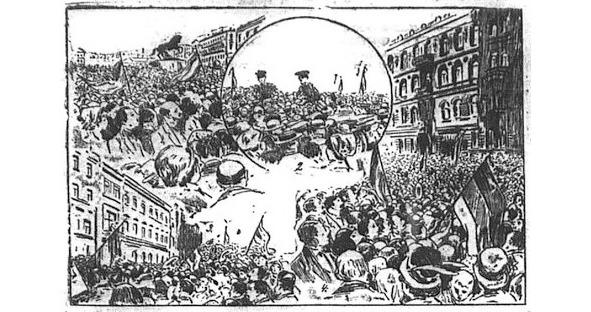
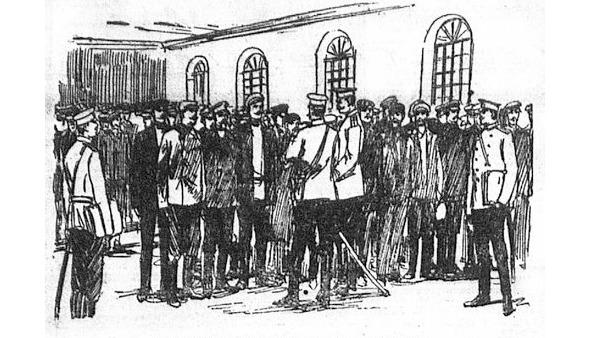
On the morning of Friday, July 31, in the still peaceful capital of the Russian Empire, announcements of general mobilization were posted all over St. Petersburg. People gathered at these ads. The population of a great power gradually began to come to understand that the war had already knocked on their house.
Sometimes there were sorrowful sobs of women who found out that their husbands and sons would most likely go to war. Sometimes, some recently praying mantis often began to be baptized, often whispering with white lips: “God save your people!”
By evening, drinking establishments were crowded. Starting from early morning, the people gradually filled the rooms, which from their doors threw streams into the street with increasing intensity, drunken peasants bawling sometimes rollicking, then sad songs, laughter rang out in mocking with drunk tears spreading across their faces.
On this day, Russian Foreign Minister Sergei Dmitrievich Sazonov dined and decided to work more. The last papers should be put in order, so that future historians could lay the whole burden of blame for unleashing a terrible war on the Germans. The fact that the war would be terrible did not raise any doubts among the Minister.
“Will William be frightened of England’s participation in the war and at the last minute refuse his challenge? The minister thought intensely. — How then to provoke him, like a bull: on a bullfight, and put him in the role of an arrogant to universal peace? After all, it is very important for all systems of unions… On whose side will Italy, for example, take the floor? The Italians will be extremely indignant that their allies did not ask about such an important matter as the beginning of the war… And if now the alliance of Italy with Austria-Hungary and Germany is cracking and slowly falling apart, then William’s tactlessness will completely undermine him. Moreover, Italy’s own interests in the Mediterranean Sea and in the Balkans are diametrically opposed to the Austrian …”
The old mahogany grandfather clock in the corner of the ministerial cabinet melodiously rang eleven. Sazonov got up from his chair to put the dispatches in the safe, but the secretary came in and reported that the German ambassador Count Purtales was asking for a meeting.
“Here it is, the presentation of an ultimatum! The minister thought with satisfaction. “Hooray, William decided to become the culprit of the war!”
— Invite the ambassador! — ordered Sazonov.
Count Purtales appeared immediately, as if standing outside the door. He nearly ran to the minister’s desk.Usually taut and handsome, with whitish meek eyes, a sweet smile, a half-hidden wedge in a gray beard and a neatly trimmed mustache, about a nimbus of gray hair on a half-elongated oblong head, the count now wants to portray the anger and indignation that relies on him according to the script sent from Berlin along with text of an ultimatum. But he does not succeed badly in this, because he has always sincerely and cordially been friends with Sazonov, with the St. Petersburg light, where he was loved and respected.
His “formidable” look is more like confusion, there are tears in the eyes of the ambassador, but he tries to speak in a firm voice.
— Mr. Minister! — he declares. — I am authorized by my government to demand from Russia to stop all its mobilization measures both on the German and on the Austro-Hungarian border!.. If the Russian mobilization is not interrupted, then the whole German army will mobilize!..
The ambassador looks pointedly at his watch. On them — half past eleven.
“The deadline expires in exactly twelve hours!”
As if dumping a heavy burden, the ambassador is being transformed. From the pompous, hard-core messenger of the German Empire, he turns into a bewildered and miserable old man.
— Agree to demobilization! Agree to demobilization! You must agree to demobilization!.. — he mutters in a rattling voice from excitement and looks imploringly at Sazonov.
Sazonov, who was almost overcome by trembling before the ambassador arrived, has now completely calmed down. He firmly answers Count Purtales:
— Mr. Minister! I can only confirm what His Majesty Emperor Nicholas II told you today. As long as there is at least one chance to prevent a war, while negotiations with Austria can continue, Russia will not attack. However, it is technically impossible for us to demobilize the army without upsetting the entire military organization. Even your general staff cannot dispute the legality of this consideration!..
Purtales makes a gesture of despair.
— Agree to demobilization! — as he says the spell.
Sazonov stares coldly at the ambassador. Purtales turns and the shuffling gait of a weak person leaves.
August 1
Saturday’s official day of official St. Petersburg was already ending, but there was no German note drawing a line under the ultimatum presented yesterday. According to the Russian Foreign Ministry, rumors spread that Wilhelm had changed his mind that there could still be a pacification of Austria and negotiations with Berlin. Many of the officials of the diplomatic department went to their summer cottages with this.
Only in the evening Sazonov was informed that Count Purtales again required a meeting. The Minister realized that the decisive hour had come. Sergey Dmitrievich crossed himself into a small picture before moving from the apartment to the official office.
Having removed the glove, the ambassador takes out an envelope from thick white paper with seals decorated with the German emblem from the inside pocket of his gold-embroidered uniform, and solemnly, as if making a salute with a sword, hands it to Sazonov.
Both understand that the moment of transfer of the envelope with the declaration of war in itself will not open the river of blood. It will beg