


автордың кітабын онлайн тегін оқу How to Tell the Birds from the Flowers
The Project Gutenberg EBook of How to Tell the Birds from the Flowers, by
Robert Williams Wood
This eBook is for the use of anyone anywhere at no cost and with
almost no restrictions whatsoever. You may copy it, give it away or
re-use it under the terms of the Project Gutenberg License included
with this eBook or online at www.gutenberg.net
Title: How to Tell the Birds from the Flowers
A Manual of Flornithology for Beginners
Author: Robert Williams Wood
Posting Date: August 4, 2010 [EBook #1593]
Release Date: January, 1999
Language: English
*** START OF THIS PROJECT GUTENBERG EBOOK HOW TO TELL BIRDS FROM FLOWERS ***
Produced by David Garcia, David Newman and James Rose
How To Tell The Birds From The Flowers.
A Manual of Flornithology for Beginners.

Verses and Illustrations
By Robert Williams Wood.
Published by Paul Elder and Company
San Francisco and New York.
Copyright 1907
By
Paul Elder and Company
Contents.
Page.
The Bird. The Burdock.1.
The Clover. The Plover.2.
The Crow. The Crocus.3.
The Rue. The Rooster.4.
The Parrot. The Carrot.5.
The Pea. The Pewee.6.
The Pelican. The Panicle.7.
The Hen. The Lichen.8.
The Hawk. The Hollyhock.9.
The Cow Bird. The Cowslip.10.
A Sparrer. Asparagus.11.
The Tern. The Turnip.12.
The Ole Gander. The Oleander.14.
The Blue Mountain Lory. The Blue Morning Glory.
15.
The Quail. The Kale.16.
The Pecan. The Toucan.17.
The Auk. The Orchid.18.
The Cat-bird. The Catnip.20.
The Ibis. The 'Ibiscus.21.
The Butter-ball. The Buttercup.22.
The Bay. The Jay.23.
The Pipe. The Snipe.24.
The Roc. The Shamrock.25.
The Lark. The Larkspur.26.
The Puffin. Nuffin.27.
Author's Apology.28.
Burr. Bird.
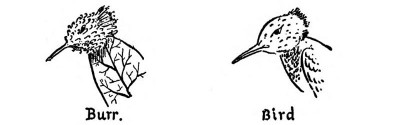
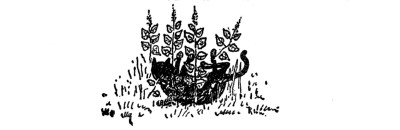
The Bird and the Burdock.
Who is there who has never heard,
About the Burdock and the Bird?
And yet how very very few,
Discriminate between the two,
While even Mr. Burbank can't
Transform a Bird into a Plant!

The Clover. The Plover.
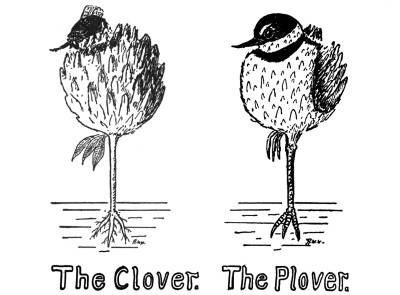
The Plover and the Clover can be told apart with ease,
By paying close attention to the habits of the Bees,
For en-to-molo-gists aver, the Bee can be in Clover,
While ety-molo-gists concur, there is no B in Plover.
The Crow. The Crocus.
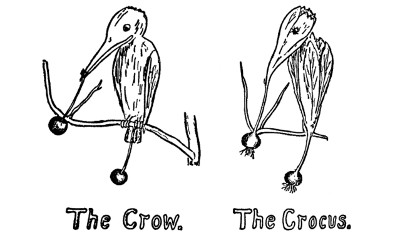
Some are unable, as you know,
To tell the Crocus from the Crow;
The reason why is just because
They are not versed in Nature's laws.
The noisy, cawing Crows all come,
Obedient to the Cro'custom,
A large Crow Caw-cus to convoke.
You never hear the Crocus croak!
The Rue. The Rooster.
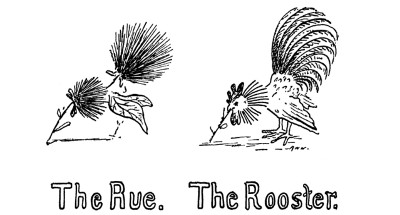
Of Rooster the rudiment clearly is "Roo",
And the bird from the plant very probably grew.
You can easily tell them apart without fail,
By merely observing the Rue lacks de-tail.
The Parrot. The Carrot.
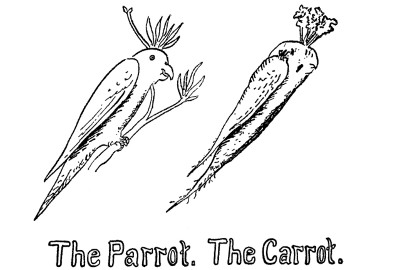
The Parrot and the Carrot we may easily confound,
They're very much alike in looks and similar in sound,
We recognize the Parrot by his clear articulation,
For Carrots are unable to engage in conversation.
The Pea. The Pewee.
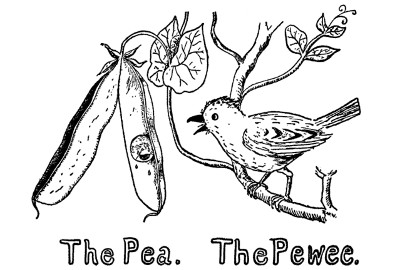
To tell the Pewee from the Pea,
Requires great per-spi-ca-city.
Here in the pod we see the Pea,
While perched close by is the Pewee;
The Pea he hears the Pewee peep,
While Pewee sees the wee Pea weep,
There'll be but little time to see,
How Pewee differs from the Pea.
The Pelican. The Panicle.
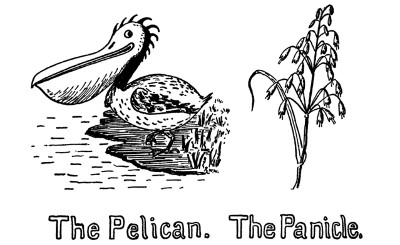
The Panicle and Pelican
Have often been confused;
The letters which spell Pelican
In Panicle are used.
You never need confound the two,
There are many ways of telling:
The simplest thing that one can do,
Is to observe the spelling.
The Hen. The Lichen.
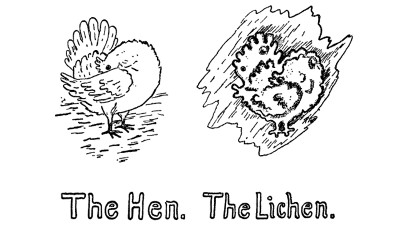
The Lichens lie on rocks and bark,
They look somewhat like Hens:
Hens lay, they lie, we may remark,
A difference of tense.
The Hawk. The Hollyhock.
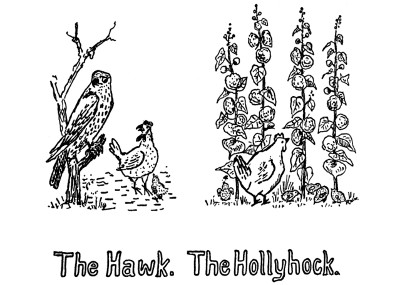
To recognize this Bird-of-Prey,
The broody Hen you should survey:
She takes her Chicks on daily walks,
Among the neighboring Hollyhocks,
While with the Hawk association,
Is quite beyond her toleration.
The Cow Bird. The Cowslip.
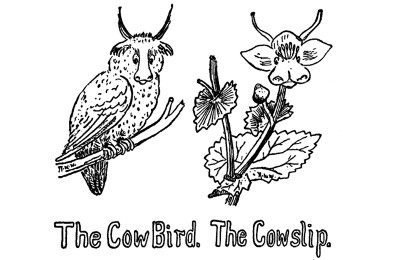
Growing in mires, in gold attired,
The Cowslip has been much admired,
Altho' its proper name, we're told,
Is really the Marsh Marigold:
The Cow Bird picture, I suspect,
Is absolutely incorrect,
We make such errors now and then,
A sort of cow slip of the pen.
A Sparrer. Asparagus.
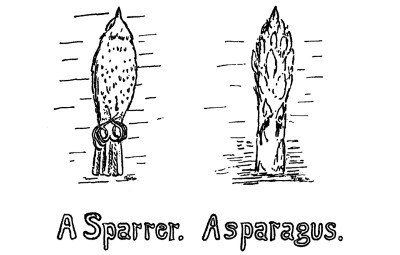
The Sparrow, from flying, is quite out of breath,
In fact he has worked himself almost to death,
While the lazy Asparagus,—so it is said,—
Spends all of his time in the 'sparagus bed.
The Tern. The Turnip.
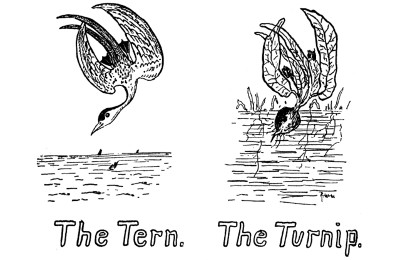
To tell the Turnip from the Tern,
A thing which everyone should learn,
Observe the Tern up in the air,
See how he turns,—and now compare
Him with this inert vegetable,
Who thus to turn is quite unable,
For he is rooted to the spot,
While as we see the Tern is not:
He is not always doomed to be
Thus bound to earth e-tern-ally,
For "Cooked to a turn" may be inferred,
To change the Turnip to the Bird.
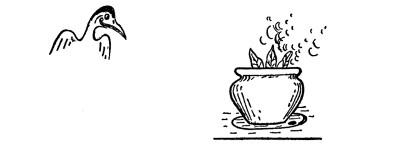
Observe the Turnip in the pot.
The Tern is glad that he is not!
The Ole Gander. The Oleander.
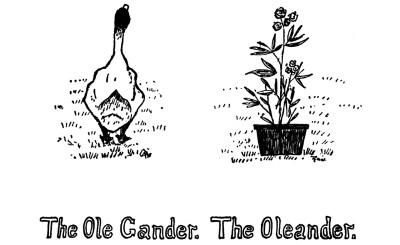
The Gander loves to promenade,
Around the farmer's poultry-yard,
While, as we see, the Oleander
Is quite unable to meander.
The Blue Mountain Lory. The Blue Morning Glory.
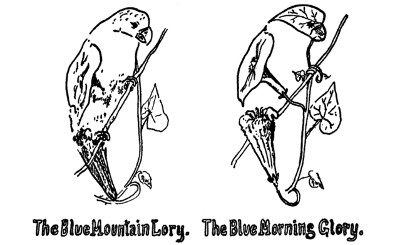
The Blue Mountain Lory spends most of his time
In climbing about in a tropical clime;
We therefore our efforts need only confine,
To minutely observing the climb of the Vine.
The Quail. The Kale.
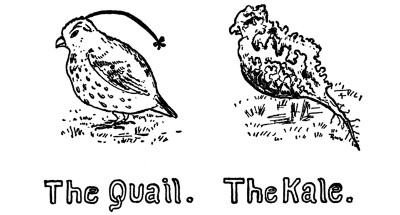
The California Quail is said
To have a tail upon his head,
While contrary-wise we style the Kale,
A cabbage head upon a tail.
It is not hard to tell the two,
The Quail commences with a queue.
The Pecan. The Toucan.
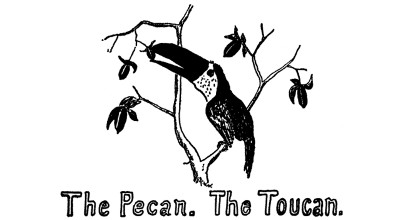
Very few can
Tell the Toucan
From the Pecan—
Here's a new plan:
To take the Toucan from the tree,
Requires im-mense a-gil-i-tee,
While any one can pick with ease
The Pecans from the Pecan trees:
It's such an easy thing to do,
That even the Toucan he can too.
The Auk. The Orchid.
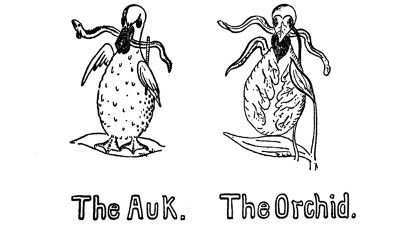
We seldom meet, when out to walk,
Either the Orchid or the Auk;
The Auk indeed is only known
To dwellers in the Auktic zone,
While Orchids can be found in legions,
Within the equatorial regions.
The graceful Orchid on its stalk,
Resembles so the auk-ward Auk;
'T is plain we must some means discover,
To tell the two from one another:
The obvious difference, to be sure,
Is merely one of temperature.
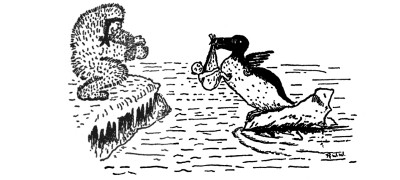
For Eskimos, perhaps, the Auk
Performs the duties of the Stork.
The Cat-bird. The Cat-nip.
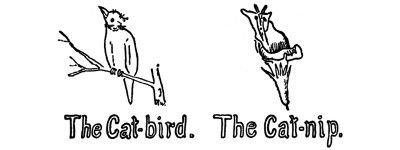
The Cat-bird's call resembles that,
Emitted by the Pussy Cat,
While Cat-nip, growing by the wall,
Is never known to caterwaul:
Its odor though attracts the Kits,
And throws them in Catniption fits.
The Ibis. The 'Ibiscus.
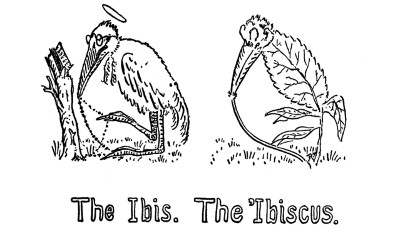
The sacred Ibis tells his beads,
And gravely from his prayer-book reads;
The Ibis therfore we may say,
Is classified a bird-of-prey.
'Ibiscus we have heard related,
The "Crimson-Eye" is designated;
Their difference is plain indeed,
The flower is red, the bird can read.
The Butter-ball. The Butter-cup.
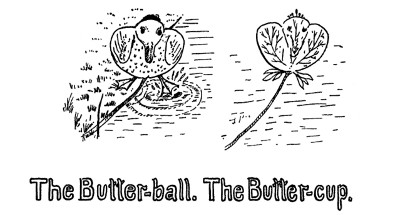
The little Butter-cup can sing,
From morn 'till night like anything:
The quacking of the Butter-ball,
Cannot be called a song at all.
We thus the flower may learn to know,
Its song is reproduced below.

[Hear this melody as midi.]
The Bay. The Jay.
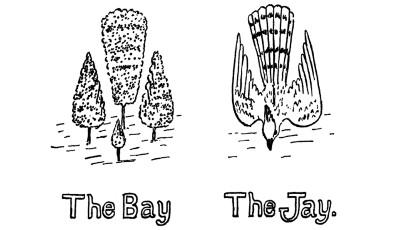
The Blue-Jay, as we plainly see,
Resembles much the green Bay tree:
The difference between the two,
Is ob-vi-ous-ly one of hue.
Though this is not the only way,
To tell the Blue-Jay from the Bay.
The Pipe. The Snipe.
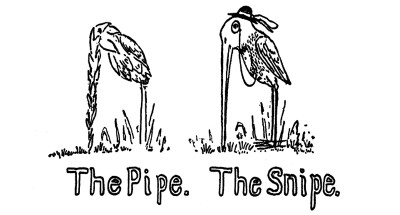
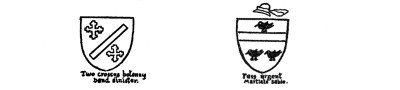
Observe the common Indian Pipe,
Likewise the high-bred English Snipe,
Who is distinguished, as we see,
By his superior pedigree.
The Roc. The Shamrock.
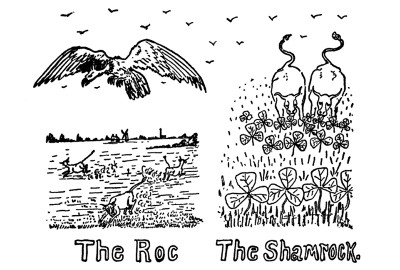
Observe how peacefully the Cows
Among the little Shamrocks browse,
In contrast with their actions frantic
When they perceive the Roc gigantic;
We need but watch their ocupation,
And seek no other explanation.
The Lark. The Larkspur.
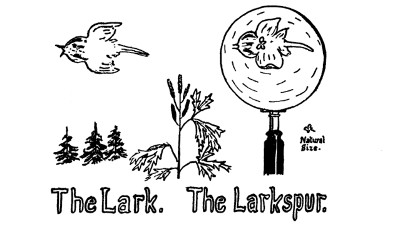
The Larkspur's likeness to the Lark
Is surely worthy of remark,
Although to see it we require
The aid of a small magnifier,
Which circumstance of course implies,
Their difference is one of size.
Puffin. Nuffin.
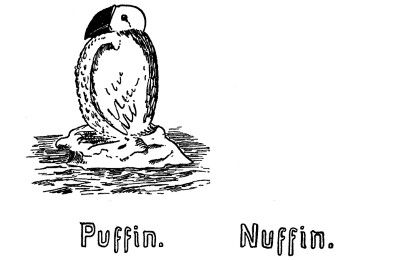
Upon this cake of ice is perched,
The paddle-footed Puffin:
To find his double we have searched,
But have discovered—Nuffin!
Author's Apology.
Not every one is always able
To recognize a vegetable,
For some are guided by tradition,
While others use their intuition,
And even I make no pretense
Of having more than common sense;
Indeed these strange homologies
Are in most flornithologies,
And I have freely drawn upon
The works of Gray and Audubon,
Avoiding though the frequent blunders
Of those who study Nature's wonders.
End of the Project Gutenberg EBook of How to Tell the Birds from the Flowers, by
Robert Williams Wood
*** END OF THIS PROJECT GUTENBERG EBOOK HOW TO TELL BIRDS FROM FLOWERS ***
***** This file should be named 1593-h.htm or 1593-h.zip *****
This and all associated files of various formats will be found in:
http://www.gutenberg.org/1/5/9/1593/
Produced by David Garcia, David Newman and James Rose
Updated editions will replace the previous one--the old editions
will be renamed.
Creating the works from public domain print editions means that no
one owns a United States copyright in these works, so the Foundation
(and you!) can copy and distribute it in the United States without
permission and without paying copyright royalties. Special rules,
set forth in the General Terms of Use part of this license, apply to
copying and distributing Project Gutenberg-tm electronic works to
protect the PROJECT GUTENBERG-tm concept and trademark. Project
Gutenberg is a registered trademark, and may not be used if you
charge for the eBooks, unless you receive specific permission. If you
do not charge anything for copies of this eBook, complying with the
rules is very easy. You may use this eBook for nearly any purpose
such as creation of derivative works, reports, performances and
research. They may be modified and printed and given away--you may do
practically ANYTHING with public domain eBooks. Redistribution is
subject to the trademark license, especially commercial
redistribution.
*** START: FULL LICENSE ***
THE FULL PROJECT GUTENBERG LICENSE
PLEASE READ THIS BEFORE YOU DISTRIBUTE OR USE THIS WORK
To protect the Project Gutenberg-tm mission of promoting the free
distribution of electronic works, by using or distributing this work
(or any other work associated in any way with the phrase "Project
Gutenberg"), you agree to comply with all the terms of the Full Project
Gutenberg-tm License (available with this file or online at
http://gutenberg.net/license).
Section 1. General Terms of Use and Redistributing Project Gutenberg-tm
electronic works
1.A. By reading or using any part of this Project Gutenberg-tm
electronic work, you indicate that you have read, understand, agree to
and accept all the terms of this license and intellectual property
(trademark/copyright) agreement. If you do not agree to abide by all
the terms of this agreement, you must cease using and return or destroy
all copies of Project Gutenberg-tm electronic works in your possession.
If you paid a fee for obtaining a copy of or access to a Project
Gutenberg-tm electronic work and you do not agree to be bound by the
terms of this agreement, you may obtain a refund from the person or
entity to whom you paid the fee as set forth in paragraph 1.E.8.
1.B. "Project Gutenberg" is a registered trademark. It may only be
used on or associated in any way with an electronic work by people who
agree to be bound by the terms of this agreement. There are a few
things that you can do with most Project Gutenberg-tm electronic works
even without complying with the full terms of this agreement. See
paragraph 1.C below. There are a lot of things you can do with Project
Gutenberg-tm electronic works if you follow the terms of this agreement
and help preserve free future access to Project Gutenberg-tm electronic
works. See paragraph 1.E below.
1.C. The Project Gutenberg Literary Archive Foundation ("the Foundation"
or PGLAF), owns a compilation copyright in the collection of Project
Gutenberg-tm electronic works. Nearly all the individual works in the
collection are in the public domain in the United States. If an
individual work is in the public domain in the United States and you are
located in the United States, we do not claim a right to prevent you from
copying, distributing, performing, displaying or creating derivative
works based on the work as long as all references to Project Gutenberg
are removed. Of course, we hope that you will support the Project
Gutenberg-tm mission of promoting free access to electronic works by
freely sharing Project Gutenberg-tm works in compliance with the terms of
this agreement for keeping the Project Gutenberg-tm name associated with
the work. You can easily comply with the terms of this agreement by
keeping this work in the same format with its attached full Project
Gutenberg-tm License when you share it without charge with others.
1.D. The copyright laws of the place where you are located also govern
what you can do with this work. Copyright laws in most countries are in
a constant state of change. If you are outside the United States, check
the laws of your country in addition to the terms of this agreement
before downloading, copying, displaying, performing, distributing or
creating derivative works based on this work or any other Project
Gutenberg-tm work. The Foundation makes no representations concerning
the copyright status of any work in any country outside the United
States.
1.E. Unless you have removed all references to Project Gutenberg:
1.E.1. The following sentence, with active links to, or other immediate
access to, the full Project Gutenberg-tm License must appear prominently
whenever any copy of a Project Gutenberg-tm work (any work on which the
phrase "Project Gutenberg" appears, or with which the phrase "Project
Gutenberg" is associated) is accessed, displayed, performed, viewed,
copied or distributed:
This eBook is for the use of anyone anywhere at no cost and with
almost no restrictions whatsoever. You may copy it, give it away or
re-use it under the terms of the Project Gutenberg License included
with this eBook or online at www.gutenberg.net
1.E.2. If an individual Project Gutenberg-tm electronic work is derived
from the public domain (does not contain a notice indicating that it is
posted with permission of the copyright holder), the work can be copied
and distributed to anyone in the United States without paying any fees
or charges. If you are redistributing or providing access to a work
with the phrase "Project Gutenberg" associated with or appearing on the
work, you must comply either with the requirements of paragraphs 1.E.1
through 1.E.7 or obtain permission for the use of the work and the
Project Gutenberg-tm trademark as set forth in paragraphs 1.E.8 or
1.E.9.
1.E.3. If an individual Project Gutenberg-tm electronic work is posted
with the permission of the copyright holder, your use and distribution
must comply with both paragraphs 1.E.1 through 1.E.7 and any additional
terms imposed by the copyright holder. Additional terms will be linked
to the Project Gutenberg-tm License for all works posted with the
permission of the copyright holder found at the beginning of this work.
1.E.4. Do not unlink or detach or remove the full Project Gutenberg-tm
License terms from this work, or any files containing a part of this
work or any other work associated with Project Gutenberg-tm.
1.E.5. Do not copy, display, perform, distribute or redistribute this
electronic work, or any part of this electronic work, without
prominently displaying the sentence set forth in paragraph 1.E.1 with
active links or immediate access to the full terms of the Project
Gutenberg-tm License.
1.E.6. You may convert to and distribute this work in any binary,
compressed, marked up, nonproprietary or proprietary form, including any
word processing or hypertext form. However, if you provide access to or
distribute copies of a Project Gutenberg-tm work in a format other than
"Plain Vanilla ASCII" or other format used in the official version
posted on the official Project Gutenberg-tm web site (www.gutenberg.net),
you must, at no additional cost, fee or expense to the user, provide a
copy, a means of exporting a copy, or a means of obtaining a copy upon
request, of the work in its original "Plain Vanilla ASCII" or other
form. Any alternate format must include the full Project Gutenberg-tm
License as specified in paragraph 1.E.1.
1.E.7. Do not charge a fee for access to, viewing, displaying,
performing, copying or distributing any Project Gutenberg-tm works
unless you comply with paragraph 1.E.8 or 1.E.9.
1.E.8. You may charge a reasonable fee for copies of or providing
access to or distributing Project Gutenberg-tm electronic works provided
that
- You pay a royalty fee of 20% of the gross profits you derive from
the use of Project Gutenberg-tm works calculated using the method
you already use to calculate your applicable taxes. The fee is
owed to the owner of the Project Gutenberg-tm trademark, but he
has agreed to donate royalties under this paragraph to the
Project Gutenberg Literary Archive Foundation. Royalty payments
must be paid within 60 days following each date on which you
prepare (or are legally required to prepare) your periodic tax
returns. Royalty payments should be clearly marked as such and
sent to the Project Gutenberg Literary Archive Foundation at the
address specified in Section 4, "Information about donations to
the Project Gutenberg Literary Archive Foundation."
- You provide a full refund of any money paid by a user who notifies
you in writing (or by e-mail) within 30 days of receipt that s/he
does not agree to the terms of the full Project Gutenberg-tm
License. You must require such a user to return or
destroy all copies of the works possessed in a physical medium
and discontinue all use of and all access to other copies of
Project Gutenberg-tm works.
- You provide, in accordance with paragraph 1.F.3, a full refund of any
money paid for a work or a replacement copy, if a defect in the
electronic work is discovered and reported to you within 90 days
of receipt of the work.
- You comply with all other terms of this agreement for free
distribution of Project Gutenberg-tm works.
1.E.9. If you wish to charge a fee or distribute a Project Gutenberg-tm
electronic work or group of works on different terms than are set
forth in this agreement, you must obtain permission in writing from
both the Project Gutenberg Literary Archive Foundation and Michael
Hart, the owner of the Project Gutenberg-tm trademark. Contact the
Foundation as set forth in Section 3 below.
1.F.
1.F.1. Project Gutenberg volunteers and employees expend considerable
effort to identify, do copyright research on, transcribe and proofread
public domain works in creating the Project Gutenberg-tm
collection. Despite these efforts, Project Gutenberg-tm electronic
works, and the medium on which they may be stored, may contain
"Defects," such as, but not limited to, incomplete, inaccurate or
corrupt data, transcription errors, a copyright or other intellectual
property infringement, a defective or damaged disk or other medium, a
computer virus, or computer codes that damage or cannot be read by
your equipment.
1.F.2. LIMITED WARRANTY, DISCLAIMER OF DAMAGES - Except for the "Right
of Replacement or Refund" described in paragraph 1.F.3, the Project
Gutenberg Literary Archive Foundation, the owner of the Project
Gutenberg-tm trademark, and any other party distributing a Project
Gutenberg-tm electronic work under this agreement, disclaim all
liability to you for damages, costs and expenses, including legal
fees. YOU AGREE THAT YOU HAVE NO REMEDIES FOR NEGLIGENCE, STRICT
LIABILITY, BREACH OF WARRANTY OR BREACH OF CONTRACT EXCEPT THOSE
PROVIDED IN PARAGRAPH F3. YOU AGREE THAT THE FOUNDATION, THE
TRADEMARK OWNER, AND ANY DISTRIBUTOR UNDER THIS AGREEMENT WILL NOT BE
LIABLE TO YOU FOR ACTUAL, DIRECT, INDIRECT, CONSEQUENTIAL, PUNITIVE OR
INCIDENTAL DAMAGES EVEN IF YOU GIVE NOTICE OF THE POSSIBILITY OF SUCH
DAMAGE.
1.F.3. LIMITED RIGHT OF REPLACEMENT OR REFUND - If you discover a
defect in this electronic work within 90 days of receiving it, you can
receive a refund of the money (if any) you paid for it by sending a
written explanation to the person you received the work from. If you
received the work on a physical medium, you must return the medium with
your written explanation. The person or entity that provided you with
the defective work may elect to provide a replacement copy in lieu of a
refund. If you received the work electronically, the person or entity
providing it to you may choose to give you a second opportunity to
receive the work electronically in lieu of a refund. If the second copy
is also defective, you may demand a refund in writing without further
opportunities to fix the problem.
1.F.4. Except for the limited right of replacement or refund set forth
in paragraph 1.F.3, this work is provided to you 'AS-IS' WITH NO OTHER
WARRANTIES OF ANY KIND, EXPRESS OR IMPLIED, INCLUDING BUT NOT LIMITED TO
WARRANTIES OF MERCHANTIBILITY OR FITNESS FOR ANY PURPOSE.
1.F.5. Some states do not allow disclaimers of certain implied
warranties or the exclusion or limitation of certain types of damages.
If any disclaimer or limitation set forth in this agreement violates the
law of the state applicable to this agreement, the agreement shall be
interpreted to make the maximum disclaimer or limitation permitted by
the applicable state law. The invalidity or unenforceability of any
provision of this agreement shall not void the remaining provisions.
1.F.6. INDEMNITY - You agree to indemnify and hold the Foundation, the
trademark owner, any agent or employee of the Foundation, anyone
providing copies of Project Gutenberg-tm electronic works in accordance
with this agreement, and any volunteers associated with the production,
promotion and distribution of Project Gutenberg-tm electronic works,
harmless from all liability, costs and expenses, including legal fees,
that arise directly or indirectly from any of the following which you do
or cause to occur: (a) distribution of this or any Project Gutenberg-tm
work, (b) alteration, modification, or additions or deletions to any
Project Gutenberg-tm work, and (c) any Defect you cause.
Section 2. Information about the Mission of Project Gutenberg-tm
Project Gutenberg-tm is synonymous with the free distribution of
electronic works in formats readable by the widest variety of computers
including obsolete, old, middle-aged and new computers. It exists
because of the efforts of hundreds of volunteers and donations from
people in all walks of life.
Volunteers and financial support to provide volunteers with the
assistance they need are critical to reaching Project Gutenberg-tm's
goals and ensuring that the Project Gutenberg-tm collection will
remain freely available for generations to come. In 2001, the Project
Gutenberg Literary Archive Foundation was created to provide a secure
and permanent future for Project Gutenberg-tm and future generations.
To learn more about the Project Gutenberg Literary Archive Foundation
and how your efforts and donations can help, see Sections 3 and 4
and the Foundation web page at http://www.pglaf.org.
Section 3. Information about the Project Gutenberg Literary Archive
Foundation
The Project Gutenberg Literary Archive Foundation is a non profit
501(c)(3) educational corporation organized under the laws of the
state of Mississippi and granted tax exempt status by the Internal
Revenue Service. The Foundation's EIN or federal tax identification
number is 64-6221541. Its 501(c)(3) letter is posted at
http://pglaf.org/fundraising. Contributions to the Project Gutenberg
Literary Archive Foundation are tax deductible to the full extent
permitted by U.S. federal laws and your state's laws.
The Foundation's principal office is located at 4557 Melan Dr. S.
Fairbanks, AK, 99712., but its volunteers and employees are scattered
throughout numerous locations. Its business office is located at
809 North 1500 West, Salt Lake City, UT 84116, (801) 596-1887, email
business@pglaf.org. Email contact links and up to date contact
information can be found at the Foundation's web site and official
page at http://pglaf.org
For additional contact information:
Dr. Gregory B. Newby
Chief Executive and Director
gbnewby@pglaf.org
Section 4. Information about Donations to the Project Gutenberg
Literary Archive Foundation
Project Gutenberg-tm depends upon and cannot survive without wide
spread public support and donations to carry out its mission of
increasing the number of public domain and licensed works that can be
freely distributed in machine readable form accessible by the widest
array of equipment including outdated equipment. Many small donations
($1 to $5,000) are particularly important to maintaining tax exempt
status with the IRS.
The Foundation is committed to complying with the laws regulating
charities and charitable donations in all 50 states of the United
States. Compliance requirements are not uniform and it takes a
considerable effort, much paperwork and many fees to meet and keep up
with these requirements. We do not solicit donations in locations
where we have not received written confirmation of compliance. To
SEND DONATIONS or determine the status of compliance for any
particular state visit http://pglaf.org
While we cannot and do not solicit contributions from states where we
have not met the solicitation requirements, we know of no prohibition
against accepting unsolicited donations from donors in such states who
approach us with offers to donate.
International donations are gratefully accepted, but we cannot make
any statements concerning tax treatment of donations received from
outside the United States. U.S. laws alone swamp our small staff.
Please check the Project Gutenberg Web pages for current donation
methods and addresses. Donations are accepted in a number of other
ways including including checks, online payments and credit card
donations. To donate, please visit: http://pglaf.org/donate
Section 5. General Information About Project Gutenberg-tm electronic
works.
Professor Michael S. Hart is the originator of the Project Gutenberg-tm
concept of a library of electronic works that could be freely shared
with anyone. For thirty years, he produced and distributed Project
Gutenberg-tm eBooks with only a loose network of volunteer support.
Project Gutenberg-tm eBooks are often created from several printed
editions, all of which are confirmed as Public Domain in the U.S.
unless a copyright notice is included. Thus, we do not necessarily
keep eBooks in compliance with any particular paper edition.
Most people start at our Web site which has the main PG search facility:
http://www.gutenberg.net
This Web site includes information about Project Gutenberg-tm,
including how to make donations to the Project Gutenberg Literary
Archive Foundation, how to help produce our new eBooks, and how to
subscribe to our email newsletter to hear about new eBooks.