автордың кітабын онлайн тегін оқу Chaucer's Works, Volume 3 (of 7) — The House of Fame; The Legend of Good Women; The Treatise on the Astrolabe; The Sources of the Canterbury Tales
Transcriber's note:
In this edition the two versions of the Prologue to the Legend are each assembled for continuous reading. Page numbers {66a} etc. refer to the upper parts of the printed pages, {66b} etc. refer to the lower parts. Skeat's commentary on the Astrolabe (mentioned in the text as "Footnotes") has been similarly separated from Chaucer's text.
A Glossary including words from the texts in this volume is included in Skeat's Volume VI, available from Project Gutenberg at http://www.gutenberg.org/files/43097/43097-h/43097-h.htm.
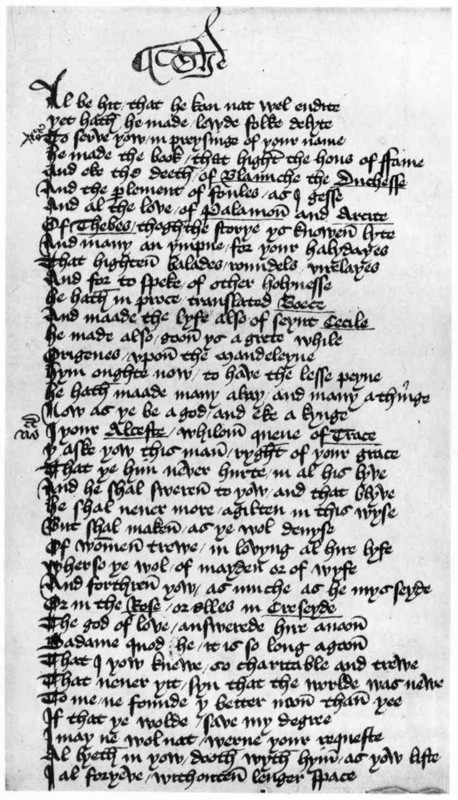
MS. Fairfax 16. Legend of Good Women, 414-450
Frontispiece***
THE COMPLETE WORKS
OF
GEOFFREY CHAUCER
EDITED, FROM NUMEROUS MANUSCRIPTS
BY THE
Rev. WALTER W. SKEAT, M.A.
Litt.D., LL.D., D.C.L., Ph.D.
ELRINGTON AND BOSWORTH PROFESSOR OF ANGLO-SAXON AND FELLOW OF CHRIST'S COLLEGE, CAMBRIDGE
* * *
THE HOUSE OF FAME: THE LEGEND OF GOOD WOMEN THE TREATISE ON THE ASTROLABE WITH AN ACCOUNT OF THE SOURCES OF THE CANTERBURY TALES
'He made the book that hight the Hous of Fame.'
Legend of Good Women; 417.
'Who-so that wol his large volume seke
Cleped the Seintes Legende of Cupyde.'
Canterbury Tales; B 60.
'His Astrelabie, longinge for his art.'
Canterbury Tales; A 3209.
SECOND EDITION
Oxford
AT THE CLARENDON PRESS
M DCCCC
Oxford
PRINTED AT THE CLARENDON PRESS
BY HORACE HART, M.A.
PRINTER TO THE UNIVERSITY
CONTENTS.
PAGE
Introduction to the House of Fame.—§
1. Authorship. §
2. Influence of Dante. §
3. Testimony of Lydgate. §
4. Influence of Ovid. §
5. Date of the Poem. §
6. Metre. §
7. Imitations. §
8. Authorities. §
9. Some Emendations
vii
Introduction to the Legend of Good Women.—§
1. Date of the Poem. §
2. The Two Forms of the Prologue. §
3. Comparison of these. §
4. The Subject of the Legend. §
5. The Daisy. §
6. Agaton. §
7. Chief Sources of the Legend. §
8. The Prologue; Legends of (1) Cleopatra; (2) Thisbe; (3) Dido; (4) Hypsipyle and Medea; (5) Lucretia; (6) Ariadne; (7) Philomela; (8) Phyllis; (9) Hypermnestra. §
9. Gower's Confessio Amantis. §
10. Metre. §
11. 'Clipped' Lines. §
12. Description of the MSS. §
13. Description of the Printed Editions. §
14. Some Improvements in my Edition of 1889. §
15. Conclusion
xvi
Introduction to a Treatise on the Astrolabe.—§
1. Description of the MSS. §§
2-
16. MSS. A., B., C., D., E., F., G., H., I., K., L., M., N., O., P. §
17. MSS. Q., R., S., T., U., W., X. §
18. Thynne's Edition. §
19. The two Classes of MSS. §
20. The last five Sections (spurious). §
21. Gap between Sections 40 and 41. §
22. Gap between Sections 43 and 44. §
23. Conclusion 40. §
24. Extant portion of the Treatise. §
25. Sources. §
26. Various Editions. §
27. Works on the Subject. §
28. Description of the Astrolabe Planisphere. §
29. Uses of the Astrolabe Planisphere. §
30. Stars marked on the Rete. §
31. Astrological Notes. §
32. Description of the Plates
lvii
Plates illustrating the description of the Astrolabelxxxi
The Hous of Fame: Book I.1
The Hous of Fame: Book II.16
The Hous of Fame: Book III.33
The Legend of Good Women: The Prologue
65
XVIII.
The Legend of Cleopatra106
XVIII.
The Legend of Thisbe110
XVIII.
The Legend of Dido117
XIIIV.
The Legend of Hypsipyle and Medea131
XIIIV.
The Legend of Lucretia140
XIIVI.
The Legend of Ariadne147
XIVII.
The Legend of Philomela158
XVIII.
The Legend of Phyllis164
VIIIX.
The Legend of Hypermnestra169
A Treatise on the Astrolabe175
Critical Notes to a Treatise on the Astrolabe233
Notes to the House of Fame243
Notes to the Legend of Good Women288
Notes to a Treatise on the Astrolabe352
An Account of the Sources of the Canterbury Tales370
INTRODUCTION TO THE HOUSE OF FAME
§ 1. It is needless to say that this Poem is genuine, as Chaucer himself claims it twice over; once in his Prologue to the Legend of Good Women, l. 417, and again by the insertion in the poem itself of the name Geffrey (l. 729)[1].
§ 2. Influence of Dante. The influence of Dante is here very marked, and has been thoroughly discussed by Rambeau in Englische Studien, iii. 209, in an article far too important to be neglected. I can only say here that the author points out both general and particular likenesses between the two poems. In general, both are visions; both are in three books; in both, the authors seek abstraction from surrounding troubles by venturing into the realm of imagination. As Dante is led by Vergil, so Chaucer is upborne by an eagle. Dante begins his third book, Il Paradiso, with an invocation to Apollo, and Chaucer likewise begins his third book with the same; moreover, Chaucer's invocation is little more than a translation of Dante's.
Among the particular resemblances, we may notice the method of commencing each division of the Poem with an invocation[2]. Again, both poets mark the exact date of commencing their poems; Dante descended into the Inferno on Good Friday, 1300 (Inf. xxi. 112); Chaucer began his work on the 10th of December, the year being, probably, 1383 (see note to l. 111).
Chaucer sees the desert of Lybia (l. 488), corresponding to similar waste spaces mentioned by Dante; see note to l. 482. Chaucer's eagle is also Dante's eagle; see note to l. 500. Chaucer gives an account of Phaethon (l. 942) and of Icarus (l. 920), much like those given by Dante (Inf. xvii. 107, 109); both accounts, however, may have been taken from Ovid[3]. Chaucer's account of the eagle's lecture to him (l. 729) resembles Dante's Paradiso, i. 109-117. Chaucer's steep rock of ice (l. 1130) corresponds to Dante's steep rock (Purg. iii. 47). If Chaucer cannot describe all the beauty of the House of Fame (l. 1168), Dante is equally unable to describe Paradise (Par. i. 6). Chaucer copies from Dante his description of Statius, and follows his mistake in saying that he was born at Toulouse; see note to l. 1460. The description of the house of Rumour is also imitated from Dante; see note to l. 2034. Chaucer's error of making Marsyas a female arose from his misunderstanding the Italian form Marsia in Dante; see note to l. 1229.
These are but some of the points discussed in Rambeau's article; it is difficult to give, in a summary, a just idea of the careful way in which the resemblances between these two great poets are pointed out. I am quite aware that many of the alleged parallel passages are too trivial to be relied upon, and that the author's case would have been strengthened, rather than weakened, by several judicious omissions; but we may fairly accept the conclusion, that Chaucer is more indebted to Dante in this poem than in any other; perhaps more than in all his other works put together.
It is no longer possible to question Chaucer's knowledge of Italian; and it is useless to search for the original of The House of Fame in Provençal literature, as Warton vaguely suggests that we should do (see note to l. 1928). At the same time, I can see no help to be obtained from a perusal of Petrarch's Trionfo della Fama, to which some refer us.
§ 3. Testimony of Lydgate. It is remarkable that Lydgate does not expressly mention The House of Fame by name, in his list of Chaucer's works. I have already discussed this point in the Introduction to vol. i. pp. 23, 24, where I shew that Lydgate, nevertheless, refers to this work at least thrice in the course of the poem in which his list occurs; and, at the same time, he speaks of a poem by Chaucer which he calls 'Dant in English,' to which there is nothing to correspond, unless it can be identified with The House of Fame[4]. We know, however, that Lydgate's testimony as to this point is wholly immaterial; so that the discussion as to the true interpretation of his words is a mere matter of curiosity.
§ 4. Influence of Ovid. It must, on the other hand, be obvious to all readers, that the general notion of a House of Fame was adopted from a passage in Ovid's Metamorphoses, xii. 39-63. The proof of this appears from the great care with which Chaucer works in all the details occurring in that passage. He also keeps an eye on the celebrated description of Fame in Vergil's Æneid, iv. 173-183; even to the unlucky rendering of 'pernicibus alis' by 'partriches winges,' in l. 1392[5].
I here quote the passage from Ovid at length, as it is very useful for frequent reference (cf. Ho. Fame, 711-24, 672-99, 1025-41, 1951-76, 2034-77):—
'Orbe locus medio est inter terrasque, fretumque,
Caelestesque plagas, triplicis confinia mundi;
Unde quod est usquam, quamuis regionibus absit,
Inspicitur penetratque cauas uox omnis ad aures.
Fama tenet, summaque domum sibi legit in arce;
Innumerosque aditus, ac mille foramina tectis
Addidit, et nullis inclusit limina portis.
Nocte dieque patent. Tota est ex aere sonanti;
Tota fremit, uocesque refert, iteratque quod audit.
Nulla quies intus, nullaque silentia parte.
Nec tamen est clamor, sed paruae murmura uocis;
Qualia de pelagi, si quis procul audiat, undis
Esse solent; qualemue sonum, cum Iupiter atras
Increpuit nubes, extrema tonitrua reddunt.
Atria turba tenet; ueniunt leue uulgus, euntque;
Mixtaque cum ueris passim commenta uagantur
Millia rumorum, confusaque uerba uolutant.
E quibus hi uacuas implent sermonibus aures;
Hi narrata ferunt alio; mensuraque ficti
Crescit, et auditis aliquid nouus adicit auctor.
Illic Credulitas, illic temerarius Error,
Vanaque Laetitia est, consternatique Timores,
Seditioque repens, dubioque auctore Susurri.
Ipsa quid in caelo rerum, pelagoque geratur,
Et tellure uidet, totumque inquirit in orbem.'
A few other references to Ovid are pointed out in the Notes.
By way of further illustration, I here quote the whole of Golding's translation of the above passage from Ovid:—
'Amid the world tweene heauen and earth, and sea, there is a place,
Set from the bounds of each of them indifferently in space,
From whence is seene what-euer thing is practizde any-where,
Although the Realme be neere so farre: and roundly to the eare
Commes whatsoeuer spoken is; Fame hath his dwelling there,
Who in the top of all the house is lodged in a towre.
A thousand entries, glades, and holes are framed in this bowre.
There are no doores to shut. The doores stand open night and day.
The house is all of sounding brasse, and roreth euery way,
Reporting double euery word it heareth people say.
There is no rest within, there is no silence any-where.
Yet is there not a yelling out: but humming, as it were
The sound of surges being heard farre off, or like the sound
That at the end of thunderclaps long after doth redound
When Ioue doth make the clouds to crack. Within the courts is preace
Of common people, which to come and go do neuer ceace.
And millions both of troths and lies run gadding euery-where,
And wordes confuselie flie in heapes, of which some fill the eare
That heard not of them erst, and some cole-cariers part do play,
To spread abroade the things they heard, and euer by the way
The thing that was inuented growes much greater than before,
And euery one that gets it by the end addes somewhat more.
Light credit dwelleth there, there dwells rash error, there doth dwell
Vaine ioy: there dwelleth hartlesse feare, and brute that loues to tell
Uncertaine newes vpon report, whereof he doth not knowe
The author, and sedition who fresh rumors loues to sowe.
This Fame beholdeth what is done in heauen, on sea, and land,
And what is wrought in all the world he layes to vnderstand.'
§ 5. Date of the Poem. Ten Brink, in his Chaucer Studien, pp. 120, 121, concludes that The House of Fame was, in all probability, composed shortly after Troilus, as the opening lines reproduce, in effect, a passage concerning dreams which appears in the last Book of Troilus, ll. 358-385. We may also observe the following lines in Troilus, from Book I, 517-8:—
'Now, thonked be god, he may goon in the daunce
Of hem that Love list febly for to avaunce.'
These lines, jestingly applied to Troilus by Pandarus, are in the House of Fame, 639, 640, applied by Chaucer to himself:—
'Although thou mayst go in the daunce
Of hem that him list not avaunce.'
Again, the House of Fame preceded the Legend of Good Women, because he here complains of the hardship of his official duties (652-660); whereas, in the Prologue to the Legend, he rejoices at obtaining some release from them. We may also note the quotation from Boethius (note to l. 972). As Boethius and Troilus seem to have been written together, somewhere about 1380, and took up a considerable time, and the apparent date of the Legend is 1385, the probable date of the House of Fame is about 1383 or 1384. Ten Brink further remarks that the references to Jupiter suggest to the reader that the 10th of December was a Thursday (see note to 111). This would give 1383 for beginning the poem; and perhaps no fitter date than the end of 1383 and the spring of 1384 can be found.
§ 6. Metre. Many of Chaucer's metres were introduced by him from the French; but the four-accent metre, with rime as here employed, was commonly known before Chaucer's time. It was used by Robert of Brunne in 1303, in the Cursor Mundi, and in Havelok. It is, however, of French origin, and occurs in the very lengthy poem of Le Roman de la Rose. Chaucer only employed it thrice: (1) in translating the Roman de la Rose; (2) in the Book of the Duchesse; and (3) in the present poem.
For normal lines, with masculine rimes, see 7, 8, 13, 14, 29, 33, &c. For normal lines, with feminine rimes, see 1, 2, 9, 15, 18, &c. Elision is common, as of e in turne (1), in somme (6), in Devyne (14); &c. Sometimes there is a middle pause, where a final syllable need not always be elided. Thus we may read:—
'By abstinencë—or by seknesse' (25):
'In studie—or melancolious' (30):
'And fro unhappë—and ech disese' (89):
'In his substáuncë—is but air' (768).
Two short syllables, rapidly pronounced, may take the place of one:—
'I noot; but who-so of these mirácles' (12):
'By avisiouns, or bý figúres' (47).
The first foot frequently consists of a single syllable; see 26, 35, 40, 44; so also in l. 3, where, in modern English, we should prefer Unto.
The final e, followed by a consonant, is usually sounded, and has its usual grammatical values. Thus we have think-e, infin. (15); bot-e, old accus. of a fem. sb. (32); swich-e, plural (35); oft-e, adverbial (35); soft-e, with essential final e (A.S. sōfte); find-e, pres. pl. indic. (43); com-e, gerund (45): gret-e, pl. (53); mak-e, infin. (56); rod-e, dat. form used as a new nom., of which there are many examples in Chaucer (57); blind-e, def. adj. (138). The endings -ed, -en, -es, usually form a distinct syllable; so also -eth, which, however, occasionally becomes 'th; cf. comth (71). A few common words, written with final e, are monosyllabic; as thise (these); also shulde (should), and the like, occasionally. Remember that the old accent is frequently different from the modern; as in orácles, mirácles (11, 12): distaúnc-e (18), aventúres, figúres (47, 48): povért (88): málicióus (93): &c. The endings -i-al, -i-oun, -i-ous, usually form two distinct syllables.
For further remarks on Metre and Grammar, see vol. v.
§ 7. Imitations. The chief imitations of the House of Fame are The Temple of Glas, by Lydgate[6]; The Palice of Honour, by Gawain Douglas; The Garland of Laurell, by John Skelton; and The Temple of Fame, by Pope. Pope's poem should not be compared with Chaucer's; it is very different in character, and is best appreciated by forgetting its origin.
§ 8. Authorities. The authorities for the text are few and poor; hence it is hardly possible to produce a thoroughly satisfactory text. There are three MSS. of the fifteenth century, viz. F. (Fairfax MS. 16, in the Bodleian Library); B. (MS. Bodley, 638, in the same); P. (MS. Pepys 2006, in Magdalene College, Cambridge). The last of these is imperfect, ending at l. 1843. There are two early printed editions of some value, viz. Cx. (Caxton's edition, undated); and Th. (Thynne's edition, 1532). None of the later editions are of much value, except the critical edition by Hans Willert (Berlin, 1883). Of these, F. and B., which are much alike, form a first group; P. and Cx. form a second group; whilst Th. partly agrees with Cx., and partly with F. The text is chiefly from F., with collations of the other sources, as given in the footnotes, which record only the more important variations.
§ 9. Some emendations. In constructing the text, a good deal of emendation has been necessary; and I have adopted many hints from Willert's edition above mentioned; though perhaps I may be allowed to add that, in many cases, I had arrived at the same emendations independently, especially where they were obvious. Among the emendations in spelling, I may particularise misdemen (92), where all the authorities have mysdeme or misdeme; Dispyt, in place of Dispyte (96); barfoot, for barefoot or barefote (98); proces (as in P.) for processe, as in the rest (251); delyt, profyt, for delyte, profyte (309, 310); sleighte for sleight (462); brighte[7], sighte, for bright, sight (503, 504); wighte, highte, for wight, hight (739, 740); fyn, Delphyn (as in Cx.), for fyne, Delphyne (1005, 1006); magyk, syk, for magyke, syke (1269, 1270); losenges, for losynges (1317), and frenges (as in F.) for frynges, as in the rest (1318); dispyt for dispite (1716); laughe for laugh (Cx. lawhe, 1809); delyt for delyte (P. delit, 1831); thengyn (as in Th.) for thengyne (1934); othere for other (2151, footnote). These are only a few of the instances where nearly all the authorities are at fault.
The above instances merely relate to questions of spelling. Still more serious are the defects in the MSS. and printed texts as regards the sense; but all instances of emendation are duly specified in the footnotes, and are frequently further discussed in the Notes at the end. Thus, in l. 329, it is necessary to supply I. In 370, allas should be Eneas. In 513, Willert rightly puts selly, i.e. wonderful, for sely, blessed. In 557, the metre is easily restored, by reading so agast for agast so. In 621, we must read lyte is, not lytel is, if we want a rime to dytees. In 827, I restore the word mansioun; the usual readings are tautological. In 911, I restore toun for token, and adopt the only reading of l. 912 that gives any sense. In 1007, the only possible reading is Atlantes. In 1044, Morris's edition has biten, correctly; though MS. F. has beten, and there is no indication that a correction has been made. In 1114, the right word is site; cf. the Treatise on the Astrolabe (see Note). In 1135, read bilt (i.e. buildeth); bilte gives neither sense nor rhythm. In 1173, supply be. Ll. 1177, 1178 have been set right by Willert. In 1189, the right word is Babewinnes[8]. In 1208, read Bret (as in B.). In 1233, read famous. In 1236, read Reyes[9]. In 1303, read hatte, i.e. are named. In 1351, read Fulle, not Fyne. In 1372, adopt the reading of Cx. Th. P., or there is no nominative to streighte; and in 1373, read wonderliche. In 1411, read tharmes (= the armes). In 1425, I supply and hy, to fill out the line. In 1483, I supply dan; if, however, poete is made trisyllabic, then l. 1499 should not contain daun. In 1494, for high the, read highte (as in l. 744). In 1527, for into read in. In 1570, read Up peyne. In 1666, 1701, and 1720, for werkes read werk. In 1702, read clew (see note)[10]. In 1717, lyen is an error for lyuen, i.e. live. In 1750, read To, not The. In 1775, supply ye; or there is no sense. In 1793, supply they for a like reason. In 1804, 5, supply the, and al; for the scansion. In 1897, read wiste, not wot. In 1940, hattes should be hottes; this emendation has been accepted by several scholars. In 1936, the right word is falwe, not salwe (as in Morris). In 1960, there should be no comma at the end of the line, as in most editions; and in 1961, 2 read werre, reste (not werres, restes). In 1975, mis and governement are distinct words. In 2017, frot[11] is an error for froyt; it is better to read fruit at once; this correction is due to Koch. In 2021, suppress in after yaf. In 2049, for he read the other (Willert). In 2059, wondermost is all one word. In 2076, I read word; Morris reads mothe, but does not explain it, and it gives no sense. In 2156, I supply nevene.
I mention these as examples of necessary emendations of which the usual editions take no notice.
I also take occasion to draw attention to the careful articles on this poem by Dr. J. Koch, in Anglia, vol. vii. App. 24-30, and Englische Studien, xv. 409-415; and the remarks by Willert in Anglia, vii. App. 203-7. The best general account of the poem is that in Ten Brink's History of English Literature.
In conclusion, I add a few 'last words.'
L. 399. We learn, from Troil. i. 654, that Chaucer actually supposed 'Oënone' to have four syllables. This restores the metre. Read:—And Paris to Oënone.
503. Read 'brighte,' with final e; 'bright' is a misprint.
859. Compare Cant. Tales, F 726.
1119. 'To climbe hit,' i.e. to climb the rock; still a common idiom.
2115. Compare Cant. Tales, A 2078. Perhaps read 'wanie.'
INTRODUCTION TO THE LEGEND OF GOOD WOMEN.
§ 1. Date of the Poem: A.D. 1385. The Legend of Good Women presents several points of peculiar, I might almost say of unique interest. It is the immediate precursor of the Canterbury Tales, and enables us to see how the poet was led on towards the composition of that immortal poem. This is easily seen, upon consideration of the date at which it was composed.
The question of the date has been well investigated by Ten Brink; but it may be observed beforehand that the allusion to the 'queen' in l. 496 has long ago been noticed, and it has been thence inferred, by Tyrwhitt, that the Prologue must have been written after 1382, the year when Richard II. married his first wife, the 'good queen Anne.' But Ten Brink's remarks enable us to look at the question much more closely.
He shows that Chaucer's work can be clearly divided into three chief periods, the chronology of which he presents in the following form[12].
First Period.
1366 (at latest). The Romaunt of the Rose.
1369. The Book of the Duchesse.
1372. (end of the period).
Second Period.
1373. The Lyf of Seint Cecile.
1373. The Assembly of Foules.
1373. Palamon and Arcite.
1373. Translation of Boethius.
1373. Troilus and Creseide.
1384. The House of Fame.
Third Period.
1385. Legend of Good Women.
1385. Canterbury Tales.
1391. Treatise on the Astrolabe.
It is unnecessary for our present purpose to insert the conjectured dates of the Minor Poems not here mentioned.
According to Ten Brink, the poems of the First Period were composed before Chaucer set out on his Italian travels, i.e. before December, 1372, and contain no allusions to writings by Italian authors. In them, the influence of French authors is very strongly marked.
The poems of the Second Period (he tells us) were composed after that date. The Life of Seint Cecile already marks the author's acquaintance with Dante's Divina Commedia; lines 36-51 are, in fact, a free translation from the Paradiso, canto xxxiii. ll. 1-21. See my note to this passage, and the remarks on the 'Second Nun's Tale' in vol. v. The Parlement of Foules contains references to Dante and a long passage translated from Boccaccio's Teseide; see my notes to that poem in vol. i. The original Palamon and Arcite was also taken from the Teseide; for even the revised version of it (now known as the Knightes Tale, and containing, doubtless, much more of Chaucer's own work) is founded upon that poem, and occasionally presents verbal imitations of it. Troilus is similarly dependent upon Boccaccio's Filostrato. The close connexion between Troilus and the translation of Boethius is seen from several considerations, of which it may suffice here to mention two. The former is the association of these two works in Chaucer's lines to Adam—
'Adam scriveyn, if ever it thee befalle
Boece or Troilus to wryten newe.'
Minor Poems; see vol. i. p. 379.
And the latter is, the fact that Chaucer inserts in Troilus (book iv. stanzas 140-154) a long passage on predestination and free-will, taken from Boethius, book v. proses 2, 3; which he would appear to have still fresh in his mind. It is probable that his Boethius preceded Troilus almost immediately; indeed, it is conceivable that, for a short season, both may have been in hand at the same time.
There is also a close connexion between Troilus and the House of Fame, the latter of which shows the influence of Dante in a high degree; see p. vii. This connexion will appear from comparing Troil. v. stt. 52-55 with Ho. Fame, 2-54; and Troil. i. st. 74 (ll. 517-8) with Ho. Fame, 639, 640. See Ten Brink, Studien, p. 121. It would seem that the House of Fame followed Troilus almost immediately. At the same time, we cannot put the date of the House of Fame later than 1384, because of Chaucer's complaint in it of the hardship of his official duties, from much of which he was released (as we shall see) early in 1385. Further, the 10th of December is especially mentioned as being the date on which the House of Fame was commenced (l. 111), the year being probably 1383 (see Note to that line).
It would appear, further, that the Legend was begun soon after the House of Fame was suddenly abandoned, in the very middle of a sentence. That it was written later than Troilus and the House of Fame is obvious, from the mention of these poems in the Prologue; ll. 332, 417, 441. That it was written at no great interval after Troilus appears from the fact that, even while writing Troilus, Chaucer had already been meditating upon the goodness of Alcestis, of which the Prologue to the Legend says so much. Observe the following passages (cited by Ten Brink, Studien, p. 120) from Troilus, bk. v. stt. 219, 254:—
[1]
It is also mentioned as 'the book of Fame' at the end of the Persones Tale, I 1086. I accept this passage as genuine.
[2]
In Dante's Inferno, this invocation begins Canto II.; for Canto I. forms a general introduction to the whole.
[3]
Where Chaucer says 'leet the reynes goon' (l. 951), and Dante has 'abbandonò li freni' (Inf. xvii. 107), we find in Ovid 'equi ... colla iugo eripiunt, abruptaque lora relinquunt' (Met. ii. 315). Chaucer's words seem closer to Dante than to the Latin original.
[4]
On which Prof. Lounsbury remarks (Studies in Chaucer, ii. 243)—'More extreme indeed than that of any one else is the position of Professor Skeat. He asserts in all seriousness that the "House of Fame" is the translation to which reference is made by Lydgate, when he said that Chaucer wrote "Dante in English." Beyond this utterance it is hardly possible to go.' This is mere banter, and entirely misrepresents my view. Lydgate does not say that 'Dant in English' was a translation; this is a pure assumption, for a strategical purpose in argument. Lydgate was ignorant of Italian, and has used a stupid phrase, the correctness of which I by no means admit. But he certainly meant something; and the prominence which he gives to "Dant in English," when he comes to speak of Chaucer's Minor Poems, naturally suggests The House of Fame, which he otherwise omits! My challenge to 'some competent critic' to tell me what other poem is here referred to, remains unanswered.
[5]
When Chaucer consulted Dante, his thoughts were naturally directed to Vergil. We find, accordingly, that he begins by quoting (in ll. 143-8) the opening lines of the Æneid; and a large portion of Book I (ll. 143-467) is entirely taken up with a general sketch of the contents of that poem. It is clear that, at the time of writing, Vergil was, in the main, a new book to him, whilst Ovid was certainly an old acquaintance.
[6]
By this, I only mean that Lydgate seems to have been indebted to Chaucer for the general idea of his poem, and even for the title of it (cf. Ho. Fame, 120). For a full account of all its sources, see the admirable edition of Lydgate's Temple of Glas by Dr. J. Schick, p. cxv. (Early Eng. Text Society).
[7]
Misprinted 'bright,' as the final e has 'dropped out' at press; of course it should be the adverbial form, with final e. In l. 507, the form is 'brighte' again, where it is the plural adjective. And, owing to this repetition, MSS. F. and B. actually omit lines 504-7.
[8]
Morris has rabewyures, from MS. F.; but there is no such word in his Glossary. See the New E. Dictionary, s.v. Baboon.
[9]
Morris has Reues; but his Glossary has: 'Reues, or reyes, sb. a kind of dance.' Of course it is plural.
[10]
Morris has clywe; and his Glossary has 'Clywe, v. to turn or twist'; but no such verb is known. See Claw, v. § 3, in the New E. Dict.
[11]
Morris has frot; but it does not appear in the Glossary.
[12]
I do not here endorse all Ten Brink's dates. I give his scheme for what it is worth, as it is certainly deserving of consideration.
'As wel thou mightest lyen on Alceste
That was of creatures—but men lye—
That ever weren, kindest and the beste.
For whan hir housbonde was in Iupartye
To dye himself, but-if she wolde dye,
She chees for him to dye and go to helle,
And starf anoon, as us the bokes telle.
Besechinge every lady bright of hewe,
And every gentil womman, what she be,
That, al be that Criseyde was untrewe,
That for that gilt she be not wrooth with me.
Ye may hir gilt in othere bokes see;
And gladlier I wol wryten, if yow leste,
Penelopeës trouthe, and good Alceste.'
There is also a striking similarity between the argument in Troilus, bk. iv. st. 3, and ll. 369-372 (B-text) of the Prologue to the Legend. The stanza runs thus:—
'For how Criseyde Troilus forsook,
Or at the leste, how that she was unkinde,
Mot hennes-forth ben matere of my book,
As wryten folk thorugh whiche it is in minde.
Allas! that they shulde ever cause finde
To speke hir harm; and, if they on hir lye,
Y-wis, hem-self sholde han the vilanye.'
I will here also note the fact that the first line of the above stanza is quoted, almost unaltered, in the earlier version of the Prologue, viz. at l. 265 of the A-text, on p. 88.
From the above considerations we may already infer that the House of Fame was begun, probably, in December, 1383, and continued in 1384; and that the Legend of Good Women, which almost immediately succeeded it, may be dated about 1384 or 1385; certainly after 1382, when King Richard was first married. But now that we have come so near to the date, it is possible to come still nearer; for it can hardly be doubted that the extremely grateful way in which Chaucer speaks of the queen may fairly be connected with the stroke of good fortune which happened to him just at this very period. In the House of Fame we find him groaning about the troublesomeness of his official duties; and the one object of his life, just then, was to obtain greater leisure, especially if it could be had without serious loss of income. Now we know that, on the 17th of February, 1385, he obtained the indulgence of being allowed to nominate a permanent deputy for his Controllership of the Customs and Subsidies; see Furnivall's Trial Forewords to the Minor Poems, p. 25. If with our knowledge of this fact we combine these considerations, viz. that Chaucer expresses himself gratefully to the queen, that he says nothing more of his troublesome duties, and that Richard II. is known to have been a patron of letters (as we learn from Gower), we may well conclude that the poet's release from his burden was brought about by the queen's intercession with the king on his behalf. We may here notice Lydgate's remarks in the following stanza, which occurs in the Prologue to the Fall of Princes[13]:—
'This poete wrote, at the request of the quene,
A Legende, of perfite holynesse,
Of Good Women, to fynd out nynetene
That did excell in bounte and fayrenes;
But for his labour and besinesse
Was importable, his wittes to encombre,
In all this world to fynd so gret a nombre[14].'
Lydgate can hardly be correct in his statement that Chaucer wrote 'at the request' of the queen: for, had our author done so, he would have let us know it. Still, he has seized the right idea, viz. that the queen was, so to speak, the moving cause which effected the production of the poem.
It is, moreover, much to the point to observe that Chaucer's state of delightful freedom did not last long. Owing to a sudden change in the government we find that, on Dec. 4, 1386, he lost his Controllership of the Customs and Subsidies; and, only ten days later, also lost his Controllership of the Petty Customs. Something certainly went wrong, but we have no proof that Chaucer abused his privilege.
On the whole we may interpret ll. 496, 7 (p. 101), viz.
'And whan this book is maad, yive hit the quene,
On my behalfe, at Eltham[15] or at Shene,'
as giving us a date but little later than Feb. 17, 1385, and certainly before Dec. 4, 1386. The mention of the month of May in ll. 36, 45, 108, 176, is probably conventional; still, the other frequent references to spring-time, as in ll. 40-66, 130-147, 171-174, 206, &c., may mean something; and in particular we may note the reference to St. Valentine's day as being past, in ll. 145, 146; seeing that chees (chose) occurs in the past tense. We can hardly resist the conviction that the right date of the Prologue is the spring of 1385, which satisfies every condition.
§ 2. The two forms of the Prologue. So far, I have kept out of view the important fact, that the Prologue exists in two distinct forms, viz. an earlier and a revised form. The lines in which 'the queen' is expressly mentioned occur in the later version only, so that some of the above arguments really relate to that alone. But it makes no great difference, as there is no reason to suppose that there was any appreciable lapse of time between the two versions.
In order to save words, I shall call the earlier version the A-text, and the later one the B-text. The manner of printing these texts is explained at p. 65. I print the B-text in full, in the lower half of the page. The A-text appears in the upper half of the same, and is taken from MS. C. (Camb. Univ. Library, Gg. 4. 27), which is the only MS. that contains it, with corrections of the spelling, as recorded in the footnotes. Lines which appear in one text only are marked with an asterisk (*); those which stand almost exactly the same in both texts are marked with a dagger (†) prefixed to them; whilst the unmarked lines are such as occur in both texts, but with some slight alteration. By way of example, observe that lines B. 496, 497, mentioning the queen, are duly marked with an asterisk, as not being in A. Line 2, standing the same in both texts, is marked with a dagger. And thirdly, line 1 is unmarked, because it is slightly altered. A. has here the older expression 'A thousand sythes,' whilst B. has the more familiar 'A thousand tymes.'
The fact that A. is older than B. cannot perhaps be absolutely proved without a long investigation. But all the conditions point in that direction. In the first place, it occurs in only one MS., viz. MS. C., whilst all the others give the B-text; and it is more likely that a revised text should be multiplied than that a first draft should be. Next, this MS. C. is of high value and great importance, being quite the best MS., as regards age, of the whole set; and it is a fortunate thing that the A-text has been preserved at all. And lastly, the internal evidence tends, in my opinion, to shew that B. can be more easily evolved from A. than conversely. I am not aware that any one has ever doubted this result.
We may easily see that the A-text is, on the whole, more general and vague, whilst the B-text is more particular in its references. The impression left on my mind by the perusal of the two forms of the Prologue is that Chaucer made immediate use of the comparative liberty accorded to him on the 17th of February, 1385, to plan a new poem, in an entirely new metre, and in the new form of a succession of tales. He decided, further, that the tales should relate to women famous in love-stories, and began by writing the tale of Cleopatra, which is specially mentioned in B. 566 (and A. 542)[16]. The idea then occurred to him of writing a preface or Prologue, which would afford him the double opportunity of justifying and explaining his design, and of expressing his gratitude for his attainment of greater leisure. Having done this, he was not wholly satisfied with it; he thought the expression of gratitude did not come out with sufficient clearness, at least with regard to the person to whom he owed the greatest debt. So he at once set about to amend and alter it; the first draught, of which he had no reason to be ashamed, being at the same time preserved. And we may be sure that the revision was made almost immediately; he was not the man to take up a piece of work again after the first excitement of it had passed away[17]. On the contrary, he used to form larger plans than he could well execute, and leave them unfinished when he grew tired of them. I therefore propose to assign the conjectural date of the spring of 1385 to both forms of the Prologue; and I suppose that Chaucer went on with one tale of the series after another during the summer and latter part of the same year till he grew tired of the task, and at last gave it up in the middle of a sentence. An expression of doubt as to the completion of the task already appears in l. 2457.
§ 3. Comparison of the two forms of the Prologue. A detailed comparison of the two forms of the Prologue would extend to a great length. I merely point out some of the more remarkable variations.
The first distinct note of difference that calls for notice is at line A. 89 (B. 108), p. 72, where the line—
'When passed was almost the month of May'
is altered to—
'And this was now the firste morwe of May.'
This is clearly done for the sake of greater definiteness, and because of the association of the 1st of May with certain national customs expressive of rejoicing. It is emphasized by the statements in B. 114 as to the exact position of the sun (see note to the line). In like manner the vague expression about 'the Ioly tyme of May' in A. 36 is exchanged for the more exact—'whan that the month of May Is comen'; B. 36. In the B-text, the date is definitely fixed; in ll. 36-63 we learn what he usually did on the recurrence of the May-season; in ll. 103-124, we have his (supposed) actual rising at the dawn of May-day; then the manner in which he spent that day (ll. 179-185); and lastly, the arrival of night, his return home, his falling asleep, and his dream (ll. 197-210). He awakes on the morning of May 2, and sets to work at once (ll. 578, 579).
Another notable variation is on p. 71. On arriving at line A. 70, he puts aside A. 71-80 for the present, to be introduced later on (p. 77); and writes the new and important passage contained in B. 83-96 (p. 71). The lady whom he here addresses as being his 'very light,' one whom his heart dreads, whom he obeys as a harp obeys the hand of the player, who is his guide, his 'lady sovereign,' and his 'earthly god,' cannot be mistaken. The reference is obviously to his sovereign lady the queen; and the expression 'earthly god' is made clear by the declaration (in B. 387) that kings are as demi-gods in this present world.
In A., the Proem or true Introduction ends at l. 88, and is more marked than in B., wherein it ends at l. 102.
The passage in A. contained in ll. 127-138 (pp. 75, 76) is corrupt and imperfect in the MS. The sole existing copy of it was evidently made from a MS. that had been more or less defaced; I have had to restore it as I best could. The B-text has here been altered and revised, though the variations are neither extensive nor important; but the passage is immediately followed by about 30 new lines, in which Mercy is said to be a greater power than Right, or strict Justice, especially when Right is overcome 'through innocence and ruled curtesye'; the application of which expression is obvious.
In B. 183-187 we have the etymology of daisy, the declaration that 'she is the empress of flowers,' and a prayer for her prosperity, i.e. for the prosperity of the queen.
In A. 103 (p. 73), the poet falls asleep and dreams. In his dream, he sees a lark (A. 141, p. 79) who introduces the God of Love. In the B-text, the dream is postponed till B. 210 (p. 79), and the lark is left out, as being unnecessary. This is a clear improvement.
An important change is made in the 'Balade' at pp. 83, 84. The refrain is altered from 'Alceste is here' to 'My lady cometh.' The reason is twofold. The poet wishes to suppress the name of Alcestis for the present, in order to introduce it as a surprise towards the end (B. 518)[18]; and secondly, the words 'My lady cometh' are used as being directly applicable to the queen, instead of being only applicable through the medium of allegory. Indeed, Chaucer takes good care to say so; for he inserts a passage to that effect (B. 271-5); where we may remember, by the way, that free means 'bounteous' in Middle-English. We have a few additional lines of the same sort in B. 296-299.
On the other hand, Chaucer suppressed the long and interesting passage in A. 258-264, 267-287, 289-312, for no very obvious reason. But for the existence of MS. C., it would have been wholly lost to us, and the recovery of it is a clear gain. Most interesting of all is the allusion to Chaucer's sixty books of his own, all full of love-stories and personages known to history, in which, for every bad woman, mention was duly made of a hundred good ones (A. 273-277, p. 88)[19]. Important also is his mention of some of his authors, such as Valerius, Livy, Claudian, Jerome, Ovid, and Vincent of Beauvais.
If, as we have seen, Alcestis in this Prologue really meant the queen, it should follow that the God of Love really meant the king. This is made clear in B. 373-408, especially in the comparison between a just king (such as Richard, of course) and the tyrants of Lombardy. In fact, in A. 360-364, Chaucer said a little too much about the duty of a king to hear the complaints and petitions of the people, and he very wisely omitted it in revision. In A. 355, he used the unlucky word 'wilfulhed' as an attribute of a Lombard tyrant; but as it was not wholly inapplicable to the king of England, he quietly suppressed it. But the comparison of the king to a lion, and of himself to a fly, was in excellent taste; so no alteration was needed here (p. 94).
In his enumeration of his former works (B. 417-430), he left out one work which he had previously mentioned (A. 414, 415, p. 96). This work is now lost[20], and was probably omitted as being a mere translation, and of no great account. Perhaps the poet's good sense told him that the original was a miserable production, as it must certainly be allowed to be, if we employ the word miserable with its literal meaning (see p. 307).
At pp. 103, 104, some lines are altered in A. (527-532) in order to get rid of the name of Alcestis here, and to bring in a more immediate reference to the Balade. Line B. 540 is especially curious, because he had not, in the first instance, forgotten to put her in his Balade (see A. 209); but he now wished to seem to have done so.
In B. 552-565, we have an interesting addition, in which Love charges him to put all the nineteen ladies, besides Alcestis, into his Legend; and tells him that he may choose his own metre (B. 562). Again, in B. 568-577, he practically stipulates that he is only to tell the more interesting part of each story, and to leave out whatever he should deem to be tedious. This proviso was eminently practical and judicious.
§ 4. The subject of the Legend. We learn, from B. 241, 283, that Chaucer saw in his vision Alcestis and nineteen other ladies, and from B. 557, that he was to commemorate them all in his Legend, beginning with Cleopatra (566) and ending with Alcestis (549, 550). As to the names of the nineteen, they are to be found in his Balade (555).
Upon turning to the Balade (p. 83), the names actually mentioned include some which are hardly admissible. For example, Absalom and Jonathan are names of men; Esther is hardly a suitable subject, whilst Ysoult belongs to a romance of medieval times. (Cf. A. 275, p. 88.) The resulting practicable list is thus reduced to the following, viz. Penelope, Marcia, Helen, Lavinia, Lucretia, Polyxena, Cleopatra, Thisbe, Hero, Dido, Laodamia, Phyllis, Canace, Hypsipyle, Hypermnestra, and Ariadne. At the same time, we find legends of Medea and Philomela, though neither of these are mentioned in the Balade. It is of course intended that the Balade should give a representative list only, without being exactly accurate.
But we are next confronted by a most extraordinary piece of evidence, viz. that of Chaucer himself, when, at a later period, he wrote the Introduction to the Man of Lawes Prologue (see vol. iv. p. 131). He there expressly refers to his Legend of Good Women, which he is pleased to call 'the Seintes Legende of Cupide,' i.e. the Legend of Cupid's Saints. And, in describing this former work of his, he introduces the following lines:—
'Ther may be seen the large woundes wyde
Of Lucresse, and of Babilan Tisbee;
The swerd of Dido for the false Enee;
The tree of Phillis for hir Demophon;
The pleinte of Dianire and Hermion,
Of Adriane and of Isiphilee;
The bareyne yle stonding in the see;
The dreynte Leander for his Erro;
The teres of Eleyne, and eek the wo
Of Brixseyde, and of thee, Ladomea;
The cruelte of thee, queen Medea,
Thy litel children hanging by the hals
For thy Iason, that was of love so fals!
O Ypermistra, Penelopee, Alceste,
Your wyfhod he comendeth with the beste!
But certeinly no word ne wryteth he
Of thilke wikke example of Canacee'; &c.
We can only suppose that he is referring to the contents of his work in quite general terms, with a passing reference to his vision of Alcestis and the nineteen ladies, and to those mentioned in his Balade. There is no reason for supposing that he ever wrote complete tales about Deianira, Hermione, Hero, Helen, Briseis, Laodamia, or Penelope, any more than he did about Alcestis. But it is highly probable that, just at the period of writing his Introduction to the Man of Lawes Prologue, he was seriously intending to take up again his 'Legend,' and was planning how to continue it. But he never did it.
On comparing these two lists, we find that the following names are common to both, viz. Penelope, Helen, Lucretia, Thisbe, Hero, Dido, Laodamia, Phyllis, Canace, Hypsipyle, Hypermnestra, Ariadne, and (in effect) Alcestis. The following occur in the Balade only, viz. Marcia, Lavinia, Polyxena, Cleopatra. And the following are mentioned in the above-quoted passage only, viz. Deianira, Hermione, Briseis, Medea. We further know that he actually wrote the Legend of Philomela, though it is in neither of the above lists; whilst the story of Canace was expressly rejected. Combining our information, and rearranging it, we see that his intention was to write nineteen Legends, descriptive of twenty women, viz. Alcestis and nineteen others; the number of Legends being reduced by one owing to the treatment of the stories of Medea and Hypsipyle under one narrative. Putting aside Alcestis, whose Legend was to come last, the nineteen women can be made up as follows:—
1. Cleopatra. 2. Thisbe. 3. Dido. 4 and 5. Hypsipyle and Medea. 6. Lucretia. 7. Ariadne. 8. Philomela. 9. Phyllis. 10. Hypermnestra (all of which are extant). Next come—11. Penelope: 12. Helen: 13. Hero: 14. Laodamia (all mentioned in both lists). 15. Lavinia: 16. Polyxena[21] (mentioned in the Balade). 17. Deianira: 18. Hermione: 19. Briseis (in the Introduction to the Man of Lawe).
This conjectural list is sufficient to elucidate Chaucer's plan fully, and agrees with that given in the note to l. 61 of the Introduction to the Man of Lawes Tale, in vol. v.
If we next enquire how such lists of 'martyred' women came to be suggested to Chaucer, we may feel sure that he was thinking of Boccaccio's book entitled De Claris Mulieribus, and of Ovid's Heroides. Boccaccio's book contains 105 tales of Illustrious Women, briefly told in Latin prose. Chaucer seems to have partially imitated from it the title of his poem—'The Legend of Good Women'; and he doubtless consulted it for his purpose. But he took care to consult other sources also, in order to be able to give the tales at greater length, so that the traces of his debt to the above work by Boccaccio are very slight.
We must not, however, omit to take notice that, whilst Chaucer owes but little to Boccaccio as regards his subject-matter, it was from him, in particular, that he took his general plan. This is well shewn in the excellent and careful essay by M. Bech, printed in 'Anglia,' vol. v. pp. 313-382, with the title—'Quellen und Plan der Legende of Goode Women und ihr Verhältniss zur Confessio Amantis.' At p. 381, Bech compares Chaucer's work with Boccaccio's, and finds the following points of resemblance.
1. Both works treat exclusively of women; one of them speaks particularly of 'Gode Women,' whilst the other is written 'De Claris Mulieribus.'
2. Both works relate chiefly to tales of olden time.
3. In both, the tales follow each other without any intermediate matter.
4. Both are compacted into a whole by means of an introductory Prologue.
5. Both writers wish to dedicate their works to a queen, but effect this modestly and indirectly. Boccaccio addresses his Prologue to a countess, telling her that he wishes to dedicate his book to Joanna, queen of Jerusalem and Sicily; whilst Chaucer veils his address to queen Anne under the guise of allegory.
6. Both record the fact of their writing in a time of comparative leisure. Boccaccio uses the words: 'paululum ab inerti uulgo semotus et a ceteris fere solutus curis.'
7. Had Chaucer finished his work, his last Legend would have related to Alcestis, i.e. to the queen herself. Boccaccio actually concludes his work with a chapter 'De Iohanna Hierusalem et Sicilie regina.'
See further in Bech, who quotes Boccaccio's 'Prologue' in full.
To this comparison should be added (as Bech remarks) an accidental coincidence which is even more striking, viz. that the work 'De Claris Mulieribus' bears much the same relation to the more famous one entitled 'Il Decamerone,' that the Legend of Good Women does to the Canterbury Tales.
Boccaccio has all of Chaucer's finished tales, except those of Ariadne, Philomela, and Phyllis[22]; he also gives the stories of some whom Chaucer only mentions, such as the stories of Deianira (cap. 22), Polyxena (cap. 31), Helena (cap. 35), Penelope (cap. 38); and others. To Ovid our author is much more indebted, and frequently translates passages from his Heroides (or Epistles) and from the Metamorphoses. The former of these works contains the Epistles of Phyllis, Hypsipyle, Medea, Dido, Ariadne, and Hypermnestra, whose stories Chaucer relates, as well as the letters of most of those whom Chaucer merely mentions, viz. of Penelope, Briseis, Hermione, Deianira, Laodamia, Helena, and Hero. It is evident that our poet was chiefly guided by Ovid in selecting stories from the much larger collection in Boccaccio. At the same time it is remarkable that neither Boccaccio (in the above work) nor Ovid gives the story of Alcestis, and it is not quite certain whence Chaucer obtained it. It is briefly told in the 51st of the Fabulae of Hyginus, but it is much more likely that Chaucer borrowed it from another work by Boccaccio, entitled De Genealogia Deorum[23], where it appears amongst the fifty-one labours of Hercules, in the following words:—
'Alcestem Admeti regis Thessaliae coniugem retraxit [Hercules] ad uirum. Dicunt enim, quod cum infirmaretur Admetus, implorassetque Apollinis auxilium, sibi ab Apolline dictum mortem euadere non posse, nisi illam aliquis ex affinibus atque necessariis subiret. Quod cum audisset Alcestis coniunx, non dubitauit suam pro salute uiri concedere, et sic ea mortua Admetus liberatus est, qui plurimum uxori compatiens Herculem orauit, vt ad inferos uadens illius animam reuocaret ad superos, quod et factum est.'— Lib. xiii. c. 1 (ed. 1532).
§ 5. The Daisy. To this story Chaucer has added a pretty addition of his own invention, that this heroine was finally transformed into a daisy. The idea of choosing this flower as the emblem of perfect wifehood was certainly a happy one, and has often been admired. It is first alluded to by Lydgate, in a Poem against Self-Love (see Lydgate's Minor Poems, ed. Halliwell, p. 161):—
'Alcestis flower, with white, with red and greene,
Displaieth hir crown geyn Phebus bemys brihte.'
And again, in the same author's Temple of Glas, ll. 71-74:—
'I mene Alceste, the noble trewe wyf ...
Hou she was turned to a dayesye.'
The anonymous author of the Court of Love seized upon the same fancy to adorn his description of the Castle of Love, which, as he tells us, was—
'With-in and oute depeinted wonderly
With many a thousand daisy[es] rede as rose
And white also, this sawe I verely.
But what tho deis[y]es might do signifye
Can I not tel, saufe that the quenes floure,
Alceste, it was, that kept ther her soioure,
Which vnder Uenus lady was and quene,
And Admete kyng and souerain of that place,
To whom obeied the ladies good ninetene,
With many a thousand other bright of face[24].'
The mention of 'the ladies good ninetene' at once shews us whence this mention of Alcestis was borrowed.
In a modern book entitled Flora Historica, by Henry Phillips, 2nd ed. i. 42, we are gravely told that 'fabulous history informs us that this plant [the daisy] is called Bellis because it owes its origin to Belides, a granddaughter of Danaus, and one of the nymphs called Dryads, that presided over the meadows and pastures in ancient times. Belides is said to have encouraged the suit of Ephigeus, but whilst dancing on the green with this rural deity she attracted the admiration of Vertumnus, who, just as he was about to seize her in his embrace, saw her transformed into the humble plant that now bears her name.' It is clear that the concocter of this stupid story was not aware that Belides is a plural substantive, being the collective name of the fifty daughters of Danaus, who are here rolled into one in order to be transformed into a single daisy; and all because the words bellis and Belides happen to begin with the same three letters! It may also be noticed that 'in ancient times' the business of the Dryads was to preside over trees rather than 'over meadows and pastures.' Who the 'rural deity' was who is here named 'Ephigeus' I neither know nor care. But it is curious to observe the degeneracy of the story for which Chaucer was (in my belief) originally responsible[25]. See Notes and Queries, 7th S. vi. 186, 309.
Of course it is easy to see that this invention on the part of Chaucer is imitated from Ovid's Metamorphoses, where Clytie becomes a sun-flower, Daphne a laurel, and Narcissus, Crocus, and Hyacinthus become, respectively, a narcissus, a crocus, and a hyacinth. At the same time, Chaucer's attention may have been directed to the daisy in particular, as Tyrwhitt long ago pointed out, by a perusal of such poems as Le Dit de la fleur de lis et de la Marguerite, by Guillaume de Machault (printed in Tarbe's edition, 1849, p. 123), and Le Dittié de la flour de la Margherite, by Froissart (printed in Bartsch's Chrestomathie de l'ancien Français, 1875, p. 422); see Introduction to Chaucer's Minor Poems, in vol. i. p. 36. In particular, we may well compare lines 42, 48, 49, 60-63 of our B-text with Machault's Dit de la Marguerite (ed. Tarbé, p. 123):—
'J'aim une fleur, qui s'uevre et qui s'encline
Vers le soleil, de jour quant il chemine;
Et quant il est couchiez soubz sa courtine
Par nuit obscure,
Elle se clost, ainsois que li jours fine.'
And again, we may compare ll. 53-55 with the lines in Machault that immediately follow, viz.
'Toutes passe, ce mest vis, en coulour,
Et toutes ha surmonté de douçour;
Ne comparer
Ne se porroit nulle à li de coulour': &c.[26]
The resemblance is, I think, too close to be accidental.
We may also compare (though the resemblance is less striking) ll. 40-57 of the B-text of the Prologue (pp. 68, 69) with ll. 22-30 of Froissart's poem on the Daisy:—
'Son doulç vëoir grandement me proufite,
et pour ce est dedens mon coer escripte
si plainnement
que nuit et jour en pensant ie recite
les grans vertus de quoi elle est confite,
et di ensi: "la heure soit benite
quant pour moi ai tele flourette eslite,
qui de bonté et de beauté est dite
la souveraine,"' &c.
At l. 68 of the same poem, as pointed out by M. Sandras (Étude sur G. Chaucer, 1859, p. 58), and more clearly by Bech (Anglia, v. 363), we have a story of a woman named Herés—'une pucelle [qui] ama tant son mari'—whose tears, shed for the loss of her husband Cephëy, were turned by Jupiter into daisies as they fell upon the green turf. There they were discovered, one January, by Mercury, who formed a garland of them, which he sent by a messenger named Lirés to Serés (Ceres). Ceres was so pleased by the gift that she caused Lirés to be beloved, which he had never been before.
This mention of Ceres doubtless suggested Chaucer's mention of Cibella (Cybele) in B. 531. In fact, Chaucer first transforms Alcestis herself into a daisy (B. 512); but afterwards tells us that Jupiter changed her into a constellation (B. 525), whilst Cybele made the daisies spring up 'in remembrance and honour' of her. The clue seems to be in the name Cephëy, representing Cephei gen. case of Cepheus. He was a king of Ethiopia, husband of Cassiope, father of Andromeda, and father-in-law of Perseus. They were all four 'stellified,' and four constellations bear their names even to the present day. According to the old mythology, it was not Alcestis, but Cassiope, who was said to be 'stellified[27].' The whole matter is thus sufficiently illustrated.
§ 6. Agaton. This is, perhaps, the most convenient place for explaining who is meant by Agaton (B. 526). The solution of this difficult problem was first given by Cary, in his translation of Dante's Purgatorio, canto xxii. l. 106, where the original has Agatone. Cary first quotes Chaucer, and then the opinion of Tyrwhitt, that there seems to be no reference to 'any of the Agathoes of antiquity,' and adds: 'I am inclined to believe that Chaucer must have meant Agatho, the dramatic writer, whose name, at least, appears to have been familiar in the Middle Ages; for, besides the mention of him in the text, he is quoted by Dante in the Treatise de Monarchia, lib. iii. "Deus per nuncium facere non potest, genita non esse genita, iuxta sententiam Agathonis."' The original is to be found in Aristotle, Ethic. Nicom. lib. vi. c. 2:—
Μόνου γὰρ ἀυτοῦ καὶ θεὸς στερίσκεται
Ἀγένητα ποιεῖν ἅσσ' ἄν ᾖ πεπραγμένα.
Agatho is mentioned by Xenophon in his Symposium, by Plato in the Protagoras, and in the Banquet, a favourite book with our author [Dante], and by Aristotle in his Art of Poetry, where the following remarkable passage occurs concerning him, from which I will leave it to the reader to decide whether it is possible that the allusion in Chaucer might have arisen: ἐν ἐνίαις μὲν ἓν ἢ δύο τῶν γνωρίμων ἐστὶν ὀνομάτων, τὰ δὲ ἄλλα πεποιημένα· ἐν ἐνίαις δὲ ὀυθέν· οἷον ἐν τῷ Ἀγάθωνος Ἄνθει. ὁμοίως γὰρ ἐν τούτῳ τά τε πράγματα καὶ τὰ ὀνόματα πεποίηται, καὶ ὀυδὲν ἧττον ἐυφραίνει. Edit. 1794, p. 33. "There are, however, some tragedies, in which one or two of the names are historical, and the rest feigned; there are even some, in which none of the names are historical; such is Agatho's tragedy called 'The Flower'; for in that all is invention, both incidents and names; and yet it pleases." Aristotle's Treatise on Poetry, by Thos. Twining, 8vo. edit. 1812, vol. i. p. 128.'
The peculiar spelling Agaton renders it highly probable that Chaucer took the name from Dante (Purg. xxii. 106), but this does not wholly suffice[28]. Accordingly, Bech suggests that he may also have noticed the name in the Saturnalia of Macrobius, an author whose Somnium Scipionis Chaucer certainly consulted (Book Duch. 284; Parl. Foules, 111). In this work Macrobius mentions, incidentally, both Alcestis (lib. v. c. 19) and Agatho (lib. ii. c. 1), and Chaucer may have observed the names there, though he obtained no particular information about them. Froissart (as Bech bids us remark), in his poem on the Daisy, has the lines:—
'Mercurius, ce dist li escripture,
trouva premier
la belle flour que j'ainc oultre mesure,' &c.
The remark—'ce dist li escripture,' 'as the book says'—may well have suggested to Chaucer that he ought to give some authority for his story, and the name of Agatho (of whom he probably knew nothing more than the name) served his turn as well as another. His easy way of citing authors is probably, at times, humorously assumed; and such may be the explanation of his famous 'Lollius.' It is quite useless to make any further search.
I may add that this Agatho, or Agathon (Ἀγάθον), was an Athenian tragic poet, and a friend of Euripides and Plato. He was born about B.C. 447, and died about B.C. 400.
Lounsbury (Studies in Chaucer, ii. 402) rejects this explanation; but it is not likely that we shall ever meet with a better one.
§ 7. Chief Sources of the Legend. The more obvious sources of the various tales have frequently been pointed out. Thus Prof. Morley, in his English Writers, v. 241 (1890), says that Thisbe is from Ovid's Metamorphoses, iv. 55-166; Dido, from Vergil and Ovid's Heroides, Ep. vii; Hypsipyle and Medea from Ovid (Met. vii., Her. Ep. vi, xii); Lucretia from Ovid (Fasti, ii. 721) and Livy (Hist. i. 57); Ariadne and Philomela from Ovid (Met. viii. 152, vi. 412-676), and Phyllis and Hypermnestra also from Ovid (Her. Ep. ii. and Ep. xiv). He also notes the allusion to St. Augustine (De Civitate Dei, cap. xix.) in l. 1690, and observes that all the tales, except those of Ariadne and Phyllis[29], are in Boccaccio's De Claris Mulieribus. But it is possible to examine them a little more closely, and to obtain further light upon at least a few other points. It will be most convenient to take each piece in its order. For some of my information, I am indebted to the essay by Bech, above mentioned (p. xxviii).
§ 8. Prologue. Original. Besides mere passing allusions, we find references to the story of Alcestis, queen of Thrace (432[30], 518). As she is not mentioned in Boccaccio's book De Claris Mulieribus, and Ovid nowhere mentions her name, and only alludes in passing to the 'wife of Admetus' in two passages (Ex Ponto, iii. 1. 106; Trist. v. 14. 37), it is tolerably certain that Chaucer must have read her story either in Boccaccio's book De Genealogia Deorum, lib. xiii. c. 1 (see p. xxix), or in the Fables of Hyginus (Fab. 51). A large number of the names mentioned in the Balade (249) were suggested either by Boccaccio's De Claris Mulieribus, or by Ovid's Heroides; probably, by both of these works. We may here also note that the Fables of Hyginus very briefly give the stories of Jason and Medea (capp. 24, 25); Theseus and Ariadne (capp. 41-43); Philomela (cap. 45); Alcestis (cap. 51); Phyllis (cap. 59); Laodamia (cap. 104); Polyxena (cap. 110); Hypermnestra (cap. 168); Nisus and Scylla (cap. 198; cf. ll. 1904-1920); Penelope (cap. 126); and Helena (capp. 78, 92). The probability that Chaucer consulted Machault's and Froissart's poems has already been discussed; see p. xxxi.
It is interesting to note that Chaucer had already praised many of his Good Women in previous poems. Compare such passages as the following:—
For in pleyn text, hit nedeth nat to glose,
[13]
It is the stanza next following the last one quoted in vol. i. p. 23. I quote it from the Aldine edition of Chaucer, ed. Morris, i. 80.
[14]
Of course Lydgate knew the work was unfinished; so he offers a humorous excuse for its incompleteness. I may here note that Hoccleve refers to the Legend in his poem entitled the Letter of Cupid, where Cupid is made to speak of 'my Legende of Martres'; see Hoccleve's Works, ed. Furnivall, p. 85, l. 316.
[15]
In December, 1384, Richard II. 'held his Christmas' at Eltham (Fabyan).
[16]
I think lines 568, 569 (added in B.) are meant to refer directly to ll. 703, 704.
[17]
The Knightes Tale is a clear exception. The original Palamon and Arcite was too good to be wholly lost; but it was entirely recast in a new metre, and so became quite a new work.
From B. 188-196.
*And Zephirus and Flora gentilly
†Upon the fouler, that hem made a-whaped
†With-oute repenting, myn herte swete!'
*Til at the laste a larke song above:
Me mette how I lay in the medew tho,
*And therfor may I seyn, as thinketh me,
And thou, Tisbe, that hast of love swich peyne;
[18]
It is amusing to see that Chaucer forgot, at the same time, to alter A. 422 (= B. 432), in which Alcestis actually tells her name. The oversight is obvious.
[19]
Line A. 277 reappears in the Canterbury Tales in the improved form—'And ever a thousand gode ageyn oon badde.' This is the 47th line in the Milleres Prologue, but is omitted in Tyrwhitt's edition, together with the line that follows it.
Al wol he kepe his lordes hir degree,
But wel I wot, with that he can endyte,
[20]
I.e. with the exception of the stanzas which were transferred from that work to the Man of Lawes Prologue and Tale; see the 'Account of the Sources,' &c. p. 407, and the last note on p. 307 of the present volume.
†As telleth Agaton, for hir goodnesse!
And wost so wel, that kalender is she
*And songen, as it were in carole-wyse,
[21]
I omit 'Marcia Catoun'; like Esther, she is hardly to be ranked with the heroines of olden fables. Indeed, even Cleopatra comes in rather strangely.
[22]
See De Claris Mulieribus:—Cleopatra, cap. 86. Thisbe, cap. 12. Dido, cap. 40. Hypsipyle and Medea, capp. 15, 16. Lucretia, cap. 46. Hypermnestra cap. 13. And see Morley's English Writers, v. 241 (1890).
[23]
It will be seen below that Chaucer certainly made use of this work for the Legend of Hypermnestra; see p. xl.
[24]
Court of Love (original edition, 1561), stanzas 15, 16. I substitute 'ninetene' for the 'xix' of the original.
[25]
'The Jesuit Rapin, in his Latin poem entitled "Horti" (Paris, 1666), tells how a Dalmatian virgin, persecuted by the amorous addresses of Vertumnus, prayed to the gods for protection, and was transformed into a tulip. In the same poem, he says that the Bellides (cf. bellis, a daisy), who were once nymphs, are now flowers. The story [here] quoted [from Henry Phillips] seems to have been fabricated out of these two passages.'—Athenæum, Sept. 28, 1889.
[26]
M. Tarbé shews that the cult of the daisy arose from the frequent occurrence of the name Marguérite in the royal family of France, from the time of St. Louis downward. The wife of St. Louis was Marguérite de Provence, and the same king (as well as Philip III., Philip IV., and Philip V.) had a daughter so named.
But hit be seldom, on the holyday;
*So glad am I whan that I have presence
[27]
Chaucer nearly suffered the same fate himself; see Ho. Fame, 586.
[28]
Dr. Köppel notes that the name also occurs in Boccaccio's Amorosa Visione (V. 50) in company with that of Claudian: 'Claudiano, Persio, ed Agatone.'—Anglia, xiv. 237.
[29]
He should also have excepted Philomela.
[30]
These numbers refer to the lines of the B-text of the Prologue.
'Of Medea and of Iason,
Of Paris, Eleyne, and Lavyne.'
Book of the Duch. 330.
'By as good right as Medea was,
That slow her children for Iason;
And Phyllis als for Demophon
Heng hir-self, so weylaway!
For he had broke his terme-day
To come to her. Another rage
Had Dydo, quene eek of Cartage,
That slow hir-self, for Eneas
Was fals; a! whiche a fool she was!' Id. 726.
—'as moche debonairtee
As ever had Hester in the bible.' Id. 986.
'For love of hir, Polixena— ...
She was as good, so have I reste,
As ever Penelope of Greece,
Or as the noble wyf Lucrece,
That was the beste—he telleth thus,
The Romain, Tytus Livius.' Id. 1071, 1080.
'She passed hath Penelope and Lucresse.'
Anelida; 82.
'Biblis, Dido, Tisbe and Piramus,
Tristram, Isoude, Paris, and Achilles,
Eleyne, Cleopatre, and Troilus.'
Parlement of Foules; 289.
'But al the maner how she [Dido] deyde,
And al the wordes that she seyde,
Who-so to knowe hit hath purpos,
Reed Virgile in Eneidos
Or the Epistle of Ovyde,
What that she wroot or that she dyde;
And, nere hit to long to endyte,
By god, I wolde hit here wryte.'
House of Fame; 375.
The last quotation proves clearly, that Chaucer was already meditating a new version of the Legend of Dido, to be made up from the Æneid and the Heroides, whilst still engaged upon the House of Fame (which actually gives this story at considerable length, viz. in ll. 140-382); and consequently, that the Legend of Good Women succeeded the House of Fame by a very short interval. But this is not all; for only a few lines further on we find the following passage:—
'Lo, Demophon, duk of Athenis,
How he forswor him ful falsly,
And trayed Phillis wikkedly,
That kinges doghter was of Trace,
And falsly gan his terme pace;
And when she wiste that he was fals,
She heng hir-self right by the hals,
For he had do hir swich untrouthe;
Lo! was not this a wo and routhe?
Eek lo! how fals and reccheles
Was to Briseida Achilles,
And Paris to Oënone;
And Iason to Isiphile;
And eft Iason to Medea;
And Ercules to Dyanira;
For he lefte hir for Iöle,
That made him cacche his deeth, parde!
How fals eek was he, Theseus;
That, as the story telleth us,
How he betrayed Adriane;
The devel be his soules bane[31]!
For had he laughed, had he loured,
He mostë have be al devoured,
If Adriane ne had y-be[32]!' &c. Id. 387.
Here we already have an outline of the Legend of Phyllis; a reference to Briseis; to Jason, Hypsipyle, Medea, and to Deianira; a sufficient sketch of the Legend of Ariadne; and another version of the Legend of Dido.
We trace a lingering influence upon Chaucer of the Roman de la Rose; see notes to ll. 125, 128, 171. Dante is both quoted and mentioned by name; ll. 357-360. Various other allusions are pointed out in the Notes.
In ll. 280, 281, 284, 305-308 of the A-text of the Prologue (pp. 89, 90), Chaucer refers us to several authors, but not necessarily in connexion with the present work. Yet he actually makes use (at second-hand) of Titus (i.e. Livy, l. 1683), and also further of the 'epistles of Ovyde.' He takes occasion to refer to his own translation of the Roman de la Rose (B. ll. 329, 441, 470), and to his Troilus (ll. 332, 441, 469); besides enumerating many of his poems (417-428).
I. The Legend of Cleopatra. The source of this legend is by no means clear. As Bech points out, some expressions shew that one of the sources was the Epitome Rerum Romanarum of L. Annæus Florus, lib. iv. c. 11; see notes to ll. 655, 662, 679. No doubt Chaucer also consulted Boccaccio's De Claris Mulieribus, cap. 86, though he makes no special use of the account there given. The story is also in the history of Orosius, bk. iv. c. 19; see Sweet's edition of King Alfred's Orosius, p. 247. Besides which, I think he may have had access to a Latin translation of Plutarch, or of excerpts from the same; see the notes.
It is worth while to note here that Gower (ed. Pauli, iii. 361) has the following lines:—
'I sigh [saw] also the woful quene
Cleopatras, which in a cave
With serpents hath her-self begrave
Al quik, and so was she to-tore,
For sorwe of that she hadde lore
Antonie, which her love hath be.
And forth with her I sigh Thisbe'; &c.
It is clear that he here refers to Chaucer's Legend of Good Women, because he actually repeats Chaucer's very peculiar account of the manner of Cleopatra's death. See § 9, p. xl. Compare L. G. W. ll. 695-697; and note that, both in Chaucer and Gower, the Legend of Thisbe follows that of Cleopatra; whilst the Legend of Philomela immediately follows that of Ariadne. This is more than mere coincidence. See Bech's essay; Anglia, v. 365.
II. The Legend of Thisbe. This is from Ovid's Metamorphoses, iv. 55-166, and from no other source. Some of the lines are closely translated, but in other places the phraseology is entirely recast. The free manner in which Chaucer treats his original is worthy of study; see, as to this, the excellent criticism of Ten Brink, in his Geschichte der Englischen Litteratur, ii. 117. Most noteworthy of all is his suppression of the mythological element. The story gains in pathos in a high degree by the omission of the mulberry-tree, the colour of the fruit of which was changed from white to black by the blood of Pyramus; see note to l. 851. This is the more remarkable, because it was just for the sake of this very metamorphosis that Ovid admitted the tale into his series. See also notes to ll. 745, 784, 797, 798, 814, 835, 869, &c.; and cf. Gower's Confessio Amantis, ed. Pauli, i. 324.
III. The Legend of Dido. Chiefly from Vergil's Aeneid, books i-iv. (see note to l. 928, and compare the notes throughout); but ll. 1355-1365 are from Ovid's Heroides, vii. 1-8, quoted at length in the note to l. 1355. And see, particularly, the House of Fame, ll. 140-382. Cf. Gower, C. A. ii. 4-6[33].
IV. The Legends of Hypsipyle and Medea. The sources mentioned by Morley are Ovid's Metamorphoses, bk. vii., and Heroides, epist. vi.; to which we must add Heroides, epist. xii. But this omits a much more important source, to which Chaucer expressly refers. In l. 1396, all previous editions have the following reading—'In Tessalye, as Ovyde telleth us'; but four important MSS. read Guido for Ovyde, and they are quite right[34]. The false reading Ovyde is the more remarkable, because all the MSS. have the reading Guido in l. 1464, where a change would have destroyed the rime. As a matter of fact, ll. 1396-1461 are from Guido delle Colonne's Historia Troiana, book i. (see notes to ll. 1396, 1463); and ll. 1580-3, 1589-1655 are also from the same, book ii. (see notes to ll. 1580, 1590). Another source which Chaucer may have consulted, though he made but little use of it, was the first and second books of the Argonautica of Valerius Flaccus, expressly mentioned in l. 1457 (see notes to ll. 1457, 1469, 1479, 1509, 1558)[35]. The use made of Ovid, Met. vii., is extremely slight (see note to l. 1661). As to Ovid, Her. vii., xii., see notes to ll. 1564, 1670. The net result is that Guido is a far more important source of this Legend than all the passages from Ovid put together. Chaucer also doubtless consulted the fifth book of the Thebaid of his favourite author Statius; see notes to ll. 1457, 1467. Perhaps he also consulted Hyginus, whose 14th Fable gives the long list of the Argonauts, and the 15th, a sketch of the story of Hypsipyle. Compare also Boccaccio, De Claris Mulieribus, capp. 15, 16; and the same, De Genealogia Deorum, lib. xiii. c. 26. Observe also that Gower gives the story of Medea, and expressly states that the tale 'is in the boke of Troie write,' i.e. in Guido. See Pauli's edition, ii. 236.
V. The Legend of Lucretia. Chaucer refers to Livy's History (bk. i. capp. 57-59); and to Ovid (Fasti, ii. 721-852). With a few exceptions, the Legend follows the latter source. He also refers to St. Augustine; see note to l. 1690[36]. Cf. Boccaccio, De Claris Mulieribus, cap. 46, who follows Livy. Several touches are Chaucer's own; see notes to ll. 1812, 1838, 1861, 1871, 1881.
Gower has the same story (iii. 251), and likewise follows Ovid and Livy.
VI. The Legend of Ariadne. From Ovid, Met. vii. 456-8, viii. 6-182; Her. Epist. x. (chiefly 1-74); cf. Fasti, iii. 461-516. But Chaucer consulted other sources also, probably a Latin translation of Plutarch's Life of Theseus; Boccaccio, De Genealogia Deorum, lib. xi. capp. 27, 29, 30; also Vergil, Aen. vi. 20-30; and perhaps Hyginus, Fabulae, capp. 41-43. Cf. House of Fame, 405-426; and Gower, ii. 302[37].
VII. The Legend of Philomela. Chiefly from Ovid, Met. vi. 424-605; and perhaps from no other source, though the use of the word radevore in l. 2352 is yet to be accounted for. Cf. Boccaccio, De Genealogia Deorum, lib. ix. c. 8; and Gower, Conf. Amantis, ii. 313, who refers us to Ovid.
VIII. The Legend of Phyllis. Chiefly from Ovid, Her. Epist. ii.; cf. Remedia Amoris, 591-608. But a comparison with the story as told by Gower (C. A. ii. 26) shews that both poets consulted some further source, which I cannot trace. The tale is told by Hyginus (Fab. capp. 59, 243) and Boccaccio in a few lines. Cf. House of Fame, 388-396. A few lines are from Vergil, Æn. i. 85-102, 142; iv. 373. And see notes to Lydgate's Temple of Glas, ed. Schick, p. 75.
IX. The Legend of Hypermnestra. Chiefly from Ovid, Her. Epist. xiv. But Ovid calls her husband Lynceus, whereas Chaucer calls him Lino. Again, Ovid does not give the name of Lynceus' father. Chaucer not only transposes the names of the two fathers[38], but calls Ægyptus by the name of Egiste or Egistes. Hence we see that he also consulted Boccaccio, De Genealogia Deorum, lib. ii. c. 22, where we find the following account: 'Danaus Beli Prisci fuit filius, ut asserit Paulus[39], et illud idem affirmat Lactantius, qui etiam et ante Paulum Orosium, dicit Danaum Beli filium ex pluribus coniugibus .l. filias habuisse, quas cum Ægistus frater eius, cui totidem erant melioris sexus filii, postulasset in nurus, Danaus oraculi responso comperto se manibus generi moriturum, uolens euitare periculum, conscensis nauibus in Argos uenit.... Ægistus autem, quod spretus esset indignans, ut illum sequerentur filiis imperauit, lege data ut nunquam domum repeterent, ni prius Danaum occidissent. Qui cum apud Argos oppugnarent patruum, ab eo diffidente fraude capti sunt. Spopondit enim se illis iuxta Ægisti uotum filias daturum in coniuges, nec defuit promisso fides. Subornatae enim a patre uirorum intrauere thalamos singulis cultris clam armatae omnes, et cum uino laetitiaque calentes iuuenes facile in soporem iuissent, obedientes patri uirgines, captato tempore iugulauerunt uiros, unaquaeque suum, Hypermestra excepta, quae Lino seu Linceo uiro suo miserta pepercit.' We may note, by the way, that Chaucer's spelling Hypermistre is nearer to Boccaccio's Hypermestra than to the form in Ovid.
§ 9. Gower's Confessio Amantis. The relationship of Gower's Confessio Amantis to Chaucer's Legend has been investigated by Bech; in Anglia, v. 365-371. His conclusion is, that the passages in Gower which resemble Chaucer are only three at most; and I am here concerned to shew that, in two of these, the supposed resemblance is delusive.
1. In Gower's introduction, at the very beginning, ed. Pauli, i.4, we are told that, but for books, the renown of many excellent people would be lost. This seems to be copied from Chaucer's Prologue to the Legend, ll. 17-28. I have no doubt that such is the case; but we must be careful to remember that these lines by Gower form part of the prologue to his second edition, and were not written till 1393; by which time Chaucer's lines were common property, and could be imitated by any one who chose to do it; so we really learn nothing at all from this comparison.
2. In Gower, i. 45-48, there is a passage which bears some resemblance to Chaucer's Prologue to the Legend. But if it be considered impartially, I believe it will be found that the resemblance is too vague to be of any value, and cannot be relied upon. We really must not set much store by such generalities as the mention of the month of May; the address of the poet to Cupid and Venus; the wrathful aspect of Cupid; and the graciousness of Venus, who bids him disclose his malady and shrive himself. If Gower could not 'invent' such common poetical talk, he had small business to write at all. I would rather conclude, that Gower had no opportunity of seeing Chaucer's poem till somewhat later; for it is a striking fact, that, whereas Gower seized the opportunity of copying some of Chaucer's phrases in the Tale of Constance (see this discussed at p. 415), he tells several of Chaucer's Legends, such as those of Thisbe, Dido, Medea, Lucrece, Ariadne, Philomela, and Phyllis in a wholly independent manner; and, when telling the tale of Alcestis (iii. 149), he had no idea that she was ever transformed into a daisy. Moreover, if he had been able to refer to the Legend, l. 1355-6, he would hardly have translated 'Maeandri' by 'king Menander' (ii. 5).
Without hesitation, I dismiss these alleged resemblances as trifling, and the deduction from them as misleading.
3. But when we come to the very end of Gower's work (iii. 357-367), the case is entirely altered, and the resemblances are striking and irrefragable. This is best seen by comparing the whole passage. Gower is in the midst of lamenting his old age, a subject to which he afterwards returns, when he suddenly introduces a digression, in which he sees
'Cupide with his bowe bent;
And, like unto a parlement
Which were ordeined for the nones,
With him cam al the world atones
Of gentil folk, that whilom were
Lovers; I sigh hem alle there'....
'Garlondes, nought of o colour,
Some of the lefe, som of the flour,
And some of grete perles were.'
After which we are introduced to Tristram and Isolde, Jason and Hercules, Theseus and Phedra, Troilus and Criseide and Diomede, Pyramus, Dido, Phyllis, Adriane, Cleopatra, Tisbe, Progne and Philomene and Tereus, Lucrece, Alcestis; and even Ceyx and Alcyone (cf. Chaucer's youthful poem). The matter is put beyond doubt by Gower's adoption of Chaucer's peculiar account of Cleopatra's death, as already noted above; see p. xxxvii.
The conclusion to be drawn from these facts is obvious. We see that, in the year 1385, Gower had almost completed his long poem, and communicated the fact to his friend Chaucer; and Chaucer, in return, told him of the new poem (the Legend) upon which he was then himself engaged, so planned as to contain nineteen tales or sections, and likely to extend to some 6,000 lines. Moreover, it was written in a new metre, such as no Englishman had ever employed before. Gower was allowed to see the MS. and to read a considerable portion of it. He was so struck with it as to make room for some remarks about it; and even went out of his way to introduce a personal reference to his friend. He makes Venus say to himself (iii. 374):—
'And grete wel Chaucer, whan ye mete,
As my disciple and my poete....
Forthy now, in his dayes olde[40],
Thou shall telle him this message,
That he, upon his later age[40],
To sette an ende of alle his werke,
As he, which is myn owne clerke,
Do make his testament of love,
(As thou hast do thy shrift above),
So that my court it may recorde.'
That is to say, Chaucer, being the poet of Venus, is to make his testament of love, or final declaration concerning love, in a form suitable for being recorded in the court of the goddess. This 'testament' is, of course, the Legend of Good Women, in which the martyrs of love are duly recorded; and their stories, written at the command of Cupid and by way of penance for what he had missaid against women, were to be placed to the good side of the author's account with Venus and her son. Moreover, they were finally to be sent in to the visible representative of the court of Love, viz. to the queen of England and her court.
It is interesting to observe that Gower, like Chaucer himself at the moment, regarded this poem as the crowning effort of Chaucer's poetical career. Neither of them had, at the time, any suspicion that Chaucer would, after all, 'sette an ende of alle his werke' in a very different manner. We may thus confidently date the first edition of Gower's Confessio Amantis in the year 1385, before the Legend of Hypermnestra was abandoned in the middle of a sentence. The date of the second edition of the same is 1393; and it is a great help to have these dates thus settled.
§ 10. Metre. The most interesting point about this poem is that it is the first of the 'third period' of Chaucer's literary work. Here, for the first time, he writes a series of tales, to which he prefixes a prologue; he adopts a new style, in which he seeks to delineate characters; and, at the same time, he introduces a new metre, previously unknown to English writers, but now famous as 'the heroic couplet.' In all these respects, the Legend is evidently the forerunner of the Canterbury Tales, and we see how he was gradually, yet unconsciously, preparing himself for that supreme work. In two notable respects, as Ten Brink remarks, the Legend is inferior to the Tales. The various legends composing it are merely grouped together, not joined by connecting links which afford an agreeable relief. And again, the Prologue to the Legend is mere allegory, whilst the famous Prologue to the Tales is full of real life and dramatic sketches of character.
Chaucer had already introduced the seven-line stanza, unknown to his predecessors—the earliest example being the Compleint unto Pite—as well as the eight-line stanza, employed in his earliest extant poem, the A. B. C. For the hint as to this form of verse, he was doubtless indebted in the first instance to French poets, such as Guillaume de Machault, though he afterwards conformed his lines, as regarded their cadence and general laws, to those of Boccaccio and Dante[41].
The idea of the heroic couplet was also, I suppose, taken from French; we find it in a Complainte written by Machault about 1356-8 (see below, p. 383); but here, again, Chaucer's melody has rather the Italian than the French character. The lines in Froissart's poem on the Daisy (p. xxxi) are of the same length, but rime together in groups of seven lines at a time, separated by short lines having two accents only. Boccaccio's favourite stanza in the Teseide, known as the ottava rima, ends with two lines that form an heroic couplet[42].
§ 11. 'Clipped' Lines. It ought to be clearly understood that the introduction of the new metre was quite an experiment, for which Chaucer himself offers some apology when he makes the God of Love say expressly: 'Make the metres of hem as thee leste' (l. 562). Hence it was that he introduced into the line a variety which is now held to be inadmissible; though we must not forget that even so great a master of melody as Tennyson, after beginning his 'Vision of Sin' with lines of normal length, begins the second portion of it with the lines:—
'Then methought I heard a hollow sound
Gathering up from all the lower ground;
Narrowing in to where they sat assembled,
Low voluptuous music winding trembled,' &c.
It is precisely this variation that Chaucer sometimes allowed himself, and it is easy to see how it came to pass.
In lines of a shorter type we constantly find a similar variation. There are a large number of 'clipped' lines in the House of Fame. Practically, their first foot consists of a single syllable, and they may be scanned accordingly, by marking off that syllable at the beginning. Thus, ll. 2117-2120 run thus:—
'And leet | hem gon. Ther might' I seen
Weng | ed wondres faste fleen,
Twent | ty thousand in a route,
As E | olus hem blew aboute.'
This variation is still admissible, and is, of course, common enough in such poems as Milton's L'Allegro and Il Penseroso. It is considered a beauty.
The introduction of two more syllables in lines of the above type gives us a similar variation in the longer line. If, for example, after the word thousand in the third of the above lines, we introduce the word freres (dissyllabic), we obtain the line:—
'Twen | ty thousand freres in a route.'
It is a remarkable fact, that this very line actually occurs in the Canterbury Tales (Group D, 1695); as I have pointed out in the note to l. 2119 of the House of Fame, at p. 286 below. Persistent efforts have often been made to deny this fact, to declare it 'impossible,' and to deride me for having pointed it out (as I did in 1866, in Morris's edition of Chaucer, i. 174); but I believe that the fact is now pretty generally admitted. It is none the less necessary to say here, that there is rather a large number of such lines in the Legend of Good Women; precisely as we might expect to find in a metre which was, in fact, a new experiment. As it is advisable to present the evidence rather fully, I here cite several of these lines, marking off the first syllable in the right way:—
'That | of all' the flour-es in the med-e'; 41.
'Suf | fisaunt this flour to preys' aright'; 67.
'Of | this flour, when that it shuld unclos-e'; 111.
'Mad' | her lyk a daisie for to sen-e'; 224.
'Half | hir beautee shulde men nat fynd-e'; 245.
'With | the whyt-e coroun, clad in gren-e'; 303.
'Mai | dens been y-kept, for Ielosy-e'; 722.
'For | to met' in o plac' at o tyd-e'; 783.
'With | her fac' y-wimpled subtilly'; 797.
'Both | e with her hert' and with her y-ën'; 859.
'Bet | ing with his hel-es on the ground-e'; 863.
'We | that wer-en whylom children your-e'; 901.
'Been | as trew' and loving as a man'; 911.
'Had | den in this temple been ov'r-al'; 1024.
'We | that wer-en in prosperitee'; 1030.
'Lyk | ed him the bet, as, god do bot-e'; 1076.
'Lov' | wol lov', for no wight wol hit wond-e'; 1187.
'Send' | her lettres, tokens, broches, ring-es'; 1275.
'Mer | cy, lord! hav' pitè in your thoght'; 1324.
'Twen | ty tym' y-swowned hath she than-ne'; 1342.
'With | her meynee, end-e-long the strond-e'; 1498.
'Yift | es gret', and to her officeres'; 1551.
'Fad | er, moder, husbond, al y-fer-e'; 1828.
'Fight | en with this fend, and him defend-e'; 1996.
'Tell | en al his doing to and fro'; 2471.
'Y | permistra, yongest of hem all-e'; 2575.
It is worth notice that they become scarcer towards the end of the poem. For all that, Chaucer regarded this form of the line as an admissible variety, and Hoccleve and Lydgate followed him in this peculiarity. The practice of Hoccleve and Lydgate is entirely ignored by those to whom it is convenient to ignore it. Perhaps they do not understand it. The usual argument of those who wish to regulate Chaucer's verse according to their own preconceived ideas, is to exclaim against the badness of the MSS. and the stupidity of the scribes. This was tolerably safe before Dr. Furnivall printed his valuable and exact copies of the MSS., but is less safe now. We now have twelve MSS. (some imperfect) in type, besides a copy of Thynne's first edition of the poem in 1532, making thirteen authorities in all. Now, as far as this particular matter is concerned, the chief MSS. shew a wonderful unanimity. In ll. 41, 111, 224, 722, 797, 901, 911, 1076, 1187, 1996, there is no variation that affects the scansion. And this means a great deal more than it seems to do at first sight. For the scribes of MSS. A. and T. evidently did not like these lines, and sometimes attempted emendations with all the hardihood of modern editors. The fact that the scribes are unwilling witnesses, with a tendency to corrupt the evidence, makes their testimony upon this point all the stronger. Added to which, I here admit that, wherever there seemed to be sufficient evidence, I have so far yielded to popular prejudice as to receive the suggested emendation. I now leave this matter to the consideration of the unprejudiced reader; merely observing, that I believe a considerable number of lines in the Canterbury Tales have been 'emended' in order to get rid of lines of this character, solely on the strength of the Harleian MS., the scribe of which kept a keen look-out, with a view to the suppression of this eccentricity on the part of his author. To give him much encouragement seems inconsistent with strict morality.
The introduction (ll. 249-269) of a Balade of twenty-one lines makes every succeeding couplet end with a line denoted by an odd number. The whole number of lines is 2,723. Dr. Furnivall was the first person who succeeded in counting their number correctly.
§ 12. Description of the Manuscripts. The MSS. easily fall into two distinct classes, and may be separated by merely observing the reading of l. 1396: see note to that line. MSS. C., T., A. here read Guido or Guydo; whilst MSS. F., Tn., B. read Ouyde. MS. P. is here deficient, but commonly agrees with the former class. Those of the same class will be described together. Besides this, MS. C. is, as regards the Prologue only, unique of its kind; and is throughout of the highest authority, notwithstanding some unpleasant peculiarities of spelling. It is necessary to pay special attention to it.
The list of the MSS. (including Thynne's edition) is as follows:—
A.—Arch. Selden B. 24; Bodleian Library (First class).
Add.—Additional 9832; British Museum (First class).
Additional 12524; British Museum (First class).
B.—Bodley 638; Bodleian Library (Second class).
C.—Cambridge Univ. Library, Gg. 4. 27 (First class).
F.—Fairfax 16; Bodleian Library (Second class).
P.—Pepys 2006; Magd. Coll., Cambridge (First class).
T.—Trinity College, Cambridge, R. 3. 19 (First class).
Th.—Thynne's edition, pr. in 1532 (Second class?).
Tn.—Tanner 346; Bodleian Library (Second class).
α.—Additional 28617; British Museum (First class); but only a fragment, viz. ll. 513-610, 808-1105, 1306-1801, 1852-2110, 2125-2135, 2151-2723.
β.—Cambridge Univ. Library, Ff. 1. 6 (Thisbe only).
γ.—Rawlinson C. 86; Bodleian Library (Dido only).
They may be thus described.
C. (Camb. Univ. Lib. Gg. 4. 27) is the famous Cambridge MS., containing the Canterbury Tales, denoted by the symbol 'Cm.' in the footnotes to vol. iv (i.e. throughout the Canterbury Tales); also by the symbol 'Gg.' in vol. i., i.e. in the Minor Poems; see p. 49 of the Introduction to vol. i. It also contains some other pieces by Chaucer, viz. the A. B. C., Envoy to Scogan, Truth, Troilus, and the Parlement of Foules. It is of early date, and altogether the oldest, best, and most important of the existing copies of the Legend. I shall call all those that resemble it MSS. of the first class.
Its great peculiarity is that it possesses the unique copy of the early draught of the Prologue; see p. xxi. Upon comparison of it with the Fairfax MS. (the best MS. of the second class), it is found to offer slight differences in many places throughout the various Legends, besides presenting large differences throughout the Prologue. The variations are frequently for the better, and it becomes clear that the first class of MSS. is of an older type. The second class is of a later type, and differs in two ways, in one way for the worse, and in another way for the better. In the former respect, it presents corrupted or inferior readings in several passages; whilst, on the other hand, it presents corrections that are real improvements, and may have been due to revision. No doubt there was once in existence a correct edition of the revised text, but no existing MS. represents it. We can, however, practically reconstruct it by a careful collation of MS. C. with MS. F.; and this I have attempted to do. Throughout the Prologue, I take MS. C. as the basis of the 'A-text,' correcting its eccentricities of spelling, but recording them in footnotes wherever the variation is at all important; such a variation as hym for him, or yt for hit, I regard as being of no value. At the same time, I take MS. F. as the basis of the B-text, and correct it, where necessary, by collation with the rest. Throughout the Legends themselves, I take MS. F. as the basis of the text, collating it with C. throughout, so that the text really depends on a comparison of these MSS.; if MS. C. had been made the basis, the result would have been much the same. It was convenient to take F. as the basis, because it agrees, very nearly, with all previous editions of the poem. Unfortunately, leaf 469 of MS. C. has been cut out of it; and, in consequence, ll. 1836-1907 are missing. The scribe has missed ll. 1922, 1923, 2506, 2507, in the process of copying.
Addit. 9832. This is an imperfect MS., ending at l. 1985, no more leaves of the MS. being left after that line. Besides this, the scribe has omitted several lines, viz. ll. 166, 233, 234, 332, 333, 351, 865-872, 960, 961, 1255, 1517, 1744-1746, 1783, 1895, 1945. It belongs to the first class of the MSS., but is an unsatisfactory copy, and I have not fully collated it. It confirms, however, several of the readings of this edition, as distinguished from former editions.
Addit. 12524. This also is only a fragment. The first leaf begins at l. 1640 of the poem, from which point it is complete to the end, though ll. 2454-2461 are partially effaced. It belongs to the first class of MSS., but is a late copy, and I have not fully collated it. It confirms several of my readings.
T.—MS. Trin. Coll. Cam. R. 3. 19. Denoted by the symbol 'Trin.' in my edition of the Minor Poems, and described in vol. i., Introd. p. 56. It is of rather late date, about 1500, but belongs to the first class of MSS. The scribe has omitted the following lines, viz. 233, 234, 332, 333, 489, 960, 961, 1627, 2202, 2203, 2287-2292, and 2569.
A.—MS. Arch. Selden B. 24 (Bodley). Denoted by the symbol 'Ar.' in my edition of the Minor Poems, and described in vol. i., Introd. p. 54. A Scottish copy, written about 1472. It belongs to the first class of MSS., but the Scottish scribe sometimes takes liberties, and gives us a reading of his own. For example, l. 714 becomes:—'As in grete townis the maner is and wone.' But its readings, on the whole, are good. It alone preserves the word 'almychti' in l. 1538, which in all the rest is too short; this may not have been the original reading, but it gives a fair line, and furnishes as good an emendation as we are likely to get. The scribe has omitted ll. 860, 861, 960, 961, 1568-1571, 2226, and 2227; besides which, one leaf of the MS. is missing, causing the loss of ll. 2551-2616.
P.—Pepys 2006, Magd. Coll., Cambridge. Denoted by 'P.' in my edition of the Minor Poems, of which it contains ten. It belongs, on the whole, to the first class of MSS. The scribe has omitted ll. 232, 437, 623, and 1275. Besides this, it has lost at least one leaf, causing the complete loss of ll. 706-776, whilst ll. 777-845 are in a different handwriting. At l. 1377 it breaks off altogether, so that it is only a fragment. It gives l. 1377 in the following extraordinary form:—'And thow wer not fals to oon, but thow wer fals to twoo'; giving six feet at least to the line, and a syllable over.
α.—Addit. 28617. A fair MS., but only a fragment, as already noted (p. xlvii). It confirms many of my readings; as, e.g., in ll. 1995, 2019, 2020, 2199, &c. It varies in l. 1999, but gives there an excellent reading:—That is nat derk, and ther is roum and space.
β.—Camb. Univ. Library, Ff. 1. 6. Contains the Legend of Thisbe only. A late and poor MS., of small account.
γ.—Rawl. C. 86 (Bodleian Library). Contains the Legend of Dido only. A poor text, with many errors. Yet it seems to be of the first class, and preserves ll. 960-1. It confirms my readings of ll. 1048, 1074, 1079, 1139, 1144, 1159, 1174, 1195, 1196, 1215, 1366.
F.—Fairfax 16 (Bodleian Library). This is the valuable MS. which contains so many of the Minor Poems. It is described in my Introd. to the Minor Poems; vol. i. p. 51. I have taken it as the basis of the edition, though it was necessary to correct it in all the places where the MSS. of the first class have better readings. It is the best MS. of the second class, and Bell's edition does little more than follow it, almost too faithfully, though the editor professes to have collated with it the MS. A. described above. The same text, in the main, reappears in the editions by Thynne, Morris, Corson, Gilman. The scribe is careless, and frequently leaves out essential words; he also omits ll. 249, 487, 846, 960, 961, 1490[43], 1643, 1693, 1998, part of 2150, 2151, 2152, part of 2153[44], 2193, 2338 (in place of which a spurious line is inserted in a wrong place), and 2475. Besides this, the scribe often ruins the scansion of a line by omitting an essential word in it, as has already been mentioned. Thus in l. 614, he drops the word for, which occurs in all the other MSS. The scribe often wrongly adds or omits a final e, and is too fond of substituting y for i in such words as him, king. When these variations are allowed for, the spelling of the MS. is, for the most part, clear and satisfactory, and a fair guide to the right pronunciation. Rejected spellings are given in footnotes as far as l. 924; after which I have made such alterations as are purely trivial without giving notice. Even in ll. 1-924 I have changed hym into him, and kyng into king; and, conversely, strif into stryf, (where the y denotes that the vowel is long), without hesitation and without recording the change. My text is, in fact, spelt phonetically; and, after all, the test of a text of Chaucer is to read it with the Middle-English pronunciation as given by Dr. Sweet in his Second Middle-English Primer, and to observe whether the result is perfectly in accord with the flowing melody so manifest in the Canterbury Tales.
B.—Bodley 638. Closely related to MS. F., and almost a duplicate of it, both being derived from a common source. B. is sometimes right where F. is wrong; thus in l. 1196 it has houyn, where F. has heuen. See Introd. to the Minor Poems, vol. i. p. 53. Of course this MS. belongs, like F., to the second class. It preserves l. 1693 (missing in F.); otherwise it omits all the lines that are omitted in F., as well as ll. 157, 262, 623, 1345, 1866; all of which F. retains. Like F., it has a spurious line in place of l. 2338.
Tn.—Tanner 346 (Bodley). This is a MS. of the second class, strongly resembling F.; see Introd. to the Minor Poems, vol. i. p. 54. It preserves ll. 1693, 2193, 2475; otherwise it omits all the lines omitted in F., as well as the latter half of l. 1378 and the former half of l. 1379. It has a spurious line in place of l. 2338. It is clear that F., B., and Tn. are all from a common source, which was an older MS. not now known.
§ 13. Description of the Printed Editions. Th.—Thynne's edition; A.D. 1532. This follows, mainly, the MSS. of the second class; its alliance with F., B., and Tn. is shewn by its containing the spurious form of l. 2338. But it gives the genuine form also, so that in this place three lines rime together. It is more complete than any of those MSS., preserving the lines which they omit (excepting ll. 960, 961), save that it omits ll. 1326, 1327 (doubtless by oversight), which are found in these three MSS., and indeed in all the copies. Probably Thynne used more than one MS., as he sometimes agrees with the MSS. of the first class. Thus, in l. 1163, he reads vpreysed had, as in C., T., A., P., instead of vp-reyseth hath, as in F., Tn., B. He might, however, have corrected this by the light of nature. In ll. 1902, 1923, Thynne alone gives the right reading Alcathoe; unfortunately, both these lines are missing in MS. C. The chief faults of Thynne's edition are its omission of ll. 960, 961, 1326, 1327, and its spurious l. 2338. Thynne was also unfortunate in following, in general, the authority of a MS. of the second class.
Some later editions.—Later editions appeared in the collected editions of Chaucer's Works, viz. in 1542, (about) 1550, 1561, 1598, 1602, 1687; after which came Urry's useless edition of 1721. Excepting the last, I suppose the editions are all mere reprints; each being worse than its predecessor, as is almost always the case. At any rate, the edition of 1561 is a close reprint of Thynne, with a few later spellings, such as guide in place of Thynne's gyde in l. 969. This edition of course omits ll. 960, 961, 1326, 1327; and gives the spurious l. 2338.
According to Lowndes, other later editions of Chaucer's Works are the following:—Edinburgh, 1777; 18mo. 12 vols.—Edinburgh, 1782; 12mo. 14 vols.—In Anderson's British Poets, Edinburgh, 1793-1807; royal 8vo. 13 vols.—In Cooke's British Poets, London, 1798, &c., 18mo. 80 parts.—In Chalmers' English Poets, London, 1810; royal 8vo. 21 vols. I suppose that all of these are mere reprints; such is certainly the case with the edition by Chalmers, which merely reproduces Tyrwhitt's edition of the Canterbury Tales, and follows 'the black-letter editions' throughout the other poems. The same remark applies to the edition printed by Moxon in 1855, and attributed to Tyrwhitt as editor.
Other editions are those by S. W. Singer, London, 1822, fcp. 8vo. 5 vols.; by Sir H. Nicolas (in the Aldine edition of English Poets), London, 1845, post 8vo. 6 vols.; and by Robert Bell, London, 1855, 12mo. 8 vols. The last was really edited by Mr. Jephson.
Bell's (so-called) edition was conveniently reprinted in four volumes, in Bohn's Standard Library; a revised edition of this was published in 1878, with a Preliminary Essay by myself. Of the Legend of Good Women, the editor (Mr. Jephson) remarks that 'the text of the present edition is founded upon a careful collation of the MS. Fairfax 16, in the Bodleian Library, and MS. Arch. Seld. B. 24'; i.e. upon a collation of F. with A. It gives us the text of MS. F., with the missing lines supplied from Thynne or from MS. A. It omits ll. 960, 961, and inserts ll. 1326, 1327 in the wrong place, viz. after l. 1329. At l. 2338, it gives both the correct and the spurious forms of the line; so that here (as in Thynne) three lines rime together. In l. 2150-3, the same confusion occurs as is noticed below, in the account of Morris's edition. The chief gain in this edition is that it has a few explanatory notes. Of these I have freely availed myself, marking them with the word 'Bell' whenever I quote them exactly; though they were really written, as I am told, by Mr. Jephson, whose name nowhere appears, except at p. 12 of my Essay, as prefixed to the revised edition.
The Aldine edition was reprinted in 1866, on which occasion it was edited by Dr. Morris. With respect to the Legend of Good Women, Dr. Morris says that it is copied from MS. F., collated with MSS. A., C. (privately printed at Cambridge by Mr. H. Bradshaw, 1864), and MSS. Addit. 9832 and 12524. In this edition, variations from the MS. (F.) are denoted by italic letters, but such variations are very few. Practically, we here find a correct print of MS. F., with most of the missing lines supplied by collation, and with very few corrections. Lines 960, 961 are, however, still omitted, though found in MS. C.; but ll. 1326, 1327 (also omitted by Thynne) are duly given, being found, in fact, in MS. F. At l. 2338, the correct line is given, but the spurious line is also retained; so that (as in Thynne) three lines here rime together. In the former part of l. 2153, a part of l. 2150 is repeated, giving us by instead of eek; the fact is that the scribe slipped from gayler in l. 2150 to gayler in l. 2153, omitting all that came between these words. Nothing is said about the interesting form of the Prologue as existing in MS. C. There are no explanatory notes.
Besides the English editions, two editions of the Legend of Good Women have appeared in America, which demand some notice.
Of these, the former is a very handy edition of the Legend of Good Women, published separately for the first time, and edited by Professor Hiram Corson. The text is that of Bell's edition; but the explanatory notes are fuller and better, and I have carefully consulted them. At the end is an Index of all the words explained, which really serves the purpose of a glossary. This is certainly the best edition I have met with.
The other edition is that of Chaucer's Works, edited by Arthur Gilman, and published at Boston in 1879, in three volumes. The Legend of Good Women occurs in vol. iii. pp. 79-183. The harder words are explained in footnotes, and there are just a few notes on the subject-matter. The chief point in this edition is that the editor quotes some of the more remarkable variations in the Prologue from MS. C., which he says is 'evidently an earlier one than the one followed in the text, Fairfax 16, in the Bodleian Library, Oxford.' Yet his text is a mere reprint from that of Morris; it omits ll. 960, 961, and gives l. 2338 both in its correct and in its spurious form. Consequently, it contains 2722 lines instead of 2723. The true number of lines is odd, because of the Balade of 21 lines at l. 249.
The net result is this; that none of the editions are complete, and they are all much the same. After twenty editions, we are left almost where we started at first. Thynne's edition was founded on a MS. very closely resembling F., but more complete; still it omits four lines, and gives l. 2338 twice over, in different forms. The same is true of all the numerous reprints from it. Bell's edition restores ll. 1326, 1327, but in the wrong place; whilst Morris's edition restores them in the right place. These lines actually occur in MS. F. (in the right place), and could hardly have been unnoticed in collating the proofs with the MS. These editions are both supposed to be collated with MS. A. at least, but the results of such collation are practically nil, as that MS. was merely consulted to supply missing lines. The editors practically ignore the readings of that MS., except where F. is imperfect. Hence they did not discover that MS. A. belongs to a different class of MSS., and that it frequently gives earlier and better readings. But even A. omits ll. 960, 961, though it also rightly suppresses the spurious form of l. 2338.
[31]
Cf. L. G. W. 2177, 2227.
[32]
Cf. L. G. W. 1952-8.
*Of sundry wemen, which lyf that they ladde,
*As was the leste woman in that tyde.
[33]
Gower is amusing when he turns Ovid's 'Ad uada Maeandri' (Her. vii. 2) into a reference to 'King Menander'!
[34]
The unfamiliar form Guido was read as Ouide, by changing G, o, into O, e.
[35]
Lounsbury (Studies in Chaucer, ii. 259) objects that many scholars suppose that Valerius Flaccus was unknown previously to 1416. But, if so, how did Chaucer know that the title of his poem was 'Argonauticon Libri,' and not 'Argonautae,' as in Dares?
[36]
In fact, St. Augustine tells the whole story; De Ciuitate Dei, lib. i. cap. xix. And it was copied from St. Augustine's version into the Gesta Romanorum, Tale 135.
[37]
For lines 1896-8, Bech refers us to Godfrey of Viterbo's Speculum Regum; see the extract from it in Pertz, Monumenta Germanica, vol. xxii. p. 38, l. 159; which tells us that the teaching of philosophy and of the seven sciences at Athens was introduced there by Jupiter; see further, at p. lvi.
[38]
We must remember that, in olden times, writers often had to trust to their memory for details not always at hand. Hence such a mistake as this was easily made.
[39]
The reference seems to be to Paulus Orosius, Hist. i. 11; but Belus is not there mentioned. Yet Hyginus (Fab. 168) has: 'Danaus Beli filius ex pluribus coniugibus quinquaginta filias habuit.' See Anglia, v. 350.
The former proposition is soon settled. Where Trivet says, 'et ferri tiel coup en le haterel le feloun' (p. 23, l. 30), Chaucer has, 'A hand him smoot upon the nekke-bon' (669); but Gower omits to mention the 'nekke-bone,' which translates haterel. This shews that Chaucer used Trivet's text. On the other hand, Gower mentions Knaresburgh (i. 191), which he found in Trivet, whilst Chaucer says nothing about it; see note to B 729.
[40]
People were soon called 'old' in those days. Dante, at 35, was in the 'middle' of life; after which, all was downhill. Hoccleve was miserably old at 53; Works, ed. Furnivall, p. 119. Jean de Meun, in his Testament, ed. Méon, iv. 9, even goes so far as to say that man flourishes up to the age of 30 or 40, after which he 'ne fait que langorir.' Premature age seems to have been rather common in medieval times. Moreover, Gower is speaking comparatively, as of one no longer 'in the floures of his youthe.'
[41]
Ten Brink, Chaucer's Sprache, &c., p. 174.
§ 12. Having premised these considerations, it is easy to see that the metrical form suggests, to a useful extent, a possible distinction between the earlier and the later Tales. Nearly all of Chaucer's tales that are in stanzas are early, whilst all that are in decasyllabic couplets are late. We have seen that this is known to be true in the case of the Second Nun's Tale, that it is highly probable in the case of the Clerk's Tale (of which more hereafter), and there is nothing against it in the case of the Monk's Tale, written in the same metre as a poem which was probably his very first, or nearly so, if there be any truth in the statement that it was written for the use of the Duchess Blanche, who died in 1369. At the same time, it can be shewn that 'Palamon and Arcite' was written in stanzas, so that the present metre of the Knight's Tale presents no difficulty. Of course it will be understood that there is, in these stanza-tales, some of Chaucer's latest work, but I shall presently shew that this late work is easily picked out. I have already pointed out that the Prioress's Tale (of unusual brevity) is an exception to the general rule.
[42]
The heroic couplet was practically unknown to us till Chaucer introduced it. The rare examples of it before his time are almost accidental. A lyrical poem printed in Böddeker's Altenglische Dichtungen, p. 232, from MS. Harl. 2253, ends with a fair specimen, and is older than Chaucer. The last two lines are:—
'For loue of vs his wonges waxeþ þunne,
His herte-blod he ȝef for al mon-kunne.'
The oldest single line of this form is at the end of Sawles Warde (ab. A.D. 1210); see Spec. of English, pt. i. p. 95:—
'That ich mot iesu crist mi sawle ȝelden.'
2076. As the reading of the MSS. is obviously wrong (the word mouth being repeated three times), whilst the reading of the printed editions (Wente every tydyng) cannot be right on account of the scansion, I put word for the first of the three mouths. This gives the right sense, and probably Chaucer actually wrote it.
[43]
Not 1491, as Bell says; he has mistaken the line.
[44]
From geten to gayler; Dr. Furnivall has not got this quite right.
§ 14. Some Improvements in my Edition of 1889. No real advance towards a better text was made till Dr. Furnivall brought out, for the Chaucer Society, his valuable and exact prints of the manuscripts themselves. This splendid and important work gives the texts in extenso of all the MSS. above mentioned, viz. MSS. C., F., Tn., T., A., and Th. (Thynne's ed.) in the 'Parallel-Text edition of Chaucer's Minor Poems,' Part III; MSS. B., Addit. 9832, P., and Addit. 12524, in the 'Supplementary Parallel-Texts,' Part II; and MSS. α, β, γ, in 'Odd Texts,' 1880. But for the invaluable help thus rendered, the edition of 1889 would never have been undertaken, and I should never have attained to so clear an understanding of the text. I have already said that Dr. Furnivall was the first person who succeeded in numbering the lines of the poem correctly; indeed, most editions have no numbering at all.
I have not thought it necessary to encumber the pages with wholly inferior readings that are of no value, but I have carefully collated the best MSS., viz. C., F., Tn., T., A., B., and sometimes P., besides keeping an eye upon Th., i.e. Thynne's edition. I thus was enabled to see the true state of the case, viz. that the MSS. of the first class (C., T., A., P., Addit. 9832, 12524, and 28617) have been practically neglected altogether; whilst, of the MSS. &c. of the second class (F., Tn., B., Th.), only F. and Th. have received sufficient attention. It is now abundantly clear that the best authorities are C. and F., as being of different classes, and that the right plan is to consult these first, and then to see how the other MSS. support them. A long list of important emendations, and an exposure of the extreme inaccuracy of most of the previous editions, will be found in the Introduction to my edition of 1889, and need not be repeated here.
§ 15. Conclusion. In conclusion, I may mention the Poem in MS. Ashmole 59, entitled 'The Cronycle made by Chaucier. ¶ Here nowe folowe the names of the nyene worshipfullest Ladyes ... by Chaucier.' It is a poor production, perhaps written by Shirley, and merely gives a short epitome of the contents of the Legend of Good Women. The words 'by Chaucier' refer to Chaucer's authorship of the Legend only, and not to the authorship of the epitome, which, though of some interest, is practically worthless. The author makes the odd mistake of confusing the story of Alcestis with that of Ceyx and Alcyone in the Book of the Duchesse (62-230). This 'Cronycle' was printed by Dr. Furnivall in his Odd-texts of Chaucer's Minor Poems, Part i.
I have now only to record my indebtedness to others, especially to Dr. Furnivall for his invaluable prints in the Parallel-Texts; to the excellent essay by M. Bech, in vol. v. of Anglia[45]; to Mr. Jephson for his notes in 'Bell's' edition; and to the notes in the edition by Professor Corson. Also to Professor Ten Brink, the second part of whose second volume of the Geschichte der englischen Litteratur has just appeared (1893).
Note.—If the reader finds the two forms of the Prologue troublesome, he has only to confine his attention to the 'B-text,' in the lower part of pp. 65-105. The text agrees with that usually given, and contains 579 lines. The first line of 'Cleopatra' is l. 580, the numbering being continuous. Besides this, the lines of each Legend are given separately, within marks of parenthesis. Thus l. 589 is the 10th line of 'Cleopatra'; and so in other cases.
I here subjoin an Additional Note to lines 1896-8.
At p. xxxix. above (footnote no. 2), I give Bech's reference to Godfrey of Viterbo. The passage runs thus:—
'De Ioue primo rege Atheniensi.
A Ioue nostrorum uenit generatio regum,
A Ioue principium recipit descriptio regum,
A Ioue philosophi dogmata prima legunt.
Rex erat ex rege quondam patre natus Athenis,
Indeque quadriuii triuiique scientia uenit;
Legis et artis ibi rex ydioma dedit.'
INTRODUCTION TO A TREATISE ON THE ASTROLABE.
§ 1. Description of the MSS. The existing MSS. of the 'Astrolabe' are still numerous. I have been successful in finding no less than twenty-two, which I here describe. It is remarkable that, although many printed editions of the treatise have appeared, no first-class MS. has ever hitherto come under the notice of any one of the various editors. This point will appear more clearly hereafter.
§ 2. A.—MS. Dd. 3. 53 (part 2) in the Cambridge University Library. The 'Treatise on the Astrolabie' begins at fol. 212 of the MS. considered as a whole, but the folios are now properly renumbered throughout the treatise. The MS. is of vellum, and the writing clear and good, with a great number of neatly drawn diagrams, which appear wherever the words 'lo here thi figure' occur in the text. This MS. I have made the basis of the text, and it is followed with sufficient exactness, except when notice to the contrary is given in the Critical Notes.
This MS. is of considerable importance. The handwriting exactly resembles that in MS. B., and a comparison of these MSS. leads to the following results. It appears that MSS. A. and B. were written out by the same scribe, nearly at the same time. The peculiarities of spelling, particularly those which are faulty, are the same in both in a great many instances. It is also clear that the said scribe had but a very dim notion of what he was writing, and committed just such blunders as are described in Chaucer's Lines to Adam Scriveyn, and are there attributed to 'negligence and rape[46].' It is still more interesting to observe that Chaucer tells us that he had to amend his MSS. by 'rubbing and scraping' with his own hand; for MS. A. and B. differ precisely in this point, viz. that while the latter is left uncorrected, the former has been diligently 'rubbed and scraped' by the hand of a corrector who well knew what he was doing, and the right letters have been inserted in the right places over the erasures. These inserted letters are in the hand of a second scribe who was a better writer than the first, and who was entrusted with the task of drawing the diagrams. The two hands are contemporaneous, as appears from the additions to the diagrams made by the writer of the text. Unfortunately, there are still a good many errors left. This is because the blunders were so numerous as to beguile the corrector into passing over some of them. When, for example, the scribe, having to write 'lo here thy figure' at the end of nearly every section, took the trouble to write the last word 'vigure' or 'vigour' in nearly every instance, we are not surprised to find that, in a few places, the word has escaped correction. It further appears that some of the later sections, particularly sections 39 and 40, have not been properly revised; the corrector may very well have become a little tired of his task by the time he arrived at them. It must also be remembered, that such blunders as are made by a scribe who is not clear as to the meaning of his subject-matter are by no means the blunders which are most puzzling or most misleading; they are obvious at once as evident blotches, and the general impression left upon the mind by the perusal of this MS. is—that a careless scribe copied it from some almost perfect original, and that his errors were partially corrected by an intelligent corrector (possibly the author), who grew tired of his task just towards the end.
The order of the Conclusions in Part ii. differs from that in all the editions hitherto printed, and the MS. terminates abruptly in the middle of a sentence, at the words 'howre after howre' in Conclusion 40 (p. 223). A portion of the page of the MS. below these words is left blank, though the colophon 'Explicit tractatus,' &c. was added at the bottom of the page at a later period.
Certain allusions in the former part of the MS. render it probable that it was written in London, about the year 1400.
§ 3. B.—MS. E Museo 54, in the Bodleian Library, Oxford. This is an uncorrected duplicate of the preceding, as has been explained, and ends in the same way, at the words 'howre after howre,' followed by a blank space. The chief addition is the rubricated title—'Bred and mylk For childeren,' boldly written at the beginning; in the margin are the following notes in a late hand—'Sir Jiffray Chaucer'—'Dominus Gaufredus Chaucerus'—'Galfredi Chauceri Tractatus de Ratione et vsu Astrolabij ad Ludouicum filium.'
§ 4. C.—MS. Rawlinson, Misc. 1262, otherwise 1370 (leaves 22-42), in the Bodleian Library, Oxford.
This is a beautifully written MS., on vellum, with 38 pages of text, and 4 blank pages. It has the Conclusions in the same order as the preceding, six well-executed diagrams, and corrections on nearly every page. It is of early date, perhaps about A.D. 1420, and of considerable importance. It agrees closely with the text, and, like it, ends with 'howre after howre.' Some variations of spelling are to be found in the Critical Notes. In this MS. the Conclusions are numbered in the margin, and the numbers agree with those adopted in this edition.
§ 5. D.—MS. Ashmole 391, in the Bodleian Library. I have made but little use of this MS., on account of its being very imperfect.
§ 6. E.—MS. Bodley 619. This MS., like B., has the title—'Brede and Milke for children.' Like other good MSS., it ends sect. 40 with 'houre after houre.' But after this, there occurs an additional section, probably not genuine, but printed here (for the sake of completeness) as section 46; see p. 229. Cf. § 17.
At fol. 21 is an additional section, not found elsewhere, which is printed in the Notes; see p. 360. This Conclusion has some claims to our notice, because, whether genuine or not, it is translated from Messahala.
§ 7. F.—MS. 424, in the Library of Corpus Christi College, Cambridge. Very imperfect, especially at the beginning, where a large portion has been lost.
The Conclusions follow the right order, as in the best MSS.
§ 8. G.—MS. R. 15, 18, in the Library of Trinity College, Cambridge. This is a curious and interesting volume, as it contains several tracts in English on astrology and astronomy, with tables of stars, &c.
The copy of the 'Astrolabe' in this MS. is not a good one. It ends in Part ii. sect. 34, l. 14. The Conclusions are in the right order, and there are a few diagrams.
§ 9. H.—MS. Sloane 314, British Museum. A late MS. on paper, absurdly said in a note to be in Chaucer's handwriting, whereas it is clearly to be referred to the end of the fifteenth century.
§ 10. I.—MS. Sloane 261. This is an 'edited' MS., having been apparently prepared with a view to publication. Mr. Brae has made considerable use of it, and gives, in his preface, a careful and interesting account of it. He concludes that this MS. was written by Walter Stevins in 1555, and dedicated by him to Edward Earl of Devonshire; and that MS. H. was one of those which Stevins especially consulted, because it contains marginal notes in Stevins' handwriting. The contents of this MS. can be so well ascertained from Mr. Brae's edition that it is unnecessary to say more about it here. The Conclusions are arranged in the same order as in other MSS. that are not of the first class.
§ 11. K.—MS. Rawlinson Misc. 3, in the Bodleian Library, Oxford. On vellum, 49 folios, with rich gold capitals, beautifully ornamented; in a large clear handwriting, with red rubrics. Title—'Astralabium.' Begins—'Lityl lowys my sone,' &c.—and ends—'For þe mone meuyth the contrarie from other planetys. as yn here epicircle. but in none other maner'; see end of Part ii. sect. 35; p. 217. Order of Conclusions in Part ii. as follows; 1-12, 19-21, 13-18, 22-35; as in other late MSS. There are no diagrams, and the MS., though well written, may perhaps be referred to the latter half of the fifteenth century.
§ 12. L.—MS. Additional 23002, British Museum. A fair MS., on vellum, without diagrams; imperfect. See description of MS. R. in § 17. And see the Note on Part ii. sect. 3 (p. 360).
§ 13. M.—MS. E. 2 in the Library of St. John's College, Cambridge. Small MS. on vellum, without diagrams. The leaves have been misplaced, and bound up in a wrong order, but nothing is lost. I have printed from this MS. the last five words of sect. 40; also 41-43, and 41a-42b; besides collating it for the improvement of the text in sect. 44; sect. 45 is missing. I have also been indebted to it for the Latin rubrics to the Conclusions, which I have not found elsewhere. Several various readings from this MS. appear in the Critical Notes (pp. 233-241).
§ 14. N.—MS. Digby 72, in the Bodleian Library. From this MS. I have printed the text of sections 44 and 45 (pp. 226-9), but have made little further use of it.
§ 15. O.—MS. Ashmole 360, in the Bodleian Library. Late MS., on paper; former owner's name, Johan Pekeryng; without diagrams. There are evidently some omissions in it. But it includes sections 44 and 45, and I have given various readings from it in those sections (p. 240). It ends at the end of sect. 43a, with the words—'one to twelfe. & sic finis'; see p. 232.
§ 16. P.—MS. Dd. 12. 51 in the Cambridge University Library. Small MS. on vellum; written in the fifteenth century. The text is by no means a bad one, though the spelling is peculiar. Some of the pages are very much rubbed and defaced. I have taken from it some various readings, recorded in the Critical Notes.
One point deserves particular attention. It not only contains the Conclusions of Part ii. in the right order, but continues it without a break to the end of Conclusion 43 (p. 225); at the end of which is the colophon—Explicit tractatus astrolabii.
§ 17. Q.—MS. Ashmole 393, in the Bodleian Library; on paper. Of little importance.
R.—MS. Egerton 2622, in the British Museum. A neat MS., but without diagrams. Contains: Part I. (except 15-23); Part II. §§ 1-12, 19-21, 13-18, 22-35, 41-43, 44, 45; 41a, 41b, 42a, 43a, 42b, 36, 37. Thus it has all the additional sections except 46; but 38-40 are missing. MS. L. contains the same sections in the same order; see § 12.
S.—MS. Addit. 29250. A poor MS., but remarkable for containing the scarce section no. 46; of which there is but one other copy, viz. that in MS. E (§ 6); cf. pp. 240, 241.
T.—MS. Phillipps 11955; at Cheltenham. On vellum; 31 leaves; said to be of the fourteenth century, which is improbable.
U.—MS. Bodley 68. Imperfect; ends at Part ii. § 36.
W.—MS. E Museo 116, in the Bodleian Library. A mere fragment.
X.—A MS. at Brussels, no. 1591. See F. J. Mone, Quellen und Forschungen, (Aachen, 1830); pp. 549-551.
§ 18. Of the above MSS., Mr. Brae describes H., I., and L. only, and does not seem to have made use of any others. Mr. Todd, in his Animadversions on Gower and Chaucer, p. 125, enumerates only four MSS., which are plainly A., P., F., and G. The rest seem to have escaped attention.
In addition to the MS. authorities, we have one more source of text, viz. the Editio Princeps, which may be thus described.
Th.—The edition of Chaucer's Works by Wm. Thynne, printed at London by Thomas Godfray in 1532. This is the first edition in which the Treatise on the Astrolabe appeared; it begins at fol. ccxcviii, back. The Conclusions in Part ii. are in the order following, viz. 1-12, 19-21, 13-18, 22-40; after which come 41-43, and 41a-42b. This order does not agree precisely with that in any MS. now extant, with the exception of I., which imitates it. It has some corrupt additions and exhibits many grave errors. All later editions, down to Urry's in 1721, contribute no new information. The few slight alterations which appear in them are such as could have been made without reference to MSS. at all.
§ 19. Remarks on the Classes of the MSS. On comparing the MSS., it at once appears that they do not agree as to the order of the Conclusions in Part ii. The MSS. A., B., C. (which are unquestionably the oldest), as well as E., F., G., and P., adopt the order which appears in this edition, but which has never appeared in any previous edition. In all other editions we find the three sections 19-21 made to precede sections 13-18. Now we might here appeal to authority only, and say that the order in the oldest MSS. ought to be preferred. But it so happens that we can appeal to internal evidence as well, and there are two considerations which shew that the oldest MSS. are certainly correct. These are as follows. In the first place, sect. 18 amounts to finding the degree of the zodiac which souths with any star, and begins with the words 'Set the centre of the sterre upon the lyne meridional'; whilst sect. 19 amounts to finding the degree of the zodiac that rises with any star, and begins with the words 'Set the sentre of the sterre upon the est orisonte.' Clearly, these Conclusions are closely linked together, and one ought to follow the other. But, in all the editions, this continuity is broken. In the second place, the rubric of sect. 21 is—'To knowe for what latitude in any regioun,' &c.; whilst that of sect. 22 is—'To knowe in special the latitude of oure countray,' &c. Clearly, these Conclusions are closely linked, and in their right order. But, in all the editions, this continuity is again broken; and we have this absurd result, viz. that a proposition headed—'To knowe the degrees of the longitudes of fixe sterres' is followed by one headed—'To knowe in special the latitude of oure countray.' Hence we are enabled to draw a line, and to divide the MSS. into two classes; those in which the order of sections is correct, and those in which it has suffered misplacement, the number in each class being much the same. This gives us the following result.
First Class. A., B., C, (probably D.,) E., F., G., P.
Second Class. H., I., K., L., M., N., O., R.; to which add Th.
But this division immediately leads to another very curious result, and that is, a certain lack of authority for sections after the fortieth, which ends on p. 223.
A. ends with an incomplete sentence, in sect. 40, with the words—'howre after howre.' B., C. end exactly at the same place.
E. ends sect. 40 with the same words; and, after this, has only one additional section (46), which is, in my opinion, spurious; especially as it does not appear in Messahala, of which more anon.
D., F., and G. all fail at an earlier point.
In none of the first-class MSS. (excepting P., which terminates with section 43) is there a word about umbra recta or umbra versa.
Even in the second class of MSS., we find H. breaking off at sect. 36, and K. at sect. 35; so that the sections on the umbrae rest only on MSS. I. (obviously an edition, not a transcript), L., M., N., O., P., and R. Putting aside the first of these, as being 'edited,' we have but six left; and in the first four and the last of these we find that the additional Conclusions appear in a certain order, viz. they insert 44 and 45 (on the 'mene mote') between three sections 41-43 on the 'umbrae' and five other sections 41a-42b on the same.
§ 20. The last five sections spurious. This at once suggests two results. The first is, that, as this gives two sets of sections on the 'umbrae,' we can hardly expect both to be genuine; and accordingly, we at once find that the last five of these are mere clumsy repetitions of the first three; for which reason, I unhesitatingly reject the said last five as spurious. This view is strikingly confirmed by MS. P.; for this, the only first-class MS. that is carried on beyond section 40, contains the first three sections on the 'umbrae' only. The second result is, that if the first three sections on the 'umbrae' are to be received, there is good reason why we should consider the possible genuineness of sections 44 and 45 on the 'mene mote,' which rest very nearly on the same authority.
Now the sections on the 'mene mote' have in their favour one strong piece of internal evidence; for the date 1397 is mentioned in them more than once as being the 'root' or epoch from which to reckon. In most cases, the mention of a date 1397 would lead us to attribute the writing in which it occurs to that year or to a later year, but a date fixed on for a 'root' may very well be a prospective one, so that these sections may have been written before 1397; an idea which is supported by the line 'behold whether thy date be more or lasse than the yere 1397'; sect. 44, l. 5. But I suspect the date to be an error for 1387, since that [see Somer in Tyrwhitt's Glossary] was really the 'rote' used by Nicholas Lenne. In either case, I think we may connect these sections with the previous sections written in 1391[47]. Besides which, Chaucer so expressly intimates his acquaintance with the subjects of these sections in the Canterbury Tales[48], that we may the more readily admit them to be really his. There is still less difficulty about admitting the first three sections (41-43) on the 'umbrae,' because we find similar matter in the treatise of Messahala, from which, as will appear, he derived so much. And hence we may readily conclude that, in the second part, the first forty sections, found in the oldest MSS., are certainly genuine, whilst sections 41-43, as well as 44 and 45, have every claim to be considered genuine also. This need not, however, force us to accept the remaining sections, since they may easily have been added by another hand; a circumstance which is rendered the more probable by the fact that sections 41a-42b merely repeat 41-43 in a more clumsy form, and by the consideration that, if genuine, they should have occupied their proper place immediately after sect. 43, instead of being separated from the former set. As to sect. 46, I pronounce no decided opinion; there is but little to be said either for or against it, and it is of little consequence.
§ 21. Gap between §§ 40 and 41. But admitting the genuineness of sections 40-45, it at once becomes evident that there are two distinct gaps or breaks in the continuity of the treatise; the first between 40 and 41; and the second between 43 and 44. A little consideration will account for these. Looking at the Canterbury Tales, we observe the very same peculiarity; at certain points there are distinct breaks, and no mending can link the various groups together in a satisfactory manner. This can be accounted for in part by our knowledge of the fact that the poet died before he had completed the proper linking-together of the tales which he had more or less finished; but I think it also shews him to have been a fragmentary worker. To suppose that, upon reaching Conclusion 40, he suddenly turned to the sections upon the 'umbrae,' which are at once more easy to explain, more suitable for a child, and illustrative of a different and more practical use of the Astrolabe, seems to me natural enough; and more probable than to suppose that anything is here lost. For, in fact, it is to the very MSS. that contain sections 41-43 that we are indebted for the last five words of sect. 40, so curiously omitted in the oldest and best MSS.; and this is a direct argument against the supposition of any matter having been here lost.
§ 22. Gap between §§ 43 and 44. The break between sections 43 and 44 may be explained in a totally different manner. In this case, the break indicates a real, not an accidental, gap. I suppose section 43 to have been really the last section of Part ii, and I refer sections 44 and 45 to the Fourth Part of the Treatise, and not to the Second at all[49]. For if we run through the contents of Parts Three and Four (p. 177), we observe that they chiefly involve tables, with reference to one of which we find the words 'upon which table ther folwith a canon,' &c. Now sections 44 and 45 exactly answer the description; they are alternative canons, shewing how certain tables may be used. It happens that Conclusion 40 is particularly dependent upon tables. To supply these was partly the object of Part iv—'the whiche ferthe partie in special shal shewen a table of the verray moeving of the mone from houre to houre, every day and in every signe, after thyn almenak; upon which table ther folwith a canon, suffisant to teche as wel the maner of the wyrking of that same conclusioun, as to knowe in oure orizonte with which degree of the zodiac that the mone ariseth in any latitude; and the arising of any planete after his latitude fro the ecliptik lyne.' The opening words of the same Conclusion are—'Knowe by thyn almenak the degree of the ecliptik of any signe in which that the planete is rekned for to be:' (p. 221). This is easily said; but I suppose that it was not so easy in olden times to know off-hand the exact position of a planet. It must have been shewn by tables, and these tables chiefly considered the 'mene mote,' or average motion of the planets, and that only for periods of years. If you wanted the position of a planet at a given hour on a given day, you had to work it out by figures; the rule for which working was called a 'canon.' This very 'canon' is precisely given at length in sect. 44; and sect. 45 is only another way of doing the same thing, or, in other words, is an alternative canon. When all this is fairly and sufficiently considered, we shall find good grounds for supposing that these sections on the 'mene mote' are perfectly genuine, and that they really belong to Part iv. of the Treatise.
I will only add, that the fact of sections 41a-42b being thus placed after a portion of Part iv. is one more indication that they are spurious.
§ 23. Conclusion 40. But it may be objected, as Mr. Brae has fairly objected, that Conclusion 40 itself ought to belong to Part iv. So it ought perhaps, if Chaucer had followed out his own plan. But it is clear from its contents that the Prologue to the 'Astrolabie' was written before the commencement of the treatise itself, and not, as prefaces generally are, afterwards. He was pleased with his son's progress. Little Lewis had asked him if he might learn something about an astrolabe. The father at once sent him a small astrolabe[50] by way of reward, constructed for the latitude of Oxford, and having 45 circles of latitude on the flat disc (see Fig. 5) instead of having 90 such circles, as the best instruments had[51]. This, however, was a 'sufficient' astrolabe for the purpose. But he believes the Latin treatises to be too hard for his son's use, and the Conclusions in them to be too numerous. He therefore proposes to select some of the more important Conclusions, and to turn them into English with such modifications as would render them easier for a child to understand, He then lays down a table of contents of his proposed five parts, throughout which he employs the future tense, as 'the firste partie shal reherse,'—'the second partie shal teche,' &c. This use of the future would not alone prove much, but taken in connexion with the context, it becomes very suggestive. However, the most significant phrase is in the last line of the Prologue, which speaks of 'other noteful thinges, yif god wol vouche-sauf & his modur the mayde, mo than I behete,' i.e. other useful things, more than I now promise, if God and the Virgin vouchsafe it. In accordance with his habits of seldom finishing and of deviating from his own plans at pleasure, we have but an imperfect result, not altogether answerable to the table of contents. I therefore agree with Mr. Brae that the 40th Conclusion would have done better for Part iv., though I do not agree with him in rejecting it as spurious. This he was led to do by the badness of the text of the MSS. which he consulted, but we can hardly reject this Conclusion without rejecting the whole Treatise, as it is found in all the oldest copies. By way of illustration, I would point out that this is not the only difficulty, for the Conclusions about astrology ought certainly to have been reserved for Part v. These are Conclusions 36 and 37, which concern the 'equaciouns of houses'; and this is probably why, in three of the MSS. (viz. L., N., and R.), these two conclusions are made to come at the end of the Treatise. There is nothing for it but to accept what we have, and be thankful.
§ 24. Extant portion of the Treatise. If, then, the questions be asked, how much of the Treatise has come down to us, and what was to have been the contents of the missing portion, the account stands thus.
Of Part i. we have the whole.
Of Part ii. we have nearly all, and probably all that ever was written, including Conclusions 1-40 on astronomical matters, and Conclusions 41-43 on the taking of altitudes of terrestrial objects. Possibly Conclusion 46 is to be added to these; but Conclusions 41a-42b are certainly spurious.
Part iii. probably consisted entirely of tables, and some at least of these may very well have been transmitted to little Lewis. Indeed, they may have been prepared by or copied from Nicholas of Lynn and John Somer, before Chaucer took the rest in hand. The tables were to have been (and perhaps were) as follows:—
1. Tables of latitude and longitudes of the stars which were represented on the 'Rete' of the Astrolabe. Specimens of such tables are found in MSS.
2. Tables of declinations of the sun, according to the day of the year.
3. Tables of longitudes of cities and towns.
4. Tables for setting clocks and finding the meridian altitudes (of the sun, probably).
Such tables as these are by no means lost. There are MSS. which contain little else, as e.g. MS. Hh. 6. 8 in the Cambridge University Library. The longitudes of towns are given in MS. Camb. Ii. 3. 3, at fol. 214b. Again, in MS. F. 25, in St. John's College Library, Cambridge, we find tables of fixed stars, tables of latitudes and longitudes of towns, tables of altitudes of the sun at different hours, and many others.
Part iv. was to explain the motions of the heavenly bodies, with their causes. This was probably never written, though there is an allusion to it in Part ii. § 11, l. 12. It was also to contain a table to shew the position of the moon, according to an almanac; and such a table is given in the St. John's MS. above mentioned, and in MS. Camb. Ii. 3. 3, at fol. 143. This was to have been followed by a canon, and an explanation of the working of the Conclusion—'to knowe with which degree of the zodiac that the mone ariseth,' and 'the arising of any planete,' &c. The canon is partly accounted for, as regards the planets at least, by sections 44 and 45, and the 'Conclusion' by section 40.
Part v. was to contain the general rules of astrology, with tables of equations of houses, dignities of planets, and other useful things which God and the Virgin might vouchsafe that the author should accomplish. Sections 36 and 37 tell us something about the equations of houses; but, in all probability, none (or, at least, no more) of this fifth Part was ever written. Tables of equations of houses, for the latitude of Toledo, are given in MS. Camb. Ii. 3. 3, at fol. 177, and elsewhere. Of the general rules of astrology we find in old MSS. somewhat too much, but they are generally in Latin; however, the Trinity MS. R. 15. 18 has some of them in English.
On the whole, we have quite as much of Chaucer's Treatise as we need care for; and he may easily have changed his mind about the necessity of writing Part v; for we actually find him declaring (and it is pleasant to hear him) that 'natheles, thise ben observauncez of iudicial matiere & rytes of payens, in which my spirit ne hath no feith'; ii. 4. 36; (p. 192).
§ 25. Sources of the Treatise. I next have to point out the sources whence Chaucer's treatise was derived. Mr. Halliwell, in a note at the end of his edition of Mandeville's Travels, speaks of the original treatise on the Astrolabe, written in Sanskrit, on which he supposes Chaucer's treatise to have been founded. Whether the Latin version used by Chaucer was ultimately derived from a Sanskrit copy or not, need not be considered here. The use of the Astrolabe was no doubt well known at an early period in India and among the Persians and Arabs; see the 'Description of a Planispheric Astrolabe constructed for Sháh Sultán Husain Safawí, King of Persia,' by W. H. Morley, in which elaborate and beautifully illustrated volume the reader may find sufficient information. Marco Polo says (bk. ii. c. 33) that there were 5000 astrologers and soothsayers in the city of Cambaluc, adding—'they have a kind of Astrolabe, on which are inscribed the planetary signs, the hours, and critical points of the whole year'; Marco Polo, ed. Yule, i. 399. Compare also the mention of the instrument in the 161st night of the Arabian Nights' Entertainments, where a translation which I have now before me has the words—'instead of putting water into the basin, he [the barber] took a very handsome astrolabe out of his case, and went very gravely out of my room to the middle of the yard, to take the height of the sun'; on which passage Mr. Lane has a note (chap. v. note 57) which Mr. Brae quotes at length in his edition. There is also at least one version of a treatise in Greek, entitled περὶ τῆς τοῦ ἀστρολάβου χρήσεως, by Johannes Philoponus, of which the Cambridge University Library possesses two copies, viz. MSS. Dd. 15. 27 and Gg. 2. 33. But it is clear, from his own words, that Chaucer followed the Latin, and I can point out[52] one of the Latin treatises to which he was very considerably indebted. This is the 'Compositio et Operatio Astrolabie,' by Messahala[53], of which copies are, I have no doubt, sufficiently numerous. The Cambridge Library has four, viz. Hh. 6. 8, Ii. 1. 13, Ii. 3. 3[54], and Kk. 1. 1, and there is another copy in St. John's College Library, Cambridge, marked F. 25. The title should be particularly observed; for the treatise is distinctly divisible into two separate parts, viz. the 'Compositio Astrolabii' and the 'Operatio Astrolabii.' The former begins with the words—'Scito quod astrolabium sit nomen Graecum,' and explains how to make an astrolabe, and how to inscribe on it the various necessary lines and circles with sufficient exactness. It is much the longer portion of the treatise, and (in MS. Ii. 3. 3) is illustrated by numerous diagrams, whilst the second part has no such illustrations. But it does not appear that Chaucer made any use of this former part, as his astrolabe had been procured ready-made. The second part of the treatise, or 'Operatio Astrolabii,' begins with the words 'Nomina instrumentorum sunt hec.' This is evidently one of the sources from which Chaucer drew largely[55]. Chaucer's Part i. is almost wholly taken from this, but he has expanded it in several places, with the evident intention of making it more easy to understand. In Part ii. he has taken from it, with more or less exactness, sections 1-3, 5-8, 10, 11, 13-18, 20, 21, 24, 25, 27-31, 33-37, 41 and 42; whilst sections 4, 9, 12, 19, 22, 23, 26, 32, 38-40 and 43 do not appear in it. In other words, Messahala's treatise accounts for thirty-one conclusions out of forty-three, or about two-thirds of the whole. In some places, Chaucer has translated almost word for word, so as to leave no doubt as to his authority. Besides which, I have already remarked that Chaucer's version is directly connected with Messahala by the quotations from the latter which appear in MS. E.; see description of this MS. at p. lix. If it be inquired, whence did Chaucer derive the remaining third of his Second Part, I think it very likely that some of it may be found amongst the varied and voluminous contents of such a MS. as Ii 3. 3, which is a sort of general compendium of astronomical and astrological knowledge. The complete solution of this question I leave to some one with more leisure than myself, being satisfied that to have found the original of Part i. and two-thirds of Part ii. is to have made a good start. It must not be omitted, that the MSS. of Messahala are not all alike; that some copies have propositions which are not in others; and that the order of the Conclusions is not invariable. The chief noteworthy difference between Chaucer's version and the Latin original is in the order of the Conclusions; it is clear that Chaucer not only took what he liked, but rearranged his materials after his own fashion.
§ 26. Various Editions. About the early printed editions of the Astrolabe, I have not much to say. The Editio Princeps of 1532 was clearly derived from some MS. of the second class, and, what between the errors of the scribes and printers, absurdities abound. After a careful examination of the old editions, I came to the conclusion that the less I consulted them the better, and have therefore rather avoided them than sought their assistance. All the editions not only give the conclusions in a wrong order, but (like the MSS. of the second class) absurdly repeat Conclusion I. of Part ii., and reckon the repetition of it as Conclusion III. MSS. of the first class are free from this defect, and may thus be easily known. The only edition worth consulting is that by Mr. A. E. Brae, published quite recently, in 1870. Mr. Brae made much use of MS. I., besides which he consulted the Printed Editions, and MSS. H. and L. See the descriptions of these MSS. above. From this edition I have taken many hints, and I wish to express, very thankfully, my obligations to it. Mr. Brae has brought to bear upon his work much skill and knowledge, and has investigated many points with much patience, minuteness, and critical ability. But I cannot but perceive that he has often expended his labour upon very inferior materials, and has been sometimes misled by the badness of those MSS. to which alone he had access[56].
Besides his print of Chaucer's Astrolabe, Mr. Brae has reprinted some curious and interesting critical notes of his own, and has added some essays on Chaucer's 'prime,' on 'the Carrenare,' and 'shippes opposteres.' To all that he has done I am much indebted.
[45]
This excellent essay investigates Chaucer's sources, and is the best commentary upon the present poem. I had written most of my Notes independently, and had discovered most of his results for myself. This does not diminish my sense of the thoroughness of the essay, and I desire to express fully my acknowledgments to this careful student. I may remark here that Chaucer's obligations to Froissart were long ago pointed out by Tyrwhitt, and that the name Agatho was explained in Cary's Dante. There is very little else that Bech has missed. Perhaps I may put in some claim to the discovery of a sentence taken from Boethius; and to some other points of minor importance.
*Than thou knowest, that been good wommen alle
[46]
I.e. haste, rapidity. Cf. 'Rydynge ful rapely;' Piers the Plowman, B. xvii. 49.
Also the degree, par aventure, of Iuppiter or of a-nother planete,
with-drawe alle the nethere signes and degrees fro the signes and
Awaite wel thanne whan that thy sterre fix is in the same altitude that
and right as this difference 1 hath him-self to 12, right so the mesure
a-nother prikke; and I beholde how 1 hath him to 12, and ther
[47]
See Part ii. sect. 1, l. 4; sect. 3, l. 11. 'Obviously, nobody putting a hypothetical case in that way to a child would go out of his way to name with a past verb [see the second case] a date still in the future.'—Morley's Eng. Writers, v. 270. Similarly, the expression 'I wolde knowe,' in the former case, precludes a date in the past; and hence we are driven to conclude that the date refers to time present. Curiously enough, there is an exactly parallel case. Blundevill's Description of Blagrave's Astralabe, printed at London by William Stansby, is undated. Turning to his Proposition VI, p. 615, we find—'As for example, I would know the Meridian Altitude of the Sun ye first of July, 1592.' The same date, 1592, is again mentioned, at pp. 619, 620, 621, 636, and 639, which renders it probable that the book was printed in that year.
[48]
'Neither his collect, ne his expans yeres,
Ne his rotes, ne his othere geres'; F 1275-6.
[49]
Not wishing to enforce this view upon every reader, and in order to save trouble in reference, I have numbered these sections 44 and 45. But if they belong, as I suppose, to Part iv., they should have been named 'Part iv. Canon 1,' and 'Part iv. Canon 2' respectively.
II. The second partie shal teche thee werken the verrey
sonne. The longitude of a clymat is a lyne imagined fro est to
[50]
'A smal instrument portatif aboute'; Prol. l. 52 (p. 177).
[51]
'The almikanteras in thyn Astrolabie been compouned by two and two.' Part ii. sect. 5, l. 1.
assendeth at any of thise forseide tymes upon the est orisonte;
[52]
Mr. Bradshaw gave me the hint; I afterwards found this remark by Selden, in his Preface to Drayton's Polyolbion: 'his [Chaucer's] Treatise of the Astrolabe, which I dare swear was chiefly learned out of Messahalah.'
[53]
Macha-allah or Messahala, an Arabian astronomer, by religion a Jew, flourished towards the end of the eighth century. Latin translations of four of his works (not including the Treatise on the Astrolabe) have been printed, and were published at Nuremberg in 1549. A list of his works is given in Casiri (Bibl. Arab.-hisp. tom. 1er. pag. 434), and in the Biographie Universelle.
[54]
This splendid MS., of the thirteenth century, is dated 1276, and illustrated with beautifully executed coloured diagrams. It is a storehouse of information about the Astrolabe, and I have often consulted it.
[55]
It is printed in full in my edition of Chaucer's Astrolabe, published for the Early Eng. Text Society in 1872, at pp. 88-104.
[56]
In my edition of the 'Astrolabe' for the Early Eng. Text Society (1872), I have inserted a large number of examples of strange blunders in the printed editions.
§ 27. Works on the Subject. The works upon, and descriptions of, the astrolabe, are numerous. I have had neither time nor inclination to make researches into the subject; for which reason I here note the names of a few books which may be examined by the curious reader.
In his Universal Lexicon, Zedler explains that astrolabes are of two kinds, 'universal' and 'particular.' He speaks of the astrolabes (1) of Gemma Frisius; see Petri Apiani Cosmographia, per Gemmam Phrysium restituta; (2) of Johan de Rojas, a Spaniard, A.D. 1550; (3) of De la Hire the elder, professor of mathematics at Paris, A.D. 1702; (4) of Johannes Stoflerinus (or Stöffler), A.D. 1510. The last of these varied from the others in adopting a different and more convenient system of projection, viz. that upon the plane of the equator, or one parallel to it, the eye being in the antarctic pole, and the arctic pole being made the centre of the instrument. This projection is the same as that which was used by Ptolemy, and it is adopted in the diagrams which accompany Chaucer's treatise in some of the MSS. It should be observed here that the term 'astrolabe' alone is vague; it was originally a general name for any circular instrument used for observation of the stars; but in the sixteenth and seventeenth centuries it was restricted to the particular kind called the 'Astrolabe Planisphere,' or astrolabe on a flat surface, in which sense alone the word is used throughout this volume. See the English Cyclopaedia, Arts and Sciences, s.v. Astrolabe.
The simplest work is that by Stöffler or Stoflerinus, as he calls himself; see also Gemma Frisius, Metius, Clavius Bambergensis, the Cursus Mathematicus of Dechales, vol. iv. p. 161, Delambre's History of Astronomy, and other works. The plates in Metius are most exquisitely engraved, and on a large scale, and give a better representation of the instrument than any others that I have seen.
One of the MSS., viz. MS. E., refers to an astrolabe belonging to Merton College, Oxford[57]. There is a very nice one, made of brass, and by a Dutch engraver, in the library of King's College, Cambridge. It has several discs or plates, or, as Chaucer calls them, 'tables[58].' Of this instrument the same library contains a written description, with some account of the problems it will solve, and an investigation of its probable date, by H. Godfray, Esq., of St. John's College.
There is a book entitled 'A verie briefe and most plaine description of Mr. Blagrave his Astrolabe,' &c., by Mr. Blundevill; London, printed by William Stansby. But it turns out to be of little practical assistance, because Blagrave's astrolabe was on a different principle.
§ 28. Description of the Astrolabe Planisphere. There is not, however, much need of reference to books to understand what the astrolabe used by Chaucer was like. The instrument may be readily understood from a brief description, and from the Plates in this volume.
The most important part of the 'astrolabe planisphere' consisted of a somewhat heavy circular plate of metal from four to seven inches in diameter, which could be suspended from the thumb by a ring (i. 1), working with such freedom as would allow the instrument to assume a perfectly perpendicular position (i. 2). One side of the plate was perfectly flat, and was called the back. This is represented in Fig. 1. On it was described a number of concentric rings, marked with various divisions, which may be readily understood from the figure. Beginning at the outermost ring, the first two represent the ninety degrees into which each quadrant of a circle can be divided (i. 7). The next two represent the signs of the zodiac, each subdivided into thirty degrees (i. 8). The next two represent the days of the year, and are rather difficult to mark, as the circle has, for this purpose, to be divided into 365¼ equal parts (i. 9). The next three circles shew the names of the months, the number of days in each, and the small divisions which represent each day, which coincide exactly with those representing the days of the year (i. 10). The two innermost rings shew the saints' days, with their Sunday-letters. Thus, above the 21st of December is written 'Thome,' i.e. St. Thomas's day, its Sunday-letter being E; the rest can easily be traced by the tables in a Prayer-book (i. 11). These may be thus briefly recapitulated:—
1 and 2. Circles of degrees of the quadrant and circle.
3 and 4. Circles of the zodiacal signs, with their degrees.
5 and 6. Circles of the days of the year, with their numbers.
7, 8 and 9. Circles of the months, with their days and numbers of the days.
10 and 11. Circles of saints' days, with their Sunday-letters.
Within all these, are the Scales of Umbra Recta and Umbra Versa, in each of which the scale is divided into twelve equal parts, for the convenience of taking and computing altitudes (i. 12). This primitive and loose method of computation has long been superseded by the methods of trigonometry. Besides these circles, there is a perpendicular line, marking the South and North points, and a horizontal line from East to West.
The other side of the plate, called the front, and shewn in Fig. 2, had a thick rim with a wide depression in the middle (i. 3). The rim was marked with three rings or circles, of which the outermost was the Circle of Letters (A to Z) representing the twenty-four hours of the day, and the two innermost the degrees of the quadrants (i. 16). The depressed central portion of the plate was marked only with three circles, the 'Tropicus Cancri,' the 'Æquinoctialis,' and the 'Tropicus Capricorni' (i. 17); and with the cross-lines from North to South, and from East to West (i. 15). But several thin plates or discs of metal were provided, which were of such a size as exactly to drop into the depression spoken of. The principal one of these, called the 'Rete,' is shewn in Fig. 2. It consisted of a circular ring marked with the zodiacal signs, subdivided into degrees, with narrow branching limbs both within and without this ring, having smaller branches or tongues terminating in points, each of which denoted the exact position of some well-known star. The names of these stars, as 'Alhabor,' 'Rigel,' &c., are (some of them) written on the branches (i. 21). The 'Rete' being thus, as it were, a skeleton plate, allows the 'Tropicus Cancri,' &c., marked upon the body of the instrument, to be partially seen below it. Another form of the 'Rete' is shewn in Fig. 9, and other positions of the Rete in Fig. 11 and Fig. 12. But it was more usual to interpose between the 'Rete' and the body of the instrument (called the 'Mother') another thin plate or disc, such as that in Fig. 5, so that portions of this latter plate could be seen beneath the skeleton-form of the 'Rete' (i. 17). These plates are called by Chaucer 'tables,' and sometimes an instrument was provided with several of them, differently marked, for use in places having different latitudes. The one in Fig. 5 is suitable for the latitude of Oxford (nearly). The upper part, above the Horizon Obliquus, is marked with circles of altitude (i. 18), crossed by incomplete arcs of azimuth tending to a common centre, the zenith (i. 19). The lower part of the same plate is marked with arcs denoting the twelve planetary hours (i. 20).
At the back of the astrolabe revolved the 'rule,' made of metal, and fitted with sights, represented in Fig. 3 (i. 13). At the front of it revolved the 'label,' represented in Fig. 6 (i. 22).
All the parts were held together by the central pin (Fig. 4) which passed through the holes in the 'moder,' plates, 'Rete,' rule, and label[59], and was secured by a little wedge (i. 14), which was sometimes fancifully carved to resemble a horse (Fig. 7).
Another 'table' or disc is shewn in Fig. 14, and was used for ascertaining the twelve astrological houses.
§ 29. Uses of the Astrolabe Planisphere. I here briefly enumerate such principal uses of the instrument as are mentioned by Chaucer.
The back (Fig. 1) shews at once the degree of the zodiac answering to every day in the year (ii. 1). The altitude of the sun can be taken by the 'Rule,' elevated at the proper angle (ii. 2). If the Rete be properly adjusted to this altitude, we can thus tell the hour of the day (ii. 3). The duration of twilight can be calculated by observing when the sun is 18° below the horizon (ii. 6). Observe the times of sunrise and sundown, and the interval is the 'artificial day' (ii. 7). This day, with the duration of morning and evening twilights added to it, is called the 'vulgar day' (ii. 9). The plate in Fig. 5 shews the planetary hours (ii. 12). The placing of the sun's degree on the South-line gives the sun's meridian altitude (ii. 13), and conversely (ii. 14). The back of the instrument can shew what days in the year are of equal length (ii. 15). The degree of the zodiac which souths with any star can be ascertained by observing two altitudes of the star; but the observations must be made when the star is very near the meridian (ii. 17). If the star be marked on the Rete, the said degree is easily found by use of the Rete (ii. 18). We can also find with what degree of the zodiac the same star rises (ii. 19). The use of the Rete also shews the declination of every degree in the zodiac (ii. 20). We can always tell for what latitude a disc such as that in Fig. 5 is constructed, by properly examining it (ii. 21). The latitude of any place can be found by two observations of the altitude of the Pole-star (ii. 23); or of any circumpolar star (ii. 24); or by observing the sun's meridional altitude (ii. 25). The Rete also tells us the 'ascensions of signs,' or how many degrees of the equinoctial circle pass the meridian with a given sign (ii. 27); as also the 'oblique ascensions' of the same (ii. 28). The astrolabe can also be used to discover (but only in an imperfect and approximate manner) the four cardinal points of the compass (ii. 29). We can also compare the altitude of a planet with that of the sun (ii. 30). We can find in what part of the horizon the sun rises (ii. 31); and in what direction to look for a conjunction of the sun and moon (ii. 32); also near what point of the compass the sun is at any given hour (ii. 33). The moon's observed altitude will shew her longitude (ii. 34). We can tell, from two observations of a planet properly made, whether the planet's movement is direct or retrograde (ii. 35). The disc shewn in Fig. 14 helps to shew the 'equations of houses' (ii. 36). The four cardinal points can be found without an astrolabe, by an experiment properly conducted (ii. 38). The astrolabe can be used to find the degree of the zodiac with which any planet ascends, even when the planet is not situated in the ecliptic (ii. 40).
By the use of the Umbra Recta on the back of the instrument, we can take the altitude of an accessible object by a single observation (ii. 41); or of an inaccessible object by two observations (ii. 43). Or, the height of an inaccessible object may likewise be taken by two observations, by the scale marked Umbra Versa (ii. 42).
The few Conclusions not here referred to are chiefly explanatory, or of minor interest.
§ 30. Stars marked on the Rete. Several of the Latin MSS. upon the Astrolabe give a list of the stars marked upon the Rete. There is a double list, for example, in MS. Ii. 3. 3, in the Cambridge University Library, fol. 70, back. It is given in the form of two tables; the first mentions forty-nine stars, with the degrees of the zodiac which south along with them, and their declinations from the equinoctial line. The second table mentions some only of the same stars, with their longitudes and latitudes, as referred to the ecliptic.
A list of the principal stars usually marked upon the Rete, as shewn in Fig. 2, is given in the Note to Part i. § 21. 4 (p. 357). Fig. 9 shews another Rete, with many of the same stars, with the addition of Markep (ι Argous). Alchimech is the same as Azimech, i.e. α Virginis; Cor Leonis is α Leonis; and Alfart is α Hydræ.
§ 31. Astrological Notes. For a general sketch of Astrology, see the English Cyclopaedia, s.v. Worthless as the science is, it is useful to have a few 'facts' for handy reference. I therefore attempt a synopsis of the chief points of it, drawn from Johannis Hispalensis Isagoge in Astrologiam.
To save space, I give the information in a tabular form, wherein I denote the twelve Signs by A., T., G., C., L., V., Li., S., Sa., Cp., Aq., P.; and the seven Planets, Saturn, Jupiter, Mars, Sun, Venus, Mercury, Moon, by St., J., Ms., Sn., V., My., Mo. What the table exactly means shall be explained presently.
Signs.
Man.
Ex.
Day.
Nt.
Com.
Face 1.
Face 2.
Face 3.
A.
Ms.
Sn. (19)
Sn.
J.
St.
Ms.
Sn.
V.
T.
V.
Mn. (3)
V.
Mn.
Ms.
My.
Mn.
St.
G.
My.
D. H.
St.
My.
J.
J.
Ms.
Sn.
C.
Mn.
J. (15)
V.
Ms.
Mn.
V.
My.
Mn.
L.
Sn.
Sn.
J.
St.
St.
J.
Ms.
V.
My.
My. (15)
V.
Mn.
Ms.
Sa.
V.
My.
Li.
V.
St. (19)
St.
My.
J.
Mn.
St.
J.
S.
Ms.
V.
Ms.
Mn.
Ms.
Sn.
V.
Sa.
J.
D. T.
Sn.
J.
St.
My.
Mn.
St.
Cp.
St.
Ms. (28)
V.
Mn.
Ms.
J.
Ms.
Sn.
Aq.
St.
St.
My.
J.
V.
My.
Mn.
P.
J.
V. (21)
V.
Ms.
Mn.
St.
J.
Ms.
The first line is to be read thus.
Aries is the mansion (or house) of Mars; the exaltation (or honour) of the Sun, in the 19th degree of the sign; the lord of the Triplicity of Aries with its attendant signs is the Sun by day, Jupiter by night, and Saturn in Common, both by day and night; the first Face of Aries (degrees 1 to 10) is that of Mars; the second Face (degrees 11 to 20) is that of the Sun; the third Face (degrees 21 to 30) is that of Venus. And so on for the rest; noting that Gemini is the Exaltation of the Dragon's Head (D. H.), and Sagittarius that of the Dragon's Tail (D. T.).
The meanings of the words are as follows:—
A Mansion or House appears to be that sign in which the planet is peculiarly at home for some reason or other.
The Exaltation or Honour is that degree of a sign in which the planet named has its greatest power; but the degree was often neglected, and Aries was called the Exaltation of the Sun, simply.
The Fall (Lat. occasus vel detrimentum) of a planet is the sign opposite its mansion. Libra is opposite Aries; therefore Libra is the Fall of Mars.
The Dejection or Depression (Lat. dedecus) of a planet is the sign opposite to that of its exaltation. Libra is opposite Aries; therefore Libra is the Dejection of the Sun. And so on.
A Triplicity is a combination of three signs in the form of a triangle, each 120° apart. Thus Aries, Leo, and Sagittarius form the first triplicity; Taurus, Virgo, Capricorn, the second; Gemini, Libra, Aquarius, the third; Cancer, Scorpio, Pisces, the fourth. Equal divisions of a sign (third-parts, namely) are called Faces. There were also unequal divisions called Terms.
The 'mobill' or movable signs are Aries, Cancer, Libra, Capricorn. The 'fixe' or fixed signs are Taurus, Leo, Scorpio, Aquarius. The 'common' signs are Gemini, Virgo, Sagittarius, Pisces.
The signs Aries, Gemini, Leo, &c. (taking every other sign) are diurnal or masculine. The rest, Taurus, Cancer, &c., are nocturnal or feminine.
The first six signs, Aries to Virgo, are northern or sinister signs. So called because astrologers looked towards the east or ascendent.
The last six, Libra to Pisces, are southern or dexter signs.
The signs Cancer to Sagittarius are western, sovereign, right, or direct signs. Cf. Astrol. ii. 28, and see Fig. 2.
The rest, Capricorn to Gemini, are eastern, obedient, tortuous, or oblique signs.
This is all that a reader is likely to want. For other points, see the authorities.
DESCRIPTION OF THE PLATES.
§ 32. Plate I. Fig. 1. The flat back of the Astrolabe; see § 28.
Plate II. Fig. 2. The front of the Astrolabe, with raised border. In the wide depression in the middle, the plate called the 'Rete' is dropped in, and is shewn in its primary position. Other positions of it are sketched in Fig. 11 and Fig. 12.
Plate III. Fig. 3. The 'Rewle' carrying two sights, which revolved at the back of the Astrolabe. Astrol. i. 13.
Fig. 4. The central 'Pin,' shewn with the 'Wedge' inserted through it. Astrol. i. 14; cf. Fig. 7.
Fig. 5. One of the Tables or discs, used by being dropped within the depression on the front of the Astrolabe; i. 17. They were marked differently, according to the latitude of the place. The one here drawn is suitable for the latitude of Oxford, nearly.
Fig. 6. The 'Label,' which revolved at the front of the Astrolabe; i. 22.
Plate IV. Fig. 7. Another form of the 'Pin,' shewing the Wedge cut into the shape of a Horse (i. 14); from MS. Camb. Ii. 3. 3.
Fig. 8. Diagram, shewing how to draw the three 'principal circles'; see footnote on p. 183.
Fig. 9. Another form of the 'Rete,' from MS. Ii. 3. 3; cf. Fig. 2. This figure shews the 'Almury' very clearly; Astrol. i. 23.
Plate V. Fig. 10. Diagram of the nine spheres; from MS. Camb. Ii. 3. 3. Astrol. i. 17.
Fig. 11. Rough sketch of the position of the 'Rete' in Astrol. ii. 3 (first part). Denticle opposite C, and first point of Aries opposite X; 9 a.m.
Fig. 12. Rough sketch of the position of the 'Rete' in Astrol. ii. 3 (second part). Denticle near O; first point of Aries near H; 8h. 8m. p.m.
Fig. 13. Diagram of the Elevation of the Pole; Astrol. ii. 23. The arc AN is 56°; A′N is 48°; A′P is 4°; and PN is 52°. A, A′ are two positions of the Pole-star.
Plate VI. Fig. 14. A 'Table' or disc shewing the twelve astrological 'Houses'; Astrol. ii. 36 and 37.
Fig. 15. Diagram shewing how to ascertain the meridional line from two shadows of an upright gnomon; Astrol. ii. 38.
Fig. 16. Diagram illustrating the use of the Umbra Recta; Astrol. ii. 41, 41a, and 41b.
Fig. 17. Diagram of the use of the Umbra Versa, at two observations; Astrol. ii. 42, 42a, and 42b.
Fig. 18. Use of the Umbra Recta, at two observations; Astrol. ii. 43 and 43a.
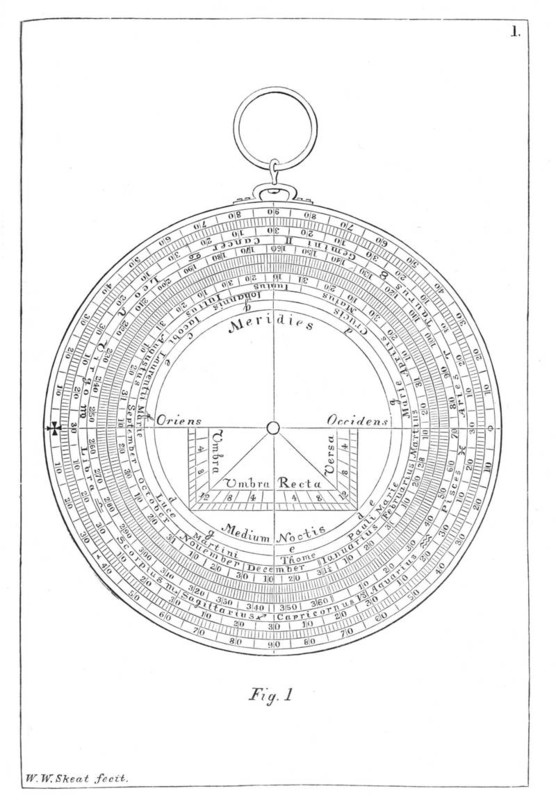
FIG. 1. BACK OF THE 'ASTROLABE.'
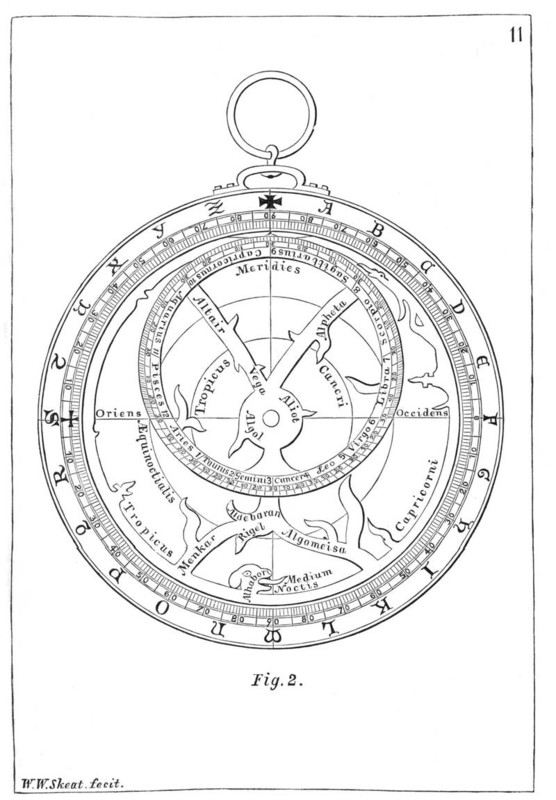
FIG. 2. FRONT OF THE 'ASTROLABE.'
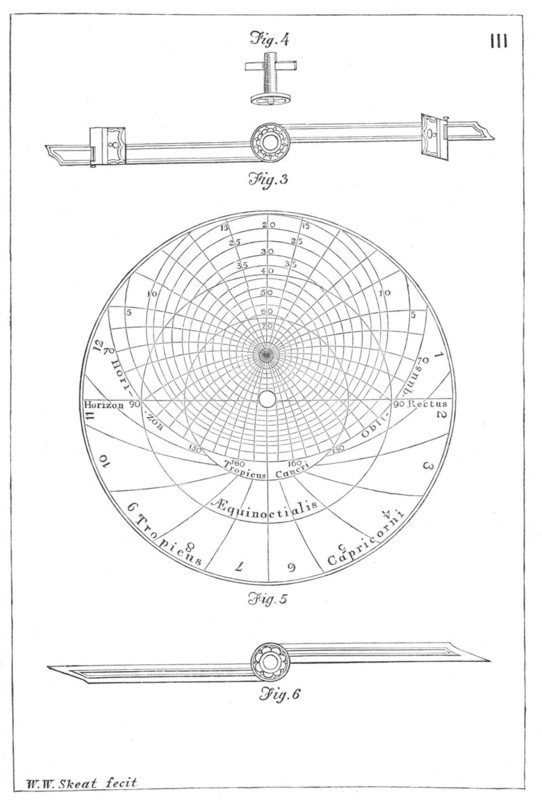
FIG. 3. LABEL. FIG. 4. PIN. FIG. 5. PLATE FOR A CLIMATE. FIG. 6. RULE.
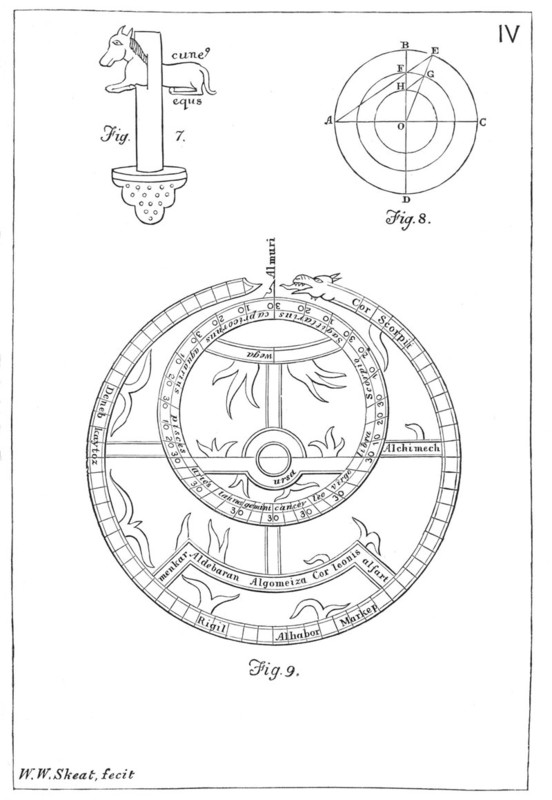
FIG. 7. WEDGE AND HORSE (from a MS.).
FIG. 8. DIAGRAM FOR A PROPOSITION. FIG. 9. STAR-POINTS.
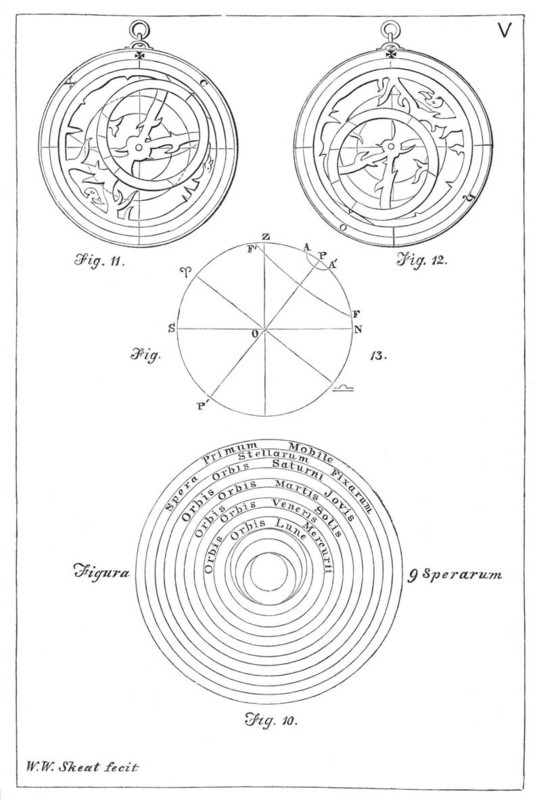
FIG. 10. NINE SPHERES. FIGS. 11, 12, 13. PROBLEMS.
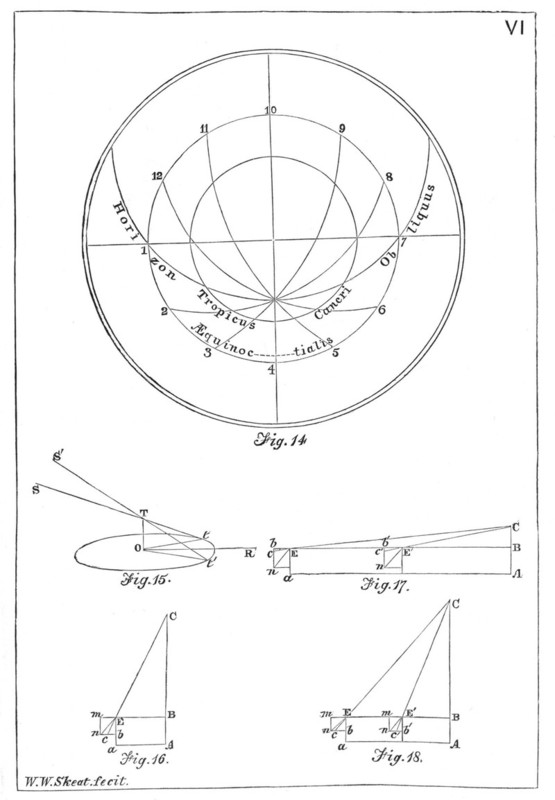
FIG. 14. HOUSES. FIGS. 15-18. UMBRA RECTA AND UMBRA VERSA.
THE HOUS OF FAME.
BOOK I.
God turne us every dreem to gode!
For hit is wonder, by the rode,
To my wit, what causeth swevenes
Either on morwes, or on evenes;
5
And why the effect folweth of somme,
And of somme hit shal never come;
And this a revelacioun;
10
Why this a dreem, why that a sweven,
And nat to every man liche even;
Why this a fantom, these oracles,
I noot; but who-so of these miracles
The causes knoweth bet than I,
Devyne he; for I certeinly
15
Ne can hem noght, ne never thinke
To besily my wit to swinke,
To knowe of hir signifiaunce
The gendres, neither the distaunce
Of tymes of hem, ne the causes
20
For-why this more than that cause is;
As if folkes complexiouns
Make hem dreme of reflexiouns;
Or elles thus, as other sayn,
For to greet feblenesse of brayn,
25
By abstinence, or by seeknesse,
Prison, stewe, or greet distresse;
Or elles by disordinaunce
Of naturel acustomaunce,
That som man is to curious
30
In studie, or melancolious,
Or thus, so inly ful of drede,
That no man may him bote bede;
Or elles, that devocioun
Of somme, and contemplacioun
35
Causeth swiche dremes ofte;
Or that the cruel lyf unsofte
Which these ilke lovers leden
That hopen over muche or dreden,
That purely hir impressiouns
40
Causeth hem avisiouns;
Or if that spirits have the might
To make folk to dreme a-night
Or if the soule, of propre kinde,
Be so parfit, as men finde,
45
That hit forwot that is to come,
And that hit warneth alle and somme
Of everiche of hir aventures
By avisiouns, or by figures,
But that our flesh ne hath no might
50
To understonden hit aright,
For hit is warned to derkly;—
But why the cause is, noght wot I.
Wel worthe, of this thing, grete clerkes,
That trete of this and other werkes;
55
For I of noon opinioun
Nil as now make mencioun,
But only that the holy rode
For never, sith that I was born,
60
Ne no man elles, me biforn,
Mette, I trowe stedfastly,
So wonderful a dreem as I
The tenthe day [dide] of Decembre,
The which, as I can now remembre,
65
I wol yow tellen every del.
The Invocation.
But at my ginning, trusteth wel,
I wol make invocacioun,
Unto the god of slepe anoon,
70
That dwelleth in a cave of stoon
Upon a streem that comth fro Lete,
That is a flood of helle unswete;
Besyde a folk men clepe Cimerie,
Ther slepeth ay this god unmerie
75
That alway for to slepe hir wone is—
And to this god, that I of rede,
Preye I, that he wol me spede
My sweven for to telle aright,
80
If every dreem stonde in his might.
That is and was, and ever shal,
So yive hem Ioye that hit here
Of alle that they dreme to-yere,
85
And for to stonden alle in grace
Of hir loves, or in what place
That hem wer levest for to stonde,
And shelde hem fro povert and shonde,
And fro unhappe and ech disese,
90
And sende hem al that may hem plese,
That take hit wel, and scorne hit noght,
Ne hit misdemen in her thoght
Through malicious entencioun.
And who-so, through presumpcioun,
95
Or hate or scorne, or through envye,
Dispyt, or Iape, or vilanye,
Misdeme hit, preye I Iesus god
That (dreme he barfoot, dreme he shod),
That every harm that any man
100
Hath had, sith [that] the world began,
Befalle him therof, or he sterve,
And graunte he mote hit ful deserve,
Lo! with swich a conclusioun
As had of his avisioun
105
Cresus, that was king of Lyde,
That high upon a gebet dyde!
This prayer shal he have of me;
I am no bet in charite!
Now herkneth, as I have you seyd,
110
What that I mette, or I abreyd.
The Dream.
Whan hit was night, to slepe I lay
Right ther as I was wont to done,
And fil on slepe wonder sone,
115
As he that wery was for-go
On pilgrimage myles two
To the corseynt Leonard,
To make lythe of that was hard.
But as I sleep, me mette I was
120
Within a temple y-mad of glas;
In whiche ther were mo images
Of gold, stondinge in sondry stages,
And mo riche tabernacles,
And with perre mo pinacles,
125
And mo curious portreytures,
And queynte maner of figures
Of olde werke, then I saw ever.
For certeynly, I niste never
Wher that I was, but wel wiste I,
130
Hit was of Venus redely,
The temple; for, in portreyture,
I saw anoon-right hir figure
And also on hir heed, parde,
135
Hir rose-garlond whyt and reed,
And hir comb to kembe hir heed,
Hir dowves, and daun Cupido,
Hir blinde sone, and Vulcano,
That in his face was ful broun.
140
But as I romed up and doun,
I fond that on a wal ther was
Thus writen, on a table of bras:
'I wol now singe, if that I can,
The armes, and al-so the man,
145
That first cam, through his destinee,
Fugitif of Troye contree,
In Itaile, with ful moche pyne,
Unto the strondes of Lavyne.'
And tho began the story anoon,
150
As I shal telle yow echoon.
First saw I the destruccioun
Of Troye, through the Greek Sinoun,
[That] with his false forsweringe,
And his chere and his lesinge
155
Made the hors broght into Troye,
Thorgh which Troyens loste al hir Ioye.
And after this was grave, allas!
How Ilioun assailed was
And wonne, and king Priam y-slayn,
160
And Polites his sone, certayn,
Dispitously, of dan Pirrus.
And next that saw I how Venus,
Whan that she saw the castel brende,
Doun fro the hevene gan descende,
165
And bad hir sone Eneas flee;
And how he fledde, and how that he
Escaped was from al the pres,
And took his fader, Anchises,
And bar him on his bakke away,
170
Cryinge, 'Allas, and welaway!'
The whiche Anchises in his honde
Bar the goddes of the londe,
Thilke that unbrende were.
And I saw next, in alle this fere,
175
How Creusa, daun Eneas wyf,
Which that he lovede as his lyf,
And hir yonge sone Iulo,
And eek Ascanius also,
Fledden eek with drery chere,
180
That hit was pitee for to here;
And in a forest, as they wente,
At a turninge of a wente,
How Creusa was y-lost, allas!
That deed, [but] noot I how, she was;
185
How he hir soughte, and how hir gost
Bad him to flee the Grekes ost,
And seyde, he moste unto Itaile,
As was his destinee, sauns faille;
That hit was pitee for to here,
190
Whan hir spirit gan appere,
The wordes that she to him seyde,
And for to kepe hir sone him preyde.
Ther saw I graven eek how he,
His fader eek, and his meynee,
195
With his shippes gan to sayle
Toward the contree of Itaile,
As streight as that they mighte go.
Ther saw I thee, cruel Iuno,
That art daun Iupiteres wyf,
200
That hast y-hated, al thy lyf,
Al the Troyanisshe blood,
Renne and crye, as thou were wood,
On Eolus, the god of windes,
To blowen out, of alle kindes,
205
So loude, that he shulde drenche
Lord and lady, grome and wenche
Of al the Troyan nacioun,
Withoute any savacioun.
Ther saw I swich tempeste aryse,
210
That every herte mighte agryse,
To see hit peynted on the walle.
Ther saw I graven eek withalle,
Venus, how ye, my lady dere,
Wepinge with ful woful chere,
215
Prayen Iupiter an hye
To save and kepe that navye
Of the Troyan Eneas,
Sith that he hir sone was.
Ther saw I Ioves Venus kisse,
220
And graunted of the tempest lisse.
Ther saw I how the tempest stente,
And how with alle pyne he wente,
And prevely took arrivage
In the contree of Cartage;
225
And on the morwe, how that he
And a knight, hight Achatee,
Metten with Venus that day,
Goinge in a queynt array,
As she had ben an hunteresse,
230
With wind blowinge upon hir tresse;
How Eneas gan him to pleyne,
Whan that he knew hir, of his peyne;
And how his shippes dreynte were,
Or elles lost, he niste where;
235
How she gan him comforte tho,
And bad him to Cartage go,
And ther he shuldë his folk finde,
That in the see were left behinde.
And, shortly of this thing to pace,
240
She made Eneas so in grace
Of Dido, quene of that contree,
That, shortly for to tellen, she
Becam his love, and leet him do
That that wedding longeth to.
245
What shulde I speke more queynte,
Or peyne me my wordes peynte,
To speke of love? hit wol not be;
I can not of that facultee.
And eek to telle the manere
250
How they aqueynteden in-fere,
Hit were a long proces to telle,
And over long for yow to dwelle.
Ther saw I grave, how Eneas
Tolde Dido every cas,
255
That him was tid upon the see.
And after grave was, how she
Made of him, shortly, at oo word,
Hir lyf, hir love, hir lust, hir lord;
And dide him al the reverence,
260
And leyde on him al the dispence,
That any woman mighte do,
Weninge hit had al be so,
As he hir swoor; and her-by demed
That he was good, for he swich semed.
265
Allas! what harm doth apparence,
Whan hit is fals in existence!
For he to hir a traitour was;
Wherfor she slow hir-self, allas!
Lo, how a woman doth amis,
270
To love him that unknowen is!
For, by Crist, lo! thus hit fareth;
'Hit is not al gold, that glareth.'
For, al-so brouke I wel myn heed,
Ther may be under goodliheed
275
Kevered many a shrewed vyce;
Therfor be no wight so nyce,
To take a love only for chere,
For speche, or for frendly manere;
For this shal every woman finde
280
That som man, of his pure kinde,
Wol shewen outward the faireste,
Til he have caught that what him leste;
And thanne wol he causes finde,
And swere how that she is unkinde,
285
Or fals, or prevy, or double was.
Al this seye I by Eneas
And Dido, and hir nyce lest,
That lovede al to sone a gest;
Therfor I wol seye a proverbe,
290
That 'he that fully knoweth therbe
May saufly leye hit to his yë';
Withoute dreed, this is no lye.
But let us speke of Eneas,
How he betrayed hir, allas!
295
And lefte hir ful unkindely.
So whan she saw al-utterly,
That he wolde hir of trouthe faile,
And wende fro hir to Itaile,
She gan to wringe hir hondes two.
300
'Allas!' quod she, 'what me is wo!
Allas! is every man thus trewe,
That every yere wolde have a newe,
If hit so longe tyme dure,
Or elles three, peraventure?
305
As thus: of oon he wolde have fame
In magnifying of his name;
Another for frendship, seith he;
And yet ther shal the thridde be,
That shal be taken for delyt,
310
Lo, or for singular profyt.'
In swiche wordes gan to pleyne
Dido of hir grete peyne,
As me mette redely;
Non other auctour alegge I.
315
'Allas!' quod she, 'my swete herte,
Have pitee on my sorwes smerte,
And slee me not! go noght away!
O woful Dido, wel away!'
Quod she to hir-selve tho.
320
'O Eneas! what wil ye do?
O, that your love, ne your bonde,
That ye han sworn with your right honde,
Ne my cruel deeth,' quod she,
'May holde yow still heer with me!
325
O, haveth of my deeth pitee!
Y-wis, my dere herte, ye
Knowen ful wel that never yit,
As fer-forth as I hadde wit,
Agilte [I] yow in thoght ne deed.
330
O, have ye men swich goodliheed
In speche, and never a deel of trouthe?
Allas, that ever hadde routhe
Any woman on any man!
Now see I wel, and telle can,
335
We wrecched wimmen conne non art;
For certeyn, for the more part,
Thus we be served everichone.
How sore that ye men conne grone,
Anoon as we have yow receyved!
340
Certeinly we ben deceyved;
For, though your love laste a sesoun,
Wayte upon the conclusioun,
And eek how that ye determynen,
And for the more part diffynen.
345
'O, welawey that I was born!
For through yow is my name lorn,
And alle myn actes red and songe
Over al this lond, on every tonge.
O wikke Fame! for ther nis
350
Nothing so swift, lo, as she is!
O, sooth is, every thing is wist,
Though hit be kevered with the mist.
Eek, thogh I mighte duren ever,
That I have doon, rekever I never,
355
That I ne shal be seyd, allas,
Y-shamed be through Eneas,
And that I shal thus Iuged be—
"Lo, right as she hath doon, now she
Wol do eftsones, hardily;"
360
Thus seyth the peple prevely.'—
But that is doon, nis not to done;
Al hir compleynt ne al hir mone,
Certeyn, availeth hir not a stre.
And whan she wiste sothly he
365
Was forth unto his shippes goon,
She in hir chambre wente anoon,
And called on hir suster Anne,
And gan hir to compleyne thanne;
And seyde, that she cause was
370
That she first lovede [Eneas],
And thus counseilled hir therto.
But what! when this was seyd and do,
She roof hir-selve to the herte,
And deyde through the wounde smerte.
375
But al the maner how she deyde,
And al the wordes that she seyde,
Who-so to knowe hit hath purpos,
Reed Virgile in Eneidos
Or the Epistle of Ovyde,
380
What that she wroot or that she dyde;
And nere hit to long to endyte,
By god, I woldë hit here wryte.
But, welaway! the harm, the routhe,
That hath betid for swich untrouthe,
385
As men may ofte in bokes rede,
And al day seen hit yet in dede,
That for to thenken hit, a tene is.
Lo, Demophon, duk of Athenis,
How he forswor him ful falsly,
390
And trayed Phillis wikkedly,
That kinges doghter was of Trace,
And falsly gan his terme pace;
And when she wiste that he was fals,
She heng hir-self right by the hals,
395
For he had do hir swich untrouthe;
Lo! was not this a wo and routhe?
Eek lo! how fals and reccheles
Was to Briseida Achilles,
And Paris to Enone;
400
And Iason to Isiphile;
And eft Iason to Medea;
And Ercules to Dyanira;
For he lefte hir for Iöle,
That made him cacche his deeth, parde.
405
How fals eek was he, Theseus;
That, as the story telleth us,
How he betrayed Adriane;
The devel be his soules bane!
For had he laughed, had he loured,
410
He mostë have be al devoured,
And, for she had of him pitee,
She made him fro the dethe escape,
And he made hir a ful fals Iape;
415
For after this, within a whyle
He lefte hir slepinge in an yle,
Deserte alone, right in the see,
And stal away, and leet hir be;
And took hir suster Phedra tho
420
With him, and gan to shippe go.
And yet he had y-sworn to here,
On al that ever he mighte swere,
That, so she saved him his lyf,
He wolde have take hir to his wyf;
425
For she desired nothing elles,
In certein, as the book us telles.
But to excusen Eneas
Fulliche of al his greet trespas,
The book seyth, Mercurie, sauns faile,
430
Bad him go into Itaile,
And leve Auffrykes regioun,
And Dido and hir faire toun.
Tho saw I grave, how to Itaile
Daun Eneas is go to saile;
435
And how the tempest al began,
And how he loste his steresman,
Which that the stere, or he took keep,
Smot over-bord, lo! as he sleep.
And also saw I how Sibyle
440
And Eneas, besyde an yle,
To helle wente, for to see
His fader, Anchises the free.
How he ther fond Palinurus,
And Dido, and eek Deiphebus;
445
And every tourment eek in helle
Saw he, which is long to telle.
Which who-so willeth for to knowe,
He moste rede many a rowe
On Virgile or on Claudian,
450
Or Daunte, that hit telle can.
Tho saw I grave al tharivaile
That Eneas had in Itaile;
And with king Latine his tretee,
And alle the batailles that he
455
Was at him-self, and eek his knightes,
Or he had al y-wonne his rightes;
And how he Turnus refte his lyf,
And wan Lavyna to his wyf;
And al the mervelous signals
460
Of the goddes celestials;
How, maugre Iuno, Eneas,
For al hir sleighte and hir compas,
Acheved al his aventure;
For Iupiter took of him cure
465
At the prayere of Venus;
The whiche I preye alway save us,
And us ay of our sorwes lighte!
Whan I had seyen al this sighte
In this noble temple thus,
470
'A, Lord!' thoughte I, 'that madest us,
Yet saw I never swich noblesse
Of images, ne swich richesse,
As I saw graven in this chirche;
But not woot I who dide hem wirche,
475
Ne wher I am, ne in what contree.
But now wol I go out and see,
Right at the wiket, if I can
See o-wher stering any man,
That may me telle wher I am.'
480
When I out at the dores cam,
I faste aboute me beheld.
Then saw I but a large feld,
As fer as that I mighte see,
Withouten toun, or hous, or tree,
485
Or bush, or gras, or ered lond;
For al the feld nas but of sond
As smal as man may see yet lye
In the desert of Libye;
Ne I no maner creature,
490
That is y-formed by nature,
Ne saw, me [for] to rede or wisse.
'O Crist,' thoughte I, 'that art in blisse,
Fro fantom and illusioun
Me save!' and with devocioun
495
Myn yën to the heven I caste.
Tho was I war, lo! at the laste,
That faste by the sonne, as hyë
As kenne mighte I with myn yë,
Me thoughte I saw an egle sore,
500
But that hit semed moche more
Then I had any egle seyn.
But this as sooth as deeth, certeyn,
Hit was of golde, and shoon so bright,
That never saw men such a sighte,
505
But-if the heven hadde y-wonne
Al newe of golde another sonne;
So shoon the egles fethres brighte,
And somwhat dounward gan hit lighte.
Explicit liber primus.
[Go to Book II]
The authorities are F. (Fairfax 16); B. (Bodley 638); P. (Pepys 2006); Cx. (Caxton's ed.); Th. (Thynne's ed. 1532). I follow F. mainly, correcting the spelling.
1. P. drem; rest dreme. 8. All have And why; I omit why. 9, 10. F. swevene, evene; Cx. Th. sweuen, euen. 11. Th. B. a fantome; P. a fauntom; Cx. a fanton; F. affaintome; after which, all needlessly insert why. 12. F. Th. B. P. not; Cx. note (= noot). Elide o in so. 20. All wrongly insert is before more. 24. B. of the; rest of her; I omit the (her). 26. F. B. stewe; P. stoe; Cx. stryf; Th. stryfe. 35. P. sweche; rest suche, such. 45. F. B. forwote; rest wote. 50. F. vnderstonde, followed by a metrical mark, indicating a pause: I add n. 58, 62. MSS. dreme (= dreem). 63. See note. 64. B. P. now; F. yow; rest om. 71. P. strem; rest streme (= streem); so P. drem (rest dreme) in l. 80. MSS. cometh (= com'th). 73. Cx. Th. clepe; F. clepeth. 77. F. That; rest And. 78. Th. wol; P. wol; Cx. wyl; F. B. wolde. 85. F. B. stonde; Cx. Th. stande; P. stond. Cx. alle; F. Th. al (wrongly). 88. All pouerte. 89. B. ech; F. eche. 100. I supply that. 103. P. om. a. 109, 110. Cx. seyd, abreyd; the rest seyde (sayde), abreyde (abrayde). Grammar requires seyd, abreyd; (abreyde also occurs). 117, 118. Cx. P. leonard, hard; F. Th. B. leonarde, harde. P. om. of. 119. MSS. slept, slepte; read sleep, as in l. 438. 122. F. Th. golde; Cx. P. gold; B. goold. 126. All queynt. 127. F. B. olde; Th. golde; Cx. P. gold. F. sawgh. 131. Th. This; rest The. 132. F. sawgh. 134. Th. heed; B. hed; F. Cx. hede. Cx. Th. P. parde; F. B. partee (!). 135. B. red; F. Th. rede; Cx. Rose garlondes smellynge as a mede. 136. MSS. combe. B. hed; rest hede. 139. Cx. P. brown; F. broune. 140. Cx. down; F. dovne. 141. P. fond; F. Cx. B. fonde; Th. founde. Cx. Th. wal; B. wall; F. walle. 143. F. B. say; rest synge. F. B. P. om. that. 146. F. B. Troy. 148. Cx. Th. P. Lauyne; F. B. Labyne. 152. Cx. Th. P. Troye; F. B. Troy; see l. 155. 153. All om. That. F. B. P. fals; Cx. fals vntrewe; Th. false vntrewe. 159. Cx. Th. kyng; F. B. kynge. F. y-slayne; rest slayn. 160. Th. Polytes; F. B. Polite. From this point I make no further note of obvious corrections in spelling. 172. Cx. P. Th. goddes; F. B. goddesse (wrongly) 173. F. B. -brende; rest -brenned. 174. Cx. P. this; F. B. his. 184. F. P. That dede not I how she was; B. That ded not I how she was; Cx. That rede note I how it was; Th. That rede nat I howe that it was. Read deed, and insert but. 188. Cx. Th. destyne; F. destanye. 193. Cx. Th. grauen; P. graven; F. grave; B. graue. 196. F. B. Towardes. 199. P. Iubiter; rest Iupiters; read Iupiteres. 204. F. blowe; P. Cx. Th. blowen. 210. Th. herte; rest hert. 220. F. omits from lisse to tempest in next line; the rest are right. 221, 222. F. B. stent, went; Cx. Th. stente, wente. 227. P. Cx. Th. Metten; F. B. Mette. 235. F. P. comfort; rest comforte. 237. P. folk; rest folke; but shulde is here dissyllabic. 242. F. tel; B. telle; P. Cx. Th. tellen. 257, 8. All worde, lorde. 260. Th. the; rest omit. 270. F. vnknowe; rest vnknowen. 278. Th. Or speche; rest Or (F. Of!) for speche; read For speche. Lines 280-2 3 are in Th. only, which reads some; fayrest; lest; than. 285. Cx. Th. (3rd) or; F. B. P. om. 290. F. B. therbe (= the herbe); P. Cx. Th. the herbe. 305. Cx. Th. one; P. on; F. B. love. 309, 310. All delyte, profyte. 313. For mette, Cx. Th. have mette dremyng (!). 314. F. auttour = auctour. 315. F. he; the rest she. 320. F. Th. wol; P. wille; Cx. wyl. 322. F. ha; P. B. haue; rest om. 328. All had. 329. I insert I; which all omit. 332. P. hadde; rest had. 334. Cx. telle; P. tellen; F. tel. 340. F. omits this line; the rest have it. 347. F. B. al youre; Cx. Th. P. myn (om. al). 352. F. B. om. be. 353. Th. duren; F. B. dure. 358. Th. done; rest omit. 362. All insert But before Al. 363. Cx. Th. P. Certeyn; F. B. Certeynly. 365. Cx. goon; P. gon; F. agoon; B. agon. 366. in] All in to. 370. All Allas (alas); read Eneas. 371. F. B. As; rest And. 375. Cx. Th. P. But; F. B. And. 381. F. And nor hyt were to; Cx. And nere it were to; Th. And nere it to; B. P. And ner it were to. Th. B. to endyte; F. Cx. tendyte. 387. P. thenken; F. B. thynke; Cx. Th. thynken. 391. F. B. om. was. 402. Cx. Th. P. And; F. B. omit. 410. Th. al; Cx. all; P. alle; F. B. om. 426. F. B. om. as and us. 428. F. B. om. greet. 429. B. Mercure; F. Mercure; rest om. 433. F. B. how that; rest how. 434. Cx. P. to saylle; Th. for to sayle; F. B. for to assayle. 446. Th. longe is for; F. B. is longe. Cx. P. whyche no tonge can telle. 451. For tharivaile, F. B. Th. have the aryvayle; Cx. the arryuaylle; P. the arevaille. 458. F. labina; rest Lauyna. 468. Cx. P. seyn; rest seen (sene). 473. F. B. grave; rest grauen. 475. F. B. omit in. 478. Th. sterynge any; the rest any stiryng (sterynge). 486. Cx. Th. P. was but of sonde (sande); F. B. nas but sonde. 491. I insert for. Cx. Th. P. insert I after saw; but it is in l. 489. 496. F. B. omit lo. 504. F. B. omit lines 504-507. Colophon and Title. So in Cx.; the rest omit them.
[57]
There are two astrolabes in Merton College, besides a plate exhibiting astronomical tables. These are all described in a paper entitled 'Remarks on an Astrolabe belonging to F. A. Hyett, Esq.,' written by my friend Robert Taylor, M.A., and printed in the Transactions of the Bristol and Gloucestershire Archæological Society, vol. xii. Mr. Taylor further describes two Astrolabes in the British Museum.
[58]
This word has several senses in Chaucer. It means (1) the discs of an astrolabe; (2) a set of tablets; (3) astronomical tables; and (4) the game of 'tables.'
[59]
'Pertuis: m. A hole. Pertuis de l'Araigne, the centre of an Astrolabe; the hole wherein all the tables thereof are, by a pin or naile, joined together.'—Cotgrave's French Dictionary.
i.e. They pass the seven planetary spheres; then the sphere of fixed stars; then the crystalline or transparent one, whose swaying motion or libration measures the amount of the precession and nutation so often talked of; and then, the sphere of the primum mobile itself. But Milton clearly himself believed in the Copernican system; see Paradise Lost, viii. 121-140, where the primum mobile is described in the lines—
17. We may place under the Rete any plates we please. If only the Mother be under it, without any plate, we may suppose the Mother marked as in fig. 2. The plate or disc (tympanum) which was usually dropped in under the Rete is that shewn in fig. 5, Plate III, and which Chaucer now describes. Any number of these, marked differently for different latitudes, could be provided for the Astrolabe. The greatest declination of the sun measures the obliquity of the ecliptic, the true value of which is slightly variable, but was about 23° 31′ in Chaucer's time, and about 23° 40′ in the time of Ptolemy, who certainly assigns to it too large a value. The value of it must be known before the three circles can be drawn. The method of finding their relative magnitudes is very simple. Let ABCD (fig. 8, Pl. IV) be the tropic of Capricorn, BO the South line, OC the West line. Make the angle EOB equal to the obliquity (say 23½°), and join EA, meeting BO in F. Then OF is the radius of the Equatorial circle, and if GH be drawn parallel to EF, OH is the radius of the Tropic of Cancer. In the phrase angulus primi motus, angulus must be taken to mean angular motion. The 'first moving' (primus motus) has its name of 'moving' (motus) from its denoting motion due to the primum mobile or 'first moveable.' This primum mobile (usually considered as the ninth sphere) causes the rotation of the eighth sphere, or sphæra stellarum fixarum. See the fig. in MS. Camb. Univ. Ii. 3. 3 (copied in fig. 10, Pl. V). Some authors make 12 heavens, viz. those of the 7 planets, the firmamentum (stellarum fixarum), the nonum cœlum, decimum cœlum, primum mobile, and cœlum empyræum.
1. For this method of commencing a poem with a dream, compare The Book of the Duchesse, Parl. of Foules, and The Romance of the Rose.
2. This long sentence ends at line 52.
7. This opens up the question as to the divers sorts of dreams. Chaucer here evidently follows Macrobius, who, in his Commentary on the Somnium Scipionis, lib. i. c. 3, distinguishes five kinds of dreams, viz. somnium, visio, oraculum, insomnium, and visum. The fourth kind, insomnium, was also called fantasma; and this provided Chaucer with the word fantome in l. 11. In the same line, oracles answers to the Lat. oracula. Cf. Ten Brink, Studien, p. 101.
18. The gendres, the (various) kinds. This again refers to Macrobius, who subdivides the kind of dream which he calls somnium into five species, viz. proprium, alienum, commune, publicum, and generale, according to the things to which they relate. Distaunce of tymes, i.e. whether the thing dreamt of will happen soon, or a long time afterwards.
20. 'Why this is a greater (more efficient) cause than that.'
21. This alludes to the four chief complexions of men; cf. Nonne Preestes Tale, B 4114. The four complexions were the sanguine, phlegmatic, melancholy, and choleric; and each complexion was likely to have certain sorts of dreams. Thus, in the Nonne Preestes Tale, B 4120, the choleric man is said to dream of arrows, fire, fierce carnivorous beasts, strife, and dogs; whilst the melancholy man will dream of bulls and bears and black devils.
22. Reflexiouns, the reflections or thoughts to which each man is most addicted; see Parl. of Foules, 99-105.
24. 'Because of too great feebleness of their brain (caused) by abstinence,' &c.
43. Of propre kynde, owing to its own nature.
48. The y in By is run on to the a into avísióuns.
53. 'As respects this matter, may good befall the great clerks that treat of it.' Of these great clerks, Macrobius was one, and Jean de Meun another. Vincent of Beauvais has plenty to say about dreams in his Speculum Naturale, lib. xxvi.; and he refers us to Aristotle, Gregory (Moralia, lib. viii.), Johannes de Rupella, Priscianus (ad Cosdroe regem Persarum) Augustinus (in Libro de diuinatione dæmonum), Hieronimus (super Matheum, lib. ii.), Thomas de Aquino, Albertus, &c.
58. Repeated (nearly) from l. 1.
63. I here give the text as restored by Willert, who shows how the corruptions in ll. 62 and 63 arose. First of all dide was shifted into l. 62, giving as dide I; as in Caxton's print. Next, an additional now was put in place of dide in l. 63; as in P., B., F., and Th., and dide was dropped alltogether. After this, F. turned the now of l. 64 into yow, and Cx. omitted it. See also note to l. 111.
64. 'Which, as I can (best) now remember.'
68. Pronounced fully:—With spé-ci-ál de-vó-ci-óun.
69. Morpheus; see Book of Duch. 137. From Ovid, Met. xi. 592-612; esp. ll. 602, 3:—
73. 'Est prope Cimmerios,' &c.; Met. xi. 592.
75. See Ovid, Met. xi. 613-5; 633.
76. That ... hir is equivalent to whose; cf. Kn. Tale, 1852.
81. Cf. 'Colui, che tutto move,' i.e. He who moves all; Parad. i. 1.
88. Read povért; cf. Clerkes Tale, E 816.
92. MSS. misdeme; I read misdemen, to avoid an hiatus.
93. Read málicióus.
98. 'That, whether he dream when bare-footed or when shod'; whether in bed by night or in a chair by day; i.e. in every case. The that is idiomatically repeated in l. 99.
105. The dream of Crœsus, king of Lydia, and his death vpon a gallows, form the subject of the last story in the Monkes Tale. Chaucer got it from the Rom. de la Rose, which accounts for the form Lyde. The passage occurs at l. 6513:—
109, 10. The rime is correct, because abreyd is a strong verb. Chaucer does not rime a pp. with a weak pt. tense, which should have a final e. According to Mr. Cromie's Rime-Index, there is just one exception, viz. in the Kn. Tale, A 1383, where the pt. t. seyde is rimed with the 'pp. leyde.' But Mr. Cromie happens to have overlooked the fact that leyde is here not the pp., but the past tense! Nevertheless, abreyd-e also appears in a weak form, by confusion with leyd-e, seyd-e, &c.; see C. T., B 4198, E 1061. Cf. Book of the Duchess, 192. In l. 109, he refers to l. 65.
111. Here again, as in l. 63, is a mention of Dec. 10. Ten Brink (Studien, p. 151) suggests that it may have been a Thursday; cf. the mention of Jupiter in ll. 608, 642, 661. If so, the year was 1383.
115. 'Like one that was weary with having overwalked himself by going two miles on pilgrimage.' The difficulty was not in the walking two miles, but in doing so under difficulties, such as going barefoot for penance.
117. Corseynt; O.F. cors seint, lit. holy body; hence a saint or sainted person, or the shrine where a saint was laid. See Robert of Brunne, Handlyng Synne, 8739:—
118. 'To make that soft (or easy) which was formerly hard.' The allusion is humorous enough; viz. to the bonds of matrimony. Here again Chaucer follows Jean de Meun, Rom. de la Rose, 8871:—
119. The MSS. have slept-e, which is dissyllabic. Read sleep, as in C. T. Prol. 397.
120. Hence the title of one of Lydgate's poems, The Temple of Glass, which is an imitation of the present poem.
130. Cf. the description of Venus' temple (Cant. Tales, A 1918), which is imitated from that in Boccaccio's Teseide.
133. Cf. 'naked fleting in the large see.... And on hir heed, ful semely for to see, A rose garland, fresh and wel smellinge'; Cant. Tales, A 1956.
137. 'Hir dowves'; C. T., A 1962. 'Cupido'; id. 1963.
138. Vulcano, Vulcan; note the Italian forms of these names. Boccaccio's Teseide has Cupido (vii. 54), and Vulcano (vii. 43). His face was brown with working at the forge.
141, 2. Cf. Dante, Inf. iii. 10, 11.
143. A large portion of the rest of this First Book is taken up with a summary of the earlier part of Vergil's Aeneid. We have here a translation of the well-known opening lines:—
147. In, into, unto; see note to l. 366.
152. Synoun, Sinon; Aen. ii. 195.
153. I supply That, both for sense and metre.
155. Made the hors broght, caused the horse to be brought. On this idiom, see the note to Man of Lawes Tale, B 171.
158. Ilioun, Ilium. Ilium is only a poetical name for Troy; but the medieval writers often use it in the restricted sense of the citadel of Troy, where was the temple of Apollo and the palace of Priam. Thus, in the alliterative Troy-book, 11958, ylion certainly has this sense; and Caxton speaks of 'the palays of ylyon'; see Spec. of English, ed. Skeat, p. 94. See also the parallel passage in the Nonne Preestes Tale, B 4546. Still more clearly, in the Leg. Good Women (Dido, 13), Chaucer says, of 'the tour of Ilioun,' that it 'of the citee was the cheef dungeoun.' In l. 163 below, it is called castel.
160. Polites, Polites; Aen. ii. 526. Also spelt Polite in Troil. iv. 53.
163. Brende, was on fire; used intransitively, as in l. 537.
164-73. See Aen. ii. 589-733.
174. Read this, rather than his. Cf. Aen. ii. 736.
177. Iulus and Ascanius were one and the same person; see Æn. i. 267. Perhaps Ch. was misled by the wording of Æn. iv. 274. (On the other hand, Brutus was not the same person as Cassius; see Monkes Tale, B 3887). Hence, Koch proposes to read That hight instead of And eek; but we have no authority for this. However, Chaucer has it right in his Legend of Good Women, 941; and in l. 192 below, we find sone, not sones; hence l. 178 may be merely parenthetical.
182. Wente, foot-path; Aen. ii. 737. Cf. Book Duch. 398.
184. 'So that she was dead, but I know not how.' Vergil does not say how she died.
185. Gost, ghost; see Aen. ii. 772.
189. Repeated from l. 180.
198. Here Chaucer returns to the first book of the Æneid, which he follows down to l. 255.
204. 'To blow forth, (with winds) of all kinds'; cf. Æn. i. 85.
219. Ioves, Jove, Jupiter. This curious form occurs again, ll. 586, 597, 630; see note to l. 586. Boccaccio has Giove.
226. Achatee (trisyllabic), Achates, Æn. i. 312; where the abl. form Achate occurs.
239. The story of Dido is told at length in Le Rom. de la Rose, 13378; in The Legend of Good Women; and in Gower, Conf. Amantis, bk. iv., ed. Pauli, ii. 4. Chaucer now passes on to the fourth book of the Æneid, till he comes to l. 268 below.
265. 'Mès ja ne verrés d'aparence Conclurre bonne consequence'; Rom. Rose, 12343.
272. 'It is not all gold that glistens.' A proverb which Chaucer took from Alanus de Insulis; see note to Can. Yem. Tale, G 962.
273. 'For, as sure as I hope to have good use of my head.' Brouke is, practically, in the optative mood. Cf. 'So mote I brouke wel myn eyen tweye'; Cant. Ta., B 4490; so also E 2308. The phrase occurs several times in the Tale of Gamelyn; see note to l. 334 of that poem.
280-3. These four lines occur in Thynne's edition only, but are probably quite genuine. It is easy to see why they dropped out; viz. owing to the repetition of the word finde at the end of ll. 279 and 283. This is a very common cause of such omissions. See note to l. 504.
286. By, with reference to.
288. Gest, guest; Lat. aduena, Æn. iv. 591.
290. 'He that fully knows the herb may safely lay it to his eye.' So in Cotgrave's Dict., s.v. Herbe, we find; 'L'herbe qu'on cognoist, on la doit lier à son doigt; Prov. Those, or that, which a man knowes best, he must use most.'
305. In the margin of MSS. F. and B. is here written:—'Cauete uos, innocentes mulieres.'
315. Swete herte; hence E. sweetheart; cf. l. 326.
321. Understand ne (i.e. neither) before your love. Cf. Æn. iv. 307, 8.
329. I have no hesitation in inserting I after Agilte, as it is absolutely required to complete the sense. Read—Agílt' I yów, &c.
343. Pronounce détermínen (i as ee in beet).
346. Cf. Æn. iv. 321-3.
350. 'Fama, malum quo non aliud uelocius ullum,' Æn. iv. 174; quoted in the margin of MSS. F. and B.
351. 'Nichil occultum quod non reueletur'; Matt. x. 26: quoted in the margin of MSS. F. and B.
355. Seyd y-shamed be, said to be put to shame.
359. Eft-sones, hereafter again. In the margin of MSS. F. and B. we here find:—'Cras poterunt turpia fieri sicut heri.' By reading fieri turpia, this becomes a pentameter; but it is not in Ovid, nor (I suppose) in classical Latin.
361. Doon, already done. To done, yet to be done. Cf. Book Duch. 708.
366. I read in for into (as in the MSS.). For similar instances, where the scribes write into for in, see Einenkel, Streifzüge durch die Mittelengl. Syntax, p. 145. Cf. l. 147.
367. In the margin of MSS. F. and B. is an incorrect quotation of Æn. iv. 548-9:—'tu prima furentem His, germana, malis oneras.'
378. Eneidos; because the books are headed Æneidos liber primus, &c.
379. See Ovid, Heroides, Epist. vii—Dido Æneæ.
380. Or that, ere that, before.
381. Only Th. has the right reading, viz. And nere it to longe to endyte (where longe is an error for long). The expressions And nor hyt were and And nere it were are both ungrammatical. Nere = ne were, were it not.
388. In the margin of F. and B. we find:—'Nota: of many vntrewe louers. Hospita, Demaphoon, tua te R[h]odopeia Phyllis Vltra promissum tempus abesse queror.' These are the first two lines of Epistola ii. in Ovid's Heroides, addressed by Phyllis to Demophoon. All the examples here given are taken from the same work. Epist. iii. is headed Briseis Achilli; Epist. v., Oenone Paridi; Epist. vi., Hypsipyle Iasoni; Epist. xii., Medea Iasoni; Epist. ix., Deianira Herculi; Epist. x., Ariadne Theseo. These names were evidently suggested by the reference above to the same work, l. 379. See the long note to Group B, l. 61, in vol. v.
392. His terme pace, pass beyond or stay behind his appointed time. He said he would return in a month, but did not do so. See the story in The Legend of Good Women. Gower (ed. Pauli, iii. 361) alludes to her story, in a passage much like the present one; and in Le Rom. de la Rose, 13417, we have the very phrase—'Por le terme qu'il trespassa.'
397. In the margin of F. and B.:—'Ouidius. Quam legis a rapta Briseide litera venit'; Heroid. Ep. iii. 1.
401. In the same:—'Ut [miswritten Vbi] tibi Colc[h]orum memini regina uacaui'; Heroid. Ep. xii. 1. For the accentuation of Medea, cf. Leg. of Good Women, 1629, 1663.
402. In the margin of F. and B.:—'Gratulor Oechaliam'; Heroid. Ep. ix. 1; but Oechaliam is miswritten yotholia.
405. Gower also tells this story; ed. Pauli, ii. 306.
407. In F. and B. is quoted the first line of Ovid, Heroid. x. 1. Adriane, Ariadne; just as in Leg. Good Wom. 2171, &c., and in C. T., Group B, l. 67. Gower has Adriagne.
409. 'For, whether he had laughed, or whether he had frowned'; i.e. in any case. Cf. l. 98.
411. 'If it had not been for Ariadne.' We have altered the form of this idiom.
416. Yle, isle of Naxos; see notes to Leg. Good Wom. 2163, and C. T., Group B, l. 68 (in vol. v.).
426. Telles is a Northern and West-Midland form, as in Book Duch. 73. Cf. falles, id. 257. A similar admixture of forms occurs in Havelok, Will. of Palerne, and other M.E. poems.
429. The book, i.e. Vergil; Æn. iv. 252.
434. Go, gone, set out; correctly used. Chaucer passes on to Æneid, bk. v. The tempest is that mentioned in Æn. v. 10; the steersman is Palinurus, who fell overboard; Æn. v. 860.
439. See Æn. bk. vi. The isle intended is Crete, Æn. vi. 14, 23; which was not at all near (or 'besyde') Cumæ, but a long way from it. Æneas then descends to hell, where he sees Anchises (vi. 679); Palinurus (337); Dido (450); Deiphobus, son of Priam (495); and the tormented souls (580).
447. Which refers to the various sights in hell.
449. Claudian, Claudius Claudianus, who wrote De raptu Proserpinae about A.D. 400. Daunte is Dante, with reference to his Inferno, ii. 13-27, and Paradiso, xv. 25-27.
451. Chaucer goes on to Æn. vii-xii, of which he says but little.
458. Lavyna is Lavinia; the form Lavina occurs in Dante, Purg. xvii. 37.
468. I put seyën for seyn, to improve the metre; cf. P. Pl. C. iv. 104.
474. 'But I do not know who caused them to be made.'
475. Read ne in as nin; as in Squi. Tale, F 35.
482. This waste space corresponds to Dante's 'gran diserto,' Inf. i. 64; or, still better, to his 'landa' (Inf. xiv. 8), which was too sterile to support plants. So again, l. 486 corresponds to Dante's 'arena arida e spessa,' which has reference to the desert of Libya; Inf. xiv. 13.
487. 'As fine [said of the sand] as one may see still lying.' Jephson says yet must be a mistake, and would read yt. But it makes perfect sense. Cx. Th. read at eye (put for at yë) instead of yet lye, which is perhaps better. At yë means 'as presented to the sight'; see Kn. Ta., A 3016.
498. Kenne, discern. The offing at sea has been called the kenning; and see Kenning in Halliwell.
500. More, greater. Imitated from Dante, Purgat. ix. 19, which Cary translates thus:—
504-7. The omission of these lines in F. and B. is simply due to the scribe slipping from bright in l. 503 to brighte in l. 507. Cf. note to l. 280.
BOOK II.
Incipit liber secundus.
Proem.
Now herkneth, every maner man
510
That English understonde can,
And listeth of my dreem to lere;
For now at erste shul ye here
So selly an avisioun,
That Isaye, ne Scipioun,
515
Ne king Nabugodonosor,
Ne mette swich a dreem as this!
(10)
Now faire blisful, O Cipris,
So be my favour at this tyme!
520
And ye, me to endyte and ryme
Helpeth, that on Parnaso dwelle
By Elicon the clere welle.
O Thought, that wroot al that I mette,
And in the tresorie hit shette
525
Of my brayn! now shal men see
If any vertu in thee be,
To tellen al my dreem aright;
(20)
Now kythe thyn engyn and might!
The Dream.
This egle, of which I have yow told,
530
That shoon with fethres as of gold,
Which that so hyë gan to sore,
I gan beholde more and more,
To see hir beautee and the wonder;
But never was ther dint of thonder,
535
Ne that thing that men calle foudre,
That smoot somtyme a tour to poudre,
And in his swifte coming brende,
(30)
That so swythe gan descende,
As this foul, whan hit behelde
540
That I a-roume was in the felde;
And with his grimme pawes stronge,
Within his sharpe nayles longe,
Me, fleinge, at a swappe he hente,
And with his sours agayn up wente,
545
Me caryinge in his clawes starke
As lightly as I were a larke,
How high, I can not telle yow,
(40)
For I cam up, I niste how.
For so, astonied and a-sweved
550
Was every vertu in my heved,
What with his sours and with my drede,
That al my feling gan to dede;
For-why hit was to greet affray.
Thus I longe in his clawes lay,
555
Til at the laste he to me spak
In mannes vois, and seyde, 'Awak!
And be not so a-gast, for shame!'
(50)
And called me tho by my name.
And, for I sholde the bet abreyde—
560
Me mette—'Awak,' to me he seyde,
Right in the same vois and stevene
That useth oon I coude nevene;
And with that vois, soth for to sayn,
My minde cam to me agayn;
565
For hit was goodly seyd to me,
So nas hit never wont to be.
And herwithal I gan to stere,
(60)
And he me in his feet to bere,
Til that he felte that I had hete,
570
And felte eek tho myn herte bete.
And tho gan he me to disporte,
And with wordes to comforte,
And sayde twyës, 'Seynte Marie!
Thou art noyous for to carie,
575
And nothing nedeth hit, parde!
As thou non harm shalt have of this;
(70)
And this cas, that betid thee is,
Is for thy lore and for thy prow;—
580
Let see! darst thou yet loke now?
Be ful assured, boldely,
I am thy frend.' And therwith I
Gan for to wondren in my minde.
'O god,' thoughte I, 'that madest kinde,
585
Shal I non other weyes dye?
Or what thing may this signifye?
(80)
Ne Romulus, ne Ganymede
590
That was y-bore up, as men rede,
To hevene with dan Iupiter,
And maad the goddes boteler.'
Lo! this was tho my fantasye!
But he that bar me gan espye
595
That I so thoghte, and seyde this:—
'Thou demest of thy-self amis;
For Ioves is not ther-aboute—
(90)
I dar wel putte thee out of doute—
To make of thee as yet a sterre.
600
But er I bere thee moche ferre,
I wol thee telle what I am,
And whider thou shalt, and why I cam
To done this, so that thou take
Good herte, and not for fere quake.'
605
'Gladly,' quod I. 'Now wel,' quod he:—
'First I, that in my feet have thee,
Of which thou hast a feer and wonder,
(100)
Am dwelling with the god of thonder,
Which that men callen Iupiter,
610
That dooth me flee ful ofte fer
To do al his comaundement.
And for this cause he hath me sent
To thee: now herke, by thy trouthe!
Certeyn, he hath of thee routhe,
615
That thou so longe trewely
Hast served so ententifly
His blinde nevew Cupido,
(110)
And fair Venus [goddesse] also,
Withoute guerdoun ever yit,
620
And nevertheles hast set thy wit—
Although that in thy hede ful lyte is—
To make bokes, songes, dytees,
In ryme, or elles in cadence,
As thou best canst, in reverence
625
Of Love, and of his servants eke,
That have his servise soght, and seke;
And peynest thee to preyse his art,
(120)
Althogh thou haddest never part;
Wherfor, al-so god me blesse,
630
Ioves halt hit greet humblesse
And vertu eek, that thou wolt make
A-night ful ofte thyn heed to ake,
In thy studie so thou wrytest,
And ever-mo of love endytest,
635
In honour of him and preysinges,
And in his folkes furtheringes,
And in hir matere al devysest,
(130)
And noght him nor his folk despysest,
Although thou mayst go in the daunce
640
Of hem that him list not avaunce.
'Wherfor, as I seyde, y-wis,
Iupiter considereth this,
And also, beau sir, other thinges;
That is, that thou hast no tydinges
645
Of Loves folk, if they be glade,
Ne of noght elles that god made;
And noght only fro fer contree
(140)
That ther no tyding comth to thee,
But of thy verray neyghebores,
650
That dwellen almost at thy dores,
Thou herest neither that ne this;
For whan thy labour doon al is,
And hast y-maad thy rekeninges,
In stede of reste and newe thinges,
655
Thou gost hoom to thy hous anoon;
And, also domb as any stoon,
Thou sittest at another boke,
(150)
Til fully daswed is thy loke,
And livest thus as an hermyte,
660
Although thyn abstinence is lyte.
'And therfor Ioves, through his grace,
Wol that I bere thee to a place,
Which that hight the Hous of Fame,
To do thee som disport and game,
665
In som recompensacioun
Of labour and devocioun
That thou hast had, lo! causeles,
(160)
To Cupido, the reccheles!
And thus this god, thorgh his meryte,
670
Wol with som maner thing thee quyte,
So that thou wolt be of good chere.
For truste wel, that thou shalt here,
When we be comen ther I seye,
Mo wonder thinges, dar I leye,
675
Of Loves folke mo tydinges,
Bothe soth-sawes and lesinges;
And mo loves newe begonne,
(170)
And longe y-served loves wonne,
And mo loves casuelly
680
That been betid, no man wot why,
But as a blind man stert an hare;
And more Iolytee and fare,
Whyl that they finde love of stele,
As thinketh hem, and over-al wele;
685
Mo discords, and mo Ielousyes,
Mo murmurs, and mo novelryes,
And mo dissimulaciouns,
(180)
And feyned reparaciouns;
690
Withoute rasour or sisoures
Y-maad, then greynes be of sondes;
And eke mo holdinge in hondes,
And also mo renovelaunces
Of olde forleten aqueyntaunces;
695
Mo love-dayes and acordes
Then on instruments ben cordes;
And eke of loves mo eschaunges
(190)
Than ever cornes were in graunges;
Unethe maistow trowen this?'—
700
Quod he. 'No, helpe me god so wis!'—
Quod I. 'No? why?' quod he. 'For hit
Were impossible, to my wit,
Though that Fame hadde al the pyes
In al a realme, and al the spyes,
705
How that yet she shulde here al this,
Or they espye hit.' 'O yis, yis!'
Quod he to me, 'that can I preve
(200)
By resoun, worthy for to leve,
So that thou yeve thyn advertence
710
To understonde my sentence.
'First shall thou heren wher she dwelleth,
And so thyn owne book hit telleth;
Hir paleys stant, as I shal seye,
Right even in middes of the weye
715
Betwixen hevene, erthe, and see;
That, what-so-ever in al these three
Is spoken, in privee or aperte,
(210)
The wey therto is so overte,
And stant eek in so Iuste a place,
720
That every soun mot to hit pace,
Or what so comth fro any tonge,
Be hit rouned, red, or songe,
Or spoke in seurtee or drede,
Certein, hit moste thider nede.
735
'Now herkne wel; for-why I wille
Tellen thee a propre skile,
And worthy demonstracioun
(220)
In myn imagynacioun.
'Geffrey, thou wost right wel this,
730
That every kindly thing that is,
Hath a kindly stede ther he
May best in hit conserved be;
Unto which place every thing,
Through his kindly enclyning,
735
Moveth for to come to,
Whan that hit is awey therfro;
As thus; lo, thou mayst al day see
(230)
That any thing that hevy be,
As stoon or leed, or thing of wighte,
740
And ber hit never so hye on highte,
Lat go thyn hand, hit falleth doun.
'Right so seye I by fyre or soun,
Or smoke, or other thinges lighte,
Alwey they seke upward on highte;
745
Whyl ech of hem is at his large,
Light thing up, and dounward charge.
'And for this cause mayst thou see,
(240)
That every river to the see
Enclyned is to go, by kinde.
750
And by these skilles, as I finde,
Hath fish dwellinge in floode and see,
And treës eek in erthe be.
Thus every thing, by this resoun,
Hath his propre mansioun,
755
To which hit seketh to repaire,
As ther hit shulde not apaire.
Lo, this sentence is knowen couthe
(250)
Of every philosophres mouthe,
760
And other clerkes many oon;
And to confirme my resoun,
Thou wost wel this, that speche is soun,
Or elles no man mighte hit here;
Now herkne what I wol thee lere.
765
'Soun is noght but air y-broken,
And every speche that is spoken,
Loud or privee, foul or fair,
(260)
In his substaunce is but air;
For as flaumbe is but lighted smoke,
770
Right so soun is air y-broke.
But this may be in many wyse,
Of which I wil thee two devyse,
As soun that comth of pype or harpe.
For whan a pype is blowen sharpe,
775
The air is twist with violence,
And rent; lo, this is my sentence;
Eek, whan men harpe-stringes smyte,
(270)
Whether hit be moche or lyte,
Lo, with the strook the air to-breketh;
780
Right so hit breketh whan men speketh.
Thus wost thou wel what thing is speche.
'Now hennesforth I wol thee teche,
How every speche, or noise, or soun,
Through his multiplicacioun,
785
Thogh hit were pyped of a mouse,
Moot nede come to Fames House.
I preve hit thus—tak hede now—
(280)
By experience; for if that thou
Throwe on water now a stoon,
790
Wel wost thou, hit wol make anoon
A litel roundel as a cercle,
Paraventure brood as a covercle;
And right anoon thou shalt see weel,
That wheel wol cause another wheel,
795
And that the thridde, and so forth, brother,
Every cercle causing other,
Wyder than himselve was;
(290)
And thus, fro roundel to compas,
Ech aboute other goinge,
800
Caused of othres steringe,
And multiplying ever-mo,
Til that hit be so fer y-go
That hit at bothe brinkes be.
Al-thogh thou mowe hit not y-see
805
Above, hit goth yet alway under,
Although thou thenke hit a gret wonder.
And who-so seith of trouthe I varie,
(300)
And right thus every word, y-wis,
810
That loude or privee spoken is,
Moveth first an air aboute,
And of this moving, out of doute,
Another air anoon is meved,
As I have of the water preved,
815
That every cercle causeth other.
Right so of air, my leve brother;
Everich air in other stereth
(310)
More and more, and speche up bereth,
Or vois, or noise, or word, or soun,
820
Ay through multiplicacioun,
Til hit be atte House of Fame;—
Tak hit in ernest or in game.
'Now have I told, if thou have minde,
How speche or soun, of pure kinde,
825
Enclyned is upward to meve;
This, mayst thou fele, wel I preve.
And that [the mansioun], y-wis,
(320)
That every thing enclyned to is,
Hath his kindeliche stede:
830
That sheweth hit, withouten drede,
That kindely the mansioun
Of every speche, of every soun,
Be hit either foul or fair,
Hath his kinde place in air.
835
And sin that every thing, that is
Out of his kinde place, y-wis,
Moveth thider for to go
(330)
If hit a-weye be therfro,
As I before have preved thee,
840
Hit seweth, every soun, pardee,
Moveth kindely to pace
Al up into his kindely place.
And this place of which I telle,
Ther as Fame list to dwelle,
845
Is set amiddes of these three,
Heven, erthe, and eek the see,
As most conservatif the soun.
(340)
Than is this the conclusioun,
That every speche of every man,
850
As I thee telle first began,
Moveth up on high to pace
Kindely to Fames place.
'Telle me this feithfully,
Have I not preved thus simply,
855
Withouten any subtiltee
Of speche, or gret prolixitee
(350)
Of figures of poetrye,
Or colours of rethoryke?
860
Pardee, hit oghte thee to lyke;
For hard langage and hard matere
Is encombrous for to here
At ones; wost thou not wel this?'
And I answerde, and seyde, 'Yis.'
865
'A ha!' quod he, 'lo, so I can,
Lewedly to a lewed man
Speke, and shewe him swiche skiles,
(360)
That he may shake hem by the biles,
So palpable they shulden be.
870
But tel me this, now pray I thee,
How thinkth thee my conclusioun?'
[Quod he]. 'A good persuasioun,'
Quod I, 'hit is; and lyk to be
Right so as thou hast preved me.'
875
'By god,' quod he, 'and as I leve,
Thou shall have yit, or hit be eve,
Of every word of this sentence
(370)
A preve, by experience;
And with thyn eres heren wel
880
Top and tail, and everydel,
That every word that spoken is
Comth into Fames Hous, y-wis,
As I have seyd; what wilt thou more?'
And with this word upper to sore
885
He gan, and seyde, 'By Seynt Iame!
Now wil we speken al of game.'—
'How farest thou?' quod he to me.
(380)
'Wel,' quod I. 'Now see,' quod he,
'By thy trouthe, yond adoun,
890
Wher that thou knowest any toun,
Or hous, or any other thing.
And whan thou hast of ought knowing,
Loke that thou warne me,
And I anoon shal telle thee
895
How fer that thou art now therfro.'
And I adoun gan loken tho,
And beheld feldes and plaines,
(390)
And now hilles, and now mountaines,
Now valeys, and now forestes,
900
And now, unethes, grete bestes;
Now riveres, now citees,
Now tounes, and now grete trees,
Now shippes sailinge in the see.
But thus sone in a whyle he
905
Was flowen fro the grounde so hyë,
That al the world, as to myn yë,
No more semed than a prikke;
(400)
Or elles was the air so thikke
That I ne mighte not discerne.
910
With that he spak to me as yerne,
And seyde: 'Seestow any [toun]
Or ought thou knowest yonder doun?'
I seyde, 'Nay.' 'No wonder nis,'
Quod he, 'for half so high as this
915
Nas Alexander Macedo;
Ne the king, dan Scipio,
That saw in dreme, at point devys,
(410)
Helle and erthe, and paradys;
Ne eek the wrecche Dedalus,
920
Ne his child, nyce Icarus,
That fleigh so highe that the hete
His winges malt, and he fel wete
In-mid the see, and ther he dreynte,
For whom was maked moch compleynte.
925
'Now turn upward,' quod he, 'thy face,
And behold this large place,
This air; but loke thou ne be
(420)
Adrad of hem that thou shalt see;
For in this regioun, certein,
930
Of which that speketh dan Plato.
These ben the eyrish bestes, lo!'
And so saw I al that meynee
Bothe goon and also flee.
935
'Now,' quod he tho, 'cast up thyn yë;
See yonder, lo, the Galaxyë,
Which men clepeth the Milky Wey,
(430)
For hit is whyt: and somme, parfey,
Callen hit Watlinge Strete:
940
That ones was y-brent with hete,
Whan the sonnes sone, the rede,
That highte Pheton, wolde lede
Algate his fader cart, and gye.
The cart-hors gonne wel espye
945
That he ne coude no governaunce
And gonne for to lepe and launce,
And beren him now up, now doun,
(440)
Til that he saw the Scorpioun,
Which that in heven a signe is yit.
950
And he, for ferde, loste his wit,
Of that, and leet the reynes goon
Of his hors; and they anoon
Gonne up to mounte, and doun descende
Til bothe the eyr and erthe brende;
955
Til Iupiter, lo, atte laste,
Him slow, and fro the carte caste.
Lo, is it not a greet mischaunce,
(450)
To lete a fole han governaunce
Of thing that he can not demeine?'
960
And with this word, soth for to seyne,
He gan alway upper to sore,
And gladded me ay more and more,
So feithfully to me spak he.
Tho gan I loken under me,
965
And beheld the eyrish bestes,
Cloudes, mistes, and tempestes,
Snowes, hailes, reines, windes,
(460)
And thengendring in hir kindes,
And al the wey through whiche I cam;
970
'O god,' quod I, 'that made Adam,
Moche is thy might and thy noblesse!'
And tho thoughte I upon Boëce,
That writ, 'a thought may flee so hyë,
With fetheres of Philosophye,
975
To passen everich element;
And whan he hath so fer y-went,
Than may be seen, behind his bak,
(470)
Cloud, and al that I of spak.'
Tho gan I wexen in a were,
980
And seyde, 'I woot wel I am here;
I noot, y-wis; but god, thou wost!'
For more cleer entendement
Nadde he me never yit y-sent.
985
And than thoughte I on Marcian,
And eek on Anteclaudian,
That sooth was hir descripcioun
(480)
Of al the hevenes regioun,
As fer as that I saw the preve;
990
Therfor I can hem now beleve.
With that this egle gan to crye:
'Lat be,' quod he, 'thy fantasye;
Wilt thou lere of sterres aught?'
'Nay, certeinly,' quod I, 'right naught;
995
And why? for I am now to old.'
'Elles I wolde thee have told,'
Quod he, 'the sterres names, lo,
(490)
And al the hevenes signes to,
And which they been.' 'No fors,' quod I.
1000
'Yis, pardee,' quod he; 'wostow why?
For whan thou redest poetrye,
How goddes gonne stellifye
Brid, fish, beste, or him or here,
As the Raven, or either Bere,
1005
Or Ariones harpe fyn,
Or Atlantes doughtres sevene,
(500)
How alle these arn set in hevene;
For though thou have hem ofte on honde,
1010
Yet nostow not wher that they stonde.'
'No fors,' quod I, 'hit is no nede;
I leve as wel, so god me spede,
Hem that wryte of this matere,
As though I knew hir places here;
1015
And eek they shynen here so brighte,
Hit shulde shenden al my sighte,
To loke on hem.' 'That may wel be,'
(510)
Quod he. And so forth bar he me
A whyl, and than he gan to crye,
1020
That never herde I thing so hye,
'Now up the heed; for al is wel;
See here the House of Fame, lo!
1025
'What?' quod I. 'The grete soun,'
Quod he, 'that rumbleth up and doun
In Fames Hous, ful of tydinges,
(520)
Bothe of fair speche and chydinges,
And of fals and soth compouned.
1030
Herkne wel; hit is not rouned.
Herestow not the grete swogh?'
'Yis, pardee,' quod I, 'wel y-nogh.'
'And what soun is it lyk?' quod he.
'Peter! lyk beting of the see,'
1035
Quod I, 'again the roches holowe,
Whan tempest doth the shippes swalowe;
And lat a man stonde, out of doute,
(530)
A myle thens, and here hit route;
Or elles lyk the last humblinge
1040
After the clappe of a thundringe,
When Ioves hath the air y-bete;
But hit doth me for fere swete.'
'Nay, dred thee not therof,' quod he,
'Hit is nothing wil byten thee;
1045
Thou shalt non harm have, trewely.'
And with this word bothe he and I
As nigh the place arryved were
(540)
As men may casten with a spere.
I nistë how, but in a strete
1050
He sette me faire on my fete,
And seyde, 'Walke forth a pas,
And tak thyn aventure or cas,
That thou shalt finde in Fames place.'
'Now,' quod I, 'whyl we han space
1055
To speke, or that I go fro thee,
For the love of god, tel me,
In sooth, that wil I of thee lere,
(550)
If this noise that I here
Be, as I have herd thee tellen,
1060
Of folk that doun in erthe dwellen,
And comth here in the same wyse
As I thee herde or this devyse;
And that ther lyves body nis
In al that hous that yonder is,
1065
That maketh al this loude fare?'
'No,' quod he, 'by Seynte Clare,
And also wis god rede me!
(560)
But o thinge I wil warne thee
Of the which thou wolt have wonder.
1070
Lo, to the House of Fame yonder
Thou wost how cometh every speche,
Hit nedeth noght thee eft to teche.
But understond now right wel this;
Whan any speche y-comen is
1075
Up to the paleys, anon-right
Hit wexeth lyk the same wight,
Which that the word in erthe spak,
(570)
Be hit clothed reed or blak;
And hath so verray his lyknesse
1080
That spak the word, that thou wilt gesse
That hit the same body be,
Man or woman, he or she.
And is not this a wonder thing?'
'Yis,' quod I tho, 'by hevene king!'
1085
And with this worde, 'Farwel,' quod he,
'And here I wol abyden thee;
And god of hevene sende thee grace,
(580)
Som good to lernen in this place.'
And I of him took leve anoon,
1090
And gan forth to the paleys goon.
Explicit liber secundus.
[Go to Book III]
511. P. listeth; Th. lysteth; F. Cx. listeneth; B. lystneth. 513. All sely; read selly (Willert). 514. Cx. Th. Scipion; F. P. Cipion; B. Cypyon. 516. Th. Alcanore. 533. Cx. Th. P. her; F. B. the. 535. F. B. kynge (by mistake for thing). 536. Cx. Th. P. smyte; F. B. smote. Cx. Th. P. to; F. B. of. 537. Cx. Th. P. brende; F. beende; B. bende. 543. Cx. Th. P. at; F. B. in. 545. F. cryinge (!). 548. Cx. P. cam; F. came. 552. P. Cx. Th. That; F. B. And. F. felynge. 557. Cx. Th. P. agast so (but read so agast); F. B. omit so. 558. Cx. Th. tho; which F. B. P. omit. 566. B. Th. nas; F. Cx. was. 570. F. that; the rest tho. 573. All seynt. 575. F. B. omit hit. 592. All made. 603. All do; read done (gerund). 618. goddesse is not in the MSS. The line is obviously too short. 621. F. Th. lytel; Cx. lytyl; B. litell; P. litil (all wrong); read lyte. 622. Cx. P. bookes songes or ditees; Th. bokes songes and ditees; F. B. songes dytees bookys. 635. F. B. and in; rest and. 647. F. frerre (by mistake). 650. Cx. Th. dwellen; P. dwelleth; F. B. dwelle. 651. F. ner; B. nor; Cx. Th. P. ne. 653. F. ymade; B. I-made; Cx. made alle thy; Th. made al thy; P. I-made alle thy. 658. Cx. P. daswed; F. B. dasewyd; Th. dased. 673. Cx. Th. comen; F. come. 676. F. sothe sawes; Cx. Th. P. sothsawes. 680. Cx. Th. ben; P. been; F. B. omit. 682. fare] Cx. Th. P. welfare. 685. Cx. Th. and; rest om. 696. F. B. acordes (!). 705. Cx. she; rest he. 711. P. heren; rest here. 715. F. and erthe; rest omit and. 717. Cx. Th. P. in; F. B. either. 723. or] F. B. or in. 727. Cx. Th. a worthy; P. a wurthy; F. worthe a; B. worth a; omit a. 739, 740. I add e in wighte, highte. 746. Cx. Th. vp; F. B. P. vpwarde. Cx. Th. P. transpose 745, 746. 755. B. it; F. om.; Cx. Th. P. he. 764. All herke; see l. 725. 766. Cx. Th. spoken; P. poken (!); F. B. yspoken. 773. Cx. Th. P. As; F. B. Of (copied from l. 772). 780. Cx. Th. P. And ryght so brekyth it; F. B. omit this line. 789. F. Thorwe; B. P. Throw; Cx. Th. Threwe. 794. F. Th. B. whele sercle (for 1st wheel); Cx. P. omit the line. (Sercle is a gloss upon wheel). 798. F. B. this; rest thus. F. B. om. to. 800. Cx. Th. P. Causeth. 803. F. Tyl; rest That. 804. F. om. thogh. 805. F. B. om. alway. 810. F. B. yspoken. 817. F. B. om. in. Read another (Willert). 821. Cx. Th. P. at the. 823. Cx. Th. P. thou haue; F. B. ye haue in. 827. F. And that sum place stide; B. And that som styde; Th. And that some stede; Cx. P. omit ll. 827-864. read And that the mansioun (see ll. 754, 831). 830. For That read Than? 838. MSS. a wey, away. 839. F. Th. B. haue before; Cx. P. omit the line. 853. Th. B. this; F. thus. 859. Th. of; F. B. or. 860. All ought. 866. P. to a lewde; Cx. Th. vnto a lewde; F. trealwed (!); B. talwyd (!). 872. All omit Quod he; cf. ll. 700, 701. 873. P. Cx. Th. I; F. B. he. F. B. me (for be). 886. P. Cx. speken; rest speke. 896. Cx. Th. gan to; rest to (!). 899. F. B. P. om. and. 911. F. B. omit this line; for Seestow, Cx. Th. P. have Seest thou. For toun, all have token; see l. 890. 912. From P.; F. B. omit this line. Cx. Or ought that in the world is of spoken; Th. Or aught that in this worlde is of spoken; see l. 889. 913. F. B. om. I seyde. 932. F. B. om. the. 951. Cx. P. lete (= leet); F. B. lat. 955. F. Cx. Iubiter. 956. F. B. fer fro; P. Cx. Th. om. fer. 957. Cx. P. grete; Th. great; F. mochil; B. mochill. 961. Cx. Th. P. alway vpper; F. B. vpper alway for. Cf. l. 884. 964. F. Th. B. ins. to bef. loken. 969. P. Cx. And; rest om. 973. Cx. Th. wryteth; F. writ. F. B. of (for a). 978. So P. Cx.; rest ins. and erthe bef. and. 984. F. B. Nas (om. he me); Th. Nas me; Cx. P. Nadde he me. 998. to] F. B. ther-to. 999. F. B. insert and before No. 1003. F. B. Briddes; P. Brid; Cx. Byrd; Th. Byrde. 1007. F. Cx. Th. B. Athalantes (-ys); P. athlauntres; see note. 1014. Cx. Th. P. As; F. Alle; B. Al. 1015. Cx. P. they shynen; F. Th. B. thy seluen (!). 1029. F. inserts that before soth. 1030. Cx. Herkne; P. Th. Herken; F. B. Herke. 1034. F. B. P. om. lyk. 1040. Cx. Th. P. the; F. P. a. Cx. Th. P. a; F. B. oo. 1044. F. P. beten; Th. B. byten; Cx. greue. 1056. Th. tel; P. tell; rest telle. 1057. Cx. Th. P. I wyl; F. B. wil I. 1063. F. B. om. And. 1071. F. B. ins. now bef. how. 1072. Th. the efte; Cx. the more; F. B. eft the; P. the. 1079. Cx. Th. hath so very; P. hath so verrey; F. B. so were (!). 1080. Cx. P. That; F. B. Th. And (!). 1088. F. Cx. Th. lerne; read lernen. Colophon.—From Cx. Th.
511. Listeth, pleases, is pleased; the alteration (in MS. F.) to listeneth is clearly wrong, and due to confusion with herkneth above. (I do not think listeth is the imp. pl. here.)
514. Isaye, Isaiah; actually altered, in various editions, to I saye, as if it meant 'I say.' The reference is to 'the vision of Isaiah'; Isa. i. 1; vi. 1. Scipioun, Scipio; see note to Parl. Foules, 31, and cf. Book of the Duch. 284.
515. Nabugodonosor, Nebuchadnezzar. The same spelling occurs in the Monkes Tale (Group B, 3335), and is a mere variant of the form Nabuchodonosor in the Vulgate version, Dan. i-iv. Gower has the same spelling; Conf. Amant. bk. i., near the end.
516. Pharo; spelt Pharao in the Vulgate, Gen. xli. 1-7. See Book of the Duchesse, 280-3.
518. Cipris, Venus, goddess of Cyprus; called Cipryde in Parl. Foules, 277. Dante has Ciprigna; Par. viii. 2.
519. Favour, favourer, helper, aid; not used in the ordinary sense of Lat. fauor, but as if it were formed from O.F. faver, Lat. fauere, to be favourable to. Godefroy gives an example of the O.F. verb faver in this sense.
521. Parnaso; the spelling is imitated from the Ital. Parnaso, i.e. Parnassus, in Dante, Par. i. 16. So also Elicon is Dante's Elicona, i.e. Helicon, Purg. xxix. 40. But the passage in Dante which Chaucer here especially imitates is that in Inf. ii. 7-9:—
528. Engyn is accented on the latter syllable, as in Troil. ii. 565, iii. 274.
529. Egle, the eagle in l. 499; cf. ll. 503-7.
534. Partly imitated from Dante, Purg. ix. 28-30:—
537. Brende, was set on fire; cf. l. 163. The idea is that of a falling thunderbolt, which seems to have been conceived of as being a material mass, set on fire by the rapidity of its passage through the air; thus confusing the flash of lightning with the fall of a meteoric stone. See Mr. Aldis Wright's note on thunder-stone, Jul. Cæs. i. 3. 49.
543. Hente, caught. We find a similar use of the word in an old translation of Map's Apocalypsis Goliæ, printed in Morley's Shorter Eng. Poems, p. 13:—
544. Sours, sudden ascent, a springing aloft. It is well illustrated by a passage in the Somp. Tale (D 1938):—
557. Cf. Dante, Inf. ii. 122:—'Perchè tanta viltà nel core allette?' Also Purg. ix. 46:—'Non aver tema.'
562. 'One that I could name.' This personal allusion can hardly refer to any one but Chaucer's wife. The familiar tone recalls him to himself; yet the eagle's voice sounded kindly, whereas the poet sadly tells us that his wife's voice sounded far otherwise: 'So was it never wont to be.' See Ward's Chaucer, pp. 84, 85; and cf. l. 2015 below. Perhaps Chaucer disliked to hear the word 'Awak!'
573. It would appear that, in Chaucer, sëynt is sometimes dissyllabic; but it may be better here to use the feminine form seynt-e, as in l. 1066. Observe the rime of Márie with cárie.
576. 'For so certainly may God help me, as thou shall have no harm.'
586. Ioves, Jove, Jupiter; cf. l. 597. This remarkable form occurs again in Troil. ii. 1607, where we find the expression 'Ioves lat him never thryve'; and again in Troil. iii. 3—'O Ioves doughter dere'; and in Troil. iii. 15, where Ioves is in the accusative case. The form is that of an O.F. nominative; cf. Charles, Jacques, Jules.
588. Perhaps imitated from Dante, Inf. ii. 32, where Dante says that he is neither Æneas nor Paul. Chaucer here refers to various men who were borne up to heaven, viz. Enoch (Gen. v. 24), Elijah (2 Kings ii. 11), Romulus, and Ganymede. Romulus was carried up to heaven by Mars; Ovid, Metam. xiv. 824; Fasti, ii. 475-512. Ganymede was carried up to heaven by Jupiter in the form of an eagle; cf. Vergil, Æn. i. 28, and see Ovid, Metam. x. 160, where Ovid adds:
592. Boteler, butler. No burlesque is here intended. 'The idea of Ganymede being butler to the gods appears ludicrous to us, who are accustomed to see the office performed by menial servants. But it was not so in the middle ages. Young gentlemen of high rank carved the dishes and poured out the wine at the tables of the nobility, and grace in the performance of these duties was highly prized. One of the oldest of our noble families derives its surname from the fact that its founder was butler to the king'; Bell. So also, the royal name of Stuart is merely steward.
597. Therabout, busy about, having it in intention.
600-4. Cf. Vergil's words of reassurance to Dante; Inf. ii. 49.
608. The eagle says he is Jupiter's eagle; 'Iouis ales,' Æn. i. 394.
614-40. A long sentence of 27 lines.
618. I supply goddesse, to complete the line. Cf. 'In worship of Venús, goddésse of love'; Kn. Tale, A 1904; and again, 'goddésse,' id. A 1101, 2.
621. The necessity for correcting lytel to lyte is obvious from the rime, since lyte is rimes with dytees. Chaucer seems to make lyte dissyllabic; it rimes with Arcite, Kn. Ta., A 1334, 2627; and with hermyte in l. 659 below. In the present case, the e is elided—lyt'is. For similar rimes, cf. nones, noon is, C. T. Prol. 523; beryis, mery is, Non. Pr. Ta., B 4155; swevenis, swevene is, id. B 4111.
623. In a note to Cant. Ta. 17354 (I 43), Tyrwhitt says that perhaps cadence means 'a species of poetical composition distinct from riming verses.' But it is difficult to shew that Chaucer ever composed anything of the kind, unless it can be said that his translation of Boethius or his Tale of Melibeus is in a sort of rhythmical prose. It seems to me just possible that by rime may here be meant the ordinary riming of two lines together, as in the Book of the Duchess and the House of Fame, whilst by cadence may be meant lines disposed in stanzas, as in the Parliament of Foules. There is nothing to shew that Chaucer had, at this period, employed the 'heroic verse' of the Legend of Good Women. However, we find the following quotation from Jullien in Littré's Dictionary, s.v. Cadence:—'Dans la prose, dans les vers, la cadence n'est pas autre chose que le rhythme ou le nombre: seulement on y joint ordinairement l'idée d'une certaine douceur dans le style, d'un certain art dans l'arrangement des phrases ou dans le choix des mots que le rhythme proprement dit ne suppose pas du tout.' This is somewhat oracular, as it is difficult to see why rhythm should not mean much the same thing.
637. 'And describest everything that relates to them.' (Here hir = their), with reference to lovers.
639-40. 'Although thou mayst accompany those whom he is not pleased to assist.' Nearly repeated in Troilus, i. 517, 518.
652. In a note upon the concluding passage of the Cant. Tales, Tyrwhitt says of the House of Fame:—'Chaucer mentions this among his works in the Leg. Good Women, verse 417. He wrote it while he was Comptroller of the Custom of Wools, &c. (see Bk. ii. l. 144-8 [the present passage]), and consequently after the year 1374.' See Ward's Chaucer, pp. 76, 77, with its happy reference to Charles Lamb and his 'works'; and compare a similar passage in the Prol. to Legend of Good Women, 30-6.
662. Cf. Dante, Inf. i. 113, which Cary thus translates:—
678. Long y-served, faithfully served for a long time, i.e. after a long period of devotion; alluding to the word servant in the sense of lover.
681. Alluding to sudden fallings in love, especially 'at first sight.' Such take place at haphazard; as if a blind man should accidentally frighten a hare, without in the least intending it. We find in Hazlitt's collection of Proverbs—'The hare starts when a man least expects it'; p. 373.
682. Iolytee and fare, happiness and good speed. The very same words are employed, but ironically, by Theseus in the Knight's Tale, A 1807, 1809. The hare also accompanies them; id. A 1810.
683. 'As long as they find love to be as true as steel.' Cf. Troilus, iv. 325:—'God leve that ye finde ay love of steel.'
689. 'And more beards made in two hours,' &c. 'Yet can a miller make a clerkes berd'; (Reves Tale), C. T., A 4096. 'Yet coude I make his berd'; C. T., D 361. Tyrwhitt's note on the former passage is: 'make a clerkes berd,' i.e. cheat him. Faire la barbe is to shave, or trim the beard; but Chaucer translates the phrase literally, at least when he uses it in its metaphorical sense. Boccace has the same metaphor, Decamerone, viii. 10. Speaking of some exorbitant cheats, he says that they applied themselves 'non a radere, ma a scorticare huomini' [not to shave men, but to scarify them]; and a little lower—'si a soavemente la barbiera saputo menare il rasoio' [so agreeably did the she-barber know how to handle the razor]. Barbiera has a second and a bad sense; see Florio's Dictionary.
692. Holding in hond means keeping in hand, attaching to oneself by feigned favours; just as to bear in hand used to mean to make one believe a thing; see my note to Man of Lawes Tale, B 620.
695. Lovedayes, appointed days of reconciliation; see note in vol. v. to Chaucer's Prol. 258, and my note to P. Plowman, B. iii. 157. 'What, quod she, maked I not a louedaie bitwene God and mankind, and chese a maide to be nompere [umpire], to put the quarell at ende?' Test. of Love, bk. i. ed. 1561, fol. 287.
696. Cordes, chords. Apparently short for acordes, i.e. musical chords, as Willert suggests. It is rather a forced simile, like cornes in l. 698.
698. Cornes, grains of corn; see note to Monkes Tale (Group B, 3225).
700. Wis, certainly; cf. y-wis. The i is short.
702. Impossíble, (accent on i); cf. Clerkes Tale, E 713.
703. Pyes, mag-pies, chattering birds; Squi. Ta., F 650.
708. Worthy for to leve, worthy to believe, worthy of belief.
712. Thyn owne book, i.e. the book you are so fond of, viz. Ovid's Metamorphoses, which Chaucer quotes so continually. Libraries in those days were very small (Cant. Ta. Prol. 294); but we may be almost certain that Chaucer had a copy of the Metamorphoses of his own. The reference here is to Ovid's description of the House of Fame, Metam. xii. 39-63. See Golding's translation of this passage in the Introduction.
730. This passage is founded on one in Boethius; cf. Chaucer's translation, bk. iii. pr. 11, ll. 98-110. Imitated also in Le Rom. de la Rose, 16963-9. Cf. Dante, Par. i. 109, which Cary thus translates:—
738. That practically goes with hit falleth doun, in l. 741. The sentence is ill-constructed, and not consistent with grammar, but we see what is meant.
742. By, with reference to (as usual in M. E). Cf. Dante, Purg. xviii. 28, which Cary thus translates:—
745. At his large, unrestrained, free to move. Cf. at thy large, Cant. Ta., A 1283, 1292.
746. Charge, a heavy weight, opposed to light thing. The verb seke is understood from l. 744. 'A light thing (seeks to go) up, and a weight (tends) downwards.' In Tyrwhitt's glossary, the word charge, in this passage, is described as being a verb, with the sense 'to weigh, to incline on account of weight.' How this can be made to suit the context, I cannot understand. Charge occurs as a sb. several times in Chaucer, but chiefly with the secondary sense of 'importance'; see Kn. Tale, A 1284, 2287; Can. Yem. Ta., G 749. In the Clerkes Tale, E 163, it means 'weight,' nearly as here.
750. Skilles, reasons. The above 'reasons' prove nothing whatever as regards the fish in the sea, or the trees in the earth; but the eagle's mode of reasoning must not be too closely enquired into. The fault is not Chaucer's, but arises from the extremely imperfect state of science in the middle ages. Chaucer had to accept the usual account of the four elements, disposed, according to their weight, in four layers; earth being at the bottom, then water, then air, and lastly fire above the air. See the whole scheme in Gower, Conf. Amant. bk. vii.; ed. Pauli, ii. 104: or Popular Treatises on Science, ed. Wright, p. 134.
752. See Chaucer's tr. of Boethius, bk. iii. pr. 11, l. 72. Hence Boethius is one of the 'clerkes' referred to in l. 760.
759. Dante mentions these two; Inf. iv. 131-4.
765. So also in Cant. Tales, D 2233:—
788. Experience, i.e. experiment. The illustration is a good one; I have no doubt that it is obtained, directly or at secondhand, from Boethius. Vincent of Beauvais, Spec. Nat. lib. xxv. c. 58, says:—'Ad quod demonstrandum inducit idem Boetius tale exemplum: Lapis proiectus in medio stagni facit breuissimum circulum, et ille alium, et hoc fit donec vel ad ripas peruenerit vel impetus defecerit.' This merely gives the substance of what he says; it will be of interest to quote the original passage, from the treatise De Musica, lib. i. c. 14, which chapter I quote in full:—
792. Covercle, a pot-lid. Cotgrave cites the proverb—'Tel pot tel couvercle, Such pot, such potlid, like master, like man.'
794. Wheel must have been glossed by cercle (circle) in an early copy; hence MSS. F. and B. have the reading—'That whele sercle wol cause another whele,' where the gloss has crept into the text.
798. Roundel, a very small circle; compas, a very large circle. Roundel is still a general term for a small circular charge in heraldry; if or (golden), it is called a bezant; if argent (white), it is called a plate; and so on. In the Sec. Non. Tale, G 45, compas includes the whole world.
801. Multiplying, increasing in size.
805. 'Where you do not observe the motion above, it is still going on underneath.' This seems to allude to some false notion as to a transmission of motion below the surface.
808. This is an easy way of getting over a difficulty. It is no easy task to prove the contrary of every false theory!
811. An air aboute, i.e. a surrounding layer, or hollow sphere, of air.
822. I would rather 'take it in game'; and so I accept it.
826. Fele, experience, understand by experiment.
827. I here take the considerable liberty of reading the mansioun, by comparison with l. 831. Those who prefer to read sum place stide, or som styde, or some stede, can do so! The sense intended is obviously—'And that the dwelling-place, to which each thing is inclined to resort, has its own natural stead,' i.e. position. Fishes, for example, naturally exist in water; the trees, upon the earth; and sounds, in the air; water, earth, air, and fire being the four 'elements.' Cf. the phrase—'to be in his element.'
836. Out of, i.e. not in; answering to l. 838.
846. Referring to Ovid's description, Met. xii. 39, 40.
857. The 'terms of philosophy' are all fully and remorselessly given by Gower, Conf. Amant. bk. vii.
861. It is remarkable that Chaucer, some years later, repeated almost the same thing in the Prologue to his Treatise on the Astrolabe, in somewhat different words, viz. 'curious endyting and hard sentence is full hevy atones for swich a child to lerne'; l. 32.
866. Lewedly, in unlearned fashion; in his Astrolabe, l. 43, Chaucer says he is 'but a lewd compilatour of the labour of olde Astrologiens.'
868. The eagle characteristically says that his reasons are so 'palpable,' that they can be shaken by the bills, as men shake others by the hand. It is perhaps worth adding that the word bill was too vulgar and familiar to be applied to a hawk, which had only a beak (the French term, whereas bill is the A.S. bile). 'Ye shall say, this hauke has a large beke, or a shortt beke; and call it not bille'; Book of St. Alban's, fol. a 6, back. The eagle purposely employs the more familiar term.
873. Chaucer meekly allows that the eagle's explanation is a likely one. He was not in a comfortable position for contradiction in argument, and so took a wiser course. The eagle resents this mild admission, and says he will soon find out the truth, 'top, and tail, and every bit.' He then eases his mind by soaring 'upper,' resumes his good temper, and proposes to speak 'all of game.'
888. Cf. Dante, Par. xxii. 128, which Cary thus translates:
900. Unethes, with difficulty; because large animals could only just be discerned. The graphic touches here are excellent.
901. Rivér-es, with accent on the former e (pronounced as a in bare). Cf. Ital. riviera.
907. Prikke, a point. 'Al the environinge of the erthe aboute ne halt nat but the resoun of a prikke at regard of the greetnesse of hevene'; tr. of Boethius, bk. ii. pr. 7. 17.
915. The note in Gilman's Chaucer as to Alexander's dreams is entirely beside the mark. The word dreme (l. 917) refers to Scipio only. The reference is to the wonderful mode in which Alexander contrived to soar in the air in a car upborne by four gigantic griffins.
916. King, kingly hero; not king in the strict sense. Dan Scipio, lord Scipio. See notes to Parl. Foules, 29; Book of the Duch. 284; Ho. Fame, 514.
917. At point devys, with great exactness; see Rom. Rose, 830, 1215.
919. Dedalus (i.e. Dædalus) and Ycarus (Icarus) are mentioned in the Rom. de la Rose, 5242; and cf. Gower, Conf. Amant. bk. iv., ed. Pauli, ii. 36; and Dante, Inf. xvii. 109. All take the story from Ovid, Metam. viii. 183. Dædalus constructed wings for himself and his son Icarus, and flew away from Crete. The latter flew too high, and the sun melted the wax with which some of the feathers were fastened, so that he fell into the sea and was drowned. Hence Dædalus is here called wrecche, i.e. miserable, because he lost his son; and Icarus nyce, i.e. foolish, because he disobeyed his father's advice, not to fly too high.
922. Malt, melted. Gower has the same word in the same story; ed. Pauli, ii. 37.
925. Cf. Dante, Par. xxii. 19, which Cary thus translates:
930. See note to l. 986 below, where the original passage is given.
931. This line seems to refer solely to the word citizein in l. 930. The note in Bell's Chaucer says: 'This appears to be an allusion to Plato's Republic.' But it was probably suggested by the word respublica in Alanus (see note to l. 986).
932. Eyrish bestes, aerial animals; alluding to the signs of the zodiac, such as the Ram, Bull, Lion, Goat, Crab, Scorpion, &c.; and to other constellations, such as the Great Bear, Eagle, Swan, Pegasus, &c. Chaucer himself explains that the 'zodiak is cleped the cercle of the signes, or the cercle of the bestes; for zodia in langage of Greek sowneth bestes in Latin tonge'; Astrolabe, Part 1, § 21, 1. 37. Cf. 'beasts' in Rev. iv. 6. The phrase recurs in l. 965 below; see also ll. 1003-7.
934. Goon, march along, walk on, like the Ram or Bull; flee, fly like the Eagle or Swan. He alludes to the apparent revolution of the heavens round the earth.
936. Galaxye, galaxy, or milky way, formed by streaks of closely crowded stars; already mentioned in the Parl. of Foules, 56; see note to the same, l. 50. Cary, in a note to Dante, Parad. xxv. 18, says that Dante, in the Convito, p. 74, speaks of la galassia—'the galaxy, that is, the white circle which the common people call the way of St. James'; on which Biscioni remarks:—'The common people formerly considered the milky way as a sign by night to pilgrims, who were going to St. James of Galicia; and this perhaps arose from the resemblance of the word galaxy to Galicia; [which may be doubted]. I have often,' he adds, 'heard women and peasants call it the Roman road, la strada di Roma.'
942. Gower also relates this story (Conf. Amant. ii. 34), calling the sun Phebus, and his son Pheton, and using carte in the sense of 'chariot,' as Chaucer does. Both copy from Ovid, Metam. ii. 32-328.
944. Cart-hors, chariot-horses (plural). There were four horses, named Pyroeïs, Eous, Aethon, and Phlegon; Met. ii. 153. Hence gonne and beren are in the plural form; cf. l. 952.
948. Scorpioun, the well-known zodiacal constellation and sign; called Scorpius in Ovid, Met. ii. 196.
972. Boece, Boethius. He refers to the passage which he himself thus translates: 'I have, forsothe, swifte fetheres that surmounten the heighte of the hevene. Whan the swifte thought hath clothed it-self in tho fetheres, it dispyseth the hateful erthes, and surmounteth the roundnesse of the greet ayr; and it seeth the cloudes behinde his bak'; bk. iv. met. 1. Hence, in l. 973, Ten Brink (Studien, p. 186) proposes to read—'That wryteth, Thought may flee so hye.'
981, 2. Imitated from 2 Cor. xii. 2.
985. Marcian. Cf. C. T., E 1732 (March. Tale):—
986. Anteclaudian. The Anticlaudianus is a Latin poem by Alanus de Insulis, who also wrote the De Planctu Naturæ, alluded to in the Parl. of Foules, 316 (see note). This poem is printed in Anglo-Latin Satirical Poets, ed. Wright, pp. 268 428; see, in particular, Distinctio Quarta, capp. 5-8, and Distinctio Quinta, cap. 1; pp. 338-347. It is from this poem that Chaucer probably borrowed the curious word citizein (l. 930) as applied to the eyrish bestes (l. 932). Thus, at pp. 338, 360 of Wright's edition, we find—
1003. Or him or here, or him or her, hero or heroine; e.g. Hercules, Perseus, Cepheus, Orion; Andromeda, Callisto (the Great Bear), Cassiopeia. Cf. Man of Lawes Tale, B 460.
1004. Raven, the constellation Corvus; see Ovid, Fasti, ii. 243-266. Either bere; Ursa Major and Ursa Minor.
1005. Ariones harpe, Arion's harp, the constellation Lyra; Ovid's Fasti, i. 316; ii. 76.
1006. Castor, Pollux; Castor and Pollux; the constellation Gemini. Delphyn, Lat. Delphin; the constellation Delphin (Ovid, Fasti, i. 457) or Delphinus, the Dolphin.
1007. Atlante does not mean Atalanta, but represents Atlante, the ablative case of Atlas. Chaucer has mistaken the form, having taken the story of the Pleiades (the seven daughters of Atlas and Pleione) from Ovid's Fasti, v. 83:—
1021. Up the heed, up with your head; look about you.
1022. 'St. Julian (to our speed); lo! (here is) a good hostelry.' The eagle invokes or praises St. Julian, because they have come to their journey's end, and the poet may hope for a good reception in the House of Fame. St. Julian was the patron saint of hospitality; see Chaucer's Prologue, 340. In Le Roman de la Rose, 8872, I find (cf. note to l. 118 above):—
1024. 'Canst thou not hear that which I hear?'
1034. Peter! By St. Peter; a common exclamation, which Warton amazingly misunderstood, asserting that Chaucer is here addressed by the name of Peter (Hist. E. P., ed. Hazlitt, ii. 331, note 6); whereas it is Chaucer himself who uses the exclamation. The Wyf of Bathe uses it also, C. T., D 446; so does the Sumpnour, C. T., D 1332; and the wife in the Shipman's Tale, C. T., B 1404; and see l. 2000 below. See also my note to l. 665 of the Canon's Yeoman's Tale. But Warton well compares the present passage with Ovid, Met. xii. 49-52:—
1044. Beten, beat, occurs in MSS. F. and B. But the other reading byten (bite) seems better. Cf. Troil. iii. 737, and the common saying 'It won't bite you.'
1048. Cf. Dante, Purg. iii. 67-69. So also Inf. xxxi. 83.
1063. Lyves body, a person alive; lyves is properly an adverb.
1066. Seynte; see note to l. 573. Seynte Clare, Saint Clara, usually Saint Clare, whose day is Aug. 12. She was an abbess, a disciple of St. Francis, and died A.D. 1253.
BOOK III.
Incipit liber tercius.
Invocation.
O god of science and of light,
Apollo, through thy grete might,
This litel laste book thou gye!
Nat that I wilne, for maistrye,
1095
Here art poetical be shewed;
But, for the rym is light and lewed,
Yit make hit sumwhat agreable,
Though som vers faile in a sillable;
And that I do no diligence
(10) 1100
To shewe craft, but o sentence.
And if, divyne vertu, thou
Wilt helpe me to shewe now
That in myn hede y-marked is—
Lo, that is for to menen this,
1105
The Hous of Fame to descryve—
Thou shalt see me go, as blyve,
Unto the nexte laure I see,
And kisse hit, for hit is thy tree;
Now entreth in my breste anoon!—
The Dream.
(20) 1110
Whan I was fro this egle goon,
I gan beholde upon this place.
And certein, or I ferther pace,
I wol yow al the shap devyse
Of hous and site; and al the wyse
1115
How I gan to this place aproche
That stood upon so high a roche,
Hyer stant ther noon in Spaine.
But up I clomb with alle paine,
And though to climbe hit greved me,
(30) 1120
Yit I ententif was to see,
And for to pouren wonder lowe,
If I coude any weyes knowe
What maner stoon this roche was;
For hit was lyk a thing of glas,
1125
But that hit shoon ful more clere;
But of what congeled matere
Hit was, I niste redely.
But at the laste espyed I,
And found that hit was, every deel,
(40) 1130
A roche of yse, and not of steel.
Thoughte I, 'By Seynt Thomas of Kent!
This were a feble foundement
To bilden on a place hye;
He oughte him litel glorifye
1135
That her-on bilt, god so me save!'
Tho saw I al the half y-grave
With famous folkes names fele,
That had y-been in mochel wele,
And hir fames wyde y-blowe.
(50) 1140
But wel unethes coude I knowe
Any lettres for to rede
Hir names by; for, out of drede,
They were almost of-thowed so,
That of the lettres oon or two
1145
Was molte away of every name;
So unfamous was wexe hir fame;
But men seyn, 'What may ever laste?'
Tho gan I in myn herte caste,
That they were molte awey with hete,
(60) 1150
And not awey with stormes bete.
For on that other syde I sey
Of this hille, that northward lay,
How hit was writen ful of names
Of folk that hadden grete fames
1155
Of olde tyme, and yit they were
As fresshe as men had writen hem there
The selve day right, or that houre
That I upon hem gan to poure.
But wel I wiste what hit made;
(70) 1160
Hit was conserved with the shade—
Al this wrytinge that I sy—
Of a castel, that stood on by,
And stood eek on so cold a place,
That hete mighte hit not deface.
1165
Tho gan I up the hille to goon,
And fond upon the coppe a woon,
That alle the men that ben on lyve
Ne han the cunning to descryve
The beautee of that ilke place,
(80) 1170
Ne coude casten no compace
Swich another for to make,
That mighte of beautee be his make,
Ne [be] so wonderliche y-wrought;
That hit astonieth yit my thought,
1175
And maketh al my wit to swinke
On this castel to bethinke.
So that the grete craft, beautee,
The cast, the curiositee
Ne can I not to yow devyse,
(90) 1180
My wit ne may me not suifyse.
But natheles al the substance
I have yit in my remembrance:
For-why me thoughte, by Seynt Gyle!
Al was of stone of beryle,
1185
Bothe castel and the tour,
And eek the halle, and every bour,
Withouten peces or Ioininges.
But many subtil compassinges,
Babewinnes and pinacles,
(100) 1190
Imageries and tabernacles,
I saw; and ful eek of windowes,
As flakes falle in grete snowes.
And eek in ech of the pinacles
Weren sondry habitacles,
1195
In whiche stoden, al withoute—
Ful the castel, al aboute—
Of alle maner of minstrales,
And gestiours, that tellen tales
Bothe of weping and of game,
(110) 1200
Of al that longeth unto Fame.
Ther herde I pleyen on an harpe
That souned bothe wel and sharpe,
Orpheus ful craftely,
And on his syde, faste by,
1205
Sat the harper Orion,
And Eacides Chiron,
And other harpers many oon,
And the Bret Glascurion;
And smale harpers with her gleës
(120) 1210
Seten under hem in seës,
And gonne on hem upward to gape,
And countrefete hem as an ape,
Or as craft countrefeteth kinde.
Tho saugh I stonden hem behinde,
1215
A-fer fro hem, al by hemselve,
Many thousand tymes twelve,
That maden loude menstralcyes
And many other maner pype,
(130) 1220
That craftely begunne pype
Bothe in doucet and in rede,
That ben at festes with the brede;
And many floute and lilting-horne,
And pypes made of grene corne,
1225
As han thise litel herde-gromes,
That kepen bestes in the bromes.
Ther saugh I than Atiteris,
And of Athenes dan Pseustis,
And Marcia that lost her skin,
(140) 1230
Bothe in face, body, and chin,
For that she wolde envyen, lo!
To pypen bet then Apollo.
Ther saugh I famous, olde and yonge,
Pypers of the Duche tonge,
1235
To lerne love-daunces, springes,
Reyes, and these straunge thinges.
Tho saugh I in another place
Stonden in a large space,
Of hem that maken blody soun
(150) 1240
In trumpe, beme, and clarioun;
For in fight and blood-shedinge
Is used gladly clarioninge.
Ther herde I trumpen Messenus,
Of whom that speketh Virgilius.
1245
Ther herde I Ioab trumpe also,
Theodomas, and other mo;
And alle that used clarion
That in hir tyme famous were
(160) 1250
To lerne, saugh I trumpe there.
Ther saugh I sitte in other seës,
Pleyinge upon sondry gleës,
Whiche that I cannot nevene,
Mo then sterres been in hevene,
1255
Of whiche I nil as now not ryme,
For ese of yow, and losse of tyme:
For tyme y-lost, this knowen ye,
By no way may recovered be.
Ther saugh I pleyen Iogelours,
(170) 1260
Magiciens and tregetours,
And phitonesses, charmeresses,
Olde wicches, sorceresses,
That use exorsisaciouns,
And eek thise fumigaciouns;
1265
And clerkes eek, which conne wel
That craftely don hir ententes,
To make, in certeyn ascendentes,
Images, lo, through which magyk
(180) 1270
To make a man ben hool or syk.
Ther saugh I thee, queen Medea,
Ther saugh I Hermes Ballenus,
Lymote, and eek Simon Magus.
1275
Ther saugh I, and knew hem by name,
That by such art don men han fame.
Ther saugh I Colle tregetour
Upon a table of sicamour
Pleye an uncouthe thing to telle;
(190) 1280
I saugh him carien a wind-melle
Under a walsh-note shale.
What shuld I make lenger tale
Of al the peple that I say,
Fro hennes in-to domesday?
1285
Whan I had al this folk beholde,
And fond me lous, and noght y-holde,
And eft y-mused longe whyle
Upon these walles of beryle,
That shoon ful lighter than a glas,
(200) 1290
And made wel more than hit was
To semen, every thing, y-wis,
I gan forth romen til I fond
The castel-yate on my right hond,
1295
Which that so wel corven was
That never swich another nas;
Y-wrought, as often as by cure.
Hit nedeth noght yow for to tellen,
(210) 1300
To make yow to longe dwellen,
Of this yates florisshinges,
Ne of compasses, ne of kervinges,
Ne how they hatte in masoneries,
As, corbets fulle of imageries.
1305
But, lord! so fair hit was to shewe,
For hit was al with gold behewe.
But in I wente, and that anoon;
Ther mette I crying many oon,—
'A larges, larges, hold up wel!
(220) 1310
God save the lady of this pel,
And hem that wilnen to have name
Of us!' Thus herde I cryen alle,
And faste comen out of halle,
1315
And shoken nobles and sterlinges.
And somme crouned were as kinges,
With crounes wroght ful of losenges;
And many riban, and many frenges
Were on hir clothes trewely.
(230) 1320
Tho atte laste aspyed I
That pursevauntes and heraudes,
That cryen riche folkes laudes,
Hit weren alle; and every man
Of hem, as I yow tellen can,
1325
Had on him throwen a vesture,
Which that men clepe a cote-armure,
Enbrowded wonderliche riche,
Al-though they nere nought y-liche.
But noght nil I, so mote I thryve,
(240) 1330
Been aboute to discryve
Al these armes that ther weren,
That they thus on hir cotes beren,
For hit to me were impossible;
Men mighte make of hem a bible
1335
Twenty foot thikke, as I trowe.
For certeyn, who-so coude y-knowe
Mighte ther alle the armes seen
Of famous folk that han y-been
In Auffrike, Europe, and Asye,
(250) 1340
Sith first began the chevalrye.
Lo! how shulde I now telle al this?
Ne of the halle eek what nede is
To tellen yow, that every wal
Of hit, and floor, and roof and al
1345
Was plated half a fote thikke
Of gold, and that nas no-thing wikke,
But, for to prove in alle wyse,
As fyn as ducat in Venyse,
Of whiche to lyte al in my pouche is?
(260) 1350
And they wer set as thikke of nouchis
Fulle of the fynest stones faire,
That men rede in the Lapidaire,
As greses growen in a mede;
But hit were al to longe to rede
1355
The names; and therfore I pace.
But in this riche lusty place,
That Fames halle called was,
Ful moche prees of folk ther nas,
Ne crouding, for to mochil prees.
(270) 1360
But al on hye, above a dees,
Sitte in a see imperial,
That maad was of a rubee al,
Which that a carbuncle is y-called,
I saugh, perpetually y-stalled,
1365
A feminyne creature;
That never formed by nature
Nas swich another thing y-seye.
For altherfirst, soth for to seye,
Me thoughte that she was so lyte,
(280) 1370
That the lengthe of a cubyte
Was lenger than she semed be;
But thus sone, in a whyle, she
Hir tho so wonderliche streighte,
That with hir feet she therthe reighte,
1375
And with hir heed she touched hevene,
Ther as shynen sterres sevene.
And ther-to eek, as to my wit,
I saugh a gretter wonder yit,
Upon hir eyen to beholde;
(290) 1380
But certeyn I hem never tolde;
For as fele eyen hadde she
As fetheres upon foules be,
Or weren on the bestes foure,
That goddes trone gunne honoure,
1385
As Iohn writ in thapocalips.
Hir heer, that oundy was and crips,
As burned gold hit shoon to see.
And sooth to tellen, also she
Had also fele up-stonding eres
(300) 1390
And tonges, as on bestes heres;
And on hir feet wexen saugh I
Partriches winges redely.
But, lord! the perrie and the richesse
I saugh sitting on this goddesse!
1395
And, lord! the hevenish melodye
Of songes, ful of armonye,
I herde aboute her trone y-songe,
That al the paleys-walles ronge!
So song the mighty Muse, she
(310) 1400
That cleped is Caliopee,
And hir eighte sustren eke,
That in hir face semen meke;
And evermo, eternally,
They songe of Fame, as tho herde I:—
1405
'Heried be thou and thy name,
Goddesse of renoun and of fame!'
Tho was I war, lo, atte laste,
As I myn eyen gan up caste,
That this ilke noble quene
(320) 1410
On hir shuldres gan sustene
Of tho that hadde large fame;
That with a sherte his lyf lees!
1415
Thus fond I sitting this goddesse,
In nobley, honour, and richesse;
Of which I stinte a whyle now,
Other thing to tellen yow.
Tho saugh I stonde on either syde,
(330) 1420
Streight doun to the dores wyde,
Fro the dees, many a pileer
Of metal, that shoon not ful cleer;
But though they nere of no richesse,
Yet they were maad for greet noblesse,
1425
And in hem greet [and hy] sentence;
And folk of digne reverence,
Of whiche I wol yow telle fonde,
Upon the piler saugh I stonde.
Alderfirst, lo, ther I sigh,
(340) 1430
Upon a piler stonde on high,
That was of lede and yren fyn,
Him of secte Saturnyn,
The Ebrayk Iosephus, the olde,
That of Iewes gestes tolde;
1435
And bar upon his shuldres hye
The fame up of the Iewerye.
And by him stoden other sevene,
Wyse and worthy for to nevene,
To helpen him here up the charge,
(350) 1440
Hit was so hevy and so large.
And for they writen of batailes,
As wel as other olde mervailes,
Therfor was, lo, this pileer,
Of which that I yow telle heer,
1445
Of lede and yren bothe, y-wis.
For yren Martes metal is,
Which that god is of bataile;
And the leed, withouten faile,
Is, lo, the metal of Saturne,
(360) 1450
That hath ful large wheel to turne.
Tho stoden forth, on every rowe,
Of hem which that I coude knowe,
Thogh I hem noght by ordre telle,
To make yow to long to dwelle.
1455
These, of whiche I ginne rede,
Ther saugh I stonden, out of drede:
Upon an yren piler strong,
That peynted was, al endelong,
With tygres blode in every place,
(370) 1460
The Tholosan that highte Stace,
That bar of Thebes up the fame
Upon his shuldres, and the name
Also of cruel Achilles.
And by him stood, withouten lees,
1465
Ful wonder hye on a pileer
Of yren, he, the gret Omeer;
And with him Dares and Tytus
Before, and eek he, Lollius,
(380) 1470
And English Gaufride eek, y-wis;
And ech of these, as have I Ioye,
Was besy for to bere up Troye.
So hevy ther-of was the fame,
That for to bere hit was no game.
1475
But yit I gan ful wel espye,
Betwix hem was a litel envye.
Oon seyde, Omere made lyes,
Feyninge in his poetryes,
And was to Grekes favorable;
(390) 1480
Therfor held he hit but fable.
Tho saugh I stonde on a pileer,
That was of tinned yren cleer,
That Latin poete, [dan] Virgyle,
That bore hath up a longe whyle
1485
The fame of Pius Eneas.
And next him on a piler was,
Of coper, Venus clerk, Ovyde,
That hath y-sowen wonder wyde
The grete god of Loves name.
(400) 1490
And ther he bar up wel his fame,
Upon this piler, also hye
As I might see hit with myn yë:
For-why this halle, of whiche I rede
Was woxe on highte, lengthe and brede,
1495
Wel more, by a thousand del,
Than hit was erst, that saugh I wel.
Tho saugh I, on a piler by,
Of yren wroght ful sternely,
The grete poete, daun Lucan,
(410) 1500
And on his shuldres bar up than,
As highe as that I mighte see,
The fame of Iulius and Pompee.
And by him stoden alle these clerkes,
That writen of Romes mighty werkes,
1505
That, if I wolde hir names telle,
Al to longe moste I dwelle.
And next him on a piler stood
Of soulfre, lyk as he were wood,
Dan Claudian, the soth to telle,
(420) 1510
That bar up al the fame of helle,
Of Pluto, and of Proserpyne,
That quene is of the derke pyne.
What shulde I more telle of this?
The halle was al ful, y-wis,
1515
Of hem that writen olde gestes,
As ben on treës rokes nestes;
But hit a ful confus matere
Were al the gestes for to here,
That they of write, and how they highte.
(430) 1520
But whyl that I beheld this sighte,
I herde a noise aprochen blyve,
That ferde as been don in an hyve,
Agen her tyme of out-fleyinge;
Right swiche a maner murmuringe,
1525
For al the world, hit semed me.
Tho gan I loke aboute and see,
That ther com entring in the halle
A right gret company with-alle,
And that of sondry regiouns,
(440) 1530
Of alleskinnes condiciouns,
That dwelle in erthe under the mone,
Pore and ryche. And also sone
As they were come into the halle,
They gonne doun on kneës falle
1535
Before this ilke noble quene,
And seyde, 'Graunte us, lady shene,
Ech of us, of thy grace, a bone!'
And somme of hem she graunted sone,
And somme she werned wel and faire;
(450) 1540
And somme she graunted the contraire
Of hir axing utterly.
But thus I seye yow trewely,
What hir cause was, I niste.
For this folk, ful wel I wiste,
1545
They hadde good fame ech deserved,
Althogh they were diversly served;
Right as hir suster, dame Fortune,
Is wont to serven in comune.
Now herkne how she gan to paye
(460) 1550
That gonne hir of hir grace praye;
And yit, lo, al this companye
Seyden sooth, and noght a lye.
'Madame,' seyden they, 'we be
Folk that heer besechen thee,
1555
That thou graunte us now good fame,
And lete our werkes han that name;
In ful recompensacioun
Of good werk, give us good renoun.'
'I werne yow hit,' quod she anoon,
(470) 1560
'Ye gete of me good fame noon,
By god! and therfor go your wey.'
'Alas,' quod they, 'and welaway!
Telle us, what may your cause be?'
'For me list hit noght,' quod she;
1565
'No wight shal speke of yow, y-wis,
Good ne harm, ne that ne this.'
And with that word she gan to calle
Hir messanger, that was in halle,
And bad that he shulde faste goon,
(480) 1570
Up peyne to be blind anoon,
'In Trace ther ye shul him finde,
And bid him bringe his clarioun,
That is ful dyvers of his soun,
1575
And hit is cleped Clere Laude,
With which he wont is to heraude
Hem that me list y-preised be:
And also bid him how that he
Bringe his other clarioun,
(490) 1580
That highte Sclaundre in every toun,
With which he wont is to diffame
Hem that me list, and do hem shame.'
This messanger gan faste goon,
And found wher, in a cave of stoon,
1585
In a contree that highte Trace,
This Eolus, with harde grace,
Held the windes in distresse,
And gan hem under him to presse,
That they gonne as beres rore,
(500) 1590
He bond and pressed hem so sore.
This messanger gan faste crye,
'Rys up,' quod he, 'and faste hye,
Til that thou at my lady be;
And tak thy clarions eek with thee,
1595
And speed thee forth.' And he anon
Took to a man, that hight Triton,
His clariouns to bere tho,
And leet a certeyn wind to go,
That blew so hidously and hye,
(510) 1600
That hit ne lefte not a skye
In al the welken longe and brood.
This Eolus no-wher abood
Til he was come at Fames feet,
And eek the man that Triton heet;
1605
And ther he stood, as still as stoon.
And her-withal ther com anoon
Another huge companye
Of gode folk, and gunne crye,
'Lady, graunte us now good fame,
(520) 1610
And lat our werkes han that name
Now, in honour of gentilesse,
And also god your soule blesse!
For we han wel deserved hit,
Therfor is right that we ben quit.'
1615
'As thryve I,' quod she, 'ye shal faile,
Good werkes shal yow noght availe
To have of me good fame as now.
But wite ye what? I graunte yow,
That ye shal have a shrewed fame
(530) 1620
And wikked loos, and worse name,
Though ye good loos have wel deserved.
Now go your wey, for ye be served;
And thou, dan Eolus, let see!
Tak forth thy trumpe anon,' quod she,
1625
'That is y-cleped Sclaunder light,
And blow hir loos, that every wight
Speke of hem harm and shrewednesse,
In stede of good and worthinesse.
For thou shalt trumpe al the contraire
(540) 1630
Of that they han don wel or faire.'
'Alas,' thoughte I, 'what aventures
Han these sory creatures!
For they, amonges al the pres,
Shul thus be shamed gilteles!
1635
But what! hit moste nedes be.'
What did this Eolus, but he
Tok out his blakke trumpe of bras,
That fouler than the devil was,
And gan this trumpe for to blowe,
(550) 1640
As al the world shulde overthrowe;
That through-out every regioun
Wente this foule trumpes soun,
As swift as pelet out of gonne,
Whan fyr is in the poudre ronne.
1645
And swiche a smoke gan out-wende
Out of his foule trumpes ende,
Blak, blo, grenish, swartish reed,
As doth wher that men melte leed,
Lo, al on high fro the tuel!
(560) 1650
And therto oo thing saugh I wel,
That, the ferther that hit ran,
The gretter wexen hit began,
As doth the river from a welle,
And hit stank as the pit of helle.
1655
Alas, thus was hir shame y-ronge,
And giltelees, on every tonge.
Tho com the thridde companye,
And gunne up to the dees to hye,
And doun on knees they fille anon,
(570) 1660
And seyde, 'We ben everichon
Folk that han ful trewely
Deserved fame rightfully,
And praye yow, hit mot be knowe,
Right as hit is, and forth y-blowe.'
1665
'I graunte,' quod she, 'for me list
That now your gode werk be wist;
And yit ye shul han better loos,
Right in dispyt of alle your foos,
Than worthy is; and that anoon:
(580) 1670
Lat now,' quod she, 'thy trumpe goon,
Thou Eolus, that is so blak;
And out thyn other trumpe tak
That highte Laude, and blow hit so
That through the world hir fame go
1675
Al esely, and not to faste,
That hit be knowen atte laste.'
'Ful gladly, lady myn,' he seyde;
And out his trumpe of golde he brayde
Anon, and sette hit to his mouthe,
(590) 1680
And blew hit est, and west, and southe,
And north, as loude as any thunder,
That every wight hadde of hit wonder,
So brode hit ran, or than hit stente.
And, certes, al the breeth that wente
1685
Out of his trumpes mouthe smelde
As men a pot-ful bawme helde
Among a basket ful of roses;
This favour dide he til hir loses.
And right with this I gan aspye,
(600) 1690
Ther com the ferthe companye—
But certeyn they were wonder fewe—
And gonne stonden in a rewe,
And seyden, 'Certes, lady brighte,
We han don wel with al our mighte;
1695
But we ne kepen have no fame.
Hyd our werkes and our name,
For goddes love! for certes we
Han certeyn doon hit for bountee,
And for no maner other thing.'
(610) 1700
'I graunte yow al your asking,'
Quod she; 'let your werk be deed.'
With that aboute I clew myn heed,
And saugh anoon the fifte route
That to this lady gonne loute,
1705
And doun on knees anoon to falle;
And to hir tho besoughten alle
To hyde hir gode werkes eek,
And seyde, they yeven noght a leek
For fame, ne for swich renoun;
(620) 1710
For they, for contemplacioun
And goddes love, hadde y-wrought;
Ne of fame wolde they nought.
'What?' quod she, 'and be ye wood?
And wene ye for to do good,
1715
And for to have of that no fame?
Have ye dispyt to have my name?
Nay, ye shul liven everichoon!
Blow thy trumpe and that anoon,'
Quod she, 'thou Eolus, I hote,
(630) 1720
And ring this folkes werk by note,
That al the world may of hit here.'
And he gan blowe hir loos so clere
In his golden clarioun,
That through the world wente the soun,
1725
So kenely, and eek so softe;
But atte laste hit was on-lofte.
Thoo com the sexte companye,
And gonne faste on Fame crye.
Right verraily, in this manere
(640) 1730
They seyden: 'Mercy, lady dere!
To telle certein, as hit is,
We han don neither that ne this,
But ydel al our lyf y-be.
But, natheles, yit preye we,
1735
That we mowe han so good a fame,
And greet renoun and knowen name,
As they that han don noble gestes,
And acheved alle hir lestes,
As wel of love as other thing;
(650) 1740
Al was us never broche ne ring,
Ne elles nought, from wimmen sent,
To make us only frendly chere,
But mighte temen us on bere;
1745
Yit lat us to the peple seme
Swiche as the world may of us deme,
That wimmen loven us for wood.
Hit shal don us as moche good,
And to our herte as moche availe
(660) 1750
To countrepeise ese and travaile,
As we had wonne hit with labour;
For that is dere boght honour
At regard of our grete ese.
And yit thou most us more plese;
1755
Let us be holden eek, therto,
Worthy, wyse, and gode also,
And riche, and happy unto love.
For goddes love, that sit above,
Though we may not the body have
(670) 1760
Of wimmen, yet, so god yow save!
Let men glewe on us the name;
Suffyceth that we han the fame.'
'I graunte,' quod she, 'by my trouthe!
Now, Eolus, with-outen slouthe,
1765
Tak out thy trumpe of gold, let see,
And blow as they han axed me,
That every man wene hem at ese,
Though they gon in ful badde lese.'
This Eolus gan hit so blowe,
(680) 1770
That through the world hit was y-knowe.
Tho com the seventh route anoon,
And fel on kneës everichoon,
And seyde, 'Lady, graunte us sone
The same thing, the same bone,
1775
That [ye] this nexte folk han doon.'
'Fy on yow,' quod she, 'everichoon!
Ye masty swyn, ye ydel wrecches,
Ful of roten slowe tecches!
What? false theves! wher ye wolde
(690) 1780
Be famous good, and no-thing nolde
Deserve why, ne never roughte?
Men rather yow to-hangen oughte!
For ye be lyk the sweynte cat,
That wolde have fish; but wostow what?
1785
He wolde no-thing wete his clowes.
Yvel thrift come on your Iowes,
And eek on myn, if I hit graunte,
Or do yow favour, yow to avaunte!
Thou Eolus, thou king of Trace!
(700) 1790
Go, blow this folk a sory grace,'
Quod she, 'anoon; and wostow how?
As I shal telle thee right now;
Sey: "These ben they that wolde honour
Have, and do noskinnes labour,
1795
Ne do no good, and yit han laude;
And that men wende that bele Isaude
Ne coude hem noght of love werne;
And yit she that grint at a querne
Is al to good to ese hir herte."'
(710) 1800
This Eolus anon up sterte,
And with his blakke clarioun
He gan to blasen out a soun,
As loude as belweth wind in helle.
And eek therwith, [the] sooth to telle,
1805
This soun was [al] so ful of Iapes,
As ever mowes were in apes.
And that wente al the world aboute,
That every wight gan on hem shoute,
And for to laughe as they were wode;
(720) 1810
Such game fonde they in hir hode.
Tho com another companye,
That had y-doon the traiterye,
The harm, the gretest wikkednesse
That any herte couthe gesse;
1815
And preyed hir to han good fame,
And that she nolde hem doon no shame,
But yeve hem loos and good renoun,
And do hit blowe in clarioun.
'Nay, wis!' quod she, 'hit were a vyce;
(730) 1820
Al be ther in me no Iustyce,
Me listeth not to do hit now,
Ne this nil I not graunte you.'
Tho come ther lepinge in a route,
And gonne choppen al aboute
1825
Every man upon the croune,
That al the halle gan to soune,
And seyden: 'Lady, lefe and dere,
We ben swich folk as ye mowe here.
To tellen al the tale aright,
(740) 1830
We ben shrewes, every wight,
And han delyt in wikkednes,
As gode folk han in goodnes;
And Ioye to be knowen shrewes,
And fulle of vyce and wikked thewes;
1835
Wherfor we preyen yow, a-rowe,
That our fame swich be knowe
In alle thing right as hit is.'
'I graunte hit yow,' quod she, 'y-wis.
But what art thou that seyst this tale,
(750) 1840
That werest on thy hose a pale,
And on thy tipet swiche a belle!'
'Madame,' quod he, 'sooth to telle,
I am that ilke shrewe, y-wis,
That brende the temple of Isidis
1845
In Athenes, lo, that citee.'
'And wherfor didest thou so?' quod she.
'By my thrift,' quod he, 'madame,
I wolde fayn han had a fame,
As other folk hadde in the toun,
(760) 1850
Al-thogh they were of greet renoun
For hir vertu and for hir thewes;
Thoughte I, as greet a fame han shrewes,
Thogh hit be [but] for shrewednesse,
As gode folk han for goodnesse;
1855
And sith I may not have that oon,
That other nil I noght for-goon.
And for to gette of Fames hyre,
The temple sette I al a-fyre.
Now do our loos be blowen swythe,
(770) 1860
As wisly be thou ever blythe.'
'Gladly,' quod she; 'thou Eolus,
Herestow not what they preyen us?'
'Madame, yis, ful wel,' quod he,
'And I wil trumpen hit, parde!'
1865
And tok his blakke trumpe faste,
And gan to puffen and to blaste,
Til hit was at the worldes ende.
With that I gan aboute wende;
For oon that stood right at my bak,
(780) 1870
Me thoughte, goodly to me spak,
And seyde: 'Frend, what is thy name?
Artow come hider to han fame?'
'Nay, for-sothe, frend!' quod I;
'I cam noght hider, graunt mercy!
1875
For no swich cause, by my heed!
Suffyceth me, as I were deed,
That no wight have my name in honde.
I woot my-self best how I stonde;
For what I drye or what I thinke,
(790) 1880
I wol my-selven al hit drinke,
Certeyn, for the more part,
As ferforth as I can myn art.'
'But what dost thou here than?' quod he.
Quod I, 'that wol I tellen thee,
1885
The cause why I stondë here:—
Som newe tydings for to lere:—
Som newe thinges, I not what,
Tydinges, other this or that,
Of love, or swiche thinges glade.
(800) 1890
For certeynly, he that me made
To comen hider, seyde me,
I shulde bothe here and see,
In this place, wonder thinges;
But these be no swiche tydinges
1895
As I mene of.' 'No?' quod he.
And I answerde, 'No, pardee!
For wel I wiste, ever yit,
Sith that first I hadde wit,
That som folk han desyred fame
(810) 1900
Dyversly, and loos, and name;
But certeynly, I niste how
Ne wher that Fame dwelte, er now;
Ne eek of hir descripcioun,
Ne also hir condicioun,
1905
Ne the ordre of hir dome,
Unto the tyme I hider come.'
'[Whiche] be, lo, these tydinges,
That thou now [thus] hider bringes,
That thou hast herd?' quod he to me;
(820) 1910
'But now, no fors; for wel I see
What thou desyrest for to here.
Com forth, and stond no longer here,
And I wol thee, with-outen drede,
In swich another place lede,
1915
Ther thou shalt here many oon.'
Tho gan I forth with him to goon
Out of the castel, soth to seye.
Tho saugh I stonde in a valeye,
Under the castel, faste by,
(830) 1920
An hous, that domus Dedali,
That Laborintus cleped is,
Nas maad so wonderliche, y-wis,
Ne half so queynteliche y-wrought.
And evermo, so swift as thought,
1925
This queynte hous aboute wente,
That never-mo hit stille stente.
And ther-out com so greet a noise,
That, had hit stonden upon Oise,
Men mighte hit han herd esely
(840) 1930
To Rome, I trowe sikerly.
And the noyse which that I herde,
For al the world right so hit ferde,
As doth the routing of the stoon
That from thengyn is leten goon.
1935
And al this hous, of whiche I rede,
Was made of twigges, falwe, rede,
And grene eek, and som weren whyte,
Swiche as men to these cages thwyte,
Or maken of these paniers,
(850) 1940
Or elles hottes or dossers;
That, for the swough and for the twigges,
This hous was also ful of gigges,
And also ful eek of chirkinges,
And of many other werkinges;
1945
And eek this hous hath of entrees
As fele as leves been on trees
In somer, whan they grene been;
And on the roof men may yit seen
A thousand holes, and wel mo,
(860) 1950
To leten wel the soun out go.
And by day, in every tyde,
Ben al the dores open wyde,
And by night, echoon, unshette;
Ne porter ther is non to lette
1955
No maner tydings in to pace;
Ne never reste is in that place,
That hit nis fild ful of tydinges,
Other loude, or of whispringes;
And, over alle the houses angles,
(870) 1960
Is ful of rouninges and of Iangles
Of werre, of pees, of mariages,
Of reste, of labour, of viages,
Of abood, of deeth, of lyfe,
Of love, of hate, acorde, of stryfe,
1965
Of loos, of lore, and of winninges,
Of hele, of sekenesse, of bildinges,
Of faire windes, of tempestes,
Of qualme of folk, and eek of bestes;
Of dyvers transmutaciouns
(880) 1970
Of estats, and eek of regiouns;
Of trust, of drede, of Ielousye,
Of wit, of winninge, of folye;
Of plentee, and of greet famyne,
Of chepe, of derth, and of ruyne;
1975
Of good or mis governement,
Of fyr, of dyvers accident.
And lo, this hous, of whiche I wryte,
Siker be ye, hit nas not lyte;
For hit was sixty myle of lengthe;
(890) 1980
Al was the timber of no strengthe,
Yet hit is founded to endure
Whyl that hit list to Aventure,
That is the moder of tydinges,
As the see of welles and springes,—
1985
And hit was shapen lyk a cage.
'Certes,' quod I, 'in al myn age,
Ne saugh I swich a hous as this.'
And as I wondred me, y-wis,
Upon this hous, tho war was I
(900) 1990
How that myn egle, faste by,
Was perched hye upon a stoon;
And I gan streighte to him goon
And seyde thus: 'I preye thee
That thou a whyl abyde me
1995
For goddes love, and let me seen
What wondres in this place been;
For yit, paraventure, I may lere
Som good ther-on, or sumwhat here
That leef me were, or that I wente.'
(910) 2000
'Peter! that is myn entente,'
Quod he to me; 'therfor I dwelle;
But certein, oon thing I thee telle,
That, but I bringe thee ther-inne,
Ne shalt thou never cunne ginne
2005
To come in-to hit, out of doute,
So faste hit whirleth, lo, aboute.
But sith that Ioves, of his grace,
As I have seyd, wol thee solace
Fynally with [swiche] thinges,
(920) 2010
Uncouthe sightes and tydinges,
Suche routhe hath he of thy distresse,
That thou suffrest debonairly—
And wost thy-selven utterly
2015
Disesperat of alle blis,
Sith that Fortune hath maad a-mis
The [fruit] of al thyn hertes reste
Languisshe and eek in point to breste—
That he, through his mighty meryte,
(930) 2020
Wol do thee ese, al be hit lyte,
And yaf expres commaundement,
To whiche I am obedient,
To furthre thee with al my might,
And wisse and teche thee aright
2025
Wher thou maist most tydinges here;
Shaltow anoon heer many oon lere.'
With this worde he, right anoon,
Hente me up bitwene his toon,
And at a windowe in me broghte,
(940) 2030
That in this hous was, as me thoghte—
And ther-withal, me thoghte hit stente,
And no-thing hit aboute wente—
And me sette in the flore adoun.
2035
Of folk, as I saugh rome aboute
Some within and some withoute,
Nas never seen, ne shal ben eft;
That, certes, in the world nis left
So many formed by Nature,
(950) 2040
Ne deed so many a creature;
That wel unethe, in that place,
Hadde I oon foot-brede of space;
And every wight that I saugh there
Rouned ech in otheres ere
2045
A newe tyding prevely,
Or elles tolde al openly
Right thus, and seyde: 'Nost not thou
That is betid, lo, late or now?'
'No,' quod [the other], 'tel me what;'—
(960) 2050
And than he tolde him this and that,
And swoor ther-to that hit was sooth—
'Thus hath he seyd'—and 'Thus he dooth'—
'Thus shal hit be'—'Thus herde I seye'—
'That shal be found'—' That dar I leye:'—
2055
That al the folk that is a-lyve
Ne han the cunning to discryve
The thinges that I herde there,
What aloude, and what in ere.
But al the wonder-most was this:—
(970) 2060
Whan oon had herd a thing, y-wis,
He com forth to another wight,
And gan him tellen, anoon-right,
The same that to him was told,
Or hit a furlong-way was old,
2065
But gan somwhat for to eche
To this tyding in this speche
More than hit ever was.
And nat so sone departed nas
That he fro him, that he ne mette
(980) 2070
With the thridde; and, or he lette
Any stounde, he tolde him als;
Were the tyding sooth or fals,
Yit wolde he telle hit nathelees,
And evermo with more encrees
2075
Than hit was erst. Thus north and southe
Went every [word] fro mouth to mouthe,
And that encresing ever-mo,
As fyr is wont to quikke and go
From a sparke spronge amis,
(990) 2080
Til al a citee brent up is.
And, whan that was ful y-spronge,
And woxen more on every tonge
Than ever hit was, [hit] wente anoon
Up to a windowe, out to goon;
2085
Or, but hit mighte out ther pace,
Hit gan out crepe at som crevace,
And fleigh forth faste for the nones.
And somtyme saugh I tho, at ones,
A lesing and a sad soth-sawe,
(1000) 2090
That gonne of aventure drawe
Out at a windowe for to pace;
And, when they metten in that place,
They were a-chekked bothe two,
And neither of hem moste out go;
2095
For other so they gonne croude,
Til eche of hem gan cryen loude,
'Lat me go first!' 'Nay, but lat me!
And here I wol ensuren thee
With the nones that thou wolt do so,
(1010) 2100
That I shal never fro thee go,
But be thyn owne sworen brother!
We wil medle us ech with other,
That no man, be he never so wrothe,
Shal han that oon [of] two, but bothe
2105
At ones, al beside his leve,
Come we a-morwe or on eve,
Be we cryed or stille y-rouned.'
Thus saugh I fals and sooth compouned
Togeder flee for oo tydinge.
(1020) 2110
Thus out at holes gonne wringe
Every tyding streight to Fame;
And she gan yeven eche his name.
After hir disposicioun,
And yaf hem eek duracioun,
2115
Some to wexe and wane sone,
As dooth the faire whyte mone,
And leet hem gon. Ther mighte I seen
Wenged wondres faste fleen,
Twenty thousand in a route,
(1030) 2120
As Eolus hem blew aboute.
And, lord! this hous, in alle tymes,
Was ful of shipmen and pilgrymes,
With scrippes bret-ful of lesinges,
Entremedled with tydinges,
2125
And eek alone by hem-selve.
O, many a thousand tymes twelve
Saugh I eek of these pardoneres,
Currours, and eek messangeres,
With boistes crammed ful of lyes
(1040) 2130
As ever vessel was with lyes.
And as I alther-fastest wente
Aboute, and dide al myn entente
Me for to pleye and for to lere,
And eek a tyding for to here,
2135
That I had herd of som contree
That shal not now be told for me;—
For hit no nede is, redely;
Folk can singe hit bet than I;
For al mot out, other late or rathe,
(1050) 2140
Alle the sheves in the lathe;—
I herde a gret noise withalle
In a corner of the halle,
Ther men of love tydings tolde,
And I gan thiderward beholde;
2145
For I saugh renninge every wight,
As faste as that they hadden might;
And everich cryed, 'What thing is that?'
And som seyde, 'I not never what.'
And whan they were alle on an hepe,
(1060) 2150
Tho behinde gonne up lepe,
And clamben up on othere faste,
And troden faste on othere heles
And stampe, as men don after eles.
2155
Atte laste I saugh a man,
Which that I [nevene] naught ne can;
But he semed for to be
(1068) 2158
1091-1109. Imitated from Dante, Parad. i. 13-27. Compare ll. 1106, 1107, with Cary's translation—
1098. This shews that Chaucer occasionally, and intentionally, gives a syllable too little to the verse. In fact, he does so just below, in l. 1106; where Thou forms the first foot of the verse, instead of So thou, or And thou. This failure of the first syllable is common throughout the poem.
1099. And that, i.e. And though that; see l. 1098.
1109. Entreth is the imperative plural; see note to A. B. C. 17.
1114. MSS. cite, cyte (F. citee!); but site in Astrol. pt. ii. 17. 25 (p. 201).
1116. 'Fama tenet, summaque domum sibi legit in arce'; Ovid, Met. xii. 43. Cf. Dante, Purg. iii. 46-48; also Ovid, Met. ii. 1-5.
1131. 'And swoor hir ooth by Seint Thomas of Kent'; C. T., A 3291. It alludes to the celebrated shrine of Beket at Canterbury.
1136. Half, side; al the half, all the side of the hill which he was ascending, which we find was the south side (l. 1152).
1152. This suggests that Chaucer, in his travels, had observed a snow-clad mountain; the snow lies much lower on the north side than on the south side; see ll. 1160 (which means that it, i.e. the writing, was preserved by the shade of a castle), 1163, 1164.
1159. What hit made, what caused it, what was the cause of it.
1167-80. This passage somewhat resembles one in Dante, Par. i. 4-12.
1177. Craft, art; cast, plan. Craft, in the MSS., has slipt into l. 1178.
1183. Gyle, Giles; St. Ægidius. His day is Sept. 1; see note to Can. Yem. Tale, G 1185, where the phrase by seint Gyle recurs.
1189. Babewinnes is certainly meant; it is the pl. of babewin (O. Fr. babuin, Low Lat. babewynus, F. babouin), now spelt baboon. It was particularly used of a grotesque figure employed in architectural decoration, as in Early Eng. Allit. Poems, ed. Morris, B. 1411, where the pl. form is spelt baboynes, and in Lydgate, Chron. Troy, II. xi; both passages are given in Murray's Dict., s.v. Baboon. 'Babewyn, or babewen, detippus, ipos, figmentum, chimera'; Prompt. Parv. 'Babwyne, beest, baboyn'; Palsgrave. In Shak. Macb. iv. 1. 37—'Coole it with a báboones blood'—the accent on the a is preserved. The other spellings are inferior or false.
1192. Falle, pres. pl., fall; (or perhaps fallen, the past participle).
1194. Habitacles, niches; such as those which hold images of saints on the buttresses and pinnacles of our cathedrals. They are described as being al withoute, all on the outside.
1196. Ful the castel, the castle (being) full, on all sides. This line is parenthetical.
1197. Understand Somme, some, as nom. to stoden. 'In which stood ... (some) of every kind of minstrels.' So in l. 1239. As to minstrels, &c., see note to Sir Topas (B 2035).
1203. Orpheus, the celebrated minstrel, whose story is in Ovid, Met. x. 1-85; xi. 1-66. Chaucer again mentions him in C. T., E 1716; and in Troil. iv. 791.
1205. Orion; so in all the copies; put for Arion. His story is in Ovid, Fasti, ii. 79-118.
1206. Chiron; called Chiro in Gower, C. A. ii. 67 (bk. iv). Chiron, the centaur, was the tutor of Achilles; and Achilles, being the grandson of Æacus, was called Æacides; Ovid, Met. xii. 82; Fasti, v. 390. Hence Eacides is here in the genitive case; and Eacides Chiron means 'Achilles' Chiron,' i.e. Chiron, tutor of Achilles. In fact, the phrase is copied from Ovid's Æacidæ Chiron, Art of Love, i. 17. Another name for Chiron is Phillyrides; Ovid, Art of Love, i. 11; or Philyrides; Verg. Georg. iii. 550; cf. Ovid, Fasti, v. 391. In a similar way, Chaucer calls the paladin Oliver, friend of Charles the Great, by the name of Charles Olyuer; Monkes Tale, B 3577.
1208. Bret, Briton, one of the British. This form is quite correct, being the A.S. Bret, a Briton (see A.S. Chronicle, an. 491), commonly used in the pl. Brettas. This correct spelling occurs in MS. B. only; MS. P. turns it into Bretur, Th. and Cx. read Briton, whilst MS. F. turns Bret into gret, by altering the first letter. The forms gret and Bretur are clearly corruptions, whilst Briton spoils the scansion.
1213. 'Or as art imitates nature.' Imitated from Le Rom. de la Rose, where Art asks Nature to teach her; l. 16233 is—
1218. There is a similar list of musical instruments in Le Rom. de la Rose, 21285-21308:—
1222. Brede, roast meat; A.S. brǽde, glossed by 'assura, vel assatura' in Ælfric's Glossary, ed. Wülcker, col. 127, l. 17. Cf. G. Braten. Not elsewhere in Chaucer, but found in other authors.
1223. Cf. G. Douglas, tr. of Vergil, Æn. vii. 513, 4:—'And in ane bowand horne, at hir awyne will, A feindlych hellis voce scho lyltis schyll.'
1224. Alluding to the simple pipes fashioned by rustics. The glossary to Machault's Works (1849) has: 'Muse de blez, chalumeau fait avec des brins de paille.' The O.F. estive, in the quotation in the note to l. 1218, has a like sense. Godefroy has: 'estive, espèce de flûte, de flageolet ou pipeau rustique, qui venait, ce semble, de Cornouaille.' Cf. the term corne-pipe, in the Complaint of Scotland, ed. Murray, p. 65, l. 22; also my note to R. Rose, 4250 (vol. i. p. 436).
1227-8. Nothing is known as to Atiteris (or Cytherus); nor as to Pseustis (or Proserus). The forms are doubtless corrupt; famous musicians or poets seem to have been intended. I shall venture, however, to record my guess, that Atiteris represents Tyrtaeus, and that Pseustis is meant for Thespis. Both are mentioned by Horace (Ars Poet. 276, 402); and Thespis was a native of Attica, whose plays were acted at Athens. Another guess is that Atiteris means Vergil's Tityrus; Athenæum, Apr. 13, 1889. Willert suggests that there is here an allusion to the so-called Ecloga Theoduli, a Latin poem of the seventh or eighth century, wherein the shepherd Pseustis and the shepherdess Alithia [who represent Falsehood and Truth] contend about heathendom and Christianity; and Pseustis adduces various myths and tales, from Ovid, Vergil, and Statius. He refers us to H. Dunger, Die Sage v. troj. Kriege in den Bearbeitungen des Mittelalters: Dresden, 1869, p. 76; cf. Leyser, Hist. Poet. Medii Aevi, p. 295. This only accounts for Pseustis; Atiteris can hardly be Alithia.
1229. This is a curious example of how names are corrupted. Marcia is Dante's Marsia, mentioned in the very passage which Chaucer partly imitates in ll. 1091-1109 above. Dante addresses Apollo in the words—
1231. Envyën (accent on y), vie with, challenge (at a sport). So strong is the accent on the y, that the word has been reduced in E. to the clipped form 'vie; see Vie in my Etym. Dict. It represents Lat. inuitare, to challenge; and has nothing to do with E. envy. Florio's Ital. Dict. has: 'Inuito, a vie at play, a vie at any game; also an inuiting.'
1234. 'Pipers of every Dutch (German) tongue.'
1236. Reyes, round dances, dances in a ring. The term is Dutch. Hexham's Du. Dict. (1658), has: een Rey, or een Reye, a Daunce, or a round Daunce'; and 'reyen, to Daunce, or to lead a Daunce.' Cf. G. Reihen, a dance, Reihentanz, a circular dance; M.H.G. reie, reige; which does not seem to be connected, as might be thought, with G. Reihe, a row; see Kluge and Weigand. Perhaps the Du. word was borrowed from O.F. rei, roi, order, whence also the syllable -ray in E. ar-ray; and the G. word may have been borrowed from the Dutch; but this is a guess. 'I can daunce the raye'; Barclay's First Egloge, sig. A ii. ed. 1570; quoted in Dyce's Skelton, ii. 194.
1239. Understand Somme, some; see note to l. 1197. The expression blody soun recurs in Kn. Tale, A 2512, in connection with trumpe and clarioun. Our author explains his meaning here; ll. 1241-2.
1243. Missenus, Misenus, son of Æolus, trumpeter to Hector, and subsequently to Æneas; Verg. Æn. iii. 239; vi. 162-170.
1245. Joab and Theodomas are again mentioned together in a like passage in the Merch. Tale (C. T., E 1719). 'Joab blew a trumpet'; 2 Sam. ii. 28; xviii. 16; xx. 22. Theodomas is said by Chaucer (Merch. Tale) to have blown a trumpet 'At Thebes, when the citee was in doute.' He was therefore a trumpeter mentioned in some legendary history of Thebes. With this hint, it is easy to identify him with Thiodamas, mentioned in books viii. and x. of the Thebaid of Statius. He succeeded Amphiaraus as augur, and furiously excited the besiegers to attack Thebes. His invocation was succeeded by a great sound of trumpets (Theb. viii. 343), to which Chaucer here refers. But Statius does not expressly say that Thiodamas blew a trumpet himself.
1248. Cataloigne and Aragon, Catalonia and Arragon, in Spain, immediately to the S. of the Pyrenees. Warton remarks: 'The martial musicians of English tournaments, so celebrated in story, were a more natural and obvious allusion for an English poet'; Hist. E. P. ii. 331. The remark is, I think, entirely out of place. Chaucer is purposely taking a wide range; and, after mentioning even the pipers of the Dutch tongue, as well as Joab of Judæa and Thiodamas of Thebes, is quite consistent in mentioning the musicians of Spain.
1257. Repeated, at greater length, in C. T., Group B, ll. 19-28; see note to that passage.
1259. Iogelours, jugglers. See Squi. Tale, F 219.
1260. Tregetours; see C. T., F 1141, on which Tyrwhitt has a long note. A jogelour was one who amused people, either by playing, singing, dancing, or tricks requiring sleight of hand; a tregetour was one who brought about elaborate illusions, by the help of machinery or mechanical contrivance. Thus Chaucer tells us (in the Frank. Tale, as above) that tregetoures even caused to appear, in a dining-hall, a barge floating in water, or what seemed like a lion, or a vine with grapes upon it, or a castle built of lime and stone; which vanished at their pleasure. Sir John Maundeville, in his Travels, ch. 22, declares that the 'enchanters' of the Grand Khan could turn day into night, or cause visions of damsels dancing or carrying cups of gold, or of knights justing; 'and many other thinges thei don, be craft of hire Enchauntementes; that it is marveyle for to see.' See note to l. 1277 below. Gawain Douglas imitates this passage in his Palice of Honour; see his Works, ed. Small, i. 65.
1261. Phitonesses, pythonesses. The witch of Endor is called a phitonesse in the Freres Tale, C. T., D 1510; and in Gower, Conf. Amant. bk. iv, ed. Pauli, ii. 66; in Barbour's Bruce, ed. Skeat, iv. 753; and in Skelton's Phyllyp Sparowe, 1345. The Vulgate version has mulier pythonem habens, 1 Sam. xxviii. 7 (cf. Acts xvi. 16); but also the very word pythonissam in 1 Chron. x. 13, where the witch of Endor is again referred to. Ducange notices phitonissa as another spelling of pythonissa.
1266. Cf. Chaucer's Prologue, 417-420. There is a parallel passage in Dante, Inf. xx. 116-123, where the word imago occurs in the sense of 'waxen image.' This of course refers to the practice of sticking needles into a waxen image, with the supposed effect of injuring the person represented. See Ovid, Heroid. vi. 91, and Ben Jonson's Masque of Queens (3rd Charm). But this is only a particular case of a much more general principle. Images of men or animals (or even of the things representing the zodiacal signs) could be made of various substances, according to the effect intended; and by proper treatment were supposed to cause good or evil to the patient, as required. Much could be done, it was supposed, by choosing the right time for making them, or for subjecting them to celestial influences. To know the right time, it was necessary to observe the ascendent (see note to l. 1268). See much jargon on this subject in Cornelius Agrippa, De Occulta Philosophia, lib. ii. capp. 35-47.
1268. The ascendent is that point of the zodiacal circle which is seen to be just ascending above the horizon at a given moment. Chaucer defines it in his Treatise on the Astrolabe, and adds that astrologers, in calculating horoscopes, were in the habit of giving it a wider meaning; they further reckoned in 5 degrees of the zodiac above the horizon, and 25 degrees below the ascending point, so as to make the whole ascendent occupy 30 degrees, which was the length of a 'sign.' In calculating nativities, great importance was attached to this ascendent, the astrological concomitants of which determined the horoscope. The phrase to be 'in the ascendant' is still in use. Thus in certeyn ascendentes is equivalent to 'in certain positions of the heavens, at a given time,' such as the time of one's birth, or the time for making an image (see last note). See p. 191 (above).
1271. Medea, the famous wife of Jason, who restored her father Æson to youth by her magical art; Ovid, Met. vii. 162. Gower tells the whole story, C. A. bk. v. ed. Pauli, ii. 259.
1272. Circes, Circe, the enchantress; Homer's Odyssey, bk. x; Ovid, Met. xiv. Ovid frequently has the form Circes, in the gen. case; Met. xiv. 10, 69, 71, 247, 294. Cf. Chaucer's Boethius, b. iv. met. 3. 24.
1273. Hermes is mentioned in the Can. Yeom. Tale, C. T., Group G, 1434, where the reference is to Hermes Trismegistus, fabled to have been the founder of alchemy, though none of the works ascribed to him are really his. The name Balenus occurs, in company with the names of Medea and Circe, in the following passage of the Rom. de la Rose, l. 14599:—
1274. Lymote, according to Warton, is Limotheus; but he omits to tell us where he found such a name; and the suggestion seems no better than his mistake of supposing Calipsa (l. 1272) to mean the muse Calliope! Considering that he is mentioned in company with Simon Magus, or Simon the magician (Acts viii. 9), the suggestion of Prof. Hales seems probable, viz. that Lymote or Lymete (as in F.) means Elymas the sorcerer (Acts xiii. 8).
1275. 'I saw, and knew by name, those that,' &c.
1277. Colle tregetour, Colle the juggler; see l. 1260. Colle is here a proper name, and distinct from the prefix col- in col-fox, Non. Pr. Tale, B 4405. Colle is the name of a dog; Non. Pr. Tale, B 4573. Colyn and Colle are names of grooms; Polit. Songs, p. 237. Tyrwhitt quotes a passage from The Testament of Love, bk. ii:—'Buserus [Busiris] slew his gestes, and he was slayne of Hercules his gest. Hugest betraished many menne, and of Collo was he betraied'; ed. 1561, fol. 301, col. 2. With regard to tregetour, see the account of the performances of Eastern jugglers in Yule's edition of Marco Polo; vol. i. p. 342, and note 9 to Bk. i. c. 61. Col. Yule cites the O.F. forms tregiteor and entregetour; also Ital. tragettatore, a juggler, and Prov. trasjitar, trajitar, to juggle. Bartsch, in his Chrestomathie Française, has examples of trasgeter, to mould, form, tresgeteïs, a work of mechanical art; and, in his Chrestomathie Provençale, col. 82, has the lines—
1292. 'As is the usual way with reports.'
1295. Accent Which and so.
1297. 'And yet it was wrought by haphazard quite as often as by heed.'
1300. To longe, too long; not 'to dwell long.' The barbarous practice of inserting an adverb between to and an infinitive, as in 'to ungrammatically talk,' is of later date, though less modern than we might perhaps imagine. Cf. l. 1354.
1302. Elide the former Ne; read N'of.
1303. Read—Ne hów they hátt' in másonéries; i.e. nor how they are named in masonry, as, for example, corbets full of imageries. They hatte, i.e. they are called, was turned into hakking, and the sense lost.
1304. Corbets, corbels. Florio's Ital. Dict. has, 'Corbella, Corbetta, a little basket'; shewing the equivalence of such forms. The E. corbel is the same word as O.F. corbel (F. corbeau), apparently from the Lat. coruus. The spelling with z (= ts) in MSS. F. and B. shews that the form is really corbetts or corbets, not corbelles. Spenser has the simple form corb; F. Q. iv. 10. 6:—
1309. 'A bounty! a bounty! hold up (your hands) well (to catch it).' Sir W. Scott explains largesse as 'the cry with which heralds and pursuivants were wont to acknowledge the bounty received from the knights'; note to Marmion, canto i. St. 11. The word is still in use amongst gleaners in East Anglia; see my note to P. Plowman, C. viii. 109.
1311. In Anglia, xiv. 236, Dr. Köppell points out some resemblances between the present poem and Boccaccio's Amorosa Visione. He compares this line with the A. V. vi. 75:—'Io son la Gloria del popol mondano.'
1316, 7. Kinges, i.e. kings-at-arms; losenges, lozenges (with g as j).
1326. Cote-armure, surcoat; see Way's note in Prompt. Parv.
1329-35. Imitated from Rom. Rose, 6762-4.
1330. Been aboute, used like the old phrase go about.
1342-6. Cf. Boccaccio, Amorosa Visione, iv. 9:—'Ed in una gran sala ci trovammo; Chiara era e bella e risplendente d'oro.'
1346. Wikke, poor, much alloyed.
1352. Lapidaire, 'a treatise on precious stones, so entitled; probably a French translation of the Latin poem of Marbodus De Gemmis, which is frequently cited by the name of Lapidarius; Fabricius, Bibl. Med. Æt., in v. Marbodus'; Tyrwhitt's Glossary. The Lapidarium of Abbot Marbodus (Marbœuf), composed about 1070-80, is chiefly taken from Pliny and Solinus. A translation in English verse is given in King's Antique Gems. See note to l. 1363 below. There is some account of several precious stones in Philip de Thaun's Bestiary, printed in Wright's Popular Treatises on Science; at p. 127 he refers to the Lapidaire. Vincent of Beauvais refers to it repeatedly, in book viii. of his Speculum Naturale. There is a note about this in Warton, Hist. E. P. ed. 1871, ii. 324. And see note to l. 1363.
1360. Dees, daïs; see the note to Prol. 370, in vol. v. Lines 1360-7 may be compared with various passages in Boccaccio's Amorosa Visione, which describe a lady in a rich vesture, seated on a royal throne:—
1361. The reading Sit would mean 'sitteth' or 'sits'; the reading Sat would mean 'sat.' Both are wrong; the construction is sitte I saugh = I saugh sitte, I saw sit; so that sitte is the infin. mood.
1363. Carbuncle. Vincent of Beauvais, Spec. Nat bk. viii. c. 51, has: 'Carbunculus, qui et Græcè anthrax dicitur, vulgariter rubith.' An account of the Carbunculus is given in King's Natural History of Precious Stones and Gems. He remarks that the ruby 'must also be included among the numerous species of the carbunculus described by Pliny, although he gives the first rank to the Carbunculi amethystizontes, our Almandines or Garnets of Siam.' See also his Antique Gems, where he translates sect. 23 of the Lapidarium of Marbodus thus:—
1368-76. Cf. Boethius, in Chaucer's translation; bk. i. pr. 1, ll. 8-13 (vol. ii. p. 2).
1376. Sterres sevene, the seven planets.
1380. Tolde, counted; observe this sense.
1383. Bestes foure, four beasts; Rev. iv. 6. Cf. Dante, Purg. xxix. 92.
1386. Thynne remarks that oundy, i.e. wavy, is a term in heraldry; cf. E. ab-ound, red-ound, surr-ound (for sur-ound); all from Lat. unda. Cf. Chaucer's use of ounded in Troilus, iv. 736, and Le Roman de la Rose, 21399, 21400:—
1390. 'And tongues, as (there are) hairs on animals.' 'Her feet are furnished with partridge-wings to denote swiftness, as the partridge is remarkable for running with great swiftness with outstretched wings. This description is taken almost literally from the description of Fame in the Æneid [iv. 176-183], except the allusion to the Apocalypse and the partridge-wings'; note in Bell's Chaucer. But it is to be feared that Chaucer simply blundered, and mistook Vergil's pernicibus as having the sense of perdicibus; cf. 'pedibus celerem et pernicibus alis'; Aen. iv. 180.
1400. Caliopee, Calliope the muse; her eight sisters are the other Muses. With ll. 1395-1405 cf. Dante, Par. xxiii. 97-111.
1411. Read—Bóth-e th'ármes. Armes, i.e. coats of arms. Name, name engraved on a plate or written on a scroll.
1413. Alexander; see Monkes Tale, in C. T., B 3821. Hercules; see the same; the story of the shirt is given in B 3309-3324. In Le Roman de la Rose, l. 9238, it is called 'la venimeuse chemise.' Cf. Dante, Inf. xii. 68.
1431. Lede, lead, the metal of Saturn; yren, iron, the metal of Mars. See note to Can. Yeom. Tale, G 820, and ll. 827, 828 of the same; also ll. 1446, 1448 below.
1433. Read—Th'Ebráyk Jósephús. In a note on Gower's Conf. Amantis, Warton remarks—'Josephus, on account of his subject, had long been placed almost on a level with the Bible. He is seated on the first pillar in Chaucer's House of Fame. His Jewish History, translated into Latin by Rufinus in the fourth century, had given rise to many old poems and romances; and his Maccabaics, or History of the seven Maccabees, martyred with their father Eleazar under the persecution of Antiochus Epiphanes, a separate work translated also by Rufinus, produced the Judas Maccabee of Belleperche in the year 1240, and at length enrolled the Maccabees among the most illustrious heroes of romance.'—ed. Hazlitt, iii. 26.
1436. Iewerye, kingdom of the Jews; cf. Prior. Tale, B 1679.
1437. Who the other seven are, we can but guess; the reference seems to be to Jewish historians. Perhaps we may include Moses, Joshua, Samuel, Isaiah, Daniel, Nehemiah; and, in any case, Ezra. The number seven was probably taken at random. With l. 1447 cf. Troil. ii. 630.
1450. Wheel, orbit. The orbit of Saturn is the largest of the (old) seven planets; see Kn. Tale, 1596 (A 2454). The reason why Josephus is placed upon Saturn's metal, is because history records so many unhappy casualties, such as Saturn's influence was supposed to cause. All this is fully explained in the Kn. Tale, 1597-1611 (A 2455-69).
1457. Yren, the metal of Mars; see note to l. 1431.
1459. This allusion to 'tiger's blood' is curious; but is fully accounted for by the account of the two tigers in bk. vii. of the Thebaid. A peace had nearly been made up between the Thebans and the other Greeks, when two tigers, sacred to Bacchus, broke loose, and killed three men. They were soon wounded by Aconteus, whereupon 'They fly, and flying, draw upon the plain A bloody line'; according to Lewis's translation. They fall and die, but are avenged; and so the whole war was renewed. Lydgate reduces the two tigers to one; see his chapter 'Of a tame Tigre dwelling in Thebes'; in part 3 of his Sege of Thebes.
1460. Stace (as in Troil. bk. v, near the end, and Kn. Tale, A 2294) is Publius Papinius Statius, who died A.D. 96, author of the Thebais and Achilleis (see l. 1463), the latter being left incomplete. Tholosan means Toulousan, or inhabitant of Toulouse; and he is here so called because by some (including Dante, whom Chaucer follows) he was incorrectly supposed to have been a native of Toulouse. He was born at Naples, A.D. 61. Dante calls him Tolosano in Purg. xxi. 89, on which Cary remarks:—'Dante, as many others have done, confounds Statius the poet, who was a Neapolitan, with a rhetorican of the same name, who was of Tolosa or Thoulouse. Thus Chaucer; and Boccaccio, as cited by Lombardi: "E Stazio di Tolosa ancora caro"; Amorosa Vis. cant. 5.'
1463. 'Cantai di Tebe, e poi del grande Achille'; Dante, Purg. xxi. 92.
1466. Omeer, Homer; see ll. 1477-1480 below.
1467. In Chaucer's Troil. i. 146, is the line—'In Omer, or in Dares, or in Dyte.' Dares means Dares Phrygius; and Tytus is doubtless intended for the same person as Dyte, i.e. Dictys Cretensis. See the account in Warton, Hist. E. Poet., ed. Hazlitt, ii. 127, beginning:—'But the Trojan story was still kept alive in two Latin pieces, which passed under the names of Dares Phrygius and Dictys Cretensis,' &c.; and further in vol. iii. p. 81. The chief source of the romantic histories of Troy in the middle ages is the Roman de Troie by Benoit de Sainte-Maure, which appeared between 1175 and 1185, and has lately been edited by M. Joly. This was copied by Guido delle Colonne (see note to l. 1469 below), who pretended, nevertheless, to follow Dares and Dictys. Chaucer cites Dares and Dictys at second-hand, from Guido.
1468. Lollius; evidently supposed by Chaucer to be a writer on the Trojan war. See Tyrwhitt's note on the words the boke of Troilus, as occurring at the end of the Persones Tale. Chaucer twice quotes Lollius in Troilus, viz. in bk. i. 394 and bk. v. 1653. At the beginning of sect. xiv of his Hist. of Eng. Poetry, Warton shews that there was a Lollius Urbicus among the Historici Latini profani of the third century; 'but this could not be Chaucer's Lollius; ... none of his works remain.' The difficulty has never been wholly cleared up; we know, however, that the Troilus is chiefly taken from Boccaccio's Filostrato, just as his Knight's Tale is chiefly taken from Boccaccio's Teseide. My idea of the matter is that, in the usual mode of appealing to old authorities, Chaucer refers us (not to Boccaccio, whom he does not mention, but) to the authorities whom he supposed Boccaccio must have followed. Accordingly, in his Troilus, he mentions Homer, Dares, Dictys, and Lollius, though he probably knew next to nothing of any one of these authors. On this account, the suggestion made by Dr. Latham (Athenæum, Oct. 3, 1868, p. 433) seems quite reasonable, viz. that he got the idea that Lollius wrote on the Trojan war by misunderstanding the lines of Horace, Epist. i. 2:—
1469. Guido delle Colonne, or Guido de Columnis (not da Colonna), finished his translation or version of Benoit de Sainte-Maure's Roman de Troie in the year 1287. His work is called Historia Troiana. The 'Geste Hystoriale' of the Destruction of Troy, edited by Panton and Donaldson for the Early English Text Society, is a translation of Guido's Historia into Middle English alliterative verse. See Warton, Hist. E. P., ed. Hazlitt, iii. 81; and Introd. to vol. ii. pp. liv-lxv.
1470. Gaufride, Geoffrey, viz. Geoffrey of Monmouth, who died A.D. 1154, and wrote a History of the Britons in Latin, full of extravagant but lively fictions, which was completed in 1147; see Morley's Hist. E. Writers, i. 496. He is rightly mentioned among the writers who 'bore up Troy,' because he makes the Britons the descendants of Æneas. See note below.
1477. Oon seyde, one (of them) said. Guido was one of those who said this; this appears from the Gest Hystoriale above mentioned, which was translated from Guido; see ll. 41-47, and 10312-10329 of Panton and Donaldson's edition. Guido asserts, for example, that Achilles slew Hector by treachery, and not, as Homer says, in fair fight; and Chaucer asserts the same, Troil. v. 1560. The fact is, that the Latin races declined to accept an account which did not sufficiently praise the Trojans, whom they regarded as their ancestors. Geoffrey of Monmouth ingeniously followed up this notion, by making the Trojans also the ancestors of the ancient Britons. Hence English writers followed on the same side; Lydgate, as well as Chaucer, exclaims against Homer. See Warton, ed. Hazlitt, iii. 82. But Dante exalts Homer above Horace, Ovid, and Lucan: Inf. iv. 88.
1482. 'Homer's iron is admirably represented as having been by Virgil covered over with tin'; note in Bell's Chaucer.
1483. There is a similar mention of Vergil in Boccaccio, Amorosa Visione, v. 7. See note to l. 1460.
1487. Ovide, Ovid; from whom perhaps Chaucer borrows more than from any other Latin writer. He stands on a pillar of copper, the metal sacred to Venus. See note to l. 820 of Can. Yeom. Tale. And cf. Boccaccio, Amorosa Visione, v. 25: 'Eravi Ovidio, lo quale poetando Iscrisse tanti versi per amore.'
1494. High the (as in F.) is an error for highthe, height; Cx. Th. have heyght. Read highte, as in l. 744.
1499. Lucan; alluding to Lucan's Pharsalia, which narrates the war between Cæsar and Pompey. See Man of Lawes Tale, B 401; Monkes Tale, De Caesare, B 3909 (and note), and a fourth mention of him in Troilus, v. 1792. There is an English translation by Rowe. Cf. Boccaccio, Amorosa Visione, v. 19: 'A' quai Lucan seguitava, ne' cui Atti parea ch'ancora la battaglia Di Cesare narrasse, e di colui Magno Pompeo chiamato.'
1509. Claudius Claudianus, in the fourth century, wrote a poem De Raptu Proserpinæ, alluded to here and in the Merchant's Tale (C. T., E 2232), and several other pieces. See note to Parl. Foules, 99.
1512. Imitated from Dante, Inf. ix. 44: 'Della regina dell' eterno pianto.'
1519. Write, wrote; pt. t. pl. Highte, were named.
1521. Perhaps from Dante, Inf. xvi. 1, which Cary translates:—
1527. Cf. Ovid, Met. xii. 53: 'Atria turba tenent; ueniunt leue uulgus, euntque.'
1530. Alles-kinnes is in the gen. sing., and Of governs condiciouns; thus the line is equivalent to—'Of conditions of every kind'; whereas modern English uses—'Of every kind of condition.' This peculiar idiom was formerly common; and precisely similar to it is the phrase noskinnes, for which see note to l. 1794. Observe that the phrase is oddly written alle skynnes in MS. F., by a misdivision of the words. So in Piers Plowman, A. ii. 175, we have the phrase for eny kunnes yiftus, for gifts of any kind, where one MS. has any skynes. In my note to P. Plowman, C. xi. 128, I give numerous examples, with references, of phrases such as none kynnes riche, many kynnes maneres, summes kunnes wise, what kyns schape, &c.
1550. 'Those that did pray her for her favour.'
1564. 'Because it does not please me.'
1570. I here alter Vpon peyne to Vp peyne, as the former will not scan, and the latter is the usual idiom. See up peyne in Kn. Tale, A 1707, 2543; Man of Lawes Tale, B 795, 884. Cf. vp the toft, upon the toft, P. Plowman, B. i. 12; vp erthe, upon earth, id. B. ix. 99.
1571. Cf. Rom. Rose, 18206—'Car Eolus, li diex des vens.' From Vergil, Æn. i. 52; cf. Ovid, Met. xiv. 223, where Æolus is said to reign over the Tuscan sea. The connection of Æolus with Thrace is not obvious; cf. l. 1585. Ovid, however, has 'Threicio Borea'; Art. Am. ii. 431. And see Lounsbury, Studies in Chaucer, ii. 382.
1596. Took to, delivered to. Triton, Triton; imitated from Ovid, Met. i. 333, where Neptune calls Triton, and bids him sound his 'shell,' the sound of which resounded everywhere.
1598. We rarely find to used after leet; the usual formula is leet go. But cf. leet to glyde in Cant. Ta., F 1415. Or read to-go, to-glyde.
1618. Wite is badly spelt wete or wote in the MS. copies; but the very phrase wite ye what occurs in C. T., E 2431. However, Ch. certainly uses the phrase ye woot instead of ye wite, more than once.
1640. Overthrowe, be overthrown; as in the Tale of Gamelin, 512. Cf. Melibeus, B 2755.
1643. A pelet was a stone ball, such as used to be fired from the earliest kind of cannon, of which this is a very early mention. See my glossary to P. Plowman (Clar. Press).
1670. Lat goon, let go, lay aside.
1702. The word turned, which is dissyllabic, has evidently been substituted here in the printed editions and in MS. P. for the older and rare word clew, which does not occur elsewhere in Chaucer. The line means—'With that (therupon) I rubbed my head all round'; which is a rustic way of expressing perplexity. The verb clawen, to scratch, stroke, is not uncommon, but the usual pt. t. is clawed. We find, however, at least one other example of the strong form of the past tense in the Seven Sages, ed. Weber, l. 925—He clew the bor on the rigge,' he stroked the boar on the back, and made him go to sleep; cf. 'thi maister the clawes,' i.e. your master strokes you, to flatter you, in l. 937 of the same. Chaucer has, 'to clawen [rub] him on his hele' [heel], Troil. iv. 728; 'he clawed him on the bak,' he stroked him on the back, to encourage him, Cook's Prol., A 4326 (where clew would suit the line better). See claw in Jamieson's Scot. Dict.
1708. 'They would not give a leek.' Cf. 'dere ynough a leek'; Can. Yeom. Tale, Group G, 795.
1740. 'Although no brooch or ring was ever sent us.'
1742-4. 'Nor was it once intended in their heart to make us even friendly cheer, but they might (i.e. were ready to) bring us to our bier'; i.e. so far from caring to please us, they would be satisfied to see us dead.
1747. For wood, as (if) mad, 'like mad.' The same phrase recurs in Leg. Good Women, Phyllis, l. 27; cf. as it were wood, Kn. Tale, A 2950; and for pure wood, Rom. Rose, 276.
1759-62. Cf. Rom. de la Rose, 9887-90:—
1761. The name, the name of it, the credit of it.
1777. Masty (miswritten maisty in F., but masty in the rest) means fat, fattened up, and hence unwieldy, sluggish. Bell alters it to maisly, and Moxon's edition to nastie; both being wrong. Palsgrave has: 'Masty, fatte, as swyne be, gras.' The Promp. Parv. has: 'Mast-hog or swyne, [or] mastid swyne, Maialis'; and 'Mastyn beestys, sagino, impinguo.' Way rightly explains masty as 'glutted with acorns or berries'; cf. 'Acorne, mast for swyne, gland,' in Palsgrave. See The Former Age, l. 37.
1779. Wher, whether, 'is it the case that?'
1782. As the word oughte is never followed by to with a following gerund, it is certain that to-hangen is all one word, the prefix to- being intensive. MSS. F. and B. omit to, but the rest have it, and the syllable is wanted. I know of no other example of to-hangen, to hang thoroughly, but this is of little moment. The prefix to- was freely added to all sorts of verbs expressing strong action; Stratmann gives more than a hundred examples. Cf. note to l. 1598.
1783. We must read sweynte, the form preserved in MS. B, where the final e is added to the pp. sweynt, as if it were an adjective used in the definite form. The reading swynt is false, being an error for sweynte. The reading slepy is a mere gloss upon this rare word, but fairly expresses the meaning. Bell's Chaucer has swynt, which the editor supposes to be put for swinkt = swinked, pp. of swinken, to toil, as in Milton's 'swinkd hedger'; Comus, 293. He is, however, entirely wrong, for Milton's swink'd is quite a late form; in Chaucer's time the verb swinken was strong, and the pp. was swunken! Chaucer has queynt as the pp. of quenchen, Kn. Tale, A 2321; and dreynt as the pp. of drenchen, Non. Prest. Tale, B 4272. Similarly sweynt is the pp. of swenchen, to cause to toil, to fatigue, tire out, the causal verb formed from the aforesaid strong intransitive verb swinken, to toil. For examples, see swenchen in Stratmann; I may instance, 'Euwer feond eou ne scal ... swenchen,' your enemies shall not harass you, Old Eng. Homilies, ed. Morris, i. 13; and 'hi swencten swiðe heom-seolfe,' they sore afflicted themselves, id. 101. Hence, 'the sweynte cat' means the over-toiled or tired-out cat; or, secondarily, a cat that will take no trouble, a slothful or sleepy cat, as the gloss says. Compare Gower, Conf. Amant. ed. Pauli, ii. 39, where the same cat is brought forward as an example of the deadly sin of Sloth:—
1794. Noskinnes; miswritten no skynnes in MSS. F. and B.; Th. and Cx. no kyns. Nos-kinnes is short for noneskinnes, of no kind; noskinnes labour is 'work of no kind'; in mod. E. 'no kind of work.' It also occurs without the former s; as in no kyne catel, property of no kind, P. Plowm. C. xi. 250; none kynnes riche, rich men of no kind, id. B. xi. 185. Cf. also of foure kunne thinges, of things of four kinds, of four kinds of things, where one MS. has of foure skynnes thinges; P. Plowm. A. x. 2. And see note to l. 1530 above.
1796. Bele Isaude, Isaude (or Isoude, or Isolde) the fair; here a type of a high form of female beauty. See Parl. Foules, 290; and the note.
1798. 'She that grinds at a hand-mill'; a poor slave.
1810. Hir (their) refers to the 'seventh company.' 'Such amusement they found in their hoods'; a phrase meaning 'so much did they laugh at them'; see Troil. ii. 1110. Cf. the phrase 'to put an ape in a man's hood,' i.e. to make him look like an ape, or look foolish; see note to C. T., Group B, 1630.
1823. 'Then a company came running in.'
1824. Choppen, strike downwards. They began hitting people on the head, regardless of consequences. The same expression occurs in Richard the Redeless, iii. 230—'And ich man i-charchid to schoppe at his croune'; where i-charchid = i-charged, i.e. was charged, was commanded, and schoppe = choppe.
1840. Pale, a perpendicular stripe; chiefly used as an heraldic term. The object of the conspicuous stripe upon the hose was to draw men's attention to him; for the same reason, he wore a bell on his tippet, and, in fact, his dress resembled that of the professional fool. Paled or striped hose were sometimes worn for display.
1844. Isidis, Isis; Isidis being a form of the genitive case. Chaucer doubtless refers to Herostratus, the wretch who set fire to the temple of Diana at Ephesus, in order to immortalise his name. Why Diana here appears as Isis, and Ephesus as Athens, I cannot explain. Perhaps it was due to a defect of memory; we are apt to forget how very largely medieval authors had to trust to their memories for names and facts. It is almost impossible for us moderns, with our facilities for reference, to imagine what were the difficulties of learned men in the olden time. Perhaps Chaucer was thinking of Ovid's line (ex Ponto, i. 1. 51)—'Uidi ego linigerae numen uiolasse fatentem Isidis.' The story is in Solinus, Polyhistor, cap. xl. § 3.
1853. Thynne prints—'(Though it be naught) for shreudness'; but this is very forced. MS. B. and Caxton both omit noght, rightly.
1857. 'And, in order to get (some) of the meed of fame.'
1880. An allusion to the old proverb—'As I brew, so must I needs drink'; in Camden's Remains. Gower has it, Conf. Amant. bk. iii, ed. Pauli, ii. 334:—
1908. The form bringes, for bringest, though (strictly speaking) a Northern form, is not uncommon in East Midland. It occurs frequently, for example, in Havelok the Dane. But, as there is no other clear example in Chaucer, Koch thinks the passage is corrupt, and proposes to read:—
1920. Here that means 'that very.' The description of 'the house of Dædalus' is in Ovid, Met. viii. 159; and the word labyrinthus, used with reference to it, is in Vergil, Æn. v. 588. Chaucer again refers to it in the Leg. of Good Women (Ariadne), 2010; and it is mentioned in his translation of Boethius, bk. iii. pr. 12. 118 (vol. ii. p. 89). And see Gower, Conf. Amant. ed. Pauli, ii. 304.
1926. This somewhat resembles Dante, Inf. iii. 53, which Cary translates:—
1928. Oise, a river which flows into the Seine, from the north, not far below Paris. Chaucer says the sound might have been heard from there to Rome. From this vague statement, Warton would wish us to infer that the whole poem was founded on some foreign production now (and probably always) unknown. There is no need to draw any such conclusion. The English were fairly familiar with the north of France in days when a good deal of French soil belonged more or less to the king of England. The Oise, being a northern affluent of the Seine, must have been a well-known river. I think the allusion proves just nothing at all.
1933. This is an excellent and picturesque allusion, but in these days can no longer be appreciated. Compare Barbour's Bruce, xvii. 681:—
1940. Though the authorities read hattes (Th. hutches), I alter this word to hottes without hesitation. We do not make hats with twigs or osiers. Chaucer says that some of the twigs were white, such as men use to make cages with, or panniers (i.e. baskets), or hottes, or dossers. Now Cotgrave explains F. Panier by 'a Pannier, or Dosser; also, a Pedlers Pack; also, a fashion of trunke made of wicker'; and he explains F. Hotte by 'a Scuttle, Dosser, Basket to carry on the back; the right hotte is wide at the top, and narrow at the bottom.' Dr. Murray kindly refers me to Cursor Mundi, l. 5524:—
1943. 'Al ful of chirking was that sory place'; Kn. Tale, A 2004.
1946. Again from Ovid, Met. xii. 44-47.
1970. Read—'Of estáts and éek of regióuns.' The e in estat was very light; hence mod. E. state.
1975. Mis is here an adjective, meaning 'bad' or 'wrong'; cf. 'But to correcten that is mis I mente'; Can. Yeom. Tale, G 999.
1980. 'Although the timber,' &c.
1982. 'As long as it pleases Chance, who is the mother of news, just as the sea (is mother) of wells and springs.'
1997. Paráventure; also spelt paraunter, shewing how rapidly the third syllable could be slurred over.
2000. Peter! by St Peter; see note to l. 1034.
2004. Cunne ginne, know how to begin. (Gin, a contrivance, is monosyllabic).
2009. I substitute the dissyllabic swich-e for the monosyllabic these, to preserve the melody.
2011. 'To drive away thy heaviness with.'
2017. MS. F. has frot, which has no meaning, but may be a misspelling of froit, which is another form of fruit. As Koch says, we must read The fruit, remembering that Chaucer uses fruit in the peculiar sense of 'upshot' or 'result.'
2019. That, in this line, goes back to Sith that in l. 2007.
2021. I suppress in after yaf, because it is not wanted for the sense, and spoils the metre.
2034-40. Suggested by Dante, Inf. iii. 55-57, just as ll. 1924-6 above are by the two preceding lines in Dante; see note to l. 1926. Cary has:—
In l. 2038, left means 'left alive.'
2044. I substitute ech for euerych (in Caxton). The two MSS. (F. and B.) have merely Rouned in others ere, which is of course defective.
2048. I here follow B. (except that it wrongly omits lo).
2059. Wondermost; superl. of wonder, which is very common as an adjective.
2076. As the reading of the MSS. is obviously wrong (the word mouth being repeated three times), whilst the reading of the printed editions (Wente every tydyng) cannot be right on account of the scansion, I put word for the first of the three mouths. This gives the right sense, and probably Chaucer actually wrote it.
2089. Again from Ovid, Met. xii. 54, 55. A sad soth-sawe, a sober truth.
2099. With the nones, on the condition; see Leg. of Good Women, 1540; and the note. So also in the Tale of Gamelyn, 206.
2101. See Kn. Tale, 273, 274 (A 1131).
2105. Beside, without; without asking his leave.
2119. Cf. Cant. Tales, D 1695—'Twenty thousand freres on a route,' where Tyrwhitt prints A twenty. But the MSS. (at least the seven best ones) all omit the A. Just as the present line wants its first syllable, and is to be scanned—'Twénty thoúsand ín a roúte'; so the line in the Cant. Tales wants its first syllable, and is to be scanned—Twénty thoúsand fréres ón a roúte. For having called attention to this fact, my name (misspelt) obtained a mention in Lowell's My Study Windows, in his (otherwise excellent) article on Chaucer. 'His (Chaucer's) ear would never have tolerated the verses of nine[63] syllables with a strong accent on the first, attributed to him by Mr. Skeate and Mr. Morris. Such verses seem to me simply impossible in the pentameter iambic as Chaucer wrote it.' Surely this is assumption, not proof. I have only to say that the examples are rather numerous, and nine-syllable lines are not impossible to a poet with a good ear; for there are twelve consecutive lines of this character in Tennyson's Vision of Sin. It may suffice to quote one of them:—
2123. Cf. P. Plowman; B. prol. 46-52. Bretful, brim-ful, occurs in P. Pl. C. i. 42; also in Chaucer, Prol. 687; Kn. Tale, 1306 (A 2164).
2130. Lyes; F. lies, E. lees. 'Lie, f. the lees, dregs, grounds'; Cotgrave.
2140. Sooner or later, every sheaf in the barn has to come out to be thrashed.
2152. 'And cast up their noses on high.' I adopt this reading out of deference to Dr. Koch, who insists upon its correctness. Otherwise, I should prefer the graphic reading in MS. B.—'And up the nose and yën caste.' Each man is trying to peer beyond the rest.
2154. 'And stamp, as a man would stamp on a live eel, to try to secure it.' Already in Plautus, Pseudolus, 2. 4. 56, we have the proverb anguilla est, elabitur, he is an eel, he slips away from you; said of a sly or slippery fellow. In the Rom. de la Rose, 9941, we are told that it is as hard to be sure of a woman's constancy as it is to hold a live eel by the tail. 'To have an eel by the tail' was an old English proverb; see Eel in Nares' Glossary, ed. Halliwell and Wright.
2158. The poem ends here, in the middle of a sentence. It seems as if Chaucer did not quite know how to conclude, and put off finishing the poem till that more 'convenient season' which never comes. Practically, nothing is lost.
(Unfinished.)
[Go to Legend of Good Women]
1101. Cx. Th. thou; P. thow; F. nowe; B. now. 1102. Cx. P. now; Th. nowe; F. yowe; B. yow. 1105. Cx. to; rest for to. 1106. F. B. men; rest me. 1107. Cx. lawrer; Th. laurer. 1113. F. B. this; rest the. 1114. F. citee; P. cite (= site); rest cyte (= syte). 1115. F. hys (for this). 1119. Cx. P. it; B. yt; F. Th. om. 1127. Th. I nyste; Cx. I ne wyst; P. I nust; F. B. nyste I neuer. 1132. F. B. fundament; rest foundement. 1135. bilt = bildeth; Th. B. bylte. 1136. F. B. om. al; cf. l. 1151. 1145. Cx. Th. Were; rest Was. 1154. F. B. folkes; rest folk. 1155. F. tymes; rest tyme. F. there; rest they. 1156. Cx. Th. P. there; F. B. here. 1162. F. om. that. 1173. I supply be. 1177. Supply craft from l. 1178, where it occurs, after cast, in Cx. Th. P. (Willert). 1178. F. To; the rest The. 1185. Cx. Th. P. ins. the before castel. 1189. F. Rabewyures or Rabewynres; B. Rabewynnes; Cx. As babeuwryes; Th. As babeuries; P. Babeweuries. 1195. F. B. om. stoden. 1197. F. om. of. 1201. F. B. vpon; rest on. 1202. F. B. sowneth; rest sowned. 1204. P. Cx. his; Th. B. this; F. the. 1206. F. Eaycidis; P. Eaycides; Cx. Th. Gacides. 1208. B. bret; Th. Briton; Cx. Bryton; P. Bretur; F. gret. 1210. F. Saten; B. Sate; Cx. Th. Sat; P. Sett; read Seten. 1210, 1, 2, 4. F. hym (for hem); P. hym (in 1210 only); B. him (in 1211, 2, 4). 1211. Cx. Th. P. gape; F. iape; B. yape. 1220. F. Cx. Th. B. to pipe; P. om. to. 1221. F. B. riede; rest rede. 1222. Cx. Th. P. brede; B. Bryede; F. bride. 1227. F. Atiteris; B. Atyterys; Cx. Th. dan Cytherus; P. an Citherus. F. B. transpose lines 1227 and 1228. 1228. F. Pseustis; B. Pseustys; Cx. Th. proserus; P. presentus. 1233. F. B. fames; rest famous. 1234. F. B. of alle; Th. of al; P. Cx. of. F. om. the. 1236. Cx. Th. Reyes; P. Reyþs; F. B. Reus. 1241. F. seight (!); for fight. 1245. F. B. trumpe Ioab. 1255. Cx. Th. P. as now not; F. B. not now. 1259. Th. pleyeng; rest pley; read pleyen. 1262. F. wrecches (wrongly); for wicches. 1269. P. magyk; rest magyke. 1270. F. B. syke; rest seke. 1271. All the. 1272. Cx. Th. P. Circes; F. Artes; B. Artys. 1273. So in all. 1274. Cx. Th. Lymote; F. Limete; B. Lumete; P. Llymote. 1275, 6. From B.; F. om. both lines. P. hem; Cx. hym; B. Th. om. 1278. Th. Sycamour; F. B. Sygamour; Cx. Sycomour; P. Cicomour. 1283. F. B. y ther; rest that I. 1285. F. B. folkys. 1286. B. I-holde; Cx. Th. P. holde; F. y-colde. 1287. Cx. P. eft; F. oft; B. all; Th. om. F. B. P. I mused. 1293. F. B. to; rest forth. 1299. Cx. P. for; rest more. 1301. B. this; rest these; see 1294. 1303. F. how they hat; B. how they hate; Cx. how the hackyng; P. Th. how the hackynge. 1304. Cx. Th. P. As corbettis(-es) and ymageries; B. As corbettz, full of ymageryes; F. As corbetz, followed by a blank space. 1309. F. hald; rest hold (holde). 1315. Cx. Th. P. shoke; F. shoon; B. shone. 1316. F. B. As (for And). 1317. P. Cx. lesynges; rest losynges; read losenges. 1318. F. frenges; B. Th. frynges. 1321. F. B. herauldes. 1326. F. crepen (!). 1327. P. wonderliche; the rest wonderly. 1328. Cx. P. Alle though; F. Th. B. As though. 1332. Cx. Th. P. cotes; F. B. cote. 1335. F. B. om. as. 1349. F. B. litel; rest lyte. 1350. B. thicke; Th. thyke; F. thik. 1351. P. Cx. Full; rest Fyne. 1353. P. As; Cx. Th. Or as; F. B. Of. 1356. P. Cx. riche lusty; rest lusty and riche. 1361. F. Sit; B. Syt; Cx. P. Sat; Th. Satte; read Sitte. 1369. F. B. om. that. 1371. F. B. omit semed be. 1372. So Cx. Th. P.; F. B. read—This was gret marvaylle to me. 1373. All wonderly; cf. l. 1327. 1374. F. B. erthe. 1377. F. B. om. to. 1404. F. synge; rest songe. 1406. F. B. or; rest and. 1411. Th. the armes; rest armes; read tharmes (i.e. th' armes). 1415. All And thus. 1416. Cx. P. nobley; F. Th. B. noble (= noblee). 1421. F. peler; B. pylere. 1425. I supply and hy. 1431. All fyne. 1432. Cx. Hym that wrote thactes dyuyne; P. om.; F. B. Th. Saturnyne. 1435. Cx. P. bare vpon; F. Th. B. he bare on. 1436. F. B. om. up. 1437. F. stonden; rest stoden. 1442. P. Cx. Th. as of other merveilles. 1443. P. Cx. piler; F. B. pilere. 1444. All here. 1450. F. B. a ful; rest ful. 1456. F. B. stonde; Cx. Th. stande; P. stond. 1460. F. B. Tholausan; Th. Tholason; P. Tolofan; Cx. tholophan. 1477. So Cx. Th. P.; F. B. seyde Omere was. 1483. I supply dan; see l. 1499. 1484. F. B. omit a. 1492. F. And; rest As; B. As I hit myght se with myn ye; P. Cx. Th. As I myght see it wyth myn ye. 1494. F. high the (= highthe); Cx. Th heyght; see l. 744. 1498. F. sturmely. 1507. F. om. a. 1510. F. B. om. al. 1515. F. inserts al of the before olde; B. inserts of the. 1527. All in-to (for in). 1530. F. alle skynnes; Cx. alle kyns. 1543. Cx. Th. grace (for cause). 1546. F. B. om. this line. 1549. F. B. herke. 1551. Cx. Th. P. yet; F. B. right. 1553. Cx. Th. P. sayd; F. quod; B. quoth. 1570. F. B. Vpon the peyn to be blynde, omitting l. 1572; Cx. Th. om. the. Read Vp, the usual idiom. 1572. In Cx. Th. only. 1585. F. B. om. that. 1594. F. B. clarioun; see l. 1597. 1599. F. B. And (for That). 1603. Cx. P. at; rest to. 1609. F. B. om. now. 1614. F. B. insert wel after be. 1618. F. B. wete; rest wote; read wite. 1621. F. B. om. wel. 1623. Cx. Th. P. And thou dan; F. B. Haue doon. 1637. P. blak; F. B. blake. 1647. Cx. Th. P. swartysh; F. B. swart, swarte. 1657. B. thridde; F. thirdde. 1661. F. ben; rest han. 1666. All werkes, pl.; see 1701. Th. That your good workes shal be wyst (perhaps better). 1668. F. B. om. Right. 1675. F. B. om. Al. 1682. F. B. Cx. Th. hath; P. have. 1686. All of bawme; omit of (Koch). 1701. werk] all werkes (werkys); see 1666, 1720, 1. 1702. B. clew; F. clywe; Cx. Th. P. torned, turned. 1707. Cx. P. To hyde; Th. To hyden; F. B. And hidden. 1709. P. Cx. fame; rest no fame. P. Cx. Th. ne (om. for); F. B. for (om. ne). 1717. F. B. Th. lyen (for lyuen); P. be; Cx. om. 1720. werk] all werkes (werkys); but see hit in 1721. 1725. F. B. Th. Al so; rest And so; read So. 1726. So F. B.; Cx. Th. That theyr fame was blowe a lofte. 1735. Cx. P. so good a; Th. as good a; F. B. as good. 1742. Th. Cx. P. in her herte; F. in hem; B. in her. 1744. Th. on; rest upon. 1745. F. B. om. the. 1748, 1749. F. a; rest as. 1750. P. Cx. To; rest The. 1765. F. B. now let se (I omit now); rest quod she. 1775. I supply ye. 1779. P. wher; Cx. Th. where; F. B. or. 1781. F. B. neuer ye; rest om. ye. 1782. F. B. om. to-. 1783. F. swynt; B. sweynte; Cx. Th. P. slepy. 1786. Cx. P. on; the rest to. 1787. Cx. Th. P. on; F. B. to. 1792. F. B. om. thee. 1793. F. B. om. they. 1801. P. blak; F. B. blake. 1804. I supply the. 1805. al is not in the MSS.; but P. has as (= al-so). 1813. All grete, gret; read gretest (Willert). 1816. MSS. doon (don, do) hem. 1818. F. B. in a; P. Cx. Th. in. 1821. B. liste; rest list, short for listeth. F. B. P. om. to; Cx. Th. insert it. 1822. P. not; which F. B. Cx. Th. omit. 1824. F. choppen; B. choppyn; Th. clappen; Cx. P. clappe. 1828. B. P. folk; rest folkes. 1834. P. vice; Cx. Th. vyce; F. B. vices. 1836. F. B. suche be; Cx. Th. P. be suche. 1843. Here P. ends. 1853. F. Th. be noght for; Cx. B. be for; read be but for (Koch). 1862. Cx. Th. they; F. B. this folke. 1880. F. selfe; read selven. 1883. Th. than; Cx. thenne; F. B. om. 1887. All thing, thinge; read thinges. Cf. l. 1889. 1891. All come. 1897. All wote (for wiste); see l. 1901. 1898. All had. 1902. All dwelled or dwellyth. 1903. F. And; rest Ne. 1906. B. the; F. om.. B. hidyr; Th. hyder; Cx. hether; F. thidder. 1907. B. Whi then; rest Why than; Koch suggests Which than; read Which-e. Ll. 1907-9 are probably corrupt; see note. 1908. I supply thus. 1926. Th. it stil; rest stil hyt. 1931. Th. B. that I; F. I haue; Cx. I had. 1938. F. B. Whiche; Cx. Th. Suche. 1940. F. Cx. B. hattes; Th. hutches. Read hottes. 1941. F. twynges (!); B. twigys. 1944. Corrupt. From Cx. Th.; B. omits the line; F. has only As ful this lo. 1946. Cx. Th. as; F. of; B. as of. Th. on; F. B. in; Cx. of. 1948. Cx. roof; Th. rofe; F. B. roue. 1952. Cx. Th. open; F. opened; B. I-opened. 1955. Cx. out (for in). 1957. F. silde; B. fylde; Cx. Th. fylled. 1961. All werres (pl.); read werre. 1962. All restes (pl.). Cx. of labour; F. Th. B. and of labour. 1967. All insert and eek before of; see l. 1968. 1975. All write mis governement as one word. 1976. All and of; omit and. 1984. F. B. and of; Cx. Th. om. of. 1997. Th. paraunter. 2009. I substitute swiche for these. 2010. Th. syghtes; rest syght. 2017. F. The frot; B. The foot; Cx. Th. The swote. Read The fruit (Koch). 2018. Cx. Th. Languysshe; F. B. Laugh. 2020. Th. B. the (for thee); Cx. the an; F. than (perhaps = the an). 2021. All insert in after yaf. 2026. F. B. insert anoon (anon) after here, which Cx. Th. omit. For here anoon read anoon heer. 2028. F. B. omit this line. 2036. F. B. omit this line; it is probably corrupt. Read Many a thousand in a route (Koch). 2042. Cx. one; F. Th. B. a. 2044. F. Rovned in; B. Rownyd yn; Cx. Th. Rowned euerych in. 2048. F. has only—That ys betydde; B. That is betyd late or now; Cx. Th. That ys betyd lo ryght now. 2049. All he; read the other (Willert). 2053. All insert And (twice) before thus; but compare the next line. 2059. All wonder most (moste). 2061. F. B. forth ryght to; Cx. forth vnto; Th. streyght to. 2063. Cx. to; rest om. 2066. F. Tho; rest To. 2069. F. B. That he; Cx. Th. Tho. F. thoo; B. tho; Cx. Th. that. 2076. F. B. Went every mouthe; Cx. Th. Wente euery tydyng. 2081. Cx. Th. vp spronge. 2083. All and (for 2nd hit). 2087. F. flygh; B. fligh; Cx. Th. flewe. 2088. F. om. I. 2090. Cx. Th. drawe; F. B. thrawe. 2091. Cx. Th. at; F. B. to. 2093. F. B. a cheked; Cx. Th. a chekked. 2095-2158. Cx. omits. 2099. B. om. the. 2103. Th. he; F. B. they. 2104. F. han on two (sic); B. haue that oon (om. of two); Th. haue one two. I supply that from B.; and also of. 2106. Th. amorowe; F. B. morwe. 2112. All yeue. 2115. Th. wane; F. B. wynne (!). 2123. Th. scrippes; F. B. shrippes. 2129. F. boystes; Th. boxes; B. bowgys. 2150. Th. gonne; B. bigonne; F. begunne. 2151, 3. F. other; B. othir; read othere (oth're), plural. 2152. F. noyse an highen (!); Th. noyse on hyghen (!); B. nose and yen; read on hye (Koch). 2153. F. B. other; Th. others. 2154. F. B. stampen; Th. stampe. 2156. I supply nevene. 2158. Here F. B. end; Cx. Th. add 12 spurious lines.
THE LEGEND OF GOOD WOMEN.
The Prologue to this Poem exists in two different versions, which differ widely from each other in many passages. The arrangement of the material is also different.
For the sake of clearness, the earlier version is here called 'Text A,' and the later version 'Text B.'
'Text A' exists in one MS. only, but this MS. is of early date and much importance. It is the MS. marked Gg. 4. 27 in the Cambridge University Library, and is here denoted by the letter 'C.' It is the same MS. as that denoted by the abbreviation 'Cm.' in the footnotes to the Canterbury Tales and Troilus and Criseyde. This text is printed in the upper part of the following pages. The footnotes give the MS. spellings, where these are amended in the text.
'Text B' occupies the lower part of the following pages. It follows the Fairfax MS. mainly, which is denoted by 'F.' In many places, the inferior spellings of this MS. are relegated to the footnotes, amended spellings being given in the text. Various readings are given from Tn. (Tanner MS. 346); T. (Trinity MS., R. 3. 19); A. (Arch. Seld. B. 24 in the Bodleian Library); Th. (Thynne's Edition, 1532); B. (Bodley MS. 638); P. (Pepys MS. 2006); and sometimes from C. (already mentioned) or Add. (Addit. 9832).
Lines which occur in one text only are marked (in either text) by a prefixed asterisk. Lines marked with a dagger (†) stand just the same in both texts. The blank space after A 60 (p. 70) shews that there is nothing in Text A corresponding to B 69-72. Where the corresponding matter is transposed to another place, one or other text has a portion printed in smaller type.
The prologe of .ix. goode Wimmen.
A thousand sythes have I herd men telle,
†That ther is Ioye in heven, and peyne in helle;
And I acorde wel that hit be so;
But natheles, this wot I wel also,
5
That ther nis noon that dwelleth in this contree,
That either hath in helle or heven y-be,
†Ne may of hit non other weyes witen,
†But as he hath herd seyd, or founde hit writen;
†For by assay ther may no man hit preve.
10
But goddes forbode, but men shulde leve
†Wel more thing then men han seen with yë!
†Men shal nat wenen every-thing a lyë
For that he seigh it nat of yore ago.
God wot, a thing is never the lesse so
15
†Thogh every wight ne may hit nat y-see.
†Bernard the monk ne saugh nat al, parde!
†Than mote we to bokes that we finde,
†Through which that olde thinges been in minde,
†And to the doctrine of these olde wyse,
20
†Yeven credence, in every skilful wyse,
And trowen on these olde aproved stories
†Of holinesse, of regnes, of victories,
†Of love, of hate, of other sundry thinges,
†Of whiche I may not maken rehersinges.
25
†And if that olde bokes were a-weye,
†Y-loren were of remembraunce the keye.
Wel oghte us than on olde bokes leve,
Ther-as ther is non other assay by preve.
And, as for me, though that my wit be lyte,
30
†On bokes for to rede I me delyte,
†And in myn herte have hem in reverence;
And to hem yeve swich lust and swich credence,
That ther is wel unethe game noon
That from my bokes make me to goon,
35
But hit be other up-on the haly-day,
Or elles in the Ioly tyme of May;
Whan that I here the smale foules singe,
†And that the floures ginne for to springe,
Farwel my studie, as lasting that sesoun!
40
Now have I therto this condicioun
†That, of alle the floures in the mede,
†Than love I most these floures whyte and rede,
†Swiche as men callen daysies in our toun.
†To hem have I so greet affeccioun,
45
†As I seyde erst, whan comen is the May,
†That in my bed ther daweth me no day
†That I nam up, and walking in the mede
To seen these floures agein the sonne sprede,
Whan hit up-riseth by the morwe shene,
50
*The longe day, thus walking in the grene.
From A. 55-58.
(B. 53)
This dayesye, of alle floures flour,
Fulfild of vertu and of alle honour,
†And ever y-lyke fair and fresh of hewe,
As wel in winter as in somer newe—
(B. 61)
And whan the sonne ginneth for to weste,
Than closeth hit, and draweth hit to reste.
So sore hit is afered of the night,
*Til on the morwe, that hit is dayes light.
55
This dayesye, of alle floures flour,
Fulfild of vertu and of alle honour,
†And ever y-lyke fair and fresh of hewe,
As wel in winter as in somer newe,
(B. 67)
Fain wolde I preisen, if I coude aright;
60
*But wo is me, hit lyth nat in my might!
(B. 73)
For wel I wot, that folk han her-beforn
†Of making ropen, and lad a-wey the corn;
†And I come after, glening here and there,
†And am ful glad if I may finde an ere
65
Of any goodly word that they han left.
And, if hit happe me rehersen eft
That they han in her fresshe songes sayd,
I hope that they wil nat ben evel apayd,
Sith hit is seid in forthering and honour
70
Of hem that either serven leef or flour.
For trusteth wel, I ne have nat undertake
As of the leef, ageyn the flour, to make;
Ne of the flour to make, ageyn the leef,
†No more than of the corn ageyn the sheef.
75
For, as to me, is leefer noon ne lother;
I am with-holde yit with never nother.
I not who serveth leef, ne who the flour;
That nis nothing the entent of my labour.
For this werk is al of another tunne,
80
Of olde story, er swich stryf was begunne.
(B. 97)
†But wherfor that I spak, to yeve credence
To bokes olde and doon hem reverence,
Is for men shulde autoritees beleve,
Ther as ther lyth non other assay by preve.
85
*For myn entent is, or I fro yow fare,
*The naked text in English to declare
*Of many a story, or elles of many a geste,
*As autours seyn; leveth hem if yow leste!
(B. 108)
Whan passed was almost the month of May,
90
And I had romed, al the someres day,
*The grene medew, of which that I yow tolde,
Upon the fresshe daysy to beholde,
And that the sonne out of the south gan weste,
And closed was the flour and goon to reste
95
For derknesse of the night, of which she dredde,
†Hoom to myn hous ful swiftly I me spedde;
†And, in a litel erber that I have,
Y-benched newe with turves fresshe y-grave,
†I bad men shulde me my couche make;
100
†For deyntee of the newe someres sake,
†I bad hem strowe floures on my bed.
†Whan I was layd, and had myn eyen hed,
I fel a-slepe with-in an houre or two.
Me mette how I was in the medew tho,
105
*And that I romed in that same gyse,
To seen that flour, as ye han herd devyse.
*Fair was this medew, as thoughte me overal;
With floures swote enbrowded was it al;
As for to speke of gomme, or erbe, or tree,
110
†Comparisoun may noon y-maked be.
For hit surmounted pleynly alle odoures,
†And eek of riche beaute alle floures.
†Forgeten had the erthe his pore estat
†Of winter, that him naked made and mat,
115
And with his swerd of cold so sore had greved.
Now had the atempre sonne al that releved,
And clothed him in grene al newe agayn.
†The smale foules, of the seson fayn,
†That from the panter and the net ben scaped,
120
†Upon the fouler, that hem made a-whaped
†In winter, and distroyed had hir brood,
†In his despyt, hem thoughte hit did hem good
†To singe of him, and in hir song despyse
†The foule cherl that, for his covetyse,
125
†Had hem betrayed with his sophistrye.
†This was hir song—'the fouler we defye!'
(B. 139)
Somme songen [layes] on the braunches clere
Of love and [May], that Ioye hit was to here,
In worship and in preysing of hir make,
130
And of the newe blisful someres sake,
(B. 145)
That songen, 'blissed be seynt Valentyn!
[For] at his day I chees yow to be myn,
†With-oute repenting, myn herte swete!'
†And therwith-al hir bekes gonnen mete.
135
[They dide honour and] humble obeisaunces,
And after diden other observaunces
Right [plesing] un-to love and to nature;
*So ech of hem [doth wel] to creature.
*This song to herkne I dide al myn entente,
140
*For-why I mette I wiste what they mente.
From A. 90.
(B. 180)
And I had romed, al the someres day,
From A. 92.
(B. 182)
Up-on the fresshe daysy to beholde.
From A. 71-80.
(B. 188)
For trusteth wel, I ne have nat undertake
As of the leef, ageyn the flour, to make;
Ne of the flour to make, ageyn the leef,
†No more than of the corn ageyn the sheef.
75
For, as to me, is leefer noon ne lother;
I am with-holde yit with never nother.
I not who serveth leef, ne who the flour;
That nis nothing the entent of my labour.
For this werk is al of another tunne,
80
Of olde story, er swich stryf was begunne.
From A. 93-96.
And that the sonne out of the south gan weste,
And closed was the flour and goon to reste
For derknesse of the night, of which she dredde,
†Hoom to myn hous ful swiftly I me spedde
From A. 106.
To seen that flour, as ye han herd devyse.
From A. 97-104.
†And, in a litel erber that I have,
Y-benched newe with turves fresshe y-grave,
†I bad men shulde me my couche make;
100
†For deyntee of the newe someres sake,
†I bad hem strowe floures on my bed.
†Whan I was layd, and had myn eyen hed,
I fel a-slepe within an houre or two.
Me mette how I was in the medew tho,
141
*Til at the laste a larke song above:
*'I see,' quod she, 'the mighty god of love!
*Lo! yond he cometh, I see his winges sprede!'
From A. 106.
To seen that flour, as ye han herd devyse,
(B. 212)
Tho gan I loken endelong the mede,
145
And saw him come, and in his hond a quene,
Clothed in ryal abite al of grene.
†A fret of gold she hadde next hir heer,
†And up-on that a whyt coroun she beer
With many floures, and I shal nat lye;
150
For al the world, right as the dayesye
†I-coroned is with whyte leves lyte,
Swich were the floures of hir coroun whyte.
For of o perle fyn and oriental
†Hir whyte coroun was y-maked al;
155
†For which the whyte coroun, above the grene,
†Made hir lyk a daysie for to sene,
Considered eek the fret of gold above.
†Y-clothed was this mighty god of love
Of silk, y-brouded ful of grene greves;
160
A garlond on his heed of rose-leves
*Steked al with lilie floures newe;
*But of his face I can nat seyn the hewe.
For sekirly his face shoon so brighte,
*That with the gleem a-stoned was the sighte;
165
A furlong-wey I mighte him nat beholde.
But at the laste in hande I saw him holde
†Two fyry dartes, as the gledes rede;
And aungellich his wenges gan he sprede.
†And al be that men seyn that blind is he,
170
Al-gate me thoughte he mighte wel y-see;
†For sternely on me he gan biholde,
†So that his loking doth myn herte colde.
†And by the hande he held the noble quene,
†Corouned with whyte, and clothed al in grene,
175
†So womanly, so benigne, and so meke,
†That in this world, thogh that men wolde seke,
†Half hir beautee shulde men nat finde
†In creature that formed is by kinde,
Hir name was Alceste the debonayre;
180
I prey to god that ever falle she fayre!
†For ne hadde confort been of hir presence,
†I had be deed, withouten any defence,
†For drede of Loves wordes and his chere,
†As, whan tyme is, her-after ye shal here.
185
Byhind this god of love, up-on this grene,
†I saw cominge of ladyës nyntene
†In ryal abite, a ful esy pas,
†And after hem com of wemen swich a tras
That, sin that god Adam made of erthe,
190
The thredde part of wemen, ne the ferthe,
†Ne wende I nat by possibilitee
(B. 289)
Hadden ever in this world y-be;
†And trewe of love thise wemen were echoon.
†Now whether was that a wonder thing or noon,
195
†That, right anoon as that they gonne espye
†This flour, which that I clepe the dayesye,
†Ful sodeinly they stinten alle at-ones,
And kneled adoun, as it were for the nones.
*And after that they wenten in compas,
200
*Daunsinge aboute this flour an esy pas,
*And songen, as it were in carole-wyse,
*This balade, which that I shal yow devyse.
Balade.
†Hyd, Absolon, thy gilte tresses clere;
†Ester, ley them thy meknesse al a-doun;
205
†Hyd, Ionathas, al thy frendly manere;
†Penalopee, and Marcia Catoun,
†Mak of your wyfhod no comparisoun;
†Hyde ye your beautes, Isoude and Eleyne,
Alceste is here, that al that may desteyne.
210
†Thy faire body, lat hit nat appere,
†Lavyne; and thou, Lucresse of Rome toun,
†And Polixene, that boghte love so dere,
Eek Cleopatre, with al thy passioun,
Hyde ye your trouthe in love and your renoun;
215
And thou, Tisbe, that hast for love swich peyne:
Alceste is here, that al that may desteyne.
Herro, Dido, Laudomia, alle in-fere,
Eek Phyllis, hanging for thy Demophoun,
†And Canace, espyed by thy chere,
220
Ysiphile, betrayed with Jasoun,
Mak of your trouthe in love no bost ne soun;
Nor Ypermistre or Adriane, ne pleyne;
Alceste is here, that al that may desteyne.
(B. 270)
Whan that this balade al y-songen was,
From A. 179-198.
Hir name was Alceste the debonayre;
180
I prey to god that ever falle she fayre!
†For ne hadde confort been of hir presence,
†I had be deed, withouten any defence,
†For drede of Loves wordes and his chere,
†As, whan tyme is, her-after ye shal here.
185
Byhind this god of love, up-on this grene,
†I saw cominge of ladyës nyntene
†In ryal abite, a ful esy pas,
†And after hem com of wemen swich a tras,
That, sin that god Adam made of erthe,
190
The thredde part of wemen, ne the ferthe,
†Ne wende I nat by possibilitee
Hadden ever in this world y-be.
†And trewe of love these wemen were echoon.
†Now whether was that a wonder thing or noon,
195
†That, right anon as that they gonne espye
†This flour, which that I clepe the dayesye,
†Ful sodeinly they stinten alle atones,
And kneled adoun, as it were for the nones.
225
*Upon the softe and swote grene gras
(B. 301)
†They setten hem ful softely adoun,
By ordre alle in compas, alle enveroun.
First sat the god of love, and than this quene
†With the whyte coroun, clad in grene;
230
†And sithen al the remenant by and by,
As they were of degree, ful curteisly;
†Ne nat a word was spoken in the place
†The mountance of a furlong-wey of space.
I, lening faste by under a bente,
235
†Abood, to knowen what this peple mente,
†As stille as any stoon; til at the laste,
The god of love on me his eye caste,
And seyde, 'who resteth ther?' and I answerde
Un-to his axing, whan that I him herde,
240
†And seyde, 'sir, hit am I'; and cam him neer,
†And salued him. Quod he, 'what dostow heer
In my presence, and that so boldely?
†For it were better worthy, trewely,
A werm to comen in my sight than thou.'
245
†'And why, sir,' quod I, 'and hit lyke yow?'
†'For thou,' quod he, 'art ther-to nothing able.
*My servaunts been alle wyse and honourable.
(B. 322)
Thou art my mortal fo, and me warreyest,
†And of myne olde servaunts thou misseyest,
250
†And hinderest hem with thy translacioun,
And lettest folk to han devocioun
†To serven me, and haldest hit folye
To troste on me. Thou mayst hit nat denye;
For in pleyn text, hit nedeth nat to glose,
255
†Thou hast translated the Romauns of the Rose,
†That is an heresye ageyns my lawe,
†And makest wyse folk fro me withdrawe.
*And thinkest in thy wit, that is ful cool.
*That he nis but a verray propre fool
260
*That loveth paramours, to harde and hote.
*Wel wot I ther-by thou beginnest dote
*As olde foles, whan hir spirit fayleth;
*Than blame they folk, and wite nat what hem ayleth.
*Hast thou nat mad in English eek the book
(B. 332) 265
How that Crisseyde Troilus forsook,
In shewinge how that wemen han don mis?
*But natheles, answere me now to this,
*Why noldest thou as wel han seyd goodnesse
*Of wemen, as thou hast seyd wikkednesse?
270
*Was ther no good matere in thy minde,
*Ne in alle thy bokes coudest thou nat finde
*Sum story of wemen that were goode and trewe?
*Yis! god wot, sixty bokes olde and newe
*Hast thou thy-self, alle fulle of stories grete,
275
*That bothe Romains and eek Grekes trete
*Of sundry wemen, which lyf that they ladde,
*And ever an hundred gode ageyn oon badde.
*This knoweth god, and alle clerkes eke,
*That usen swiche materes for to seke.
280
*What seith Valerie, Titus, or Claudian?
*What seith Ierome ageyns Iovinian?
*How clene maydens, and how trewe wyves,
*How stedfast widwes during al hir lyves,
*Telleth Jerome; and that nat of a fewe,
285
*But, I dar seyn, an hundred on a rewe;
*That hit is pitee for to rede, and routhe,
*The wo that they enduren for hir trouthe.
(B. 334)
For to hir love were they so trewe,
*That, rather than they wolde take a newe,
290
*They chosen to be dede in sundry wyse,
*And deyden, as the story wol devyse;
*And some were brend, and some were cut the hals,
*And some dreynt, for they wolden nat be fals.
*For alle keped they hir maydenhed,
295
*Or elles wedlok, or hir widwehed.
*And this thing was nat kept for holinesse,
*But al for verray vertu and clennesse,
*And for men shulde sette on hem no lak;
*And yit they weren hethen, al the pak,
300
*That were so sore adrad of alle shame.
*These olde wemen kepte so hir name,
*That in this world I trow men shal nat finde
*A man that coude be so trewe and kinde,
*As was the leste woman in that tyde.
305
*What seith also the epistels of Ovyde
*Of trewe wyves, and of hir labour?
*What Vincent, in his Storial Mirour?
*Eek al the world of autours maystow here,
*Cristen and hethen, trete of swich matere;
310
*It nedeth nat alday thus for tendyte.
*But yit I sey, what eyleth thee to wryte
*The draf of stories, and forgo the corn?
(B. 338)
By seint Venus, of whom that I was born,
(B. 336)
Although [that] thou reneyed hast my lay,
(B. 337) 315
As othere olde foles many a day,
Thou shalt repente hit, that hit shal be sene!'
Than spak Alceste, the worthieste quene,
†And seyde, 'god, right of your curtesye,
†Ye moten herknen if he can replye
320
Ageyns these points that ye han to him meved;
†A god ne sholde nat be thus agreved,
†But of his deitee he shal be stable,
And therto rightful and eek merciable.
*He shal nat rightfully his yre wreke
325
*Or he have herd the tother party speke.
*Al ne is nat gospel that is to yow pleyned;
*The god of love herth many a tale y-feyned.
From A. 338, 339.
This man to yow may wrongly been accused,
†Ther as by right him oghte been excused;
†For in your court is many a losengeour,
†And many a queynte totelere accusour,
330
That tabouren in your eres many a thing
For hate, or for Ielous imagining,
And for to han with yow som daliaunce.
Envye (I prey to god yeve hir mischaunce!)
Is lavender in the grete court alway.
335
†For she ne parteth, neither night ne day,
†Out of the hous of Cesar; thus seith Dante;
Who-so that goth, alwey she moot [nat] wante.
This man to yow may wrongly been accused,
†Ther as by right him oghte been excused.
340
Or elles, sir, for that this man is nyce,
He may translate a thing in no malyce.
But for he useth bokes for to make,
And takth non heed of what matere he take;
*Therfor he wroot the Rose and eek Crisseyde
345
*Of innocence, and niste what he seyde;
†Or him was boden make thilke tweye
†Of som persone, and durste hit nat with-seye;
*For he hath writen many a book er this.
†He ne hath nat doon so grevously amis
350
†To translaten that olde clerkes wryten,
†As thogh that he of malice wolde endyten
Despyt of love, and hadde him-self y-wroght.
†This shulde a rightwys lord han in his thoght,
†And nat be lyk tiraunts of Lumbardye,
355
That usen wilfulhed and tirannye,
†For he that king or lord is naturel,
†Him oghte nat be tiraunt ne cruel,
†As is a fermour, to doon the harm he can.
†He moste thinke hit is his lige man,
360
*And that him oweth, of verray duetee,
*Shewen his peple pleyn benignitee,
*And wel to here hir excusaciouns,
*And hir compleyntes and peticiouns,
*In duewe tyme, whan they shal hit profre.
(B. 381) 365
†This is the sentence of the philosophre:
†A king to kepe his liges in Iustyce;
†With-outen doute, that is his offyce.
*And therto is a king ful depe y-sworn,
*Ful many an hundred winter heer-biforn;
370
And for to kepe his lordes hir degree,
†As hit is right and skilful that they be
†Enhaunced and honoured, and most dere—
†For they ben half-goddes in this world here—
This shal he doon, bothe to pore [and] riche,
375
Al be that here stat be nat a-liche,
†And han of pore folk compassioun.
†For lo, the gentil kind of the lioun!
†For whan a flye offendeth him or byteth,
†He with his tayl awey the flye smyteth
380
†Al esily; for, of his genterye,
†Him deyneth nat to wreke him on a flye,
†As doth a curre or elles another beste.
†In noble corage oghte been areste,
†And weyen every thing by equitee,
385
†And ever han reward to his owen degree.
†For, sir, hit is no maystrie for a lord
To dampne a man with-oute answere or word;
†And, for a lord, that is ful foul to use.
†And if so be he may him nat excuse,
390
[But] axeth mercy with a sorweful herte,
†And profreth him, right in his bare sherte,
†To been right at your owne Iugement,
†Than oghte a god, by short avysement,
†Considre his owne honour and his trespas.
395
†For sith no cause of deeth lyth in this cas,
†Yow oghte been the lighter merciable;
†Leteth your yre, and beth somwhat tretable!
†The man hath served yow of his conning,
And forthered your lawe with his making.
400
*Whyl he was yong, he kepte your estat;
*I not wher he be now a renegat.
But wel I wot, with that he can endyte,
He hath maked lewed folk delyte
†To serve you, in preysing of your name.
405
†He made the book that hight the Hous of Fame,
†And eek the Deeth of Blaunche the Duchesse,
†And the Parlement of Foules, as I gesse,
†And al the love of Palamon and Arcyte
†Of Thebes, thogh the story is knowen lyte;
410
†And many an ympne for your halydayes,
†That highten Balades, Roundels, Virelayes;
And for to speke of other besinesse,
†He hath in prose translated Boëce;
*And of the Wreched Engendring of Mankinde,
415
*As man may in pope Innocent y-finde;
(B. 426)
†And mad the Lyf also of seynt Cecyle;
†He made also, goon sithen a greet whyl,
†Origenes upon the Maudeleyne;
†Him oghte now to have the lesse peyne;
420
†He hath mad many a lay and many a thing.
†'Now as ye been a god, and eek a king,
†I, your Alceste, whylom quene of Trace,
†I axe yow this man, right of your grace,
†That ye him never hurte in al his lyve;
425
†And he shal sweren yow, and that as blyve,
†He shal no more agilten in this wyse;
†But he shal maken, as ye wil devyse,
†Of wemen trewe in lovinge al hir lyve,
†Wher-so ye wil, of maiden or of wyve,
430
†And forthren yow, as muche as he misseyde
†Or in the Rose or elles in Crisseyde.'
†The god of love answerde hir thus anoon,
†'Madame,' quod he, 'hit is so long agoon
†That I yow knew so charitable and trewe,
435
†That never yit, sith that the world was newe,
†To me ne fond I better noon than ye.
That, if that I wol save my degree,
†I may ne wol nat warne your requeste;
Al lyth in yow, doth with him what yow leste
440
†And al foryeve, with-outen lenger space;
†For who-so yeveth a yift, or doth a grace,
†Do hit by tyme, his thank is wel the more;
†And demeth ye what he shal do therfore.
†Go thanke now my lady heer,' quod he.
445
†I roos, and doun I sette me on my knee,
†And seyde thus: 'Madame, the god above
†Foryelde yow, that ye the god of love
†Han maked me his wrathe to foryive;
†And yeve me grace so long for to live,
450
†That I may knowe soothly what ye be
That han me holpen, and put in swich degree.
†But trewely I wende, as in this cas,
†Naught have agilt, ne doon to love trespas.
†Forwhy a trewe man, with-outen drede,
455
†Hath nat to parten with a theves dede;
†Ne a trewe lover oghte me nat blame,
†Thogh that I speke a fals lover som shame.
†They oghte rather with me for to holde,
†For that I of Creseyde wroot or tolde,
460
†Or of the Rose; what-so myn auctour mente,
†Algate, god wot, hit was myn entente
†To forthren trouthe in love and hit cheryce;
†And to be war fro falsnesse and fro vyce
†By swich ensample; this was my meninge.'
465
†And she answerde, 'lat be thyn arguinge;
†For Love ne wol nat countrepleted be
In right ne wrong; and lerne this at me!
†Thou hast thy grace, and hold thee right ther-to.
†Now wol I seyn what penance thou shalt do
470
†For thy trespas, and understond hit here:
†Thou shalt, whyl that thou livest, yeer by yere,
The moste party of thy lyve spende
†In making of a glorious Legende
†Of Gode Wemen, maidenes and wyves,
475
†That were trewe in lovinge al hir lyves;
†And telle of false men that hem bitrayen,
†That al hir lyf ne doon nat but assayen
†How many wemen they may doon a shame;
For in your world that is now holden game.
480
And thogh thee lesteth nat a lover be,
†Spek wel of love; this penance yeve I thee.
†And to the god of love I shal so preye,
†That he shal charge his servants, by any weye,
†To forthren thee, and wel thy labour quyte;
(B. 495) 485
Go now thy wey, thy penance is but lyte.'
†The god of love gan smyle, and than he seyde,
†'Wostow,' quod he, 'wher this be wyf or mayde,
†Or quene, or countesse, or of what degree,
†That hath so litel penance yeven thee,
490
†That hast deserved sorer for to smerte?
†But pitee renneth sone in gentil herte;
†That mayst thou seen, she kytheth what she is.'
†And I answerde, 'nay, sir, so have I blis,
†No more but that I see wel she is good.'
495
†'That is a trewe tale, by myn hood,'
†Quod Love, 'and that thou knowest wel, pardee,
†If hit be so that thou avyse thee.
†Hastow nat in a book, lyth in thy cheste,
†The grete goodnesse of the quene Alceste,
500
†That turned was into a dayesye:
†She that for hir husbonde chees to dye,
†And eek to goon to helle, rather than he,
†And Ercules rescued hir, pardee,
†And broghte hir out of helle agayn to blis?'
505
†And I answerde ageyn, and seyde, 'yis,
†Now knowe I hir! And is this good Alceste,
†The dayesye, and myn owne hertes reste?
†Now fele I wel the goodnesse of this wyf,
†That bothe after hir deeth, and in hir lyf,
510
†Hir grete bountee doubleth hir renoun!
†Wel hath she quit me myn affeccioun
†That I have to hir flour, the dayesye!
†No wonder is thogh Iove hir stellifye,
†As telleth Agaton, for hir goodnesse!
515
†Hir whyte coroun berth of hit witnesse;
†For also many vertues hadde she,
†As smale floures in hir coroun be.
†In remembraunce of hir and in honour,
†Cibella made the dayesy and the flour
520
†Y-coroned al with whyt, as men may see;
†And Mars yaf to hir coroun reed, pardee,
†In stede of rubies, set among the whyte.'
†Therwith this quene wex reed for shame a lyte,
†Whan she was preysed so in hir presence.
525
†Than seyde Love, 'a ful gret negligence
Was hit to thee, to write unstedfastnesse
*Of women, sith thou knowest hir goodnesse
*By preef, and eek by stories heer-biforn;
*Let be the chaf, and wryt wel of the corn.
530
*Why noldest thou han writen of Alceste,
*And leten Criseide been a-slepe and reste?
*For of Alceste shulde thy wryting be,
(B. 542)
Sin that thou wost that kalender is she
Of goodnesse, for she taughte of fyn lovinge,
535
†And namely of wyfhood the livinge,
†And alle the boundes that she oghte kepe;
†Thy litel wit was thilke tyme a-slepe.
†But now I charge thee, upon thy lyf,
†That in thy Legend thou make of this wyf,
540
Whan thou hast othere smale mad before;
(B. 551)
†And fare now wel, I charge thee no more.
(B. 566)
†At Cleopatre I wol that thou beginne;
†And so forth; and my love so shalt thou winne.'
(B. 578)
And with that word of sleep I gan a-awake,
545
†And right thus on my Legend gan I make.
Explicit prohemium.
[Go to Version B]
[Go to Legend of Cleopatra]
1. thousent sythis. 2. there; heuene. 3. it. 4. wit (over erasure); read wot. 5. ne is; dwellyth; cuntre. 6. heuene. 10. goddis; schulde. 13. say (better seigh). 14. neuere. 21. trowyn; aprouede storyis. 27. ouȝte; thanne; bokys. 28. There; othyr a-say (see l. 9); be (for by). 29. thow; myn. 30, 34. bokys. 33. onethe. 39. stodye; lastynge. 48. sen; flouris a-gen; sunne to sprede. 49. be (for by); schene. 50. walkynge. 51. sunne be-gynnys. 52. it; drawith it. 53. it; a-ferid. 54. it; dayis. 55. flouris. 57. frosch. 58. wyntyr; somyr. 59. preysyn; a-ryht. 60. myn. 62. makynge ropyn. 63. C. om. And; aftyr glenynge; ther. 64. er. 65. ony; laft. 66. reherse. 67. here frosche songis. 68. wele; euele a-payed. 69. Sithe. 70. eythir seruyn lef. 71. trustyth; vndyr-take. 72. lef a-gayn. 73. lef. 74. a-gen; shef. 75. lefere non; lothere. 76. witholde; nothire. 77. ho seruyth lef. 80. old. 81. -fore. 82. bokys; don. 83. schulde autoriteis. 84. There; there; othyr a-say; be. 86. nakede tixt; englis. 87. manye (twice); ellis. 88. autourys; leuyth. 89. monyth. 90. hadde; somerys. 91. medewe. 92. frosche dayseie. 93. souht (!). 94. clothede (error for closed). 95. derknese; nyht; sche dradde. 96. spadde. 97. lytyl. 98. I-benchede; turwis frorsche I-grawe (!). 99. schulde; myn. 100. somerys. 101. flouris. 102. hadde; hid (for hed). 103. with-Inne; our. 104. medewe. 105. romede. 106. sen. 107. medewe. 108. flouris sote embroudit. 110. non I-makede. 111. surmountede; odours. 112. om. eek; beute; flourys. 113. Forgetyn hadde. 114. wyntyr; nakede. 115. hadde greuyd. 116. hadde the tempre; releuyd. 117. clothede; a-geyn. 127. I supply layes. 128. I supply May. 129. worschepe; hire. 130. somerys. 131. sungyn blyssede; volentyn. 132. I supply For; ches. 133. repentynge. 134. here bekys gunne. 135. C. is here corrupt; it has—The honour and the humble obeysaunce. I try to give some sense; in any case we must read obeisaunces. 136. dedyn othere. 137, 138. C. is again corrupt and imperfect; I supply plesing and doth wel. C. has natures, cryaturys; but read nature. 139. herkenyn; dede; entent. 140. ment. 143. comyth; hise wyngis. 144. loke. 146. Clothid. 147. frette; goold; hyre her. 148. corone sche ber. 149. mane (!) flourys. 150. dayseye. 151. I-corounede; leuys. 152. flourys; corene (sic). 159. I-broudede; greuys. 160. hed; leuys. 161. Stekid; lylye flourys. 163. schon; bryhte. 164. glem a-stonede; syhte. 165. myhte; not. 167. Tho (error for Two); fery dartis; gleedys. 168. hyse wengis. 179. the thebonoyre (sic). 180. preye; euere. 186. nynetene. 192. Haddyn euere. 199. aftyr; wentyn. 201. songyn. 202. whiche; schal. 206. Penolope. 209. destene. 221. ȝoure. 224. I-songyn. [179. thebonoyre.] [185. Byhynde.] [186. ladyis nynetene.] [192. Haddyn.] [196. whiche; dayseye.] [197. styntyn; atonys.] [198. knelede; nonys.] 225. sote. 226. settyn. 227. ordere; cumpas; in-veroun. 228. thanne. 231. degre. 234. lenynge; vndyr. 238. ho (for who). 239. axsynge. 243. bettere. 244. come; syht. 247. Myne; ben. 248. myn. 249. mysseyst. 251. lettist. 252. seruyn; haldist. 254. tixt. 258. thyn; cole. 259. fole. 260. louyth paramouris. 262. folis; spryt (sic) faylyth. 263. wete; ealyth. 264. englys ek; bok. 265. forsok. 267. Bit (for But). 268. noldist; a (for have or han); goodnes. 269. wekedenes. 270. matyr; thyn. 271. thyne bokys ne coudist; (I omit ne). 273. lx. bokys. 274. thyn-self; storyis. 275. romaynys; ek grekis. 276. sundery; whiche; ledde. 277. euere; hunderede goode; on. 278. knowith; clerkis ek. 279. vsyn sweche materis; sek. 282. maydenys; wyuys. 283. stedefaste wedewys durynge all here lyuys. 284. Tellyth. 285. hunderede. 286. pete. 287. endure; here. 289. rathere; wole (error for wolde). 290. chose; ded; sundery. 291. deiedyn; wele (for wol). 293. dreynkt (!); thy (for they); woldyn. 294. kepid maydynhed. 295. ellis wedlek; here wedewehed. 299. were hethene. 302. trowe; schal. 303. trowe. 305. epistelle (see note). 306. wyuys. 307. estoryal. 308. te (for the); autourys. 309. Cristene; hethene. 310. nedyth; to endite. 311. seye; eylyth the. 312. storyis; forgete, with gete over erasure; read forgo. 313. Be (for By). 314. Al-thow; I supply that; reneyist (sic) hast myn. 315. folys. 316. so that (for that; I omit so). 317. Thanne; worthyere (!). 320. poyntys; mevid. 322. dede (for deitee; the scribe's error). 323. ek. 325. tothyr. 327. hereth manye; I-feynyd. 328. losenger. 329. totulour. 330. tabourryn; ȝoure; manye. 332. sum. 333. prere (!). 335. che; partyth; nygh (!). 337. mote; I supply nat. 338. ben acused. 339. There; be; oughte ben excusid. 340. sere. 342. vsyth bokis. 343. takyth; hed. 344. ek. 348. wrete manye; bok. 355. vsyn. 357. oughte. 358. don. 359. must. 360. owith; o (error for of); verry. 361. Schewyn; benygnete. 362. heryn here. 363. here compleyntys. 367. Which oughtyn (!). 369. manye; hunderede wyntyr here-. 370. lordys. 372. Enhaunsede; om. 2nd and. 373. goddys. 374. don; I supply and. 388. C. wol; for ful. 389. ascuse. 390. I supply But. 397, 399, 400. ȝoure. 401. where (= whether); renagat. 403. makid lewede folk to; I omit to. 412. othyr. 413. translatid. 414. wrechede engendrynge. 436. I neuere non betere; the. 437. wele; myn. 438. wel. 456. may (for oghte). 507. herte is reste. 518. Of (for In). 526. the; onstedefastnesse. 527. sithe thow knowist here. 528. pref; ek; storyis here. 530. noldist; writyn. 531. latyn; ben. 532. thyn wrytynge. 533. wist (badly); calandier. 544. slep. 545. myn legende.
The prologe of .ix. goode Wimmen.
Fain wolde I preisen, if I coude aright;
A thousand tymes have I herd men telle,
†That ther is Ioye in heven, and peyne in helle;
And I acorde wel that hit is so;
But natheles, yit wot I wel also,
5
That ther nis noon dwelling in this contree,
That either hath in heven or helle y-be,
†Ne may of hit non other weyes witen,
†But as he hath herd seyd, or founde hit writen;
†For by assay ther may no man hit preve.
10
But god forbede but men shulde leve
†Wel more thing then men han seen with yë!
†Men shal nat wenen every-thing a lyë
But-if him-self hit seeth, or elles dooth;
For, god wot, thing is never the lasse sooth,
15
†Thogh every wight ne may hit nat y-see.
†Bernard the monk ne saugh nat al, parde!
†Than mote we to bokes that we finde,
†Through which that olde thinges been in minde.
†And to the doctrine of these olde wyse,
20
†Yeve credence, in every skilful wyse,
That tellen of these olde appreved stories,
†Of holinesse, of regnes, of victories,
†Of love, of hate, of other sundry thinges,
†Of whiche I may not maken rehersinges.
25
†And if that olde bokes were a-weye,
†Y-loren were of remembraunce the keye.
Wel oghte us than honouren and beleve
These bokes, ther we han non other preve.
And as for me, thogh that I can but lyte,
30
†On bokes for to rede I me delyte,
And to hem yeve I feyth and ful credence,
†And in myn herte have hem in reverence
So hertely, that ther is game noon
That fro my bokes maketh me to goon,
35
But hit be seldom, on the holyday;
Save, certeynly, whan that the month of May
Is comen, and that I here the foules singe,
†And that the floures ginnen for to springe,
Farwel my book and my devocioun!
40
Now have I than swich a condicioun,
†That, of alle the floures in the mede,
†Than love I most these floures whyte and rede,
†Swiche as men callen daysies in our toun.
†To hem have I so greet affeccioun,
45
†As I seyde erst, whan comen is the May,
†That in my bed ther daweth me no day
†That I nam up, and walking in the mede
To seen this flour agein the sonne sprede,
Whan hit upryseth erly by the morwe;
50
*That blisful sighte softneth al my sorwe,
*So glad am I whan that I have presence
*Of hit, to doon al maner reverence,
As she, that is of alle floures flour,
Fulfilled of al vertu and honour,
55
†And ever y-lyke fair, and fresh of hewe;
And I love hit, and ever y-lyke newe,
*And ever shal, til that myn herte dye;
*Al swere I nat, of this I wol nat lye,
*Ther loved no wight hotter in his lyve.
60
*And whan that hit is eve, I renne blyve,
As sone as ever the sonne ginneth weste,
To seen this flour, how it wol go to reste,
For fere of night, so hateth she derknesse!
From B. 53-56.
As she, that is of alle floures flour,
Fulfilled of al vertu and honour,
†And ever y-lyke fair, and fresh of hewe;
And I love hit, and ever y-lyke newe.
*Hir chere is pleynly sprad in the brightnesse
65
*Of the sonne, for ther hit wol unclose.
*Allas! that I ne had English, ryme or prose,
Suffisant this flour to preyse aright!
*But helpeth, ye that han conning and might,
*Ye lovers, that can make of sentement;
70
*In this cas oghte ye be diligent
*To forthren me somwhat in my labour,
*Whether ye ben with the leef or with the flour.
For wel I wot, that ye han her-biforn
†Of making ropen, and lad awey the corn;
75
†And I come after, glening here and there,
†And am ful glad if I may finde an ere
Of any goodly word that ye han left.
And thogh it happen me rehercen eft
That ye han in your fresshe songes sayd,
80
For-bereth me, and beth nat evel apayd,
Sin that ye see I do hit in the honour
Of love, and eek in service of the flour,
From B. 188-196.
But natheles, ne wene nat that I make
In preysing of the flour agayn the leef,
†No more than of the corn agayn the sheef.
For as to me, nis lever noon ne lother;
I nam with-holden yit with never nother.
Ne I not who serveth leef, ne who the flour;
Wel brouken they hir service or labour.
For this thing is al of another tonne,
Of olde story, er swich thing was begonne.
*Whom that I serve as I have wit or might.
*She is the clernesse and the verray light,
85
*That in this derke worlde me wynt and ledeth,
*The herte in-with my sorowful brest yow dredeth,
*And loveth so sore, that ye ben verrayly
*The maistresse of my wit, and nothing I.
*My word, my werk, is knit so in your bonde,
90
*That, as an harpe obeyeth to the honde
*And maketh hit soune after his fingeringe,
*Right so mowe ye out of myn herte bringe
*Swich vois, right as yow list, to laughe or pleyne.
*Be ye my gyde and lady sovereyne;
95
*As to myn erthly god, to yow I calle,
*Bothe in this werke and in my sorwes alle.
†But wherfor that I spak, to give credence
To olde stories, and doon hem reverence,
And that men mosten more thing beleve
100
Then men may seen at eye or elles preve?
*That shal I seyn, whan that I see my tyme;
*I may not al at ones speke in ryme.
*My besy gost, that thrusteth alwey newe
*To seen this flour so yong, so fresh of hewe,
105
*Constreyned me with so gledy desyr,
*That in my herte I fele yit the fyr,
*That made me to ryse er hit wer day—
And this was now the firste morwe of May—
*With dredful herte and glad devocioun,
110
*For to ben at the resureccioun
*Of this flour, whan that it shuld unclose
*Agayn the sonne, that roos as rede as rose,
*That in the brest was of the beste that day,
*That Agenores doghter ladde away.
115
*And doun on knees anon-right I me sette,
*And, as I coude, this fresshe flour I grette;
*Kneling alwey, til hit unclosed was,
*Upon the smale softe swote gras,
From B. 180, 182.
The longe day I shoop me for to abyde ...
But for to loke upon the dayesye.
From B. 197-200.
Whan that the sonne out of the south gan weste,
And that this flour gan close and goon to reste
For derknesse of the night, the which she dredde,
†Hoom to myn hous ful swiftly I me spedde;
From B. 203-211.
†And, in a litel herber that I have,
That benched was on turves fresshe y-grave,
†I bad men sholde me my couche make;
†For deyntee of the newe someres sake,
†I bad hem strawen floures on my bed.
†Whan I was leyd, and had my eyen hed,
I fel on slepe in-with an houre or two;
Me mette how I lay in the medew tho,
To seen this flour, that I so love and drede,
That was with floures swote enbrouded al,
120
*Of swich swetnesse and swich odour over-al,
That, for to speke of gomme, or herbe, or tree,
†Comparisoun may noon y-maked be;
For hit surmounteth pleynly alle odoures,
†And eek of riche beautee alle floures.
125
†Forgeten had the erthe his pore estat
†Of winter, that him naked made and mat,
And with his swerd of cold so sore greved;
Now hath the atempre sonne al that releved
That naked was, and clad hit new agayn.
130
†The smale foules, of the seson fayn,
†That from the panter and the net ben scaped,
†Upon the fouler, that hem made a-whaped
†In winter, and distroyed had hir brood,
†In his despyt, hem thoughte hit did hem good
135
†To singe of him, and in hir song despyse
†The foule cherl that, for his covetyse,
†Had hem betrayed with his sophistrye.
†This was hir song—'the fouler we defye,
And al his craft!' And somme songen clere
140
Layes of love, that Ioye hit was to here,
In worshipinge and preisinge of hir make.
And, for the newe blisful somers sake,
*Upon the braunches ful of blosmes softe,
*In hir delyt, they turned hem ful ofte,
145
And songen, 'blessed be seynt Valentyn!
For on his day I chees yow to be myn,
†Withouten repenting, myn herte swete!'
†And therwith-al hir bekes gonnen mete,
Yelding honour and humble obeisaunces
150
To love, and diden hir other observaunces
That longeth unto love and to nature;
*Construeth that as yow list, I do no cure.
*And tho that hadde doon unkindenesse—
*As dooth the tydif, for new-fangelnesse—
155
*Besoghte mercy of hir trespassinge,
*And humblely songen hir repentinge,
*And sworen on the blosmes to be trewe,
*So that hir makes wolde upon hem rewe,
*And at the laste maden hir acord.
160
*Al founde they Daunger for a tyme a lord,
*Yet Pitee, through his stronge gentil might,
*Forgaf, and made Mercy passen Right,
*Through innocence and ruled curtesye.
*But I ne clepe nat innocence folye,
165
*Ne fals pitee, for 'vertu is the mene,'
*As Etik saith, in swich maner I mene.
*And thus thise foules, voide of al malyce,
*Acordeden to love, and laften vyce
*Of hate, and songen alle of oon acord,
170
*'Welcome, somer, our governour and lord!'
*And Zephirus and Flora gentilly
*Yaf to the floures, softe and tenderly,
*Hir swote breth, and made hem for to sprede,
*As god and goddesse of the floury mede;
175
*In which me thoghte I mighte, day by day,
*Dwellen alwey, the Ioly month of May,
*Withouten sleep, withouten mete or drinke.
*A-doun ful softely I gan to sinke;
*And, leninge on myn elbowe and my syde,
180
The longe day I shoop me for to abyde
*For nothing elles, and I shal nat lye,
But for to loke upon the dayesye,
*That wel by reson men hit calle may
*The 'dayesye' or elles the 'ye of day,'
185
*The emperice and flour of floures alle.
*I pray to god that faire mot she falle,
*And alle that loven floures, for hir sake!
But natheles, ne wene nat that I make
In preysing of the flour agayn the leef,
190
*No more than of the corn agayn the sheef:
For, as to me, nis lever noon ne lother;
I nam with-holden yit with never nother.
Ne I not who serveth leef, ne who the flour;
Wel brouken they hir service or labour;
195
For this thing is al of another tonne,
Of olde story, er swich thing was be-gonne.
Whan that the sonne out of the south gan weste,
And that this flour gan close and goon to reste
For derknesse of the night, the which she dredde,
200
†Hoom to myn hous ful swiftly I me spedde
*To goon to reste, and erly for to ryse,
To seen this flour to sprede, as I devyse.
†And, in a litel herber that I have,
That benched was on turves fresshe y-grave,
205
†I bad men sholde me my couche make;
†For deyntee of the newe someres sake,
†I bad hem strawen floures on my bed.
†Whan I was leyd, and had myn eyen hed,
I fel on slepe in-with an houre or two;
210
Me mette how I lay in the medew tho,
To seen this flour that I so love and drede.
And from a-fer com walking in the mede
The god of love, and in his hande a quene;
And she was clad in real habit grene.
215
†A fret of gold she hadde next hir heer,
†And upon that a whyt coroun she beer
With florouns smale, and I shal nat lye;
For al the world, ryght as a dayesye
†Y-corouned is with whyte leves lyte,
220
So were the florouns of hir coroun whyte;
For of o perle fyne, oriental,
†Hir whyte coroun was y-maked al;
†For which the whyte coroun, above the grene,
†Made hir lyk a daysie for to sene,
225
Considered eek hir fret of gold above.
†Y-clothed was this mighty god of love
In silke, enbrouded ful of grene greves,
In-with a fret of rede rose-leves,
*The fresshest sin the world was first bigonne.
230
*His gilte heer was corouned with a sonne,
*In-stede of gold, for hevinesse and wighte;
Therwith me thoughte his face shoon so brighte
That wel unnethes mighte I him beholde;
And in his hande me thoughte I saugh him holde
235
†Two fyry dartes, as the gledes rede;
And aungellyke his winges saugh I sprede.
†And al be that men seyn that blind is he,
Al-gate me thoughte that he mighte see;
†For sternely on me he gan biholde,
240
†So that his loking doth myn herte colde.
†And by the hande he held this noble quene,
†Corouned with whyte, and clothed al in grene,
†So womanly, so benigne, and so meke,
†That in this world, thogh that men wolde seke,
245
†Half hir beautee shulde men nat finde
†In creature that formed is by kinde.
From B. 276-295.
That is so good, so fair, so debonaire;
I prey to god that ever falle hir faire!
†For, nadde comfort been of hir presence,
†I had ben deed, withouten any defence,
280
†For drede of Loves wordes and his chere;
†As, when tyme is, her-after ye shal here.
Behind this god of love, upon the grene,
†I saugh cominge of ladyës nyntene
†In real habit, a ful esy paas;
285
†And after hem com of women swich a traas,
That, sin that god Adam had mad of erthe
The thridde part of mankynd, or the ferthe,
†Ne wende I nat by possibilitee,
Had ever in this wyde worlde y-be;
290
†And trewe of love thise women were echoon.
†Now whether was that a wonder thing or noon,
†That, right anoon as that they gonne espye
†This flour, which that I clepe the dayesye,
†Ful sodeinly they stinten alle at ones,
295
And kneled doun, as it were for the nones,
247
*And therfor may I seyn, as thinketh me,
*This song, in preysing of this lady fre.
Balade.
†Hyd, Absolon, thy gilte tresses clere;
250
†Ester, ley thou thy meknesse al a-doun;
†Hyd, Ionathas, al thy frendly manere;
†Penalopee, and Marcia Catoun,
†Mak of your wyfhod no comparisoun;
†Hyde ye your beautes, Isoude and Eleyne,
255
My lady cometh, that al this may disteyne.
†Thy faire body, lat hit nat appere,
†Lavyne; and thou, Lucresse of Rome toun,
†And Polixene, that boghten love so dere,
And Cleopatre, with al thy passioun,
260
Hyde ye your trouthe of love and your renoun;
And thou, Tisbe, that hast of love swich peyne;
My lady cometh, that al this may disteyne.
Herro, Dido, Laudomia, alle y-fere,
And Phyllis, hanging for thy Demophoun,
265
†And Canace, espyed by thy chere,
Ysiphile, betraysed with Jasoun,
Maketh of your trouthe neyther boost ne soun;
Nor Ypermistre or Adriane, ye tweyne;
My lady cometh, that al this may disteyne.
270
This balade may ful wel y-songen be,
*As I have seyd erst, by my lady free;
*For certeynly, alle these mow nat suffyse
*To apperen with my lady in no wyse.
*For as the sonne wol the fyr disteyne,
275
*So passeth al my lady sovereyne,
That is so good, so fair, so debonaire;
I prey to god that ever falle hir faire!
†For, nadde comfort been of hir presence,
†I had ben deed, withouten any defence,
280
†For drede of Loves wordes and his chere;
†As, when tyme is, her-after ye shal here.
Behind this god of love, upon the grene,
†I saugh cominge of ladyës nyntene
†In real habit, a ful esy paas;
285
†And after hem com of women swich a traas,
That, sin that god Adam had mad of erthe,
The thridde part of mankynd, or the ferthe,
†Ne wende I nat by possibilitee,
Had ever in this wyde worlde y-be;
290
†And trewe of love thise women were echoon.
†Now whether was that a wonder thing or noon,
†That, right anoon as that they gonne espye
†This flour, which that I clepe the dayesye,
†Ful sodeinly they stinten alle at ones,
295
And kneled doun, as it were for the nones,
*And songen with o vois, 'Hele and honour
*To trouthe of womanhede, and to this flour
*That berth our alder prys in figuringe!
*Hir whyte coroun berth the witnessinge!'
300
And with that word, a-compas enviroun,
†They setten hem ful softely adoun.
First sat the god of love, and sith his quene
†With the whyte coroun, clad in grene;
†And sithen al the remenant by and by,
305
As they were of estaat, ful curteisly;
†Ne nat a word was spoken in the place
†The mountance of a furlong-wey of space.
I kneling by this flour, in good entente
†Abood, to knowen what this peple mente,
310
†As stille as any stoon; til at the laste,
This god of love on me his eyen caste,
And seyde, 'who kneleth ther'? and I answerde
Unto his asking, whan that I hit herde,
†And seyde, 'sir, hit am I'; and com him neer,
315
†And salued him. Quod he, 'what dostow heer
So nigh myn owne flour, so boldely?
†For it were better worthy, trewely,
A worm to neghen neer my flour than thou.'
†'And why, sir,' quod I, 'and hit lyke yow?'
320
†'For thou,' quod he, 'art ther-to nothing able.
*Hit is my relik, digne and delytable,
And thou my fo, and al my folk werreyest,
†And of myn olde servaunts thou misseyest,
†And hindrest hem, with thy translacioun,
325
And lettest folk from hir devocioun
†To serve me, and holdest hit folye
To serve Love. Thou mayst hit nat denye;
For in pleyn text, with-outen nede of glose,
†Thou hast translated the Romaunce of the Rose,
330
†That is an heresye ageyns my lawe,
†And makest wyse folk fro me withdrawe.
And of Criseyde thou hast seyd as thee liste,
That maketh men to wommen lasse triste,
That ben as trewe as ever was any steel.
335
*Of thyn answere avyse thee right weel;
For, thogh that thou reneyed hast my lay,
As other wrecches han doon many a day,
By seynt Venus, that my moder is,
If that thou live, thou shalt repenten this
340
So cruelly, that hit shal wel be sene!'
Tho spak this lady, clothed al in grene,
†And seyde, 'god, right of your curtesye,
†Ye moten herknen if he can replye
Agayns al this that ye han to him meved;
345
†A god ne sholde nat be thus agreved,
†But of his deitee he shal be stable,
And therto gracious and merciable.
*And if ye nere a god, that knowen al,
*Than mighte hit be, as I yow tellen shal;
350
This man to you may falsly been accused,
†Ther as by right him oghte been excused.
†For in your court is many a losengeour,
†And many a queynte totelere accusour,
That tabouren in your eres many a soun,
355
Right after hir imaginacioun,
To have your daliance, and for envye;
*These been the causes, and I shall nat lye.
Envye is lavender of the court alway;
†For she ne parteth, neither night ne day,
360
†Out of the hous of Cesar; thus seith Dante;
Who-so that goth, algate she wol nat wante.
From B. 350, 351.
This man to yow may falsly been accused,
†Ther as by right him oghte been excused.
And eek, paraunter, for this man is nyce,
He mighte doon hit, gessing no malyce,
But for he useth thinges for to make;
365
Him rekketh noght of what matere he take;
†Or him was boden maken thilke tweye
†Of som persone, and durste hit nat with-seye;
*Or him repenteth utterly of this.
†He ne hath nat doon so grevously amis
370
†To translaten that olde clerkes wryten,
†As thogh that he of malice wolde endyten
Despyt of love, and had him-self hit wroght.
†This shulde a rightwys lord have in his thoght,
†And nat be lyk tiraunts of Lumbardye,
375
Than han no reward but at tirannye.
†For he that king or lord is naturel,
†Him oghte nat be tiraunt ne cruel,
†As is a fermour, to doon the harm he can.
†He moste thinke hit is his lige man,
380
*And is his tresour, and his gold in cofre.
†This is the sentence of the philosophre:
†A king to kepe his liges in Iustyce;
†With-outen doute, that is his offyce.
Al wol he kepe his lordes hir degree,
385
†As hit is right and skilful that they be
†Enhaunced and honoured, and most dere—
†For they ben half-goddes in this world here—
Yit mot he doon bothe right, to pore and riche,
Al be that hir estat be nat y-liche,
390
†And han of pore folk compassioun.
†For lo, the gentil kynd of the leoun!
†For whan a flye offendeth him or byteth,
†He with his tayl awey the flye smyteth
†Al esily; for, of his genterye,
395
†Him deyneth nat to wreke him on a flye,
†As doth a curre or elles another beste.
†In noble corage oghte been areste,
†And weyen every thing by equitee,
†And ever han reward to his owen degree.
400
†For, sir, hit is no maystrie for a lord
To dampne a man with-oute answere of word;
†And, for a lord, that is ful foul to use.
†And if so be he may him nat excuse,
But asketh mercy with a dredful herte,
405
†And profreth him, right in his bare sherte,
†To been right at your owne Iugement,
†Than oghte a god, by short avysement,
†Considre his owne honour and his trespas.
†For sith no cause of deeth lyth in this cas,
410
†Yow oghte been the lighter merciable;
†Leteth your yre, and beth somwhat tretable!
†The man hath served yow of his conning,
And forthred wel your lawe in his making.
'Al be hit that he can nat wel endyte,
415
Yet hath he maked lewed folk delyte
†To serve you, in preysing of your name.
†He made the book that hight the Hous of Fame,
†And eek the Deeth of Blaunche the Duchesse,
†And the Parlement of Foules, as I gesse,
420
†And al the love of Palamon and Arcyte
†Of Thebes, thogh the story is knowen lyte;
†And many an ympne for your halydayes,
†That highten Balades, Roundels, Virelayes;
And, for to speke of other holynesse,
425
†He hath in prose translated Boëce,
†And mad the Lyf also of seynt Cecyle;
†He made also, goon sithen a greet whyl,
†Origenes upon the Maudeleyne;
†Him oghte now to have the lesse peyne;
430
†He hath mad many a lay and many a thing.
†'Now as ye been a god, and eek a king,
†I, your Alceste, whylom quene of Trace,
†I aske yow this man, right of your grace,
†That ye him never hurte in al his lyve;
435
†And he shal sweren yow, and that as blyve,
†He shal no more agilten in this wyse;
†But he shal maken, as ye wil devyse,
†Of wommen trewe in lovinge al hir lyve,
†Wher-so ye wil, of maiden or of wyve,
440
†And forthren yow, as muche as he misseyde
†Or in the Rose or elles in Creseyde.'
†The god of love answerde hir thus anoon,
†'Madame,' quod he, 'hit is so long agoon
†That I yow knew so charitable and trewe,
445
†That never yit, sith that the world was newe,
†To me ne fond I better noon than ye.
If that I wolde save my degree,
†I may ne wol nat werne your requeste;
Al lyth in yow, doth with him as yow leste.
450
†I al foryeve, with-outen lenger space;
†For who-so yeveth a yift, or doth a grace,
†Do hit by tyme, his thank is wel the more;
†And demeth ye what he shal do therfore.
†Go thanke now my lady heer,' quod he.
455
†I roos, and doun I sette me on my knee,
†And seyde thus: 'Madame, the god above
†Foryelde yow, that ye the god of love
†Han maked me his wrathe to foryive;
†And yeve me grace so long for to live,
460
†That I may knowe soothly what ye be
That han me holpe and put in this degree.
†But trewely I wende, as in this cas,
†Naught have agilt, ne doon to love trespas.
†Forwhy a trewe man, with-outen drede,
465
†Hath nat to parten with a theves dede;
†Ne a trewe lover oghte me nat blame,
†Thogh that I speke a fals lover som shame.
†They oghte rather with me for to holde,
†For that I of Creseyde wroot or tolde,
470
†Or of the Rose; what-so myn auctour mente,
†Algate, god wot, hit was myn entente
†To forthren trouthe in love and hit cheryce;
†And to be war fro falsnesse and fro vyce
†By swich ensample; this was my meninge.'
475
†And she answerde, 'lat be thyn arguinge;
†For Love ne wol nat countrepleted be
In right ne wrong; and lerne that of me!
†Thou hast thy grace, and hold thee right ther-to.
†Now wol I seyn what penance thou shalt do
480
†For thy trespas, and understond hit here:
†Thou shalt, whyl that thou livest, yeer by yere,
The moste party of thy tyme spende
†In making of a glorious Legende
†Of Gode Wommen, maidenes and wyves,
485
†That weren trewe in lovinge al hir lyves;
†And telle of false men that hem bitrayen,
†That al hir lyf ne doon nat but assayen
†How many wommen they may doon a shame;
For in your world that is now holde a game.
490
And thogh thee lyke nat a lover be,
†Spek wel of love; this penance yive I thee.
†And to the god of love I shal so preye,
†That he shal charge his servants, by any weye,
†To forthren thee, and wel thy labour quyte;
495
Go now thy wey, this penance is but lyte.
*And whan this book is maad, yive hit the quene
*On my behalfe, at Eltham, or at Shene.'
†The god of love gan smyle, and than he seyde,
†'Wostow,' quod he, 'wher this be wyf or mayde,
500
†Or quene, or countesse, or of what degree,
†That hath so litel penance yiven thee,
†That hast deserved sorer for to smerte?
†But pitee renneth sone in gentil herte;
†That maystow seen, she kytheth what she is.'
505
†And I answerde, 'nay, sir, so have I blis,
†No more but that I see wel she is good.'
†'That is a trewe tale, by myn hood,'
†Quod Love, 'and that thou knowest wel, pardee,
†If hit be so that thou avyse thee.
510
†Hastow nat in a book, lyth in thy cheste,
†The grete goodnesse of the quene Alceste,
†That turned was into a dayesye:
†She that for hir husbonde chees to dye,
†And eek to goon to helle, rather than he,
515
†And Ercules rescowed hir, pardee,
†And broghte hir out of helle agayn to blis?'
†And I answerde ageyn, and seyde, 'yis,
†Now knowe I hir! And is this good Alceste,
†The dayesye, and myn owne hertes reste?
520
†Now fele I wel the goodnesse of this wyf,
†That bothe after hir deeth, and in hir lyf,
†Hir grete bountee doubleth hir renoun!
†Wel hath she quit me myn affeccioun
†That I have to hir flour, the dayesye!
525
†No wonder is thogh Iove hir stellifye,
†As telleth Agaton, for hir goodnesse!
†Hir whyte coroun berth of hit witnesse;
†For also many vertues hadde she,
†As smale floures in hir coroun be.
530
†In remembraunce of hir and in honour,
†Cibella made the dayesy and the flour
†Y-coroned al with whyt, as men may see;
†And Mars yaf to hir coroun reed, pardee,
†In stede of rubies, set among the whyte.'
535
†Therwith this quene wex reed for shame a lyte,
†Whan she was preysed so in hir presence.
†Than seyde Love, 'a ful gret negligence
Was hit to thee, that ilke tyme thou made
*"Hyd, Absolon, thy tresses," in balade,
540
*That thou forgete hir in thy song to sette,
*Sin that thou art so gretly in hir dette,
And wost so wel, that kalender is she
*To any woman that wol lover be.
For she taughte al the craft of fyn lovinge,
545
†And namely of wyfhood the livinge,
†And alle the boundes that she oghte kepe;
†Thy litel wit was thilke tyme a-slepe.
†But now I charge thee, upon thy lyf,
†That in thy Legend thou make of this wyf,
550
Whan thou hast other smale y-maad before;
†And fare now wel, I charge thee no more.
*'But er I go, thus muche I wol thee telle,
*Ne shal no trewe lover come in helle.
*Thise other ladies sittinge here arowe
555
*Ben in thy balade, if thou canst hem knowe,
*And in thy bokes alle thou shalt hem finde;
*Have hem now in thy Legend alle in minde,
*I mene of hem that been in thy knowinge.
*For heer ben twenty thousand mo sittinge
560
*Than thou knowest, that been good wommen alle
*And trewe of love, for aught that may befalle;
*Make the metres of hem as thee leste.
*I mot gon hoom, the sonne draweth weste,
*To Paradys, with al this companye;
565
*And serve alwey the fresshe dayesye.
†'At Cleopatre I wol that thou beginne;
†And so forth; and my love so shalt thou winne.
*For lat see now what man that lover be,
*Wol doon so strong a peyne for love as she.
570
*I wot wel that thou mayst nat al hit ryme,
*That swiche lovers diden in hir tyme;
*It were to long to reden and to here;
*Suffyceth me, thou make in this manere,
*That thou reherce of al hir lyf the grete,
575
*After thise olde auctours listen to trete.
*For who-so shal so many a storie telle,
*Sey shortly, or he shal to longe dwelle.'
And with that word my bokes gan I take,
†And right thus on my Legend gan I make.
[Go to Legend of Cleopatra]
1. T. C. A. have I herd; rest I have herd. F. B. P. om. men; the rest have it. 2. F. B. (only) om. That. 5. F. T. is; rest nis. 6. F. Tn. Th. B. P. ins. 2nd in before helle; T. A. om. 8. F. seyde. 13. F. -selfe; dooth. 14. F. sooth. 16. F. monke; all. 18. F. ben. 20. C. Yeuyn (for Yeve). 23. F. sondry. 25. F. awey; C. Tn. A. aweye. 26. F. Y-lorne; C. I-loryn; P. I-lore. F. key; C. Tn. A. keye. 27. F. ought; thanne. 28. F. there; noon. 29. F. though. A. Th. P. can; T. con; F. Tn. konne. 31. F. yiue; rest yeue. 33. F. hertly; Tn. Th. B. hertely; T. hertyly; A. hertfully. 36. Tn. A. Th. month; B. P. moneth; F. monethe. 39. C. Th. Farwel; F. Faire wel. F. boke. 40. F. thanne. F. B. suche a; T. Th. eke thys; A. lo this; Tn. ek; P. eke a. 41. F. al. 42. F. Thanne; thise. 43. C. Swyche; F. Suche. F. her (for our); rest our. 44. F. grete. 45. C. whan; F. whanne. 47. F. vppe. 48. F. floure ayein. 49. F. vprysith. 50. All sight: read sighte. 52. A. all maner; Add. hit alle maner; Th. alle; F. Th. it al; Tn. B. it alle; P. it alle. 53. Tn. T. alle; F. al (wrongly). 54. F. vertue. 55. F. faire; fressh. 57. F. hert; Tn. herte. 61. F. evere. 64. F. Hire. 66. F. englyssh. 68. F. konnyng. 69. F. sentment; rest sentement. 70. F. case. All oght, ought (wrongly); read oghte. 72. F. Whethir; read Whe'r. 73. F. -biforne. 74. F. makynge; corne. 79. F. fresshe; A. fresche; Th. fresshe. F. sayede; Tn. said. 80. F. euele apayede; Tn. euylle a-paid. 82. F. eke; Tn. ek. 83. F. witte; Tn. wit. 84. F. clerenesse; Tn. clernesse. 85. F. ledyth. 86. All hert. F. sorwfull; dredith. 88. F. witte; Tn. wyt. F. not thing (over erasure); rest nothyng. 89. F. worde. F. werkes; Tn. werkes; T. werke; A. werk. F. youre. Tn. bonde; F. bond. 90. Tn. honde; F. hond. 92. F. oute. Th. B. herte; rest hert. 93. F. pleyn; Tn. pleyne. 94. F. souereyn; Tn. souereyne. 95. F. erthely; yowe. 96. A. B. in my; rest omit 2nd in. 97. F. wherfore. A. spak; F. spake. 100. Tn. Th. B. P. men; A. man; T. they; F. om. F. eighe. 101. Tn. whan; F. whanne. 102. F. (only) om. al. T. A. at ones; Tn. atones; F. attones. 103. F. trusteth (!); A. B. thrustith; Tn. Th. P. thursteth. 104. F. fressh. 105. F. Tn. A. B. P. gledy; T. glad; Th. gredy. 106. F. feele yet the fire. 108. F. om. this. 109. F. hert. 111. F. om. that. 112. F. Agayne. F. rede; better reed, as in Th. 114. F. doghtre. 115. F. dovne; knes anoon ryght. 116. F. koude. F. fresshe; A. fresche. 118. Tn. T. smale; F. smal. 120. F. suetnesse. 124. A. eke rest omit. F. beaute. F. (only) of (for alle). 125. F. estate; C. Tn. estat. 126. F. wynter. F. B. hem; rest him. C. mat; Tn. maat; rest mate. 127. F. colde. 128. Th. the atempre; Tn. A. B. the attempre; F. thatempre; P. the a-tempred. F. alle. 131. C. T. A. from; rest of. F. nette; C. Tn. net. 132. Tn. T. A. fouler; F. foweler. 133. F. hadde; broode. 134. F. dispite; C. dispit. F. goode; C. good. 135. C. song; F. songe. C. Tn. despise; F. dispise. 136. F. cherle. 138. F. hire. Tn. T. A. fouler; C. foulere; F. foweler. 139. F. crafte; T. A. craft. 141. F. Tn. B. in preysinge; rest om. in. 144. F. hire. 146. C. ches; T. chase; P. chose; F. chees (rightly); rest chese. 147. C. herte; F. hert. 148. F. -alle hire. 150. F. hire othere. 151. F. Tn. on to; T. A. Th. B. vnto. 153. F. thoo. Tn. vnkyndenesse; F. vnkyndnesse. 154. F. dooth. 156. F. Tn. B. humblely (trisyllabic); T. Th. humbly. A. P. songen; T. sangen; rest songe. 158. F. hire. 159. F. hire (and elsewhere). 161. F. thurgh. 162. Tn. T. Th. B. P. made; F. mad. 163. F. Thurgh. 164. F. Tn. Th. P. clepe it nat; but T. A. om. it. T. also om. nat; and A. has that for nat. 165. F. vertue. 166. Tn. A. Etic; B. Etyk; F. etike; T. Ethik. 167. Tn. foules; F. foweles. 169. A. songen; T. songyn; F. Tn. B. songe. F. Tn. acorde; T. acord; A. accord. 170. F. oure. F. Tn. lorde; T. A. lord. 171. Tn. zephirus; F. Zepherus. 173. F. Hire swoote. 175. F. whiche; thoght; myght. 176. F. Duellen. Tn. A. month; T. moneth; F. monyth. 177. Tn. sleep; F. slepe. 178. F. A-dovne. 180. F. shoope. Tn. to a-bide; F. tabide. 181. F. ellis. 182. Tn. dayesye; F. daysie. 183. F. B. (only) transpose wel and men. 184. Tn. dayesie; F. daisie. 185. F. floure; A. flour. 186. T. mot; P. may; rest mote. 190. F. corne; Tn. corn. 192. F. mother (!); rest nother. 194. F. browken; her. 196. T. story; F. storye; Tn. storie. F. swiche thinge. 197. All west; read weste (as in MS. Add. 9832). 198. F. floure. All rest; read reste (as in MS. Add. 9832 and in l. 201). 199. Th. dredde (rightly); rest dred. 200. Tn. hom; F. Home. Th. spedde (rightly); rest sped. 202. F. B. (only) omit to. 208. F. leyde; A. laid. 209. F. twoo. 210. Tn. medew; F. medewe; T. A. medow. 211, 212. F. (only) transposes these lines. 211. T. A. Add. so love; rest love so. 212. Tn. com; Th. cam; rest come. 214. Tn. habit; F. habite. 215. C. hadde; rest had (badly). 216. C. whit; P. whyt; F. Tn. B. white. T. coroun; C. corone; F. corwne; Tn. Th. crowne (but corowne in ll. 220, 223). 217 (and 220). Th. florouns; Tn. floruns; F. flourouns; B. flowrouns; rest floures. 218. C. world; F. worlde. Tn. dayesie; F. daysye. 220. P. corown; F. corovne; T. coroune; Tn. Th. B. corowne; A. croun. 222. F. Hire. F. corovne; C. coroun (and in l. 223). 224. F. hire lyke. 225. F. eke; golde. 229. F. worlde; Tn. world. 230. F. Tn. gilte; T. A. gilt. Tn. heer; F. here; A. hair. 231. F. I stede; rest In stede. F. golde; Tn. gold. 232. F. thoght. In 231, 232, most MSS. have wight, bright; but C. has bryhte, riming with syhte. 233. F. myght. 234. F. thoght. 235. F. Twoo. 238. F. thoght; myght. 240. F. dooth; C. both (!). C. herte; F. hert. 241. F. helde; C. held. C. the (for this). 242. F. Corowned. 244. F. om. wolde seke. 245. F. imperfect; has only nat fynde. C. Half hire beute schulde men; A. (only) inserts of after Half. [282. C. this; for the.] [286. C. om. had.] [287. C. thredde. C. Wemen ne; for mankynd or.] 247. F. therfore. 248. F. songe. 249. F. Tn. omit. C. Hyd absalon thynne gilte tressis clere. T. A. Th. absolon thy. 250. C. meknesse; F. mekenesse. C. adoun; F. adowne. 252. C. T. P. Penolope. 253. C. Mak; rest Make. F. youre; Tn. your. C. wyfhod; F. wifhode. 254. F. youre. 255. F. comith (and in l. 262). 257. F. tovne; C. toun. 261. F. Tesbe; C. Tysbe; Tn. A. Th. Tisbe; T. Tisbee. F. Tn. Th. B. P. of; C. T. A. for. C. swich; F. suche. 263. Th. Hero; MSS. Herro. C. Th. Laodomya; rest laudomia. 266. C. T. Th. bytrayed. 267. C. soun; F. sovne. 271. F. seyde; Tn. seid. 272. Tn. mow; F. Th. mowe; T. A. may. 274. F. wole; fire. 276. F. faire; Tn. fair. 279. F. Tn. hadde; T. A. had. F. dede; Tn. deed. 282. F. Behynde; A. Behynd. 283. F. comyng; Tn. comynge. F. Nientene; Tn. nyentene; T. A. nyntene. 284. F. habite. 285. F. coome. F. wymen; T. wemen; Th. B. P. women; A. wommen. 286. F. hadde made. 290. F. echon. 291. F. wheither (pronounced whe'r). F. non. 293. F. daysie; Tn. dayesie. 294. F. styten (miswritten for stynten). T. at ones; F. attones. 295. F. knelede dovne. 296. T. A. hele; Tn. heele; F. heel. 297. F. The (for To); rest To. 298. F. bereth. 299. F. Hire; corowne. F. beryth; Tn. berth. 301. F. softly; Tn. softely. 303. F. corowne; C. corone. 304. F. remenannt; C. remenant. 306. F. worde. 308. F. floure. 309. F. Aboode; Tn. Abood. 310. F. ston. F. last; C. laste. 311. F. hyse eighen. 312. F. there. 314. F. B. (only) om. sir. C. cam; F. come. C. ner; F. nere (see l. 318). 315. A. salued; F. salwed; C. salewede. C. her; F. here. 316. F. ovne floure. 317. C. A. For; rest om. 318. F. worme; Tn. worm; C. werm. Tn. neer; F. ner. 319. F. sire. 321. Tn. relik; F. relyke. 322. F. foo; folke. 323. F. servauntes; Tn. seruauntz. 324. Tn. hindrest; F. hynderest. 325. F. folke. 326, 327. F. om. from me to serve. 328. F. pleyne. 329. F. Tn. B. om. translated (!); perhaps read translat; but see l. 425. 330. F. ayeins. 331. F. folke. 332. F. Creseyde; A. Criseide. F. seyde; the. 335. F. the. 336. T. A. that; rest om. 340. Tn. wel; F. wele. 341. F. Thoo spake. 342. F. youre. 343. A. herknen; C. herkenyn; rest herken. 348. F. alle. 349. F. Thanne myght; shalle. 350. F. mane (!). 351. C. There; rest That. F. oughte ben. 352. F. youre courte. 353. C. Tn. queynte; F. queynt. 354. F. youre; swon (!), for sown. 356. F. youre. 357. F. Thise. 358. F. B. lauendere. 360. C. hous; F. house. 362. F. eke parauntere. 363. F. myght. 364. F. B. (only) om. But. 367. Tn. som; F. somme. 368. T. vttyrly; A. vtirly; F. Tn. outrely. 371. F. Tn. B. P. And; rest As. 372. F. Despite. 373. F. shoolde. 374. F. lyke tirauntez. 376. F. kynge. F. lord ys in; rest om. in. 377. F. oght; C. oughte. F. crewel; B. cruel. 378. F. harme. 379. F. leege; C. Tn. lige; Th. T. A. B. liege. 382. F. leeges; Tn. liges; C. lygis. 384. F. hise. Th. P. in her; rest om. in. 387. F. -goddys. 388. F. mote; T. A. Add. om. bothe; poore. 389. F. hire estaat. 390. F. poore. 391. F. loo; kynde. T. A. leoun; F. lyoun. 392. F. offendith. 393. F. tayle. F. fle; C. Tn. A. B. P. flye. 394. F. esely; A. esily. C. A. genterye; F. gentrye. 396. F. dooth; best. 397. C. oghte; F. ought. F. ben arest. 399. F. Tn. Th. B. vnto; rest to. 401. C. P. or; rest of. 402. C. wol; T. ryght; rest ful. F. foule. 403. C. T. A. if; rest it. 404. C. om. But. 405. F. profereth; P. profreth. 406. F. owen; C. Tn. owene; T. oune. 407. F. oght. 409. F. dethe lyeth; caas. 410. All but T. wrongly insert to before been. 412. F. kunnyng. 413. F. furthred; Tn. forthred. F. youre. 415. C. makid; rest made (line too short). 425. F. proce; rest prose. 426. F. maade; lyfe. 427. A. sithen; rest is. F. grete. 429. F. oughte. 430. F. maade; thinge. 431. F. be; C. A. ben. 435. A. sueren; rest swere to (less happily). C. T. A. as; which the rest omit. 436. C. T. A. no; rest neuer. 437. C. T. A. he; rest om. F. wol. 438. F. lyfe (but see l. 434). 439. F. wol; wyfe. 442. C. F. answerede; Th. answerde (better). F. (only) om. thus. 444. C. knew; F. knewe. 445. C. sith; F. syn. F. worlde. 446. C. T. A. fond; F. founde. 447. F. ye; rest I. F. wolde; P. Add. wolde; rest wol, wole, wolle. 449. C. Th. lyth; Tn. lith; F. lyeth. F. liste. 451. F. yifte; dooth. 454. P. her; rest here. 455. F. dovne. 457. C. Tn. T. A. Add. ye; rest om. 459. F. Tn. Th. B. P. all om. yeve me (wrongly); C. T. A. retain it. 461. C. holpyn; Th. holpen; rest holpe. C. F. Tn. needlessly insert me after put. C. swich (for this). 462. C. trewely; F. trewly. 466. F. oght. All wrongly omit final e in oght; and all but C. wrongly insert to before blame. 467. F. spake; Tn. spede; rest speke. 473. F. ben; C. be. 477. C. this at (for that of). 478. F. holde; all the. 480. C. A. and; rest om. T. to put the out of were (for and—here). 481. F. while; yere by yere. 482. F. most partye. C. lyf (for tyme). 484. C. goode; F. good. F. wymmen; Tn. A. wommen; C. T. wemen. 485. F. trew. C. leuynge (error for lonynge). 486. C. false; F. fals. 487. From C.; F. Tn. omit this line. 488. F. women; Tn. wommen. C. Tn. A. B. P. they; F. that. 489. F. youre worlde. 490. F. the; lovere bee. 491. C. Spek; F. Speke. 493. F. servantez; Tn. seruauntz. 495. F. Goo. C. thyn (for this). 496. F. maade. 497. F. Sheene; Tn. T. Th. Shene. 502, 503. F. omits from sorer to renneth. C. sorere; T. A. sorer; rest sore. C. Tn. Th. smerte. C. pete rennyth; Tn. A. pitee renneth. F. soone. 505. C. answerde; F. answered. C. sere; F. sire; Tn. sir. 506. F. Tn. B. Na; rest No. F. moore. 508. C. T. A. that; rest om. 511. C. Tn. grete; F. gret. 512. C. Tn. dayesye; F. daysye. 514. F. eke. 516. F. agayne. 518. F. hire. 519. C. dayes eye; F. daysie. F. owene. 520. F. weel. 521. C. bothe; F. both. F. aftir hir deth. C. ek (for in). 524. C. dayesye; F. daysye. 526. F. hire goodenesse. 527, 529. C. coroun; F. corowne. 527. F. berith. 528. C. hath (badly). 529. F. Th. florouns; rest floures. 530. F. honoure. 531. In margin of F.—Cibella mater deorum. F. maade; daysye; floure. 532. C. I-coroned; F. Y-crowned. F. white. 533. C. corone; F. corowne. F. reede. 534. C. set; F. sette. 537. F. Thanne. C. gret; F. grete. F. necligence. 538. F. ys (wrongly); rest hit, it. 540. Th. forgete; F. Tn. forgate; T. A. forgat. F. songe. 542. T. A. Add. so; rest om. F. shee. 543. F. bee. 544. C. taughte; F. taught. F. crafte; Tn. T. A. craft. 545. F. wyfhode; lyvyng. 546. F. al; oght. 547. F. witte. 548. F. the. C. lyf; F. lyfe. 549. F. legende. C. wif; F. wyfe. 550. F. y-maade. 551. C. no more; F. namore. 552. F. goo; the. 555. F. Th. my; rest thy. 556. F. bookes. 557. F. misplaces now after legende; Tn. Th. place now after hem. 558. F. ben; knowyng. 559. F. here; thousande moo sittyng. 560. F. Thanne. A. that ben; T. Add. and; rest om. 561. Tn. aught; F. oght. 562. F. lest; Tn. leste. 563. F. home. F. west; Tn. weste. 564. F. thise; rest this. 565. F. fressh; Th. fresshe; A. fresche. 566. F. wole. 567. F. forthe. C. Tn. shalt; F. shal. 569. F. stronge. 571. F. Tn. A. swich; T. Th. P. suche. F. Tn. dide; T. dedyn; P. deden; Add. diden. 573. B. Suffyceth; F. Suffich (!). 574. A. lyf; F. lyfe. 575. A. listen trete; Tn. the lasse to trete (!); Add. the lesse to trete (!); rest listen for to trete (badly; omit for). 576. F. storye. 578. A. word; F. worde. 579. F. legende.