автордың кітабын онлайн тегін оқу A System of Logic: Ratiocinative and Inductive / 7th Edition, Vol. I
The Project Gutenberg EBook of A System of Logic: Ratiocinative and
Inductive, by John Stuart Mill
This eBook is for the use of anyone anywhere at no cost and with
almost no restrictions whatsoever. You may copy it, give it away or
re-use it under the terms of the Project Gutenberg License included
with this eBook or online at www.gutenberg.net
Title: A System of Logic: Ratiocinative and Inductive
7th Edition, Vol. I
Author: John Stuart Mill
Release Date: February 27, 2011 [EBook #35420]
Language: English
*** START OF THIS PROJECT GUTENBERG EBOOK A SYSTEM OF LOGIC, VOL I ***
Produced by David Clarke, Stephen H. Sentoff and the Online
Distributed Proofreading Team at http://www.pgdp.net (This
file was produced from images generously made available
by The Internet Archive/Canadian Libraries)
A
SYSTEM OF LOGIC
RATIOCINATIVE AND INDUCTIVE
VOL. I.
A
SYSTEM OF LOGIC
RATIOCINATIVE AND INDUCTIVE
BEING A CONNECTED VIEW OF THE
PRINCIPLES OF EVIDENCE
AND THE
METHODS OF SCIENTIFIC INVESTIGATION
BY
JOHN STUART MILL
IN TWO VOLUMES
VOL. I.
SEVENTH EDITION
LONDON:
LONGMANS, GREEN, READER, AND DYER
MDCCCLXVIII
PREFACE TO THE FIRST EDITION.
This book makes no pretence of giving to the world a new theory of the intellectual operations. Its claim to attention, if it possess any, is grounded on the fact that it is an attempt not to supersede, but to embody and systematize, the best ideas which have been either promulgated on its subject by speculative writers, or conformed to by accurate thinkers in their scientific inquiries.
To cement together the detached fragments of a subject, never yet treated as a whole; to harmonize the true portions of discordant theories, by supplying the links of thought necessary to connect them, and by disentangling them from the errors with which they are always more or less interwoven; must necessarily require a considerable amount of original speculation. To other originality than this, the present work lays no claim. In the existing state of the cultivation of the sciences, there would be a very strong presumption against any one who should imagine that he had effected a revolution in the theory of the investigation of truth, or added any fundamentally new process to the practice of it. The improvement which remains to be effected in the methods of philosophizing (and the author believes that they have much need of improvement) can only consist in performing, more systematically and accurately, operations with which, at least in their elementary form, the human intellect in some one or other of its employments is already familiar.
In the portion of the work which treats of Ratiocination, the author has not deemed it necessary to enter into technical details which may be obtained in so perfect a shape from the existing treatises on what is termed the Logic of the Schools. In the contempt entertained by many modern philosophers for the syllogistic art, it will be seen that he by no means participates; though the scientific theory on which its defence is usually rested appears to him erroneous: and the view which he has suggested of the nature and functions of the Syllogism may, perhaps, afford the means of conciliating the principles of the art with as much as is well grounded in the doctrines and objections of its assailants.
The same abstinence from details could not be observed in the First Book, on Names and Propositions; because many useful principles and distinctions which were contained in the old Logic, have been gradually omitted from the writings of its later teachers; and it appeared desirable both to revive these, and to reform and rationalize the philosophical foundation on which they stood. The earlier chapters of this preliminary Book will consequently appear, to some readers, needlessly elementary and scholastic. But those who know in what darkness the nature of our knowledge, and of the processes by which it is obtained, is often involved by a confused apprehension of the import of the different classes of Words and Assertions, will not regard these discussions as either frivolous, or irrelevant to the topics considered in the later Books.
On the subject of Induction, the task to be performed was that of generalizing the modes of investigating truth and estimating evidence, by which so many important and recondite laws of nature have, in the various sciences, been aggregated to the stock of human knowledge. That this is not a task free from difficulty may be presumed from the fact, that even at a very recent period, eminent writers (among whom it is sufficient to name Archbishop Whately, and the author of a celebrated article on Bacon in the Edinburgh Review) have not scrupled to pronounce it impossible.[1] The author has endeavoured to combat their theory in the manner in which Diogenes confuted the sceptical reasonings against the possibility of motion; remembering that Diogenes' argument would have been equally conclusive, though his individual perambulations might not have extended beyond the circuit of his own tub.
Whatever may be the value of what the author has succeeded in effecting on this branch of his subject, it is a duty to acknowledge that for much of it he has been indebted to several important treatises, partly historical and partly philosophical, on the generalities and processes of physical science, which have been published within the last few years. To these treatises, and to their authors, he has endeavoured to do justice in the body of the work. But as with one of these writers, Dr. Whewell, he has occasion frequently to express differences of opinion, it is more particularly incumbent on him in this place to declare, that without the aid derived from the facts and ideas contained in that gentleman's History of the Inductive Sciences, the corresponding portion of this work would probably not have been written.
The concluding Book is an attempt to contribute towards the solution of a question, which the decay of old opinions, and the agitation that disturbs European society to its inmost depths, render as important in the present day to the practical interests of human life, as it must at all times be to the completeness of our speculative knowledge: viz. Whether moral and social phenomena are really exceptions to the general certainty and uniformity of the course of nature; and how far the methods, by which so many of the laws of the physical world have been numbered among truths irrevocably acquired and universally assented to, can be made instrumental to the formation of a similar body of received doctrine in moral and political science.
PREFACE TO THE THIRD AND FOURTH EDITIONS.
Several criticisms, of a more or less controversial character, on this work, have appeared since the publication of the second edition; and Dr. Whewell has lately published a reply to those parts of it in which some of his opinions were controverted.[2]
I have carefully reconsidered all the points on which my conclusions have been assailed. But I have not to announce a change of opinion on any matter of importance. Such minor oversights as have been detected, either by myself or by my critics, I have, in general silently, corrected: but it is not to be inferred that I agree with the objections which have been made to a passage, in every instance in which I have altered or cancelled it. I have often done so, merely that it might not remain a stumbling-block, when the amount of discussion necessary to place the matter in its true light would have exceeded what was suitable to the occasion.
To several of the arguments which have been urged against me, I have thought it useful to reply with some degree of minuteness; not from any taste for controversy, but because the opportunity was favourable for placing my own conclusions, and the grounds of them, more clearly and completely before the reader. Truth, on these subjects, is militant, and can only establish itself by means of conflict. The most opposite opinions can make a plausible show of evidence while each has the statement of its own case; and it is only possible to ascertain which of them is in the right, after hearing and comparing what each can say against the other, and what the other can urge in its defence.
Even the criticisms from which I most dissent have been of great service to me, by showing in what places the exposition most needed to be improved, or the argument strengthened. And I should have been well pleased if the book had undergone a much greater amount of attack; as in that case I should probably have been enabled to improve it still more than I believe I have now done.
In the subsequent editions, the attempt to improve the work by additions and corrections, suggested by criticism or by thought, has been continued. In the present (seventh) edition, a few further corrections have been made, but no material additions.
FOOTNOTES:
[1] In the later editions of Archbishop Whately's Logic, he states his meaning to be, not that "rules" for the ascertainment of truths by inductive investigation cannot be laid down, or that they may not be "of eminent service," but that they "must always be comparatively vague and general, and incapable of being built up into a regular demonstrative theory like that of the Syllogism." (Book IV. ch. iv. § 3.) And he observes, that to devise a system for this purpose, capable of being "brought into a scientific form," would be an achievement which "he must be more sanguine than scientific who expects." (Book IV. ch. ii. § 4.) To effect this, however, being the express object of the portion of the present work which treats of Induction, the words in the text are no overstatement of the difference of opinion between Archbishop Whately and me on the subject.
[2] Now forming a chapter in his volume on The Philosophy of Discovery.
CONTENTS
OF
THE FIRST VOLUME.
INTRODUCTION.
§
1.A definition at the commencement of a subject must be provisional
1 2.Is logic the art and science of reasoning?
2 3.Or the art and science of the pursuit of truth?
3 4.Logic is concerned with inferences, not with intuitive truths
5 5.Relation of logic to the other sciences
8 6.Its utility, how shown
10 7.Definition of logic stated and illustrated
11BOOK I.
OF NAMES AND PROPOSITIONS.
Chapter I. Of the Necessity of commencing with an Analysis of Language.
§
1.Theory of names, why a necessary part of logic
17 2.First step in the analysis of Propositions
18 3.Names must be studied before Things
21Chapter II. Of Names.
§
1.Names are names of things, not of our ideas
23 2.Words which are not names, but parts of names
24 3.General and Singular names
26 4.Concrete and Abstract
29 5.Connotative and Non-connotative
31 6.Positive and Negative
42 7.Relative and Absolute
44 8.Univocal and Æquivocal
47Chapter III. Of the Things denoted by Names.
§
1.Necessity of an enumeration of Nameable Things. The Categories of Aristotle
49 2.Ambiguity of the most general names
51 3.Feelings, or states of consciousness
54 4.Feelings must be distinguished from their physical antecedents. Perceptions, what
56 5.Volitions, and Actions, what
58 6.Substance and Attribute
59 7.Body
61 8.Mind
67 9.Qualities
69 10.Relations
72 11.Resemblance
74 12.Quantity
78 13.All attributes of bodies are grounded on states of consciousness
79 14.So also all attributes of mind
80 15.Recapitulation
81Chapter IV. Of Propositions.
§
1.Nature and office of the copula
85 2.Affirmative and Negative propositions
87 3.Simple and Complex
89 4.Universal, Particular, and Singular
93Chapter V. Of the Import of Propositions.
§
1.Doctrine that a proposition is the expression of a relation between two ideas
96 2.Doctrine that it is the expression of a relation between the meanings of two names
99 3.Doctrine that it consists in referring something to, or excluding something from, a class
103 4.What it really is
107 5.It asserts (or denies) a sequence, a coexistence, a simple existence, a causation
110 6.—or a resemblance
112 7.Propositions of which the terms are abstract
115Chapter VI. Of Propositions merely Verbal.
§
1.Essential and Accidental propositions
119 2.All essential propositions are identical propositions
120 3.Individuals have no essences
124 4.Real propositions, how distinguished from verbal
126 5.Two modes of representing the import of a Real proposition
127Chapter VII. Of the Nature of Classification, and the Five Predicables.
§
1.Classification, how connected with Naming
129 2.The Predicables, what
131 3.Genus and Species
131 4.Kinds have a real existence in nature
134 5.Differentia
139 6.Differentiæ for general purposes, and differentiæ for special or technical purposes
141 7.Proprium
144 8.Accidens
146Chapter VIII. Of Definition.
§
1.A definition, what
148 2.Every name can be defined, whose meaning is susceptible of analysis
150 3.Complete, how distinguished from incomplete definitions
152 4.—and from descriptions
154 5.What are called definitions of Things, are definitions of Names with an implied assumption of the existence of Things corresponding to them
157 6.—even when such things do not in reality exist
165 7.Definitions, though of names only, must be grounded on knowledge of the corresponding Things
167BOOK II.
OF REASONING.
Chapter I. Of Inference, or Reasoning, in general.
§
1.Retrospect of the preceding book
175 2.Inferences improperly so called
177 3.Inferences proper, distinguished into inductions and ratiocinations
181Chapter II. Of Ratiocination, or Syllogism.
§
1.Analysis of the Syllogism
184 2.The
dictum de omninot the foundation of reasoning, but a mere identical proposition
191 3.What is the really fundamental axiom of Ratiocination
196 4.The other form of the axiom
199Chapter III. Of the Functions, and Logical Value, of the Syllogism.
§
1.Is the syllogism a
petitio principii?
202 2.Insufficiency of the common theory
203 3.All inference is from particulars to particulars
205 4.General propositions are a record of such inferences, and the rules of the syllogism are rules for the interpretation of the record
214 5.The syllogism not the type of reasoning, but a test of it
218 6.The true type, what
222 7.Relation between Induction and Deduction
226 8.Objections answered
227 9.Of Formal Logic, and its relation to the Logic of Truth
231Chapter IV. Of Trains of Reasoning, and Deductive Sciences.
§
1.For what purpose trains of reasoning exist
234 2.A train of reasoning is a series of inductive inferences
234 3.—from particulars to particulars through marks of marks
237 4.Why there are deductive sciences
240 5.Why other sciences still remain experimental
244 6.Experimental sciences may become deductive by the progress of experiment
246 7.In what manner this usually takes place
247Chapter V. Of Demonstration, and Necessary Truths.
§
1.The Theorems of geometry are necessary truths only in the sense of necessarily following from hypotheses
251 2.Those hypotheses are real facts with some of their circumstances exaggerated or omitted
255 3.Some of the first principles of geometry are axioms, and these are not hypothetical
256 4.—but are experimental truths
258 5.An objection answered
261 6.Dr. Whewell's opinions on axioms examined
264Chapter VI. The same Subject continued.
§
1.All deductive sciences are inductive
281 2.The propositions of the science of number are not verbal, but generalizations from experience
284 3.In what sense hypothetical
289 4.The characteristic property of demonstrative science is to be hypothetical
290 5.Definition of demonstrative evidence
292Chapter VII. Examination of some Opinions opposed to the preceding doctrines.
§
1.Doctrine of the Universal Postulate
294 2.The test of inconceivability does not represent the aggregate of past experience
296 3.—nor is implied in every process of thought
299 4.Sir W. Hamilton's opinion on the Principles of Contradiction and Excluded Middle
306BOOK III.
OF INDUCTION.
Chapter I. Preliminary Observations on Induction in general.
§
1.Importance of an Inductive Logic
313 2.The logic of science is also that of business and life
314Chapter II. Of Inductions improperly so called.
§
1.Inductions distinguished from verbal transformations
319 2.—from inductions, falsely so called, in mathematics
321 3.—and from descriptions
323 4.Examination of Dr. Whewell's theory of Induction
326 5.Further illustration of the preceding remarks
336Chapter III. On the Ground of Induction.
§
1.Axiom of the uniformity of the course of nature
341 2.Not true in every sense. Induction
per enumerationem simplicem 346 3.The question of Inductive Logic stated
348Chapter IV. Of Laws of Nature.
§
1.The general regularity in nature is a tissue of partial regularities, called laws
351 2.Scientific induction must be grounded on previous spontaneous inductions
355 3.Are there any inductions fitted to be a test of all others?
357Chapter V. Of the Law of Universal Causation.
§
1.The universal law of successive phenomena is the Law of Causation
360 2.—
i.e.the law that every consequent has an invariable antecedent
363 3.The cause of a phenomenon is the assemblage of its conditions
365 4.The distinction of agent and patient illusory
373 5.The cause is not the invariable antecedent, but the
unconditionalinvariable antecedent
375 6.Can a cause be simultaneous with its effect?
380 7.Idea of a Permanent Cause, or original natural agent
383 8.Uniformities of coexistence between effects of different permanent causes, are not laws
386 9.Doctrine that volition is an efficient cause, examined
387Chapter VI. Of the Composition of Causes.
§
1.Two modes of the conjunct action of causes, the mechanical and the chemical
405 2.The composition of causes the general rule; the other case exceptional
408 3.Are effects proportional to their causes?
412Chapter VII. Of Observation and Experiment.
§
1.The first step of inductive inquiry is a mental analysis of complex phenomena into their elements
414 2.The next is an actual separation of those elements
416 3.Advantages of experiment over observation
417 4.Advantages of observation over experiment
420Chapter VIII. Of the Four Methods of Experimental Inquiry.
§
1.Method of Agreement
425 2.Method of Difference
428 3.Mutual relation of these two methods
429 4.Joint Method of Agreement and Difference
433 5.Method of Residues
436 6.Method of Concomitant Variations
437 7.Limitations of this last method
443Chapter IX. Miscellaneous Examples of the Four Methods.
§
1.Liebig's theory of metallic poisons
449 2.Theory of induced electricity
453 3.Dr. Wells' theory of dew
457 4.Dr. Brown-Séquard's theory of cadaveric rigidity
465 5.Examples of the Method of Residues
471 6.Dr. Whewell's objections to the Four Methods
475Chapter X. Of Plurality of Causes; and of the Intermixture of Effects.
§
1.One effect may have several causes
482 2.—which is the source of a characteristic imperfection of the Method of Agreement
483 3.Plurality of Causes, how ascertained
487 4.Concurrence of Causes which do not compound their effects
489 5.Difficulties of the investigation, when causes compound their effects
494 6.Three modes of investigating the laws of complex effects
499 7.The method of simple observation inapplicable
500 8.The purely experimental method inapplicable
501Chapter XI. Of the Deductive Method.
§
1.First stage; ascertainment of the laws of the separate causes by direct induction
507 2.Second stage; ratiocination from the simple laws of the complex cases
512 3.Third stage; verification by specific experience
514Chapter XII. Of the Explanation of Laws of Nature.
§
1.Explanation defined
518 2.First mode of explanation, by resolving the law of a complex effect into the laws of the concurrent causes and the fact of their coexistence
518 3.Second mode; by the detection of an intermediate link in the sequence
519 4.Laws are always resolved into laws more general than themselves
520 5.Third mode; the subsumption of less general laws under a more general one
524 6.What the explanation of a law of nature amounts to
526Chapter XIII. Miscellaneous Examples of the Explanation of Laws of Nature.
§
1.The general theories of the sciences
529 2.Examples from chemical speculations
531 3.Example from Dr. Brown-Séquard's researches on the nervous system
533 4.Examples of following newly-discovered laws into their complex manifestations
534 5.Examples of empirical generalizations, afterwards confirmed and explained deductively
536 6.Example from mental science
538 7.Tendency of all the sciences to become deductive
539nothing; it merely denotes the attribute corresponding to a certain sensation: but if we are making a classification of colours, and desire to justify, or even merely to point out, the particular place assigned to whiteness in our arrangement, we may define it "the colour produced by the mixture of all the simple rays;" and this fact, though by no means implied in the meaning of the word whiteness as ordinarily used, but only known by subsequent scientific investigation, is part of its meaning in the particular essay or treatise, and becomes the differentia of the species.
proportion to the pleasurable or painful character of the impressions, being felt with peculiar force in the synchronous class of associations; it is remarked by the writer referred to, that in minds of strong organic sensibility synchronous associations will be likely to predominate, producing a tendency to conceive things in pictures and in the concrete, richly clothed in attributes and circumstances, a mental habit which is commonly called Imagination, and is one of the peculiarities of the painter and the poet; while persons of more moderate susceptibility to pleasure and pain will have a tendency to associate facts chiefly in the order of their succession, and such persons, if they possess mental superiority, will addict themselves to history or science rather than to creative art. This interesting speculation the author of the present work has endeavoured, on another occasion, to pursue farther, and to examine how far it will avail towards explaining the peculiarities of the poetical temperament.
certain that 1 is always equal in number to 1; and where the mere number of objects, or of the parts of an object, without supposing them to be equivalent in any other respect, is all that is material, the conclusions of arithmetic, so far as they go to that alone, are true without mixture of hypothesis. There are a few such cases; as, for instance, an inquiry into the amount of the population of any country. It is indifferent to that inquiry whether they are grown people or children, strong or weak, tall or short; the only thing we want to ascertain is their number. But whenever, from equality or inequality of number, equality or inequality in any other respect is to be inferred, arithmetic carried into such inquiries becomes as hypothetical a science as geometry. All units must be assumed to be equal in that other respect; and this is never accurately true, for one actual pound weight is not exactly equal to another, nor one measured mile's length to another; a nicer balance, or more accurate measuring instruments, would always detect some difference.
continually take place in the less advanced branches of physical knowledge, without enabling them to throw off the character of experimental sciences. Thus with regard to the two unconnected propositions before cited, namely, Acids redden vegetable blues, Alkalies make them green; it is remarked by Liebig, that all blue colouring matters which are reddened by acids (as well as, reciprocally, all red colouring matters which are rendered blue by alkalies) contain nitrogen: and it is quite possible that this circumstance may one day furnish a bond of connexion between the two propositions in question, by showing that the antagonistic action of acids and alkalies in producing or destroying the colour blue, is the result of some one, more general, law. Although this connecting of detached generalizations is so much gain, it tends but little to give a deductive character to any science as a whole; because the new courses of observation and experiment, which thus enable us to connect together a few general truths, usually make known to us a still greater number of unconnected new ones. Hence chemistry, though similar extensions and simplifications of its generalizations are continually taking place, is still in the main an experimental science; and is likely so to continue unless some comprehensive induction should be hereafter arrived at, which, like Newton's, shall connect a vast number of the smaller known inductions together, and change the whole method of the science at once. Chemistry has already one great generalization, which, though relating to one of the subordinate aspects of chemical phenomena, possesses within its limited sphere this comprehensive character; the principle of Dalton, called the atomic theory, or the doctrine of chemical equivalents: which by enabling us to a certain extent to foresee the proportions in which two substances will combine, before the experiment has been tried, constitutes undoubtedly a source of new chemical truths obtainable by deduction, as well as a connecting principle for all truths of the same description previously obtained by experiment.
words, but that in others the source of the error is a misapprehension of things; that a person who has not the use of language at all may form propositions mentally, and that they may be untrue, that is, he may believe as matters of fact what are not really so. This last admission cannot be made in stronger terms than it is by Hobbes himself;
Let the fact be what it may, if it has begun to exist, it was preceded by some fact or facts, with which it is invariably connected. For every event there exists some combination of objects or events, some given concurrence of circumstances, positive and negative, the occurrence of which is always followed by that phenomenon. We may not have found out what this concurrence of circumstances may be; but we never doubt that there is such a one, and that it never occurs without having the phenomenon in question as its effect or consequence. On the universality of this truth depends the possibility of reducing the inductive process to rules. The undoubted assurance we have that there is a law to be found if we only knew how to find it, will be seen presently to be the source from which the canons of the Inductive Logic derive their validity.
the means which mankind possess for exploring the laws of nature by specific observation and experience.
M. Comte, limit the sphere of scientific investigation to Laws of Phenomena, and speak of the inquiry into causes as vain and futile. The causes which M. Comte designates as inaccessible, are efficient causes. The investigation of physical, as opposed to efficient, causes (including the study of all the active forces in Nature, considered as facts of observation) is as important a part of M. Comte's conception of science as of Dr. Whewell's. His objection to the word cause is a mere matter of nomenclature, in which, as a matter of nomenclature, I consider him to be entirely wrong. "Those," it is justly remarked by Mr. Bailey,
this would be an exact parallel to his doctrine about the belief in matter.
pupil to put away the glasses which distort the object, and to use those which are adapted to his purpose in such a manner as to assist, not perplex, his vision; he would not be in a condition to practise the remaining part of their discipline with any prospect of advantage. Therefore it is that an inquiry into language, so far as is needful to guard against the errors to which it gives rise, has at all times been deemed a necessary preliminary to the study of logic.
the fundamental axiom concerning straight lines, is a mark that the reflected rays pass through the focus. Most chains of physical deduction are of this more complicated type; and even in mathematics such are abundant, as in all propositions where the hypothesis includes numerous conditions: "If a circle be taken, and if within that circle a point be taken, not the centre, and if straight lines be drawn from that point to the circumference, then," &c.
origin, very frequently excites a similar affection in the other eye, which may be cured by section of the intervening nerve:
we may affirm simple existence. But what is a noumenon? An unknown cause. In affirming, therefore, the existence of a noumenon, we affirm causation. Here, therefore, are two additional kinds of fact, capable of being asserted in a proposition. Besides the propositions which assert Sequence or Coexistence, there are some which assert simple Existence; and others assert Causation, which, subject to the explanations which will follow in the Third Book, must be considered provisionally as a distinct and peculiar kind of assertion.
without being connoted by the word, it follows from an attribute which the word does connote, viz. from the attribute of rationality. But this is a Proprium of the second kind, which follows by way of causation. How it is that one property of a thing follows, or can be inferred, from another; under what conditions this is possible, and what is the exact meaning of the phrase; are among the questions which will occupy us in the two succeeding Books. At present it needs only be said, that whether a Proprium follows by demonstration or by causation, it follows necessarily; that is to say, its not following would be inconsistent with some law which we regard as a part of the constitution either of our thinking faculty or of the universe.
and simultaneity, of likeness and unlikeness. These, not being grounded on any fact or phenomenon distinct from the related objects themselves, do not admit of the same kind of analysis. But these relations, though not, like other relations, grounded on states of consciousness, are themselves states of consciousness: resemblance is nothing but our feeling of resemblance; succession is nothing but our feeling of succession. Or, if this be disputed (and we cannot, without transgressing the bounds of our science, discuss it here), at least our knowledge of these relations, and even our possibility of knowledge, is confined to those which subsist between sensations, or other states of consciousness; for, though we ascribe resemblance, or succession, or simultaneity, to objects and to attributes, it is always in virtue of resemblance or succession or simultaneity in the sensations or states of consciousness which those objects excite, and on which those attributes are grounded.
evident that the effect of A is a. So again, if we begin at the other end, and desire to investigate the cause of an effect a, we must select an instance, as a b c, in which the effect occurs, and in which the antecedents were A B C, and we must look out for another instance in which the remaining circumstances, b c, occur without a. If the antecedents, in that instance, are B C, we know that the cause of a must be A: either A alone, or A in conjunction with some of the other circumstances present.
likeness and unlikeness I do not pretend to explain, no more than any other kind of likeness or unlikeness. But my object is to show, that when we say of two things that they differ in quantity, just as when we say that they differ in quality, the assertion is always grounded on a difference in the sensations which they excite. Nobody, I presume, will say, that to see, or to lift, or to drink, ten gallons of water, does not include in itself a different set of sensations from those of seeing, lifting, or drinking one gallon; or that to see or handle a foot-rule, and to see or handle a yard-measure made exactly like it, are the same sensations. I do not undertake to say what the difference in the sensations is. Everybody knows, and nobody can tell; no more than any one could tell what white is to a person who had never had the sensation. But the difference, so far as cognizable by our faculties, lies in the sensations. Whatever difference we say there is in the things themselves, is, in this as in all other cases, grounded, and grounded exclusively, on a difference in the sensations excited by them.
which tends to produce an accelerating motion towards the sun; the real motion being a compound of the two.
ascertaining what kinds of uniformities have been found perfectly invariable, pervading all nature, and what are those which have been found to vary with difference of time, place, or other changeable circumstances.
excitement of the other and opposite kind: that both are effects of the same cause; that the possibility of the one is a condition of the possibility of the other, and the quantity of the one an impassable limit to the quantity of the other. A scientific result of considerable interest in itself, and illustrating those three methods in a manner both characteristic and easily intelligible.
and one or more Syncategorematic words, as A heavy body, or A court of justice, they sometimes called a mixed term; but this seems a needless multiplication of technical expressions. A mixed term is, in the only useful sense of the word, Categorematic. It belongs to the class of what have been called many-worded names.
apprehended in any particular case which can occur. In this respect, however, these axioms of logic are on a level with those of mathematics. That things which are equal to the same thing are equal to one another, is as obvious in any particular case as it is in the general statement: and if no such general maxim had ever been laid down, the demonstrations in Euclid would never have halted for any difficulty in stepping across the gap which this axiom at present serves to bridge over. Yet no one has ever censured writers on geometry, for placing a list of these elementary generalizations at the head of their treatises, as a first exercise to the learner of the faculty which will be required in him at every step, that of apprehending a general truth. And the student of logic, in the discussion even of such truths as we have cited above, acquires habits of circumspect interpretation of words, and of exactly measuring the length and breadth of his assertions, which are among the most indispensable conditions of any considerable mental attainment, and which it is one of the primary objects of logical discipline to cultivate.
corresponds, on different occasions, to different words in another. When not thus exercised, even the strongest understandings find it difficult to believe that things which have a common name, have not in some respect or other a common nature; and often expend much labour very unprofitably (as was frequently done by the two philosophers just mentioned) in vain attempts to discover in what this common nature consists. But, the habit once formed, intellects much inferior are capable of detecting even ambiguities which are common to many languages: and it is surprising that the one now under consideration, though it exists in the modern languages as well as in the ancient, should have been overlooked by almost all authors. The quantity of futile speculation which had been caused by a misapprehension of the nature of the copula, was hinted at by Hobbes; but Mr. James Mill
(that is, in which the predicate connotes the whole or part of what the subject connotes, but nothing besides) answer no purpose but that of unfolding the whole or some part of the meaning of the name, to those who did not previously know it. Accordingly, the most useful, and in strictness the only useful kind of essential propositions, are Definitions: which, to be complete, should unfold the whole of what is involved in the meaning of the word defined; that is, (when it is a connotative word,) the whole of what it connotes. In defining a name, however, it is not usual to specify its entire connotation, but so much only as is sufficient to mark out the objects usually denoted by it from all other known objects. And sometimes a merely accidental property, not involved in the meaning of the name, answers this purpose equally well. The various kinds of definition which these distinctions give rise to, and the purposes to which they are respectively subservient, will be minutely considered in the proper place.
demonstrated from the definition of the triangle. I shall have occasion to revert to this theory in treating of Demonstration, and of the conditions under which one property of a thing admits of being demonstrated from another property. It is enough here to remark that, according to this definition, the real essence of an object has, in the progress of physics, come to be conceived as nearly equivalent, in the case of bodies, to their corpuscular structure: what it is now supposed to mean in the case of any other entities, I would not take upon myself to define.
towards the sun. It was this which determined astronomers to consider the law of gravitation as obtaining between all bodies whatever, and therefore between all particles of matter; their first tendency having been to regard it as a force acting only between each planet or satellite and the central body to whose system it belonged. Again, the catastrophists, in geology, be their opinion right or wrong, support it on the plea, that after the effect of all causes now in operation has been allowed for, there remains in the existing constitution of the earth a large residue of facts, proving the existence at former periods either of other forces, or of the same forces in a much greater degree of intensity. To add one more example: those who assert, what no one has shown any real ground for believing, that there is in one human individual, one sex, or one race of mankind over another, an inherent and inexplicable superiority in mental faculties, could only substantiate their proposition by subtracting from the differences of intellect which we in fact see, all that can be traced by known laws either to the ascertained differences of physical organization, or to the differences which have existed in the outward circumstances in which the subjects of the comparison have hitherto been placed. What these causes might fail to account for, would constitute a residual phenomenon, which and which alone would be evidence of an ulterior original distinction, and the measure of its amount. But the assertors of such supposed differences have not provided themselves with these necessary logical conditions of the establishment of their doctrine.
[1] In the later editions of Archbishop Whately's Logic, he states his meaning to be, not that "rules" for the ascertainment of truths by inductive investigation cannot be laid down, or that they may not be "of eminent service," but that they "must always be comparatively vague and general, and incapable of being built up into a regular demonstrative theory like that of the Syllogism." (Book IV. ch. iv. § 3.) And he observes, that to devise a system for this purpose, capable of being "brought into a scientific form," would be an achievement which "he must be more sanguine than scientific who expects." (Book IV. ch. ii. § 4.) To effect this, however, being the express object of the portion of the present work which treats of Induction, the words in the text are no overstatement of the difference of opinion between Archbishop Whately and me on the subject.
instance to the contrary, we must have reason to believe that if there were in nature any instances to the contrary, we should have known of them. This assurance, in the great majority of cases, we cannot have, or can have only in a very moderate degree. The possibility of having it, is the foundation on which we shall see hereafter that induction by simple enumeration may in some remarkable cases amount practically to proof.
These are reducible to two, which I shall endeavour to state as clearly and as forcibly as possible.
universe at any particular moment is impossible, but would also be useless. In making chemical experiments, we do not think it necessary to note the position of the planets; because experience has shown, as a very superficial experience is sufficient to show, that in such cases that circumstance is not material to the result: and, accordingly, in the ages when men believed in the occult influences of the heavenly bodies, it might have been unphilosophical to omit ascertaining the precise condition of those bodies at the moment of the experiment. As to the degree of minuteness of the mental subdivision; if we were obliged to break down what we observe into its very simplest elements, that is, literally into single facts, it would be difficult to say where we should find them: we can hardly ever affirm that our divisions of any kind have reached the ultimate unit. But this too is fortunately unnecessary. The only object of the mental separation is to suggest the requisite physical separation, so that we may either accomplish it ourselves, or seek for it in nature; and we have done enough when we have carried the subdivision as far as the point at which we are able to see what observations or experiments we require. It is only essential, at whatever point our mental decomposition of facts may for the present have stopped, that we should hold ourselves ready and able to carry it farther as occasion requires, and should not allow the freedom of our discriminating faculty to be imprisoned by the swathes and bands of ordinary classification; as was the case with all early speculative inquirers, not excepting the Greeks, to whom it seldom occurred that what was called by one abstract name might, in reality, be several phenomena, or that there was a possibility of decomposing the facts of the universe into any elements but those which ordinary language already recognised.
which we had not already calculated and subducted the effect. But as we can never be quite certain of this, the evidence derived from the Method of Residues is not complete unless we can obtain C artificially and try it separately, or unless its agency, when once suggested, can be accounted for, and proved deductively from known laws.
and prolongation of the cadaveric rigidity. This investigation places in a strong light the value and efficacy of the Joint Method. For, as we have already seen, the defect of that Method is, that like the Method of Agreement, of which it is only an improved form, it cannot prove causation. But in the present case (as in one of the steps in the argument which led up to it) causation is already proved; since there could never be any doubt that the rigidity altogether, and the putrefaction which follows it, are caused by the fact of death: the observations and experiments on which this rests are too familiar to need analysis, and fall under the Method of Difference. It being, therefore, beyond doubt that the aggregate antecedent, the death, is the actual cause of the whole train of consequents, whatever of the circumstances attending the death can be shown to be followed in all its variations by variations in the effect under investigation, must be the particular feature of the fact of death on which that effect depends. The degree of muscular irritability at the time of death fulfils this condition. The only point that could be brought into question, would be whether the effect depended on the irritability itself, or on something which always accompanied the irritability: and this doubt is set at rest by establishing, as the instances do, that by whatever cause the high or low irritability is produced, the effect equally follows; and cannot, therefore, depend upon the causes of irritability, nor upon the other effects of those causes, which are as various as the causes themselves; but upon the irritability, solely.
of our not being able to produce them by art is, that in every instance in which we see a human mind developing itself, or acting upon other things, we see it surrounded and obscured by an indefinite multitude of unascertainable circumstances, rendering the use of the common experimental methods almost delusive. We may conceive to what extent this is true, if we consider, among other things, that whenever nature produces a human mind, she produces, in close connexion with it, a body; that is, a vast complication of physical facts, in no two cases perhaps exactly similar, and most of which (except the mere structure, which we can examine in a sort of coarse way after it has ceased to act), are radically out of the reach of our means of exploration. If, instead of a human mind, we suppose the subject of investigation to be a human society or State, all the same difficulties recur in a greatly augmented degree.
they arrived at their conclusions as deserving of study, independently of the conclusions themselves.
which must be made to use vague words so as to convey a precise meaning, is not wholly a matter of regret. It is not unfitting that logical treatises should afford an example of that, to facilitate which is among the most important uses of logic. Philosophical language will for a long time, and popular language still longer, retain so much of vagueness and ambiguity, that logic would be of little value if it did not, among its other advantages, exercise the understanding in doing its work neatly and correctly with these imperfect tools.
comparative anatomy and physiology, the characteristic organic structure corresponding to each class of functions has been determined with considerable precision. Whether these organic conditions are the whole of the conditions, and in many cases whether they are conditions at all, or mere collateral effects of some common cause, we are quite ignorant: nor are we ever likely to know, unless we could construct an organized body, and try whether it would live.
square" does not include the meaning of "a round square exists," for it does not and cannot exist. When I say "the sun," "my father," or a "round square," I do not call upon the hearer for any belief or disbelief, nor can either the one or the other be afforded me; but if I say, "the sun exists," "my father exists," or "a round square exists," I call for belief; and should, in the first of the three instances, meet with it; in the second, with belief or disbelief, as the case might be; in the third, with disbelief.
which presented themselves, in an examination extending to a great number of instances, were cases in which mercury had been administered, we might generalize with confidence from this experience, and should have obtained a conclusion of real value. But no such basis for generalization can we, in a case of this description, hope to obtain. The reason is that which we have spoken of as constituting the characteristic imperfection of the Method of Agreement; Plurality of Causes. Supposing even that mercury does tend to cure the disease, so many other causes, both natural and artificial, also tend to cure it, that there are sure to be abundant instances of recovery in which mercury has not been administered: unless, indeed, the practice be to administer it in all cases; on which supposition it will equally be found in the cases of failure.
the ladder from a to e by a process of ratiocination; we can conclude that a is a mark of e, and that every object which has the mark a has the property e, although, perhaps, we never were able to observe a and e together, and although even d, our only direct mark of e, may not be perceptible in those objects, but only inferrible. Or, varying the first metaphor, we may be said to get from a to e underground: the marks b, c, d, which indicate the route, must all be possessed somewhere by the objects concerning which we are inquiring; but they are below the surface: a is the only mark that is visible, and by it we are able to trace in succession all the rest.
Several criticisms, of a more or less controversial character, on this work, have appeared since the publication of the second edition; and Dr. Whewell has lately published a reply to those parts of it in which some of his opinions were controverted.[2]
possible, when we find that not only one substance, but many substances, possess the capacity of acting as antidotes to metallic poisons, and that all these agree in the property of forming insoluble compounds with the poisons, while they cannot be ascertained to agree in any other property whatsoever. We have thus, in favour of the theory, all the evidence which can be obtained by what we termed the Indirect Method of Difference, or the Joint Method of Agreement and Difference; the evidence of which, though it never can amount to that of the Method of Difference properly so called, may approach indefinitely near to it.
name taken together; being the name of something which has once had a particular attribute, or for some other reason might have been expected to have it, but which has it not. Such is the word blind, which is not equivalent to not seeing, or to not capable of seeing, for it would not, except by a poetical or rhetorical figure, be applied to stocks and stones. A thing is not usually said to be blind, unless the class to which it is most familiarly referred, or to which it is referred on the particular occasion, be chiefly composed of things which can see, as in the case of a blind man, or a blind horse; or unless it is supposed for any reason that it ought to see; as in saying of a man, that he rushed blindly into an abyss, or of philosophers or the clergy that the greater part of them are blind guides. The names called privative, therefore, connote two things: the absence of certain attributes, and the presence of others, from which the presence also of the former might naturally have been expected.
sensation; that is, not the cause, properly speaking, but the cause of the cause;—the real cause of the sensation is the change in the state of the nerve. Future experience may not only give us more knowledge than we now have of the particular nature of this change, but may also interpolate another link: between the contact (for example) of the object with our outward organs, and the production of the change of state in the nerve, there may take place some electric phenomenon; or some phenomenon of a nature not resembling the effects of any known agency. Hitherto, however, no such intermediate link has been discovered; and the touch of the object must be considered, provisionally, as the proximate cause of the affection of the nerve. The sequence, therefore, of a sensation of touch on contact with an object, is ascertained not to be an ultimate law; it is resolved, as the phrase is, into two other laws,—the law, that contact with an object produces an affection of the nerve; and the law, that an affection of the nerve produces sensation.
received, and is still far from being altogether exploded, among metaphysicians.
At present it is of more importance to understand thoroughly the import of the axiom itself. For the proposition, that the course of nature is uniform, possesses rather the brevity suitable to popular, than the precision requisite in philosophical language: its terms require to be explained, and a stricter than their ordinary signification given to them, before the truth of the assertion can be admitted.
consequents. If those antecedents could not be severed from one another except in thought, or if those consequents never were found apart, it would be impossible for us to distinguish (à posteriori at least) the real laws, or to assign to any cause its effect, or to any effect its cause. To do so, we must be able to meet with some of the antecedents apart from the rest, and observe what follows from them; or some of the consequents, and observe by what they are preceded. We must, in short, follow the Baconian rule of varying the circumstances. This is, indeed, only the first rule of physical inquiry, and not, as some have thought, the sole rule; but it is the foundation of all the rest.
Diamond and Combustible first received their meaning; and could not have been discovered by the most ingenious and refined analysis of the signification of those words. It was found out by a very different process, namely, by exerting the senses, and learning from them, that the attribute of combustibility existed in the diamonds upon which the experiment was tried; the number or character of the experiments being such, that what was true of those individuals might be concluded to be true of all substances "called by the name," that is, of all substances possessing the attributes which the name connotes. The assertion, therefore, when analysed, is, that wherever we find certain attributes, there will be found a certain other attribute: which is not a question of the signification of names, but of laws of nature; the order existing among phenomena.
that it was found possible to frame a rational definition of chemistry; and the definition of the science of life and organization is still a matter of dispute. So long as the sciences are imperfect, the definitions must partake of their imperfection; and if the former are progressive, the latter ought to be so too. As much, therefore, as is to be expected from a definition placed at the commencement of a subject, is that it should define the scope of our inquiries: and the definition which I am about to offer of the science of logic, pretends to nothing more, than to be a statement of the question which I have put to myself, and which this book is an attempt to resolve. The reader is at liberty to object to it as a definition of logic; but it is at all events a correct definition of the subject of these volumes.
differences, like that between affirmation and negation, might be glossed over by considering the incident of time as a mere modification of the predicate: thus, The sun is an object having risen, The sun is an object now rising, The sun is an object to rise hereafter. But the simplification would be merely verbal. Past, present, and future, do not constitute so many different kinds of rising; they are designations belonging to the event asserted, to the sun's rising to-day. They affect, not the predicate, but the applicability of the predicate to the particular subject. That which we affirm to be past, present, or future, is not what the subject signifies, nor what the predicate signifies, but specifically and expressly what the predication signifies; what is expressed only by the proposition as such, and not by either or both of the terms. Therefore the circumstance of time is properly considered as attaching to the copula, which is the sign of predication, and not to the predicate. If the same cannot be said of such modifications as these, Cæsar may be dead; Cæsar is perhaps dead; it is possible that Cæsar is dead; it is only because these fall altogether under another head, being properly assertions not of anything relating to the fact itself, but of the state of our own mind in regard to it; namely, our absence of disbelief of it. Thus "Cæsar may be dead" means "I am not sure that Cæsar is alive."
constitutes an immense advantage of the joint method over the simple Method of Agreement. It may seem, indeed, that the advantage does not belong so much to the joint method, as to one of its two premises, (if they may be so called,) the negative premise. The Method of Agreement, when applied to negative instances, or those in which a phenomenon does not take place, is certainly free from the characteristic imperfection which affects it in the affirmative case. The negative premise, it might therefore be supposed, could be worked as a simple case of the Method of Agreement, without requiring an affirmative premise to be joined with it. But though this is true in principle, it is generally altogether impossible to work the Method of Agreement by negative instances without positive ones: it is so much more difficult to exhaust the field of negation than that of affirmation. For instance, let the question be, what is the cause of the transparency of bodies; with what prospect of success could we set ourselves to inquire directly in what the multifarious substances which are not transparent, agree? But we might hope much sooner to seize some point of resemblance among the comparatively few and definite species of objects which are transparent; and this being attained, we should quite naturally be put upon examining whether the absence of this one circumstance be not precisely the point in which all opaque substances will be found to resemble.
to light, there are very few which have any, even apparent, pretension to this rigorous indefeasibility: and of those few, one only has been found capable of completely sustaining it. In that one, however, we recognise a law which is universal also in another sense; it is coextensive with the entire field of successive phenomena, all instances whatever of succession being examples of it. This law is the Law of Causation. The truth that every fact which has a beginning has a cause, is coextensive with human experience.
entering into chemical combination with any other substance whatever.
phenomena; as when a complex passion is formed by the coalition of several elementary impulses, or a complex emotion by several simple pleasures or pains, of which it is the result without being the aggregate, or in any respect homogeneous with them. The product, in these cases, is generated by its various factors; but the factors cannot be reproduced from the product; just as a youth can grow into an old man, but an old man cannot grow into a youth. We cannot ascertain from what simple feelings any of our complex states of mind are generated, as we ascertain the ingredients of a chemical compound, by making it, in its turn, generate them. We can only, therefore, discover these laws by the slow process of studying the simple feelings themselves, and ascertaining synthetically, by experimenting on the various combinations of which they are susceptible, what they, by their mutual action upon one another, are capable of generating.
without the aid of any other premises; whether the definition expresses them in two or three words, or in a larger number. It is, therefore, not without reason that Condillac and other writers have affirmed a definition to be an analysis. To resolve any complex whole into the elements of which it is compounded, is the meaning of analysis: and this we do when we replace one word which connotes a set of attributes collectively, by two or more which connote the same attributes singly, or in smaller groups.
with which the four only possible methods of directly inductive investigation by observation and experiment, are for the most part, as will appear presently, quite unequal to cope. The instrument of Deduction alone is adequate to unravel the complexities proceeding from this source; and the four methods have little more in their power than to supply premises for, and a verification of, our deductions.
in this multiplicity of acceptations, distinguishing these so clearly as to prevent their being confounded with one another. Such a word may be considered as two or more names, accidentally written and spoken alike.
exactly true; and that the peculiar certainty ascribed to it, on account of which its propositions are called Necessary Truths, is fictitious and hypothetical, being true in no other sense than that those propositions legitimately follow from the hypothesis of the truth of premises which are avowedly mere approximations to truth.
of all physical objects in so far as possessing length. But even what I hold to be the false doctrine on the subject, leaves the conclusion that our reasonings are grounded on the matters of fact postulated in definitions, and not on the definitions themselves, entirely unaffected; and accordingly this conclusion is one which I have in common with Dr. Whewell, in his Philosophy of the Inductive Sciences: though, on the nature of demonstrative truth, Dr. Whewell's opinions are greatly at variance with mine. And here, as in many other instances, I gladly acknowledge that his writings are eminently serviceable in clearing from confusion the initial steps in the analysis of the mental processes, even where his views respecting the ultimate analysis are such as (though with unfeigned respect) I cannot but regard as fundamentally erroneous.
The quadrature of the cycloid is said to have been first effected by measurement, or rather by weighing a cycloidal card, and comparing its weight with that of a piece of similar card of known dimensions.
must be made. If in concluding that all animals have a nervous system, we mean the same thing and no more as if we had said "all known animals," the proposition is not general, and the process by which it is arrived at is not induction. But if our meaning is that the observations made of the various species of animals have discovered to us a law of animal nature, and that we are in a condition to say that a nervous system will be found even in animals yet undiscovered, this indeed is an induction; but in this case the general proposition contains more than the sum of the special propositions from which it is inferred. The distinction is still more forcibly brought out when we consider, that if this real generalization be legitimate at all, its legitimacy probably does not require that we should have examined without exception every known species. It is the number and nature of the instances, and not their being the whole of those which happen to be known, that makes them sufficient evidence to prove a general law: while the more limited assertion, which stops at all known animals, cannot be made unless we have rigorously verified it in every species. In like manner (to return to a former example) we might have inferred, not that all the planets, but that all planets, shine by reflected light: the former is no induction; the latter is an induction, and a bad one, being disproved by the case of double stars—self-luminous bodies which are properly planets, since they revolve round a centre.
meaning do these words convey, but that of innumerable actions, done or to be done by the sovereign and the subjects, to or in regard to one another reciprocally? So with the words physician and patient, leader and follower, tutor and pupil. In many cases the words also connote actions which would be done under certain contingencies by persons other than those denoted: as the words mortgagor and mortgagee, obligor and obligee, and many other words expressive of legal relation, which connote what a court of justice would do to enforce the legal obligation if not fulfilled. There are also words which connote actions previously done by persons other than those denoted either by the name itself or by its correlative; as the word brother. From these instances, it may be seen how large a portion of the connotation of names consists of actions. Now what is an action? Not one thing, but a series of two things: the state of mind called a volition, followed by an effect. The volition or intention to produce the effect, is one thing; the effect produced in consequence of the intention, is another thing; the two together constitute the action. I form the purpose of instantly moving my arm; that is a state of my mind: my arm (not being tied or paralytic) moves in obedience to my purpose; that is a physical fact, consequent on a state of mind. The intention, followed by the fact, or (if we prefer the expression) the fact when preceded and caused by the intention, is called the action of moving my arm.
entire universe could ever recur a second time, all subsequent states would return too, and history would, like a circulating decimal of many figures, periodically repeat itself:—
are fulfilled; the effect is the same as if the drain had been open for half an hour first,
permeates its membranes, and rapidly spreads through the system. 3rd. Alcohol taken into the stomach passes into vapour and spreads through the system with great rapidity; (which, combined with the high combustibility of alcohol, or in other words its ready combination with oxygen, may perhaps help to explain the bodily warmth immediately consequent on drinking spirituous liquors.) 4th. In any state of the body in which peculiar gases are formed within it, these will rapidly exhale through all parts of the body; and hence the rapidity with which, in certain states of disease, the surrounding atmosphere becomes tainted. 5th. The putrefaction of the interior parts of a carcase will proceed as rapidly as that of the exterior, from the ready passage outwards of the gaseous products. 6th. The exchange of oxygen and carbonic acid in the lungs is not prevented, but rather promoted, by the intervention of the membrane of the lungs and the coats of the blood-vessels between the blood and the air. It is necessary, however, that there should be a substance in the blood with which the oxygen of the air may immediately combine; otherwise instead of passing into the blood, it would permeate the whole organism: and it is necessary that the carbonic acid, as it is formed in the capillaries, should also find a substance in the blood with which it can combine; otherwise it would leave the body at all points, instead of being discharged through the lungs.
fact taking place, and all reasoning as carried on in the form into which it must necessarily be thrown to enable us to apply to it any test of its correct performance.
of truths whose negations are inconceivable. But occasional failure, he says, is incident to all tests. If such failure vitiates "the test of inconceivableness," it "must similarly vitiate all tests whatever. We consider an inference logically drawn from established premises to be true. Yet in millions of cases men have been wrong in the inferences they have thought thus drawn. Do we therefore argue that it is absurd to consider an inference true on no other ground than that it is logically drawn from established premises? No: we say that though men may have taken for logical inferences, inferences that were not logical, there nevertheless are logical inferences, and that we are justified in assuming the truth of what seem to us such, until better instructed. Similarly, though men may have thought some things inconceivable which were not so, there may still be inconceivable things; and the inability to conceive the negation of a thing, may still be our best warrant for believing it.... Though occasionally it may prove an imperfect test, yet, as our most certain beliefs are capable of no better, to doubt any one belief because we have no higher guarantee for it, is really to doubt all beliefs." Mr. Spencer's doctrine, therefore, does not erect the curable, but only the incurable limitations of the human conceptive faculty, into laws of the outward universe.
of the syllogism to its legitimate corollary, have been led to impute uselessness and frivolity to the syllogistic theory itself, on the ground of the petitio principii which they allege to be inherent in every syllogism. As I believe both these opinions to be fundamentally erroneous, I must request the attention of the reader to certain considerations, without which any just appreciation of the true character of the syllogism, and the functions it performs in philosophy, appears to me impossible; but which seem to have been either overlooked, or insufficiently adverted to, both by the defenders of the syllogistic theory and by its assailants.
We shall select for this purpose a case which as yet furnishes no very brilliant example of the success of any of the three methods, but which is all the more suited to illustrate the difficulties inherent in them. Let the subject of inquiry be, the conditions of health and disease in the human body; or (for greater simplicity) the conditions of recovery from a given disease; and in order to narrow the question still more, let it be limited, in the first instance, to this one inquiry: Is, or is not some particular medicament (mercury, for instance) a remedy for the given disease.
the acceptation in which the speaker or writer desires to use them. These propositions occupy, however, a conspicuous place in philosophy; and their nature and characteristics are of as much importance in logic, as those of any of the other classes of propositions previously adverted to.
to prevent it from denoting individuals not included in the genus. And it must connote something besides, otherwise it would include the whole genus. Animal denotes all the individuals denoted by man, and many more. Man, therefore, must connote all that animal connotes, otherwise there might be men who are not animals; and it must connote something more than animal connotes, otherwise all animals would be men. This surplus of connotation—this which the species connotes over and above the connotation of the genus—is the Differentia, or specific difference; or, to state the same proposition in other words, the Differentia is that which must be added to the connotation of the genus, to complete the connotation of the species.
to itself, I can see only cases of belief; but of belief which claims to be intuitive, or independent of external evidence. When a stone lies before me, I am conscious of certain sensations which I receive from it; but if I say that these sensations come to me from an external object which I perceive, the meaning of these words is, that receiving the sensations, I intuitively believe that an external cause of those sensations exists. The laws of intuitive belief, and the conditions under which it is legitimate, are a subject which, as we have already so often remarked, belongs not to logic, but to the science of the ultimate laws of the human mind.
seemed to be so; the reason perhaps is, that men's logical notions have not yet acquired the degree of extension, or of accuracy, requisite for the estimation of the evidence proper to those particular departments of knowledge.
induction left for Kepler to make, nor did he make any further induction. He merely applied his new conception to the facts inferred, as he did to the facts observed. Knowing already that the planets continued to move in the same paths; when he found that an ellipse correctly represented the past path, he knew that it would represent the future path. In finding a compendious expression for the one set of facts, he found one for the other: but he found the expression only, not the inference; nor did he (which is the true test of a general truth) add anything to the power of prediction already possessed.
of nomenclature and arrangement. An effect of precisely the same kind, and arising from the same cause, ought not to be placed in two different categories, merely as there does or does not exist another cause preponderating over it."
respecting an idea, the assumption on which it depends may be merely that of the existence of an idea. But when the conclusion is a proposition concerning a Thing, the postulate involved in the definition which stands as the apparent premise, is the existence of a thing conformable to the definition, and not merely of an idea conformable to it. This assumption of real existence will always convey the impression that we intend to make, when we profess to define any name which is already known to be a name of really existing objects. On this account it is, that the assumption was not necessarily implied in the definition of a dragon, while there was no doubt of its being included in the definition of a circle.
particular science. And therefore the conclusions of all deductive sciences were said by the ancients to be necessary propositions. We have observed already that to be predicated necessarily was characteristic of the predicable Proprium, and that a proprium was any property of a thing which could be deduced from its essence, that is, from the properties included in its definition.
may produce not a and b, but different portions of an effect a. The obscurity and difficulty of the investigation of the laws of phenomena is singularly increased by the necessity of adverting to these two circumstances; Intermixture of Effects, and Plurality of Causes. To the latter, being the simpler of the two considerations, we shall first direct our attention.
strange that a modified cause, which is in truth a different cause, should produce a different effect.
relate to something which has real existence, (for there can be no science respecting non-entities,) it follows that any hypothesis we make respecting an object, to facilitate our study of it, must not involve anything which is distinctly false, and repugnant to its real nature: we must not ascribe to the thing any property which it has not; our liberty extends only to slightly exaggerating some of those which it has, (by assuming it to be completely what it really is very nearly,) and suppressing others, under the indispensable obligation of restoring them whenever, and in as far as, their presence or absence would make any material difference in the truth of our conclusions. Of this nature, accordingly, are the first principles involved in the definitions of geometry. That the hypotheses should be of this particular character, is however no further necessary, than inasmuch as no others could enable us to deduce conclusions which, with due corrections, would be true of real objects: and in fact, when our aim is only to illustrate truths, and not to investigate them, we are not under any such restriction. We might suppose an imaginary animal, and work out by deduction, from the known laws of physiology, its natural history; or an imaginary commonwealth, and from the elements composing it, might argue what would be its fate. And the conclusions which we might thus draw from purely arbitrary hypotheses, might form a highly useful intellectual exercise: but as they could only teach us what would be the properties of objects which do not really exist, they would not constitute any addition to our knowledge of nature: while on the contrary, if the hypothesis merely divests a real object of some portion of its properties, without clothing it in false ones, the conclusions will always express, under known liability to correction, actual truth.
sensation of white, or The sensation of whiteness; we must denominate the sensation either from the object, or from the attribute, by which it is excited. Yet the sensation, though it never does, might very well be conceived to exist, without anything whatever to excite it. We can conceive it as arising spontaneously in the mind. But if it so arose, we should have no name to denote it which would not be a misnomer. In the case of our sensations of hearing we are better provided; we have the word Sound, and a whole vocabulary of words to denote the various kinds of sounds. For as we are often conscious of these sensations in the absence of any perceptible object, we can more easily conceive having them in the absence of any object whatever. We need only shut our eyes and listen to music, to have a conception of an universe with nothing in it except sounds, and ourselves hearing them: and what is easily conceived separately, easily obtains a separate name. But in general our names of sensations denote indiscriminately the sensation and the attribute. Thus, colour stands for the sensations of white, red, &c., but also for the quality in the coloured object. We talk of the colours of things as among their properties.
who studied terrestrial phenomena; and had, indeed, been a matter of great interest at a time when the idea of explaining celestial facts by terrestrial laws was looked upon as the confounding of an indefeasible distinction. When, however, the celestial motions were accurately ascertained, and the deductive processes performed, from which it appeared that their laws and those of terrestrial gravity corresponded, those celestial observations became a set of instances which exactly eliminated the circumstance of proximity to the earth; and proved that in the original case, that of terrestrial objects, it was not the earth, as such, that caused the motion or the pressure, but the circumstance common to that case with the celestial instances, namely, the presence of some great body within certain limits of distance.
done, for the purpose of showing the falsity of the assumption; which is called a reductio ad absurdum. In such cases, the reasoning is as follows: a is a mark of b, and b of c; now if c were also a mark of d, a would be a mark of d; but d is known to be a mark of the absence of a; consequently a would be a mark of its own absence, which is a contradiction; therefore c is not a mark of d.
directions were framed by ourselves as the result of induction, or were received by us from an authority competent to give them.
and handling our ideas, or conceptions of things, instead of the things themselves: a doctrine tantamount to the assertion, that the only mode of acquiring knowledge of nature is to study it at second hand, as represented in our own minds. Meanwhile, inquiries into every kind of natural phenomena were incessantly establishing great and fruitful truths on most important subjects, by processes upon which these views of the nature of Judgment and Reasoning threw no light, and in which they afforded no assistance whatever. No wonder that those who knew by practical experience how truths are arrived at, should deem a science futile, which consisted chiefly of such speculations. What has been done for the advancement of Logic since these doctrines came into vogue, has been done not by professed logicians, but by discoverers in the other sciences; in whose methods of investigation many principles of logic, not previously thought of, have successively come forth into light, but who have generally committed the error of supposing that nothing whatever was known of the art of philosophizing by the old logicians, because their modern interpreters have written to so little purpose respecting it.
and of their employment in predication, mutilated and formless.
that one had ever existed;
calling the word sun the name of the sun, and not the name of our idea of the sun. For names are not intended only to make the hearer conceive what we conceive, but also to inform him what we believe. Now, when I use a name for the purpose of expressing a belief, it is a belief concerning the thing itself, not concerning my idea of it. When I say, "the sun is the cause of day," I do not mean that my idea of the sun causes or excites in me the idea of day; or in other words, that thinking of the sun makes me think of day. I mean, that a certain physical fact, which is called the sun's presence (and which, in the ultimate analysis, resolves itself into sensations, not ideas) causes another physical fact, which is called day. It seems proper to consider a word as the name of that which we intend to be understood by it when we use it; of that which any fact that we assert of it is to be understood of; that, in short, concerning which, when we employ the word, we intend to give information. Names, therefore, shall always be spoken of in this work as the names of things themselves, and not merely of our ideas of things.
not, indeed, like a body, excite sensations, but it may excite thoughts or emotions. The most important example of attributes ascribed on this ground, is the employment of terms expressive of approbation or blame. When, for example, we say of any character, or (in other words) of any mind, that it is admirable, we mean that the contemplation of it excites the sentiment of admiration; and indeed somewhat more, for the word implies that we not only feel admiration, but approve that sentiment in ourselves. In some cases, under the semblance of a single attribute, two are really predicated: one of them, a state of the mind itself; the other, a state with which other minds are affected by thinking of it. As when we say of any one that he is generous. The word generosity expresses a certain state of mind, but being a term of praise, it also expresses that this state of mind excites in us another mental state, called approbation. The assertion made, therefore, is twofold, and of the following purport: Certain feelings form habitually a part of this person's sentient existence; and the idea of those feelings of his, excites the sentiment of approbation in ourselves or others.
would do so if all our simple feelings had names. Whiteness may be defined, the property or power of exciting the sensation of white. A white object may be defined, an object which excites the sensation of white. The only names which are unsusceptible of definition, because their meaning is unsusceptible of analysis, are the names of the simple feelings themselves. These are in the same condition as proper names. They are not indeed, like proper names, unmeaning; for the words sensation of white signify, that the sensation which I so denominate resembles other sensations which I remember to have had before, and to have called by that name. But as we have no words by which to recal those former sensations, except the very word which we seek to define, or some other which, being exactly synonymous with it, requires definition as much, words cannot unfold the signification of this class of names; and we are obliged to make a direct appeal to the personal experience of the individual whom we address.
complex law is resolved. The law, in short, of each of the concurrent causes remains the same, however their collocations may vary; but the law of their joint effect varies with every difference in the collocations. There needs no more to show how much more general the elementary laws must be, than any of the complex laws which are derived from them.
the observance of the laws which it is the province of logic to investigate. If the conclusions are just, and the knowledge real, those laws, whether known or not, have been observed.
same cause) the coexistences of phenomena can in no case be universal, unless the coexistences of the primeval causes to which the effects are ultimately traceable, can be reduced to an universal law: but we have seen that they cannot. There are, accordingly, no original and independent, in other words no unconditional, uniformities of coexistence, between effects of different causes; if they coexist, it is only because the causes have casually coexisted. The only independent and unconditional coexistences which are sufficiently invariable to have any claim to the character of laws, are between different and mutually independent effects of the same cause; in other words, between different properties of the same natural agent. This portion of the Laws of Nature will be treated of in the latter part of the present Book, under the name of the Specific Properties of Kinds.
[2] Now forming a chapter in his volume on The Philosophy of Discovery.
change more or less extensive in the particulars included in the science; and its composition being thus altered, it may easily happen that a different set of characteristics will be found better adapted as differentiæ for defining its name.
being chosen as a specimen or paradigm of the whole class of cases included in the theorem, there can be no ground for making the assumption in that case which does not exist in every other; and to deny the assumption as a general truth, is to deny the right of making it in the particular instance.
of our senses that the case of the government under consideration resembles a number of former cases, in the circumstance of having something asserted respecting it by intelligent and disinterested witnesses, we infer, first, that, as in those former instances, so in this instance, the assertion is true. Secondly, what was asserted of the government being that it acts in a particular manner, and other governments or persons having been observed to act in the same manner, the government in question is brought into known resemblance with those other governments or persons; and since they were known to desire the good of the people, it is thereupon, by a second induction, inferred that the particular government spoken of, desires the good of the people. This brings that government into known resemblance with the other governments which were thought likely to escape revolution, and thence, by a third induction, it is concluded that this particular government is also likely to escape. This is still reasoning from particulars to particulars, but we now reason to the new instance from three distinct sets of former instances: to one only of those sets of instances do we directly perceive the new one to be similar; but from that similarity we inductively infer that it has the attribute by which it is assimilated to the next set, and brought within the corresponding induction; after which by a repetition of the same operation we infer it to be similar to the third set, and hence a third induction conducts us to the ultimate conclusion.
the general axiom that all causes are liable to be counteracted in their effects by one another, to dispense with the consideration of negative conditions entirely, and limit the notion of cause to the assemblage of the positive conditions of the phenomenon: one negative condition invariably understood, and the same in all instances (namely, the absence of counteracting causes) being sufficient, along with the sum of the positive conditions, to make up the whole set of circumstances on which the phenomenon is dependent.
the information they convey is that of its likeness to the other feelings which we have been accustomed to call by the same name. Thus much may suffice in illustration of the kind of propositions in which the matter-of-fact asserted (or denied) is simple Resemblance.
laws of the outward object. Though we call prussic acid the agent of a person's death, the whole of the vital and organic properties of the patient are as actively instrumental as the poison, in the chain of effects which so rapidly terminates his sentient existence. In the process of education, we may call the teacher the agent, and the scholar only the material acted upon; yet in truth all the facts which pre-existed in the scholar's mind exert either co-operating or counteracting agencies in relation to the teacher's efforts. It is not light alone which is the agent in vision, but light coupled with the active properties of the eye and brain, and with those of the visible object. The distinction between agent and patient is merely verbal: patients are always agents; in a great proportion, indeed, of all natural phenomena, they are so to such a degree as to react forcibly on the causes which acted upon them: and even when this is not the case, they contribute, in the same manner as any of the other conditions, to the production of the effect of which they are vulgarly treated as the mere theatre. All the positive conditions of a phenomenon are alike agents, alike active; and in any expression of the cause which professes to be complete, none of them can with reason be excluded, except such as have already been implied in the words used for describing the effect; nor by including even these would there be incurred any but a merely verbal impropriety.
kind of attributes called Relations, I shall term the sensation of white the foundation of the quality whiteness. For logical purposes the sensation is the only essential part of what is meant by the word; the only part which we ever can be concerned in proving. When that is proved, the quality is proved; if an object excites a sensation, it has, of course, the power of exciting it.
or as their record became too bulky for reference, is retained in a commodious and immediately available shape by means of general language.
them properly except in proportion as we are already acquainted with their nature and properties. Can it be necessary to say, that none, not even the most trivial knowledge with respect to Things, ever was or could be originally got at by any conceivable manipulation of mere names, as such; and that what can be learned from names, is only what somebody who used the names knew before? Philosophical analysis confirms the indication of common sense, that the function of names is but that of enabling us to remember and to communicate our thoughts. That they also strengthen, even to an incalculable extent, the power of thought itself, is most true: but they do this by no intrinsic and peculiar virtue; they do it by the power inherent in an artificial memory, an instrument of which few have adequately considered the immense potency. As an artificial memory, language truly is, what it has so often been called, an instrument of thought; but it is one thing to be the instrument, and another to be the exclusive subject upon which the instrument is exercised. We think, indeed, to a considerable extent, by means of names, but what we think of, are the things called by those names; and there cannot be a greater error than to imagine that thought can be carried on with nothing in our mind but names, or that we can make the names think for us.
logician as such has no concern. To this science must also be referred the following, and all analogous questions: To what extent our intellectual faculties and our emotions are innate—to what extent the result of association: Whether God, and duty, are realities, the existence of which is manifest to us à priori by the constitution of our rational faculty; or whether our ideas of them are acquired notions, the origin of which we are able to trace and explain; and the reality of the objects themselves a question not of consciousness or intuition, but of evidence and reasoning.
We may overlook some of the material circumstances in an experiment with an electrical machine; but we shall, at the worst, be better acquainted with them than with those of a thunder-storm.
that one body could produce motion in another without contact. They had as much experience of other modes of producing motion, as they had of that mode. The planets had revolved, and heavy bodies had fallen, every hour of their lives. But they fancied these phenomena to be produced by a hidden machinery which they did not see, because without it they were unable to conceive what they did see. The inconceivableness, instead of representing their experience, dominated and overrode their experience. It is needless to dwell farther on what I have termed the positive argument of Mr. Spencer in support of his criterion of truth. I pass to his negative argument, on which he lays more stress.
calculated a sufficient number of the terms of an algebraical or arithmetical series to have ascertained what is called the law of the series, does not hesitate to fill up any number of the succeeding terms without repeating the calculations. But I apprehend he only does so when it is apparent from à priori considerations (which might be exhibited in the form of demonstration) that the mode of formation of the subsequent terms, each from that which preceded it, must be similar to the formation of the terms which have been already calculated. And when the attempt has been hazarded without the sanction of such general considerations, there are instances on record in which it has led to false results.
to perceive and acknowledge the full force of that which he has admitted," he does not, I think, meet the real difficulty requiring to be explained, namely, how it happens that a science, like geometry, can be all "wrapt up" in a few definitions and axioms. Nor does this defence of the syllogism differ much from what its assailants urge against it as an accusation, when they charge it with being of no use except to those who seek to press the consequences of an admission into which a person has been entrapped without having considered and understood its full force. When you admitted the major premise, you asserted the conclusion; but, says Archbishop Whately, you asserted it by implication merely: this, however, can here only mean that you asserted it unconsciously; that you did not know you were asserting it; but, if so, the difficulty revives in this shape—Ought you not to have known? Were you warranted in asserting the general proposition without having satisfied yourself of the truth of everything which it fairly includes? And if not, is not the syllogistic art primâ facie what its assailants affirm it to be, a contrivance for catching you in a trap, and holding you fast in it?
our subject, and pass to the third and only remaining class or division of Nameable Things.
whole universe except himself were destroyed. But destroy all white substances, and where would be the attribute whiteness? Whiteness, without any white thing, is a contradiction in terms.
On the subject of Induction, the task to be performed was that of generalizing the modes of investigating truth and estimating evidence, by which so many important and recondite laws of nature have, in the various sciences, been aggregated to the stock of human knowledge. That this is not a task free from difficulty may be presumed from the fact, that even at a very recent period, eminent writers (among whom it is sufficient to name Archbishop Whately, and the author of a celebrated article on Bacon in the Edinburgh Review) have not scrupled to pronounce it impossible.[1] The author has endeavoured to combat their theory in the manner in which Diogenes confuted the sceptical reasonings against the possibility of motion; remembering that Diogenes' argument would have been equally conclusive, though his individual perambulations might not have extended beyond the circuit of his own tub.
so-called Definitions. The remainder of the science is made up of the processes employed for bringing unforeseen cases within these inductions; or (in syllogistic language) for proving the minors necessary to complete the syllogisms; the majors being the definitions and axioms. In those definitions and axioms are laid down the whole of the marks, by an artful combination of which it has been found possible to discover and prove all that is proved in geometry. The marks being so few, and the inductions which furnish them being so obvious and familiar; the connecting of several of them together, which constitutes Deductions, or Trains of Reasoning, forms the whole difficulty of the science, and with a trifling exception, its whole bulk; and hence Geometry is a Deductive Science.
conception, and the like? Probably all these would have been placed by the Aristotelian school in the categories of actio and passio; and the relation of such of them as are active, to their objects, and of such of them as are passive, to their causes, would rightly be so placed; but the things themselves, the feelings or states of mind, wrongly. Feelings, or states of consciousness, are assuredly to be counted among realities, but they cannot be reckoned either among substances or attributes.
definitions, in this, that they are true without any mixture of hypothesis. That things which are equal to the same thing are equal to one another, is as true of the lines and figures in nature, as it would be of the imaginary ones assumed in the definitions. In this respect, however, mathematics are only on a par with most other sciences. In almost all sciences there are some general propositions which are exactly true, while the greater part are only more or less distant approximations to the truth. Thus in mechanics, the first law of motion (the continuance of a movement once impressed, until stopped or slackened by some resisting force) is true without qualification or error. The rotation of the earth in twenty-four hours, of the same length as in our time, has gone on since the first accurate observations, without the increase or diminution of one second in all that period. These are inductions which require no fiction to make them be received as accurately true: but along with them there are others, as for instance the propositions respecting the figure of the earth, which are but approximations to the truth; and in order to use them for the further advancement of our knowledge, we must feign that they are exactly true, though they really want something of being so.
name of all things whatever having the colour; a name, not of the quality whiteness, but of every white object. It is true, this name was given to all those various objects on account of the quality; and we may therefore say, without impropriety, that the quality forms part of its signification; but a name can only be said to stand for, or to be a name of, the things of which it can be predicated. We shall presently see that all names which can be said to have any signification, all names by applying which to an individual we give any information respecting that individual, may be said to imply an attribute of some sort; but they are not names of the attribute; it has its own proper abstract name.
bodies is a chemical process, by which they are gradually dissipated in a gaseous form, chiefly in that of carbonic acid and ammonia; now to convert the carbon of the animal substance into carbonic acid requires oxygen, and to convert the azote into ammonia requires hydrogen, which are the elements of water. The extreme rapidity of the putrefaction of azotised substances, compared with the gradual decay of non-azotised bodies (such as wood and the like) by the action of oxygen alone, he explains from the general law that substances are much more easily decomposed by the action of two different affinities upon two of their elements, than by the action of only one.
balance a column of the atmosphere of equal diameter; because, otherwise, equilibrium would not exist.
remain undecided. The Method of Agreement is chiefly to be resorted to, as a means of suggesting applications of the Method of Difference (as in the last example the comparison of A B C, A D E, A F G, suggested that A was the antecedent on which to try the experiment whether it could produce a); or as an inferior resource, in case the Method of Difference is impracticable; which, as we before showed, generally arises from the impossibility of artificially producing the phenomena. And hence it is that the Method of Agreement, though applicable in principle to either case, is more emphatically the method of investigation on those subjects where artificial experimentation is impossible: because on those it is, generally, our only resource of a directly inductive nature; while, in the phenomena which we can produce at pleasure, the Method of Difference generally affords a more efficacious process, which will ascertain causes as well as mere laws.
by a judge, in case a complaint were made to his tribunal of the infringement of any of the legal obligations imposed by the relation; and the acts which the judge would perform in consequence; acts being (as we have already seen) another word for intentions followed by an effect, and that effect being but another word for sensations, or some other feelings, occasioned either to the agent himself or to somebody else. There is no part of what the names expressive of the relation imply, that is not resolvable into states of consciousness; outward objects being, no doubt, supposed throughout as the causes by which some of those states of consciousness are excited, and minds as the subjects by which all of them are experienced, but neither the external objects nor the minds making their existence known otherwise than by the states of consciousness.
cannot be a genus, because it has no species under it; but it is itself a species, both with reference to the individuals below and to the genera above (Species Prædicabilis and Species Subjicibilis.) But every Kind which admits of division into real Kinds (as animal into mammal, bird, fish, &c., or bird into various species of birds) is a genus to all below it, a species to all genera in which it is itself included. And here we may close this part of the discussion, and pass to the three remaining predicables, Differentia, Proprium, and Accidens.
of Rhetoric, in the large sense in which that art was conceived by the ancients; or of the still more extensive art of Education. Logic takes cognizance of our intellectual operations, only as they conduce to our own knowledge, and to our command over that knowledge for our own uses. If there were but one rational being in the universe, that being might be a perfect logician; and the science and art of logic would be the same for that one person as for the whole human race.
cases of resemblance. As, for example, equality; which is but another word for the exact resemblance commonly called identity, considered as subsisting between things in respect of their quantity. And this example forms a suitable transition to the third and last of the three heads under which, as already remarked, Attributes are commonly arranged.
INTRODUCTION.
§ 1. There is as great diversity among authors in the modes which they have adopted of defining logic, as in their treatment of the details of it. This is what might naturally be expected on any subject on which writers have availed themselves of the same language as a means of delivering different ideas. Ethics and jurisprudence are liable to the remark in common with logic. Almost every writer having taken a different view of some of the particulars which these branches of knowledge are usually understood to include; each has so framed his definition as to indicate beforehand his own peculiar tenets, and sometimes to beg the question in their favour.
This diversity is not so much an evil to be complained of, as an inevitable and in some degree a proper result of the imperfect state of those sciences. It is not to be expected that there should be agreement about the definition of anything, until there is agreement about the thing itself. To define, is to select from among all the properties of a thing, those which shall be understood to be designated and declared by its name; and the properties must be well known to us before we can be competent to determine which of them are fittest to be chosen for this purpose. Accordingly, in the case of so complex an aggregation of particulars as are comprehended in anything which can be called a science, the definition we set out with is seldom that which a more extensive knowledge of the subject shows to be the most appropriate. Until we know the particulars themselves, we cannot fix upon the most correct and compact mode of circumscribing them by a general description. It was not until after an extensive and accurate acquaintance with the details of chemical phenomena, that it was found possible to frame a rational definition of chemistry; and the definition of the science of life and organization is still a matter of dispute. So long as the sciences are imperfect, the definitions must partake of their imperfection; and if the former are progressive, the latter ought to be so too. As much, therefore, as is to be expected from a definition placed at the commencement of a subject, is that it should define the scope of our inquiries: and the definition which I am about to offer of the science of logic, pretends to nothing more, than to be a statement of the question which I have put to myself, and which this book is an attempt to resolve. The reader is at liberty to object to it as a definition of logic; but it is at all events a correct definition of the subject of these volumes.
§ 2. Logic has often been called the Art of Reasoning. A writer[1] who has done more than any other person to restore this study to the rank from which it had fallen in the estimation of the cultivated class in our own country, has adopted the above definition with an amendment; he has defined Logic to be the Science, as well as the Art, of reasoning; meaning by the former term, the analysis of the mental process which takes place whenever we reason, and by the latter, the rules, grounded on that analysis, for conducting the process correctly. There can be no doubt as to the propriety of the emendation. A right understanding of the mental process itself, of the conditions it depends on, and the steps of which it consists, is the only basis on which a system of rules, fitted for the direction of the process, can possibly be founded. Art necessarily presupposes knowledge; art, in any but its infant state, presupposes scientific knowledge: and if every art does not bear the name of a science, it is only because several sciences are often necessary to form the groundwork of a single art. So complicated are the conditions which govern our practical agency, that to enable one thing to be done, it is often requisite to know the nature and properties of many things.
Logic, then, comprises the science of reasoning, as well as an art, founded on that science. But the word Reasoning, again, like most other scientific terms in popular use, abounds in ambiguities. In one of its acceptations, it means syllogizing; or the mode of inference which may be called (with sufficient accuracy for the present purpose) concluding from generals to particulars. In another of its senses, to reason is simply to infer any assertion, from assertions already admitted: and in this sense induction is as much entitled to be called reasoning as the demonstrations of geometry.
Writers on logic have generally preferred the former acceptation of the term: the latter, and more extensive signification is that in which I mean to use it. I do this by virtue of the right I claim for every author, to give whatever provisional definition he pleases of his own subject. But sufficient reasons will, I believe, unfold themselves as we advance, why this should be not only the provisional but the final definition. It involves, at all events, no arbitrary change in the meaning of the word; for, with the general usage of the English language, the wider signification, I believe, accords better than the more restricted one.
§ 3. But Reasoning, even in the widest sense of which the word is susceptible, does not seem to comprehend all that is included, either in the best, or even in the most current, conception of the scope and province of our science. The employment of the word Logic to denote the theory of argumentation, is derived from the Aristotelian, or, as they are commonly termed, the scholastic, logicians. Yet even with them, in their systematic treatises, argumentation was the subject only of the third part: the two former treated of Terms, and of Propositions; under one or other of which heads were also included Definition and Division. By some, indeed, these previous topics were professedly introduced only on account of their connexion with reasoning, and as a preparation for the doctrine and rules of the syllogism. Yet they were treated with greater minuteness, and dwelt on at greater length, than was required for that purpose alone. More recent writers on logic have generally understood the term as it was employed by the able author of the Port Royal Logic; viz. as equivalent to the Art of Thinking. Nor is this acceptation confined to books, and scientific inquiries. Even in ordinary conversation, the ideas connected with the word Logic include at least precision of language, and accuracy of classification: and we perhaps oftener hear persons speak of a logical arrangement, or of expressions logically defined, than of conclusions logically deduced from premises. Again, a man is often called a great logician, or a man of powerful logic, not for the accuracy of his deductions, but for the extent of his command over premises; because the general propositions required for explaining a difficulty or refuting a sophism, copiously and promptly occur to him: because, in short, his knowledge, besides being ample, is well under his command for argumentative use. Whether, therefore, we conform to the practice of those who have made the subject their particular study, or to that of popular writers and common discourse, the province of logic will include several operations of the intellect not usually considered to fall within the meaning of the terms Reasoning and Argumentation.
These various operations might be brought within the compass of the science, and the additional advantage be obtained of a very simple definition, if, by an extension of the term, sanctioned by high authorities, we were to define logic as the science which treats of the operations of the human understanding in the pursuit of truth. For to this ultimate end, naming, classification, definition, and all other operations over which logic has ever claimed jurisdiction, are essentially subsidiary. They may all be regarded as contrivances for enabling a person to know the truths which are needful to him, and to know them at the precise moment at which they are needful. Other purposes, indeed, are also served by these operations; for instance, that of imparting our knowledge to others. But, viewed with regard to this purpose, they have never been considered as within the province of the logician. The sole object of Logic is the guidance of one's own thoughts: the communication of those thoughts to others falls under the consideration of Rhetoric, in the large sense in which that art was conceived by the ancients; or of the still more extensive art of Education. Logic takes cognizance of our intellectual operations, only as they conduce to our own knowledge, and to our command over that knowledge for our own uses. If there were but one rational being in the universe, that being might be a perfect logician; and the science and art of logic would be the same for that one person as for the whole human race.
§ 4. But, if the definition which we formerly examined included too little, that which is now suggested has the opposite fault of including too much.
Truths are known to us in two ways: some are known directly, and of themselves; some through the medium of other truths. The former are the subject of Intuition, or Consciousness;[2] the latter, of Inference. The truths known by intuition are the original premises from which all others are inferred. Our assent to the conclusion being grounded on the truth of the premises, we never could arrive at any knowledge by reasoning, unless something could be known antecedently to all reasoning.
Examples of truths known to us by immediate consciousness, are our own bodily sensations and mental feelings. I know directly, and of my own knowledge, that I was vexed yesterday, or that I am hungry to-day. Examples of truths which we know only by way of inference, are occurrences which took place while we were absent, the events recorded in history, or the theorems of mathematics. The two former we infer from the testimony adduced, or from the traces of those past occurrences which still exist; the latter, from the premises laid down in books of geometry, under the title of definitions and axioms. Whatever we are capable of knowing must belong to the one class or to the other; must be in the number of the primitive data, or of the conclusions which can be drawn from these.
With the original data, or ultimate premises of our knowledge; with their number or nature, the mode in which they are obtained, or the tests by which they may be distinguished; logic, in a direct way at least, has, in the sense in which I conceive the science, nothing to do. These questions are partly not a subject of science at all, partly that of a very different science.
Whatever is known to us by consciousness, is known beyond possibility of question. What one sees or feels, whether bodily or mentally, one cannot but be sure that one sees or feels. No science is required for the purpose of establishing such truths; no rules of art can render our knowledge of them more certain than it is in itself. There is no logic for this portion of our knowledge.
But we may fancy that we see or feel what we in reality infer. A truth, or supposed truth, which is really the result of a very rapid inference, may seem to be apprehended intuitively. It has long been agreed by thinkers of the most opposite schools, that this mistake is actually made in so familiar an instance as that of the eyesight. There is nothing of which we appear to ourselves to be more directly conscious, than the distance of an object from us. Yet it has long been ascertained, that what is perceived by the eye, is at most nothing more than a variously coloured surface; that when we fancy we see distance, all we really see is certain variations of apparent size, and degrees of faintness of colour; that our estimate of the object's distance from us is the result partly of a rapid inference from the muscular sensations accompanying the adjustment of the focal distance of the eye to objects unequally remote from us, and partly of a comparison (made with so much rapidity that we are unconscious of making it) between the size and colour of the object as they appear at the time, and the size and colour of the same or of similar objects as they appeared when close at hand, or when their degree of remoteness was known by other evidence. The perception of distance by the eye, which seems so like intuition, is thus, in reality, an inference grounded on experience; an inference, too, which we learn to make; and which we make with more and more correctness as our experience increases; though in familiar cases it takes place so rapidly as to appear exactly on a par with those perceptions of sight which are really intuitive, our perceptions of colour.[3]
Of the science, therefore, which expounds the operations of the human understanding in the pursuit of truth, one essential part is the inquiry: What are the facts which are the objects of intuition or consciousness, and what are those which we merely infer? But this inquiry has never been considered a portion of logic. Its place is in another and a perfectly distinct department of science, to which the name metaphysics more particularly belongs: that portion of mental philosophy which attempts to determine what part of the furniture of the mind belongs to it originally, and what part is constructed out of materials furnished to it from without. To this science appertain the great and much debated questions of the existence of matter; the existence of spirit, and of a distinction between it and matter; the reality of time and space, as things without the mind, and distinguishable from the objects which are said to exist in them. For in the present state of the discussion on these topics, it is almost universally allowed that the existence of matter or of spirit, of space or of time, is in its nature unsusceptible of being proved; and that if anything is known of them, it must be by immediate intuition. To the same science belong the inquiries into the nature of Conception, Perception, Memory, and Belief; all of which are operations of the understanding in the pursuit of truth; but with which, as phenomena of the mind, or with the possibility which may or may not exist of analysing any of them into simpler phenomena, the logician as such has no concern. To this science must also be referred the following, and all analogous questions: To what extent our intellectual faculties and our emotions are innate—to what extent the result of association: Whether God, and duty, are realities, the existence of which is manifest to us à priori by the constitution of our rational faculty; or whether our ideas of them are acquired notions, the origin of which we are able to trace and explain; and the reality of the objects themselves a question not of consciousness or intuition, but of evidence and reasoning.
The province of logic must be restricted to that portion of our knowledge which consists of inferences from truths previously known; whether those antecedent data be general propositions, or particular observations and perceptions. Logic is not the science of Belief, but the science of Proof, or Evidence. In so far as belief professes to be founded on proof, the office of logic is to supply a test for ascertaining whether or not the belief is well grounded. With the claims which any proposition has to belief on the evidence of consciousness, that is, without evidence in the proper sense of the word, logic has nothing to do.
§ 5. By far the greatest portion of our knowledge, whether of general truths or of particular facts, being avowedly matter of inference, nearly the whole, not only of science, but of human conduct, is amenable to the authority of logic. To draw inferences has been said to be the great business of life. Every one has daily, hourly, and momentary need of ascertaining facts which he has not directly observed; not from any general purpose of adding to his stock of knowledge, but because the facts themselves are of importance to his interests or to his occupations. The business of the magistrate, of the military commander, of the navigator, of the physician, of the agriculturist, is merely to judge of evidence, and to act accordingly. They all have to ascertain certain facts, in order that they may afterwards apply certain rules, either devised by themselves, or prescribed for their guidance by others; and as they do this well or ill, so they discharge well or ill the duties of their several callings. It is the only occupation in which the mind never ceases to be engaged; and is the subject, not of logic, but of knowledge in general.
Logic, however, is not the same thing with knowledge, though the field of logic is coextensive with the field of knowledge. Logic is the common judge and arbiter of all particular investigations. It does not undertake to find evidence, but to determine whether it has been found. Logic neither observes, nor invents, nor discovers; but judges. It is no part of the business of logic to inform the surgeon what appearances are found to accompany a violent death. This he must learn from his own experience and observation, or from that of others, his predecessors in his peculiar pursuit. But logic sits in judgment on the sufficiency of that observation and experience to justify his rules, and on the sufficiency of his rules to justify his conduct. It does not give him proofs, but teaches him what makes them proofs, and how he is to judge of them. It does not teach that any particular fact proves any other, but points out to what conditions all facts must conform, in order that they may prove other facts. To decide whether any given fact fulfils these conditions, or whether facts can be found which fulfil them in a given case, belongs exclusively to the particular art or science, or to our knowledge of the particular subject.
It is in this sense that logic is, what Bacon so expressively called it, ars artium; the science of science itself. All science consists of data and conclusions from those data, of proofs and what they prove: now logic points out what relations must subsist between data and whatever can be concluded from them, between proof and everything which it can prove. If there be any such indispensable relations, and if these can be precisely determined, every particular branch of science, as well as every individual in the guidance of his conduct, is bound to conform to those relations, under the penalty of making false inferences, of drawing conclusions which are not grounded in the realities of things. Whatever has at any time been concluded justly, whatever knowledge has been acquired otherwise than by immediate intuition, depended on the observance of the laws which it is the province of logic to investigate. If the conclusions are just, and the knowledge real, those laws, whether known or not, have been observed.
§ 6. We need not, therefore, seek any farther for a solution of the question, so often agitated, respecting the utility of logic. If a science of logic exists, or is capable of existing, it must be useful. If there be rules to which every mind consciously or unconsciously conforms in every instance in which it infers rightly, there seems little necessity for discussing whether a person is more likely to observe those rules, when he knows the rules, than when he is unacquainted with them.
A science may undoubtedly be brought to a certain, not inconsiderable, stage of advancement, without the application of any other logic to it than what all persons, who are said to have a sound understanding, acquire empirically in the course of their studies. Mankind judged of evidence, and often correctly, before logic was a science, or they never could have made it one. And they executed great mechanical works before they understood the laws of mechanics. But there are limits both to what mechanicians can do without principles of mechanics, and to what thinkers can do without principles of logic. A few individuals, by extraordinary genius, or by the accidental acquisition of a good set of intellectual habits, may work without principles in the same way, or nearly the same way, in which they would have worked if they had been in possession of principles. But the bulk of mankind require either to understand the theory of what they are doing, or to have rules laid down for them by those who have understood the theory. In the progress of science from its easiest to its more difficult problems, each great step in advance has usually had either as its precursor, or as its accompaniment and necessary condition, a corresponding improvement in the notions and principles of logic received among the most advanced thinkers. And if several of the more difficult sciences are still in so defective a state; if not only so little is proved, but disputation has not terminated even about the little which seemed to be so; the reason perhaps is, that men's logical notions have not yet acquired the degree of extension, or of accuracy, requisite for the estimation of the evidence proper to those particular departments of knowledge.
§ 7. Logic, then, is the science of the operations of the understanding which are subservient to the estimation of evidence: both the process itself of advancing from known truths to unknown, and all other intellectual operations in so far as auxiliary to this. It includes, therefore, the operation of Naming; for language is an instrument of thought, as well as a means of communicating our thoughts. It includes, also, Definition, and Classification. For, the use of these operations (putting all other minds than one's own out of consideration) is to serve not only for keeping our evidences and the conclusions from them permanent and readily accessible in the memory, but for so marshalling the facts which we may at any time be engaged in investigating, as to enable us to perceive more clearly what evidence there is, and to judge with fewer chances of error whether it be sufficient. These, therefore, are operations specially instrumental to the estimation of evidence, and, as such, are within the province of Logic. There are other more elementary processes, concerned in all thinking, such as Conception, Memory, and the like; but of these it is not necessary that Logic should take any peculiar cognizance, since they have no special connexion with the problem of Evidence, further than that, like all other problems addressed to the understanding, it presupposes them.
Our object, then, will be, to attempt a correct analysis of the intellectual process called Reasoning or Inference, and of such other mental operations as are intended to facilitate this; as well as, on the foundation of this analysis, and pari passu with it, to bring together or frame a set of rules or canons for testing the sufficiency of any given evidence to prove any given proposition.
With respect to the first part of this undertaking, I do not attempt to decompose the mental operations in question into their ultimate elements. It is enough if the analysis as far as it goes is correct, and if it goes far enough for the practical purposes of logic considered as an art. The separation of a complicated phenomenon into its component parts is not like a connected and interdependent chain of proof. If one link of an argument breaks, the whole drops to the ground; but one step towards an analysis holds good and has an independent value, though we should never be able to make a second. The results which have been obtained by analytical chemistry are not the less valuable, though it should be discovered that all which we now call simple substances are really compounds. All other things are at any rate compounded of those elements: whether the elements themselves admit of decomposition, is an important inquiry, but does not affect the certainty of the science up to that point.
I shall, accordingly, attempt to analyse the process of inference, and the processes subordinate to inference, so far only as may be requisite for ascertaining the difference between a correct and an incorrect performance of those processes. The reason for thus limiting our design, is evident. It has been said by objectors to logic, that we do not learn to use our muscles by studying their anatomy. The fact is not quite fairly stated; for if the action of any of our muscles were vitiated by local weakness, or other physical defect, a knowledge of their anatomy might be very necessary for effecting a cure. But we should be justly liable to the criticism involved in this objection, were we, in a treatise on logic, to carry the analysis of the reasoning process beyond the point at which any inaccuracy which may have crept into it must become visible. In learning bodily exercises (to carry on the same illustration) we do, and must, analyse the bodily motions so far as is necessary for distinguishing those which ought to be performed from those which ought not. To a similar extent, and no further, it is necessary that the logician should analyse the mental processes with which Logic is concerned. Logic has no interest in carrying the analysis beyond the point at which it becomes apparent whether the operations have in any individual case been rightly or wrongly performed: in the same manner as the science of music teaches us to discriminate between musical notes, and to know the combinations of which they are susceptible, but not what number of vibrations in a second correspond to each; which, though useful to be known, is useful for totally different purposes. The extension of Logic as a Science is determined by its necessities as an Art: whatever it does not need for its practical ends, it leaves to the larger science which may be said to correspond, not to any particular art, but to art in general; the science which deals with the constitution of the human faculties; and to which, in the part of our mental nature which concerns Logic, as well as in all other parts, it belongs to decide what are ultimate facts, and what are resolvable into other facts. And I believe it will be found that most of the conclusions arrived at in this work have no necessary connexion with any particular views respecting the ulterior analysis. Logic is common ground on which the partisans of Hartley and of Reid, of Locke and of Kant, may meet and join hands. Particular and detached opinions of all these thinkers will no doubt occasionally be controverted, since all of them were logicians as well as metaphysicians; but the field on which their principal battles have been fought, lies beyond the boundaries of our science.
It cannot, indeed, be pretended that logical principles can be altogether irrelevant to those more abstruse discussions; nor is it possible but that the view we are led to take of the problem which logic proposes, must have a tendency favourable to the adoption of some one opinion, on these controverted subjects, rather than another. For metaphysics, in endeavouring to solve its own peculiar problem, must employ means, the validity of which falls under the cognizance of logic. It proceeds, no doubt, as far as possible, merely by a closer and more attentive interrogation of our consciousness, or more properly speaking, of our memory; and so far is not amenable to logic. But wherever this method is insufficient to attain the end of its inquiries, it must proceed, like other sciences, by means of evidence. Now, the moment this science begins to draw inferences from evidence, logic becomes the sovereign judge whether its inferences are well grounded, or what other inferences would be so.
This, however, constitutes no nearer or other relation between logic and metaphysics, than that which exists between logic and every other science. And I can conscientiously affirm, that no one proposition laid down in this work has been adopted for the sake of establishing, or with any reference to its fitness for being employed in establishing, preconceived opinions in any department of knowledge or of inquiry on which the speculative world is still undecided.[4]
FOOTNOTES:
[1] Archbishop Whately.
[2] I use these terms indiscriminately, because, for the purpose in view, there is no need for making any distinction between them. But metaphysicians usually restrict the name Intuition to the direct knowledge we are supposed to have of things external to our minds, and Consciousness to our knowledge of our own mental phenomena.
[3] This important theory has of late been called in question by a writer of deserved reputation, Mr. Samuel Bailey; but I do not conceive that the grounds on which it has been admitted as an established doctrine for a century past, have been at all shaken by that gentleman's objections. I have elsewhere said what appeared to me necessary in reply to his arguments. (Westminster Review for October 1842; reprinted in Dissertations and Discussions, vol. ii.)
[4] The view taken in the text, of the definition and purpose of Logic, stands in marked opposition to that of the school of philosophy which, in this country, is represented by the writings of Sir William Hamilton and of his numerous pupils. Logic, as this school conceives it, is "the Science of the Formal Laws of Thought;" a definition framed for the express purpose of excluding, as irrelevant to Logic, whatever relates to Belief and Disbelief, or to the pursuit of truth as such, and restricting the science to that very limited portion of its total province, which has reference to the conditions, not of Truth, but of Consistency. What I have thought it useful to say in opposition to this limitation of the field of Logic, has been said at some length in a separate work, first published in 1865, and entitled An Examination of Sir William Hamilton's Philosophy, and of the Principal Philosophical Questions discussed in his Writings. For the purposes of the present Treatise, I am content that the justification of the larger extension which I give to the domain of the science, should rest on the sequel of the Treatise itself. Some remarks on the relation which the Logic of Consistency bears to the Logic of Truth, and on the place which that particular part occupies in the whole to which it belongs, will be found in the present volume (Book II. chap. iii. § 9).
BOOK I.
OF NAMES AND PROPOSITIONS.
'La scolastique, qui produisit dans la logique, comme dans la morale, et dans une partie de la métaphysique, une subtilité, une précision d'idées, dont l'habitude inconnue aux anciens, a contribué plus qu'on ne croit au progrès de la bonne philosophie.'—Condorcet, Vie de Turgot.
'To the schoolmen the vulgar languages are principally indebted for what precision and analytic subtlety they possess.'—Sir W. Hamilton, Discussions in Philosophy.
CHAPTER I.
OF THE NECESSITY OF COMMENCING WITH AN ANALYSIS OF LANGUAGE.
§ 1. It is so much the established practice of writers on logic to commence their treatises by a few general observations (in most cases, it is true, rather meagre) on Terms and their varieties, that it will, perhaps, scarcely be required from me in merely following the common usage, to be as particular in assigning my reasons, as it is usually expected that those should be who deviate from it.
The practice, indeed, is recommended by considerations far too obvious to require a formal justification. Logic is a portion of the Art of Thinking: Language is evidently, and by the admission of all philosophers, one of the principal instruments or helps of thought; and any imperfection in the instrument, or in the mode of employing it, is confessedly liable, still more than in almost any other art, to confuse and impede the process, and destroy all ground of confidence in the result. For a mind not previously versed in the meaning and right use of the various kinds of words, to attempt the study of methods of philosophizing, would be as if some one should attempt to become an astronomical observer, having never learned to adjust the focal distance of his optical instruments so as to see distinctly.
Since Reasoning, or Inference, the principal subject of logic, is an operation which usually takes place by means of words, and in complicated cases can take place in no other way; those who have not a thorough insight into the signification and purposes of words, will be under chances, amounting almost to certainty, of reasoning or inferring incorrectly. And logicians have generally felt that unless, in the very first stage, they removed this source of error; unless they taught their pupil to put away the glasses which distort the object, and to use those which are adapted to his purpose in such a manner as to assist, not perplex, his vision; he would not be in a condition to practise the remaining part of their discipline with any prospect of advantage. Therefore it is that an inquiry into language, so far as is needful to guard against the errors to which it gives rise, has at all times been deemed a necessary preliminary to the study of logic.
But there is another reason, of a still more fundamental nature, why the import of words should be the earliest subject of the logician's consideration: because without it he cannot examine into the import of Propositions. Now this is a subject which stands on the very threshold of the science of logic.
The object of logic, as defined in the Introductory Chapter, is to ascertain how we come by that portion of our knowledge (much the greatest portion) which is not intuitive: and by what criterion we can, in matters not self-evident, distinguish between things proved and things not proved, between what is worthy and what is unworthy of belief. Of the various questions which present themselves to our inquiring faculties, some receive an answer from direct consciousness, others, if resolved at all, can only be resolved by means of evidence. Logic is concerned with these last. But before inquiring into the mode of resolving questions, it is necessary to inquire what are those which offer themselves; what questions are conceivable; what inquiries are there, to which mankind have either obtained, or been able to imagine it possible that they should obtain, an answer. This point is best ascertained by a survey and analysis of Propositions.
§ 2. The answer to every question which it is possible to frame, must be contained in a Proposition, or Assertion. Whatever can be an object of belief, or even of disbelief, must, when put into words, assume the form of a proposition. All truth and all error lie in propositions. What, by a convenient misapplication of an abstract term, we call a Truth, means simply a True Proposition; and errors are false propositions. To know the import of all possible propositions, would be to know all questions which can be raised, all matters which are susceptible of being either believed or disbelieved. How many kinds of inquiries can be propounded; how many kinds of judgments can be made; and how many kinds of propositions it is possible to frame with a meaning; are but different forms of one and the same question. Since, then, the objects of all Belief and of all Inquiry express themselves in propositions; a sufficient scrutiny of Propositions and of their varieties will apprize us what questions mankind have actually asked of themselves, and what, in the nature of answers to those questions, they have actually thought they had grounds to believe.
Now the first glance at a proposition shows that it is formed by putting together two names. A proposition, according to the common simple definition, which is sufficient for our purpose, is, discourse, in which something is affirmed or denied of something. Thus, in the proposition, Gold is yellow, the quality yellow is affirmed of the substance gold. In the proposition, Franklin was not born in England, the fact expressed by the words born in England is denied of the man Franklin.
Every proposition consists of three parts: the Subject, the Predicate, and the Copula. The predicate is the name denoting that which is affirmed or denied. The subject is the name denoting the person or thing which something is affirmed or denied of. The copula is the sign denoting that there is an affirmation or denial; and thereby enabling the hearer or reader to distinguish a proposition from any other kind of discourse. Thus, in the proposition, The earth is round, the Predicate is the word round, which denotes the quality affirmed, or (as the phrase is) predicated: the earth, words denoting the object which that quality is affirmed of, compose the Subject; the word is, which serves as the connecting mark between the subject and predicate, to show that one of them is affirmed of the other, is called the Copula.
Dismissing, for the present, the copula, of which more will be said hereafter, every proposition, then, consists of at least two names; brings together two names, in a particular manner. This is already a first step towards what we are in quest of. It appears from this, that for an act of belief, one object is not sufficient; the simplest act of belief supposes, and has something to do with, two objects: two names, to say the least; and (since the names must be names of something) two nameable things. A large class of thinkers would cut the matter short by saying, two ideas. They would say, that the subject and predicate are both of them names of ideas; the idea of gold, for instance, and the idea of yellow; and that what takes place (or part of what takes place) in the act of belief, consists in bringing (as it is often expressed) one of these ideas under the other. But this we are not yet in a condition to say: whether such be the correct mode of describing the phenomenon, is an after consideration. The result with which for the present we must be contented, is, that in every act of belief two objects are in some manner taken cognizance of; that there can be no belief claimed, or question propounded, which does not embrace two distinct (either material or intellectual) subjects of thought; each of them capable, or not, of being conceived by itself, but incapable of being believed by itself.
I may say, for instance, "the sun." The word has a meaning, and suggests that meaning to the mind of any one who is listening to me. But suppose I ask him, Whether it is true: whether he believes it? He can give no answer. There is as yet nothing to believe, or to disbelieve. Now, however, let me make, of all possible assertions respecting the sun, the one which involves the least of reference to any object besides itself; let me say, "the sun exists." Here, at once, is something which a person can say he believes. But here, instead of only one, we find two distinct objects of conception: the sun is one object; existence is another. Let it not be said that this second conception, existence, is involved in the first; for the sun may be conceived as no longer existing. "The sun" does not convey all the meaning that is conveyed by "the sun exists:" "my father" does not include all the meaning of "my father exists," for he may be dead; "a round square" does not include the meaning of "a round square exists," for it does not and cannot exist. When I say "the sun," "my father," or a "round square," I do not call upon the hearer for any belief or disbelief, nor can either the one or the other be afforded me; but if I say, "the sun exists," "my father exists," or "a round square exists," I call for belief; and should, in the first of the three instances, meet with it; in the second, with belief or disbelief, as the case might be; in the third, with disbelief.
§ 3. This first step in the analysis of the object of belief, which, though so obvious, will be found to be not unimportant, is the only one which we shall find it practicable to make without a preliminary survey of language. If we attempt to proceed further in the same path, that is, to analyse any further the import of Propositions; we find forced upon us, as a subject of previous consideration, the import of Names. For every proposition consists of two names; and every proposition affirms or denies one of these names, of the other. Now what we do, what passes in our mind, when we affirm or deny two names of one another, must depend on what they are names of; since it is with reference to that, and not to the mere names themselves, that we make the affirmation or denial. Here, therefore, we find a new reason why the signification of names, and the relation generally between names and the things signified by them, must occupy the preliminary stage of the inquiry we are engaged in.
It may be objected that the meaning of names can guide us at most only to the opinions, possibly the foolish and groundless opinions, which mankind have formed concerning things, and that as the object of philosophy is truth, not opinion, the philosopher should dismiss words and look into things themselves, to ascertain what questions can be asked and answered in regard to them. This advice (which no one has it in his power to follow) is in reality an exhortation to discard the whole fruits of the labours of his predecessors, and conduct himself as if he were the first person who had ever turned an inquiring eye upon nature. What does any one's personal knowledge of Things amount to, after subtracting all which he has acquired by means of the words of other people? Even after he has learned as much as people usually do learn from others, will the notions of things contained in his individual mind afford as sufficient a basis for a catalogue raisonné as the notions which are in the minds of all mankind?
In any enumeration and classification of Things, which does not set out from their names, no varieties of things will of course be comprehended but those recognised by the particular inquirer; and it will still remain to be established, by a subsequent examination of names, that the enumeration has omitted nothing which ought to have been included. But if we begin with names, and use them as our clue to the things, we bring at once before us all the distinctions which have been recognised, not by a single inquirer, but by all inquirers taken together. It doubtless may, and I believe it will, be found, that mankind have multiplied the varieties unnecessarily, and have imagined distinctions among things, where there were only distinctions in the manner of naming them. But we are not entitled to assume this in the commencement. We must begin by recognising the distinctions made by ordinary language. If some of these appear, on a close examination, not to be fundamental, the enumeration of the different kinds of realities may be abridged accordingly. But to impose upon the facts in the first instance the yoke of a theory, while the grounds of the theory are reserved for discussion in a subsequent stage, is not a course which a logician can reasonably adopt.
CHAPTER II.
OF NAMES.
§ 1. "A name," says Hobbes,[1] "is a word taken at pleasure to serve for a mark which may raise in our mind a thought like to some thought we had before, and which being pronounced to others, may be to them a sign of what thought the speaker had[2] before in his mind." This simple definition of a name, as a word (or set of words) serving the double purpose of a mark to recall to ourselves the likeness of a former thought, and a sign to make it known to others, appears unexceptionable. Names, indeed, do much more than this; but whatever else they do, grows out of, and is the result of this: as will appear in its proper place.
Are names more properly said to be the names of things, or of our ideas of things? The first is the expression in common use; the last is that of some metaphysicians, who conceived that in adopting it they were introducing a highly important distinction. The eminent thinker, just quoted, seems to countenance the latter opinion. "But seeing," he continues, "names ordered in speech (as is defined) are signs of our conceptions, it is manifest they are not signs of the things themselves; for that the sound of this word stone should be the sign of a stone, cannot be understood in any sense but this, that he that hears it collects that he that pronounces it thinks of a stone."
If it be merely meant that the conception alone, and not the thing itself, is recalled by the name, or imparted to the hearer, this of course cannot be denied. Nevertheless, there seems good reason for adhering to the common usage, and calling the word sun the name of the sun, and not the name of our idea of the sun. For names are not intended only to make the hearer conceive what we conceive, but also to inform him what we believe. Now, when I use a name for the purpose of expressing a belief, it is a belief concerning the thing itself, not concerning my idea of it. When I say, "the sun is the cause of day," I do not mean that my idea of the sun causes or excites in me the idea of day; or in other words, that thinking of the sun makes me think of day. I mean, that a certain physical fact, which is called the sun's presence (and which, in the ultimate analysis, resolves itself into sensations, not ideas) causes another physical fact, which is called day. It seems proper to consider a word as the name of that which we intend to be understood by it when we use it; of that which any fact that we assert of it is to be understood of; that, in short, concerning which, when we employ the word, we intend to give information. Names, therefore, shall always be spoken of in this work as the names of things themselves, and not merely of our ideas of things.
But the question now arises, of what things? and to answer this it is necessary to take into consideration the different kinds of names.
§ 2. It is usual, before examining the various classes into which names are commonly divided, to begin by distinguishing from names of every description, those words which are not names, but only parts of names. Among such are reckoned particles, as of, to, truly, often; the inflected cases of nouns substantive, as me, him, John's; and even adjectives, as large, heavy. These words do not express things of which anything can be affirmed or denied. We cannot say, Heavy fell, or A heavy fell; Truly, or A truly, was asserted; Of, or An of, was in the room. Unless, indeed, we are speaking of the mere words themselves, as when we say, Truly is an English word, or, Heavy is an adjective. In that case they are complete names, viz. names of those particular sounds, or of those particular collections of written characters. This employment of a word to denote the mere letters and syllables of which it is composed, was termed by the schoolmen the suppositio materialis of the word. In any other sense we cannot introduce one of these words into the subject of a proposition, unless in combination with other words; as, A heavy body fell, A truly important fact was asserted, A member of parliament was in the room.
An adjective, however, is capable of standing by itself as the predicate of a proposition; as when we say, Snow is white; and occasionally even as the subject, for we may say, White is an agreeable colour. The adjective is often said to be so used by a grammatical ellipsis: Snow is white, instead of Snow is a white object; White is an agreeable colour, instead of, A white colour, or, The colour white, is agreeable. The Greeks and Romans were allowed, by the rules of their language, to employ this ellipsis universally in the subject as well as in the predicate of a proposition. In English this cannot, generally speaking, be done. We may say, The earth is round; but we cannot say, Round is easily moved; we must say, A round object. This distinction, however, is rather grammatical than logical. Since there is no difference of meaning between round, and a round object, it is only custom which prescribes that on any given occasion one shall be used, and not the other. We shall, therefore, without scruple, speak of adjectives as names, whether in their own right, or as representative of the more circuitous forms of expression above exemplified. The other classes of subsidiary words have no title whatever to be considered as names. An adverb, or an accusative case, cannot under any circumstances (except when their mere letters and syllables are spoken of) figure as one of the terms of a proposition.
Words which are not capable of being used as names, but only as parts of names, were called by some of the schoolmen Syncategorematic terms: from σὺν, with, and κατηγορέω, to predicate, because it was only with some other word that they could be predicated. A word which could be used either as the subject or predicate of a proposition without being accompanied by any other word, was termed by the same authorities a Categorematic term. A combination of one or more Categorematic, and one or more Syncategorematic words, as A heavy body, or A court of justice, they sometimes called a mixed term; but this seems a needless multiplication of technical expressions. A mixed term is, in the only useful sense of the word, Categorematic. It belongs to the class of what have been called many-worded names.
For, as one word is frequently not a name, but only part of a name, so a number of words often compose one single name, and no more. These words, "the place which the wisdom or policy of antiquity had destined for the residence of the Abyssinian princes," form in the estimation of the logician only one name; one Categorematic term. A mode of determining whether any set of words makes only one name, or more than one, is by predicating something of it, and observing whether, by this predication, we make only one assertion or several. Thus, when we say, John Nokes, who was the mayor of the town, died yesterday—by this predication we make but one assertion; whence it appears that "John Nokes, who was the mayor of the town," is no more than one name. It is true that in this proposition, besides the assertion that John Nokes died yesterday, there is included another assertion, namely, that John Nokes was mayor of the town. But this last assertion was already made: we did not make it by adding the predicate, "died yesterday." Suppose, however, that the words had been, John Nokes and the mayor of the town, they would have formed two names instead of one. For when we say, John Nokes and the mayor of the town died yesterday, we make two assertions; one, that John Nokes died yesterday; the other, that the mayor of the town died yesterday.
It being needless to illustrate at any greater length the subject of many-worded names, we proceed to the distinctions which have been established among names, not according to the words they are composed of, but according to their signification.
§ 3. All names are names of something, real or imaginary; but all things have not names appropriated to them individually. For some individual objects we require, and consequently have, separate distinguishing names; there is a name for every person, and for every remarkable place. Other objects, of which we have not occasion to speak so frequently, we do not designate by a name of their own; but when the necessity arises for naming them, we do so by putting together several words, each of which, by itself, might be and is used for an indefinite number of other objects; as when I say, this stone: "this" and "stone" being, each of them, names that may be used of many other objects besides the particular one meant, though the only object of which they can both be used at the given moment, consistently with their signification, may be the one of which I wish to speak.
Were this the sole purpose for which names, that are common to more things than one, could be employed; if they only served, by mutually limiting each other, to afford a designation for such individual objects as have no names of their own; they could only be ranked among contrivances for economizing the use of language. But it is evident that this is not their sole function. It is by their means that we are enabled to assert general propositions; to affirm or deny any predicate of an indefinite number of things at once. The distinction, therefore, between general names, and individual or singular names, is fundamental; and may be considered as the first grand division of names.
A general name is familiarly defined, a name which is capable of being truly affirmed, in the same sense, of each of an indefinite number of things. An individual or singular name is a name which is only capable of being truly affirmed, in the same sense, of one thing.
Thus, man is capable of being truly affirmed of John, George, Mary, and other persons without assignable limit; and it is affirmed of all of them in the same sense; for the word man expresses certain qualities, and when we predicate it of those persons, we assert that they all possess those qualities. But John is only capable of being truly affirmed of one single person, at least in the same sense. For though there are many persons who bear that name, it is not conferred upon them to indicate any qualities, or anything which belongs to them in common; and cannot be said to be affirmed of them in any sense at all, consequently not in the same sense. "The king who succeeded William the Conqueror," is also an individual name. For, that there cannot be more than one person of whom it can be truly affirmed, is implied in the meaning of the words. Even "the king," when the occasion or the context defines the individual of whom it is to be understood, may justly be regarded as an individual name.
It is not unusual, by way of explaining what is meant by a general name, to say that it is the name of a class. But this, though a convenient mode of expression for some purposes, is objectionable as a definition, since it explains the clearer of two things by the more obscure. It would be more logical to reverse the proposition, and turn it into a definition of the word class: "A class is the indefinite multitude of individuals denoted by a general name."
It is necessary to distinguish general from collective names. A general name is one which can be predicated of each individual of a multitude; a collective name cannot be predicated of each separately, but only of all taken together. "The 76th regiment of foot in the British army," which is a collective name, is not a general but an individual name; for though it can be predicated of a multitude of individual soldiers taken jointly, it cannot be predicated of them severally. We may say, Jones is a soldier, and Thompson is a soldier, and Smith is a soldier, but we cannot say, Jones is the 76th regiment, and Thompson is the 76th regiment, and Smith is the 76th regiment. We can only say, Jones, and Thompson, and Smith, and Brown, and so forth (enumerating all the soldiers), are the 76th regiment.
"The 76th regiment" is a collective name, but not a general one: "a regiment" is both a collective and a general name. General with respect to all individual regiments, of each of which separately it can be affirmed; collective with respect to the individual soldiers of whom any regiment is composed.
§ 4. The second general division of names is into concrete and abstract. A concrete name is a name which stands for a thing; an abstract name is a name which stands for an attribute of a thing. Thus John, the sea, this table, are names of things. White, also, is a name of a thing, or rather of things. Whiteness, again, is the name of a quality or attribute of those things. Man is a name of many things; humanity is a name of an attribute of those things. Old is a name of things; old age is a name of one of their attributes.
I have used the words concrete and abstract in the sense annexed to them by the schoolmen, who, notwithstanding the imperfections of their philosophy, were unrivalled in the construction of technical language, and whose definitions, in logic at least, though they never went more than a little way into the subject, have seldom, I think, been altered but to be spoiled. A practice, however, has grown up in more modern times, which, if not introduced by Locke, has gained currency chiefly from his example, of applying the expression "abstract name" to all names which are the result of abstraction or generalization, and consequently to all general names, instead of confining it to the names of attributes. The metaphysicians of the Condillac school,—whose admiration of Locke, passing over the profoundest speculations of that truly original genius, usually fastens with peculiar eagerness upon his weakest points,—have gone on imitating him in this abuse of language, until there is now some difficulty in restoring the word to its original signification. A more wanton alteration in the meaning of a word is rarely to be met with; for the expression general name, the exact equivalent of which exists in all languages I am acquainted with, was already available for the purpose to which abstract has been misappropriated, while the misappropriation leaves that important class of words, the names of attributes, without any compact distinctive appellation. The old acceptation, however, has not gone so completely out of use, as to deprive those who still adhere to it of all chance of being understood. By abstract, then, I shall always, in Logic, mean the opposite of concrete: by an abstract name, the name of an attribute; by a concrete name, the name of an object.
Do abstract names belong to the class of general, or to that of singular names? Some of them are certainly general. I mean those which are names not of one single and definite attribute, but of a class of attributes. Such is the word colour, which is a name common to whiteness, redness, &c. Such is even the word whiteness, in respect of the different shades of whiteness to which it is applied in common; the word magnitude, in respect of the various degrees of magnitude and the various dimensions of space; the word weight, in respect of the various degrees of weight. Such also is the word attribute itself, the common name of all particular attributes. But when only one attribute, neither variable in degree nor in kind, is designated by the name; as visibleness; tangibleness; equality; squareness; milkwhiteness; then the name can hardly be considered general; for though it denotes an attribute of many different objects, the attribute itself is always conceived as one, not many.[3] To avoid needless logomachies, the best course would probably be to consider these names as neither general nor individual, and to place them in a class apart.
It may be objected to our definition of an abstract name, that not only the names which we have called abstract, but adjectives, which we have placed in the concrete class, are names of attributes; that white, for example, is as much the name of the colour as whiteness is. But (as before remarked) a word ought to be considered as the name of that which we intend to be understood by it when we put it to its principal use, that is, when we employ it in predication. When we say snow is white, milk is white, linen is white, we do not mean it to be understood that snow, or linen, or milk, is a colour. We mean that they are things having the colour. The reverse is the case with the word whiteness; what we affirm to be whiteness is not snow, but the colour of snow. Whiteness, therefore, is the name of the colour exclusively: white is a name of all things whatever having the colour; a name, not of the quality whiteness, but of every white object. It is true, this name was given to all those various objects on account of the quality; and we may therefore say, without impropriety, that the quality forms part of its signification; but a name can only be said to stand for, or to be a name of, the things of which it can be predicated. We shall presently see that all names which can be said to have any signification, all names by applying which to an individual we give any information respecting that individual, may be said to imply an attribute of some sort; but they are not names of the attribute; it has its own proper abstract name.
§ 5. This leads to the consideration of a third great division of names, into connotative and non-connotative, the latter sometimes, but improperly, called absolute. This is one of the most important distinctions which we shall have occasion to point out, and one of those which go deepest into the nature of language.
A non-connotative term is one which signifies a subject only, or an attribute only. A connotative term is one which denotes a subject, and implies an attribute. By a subject is here meant anything which possesses attributes. Thus John, or London, or England, are names which signify a subject only. Whiteness, length, virtue, signify an attribute only. None of these names, therefore, are connotative. But white, long, virtuous, are connotative. The word white, denotes all white things, as snow, paper, the foam of the sea, &c., and implies, or as it was termed by the schoolmen, connotes[4], the attribute whiteness. The word white is not predicated of the attribute, but of the subjects, snow, &c.; but when we predicate it of them, we imply, or connote, that the attribute whiteness belongs to them. The same may be said of the other words above cited. Virtuous, for example, is the name of a class, which includes Socrates, Howard, the Man of Ross, and an undefinable number of other individuals, past, present, and to come. These individuals, collectively and severally, can alone be said with propriety to be denoted by the word: of them alone can it properly be said to be a name. But it is a name applied to all of them in consequence of an attribute which they are supposed to possess in common, the attribute which has received the name of virtue. It is applied to all beings that are considered to possess this attribute; and to none which are not so considered.
All concrete general names are connotative. The word man, for example, denotes Peter, Jane, John, and an indefinite number of other individuals, of whom, taken as a class, it is the name. But it is applied to them, because they possess, and to signify that they possess, certain attributes. These seem to be, corporeity, animal life, rationality, and a certain external form, which for distinction we call the human. Every existing thing, which possessed all these attributes, would be called a man; and anything which possessed none of them, or only one, or two, or even three of them without the fourth, would not be so called. For example, if in the interior of Africa there were to be discovered a race of animals possessing reason equal to that of human beings, but with the form of an elephant, they would not be called men. Swift's Houyhnhnms would not be so called. Or if such newly-discovered beings possessed the form of man without any vestige of reason, it is probable that some other name than that of man would be found for them. How it happens that there can be any doubt about the matter, will appear hereafter. The word man, therefore, signifies all these attributes, and all subjects which possess these attributes. But it can be predicated only of the subjects. What we call men, are the subjects, the individual Stiles and Nokes; not the qualities by which their humanity is constituted. The name, therefore, is said to signify the subjects directly, the attributes indirectly; it denotes the subjects, and implies, or involves, or indicates, or as we shall say henceforth connotes, the attributes. It is a connotative name.
Connotative names have hence been also called denominative, because the subject which they denote is denominated by, or receives a name from, the attribute which they connote. Snow, and other objects, receive the name white, because they possess the attribute which is called whiteness; Peter, James, and others receive the name man, because they possess the attributes which are considered to constitute humanity. The attribute, or attributes, may therefore be said to denominate those objects, or to give them a common name.[5]
It has been seen that all concrete general names are connotative. Even abstract names, though the names only of attributes, may in some instances be justly considered as connotative; for attributes themselves may have attributes ascribed to them; and a word which denotes attributes may connote an attribute of those attributes. Of this description, for example, is such a word as fault; equivalent to bad or hurtful quality. This word is a name common to many attributes, and connotes hurtfulness, an attribute of those various attributes. When, for example, we say that slowness, in a horse, is a fault, we do not mean that the slow movement, the actual change of place of the slow horse, is a bad thing, but that the property or peculiarity of the horse, from which it derives that name, the quality of being a slow mover, is an undesirable peculiarity.
In regard to those concrete names which are not general but individual, a distinction must be made.
Proper names are not connotative: they denote the individuals who are called by them; but they do not indicate or imply any attributes as belonging to those individuals. When we name a child by the name Paul, or a dog by the name Cæsar, these names are simply marks used to enable those individuals to be made subjects of discourse. It may be said, indeed, that we must have had some reason for giving them those names rather than any others; and this is true; but the name, once given, is independent of the reason. A man may have been named John, because that was the name of his father; a town may have been named Dartmouth, because it is situated at the mouth of the Dart. But it is no part of the signification of the word John, that the father of the person so called bore the same name; nor even of the word Dartmouth, to be situated at the mouth of the Dart. If sand should choke up the mouth of the river, or an earthquake change its course, and remove it to a distance from the town, the name of the town would not necessarily be changed. That fact, therefore, can form no part of the signification of the word; for otherwise, when the fact confessedly ceased to be true, no one would any longer think of applying the name. Proper names are attached to the objects themselves, and are not dependent on the continuance of any attribute of the object.
But there is another kind of names, which, although they are individual names, that is, predicable only of one object, are really connotative. For, though we may give to an individual a name utterly unmeaning, which we call a proper name,—a word which answers the purpose of showing what thing it is we are talking about, but not of telling anything about it; yet a name peculiar to an individual is not necessarily of this description. It may be significant of some attribute, or some union of attributes, which, being possessed by no object but one, determines the name exclusively to that individual. "The sun" is a name of this description; "God," when used by a monotheist, is another. These, however, are scarcely examples of what we are now attempting to illustrate, being, in strictness of language, general, not individual names: for, however they may be in fact predicable only of one object, there is nothing in the meaning of the words themselves which implies this: and, accordingly, when we are imagining and not affirming, we may speak of many suns; and the majority of mankind have believed, and still believe, that there are many gods. But it is easy to produce words which are real instances of connotative individual names. It may be part of the meaning of the connotative name itself, that there can exist but one individual possessing the attribute which it connotes: as, for instance, "the only son of John Stiles;" "the first emperor of Rome." Or the attribute connoted may be a connexion with some determinate event, and the connexion may be of such a kind as only one individual could have; or may at least be such as only one individual actually had; and this may be implied in the form of the expression. "The father of Socrates" is an example of the one kind (since Socrates could not have had two fathers); "the author of the Iliad," "the murderer of Henri Quatre," of the second. For, though it is conceivable that more persons than one might have participated in the authorship of the Iliad, or in the murder of Henri Quatre, the employment of the article the implies that, in fact, this was not the case. What is here done by the word the, is done in other cases by the context: thus, "Cæsar's army" is an individual name, if it appears from the context that the army meant is that which Cæsar commanded in a particular battle. The still more general expressions, "the Roman army," or "the Christian army," may be individualized in a similar manner. Another case of frequent occurrence has already been noticed; it is the following. The name, being a many-worded one, may consist, in the first place, of a general name, capable therefore in itself of being affirmed of more things than one, but which is, in the second place, so limited by other words joined with it, that the entire expression can only be predicated of one object, consistently with the meaning of the general term. This is exemplified in such an instance as the following: "the present prime minister of England." Prime Minister of England is a general name; the attributes which it connotes may be possessed by an indefinite number of persons: in succession however, not simultaneously; since the meaning of the name itself imports (among other things) that there can be only one such person at a time. This being the case, and the application of the name being afterwards limited by the article and the word present, to such individuals as possess the attributes at one indivisible point of time, it becomes applicable only to one individual. And as this appears from the meaning of the name, without any extrinsic proof, it is strictly an individual name.
From the preceding observations it will easily be collected, that whenever the names given to objects convey any information, that is, whenever they have properly any meaning, the meaning resides not in what they denote, but in what they connote. The only names of objects which connote nothing are proper names; and these have, strictly speaking, no signification.[6]
If, like the robber in the Arabian Nights, we make a mark with chalk on a house to enable us to know it again, the mark has a purpose, but it has not properly any meaning. The chalk does not declare anything about the house; it does not mean, This is such a person's house, or This is a house which contains booty. The object of making the mark is merely distinction. I say to myself, All these houses are so nearly alike that if I lose sight of them I shall not again be able to distinguish that which I am now looking at, from any of the others; I must therefore contrive to make the appearance of this one house unlike that of the others, that I may hereafter know, when I see the mark—not indeed any attribute of the house—but simply that it is the same house which I am now looking at. Morgiana chalked all the other houses in a similar manner, and defeated the scheme: how? simply by obliterating the difference of appearance between that house and the others. The chalk was still there, but it no longer served the purpose of a distinctive mark.
[2] I use these terms indiscriminately, because, for the purpose in view, there is no need for making any distinction between them. But metaphysicians usually restrict the name Intuition to the direct knowledge we are supposed to have of things external to our minds, and Consciousness to our knowledge of our own mental phenomena.
[4] Notare, to mark; connotare, to mark along with; to mark one thing with or in addition to another.
[1] Archbishop Whately.
[3] This important theory has of late been called in question by a writer of deserved reputation, Mr. Samuel Bailey; but I do not conceive that the grounds on which it has been admitted as an established doctrine for a century past, have been at all shaken by that gentleman's objections. I have elsewhere said what appeared to me necessary in reply to his arguments. (Westminster Review for October 1842; reprinted in Dissertations and Discussions, vol. ii.)
[6] A writer who entitles his book Philosophy; or, the Science of Truth, charges me in his very first page (referring at the foot of it to this passage) with asserting that general names have properly no signification. And he repeats this statement many times in the course of his volume, with comments, not at all flattering, thereon. It is well to be now and then reminded to how great a length perverse misquotation (for, strange as it appears, I do not believe that the writer is dishonest) can sometimes go. It is a warning to readers, when they see an author accused, with volume and page referred to, and the apparent guarantee of inverted commas, of maintaining something more than commonly absurd, not to give implicit credence to the assertion without verifying the reference.
[3] Vide infra, note at the end of § 3, book ii. ch. ii.
[5] Archbishop Whately, who, in the later editions of his Elements of Logic, aided in reviving the important distinction treated of in the text, proposes the term "Attributive" as a substitute for "Connotative" (p. 22, 9th ed.) The expression is, in itself, appropriate; but as it has not the advantage of being connected with any verb, of so markedly distinctive a character as "to connote," it is not, I think, fitted to supply the place of the word Connotative in scientific use.
Truths are known to us in two ways: some are known directly, and of themselves; some through the medium of other truths. The former are the subject of Intuition, or Consciousness;[2] the latter, of Inference. The truths known by intuition are the original premises from which all others are inferred. Our assent to the conclusion being grounded on the truth of the premises, we never could arrive at any knowledge by reasoning, unless something could be known antecedently to all reasoning.
But we may fancy that we see or feel what we in reality infer. A truth, or supposed truth, which is really the result of a very rapid inference, may seem to be apprehended intuitively. It has long been agreed by thinkers of the most opposite schools, that this mistake is actually made in so familiar an instance as that of the eyesight. There is nothing of which we appear to ourselves to be more directly conscious, than the distance of an object from us. Yet it has long been ascertained, that what is perceived by the eye, is at most nothing more than a variously coloured surface; that when we fancy we see distance, all we really see is certain variations of apparent size, and degrees of faintness of colour; that our estimate of the object's distance from us is the result partly of a rapid inference from the muscular sensations accompanying the adjustment of the focal distance of the eye to objects unequally remote from us, and partly of a comparison (made with so much rapidity that we are unconscious of making it) between the size and colour of the object as they appear at the time, and the size and colour of the same or of similar objects as they appeared when close at hand, or when their degree of remoteness was known by other evidence. The perception of distance by the eye, which seems so like intuition, is thus, in reality, an inference grounded on experience; an inference, too, which we learn to make; and which we make with more and more correctness as our experience increases; though in familiar cases it takes place so rapidly as to appear exactly on a par with those perceptions of sight which are really intuitive, our perceptions of colour.[3]
This, however, constitutes no nearer or other relation between logic and metaphysics, than that which exists between logic and every other science. And I can conscientiously affirm, that no one proposition laid down in this work has been adopted for the sake of establishing, or with any reference to its fitness for being employed in establishing, preconceived opinions in any department of knowledge or of inquiry on which the speculative world is still undecided.[4]
[4] The view taken in the text, of the definition and purpose of Logic, stands in marked opposition to that of the school of philosophy which, in this country, is represented by the writings of Sir William Hamilton and of his numerous pupils. Logic, as this school conceives it, is "the Science of the Formal Laws of Thought;" a definition framed for the express purpose of excluding, as irrelevant to Logic, whatever relates to Belief and Disbelief, or to the pursuit of truth as such, and restricting the science to that very limited portion of its total province, which has reference to the conditions, not of Truth, but of Consistency. What I have thought it useful to say in opposition to this limitation of the field of Logic, has been said at some length in a separate work, first published in 1865, and entitled An Examination of Sir William Hamilton's Philosophy, and of the Principal Philosophical Questions discussed in his Writings. For the purposes of the present Treatise, I am content that the justification of the larger extension which I give to the domain of the science, should rest on the sequel of the Treatise itself. Some remarks on the relation which the Logic of Consistency bears to the Logic of Truth, and on the place which that particular part occupies in the whole to which it belongs, will be found in the present volume (Book II. chap. iii. § 9).
[1] Computation or Logic, chap. ii.
§ 2. Logic has often been called the Art of Reasoning. A writer[1] who has done more than any other person to restore this study to the rank from which it had fallen in the estimation of the cultivated class in our own country, has adopted the above definition with an amendment; he has defined Logic to be the Science, as well as the Art, of reasoning; meaning by the former term, the analysis of the mental process which takes place whenever we reason, and by the latter, the rules, grounded on that analysis, for conducting the process correctly. There can be no doubt as to the propriety of the emendation. A right understanding of the mental process itself, of the conditions it depends on, and the steps of which it consists, is the only basis on which a system of rules, fitted for the direction of the process, can possibly be founded. Art necessarily presupposes knowledge; art, in any but its infant state, presupposes scientific knowledge: and if every art does not bear the name of a science, it is only because several sciences are often necessary to form the groundwork of a single art. So complicated are the conditions which govern our practical agency, that to enable one thing to be done, it is often requisite to know the nature and properties of many things.
[2] In the original "had, or had not." These last words, as involving a subtlety foreign to our present purpose, I have forborne to quote.
When we impose a proper name, we perform an operation in some degree analogous to what the robber intended in chalking the house. We put a mark, not indeed upon the object itself, but, so to speak, upon the idea of the object. A proper name is but an unmeaning mark which we connect in our minds with the idea of the object, in order that whenever the mark meets our eyes or occurs to our thoughts, we may think of that individual object. Not being attached to the thing itself, it does not, like the chalk, enable us to distinguish the object when we see it; but it enables us to distinguish it when it is spoken of, either in the records of our own experience, or in the discourse of others; to know that what we find asserted in any proposition of which it is the subject, is asserted of the individual thing with which we were previously acquainted.
When we predicate of anything its proper name; when we say, pointing to a man, this is Brown or Smith, or pointing to a city, that it is York, we do not, merely by so doing, convey to the hearer any information about them, except that those are their names. By enabling him to identify the individuals, we may connect them with information previously possessed by him; by saying, This is York, we may tell him that it contains the Minster. But this is in virtue of what he has previously heard concerning York; not by anything implied in the name. It is otherwise when objects are spoken of by connotative names. When we say, The town is built of marble, we give the hearer what may be entirely new information, and this merely by the signification of the many-worded connotative name, "built of marble." Such names are not signs of the mere objects, invented because we have occasion to think and speak of those objects individually; but signs which accompany an attribute: a kind of livery in which the attribute clothes all objects which are recognised as possessing it. They are not mere marks, but more, that is to say, significant marks; and the connotation is what constitutes their significance.
As a proper name is said to be the name of the one individual which it is predicated of, so (as well from the importance of adhering to analogy, as for the other reasons formerly assigned) a connotative name ought to be considered a name of all the various individuals which it is predicable of, or in other words denotes, and not of what it connotes. But by learning what things it is a name of, we do not learn the meaning of the name: for to the same thing we may, with equal propriety, apply many names, not equivalent in meaning. Thus, I call a certain man by the name Sophroniscus: I call him by another name, The father of Socrates. Both these are names of the same individual, but their meaning is altogether different; they are applied to that individual for two different purposes; the one, merely to distinguish him from other persons who are spoken of; the other to indicate a fact relating to him, the fact that Socrates was his son. I further apply to him these other expressions: a man, a Greek, an Athenian, a sculptor, an old man, an honest man, a brave man. All these are, or may be, names of Sophroniscus, not indeed of him alone, but of him and each of an indefinite number of other human beings. Each of these names is applied to Sophroniscus for a different reason, and by each whoever understands its meaning is apprised of a distinct fact or number of facts concerning him; but those who knew nothing about the names except that they were applicable to Sophroniscus, would be altogether ignorant of their meaning. It is even possible that I might know every single individual of whom a given name could be with truth affirmed, and yet could not be said to know the meaning of the name. A child knows who are its brothers and sisters, long before it has any definite conception of the nature of the facts which are involved in the signification of those words.
In some cases it is not easy to decide precisely how much a particular word does or does not connote; that is, we do not exactly know (the case not having arisen) what degree of difference in the object would occasion a difference in the name. Thus, it is clear that the word man, besides animal life and rationality, connotes also a certain external form; but it would be impossible to say precisely what form; that is, to decide how great a deviation from the form ordinarily found in the beings whom we are accustomed to call men, would suffice in a newly-discovered race to make us refuse them the name of man. Rationality, also, being a quality which admits of degrees, it has never been settled what is the lowest degree of that quality which would entitle any creature to be considered a human being. In all such cases, the meaning of the general name is so far unsettled and vague; mankind have not come to any positive agreement about the matter. When we come to treat of Classification, we shall have occasion to show under what conditions this vagueness may exist without practical inconvenience; and cases will appear in which the ends of language are better promoted by it than by complete precision; in order that, in natural history for instance, individuals or species of no very marked character may be ranged with those more strongly characterized individuals or species to which, in all their properties taken together, they bear the nearest resemblance.
But this partial uncertainty in the connotation of names can only be free from mischief when guarded by strict precautions. One of the chief sources, indeed, of lax habits of thought, is the custom of using connotative terms without a distinctly ascertained connotation, and with no more precise notion of their meaning than can be loosely collected from observing what objects they are used to denote. It is in this manner that we all acquire, and inevitably so, our first knowledge of our vernacular language. A child learns the meaning of the words man, or white, by hearing them applied to a variety of individual objects, and finding out, by a process of generalization and analysis which he could not himself describe, what those different objects have in common. In the case of these two words the process is so easy as to require no assistance from culture; the objects called human beings, and the objects called white, differing from all others by qualities of a peculiarly definite and obvious character. But in many other cases, objects bear a general resemblance to one another, which leads to their being familiarly classed together under a common name, while, without more analytic habits than the generality of mankind possess, it is not immediately apparent what are the particular attributes, upon the possession of which in common by them all, their general resemblance depends. When this is the case, people use the name without any recognised connotation, that is, without any precise meaning; they talk, and consequently think, vaguely, and remain contented to attach only the same degree of significance to their own words, which a child three years old attaches to the words brother and sister. The child at least is seldom puzzled by the starting up of new individuals, on whom he is ignorant whether or not to confer the title; because there is usually an authority close at hand competent to solve all doubts. But a similar resource does not exist in the generality of cases; and new objects are continually presenting themselves to men, women, and children, which they are called upon to class proprio motu. They, accordingly, do this on no other principle than that of superficial similarity, giving to each new object the name of that familiar object, the idea of which it most readily recalls, or which, on a cursory inspection, it seems to them most to resemble: as an unknown substance found in the ground will be called, according to its texture, earth, sand, or a stone. In this manner, names creep on from subject to subject, until all traces of a common meaning sometimes disappear, and the word comes to denote a number of things not only independently of any common attribute, but which have actually no attribute in common; or none but what is shared by other things to which the name is capriciously refused. Even scientific writers have aided in this perversion of general language from its purpose; sometimes because, like the vulgar, they knew no better; and sometimes in deference to that aversion to admit new words, which induces mankind, on all subjects not considered technical, to attempt to make the original stock of names serve with but little augmentation to express a constantly increasing number of objects and distinctions, and, consequently, to express them in a manner progressively more and more imperfect.
To what a degree this loose mode of classing and denominating objects has rendered the vocabulary of mental and moral philosophy unfit for the purposes of accurate thinking, is best known to whoever has most meditated on the present condition of those branches of knowledge. Since, however, the introduction of a new technical language as the vehicle of speculations on subjects belonging to the domain of daily discussion, is extremely difficult to effect, and would not be free from inconvenience even if effected, the problem for the philosopher, and one of the most difficult which he has to resolve, is, in retaining the existing phraseology, how best to alleviate its imperfections. This can only be accomplished by giving to every general concrete name which there is frequent occasion to predicate, a definite and fixed connotation; in order that it may be known what attributes, when we call an object by that name, we really mean to predicate of the object. And the question of most nicety is, how to give this fixed connotation to a name, with the least possible change in the objects which the name is habitually employed to denote; with the least possible disarrangement, either by adding or subtraction, of the group of objects which, in however imperfect a manner, it serves to circumscribe and hold together; and with the least vitiation of the truth of any propositions which are commonly received as true.
This desirable purpose, of giving a fixed connotation where it is wanting, is the end aimed at whenever any one attempts to give a definition of a general name already in use; every definition of a connotative name being an attempt either merely to declare, or to declare and analyse, the connotation of the name. And the fact, that no questions which have arisen in the moral sciences have been subjects of keener controversy than the definitions of almost all the leading expressions, is a proof how great an extent the evil to which we have adverted has attained.
Names with indeterminate connotation are not to be confounded with names which have more than one connotation, that is to say, ambiguous words. A word may have several meanings, but all of them fixed and recognised ones; as the word post, for example, or the word box, the various senses of which it would be endless to enumerate. And the paucity of existing names, in comparison with the demand for them, may often render it advisable and even necessary to retain a name in this multiplicity of acceptations, distinguishing these so clearly as to prevent their being confounded with one another. Such a word may be considered as two or more names, accidentally written and spoken alike.[7]
§ 6. The fourth principal division of names, is into positive and negative. Positive, as man, tree, good; negative, as not-man, not-tree, not-good. To every positive concrete name, a corresponding negative one might be framed. After giving a name to any one thing, or to any plurality of things, we might create a second name which should be a name of all things whatever, except that particular thing or things. These negative names are employed whenever we have occasion to speak collectively of all things other than some thing or class of things. When the positive name is connotative, the corresponding negative name is connotative likewise; but in a peculiar way, connoting not the presence but the absence of an attribute. Thus, not-white denotes all things whatever except white things; and connotes the attribute of not possessing whiteness. For the non-possession of any given attribute is also an attribute, and may receive a name as such; and thus negative concrete names may obtain negative abstract names to correspond to them.
Names which are positive in form are often negative in reality, and others are really positive though their form is negative. The word inconvenient, for example, does not express the mere absence of convenience; it expresses a positive attribute, that of being the cause of discomfort or annoyance. So the word unpleasant, notwithstanding its negative form, does not connote the mere absence of pleasantness, but a less degree of what is signified by the word painful, which, it is hardly necessary to say, is positive. Idle, on the other hand, is a word which, though positive in form, expresses nothing but what would be signified either by the phrase not working, or by the phrase not disposed to work; and sober, either by not drunk or by not drunken.
There is a class of names called privative. A privative name is equivalent in its signification to a positive and a negative name taken together; being the name of something which has once had a particular attribute, or for some other reason might have been expected to have it, but which has it not. Such is the word blind, which is not equivalent to not seeing, or to not capable of seeing, for it would not, except by a poetical or rhetorical figure, be applied to stocks and stones. A thing is not usually said to be blind, unless the class to which it is most familiarly referred, or to which it is referred on the particular occasion, be chiefly composed of things which can see, as in the case of a blind man, or a blind horse; or unless it is supposed for any reason that it ought to see; as in saying of a man, that he rushed blindly into an abyss, or of philosophers or the clergy that the greater part of them are blind guides. The names called privative, therefore, connote two things: the absence of certain attributes, and the presence of others, from which the presence also of the former might naturally have been expected.
§ 7. The fifth leading division of names is into relative and absolute, or let us rather say, relative and non-relative; for the word absolute is put upon much too hard duty in metaphysics, not to be willingly spared when its services can be dispensed with. It resembles the word civil in the language of jurisprudence, which stands for the opposite of criminal, the opposite of ecclesiastical, the opposite of military, the opposite of political—in short, the opposite of any positive word which wants a negative.
Relative names are such as father, son; ruler, subject; like; equal; unlike; unequal; longer, shorter; cause, effect. Their characteristic property is, that they are always given in pairs. Every relative name which is predicated of an object, supposes another object (or objects), of which we may predicate either that same name or another relative name which is said to be the correlative of the former. Thus, when we call any person a son, we suppose other persons who must be called parents. When we call any event a cause, we suppose another event which is an effect. When we say of any distance that it is longer, we suppose another distance which is shorter. When we say of any object that it is like, we mean that it is like some other object, which is also said to be like the first. In this last case both objects receive the same name; the relative term is its own correlative.
It is evident that these words, when concrete, are, like other concrete general names, connotative; they denote a subject, and connote an attribute; and each of them has or might have a corresponding abstract name, to denote the attribute connoted by the concrete. Thus the concrete like has its abstract likeness; the concretes, father and son, have, or might have, the abstracts, paternity, and filiety, or sonship. The concrete name connotes an attribute, and the abstract name which answers to it denotes that attribute. But of what nature is the attribute? Wherein consists the peculiarity in the connotation of a relative name?
The attribute signified by a relative name, say some, is a relation; and this they give, if not as a sufficient explanation, at least as the only one attainable. If they are asked, What then is a relation? they do not profess to be able to tell. It is generally regarded as something peculiarly recondite and mysterious. I cannot, however, perceive in what respect it is more so than any other attribute; indeed, it appears to me to be so in a somewhat less degree. I conceive, rather, that it is by examining into the signification of relative names, or, in other words, into the nature of the attribute which they connote, that a clear insight may best be obtained into the nature of all attributes: of all that is meant by an attribute.
It is obvious, in fact, that if we take any two correlative names, father and son for instance, though the objects denoted by the names are different, they both, in a certain sense, connote the same thing. They cannot, indeed, be said to connote the same attribute: to be a father, is not the same thing as to be a son. But when we call one man a father, another a son, what we mean to affirm is a set of facts, which are exactly the same in both cases. To predicate of A that he is the father of B, and of B that he is the son of A, is to assert one and the same fact in different words. The two propositions are exactly equivalent: neither of them asserts more or asserts less than the other. The paternity of A and the filiety of B are not two facts, but two modes of expressing the same fact. That fact, when analysed, consists of a series of physical events or phenomena, in which both A and B are parties concerned, and from which they both derive names. What those names really connote, is this series of events: that is the meaning, and the whole meaning, which either of them is intended to convey. The series of events may be said to constitute the relation; the schoolmen called it the foundation of the relation, fundamentum relationis.
In this manner any fact, or series of facts, in which two different objects are implicated, and which is therefore predicable of both of them, may be either considered as constituting an attribute of the one, or an attribute of the other. According as we consider it in the former, or in the latter aspect, it is connoted by the one or the other of the two correlative names. Father connotes the fact, regarded as constituting an attribute of A: son connotes the same fact, as constituting an attribute of B. It may evidently be regarded with equal propriety in either light. And all that appears necessary to account for the existence of relative names, is, that whenever there is a fact in which two individuals are concerned, an attribute grounded on that fact may be ascribed to either of these individuals.
A name, therefore, is said to be relative, when, over and above the object which it denotes, it implies in its signification the existence of another object, also deriving a denomination from the same fact which is the ground of the first name. Or (to express the same meaning in other words) a name is relative, when, being the name of one thing, its signification cannot be explained but by mentioning another. Or we may state it thus—when the name cannot be employed in discourse so as to have a meaning, unless the name of some other thing than what it is itself the name of, be either expressed or understood. These definitions are all, at bottom, equivalent, being modes of variously expressing this one distinctive circumstance—that every other attribute of an object might, without any contradiction, be conceived still to exist if no object besides that one had ever existed;[8] but those of its attributes which are expressed by relative names, would on that supposition be swept away.
§ 8. Names have been further distinguished into univocal and æquivocal: these, however, are not two kinds of names, but two different modes of employing names. A name is univocal, or applied univocally, with respect to all things of which it can be predicated in the same sense: it is æquivocal, or applied æquivocally, as respects those things of which it is predicated in different senses. It is scarcely necessary to give instances of a fact so familiar as the double meaning of a word. In reality, as has been already observed, an æquivocal or ambiguous word is not one name, but two names, accidentally coinciding in sound. File meaning a steel instrument, and file meaning a line of soldiers, have no more title to be considered one word, because written alike, than grease and Greece have, because they are pronounced alike. They are one sound, appropriated to form two different words.
An intermediate case is that of a name used analogically or metaphorically; that is, a name which is predicated of two things, not univocally, or exactly in the same signification, but in significations somewhat similar, and which being derived one from the other, one of them may be considered the primary, and the other a secondary signification. As when we speak of a brilliant light and a brilliant achievement. The word is not applied in the same sense to the light and to the achievement; but having been applied to the light in its original sense, that of brightness to the eye, it is transferred to the achievement in a derivative signification, supposed to be somewhat like the primitive one. The word, however, is just as properly two names instead of one, in this case, as in that of the most perfect ambiguity. And one of the commonest forms of fallacious reasoning arising from ambiguity, is that of arguing from a metaphorical expression as if it were literal; that is, as if a word, when applied metaphorically, were the same name as when taken in its original sense: which will be seen more particularly in its place.
CHAPTER III.
OF THE THINGS DENOTED BY NAMES.
§ 1. Looking back now to the commencement of our inquiry, let us attempt to measure how far it has advanced. Logic, we found, is the Theory of Proof. But proof supposes something provable, which must be a Proposition or Assertion; since nothing but a Proposition can be an object of belief, or therefore of proof. A Proposition is, discourse which affirms or denies something of some other thing. This is one step: there must, it seems, be two things concerned in every act of belief. But what are these Things? They can be no other than those signified by the two names, which being joined together by a copula constitute the Proposition. If, therefore, we knew what all names signify, we should know everything which in the existing state of human knowledge, is capable either of being made a subject of affirmation or denial, or of being itself affirmed or denied of a subject. We have accordingly, in the preceding chapter, reviewed the various kinds of Names, in order to ascertain what is signified by each of them. And we have now carried this survey far enough to be able to take an account of its results, and to exhibit an enumeration of all kinds of Things which are capable of being made predicates, or of having anything predicated of them: after which to determine the import of Predication, that is, of Propositions, can be no arduous task.
The necessity of an enumeration of Existences, as the basis of Logic, did not escape the attention of the schoolmen, and of their master Aristotle, the most comprehensive, if not also the most sagacious, of the ancient philosophers. The Categories, or Predicaments—the former a Greek word, the latter its literal translation in the Latin language—were intended by him and his followers as an enumeration of all things capable of being named; an enumeration by the summa genera, i.e. the most extensive classes into which things could be distributed; which, therefore, were so many highest Predicates, one or other of which was supposed capable of being affirmed with truth of every nameable thing whatsoever. The following are the classes into which, according to this school of philosophy, Things in general might be reduced:—
Οὐσία,
Substantia.
Ποσὸν,
Quantitas.
Ποιόν,
Qualitas.
Πρός τι,
Relatio.
Ποιεῖν,
Actio.
Πάσχειν,
Passio.
Ποῦ,
Ubi.
Πότε,
Quando.
Κεῖσθαι,
Situs.
Ἔχειν,
Habitus.
The imperfections of this classification are too obvious to require, and its merits are not sufficient to reward, a minute examination. It is a mere catalogue of the distinctions rudely marked out by the language of familiar life, with little or no attempt to penetrate, by philosophic analysis, to the rationale even of those common distinctions. Such an analysis, however superficially conducted, would have shown the enumeration to be both redundant and defective. Some objects are omitted, and others repeated several times under different heads. It is like a division of animals into men, quadrupeds, horses, asses, and ponies. That, for instance, could not be a very comprehensive view of the nature of Relation which could exclude action, passivity, and local situation from that category. The same observation applies to the categories Quando (or position in time), and Ubi (or position in space); while the distinction between the latter and Situs is merely verbal. The incongruity of erecting into a summum genus the class which forms the tenth category is manifest. On the other hand, the enumeration takes no notice of anything besides substances and attributes. In what category are we to place sensations, or any other feelings and states of mind; as hope, joy, fear; sound, smell, taste; pain, pleasure; thought, judgment, conception, and the like? Probably all these would have been placed by the Aristotelian school in the categories of actio and passio; and the relation of such of them as are active, to their objects, and of such of them as are passive, to their causes, would rightly be so placed; but the things themselves, the feelings or states of mind, wrongly. Feelings, or states of consciousness, are assuredly to be counted among realities, but they cannot be reckoned either among substances or attributes.
§ 2. Before recommencing, under better auspices, the attempt made with such imperfect success by the great founder of the science of logic, we must take notice of an unfortunate ambiguity in all the concrete names which correspond to the most general of all abstract terms, the word Existence. When we have occasion for a name which shall be capable of denoting whatever exists, as contradistinguished from non-entity or Nothing, there is hardly a word applicable to the purpose which is not also, and even more familiarly, taken in a sense in which it denotes only substances. But substances are not all that exists; attributes, if such things are to be spoken of, must be said to exist; feelings certainly exist. Yet when we speak of an object, or of a thing, we are almost always supposed to mean a substance. There seems a kind of contradiction in using such an expression as that one thing is merely an attribute of another thing. And the announcement of a Classification of Things would, I believe, prepare most readers for an enumeration like those in natural history, beginning with the great divisions of animal, vegetable, and mineral, and subdividing them into classes and orders. If, rejecting the word Thing, we endeavour to find another of a more general import, or at least more exclusively confined to that general import, a word denoting all that exists, and connoting only simple existence; no word might be presumed fitter for such a purpose than being: originally the present participle of a verb which in one of its meanings is exactly equivalent to the verb exists; and therefore suitable, even by its grammatical formation, to be the concrete of the abstract existence. But this word, strange as the fact may appear, is still more completely spoiled for the purpose which it seemed expressly made for, than the word Thing. Being is, by custom, exactly synonymous with substance; except that it is free from a slight taint of a second ambiguity; being applied impartially to matter and to mind, while substance, though originally and in strictness applicable to both, is apt to suggest in preference the idea of matter. Attributes are never called Beings; nor are feelings. A Being is that which excites feelings, and which possesses attributes. The soul is called a Being; God and angels are called Beings; but if we were to say, extension, colour, wisdom, virtue, are beings, we should perhaps be suspected of thinking with some of the ancients, that the cardinal virtues are animals; or, at the least, of holding with the Platonic school the doctrine of self-existent Ideas, or with the followers of Epicurus that of Sensible Forms, which detach themselves in every direction from bodies, and by coming in contact with our organs, cause our perceptions. We should be supposed, in short, to believe that Attributes are Substances.
In consequence of this perversion of the word Being, philosophers looking about for something to supply its place, laid their hands upon the word Entity, a piece of barbarous Latin, invented by the schoolmen to be used as an abstract name, in which class its grammatical form would seem to place it; but being seized by logicians in distress to stop a leak in their terminology, it has ever since been used as a concrete name. The kindred word essence, born at the same time and of the same parents, scarcely underwent a more complete transformation when, from being the abstract of the verb to be, it came to denote something sufficiently concrete to be enclosed in a glass bottle. The word Entity, since it settled down into a concrete name, has retained its universality of signification somewhat less impaired than any of the names before mentioned. Yet the same gradual decay to which, after a certain age, all the language of psychology seems liable, has been at work even here. If you call virtue an entity, you are indeed somewhat less strongly suspected of believing it to be a substance than if you called it a being; but you are by no means free from the suspicion. Every word which was originally intended to connote mere existence, seems, after a long time, to enlarge its connotation to separate existence, or existence freed from the condition of belonging to a substance; which condition being precisely what constitutes an attribute, attributes are gradually shut out; and along with them feelings, which in ninety-nine cases out of a hundred have no other name than that of the attribute which is grounded on them. Strange that when the greatest embarrassment felt by all who have any considerable number of thoughts to express, is to find a sufficient variety of precise words fitted to express them, there should be no practice to which even scientific thinkers are more addicted than that of taking valuable words to express ideas which are sufficiently expressed by other words already appropriated to them.
When it is impossible to obtain good tools, the next best thing is to understand thoroughly the defects of those we have. I have therefore warned the reader of the ambiguity of the names which, for want of better, I am necessitated to employ. It must now be the writer's endeavour so to employ them as in no case to leave the meaning doubtful or obscure. No one of the above terms being altogether unambiguous, I shall not confine myself to any one, but shall employ on each occasion the word which seems least likely in the particular case to lead to misunderstanding; nor do I pretend to use either these or any other words with a rigorous adherence to one single sense. To do so would often leave us without a word to express what is signified by a known word in some one or other of its senses: unless authors had an unlimited licence to coin new words, together with (what it would be more difficult to assume) unlimited power of making readers understand them. Nor would it be wise in a writer, on a subject involving so much of abstraction, to deny himself the advantage derived from even an improper use of a term, when, by means of it, some familiar association is called up which brings the meaning home to the mind, as it were by a flash.
The difficulty both to the writer and reader, of the attempt which must be made to use vague words so as to convey a precise meaning, is not wholly a matter of regret. It is not unfitting that logical treatises should afford an example of that, to facilitate which is among the most important uses of logic. Philosophical language will for a long time, and popular language still longer, retain so much of vagueness and ambiguity, that logic would be of little value if it did not, among its other advantages, exercise the understanding in doing its work neatly and correctly with these imperfect tools.
After this preamble it is time to proceed to our enumeration. We shall commence with Feelings, the simplest class of nameable things; the term Feeling being of course understood in its most enlarged sense.
I. Feelings, or States of Consciousness.
§ 3. A Feeling and a State of Consciousness are, in the language of philosophy, equivalent expressions: everything is a feeling of which the mind is conscious; everything which it feels, or, in other words, which forms a part of its own sentient existence. In popular language Feeling is not always synonymous with State of Consciousness; being often taken more peculiarly for those states which are conceived as belonging to the sensitive, or to the emotional, phasis of our nature, and sometimes, with a still narrower restriction, to the emotional alone, as distinguished from what are conceived as belonging to the percipient or to the intellectual phasis. But this is an admitted departure from correctness of language; just as, by a popular perversion the exact converse of this, the word Mind is withdrawn from its rightful generality of signification, and restricted to the intellect. The still greater perversion by which Feeling is sometimes confined not only to bodily sensations, but to the sensations of a single sense, that of touch, needs not be more particularly adverted to.
Feeling, in the proper sense of the term, is a genus, of which Sensation, Emotion, and Thought, are subordinate species. Under the word Thought is here to be included whatever we are internally conscious of when we are said to think; from the consciousness we have when we think of a red colour without having it before our eyes, to the most recondite thoughts of a philosopher or poet. Be it remembered, however, that by a thought is to be understood what passes in the mind itself, and not any object external to the mind, which the person is commonly said to be thinking of. He may be thinking of the sun, or of God, but the sun and God are not thoughts; his mental image, however, of the sun, and his idea of God, are thoughts; states of his mind, not of the objects themselves; and so also is his belief of the existence of the sun, or of God; or his disbelief, if the case be so. Even imaginary objects (which are said to exist only in our ideas) are to be distinguished from our ideas of them. I may think of a hobgoblin, as I may think of the loaf which was eaten yesterday, or of the flower which will bloom to-morrow. But the hobgoblin which never existed is not the same thing with my idea of a hobgoblin, any more than the loaf which once existed is the same thing with my idea of a loaf, or the flower which does not yet exist, but which will exist, is the same with my idea of a flower. They are all, not thoughts, but objects of thought; though at the present time all the objects are alike non-existent.
In like manner, a Sensation is to be carefully distinguished from the object which causes the sensation; our sensation of white from a white object: nor is it less to be distinguished from the attribute whiteness, which we ascribe to the object in consequence of its exciting the sensation. Unfortunately for clearness and due discrimination in considering these subjects, our sensations seldom receive separate names. We have a name for the objects which produce in us a certain sensation: the word white. We have a name for the quality in those objects, to which we ascribe the sensation: the name whiteness. But when we speak of the sensation itself (as we have not occasion to do this often except in our scientific speculations), language, which adapts itself for the most part only to the common uses of life, has provided us with no single-worded or immediate designation; we must employ a circumlocution, and say, The sensation of white, or The sensation of whiteness; we must denominate the sensation either from the object, or from the attribute, by which it is excited. Yet the sensation, though it never does, might very well be conceived to exist, without anything whatever to excite it. We can conceive it as arising spontaneously in the mind. But if it so arose, we should have no name to denote it which would not be a misnomer. In the case of our sensations of hearing we are better provided; we have the word Sound, and a whole vocabulary of words to denote the various kinds of sounds. For as we are often conscious of these sensations in the absence of any perceptible object, we can more easily conceive having them in the absence of any object whatever. We need only shut our eyes and listen to music, to have a conception of an universe with nothing in it except sounds, and ourselves hearing them: and what is easily conceived separately, easily obtains a separate name. But in general our names of sensations denote indiscriminately the sensation and the attribute. Thus, colour stands for the sensations of white, red, &c., but also for the quality in the coloured object. We talk of the colours of things as among their properties.
§ 4. In the case of sensations, another distinction has also to be kept in view, which is often confounded, and never without mischievous consequences. This is, the distinction between the sensation itself, and the state of the bodily organs which precedes the sensation, and which constitutes the physical agency by which it is produced. One of the sources of confusion on this subject is the division commonly made of feelings into Bodily and Mental. Philosophically speaking, there is no foundation at all for this distinction: even sensations are states of the sentient mind, not states of the body, as distinguished from it. What I am conscious of when I see the colour blue, is a feeling of blue colour, which is one thing; the picture on my retina, or the phenomenon of hitherto mysterious nature which takes place in my optic nerve or in my brain, is another thing, of which I am not at all conscious, and which scientific investigation alone could have apprised me of. These are states of my body; but the sensation of blue, which is the consequence of these states of body, is not a state of body: that which perceives and is conscious is called Mind. When sensations are called bodily feelings, it is only as being the class of feelings which are immediately occasioned by bodily states; whereas the other kinds of feelings, thoughts, for instance, or emotions, are immediately excited not by anything acting upon the bodily organs, but by sensations, or by previous thoughts. This, however, is a distinction not in our feelings, but in the agency which produces our feelings: all of them when actually produced are states of mind.
Besides the affection of our bodily organs from without, and the sensation thereby produced in our minds, many writers admit a third link in the chain of phenomena, which they call a Perception, and which consists in the recognition of an external object as the exciting cause of the sensation. This perception, they say, is an act of the mind, proceeding from its own spontaneous activity; while in a sensation the mind is passive, being merely acted upon by the outward object. And according to some metaphysicians, it is by an act of the mind, similar to perception, except in not being preceded by any sensation, that the existence of God, the soul, and other hyper-physical objects is recognised.
These acts of what is termed perception, whatever be the conclusion ultimately come to respecting their nature, must, I conceive, take their place among the varieties of feelings or states of mind. In so classing them, I have not the smallest intention of declaring or insinuating any theory as to the law of mind in which these mental processes may be supposed to originate, or the conditions under which they may be legitimate or the reverse. Far less do I mean (as Dr. Whewell seems to suppose must be meant in an analogous case[9]) to indicate that as they are "merely states of mind," it is superfluous to inquire into their distinguishing peculiarities. I abstain from the inquiry as irrelevant to the science of logic. In these so-called perceptions, or direct recognitions by the mind, of objects, whether physical or spiritual, which are external to itself, I can see only cases of belief; but of belief which claims to be intuitive, or independent of external evidence. When a stone lies before me, I am conscious of certain sensations which I receive from it; but if I say that these sensations come to me from an external object which I perceive, the meaning of these words is, that receiving the sensations, I intuitively believe that an external cause of those sensations exists. The laws of intuitive belief, and the conditions under which it is legitimate, are a subject which, as we have already so often remarked, belongs not to logic, but to the science of the ultimate laws of the human mind.
To the same region of speculation belongs all that can be said respecting the distinction which the German metaphysicians and their French and English followers so elaborately draw between the acts of the mind and its merely passive states; between what it receives from, and what it gives to, the crude materials of its experience. I am aware that with reference to the view which those writers take of the primary elements of thought and knowledge, this distinction is fundamental. But for the present purpose, which is to examine, not the original groundwork of our knowledge, but how we come by that portion of it which is not original; the difference between active and passive states of mind is of secondary importance. For us, they all are states of mind, they all are feelings; by which, let it be said once more, I mean to imply nothing of passivity, but simply that they are psychological facts, facts which take place in the mind, and are to be carefully distinguished from the external or physical facts with which they may be connected either as effects or as causes.
§ 5. Among active states of mind, there is, however, one species which merits particular attention, because it forms a principal part of the connotation of some important classes of names. I mean volitions, or acts of the will. When we speak of sentient beings by relative names, a large portion of the connotation of the name usually consists of the actions of those beings; actions past, present, and possible or probable future. Take, for instance, the words Sovereign and Subject. What meaning do these words convey, but that of innumerable actions, done or to be done by the sovereign and the subjects, to or in regard to one another reciprocally? So with the words physician and patient, leader and follower, tutor and pupil. In many cases the words also connote actions which would be done under certain contingencies by persons other than those denoted: as the words mortgagor and mortgagee, obligor and obligee, and many other words expressive of legal relation, which connote what a court of justice would do to enforce the legal obligation if not fulfilled. There are also words which connote actions previously done by persons other than those denoted either by the name itself or by its correlative; as the word brother. From these instances, it may be seen how large a portion of the connotation of names consists of actions. Now what is an action? Not one thing, but a series of two things: the state of mind called a volition, followed by an effect. The volition or intention to produce the effect, is one thing; the effect produced in consequence of the intention, is another thing; the two together constitute the action. I form the purpose of instantly moving my arm; that is a state of my mind: my arm (not being tied or paralytic) moves in obedience to my purpose; that is a physical fact, consequent on a state of mind. The intention, followed by the fact, or (if we prefer the expression) the fact when preceded and caused by the intention, is called the action of moving my arm.
§ 6. Of the first leading division of nameable things, viz. Feelings or States of Consciousness, we began by recognising three subdivisions; Sensations, Thoughts, and Emotions. The first two of these we have illustrated at considerable length; the third, Emotions, not being perplexed by similar ambiguities, does not require similar exemplification. And, finally, we have found it necessary to add to these three a fourth species, commonly known by the name Volitions. Without seeking to prejudge the metaphysical question whether any mental state or phenomenon can be found which is not included in one or other of these four species, it appears to me that the amount of illustration bestowed upon these may, so far as we are concerned, suffice for the whole genus. We shall, therefore, proceed to the two remaining classes of nameable things; all things which are external to the mind being considered as belonging either to the class of Substances or to that of Attributes.
II. Substances.
Logicians have endeavoured to define Substance and Attribute; but their definitions are not so much attempts to draw a distinction between the things themselves, as instructions what difference it is customary to make in the grammatical structure of the sentence, according as we are speaking of substances or of attributes. Such definitions are rather lessons of English, or of Greek, Latin, or German, than of mental philosophy. An attribute, say the school logicians, must be the attribute of something; colour, for example, must be the colour of something; goodness must be the goodness of something: and if this something should cease to exist, or should cease to be connected with the attribute, the existence of the attribute would be at an end. A substance, on the contrary, is self-existent; in speaking about it, we need not put of after its name. A stone is not the stone of anything; the moon is not the moon of anything, but simply the moon. Unless, indeed, the name which we choose to give to the substance be a relative name; if so, it must be followed either by of, or by some other particle, implying, as that preposition does, a reference to something else: but then the other characteristic peculiarity of an attribute would fail; the something might be destroyed, and the substance might still subsist. Thus, a father must be the father of something, and so far resembles an attribute, in being referred to something besides himself: if there were no child, there would be no father: but this, when we look into the matter, only means that we should not call him father. The man called father might still exist though there were no child, as he existed before there was a child: and there would be no contradiction in supposing him to exist, though the whole universe except himself were destroyed. But destroy all white substances, and where would be the attribute whiteness? Whiteness, without any white thing, is a contradiction in terms.
This is the nearest approach to a solution of the difficulty, that will be found in the common treatises on logic. It will scarcely be thought to be a satisfactory one. If an attribute is distinguished from a substance by being the attribute of something, it seems highly necessary to understand what is meant by of; a particle which needs explanation too much itself, to be placed in front of the explanation of anything else. And as for the self-existence of substance, it is very true that a substance may be conceived to exist without any other substance, but so also may an attribute without any other attribute: and we can no more imagine a substance without attributes than we can imagine attributes without a substance.
Metaphysicians, however, have probed the question deeper, and given an account of Substance considerably more satisfactory than this. Substances are usually distinguished as Bodies or Minds. Of each of these, philosophers have at length provided us with a definition which seems unexceptionable.
§ 7. A Body, according to the received doctrine of modern metaphysicians, may be defined, the external cause to which we ascribe our sensations. When I see and touch a piece of gold, I am conscious of a sensation of yellow colour, and sensations of hardness and weight; and by varying the mode of handling, I may add to these sensations many others completely distinct from them. The sensations are all of which I am directly conscious; but I consider them as produced by something not only existing independently of my will, but external to my bodily organs and to my mind. This external something I call a body.
It may be asked, how come we to ascribe our sensations to any external cause? And is there sufficient ground for so ascribing them? It is known, that there are metaphysicians who have raised a controversy on the point; maintaining that we are not warranted in referring our sensations to a cause such as we understand by the word Body, or to any external cause whatever. Though we have no concern here with this controversy, nor with the metaphysical niceties on which it turns, one of the best ways of showing what is meant by Substance is, to consider what position it is necessary to take up, in order to maintain its existence against opponents.
It is certain, then, that a part of our notion of a body consists of the notion of a number of sensations of our own, or of other sentient beings, habitually occurring simultaneously. My conception of the table at which I am writing is compounded of its visible form and size, which are complex sensations of sight; its tangible form and size, which are complex sensations of our organs of touch and of our muscles; its weight, which is also a sensation of touch and of the muscles; its colour, which is a sensation of sight; its hardness, which is a sensation of the muscles; its composition, which is another word for all the varieties of sensation which we receive under various circumstances from the wood of which it is made, and so forth. All or most of these various sensations frequently are, and, as we learn by experience, always might be, experienced simultaneously, or in many different orders of succession, at our own choice: and hence the thought of any one of them makes us think of the others, and the whole becomes mentally amalgamated into one mixed state of consciousness, which, in the language of the school of Locke and Hartley, is termed a Complex Idea.
Now, there are philosophers who have argued as follows. If we conceive an orange to be divested of its natural colour without acquiring any new one; to lose its softness without becoming hard, its roundness without becoming square or pentagonal, or of any other regular or irregular figure whatever; to be deprived of size, of weight, of taste, of smell; to lose all its mechanical and all its chemical properties, and acquire no new ones; to become, in short, invisible, intangible, imperceptible not only by all our senses, but by the senses of all other sentient beings, real or possible; nothing, say these thinkers, would remain. For of what nature, they ask, could be the residuum? and by what token could it manifest its presence? To the unreflecting its existence seems to rest on the evidence of the senses. But to the senses nothing is apparent except the sensations. We know, indeed, that these sensations are bound together by some law; they do not come together at random, but according to a systematic order, which is part of the order established in the universe. When we experience one of these sensations, we usually experience the others also, or know that we have it in our power to experience them. But a fixed law of connexion, making the sensations occur together, does not, say these philosophers, necessarily require what is called a substratum to support them. The conception of a substratum is but one of many possible forms in which that connexion presents itself to our imagination; a mode of, as it were, realizing the idea. If there be such a substratum, suppose it this instant miraculously annihilated, and let the sensations continue to occur in the same order, and how would the substratum be missed? By what signs should we be able to discover that its existence had terminated? Should we not have as much reason to believe that it still existed as we now have? And if we should not then be warranted in believing it, how can we be so now? A body, therefore, according to these metaphysicians, is not anything intrinsically different from the sensations which the body is said to produce in us; it is, in short, a set of sensations, or rather, of possibilities of sensation, joined together according to a fixed law.
The controversies to which these speculations have given rise, and the doctrines which have been developed in the attempt to find a conclusive answer to them, have been fruitful of important consequences to the Science of Mind. The sensations (it was answered) which we are conscious of, and which we receive, not at random, but joined together in a certain uniform manner, imply not only a law or laws of connexion, but a cause external to our mind, which cause, by its own laws, determines the laws according to which the sensations are connected and experienced. The schoolmen used to call this external cause by the name we have already employed, a substratum; and its attributes (as they expressed themselves) inhered, literally stuck, in it. To this substratum the name Matter is usually given in philosophical discussions. It was soon, however, acknowledged by all who reflected on the subject, that the existence of matter cannot be proved by extrinsic evidence. The answer, therefore, now usually made to Berkeley and his followers, is, that the belief is intuitive; that mankind, in all ages, have felt themselves compelled, by a necessity of their nature, to refer their sensations to an external cause: that even those who deny it in theory, yield to the necessity in practice, and both in speech, thought, and feeling, do, equally with the vulgar, acknowledge their sensations to be the effects of something external to them: this knowledge, therefore, it is affirmed, is as evidently intuitive as our knowledge of our sensations themselves is intuitive. And here the question merges in the fundamental problem of metaphysics properly so called; to which science we leave it.
But although the extreme doctrine of the Idealist metaphysicians, that objects are nothing but our sensations and the laws which connect them, has not been generally adopted by subsequent thinkers; the point of most real importance is one on which those metaphysicians are now very generally considered to have made out their case: viz., that all we know of objects is the sensations which they give us, and the order of the occurrence of those sensations. Kant himself, on this point, is as explicit as Berkeley or Locke. However firmly convinced that there exists an universe of "Things in themselves," totally distinct from the universe of phenomena, or of things as they appear to our senses; and even when bringing into use a technical expression (Noumenon) to denote what the thing is in itself, as contrasted with the representation of it in our minds; he allows that this representation (the matter of which, he says, consists of our sensations, though the form is given by the laws of the mind itself) is all we know of the object: and that the real nature of the Thing is, and by the constitution of our faculties ever must remain, at least in the present state of existence, an impenetrable mystery to us. "Of things absolutely or in themselves," says Sir William Hamilton,[10] "be they external, be they internal, we know nothing, or know them only as incognisable; and become aware of their incomprehensible existence, only as this is indirectly and accidentally revealed to us, through certain qualities related to our faculties of knowledge, and which qualities, again, we cannot think as unconditioned, irrelative, existent in and of themselves. All that we know is therefore phænomenal,—phænomenal of the unknown."[11] The same doctrine is laid down in the clearest and strongest terms by M. Cousin, whose observations on the subject are the more worthy of attention, as, in consequence of the ultra-German and ontological character of his philosophy in other respects, they may be regarded as the admissions of an opponent.[12]
There is not the slightest reason for believing that what we call the sensible qualities of the object are a type of anything inherent in itself, or bear any affinity to its own nature. A cause does not, as such, resemble its effects; an east wind is not like the feeling of cold, nor heat like the steam of boiling water. Why then should matter resemble our sensations? Why should the inmost nature of fire or water resemble the impressions made by those objects upon our senses?[13] Or on what principle are we authorized to deduce from the effects, anything concerning the cause, except that it is a cause adequate to produce those effects? It may, therefore, safely be laid down as a truth both obvious in itself, and admitted by all whom it is at present necessary to take into consideration, that, of the outward world, we know and can know absolutely nothing, except the sensations which we experience from it.[14]
§ 8. Body having now been defined the external cause, and (according to the more reasonable opinion) the unknown external cause, to which we refer our sensations; it remains to frame a definition of Mind. Nor, after the preceding observations, will this be difficult. For, as our conception of a body is that of an unknown exciting cause of sensations, so our conception of a mind is that of an unknown recipient, or percipient, of them; and not of them alone, but of all our other feelings. As body is understood to be the mysterious something which excites the mind to feel, so mind is the mysterious something which feels and thinks. It is unnecessary to give in the case of mind, as we gave in the case of matter, a particular statement of the sceptical system by which its existence as a Thing in itself, distinct from the series of what are denominated its states, is called in question. But it is necessary to remark, that on the inmost nature (whatever be meant by inmost nature) of the thinking principle, as well as on the inmost nature of matter, we are, and with our faculties must always remain, entirely in the dark. All which we are aware of, even in our own minds, is (in the words of Mr. James Mill) a certain "thread of consciousness;" a series of feelings, that is, of sensations, thoughts, emotions, and volitions, more or less numerous and complicated. There is a something I call Myself, or, by another form of expression, my mind, which I consider as distinct from these sensations, thoughts, &c.; a something which I conceive to be not the thoughts, but the being that has the thoughts, and which I can conceive as existing for ever in a state of quiescence, without any thoughts at all. But what this being is, though it is myself, I have no knowledge, other than the series of its states of consciousness. As bodies manifest themselves to me only through the sensations of which I regard them as the causes, so the thinking principle, or mind, in my own nature, makes itself known to me only by the feelings of which it is conscious. I know nothing about myself, save my capacities of feeling or being conscious (including, of course, thinking and willing): and were I to learn anything new concerning my own nature, I cannot with my present faculties conceive this new information to be anything else, than that I have some additional capacities, as yet unknown to me, of feeling, thinking, or willing.
Thus, then, as body is the unsentient cause to which we are naturally prompted to refer a certain portion of our feelings, so mind may be described as the sentient subject (in the scholastic sense of the term) of all feelings; that which has or feels them. But of the nature of either body or mind, further than the feelings which the former excites, and which the latter experiences, we do not, according to the best existing doctrine, know anything; and if anything, logic has nothing to do with it, or with the manner in which the knowledge is acquired. With this result we may conclude this portion of our subject, and pass to the third and only remaining class or division of Nameable Things.
III. Attributes: and, first, Qualities.
§ 9. From what has already been said of Substance, what is to be said of Attribute is easily deducible. For if we know not, and cannot know, anything of bodies but the sensations which they excite in us or in others, those sensations must be all that we can, at bottom, mean by their attributes; and the distinction which we verbally make between the properties of things and the sensations we receive from them, must originate in the convenience of discourse rather than in the nature of what is signified by the terms.
Attributes are usually distributed under the three heads of Quality, Quantity, and Relation. We shall come to the two latter presently: in the first place we shall confine ourselves to the former.
Let us take, then, as our example, one of what are termed the sensible qualities of objects, and let that example be whiteness. When we ascribe whiteness to any substance, as, for instance, snow; when we say that snow has the quality whiteness, what do we really assert? Simply, that when snow is present to our organs, we have a particular sensation, which we are accustomed to call the sensation of white. But how do I know that snow is present? Obviously by the sensations which I derive from it, and not otherwise. I infer that the object is present, because it gives me a certain assemblage or series of sensations. And when I ascribe to it the attribute whiteness, my meaning is only, that, of the sensations composing this group or series, that which I call the sensation of white colour is one.
This is one view which may be taken of the subject. But there is also another and a different view. It may be said, that it is true we know nothing of sensible objects, except the sensations they excite in us; that the fact of our receiving from snow the particular sensation which is called a sensation of white, is the ground on which we ascribe to that substance the quality whiteness; the sole proof of its possessing that quality. But because one thing may be the sole evidence of the existence of another thing, it does not follow that the two are one and the same. The attribute whiteness (it may be said) is not the fact of receiving the sensation, but something in the object itself; a power inherent in it; something in virtue of which the object produces the sensation. And when we affirm that snow possesses the attribute whiteness, we do not merely assert that the presence of snow produces in us that sensation, but that it does so through, and by reason of, that power or quality.
For the purposes of logic it is not of material importance which of these opinions we adopt. The full discussion of the subject belongs to the other department of scientific inquiry, so often alluded to under the name of metaphysics; but it may be said here, that for the doctrine of the existence of a peculiar species of entities called qualities, I can see no foundation except in a tendency of the human mind which is the cause of many delusions. I mean, the disposition, wherever we meet with two names which are not precisely synonymous, to suppose that they must be the names of two different things; whereas in reality they may be names of the same thing viewed in two different lights, or under different suppositions as to surrounding circumstances. Because quality and sensation cannot be put indiscriminately one for the other, it is supposed that they cannot both signify the same thing, namely, the impression or feeling with which we are affected through our senses by the presence of an object; though there is at least no absurdity in supposing that this identical impression or feeling may be called a sensation when considered merely in itself, and a quality when looked at in relation to any one of the numerous objects, the presence of which to our organs excites in our minds that among various other sensations or feelings. And if this be admissible as a supposition, it rests with those who contend for an entity per se called a quality, to show that their opinion is preferable, or is anything in fact but a lingering remnant of the scholastic doctrine of occult causes; the very absurdity which Molière so happily ridiculed when he made one of his pedantic physicians account for the fact that "l'opium endormit," by the maxim "parcequ'il a une vertu soporifique."
It is evident that when the physician stated that opium had "une vertu soporifique," he did not account for, but merely asserted over again, the fact that it endormit. In like manner, when we say that snow is white because it has the quality of whiteness, we are only re-asserting in more technical language the fact that it excites in us the sensation of white. If it be said that the sensation must have some cause, I answer, its cause is the presence of the assemblage of phenomena which is termed the object. When we have asserted that as often as the object is present, and our organs in their normal state, the sensation takes place, we have stated all that we know about the matter. There is no need, after assigning a certain and intelligible cause, to suppose an occult cause besides, for the purpose of enabling the real cause to produce its effect. If I am asked, why does the presence of the object cause this sensation in me, I cannot tell: I can only say that such is my nature, and the nature of the object; that the fact forms a part of the constitution of things. And to this we must at last come, even after interpolating the imaginary entity. Whatever number of links the chain of causes and effects may consist of, how any one link produces the one which is next to it, remains equally inexplicable to us. It is as easy to comprehend that the object should produce the sensation directly and at once, as that it should produce the same sensation by the aid of something else called the power of producing it.
But, as the difficulties which may be felt in adopting this view of the subject cannot be removed without discussions transcending the bounds of our science, I content myself with a passing indication, and shall, for the purposes of logic, adopt a language compatible with either view of the nature of qualities. I shall say,—what at least admits of no dispute,—that the quality of whiteness ascribed to the object snow, is grounded on its exciting in us the sensation of white; and adopting the language already used by the school logicians in the case of the kind of attributes called Relations, I shall term the sensation of white the foundation of the quality whiteness. For logical purposes the sensation is the only essential part of what is meant by the word; the only part which we ever can be concerned in proving. When that is proved, the quality is proved; if an object excites a sensation, it has, of course, the power of exciting it.
IV. Relations.
§ 10. The qualities of a body, we have said, are the attributes grounded on the sensations which the presence of that particular body to our organs excites in our minds. But when we ascribe to any object the kind of attribute called a Relation, the foundation of the attribute must be something in which other objects are concerned besides itself and the percipient.
As there may with propriety be said to be a relation between any two things to which two correlative names are or may be given, we may expect to discover what constitutes a relation in general, if we enumerate the principal cases in which mankind have imposed correlative names, and observe what these cases have in common.
What, then, is the character which is possessed in common by states of circumstances so heterogeneous and discordant as these: one thing like another; one thing unlike another; one thing near another; one thing far from another; one thing before, after, along with another; one thing greater, equal, less, than another; one thing the cause of another, the effect of another; one person the master, servant, child, parent, debtor, creditor, sovereign, subject, attorney, client, of another, and so on?
Omitting, for the present, the case of Resemblance, (a relation which requires to be considered separately,) there seems to be one thing common to all these cases, and only one; that in each of them there exists or occurs, or has existed or occurred, or may be expected to exist or occur, some fact or phenomenon, into which the two things which are said to be related to each other, both enter as parties concerned. This fact, or phenomenon, is what the Aristotelian logicians called the fundamentum relationis. Thus in the relation of greater and less between two magnitudes, the fundamentum relationis is the fact that one of the two magnitudes could, under certain conditions, be included in, without entirely filling, the space occupied by the other magnitude. In the relation of master and servant, the fundamentum relationis is the fact that the one has undertaken, or is compelled, to perform certain services for the benefit and at the bidding of the other. Examples might be indefinitely multiplied; but it is already obvious that whenever two things are said to be related, there is some fact, or series of facts, into which they both enter; and that whenever any two things are involved in some one fact, or series of facts, we may ascribe to those two things a mutual relation grounded on the fact. Even if they have nothing in common but what is common to all things, that they are members of the universe, we call that a relation, and denominate them fellow-creatures, fellow-beings, or fellow-denizens of the universe. But in proportion as the fact into which the two objects enter as parts is of a more special and peculiar, or of a more complicated nature, so also is the relation grounded upon it. And there are as many conceivable relations as there are conceivable kinds of fact in which two things can be jointly concerned.
In the same manner, therefore, as a quality is an attribute grounded on the fact that a certain sensation or sensations are produced in us by the object, so an attribute grounded on some fact into which the object enters jointly with another object, is a relation between it and that other object. But the fact in the latter case consists of the very same kind of elements as the fact in the former; namely, states of consciousness. In the case, for example, of any legal relation, as debtor and creditor, principal and agent, guardian and ward, the fundamentum relationis consists entirely of thoughts, feelings, and volitions (actual or contingent), either of the persons themselves or of other persons concerned in the same series of transactions; as, for instance, the intentions which would be formed by a judge, in case a complaint were made to his tribunal of the infringement of any of the legal obligations imposed by the relation; and the acts which the judge would perform in consequence; acts being (as we have already seen) another word for intentions followed by an effect, and that effect being but another word for sensations, or some other feelings, occasioned either to the agent himself or to somebody else. There is no part of what the names expressive of the relation imply, that is not resolvable into states of consciousness; outward objects being, no doubt, supposed throughout as the causes by which some of those states of consciousness are excited, and minds as the subjects by which all of them are experienced, but neither the external objects nor the minds making their existence known otherwise than by the states of consciousness.
[13] An attempt, indeed, has been made by Reid and others, to establish that although some of the properties we ascribe to objects exist only in our sensations, others exist in the things themselves, being such as cannot possibly be copies of any impression upon the senses; and they ask, from what sensations our notions of extension and figure have been derived? The gauntlet thrown down by Reid was taken up by Brown, who, applying greater powers of analysis than had previously been applied to the notions of extension and figure, pointed out that the sensations from which those notions are derived, are sensations of touch, combined with sensations of a class previously too little adverted to by metaphysicians, those which have their seat in our muscular frame. His analysis, which was adopted and followed up by James Mill, has been further and greatly improved upon in Professor Bain's profound work, The Senses and the Intellect, and in the chapters on "Perception" of a work of eminent analytic power, Mr. Herbert Spencer's Principles of Psychology.
[14] This doctrine, which is the most complete form of the philosophical theory known as the Relativity of Human Knowledge, has, since the recent revival in this country of an active interest in metaphysical speculation, been the subject of a greatly increased amount of discussion and controversy; and dissentients have manifested themselves in considerably greater number than I had any knowledge of when the passage in the text was written. The doctrine has been attacked from two sides. Some thinkers, among whom are the late Professor Ferrier, in his Institutes of Metaphysic, and Professor John Grote in his Exploratio Philosophica, appear to deny altogether the reality of Noumena, or Things in themselves—of an unknowable substratum or support for the sensations which we experience, and which, according to the theory, constitute all our knowledge of an external world. It seems to me, however, that in Professor Grote's case at least, the denial of Noumena is only apparent, and that he does not essentially differ from the other class of objectors, including Mr. Bailey in his valuable Letters on the Philosophy of the Human Mind, and (in spite of the striking passage quoted in the text) also Sir William Hamilton, who contend for a direct knowledge by the human mind of more than the sensations—of certain attributes or properties as they exist not in us, but in the Things themselves.
[7] Before quitting the subject of connotative names, it is proper to observe, that the first writer who, in our times, has adopted from the schoolmen the word to connote, Mr. James Mill, in his Analysis of the Phenomena of the Human Mind, employs it in a signification different from that in which it is here used. He uses the word in a sense coextensive with its etymology, applying it to every case in which a name, while pointing directly to one thing, (which is consequently termed its signification,) includes also a tacit reference to some other thing. In the case considered in the text, that of concrete general names, his language and mine are the converse of one another. Considering (very justly) the signification of the name to lie in the attribute, he speaks of the word as noting the attribute, and connoting the things possessing the attribute. And he describes abstract names as being properly concrete names with their connotation dropped: whereas, in my view, it is the denotation which would be said to be dropped, what was previously connoted becoming the whole signification.
[12] "Nous savons qu'il existe quelque chose hors de nous, parceque nous ne pouvons expliquer nos perceptions sans les rattacher à des causes distinctes de nous-mêmes; nous savons de plus que ces causes, dont nous ne connaissons pas d'ailleurs l'essence, produisent les effets les plus variables, les plus divers, et même les plus contraires, selon qu'elles rencontrent telle nature ou telle disposition du sujet. Mais savons-nous quelque chose de plus? et même, vu le caractère indéterminé des causes que nous concevons dans les corps, y a-t-il quelque chose de plus à savoir? Y a-t-il lieu de nous enquérir si nous percevons les choses telles qu'elles sont? Non évidemment.... Je ne dis pas que le problème est insoluble, je dis qu'il est absurde et enferme une contradiction. Nous ne savons pas ce que ces causes sont en elles-mêmes, et la raison nous défend de chercher à le connaître: mais il est bien évident à priori, qu'elles ne sont pas en elles-mêmes ce qu'elles sont par rapport à nous, puisque la présence du sujet modifie nécessairement leur action. Supprimez tout sujet sentant, il est certain que ces causes agiraient encore puisqu'elles continueraient d'exister; mais elles agiraient autrement; elles seraient encore des qualités et des propriétés, mais qui ne ressembleraient à rien de ce que nous connaissons. Le feu ne manifesterait plus aucune des propriétés que nous lui connaissons: que serait-il? C'est ce que nous ne saurons jamais. C'est d'ailleurs peut-être un problème qui ne répugne pas seulement à la nature de notre esprit, mais à l'essence même des choses. Quand même en effet on supprimerait par la pensée tous les sujets sentants, il faudrait encore admettre que nul corps ne manifesterait ses propriétés autrement qu'en relation avec un sujet quelconque, et dans ce cas ses propriétés ne seraient encore que relatives: en sorte qu'il me paraît fort raisonnable d'admettre que les propriétés déterminées des corps n'existent pas indépendamment d'un sujet quelconque, et que quand on demande si les propriétés de la matière sont telles que nous les percevons, il faudrait voir auparavant si elles sont en tant que déterminées, et dans quel sens il est vrai de dire qu'elles sont."—Cours d'Histoire de la Philosophie Morale au 18me siècle, 8me leçon.
[8] Or rather, all objects except itself and the percipient mind; for, as we shall see hereafter, to ascribe any attribute to an object, necessarily implies a mind to perceive it.
[11] It is to be regretted that Sir William Hamilton, though he often strenuously insists on this doctrine, and though, in the passage quoted, he states it with a comprehensiveness and force which leave nothing to be desired, did not consistently adhere to his own doctrine, but maintained along with it opinions with which it is utterly irreconcileable. See the third and other chapters of An Examination of Sir William Hamilton's Philosophy.
[9] Philosophy of the Inductive Sciences, vol. i. p. 40.
[10] Discussions on Philosophy, &c. Appendix I. pp. 643-4.
Cases of relation are not always so complicated as those to which we last alluded. The simplest of all cases of relation are those expressed by the words antecedent and consequent, and by the word simultaneous. If we say, for instance, that dawn preceded sunrise, the fact in which the two things, dawn and sunrise, were jointly concerned, consisted only of the two things themselves; no third thing entered into the fact or phenomenon at all. Unless, indeed, we choose to call the succession of the two objects a third thing; but their succession is not something added to the things themselves; it is something involved in them. Dawn and sunrise announce themselves to our consciousness by two successive sensations. Our consciousness of the succession of these sensations is not a third sensation or feeling added to them; we have not first the two feelings, and then a feeling of their succession. To have two feelings at all, implies having them either successively, or else simultaneously. Sensations, or other feelings, being given, succession and simultaneousness are the two conditions, to the alternative of which they are subjected by the nature of our faculties; and no one has been able, or needs expect, to analyse the matter any farther.
§ 11. In a somewhat similar position are two other sorts of relations, Likeness and Unlikeness. I have two sensations; we will suppose them to be simple ones; two sensations of white, or one sensation of white and another of black. I call the first two sensations like; the last two unlike. What is the fact or phenomenon constituting the fundamentum of this relation? The two sensations first, and then what we call a feeling of resemblance, or of want of resemblance. Let us confine ourselves to the former case. Resemblance is evidently a feeling; a state of the consciousness of the observer. Whether the feeling of the resemblance of the two colours be a third state of consciousness, which I have after having the two sensations of colour, or whether (like the feeling of their succession) it is involved in the sensations themselves, may be a matter of discussion. But in either case, these feelings of resemblance, and of its opposite dissimilarity, are parts of our nature; and parts so far from being capable of analysis, that they are presupposed in every attempt to analyse any of our other feelings. Likeness and unlikeness, therefore, as well as antecedence, sequence, and simultaneousness, must stand apart among relations, as things sui generis. They are attributes grounded on facts, that is, on states of consciousness, but on states which are peculiar, unresolvable, and inexplicable.
But, though likeness or unlikeness cannot be resolved into anything else, complex cases of likeness or unlikeness can be resolved into simpler ones. When we say of two things which consist of parts, that they are like one another, the likeness of the wholes does admit of analysis; it is compounded of likenesses between the various parts respectively, and of likeness in their arrangement. Of how vast a variety of resemblances of parts must that resemblance be composed, which induces us to say that a portrait, or a landscape, is like its original. If one person mimics another with any success, of how many simple likenesses must the general or complex likeness be compounded: likeness in a succession of bodily postures; likeness in voice, or in the accents and intonations of the voice; likeness in the choice of words, and in the thoughts or sentiments expressed, whether by word, countenance, or gesture.
All likeness and unlikeness of which we have any cognizance, resolve themselves into likeness and unlikeness between states of our own, or some other, mind. When we say that one body is like another, (since we know nothing of bodies but the sensations which they excite,) we mean really that there is a resemblance between the sensations excited by the two bodies, or between some portions at least of those sensations. If we say that two attributes are like one another, (since we know nothing of attributes except the sensations or states of feeling on which they are grounded,) we mean really that those sensations, or states of feeling, resemble each other. We may also say that two relations are alike. The fact of resemblance between relations is sometimes called analogy, forming one of the numerous meanings of that word. The relation in which Priam stood to Hector, namely, that of father and son, resembles the relation in which Philip stood to Alexander; resembles it so closely that they are called the same relation. The relation in which Cromwell stood to England resembles the relation in which Napoleon stood to France, though not so closely as to be called the same relation. The meaning in both these instances must be, that a resemblance existed between the facts which constituted the fundamentum relationis.
This resemblance may exist in all conceivable gradations, from perfect undistinguishableness to something extremely slight. When we say, that a thought suggested to the mind of a person of genius is like a seed cast into the ground, because the former produces a multitude of other thoughts, and the latter a multitude of other seeds, this is saying that between the relation of an inventive mind to a thought contained in it, and the relation of a fertile soil to a seed contained in it, there exists a resemblance: the real resemblance being in the two fundamenta relationis, in each of which there occurs a germ, producing by its development a multitude of other things similar to itself. And as, whenever two objects are jointly concerned in a phenomenon, this constitutes a relation between those objects, so, if we suppose a second pair of objects concerned in a second phenomenon, the slightest resemblance between the two phenomena is sufficient to admit of its being said that the two relations resemble; provided, of course, the points of resemblance are found in those portions of the two phenomena respectively which are connoted by the relative names.
While speaking of resemblance, it is necessary to take notice of an ambiguity of language, against which scarcely any one is sufficiently on his guard. Resemblance, when it exists in the highest degree of all, amounting to undistinguishableness, is often called identity, and the two similar things are said to be the same. I say often, not always; for we do not say that two visible objects, two persons for instance, are the same, because they are so much alike that one might be mistaken for the other: but we constantly use this mode of expression when speaking of feelings; as when I say that the sight of any object gives me the same sensation or emotion to-day that it did yesterday, or the same which it gives to some other person. This is evidently an incorrect application of the word same; for the feeling which I had yesterday is gone, never to return; what I have to-day is another feeling, exactly like the former perhaps, but distinct from it; and it is evident that two different persons cannot be experiencing the same feeling, in the sense in which we say that they are both sitting at the same table. By a similar ambiguity we say, that two persons are ill of the same disease; that two persons hold the same office; not in the sense in which we say that they are engaged in the same adventure, or sailing in the same ship, but in the sense that they fill offices exactly similar, though, perhaps, in distant places. Great confusion of ideas is often produced, and many fallacies engendered, in otherwise enlightened understandings, by not being sufficiently alive to the fact (in itself not always to be avoided), that they use the same name to express ideas so different as those of identity and undistinguishable resemblance. Among modern writers, Archbishop Whately stands almost alone in having drawn attention to this distinction, and to the ambiguity connected with it.
Several relations, generally called by other names, are really cases of resemblance. As, for example, equality; which is but another word for the exact resemblance commonly called identity, considered as subsisting between things in respect of their quantity. And this example forms a suitable transition to the third and last of the three heads under which, as already remarked, Attributes are commonly arranged.
V. Quantity.
§ 12. Let us imagine two things, between which there is no difference (that is, no dissimilarity), except in quantity alone: for instance, a gallon of water, and more than a gallon of water. A gallon of water, like any other external object, makes its presence known to us by a set of sensations which it excites. Ten gallons of water are also an external object, making its presence known to us in a similar manner; and as we do not mistake ten gallons of water for a gallon of water, it is plain that the set of sensations is more or less different in the two cases. In like manner, a gallon of water, and a gallon of wine, are two external objects, making their presence known by two sets of sensations, which sensations are different from each other. In the first case, however, we say that the difference is in quantity; in the last there is a difference in quality, while the quantity of the water and of the wine is the same. What is the real distinction between the two cases? It is not the province of Logic to analyse it; nor to decide whether it is susceptible of analysis or not. For us the following considerations are sufficient. It is evident that the sensations I receive from the gallon of water, and those I receive from the gallon of wine, are not the same, that is, not precisely alike; neither are they altogether unlike: they are partly similar, partly dissimilar; and that in which they resemble is precisely that in which alone the gallon of water and the ten gallons do not resemble. That in which the gallon of water and the gallon of wine are like each other, and in which the gallon and the ten gallons of water are unlike each other, is called their quantity. This likeness and unlikeness I do not pretend to explain, no more than any other kind of likeness or unlikeness. But my object is to show, that when we say of two things that they differ in quantity, just as when we say that they differ in quality, the assertion is always grounded on a difference in the sensations which they excite. Nobody, I presume, will say, that to see, or to lift, or to drink, ten gallons of water, does not include in itself a different set of sensations from those of seeing, lifting, or drinking one gallon; or that to see or handle a foot-rule, and to see or handle a yard-measure made exactly like it, are the same sensations. I do not undertake to say what the difference in the sensations is. Everybody knows, and nobody can tell; no more than any one could tell what white is to a person who had never had the sensation. But the difference, so far as cognizable by our faculties, lies in the sensations. Whatever difference we say there is in the things themselves, is, in this as in all other cases, grounded, and grounded exclusively, on a difference in the sensations excited by them.
VI. Attributes Concluded.
§ 13. Thus, then, all the attributes of bodies which are classed under Quality or Quantity, are grounded on the sensations which we receive from those bodies, and may be defined, the powers which the bodies have of exciting those sensations. And the same general explanation has been found to apply to most of the attributes usually classed under the head of Relation. They, too, are grounded on some fact or phenomenon into which the related objects enter as parts; that fact or phenomenon having no meaning and no existence to us, except the series of sensations or other states of consciousness by which it makes itself known; and the relation being simply the power or capacity which the object possesses of taking part along with the correlated object in the production of that series of sensations or states of consciousness. We have been obliged, indeed, to recognise a somewhat different character in certain peculiar relations, those of succession and simultaneity, of likeness and unlikeness. These, not being grounded on any fact or phenomenon distinct from the related objects themselves, do not admit of the same kind of analysis. But these relations, though not, like other relations, grounded on states of consciousness, are themselves states of consciousness: resemblance is nothing but our feeling of resemblance; succession is nothing but our feeling of succession. Or, if this be disputed (and we cannot, without transgressing the bounds of our science, discuss it here), at least our knowledge of these relations, and even our possibility of knowledge, is confined to those which subsist between sensations, or other states of consciousness; for, though we ascribe resemblance, or succession, or simultaneity, to objects and to attributes, it is always in virtue of resemblance or succession or simultaneity in the sensations or states of consciousness which those objects excite, and on which those attributes are grounded.
§ 14. In the preceding investigation we have, for the sake of simplicity, considered bodies only, and omitted minds. But what we have said, is applicable, mutatis mutandis, to the latter. The attributes of minds, as well as those of bodies, are grounded on states of feeling or consciousness. But in the case of a mind, we have to consider its own states, as well as those which it produces in other minds. Every attribute of a mind consists either in being itself affected in a certain way, or affecting other minds in a certain way. Considered in itself, we can predicate nothing of it but the series of its own feelings. When we say of any mind, that it is devout, or superstitious, or meditative, or cheerful, we mean that the ideas, emotions, or volitions implied in those words, form a frequently recurring part of the series of feelings, or states of consciousness, which fill up the sentient existence of that mind.
In addition, however, to those attributes of a mind which are grounded on its own states of feeling, attributes may also be ascribed to it, in the same manner as to a body, grounded on the feelings which it excites in other minds. A mind does not, indeed, like a body, excite sensations, but it may excite thoughts or emotions. The most important example of attributes ascribed on this ground, is the employment of terms expressive of approbation or blame. When, for example, we say of any character, or (in other words) of any mind, that it is admirable, we mean that the contemplation of it excites the sentiment of admiration; and indeed somewhat more, for the word implies that we not only feel admiration, but approve that sentiment in ourselves. In some cases, under the semblance of a single attribute, two are really predicated: one of them, a state of the mind itself; the other, a state with which other minds are affected by thinking of it. As when we say of any one that he is generous. The word generosity expresses a certain state of mind, but being a term of praise, it also expresses that this state of mind excites in us another mental state, called approbation. The assertion made, therefore, is twofold, and of the following purport: Certain feelings form habitually a part of this person's sentient existence; and the idea of those feelings of his, excites the sentiment of approbation in ourselves or others.
As we thus ascribe attributes to minds on the ground of ideas and emotions, so may we to bodies on similar grounds, and not solely on the ground of sensations: as in speaking of the beauty of a statue; since this attribute is grounded on the peculiar feeling of pleasure which the statue produces in our minds; which is not a sensation, but an emotion.
VII. General Results.
§ 15. Our survey of the varieties of Things which have been, or which are capable of being, named—which have been, or are capable of being, either predicated of other Things, or themselves made the subject of predications—is now concluded.
Our enumeration commenced with Feelings. These we scrupulously distinguished from the objects which excite them, and from the organs by which they are, or may be supposed to be, conveyed. Feelings are of four sorts: Sensations, Thoughts, Emotions, and Volitions. What are called Perceptions are merely a particular case of Belief, and belief is a kind of thought. Actions are merely volitions followed by an effect. If there be any other kind of mental state not included under these subdivisions, we did not think it necessary or proper in this place to discuss its existence, or the rank which ought to be assigned to it.
After Feelings we proceeded to Substances. These are either Bodies or Minds. Without entering into the grounds of the metaphysical doubts which have been raised concerning the existence of Matter and Mind as objective realities, we stated as sufficient for us the conclusion in which the best thinkers are now for the most part agreed, that all we can know of Matter is the sensations which it gives us, and the order of occurrence of those sensations; and that while the substance Body is the unknown cause of our sensations, the substance Mind is the unknown recipient.
The only remaining class of Nameable Things is Attributes; and these are of three kinds, Quality, Relation, and Quantity. Qualities, like substances, are known to us no otherwise than by the sensations or other states of consciousness which they excite: and while, in compliance with common usage, we have continued to speak of them as a distinct class of Things, we showed that in predicating them no one means to predicate anything but those sensations or states of consciousness, on which they may be said to be grounded, and by which alone they can be defined or described. Relations, except the simple cases of likeness and unlikeness, succession and simultaneity, are similarly grounded on some fact or phenomenon, that is, on some series of sensations or states of consciousness, more or less complicated. The third species of Attribute, Quantity, is also manifestly grounded on something in our sensations or states of feeling, since there is an indubitable difference in the sensations excited by a larger and a smaller bulk, or by a greater or a less degree of intensity, in any object of sense or of consciousness. All attributes, therefore, are to us nothing but either our sensations and other states of feeling, or something inextricably involved therein; and to this even the peculiar and simple relations just adverted to are not exceptions. Those peculiar relations, however, are so important, and, even if they might in strictness be classed among states of consciousness, are so fundamentally distinct from any other of those states, that it would be a vain subtlety to bring them under that common description, and it is necessary that they should be classed apart.
As the result, therefore, of our analysis, we obtain the following as an enumeration and classification of all Nameable Things:—
1st. Feelings, or States of Consciousness.
2nd. The Minds which experience those feelings.
3rd. The Bodies, or external objects, which excite certain of those feelings, together with the powers or properties whereby they excite them; these last being included rather in compliance with common opinion, and because their existence is taken for granted in the common language from which I cannot prudently deviate, than because the recognition of such powers or properties as real existences appears to be warranted by a sound philosophy.
4th, and last. The Successions and Co-existences, the Likenesses and Unlikenesses, between feelings or states of consciousness. Those relations, when considered as subsisting between other things, exist in reality only between the states of consciousness which those things, if bodies, excite, if minds, either excite or experience.
This, until a better can be suggested, may serve as a substitute for the abortive Classification of Existences, termed the Categories of Aristotle. The practical application of it will appear when we commence the inquiry into the Import of Propositions; in other words, when we inquire what it is which the mind actually believes, when it gives what is called its assent to a proposition.
These four classes comprising, if the classification be correct, all Nameable Things, these or some of them must of course compose the signification of all names; and of these, or some of them, is made up whatever we call a fact.
For distinction's sake, every fact which is solely composed of feelings or states of consciousness considered as such, is often called a Psychological or Subjective fact; while every fact which is composed, either wholly or in part, of something different from these, that is, of substances and attributes, is called an Objective fact. We may say, then, that every objective fact is grounded on a corresponding subjective one; and has no meaning to us, (apart from the subjective fact which corresponds to it,) except as a name for the unknown and inscrutable process by which that subjective or psychological fact is brought to pass.
CHAPTER IV.
OF PROPOSITIONS.
§ 1. In treating of Propositions, as already in treating of Names, some considerations of a comparatively elementary nature respecting their form and varieties must be premised, before entering upon that analysis of the import conveyed by them, which is the real subject and purpose of this preliminary book.
A proposition, we have before said, is a portion of discourse in which a predicate is affirmed or denied of a subject. A predicate and a subject are all that is necessarily required to make up a proposition: but as we cannot conclude from merely seeing two names put together, that they are a predicate and a subject, that is, that one of them is intended to be affirmed or denied of the other, it is necessary that there should be some mode or form of indicating that such is the intention; some sign to distinguish a predication from any other kind of discourse. This is sometimes done by a slight alteration of one of the words, called an inflection; as when we say, Fire burns; the change of the second word from burn to burns showing that we mean to affirm the predicate burn of the subject fire. But this function is more commonly fulfilled by the word is, when an affirmation is intended, is not, when a negation; or by some other part of the verb to be. The word which thus serves the purpose of a sign of predication is called, as we formerly observed, the copula. It is important that there should be no indistinctness in our conception of the nature and office of the copula; for confused notions respecting it are among the causes which have spread mysticism over the field of logic, and perverted its speculations into logomachies.
It is apt to be supposed that the copula is something more than a mere sign of predication; that it also signifies existence. In the proposition, Socrates is just, it may seem to be implied not only that the quality just can be affirmed of Socrates, but moreover that Socrates is, that is to say, exists. This, however, only shows that there is an ambiguity in the word is; a word which not only performs the function of the copula in affirmations, but has also a meaning of its own, in virtue of which it may itself be made the predicate of a proposition. That the employment of it as a copula does not necessarily include the affirmation of existence, appears from such a proposition as this, A centaur is a fiction of the poets; where it cannot possibly be implied that a centaur exists, since the proposition itself expressly asserts that the thing has no real existence.
Many volumes might be filled with the frivolous speculations concerning the nature of Being, (το ὄν, οὐσία, Ens, Entitas, Essentia, and the like) which have arisen from overlooking this double meaning of the word to be; from supposing that when it signifies to exist, and when it signifies to be some specified thing, as to be a man, to be Socrates, to be seen or spoken of, to be a phantom, even to be a nonentity, it must still, at bottom, answer to the same idea; and that a meaning must be found for it which shall suit all these cases. The fog which rose from this narrow spot diffused itself at an early period over the whole surface of metaphysics. Yet it becomes us not to triumph over the great intellects of Plato and Aristotle because we are now able to preserve ourselves from many errors into which they, perhaps inevitably, fell. The fire-teazer of a modern steam-engine produces by his exertions far greater effects than Milo of Crotona could, but he is not therefore a stronger man. The Greeks seldom knew any language but their own. This rendered it far more difficult for them than it is for us, to acquire a readiness in detecting ambiguities. One of the advantages of having accurately studied a plurality of languages, especially of those languages which eminent thinkers have used as the vehicle of their thoughts, is the practical lesson we learn respecting the ambiguities of words, by finding that the same word in one language corresponds, on different occasions, to different words in another. When not thus exercised, even the strongest understandings find it difficult to believe that things which have a common name, have not in some respect or other a common nature; and often expend much labour very unprofitably (as was frequently done by the two philosophers just mentioned) in vain attempts to discover in what this common nature consists. But, the habit once formed, intellects much inferior are capable of detecting even ambiguities which are common to many languages: and it is surprising that the one now under consideration, though it exists in the modern languages as well as in the ancient, should have been overlooked by almost all authors. The quantity of futile speculation which had been caused by a misapprehension of the nature of the copula, was hinted at by Hobbes; but Mr. James Mill[15] was, I believe, the first who distinctly characterized the ambiguity, and pointed out how many errors in the received systems of philosophy it has had to answer for. It has indeed misled the moderns scarcely less than the ancients, though their mistakes, because our understandings are not yet so completely emancipated from their influence, do not appear equally irrational.
We shall now briefly review the principal distinctions which exist among propositions, and the technical terms most commonly in use to express those distinctions.
§ 2. A proposition being a portion of discourse in which something is affirmed or denied of something, the first division of propositions is into affirmative and negative. An affirmative proposition is that in which the predicate is affirmed of the subject; as, Cæsar is dead. A negative proposition is that in which the predicate is denied of the subject; as, Cæsar is not dead. The copula, in this last species of proposition, consists of the words is not, which are the sign of negation; is being the sign of affirmation.
Some logicians, among whom may be mentioned Hobbes, state this distinction differently; they recognise only one form of copula, is, and attach the negative sign to the predicate. "Cæsar is dead," and "Cæsar is not dead," according to these writers, are propositions agreeing not in the subject and predicate, but in the subject only. They do not consider "dead," but "not dead," to be the predicate of the second proposition, and they accordingly define a negative proposition to be one in which the predicate is a negative name. The point, though not of much practical moment, deserves notice as an example (not unfrequent in logic) where by means of an apparent simplification, but which is merely verbal, matters are made more complex than before. The notion of these writers was, that they could get rid of the distinction between affirming and denying, by treating every case of denying as the affirming of a negative name. But what is meant by a negative name? A name expressive of the absence of an attribute. So that when we affirm a negative name, what we are really predicating is absence and not presence; we are asserting not that anything is, but that something is not; to express which operation no word seems so proper as the word denying. The fundamental distinction is between a fact and the non-existence of that fact; between seeing something and not seeing it, between Cæsar's being dead and his not being dead; and if this were a merely verbal distinction, the generalization which brings both within the same form of assertion would be a real simplification: the distinction, however, being real, and in the facts, it is the generalization confounding the distinction that is merely verbal; and tends to obscure the subject, by treating the difference between two kinds of truths as if it were only a difference between two kinds of words. To put things together, and to put them or keep them asunder, will remain different operations, whatever tricks we may play with language.
A remark of a similar nature may be applied to most of those distinctions among propositions which are said to have reference to their modality; as, difference of tense or time; the sun did rise, the sun is rising, the sun will rise. These differences, like that between affirmation and negation, might be glossed over by considering the incident of time as a mere modification of the predicate: thus, The sun is an object having risen, The sun is an object now rising, The sun is an object to rise hereafter. But the simplification would be merely verbal. Past, present, and future, do not constitute so many different kinds of rising; they are designations belonging to the event asserted, to the sun's rising to-day. They affect, not the predicate, but the applicability of the predicate to the particular subject. That which we affirm to be past, present, or future, is not what the subject signifies, nor what the predicate signifies, but specifically and expressly what the predication signifies; what is expressed only by the proposition as such, and not by either or both of the terms. Therefore the circumstance of time is properly considered as attaching to the copula, which is the sign of predication, and not to the predicate. If the same cannot be said of such modifications as these, Cæsar may be dead; Cæsar is perhaps dead; it is possible that Cæsar is dead; it is only because these fall altogether under another head, being properly assertions not of anything relating to the fact itself, but of the state of our own mind in regard to it; namely, our absence of disbelief of it. Thus "Cæsar may be dead" means "I am not sure that Cæsar is alive."
§ 3. The next division of propositions is into Simple and Complex. A simple proposition is that in which one predicate is affirmed or denied of one subject. A complex proposition is that in which there is more than one predicate, or more than one subject, or both.
At first sight this division has the air of an absurdity; a solemn distinction of things into one and more than one; as if we were to divide horses into single horses and teams of horses. And it is true that what is called a complex proposition is often not a proposition at all, but several propositions, held together by a conjunction. Such, for example, is this: Cæsar is dead, and Brutus is alive: or even this, Cæsar is dead, but Brutus is alive. There are here two distinct assertions; and we might as well call a street a complex house, as these two propositions a complex proposition. It is true that the syncategorematic words and and but have a meaning; but that meaning is so far from making the two propositions one, that it adds a third proposition to them. All particles are abbreviations, and generally abbreviations of propositions; a kind of short-hand, whereby something which, to be expressed fully, would have required a proposition or a series of propositions, is suggested to the mind at once. Thus the words, Cæsar is dead and Brutus is alive, are equivalent to these: Cæsar is dead; Brutus is alive; it is desired that the two preceding propositions should be thought of together. If the words were, Cæsar is dead but Brutus is alive, the sense would be equivalent to the same three propositions together with a fourth; "between the two preceding propositions there exists a contrast:" viz. either between the two facts themselves, or between the feelings with which it is desired that they should be regarded.
In the instances cited the two propositions are kept visibly distinct, each subject having its separate predicate, and each predicate its separate subject. For brevity, however, and to avoid repetition, the propositions are often blended together: as in this, "Peter and James preached at Jerusalem and in Galilee," which contains four propositions: Peter preached at Jerusalem, Peter preached in Galilee, James preached at Jerusalem, James preached in Galilee.
We have seen that when the two or more propositions comprised in what is called a complex proposition are stated absolutely, and not under any condition or proviso, it is not a proposition at all, but a plurality of propositions; since what it expresses is not a single assertion, but several assertions, which, if true when joined, are true also when separated. But there is a kind of proposition which, though it contains a plurality of subjects and of predicates, and may be said in one sense of the word to consist of several propositions, contains but one assertion; and its truth does not at all imply that of the simple propositions which compose it. An example of this is, when the simple propositions are connected by the particle or; as, Either A is B or C is D; or by the particle if; as, A is B if C is D. In the former case, the proposition is called disjunctive, in the latter, conditional: the name hypothetical was originally common to both. As has been well remarked by Archbishop Whately and others, the disjunctive form is resolvable into the conditional; every disjunctive proposition being equivalent to two or more conditional ones. "Either A is B or C is D," means, "if A is not B, C is D; and if C is not D, A is B." All hypothetical propositions, therefore, though disjunctive in form, are conditional in meaning; and the words hypothetical and conditional may be, as indeed they generally are, used synonymously. Propositions in which the assertion is not dependent on a condition, are said, in the language of logicians, to be categorical.
An hypothetical proposition is not, like the pretended complex propositions which we previously considered, a mere aggregation of simple propositions. The simple propositions which form part of the words in which it is couched, form no part of the assertion which it conveys. When we say, If the Koran comes from God, Mahomet is the prophet of God, we do not intend to affirm either that the Koran does come from God, or that Mahomet is really his prophet. Neither of these simple propositions may be true, and yet the truth of the hypothetical proposition may be indisputable. What is asserted is not the truth of either of the propositions, but the inferribility of the one from the other. What, then, is the subject, and what the predicate of the hypothetical proposition? "The Koran" is not the subject of it, nor is "Mahomet:" for nothing is affirmed or denied either of the Koran or of Mahomet. The real subject of the predication is the entire proposition, "Mahomet is the prophet of God;" and the affirmation is, that this is a legitimate inference from the proposition, "The Koran comes from God." The subject and predicate, therefore, of an hypothetical proposition are names of propositions. The subject is some one proposition. The predicate is a general relative name applicable to propositions; of this form—"an inference from so and so." A fresh instance is here afforded of the remark, that particles are abbreviations; since "If A is B, C is D," is found to be an abbreviation of the following: "The proposition C is D, is a legitimate inference from the proposition A is B."
The distinction, therefore, between hypothetical and categorical propositions, is not so great as it at first appears. In the conditional, as well as in the categorical form, one predicate is affirmed of one subject, and no more: but a conditional proposition is a proposition concerning a proposition; the subject of the assertion is itself an assertion. Nor is this a property peculiar to hypothetical propositions. There are other classes of assertions concerning propositions. Like other things, a proposition has attributes which may be predicated of it. The attribute predicated of it in an hypothetical proposition, is that of being an inference from a certain other proposition. But this is only one of many attributes that might be predicated. We may say, That the whole is greater than its part, is an axiom in mathematics: That the Holy Ghost proceeds from the Father alone, is a tenet of the Greek Church: The doctrine of the divine right of kings was renounced by Parliament at the Revolution: The infallibility of the Pope has no countenance from Scripture. In all these cases the subject of the predication is an entire proposition. That which these different predicates are affirmed of, is the proposition, "the whole is greater than its part;" the proposition, "the Holy Ghost proceeds from the Father alone;" the proposition, "kings have a divine right;" the proposition, "the Pope is infallible."
Seeing, then, that there is much less difference between hypothetical propositions and any others, than one might be led to imagine from their form, we should be at a loss to account for the conspicuous position which they have been selected to fill in treatises on logic, if we did not remember that what they predicate of a proposition, namely, its being an inference from something else, is precisely that one of its attributes with which most of all a logician is concerned.
§ 4. The next of the common divisions of Propositions is into Universal, Particular, Indefinite, and Singular: a distinction founded on the degree of generality in which the name, which is the subject of the proposition, is to be understood. The following are examples:
All menare mortal—
Universal.
Some menare mortal—
Particular.
Manis mortal—
Indefinite.
Julius Cæsaris mortal—
Singular.
The proposition is Singular, when the subject is an individual name. The individual name needs not be a proper name. "The Founder of Christianity was crucified," is as much a singular proposition as "Christ was crucified."
When the name which is the subject of the proposition is a general name, we may intend to affirm or deny the predicate, either of all the things that the subject denotes, or only of some. When the predicate is affirmed or denied of all and each of the things denoted by the subject, the proposition is universal; when of some undefined portion of them only, it is particular. Thus, All men are mortal; Every man is mortal; are universal propositions. No man is immortal, is also an universal proposition, since the predicate, immortal, is denied of each and every individual denoted by the term man; the negative proposition being exactly equivalent to the following, Every man is not-immortal. But "some men are wise," "some men are not wise," are particular propositions; the predicate wise being in the one case affirmed and in the other denied not of each and every individual denoted by the term man, but only of each and every one of some portion of those individuals, without specifying what portion; for if this were specified, the proposition would be changed either into a singular proposition, or into an universal proposition with a different subject; as, for instance, "all properly instructed men are wise." There are other forms of particular propositions; as, "Most men are imperfectly educated:" it being immaterial how large a portion of the subject the predicate is asserted of, as long as it is left uncertain how that portion is to be distinguished from the rest.
When the form of the expression does not clearly show whether the general name which is the subject of the proposition is meant to stand for all the individuals denoted by it, or only for some of them, the proposition is, by some logicians, called Indefinite; but this, as Archbishop Whately observes, is a solecism, of the same nature as that committed by some grammarians when in their list of genders they enumerate the doubtful gender. The speaker must mean to assert the proposition either as an universal or as a particular proposition, though he has failed to declare which: and it often happens that though the words do not show which of the two he intends, the context, or the custom of speech, supplies the deficiency. Thus, when it is affirmed that "Man is mortal," nobody doubts that the assertion is intended of all human beings; and the word indicative of universality is commonly omitted, only because the meaning is evident without it. In the proposition, "Wine is good," it is understood with equal readiness, though for somewhat different reasons, that the assertion is not intended to be universal, but particular.[16]
When a general name stands for each and every individual which it is a name of, or in other words, which it denotes, it is said by logicians to be distributed, or taken distributively. Thus, in the proposition, All men are mortal, the subject, Man, is distributed, because mortality is affirmed of each and every man. The predicate, Mortal, is not distributed, because the only mortals who are spoken of in the proposition are those who happen to be men; while the word may, for aught that appears, and in fact does, comprehend within it an indefinite number of objects besides men. In the proposition, Some men are mortal, both the predicate and the subject are undistributed. In the following, No men have wings, both the predicate and the subject are distributed. Not only is the attribute of having wings denied of the entire class Man, but that class is severed and cast out from the whole of the class Winged, and not merely from some part of that class.
This phraseology, which is of great service in stating and demonstrating the rules of the syllogism, enables us to express very concisely the definitions of an universal and a particular proposition. An universal proposition is that of which the subject is distributed; a particular proposition is that of which the subject is undistributed.
There are many more distinctions among propositions than those we have here stated, some of them of considerable importance. But, for explaining and illustrating these, more suitable opportunities will occur in the sequel.
CHAPTER V.
OF THE IMPORT OF PROPOSITIONS.
§ 1. An inquiry into the nature of propositions must have one of two objects: to analyse the state of mind called Belief, or to analyse what is believed. All language recognises a difference between a doctrine or opinion, and the fact of entertaining the opinion; between assent, and what is assented to.
Logic, according to the conception here formed of it, has no concern with the nature of the act of judging or believing; the consideration of that act, as a phenomenon of the mind, belongs to another science. Philosophers, however, from Descartes downwards, and especially from the era of Leibnitz and Locke, have by no means observed this distinction; and would have treated with great disrespect any attempt to analyse the import of Propositions, unless founded on an analysis of the act of Judgment. A proposition, they would have said, is but the expression in words of a Judgment. The thing expressed, not the mere verbal expression, is the important matter. When the mind assents to a proposition, it judges. Let us find out what the mind does when it judges, and we shall know what propositions mean, and not otherwise.
Conformably to these views, almost all the writers on Logic in the last two centuries, whether English, German, or French, have made their theory of Propositions, from one end to the other, a theory of Judgments. They considered a Proposition, or a Judgment, for they used the two words indiscriminately, to consist in affirming or denying one idea of another. To judge, was to put two ideas together, or to bring one idea under another, or to compare two ideas, or to perceive the agreement or disagreement between two ideas: and the whole doctrine of Propositions, together with the theory of Reasoning, (always necessarily founded on the theory of Propositions,) was stated as if Ideas, or Conceptions, or whatever other term the writer preferred as a name for mental representations generally, constituted essentially the subject matter and substance of those operations.
It is, of course, true, that in any case of judgment, as for instance when we judge that gold is yellow, a process takes place in our minds, of which some one or other of these theories is a partially correct account. We must have the idea of gold and the idea of yellow, and these two ideas must be brought together in our mind. But in the first place, it is evident that this is only a part of what takes place; for we may put two ideas together without any act of belief; as when we merely imagine something, such as a golden mountain; or when we actually disbelieve: for in order even to disbelieve that Mahomet was an apostle of God, we must put the idea of Mahomet and that of an apostle of God together. To determine what it is that happens in the case of assent or dissent besides putting two ideas together, is one of the most intricate of metaphysical problems. But whatever the solution may be, we may venture to assert that it can have nothing whatever to do with the import of propositions; for this reason, that propositions (except sometimes when the mind itself is the subject treated of) are not assertions respecting our ideas of things, but assertions respecting the things themselves. In order to believe that gold is yellow, I must, indeed, have the idea of gold, and the idea of yellow, and something having reference to those ideas must take place in my mind; but my belief has not reference to the ideas, it has reference to the things. What I believe, is a fact relating to the outward thing, gold, and to the impression made by that outward thing upon the human organs; not a fact relating to my conception of gold, which would be a fact in my mental history, not a fact of external nature. It is true, that in order to believe this fact in external nature, another fact must take place in my mind, a process must be performed upon my ideas; but so it must in everything else that I do. I cannot dig the ground unless I have the idea of the ground, and of a spade, and of all the other things I am operating upon, and unless I put those ideas together.[17] But it would be a very ridiculous description of digging the ground to say that it is putting one idea into another. Digging is an operation which is performed upon the things themselves, though it cannot be performed unless I have in my mind the ideas of them. And in like manner, believing is an act which has for its subject the facts themselves, though a previous mental conception of the facts is an indispensable condition. When I say that fire causes heat, do I mean that my idea of fire causes my idea of heat? No: I mean that the natural phenomenon, fire, causes the natural phenomenon, heat. When I mean to assert anything respecting the ideas, I give them their proper name, I call them ideas: as when I say, that a child's idea of a battle is unlike the reality, or that the ideas entertained of the Deity have a great effect on the characters of mankind.
The notion that what is of primary importance to the logician in a proposition, is the relation between the two ideas corresponding to the subject and predicate, (instead of the relation between the two phenomena which they respectively express,) seems to me one of the most fatal errors ever introduced into the philosophy of Logic; and the principal cause why the theory of the science has made such inconsiderable progress during the last two centuries. The treatises on Logic, and on the branches of Mental Philosophy connected with Logic, which have been produced since the intrusion of this cardinal error, though sometimes written by men of extraordinary abilities and attainments, almost always tacitly imply a theory that the investigation of truth consists in contemplating and handling our ideas, or conceptions of things, instead of the things themselves: a doctrine tantamount to the assertion, that the only mode of acquiring knowledge of nature is to study it at second hand, as represented in our own minds. Meanwhile, inquiries into every kind of natural phenomena were incessantly establishing great and fruitful truths on most important subjects, by processes upon which these views of the nature of Judgment and Reasoning threw no light, and in which they afforded no assistance whatever. No wonder that those who knew by practical experience how truths are arrived at, should deem a science futile, which consisted chiefly of such speculations. What has been done for the advancement of Logic since these doctrines came into vogue, has been done not by professed logicians, but by discoverers in the other sciences; in whose methods of investigation many principles of logic, not previously thought of, have successively come forth into light, but who have generally committed the error of supposing that nothing whatever was known of the art of philosophizing by the old logicians, because their modern interpreters have written to so little purpose respecting it.
We have to inquire, then, on the present occasion, not into Judgment, but judgments; not into the act of believing, but into the thing believed. What is the immediate object of belief in a Proposition? What is the matter of fact signified by it? What is it to which, when I assert the proposition, I give my assent, and call upon others to give theirs? What is that which is expressed by the form of discourse called a Proposition, and the conformity of which to fact constitutes the truth of the proposition?
§ 2. One of the clearest and most consecutive thinkers whom this country or the world has produced, I mean Hobbes, has given the following answer to this question. In every proposition (says he) what is signified is, the belief of the speaker that the predicate is a name of the same thing of which the subject is a name; and if it really is so, the proposition is true. Thus the proposition, All men are living beings (he would say) is true, because living being is a name of everything of which man is a name. All men are six feet high, is not true, because six feet high is not a name of everything (though it is of some things) of which man is a name.
What is stated in this theory as the definition of a true proposition, must be allowed to be a property which all true propositions possess. The subject and predicate being both of them names of things, if they were names of quite different things the one name could not, consistently with its signification, be predicated of the other. If it be true that some men are copper-coloured, it must be true—and the proposition does really assert—that among the individuals denoted by the name man, there are some who are also among those denoted by the name copper-coloured. If it be true that all oxen ruminate, it must be true that all the individuals denoted by the name ox are also among those denoted by the name ruminating; and whoever asserts that all oxen ruminate, undoubtedly does assert that this relation subsists between the two names.
The assertion, therefore, which, according to Hobbes, is the only one made in any proposition, really is made in every proposition: and his analysis has consequently one of the requisites for being the true one. We may go a step farther; it is the only analysis that is rigorously true of all propositions without exception. What he gives as the meaning of propositions, is part of the meaning of all propositions, and the whole meaning of some. This, however, only shows what an extremely minute fragment of meaning it is quite possible to include within the logical formula of a proposition. It does not show that no proposition means more. To warrant us in putting together two words with a copula between them, it is really enough that the thing or things denoted by one of the names should be capable, without violation of usage, of being called by the other name also. If, then, this be all the meaning necessarily implied in the form of discourse called a Proposition, why do I object to it as the scientific definition of what a proposition means? Because, though the mere collocation which makes the proposition a proposition, conveys no more than this scanty amount of meaning, that same collocation combined with other circumstances, that form combined with other matter, does convey more, and much more.
The only propositions of which Hobbes' principle is a sufficient account, are that limited and unimportant class in which both the predicate and the subject are proper names. For, as has already been remarked, proper names have strictly no meaning; they are mere marks for individual objects: and when a proper name is predicated of another proper name, all the signification conveyed is, that both the names are marks for the same object. But this is precisely what Hobbes produces as a theory of predication in general. His doctrine is a full explanation of such predications as these: Hyde was Clarendon, or, Tully is Cicero. It exhausts the meaning of those propositions. But it is a sadly inadequate theory of any others. That it should ever have been thought of as such, can be accounted for only by the fact, that Hobbes, in common with the other Nominalists, bestowed little or no attention upon the connotation of words; and sought for their meaning exclusively in what they denote: as if all names had been (what none but proper names really are) marks put upon individuals; and as if there were no difference between a proper and a general name, except that the first denotes only one individual, and the last a greater number.
It has been seen, however, that the meaning of all names, except proper names and that portion of the class of abstract names which are not connotative, resides in the connotation. When, therefore, we are analysing the meaning of any proposition in which the predicate and the subject, or either of them, are connotative names, it is to the connotation of those terms that we must exclusively look, and not to what they denote, or in the language of Hobbes (language so far correct) are names of.
In asserting that the truth of a proposition depends on the conformity of import between its terms, as, for instance, that the proposition, Socrates is wise, is a true proposition, because Socrates and wise are names applicable to, or, as he expresses it, names of, the same person; it is very remarkable that so powerful a thinker should not have asked himself the question, But how came they to be names of the same person? Surely not because such was the intention of those who invented the words. When mankind fixed the meaning of the word wise, they were not thinking of Socrates, nor, when his parents gave him the name of Socrates, were they thinking of wisdom. The names happen to fit the same person because of a certain fact, which fact was not known, nor in being, when the names were invented. If we want to know what the fact is, we shall find the clue to it in the connotation of the names.
A bird or a stone, a man, or a wise man, means simply, an object having such and such attributes. The real meaning of the word man, is those attributes, and not Smith, Brown, and the remainder of the individuals. The word mortal, in like manner connotes a certain attribute or attributes; and when we say, All men are mortal, the meaning of the proposition is, that all beings which possess the one set of attributes, possess also the other. If, in our experience, the attributes connoted by man are always accompanied by the attribute connoted by mortal, it will follow as a consequence, that the class man will be wholly included in the class mortal, and that mortal will be a name of all things of which man is a name: but why? Those objects are brought under the name, by possessing the attributes connoted by it: but their possession of the attributes is the real condition on which the truth of the proposition depends; not their being called by the name. Connotative names do not precede, but follow, the attributes which they connote. If one attribute happens to be always found in conjunction with another attribute, the concrete names which answer to those attributes will of course be predicable of the same subjects, and may be said, in Hobbes' language, (in the propriety of which on this occasion I fully concur,) to be two names for the same things. But the possibility of a concurrent application of the two names, is a mere consequence of the conjunction between the two attributes, and was, in most cases, never thought of when the names were introduced and their signification fixed. That the diamond is combustible, was a proposition certainly not dreamt of when the words Diamond and Combustible first received their meaning; and could not have been discovered by the most ingenious and refined analysis of the signification of those words. It was found out by a very different process, namely, by exerting the senses, and learning from them, that the attribute of combustibility existed in the diamonds upon which the experiment was tried; the number or character of the experiments being such, that what was true of those individuals might be concluded to be true of all substances "called by the name," that is, of all substances possessing the attributes which the name connotes. The assertion, therefore, when analysed, is, that wherever we find certain attributes, there will be found a certain other attribute: which is not a question of the signification of names, but of laws of nature; the order existing among phenomena.
§ 3. Although Hobbes' theory of Predication has not, in the terms in which he stated it, met with a very favourable reception from subsequent thinkers, a theory virtually identical with it, and not by any means so perspicuously expressed, may almost be said to have taken the rank of an established opinion. The most generally received notion of Predication decidedly is that it consists in referring something to a class, i.e., either placing an individual under a class, or placing one class under another class. Thus, the proposition, Man is mortal, asserts, according to this view of it, that the class man is included in the class mortal. "Plato is a philosopher," asserts that the individual Plato is one of those who compose the class philosopher. If the proposition is negative, then instead of placing something in a class, it is said to exclude something from a class. Thus, if the following be the proposition, The elephant is not carnivorous; what is asserted (according to this theory) is, that the elephant is excluded, from the class carnivorous, or is not numbered among the things comprising that class. There is no real difference, except in language, between this theory of Predication and the theory of Hobbes. For a class is absolutely nothing but an indefinite number of individuals denoted by a general name. The name given to them in common, is what makes them a class. To refer anything to a class, therefore, is to look upon it as one of the things which are to be called by that common name. To exclude it from a class, is to say that the common name is not applicable to it.
How widely these views of predication have prevailed, is evident from this, that they are the basis of the celebrated dictum de omni et nullo. When the syllogism is resolved, by all who treat of it, into an inference that what is true of a class is true of all things whatever that belong to the class; and when this is laid down by almost all professed logicians as the ultimate principle to which all reasoning owes its validity; it is clear that in the general estimation of logicians, the propositions of which reasonings are composed can be the expression of nothing but the process of dividing things into classes, and referring everything to its proper class.
This theory appears to me a signal example of a logical error very often committed in logic, that of ὕστερον προτέρον, or explaining a thing by something which presupposes it. When I say that snow is white, I may and ought to be thinking of snow as a class, because I am asserting a proposition as true of all snow: but I am certainly not thinking of white objects as a class; I am thinking of no white object whatever except snow, but only of that, and of the sensation of white which it gives me. When, indeed, I have judged, or assented to the propositions, that snow is white, and that several other things are also white, I gradually begin to think of white objects as a class, including snow and those other things. But this is a conception which followed, not preceded, those judgments, and therefore cannot be given as an explanation of them. Instead of explaining the effect by the cause, this doctrine explains the cause by the effect, and is, I conceive, founded on a latent misconception of the nature of classification.
There is a sort of language very generally prevalent in these discussions, which seems to suppose that classification is an arrangement and grouping of definite and known individuals: that when names were imposed, mankind took into consideration all the individual objects in the universe, distributed them into parcels or lists, and gave to the objects of each list a common name, repeating this operation toties quoties until they had invented all the general names of which language consists; which having been once done, if a question subsequently arises whether a certain general name can be truly predicated of a certain particular object, we have only (as it were) to read the roll of the objects upon which that name was conferred, and see whether the object about which the question arises is to be found among them. The framers of language (it would seem to be supposed) have predetermined all the objects that are to compose each class, and we have only to refer to the record of an antecedent decision.
So absurd a doctrine will be owned by nobody when thus nakedly stated; but if the commonly received explanations of classification and naming do not imply this theory, it requires to be shown how they admit of being reconciled with any other.
General names are not marks put upon definite objects; classes are not made by drawing a line round a given number of assignable individuals. The objects which compose any given class are perpetually fluctuating. We may frame a class without knowing the individuals, or even any of the individuals, of which it may be composed; we may do so while believing that no such individuals exist. If by the meaning of a general name are to be understood the things which it is the name of, no general name, except by accident, has a fixed meaning at all, or ever long retains the same meaning. The only mode in which any general name has a definite meaning, is by being a name of an indefinite variety of things; namely, of all things, known or unknown, past, present, or future, which possess certain definite attributes. When, by studying not the meaning of words, but the phenomena of nature, we discover that these attributes are possessed by some object not previously known to possess them, (as when chemists found that the diamond was combustible), we include this new object in the class; but it did not already belong to the class. We place the individual in the class because the proposition is true; the proposition is not true because the object is placed in the class.
It will appear hereafter, in treating of reasoning, how much the theory of that intellectual process has been vitiated by the influence of these erroneous notions, and by the habit which they exemplify of assimilating all the operations of the human understanding which have truth for their object, to processes of mere classification and naming. Unfortunately, the minds which have been entangled in this net are precisely those which have escaped the other cardinal error commented upon in the beginning of the present chapter. Since the revolution which dislodged Aristotle from the schools, logicians may almost be divided into those who have looked upon reasoning as essentially an affair of Ideas, and those who have looked upon it as essentially an affair of Names.
Although, however, Hobbes' theory of Predication, according to the well-known remark of Leibnitz, and the avowal of Hobbes himself,[18] renders truth and falsity completely arbitrary, with no standard but the will of men, it must not be concluded that either Hobbes, or any of the other thinkers who have in the main agreed with him, did in fact consider the distinction between truth and error as less real, or attached less importance to it, than other people. To suppose that they did so would argue total unacquaintance with their other speculations. But this shows how little hold their doctrine possessed over their own minds. No person, at bottom, ever imagined that there was nothing more in truth than propriety of expression; than using language in conformity to a previous convention. When the inquiry was brought down from generals to a particular case, it has always been acknowledged that there is a distinction between verbal and real questions; that some false propositions are uttered from ignorance of the meaning of words, but that in others the source of the error is a misapprehension of things; that a person who has not the use of language at all may form propositions mentally, and that they may be untrue, that is, he may believe as matters of fact what are not really so. This last admission cannot be made in stronger terms than it is by Hobbes himself;[19] though he will not allow such erroneous belief to be called falsity, but only error. And he has himself laid down, in other places, doctrines in which the true theory of predication is by implication contained. He distinctly says that general names are given to things on account of their attributes, and that abstract names are the names of those attributes. "Abstract is that which in any subject denotes the cause of the concrete name.... And these causes of names are the same with the causes of our conceptions, namely, some power of action, or affection, of the thing conceived, which some call the manner by which anything works upon our senses, but by most men they are called accidents."[20] It is strange that having gone so far, he should not have gone one step farther, and seen that what he calls the cause of the concrete name, is in reality the meaning of it; and that when we predicate of any subject a name which is given because of an attribute (or, as he calls it, an accident), our object is not to affirm the name, but, by means of the name, to affirm the attribute.
§ 4. Let the predicate be, as we have said, a connotative term; and to take the simplest case first, let the subject be a proper name: "The summit of Chimborazo is white." The word white connotes an attribute which is possessed by the individual object designated by the words "summit of Chimborazo;" which attribute consists in the physical fact, of its exciting in human beings the sensation which we call a sensation of white. It will be admitted that, by asserting the proposition, we wish to communicate information of that physical fact, and are not thinking of the names, except as the necessary means of making that communication. The meaning of the proposition, therefore, is, that the individual thing denoted by the subject, has the attributes connoted by the predicate.
If we now suppose the subject also to be a connotative name, the meaning expressed by the proposition has advanced a step farther in complication. Let us first suppose the proposition to be universal, as well as affirmative: "All men are mortal." In this case, as in the last, what the proposition asserts (or expresses a belief of) is, of course, that the objects denoted by the subject (man) possess the attributes connoted by the predicate (mortal). But the characteristic of this case is, that the objects are no longer individually designated. They are pointed out only by some of their attributes: they are the objects called men, that is, possessing the attributes connoted by the name man; and the only thing known of them may be those attributes: indeed, as the proposition is general, and the objects denoted by the subject are therefore indefinite in number, most of them are not known individually at all. The assertion, therefore, is not, as before, that the attributes which the predicate connotes are possessed by any given individual, or by any number of individuals previously known as John, Thomas, &c., but that those attributes are possessed by each and every individual possessing certain other attributes; that whatever has the attributes connoted by the subject, has also those connoted by the predicate; that the latter set of attributes constantly accompany the former set. Whatever has the attributes of man has the attribute of mortality; mortality constantly accompanies the attributes of man.[21]
If it be remembered that every attribute is grounded on some fact or phenomenon, either of outward sense or of inward consciousness, and that to possess an attribute is another phrase for being the cause of, or forming part of, the fact or phenomenon upon which the attribute is grounded; we may add one more step to complete the analysis. The proposition which asserts that one attribute always accompanies another attribute, really asserts thereby no other thing than this, that one phenomenon always accompanies another phenomenon; insomuch that where we find the one, we have assurance of the existence of the other. Thus, in the proposition, All men are mortal, the word man connotes the attributes which we ascribe to a certain kind of living creatures, on the ground of certain phenomena which they exhibit, and which are partly physical phenomena, namely the impressions made on our senses by their bodily form and structure, and partly mental phenomena, namely the sentient and intellectual life which they have of their own. All this is understood when we utter the word man, by any one to whom the meaning of the word is known. Now, when we say, Man is mortal, we mean that wherever these various physical and mental phenomena are all found, there we have assurance that the other physical and mental phenomenon, called death, will not fail to take place. The proposition does not affirm when; for the connotation of the word mortal goes no farther than to the occurrence of the phenomenon at some time or other, leaving the precise time undecided.
§ 5. We have already proceeded far enough, not only to demonstrate the error of Hobbes, but to ascertain the real import of by far the most numerous class of propositions. The object of belief in a proposition, when it asserts anything more than the meaning of words, is generally, as in the cases which we have examined, either the co-existence or the sequence of two phenomena. At the very commencement of our inquiry, we found that every act of belief implied two Things: we have now ascertained what, in the most frequent case, these two things are, namely two Phenomena, in other words, two states of consciousness; and what it is which the proposition affirms (or denies) to subsist between them, namely either succession or co-existence. And this case includes innumerable instances which no one, previous to reflection, would think of referring to it. Take the following example: A generous person is worthy of honour. Who would expect to recognise here a case of co-existence between phenomena? But so it is. The attribute which causes a person to be termed generous, is ascribed to him on the ground of states of his mind, and particulars of his conduct: both are phenomena: the former are facts of internal consciousness; the latter, so far as distinct from the former, are physical facts, or perceptions of the senses. Worthy of honour admits of a similar analysis. Honour, as here used, means a state of approving and admiring emotion, followed on occasion by corresponding outward acts. "Worthy of honour" connotes all this, together with our approval of the act of showing honour. All these are phenomena; states of internal consciousness, accompanied or followed by physical facts. When we say, A generous person is worthy of honour, we affirm co-existence between the two complicated phenomena connoted by the two terms respectively. We affirm, that wherever and whenever the inward feelings and outward facts implied in the word generosity have place, then and there the existence and manifestation of an inward feeling, honour, would be followed in our minds by another inward feeling, approval.
[15] Analysis of the Human Mind, i. 126 et seq.
[19] "Men are subject to err not only in affirming and denying, but also in perception, and in silent cogitation.... Tacit errors, or the errors of sense and cogitation, are made by passing from one imagination to the imagination of another different thing; or by feigning that to be past, or future, which never was, nor ever shall be; as when by seeing the image of the sun in water, we imagine the sun itself to be there; or by seeing swords, that there has been, or shall be, fighting, because it uses to be so for the most part; or when from promises we feign the mind of the promiser to be such and such; or, lastly, when from any sign we vainly imagine something to be signified which is not. And errors of this sort are common to all things that have sense."—Computation or Logic, ch. v. sect. 1.
[17] Dr. Whewell (Philosophy of Discovery, p. 242) questions this statement, and asks, "Are we to say that a mole cannot dig the ground, except he has an idea of the ground, and of the snout and paws with which he digs it?" I do not know what passes in a mole's mind, nor what amount of mental apprehension may or may not accompany his instinctive actions. But a human being does not use a spade by instinct; and he certainly could not use it unless he had knowledge of a spade, and of the earth which he uses it upon.
[21] To the preceding statement it has been objected, that "we naturally construe the subject of a proposition in its extension, and the predicate (which therefore may be an adjective) in its intension, (connotation): and that consequently coexistence of attributes does not, any more than the opposite theory of equation of groups, correspond with the living processes of thought and language." I acknowledge the distinction here drawn, which, indeed, I had myself laid down and exemplified a few pages back (p. 104). But though it is true that we naturally "construe the subject of a proposition in its extension," this extension, or in other words, the extent of the class denoted by the name, is not apprehended or indicated directly. It is both apprehended and indicated solely through the attributes. In the "living processes of thought and language" the extension, though in this case really thought of (which in the case of the predicate it is not), is thought of only through the medium of what my acute and courteous critic terms the "intension."
[16] It may, however, be considered as equivalent to an universal proposition with a different predicate, viz. "All wine is good quâ wine," or "is good in respect of the qualities which constitute it wine."
[20] Ch. iii. sect. 3.
[18] "From hence also this may be deduced, that the first truths were arbitrarily made by those that first of all imposed names upon things, or received them from the imposition of others. For it is true (for example) that man is a living creature, but it is for this reason, that it pleased men to impose both these names on the same thing."—Computation or Logic, ch. iii. sect. 8.
After the analysis, in a former chapter, of the import of names, many examples are not needed to illustrate the import of propositions. When there is any obscurity, or difficulty, it does not lie in the meaning of the proposition, but in the meaning of the names which compose it; in the extremely complicated connotation of many words; the immense multitude and prolonged series of facts which often constitute the phenomenon connoted by a name. But where it is seen what the phenomenon is, there is seldom any difficulty in seeing that the assertion conveyed by the proposition is, the co-existence of one such phenomenon with another; or the succession of one such phenomenon to another: their conjunction, in short, so that where the one is found, we may calculate on finding both.
This, however, though the most common, is not the only meaning which propositions are ever intended to convey. In the first place, sequences and co-existences are not only asserted respecting Phenomena; we make propositions also respecting those hidden causes of phenomena, which are named substances and attributes. A substance, however, being to us nothing but either that which causes, or that which is conscious of, phenomena; and the same being true, mutatis mutandis, of attributes; no assertion can be made, at least with a meaning, concerning these unknown and unknowable entities, except in virtue of the Phenomena by which alone they manifest themselves to our faculties. When we say, Socrates was cotemporary with the Peloponnesian war, the foundation of this assertion, as of all assertions concerning substances, is an assertion concerning the phenomena which they exhibit,—namely, that the series of facts by which Socrates manifested himself to mankind, and the series of mental states which constituted his sentient existence, went on simultaneously with the series of facts known by the name of the Peloponnesian war. Still, the proposition does not assert that alone; it asserts that the Thing in itself, the noumenon Socrates, was existing, and doing or experiencing those various facts during the same time. Co-existence and sequence, therefore, may be affirmed or denied not only between phenomena, but between noumena, or between a noumenon and phenomena. And both of noumena and of phenomena we may affirm simple existence. But what is a noumenon? An unknown cause. In affirming, therefore, the existence of a noumenon, we affirm causation. Here, therefore, are two additional kinds of fact, capable of being asserted in a proposition. Besides the propositions which assert Sequence or Coexistence, there are some which assert simple Existence; and others assert Causation, which, subject to the explanations which will follow in the Third Book, must be considered provisionally as a distinct and peculiar kind of assertion.
§ 6. To these four kinds of matter-of-fact or assertion, must be added a fifth, Resemblance. This was a species of attribute which we found it impossible to analyse; for which no fundamentum, distinct from the objects themselves, could be assigned. Besides propositions which assert a sequence or co-existence between two phenomena, there are therefore also propositions which assert resemblance between them: as, This colour is like that colour;—The heat of to-day is equal to the heat of yesterday. It is true that such an assertion might with some plausibility be brought within the description of an affirmation of sequence, by considering it as an assertion that the simultaneous contemplation of the two colours is followed by a specific feeling termed the feeling of resemblance. But there would be nothing gained by encumbering ourselves, especially in this place, with a generalization which may be looked upon as strained. Logic does not undertake to analyse mental facts into their ultimate elements. Resemblance between two phenomena is more intelligible in itself than any explanation could make it, and under any classification must remain specifically distinct from the ordinary cases of sequence and co-existence.
It is sometimes said, that all propositions whatever, of which the predicate is a general name, do, in point of fact, affirm or deny resemblance. All such propositions affirm that a thing belongs to a class; but things being classed together according to their resemblance, everything is of course classed with the things which it is supposed to resemble most; and thence, it may be said, when we affirm that Gold is a metal, or that Socrates is a man, the affirmation intended is, that gold resembles other metals, and Socrates other men, more nearly than they resemble the objects contained in any other of the classes co-ordinate with these.
There is some slight degree of foundation for this remark, but no more than a slight degree. The arrangement of things into classes, such as the class metal, or the class man, is grounded indeed on a resemblance among the things which are placed in the same class, but not on a mere general resemblance: the resemblance it is grounded on consists in the possession by all those things, of certain common peculiarities; and those peculiarities it is which the terms connote, and which the propositions consequently assert; not the resemblance: for though when I say, Gold is a metal, I say by implication that if there be any other metals it must resemble them, yet if there were no other metals I might still assert the proposition with the same meaning as at present, namely, that gold has the various properties implied in the word metal; just as it might be said, Christians are men, even if there were no men who were not Christians. Propositions, therefore, in which objects are referred to a class because they possess the attributes constituting the class, are so far from asserting nothing but resemblance, that they do not, properly speaking, assert resemblance at all.
But we remarked some time ago (and the reasons of the remark will be more fully entered into in a subsequent Book[22]) that there is sometimes a convenience in extending the boundaries of a class so as to include things which possess in a very inferior degree, if in any, some of the characteristic properties of the class,—provided they resemble that class more than any other, insomuch that the general propositions which are true of the class, will be nearer to being true of those things than any other equally general propositions. For instance, there are substances called metals which have very few of the properties by which metals are commonly recognised; and almost every great family of plants or animals has a few anomalous genera or species on its borders, which are admitted into it by a sort of courtesy, and concerning which it has been matter of discussion to what family they properly belonged. Now when the class-name is predicated of any object of this description, we do, by so predicating it, affirm resemblance and nothing more. And in order to be scrupulously correct it ought to be said, that in every case in which we predicate a general name, we affirm, not absolutely that the object possesses the properties designated by the name, but that it either possesses those properties, or if it does not, at any rate resembles the things which do so, more than it resembles any other things. In most cases, however, it is unnecessary to suppose any such alternative, the latter of the two grounds being very seldom that on which the assertion is made: and when it is, there is generally some slight difference in the form of the expression, as, This species (or genus) is considered, or may be ranked, as belonging to such and such a family: we should hardly say positively that it does belong to it, unless it possessed unequivocally the properties of which the class-name is scientifically significant.
There is still another exceptional case, in which, though the predicate is the name of a class, yet in predicating it we affirm nothing but resemblance, the class being founded not on resemblance in any given particular, but on general unanalysable resemblance. The classes in question are those into which our simple sensations, or other simple feelings, are divided. Sensations of white, for instance, are classed together, not because we can take them to pieces, and say they are alike in this, and not alike in that, but because we feel them to be alike altogether, though in different degrees. When, therefore, I say, The colour I saw yesterday was a white colour, or, The sensation I feel is one of tightness, in both cases the attribute I affirm of the colour or of the other sensation is mere resemblance—simple likeness to sensations which I have had before, and which have had those names bestowed upon them. The names of feelings, like other concrete general names, are connotative; but they connote a mere resemblance. When predicated of any individual feeling, the information they convey is that of its likeness to the other feelings which we have been accustomed to call by the same name. Thus much may suffice in illustration of the kind of propositions in which the matter-of-fact asserted (or denied) is simple Resemblance.
Existence, Coexistence, Sequence, Causation, Resemblance: one or other of these is asserted (or denied) in every proposition which is not merely verbal. This five-fold division is an exhaustive classification of matters-of-fact; of all things that can be believed, or tendered for belief; of all questions that can be propounded, and all answers that can be returned to them. Instead of Coexistence and Sequence, we shall sometimes say, for greater particularity, Order in Place, and Order in Time: Order in Place being the specific mode of coexistence, not necessary to be more particularly analysed here; while the mere fact of coexistence, or simultaneousness, may be classed, together with Sequence, under the head of Order in Time.
§ 7. In the foregoing inquiry into the import of Propositions, we have thought it necessary to analyse directly those alone, in which the terms of the proposition (or the predicate at least) are concrete terms. But, in doing so, we have indirectly analysed those in which the terms are abstract. The distinction between an abstract term and its corresponding concrete, does not turn upon any difference in what they are appointed to signify; for the real signification of a concrete general name is, as we have so often said, its connotation; and what the concrete term connotes, forms the entire meaning of the abstract name. Since there is nothing in the import of an abstract name which is not in the import of the corresponding concrete, it is natural to suppose that neither can there be anything in the import of a proposition of which the terms are abstract, but what there is in some proposition which can be framed of concrete terms.
And this presumption a closer examination will confirm. An abstract name is the name of an attribute, or combination of attributes. The corresponding concrete is a name given to things, because of, and in order to express, their possessing that attribute, or that combination of attributes. When, therefore, we predicate of anything a concrete name, the attribute is what we in reality predicate of it. But it has now been shown that in all propositions of which the predicate is a concrete name, what is really predicated is one of five things: Existence, Coexistence, Causation, Sequence, or Resemblance. An attribute, therefore, is necessarily either an existence, a coexistence, a causation, a sequence, or a resemblance. When a proposition consists of a subject and predicate which are abstract terms, it consists of terms which must necessarily signify one or other of these things. When we predicate of anything an abstract name, we affirm of the thing that it is one or other of these five things; that it is a case of Existence, or of Coexistence, or of Causation, or of Sequence, or of Resemblance.
It is impossible to imagine any proposition expressed in abstract terms, which cannot be transformed into a precisely equivalent proposition in which the terms are concrete; namely, either the concrete names which connote the attributes themselves, or the names of the fundamenta of those attributes; the facts or phenomena on which they are grounded. To illustrate the latter case, let us take this proposition, of which the subject only is an abstract name, "Thoughtlessness is dangerous." Thoughtlessness is an attribute, grounded on the facts which we call thoughtless actions; and the proposition is equivalent to this, Thoughtless actions are dangerous. In the next example the predicate as well as the subject are abstract names: "Whiteness is a colour;" or "The colour of snow is a whiteness." These attributes being grounded on sensations, the equivalent propositions in the concrete would be, The sensation of white is one of the sensations called those of colour,—The sensation of sight, caused by looking at snow, is one of the sensations called sensations of white. In these propositions, as we have before seen, the matter-of-fact asserted is a Resemblance. In the following examples, the concrete terms are those which directly correspond to the abstract names; connoting the attribute which these denote. "Prudence is a virtue:" this may be rendered, "All prudent persons, in so far as prudent, are virtuous:" "Courage is deserving of honour," thus, "All courageous persons are deserving of honour in so far as they are courageous:" which is equivalent to this—"All courageous persons deserve an addition to the honour, or a diminution of the disgrace, which would attach to them on other grounds."
In order to throw still further light upon the import of propositions of which the terms are abstract, we will subject one of the examples given above to a minuter analysis. The proposition we shall select is the following:—"Prudence is a virtue." Let us substitute for the word virtue an equivalent but more definite expression, such as "a mental quality beneficial to society," or "a mental quality pleasing to God," or whatever else we adopt as the definition of virtue. What the proposition asserts is a sequence, accompanied with causation; namely, that benefit to society, or that the approval of God, is consequent on, and caused by, prudence. Here is a sequence; but between what? We understand the consequent of the sequence, but we have yet to analyse the antecedent. Prudence is an attribute; and, in connexion with it, two things besides itself are to be considered; prudent persons, who are the subjects of the attribute, and prudential conduct, which may be called the foundation of it. Now is either of these the antecedent? and, first, is it meant, that the approval of God, or benefit to society, is attendant upon all prudent persons? No; except in so far as they are prudent; for prudent persons who are scoundrels can seldom on the whole be beneficial to society, nor can they be acceptable to a good being. Is it upon prudential conduct, then, that divine approbation and benefit to mankind are supposed to be invariably consequent? Neither is this the assertion meant, when it is said that prudence is a virtue; except with the same reservation as before, and for the same reason, namely, that prudential conduct, although in so far as it is prudential it is beneficial to society, may yet, by reason of some other of its qualities, be productive of an injury outweighing the benefit, and deserve a displeasure exceeding the approbation which would be due to the prudence. Neither the substance, therefore, (viz. the person,) nor the phenomenon, (the conduct,) is an antecedent on which the other term of the sequence is universally consequent. But the proposition, "Prudence is a virtue," is an universal proposition. What is it, then, upon which the proposition affirms the effects in question to be universally consequent? Upon that in the person, and in the conduct, which causes them to be called prudent, and which is equally in them when the action, though prudent, is wicked; namely, a correct foresight of consequences, a just estimation of their importance to the object in view, and repression of any unreflecting impulse at variance with the deliberate purpose. These, which are states of the person's mind, are the real antecedent in the sequence, the real cause in the causation, asserted by the proposition. But these are also the real ground, or foundation, of the attribute Prudence; since wherever these states of mind exist we may predicate prudence, even before we know whether any conduct has followed. And in this manner every assertion respecting an attribute, may be transformed into an assertion exactly equivalent respecting the fact or phenomenon which is the ground of the attribute. And no case can be assigned, where that which is predicated of the fact or phenomenon, does not belong to one or other of the five species formerly enumerated: it is either simple Existence, or it is some Sequence, Coexistence, Causation, or Resemblance.
And as these five are the only things which can be affirmed, so are they the only things which can be denied. "No horses are web-footed" denies that the attributes of a horse ever coexist with web-feet. It is scarcely necessary to apply the same analysis to Particular affirmations and negations. "Some birds are web-footed," affirms that, with the attributes connoted by bird, the phenomenon web-feet is sometimes co-existent: "Some birds are not web-footed," asserts that there are other instances in which this coexistence does not have place. Any further explanation of a thing which, if the previous exposition has been assented to, is so obvious, may here be spared.
CHAPTER VI.
OF PROPOSITIONS MERELY VERBAL.
§ 1. As a preparation for the inquiry which is the proper object of Logic, namely, in what manner propositions are to be proved, we have found it necessary to inquire what they contain which requires, or is susceptible of, proof; or (which is the same thing) what they assert. In the course of this preliminary investigation into the import of Propositions, we examined the opinion of the Conceptualists, that a proposition is the expression of a relation between two ideas; and the doctrine of the Nominalists, that it is the expression of an agreement or disagreement between the meanings of two names. We decided that, as general theories, both of these are erroneous; and that, though propositions may be made both respecting names and respecting ideas, neither the one nor the other are the subject-matter of Propositions considered generally. We then examined the different kinds of Propositions, and found that, with the exception of those which are merely verbal, they assert five different kinds of matters of fact, namely, Existence, Order in Place, Order in Time, Causation, and Resemblance; that in every proposition one of these five is either affirmed, or denied, of some fact or phenomenon, or of some object the unknown source of a fact or phenomenon.
In distinguishing, however, the different kinds of matters of fact asserted in propositions, we reserved one class of propositions, which do not relate to any matter of fact, in the proper sense of the term, at all, but to the meaning of names. Since names and their signification are entirely arbitrary, such propositions are not, strictly speaking, susceptible of truth or falsity, but only of conformity or disconformity to usage or convention; and all the proof they are capable of, is proof of usage; proof that the words have been employed by others in the acceptation in which the speaker or writer desires to use them. These propositions occupy, however, a conspicuous place in philosophy; and their nature and characteristics are of as much importance in logic, as those of any of the other classes of propositions previously adverted to.
If all propositions respecting the signification of words were as simple and unimportant as those which served us for examples when examining Hobbes' theory of predication, viz. those of which the subject and predicate are proper names, and which assert only that those names have, or that they have not, been conventionally assigned to the same individual, there would be little to attract to such propositions the attention of philosophers. But the class of merely verbal propositions embraces not only much more than these, but much more than any propositions which at first sight present themselves as verbal; comprehending a kind of assertions which have been regarded not only as relating to things, but as having actually a more intimate relation with them than any other propositions whatever. The student in philosophy will perceive that I allude to the distinction on which so much stress was laid by the schoolmen, and which has been retained either under the same or under other names by most metaphysicians to the present day, viz. between what were called essential, and what were called accidental, propositions, and between essential and accidental properties or attributes.
§ 2. Almost all metaphysicians prior to Locke, as well as many since his time, have made a great mystery of Essential Predication, and of predicates which are said to be of the essence of the subject. The essence of a thing, they said, was that without which the thing could neither be, nor be conceived to be. Thus, rationality was of the essence of man, because without rationality, man could not be conceived to exist. The different attributes which made up the essence of the thing were called its essential properties; and a proposition in which any of these were predicated of it was called an Essential Proposition, and was considered to go deeper into the nature of the thing, and to convey more important information respecting it, than any other proposition could do. All properties, not of the essence of the thing, were called its accidents; were supposed to have nothing at all, or nothing comparatively, to do with its inmost nature; and the propositions in which any of these were predicated of it were called Accidental Propositions. A connexion may be traced between this distinction, which originated with the schoolmen, and the well-known dogmas of substantiæ secundæ or general substances, and substantial forms, doctrines which under varieties of language pervaded alike the Aristotelian and the Platonic schools, and of which more of the spirit has come down to modern times than might be conjectured from the disuse of the phraseology. The false views of the nature of classification and generalization which prevailed among the schoolmen, and of which these dogmas were the technical expression, afford the only explanation which can be given of their having misunderstood the real nature of those Essences which held so conspicuous a place in their philosophy. They said, truly, that man cannot be conceived without rationality. But though man cannot, a being may be conceived exactly like a man in all points except that one quality, and those others which are the conditions or consequences of it. All therefore which is really true in the assertion that man cannot be conceived without rationality, is only, that if he had not rationality, he would not be reputed a man. There is no impossibility in conceiving the thing, nor, for aught we know, in its existing: the impossibility is in the conventions of language, which will not allow the thing, even if it exist, to be called by the name which is reserved for rational beings. Rationality, in short, is involved in the meaning of the word man: is one of the attributes connoted by the name. The essence of man, simply means the whole of the attributes connoted by the word; and any one of those attributes taken singly, is an essential property of man.
But these reflections, so easy to us, would have been difficult to persons who thought, as most of the later Aristotelians did, that objects were made what they were called, that gold (for instance) was made gold, not by the possession of certain properties to which mankind have chosen to attach that name, but by participation in the nature of a certain general substance, called gold in general, which substance, together with all the properties that belonged to it, inhered in every individual piece of gold.[23] As they did not consider these universal substances to be attached to all general names, but only to some, they thought that an object borrowed only a part of its properties from an universal substance, and that the rest belonged to it individually: the former they called its essence, and the latter its accidents. The scholastic doctrine of essences long survived the theory on which it rested, that of the existence of real entities corresponding to general terms; and it was reserved for Locke at the end of the seventeenth century, to convince philosophers that the supposed essences of classes were merely the signification of their names; nor, among the signal services which his writings rendered to philosophy, was there one more needful or more valuable.
Now, as the most familiar of the general names by which an object is designated usually connotes not one only, but several attributes of the object, each of which attributes separately forms also the bond of union of some class, and the meaning of some general name; we may predicate of a name which connotes a variety of attributes, another name which connotes only one of these attributes, or some smaller number of them than all. In such cases, the universal affirmative proposition will be true; since whatever possesses the whole of any set of attributes, must possess any part of that same set. A proposition of this sort, however, conveys no information to any one who previously understood the whole meaning of the terms. The propositions, Every man is a corporeal being, Every man is a living creature, Every man is rational, convey no knowledge to any one who was already aware of the entire meaning of the word man, for the meaning of the word includes all this: and that every man has the attributes connoted by all these predicates, is already asserted when he is called a man. Now, of this nature are all the propositions which have been called essential. They are, in fact, identical propositions.
It is true that a proposition which predicates any attribute, even though it be one implied in the name, is in most cases understood to involve a tacit assertion that there exists a thing corresponding to the name, and possessing the attributes connoted by it; and this implied assertion may convey information, even to those who understood the meaning of the name. But all information of this sort, conveyed by all the essential propositions of which man can be made the subject, is included in the assertion, Men exist. And this assumption of real existence is, after all, the result of an imperfection of language. It arises from the ambiguity of the copula, which, in addition to its proper office of a mark to show that an assertion is made, is also, as formerly remarked, a concrete word connoting existence. The actual existence of the subject of the proposition is therefore only apparently, not really, implied in the predication, if an essential one: we may say, A ghost is a disembodied spirit, without believing in ghosts. But an accidental, or non-essential, affirmation, does imply the real existence of the subject, because in the case of a non-existent subject there is nothing for the proposition to assert. Such a proposition as, The ghost of a murdered person haunts the couch of the murderer, can only have a meaning if understood as implying a belief in ghosts; for since the signification of the word ghost implies nothing of the kind, the speaker either means nothing, or means to assert a thing which he wishes to be believed to have really taken place.
It will be hereafter seen that when any important consequences seem to follow, as in mathematics, from an essential proposition, or, in other words, from a proposition involved in the meaning of a name, what they really flow from is the tacit assumption of the real existence of the objects so named. Apart from this assumption of real existence, the class of propositions in which the predicate is of the essence of the subject (that is, in which the predicate connotes the whole or part of what the subject connotes, but nothing besides) answer no purpose but that of unfolding the whole or some part of the meaning of the name, to those who did not previously know it. Accordingly, the most useful, and in strictness the only useful kind of essential propositions, are Definitions: which, to be complete, should unfold the whole of what is involved in the meaning of the word defined; that is, (when it is a connotative word,) the whole of what it connotes. In defining a name, however, it is not usual to specify its entire connotation, but so much only as is sufficient to mark out the objects usually denoted by it from all other known objects. And sometimes a merely accidental property, not involved in the meaning of the name, answers this purpose equally well. The various kinds of definition which these distinctions give rise to, and the purposes to which they are respectively subservient, will be minutely considered in the proper place.
§ 3. According to the above view of essential propositions, no proposition can be reckoned such which relates to an individual by name, that is, in which the subject is a proper name. Individuals have no essences. When the schoolmen talked of the essence of an individual, they did not mean the properties implied in its name, for the names of individuals imply no properties. They regarded as of the essence of an individual, whatever was of the essence of the species in which they were accustomed to place that individual; i.e. of the class to which it was most familiarly referred, and to which, therefore, they conceived that it by nature belonged. Thus, because the proposition Man is a rational being, was an essential proposition, they affirmed the same thing of the proposition, Julius Cæsar is a rational being. This followed very naturally if genera and species were to be considered as entities, distinct from, but inhering in, the individuals composing them. If man was a substance inhering in each individual man, the essence of man (whatever that might mean) was naturally supposed to accompany it; to inhere in John Thompson, and to form the common essence of Thompson and Julius Cæsar. It might then be fairly said, that rationality, being of the essence of Man, was of the essence also of Thompson. But if Man altogether be only the individual men and a name bestowed upon them in consequence of certain common properties, what becomes of John Thompson's essence?
A fundamental error is seldom expelled from philosophy by a single victory. It retreats slowly, defends every inch of ground, and often, after it has been driven from the open country, retains a footing in some remote fastness. The essences of individuals were an unmeaning figment arising from a misapprehension of the essences of classes, yet even Locke, when he extirpated the parent error, could not shake himself free from that which was its fruit. He distinguished two sorts of essences, Real and Nominal. His nominal essences were the essences of classes, explained nearly as we have now explained them. Nor is anything wanting to render the third book of Locke's Essay a nearly unexceptionable treatise on the connotation of names, except to free its language from the assumption of what are called Abstract Ideas, which unfortunately is involved in the phraseology, though not necessarily connected with the thoughts contained in that immortal Third Book.[24] But, besides nominal essences, he admitted real essences, or essences of individual objects, which he supposed to be the causes of the sensible properties of those objects. We know not (said he) what these are; (and this acknowledgment rendered the fiction comparatively innocuous;) but if we did, we could, from them alone, demonstrate the sensible properties of the object, as the properties of the triangle are demonstrated from the definition of the triangle. I shall have occasion to revert to this theory in treating of Demonstration, and of the conditions under which one property of a thing admits of being demonstrated from another property. It is enough here to remark that, according to this definition, the real essence of an object has, in the progress of physics, come to be conceived as nearly equivalent, in the case of bodies, to their corpuscular structure: what it is now supposed to mean in the case of any other entities, I would not take upon myself to define.
§ 4. An essential proposition, then, is one which is purely verbal; which asserts of a thing under a particular name, only what is asserted of it in the fact of calling it by that name; and which therefore either gives no information, or gives it respecting the name, not the thing. Non-essential, or accidental propositions, on the contrary, may be called Real Propositions, in opposition to Verbal. They predicate of a thing some fact not involved in the signification of the name by which the proposition speaks of it; some attribute not connoted by that name. Such are all propositions concerning things individually designated, and all general or particular propositions in which the predicate connotes any attribute not connoted by the subject. All these, if true, add to our knowledge: they convey information, not already involved in the names employed. When I am told that all, or even that some objects, which have certain qualities, or which stand in certain relations, have also certain other qualities, or stand in certain other relations, I learn from this proposition a new fact; a fact not included in my knowledge of the meaning of the words, nor even of the existence of Things answering to the signification of those words. It is this class of propositions only which are in themselves instructive, or from which any instructive propositions can be inferred.[25]
Nothing has probably contributed more to the opinion so long prevalent of the futility of the school logic, than the circumstance that almost all the examples used in the common school books to illustrate the doctrine of predication and that of the syllogism, consist of essential propositions. They were usually taken either from the branches or from the main trunk of the Predicamental Tree, which included nothing but what was of the essence of the species: Omne corpus est substantia, Omne animal est corpus, Omnis homo est corpus, Omnis homo est animal, Omnis homo est rationalis, and so forth. It is far from wonderful that the syllogistic art should have been thought to be of no use in assisting correct reasoning, when almost the only propositions which, in the hands of its professed teachers, it was employed to prove, were such as every one assented to without proof the moment he comprehended the meaning of the words; and stood exactly on a level, in point of evidence, with the premises from which they were drawn. I have, therefore, throughout this work, avoided the employment of essential propositions as examples, except where the nature of the principle to be illustrated specifically required them.
§ 5. With respect to propositions which do convey information—which assert something of a Thing, under a name that does not already presuppose what is about to be asserted; there are two different aspects in which these, or rather such of them as are general propositions, may be considered: we may either look at them as portions of speculative truth, or as memoranda for practical use. According as we consider propositions in one or the other of these lights, their import may be conveniently expressed in one or in the other of two formulas.
According to the formula which we have hitherto employed, and which is best adapted to express the import of the proposition as a portion of our theoretical knowledge, All men are mortal, means that the attributes of man are always accompanied by the attribute mortality: No men are gods, means that the attributes of man are never accompanied by the attributes, or at least never by all the attributes, signified by the word god. But when the proposition is considered as a memorandum for practical use, we shall find a different mode of expressing the same meaning better adapted to indicate the office which the proposition performs. The practical use of a proposition is, to apprise or remind us what we have to expect, in any individual case which comes within the assertion contained in the proposition. In reference to this purpose, the proposition, All men are mortal, means that the attributes of man are evidence of, are a mark of, mortality; an indication by which the presence of that attribute is made manifest. No men are gods, means that the attributes of man are a mark or evidence that some or all of the attributes understood to belong to a god are not there; that where the former are, we need not expect to find the latter.
These two forms of expression are at bottom equivalent; but the one points the attention more directly to what a proposition means, the latter to the manner in which it is to be used.
Now it is to be observed that Reasoning (the subject to which we are next to proceed) is a process into which propositions enter not as ultimate results, but as means to the establishment of other propositions. We may expect, therefore, that the mode of exhibiting the import of a general proposition which shows it in its application to practical use, will best express the function which propositions perform in Reasoning. And accordingly, in the theory of Reasoning, the mode of viewing the subject which considers a Proposition as asserting that one fact or phenomenon is a mark or evidence of another fact or phenomenon, will be found almost indispensable. For the purposes of that Theory, the best mode of defining the import of a proposition is not the mode which shows most clearly what it is in itself, but that which most distinctly suggests the manner in which it may be made available for advancing from it to other propositions.
CHAPTER VII.
OF THE NATURE OF CLASSIFICATION, AND THE FIVE PREDICABLES.
§ 1. In examining into the nature of general propositions, we have adverted much less than is usual with logicians to the ideas of a Class, and Classification; ideas which, since the Realist doctrine of General Substances went out of vogue, have formed the basis of almost every attempt at a philosophical theory of general terms and general propositions. We have considered general names as having a meaning, quite independently of their being the names of classes. That circumstance is in truth accidental, it being wholly immaterial to the signification of the name whether there are many objects, or only one, to which it happens to be applicable, or whether there be any at all. God is as much a general term to the Christian or Jew as to the Polytheist; and dragon, hippogriff, chimera, mermaid, ghost, are as much so as if real objects existed, corresponding to those names. Every name the signification of which is constituted by attributes, is potentially a name of an indefinite number of objects; but it needs not be actually the name of any; and if of any, it may be the name of only one. As soon as we employ a name to connote attributes, the things, be they more or fewer, which happen to possess those attributes, are constituted ipso facto a class. But in predicating the name we predicate only the attributes; and the fact of belonging to a class does not, in many cases, come into view at all.
Although, however, Predication does not presuppose Classification, and though the theory of Names and of Propositions is not cleared up, but only encumbered, by intruding the idea of classification into it, there is nevertheless a close connexion between Classification and the employment of General Names. By every general name which we introduce, we create a class, if there be any things, real or imaginary, to compose it; that is, any Things corresponding to the signification of the name. Classes, therefore, mostly owe their existence to general language. But general language, also, though that is not the most common case, sometimes owes its existence to classes. A general, which is as much as to say a significant, name, is indeed mostly introduced because we have a signification to express by it; because we need a word by means of which to predicate the attributes which it connotes. But it is also true that a name is sometimes introduced because we have found it convenient to create a class; because we have thought it useful for the regulation of our mental operations, that a certain group of objects should be thought of together. A naturalist, for purposes connected with his particular science, sees reason to distribute the animal or vegetable creation into certain groups rather than into any others, and he requires a name to bind, as it were, each of his groups together. It must not however be supposed that such names, when introduced, differ in any respect, as to their mode of signification, from other connotative names. The classes which they denote are, as much as any other classes, constituted by certain common attributes, and their names are significant of those attributes, and of nothing else. The names of Cuvier's classes and orders, Plantigrades, Digitigrades, &c., are as much the expression of attributes as if those names had preceded, instead of grown out of, his classification of animals. The only peculiarity of the case is, that the convenience of classification was here the primary motive for introducing the names; while in other cases the name is introduced as a means of predication, and the formation of a class denoted by it is only an indirect consequence.
The principles which ought to regulate Classification as a logical process subservient to the investigation of truth, cannot be discussed to any purpose until a much later stage of our inquiry. But, of Classification as resulting from, and implied in, the fact of employing general language, we cannot forbear to treat here, without leaving the theory of general names and of their employment in predication, mutilated and formless.
§ 2. This portion of the theory of general language is the subject of what is termed the doctrine of the Predicables; a set of distinctions handed down from Aristotle, and his follower Porphyry, many of which have taken a firm root in scientific, and some of them even in popular, phraseology. The predicables are a five-fold division of General Names, not grounded as usual on a difference in their meaning, that is, in the attribute which they connote, but on a difference in the kind of class which they denote. We may predicate of a thing five different varieties of class-name:—
A
genusof the thing
(
γὲνος).
A
species(
εἶδος).
A
differentia(
διαφορὰ).
A
proprium(
ἴδιόν).
An
accidens(
συμβεβηκός).
It is to be remarked of these distinctions, that they express, not what the predicate is in its own meaning, but what relation it bears to the subject of which it happens on the particular occasion to be predicated. There are not some names which are exclusively genera, and others which are exclusively species, or differentiæ; but the same name is referred to one or another predicable, according to the subject of which it is predicated on the particular occasion. Animal, for instance, is a genus with respect to man, or John; a species with respect to Substance, or Being. Rectangular is one of the Differentiæ of a geometrical square; it is merely one of the Accidentia of the table at which I am writing. The words genus, species, &c. are therefore relative terms; they are names applied to certain predicates, to express the relation between them and some given subject: a relation grounded, as we shall see, not on what the predicate connotes, but on the class which it denotes, and on the place which, in some given classification, that class occupies relatively to the particular subject.
§ 3. Of these five names, two, Genus and Species, are not only used by naturalists in a technical acceptation not precisely agreeing with their philosophical meaning, but have also acquired a popular acceptation, much more general than either. In this popular sense any two classes, one of which includes the whole of the other and more, may be called a Genus and a Species. Such, for instance, are Animal and Man; Man and Mathematician. Animal is a Genus; Man and Brute are its two species; or we may divide it into a greater number of species, as man, horse, dog, &c. Biped, or two-footed animal, may also be considered a genus, of which man and bird are two species. Taste is a genus, of which sweet taste, sour taste, salt taste, &c. are species. Virtue is a genus; justice, prudence, courage, fortitude, generosity, &c. are its species.
The same class which is a genus with reference to the sub-classes or species included in it, may be itself a species with reference to a more comprehensive, or, as it is often called, a superior genus. Man is a species with reference to animal, but a genus with reference to the species Mathematician. Animal is a genus, divided into two species, man and brute; but animal is also a species, which, with another species, vegetable, makes up the genus, organized being. Biped is a genus with reference to man and bird, but a species with respect to the superior genus, animal. Taste is a genus divided into species, but also a species of the genus sensation. Virtue, a genus with reference to justice, temperance, &c., is one of the species of the genus, mental quality.
In this popular sense the words Genus and Species have passed into common discourse. And it should be observed that in ordinary parlance, not the name of the class, but the class itself, is said to be the genus or species; not, of course, the class in the sense of each individual of the class, but the individuals collectively, considered as an aggregate whole; the name by which the class is designated being then called not the genus or species, but the generic or specific name. And this is an admissible form of expression; nor is it of any importance which of the two modes of speaking we adopt, provided the rest of our language is consistent with it; but, if we call the class itself the genus, we must not talk of predicating the genus. We predicate of man the name mortal; and by predicating the name, we may be said, in an intelligible sense, to predicate what the name expresses, the attribute mortality; but in no allowable sense of the word predication do we predicate of man the class mortal. We predicate of him the fact of belonging to the class.
By the Aristotelian logicians, the terms genus and species were used in a more restricted sense. They did not admit every class which could be divided into other classes to be a genus, or every class which could be included in a larger class to be a species. Animal was by them considered a genus; man and brute co-ordinate species under that genus: biped, however, would not have been admitted to be a genus with reference to man, but a proprium or accidens only. It was requisite, according to their theory, that genus and species should be of the essence of the subject. Animal was of the essence of man; biped was not. And in every classification they considered some one class as the lowest or infima species. Man, for instance, was a lowest species. Any further divisions into which the class might be capable of being broken down, as man into white, black, and red man, or into priest and layman, they did not admit to be species.
It has been seen, however, in the preceding chapter, that the distinction between the essence of a class, and the attributes or properties which are not of its essence—a distinction which has given occasion to so much abstruse speculation, and to which so mysterious a character was formerly, and by many writers is still, attached,—amounts to nothing more than the difference between those attributes of the class which are, and those which are not, involved in the signification of the class-name. As applied to individuals, the word Essence, we found, has no meaning, except in connexion with the exploded tenets of the Realists; and what the schoolmen chose to call the essence of an individual, was simply the essence of the class to which that individual was most familiarly referred.
Is there no difference, then, save this merely verbal one, between the classes which the schoolmen admitted to be genera or species, and those to which they refused the title? Is it an error to regard some of the differences which exist among objects as differences in kind (genere or specie), and others only as differences in the accidents? Were the schoolmen right or wrong in giving to some of the classes into which things may be divided, the name of kinds, and considering others as secondary divisions, grounded on differences of a comparatively superficial nature? Examination will show that the Aristotelians did mean something by this distinction, and something important; but which, being but indistinctly conceived, was inadequately expressed by the phraseology of essences, and the various other modes of speech to which they had recourse.
§ 4. It is a fundamental principle in logic, that the power of framing classes is unlimited, as long as there is any (even the smallest) difference to found a distinction upon. Take any attribute whatever, and if some things have it, and others have not, we may ground on the attribute a division of all things into two classes; and we actually do so, the moment we create a name which connotes the attribute. The number of possible classes, therefore, is boundless; and there are as many actual classes (either of real or of imaginary things) as there are general names, positive and negative together.
But if we contemplate any one of the classes so formed, such as the class animal or plant, or the class sulphur or phosphorus, or the class white or red, and consider in what particulars the individuals included in the class differ from those which do not come within it, we find a very remarkable diversity in this respect between some classes and others. There are some classes, the things contained in which differ from other things only in certain particulars which may be numbered, while others differ in more than can be numbered, more even than we need ever expect to know. Some classes have little or nothing in common to characterize them by, except precisely what is connoted by the name: white things, for example, are not distinguished by any common properties, except whiteness; or if they are, it is only by such as are in some way dependent on, or connected with, whiteness. But a hundred generations have not exhausted the common properties of animals or of plants, of sulphur or of phosphorus; nor do we suppose them to be exhaustible, but proceed to new observations and experiments, in the full confidence of discovering new properties which were by no means implied in those we previously knew. While, if any one were to propose for investigation the common properties of all things which are of the same colour, the same shape, or the same specific gravity, the absurdity would be palpable. We have no ground to believe that any such common properties exist, except such as may be shown to be involved in the supposition itself, or to be derivable from it by some law of causation. It appears, therefore, that the properties, on which we ground our classes, sometimes exhaust all that the class has in common, or contain it all by some mode of implication; but in other instances we make a selection of a few properties from among not only a greater number, but a number inexhaustible by us, and to which as we know no bounds, they may, so far as we are concerned, be regarded as infinite.
There is no impropriety in saying that, of these two classifications, the one answers to a much more radical distinction in the things themselves, than the other does. And if any one even chooses to say that the one classification is made by nature, the other by us for our convenience, he will be right; provided he means no more than this: Where a certain apparent difference between things (though perhaps in itself of little moment) answers to we know not what number of other differences, pervading not only their known properties, but properties yet undiscovered, it is not optional but imperative to recognise this difference as the foundation of a specific distinction; while, on the contrary, differences that are merely finite and determinate, like those designated by the words white, black, or red, may be disregarded if the purpose for which the classification is made does not require attention to those particular properties. The differences, however, are made by nature, in both cases; while the recognition of those differences as grounds of classification and of naming, is, equally in both cases, the act of man: only in the one case, the ends of language and of classification would be subverted if no notice were taken of the difference, while in the other case, the necessity of taking notice of it depends on the importance or unimportance of the particular qualities in which the difference happens to consist.
Now, these classes, distinguished by unknown multitudes of properties, and not solely by a few determinate ones—which are parted off from one another by an unfathomable chasm, instead of a mere ordinary ditch with a visible bottom—are the only classes which, by the Aristotelian logicians, were considered as genera or species. Differences which extended only to a certain property or properties, and there terminated, they considered as differences only in the accidents of things; but where any class differed from other things by an infinite series of differences, known and unknown, they considered the distinction as one of kind, and spoke of it as being an essential difference, which is also one of the current meanings of that vague expression at the present day.
Conceiving the schoolmen to have been justified in drawing a broad line of separation between these two kinds of classes and of class-distinctions, I shall not only retain the division itself, but continue to express it in their language. According to that language, the proximate (or lowest) Kind to which any individual is referrible, is called its species. Conformably to this, Sir Isaac Newton would be said to be of the species man. There are indeed numerous sub-classes included in the class man, to which Newton also belongs; for example, Christian, and Englishman, and Mathematician. But these, though distinct classes, are not, in our sense of the term, distinct Kinds of men. A Christian, for example, differs from other human beings; but he differs only in the attribute which the word expresses, namely, belief in Christianity, and whatever else that implies, either as involved in the fact itself, or connected with it through some law of cause and effect. We should never think of inquiring what properties, unconnected with Christianity either as cause or effect, are common to all Christians and peculiar to them; while in regard to all Men, physiologists are perpetually carrying on such an inquiry; nor is the answer ever likely to be completed. Man, therefore, we may call a species; Christian, or Mathematician, we cannot.
Note here, that it is by no means intended to imply that there may not be different Kinds, or logical species, of man. The various races and temperaments, the two sexes, and even the various ages, may be differences of kind, within our meaning of the term. I do not say that they are so. For in the progress of physiology it may almost be said to be made out, that the differences which really exist between different races, sexes, &c., follow as consequences, under laws of nature, from a small number of primary differences which can be precisely determined, and which, as the phrase is, account for all the rest. If this be so, these are not distinctions in kind; no more than Christian, Jew, Mussulman, and Pagan, a difference which also carries many consequences along with it. And in this way classes are often mistaken for real Kinds, which are afterwards proved not to be so. But if it turned out that the differences were not capable of being thus accounted for, then Caucasian, Mongolian, Negro, &c. would be really different Kinds of human beings, and entitled to be ranked as species by the logician; though not by the naturalist. For (as already noticed) the word species is used in a different signification in logic and in natural history. By the naturalist, organized beings are not usually said to be of different species, if it is supposed that they could possibly have descended from the same stock. That, however, is a sense artificially given to the word, for the technical purposes of a particular science. To the logician, if a negro and a white man differ in the same manner (however less in degree) as a horse and a camel do, that is, if their differences are inexhaustible, and not referrible to any common cause, they are different species, whether they are descended from common ancestors or not. But if their differences can all be traced to climate and habits, or to some one or a few special differences in structure, they are not, in the logician's view, specially distinct.
When the infima species, or proximate Kind, to which an individual belongs, has been ascertained, the properties common to that Kind include necessarily the whole of the common properties of every other real Kind to which the individual can be referrible. Let the individual, for example, be Socrates, and the proximate Kind, man. Animal, or living creature, is also a real Kind, and includes Socrates; but, since it likewise includes man, or in other words, since all men are animals, the properties common to animals form a portion of the common properties of the sub-class, man. And if there be any class which includes Socrates without including man, that class is not a real Kind. Let the class for example, be flat-nosed; that being a class which includes Socrates, without including all men. To determine whether it is a real Kind, we must ask ourselves this question: Have all flat-nosed animals, in addition to whatever is implied in their flat noses, any common properties, other than those which are common to all animals whatever? If they had; if a flat nose were a mark or index to an indefinite number of other peculiarities, not deducible from the former by an ascertainable law, then out of the class man we might cut another class, flat-nosed man, which according to our definition, would be a Kind. But if we could do this, man would not be, as it was assumed to be, the proximate Kind. Therefore, the properties of the proximate Kind do comprehend those (whether known or unknown) of all other Kinds to which the individual belongs; which was the point we undertook to prove. And hence, every other Kind which is predicable of the individual, will be to the proximate Kind in the relation of a genus, according to even the popular acceptation of the terms genus and species; that is, it will be a larger class, including it and more.
We are now able to fix the logical meaning of these terms. Every class which is a real Kind, that is, which is distinguished from all other classes by an indeterminate multitude of properties not derivable from one another, is either a genus or a species. A Kind which is not divisible into other Kinds, cannot be a genus, because it has no species under it; but it is itself a species, both with reference to the individuals below and to the genera above (Species Prædicabilis and Species Subjicibilis.) But every Kind which admits of division into real Kinds (as animal into mammal, bird, fish, &c., or bird into various species of birds) is a genus to all below it, a species to all genera in which it is itself included. And here we may close this part of the discussion, and pass to the three remaining predicables, Differentia, Proprium, and Accidens.
§ 5. To begin with Differentia. This word is correlative with the words genus and species, and as all admit, it signifies the attribute which distinguishes a given species from every other species of the same genus. This is so far clear: but we may still ask, which of the distinguishing attributes it signifies. For we have seen that every Kind (and a species must be a Kind) is distinguished from other Kinds not by any one attribute, but by an indefinite number. Man, for instance, is a species of the genus animal: Rational (or rationality, for it is of no consequence here whether we use the concrete or the abstract form) is generally assigned by logicians as the Differentia; and doubtless this attribute serves the purpose of distinction: but it has also been remarked of man, that he is a cooking animal; the only animal that dresses its food. This, therefore, is another of the attributes by which the species man is distinguished from other species of the same genus: would this attribute serve equally well for a differentia? The Aristotelians say No; having laid it down that the differentia must, like the genus and species, be of the essence of the subject.
And here we lose even that vestige of a meaning grounded in the nature of the things themselves, which may be supposed to be attached to the word essence when it is said that genus and species must be of the essence of the thing. There can be no doubt that when the schoolmen talked of the essences of things as opposed to their accidents, they had confusedly in view the distinction between differences of kind, and the differences which are not of kind; they meant to intimate that genera and species must be Kinds. Their notion of the essence of a thing was a vague notion of a something which makes it what it is, i. e. which makes it the Kind of thing that it is—which causes it to have all that variety of properties which distinguish its Kind. But when the matter came to be looked at more closely, nobody could discover what caused the thing to have all those properties, nor even that there was anything which caused it to have them. Logicians, however, not liking to admit this, and being unable to detect what made the thing to be what it was, satisfied themselves with what made it to be what it was called. Of the innumerable properties, known and unknown, that are common to the class man, a portion only, and of course a very small portion, are connoted by its name; these few, however, will naturally have been thus distinguished from the rest either for their greater obviousness, or for greater supposed importance. These properties, then, which were connoted by the name, logicians seized upon, and called them the essence of the species; and not stopping there, they affirmed them, in the case of the infima species, to be the essence of the individual too; for it was their maxim, that the species contained the "whole essence" of the thing. Metaphysics, that fertile field of delusion propagated by language, does not afford a more signal instance of such delusion. On this account it was that rationality, being connoted by the name man, was allowed to be a differentia of the class; but the peculiarity of cooking their food, not being connoted, was relegated to the class of accidental properties.
The distinction, therefore, between Differentia, Proprium, and Accidens, is not grounded in the nature of things, but in the connotation of names; and we must seek it there, if we wish to find what it is.
From the fact that the genus includes the species, in other words denotes more than the species, or is predicable of a greater number of individuals, it follows that the species must connote more than the genus. It must connote all the attributes which the genus connotes, or there would be nothing to prevent it from denoting individuals not included in the genus. And it must connote something besides, otherwise it would include the whole genus. Animal denotes all the individuals denoted by man, and many more. Man, therefore, must connote all that animal connotes, otherwise there might be men who are not animals; and it must connote something more than animal connotes, otherwise all animals would be men. This surplus of connotation—this which the species connotes over and above the connotation of the genus—is the Differentia, or specific difference; or, to state the same proposition in other words, the Differentia is that which must be added to the connotation of the genus, to complete the connotation of the species.
The word man, for instance, exclusively of what it connotes in common with animal, also connotes rationality, and at least some approximation to that external form which we all know, but which as we have no name for it considered in itself, we are content to call the human. The Differentia, or specific difference, therefore, of man, as referred to the genus animal, is that outward form and the possession of reason. The Aristotelians said, the possession of reason, without the outward form. But if they adhered to this, they would have been obliged to call the Houyhnhnms men. The question never arose, and they were never called upon to decide how such a case would have affected their notion of essentiality. However this may be, they were satisfied with taking such a portion of the differentia as sufficed to distinguish the species from all other existing things, though by so doing they might not exhaust the connotation of the name.
§ 6. And here, to prevent the notion of differentia from being restricted within too narrow limits, it is necessary to remark, that a species, even as referred to the same genus, will not always have the same differentia, but a different one, according to the principle and purpose which preside over the particular classification. For example, a naturalist surveys the various kinds of animals, and looks out for the classification of them most in accordance with the order in which, for zoological purposes, he considers it desirable that we should think of them. With this view he finds it advisable that one of his fundamental divisions should be into warm-blooded and cold-blooded animals; or into animals which breathe with lungs and those which breathe with gills; or into carnivorous, and frugivorous or graminivorous; or into those which walk on the flat part and those which walk on the extremity of the foot, a distinction on which two of Cuvier's families are founded. In doing this, the naturalist creates as many new classes; which are by no means those to which the individual animal is familiarly and spontaneously referred; nor should we ever think of assigning to them so prominent a position in our arrangement of the animal kingdom, unless for a preconceived purpose of scientific convenience. And to the liberty of doing this there is no limit. In the examples we have given, most of the classes are real Kinds, since each of the peculiarities is an index to a multitude of properties belonging to the class which it characterizes: but even if the case were otherwise—if the other properties of those classes could all be derived, by any process known to us, from the one peculiarity on which the class is founded—even then, if these derivative properties were of primary importance for the purposes of the naturalist, he would be warranted in founding his primary divisions on them.
If, however, practical convenience is a sufficient warrant for making the main demarcations in our arrangement of objects run in lines not coinciding with any distinction of Kind, and so creating genera and species in the popular sense which are not genera or species in the rigorous sense at all, à fortiori must we be warranted, when our genera and species are real genera and species, in marking the distinction between them by those of their properties which considerations of practical convenience most strongly recommend. If we cut a species out of a given genus—the species man, for instance, out of the genus animal—with an intention on our part that the peculiarity by which we are to be guided in the application of the name man should be rationality, then rationality is the differentia of the species man. Suppose, however, that being naturalists, we, for the purposes of our particular study, cut out of the genus animal the same species man, but with an intention that the distinction between man and all other species of animal should be, not rationality, but the possession of "four incisors in each jaw, tusks solitary, and erect posture." It is evident that the word man, when used by us as naturalists, no longer connotes rationality, but connotes the three other properties specified; for that which we have expressly in view when we impose a name, assuredly forms part of the meaning of that name. We may, therefore, lay it down as a maxim, that wherever there is a Genus, and a Species marked out from that genus by an assignable differentia, the name of the species must be connotative, and must connote the differentia; but the connotation may be special—not involved in the signification of the term as ordinarily used, but given to it when employed as a term of art or science. The word Man in common use, connotes rationality and a certain form, but does not connote the number or character of the teeth; in the Linnæan system it connotes the number of incisor and canine teeth, but does not connote rationality nor any particular form. The word man has, therefore, two different meanings; though not commonly considered as ambiguous, because it happens in both cases to denote the same individual objects. But a case is conceivable in which the ambiguity would become evident: we have only to imagine that some new kind of animal were discovered, having Linnæus's three characteristics of humanity, but not rational, or not of the human form. In ordinary parlance, these animals would not be called men; but in natural history they must still be called so by those, if any there be, who adhere to the Linnæan classification; and the question would arise, whether the word should continue to be used in two senses, or the classification be given up, and the technical sense of the term be abandoned along with it.
Words not otherwise connotative may, in the mode just adverted to, acquire a special or technical connotation. Thus the word whiteness, as we have so often remarked, connotes nothing; it merely denotes the attribute corresponding to a certain sensation: but if we are making a classification of colours, and desire to justify, or even merely to point out, the particular place assigned to whiteness in our arrangement, we may define it "the colour produced by the mixture of all the simple rays;" and this fact, though by no means implied in the meaning of the word whiteness as ordinarily used, but only known by subsequent scientific investigation, is part of its meaning in the particular essay or treatise, and becomes the differentia of the species.[26]
The differentia, therefore, of a species may be defined to be, that part of the connotation of the specific name, whether ordinary or special and technical, which distinguishes the species in question from all other species of the genus to which on the particular occasion we are referring it.
§ 7. Having disposed of Genus, Species, and Differentia, we shall not find much difficulty in attaining a clear conception of the distinction between the other two predicables, as well as between them and the first three.
In the Aristotelian phraseology, Genus and Differentia are of the essence of the subject; by which, as we have seen, is really meant that the properties signified by the genus and those signified by the differentia, form part of the connotation of the name denoting the species. Proprium and Accidens, on the other hand, form no part of the essence, but are predicated of the species only accidentally. Both are Accidents, in the wider sense in which the accidents of a thing are opposed to its essence; though, in the doctrine of the Predicables, Accidens is used for one sort of accident only, Proprium being another sort. Proprium, continue the schoolmen, is predicated accidentally, indeed, but necessarily; or, as they further explain it, signifies an attribute which is not indeed part of the essence, but which flows from, or is a consequence of, the essence, and is, therefore, inseparably attached to the species; e. g. the various properties of a triangle, which, though no part of its definition, must necessarily be possessed by whatever comes under that definition. Accidens, on the contrary, has no connexion whatever with the essence, but may come and go, and the species still remain what it was before. If a species could exist without its Propria, it must be capable of existing without that on which its Propria are necessarily consequent, and therefore without its essence, without that which constitutes it a species. But an Accidens, whether separable or inseparable from the species in actual experience, may be supposed separated, without the necessity of supposing any other alteration; or at least, without supposing any of the essential properties of the species to be altered, since with them an Accidens has no connexion.
[25] This distinction corresponds to that which is drawn by Kant and other metaphysicians between what they term analytic, and synthetic, judgments; the former being those which can be evolved from the meaning of the terms used.
[26] If we allow a differentia to what is not really a species. For the distinction of Kinds, in the sense explained by us, not being in any way applicable to attributes, it of course follows that although attributes may be put into classes, those classes can be admitted to be genera or species only by courtesy.
[24] The always acute and often profound author of An Outline of Sematology (Mr. B. H. Smart) justly says, "Locke will be much more intelligible if, in the majority of places, we substitute 'the knowledge of' for what he calls 'the Idea of'" (p. 10). Among the many criticisms on Locke's use of the word Idea, this is the one which, as it appears to me, most nearly hits the mark; and I quote it for the additional reason that it precisely expresses the point of difference respecting the import of Propositions, between my view and what I have spoken of as the Conceptualist view of them. Where a Conceptualist says that a name or a proposition expresses our Idea of a thing, I should generally say (instead of our Idea) our Knowledge, or Belief, concerning the thing itself.
[23] The doctrines which prevented the real meaning of Essences from being understood, had not assumed so settled a shape in the time of Aristotle and his immediate followers, as was afterwards given to them by the Realists of the middle ages. Aristotle himself (in his Treatise on the Categories) expressly denies that the δεύτεραι οὔσιαι, or Substantiæ Secundæ, inhere in a subject. They are only, he says, predicated of it.
[22] Book iv. ch. vii.
A Proprium, therefore, of the species, may be defined, any attribute which belongs to all the individuals included in the species, and which, though not connoted by the specific name, (either ordinarily if the classification we are considering be for ordinary purposes, or specially if it be for a special purpose,) yet follows from some attribute which the name either ordinarily or specially connotes.
One attribute may follow from another in two ways; and there are consequently two kinds of Proprium. It may follow as a conclusion follows premises, or it may follow as an effect follows a cause. Thus, the attribute of having the opposite sides equal, which is not one of those connoted by the word Parallelogram, nevertheless follows from those connoted by it, namely, from having the opposite sides straight lines and parallel, and the number of sides four. The attribute, therefore, of having the opposite sides equal, is a Proprium of the class parallelogram; and a Proprium of the first kind, which follows from the connoted attributes by way of demonstration. The attribute of being capable of understanding language, is a Proprium of the species man, since without being connoted by the word, it follows from an attribute which the word does connote, viz. from the attribute of rationality. But this is a Proprium of the second kind, which follows by way of causation. How it is that one property of a thing follows, or can be inferred, from another; under what conditions this is possible, and what is the exact meaning of the phrase; are among the questions which will occupy us in the two succeeding Books. At present it needs only be said, that whether a Proprium follows by demonstration or by causation, it follows necessarily; that is to say, its not following would be inconsistent with some law which we regard as a part of the constitution either of our thinking faculty or of the universe.
§ 8. Under the remaining predicable, Accidens, are included all attributes of a thing which are neither involved in the signification of the name (whether ordinarily or as a term of art), nor have, so far as we know, any necessary connexion with attributes which are so involved. They are commonly divided into Separable and Inseparable Accidents. Inseparable accidents are those which—although we know of no connexion between them and the attributes constitutive of the species, and although, therefore, so far as we are aware, they might be absent without making the name inapplicable and the species a different species—are yet never in fact known to be absent. A concise mode of expressing the same meaning is, that inseparable accidents are properties which are universal to the species, but not necessary to it. Thus, blackness is an attribute of a crow, and, as far as we know, an universal one. But if we were to discover a race of white birds, in other respects resembling crows, we should not say, These are not crows; we should say, These are white crows. Crow, therefore, does not connote blackness; nor, from any of the attributes which it does connote, whether as a word in popular use or as a term of art, could blackness be inferred. Not only, therefore, can we conceive a white crow, but we know of no reason why such an animal should not exist. Since, however, none but black crows are known to exist, blackness, in the present state of our knowledge, ranks as an accident, but an inseparable accident, of the species crow.
Separable Accidents are those which are found, in point of fact, to be sometimes absent from the species; which are not only not necessary, but not even universal. They are such as do not belong to every individual of the species, but only to some individuals; or if to all, not at all times. Thus the colour of an European is one of the separable accidents of the species man, because it is not an attribute of all human creatures. Being born, is also (speaking in the logical sense) a separable accident of the species man, because, though an attribute of all human beings, it is so only at one particular time. À fortiori those attributes which are not constant even in the same individual, as, to be in one or in another place, to be hot or cold, sitting or walking, must be ranked as separable accidents.
CHAPTER VIII.
OF DEFINITION.
§ 1. One necessary part of the theory of Names and of Propositions remains to be treated of in this place: the theory of Definitions. As being the most important of the class of propositions which we have characterized as purely verbal, they have already received some notice in the chapter preceding the last. But their fuller treatment was at that time postponed, because definition is so closely connected with classification, that, until the nature of the latter process is in some measure understood, the former cannot be discussed to much purpose.
The simplest and most correct notion of a Definition is, a proposition declaratory of the meaning of a word; namely, either the meaning which it bears in common acceptation, or that which the speaker or writer, for the particular purposes of his discourse, intends to annex to it.
The definition of a word being the proposition which enunciates its meaning, words which have no meaning are unsusceptible of definition. Proper names, therefore, cannot be defined. A proper name being a mere mark put upon an individual, and of which it is the characteristic property to be destitute of meaning, its meaning cannot of course be declared; though we may indicate by language, as we might indicate still more conveniently by pointing with the finger, upon what individual that particular mark has been, or is intended to be, put. It is no definition of "John Thomson" to say he is "the son of General Thomson;" for the name John Thomson does not express this. Neither is it any definition of "John Thomson" to say he is "the man now crossing the street." These propositions may serve to make known who is the particular man to whom the name belongs, but that may be done still more unambiguously by pointing to him, which, however, has not been esteemed one of the modes of definition.
In the case of connotative names, the meaning, as has been so often observed, is the connotation; and the definition of a connotative name, is the proposition which declares its connotation. This might be done either directly or indirectly. The direct mode would be by a proposition in this form: "Man" (or whatsoever the word may be) "is a name connoting such and such attributes," or "is a name which, when predicated of anything, signifies the possession of such and such attributes by that thing." Or thus: Man is everything which possesses such and such attributes: Man is everything which possesses corporeity, organization, life, rationality, and certain peculiarities of external form.
This form of definition is the most precise and least equivocal of any; but it is not brief enough, and is besides too technical for common discourse. The more usual mode of declaring the connotation of a name, is to predicate of it another name or names of known signification, which connote the same aggregation of attributes. This may be done either by predicating of the name intended to be defined, another connotative name exactly synonymous, as, "Man is a human being," which is not commonly accounted a definition at all; or by predicating two or more connotative names, which make up among them the whole connotation of the name to be defined. In this last case, again, we may either compose our definition of as many connotative names as there are attributes, each attribute being connoted by one, as, Man is a corporeal, organized, animated, rational being, shaped so and so; or we may employ names which connote several of the attributes at once, as, Man is a rational animal, shaped so and so.
The definition of a name, according to this view of it, is the sum total of all the essential propositions which can be framed with that name for their subject. All propositions the truth of which is implied in the name, all those which we are made aware of by merely hearing the name, are included in the definition, if complete, and may be evolved from it without the aid of any other premises; whether the definition expresses them in two or three words, or in a larger number. It is, therefore, not without reason that Condillac and other writers have affirmed a definition to be an analysis. To resolve any complex whole into the elements of which it is compounded, is the meaning of analysis: and this we do when we replace one word which connotes a set of attributes collectively, by two or more which connote the same attributes singly, or in smaller groups.
§ 2. From this, however, the question naturally arises, in what manner are we to define a name which connotes only a single attribute: for instance, "white," which connotes nothing but whiteness; "rational," which connotes nothing but the possession of reason. It might seem that the meaning of such names could only be declared in two ways; by a synonymous term, if any such can be found; or in the direct way already alluded to: "White is a name connoting the attribute whiteness." Let us see, however, whether the analysis of the meaning of the name, that is, the breaking down of that meaning into several parts, admits of being carried farther. Without at present deciding this question as to the word white, it is obvious that in the case of rational some further explanation may be given of its meaning than is contained in the proposition, "Rational is that which possesses the attribute of reason;" since the attribute reason itself admits of being defined. And here we must turn our attention to the definitions of attributes, or rather of the names of attributes, that is, of abstract names.
In regard to such names of attributes as are connotative, and express attributes of those attributes, there is no difficulty: like other connotative names they are defined by declaring their connotation. Thus, the word fault may be defined, "a quality productive of evil or inconvenience." Sometimes, again, the attribute to be defined is not one attribute, but an union of several: we have only, therefore, to put together the names of all the attributes taken separately, and we obtain the definition of the name which belongs to them all taken together; a definition which will correspond exactly to that of the corresponding concrete name. For, as we define a concrete name by enumerating the attributes which it connotes, and as the attributes connoted by a concrete name form the entire signification of the corresponding abstract name, the same enumeration will serve for the definition of both. Thus, if the definition of a human being be this, "a being, corporeal, animated, rational, shaped so and so," the definition of humanity will be corporeity and animal life, combined with rationality, and with such and such a shape.
When, on the other hand, the abstract name does not express a complication of attributes, but a single attribute, we must remember that every attribute is grounded on some fact or phenomenon, from which, and which alone, it derives its meaning. To that fact or phenomenon, called in a former chapter the foundation of the attribute, we must, therefore, have recourse for its definition. Now, the foundation of the attribute may be a phenomenon of any degree of complexity, consisting of many different parts, either coexistent or in succession. To obtain a definition of the attribute, we must analyse the phenomenon into these parts. Eloquence, for example, is the name of one attribute only; but this attribute is grounded on external effects of a complicated nature, flowing from acts of the person to whom we ascribed the attribute; and by resolving this phenomenon of causation into its two parts, the cause and the effect, we obtain a definition of eloquence, viz. the power of influencing the feelings by speech or writing.
A name, therefore, whether concrete or abstract, admits of definition, provided we are able to analyse, that is, to distinguish into parts, the attribute or set of attributes which constitute the meaning both of the concrete name and of the corresponding abstract: if a set of attributes, by enumerating them; if a single attribute, by dissecting the fact or phenomenon (whether of perception or of internal consciousness) which is the foundation of the attribute. But, further, even when the fact is one of our simple feelings or states of consciousness, and therefore unsusceptible of analysis, the names both of the object and of the attribute still admit of definition: or rather, would do so if all our simple feelings had names. Whiteness may be defined, the property or power of exciting the sensation of white. A white object may be defined, an object which excites the sensation of white. The only names which are unsusceptible of definition, because their meaning is unsusceptible of analysis, are the names of the simple feelings themselves. These are in the same condition as proper names. They are not indeed, like proper names, unmeaning; for the words sensation of white signify, that the sensation which I so denominate resembles other sensations which I remember to have had before, and to have called by that name. But as we have no words by which to recal those former sensations, except the very word which we seek to define, or some other which, being exactly synonymous with it, requires definition as much, words cannot unfold the signification of this class of names; and we are obliged to make a direct appeal to the personal experience of the individual whom we address.
§ 3. Having stated what seems to be the true idea of a Definition, we proceed to examine some opinions of philosophers, and some popular conceptions on the subject, which conflict more or less with that idea.
The only adequate definition of a name is, as already remarked, one which declares the facts, and the whole of the facts, which the name involves in its signification. But with most persons the object of a definition does not embrace so much; they look for nothing more, in a definition, than a guide to the correct use of the term—a protection against applying it in a manner inconsistent with custom and convention. Anything, therefore, is to them a sufficient definition of a term, which will serve as a correct index to what the term denotes; though not embracing the whole, and sometimes, perhaps, not even any part, of what it connotes. This gives rise to two sorts of imperfect, or unscientific definition; Essential but incomplete Definitions, and Accidental Definitions, or Descriptions. In the former, a connotative name is defined by a part only of its connotation; in the latter, by something which forms no part of the connotation at all.
An example of the first kind of imperfect definitions is the following:—Man is a rational animal. It is impossible to consider this as a complete definition of the word Man, since (as before remarked) if we adhered to it we should be obliged to call the Houyhnhnms men; but as there happen to be no Houyhnhnms, this imperfect definition is sufficient to mark out and distinguish from all other things, the objects at present denoted by "man;" all the beings actually known to exist, of whom the name is predicable. Though the word is defined by some only among the attributes which it connotes, not by all, it happens that all known objects which possess the enumerated attributes, possess also those which are omitted; so that the field of predication which the word covers, and the employment of it which is conformable to usage, are as well indicated by the inadequate definition as by an adequate one. Such definitions, however, are always liable to be overthrown by the discovery of new objects in nature.
Definitions of this kind are what logicians have had in view, when they laid down the rule, that the definition of a species should be per genus et differentiam. Differentia being seldom taken to mean the whole of the peculiarities constitutive of the species, but some one of those peculiarities only, a complete definition would be per genus et differentias, rather than differentiam. It would include, with the name of the superior genus, not merely some attribute which distinguishes the species intended to be defined from all other species of the same genus, but all the attributes implied in the name of the species, which the name of the superior genus has not already implied. The assertion, however, that a definition must of necessity consist of a genus and differentiæ, is not tenable. It was early remarked by logicians, that the summum genus in any classification, having no genus superior to itself, could not be defined in this manner. Yet we have seen that all names, except those of our elementary feelings, are susceptible of definition in the strictest sense; by setting forth in words the constituent parts of the fact or phenomenon, of which the connotation of every word is ultimately composed.
§ 4. Although the first kind of imperfect definition, (which defines a connotative term by a part only of what it connotes, but a part sufficient to mark out correctly the boundaries of its denotation,) has been considered by the ancients, and by logicians in general, as a complete definition; it has always been deemed necessary that the attributes employed should really form part of the connotation; for the rule was that the definition must be drawn from the essence of the class; and this would not have been the case if it had been in any degree made up of attributes not connoted by the name. The second kind of imperfect definition, therefore, in which the name of a class is defined by any of its accidents,—that is, by attributes which are not included in its connotation,—has been rejected from the rank of genuine Definition by all logicians, and has been termed Description.
This kind of imperfect definition, however, takes its rise from the same cause as the other, namely, the willingness to accept as a definition anything which, whether it expounds the meaning of the name or not, enables us to discriminate the things denoted by the name from all other things, and consequently to employ the term in predication without deviating from established usage. This purpose is duly answered by stating any (no matter what) of the attributes which are common to the whole of the class, and peculiar to it; or any combination of attributes which happens to be peculiar to it, though separately each of those attributes may be common to it with some other things. It is only necessary that the definition (or description) thus formed, should be convertible with the name which it professes to define; that is, should be exactly co-extensive with it, being predicable of everything of which it is predicable, and of nothing of which it is not predicable; though the attributes specified may have no connexion with those which mankind had in view when they formed or recognised the class, and gave it a name. The following are correct definitions of Man, according to this test: Man is a mammiferous animal, having (by nature) two hands (for the human species answers to this description, and no other animal does): Man is an animal who cooks his food: Man is a featherless biped.
What would otherwise be a mere description, may be raised to the rank of a real definition by the peculiar purpose which the speaker or writer has in view. As was seen in the preceding chapter, it may, for the ends of a particular art or science, or for the more convenient statement of an author's particular doctrines, be advisable to give to some general name, without altering its denotation, a special connotation, different from its ordinary one. When this is done, a definition of the name by means of the attributes which make up the special connotation, though in general a mere accidental definition or description, becomes on the particular occasion and for the particular purpose a complete and genuine definition. This actually occurs with respect to one of the preceding examples, "Man is a mammiferous animal having two hands," which is the scientific definition of man, considered as one of the species in Cuvier's distribution of the animal kingdom.
In cases of this sort, though the definition is still a declaration of the meaning which in the particular instance the name is appointed to convey, it cannot be said that to state the meaning of the word is the purpose of the definition. The purpose is not to expound a name, but a classification. The special meaning which Cuvier assigned to the word Man, (quite foreign to its ordinary meaning, though involving no change in the denotation of the word,) was incidental to a plan of arranging animals into classes on a certain principle, that is, according to a certain set of distinctions. And since the definition of Man according to the ordinary connotation of the word, though it would have answered every other purpose of a definition, would not have pointed out the place which the species ought to occupy in that particular classification; he gave the word a special connotation, that he might be able to define it by the kind of attributes on which, for reasons of scientific convenience, he had resolved to found his division of animated nature.
Scientific definitions, whether they are definitions of scientific terms, or of common terms used in a scientific sense, are almost always of the kind last spoken of: their main purpose is to serve as the landmarks of scientific classification. And since the classifications in any science are continually modified as scientific knowledge advances, the definitions in the sciences are also constantly varying. A striking instance is afforded by the words Acid and Alkali, especially the former. As experimental discovery advanced, the substances classed with acids have been constantly multiplying, and by a natural consequence the attributes connoted by the word have receded and become fewer. At first it connoted the attributes, of combining with an alkali to form a neutral substance (called a salt); being compounded of a base and oxygen; causticity to the taste and touch; fluidity, &c. The true analysis of muriatic acid, into chlorine and hydrogen, caused the second property, composition from a base and oxygen, to be excluded from the connotation. The same discovery fixed the attention of chemists upon hydrogen as an important element in acids; and more recent discoveries having led to the recognition of its presence in sulphuric, nitric, and many other acids, where its existence was not previously suspected, there is now a tendency to include the presence of this element in the connotation of the word. But carbonic acid, silica, sulphurous acid, have no hydrogen in their composition; that property cannot therefore be connoted by the term, unless those substances are no longer to be considered acids. Causticity and fluidity have long since been excluded from the characteristics of the class, by the inclusion of silica and many other substances in it; and the formation of neutral bodies by combination with alkalis, together with such electro-chemical peculiarities as this is supposed to imply, are now the only differentiæ which form the fixed connotation of the word Acid, as a term of chemical science.
What is true of the definition of any term of science, is of course true of the definition of a science itself: and accordingly, (as observed in the Introductory Chapter of this work,) the definition of a science must necessarily be progressive and provisional. Any extension of knowledge or alteration in the current opinions respecting the subject matter, may lead to a change more or less extensive in the particulars included in the science; and its composition being thus altered, it may easily happen that a different set of characteristics will be found better adapted as differentiæ for defining its name.
In the same manner in which a special or technical definition has for its object to expound the artificial classification out of which it grows; the Aristotelian logicians seem to have imagined that it was also the business of ordinary definition to expound the ordinary, and what they deemed the natural, classification of things, namely, the division of them into Kinds; and to show the place which each Kind occupies, as superior, collateral, or subordinate, among other Kinds. This notion would account for the rule that all definition must necessarily be per genus et differentiam, and would also explain why a single differentia was deemed sufficient. But to expound, or express in words, a distinction of Kind, has already been shown to be an impossibility: the very meaning of a Kind is, that the properties which distinguish it do not grow out of one another, and cannot therefore be set forth in words, even by implication, otherwise than by enumerating them all: and all are not known, nor are ever likely to be so. It is idle, therefore, to look to this as one of the purposes of a definition: while, if it be only required that the definition of a Kind should indicate what Kinds include it or are included by it, any definitions which expound the connotation of the names will do this: for the name of each class must necessarily connote enough of its properties to fix the boundaries of the class. If the definition, therefore, be a full statement of the connotation, it is all that a definition can be required to be.
§ 5. Of the two incomplete and popular modes of definition, and in what they differ from the complete or philosophical mode, enough has now been said. We shall next examine an ancient doctrine, once generally prevalent and still by no means exploded, which I regard as the source of a great part of the obscurity hanging over some of the most important processes of the understanding in the pursuit of truth. According to this, the definitions of which we have now treated are only one of two sorts into which definitions may be divided, viz. definitions of names, and definitions of things. The former are intended to explain the meaning of a term; the latter, the nature of a thing; the last being incomparably the most important.
This opinion was held by the ancient philosophers, and by their followers, with the exception of the Nominalists; but as the spirit of modern metaphysics, until a recent period, has been on the whole a Nominalist spirit, the notion of definitions of things has been to a certain extent in abeyance, still continuing, however, to breed confusion in logic, by its consequences indeed rather than by itself. Yet the doctrine in its own proper form now and then breaks out, and has appeared (among other places) where it was scarcely to be expected, in a justly admired work, Archbishop Whately's Logic.[27] In a review of that work published by me in the Westminster Review for January 1828, and containing some opinions which I no longer entertain, I find the following observations on the question now before us; observations with which my present view of that question is still sufficiently in accordance.
"The distinction between nominal and real definitions, between definitions of words and what are called definitions of things, though conformable to the ideas of most of the Aristotelian logicians, cannot, as it appears to us, be maintained. We apprehend that no definition is ever intended to 'explain and unfold the nature of a thing.' It is some confirmation of our opinion, that none of those writers who have thought that there were definitions of things, have ever succeeded in discovering any criterion by which the definition of a thing can be distinguished from any other proposition relating to the thing. The definition, they say, unfolds the nature of the thing: but no definition can unfold its whole nature; and every proposition in which any quality whatever is predicated of the thing, unfolds some part of its nature. The true state of the case we take to be this. All definitions are of names, and of names only; but, in some definitions, it is clearly apparent, that nothing is intended except to explain the meaning of the word; while in others, besides explaining the meaning of the word, it is intended to be implied that there exists a thing, corresponding to the word. Whether this be or be not implied in any given case, cannot be collected from the mere form of the expression. 'A centaur is an animal with the upper parts of a man and the lower parts of a horse,' and 'A triangle is a rectilineal figure with three sides,' are, in form, expressions precisely similar; although in the former it is not implied that any thing, conformable to the term, really exists, while in the latter it is; as may be seen by substituting, in both definitions, the word means for is. In the first expression, 'A centaur means an animal,' &c., the sense would remain unchanged: in the second, 'A triangle means,' &c., the meaning would be altered, since it would be obviously impossible to deduce any of the truths of geometry from a proposition expressive only of the manner in which we intend to employ a particular sign.
"There are, therefore, expressions, commonly passing for definitions, which include in themselves more than the mere explanation of the meaning of a term. But it is not correct to call an expression of this sort a peculiar kind of definition. Its difference from the other kind consists in this, that it is not a definition, but a definition and something more. The definition above given of a triangle, obviously comprises not one, but two propositions, perfectly distinguishable. The one is, 'There may exist a figure, bounded by three straight lines;' the other, 'And this figure may be termed a triangle.' The former of these propositions is not a definition at all: the latter is a mere nominal definition, or explanation of the use and application of a term. The first is susceptible of truth or falsehood, and may therefore be made the foundation of a train of reasoning. The latter can neither be true nor false; the only character it is susceptible of is that of conformity or disconformity to the ordinary usage of language."
There is a real distinction, then, between definitions of names, and what are erroneously called definitions of things; but it is, that the latter, along with the meaning of a name, covertly asserts a matter of fact. This covert assertion is not a definition, but a postulate. The definition is a mere identical proposition, which gives information only about the use of language, and from which no conclusions affecting matters of fact can possibly be drawn. The accompanying postulate, on the other hand, affirms a fact, which may lead to consequences of every degree of importance. It affirms the actual or possible existence of Things possessing the combination of attributes set forth in the definition; and this, if true, may be foundation sufficient on which to build a whole fabric of scientific truth.
We have already made, and shall often have to repeat, the remark, that the philosophers who overthrew Realism by no means got rid of the consequences of Realism, but retained long afterwards, in their own philosophy, numerous propositions which could only have a rational meaning as part of a Realistic system. It had been handed down from Aristotle, and probably from earlier times, as an obvious truth, that the science of Geometry is deduced from definitions. This, so long as a definition was considered to be a proposition "unfolding the nature of the thing," did well enough. But Hobbes followed, and rejected utterly the notion that a definition declares the nature of the thing, or does anything but state the meaning of a name; yet he continued to affirm as broadly as any of his predecessors, that the ἀρχαὶ, principia, or original premises of mathematics, and even of all science, are definitions; producing the singular paradox, that systems of scientific truth, nay, all truths whatever at which we arrive by reasoning, are deduced from the arbitrary conventions of mankind concerning the signification of words.
To save the credit of the doctrine that definitions are the premises of scientific knowledge, the proviso is sometimes added, that they are so only under a certain condition, namely, that they be framed conformably to the phenomena of nature; that is, that they ascribe such meanings to terms as shall suit objects actually existing. But this is only an instance of the attempt so often made, to escape from the necessity of abandoning old language after the ideas which it expresses have been exchanged for contrary ones. From the meaning of a name (we are told) it is possible to infer physical facts, provided the name has corresponding to it an existing thing. But if this proviso be necessary, from which of the two is the inference really drawn? From the existence of a thing having the properties, or from the existence of a name meaning them?
Take, for instance, any of the definitions laid down as premises in Euclid's Elements; the definition, let us say, of a circle. This, being analysed, consists of two propositions; the one an assumption with respect to a matter of fact, the other a genuine definition. "A figure may exist, having all the points in the line which bounds it equally distant from a single point within it:" "Any figure possessing this property is called a circle." Let us look at one of the demonstrations which are said to depend on this definition, and observe to which of the two propositions contained in it the demonstration really appeals. "About the centre A, describe the circle B C D." Here is an assumption that a figure, such as the definition expresses, may be described; which is no other than the postulate, or covert assumption, involved in the so-called definition. But whether that figure be called a circle or not is quite immaterial. The purpose would be as well answered, in all respects except brevity, were we to say, "Through the point B, draw a line returning into itself, of which every point shall be at an equal distance from the point A." By this the definition of a circle would be got rid of, and rendered needless; but not the postulate implied in it; without that the demonstration could not stand. The circle being now described, let us proceed to the consequence. "Since B C D is a circle, the radius B A is equal to the radius C A." B A is equal to C A, not because B C D is a circle, but because B C D is a figure with the radii equal. Our warrant for assuming that such a figure about the centre A, with the radius B A, may be made to exist, is the postulate. Whether the admissibility of these postulates rests on intuition, or on proof, may be a matter of dispute; but in either case they are the premises on which the theorems depend; and while these are retained it would make no difference in the certainty of geometrical truths, though every definition in Euclid, and every technical term therein defined, were laid aside.
It is, perhaps, superfluous to dwell at so much length on what is so nearly self-evident; but when a distinction, obvious as it may appear, has been confounded, and by powerful intellects, it is better to say too much than too little for the purpose of rendering such mistakes impossible in future. I will, therefore, detain the reader while I point out one of the absurd consequences flowing from the supposition that definitions, as such, are the premises in any of our reasonings, except such as relate to words only. If this supposition were true, we might argue correctly from true premises, and arrive at a false conclusion. We should only have to assume as a premise the definition of a nonentity; or rather of a name which has no entity corresponding to it. Let this, for instance, be our definition:
A dragon is a serpent breathing flame.
This proposition, considered only as a definition, is indisputably correct. A dragon is a serpent breathing flame: the word means that. The tacit assumption, indeed, (if there were any such understood assertion), of the existence of an object with properties corresponding to the definition, would, in the present instance, be false. Out of this definition we may carve the premises of the following syllogism:
A dragon is a thing which breathes flame:
A dragon is a serpent:
From which the conclusion is,
Therefore some serpent or serpents breathe flame:—
an unexceptionable syllogism in the first mode of the third figure, in which both premises are true and yet the conclusion false; which every logician knows to be an absurdity. The conclusion being false and the syllogism correct, the premises cannot be true. But the premises, considered as parts of a definition, are true. Therefore, the premises considered as parts of a definition cannot be the real ones. The real premises must be—
A dragon is a really existing thing which breathes flame:
A dragon is a really existing serpent:
which implied premises being false, the falsity of the conclusion presents no absurdity.
If we would determine what conclusion follows from the same ostensible premises when the tacit assumption of real existence is left out, let us, according to the recommendation in a previous page, substitute means for is. We then have—
Dragon is a word meaning a thing which breathes flame:
Dragon is a word meaning a serpent:
From which the conclusion is,
Some word or words which mean a serpent, also mean a thing which breathes flame:
where the conclusion (as well as the premises) is true, and is the only kind of conclusion which can ever follow from a definition, namely, a proposition relating to the meaning of words.
There is still another shape into which we may transform this syllogism. We may suppose the middle term to be the designation neither of a thing nor of a name, but of an idea. We then have—
The idea of a dragon is an idea of a thing which breathes flame:
The idea of a dragon is an idea of a serpent:
Therefore, there is an idea of a serpent, which is an idea of a thing breathing flame.
Here the conclusion is true, and also the premises; but the premises are not definitions. They are propositions affirming that an idea existing in the mind, includes certain ideal elements. The truth of the conclusion follows from the existence of the psychological phenomenon called the idea of a dragon; and therefore still from the tacit assumption of a matter of fact.[28]
When, as in this last syllogism, the conclusion is a proposition respecting an idea, the assumption on which it depends may be merely that of the existence of an idea. But when the conclusion is a proposition concerning a Thing, the postulate involved in the definition which stands as the apparent premise, is the existence of a thing conformable to the definition, and not merely of an idea conformable to it. This assumption of real existence will always convey the impression that we intend to make, when we profess to define any name which is already known to be a name of really existing objects. On this account it is, that the assumption was not necessarily implied in the definition of a dragon, while there was no doubt of its being included in the definition of a circle.
§ 6. One of the circumstances which have contributed to keep up the notion, that demonstrative truths follow from definitions rather than from the postulates implied in those definitions, is, that the postulates, even in those sciences which are considered to surpass all others in demonstrative certainty, are not always exactly true. It is not true that a circle exists, or can be described, which has all its radii exactly equal. Such accuracy is ideal only; it is not found in nature, still less can it be realized by art. People had a difficulty, therefore, in conceiving that the most certain of all conclusions could rest on premises which, instead of being certainly true, are certainly not true to the full extent asserted. This apparent paradox will be examined when we come to treat of Demonstration; where we shall be able to show that as much of the postulate is true, as is required to support as much as is true of the conclusion. Philosophers, however, to whom this view had not occurred, or whom it did not satisfy, have thought it indispensable that there should be found in definitions something more certain, or at least more accurately true, than the implied postulate of the real existence of a corresponding object. And this something they flattered themselves they had found, when they laid it down that a definition is a statement and analysis not of the mere meaning of a word, nor yet of the nature of a thing, but of an idea. Thus, the proposition, "A circle is a plane figure bounded by a line all the points of which are at an equal distance from a given point within it," was considered by them, not as an assertion that any real circle has that property, (which would not be exactly true,) but that we conceive a circle as having it; that our abstract idea of a circle is an idea of a figure with its radii exactly equal.
Conformably to this it is said, that the subject-matter of mathematics, and of every other demonstrative science, is not things as they really exist, but abstractions of the mind. A geometrical line is a line without breadth; but no such line exists in nature; it is a notion merely suggested to the mind by its experience of nature. The definition (it is said) is a definition of this mental line, not of any actual line: and it is only of the mental line, not of any line existing in nature, that the theorems of geometry are accurately true.
Allowing this doctrine respecting the nature of demonstrative truth to be correct (which, in a subsequent place, I shall endeavour to prove that it is not;) even on that supposition, the conclusions which seem to follow from a definition, do not follow from the definition as such, but from an implied postulate. Even if it be true that there is no object in nature answering to the definition of a line, and that the geometrical properties of lines are not true of any lines in nature, but only of the idea of a line; the definition, at all events, postulates the real existence of such an idea: it assumes that the mind can frame, or rather has framed, the notion of length without breadth, and without any other sensible property whatever. To me, indeed, it appears that the mind cannot form any such notion; it cannot conceive length without breadth; it can only, in contemplating objects, attend to their length, exclusively of their other sensible qualities, and so determine what properties may be predicated of them in virtue of their length alone. If this be true, the postulate involved in the geometrical definition of a line, is the real existence, not of length without breadth, but merely of length, that is, of long objects. This is quite enough to support all the truths of geometry, since every property of a geometrical line is really a property of all physical objects in so far as possessing length. But even what I hold to be the false doctrine on the subject, leaves the conclusion that our reasonings are grounded on the matters of fact postulated in definitions, and not on the definitions themselves, entirely unaffected; and accordingly this conclusion is one which I have in common with Dr. Whewell, in his Philosophy of the Inductive Sciences: though, on the nature of demonstrative truth, Dr. Whewell's opinions are greatly at variance with mine. And here, as in many other instances, I gladly acknowledge that his writings are eminently serviceable in clearing from confusion the initial steps in the analysis of the mental processes, even where his views respecting the ultimate analysis are such as (though with unfeigned respect) I cannot but regard as fundamentally erroneous.
§ 7. Although, according to the opinion here presented, Definitions are properly of names only, and not of things, it does not follow from this that definitions are arbitrary. How to define a name, may not only be an inquiry of considerable difficulty and intricacy, but may involve considerations going deep into the nature of the things which are denoted by the name. Such, for instance, are the inquiries which form the subjects of the most important of Plato's Dialogues; as, "What is rhetoric?" the topic of the Gorgias, or "What is justice?" that of the Republic. Such, also, is the question scornfully asked by Pilate, "What is truth?" and the fundamental question with speculative moralists in all ages, "What is virtue?"
It would be a mistake to represent these difficult and noble inquiries as having nothing in view beyond ascertaining the conventional meaning of a name. They are inquiries not so much to determine what is, as what should be, the meaning of a name; which, like other practical questions of terminology, requires for its solution that we should enter, and sometimes enter very deeply, into the properties not merely of names but of the things named.
Although the meaning of every concrete general name resides in the attributes which it connotes, the objects were named before the attributes; as appears from the fact that in all languages, abstract names are mostly compounds or other derivatives of the concrete names which correspond to them. Connotative names, therefore, were, after proper names, the first which were used: and in the simpler cases, no doubt, a distinct connotation was present to the minds of those who first used the name, and was distinctly intended by them to be conveyed by it. The first person who used the word white, as applied to snow or to any other object, knew, no doubt, very well what quality he intended to predicate, and had a perfectly distinct conception in his mind of the attribute signified by the name.
But where the resemblances and differences on which our classifications are founded are not of this palpable and easily determinable kind; especially where they consist not in any one quality but in a number of qualities, the effects of which being blended together are not very easily discriminated, and referred each to its true source; it often happens that names are applied to nameable objects, with no distinct connotation present to the minds of those who apply them. They are only influenced by a general resemblance between the new object and all or some of the old familiar objects which they have been accustomed to call by that name. This, as we have seen, is the law which even the mind of the philosopher must follow, in giving names to the simple elementary feelings of our nature: but, where the things to be named are complex wholes, a philosopher is not content with noticing a general resemblance; he examines what the resemblance consists in: and he only gives the same name to things which resemble one another in the same definite particulars. The philosopher, therefore, habitually employs his general names with a definite connotation. But language was not made, and can only in some small degree be mended, by philosophers. In the minds of the real arbiters of language, general names, especially where the classes they denote cannot be brought before the tribunal of the outward senses to be identified and discriminated, connote little more than a vague gross resemblance to the things which they were earliest, or have been most, accustomed to call by those names. When, for instance, ordinary persons predicate the words just or unjust of any action, noble or mean of any sentiment, expression, or demeanour, statesman or charlatan of any personage figuring in politics, do they mean to affirm of those various subjects any determinate attributes, of whatever kind? No: they merely recognise, as they think, some likeness, more or less vague and loose, between these and some other things which they have been accustomed to denominate or to hear denominated by those appellations.
Language, as Sir James Mackintosh used to say of governments, "is not made, but grows." A name is not imposed at once and by previous purpose upon a class of objects, but is first applied to one thing, and then extended by a series of transitions to another and another. By this process (as has been remarked by several writers, and illustrated with great force and clearness by Dugald Stewart in his Philosophical Essays) a name not unfrequently passes by successive links of resemblance from one object to another, until it becomes applied to things having nothing in common with the first things to which the name was given; which, however, do not, for that reason, drop the name; so that it at last denotes a confused huddle of objects, having nothing whatever in common; and connotes nothing, not even a vague and general resemblance. When a name has fallen into this state, in which by predicating it of any object we assert literally nothing about the object, it has become unfit for the purposes either of thought or of the communication of thought; and can only be made serviceable by stripping it of some part of its multifarious denotation, and confining it to objects possessed of some attributes in common, which it may be made to connote. Such are the inconveniences of a language which "is not made, but grows." Like the governments which are in a similar case, it may be compared to a road which is not made but has made itself: it requires continual mending in order to be passable.
From this it is already evident, why the question respecting the definition of an abstract name is often one of so much difficulty. The question, What is justice? is, in other words, What is the attribute which mankind mean to predicate when they call an action just? To which the first answer is, that having come to no precise agreement on the point, they do not mean to predicate distinctly any attribute at all. Nevertheless, all believe that there is some common attribute belonging to all the actions which they are in the habit of calling just. The question then must be, whether there is any such common attribute? and, in the first place, whether mankind agree sufficiently with one another as to the particular actions which they do or do not call just, to render the inquiry, what quality those actions have in common, a possible one: if so, whether the actions really have any quality in common; and if they have, what it is. Of these three, the first alone is an inquiry into usage and convention; the other two are inquiries into matters of fact. And if the second question (whether the actions form a class at all) has been answered negatively, there remains a fourth, often more arduous than all the rest, namely, how best to form a class artificially, which the name may denote.
And here it is fitting to remark, that the study of the spontaneous growth of languages is of the utmost importance to those who would logically remodel them. The classifications rudely made by established language, when retouched, as they almost all require to be, by the hands of the logician, are often in themselves excellently suited to his purposes. As compared with the classifications of a philosopher, they are like the customary law of a country, which has grown up as it were spontaneously, compared with laws methodized and digested into a code: the former are a far less perfect instrument than the latter; but being the result of a long, though unscientific, course of experience, they contain a mass of materials which may be made very usefully available in the formation of the systematic body of written law. In like manner, the established grouping of objects under a common name, even when founded only on a gross and general resemblance, is evidence, in the first place, that the resemblance is obvious, and therefore considerable; and, in the next place, that it is a resemblance which has struck great numbers of persons during a series of years and ages. Even when a name, by successive extensions, has come to be applied to things among which there does not exist this gross resemblance common to them all, still at every step in its progress we shall find such a resemblance. And these transitions of the meaning of words are often an index to real connexions between the things denoted by them, which might otherwise escape the notice of thinkers; of those at least who, from using a different language, or from any difference in their habitual associations, have fixed their attention in preference on some other aspect of the things. The history of philosophy abounds in examples of such oversights, committed for want of perceiving the hidden link that connected together the seemingly disparate meanings of some ambiguous word.[29]
Whenever the inquiry into the definition of the name of any real object consists of anything else than a mere comparison of authorities, we tacitly assume that a meaning must be found for the name, compatible with its continuing to denote, if possible all, but at any rate the greater or the more important part, of the things of which it is commonly predicated. The inquiry, therefore, into the definition, is an inquiry into the resemblances and differences among those things: whether there be any resemblance running through them all; if not, through what portion of them such a general resemblance can be traced: and finally, what are the common attributes, the possession of which gives to them all, or to that portion of them, the character of resemblance which has led to their being classed together. When these common attributes have been ascertained and specified, the name which belongs in common to the resembling objects acquires a distinct instead of a vague connotation; and by possessing this distinct connotation, becomes susceptible of definition.
In giving a distinct connotation to the general name, the philosopher will endeavour to fix upon such attributes as, while they are common to all the things usually denoted by the name, are also of greatest importance in themselves; either directly, or from the number, the conspicuousness, or the interesting character, of the consequences to which they lead. He will select, as far as possible, such differentiæ as lead to the greatest number of interesting propria. For these, rather than the more obscure and recondite qualities on which they often depend, give that general character and aspect to a set of objects, which determine the groups into which they naturally fall. But to penetrate to the more hidden agreement on which these obvious and superficial agreements depend, is often one of the most difficult of scientific problems. As it is among the most difficult, so it seldom fails to be among the most important. And since upon the result of this inquiry respecting the causes of the properties of a class of things, there incidentally depends the question what shall be the meaning of a word; some of the most profound and most valuable investigations which philosophy presents to us, have been introduced by, and have offered themselves under the guise of, inquiries into the definition of a name.
[28] In the only attempt which, so far as I know, has been made to refute the preceding argumentation, it is maintained that in the first form of the syllogism,
[29] "Few people" (I have said in another place) "have reflected how great a knowledge of Things is required to enable a man to affirm that any given argument turns wholly upon words. There is, perhaps, not one of the leading terms of philosophy which is not used in almost innumerable shades of meaning, to express ideas more or less widely different from one another. Between two of these ideas a sagacious and penetrating mind will discern, as it were intuitively, an unobvious link of connexion, upon which, though perhaps unable to give a logical account of it, he will found a perfectly valid argument, which his critic, not having so keen an insight into the Things, will mistake for a fallacy turning on the double meaning of a term. And the greater the genius of him who thus safely leaps over the chasm, the greater will probably be the crowing and vain-glory of the mere logician, who, hobbling after him, evinces his own superior wisdom by pausing on its brink, and giving up as desperate his proper business of bridging it over."
[27] In the fuller discussion which Archbishop Whately has given to this subject in his later editions, he almost ceases to regard the definitions of names and those of things as, in any important sense, distinct. He seems (9th ed. p. 145) to limit the notion of a Real Definition to one which "explains anything more of the nature of the thing than is implied in the name;" (including under the word "implied," not only what the name connotes, but everything which can be deduced by reasoning from the attributes connoted). Even this, as he adds, is usually called, not a Definition, but a Description; and (as it seems to me) rightly so called. A Description, I conceive, can only be ranked among Definitions, when taken (as in the case of the zoological definition of man) to fulfil the true office of a Definition, by declaring the connotation given to a word in some special use, as a term of science or art: which special connotation of course would not be expressed by the proper definition of the word in its ordinary employment.
FOOTNOTES:
[1] Computation or Logic, chap. ii.
[2] In the original "had, or had not." These last words, as involving a subtlety foreign to our present purpose, I have forborne to quote.
[3] Vide infra, note at the end of § 3, book ii. ch. ii.
[4] Notare, to mark; connotare, to mark along with; to mark one thing with or in addition to another.
[5] Archbishop Whately, who, in the later editions of his Elements of Logic, aided in reviving the important distinction treated of in the text, proposes the term "Attributive" as a substitute for "Connotative" (p. 22, 9th ed.) The expression is, in itself, appropriate; but as it has not the advantage of being connected with any verb, of so markedly distinctive a character as "to connote," it is not, I think, fitted to supply the place of the word Connotative in scientific use.
[6] A writer who entitles his book Philosophy; or, the Science of Truth, charges me in his very first page (referring at the foot of it to this passage) with asserting that general names have properly no signification. And he repeats this statement many times in the course of his volume, with comments, not at all flattering, thereon. It is well to be now and then reminded to how great a length perverse misquotation (for, strange as it appears, I do not believe that the writer is dishonest) can sometimes go. It is a warning to readers, when they see an author accused, with volume and page referred to, and the apparent guarantee of inverted commas, of maintaining something more than commonly absurd, not to give implicit credence to the assertion without verifying the reference.
[7] Before quitting the subject of connotative names, it is proper to observe, that the first writer who, in our times, has adopted from the schoolmen the word to connote, Mr. James Mill, in his Analysis of the Phenomena of the Human Mind, employs it in a signification different from that in which it is here used. He uses the word in a sense coextensive with its etymology, applying it to every case in which a name, while pointing directly to one thing, (which is consequently termed its signification,) includes also a tacit reference to some other thing. In the case considered in the text, that of concrete general names, his language and mine are the converse of one another. Considering (very justly) the signification of the name to lie in the attribute, he speaks of the word as noting the attribute, and connoting the things possessing the attribute. And he describes abstract names as being properly concrete names with their connotation dropped: whereas, in my view, it is the denotation which would be said to be dropped, what was previously connoted becoming the whole signification.
In adopting a phraseology at variance with that which so high an authority, and one which I am less likely than any other person to undervalue, has deliberately sanctioned, I have been influenced by the urgent necessity for a term exclusively appropriated to express the manner in which a concrete general name serves to mark the attributes which are involved in its signification. This necessity can scarcely be felt in its full force by any one who has not found by experience how vain is the attempt to communicate clear ideas on the philosophy of language without such a word. It is hardly an exaggeration to say, that some of the most prevalent of the errors with which logic has been infected, and a large part of the cloudiness and confusion of ideas which have enveloped it, would, in all probability, have been avoided, if a term had been in common use to express exactly what I have signified by the term to connote. And the schoolmen, to whom we are indebted for the greater part of our logical language, gave us this also, and in this very sense. For though some of their general expressions countenance the use of the word in the more extensive and vague acceptation in which it is taken by Mr. Mill, yet when they had to define it specifically as a technical term, and to fix its meaning as such, with that admirable precision which always characterizes their definitions, they clearly explained that nothing was said to be connoted except forms, which word may generally, in their writings, be understood as synonymous with attributes.
Now, if the word to connote, so well suited to the purpose to which they applied it, be diverted from that purpose by being taken to fulfil another, for which it does not seem to me to be at all required; I am unable to find any expression to replace it, but such as are commonly employed in a sense so much more general, that it would be useless attempting to associate them peculiarly with this precise idea. Such are the words, to involve, to imply, &c. By employing these, I should fail of attaining the object for which alone the name is needed, namely, to distinguish this particular kind of involving and implying from all other kinds, and to assure to it the degree of habitual attention which its importance demands.
[8] Or rather, all objects except itself and the percipient mind; for, as we shall see hereafter, to ascribe any attribute to an object, necessarily implies a mind to perceive it.
The simple and clear explanation given in the text, of relation and relative names, a subject so long the opprobrium of metaphysics, was given (as far as I know) for the first time, by Mr. James Mill, in his Analysis of the Phenomena of the Human Mind.
[9] Philosophy of the Inductive Sciences, vol. i. p. 40.
[10] Discussions on Philosophy, &c. Appendix I. pp. 643-4.
[11] It is to be regretted that Sir William Hamilton, though he often strenuously insists on this doctrine, and though, in the passage quoted, he states it with a comprehensiveness and force which leave nothing to be desired, did not consistently adhere to his own doctrine, but maintained along with it opinions with which it is utterly irreconcileable. See the third and other chapters of An Examination of Sir William Hamilton's Philosophy.
[12] "Nous savons qu'il existe quelque chose hors de nous, parceque nous ne pouvons expliquer nos perceptions sans les rattacher à des causes distinctes de nous-mêmes; nous savons de plus que ces causes, dont nous ne connaissons pas d'ailleurs l'essence, produisent les effets les plus variables, les plus divers, et même les plus contraires, selon qu'elles rencontrent telle nature ou telle disposition du sujet. Mais savons-nous quelque chose de plus? et même, vu le caractère indéterminé des causes que nous concevons dans les corps, y a-t-il quelque chose de plus à savoir? Y a-t-il lieu de nous enquérir si nous percevons les choses telles qu'elles sont? Non évidemment.... Je ne dis pas que le problème est insoluble, je dis qu'il est absurde et enferme une contradiction. Nous ne savons pas ce que ces causes sont en elles-mêmes, et la raison nous défend de chercher à le connaître: mais il est bien évident à priori, qu'elles ne sont pas en elles-mêmes ce qu'elles sont par rapport à nous, puisque la présence du sujet modifie nécessairement leur action. Supprimez tout sujet sentant, il est certain que ces causes agiraient encore puisqu'elles continueraient d'exister; mais elles agiraient autrement; elles seraient encore des qualités et des propriétés, mais qui ne ressembleraient à rien de ce que nous connaissons. Le feu ne manifesterait plus aucune des propriétés que nous lui connaissons: que serait-il? C'est ce que nous ne saurons jamais. C'est d'ailleurs peut-être un problème qui ne répugne pas seulement à la nature de notre esprit, mais à l'essence même des choses. Quand même en effet on supprimerait par la pensée tous les sujets sentants, il faudrait encore admettre que nul corps ne manifesterait ses propriétés autrement qu'en relation avec un sujet quelconque, et dans ce cas ses propriétés ne seraient encore que relatives: en sorte qu'il me paraît fort raisonnable d'admettre que les propriétés déterminées des corps n'existent pas indépendamment d'un sujet quelconque, et que quand on demande si les propriétés de la matière sont telles que nous les percevons, il faudrait voir auparavant si elles sont en tant que déterminées, et dans quel sens il est vrai de dire qu'elles sont."—Cours d'Histoire de la Philosophie Morale au 18me siècle, 8me leçon.
[13] An attempt, indeed, has been made by Reid and others, to establish that although some of the properties we ascribe to objects exist only in our sensations, others exist in the things themselves, being such as cannot possibly be copies of any impression upon the senses; and they ask, from what sensations our notions of extension and figure have been derived? The gauntlet thrown down by Reid was taken up by Brown, who, applying greater powers of analysis than had previously been applied to the notions of extension and figure, pointed out that the sensations from which those notions are derived, are sensations of touch, combined with sensations of a class previously too little adverted to by metaphysicians, those which have their seat in our muscular frame. His analysis, which was adopted and followed up by James Mill, has been further and greatly improved upon in Professor Bain's profound work, The Senses and the Intellect, and in the chapters on "Perception" of a work of eminent analytic power, Mr. Herbert Spencer's Principles of Psychology.
On this point M. Cousin may again be cited in favour of the better doctrine. M. Cousin recognises, in opposition to Reid, the essential subjectivity of our conceptions of what are called the primary qualities of matter, as extension, solidity, &c., equally with those of colour, heat, and the remainder of the so-called secondary qualities.—Cours, ut supra, 9me leçon.
[14] This doctrine, which is the most complete form of the philosophical theory known as the Relativity of Human Knowledge, has, since the recent revival in this country of an active interest in metaphysical speculation, been the subject of a greatly increased amount of discussion and controversy; and dissentients have manifested themselves in considerably greater number than I had any knowledge of when the passage in the text was written. The doctrine has been attacked from two sides. Some thinkers, among whom are the late Professor Ferrier, in his Institutes of Metaphysic, and Professor John Grote in his Exploratio Philosophica, appear to deny altogether the reality of Noumena, or Things in themselves—of an unknowable substratum or support for the sensations which we experience, and which, according to the theory, constitute all our knowledge of an external world. It seems to me, however, that in Professor Grote's case at least, the denial of Noumena is only apparent, and that he does not essentially differ from the other class of objectors, including Mr. Bailey in his valuable Letters on the Philosophy of the Human Mind, and (in spite of the striking passage quoted in the text) also Sir William Hamilton, who contend for a direct knowledge by the human mind of more than the sensations—of certain attributes or properties as they exist not in us, but in the Things themselves.
With the first of these opinions, that which denies Noumena, I have, as a metaphysician, no quarrel; but, whether it be true or false, it is irrelevant to Logic. And since all the forms of language are in contradiction to it, nothing but confusion could result from its unnecessary introduction into a treatise, every essential doctrine of which could stand equally well with the opposite and accredited opinion. The other and rival doctrine, that of a direct perception or intuitive knowledge of the outward object as it is in itself, considered as distinct from the sensations we receive from it, is of far greater practical moment. But even this question, depending on the nature and laws of Intuitive Knowledge, is not within the province of Logic. For the grounds of my own opinion concerning it, I must content myself with referring to a work already mentioned—An Examination of Sir William Hamilton's Philosophy; several chapters of which are devoted to a full discussion of the questions and theories relating to the supposed direct perception of external objects.
[15] Analysis of the Human Mind, i. 126 et seq.
[16] It may, however, be considered as equivalent to an universal proposition with a different predicate, viz. "All wine is good quâ wine," or "is good in respect of the qualities which constitute it wine."
[17] Dr. Whewell (Philosophy of Discovery, p. 242) questions this statement, and asks, "Are we to say that a mole cannot dig the ground, except he has an idea of the ground, and of the snout and paws with which he digs it?" I do not know what passes in a mole's mind, nor what amount of mental apprehension may or may not accompany his instinctive actions. But a human being does not use a spade by instinct; and he certainly could not use it unless he had knowledge of a spade, and of the earth which he uses it upon.
[18] "From hence also this may be deduced, that the first truths were arbitrarily made by those that first of all imposed names upon things, or received them from the imposition of others. For it is true (for example) that man is a living creature, but it is for this reason, that it pleased men to impose both these names on the same thing."—Computation or Logic, ch. iii. sect. 8.
[19] "Men are subject to err not only in affirming and denying, but also in perception, and in silent cogitation.... Tacit errors, or the errors of sense and cogitation, are made by passing from one imagination to the imagination of another different thing; or by feigning that to be past, or future, which never was, nor ever shall be; as when by seeing the image of the sun in water, we imagine the sun itself to be there; or by seeing swords, that there has been, or shall be, fighting, because it uses to be so for the most part; or when from promises we feign the mind of the promiser to be such and such; or, lastly, when from any sign we vainly imagine something to be signified which is not. And errors of this sort are common to all things that have sense."—Computation or Logic, ch. v. sect. 1.
[20] Ch. iii. sect. 3.
[21] To the preceding statement it has been objected, that "we naturally construe the subject of a proposition in its extension, and the predicate (which therefore may be an adjective) in its intension, (connotation): and that consequently coexistence of attributes does not, any more than the opposite theory of equation of groups, correspond with the living processes of thought and language." I acknowledge the distinction here drawn, which, indeed, I had myself laid down and exemplified a few pages back (p. 104). But though it is true that we naturally "construe the subject of a proposition in its extension," this extension, or in other words, the extent of the class denoted by the name, is not apprehended or indicated directly. It is both apprehended and indicated solely through the attributes. In the "living processes of thought and language" the extension, though in this case really thought of (which in the case of the predicate it is not), is thought of only through the medium of what my acute and courteous critic terms the "intension."
For further illustrations of this subject, see Examination of Sir William Hamilton's Philosophy, ch. xxii.
[22] Book iv. ch. vii.
[23] The doctrines which prevented the real meaning of Essences from being understood, had not assumed so settled a shape in the time of Aristotle and his immediate followers, as was afterwards given to them by the Realists of the middle ages. Aristotle himself (in his Treatise on the Categories) expressly denies that the δεύτεραι οὔσιαι, or Substantiæ Secundæ, inhere in a subject. They are only, he says, predicated of it.
[24] The always acute and often profound author of An Outline of Sematology (Mr. B. H. Smart) justly says, "Locke will be much more intelligible if, in the majority of places, we substitute 'the knowledge of' for what he calls 'the Idea of'" (p. 10). Among the many criticisms on Locke's use of the word Idea, this is the one which, as it appears to me, most nearly hits the mark; and I quote it for the additional reason that it precisely expresses the point of difference respecting the import of Propositions, between my view and what I have spoken of as the Conceptualist view of them. Where a Conceptualist says that a name or a proposition expresses our Idea of a thing, I should generally say (instead of our Idea) our Knowledge, or Belief, concerning the thing itself.
[25] This distinction corresponds to that which is drawn by Kant and other metaphysicians between what they term analytic, and synthetic, judgments; the former being those which can be evolved from the meaning of the terms used.
[26] If we allow a differentia to what is not really a species. For the distinction of Kinds, in the sense explained by us, not being in any way applicable to attributes, it of course follows that although attributes may be put into classes, those classes can be admitted to be genera or species only by courtesy.
[27] In the fuller discussion which Archbishop Whately has given to this subject in his later editions, he almost ceases to regard the definitions of names and those of things as, in any important sense, distinct. He seems (9th ed. p. 145) to limit the notion of a Real Definition to one which "explains anything more of the nature of the thing than is implied in the name;" (including under the word "implied," not only what the name connotes, but everything which can be deduced by reasoning from the attributes connoted). Even this, as he adds, is usually called, not a Definition, but a Description; and (as it seems to me) rightly so called. A Description, I conceive, can only be ranked among Definitions, when taken (as in the case of the zoological definition of man) to fulfil the true office of a Definition, by declaring the connotation given to a word in some special use, as a term of science or art: which special connotation of course would not be expressed by the proper definition of the word in its ordinary employment.
Mr. De Morgan, exactly reversing the doctrine of Archbishop Whately, understands by a Real Definition one which contains less than the Nominal Definition, provided only that what it contains is sufficient for distinction. "By real definition I mean such an explanation of the word, be it the whole of the meaning or only part, as will be sufficient to separate the things contained under that word from all others. Thus the following, I believe, is a complete definition of an elephant: An animal which naturally drinks by drawing the water into its nose, and then spurting it into its mouth."—Formal Logic, p. 36. Mr. De Morgan's general proposition and his example are at variance; for the peculiar mode of drinking of the elephant certainly forms no part of the meaning of the word elephant. It could not be said, because a person happened to be ignorant of this property, that he did not know what an elephant means.
[28] In the only attempt which, so far as I know, has been made to refute the preceding argumentation, it is maintained that in the first form of the syllogism,
A dragon is a thing which breathes flame,
A dragon is a serpent,
Therefore some serpent or serpents breathe flame,
"there is just as much truth in the conclusion as there is in the premises, or rather, no more in the latter than in the former. If the general name serpent includes both real and imaginary serpents, there is no falsity in the conclusion; if not, there is falsity in the minor premise."
Let us, then, try to set out the syllogism on the hypothesis that the name serpent includes imaginary serpents. We shall find that it is now necessary to alter the predicates; for it cannot be asserted that an imaginary creature breathes flame: in predicating of it such a fact, we assert by the most positive implication that it is real and not imaginary. The conclusion must run thus, "Some serpent or serpents either do or are imagined to breathe flame." And to prove this conclusion by the instance of dragons, the premises must be, A dragon is imagined as breathing flame, A dragon is a (real or imaginary) serpent: from which it undoubtedly follows, that there are serpents which are imagined to breathe flame; but the major premise is not a definition, nor part of a definition; which is all that I am concerned to prove.
Let us now examine the other assertion—that if the word serpent stands for none but real serpents, the minor premise (a dragon is a serpent) is false. This is exactly what I have myself said of the premise, considered as a statement of fact: but it is not false as part of the definition of a dragon; and since the premises, or one of them, must be false, (the conclusion being so,) the real premise cannot be the definition, which is true, but the statement of fact, which is false.
[29] "Few people" (I have said in another place) "have reflected how great a knowledge of Things is required to enable a man to affirm that any given argument turns wholly upon words. There is, perhaps, not one of the leading terms of philosophy which is not used in almost innumerable shades of meaning, to express ideas more or less widely different from one another. Between two of these ideas a sagacious and penetrating mind will discern, as it were intuitively, an unobvious link of connexion, upon which, though perhaps unable to give a logical account of it, he will found a perfectly valid argument, which his critic, not having so keen an insight into the Things, will mistake for a fallacy turning on the double meaning of a term. And the greater the genius of him who thus safely leaps over the chasm, the greater will probably be the crowing and vain-glory of the mere logician, who, hobbling after him, evinces his own superior wisdom by pausing on its brink, and giving up as desperate his proper business of bridging it over."
BOOK II.
OF REASONING.
Διωρισμένων δε τούτων λέγωμεν ἤδη, διὰ τίνων, καὶ πότε, καὶ πῶς γίνεται πᾶς συλλογισμός ὕστερον δὲ λεκτέον περὶ ἀποδείξεως. Πρότερον γὰρ περὶ συλλογισμοῦ λεκτέον, ἢ περὶ ἀποδείξεως, διὰ τὸ καθόλου μᾶλλον εἰναὶ τὸν συλλογισμόν. Ἡ μὲν γὰρ ἀπόδειξις, συλλογισμός τις; ὁ συλλογισμός δὲ οὐ πᾶς, ἀπόδειξις.
Arist. Analyt. Prior. l. i. cap. 4.
CHAPTER I.
OF INFERENCE, OR REASONING, IN GENERAL.
§ 1. In the preceding Book, we have been occupied not with the nature of Proof, but with the nature of Assertion: the import conveyed by a Proposition, whether that Proposition be true or false; not the means by which to discriminate true from false Propositions. The proper subject, however, of Logic is Proof. Before we could understand what Proof is, it was necessary to understand what that is to which proof is applicable; what that is which can be a subject of belief or disbelief, of affirmation or denial; what, in short, the different kinds of Propositions assert.
This preliminary inquiry we have prosecuted to a definite result. Assertion, in the first place, relates either to the meaning of words, or to some property of the things which words signify. Assertions respecting the meaning of words, among which definitions are the most important, hold a place, and an indispensable one, in philosophy; but as the meaning of words is essentially arbitrary, this class of assertions are not susceptible of truth or falsity, nor therefore of proof or disproof. Assertions respecting Things, or what may be called Real Propositions, in contradistinction to verbal ones, are of various sorts. We have analysed the import of each sort, and have ascertained the nature of the things they relate to, and the nature of what they severally assert respecting those things. We found that whatever be the form of the proposition, and whatever its nominal subject or predicate, the real subject of every proposition is some one or more facts or phenomena of consciousness, or some one or more of the hidden causes or powers to which we ascribe those facts; and that what is predicated or asserted, either in the affirmative or negative, of those phenomena or those powers, is always either Existence, Order in Place, Order in Time, Causation, or Resemblance. This, then, is the theory of the Import of Propositions, reduced to its ultimate elements: but there is another and a less abstruse expression for it, which, though stopping short in an earlier stage of the analysis, is sufficiently scientific for many of the purposes for which such a general expression is required. This expression recognises the commonly received distinction between Subject and Attribute, and gives the following as the analysis of the meaning of propositions:—Every Proposition asserts, that some given subject does or does not possess some attribute; or that some attribute is or is not (either in all or in some portion of the subjects in which it is met with) conjoined with some other attribute.
We shall now for the present take our leave of this portion of our inquiry, and proceed to the peculiar problem of the Science of Logic, namely, how the assertions, of which we have analysed the import, are proved or disproved; such of them, at least, as, not being amenable to direct consciousness or intuition, are appropriate subjects of proof.
We say of a fact or statement, that it is proved, when we believe its truth by reason of some other fact or statement from which it is said to follow. Most of the propositions, whether affirmative or negative, universal, particular, or singular, which we believe, are not believed on their own evidence, but on the ground of something previously assented to, from which they are said to be inferred. To infer a proposition from a previous proposition or propositions; to give credence to it, or claim credence for it, as a conclusion from something else; is to reason, in the most extensive sense of the term. There is a narrower sense, in which the name reasoning is confined to the form of inference which is termed ratiocination, and of which the syllogism is the general type. The reasons for not conforming to this restricted use of the term were stated in an earlier stage of our inquiry, and additional motives will be suggested by the considerations on which we are now about to enter.
§ 2. In proceeding to take into consideration the cases in which inferences can legitimately be drawn, we shall first mention some cases in which the inference is apparent, not real; and which require notice chiefly that they may not be confounded with cases of inference properly so called. This occurs when the proposition ostensibly inferred from another, appears on analysis to be merely a repetition of the same, or part of the same, assertion, which was contained in the first. All the cases mentioned in books of Logic as examples of æquipollency or equivalence of propositions, are of this nature. Thus, if we were to argue, No man is incapable of reason, for every man is rational; or, All men are mortal, for no man is exempt from death; it would be plain that we were not proving the proposition, but only appealing to another mode of wording it, which may or may not be more readily comprehensible by the hearer, or better adapted to suggest the real proof, but which contains in itself no shadow of proof.
Another case is where, from an universal proposition, we affect to infer another which differs from it only in being particular: as All A is B, therefore Some A is B: No A is B, therefore Some A is not B. This, too, is not to conclude one proposition from another, but to repeat a second time something which had been asserted at first; with the difference, that we do not here repeat the whole of the previous assertion, but only an indefinite part of it.
A third case is where, the antecedent having affirmed a predicate of a given subject, the consequent affirms of the same subject something already connoted by the former predicate: as, Socrates is a man, therefore Socrates is a living creature; where all that is connoted by living creature was affirmed of Socrates when he was asserted to be a man. If the propositions are negative, we must invert their order, thus: Socrates is not a living creature, therefore he is not a man; for if we deny the less, the greater, which includes it, is already denied by implication. These, therefore, are not really cases of inference; and yet the trivial examples by which, in manuals of Logic, the rules of the syllogism are illustrated, are often of this ill-chosen kind; formal demonstrations of conclusions to which whoever understands the terms used in the statement of the data, has already, and consciously, assented.
The most complex case of this sort of apparent inference is what is called the Conversion of propositions; which consists in turning the predicate into a subject, and the subject into a predicate, and framing out of the same terms thus reversed, another proposition, which must be true if the former is true. Thus, from the particular affirmative proposition, Some A is B, we may infer that Some B is A. From the universal negative, No A is B, we may conclude that No B is A. From the universal affirmative proposition, All A is B, it cannot be inferred that all B is A; though all water is liquid, it is not implied that all liquid is water; but it is implied that some liquid is so; and hence the proposition, All A is B, is legitimately convertible into Some B is A. This process, which converts an universal proposition into a particular, is termed conversion per accidens. From the proposition, Some A is not B, we cannot even infer that some B is not A; though some men are not Englishmen, it does not follow that some Englishmen are not men. The only mode usually recognised of converting a particular negative proposition, is in the form, Some A is not B, therefore, something which is not B is A; and this is termed conversion by contraposition. In this case, however, the predicate and subject are not merely reversed, but one of them is changed. Instead of [A] and [B], the terms of the new proposition are [a thing which is not B], and [A]. The original proposition, Some A is not B, is first changed into a proposition æquipollent with it, Some A is "a thing which is not B;" and the proposition, being now no longer a particular negative, but a particular affirmative, admits of conversion in the first mode, or as it is called, simple conversion.[1]
In all these cases there is not really any inference; there is in the conclusion no new truth, nothing but what was already asserted in the premises, and obvious to whoever apprehends them. The fact asserted in the conclusion is either the very same fact, or part of the fact asserted in the original proposition. This follows from our previous analysis of the Import of Propositions. When we say, for example, that some lawful sovereigns are tyrants, what is the meaning of the assertion? That the attributes connoted by the term "lawful sovereign," and the attributes connoted by the term "tyrant," sometimes coexist in the same individual. Now this is also precisely what we mean, when we say that some tyrants are lawful sovereigns; which, therefore, is not a second proposition inferred from the first, any more than the English translation of Euclid's Elements is a collection of theorems different from, and consequences of, those contained in the Greek original. Again, if we assert that no great general is a rash man, we mean that the attributes connoted by "great general," and those connoted by "rash," never coexist in the same subject; which is also the exact meaning which would be expressed by saying, that no rash man is a great general. When we say that all quadrupeds are warm-blooded, we assert, not only that the attributes connoted by "quadruped" and those connoted by "warm-blooded" sometimes coexist, but that the former never exist without the latter: now the proposition, Some warm-blooded creatures are quadrupeds, expresses the first half of this meaning, dropping the latter half; and therefore has been already affirmed in the antecedent proposition, All quadrupeds are warm-blooded. But that all warm-blooded creatures are quadrupeds, or, in other words, that the attributes connoted by "warm-blooded" never exist without those connoted by "quadruped," has not been asserted, and cannot be inferred. In order to reassert, in an inverted form, the whole of what was affirmed in the proposition, All quadrupeds are warm-blooded, we must convert it by contraposition, thus, Nothing which is not warm-blooded is a quadruped. This proposition, and the one from which it is derived, are exactly equivalent, and either of them may be substituted for the other; for, to say that when the attributes of a quadruped are present, those of a warm-blooded creature are present, is to say that when the latter are absent the former are absent.
In a manual for young students, it would be proper to dwell at greater length on the conversion and æquipollency of propositions. For, though that cannot be called reasoning or inference which is a mere reassertion in different words of what had been asserted before, there is no more important intellectual habit, nor any the cultivation of which falls more strictly within the province of the art of logic, than that of discerning rapidly and surely the identity of an assertion when disguised under diversity of language. That important chapter in logical treatises which relates to the Opposition of Propositions, and the excellent technical language which logic provides for distinguishing the different kinds or modes of opposition, are of use chiefly for this purpose. Such considerations as these, that contrary propositions may both be false, but cannot both be true; that subcontrary propositions may both be true, but cannot both be false; that of two contradictory propositions one must be true and the other false; that of two subalternate propositions the truth of the universal proves the truth of the particular, and the falsity of the particular proves the falsity of the universal, but not vice versâ;[2] are apt to appear, at first sight, very technical and mysterious, but when explained, seem almost too obvious to require so formal a statement, since the same amount of explanation which is necessary to make the principles intelligible, would enable the truths which they convey to be apprehended in any particular case which can occur. In this respect, however, these axioms of logic are on a level with those of mathematics. That things which are equal to the same thing are equal to one another, is as obvious in any particular case as it is in the general statement: and if no such general maxim had ever been laid down, the demonstrations in Euclid would never have halted for any difficulty in stepping across the gap which this axiom at present serves to bridge over. Yet no one has ever censured writers on geometry, for placing a list of these elementary generalizations at the head of their treatises, as a first exercise to the learner of the faculty which will be required in him at every step, that of apprehending a general truth. And the student of logic, in the discussion even of such truths as we have cited above, acquires habits of circumspect interpretation of words, and of exactly measuring the length and breadth of his assertions, which are among the most indispensable conditions of any considerable mental attainment, and which it is one of the primary objects of logical discipline to cultivate.
§ 3. Having noticed, in order to exclude from the province of Reasoning or Inference properly so called, the cases in which the progression from one truth to another is only apparent, the logical consequent being a mere repetition of the logical antecedent; we now pass to those which are cases of inference in the proper acceptation of the term, those in which we set out from known truths, to arrive at others really distinct from them.
Reasoning, in the extended sense in which I use the term, and in which it is synonymous with Inference, is popularly said to be of two kinds: reasoning from particulars to generals, and reasoning from generals to particulars; the former being called Induction, the latter Ratiocination or Syllogism. It will presently be shown that there is a third species of reasoning, which falls under neither of these descriptions, and which, nevertheless, is not only valid, but is the foundation of both the others.
It is necessary to observe, that the expressions, reasoning from particulars to generals, and reasoning from generals to particulars, are recommended by brevity rather than by precision, and do not adequately mark, without the aid of a commentary, the distinction between Induction (in the sense now adverted to) and Ratiocination. The meaning intended by these expressions is, that Induction is inferring a proposition from propositions less general than itself, and Ratiocination is inferring a proposition from propositions equally or more general. When, from the observation of a number of individual instances, we ascend to a general proposition, or when, by combining a number of general propositions, we conclude from them another proposition still more general, the process, which is substantially the same in both instances, is called Induction. When from a general proposition, not alone (for from a single proposition nothing can be concluded which is not involved in the terms), but by combining it with other propositions, we infer a proposition of the same degree of generality with itself, or a less general proposition, or a proposition merely individual, the process is Ratiocination. When, in short, the conclusion is more general than the largest of the premises, the argument is commonly called Induction; when less general, or equally general, it is Ratiocination.
As all experience begins with individual cases, and proceeds from them to generals, it might seem most conformable to the natural order of thought that Induction should be treated of before we touch upon Ratiocination. It will, however, be advantageous, in a science which aims at tracing our acquired knowledge to its sources, that the inquirer should commence with the latter rather than with the earlier stages of the process of constructing our knowledge; and should trace derivative truths backward to the truths from which they are deduced, and on which they depend for their evidence, before attempting to point out the original spring from which both ultimately take their rise. The advantages of this order of proceeding in the present instance will manifest themselves as we advance, in a manner superseding the necessity of any further justification or explanation.
Of Induction, therefore, we shall say no more at present, than that it at least is, without doubt, a process of real inference. The conclusion in an induction embraces more than is contained in the premises. The principle or law collected from particular instances, the general proposition in which we embody the result of our experience, covers a much larger extent of ground than the individual experiments which form its basis. A principle ascertained by experience, is more than a mere summing up of what has been specifically observed in the individual cases which have been examined; it is a generalization grounded on those cases, and expressive of our belief, that what we there found true is true in an indefinite number of cases which we have not examined, and are never likely to examine. The nature and grounds of this inference, and the conditions necessary to make it legitimate, will be the subject of discussion in the Third Book: but that such inference really takes place is not susceptible of question. In every induction we proceed from truths which we knew, to truths which we did not know; from facts certified by observation, to facts which we have not observed, and even to facts not capable of being now observed; future facts, for example; but which we do not hesitate to believe on the sole evidence of the induction itself.
Induction, then, is a real process of Reasoning or Inference. Whether, and in what sense, as much can be said of the Syllogism, remains to be determined by the examination into which we are about to enter.
CHAPTER II.
OF RATIOCINATION, OR SYLLOGISM.
§ 1. The analysis of the Syllogism has been so accurately and fully performed in the common manuals of Logic, that in the present work, which is not designed as a manual, it is sufficient to recapitulate, memoriæ causâ, the leading results of that analysis, as a foundation for the remarks to be afterwards made on the functions of the syllogism, and the place which it holds in science.
To a legitimate syllogism it is essential that there should be three, and no more than three, propositions, namely, the conclusion, or proposition to be proved, and two other propositions which together prove it, and which are called the premises. It is essential that there should be three, and no more than three, terms, namely, the subject and predicate of the conclusion, and another called the middleterm, which must be found in both premises, since it is by means of it that the other two terms are to be connected together. The predicate of the conclusion is called the major term of the syllogism; the subject of the conclusion is called the minor term. As there can be but three terms, the major and minor terms must each be found in one, and only one, of the premises, together with the middleterm which is in them both. The premise which contains the middleterm and the major term is called the major premise; that which contains the middleterm and the minor term is called the minor premise.
Syllogisms are divided by some logicians into three figures, by others into four, according to the position of the middleterm, which may either be the subject in both premises, the predicate in both, or the subject in one and the predicate in the other. The most common case is that in which the middleterm is the subject of the major premise and the predicate of the minor. This is reckoned as the first figure. When the middleterm is the predicate in both premises, the syllogism belongs to the second figure; when it is the subject in both, to the third. In the fourth figure the middleterm is the subject of the minor premise and the predicate of the major. Those writers who reckon no more than three figures, include this case in the first.
Each figure is divided into moods, according to what are called the quantity and quality of the propositions, that is, according as they are universal or particular, affirmative or negative. The following are examples of all the legitimate moods, that is, all those in which the conclusion correctly follows from the premises. A is the minor term, C the major, B the middleterm.
First Figure.
A name, therefore, is said to be relative, when, over and above the object which it denotes, it implies in its signification the existence of another object, also deriving a denomination from the same fact which is the ground of the first name. Or (to express the same meaning in other words) a name is relative, when, being the name of one thing, its signification cannot be explained but by mentioning another. Or we may state it thus—when the name cannot be employed in discourse so as to have a meaning, unless the name of some other thing than what it is itself the name of, be either expressed or understood. These definitions are all, at bottom, equivalent, being modes of variously expressing this one distinctive circumstance—that every other attribute of an object might, without any contradiction, be conceived still to exist if no object besides that one had ever existed;[8] but those of its attributes which are expressed by relative names, would on that supposition be swept away.
§ 1. "A name," says Hobbes,[1] "is a word taken at pleasure to serve for a mark which may raise in our mind a thought like to some thought we had before, and which being pronounced to others, may be to them a sign of what thought the speaker had[2] before in his mind." This simple definition of a name, as a word (or set of words) serving the double purpose of a mark to recall to ourselves the likeness of a former thought, and a sign to make it known to others, appears unexceptionable. Names, indeed, do much more than this; but whatever else they do, grows out of, and is the result of this: as will appear in its proper place.
From the preceding observations it will easily be collected, that whenever the names given to objects convey any information, that is, whenever they have properly any meaning, the meaning resides not in what they denote, but in what they connote. The only names of objects which connote nothing are proper names; and these have, strictly speaking, no signification.[6]
If we now suppose the subject also to be a connotative name, the meaning expressed by the proposition has advanced a step farther in complication. Let us first suppose the proposition to be universal, as well as affirmative: "All men are mortal." In this case, as in the last, what the proposition asserts (or expresses a belief of) is, of course, that the objects denoted by the subject (man) possess the attributes connoted by the predicate (mortal). But the characteristic of this case is, that the objects are no longer individually designated. They are pointed out only by some of their attributes: they are the objects called men, that is, possessing the attributes connoted by the name man; and the only thing known of them may be those attributes: indeed, as the proposition is general, and the objects denoted by the subject are therefore indefinite in number, most of them are not known individually at all. The assertion, therefore, is not, as before, that the attributes which the predicate connotes are possessed by any given individual, or by any number of individuals previously known as John, Thomas, &c., but that those attributes are possessed by each and every individual possessing certain other attributes; that whatever has the attributes connoted by the subject, has also those connoted by the predicate; that the latter set of attributes constantly accompany the former set. Whatever has the attributes of man has the attribute of mortality; mortality constantly accompanies the attributes of man.[21]
§ 4. An essential proposition, then, is one which is purely verbal; which asserts of a thing under a particular name, only what is asserted of it in the fact of calling it by that name; and which therefore either gives no information, or gives it respecting the name, not the thing. Non-essential, or accidental propositions, on the contrary, may be called Real Propositions, in opposition to Verbal. They predicate of a thing some fact not involved in the signification of the name by which the proposition speaks of it; some attribute not connoted by that name. Such are all propositions concerning things individually designated, and all general or particular propositions in which the predicate connotes any attribute not connoted by the subject. All these, if true, add to our knowledge: they convey information, not already involved in the names employed. When I am told that all, or even that some objects, which have certain qualities, or which stand in certain relations, have also certain other qualities, or stand in certain other relations, I learn from this proposition a new fact; a fact not included in my knowledge of the meaning of the words, nor even of the existence of Things answering to the signification of those words. It is this class of propositions only which are in themselves instructive, or from which any instructive propositions can be inferred.[25]
This opinion was held by the ancient philosophers, and by their followers, with the exception of the Nominalists; but as the spirit of modern metaphysics, until a recent period, has been on the whole a Nominalist spirit, the notion of definitions of things has been to a certain extent in abeyance, still continuing, however, to breed confusion in logic, by its consequences indeed rather than by itself. Yet the doctrine in its own proper form now and then breaks out, and has appeared (among other places) where it was scarcely to be expected, in a justly admired work, Archbishop Whately's Logic.[27] In a review of that work published by me in the Westminster Review for January 1828, and containing some opinions which I no longer entertain, I find the following observations on the question now before us; observations with which my present view of that question is still sufficiently in accordance.
A fundamental error is seldom expelled from philosophy by a single victory. It retreats slowly, defends every inch of ground, and often, after it has been driven from the open country, retains a footing in some remote fastness. The essences of individuals were an unmeaning figment arising from a misapprehension of the essences of classes, yet even Locke, when he extirpated the parent error, could not shake himself free from that which was its fruit. He distinguished two sorts of essences, Real and Nominal. His nominal essences were the essences of classes, explained nearly as we have now explained them. Nor is anything wanting to render the third book of Locke's Essay a nearly unexceptionable treatise on the connotation of names, except to free its language from the assumption of what are called Abstract Ideas, which unfortunately is involved in the phraseology, though not necessarily connected with the thoughts contained in that immortal Third Book.[24] But, besides nominal essences, he admitted real essences, or essences of individual objects, which he supposed to be the causes of the sensible properties of those objects. We know not (said he) what these are; (and this acknowledgment rendered the fiction comparatively innocuous;) but if we did, we could, from them alone, demonstrate the sensible properties of the object, as the properties of the triangle are demonstrated from the definition of the triangle. I shall have occasion to revert to this theory in treating of Demonstration, and of the conditions under which one property of a thing admits of being demonstrated from another property. It is enough here to remark that, according to this definition, the real essence of an object has, in the progress of physics, come to be conceived as nearly equivalent, in the case of bodies, to their corpuscular structure: what it is now supposed to mean in the case of any other entities, I would not take upon myself to define.
And here it is fitting to remark, that the study of the spontaneous growth of languages is of the utmost importance to those who would logically remodel them. The classifications rudely made by established language, when retouched, as they almost all require to be, by the hands of the logician, are often in themselves excellently suited to his purposes. As compared with the classifications of a philosopher, they are like the customary law of a country, which has grown up as it were spontaneously, compared with laws methodized and digested into a code: the former are a far less perfect instrument than the latter; but being the result of a long, though unscientific, course of experience, they contain a mass of materials which may be made very usefully available in the formation of the systematic body of written law. In like manner, the established grouping of objects under a common name, even when founded only on a gross and general resemblance, is evidence, in the first place, that the resemblance is obvious, and therefore considerable; and, in the next place, that it is a resemblance which has struck great numbers of persons during a series of years and ages. Even when a name, by successive extensions, has come to be applied to things among which there does not exist this gross resemblance common to them all, still at every step in its progress we shall find such a resemblance. And these transitions of the meaning of words are often an index to real connexions between the things denoted by them, which might otherwise escape the notice of thinkers; of those at least who, from using a different language, or from any difference in their habitual associations, have fixed their attention in preference on some other aspect of the things. The history of philosophy abounds in examples of such oversights, committed for want of perceiving the hidden link that connected together the seemingly disparate meanings of some ambiguous word.[29]
Words not otherwise connotative may, in the mode just adverted to, acquire a special or technical connotation. Thus the word whiteness, as we have so often remarked, connotes nothing; it merely denotes the attribute corresponding to a certain sensation: but if we are making a classification of colours, and desire to justify, or even merely to point out, the particular place assigned to whiteness in our arrangement, we may define it "the colour produced by the mixture of all the simple rays;" and this fact, though by no means implied in the meaning of the word whiteness as ordinarily used, but only known by subsequent scientific investigation, is part of its meaning in the particular essay or treatise, and becomes the differentia of the species.[26]
Although, however, Hobbes' theory of Predication, according to the well-known remark of Leibnitz, and the avowal of Hobbes himself,[18] renders truth and falsity completely arbitrary, with no standard but the will of men, it must not be concluded that either Hobbes, or any of the other thinkers who have in the main agreed with him, did in fact consider the distinction between truth and error as less real, or attached less importance to it, than other people. To suppose that they did so would argue total unacquaintance with their other speculations. But this shows how little hold their doctrine possessed over their own minds. No person, at bottom, ever imagined that there was nothing more in truth than propriety of expression; than using language in conformity to a previous convention. When the inquiry was brought down from generals to a particular case, it has always been acknowledged that there is a distinction between verbal and real questions; that some false propositions are uttered from ignorance of the meaning of words, but that in others the source of the error is a misapprehension of things; that a person who has not the use of language at all may form propositions mentally, and that they may be untrue, that is, he may believe as matters of fact what are not really so. This last admission cannot be made in stronger terms than it is by Hobbes himself;[19] though he will not allow such erroneous belief to be called falsity, but only error. And he has himself laid down, in other places, doctrines in which the true theory of predication is by implication contained. He distinctly says that general names are given to things on account of their attributes, and that abstract names are the names of those attributes. "Abstract is that which in any subject denotes the cause of the concrete name.... And these causes of names are the same with the causes of our conceptions, namely, some power of action, or affection, of the thing conceived, which some call the manner by which anything works upon our senses, but by most men they are called accidents."[20] It is strange that having gone so far, he should not have gone one step farther, and seen that what he calls the cause of the concrete name, is in reality the meaning of it; and that when we predicate of any subject a name which is given because of an attribute (or, as he calls it, an accident), our object is not to affirm the name, but, by means of the name, to affirm the attribute.
There is not the slightest reason for believing that what we call the sensible qualities of the object are a type of anything inherent in itself, or bear any affinity to its own nature. A cause does not, as such, resemble its effects; an east wind is not like the feeling of cold, nor heat like the steam of boiling water. Why then should matter resemble our sensations? Why should the inmost nature of fire or water resemble the impressions made by those objects upon our senses?[13] Or on what principle are we authorized to deduce from the effects, anything concerning the cause, except that it is a cause adequate to produce those effects? It may, therefore, safely be laid down as a truth both obvious in itself, and admitted by all whom it is at present necessary to take into consideration, that, of the outward world, we know and can know absolutely nothing, except the sensations which we experience from it.[14]
There is not the slightest reason for believing that what we call the sensible qualities of the object are a type of anything inherent in itself, or bear any affinity to its own nature. A cause does not, as such, resemble its effects; an east wind is not like the feeling of cold, nor heat like the steam of boiling water. Why then should matter resemble our sensations? Why should the inmost nature of fire or water resemble the impressions made by those objects upon our senses?[13] Or on what principle are we authorized to deduce from the effects, anything concerning the cause, except that it is a cause adequate to produce those effects? It may, therefore, safely be laid down as a truth both obvious in itself, and admitted by all whom it is at present necessary to take into consideration, that, of the outward world, we know and can know absolutely nothing, except the sensations which we experience from it.[14]
When the form of the expression does not clearly show whether the general name which is the subject of the proposition is meant to stand for all the individuals denoted by it, or only for some of them, the proposition is, by some logicians, called Indefinite; but this, as Archbishop Whately observes, is a solecism, of the same nature as that committed by some grammarians when in their list of genders they enumerate the doubtful gender. The speaker must mean to assert the proposition either as an universal or as a particular proposition, though he has failed to declare which: and it often happens that though the words do not show which of the two he intends, the context, or the custom of speech, supplies the deficiency. Thus, when it is affirmed that "Man is mortal," nobody doubts that the assertion is intended of all human beings; and the word indicative of universality is commonly omitted, only because the meaning is evident without it. In the proposition, "Wine is good," it is understood with equal readiness, though for somewhat different reasons, that the assertion is not intended to be universal, but particular.[16]
Do abstract names belong to the class of general, or to that of singular names? Some of them are certainly general. I mean those which are names not of one single and definite attribute, but of a class of attributes. Such is the word colour, which is a name common to whiteness, redness, &c. Such is even the word whiteness, in respect of the different shades of whiteness to which it is applied in common; the word magnitude, in respect of the various degrees of magnitude and the various dimensions of space; the word weight, in respect of the various degrees of weight. Such also is the word attribute itself, the common name of all particular attributes. But when only one attribute, neither variable in degree nor in kind, is designated by the name; as visibleness; tangibleness; equality; squareness; milkwhiteness; then the name can hardly be considered general; for though it denotes an attribute of many different objects, the attribute itself is always conceived as one, not many.[3] To avoid needless logomachies, the best course would probably be to consider these names as neither general nor individual, and to place them in a class apart.
[5] Mr. Herbert Spencer (Principles of Psychology, pp. 125-7), though his theory of the syllogism coincides with all that is essential of mine, thinks it a logical fallacy to present the two axioms in the text, as the regulating principles of syllogism. He charges me with falling into the error pointed out by Archbishop Whately and myself, of confounding exact likeness with literal identity; and maintains, that we ought not to say that Socrates possesses the same attributes which are connoted by the word Man, but only that he possesses attributes exactly like them: according to which phraseology, Socrates, and the attribute mortality, are not two things coexisting with the same thing, as the axiom asserts, but two things coexisting with two different things.
But although the extreme doctrine of the Idealist metaphysicians, that objects are nothing but our sensations and the laws which connect them, has not been generally adopted by subsequent thinkers; the point of most real importance is one on which those metaphysicians are now very generally considered to have made out their case: viz., that all we know of objects is the sensations which they give us, and the order of the occurrence of those sensations. Kant himself, on this point, is as explicit as Berkeley or Locke. However firmly convinced that there exists an universe of "Things in themselves," totally distinct from the universe of phenomena, or of things as they appear to our senses; and even when bringing into use a technical expression (Noumenon) to denote what the thing is in itself, as contrasted with the representation of it in our minds; he allows that this representation (the matter of which, he says, consists of our sensations, though the form is given by the laws of the mind itself) is all we know of the object: and that the real nature of the Thing is, and by the constitution of our faculties ever must remain, at least in the present state of existence, an impenetrable mystery to us. "Of things absolutely or in themselves," says Sir William Hamilton,[10] "be they external, be they internal, we know nothing, or know them only as incognisable; and become aware of their incomprehensible existence, only as this is indirectly and accidentally revealed to us, through certain qualities related to our faculties of knowledge, and which qualities, again, we cannot think as unconditioned, irrelative, existent in and of themselves. All that we know is therefore phænomenal,—phænomenal of the unknown."[11] The same doctrine is laid down in the clearest and strongest terms by M. Cousin, whose observations on the subject are the more worthy of attention, as, in consequence of the ultra-German and ontological character of his philosophy in other respects, they may be regarded as the admissions of an opponent.[12]
But although the extreme doctrine of the Idealist metaphysicians, that objects are nothing but our sensations and the laws which connect them, has not been generally adopted by subsequent thinkers; the point of most real importance is one on which those metaphysicians are now very generally considered to have made out their case: viz., that all we know of objects is the sensations which they give us, and the order of the occurrence of those sensations. Kant himself, on this point, is as explicit as Berkeley or Locke. However firmly convinced that there exists an universe of "Things in themselves," totally distinct from the universe of phenomena, or of things as they appear to our senses; and even when bringing into use a technical expression (Noumenon) to denote what the thing is in itself, as contrasted with the representation of it in our minds; he allows that this representation (the matter of which, he says, consists of our sensations, though the form is given by the laws of the mind itself) is all we know of the object: and that the real nature of the Thing is, and by the constitution of our faculties ever must remain, at least in the present state of existence, an impenetrable mystery to us. "Of things absolutely or in themselves," says Sir William Hamilton,[10] "be they external, be they internal, we know nothing, or know them only as incognisable; and become aware of their incomprehensible existence, only as this is indirectly and accidentally revealed to us, through certain qualities related to our faculties of knowledge, and which qualities, again, we cannot think as unconditioned, irrelative, existent in and of themselves. All that we know is therefore phænomenal,—phænomenal of the unknown."[11] The same doctrine is laid down in the clearest and strongest terms by M. Cousin, whose observations on the subject are the more worthy of attention, as, in consequence of the ultra-German and ontological character of his philosophy in other respects, they may be regarded as the admissions of an opponent.[12]
Many volumes might be filled with the frivolous speculations concerning the nature of Being, (το ὄν, οὐσία, Ens, Entitas, Essentia, and the like) which have arisen from overlooking this double meaning of the word to be; from supposing that when it signifies to exist, and when it signifies to be some specified thing, as to be a man, to be Socrates, to be seen or spoken of, to be a phantom, even to be a nonentity, it must still, at bottom, answer to the same idea; and that a meaning must be found for it which shall suit all these cases. The fog which rose from this narrow spot diffused itself at an early period over the whole surface of metaphysics. Yet it becomes us not to triumph over the great intellects of Plato and Aristotle because we are now able to preserve ourselves from many errors into which they, perhaps inevitably, fell. The fire-teazer of a modern steam-engine produces by his exertions far greater effects than Milo of Crotona could, but he is not therefore a stronger man. The Greeks seldom knew any language but their own. This rendered it far more difficult for them than it is for us, to acquire a readiness in detecting ambiguities. One of the advantages of having accurately studied a plurality of languages, especially of those languages which eminent thinkers have used as the vehicle of their thoughts, is the practical lesson we learn respecting the ambiguities of words, by finding that the same word in one language corresponds, on different occasions, to different words in another. When not thus exercised, even the strongest understandings find it difficult to believe that things which have a common name, have not in some respect or other a common nature; and often expend much labour very unprofitably (as was frequently done by the two philosophers just mentioned) in vain attempts to discover in what this common nature consists. But, the habit once formed, intellects much inferior are capable of detecting even ambiguities which are common to many languages: and it is surprising that the one now under consideration, though it exists in the modern languages as well as in the ancient, should have been overlooked by almost all authors. The quantity of futile speculation which had been caused by a misapprehension of the nature of the copula, was hinted at by Hobbes; but Mr. James Mill[15] was, I believe, the first who distinctly characterized the ambiguity, and pointed out how many errors in the received systems of philosophy it has had to answer for. It has indeed misled the moderns scarcely less than the ancients, though their mistakes, because our understandings are not yet so completely emancipated from their influence, do not appear equally irrational.
But we remarked some time ago (and the reasons of the remark will be more fully entered into in a subsequent Book[22]) that there is sometimes a convenience in extending the boundaries of a class so as to include things which possess in a very inferior degree, if in any, some of the characteristic properties of the class,—provided they resemble that class more than any other, insomuch that the general propositions which are true of the class, will be nearer to being true of those things than any other equally general propositions. For instance, there are substances called metals which have very few of the properties by which metals are commonly recognised; and almost every great family of plants or animals has a few anomalous genera or species on its borders, which are admitted into it by a sort of courtesy, and concerning which it has been matter of discussion to what family they properly belonged. Now when the class-name is predicated of any object of this description, we do, by so predicating it, affirm resemblance and nothing more. And in order to be scrupulously correct it ought to be said, that in every case in which we predicate a general name, we affirm, not absolutely that the object possesses the properties designated by the name, but that it either possesses those properties, or if it does not, at any rate resembles the things which do so, more than it resembles any other things. In most cases, however, it is unnecessary to suppose any such alternative, the latter of the two grounds being very seldom that on which the assertion is made: and when it is, there is generally some slight difference in the form of the expression, as, This species (or genus) is considered, or may be ranked, as belonging to such and such a family: we should hardly say positively that it does belong to it, unless it possessed unequivocally the properties of which the class-name is scientifically significant.
But although the extreme doctrine of the Idealist metaphysicians, that objects are nothing but our sensations and the laws which connect them, has not been generally adopted by subsequent thinkers; the point of most real importance is one on which those metaphysicians are now very generally considered to have made out their case: viz., that all we know of objects is the sensations which they give us, and the order of the occurrence of those sensations. Kant himself, on this point, is as explicit as Berkeley or Locke. However firmly convinced that there exists an universe of "Things in themselves," totally distinct from the universe of phenomena, or of things as they appear to our senses; and even when bringing into use a technical expression (Noumenon) to denote what the thing is in itself, as contrasted with the representation of it in our minds; he allows that this representation (the matter of which, he says, consists of our sensations, though the form is given by the laws of the mind itself) is all we know of the object: and that the real nature of the Thing is, and by the constitution of our faculties ever must remain, at least in the present state of existence, an impenetrable mystery to us. "Of things absolutely or in themselves," says Sir William Hamilton,[10] "be they external, be they internal, we know nothing, or know them only as incognisable; and become aware of their incomprehensible existence, only as this is indirectly and accidentally revealed to us, through certain qualities related to our faculties of knowledge, and which qualities, again, we cannot think as unconditioned, irrelative, existent in and of themselves. All that we know is therefore phænomenal,—phænomenal of the unknown."[11] The same doctrine is laid down in the clearest and strongest terms by M. Cousin, whose observations on the subject are the more worthy of attention, as, in consequence of the ultra-German and ontological character of his philosophy in other respects, they may be regarded as the admissions of an opponent.[12]
These acts of what is termed perception, whatever be the conclusion ultimately come to respecting their nature, must, I conceive, take their place among the varieties of feelings or states of mind. In so classing them, I have not the smallest intention of declaring or insinuating any theory as to the law of mind in which these mental processes may be supposed to originate, or the conditions under which they may be legitimate or the reverse. Far less do I mean (as Dr. Whewell seems to suppose must be meant in an analogous case[9]) to indicate that as they are "merely states of mind," it is superfluous to inquire into their distinguishing peculiarities. I abstain from the inquiry as irrelevant to the science of logic. In these so-called perceptions, or direct recognitions by the mind, of objects, whether physical or spiritual, which are external to itself, I can see only cases of belief; but of belief which claims to be intuitive, or independent of external evidence. When a stone lies before me, I am conscious of certain sensations which I receive from it; but if I say that these sensations come to me from an external object which I perceive, the meaning of these words is, that receiving the sensations, I intuitively believe that an external cause of those sensations exists. The laws of intuitive belief, and the conditions under which it is legitimate, are a subject which, as we have already so often remarked, belongs not to logic, but to the science of the ultimate laws of the human mind.
Here the conclusion is true, and also the premises; but the premises are not definitions. They are propositions affirming that an idea existing in the mind, includes certain ideal elements. The truth of the conclusion follows from the existence of the psychological phenomenon called the idea of a dragon; and therefore still from the tacit assumption of a matter of fact.[28]
A non-connotative term is one which signifies a subject only, or an attribute only. A connotative term is one which denotes a subject, and implies an attribute. By a subject is here meant anything which possesses attributes. Thus John, or London, or England, are names which signify a subject only. Whiteness, length, virtue, signify an attribute only. None of these names, therefore, are connotative. But white, long, virtuous, are connotative. The word white, denotes all white things, as snow, paper, the foam of the sea, &c., and implies, or as it was termed by the schoolmen, connotes[4], the attribute whiteness. The word white is not predicated of the attribute, but of the subjects, snow, &c.; but when we predicate it of them, we imply, or connote, that the attribute whiteness belongs to them. The same may be said of the other words above cited. Virtuous, for example, is the name of a class, which includes Socrates, Howard, the Man of Ross, and an undefinable number of other individuals, past, present, and to come. These individuals, collectively and severally, can alone be said with propriety to be denoted by the word: of them alone can it properly be said to be a name. But it is a name applied to all of them in consequence of an attribute which they are supposed to possess in common, the attribute which has received the name of virtue. It is applied to all beings that are considered to possess this attribute; and to none which are not so considered.
§ 1. "A name," says Hobbes,[1] "is a word taken at pleasure to serve for a mark which may raise in our mind a thought like to some thought we had before, and which being pronounced to others, may be to them a sign of what thought the speaker had[2] before in his mind." This simple definition of a name, as a word (or set of words) serving the double purpose of a mark to recall to ourselves the likeness of a former thought, and a sign to make it known to others, appears unexceptionable. Names, indeed, do much more than this; but whatever else they do, grows out of, and is the result of this: as will appear in its proper place.
It is, of course, true, that in any case of judgment, as for instance when we judge that gold is yellow, a process takes place in our minds, of which some one or other of these theories is a partially correct account. We must have the idea of gold and the idea of yellow, and these two ideas must be brought together in our mind. But in the first place, it is evident that this is only a part of what takes place; for we may put two ideas together without any act of belief; as when we merely imagine something, such as a golden mountain; or when we actually disbelieve: for in order even to disbelieve that Mahomet was an apostle of God, we must put the idea of Mahomet and that of an apostle of God together. To determine what it is that happens in the case of assent or dissent besides putting two ideas together, is one of the most intricate of metaphysical problems. But whatever the solution may be, we may venture to assert that it can have nothing whatever to do with the import of propositions; for this reason, that propositions (except sometimes when the mind itself is the subject treated of) are not assertions respecting our ideas of things, but assertions respecting the things themselves. In order to believe that gold is yellow, I must, indeed, have the idea of gold, and the idea of yellow, and something having reference to those ideas must take place in my mind; but my belief has not reference to the ideas, it has reference to the things. What I believe, is a fact relating to the outward thing, gold, and to the impression made by that outward thing upon the human organs; not a fact relating to my conception of gold, which would be a fact in my mental history, not a fact of external nature. It is true, that in order to believe this fact in external nature, another fact must take place in my mind, a process must be performed upon my ideas; but so it must in everything else that I do. I cannot dig the ground unless I have the idea of the ground, and of a spade, and of all the other things I am operating upon, and unless I put those ideas together.[17] But it would be a very ridiculous description of digging the ground to say that it is putting one idea into another. Digging is an operation which is performed upon the things themselves, though it cannot be performed unless I have in my mind the ideas of them. And in like manner, believing is an act which has for its subject the facts themselves, though a previous mental conception of the facts is an indispensable condition. When I say that fire causes heat, do I mean that my idea of fire causes my idea of heat? No: I mean that the natural phenomenon, fire, causes the natural phenomenon, heat. When I mean to assert anything respecting the ideas, I give them their proper name, I call them ideas: as when I say, that a child's idea of a battle is unlike the reality, or that the ideas entertained of the Deity have a great effect on the characters of mankind.
[1] As Sir William Hamilton has pointed out, "Some A is not B" may also be converted in the following form: "No B is some A." Some men are not negroes; therefore, No negroes are some men (e.g. Europeans).
Although, however, Hobbes' theory of Predication, according to the well-known remark of Leibnitz, and the avowal of Hobbes himself,[18] renders truth and falsity completely arbitrary, with no standard but the will of men, it must not be concluded that either Hobbes, or any of the other thinkers who have in the main agreed with him, did in fact consider the distinction between truth and error as less real, or attached less importance to it, than other people. To suppose that they did so would argue total unacquaintance with their other speculations. But this shows how little hold their doctrine possessed over their own minds. No person, at bottom, ever imagined that there was nothing more in truth than propriety of expression; than using language in conformity to a previous convention. When the inquiry was brought down from generals to a particular case, it has always been acknowledged that there is a distinction between verbal and real questions; that some false propositions are uttered from ignorance of the meaning of words, but that in others the source of the error is a misapprehension of things; that a person who has not the use of language at all may form propositions mentally, and that they may be untrue, that is, he may believe as matters of fact what are not really so. This last admission cannot be made in stronger terms than it is by Hobbes himself;[19] though he will not allow such erroneous belief to be called falsity, but only error. And he has himself laid down, in other places, doctrines in which the true theory of predication is by implication contained. He distinctly says that general names are given to things on account of their attributes, and that abstract names are the names of those attributes. "Abstract is that which in any subject denotes the cause of the concrete name.... And these causes of names are the same with the causes of our conceptions, namely, some power of action, or affection, of the thing conceived, which some call the manner by which anything works upon our senses, but by most men they are called accidents."[20] It is strange that having gone so far, he should not have gone one step farther, and seen that what he calls the cause of the concrete name, is in reality the meaning of it; and that when we predicate of any subject a name which is given because of an attribute (or, as he calls it, an accident), our object is not to affirm the name, but, by means of the name, to affirm the attribute.
But these reflections, so easy to us, would have been difficult to persons who thought, as most of the later Aristotelians did, that objects were made what they were called, that gold (for instance) was made gold, not by the possession of certain properties to which mankind have chosen to attach that name, but by participation in the nature of a certain general substance, called gold in general, which substance, together with all the properties that belonged to it, inhered in every individual piece of gold.[23] As they did not consider these universal substances to be attached to all general names, but only to some, they thought that an object borrowed only a part of its properties from an universal substance, and that the rest belonged to it individually: the former they called its essence, and the latter its accidents. The scholastic doctrine of essences long survived the theory on which it rested, that of the existence of real entities corresponding to general terms; and it was reserved for Locke at the end of the seventeenth century, to convince philosophers that the supposed essences of classes were merely the signification of their names; nor, among the signal services which his writings rendered to philosophy, was there one more needful or more valuable.
Although, however, Hobbes' theory of Predication, according to the well-known remark of Leibnitz, and the avowal of Hobbes himself,[18] renders truth and falsity completely arbitrary, with no standard but the will of men, it must not be concluded that either Hobbes, or any of the other thinkers who have in the main agreed with him, did in fact consider the distinction between truth and error as less real, or attached less importance to it, than other people. To suppose that they did so would argue total unacquaintance with their other speculations. But this shows how little hold their doctrine possessed over their own minds. No person, at bottom, ever imagined that there was nothing more in truth than propriety of expression; than using language in conformity to a previous convention. When the inquiry was brought down from generals to a particular case, it has always been acknowledged that there is a distinction between verbal and real questions; that some false propositions are uttered from ignorance of the meaning of words, but that in others the source of the error is a misapprehension of things; that a person who has not the use of language at all may form propositions mentally, and that they may be untrue, that is, he may believe as matters of fact what are not really so. This last admission cannot be made in stronger terms than it is by Hobbes himself;[19] though he will not allow such erroneous belief to be called falsity, but only error. And he has himself laid down, in other places, doctrines in which the true theory of predication is by implication contained. He distinctly says that general names are given to things on account of their attributes, and that abstract names are the names of those attributes. "Abstract is that which in any subject denotes the cause of the concrete name.... And these causes of names are the same with the causes of our conceptions, namely, some power of action, or affection, of the thing conceived, which some call the manner by which anything works upon our senses, but by most men they are called accidents."[20] It is strange that having gone so far, he should not have gone one step farther, and seen that what he calls the cause of the concrete name, is in reality the meaning of it; and that when we predicate of any subject a name which is given because of an attribute (or, as he calls it, an accident), our object is not to affirm the name, but, by means of the name, to affirm the attribute.
Connotative names have hence been also called denominative, because the subject which they denote is denominated by, or receives a name from, the attribute which they connote. Snow, and other objects, receive the name white, because they possess the attribute which is called whiteness; Peter, James, and others receive the name man, because they possess the attributes which are considered to constitute humanity. The attribute, or attributes, may therefore be said to denominate those objects, or to give them a common name.[5]
Names with indeterminate connotation are not to be confounded with names which have more than one connotation, that is to say, ambiguous words. A word may have several meanings, but all of them fixed and recognised ones; as the word post, for example, or the word box, the various senses of which it would be endless to enumerate. And the paucity of existing names, in comparison with the demand for them, may often render it advisable and even necessary to retain a name in this multiplicity of acceptations, distinguishing these so clearly as to prevent their being confounded with one another. Such a word may be considered as two or more names, accidentally written and spoken alike.[7]
[2]
All
A is B
}contraries.
No
A is B
Some
A is B
}subcontraries.
Some
A is not B
All
A is B
}contradictories.
Some
A is not B
No
A is B
}also contradictories.
Some
A is B
All
A is B
}and
A is B
}respectively subalternate.
Some
A is B
Some A is not B
All B is C
No B is C
All B is C
No B is C
All A is B
All A is B
Some A is B
Some A is B
therefore therefore therefore thereforeAll A is C
No A is C
Some A is C
Some A is not C
Second Figure.
No C is B
All C is B
No C is B
All C is B
All A is B
No A is B
Some A is B
Some A is not B
therefore therefore therefore thereforeNo A is C
No A is C
Some A is not C
Some A is not C
Third Figure.
All B is C
No B is C
Some B is C
All B is C
Some B is not C
No B is C
All B is A
All B is A
All B is A
Some B is A
All B is A
Some B is A
therefore therefore therefore therefore therefore thereforeSome A is C
Some A is not C
Some A is C
Some A is C
Some A is not C
Some A is not C
Fourth Figure.
All C is B
All C is B
Some C is B
No C is B
No C is B
All B is A
No B is A
All B is A
All B is A
Some B is A
therefore therefore therefore therefore thereforeSome A is C
Some A is not C
Some A is C
Some A is not C
Some A is not C
In these exemplars, or blank forms for making syllogisms, no place is assigned to singular propositions; not, of course, because such propositions are not used in ratiocination, but because, their predicate being affirmed or denied of the whole of the subject, they are ranked, for the purposes of the syllogism, with universal propositions. Thus, these two syllogisms—
All men are mortal,
All men are mortal
All kings are men,
Socrates is a man,
therefore thereforeAll kings are mortal,
Socrates is mortal,
are arguments precisely similar, and are both ranked in the first mood of the first figure.
The reasons why syllogisms in any of the above forms are legitimate, that is, why, if the premises are true, the conclusion must inevitably be so, and why this is not the case in any other possible mood, (that is, in any other combination of universal and particular, affirmative and negative propositions,) any person taking interest in these inquiries may be presumed to have either learned from the common school books of the syllogistic logic, or to be capable of discovering for himself. The reader may, however, be referred, for every needful explanation, to Archbishop Whately's Elements of Logic, where he will find stated with philosophical precision, and explained with remarkable perspicuity, the whole of the common doctrine of the syllogism.
All valid ratiocination; all reasoning by which, from general propositions previously admitted, other propositions equally or less general are inferred; may be exhibited in some of the above forms. The whole of Euclid, for example, might be thrown without difficulty into a series of syllogisms, regular in mood and figure.
Though a syllogism framed according to any of these formulæ is a valid argument, all correct ratiocination admits of being stated in syllogisms of the first figure alone. The rules for throwing an argument in any of the other figures into the first figure, are called rules for the reduction of syllogisms. It is done by the conversion of one or other, or both, of the premises. Thus an argument in the first mood of the second figure, as—
No C is B
All A is B
thereforeNo A is C,
may be reduced as follows. The proposition, No C is B, being an universal negative, admits of simple conversion, and may be changed into No B is C, which, as we showed, is the very same assertion in other words—the same fact differently expressed. This transformation having been effected, the argument assumes the following form:—
No B is C
All A is B
thereforeNo A is C,
which is a good syllogism in the second mood of the first figure. Again, an argument in the first mood of the third figure must resemble the following:—
All B is C
All B is A
thereforeSome A is C,
where the minor premise, All B is A, conformably to what was laid down in the last chapter respecting universal affirmatives, does not admit of simple conversion, but may be converted per accidens, thus, Some A is B; which, though it does not express the whole of what is asserted in the proposition All B is A, expresses, as was formerly shown, part of it, and must therefore be true if the whole is true. We have, then, as the result of the reduction, the following syllogism in the third mood of the first figure:—
All B is C
Some A is B,
from which it obviously follows, that
Some A is C.
In the same manner, or in a manner on which after these examples it is not necessary to enlarge, every mood of the second, third, and fourth figures may be reduced to some one of the four moods of the first. In other words, every conclusion which can be proved in any of the last three figures, may be proved in the first figure from the same premises, with a slight alteration in the mere manner of expressing them. Every valid ratiocination, therefore, may be stated in the first figure, that is, in one of the following forms:—
Every B is C
No B is C
All A
}is B,
All A
}is B,
Some A
Some A
therefore thereforeAll A
}is C.
No A is
}C.
Some A
Some A is not
Or if more significant symbols are preferred:—
To prove an affirmative, the argument must admit of being stated in this form:—
All animals are mortal;
All men
}are animals;
Some men
Socrates
thereforeAll men
}are mortal.
Some men
Socrates
To prove a negative, the argument must be capable of being expressed in this form:—
No one who is capable of self-control is necessarily vicious;
All negroes
}are capable of self-control;
Some negroes
Mr. A's negro
thereforeNo negroes are
}necessarily vicious.
Some negroes are not
Mr. A's negro is not
Though all ratiocination admits of being thrown into one or the other of these forms, and sometimes gains considerably by the transformation, both in clearness and in the obviousness of its consequence; there are, no doubt, cases in which the argument falls more naturally into one of the other three figures, and in which its conclusiveness is more apparent at the first glance in those figures, than when reduced to the first. Thus, if the proposition were that pagans may be virtuous, and the evidence to prove it were the example of Aristides; a syllogism in the third figure,
Aristides was virtuous,
Aristides was a pagan,
thereforeSome pagan was virtuous,
would be a more natural mode of stating the argument, and would carry conviction more instantly home, than the same ratiocination strained into the first figure, thus—
Aristides was virtuous,
Some pagan was Aristides,
thereforeSome pagan was virtuous.
A German philosopher, Lambert, whose Neues Organon (published in the year 1764) contains among other things one of the most elaborate and complete expositions which had ever been made of the syllogistic doctrine, has expressly examined what sort of arguments fall most naturally and suitably into each of the four figures; and his investigation is characterized by great ingenuity and clearness of thought.[3] The argument, however, is one and the same, in whichever figure it is expressed; since, as we have already seen, the premises of a syllogism in the second, third, or fourth figure, and those of the syllogism in the first figure to which it may be reduced, are the same premises in everything except language, or, at least, as much of them as contributes to the proof of the conclusion is the same. We are therefore at liberty, in conformity with the general opinion of logicians, to consider the two elementary forms of the first figure as the universal types of all correct ratiocination; the one, when the conclusion to be proved is affirmative, the other, when it is negative; even though certain arguments may have a tendency to clothe themselves in the forms of the second, third, and fourth figures; which, however, cannot possibly happen with the only class of arguments which are of first-rate scientific importance, those in which the conclusion is an universal affirmative, such conclusions being susceptible of proof in the first figure alone.[4]
§ 2. On examining, then, these two general formulæ, we find that in both of them, one premise, the major, is an universal proposition; and according as this is affirmative or negative, the conclusion is so too. All ratiocination, therefore, starts from a general proposition, principle, or assumption: a proposition in which a predicate is affirmed or denied of an entire class; that is, in which some attribute, or the negation of some attribute, is asserted of an indefinite number of objects distinguished by a common characteristic, and designated in consequence, by a common name.
The other premise is always affirmative, and asserts that something (which may be either an individual, a class, or part of a class) belongs to, or is included in, the class respecting which something was affirmed or denied in the major premise. It follows that the attribute affirmed or denied of the entire class may (if that affirmation or denial was correct) be affirmed or denied of the object or objects alleged to be included in the class: and this is precisely the assertion made in the conclusion.
Whether or not the foregoing is an adequate account of the constituent parts of the syllogism, will be presently considered; but as far as it goes it is a true account. It has accordingly been generalized, and erected into a logical maxim, on which all ratiocination is said to be founded, insomuch that to reason, and to apply the maxim, are supposed to be one and the same thing. The maxim is, That whatever can be affirmed (or denied) of a class, may be affirmed (or denied) of everything included in the class. This axiom, supposed to be the basis of the syllogistic theory, is termed by logicians the dictum de omni et nullo.
This maxim, however, when considered as a principle of reasoning, appears suited to a system of metaphysics once indeed generally received, but which for the last two centuries has been considered as finally abandoned, though there have not been wanting in our own day attempts at its revival. So long as what are termed Universals were regarded as a peculiar kind of substances, having an objective existence distinct from the individual objects classed under them, the dictum de omni conveyed an important meaning; because it expressed the intercommunity of nature, which it was necessary on that theory that we should suppose to exist between those general substances and the particular substances which were subordinated to them. That everything predicable of the universal was predicable of the various individuals contained under it, was then no identical proposition, but a statement of what was conceived as a fundamental law of the universe. The assertion that the entire nature and properties of the substantia secunda formed part of the nature and properties of each of the individual substances called by the same name; that the properties of Man, for example, were properties of all men; was a proposition of real significance when man did not mean all men, but something inherent in men, and vastly superior to them in dignity. Now, however, when it is known that a class, an universal, a genus or species, is not an entity per se, but neither more nor less than the individual substances themselves which are placed in the class, and that there is nothing real in the matter except those objects, a common name given to them, and common attributes indicated by the name; what, I should be glad to know, do we learn by being told, that whatever can be affirmed of a class, may be affirmed of every object contained in the class? The class is nothing but the objects contained in it: and the dictum de omni merely amounts to the identical proposition, that whatever is true of certain objects, is true of each of those objects. If all ratiocination were no more than the application of this maxim to particular cases, the syllogism would indeed be, what it has so often been declared to be, solemn trifling. The dictum de omni is on a par with another truth, which in its time was also reckoned of great importance, "Whatever is, is." To give any real meaning to the dictum de omni, we must consider it not as an axiom, but as a definition; we must look upon it as intended to explain, in a circuitous and paraphrastic manner, the meaning of the word, class.
An error which seemed finally refuted and dislodged from thought, often needs only put on a new suit of phrases, to be welcomed back to its old quarters, and allowed to repose unquestioned for another cycle of ages. Modern philosophers have not been sparing in their contempt for the scholastic dogma that genera and species are a peculiar kind of substances, which general substances being the only permanent things, while the individual substances comprehended under them are in a perpetual flux, knowledge, which necessarily imports stability, can only have relation to those general substances or universals, and not to the facts or particulars included under them. Yet, though nominally rejected, this very doctrine, whether disguised under the Abstract Ideas of Locke (whose speculations, however, it has less vitiated than those of perhaps any other writer who has been infected with it), under the ultra-nominalism of Hobbes and Condillac, or the ontology of the later Kantians, has never ceased to poison philosophy. Once accustomed to consider scientific investigation as essentially consisting in the study of universals, men did not drop this habit of thought when they ceased to regard universals as possessing an independent existence: and even those who went the length of considering them as mere names, could not free themselves from the notion that the investigation of truth consisted entirely or partly in some kind of conjuration or juggle with those names. When a philosopher adopted fully the Nominalist view of the signification of general language, retaining along with it the dictum de omni as the foundation of all reasoning, two such premises fairly put together were likely, if he was a consistent thinker, to land him in rather startling conclusions. Accordingly it has been seriously held, by writers of deserved celebrity, that the process of arriving at new truths by reasoning consists in the mere substitution of one set of arbitrary signs for another; a doctrine which they suppose to derive irresistible confirmation from the example of algebra. If there were any process in sorcery or necromancy more preternatural than this, I should be much surprised. The culminating point of this philosophy is the noted aphorism of Condillac, that a science is nothing, or scarcely anything, but une langue bien faite; in other words, that the one sufficient rule for discovering the nature and properties of objects is to name them properly: as if the reverse were not the truth, that it is impossible to name them properly except in proportion as we are already acquainted with their nature and properties. Can it be necessary to say, that none, not even the most trivial knowledge with respect to Things, ever was or could be originally got at by any conceivable manipulation of mere names, as such; and that what can be learned from names, is only what somebody who used the names knew before? Philosophical analysis confirms the indication of common sense, that the function of names is but that of enabling us to remember and to communicate our thoughts. That they also strengthen, even to an incalculable extent, the power of thought itself, is most true: but they do this by no intrinsic and peculiar virtue; they do it by the power inherent in an artificial memory, an instrument of which few have adequately considered the immense potency. As an artificial memory, language truly is, what it has so often been called, an instrument of thought; but it is one thing to be the instrument, and another to be the exclusive subject upon which the instrument is exercised. We think, indeed, to a considerable extent, by means of names, but what we think of, are the things called by those names; and there cannot be a greater error than to imagine that thought can be carried on with nothing in our mind but names, or that we can make the names think for us.
§ 3. Those who considered the dictum de omni as the foundation of the syllogism, looked upon arguments in a manner corresponding to the erroneous view which Hobbes took of propositions. Because there are some propositions which are merely verbal, Hobbes, in order apparently that his definition might be rigorously universal, defined a proposition as if no propositions declared anything except the meaning of words. If Hobbes was right; if no further account than this could be given of the import of propositions; no theory could be given but the commonly received one, of the combination of propositions in a syllogism. If the minor premise asserted nothing more than that something belongs to a class, and if the major premise asserted nothing of that class except that it is included in another class, the conclusion would only be that what was included in the lower class is included in the higher, and the result, therefore, nothing except that the classification is consistent with itself. But we have seen that it is no sufficient account of the meaning of a proposition, to say that it refers something to, or excludes something from, a class. Every proposition which conveys real information asserts a matter of fact, dependent on the laws of nature, and not on classification. It asserts that a given object does or does not possess a given attribute; or it asserts that two attributes, or sets of attributes, do or do not (constantly or occasionally) coexist. Since such is the purport of all propositions which convey any real knowledge, and since ratiocination is a mode of acquiring real knowledge, any theory of ratiocination which does not recognise this import of propositions, cannot, we may be sure, be the true one.
Applying this view of propositions to the two premises of a syllogism, we obtain the following results. The major premise, which, as already remarked, is always universal, asserts, that all things which have a certain attribute (or attributes) have or have not along with it, a certain other attribute (or attributes). The minor premise asserts that the thing or set of things which are the subject of that premise, have the first-mentioned attribute; and the conclusion is, that they have (or that they have not) the second. Thus in our former example,
All men are mortal,
Socrates is a man,
thereforeSocrates is mortal,
the subject and predicate of the major premise are connotative terms, denoting objects and connoting attributes. The assertion in the major premise is, that along with one of the two sets of attributes, we always find the other: that the attributes connoted by "man" never exist unless conjoined with the attribute called mortality. The assertion in the minor premise is that the individual named Socrates possesses the former attributes; and it is concluded that he possesses also the attribute mortality. Or if both the premises are general propositions, as
All men are mortal,
All kings are men,
thereforeAll kings are mortal,
the minor premise asserts that the attributes denoted by kingship only exist in conjunction with those signified by the word man. The major asserts as before, that the last-mentioned attributes are never found without the attribute of mortality. The conclusion is, that wherever the attributes of kingship are found, that of mortality is found also.
If the major premise were negative, as, No men are omnipotent, it would assert, not that the attributes connoted by "man" never exist without, but that they never exist with, those connoted by "omnipotent:" from which, together with the minor premise, it is concluded, that the same incompatibility exists between the attribute omnipotence and those constituting a king. In a similar manner we might analyse any other example of the syllogism.
If we generalize this process, and look out for the principle or law involved in every such inference, and presupposed in every syllogism, the propositions of which are anything more than merely verbal; we find, not the unmeaning dictum de omni et nullo, but a fundamental principle, or rather two principles, strikingly resembling the axioms of mathematics. The first, which is the principle of affirmative syllogisms, is, that things which coexist with the same thing, coexist with one another. The second is the principle of negative syllogisms, and is to this effect: that a thing which coexists with another thing, with which other a third thing does not coexist, is not coexistent with that third thing. These axioms manifestly relate to facts, and not to conventions; and one or other of them is the ground of the legitimacy of every argument in which facts and not conventions are the matter treated of.[5]
§ 4. It remains to translate this exposition of the syllogism from the one into the other of the two languages in which we formerly remarked[6] that all propositions, and of course therefore all combinations of propositions, might be expressed. We observed that a proposition might be considered in two different lights; as a portion of our knowledge of nature, or as a memorandum for our guidance. Under the former, or speculative aspect, an affirmative general proposition is an assertion of a speculative truth, viz. that whatever has a certain attribute has a certain other attribute. Under the other aspect, it is to be regarded not as a part of our knowledge, but as an aid for our practical exigencies, by enabling us, when we see or learn that an object possesses one of the two attributes, to infer that it possesses the other; thus employing the first attribute as a mark or evidence of the second. Thus regarded, every syllogism comes within the following general formula:—
Attribute A is a mark of attribute B,
The given object has the mark A,
thereforeThe given object has the attribute B.
Referred to this type, the arguments which we have lately cited as specimens of the syllogism, will express themselves in the following manner:—
The attributes of man are a mark of the attribute mortality,
Socrates has the attributes of man,
thereforeSocrates has the attribute mortality.
And again,
The attributes of man are a mark of the attribute mortality,
The attributes of a king are a mark of the attributes of man,
thereforeThe attributes of a king are a mark of the attribute mortality.
And, lastly,
The attributes of man are a mark of the absence of the attribute omnipotence,
The attributes of a king are a mark of the attributes of man,
thereforeThe attributes of a king are a mark of the absence of the attribute signified by the word omnipotent (or, are evidence of the absence of that attribute).
To correspond with this alteration in the form of the syllogisms, the axioms on which the syllogistic process is founded must undergo a corresponding transformation. In this altered phraseology, both those axioms may be brought under one general expression; namely, that whatever has any mark, has that which it is a mark of. Or, when the minor premise as well as the major is universal, we may state it thus: Whatever is a mark of any mark, is a mark of that which this last is a mark of. To trace the identity of these axioms with those previously laid down, may be left to the intelligent reader. We shall find, as we proceed, the great convenience of the phraseology into which we have last thrown them, and which is better adapted than any I am acquainted with, to express with precision and force what is aimed at, and actually accomplished, in every case of the ascertainment of a truth by ratiocination.
CHAPTER III.
OF THE FUNCTIONS AND LOGICAL VALUE OF THE SYLLOGISM.
§ 1. We have shown what is the real nature of the truths with which the Syllogism is conversant, in contradistinction to the more superficial manner in which their import is conceived in the common theory; and what are the fundamental axioms on which its probative force or conclusiveness depends. We have now to inquire, whether the syllogistic process, that of reasoning from generals to particulars, is, or is not, a process of inference; a progress from the known to the unknown: a means of coming to a knowledge of something which we did not know before.
Logicians have been remarkably unanimous in their mode of answering this question. It is universally allowed that a syllogism is vicious if there be anything more in the conclusion than was assumed in the premises. But this is, in fact, to say, that nothing ever was, or can be, proved by syllogism, which was not known, or assumed to be known, before. Is ratiocination, then, not a process of inference? And is the syllogism, to which the word reasoning has so often been represented to be exclusively appropriate, not really entitled to be called reasoning at all? This seems an inevitable consequence of the doctrine, admitted by all writers on the subject, that a syllogism can prove no more than is involved in the premises. Yet the acknowledgment so explicitly made, has not prevented one set of writers from continuing to represent the syllogism as the correct analysis of what the mind actually performs in discovering and proving the larger half of the truths, whether of science or of daily life, which we believe; while those who have avoided this inconsistency, and followed out the general theorem respecting the logical value of the syllogism to its legitimate corollary, have been led to impute uselessness and frivolity to the syllogistic theory itself, on the ground of the petitio principii which they allege to be inherent in every syllogism. As I believe both these opinions to be fundamentally erroneous, I must request the attention of the reader to certain considerations, without which any just appreciation of the true character of the syllogism, and the functions it performs in philosophy, appears to me impossible; but which seem to have been either overlooked, or insufficiently adverted to, both by the defenders of the syllogistic theory and by its assailants.
§ 2. It must be granted that in every syllogism, considered as an argument to prove the conclusion, there is a petitio principii. When we say,
All men are mortal,
Socrates is a man,
thereforeSocrates is mortal;
it is unanswerably urged by the adversaries of the syllogistic theory, that the proposition, Socrates is mortal, is presupposed in the more general assumption, All men are mortal: that we cannot be assured of the mortality of all men, unless we are already certain of the mortality of every individual man: that if it be still doubtful whether Socrates, or any other individual we choose to name, be mortal or not, the same degree of uncertainty must hang over the assertion, All men are mortal: that the general principle, instead of being given as evidence of the particular case, cannot itself be taken for true without exception, until every shadow of doubt which could affect any case comprised with it, is dispelled by evidence aliundè; and then what remains for the syllogism to prove? That, in short, no reasoning from generals to particulars can, as such, prove anything: since from a general principle we cannot infer any particulars, but those which the principle itself assumes as known.
This doctrine appears to me irrefragable; and if logicians, though unable to dispute it, have usually exhibited a strong disposition to explain it away, this was not because they could discover any flaw in the argument itself, but because the contrary opinion seemed to rest on arguments equally indisputable. In the syllogism last referred to, for example, or in any of those which we previously constructed, is it not evident that the conclusion may, to the person to whom the syllogism is presented, be actually and bonâ fide a new truth? Is it not matter of daily experience that truths previously unthought of, facts which have not been, and cannot be, directly observed, are arrived at by way of general reasoning? We believe that the Duke of Wellington is mortal. We do not know this by direct observation, so long as he is not yet dead. If we were asked how, this being the case, we know the duke to be mortal, we should probably answer, Because all men are so. Here, therefore, we arrive at the knowledge of a truth not (as yet) susceptible of observation, by a reasoning which admits of being exhibited in the following syllogism:—
All men are mortal,
The Duke of Wellington is a man,
thereforeThe Duke of Wellington is mortal.
And since a large portion of our knowledge is thus acquired, logicians have persisted in representing the syllogism as a process of inference or proof; though none of them has cleared up the difficulty which arises from the inconsistency between that assertion, and the principle, that if there be anything in the conclusion which was not already asserted in the premises, the argument is vicious. For it is impossible to attach any serious scientific value to such a mere salvo, as the distinction drawn between being involved by implication in the premises, and being directly asserted in them. When Archbishop Whately says[7] that the object of reasoning is "merely to expand and unfold the assertions wrapt up, as it were, and implied in those with which we set out, and to bring a person to perceive and acknowledge the full force of that which he has admitted," he does not, I think, meet the real difficulty requiring to be explained, namely, how it happens that a science, like geometry, can be all "wrapt up" in a few definitions and axioms. Nor does this defence of the syllogism differ much from what its assailants urge against it as an accusation, when they charge it with being of no use except to those who seek to press the consequences of an admission into which a person has been entrapped without having considered and understood its full force. When you admitted the major premise, you asserted the conclusion; but, says Archbishop Whately, you asserted it by implication merely: this, however, can here only mean that you asserted it unconsciously; that you did not know you were asserting it; but, if so, the difficulty revives in this shape—Ought you not to have known? Were you warranted in asserting the general proposition without having satisfied yourself of the truth of everything which it fairly includes? And if not, is not the syllogistic art primâ facie what its assailants affirm it to be, a contrivance for catching you in a trap, and holding you fast in it?[8]
§ 3. From this difficulty there appears to be but one issue. The proposition that the Duke of Wellington is mortal, is evidently an inference; it is got at as a conclusion from something else; but do we, in reality, conclude it from the proposition, All men are mortal? I answer, no.
The error committed is, I conceive, that of overlooking the distinction between two parts of the process of philosophizing, the inferring part, and the registering part; and ascribing to the latter the functions of the former. The mistake is that of referring a person to his own notes for the origin of his knowledge. If a person is asked a question, and is at the moment unable to answer it, he may refresh his memory by turning to a memorandum which he carries about with him. But if he were asked, how the fact came to his knowledge, he would scarcely answer, because it was set down in his note-book: unless the book was written, like the Koran, with a quill from the wing of the angel Gabriel.
Assuming that the proposition, The Duke of Wellington is mortal, is immediately an inference from the proposition, All men are mortal; whence do we derive our knowledge of that general truth? Of course from observation. Now, all which man can observe are individual cases. From these all general truths must be drawn, and into these they may be again resolved; for a general truth is but an aggregate of particular truths; a comprehensive expression, by which an indefinite number of individual facts are affirmed or denied at once. But a general proposition is not merely a compendious form for recording and preserving in the memory a number of particular facts, all of which have been observed. Generalization is not a process of mere naming, it is also a process of inference. From instances which we have observed, we feel warranted in concluding, that what we found true in those instances, holds in all similar ones, past, present, and future, however numerous they may be. We then, by that valuable contrivance of language which enables us to speak of many as if they were one, record all that we have observed, together with all that we infer from our observations, in one concise expression; and have thus only one proposition, instead of an endless number, to remember or to communicate. The results of many observations and inferences, and instructions for making innumerable inferences in unforeseen cases, are compressed into one short sentence.
When, therefore, we conclude from the death of John and Thomas, and every other person we ever heard of in whose case the experiment had been fairly tried, that the Duke of Wellington is mortal like the rest; we may, indeed, pass through the generalization, All men are mortal, as an intermediate stage; but it is not in the latter half of the process, the descent from all men to the Duke of Wellington, that the inference resides. The inference is finished when we have asserted that all men are mortal. What remains to be performed afterwards is merely decyphering our own notes.
Archbishop Whately has contended that syllogizing, or reasoning from generals to particulars, is not, agreeably to the vulgar idea, a peculiar mode of reasoning, but the philosophical analysis of the mode in which all men reason, and must do so if they reason at all. With the deference due to so high an authority, I cannot help thinking that the vulgar notion is, in this case, the more correct. If, from our experience of John, Thomas, &c., who once were living, but are now dead, we are entitled to conclude that all human beings are mortal, we might surely without any logical inconsequence have concluded at once from those instances, that the Duke of Wellington is mortal. The mortality of John, Thomas, and company is, after all, the whole evidence we have for the mortality of the Duke of Wellington. Not one iota is added to the proof by interpolating a general proposition. Since the individual cases are all the evidence we can possess, evidence which no logical form into which we choose to throw it can make greater than it is; and since that evidence is either sufficient in itself, or, if insufficient for the one purpose, cannot be sufficient for the other; I am unable to see why we should be forbidden to take the shortest cut from these sufficient premises to the conclusion, and constrained to travel the "high priori road," by the arbitrary fiat of logicians. I cannot perceive why it should be impossible to journey from one place to another unless we "march up a hill, and then march down again." It may be the safest road, and there may be a resting-place at the top of the hill, affording a commanding view of the surrounding country; but for the mere purpose of arriving at our journey's end, our taking that road is perfectly optional; it is a question of time, trouble, and danger.
Not only may we reason from particulars to particulars without passing through generals, but we perpetually do so reason. All our earliest inferences are of this nature. From the first dawn of intelligence we draw inferences, but years elapse before we learn the use of general language. The child, who, having burnt his fingers, avoids to thrust them again into the fire, has reasoned or inferred, though he has never thought of the general maxim, Fire burns. He knows from memory that he has been burnt, and on this evidence believes, when he sees a candle, that if he puts his finger into the flame of it, he will be burnt again. He believes this in every case which happens to arise; but without looking, in each instance, beyond the present case. He is not generalizing; he is inferring a particular from particulars. In the same way, also, brutes reason. There is no ground for attributing to any of the lower animals the use of signs, of such a nature as to render general propositions possible. But those animals profit by experience, and avoid what they have found to cause them pain, in the same manner, though not always with the same skill, as a human creature. Not only the burnt child, but the burnt dog, dreads the fire.
I believe that, in point of fact, when drawing inferences from our personal experience, and not from maxims handed down to us by books or tradition, we much oftener conclude from particulars to particulars directly, than through the intermediate agency of any general proposition. We are constantly reasoning from ourselves to other people, or from one person to another, without giving ourselves the trouble to erect our observations into general maxims of human or external nature. When we conclude that some person will, on some given occasion, feel or act so and so, we sometimes judge from an enlarged consideration of the manner in which human beings in general, or persons of some particular character, are accustomed to feel and act: but much oftener from merely recollecting the feelings and conduct of the same person in some previous instance, or from considering how we should feel or act ourselves. It is not only the village matron, who, when called to a consultation upon the case of a neighbour's child, pronounces on the evil and its remedy simply on the recollection and authority of what she accounts the similar case of her Lucy. We all, where we have no definite maxims to steer by, guide ourselves in the same way: and if we have an extensive experience, and retain its impressions strongly, we may acquire in this manner a very considerable power of accurate judgment, which we may be utterly incapable of justifying or of communicating to others. Among the higher order of practical intellects there have been many of whom it was remarked how admirably they suited their means to their ends, without being able to give any sufficient reasons for what they did; and applied, or seemed to apply, recondite principles which they were wholly unable to state. This is a natural consequence of having a mind stored with appropriate particulars, and having been long accustomed to reason at once from these to fresh particulars, without practising the habit of stating to oneself or to others the corresponding general propositions. An old warrior, on a rapid glance at the outlines of the ground, is able at once to give the necessary orders for a skilful arrangement of his troops; though if he has received little theoretical instruction, and has seldom been called upon to answer to other people for his conduct, he may never have had in his mind a single general theorem respecting the relation between ground and array. But his experience of encampments, in circumstances more or less similar, has left a number of vivid, unexpressed, ungeneralized analogies in his mind, the most appropriate of which, instantly suggesting itself, determines him to a judicious arrangement.
The skill of an uneducated person in the use of weapons, or of tools, is of a precisely similar nature. The savage who executes unerringly the exact throw which brings down his game, or his enemy, in the manner most suited to his purpose, under the operation of all the conditions necessarily involved, the weight and form of the weapon, the direction and distance of the object, the action of the wind, &c., owes this power to a long series of previous experiments, the results of which he certainly never framed into any verbal theorems or rules. The same thing may generally be said of any other extraordinary manual dexterity. Not long ago a Scotch manufacturer procured from England, at a high rate of wages, a working dyer, famous for producing very fine colours, with the view of teaching to his other workmen the same skill. The workman came; but his mode of proportioning the ingredients, in which lay the secret of the effects he produced, was by taking them up in handfuls, while the common method was to weigh them. The manufacturer sought to make him turn his handling system into an equivalent weighing system, that the general principle of his peculiar mode of proceeding might be ascertained. This, however, the man found himself quite unable to do, and therefore could impart his skill to nobody. He had, from the individual cases of his own experience, established a connexion in his mind between fine effects of colour, and tactual perceptions in handling his dyeing materials; and from these perceptions he could, in any particular case, infer the means to be employed, and the effects which would be produced, but could not put others in possession of the grounds on which he proceeded, from having never generalized them in his own mind, or expressed them in language.
Almost every one knows Lord Mansfield's advice to a man of practical good sense, who, being appointed governor of a colony, had to preside in its court of justice, without previous judicial practice or legal education. The advice was to give his decision boldly, for it would probably be right; but never to venture on assigning reasons, for they would almost infallibly be wrong. In cases like this, which are of no uncommon occurrence, it would be absurd to suppose that the bad reason was the source of the good decision. Lord Mansfield knew that if any reason were assigned it would be necessarily an afterthought, the judge being in fact guided by impressions from past experience, without the circuitous process of framing general principles from them, and that if he attempted to frame any such he would assuredly fail. Lord Mansfield, however, would not have doubted that a man of equal experience who had also a mind stored with general propositions derived by legitimate induction from that experience, would have been greatly preferable as a judge, to one, however sagacious, who could not be trusted with the explanation and justification of his own judgments. The cases of men of talent performing wonderful things they know not how, are examples of the rudest and most spontaneous form of the operations of superior minds. It is a defect in them, and often a source of errors, not to have generalized as they went on; but generalization, though a help, the most important indeed of all helps, is not an essential.
Even the scientifically instructed, who possess, in the form of general propositions, a systematic record of the results of the experience of mankind, need not always revert to those general propositions in order to apply that experience to a new case. It is justly remarked by Dugald Stewart, that though the reasonings in mathematics depend entirely on the axioms, it is by no means necessary to our seeing the conclusiveness of the proof, that the axioms should be expressly adverted to. When it is inferred that AB is equal to CD because each of them is equal to EF, the most uncultivated understanding, as soon as the propositions were understood, would assent to the inference, without having ever heard of the general truth that "things which are equal to the same thing are equal to one another." This remark of Stewart, consistently followed out, goes to the root, as I conceive, of the philosophy of ratiocination; and it is to be regretted that he himself stopt short at a much more limited application of it. He saw that the general propositions on which a reasoning is said to depend, may, in certain cases, be altogether omitted, without impairing its probative force. But he imagined this to be a peculiarity belonging to axioms; and argued from it, that axioms are not the foundations or first principles of geometry, from which all the other truths of the science are synthetically deduced (as the laws of motion and of the composition of forces in dynamics, the equal mobility of fluids in hydrostatics, the laws of reflection and refraction in optics, are the first principles of those sciences); but are merely necessary assumptions, self-evident indeed, and the denial of which would annihilate all demonstration, but from which, as premises, nothing can be demonstrated. In the present, as in many other instances, this thoughtful and elegant writer has perceived an important truth, but only by halves. Finding, in the case of geometrical axioms, that general names have not any talismanic virtue for conjuring new truths out of the well where they lie hid, and not seeing that this is equally true in every other case of generalization, he contended that axioms are in their nature barren of consequences, and that the really fruitful truths, the real first principles of geometry, are the definitions; that the definition, for example, of the circle is to the properties of the circle, what the laws of equilibrium and of the pressure of the atmosphere are to the rise of the mercury in the Torricellian tube. Yet all that he had asserted respecting the function to which the axioms are confined in the demonstrations of geometry, holds equally true of the definitions. Every demonstration in Euclid might be carried on without them. This is apparent from the ordinary process of proving a proposition of geometry by means of a diagram. What assumption, in fact, do we set out from, to demonstrate by a diagram any of the properties of the circle? Not that in all circles the radii are equal, but only that they are so in the circle ABC. As our warrant for assuming this, we appeal, it is true, to the definition of a circle in general; but it is only necessary that the assumption be granted in the case of the particular circle supposed. From this, which is not a general but a singular proposition, combined with other propositions of a similar kind, some of which when generalized are called definitions, and others axioms, we prove that a certain conclusion is true, not of all circles, but of the particular circle ABC; or at least would be so, if the facts precisely accorded with our assumptions. The enunciation, as it is called, that is, the general theorem which stands at the head of the demonstration, is not the proposition actually demonstrated. One instance only is demonstrated: but the process by which this is done, is a process which, when we consider its nature, we perceive might be exactly copied in an indefinite number of other instances; in every instance which conforms to certain conditions. The contrivance of general language furnishing us with terms which connote these conditions, we are able to assert this indefinite multitude of truths in a single expression, and this expression is the general theorem. By dropping the use of diagrams, and substituting, in the demonstrations, general phrases for the letters of the alphabet, we might prove the general theorem directly, that is, we might demonstrate all the cases at once; and to do this we must, of course, employ as our premises, the axioms and definitions in their general form. But this only means, that if we can prove an individual conclusion by assuming an individual fact, then in whatever case we are warranted in making an exactly similar assumption, we may draw an exactly similar conclusion. The definition is a sort of notice to ourselves and others, what assumptions we think ourselves entitled to make. And so in all cases, the general propositions, whether called definitions, axioms, or laws of nature, which we lay down at the beginning of our reasonings, are merely abridged statements, in a kind of short-hand, of the particular facts, which, as occasion arises, we either think we may proceed on as proved, or intend to assume. In any one demonstration it is enough if we assume for a particular case suitably selected, what by the statement of the definition or principle we announce that we intend to assume in all cases which may arise. The definition of the circle, therefore, is to one of Euclid's demonstrations, exactly what, according to Stewart, the axioms are; that is, the demonstration does not depend on it, but yet if we deny it the demonstration fails. The proof does not rest on the general assumption, but on a similar assumption confined to the particular case: that case, however, being chosen as a specimen or paradigm of the whole class of cases included in the theorem, there can be no ground for making the assumption in that case which does not exist in every other; and to deny the assumption as a general truth, is to deny the right of making it in the particular instance.
There are, undoubtedly, the most ample reasons for stating both the principles and the theorems in their general form, and these will be explained presently, so far as explanation is requisite. But, that unpractised learners, even in making use of one theorem to demonstrate another, reason rather from particular to particular than from the general proposition, is manifest from the difficulty they find in applying a theorem to a case in which the configuration of the diagram is extremely unlike that of the diagram by which the original theorem was demonstrated. A difficulty which, except in cases of unusual mental power, long practice can alone remove, and removes chiefly by rendering us familiar with all the configurations consistent with the general conditions of the theorem.
§ 4. From the considerations now adduced, the following conclusions seem to be established. All inference is from particulars to particulars: General propositions are merely registers of such inferences already made, and short formulæ for making more: The major premise of a syllogism, consequently, is a formula of this description: and the conclusion is not an inference drawn from the formula, but an inference drawn according to the formula: the real logical antecedent, or premise, being the particular facts from which the general proposition was collected by induction. Those facts, and the individual instances which supplied them, may have been forgotten: but a record remains, not indeed descriptive of the facts themselves, but showing how those cases may be distinguished, respecting which the facts, when known, were considered to warrant a given inference. According to the indications of this record we draw our conclusion; which is, to all intents and purposes, a conclusion from the forgotten facts. For this it is essential that we should read the record correctly: and the rules of the syllogism are a set of precautions to ensure our doing so.
This view of the functions of the syllogism is confirmed by the consideration of precisely those cases which might be expected to be least favourable to it, namely, those in which ratiocination is independent of any previous induction. We have already observed that the syllogism, in the ordinary course of our reasoning, is only the latter half of the process of travelling from premises to a conclusion. There are, however, some peculiar cases in which it is the whole process. Particulars alone are capable of being subjected to observation; and all knowledge which is derived from observation, begins, therefore, of necessity, in particulars; but our knowledge may, in cases of certain descriptions, be conceived as coming to us from other sources than observation. It may present itself as coming from testimony, which, on the occasion and for the purpose in hand, is accepted as of an authoritative character: and the information thus communicated, may be conceived to comprise not only particular facts but general propositions, as when a scientific doctrine is accepted without examination on the authority of writers, or a theological doctrine on that of Scripture. Or the generalization may not be, in the ordinary sense, an assertion at all, but a command; a law, not in the philosophical, but in the moral and political sense of the term: an expression of the desire of a superior, that we, or any number of other persons, shall conform our conduct to certain general instructions. So far as this asserts a fact, namely, a volition of the legislator, that fact is an individual fact, and the proposition, therefore, is not a general proposition. But the description therein contained of the conduct which it is the will of the legislator that his subjects should observe, is general. The proposition asserts, not that all men are anything, but that all men shall do something.
In both these cases the generalities are the original data, and the particulars are elicited from them by a process which correctly resolves itself into a series of syllogisms. The real nature, however, of the supposed deductive process, is evident enough. The only point to be determined is, whether the authority which declared the general proposition, intended to include this case in it; and whether the legislator intended his command to apply to the present case among others, or not. This is ascertained by examining whether the case possesses the marks by which, as those authorities have signified, the cases which they meant to certify or to influence may be known. The object of the inquiry is to make out the witness's or the legislator's intention, through the indication given by their words. This is a question, as the Germans express it, of hermeneutics. The operation is not a process of inference, but a process of interpretation.
In this last phrase we have obtained an expression which appears to me to characterize, more aptly than any other, the functions of the syllogism in all cases. When the premises are given by authority, the function of Reasoning is to ascertain the testimony of a witness, or the will of a legislator, by interpreting the signs in which the one has intimated his assertion and the other his command. In like manner, when the premises are derived from observation, the function of Reasoning is to ascertain what we (or our predecessors) formerly thought might be inferred from the observed facts, and to do this by interpreting a memorandum of ours, or of theirs. The memorandum reminds us, that from evidence, more or less carefully weighed, it formerly appeared that a certain attribute might be inferred wherever we perceive a certain mark. The proposition, All men are mortal (for instance) shows that we have had experience from which we thought it followed that the attributes connoted by the term man, are a mark of mortality. But when we conclude that the Duke of Wellington is mortal, we do not infer this from the memorandum, but from the former experience. All that we infer from the memorandum is our own previous belief, (or that of those who transmitted to us the proposition), concerning the inferences which that former experience would warrant.
This view of the nature of the syllogism renders consistent and intelligible what otherwise remains obscure and confused in the theory of Archbishop Whately and other enlightened defenders of the syllogistic doctrine, respecting the limits to which its functions are confined. They affirm in as explicit terms as can be used, that the sole office of general reasoning is to prevent inconsistency in our opinions; to prevent us from assenting to anything, the truth of which would contradict something to which we had previously on good grounds given our assent. And they tell us, that the sole ground which a syllogism affords for assenting to the conclusion, is that the supposition of its being false, combined with the supposition that the premises are true, would lead to a contradiction in terms. Now this would be but a lame account of the real grounds which we have for believing the facts which we learn from reasoning, in contradistinction to observation. The true reason why we believe that the Duke of Wellington will die, is that his fathers, and our fathers, and all other persons who were cotemporary with them, have died. Those facts are the real premises of the reasoning. But we are not led to infer the conclusion from those premises, by the necessity of avoiding any verbal inconsistency. There is no contradiction in supposing that all those persons have died, and that the Duke of Wellington may, notwithstanding, live for ever. But there would be a contradiction if we first, on the ground of those same premises, made a general assertion including and covering the case of the Duke of Wellington, and then refused to stand to it in the individual case. There is an inconsistency to be avoided between the memorandum we make of the inferences which may be justly drawn in future cases, and the inferences we actually draw in those cases when they arise. With this view we interpret our own formula, precisely as a judge interprets a law: in order that we may avoid drawing any inferences not conformable to our former intention, as a judge avoids giving any decision not conformable to the legislator's intention. The rules for this interpretation are the rules of the syllogism: and its sole purpose is to maintain consistency between the conclusions we draw in every particular case, and the previous general directions for drawing them; whether those general directions were framed by ourselves as the result of induction, or were received by us from an authority competent to give them.
§ 5. In the above observations it has, I think, been shown, that, though there is always a process of reasoning or inference where a syllogism is used, the syllogism is not a correct analysis of that process of reasoning or inference; which is, on the contrary, (when not a mere inference from testimony) an inference from particulars to particulars; authorized by a previous inference from particulars to generals, and substantially the same with it; of the nature, therefore, of Induction. But while these conclusions appear to me undeniable, I must yet enter a protest, as strong as that of Archbishop Whately himself, against the doctrine that the syllogistic art is useless for the purposes of reasoning. The reasoning lies in the act of generalization, not in interpreting the record of that act; but the syllogistic form is an indispensable collateral security for the correctness of the generalization itself.
It has already been seen, that if we have a collection of particulars sufficient for grounding an induction, we need not frame a general proposition; we may reason at once from those particulars to other particulars. But it is to be remarked withal, that whenever, from a set of particular cases, we can legitimately draw any inference, we may legitimately make our inference a general one. If, from observation and experiment, we can conclude to one new case, so may we to an indefinite number. If that which has held true in our past experience will therefore hold in time to come, it will hold not merely in some individual case, but in all cases of some given description. Every induction, therefore, which suffices to prove one fact, proves an indefinite multitude of facts: the experience which justifies a single prediction must be such as will suffice to bear out a general theorem. This theorem it is extremely important to ascertain and declare, in its broadest form of generality; and thus to place before our minds, in its full extent, the whole of what our evidence must prove if it proves anything.
This throwing of the whole body of possible inferences from a given set of particulars, into one general expression, operates as a security for their being just inferences, in more ways than one. First, the general principle presents a larger object to the imagination than any of the singular propositions which it contains. A process of thought which leads to a comprehensive generality, is felt as of greater importance than one which terminates in an insulated fact; and the mind is, even unconsciously, led to bestow greater attention upon the process, and to weigh more carefully the sufficiency of the experience appealed to, for supporting the inference grounded upon it. There is another, and a more important, advantage. In reasoning from a course of individual observations to some new and unobserved case, which we are but imperfectly acquainted with (or we should not be inquiring into it), and in which, since we are inquiring into it, we probably feel a peculiar interest; there is very little to prevent us from giving way to negligence, or to any bias which may affect our wishes or our imagination, and, under that influence, accepting insufficient evidence as sufficient. But if, instead of concluding straight to the particular case, we place before ourselves an entire class of facts—the whole contents of a general proposition, every tittle of which is legitimately inferrible from our premises, if that one particular conclusion is so; there is then a considerable likelihood that if the premises are insufficient, and the general inference, therefore, groundless, it will comprise within it some fact or facts the reverse of which we already know to be true; and we shall thus discover the error in our generalization by a reductio ad impossibile.
Thus if, during the reign of Marcus Aurelius, a subject of the Roman empire, under the bias naturally given to the imagination and expectations by the lives and characters of the Antonines, had been disposed to expect that Commodus would be a just ruler; supposing him to stop there, he might only have been undeceived by sad experience. But if he reflected that this expectation could not be justifiable unless from the same evidence he was warranted in concluding some general proposition, as, for instance, that all Roman emperors are just rulers; he would immediately have thought of Nero, Domitian, and other instances, which, showing the falsity of the general conclusion, and therefore the insufficiency of the premises, would have warned him that those premises could not prove in the instance of Commodus, what they were inadequate to prove in any collection of cases in which his was included.
The advantage, in judging whether any controverted inference is legitimate, of referring to a parallel case, is universally acknowledged. But by ascending to the general proposition, we bring under our view not one parallel case only, but all possible parallel cases at once; all cases to which the same set of evidentiary considerations are applicable.
When, therefore, we argue from a number of known cases to another case supposed to be analogous, it is always possible, and generally advantageous, to divert our argument into the circuitous channel of an induction from those known cases to a general proposition, and a subsequent application of that general proposition to the unknown case. This second part of the operation, which, as before observed, is essentially a process of interpretation, will be resolvable into a syllogism or a series of syllogisms, the majors of which will be general propositions embracing whole classes of cases; every one of which propositions must be true in all its extent, if the argument is maintainable. If, therefore, any fact fairly coming within the range of one of these general propositions, and consequently asserted by it, is known or suspected to be other than the proposition asserts it to be, this mode of stating the argument causes us to know or to suspect that the original observations, which are the real grounds of our conclusion, are not sufficient to support it. And in proportion to the greater chance of our detecting the inconclusiveness of our evidence, will be the increased reliance we are entitled to place in it if no such evidence of defect shall appear.
The value, therefore, of the syllogistic form, and of the rules for using it correctly, does not consist in their being the form and the rules according to which our reasonings are necessarily, or even usually, made; but in their furnishing us with a mode in which those reasonings may always be represented, and which is admirably calculated, if they are inconclusive, to bring their inconclusiveness to light. An induction from particulars to generals, followed by a syllogistic process from those generals to other particulars, is a form in which we may always state our reasonings if we please. It is not a form in which we must reason, but it is a form in which we may reason, and into which it is indispensable to throw our reasoning, when there is any doubt of its validity: though when the case is familiar and little complicated, and there is no suspicion of error, we may, and do, reason at once from the known particular cases to unknown ones.[9]
[4] Since this chapter was written, two treatises have appeared (or rather a treatise and a fragment of a treatise), which aim at a further improvement in the theory of the forms of ratiocination: Mr. De Morgan's "Formal Logic; or, the Calculus of Inference, Necessary and Probable;" and the "New Analytic of Logical Forms," attached as an Appendix to Sir William Hamilton's Discussions on Philosophy, and at greater length, to his posthumous Lectures on Logic.
[6] Supra, p. 128.
[8] It is hardly necessary to say, that I am not contending for any such absurdity as that we actually "ought to have known" and considered the case of every individual man, past, present, and future, before affirming that all men are mortal: although this interpretation has been, strangely enough, put upon the preceding observations. There is no difference between me and Archbishop Whately, or any other defender of the syllogism, on the practical part of the matter; I am only pointing out an inconsistency in the logical theory of it, as conceived by almost all writers. I do not say that a person who affirmed, before the Duke of Wellington was born, that all men are mortal, knew that the Duke of Wellington was mortal; but I do say that he asserted it; and I ask for an explanation of the apparent logical fallacy, of adducing in proof of the Duke of Wellington's mortality, a general statement which presupposes it. Finding no sufficient resolution of this difficulty in any of the writers on Logic, I have attempted to supply one.
[5] Mr. Herbert Spencer (Principles of Psychology, pp. 125-7), though his theory of the syllogism coincides with all that is essential of mine, thinks it a logical fallacy to present the two axioms in the text, as the regulating principles of syllogism. He charges me with falling into the error pointed out by Archbishop Whately and myself, of confounding exact likeness with literal identity; and maintains, that we ought not to say that Socrates possesses the same attributes which are connoted by the word Man, but only that he possesses attributes exactly like them: according to which phraseology, Socrates, and the attribute mortality, are not two things coexisting with the same thing, as the axiom asserts, but two things coexisting with two different things.
[7] Logic, p. 239 (9th ed.).
[3] His conclusions are, "The first figure is suited to the discovery or proof of the properties of a thing; the second to the discovery or proof of the distinctions between things; the third to the discovery or proof of instances and exceptions; the fourth to the discovery, or exclusion, of the different species of a genus." The reference of syllogisms in the last three figures to the dictum de omni et nullo is, in Lambert's opinion, strained and unnatural: to each of the three belongs, according to him, a separate axiom, co-ordinate and of equal authority with that dictum, and to which he gives the names of dictum de diverso for the second figure, dictum de exemplo for the third, and dictum de reciproco for the fourth. See part i. or Dianoiologie, chap. iv. § 229 et seqq. Mr. Bailey, (Theory of Reasoning, 2nd ed. pp. 70-74) takes a similar view of the subject.
[9] The language of ratiocination would, I think, be brought into closer agreement with the real nature of the process, if the general propositions employed in reasoning, instead of being in the form All men are mortal, or Every man is mortal, were expressed in the form Any man is mortal. This mode of expression, exhibiting as the type of all reasoning from experience "The men A, B, C, &c. are so and so, therefore any man is so and so," would much better manifest the true idea—that inductive reasoning is always, at bottom, inference from particulars to particulars, and that the whole function of general propositions in reasoning, is to vouch for the legitimacy of such inferences.
These are the uses of syllogism, as a mode of verifying any given argument. Its ulterior uses, as respects the general course of our intellectual operations, hardly require illustration, being in fact the acknowledged uses of general language. They amount substantially to this, that the inductions may be made once for all: a single careful interrogation of experience may suffice, and the result may be registered in the form of a general proposition, which is committed to memory or to writing, and from which afterwards we have only to syllogize. The particulars of our experiments may then be dismissed from the memory, in which it would be impossible to retain so great a multitude of details; while the knowledge which those details afforded for future use, and which would otherwise be lost as soon as the observations were forgotten, or as their record became too bulky for reference, is retained in a commodious and immediately available shape by means of general language.
Against this advantage is to be set the countervailing inconvenience, that inferences originally made on insufficient evidence, become consecrated, and, as it were, hardened into general maxims; and the mind cleaves to them from habit, after it has outgrown any liability to be misled by similar fallacious appearances if they were now for the first time presented; but having forgotten the particulars, it does not think of revising its own former decision. An inevitable drawback, which, however considerable in itself, forms evidently but a small set-off against the immense benefits of general language.
The use of the syllogism is in truth no other than the use of general propositions in reasoning. We can reason without them; in simple and obvious cases we habitually do so; minds of great sagacity can do it in cases not simple and obvious, provided their experience supplies them with instances essentially similar to every combination of circumstances likely to arise. But other minds, and the same minds where they have not the same pre-eminent advantages of personal experience, are quite helpless without the aid of general propositions, wherever the case presents the smallest complication; and if we made no general propositions, few persons would get much beyond those simple inferences which are drawn by the more intelligent of the brutes. Though not necessary to reasoning, general propositions are necessary to any considerable progress in reasoning. It is, therefore, natural and indispensable to separate the process of investigation into two parts; and obtain general formulæ for determining what inferences may be drawn, before the occasion arises for drawing the inferences. The work of drawing them is then that of applying the formulæ; and the rules of syllogism are a system of securities for the correctness of the application.
§ 6. To complete the series of considerations connected with the philosophical character of the syllogism, it is requisite to consider, since the syllogism is not the universal type of the reasoning process, what is the real type. This resolves itself into the question, what is the nature of the minor premise, and in what manner it contributes to establish the conclusion: for as to the major, we now fully understand, that the place which it nominally occupies in our reasonings, properly belongs to the individual facts or observations of which it expresses the general result; the major itself being no real part of the argument, but an intermediate halting-place for the mind, interposed by an artifice of language between the real premises and the conclusion, by way of a security, which it is in a most material degree, for the correctness of the process. The minor, however, being an indispensable part of the syllogistic expression of an argument, without doubt either is, or corresponds to, an equally indispensable part of the argument itself, and we have only to inquire what part.
It is perhaps worth while to notice here a speculation of a philosopher to whom mental science is much indebted, but who, though a very penetrating, was a very hasty thinker, and whose want of due circumspection rendered him fully as remarkable for what he did not see, as for what he saw. I allude to Dr. Thomas Brown, whose theory of ratiocination is peculiar. He saw the petitio principii which is inherent in every syllogism, if we consider the major to be itself the evidence by which the conclusion is proved, instead of being, what in fact it is, an assertion of the existence of evidence sufficient to prove any conclusion of a given description. Seeing this, Dr. Brown not only failed to see the immense advantage, in point of security for correctness, which is gained by interposing this step between the real evidence and the conclusion; but he thought it incumbent on him to strike out the major altogether from the reasoning process, without substituting anything else, and maintained that our reasonings consist only of the minor premise and the conclusion, Socrates is a man, therefore Socrates is mortal: thus actually suppressing, as an unnecessary step in the argument, the appeal to former experience. The absurdity of this was disguised from him by the opinion he adopted, that reasoning is merely analysing our own general notions, or abstract ideas; and that the proposition, Socrates is mortal, is evolved from the proposition, Socrates is a man, simply by recognising the notion of mortality as already contained in the notion we form of a man.
After the explanations so fully entered into on the subject of propositions, much further discussion cannot be necessary to make the radical error of this view of ratiocination apparent. If the word man connoted mortality; if the meaning of "mortal" were involved in the meaning of "man;" we might, undoubtedly, evolve the conclusion from the minor alone, because the minor would have already asserted it. But if, as is in fact the case, the word man does not connote mortality, how does it appear that in the mind of every person who admits Socrates to be a man, the idea of man must include the idea of mortality? Dr. Brown could not help seeing this difficulty, and in order to avoid it, was led, contrary to his intention, to re-establish, under another name, that step in the argument which corresponds to the major, by affirming the necessity of previously perceiving the relation between the idea of man and the idea of mortal. If the reasoner has not previously perceived this relation, he will not, says Dr. Brown, infer because Socrates is a man, that Socrates is mortal. But even this admission, though amounting to a surrender of the doctrine that an argument consists of the minor and the conclusion alone, will not save the remainder of Dr. Brown's theory. The failure of assent to the argument does not take place merely because the reasoner, for want of due analysis, does not perceive that his idea of man includes the idea of mortality; it takes place, much more commonly, because in his mind that relation between the two ideas has never existed. And in truth it never does exist, except as the result of experience. Consenting, for the sake of the argument, to discuss the question on a supposition of which we have recognised the radical incorrectness, namely, that the meaning of a proposition relates to the ideas of the things spoken of, and not to the things themselves; I must yet observe, that the idea of man, as an universal idea, the common property of all rational creatures, cannot involve anything but what is strictly implied in the name. If any one includes in his own private idea of man, as no doubt is always the case, some other attributes, such for instance as mortality, he does so only as the consequence of experience, after having satisfied himself that all men possess that attribute: so that whatever the idea contains, in any person's mind, beyond what is included in the conventional signification of the word, has been added to it as the result of assent to a proposition; while Dr. Brown's theory requires us to suppose, on the contrary, that assent to the proposition is produced by evolving, through an analytic process, this very element out of the idea. This theory, therefore, may be considered as sufficiently refuted; and the minor premise must be regarded as totally insufficient to prove the conclusion, except with the assistance of the major, or of that which the major represents, namely, the various singular propositions expressive of the series of observations, of which the generalization called the major premise is the result.
In the argument, then, which proves that Socrates is mortal, one indispensable part of the premises will be as follows: "My father, and my father's father, A, B, C, and an indefinite number of other persons, were mortal;" which is only an expression in different words of the observed fact that they have died. This is the major premise divested of the petitio principii, and cut down to as much as is really known by direct evidence.
In order to connect this proposition with the conclusion Socrates is mortal, the additional link necessary is such a proposition as the following: "Socrates resembles my father, and my father's father, and the other individuals specified." This proposition we assert when we say that Socrates is a man. By saying so we likewise assert in what respect he resembles them, namely, in the attributes connoted by the word man. And we conclude that he further resembles them in the attribute mortality.
§ 7. We have thus obtained what we were seeking, an universal type of the reasoning process. We find it resolvable in all cases into the following elements: Certain individuals have a given attribute; an individual or individuals resemble the former in certain other attributes; therefore they resemble them also in the given attribute. This type of ratiocination does not claim, like the syllogism, to be conclusive, from the mere form of the expression; nor can it possibly be so. That one proposition does or does not assert the very fact which was already asserted in another, may appear from the form of the expression, that is, from a comparison of the language; but when the two propositions assert facts which are bonâ fide different, whether the one fact proves the other or not can never appear from the language, but must depend on other considerations. Whether, from the attributes in which Socrates resembles those men who have heretofore died, it is allowable to infer that he resembles them also in being mortal, is a question of Induction; and is to be decided by the principles or canons which we shall hereafter recognise as tests of the correct performance of that great mental operation.
Meanwhile, however, it is certain, as before remarked, that if this inference can be drawn as to Socrates, it can be drawn as to all others who resemble the observed individuals in the same attributes in which he resembles them; that is (to express the thing concisely) of all mankind. If, therefore, the argument be admissible in the case of Socrates, we are at liberty, once for all, to treat the possession of the attributes of man as a mark, or satisfactory evidence, of the attribute of mortality. This we do by laying down the universal proposition, All men are mortal, and interpreting this, as occasion arises, in its application to Socrates and others. By this means we establish a very convenient division of the entire logical operation into two steps; first, that of ascertaining what attributes are marks of mortality; and, secondly, whether any given individuals possess those marks. And it will generally be advisable, in our speculations on the reasoning process, to consider this double operation as in fact taking place, and all reasoning as carried on in the form into which it must necessarily be thrown to enable us to apply to it any test of its correct performance.
Although, therefore, all processes of thought in which the ultimate premises are particulars, whether we conclude from particulars to a general formula, or from particulars to other particulars according to that formula, are equally Induction: we shall yet, conformably to usage, consider the name Induction as more peculiarly belonging to the process of establishing the general proposition, and the remaining operation, which is substantially that of interpreting the general proposition, we shall call by its usual name, Deduction. And we shall consider every process by which anything is inferred respecting an unobserved case, as consisting of an Induction followed by a Deduction; because, although the process needs not necessarily be carried on in this form, it is always susceptible of the form, and must be thrown into it when assurance of scientific accuracy is needed and desired.
§ 8. The theory of the syllogism, laid down in the preceding pages, has obtained, among other important adhesions, three of peculiar value; those of Sir John Herschel,[10] Dr. Whewell[11] and Mr. Bailey;[12] Sir John Herschel considering the doctrine, though not strictly "a discovery,"[13] to be "one of the greatest steps which have yet been made in the philosophy of Logic." "When we consider" (to quote the further words of the same authority) "the inveteracy of the habits and prejudices which it has cast to the winds," there is no cause for misgiving in the fact that other thinkers, no less entitled to consideration, have formed a very different estimate of it. Their principal objection cannot be better or more succinctly stated than by borrowing a sentence from Archbishop Whately.[14] "In every case where an inference is drawn from Induction (unless that name is to be given to a mere random guess without any grounds at all) we must form a judgment that the instance or instances adduced are sufficient to authorize the conclusion; that it is allowable to take these instances as a sample warranting an inference respecting the whole class;" and the expression of this judgment in words (it has been said by several of my critics) is the major premise.
I quite admit that the major is an affirmation of the sufficiency of the evidence on which the conclusion rests. That it is so, is the very essence of my own theory. And whoever admits that the major premise is only this, adopts the theory in its essentials.
But I cannot concede that this recognition of the sufficiency of the evidence—that is, of the correctness of the induction—is a part of the induction itself; unless we ought to say that it is a part of everything we do, to satisfy ourselves that it has been done rightly. We conclude from known instances to unknown by the impulse of the generalizing propensity; and (until after a considerable amount of practice and mental discipline) the question of the sufficiency of the evidence is only raised by a retrospective act, turning back upon our own footsteps, and examining whether we were warranted in doing what we have already done. To speak of this reflex operation as part of the original one, requiring to be expressed in words in order that the verbal formula may correctly represent the psychological process, appears to me false psychology.[15] We review our syllogistic as well as our inductive processes, and recognise that they have been correctly performed; but logicians do not add a third premise to the syllogism, to express this act of recognition. A careful copyist verifies his transcript by collating it with the original; and if no error appears, he recognises that the transcript has been correctly made. But we do not call the examination of the copy a part of the act of copying.
The conclusion in an induction is inferred from the evidence itself, and not from a recognition of the sufficiency of the evidence; as I infer that my friend is walking towards me because I see him, and not because I recognise that my eyes are open, and that eyesight is a means of knowledge. In all operations which require care, it is good to assure ourselves that the process has been performed accurately; but the testing of the process is not the process itself; and, besides, may have been omitted altogether, and yet the process be correct. It is precisely because that operation is omitted in ordinary unscientific reasoning, that there is anything gained in certainty by throwing reasoning into the syllogistic form. To make sure, as far as possible, that it shall not be omitted, we make the testing operation a part of the reasoning process itself. We insist that the inference from particulars to particulars shall pass through a general proposition. But this is a security for good reasoning, not a condition of all reasoning; and in some cases not even a security. Our most familiar inferences are all made before we learn the use of general propositions; and a person of untutored sagacity will skilfully apply his acquired experience to adjacent cases, though he would bungle grievously in fixing the limits of the appropriate general theorem. But though he may conclude rightly, he never, properly speaking, knows whether he has done so or not; he has not tested his reasoning. Now, this is precisely what forms of reasoning do for us. We do not need them to enable us to reason, but to enable us to know whether we reason correctly.
In still further answer to the objection, it may be added that, even when the test has been applied, and the sufficiency of the evidence recognised,—if it is sufficient to support the general proposition, it is sufficient also to support an inference from particulars to particulars without passing through the general proposition. The inquirer who has logically satisfied himself that the conditions of legitimate induction were realized in the cases A, B, C, would be as much justified in concluding directly to the Duke of Wellington as in concluding to all men. The general conclusion is never legitimate, unless the particular one would be so too; and in no sense, intelligible to me, can the particular conclusion be said to be drawn from the general one. Whenever there is ground for drawing any conclusion at all from particular instances, there is ground for a general conclusion; but that this general conclusion should be actually drawn, however useful, cannot be an indispensable condition of the validity of the inference in the particular case. A man gives away sixpence by the same power by which he disposes of his whole fortune; but it is not necessary to the legality of the smaller act, that he should make a formal assertion of his right to the greater one.
Some additional remarks, in reply to minor objections, are appended.[16]
§ 9. The preceding considerations enable us to understand the true nature of what is termed, by recent writers, Formal Logic, and the relation between it and Logic in the widest sense. Logic, as I conceive it, is the entire theory of the ascertainment of reasoned or inferred truth. Formal Logic, therefore, which Sir William Hamilton from his own point of view, and Archbishop Whately from his, have represented as the whole of Logic properly so called, is really a very subordinate part of it, not being directly concerned with the process of Reasoning or Inference in the sense in which that process is a part of the Investigation of Truth. What, then, is Formal Logic? The name seems to be properly applied to all that portion of doctrine which relates to the equivalence of different modes of expression; the rules for determining when assertions in a given form imply or suppose the truth or falsity of other assertions. This includes the theory of the Import of Propositions, and of their Conversion, Æquipollence, and Opposition; of those falsely called Inductions (to be hereafter spoken of[17]), in which the apparent generalization is a mere abridged statement of cases known individually; and finally, of the syllogism: while the theory of Naming, and of (what is inseparably connected with it) Definition, though belonging still more to the other and larger kind of logic than to this, is a necessary preliminary to this. The end aimed at by Formal Logic, and attained by the observance of its precepts, is not truth, but consistency. It has been seen that this is the only direct purpose of the rules of the syllogism; the intention and effect of which is simply to keep our inferences or conclusions in complete consistency with our general formulæ or directions for drawing them. The Logic of Consistency is a necessary auxiliary to the logic of truth, not only because what is inconsistent with itself or with other truths cannot be true, but also because truth can only be successfully pursued by drawing inferences from experience, which, if warrantable at all, admit of being generalized, and, to test their warrantableness, require to be exhibited in a generalized form; after which the correctness of their application to particular cases is a question which specially concerns the Logic of Consistency. This Logic, not requiring any preliminary knowledge of the processes or conclusions of the various sciences, may be studied with benefit in a much earlier stage of education than the Logic of Truth: and the practice which has empirically obtained of teaching it apart, through elementary treatises which do not attempt to include anything else, though the reasons assigned for the practice are in general very far from philosophical, admits of a philosophical justification.
CHAPTER IV.
OF TRAINS OF REASONING, AND DEDUCTIVE SCIENCES.
§ 1. In our analysis of the syllogism, it appeared that the minor premise always affirms a resemblance between a new case and some cases previously known; while the major premise asserts something which, having been found true of those known cases, we consider ourselves warranted in holding true of any other case resembling the former in certain given particulars.
If all ratiocinations resembled, as to the minor premise, the examples which were exclusively employed in the preceding chapter; if the resemblance, which that premise asserts, were obvious to the senses, as in the proposition "Socrates is a man," or were at once ascertainable by direct observation; there would be no necessity for trains of reasoning, and Deductive or Ratiocinative Sciences would not exist. Trains of reasoning exist only for the sake of extending an induction founded, as all inductions must be, on observed cases, to other cases in which we not only cannot directly observe what is to be proved, but cannot directly observe even the mark which is to prove it.
§ 2. Suppose the syllogism to be, All cows ruminate, the animal which is before me is a cow, therefore it ruminates. The minor, if true at all, is obviously so: the only premise the establishment of which requires any anterior process of inquiry, is the major; and provided the induction of which that premise is the expression was correctly performed, the conclusion respecting the animal now present will be instantly drawn; because, as soon as she is compared with the formula, she will be identified as being included in it. But suppose the syllogism to be the following:—All arsenic is poisonous, the substance which is before me is arsenic, therefore it is poisonous. The truth of the minor may not here be obvious at first sight; it may not be intuitively evident, but may itself be known only by inference. It may be the conclusion of another argument, which, thrown into the syllogistic form, would stand thus:—Whatever when lighted produces a dark spot on a piece of white porcelain held in the flame, which spot is soluble in hypochlorite of calcium, is arsenic; the substance before me conforms to this condition; therefore it is arsenic. To establish, therefore, the ultimate conclusion, The substance before me is poisonous, requires a process, which, in order to be syllogistically expressed, stands in need of two syllogisms; and we have a Train of Reasoning.
When, however, we thus add syllogism to syllogism, we are really adding induction to induction. Two separate inductions must have taken place to render this chain of inference possible; inductions founded, probably, on different sets of individual instances, but which converge in their results, so that the instance which is the subject of inquiry comes within the range of them both. The record of these inductions is contained in the majors of the two syllogisms. First, we, or others for us, have examined various objects which yielded under the given circumstances a dark spot with the given property, and found that they possessed the properties connoted by the word arsenic; they were metallic, volatile, their vapour had a smell of garlic, and so forth. Next, we, or others for us, have examined various specimens which possessed this metallic and volatile character, whose vapour had this smell, &c., and have invariably found that they were poisonous. The first observation we judge that we may extend to all substances whatever which yield that particular kind of dark spot; the second, to all metallic and volatile substances resembling those we examined; and consequently, not to those only which are seen to be such, but to those which are concluded to be such by the prior induction. The substance before us is only seen to come within one of these inductions; but by means of this one, it is brought within the other. We are still, as before, concluding from particulars to particulars; but we are now concluding from particulars observed, to other particulars which are not, as in the simple case, seen to resemble them in the material points, but inferred to do so, because resembling them in something else, which we have been led by quite a different set of instances to consider as a mark of the former resemblance.
This first example of a train of reasoning is still extremely simple, the series consisting of only two syllogisms. The following is somewhat more complicated:—No government, which earnestly seeks the good of its subjects, is likely to be overthrown; some particular government earnestly seeks the good of its subjects, therefore it is not likely to be overthrown. The major premise in this argument we shall suppose not to be derived from considerations à priori, but to be a generalization from history, which, whether correct or erroneous, must have been founded on observation of governments concerning whose desire of the good of their subjects there was no doubt. It has been found, or thought to be found, that these were not easily overthrown, and it has been deemed that those instances warranted an extension of the same predicate to any and every government which resembles them in the attribute of desiring earnestly the good of its subjects. But does the government in question thus resemble them? This may be debated pro and con by many arguments, and must, in any case, be proved by another induction; for we cannot directly observe the sentiments and desires of the persons who carry on the government. To prove the minor, therefore, we require an argument in this form: Every government which acts in a certain manner, desires the good of its subjects; the supposed government acts in that particular manner, therefore it desires the good of its subjects. But is it true that the government acts in the manner supposed? This minor also may require proof; still another induction, as thus:—What is asserted by intelligent and disinterested witnesses, may be believed to be true; that the government acts in this manner, is asserted by such witnesses, therefore it may be believed to be true. The argument hence consists of three steps. Having the evidence of our senses that the case of the government under consideration resembles a number of former cases, in the circumstance of having something asserted respecting it by intelligent and disinterested witnesses, we infer, first, that, as in those former instances, so in this instance, the assertion is true. Secondly, what was asserted of the government being that it acts in a particular manner, and other governments or persons having been observed to act in the same manner, the government in question is brought into known resemblance with those other governments or persons; and since they were known to desire the good of the people, it is thereupon, by a second induction, inferred that the particular government spoken of, desires the good of the people. This brings that government into known resemblance with the other governments which were thought likely to escape revolution, and thence, by a third induction, it is concluded that this particular government is also likely to escape. This is still reasoning from particulars to particulars, but we now reason to the new instance from three distinct sets of former instances: to one only of those sets of instances do we directly perceive the new one to be similar; but from that similarity we inductively infer that it has the attribute by which it is assimilated to the next set, and brought within the corresponding induction; after which by a repetition of the same operation we infer it to be similar to the third set, and hence a third induction conducts us to the ultimate conclusion.
§ 3. Notwithstanding the superior complication of these examples, compared with those by which in the preceding chapter we illustrated the general theory of reasoning, every doctrine which we then laid down holds equally true in these more intricate cases. The successive general propositions are not steps in the reasoning, are not intermediate links in the chain of inference, between the particulars observed and those to which we apply the observation. If we had sufficiently capacious memories, and a sufficient power of maintaining order among a huge mass of details, the reasoning could go on without any general propositions; they are mere formulæ for inferring particulars from particulars. The principle of general reasoning is (as before explained), that if from observation of certain known particulars, what was seen to be true of them can be inferred to be true of any others, it may be inferred of all others which are of a certain description. And in order that we may never fail to draw this conclusion in a new case when it can be drawn correctly, and may avoid drawing it when it cannot, we determine once for all what are the distinguishing marks by which such cases may be recognised. The subsequent process is merely that of identifying an object, and ascertaining it to have those marks; whether we identify it by the very marks themselves, or by others which we have ascertained (through another and a similar process) to be marks of those marks. The real inference is always from particulars to particulars, from the observed instances to an unobserved one: but in drawing this inference, we conform to a formula which we have adopted for our guidance in such operations, and which is a record of the criteria by which we thought we had ascertained that we might distinguish when the inference could, and when it could not, be drawn. The real premises are the individual observations, even though they may have been forgotten, or, being the observations of others and not of ourselves, may, to us, never have been known: but we have before us proof that we or others once thought them sufficient for an induction, and we have marks to show whether any new case is one of those to which, if then known, the induction would have been deemed to extend. These marks we either recognise at once, or by the aid of other marks, which by another previous induction we collected to be marks of the first. Even these marks of marks may only be recognised through a third set of marks; and we may have a train of reasoning, of any length, to bring a new case within the scope of an induction grounded on particulars its similarity to which is only ascertained in this indirect manner.
Thus, in the preceding example, the ultimate inductive inference was, that a certain government was not likely to be overthrown; this inference was drawn according to a formula in which desire of the public good was set down as a mark of not being likely to be overthrown; a mark of this mark was, acting in a particular manner; and a mark of acting in that manner was, being asserted to do so by intelligent and disinterested witnesses: this mark, the government under discussion was recognised by the senses as possessing. Hence that government fell within the last induction, and by it was brought within all the others. The perceived resemblance of the case to one set of observed particular cases, brought it into known resemblance with another set, and that with a third.
In the more complex branches of knowledge, the deductions seldom consist, as in the examples hitherto exhibited, of a single chain, a a mark of b, b of c, c of d, therefore a a mark of d. They consist (to carry on the same metaphor) of several chains united at the extremity, as thus: a a mark of d, b of e, c of f, d e f of n, therefore a b c a mark of n. Suppose, for example, the following combination of circumstances; 1st, rays of light impinging on a reflecting surface; 2nd, that surface parabolic; 3rd, those rays parallel to each other and to the axis of the surface. It is to be proved that the concourse of these three circumstances is a mark that the reflected rays will pass through the focus of the parabolic surface. Now, each of the three circumstances is singly a mark of something material to the case. Rays of light impinging on a reflecting surface, are a mark that those rays will be reflected at an angle equal to the angle of incidence. The parabolic form of the surface is a mark that, from any point of it, a line drawn to the focus and a line parallel to the axis will make equal angles with the surface. And finally, the parallelism of the rays to the axis is a mark that their angle of incidence coincides with one of these equal angles. The three marks taken together are therefore a mark of all these three things united. But the three united are evidently a mark that the angle of reflection must coincide with the other of the two equal angles, that formed by a line drawn to the focus; and this again, by the fundamental axiom concerning straight lines, is a mark that the reflected rays pass through the focus. Most chains of physical deduction are of this more complicated type; and even in mathematics such are abundant, as in all propositions where the hypothesis includes numerous conditions: "If a circle be taken, and if within that circle a point be taken, not the centre, and if straight lines be drawn from that point to the circumference, then," &c.
§ 4. The considerations now stated remove a serious difficulty from the view we have taken of reasoning; which view might otherwise have seemed not easily reconcileable with the fact that there are Deductive or Ratiocinative Sciences. It might seem to follow, if all reasoning be induction, that the difficulties of philosophical investigation must lie in the inductions exclusively, and that when these were easy, and susceptible of no doubt or hesitation, there could be no science, or, at least, no difficulties in science. The existence, for example, of an extensive Science of Mathematics, requiring the highest scientific genius in those who contributed to its creation, and calling for a most continued and vigorous exertion of intellect in order to appropriate it when created, may seem hard to be accounted for on the foregoing theory. But the considerations more recently adduced remove the mystery, by showing, that even when the inductions themselves are obvious, there may be much difficulty in finding whether the particular case which is the subject of inquiry comes within them; and ample room for scientific ingenuity in so combining various inductions, as, by means of one within which the case evidently falls, to bring it within others in which it cannot be directly seen to be included.
When the more obvious of the inductions which can be made in any science from direct observations, have been made, and general formulas have been framed, determining the limits within which these inductions are applicable; as often as a new case can be at once seen to come within one of the formulas, the induction is applied to the new case, and the business is ended. But new cases are continually arising, which do not obviously come within any formula whereby the question we want solved in respect of them could be answered. Let us take an instance from geometry: and as it is taken only for illustration, let the reader concede to us for the present, what we shall endeavour to prove in the next chapter, that the first principles of geometry are results of induction. Our example shall be the fifth proposition of the first book of Euclid. The inquiry is, Are the angles at the base of an isosceles triangle equal or unequal? The first thing to be considered is, what inductions we have, from which we can infer equality or inequality. For inferring equality we have the following formulæ:—Things which being applied to each other coincide, are equals. Things which are equal to the same thing are equals. A whole and the sum of its parts are equals. The sums of equal things are equals. The differences of equal things are equals. There are no other original formulæ to prove equality. For inferring inequality we have the following:—A whole and its parts are unequals. The sums of equal things and unequal things are unequals. The differences of equal things and unequal things are unequals. In all, eight formulæ. The angles at the base of an isosceles triangle do not obviously come within any of these. The formulæ specify certain marks of equality and of inequality, but the angles cannot be perceived intuitively to have any of those marks. On examination it appears that they have; and we ultimately succeed in bringing them within the formula, "The differences of equal things are equal." Whence comes the difficulty of recognising these angles as the differences of equal things? Because each of them is the difference not of one pair only, but of innumerable pairs of angles; and out of these we had to imagine and select two, which could either be intuitively perceived to be equals, or possessed some of the marks of equality set down in the various formulæ. By an exercise of ingenuity, which, on the part of the first inventor, deserves to be regarded as considerable, two pairs of angles were hit upon, which united these requisites. First, it could be perceived intuitively that their differences were the angles at the base; and, secondly, they possessed one of the marks of equality, namely, coincidence when applied to one another. This coincidence, however, was not perceived intuitively, but inferred, in conformity to another formula.
For greater clearness, I subjoin an analysis of the demonstration. Euclid, it will be remembered, demonstrates his fifth proposition by means of the fourth. This it is not allowable for us to do, because we are undertaking to trace deductive truths not to prior deductions, but to their original inductive foundation. We must therefore use the premises of the fourth proposition instead of its conclusion, and prove the fifth directly from first principles. To do so requires six formulas. (We must begin, as in Euclid, by prolonging the equal sides AB, AC, to equal distances, and joining the extremities BE, DC.)
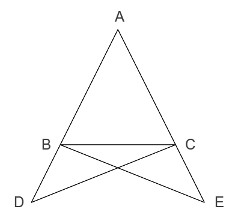
First Formula. The sums of equals are equal.
AD and AE are sums of equals by the supposition. Having that mark of equality, they are concluded by this formula to be equal.
Second Formula. Equal straight lines being applied to one another coincide.
AC, AB, are within this formula by supposition; AD, AE, have been brought within it by the preceding step. Both these pairs of straight lines have the property of equality; which, according to the second formula, is a mark that, if applied to each other, they will coincide. Coinciding altogether means coinciding in every part, and of course at their extremities, D, E, and B, C.
Third Formula. Straight lines, having their extremities coincident, coincide.
BE and CD have been brought within this formula by the preceding induction; they will, therefore, coincide.
Fourth Formula. Angles, having their sides coincident, coincide.
The third induction having shown that BE and CD coincide, and the second that AB, AC, coincide, the angles ABE and ACD are thereby brought within the fourth formula, and accordingly coincide.
Fifth Formula. Things which coincide are equal.
The angles ABE and ACD are brought within this formula by the induction immediately preceding. This train of reasoning being also applicable, mutatis mutandis, to the angles EBC, DCB, these also are brought within the fifth formula. And, finally,
Sixth Formula. The differences of equals are equal.
The angle ABC being the difference of ABE, CBE, and the angle ACB being the difference of ACD, DCB; which have been proved to be equals; ABC and ACB are brought within the last formula by the whole of the previous process.
The difficulty here encountered is chiefly that of figuring to ourselves the two angles at the base of the triangle ABC as remainders made by cutting one pair of angles out of another, while each pair shall be corresponding angles of triangles which have two sides and the intervening angle equal. It is by this happy contrivance that so many different inductions are brought to bear upon the same particular case. And this not being at all an obvious thought, it may be seen from an example so near the threshold of mathematics, how much scope there may well be for scientific dexterity in the higher branches of that and other sciences, in order so to combine a few simple inductions, as to bring within each of them innumerable cases which are not obviously included in it; and how long, and numerous, and complicated may be the processes necessary for bringing the inductions together, even when each induction may itself be very easy and simple. All the inductions involved in all geometry are comprised in those simple ones, the formulæ of which are the Axioms, and a few of the so-called Definitions. The remainder of the science is made up of the processes employed for bringing unforeseen cases within these inductions; or (in syllogistic language) for proving the minors necessary to complete the syllogisms; the majors being the definitions and axioms. In those definitions and axioms are laid down the whole of the marks, by an artful combination of which it has been found possible to discover and prove all that is proved in geometry. The marks being so few, and the inductions which furnish them being so obvious and familiar; the connecting of several of them together, which constitutes Deductions, or Trains of Reasoning, forms the whole difficulty of the science, and with a trifling exception, its whole bulk; and hence Geometry is a Deductive Science.
§ 5. It will be seen hereafter[18] that there are weighty scientific reasons for giving to every science as much of the character of a Deductive Science as possible; for endeavouring to construct the science from the fewest and the simplest possible inductions, and to make these, by any combinations however complicated, suffice for proving even such truths, relating to complex cases, as could be proved, if we chose, by inductions from specific experience. Every branch of natural philosophy was originally experimental; each generalization rested on a special induction, and was derived from its own distinct set of observations and experiments. From being sciences of pure experiment, as the phrase is, or, to speak more correctly, sciences in which the reasonings mostly consist of no more than one step, and are expressed by single syllogisms, all these sciences have become to some extent, and some of them in nearly the whole of their extent, sciences of pure reasoning; whereby multitudes of truths, already known by induction from as many different sets of experiments, have come to be exhibited as deductions or corollaries from inductive propositions of a simpler and more universal character. Thus mechanics, hydrostatics, optics, acoustics, thermology, have successively been rendered mathematical; and astronomy was brought by Newton within the laws of general mechanics. Why it is that the substitution of this circuitous mode of proceeding for a process apparently much easier and more natural, is held, and justly, to be the greatest triumph of the investigation of nature, we are not, in this stage of our inquiry, prepared to examine. But it is necessary to remark, that although, by this progressive transformation, all sciences tend to become more and more Deductive, they are not, therefore, the less Inductive; every step in the Deduction is still an Induction. The opposition is not between the terms Deductive and Inductive, but between Deductive and Experimental. A science is experimental, in proportion as every new case, which presents any peculiar features, stands in need of a new set of observations and experiments—a fresh induction. It is deductive, in proportion as it can draw conclusions, respecting cases of a new kind, by processes which bring those cases under old inductions; by ascertaining that cases which cannot be observed to have the requisite marks, have, however, marks of those marks.
We can now, therefore, perceive what is the generic distinction between sciences which can be made Deductive, and those which must as yet remain Experimental. The difference consists in our having been able, or not yet able, to discover marks of marks. If by our various inductions we have been able to proceed no further than to such propositions as these, a a mark of b, or a and b marks of one another, c a mark of d, or c and d marks of one another, without anything to connect a or b with c or d; we have a science of detached and mutually independent generalizations, such as these, that acids redden vegetable blues, and that alkalies colour them green; from neither of which propositions could we, directly or indirectly, infer the other: and a science, so far as it is composed of such propositions, is purely experimental. Chemistry, in the present state of our knowledge, has not yet thrown off this character. There are other sciences, however, of which the propositions are of this kind: a a mark of b, b a mark of c, c of d, d of e, &c. In these sciences we can mount the ladder from a to e by a process of ratiocination; we can conclude that a is a mark of e, and that every object which has the mark a has the property e, although, perhaps, we never were able to observe a and e together, and although even d, our only direct mark of e, may not be perceptible in those objects, but only inferrible. Or, varying the first metaphor, we may be said to get from a to e underground: the marks b, c, d, which indicate the route, must all be possessed somewhere by the objects concerning which we are inquiring; but they are below the surface: a is the only mark that is visible, and by it we are able to trace in succession all the rest.
§ 6. We can now understand how an experimental may transform itself into a deductive science by the mere progress of experiment. In an experimental science, the inductions, as we have said, lie detached, as, a a mark of b, c a mark of d, e a mark of f, and so on: now, a new set of instances, and a consequent new induction, may at any time bridge over the interval between two of these unconnected arches; b, for example, may be ascertained to be a mark of c, which enables us thenceforth to prove deductively that a is a mark of c. Or, as sometimes happens, some comprehensive induction may raise an arch high in the air, which bridges over hosts of them at once: b, d, f, and all the rest, turning out to be marks of some one thing, or of things between which a connexion has already been traced. As when Newton discovered that the motions, whether regular or apparently anomalous, of all the bodies of the solar system, (each of which motions had been inferred by a separate logical operation, from separate marks,) were all marks of moving round a common centre, with a centripetal force varying directly as the mass, and inversely as the square of the distance from that centre. This is the greatest example which has yet occurred of the transformation, at one stroke, of a science which was still to a great degree merely experimental, into a deductive science.
Transformations of the same nature, but on a smaller scale, continually take place in the less advanced branches of physical knowledge, without enabling them to throw off the character of experimental sciences. Thus with regard to the two unconnected propositions before cited, namely, Acids redden vegetable blues, Alkalies make them green; it is remarked by Liebig, that all blue colouring matters which are reddened by acids (as well as, reciprocally, all red colouring matters which are rendered blue by alkalies) contain nitrogen: and it is quite possible that this circumstance may one day furnish a bond of connexion between the two propositions in question, by showing that the antagonistic action of acids and alkalies in producing or destroying the colour blue, is the result of some one, more general, law. Although this connecting of detached generalizations is so much gain, it tends but little to give a deductive character to any science as a whole; because the new courses of observation and experiment, which thus enable us to connect together a few general truths, usually make known to us a still greater number of unconnected new ones. Hence chemistry, though similar extensions and simplifications of its generalizations are continually taking place, is still in the main an experimental science; and is likely so to continue unless some comprehensive induction should be hereafter arrived at, which, like Newton's, shall connect a vast number of the smaller known inductions together, and change the whole method of the science at once. Chemistry has already one great generalization, which, though relating to one of the subordinate aspects of chemical phenomena, possesses within its limited sphere this comprehensive character; the principle of Dalton, called the atomic theory, or the doctrine of chemical equivalents: which by enabling us to a certain extent to foresee the proportions in which two substances will combine, before the experiment has been tried, constitutes undoubtedly a source of new chemical truths obtainable by deduction, as well as a connecting principle for all truths of the same description previously obtained by experiment.
§ 7. The discoveries which change the method of a science from experimental to deductive, mostly consist in establishing, either by deduction or by direct experiment, that the varieties of a particular phenomenon uniformly accompany the varieties of some other phenomenon better known. Thus the science of sound, which previously stood in the lowest rank of merely experimental science, became deductive when it was proved by experiment that every variety of sound was consequent on, and therefore a mark of, a distinct and definable variety of oscillatory motion among the particles of the transmitting medium. When this was ascertained, it followed that every relation of succession or coexistence which obtained between phenomena of the more known class, obtained also between the phenomena which corresponded to them in the other class. Every sound, being a mark of a particular oscillatory motion, became a mark of everything which, by the laws of dynamics, was known to be inferrible from that motion; and everything which by those same laws was a mark of any oscillatory motion among the particles of an elastic medium, became a mark of the corresponding sound. And thus many truths, not before suspected, concerning sound, become deducible from the known laws of the propagation of motion through an elastic medium; while facts already empirically known respecting sound, become an indication of corresponding properties of vibrating bodies, previously undiscovered.
But the grand agent for transforming experimental into deductive sciences, is the science of number. The properties of numbers, alone among all known phenomena, are, in the most rigorous sense, properties of all things whatever. All things are not coloured, or ponderable, or even extended; but all things are numerable. And if we consider this science in its whole extent, from common arithmetic up to the calculus of variations, the truths already ascertained seem all but infinite, and admit of indefinite extension.
These truths, though affirmable of all things whatever, of course apply to them only in respect of their quantity. But if it comes to be discovered that variations of quality in any class of phenomena, correspond regularly to variations of quantity either in those same or in some other phenomena; every formula of mathematics applicable to quantities which vary in that particular manner, becomes a mark of a corresponding general truth respecting the variations in quality which accompany them: and the science of quantity being (as far as any science can be) altogether deductive, the theory of that particular kind of qualities becomes, to this extent, deductive likewise.
The most striking instance in point which history affords (though not an example of an experimental science rendered deductive, but of an unparalleled extension given to the deductive process in a science which was deductive already), is the revolution in geometry which originated with Descartes, and was completed by Clairaut. These great mathematicians pointed out the importance of the fact, that to every variety of position in points, direction in lines, or form in curves or surfaces (all of which are Qualities), there corresponds a peculiar relation of quantity between either two or three rectilineal co-ordinates; insomuch that if the law were known according to which those co-ordinates vary relatively to one another, every other geometrical property of the line or surface in question, whether relating to quantity or quality, would be capable of being inferred. Hence it followed that every geometrical question could be solved, if the corresponding algebraical one could; and geometry received an accession (actual or potential) of new truths, corresponding to every property of numbers which the progress of the calculus had brought, or might in future bring, to light. In the same general manner, mechanics, astronomy, and in a less degree, every branch of natural philosophy commonly so called, have been made algebraical. The varieties of physical phenomena with which those sciences are conversant, have been found to answer to determinable varieties in the quantity of some circumstance or other; or at least to varieties of form or position, for which corresponding equations of quantity had already been, or were susceptible of being, discovered by geometers.
In these various transformations, the propositions of the science of number do but fulfil the function proper to all propositions forming a train of reasoning, viz. that of enabling us to arrive in an indirect method, by marks of marks, at such of the properties of objects as we cannot directly ascertain (or not so conveniently) by experiment. We travel from a given visible or tangible fact, through the truths of numbers, to the facts sought. The given fact is a mark that a certain relation subsists between the quantities of some of the elements concerned; while the fact sought presupposes a certain relation between the quantities of some other elements: now, if these last quantities are dependent in some known manner upon the former, or vice versâ, we can argue from the numerical relation between the one set of quantities, to determine that which subsists between the other set; the theorems of the calculus affording the intermediate links. And thus one of the two physical facts becomes a mark of the other, by being a mark of a mark of a mark of it.
CHAPTER V.
OF DEMONSTRATION, AND NECESSARY TRUTHS.
§ 1. If, as laid down in the two preceding chapters, the foundation of all sciences, even deductive or demonstrative sciences, is Induction; if every step in the ratiocinations even of geometry is an act of induction; and if a train of reasoning is but bringing many inductions to bear upon the same subject of inquiry, and drawing a case within one induction by means of another; wherein lies the peculiar certainty always ascribed to the sciences which are entirely, or almost entirely, deductive? Why are they called the Exact Sciences? Why are mathematical certainty, and the evidence of demonstration, common phrases to express the very highest degree of assurance attainable by reason? Why are mathematics by almost all philosophers, and (by some) even those branches of natural philosophy which, through the medium of mathematics, have been converted into deductive sciences, considered to be independent of the evidence of experience and observation, and characterized as systems of Necessary Truth?
The answer I conceive to be, that this character of necessity, ascribed to the truths of mathematics, and even (with some reservations to be hereafter made) the peculiar certainty attributed to them, is an illusion; in order to sustain which, it is necessary to suppose that those truths relate to, and express the properties of, purely imaginary objects. It is acknowledged that the conclusions of geometry are deduced, partly at least, from the so-called Definitions, and that those definitions are assumed to be correct representations, as far as they go, of the objects with which geometry is conversant. Now we have pointed out that, from a definition as such, no proposition, unless it be one concerning the meaning of a word, can ever follow; and that what apparently follows from a definition, follows in reality from an implied assumption that there exists a real thing conformable thereto. This assumption, in the case of the definitions of geometry, is false: there exist no real things exactly conformable to the definitions. There exist no points without magnitude; no lines without breadth, nor perfectly straight; no circles with all their radii exactly equal, nor squares with all their angles perfectly right. It will perhaps be said that the assumption does not extend to the actual, but only to the possible, existence of such things. I answer that, according to any test we have of possibility, they are not even possible. Their existence, so far as we can form any judgment, would seem to be inconsistent with the physical constitution of our planet at least, if not of the universe. To get rid of this difficulty, and at the same time to save the credit of the supposed system of necessary truth, it is customary to say that the points, lines, circles, and squares which are the subject of geometry, exist in our conceptions merely, and are part of our minds; which minds, by working on their own materials, construct an à priori science, the evidence of which is purely mental, and has nothing whatever to do with outward experience. By howsoever high authorities this doctrine may have been sanctioned, it appears to me psychologically incorrect. The points, lines, circles, and squares, which any one has in his mind, are (I apprehend) simply copies of the points, lines, circles, and squares which he has known in his experience. Our idea of a point, I apprehend to be simply our idea of the minimum visibile, the smallest portion of surface which we can see. A line, as defined by geometers, is wholly inconceivable. We can reason about a line as if it had no breadth; because we have a power, which is the foundation of all the control we can exercise over the operations of our minds; the power, when a perception is present to our senses, or a conception to our intellects, of attending to a part only of that perception or conception, instead of the whole. But we cannot conceive a line without breadth; we can form no mental picture of such a line: all the lines which we have in our minds are lines possessing breadth. If any one doubts this, we may refer him to his own experience. I much question if any one who fancies that he can conceive what is called a mathematical line, thinks so from the evidence of his consciousness: I suspect it is rather because he supposes that unless such a conception were possible, mathematics could not exist as a science: a supposition which there will be no difficulty in showing to be entirely groundless.
Since, then, neither in nature, nor in the human mind, do there exist any objects exactly corresponding to the definitions of geometry, while yet that science cannot be supposed to be conversant about non-entities; nothing remains but to consider geometry as conversant with such lines, angles, and figures, as really exist; and the definitions, as they are called, must be regarded as some of our first and most obvious generalizations concerning those natural objects. The correctness of those generalizations, as generalizations, is without a flaw: the equality of all the radii of a circle is true of all circles, so far as it is true of any one: but it is not exactly true of any circle; it is only nearly true; so nearly that no error of any importance in practice will be incurred by feigning it to be exactly true. When we have occasion to extend these inductions, or their consequences, to cases in which the error would be appreciable—to lines of perceptible breadth or thickness, parallels which deviate sensibly from equidistance, and the like—we correct our conclusions, by combining with them a fresh set of propositions relating to the aberration; just as we also take in propositions relating to the physical or chemical properties of the material, if those properties happen to introduce any modification into the result; which they easily may, even with respect to figure and magnitude, as in the case, for instance, of expansion by heat. So long, however, as there exists no practical necessity for attending to any of the properties of the object except its geometrical properties, or to any of the natural irregularities in those, it is convenient to neglect the consideration of the other properties and of the irregularities, and to reason as if these did not exist: accordingly, we formally announce in the definitions, that we intend to proceed on this plan. But it is an error to suppose, because we resolve to confine our attention to a certain number of the properties of an object, that we therefore conceive, or have an idea of, the object, denuded of its other properties. We are thinking, all the time, of precisely such objects as we have seen and touched, and with all the properties which naturally belong to them; but, for scientific convenience, we feign them to be divested of all properties, except those which are material to our purpose, and in regard to which we design to consider them.
The peculiar accuracy, supposed to be characteristic of the first principles of geometry, thus appears to be fictitious. The assertions on which the reasonings of the science are founded, do not, any more than in other sciences, exactly correspond with the fact; but we suppose that they do so, for the sake of tracing the consequences which follow from the supposition. The opinion of Dugald Stewart respecting the foundations of geometry, is, I conceive, substantially correct; that it is built on hypotheses; that it owes to this alone the peculiar certainty supposed to distinguish it; and that in any science whatever, by reasoning from a set of hypotheses, we may obtain a body of conclusions as certain as those of geometry, that is, as strictly in accordance with the hypotheses, and as irresistibly compelling assent, on condition that those hypotheses are true.
When, therefore, it is affirmed that the conclusions of geometry are necessary truths, the necessity consists in reality only in this, that they correctly follow from the suppositions from which they are deduced. Those suppositions are so far from being necessary, that they are not even true; they purposely depart, more or less widely, from the truth. The only sense in which necessity can be ascribed to the conclusions of any scientific investigation, is that of legitimately following from some assumption, which, by the conditions of the inquiry, is not to be questioned. In this relation, of course, the derivative truths of every deductive science must stand to the inductions, or assumptions, on which the science is founded, and which, whether true or untrue, certain or doubtful in themselves, are always supposed certain for the purposes of the particular science. And therefore the conclusions of all deductive sciences were said by the ancients to be necessary propositions. We have observed already that to be predicated necessarily was characteristic of the predicable Proprium, and that a proprium was any property of a thing which could be deduced from its essence, that is, from the properties included in its definition.
§ 2. The important doctrine of Dugald Stewart, which I have endeavoured to enforce, has been contested by Dr. Whewell, both in the dissertation appended to his excellent Mechanical Euclid, and in his elaborate work on the Philosophy of the Inductive Sciences; in which last he also replies to an article in the Edinburgh Review, (ascribed to a writer of great scientific eminence), in which Stewart's opinion was defended against his former strictures. The supposed refutation of Stewart consists in proving against him (as has also been done in this work) that the premises of geometry are not definitions, but assumptions of the real existence of things corresponding to those definitions. This, however, is doing little for Dr. Whewell's purpose; for it is these very assumptions which are asserted to be hypotheses, and which he, if he denies that geometry is founded on hypotheses, must show to be absolute truths. All he does, however, is to observe, that they at any rate, are not arbitrary hypotheses; that we should not be at liberty to substitute other hypotheses for them; that not only "a definition, to be admissible, must necessarily refer to and agree with some conception which we can distinctly frame in our thoughts," but that the straight lines, for instance, which we define, must be "those by which angles are contained, those by which triangles are bounded, those of which parallelism may be predicated, and the like."[19] And this is true; but this has never been contradicted. Those who say that the premises of geometry are hypotheses, are not bound to maintain them to be hypotheses which have no relation whatever to fact. Since an hypothesis framed for the purpose of scientific inquiry must relate to something which has real existence, (for there can be no science respecting non-entities,) it follows that any hypothesis we make respecting an object, to facilitate our study of it, must not involve anything which is distinctly false, and repugnant to its real nature: we must not ascribe to the thing any property which it has not; our liberty extends only to slightly exaggerating some of those which it has, (by assuming it to be completely what it really is very nearly,) and suppressing others, under the indispensable obligation of restoring them whenever, and in as far as, their presence or absence would make any material difference in the truth of our conclusions. Of this nature, accordingly, are the first principles involved in the definitions of geometry. That the hypotheses should be of this particular character, is however no further necessary, than inasmuch as no others could enable us to deduce conclusions which, with due corrections, would be true of real objects: and in fact, when our aim is only to illustrate truths, and not to investigate them, we are not under any such restriction. We might suppose an imaginary animal, and work out by deduction, from the known laws of physiology, its natural history; or an imaginary commonwealth, and from the elements composing it, might argue what would be its fate. And the conclusions which we might thus draw from purely arbitrary hypotheses, might form a highly useful intellectual exercise: but as they could only teach us what would be the properties of objects which do not really exist, they would not constitute any addition to our knowledge of nature: while on the contrary, if the hypothesis merely divests a real object of some portion of its properties, without clothing it in false ones, the conclusions will always express, under known liability to correction, actual truth.
§ 3. But though Dr. Whewell has not shaken Stewart's doctrine as to the hypothetical character of that portion of the first principles of geometry which are involved in the so-called definitions, he has, I conceive, greatly the advantage of Stewart on another important point in the theory of geometrical reasoning; the necessity of admitting, among those first principles, axioms as well as definitions. Some of the axioms of Euclid might, no doubt, be exhibited in the form of definitions, or might be deduced, by reasoning, from propositions similar to what are so called. Thus, if instead of the axiom, Magnitudes which can be made to coincide are equal, we introduce a definition, "Equal magnitudes are those which may be so applied to one another as to coincide;" the three axioms which follow (Magnitudes which are equal to the same are equal to one another—If equals are added to equals the sums are equal—If equals are taken from equals the remainders are equal,) may be proved by an imaginary superposition, resembling that by which the fourth proposition of the first book of Euclid is demonstrated. But though these and several others may be struck out of the list of first principles, because, though not requiring demonstration, they are susceptible of it; there will be found in the list of axioms two or three fundamental truths, not capable of being demonstrated: among which must be reckoned the proposition that two straight lines cannot inclose a space, (or its equivalent, Straight lines which coincide in two points coincide altogether,) and some property of parallel lines, other than that which constitutes their definition: one of the most suitable for the purpose being that selected by Professor Playfair: "Two straight lines which intersect each other cannot both of them be parallel to a third straight line."[20]
The axioms, as well those which are indemonstrable as those which admit of being demonstrated, differ from that other class of fundamental principles which are involved in the definitions, in this, that they are true without any mixture of hypothesis. That things which are equal to the same thing are equal to one another, is as true of the lines and figures in nature, as it would be of the imaginary ones assumed in the definitions. In this respect, however, mathematics are only on a par with most other sciences. In almost all sciences there are some general propositions which are exactly true, while the greater part are only more or less distant approximations to the truth. Thus in mechanics, the first law of motion (the continuance of a movement once impressed, until stopped or slackened by some resisting force) is true without qualification or error. The rotation of the earth in twenty-four hours, of the same length as in our time, has gone on since the first accurate observations, without the increase or diminution of one second in all that period. These are inductions which require no fiction to make them be received as accurately true: but along with them there are others, as for instance the propositions respecting the figure of the earth, which are but approximations to the truth; and in order to use them for the further advancement of our knowledge, we must feign that they are exactly true, though they really want something of being so.
§ 4. It remains to inquire, what is the ground of our belief in axioms—what is the evidence on which they rest? I answer, they are experimental truths; generalizations from observation. The proposition, Two straight lines cannot inclose a space—or in other words, Two straight lines which have once met, do not meet again, but continue to diverge—is an induction from the evidence of our senses.
[20] We might, it is true, insert this property into the definition of parallel lines, framing the definition so as to require, both that when produced indefinitely they shall never meet, and also that any straight line which intersects one of them shall, if prolonged, meet the other. But by doing this we by no means get rid of the assumption; we are still obliged to take for granted the geometrical truth, that all straight lines in the same plane, which have the former of these properties, have also the latter. For if it were possible that they should not, that is, if any straight lines other than those which are parallel according to the definition, had the property of never meeting although indefinitely produced, the demonstrations of the subsequent portions of the theory of parallels could not be maintained.
[14] Logic, book iv. ch. i. sect. 1.
[17] Infra, book iii. ch. ii.
[12] Theory of Reasoning, ch. iv. to which I may refer for an able statement and enforcement of the grounds of the doctrine.
[18] Infra, book iii. ch. iv. § 3, and elsewhere.
[19] Mechanical Euclid, pp. 149 et seqq.
[10] Review of Quetelet on Probabilities, Essays, p. 367.
[11] Philosophy of Discovery, p. 289.
[13] It is very probable that the doctrine is not new, and that it was, as Sir John Herschel thinks, substantially anticipated by Berkeley. But I certainly am not aware that it is (as has been affirmed by one of my ablest and most candid critics) "among the standing marks of what is called the empirical philosophy."
[16] A writer in the "British Quarterly Review" (August 1846), in a review of this treatise, endeavours to show that there is no petitio principii in the syllogism, by denying that the proposition, All men are mortal, asserts or assumes that Socrates is mortal. In support of this denial, he argues that we may, and in fact do, admit the general proposition that all men are mortal, without having particularly examined the case of Socrates, and even without knowing whether the individual so named is a man or something else. But this of course was never denied. That we can and do draw conclusions concerning cases specifically unknown to us, is the datum from which all who discuss this subject must set out. The question is, in what terms the evidence, or ground, on which we draw these conclusions, may best be designated—whether it is most correct to say, that the unknown case is proved by known cases, or that it is proved by a general proposition including both sets of cases, the unknown and the known? I contend for the former mode of expression. I hold it an abuse of language to say, that the proof that Socrates is mortal, is that all men are mortal. Turn it in what way we will, this seems to me to be asserting that a thing is the proof of itself. Whoever pronounces the words, All men are mortal, has affirmed that Socrates is mortal, though he may never have heard of Socrates; for since Socrates, whether known to be so or not, really is a man, he is included in the words, All men, and in every assertion of which they are the subject. If the reviewer does not see that there is a difficulty here, I can only advise him to reconsider the subject until he does: after which he will be a better judge of the success or failure of an attempt to remove the difficulty. That he had reflected very little on the point when he wrote his remarks, is shown by his oversight respecting the dictum de omni et nullo. He acknowledges that this maxim as commonly expressed,—"Whatever is true of a class, is true of everything included in the class," is a mere identical proposition, since the class is nothing but the things included in it. But he thinks this defect would be cured by wording the maxim thus,—"Whatever is true of a class, is true of everything which can be shown to be a member of the class:" as if a thing could "be shown" to be a member of the class without being one. If a class means the sum of all the things included in the class, the things which can "be shown" to be included in it are part of the sum, and the dictum is as much an identical proposition with respect to them as to the rest. One would almost imagine that, in the reviewer's opinion, things are not members of a class until they are called up publicly to take their place in it—that so long, in fact, as Socrates is not known to be a man, he is not a man, and any assertion which can be made concerning men does not at all regard him, nor is affected as to its truth or falsity by anything in which he is concerned.
[15] See the important chapter on Belief, in Professor Bain's great treatise, The Emotions and the Will, pp. 581-4.