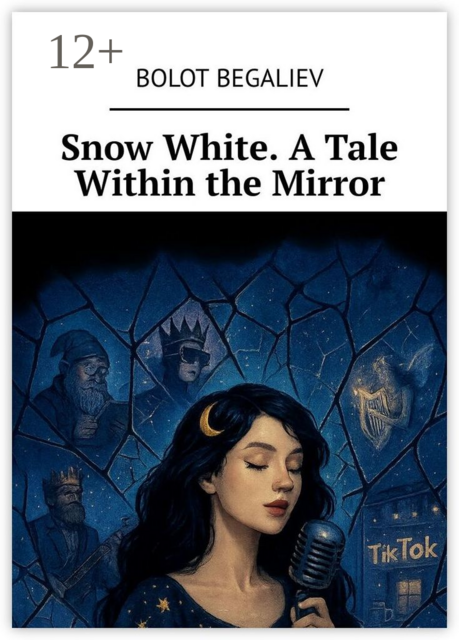
Snow White. A Tale Within the Mirror
Қосымшада ыңғайлырақҚосымшаны жүктеуге арналған QRRuStore · Samsung Galaxy Store
Huawei AppGallery · Xiaomi GetApps

автордың кітабын онлайн тегін оқу  Snow White. A Tale Within the Mirror

Bolot Begaliev

Snow White. A Tale Within the Mirror

Fonts by «ParaType»


Illustrator sora ai

Cover designer sora ai


21st century — where trolls have become trolling.

This story resonates with both teens and adults — because it holds truth. Not the loud

kind, but the quiet one. Warm, like breath on glass. In this book, music is not


Contents

Snow White: A Tale Within the Mirror

By Bolot Begaliev

Table of Contents

Part I. The Awakening

1. Snow White Arrives in 2025 — p.3

2. A King Without a Throne, a Snow White Without a Castle — p.8

3. First Steps Into the World — p.13

4. The Deer Behind the Window — p.17

5. Parking Lot Dance and the Cashiers’ Applause — p.21

6. Not a Fairy Tale — But a Beginning — p.26

Part II. The Music That Awakens

7. The Singing Bus — p.31

8. A Voice That Heals — p.36

9. Street Concert — p.40

10. The New Snow White: Interviews and Likes — p.44

11. Haters and the First Tear — p.49

12. A Letter from Lily — p.53

13. A Song for the Silent — p.57

Part III. The Tour Against Silence

14. Gathering the Team — p.62

15. The Mermaid, Cinderella, and Max from Miami — p.67

16. First Tour Stop: A School Where Children No Longer Sing — p.71

17. The City of Tired Hearts — p.76

18. Everglades and a Superhero Portrait — p.81

19. The Virus Is Not a Monster — But a Whisper — p.86

20. A Concert in an Empty Hall and a Child with Starry Eyes — p.91

Part IV. The Virus of Indifference

21. Returning Home — p.97

22. A Suspicion: This Isn’t Just Fatigue — p.100

23. The Living Voice Center Falls Silent — p.103

24. Snow White’s Diary: First Entries — p.106

25. The Professor Discovers a Virus — p.109

26. Camera, Sound, Shadows — p.113

27. The Invisible Enemy Speaks from the Screen — p.116

28. It Speaks in Our Place — p.119

Part V. Gerda Calls

29. A Letter from Gerda — p.123

30. The Fairytales Are Infected — p.126

31. Sleeping Beauty on TikTok — p.128

32. Cinderella in AR Slippers — p.130

33. Little Red Riding Hood: Food Delivery Girl — p.132

34. The Library of Eternal Tales — p.135

Part VI. The Resistance Awakens

35. The Cure for Indifference — p.138

36. A Day Alive: The Awakening Program — p.141

37. Waking the School — p.144

38. A Scene by the Flowerbed and a Tickle in the Heart — p.147

39. The Virus Replies — p.150

40. The Mirror Maze — p.153

41. The War of Ideas Begins — p.156

Epilogue

42. Where the Fairytale Breathes Again — p.160

Prologue

There was morning—

but no songs.

The forest had no names.

One day, the world forgot how fairy tales sound.

Not in a moment.

Not with a snap—

But slowly,

As if winter stretched on for years.

The dwarves faded into legends.

The castles became office towers.

And the magic mirrors—

turned into screens

that reflect everything

except the truth.

Snow White slept.

Because of the apple.

Because of the curse.

Because no one called.

Fairy tales, when no longer believed in — fall asleep.

Until one day,

A drilling machine pierced the layer of ancient time.

A spark touched a crystal coffin.

And someone said:

“Stop.”

And time flinched.

That’s how it began—

The story no one believed in

but that dared to open its eyes again.

In this world,

Where likes mean more than words,

Where voices become whispers,

And souls get stuck in fatigue—

She awoke.

Snow White.

Not as a princess. But as a question:

What does it mean to be alive

When everything around you is asleep?

Chapter 1: The Awakening

Once upon a time, in a cave beyond seven hills, a girl lay in a crystal coffin.

At first, she was guarded by dwarfs — their hands wrinkled, their hearts sharp as flint.

But time spares neither magic nor memory:

the dwarfs aged, one by one disappeared, and the forest forgot their names.

The cave grew over with moss.

The entrance collapsed under stones.

And then came the 21st century.

Noise. Light. Trembling earth.

New people, wearing helmets, with drilling machines, digging tunnels,

searching for superconducting crystals and holographic minerals.

A machine operator named Marco — tired, half-numb to the world — suddenly saw a strange reflection.

A light pierced the rock face and bounced off something transparent.

“Stop,” he said,

and the drill froze — as if it, too, were afraid.

They found a cavern.

In its center — a coffin, gleaming like frozen glass.

Inside — a girl, seemingly asleep.

Next to her — a young man in a theatrical costume, a fleck of dried blood on his lip.

Marco called 911.

Sirens. Helicopters.

Hazmat suits. Cameras. IV drips.

Snow White and the young man (listed in reports as “Unknown, artistic type”) were taken to a clinic.

Diagnosis: prolonged exposure to unknown toxins.

Possibly — ancient chemical contamination.

They didn’t age.

They didn’t die.

They were simply… waiting.

Slowly.

Silently.

Like music resting on a forgotten staff,

waiting for someone to play it again.

Now, Snow White lies in a hospital bed — pale as snow — with an IV in her arm.

Green monitors blink softly.

The young man is on the balcony outside,

gazing at the sky, relearning how to breathe.

He’s not a prince.

He’s an actor.

He was rehearsing a role—

when he found her.

And now…

he’s not sure

where the stage ends,

and life begins.

Music returns.

Not from a forest.

From the nurse’s headphones.

Playlist: 2025 — lo-fi, space, rain.

The room smells faintly of apples.

And — somehow — of spring.

Room seven is calm.

Monitors beep steadily.

Soft lamps glow like moons.

Snow White is sleeping —

not in a crystal coffin anymore,

but in a hospital bed with pressure cushions and adjustable rails.

The young man — the one found beside her —

sits at her side, holding her hand.

He woke up first.

And asked:

“Where’s the throne room?

Why does it smell like alcohol and bananas?”

The nurse adjusted the IV and smiled gently:

“You’re in the ICU.

You’ve just come out of a long coma.”

“Is this… a dungeon?”

“A clinic.”

“Were we kidnapped?”

“No, no, just rest.

The performance can wait.”

When Snow White finally awoke,

she sat up in bed and asked:

“Where are the dwarfs?

Who erased my eyebrows?”

The doctor looked at the nurse.

The nurse looked at the doctor.

Then at the monitor.

Then back again.

“Psych evaluation. Immediately.

And please, don’t let her touch the tablet —

she thinks it’s a magic mirror.”

Police opened an official file:

Two theater performers.

Found in a mountain cave.

Diagnosis: temporary amnesia.

Possible scenario: the couple got lost during a rehearsal.

The file was labeled:

“Snow White Incident — Version 2.5.”

The psychologist asked the standard intake question:

“Name, age, place of residence?”

The young man answered with dignity:

“Prince. Twenty-seven. Kingdom east of the Enchanted Forest.”

Snow White added:

“I’m the first daughter of a king.

And I’m definitely not from a village.”

The psychologist marked the form.

Paused.

Sighed.

“They’re holding hands,” the night nurse observed.

“He kissed her and passed out again,” said another.

“Can you believe it?”

“They’re probably trapped in some immersive theater piece,” the doctor muttered.

“Deep method acting,” the nurse nodded.

“Too deep.”

Just in case, they were entered into the system with new names:

Snow White: Snow White

PrinceKing

And were issued gray hospital gowns.

The crown and throne — still under investigation.

But they keep asking:

“When is the royal ball?”

“Where’s my horse?”

“Who tied wires to my body?”

And only the intern, passing by quietly, whispers:

“I believe.

I saw her smile—

when a deer walked past the window.”

Chapter 2. A King Without a Throne and Snow White Without a Castle

In an American clinic in Colorado, Patients #47 and #48 continued to insist they were from a kingdom beyond the Misty Mountains.

“My name is Snow White,” said the pale-skinned young woman, her foreign accent soft but confident. “I am the king’s daughter, with kindness, singing, and knowledge of herbs.”

“And I am His Majesty. My kiss once saved the world,” added the young man in a hospital gown, holding a plastic cup of jelly as though it were a scepter.

The doctors merely shrugged:

“Psychosis?”

“No… just old fairy tales.”

“And no insurance coverage.”

Upon discharge, they stood on the clinic’s edge, clutching a box. Inside was one robe, two pairs of slippers, a pamphlet: “Start Over in the USA”, and a sheet of questions: “Education? Skills?”

A Burger Palace manager asked, “Can you work a cashier?”

Snow White answered hopefully, “No, but I can talk to deer.”

“And you?” he asked the “King.”

“I can inspire people, issue decrees, and fight for justice.”

“Great. Grab the mop — start with the restrooms.”

And so, their lives changed.

Their New Reality

— The “King” began washing floors with dignity and nearly royal grace.

— Snow White — now wearing a hairnet — washed dishes while softly singing to pots instead of birds.

She would tell the staff’s children:

“Even if you’re born in a castle, without skills you’re still in a burger joint. But with a kind heart, you can live with dignity.”

They shared a modest apartment — no throne, but with a microwave and a stained sofa no one could clean. Sometimes they gazed at the stars.

“Maybe it’s a spell,” Snow White mused. “Or just life.”

The King nodded: “In a world that doesn’t believe in kings, you just have to be a good human.”

Fairytales aren’t dead. They just take off their crowns and go for job interviews.

Sometimes with a wet mop. Sometimes with a smile.

The King’s morning routine: He was called “Bob” at work and began each day with a bucket center-stage in the restroom.

“It’s not a throne, but it’s an elevation,” he joked, composing rhymes for the cleaning supplies:

“For Glory, Cleanliness, and Shine! May Mold and Grease fall to the power of Mr. Bleach!”

Even the manager couldn’t help but laugh.

Snow White — now “Snezhi” — treated dishes like priceless mirrors:

“Each plate is a mirror of fate — if it doesn’t shine, don’t look in it.”

One day she caught a rat in the kitchen — but instead of killing it, she fed it.

“That’s not a rat. It’s a forgotten fairy. It’s just cold.”

Soon the staff began dropping crumbs “for luck.” Magical creatures appeared in corners.

On weekends, they studied at the library: Snezhi learning English, the King deciphering tax forms.

King (grimacing): “What kind of monster is this tax paper? Where’s its heart so I can stab it?”

One evening, a sad little boy entered the restaurant, waiting for his mom’s shift to end. The King sat him on an onion crate and told him a story about a dragon who could cry. Snezhi gave the boy an orange.

“Inside it is sunshine. Eating it warms you from within.”

There began their quiet magic:

— Fairytales for the weary.

— Smiles for the lost.

— Strength to survive where there are no castles.

Though still a cleaner, the King now knew every employee’s child by name and made tin-foil crowns for them.

“Never forget,” he would say, “even if you’re mopping floors, you can be a king in someone’s heart.”

A world may not always be magical — but you can be magical within it.

Even with a rag. Even in rubber gloves.

They rented a small house on the edge of town — hat-box mailbox shaped like a mushroom, curtains patterned with daisies. In the yard grew a bush Snow White called the “raspberry throne,” while the King called it the “cold jungle.” They had an old kettle, two robes, a rubber duck, and — most importantly — love.

Love that soothed souls after long shifts and warmed hearts with homemade soup.

Every Sunday they walked in the park. Snow White scattered crumbs for pigeons (the “magic messengers”), and the King fed squirrels with royal flair. Holding hands, they looked as if spring could still come.

“Love and labor,” she said, “can grind anything down.”

“Especially with a good sauce,” he added.

At work, no one found them peculiar anymore. Snezhi became shift supervisor. The King was officially the “morale and safety officer” (a cleaner with mic privileges).

One evening, Jeff — a tall colleague with piercings — said:

“You two look like you’ve been in theater all your lives.”

“Maybe I haven’t left it,” Snow White smiled.

“And I’m still waiting for my ovation,” added the King.

Then they were invited to a local cultural center:

“Open auditions. The theater seeks new faces.”

“And hearts,” Jeff added. “You’ve got two — crowns inside.”

That evening, they sat by the window — on the table: a toaster and tea; on the sill: socks drying in moonlight.

“What if nobody believes us?” Snow White asked.

“Then we’ll act so they will,” replied the King.

“And what if we fail?”

“Then we’ll go home. I’ll mop the floor, you’ll cook dinner. Still a win.”

They left.

On Tuesday — audition day.

He wore a thrift-store blazer; she wore a donated dress, dressed up with one small, old ribbon — still magical. She sang simply about love and birds. He recited a monologue from his own life — about keeping self-worth even while scrubbing toilets.

The jury was silent — then applauded. One said:

“You reminded us why theater exists.”

The fairytale had never ended.

It had simply taken off its apron,

opened its heart,

and stepped onto the stage.

But they never forgot Burger Palace.

“It was our first stage,” the King laughed.

“And our first audience — were mice.”
Chapter 3. Who Is the Real Snow White? The Song They Heard

The play was simply titled:

“Snow White and the King”

Inspired by life. Inspired by heart.

Roles were assigned immediately:

The King played the King.

Snow White played Snow White.

It seemed straightforward… but nothing is ever that simple.

The director — a lean figure with a long neck and an eternal scarf — paced the stage like a kettle about to whistle.

“Snow White must be ethereal! Airy! She must float like a shadow!”

Snow White quietly offered,

“I can wash dishes softly.”

At rehearsal, the director halted mid-scene:

“No — no — no! You completely miss the subtle essence of Snow White! Where is the lightness, the innocence, the naive longing?!”

Snow White stayed silent, drew a breath, lowered her gaze.

“I’m sorry.”

And the King… he shrank into the curtains, clutching the armrest. He knew if he uttered a word, the performance would collapse — forever.

In the corridor, someone whispered:

“She’s nothing like her.”

“Yes, odd… more like someone who keeps house.”

Snow White thought: as if any of you ever saw the real one. As if you’d lived with her, cried with her, washed dishes with her after a shift.

That night, they sat on a bench outside the theater. The King ate a gummy candy. Snow White held the script on her lap, not reading it.

“Am I a bad actress?” she asked.

“No,” he answered gently. “You’re real. And that sometimes frightens people.”

“And what if he’s right? I can’t fly.”

“So what? You hold things — yourself, me, the world.”

On the dress rehearsal day, the director rolled his eyes again:

“I don’t feel any magic! Where’s the fairytale?!”

Then Snow White stood up, took off her artificial wreath, and walked to center stage. She spoke — unscripted:

“Snow White isn’t just about apples, a crystal coffin, and floor-length gowns.

Snow White is the one who doesn’t give up.

Who doesn’t complain.

Who doesn’t lose her light in trouble.

If you don’t see the fairytale in me — that means you’re looking in the wrong place.”

Silence fell. The director removed his scarf. Someone in the audience applauded. The King stood to the side, eyes shining with sunlight.

Being real

is more important than being similar.

And the fairytale begins

when you stop pretending.

A simple yet moving poster by the entrance read:

“Snow White and the King”

a new story of old love.

The audience included schoolchildren, grandmothers, tourists, and tired employees from the nearby diner.

At the back row sat Cinderella, with her daughter — small, in pajamas beneath her coat, wearing a red bow.

The curtain rose. The King walked out first — silent, patient.

“Where’s Snow White?” whispered the crowd.

Footsteps rang out — not airy, but real. Snow White walked slowly… through life, through snowstorms and dishes, through overnight shifts and memories.

When she spoke, her voice trembled — not from fear:

“I awoke — not from a kiss, but from cold and loneliness.

Then he took my hand…

...