



автордың кітабын онлайн тегін оқу Robert Browning
The Project Gutenberg EBook of Robert Browning, by Edward Dowden
This eBook is for the use of anyone anywhere at no cost and with
almost no restrictions whatsoever. You may copy it, give it away or
re-use it under the terms of the Project Gutenberg License included
with this eBook or online at www.gutenberg.net
Title: Robert Browning
Author: Edward Dowden
Release Date: July 5, 2004 [EBook #12817]
Language: English
*** START OF THIS PROJECT GUTENBERG EBOOK ROBERT BROWNING ***
Produced by Jonathan Ingram, Wilelmina Mallière and the Online
Distributed Proofreading Team.
The Temple Biographies
Edited by Dugald Macfadyen, M.A.
Robert Browning
Robert Browning, from a portrait in oil, for which he sat to R.W. Curtis at Venice 1880.
ROBERT BROWNING
BY
EDWARD DOWDEN
LITT.D., D.C.L., LL.D.
PROFESSOR OF ENGLISH LITERATURE IN THE UNIVERSITY OF DUBLIN
1904 LONDON: J.M. DENT & CO. NEW YORK; E.P. DUTTON & CO.
If I, too, should try and speak at times,Leading your love to where my love, perchance,Climbed earlier, found a nest before you knew,Why, bear with the poor climber, for love's sake.
—Balaustion's Adventure.>
Editor's Preface
"In the case of those whom the public has learned to honour and admire, there is a biography of the mind—the phrase is Mr Gladstone's—that is a matter of deep interest." In a life of Robert Browning it is especially true that the biography we want is of this nature, for its events are to be classed rather among achievements of the human spirit than as objective incidents, and its interest depends only in a secondary sense on circumstance or movement in the public eye. The special function of the present book in the growing library of Browning literature is to give such a biography of Browning's mind, associating his poems with their date and origin, as may throw some light on his inward development. Browning has become to many, in a measure which he could hardly have conceived possible himself, one of the authoritative interpreters of the spiritual factors in human life. His tonic optimism dissipates the grey atmosphere of materialism, which has obscured the sunclad heights of life as effectually as a fog. To see life through Browning's eyes is to see it shot through and through with spiritual issues, with a background of eternal destiny; and to come appreciably nearer than the general consciousness of our time to seeing it steadily and seeing it whole. Those who prize his influence know how to value everything which throws light on the path by which he reached his resolute and confident outlook.
It is almost possible to count on the fingers of one hand the few men who could successfully write a book of this character and scope. The Editor believes that, in the present case, one of the very few has been found who had the qualifications required. Much of the apparent obscurity of Browning is due to his habit of climbing up a precipice of thought, and then kicking away the ladder by which he climbed. Dr Dowden has with singular success readjusted the steps, so that readers may follow the poet's climb. Those who are not daunted by the Paracelsus and Sordello chapter, where the subject requires some close and patient attention, will find vigorous narrative and pellucid exposition interwoven in such a way as to keep them in intimate and constantly closer touch with the "biography of Browning's mind."
D.M.
Preface
An attempt is made in this volume to tell the story of Browning's life, including, as part of it, a notice of his books, which may be regarded as the chief of "his acts and all that he did." I have tried to keep my reader in constant contact with Browning's mind and art, and thus a sense of the growth and development of his genius ought to form itself before the close.
The materials accessible for a biography, apart from Browning's published writings, are not copious. He destroyed many letters; many, no doubt, are in private hands. For some parts of his life I have been able to add little to what Mrs Orr tells. But since her biography of Browning was published a good deal of interesting matter has appeared. The publication of "The Letters of Robert Browning and Elizabeth Barrett Browning" has enabled me to construct a short, close-knit narrative of the incidents that led up to Browning's marriage. From that date until the death of Mrs Browning her "Letters," edited by Mr Kenyon, has been my chief source. My method has not been that of quotation, but the substance of many letters is fused, as far as was possible, into a brief, continuous story. Two privately issued volumes of Browning's letters, edited by Mr T.J. Wise, and Mr Wise's "Browning Bibliography" have been of service to me. Mr Gosse's "Robert Browning, Personalia," Mrs Ritchie's "Tennyson, Ruskin and Browning," the "Life of Tennyson" by his son, Mr Henry James's volumes on W.W. Story, letters of Dante Rossetti, the diary of Mr W.M. Rossetti, with other writings of his, memoirs, reminiscences or autobiographies of Lady Martin, F.T. Palgrave, Jowett, Sir James Paget, Gavan Duffy, Robert Buchanan, Rudolf Lehmann, W.J. Stillman, T.A. Trollope, Miss F.P. Cobbe, Miss Swanwick, and others have been consulted. And several interesting articles in periodicals, in particular Mrs Arthur Bronson's articles "Browning in Venice" and "Browning in Asolo," have contributed to my narrative. For some information about Browning's father and mother, and his connection with York Street Independent Chapel, I am indebted to Mr F. Herbert Stead, Warden of "The Robert Browning Settlement," Walworth. I thank Messrs Smith, Elder and Co., as representing Mr R. Barrett Browning, for permission to make such quotations as I have ventured to make from copyright letters. I thank the general Editor of this series, the Rev. D. Macfadyen, for kind and valuable suggestions.
My study of Browning's poems is chronological. I recognise the disadvantages of this method, but I also perceive certain advantages. Many years ago in "Studies in Literature" I attempted a general view of Browning's work, and wrote, as long ago as 1867, a careful study of Sordello. What I now write may suffer as well as gain from a familiarity of so many years with his writings. But to make them visible objects to me I have tried to put his poems outside myself, and approach them with a fresh mind. Whether I have failed or partly succeeded I am unable to determine.
The analysis of La Saisiaz appeared—substantially—in the little Magazine of the Home Reading Union, and one or two other short passages are recovered from uncollected articles of mine. I have incorporated in my criticism a short passage from one of my wife's articles on Browning in The Dark Blue Magazine, making such modifications as suited my purpose, and she has contributed a passage to the pages which close this volume.
I had the privilege of some personal acquaintance with Browning, and have several cordial letters of his addressed to my wife and to myself. These I have not thought it right to use.
E.D.
Contents
CHAPTER I
CHILDHOOD AND YOUTH
Ancestry—Parents—Boyhood—Influence of Shelley—Pauline
CHAPTER II
PARACELSUS AND SORDELLO
Visit to Russia—Paracelsus—His failures and attainments—Sordello, a companion poem—Its obscurity—Imaginative qualities—The history of a soul
CHAPTER III
THE MAKER OF PLAYS
New acquaintances—Hatcham—Macready—Strafford—Venice—Bells and Promegranates—A Blot on the 'Scutcheon—Characters of passion—Characters of intellect
CHAPTER IV
THE MAKER OF PLAYS—(continued)
Women of the dramas—Dramatic style—Pippa Passes—Dramatic Lyrics and Romances—Poems of Love and of Art
CHAPTER V
LOVE AND MARRIAGE
First letters to Miss Barrett—Meeting—Progress in friendship—Obstacles—Marriage
CHAPTER VI
EARLY YEARS IN ITALY
Correspondence of R.B. and E.B.B.—Journey to Italy—Pisa—Florence—Vallombrosa—Italian politics—Casa Guidi-Friends—Son born—Death of Browning's mother—Wanderings.
CHAPTER VII
CHRISTMAS EVE AND EASTER DAY
Publication—Movements of Religious Thought—Dissent—Catholicism—Criticism—Difficulties of Christian life—Imaginative power of the poems—In Venice—Paris—England—Paris again—Coup d'état
CHAPTER VIII
FROM 1851 TO 1855
Essay on Shelley—New acquaintances—Milsand—George Sand—London—Casa Guidi—Spiritualism—Mr Sludge the Medium—Baths of Lucca—Rome—London—Tennyson's Maud
CHAPTER IX
MEN AND WOMEN
Rossetti's admiration—Beauty before teaching—The poet behind his poems—Isolated poems—Groups—Poems of love—Poems of Art—Poems of Religion
CHAPTER X
CLOSE OF MRS BROWNING'S LIFE
Paris—Kenyon's death—Legacies—Death of Mr Barrett—Winter in Florence—Havre—Rome—Louis Napoleon—Landor—Siena—Poems before Congress—Rome again—Modelling in Clay—Casa Guidi—Death of Mrs Browning
CHAPTER XI
LONDON: DRAMATIS PERSONAE
Desolation—Return to London—Pornic—Social life—Dramatis Personae—Poems of music—Poems of hope and aspiration—A Death in the Desert—Epilogue—Caliban upon Setebos—Poems of Love
CHAPTER XII
THE RING AND THE BOOK
Holiday excursions—Sainte Marie—Miss Barrett dies—Balliol College and Jowett—Origin of the Ring and the Book—Its Plan—The Persons—Count Guido—Pompilia—Caponsacchi—The Pope—Falsehood subserving truth
CHAPTER XIII
POEMS ON CLASSICAL SUBJECTS
Saint-Aubin—Milsand—Miss Thackeray—Hervé Riel—Miss Egerton-Smith—Summer wanderings—Balaustion's Adventure—Aristophanes' Apology—The Agamemnon
CHAPTER XIV
PROBLEM AND NARRATIVE POEMS
Prince Hohenstiel-Schwangau—Fifine at the Fair—Red Cotton Night-Cap Country—The Inn Album—Pachiarotto and other Poems
CHAPTER XV
SOLITUDE AND SOCIETY
La Saisiaz—Immortality—Two Poets of Croisic—Browning in society—Daily habits—Browning as a talker—Italy—Asolo—Mountain retreats—Mrs Bronson—Venice
CHAPTER XVI
POET AND TEACHER IN OLD AGE
Popularity—Browning Society—Public honours—Dramatic Idyls—Spirit of acquiescence—Jocoseria—Ferishtah's Fancies
CHAPTER XVII
CLOSING WORKS AND DAYS
Parleyings—Asolando—Mrs Bronson—At Asolo—Venice—Death—Place in nineteenth-century poetry
List of Illustrations
ROBERT BROWNING, from a portrait in oil, for which he sat to R.W. Curtis at Venice, 1880, reproduced by kind permission of D.S. Curtis, Esq. (photogravure)
MAIN STREET OF ASOLO, SHOWING BROWNING'S HOUSE, from a drawing by Miss D. Noyes
ELIZABETH BARRETT BROWNING, from a drawing in chalk by Field Talfourd in the National Portrait Gallery
ROBERT BROWNING, from an engraving by J.G. Armytage
THE VIA BOCCA DI LEONE, ROME, IN WHICH THE BROWNINGS STAYED, a photograph
PORTRAIT OF FILIPPO LIPPI, BY HIMSELF, a detail from the fresco in the Cathedral at Prato, from a photograph by Alinari
ANDREA DEL SARTO, from a print after the portrait by himself in the Uffizi Gallery, Florence
PIAZZA DI SAN LORENZO, FLORENCE, WHERE "THE BOOK" WAS FOUND BY BROWNING, from a photograph by Alinari
THE PALAZZO GIUSTINIANI, VENICE, from a drawing by Miss N. Erichsen
SPECIMEN OF BROWNING'S HANDWRITING, from a letter to D.S. Curtis, Esq.
ROBERT BROWNING, from a photograph (photogravure)
THE PALAZZO REZZONICO, VENICE, from a drawing by Miss Katherine Kimball
Chapter I
Childhood and Youth
The ancestry of Robert Browning has been traced[1] to an earlier Robert who lived in the service of Sir John Bankes of Corfe Castle, and died in 1746. His eldest son, Thomas, "was granted a lease for three lives of the little inn, in the little hamlet of East Woodyates and parish of Pentridge, nine miles south-west of Salisbury on the road to Exeter." Robert, born in 1749, the son of this Thomas, and grandfather of the poet, became a clerk in the Bank of England, and rose to be principal in the Bank Stock Office. At the age of twenty-nine he married Margaret Tittle, a lady born in the West Indies and possessed of West Indian property. He is described by Mrs Orr as an able, energetic, and worldly man. He lived until his grandson was twenty-one years old. His first wife was the mother of another Robert, the poet's father, born in 1781. When the boy had reached the age of seven he lost his mother, and five years later his father married again. This younger Robert when a youth desired to become an artist, but such a career was denied to him. He longed for a University education, and, through the influence of his stepmother, this also was refused. They shipped the young man to St Kitts, purposing that he should oversee the West Indian estate. There, as Browning on the authority of his mother told Miss Barrett, "he conceived such a hatred to the slave-system ... that he relinquished every prospect, supported himself while there in some other capacity, and came back, while yet a boy, to his father's profound astonishment and rage."[2] At the age of twenty-two he obtained a clerkship in the Bank of England, an employment which, his son says, he always detested. Eight years later he married Sarah Anna, daughter of William Wiedemann, a Dundee shipowner, who was the son of a German merchant of Hamburg. The young man's father, on hearing that his son was a suitor to Miss Wiedemann, had waited benevolently on her uncle "to assure him that his niece would be thrown away on a man so evidently born to be hanged."[3] In 1811 the new-married pair settled in Camberwell, and there in a house in Southampton Street Robert Browning—an only son—was born on May 7, 1812. Two years later (Jan. 7, 1814) his sister, Sarah Anna—an only daughter—known in later years as Sarianna, a form adopted by her father, was born. She survived her brother, dying in Venice on the morning of April 22, 1903.[4]
Robert Browning's father and mother were persons who for their own sakes deserve to be remembered. His father, while efficient in his work in the Bank, was a wide and exact reader of literature, classical as well as modern. We are told by Mrs Orr of his practice of soothing his little boy to sleep "by humming to him an ode of Anacreon," and by Dr Moncure Conway that he was versed in mediaeval legend, and seemed to have known Paracelsus, Faustus, and even Talmudic personages with an intimate familiarity. He wrote verses in excellent couplets of the eighteenth century manner, and strung together fantastic rhymes as a mode of aiding his boy in tasks which tried the memory. He was a dexterous draughtsman, and of his amateur handiwork in portraiture and caricature—sometimes produced, as it were, instinctively, with a result that was unforeseen—much remains to prove his keen eye and his skill with the pencil. Besides the curious books which he eagerly collected, he also gathered together many prints—those of Hogarth especially, and in early states. He had a singular interest, such as may also be seen in the author of The Ring and the Book, in investigating and elucidating complex criminal cases.[5] He was a lover of athletic sports and never knew ill-health. For the accumulation of riches he had no talent and no desire, but he had a simple wealth of affection which he bestowed generously on his children and his friends. "My father," wrote Browning, "is tender-hearted to a fault.... To all women and children he is chivalrous." "He had," writes Mr W.J. Stillman, who knew Browning's father in Paris in his elder years, "the perpetual juvenility of a blessed child. If to live in the world as if not of it indicates a saintly nature, then Robert Browning the elder was a saint; a serene, untroubled soul, conscious of no moral or theological problem to disturb his serenity, and as gentle as a gentle woman; a man in whom, it seemed to me, no moral conflict could ever have arisen to cloud his frank acceptance of life, as he found it come to him.... His unworldliness had not a flaw."[6] To Dante Rossetti he appeared, as an old man, "lovable beyond description," with that "submissive yet highly cheerful simplicity of character which often ... appears in the family of a great man, who uses at last what the others have kept for him." He is, Rossetti continues, "a complete oddity—with a real genius for drawing—but caring for nothing in the least except Dutch boors,—fancy, the father of Browning!—and as innocent as a child." Browning himself declared that he had not one artistic taste in common with his father—"in pictures, he goes 'souls away' to Brauwer, Ostade, Teniers ... he would turn from the Sistine Altar-piece to these—in music he desiderates a tune 'that has a story connected with it.'" Yet Browning inherited much from his father, and was ready to acknowledge his gains. In Development, one of the poems of his last volume, he recalls his father's sportive way of teaching him at five years old, with the aid of piled-up chairs and tables—the cat for Helen, and Towzer and Tray as the Atreidai,—the story of the siege of Troy, and, later, his urging the boy to read the tale "properly told" in the translation of Homer by his favourite poet, Pope. He lived almost to the close of his eighty-fifth year, and if he was at times bewildered by his son's poetry, he came nearer to it in intelligent sympathy as he grew older, and he had for long the satisfaction of enjoying his son's fame.
The attachment of Robert Browning to his mother—"the true type of a Scottish gentlewoman," said Carlyle—was deep and intimate. For him she was, in his own phrase, "a divine woman"; her death in 1849 was to Browning almost an overwhelming blow. She was of a nature finely and delicately strung. Her nervous temperament seems to have been transmitted—robust as he was in many ways—to her son. The love of music, which her Scottish-German father possessed in a high degree, leaping over a generation, reappeared in Robert Browning. His capacity for intimate friendships with animals—spider and toad and lizard—was surely an inheritance from his mother. Mr Stillman received from Browning's sister an account of her mother's unusual power over both wild creatures and household pets. "She could lure the butterflies in the garden to her," which reminds us of Browning's whistling for lizards at Asolo. A fierce bull-dog intractable to all others, to her was docile and obedient. In her domestic ways she was gentle yet energetic. Her piety was deep and pure. Her husband had been in his earlier years a member of the Anglican communion; she was brought up in the Scottish kirk. Before her marriage she became a member of the Independent congregation, meeting for worship at York Street, Lock's Fields, Walworth, where now stands the Robert Browning Hall. Her husband attached himself to the same congregation; both were teachers in the Sunday School. Mrs Browning kept, until within a few years of her death, a missionary box for contributions to the London Missionary Society. The conditions of membership implied the acceptance of "those views of doctrinal truth which for the sake of distinction are called Calvinistic." Thus over the poet's childhood and youth a religious influence presided; it was not sacerdotal, nor was it ascetic; the boy was in those early days, as he himself declared, "passionately religious." Their excellent pastor was an entirely "unimaginative preacher of the Georgian era," who held fast by the approved method of "three heads and a conclusion." Browning's indifference to the ministrations of Mr Clayton was not concealed, and on one occasion he received a rebuke in the presence of the congregation. Yet the spirit of religion which surrounded and penetrated him was to remain with him, under all its modifications, to the end. "His face," wrote the Rev. Edward White, "is vividly present to my memory through the sixty years that have intervened. It was the most wonderful face in the whole congregation—pale, somewhat mysterious, and shaded with black, flowing hair, but a face whose expression you remember through a life-time. Scarcely less memorable were the countenances of his father, mother and sister."[7]
Robert Browning, writes Mrs Orr, "was a handsome, vigorous, fearless child, and soon developed an unresting activity and a fiery temper." His energy of mind made him a swift learner. After the elementary lessons in reading had been achieved, he was prepared for the neighbouring school of the Rev. Thomas Ready by Mr Ready's sisters. Having entered this school as a day-boarder, he remained under Mr Ready's care until the year 1826. To facile companionship with his school-fellows Browning was not prone, but he found among them one or two abiding friends. As for the rest, though he was no winner of school prizes, he seems to have acquired a certain intellectual mastery over his comrades; some of them were formed into a dramatic troupe for the performance of his boyish plays. Perhaps the better part of his education was that of his hours at home. He read widely in his father's excellent library. The favourite books of his earliest years, Croxall's Fables and Quarles's Emblems, were succeeded by others which made a substantial contribution to his mind. A list given by Mrs Orr includes Walpole's Letters, Junius, Voltaire, and Mandeville's Fable of the Bees. The first book he ever bought with his own money was Macpherson's Ossian, and the first composition he committed to paper, written years before his purchase of the volume, was an imitation of Ossian, "whom," says Browning, "I had not read, but conceived, through two or three scraps in other books." His early feeling for art was nourished by visits to the Dulwich Gallery, to which he obtained an entrance when far under the age permitted by the rules; there he would sit for an hour before some chosen picture, and in later years he could recall the "wonderful Rembrandt of Jacob's vision," the Giorgione music-lesson, the "triumphant Murillo pictures," "such a Watteau," and "all the Poussins."[8]
Among modern poets Byron at first with him held the chief place. Boyish verses, written under the Byronic influence, were gathered into a group when the writer was but twelve years old; a title—Incondita—was found, and Browning's parents had serious intentions of publishing the manuscript. Happily the manuscript, declined by publishers, was in the end destroyed, and editors have been saved from the necessity of printing or reprinting these crudities of a great poet's childhood. Their only merit, he assured Mr Gosse, lay in "their mellifluous smoothness." It was an event of capital importance in the history of Browning's mind when—probably in his thirteenth year—he lighted, in exploring a book-stall, upon a copy of one of the pirated editions of Shelley's Queen Mab and other poems. Through the zeal of his good mother on the boy's behalf the authorised editions were at a later time obtained; and she added to her gift the works, as far as they were then in print, of Keats.[9] If ever there was a period of Sturm und Drang in Browning's life, it was during the years in which he caught from Shelley the spirit of the higher revolt. A new faith and unfaith came to him, radiant with colour, luminous with the brightness of dawn, and uttered with a new, keen, penetrating melody. The outward conduct of his life was obedient in all essentials to the good laws of use and wont. He pursued his various studies—literature, languages, music—with energy. He was diligent—during a brief attendance—in Professor Long's Greek class at University College—"a bright, handsome youth," as a classfellow has described him, "with long black hair falling over his shoulders." He sang, he danced, he rode, he boxed, he fenced. But below all these activities a restless inward current ran. For a time he became, as Mrs Orr has put it, "a professing atheist and a practising vegetarian;" and together with the growing-pains of intellectual independence there was present a certain aggressive egoism. He loved his home, yet he chafed against some of its social limitations. Of friendships outside his home we read of that with Alfred Domett, the 'Waring' of his poems, afterwards the poet and the statesman of New Zealand; with Joseph Arnould, afterwards the Indian judge; and with his cousin James Silverthorne, the 'Charles' of Browning's pathetic poem May and Death. We hear also of a tender boyish sentiment, settling into friendship, for Miss Eliza Flower, his senior by nine years, for whose musical compositions he had an ardent admiration: "I put it apart from all other English music I know," he wrote as late as 1845, "and fully believe in it as the music we all waited for." With her sister Sarah, two years younger than Eliza, best known by her married name Sarah Flower Adams and remembered by her hymn, written in 1840, "Nearer my God to Thee," he discussed as a boy his religious difficulties, and in proposing his own doubts drew forth her latent scepticism as to the orthodox beliefs. "It was in answering Robert Browning;" she wrote, "that my mind refused to bring forward argument, turned recreant, and sided with the enemy." Something of this period of Browning's Sturm und Drang can be divined through the ideas and imagery of Pauline.[10]
The finer influence of Shelley upon the genius of Browning in his youth proceeded from something quite other than those doctrinaire abstractions—the formulas of revolution—which Shelley had caught up from Godwin and certain French thinkers of the eighteenth century. Browning's spirit from first to last was one which was constantly reaching upward through the attainments of earth to something that lay beyond them. A climbing spirit, such as his, seemed to perceive in Shelley a spirit that not only climbed but soared. He could in those early days have addressed to Shelley words written later, and suggested, one cannot but believe, by his feeling for his wife:
You must be just before, in fine,See and make me see, for your part,New depths of the Divine!
Shelley opened up for his young and enthusiastic follower new vistas leading towards the infinite, towards the unattainable Best. Browning's only piece of prose criticism—apart from scattered comments in his letters—is the essay introductory to that volume of letters erroneously ascribed to Shelley, which was published when Browning was but little under forty years old. It expresses his mature feelings and convictions; and these doubtless contain within them as their germ the experience of his youth.[11] Shelley appears to him as a poet gifted with a fuller perception of nature and man than that of the average mind, and striving to embody the thing he perceives "not so much with reference to the many below, as to the One above him, the supreme Intelligence which apprehends all things in their absolute truth—an ultimate view ever aspired to, if but partially attained, by the poet's own soul." If Shelley was deficient in some subordinate powers which support and reinforce the purely poetic gifts, he possessed the highest faculty and in this he lived and had his being. "His spirit invariably saw and spoke from the last height to which it had attained." What was "his noblest and predominating characteristic" as a poet? Browning attempts to give it definition: it was "his simultaneous perception of Power and Love in the absolute, and of Beauty and Good in the concrete, while he throws, from his poet's station between both, swifter, subtler, and more numerous films for the connexion of each with each, than have been thrown by any modern artificer of whom I have knowledge." In other words it was Shelley's special function to fling an aerial bridge from reality, as we commonly understand that word, to the higher reality which we name the ideal; to set up an aerial ladder—not less solid because it is aerial—upon the earth, whose top reached to heaven. Such was Browning's conception of Shelley, and it pays little regard either to atheistic theory or vegetarian practice.
A time came when Robert Browning must make choice of a future career. His interests in life were manifold, but in some form or another art was the predominant interest. His father remembered his own early inclinations, and how they had been thwarted; he recognised the rare gifts of his son, and he resolved that he should not be immured in the office of a bank. Should he plead at the bar? Should he paint? Should he be a maker of music, as he at one time desired, and for music he always possessed an exceptional talent? When his father spoke to him, Robert Browning knew that his sister was not dependent on any effort of his to provide the means of living. "He appealed," writes Mr Gosse, "to his father, whether it would not be better for him to see life in the best sense, and cultivate the powers of his mind, than to shackle himself in the very outset of his career by a laborious training, foreign to that aim. ... So great was the confidence of the father in the genius of his son that the former at once acquiesced in the proposal." It was decided that he should take to what an old woman of the lake district, speaking of "Mr Wudsworth," described as "the poetry business." The believing father was even prepared to invest some capital in the concern. At his expense Paracelsus, Sordello, and Bells and Pomegranates were published.
A poet may make his entrance into literature with small or large inventions, by carving cherry-stones or carving a colossus. Browning, the creator of men and women, the fashioner of minds, would be a sculptor of figures more than life-size rather than an exquisite jeweller; the attempt at a Perseus of this Cellini was to precede his brooches and buttons. He planned, Mr Gosse tells us, "a series of monodramatic epics, narratives of the life of typical souls." In a modification of this vast scheme Paracelsus, which includes more speakers than one, and Sordello, which is not dramatic in form, find their places. They were preceded by Pauline, in the strictest sense a monodrama, a poem not less large in conception than either of the others, though this "fragment of a confession" is wrought out on a more contracted scale.
Pauline, published without the writer's name—his aunt Silverthorne bearing the cost of publication—was issued from the press in January 1833.[12] Browning had not yet completed his twenty-first year. When including it among his poetical works in 1867, he declared that he did so with extreme repugnance and solely with a view to anticipate unauthorised republication of what was no more than a "crude preliminary sketch," entirely lacking in good draughtsmanship and right handling. For the edition of twenty years later, 1888, he revised and corrected Pauline without re-handling it to any considerable extent. In truth Pauline is a poem from which Browning ought not to have desired to detach his mature self. Rarely does a poem by a writer so young deserve better to be read for its own sake. It is an interesting document in the history of its author's mind. It gives promises and pledges which were redeemed in full. It shows what dropped away from the poet and what, being an essential part of his equipment, was retained. It exhibits his artistic method in the process of formation. It sets forth certain leading thoughts which are dominant in his later work. The first considerable production of a great writer must always claim attention from the student of his mind and art.
The poem is a study in what Browning in his Fifine terms "mental analysis"; it attempts to shadow forth, through the fluctuating moods of the dying man, a series of spiritual states. The psychology is sometimes crude; subtle, but clumsily subtle; it is, however, essentially the writer's own. To construe clearly the states of mind which are adumbrated rather than depicted is difficult, for Browning had not yet learnt to manifest his generalised conceptions through concrete details, to plunge his abstractions in reality. The speaker in the poem tells us that he "rudely shaped his life to his immediate wants"; this is intelligible, yet only vaguely intelligible, for we do not know what were these wants, and we do not see any rude shaping of his life. We are told of "deeds for which remorse were vain"; what were these deeds? did he, like Bunyan, play cat on Sunday, or join the ringers of the church bells? "Instance, instance," we cry impatiently. And so the story remains half a shadow. The poem is dramatic, yet, like so much of Browning's work, it is not pure drama coming from profound sympathy with a spirit other than the writer's own; it is only hybrid drama, in which the dramatis persona thinks and moves and acts under the necessity of expounding certain ideas of the poet. Browning's puppets are indeed too often in his earlier poems moved by intellectual wires; the hands are the hands of Luria or Djabal, but the voice is the showman's voice. A certain intemperance in the pursuit of poetic beauty, strange and lovely imagery which obscures rather than interprets, may be regarded as in Pauline the fault or the glory of youth; a young heir arrived at his inheritance will scatter gold pieces. The verse has caught something of its affluent flow, its wavelike career, wave advancing upon wave, from Shelley:
'Tis he, I ken the manner of his gait;He rises on the toe; that spirit of hisIn aspiration lifts him from the earth.
The aspiration in Browning's later verse is a complex of many forces; here it is a simple poetic enthusiasm.
By virtue of its central theme Pauline is closely related to the poems which at no great distance followed—Paracelsus and Sordello. Each is a study of the flaws which bring genius to all but ruin, a study of the erroneous conduct of life by men of extraordinary powers. In each poem the chief personage aspires and fails, yet rises—for Browning was not of the temper to accept ultimate failures, and postulated a heaven to warrant his optimistic creed—rises at the close from failure to a spiritual recovery, which may be regarded as attainment, but an attainment, as far as earth and its uses are concerned, marred and piteous; he recovers in the end his true direction, but recovers it only for service in worlds other than ours which he may hereafter traverse. He has been seduced or conquered by alien forces and through some inward flaw; he has been faithless to his highest faculties; he has not fulfilled his seeming destiny; yet before death and the darkness of death arrive, light has come; he perceives the wanderings of the way, and in one supreme hour or in one shining moment he gives indefeasible pledges of the loyalty which he has forfeited. Shelley in Alastor, the influence of which on Browning in writing Pauline is evident, had rebuked the idealist within himself, who would live in lofty abstractions to the loss of human sympathy and human love. Browning in Pauline also recognises this danger, but he indicates others—the risk of the lower faculties of the mind encroaching upon and even displacing the higher, the risk of the spirit of aggrandisement, even in the world of the imagination, obtaining the mastery over the spirit of surrender to that which is higher than self. It is quite right and needful to speak of the "lesson" of Browning's poem, and the lesson of Pauline is designed to inculcate first loyalty to a man's highest power, and secondly a worshipping loyalty and service to that which transcends himself, named by the speaker in Pauline by the old and simple name of God.
Was it the problem of his own life—that concerning the conduct of high, intellectual and spiritual powers—which Browning transferred to his art, creating personages other than himself to be exponents of his theme? We cannot tell; but the problem in varied forms persists from poem to poem. The poet imagined as twenty years of age, who makes his fragment of a confession in Pauline, is more than a poet; he is rather of the Sordello type than of the type represented in Eglamor and Aprile.[13] Through his imagination he would comprehend and possess all forms of life, of beauty, of joy in nature and in humanity; but he must also feel himself at the centre of these, the lord and master of his own perceptions and creations; and yet, at the same time, this man is made for the worship and service of a power higher than self. How is such a nature as this to attain its true ends? What are its special dangers? If he content himself with the exercise of the subordinate faculties, intellectual dexterity, wit, social charm and mastery, he is lost; if he should place himself at the summit, and cease to worship and to love, he is lost. He cannot alter his own nature; he cannot ever renounce his intense consciousness of self, nor even the claim of self to a certain supremacy as the centre of its own sympathies and imaginings. So much is inevitable, and is right. But if he be true to his calling as poet, he will task his noblest faculty, will live in it, and none the less look upward, in love, in humility, in the spirit of loyal service, in the spirit of glad aspiration, to that Power which leans above him and has set him his earthly task.
Such reduced to a colourless and abstract statement is the theme dealt with in Pauline. The young poet, who, through a fading autumn evening, lies upon his death-bed, has been faithless to his high calling, and yet never wholly faithless. As the pallid light declines, he studies his own soul, he reviews his past, he traces his wanderings from the way, and all has become clear. He has failed for the uses of earth; but he recognises in himself capacities and desires for which no adequate scope could ever have been found in this life; and restored to the spirit of love, of trust, by such love, such trust as he can give Pauline, he cannot deny the witnessing audible within his own heart to a future life which may redeem the balance of his temporal loss. The thought which plays so large a part in Browning's later poetry is already present and potent here.
Two incidents in the history of a soul—studied by the speaker under the wavering lights of his hectic malady and fluctuating moods of passion—are dealt with in a singularly interesting and original way. He describes, with strange and beautiful imagery, the cynical, bitter pleasure—few of us do not know it—which the intellectual faculties sometimes derive from mocking and drawing down to their own level the spiritual powers, the intuitive powers, which are higher than they, higher, yet less capable of justification or verification by the common tests of sense and understanding. The witchcraft of the brain degrades the god in us:
[10]
[13]
[5]
[3]
[11]
[9]
[8]
[12]
[1]
[7]
[6]
[4]
[2]
And then I was a young witch whose blue eyes,As she stood naked by the river springs,Drew down a god: I watched his radiant formGrowing less radiant, and it gladdened me.
What he presents with such intensity of imaginative power Browning must have known—even if it were but for moments—by experience. And again, there is impressive truth and originality in the description of the state of the poet's mind which succeeded the wreck of his early faith and early hopes inspired by the voice of Shelley—the revolutionary faith in liberty, equality and human perfectibility. Wordsworth in The Prelude—unpublished when Browning wrote Pauline—which is also the history of a poet's mind, has described his own experience of the loss of all these shining hopes and lofty abstractions, and the temper of mind which he describes is one of moral chaos and spiritual despair. The poet of Pauline turns from political and social abstractions to real life, and the touch of reality awakens him as if from a splendid dream; but his mood is not so sane as that of despair. He falls back, with a certain joy, upon the exercise of his inferior powers; he wakes suddenly and "without heart-wreck ":
First went my hopes of perfecting mankind,Next—faith in them, and then in freedom's selfAnd virtue's self, then my own motives, ends,And aims and loves, and human love went last.I felt this no decay, because new powersRose as old feelings left—wit, mockery,Light-heartedness; for I had oft been sad,Mistrusting my resolves, but now I castHope joyously away; I laughed and said"No more of this!"
It is difficult to believe that Browning is wholly dramatic here; we seem to discover something of that period of Sturm und Drang, when his mood grew restless and aggressive. The homage paid to Shelley, whose higher influence Browning already perceived to be in large measure independent of his creed of revolution, has in it certainly something of the spirit of autobiography. In this enthusiastic admiration for Shelley there is nothing to regret, except the unhappy extravagance of the name "Suntreader," which he invented as a title for the poet of Alastor and Prometheus Unbound.
The attention of Mr W.J. Fox, a Unitarian minister of note, had been directed to Browning's early unpublished verse by Miss Flower. In the Monthly Repository (April 1833) which he then edited, Mr Fox wrote of Pauline with admiration, and Browning was duly grateful for this earliest public recognition of his genius as a poet. In the Athenaeum Allen Cunningham made an effort to be appreciative and sympathetic. John Stuart Mill desired to be the reviewer of Pauline in Taifs Magazine; there, however, the poem had been already dismissed with one contemptuous phrase. It found few readers, but the admiration of one of these, who discovered Pauline many years later, was a sufficient compensation for the general indifference or neglect. "When Mr Browning was living in Florence, he received a letter from a young painter whose name was quite unknown to him, asking him whether he were the author of a poem called Pauline, which was somewhat in his manner, and which the writer had so greatly admired that he had transcribed the whole of it in the British Museum reading-room. The letter was signed D.G. Rossetti, and thus began Mr Browning's acquaintance with this eminent man."[14]
NOTES:
By Dr Furnivall; see The Academy, April 12, 1902.
"Letters of R.B. and E.B.B.," ii. 477.
Letter of R.B. to E.B.B.
Dr Moncure Conway states that Browning told him that the original name of the family was De Buri. According to Mrs Orr, Browning "neither claimed nor disclaimed the more remote genealogical past which had presented itself as a certainty to some older members of his family."
Quoted by Mr Sharp in his "Life of Browning," p. 21, n., from Mrs Fraser Cockran.
"Autobiography of a Journalist," i. 277.
For my quotations and much of the above information I am indebted to Mr F. Herbert Stead, Warden of the Robert Browning Settlement, Walworth. In Robert Browning Hall are preserved the baptismal registers of Robert (June 14th, 1812), and Sarah Anna Browning, with other documents from which I have quoted.
Letters of R.B. and E.B.B., i. 528, 529; and (for Ossian), ii. 469.
Browning in a letter to Mr Wise says that this happened "some time before 1830 (or even earlier). The books," he says, "were obtained in the regular way, from Hunt and Clarke." Mr Gosse in Personalia gives a different account, pp. 23, 24.
The quotations from letters above are taken from J.C. Hadden's article "Some Friends of Browning" in Macmillan's Magazine, Jan. 1898.
Later in life Browning came to think unfavourably of Shelley as a man and to esteem him less highly as a poet. He wrote in December 1885 to Dr Furnivall: "For myself I painfully contrast my notions of Shelley the man and Shelley, well, even the poet, with what they were sixty years ago." He declined Dr Furnivall's invitation to him to accept the presidency of "The Shelley Society."
Even the publishers—Saunders and Otley—did not know the author's name.—"Letters of R.B. and E.B.B.," i. 403.
"V.A. xx," following the quotation from Cornelius Agrippa means "Vixi annos xx," i.e. "the imaginary subject of the poem was of that age."—Browning to Mr T.J. Wise.
Edmund Gosse: "Robert Browning Personalia," pp. 31, 32. Mr W. M. Rossetti in "D.G. Rossetti, his Family Letters," i. 115, gives the summer of 1850 as the date of his brother's letter; and says, no doubt correctly, that Browning was in Venice at the time. Mr Sharp prints a letter of Browning's on his early acquaintance with Rossetti, and on the incident recorded above. I may here note that "Richmond," appended, with a date, to Pauline, was a fancy or a blind; Browning never resided at Richmond.
Chapter II
Paracelsus and Sordello
There is little of incident in Browning's life to be recorded for the period between the publication of Pauline and the publication of Paracelsus. During the winter of 1833-1834 he spent three months in Russia, "nominally," says Mrs Orr, "in the character of secretary" to the Russian consul-general, Mr Benckhausen. Memories of the endless pine-forests through which he was driven on the way to St Petersburg may have contributed long afterwards to descriptive passages of Ivan Ivanovitch.
In 1842 or 1843 he wrote a drama in five acts to which was given the name "Only a Player-girl"; the manuscript lay for long in his portfolio and never saw the light. "It was Russian," he tells Miss Barrett, "and about a fair on the Neva, and booths and droshkies and fish-pies and so forth, with the Palaces in the background."[15] Late in life, at Venice, Browning became acquainted with an old Russian, Prince Gagarin, with whom he competed successfully for an hour in recalling folk-songs and national airs of Russia caught up during the visit of 1833-34. "His memory," said Gagarin, "is better than my own, on which I have hitherto piqued myself not a little."[16] Perhaps it was his wanderings abroad that made Browning at this time desire further wanderings. He thought of a diplomatic career, and felt some regret when he failed to obtain an appointment for which he had applied in connection with a mission to Persia.
In the winter of 1834 Browning was at work on Paracelsus, which, after disappointments with other houses, was accepted, on terms that secured the publisher from risk, by Effingham Wilson, and appeared before midsummer of the following year. The subject had been suggested by Count Amédée de Ripert-Monclar, a young French royalist, engaged in secret service on behalf of the dethroned Bourbons. To him the poem is dedicated. For a befitting treatment of the story of Paracelsus special studies were necessary, and Browning entered into these with zeal, taking in his poem—as he himself believed—only trifling liberties with the matter of history. In solitary midnight walks he meditated his theme and its development. "There was, in particular," Mr Sharp tells us, "a wood near Dulwich, whither he was wont to go." Mr Sharp adds that at this time Browning composed much in the open air, and that "the glow of distant London" at night, with the thought of its multitudinous human life, was an inspiring influence. The sea which spoke to Browning with most expressive utterances was always the sea of humanity.
In its combination of thought with passion, and not less in its expression of a certain premature worldly wisdom, Paracelsus is an extraordinary output of mind made by a writer who, when his work was accomplished, had not completed his twenty-third year. The poem is the history of a great spirit, who has sought lofty and unattainable ends, who has fallen upon the way and is bruised and broken, but who rises at the close above his ruined self, and wrings out of defeat a pledge of ultimate victory. In a preface to the first edition, a preface afterwards omitted, Browning claims originality, or at least novelty, for his artistic method; "instead of having recourse to an external machinery of incidents to create and evolve the crisis I desire to produce, I have ventured to display somewhat minutely the mood itself in its rise and progress, and have suffered the agency by which it is influenced and determined, to be generally discernible in its effects alone, and subordinate throughout, if not altogether excluded." The poem, though dramatic, is not a drama, and canons which are applicable to a piece intended for stage-representation would here—Browning pleads—be rather a hindrance than a help. Perhaps Browning regarded the action which can be exhibited on the stage as something external to the soul, and imagined that the naked spirit can be viewed more intimately than the spirit clothed in deed and in circumstance. If this was so, his conceptions were somewhat crude; with the true dramatic poet action is the hieroglyph of the soul, and many a secret may be revealed in this language, amassing as it does large meanings into one luminous symbol, which cannot be set forth in an elaborate intellectual analysis. We think to probe the depths, and perhaps never get far below the surface. But the flash and outbreak of a fiery spirit, amid a tangle of circumstance, springs to the surface from the very centre, and reveals its inmost energies.
Paracelsus, as presented in the poem, is a man of pre-eminent genius, passionate intellect, and inordinate intellectual ambition. If it is meant that he should be the type of the modern man of science, Browning has missed his mark, for Paracelsus is in fact almost as much the poet as the man of science; but it is true that the cautious habits of the inductive student of nature were rare among the enthusiastic speculators of Renaissance days, and the Italian successor of Paracelsus—Giordano Bruno—was in reality, in large measure, what Browning has here conceived and exhibited. Paracelsus is a great revolutionary spirit in an epoch of intellectual revolution; it is as much his task to destroy as to build up; he has broken with the past, and gazes with wild-eyed hopes into the future, expecting the era of intellectual liberty to dawn suddenly with the year One, and seeing in himself the protagonist of revolution. Such men as Paracelsus, whether their sphere be in the political, the religious, or the intellectual world, are men of faith; a task has been laid on each of them; a summons, a divine mandate, has been heard. But is the summons authentic? is the mandate indeed divine? In the quiet garden at Würzburg, while the autumn sun sinks behind St Saviour's spire, Festus—the faithful Horatio to this Hamlet of science—puts his questions and raises his doubts first as to the end and aim of Paracelsus, his aspiration towards absolute knowledge, and secondly, as to the means proposed for its attainment—means which reject the service of all predecessors in the paths of knowledge; which depart so widely from the methods of his contemporaries; which seek for truth through strange and casual revelations; which leave so much to chance. Very nobly has Browning represented the overmastering force of that faith which genius has in itself, and which indeed is needed to sustain it in the struggle with an incredulous or indifferent world. The end itself is justified by the mandate of God; and as for the means, truth is not to be found only or chiefly by gathering up stray fragments from without; truth lies buried within the soul, as jewels in the mine, and the chances and changes and shocks of life are required to open a passage for the shining forth of this inner light. Festus is overpowered less by reason than by the passion of faith in his younger and greater fellow-student; and the gentle Michal is won from her prophetic fears half by her affectionate loyalty to the man, half by the glow and inspiration of one who seems to be a surer prophet than her mistrusting self. And in truth the summons to Paracelsus is authentic; he is to be a torch-bearer in the race. His errors are his own, errors of the egoism of genius in an age of intellectual revolution; he casts away the past, and that is not wise, that is not legitimate; he anticipates for himself the full attainment of knowledge, which belongs not to him but to humanity during revolving centuries; and although he sets before himself the service of man as the outcome of all his labours—and this is well—at the same time he detaches himself from his fellow-men, regards them from a regal height, would decline even their tribute of gratitude, and would be the lofty benefactor rather than the loving helpmate of his brethren. Is it meant then that Paracelsus ought to have contented himself with being like his teacher Trithemius and the common masters of the schools? No, for these rested with an easy self-satisfaction in their poor attainments, and he is called upon to press forward, and advance from strength to strength, through attainment or through failure to renewed and unending endeavour. His dissatisfaction, his failure is a better thing than their success and content in that success. But why should he hope in his own person to forestall the slow advance of humanity, and why should the service of the brain be alienated from the service of the heart?
There are many ways in which Browning could have brought Paracelsus to a discovery of his error. He might have learnt from his own experience the aridity of a life which is barren of love. Some moment of supreme pity might have come to him, in which he, the possessor of knowledge, might have longed to offer consolation to some suffering fellow, and have found the helplessness of knowledge to console. Browning's imagination as a romantic poet craved a romantic incident and a romantic mise-en-scène. In the house of the Greek conjuror at Constantinople, Paracelsus, now worn by his nine years' wanderings, with all their stress and strain, his hair already streaked with grey, his spirit somewhat embittered by the small success attending a vast effort, his moral nature already somewhat deteriorated and touched with the cynicism of experience and partial failure, shall encounter the strange figure of Aprile, the living wraith of a poet who has also failed, who "would love infinitely and be loved," and who in gazing upon the end has neglected all the means of attainment; and from him, or rather by a reflex ray from this Aprile, his own error shall be flashed on the consciousness of the foiled seeker for knowledge. The invention of Browning is certainly not lacking in the quality of strangeness in beauty; yet some readers will perhaps share the feeling that it strains, without convincing, the imagination. As we read the first speeches addressed by the moon-struck poet to the wandering student of science, and read the moon-struck replies, notwithstanding the singular beauty of certain dramatic and lyrical passages, we are inclined to ask—Is this, indeed, a conjuror's house at Constantinople, or one of Browning's "mad-house cells?" and from what delusions are the harmless, and the apparently dangerous, lunatic suffering? The lover here is typified in the artist; but the artist may be as haughtily isolated from true human love as the man of science, and the fellowship with his kind which Paracelsus needs can be poorly learnt from such a distracted creature as Aprile. It is indeed Aprile's example and the fate which has overtaken him rather than his wild words which startle Paracelsus into a recognition of his own error. But the knowledge that he has left love out of his scheme of life is no guarantee that he will ever acquire the fervour and the infinite patience of love. The whole scene, with its extravagant poetic beauties and high-pitched rhetoric, leaves a painful impression of unreality, not in the shallower but in the deepest sense of that word.
For a poet to depict a poet in poetry is a hazardous experiment; in regarding one's own trade a sense of humour and a little wholesome cynicism are not amiss. These could find no place in Browning's presentation of Aprile, but it is certain that Browning himself was a much more complex person than the dying lover of love who became the instructor of Paracelsus. When the scene shifts from Constantinople to Basil, and the illustrious Professor holds converse with Festus by the blazing logs deep into the night, and at length morning arises "clouded, wintry, desolate and cold," we listen with unflagging attention and entire imaginative conviction; and, when silence ensues, a wonder comes upon us as to where a young man of three-and-twenty acquired this knowledge of the various bitter tastes of life which belong to maturer experience, and how he had mastered such precocious worldly wisdom. Paracelsus,
The wondrous Paracelsus, life's dispenser,Fate's commissary, idol of the schoolsAnd courts,
chews upon his worldly success and extracts its acrid juices. This is not the romantic melancholy of youth, which dreams of infinite things, but the pain of manhood, which feels the limitations of life, which can laugh at the mockery of attainment, which is sensible of the shame that dwells at the heart of glory, yet which already has begun to hanker after the mean delights of the world, and cannot dispense with the sorry pleasures of self-degradation. The kind, calm Pastor of Einsiedeln sees at first only the splendour that hangs around the name of his early comrade, the hero of his hopes. And Paracelsus for a while would forbear with tender ruth to shatter his friend's illusion, would veil, if that were possible, the canker which has eaten into his own heart. But in the tumult of old glad memories and present griefs, it ceases to be possible; from amid the crew of foolish praisers he must find one friend having the fidelity of genuine insight; he must confess his failure, and once for all correct the prophecy of Michal that success would come and with it wretchedness—
I have not been successful, and yet amMost miserable; 'tis said at last.
A certain manly protectiveness towards Festus and Michal, with their happy Aennchen and Aureole in the quiet home at Einsiedeln, remains to Paracelsus; there is in it now more than a touch of "the devotion to something afar from the sphere of our sorrow."
When, driven from Basil as a quack amid the hootings of the crowd, Paracelsus once again "aspires"; but it is from a lower level, with energy less certain, and with a more turbid passion. Upon such soiled and draggled wings can he ever soar again? His strength is the strength of fever; his gaiety is wild and bitter; he urges his brain with artificial stimulants. And he, whose need was love, has learnt hatred and scorn. In his earlier quest for truth he had parted with youth and joy; he had grown grey-haired and lean-handed before the time. Now, in his new scheme of life, he will not sever truth from enjoyment; he will snatch at the meanest delights; before death comes, something at least shall thus be gained. And yet he has almost lost the capacity for pleasures apart from those of a wolfish hunger for knowledge; and he despises his baser aims and his extravagant speeches. Could life only be begun anew with temperate hopes and sane aspirings! But he has given his pledges and will abide by them; he must submit to be hunted by the gods to the end. Before he parts from Festus at the Alsatian inn, a softer mood overtakes him. Blinded by his own passion, Paracelsus has had no sense to divine the sorrow of his friend, and Festus has had no heart to obtrude such a sorrow as this. Only at the last moment, and in all gentleness, it must be told—Michal is dead. In Browning's earliest poem Pauline is no more than a name and a shadow. The creator of Ottima and Colombe, of Balaustion and Pompilia had much to tell of womanhood. Michal occupies, as is right, but a small space in the history of Paracelsus, yet her presence in the poem and her silent withdrawal have a poignant influence. We see her as maiden and hear of her as mother, her face still wearing that quiet and peculiar light
Like the dim circlet floating round a pearl.
And now, as the strong men of Shakespeare's play spoke of the dead Portia in the tent, Paracelsus and Festus talk of the pastor of Einsiedeln's gentle wife. Festus speaks in assured hope, Paracelsus in daring surmise, of a life beyond the grave, and finally with a bitter return upon himself from his sense of her tranquillity in death:
And Michal sleeps among the roots and dews,While I am moved at Basil, and full of schemesFor Nuremberg, and hoping and despairing,As though it mattered how the farce plays out,So it be quickly played!
It is the last cry of his distempered egoism before the closing scene.
In the dim and narrow cell of the Hospital of St Sebastian, where he lies dying, Paracelsus at last "attains"—attains something higher than a Professor's chair at Basil, attains a rapture, not to be expressed, in the joy which draws him onward, and a lucid comprehension of the past that lies behind. All night the faithful Festus has watched beside the bed; the mind of the dying man is working as the sea works after a tempest, and strange wrecks of memory float past in troubled visions. In the dawning light the clouds roll away, a great calm comes upon his spirit, and he recognises his friend. It is laid upon him, before he departs, to declare the meaning of his life. This life of his had been no farce or failure; in his degree he has served mankind, and what is the service of man but the true praise of God? He perceives now the errors of the way; he had been dazzled by knowledge and the power conferred by knowledge; he had not understood God's plan of gradual evolution through the ages; he had laboured for his race in pride rather than in love; he had been maddened by the intellectual infirmities, the moral imperfections of men, whereas he ought to have recognised even in these the capacities of a creature in progress to a higher development. Now, at length, he can follow in thought the great circle of God's creative energy, ever welling forth from Him in vast undulations, ever tending to return to Him again, which return Godwards is already foretold in the nature of man by august anticipations, by strange gleams of splendour, by cares and fears not bounded by this our earth.
Were Paracelsus a poem of late instead of early origin in Browning's poetical career, we should probably have received no such open prophecy as this. The scholar of the Renaissance, half-genius, half-charlatan, would have casuistically defended or apologised for his errors, and through the wreathing mists of sophistry would have shot forth ever and anon some ray of truth.
We receive from Paracelsus an impression of the affluence of youth. There is no husbanding of resources, and perhaps too little reserve of power. Where the poet most abandons himself to his ardour of thought and imagination he achieves his highest work. The stress and tension of his enthusiasm are perhaps too continuous, too seldom relieved by spaces of repose. It is all too much of a Mazeppa ride; there are times when we pray for a good quarter of an hour of comfortable dulness, or at least of wholesome bovine placidity. The laws of such a poem are wholly determined from within. The only question we have a right to ask is this—Has the poet adequately dealt with his subject, adequately expressed his idea? The division of the whole into five parts may seem to have some correspondency with the five acts of a tragedy; but here the stage is one of the mind, and the acts are free to contract or to expand themselves as the gale of thought or passion rises or subsides. If a spiritual anemometer were invented it would be found that the wind which drives through the poem maintains often and for long an astonishing pace. The strangely beautiful lyric passages interspersed through the speeches are really of a slower movement than the dramatic body of the poem; they are, by comparison, resting-places. The perfumed closet of the song of Paracelsus in Part IV. is "vowed to quiet" (did Browning ever compose another romanza as lulling as this?), and the Maine glides so gently in the lyric of Festus (Part V.) that its murmuring serves to bring back sanity to the distracted spirit of the dying Aureole. There are youthful excesses in Paracelsus; some vague, rhetorical grandeurs; some self-conscious sublimities which ought to have been oblivious of self; some errors of over-emphasis; some extravagances of imagery and of expression. The wonderful passage which describes "spring-wind, as a dancing psaltress," passing over the earth, is marred by the presence of "young volcanoes"
"cyclops-likeStaring together with their eyes on flame,"
which young volcanoes were surely the offspring of the "young earthquake" of Byron. But these are, as the French phrase has it, defects of the poem's qualities. A few pieces of base metal are flung abroad unawares together with the lavish gold.
A companion poem to Paracelsus—so described by Browning to Leigh Hunt—was conceived by the poet soon after the appearance of the volume of 1835. When Strafford was published two years later, we learn from a preface, afterwards omitted, that he had been engaged on Sordello. Browning desired to complete his studies for this poem of Italy among the scenes which it describes. The manuscript was with him in Italy during his visit of 1838; but the work was not to be hastily completed. Sordello was published in 1840, five years after Paracelsus. In the chronological order of Browning's poems, by virtue of the date of origin, it lies close to the earlier companion piece; in the logical order it is the completion of a group of poems—Pauline, Paracelsus, Sordello—which treat of the perplexities, the trials, the failures, the ultimate recovery of men endowed with extraordinary powers; it is one more study of the conduct of genius amid the dangers and temptations of life. Here we may rightly disregard the order of publication, and postpone the record of external incidents in Browning's poetical development, in order to place Sordello in its true position, side by side with Paracelsus.
How the subject of Sordello was suggested to Browning we do not know; the study of Dante may have led him to a re-creation of the story of Dante's predecessor; after having occupied in imagination the old towns of Germany and Switzerland—Würzburg and Basil, Colmar and Salzburg—he may have longed for the warmth and colour of Italy; after the Renaissance with its revolutionary speculations, he may have wished to trace his way back to the Middle Age, when men lived and moved under the shadow of one or the other of two dominant powers, apparently fixed in everlasting rivalry—the Emperor and the Pope.
"The historical decoration," wrote Browning, in the dedicatory letter of 1863, to his friend Milsand, "was purposely of no more importance than a background requires; and my stress lay on the incidents in the development of a soul: little else is worth study." Undoubtedly the history of a soul is central in the poem; but the drawings of Italian landscape, so sure in outline, so vivid in colour; the views of old Italian city life, rich in the tumult of townsfolk, military chieftains, men-at-arms; the pictures of sombre interiors, and southern gardens, the hillside castle amid its vines, the court of love with its contending minstrels, the midnight camp lit by its fires; and, added to these, the Titianesque portraits of portly magnifico and gold-haired maiden, and thought-worn statist make up an environment which has no inconsiderable poetic value of its own, feeding, as it does, the inner eye with various forms and dyes, and leaving the "spirit in sense" more wealthy. With a theme so remote from the common consciousness of his own day, Browning conceived that there would be an advantage in being his own commentator and interpreter, and hence he chose the narrative in preference to the dramatic form; thus, he supposed he could act the showman and stand aside at times, to expound his own intentions. Unhappily, in endeavouring to strengthen and concentrate his style, he lost that sense of the reader's distance from himself which an artist can never without risk forget; in abbreviating his speech his utterance thickened; he created new difficulties by a legerdemain in the construction of sentences; he assumed in his public an alertness of intelligence equal to his own. When it needs a leaping-pole to pass from subject to verb across the chasm of a parenthesis, when a reader swings himself dubiously from relative to some one of three possible antecedents, when he springs at a meaning through the fissure of an undeveloped exclamatory phrase, and when these efforts are demanded again and again, some muscular fatigue naturally ensues. Yet it is true that when once the right connections in these perplexing sentences have been established, the sense is flashed upon the mind with singular vividness; then the difficulty has ceased to exist. And thus, in two successive stages of study, the same reader may justly censure Sordello for its obscurity of style, and justly applaud it for a remarkable lucidity in swiftness. Intelligent, however, as Browning was, it implied a curious lack of intelligence to suppose that a poem of many thousand lines written I in shorthand would speedily find decipherers. If we may trust the words of Westland Marston, recorded by Mr W.M. Rossetti in The Preraphaelite Brotherhood Journal (26 February 1850), Browning imagined that his shorthand was Roman type of unusual clearness: "Marston says that Browning, before publishing Sordello, sent it to him to read, saying that this time I the public should not accuse him at any rate of being unintelligible." What follows in the Journal is of interest, but can hardly be taken as true to the letter: "Browning's system of composition is to write down on a slate, in prose, what he wants to say, and then turn it into verse, striving after the greatest amount of condensation possible; thus, if an exclamation will suggest his meaning, he substitutes this for a whole sentence." In climbing an antique tower we may obtain striking flashes of prospect through the slits and eyelet-holes which dimly illuminate the winding stair, but to combine these into an intelligible landscape is not always easy. Browning's errors of style are in part attributable to his unhappy application of a passage in a letter of Caroline Fox which a friend had shown him. She stated that her acquaintance John Sterling had been repelled by the "verbosity" of Paracelsus: "Doth Mr Browning know," she asked, "that Wordsworth will devote a fortnight or more to the discovery of a single word that is the one fit for his sonnet?"[17] Browning was determined to avoid "verbosity"; but the method which seems to have occurred to him was that of omitting many needful though seemingly insignificant words, and jamming together the words that gleam and sparkle; with the result that the mind is at once dazzled and fatigued.
Sordello, the Italian singer of the thirteenth century, is conceived by Browning as of the type which he had already presented in the speaker of Pauline, only that here the poet is not infirm in will, and, though loved by Palma, he is hardly a lover. Like the speaker of Pauline he is preoccupied with an intense self-consciousness, the centre of his own imaginative creations, and claiming supremacy over these. He craves some means of impressing himself upon the world, some means of deploying the power that lies coiled within him, not through any gross passion for rule but in order that he may thus manifest himself to himself at the full. He is as far as possible removed from that type of the worshipping spirit exhibited in Aprile, and in the poet Eglamor, whom Sordello foils and subdues in the contest of song. The fame as a singer which comes suddenly to him draws Sordello out of his Goito solitude to the worldly society of Mantua, and his experiences of disillusion and half voluntary self-degradation are those which had been faintly shadowed forth in Pauline, and exhibited more fully—and yet with a difference—in the Basil experiences of Paracelsus. Like the poet of Pauline, after his immersion in worldliness, Sordello again seeks solitude, and recovers a portion of his higher self; but solitude cannot content one who is unable to obtain the self-manifestation which his nature demands without the aid of others who may furnish an external body for the forces that lie suppressed within him. Suddenly and unexpectedly the prospect of a political career opens before him. May it not be that he will thus obtain what he needs, and find in the people the instrument of his own thoughts, his passions, his aspirations, his imaginings, his will? May not the people become the body in which his spirit, with all its forces, shall incarnate itself? Coming into actual acquaintance with the people for the first time, the sight of their multiform miseries, their sorrows, even their baseness lays hold of Sordello; it seems as if it were they who were about to make him their instrument, the voice through which their inarticulate griefs should find expression; he is captured by those whom he thought to capture. By all his personal connections he is of the Imperial party—a Ghibellin; but, studying the position of affairs, he becomes convinced that the cause of the Pope is one with the cause of the people. At this moment vast possibilities of political power suddenly widen upon his view; Sordello, the minstrel, a poor archer's son, is discovered to be in truth the only son of the great Ghibellin chieftain, Salinguerra; he is loved by Palma, who, with her youth and beauty, brings him eminent station, authority, and a passion of devoted ambition on his behalf; his father flings upon Sordello's neck the baldric which constitutes him the Emperor's representative in Northern Italy. The heart and brain of Sordello become the field of conflict between fierce, contending forces. All that is egoistic in his nature cries out for a life of pride and power and joy. At best it is but little that he could ever do to serve the suffering multitude. And yet should he falter because he cannot gain for them the results of time? Is it not his part to take the single step in their service, though it can be no more than a step? In the excitement of this supreme hour of inward strife Sordello dies; but he dies a victor; like Paracelsus he also has "attained"; the Imperial baldric is found cast below the dead singer's feet.
This, in brief, is the "history of a soul" which Browning has imagined in his Sordello. And the conclusion of the whole matter can be briefly stated: the primary need of such a nature as Sordello's—and we can hardly doubt that Browning would have assigned himself a place in the class to which the poet of his imagination belongs—is that of a Power above himself, which shall deliver him from egoism, and whose loyal service shall concentrate and direct his various faculties, and this a Power not unknown or remote, but one brought near and made manifest; or, in other words, it is the need of that which old religion has set forth as God in Christ. Sordello in his final decision in favour of true service to the people had, like Paracelsus, given his best praise to God, had given his highest pledge of loyalty to whatever is Divine in life. And therefore, though he has failed in all his high designs, his failure is in the end a success. He, like Paracelsus, had read that bitter sentence which declares that "collective man outstrips the individual":—
"God has conceded two sights to a man—One, of men's whole work, time's completed plan,The other, of the minute's work, man's firstStep to the plan's completion."
And the poor minute's work assigned him by the divine law of justice and pity he accepts as his whole life's task. It is true that though he now clearly sees the end, he has not perhaps recognised the means. If Sordello contemplated political action as his mode of effecting that minute's work, he must soon have discovered, were his life prolonged, that not thus can a poet live in his highest faculty, or render his worthiest service. The poet—and speaking in his own person Browning makes confession of his faith—can adequately serve his mistress, "Suffering Humanity," only as a poet. Sordello failed to render into song the highest thoughts and aspirations of Italy; but Dante was to follow and was not to fail. The minstrel's last act—his renunciation of selfish power and pleasure, his devotion to what he held to be the cause of the people, the cause of humanity, was indeed his best piece of poetry; by virtue of that act Sordello was not a beaten man but a conqueror.
These prolonged studies—Paracelsus, Sordello, and, on a more contracted scale, Pauline—each a study in "the development of a soul," gain and lose through the immaturity of the writer. He had, as yet, brought only certain of his faculties into play, or, at least, he had not as yet connected with his art certain faculties which become essential characteristics of his later work. There is no humour in these early poems, or (since Naddo and the critic tribe of Sordello came to qualify the assertion) but little; there is no wise casuistry, in which falsehood is used as the vehicle of truth; the psychology, however involved it may seem, is really too simple; the central personages are too abstract—knowledge and love and volition do not exhaust the soul; action and thought are not here incorporated one with the other; a deed is not the interpreter of an idea; an idea is first exhibited by the poet and the deed is afterwards set forth as its consequence; the conclusions are too patently didactic or doctrinaire; we suspect that they have been motives determining the action; our scepticism as to the disinterested conduct of the story is aroused by its too plainly deduced moral. We catch the powers at play which ought to be invisible; we fiddle with the works of the clock till it ceases to strike. Yet if only a part of Browning's mind is alive in these early poems, the faculties brought into exercise are the less impeded by one another; the love of beauty is not tripped up by a delight in the grotesque. And there is a certain pleasure in attending to prophecy which has not learnt to hide itself in casuistry. The analysis of a state of mind, pursued in Sordello with an effort that is sometimes fatiguing and not always successful, is presently followed by a superb portrait—like that of Salinguerra—painted by the artist, not the analyst, and so admirable is it that in our infirmity we are tempted to believe that the process of flaying and dissection alters the person of a man or woman as Swift has said, considerably for the worse.
NOTES:
The supposition of Mr Sharp and Mr Gosse that Browning visited Italy after having seen St Petersburg is an error. His first visit to Italy was that of 1838. I may note here that in a letter to E.B.B. (vol. ii. 443) Browning refers to having been in Holland some ten years since; the date of his letter is August 18, 1846.
Mrs Bronson; Browning in Venice. Cornhill Magazine, Feb. 1902. pp. 160, 161.
Mrs Orr's "Handbook to Browning," pp. 10, 11.
Chapter III
The Maker of Plays
The publication of Paracelsus did not gain for Browning a large audience, but it brought him friends and acquaintances who gave his life a delightful expansion in its social relations. John Forster, the critic, biographer and historian, then unknown to him, reviewed the poem in the Examiner with full recognition of its power and promise. Browning gratefully commemorated a lifelong friendship with Forster, nearly a score of years later, in the dedication of the 1863 edition of his poetical works. Mrs Orr recites the names of Carlyle, Talfourd, R. Hengist Horne, Leigh Hunt, Procter, Monckton Milnes, Dickens, Wordsworth, Landor, among those of distinguished persons who became known to Browning at this period.[18] His "simple and enthusiastic manner" is referred to by the actor Macready in his diary; "he looks and speaks more like a youthful poet than any man I ever saw." Browning's face was one of rare intelligence and full of changing expression. He was not tall, but in early years he was slight, was graceful in his movements, and held his head high. His dark brown hair hung in wavy masses upon his neck. His voice had in early manhood a quality, afterwards lost, which Mr Sharp describes as "flute-like, clear, sweet and resonant." Slim, dark, and very handsome are the words chosen by Mrs Bridell-Fox to characterise the youthful Browning as he reappeared to her memory; "And—may I hint it?"—she adds, "just a trifle of a dandy, addicted to lemon-coloured kid gloves and such things, quite 'the glass of fashion and the mould of form.' But full of ambition, eager for success, eager for fame, and, what is more, determined to conquer fame and to achieve success." Yet the correct and conventional Browning could also fire up for lawlessness—"frenetic to be free." He was hail-fellow well-met, we are told—but is this part of a Browning legend?—with tramps and gipsies, and he wandered gladly, whether through devout sympathy or curiosity of mood we know not, into Little Bethels and other tents of spiritual Ishmael.
From Camberwell Browning's father moved to a house at Hatcham, transporting thither his long rows of books, together with those many volumes which lay still unwritten in the "celle fantastyk" of his son. "There is a vast view from our greatest hill," wrote Browning; a vast view, though Wordsworth had scorned the Londoner's hill—"Hill? we call that, such as that, a rise." Here he read and wrote, enjoyed his rides on the good horse "York," and cultivated friendship with a toad in the pleasant garden, for he had a peculiar interest, as his poems show, in creatures that live a shy, mysterious life apart from that of man, and the claim of beauty, as commonly understood, was not needed to win his regard. Browning's eye was an instrument made for exact and minute records of natural phenomena. "I have heard him say," Mr Sharp writes, "that at that time"—speaking of his earlier years—"his faculty of observation would not have appeared despicable to a Seminole or an Iroquois." Such activity of the visual nerve differs widely from the wise passiveness or brooding power of the Wordsworthian mode of contemplation. Browning's life was never that of a recluse who finds in nature and communion with the anima mundi a counterpoise to the attractions of human society. Society fatigued him, yet he would not abandon its excitements. A mystic—though why it should be so is hard to say—does not ordinarily affect lemon-coloured kid gloves, as did the Browning of Mrs Bridell-Fox's recollection. The mysticism of Browning's temper of mind came not by withdrawal from the throng of positive facts, but by pushing through these to the light beyond them, or by the perception of some spear-like shaft of light piercing the denseness, which was serviceable as the sheathe or foil. And of course it was among men and women that he found suggestions for some of his most original studies.
An introduction to Macready which took place at Mr Fox's house towards the close of November 1835 was fruitful in consequences. A month later Browning was Macready's guest at Elstree, the actor's resting-place in the country. His fellow-traveller, then unknown to him, in the coach from London was John Forster; in Macready's drawing-room the poet and his critic first formed a personal acquaintance. Browning had for long been much interested in the stage, but only as a spectator. His imagination now turned towards dramatic authorship with a view to theatrical performance. A play on a subject from later Roman history, Narses, was thought of and was cast aside. The success of Talfourd's Ion, after the first performance of which (May 26, 1836) Browning supped in the author's rooms with Macready, Wordsworth, and Landor, probably raised high hopes of a like or a greater success for some future drama of his own. "Write a play, Browning," said Macready, as they left the house, "and keep me from going to America." "Shall it be historical or English?" Browning questioned, as the incident is related by Mrs Orr, "What do you say to a drama on Strafford?" The life of Stafford by his friend Forster, just published, which during an illness of the author had been revised in manuscript by Browning, probably determined the choice of a subject.
By August the poet had pledged himself to achieve this first dramatic adventure. The play was produced at Covent Garden on May 1st, 1837, by Macready, who himself took the part of Strafford. Helen Faucit, then a novice on the stage, gave an adequate rendering of the difficult part of Lady Carlisle. For the rest, the complexion of the piece, as Browning describes it, after one of the latest rehearsals, was "perfect gallows." Great historical personages were presented by actors who strutted or slouched, who whimpered or drawled. The financial distress at Covent Garden forbade any splendour or even dignity of scenery or of costumes.[19] The text was considerably altered—and not always judiciously—from that of the printed play, which had appeared before its production on the stage. Yet on the first night Strafford was not damned, and on the second it was warmly applauded.[20] After the fifth performance the wretched Pym refused to save his mother England even once more, and the play was withdrawn. Browning declared to his friends that never again, as long as he might live, would he write a play. Whining not being to his taste, he averted his eyes and set himself resolutely to work upon Sordello.
"I sail this morning for Venice," Browning wrote to a friend on Good Friday, 1838. He voyaged as sole passenger on a merchantman, and soon was on friendliest terms with the rough kindly captain. For the first fortnight the sea was stormy and Browning suffered much; as they passed through the Straits of Gibraltar, Captain Davidson aided him to reach the deck, and a pulsing of home-pride—not home-sickness—gave their origin to the patriotic lines beginning, "Nobly, nobly Cape Saint Vincent to the north-west died away." Under the bulwark of the Norham Castle, off the African coast, when the fancy of a gallop on his Uncle Reuben's horse suddenly presented itself in pleasant contrast with the tedium of the hours on shipboard, he wrote in pencil, on the flyleaf of Bartoli's Simboli, that most spirited of poems which tell of the glory of motion—How they brought the good news from Ghent to Aix. The only adventure of the voyage was the discovery of an Algerine pirate ship floating keel uppermost; it righted suddenly under the stress of ropes from the Norham Castle, and the ghastly and intolerable dead—Algerines and Spaniards—could not scare the British sailors eager for loot; at last the battered hulk was cast loose, and its blackness was seen reeling slowly off "into the most gorgeous and lavish sunset in the world." Having visited Venice, Vicenza and Padua—cities and mountain solitudes, which gave their warmth and colour to his unfinished poem—Browning returned home by way of Tyrol, the Rhine, Liege and Antwerp. It was his first visit to Italy and was a time of enchantment. Fifty years later he recalled the memories of these early days when his delight had something insubstantial, magical in it, and the vision was half perceived with the eye and half projected from within:—
[14]
Robert Browning, writes Mrs Orr, "was a handsome, vigorous, fearless child, and soon developed an unresting activity and a fiery temper." His energy of mind made him a swift learner. After the elementary lessons in reading had been achieved, he was prepared for the neighbouring school of the Rev. Thomas Ready by Mr Ready's sisters. Having entered this school as a day-boarder, he remained under Mr Ready's care until the year 1826. To facile companionship with his school-fellows Browning was not prone, but he found among them one or two abiding friends. As for the rest, though he was no winner of school prizes, he seems to have acquired a certain intellectual mastery over his comrades; some of them were formed into a dramatic troupe for the performance of his boyish plays. Perhaps the better part of his education was that of his hours at home. He read widely in his father's excellent library. The favourite books of his earliest years, Croxall's Fables and Quarles's Emblems, were succeeded by others which made a substantial contribution to his mind. A list given by Mrs Orr includes Walpole's Letters, Junius, Voltaire, and Mandeville's Fable of the Bees. The first book he ever bought with his own money was Macpherson's Ossian, and the first composition he committed to paper, written years before his purchase of the volume, was an imitation of Ossian, "whom," says Browning, "I had not read, but conceived, through two or three scraps in other books." His early feeling for art was nourished by visits to the Dulwich Gallery, to which he obtained an entrance when far under the age permitted by the rules; there he would sit for an hour before some chosen picture, and in later years he could recall the "wonderful Rembrandt of Jacob's vision," the Giorgione music-lesson, the "triumphant Murillo pictures," "such a Watteau," and "all the Poussins."[8]
[20]
[15]
The supposition of Mr Sharp and Mr Gosse that Browning visited Italy after having seen St Petersburg is an error. His first visit to Italy was that of 1838. I may note here that in a letter to E.B.B. (vol. ii. 443) Browning refers to having been in Holland some ten years since; the date of his letter is August 18, 1846.
[16]
Mrs Bronson; Browning in Venice. Cornhill Magazine, Feb. 1902. pp. 160, 161.
[17]
Robert Browning's father and mother were persons who for their own sakes deserve to be remembered. His father, while efficient in his work in the Bank, was a wide and exact reader of literature, classical as well as modern. We are told by Mrs Orr of his practice of soothing his little boy to sleep "by humming to him an ode of Anacreon," and by Dr Moncure Conway that he was versed in mediaeval legend, and seemed to have known Paracelsus, Faustus, and even Talmudic personages with an intimate familiarity. He wrote verses in excellent couplets of the eighteenth century manner, and strung together fantastic rhymes as a mode of aiding his boy in tasks which tried the memory. He was a dexterous draughtsman, and of his amateur handiwork in portraiture and caricature—sometimes produced, as it were, instinctively, with a result that was unforeseen—much remains to prove his keen eye and his skill with the pencil. Besides the curious books which he eagerly collected, he also gathered together many prints—those of Hogarth especially, and in early states. He had a singular interest, such as may also be seen in the author of The Ring and the Book, in investigating and elucidating complex criminal cases.[5] He was a lover of athletic sports and never knew ill-health. For the accumulation of riches he had no talent and no desire, but he had a simple wealth of affection which he bestowed generously on his children and his friends. "My father," wrote Browning, "is tender-hearted to a fault.... To all women and children he is chivalrous." "He had," writes Mr W.J. Stillman, who knew Browning's father in Paris in his elder years, "the perpetual juvenility of a blessed child. If to live in the world as if not of it indicates a saintly nature, then Robert Browning the elder was a saint; a serene, untroubled soul, conscious of no moral or theological problem to disturb his serenity, and as gentle as a gentle woman; a man in whom, it seemed to me, no moral conflict could ever have arisen to cloud his frank acceptance of life, as he found it come to him.... His unworldliness had not a flaw."[6] To Dante Rossetti he appeared, as an old man, "lovable beyond description," with that "submissive yet highly cheerful simplicity of character which often ... appears in the family of a great man, who uses at last what the others have kept for him." He is, Rossetti continues, "a complete oddity—with a real genius for drawing—but caring for nothing in the least except Dutch boors,—fancy, the father of Browning!—and as innocent as a child." Browning himself declared that he had not one artistic taste in common with his father—"in pictures, he goes 'souls away' to Brauwer, Ostade, Teniers ... he would turn from the Sistine Altar-piece to these—in music he desiderates a tune 'that has a story connected with it.'" Yet Browning inherited much from his father, and was ready to acknowledge his gains. In Development, one of the poems of his last volume, he recalls his father's sportive way of teaching him at five years old, with the aid of piled-up chairs and tables—the cat for Helen, and Towzer and Tray as the Atreidai,—the story of the siege of Troy, and, later, his urging the boy to read the tale "properly told" in the translation of Homer by his favourite poet, Pope. He lived almost to the close of his eighty-fifth year, and if he was at times bewildered by his son's poetry, he came nearer to it in intelligent sympathy as he grew older, and he had for long the satisfaction of enjoying his son's fame.
The attachment of Robert Browning to his mother—"the true type of a Scottish gentlewoman," said Carlyle—was deep and intimate. For him she was, in his own phrase, "a divine woman"; her death in 1849 was to Browning almost an overwhelming blow. She was of a nature finely and delicately strung. Her nervous temperament seems to have been transmitted—robust as he was in many ways—to her son. The love of music, which her Scottish-German father possessed in a high degree, leaping over a generation, reappeared in Robert Browning. His capacity for intimate friendships with animals—spider and toad and lizard—was surely an inheritance from his mother. Mr Stillman received from Browning's sister an account of her mother's unusual power over both wild creatures and household pets. "She could lure the butterflies in the garden to her," which reminds us of Browning's whistling for lizards at Asolo. A fierce bull-dog intractable to all others, to her was docile and obedient. In her domestic ways she was gentle yet energetic. Her piety was deep and pure. Her husband had been in his earlier years a member of the Anglican communion; she was brought up in the Scottish kirk. Before her marriage she became a member of the Independent congregation, meeting for worship at York Street, Lock's Fields, Walworth, where now stands the Robert Browning Hall. Her husband attached himself to the same congregation; both were teachers in the Sunday School. Mrs Browning kept, until within a few years of her death, a missionary box for contributions to the London Missionary Society. The conditions of membership implied the acceptance of "those views of doctrinal truth which for the sake of distinction are called Calvinistic." Thus over the poet's childhood and youth a religious influence presided; it was not sacerdotal, nor was it ascetic; the boy was in those early days, as he himself declared, "passionately religious." Their excellent pastor was an entirely "unimaginative preacher of the Georgian era," who held fast by the approved method of "three heads and a conclusion." Browning's indifference to the ministrations of Mr Clayton was not concealed, and on one occasion he received a rebuke in the presence of the congregation. Yet the spirit of religion which surrounded and penetrated him was to remain with him, under all its modifications, to the end. "His face," wrote the Rev. Edward White, "is vividly present to my memory through the sixty years that have intervened. It was the most wonderful face in the whole congregation—pale, somewhat mysterious, and shaded with black, flowing hair, but a face whose expression you remember through a life-time. Scarcely less memorable were the countenances of his father, mother and sister."[7]
The attention of Mr W.J. Fox, a Unitarian minister of note, had been directed to Browning's early unpublished verse by Miss Flower. In the Monthly Repository (April 1833) which he then edited, Mr Fox wrote of Pauline with admiration, and Browning was duly grateful for this earliest public recognition of his genius as a poet. In the Athenaeum Allen Cunningham made an effort to be appreciative and sympathetic. John Stuart Mill desired to be the reviewer of Pauline in Taifs Magazine; there, however, the poem had been already dismissed with one contemptuous phrase. It found few readers, but the admiration of one of these, who discovered Pauline many years later, was a sufficient compensation for the general indifference or neglect. "When Mr Browning was living in Florence, he received a letter from a young painter whose name was quite unknown to him, asking him whether he were the author of a poem called Pauline, which was somewhat in his manner, and which the writer had so greatly admired that he had transcribed the whole of it in the British Museum reading-room. The letter was signed D.G. Rossetti, and thus began Mr Browning's acquaintance with this eminent man."[14]
Was it the problem of his own life—that concerning the conduct of high, intellectual and spiritual powers—which Browning transferred to his art, creating personages other than himself to be exponents of his theme? We cannot tell; but the problem in varied forms persists from poem to poem. The poet imagined as twenty years of age, who makes his fragment of a confession in Pauline, is more than a poet; he is rather of the Sordello type than of the type represented in Eglamor and Aprile.[13] Through his imagination he would comprehend and possess all forms of life, of beauty, of joy in nature and in humanity; but he must also feel himself at the centre of these, the lord and master of his own perceptions and creations; and yet, at the same time, this man is made for the worship and service of a power higher than self. How is such a nature as this to attain its true ends? What are its special dangers? If he content himself with the exercise of the subordinate faculties, intellectual dexterity, wit, social charm and mastery, he is lost; if he should place himself at the summit, and cease to worship and to love, he is lost. He cannot alter his own nature; he cannot ever renounce his intense consciousness of self, nor even the claim of self to a certain supremacy as the centre of its own sympathies and imaginings. So much is inevitable, and is right. But if he be true to his calling as poet, he will task his noblest faculty, will live in it, and none the less look upward, in love, in humility, in the spirit of loyal service, in the spirit of glad aspiration, to that Power which leans above him and has set him his earthly task.
In 1842 or 1843 he wrote a drama in five acts to which was given the name "Only a Player-girl"; the manuscript lay for long in his portfolio and never saw the light. "It was Russian," he tells Miss Barrett, "and about a fair on the Neva, and booths and droshkies and fish-pies and so forth, with the Palaces in the background."[15] Late in life, at Venice, Browning became acquainted with an old Russian, Prince Gagarin, with whom he competed successfully for an hour in recalling folk-songs and national airs of Russia caught up during the visit of 1833-34. "His memory," said Gagarin, "is better than my own, on which I have hitherto piqued myself not a little."[16] Perhaps it was his wanderings abroad that made Browning at this time desire further wanderings. He thought of a diplomatic career, and felt some regret when he failed to obtain an appointment for which he had applied in connection with a mission to Persia.
The ancestry of Robert Browning has been traced[1] to an earlier Robert who lived in the service of Sir John Bankes of Corfe Castle, and died in 1746. His eldest son, Thomas, "was granted a lease for three lives of the little inn, in the little hamlet of East Woodyates and parish of Pentridge, nine miles south-west of Salisbury on the road to Exeter." Robert, born in 1749, the son of this Thomas, and grandfather of the poet, became a clerk in the Bank of England, and rose to be principal in the Bank Stock Office. At the age of twenty-nine he married Margaret Tittle, a lady born in the West Indies and possessed of West Indian property. He is described by Mrs Orr as an able, energetic, and worldly man. He lived until his grandson was twenty-one years old. His first wife was the mother of another Robert, the poet's father, born in 1781. When the boy had reached the age of seven he lost his mother, and five years later his father married again. This younger Robert when a youth desired to become an artist, but such a career was denied to him. He longed for a University education, and, through the influence of his stepmother, this also was refused. They shipped the young man to St Kitts, purposing that he should oversee the West Indian estate. There, as Browning on the authority of his mother told Miss Barrett, "he conceived such a hatred to the slave-system ... that he relinquished every prospect, supported himself while there in some other capacity, and came back, while yet a boy, to his father's profound astonishment and rage."[2] At the age of twenty-two he obtained a clerkship in the Bank of England, an employment which, his son says, he always detested. Eight years later he married Sarah Anna, daughter of William Wiedemann, a Dundee shipowner, who was the son of a German merchant of Hamburg. The young man's father, on hearing that his son was a suitor to Miss Wiedemann, had waited benevolently on her uncle "to assure him that his niece would be thrown away on a man so evidently born to be hanged."[3] In 1811 the new-married pair settled in Camberwell, and there in a house in Southampton Street Robert Browning—an only son—was born on May 7, 1812. Two years later (Jan. 7, 1814) his sister, Sarah Anna—an only daughter—known in later years as Sarianna, a form adopted by her father, was born. She survived her brother, dying in Venice on the morning of April 22, 1903.[4]
Among modern poets Byron at first with him held the chief place. Boyish verses, written under the Byronic influence, were gathered into a group when the writer was but twelve years old; a title—Incondita—was found, and Browning's parents had serious intentions of publishing the manuscript. Happily the manuscript, declined by publishers, was in the end destroyed, and editors have been saved from the necessity of printing or reprinting these crudities of a great poet's childhood. Their only merit, he assured Mr Gosse, lay in "their mellifluous smoothness." It was an event of capital importance in the history of Browning's mind when—probably in his thirteenth year—he lighted, in exploring a book-stall, upon a copy of one of the pirated editions of Shelley's Queen Mab and other poems. Through the zeal of his good mother on the boy's behalf the authorised editions were at a later time obtained; and she added to her gift the works, as far as they were then in print, of Keats.[9] If ever there was a period of Sturm und Drang in Browning's life, it was during the years in which he caught from Shelley the spirit of the higher revolt. A new faith and unfaith came to him, radiant with colour, luminous with the brightness of dawn, and uttered with a new, keen, penetrating melody. The outward conduct of his life was obedient in all essentials to the good laws of use and wont. He pursued his various studies—literature, languages, music—with energy. He was diligent—during a brief attendance—in Professor Long's Greek class at University College—"a bright, handsome youth," as a classfellow has described him, "with long black hair falling over his shoulders." He sang, he danced, he rode, he boxed, he fenced. But below all these activities a restless inward current ran. For a time he became, as Mrs Orr has put it, "a professing atheist and a practising vegetarian;" and together with the growing-pains of intellectual independence there was present a certain aggressive egoism. He loved his home, yet he chafed against some of its social limitations. Of friendships outside his home we read of that with Alfred Domett, the 'Waring' of his poems, afterwards the poet and the statesman of New Zealand; with Joseph Arnould, afterwards the Indian judge; and with his cousin James Silverthorne, the 'Charles' of Browning's pathetic poem May and Death. We hear also of a tender boyish sentiment, settling into friendship, for Miss Eliza Flower, his senior by nine years, for whose musical compositions he had an ardent admiration: "I put it apart from all other English music I know," he wrote as late as 1845, "and fully believe in it as the music we all waited for." With her sister Sarah, two years younger than Eliza, best known by her married name Sarah Flower Adams and remembered by her hymn, written in 1840, "Nearer my God to Thee," he discussed as a boy his religious difficulties, and in proposing his own doubts drew forth her latent scepticism as to the orthodox beliefs. "It was in answering Robert Browning;" she wrote, "that my mind refused to bring forward argument, turned recreant, and sided with the enemy." Something of this period of Browning's Sturm und Drang can be divined through the ideas and imagery of Pauline.[10]
[18]
"The historical decoration," wrote Browning, in the dedicatory letter of 1863, to his friend Milsand, "was purposely of no more importance than a background requires; and my stress lay on the incidents in the development of a soul: little else is worth study." Undoubtedly the history of a soul is central in the poem; but the drawings of Italian landscape, so sure in outline, so vivid in colour; the views of old Italian city life, rich in the tumult of townsfolk, military chieftains, men-at-arms; the pictures of sombre interiors, and southern gardens, the hillside castle amid its vines, the court of love with its contending minstrels, the midnight camp lit by its fires; and, added to these, the Titianesque portraits of portly magnifico and gold-haired maiden, and thought-worn statist make up an environment which has no inconsiderable poetic value of its own, feeding, as it does, the inner eye with various forms and dyes, and leaving the "spirit in sense" more wealthy. With a theme so remote from the common consciousness of his own day, Browning conceived that there would be an advantage in being his own commentator and interpreter, and hence he chose the narrative in preference to the dramatic form; thus, he supposed he could act the showman and stand aside at times, to expound his own intentions. Unhappily, in endeavouring to strengthen and concentrate his style, he lost that sense of the reader's distance from himself which an artist can never without risk forget; in abbreviating his speech his utterance thickened; he created new difficulties by a legerdemain in the construction of sentences; he assumed in his public an alertness of intelligence equal to his own. When it needs a leaping-pole to pass from subject to verb across the chasm of a parenthesis, when a reader swings himself dubiously from relative to some one of three possible antecedents, when he springs at a meaning through the fissure of an undeveloped exclamatory phrase, and when these efforts are demanded again and again, some muscular fatigue naturally ensues. Yet it is true that when once the right connections in these perplexing sentences have been established, the sense is flashed upon the mind with singular vividness; then the difficulty has ceased to exist. And thus, in two successive stages of study, the same reader may justly censure Sordello for its obscurity of style, and justly applaud it for a remarkable lucidity in swiftness. Intelligent, however, as Browning was, it implied a curious lack of intelligence to suppose that a poem of many thousand lines written I in shorthand would speedily find decipherers. If we may trust the words of Westland Marston, recorded by Mr W.M. Rossetti in The Preraphaelite Brotherhood Journal (26 February 1850), Browning imagined that his shorthand was Roman type of unusual clearness: "Marston says that Browning, before publishing Sordello, sent it to him to read, saying that this time I the public should not accuse him at any rate of being unintelligible." What follows in the Journal is of interest, but can hardly be taken as true to the letter: "Browning's system of composition is to write down on a slate, in prose, what he wants to say, and then turn it into verse, striving after the greatest amount of condensation possible; thus, if an exclamation will suggest his meaning, he substitutes this for a whole sentence." In climbing an antique tower we may obtain striking flashes of prospect through the slits and eyelet-holes which dimly illuminate the winding stair, but to combine these into an intelligible landscape is not always easy. Browning's errors of style are in part attributable to his unhappy application of a passage in a letter of Caroline Fox which a friend had shown him. She stated that her acquaintance John Sterling had been repelled by the "verbosity" of Paracelsus: "Doth Mr Browning know," she asked, "that Wordsworth will devote a fortnight or more to the discovery of a single word that is the one fit for his sonnet?"[17] Browning was determined to avoid "verbosity"; but the method which seems to have occurred to him was that of omitting many needful though seemingly insignificant words, and jamming together the words that gleam and sparkle; with the result that the mind is at once dazzled and fatigued.
Pauline, published without the writer's name—his aunt Silverthorne bearing the cost of publication—was issued from the press in January 1833.[12] Browning had not yet completed his twenty-first year. When including it among his poetical works in 1867, he declared that he did so with extreme repugnance and solely with a view to anticipate unauthorised republication of what was no more than a "crude preliminary sketch," entirely lacking in good draughtsmanship and right handling. For the edition of twenty years later, 1888, he revised and corrected Pauline without re-handling it to any considerable extent. In truth Pauline is a poem from which Browning ought not to have desired to detach his mature self. Rarely does a poem by a writer so young deserve better to be read for its own sake. It is an interesting document in the history of its author's mind. It gives promises and pledges which were redeemed in full. It shows what dropped away from the poet and what, being an essential part of his equipment, was retained. It exhibits his artistic method in the process of formation. It sets forth certain leading thoughts which are dominant in his later work. The first considerable production of a great writer must always claim attention from the student of his mind and art.
Robert Browning's father and mother were persons who for their own sakes deserve to be remembered. His father, while efficient in his work in the Bank, was a wide and exact reader of literature, classical as well as modern. We are told by Mrs Orr of his practice of soothing his little boy to sleep "by humming to him an ode of Anacreon," and by Dr Moncure Conway that he was versed in mediaeval legend, and seemed to have known Paracelsus, Faustus, and even Talmudic personages with an intimate familiarity. He wrote verses in excellent couplets of the eighteenth century manner, and strung together fantastic rhymes as a mode of aiding his boy in tasks which tried the memory. He was a dexterous draughtsman, and of his amateur handiwork in portraiture and caricature—sometimes produced, as it were, instinctively, with a result that was unforeseen—much remains to prove his keen eye and his skill with the pencil. Besides the curious books which he eagerly collected, he also gathered together many prints—those of Hogarth especially, and in early states. He had a singular interest, such as may also be seen in the author of The Ring and the Book, in investigating and elucidating complex criminal cases.[5] He was a lover of athletic sports and never knew ill-health. For the accumulation of riches he had no talent and no desire, but he had a simple wealth of affection which he bestowed generously on his children and his friends. "My father," wrote Browning, "is tender-hearted to a fault.... To all women and children he is chivalrous." "He had," writes Mr W.J. Stillman, who knew Browning's father in Paris in his elder years, "the perpetual juvenility of a blessed child. If to live in the world as if not of it indicates a saintly nature, then Robert Browning the elder was a saint; a serene, untroubled soul, conscious of no moral or theological problem to disturb his serenity, and as gentle as a gentle woman; a man in whom, it seemed to me, no moral conflict could ever have arisen to cloud his frank acceptance of life, as he found it come to him.... His unworldliness had not a flaw."[6] To Dante Rossetti he appeared, as an old man, "lovable beyond description," with that "submissive yet highly cheerful simplicity of character which often ... appears in the family of a great man, who uses at last what the others have kept for him." He is, Rossetti continues, "a complete oddity—with a real genius for drawing—but caring for nothing in the least except Dutch boors,—fancy, the father of Browning!—and as innocent as a child." Browning himself declared that he had not one artistic taste in common with his father—"in pictures, he goes 'souls away' to Brauwer, Ostade, Teniers ... he would turn from the Sistine Altar-piece to these—in music he desiderates a tune 'that has a story connected with it.'" Yet Browning inherited much from his father, and was ready to acknowledge his gains. In Development, one of the poems of his last volume, he recalls his father's sportive way of teaching him at five years old, with the aid of piled-up chairs and tables—the cat for Helen, and Towzer and Tray as the Atreidai,—the story of the siege of Troy, and, later, his urging the boy to read the tale "properly told" in the translation of Homer by his favourite poet, Pope. He lived almost to the close of his eighty-fifth year, and if he was at times bewildered by his son's poetry, he came nearer to it in intelligent sympathy as he grew older, and he had for long the satisfaction of enjoying his son's fame.
[19]
[15]
The supposition of Mr Sharp and Mr Gosse that Browning visited Italy after having seen St Petersburg is an error. His first visit to Italy was that of 1838. I may note here that in a letter to E.B.B. (vol. ii. 443) Browning refers to having been in Holland some ten years since; the date of his letter is August 18, 1846.
[16]
Mrs Bronson; Browning in Venice. Cornhill Magazine, Feb. 1902. pp. 160, 161.
[17]
The ancestry of Robert Browning has been traced[1] to an earlier Robert who lived in the service of Sir John Bankes of Corfe Castle, and died in 1746. His eldest son, Thomas, "was granted a lease for three lives of the little inn, in the little hamlet of East Woodyates and parish of Pentridge, nine miles south-west of Salisbury on the road to Exeter." Robert, born in 1749, the son of this Thomas, and grandfather of the poet, became a clerk in the Bank of England, and rose to be principal in the Bank Stock Office. At the age of twenty-nine he married Margaret Tittle, a lady born in the West Indies and possessed of West Indian property. He is described by Mrs Orr as an able, energetic, and worldly man. He lived until his grandson was twenty-one years old. His first wife was the mother of another Robert, the poet's father, born in 1781. When the boy had reached the age of seven he lost his mother, and five years later his father married again. This younger Robert when a youth desired to become an artist, but such a career was denied to him. He longed for a University education, and, through the influence of his stepmother, this also was refused. They shipped the young man to St Kitts, purposing that he should oversee the West Indian estate. There, as Browning on the authority of his mother told Miss Barrett, "he conceived such a hatred to the slave-system ... that he relinquished every prospect, supported himself while there in some other capacity, and came back, while yet a boy, to his father's profound astonishment and rage."[2] At the age of twenty-two he obtained a clerkship in the Bank of England, an employment which, his son says, he always detested. Eight years later he married Sarah Anna, daughter of William Wiedemann, a Dundee shipowner, who was the son of a German merchant of Hamburg. The young man's father, on hearing that his son was a suitor to Miss Wiedemann, had waited benevolently on her uncle "to assure him that his niece would be thrown away on a man so evidently born to be hanged."[3] In 1811 the new-married pair settled in Camberwell, and there in a house in Southampton Street Robert Browning—an only son—was born on May 7, 1812. Two years later (Jan. 7, 1814) his sister, Sarah Anna—an only daughter—known in later years as Sarianna, a form adopted by her father, was born. She survived her brother, dying in Venice on the morning of April 22, 1903.[4]
In 1842 or 1843 he wrote a drama in five acts to which was given the name "Only a Player-girl"; the manuscript lay for long in his portfolio and never saw the light. "It was Russian," he tells Miss Barrett, "and about a fair on the Neva, and booths and droshkies and fish-pies and so forth, with the Palaces in the background."[15] Late in life, at Venice, Browning became acquainted with an old Russian, Prince Gagarin, with whom he competed successfully for an hour in recalling folk-songs and national airs of Russia caught up during the visit of 1833-34. "His memory," said Gagarin, "is better than my own, on which I have hitherto piqued myself not a little."[16] Perhaps it was his wanderings abroad that made Browning at this time desire further wanderings. He thought of a diplomatic career, and felt some regret when he failed to obtain an appointment for which he had applied in connection with a mission to Persia.
Shelley opened up for his young and enthusiastic follower new vistas leading towards the infinite, towards the unattainable Best. Browning's only piece of prose criticism—apart from scattered comments in his letters—is the essay introductory to that volume of letters erroneously ascribed to Shelley, which was published when Browning was but little under forty years old. It expresses his mature feelings and convictions; and these doubtless contain within them as their germ the experience of his youth.[11] Shelley appears to him as a poet gifted with a fuller perception of nature and man than that of the average mind, and striving to embody the thing he perceives "not so much with reference to the many below, as to the One above him, the supreme Intelligence which apprehends all things in their absolute truth—an ultimate view ever aspired to, if but partially attained, by the poet's own soul." If Shelley was deficient in some subordinate powers which support and reinforce the purely poetic gifts, he possessed the highest faculty and in this he lived and had his being. "His spirit invariably saw and spoke from the last height to which it had attained." What was "his noblest and predominating characteristic" as a poet? Browning attempts to give it definition: it was "his simultaneous perception of Power and Love in the absolute, and of Beauty and Good in the concrete, while he throws, from his poet's station between both, swifter, subtler, and more numerous films for the connexion of each with each, than have been thrown by any modern artificer of whom I have knowledge." In other words it was Shelley's special function to fling an aerial bridge from reality, as we commonly understand that word, to the higher reality which we name the ideal; to set up an aerial ladder—not less solid because it is aerial—upon the earth, whose top reached to heaven. Such was Browning's conception of Shelley, and it pays little regard either to atheistic theory or vegetarian practice.
The ancestry of Robert Browning has been traced[1] to an earlier Robert who lived in the service of Sir John Bankes of Corfe Castle, and died in 1746. His eldest son, Thomas, "was granted a lease for three lives of the little inn, in the little hamlet of East Woodyates and parish of Pentridge, nine miles south-west of Salisbury on the road to Exeter." Robert, born in 1749, the son of this Thomas, and grandfather of the poet, became a clerk in the Bank of England, and rose to be principal in the Bank Stock Office. At the age of twenty-nine he married Margaret Tittle, a lady born in the West Indies and possessed of West Indian property. He is described by Mrs Orr as an able, energetic, and worldly man. He lived until his grandson was twenty-one years old. His first wife was the mother of another Robert, the poet's father, born in 1781. When the boy had reached the age of seven he lost his mother, and five years later his father married again. This younger Robert when a youth desired to become an artist, but such a career was denied to him. He longed for a University education, and, through the influence of his stepmother, this also was refused. They shipped the young man to St Kitts, purposing that he should oversee the West Indian estate. There, as Browning on the authority of his mother told Miss Barrett, "he conceived such a hatred to the slave-system ... that he relinquished every prospect, supported himself while there in some other capacity, and came back, while yet a boy, to his father's profound astonishment and rage."[2] At the age of twenty-two he obtained a clerkship in the Bank of England, an employment which, his son says, he always detested. Eight years later he married Sarah Anna, daughter of William Wiedemann, a Dundee shipowner, who was the son of a German merchant of Hamburg. The young man's father, on hearing that his son was a suitor to Miss Wiedemann, had waited benevolently on her uncle "to assure him that his niece would be thrown away on a man so evidently born to be hanged."[3] In 1811 the new-married pair settled in Camberwell, and there in a house in Southampton Street Robert Browning—an only son—was born on May 7, 1812. Two years later (Jan. 7, 1814) his sister, Sarah Anna—an only daughter—known in later years as Sarianna, a form adopted by her father, was born. She survived her brother, dying in Venice on the morning of April 22, 1903.[4]
Among modern poets Byron at first with him held the chief place. Boyish verses, written under the Byronic influence, were gathered into a group when the writer was but twelve years old; a title—Incondita—was found, and Browning's parents had serious intentions of publishing the manuscript. Happily the manuscript, declined by publishers, was in the end destroyed, and editors have been saved from the necessity of printing or reprinting these crudities of a great poet's childhood. Their only merit, he assured Mr Gosse, lay in "their mellifluous smoothness." It was an event of capital importance in the history of Browning's mind when—probably in his thirteenth year—he lighted, in exploring a book-stall, upon a copy of one of the pirated editions of Shelley's Queen Mab and other poems. Through the zeal of his good mother on the boy's behalf the authorised editions were at a later time obtained; and she added to her gift the works, as far as they were then in print, of Keats.[9] If ever there was a period of Sturm und Drang in Browning's life, it was during the years in which he caught from Shelley the spirit of the higher revolt. A new faith and unfaith came to him, radiant with colour, luminous with the brightness of dawn, and uttered with a new, keen, penetrating melody. The outward conduct of his life was obedient in all essentials to the good laws of use and wont. He pursued his various studies—literature, languages, music—with energy. He was diligent—during a brief attendance—in Professor Long's Greek class at University College—"a bright, handsome youth," as a classfellow has described him, "with long black hair falling over his shoulders." He sang, he danced, he rode, he boxed, he fenced. But below all these activities a restless inward current ran. For a time he became, as Mrs Orr has put it, "a professing atheist and a practising vegetarian;" and together with the growing-pains of intellectual independence there was present a certain aggressive egoism. He loved his home, yet he chafed against some of its social limitations. Of friendships outside his home we read of that with Alfred Domett, the 'Waring' of his poems, afterwards the poet and the statesman of New Zealand; with Joseph Arnould, afterwards the Indian judge; and with his cousin James Silverthorne, the 'Charles' of Browning's pathetic poem May and Death. We hear also of a tender boyish sentiment, settling into friendship, for Miss Eliza Flower, his senior by nine years, for whose musical compositions he had an ardent admiration: "I put it apart from all other English music I know," he wrote as late as 1845, "and fully believe in it as the music we all waited for." With her sister Sarah, two years younger than Eliza, best known by her married name Sarah Flower Adams and remembered by her hymn, written in 1840, "Nearer my God to Thee," he discussed as a boy his religious difficulties, and in proposing his own doubts drew forth her latent scepticism as to the orthodox beliefs. "It was in answering Robert Browning;" she wrote, "that my mind refused to bring forward argument, turned recreant, and sided with the enemy." Something of this period of Browning's Sturm und Drang can be divined through the ideas and imagery of Pauline.[10]
[15]
The supposition of Mr Sharp and Mr Gosse that Browning visited Italy after having seen St Petersburg is an error. His first visit to Italy was that of 1838. I may note here that in a letter to E.B.B. (vol. ii. 443) Browning refers to having been in Holland some ten years since; the date of his letter is August 18, 1846.
[16]
Mrs Bronson; Browning in Venice. Cornhill Magazine, Feb. 1902. pp. 160, 161.
[17]
The ancestry of Robert Browning has been traced[1] to an earlier Robert who lived in the service of Sir John Bankes of Corfe Castle, and died in 1746. His eldest son, Thomas, "was granted a lease for three lives of the little inn, in the little hamlet of East Woodyates and parish of Pentridge, nine miles south-west of Salisbury on the road to Exeter." Robert, born in 1749, the son of this Thomas, and grandfather of the poet, became a clerk in the Bank of England, and rose to be principal in the Bank Stock Office. At the age of twenty-nine he married Margaret Tittle, a lady born in the West Indies and possessed of West Indian property. He is described by Mrs Orr as an able, energetic, and worldly man. He lived until his grandson was twenty-one years old. His first wife was the mother of another Robert, the poet's father, born in 1781. When the boy had reached the age of seven he lost his mother, and five years later his father married again. This younger Robert when a youth desired to become an artist, but such a career was denied to him. He longed for a University education, and, through the influence of his stepmother, this also was refused. They shipped the young man to St Kitts, purposing that he should oversee the West Indian estate. There, as Browning on the authority of his mother told Miss Barrett, "he conceived such a hatred to the slave-system ... that he relinquished every prospect, supported himself while there in some other capacity, and came back, while yet a boy, to his father's profound astonishment and rage."[2] At the age of twenty-two he obtained a clerkship in the Bank of England, an employment which, his son says, he always detested. Eight years later he married Sarah Anna, daughter of William Wiedemann, a Dundee shipowner, who was the son of a German merchant of Hamburg. The young man's father, on hearing that his son was a suitor to Miss Wiedemann, had waited benevolently on her uncle "to assure him that his niece would be thrown away on a man so evidently born to be hanged."[3] In 1811 the new-married pair settled in Camberwell, and there in a house in Southampton Street Robert Browning—an only son—was born on May 7, 1812. Two years later (Jan. 7, 1814) his sister, Sarah Anna—an only daughter—known in later years as Sarianna, a form adopted by her father, was born. She survived her brother, dying in Venice on the morning of April 22, 1903.[4]
How many a year my Asolo,Since—one step just from sea to land—I found you, loved yet feared you so—For natural objects seemed to standPalpably fire-clothed![21]
Of evenings soon after his return to London Mrs Bridell-Fox writes: "He was full of enthusiasm for Venice, that Queen of Cities. He used to illustrate his glowing descriptions of its beauties, the palaces, the sunsets, the moonrises, by a most original kind of etching. Taking up a bit of stray notepaper, he would hold it over a lighted candle, moving the paper about gently till it was cloudily smoked over, and then utilising the darker smears for clouds, shadows, water, or what not, would etch with a dry pen the forms of lights on cloud and palace, on bridge or gondola on the vague and dreamy surface he had produced." The anticipations of genius had already produced a finer etching than any of these, in those lines of marvellous swiftness and intensity in Paracelsus, which describe Constantinople at the hour of sunset.
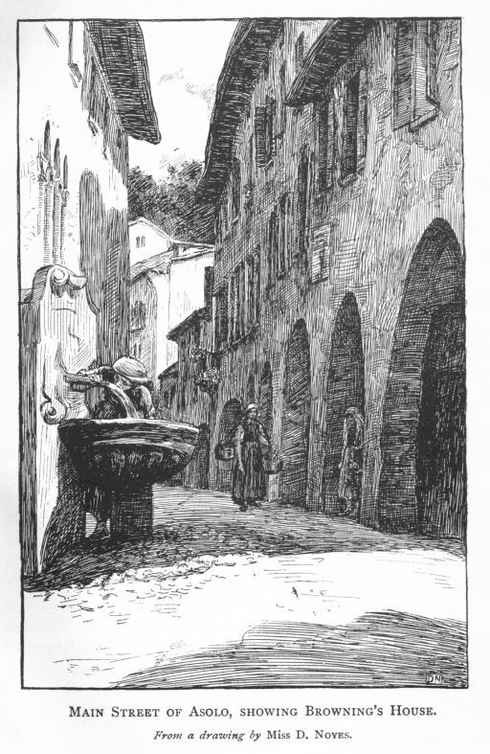
MAIN STREET OF ASOLO, SHOWING BROWNING'S HOUSE.
From a drawing by Miss D. NOYES.
The publication of Sordello (1840) did not improve Browning's position with the public. The poem was a challenge to the understanding of an aspirant reader, and the challenge met with no response. An excuse for not reading a poem of five or six thousand lines is grateful to so infirm and shortlived a being as man. And, indeed, a prophet, if prudent, may do well to postpone the privilege of being unintelligible until he has secured a considerable number of disciples of both sexes. The reception of Sordello might have disheartened a poet of less vigorous will than Browning; he merely marched breast forward, and let Sordello lie inert, until a new generation of readers had arisen. The dramas, King Victor and King Charles and The Return of the Druses (at first named "Mansoor the Hierophant") now occupied his thoughts. Short lyrical pieces were growing under his hand, and began to form a considerable group. And one fortunate day as he strolled alone in the Dulwich wood—his chosen resort of meditation—"the image flashed upon him of one walking thus alone through life; one apparently too obscure to leave a trace of his or her passage, yet exercising a lasting though unconscious influence at every step of it."[22] In other words Pippa had suddenly passed her poet in the wood.
A cheap mode of issuing his works now in manuscript was suggested to Browning by the publisher Moxon. They might appear in successive pamphlets, each of a single sheet printed in double-column, and the series might be discontinued at any time if the public ceased to care for it. The general title Bells and Pomegranates was chosen; "beneath upon the hem of the robe thou shalt make pomegranates of blue, and of purple, and of scarlet, round about the hem thereof; and bells of gold between them round about." Browning, as he explained to his readers in the last number, meant to indicate by the title, "Something like an alternation, or mixture, of music with discoursing, sound with sense, poetry with thought"—such having been, in fact, one of the most familiar of the Rabbinical interpretations designed to expound the symbolism of this priestly decoration prescribed in "Exodus." From 1841 to 1846 the numbers of Bells and Pomegranates successively appeared; with the eighth the series closed. The first number—Pippa Passes—was sold for sixpence; when King Victor and King Charles was published in the following year (1842), the price was raised to one shilling. The third and the seventh numbers were made up of short pieces—Dramatic Lyrics (1842), Dramatic Romances and Lyrics (1845). The Return of the Druses and A Blot in the 'Scutcheon—Numbers 4 and 5—followed each other in the same year 1843. Colombe's Birthday—the only number which is known to survive in manuscript—came next in order (1844). The last to appear was that which included Luna, Browning's favourite among his dramas, and A Soul's Tragedy.[23] His sister, except in the instance of Colombe, was Browning's amanuensis. On each title-page he is named Robert Browning "Author of Paracelsus"—the "wholly unintelligible" Sordello being passed over. Talfourd, "Barry Cornwall," and John Kenyon (the cousin of Elizabeth Barrett) were honoured with dedications. In these pamphlets of Moxon, Browning's wonderful apples of gold were certainly not presented to the public in pictures or baskets of silver; yet the possessor of the eight parts in their yellow paper wrappers may now be congratulated. Only one of the numbers—A Blot in the 'Scutcheon—attained the distinction of a second edition, and this probably because the drama as published was helped to a comparative popularity by its representation on the stage.
This tragedy of young love and death was written hastily—in four or five days—for Macready. Browning while at work on his play, as we learn from a letter of Dante Rossetti to Allingham, was kept indoors by a slight indisposition; his father on going to see him "was each day received boisterously and cheerfully with the words: 'I have done another act, father.'"[24] Forster read the tragedy aloud from the manuscript for Dickens, who wrote of it with unmeasured enthusiasm in a letter, known to Browning only when printed after the lapse of some thirty years: "Browning's play has thrown me into a perfect passion of sorrow.... I know no love like it, no passion like it, no moulding of a splendid thing after its conception like it." Things had gone ill with Macready at Drury Lane, and when the time for A Blot in the 'Scutcheon drew near it is evident that he feared further losses and would gladly have been released from his promise to produce the play; but Browning failed to divine the true state of affairs. The tragedy was read to the company by a grotesque, wooden-legged and red-nosed prompter, and it was greeted with laughter. To make amends, Macready himself undertook to read it aloud, but he declared himself unable, in the disturbed state of his mind, to appear before the public: his part—that of Lord Tresham—must be taken by Phelps. From certain rehearsals Phelps was unavoidably absent through illness. Macready who read his lines on these occasions, now was caught by the play, and saw possibilities in the part of Tresham which fired his imagination. He chose, almost at the last moment, to displace his younger and less distinguished colleague. Browning, on the other hand, insisted that Phelps, having been assigned the part, should retain it. To baffle Macready in his design of presenting the play to the public in a mutilated form, Browning, aided by his publisher, had the whole printed in four-and-twenty hours.[25] A rupture of the long-standing friendship with Macready followed, nor did author and actor meet again until after the great sorrow of Browning's life. "Mr Macready too"—writes Mrs Orr—"had recently lost his wife, and Mr Browning could only start forward, grasp the hand of his old friend, and in a voice choked with emotion say, 'O Macready!'"
The tragedy was produced at Drury Lane on February nth, 1843, with Phelps, who acted admirably as Tresham, and Helen Faucit as Mildred. Although it had been ill rehearsed and not a shilling had been spent on scenery or dresses, it was received with applause. To a call for the author, Browning, seated in his box, declined to make any response. Thus, not without some soreness of heart, closed his direct connection with the theatre. He heard with pleasure when in Italy that A Blot in the 'Scutcheon was given by Phelps at Sadler's Wells Theatre in November 1848, and with unquestionable success. A rendering of Colombe's Birthday was projected by Charles Kean in 1844, but the long delays, which were inevitable, could not be endured by Browning, who desired to print his play forthwith among the Bells and Pomegranates. It was not until nine years later that this play, a veritable "All for love, or the world well lost," was presented at the Haymarket, Helen Faucit appearing as the Duchess. Soon after Colombe's Birthday had been published, Browning sailed once more, in the autumn of 1844, for Italy.[26] As he journeyed northwards and homewards, from Naples (where they were performing an opera named Sordello) and Rome he sought and obtained at Leghorn an interview with Trelawny, the generous-hearted friend of Shelley, by whose grave he had lately stood.[27]
Browning's work as a playwright, consisting of eight pieces, or nine if we include the later In a Balcony, is sufficiently ample to enable us to form a trustworthy estimate of his genius as seen in drama. Dramatic, in the sense that he created and studied minds and hearts other than his own, he pre-eminently was; if he desired to set forth or to vindicate his most intimate ideas or impulses, he effected this indirectly, by detaching them from his own personality and giving them a brain and a heart other than his own in which to live and move and have their being. There is a kind of dramatic art which we may term static, and another kind which we may term dynamic. The former deals especially with characters in position, the latter with characters in movement.[28] Passion and thought may be exhibited and interpreted by dramatic genius of either type; to represent passion and thought and action—action incarnating and developing thought and passion—the dynamic power is required. And by action we are to understand not merely a visible deed, but also a word, a feeling, an idea which has in it a direct operative force. The dramatic genius of Browning was in the main of the static kind; it studies with extraordinary skill and subtlety character in position; it attains only an imperfect or a laboured success with character in movement. The dramatis personae are ready at almost every moment, except the culminating moments of passion, to fall away from action into reflection and self-analysis. The play of mind upon mind he recognises of course as a matter of profound interest and importance; but he catches the energy which spirit transfers to spirit less in the actual moment of transference than after it has arrived. Thought and emotion with him do not circulate freely through a group of persons, receiving some modification from each. He deals most successfully with each individual as a single and separate entity; each maintains his own attitude, and as he is touched by the common influence he proceeds to scrutinise it. Mind in these plays threads its way dexterously in and out of action; it is not itself sufficiently incorporated in action. The progress of the drama is now retarded; and again, as if the author perceived that the story had fallen behind or remained stationary, it is accelerated by sudden jerks. A dialogue of retrospection is a common device at the opening of popular plays, with a view to expound the position of affairs to the audience; but a dramatic writer of genius usually works forward through his dialogue to the end which he has set before him. With Browning for the purpose of mental analysis a dialogue of retrospection may be of higher value than one which leans and presses towards the future. The invisible is for him more important than the visible; and so in truth it may often be; but the highest dramatist will not choose to separate the two. The invisible is best captured and is most securely held in the visible.
As a writer of drama, Browning, who delights to study the noblest attitudes of the soul, and to wring a proud sense of triumph out of apparent failure, finds his proper field in tragedy rather than in comedy. Colombe's Birthday has a joyous ending, but the joy is very grave and earnest, and the body of the play is made up of serious pleadings and serious hopes and fears. There is no light-hearted mirth, no real gaiety of temper anywhere in the dramas of Browning. Pippa's gladness in her holiday from the task of silk-winding is touched with pathos in the thought that what is so bright is also so brief, and it is encompassed, even within delightful Asolo, by the sins and sorrows of the world. Bluphocks, with his sniggering wit and his jingles of rhyme is a vagabond and a spy, who only covers the shame of his nakedness with these rags of devil-may-care good spirits. The genial cynicism of Ogniben is excellent of its kind, and pleases the palate like an olive amid wines; but this man of universal intellectual sympathies is at heart the satirist of moral illusions, the unmasker of self-deception, who with long experience of human infirmities, has come to chuckle gently over his own skill in dealing with them; and has he not—we may ask—wound around his own spirit some of the incurable illusions of worldly wisdom? No—this is not gaiety; if Browning smiles with his Ogniben, his smile is a comment upon the weakness and the blindness of the self-deceiver.
Browning's tragedies are tragedies without villains. The world is here the villain, which has baits and bribes and snares wherewith to entangle its victims, to lure down their mounting aspirations, to dull their vision for the things far-off and faint; perhaps also to make them prosperous and portly gentlemen, easy-going, and amiably cynical, tolerant of evil, and prudently distrustful of good. Yet truth is truth, and fact is fact; worldly wisdom is genuine wisdom after its kind; we shall be the better instructed if we listen to its sage experience, if we listen, understand, and in all justice, censure. Ogniben can blandly and skilfully conduct a Chiappino to his valley of humiliation—"let him that standeth take heed lest he fall." But what would the wisdom of Ogniben be worth in its pronouncements on a Luria or a Colombe? Perhaps even in such a case not wholly valueless. The self-pleased, keen-sighted Legate might after all have applauded a moral heroism or a high-hearted gallantry which would ill accord with his own ingenious and versatile spirit. Bishop Blougram—sleek, ecclesiastical opportunist—was not insensible to the superior merits of "rough, grand, old Martin Luther."
In Browning's nature a singularly keen, exploring intelligence was united with a rare moral and spiritual ardour, a passion for high ideals. In creating his chief dramatis persona he distributes among them what he found within himself, and they fall into two principal groups—characters in which the predominating power is intellect, and characters in which the mastery lies with some lofty emotion. The intellect dealing with things that are real and positive, those persons in whom intelligence is supreme may too easily become the children of this world; in their own sphere they are wiser than the children of light; and they are skilled in a moral casuistry by which they justify to themselves the darkening of the light that is in them. The passionate natures have an intelligence of their own; they follow a gleam which is visible to them if not to others; they discover, or rather they are discovered by, some truth which flashes forth in one inspired moment—the master-moment of a lifetime; they possess the sublime certainty of love, loyalty, devotion; if they err through a heroic folly and draw upon themselves ruin in things temporal, may there not be some atom of divine wisdom at the heart of the folly, which is itself indestructible, and which ensures for them a welfare out of time and space? Prophet and casuist—Browning is both; and to each he will endeavour to be just; but his heart must give a casting vote, and this cannot be in favour of the casuist. Every self-transcending passion has in it a divine promise and pledge; even the passion of the senses if it has hidden within it one spark of self-annihilating love may be the salvation of a soul. It is Ottima, lifted above her own superb voluptuousness, who cries—"Not me—to him, O God, be merciful." The region of untrammelled, unclouded passion, of spiritual intuition, and of those great words from heaven, which pierce "even to the dividing asunder of the joints and marrow," is, for Browning's imagination, the East. The nations of the West—and, before all others, the Italian race—are those of a subtly developed intelligence. The worldly art of a Church-man, ingenuities of theology having aided in refining ingenuities of worldliness, is perhaps the finest exemplar of unalloyed western brain-craft. But Italy is also a land of passion; and therefore at once, for its ardours of the heart—seen not in love alone but in carven capital and on frescoed wall—and for its casuistries of intellect, Browning looks to Italy for the material best fitted to his artistry. Between that group of personages whom we may call his characters of passion and that group made up of his characters of intelligence, lie certain figures of peculiar interest, by birth and inheritance children of the East, and by culture partakers, in a greater or a less degree, of the characteristics of the West—a Djabal, with his Oriental heart entangled by Prankish tricks of sophistry; a Luria, whose Moorish passion is enthralled by the fascination of Florentine intellect, and who can make a return upon himself with a half-painful western self-consciousness.
Loyalties, devotions, to a person, to a cause, to an ideal, and the sacrifice of individual advantages, worldly prosperity, temporal successes to these—such, stated in a broad and general way, is the theme of special interest to Browning in his dramas. These loyalties may be well and wisely fixed, or they may contain a portion of error and illusion. But in either case they furnish a test of manly and womanly virtue. With a woman the test is often proposed by love—by love as set over against ease, or high station, or the pride of power. Colombe of Ravestein is offered on the one hand the restoration of her forfeited Duchy, the prospective rank of Empress and partnership with a man, who, if he cannot give love, is yet no ignoble wooer, a man of honour, of intellect, and of high ambition; on the other hand pleads the advocate of Cleves, a nameless provincial, past his days of youth, lean and somewhat worn, and burdened with the griefs and wrongs of his townsfolk. Mere largeness in a life is something, is much; but the quality of a life is more. Valence has set the cause of his fellow-citizens above himself; he has made the heart of the Duchess for the first time thrill in sympathy with the life of her people; he has placed his loyalty to her far above his own hopes of happiness; he has urged his rival's claims with unfaltering fidelity. It is not with any backward glances of regret, any half-doubts, prudent reserves, or condescending qualifications that Colombe gives herself to the advocate of the poor. She, in her youth and beauty, has been happy during her year of idlesse as play-Duchess of Juliers; she is happier now as she abandons the court and, sure in her grave choice, turns with a light and joyous laugh to welcome the birthday gift of freedom and of love that has so unexpectedly come to her. Having once made her election, Colombe can throw away the world as gaily as in some girlish frolic she might toss aside a rose.
The loyalty of men, their supreme devotion and their test may, as with women, spring from the passion of love; but other tests than this are often proposed to them. With King Charles of Sardinia it is duty to his people that summons him, from those modest and tranquil ways of life of which he dreamed, to the cares and toils of the crown. He has strength to accept without faltering the burden that is laid upon him. And if he falters at the last, and would resign to his father, who reclaims it, the crown which God alone should have removed, shall we assert confidently that Browning's dramatic instinct has erred? The pity of it—that his great father, daring in battle, profound in policy, should stand before him an outraged, helpless old man, craving with senile greed a gift from his son—the pity of it revives an old weakness, an old instinct of filial submission, in the heart of Charles. He has tasked himself without sparing; he has gained the affections of his subjects; he has conciliated a hostile Europe; is not this enough? Or was it also in the bond that he should tread a miserable father into the dust? The test again of Luigi, in the third part of Pippa Passes, is that of one who sees all the oppression of his people, who is enamoured of the antique ideal of liberty, and whose choice lies between a youth of luxurious ease and the virtue of one heroic crime, to be followed by the scaffold-steps, with youth cut short. To him that overcometh and endureth unto the end will God give the morning-star:
The gift of the morning-star! Have I God's giftOf the morning-star?
And Luigi will adventure forth—it may be in a kind of divine folly—as a doomsman commissioned by God to free his Italy. The devotion of Luria to Florence is partly of the imagination, and perhaps it is touched with something of illusion. But the actual Florence, with her astute politicians, her spies who spy upon spies, her incurable distrusts, her sinister fears, her ingrained ingratitude, is clearly exposed to him before the end. Shall he turn the army, which is as much his own as the sword he wields, joined with the forces of Pisa, against the beautiful, faithless city? Or will his passionate loyalty endure the test? Luria withdraws from life, but not until he has made every provision for the victory of Florence over her enemy; nor does he die a defeated man; his moral greatness has subdued all envies and all distrusts; at the close everyone is true to him:
The only fault's with time;All men become good creatures: but so slow.[29]
Once again in Browning's earliest play, the test for the patriot Pym lies in the choice between two loyalties—one to England and to freedom, the other to his early friend and former comrade in politics. His faith in Strafford dies hard; but it dies; he flings forward his hopes for the grand traitor to England beyond the confines of this life, and only the grieved unfaltering justiciary remains. Browning's Pym is a figure neither historically true nor dramatically effective; he is self-conscious and sentimental, a patriot armed in paste-board rhetoric. But the writer, let us remember, was young; this was his first theatrical essay, and he was somewhat showy of fine intentions. The loyalty of Strafford to the King is too fatuous an instinct to gain our complete sympathy. He rides gallantly into the quicksand, knowing it to be such, and the quicksand, as certainly as the worm of Nilus, will do its kind. And yet though this is the vain romance of loyalty, in it, as Browning conceives, lies the test of Strafford. A self-renouncing passion of any kind is not so common that we can afford to look on his king-worship with scorn.
Over against these devotees of the ideal Browning sets his worldlings, ranging from creatures as despicable as the courtiers of Duchess Colombe to such men of power and inexhaustible resource as the Nuncio who confronts Djabal with his Druses, or the Papal Legate whose easier and half-humorous task is to dismiss to his private affairs at Lugo the four-and-twentieth leader of revolt. To the same breed with the courtiers of Colombe belong old Vane and Savile of the court of Charles. To the same breed with the Nuncio and the Legate, belongs Monsignor, who proves himself more than a match for his hireling, the scoundrel Intendant. In a happy moment Monsignor is startled into indignant wrath; he does not exclaim with the Edmund of Shakespeare's tragedy "Some good I mean to do before I die;" but his "Gag the villain!" is a substantial contribution to the justice of our world. Under the ennobling influence of Charles and his Polyxena, the craft of D'Ormea is uplifted to a level of real dignity; if he cannot quite attain the position of a martyr for the truth, he becomes something better than one who serves God at the devil's bidding. And Braccio, plotter and betrayer, yet always with a certain fidelity towards his mother-city, is won over to the side of simple truth and righteousness by the overmastering power of Luria's magnanimity. So precious, after all—Browning would say—is the mere capacity to recognise facts; if only a little grain of virtue remains in the heart, this faculty of vision may make some sudden discovery which shall prove to a worldling that there exist facts, undeniable and of immense potency, hitherto unknown to his philosophy of chicane. Browning's vote is given, as has been said, and with no uncertain voice, for his devotees of the ideal; but the men of fine worldly brain-craft have a fascination for him as they have for his Eastern Luria. In Djabal, at once enthusiast and impostor, Browning may seem, as often afterwards, to offer an apology for the palterer with truth; but in the interests of truth itself, he desires to study the strange phenomenon of the deceiver who would fain half-deceive himself.
NOTES:
Dr Moncure Conway in "The Nation" vol. i. (an article written on the occasion of Browning's death) says that he was told by Carlyle of his first meeting with Browning—as Carlyle rode upon Wimbledon Common a "beautiful youth," walking there alone, stopped him and asked for his acquaintance. The incident has a somewhat legendary air.
Lady Martin (Helen Faucit), however, wrote in 1891 to Mrs Ritchie: "The play was mounted in all matters with great care ... minute attention to accuracy of costume prevailed.... The scenery was alike accurate."
On which occasion Browning—muffled up in a cloak—was asked by a stranger in the pit whether he was not the author of "Romeo and Juliet" and "Othello." "No, so far as I am aware," replied Browning. Two burlesques of Shakespeare by a Mr Brown or Brownley were in course of performance in London. Letters of R.B. and E.B.B., ii. 132.
From the Prologue to Asolando, Browning's last volume.
Mrs Orr, "Handbook to the Works of Robert Browning," p. 54 (1st ed.).
A Soul's Tragedy was written in 1843 or 1844, and revised immediately before publication. See Letters of R.B. and E.B.B., i. 474.
Letters of D.G. Rossetti to William Allingham, p. 168.
The above statement is substantially that of Browning; but on certain points his memory misled him. Whoever is interested in the matter should consult Professor Lounsbury's valuable article "A Philistine View of a Browning Play" in The Atlantic Monthly, December 1899, where questions are raised and some corrections are ingeniously made.
An uncle seems to have accompanied him. See Letters of R.B. and E.B.B., i. 57: and (for Shelley's Grave) i. 292; for "Sordello" at Naples, i., 349.
In later years no friendship existed between the two. We read in Mr. W.M. Rossetti's Diary for 1869, "4th July.... I see Browning dislikes Trelawny quite as much as Trelawny dislikes him (which is not a little.)" Rossetti Papers, p. 401.
See Mr R. Holt Hutton's article on Browning in "Essays Theological and Literary."
Luria withdraws from life "to prevent the harm Florence will do herself by striking him." Letters of R.B. and E.B.B., i. 427.
Chapter IV
The Maker of Plays—(Continued)
The women of the dramas, with one or two exceptions, are composed of fewer elements than the men. A variety of types is presented, but each personality is somewhat constrained and controlled by its idea; the free movement, the iridescence, the variety in oneness, the incalculable multiplicity in unity, of real character are not always present. They admit of definition to a degree which places them at a distance from the inexplicable open secrets of Shakespeare's creation; they lack the simple mysteriousness, the transparent obscurity of nature. With a master-key the chambers of their souls can one after another be unlocked. Ottima is the carnal passion of womanhood, full-blown, dazzling in the effrontery of sin, yet including the possibility, which Browning conceives as existing at the extreme edge of every expansive ardour, of being translated into a higher form of passion which abolishes all thought of self. Anael, of The Return of the Druses, is pure and measureless devotion. The cry of "Hakeem!" as she falls, is not an act of faith but of love; it pierces through the shadow of the material falsehood to her one illuminated truth of absolute love, like that other falsehood which sanctifies the dying lips of Desdemona. The sin of Mildred is the very innocence of sin, and does not really alter the simplicity of her character; it is only the girlish rapture of giving, with no limitation, whatever may prove a bounty to him whom she loves:—
Come what, come will,You have been happy.
The remorse of Mildred is the remorse of innocence, the anguish of one wholly unlearned in the dark colours of guilt. This tragedy of Mildred and Mertoun is the Romeo and Juliet of Browning's cycle of dramas. But Mildred's cousin Guendolen, by virtue of her swift, womanly penetration and her brave protectiveness of distressed girlhood, is a kinswoman of Beatrice who supported the injured daughter of Leonato in a comedy of Shakespeare which rings with laughter.
Polyxena, the Queen of Sardinia—a daughter not of Italy but of the Rhineland—is, in her degree, an eighteenth century representative of the woman of the ancient Teutonic tribes, grave, resolute, wise, and possessing the authority of wisdom. She, whose heart and brain work bravely together like loyal comrades, is strongly but also simply, conceived as the helpmate, the counsellor, and, in the old sense of the word, the comforter of her husband. Something of almost maternal feeling, as happens at times in real life, mingles with her wifely affection for Charles, who indeed may prove on occasions a fractious son. Like a wise guardian-angel she remembers on these occasions that he is only a man, and that men in their unwisdom may grow impatient of unalleviated guardian-angelhood; he will by and by discover his error, and she can bide her time. Perhaps, like other heroines of Browning, Polyxena is too constantly and uniformly herself; yet, no doubt, it is right that opaline, shifting hues should not disturb our impression of a character whose special virtue is steadfastness. The Queen of the English Charles, who is eager to counsel, and always in her petulance and folly to counsel ill, is slightly sketched; but she may be thanked for one admirable speech—her first—when Strafford, worn and fevered in the royal service, has just arrived from Ireland, and passing out from his interview with the King is encountered by her:—
Is it over then?Why he looks yellower than ever! WellAt least we shall not hear eternallyOf service—services: he's paid at least.
The Lady Carlisle of the same play—a creature in the main of Browning's imagination—had the play been Elizabethan or Jacobean would have followed her lord in a page's dress, have lived on half a smile a day, and perhaps have succeeded in dying languishingly and happily upon his sword; she is not quite unreal, nor yet quite real; something much better than a stage property and not wholly a living woman; more of a Beaumont and Fletcher personage of the boards—and as such effective—than a Shakespearian piece of nature. The theatrical limbo to which such almost but not quite embodied shadows ultimately troop, is capacious.
In Browning's dramatic scene of 1853, In a Balcony, he created with unqualified success "a very woman" in the enamoured Queen, whose heart at fifty years beats only more wildly and desperately than a girl's.[30] The young lovers, Constance and Norbert, are a highly meritorious pair, who express their passion in excellent and eloquent periods; we have seen their like before, and since. But the Queen, with her unslaked thirst for the visionary wells under the palm-trees, who finds herself still amid the burning sands, is an original and tragic figure—a royal Mlle. de Lespinasse, and crowned with fiery and immitigable pain. Although she has returned the "glare" of Constance with the glare of "a panther," the Queen is large-hearted. The guards, it is true, arrive as the curtain falls; but those readers who have wasted their tender emotion on a couple of afflicted prisoners or decapitated young persons, whom mother Nature can easily replace, are mistaken. If the Queen does not die that night, she will rise next morning after sleepless hours, haggard, not fifty but eighty years old, and her passion will, heroically slay itself in an act of generosity.[31] Little more, however, than a situation is represented in this dramatic scene. Of Browning's full-length portraits of women in the dramas, the finest piece of work is the portrait of the happiest woman—the play-Duchess of Juliers, no longer Duchess, but ever
Our lady of dear Ravestein.
Colombe is no incarnated idea but a complete human being, irreducible to a formula, whom we know the better because there is always in her more of exquisite womanhood to be discovered. Even the too fortunate Valence—all readers of his own sex must pronounce him too fortunate—will for ever be finding her anew.
In the development of his dramatic style Browning more and more lost sight of the theatre and its requirements; his stage became more and more a stage of the mind. Strafford, his first play, is the work of a novice, who has little of the instinct for theatrical effect, but who sets his brain to invent striking tableaux, to prepare surprises, to exhibit impressive attitudes, to calculate—not always successfully—the angle of a speech, so that it may with due impact reach the pit. The opening scene expounds the situation. In the second Wentworth and Pym confront each other; the King surprises them; Wentworth lets fall the hand of Pym, as the stage tradition requires; as Wentworth withdraws the Queen enters to unmake what he has made, and the scene closes with a tableau expressing the sentimental weakness of Charles:
Come, dearest!—look, the little fairy, nowThat cannot reach my shoulder! Dearest, come!
And so proceeds the tragedy, with much that ought to be dear to the average actor, which yet is somehow not always even theatrically happy. The pathos of the closing scene where Strafford is discovered in The Tower, sitting with his children, is theatrical pathos of the most correct kind, and each little speech of little William and little Anne is uttered as much for the audience as for their father, implying in every word "See, how we, poor innocents, heighten the pity of it." The hastily written A Blot in the 'Scutcheon is, perhaps, of Browning's dramas the best fitted for theatrical representation. Yet it is incurably weak in the motives which determine the action; and certain passages are almost ludicrously undramatic. If Romeo before he flung up his ladder of ropes had paused, like Mertoun, to salute his mistress with a tenor morceau from the opera, it is to be feared that runaways' and other eyes would not have winked, and that old Capulet would have come upon the scene in his night-gown, prepared to hasten the catastrophe with a long sword. Yet A Blot in the 'Scutcheon, with its breadth of outline, its striking situations, and its mastery of the elementary passions—love and wrath and pride and pity—gives us assurance that Browning might have taken a place of considerable distinction had he been born in an age of great dramatic poetry. If it is weak in construction so—though in a less degree—are Webster's Duchess of Malfi, and Shakespeare's Cymbeline.
In King Victor and King Charles Browning adopted, and no doubt deliberately, a plain, unfigured and uncoloured style, as suiting both the characters and the historical subject. The political background of this play and that of Strafford hardly entitles either drama to be named political. Browning was a student of history, but it was individuals and not society that interested him. The affairs of England and the affairs of Sardinia serve to throw out the figures of the chief dramatis persons; those affairs are not considered for their own sake. Certain social conditions are studied as they enter into and help to form an individual. The Bishop who orders his tomb at St Praxed's is in part a product of the Italian Renaissance, but the causes are seen only in their effects upon the character of a representative person. If the plain, substantial style of King Victor and King Charles is proper to a play with such a hero as Charles and such a heroine as Polyxena, the coloured style, rich in imagery, is no less right in The Return of the Druses, where religious and chivalric enthusiasm are blended with the enthusiasm of the passion of love. But already Browning was ceasing to bear in mind the conditions of the stage. Certain pages where Djabal and Khalil, Djabal and Anael, Anael and Loys are the speakers, might be described as dialogues conducted by means of "asides," and even the imagination of a reader resents a construction of scenes which requires these duets of soliloquies, these long sequences of the audible-inaudible. With the "very tragical mirth" of the second part of Chiappino's story of moral and political disaster, the spectators and the stage have wholly disappeared from Browning's theatre; the imaginary dialogue is highly dramatic, in one sense of the word, and is admirable in its kind, but we transport ourselves best to the market-place of Faenza by sitting in an easy chair.
Pippa Passes is singular in its construction; scenes detached, though not wholly disconnected, are strung pendant-wise upon the gold thread, slender but sufficiently strong, of an idea; realism in art, as we now call it, hangs from a fine idealism; this substantial globe of earth with its griefs, its grossnesses, its heroism, swings suspended from the seat of God. The idea which gives unity to the whole is not a mere fantasy. The magic practised by the unconscious Pippa through her songs is of that genuine and beautiful kind which the Renaissance men of science named "Magia Naturalis." It is no fantasy but a fact that each of us influences the lives of others more or less every day, and at times in a peculiar degree, in ways of which we are not aware. Let this fact be seized with imaginative intensity, and let the imagination render it into a symbol—we catch sight of Pippa with her songs passing down the grass-paths and under the pine-wood of Asolo. Her only service to God on this one holiday of a toilsome year is to be glad. She misconceives everything that concerns "Asolo's Four Happiest Ones"—to her fancy Ottima is blessed with love, Jules is no victim of an envious trick, Luigi's content in his lot is deep and unassailable, and Monsignor is a holy and beloved priest; and, unawares to her, in modes far other than she had imagined, each of her dreams comes true; even Monsignor for one moment rises into the sacred avenger of God. Her own service, though she knows it not, is more than a mere twelve-hours' gladness; she, the little silk-winder, rays forth the influences of a heart that has the potency ascribed to gems of unflawed purity; and such influences—here embodied in the symbol of a song—are among the precious realities of our life. Nowhere in literature has the virtue of mere innocent gladness been more charmingly imagined than in her morning outbreak of expectancy, half animal glee, half spiritual joy; the "whole sunrise, not to be suppressed" is a limitless splendour, but the reflected beam cast up from the splash of her ewer and dancing on her poor ceiling is the same in kind; in the shrub-house up the hill-side are great exotic blooms, but has not Pippa her one martagon lily, over which she queens it? With God all service ranks the same, and she shall serve Him all this long day by gaiety and gratitude.
Pippa Passes is a sequence of dramatic scenes, with lyrics interspersed, and placed in a lyrical setting; the figures dark or bright, of the painting are "ringed by a flowery bowery angel-brood" of song. But before his Bells and Pomegranates were brought to a close Browning had discovered in the short monodrama, lyrical or reflective, the most appropriate vehicle for his powers of passion and of thought. Here a single situation sufficed; characters were seen rightly in position; the action of the piece was wholly internal; a passion could be isolated, and could be either traced through its varying moods or seized in its moment of culmination; the casuistry of the brain could be studied apart,—it might have its say uninterrupted, or it might be suddenly encountered and dissipated by some spearlike beam of light from the heart or soul; the traditions of a great literary form were not here a cause of embarrassment; they need not, as in work for the theatre, be laboriously observed or injuriously violated; the poet might assert his independence and be wholly original.
And original, in the best sense of the word—entirely true to his highest self—Browning was in the "Dramatic Lyrics" of 1842, and the "Dramatic Romances and Lyrics" of 1845. His senses were at once singularly keen and energetic, and singularly capacious of delight; his eyes were active instruments of observation, and at the same time were possessed by a kind of rapture in form—and not least in fantastic form—and a rapture still finer in the opulence and variety of colour. In these poems we are caught into what may truly be called an enthusiasm of the senses; and presently we find that the senses, good for their own sakes, are good also as inlets to the spirit. Having returned from his first visit to southern Italy, the sights and sounds, striking upon the retina and the auditory nerve, with the intensity of a new experience, still attack the eye and ear as he writes his Englishman in Italy, and by virtue of their eager obsession demand and summon forth the appropriate word.[32] The fisherman from Amalfi pitches down his basket before us,
[21]
A cheap mode of issuing his works now in manuscript was suggested to Browning by the publisher Moxon. They might appear in successive pamphlets, each of a single sheet printed in double-column, and the series might be discontinued at any time if the public ceased to care for it. The general title Bells and Pomegranates was chosen; "beneath upon the hem of the robe thou shalt make pomegranates of blue, and of purple, and of scarlet, round about the hem thereof; and bells of gold between them round about." Browning, as he explained to his readers in the last number, meant to indicate by the title, "Something like an alternation, or mixture, of music with discoursing, sound with sense, poetry with thought"—such having been, in fact, one of the most familiar of the Rabbinical interpretations designed to expound the symbolism of this priestly decoration prescribed in "Exodus." From 1841 to 1846 the numbers of Bells and Pomegranates successively appeared; with the eighth the series closed. The first number—Pippa Passes—was sold for sixpence; when King Victor and King Charles was published in the following year (1842), the price was raised to one shilling. The third and the seventh numbers were made up of short pieces—Dramatic Lyrics (1842), Dramatic Romances and Lyrics (1845). The Return of the Druses and A Blot in the 'Scutcheon—Numbers 4 and 5—followed each other in the same year 1843. Colombe's Birthday—the only number which is known to survive in manuscript—came next in order (1844). The last to appear was that which included Luna, Browning's favourite among his dramas, and A Soul's Tragedy.[23] His sister, except in the instance of Colombe, was Browning's amanuensis. On each title-page he is named Robert Browning "Author of Paracelsus"—the "wholly unintelligible" Sordello being passed over. Talfourd, "Barry Cornwall," and John Kenyon (the cousin of Elizabeth Barrett) were honoured with dedications. In these pamphlets of Moxon, Browning's wonderful apples of gold were certainly not presented to the public in pictures or baskets of silver; yet the possessor of the eight parts in their yellow paper wrappers may now be congratulated. Only one of the numbers—A Blot in the 'Scutcheon—attained the distinction of a second edition, and this probably because the drama as published was helped to a comparative popularity by its representation on the stage.
[24]
[32]
The tragedy was produced at Drury Lane on February nth, 1843, with Phelps, who acted admirably as Tresham, and Helen Faucit as Mildred. Although it had been ill rehearsed and not a shilling had been spent on scenery or dresses, it was received with applause. To a call for the author, Browning, seated in his box, declined to make any response. Thus, not without some soreness of heart, closed his direct connection with the theatre. He heard with pleasure when in Italy that A Blot in the 'Scutcheon was given by Phelps at Sadler's Wells Theatre in November 1848, and with unquestionable success. A rendering of Colombe's Birthday was projected by Charles Kean in 1844, but the long delays, which were inevitable, could not be endured by Browning, who desired to print his play forthwith among the Bells and Pomegranates. It was not until nine years later that this play, a veritable "All for love, or the world well lost," was presented at the Haymarket, Helen Faucit appearing as the Duchess. Soon after Colombe's Birthday had been published, Browning sailed once more, in the autumn of 1844, for Italy.[26] As he journeyed northwards and homewards, from Naples (where they were performing an opera named Sordello) and Rome he sought and obtained at Leghorn an interview with Trelawny, the generous-hearted friend of Shelley, by whose grave he had lately stood.[27]
Browning's work as a playwright, consisting of eight pieces, or nine if we include the later In a Balcony, is sufficiently ample to enable us to form a trustworthy estimate of his genius as seen in drama. Dramatic, in the sense that he created and studied minds and hearts other than his own, he pre-eminently was; if he desired to set forth or to vindicate his most intimate ideas or impulses, he effected this indirectly, by detaching them from his own personality and giving them a brain and a heart other than his own in which to live and move and have their being. There is a kind of dramatic art which we may term static, and another kind which we may term dynamic. The former deals especially with characters in position, the latter with characters in movement.[28] Passion and thought may be exhibited and interpreted by dramatic genius of either type; to represent passion and thought and action—action incarnating and developing thought and passion—the dynamic power is required. And by action we are to understand not merely a visible deed, but also a word, a feeling, an idea which has in it a direct operative force. The dramatic genius of Browning was in the main of the static kind; it studies with extraordinary skill and subtlety character in position; it attains only an imperfect or a laboured success with character in movement. The dramatis personae are ready at almost every moment, except the culminating moments of passion, to fall away from action into reflection and self-analysis. The play of mind upon mind he recognises of course as a matter of profound interest and importance; but he catches the energy which spirit transfers to spirit less in the actual moment of transference than after it has arrived. Thought and emotion with him do not circulate freely through a group of persons, receiving some modification from each. He deals most successfully with each individual as a single and separate entity; each maintains his own attitude, and as he is touched by the common influence he proceeds to scrutinise it. Mind in these plays threads its way dexterously in and out of action; it is not itself sufficiently incorporated in action. The progress of the drama is now retarded; and again, as if the author perceived that the story had fallen behind or remained stationary, it is accelerated by sudden jerks. A dialogue of retrospection is a common device at the opening of popular plays, with a view to expound the position of affairs to the audience; but a dramatic writer of genius usually works forward through his dialogue to the end which he has set before him. With Browning for the purpose of mental analysis a dialogue of retrospection may be of higher value than one which leans and presses towards the future. The invisible is for him more important than the visible; and so in truth it may often be; but the highest dramatist will not choose to separate the two. The invisible is best captured and is most securely held in the visible.
By August the poet had pledged himself to achieve this first dramatic adventure. The play was produced at Covent Garden on May 1st, 1837, by Macready, who himself took the part of Strafford. Helen Faucit, then a novice on the stage, gave an adequate rendering of the difficult part of Lady Carlisle. For the rest, the complexion of the piece, as Browning describes it, after one of the latest rehearsals, was "perfect gallows." Great historical personages were presented by actors who strutted or slouched, who whimpered or drawled. The financial distress at Covent Garden forbade any splendour or even dignity of scenery or of costumes.[19] The text was considerably altered—and not always judiciously—from that of the printed play, which had appeared before its production on the stage. Yet on the first night Strafford was not damned, and on the second it was warmly applauded.[20] After the fifth performance the wretched Pym refused to save his mother England even once more, and the play was withdrawn. Browning declared to his friends that never again, as long as he might live, would he write a play. Whining not being to his taste, he averted his eyes and set himself resolutely to work upon Sordello.
[29]
[25]
The publication of Paracelsus did not gain for Browning a large audience, but it brought him friends and acquaintances who gave his life a delightful expansion in its social relations. John Forster, the critic, biographer and historian, then unknown to him, reviewed the poem in the Examiner with full recognition of its power and promise. Browning gratefully commemorated a lifelong friendship with Forster, nearly a score of years later, in the dedication of the 1863 edition of his poetical works. Mrs Orr recites the names of Carlyle, Talfourd, R. Hengist Horne, Leigh Hunt, Procter, Monckton Milnes, Dickens, Wordsworth, Landor, among those of distinguished persons who became known to Browning at this period.[18] His "simple and enthusiastic manner" is referred to by the actor Macready in his diary; "he looks and speaks more like a youthful poet than any man I ever saw." Browning's face was one of rare intelligence and full of changing expression. He was not tall, but in early years he was slight, was graceful in his movements, and held his head high. His dark brown hair hung in wavy masses upon his neck. His voice had in early manhood a quality, afterwards lost, which Mr Sharp describes as "flute-like, clear, sweet and resonant." Slim, dark, and very handsome are the words chosen by Mrs Bridell-Fox to characterise the youthful Browning as he reappeared to her memory; "And—may I hint it?"—she adds, "just a trifle of a dandy, addicted to lemon-coloured kid gloves and such things, quite 'the glass of fashion and the mould of form.' But full of ambition, eager for success, eager for fame, and, what is more, determined to conquer fame and to achieve success." Yet the correct and conventional Browning could also fire up for lawlessness—"frenetic to be free." He was hail-fellow well-met, we are told—but is this part of a Browning legend?—with tramps and gipsies, and he wandered gladly, whether through devout sympathy or curiosity of mood we know not, into Little Bethels and other tents of spiritual Ishmael.
This tragedy of young love and death was written hastily—in four or five days—for Macready. Browning while at work on his play, as we learn from a letter of Dante Rossetti to Allingham, was kept indoors by a slight indisposition; his father on going to see him "was each day received boisterously and cheerfully with the words: 'I have done another act, father.'"[24] Forster read the tragedy aloud from the manuscript for Dickens, who wrote of it with unmeasured enthusiasm in a letter, known to Browning only when printed after the lapse of some thirty years: "Browning's play has thrown me into a perfect passion of sorrow.... I know no love like it, no passion like it, no moulding of a splendid thing after its conception like it." Things had gone ill with Macready at Drury Lane, and when the time for A Blot in the 'Scutcheon drew near it is evident that he feared further losses and would gladly have been released from his promise to produce the play; but Browning failed to divine the true state of affairs. The tragedy was read to the company by a grotesque, wooden-legged and red-nosed prompter, and it was greeted with laughter. To make amends, Macready himself undertook to read it aloud, but he declared himself unable, in the disturbed state of his mind, to appear before the public: his part—that of Lord Tresham—must be taken by Phelps. From certain rehearsals Phelps was unavoidably absent through illness. Macready who read his lines on these occasions, now was caught by the play, and saw possibilities in the part of Tresham which fired his imagination. He chose, almost at the last moment, to displace his younger and less distinguished colleague. Browning, on the other hand, insisted that Phelps, having been assigned the part, should retain it. To baffle Macready in his design of presenting the play to the public in a mutilated form, Browning, aided by his publisher, had the whole printed in four-and-twenty hours.[25] A rupture of the long-standing friendship with Macready followed, nor did author and actor meet again until after the great sorrow of Browning's life. "Mr Macready too"—writes Mrs Orr—"had recently lost his wife, and Mr Browning could only start forward, grasp the hand of his old friend, and in a voice choked with emotion say, 'O Macready!'"
Palpably fire-clothed![21]
The publication of Sordello (1840) did not improve Browning's position with the public. The poem was a challenge to the understanding of an aspirant reader, and the challenge met with no response. An excuse for not reading a poem of five or six thousand lines is grateful to so infirm and shortlived a being as man. And, indeed, a prophet, if prudent, may do well to postpone the privilege of being unintelligible until he has secured a considerable number of disciples of both sexes. The reception of Sordello might have disheartened a poet of less vigorous will than Browning; he merely marched breast forward, and let Sordello lie inert, until a new generation of readers had arisen. The dramas, King Victor and King Charles and The Return of the Druses (at first named "Mansoor the Hierophant") now occupied his thoughts. Short lyrical pieces were growing under his hand, and began to form a considerable group. And one fortunate day as he strolled alone in the Dulwich wood—his chosen resort of meditation—"the image flashed upon him of one walking thus alone through life; one apparently too obscure to leave a trace of his or her passage, yet exercising a lasting though unconscious influence at every step of it."[22] In other words Pippa had suddenly passed her poet in the wood.
[28]
[27]
The tragedy was produced at Drury Lane on February nth, 1843, with Phelps, who acted admirably as Tresham, and Helen Faucit as Mildred. Although it had been ill rehearsed and not a shilling had been spent on scenery or dresses, it was received with applause. To a call for the author, Browning, seated in his box, declined to make any response. Thus, not without some soreness of heart, closed his direct connection with the theatre. He heard with pleasure when in Italy that A Blot in the 'Scutcheon was given by Phelps at Sadler's Wells Theatre in November 1848, and with unquestionable success. A rendering of Colombe's Birthday was projected by Charles Kean in 1844, but the long delays, which were inevitable, could not be endured by Browning, who desired to print his play forthwith among the Bells and Pomegranates. It was not until nine years later that this play, a veritable "All for love, or the world well lost," was presented at the Haymarket, Helen Faucit appearing as the Duchess. Soon after Colombe's Birthday had been published, Browning sailed once more, in the autumn of 1844, for Italy.[26] As he journeyed northwards and homewards, from Naples (where they were performing an opera named Sordello) and Rome he sought and obtained at Leghorn an interview with Trelawny, the generous-hearted friend of Shelley, by whose grave he had lately stood.[27]
[30]
[26]
[22]
[31]
By August the poet had pledged himself to achieve this first dramatic adventure. The play was produced at Covent Garden on May 1st, 1837, by Macready, who himself took the part of Strafford. Helen Faucit, then a novice on the stage, gave an adequate rendering of the difficult part of Lady Carlisle. For the rest, the complexion of the piece, as Browning describes it, after one of the latest rehearsals, was "perfect gallows." Great historical personages were presented by actors who strutted or slouched, who whimpered or drawled. The financial distress at Covent Garden forbade any splendour or even dignity of scenery or of costumes.[19] The text was considerably altered—and not always judiciously—from that of the printed play, which had appeared before its production on the stage. Yet on the first night Strafford was not damned, and on the second it was warmly applauded.[20] After the fifth performance the wretched Pym refused to save his mother England even once more, and the play was withdrawn. Browning declared to his friends that never again, as long as he might live, would he write a play. Whining not being to his taste, he averted his eyes and set himself resolutely to work upon Sordello.
This tragedy of young love and death was written hastily—in four or five days—for Macready. Browning while at work on his play, as we learn from a letter of Dante Rossetti to Allingham, was kept indoors by a slight indisposition; his father on going to see him "was each day received boisterously and cheerfully with the words: 'I have done another act, father.'"[24] Forster read the tragedy aloud from the manuscript for Dickens, who wrote of it with unmeasured enthusiasm in a letter, known to Browning only when printed after the lapse of some thirty years: "Browning's play has thrown me into a perfect passion of sorrow.... I know no love like it, no passion like it, no moulding of a splendid thing after its conception like it." Things had gone ill with Macready at Drury Lane, and when the time for A Blot in the 'Scutcheon drew near it is evident that he feared further losses and would gladly have been released from his promise to produce the play; but Browning failed to divine the true state of affairs. The tragedy was read to the company by a grotesque, wooden-legged and red-nosed prompter, and it was greeted with laughter. To make amends, Macready himself undertook to read it aloud, but he declared himself unable, in the disturbed state of his mind, to appear before the public: his part—that of Lord Tresham—must be taken by Phelps. From certain rehearsals Phelps was unavoidably absent through illness. Macready who read his lines on these occasions, now was caught by the play, and saw possibilities in the part of Tresham which fired his imagination. He chose, almost at the last moment, to displace his younger and less distinguished colleague. Browning, on the other hand, insisted that Phelps, having been assigned the part, should retain it. To baffle Macready in his design of presenting the play to the public in a mutilated form, Browning, aided by his publisher, had the whole printed in four-and-twenty hours.[25] A rupture of the long-standing friendship with Macready followed, nor did author and actor meet again until after the great sorrow of Browning's life. "Mr Macready too"—writes Mrs Orr—"had recently lost his wife, and Mr Browning could only start forward, grasp the hand of his old friend, and in a voice choked with emotion say, 'O Macready!'"
All men become good creatures: but so slow.[29]
[23]
All trembling aliveWith pink and grey jellies, your sea-fruit,—You touch the strange lumps,And mouths gape there, eyes open, all mannerOf horns and of humps.
Or it is the "quick rustle-down of the quail-nets," or the "whistling pelt" of the olives, when Scirocco is loose, that invades our ears. And by and by among the mountains the play of the senses expands, and the soul has its great word to utter:
God's own profoundWas above me, and round me the mountains,And under, the sea,And within me, my heart to bear witnesshat was and shall be.
Not less vivid is the vision of the light craft with its lateen sail outside Triest, in which Waring—the Flying Englishman—is seen "with great grass hat and kerchief black," looking up for a moment, showing his "kingly throat," till suddenly in the sunset splendour the boat veers weather-ward and goes off, as with a bound, "into the rose and golden half of the sky." And what animal-painter has given more of the leonine wrath in mane and tail and fixed wide eyes than Browning has conveyed into his lion of King Francis with three strokes of the brush? Or it is only a bee upon a sunflower on which the gazer's eye is fixed, and we get the word of Rudel:
And therefore bask the beesOn my flower's breast, as on a platform broad.
Or—a grief to booklovers!—the same eye is occupied by all the grotesquerie of insect life in the revel over that unhappy tome lurking in the plum tree's crevice of Browning's Garden Fancy, which creeps and crawls with beetle and spider, worm and eft.[33] Or it is night and moonlight by the sandy shore, and for a moment—before love enters—all the mind of the impressionist artist lives merely in the eye:
The grey sea and the long black land;And the yellow half-moon large and low;And the startled little waves that leapIn fiery ringlets from their sleepAs I gain the cove with pushing prow.
If Browning did not rejoice in perfect health and animal spirits—and in the letters to Miss Barrett we hear of frequent headaches and find a reference to his pale thin face as seen in a mirror—he had certainly the imagination of perfect vitality and of those "wild joys of living," sung by the young harper David in that poem of Saul, which appeared as a fragment in the Bells and Pomegranates, and as a whole ten years later, with the awe and rapture of the spirit rising above the rapture of the senses.[34]
Of these poems of 1842 and 1845 one The Pied Piper, was written in the spirit of mere play and was included in Bells and Pomegranates only to make up a number, for which the printer required more copy. One or two—the flesh and blood incarnations of the wines of France and Hungary, Claret and Tokay, are no more than clever caprices of the fancy. One, The Lost Lender, remotely suggested by the conservatism of Wordsworth's elder days, but possibly deflected by some of the feeling attributed to Pym in relation to Strafford of the drama, and certainly detached from direct personal reference to Wordsworth, expresses Browning's liberal sentiment in politics. One, the stately Artemis Prologuizes, is the sole remaining fragment of a classical drama, "Hippolytus and Aricia," composed in 1840, "much against my endeavour," wrote the poet,—a somewhat enigmatical phrase—"while in bed with a fever." A considerable number of the poems may be grouped together as expressions or demonstrations of various passions, central among which is the passion of love. A few, and these conspicuous for their masterly handling of novel themes, treat of art, and the feeling for art as seen in the painter of pictures or in the connoisseur. Nor is the interpretation of religious emotion—though in a phase that may be called abnormal—wholly forgotten.
With every passion that expands the spirit beyond the bounds of self, Browning, as the dramas have made evident to us, is in cordial sympathy. The reckless loyalty, with its animal spirits and its dash of grief, the bitterer because grief must be dismissed, of the Cavalier Tunes, is true to England and to the time in its heartiness and gallant bluffness. The leap-up of pride and joy in a boy's heart at the moment of death in his Emperor's cause could hardly be more intensely imagined than it is in the poem of the French camp, and all is made more real and vivid by the presence of that motionless figure, intent on victory and sustaining the weight of imperial anxieties, which yet cannot be quite impassive in presence of a death so devoted. And side by side with this poem of generous enthusiasm is placed the poem of passion reduced to its extreme of meanness, its most contracted form of petty spite and base envy—the Soliloquy in a Spanish Cloister; a grotesque insect, spitting ineffectual poison, is placed under the magnifying-glass of the comic spirit, and is discovered to be—a brother in religion! A noble hatred, transcending personal considerations, mingles with a noble and solemn love—the passion of country—in the Italian exile's record of his escape from Austrian pursuers; with the clear-obscure of his patriotic melancholy mingles the proud recollection of the Italian woman who was his saviour, over whose conjectured happiness as peasant wife and peasant mother the exile bows with a tender joy. The examples of abnormal passion are two—that of the amorous homicide who would set on one perfect moment the seal of eternity, in Porphyria's Lover, and that of the other occupier of the mad-house cells, Johannes Agricola, whose passion of religion is pushed to the extreme of a mystical antinomianism.
Browning's poems of the love of man and woman are seldom a simple lyrical cry, but they are not on this account the less true in their presentment of that curious masquer and disguiser—Love. When love takes possession of a nature which is complex, affluents and tributaries from many and various faculties run into the main stream. With Browning the passion is indeed a regal power, but intellect, imagination, fancy are its office-bearers for a time; then in a moment it resumes all authority into its own hands, resolves of a sudden all that is complex into the singleness of joy or pain, fuses all that is manifold into the unity of its own life and being. His dramatic method requires that each single faculty should be seen in the environment of a character, and that its operations should be clothed more or less in circumstance. And since love has its ingenuities, its fine-spun and far-flung threads of association, its occult symbolisms, Browning knows how to press into the service of the central emotion objects and incidents and imagery which may seem remote or curious or fantastic or trivial or even grotesque. In Rudel to the Lady of Tripoli love which cometh by the hearing of the ear (for Rudel is a sun-worshipper who has never seen his sun) is a pure imaginative devotion to the ideal. In Count Gismond love is the deliverer; the motive of the poem is essentially that of the Perseus and Andromeda myth refined upon and mediaevalised. In Cristine love is the interpreter of life; a moment of high passion explains, and explains away, all else that would obscure the vision of what is best and most real in this our world and in the worlds that are yet unattained. From a few lines written to illustrate a Venetian picture by Maclise In a Gondola was evolved. If Browning was not entirely accurate in his topography of Venice, he certainly did not fail in his sense of the depth and opulence of its colour. Here the abandonment to passion is relieved by the quaint ingenuities and fancies of love that seeks a momentary refuge from its own excess, and then returns more eagerly upon itself; and the shadow of death is ever at hand, but like the shadows of a Venetian painter it glows with colour.
The motives of two narrative poems, The Glove and The Flight of the Duchess, have much in common; they lie in the contrast between the world of convention and the world of reality. In each the insulter of proprieties, the breaker of bounds is a woman; in each the choice lies between a life of pretended love and vain dignities and a life of freedom and true love; and in each case the woman makes her glad escape from what is false to what is true. In restating the incident of the glove Browning brings into play his casuistry, but casuistry is here used to justify a passion which the poet approves, to elucidate, not to obscure, what he represents as the truth of the situation. The Flight of the Duchess in part took its rise "from a line, 'Following the Queen of the Gipsies, O!'—the burden of a song, which the poet, when a boy, heard a woman singing on a Guy Fawkes' day." Some two hundred lines were given to Hood for his magazine, at a time when Hood needed help, and death was approaching him. The poem was completed some months later. It is written, like The Glove, in verse that runs for swiftness' sake, and that is pleased to show its paces on a road rough with boulder-like rhymes. The little Duchess is a wild bird caged in the strangely twisted wirework of artificial modes and forms. She is a prisoner who is starved for real life, and stifles; the fresh air and the open sky are good, are irresistible—and that is the whole long poem in brief. Such a small prisoner, all life and fire, was before many months actually delivered from her cage in Wimpole Street, and Robert Browning himself, growing in stature amid his incantations, played the part of the gipsy.
Another Duchess, who pined for freedom and never attained it, has her cold obituary notice from her bereaved Duke's lips in the Dramatic Lyrics of 1842. My Last Duchess was there made a companion poem to Count Gismond; they are the pictures of the bond-woman and of the freed-woman in marriage. The Italian Duchess revolts from the law of wifehood no further than a misplaced smile or a faint half-flush, betraying her inward breathings and beamings of the spirit; the noose of the ducal proprieties is around her throat, and when it tightens "then all smiles stopped together." Never was an agony hinted with more gentlemanly reserve. But the poem is remarkable chiefly as gathering up into a typical representative a whole phase of civilisation. The Duke is Italian of Renaissance days; insensible in his egoistic pride to the beautiful humanity alive before him; yet a connoisseur of art to his finger-tips; and after all a Duchess can be replaced, while the bronze of Glaus of Innsbruck—but the glory of his possessions must not be pressed, as though his nine hundred years old name were not enough. The true gift of art—Browning in later poems frequently insists upon this—is not for the connoisseur or collector who rests in a material possession, but for the artist who, in the zeal of creation, presses through his own work to that unattainable beauty, that flying joy which exists beyond his grasp and for ever lures him forward. In Pictor Ignotus the earliest study in his lives of the painters was made by the poet. The world is gross, its touch unsanctifies the sanctities of art; yet the brave audacity of genius is able to penetrate this gross world with spiritual fire. Browning's unknown painter is a delicate spirit, who dares not mingle his soul with the gross world; he has failed for lack of a robust faith, a strenuous courage. But his failure is beautiful and pathetic, and for a time at least his Virgin, Babe, and Saint will smile from the cloister wall with their "cold, calm, beautiful regard." And yet to have done otherwise to have been other than this; to have striven like that youth—the Urbinate—men praise so! More remarkable, as the summary of a civilisation, than My Last Duchess, is the address of the worldling Bishop, who lies dying, to the "nephews" who are sons of his loins. In its Paganism of Christianity—which lacks all the manly virtue of genuine Paganism—that portion of the artistic Renaissance which leans towards the world and the flesh is concentrated and is given as in quintessential form. The feeble fingers yet cling to the vanities of earth; the speaker babbles not of green fields but of his blue lump of lapis-lazuli; and the last word of all is alive only with senile luxury and the malice of perishing recollection.
NOTES:
In a Balcony, published in Men and Women, 1855, is said to have been written two years previously at the Baths of Lucca.
I had written the above—and I leave it as I wrote it—before I noticed the following quoted from the letter of a friend by Mrs Arthur Bronson in her article Browning in Venice: "Browning seemed as full of dramatic interest in reading 'In a Balcony' as if he had just written it for our benefit. One who sat near him said that it was a natural sequence that the step of the guard should be heard coming to take Norbert to his doom, as, with a nature like the queen's, who had known only one hour of joy in her sterile life, vengeance swift and terrible would follow on the sudden destruction of her happiness. 'Now I don't quite think that,' answered Browning, as if he were following out the play as a spectator. 'The queen has a large and passionate temperament, which had only once been touched and brought into intense life. She would have died by a knife in her heart. The guard would have come to carry away her dead body.' 'But I imagine that most people interpret it as I do,' was the reply. 'Then,' said Browning, with quick interest, 'don't you think it would be well to put it in the stage directions, and have it seen that they were carrying her across the back of the stage?'"
Browning's eyes were in a remarkable degree unequal in their power of vision; one was unusually long-sighted; the other, with which he could read the most microscopic print, unusually short-sighted.
See a very interesting passage on Browning's "odd liking for 'vermin'" in Letters of R.B. and E.B.B.. i. 370, 371: "I always liked all those wild creatures God 'sets up for themselves.'" "It seemed awful to watch that bee—he seemed so instantly from the teaching of God."
Of the first part of Saul Mr Kenyon said finely that "it reminded him of Homer's shield of Achilles thrown into lyrical whirl and life" (Letters R.B. and E.B.B. i. 326).
Chapter V
Love and Marriage
In 1841, John Kenyon, formerly a school-fellow of Browning's father, now an elderly lover of literature and of literary society, childless, wealthy, generous-hearted, proposed to Browning that he should call upon Elizabeth Barrett, Kenyon's cousin once removed, who was already distinguished as a writer of ardent and original verse. Browning consented, but the poetess "through some blind dislike of seeing strangers"—as she afterwards told a correspondent—declined, alleging, not untruly, as a ground of refusal, that she was then ailing in health.[35] Three years later Kenyon sent his cousin's new volumes of Poems as a gift to Sarianna Browning; her brother, lately returned from Italy, read these volumes with delight and admiration, and found on one of the pages a reference in verse to his "Pomegranates" of a kind that could not but give him a vivid moment of pleasure. Might he not relieve his sense of obligation by telling Miss Barrett, in a letter, that he admired her work? Mr Kenyon encouraged the suggestion, and though to love and be silent might on the whole have been more to Browning's liking, he wrote—January 10, 1845—and writing truthfully he wrote enthusiastically.[36] Miss Barrett, never quite recovered from a riding accident in early girlhood, and stricken down for long in both soul and body by the shock of her brother's death by drowning, lay from day to day and month to month, in an upper room of her father's house in Wimpole Street, occupied, upon her sofa, with her books and papers—her Greek dramatists and her Elizabethan poets—shut out from the world, with windows for ever closed, and with only an occasional female visitor, to gossip of the social and literary life of London. Never was a spirit of more vivid fire enclosed within a tomb. The letter from Browning, "the author of Paracelsus and King of the mystics," threw her, she says, "into ecstasics." Her reply has a thrill of pleasure running through its graceful half-restraint, and she holds out a hope that when spring shall arrive a meeting in the invalid chamber between her and her new correspondent may be possible.
[36]
[33]
If Browning did not rejoice in perfect health and animal spirits—and in the letters to Miss Barrett we hear of frequent headaches and find a reference to his pale thin face as seen in a mirror—he had certainly the imagination of perfect vitality and of those "wild joys of living," sung by the young harper David in that poem of Saul, which appeared as a fragment in the Bells and Pomegranates, and as a whole ten years later, with the awe and rapture of the spirit rising above the rapture of the senses.[34]
Or—a grief to booklovers!—the same eye is occupied by all the grotesquerie of insect life in the revel over that unhappy tome lurking in the plum tree's crevice of Browning's Garden Fancy, which creeps and crawls with beetle and spider, worm and eft.[33] Or it is night and moonlight by the sandy shore, and for a moment—before love enters—all the mind of the impressionist artist lives merely in the eye:
[35]
And original, in the best sense of the word—entirely true to his highest self—Browning was in the "Dramatic Lyrics" of 1842, and the "Dramatic Romances and Lyrics" of 1845. His senses were at once singularly keen and energetic, and singularly capacious of delight; his eyes were active instruments of observation, and at the same time were possessed by a kind of rapture in form—and not least in fantastic form—and a rapture still finer in the opulence and variety of colour. In these poems we are caught into what may truly be called an enthusiasm of the senses; and presently we find that the senses, good for their own sakes, are good also as inlets to the spirit. Having returned from his first visit to southern Italy, the sights and sounds, striking upon the retina and the auditory nerve, with the intensity of a new experience, still attack the eye and ear as he writes his Englishman in Italy, and by virtue of their eager obsession demand and summon forth the appropriate word.[32] The fisherman from Amalfi pitches down his basket before us,
[34]
In Browning's dramatic scene of 1853, In a Balcony, he created with unqualified success "a very woman" in the enamoured Queen, whose heart at fifty years beats only more wildly and desperately than a girl's.[30] The young lovers, Constance and Norbert, are a highly meritorious pair, who express their passion in excellent and eloquent periods; we have seen their like before, and since. But the Queen, with her unslaked thirst for the visionary wells under the palm-trees, who finds herself still amid the burning sands, is an original and tragic figure—a royal Mlle. de Lespinasse, and crowned with fiery and immitigable pain. Although she has returned the "glare" of Constance with the glare of "a panther," the Queen is large-hearted. The guards, it is true, arrive as the curtain falls; but those readers who have wasted their tender emotion on a couple of afflicted prisoners or decapitated young persons, whom mother Nature can easily replace, are mistaken. If the Queen does not die that night, she will rise next morning after sleepless hours, haggard, not fifty but eighty years old, and her passion will, heroically slay itself in an act of generosity.[31] Little more, however, than a situation is represented in this dramatic scene. Of Browning's full-length portraits of women in the dramas, the finest piece of work is the portrait of the happiest woman—the play-Duchess of Juliers, no longer Duchess, but ever
In Browning's dramatic scene of 1853, In a Balcony, he created with unqualified success "a very woman" in the enamoured Queen, whose heart at fifty years beats only more wildly and desperately than a girl's.[30] The young lovers, Constance and Norbert, are a highly meritorious pair, who express their passion in excellent and eloquent periods; we have seen their like before, and since. But the Queen, with her unslaked thirst for the visionary wells under the palm-trees, who finds herself still amid the burning sands, is an original and tragic figure—a royal Mlle. de Lespinasse, and crowned with fiery and immitigable pain. Although she has returned the "glare" of Constance with the glare of "a panther," the Queen is large-hearted. The guards, it is true, arrive as the curtain falls; but those readers who have wasted their tender emotion on a couple of afflicted prisoners or decapitated young persons, whom mother Nature can easily replace, are mistaken. If the Queen does not die that night, she will rise next morning after sleepless hours, haggard, not fifty but eighty years old, and her passion will, heroically slay itself in an act of generosity.[31] Little more, however, than a situation is represented in this dramatic scene. Of Browning's full-length portraits of women in the dramas, the finest piece of work is the portrait of the happiest woman—the play-Duchess of Juliers, no longer Duchess, but ever

ELIZABETH BARRETT BROWNING.
From a drawing in chalk by FIELD TALFOURD in the National Portrait Gallery.
From the first a headlong yet delicate speed was in her pen; from the first there was much to say. "Oh, for a horse with wings!" Mr Browning, who had praised her poems, must tell her their faults. He must himself speak out in noble verse, not merely utter himself through the masks of dramatis personae. Can she, as he alleges, really help him by her sympathy, by her counsel? Let him put ceremony aside and treat her en bon camerade; he will find her "an honest man on the whole." She intends to set about knowing him as much as possible immediately. What poets have been his literary sponsors? Are not the critics wrong to deny contemporary genius? What poems are those now in his portfolio? Is not Æschylus the divinest of divine Greek spirits? but how inadequately her correspondent has spoken of Dante! Shall they indeed—as he suggests—write something together? And then—is he duly careful of his health, careful against overwork? And is not gladness a duty? to give back to the world the joy that God has given to his poet? Though, indeed, to lean out of the window of this House of Life is for some the required, perhaps the happiest attitude.
And why—replies the second voice—lean out of the window? His own foot is only on the stair. Where are the faults of her poems, of which she had inquired? Yes, he will speak out, and he is now planning such a poem as she demands. But she it is, who has indeed spoken out in her verse? In his portfolio is a drama about a Moor of Othello's country, one Luria, with strange entanglings among his Florentines. See this, and this, how grandly it is said in the Greek of Eschylus! But Dante, all Dante is in his heart and head. And he has seen Tennyson face to face; and he knows and loves Carlyle; and he has visited Sorrento and trod upon Monte Calvano. Oh, the world in this year 1845 must be studied, though solitude is best. He has been "polking" all night, and walked home while the morning thrushes piped; and it is true that his head aches. She shall read and amend his manuscript poems. To hear from her is better than to see anybody else. But when shall he see her too?
So proceed from January to May the letters of Rudel and the still invisible Lady of Wimpole Street. It was happy comradeship on her part, but on his it was already love. His spirit had recognised, had touched, a spirit, which included all that he most needed, and union with which would be the most certain and substantial prize offered by life. There was nothing fatuous in this inward assurance; it was the simplest and most self-evidencing truth. The word "mistrustful"—"do not see me as long as you are mistrustful of"—with its implied appeal to her generous confidence, precipitated the visit. How could she be mistrustful? Of course he may come: but the wish to do so was unwisely exorbitant. On the afternoon of May 20th, 1845, Browning first set eyes on his future wife, a little figure, which did not rise from the sofa, pale ringleted face, great eager, wistfully pathetic eyes. He believed that she was suffering from some incurable disease of the spine, and that whatever remained to her of life must be spent in this prostrate manner of an invalid.
A movement of what can only be imperfectly described as pity entered into his feeling for her: it was less pity than the joy of believing that he could confer as well as receive. But his first thought on leaving was only the fear that he might have stayed too long or might have spoken too loud. The visit was on Tuesday. On Thursday, Browning wrote the only letter of the correspondence which has been destroyed, one which overflowed with gratitude, and was immediately and rightly interpreted by the receiver as tending towards an offer, implied here, but not expressed, of marriage. It was read in pain and agitation; her heart indeed, but not her will, was shaken; and, after a sleepless night, she wrote words effective to bar—as she believed—all further advance in a direction fatal to his happiness. The intemperate things he had said must be wholly forgotten between them; or else she will not see him again; friends, comrades in the life of the intellect they might continue to be. For once and once only Browning lied to Miss Barrett, and he lied a little awkwardly; his letter was only one of too boisterous gratitude; his punishment—that of one infinitely her inferior—was undeserved; let her return to him the offending letter. Returned accordingly it was, and immediately destroyed by the writer. In happier days, Miss Barrett hoped to recover what then would have been added to a hoard which she treasured; but, Browning could not preserve the words which she had condemned.
Wise guardian-angels smile at each other, gently and graciously, when a lover is commanded to withdraw and to reappear in the character of a friend. An incoming tide may seem for a while to pause; but by and by we look and the rock is covered. Browning very dutifully submitted and became a literary counsellor and comrade. The first stadium in the progress of his fortunes opened in January and closed before the end of May; the second closed at the end of August. To a friend Miss Barrett, assured that he never could be more, might well be generous; visits were permitted, and it was left to Browning to fix the days; the postal shuttle threw swift and swifter threads between New Cross, Hatcham, and 50 Wimpole Street. The verse of Tennyson, the novels of George Sand were discussed; her translations from the Greek were considered; his manuscript poems were left for her corrections; but transcription must not weary him into headaches; she would herself by and by act as an amanuensis. Each of the correspondents could not rest happy until the other had been proved to be in every intellectual and moral quality the superior. Browning's praise could not be withheld; it seemed to his friend—and she wrote always with crystalline sincerity—to be an illusion which humbled her. Glad memories of Italy, sad memories of England and the invalid life were exchanged; there is nothing that she can teach him—she declares—except grief. And yet to him the day of his visit is his light through the dark week. He is like an Eastern Jew who creeps through alleys in the meanest garb, destitute to all wayfarers' eyes, who yet possesses a hidden palace-hall of marble and gold. Even in matters ecclesiastical, the footsteps of the two friends had moved with one consent; each of them preferred a chapel to a church; each was Puritan in a love of simplicity in the things of religion; each disowned the Puritan narrowness, and the grey aridity of certain schools of dissent. On June 14—with the warranty of her published poem which had told of flowers sent in a letter—Browning encloses in his envelope a yellow rose; and again and again summer flowers arrive bringing colour and sweetness into the dim city room. Once Miss Barrett can report that she has been out of doors, and with no fainting-fit, yet unable to venture in the carriage as far as the Park; still her bodily strength is no better than that of a tired bird; she is moreover, years older than her friend (the difference was in fact that between thirty-nine and thirty-three); and the thunder of a July storm has shaken her nerves. There is some thought of her seeking health as far off as Malta or even Alexandria; but her father will jestingly have it that there is nothing wrong with her except "obstinacy and dry toast." Thus cordially, gladly, sadly, and always with quick leapings of the indomitable flame of the spirit, these letters of friend to friend run on during the midsummer days. Browning was willing and happy to wait; a confidence possessed him that in the end he would be known fully and aright.
On August 25th came a great outpouring of feeling from Miss Barrett. She took her friend so far into her confidence as to speak plainly of the household difficulties caused by her father's autocratic temper. The conversation was immediately followed by a letter in which she endeavoured to soften or qualify the impression her words had given, and her heart, now astir and craving sympathy, led her on to write of her most sorrowful and sacred memories—those connected with her brother's death. Browning was deeply moved, most grateful for her trust in him, but she had forbidden him to notice the record of her grief. He longed to return confidence with confidence, to tell what was urgent in his heart. But the bar of three months since had not been removed, and he hesitated to speak. His two days' silence was unintelligible to his friend and caused her inexpressible anxiety. Could any words of hers have displeased him? Or was he seriously unwell? She wrote on August 30th a little letter asking "the alms of just one line" to relieve her fears. When snow-wreaths are loosened, a breath will bring down the avalanche. It was impossible to receive this appeal and not to declare briefly, decisively, his unqualified trust in her, his entire devotion, his assured knowledge of what would constitute his supreme happiness.
Miss Barrett's reply is perfect in its disinterested safe-guarding of his freedom and his future good as she conceived it. She is deeply grateful, but she cannot allow him to empty his water-gourds into the sand. What could she give that it would not be ungenerous to give? Yet his part has not been altogether the harder of the two. The subject must be left. Such subjects, however, could not be left until the facts were ascertained. Browning would not urge her a step beyond her actual feelings, but he must know whether her refusal was based solely on her view of his supposed interests. And with the true delicacy of frankness she admits that even the sense of her own unworthiness is not the insuperable obstacle. No—but is she not a confirmed invalid? She thought that she had done living when he came and sought her out. If he would be wise, all these thoughts of her must be abandoned. Such an answer brought a great calm to Browning's heart; he did not desire to press her further; let things rest; it is for her to judge; if what she regards as an obstacle should be removed, she will certainly then act in his best interests; to himself this matter of health creates no difficulty; to sit by her for an hour a day, to write out what was in him for the world, and so to save his soul, would be to attain his ideal in life. What woman would not be moved to the inmost depths by such words? She insists that his noble extravagances must in no wise bind him; but all the bitternesses of life have been taken away from her; henceforth she is his for everything except to do him harm; the future rests with God and with him. And amid the letters containing these grave sentences, so full of fate, first appears a reference to the pet name of her childhood—the "Ba" which is all that here serves, like Swift's "little language," to indulge a foolish tenderness; and the translator of Prometheus is able to put Greek characters to their most delightful use in her "ω φιλτατε."
In love-poetry of the Middle Age the allegorical personage named "Danger" plays a considerable part, and it is to be feared that Danger too often signified a husband. In Wimpole Street that alarming personage always meant a father. Edward Moulton Barrett was a man of integrity in business, of fortitude in adversity, of a certain stern piety, and from the superior position of a domestic autocrat he could even indulge himself in occasional fiats of affection. We need not question that there were springs of water in the rock, and in earlier days they had flowed freely. But now if at night he visited his ailing daughter's room for a few minutes and prayed with her and for her, it meant that on such an occasion she was not too criminal to merit the pious intercession. If he called her "puss," it meant that she had not recently been an undutiful child of thirty-nine or forty years old. A circus-trainer probably rewards his educated dogs and horses with like amiable familiarities, and he is probably regarded by his troupe with affection mingled with awe. Mr Barrett had been appointed circus-trainer by the divine authority of parentage. No one visited 50 Wimpole Street, where there were grown-up sons as well as daughters, without special permission from the lord of the castle; he authorised the visits of Mr Browning, the poet, being fondly assured that Mr Browning's intentions were not those of a burglar, or—worse—an amorous knight-errant. If any daughter of his conceived the possibility of transferring her prime love and loyalty from himself to another, she was even as Aholah and Aholibah who doted upon the Assyrians, captains, and rulers clothed most gorgeously, all of them desirable young men. "If a prince of Eldorado" said Elizabeth Barrett to her sister Arabel, "should come with a pedigree of lineal descent from some signory in the moon in one hand, and a ticket of good behaviour from the nearest Independent chapel in the other—" "Why, even then," interrupted Arabel, "it would not do" One admirable trait, however, Mr Moulton Barrett did possess—he was nearly always away from home till six o'clock.
The design that Miss Barrett should winter abroad was still under consideration, but the place now fixed upon was Pisa. Suddenly, in mid-September, she finds herself obliged to announce that "it is all over with Pisa." Her father had vetoed the undutiful project, and had ceased to pay her his evening visits; only in his separate and private orisons were all her sins remembered. To admit the fact that he did not love her enough to give her a chance of recovery was bitter, yet it could not be denied. Her life was now a thing of value to herself, for it was precious to another. She beat against the bars of her cage; planned a rebellious flight; made inquiries respecting ships and berths; but she could not travel alone; and she would not subject either of her sisters to the heavy displeasure of the ruler of the house. Robert Browning held strong opinions on the duty of resisting evil, and if evil assume the guise of parental authority it is none the less—he believed—to be resisted. To submit to the will of another is often easy; to act on one's own best judgment is hard; our faculties were given us to put to use; to be passively obedient is really to evade probation—so with almost excessive emphasis Browning set forth a cardinal article of his creed; but Elizabeth Barrett was not, like him, "ever a fighter," and, after all, London in 1845 was not bleak and grey as it had been a year previously—"for reasons," to adopt a reiterated word of the correspondence, "for reasons."
On two later occasions Browning sang the same battle-hymn against the enemies of God and with a little too much vehemence—not to say truculence—as is the way with earnest believers. His gentler correspondent could not tolerate the thought of duelling, and she disapproved of punishment by death. Browning argues that for one who values the good opinion of society—not for himself—that good opinion is a possession which may, like other possessions, be defended at the risk of a man's life, and as for capital punishment, is not evil to be suppressed at any price? Is not a miscreant to be expelled out of God's world? The difference of opinion was the first that had arisen between the friends, and Browning's words carried with them a certain sense of pain in the thought that they could in any thing stand apart. Happily the theoretical fire-eater had faith superior to his own arguments;—faith in a woman's insight as finer than his own;—and he is let off with a gratified rebuke for preternatural submissiveness and for arraying her in pontifical garments of authority which hang loose upon so small a figure. The other application of his doctrine of resisting evil was even more trying to her feelings and the preacher was instant certainly out of season. Not the least important personage in the Wimpole Street house was Miss Barrett's devoted companion Flush. Loyal and loving to his mistress Flushie always was; yet to his lot some canine errors fell; he eyed a visitor's umbrella with suspicion; he resented perhaps the presence of a rival; he did not behave nicely to a poet who had not written verses in his honour; for which he was duly rebuked by his mistress—the punishment was not capital—and was propitiated with bags of cakes by the intruder. When the day for their flight drew near Miss Barrett proposed somewhat timidly that her maid Wilson should accompany her to Italy, but she was gratefully confident that Flush could not be left behind. Just at this anxious moment a dreadful thing befell; a gang of dog-stealers, presided over by the arch-fiend Taylor, bore Flushie away into the horror of some obscure and vulgar London alley. He was a difficult dog to capture and his ransom must be in proportion to his resistance. There was a terrible tradition of a lady who had haggled about the sum demanded and had received her dog's head in a parcel. Miss Barrett was eager to part with her six guineas and rescue her faithful companion from misery. Was this an occasion for preaching from ethical heights the sin of making a composition with evil-doers? Yet Browning, still "a fighter" and armed with desperate logic, must needs declaim vehemently against the iniquity of such a bargain. It is something to rejoice at that he was dexterously worsted in argument, being compelled to admit that if Italian banditti were to carry off his "Ba," he would pay down every farthing he might have in the world to recover her, and this before he entered on that chase of fifty years which was not to terminate until he had shot down with his own hand the receiver of the infamous bribe.
The journey of Miss Barrett to Pisa having been for the present abandoned, friendship, now acknowledged to be more than friendship, resumed its accustomed ways. Visits, it was agreed, were not to be too frequent—three in each fortnight might prudently be ventured; but Wednesday might have to be exchanged for Thursday or Saturday for Monday, if on the first elected day Miss Mitford—dear and generous friend—threatened to come with her talk, talk, talk, or Mrs Jameson with her drawings and art-criticism, or some unknown lion-huntress who had thrown her toils, or kindly Mr Kenyon, who knew of Browning's visits, and who when he called would peer through his all-scrutinising spectacles with an air of excessive penetration or too extreme unconsciousness. And there were times—later on—when an avalanche of aunts and uncles would precipitate itself on Wimpole Street—perspicacious aunts and amiable uncles who were wished as far off as Seringapatam, and who wrung from an impatient niece—to whom indeed they were dear—the cry "The barbarians are upon us." Miss Barrett's sisters, the gentle Henrietta, who preferred a waltz to the best sermon of an Independent minister, and the more serious Arabel, who preferred the sermon of an Independent minister to the best waltz, were informed of the actual state of affairs. They were trustworthy and sympathetic; Henrietta had special reasons of her own for sympathy; Captain Surtees Cook, who afterwards became her husband, might be discussing affairs with her in the drawing-room at the same time that Mr Browning the poet—"the man of the pomegranates" as he was named by Mr Barrett—held converse on literature with Elizabeth in the upper chamber. The household was honeycombed with treasons.
For the humours of superficial situations and passing incidents Miss Barrett had a lively sense, and she found some relief in playing with them; but with a nature essentially truthful like hers the necessity of concealment was a cause of distress. The position was no less painful to Browning, and in the end it became intolerable. Yet while there were obstructions and winding ways in the shallows, in the depths were flawless truth and inviolable love. What sentimental persons fancy and grow effusive over was here the simplest and yet always a miraculous reality—"He of the heavens and earth brought us together so wonderfully, holding two souls in his hand."[37] In the most illuminating words of each correspondent no merely private, or peculiar feeling is expressed; it is the common wave of human passion, the common love of man and woman, that here leaps from the depths to the height, and over which the iris of beauty ever and anon appears with—it is true—an unusual intensity. And so in reading the letters we have no sense of prying into secrets; there are no secrets to be discovered; what is most intimate is most common; only here what is most common rises up to its highest point of attainment. "I never thought of being happy through you or by you or in you even, your good was all my idea of good, and is" "Let me be too near to be seen.... Once I used to be more uneasy, and to think that I ought to make you see me. But Love is better than sight." "I love your love too much. And that is the worst fault, my beloved, I can ever find in my love of you." These are sentences that tell of what can be no private possession, being as liberal and free as our light and air. And if the shadow of a cloud appears—appears and passes away—it is a shadow that has floated over many other hearts beside that of the writer: "How dreadfully natural it would be to me, seem to me, if you did leave off loving me! How it would be like the sun's setting ... and no more wonder. Only, more darkness." The old exchange of tokens, the old symbolisms—a lock of hair, a ring, a picture, a child's penholder—are good enough for these lovers, as they had been for others before them. What is diffused through many of the letters is gathered up and is delivered from the alloy of superficial circumstance in the "Sonnets from the Portuguese." in reading which we are in the presence of womanhood—womanhood delivered from death by love and from darkness by; light—as much as in that of an individual woman. And the disclosure in poems and in letters being without reserve affects us as no disclosure, but simply as an adequate expression of the truth universal.
One obstacle to the prospective marriage was steadily diminishing in magnitude; Miss Barrett, with a new joy in life, new hopes, new interests, gained in health and strength from month to month. The winter of 1845-46 was unusually mild. In January one day she walked—walked, and was not carried—downstairs to the drawing-room. Spring came early that year; in the first week of February lilacs and hawthorn were in bud, elders in leaf, thrushes and white-throats in full song. In April Miss Barrett gave pledges of her confidence in the future by buying a bonnet; a little like a Quaker's, it seemed to her, but the learned pronounced it fashionable. Early in May, that bonnet, with its owner and Arabel and Flush, appeared in Regent's Park, while sunshine was filtering through the leaves. The invalid left her carriage, set foot upon the green grass, reached up and plucked a little laburnum blossom ("for reasons"), saw the "strange people moving about like phantoms of life," and felt that she alone and the idea of one who was absent were real—"and Flush," she adds with a touch of remorse, "and Flush a little too." Many drives and walks followed; at the end of May she feloniously gathered some pansies, the flowers of Paracelsus, and this notwithstanding the protest of Arabel, in the Botanical Gardens, and felt the unspeakable beauty of the common grass. Later in the year wild roses were found at Hampstead; and on a memorable day the invalid—almost perfect in health—was guided by kind and learned Mrs Jameson through the pictures and statues of the poet Rogers's collection. On yet another occasion it was Mr Kenyon who drove her to see the strange new sight of the Great Western train coming in; the spectators procured chairs, but the rush of people and the earth-thunder of the engine almost overcame Miss Barrett's nerves, which on a later trial shrank also from the more harmonious thunder of the organ of the Abbey. Sundays came when she enjoyed the privilege of sitting if not in a pew at least in the secluded vestry of a Chapel, and joining unseen in those simple forms of prayer and praise which she valued most. Altogether something like a miracle in the healing of the sick had been effected.
Money difficulty there was none. Browning, it is true, was not in a position to undertake the expenses of even such a simple household economy as they both desired. He was prepared to seek for any honourable service—diplomatic or other—if that were necessary. But Miss Barrett was resolved against task-work which might divert him from his proper vocation as a poet. And, thanks to the affection of an uncle, she had means—some £400 a year, capable of considerable increase by re-investment of the principal—which were enough for two persons who could be content with plain living in Italy. Browning still urged that he should be the bread-winner; he implored that her money should be made over to her own family, so that no prejudice against his action could be founded on any mercenary feeling; but she remained firm, and would consent only to its transference to her two sisters in the event of his death. And so the matter rested and was dismissed from the thoughts of both the friends.
Having the great patience of love, Browning would not put the least pressure upon Miss Barrett as to the date of their marriage; if waiting long was for her good, then he would wait. But matters seemed tending towards the desired end. In January he begged her to "begin thinking"; before that month had closed it was agreed that they should look forward to the late summer or early autumn as the time of their departure to Italy. Not until March would Miss Barrett permit Browning to fetter his free will by any engagement; then, to satisfy his urgent desire, she declared that she was willing to chain him, rivet him—"Do you feel how the little fine chain twists round and round you? do you hear the stroke of the riveting?" But the links were of a kind to be loosed if need be at a moment's notice. June came, and with it a proposal from a well-intentioned friend, Miss Bayley, to accompany her to Italy, if, by and by, such a change of abode seemed likely to benefit her health. Miss Barrett was prepared to accept the offer if it seemed right to Browning, or was ready, if he thought it expedient, to wait for another year. His voice was given, with such decision as was possible, in favour of their adhering to the plan formed for the end of summer; they both felt the present position hazardous and tormenting; to wear the mask for another year would suffocate them; they were "standing on hot scythes."
Accordingly during the summer weeks there is much poring over guide-books to Italy; much weighing of the merits of this place of residence and of that. Shall it be Sorrento? Shall it be La Cava? or Pisa? or Ravenna? or, for the matter of that, would not Seven Dials be as happy a choice as any, if only they could live and work side by side? There is much balancing of the comparative ease and the comparative cost of routes, the final decision being in favour of reaching Italy by way of France. And as the time draws nearer there is much searching of time-tables, in the art of mastering which Robert Browning seems hardly to have been an expert. May Mr Kenyon be told? Or is it not kinder and wiser to spare him the responsibility of knowing? Mrs Jameson, who had made a friendly proposal similar to that of Miss Bayley,—may she be half-told? Or shall she be invited to join the travellers on their way? What books shall be brought? What baggage? And how may a box and a carpet bag be conveyed out of 50 Wimpole Street with least observation?
It was deeply repugnant to Miss Barrett's feelings to practise reserve on such a matter as this with her father. Her happier companion had informed his father and mother of their plans, and had obtained from the elder Mr Browning a sum of money, asked for as a loan rather than a gift, sufficient to cover the immediate expenses of the journey. Mr Barrett was entitled to all respect, and as for affection he received from his daughter enough to make the appearance of disloyalty to him carry a real pang to her heart. But she believed that she had virtually no choice; her nerves were not of iron; the roaring of the Great Western express she might face but not an angry father. A loud voice, and a violent "scene," such as she had witnessed, until she fainted, when Henrietta was the culprit, would have put an end to the Italian project through mere physical collapse and ruin. Far better therefore to withdraw quietly from the house, and trust to the effect of a subsequent pleading in all earnestness for reconciliation.
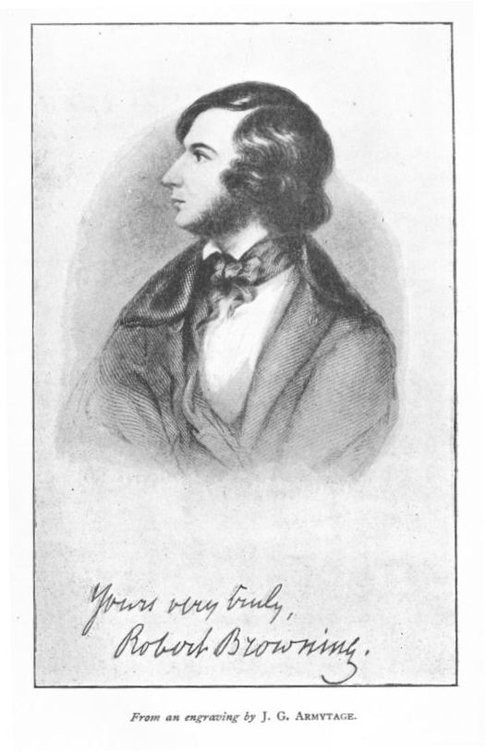
Yours very truly, Robert Browning. From an engraving by J.G. ARMYTAGE.
As summer passed into early autumn the sense of dangers and difficulties accumulating grew acute. "The ground," wrote Browning, "is crumbling from beneath our feet with its chances and opportunities." In one of the early days of August a thunder-storm with torrents of rain detained him for longer than usual at Wimpole Street; the lightning was the lesser terror of the day, for in the evening entered Mr Barrett to his daughter with disagreeable questioning, and presently came the words—accompanied by a gaze of stern displeasure—"It appears that that man has spent the whole day with you." The louring cloud passed, but it was felt that visits to be prudent must be rare; for the first time a week went by without a meeting. Early in September George Barrett, a kindly brother distinguished by his constant air of dignity and importance, was commissioned to hire a country house for the family at Dover or Reigate or Tunbridge, while paperers and painters were to busy themselves at Wimpole Street. The moment for immediate action had come; else all chance of Italy might be lost for the year 1846. "We must be married directly," wrote Browning on the morning when this intelligence arrived. Next day a marriage license was procured. On the following morning, Saturday, September 12th, accompanied by her maid Wilson, Miss Barrett, after a sleepless night, left her father's house with feet that trembled; she procured a fly, fortified her shaken nerves with a dose of sal volatile at a chemist's shop, and drove to Marylebone Church, where the marriage service was celebrated in the presence of two witnesses. As she stood and knelt her central feeling was one of measureless trust, a deep rest upon assured foundations; other women who had stood there supported by their nearest kinsfolk—parents or sisters—had one happiness she did not know; she needed it less because she was happier than they.[38] Then husband and wife parted. Mrs Browning drove to the house of her blind friend, Mr Boyd, who had been made aware of the engagement. On his sitting-room sofa she rested and sipped his Cyprus wine; by and by arrived her sisters with grave faces; the carriage was driven to Hampstead Heath for the soothing happiness of the autumnal air and sunshine; after which the three sisters returned to their father's house; the wedding-ring was regretfully taken off; and the prayer arose in Mrs Browning's heart that if sorrow or injury should ever follow upon what had happened that day for either of the two, it might all fall upon her.
Browning did not again visit at 50 Wimpole Street; it was enough to know that his wife was well, and kept all these things gladly, tremblingly, in her heart. For himself he felt that come what might his life had "borne flower and fruit."[39] On the Monday week which succeeded the marriage the Barrett family were to move to the country house that had been taken at Little Bookham. On Saturday afternoon, a week having gone by since the wedding, Mrs Browning and Wilson, left what had been her home. Flush was warned to make no demonstration, and he behaved with admirable discretion. It was "dreadful" to cause pain to her father by a voluntary act; but another feeling sustained her:—"You only! As if one said God only. And we shall have Him beside, I pray of Him." At Hodgson's, the stationer and bookseller's, they found Browning, and a little later husband and wife, with the brave Wilson and the discreet Flush, were speeding from Vauxhall to Southampton, in good time to catch the boat for Havre. A north wind blew them vehemently from the English coast. In the newspaper announcements of the wedding the date was to be omitted, and Browning rejected the suggestion that on this occasion, and with reference to the great event of his life, he should be defined to the public as "the author of Paracelsus."
NOTES:
Letters of E.B.B., i. 288.
See Letters of R.B. and E.B.B., i. 281.
E.B.B. to R.B., March 30, 1846.
E.B.B. to R.B., Sept. 14, 1846.
R.B. to E.B.B., Sept. 14, 1846.
Chapter VI
Early Years in Italy
The letters from which this story has been drawn have from first to last one burden; in them deep answers to deep; they happily are of a nature to escape far from the pedantries of literary criticism. It cannot be maintained that Browning quite equals his correspondent in the discovery of rare and exquisite thoughts and feelings; or that his felicity in giving them expression is as frequent as hers. Even on matters of literature his comments are less original than hers, less penetrating, less illuminating. Her wit is the swifter and keener. When Browning writes to afford her amusement, he sometimes appears to us, who are not greatly amused, a little awkward and laborious. She flashes forth a metaphor which embodies some mystery of feeling in an image entirely vital; he, with a habit of mind of which he was conscious and which often influences his poetry, fastens intensely on a single point and proceeds to muffle this in circumstance, assured that it will be all the more vividly apparent when the right instant arrives and requires this; but meanwhile some staying-power is demanded from the reader. Neither correspondent has the art of etching a person or a scene in a few decisive lines; the gift of Carlyle, the gift of Carlyle's brilliant wife is not theirs, perhaps because acid is needed to bite an etcher's plate. And, indeed, many of the minor notabilities of 1845, whose names appear in these letters, might hardly have repaid an etcher's intensity of selective vision. Among the groups of spirits who presented themselves to Dante there were some wise enough not to expect that their names should be remembered on earth; such shades may stand in a background. It is, however, strange that Browning who created so many living men and women should in his letters have struck out no swift indelible piece of portraiture; even here his is the inferior touch. And yet throughout the whole correspondence we cannot but be aware that his is the more massive and the more complex nature; his intellect has hardier thews; his passion has an energy which corresponds with its mass; his will sustains his passion and projects it forward. And towards Miss Barrett his strength is seen as gentleness, his energy as an inexhaustible patience of hope.
When Browning and his wife reached Paris, Mrs Browning was worn out by the excitement and fatigue. By a happy accident Mrs Jameson and her niece were at hand, and when the first surprise, with kisses to both fugitives, was over, she persuaded them to rest for a week where they were, promising, if they consented, to be their companion and aider until they arrived at Pisa. Their "imprudence," in her eyes, was "the height of prudence"; "wild poets or not" they were "wise people." The week at Paris was given up to quietude; once they visited the Louvre, but the hours passed for the most part indoors; it all seemed strange and visionary—"Whether in the body or out of the body," wrote Mrs Browning, "I cannot tell scarcely." From Paris and Orleans they proceeded southwards in weather, which, notwithstanding some rains, was delightful. From Avignon they went on pilgrimage to Petrarch's Vaucluse; Browning bore his wife to a rock in mid stream and seated her there, while Flush scurried after in alarm for his mistress. In the passage from Marseilles to Genoa, Mrs Browning was able to sit on deck; the change of air, although gained at the expense of some weariness, had done her a world of good.
Early in October the journeying closed at Pisa. Rooms were taken for six months in the great Collegio Ferdinando, close to the Duomo and the Leaning Tower, rooms not quite the warmest in aspect. Mrs Jameson pronounced the invalid not improved but transformed. The repose of the city, asleep, as Dickens described it, in the sun and the secluded life—a perpetual tête-à-tête, but one so happy—suited both the wedded friends; days of cloudless weather, following a spell of rain, went by in "reading and writing and talking of all things in heaven and earth, and a little besides; and sometimes even laughing as if we had twenty people to laugh with us, or rather hadn't." Their sole acquaintance was an Italian Professor of the University; for three months they never looked at a newspaper; then a loophole on the world was opened each evening by the arrival of the Siècle. The lizards were silent friends of one poet, and golden oranges gleamed over the walls to the unaccustomed eyes of the other like sunshine gathered into globes. They wandered through pine-woods and drove until the purple mountains seemed not far off. At the Lanfranchi Palace they thought of Byron, to see a curl of whose hair or a glove from whose hand, Browning declares (so foolish was he and ignorant) he would have gone farther than to see all Wordsworth, Coleridge and Southey condensed in Rosicrucian fashion into a vial. In the Campo Santo they listened to a musical mass for the dead. In the Duomo they heard the Friar preach. And early in the morning their dreams were scattered by the harmonious clangour of the church bells. "I never was happy before in my life," wrote Mrs Browning. Her husband relieved her of all housekeeping anxieties. At two o'clock came a light dinner—perhaps thrushes and chianti—from the trattoria; at six appeared coffee and milk-rolls; at nine, when the pine-fire blazed, roast chestnuts and grapes. Debts there were none to vex the spirits of these prudent children of genius. If a poet could not pay his butcher's and his baker's bills, Browning's sympathies were all with the baker and the butcher. "He would not sleep," wrote his wife, "if an unpaid bill dragged itself by any chance into another week "; and elsewhere: "Being descended from the blood of all the Puritans, and educated by the strictest of dissenters, he has a sort of horror about the dreadful fact of owing five shillings five days." Perhaps some of this horror arose from the sense of that weight which pecuniary cares hang upon all the more joyous mountings of the mind. One grief and only one was still present; Mr Barrett remained inexorable; his daughter hoped that with time and patience his arms would open to her again. It was a hope never to be fulfilled. In the cordial comradeship of Browning's sister, Sarianna, a new correspondent, there was a measure of compensation.
Already Browning had in view the collected edition of his Poetical Works which did not appear until 1849. The poems were to be made so lucid, "that everyone who understood them hitherto" was to "lose that mark of distinction." Paracelsus and Pippa were to be revised with special care. The sales reported by Moxon were considered satisfactory; but of course the profits as yet were those of his wife's poems. "She is," he wrote to his publisher, "there as in all else, as high above me as I would have her."
It was at Pisa that the highest evidence of his wife's powers as a poet came as an unexpected and wonderful gift to her husband. In a letter of December 1845—more than a year since—she had confessed that she was idle; and yet "silent" was a better word she thought than "idle." Her apology was that the apostle Paul probably did not work hard at tent-making during the week that followed his hearing of the unspeakable things. At the close of a letter written on July 22, 1846, she wrote: "You shall see some day at Pisa what I will not show you now. Does not Solomon say that 'there is a time to read what is written?' If he doesn't, he ought." The time to read had now come. "One day, early in 1847," as Mr Gosse records what was told to him by Browning, "their breakfast being over, Mrs Browning went upstairs, while her husband stood at the window watching the street till the table should be cleared. He was presently aware of someone behind him, although the servant was gone. It was Mrs Browning who held him by the shoulder to prevent his turning to look at her, and at the same time pushed a packet of papers into the pocket of his coat. She told him to read that, and to tear it up if he did not like it; and then she fled again to her own room." The papers were a transcript of those ardent poems which we know as "Sonnets from the Portuguese." Some copies were printed at Reading in 1847 for private circulation with the title "Sonnets by E.B.B." The later title under which they appeared among Mrs Browning's Poems in the edition of 1850 was of Browning's suggestion. His wife's proposal to name them "Sonnets from the Bosnian" was dismissed with words which allude to a poem of hers, "Catarina to Camoens," that had long been specially dear to him: "Bosnian, no! that means nothing. From the Portuguese: they are Catarina's sonnets!"
Pisa with all its charm lacked movement and animation. It was decided to visit Florence in April, and there enjoy for some days the society of Mrs Jameson before she left Italy. The coupé of the diligence was secured, and on April 20th Mrs Jameson's "wild poets but wise people" arrived at Florence. An excellent apartment was found in the Via delle Belle Donne near the Piazza Santa Maria Novella, and for Browning's special delight a grand piano was hired. When Mrs Browning had sufficiently recovered strength to view the city and its surroundings her pleasure was great: "At Pisa we say, 'How beautiful!' here we say nothing; it is enough if we can breathe." They had hoped for summer wanderings in Northern Italy; but Florence held them throughout the year except for a few days during which they attempted in vain to find a shelter from the heat among the pines of Vallombrosa. Provided with a letter of recommendation to the abbot they set forth from their rooms at early morning by vettura and from Pelago onwards, while Browning rode, Mrs Browning and Wilson in basket sledges were slowly drawn towards the monastery by white bullocks. A new abbot, a little holy man with a red face, had been recently installed, who announced that in his nostrils "a petticoat stank." Yet in the charity of his heart he extended the three days ordinarily permitted to visitors in the House of Strangers to five; during which period beef and oil, malodorous bread and wine and passages from the "Life of San Gualberto" were vouchsafed to heretics of both sexes; the mountains and the pinewoods in their solemn dialect spoke comfortable words.
"Rolling or sliding down the precipitous path" they returned to Florence in a morning glory, very merry, says Mrs Browning, for disappointed people. Shelter from the glare of August being desirable, a suite of comparatively cool rooms in the Palazzo Guidi were taken; they were furnished in good taste, and opened upon a terrace—"a sort of balcony terrace which ... swims over with moonlight in the evenings." From Casa Guidi windows—and before long Mrs Browning was occupied with the first part of her poem—something of the life of Italy at a moment of peculiar interest could be observed. Europe in the years 1847 and 1848 was like a sea broken by wave after wave of Revolutionary passion. Browning and his wife were ardently liberal in their political feeling; but there were differences in the colours of their respective creeds and sentiments; Mrs Browning gave away her imagination to popular movements; she was also naturally a hero-worshipper; she hoped more enthusiastically than he was wont to do; she was more readily depressed; the word "liberty" for her had an aureole or a nimbus which glorified all its humbler and more prosaic meanings. Browning, although in this year 1847 he made a move towards an appointment as secretary to a mission to the Vatican, at heart cared little for men in groups or societies; he cared greatly for individuals, for the growth of individual character. He had faith in a forward movement of society; but the law of social evolution, as he conceived it, is not in the hands of political leaders or ministers of state. He valued liberty chiefly because each man here on earth is in process of being tested, in process of being formed, and liberty is the condition of a man's true probation and development. Late in life he was asked to give his answer to the question: "Why am I a Liberal?" and he gave it succinctly in a sonnet which he did not reprint in any edition of his Works, although it received otherwise a wide circulation. It may be cited here as a fragment of biography:
[39]
[38]
[37]
As summer passed into early autumn the sense of dangers and difficulties accumulating grew acute. "The ground," wrote Browning, "is crumbling from beneath our feet with its chances and opportunities." In one of the early days of August a thunder-storm with torrents of rain detained him for longer than usual at Wimpole Street; the lightning was the lesser terror of the day, for in the evening entered Mr Barrett to his daughter with disagreeable questioning, and presently came the words—accompanied by a gaze of stern displeasure—"It appears that that man has spent the whole day with you." The louring cloud passed, but it was felt that visits to be prudent must be rare; for the first time a week went by without a meeting. Early in September George Barrett, a kindly brother distinguished by his constant air of dignity and importance, was commissioned to hire a country house for the family at Dover or Reigate or Tunbridge, while paperers and painters were to busy themselves at Wimpole Street. The moment for immediate action had come; else all chance of Italy might be lost for the year 1846. "We must be married directly," wrote Browning on the morning when this intelligence arrived. Next day a marriage license was procured. On the following morning, Saturday, September 12th, accompanied by her maid Wilson, Miss Barrett, after a sleepless night, left her father's house with feet that trembled; she procured a fly, fortified her shaken nerves with a dose of sal volatile at a chemist's shop, and drove to Marylebone Church, where the marriage service was celebrated in the presence of two witnesses. As she stood and knelt her central feeling was one of measureless trust, a deep rest upon assured foundations; other women who had stood there supported by their nearest kinsfolk—parents or sisters—had one happiness she did not know; she needed it less because she was happier than they.[38] Then husband and wife parted. Mrs Browning drove to the house of her blind friend, Mr Boyd, who had been made aware of the engagement. On his sitting-room sofa she rested and sipped his Cyprus wine; by and by arrived her sisters with grave faces; the carriage was driven to Hampstead Heath for the soothing happiness of the autumnal air and sunshine; after which the three sisters returned to their father's house; the wedding-ring was regretfully taken off; and the prayer arose in Mrs Browning's heart that if sorrow or injury should ever follow upon what had happened that day for either of the two, it might all fall upon her.
In 1841, John Kenyon, formerly a school-fellow of Browning's father, now an elderly lover of literature and of literary society, childless, wealthy, generous-hearted, proposed to Browning that he should call upon Elizabeth Barrett, Kenyon's cousin once removed, who was already distinguished as a writer of ardent and original verse. Browning consented, but the poetess "through some blind dislike of seeing strangers"—as she afterwards told a correspondent—declined, alleging, not untruly, as a ground of refusal, that she was then ailing in health.[35] Three years later Kenyon sent his cousin's new volumes of Poems as a gift to Sarianna Browning; her brother, lately returned from Italy, read these volumes with delight and admiration, and found on one of the pages a reference in verse to his "Pomegranates" of a kind that could not but give him a vivid moment of pleasure. Might he not relieve his sense of obligation by telling Miss Barrett, in a letter, that he admired her work? Mr Kenyon encouraged the suggestion, and though to love and be silent might on the whole have been more to Browning's liking, he wrote—January 10, 1845—and writing truthfully he wrote enthusiastically.[36] Miss Barrett, never quite recovered from a riding accident in early girlhood, and stricken down for long in both soul and body by the shock of her brother's death by drowning, lay from day to day and month to month, in an upper room of her father's house in Wimpole Street, occupied, upon her sofa, with her books and papers—her Greek dramatists and her Elizabethan poets—shut out from the world, with windows for ever closed, and with only an occasional female visitor, to gossip of the social and literary life of London. Never was a spirit of more vivid fire enclosed within a tomb. The letter from Browning, "the author of Paracelsus and King of the mystics," threw her, she says, "into ecstasics." Her reply has a thrill of pleasure running through its graceful half-restraint, and she holds out a hope that when spring shall arrive a meeting in the invalid chamber between her and her new correspondent may be possible.
Browning did not again visit at 50 Wimpole Street; it was enough to know that his wife was well, and kept all these things gladly, tremblingly, in her heart. For himself he felt that come what might his life had "borne flower and fruit."[39] On the Monday week which succeeded the marriage the Barrett family were to move to the country house that had been taken at Little Bookham. On Saturday afternoon, a week having gone by since the wedding, Mrs Browning and Wilson, left what had been her home. Flush was warned to make no demonstration, and he behaved with admirable discretion. It was "dreadful" to cause pain to her father by a voluntary act; but another feeling sustained her:—"You only! As if one said God only. And we shall have Him beside, I pray of Him." At Hodgson's, the stationer and bookseller's, they found Browning, and a little later husband and wife, with the brave Wilson and the discreet Flush, were speeding from Vauxhall to Southampton, in good time to catch the boat for Havre. A north wind blew them vehemently from the English coast. In the newspaper announcements of the wedding the date was to be omitted, and Browning rejected the suggestion that on this occasion, and with reference to the great event of his life, he should be defined to the public as "the author of Paracelsus."
For the humours of superficial situations and passing incidents Miss Barrett had a lively sense, and she found some relief in playing with them; but with a nature essentially truthful like hers the necessity of concealment was a cause of distress. The position was no less painful to Browning, and in the end it became intolerable. Yet while there were obstructions and winding ways in the shallows, in the depths were flawless truth and inviolable love. What sentimental persons fancy and grow effusive over was here the simplest and yet always a miraculous reality—"He of the heavens and earth brought us together so wonderfully, holding two souls in his hand."[37] In the most illuminating words of each correspondent no merely private, or peculiar feeling is expressed; it is the common wave of human passion, the common love of man and woman, that here leaps from the depths to the height, and over which the iris of beauty ever and anon appears with—it is true—an unusual intensity. And so in reading the letters we have no sense of prying into secrets; there are no secrets to be discovered; what is most intimate is most common; only here what is most common rises up to its highest point of attainment. "I never thought of being happy through you or by you or in you even, your good was all my idea of good, and is" "Let me be too near to be seen.... Once I used to be more uneasy, and to think that I ought to make you see me. But Love is better than sight." "I love your love too much. And that is the worst fault, my beloved, I can ever find in my love of you." These are sentences that tell of what can be no private possession, being as liberal and free as our light and air. And if the shadow of a cloud appears—appears and passes away—it is a shadow that has floated over many other hearts beside that of the writer: "How dreadfully natural it would be to me, seem to me, if you did leave off loving me! How it would be like the sun's setting ... and no more wonder. Only, more darkness." The old exchange of tokens, the old symbolisms—a lock of hair, a ring, a picture, a child's penholder—are good enough for these lovers, as they had been for others before them. What is diffused through many of the letters is gathered up and is delivered from the alloy of superficial circumstance in the "Sonnets from the Portuguese." in reading which we are in the presence of womanhood—womanhood delivered from death by love and from darkness by; light—as much as in that of an individual woman. And the disclosure in poems and in letters being without reserve affects us as no disclosure, but simply as an adequate expression of the truth universal.
In 1841, John Kenyon, formerly a school-fellow of Browning's father, now an elderly lover of literature and of literary society, childless, wealthy, generous-hearted, proposed to Browning that he should call upon Elizabeth Barrett, Kenyon's cousin once removed, who was already distinguished as a writer of ardent and original verse. Browning consented, but the poetess "through some blind dislike of seeing strangers"—as she afterwards told a correspondent—declined, alleging, not untruly, as a ground of refusal, that she was then ailing in health.[35] Three years later Kenyon sent his cousin's new volumes of Poems as a gift to Sarianna Browning; her brother, lately returned from Italy, read these volumes with delight and admiration, and found on one of the pages a reference in verse to his "Pomegranates" of a kind that could not but give him a vivid moment of pleasure. Might he not relieve his sense of obligation by telling Miss Barrett, in a letter, that he admired her work? Mr Kenyon encouraged the suggestion, and though to love and be silent might on the whole have been more to Browning's liking, he wrote—January 10, 1845—and writing truthfully he wrote enthusiastically.[36] Miss Barrett, never quite recovered from a riding accident in early girlhood, and stricken down for long in both soul and body by the shock of her brother's death by drowning, lay from day to day and month to month, in an upper room of her father's house in Wimpole Street, occupied, upon her sofa, with her books and papers—her Greek dramatists and her Elizabethan poets—shut out from the world, with windows for ever closed, and with only an occasional female visitor, to gossip of the social and literary life of London. Never was a spirit of more vivid fire enclosed within a tomb. The letter from Browning, "the author of Paracelsus and King of the mystics," threw her, she says, "into ecstasics." Her reply has a thrill of pleasure running through its graceful half-restraint, and she holds out a hope that when spring shall arrive a meeting in the invalid chamber between her and her new correspondent may be possible.
"Why?" Because all I haply can and do,All that I am now, all I hope to be,—Whence comes it save from fortune setting freeBody and soul the purpose to pursue,God traced for both? If fetters, not a few,Of prejudice, convention, fall from me,These shall I bid men—each in his degreeAlso God-guided—bear, and gladly too?
But little do or can the best of us:That little is achieved through Liberty.Who then dares hold—emancipated thus—His fellow shall continue bound? Not IWho live, love, labour freely, nor discussA brother's right to freedom. That is "Why."[40]
This is an excellent reason for the faith that was in Browning; he holds that individual progress depends on individual freedom, and by that word he understands not only political freedom but also emancipation from intellectual narrowness and the bondage of injurious convention. But Browning in his verse, setting aside the early Strafford, nowhere celebrates a popular political movement; he nowhere chaunts a paean, in the manner of Byron or Shelley, in honour of the abstraction "Liberty." Nor does he anywhere study political phenomena or events except as they throw light upon an individual character. Things and persons that gave him offence he could summarily dismiss from his mind—"Thiers is a rascal; I make a point of not reading one word said by M. Thiers"; "Proudhon is a madman; who cares for Proudhon?" "The President's an ass; he is not worth thinking of."[41] This may be admirable economy of intellectual force; but it is not the way to understand the course of public events; it does not indicate a political or a historical sense. And, indeed, his writings do not show that Browning possessed a political or a historical sense in any high degree, save as a representative person may be conceived by him as embodying a phase of civilisation. When Mrs Trollope called at Casa Guidi, Browning was only reluctantly present; she had written against liberal institutions and against the poetry of Victor Hugo, and that was enough. Might it not have been more truly liberal to be patient and understand the grounds of her prejudice? "Blessed be the inconsistency of men!" exclaimed Mrs Browning, for whose sake he tolerated the offending authoress until by and by he came to like in her an agreeable woman.
On the anniversary of their wedding day Browning and his wife saw from their window a brilliant procession of grateful and enthusiastic Florentines stream into the Piazza. Pitti with banners and vivas for the space of three hours and a half It was the time when the Grand Duke was a patriot and Pio Nono was a liberal. The new helmets and epaulettes of the civic guard proclaimed the glories of genuine freedom. The pleasure of the populace was like that of children, and perhaps it had some serious feeling behind it. The incomparable Grand Duke had granted a liberal constitution, and was led back from the opera to the Pitti by the torchlights of a cheering crowd—"through the dark night a flock of stars seemed sweeping up the piazza." A few months later, and the word of Mrs Browning is "Ah, poor Italy"; the people are attractive, delightful, but they want conscience and self reverence.[42] Browning and she painfully felt that they grew cooler and cooler on the subject of Italian patriotism. A revolution had been promised, but a shower of rain fell and the revolution was postponed. Now it was the Grand Duke out, and the bells rang, and a tree of liberty was planted close to the door of Casa Guidi; six weeks later it was the Grand Duke in, and the same bells rang, and the tree of liberty was pulled down. The Pope is well-meaning but weak; and before long honorific epithets have to be denied him—he is merely a Pope; his prestige and power over souls is lost. The liberal Grand Duke is transformed into a Duke decorated with Austrian titles. As for France, Mrs Browning had long since learnt from the books she read with so much delight to feel a debt to the country of Balzac and George Sand. She thought that the unrest and the eager hopes of the French Revolution, notwithstanding its errors, indicated at least the conception of a higher ideal than any known to the English people. Browning did not possess an equal confidence in France; he did not accept her view that the French occupation of Rome was capable of justification; nor did he enter into her growing hero-worship—as yet far from its full development—of Louis Napoleon. Her admiration for Balzac he shared, and it is probable that the death of the great novelist moved him to keener regret than did the death, at no considerable distance of time, of Wordsworth. With French communism or socialism neither husband nor wife, however republican in their faith, had sympathy; they held that its tendency is to diminish the influence of the individual, and that in the end the progress of the mass is dependent on the starting forth from the mass and the striding forward of individual minds. They believed as firmly as did Edmund Burke in the importance of what Burke styles a natural aristocracy.
For four years—from 1847 to 1851—Browning never crossed the confines of Italy. No duties summoned him away, and he was happy in his home. "We are as happy," he wrote in December 1847, "as two owls in a hole, two toads under a tree-stump; or any other queer two poking creatures that we let live after the fashion of their black hearts, only Ba is fat and rosy; yes indeed." In spring they drove day by day through the Cascine, passing on the way the carven window of the Statue and the Bust, and "the stone called Dante's," whereupon
He used to bring his quiet chair out, turnedTo Brunelleschi's church.[43]
And after tea there was the bridge of Trinita from which to watch the sunsets turning the Arno to pure gold while the moon and the evening-star hung aloft. It was a life of retirement and of quiet work. Mrs Browning mentions to a friend that for fifteen months she could not make her husband spend a single evening out—"not even to a concert, nor to hear a play of Alfieri's," but what with music and books and writing and talking, she adds, "we scarcely know how the days go, it's such a gallop on the grass." The "writing" included the revision and preparation for the press of Browning's Poems, in two volumes, which Chapman & Hall, more liberal than Moxon, had undertaken to publish at their own risk, and which appeared in 1849. Some care and thought were also given by Browning to the alterations of text made in the edition of his wife's Poems of the following year; and for a time his own Christmas Eve and Easter Day was an absorbing occupation. As to the "reading," the chief disadvantage of Florence towards the middle of the last century was the difficulty of seeing new books of interest, whether French or English. Yet Vanity Fair and The Princess, Jane Eyre and Modern Painters somehow found their way to Casa Guidi.[44]
Casa Guidi proper, the Casa Guidi which held the books and pictures and furniture and graceful knick-knacks chosen by its occupants, who were lovers of beauty, dates only from 1848. Previously they had been satisfied with a furnished apartment. Not long before the unfurnished rooms were hired, a mistake in choosing rooms which suffered from the absence of sunshine and warmth gave Browning an opportunity of displaying what to his wife's eyes appeared to be unexampled magnanimity. The six months' rent was promptly paid, and chambers on the Pitti "yellow with sunshine from morning to evening" were secured. "Any other man, a little lower than the angels," his wife assured Miss Mitford, "would have stamped and sworn a little for the mere relief of the thing, but as to his being angry with me for any cause, except not eating enough dinner, the sun would turn the wrong way first." It seemed an excellent piece of economy to take the spacious suite of unfurnished rooms in the Via Maggio, now distinguished by the inscription known to all visitors to Florence, which were to be had for twenty-five guineas a year, and which, when furnished, might be let during any prolonged absence for a considerable sum. The temptation of a ground-floor in the Frescobaldi Palace, and a garden bright with camellias, to which Browning for a time inclined, was rejected. At Casa Guidi the double terrace where orange-trees and camellias also might find a place made amends for the garden with its threatening cloud of mosquitoes, "worse than Austrians"; every need of space and height, of warmth and coolness seemed to be met; and it only remained to expend the welcome proceeds of the sale of books in the recreation of gathering together "rococo chairs, spring sofas, carved bookcases, satin from cardinals' beds and the rest." Before long Browning amused himself in picking up for a few pauls this or that picture, on seeing which an accomplished connoisseur, like Kirkup, would even hazard the name of Cimabue or Ghirlandaio, or if not that of Giotto, then the safer adjective Giottesque.
Although living the life of retirement which his wife's uncertain state of health required, Browning gradually obtained the acquaintance of several interesting persons, of whom Kirkup, who has just been mentioned, was one. "As to Italian society," wrote Mrs Browning, "one may as well take to longing for the evening star, for it seems quite inaccessible." But the name of Elizabeth Barrett, if not yet that of Robert Browning, was a sufficient introduction to cultivated Englishmen and Americans who had made Florence their home. Among the earliest of these acquaintances were the American sculptor Powers, Swedenborgian and spiritualist (a simple and genial man, "with eyes like a wild Indian's, so black and full of light"), and Hillard, the American lawyer, who, in his Six months in Italy, described Browning's conversation as "like the poetry of Chaucer," meaning perhaps that it was hearty, fresh, and vigorous, "or like his own poetry simplified and made transparent." "It seems impossible," Hillard goes on, "to think that he can ever grow old." And of Mrs Browning: "I have never seen a human frame which seemed so nearly a transparent veil for a celestial and immortal spirit. She is a soul of fire enclosed in a shell of pearl." A third American friend was one who could bring tidings of Emerson and Hawthorne—Margaret Fuller of "The Dial," now Countess d'Ossoli, "far better than her writings," says Mrs Browning, "... not only exalted but exaltée in her opinions, yet calm in manner." Her loss, with that of her husband, on their voyage to America deeply affected Mrs Browning. "Was she happy in anything?" asks her sorrowing friend. The first person seen on Italian soil when Browning and his wife disembarked at Leghorn was the brilliant and erratic Irish priest, "Father Prout" of Fraser's Magazine, who befriended them with good spirits and a potion of eggs and port wine when Browning was ill in Florence, and chided Mrs Browning as a "bambina" for her needless fears. Charles Lever "with the sunniest of faces and cordialest of manners"—animal spirits preponderating a little too much over an energetic intellect—called on them at the Baths of Lucca, but the acquaintance did not ripen into friendship. And little Miss Boyle, one of the family of the Earls of Cork, would come at night, at the hour of chestnuts and mulled wine, to sparkle as vivaciously as the pine-log that warmed her feet. These, with the Hoppners, known to Shelley and Byron, a French sculptress of royalist sympathies, Mlle. de Fauveau, much admired by Browning, and one of the grandsons of Goethe, who flits into and out of the scene, were a compensation for the repulsiveness of certain English folk at Florence who gathered together only for the frivolities, and worse than frivolities, of foreign wayfaring.
In March 1849 joy and sorrow met and mingled in the lives of Browning and his wife. On the ninth of that month a son was born at Casa Guidi, who six weeks later was described by his mother as "a lovely, fat, strong child, with double chin and rosy cheeks and a great wide chest." He was baptised, with the simple Lutheran rites, Robert Wiedemann Barrett—the "Wiedemann" in remembrance of the maiden name of Browning's mother. From the first, Browning and his wife, to adopt a phrase from one of her letters, caught up their parental pleasures with a sort of passion.[45] Mrs Browning's letters croon with happiness in the beauty, the strength, the intelligence, the kind-hearted disposition of her boy. And the boy's father, from the days when he would walk up and down the terrace of Casa Guidi with the infant in his arms to the last days of his life, felt to the full the gladness and the repose that came with this strong bondage of his heart. When little Wiedemann could frame imperfect speech upon his lips he transformed that name into "Penini," which abbreviated to "Pen" became serviceable for domesticities. It was a fantastic derivation of Nathaniel Hawthorne which connected Penini with the colossal statue in Florence bearing the name of "Apeninno." Flush for a time grew jealous, and not altogether without cause.
But the joy was pursued and overtaken by sorrow. A few days after the birth of his son came tidings of the death of Browning's mother. He had loved her with a rare degree of passion; the sudden reaction from the happiness of his wife's safety and his son's birth was terrible; it almost seemed a wrong to his grief to admit into his consciousness the new gladness of the time. In this conflict of emotions his spirits and to some extent his health gave way. He could not think of returning to his father's home without extreme pain—"It would break his heart," he said, "to see his mother's roses over the wall, and the place where she used to lay her scissors and gloves." He longed that his father and sister should quit the home of sorrow, and hasten to Florence; but this was not to be. As for England, it could not be thought of as much on his wife's account as his own. Her father held no communication with her; supplicating letters remained unnoticed; her brothers were temporarily estranged. Her sister Henrietta had left her former home; having "insulted" her father by asking his consent to her marriage with Captain Surtees Cook, she had taken the matter into her own hands; the deed was done, and the name of his second undutiful daughter—married to a person of moderate means and odiously "Tractarian views"—was never again to be mentioned in Mr Barrett's presence. England had become for Mrs Browning a place of painful memories, and a centre of present strife which she did not feel herself as yet able to encounter.
The love of wandering, however, when successive summers came, and Florence was ablaze with sunshine, grew irresistible, and drove Browning and his household to seek elsewhere for fresh interests or for coolness and repose. In 1848, beguiled by the guide-book, they visited Fano to find it quivering with heat, "the very air swooning in the sun." Their reward at Fano was that picture by Guercino of the guardian angel teaching a child to pray, the thought of which Browning has translated into song:
We were at Fano, and three times we wentTo sit and see him in his chapel there,And drink his beauty to our soul's content—My angel with me too.
Ancona, where the poem was written, if its last line is historically true, followed Fano, among whose brown rocks, "elbowing out the purple tides," and brown houses—"an exfoliation of the rock"—they lived for a week on fish and cold water. The tour included Rimini and Ravenna, with a return to Florence by Forli and a passage through the Apennines. Next year—1849—when Pen was a few months old, the drop of gipsy blood in Browning's veins, to which his wife jestingly refers, tingled but faintly; it was Mrs Browning's part to compel him, for the baby's sake and hers, to seek his own good. They visited Spezzia and glanced at the house of Shelley at Lerici; passed through olive woods and vineyards, and rested in "a sort of eagle's nest" at the highest habitable point of the Baths of Lucca. Here the baby's great cheeks grew rosier; Browning gained in spirits; and his wife was able "to climb the hills and help him to lose himself in the forests." When they wandered at noon except for some bare-footed peasant or some monk with the rope around his waist, it was complete solitude; and on moonlit nights they sat by the waterfalls in an atmosphere that had the lightness of mountain air without its keenness. On one occasion they climbed by dry torrent courses five miles into the mountains, baby and all, on horseback and donkeyback—"such a congregation of mountains; looking alive in the stormy light we saw them by." It was certainly a blessed transformation of the prostrate invalid in the upper room at Wimpole Street. Setting aside his own happiness, Browning could feel with regard to her and his deep desire to serve her, that he had seen of the travail of his soul, and in this matter was satisfied.
The weeks at Siena of the year 1850 were not quite so prosperous. During that summer Mrs Browning had been seriously ill. When sufficiently recovered she was carried by her husband to a villa in the midst of vines and olives, a mile and a half or two miles outside Siena, which commanded a noble prospect of hills and plain. At first she could only remain seated in the easy-chair which he found for her in the city. For a day there was much alarm on behalf of the boy, now able to run about, who lay with heavy head and glassy eyes in a half-stupor; but presently he was astir again, and his "singing voice" was heard in the house and garden. Mrs Browning in the fresh yet warm September air regained her strength. Before returning to Florence, they spent a week in the city to see the churches and the pictures by Sodoma. Even little Wiedemann screamed for church-interiors and developed remarkable imitative pietisms of a theatrical kind. "It was as well," said Browning, "to have the eyeteeth and the Puseyistical crisis over together."
This comment, although no more than a passing word spoken in play, gives a correct indication of Browning's feeling, fully shared in by his wife, towards the religious movement in England which was altering the face of the established Church. "Puseyism" was for them a kind of child's play which unfortunately had religion for its play-ground; they viewed it with a superior smile, in which there was more of pity than of anger. Both of them, though one was a writer for the stage and the other could read Madame Bovary without flinching and approved the morals of La Dame aux Camélias, had their roots in English Puritanism.[46] And now the time had come when Browning was to embody some of his Puritan thoughts and feelings relating to religion in a highly original poem.
NOTES:
"Why am I a Liberal?" Edited by Andrew Reid. London, 1885.
Letters of E.B.B., i. 442.
To Miss Mitford, August 24, 1848.
Casa Guidi Windows, i.
"Jane Eyre" was lent to E.B.B. by Mrs Story.
To Miss Mitford, Feb. 18, 1850.
In January 1859, Pen was reading an Italian translation of Monte Cristo, and announced, to his father's and mother's amusement, that after Dumas he would proceed to "papa's favourite book, Madame Bovary".
Chapter VII
Christmas Eve and Easter Day
Christmas Eve and Easter Day was published by Chapman & Hall in the year 1850. It was reported to the author that within the first fortnight two hundred copies had been sold, with which evidence of moderate popularity he was pleased; but the initial success was not maintained and subsequently the book became, like Sordello, a "remainder." As early as 1845, in the opening days of the correspondence with Miss Barrett, when she had called upon her friend to speak as poet in his own person and to speak out, he assured her that whereas hitherto he had only made men and women utter themselves on his behalf and had given the truth not as pure white light but broken into prismatic hues, now he would try to declare directly that which was in him. In place of his men and women he would have her to be a companion in his work, and yet, he adds, "I don't think I shall let you hear, after all, the savage things about Popes and imaginative religions that I must say." We can only conjecture as to whether the theme of the poem of 1850 was already in Browning's mind. His wife's influence certainly was not unlikely to incline him towards the choice of a subject which had some immediate relation to contemporary thought. She knew that poetry to be of permanent value must do more than reflect a passing fashion; that in a certain sense it must in its essence be out of time and space, expressing ideas and passions which are parts of our abiding humanity. Yet she recognised an advantage in pressing into what is permanent through the forms which it assumes in the world immediately around the artist. And even in 1845 the design of such a poem as her own Aurora Leigh was occupying her thoughts; she speaks of her intention of writing a sort of "novel-poem, running into the midst of our conventions, and rushing into drawing-rooms and the like, 'where angels fear to tread'; and so, meeting face to face and without mask the Humanity of the age, and speaking the truth as I conceive of it out plainly." Browning's poem did not rush into drawing-rooms, but it stepped boldly into churches and conventicles and the lecture-rooms of theological professors.
The spiritual life individual and the spiritual life corporate—these, to state it in a word, are the subjects dealt with in the two connected poems of his new volume; the spiritual life individual is considered in Easter Day; the spiritual life corporate in Christmas Eve. Browning, with the blood of all the Puritans in him, as his wife expressed it, could not undervalue that strain of piety which had descended from the exiles at Geneva and had run on through the struggles for religious liberty in the nonconformist religious societies of the seventeenth century and the Evangelical revival of times less remote. Looking around him he had seen in his own day the progress of two remarkable movements—one embodying, or professing to embody, the Catholic as opposed to the Puritan conception of religion, the other a free critical movement, tending to the disintegration of the traditional dogma of Christianity, yet seeking to preserve and maintain its ethical and even in part its religious influence. The facts can be put concisely if we say that one and the same epoch produced in England the sermons of Spurgeon, the Apologia pro vita sua of Newman, and the Literature and Dogma of Matthew Arnold. To discuss these three conceptions of religion adequately in verse would have been impossible even for the argumentative genius of Dryden, and would have converted a work of art into a theological treatise. But three representative scenes might be painted, and some truths of passionate feeling might be flung out by way of commentary. Such was the design of the poet of Christmas Eve.
To topple over from the sublime to the ridiculous is not difficult. But the presence of humour might save the sublimities from a fall, and Browning had hitherto in his art made but slight and occasional use of a considerable gift of humour which he possessed. It was humour not of the highest or finest or subtlest kind; it was very far from the humour of Shakespeare or of Cervantes, which felt so profoundly all the incongruities, majestic, pathetic, and laughable, of human nature. But it had a rough vigour of its own; it was united with a capacity for exact and shrewd observation; and if it should ever lead him to play the part of a satirist, the satire must needs be rather that of love than of malice. One who esteemed so highly the work of Balzac and of Flaubert might well be surmised to have something in his composition of what we now call the realist in art; and the work of the realist might serve to sustain and vindicate the idealist's ventures of imaginative faith. The picture of the lath-and-plaster entry of "Mount Zion" and of the pious sheep—duly indignant at the interloper in their midst—who one by one enter the fold, if not worthy of Cervantes or of Shakespeare, is hardly inferior to the descriptive passages of Dickens, and it is touched, in the manner of Dickens, with pity for these rags and tatters of humanity. The night, the black barricade of cloud, the sudden apparition of the moon, the vast double rainbow, and He whose sweepy garment eddies onward, become at once more supernatural and more unquestionably real because sublimity springs out of grotesquerie. Is the vision of the face of Christ an illusion?
The whole face turned upon me full,And I spread myself beneath it,As when the bleacher spreads, to seethe itIn the cleansing sun, his wool,—Steeps in the flood of noontide whitenessSome defiled, discoloured web—So lay I saturate, with brightness.
Is this a phantom or a dream? Well, at least it is certain that the witness has seen with his mortal eyes the fat weary woman, and heard the mighty report of her umbrella, "wry and flapping, a wreck of whalebones." And the fat woman of Mount Zion Chapel, with Love Lane at the back of it, may help us to credit the awful vision of the Lord.
Thus the poem has the imaginative sensuousness which art demands; it is not an argument but a series of vivid experiences, though what is sensuous is here tasked in the service of what is spiritual, and a commentary is added. The central idea of the whole is that where love is, there is Christ; and the Christ of this poem is certainly no abstraction, no moral ideal, no transcendental conception of absolute charity, but very God and very man, the Christ of Nazareth, who dwelt among men, full of grace and truth. Literary criticism which would interpret Browning's meaning in any other sense may be ingenious, but it is not disinterested, and some side-wind blows it far from the mark.
Love with defective knowledge, he maintains, is of more spiritual worth than knowledge with defective love. Desiring to give salience to this idea, he deprives his little pious conventicle of every virtue except one—"love," and no other word is written on each forehead of the worshippers. Browning, the artist and student of art, was not insensible to the spiritual power of beauty; and beauty is conspicuously absent from the praise and prayer that went up from Mount Zion chapel; its forms of worship are burlesque and uncouth. Browning, the lover of knowledge, was not insensible to the value of intelligence in things of religion; and the congregation of Mount Zion sit on "divinely flustered" under
the pig-of-lead-like pressureOf the preaching man's immense stupidity.
The pastor, whose words so sway his enraptured flock, mangles the Holy Scriptures with a fine irreverence, and pours forth his doctrine with an entirely self-satisfied indifference to reason and common sense. Nor has love accomplished its perfect work, for the interloper who stands at the entry is eyed with inquisitorial glances of pious exclusiveness—how has a Gallio such as he ventured to take his station among the elect? Matthew Arnold, had he visited Mount Zion, might have discoursed with a charmingly insolent urbanity on the genius for ugliness in English dissent, and the supreme need of bringing a current of new ideas to play upon the unintelligent use of its traditional formulae. And Matthew Arnold would have been right. These are the precise subjects of Browning's somewhat rough-and-ready satire. But Browning adds that in Mount Zion, love, at least in its rudiments, is present, and where love is, there is Christ.
Of English nonconformity in its humblest forms Browning can write, as it were, from within; he writes of Roman Catholic forms of worship as one who stands outside; his sympathy with the prostrate multitude in St. Peter's at Rome is of an impersonal kind, founded rather upon the recognition of an objective fact than springing from an instinctive feeling. For a moment he is carried away by the tide of their devout enthusiasms; but he recovers himself to find indeed that love is also here and therefore Christ is present, but the worshippers fallen under "Rome's gross yoke," are very infants in their need of these sacred buffooneries and posturings and petticoatings; infants
Peevish as ever to be suckled,Lulled with the same old baby-prattleWith intermixture of the rattle.
And this, though the time has come when love would have them no longer infantile, but capable of standing and walking, "not to speak of trying to climb." Such a short and easy method of dealing with Roman Catholic dogma and ritual cannot be commended for its intelligence; it is quite possible to be on the same side as Browning without being as crude as he in misconception. He does not seriously consider the Catholic idea which regards things of sense as made luminous by the spirit of which they are the envoys and the ministers. It is enough for him to declare his own creed which treats any intermediary between the human soul and the Divine as an obstruction or a veil:
My heart does best to receive in meeknessThat mode of worship, as most to his mind,Where earthly aids being left behind,His All in All appears sereneWith the thinnest human veil between,Letting the mystic lamps, the seven,The many motions of his spirit,Pass as they list to earth from heaven.
This was the creed of Milton and of Bunyan; and yet with both Milton and Bunyan the imagery of the senses is employed as the means not of concealing but revealing the things of the spirit.
From the lecture-room of Göttingen, with its destructive and reconstructive criticism, Browning is even farther removed than he is from the ritualisms of the Roman basilica. Yet no caricature can be more amiable than his drawing of the learned Professor, so gentle in his aspect, so formidable in his conclusions, who, gazing into the air with a pure abstracted look, proceeds in a grave sweet voice to exhibit and analyse the sources of the myth of Christ. In the Professor's lecture-room Browning finds intellect indeed but only the shadow of love. He argues that if the "myth" of Christ be dissolved, the authority of Christ as a teacher disappears; Christ is even inferior to other moralists by virtue of the fact that He made personal claims which cannot be sustained. And whatever may be Christ's merit as a teacher of the truth, the motive to action which His life and words supplied must cease to exist if it be shown that the divine sacrifice of God manifest in the flesh is no more than a figment of the devout imagination. At every point the criticism of Browning is as far apart as it is possible to conceive from the criticism set forth in the later writings of Matthew Arnold. The one writer regards the "myth" as no more than the grave-clothes of a risen Christ whose essential virtue lies in his sweet reasonableness and his morality touched with enthusiasm. The other believes that if the wonderful story of love be proved a fable, a profound alteration—and an alteration for the worse—has been made in the religious consciousness of Christendom. And undoubtedly the difference between the supernatural and the natural theories of Christianity is far greater than Arnold represented it to be. But Browning at this date very inadequately conceived the power of Christ as a revealer of the fatherhood of God. In that revelation, whether the Son of God was human or divine, lay a truth of surpassing power, and a motive of action capable of summoning forth the purest and highest energies of the soul. That such is the case has been abundantly evidenced by the facts of history. Browning finds only much learning and the ghost of dead love in the Göttingen lecture-room; and of course it was easy to adapt his Professor's lecture so as to arrive at this conclusion. But the process and the conclusion are alike unjust.
Having traversed the various forms of Christian faith and scepticism, the speaker in Christmas Eve declines into a mood of lazy benevolence and mild indifferentism towards each and all of these. Has not Christ been present alike at the holding-forth of the poor dissenting son of thunder, who tore God's word into shreds, at the tinklings and posturings and incense-fumes of Roman pietism, and even at the learned discourse which dissolved the myth of his own life and death? Why, then, over-strenuously take a side? Why not regard all phases of belief or no-belief with equal and serene regard? Such a mood of amiable indifferentism is abhorrent to Browning's feelings. The hem of Christ's robe passes wholly at this point from the hand of the seer of visions in his poem. One best way of worship there needs must be; ours may indeed not be the absolutely best, but it is our part, it is our probation to see that we strive earnestly after what is best; yes, and strive with might and main to confer upon our fellows the gains which we have found. It may be God's part—we trust it is—to bring all wanderers to the one fold at last. As for us, we must seek after Him and find Him in the mode required by our highest thought, our purest passion. Here Browning speaks from his central feeling. Only, we may ask, what if one's truest self lie somewhere hidden amid a thousand hesitating sympathies? And is not the world spacious enough to include a Montaigne as well as a Pascal or a Browning? Assuredly the world without its Montaigne would be a poorer and a less hospitable dwelling-place for the spirits of men.
Mrs Browning complained to her husband of what she terms the asceticism of Easter Day, the second part of his volume of 1850; his reply was that it stated "one side of the question." "Don't think," Mrs Browning says, "that he has taken to the cilix—indeed he has not—but it is his way to see things as passionately as other people feel them." Easter Day has nothing to say of religious life in Churches and societies, nothing of the communities of public worship. For the writer of this poem only three things exist—God, the individual soul, and the world regarded as the testing place and training place of the soul. Browning has here a rigour of moral or spiritual earnestness which may be called, by any one who so pleases, Puritan in its kind and its intensity; he feels the need, if we are to attain any approximation to the Christian ideal, of the lit lamp and the girt loin. Two difficulties in the Christian life in particular he chooses to consider—first, the difficulty of faith in the things of the spirit, and especially in what he regards as the essential parts of the Christian story; and secondly, the difficulty of obeying the injunction to renounce the world. That we cannot grow to our highest attainment by the old method enjoined by pagan philosophy—that of living according to nature, he regards as evident, for nature itself is warped and marred; it groans and travails, and from its discords how shall we frame a harmony? It was always his habit of mind, he tells us, from his childhood onwards, to face a danger and confront a doubt, and if there were anywhere a lurking fear, to draw this forth from its hiding-place and examine it in the light, even at the risk of some mortal ill. Therefore he will press for an answer to his present questionings; he will try conclusions to the uttermost.
As to the initial difficulty of faith, Browning with a touch of scorn, assures us that evidences of spiritual realities, evidences of Christianity—as they are styled—external and internal will be readily found by him who desires to find; convincing enough they are for him who wants to be convinced. But in truth faith is a noble venture of the spirit, an aspiring effort towards what is best, even though what is best may never be attained. The mole gropes blindly in unquestionably solid clay; better be like the grasshopper "that spends itself in leaps all day to reach the sun." A grasshopper's leap sunwards—that is what we signify by this word "faith."
But the difficulties of the Christian life only shift their place when faith by whatever means has been won. We are bidden to renounce the world: what does the injunction mean? in what way shall it be obeyed? "Ascetic" Mrs Browning named this poem; and ascetic it is if by that word we understand the counselling and exhorting to a noble exercise and discipline; but Browning even in his poem by no means wears the cilix, and no teaching can be more fatal than his to asceticism in the narrower sense of the word. To renounce the world, if interpreted aright, is to extinguish or suppress no faculty that has been given to man, but rather to put each faculty to its highest uses:
"Renounce the world!"—Ah, were it doneBy merely cutting one by oneYour limbs off, with your wise head last,How easy were it!—how soon past,If once in the believing mood.
The harder and the higher renunciation is this—to choose the things of the spirit rather than the things of sense, and again in accepting, as means of our earthly discipline and development, the things of sense to press through these to the things of the spirit which lie behind and beyond and above them.
Such, and such alone, is the asceticism to which Browning summons his disciple; it is the asceticism of energy not that of atrophy; it does not starve the senses, but reinforces the spirit; it results not in a cloistered but a militant virtue. A certain self-denial it may demand, but the self-denial becomes the condition of a higher joy. And if life with its trials frays the flesh, what matters it when the light of the spirit shines through with only a fuller potency? In the choice between sense and spirit, or, to put it more generally, in the choice between what is higher and less high, lies the probation of a soul, and also its means of growth. And what is the meaning of this mortal life—this strange phenomenon otherwise so unintelligible—if it be not the moment in which a soul is proved, the period in which a soul is shaped and developed for other lives to come?
To forget that Browning is a preacher may suit a dainty kind of criticism which detaches the idea of beauty from the total of our humanity addressed by the greater artists. But the solemn thoughts that are taken up by beauty in such work, for example, as that of Michael Angelo, are an essential element or an essential condition of its peculiar character as a thing of beauty. And armour, we know, may be as lovely to the mere senses as a flower. Browning's doctrine may sometimes protrude gauntly through his poetry; but at his best—as in Rabbi ben Ezra or Abt Vogler—the thought of the poem is needful in the dance of lyrical enthusiasm, as the male partner who takes hands with beauty, and to separate them would bring the dance to a sudden close. Both are present in Easter Day, and we must watch the movement of the two. In a passage already quoted from Christmas Eve the face of Christ is nobly imagined as the sun which bleaches a discoloured web. Here the poet's imagination is as intense in its presentation of Christ the doomsman:
He stood there. Like the smokePillared o'er Sodom, when day broke—I saw Him. One magnific pallMantled in massive fold and fallHis head, and coiled in snaky swathesAbout His feet; night's black, that bathesAll else, broke, grizzled with despair,Against the soul of blackness there.A gesture told the mood within—That wrapped right hand which based the chin,—That intense meditation fixedOn His procedure,—pity mixedWith the fulfilment of decree.Motionless thus, He spoke to me,Who fell before His feet, a mass,No man now.
The picture of the final conflagration of the Judgment Day is perhaps over-laboured, a descriptive tour de force, horror piled upon horror with accumulative power,—a picture somewhat too much in the manner of Martin; and the verse does not lend itself to the sustained sublimity of terror. The glow of Milton's hell is intenser, and Milton's majestic instrumentation alone could render the voices of its flames. The real awfulness of Browning's Judgment Day dwells wholly in the inner experiences of a solitary soul. The speaker finds of a sudden that the doom is upon him, and that in the probation of life his choice was earth, not heaven. The sentence pronounced upon him is in accordance with the election of his own will—let earth, with all its beauty of nature, all its gifts of human art, all its successes of the intellect, as he had conceived and chosen them, be his. To his despair, he finds that what he had prized in life, and what is now granted to him cannot bring him happiness or even content. The plenitude of beauty, of which all partial beauty was but a pledge, is forever lost to him. The glory of art, which lay beyond its poor actual attainments, is lost. The joy of knowledge, with all those
grasps of guessWhich pull the more into the less,
is lost. And as to earth's best possession—love—had he ever made a discovery through human love of that which it forthshadows—the love that is perfect and divine? Earth is no longer earth to the doomed man, but the star of the god Rephan of which we read in one of Browning's latest poems; in the horror of its blank and passionless uniformity, untroubled by any spiritual presences, he cowers at the Judge's feet, and prays for darkness, hunger, toil, distress, if only hope be also granted him:
Then did the form expand, expand—knew Him through the dread disguiseAs the whole God within his eyesEmbraced me.
The Doomsman has in a moment become the Saviour. In all this, if Browning has the burden of a prophecy to utter, he utters it, after the manner of earlier prophets, as a vision. His art is sensuous and passionate; his argument is transformed into a series of imaginative experiences.
Mrs. Browning's illness during the summer and early autumn of 1850 left her for a time more shaken in health than she had been since her marriage. But by the spring of the following year she had recovered strength; and designs of travel were formed, which should include Rome, North Italy, Switzerland, the Rhine, Brussels, Paris and London. Almost at the moment of starting for Rome at the end of April, the plans were altered; the season was too far advanced for going south; ways and means must be economised; Rome might be postponed for a future visit; and Venice would make amends for the present sacrifice. And Venice in May and early June did indeed for a time make amends. "I have been between heaven and earth," Mrs. Browning wrote, "since our arrival at Venice." The rich architecture, the colour, the moonlight, the music, the enchanting silence made up a unity of pleasures like nothing that she had previously known. When evening came she and her husband would follow the opera from their box hired for "two shillings and eightpence English," or sit under the moon in the piazza of St Mark sipping coffee and reading the French papers. But as the month went by, Browning lost appetite and lost sleep. The "soothing, lulling, rocking atmosphere" which suited Mrs. Browning made him, after the first excitement of delight, grow nervous and dispirited. They hastened away to Padua, drove to Arqua, "for Petrarch's sake," passed through Brescia in a flood of white moonlight, and having reached Milan climbed—the invalid of Wimpole Street and her husband—to the topmost point of the cathedral. From the Italian lakes they crossed by the St Gothard to Switzerland, and omitting part of their original scheme of wandering, journeyed in twenty-four hours without stopping from Strasburg to Paris.
In Paris they loitered for three weeks. Mrs. Browning during the short visit which followed her marriage had hardly seen the city. Bright shop-windows, before which little Wiedemann would scream with pleasure, restaurants and dinners à la carte, full-foliaged trees and gardens in the heart of the town were a not unwelcome exchange for Italian church-interiors and altar-pieces. Even "disreputable prints and fascinating hats and caps" were appreciated as proper to the genius of the place, and the writer of Casa Guidi Windows had the happiness of seeing her hero, M. le President, "in a cocked hat, and with a train of cavalry, passing like a rocket along the boulevards to an occasional yell from the Red." By a happy chance they lighted in Paris upon Tennyson, now Poet-laureate, whom Mrs. Browning had hitherto known only through his poems; he was in the friendliest mood, and urged that they should make use of his house and servants during their stay in England, an offer which was not refused, though there was no intention of actually taking advantage of the kindness. As for England, the thought of it, with her father's heart and her father's door closed against her, was bitter as wormwood to Mrs. Browning. "It's only Robert," she wrote, "who is a patriot now, of us two."
English soil as they stepped ashore was a puddle, and English air a fog. London lodgings were taken at 26 Devonshire Street, and, although Mrs. Browning suffered from the climate, they were soon dizzied and dazzled by the whirl of pleasant hospitalities. An evening with Carlyle ("one of the greatest sights in England"), a dinner given by Forster at Thames Ditton, "in sight of the swans," a breakfast with Rogers, daily visits of Barry Cornwall, cordial companionship of Mrs. Jameson, a performance by the Literary Guild actors, a reading of Hamlet by Fanny Kemble—with these distractions and such as these the two months flew quickly. It was in some ways a relief when Pen's faithful maid Wilson went for a fortnight to see her kinsfolk, and Mrs. Browning had to take her place and substitute for social racketing domestic cares. The one central sorrow remained and in some respects was intensified. She had written to her father, and Browning himself wrote—"a manly, true, straight-forward letter," she informs a friend, "... everywhere generous and conciliating." A violent and unsparing reply was made, and with it came all the letters that his undutiful daughter had written to Mr. Barrett; not one had been read or opened. He returned them now, because he had not previously known how he could be relieved of the obnoxious documents. "God takes it all into his own hands," wrote Mrs. Browning, "and I wait." Something, however, was gained; her brothers were reconciled; Arabella Barrett was constant in kindness; and Henrietta journeyed from Taunton to London to enjoy a week in her company.
It was at Devonshire Street that Bayard Taylor, the distinguished American poet and critic, made the acquaintance of the Brownings, and the record of his visit gives a picture of Browning at the age of thirty-nine, so clearly and firmly drawn that it ought not to be omitted here: "In a small drawing-room on the first floor I met Browning, who received me with great cordiality. In his lively, cheerful manner, quick voice, and perfect self-possession, he made the impression of an American rather than an Englishman. He was then, I should judge, about thirty-seven years of age, but his dark hair was already streaked with gray about the temples. His complexion was fair, with perhaps the faintest olive tinge, eyes large, clear, and gray, nose strong and well cut, mouth full and rather broad, and chin pointed, though not prominent. His forehead broadened rapidly upwards from the outer angle of the eyes, slightly retreating. The strong individuality which marks his poetry was expressed not only in his face and head, but in his whole demeanour. He was about the medium height, strong in the shoulders, but slender at the waist, and his movements expressed a combination of vigour and elasticity." Mrs Browning with her slight figure, pale face, shaded by chestnut curls, and grave eyes of bluish gray, is also described; and presently entered to the American visitor Pen, a blue-eyed, golden-haired boy, who babbled his little sentences in Italian.
When, towards the close of September, Browning and his wife left London for Paris, Carlyle by his own request was their companion on the journey. Mrs Browning feared that his irritable nerves would suffer from the vivacities of little Pen, but it was not so; he accepted with good humour the fact that the small boy had not yet learned, like his own Teufelsdröckh, the Eternal No: "Why, sir," exclaimed Carlyle, "you have as many aspirations as Napoleon!"[47] At Dieppe, Browning, as Carlyle records, "did everything, fought for us, and we—that is, the woman, the child and I—had only to wait and be silent." At Paris in the midst of "a crowding, jangling, vociferous tumult, the brave Browning fought for us, leaving me to sit beside the woman." An apartment was found on the sunny side of the Avenue des Champs-Elysées, "pretty, cheerful, carpeted rooms," far brighter and better than those of Devonshire Street, and when, to Browning's amusement, his wife had moved every chair and table into the new and absolutely right position, they could rest and be thankful. Carlyle spent several evenings with them, and repaid the assistance which he received in various difficulties from Browning's command of the language, by picturesque conversations in his native speech: "You come to understand perfectly," wrote Mrs Browning, "when you know him, that his bitterness is only melancholy, and his scorn sensibility." A little later Browning's father and sister spent some weeks in Paris. Here, at all events, were perfect relations between the members of a family group; the daughter here was her father's comrade with something even of a maternal instinct; and the grandfather discovered to his great satisfaction that his own talent for drawing had descended to his grandchild.
The time was one when the surface of life in Paris showed an unruffled aspect; but under the surface were heavings of inward agitation. On the morning of December 2nd the great stroke against the Republic was delivered; the coup d'état was an accomplished fact. Later in the day Louis Napoleon rode under the windows of the apartment in the Avenue des Champs-Elysées, from the Carrousel to the Arc de l'Étoile. To Mrs Browning it seemed the grandest of spectacles—"he rode there in the name of the people after all." She and her husband had witnessed revolutions in Florence, and political upheavals did not seem so very formidable. On the Thursday of bloodshed in the streets—December 4th—Pen was taken out for his usual walk, though not without certain precautions; as the day advanced the excitement grew tense, and when night fell the distant firing on the boulevards kept Mrs. Browning from her bed till one o'clock. On Saturday they took a carriage and drove to see the field of action; the crowds moved to and fro, discussing the situation, but of real disturbance there was none; next day the theatres had their customary spectators and the Champs-Elysées its promenaders. For the dishonoured "Liberté, Egalité, Fraternité," as Mrs. Browning heard it suggested, might now be inscribed "Infanterie, Cavallerie, Artillerie."
Such may have been her husband's opinion, but such was not hers. Her faith in the President had been now and again shaken; her faith in the Emperor became as time went on an enthusiasm of hero-worship. The display of force on December 2nd impressed her imagination; there was a dramatic completeness in the whole performance; Napoleon represented the people; a democrat, she thought, should be logical and thorough; the vote of the millions entirely justified their chief. Browning viewed affairs more critically, more sceptically. "Robert and I," writes his wife jestingly, "have had some domestic émeutes, because he hates some imperial names." He detested all Buonapartes, he would say, past, present, and to come,—an outbreak explained by Mrs Browning to her satisfaction, as being only his self-willed way of dismissing a subject with which he refused to occupy his thoughts, a mere escapade of feeling and known to him as such. When all the logic and good sense were on the woman's side, how could she be disturbed by such masculine infirmities? Though only a very little lower than the angels, he was after all that humorous being—a man.
NOTES:
[41]
This is an excellent reason for the faith that was in Browning; he holds that individual progress depends on individual freedom, and by that word he understands not only political freedom but also emancipation from intellectual narrowness and the bondage of injurious convention. But Browning in his verse, setting aside the early Strafford, nowhere celebrates a popular political movement; he nowhere chaunts a paean, in the manner of Byron or Shelley, in honour of the abstraction "Liberty." Nor does he anywhere study political phenomena or events except as they throw light upon an individual character. Things and persons that gave him offence he could summarily dismiss from his mind—"Thiers is a rascal; I make a point of not reading one word said by M. Thiers"; "Proudhon is a madman; who cares for Proudhon?" "The President's an ass; he is not worth thinking of."[41] This may be admirable economy of intellectual force; but it is not the way to understand the course of public events; it does not indicate a political or a historical sense. And, indeed, his writings do not show that Browning possessed a political or a historical sense in any high degree, save as a representative person may be conceived by him as embodying a phase of civilisation. When Mrs Trollope called at Casa Guidi, Browning was only reluctantly present; she had written against liberal institutions and against the poetry of Victor Hugo, and that was enough. Might it not have been more truly liberal to be patient and understand the grounds of her prejudice? "Blessed be the inconsistency of men!" exclaimed Mrs Browning, for whose sake he tolerated the offending authoress until by and by he came to like in her an agreeable woman.
[45]
On the anniversary of their wedding day Browning and his wife saw from their window a brilliant procession of grateful and enthusiastic Florentines stream into the Piazza. Pitti with banners and vivas for the space of three hours and a half It was the time when the Grand Duke was a patriot and Pio Nono was a liberal. The new helmets and epaulettes of the civic guard proclaimed the glories of genuine freedom. The pleasure of the populace was like that of children, and perhaps it had some serious feeling behind it. The incomparable Grand Duke had granted a liberal constitution, and was led back from the opera to the Pitti by the torchlights of a cheering crowd—"through the dark night a flock of stars seemed sweeping up the piazza." A few months later, and the word of Mrs Browning is "Ah, poor Italy"; the people are attractive, delightful, but they want conscience and self reverence.[42] Browning and she painfully felt that they grew cooler and cooler on the subject of Italian patriotism. A revolution had been promised, but a shower of rain fell and the revolution was postponed. Now it was the Grand Duke out, and the bells rang, and a tree of liberty was planted close to the door of Casa Guidi; six weeks later it was the Grand Duke in, and the same bells rang, and the tree of liberty was pulled down. The Pope is well-meaning but weak; and before long honorific epithets have to be denied him—he is merely a Pope; his prestige and power over souls is lost. The liberal Grand Duke is transformed into a Duke decorated with Austrian titles. As for France, Mrs Browning had long since learnt from the books she read with so much delight to feel a debt to the country of Balzac and George Sand. She thought that the unrest and the eager hopes of the French Revolution, notwithstanding its errors, indicated at least the conception of a higher ideal than any known to the English people. Browning did not possess an equal confidence in France; he did not accept her view that the French occupation of Rome was capable of justification; nor did he enter into her growing hero-worship—as yet far from its full development—of Louis Napoleon. Her admiration for Balzac he shared, and it is probable that the death of the great novelist moved him to keener regret than did the death, at no considerable distance of time, of Wordsworth. With French communism or socialism neither husband nor wife, however republican in their faith, had sympathy; they held that its tendency is to diminish the influence of the individual, and that in the end the progress of the mass is dependent on the starting forth from the mass and the striding forward of individual minds. They believed as firmly as did Edmund Burke in the importance of what Burke styles a natural aristocracy.
[44]
[40]
To Brunelleschi's church.[43]
A brother's right to freedom. That is "Why."[40]
[43]
[46]
And after tea there was the bridge of Trinita from which to watch the sunsets turning the Arno to pure gold while the moon and the evening-star hung aloft. It was a life of retirement and of quiet work. Mrs Browning mentions to a friend that for fifteen months she could not make her husband spend a single evening out—"not even to a concert, nor to hear a play of Alfieri's," but what with music and books and writing and talking, she adds, "we scarcely know how the days go, it's such a gallop on the grass." The "writing" included the revision and preparation for the press of Browning's Poems, in two volumes, which Chapman & Hall, more liberal than Moxon, had undertaken to publish at their own risk, and which appeared in 1849. Some care and thought were also given by Browning to the alterations of text made in the edition of his wife's Poems of the following year; and for a time his own Christmas Eve and Easter Day was an absorbing occupation. As to the "reading," the chief disadvantage of Florence towards the middle of the last century was the difficulty of seeing new books of interest, whether French or English. Yet Vanity Fair and The Princess, Jane Eyre and Modern Painters somehow found their way to Casa Guidi.[44]
When, towards the close of September, Browning and his wife left London for Paris, Carlyle by his own request was their companion on the journey. Mrs Browning feared that his irritable nerves would suffer from the vivacities of little Pen, but it was not so; he accepted with good humour the fact that the small boy had not yet learned, like his own Teufelsdröckh, the Eternal No: "Why, sir," exclaimed Carlyle, "you have as many aspirations as Napoleon!"[47] At Dieppe, Browning, as Carlyle records, "did everything, fought for us, and we—that is, the woman, the child and I—had only to wait and be silent." At Paris in the midst of "a crowding, jangling, vociferous tumult, the brave Browning fought for us, leaving me to sit beside the woman." An apartment was found on the sunny side of the Avenue des Champs-Elysées, "pretty, cheerful, carpeted rooms," far brighter and better than those of Devonshire Street, and when, to Browning's amusement, his wife had moved every chair and table into the new and absolutely right position, they could rest and be thankful. Carlyle spent several evenings with them, and repaid the assistance which he received in various difficulties from Browning's command of the language, by picturesque conversations in his native speech: "You come to understand perfectly," wrote Mrs Browning, "when you know him, that his bitterness is only melancholy, and his scorn sensibility." A little later Browning's father and sister spent some weeks in Paris. Here, at all events, were perfect relations between the members of a family group; the daughter here was her father's comrade with something even of a maternal instinct; and the grandfather discovered to his great satisfaction that his own talent for drawing had descended to his grandchild.
[47]
[42]
In March 1849 joy and sorrow met and mingled in the lives of Browning and his wife. On the ninth of that month a son was born at Casa Guidi, who six weeks later was described by his mother as "a lovely, fat, strong child, with double chin and rosy cheeks and a great wide chest." He was baptised, with the simple Lutheran rites, Robert Wiedemann Barrett—the "Wiedemann" in remembrance of the maiden name of Browning's mother. From the first, Browning and his wife, to adopt a phrase from one of her letters, caught up their parental pleasures with a sort of passion.[45] Mrs Browning's letters croon with happiness in the beauty, the strength, the intelligence, the kind-hearted disposition of her boy. And the boy's father, from the days when he would walk up and down the terrace of Casa Guidi with the infant in his arms to the last days of his life, felt to the full the gladness and the repose that came with this strong bondage of his heart. When little Wiedemann could frame imperfect speech upon his lips he transformed that name into "Penini," which abbreviated to "Pen" became serviceable for domesticities. It was a fantastic derivation of Nathaniel Hawthorne which connected Penini with the colossal statue in Florence bearing the name of "Apeninno." Flush for a time grew jealous, and not altogether without cause.
This comment, although no more than a passing word spoken in play, gives a correct indication of Browning's feeling, fully shared in by his wife, towards the religious movement in England which was altering the face of the established Church. "Puseyism" was for them a kind of child's play which unfortunately had religion for its play-ground; they viewed it with a superior smile, in which there was more of pity than of anger. Both of them, though one was a writer for the stage and the other could read Madame Bovary without flinching and approved the morals of La Dame aux Camélias, had their roots in English Puritanism.[46] And now the time had come when Browning was to embody some of his Puritan thoughts and feelings relating to religion in a highly original poem.
"Mrs Orr's Life and Letters of R.B.," 173.
Chapter VIII
1851 to 1855
It was during the month of the coup d'état that Browning went back in thought to the poet of his youthful love, and wrote that essay which was prefixed to the volume of forged letters published as Shelley's by Moxon in 1852. The essay is interesting as Browning's only considerable piece of prose, and also as an utterance made not through the mask of any dramatis persona, but openly and directly from his own lips. Though not without value as a contribution to the study of Shelley's genius, it is perhaps chiefly of importance as an exposition of some of Browning's own views concerning his art. He distinguishes between two kinds or types of poet: the poet who like Shakespeare is primarily the "fashioner" of things independent of his own personality, artistic creations which embody some fact or reality, leaving it to others to interpret, as best they are able, its significance; and secondly the poet who is rather a "seer" than a fashioner, who attempts to exhibit in imaginative form his own conceptions of absolute truth, conceptions far from entire adequacy, yet struggling towards completeness; the poet who would shadow forth, as he himself apprehends them, Ideas, to use the word of Plato, "seeds of creation lying burningly on the Divine Hand"—which Ideas he discovers not so often in the external world as in his own soul, this being for him "the nearest reflex of the absolute Mind." What a poet of this second kind produces, as Browning finely states it, will be less a work than an effluence. He is attracted among external phenomena chiefly by those which summon forth his inner light and power, "he selects that silence of the earth and sea in which he can best hear the beating of his individual heart, and leaves the noisy, complex, yet imperfect exhibitions of nature in the manifold experience of man around him, which serve only to distract and suppress the working of his brain." To this latter class of poets, although in The Cenci and Julian and Maddalo he is eminent as a "fashioner," Shelley conspicuously belongs. Mankind cannot wisely dispense with the services of either type of poet; at one time it chiefly needs to have that which is already known interpreted into its highest meanings; and at another, when the virtue of these interpretations has been appropriated and exhausted, it needs a fresh study and exploration of the facts of life and nature—for "the world is not to be learned and thrown aside, but reverted to and relearned." The truest and highest point of view from which to regard the poetry of Shelley is that which shows it as a "sublime fragmentary essay towards a presentment of the correspondency of the universe to Deity, of the natural to the spiritual, and of the actual to the ideal."
For Browning the poet of Prometheus Unbound was not that beautiful and ineffectual angel of Matthew Arnold's fancy, beating in the void his luminous wings. A great moral purpose looked forth from Shelley's work, as it does, Browning would add, from all lofty works of art. And it may be remarked that the criticism of Browning's own writings which considers not only their artistic methods and artistic success or failure, but also their ethical and spiritual purport, is entirely in accord with his thoughts in this essay. Far from regarding Shelley as unpractical, he notes—and with perfect justice—"the peculiar practicalness" of Shelley's mind, which in his earlier years acted injuriously upon both his conduct and his art. His power to perceive the defects of society was accompanied by as precocious a fertility to contrive remedies; but his crudeness in theorising and his inexperience in practice resulted in not a few youthful errors. Gradually he left behind him "this low practical dexterity"; gradually he learnt that "the best way of removing abuses is to stand fast by truth. Truth is one, as they are manifold; and innumerable negative effects are produced by the upholding of one positive principle." Browning urges that Shelley, before the close, had passed from his doctrinaire atheism to what was virtually a theistic faith. "I shall say what I think," he adds—"had Shelley lived he would have finally ranged himself with the Christians.... The preliminary step to following Christ is the leaving the dead to bury their dead." Perhaps this hypothetical anticipation is to be classed with the surmise of Cardinal Wiseman (if Father Prout rightly attributed to that eminent ecclesiastic a review of Men and Women in The Rambler) that Browning himself would one day be found in the ranks of converts to Catholicism. In each case a wish was father to the thought; Browning recognised the fact that Shelley assigned a place to love, side by side with power, among the forces which determine the life and development of humanity, and with Browning himself "power" was a synonym for the Divine will, and "love" was often an equivalent for God manifest in Jesus Christ. One or two other passages of the essay may be noted as illustrating certain characteristics of the writer's modes of thought and feeling: "Everywhere is apparent Shelley's belief in the existence of Good, to which Evil is an accident"—it is an optimist here, though of a subtler doctrine than Shelley's, who is applauding optimism. "Shelley was tender, though tenderness is not always the characteristic of very sincere natures; he was eminently both tender and sincere." Was Browning consulting his own heart, which was always sincere, and could be tender, but whose tenderness sometimes disappeared in explosions of indignant wrath? The principle, again, by which he determined an artist's rank is in harmony with Browning's general feeling that men are to be judged less by their actual achievements than by the possibilities that lie unfolded within them, and the ends to which they aspire, even though such ends be unattained: "In the hierarchy of creative minds, it is the presence of the highest faculty that gives first rank, in virtue of its kind, not degree; no pretension of a lower nature, whatever the completeness of development or variety of effect, impeding the precedency of the rarer endowment though only in the germ." And, last, of the tardy recognition of Shelley's genius as a poet, Browning wrote in words which though, as he himself says, he had always good praisers, no doubt express a thought that helped to sustain him against the indifference of the public to his poetry: "The misapprehensiveness of his age is exactly what a poet is sent to remedy: and the interval between his operation and the generally perceptible effect of it, is no greater, less indeed than in many other departments of the great human effort. The 'E pur si muove' of the astronomer was as bitter a word as any uttered before or since by a poet over his rejected living work, in that depth of conviction which is so like despair." The volume in which Browning's essay appeared was withdrawn from circulation on the discovery of the fraudulent nature of its contents. He had himself no opportunity of inspecting the forged manuscripts, and no question of authenticity was raised until several copies of the book had passed into circulation.[48]
During the nine months spent in Paris, from September 1851 to June 1852, Browning enlarged the circle of his friends and made some new and interesting acquaintances. Chief among friendships was that with Joseph Milsand of Dijon, whose name is connected with Sordello in the edition of Browning's "Poetical Works" of the year 1863. Under the title "La Poésie Anglaise depuis Byron," two articles by Milsand were contributed to the "Revue des Deux Mondes," the first on Tennyson, the second (published 15th August 1851) a little before the poet's arrival in Paris, on Robert Browning. "Of all the poets known to me," wrote his French critic, "he is the most capable of summing up the conceptions of the religion, the ethics, and the theoretic knowledge of our period in forms which embody the beauty proper to such abstractions." Such criticism by a thoughtful student of our literature could not but prepare the way pleasantly for personal acquaintance. Milsand, we are told by his friend Th. Bentzon (Mme. Blanc), having hesitated as to the propriety of printing a passage in an article as yet unpublished, in which he had spoken of the great sorrow of Mrs Browning's early life—the death of her brother, went straight to Browning, who was then in Paris, and declared that he was ready to cancel what he had written if it would cause her pain. "Only a Frenchman," exclaimed Browning, grasping both hands of his visitor, "would have done this." So began a friendship of an intimate and most helpful kind, which closed only with Milsand's death in 1886. To his memory is dedicated the volume published soon after his death, Parleyings with certain People of Importance. "I never knew or shall know his like among men," wrote Browning; and again: "No words can express the love I have for him." And in Red Cotton Nightcap Country it is Milsand who is characterised in the lines:
He knows more and loves better than the worldThat never heard his name and never may, ...What hinders that my heart relieve itself,O friend! who makest warm my wintry world,And wise my heaven, if there we consort too.
In the correction of Browning's proof-sheets, and especially in regulating the punctuation of his poems, Milsand's friendly services were of high value. In 1858 when Browning happened to be at Dijon, and had reason to believe, though in fact erroneously, that his friend was absent in Paris, he went twice "in a passion of friendship," as his wife tells a correspondent, to stand before Maison Milsand, and muse, and bless the threshold.[49]
Browning desired much to know Victor Hugo, but his wish was never gratified. After December 2nd Paris could not contain a spirit so fiery as Hugo's was in hostility to the new régime and its chief representative. Balzac, whom it would have been a happiness even to look at, was dead. Lamartine promised a visit, but for a time his coming was delayed. By a mischance Alfred de Musset failed to appear when Browning, expecting to meet him, was the guest of M. Buloz. But Béranger was to be seen "in his white hat wandering along the asphalte." The blind historian Thierry begged Browning and his wife to call upon him. At the house of Ary Scheffer, the painter, they heard Mme. Viardot sing; and receptions given by Lady Elgin and Mme. Mohl were means of introduction to much that was interesting in the social life of Paris. At the theatre they saw with the deepest excitement "La Dame aux Camélias," which was running its hundred nights. Caricatures in the streets exhibited the occupants of the pit protected by umbrellas from the rain of tears that fell from the boxes. Tears, indeed, ran down Browning's cheeks, though he had believed himself hardened against theatrical pathos. Mrs Browning cried herself ill, and pronounced the play painful but profoundly moral.
Mrs Browning's admiration of the writings of George Sand was so great that it would have been a sore disappointment to her if George Sand were to prove inaccessible. A letter of introduction to her had been obtained from Mazzini. "Ah, I am so vexed about George Sand," Mrs Browning wrote on Christmas Eve; "she came, she has gone, and we haven't met." In February she again was known to be for a few days in Paris; Browning was not eager to push through difficulties on the chance of obtaining an interview, but his wife was all impatience: "' No,' said I, 'you shan't be proud, and I won't be proud, and we will see her. I won't die, if I can help it, without seeing George Sand.'" A gracious reply and an appointment came in response to their joint-petition which accompanied Mazzini's letter. On the appointed Sunday Browning and Mrs Browning—she wearing a respirator and smothered in furs—drove to render their thanks and homage to the most illustrious of Frenchwomen. Mrs Browning with beating heart stooped and kissed her hand. They found in George Sand's face no sweetness, but great moral and intellectual capacities; in manners and conversation she was absolutely simple. Young men formed the company, to whom she addressed counsel and command with the utmost freedom and a conscious authority. Through all her speech a certain undercurrent of scorn, a half-veiled touch of disdain, was perceptible. At their parting she invited the English visitors to come again, kissed Mrs Browning on the lips, and received Browning's kiss upon her hand. The second call upon her was less agreeable. She sat warming her feet in a circle of eight or nine ill-bred men, representatives of "the ragged Red diluted with the lower theatrical." If any other mistress of a house had behaved so unceremoniously, Browning declared that he would have walked out of the room; and Mrs Browning left with the impression—"she does not care for me." They had exerted themselves to please her, but felt that it was in vain; "we couldn't penetrate, couldn't really touch her." Once Browning met her near the Tuileries and walked the length of the gardens with her arm upon his. If nothing further was to come of it, at least they had seen a wonderful piece of work, which not to have been blest withal would have discredited their travel. Only to Mrs Browning's mortification the spectacle wanted one detail indispensable to its completeness—the characteristic cigarette was absent: "Ah, but I didn't see her smoke." Life leaves us always something to desire.
Before the close of June 1852 they were again in London, and found comfortable rooms at 58 Welbeck Street. When the turmoil of the first days had subsided, they visited "Kenyon the Magnificent"—so named by Browning—at Wimbledon, at whose table Landor, abounding in life and passionate energy as in earlier days, was loud in his applause of the genius of Louis Napoleon. Mazzini, his "intense eyes full of melancholy illusions," called at their lodgings in company with Mrs Carlyle, who seemed to Mrs Browning not only remarkable for her play of ideas but attaching through her feelings and her character.[50] Florence Nightingale was also a welcome visitor, and her visit was followed by a gift of flowers. Invitations from country houses came in sheaves, and the thought of green fields is seductive in a London month of July; but to remain in London was to be faithful to Penini—and to the much-travelled Flush. Once the whole household, with Flush included, breathed rural air for two days with friends at Farnham, and Browning had there the pleasure of meeting Charles Kingsley, whose Christian Socialism seemed wild and unpractical enough, but as for the man himself, brave, bold, original, full of a genial kindliness, Mrs Browning assures a correspondent that he could not be other than "good and noble let him say or dream what he will." It is stated by Mr W.M. Rossetti that Browning first became acquainted with his brother Dante Gabriel in the course of this summer. Coventry Patmore gave him the manuscript of his unpublished poems of 1853 to read. And Ruskin was now added to the number of his personal acquaintances. "We went to Denmark Hill yesterday, by agreement," wrote Mrs Browning in September, "to see the Turners—which, by the way, are divine. I like Mr Ruskin much, and so does Robert. Very gentle, yet earnest—refined and truthful." At Lord Stanhope's they were introduced to the latest toy of fashionable occultism, the crystal ball, in which the seer beheld Oremus, the spirit of the sun; the supernatural was qualified for the faithful with luncheon and lobster salad; "I love the marvellous," Mrs Browning frankly declares. And of terrestrial wonders, with heaven lying about them, and also India muslin and Brussels lace, two were seen in the babies of Monckton Milnes and Alfred Tennyson. Pen, because he was "troppo grande," declined to kiss the first of these new-christened wonders, but Pen's father, who went alone to the baptism of Hallam Tennyson, distinguished himself by nursing for some ten minutes and with accomplished dexterity, the future Governor-General of Australia.
Yet with all these distractions, perhaps in part because of them, the visit to England was not one of Browning's happiest times. The autumn weather confined Mrs Browning to her rooms. He was anxious, vexed, and worn.[51] It was a happiness when Welbeck Street was left behind, and they were on the way by Paris to their resting-place at Casa Guidi. From a balcony overlooking one of the Paris boulevards they witnessed, in a blaze of autumnal sunshine, which glorified much military and civic pomp, the reception of the new Emperor. Mrs Browning's handkerchief waved frantically while she prayed that God might bless the people in this the chosen representative of a democracy. What were Browning's thoughts on that memorable Saturday is not recorded, but we may be sure that they were less enthusiastic. Yet he enjoyed the stir and animation of Paris, and after the palpitating life of the boulevards found Florence dull and dead—no change, no variety. The journey by the Mont Cenis route had not been without its trying incidents. At Genoa, during several days he was deeply depressed by the illness of his wife, who lay on the sofa and seemed to waste away. But Casa Guidi was reached at last, where it was more like summer than November; the pleasant nest had its own peculiar welcome for wanderers; again they enjoyed the sunsets over the Arno, and Mrs Browning was able to report herself free from cough and feeling very well and very happy: "You can't think how we have caught up our ancient traditions just where we left them, and relapsed into our former soundless, stirless, hermit life. Robert has not passed an evening from home since we came—just as if we had never known Paris."[52]
The political condition of Italy was, indeed, a grief to both husband and wife. It was a state of utter prostration—on all sides "the unanimity of despair." The Grand Duke, the emancipator, had acquired a respect and affection for the bayonets of Austria. The Pope was "wriggling his venom into the heart of all possibilities of free-thought and action." Browning groaned "How long, O Lord, how long?" His home-thoughts of England in contrast with Italy were those of patriotism and pride. His wife was more detached, more critical towards her native land. The best symptom for Italian freedom was that if Italy had not energy to act, she yet had energy to hate. To be happy now they both must turn to imaginative work, and gain all the gains possible from private friendships. Browning was already occupied with the poems included afterwards in the volumes of Men and Women. Mrs Browning was already engaged upon Aurora Leigh. "We neither of us show our work to one another," she wrote, "till it is finished. An artist must, I fancy, either find or make a solitude to work in, if it is to be good work at all." But as her husband's poems, one by one, were completed, she saw them, and they seemed to her as fine as anything he had done. Away in England Colombe's Birthday was given on the stage, with Helen Faucit in the leading part. It was at least an indication that the public had not forgotten that Browning was a poet. Here in Florence, although the hermit life was happy, new friends—the gift of England—added to its happiness. Frederick Tennyson, the Laureate's brother, and himself a true poet in his degree, "a dreamy, shy, speculative man," simple withal and truthful, had married an Italian wife and was settled for a time in Florence. To him Browning became attached with genuine affection. Mrs Browning was a student of the writings of Swedenborg, and she tells much of her new friend in a single Swedenborgian word—"selfhood, the proprium, is not in him." Frederick Tennyson, though left in a state of bewilderment by Browning's poetry, found the writer of the poetry "a man of infinite learning, jest and bonhommie, and moreover a sterling heart that reverbs no hollowness."[53] Another intimate who charmed them much was one of the attachés of the English embassy, and a poet of unquestionable faculty, very young, very gentle and refined, delicate and excitable, full of sensibility, "full of all sorts of goodness and nobleness," but somewhat dreamy and unpractical, "visionary enough," writes Mrs Browning, "to suit me," interested moreover in spiritualism, which suited her well, "never," she unwisely prophesied, "to be a great diplomatist." It was hardly, Mr Kenyon, the editor of her letters, observes, a successful horoscope of the destiny of Lord Lytton, the future Ambassador at Paris and Viceroy of India.[54]
Early in 1853 Mrs Browning became much interested in the reports which reached her—many of these from America—of the "rapping spirits," who in the 'fifties were busy in instructing chairs and tables to walk in the way they should not go. "You know I am rather a visionary," she wrote to Miss Mitford, "and inclined to knock round at all the doors of the present world to try to get out." Her Swedenborgian studies had prepared her to believe that there were communities of life in the visible and the invisible worlds which did not permit of the one being wholly estranged from the other. A clever person who loves the marvellous will soon find by the sheer force of logic that marvels are the most natural things in the world. Should we not credit human testimony? Should we not evict prejudice from our understandings? Should we not investigate alleged facts? Should we not keep an open mind? We cannot but feel a certain sympathy with a woman of ardent nature who fails to observe the bounds of intellectual prudence. Browning himself with all his audacities was pre-eminently prudent. He did not actively enter into politics; he did not dabble in pseudo-science; he was an artist and a thinker; and he made poems, and amused himself with drawing, modelling in clay, and the study of music. Mrs Browning squandered her enthusiasms with less discretion. A good dose of stupidity or an indignant energy of common-sense, impatient of the nonsense of the thing, may be the salvation of the average man. It is often the clever people who would be entirely rational and unprejudiced that best succeed in duping themselves at once by their reason and their folly. A fine old crusted prejudice commonly stands for a thousand acts of judgment amassed into a convenient working result; a single act of an individual understanding, or several of such acts, will seldom contain an equal sum of wisdom. Scientific discovery is not advanced by a multitude of curious and ingenious amateurs in learned folly. Whether the claims of spiritualism are warrantable or fallacious, Mrs Browning, gifted as she was with rare powers of mind, was not qualified to investigate those claims; it was a waste of energy, from which she could not but suffer serious risks and certain loss.
Before she had seen anything for herself she was a believer—a believer, as she describes it, on testimony. The fact of communication with the invisible world appeared to her more important than anything that had been communicated. The spirits themselves "seem abundantly foolish, one must admit." Yet it was clear to her that mankind was being prepared for some great development of truth. She would keep her eyes wide open to facts and her soul lifted up in reverential expectation. By-and-by she felt the dumb wood of the table panting and shivering with human emotion. The dogmatism of Faraday in an inadequate theory was simply unscientific, a piece of intellectual tyranny. The American medium Home, she learnt from her friends, was "turning the world upside down in London with this spiritual influx." Two months later, in July 1855, Mrs Browning and her husband were themselves in London, and witnessed Home's performances during a séance at Ealing. Miss de Gaudrion (afterwards Mrs Merrifield), who was present on that occasion, and who was convinced that the "manifestations" were a fraud, wrote to Mrs Browning for an expression of her opinion. The reply, as might be expected, declared the writer's belief in the genuine character of the phenomena; such manifestations, she admitted, in the undeveloped state of the subject were "apt to be low"; but they were, she was assured, "the beginning of access from a spiritual world, of which we shall presently learn more perhaps." A letter volunteered by Browning accompanied that of his wife. He had, he said, to overcome a real repugnance in recalling the subject; he could hardly understand how another opinion was possible than that "the whole display of 'hands,' 'spirit utterances,' etc., was a cheat and imposture." It was all "melancholy stuff," which a grain of worldly wisdom would dispose of in a minute. "Mr Browning," the letter goes on, "has, however, abundant experience that the best and rarest of natures may begin by the proper mistrust of the more ordinary results of reasoning when employed in such investigations as these, go on to an abnegation of the regular tests of truth and rationality in favour of these particular experiments, and end in a voluntary prostration of the whole intelligence before what is assumed to transcend all intelligence. Once arrived at this point, no trick is too gross—absurdities are referred to 'low spirits,' falsehoods to 'personating spirits'—and the one terribly apparent spirit, the Father of Lies, has it all his own way." These interesting letters were communicated to The Times by Mr Merrifield (Literary Supplement, Nov. 28, 1902), and they called forth a short additional letter from Mr R. Barrett Browning, the "Penini" of earlier days. He mentions that his father had himself on one occasion detected Home in a vulgar fraud; that Home had called at the house of the Brownings, and was turned out of it. Mr Browning adds: "What, however, I am more desirous of stating is that towards the end of her life my mother's views on 'spiritual manifestations' were much modified. This change was brought about, in great measure, by the discovery that she had been duped by a friend in whom she had blind faith. The pain of the disillusion was great, but her eyes were opened and she saw clearly."[55] It must be added, that letters written by Mrs Browning six months before her death give no indication of this change of feeling, but she admits that "sublime communications" from the other world are "decidedly absent," and that while no truth can be dangerous, unsettled minds may lose their balance, and may do wisely to avoid altogether the subject of spiritualism.
Browning's hostility arose primarily from his conviction that the so-called "manifestations" were, as he says, a cheat and imposture. He had grasped Home's leg under the table while at work in producing "phenomena." He had visited his friend, Seymour Kirkup, had found the old man assisting at the trance of a peasant girl named Mariana; and when Kirkup withdrew for a moment, the entranced Mariana relieved herself from the fatigue of her posturing, at the same time inviting Browning with a wink to be a charitable confederate in the joke by which she profited in admiration and in pelf. Browning, who would have waged immitigable war against the London dog-stealers, and opposed all treaty with such rogues, even at the cost of an unrecovered Flush, could not but oppose the new trade of elaborate deception. But his feeling was intensified by the personal repulsiveness of the professional medium. The vain, sleek, vulgar, emasculated, neurotic type of creature, who became the petted oracle of the dim-lighted room, was loathsome in his eyes. And his respect for his wife's genius made him feel that there was a certain desecration in the neighbourhood to her of men whom he regarded as verminous impostors. Yet he recognised her right to think for herself, and she, on the other hand, regarded his scepticism as rather his misfortune than his crime.
It was a considerable time after his wife's death that Browning's study of the impostor of the spiritualist circles, "Mr Sludge the Medium," appeared in the Dramatis Personae of 1864; the date of its composition is Rome, 1859-60; but the observations which that study sums up were accumulated during earlier years, and if Mr Sludge is not a portrait of Home, that eminent member of the tribe of Sludge no doubt supplied suggestions for the poet's character-study. Browning evidently wrote the poem with a peculiar zest; its intellectual energy never flags; its imaginative grip never slackens. If the Bishop, who orders his tomb at St Praxed's, serves to represent the sensuous glory and the moral void of one phase of the Italian Renaissance, so, and with equal fidelity, does Mr Sludge represent a phase of nineteenth century materialism and moral grossness, which cannot extinguish the cravings of the soul but would vulgarise and degrade them with coarse illusions. Unhappily the later poem differs from the earlier in being uglier in its theme and of inordinate length. Browning, somewhat in the manner of Ben Jonson when he wrote The Alchemist, could not be satisfied until he had exhausted the subject to the dregs. The writer's zeal from first to last knows no abatement, but it is not every reader who cares to bend over the dissecting-table, with its sick effluvia, during so prolonged a demonstration.
"Mr Sludge the Medium" is not a mere attack on spiritualism; it is a dramatic scene in the history of a soul; and Browning, with his democratic feeling in things of the mind, held that every soul however mean is worth understanding. If the poem is a satire, it is so only in a way that is inevitable. Browning's desire is to be absolutely just, but sometimes truth itself becomes perforce a satire. He takes an impostor at the moment of extreme disadvantage; the "medium" is caught in the very act of cheating; he will make a clean breast of it; and his confession is made as nearly as possible a vindication. The most contemptible of creatures, in desperate straits, makes excellent play with targe and dagger; the poetry of the piece is to be found in the lithe attitudes, absolutely the best possible under the circumstances, by which he maintains both defence and attack. Half of the long apologia is a criticism not of those who feast fools in their folly, but of the fools who require a caterer for the feast; it is a study of the methods by which dupes solicit and educate a knave. The other half is Sludge's plea that, knave though he be, he is not wholly knave; and Browning, while absolutely rejecting the doctrine of so called spiritualism, is prepared to admit that in the composition of a Sludge there enters a certain portion of truth, low in degree, perverted in kind, inoperative to the ends of truth, yet a fragment of that without which life itself were impossible even for the meanest organism in the shape of man.
Cowardly, cunning, insolent, greedy, effeminately sensual, playing upon the vanity of his patrons, playing upon their vulgar sentimentality, playing upon their vulgar pietisms and their vulgar materialism, Sludge after all is less the wronger than the wronged. Who made him what he is? Who, keen and clear-sighted enough in fields which they had not selected as their special parade-ground for self-conceit, trained him on to knavery and self-degradation? Who helped him through his blunders with ingenious excuses—"the manifestations are at first so weak"; or "Sludge is himself disturbed by the strange phenomena"; or "a doubter is in the company, and the spirits have grown confused in their communications"? Who proceeded to exhibit him as a lawful prize and possession, staking their vanity on the success of his imposture? Who awakened in him the artist's joy in rare invention? Who urged him forward from modest to magnificent lies? Who fed and flattered him? What ladies bestowed their soft caresses on Sludge? And now and again in his course of fraud did he not turn a wistful eye towards any reckless tatterdemalion, if only the vagrant lived in freedom and in truth?
It's too bad, I say,Ruining a soul so!
And in the midst of gulls who persistently refuse to be undeceived cheating is so "cruel easy." The difficulty is rather that the cheating, even when acknowledged, should ever be credited for what it is. The medium has confessed! Yes, and to cheat may be part of the medium nature; none the less he has the medium's gift of acting as a conductor between the visible and the invisible worlds. Has he not told secrets of the lives of his wondering clients which could not have been known by natural means? And Sludge chuckles "could not?"—could not be known by him who in his seeming passivity is alive at every nerve with the instinct of the detective, by him whose trade was
Throwing thusHis sense out, like an ant-eater's long tongue,Soft, innocent, warm, moist, impassible,And when 'twas crusted o'er with creatures—slick,Their juice enriched his palate. "Could not Sludge!"
Haunters of the séance of every species are his aiders and abettors—the unbeliever, whom believers overwhelm or bribe to acquiescence, the fair votaries who find prurient suggestions characteristic of the genuine medium, the lover of the lie through the natural love of it, the amateur, incapable of a real conviction, who plays safely with superstition, the literary man who welcomes a new flavour for the narrative or the novel, the philosophic diner-out, who wants the chopping-block of a disputable doctrine on which to try the edge of his faculty. Is it his part, Sludge asks indignantly, to be grateful to the patrons who have corrupted and debased him?
Gratitude to these?The gratitude, forsooth, of a prostituteTo the greenhorn and the bully.
The truculence of Sludge is not without warrant; it is indeed no other than the truculence of Robert Browning, "shaking his mane," as Dante Rossetti described him in his outbreaks against the spiritualists, "with occasional foamings at the mouth."[56]
Where then is the little grain of truth which has vitality amid the putrefaction of Sludge's nature? Liar and cheat as he is, he cannot be sure "but there was something in it, tricks and all." The spiritual world, he feels, is as real as the material world; the supernatural interpenetrates the natural at every point; in little things, as in great things, God is present. Sludge is aware of the invisible powers at every nerve:
I guess what's going on outside the veil,Just as the prisoned crane feels pairing-timeIn the islands where his kind are, so must fallTo capering by himself some shiny nightAs if your back yard were a plot of spice.
He cheats; yes, but he also apprehends a truth which the world is blind to. Or, after all, is this cheating when every lie is quick with a germ of truth? Is not such lying as this a self-desecration, if you will; but still more a strange, sweet self-sacrifice in the service of truth? At the lowest is it not required by the very conditions of our poor mortal life, which remains so sorry a thing, so imperfect, so unendurable until it is brought into fruitful connection with a future existence? This world of ours is a cruel, blundering, unintelligible world; but let it be pervaded by an influx from the next world, how quickly it rights itself! how intelligible it all grows! And is the faculty of imagination, the faculty which discovers the things of the spirit—put to his own uses by the poet and even the historian—is this a power which cheats its possessor, or cheats those for whose advantage he gives it play?
Browning's design is to exhibit even in this Sludge the rudiments—coarse, perverted, abnormally directed and ineffective for moral good—of that sublime spiritual wisdom, which, turned to its proper ends and aided by the highest intellectual powers, is present—to take a lofty exemplar—in his Pope of The Ring and the Book. It is not through spiritualism so-called that Sludge has received his little grain of truth; that has only darkened the glimmer of true light which was in him. Yet liar and cheat and coward, he is saved from a purely phantasmal existence by this fibre of reality which was part of his original structure. The epilogue—Sludge's outbreak against his corrupter and tormentor—stands as evidence of the fact that no purifying, no cleansing, no really illuminating power remains in what is now only a putrescent luminosity within him. His rage is natural and dramatically true; a noble rage would be to his honour. This is a base and poisonous passion with no virtue in it, and the passion, flaring for a moment, sinks idly into as base a fingering of Sludge's disgraceful gains.
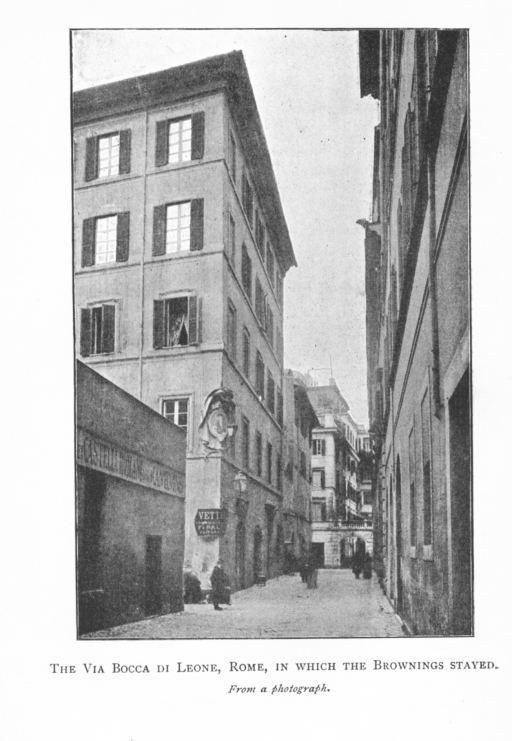
THE VIA BOCCA DI LEONE, ROME, IN WHICH THE BROWNINGS STAYED.
From a photograph.
The summer and early autumn of 1853 were spent by Browning and his wife, as they had spent the same season four years previously, at the Baths of Lucca. Their house among the hills was shut in by a row of plane-trees in which by day the cicale were shrill; at evening fireflies lit up their garden. The green rushing river—"a flashing scimitar that cuts through the mountain"—the chestnut woods, the sheep-walks, "the villages on the peaks of the mountains like wild eagles," renewed their former delights.
On the longer excursions Browning slackened his footsteps to keep pace with his wife's donkey; basins of strawberries and cream refreshed the wanderers after their exertion. "Oh those jagged mountains," exclaims Mrs Browning, "rolled together like pre-Adamite beasts, and setting their teeth against the sky.... You may as well guess at a lion by a lady's lap-dog as at Nature by what you see in England. All honour to England, lanes and meadowland, notwithstanding. To the great trees above all." The sculptor Story and his family, whose acquaintance they had made in Florence before Casa Guidi had become their home, were their neighbours at the Baths, and Robert Lytton was for a time their guest. Browning worked at his Men and Women, of which his wife was able to report in the autumn that it was in an advanced state. In a Balcony was the most important achievement of the summer. "The scene of the declaration in By the Fireside" Mrs Orr informs us, "was laid in a little adjacent mountain-gorge to which Browning walked or rode."
Only a few weeks were given to Florence. In perfect autumnal weather the occupants of Casa Guidi started for Rome. The delightful journey occupied eight days, and on the way the church of Assisi was seen, and the falls of Terni—"that passion of the waters,"—so Mrs Browning describes it, "which makes the human heart seem so still." They entered Rome in a radiant mood.—"Robert and Penini singing." An apartment had been taken for them by their friends the Storys in the Via Bocca di Leone, and all was bright, warm, and full of comfort. Next morning a shadow fell upon their happiness—the Storys' little boy was seized with convulsions; in the evening he was dead.[57] A second child—a girl—was taken ill in the Brownings' house, and could not be moved from where she lay in a room below their apartment. Mrs Browning was in a panic for her own boy, though his apple-red cheeks spoke of health. Rome, for a time, was darkened with grief and anxiety; nor did the city itself impress her as she had expected: "It's a palimpsest Rome," she writes, "a watering-place written over the antique." The chief gains of these Roman months were those of friendship and pleasant acquaintances added to those already given by Italy. In rooms under those occupied by the Brownings was Page the American artist, who painted in colours then regarded as "Venetian," now almost darkened out of existence, as a gift for Mrs Browning, the portrait of Robert Browning exhibited in the Royal Academy of 1856. Browning himself wrote to Story with enthusiasm of Page's work. "I am much disappointed in it," wrote Dante Rossetti to Allingham, "and shall advise its non-exhibition." A second portrait painted at this time—that by Fisher—is familiar to us through a reproduction in the second volume of The Letters of Mrs Browning. A rash act of the morning of the day on which he entered Rome had deplorably altered Browning's appearance. In what his wife calls a fit of suicidal impatience, he perpetrated the high crime and misdemeanour, and appeared before her wholly unworthy of portraiture with clean-shaven cheeks and chin. "I cried when I saw him," she tells his sister, "I was so horror-struck." To mark the sin, his beard, when once again he recovered his good looks, was gray, but Mrs Browning cherished the opinion that the argentine touch, as she terms it, gave "a character of elevation and thought to his whole physiognomy." To complete this history, it may be added that in 1859 the moustache of his later portraits was first doubtfully permitted and was presently approved with decision as picturesque.[58]
Under all disadvantages of appearance Browning made his way triumphantly in the English and American society of Rome. The studios were open to him. In Gibson's he saw the tinted Venus—"rather a grisette than a goddess," pronounced Mrs Browning. Harriet Hosmer, the young American sculptress, working with true independence, high aims and right woman's manliness, was both admired and loved. Thackeray, with his daughters, called at the apartment in the Bocca di Leone, bringing small-talk in "handfuls of glittering dust swept out of salons." Lockhart, snow-white in aspect, snow-cold in manner, gave Browning emphatic commendation, though of a negative kind—"He isn't at all," declared Lockhart, "like a damned literary man." But of many interesting acquaintances perhaps the most highly valued were Fanny Kemble and her sister Adelaide Sartoris—Fanny Kemble magnificent, "with her black hair and radiant smile," her sympathetic voice, "her eyes and eyelids full of utterance"—a very noble creature indeed; Mrs Sartoris, genial and generous, more tolerant than Fanny of Mrs Browning's wayward enthusiasms, eloquent in talk and passionate in song. "The Kembles," writes Mrs Browning, "were our gain in Rome."
Towards the end of May 1854 farewells were said, and the Brownings returned from Rome, to Florence by vettura. They had hoped to visit England, or if this should prove impracticable, to take shelter among the mountains from the summer heat. But needful coin on which they had reckoned did not arrive; and they resolved in prudence to sit still at Florence and eat their bread and macaroni as poor sensible folk should do. And Florence looked more beautiful than ever after Rome; the nightingales sang around the olive-trees and vineyards, not only by starlight and fire-fly-light but in the daytime. "I love the very stones of Florence," exclaims Mrs Browning. Her friend Miss Mitford, now in England, and sadly failing in health, hinted at a loan of money; but the answer was a prompt, "Oh no! My husband has a family likeness to Lucifer in being proud." There followed a tranquil and a happy time, and both Men and Women and Aurora Leigh maintained in the writers a deep inward excitement of the kind that leaves an enduring result. A little joint publication; Two Poems by E.B.B. and R.B., containing A Plea for the Ragged Schools of London and The Twins, was sold at Miss Arabella Barrett's Ragged School bazaar in 1854. It is now a waif of literature which collectors prize. There is special significance in the Date and Dabitur, the twins of Browning's poem, when we bear in mind the occasion with which it was originally connected.
In the early weeks of 1855 Mrs Browning was seriously ill; through feverish nights of coughing, she had in her husband a devoted nurse. His sleepless hours were troubled not only by anxiety on her account but by a passionate interest in the heroisms and miseries, of his fellow countrymen during the Crimean winter: "when he is mild he wishes the ministry to be torn to pieces in the streets, limb from limb." Gradually his wife regained health, but she had not long recovered when tidings of the death of Miss Mitford came to sadden her. Not until April did she feel once more a leap into life. Browning was now actively at work in anticipation of printing his new volumes during the approaching visit to England. "He is four hours a day," his wife tells a correspondent, "engaged in dictating to a friend of ours who transcribes for him." And a little later she reports that they will take to England between them some sixteen thousand lines of verse, "eight on one side, eight on the other," her husband's total being already completed, her own still short of the sum by a thousand lines. Allowance, as she pleads, had to be made for time spent in seeing that "Penini's little trousers are creditably frilled and tucked." On the whole, notwithstanding illness and wrath directed against English ministerial blunders, this year of life in Florence had been rich in happiness—a "still dream-life, where if one is over-busy ever, the old tapestries on the walls and the pre-Giotto pictures ... surround us, ready to quiet us again."[59] London lodgings did not look inviting from the distance of Italy; but the summons north was a summons to work, and could not be set aside.
The midsummer of 1855 found Browning and his wife in 13 Dorset Street, London, and Browning's sister was with them. The faithful Wilson, Mrs Browning's maid, had married a Florentine, Ferdinando Romagnoli, and the husband also was now in their service. The weeks until mid-October were occupied with social pleasures and close proof-reading of the sheets of Men and Women[60] Browning took his young friend the artist Leighton to visit Ruskin, and was graciously received. Carlyle was, as formerly, "in great force, particularly in the damnatory clauses." But the weather was drooping, the skies misty, the air oppressive, and Mrs Browning, apart from these, had special causes of depression. Her married sister Henrietta was away in Taunton, and the cost of travel prevented the sisters from meeting. Arabella Barrett—"my one light in London" is Mrs Browning's word—was too soon obliged to depart to Eastbourne. And the Barrett household was disturbed by the undutifulness of a son who had been guilty of the unpardonable crime of marriage, and in consequence was now exiled from Wimpole Street. In body and soul Mrs Browning felt strong yearnings for the calm of Casa Guidi.
The year 1855 was a fortunate year for English poetry. Men and Women was published in the autumn; the beautiful epilogue, addressed to E.B.B., "There they are, my fifty men and women," was written in Dorset Street. Tennyson's Maud had preceded Browning's volumes by some months. It bewildered the critics, but his brother poet did justice to Tennyson's passionate sequence of dramatic lyrics. And though London in mid-autumn had emptied itself Tennyson happened for a few days to be in town. Two evenings he gave to the Brownings, "dined with us," writes Mrs Browning, "smoked with us, opened his heart to us (and the second bottle of port), and ended by reading Maud through from end to end, and going away at half-past two in the morning." His delightful frankness and simplicity charmed his hostess. "Think of his stopping in Maud," she goes on, "every now and then—'There's a wonderful touch! That's very tender! How beautiful that is!' Yes and it was wonderful, tender, beautiful, and he read exquisitely in a voice like an organ, rather music than speech."
One of the few persons who were invited to meet Tennyson on this occasion, Mr W.M. Rossetti, is still living, and his record of that memorable evening ought not to be omitted. "The audience was a small one, the privilege accorded to each individual all the higher: Mr and Mrs Browning, Miss Browning, my brother, and myself, and I think there was one more—either Madox Brown or else [Holman] Hunt or Woolner ... Tennyson, seated on a sofa in a characteristic attitude, and holding the volume near his eyes ... read Maud right through. My brother made two pen-and-ink sketches of him, and gave one of them to Browning. So far as I remember, the Poet-Laureate neither saw what Dante was doing, nor knew of it afterwards. His deep grand voice, with slightly chaunting intonation, was a noble vehicle for the perusal of mighty verse. On it rolled, sonorous and emotional. Dante Rossetti, according to Mr Hall Caine, spoke of the incident in these terms: 'I once heard Tennyson read Maud; and, whilst the fiery passages were delivered with a voice and vehemence which he alone of living men can compass, the softer passages and the songs made the tears course down his cheeks.' ... After Tennyson and Maud came Browning and Fra Lippo Lippi—read with as much sprightly variation as there was in Tennyson of sustained continuity. Truly a night of the gods, not to be remembered without pride and pang."[61] A quotation from a letter of Dante Rossetti to Allingham gives praise to Mrs Browning of a kind which resembles Lockhart's commendation of her husband: "What a delightful unliterary person Mrs Browning is to meet! During two evenings when Tennyson was at their house in London, Mrs Browning left Tennyson with her husband and William and me (who were the fortunate remnant of the male party) to discuss the universe, and gave all her attention to some certainly not very exciting ladies in the next room."[62] Without detracting from Mrs Browning's "unliterary" merits, one may conjecture that the ladies who proved unexciting to Rossetti were Arabella Barrett and Sarianna Browning.
NOTES:
[54]
[53]
[62]
[50]
[55]
[49]
[51]
[59]
[57]
[61]
[56]
[52]
[60]
[58]
[48]
For Browning the poet of Prometheus Unbound was not that beautiful and ineffectual angel of Matthew Arnold's fancy, beating in the void his luminous wings. A great moral purpose looked forth from Shelley's work, as it does, Browning would add, from all lofty works of art. And it may be remarked that the criticism of Browning's own writings which considers not only their artistic methods and artistic success or failure, but also their ethical and spiritual purport, is entirely in accord with his thoughts in this essay. Far from regarding Shelley as unpractical, he notes—and with perfect justice—"the peculiar practicalness" of Shelley's mind, which in his earlier years acted injuriously upon both his conduct and his art. His power to perceive the defects of society was accompanied by as precocious a fertility to contrive remedies; but his crudeness in theorising and his inexperience in practice resulted in not a few youthful errors. Gradually he left behind him "this low practical dexterity"; gradually he learnt that "the best way of removing abuses is to stand fast by truth. Truth is one, as they are manifold; and innumerable negative effects are produced by the upholding of one positive principle." Browning urges that Shelley, before the close, had passed from his doctrinaire atheism to what was virtually a theistic faith. "I shall say what I think," he adds—"had Shelley lived he would have finally ranged himself with the Christians.... The preliminary step to following Christ is the leaving the dead to bury their dead." Perhaps this hypothetical anticipation is to be classed with the surmise of Cardinal Wiseman (if Father Prout rightly attributed to that eminent ecclesiastic a review of Men and Women in The Rambler) that Browning himself would one day be found in the ranks of converts to Catholicism. In each case a wish was father to the thought; Browning recognised the fact that Shelley assigned a place to love, side by side with power, among the forces which determine the life and development of humanity, and with Browning himself "power" was a synonym for the Divine will, and "love" was often an equivalent for God manifest in Jesus Christ. One or two other passages of the essay may be noted as illustrating certain characteristics of the writer's modes of thought and feeling: "Everywhere is apparent Shelley's belief in the existence of Good, to which Evil is an accident"—it is an optimist here, though of a subtler doctrine than Shelley's, who is applauding optimism. "Shelley was tender, though tenderness is not always the characteristic of very sincere natures; he was eminently both tender and sincere." Was Browning consulting his own heart, which was always sincere, and could be tender, but whose tenderness sometimes disappeared in explosions of indignant wrath? The principle, again, by which he determined an artist's rank is in harmony with Browning's general feeling that men are to be judged less by their actual achievements than by the possibilities that lie unfolded within them, and the ends to which they aspire, even though such ends be unattained: "In the hierarchy of creative minds, it is the presence of the highest faculty that gives first rank, in virtue of its kind, not degree; no pretension of a lower nature, whatever the completeness of development or variety of effect, impeding the precedency of the rarer endowment though only in the germ." And, last, of the tardy recognition of Shelley's genius as a poet, Browning wrote in words which though, as he himself says, he had always good praisers, no doubt express a thought that helped to sustain him against the indifference of the public to his poetry: "The misapprehensiveness of his age is exactly what a poet is sent to remedy: and the interval between his operation and the generally perceptible effect of it, is no greater, less indeed than in many other departments of the great human effort. The 'E pur si muove' of the astronomer was as bitter a word as any uttered before or since by a poet over his rejected living work, in that depth of conviction which is so like despair." The volume in which Browning's essay appeared was withdrawn from circulation on the discovery of the fraudulent nature of its contents. He had himself no opportunity of inspecting the forged manuscripts, and no question of authenticity was raised until several copies of the book had passed into circulation.[48]
Browning's Essay on Shelley was reprinted by Dr Furnivall in "The Browning Society's Papers," 1881-84, Part I.
Letters of E.B.B. ii. 284. On Milsand, the article "A French friend of Browning," by Th. Bentzon, is valuable and interesting.
Mrs Orr says that Browning always thought Mrs Carlyle "a hard and unlovable woman"; she adds, "I believe little liking was lost between them." Mrs Ritchie, in her "Records of Tennyson, Ruskin, and Browning" (pp. 250, 251), tells with spirit the story of Browning and Mrs Carlyle's kettle, which, on being told to "put it down," in an absent mood he planted upon her new carpet. "Ye should have been more explicit," said Carlyle to his wife.
See Letters of E.B.B. ii. 127.
Letters of E.B.B. ii. 99.
Letter of F. Tennyson, in Memoir of Alfred Tennyson, by his son, chapter xviii.
Mr Kenyon's note, vol. ii. 142 of Letters of E.B.B.
Times Lit. Supplement, Dec. 5, 1902.
Miss Cobbe's testimony is similar, and Lehmann says that at Home's name Browning would grow pale with passion.
See "Story and his Friends," by Henry James, 1903, vol. i. pp. 284, 285.
Letters of E.B.B., ii. 345.
E.B.B. to Ruskin, Letters, ii. 199.
Which, however, did not prevent certain errors noted in a letter of Browning to Dante Rossetti.
Dante Gabriel Rossetti. His "Family Letters," i. 190, 191.
Letters of D.G. Rossetti to William Allingham, 162. See Mrs Browning's letter to Mrs Tennyson in Memoir of Tennyson by his son, I vol. edition, p. 329.
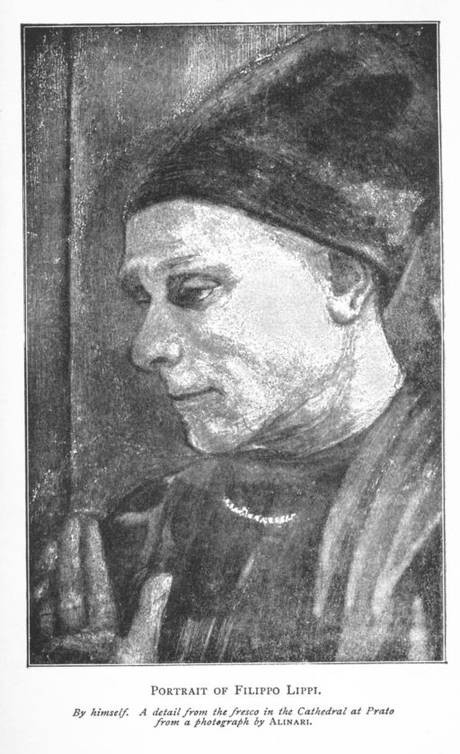
PORTRAIT OF FILIPPO LIPPI.
By himself. A detail from the fresco in the Cathedral at Praia from a photograph by ALINARI.
Chapter IX
Men and Women
Rossetti expresses his first enthusiasm about Men and Women in a word when he calls the poems "my Elixir of Life." To Ruskin these, with other pieces which he now read for the first time, were as he declared in a rebellious mood, a mass of conundrums. "He compelled me," Rossetti adds, "to sit down before him and lay siege for one whole night; the result of which was that he sent me next morning a bulky letter to be forwarded to Browning, in which I trust he told him he was the greatest man since Shakespeare." The poems of the two new volumes were the gradual growth of a considerable number of years; since 1845 their author had published no group of short poems, and now, at the age of forty-three, he had attained the fulness of intellectual and imaginative power, varied experience of life and the artistic culture of Italy. The Dramatis Personae of 1864 exhibits no decline from the high level reached in the volumes of 1855; but is there any later volume of miscellaneous poetry by Browning which, taken as a whole, approaches in excellence the collections of 1855 and 1864?
There is no need now to "lay siege" to the poems of Men and Women; they have expounded themselves, if ever they needed exposition; and the truth is that they are by no means nut-shells into which mottoes meant for the construing of the intellect have been inserted, but fruits rich in colour and perfume, a feast for the imagination, the passions, the spirit in sense, and also for the faculty of thought which lives in the heart of these. If a criticism or a doctrine of life lies in them—and that it should do so means that the poet's total mind has been taken up into his art—Browning conveys his doctrine not as such but as an enthusiasm of living; his generalized truth saturates a medium of passion and of beauty. In the Prologue to Fifine at the Fair he compares the joy of poetry to a swimmer's joy in the sea: the vigour that such disport in sun and sea communicates is the vigour of joyous play; afterwards, if we please, we can ascertain the constituents of sea-water by a chemical analysis; but the analysis will not convey to us the sensations of the sunshine and the dancing brine. One of the blank-verse pieces of Men and Women rebukes a youthful poet of the transcendental school whose ambition is to set forth "stark-naked thought" in poetry. Why take the harp to his breast "only to speak dry words across the strings"? Better hollo abstract ideas through the six-foot Alpine horn of prose. Boys may desire the interpretation into bare ideas of those thronging objects which obsess their senses and their feelings; men need art for the delight of it, and the strength which comes through delight. Better than the meaning of a rose is the rose itself with its spirit enveloped in colour and perfume. And so the poet for men will resemble that old mage John of Halberstadt:
He with a 'look you!' vents a brace of rhymes,And in there breaks the sudden rose herself,Over us, under, round us every side,
Buries us with a glory, young once more,Pouring heaven into this shut house of life.
Browning in Men and Women is in truth a John of Halberstadt; he enriches life with colour, warmth, music, romance, not dissociated from thought and intellectual energy, rather possessing and being possessed by these. Not a single poem is "stark-naked thought"; not a single poem is addressed solely to the intellect; even Bishop Blougram is rather a presentation of character than a train of argument or a chain of ideas.
In few of these poems does Browning speak in his own person; the verses addressed to his wife, which present her with "his fifty men and women" and tell of mysteries of love that can never be told, the lines, Memorabilia, addressed to one who had seen Shelley, and Old Pictures in Florence, are perhaps the only exceptions to the dramatic character of the contents of the two volumes. Yet through them all Browning's mind is clearly discernible; and even his central convictions, his working creed of life, can with no sense of uncertainty be gathered from them. To attribute to the writer the opinions and the feelings of his dramatis personae would of course be the crudest of mistakes. But when an idea persists through many poems written at various times and seasons, when it appears and reappears under various clothings of circumstance, when it is employed as if it had a crucial value, when it becomes a test or touchstone of character, we cannot doubt that it is an intimate possession of the writer's mind. Such an idea is not a mere playmate but rather a confidant. When, again, after a tangle of casuistic reasoning or an embroilment of contending feelings, some idea suddenly flashes forth, and like a sword sunders truth from falsehood and darkness from light, we may be assured that it has more than a dramatic value. And, once more, if again and again the same idea shows its power over the feelings and inspires elevated lyrical utterance, or if in pieces of casuistical brain-work it enters as a passionate element and domineers by its own authority, if it originates not debate but song or that from which song is made, we know that the writer's heart has embraced it as a truth of the emotions.
Because Browning had his own well-defined view of truth, he could confidently lend his mind away to his fifty or his hundred men and women. They served to give his ideas a concrete body. By sympathy and by intelligence he widened the basis of his own existence. If the poet loses himself to find himself again through sympathy with external nature, how much more and in how many enriching ways through sympathy with humanity! Thus new combinations of thought and feeling are effected. Thus a kind of experiment is made with our own ideas by watching how they behave when brought into connection with these new combinations. Truth is relative, and the best truth of our own is worth testing under various conditions and circumstances. The truth or falsehood which is not our own has a right to say the best for itself that can be said. Let truth and falsehood grapple. Let us hear the counter-truth or the rival falsehood which is the complement or the criticism of our own, and hear it stated with the utmost skill. A Luther would surely be the wiser for an evening spent in company with a Blougram; and Blougram has things to tell us which Luther never knew. But precisely because truth is relative we must finally adhere to our own perceptions; they constitute the light for us; and the justice we would do to others we must also render to ourselves. A wide survey may be made from a fixed centre. "Universal sympathies," Miss Barrett wrote in one of the letters to her future husband, "cannot make a man inconsistent, but on the contrary sublimely consistent. A church tower may stand between the mountains and the sea, looking to either, and stand fast: but the willow tree at the gable-end blown now toward the north and now toward the south, while its natural leaning is due east or west, is different altogether ... as different as a willow tree from a church tower."[63]
The fifty poems of Men and Women, with a few exceptions, fall into three principal groups—those which interpret various careers or moods or moments of love; those which deal with the fine arts—painting, poetry, music—and with these we may class, as kindred in spirit, that poem which has for its subject the passionate pursuit of knowledge, A Grammarian's Funeral; and thirdly, those which are connected with religious thought and feeling, or present scenes from the history of religions. Two poems may be called descriptive; both are Italian; both are founded upon a rivalry of contrasts, but one, Up at a Villa—Down in the City, is made up of humorous observations of Italian city and country life, expressing the mundane tastes and prudent economies of an Italian person of quality; the other, "De Gustibus—," which contrasts the happy quietudes of English landscape with the passionate landscape of the South, has romance at the heart of its realism and an ardour of sentiment underlying its pictorial vividness. The Patriot is again Italian, suggested perhaps by the swift revolutions and restorations which Browning had witnessed in Florence, and again it uses with striking effect the principle of contrast; the patriot who a year ago had his intoxicating triumph is now on his way to the scaffold. His year's toil for the good of his people has turned into a year's misdeeds, his life is a failure; but Browning characteristically wrings a victory out of defeat; the crowd at the shambles' gate may hoot; it is better so, for now the martyr can throw himself upon God, the Paymaster of all his labourers at the close of day. The most remarkable of these poems, which refuse to take their places in a group, is that forlorn romance of weary and depressed heroism, Childe Roland to the Dark Tower came. It is in the main a fantaisie of description; but involved with the descriptive study is a romantic motive. The external suggestions for the poem were no more than the words from King Lear which form the title, a tower seen in the Carrara mountains, a painting seen in Paris, and the figure of a horse in the tapestry of the drawing-room of Casa Guidi.[64] In his own mind Browning may have put the question: Of all the feats of knight-errantry which is the hardest? Not to combat with dragons, or robbers, or salvage men; not to bear down rival champions in a rapture of battle. Not these, but to cling to a purpose amid all that depresses the senses at a time when the heart within us is also failing; to advance where there is nothing to arouse energy by opposition, and everything without and within to sap the very life of the soul. Childe Roland is himself hopeless and almost heartless; the plain to which the leering cripple had pointed and over which he rides is created in the utter indigence of nature—a very nightmare of poverty and mean repulsiveness. And yet he endures the test, and halts only when he faces the Dark Tower and blows the blast upon his horn. Browning was wise to carry his romance no further; the one moment of action is enough; it is the breaking of the spell, the waking from the nightmare, and at that point the long-enduring quester may be left. We are defrauded of nothing by the abrupt conclusion.
In the poems which treat of the love of man and woman Browning regards the union of soul with soul as the capital achievement of life, and also as affording one of its chief tests. When we have formed these into a group we perceive that the group falls in the main into two divisions—poems which tell of attainment, and poems which tell of failure or defeat. Certain persons whose centre is a little hard kernel of egoism may be wholly disqualified for the test created by a generous passion. Browning does not belabour with heavy invective the Pretty Woman of his poem, who is born without a heart; she is a flower-like creature and of her kind is perfect; only the flower is to be gazed at, not gathered; or, if it must be gathered, then at last to be thrown away. The chief distinction between the love of man and the love of woman, implied in various poems, is this—the man at his most blissful moment cries "What treasures I have obtained!" the woman cries "What treasures have I to surrender and bestow?" Hence the singleness and finality in the election of passion made by a woman as compared with a man's acquisitiveness of delight. The unequal exchange of a transitory for an enduring surrender of self is the sorrow which pulsates through the lines of In a Year, as swift and broken with pauses as the beating of a heart:
Dear, the pang is brief,Do thy part,Have thy pleasure! How perplexedGrows belief!Well, this cold clay clodWas man's heart:Crumble it and what comes next?Is it God?
And with no chilling of love on the man's part, this is the point of central pain, in that poem of exquisite and pathetic distrust at the heart of trust and admiration, Any Wife to any Husband; noble and faithful as the husband has been, still he is only a man. But elsewhere Browning does justice to the pure chivalry of a man's devotion. Caponsacchi's joy is the joy of a saviour who himself is saved; the great event of his life by which he is lifted above self is single and ultimate; his soul is delivered from careless egoism once and for ever; the grace of love is here what the theologians called invincible grace, and invincible grace, we know, results in final perseverance. Even here in Men and Women two contrasted poems assure us that, while the passion of a man may be no more than Love in a Life, it may also be an unweariable Life in a Love.
Of the poems of attainment one—Respectability—has the spirit of youth and gaiety in it. Here love makes its gallant bid for freedom, fires up for lawlessness, if need be, and at least sets convention at defiance:
The world's good word!—the Institute!Guizot receives Montalembert!Eh? Down the court three lampions flare:Set forward your best foot!
But, after all, this love may be no more than an adventure of the boulevard and the attic in the manner of Béranger's gay Bohemianism. The distance is wide between such élan of youthful passion and the fidelity which is inevitable, and on which age has set its seal, in that poem of perfect attainment, By the Fireside. This is the love which completes the individual life and at the same time incorporates it with the life of humanity, which unites as one the past and the present, and which, owing no allegiance of a servile kind to time, becomes a pledge for futurity. Browning's personal experience is here taken up into his imagination and transfigured, but its substance remains what it had been in literal fact.
The poems of failure are more numerous, and they range through various degrees and kinds of failure. It is not death which can bring the sense of failure to love. In Evelyn Hope all the passion has been on the man's side; all possibilities of love in the virginal heart of the dead girl, all her warmth and sweetness, had been folded in the bud. But death, in the mood of infinite tenderness and unfulfilled aspiration which the poem expresses, seems no bar to some far-off attainment, of which the speaker's passion, breaking through time, is the assurance, an attainment the nature of which he cannot divine but which will surely explain the meaning of things that are now obscure. Perhaps the saddest and the most hopeless kind of failure is that in which, to borrow an image from the old allegory, the arrow of love all but flies to the mark and yet just misses it. This is the subject of a poem equally admirable in its descriptive and its emotional passages, Two in the Campagna. The line "One near one is too far," might serve as its motto. Satisfaction is all but reached and never can be reached. Two hearts touch and never can unite. One drop of the salt estranging sea is as unplumbed as the whole ocean. And the only possible end is
Infinite passion, and the painOf finite hearts that yearn.[65]
Compared with such a failure as this an offer of love rejected, rejected with decision but not ungenerously, may be accounted a success. There is something tonic to a brave heart in the putting forth of will, even though it encounter an obstacle which cannot be removed. Such is the mood which is presented in One Way of Love; the foiled lover has at least made his supreme effort; it has been fruitless, but he thinks with satisfaction that he has played boldly for the prize, and never can he say that it was not worth risking all on the bare chance of success:
She will not give me heaven? 'Tis well!Lose who may—I still can sayThose who win heaven, blest are they!
So, too, in The Last Ride together, the lover is defeated but he is not cast down, and he remains magnanimous throughout the grief of defeat. Who in this our life—he reflects—statesman or soldier, sculptor or poet, attains his complete ideal? He has been granted the grace of one hour by his mistress' side, and he will carry the grateful recollection of this with him into the future as his inalienable and his best possession. With these generous rejections and magnanimous acceptances of failure stands in contrast A Serenade at the Villa, where the lover's devotion is met only by obdurate insensibility or, worse, by an irritated sense of the persecution and plague of such love, and where all things seem to conspire to leave his pain mere pain, bitter and unredeemed.
In these examples, though love has been frustrated in its aim, the cause of failure did not lie in any infirmity of the lover's heart or will. But what if the will itself be supine, what if it dallies and delays, consults the convenience of occasions, observes the indications of a shallow prudence, slackens its pace towards the goal, and meanwhile the passion languishes and grows pale from day to day, until the day of love has waned, and the passion dies in a twilight hour through mere inanition? Such a failure as this seems to Browning to mean the perishing of a soul, or of more souls than one. He takes in The Statue and the Bust a case where the fulfilment of passion would have been a crime. The lady is a bride of the Riccardi; to win her, now a wedded wife, would be to violate the law of God and man. Nevertheless it is her face which has "filled the empty sheath of a man" with a blade for a knight's adventure—The
Duke grew straightway brave and wise.
And then follow delays of convenience, excuses, postponements, and the Duke's flood of passion dwindles to a thread, and is lost in the sandy flats of life:
So weeks grew months, years; gleam by gleamThe glory dropped from their youth and love,And both perceived they had dreamed a dream.
Their end was a crime, but Browning's contention is that a crime may serve for a test as well as a virtue; in that test the Duke and the lady had alike failed through mere languor of soul:
And the sin I impute to each frustrate ghostIs—the unlit lamp and the ungirt loin,Though the end in sight was a vice, I say.
Had Tennyson treated the same subject he would probably have glorified their action as a victorious obedience to the law of self-reverence and self-control.
The reunion and the severance of lovers are presented in three poems. Winter, chill without but warm within, with its pastimes of passion, the energies of joy breaking forth in play, is contrasted in A Lovers' Quarrel with springtime, all gladness without and a strange void and shiver at the heart of things, because alienation has taken the place of camaraderie between the lover and his mistress. The mass and intensity of colour in the stanza which dashes in a sketch of the Pampas, with its leagues of sunflowers, and a wild horse, "black neck and eyeballs keen" appearing through them, almost afflict the reader's sense of sight. There is a fine irony in the title of the other poem of contention, A Womans Last Word: In a quarrel a woman will have the last word, and here it is—the need of quietude for a little while that she may recover from the bewildering stroke of pain, and then entire oblivion of the wrong with unmeasured self-surrender. The poem of union, Love among the Ruins, is constructed in a triple contrast; the endless pastures prolonged to the edge of sunset, with their infinity of calm, are contrasted with the vast and magnificent animation of the city which once occupied the plain and the mountain slopes. The lover keeps at arm's-length from his heart and brain what yet fills them all the while; here in this placid pasture-land is one vivid point of intensest life; here where once were the grandeur and tumult of the enormous city is that which in a moment can abolish for the lover all its glories and its shames. His eager anticipation of meeting his beloved, face to face and heart to heart, is not sung, after the manner of Burns, as a jet of unmingled joy; he delays his rapture to make its arrival more entirely rapturous; he uses his imagination to check and to enhance his passion; and the poem, though not a simple cry of the heart, is entirely true as a rendering of emotion which has taken imagination into its service. In like manner By the Fireside, A Serenade at the Villa, and Two in the Campagna, include certain studies of nature and its moods, sometimes with a curiously minute observation of details; and these serve as the overture to some intense moment of joy or pain, or form the orchestration which sustains or reinforces a human voice.
Of the pieces relating to art those connected with the art of poetry are the least valuable. Transcendentalism sets forth the old doctrine that poetry must be sensuous and passionate, leaving it to philosophy to deal with the naked abstractions of the intellect. How it strikes a Contemporary shows by a humorous example how a poet's character and private life may be misconceived and misrepresented by those among whom he moves. Popularity maintains that the poet who is in the highest sense original, an inventor of new things, may be wholly disregarded for long, while his followers and imitators secure both the porridge and the praise; one day God's hand, which holds him, will open and let out all the beauty. The thought is an obvious one enough, but the image of the fisher and the murex, in which the thought is embodied, affords opportunity for stanzas glowing with colour. Two poems, and each of them a remarkable poem, are interpretations of music. One, Master Hugues of Saxe-Gotha, is a singularly successful tour de force, if it is no more. Poetry inspired by music is almost invariably the rendering of a sentiment or a mood which the music is supposed to express; but here, in dealing with the fugue of his imaginary German composer, Browning finds his inspiration not in the sentiment but in the structure of the composition; he competes, as it were, in language with the art or science of the contrapuntist, and evolves an idea of his own from its complexity and elaboration. The poem of Italian music, A Toccata of Galuppi's, wholly subordinates the science to the sentiment of the piece. It is steeped in the melancholy of pleasure; Venice of the eighteenth century lives before us with its mundane joys, its transitory passions, its voluptuous hours; and in the midst of its warmth and colour a chill creeps upon our senses and we shiver. Browning's artistic self-restraint is admirable; he has his own truth to utter aloud if he should please; but here he will not play the prophet; the life of eighteenth-century Venice is dust and ashes; the poet will say not a word more than the musician has said in his toccata; the ruthlessness of time and death make him a little remorseful; it is enough, and too much, that through this music of the hours of love and pleasure we should hear, as it were, the fall of the clay upon a coffin-lid.
Shelley was more impressed by the sculpture than the paintings of Italy. There are few evidences of the influence of the most ideal of the arts that appeal to the mind through the eye in Browning's poetry; and his sympathies would be more apt to respond to such work as Michael Angelo's, which sends the spectator beyond itself, than to the classical work which has the absoluteness and the calm of attained perfection.[66] The sensuous and the spiritual qualities of colour were vividly felt by him; a yellowing old marble seemed perhaps to impose itself with a cold authority upon the imagination. But the suggestion of two portrait busts of the period of classical decadence, one in marble representing a boy, and the other the powerful head of a man in granite, gave rise to Protus, one of the few flawless poems of Browning. His mastery over the rhymed couplet is nowhere seen to greater advantage, unless it be in a few passages of Sordello. The poem is, however, more a page from history than a study in the fine arts; and Browning's imagination has made it a page which lives in our memory through a pathos veiled under strong objective touches, never protruding itself sentimentally in quest of tenderness or pity.
"I spent some most delightful time," Rossetti wrote to Allingham shortly after the publication of Men and Women, "with Browning at Paris, both in the evenings and at the Louvre, where (and throughout conversation) I found his knowledge of early Italian art beyond that of any one I ever met—encyclopedically beyond that of Ruskin himself." The poem Old Pictures at Florence, which Rossetti calls "a jolly thing," and which is that and much more, is full of Browning's learned enthusiasm for the early Italian painters, and it gives a reason for the strong attraction which their adventures after new beauty and passion had for him as compared with the faultless achievements of classical sculpture. Greek art, according to Browning, by presenting unattainable ideals of material and mundane perfection, taught men to submit. Early Christian art, even by faultily presenting spiritual ideals, not to be attained on earth but to be pursued through an immortal life, taught men to aspire. The aim of these painters was not to exhibit strength or grace, joy or grief, rage or love in their complete earthly attainment, but rather to
Make new hopes shine through the flesh they fray,New fears aggrandize the rags and tatters:To bring the invisible full into play!Let the visible go to the dogs—what matters?
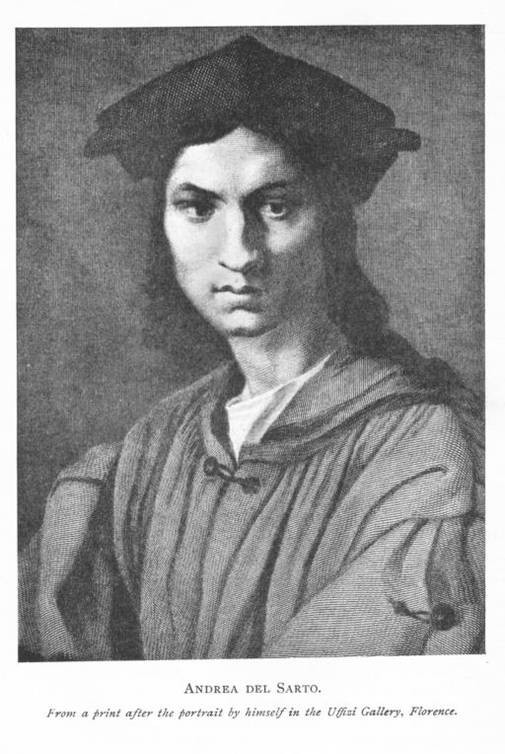
ANDREA DEL SARTO.
From a print after the portrait by himself in the Uffizi Gallery, Florence.
The prophecy with which the poem concludes, of a great revival of Italian art consequent on the advent of political and intellectual liberty, has not obtained fulfilment in the course of the half century that has elapsed since it was uttered. Browning's doctrine that aspiration towards what is higher is more to be valued in art than the attainment of what is lower is a leading motive in the admirable dramatic monologue placed in the lips of Andrea del Sarto, the faultless painter. His craftsmanship is unerring; whatever he imagines he can achieve; nothing in line or in colour is other than it ought to be; and yet precisely because he has succeeded, his failure is profound and irretrievable:
Ah, but a man's reach should exceed his grasp,Or what's a heaven for? All is silver-greyPlacid and perfect with my art: the worse!
He could set right the arm which is wrongly put in Rafael's work that fronts him; but "all the play, the insight and the stretch" of Rafael are lacking in his own faultless lines. He looks back regretfully to his kingly days at Fontainebleau with the royal Francis, when what seemed a veritable fire was in his heart. And he tries to find an excuse for his failure as artist and as man in the coldness of his beautiful Lucrezia—for he who has failed in the higher art has also failed in the higher love—Lucrezia, who values his work only by the coins it brings in, and who needs those coins just now for one whose whistle invites her away. All might be so much better otherwise! Yet otherwise he cannot choose that it should be; his art must remain what it is—not golden but silver-grey; and his Lucrezia may attend to the Cousin's whistle if only she retains the charm, not to be evaded, of her beauty.[67]
Browning does not mean that art in its passionate pursuit of the highest ends should be indifferent to the means, or that things spiritual do not require as adequate a sensuous embodiment as they are capable of receiving from the painter's brush or the poet's pen. Were art a mere symbol or suggestion, two bits of sticks nailed crosswise might claim to be art as admirable as any. What is the eye for, if not to see with vivid exactness? what is the hand for, if not to fashion things as nature made them? It is through body that we reach after the soul; and the passion for truth and reality is a passion for the invisible which is expressed in and through these. Such is the pleading of Fra Lippo Lippi, the tonsured painter caught out of bounds, in that poem in which the dramatic monologue of Browning attains its perfection of life and energy. Fra Lippo is intoxicated by the mere forms and colours of things, and he is assured that these mean intensely and mean well:
The beauty and the wonder and the power,The shapes of things, their colours, lights and shades,Changes, surprises—and God made it all!
These are the gospel to preach which he girds loin and lights the lamp, though he may perforce indulge a patron in shallower pieties of the conventional order, and though it is not all gospel with him, for now and again, when the moon shines and girls go skipping and singing down Florence streets—"Zooks, sir, flesh and blood, that's all I'm made of!" Fra Lippo with his outbreaks of frank sensuality is far nearer to Browning's kingdom of heaven than is the faultless painter; he presses with ardour towards his proper goal in art; he has full faith in the ideal, but with him it is to be sought only through the real; or rather it need not be sought at all, for one who captures any fragment of reality captures also undesignedly and inevitably its divine significance.[68]
The same doctrine which is applied to art in Old Pictures in Florence, that high aims, though unattained, are of more worth than a lower achievement, is applied, and with a fine lyrical enthusiasm, to the pursuit of knowledge in A Grammarian's Funeral. The time is "shortly after the Revival of Learning in Europe"; the place—
a tall mountain, citied to the top,Crowded with culture!—
is imagined to suit the idea of the poem. The dead scholar, borne to the summit for burial on the shoulders of his disciples, had been possessed by the aspiration of Paracelsus—to know; and, unlike Paracelsus, he had never sought on earth both to know and to enjoy. He has been the saint and the martyr of Renaissance philology. For the genius of such a writer as the author of Hudibras, with his positive intellect and dense common sense, there could hardly have been found a fitter object for mockery than this remorseless and indefatigable pedant. Browning, through the singing voices of the dead master's disciples, exalts him to an eminence of honour and splendid fame. To a scholar Greek particles may serve as the fittest test of virtue; this glorious pedant has postponed life and the enjoyments of life to future cycles of existence; here on earth he expends a desperate passion—upon what? Upon the dryasdust intricacies of grammar; and it is not as though he had already attained; he only desperately follows after:
That low man seeks a little thing to do,Sees it and does it:This high man, with a great thing to pursue,Dies ere he knows it.
But again the grammarian, like the painter, does not strive after a vague, transcendental ideal; he is not as one that beateth the air; his quest for knowledge is definite and positive enough; he throws all care for infinite things, except the infinite of philological accuracy, upon God; and the viaticum of his last moments is one more point of grammar.
Two of the poems of Men and Women are pages tragic-grotesque and pathetic-grotesque from the history of religion. In The Heretic s Tragedy John, Master of the Temple, burns alive in Paris square for his sins against the faith and Holy Church; the glow of the blazing larch and pine almost reaches the reader of the stanzas; the great petals of this red rose of flame bend towards him; the gust of sulphur offends his nostrils. And the rage of piety is hotter than the fire; it is a mingled passion, compounded of delight in the fierce spectacle, a thrilling ecstacy at the sight of a fellow-creature tortured, the self-complacency of conscious orthodoxy, and the horrible zeal of the Lord's house. Yet though the event is sung by one of the rejoicing orthodox, somehow we are made to feel that when John the apostate, bound in the flames and gagged, prays to Jesus Christ to save him, that prayer may have been answered. This passage from the story of the age of faith was not selected with a view to please the mediaeval revivalists of the nineteenth century, but in truth its chief value is not theological or historical but artistic. Holy Cross Day, a second fragment from history, does not fall from the sublime to the ridiculous but rises from the ridiculous to the sublime. The picture of the close-packed Jews tumbling or sidling churchwards to hear the Christian sermon (for He saith "Compel them to come in") and to partake of heavenly grace has in it something of Rembrandt united with something of Callot. Such a crew of devout impostors is at once comic and piteous. But while they are cared for in the merciful bowels of the Church, and groan out the expected compunction, their ancient piety is not extinct; their hearts burn in them with the memory of Jacob's House and of Jerusalem. Christ at least was of their kindred, and if they wronged Him in past time, they will not wrong Him now by naming these who outrage and insult them after His name.
The historical distortions of the religion of Christ do not, however, disturb the faith of Browning in the Christian revelation of Divine love. In Cleon he exhibits the failure of Paganism, even in its forms of highest culture, to solve the riddle of life and to answer the requirements of the human spirit. All that regal power liberally and wisely used can confer belongs to Protus in his Tyranny; all that genius, and learning and art can confer is the possession of Cleon; and a profound discouragement has settled down upon the soul of each. The race progresses from point to point; self-consciousness is deepened and quickened as generation succeeds generation; the sympathies of the individual are multiplied and extended. But he that increases knowledge, increases sorrow; most progress is most failure; the soul climbs the heights only to perish there. Every day the sense of joy grows more acute; every day the soul grows more enlarged; and every day the power to put our best attainments to use diminishes. "And how dieth the wise man? As the fool. Therefore I hated life; yea, I hated all my labour that I had taken under the sun." The poem is, indeed, an Ecclesiastes of pagan religion. The assurance of extinction is the worm which gnaws at the heart of the rose:
It is so horribleI dare at times imagine to my needSome future state revealed to us by Zeus,Unlimited in capabilityFor joy, as this is in desire for joy.
But this is no better than a dream; Zeus could not but have revealed it, were it possible. Browning does not bring his Cleon, as Pater brings his Marius, into the Christian catacombs, where the image of the Shepherd bearing his lamb might interpret the mystery of death, nor to that house of Cecilia where Marius sees a new joy illuminating every face. Cleon has heard of Paulus and of Christus, but who can suppose that a mere barbarian Jew
Hath access to a secret shut from us?
The doctrine of Christ, preached on the island by certain slaves, is reported by an intelligent listener to be one which no sane man can accept. And Cleon will not squander the time that might be well employed in studying the proportions of a man or in combining the moods of music—the later hours of a philosopher and a poet—on the futile creed of slaves.
Immortality and Divine love—these were the great words pronounced by Paul and by Christ. Cleon is the despairing cry of Pagan culture for the life beyond the grave which would attune to harmony the dissonances of earth, and render intelligible its mournful obscurities. Saul, in the completed form of 1855, and An Epistle of Karshish are, the one a prophecy, the other a divination, of the mystery of the love of God in the life and death of his Son. The culminating moment in the effort of David by which he rouses to life the sunken soul of the King, the moment towards which all others tend, is that in which he finds in his own nature love as God's ultimate gift, and assured that in this, as in other gifts, the creature cannot surpass the Creator, he breaks forth into a prophecy of God's love made perfect in weakness:
O Saul, it shall beA Face like my face that receives thee; a Man like to meThou shalt love and be loved by, for ever: a Hand like this handShall throw open the gates of new life to thee! See the Christ stand!
What follows in the poem is only the awe, the solemnity of this discovery which has come not through any processes of reasoning but by a passionate interpretation of the enthusiasm of love and self-sacrifice in David's own heart; only this awe, and the seeming extension of his throbbing emotion and pent knowledge over the face of external nature, until night passes and with the dawn earth and heaven resume their wonted ways. The case of Lazarus as studied by Karshish the Arabian physician results not in a rapturous prophecy like that of David, but in a stupendous conjecture of the heart which all the scepticism of the brain of a man of science cannot banish or reduce to insignificance. The unaccountable fascination of this case of mania, subinduced by epilepsy, is not to be resisted; Karshish would write, if he could, of more important matters than the madman of Bethany; he would record his discoveries in scalp-disease, describe the peculiar qualities of Judea's gum-tragacanth, and disclose the secret of those virtues derived from the mottled spiders of the tombs. But the face of Lazarus, patient or joyous, the strange remoteness in his gaze, his singular valuations of objects and events, his great ardour, his great calm, his possession of some secret which gives new meanings to all things, the perfect logic of his irrationality, his unexampled gentleness and love—these are memories which the keen-sighted Arabian physician is unable to put by, so curious, so attaching a potency lies in the person of this man who holds that he was dead and rose again, Karshish has a certain sense of shame that he, a man learned in all the wisdom of his day, should be so deeply moved. And yet how the thought of the secret possessed by this Judean maniac—it is the secret of Jesus—fills and expands the soul!
The very God! think, Abib: dost thou think?So, the All-Great were the All-Loving too—So through the thunder comes a human voiceSaying "O heart I made, a heart beats here!Face, my hands fashioned, see it in myself!Thou hast no power nor mayst conceive of mine,But love I gave thee, with myself to love,And thou must love me who have died for thee!"
Science has at least something to consider in a thought so strangely potent.
A nineteenth-century sceptic's exposition of his Christian faith is the paradoxical subject of Bishop Blougram's Apology, and it is one which admirably suited that side of Browning's genius which leaned towards intellectual casuistry. But the poem is not only skilful casuistry—and casuistry, let it be remembered, is not properly the art of defending falsehood but of determining truth,—it is also a character-study chosen from the age of doubt; a dramatic monologue with an appropriate mise en scène; a display of fence and thrust which as a piece of art and wit rewards an intelligent spectator. That Cardinal Wiseman sat for the Bishop's portrait is a matter of little consequence; the merit of the study is independent of any connection with an individual; it answers delightfully the cynical—yet not wholly cynical—question: How, for our gain in both worlds, can we best economise our scepticism and make a little belief go far?[69] The nineteenth century is not precisely the age of the martyrs, or, if we are to find them, we must in general turn to politics and to science; Bishop Blougram does not pique himself on a genius for martyrdom; if he fights with beasts, it is on this occasion with a very small one, a lynx of the literary tribe, and in the arena of his own dining-room over the after-dinner wine. He is pre-eminently a man of his time, when the cross and its doctrine can be comfortably borne; both he and his table-companion, honoured for this one occasion only with the episcopal invitation, appreciate the good things of this world, but the Bishop has a vast advantage over the maker of "lively lightsome articles" for the reviews, and he uses his advantage, it must be confessed, to the full. We are in company with no petty man while we read the poem and hear the great Bishop roll out, with easy affluence, his long crumpled mind. He is delightfully frank and delightfully subtle; concealing himself by self-disclosure; opulent in ideas; shifting the pea of truth dexterously under the three gilded thimbles; blandly condescending and amiably contemptuous; a little feline, for he allows his adversary a moment's freedom to escape and then pounces upon him with the soft-furred claws; assured of his superiority in the game, yet using only half his mind; fencing with one arm pinioned; chess-playing with a rook and pawn given to his antagonist; or shall we say chess-playing blindfold and seeing every piece upon the board? Is Bishop Blougram's Apology a poem at all? some literary critics may ask. And the answer is that through it we make acquaintance with one of Browning's most genial inventions—the great Bishop himself, and that if Gigadibs were not present we could never have seen him at the particular angle at which he presents himself in his condescending play with truths and half-truths and quarter-truths, adapted to a smaller mind than his own. The sixteenth century gave us a Montaigne, and the seventeenth century a Pascal. Why should not the nineteenth century of mundane comforts, of doubt troubled by faith, and faith troubled by doubt, produce a new type—serious yet humorous—in an episcopal Pascal-Montaigne?
Browning's moral sympathies, we may rest assured, do not go with one who like Blougram finds satisfaction in things realised on earth; one who declines—at least as he represents himself for the purposes of argument—to press forward to things which he cannot attain but might nobly follow after. But Browning's intellectual interest is great in seeing all that a Blougram can say for himself; and as a destructive piece of criticism directed against the position of a Gigadibs what he says may really be effective. The Bishop frankly admits that the unqualified believer, the enthusiast, is more fortunate than he; he, Sylvester Blougram, is what he is, and all that he can do is to make the most of the nature allotted to him. That there has been a divine revelation he cannot absolutely believe; but neither can he absolutely disbelieve. Unbelief is sterile; belief is fruitful, certainly for this world, probably for the next, and he elects to believe. Having chosen to believe, he cannot be too pronounced and decisive in his faith; he will never attempt to eliminate certain articles of the credenda, and so "decrassify" his faith, for to this process, if once begun, there is no end; having donned his uniform, he will wear it, laces and spangles and all. True, he has at times his chill fits of doubt; but is not this the probation of faith? Does not a life evince the ultimate reality that is within us? Are not acts the evidence of a final choice, of a deepest conviction? And has he not given his vote for the Christian religion?
Before she had seen anything for herself she was a believer—a believer, as she describes it, on testimony. The fact of communication with the invisible world appeared to her more important than anything that had been communicated. The spirits themselves "seem abundantly foolish, one must admit." Yet it was clear to her that mankind was being prepared for some great development of truth. She would keep her eyes wide open to facts and her soul lifted up in reverential expectation. By-and-by she felt the dumb wood of the table panting and shivering with human emotion. The dogmatism of Faraday in an inadequate theory was simply unscientific, a piece of intellectual tyranny. The American medium Home, she learnt from her friends, was "turning the world upside down in London with this spiritual influx." Two months later, in July 1855, Mrs Browning and her husband were themselves in London, and witnessed Home's performances during a séance at Ealing. Miss de Gaudrion (afterwards Mrs Merrifield), who was present on that occasion, and who was convinced that the "manifestations" were a fraud, wrote to Mrs Browning for an expression of her opinion. The reply, as might be expected, declared the writer's belief in the genuine character of the phenomena; such manifestations, she admitted, in the undeveloped state of the subject were "apt to be low"; but they were, she was assured, "the beginning of access from a spiritual world, of which we shall presently learn more perhaps." A letter volunteered by Browning accompanied that of his wife. He had, he said, to overcome a real repugnance in recalling the subject; he could hardly understand how another opinion was possible than that "the whole display of 'hands,' 'spirit utterances,' etc., was a cheat and imposture." It was all "melancholy stuff," which a grain of worldly wisdom would dispose of in a minute. "Mr Browning," the letter goes on, "has, however, abundant experience that the best and rarest of natures may begin by the proper mistrust of the more ordinary results of reasoning when employed in such investigations as these, go on to an abnegation of the regular tests of truth and rationality in favour of these particular experiments, and end in a voluntary prostration of the whole intelligence before what is assumed to transcend all intelligence. Once arrived at this point, no trick is too gross—absurdities are referred to 'low spirits,' falsehoods to 'personating spirits'—and the one terribly apparent spirit, the Father of Lies, has it all his own way." These interesting letters were communicated to The Times by Mr Merrifield (Literary Supplement, Nov. 28, 1902), and they called forth a short additional letter from Mr R. Barrett Browning, the "Penini" of earlier days. He mentions that his father had himself on one occasion detected Home in a vulgar fraud; that Home had called at the house of the Brownings, and was turned out of it. Mr Browning adds: "What, however, I am more desirous of stating is that towards the end of her life my mother's views on 'spiritual manifestations' were much modified. This change was brought about, in great measure, by the discovery that she had been duped by a friend in whom she had blind faith. The pain of the disillusion was great, but her eyes were opened and she saw clearly."[55] It must be added, that letters written by Mrs Browning six months before her death give no indication of this change of feeling, but she admits that "sublime communications" from the other world are "decidedly absent," and that while no truth can be dangerous, unsettled minds may lose their balance, and may do wisely to avoid altogether the subject of spiritualism.
The political condition of Italy was, indeed, a grief to both husband and wife. It was a state of utter prostration—on all sides "the unanimity of despair." The Grand Duke, the emancipator, had acquired a respect and affection for the bayonets of Austria. The Pope was "wriggling his venom into the heart of all possibilities of free-thought and action." Browning groaned "How long, O Lord, how long?" His home-thoughts of England in contrast with Italy were those of patriotism and pride. His wife was more detached, more critical towards her native land. The best symptom for Italian freedom was that if Italy had not energy to act, she yet had energy to hate. To be happy now they both must turn to imaginative work, and gain all the gains possible from private friendships. Browning was already occupied with the poems included afterwards in the volumes of Men and Women. Mrs Browning was already engaged upon Aurora Leigh. "We neither of us show our work to one another," she wrote, "till it is finished. An artist must, I fancy, either find or make a solitude to work in, if it is to be good work at all." But as her husband's poems, one by one, were completed, she saw them, and they seemed to her as fine as anything he had done. Away in England Colombe's Birthday was given on the stage, with Helen Faucit in the leading part. It was at least an indication that the public had not forgotten that Browning was a poet. Here in Florence, although the hermit life was happy, new friends—the gift of England—added to its happiness. Frederick Tennyson, the Laureate's brother, and himself a true poet in his degree, "a dreamy, shy, speculative man," simple withal and truthful, had married an Italian wife and was settled for a time in Florence. To him Browning became attached with genuine affection. Mrs Browning was a student of the writings of Swedenborg, and she tells much of her new friend in a single Swedenborgian word—"selfhood, the proprium, is not in him." Frederick Tennyson, though left in a state of bewilderment by Browning's poetry, found the writer of the poetry "a man of infinite learning, jest and bonhommie, and moreover a sterling heart that reverbs no hollowness."[53] Another intimate who charmed them much was one of the attachés of the English embassy, and a poet of unquestionable faculty, very young, very gentle and refined, delicate and excitable, full of sensibility, "full of all sorts of goodness and nobleness," but somewhat dreamy and unpractical, "visionary enough," writes Mrs Browning, "to suit me," interested moreover in spiritualism, which suited her well, "never," she unwisely prophesied, "to be a great diplomatist." It was hardly, Mr Kenyon, the editor of her letters, observes, a successful horoscope of the destiny of Lord Lytton, the future Ambassador at Paris and Viceroy of India.[54]
One of the few persons who were invited to meet Tennyson on this occasion, Mr W.M. Rossetti, is still living, and his record of that memorable evening ought not to be omitted. "The audience was a small one, the privilege accorded to each individual all the higher: Mr and Mrs Browning, Miss Browning, my brother, and myself, and I think there was one more—either Madox Brown or else [Holman] Hunt or Woolner ... Tennyson, seated on a sofa in a characteristic attitude, and holding the volume near his eyes ... read Maud right through. My brother made two pen-and-ink sketches of him, and gave one of them to Browning. So far as I remember, the Poet-Laureate neither saw what Dante was doing, nor knew of it afterwards. His deep grand voice, with slightly chaunting intonation, was a noble vehicle for the perusal of mighty verse. On it rolled, sonorous and emotional. Dante Rossetti, according to Mr Hall Caine, spoke of the incident in these terms: 'I once heard Tennyson read Maud; and, whilst the fiery passages were delivered with a voice and vehemence which he alone of living men can compass, the softer passages and the songs made the tears course down his cheeks.' ... After Tennyson and Maud came Browning and Fra Lippo Lippi—read with as much sprightly variation as there was in Tennyson of sustained continuity. Truly a night of the gods, not to be remembered without pride and pang."[61] A quotation from a letter of Dante Rossetti to Allingham gives praise to Mrs Browning of a kind which resembles Lockhart's commendation of her husband: "What a delightful unliterary person Mrs Browning is to meet! During two evenings when Tennyson was at their house in London, Mrs Browning left Tennyson with her husband and William and me (who were the fortunate remnant of the male party) to discuss the universe, and gave all her attention to some certainly not very exciting ladies in the next room."[62] Without detracting from Mrs Browning's "unliterary" merits, one may conjecture that the ladies who proved unexciting to Rossetti were Arabella Barrett and Sarianna Browning.
The truculence of Sludge is not without warrant; it is indeed no other than the truculence of Robert Browning, "shaking his mane," as Dante Rossetti described him in his outbreaks against the spiritualists, "with occasional foamings at the mouth."[56]
[67]
[64]
In the correction of Browning's proof-sheets, and especially in regulating the punctuation of his poems, Milsand's friendly services were of high value. In 1858 when Browning happened to be at Dijon, and had reason to believe, though in fact erroneously, that his friend was absent in Paris, he went twice "in a passion of friendship," as his wife tells a correspondent, to stand before Maison Milsand, and muse, and bless the threshold.[49]
Yet with all these distractions, perhaps in part because of them, the visit to England was not one of Browning's happiest times. The autumn weather confined Mrs Browning to her rooms. He was anxious, vexed, and worn.[51] It was a happiness when Welbeck Street was left behind, and they were on the way by Paris to their resting-place at Casa Guidi. From a balcony overlooking one of the Paris boulevards they witnessed, in a blaze of autumnal sunshine, which glorified much military and civic pomp, the reception of the new Emperor. Mrs Browning's handkerchief waved frantically while she prayed that God might bless the people in this the chosen representative of a democracy. What were Browning's thoughts on that memorable Saturday is not recorded, but we may be sure that they were less enthusiastic. Yet he enjoyed the stir and animation of Paris, and after the palpitating life of the boulevards found Florence dull and dead—no change, no variety. The journey by the Mont Cenis route had not been without its trying incidents. At Genoa, during several days he was deeply depressed by the illness of his wife, who lay on the sofa and seemed to waste away. But Casa Guidi was reached at last, where it was more like summer than November; the pleasant nest had its own peculiar welcome for wanderers; again they enjoyed the sunsets over the Arno, and Mrs Browning was able to report herself free from cough and feeling very well and very happy: "You can't think how we have caught up our ancient traditions just where we left them, and relapsed into our former soundless, stirless, hermit life. Robert has not passed an evening from home since we came—just as if we had never known Paris."[52]
[68]
[66]
The midsummer of 1855 found Browning and his wife in 13 Dorset Street, London, and Browning's sister was with them. The faithful Wilson, Mrs Browning's maid, had married a Florentine, Ferdinando Romagnoli, and the husband also was now in their service. The weeks until mid-October were occupied with social pleasures and close proof-reading of the sheets of Men and Women[60] Browning took his young friend the artist Leighton to visit Ruskin, and was graciously received. Carlyle was, as formerly, "in great force, particularly in the damnatory clauses." But the weather was drooping, the skies misty, the air oppressive, and Mrs Browning, apart from these, had special causes of depression. Her married sister Henrietta was away in Taunton, and the cost of travel prevented the sisters from meeting. Arabella Barrett—"my one light in London" is Mrs Browning's word—was too soon obliged to depart to Eastbourne. And the Barrett household was disturbed by the undutifulness of a son who had been guilty of the unpardonable crime of marriage, and in consequence was now exiled from Wimpole Street. In body and soul Mrs Browning felt strong yearnings for the calm of Casa Guidi.
[63]
One of the few persons who were invited to meet Tennyson on this occasion, Mr W.M. Rossetti, is still living, and his record of that memorable evening ought not to be omitted. "The audience was a small one, the privilege accorded to each individual all the higher: Mr and Mrs Browning, Miss Browning, my brother, and myself, and I think there was one more—either Madox Brown or else [Holman] Hunt or Woolner ... Tennyson, seated on a sofa in a characteristic attitude, and holding the volume near his eyes ... read Maud right through. My brother made two pen-and-ink sketches of him, and gave one of them to Browning. So far as I remember, the Poet-Laureate neither saw what Dante was doing, nor knew of it afterwards. His deep grand voice, with slightly chaunting intonation, was a noble vehicle for the perusal of mighty verse. On it rolled, sonorous and emotional. Dante Rossetti, according to Mr Hall Caine, spoke of the incident in these terms: 'I once heard Tennyson read Maud; and, whilst the fiery passages were delivered with a voice and vehemence which he alone of living men can compass, the softer passages and the songs made the tears course down his cheeks.' ... After Tennyson and Maud came Browning and Fra Lippo Lippi—read with as much sprightly variation as there was in Tennyson of sustained continuity. Truly a night of the gods, not to be remembered without pride and pang."[61] A quotation from a letter of Dante Rossetti to Allingham gives praise to Mrs Browning of a kind which resembles Lockhart's commendation of her husband: "What a delightful unliterary person Mrs Browning is to meet! During two evenings when Tennyson was at their house in London, Mrs Browning left Tennyson with her husband and William and me (who were the fortunate remnant of the male party) to discuss the universe, and gave all her attention to some certainly not very exciting ladies in the next room."[62] Without detracting from Mrs Browning's "unliterary" merits, one may conjecture that the ladies who proved unexciting to Rossetti were Arabella Barrett and Sarianna Browning.
The political condition of Italy was, indeed, a grief to both husband and wife. It was a state of utter prostration—on all sides "the unanimity of despair." The Grand Duke, the emancipator, had acquired a respect and affection for the bayonets of Austria. The Pope was "wriggling his venom into the heart of all possibilities of free-thought and action." Browning groaned "How long, O Lord, how long?" His home-thoughts of England in contrast with Italy were those of patriotism and pride. His wife was more detached, more critical towards her native land. The best symptom for Italian freedom was that if Italy had not energy to act, she yet had energy to hate. To be happy now they both must turn to imaginative work, and gain all the gains possible from private friendships. Browning was already occupied with the poems included afterwards in the volumes of Men and Women. Mrs Browning was already engaged upon Aurora Leigh. "We neither of us show our work to one another," she wrote, "till it is finished. An artist must, I fancy, either find or make a solitude to work in, if it is to be good work at all." But as her husband's poems, one by one, were completed, she saw them, and they seemed to her as fine as anything he had done. Away in England Colombe's Birthday was given on the stage, with Helen Faucit in the leading part. It was at least an indication that the public had not forgotten that Browning was a poet. Here in Florence, although the hermit life was happy, new friends—the gift of England—added to its happiness. Frederick Tennyson, the Laureate's brother, and himself a true poet in his degree, "a dreamy, shy, speculative man," simple withal and truthful, had married an Italian wife and was settled for a time in Florence. To him Browning became attached with genuine affection. Mrs Browning was a student of the writings of Swedenborg, and she tells much of her new friend in a single Swedenborgian word—"selfhood, the proprium, is not in him." Frederick Tennyson, though left in a state of bewilderment by Browning's poetry, found the writer of the poetry "a man of infinite learning, jest and bonhommie, and moreover a sterling heart that reverbs no hollowness."[53] Another intimate who charmed them much was one of the attachés of the English embassy, and a poet of unquestionable faculty, very young, very gentle and refined, delicate and excitable, full of sensibility, "full of all sorts of goodness and nobleness," but somewhat dreamy and unpractical, "visionary enough," writes Mrs Browning, "to suit me," interested moreover in spiritualism, which suited her well, "never," she unwisely prophesied, "to be a great diplomatist." It was hardly, Mr Kenyon, the editor of her letters, observes, a successful horoscope of the destiny of Lord Lytton, the future Ambassador at Paris and Viceroy of India.[54]
[65]
[69]
Only a few weeks were given to Florence. In perfect autumnal weather the occupants of Casa Guidi started for Rome. The delightful journey occupied eight days, and on the way the church of Assisi was seen, and the falls of Terni—"that passion of the waters,"—so Mrs Browning describes it, "which makes the human heart seem so still." They entered Rome in a radiant mood.—"Robert and Penini singing." An apartment had been taken for them by their friends the Storys in the Via Bocca di Leone, and all was bright, warm, and full of comfort. Next morning a shadow fell upon their happiness—the Storys' little boy was seized with convulsions; in the evening he was dead.[57] A second child—a girl—was taken ill in the Brownings' house, and could not be moved from where she lay in a room below their apartment. Mrs Browning was in a panic for her own boy, though his apple-red cheeks spoke of health. Rome, for a time, was darkened with grief and anxiety; nor did the city itself impress her as she had expected: "It's a palimpsest Rome," she writes, "a watering-place written over the antique." The chief gains of these Roman months were those of friendship and pleasant acquaintances added to those already given by Italy. In rooms under those occupied by the Brownings was Page the American artist, who painted in colours then regarded as "Venetian," now almost darkened out of existence, as a gift for Mrs Browning, the portrait of Robert Browning exhibited in the Royal Academy of 1856. Browning himself wrote to Story with enthusiasm of Page's work. "I am much disappointed in it," wrote Dante Rossetti to Allingham, "and shall advise its non-exhibition." A second portrait painted at this time—that by Fisher—is familiar to us through a reproduction in the second volume of The Letters of Mrs Browning. A rash act of the morning of the day on which he entered Rome had deplorably altered Browning's appearance. In what his wife calls a fit of suicidal impatience, he perpetrated the high crime and misdemeanour, and appeared before her wholly unworthy of portraiture with clean-shaven cheeks and chin. "I cried when I saw him," she tells his sister, "I was so horror-struck." To mark the sin, his beard, when once again he recovered his good looks, was gray, but Mrs Browning cherished the opinion that the argentine touch, as she terms it, gave "a character of elevation and thought to his whole physiognomy." To complete this history, it may be added that in 1859 the moustache of his later portraits was first doubtfully permitted and was presently approved with decision as picturesque.[58]
Before the close of June 1852 they were again in London, and found comfortable rooms at 58 Welbeck Street. When the turmoil of the first days had subsided, they visited "Kenyon the Magnificent"—so named by Browning—at Wimbledon, at whose table Landor, abounding in life and passionate energy as in earlier days, was loud in his applause of the genius of Louis Napoleon. Mazzini, his "intense eyes full of melancholy illusions," called at their lodgings in company with Mrs Carlyle, who seemed to Mrs Browning not only remarkable for her play of ideas but attaching through her feelings and her character.[50] Florence Nightingale was also a welcome visitor, and her visit was followed by a gift of flowers. Invitations from country houses came in sheaves, and the thought of green fields is seductive in a London month of July; but to remain in London was to be faithful to Penini—and to the much-travelled Flush. Once the whole household, with Flush included, breathed rural air for two days with friends at Farnham, and Browning had there the pleasure of meeting Charles Kingsley, whose Christian Socialism seemed wild and unpractical enough, but as for the man himself, brave, bold, original, full of a genial kindliness, Mrs Browning assures a correspondent that he could not be other than "good and noble let him say or dream what he will." It is stated by Mr W.M. Rossetti that Browning first became acquainted with his brother Dante Gabriel in the course of this summer. Coventry Patmore gave him the manuscript of his unpublished poems of 1853 to read. And Ruskin was now added to the number of his personal acquaintances. "We went to Denmark Hill yesterday, by agreement," wrote Mrs Browning in September, "to see the Turners—which, by the way, are divine. I like Mr Ruskin much, and so does Robert. Very gentle, yet earnest—refined and truthful." At Lord Stanhope's they were introduced to the latest toy of fashionable occultism, the crystal ball, in which the seer beheld Oremus, the spirit of the sun; the supernatural was qualified for the faithful with luncheon and lobster salad; "I love the marvellous," Mrs Browning frankly declares. And of terrestrial wonders, with heaven lying about them, and also India muslin and Brussels lace, two were seen in the babies of Monckton Milnes and Alfred Tennyson. Pen, because he was "troppo grande," declined to kiss the first of these new-christened wonders, but Pen's father, who went alone to the baptism of Hallam Tennyson, distinguished himself by nursing for some ten minutes and with accomplished dexterity, the future Governor-General of Australia.
Yet with all these distractions, perhaps in part because of them, the visit to England was not one of Browning's happiest times. The autumn weather confined Mrs Browning to her rooms. He was anxious, vexed, and worn.[51] It was a happiness when Welbeck Street was left behind, and they were on the way by Paris to their resting-place at Casa Guidi. From a balcony overlooking one of the Paris boulevards they witnessed, in a blaze of autumnal sunshine, which glorified much military and civic pomp, the reception of the new Emperor. Mrs Browning's handkerchief waved frantically while she prayed that God might bless the people in this the chosen representative of a democracy. What were Browning's thoughts on that memorable Saturday is not recorded, but we may be sure that they were less enthusiastic. Yet he enjoyed the stir and animation of Paris, and after the palpitating life of the boulevards found Florence dull and dead—no change, no variety. The journey by the Mont Cenis route had not been without its trying incidents. At Genoa, during several days he was deeply depressed by the illness of his wife, who lay on the sofa and seemed to waste away. But Casa Guidi was reached at last, where it was more like summer than November; the pleasant nest had its own peculiar welcome for wanderers; again they enjoyed the sunsets over the Arno, and Mrs Browning was able to report herself free from cough and feeling very well and very happy: "You can't think how we have caught up our ancient traditions just where we left them, and relapsed into our former soundless, stirless, hermit life. Robert has not passed an evening from home since we came—just as if we had never known Paris."[52]
Only a few weeks were given to Florence. In perfect autumnal weather the occupants of Casa Guidi started for Rome. The delightful journey occupied eight days, and on the way the church of Assisi was seen, and the falls of Terni—"that passion of the waters,"—so Mrs Browning describes it, "which makes the human heart seem so still." They entered Rome in a radiant mood.—"Robert and Penini singing." An apartment had been taken for them by their friends the Storys in the Via Bocca di Leone, and all was bright, warm, and full of comfort. Next morning a shadow fell upon their happiness—the Storys' little boy was seized with convulsions; in the evening he was dead.[57] A second child—a girl—was taken ill in the Brownings' house, and could not be moved from where she lay in a room below their apartment. Mrs Browning was in a panic for her own boy, though his apple-red cheeks spoke of health. Rome, for a time, was darkened with grief and anxiety; nor did the city itself impress her as she had expected: "It's a palimpsest Rome," she writes, "a watering-place written over the antique." The chief gains of these Roman months were those of friendship and pleasant acquaintances added to those already given by Italy. In rooms under those occupied by the Brownings was Page the American artist, who painted in colours then regarded as "Venetian," now almost darkened out of existence, as a gift for Mrs Browning, the portrait of Robert Browning exhibited in the Royal Academy of 1856. Browning himself wrote to Story with enthusiasm of Page's work. "I am much disappointed in it," wrote Dante Rossetti to Allingham, "and shall advise its non-exhibition." A second portrait painted at this time—that by Fisher—is familiar to us through a reproduction in the second volume of The Letters of Mrs Browning. A rash act of the morning of the day on which he entered Rome had deplorably altered Browning's appearance. In what his wife calls a fit of suicidal impatience, he perpetrated the high crime and misdemeanour, and appeared before her wholly unworthy of portraiture with clean-shaven cheeks and chin. "I cried when I saw him," she tells his sister, "I was so horror-struck." To mark the sin, his beard, when once again he recovered his good looks, was gray, but Mrs Browning cherished the opinion that the argentine touch, as she terms it, gave "a character of elevation and thought to his whole physiognomy." To complete this history, it may be added that in 1859 the moustache of his later portraits was first doubtfully permitted and was presently approved with decision as picturesque.[58]
In the early weeks of 1855 Mrs Browning was seriously ill; through feverish nights of coughing, she had in her husband a devoted nurse. His sleepless hours were troubled not only by anxiety on her account but by a passionate interest in the heroisms and miseries, of his fellow countrymen during the Crimean winter: "when he is mild he wishes the ministry to be torn to pieces in the streets, limb from limb." Gradually his wife regained health, but she had not long recovered when tidings of the death of Miss Mitford came to sadden her. Not until April did she feel once more a leap into life. Browning was now actively at work in anticipation of printing his new volumes during the approaching visit to England. "He is four hours a day," his wife tells a correspondent, "engaged in dictating to a friend of ours who transcribes for him." And a little later she reports that they will take to England between them some sixteen thousand lines of verse, "eight on one side, eight on the other," her husband's total being already completed, her own still short of the sum by a thousand lines. Allowance, as she pleads, had to be made for time spent in seeing that "Penini's little trousers are creditably frilled and tucked." On the whole, notwithstanding illness and wrath directed against English ministerial blunders, this year of life in Florence had been rich in happiness—a "still dream-life, where if one is over-busy ever, the old tapestries on the walls and the pre-Giotto pictures ... surround us, ready to quiet us again."[59] London lodgings did not look inviting from the distance of Italy; but the summons north was a summons to work, and could not be set aside.
With me faith means perpetual unbeliefKept quiet like the snake 'neath Michael's foot,Who stands calm just because he feels it writhe.
When the time arrives for a beatific vision Blougram will be ready to adapt himself to the new state of things. Is not the best pledge of his capacity for future adaptation to a new environment this—that being in the world he is worldly? We must not lose the training of each successive stage of evolution by for ever projecting ourselves half way into the next. So rolls on the argument to its triumphant conclusion—
Fool or knave?Why needs a bishop be a fool or knaveWhen there's a thousand diamond weights between?
Only at the last, were it not that we know that there is a firmer ground for Blougram than this on which he takes his stand in after-dinner controversy, we might be inclined to close the subject by adapting to its uses the title of a pamphlet connected with the Kingsley and Newman debate—"But was not Mr Gigadibs right after all?" Worsted in sword-play he certainly was; but the soul may have its say, and the soul, armed with its instincts of truth, is a formidable challenger.
NOTES:
Letters of R.B. and E.B.B., i. 388.
Mrs Orr's Handbook to Browning's Works, 266, note. For the horse, see stanzas xiii. xiv. of the poem.
This poem is sometimes expounded as a sigh for the infinite, which no human love can satisfy. But the simpler conception of it as expressing a love almost but not altogether complete seems the truer.
Browning's delight a few years later in modelling in clay was great.
Mrs Andrew Crosse, in her article, "John Kenyon and his Friends" (Temple Bar Magazine, April 1900), writes: "When the Brownings were living in Florence, Kenyon had begged them to procure for him a copy of the portrait in the Pitti of Andrea del Sarto and his wife. Mr Browning was unable to get the copy made with any promise of satisfaction, and so wrote the exquisite poem of Andrea del Sarto—and sent it to Kenyon!"
The writer of this volume many years ago pointed out to Browning his transposition of the chronological places of Fra Lippo Lippi and Masaccio ("Hulking Tom") in the history of Italian art. Browning vigorously maintained that he was in the right; but recent students do not support his contention. At the same time an error in Transcendentalism, where Browning spoke of "Swedish Boehme," was indicated. He acknowledged the error and altered the text to "German Boehme."
Browning maintained to Gavan Duffy that his treatment of the Cardinal was generous.
Chapter X
Close of Mrs Browning's Life
When Men and Women was published in the autumn of 1855 the Brownings were again in Paris. An impulsive friend had taken an apartment for them in the Rue de Grenelle, facing east, and in all that concerned comfort splendidly mendacious. After some weeks of misery and illness Mrs Browning was conveyed to less glittering but more hospitable rooms in the Rue du Colisée by a desperate husband—"That darling Robert carried me into the carriage, swathed past possible breathing, over face and respirator in woollen shawls. No, he wouldn't set me down even to walk up the fiacre steps, but shoved me in upside down in a struggling bundle."[70] Happily the winter was of a miraculous mildness. Mrs Browning worked Aurora Leigh in "a sort of furia," and Browning set himself to the task—a fruitless one as it proved—of rehandling and revising Sordello: "I lately gave time and pains," he afterwards told Milsand in his published dedication of the poem, "to turn my work into what the many might,—instead of what the few must—like: but after all I imagined another thing at first, and therefore leave as I find it"—proud but warrantable words. Some of his leisure was given to vigorous and not unsuccessful efforts in drawing. At the theatre he saw Ristori as Medea and admired her, but with qualifications. At Monckton Milnes's dinner-table he met Mignet and Cavour, and George Sand crowned with an ivy-wreath and "looking like herself." Mrs Browning records with pleasure that her husband's hostility to the French government had waned; at least he admitted that he was sick of the Opposition.
In May 1856 tidings from London of the illness of Kenyon caused him serious anxiety; he would gladly have hastened to attend upon so true and dear a friend, but this Kenyon would not permit. A month later he and Mrs Browning were in occupation of Kenyon's house in Devonshire Place, which he had lent to them for the summer, but the invalid had sought for restoration of his health in the Isle of Wight. On the day that Mr Barrett heard of his daughter's arrival he ordered his family away from London. Mrs Browning once more wrote to him, but the letter received no answer. "Mama," said little Pen earnestly, "if you've been very, very naughty I advise you to go into the room and say,'Papa, I'll be dood.'" But the situation, as Mrs Browning sadly confesses, was hopeless. Some companionship with her sister Arabel and her brothers was gained by a swift departure from London in August for Ventnor whither the Wimpole Street household, leaving its master behind, had been banished, and there "a happy sorrowful two weeks" were spent. At Cowes a grief awaited Browning and his wife, for they found Kenyon kind as ever but grievously broken in health and depressed in spirits. A short visit to Mrs Browning's married sister at Taunton closed the summer and autumn in England. Before the end of October they were on their way to Florence. "The Brownings are long gone back now," wrote Dante Rossetti in December, "and with them one of my delights—an evening resort where I never felt unhappy. How large a part of the real world, I wonder, are those two small people?—taking meanwhile so little room in any railway carriage and hardly needing a double bed at the inn."
The great event of the autumn for the Brownings and for the lovers of English poetry was the publication of Aurora Leigh. Its popularity was instantaneous; within a fortnight a second edition was called for; there was no time to alter even a comma. "That golden-hearted Robert," writes Mrs Browning, "is in ecstasies about it—far more than if it all related to a book of his own." The volume was dedicated to John Kenyon; but before the year was at an end Kenyon was dead. Since the birth of their son he had enlarged the somewhat slender incomings of his friends by the annual gift of one hundred pounds, "in order," says the editor of Mrs Browning's Letters, "that they might be more free to follow their art for its own sake only." By his will he placed them for the future above all possibility of straitened means. To Browning he left 6,500 l., to Mrs Browning 4,500 l. "These," adds Mr F.G. Kenyon, "were the largest legacies in a very generous will—the fitting end to a life passed in acts of generosity and kindness to those in need." The gain to the Brownings was shadowed by a sense of loss. "Christmas came," says Mrs Browning, "like a cloud." For the length of three winter months she did not stir out of doors. Then arrived spring and sunshine, carnival time and universal madness in Florence, with streets "one gigantic pantomime." Penini begged importunately for a domino, and could not be refused; and Penini's father and mother were for once drawn into the vortex of Italian gaiety. When at the great opera ball a little figure in mask and domino was struck on the shoulder with the salutation "Bella mascherina!" it was Mrs Browning who received the stroke, with her husband, also in domino, by her side. The absence of real coarseness in the midst of so much seeming license, and the perfect social equality gave her a gratifying impression of her Florentines.
In April it was summer weather; the drives of former days in the Cascine and to Bellosguardo, where a warm-hearted friend, Miss Isa Blagden, occupied a villa, were resumed. An American authoress of wider fame since her book of 1852 than even the authoress of Aurora Leigh, Mrs Beecher Stowe, was in Florence, and somewhat to their surprise she charmed both Browning and his wife by her simplicity and earnestness, her gentle voice and refinement of manner—"never," says Mrs Browning, "did lioness roar more softly." All pointed to renewed happiness; but before April was over pain of a kind that had a peculiar sting left Mrs Browning for a time incapable of any other feeling. Her father was dead, and no word of affection had been uttered at the last; if there was water in the rock it never welled forth. The kindly meant effort of a relative to reopen friendly communications between Mr Barrett and his daughters, not many months previously, had for its only result the declaration that they had disgraced the family.[71] At first Mrs Browning was crushed and could shed no tear; she remained for many days in a state of miserable prostration; it was two months before she could write a letter to anyone outside the circle of her nearest kinsfolk.
Once more the July heat in Florence—"a composition of Gehenna and Paradise"—drove the Brownings to the Baths of Lucca. Miss Blagden followed them, and also young Lytton came, ailing, it was thought, from exposure to the sun. His indisposition soon grew serious and declared itself as a gastric fever. For eight nights Isa Blagden sat by his bedside as nurse; for eight other nights Browning took her place. His own health remained vigorous. Each morning he bathed in a rapid mountain stream; each evening and morning he rode a mountain pony; and in due time he had the happiness of seeing the patient, although still weak and hollow cheeked, convalescent and beginning to think of "poems and apple puddings," as Mrs Browning declares, "in a manner other than celestial." It had been a summer, she said in September, full of blots, vexations, anxieties. Three days after these words were written a new and grave anxiety troubled her and her husband, for their son, who had been looking like a rose—"like a rose possessed by a fairy" is his mother's description—was attacked in the same way as Lytton. "Don't be unhappy for me" said Pen; "think it's a poor little boy in the street, and be just only a little sorry, and not unhappy at all." Within less than a fortnight he was well enough to have "agonising visions of beefsteak pies and buttered toast seen in mirage"; but his mother mourned for the rosy cheeks and round fat little shoulders, and confessed that she herself was worn out in body and soul.
The winter at Florence was the coldest for many years; the edges of the Arno were frozen; and in the spring of 1858 Mrs Browning felt that her powers of resistance, weakened by a year of troubles and anxieties, had fallen low. Browning himself was in vigorous health. When he called in June on Hawthorne he looked younger and even handsomer than he had looked two years previously, and his gray hairs seemed fewer. "He talked," Hawthorne goes on, "a wonderful quantity in a little time." That evening the Hawthornes spent at Casa Guidi. Mrs Browning is described by the American novelist as if she were one of the singular creatures of his own imagination—no earthly woman but one of the elfin race, yet sweetly disposed towards human beings; a wonder of charm in littleness; with a shrill yet sweet tenuity of voice; "there is not such another figure in the world; and her black ringlets cluster into her neck, and make her face look whiter by their sable perfection." Browning himself was "very efficient in keeping up conversation with everybody, and seemed to be in all parts of the room and in every group at the same moment; a most vivid and quick-thoughted person—logical and common-sensible, as, I presume, poets generally are in their daily talk." "His conversation," says Hawthorne, speaking of a visit to Miss Blagden at Bellosguardo, "has the effervescent aroma which you cannot catch even if you get the very words that seem to be imbued with it.... His nonsense is of very genuine and excellent quality, the true babble and effervescence of a bright and powerful mind; and he lets it play among his friends with the faith and simplicity of a child."
When summer came it was decided to join Browning's father and sister in Paris, and accompany them to some French seaside resort, where Mrs Browning could have the benefit of a course of warm salt-water baths. To her the sea was a terror, but railway-travelling was repose, and Browning suggested on the way from Marseilles to Paris that they might "ride, ride together, for ever ride" during the remainder of their lives in a first-class carriage with for-ever renewed supplies of French novels and Galignanis. They reached Paris on the elder Mr Browning's birthday, and found him radiant at the meeting with his son and grandson, looking, indeed, ten years younger than when they had last seen his face. Paris, Mrs Browning declares, was her "weakness," Italy her "passion"; Florence itself was her "chimney-corner," where she "could sulk and be happy." The life of the brilliant city, which "murmurs so of the fountain of intellectual youth for ever and ever," quickened her heart-beats; its new architectural splendours told of the magnificence in design and in its accomplishment of her hero the Emperor. And here she and her husband met their helpful friend of former days, Father Prout, and they were both grieved and cheered by the sight of Lady Elgin, a paralytic, in her garden-chair, not able to articulate a word, but bright and gracious as ever, "the eloquent soul full and radiant, alive to both worlds." The happiness in presence of such a victory of the spirit was greater than the pain.
Having failed to find agreeable quarters at Etretat, where Browning in a "fine phrenzy" had hired a wholly unsuitable house with a potato-patch for view, and escaped from his bad bargain, a loser of some francs, at his wife's entreaty, they settled for a short time at Havre—"detestable place," Mrs Browning calls it—in a house close to the sea and surrounded by a garden. On a bench by the shore Mrs Browning could sit and win back a little strength in the bright August air. The stay at Havre, depressing to Browning's spirits, was for some eight weeks. In October they were again in Paris, where Mrs Browning's sister, Arabel, was their companion. The year was far advanced and a visit to England was not in contemplation. Towards the middle of the month they were once more in motion, journeying by slow stages to Florence. A day was spent at Chambéry "for the sake of les Charmettes and Rousseau." When Casa Guidi was at length reached, it was only a halting-place on the way to Rome. Winter had suddenly rushed in and buried all Italy in snow; but when they started for Rome in a carriage kindly lent by their American friends, the Eckleys, it was again like summer. The adventures of the way were chiefly of a negative kind—occasioned by precipices over which they were not thrown, and banditti who never came in sight; but in a quarrel between oxen-drivers, one of whom attacked the other with a knife, Browning with characteristic energy dashed between them to the terror of the rest of the party; his garments were the only serious sufferers from his zeal as mediator.
The apartment engaged at Rome was that of the earlier visit of 1853-54, in the Via Bocca di Leone, "rooms swimming all day in sunshine." On Christmas morning Mrs Browning was able to accompany her husband to St Peter's to hear the silver trumpets. But January froze the fountains, and the north wind blew with force. Mrs Browning had just completed a careful revision of Aurora Leigh, and now she could rest, enjoy the sunshine streaming through their six windows, or give herself up to the excitement of Italian politics as seen through the newspapers in the opening of a most eventful year. "Robert and I," she wrote on the eve of the declaration of war between Austria and Victor Emmanuel, "have been of one mind lately on these things, which comforts me much." She had also the satisfaction of health enjoyed at least by proxy, for her husband had never been more full of vigour and the spirit of enjoyment. In the freezing days of January he was out of his bed at six o'clock, and away for a brisk morning walk with Mr Eckley. The loaf at breakfast diminished "by Gargantuan slices." Into the social life of Rome he threw himself with ardour. For a fortnight immediately after Christmas he was out every night, sometimes with double and treble engagements. "Dissipations," says Mrs Browning, "decidedly agree with Robert, there's no denying that, though he's horribly hypocritical, and 'prefers an evening with me at home.'" He gathered various coloured fragments of life from the outer world and brought them home to brighten her hours of imprisonment.
When they returned to Florence in May the Grand Duke had withdrawn, the city was occupied by French troops, and there was unusual animation in the streets. Browning shared to some extent in his wife's alienation from the policy of England, and believed, but with less than her enthusiastic confidence, in the good intentions towards Italy of the French Emperor. He subscribed his ten scudi a month to the Italian war-fund, and rewarded Pen for diligence in his lessons with half a paul a day, which the boy might give as his own contribution to the cause of Italian independence. The French and the Italian tricolour flags, displayed by Pen, adorned the terrace. In June the sun beat upon Florence with unusual fierceness, but it was a month of battles, and with bulletins of the war arriving twice a day they could not bear to remove to any quiet retreat at a distance from the centre. It was not curiosity that detained them but the passion for Italy, the joy in generous effort and great deeds. In the rebound, as Mrs Browning expresses it, from high-strung hopes and fears for Italy they found themselves drawn to the theatre, where Salvini gave his wonderful impersonation of Othello and his Hamlet, "very great in both, Robert thought," so commented Mrs Browning, "as well as I."[72] The strain of excitement was indeed excessive for Mrs Browning's failing physical strength; there was in it something almost febrile. Yet the fact is noteworthy that the romantic figures secured much less of her interest than the men of prudent statesmanship. She esteemed Cavour highly; she wholly distrusted Mazzini. She justified Louis Napoleon in concessions which she regarded as an unavoidable part of diplomacy directed to ends which could not be immediately attained. Garibaldi was a "hero," but somewhat alarming in his heroisms—a "grand child," "not a man of much brain." After the victories of Magenta and Solferino came what seemed to many the great betrayal of Villafranca. For a day the busts and portraits of the French Emperor suddenly disappeared from the shop-windows of Florence, and even Mrs Browning would not let her boy wear his Napoleon medal. But the busts returned to their places, and Mrs Browning's faith in Napoleon sprang up anew; it was not he who was the criminal; the selfish powers of Europe had "forced his hand" and "truncated his great intentions." She rejoiced in the magnificent spectacle of dignity and calm presented by the people of Italy. And yet her fall from the clouds to earth on the announcement of peace with Austria was a shattering experience. Sleep left her, or if she slept her dreams were affected by "inscrutable articles of peace and endless provisional governments." Night after night her husband watched beside her, and in the day he not only gave his boy the accustomed two hours' lesson on the piano, but replaced the boy's mother as teacher of those miscellaneous lessons, which had been her educational province. "Robert has been perfect to me," expressed Mrs Browning's feelings in a word.
Another anxiety gave Browning an opportunity which he turned to account in a way that renders honour and gratitude his due from all lovers of English letters. At a great old age Landor, who resided with his family at Fiesole, still retained his violent and intractable temper; in his home there was much to excite his leonine wrath and sense of intolerable wrong. Three times he had quitted his villa, with vows never to return to it, and three times he had been led back. When for a fourth time—like a feeble yet majestic Lear—one hot summer day, toward noon, he flung himself, or was flung, out of doors with only a few pauls in his pocket, it was to Casa Guidi that he made his way broken-hearted, yet breathing forth wrath.[73] Browning had often said, as his wife tells her sister-in-law, that he owed more as a writer to Landor than to any other contemporary.[74] He resolved to set things right, if possible; and if not, to make the best of a case that could not be entirely amended. A visit to the villa assured him that reconciliation was out of the question. He provided for Landor's immediate wants; communicated with Landor's brothers in England, who were prompt in arranging for a regular allowance to be administered by Browning; became the old man's guide and guardian; soothed his wounded spirit, although, according to Mrs Browning, not often happy when he attempted compliments, with generous words and ready quotations from Landor's own writings; and finally settled him in Florence under the care of Mrs Browning's faithful maid Wilson, who watched over him during the remainder of his life.[75] To his incredulous wife Browning spoke of Landor's sweetness and gentleness, nor was he wrong in ascribing these qualities to the old lion. She admitted that he had generous impulses, but feared that her husband would before long become, like other friends of Landor, the object of some enraged suspicion. "Nothing coheres in him," she writes, "either in his opinions, or, I fear, affections." But Landor, whose courtesy and refinement she acknowledges, had also a heart that was capable of loyal love and gratitude. After the first burst of rage against the Fiesole household had spent itself, he beguiled the time in perpetuating his indignations in an innocent and classical form—that of Latin alcaics directed against one private and one public foe—his wife and the Emperor Louis Napoleon.[76]
Lander's affairs threatened to detain the Brownings in Florence longer than they desired, now that peace had come and it was not indispensable to run out of doors twice a day in order to inspect the bulletins. But after three weeks of very exhausting illness, Mrs Browning needed change of air. As soon as her strength allowed, she was lifted into a carriage and they journeyed, as in the year 1850, to the neighbourhood of Siena. She reached the villa which had been engaged by Story's aid, with the sense of "a peculiar frailty of being." Though confined to the house, the fresher air by day and the night winds gradually revived her strength and spirits. The silence and repose were "heavenly things" to her: the "pretty dimpled ground covered by low vineyards" rested her eyes and her mind; and for excitements, instead of reports of battle-fields there were slow-fading scarlet sunsets over purple hills. A kind Prussian physician, Gresonowsky, who had attended Mrs Browning in Florence, and who entered sympathetically into her political feelings, followed her uninvited to Siena and gave her the benefit of his care, declining all recompense. The good friends from America, the Storys, were not far off, and Landor, after a visit to Story, was placed in occupation of rooms not a stone's-cast from their villa. With Pen it was a time of rejoicing, for his father had bought the boy a Sardinian pony of the colour of his curls, and he was to be seen galloping through the lanes "like Puck," to use Browning's comparison, on a dragon-fly's back.[77]
The gipsy instinct, the desire of wandering, had greatly declined with both husband and wife since the earlier days in Italy. Yet when they returned to Casa Guidi it was only for six weeks. Even at the close of the visit to Siena Mrs Browning had recovered but a slender modicum of strength; she did not dare to enter the cathedral, for there were steps to climb. At Florence she felt her old vitality return and her spirits rose. But the climate of Rome was considered by Dr Gresonowsky more suitable for winter, and towards the close of November they took their departure, flying from the Florentine tramontana. The carriage was furnished with novels of Balzac, and Pen's pony was of the party. The rooms taken in the Via del Tritone were bright and sunny; but a rash visit to the jeweller Castellani, to see and touch the swords presented by Roman citizens to Napoleon III. and Victor Emmanuel, threw back Mrs Browning into all her former troubles of a delicate chest and left her "as weak as a rag." Tidings of the death of Lady Elgin seemed to tell only of a peaceful release from a period of imprisonment in the body, but the loss of Mrs Jameson was a painful blow. Rome at a time of grave political apprehensions was almost empty of foreigners; but among the few Americans who had courage to stay were the sculptor Gibson and Theodore Parker—now near the close of his life—whose tête-à-têtes were eloquent of beliefs and disbeliefs. As the spring advanced the authoress of "The Mill on the Floss" was reported to be now and again visible in Rome, "with her elective affinity," as Mrs Browning puts it, "on the Corso walking, or in the Vatican musing. Always together." A grand-daughter of Lord Byron—"very quiet and very intense"—was among the visitors at the Via del Tritone, and Lady Marion Alford, "very eager about literature and art and Robert," for all which eagernesses Mrs Browning felt bound to care for her. The artists Burne-Jones and Prinsep had made Browning's acquaintance at Siena; Prinsep now introduced him to some of the by-ways of popular life in Rome. Together they witnessed the rivalry of two improvisatori poetic gamecocks, whose efforts were stimulated by the announcement that a great poet from England was present; together they listened to the forbidden Hymn to Garibaldi played in Gigi's osteria, witnessed the dignified blindness of the Papal gendarmes to the offence, while Gigi liberally plied them with drink; and together, to relieve the host of all fear of more revolutionary airs, they took carriages with their musicians and drove to see the Coliseum by moonlight.[78]
The project of a joint volume of poems on the Italian question by Browning and his wife, which had made considerable progress towards realisation, had been dropped after Villafranca, when Browning destroyed his poem; but Mrs Browning had advanced alone and was now revising proofs of her slender contribution to the poetry of politics, Poems before Congress. She wrote them, she says, simply to deliver her soul—"to get the relief to my conscience and heart, which comes from a pent-up word spoken or a tear shed." She can hardly have anticipated that they would be popular in England; but she was not prepared for one poem which denounced American slavery being misinterpreted into a curse pronounced upon England. "Robert was furious" against the offending Review, she says; "I never saw him so enraged about a criticism;" but by-and-by he "didn't care a straw." His wife, on the other hand, was more deeply pained by the blindness and deafness of the British public towards her husband's genius; nobody "except a small knot of pre-Rafaelite men" did him justice; his publisher's returns were a proof of this not to be gainsaid—not one copy of his poems had for six months been sold, while in America he was already a power. For the poetry of political enthusiasm he had certainly no vocation. When Savoy was surrendered to France Mrs Browning suffered some pain lest her Emperor's generosity might seem compromised. Browning admitted that the liberation of Italy was a great action, adding cynically of his future Prince Hohenstiel-Schwangau, "But he has taken eighteen-pence for it, which is a pity." During the winter he wrote much. "Robert deserves no reproaches," his wife tells her friend Miss Haworth in May, "for he has been writing a good deal this winter—working at a long poem, which I have not seen a line of, and producing short lyrics which I have seen, and may declare worthy of him." Mr F.G. Kenyon conjectures that the long poem is not unlikely to have been Mr Sludge the Medium, for Home's performances, as he says, were at this time rampant.[79] As hitherto, both husband and wife showed their poems each to the other only when the poems were complete; thus like a pair of hardy friends they maintained their independence. Even when they read, there was no reading aloud; Mrs Browning was indefatigable in her passion for books; her husband, with muscular energy impatient for action, found it impossible to read for long at a single sitting.
On June 4th 1860 they left Rome, travelling by vettura through Orvieto and Chiusi to their home in Florence.[80] The journey fatigued Mrs Browning, but on arriving they had the happiness of finding Landor well; he looked not less than magnificent, displaying "the most beautiful sea-foam of a beard ... all in a curl and white bubblement of beauty." Wilson had the old man under happy control; only once had he thrown his dinner out of the window; that he should be at odds with all the world was inevitable, and that all the world should be in the wrong was exhilarating and restorative. The plans for the summer were identical with those of the preceding year; the same "great lonely villa" near Siena was occupied again; the same "deep soothing silence" lapped to rest Mrs Browning's spirits; Landor, her "adopted son"—a son of eighty-six years old—was hard by as he had been last summer. The neighbourhood of Miss Blagden was this year an added pleasure. "The little eager lady," as Henry James describes her, "with gentle, gay black eyes," had seen much, read much, written already a little (with more to follow), but better than all else were her generous heart and her helpful hand. The season was one of unusual coolness for Italy. Pen's pony, as before, flashed through the lanes and along the roads. Browning had returned from Rome in robust health, and looking stouter in person than six months previously. Now, while a tenant of the Villa Alberti, he spent his energies in long rides, sometimes rides of three or four continuous hours. On returning from such careers on horseback little inclination, although he had his solitary room in which to work, remained for the pursuit of poetry.
The departure for Rome was early—about September; in the Via Felice rooms were found. A new and great sorrow had fallen upon Mrs Browning—her sister Henrietta, Mrs Surtees Cook, was dead, leaving behind her three young children. Mrs Browning could not shed tears nor speak of her grief: she felt tired and beaten by the pain; and tried to persuade herself that for one who believed the invisible world to be so near, such pain was but a weakness. Her husband was able to do little, but he shared in his degree in the sense of loss, and protected her from the intrusion of untimely visitors. Sir John Bowring was admitted because he presented a letter of introduction and had intimate relations with the French Emperor; his ridicule of the volunteer movement in England, with its cry of "Riflemen, form!" was grateful to Mrs Browning's political feelings. French troops were now in Rome; their purpose was somewhat ambiguous; but Pen had fraternised with the officers on the Pincio, had learnedly discussed Chopin and Stephen Heller with them, had been assured that they did not mean to fight for the Holy Father, and had invited "ever so many of them" to come and see mamma—an invitation which they were too discreet to accept. Mrs Browning's excitement about public affairs had somewhat abated; yet she watched with deep interest the earlier stages of the great struggle in America; and she did not falter in her hopes for Italy; by intrigues and smuggling the newspapers which she wished to see were obtained through the courteous French generals. But her spirits were languid; "I gather myself up by fits and starts," she confesses, "and then fall back."
Apart from his anxieties for his wife's health and the unfailing pleasure in his boy, whom a French or Italian abbé now instructed, Browning was wholly absorbed in one new interest. He had long been an accomplished musician; in Paris he had devoted himself to drawing; now his passion was for modelling in clay, and the work proceeded under the direction and in the studio of his friend, the sculptor Story. His previous studies in anatomy stood him in good stead; he made remarkable progress, and six hours a day passed as if in an enchantment. He ceased even to read; "nothing but clay does he care for," says Mrs Browning smilingly, "poor lost soul." The union of intellectual energy with physical effort in such work gave him the complete satisfaction for which he craved. His wife "grudged a little," she says, the time stolen from his special art of poetry; but she saw that his health and spirits gained from his happy occupation. Of late, he had laboured irregularly at verse; fits of active effort were followed by long intervals during which production seemed impossible. And some vent was necessary for the force coiled up within him; if this were not to be obtained, he wore himself out with a nervous impatience—"beating his dear head," as Mrs Browning describes it, "against the wall, simply because he sees a fly there, magnified by his own two eyes almost indefinitely into some Saurian monster." Now he was well and even exultant—"nothing ever," he declared, "made him so happy before." Of advancing years—Browning was now nearly forty-nine—the only symptoms were that he had lost his youthful slightness of figure, and that his beard and hair were somewhat blanched by time. "The women," his wife wrote to his sister, "adore him everywhere far too much for decency," and to herself he seemed "infinitely handsomer and more attractive" than when, sixteen years previously, she had first seen him. On the whole therefore she was well pleased with his new passion for clay, and could wish for him loads of the plastic stuff in which to riot. Afterwards, in his days of sorrow in London, when he compared the colour of his life to that of a snow-cloud, it seemed to him as if one minute of these months at Rome would yield him gold enough to make the brightness of a year; he longed for the smell of the wet clay in Story's studio, where the songs of the birds, and the bleat of a goat coming through the little door to the left, were heard.[81]
While hoping and planning for the future, his wife was not unaware of her own decline. "For the first time," she writes about December, "I have had pain in looking into Penini's face lately—which you will understand." And a little earlier: "I wish to live just as long as, and no longer than to grow in the soul." The winter was mild, though snow had fallen once; a spell of colder weather was reserved for the month of May. They thought of meeting Browning's father and sister in some picturesque part of the forest of Fontainebleau, or, if that should prove unsuitable, perhaps at Trouville. Mrs Browning, who had formerly enjoyed the stir of life in Paris, now shrank from its noise and bustle. Her wish would be to creep into a cave for the whole year. At eight o'clock each evening she left her sitting-room and sofa, and was in bed. Yet she trusted that when she could venture again into the open air she would be more capable of enduring the friction of the world. In May she felt stronger, and saw visitors, among whom was Hans Andersen, "very earnest, very simple, very childlike."[82] A little later she was cast down by the death of Cavour—"that great soul which meditated and made Italy"; she could hardly trust herself to utter his name. It was evident to Browning that the journey to France could not be undertaken without serious risk. They had reached Casa Guidi, and there for the present she must take her rest.
The end came swiftly, gently. A bronchial attack, attended with no more than the usual discomfort, found her with diminished power of resistance. Browning had forebodings of evil, though there seemed to be no special cause to warrant his apprehension. On the last evening—June 28, 1861—she herself had no anticipation of what was at hand, and talked of their summer plans. When she slept, her slumber was heavy and disturbed. At four in the morning her husband was alarmed and sent to summon the doctor; but she assured him that his fears were exaggerated. Then inestimable words were spoken which lived forever in his heart. And so "smilingly, happily, with a face like a girl's," resting her head upon her husband's cheek, she passed away.[83]
NOTES:
Letters of E.B.B. (To Mrs Jameson), ii. 221.
F.G. Kenyon. Letters of E.B.B., ii. 263.
"Browning was intimately acquainted," writes Miss Anna Swanwick, "with Salvini." What especially lived in Browning's memory as transcending everything else he had witnessed on the stage was Salvini's impersonation of the blind Oedipus, and in particular one incident: a hand is laid on the blind man's shoulder, which he supposes the hand of one of his sons; he discovers it to be the hand of Antigone; the sudden transition from a look of fiery hate to one of ineffable tenderness was unsurpassable in its mastery of dramatic expression. (Condensed from "Anna Swanwick, a Memoir and Recollections," 1903, pp. 132, 133.)
Story says that Landor "was turned out of doors by his wife and children." He had conveyed the villa to his wife. It is Story who compares Landor to King Lear. "Conversations in a Studio," p. 436.
Letters of E.B.B., ii. 354.
When Browning at Rome was invited to dine with the Prince of Wales (March 1859) by the desire of Queen Victoria, Mrs Browning told him to "eschew compliments," of his infelicity in uttering which she gives amusing examples. Letters of E.B.B., ii. 309, 310.
On Browning's action in the affairs of Landor see Forster's Life of Landor, and the letters of Browning in vol. ii. of Henry James's Life of Story (pp. 6-11).
See, for this residence at Siena, an interesting letter of Story to C. Eliot Norton in Henry James's W.W. Story, vol. ii. pp. 14, 15.
Condensed from information given by Prinsep to Mrs Orr, Life and Letters of R.B., pp. 234-37.
Letters of E.B.B., ii. 388, note. Mr Kenyon suggests A Death in the Desert as at least possibly meant. The Ring and the Book "certainly had not yet been begun."
Halting at Siena, whence Browning wrote an account of the journey to Story: Henry James's W.W. Story, ii. pp. 50-52.
H. James's W.W. Story, vol. ii. pp. 111, 113.
Henry James tells of a children's party at the Palazzo Barberini, Rome, of several years earlier, when Hans Andersen read "The Ugly Duckling," and Browning, "The Pied Piper"; which led to "a grand march through the spacious Barberini apartment, with Story doing his best on a flute in default of bagpipes." W.W. Story, vol. i.p. 286.
The circumstances of Mrs Browning's death are described as above, but with somewhat fuller detail, in a letter of Browning to Miss Haworth, July 20, 1861, first printed by Mrs Orr. Many details of interest will be found in a long letter of Story, Henry James's W.W. Story, vol. ii. pp. 61-68: "She talked with him and jested and gave expression to her love in the tenderest words; then, feeling sleepy, and he supporting her in his arms, she fell into a doze. In a few minutes, suddenly, her head dropped forward. He thought she had fainted, but she had gone for ever." A painful account of the funeral service, "blundered through by a fat English parson," is given by Story.
Chapter XI
London: Dramatis Personae
The grief of the desolate man was an uncontrollable passion; his heart was strong and all its strength entered into its sorrow. Miss Blagden, "perfect in all kindness," took motherly possession of the boy, and persuaded his father to accompany Penini to her villa at Bellosguardo. When all that was needful at Casa Guidi had been done, Browning's first thought was to abandon Italy for many a year, and hasten to London, there to have speech for a day or two at least with Mrs Browning's sister Arabel. "The cycle is complete," he said, looking round the sitting-room of Casa Guidi. "I want my new life," he wrote, "to resemble the last fifteen years as little as possible." Yet while he stayed in the accustomed rooms he held himself together; "when I was moved," he says, "I began to go to pieces."[84] Yet something remained to sustain him.
To one who has habitually given as well as received much not the least of the pangs of separation arises from the incapacity to render any further direct service. It fortified Browning's heart to know that much could be done, and in ways which his wife would have approved and desired, for her child. And as he himself had been also her care, it was his business now to see that his life fulfilled itself aright. Yet he breaks out in July: "No more 'house-keeping' for me, even with my family. I shall grow still, I hope—but my root is taken, and remains." From the outward paraphernalia of death Browning, as Mrs Orr notices, shrank with aversion; it was partly the instinct by which a man seeks to preserve what is most sacred and most strong in his own feelings from the poor materialisms and the poor sentimentalisms of the grave; partly a belief that any advance of the heart towards what has been lost may be rather hindered than helped by the external circumstance surrounding the forsaken body. Browning took measures that his wife's grave should be duly cared for, given more than common distinction; but Florence became a place from which even for his own sake and the sake of her whose spirit lived within him he must henceforth keep aloof.
The first immediate claim upon Browning was that of duty to his father. On August 1st he left Florence for Paris, accompanied by Isa Blagden, who still watched over him and the boy. Two months were spent with his sister and the old man, still hale and strong of heart, at a place "singularly unspoiled, fresh and picturesque, and lovely to heart's content"—so Browning describes it—St Enogat, near St Malo. The solitary sea, the sands, the rocks, the green country gave him at least a breathing-space. Then he proceeded to London, not without an outbreak of his characteristic energy in over-coming the difficulties—which involved two hours of "weary battling"—of securing a horse-box for Pen's pony. At Amiens Tennyson, with his wife and children, was on the platform. Browning pulled his hat over his face and was unrecognised.[85] In "grim London," as he had called it, though with a quick remorse at recollection of the kindness awaiting him, he had the comfort of daily intercourse with Miss Arabel Barrett.
It was decided that an English education, but not that of a public school, would be best for the boy; the critical time for taking "the English stamp" must not be lost; his father's instruction, aided by that of a tutor, would suffice to prepare him for the University, and he would have the advantage of the motherly care of his mother's favourite sister. Browning distrusted, he says to Story, "ambiguous natures and nationalities." Thus he bound himself to England and to London, while at times he sighed for the beauty of Italian hills and skies. He shrank from society, although before long old friends, and especially Procter, infirm and deaf, were not neglected. He found, or made, business for himself; had "never so much to do or so little pleasure in doing it." The discomfort of London lodgings was before long exchanged for the more congenial surroundings of a house by the water-side in Warwick Crescent, which he occupied until 1887, two years before his death. The furniture and tapestries of Casa Guidi gave it an air of comfort and repose. "It was London," writes Mrs Ritchie, referring to her visits of a later date, "but London touched by some indefinite romance; the canal used to look cool and deep, the green trees used to shade the Crescent.... The house was an ordinary London house, but the carved oak furniture and tapestries gave dignity to the long drawing-rooms, and pictures and books lined the stairs. In the garden at the back dwelt, at the time of which I am writing, two weird gray geese, with quivering silver wings and long throats, who used to come and meet their master hissing and fluttering." In 1866 an owl—for Browning still indulged a fantasy of his own in the choice of pets—was "the light of our house," as a letter describes this bird of darkness, "for his tameness and engaging ways." The bird would kiss its master on the face, tweak his hair, and if one said "Poor old fellow!" in a commiserating voice would assume a sympathetic air of depression.[86] Miss Barrett lived hard by, in Delamere Terrace. With her on Sundays Browning listened at Bedford Chapel to the sermons of a non-conformist preacher, Thomas Jones, to some of which when published in 1884, he prefixed an introduction. "The Welsh poet-preacher" was a man of humble origin possessed of a natural gift of eloquence, which, with his "liberal humanity," drew Browning to become a hearer of his discourses.
He made no haste to give the public a new volume of verse. Mrs Browning had mentioned to a correspondent, not long before her death, that her husband had then a considerable body of lyrical poetry in a state of completion. An invitation to accept the editorship of the Cornhill Magazine, on Thackeray's retirement, was after some hesitation declined. He was now partly occupied with preparing for the press whatever writings by his wife seemed suitable for publication. In 1862 he issued with a dedication "to grateful Florence" her Last Poems; in 1863, her Greek Christian Poets; in 1865 he prepared a volume of Selections from her poems, and had the happiness of knowing that the number of her readers had rather increased than diminished. The efforts of self-constituted biographers to make capital out of the incidents of her life, and to publish such letters of hers as could be laid hands on, moved him to transports of indignation, which break forth in a letter to his friend Miss Blagden with unmeasured violence: what he felt with the "paws" of these blackguards in his "very bowels" God knows; beast and scamp and knave and fool are terms hardly strong enough to relieve his wrath. Such sudden whirls of extreme rage were rare, yet were characteristic of Browning, and were sometimes followed by regret for his own distemperature. In 1862 a gratifying task was laid on him—that of superintending the three volume edition of his Poetical Works which was published in the following year. At the same time his old friend Forster, with help from Procter, was engaged in preparing the first—and the best—of the several Selections from Browning's poems; it was at once an indication of the growing interest in his writings and an effective means towards extending their influence. He set himself steadily to work out what was in him; he waited no longer upon his casual moods, but girded his loins and kept his lamp constantly lit. His genius, such as it was—this was the field given him to till, and he must see that it bore fruit. "I certainly will do my utmost to make the most of my poor self before I die"—so he wrote in 1865. There were gains in such a resolved method of work; but there were also losses. A man of so active a mind by planting himself before a subject could always find something to say; but it might happen that such sheer brain-work was carried on by plying other faculties than those which give its highest value to poetry.[87]
In the late summer and early autumn of 1862 Browning, in company with his son, was among the Pyrenees at "green pleasant little Cambo, and then at Biarritz crammed," he says, "with gay people of whom I know nothing but their outsides." The sea and sands were more to his liking than the gay people.[88] He had with him one book and no other—a Euripides, in which he read vigorously, and that the readings were fruitful his later poetry of the Greek drama bears witness. At present however his creative work lay in another direction; the whole of "the Roman murder story"—the story of Pompilia and Guido and Caponsacchi—he describes as being pretty well in his head. It needed a long process of evolution before the murder story could uncoil its sinuous lengths in a series of volumes. The visit to Ste-Marie "a wild little place in Brittany" near Pornic, in the summer of 1863—a visit to be repeated in the two summers immediately succeeding—is directly connected with two of the poems of Dramatis Personae. The story of Gold Hair and the landscape details of James Lee's Wife are alike derived from Pornic. The solitude of the little Breton hamlet soothed Browning's spirit. The "good, stupid and dirty" people of the village were seldom visible except on Sunday; there were solitary walks of miles to be had along the coast; fruit and milk, butter and eggs in abundance, and these were Browning's diet. "I feel out of the very earth sometimes," he wrote, "as I sit here at the window.... Such a soft sea, and such a mournful wind!" But the lulling charm of the place which, though so different, brought back the old Siena mood, did not convert him into an idler. The mornings, which began betimes, were given to work; in his way of desperate resolve to be well occupied he informs Miss Blagden (Aug. 18, 1863) that having yesterday written a poem of 120 lines, he means to keep writing whether he likes it or not.[89]
"With the spring of 1863," writes Mr Gosse, "a great change came over Browning's habits. He had refused all invitations into society; but now, of evenings, after he had put his boy to bed, the solitude weighed intolerably upon him. He told the present writer [Mr Gosse] long afterwards, that it suddenly occurred to him on one such spring night in 1863 that this mode of life was morbid and unworthy, and, then and there, he determined to accept for the future every suitable invitation which came to him." "Accordingly," goes on Mr Gosse, "he began to dine out, and in the process of time he grew to be one of the most familiar figures of the age at every dinner-table, concert-hall, and place of refined entertainment in London. This, however, was a slow process." Mrs Ritchie refers to spoken words of Browning which declared that it was "a mere chance whether he should live in the London house that he had taken and join in social life, or go away to some quiet retreat, and be seen no more." It was in a modified form the story of the "fervid youth grown man," in his own "Daniel Bartoli," who in his desolation, after the death of his lady,
[85]
Because Browning had his own well-defined view of truth, he could confidently lend his mind away to his fifty or his hundred men and women. They served to give his ideas a concrete body. By sympathy and by intelligence he widened the basis of his own existence. If the poet loses himself to find himself again through sympathy with external nature, how much more and in how many enriching ways through sympathy with humanity! Thus new combinations of thought and feeling are effected. Thus a kind of experiment is made with our own ideas by watching how they behave when brought into connection with these new combinations. Truth is relative, and the best truth of our own is worth testing under various conditions and circumstances. The truth or falsehood which is not our own has a right to say the best for itself that can be said. Let truth and falsehood grapple. Let us hear the counter-truth or the rival falsehood which is the complement or the criticism of our own, and hear it stated with the utmost skill. A Luther would surely be the wiser for an evening spent in company with a Blougram; and Blougram has things to tell us which Luther never knew. But precisely because truth is relative we must finally adhere to our own perceptions; they constitute the light for us; and the justice we would do to others we must also render to ourselves. A wide survey may be made from a fixed centre. "Universal sympathies," Miss Barrett wrote in one of the letters to her future husband, "cannot make a man inconsistent, but on the contrary sublimely consistent. A church tower may stand between the mountains and the sea, looking to either, and stand fast: but the willow tree at the gable-end blown now toward the north and now toward the south, while its natural leaning is due east or west, is different altogether ... as different as a willow tree from a church tower."[63]
Another anxiety gave Browning an opportunity which he turned to account in a way that renders honour and gratitude his due from all lovers of English letters. At a great old age Landor, who resided with his family at Fiesole, still retained his violent and intractable temper; in his home there was much to excite his leonine wrath and sense of intolerable wrong. Three times he had quitted his villa, with vows never to return to it, and three times he had been led back. When for a fourth time—like a feeble yet majestic Lear—one hot summer day, toward noon, he flung himself, or was flung, out of doors with only a few pauls in his pocket, it was to Casa Guidi that he made his way broken-hearted, yet breathing forth wrath.[73] Browning had often said, as his wife tells her sister-in-law, that he owed more as a writer to Landor than to any other contemporary.[74] He resolved to set things right, if possible; and if not, to make the best of a case that could not be entirely amended. A visit to the villa assured him that reconciliation was out of the question. He provided for Landor's immediate wants; communicated with Landor's brothers in England, who were prompt in arranging for a regular allowance to be administered by Browning; became the old man's guide and guardian; soothed his wounded spirit, although, according to Mrs Browning, not often happy when he attempted compliments, with generous words and ready quotations from Landor's own writings; and finally settled him in Florence under the care of Mrs Browning's faithful maid Wilson, who watched over him during the remainder of his life.[75] To his incredulous wife Browning spoke of Landor's sweetness and gentleness, nor was he wrong in ascribing these qualities to the old lion. She admitted that he had generous impulses, but feared that her husband would before long become, like other friends of Landor, the object of some enraged suspicion. "Nothing coheres in him," she writes, "either in his opinions, or, I fear, affections." But Landor, whose courtesy and refinement she acknowledges, had also a heart that was capable of loyal love and gratitude. After the first burst of rage against the Fiesole household had spent itself, he beguiled the time in perpetuating his indignations in an innocent and classical form—that of Latin alcaics directed against one private and one public foe—his wife and the Emperor Louis Napoleon.[76]
[79]
[77]
On June 4th 1860 they left Rome, travelling by vettura through Orvieto and Chiusi to their home in Florence.[80] The journey fatigued Mrs Browning, but on arriving they had the happiness of finding Landor well; he looked not less than magnificent, displaying "the most beautiful sea-foam of a beard ... all in a curl and white bubblement of beauty." Wilson had the old man under happy control; only once had he thrown his dinner out of the window; that he should be at odds with all the world was inevitable, and that all the world should be in the wrong was exhilarating and restorative. The plans for the summer were identical with those of the preceding year; the same "great lonely villa" near Siena was occupied again; the same "deep soothing silence" lapped to rest Mrs Browning's spirits; Landor, her "adopted son"—a son of eighty-six years old—was hard by as he had been last summer. The neighbourhood of Miss Blagden was this year an added pleasure. "The little eager lady," as Henry James describes her, "with gentle, gay black eyes," had seen much, read much, written already a little (with more to follow), but better than all else were her generous heart and her helpful hand. The season was one of unusual coolness for Italy. Pen's pony, as before, flashed through the lanes and along the roads. Browning had returned from Rome in robust health, and looking stouter in person than six months previously. Now, while a tenant of the Villa Alberti, he spent his energies in long rides, sometimes rides of three or four continuous hours. On returning from such careers on horseback little inclination, although he had his solitary room in which to work, remained for the pursuit of poetry.
[82]
The end came swiftly, gently. A bronchial attack, attended with no more than the usual discomfort, found her with diminished power of resistance. Browning had forebodings of evil, though there seemed to be no special cause to warrant his apprehension. On the last evening—June 28, 1861—she herself had no anticipation of what was at hand, and talked of their summer plans. When she slept, her slumber was heavy and disturbed. At four in the morning her husband was alarmed and sent to summon the doctor; but she assured him that his fears were exaggerated. Then inestimable words were spoken which lived forever in his heart. And so "smilingly, happily, with a face like a girl's," resting her head upon her husband's cheek, she passed away.[83]
[88]
[83]
In April it was summer weather; the drives of former days in the Cascine and to Bellosguardo, where a warm-hearted friend, Miss Isa Blagden, occupied a villa, were resumed. An American authoress of wider fame since her book of 1852 than even the authoress of Aurora Leigh, Mrs Beecher Stowe, was in Florence, and somewhat to their surprise she charmed both Browning and his wife by her simplicity and earnestness, her gentle voice and refinement of manner—"never," says Mrs Browning, "did lioness roar more softly." All pointed to renewed happiness; but before April was over pain of a kind that had a peculiar sting left Mrs Browning for a time incapable of any other feeling. Her father was dead, and no word of affection had been uttered at the last; if there was water in the rock it never welled forth. The kindly meant effort of a relative to reopen friendly communications between Mr Barrett and his daughters, not many months previously, had for its only result the declaration that they had disgraced the family.[71] At first Mrs Browning was crushed and could shed no tear; she remained for many days in a state of miserable prostration; it was two months before she could write a letter to anyone outside the circle of her nearest kinsfolk.
[86]
[78]
[70]
[76]
Shelley was more impressed by the sculpture than the paintings of Italy. There are few evidences of the influence of the most ideal of the arts that appeal to the mind through the eye in Browning's poetry; and his sympathies would be more apt to respond to such work as Michael Angelo's, which sends the spectator beyond itself, than to the classical work which has the absoluteness and the calm of attained perfection.[66] The sensuous and the spiritual qualities of colour were vividly felt by him; a yellowing old marble seemed perhaps to impose itself with a cold authority upon the imagination. But the suggestion of two portrait busts of the period of classical decadence, one in marble representing a boy, and the other the powerful head of a man in granite, gave rise to Protus, one of the few flawless poems of Browning. His mastery over the rhymed couplet is nowhere seen to greater advantage, unless it be in a few passages of Sordello. The poem is, however, more a page from history than a study in the fine arts; and Browning's imagination has made it a page which lives in our memory through a pathos veiled under strong objective touches, never protruding itself sentimentally in quest of tenderness or pity.
Of finite hearts that yearn.[65]
[74]
The fifty poems of Men and Women, with a few exceptions, fall into three principal groups—those which interpret various careers or moods or moments of love; those which deal with the fine arts—painting, poetry, music—and with these we may class, as kindred in spirit, that poem which has for its subject the passionate pursuit of knowledge, A Grammarian's Funeral; and thirdly, those which are connected with religious thought and feeling, or present scenes from the history of religions. Two poems may be called descriptive; both are Italian; both are founded upon a rivalry of contrasts, but one, Up at a Villa—Down in the City, is made up of humorous observations of Italian city and country life, expressing the mundane tastes and prudent economies of an Italian person of quality; the other, "De Gustibus—," which contrasts the happy quietudes of English landscape with the passionate landscape of the South, has romance at the heart of its realism and an ardour of sentiment underlying its pictorial vividness. The Patriot is again Italian, suggested perhaps by the swift revolutions and restorations which Browning had witnessed in Florence, and again it uses with striking effect the principle of contrast; the patriot who a year ago had his intoxicating triumph is now on his way to the scaffold. His year's toil for the good of his people has turned into a year's misdeeds, his life is a failure; but Browning characteristically wrings a victory out of defeat; the crowd at the shambles' gate may hoot; it is better so, for now the martyr can throw himself upon God, the Paymaster of all his labourers at the close of day. The most remarkable of these poems, which refuse to take their places in a group, is that forlorn romance of weary and depressed heroism, Childe Roland to the Dark Tower came. It is in the main a fantaisie of description; but involved with the descriptive study is a romantic motive. The external suggestions for the poem were no more than the words from King Lear which form the title, a tower seen in the Carrara mountains, a painting seen in Paris, and the figure of a horse in the tapestry of the drawing-room of Casa Guidi.[64] In his own mind Browning may have put the question: Of all the feats of knight-errantry which is the hardest? Not to combat with dragons, or robbers, or salvage men; not to bear down rival champions in a rapture of battle. Not these, but to cling to a purpose amid all that depresses the senses at a time when the heart within us is also failing; to advance where there is nothing to arouse energy by opposition, and everything without and within to sap the very life of the soul. Childe Roland is himself hopeless and almost heartless; the plain to which the leering cripple had pointed and over which he rides is created in the utter indigence of nature—a very nightmare of poverty and mean repulsiveness. And yet he endures the test, and halts only when he faces the Dark Tower and blows the blast upon his horn. Browning was wise to carry his romance no further; the one moment of action is enough; it is the breaking of the spell, the waking from the nightmare, and at that point the long-enduring quester may be left. We are defrauded of nothing by the abrupt conclusion.
When they returned to Florence in May the Grand Duke had withdrawn, the city was occupied by French troops, and there was unusual animation in the streets. Browning shared to some extent in his wife's alienation from the policy of England, and believed, but with less than her enthusiastic confidence, in the good intentions towards Italy of the French Emperor. He subscribed his ten scudi a month to the Italian war-fund, and rewarded Pen for diligence in his lessons with half a paul a day, which the boy might give as his own contribution to the cause of Italian independence. The French and the Italian tricolour flags, displayed by Pen, adorned the terrace. In June the sun beat upon Florence with unusual fierceness, but it was a month of battles, and with bulletins of the war arriving twice a day they could not bear to remove to any quiet retreat at a distance from the centre. It was not curiosity that detained them but the passion for Italy, the joy in generous effort and great deeds. In the rebound, as Mrs Browning expresses it, from high-strung hopes and fears for Italy they found themselves drawn to the theatre, where Salvini gave his wonderful impersonation of Othello and his Hamlet, "very great in both, Robert thought," so commented Mrs Browning, "as well as I."[72] The strain of excitement was indeed excessive for Mrs Browning's failing physical strength; there was in it something almost febrile. Yet the fact is noteworthy that the romantic figures secured much less of her interest than the men of prudent statesmanship. She esteemed Cavour highly; she wholly distrusted Mazzini. She justified Louis Napoleon in concessions which she regarded as an unavoidable part of diplomacy directed to ends which could not be immediately attained. Garibaldi was a "hero," but somewhat alarming in his heroisms—a "grand child," "not a man of much brain." After the victories of Magenta and Solferino came what seemed to many the great betrayal of Villafranca. For a day the busts and portraits of the French Emperor suddenly disappeared from the shop-windows of Florence, and even Mrs Browning would not let her boy wear his Napoleon medal. But the busts returned to their places, and Mrs Browning's faith in Napoleon sprang up anew; it was not he who was the criminal; the selfish powers of Europe had "forced his hand" and "truncated his great intentions." She rejoiced in the magnificent spectacle of dignity and calm presented by the people of Italy. And yet her fall from the clouds to earth on the announcement of peace with Austria was a shattering experience. Sleep left her, or if she slept her dreams were affected by "inscrutable articles of peace and endless provisional governments." Night after night her husband watched beside her, and in the day he not only gave his boy the accustomed two hours' lesson on the piano, but replaced the boy's mother as teacher of those miscellaneous lessons, which had been her educational province. "Robert has been perfect to me," expressed Mrs Browning's feelings in a word.
[80]
He could set right the arm which is wrongly put in Rafael's work that fronts him; but "all the play, the insight and the stretch" of Rafael are lacking in his own faultless lines. He looks back regretfully to his kingly days at Fontainebleau with the royal Francis, when what seemed a veritable fire was in his heart. And he tries to find an excuse for his failure as artist and as man in the coldness of his beautiful Lucrezia—for he who has failed in the higher art has also failed in the higher love—Lucrezia, who values his work only by the coins it brings in, and who needs those coins just now for one whose whistle invites her away. All might be so much better otherwise! Yet otherwise he cannot choose that it should be; his art must remain what it is—not golden but silver-grey; and his Lucrezia may attend to the Cousin's whistle if only she retains the charm, not to be evaded, of her beauty.[67]
Another anxiety gave Browning an opportunity which he turned to account in a way that renders honour and gratitude his due from all lovers of English letters. At a great old age Landor, who resided with his family at Fiesole, still retained his violent and intractable temper; in his home there was much to excite his leonine wrath and sense of intolerable wrong. Three times he had quitted his villa, with vows never to return to it, and three times he had been led back. When for a fourth time—like a feeble yet majestic Lear—one hot summer day, toward noon, he flung himself, or was flung, out of doors with only a few pauls in his pocket, it was to Casa Guidi that he made his way broken-hearted, yet breathing forth wrath.[73] Browning had often said, as his wife tells her sister-in-law, that he owed more as a writer to Landor than to any other contemporary.[74] He resolved to set things right, if possible; and if not, to make the best of a case that could not be entirely amended. A visit to the villa assured him that reconciliation was out of the question. He provided for Landor's immediate wants; communicated with Landor's brothers in England, who were prompt in arranging for a regular allowance to be administered by Browning; became the old man's guide and guardian; soothed his wounded spirit, although, according to Mrs Browning, not often happy when he attempted compliments, with generous words and ready quotations from Landor's own writings; and finally settled him in Florence under the care of Mrs Browning's faithful maid Wilson, who watched over him during the remainder of his life.[75] To his incredulous wife Browning spoke of Landor's sweetness and gentleness, nor was he wrong in ascribing these qualities to the old lion. She admitted that he had generous impulses, but feared that her husband would before long become, like other friends of Landor, the object of some enraged suspicion. "Nothing coheres in him," she writes, "either in his opinions, or, I fear, affections." But Landor, whose courtesy and refinement she acknowledges, had also a heart that was capable of loyal love and gratitude. After the first burst of rage against the Fiesole household had spent itself, he beguiled the time in perpetuating his indignations in an innocent and classical form—that of Latin alcaics directed against one private and one public foe—his wife and the Emperor Louis Napoleon.[76]
While hoping and planning for the future, his wife was not unaware of her own decline. "For the first time," she writes about December, "I have had pain in looking into Penini's face lately—which you will understand." And a little earlier: "I wish to live just as long as, and no longer than to grow in the soul." The winter was mild, though snow had fallen once; a spell of colder weather was reserved for the month of May. They thought of meeting Browning's father and sister in some picturesque part of the forest of Fontainebleau, or, if that should prove unsuitable, perhaps at Trouville. Mrs Browning, who had formerly enjoyed the stir of life in Paris, now shrank from its noise and bustle. Her wish would be to creep into a cave for the whole year. At eight o'clock each evening she left her sitting-room and sofa, and was in bed. Yet she trusted that when she could venture again into the open air she would be more capable of enduring the friction of the world. In May she felt stronger, and saw visitors, among whom was Hans Andersen, "very earnest, very simple, very childlike."[82] A little later she was cast down by the death of Cavour—"that great soul which meditated and made Italy"; she could hardly trust herself to utter his name. It was evident to Browning that the journey to France could not be undertaken without serious risk. They had reached Casa Guidi, and there for the present she must take her rest.
The gipsy instinct, the desire of wandering, had greatly declined with both husband and wife since the earlier days in Italy. Yet when they returned to Casa Guidi it was only for six weeks. Even at the close of the visit to Siena Mrs Browning had recovered but a slender modicum of strength; she did not dare to enter the cathedral, for there were steps to climb. At Florence she felt her old vitality return and her spirits rose. But the climate of Rome was considered by Dr Gresonowsky more suitable for winter, and towards the close of November they took their departure, flying from the Florentine tramontana. The carriage was furnished with novels of Balzac, and Pen's pony was of the party. The rooms taken in the Via del Tritone were bright and sunny; but a rash visit to the jeweller Castellani, to see and touch the swords presented by Roman citizens to Napoleon III. and Victor Emmanuel, threw back Mrs Browning into all her former troubles of a delicate chest and left her "as weak as a rag." Tidings of the death of Lady Elgin seemed to tell only of a peaceful release from a period of imprisonment in the body, but the loss of Mrs Jameson was a painful blow. Rome at a time of grave political apprehensions was almost empty of foreigners; but among the few Americans who had courage to stay were the sculptor Gibson and Theodore Parker—now near the close of his life—whose tête-à-têtes were eloquent of beliefs and disbeliefs. As the spring advanced the authoress of "The Mill on the Floss" was reported to be now and again visible in Rome, "with her elective affinity," as Mrs Browning puts it, "on the Corso walking, or in the Vatican musing. Always together." A grand-daughter of Lord Byron—"very quiet and very intense"—was among the visitors at the Via del Tritone, and Lady Marion Alford, "very eager about literature and art and Robert," for all which eagernesses Mrs Browning felt bound to care for her. The artists Burne-Jones and Prinsep had made Browning's acquaintance at Siena; Prinsep now introduced him to some of the by-ways of popular life in Rome. Together they witnessed the rivalry of two improvisatori poetic gamecocks, whose efforts were stimulated by the announcement that a great poet from England was present; together they listened to the forbidden Hymn to Garibaldi played in Gigi's osteria, witnessed the dignified blindness of the Papal gendarmes to the offence, while Gigi liberally plied them with drink; and together, to relieve the host of all fear of more revolutionary airs, they took carriages with their musicians and drove to see the Coliseum by moonlight.[78]
[75]
[73]
[72]
Apart from his anxieties for his wife's health and the unfailing pleasure in his boy, whom a French or Italian abbé now instructed, Browning was wholly absorbed in one new interest. He had long been an accomplished musician; in Paris he had devoted himself to drawing; now his passion was for modelling in clay, and the work proceeded under the direction and in the studio of his friend, the sculptor Story. His previous studies in anatomy stood him in good stead; he made remarkable progress, and six hours a day passed as if in an enchantment. He ceased even to read; "nothing but clay does he care for," says Mrs Browning smilingly, "poor lost soul." The union of intellectual energy with physical effort in such work gave him the complete satisfaction for which he craved. His wife "grudged a little," she says, the time stolen from his special art of poetry; but she saw that his health and spirits gained from his happy occupation. Of late, he had laboured irregularly at verse; fits of active effort were followed by long intervals during which production seemed impossible. And some vent was necessary for the force coiled up within him; if this were not to be obtained, he wore himself out with a nervous impatience—"beating his dear head," as Mrs Browning describes it, "against the wall, simply because he sees a fly there, magnified by his own two eyes almost indefinitely into some Saurian monster." Now he was well and even exultant—"nothing ever," he declared, "made him so happy before." Of advancing years—Browning was now nearly forty-nine—the only symptoms were that he had lost his youthful slightness of figure, and that his beard and hair were somewhat blanched by time. "The women," his wife wrote to his sister, "adore him everywhere far too much for decency," and to herself he seemed "infinitely handsomer and more attractive" than when, sixteen years previously, she had first seen him. On the whole therefore she was well pleased with his new passion for clay, and could wish for him loads of the plastic stuff in which to riot. Afterwards, in his days of sorrow in London, when he compared the colour of his life to that of a snow-cloud, it seemed to him as if one minute of these months at Rome would yield him gold enough to make the brightness of a year; he longed for the smell of the wet clay in Story's studio, where the songs of the birds, and the bleat of a goat coming through the little door to the left, were heard.[81]
The project of a joint volume of poems on the Italian question by Browning and his wife, which had made considerable progress towards realisation, had been dropped after Villafranca, when Browning destroyed his poem; but Mrs Browning had advanced alone and was now revising proofs of her slender contribution to the poetry of politics, Poems before Congress. She wrote them, she says, simply to deliver her soul—"to get the relief to my conscience and heart, which comes from a pent-up word spoken or a tear shed." She can hardly have anticipated that they would be popular in England; but she was not prepared for one poem which denounced American slavery being misinterpreted into a curse pronounced upon England. "Robert was furious" against the offending Review, she says; "I never saw him so enraged about a criticism;" but by-and-by he "didn't care a straw." His wife, on the other hand, was more deeply pained by the blindness and deafness of the British public towards her husband's genius; nobody "except a small knot of pre-Rafaelite men" did him justice; his publisher's returns were a proof of this not to be gainsaid—not one copy of his poems had for six months been sold, while in America he was already a power. For the poetry of political enthusiasm he had certainly no vocation. When Savoy was surrendered to France Mrs Browning suffered some pain lest her Emperor's generosity might seem compromised. Browning admitted that the liberation of Italy was a great action, adding cynically of his future Prince Hohenstiel-Schwangau, "But he has taken eighteen-pence for it, which is a pity." During the winter he wrote much. "Robert deserves no reproaches," his wife tells her friend Miss Haworth in May, "for he has been writing a good deal this winter—working at a long poem, which I have not seen a line of, and producing short lyrics which I have seen, and may declare worthy of him." Mr F.G. Kenyon conjectures that the long poem is not unlikely to have been Mr Sludge the Medium, for Home's performances, as he says, were at this time rampant.[79] As hitherto, both husband and wife showed their poems each to the other only when the poems were complete; thus like a pair of hardy friends they maintained their independence. Even when they read, there was no reading aloud; Mrs Browning was indefatigable in her passion for books; her husband, with muscular energy impatient for action, found it impossible to read for long at a single sitting.
[89]
Lander's affairs threatened to detain the Brownings in Florence longer than they desired, now that peace had come and it was not indispensable to run out of doors twice a day in order to inspect the bulletins. But after three weeks of very exhausting illness, Mrs Browning needed change of air. As soon as her strength allowed, she was lifted into a carriage and they journeyed, as in the year 1850, to the neighbourhood of Siena. She reached the villa which had been engaged by Story's aid, with the sense of "a peculiar frailty of being." Though confined to the house, the fresher air by day and the night winds gradually revived her strength and spirits. The silence and repose were "heavenly things" to her: the "pretty dimpled ground covered by low vineyards" rested her eyes and her mind; and for excitements, instead of reports of battle-fields there were slow-fading scarlet sunsets over purple hills. A kind Prussian physician, Gresonowsky, who had attended Mrs Browning in Florence, and who entered sympathetically into her political feelings, followed her uninvited to Siena and gave her the benefit of his care, declining all recompense. The good friends from America, the Storys, were not far off, and Landor, after a visit to Story, was placed in occupation of rooms not a stone's-cast from their villa. With Pen it was a time of rejoicing, for his father had bought the boy a Sardinian pony of the colour of his curls, and he was to be seen galloping through the lanes "like Puck," to use Browning's comparison, on a dragon-fly's back.[77]
[84]
[81]
Another anxiety gave Browning an opportunity which he turned to account in a way that renders honour and gratitude his due from all lovers of English letters. At a great old age Landor, who resided with his family at Fiesole, still retained his violent and intractable temper; in his home there was much to excite his leonine wrath and sense of intolerable wrong. Three times he had quitted his villa, with vows never to return to it, and three times he had been led back. When for a fourth time—like a feeble yet majestic Lear—one hot summer day, toward noon, he flung himself, or was flung, out of doors with only a few pauls in his pocket, it was to Casa Guidi that he made his way broken-hearted, yet breathing forth wrath.[73] Browning had often said, as his wife tells her sister-in-law, that he owed more as a writer to Landor than to any other contemporary.[74] He resolved to set things right, if possible; and if not, to make the best of a case that could not be entirely amended. A visit to the villa assured him that reconciliation was out of the question. He provided for Landor's immediate wants; communicated with Landor's brothers in England, who were prompt in arranging for a regular allowance to be administered by Browning; became the old man's guide and guardian; soothed his wounded spirit, although, according to Mrs Browning, not often happy when he attempted compliments, with generous words and ready quotations from Landor's own writings; and finally settled him in Florence under the care of Mrs Browning's faithful maid Wilson, who watched over him during the remainder of his life.[75] To his incredulous wife Browning spoke of Landor's sweetness and gentleness, nor was he wrong in ascribing these qualities to the old lion. She admitted that he had generous impulses, but feared that her husband would before long become, like other friends of Landor, the object of some enraged suspicion. "Nothing coheres in him," she writes, "either in his opinions, or, I fear, affections." But Landor, whose courtesy and refinement she acknowledges, had also a heart that was capable of loyal love and gratitude. After the first burst of rage against the Fiesole household had spent itself, he beguiled the time in perpetuating his indignations in an innocent and classical form—that of Latin alcaics directed against one private and one public foe—his wife and the Emperor Louis Napoleon.[76]
A nineteenth-century sceptic's exposition of his Christian faith is the paradoxical subject of Bishop Blougram's Apology, and it is one which admirably suited that side of Browning's genius which leaned towards intellectual casuistry. But the poem is not only skilful casuistry—and casuistry, let it be remembered, is not properly the art of defending falsehood but of determining truth,—it is also a character-study chosen from the age of doubt; a dramatic monologue with an appropriate mise en scène; a display of fence and thrust which as a piece of art and wit rewards an intelligent spectator. That Cardinal Wiseman sat for the Bishop's portrait is a matter of little consequence; the merit of the study is independent of any connection with an individual; it answers delightfully the cynical—yet not wholly cynical—question: How, for our gain in both worlds, can we best economise our scepticism and make a little belief go far?[69] The nineteenth century is not precisely the age of the martyrs, or, if we are to find them, we must in general turn to politics and to science; Bishop Blougram does not pique himself on a genius for martyrdom; if he fights with beasts, it is on this occasion with a very small one, a lynx of the literary tribe, and in the arena of his own dining-room over the after-dinner wine. He is pre-eminently a man of his time, when the cross and its doctrine can be comfortably borne; both he and his table-companion, honoured for this one occasion only with the episcopal invitation, appreciate the good things of this world, but the Bishop has a vast advantage over the maker of "lively lightsome articles" for the reviews, and he uses his advantage, it must be confessed, to the full. We are in company with no petty man while we read the poem and hear the great Bishop roll out, with easy affluence, his long crumpled mind. He is delightfully frank and delightfully subtle; concealing himself by self-disclosure; opulent in ideas; shifting the pea of truth dexterously under the three gilded thimbles; blandly condescending and amiably contemptuous; a little feline, for he allows his adversary a moment's freedom to escape and then pounces upon him with the soft-furred claws; assured of his superiority in the game, yet using only half his mind; fencing with one arm pinioned; chess-playing with a rook and pawn given to his antagonist; or shall we say chess-playing blindfold and seeing every piece upon the board? Is Bishop Blougram's Apology a poem at all? some literary critics may ask. And the answer is that through it we make acquaintance with one of Browning's most genial inventions—the great Bishop himself, and that if Gigadibs were not present we could never have seen him at the particular angle at which he presents himself in his condescending play with truths and half-truths and quarter-truths, adapted to a smaller mind than his own. The sixteenth century gave us a Montaigne, and the seventeenth century a Pascal. Why should not the nineteenth century of mundane comforts, of doubt troubled by faith, and faith troubled by doubt, produce a new type—serious yet humorous—in an episcopal Pascal-Montaigne?
[87]
[71]
Another anxiety gave Browning an opportunity which he turned to account in a way that renders honour and gratitude his due from all lovers of English letters. At a great old age Landor, who resided with his family at Fiesole, still retained his violent and intractable temper; in his home there was much to excite his leonine wrath and sense of intolerable wrong. Three times he had quitted his villa, with vows never to return to it, and three times he had been led back. When for a fourth time—like a feeble yet majestic Lear—one hot summer day, toward noon, he flung himself, or was flung, out of doors with only a few pauls in his pocket, it was to Casa Guidi that he made his way broken-hearted, yet breathing forth wrath.[73] Browning had often said, as his wife tells her sister-in-law, that he owed more as a writer to Landor than to any other contemporary.[74] He resolved to set things right, if possible; and if not, to make the best of a case that could not be entirely amended. A visit to the villa assured him that reconciliation was out of the question. He provided for Landor's immediate wants; communicated with Landor's brothers in England, who were prompt in arranging for a regular allowance to be administered by Browning; became the old man's guide and guardian; soothed his wounded spirit, although, according to Mrs Browning, not often happy when he attempted compliments, with generous words and ready quotations from Landor's own writings; and finally settled him in Florence under the care of Mrs Browning's faithful maid Wilson, who watched over him during the remainder of his life.[75] To his incredulous wife Browning spoke of Landor's sweetness and gentleness, nor was he wrong in ascribing these qualities to the old lion. She admitted that he had generous impulses, but feared that her husband would before long become, like other friends of Landor, the object of some enraged suspicion. "Nothing coheres in him," she writes, "either in his opinions, or, I fear, affections." But Landor, whose courtesy and refinement she acknowledges, had also a heart that was capable of loyal love and gratitude. After the first burst of rage against the Fiesole household had spent itself, he beguiled the time in perpetuating his indignations in an innocent and classical form—that of Latin alcaics directed against one private and one public foe—his wife and the Emperor Louis Napoleon.[76]
When Men and Women was published in the autumn of 1855 the Brownings were again in Paris. An impulsive friend had taken an apartment for them in the Rue de Grenelle, facing east, and in all that concerned comfort splendidly mendacious. After some weeks of misery and illness Mrs Browning was conveyed to less glittering but more hospitable rooms in the Rue du Colisée by a desperate husband—"That darling Robert carried me into the carriage, swathed past possible breathing, over face and respirator in woollen shawls. No, he wouldn't set me down even to walk up the fiacre steps, but shoved me in upside down in a struggling bundle."[70] Happily the winter was of a miraculous mildness. Mrs Browning worked Aurora Leigh in "a sort of furia," and Browning set himself to the task—a fruitless one as it proved—of rehandling and revising Sordello: "I lately gave time and pains," he afterwards told Milsand in his published dedication of the poem, "to turn my work into what the many might,—instead of what the few must—like: but after all I imagined another thing at first, and therefore leave as I find it"—proud but warrantable words. Some of his leisure was given to vigorous and not unsuccessful efforts in drawing. At the theatre he saw Ristori as Medea and admired her, but with qualifications. At Monckton Milnes's dinner-table he met Mignet and Cavour, and George Sand crowned with an ivy-wreath and "looking like herself." Mrs Browning records with pleasure that her husband's hostility to the French government had waned; at least he admitted that he was sick of the Opposition.
These are the gospel to preach which he girds loin and lights the lamp, though he may perforce indulge a patron in shallower pieties of the conventional order, and though it is not all gospel with him, for now and again, when the moon shines and girls go skipping and singing down Florence streets—"Zooks, sir, flesh and blood, that's all I'm made of!" Fra Lippo with his outbreaks of frank sensuality is far nearer to Browning's kingdom of heaven than is the faultless painter; he presses with ardour towards his proper goal in art; he has full faith in the ideal, but with him it is to be sought only through the real; or rather it need not be sought at all, for one who captures any fragment of reality captures also undesignedly and inevitably its divine significance.[68]

