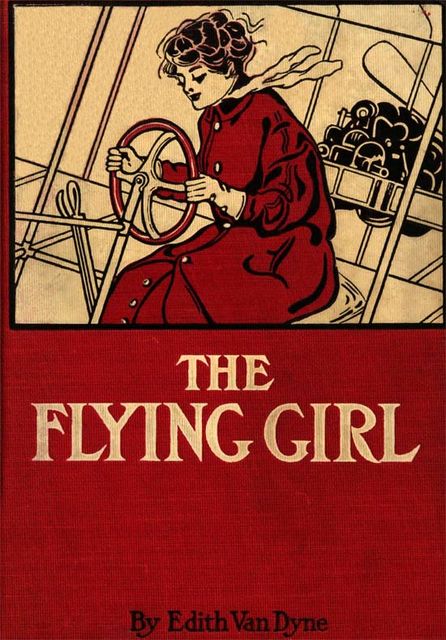



автордың кітабын онлайн тегін оқу The Flying Girl
Transcriber’s Note
- Obvious typos and punctuation errors corrected, otherwise, variations in spelling retained.
The Flying Girl
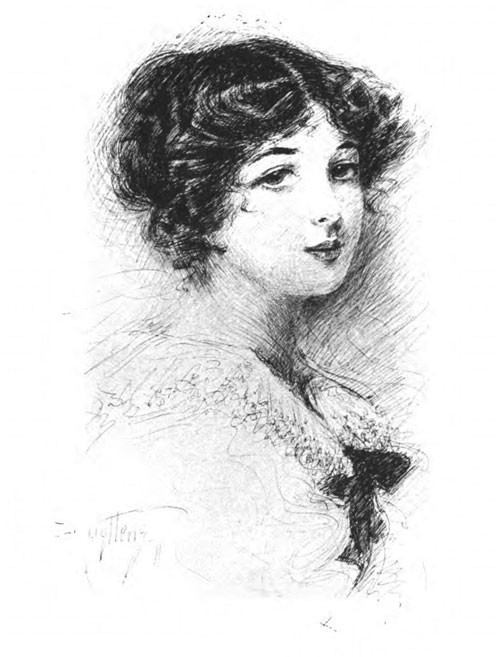
“Orissa—The Flying Girl.”
The Flying Girl
BY
EDITH VAN DYNE
Author of
Aunt Jane’s Nieces, Aunt Jane’s Nieces Abroad, Aunt Jane’s Nieces at Millville, Aunt Jane’s Nieces at Work, Aunt Jane’s Nieces in Society, Aunt Jane’s Nieces and Uncle John
Illustrated by Joseph Pierre Nuyttens
Publishers
The Reilly & Britton Co.
Chicago
Copyright 1911
by
The Reilly & Britton Co.
The Flying Girl
CONTENTS
Chapter PAGEI
Orissa13
II
A Disciple of Aviation20
III
The Kane Aircraft32
IV
Mr. Burthon is Confidential38
V
Between Man and Man—and a Girl47
VI
A Bucking Biplane55
VII
Something Wrong62
VIII
Mr. Burthon’s Proposition71
IX
The Other Fellow78
X
A Fresh Start83
XI
Orissa Resigns89
XII
The Spying of Tot Tyler96
XIII
Sybil is Critical105
XIV
The Flying Fever113
XV
A Final Test122
XVI
The Opening Gun132
XVII
A Curious Accident139
XVIII
The One to Blame144
XIX
Planning the Campaign155
XX
Uncle and Niece164
XXI
Mr. H. Chesterton Radley-Todd174
XXII
The Flying Girl184
XXIII
A Battle in the Air192
XXIV
The Criminal202
XXV
The Real Heroine215
XXVI
Of Course222
LIST OF ILLUSTRATIONS
“Orissa—The Flying Girl”Frontispiece
Orissa stood with hands clasped64
“It—interests me”124
The rescue197
FOREWORD
The author wishes to acknowledge her indebtedness to Mr. Glenn H. Curtiss and Mr. Wilbur Wright for courtesies extended during the preparation of this manuscript. These skillful and clever aviators, pioneers to whom the Art of Flying owes a colossal debt, do not laugh at any suggestion concerning the future of the aëroplane, for they recognize the fact that the discoveries and inventions of the next year may surpass all that have gone before. The world is agog with wonder at what has been accomplished; even now it is anticipating the time when vehicles of the air will be more numerous than are automobiles to-day.
The American youth has been no more interested in the development of the science of aviation than the American girl; she is in evidence at every meet where aëroplanes congregate, and already recognizes her competence to operate successfully any aircraft that a man can manage. So the story of Orissa Kane’s feats has little exaggeration except in actual accomplishment, and it is possible her ventures may be emulated even before this book is out of press. There are twenty women aviators in Europe; in America are thousands of girls ambitious to become aviators.
An apology may be due those gentlemen who performed so many brilliant feats at the 1911 meet at Dominguez, for having thrust them somewhat into the shade to allow the story to exalt its heroine; but they will understand the exigencies that required this seeming discourtesy and will, the author is sure, generously pardon her.
The Flying Girl
CHAPTER I
ORISSA
“May I go now, Mr. Burthon?” asked Orissa.
He looked up from his desk, stared a moment and nodded. It is doubtful if he saw the girl, for his eyes had an introspective expression.
Orissa went to a cabinet wardrobe and took down her coat and hat. Turning around to put them on she moved a chair, which squeaked on the polished floor. The sound made Mr. Burthon shudder, and aroused him as her speech had not done.
“Why, Miss Kane!” he exclaimed, regarding her with surprise, “it is only four o’clock.”
“I know, sir,” said Orissa uneasily, “but the mail is ready and all the deeds and transfers have been made out for you to sign. I—I wanted an extra hour, to-night, so I worked during lunch time.”
“Oh; very well,” he said, stiffly. “But I do not approve this irregularity, Miss Kane, and you may as well understand it. I engage your services by the week, and expect you to keep regular hours.”
“I won’t go, then,” she replied, turning to hang up her coat.
“Yes, you will. For this afternoon I excuse you,” he said, turning again to his papers.
Orissa did not wish to offend her employer. Indeed, she could not afford to. This was her first position, and because she was young and girlish in appearance she had found it difficult to secure a place. Perhaps it was because she had applied to Mr. Burthon during one of his fits of abstraction that she obtained the position at all; but she was competent to do her work and performed it so much better than any “secretary” the real estate agent had before had that he would have been as loth to lose her as she was to be dismissed. But Orissa did not know that, and hesitated what to do.
“Run along, Miss Kane,” said her employer, impatiently; “I insist upon it—for to-night.”
So, being very anxious to get home early, the girl accepted the permission and left the office, feeling however a little guilty for having abridged her time there.
She had a long ride before her. Leaving the office at four o’clock meant reaching home forty minutes later; so she hurried across the street and boarded a car marked “Beverly.” Los Angeles is a big city, because it is spread from the Pacific Ocean to the mountains—an extreme distance of more than thirty miles. Yet it is of larger extent than that would indicate, as country villages for many miles in every direction are really suburbs of the metropolis of Southern California and the inhabitants ride daily into the city for business or shopping.
It was toward one of these outlying districts that Orissa Kane was now bound. They have rapid transit in the Southwest, and the car, headed toward the north but ultimately destined to reach the sea by way of several villages, fairly flew along the tracks. It was August and a glaring sun held possession of a cloudless sky; but the ocean breeze, which always arrives punctually the middle of the afternoon, rendered the air balmy and invigorating.
It was seldom that this young girl appeared anywhere in public without attracting the attention of any who chanced to glance into her sweet face. Its contour was almost perfect and the coloring exquisite. In addition she had a slender form which she carried with exceeding grace and a modest, winning demeanor that was more demure and unconscious than shy.
Such a charming personality should have been clothed in handsome raiment; but, alas, poor Orissa’s gown was the simplest of cheap lawns, and of the ready-made variety the department stores sell in their basements. It was not unbecoming, nor was the coarse straw hat with its yard of cotton-back ribbon; yet the case was stated to-day very succinctly by a middle-aged gentleman who sat with his wife in the car seat just behind Orissa:
“If that girl was our daughter,” said he, “I’d dress her nicely if it took half my income to do it. Great Cæsar! hasn’t she anyone to love her, or care for her? She seems to me like a beautiful piece of bric-a-brac; something to set on a pedestal and deck with jewels and laces, for all to admire.”
“Pshaw!” returned the lady; “a girl like that will be admired, whatever she wears.”
Orissa had plenty of love, bestowed by those nearest and dearest to her, but circumstances had reduced the family fortunes to a minimum and the girl was herself to blame for a share of the poverty the Kanes now endured.
The car let her off at a wayside station between two villages. It was in a depression that might properly be termed a valley, though of small extent, and as the car rushed on and left her standing beside a group of tall palms it at first appeared there were no houses at all in the neighborhood.
But that was not so; a well defined path led into a thicket of evergreens and then wound through a large orange orchard. Beyond this was a vine covered bungalow of the type so universal in California; artistic to view but quite inexpensive in construction.
High hedges of privet surrounded the place, but above this, in the space back of the house, rose the canvas covered top of a huge shed—something so unusual and inappropriate in a place of this character that it would have caused a stranger to pause and gape with astonishment.
Orissa, however, merely glanced at the tent-like structure as she hurried along the path. She turned in at the open door of the bungalow, tossed hat and jacket into a chair and then went to where a sweet-faced woman sat in a morris chair knitting. In a moment you would guess she was Orissa’s mother, for although the features were worn and thin there was a striking resemblance between them and those of the fresh young girl stooping to kiss her. Mrs. Kane’s eyes were the same turquoise blue as her daughter’s; but, although bright and wide open they lacked any expression, for they saw nothing at all in our big, beautiful world.
“Aren’t you early, dear?” she asked.
“A whole hour,” said Orissa. “But I promised Steve I’d try to get home at this time, for he wants me to help him. Can I do anything for you first, mamma?”
“No,” was the reply; “I am quite comfortable. Run along, if Steve wants you.” Then she added, in a playful tone: “Will there be any supper to-night?”
“Oh, yes, indeed! I’ll break away in good season, never fear. Last night I got into the crush of the ‘rush hour,’ and the car was detained, so both Steve and I forgot all about supper. I’ll run and change my dress now.”
“I’m afraid the boy is working too hard,” said Mrs. Kane, sighing. “The days are not half long enough for him, and he keeps in his workshop, or hangar, or whatever you call it, half the night.”
“True,” returned Orissa, with a laugh; “but it is not work for Steve, you know; it’s play. He’s like a child with a new toy.”
“I hope it will not prove a toy, in the end,” remarked Mrs. Kane, gravely. “So much depends upon his success.”
“Don’t worry, dear,” said the girl, brightly. “Steve is making our fortune, I’m sure.”
But as she discarded the lawn for a dark gingham in her little chamber, Orissa’s face was more serious than her words and she wondered—as she had wondered hundreds of times—whether her brother’s great venture would bring them ruin or fortune.
CHAPTER II
A DISCIPLE OF AVIATION
The Kanes had come to California some three years previous because of Mr. Kane’s impaired health. He had been the manager of an important manufacturing company in the East, on a large salary for many years, and his family had lived royally and his children been given the best education that money could procure. Orissa attended a famous girls’ school and Stephen went to college. But suddenly the father’s health broke and his physicians offered no hope for his life unless he at once migrated to a sunny clime where he might be always in the open air. He came to California and invested all his savings—not a great deal—in the orange ranch. Three months later he died, leaving his blind wife and two children without any financial resources except what might be gleaned from the ranch. Fortunately the boy, Stephen, had just finished his engineering course at Cornell and was equipped—theoretically, at least—to begin a career with one of the best paying professions known to modern times. Mechanical to his finger tips, Stephen Kane had eagerly absorbed every bit of information placed before him and had been graduated so well that a fine position was offered him in New York, with opportunity for rapid advancement.
Mr. Kane’s death prevented the young man from accepting this desirable offer. He was obliged to go to Los Angeles to care for his mother and sister. It was a difficult situation for an inexperienced boy to face, but he attacked the problem with the same manly courage that had enabled him to conquer Euclid and Calculus at school, and in the end arranged his father’s affairs fairly well.
The oranges from the ranch would give them a net income of about two thousand dollars a year, which was far from meaning poverty, although much less than the family expenditures had previously been. There were other fruits on the place, an ample vegetable garden and a flock of chickens, so the Kanes believed they would live very comfortably on their income. In addition to this, Steve could earn a salary as a mechanical engineer, or at least he believed he could.
He found, however, after many unsuccessful attempts, that his professional field was amply covered by experienced men, and as a temporary makeshift he was finally driven to accept a position in an automobile repair shop.
“It’s an awful comedown, Ris,” he said to Orissa, his confidant, “but I can’t afford to loaf any longer, you know, and the pay is almost as much as a young engineer gets to start with. So I’ll tackle it and keep my eye open for something better.”
While Stephen was employed in this repair shop a famous aviator named Willard came to town with his aëroplane and met with an accident that badly disabled his machine. Although aviators have marked Southern California as their chosen field from the beginning, because one may fly there all winter, there was not a place in the city where a specialty was made of repairing airships. Naturally Mr. Willard sought an automobile repair shop as the one place most liable to supply his needs.
The manager shook his head.
“We know nothing about biplanes,” he confessed.
“Pardon me, sir,” said Stephen Kane, who was present, “I know something about airships, and I am sure I can repair Mr. Willard’s, if you will take the job.”
The aviator turned to him gratefully.
“Thank you,” he said; “I’ll put my machine in your hands. What experience have you had with biplanes of this type?”
“None at all,” was the answer; “but I am sure you will not find an experienced airship man in this city. I’ve studied the devices, though, ever since Montgomery made his first flights, and as we have all the requisite tools and machinery here I am sure, with your assistance and direction, I can readily put your machine into perfect condition.”
He did, performing the work excellently. Before long another biplane needed repairs, and Stephen was recommended by Mr. Willard. Later a Curtiss machine came under Steve’s hands, and then an Antoinette monoplane. The manager raised the young fellow’s salary, proud that he had a man competent to repair these new-fangled inventions which were creating such a stir throughout the country.
Stephen Kane might have continued to follow the calling of an expert aëroplane doctor with marked success, had he been an ordinary young mechanic. But the air castles he had built at college were not all dissipated, as yet, and aside from possessing decided talent as a workman Steve had an inventive genius that promised great things for his future. By the time he had taken a half dozen different aëroplanes apart and repaired them he had a thorough knowledge of their construction and requirements, and the best of them seemed to him wholly inadequate for the purpose for which they were planned.
“The fact is, Ris,” he said to Orissa one evening, after he had been poring over a book on air currents, “the airships of to-day are all experimental, and chock full of mistakes. No two are anywhere near alike, and each man thinks he has the only correct mechanism.”
“But they fly,” answered the girl, who was keenly interested in the subject of aviation and had twice been down to the shop to examine the aëroplanes Steve was repairing.
“So they do; they fly, after a fashion,” admitted the young man, “which fully proves the thing can be accomplished. But present machines are all too complicated, and the planes seem to have been shaped by guesswork, rather than common sense. They fuss with motors and propellers and ignore the sustaining mechanism, which is the most vital principle of all. Some day we shall see the sky full of successful aviators, and flying will be as common as automobiling now is; but when that time comes we shall laugh at the crude devices they brag of to-day.”
“That may be true,” returned the girl, thoughtfully; “but isn’t it true of every great invention, that the first models are imperfect?”
“Quite true,” said he. “I can make a better biplane than any I have seen, but I admit that had I not had the advantage of seeing any I might have blundered as all the rest seem to have done.”
“Why don’t you make one, Steve?” asked Orissa impulsively. “If aviation is going to become general the man who builds the best aëroplane will make his fortune.”
Steve flushed and rose to tramp up and down the room before he answered. Then he stopped before his sister and said in low, intense accents:
“I long to make one, Orissa! The idea has taken possession of my thoughts until it has almost driven me crazy. I can make a machine that will fly better and be more safe and practical than either the Wright or Curtiss machines. But the thing is impossible. I—I haven’t the money.”
Orissa sat staring at the rug for a long time. Finally she asked:
“How much money would it take, Steve?”
He hesitated.
“I don’t know. I’ve never figured it out. What’s the use?”
“There is use in everything,” declared his sister, calmly. “Get to work and figure. Find out how much you need, and then we’ll see if we can manage it.”
He gazed at her as if bewildered. Then he turned and left the room without a word.
A few evenings later he handed her an estimate.
“I think it could be done for three thousand dollars,” he remarked. “Which means, of course, it can’t be done at all.”
Orissa took the paper without replying and pondered over it for several days. She was only seventeen, but had inherited her father’s clear, business-grasping mind, and would have been an essentially practical girl had not her youth and inexperience lent her some illusions that time would dissipate.
Stephen posed as the “head of the family;” but Orissa really directed its finances, poor Mrs. Kane being so helpless that her children never depended upon her for counsel but on the contrary kept all business matters from her, lest she worry over them. The one maid employed in the bungalow served Mrs. Kane almost exclusively, while Orissa always had devoted much time to her mother, who had been stricken blind at the time of her daughter’s birth.
One evening, when brother and sister were in the garden together, the girl said:
“I believe I have discovered a plan that will permit you to build your airship. What is it to be, Steve; a biplane or a monoplane?”
“Let me hear your plan,” was the eager reply.
“Well, I’ve been to see Mr. Wentworth, and he will advance us fifteen hundred on our orange crop, by discounting the price ten per cent. He came and looked at the trees and said they were safe to pay us at least twenty-three hundred dollars next February.”
“But—Orissa!—how could we live, with our income cut down that way—to a mere seven or eight hundred dollars?”
“I’m going to work,” she said quietly. “I’m tired of doing nothing but dig around the garden and cook. Mamma doesn’t need me, at least during the day, so I’m going into business.”
Steve smiled.
“You work, Orissa? What on earth could you do?”
“I’ll find something to do. And my salary, added to yours, will make up for the loss of the orange money. We must economize, of course; but when we’ve such a big deal on hand—one that will make our fortune—we can put up with a few temporary discomforts.”
“But fifteen hundred won’t build the thing, that is certain,” he said, with a sigh. “I’ve got to construct an entirely new motor—engine and all—and some original propellers and elevators, and the patterns and castings for these will be rather expensive.”
“Well, by the time the fifteen hundred are gone,” she replied, “you will know exactly how much more money is needed, and we will mortgage the place for that amount.”
“Rubbish!” cried Stephen, impatiently. “I won’t listen an instant to such a wild plan. Suppose I fail?”
“Oh, if you’re going to fail we won’t undertake it,” said his sister. “You claimed you could make a better airship than the Curtiss or the Wright—either one of which is worth a fortune—and I believed you. If you were only joking, Steve, we won’t talk of it any more.”
“I wasn’t joking; or bragging, either; you know that, Orissa. I’m pretty sure of my idea; but it’s untried. I’ve bought all the books on aviation I can find and I’ve been reading of Professor Montgomery’s discovery of the laws of air currents and his theories concerning them. They’re only primers, dear, for the science of aviation is as yet unwritten. That is why I cannot speak with perfect assurance; but the more I look into the thing the more positive I am that I’ve hit upon the right idea of aërial navigation.”
“What is your idea?” she asked.
“To simplify the construction of the craft. The present devices are all too complicated and keep the aviator too busy while he’s in the air.”
“In other words, he’s all up in the air while he’s up in the air,” she remarked.
“Precisely. Most of his time is required to maintain a lateral balance, so as not to tip over or lose control. I’m to have a simpler construction, an automatic balance, and a plane only large enough to support the machinery and the aviator.”
“If you can manage that,” said Orissa, “we’re not taking any chances.”
He sat with furrowed brow, thinking deeply. Finally he said in a decisive way:
“Nothing is certain until it is accomplished. I won’t take the risk of making you and mother paupers. Please don’t speak of the thing again, Ris.”
Orissa didn’t; but Steve did, about a month later. A great aviation meet had been arranged at Dominguez Field, near Los Angeles and only a few miles from their own home. The event, which was destined to be an epoch in the history of aviation, brought many famous aviators to the city with their machines, among them a Frenchman named Paulhan, with whom Stephen soon became acquainted. An examination of Paulhan’s machine, a Farman of the latest type, which had already performed marvels, served to convince the boy that his own ideas were not only practical but destined soon to be discovered and applied by someone else if he himself failed to take advantage of the time and opportunity to utilize them. With that argument to calm any misgivings that he might perhaps fail, coupled with an eagerness to build his invention that drove him to forsake caution, Steve went to Orissa one day and said:
“All right, dear; I’m going to undertake the thing. Can you still get Mr. Wentworth to advance the money?”
“I think so,” she replied.
“Then get it, and I’ll start work at once. The drawings are already complete,” and he showed them to her, neatly traced in comprehensive detail.
Most girls would have been bewildered by the technicalities and passed the drawings with a glance; but Orissa understood how important to them all this venture was destined to be, so she sat down and studied the designs minutely, making her brother explain anything she found the least puzzling. By this time the girl had made herself familiar with the latest modern improvements in aëroplanes and had personally examined several of the best devices, so she was able to catch the true value of Stephen’s idea and immediately became as enthusiastic as he was.
The money was raised and placed by Stephen in a bank where he could draw upon it as he needed it. Mrs. Kane concurred mildly in the plans when they were explained to her, being accustomed to lean upon Orissa and Stephen and to accept their judgment without protest. Aviation was all Greek to the poor woman and she did not bother her head trying to understand why people wanted to fly, or how they might accomplish their desire.
CHAPTER III
THE KANE AIRCRAFT
Stephen set up his workshop at home, devoting his evenings to the new aëroplane. Progress was necessarily slow, as four or five hours out of each twenty-four were all he could devote to his enterprise.
The boy was still employed in this manner when the Aviation Meet was held at Dominguez Field and Paulhan accomplished the wonderful flights that made him world famous. Of course, Orissa and Stephen were present and did not miss a single event. On the grand stand beside them sat a young fellow Stephen had often met at the automobile shop, a chauffeur named Arch Hoxsey. It was the first time Hoxsey had ever seen an aëroplane, and neither he nor Stephen could guess that within one year this novice would become the greatest aviator in all the world. These are days when, comet-like, a heretofore unknown aviator appears, accomplishes marvels and disappears, eclipsed by some new master of the art of flying. It is the same way with aëroplanes; the leading one to-day is within a brief period destined to be surpassed by a greatly improved machine.
The enthusiasm of the Kanes rose to fever heat in witnessing this exhibition, at the time the most remarkable ever held in the annals of aviation. Afterward they counseled together very seriously and agreed that it would be better for Steve to resign his position at the shop and devote his whole time to his aëroplane, in which he had now more confidence than ever.
He applied for patents on his various devices and the complete machine, being fearful that someone else might adopt his ideas before he could finish his first aëroplane; yet at the same time he observed the utmost secrecy as to the work on which he was engaged and admitted no person except Orissa to the garden, where he had set up his hangar and shop.
The girl had been for some time persistently seeking employment, for now that Steve had ceased to be a breadwinner it was more important than ever for her to earn money. By good fortune she was engaged by Mr. Burthon as his secretary the very week following her brother’s retirement.
Steve’s expenses were growing greater, however, and Orissa began figuring on “ways and means.” Their life in this retired place was so simple that she believed her mother could do without the maid and questioned her on the subject. Mrs. Kane declared she preferred to be alone, if Orissa felt she could prepare the breakfasts and dinners unaided. Luncheons at home were very plain affairs and Steve readily agreed to come into the house at noon and get a bite for himself and his mother. So the maid was dismissed and a considerable expense eliminated.
During the summer construction of the airship progressed more rapidly and, after the motors were completed and tested and found to be nearly perfect, Steve began to model the planes and perfect his automatic balance.
It was hard work sometimes for Orissa to sit in the office and keep her mind on her work when she knew her brother was completing or testing some important detail of the aëroplane, but she held herself in rigid restraint and succeeded in giving satisfaction to her employer.
On the August afternoon on which our story opens Stephen Kane was to begin the final assembling of the parts of his machine, after which he could test it in real flight. He needed Orissa’s assistance to help him handle some of the huge ribbed planes, and so she had promised to come home early.
It was not long before she entered the hangar, arrayed in her old gingham, which allowed her to move freely. The two became so interested that Mrs. Kane almost missed her dinner in spite of the girl’s promise; but Orissa did manage to tear herself away from the fascinating task long enough to prepare the meal and serve it. Steve came in and tried to eat, for he was at a point where he could do nothing without his sister’s help; but neither of them was able to swallow more than a morsel, and as quickly as possible hurried back to their work.
Mrs. Kane, although totally blind, knew her way about the house perfectly and was able to take care of herself in nearly all ways; so when bedtime came she abandoned her monotonous knitting, played a few pieces on the pianoforte—one of her few amusements—and then calmly retired for the night. She never worried over the “children,” believing they were competent to care for themselves.
It was long past midnight before Steve got to a point where he could continue without Orissa. “In about three days more,” he said, as they washed up and prepared to adjourn to the house, “I will be able to make my first flight. Shall we wait till Sunday, Ris, or will you take a day off?”
“Oh, not Sunday,” she replied. However eager her brother might be she had never yet allowed him to work a moment on a Sunday, and Steve deferred to her wishes in this regard. “We’re pretty busy at the office and Mr. Burthon was inclined to be a little cranky to-day; but I’ll manage it somehow, just as soon as you are ready.”
“What sort of a fellow is Burthon?” asked her brother, somewhat curiously.
“Why, he stands well in the business world, I’m told, and is very successful in handling large tracts of real estate,” she replied. “Also, he seems a gentleman by birth and breeding, yet a queerer man I never met. His chief peculiarity is in being very absent-minded, but he does other odd things. Yesterday he refused to sell a piece of land to a customer because he did not like him, and he told the man so with rude frankness. One day I discovered he had cheated another man out of six hundred dollars. I called his attention to what I described as a ‘mistake,’ and he said he robbed the man on purpose, because he had been snobbish and overbearing. He gave the six hundred dollars to a poor woman to build her a house with, saying to me that he had once committed a serious crime for which this was in part penance, and soon after he platted a lot of swamp land down near San Pedro and advertised it as ‘desirable residence property.’ Really, Steve, I can’t quite make out Mr. Burthon.”
“He seems to have good and bad points, from what you say,” observed her brother, “and I judge the two qualities are about evenly mixed. Is he nice to you, Ris?”
“He is always polite and respectful, but most of the time he doesn’t know I’m in existence. When he gets one of his absorbed fits his eyes look right through me, as if I wasn’t there.”
“Perhaps he is thinking out some big schemes. Is he a rich man?”
“He is said to be quite wealthy. But he is an old bachelor, and the girl across the hall says he lives at a club, goes to the theater every night and drinks more than is good for him. I hardly believe that last, Steve, for Mr. Burthon doesn’t look a bit like a drinking man.”
“Perhaps he’s a morphine fiend. That would make him absent-minded, you know.”
“No; when he’s aroused his head is clear as a bell and he drives a shrewd bargain. Do you know, Steve, I’m inclined to think that speech of his was in earnest, although he laughed harshly at the time, and that—that—”
“That what?”
“That at some time or other he has committed some crime that worries him.”
CHAPTER IV
MR. BURTHON IS CONFIDENTIAL
Orissa was tired next day and she blundered several times in copying deeds and attending to the routine of the private office, where she alone was closeted with the proprietor. But Mr. Burthon would not have noticed had she set fire to the place, so intent was he upon a bundle of papers he had brought in with him and to which he devoted his exclusive attention.
The girl left him at his desk when she went to lunch and found him there, still occupied with the papers, when she returned. Several people wanted to see him personally, but he told Orissa to state he was engaged and could admit no one. She gave the message to the young man in charge of the outer office, where several clerks were employed, and they knew better than to allow anyone to invade Mr. Burthon’s private sanctum.
At about three o’clock, while she was busy at her desk, the secretary heard her name spoken and looked up. From his chair Mr. Burthon was eyeing her observantly. His gaze was clear and intelligent; the abstracted mood had passed.
“Come here, please, Miss Kane,” he said.
She brought her writing pad and sat down beside his desk, as she did when he dictated his letters; but he shook his head.
“We’ll not mind the mail to-day,” he said. “I want to talk with you; to advise with you. Queerly enough, Miss Kane, there isn’t a soul on earth in whom I can confide when occasion arises. In other words, I haven’t an intimate friend I can trust, or one who is sincerely interested in me.”
That embarrassed Orissa a little. Since she had been working at the office this was the first time he had addressed a remark to her not connected with the business. Indeed, the man was now regarding her much as he would a curiosity, as if he had just discovered her. She was amazed to hear him speak so confidentially and made no reply because she had nothing to say.
After a pause he continued:
“You haven’t much business experience, my child, but you have a keen intellect and decided opinions.” Orissa wondered how he knew that. “Therefore I am going to ask your advice in a matter where business is blended with sentiment. Will you be good enough to give me your candid opinion?”
“If you wish me to, sir,” she said, after some hesitation.
“Thank you, Miss Kane. The case is this: With four others I purchased some time ago a gold mine in Arizona known as the ‘Queen of Hearts.’ It cost me about all I am worth—some two hundred thousand dollars.”
Orissa gasped. It seemed an enormous sum. But he continued, speaking calmly and clearly:
“I thought at the time the mine was surely worth a million. I went to see it and found the ore exceedingly rich. The others, who purchased the Queen of Hearts with me, were equally deceived, for just recently we have discovered that the rich vein was either very narrow or was placed there by those we purchased from, with the intention of defrauding us. In either case, please understand that the mine is not worth a cotton hat. We are a stock company, and our stock is listed on the exchange and commands a high premium, for no one except the owners knows the truth about it. The general idea is that the mine is still producing largely—and it is—for, to protect ourselves until we can unload it on to others, we have secretly purchased rich ore elsewhere, dumped it into the mine, and then taken it out again.”
He paused, drumming absently on the desk with his fingers, and Orissa asked:
“What is the object of that deception, sir?”
“To maintain the public delusion until we can sell out. And now I come to the point of my story, Miss Kane. Gold mines, even as rich as the Queen of Hearts is reputed to be, are not easy to sell. I have exhausted all my resources in keeping up this deception and the time has come when I must sell or become bankrupt. The other stockholders have smaller interests and are wealthier men, but each one is striving hard to secure a customer. I have found one.”
He looked up and smiled at her; then he frowned.
“The man is my brother-in-law,” he added.
Orissa was getting nervous, but waited for him to continue.
“This brother-in-law is a man I detest. He married my only sister and did not treat her well. He is a notorious gambler and confidence man, although perhaps he would not admit that is his profession. At all events he had the assurance to sneer at me and abuse my sister, and I was powerless at the time to interfere. Fortunately the poor woman died several years ago. Since then I have not seen much of Cumberford, for he lives in the East. He came out here last month on some small business matter and has gone crazy over the Queen of Hearts mine. He hunted me up and asked if I’d sell part of my stock. I told him I would sell all or none. So he has been getting his money together and has raised two hundred and fifty thousand dollars—the sum I demanded.”
Orissa was looking at him wonderingly. The story seemed incredible. Perhaps Mr. Burthon saw the dismay and reproach in her eyes, for he asked:
“What do you think of this deal, Miss Kane? Am I not fortunate?”
“But—would you really sell a worthless property to this man—your own brother-in-law—and—and steal a fortune from him?” she inquired.
The man flushed and shifted uneasily in his seat.
“He abused my sister,” he said, as if defending himself.
“The property is worthless,” she persisted.
“He can hustle around and sell it again, as I am doing.”
“Suppose he fails? Suppose he refuses to do such a wicked thing?”
Mr. Burthon stared at her a moment. Then he laughed harshly.
“Cumberford would delight in such a ‘wicked’ game,” he replied. “And, if he failed to sell, the scoundrel would be ruined, for I believe this two hundred and fifty thousand is about all he’s worth.”
“It’s dreadful!” exclaimed the girl, really shocked.
“It is done every day in a business way,” he rejoined.
“Then why did you ask my advice?” demanded the girl, quickly. Before answering he waited to drum on the desk with his fingers again.
“Because,” said he, speaking slowly, “I dislike this man so passionately that I have wondered if the hatred blinds my judgment. He may be dangerous, too, yet I think he is too much of a fool to be able to injure me in retaliation. I don’t know him very well. I’ve not seen him before for years.” He paused, taking note of the horror spreading over the girl’s face. Then he smiled and added in a gentler voice: “Perhaps my chief reason, however, for seeking your advice is that I find I have still a conscience. Yes, yes; a troublesome conscience. I have been suppressing it for years, yet like Banquo’s ghost it will not down. My business judgment determines me to unload this worthless stock and save myself from the loss of my entire fortune. I must do it. It is like a man taking unawares a counterfeit coin, and then, discovering it is spurious, passing it on to some innocent victim. You might do that yourself, Miss Kane.”
“I do not believe I would.”
“Well, most people would, and think it no crime. In this case I’m merely passing a counterfeit, that I received innocently, on to another innocent. If the fact is ever known my business friends will applaud me. But that obstinate conscience of mine keeps asking the question: ‘Is it safe?’ It asserts that I am filled with glee because I am selling to a man I hate—a man who has indirectly injured me. I am to get revenge as well as save my money. Safe? Of course it’s safe. Yet my—er—conscience—the still small voice—keeps digging at me to be careful. It doesn’t seem to like the idea of dealing with Cumberford, and has been annoying me for several days. So I thought I would put the case to a young, pure-minded girl who has a clear head and is honest. I imagined you would tell me to go ahead. Then I could afford to laugh at cautious Mr. Conscience.”
“No,” said Orissa, gravely, “the conscience is right. But you misunderstand its warning. It doesn’t mean that the act is not safe from a worldly point of view, but from a moral standpoint. You could not respect yourself, Mr. Burthon, if you did this thing.”
He sighed and turned to his papers. Orissa hesitated. Then, impulsively, she asked:
“You won’t do it, sir; will you?”
“Yes, Miss Kane; I think I shall.”
His tone had changed. It was now hard and cold.
“Mr. Cumberford will call here to-morrow morning at nine, to consummate the deal,” he continued. “See that we are not disturbed, Miss Kane.”
“But, sir—”
He turned upon her almost fiercely, but at sight of her distressed, downcast face a kindlier look came to his eyes.
“Remember that the alternative would be ruin,” he said gently. “I would be obliged to give up my business—these offices—and begin life anew. You would lose your position, and—”
“Oh, I won’t mind that!” she exclaimed.
“Don’t you care for it, then?”
“Yes; for I need the money I earn. But to do right will not ruin either of us, sir.”
“Perhaps not; but I’m not going to do right—as you see it. I shall follow my business judgment.”
Orissa was indignant.
“I shall save you from yourself, then,” she cried, standing before him like an accusing angel. “I warn you now, Mr. Burthon, that when Mr. Cumberford calls I shall tell him the truth about your mine, and then he will not buy it.”
He looked at her curiously, reflectively, for a long time, as if he beheld for the first time some rare and admirable thing. The man was not angered. He seemed not even annoyed by her threat. But after that period of disconcerting study he turned again to his desk.
“Thank you, Miss Kane. That is all.”
She went back to her post, trembling nervously from the excitement of the interview, and tried to put her mind on her work. Mr. Burthon was wholly unemotional and seemed to have forgotten her presence. But, a half hour later, when he thrust the papers into his pocket, locked his desk and took his hat to go, he paused beside his secretary, gazed earnestly into her face a moment and then abruptly turned away.
“Good night, Miss Kane,” he said, and his voice seemed to dwell tenderly on her name.
CHAPTER V
BETWEEN MAN AND MAN—AND A GIRL
That night Orissa confided the whole story to Steve. Her brother listened thoughtfully and then inquired:
“Will you really warn Mr. Cumberford, Ris?”
“I—I ought to,” she faltered.
“Then do,” he returned. “To my notion Burthon is playing a mean trick on the fellow, and no good business man would either applaud or respect him for it. Your employer is shifty, Orissa; I’m sure of it; if I were you I’d put a stop to his game no matter what came of it.”
“Very well, Steve; I’ll do it. But I don’t believe Mr. Burthon means to be a bad man. His plea about his conscience proves that. But—but—”
“It’s worse for a man to realize he’s doing wrong, and then do it, than if he were too hardened to have any conscience at all,” asserted Steve oracularly.
“And if I let him do this wrong act I would be as guilty as he,” she added.
“That’s true, Ris. You’ll lose your job, sure enough, but there will be another somewhere just as good.”
So, when Mr. Burthon’s secretary went to the office next morning she was keyed up to do the most heroic deed that had ever come to her hand. Whatever the consequences might be, the girl was determined to waylay Mr. Cumberford when he arrived and tell him the truth about the Queen of Hearts.
But he did not come to the office at nine o’clock. Neither had Mr. Burthon arrived at that time. Orissa, her heart beating with trepidation but strong in resolve, watched the clock nearing the hour, passing it, and steadily ticking on in the silence of the office. The outer room was busy this morning, and in the broker’s absence his secretary was called upon to perform many minor tasks; but her mind was more upon the clock than upon her work.
Ten o’clock came. Eleven. At half past eleven the door swung open and Mr. Burthon ushered in a strange gentleman whom Orissa at once decided was Mr. Cumberford. He was extremely tall and thin and stooped somewhat as he walked. He had a long, grizzled mustache, wore gold-rimmed eyeglasses and carried a gold-headed cane. From his patent leather shoes to his chamois gloves he was as neat and sleek as if about to attend a reception.
Observing the presence of a young lady the stranger at once removed his hat, showing his head to be perfectly bald.
“Sit down, Cumberford,” said Mr. Burthon, carelessly.
As he obeyed, Orissa, her face flaming red, advanced to a position before him and exclaimed in a pleading voice:
“Oh, sir, do not buy Mr. Burthon’s mine, I beg of you!”
The man stared at her with faded gray eyes which were enlarged by the lenses of his spectacles. Mr. Burthon smiled, seemed interested, and watched the scene with evident amusement.
“Why not, my child?” asked Mr. Cumberford.
“Because it is worthless—absolutely worthless!” she declared.
He turned to the other man.
“Eh, Burthon?” he muttered, inquiringly.
“Miss Kane believes she is speaking the truth,” said the broker jauntily.
“Oh, she does. And you, Burthon?”
“I? Why, I’m of the same opinion.”
Mr. Cumberford took out his handkerchief, removed his glasses and polished the lenses with a thoughtful air. Orissa was trembling with nervousness.
“Don’t buy the Queen of Hearts, sir; it would ruin you,” she repeated earnestly.
He breathed upon the glasses and wiped them carefully.
“You interest me,” he remarked. “But, the fact is, I—er—I’ve bought it.”
“Already!”
“At nine o’clock, according to agreement. Burthon sent word he’d come to my hotel instead of meeting me at his office, as first planned.”
“Oh, I see!” cried Orissa, much disappointed. “He knew I would prevent the crime.”
“Crime, miss?”
“Is it not a crime to rob you of two hundred and fifty thousand dollars?”
“It would be, of course. I should dislike to lose so much money.”
“You have lost it!” declared the girl. “That mine has no gold in it at all—except what has been bought elsewhere and placed in it to deceive a purchaser.”
Mr. Cumberford replaced his glasses, adjusting them carefully upon his nose. Then he stared at Orissa again.
“You’re an honest young woman,” he said calmly. “I’m much obliged. You interest me. But—ahem!—Burthon has my money, you see.”
Mr. Burthon’s expression had changed. He was now regarding his brother-in-law with a curious and puzzled gaze.
“You’re not angry, Cumberford?” he asked.
“No, Burthon.”
“You’re not even annoyed, I take it?” This with something of a sneer.
“No, Burthon.”
Both Orissa and her employer were amazed. Looking from one to another, Mr. Cumberford’s waxen features relaxed into a smile.
“I’ve placed my Queen of Hearts stock in a safety deposit vault,” he remarked blandly.
“I have deposited your money in my bank,” retorted Mr. Burthon, triumphantly.
“Excellent!” said the other. “The thing interests me—indeed it does. You couldn’t purchase that stock from me at this moment, Burthon, for twice the sum I paid you.”
“No? And why not?”
“I’ll tell you. I had not intended to refer to the matter just yet, but this young woman’s exposé of your attempted trickery induces me to explain matters. You have always taken me for a fool, Burthon.”
“I’ve tried to place a proper value on your intellect, Cumberford.”
“You have little talent in that line, believe me. Before I came out here I had heard such glowing reports of the Queen of Hearts that I stopped off in Arizona to see the wonderful mine. The manager was very polite and showed me about, but somehow I got a notion that all was not square and aboveboard. I’ve always been interested in mines; they fascinate me; and if this mine was as rich as reported I wanted some of the stock. But I imagined things looked a little queer, so I sent a confidential agent—fellow named Brewster, who has been with me for years—to hire out as a miner and keep his eyes open. He soon discovered the truth—that the mine was being ‘salted’ or fed with outside gold ore in precisely the way this girl has stated.”
He turned to Orissa with a profound bow, then looked toward Burthon again. “The thing interested me. I wondered why, and wired my man to stay on a little longer, till I had time to think it over. I—er—think very slowly. Very. In a few days Brewster telegraphed me the startling intelligence that the mine had actually struck a new lead, with ore far richer than the first showing, although that had made the Queen of Hearts famous. My man had been sent to the telegraph office with messages from the manager to Mr. Burthon and the four other stockholders; but poor Brewster’s memory is bad, and he forgot to send a telegram to anyone but me. Of course the great strike—er—interested me. I instructed Brewster over the telegraph wire. At a cost of five thousand dollars we bribed the manager to keep the valuable strike secret for ten days. He’s an honest man, and I shall retain him in the office. The ten days expire to-night. Meantime, I’ve purchased the stock.”
Mr. Burthon sprang to his feet, white with anger.
“You scoundrel!” he shouted.
“Don’t get excited, Burthon. This is a mere business incident, between man and man—and a girl.” Another bow toward Orissa. “You tried to rob me, sir, and sneered when you thought you had succeeded. I haven’t robbed you, for I paid your price; but I’ve made a very neat investment. My stock is worth a million at this moment. Interesting, isn’t it?”
Mr. Burthon recovered himself with an effort and sat down again.
“Very well,” he said a little thickly. “As you say, it’s all in the way of business. Good day, Cumberford.”
The other man arose and faced Orissa, who stood by wholly bewildered by this unexpected development.
“Thank you again, my child. Your name? Orissa Kane. I’ll remember it. You tried to do me a kindness. Interesting—very!”
Without another glance at Mr. Burthon he put on his hat, walked out and closed the door softly behind him.
Orissa looked up and found the broker’s eyes regarding her intently.
“I—I’m sorry, sir,” she stammered; “but I had to do it, to satisfy my conscience. I suppose I am dismissed?”
“No, indeed, Miss Kane,” he returned in kindly tones. “An honest secretary is too rare an acquisition to be dismissed without just cause. Having told you what I did, I could expect you to act in no other way.”
“And, after all, sir,” she said, brightening at the thought, “you did not rob him! Yet you saved your fortune.”
He made a slight grimace, and then laughed frankly.
“Had I taken your advice,” he rejoined, “I should now be worth a million.”
CHAPTER VI
A BUCKING BIPLANE
Stephen Kane had scarcely slept a wink for three nights. When Orissa came home Thursday evening he met her at the car with the news that his aëroplane was complete.
“I’ve been adjusting it and testing the working parts all the afternoon,” he said, his voice tense with effort to restrain his excitement, “and I’m ready for the trial whenever you say.”
“All right, Steve,” she replied briskly; “it begins to be daylight at about half past four, this time of year; shall we make the trial at that hour to-morrow morning?”
“I couldn’t wait longer than that,” he admitted, pressing her arm as they walked along. “My idea is to take it into old Marston’s pasture.”
“Isn’t the bull there?” she inquired.
“Not now. Marston has kept the bull shut up the past few days. And it’s the best place for the trial, for there’s lots of room.”
“Let’s take a look at it, Steve!” she said, hastening her steps.
In the big, canvas covered shed reposed the aëroplane, its spreading white sails filling the place almost to the very edges. It was neither a monoplane nor a biplane, according to accepted ideas of such machines, but was what Steve called “a story-and-a-half flyer.”
“That is, I hope it’s a flyer,” he amended, while Orissa stared with admiring eyes, although she already knew every stick and stitch by heart.
“Of course it’s a flyer!” she exclaimed. “I wouldn’t be afraid to mount to the moon in that airship.”
“All that witches need is a broomstick,” he said playfully. “But perhaps you’re not that sort of a witch, little sister.”
“What shall we call it, Steve?” she asked, seriously. “Of course it’s a biplane, because there are really two planes, one being above the other; but it is not in the same class with other biplanes. We must have a distinctive name for it.”
“I’ve thought of calling it the ‘Kane Aircraft,’” he answered. “How does that strike you?”
“It has an original sound,” Orissa said. “Oh, Steve! couldn’t we try it to-night? It’s moonlight.”
He shook his head quickly, smiling at her enthusiasm.
“I’m afraid not. You’re tired, and have the dinner to get and the day’s dishes to wash and put away. As for me, I’m so dead for sleep I can hardly keep my eyes open. I must rest, so as to have a clear head for to-morrow’s flight.”
“Shall we say anything to mother about it?”
“Why need we? It would only worry the dear woman unnecessarily. Whether I succeed or fail in this trial, it will be time enough to break the news to her afterward.”
Orissa agreed with this. Mrs. Kane knew the airship was nearing completion but was not especially interested in the venture. It seemed wonderful to her that mankind had at last learned how to fly, and still more wonderful that her own son was inventing and building an improved appliance for this purpose; but so many marvelous things had happened since she became blind that her mind was to an extent inured to astonishment and she had learned to accept with calm complacency anything she could not comprehend.
Brother and sister at last tore themselves away from the fascinating creation and returned to the house, where Steve, thoroughly exhausted, fell asleep in his chair while Orissa was preparing dinner. He went to bed almost immediately after he had eaten and his sister also retired when her mother did, which was at an early hour.
But Orissa could not sleep. She lay and dreamed of the great triumph before them; of the plaudits of enraptured spectators; of Stephen’s name on every tongue in the civilized world; and, not least by any means, of the money that would come to them. No longer would the Kanes have to worry over debts and duebills; the good things of the world would be theirs, all won by her brother’s cleverness.
If she slept at all before the gray dawn stole into the sky the girl was not aware of it. By half past four she had smoking hot coffee ready for Steve and herself and after hastily drinking it they rushed to the hangar.
Steve was bright and alert this morning and declared he had “slept like a log.” He slid the curtains away from the front of the shed and solemnly the boy and girl wheeled the big aëroplane out into the garden. By careful manipulation they steered it between the trees and away to the fence of Marston’s pasture, which adjoined their own premises at the rear. To get it past the fence had been Steve’s problem, and he had arranged to take out a section of the fencing big enough to admit his machine. This was now but a few minutes’ work, and presently the aëroplane was on the smooth turf of the pasture.
They were all alone. There were no near neighbors, and it was early for any to be astir.
“One of the most important improvements I have made is my starting device,” said Steve, as he began a last careful examination of his aircraft. “All others have a lot of trouble in getting started. The Wright people erect a tower and windlass, and nearly every other machine uses a track.”
“I know,” replied Orissa. “I have seen several men holding the thing back until the motors got well started and the propellers were whirling at full speed.”
“That always struck me as a crude arrangement,” observed her brother. “Now, in this machine I start the motor whirling an eccentric of the same resisting power as the propeller, yet it doesn’t affect the stability of the aëroplane. When I’m ready to start I throw in a clutch that instantly transfers the power from the eccentric to the propeller—and away I go like a rocket.”
As he spoke he kissed his sister and climbed to the seat.
“Are you afraid, Steve?” she whispered, her beautiful face flushed and her eyes bright with excitement.
“Afraid! Of my own machine? Of course not.”
“Don’t go very high, dear.”
“We’ll see. I want to give it a thorough test. All right, Ris; I’m off!”
The motors whirred, steadily accelerating speed while the aëroplane trembled as if eager to dart away. Steve threw in the clutch; the machine leaped forward and ran on its wheels across the pasture like a deer, but did not rise.
He managed to stop at the opposite fence and when Orissa came running up, panting, her brother sat in his place staring stupidly ahead.
“What’s wrong, Steve?”
He rubbed his head and woke up.
“The forward elevator, I guess. But I’m sure I had it adjusted properly.”
He got down and examined the rudder, giving it another upward tilt.
“Now I’ll try again,” he said cheerfully.
They turned the aircraft around and he made another start. This time Orissa was really terrified, for the thing acted just like a bucking broncho. It rose to a height of six feet, dove to the ground, rose again to plunge its nose into the turf and performed such absurd, unexpected antics that Steve had to cling on for dear life. When he finally managed to bring it to a halt the rudder was smashed and two ribs of the lower plane splintered.
They looked at the invention with dismay, both silent for a time.
“Of course,” said Steve, struggling to restrain his disappointment, “we couldn’t expect it to be perfect at the first trial.”
“No,” agreed Orissa, faintly.
“But it ought to fly, you know.”
“Being a flying machine, it ought to,” she said. “Can you mend it, Steve?”
“To be sure; but it will take me a little time. To-morrow morning we will try again.”
With grave faces they wheeled it back into the garden and the boy replaced the fence. Then back to the hangar, where Steve put the Kane Aircraft in its old place and drew the curtains—much as one does at a funeral.
“I’m sure to discover what’s wrong,” he told Orissa, regaining courage as they walked toward the house. “And, if I’ve made a blunder, this is the time to rectify it. To-morrow it will be sure to fly. Have faith in me, Ris.”
“I have,” she replied simply. “I’ll go in and get breakfast now.”