автордың кітабын онлайн тегін оқу New Lights on Old Paths
New Lights on Old Paths
New Lights on Old Paths
BY CHARLES FOSTER,
AUTHOR OF THE “STORY OF THE BIBLE,” Etc.
350 ILLUSTRATIONS.
PUBLISHED AT THE OFFICE OF
CHARLES FOSTER’S PUBLICATIONS,
No. 118 SOUTH SEVENTH STREET,
PHILADELPHIA, PA.

Copyright, 1885,
By CHARLES FOSTER.
——————
Electrotyped by Westcott & Thomson, Philadelphia.
PREFACE
THE author is expected to say something by way of introducing, or apologizing for, his book. What is its object? Why did he write it, when there are already so many more than are wanted? In reply to these questions he would say (what is evident, indeed, without saying) that nobody adds another to the long list who does not believe that—on his subject, at least—there is room for one book more. And he proves the sincerity of his belief by making the venture.
The writer of this volume does not claim to present in it a single new truth. In the sphere of morals, of which it treats, he believes there is no such thing. It is not new truths that we need, but the application of old ones to our daily life and practice. Any device that may assist in securing so desirable a result is of value; in the hope that these Fables may not be wholly useless to this end he hazards their publication. As their title indicates, they will be found to vary widely in subject and mode of treatment.
One word about the illustrations: these all, without exception, were drawn for the book. Much time, labor, and expense have been bestowed upon the effort to make them appropriate and entertaining. The illustrations of a story may be compared to the music of a song. We can bear with some defect in the verse if the music awakens the sentiment the verse was intended to express. So the author hopes that the excellence and originality of many of these designs will in some measure make amends for whatever deficiencies the reader may discover in the text.
Page
The Innkeeper.
13The Brook and the Waterwheel.
37The Court-House Steeple.
41Crooked Horn and Old Brindle.
46The Millers Tenth.
51The Lark and the Whippoorwill.
69The Gate and Gate Post.
73
The Weedy Farm.
78The King Seeking Content.
84The Learned Owl.
94The Horse and the Grasshoppers.
98The Bark and the Lightship.
101The Unhonored Servant.
104Wings.
107Standpoints.
111The Man with a Menagerie.
117Two Outlooks.
121Job Nickel.
125The Unused Loom.
133Crowing.
137Peter Crisp’s Spectacles.
140The Two Apple Trees.
182The Spring in the Woods.
186The Spring in the Woods.
186
The Distant View.
189The Two Vines.
195The Old Chestnut and the Young Oak.
199Corn-cribs.
202The Old Clock in the New Home.
209The Great Secret.
213The House-Builder.
216Pigeons.
223The Clock on the Desk.
225The Watch-Dog.
228The Opened Eyes.
231The Lantern People.
235Grand Relations.
253Fair and Foul Weather.
255Wreckage.
258The Robin.
261
Riddles.
265The Emigrants Wagon.
268Big and Little Lanterns.
273The Cat and the Tiger.
278Charity.
281The Day-Laborers.
286The Artist’s Answer.
291The Hemlock and the Sugar-Maple.
294Bread and the Beautiful.
297The Harper.
301The Unappreciated Gift.
305The Worn-Out Team.
310The Wise Farmer.
314Wayfarers.
319Other Birds Feathers.
323The Night-Watchman.
326Single and Double.
332The Boastful Fly.
335
The Mended Boots.
339The Cripple and his Staff.
344The Search.
360The Swallows and the Windmill.
365The Medicine-Man.
370The Eagle and the Wren.
374The Two Saplings.
378The Cog-Wheel.
382The Plough and the Mowing-Machine.
386Fat and Lean.
389Half Empty and Quite Full.
392The Snake.
395Rich & Poor.
398The Hawk and the Chicken.
402The Servants Money.
405Future Greatness.
411The Old Mans Watch.
415The Teacher.
418
Cloud Shadows.
426The Penitent Transgressor.
428The Dry Well.
432The Fruit Tree.
435The Deer.
438Homely and Handsome.
442The Colt and Old Gray.
446The King’s Almoner.
453Pansies.
457The Birds and the Bells.
459Jack and Jenny.
465The Meeting of the Winds.
476THE INNKEEPER.





There was once a man who kept an inn on a country road. Just back of his house stretched a dark forest in which a number of bad men lived. Some of these men were great fighters, some were robbers, some had even murdered people. And they were all in the habit of coming to the inn. They were very glad to have some place where they could meet together and talk over the wicked things they had done, and lay plans for more that they wanted to do.
In that same country, but farther off, there was a rich plain which was covered with beautiful farms. The people who lived on these farms were very different from those who lived in the forest. They were honest and industrious; they had ministers and schoolmasters living among them; on every weekday they might be seen working in their fields, and on every Sunday going to their churches. And they too used to stop at the inn as they went to the city to sell the butter, and eggs, and poultry, they had raised, and to buy the tea, and coffee, and clothing, and other things, that they needed.
It happened, one day when these good men stopped at the inn, that the bad men out of the forest were there. Then the good men went to the landlord, and said:
“Give us a room away from these men where we cannot hear their evil talk.”
So the landlord put them in his parlor on the opposite side of the house; but though the doors were shut tight, the noise came through, and was so loud that the men in the parlor could hardly hear themselves speak. Then they said to one another:
“What shall we do to get beyond the reach of these horrid sounds? Truly, we can do nothing else but leave the place.”
So they went out and harnessed up their horses and drove off.
The next time they stopped at the inn the bad men were there again. Then the farm-people called the landlord, and said to him:
“We want to stay and take dinner here. Bring us therefore to a room much farther away from these men than the parlor where you put us before.”
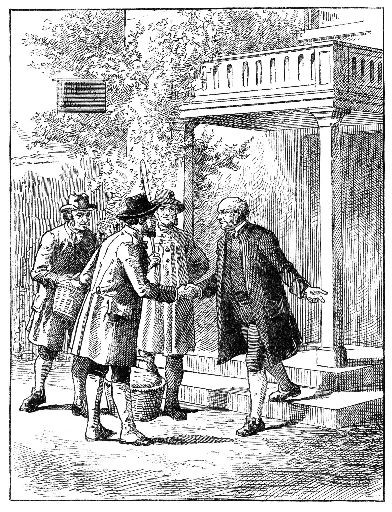
So the landlord took them up stairs into the best room on his second floor, and gave them the key of the door, that they might lock themselves in and stay as long as they wanted. But the bad men had seen them going up, and presently they seized the great clubs that they always carried, and hurried up after them.
“Let us in!” they cried.
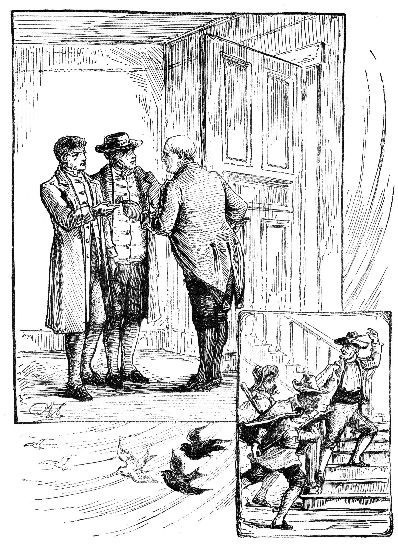
But without waiting for any answer they broke down the door and rushed at the men who were sitting around the table, until they had to run for their lives.
That night, after everybody had gone to bed and the landlord had locked up the inn, as he sat alone by the fire, he said to himself:
“I must do one thing or the other. I must turn away either the good men or the bad men, for it is plain they cannot both come to my house. Which shall it be?”
After thinking a while longer he said:
“I admit that the people from the forest buy a good deal more out of my bar-room—wine, brandy, and whiskey—but then they get drunk and break my furniture, and often refuse to pay for what they have had; so that, in truth, I do not make any great profit out of them, after all—not near enough to make up for the bad example they set my children and the bad name they give my house. But the people from the farms, though they do not buy any brandy, or whiskey, buy a good deal more of bread and meat, and they always pay for what they get. By the end of the year I am sure that I make more out of them than I do out of the others. Then they are kind to my family, and they make my house respectable and give it a good name. I am resolved what to do, and which to turn away. These shall stay, and the others shall go; and to-morrow I will tell them.”
So, after making up his mind, he went to bed and slept all night.
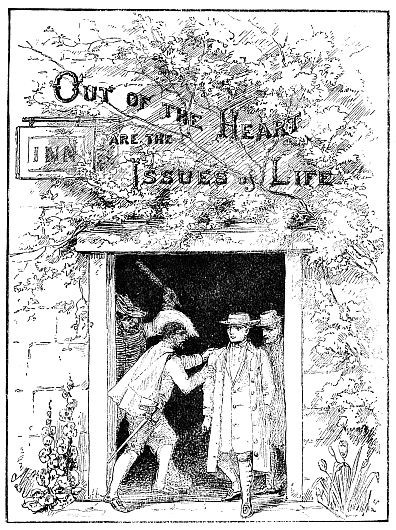
Early the next morning he opened his house. As soon as the door was unlocked in came the men from the forest, and they kept on coming till the bar-room was full. Then, while they were making a great noise, talking very loud, and calling for drink, the landlord rapped on the top of the bar and cried:
“Silence, and listen to me! You men have been coming here and doing as you pleased, until you seem to think the house belongs to you, and that you can turn people out of it whenever you like. But I am the one who has to pay the rent, and I think it is for me to say who shall come and who shall go. And now I say that I want you to go and never come back.”
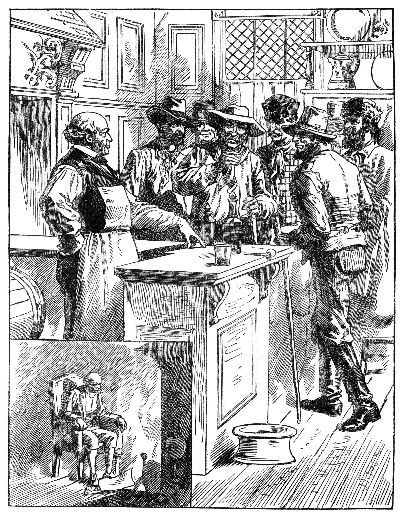
As soon as the landlord had spoken in this firm way the men out of the forest—who, in spite of their boasting, were great cowards—began to steal off one by one, until they were all gone; at which the landlord was glad, for he thought he had gotten rid of them altogether. But in this he was mistaken, for in a few days they were back again, standing about the doors and watching for a chance to get in.
To keep them out the landlord shut up all but the front door, and tried to keep his eye on that. But so impudent had the men grown that they began to climb into the windows when no one was looking. Then the landlord sent for the blacksmith and had iron bars put across every window. But after he had done this the men even got up on the roof in some way, and came down the chimney like so many sweeps; at which the landlord told his hired man to build a hot fire, and to keep it blazing no matter how much wood it burned.
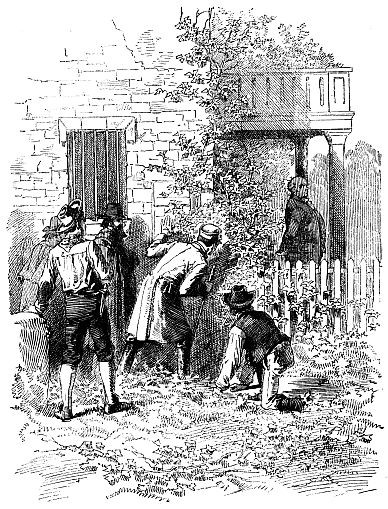
But it was not possible to close every door, and window, and chimney, and keep them always shut. There was the side door, that opened into the flower-garden, where sometimes persons wanted to walk; and there was the back door, out of which the cook must go to the woodpile many times every day. Some of the windows opened on beautiful prospects, where the boarders liked to sit and look out. So that, do what he would, the landlord often found places left open.
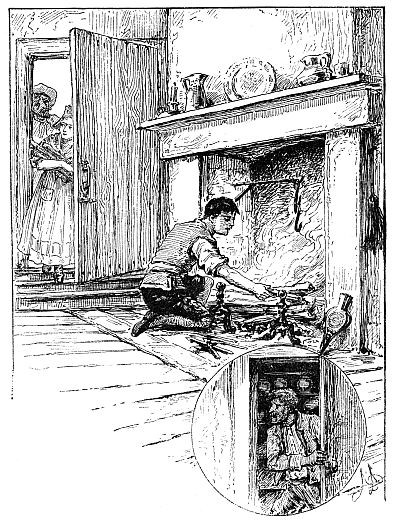
And, beside this, the men out of the forest had lately changed their plan. They came now dressed up like the farm-people, and sometimes the landlord could hardly tell one from the other. In short, they were too clever for him; and so, in spite of all he could do, they got in, and every day he would meet some of them sneaking about the house, or hidden in some closet or corner, or under a bed.
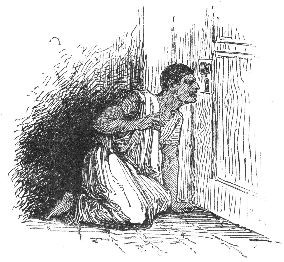
While things were in this sad state he was sitting one night before the fire by himself, just as he sat on the night that he made up his mind to order the bad men out of his house. But how differently he felt now from what he felt then! Then he thought he could have everything his own way, but now he had done his utmost, and, instead of getting better, things were getting worse and worse. He was very much discouraged and low-spirited.
Then he began to think of some of the wrong things that he had done himself. He had been too friendly with these bad men, and not as kind as he should have been to some good men that he knew. Especially he remembered how unkindly he had treated one good man. It happened in this way.
When he first came to the inn, after renting it, he found a watchman there. The owner of the inn had sent him to watch it, and keep it safe. When the landlord came, this watchman did not go away, but stayed on. The owner had told him to stay and watch the house; for, although the owner had rented it, the house still belonged to him.
So the watchman stayed and tried to make himself useful to the landlord. But the landlord paid no attention to him; in truth, he often treated him rudely, until one day, when the watchman was warning him against these very men out of the forest, the landlord told him he could take care of his house himself, and that he did not want his help any further.
Since that time the poor man had been staying about the inn wherever he could find a place. Sometimes he slept down in the cellar, sometimes out in the wood-house; and when he got anything to eat, it was always after the servants were done, and only such food as was left from their table. And now the landlord remembered all this. While he sat thinking about it before the fire, there was a knock at the door.
“Come in,” said the landlord; and the door opened, and in walked this same watchman. He did not say a word, but stood still, looking right at the landlord.
“Watchman,” said the landlord, “I have treated you very unkindly, and I am sorry for it. Are you willing to forgive me and be watchman again?”
“I am,” said the watchman, “if you will promise to pay attention when I warn you of danger.”
“I promise,” said the landlord; “I will do anything to get out of the trouble I am in.”
“Very well, then,” replied the watchman; “it is a bargain between us. But now go to bed and get some rest, for you need it.”
So the landlord went to bed, and because his worry of mind had worn him down a good deal he soon fell asleep.
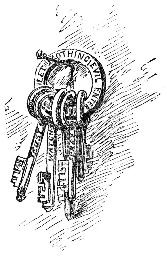
Early the next morning, before any one else was awake, the watchman was up and at work. The first thing he did was to build up the little room, or watch-box, that used to stand in front of the house. It was placed there on purpose for him when the house was first built, but because it had not been taken care of it had long since tumbled down. But now the watchman built it up again, setting in windows all around it, so that as he stood there, he could look out on every side. As soon as he had built up his watch-box he fixed the cord, or bell-rope, that reached from there into the landlord’s chamber.
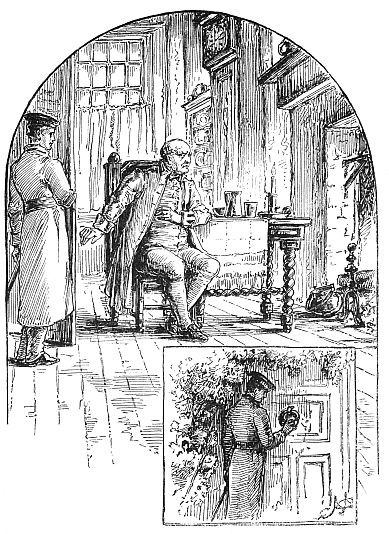
And no sooner was this done than, seeing one of the forest-people coming toward the house, he pulled the cord and rang the bell. At this the landlord awoke. He knew what it meant. He did not need any one to tell him, for he used to hear that bell long ago, although he then paid no attention to it. But now he jumped up and dressed quickly, and ran to the door just in time to shut out one of the very worst of the men from the forest.
After that the bell went on ringing every day, and the landlord was kept busy shutting doors and windows. It must be confessed that he got tired of hearing it sometimes; but he was so much happier, he ate so much better and slept so much sounder than he did before, that, even when it put him to a good deal of trouble, he was always careful to obey the bell.
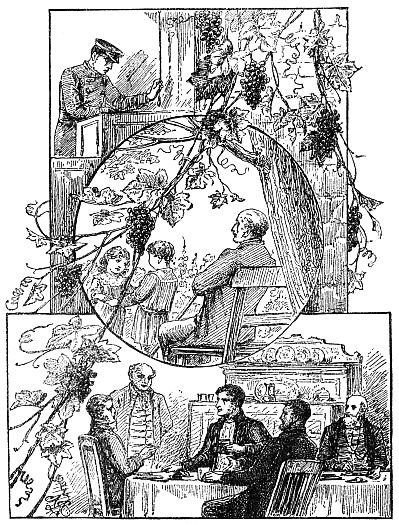
All this time the good farm-people were made welcome at the inn. The door was always wide open to them, and the best of food was put on their table. As they never went into the bar-room to buy anything to drink, and as they disliked very much to see drunkards about, the landlord concluded to take away his bar and make the inn a temperance house. Being pleased at this, the farm-people came oftener and stayed longer than ever before, until the landlord found himself growing rich on the money they paid him. Then he painted his house inside and out, and added some new rooms to it, and made it more comfortable every year.
When the forest-people found that the watchman was always looking out for them, and that the landlord always paid attention to his bell—and when they saw, too, that the company in the house was such as would make them feel ashamed, even if they should get in there—they did not try to get in as often as they used, and so the bell did not ring nearly so often. Then the landlord had time to walk in his garden and to sit down in the shade of his favorite tree, which he had not been able to do for long years before.
And so things went on from year to year. The landlord never ceased to mind the bell, and gradually, as he grew older, it rang more and more seldom, until, during his last sickness, while he was shut up in his chamber, growing weaker and weaker every day, it stopped ringing altogether. And this was not because the watchman (whose name was Conscience) was unwilling to disturb him, but because the forest-people (that is, wicked thoughts and bad desires) did not trouble him any further.
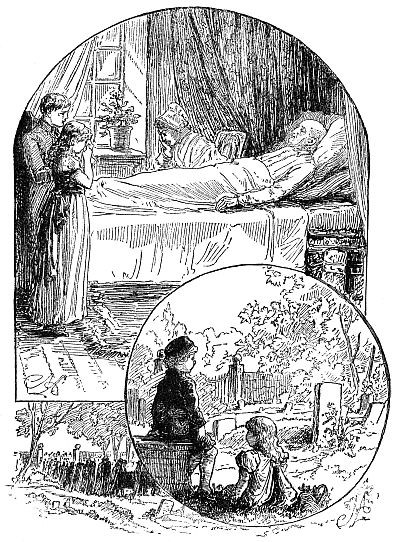
So the old man lay in peace and quietness until he died. Then his son took the inn and carried it on. It is true that the men out of the forest knew as soon as the old man was dead, and thinking that now, as there was a new master, they might perhaps be able to get in, they came and tried again and again. And the son had to fight his own battles with them like his father. But he kept the watchman in his house, and minded the bell; and in the end he gained the victory, as his father had done before him.
THE BROOK AND THE WATER-WHEEL.
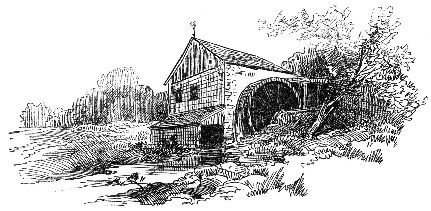
THE water-wheel in a grist-mill went round and round, by day and by night, without stopping. Said the brook one day, as it passed over the wheel:
“Are you not tired of being always at work, and of doing the same thing to-day that you did yesterday? When I have done my work in making you turn, I glide on and take my pleasure in flowing through the fields and the woods.”
“But my pleasure,” replied the wheel, “is in continuing to work, and go round and round, grinding up the corn.”
“Yesterday,” continued the brook, “as I flowed through the meadow, I heard some people who were wandering there say how beautiful I was, and what sweet music I made as I rippled over the stones.”
“And no doubt they said what was true,” replied the wheel, “but it could never be said of me. How would I look rolling through the meadow? I would not be admired by others, nor would I enjoy it myself.”
“You are to be admired for your humility,” said the brook, “in being contented with so dismal a place.”
“Not at all,” replied the wheel, “for when this place was given me, I was given also a liking for it.”
“But do you not long for the sunlight and the breeze and a sight of the birds and the flowers?”
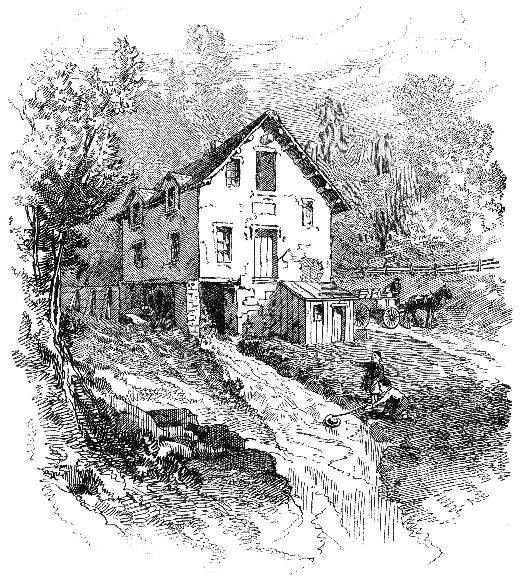
“No more than you do for this dim chamber under the mill. Here I was made to dwell, and here I am satisfied to be. I greet you tumbling in from the mountain-side over my head, and I bid you adieu as you flow out joyously under my feet; but I do not long to follow you. The summer’s heat does not parch me here, nor the winter’s frost stop me from turning. Ever in this dim twilight I revolve and listen to the sound of the grinding. I delight to hear the farmer drive his team to the mill door loaded with grain, and afterward haul it away when I have made it into flour for his wife and children to eat. I am content to stay here and labor—not by constraint nor for duty’s sake alone, but because the place accords with my nature, and therefore it is my choice.”
We often err in judging the lot of others by our own feelings and preferences, forgetting that, from differences in taste or training, what would be pain to us may be pleasure to them.
THE COURT-HOUSE STEEPLE.
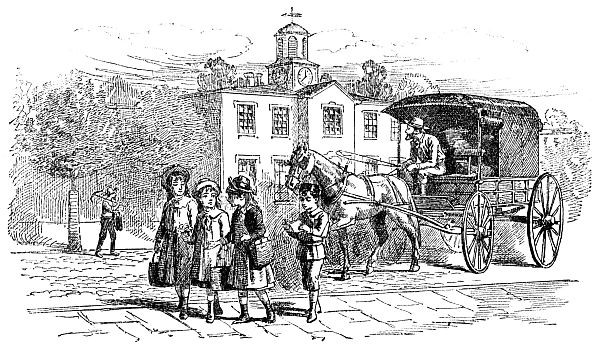
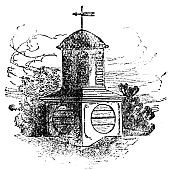
THE steeple on a country court-house was built to hold a clock. But when a year or more had passed after it was finished, and no clock appeared, it began to complain that the promise made to it had not been kept.
“I expected to be of some consequence in the village,” it said, “but with these ugly round holes in my side left boarded up, I am of no more account than if I did not exist.”
The town council, having heard of what it said, met together to talk over the matter, when they had to admit that the complaint was just; so an extra effort was made to raise the money needed, and, this being successful, the clock was ordered, and in due time put in its place.
And now the steeple’s ambition was fully gratified. The clock kept good time and was the standard for the whole village. The farmers went to their work by it, and the children to school; the people also who drove in from the country might be seen, as they passed the court-house, leaning forward, with upturned faces, to get the correct hour.
Week after week passed, and month after month, and still the steeple was gazed at by old and young a hundred times a day. But after a good many months had rolled round, notwithstanding all this attention, it began to be conscious of a change within itself.
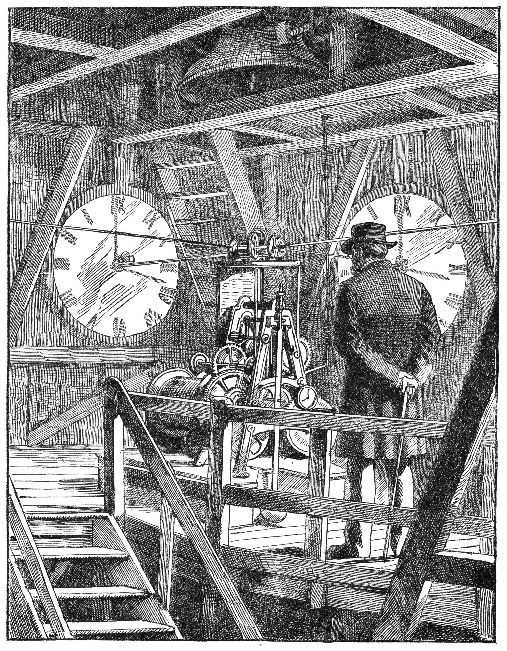
“It is true I have got what I asked for,” it said, “and my proudest wishes have been fulfilled; but, after all, what have I gained by it or how am I any better off? I am just as much exposed to the winter’s cold and the summer’s heat, to the risk of storm and lightning and fire, as ever. And, as for being looked at—which I once thought so much of—I’m tired of it, and could wish myself back to what I was before, instead of being forced to listen to the click of these wheels and the banging of that great iron hammer by night and by day. I believe I’d rather be the empty steeple on the church, across the street.”
At length its complainings reached the ears of one of the council, who, though an old man, climbed up the steeple’s winding stair and listened patiently to what it had to say. When it had finished, he answered:
“My friend, I think I can put my finger on the cause of your discontent. You were very anxious to have the clock, you remember, but perhaps you never recognized the reason, which was only a desire to increase your own importance. You thought that all the watches and all the little clocks in town would be regulated and ruled over by you. Your motive was wholly selfish, and, as a consequence, when you got what you wanted, it failed to satisfy.
“Now, as for taking the clock down again, that is out of the question. It was put here for the benefit of all, and here it must stay. Nevertheless, if you will take an old man’s advice, I think your troubles will soon come to an end. Instead of thinking only of yourself, your own comfort, and your own consequence, think of other people. Remember the good you have the power to do them, and for their sakes be willing to do it. Then you will find that the possessions which yield no satisfaction while hoarded up only for self, impart a real joy when shared with others in the uses of charity.”
CROOKED HORN AND OLD BRINDLE.
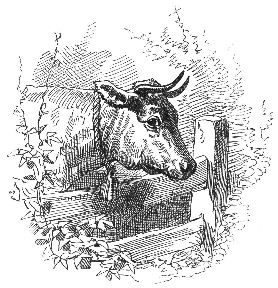
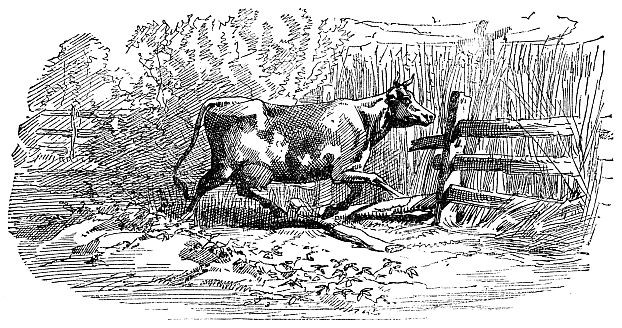
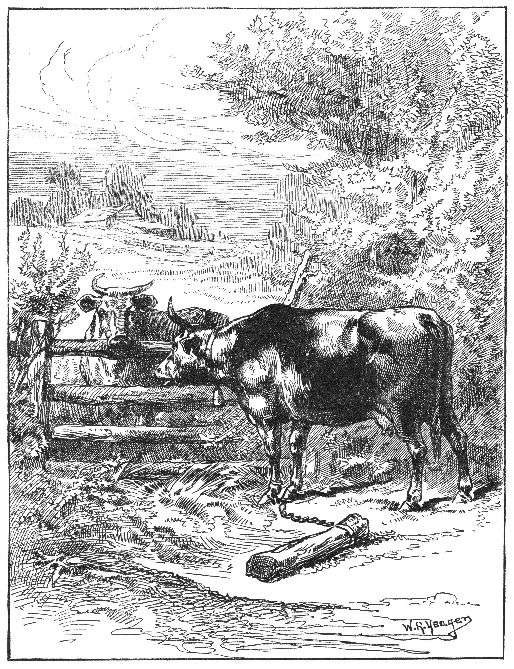
A COW that had a crooked horn learned to open gates and let down bars with it, and, as her master took no pains to keep her at home, she roamed the roads unrestrained. One day, in passing a neighbor’s meadow, she saw an old brindled cow inside hobbled by a rope and clog of wood fastened to one leg.
“Who put that on you?” asked Crooked Horn.
“My master,” replied Brindle.
“What for?”
“To keep me from jumping fences.”
“I’m glad he’s not my master. Why don’t you leave him and take to the woods?”
“Well, he’s kind to me in other ways. He gives me a warm bed, and plenty to eat, in the winter, and beside, I have a notion that I’ve got myself to blame.”
“Nonsense! I’m allowed to jump all the fences I like. Whenever I see a good dinner through the bars, over I go, no matter whom it belongs to.”
“I wish I could do so,” said Brindle.
“But you can’t,” cried Crooked Horn. “I’m on my way now into yonder clover-field, over across the railroad.”
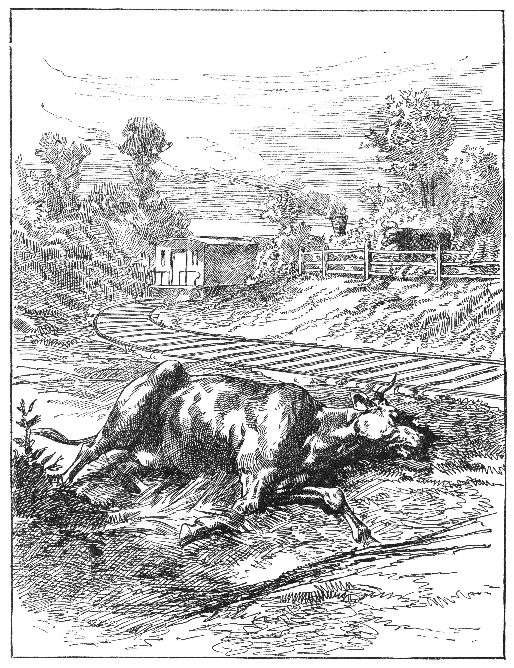
Saying which, she kicked up her heels and galloped away. But just as she reached the track an express train dashed past, and old Brindle saw the engine toss her boastful acquaintance into the air as a mad bull tosses a dog. Another moment, and poor Crooked Horn lay in the ditch mangled and dead.
“Oh,” cried Brindle, shuddering and looking down affectionately at the rope and block of wood, “how glad I am now that my master hobbled me!”
If we only knew how much worse ills our troubles save us from, we would often welcome them, instead of trying to free ourselves from them.