


автордың кітабын онлайн тегін оқу The Motor Boys on Road and River; Or, Racing To Save a Life
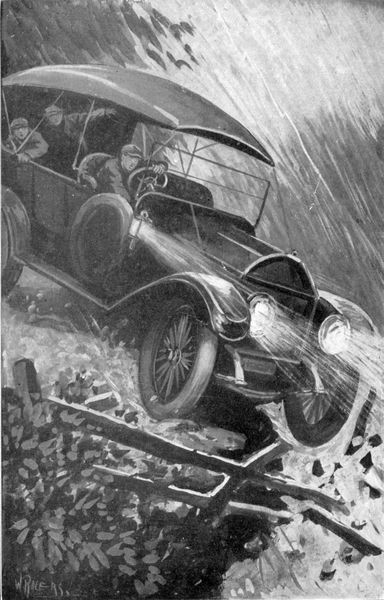
THE CAR POISED FOR AN INSTANT, THE FRONT WHEELS ON THE VERY BRINK.
THE MOTOR BOYS
ON ROAD AND RIVER
Or
Racing To Save a Life
BY
CLARENCE YOUNG
AUTHOR OF “THE MOTOR BOYS,” “THE MOTOR BOYS UNDER
THE SEA,” “THE RACER BOYS SERIES,” “THE
JACK RANGER SERIES,” ETC.
ILLUSTRATED
NEW YORK
CUPPLES & LEON COMPANY
BOOKS BY CLARENCE YOUNG
THE MOTOR BOYS SERIES
12mo. Illustrated.
- THE MOTOR BOYS
- THE MOTOR BOYS OVERLAND
- THE MOTOR BOYS IN MEXICO
- THE MOTOR BOYS ACROSS THE PLAINS
- THE MOTOR BOYS AFLOAT
- THE MOTOR BOYS ON THE ATLANTIC
- THE MOTOR BOYS IN STRANGE WATERS
- THE MOTOR BOYS ON THE PACIFIC
- THE MOTOR BOYS IN THE CLOUDS
- THE MOTOR BOYS OVER THE ROCKIES
- THE MOTOR BOYS OVER THE OCEAN
- THE MOTOR BOYS ON THE WING
- THE MOTOR BOYS AFTER A FORTUNE
- THE MOTOR BOYS ON THE BORDER
- THE MOTOR BOYS UNDER THE SEA
- THE MOTOR BOYS ON ROAD AND RIVER
THE JACK RANGER SERIES
12mo. Finely illustrated.
- JACK RANGER’S SCHOOLDAYS
- JACK RANGER’S WESTERN TRIP
- JACK RANGER’S SCHOOL VICTORIES
- JACK RANGER’S OCEAN CRUISE
- JACK RANGER’S GUN CLUB
- JACK RANGER’S TREASURE BOX
THE RACER BOYS SERIES
12mo. Illustrated.
- THE RACER BOYS
- THE RACER BOYS AT BOARDING SCHOOL
- THE RACER BOYS TO THE RESCUE
- THE RACER BOYS ON THE PRAIRIES
- THE RACER BOYS ON GUARD
- THE RACER BOYS FORGING AHEAD
Copyright, 1915, by Cupples & Leon Company
The Motor Boys on Road and River
CONTENTS
CHAPTER
PAGE
I.
Jerry Is Absent-Minded1
II.
Jerry Explains11
III.
The Clay-Diggers22
IV.
Suspicions31
V.
Professor Snodgrass41
VI.
Disappointment48
VII.
A Queer Conference59
VIII.
Selling the Land67
IX.
A Hurried Departure74
X.
The Plaster-Mud86
XI.
“We’ve Been Tricked!”93
XII.
On the Brink99
XIII.
Another Disappointment107
XIV.
On the Trail115
XV.
A Stowaway124
XVI.
A Hard Fall132
XVII.
The Celebrated Doctor140
XVIII.
A Cry of Fire150
XIX.
On the Way158
XX.
Stuck166
XXI.
The Deserted Camp173
XXII.
Searching182
XXIII.
In the Gulch190
XXIV.
Disclosures199
XXV.
Off for Help205
XXVI.
A Race for a Life212
XXVII.
The Broken Spring217
XXVIII.
The Last Lap223
XXIX.
The Operation233
XXX.
The Two-Tailed Lizard239
LIST OF ILLUSTRATIONS
THE CAR POISED FOR AN INSTANT, THE FRONT WHEELS ON THE VERY BRINK. THE SCUD SHOT OUT INTO THE STREAM. “YES—HE’S ALIVE—JUST ABOUT,” NED CALLED UP.INTRODUCTION
My Dear Boys:
Sometimes, as you doubtless know, the simplest actions result in the most remarkable complications. When Jerry Hopkins picked up a lump of common-looking clay on some swamp land that his mother owned he had no idea what a strange series of events was to transpire from his simple act. Before he realized it he and his chums were involved in a strange secret, and they had set off on a trip that had, as its ultimate object, the saving of the life of Professor Snodgrass.
In this, the sixteenth volume of the “Motor Boys Series,” I have set down what followed when Jerry learned the value of that lump of clay. How he and his chums started off after the professor, who had strangely disappeared; how they found him, almost lifeless; and how they raced to bring the celebrated doctor to him—all this you will find related in this book.
You have shown that you liked the other books I have written concerning the “Motor Boys,” and I venture to hope that this one will appeal to you.
That there was really a two-tailed lizard was left for Bob to demonstrate in an unexpected manner. That is all I will say, now, regarding that strange creature. You may turn the following pages and learn the rest for yourselves.
Your sincere friend,
Clarence Young.
THE MOTOR BOYS
ON ROAD AND RIVER
CHAPTER I
JERRY IS ABSENT-MINDED
“Pretty good game; wasn’t it?”
“It sure was—a corker!”
“I thought our Cresville boys wouldn’t be able to pull up, after the Red Sox got that big lead on ’em, but they certainly played their heads off.”
“They sure did. The pitcher won the game for them with that last wallop of his!”
“That’s right,” remarked a stout lad, one of a group of three who were walking slowly across the green diamond at the conclusion of a ball match.
“The umpire made some pretty rank decisions,” added the boy who had made the first comment, glancing across in front of his companion, who, in the middle of the trio, separated the two speakers.
“You’re right,” commented the stout youth.
The two exchanged looks—queer glances, and, as if by mutual consent, gazed up at the face of their chum who walked between them. Then the stout lad winked.
“What’s the matter, Jerry?” he asked. “Didn’t you like the game?”
“Game? What game? Oh, yes—sure I liked it!” was the hurried response, as though the speaker’s thoughts had been far afield when the import of the question was grasped. “It was a good little game,” went on the lad in the centre of the trio. “Too bad our boys didn’t win, though!”
“Too bad!” echoed the stout lad. “Why, what——”
“Didn’t win!” interrupted the other. “Say, Jerry, what’s got into you? The Cresville team did win!”
“Oh, did they? That’s funny! I guess I didn’t pay much attention toward the last.”
“No, and not toward the beginning, either, I guess,” grumbled the stout lad. “I wonder what’s gotten into him,” he thought.
“So they won; did they, Bob?” asked the lad addressed as Jerry. “Well, I’m glad of it.”
“Of course they won, Jerry Hopkins,” was the quick answer. “And this practically clinches the local championship for them, too. It was a corking good game; wasn’t it, Ned?”
“Now you’re talking! A good crowd, too,” and Ned Slade looked at the throng pouring down from grandstand and bleachers.
“What shall we do?” asked Bob Baker, the stout lad before referred to. “I vote not to go home just yet. It’s early. Let’s take a little spin down the road.”
“All right,” agreed Ned. “Shall we, Jerry?”
“Eh? Oh, yes, I’m in for whatever you fellows say. It’ll be nice on the river to-day.”
“River! Who said anything about the river?” demanded Ned. “Do you think we came to this ball game in our motor boat, Jerry Hopkins? Say, what’s the matter with you to-day, anyhow? We’re talking about taking a spin in the auto. Will you come along?”
“Oh, sure I’ll go. You know that!” exclaimed Jerry, and with an effort he seemed to recall his thoughts from whatever distant realms they roamed. “Sure we’ll go for a spin. I guess I was thinking about the ball game.”
Ned and Bob each gave their chum a queer look, but they said nothing. Only Ned thought to himself:
“Thinking about the ball game; eh? That won’t go with me, when, a little while ago, he didn’t even know which side had won. There’s something wrong with Jerry. I wonder what it is?”
But, whatever it was, it did not seem to be anything very serious, for soon Jerry smiled at his chums, and clapping Bob on the shoulder with a force that made the stout youth grunt, exclaimed:
“Sure we’ll go for a spin! It will give us an appetite for supper, and I seem to need one. I’ve been a little off my feed the last few days.”
At this Bob looked worried. Eating was something in which he took a great deal of interest. Perhaps it was that which made him so stout, and had gained for him the nickname of “Chunky,” which his chums occasionally called him.
The three boys—the “motor boys” they were locally called—because they so often rode about in motor vehicles—automobiles, motor boats, or motor-driven airships—had come to the ball game in their auto which stood parked, with a number of others, back of the grandstand. Thither they now made their way.
The air was filled with the noisy chug-chug of scores of machines as they backed, turned and darted ahead to get from the ball field to the road. In and out of the receding throng the autoists guided their cars. On all sides were talk and laughter—talk of the game just finished, congratulatory calls to the winners, and expressions of regret for the losers.
“Yes, it sure was some nifty little game,” remarked Bob, as the chums reached their machine. “Are you going to drive, Jerry?” he asked.
“I will if you want me to—sure.”
“I hope he pays more attention to the wheel than he did to the ball game,” remarked Ned, with a slow shake of his head. “If he doesn’t he’s likely to have us up a tree, or in the ditch.”
But he made no objection as Jerry took his place at the wheel, and slipped in the switch key of the electric starter. Ned and Bob got in the tonneau, and Jerry, looking back to see that both doors were closed, was about to start off when a voice behind the machine cried:
“Hold on! Wait a minute! I won’t be a second! Give me a lift; will you? I forgot all about it! Terrible important message! Dad’ll be wild if I don’t deliver it! Great game; wasn’t it? Our boys won fine! Here I am! Let her go! Never say die! Whizz her along, Jerry! I’m here! Let her out, do you hear? Move the boat!”
A small youth, very much excited as to manner and words sprang, leaped, scrambled, climbed, hopped, jumped, vaulted and fell into the vacant seat beside Jerry. He sat there, his breath coming in gasps, both from his run and from his outpouring of words.
Jerry, with a quizzical smile, looked down at him; Bob, with half-opened mouth, leaned forward to gaze; and Ned shook his head in a hopeless fashion, murmuring:
“Is it all over, Andy Rush?”
“Is—is what—all over?” demanded the small chap.
“Everything,” answered Ned, throwing his hands in the air. “Your talk—your—your—well, you know what I mean. Is it all over?”
“Of course it is,” was the quick answer. “You can go ahead now, Jerry,” he added, as though they had been waiting for him.
“Well, I like your nerve!” gasped Bob, who at length found his voice.
“That’s all right. I saw you had a vacant place!” exclaimed Andy, starting off in another “spasm.” Then he proceeded:
“I’ve got to get back to town in a hurry. Important message—dad told me not to forget, but I did—went to the ball game. Say, it was great; wasn’t it? That fly of Watson’s—up in the air—thought it would never come down—run around the bases—nobody out—whoop her up! Everybody run! Nobody out—all over!”
He had reared up in his seat to “explode” this, and now sank back again.
Jerry looked at the diminutive orator.
“Are you all through, Andy?” asked the tall lad, gently. “If you are, we’ll start, with your kind permission and attention. Only we’re not going back to town right away, so if you have an important message to deliver you’d better walk, or take a hop, skip and a jump into someone else’s car. We’re going to take a little ride, and we don’t know when we’ll get back.”
“Oh, well, I guess it isn’t so important after all,” spoke Andy, slowly. “I’ll go with you. I’ll leave the message when I come back. You are coming back; aren’t you?” he asked.
“No telling,” answered Ned, winking at Jerry. “We may take a notion to run over to San Francisco and spend the night.”
“Huh! I don’t care,” laughed Andy. “I’ll go along. I can telephone the message back, I guess. Let me go; will you?”
“Oh, well, there’s no getting ahead of you, Andy,” conceded Jerry. “Stay in, if you like. Only don’t blame us if your dad wants to know why his message wasn’t delivered.”
“That’s right,” chimed in Ned. “Let her go, Jerry. It’s hot sitting here in the sun.”
There was a whine and a whirr, as the electric starter spun the flywheel of the big automobile. Then came a snap, as the gears meshed, and as the clutch slipped into place the machine slowly backed to a clear place. Then, as Jerry threw in the first forward speed, it shot ahead, and, a little later was spinning down a pleasant, shaded country road.
“This is something like,” observed Bob, leaning back in comfort. “Want to go anywhere special, Jerry?”
“No, I’ll go anywhere you fellows say.”
“Let’s have a race!” burst out Andy Rush. “There goes a car! You can easy pass that, Jerry! Speed her up! Let’s race ’em! Look, they’re laughing at us! Go ahead! Whoop!”
The tall steersman made no effort to increase the speed of the car. Instead he smiled down at the excited lad beside him, and remarked:
“It’s too hot to do all that talking, Andy. Save it for the winter season when you’ll need it. We’ll have no race to-day.”
If the small chap was disappointed he did not show it. For something new claimed his attention. A big gray squirrel scurried across the street in front of the car.
“Look at that!” cried Andy. “Say, he can go some! If I only had a gun now! Squirrel pie for mine!”
“Squirrels are out of season now,” remarked Bob. “You’d be fined if you shot ’em.”
“That’s right,” chimed in Ned.
“Let’s go on to Blairtown, and have a bite to eat,” suggested Bob, after a pause. “There’s a good restaurant there.”
“Humph! Seeing that squirrel must have made you hungry,” commented Ned with a laugh. “But go ahead, if you like, Jerry. I don’t mind.”
Jerry, at the wheel, nodded, and for some time guided the car in silence. Now and then Andy made some excited remark at the sight of something along the highway. Bob and Andy exchanged occasional opinions.
“How’s she running, Jerry?” asked Bob, after a bit.
“Yes, our fellows did some good running,” was the unexpected answer.
“Oh, wake up!” cried Ned, with a laugh. “We weren’t talking about the ball game.”
“No?” queried Jerry. “I thought Bob said something about runs.”
“I was asking how the car ran,” put in the stout lad.
“Oh!” exclaimed Jerry, comprehendingly. “Why, she’s going like a sewing machine—just as easy. She sure is some car!”
“Yes, I’m glad we traded in our old one, and got this,” commented Ned. “That self-starter alone is worth the difference. No more breaking our backs cranking up.”
Jerry did not reply to this. After his remark to Bob he had relapsed into silence again—a silence to which Ned called his chum’s attention by a nudge.
“Something sure has gotten into Jerry,” whispered the stout youth.
“That’s right, Chunky,” agreed his companion.
They rode on for some distance farther, Jerry guiding the car skillfully enough, even though his mind did not seem to be on his task.
As he turned up a cross road, that would take them to Blairtown Ned, glancing up suddenly, cried out:
“Look out, Jerry! Where are you steering? You’re heading right for that other car!”
A big machine, coming from the opposite direction, and at high speed, was headed directly for the auto of the motor boys. But it was on the proper side of the highway, whereas Jerry was on the left.
“Look out!” Bob cried, springing to his feet. “We’re going to have a smash, sure!” He leaned forward to open the side door, as though he would leap out.
CHAPTER II
JERRY EXPLAINS
“Sit still!” yelled Ned, grasping his chum by the arm.
“But we’re going to smash, I tell you!”
Bob sank back in his seat with a thud, for Ned had forcibly pulled him by the coat.
“Look out!” yelled Andy, adding his alarm to the others.
“Eh? What is it? Oh, another car!” cried Jerry, and, for the first time, he seemed to be aware that there was danger from his thoughtlessness in taking the wrong side of the road.
The driver of the other car sent out a strident blast from his electric siren, and crowded his machine as far over to the other side as possible. But a high bank afforded very little leeway.
“Look out where you’re going!” the chauffeur yelled, his angry voice accentuating the warning of the horn.
Jerry Hopkins seemed to come to life in an instant. His absent-mindedness left him in a flash, and his strong hands turned the steering wheel rapidly.
So suddenly did he shift the direction of his car that it skidded, and, for an instant slid along on two tires. Then, with another quick shift of the wheel, the steersman brought it back on the proper course.
The two machines passed safely, but, so narrow was the space between them, the thickness of one’s hand would have sufficed to fill it.
Then, in a swirl of dust, the other machine passed on, the dirt-cloud serving to hide the indignant glances of the occupants. Jerry brought his car to a stop with a whine of the hastily-applied brakes.
“Say, I didn’t see that fellow coming,” declared Jerry, turning to speak to his chums in the tonneau.
“You didn’t see him!” cried Ned. “Why, he was right in front of you, and on the proper side of the road, too. You were off. Say, what’s the matter with you Jerry, anyhow?”
The tall lad did not answer for a moment. Instead, he slowly got down out of the car, and walked over to a spring that bubbled out of a rock at the side of the road.
“Wait until I get a drink,” he said. “I’m dry.”
Ned and Bob looked at one another.
“What do you make of it?” asked Ned, in a low voice, as Jerry leaned over to drink.
“I’m sure I don’t know,” was the answer of the stout lad. “He’s been acting queer and absent-minded for the last few days. He seems to be worrying about something.”
“I wonder what it can be?” ventured Ned.
“Let’s ask him,” suggested Bob. “Maybe we can help him.”
They spoke in louder tones now, for Andy, who had been sitting beside Jerry, had also alighted to get a drink at the spring.
“Maybe he wouldn’t want us ‘butting-in,’” remarked Ned.
“Well, something’s got to be done,” declared Bob, with a sigh. “I’m not going to ride, and have him steer like that. He nearly ran over a dog a while back, and now he almost sends us into another car. Something sure is wrong. Jerry has something on his mind, and we ought to offer to help him.”
“Well, maybe we ought,” responded Ned, thoughtfully.
And while the two chums are thus debating as to whether or not they ought to interfere sufficiently in Jerry’s affairs to offer to help him, I will take a few moments to tell my new readers something of the boys and of the previous books in this series in which my heroes have figured.
Bob Baker, son of Andrew Baker, a rich banker; Ned Slade, whose father, Aaron Slade, was the proprietor of a large department store; and Jerry Hopkins, the only son of a well-to-do widow, were the three “motor boys” with whom we are concerned. They lived in the town of Cresville, not far from Boston, and had been chums and companions ever since they were youngsters. They had been “lost” together, they had played ball on the vacant lots, they had gone swimming and fishing in one another’s company, and, when they grew older, they went bicycling together.
It was the bicycles that gained for them the name “motor boys,” for it was through the winning of a bicycle race that one of them gained a motorcycle as a prize, and in the first book of the series, entitled “The Motor Boys,” you may read of this thrilling contest.
But the motor boys were not content with one motorcycle, nor with winning one race. They obtained an automobile, and made a thrilling trip overland, afterward going to Mexico, where they located a buried city, coming home across the great plains.
Many and thrilling were the adventures our friends had on land, and not a few dangers encompassed them, some being due to the evil doings of Noddy Nixon and Bill Berry, two bad characters.
But action ashore was not sufficient for the motor boys. They were able to obtain a motor boat, and in the fifth volume of this series, entitled “The Motor Boys Afloat,” is related their adventures in that staunch craft. They had strenuous times on the Atlantic, in the strange waters of the Florida Everglades, and on the Pacific.
As might be expected, having, in a manner, conquered the problems of the land in their automobile, and of the water in their motor boat, the boys sighed, like Alexander, for new worlds. They found one in the air, and though they themselves were a little doubtful of their ability to navigate an aeroplane they did not hesitate to try.
In the ninth book, “The Motor Boys in the Clouds,” I had the pleasure of relating to you their adventures in their motorship. They flew over the Rockies, and over a part of the ocean, and again, taking wing, they went in search of a lost fortune.
Hovering over the border between the United States and Canada, the motor boys were able to help Uncle Sam capture some daring smugglers, and hardly had they finished that thrilling work than new activities presented themselves. The volume immediately preceding this one is entitled “The Motor Boys Under the Sea.”
While out in their motorship Comet, one day, the boys saw floating on the waters of Massachusetts Bay a strange object which at first they thought was a whale. It turned out to be a submarine, however, and when the boys encountered it, later, in a terrific storm, and were taken aboard the strange craft, being kept virtually prisoners, they realized that they were about to pass through some strange scenes.
Whether they did or not I will leave to the decision of those of you who have read the book. Suffice it to say that, eventually, Dr. Klauss, the commander of the submarine, though endeavoring in his insane fury to make an end of them all, was overpowered, and our friends reached safety.
A winter of comparative inactivity followed the lively times in the submarine, and now spring had come once more. The motor boys had made no plans for their vacation, but they had talked, more or less indefinitely, of a long trip to be taken, partly by auto, and partly aboard their new motor boat. Nothing had been settled, however.
The three, having no other engagement this Saturday afternoon, had gone to the ball game, for Cresville boasted of a good semi-professional team, and it was on their way back from this contest that I have introduced my new readers to them.
“I’m going to make the break, and ask Jerry what ails him,” decided Ned, as he watched his tall chum straighten up after taking a long drink at the spring.
“Yes, maybe it will be best,” assented Bob. “He surely isn’t himself. He’s been acting queerly for nearly a week. He seems to be in a sort of dream.”
“That’s right,” agreed Ned. “Well, maybe he won’t like me ‘butting-in’ on him, but we’ve been chums too long to stand off, and not help him when he needs it.”
Andy Rush, who had begged a ride with the three friends, had just run down the road in pursuit of a rabbit, so he was not within sound of the voices of the three chums. Andy was an excitable chap, who never did any one thing very long at a time. He was rather a “fly-away,” but Ned, Bob and Jerry liked him for all that.
“Feel better?” asked Ned, as his tall chum approached.
“Yes, that was fine water. But there wasn’t anything the matter with me,” replied Jerry, quickly, as he sensed Ned’s words. “What do you mean?”
“What do I mean? Well, Jerry, old man,” spoke Ned, “it’s evident to both Bob and me that something is wrong with you. It isn’t like you to have such a near-collision as the one we just avoided, and also to nearly run over a dog, as you did a while back, isn’t a bit like you. Neither is it to see you so absent-minded.
“Now we don’t want to pry into your affairs, Jerry,” went on Ned, with a look at Bob, “but if we can help you—why, you know we’re only too willing. Is there anything we can do?”
“For we’re sure something’s wrong,” put in Bob. “Suppose we go to that restaurant in Blairtown and eat. I can always talk better when I eat,” added Bob, innocently enough.
“The same old Chunky,” murmured Jerry, with a smile. Then his manner grew more serious.
“Understand!” exclaimed Ned, quickly, as he noted the change in his chum’s face, “we don’t want to ‘butt-in,’ but we would like to help you. Are you in trouble, Jerry? Noddy Nixon isn’t bothering you again; is he? And Dr. Klauss hasn’t turned up again with his submarine; has he?”
“No! Oh, no! It isn’t anything as serious as that,” and Jerry smiled.
“Well?” spoke Ned, questioningly.
Jerry hesitated for a moment, and looked up and down the road, as though to make sure no one could hear what he was going to say.
“Fellows,” began the tall lad, “I sure do appreciate your interest in my affairs. And I don’t consider it ‘butting-in,’ either. I suppose I have been acting queerly, the last few days, but——”
“Queerly! I should say you had!” cried Ned. “It’s all right, old man,” he added, with a laugh, “no offense you know, but if you call it ‘queer’ to nearly smash us up a couple of times, I guess we’ll agree with you. Now then, out with it, and if we can help you, why, you know you don’t have to ask twice. Let her go, as Andy Rush would say,” and he glanced toward that distant youth.
“Well, I don’t know that it’s so very important, or serious,” resumed Jerry. “But, the truth of the matter is, I’ve been doing a lot of hard thinking of late, and I suppose it’s that which has made me seem absent-minded.”
“There wasn’t any ‘seeming’ about it,” put in Bob. “It was the real article.”
“Yes, I guess it was,” admitted Jerry. “I really couldn’t tell you, now, who won that ball game, and as for nearly running into that auto, I didn’t see it until the last second. I was thinking of something else.”
“Of what?” asked Ned.
“Well, business matters,” explained Jerry. “You know my mother owns considerable property. Some of it is real estate, and more is in bonds and mortgages. Of late some of her investments have turned out poorly.”
“That’s too bad!” exclaimed Ned. “She ought to see my father. He might help her.”
“Oh, well, I don’t think it is as serious as all that,” said Jerry. “But she thinks she will have to sell some of her real estate, and there’s where the tangle comes in.”
“I don’t see what sort of a tangle it can be,” spoke Ned. “We all know her land is quite valuable.”
“That’s just it,” exclaimed Jerry. “If she had received an offer for some of her town lots, or for some of her other real estate holdings that plainly show their worth, I wouldn’t think so much of it. But it’s about that old strip of swamp land she owns.”
“What, down in Ryson’s swamp?” asked Ned, in surprise.
“That’s the place,” answered Jerry. “She owns quite a strip there, and Noddy Nixon’s father owns lands on one side, and someone else on the other. Mother’s land is a sort of narrow tongue between two other parcels. She never thought it was worth anything, but the other day she received an offer for it, and at a price that made her open her eyes, though relatively it wasn’t so much.”
“Well, I don’t see any bad luck in that,” remarked Bob. “If she can get a good price for the land, why doesn’t she take it?”
“That’s just the point,” resumed Jerry. “Why should such a comparatively high price be offered for such seemingly worthless land? It’s that which has me guessing, fellows. I’m trying to find out what the underlying motive is, and that’s what made me so absent-minded of late. Now, I’ve told you!”
CHAPTER III
THE CLAY-DIGGERS
There was silence among the three chums for several moments, and then Ned remarked:
“Well, you sure have been absent-minded, Jerry, though maybe it was justified. But it doesn’t seem to be so very serious—except, of course, we’re sorry your mother has lost any money.”
“That’s right,” agreed Bob. “And now, if that’s all that’s on your mind, Jerry, let’s go and——”
“Eat!” broke in Jerry, with a smile. “I can easily guess that was what you were going to say, Chunky.”
“Well, I was, but——”
“Oh, no offense,” put in Jerry, hastily. “I feel so much better, from having told you fellows, that I think I can eat a bit myself.”
“Who made the offer to your mother?” asked Ned. “That is, if it isn’t a secret,” he added, quickly.
“Oh, no,” answered Jerry. “The offer came from the Universal Plaster Company of New York.”
“Well, then, I don’t wonder she’s suspicious of anything that comes from New York!” broke in Bob. “There are more swindlers in that town than anywhere else in the world.”
“That’s because it’s such a big town,” observed Ned, deprecatingly.
“No, it isn’t either,” insisted the stout lad. “I got stung there once myself. I saw an advertisement of how to double your money, and, as I was short, I sent on the dollar bill they asked.”
“Did you learn how to double your money?” asked Ned, chuckling.
“Yes,” replied the fat youth, shortly. “They sent back word to fold it lengthways, and it would be doubled all right. Talk about a bunch of swindlers! Tell your mother to be on her guard, Jerry.”
“I will, Bob. And I’m looking out myself.” Jerry was laughing now.
“The Universal Plaster Company,” murmured Ned. “And so that concern wants to buy the swamp land of your mother’s, Jerry?”
“Yes, Ned.”
“What sort of a concern is it?”
“I don’t know. Their letter head doesn’t show. But it’s the price they offered that made me suspicious. It’s a lot more than the land is worth.”
“And that makes you think——” began Ned.
“That there’s something we don’t know about,” finished Jerry. “Either there is some valuable deposit on that land, or else the strip my mother owns is wanted for some development project. In either case the swamp piece may be worth a lot more than this Universal Plaster Company is offering, and, if it is, she ought to get the benefit of it.”
“That’s right,” agreed Bob. “But you ought to be able to find out, Jerry.”
“I ought to—yes. But so far I haven’t been able to. I can’t find out anything about this plaster company, except that it is a New York concern. I don’t know whether they make plaster for houses, or porous plasters for sick people. It’s a new concern, and they aren’t giving away their secret. But they’ve made mother a good offer for the land, and she wants to take it.”
“And you don’t want her to?” suggested Ned, questioningly.
“That’s just it,” Jerry agreed. “I want to look into it more, and find out what’s at the bottom of the offer. If the land is worth as much as they are willing to give, it may be worth more. But mother doesn’t agree with me. She wants to sell right away, particularly as the letter said the offer would be withdrawn in a few days, if not accepted.”
Jerry’s chums were silent a moment, and then Ned spoke.
“Say, what’s the matter with us fellows going over to Ryson’s swamp, and taking a look at the land your mother owns, Jerry?” he asked. “There’s been a lot of rain, lately, and we can almost get up to it in the motor boat, by going up Cabbage Creek. We can wear boots and wade when we can’t go any farther in the boat. Maybe we can get a line of how things are going that way. If there’s coal, or diamonds, on that land we might be able to see it.”
Jerry laughed.
“I can’t believe there’s anything as valuable as that on the swamp piece,” he said. “But, all the same, I’m suspicious. It’s very good of you boys to take an interest in my affairs.”
“Huh! It’s nothing of the sort!” cried Bob. “You’d do the same for us. I’m in favor of Ned’s plan—to go take a look at the place.”
“All right, then we’ll go,” assented Jerry. “We’ll start the first thing Monday morning. The offer doesn’t expire until the end of next week, and by that time we may find out something. It would be a queer thing if that swamp tract should prove valuable.”
“Hush! Here comes Andy!” exclaimed Ned, as the small chap was seen returning from his unsuccessful chase after the rabbit. “If he once gets wind of anything like a secret it’ll be all over town in a day or so.”
“That’s right,” agreed Jerry. “We’d best keep still about it.”
“Say, I hope I didn’t keep you fellows waiting!” exclaimed Andy, running up. “Thought sure I’d get that rabbit—he couldn’t run very fast—I was right after him—hop, skip and jump—up hill and down—through the bushes—I almost had hold of his hind leg once—I fell down—in the mud,” he needlessly added, for it could be seen plainly on his clothes. “Up again—on again—rabbit went in a hollow log,” resumed Andy, in his most excited voice. “I tried to build a fire and smoke him out, but I couldn’t. We’d have had rabbit potpie if I’d got him.”
“Rabbit potpie nothing!” cried Bob. “Rabbits are out of season, too. Come on, hop in and we’ll go to that restaurant. I’m half starved.”
“Chunky’s usual state,” commented Ned, as he took his place beside his stout chum.
Jerry resumed his position at the wheel, with Andy on the seat beside him, and once more the auto started off. This time the tall lad paid more attention to the steering, and there were no near-accidents.
But, if Jerry was not as absent-minded as he had been, still his thoughts were busy over the offer for the swamp land. And he realized why his mother was so anxious to have the money that might be paid for it. Though Mrs. Hopkins was quite well off, she depended on the income from her investments, and if some of these failed, she would need to have a larger capital in order to get the same return from the interest.
“But I’m going to try to induce her not to sell that land until I find out why those fellows are so anxious to get it,” mused Jerry, as he drove on in the big touring car.
It was dusk when the motor boys and Andy Rush returned to Cresville, after having had supper at the restaurant. Bob’s appetite proved even better than he himself had suspected, and the other boys were not far behind him. Andy Rush, too, in spite of his inability to sit still very long at a time, ate his share.
“And now, fellows, we’ll see if we can solve the mystery of the swamp land!” exclaimed Ned Slade on the Monday morning following, when, with Jerry and Bob, he had taken his place in the staunch motor boat.
“Well, we’ll make a try for it, anyhow,” agreed Jerry.
“Has your mother heard anything more from that plaster concern?” asked Bob.
“Yes, there was a letter from them this morning,” replied the tall lad, “reminding her that this week, Saturday, was the last day they would hold their offer open.”
“Did they say what they’d do if she didn’t accept it,” asked Ned.
“No, but they intimate that she would regret it,” answered Jerry. “So we’ve got a week before us, anyhow.”
The motor boat chugged off. Cabbage Creek, whither the boys were bound, was a sluggish stream, flowing from the swamp into a river which ran near Cresville.
The creek was navigable, part of the way up, for fairly large boats. Then the channel shallowed until only canoes could be used. But now a rainy spell had poured more water than usual into the creek, and the motor boat could be taken up it almost to the land owned by Mrs. Hopkins.
“And we can put on boots and walk when we can’t go any farther in the boat,” spoke Jerry, looking at three pairs of hip-boots in a seat locker.
Talking of various subjects, but, in the main, of the matter at present in hand, the boys sailed up Cabbage Creek. The sluggish stream was deeper than they had anticipated, and they did not have to stop, and tie the boat, until they were within a few hundred feet of Mrs. Hopkins’s land.
The swamp was surely a dismal place. Tall, gaunt trees, most of them dead, reared their branchless trunks high above the black water. Rotted and decayed stumps, in all sorts of grotesque shapes, lay half submerged in muddy pools. Trailing vines were all about, and hummocks of wire grass, here and there, offered uncertain footing.
“The only thing valuable I see about this place,” remarked Ned, “would be a place to take moving pictures of something like ‘Uncle Tom’s Cabin.’ It looks enough like the Everglades to be part of Florida.”
“It sure does,” agreed Bob, as he threw a piece of canvas over the seat locker containing the lunch he had been thoughtful enough to bring along. “That’ll keep off the sun,” he said, in explanation to his chums, who looked questioningly at him.
“Yes, it sure is dismal,” agreed Ned.
“And that’s all the more reason why I think it’s strange they offered so much for the land,” observed Jerry.
“Is this your mother’s land here?” asked Bob, motioning toward a tract just beyond the boat.
“No, it’s farther in. If you fellows want to go to it, better put on the boots.”
“Of course we want to go,” assented Ned.
A little later they were stepping from one grass hummock to another, carefully making their way through the swamp.
“Mother’s land begins here,” said Jerry, indicating the remains of a wire fence, the posts of which had rotted away. “Now if any of you can tell me what’s valuable about this——”
“Hush!” exclaimed Ned, stopping his chum.
“What is it?” asked Jerry, in a whisper.
“There are some men over there—just beyond those trees and bushes,” went on Ned. “They seem to be digging.”
He pointed, and Jerry, following the line of Ned’s index finger, saw some men with long-handled spades, removing what seemed to be yellow clay from a tract of land just beyond the boundary of his mother’s land.
“They’re after clay!” exclaimed Ned.
“Looks like it,” admitted Jerry. “I always knew there was clay here, though. There’s nothing new in that. But it’s no good. A man once tried to use it to make pottery, but it wasn’t the right kind. He said it wasn’t worth taking out. If that’s what those fellows are after they’re going to be disappointed.”
Jerry spoke louder than he intended, and his voice must have carried to the clay-diggers. One of them looked up, and, seeing the three boys cried out:
“Hey, you fellows! Clear out!”
CHAPTER IV
SUSPICIONS
Jerry Hopkins looked at the men sharply. With the exception of one, who seemed to be a sort of foreman, they were all laborers. Just who had spoken neither Jerry nor his chums could determine exactly, for there were five men looking at them, four resting on their long-handled spades.
“Huh! He’s got nerve, whoever he is,” remarked Jerry. “I think I see myself chasing off my mother’s land!”
“Are we on her property now?” asked Bob.
“Not exactly, but she has a right of way over this strip, leading in from the creek. We’ll be on her land as soon as we cross that low fence. Come on, fellows! We’ll see what this means!”
Jerry started forward, his chums following.
They tried to step from one grass hummock to another, but at times they would slip off, and into the mud and water. It was well they had thought to wear long rubber boots.
The three boys had not more than crossed the fence, to stand with uncertain footing on the land owned by Mrs. Hopkins, than the man who seemed to be the foreman hurried forward.
“What’s the matter with you fellows?” he demanded, angrily. “Can’t you understand plain United States?”
“Why, I guess so, when it’s properly and politely spoken,” drawled Jerry, with provoking calmness.
“Come, now! None of your impertinence!” blustered the man.
“And none of yours!” cried Jerry, sharply this time.
“You heard what I said!” snapped the man. “I told you to clear out! This is private property, and trespassers aren’t wanted. We’ll have signs up in a day or so, but, in the meanwhile, you’ll have to take my word for it. Get off this land!”
“I guess you’re laboring under a slight delusion,” went on Jerry, speaking evenly. “You may have some authority over that land on the other side of the fence, but, as it happens, my friends and I are on my mother’s property, and we don’t propose to vacate for you, trespass signs to the contrary.”
The man seemed to start. He gazed keenly at Jerry for a second, and then looked along the line of fence. In many places the boundary mark had fallen over, because the posts holding the wire had rotted away. In other sections there was no fence at all, but there were enough posts, and sufficient wire, to indicate where the fence had originally run.
“I don’t know you, young man,” said the foreman, speaking slowly, “but you speak as though you knew what you were talking about,” and his tone was more respectful than at first.
“I do know,” was Jerry’s brief answer.
“And you say you’re on your mother’s land there?”
“We are.”
“Then you must be——”
“Jerry Hopkins,” supplied the tall lad, with a twinkle in his brown eyes.
“Ah, yes. We did hear that Mrs. Hopkins owned a strip of land somewhere about here, but we didn’t know just where it was. And, as my company happens to have bought up most of this swamp, we didn’t care to have the public walking about it. It’s dangerous—for the public,” he added, with what he evidently meant for a frank smile. But, somehow, in spite of that smile, Jerry and the boys took an instinctive dislike to the man. He did not seem sincere.
“Yes, it is a bit dangerous in here,” agreed Jerry, looking across to where the men had been digging. Piled about them were heaps of the stiff, yellow clay, which underlay the top layer of slime and mud. “I don’t get here very often myself.”
“Well, since you are here, let me introduce myself,” went on the man. “I am Rickford Fussel. Sorry I can’t give you a card, but I don’t carry them when I’m out prospecting.”
At that word Bob gave Ned a nudge, and whispered:
“Did you hear that? Prospecting! He’s after gold, sure!”
“Dry up!” ordered Ned, in a like whisper. “You leave this to Jerry. Whoever heard of gold in a swamp like this?”
“Then it’s diamonds!” hissed Bob.
Ned tried to wither his chum with a look, but Bob evidently had big ideas in his head. He looked triumphantly at his companion.
“I’m glad to know you,” said Jerry to the man. That was polite fiction on his part, but it is a common expression, so we will let it go at that. “I’m Jerry Hopkins, as I told you,” he went on, “and these are my friends, Bob Baker and Ned Slade.”
“Glad to know you all,” responded Mr. Fussel. “I’d shake hands only I’m pretty dirty,” he went on, showing his palms, covered with the yellow clay. “Sorry I tried to order you off your own land,” and he laughed, but it was rather forced. “Mistakes will happen,” he continued. “And so this is the Hopkins strip? I guess you know our company has tried to purchase it from your mother,” and he looked at Jerry.
“Yes. She said something about it,” Jerry replied.
“I haven’t anything to do with that part of it,” went on Mr. Fussel. “I’m only connected with the field forces—the prospecting line.”
“Then you’re from the Universal Plaster Company?” asked Jerry.
“Yes, that’s the concern.”
“And you say you are—prospecting,” resumed Jerry, hesitating over the word. “Is it for anything special? What line is your company in?”
“There you’ve got me,” admitted Mr. Fussel, with seeming frankness. “I’ve only been with them a short time, and, as far as this present job is concerned, I was only told to make some ditches to drain this land.”
“Oh, then you’re not getting out the clay?” asked Ned, taking a part in the talk.
Mr. Fussel glanced at Ned sharply.
“We’re taking out clay, certainly,” he said, and again he seemed to want to appear very frank and open. “But we have to do that to make the drainage ditches deep enough.”
“Oh!” exclaimed Jerry, and there was considerable meaning in his tones. “Some folks have tried to make use of the clay, but they haven’t succeeded,” went on the tall lad.
“It doesn’t seem to amount to much, that’s a fact,” spoke Mr. Fussel, kicking a lump of the yellow stuff into a nearby puddle of water. “Well, I’m glad to have met you boys, and I want to tell you how sorry I am that I ordered you off.”
“Oh, that’s all right,” responded Jerry, quickly. “We just came out to have a look at the place. I sort of wondered what your company wanted my mother’s land for.”
“And I can’t tell you,” declared Mr. Fussel. “As I said, I have only been with the concern a short time. All I know about the Universal Plaster Company is that it is incorporated to do all sorts of business. It can buy and sell land, erect buildings, manufacture anything it sees fit to, that isn’t protected by patents, and, in short, deal in all sorts of things. It’s one of those corporations with a very liberal charter.
“Just at present it is engaged in developing this land. This swamp can easily be drained, and the land made much more valuable. But it will take considerable money to do it. That is why it has to be done on a large scale.”
“Yes, I suppose the swamp would be valuable if it could be made dry,” admitted Jerry.
“It certainly can!” declared Mr. Fussel, with conviction. “I’m an engineer by profession, and I am sure of that. But what the company will do with the land when it is drained is more than I can say.”
“Does the concern own much swamp?” asked Jerry.
“As far as you can see,” replied the engineer. “That is, all but your mother’s strip, and I understand negotiations are under way to obtain that.”
“Yes, they are,” admitted Jerry, for Mr. Fussel looked at him questioningly. “But I’m not so sure my mother will sell,” he went on.
“Well, of course you and she know your own business best,” remarked the engineer, “but if the land were mine, and I had a fair offer for it from a concern that owned on all sides, I should sell. Her land will be of no value after the property all about it is drained,” he resumed, “and if the water is allowed to remain on her land it will not only make it valueless, but will be a nuisance to the adjoining property.
“In fact,” and Mr. Fussel again smiled frankly, “I am not certain but what your mother could be compelled to drain her land to prevent the water from it from running on our land, after we have made it dry,” he said. “My company would probably go to law about it, and, while we do not desire litigation, we could not afford to have our land spoiled, after going to a big expense draining it, you see.”
“That’s right!” exclaimed impulsive Bob, hardly knowing what he was saying.
Ned gave his fat chum a dig in the ribs that made Bob grunt.
“Hey! What’s the matter with you?” he asked of Ned, indignantly.
“Oh, nothing. I was killing a mosquito that was biting you,” replied Ned, winking at Bob; whereat Chunky subsided.
“Well, my mother hasn’t quite made up her mind,” said Jerry, slowly, for the engineer seemed to expect him to say something. “I just thought I’d take a run out here. I wanted to see why the Universal Plaster Company wanted the land.”
“And I tell you, plainly, I don’t know,” said Mr. Fussel. “It may want it for building purposes, or the erection of some sort of a plant, or it may be trying to demonstrate a new method of drainage. All I know is that I was told to drain this swamp, and I’m doing it. You’ll see a big change here in a few weeks. You fellows can keep on working,” he said, addressing the laborers. “We’re only sinking experimental ditches now,” he resumed, “to ascertain the direction of the flow of the surface water.”
“There’s a lot of that yellow clay,” remarked Ned, half casually.
“Yes; isn’t there?” exclaimed Mr. Fussel. “It’s hard digging in it, too. Mr. Nixon was glad enough to part with his swamp land,” he continued, “and so was Colonel Wright. Now, when we get your mother’s strip, we’ll have the whole tract,” and he smiled at Jerry. He seemed to like to smile, perhaps to show his big white teeth.
“Well, perhaps she’ll sell,” spoke our tall hero. “I’ll tell her what I’ve seen, anyhow.”
Mr. Fussel went back to direct his men. Jerry and his chums walked about a little, but there was nothing more to see. It was gloomy and dismal in the swamp, and the mosquitoes were a pest. The boys’ hands and faces were badly bitten.
“The next time I come here I’m going to bring along a bottle of citronella, and a bundle of Chinese punk sticks!” exclaimed Bob, slapping vigorously at his neck.
“That’s right! They’re fierce!” agreed Jerry. “Well, I guess we might as well go back.”
He led the way to the motor boat, seemingly indifferent to the operations of the men in the swamp. But, when he was out of their sight, around a clump of trees, Jerry began digging with a sharp stick, turning up some of the yellow clay.
“What in the world are you doing?” asked Ned. “Going to plaster some of that on your mosquito bites? I’ve heard that mud was good for a bee sting, so it might be good for mosquito bites.”
“Nothing like that,” said Jerry. “I just want to get some samples of this clay, that’s all.”
“But I thought you said it was no good,” spoke Bob.
“I did say so,” admitted Jerry, “but I’m not so sure of that now. Ned, did you happen to notice that, though Fussel said they were only making drainage ditches, the men had all the yellow clay they took out piled in one place? Did you notice that?”
“I did, but what does that mean?”
“It means, in my opinion,” said Jerry, slowly, “that those fellows were up to some other game than merely draining this swamp.”
“You think——” began Ned, excitedly.
“I don’t know exactly what to think,” interrupted Jerry, “but I have my suspicions. I’m going to have this clay analyzed. It may be of some value after all, and mother’s land is full of it! In fact, there’s more on her strip than anywhere else in the swamp.”
CHAPTER V
PROFESSOR SNODGRASS
For a moment Jerry’s chums looked at him curiously, and then Ned exclaimed:
“That’s right! There may be something back of all this. Come on, Bob, help get some of this mud.”
“Say, it’s nasty and sticky,” complained the stout youth, who was somewhat fastidious about his personal appearance.
“Oh, never mind!” laughed Jerry, who did not mind soiling his hands. “I only want a little for analysis. I’ve got enough,” and he wrapped a chunk in some green leaves that he pulled from a wild grapevine.
“And you really think it might be of some value?” asked Ned, washing his hands in a pool of water, for he had dug up a small chunk of the yellow clay for Jerry.
“As I said, I’m not a bit sure—only suspicious,” spoke the tall lad. “It’s worth taking a chance on, that’s all. And certainly, if what Fussel says is true, and he’s draining the swamp, mother’s land won’t be of any use unless that’s drained also. And, in case there’s no value in this clay, she might as well get rid of her property to this concern, that has offered a good price—that is, if there’s nothing back of it.”
“Then if you can’t find anything valuable in this clay you’ll advise her to sell?” asked Ned.
“I think so. And from the fact that several persons have tried to find some use for this yellow mud, and have failed, I’m not very hopeful,” went on Jerry. “But it would be a fine thing if mother could make some money out of this swamp land. For she has lost considerable of late.”
“Has she?” asked Bob, sympathetically. “I thought you said a few days ago that it wasn’t much.”
“It’s turned out worse since then,” and Jerry’s usually smiling face wore a worried look. “In fact, fellows, my mother may be very glad to sell this swamp land,” he went on.
“No wonder he was absent-minded,” confided Bob to Ned in a whisper, as they got in the motor boat, while Jerry was busy loosing the bow line.
“Yes—I had no idea the trouble was so serious,” admitted Ned. “Well, we’ll help him if we can.”
“That’s what!” agreed the stout youth, heartily.
On the way down Cabbage Creek the boys talked of the clay-diggers, speculating as to what could be their object. But they could arrive at no definite conclusion.
“I wonder if you’re of any use after all?” exclaimed Jerry, kicking the lump of yellow clay at his feet.
“It might be good to caulk a boat,” suggested Ned, “and I see we’ve got a little leak here,” he added, as he pointed to some water in the pit below the flywheel of the motor.
“That comes in through the stuffing-box,” said Jerry. “It just needs a little tightening. We’ll haul her out to-morrow.”
“Yes, we ought to get her in good trim, and take a long trip,” suggested Bob. “We could pack up a lot of grub——”
“There he goes! Grab him before he makes it any worse!” laughed Ned, extending a hand to clap over Bob’s mouth. But the fat lad evaded his tormentor.
“That’s all right!” Bob protested. “We’ll want something to eat if we go on a cruise; won’t we?”
“Sure we will!” agreed Jerry. “Don’t let him worry you, Bob. He’s just as fond of eating as you are, Chunky, only he hides his bad habit. But, seriously, fellows, what are we going to do this vacation?”
“We ought to do something,” declared Ned. “Every summer we have gone somewhere, or done something. I wouldn’t mind finding another buried Mexican city.”
“Me either!” cried Bob. “Or locating the hermit of Lost Lake.”
“That wasn’t a bad stunt,” admitted Jerry. “I don’t know as I care for a trip like our last one, though, in a submarine. It’s a little too uncertain, especially when you’re cooped up under the sea with a madman.”
“You’ve said it!” cried Bob. “I think our airship stunts were about as good as any. The time we went after that fortune we had lots of exciting times.”
“And when we were over the ocean, looking for the lost dirigible—that kept us guessing,” said Ned.
“Quit it, fellows,” begged Jerry. “You’re getting me all excited. I want to start off on a trip right now!”
“Why don’t we?” asked Bob, quickly.
Jerry, for answer, kicked the lump of clay at his feet.
“I first want to get this business settled,” said the tall lad. “After that I may go off somewhere.”
“Don’t forget us,” urged Ned. “We want to be in it.”
“Oh, we’ll all go together,” Jerry agreed. “It won’t take long to settle the question about this clay, I think. And then we can go off on a trip. What’ll we take—the airship, motor boat or automobile?”
“All three!” cried Bob.
“That’s a little too much of a proposition,” laughed Jerry. “We might cut out the airship, and take turns using the car and this boat. We could send the car on ahead, and after a long cruise pick up the auto at some place, journey as far as we liked in that, and come back to the boat.”
“That sounds good!” cried Ned. “Let’s do it!”
None of the chums realized under what strange circumstances they were soon to take a trip of that sort.
“Well, we’ll think about it,” agreed Jerry, as he guided the boat on her homeward course.
With this new thought to occupy their minds the boys found plenty to talk about, varying their remarks occasionally with references to the clay-diggers.
“Jerry,” began Ned, diffidently, “if you’re short of cash, you know—I mean if your mother’s investments—oh, hang it! Say, if you want a loan, you know where to come for it!” he cried.
“Say, count me in on that!” added Bob, with energy.
“I’ve got my mining stock,” went on Ned, “and you know if it hadn’t been for you we wouldn’t have that! So call on me for all you want, Jerry!”
“And me, too!” interjected Bob.
“That’s awfully good of you fellows,” spoke Jerry, his voice a bit husky. “But it isn’t as bad as that. I have my stock, too, when it comes to that. But I don’t imagine we’ll go to the poor house this year. I appreciate your offers just the same.”
The boys were in receipt of comfortable sums of money from a gold mine they had helped an old miner to recover, as told in a previous volume.
Winding in and out, along the devious channel of Cabbage Creek, the motor boat finally reached the broader river that led to the dock near Jerry’s house. As the craft approached the little pier the boys saw a small crowd assembled on it.
“Hello! Something’s up!” exclaimed Jerry, who was guiding the swift craft.
“Hope nobody has fallen overboard,” observed Ned, anxiously.
A moment later they heard a shrill voice crying:
“He’s got it! There it is! Hold his legs, somebody! Don’t let him fall in! Oh, he’s got it! A big one, too!”
“That’s Andy Rush!” cried Bob. “It sure is!”
“Yes, and somebody is evidently in the water,” chimed in Ned. “Hurry up!”
“No, he spoke of an ‘it,’” declared Jerry. “And there isn’t quite enough excitement to indicate a drowning.”
“Well, speed up and see what it is,” suggested Ned.
“Hurray! He’s got it!” cried Andy Rush, and the excitable chap could be seen dancing about the outer edge of the crowd on the dock.
Jerry guided the boat to the stringpiece. The crowd moved back, and parted. A small man, who had been stretched out full length, with his head and shoulders over the edge of the wharf, suddenly arose. He had a small net in his hands, and something in the meshes was wiggling.
“I have it!” cried the little man. His hat fell off, revealing a shiny bald head and a pair of spectacled eyes. “I have it!” he cried again. “The finest specimen of a calico bass I have ever seen! Now my collection is complete!”
He held the dripping net and the wiggling fish afloat, and then his eyes fell on the boys.
“Professor Snodgrass!” cried Bob.
Jerry said nothing. He shut off the motor, and, as he looked at the lump of yellow clay in the bottom of the boat, he thought:
“This is most opportune! I’ll get Professor Snodgrass to analyze this for me.”
CHAPTER VI
DISAPPOINTMENT
The boat was made fast and the boys climbed out on the dock, the throng of sight-seers making way for them. Professor Snodgrass, the well-known scientist, was holding aloft his net, containing the flopping fish.
Andy Rush, not satisfied with the view he had had of the professor’s prize, crowded forward to get a closer look. And then something happened.
Whether Andy’s head collided with the net, knocking it from the hand of the professor, or whether the latter had an insecure grip on the handle, or whether the fish itself caused the accident, probably will never be known. At any rate, the net slipped, turned over, and, a moment later the fish was flopping about on the dock, doing its best to get back into the water.
“There it goes!”
“Stop it!”
“Grab it, somebody!”
“Fall on it!”
“Get a hook and line!”
These were the cries from the crowd of men and boys on the dock. As for Andy, he stood rubbing his head where it had come in contact with the iron ring of the net. The professor at first looked dazed, then alarmed, and then anxious. He gazed at his empty net, and next at the flopping fish, which he had called a calico bass. It seemed to be something between a sunfish and a perch.
“Don’t let that fish get away!” he cried, finding his voice at length. “It’s worth a lot of money to me! Don’t let it get away.”
Some of the crowd were laughing, and others took the words of the little scientist earnestly. Among them were the three motor boys, who well knew the value their friend attached to his living specimens.
“I’ll get it!” cried Jerry, toward whom the fish was flopping its way.
“No, I can nab it!” exclaimed Ned.
“Let me try for it!” suggested stout Bob.
It was like several out-field ball players each trying to catch a high fly.
Andy Rush, realizing that it was probably as much his fault as anyone’s that the fish had gotten out of the net, also made a dash forward.
“I’ll get it! I knocked it out! I’ll grab it! Put your foot on it! Rub your hands in sand and then it won’t slip out! Hit it with a club! Grab it! I’ll get it!” spluttered Andy.
“No! No! Don’t hurt it! Don’t hit it, or kill it! If you use violent measures the fish will be spoiled as a specimen!” cried Professor Snodgrass. “I had rather let it get in the water, and net it again, than to harm it.” He danced about excitedly.
But no one seemed to pay any attention to him. Nor did the little scientist notice our three friends. His attention was all on the escaping specimen.
“I have it!” cried Andy, suddenly throwing himself forward, full length on the dock. The fish was just ahead of him, and it seemed that the small chap must capture it.
But Andy had given himself too much impetus. He threw himself not only down on the dock, but over the edge of the stringpiece as well, and, an instant later, clothes and all, he disappeared beneath the surface of the river. The fish, too, had vanished.
Then, if possible, the excitement increased, only Andy was not present to add his shouts to the din. He was under water and could not yell.
“Man overboard!”
“Throw him a line!”
“Get your boat ready, fellows!”
Thus cried those in the crowd as they peered anxiously over the edge of the dock.
But there was really little danger. Andy was a good swimmer, the water near the dock, while rather deep, had no current, and the boy had on light summer clothes. In a moment he rose, gasping, to the surface.
“Let me take your net, Professor!” exclaimed Jerry to the little scientist.
It is doubtful if Professor Snodgrass really realized who Jerry was, well enough as he knew the lad and his chums. But the scientist’s mind was on the fish.
“There he is!” cried someone.
“Who, my specimen?” asked Mr. Snodgrass, eagerly.
“No, Andy Rush!” was the answer, and indeed it was the small chap who had bobbed into view.
“Here you go, Andy!” cried Jerry, extending the net handle. “Grab hold of this my boy!”
Andy, with a shake of his head, cleared his eyes of water, and reached out one hand for the pole.
“Use your other paw!” cried Jerry. “I’ll haul you out then.”
“Can’t—can’t use my—my other—hand!” panted Andy.
“What’s the matter—is it hurt?” Jerry wanted to know.
“Hurt? No, but I’ve got the professor’s fish in it!” was the answer.
“Ha! My fish! Good boy!” cried Professor Snodgrass. “Hold on to it, and you shall be rewarded.”
“All—right!” gurgled Andy, for just then some water splashed in his mouth.
The swimming lad held up one hand, to show, tightly clasped in the fingers, the fish. Then, with the other hand, or “paw,” as Jerry had called it, Andy grasped the pole of the net. He was pulled up far enough so that he could hand the fish to the scientist.
“That’s the boy!” cried the professor, as he opened a box, into which Andy dropped the wiggling creature. Then the lid was slammed down.
“Now I have you, my little beauty!” the professor exclaimed, dancing about in boyish delight.
Andy, with both hands free, now secured a good grip on the pole, and Jerry soon hauled him, dripping wet, to the dock. The excitement calmed down, and, for the first time, Professor Snodgrass seemed to note the presence of our three friends.
A word at this moment about the professor. Readers of the previous books of this series know him well. Dr. Snodgrass was a learned scientist, belonging to several prominent societies. His chief business in life was the collecting of rare specimens of animal life, from snakes to snails and from monkeys to lizards. He was connected with a large Boston museum, and his activities were directed to securing specimens for it. He traveled all over, going here, there, everywhere in search of queer specimens, of which he either heard, or which his studies convinced him lived in certain localities.
Professor Snodgrass had made the acquaintance of the boys some years before, and had gone with them on many of their expeditions, to collect rare bugs or animals. That was all he did. He took little or no interest in the object of the expedition, as far as the boys were concerned. All he cared about was his specimens. It might be a blue-nosed monkey, a triple-toed frog or some such queer thing that he sought, but, whatever it was, the professor usually got it, sometimes most unexpectedly.
“Well, is it all over?” asked Ned, as he watched Andy take off his coat, and wring some of the water out of it. “Have you got your specimen safe, Professor?”
“Yes, indeed, thanks to this brave young man. I must reward him, as I promised.”
“Oh, that’s all right!” exclaimed Andy. “It was my fault, I guess, that the fish got away. And I didn’t mind the bath. It’s a hot day.”
“Oh! Why, bless my soul! It’s Andy Rush!” cried Professor Snodgrass, seeming to recognize Andy for the first time. The little chap had often gone with the boys and the scientist on trips.
“Yes, I’m Andy,” admitted the owner of that name.
“And here’s Jerry, Ned and Bob,” proceeded the scientist. “Why, bless my soul! I quite forgot all about you. I was so interested in getting that fish. I must see if it is safe,” and he looked in a box he carried slung over his shoulder by a strap—a box half-filled with grass.
“Yes, he’s there all right,” the scientist announced with glee. “Now I must painlessly put it out of misery, and see to its preservation.”
“How did you get here, and where did you come from?” asked Jerry, as soon as most of the crowd dispersed, seeing no more chance for excitement.
“Why, I am on one of my usual collecting trips,” replied the professor. “So far I have not been successful, and, as I found myself in the vicinity of Cresville I thought I would stop off and see you.”
“Glad you did,” interjected Ned, for the scientist was always welcome.
“I stopped up at your house, Jerry, as is my custom,” the little bald-headed professor went on, “and your mother made me very welcome. She said you boys had gone off in your motor boat, but would soon be back—especially as it was near dinner time,” and the professor looked at Bob, but he did not smile.
“Um!” mumbled the stout lad.
“So, knowing you would land at this dock, I came down here,” went on Mr. Snodgrass. “While waiting, it occurred to me that I might profitably occupy my time by using a net, to see if I could get any rare fish specimens.
“I was fortunate enough to secure a beautiful calico bass,” the scientist went on. “That is a fish something like a perch, but partaking also of the nature of a sunfish. I got one in my net, in spite of the distractions of the crowd that gathered to watch me, and—well, I guess you know the rest,” he finished with a smile. “I thought surely my fine specimen was gone, but I have you safe, my beauty!” he exclaimed, again looking in the box.
“And,” resumed the professor, “now that everything is all right, I will go back to your house, Jerry, and make some notes concerning my latest success.”
“Was that what you started out after—a calico bass!” asked Ned.
“No, my dear boy, that is only a side issue, as you boys would say,” was the answer. “What I am really after is a two-tailed lizard. I am not certain that such a creature exists, but, from having examined many specimens of lizards, and finding some with rudimentary evidences of once having possessed two tails, I am convinced that such creatures once did exist.
“I made a statement to that effect before one of the learned societies to which I belong, but my statement was questioned by a rival, Professor Battin. He laughed at the idea of a two-tailed lizard. I said I would prove to him that such a creature existed, and I am going to do it!
“I at once set out from Boston, and, knowing that you boys always go off on summer trips, I came to you. May I accompany you on your travels this time? I am sure I shall find the two-tailed lizard somewhere, and I always have good luck when I go with you boys. May I accompany you on this occasion?”
“Of course, Professor,” said Jerry, heartily. “But we have made no plans as yet.”
“Is that so? You surprise me!” the professor exclaimed. “Usually, at this time, you are ready to go away.”
Jerry’s two chums looked at him, as though he might explain.
“The truth of the matter is,” began the tall lad, “there is a little trouble afoot. If we can settle that, one way or the other, we may go on a trip. And perhaps you can help us!” he exclaimed, as he went back to the boat, bringing up the lump of yellow clay. “I’d like to know, Professor Snodgrass,” said Jerry, earnestly, “whether or not that clay is good for anything; and if so, for what?”
Professor Snodgrass looked at it, smelled of it, touched a bit to his tongue, and remarked:
“Well, Jerry, I shall have to analyze it to tell what it is good for; if anything.”
“Oh, yes. I didn’t expect an answer off-hand,” said the tall youth. Then he asked Mr. Snodgrass about his activities since their last meeting, and, thus talking, the boys followed the little scientist to Jerry’s home. Andy went on to his own house to don dry garments.
“A two-tailed lizard!” grunted Bob to Ned, as they walked in the rear. “That’s about the craziest stunt yet!”
“Oh, well, you know what the professor is,” said Ned, tolerantly.
For nearly a week, while he remained the guest of Mrs. Hopkins, Professor Snodgrass tested and analyzed the yellow clay. Then, one afternoon, coming out of the room he had fitted up as a laboratory, his hands and face covered with the yellow mud, Professor Snodgrass remarked:
“Well, Jerry, I’ve finished!”
“You mean you have analyzed the clay?” asked the youth, excitedly.
“Yes. I have given it the last test, as far as I am able.”
“And what do you find?”
“Is it valuable?” demanded Ned, who, with Bob, was at his chum’s home.
“Does it contain gold or diamonds?” Bob wanted to know, eagerly.
“Neither one,” and the professor smiled.
“Perhaps it is the sort of clay that contains aluminum,” suggested Jerry, a bit apprehensive at the look on the face of the professor.
“No, Jerry, nor aluminum either.”
“Is it good for anything?” asked the tall lad, desperately.
“Well, Jerry, as nearly as I can tell, and I have subjected it to numberless tests, that yellow clay would make excellent material for filling in waste land, but that’s all,” was the disappointing answer of the scientist.
“Then it isn’t any good?” faltered Jerry.
“Not the least in the world, my dear boy,” was the final report. “I am sorry, but it seems to me to be absolutely valueless!”
CHAPTER VII
A QUEER CONFERENCE
That Jerry Hopkins, especially, and his two chums, relatively, were disappointed by the verdict of Professor Snodgrass may easily be imagined—and “disappointment” is putting it mildly. True, there had been no real grounds for thinking that the queer, yellow mud was of any value, and yet Jerry had chosen to assume as much. And his half-belief had affected his chums. Now to find out that it was worthless was something of a shock.
“No, I can’t imagine any use for it,” went on Dr. Snodgrass, as he fingered the sticky, yellow lump Jerry had handed to him. “I am familiar with most kinds of clay in this region, and this is not among the valuable sorts. What made you think it was, Jerry?”
“Well, the way those fellows seemed to be taking it out for one thing, and the eagerness with which they are trying to get mother’s land for another.”
“Are you sure they were taking out the clay itself?” asked the scientist.
“They said they were merely excavating ditches to drain the swamp,” spoke Ned.
“Well, I think that is more likely to be right than that they are trying to utilize the clay itself,” went on the professor. “I am sorry, boys, but—Oh, there’s one of those queer green flies I’ve been trying so long to capture. One moment, Mrs. Hopkins. He is on your dress! Please don’t move, and I’ll have him!” and with that, dismissing from his mind, for the moment, all thoughts of the clay the professor “concentrated” on the fly in question.
He stole softly up to the side of Jerry’s mother, and, with a little net, which was never absent from him, Mr. Snodgrass made a neat capture of the buzzing insect.
“Ah, there you are, my beauty!” he exclaimed, as he clapped the fly into a small wire box. It was anything but a beauty, being very large, with a green body, and unpleasantly mottled wings—a vicious-appearing fly. But to the professor it was beautiful from a scientific standpoint.
“A rare insect!” he murmured, holding the wire box up to the light to examine his catch more closely. “A rare find. This has been a lucky day for me.”
“And an unlucky one for us,” remarked Jerry, disconsolately, as he tossed the lump of clay out of the window.
“Maybe someone else could give you another opinion about it, Jerry,” suggested Bob, as the three chums went out. They knew it was of little use to question the professor further. He had given his ultimatum, and, besides, he would be so interested now in his new specimen—preserving it and making notes about it—that he would find time for nothing else.
“No, I’m not going to bother any more about it,” declared Jerry. “The professor evidently knows what he’s talking about. I guess I was on a wrong lead. Those fellows must have been telling the truth, though it didn’t seem so. I was foolish to dream that the clay could be valuable. I guess mother will have to sell the swamp land as a bog tract and nothing else. Come on, let’s go for a spin in the car.”
“Maybe it’ll do him good,” whispered Bob to Ned, while their tall chum was filling the gasoline tank from a supply in the garage. “He sure has got the blues.”
“That’s right,” agreed Ned. “We don’t often see Jerry that way, either. His mother must have lost considerable money, and he depended on the swamp land to make up the shortage. Well, it’s too bad!”
“That’s what it is!”
If Jerry had been absent-minded on the occasion of the ride following the ball game, he was much more so on this occasion. He was so careless in his steering that once he nearly ran into a tree, and another time he came so close to running down an elderly man that Bob and Ned, in the rear seat of the automobile, leaped up in alarm.
“What’s the matter, Jerry?” cried Ned, when the machine was slowed down.
“I don’t know,” confessed the tall lad. “I guess one of you fellows had better take my place. I get to thinking about that yellow clay, and I can’t put my mind on anything else. You’d better steer, Ned.”
“Well, perhaps I had, old man, if we count on getting home safely.”
“But say, you aren’t still thinking that clay is any good; are you?” asked Bob. “Not after what Professor Snodgrass told you?”
“I guess it’s foolish, but I am,” admitted Jerry, as the auto proceeded after the change of seats. “Somehow I can’t help thinking that there’s more in it than appears on the surface.”
“Oh, forget it!” advised Ned.
“Well, I’m going out there to have another look in a day or so,” decided Jerry. “Maybe those fellows will show a bit more of their hands, and I can get a line on what their game is. Yes, I’m going to have another look.”
“Will you have time before your mother makes up her mind to sell?” asked Bob.
“Oh, yes. There’s a new slant to the affair now. It seems those fellows have bought up all the swamp but the tract mother owns. And, if she doesn’t sell, they threaten to shut off her right of way—that is, even if she owns the land she won’t be able to get to it unless she goes up in our airship.”
“Can they do that?” asked Ned.
“It seems they can. No one ever thought much of that swamp land, and deeds and papers regarding it weren’t as carefully drawn as they would have been if the land had been on the main street. So if mother doesn’t sell, her land won’t be worth anything, anyhow.”
“That’s too bad!” sympathized Bob. “Still, it may be for the best after all.”
“I hope so,” murmured Jerry.
In the days that followed the professor’s characterization of the yellow mud as worthless, the boys saw little of him. He was off, presumably searching for the two-tailed lizard, a reptile in which our heroes, for the time being, took little interest.
“The professor sure has found some queer things in his day,” admitted Ned, “but this is the limit! I wonder if he really believes there is such a thing?”
“Well, of course such a thing is possible, as a freak,” spoke Jerry. “I saw a two-headed calf at a fair, once, so a two-tailed lizard wouldn’t be so much out of the way.”
The professor seemed willing to search indefinitely around Cresville for the lizard, or other specimens, though, once or twice, he did ask the boys when they expected to start off on a tour, for no summer went by without seeing them off after some sort of adventures.
“We’ll go next week,” decided Jerry. “By that time this land business will be settled, one way or the other, and I’ll feel easier in my mind. Now let’s go out there, and see what’s up.”
They went up Cabbage Creek to Ryson’s swamp in the motor boat, as on a former occasion, making their way to the land owned by Mrs. Hopkins, wading with their big rubber boots.
“Well, boys, here you are again!” called Fussel, with what he probably meant to be cordiality. “Better make the most of your trips here,” and he laughed.
“How’s that?” asked Jerry, though he guessed at the other’s meaning. Jerry looked around. Considerably more work had been done in excavating, and it did look as though only drainage was the object, for long ditches had been dug, the yellow clay being piled about promiscuously.
“Well, we’re going to close up that right of way, if we don’t get that tract there,” and Fussel motioned to Mrs. Hopkins’s land on which the boys were standing. “Have to use an airship on your next visit, I guess,” and he smiled, showing his big, white teeth.
“That’s what we thought,” spoke Jerry, with a laugh. He was not going to let the foreman gain an advantage on him by being good-natured. Jerry could play that game, too, if it meant anything.
The boys looked about them. There seemed to be more men digging in the swamp than on their former visit. The laborers were delving in the mud and water with their long-handled shovels, taking out the sticky mud and clay. The yellow stuff lay beneath a layer of black peat, and Jerry noticed that the peat was piled on one side of the ditches, while the yellow clay was stacked on the opposite bank.
They made their way to where the motor boat was moored, and, as they reached it, Jerry looked back for a moment in the direction where the men were digging in the swamp. As he did so he uttered an exclamation of surprise.
“What’s up? Another bite?” asked Ned.
“No! But look!” whispered Jerry. “Isn’t that Professor Snodgrass?” and he pointed toward the place of the yellow mud.
“It sure is,” agreed Ned. “He must be looking around here for the two-tailed lizard.”
They saw the little scientist, with his green specimen box and his butterfly net, talking to Fussel.
“Seems like they have met before,” observed Bob, and indeed the boys noted a cordial greeting between the professor and the foreman of the diggers.
“Oh, the professor would make friends with anybody who could tell him where to find a new kind of pink-nosed mosquito,” laughed Jerry. “Shall we wait for him?”
“Better not,” recommended Ned. “Dr. Snodgrass will want to stay here all day, gathering specimens, and if he has a liking for being eaten up by swamp mosquitoes, I haven’t. He wouldn’t want to come with us, anyhow, very likely. Let’s leave him to his own devices.”
“All right,” agreed Jerry, but, as the tall lad set the motor going he looked back at the place whence they had come. He was somewhat surprised to see Professor Snodgrass and Foreman Fussel in apparently earnest conversation. And the subject seemed to be the yellow clay, for the foreman was holding a lump of it out to the scientist.