автордың кітабын онлайн тегін оқу 25+ The World's Greatest Short Stories.Vol 2. Illustrated
25+ The World's Greatest Short Stories.Vol 2.
Roger Malvin's Burial, Notes from Underground, The Mark on the Wall, Heart of Darknes and others
The short story is to-day our most common literary product. It is read by everyone. Not every boy or girl will read novels after leaving school, but every boy or girl is certain to read short stories. It is important in the high school to guide taste and appreciation in short story reading, so that the reading of days when school life is over will be healthful and upbuilding.
Here is a collection that is entirely modern. The authors represented are among the leading authors of the day, the stories are principally stories of present-day life, the themes are themes of present-day thought. The students who read this book will be more awake to the present, and will be better citizens of to-day.
The great number of stories presented has given opportunity to illustrate different types of short story writing:
Washington Irving: Rip Van Winkle
Edgar Allan Poe: The Murders In The Rue Morgue
Fyodor Dostoevsky: Notes From The Underground
Franz Kafka: The Metamorphosis
Charles Dickens: The Chimes
Ivan Turgenev: Mumu
Francis Scott Fitzgerald: The Curious Case Of Benjamin Button
Joseph Conrad: Heart Of Darkness
Ambrose Bierce: Chickamauga
Arthur Conan Doyle: A Study In Scarlet
H. P. Lovecraft: At the Mountains of Madness
Nathaniel Hawthorne: Roger Malvin's Burial
Guy de Maupassant: Necklace
Leo Tolstoy: God Sees The Truth, But Waits
Anton Chekhov: The Lottery Ticket
Virginia Woolf: The Mark On The Wall
Katherine Mansfield: The Garden Party
H.G. Wells: The Star
Stendhal: Vanina Vanini
Honoré De Balzac: The Unknown Masterpiece
Mark Twain: The Celebrated Jumping Frog of Calaveras County
Aldous Huxley: Crome Yellow
Ernest Hemingway: Up In Michigan
Nikolay Gogol: A May Night
O. Henry: The Ransom Of Red Chief
Jack London: To Build a Fire
Washington Irving
Rip Van Winkle
A posthumous writing of Diedrich Knickerbocker
By Woden, God of Saxons,
From whence comes Wensday, that is Wodensday,
Truth is a thing that ever I will keep
Unto thylke day in which I creep into
My sepulchre —
[The following Tale was found among the papers of the late Diedrich Knickerbocker, an old gentleman of New York, who was very curious in the Dutch History of the province and the manners of the descendants from its primitive settlers. His historical researches, however, did not lie so much among books as among men; for the former are lamentably scanty on his favorite topics; whereas he found the old burghers, and still more, their wives, rich in that legendary lore, so invaluable to true history. Whenever, therefore, he happened upon a genuine Dutch family, snugly shut up in its low-roofed farm-house, under a spreading sycamore, he looked upon it as a little clasped volume of black-letter, and studied it with the zeal of a bookworm.
The result of all these researches was a history of the province, during the reign of the Dutch governors, which he published some years since.
There have been various opinions as to the literary character of his work, and, to tell the truth, it is not a whit better than it should be.
Its chief merit is its scrupulous accuracy, which indeed was a little questioned on its first appearance, but has since been completely established; and it is now admitted into all historical collections, as a book of unquestionable authority.
The old gentleman died shortly after the publication of his work; and now that he is dead and gone, it cannot do much harm to his memory to say that his time might have been much better employed in weightier labors. He, however, was apt to ride his hobby his own way; and though it did now and then kick up the dust a little in the eyes of his neighbors, and grieve the spirit of some friends, for whom he felt the truest deference and affection, yet his errors and follies are remembered “more in sorrow than in anger,” and it begins to be suspected, that he never intended to injure or offend. But however his memory may be appreciated by critics, it is still held dear among many folks, whose good opinion is well worth having; particularly by certain biscuit-bakers, who have gone so far as to imprint his likeness on their new-year cakes, and have thus given him a chance for immortality, almost equal to the being stamped on a Waterloo medal, or a Queen Anne’s farthing.
WHOEVER has made a voyage up the Hudson must remember the Kaatskill mountains. They are a dismembered branch of the great Appalachian family, and are seen away to the west of the river, swelling up to a noble height, and lording it over the surrounding country. Every change of season, every change of weather, indeed, every hour of the day produces some change in the magical hues and shapes of these mountains; and they are regarded by all the good wives, far and near, as perfect barometers. When the weather is fair and settled, they are clothed in blue and purple, and print their bold outlines on the clear evening sky; but sometimes, when the rest of the landscape is cloudless, they will gather a hood of gray vapors about their summits, which, in the last rays of the setting sun, will glow and light up like a crown of glory.
At the foot of these fairy mountains, the voyager may have descried the light smoke curling up from a Village, whose shingle roofs gleam among the trees, just where the blue tints of the upland melt away into the fresh green of the nearer landscape. It is a little village of great antiquity, having been founded by some of the Dutch colonists, in the early times of the province, just about the beginning of the government of the good Peter Stuyvesant (may he rest in peace!), and there were some of the houses of the original settlers standing within a few years, built of small yellow bricks, brought from Holland, having latticed windows and gable fronts, surmounted with weathercocks.
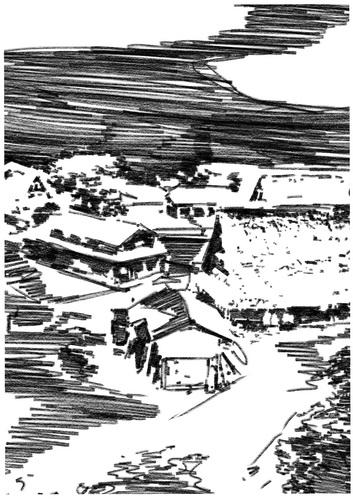
In that same village, and in one of these very houses (which, to tell the precise truth, was sadly time-worn and weather-beaten), there lived, many years since, while the country was yet a province of Great Britain, a simple, good-natured fellow, of the name of Rip Van Winkle. He was a descendant of the Van Winkles who figured so gallantly in the chivalrous days of Peter Stuyvesant, and accompanied him to the siege of Fort Christina. He inherited, however, but little of the martial character of his ancestors. I have observed that he was a simple, good-natured man; he was, moreover, a kind neighbor, and an obedient henpecked husband.
Indeed, to the latter circumstance might be owing that meekness of spirit which gained him such universal popularity; for those men are apt to be obsequious and conciliating abroad, who are under the discipline of shrews at home. Their tempers, doubtless, are rendered pliant and malleable in the fiery furnace of domestic tribulation, and a curtain-lecture is worth all the sermons in the world for teaching the virtues of patience and long-suffering. A termagant wife may, therefore, in some respects, be considered a tolerable blessing, and if so, Rip Van Winkle was thrice blessed.
Certain it is, that he was a great favorite among all the good wives of the village, who, as usual with the amiable sex, took his part in all family squabbles, and never failed, whenever they talked those matters over in their evening gossipings, to lay all the blame on Dame Van Winkle. The children of the village, too, would shout with joy whenever he approached. He assisted at their sports, made their playthings, taught them to fly kites and shoot marbles, and told them long stories of ghosts, witches, and Indians. Whenever he went dodging about the village, he was surrounded by a troop of them hanging on his skirts, clambering on his back, and playing a thousand tricks on him with impunity; and not a dog would bark at him throughout the neighborhood.
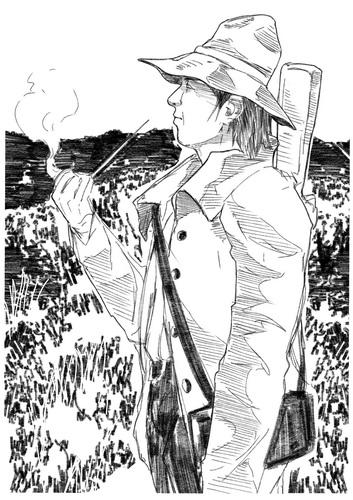
The great error in Rip’s composition was an insuperable aversion to all kinds of profitable labor. It could not be for want of assiduity or perseverance; for he would sit on a wet rock, with a rod as long and heavy as a Tartar’s lance, and fish all day without a murmur, even though he should not be encouraged by a single nibble. He would carry a fowling-piece on his shoulder, for hours together, trudging through woods and swamps, and up hill and down dale, to shoot a few squirrels or wild pigeons. He would never refuse to assist a neighbor even in the roughest toil, and was a foremost man in all country frolics for husking Indian corn, or building stone fences; the women of the village, too, used to employ him to run their errands, and to do such little odd jobs as their less obliging husbands would not do for them. In a word, Rip was ready to attend to anybody’s business but his own; but as to doing family duty, and keeping his farm in order, he found it impossible.
In fact, he declared it was of no use to work on his farm; it was the most pestilent little piece of ground in the whole country; everything about it went wrong, in spite of him. His fences were continually falling to pieces; his cow would either go astray, or get among the cabbages; weeds were sure to grow quicker in his fields than anywhere else; the rain always made a point of setting in just as he had some out-door work to do; so that though his patrimonial estate had dwindled away under his management, acre by acre, until there was little more left than a mere patch of Indian corn and potatoes, yet it was the worst-conditioned farm in the neighborhood.
His children, too, were as ragged and wild as if they belonged to nobody. His son Rip, an urchin begotten in his own likeness, promised to inherit the habits, with the old clothes, of his father. He was generally seen trooping like a colt at his mother’s heels, equipped in a pair of his father’s cast-off galligaskins, which he had much ado to hold up with one hand, as a fine lady does her train in bad weather.
Rip Van Winkle, however, was one of those happy mortals, of foolish, well-oiled dispositions, who take the world easy, eat white bread or brown, whichever can be got with least thought or trouble, and would rather starve on a penny than work for a pound. If left to himself, he would have whistled life away, in perfect contentment; but his wife kept continually dinning in his ears about his idleness, his carelessness, and the ruin he was bringing on his family. Morning, noon, and night, her tongue was incessantly going, and every thing he said or did was sure to produce a torrent of household eloquence. Rip had but one way of replying to all lectures of the kind, and that, by frequent use, had grown into a habit. He shrugged his shoulders, shook his head, cast up his eyes, but said nothing. This, however, always provoked a fresh volley from his wife, so that he was fain to draw off his forces, and take to the outside of the house-the only side which, in truth, belongs to a henpecked husband.

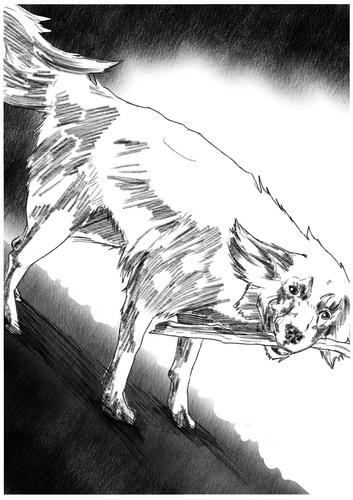
Rip’s sole domestic adherent was his dog Wolf, who was as much henpecked as his master; for Dame Van Winkle regarded them as companions in idleness, and even looked upon Wolf with an evil eye, as the cause of his master’s going so often astray. True it is, in all points of spirit befitting in honorable dog, he was as courageous an animal as ever scoured the woods-but what courage can withstand the evil-doing and all-besetting terrors of a woman’s tongue? The moment Wolf entered the house, his crest fell, his tail drooped to the ground, or curled between his legs, he sneaked about with a gallows air, casting many a sidelong glance at Dame Van Winkle, and at the least flourish of a broomstick or ladle, he would fly to the door with yelping precipitation.
Times grew worse and worse with Rip Van Winkle as years of matrimony rolled on; a tart temper never mellows with age, and a sharp tongue is the only edged tool that grows keener with constant use. For a long while he used to console himself, when driven from home, by frequenting a kind of perpetual club of the sages, philosophers, and other idle personages of the village, which held its sessions on a bench before a small inn, designated by a rubicund portrait of his Majesty George the Third. Here they used to sit in the shade through a long, lazy summer’s day, talking listlessly over village gossip, or telling endless, sleepy stories about nothing. But it would have been worth any statesman’s money to have heard the profound discussions which sometimes took place, when by chance an old newspaper fell into their hands from some passing traveller. How solemnly they would listen to the contents, as drawled out by Derrick Van Bummel, the school-master, a dapper learned little man, who was not to be daunted by the most gigantic word in the dictionary; and how sagely they would deliberate upon public events some months after they had taken place.
The opinions of this junto were completely controlled by Nicholas Vedder, a patriarch of the village, and landlord of the inn, at the door of which he took his seat from morning till night, just moving sufficiently to avoid the sun, and keep in the shade of a large tree; so that the neighbors could tell the hour by his movements as accurately as by a sun-dial. It is true, he was rarely heard to speak, but smoked his pipe incessantly. His adherents, however (for every great man has his adherents), perfectly understood him, and knew how to gather his opinions. When any thing that was read or related displeased him, he was observed to smoke his pipe vehemently, and to send forth, frequent, and angry puffs; but when pleased, he would inhale the smoke slowly and tranquilly, and emit it in light and placid clouds, and sometimes, taking the pipe from his mouth, and letting the fragrant vapor curl about his nose, would gravely nod his head in token of perfect approbation.
From even this stronghold the unlucky Rip was at length routed by his termagant wife, who would suddenly break in upon the tranquillity of the assemblage, and call the members all to nought; nor was that august personage, Nicholas Vedder himself, sacred from the daring tongue of this terrible virago, who charged him outright with encouraging her husband in habits of idleness.
Poor Rip was at last reduced almost to despair; and his only alternative, to escape from the labor of the farm and the clamor of his wife, was to take gun in hand, and stroll away into the woods. Here he would sometimes seat himself at the foot of a tree, and share the contents of his wallet with Wolf, with whom he sympathized as a fellow-sufferer in persecution. “Poor Wolf,” he would say, “thy mistress leads thee a dog’s life of it; but never mind, my lad, whilst I live thou shalt never want a friend to stand by thee!” Wolf would wag his tail, look wistfully in his master’s face, and if dogs can feel pity, I verily believe he reciprocated the sentiment with all his heart.
In a long ramble of the kind, on a fine autumnal day, Rip had unconsciously scrambled to one of the highest parts of the Kaatskill mountains. He was after his favorite sport of squirrel-shooting, and the still solitudes had echoed and re-echoed with the reports of his gun.
Panting and fatigued, he threw himself, late in the afternoon, on a green knoll, covered with mountain herbage, that crowned the brow of a precipice. From an opening between the trees, he could overlook all the lower country for many a mile of rich woodland. He saw at a distance the lordly Hudson, far, far below him, moving on its silent but majestic course, with the reflection of a purple cloud, or the sail of a lagging bark, here and there sleeping on its glassy bosom and at last losing itself in the blue highlands.
On the other side he looked down into a deep mountain glen, wild, lonely, and shagged, the bottom filled with fragments from the impending cliffs, and scarcely lighted by the reflected rays of the setting sun. For some time Rip lay musing on this scene; evening was gradually advancing; the mountains began to throw their long blue shadows over the valleys; he saw that it would be dark long before he could reach the village; and he heaved a heavy sigh when he thought of encountering the terrors of Dame Van Winkle.
As he was about to descend, he heard a voice from a distance hallooing:
“Rip Van Winkle! Rip Van Winkle!” He looked around, but could see nothing but a crow winging its solitary flight across the mountain. He thought his fancy must have deceived him, and turned again to descend, when he heard the same cry ring through the still evening air, “Rip Van Winkle! Rip Van Winkle!”-at the same time Wolf bristled up his back, and giving a low growl, skulked to his master’s side, looking fearfully down into the glen. Rip now felt a vague apprehension stealing over him; he looked anxiously in the same direction, and perceived a strange figure slowly toiling up the rocks, and bending under the weight of something he carried on his back. He was surprised to see any human being in this lonely and unfrequented place, but supposing it to be some one of the neighborhood in need of his assistance, he hastened down to yield it.

On nearer approach, he was still more surprised at the singularity of the stranger’s appearance. He was a short, square-built old fellow, with thick bushy hair, and a grizzled beard. His dress was of the antique Dutch fashion-a cloth jerkin strapped round the waist-several pairs of breeches, the outer one of ample volume, decorated with rows of buttons down the sides, and bunches at the knees. He bore on his shoulders a stout keg, that seemed full of liquor, and made signs for Rip to approach and assist him with the load. Though rather shy and distrustful of this new acquaintance, Rip complied with his usual alacrity; and mutually relieving each other, they clambered up a narrow gully, apparently the dry bed of a mountain torrent. As they ascended, Rip every now and then heard long rolling peals, like distant thunder, that seemed to issue out of a deep ravine, or rather cleft between lofty rocks, toward which their rugged path conducted. He paused for an instant, but supposing it to be the muttering of one of those transient thunder-showers which often take place in the mountain heights, he proceeded. Passing through the ravine, they came to a hollow, like a small amphitheatre, surrounded by perpendicular precipices, over the brinks of which impending trees shot their branches, so that you only caught glimpses of the azure sky, and the bright evening cloud. During the whole time Rip and his companion had labored on in silence; for though the former marvelled greatly what could be the object of carrying a keg of liquor up this wild mountain, yet there was something strange and incomprehensible about the unknown, that inspired awe, and checked familiarity.
On entering the amphitheatre, new objects of wonder presented themselves. On a level spot in the centre was a company of odd-looking personages playing at ninepins. They were dressed in quaint outlandish fashion; some wore short doublets, others jerkins, with long knives in their belts, and most of them had enormous breeches, of similar style with that of the guide’s. Their visages, too, were peculiar; one had a large head, broad face, and small piggish eyes; the face of another seemed to consist entirely of nose, and was surmounted by a white sugar-loaf hat, set off with a little red cock’s tail. They all had beards, of various shapes and colors. There was one who seemed to be the commander. He was a stout old gentleman, with a weather-beaten countenance; he wore a laced doublet, broad belt and hanger, high-crowned hat and feather, red stockings, and high-heeled shoes, with roses in them. The whole group reminded Rip of the figures in an old Flemish painting, in the parlor of Dominie Van Schaick, the village parson, and which had been brought over from Holland at the time of the settlement.
What seemed particularly odd to Rip was, that though these folks were evidently amusing themselves, yet they maintained the gravest faces, the most mysterious silence, and were, withal, the most melancholy party of pleasure he had ever witnessed. Nothing interrupted the stillness of the scene but the noise of the balls, which, whenever they were rolled, echoed along the mountains like rumbling peals of thunder.
As Rip and his companion approached them, they suddenly desisted from their play, and stared at him with such a fixed statue-like gaze, and such strange uncouth, lack-lustre countenances, that his heart turned within him, and his knees smote together. His companion now emptied the contents of the keg into large flagons, and made signs to him to wait upon the company. He obeyed with fear and trembling; they quaffed the liquor in profound silence, and then returned to their game.
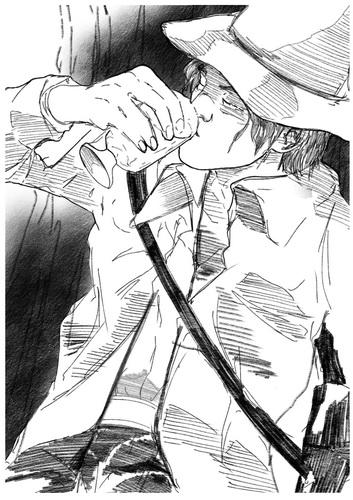
By degrees, Rip’s awe and apprehension subsided. He even ventured, when no eye was fixed upon him, to taste the beverage which he found had much of the flavor of excellent Hollands. He was naturally a thirsty soul, and was soon tempted to repeat the draught. One taste provoked another; and he reiterated his visits to the flagon so often, that at length his senses were overpowered, his eyes swam in his head, his head gradually declined, and he fell into a deep sleep.
On waking, he found himself on the green knoll whence he had first seen the old man of the glen. He rubbed his eyes-it was a bright sunny morning. The birds were hopping and twittering among the bushes, and the eagle was wheeling aloft, and breasting the pure mountain breeze.
“Surely,” thought Rip, “I have not slept here all night.” He recalled the occurrences before he fell asleep. The strange man with the keg of liquor-the mountain ravine-the wild retreat among the rocks-the woe-begone party at ninepins-the flagon-“Oh! that flagon! that wicked flagon!” thought Rip-“what excuse shall I make to Dame Van Winkle?”

He looked round for his gun, but in place of the clean well-oiled fowling-piece, he found an old firelock lying by him, the barrel encrusted with rust, the lock falling off, and the stock worm-eaten. He now suspected that the grave roysterers of the mountains had put a trick upon him, and, having dosed him with liquor, had robbed him of his gun. Wolf, too, had disappeared, but he might have strayed away after a squirrel or partridge. He whistled after him and shouted his name, but all in vain; the echoes repeated his whistle and shout, but no dog was to be seen.
He determined to revisit the scene of the last evening’s gambol, and if he met with any of the party, to demand his dog and gun. As he rose to walk, he found himself stiff in the joints, and wanting in his usual activity. “These mountain beds do not agree with me,” thought Rip, “and if this frolic, should lay me up with a fit of the rheumatism, I shall have a blessed time with Dame Van Winkle.” With some difficulty he got down into the glen: he found the gully up which he and his companion had ascended the preceding evening; but to his astonishment a mountain stream was now foaming down it, leaping from rock to rock, and filling the glen with babbling murmurs. He, however, made shift to scramble up its sides, working his toilsome way through thickets of birch, sassafras, and witch-hazel; and sometimes tripped up or entangled by the wild grape vines that twisted their coils and tendrils from tree to tree, and spread a kind of network in his path.
At length he reached to where the ravine had opened through the cliffs to the amphitheatre; but no traces of such opening remained. The rocks presented a high impenetrable wall, over which the torrent came tumbling in a sheet of feathery foam, and fell into a broad deep basin, black from the shadows of the surrounding forest. Here, then, poor Rip was brought to a stand. He again called and whistled after his dog; he was only answered by the cawing of a flock of idle crows, sporting high in the air about a dry tree that overhung a sunny precipice; and who, secure in their elevation, seemed to look down and scoff at the poor man’s perplexities. What was to be done? The morning was passing away, and Rip felt famished for want of his breakfast. He grieved to give up his dog and gun; he dreaded to meet his wife; but it would not do to starve among the mountains. He shook his head, shouldered the rusty firelock, and, with a heart full of trouble and anxiety, turned his steps homeward.
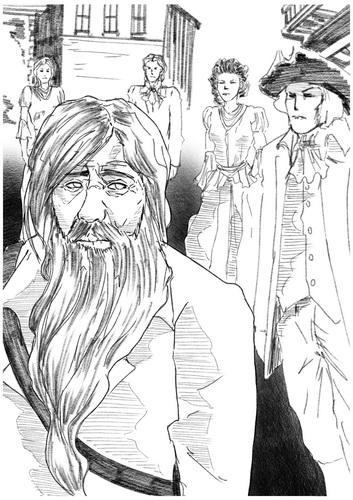
As he approached the village, he met a number of people, but none whom he new, which somewhat surprised him, for he had thought himself acquainted with every one in the country round. Their dress, too, was of a different fashion from that to which he was accustomed. They all stared at him with equal marks of surprise, and whenever they cast eyes upon him, invariably stroked their chins. The constant recurrence of this gesture, induced Rip, involuntarily, to do, the same, when, to his astonishment, he found his beard had grown a foot long!
He had now entered the skirts of the village. A troop of strange children ran at his heels, hooting after him, and pointing at his gray beard. The dogs, too, not one of which he recognized for an old acquaintance, barked at him as he passed. The very village was altered: it was larger and more populous. There were rows of houses which he had never seen before, and those which had been his familiar haunts had disappeared. Strange names were over the doors-strange faces at the windows-everything was strange. His mind now misgave him; he began to doubt whether both he and the world around him were not bewitched.
Surely this was his native village, which he had left but a day before.
There stood the Kaatskill mountains-there ran the silver Hudson at a distance-there was every hill and dale precisely as it had always been-Rip was sorely perplexed-“That flagon last night,” thought he, “has addled my poor head sadly!”
It was with some difficulty that he found the way to his own house, which he approached with silent awe, expecting every moment to hear the shrill voice of Dame Van Winkle. He found the house gone to decay-the roof had fallen in, the windows shattered, and the doors off the hinges.
A half-starved dog, that looked like Wolf, was skulking about it. Rip called him by name, but the cur snarled, showed his teeth, and passed on. This was an unkind cut indeed.-“My very dog,” sighed poor Rip, “has forgotten me!”
He entered the house, which, to tell the truth, Dame Van Winkle had always kept in neat order. It was empty, forlorn, and apparently abandoned. This desolateness overcame all his connubial fears-he called loudly for his wife and children-the lonely chambers rang for a moment with his voice, and then all again was silence.
He now hurried forth, and hastened to his old resort, the village inn-but it too was gone. A large rickety wooden building stood in its place, with great gaping windows, some of them broken, and mended with old hats and petticoats, and over the door was painted, “The Union Hotel, by Jonathan Doolittle.” Instead of the great tree that used to shelter the quiet little Dutch inn of yore, there now was reared a tall naked pole, with something on the top that looked like a red nightcap, and from it was fluttering a flag, on which was a singular assemblage of stars and stripes-all this was strange and incomprehensible. He recognized on the sign, however, the ruby face of King George, under which he had smoked so many a peaceful pipe, but even this was singularly metamorphosed. The red coat was changed for one of blue and buff, a sword was held in the hand instead of a sceptre, the head was decorated with a cocked hat, and underneath was painted in large characters, “GENERAL WASHINGTON.”
There was, as usual, a crowd of folk about the door, but none that Rip recollected. The very character of the people seemed changed. There was a busy, bustling, disputatious tone about it, instead of the accustomed phlegm and drowsy tranquillity. He looked in vain for the sage Nicholas Vedder, with his broad face, double chin, and fair long pipe, uttering clouds of tobacco-smoke, instead of idle speeches; or Van Bummel, the schoolmaster, doling forth the contents of an ancient newspaper. In place of these, a lean, bilious-looking fellow, with his pockets full of handbills, was haranguing, vehemently about rights of citizens-elections-members of Congress-liberty-Bunker’s hill-heroes of seventy-six-and other words, which were a perfect Babylonish jargon to the bewildered Van Winkle.
The appearance of Rip, with his long, grizzled beard, his rusty fowling-piece, his uncouth dress, and the army of women and children at his heels, soon attracted the attention of the tavern politicians. They crowded round him, eying him from head to foot, with great curiosity.
The orator bustled up to him, and, drawing him partly aside, inquired, “on which side he voted?” Rip stared in vacant stupidity. Another short but busy little fellow pulled him by the arm, and rising on tiptoe, inquired in his ear, “whether he was Federal or Democrat.” Rip was equally at a loss to comprehend the question; when a knowing, self-important old gentleman, in a sharp cocked hat, made his way through the crowd, putting them to the right and left with his elbows as he passed, and planting himself before Van Winkle, with one arm akimbo, the other resting on his cane, his keen eyes and sharp hat penetrating, as it were, into his very soul, demanded in an austere tone, “What brought him to the election with a gun on his shoulder, and a mob at his heels; and whether he meant to breed a riot in the village?”
“Alas! gentlemen,” cried Rip, somewhat dismayed, “I am a poor, quiet man, a native of the place, and a loyal subject of the King, God bless him!”
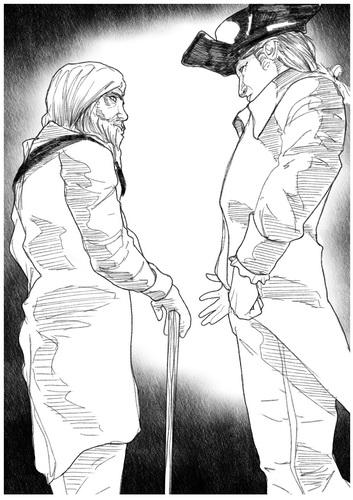
Here a general shout burst from the bystanders-“a tory! a tory! a spy! a refugee! hustle him! away with him!” It was with great difficulty that the self-important man in the cocked hat restored order; and having assumed a tenfold austerity of brow, demanded again of the unknown culprit, what he came there for, and whom he was seeking. The poor man humbly assured him that he meant no harm, but merely came there in search of some of his neighbors, who used to keep about the tavern.
“Well-who are they? — name them.”
Rip bethought himself a moment, and inquired, Where’s Nicholas Vedder?
There was a silence for a little while, when an old man replied, in a thin, piping voice, “Nicholas Vedder? why, he is dead and gone these eighteen years! There was a wooden tombstone in the churchyard that used to tell all about him, but that’s rotten and gone too.”
“Where’s Brom Dutcher?”
“Oh, he went off to the army in the beginning of the war; some say he was killed at the storming of Stony-Point-others say he was drowned in a squall at the foot of Antony’s Nose. I don’t know-he never came back again.”
“Where’s Van Bummel, the schoolmaster?”
“He went off to the wars, too; was a great militia general, and is now in Congress.”
Rip’s heart died away, at hearing of these sad changes in his home and friends, and finding himself thus alone in the world. Every answer puzzled him too, by treating of such enormous lapses of time, and of matters which he could not understand: war-Congress-Stony-Point;-he had no courage to ask after any more friends, but cried out in despair, “Does nobody here know Rip Van Winkle?”
“Oh, Rip Van Winkle!” exclaimed two or three. “Oh, to be sure! that’s Rip Van Winkle yonder, leaning against the tree.”
Rip looked, and beheld a precise counterpart of himself as he went up the mountain; apparently as lazy, and certainly as ragged. The poor fellow was now completely confounded. He doubted his own identity, and whether he was himself or another man. In the midst of his bewilderment, the man in the cocked hat demanded who he was, and what was his name?
“God knows!” exclaimed he at his wit’s end; “I’m not myself-I’m somebody else-that’s me yonder-no-that’s somebody else, got into my shoes-I was myself last night, but I fell asleep on the mountain, and they’ve changed my gun, and everything’s changed, and I’m changed, and I can’t tell what’s my name, or who I am!”
The by-standers began now to look at each other, nod, wink significantly, and tap their fingers against their foreheads. There was a whisper, also, about securing the gun, and keeping the old fellow from doing mischief; at the very suggestion of which, the self-important man with the cocked hat retired with some precipitation. At this critical moment a fresh, comely woman pressed through the throng to get a peep at the gray-bearded man. She had a chubby child in her arms, which, frightened at his looks, began to cry. “Hush, Rip,” cried she, “hush, you little fool; the old man won’t hurt you.” The name of the child, the air of the mother, the tone of her voice, all awakened a train of recollections in his mind.
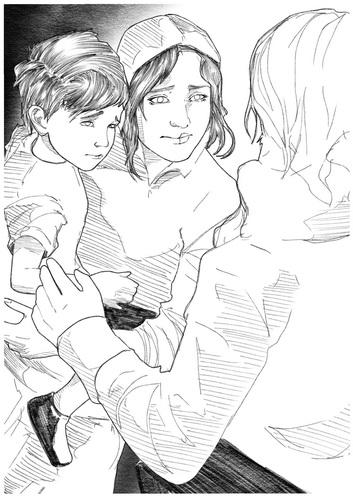
“What is your name, my good woman?” asked he.
“Judith Cardenier.”
“And your father’s name?”
“Ah, poor man, Rip Van Winkle was his name, but it’s twenty years since he went away from home with his gun, and never has been heard of since, — his dog came home without him; but whether he shot himself, or was carried away by the Indians, nobody can tell. I was then but a little girl.”
Rip had but one more question to ask; but he put it with a faltering voice:
“Where’s your mother?”
Oh, she too had died but a short time since; she broke a blood-vessel in a fit of passion at a New-England pedler.
There was a drop of comfort, at least, in this intelligence. The honest man could contain himself no longer. He caught his daughter and her child in his arms. “I am your father!” cried he-“Young Rip Van Winkle once-old Rip Van Winkle now-Does nobody know poor Rip Van Winkle!”
All stood amazed, until an old woman, tottering out from among the crowd, put her hand to her brow, and peering under it in his face for a moment exclaimed, “sure enough! it is Rip Van Winkle-it is himself.
Welcome home again, old neighbor. Why, where have you been these twenty long years?”
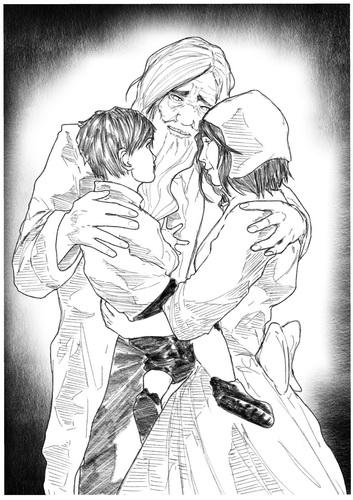
Rip’s story was soon told, for the whole twenty years had been to him but as one night. The neighbors stared when they heard it; some were seen to wink at each other, and put their tongues in their cheeks; and the self-important man in the cocked hat, who, when the alarm was over, had returned to the field, screwed down the corners of his mouth, and shook his head-upon which there was a general shaking of the head throughout the assemblage.
It was determined, however, to take the opinion of old Peter Vanderdonk, who was seen slowly advancing up the road. He was a descendant of the historian of that name, who wrote one of the earliest accounts of the province. Peter was the most ancient inhabitant of the village, and well versed in all the wonderful events and traditions of the neighborhood.
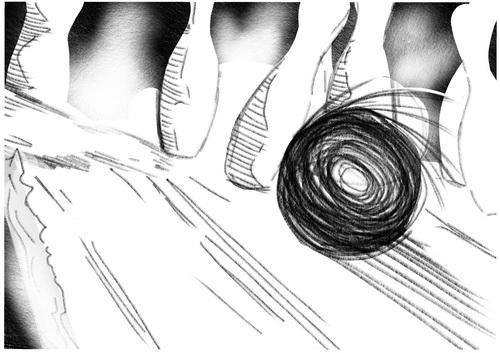
He recollected Rip at once, and corroborated his story in the most satisfactory manner. He assured the company that it was a fact, handed down from his ancestor, the historian, that the Kaatskill mountains had always been haunted by strange beings. That it was affirmed that the great Hendrick Hudson, the first discoverer of the river and country, kept a kind of vigil there every twenty years, with his crew of the Half-moon; being permitted in this way to revisit the scenes of his enterprise, and keep a guardian eye upon the river and the great city called by his name. That his father had once seen them in their old Dutch dresses playing at ninepins in the hollow of the mountain; and that he himself had heard, one summer afternoon, the sound of their balls, like distant peals of thunder.
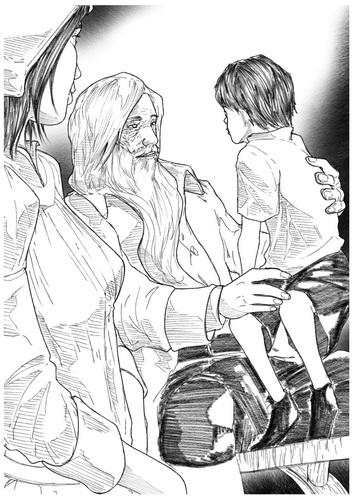
To make a long story short, the company broke up, and returned to the more important concerns of the election. Rip’s daughter took him home to live with her; she had a snug, well-furnished house, and a stout cheery farmer for a husband, whom Rip recollected for one of the urchins that used to climb upon his back. As to Rip’s son and heir, who was the ditto of himself, seen leaning against the tree, he was employed to work on the farm; but evinced an hereditary disposition to attend to any thing else but his business.
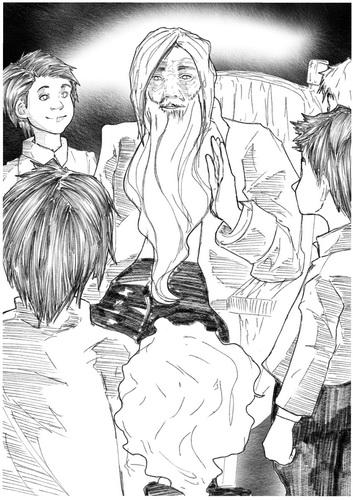
Rip now resumed his old walks and habits; he soon found many of his former cronies, though all rather the worse for the wear and tear of time; and preferred making friends among the rising generation, with whom he soon grew into great favor.
Having nothing to do at home, and being arrived at that happy age when a man can be idle with impunity, he took his place once more on the bench, at the inn door, and was reverenced as one of the patriarchs of the village, and a chronicle of the old times “before the war.” It was some time before he could get into the regular track of gossip, or could be made to comprehend the strange events that had taken place during his torpor. How that there had been a revolutionary war-that the country had thrown off the yoke of old England-and that, instead of being a subject to his Majesty George the Third, he was now a free citizen of the United States. Rip, in fact, was no politician; the changes of states and empires made but little impression on him; but there was one species of despotism under which he had long groaned, and that was-petticoat government. Happily, that was at an end; he had got his neck out of the yoke of matrimony, and could go in and out whenever he pleased, without dreading the tyranny of Dame Van Winkle. Whenever her name was mentioned, however, he shook his head, shrugged his shoulders, and cast up his eyes; which might pass either for an expression of resignation to his fate, or joy at his deliverance.

He used to tell his story to every stranger that arrived at Mr. Doolittle’s hotel. He was observed, at first, to vary on some points every time he told it, which was, doubtless, owing to his having so recently awaked. It at last settled down precisely to the tale I have related, and not a man, woman, or child in the neighborhood, but knew it by heart. Some always pretended to doubt the reality of it, and insisted that Rip had been out of his head, and that this was one point on which he always remained flighty. The old Dutch inhabitants, however, almost universally gave it full credit. Even to this day, they never hear a thunder-storm of a summer afternoon about the Kaatskill, but they say Hendrick Hudson and his crew are at their game of ninepins; and it is a common wish of all henpecked husbands in the neighborhood, when life hangs heavy on their hands, that they might have a quieting draught out of Rip Van Winkle’s flagon.
NOTE.
The foregoing tale, one would suspect, had been suggested to Mr.Knickerbocker by a little German superstition about the Emperor Frederick der Rothbart and the Kypphauser mountain; the subjoined note, however, which had appended to the tale, shows that it is an absolute fact, narrated with his usual fidelity.
“The story of Rip Van Winkle may seem incredible to many, but nevertheless I give it my full belief, for I know the vicinity of our old Dutch settlements to have been very subject to marvellous events and appearances. Indeed, I have heard many stranger stories than this, in the villages along the Hudson; all of which were too well authenticated to admit of a doubt. I have even talked with Rip Van Winkle myself, who, when last I saw him, was a very venerable old man, and so perfectly rational and consistent on every other point, that I think no conscientious person could refuse to take this into the bargain; nay, I have seen a certificate on the subject taken before a country justice, and signed with cross, in the justice’s own handwriting. The story, therefore, is beyond the possibility of doubt.
“D. K.”
POSTSCRIPT.
The following are travelling notes from a memorandum-book of Mr. Knickerbocker: The Kaatsberg or Catskill mountains have always been a region full of fable. The Indians considered them the abode of spirits, who influenced the weather, spreading sunshine or clouds over the landscape, and sending good or bad hunting seasons. They were ruled by an old squaw spirit, said to be their mother. She dwelt on the highest peak of the Catskills, and had charge of the doors of day and night to open and shut them at the proper hour. She hung up the new moons in the skies, and cut up the old ones into stars. In times of drought, if properly propitiated, she would spin light summer clouds out of cobwebs and morning dew, and send them off from the crest of the mountain, flake after flake, like flakes of carded cotton, to float in the air; until, dissolved by the heat of the sun, they would fall in gentle showers, causing the grass to spring, the fruits to ripen, and the corn to grow an inch an hour. If displeased, however, she would brew up clouds black as ink, sitting in the midst of them like a bottle-bellied spider in the midst of its web; and when these clouds broke, woe betide the valleys!
In old times, say the Indian traditions, there was a kind of Manitou or Spirit, who kept about the wildest recesses of the Catskill mountains, and took a mischievous pleasure in wreaking all kind of evils and vexations upon the red men. Sometimes he would assume the form of a bear, a panther, or a deer, lead the bewildered hunter a weary chase through tangled forests and among ragged rocks, and then spring off with a loud ho! ho! leaving him aghast on the brink of a beetling precipice or raging torrent.
The favorite abode of this Manitou is still shown. It is a rock or cliff on the loneliest port of the mountains, and, from the flowering vines which clamber about it, and the wild flowers which abound in its neighborhood, is known by the name of the Garden Rock. Near the foot of it is a small lake, the haunt of the solitary bittern, with water-snakes basking in the sun on the leaves of the pond-lilies which lie on the surface. This place was held in great awe by the Indians, insomuch that the boldest hunter would not pursue his game within its precincts. Once upon a time, however, a hunter who had lost his way penetrated to the Garden Rock, where he beheld a number of gourds placed in the crotches of trees. One of these he seized and made off with it, but in the hurry of his retreat he let it fall among the rocks, when a great stream gushed forth, which washed him away and swept him down precipices, where he was dished to pieces, and the stream made its way to the Hudson, and continues to flow to the present day, being the identical stream known by the name of the Kaaterskill.
Edgar Allan Poe
The Murders In The Rue Morgue
What song the Syrens sang, or what name Achilles assumed when he hid himself among women, although puzzling questions, are not beyond all conjecture.
The mental features discoursed of as the analytical, are, in themselves, but little susceptible of analysis. We appreciate them only in their effects. We know of them, among other things, that they are always to their possessor, when inordinately possessed, a source of the liveliest enjoyment. As the strong man exults in his physical ability, delighting in such exercises as call his muscles into action, so glories the analyst in that moral activity which disentangles. He derives pleasure from even the most trivial occupations bringing his talent into play. He is fond of enigmas, of conundrums, of hieroglyphics; exhibiting in his solutions of each a degree of acumen which appears to the ordinary apprehension præternatural. His results, brought about by the very soul and essence of method, have, in truth, the whole air of intuition.
The faculty of re-solution is possibly much invigorated by mathematical study, and especially by that highest branch of it which, unjustly, and merely on account of its retrograde operations, has been called, as if par excellence, analysis. Yet to calculate is not in itself to analyse. A chess-player, for example, does the one without effort at the other. It follows that the game of chess, in its effects upon mental character, is greatly misunderstood. I am not now writing a treatise, but simply prefacing a somewhat peculiar narrative by observations very much at random; I will, therefore, take occasion to assert that the higher powers of the reflective intellect are more decidedly and more usefully tasked by the unostentatious game of draughts than by all the elaborate frivolity of chess. In this latter, where the pieces have different and bizarre motions, with various and variable values, what is only complex is mistaken (a not unusual error) for what is profound. The attention is here called powerfully into play. If it flag for an instant, an oversight is committed resulting in injury or defeat. The possible moves being not only manifold but involute, the chances of such oversights are multiplied; and in nine cases out of ten it is the more concentrative rather than the more acute player who conquers. In draughts, on the contrary, where the moves are unique and have but little variation, the probabilities of inadvertence are diminished, and the mere attention being left comparatively unemployed, what advantages are obtained by either party are obtained by superior acumen. To be less abstract-Let us suppose a game of draughts where the pieces are reduced to four kings, and where, of course, no oversight is to be expected. It is obvious that here the victory can be decided (the players being at all equal) only by some recherché movement, the result of some strong exertion of the intellect. Deprived of ordinary resources, the analyst throws himself into the spirit of his opponent, identifies himself therewith, and not unfrequently sees thus, at a glance, the sole methods (sometime indeed absurdly simple ones) by which he may seduce into error or hurry into miscalculation.
Whist has long been noted for its influence upon what is termed the calculating power; and men of the highest order of intellect have been known to take an apparently unaccountable delight in it, while eschewing chess as frivolous. Beyond doubt there is nothing of a similar nature so greatly tasking the faculty of analysis. The best chess-player in Christendom may be little more than the best player of chess; but proficiency in whist implies capacity for success in all those more important undertakings where mind struggles with mind. When I say proficiency, I mean that perfection in the game which includes a comprehension of all the sources whence legitimate advantage may be derived. These are not only manifold but multiform, and lie frequently among recesses of thought altogether inaccessible to the ordinary understanding. To observe attentively is to remember distinctly; and, so far, the concentrative chess-player will do very well at whist; while the rules of Hoyle (themselves based upon the mere mechanism of the game) are sufficiently and generally comprehensible. Thus to have a retentive memory, and to proceed by “the book,” are points commonly regarded as the sum total of good playing. But it is in matters beyond the limits of mere rule that the skill of the analyst is evinced. He makes, in silence, a host of observations and inferences. So, perhaps, do his companions; and the difference in the extent of the information obtained, lies not so much in the validity of the inference as in the quality of the observation. The necessary knowledge is that of what to observe. Our player confines himself not at all; nor, because the game is the object, does he reject deductions from things external to the game. He examines the countenance of his partner, comparing it carefully with that of each of his opponents. He considers the mode of assorting the cards in each hand; often counting trump by trump, and honor by honor, through the glances bestowed by their holders upon each. He notes every variation of face as the play progresses, gathering a fund of thought from the differences in the expression of certainty, of surprise, of triumph, or of chagrin. From the manner of gathering up a trick he judges whether the person taking it can make another in the suit. He recognises what is played through feint, by the air with which it is thrown upon the table. A casual or inadvertent word; the accidental dropping or turning of a card, with the accompanying anxiety or carelessness in regard to its concealment; the counting of the tricks, with the order of their arrangement; embarrassment, hesitation, eagerness or trepidation-all afford, to his apparently intuitive perception, indications of the true state of affairs. The first two or three rounds having been played, he is in full possession of the contents of each hand, and thenceforward puts down his cards with as absolute a precision of purpose as if the rest of the party had turned outward the faces of their own.
The analytical power should not be confounded with ample ingenuity; for while the analyst is necessarily ingenious, the ingenious man is often remarkably incapable of analysis. The constructive or combining power, by which ingenuity is usually manifested, and to which the phrenologists (I believe erroneously) have assigned a separate organ, supposing it a primitive faculty, has been so frequently seen in those whose intellect bordered otherwise upon idiocy, as to have attracted general observation among writers on morals. Between ingenuity and the analytic ability there exists a difference far greater, indeed, than that between the fancy and the imagination, but of a character very strictly analogous. It will be found, in fact, that the ingenious are always fanciful, and the truly imaginative never otherwise than analytic.
The narrative which follows will appear to the reader somewhat in the light of a commentary upon the propositions just advanced.
Residing in Paris during the spring and part of the summer of 18-, I there became acquainted with a Monsieur C. Auguste Dupin. This young gentleman was of an excellent-indeed of an illustrious family, but, by a variety of untoward events, had been reduced to such poverty that the energy of his character succumbed beneath it, and he ceased to bestir himself in the world, or to care for the retrieval of his fortunes. By courtesy of his creditors, there still remained in his possession a small remnant of his patrimony; and, upon the income arising from this, he managed, by means of a rigorous economy, to procure the necessaries of life, without troubling himself about its superfluities. Books, indeed, were his sole luxuries, and in Paris these are easily obtained.
Our first meeting was at an obscure library in the Rue Montmartre, where the accident of our both being in search of the same very rare and very remarkable volume, brought us into closer communion. We saw each other again and again. I was deeply interested in the little family history which he detailed to me with all that candor which a Frenchman indulges whenever mere self is his theme. I was astonished, too, at the vast extent of his reading; and, above all, I felt my soul enkindled within me by the wild fervor, and the vivid freshness of his imagination. Seeking in Paris the objects I then sought, I felt that the society of such a man would be to me a treasure beyond price; and this feeling I frankly confided to him. It was at length arranged that we should live together during my stay in the city; and as my worldly circumstances were somewhat less embarrassed than his own, I was permitted to be at the expense of renting, and furnishing in a style which suited the rather fantastic gloom of our common temper, a time-eaten and grotesque mansion, long deserted through superstitions into which we did not inquire, and tottering to its fall in a retired and desolate portion of the Faubourg St. Germain.
Had the routine of our life at this place been known to the world, we should have been regarded as madmen-although, perhaps, as madmen of a harmless nature. Our seclusion was perfect. We admitted no visitors. Indeed the locality of our retirement had been carefully kept a secret from my own former associates; and it had been many years since Dupin had ceased to know or be known in Paris. We existed within ourselves alone.
It was a freak of fancy in my friend (for what else shall I call it?) to be enamored of the Night for her own sake; and into this bizarrerie, as into all his others, I quietly fell; giving myself up to his wild whims with a perfect abandon. The sable divinity would not herself dwell with us always; but we could counterfeit her presence. At the first dawn of the morning we closed all the messy shutters of our old building; lighting a couple of tapers which, strongly perfumed, threw out only the ghastliest and feeblest of rays. By the aid of these we then busied our souls in dreams-reading, writing, or conversing, until warned by the clock of the advent of the true Darkness. Then we sallied forth into the streets arm in arm, continuing the topics of the day, or roaming far and wide until a late hour, seeking, amid the wild lights and shadows of the populous city, that infinity of mental excitement which quiet observation can afford.
At such times I could not help remarking and admiring (although from his rich ideality I had been prepared to expect it) a peculiar analytic ability in Dupin. He seemed, too, to take an eager delight in its exercise-if not exactly in its display-and did not hesitate to confess the pleasure thus derived. He boasted to me, with a low chuckling laugh, that most men, in respect to himself, wore windows in their bosoms, and was wont to follow up such assertions by direct and very startling proofs of his intimate knowledge of my own. His manner at these moments was frigid and abstract; his eyes were vacant in expression; while his voice, usually a rich tenor, rose into a treble which would have sounded petulantly but for the deliberateness and entire distinctness of the enunciation. Observing him in these moods, I often dwelt meditatively upon the old philosophy of the Bi-Part Soul, and amused myself with the fancy of a double Dupin-the creative and the resolvent.
Let it not be supposed, from what I have just said, that I am detailing any mystery, or penning any romance. What I have described in the Frenchman, was merely the result of an excited, or perhaps of a diseased intelligence. But of the character of his remarks at the periods in question an example will best convey the idea.
We were strolling one night down a long dirty street in the vicinity of the Palais Royal. Being both, apparently, occupied with thought, neither of us had spoken a syllable for fifteen minutes at least. All at once Dupin broke forth with these words:
“He is a very little fellow, that’s true, and would do better for the Théâtre des Variétés.”
“There can be no doubt of that,” I replied unwittingly, and not at first observing (so much had I been absorbed in reflection) the extraordinary manner in which the speaker had chimed in with my meditations. In an instant afterward I recollected myself, and my astonishment was profound.
“Dupin,” said I, gravely, “this is beyond my comprehension. I do not hesitate to say that I am amazed, and can scarcely credit my senses. How was it possible you should know I was thinking of -?” Here I paused, to ascertain beyond a doubt whether he really knew of whom I thought.
– “of Chantilly,” said he, “why do you pause? You were remarking to yourself that his diminutive figure unfitted him for tragedy.”
This was precisely what had formed the subject of my reflections. Chantilly was a quondam cobbler of the Rue St. Denis, who, becoming stage-mad, had attempted the rôle of Xerxes, in Crébillon’s tragedy so called, and been notoriously Pasquinaded for his pains.
“Tell me, for Heaven’s sake,” I exclaimed, “the method-if method there is-by which you have been enabled to fathom my soul in this matter.” In fact I was even more startled than I would have been willing to express.
“It was the fruiterer,” replied my friend, “who brought you to the conclusion that the mender of soles was not of sufficient height for Xerxes et id genus omne.”
“The fruiterer! – you astonish me-I know no fruiterer whomsoever.”
“The man who ran up against you as we entered the street-it may have been fifteen minutes ago.”
I now remembered that, in fact, a fruiterer, carrying upon his head a large basket of apples, had nearly thrown me down, by accident, as we passed from the Rue C – into the thoroughfare where we stood; but what this had to do with Chantilly I could not possibly understand.
There was not a particle of charlatanerie about Dupin. “I will explain,” he said, “and that you may comprehend all clearly, we will first retrace the course of your meditations, from the moment in which I spoke to you until that of the rencontre with the fruiterer in question. The larger links of the chain run thus-Chantilly, Orion, Dr. Nichols, Epicurus, Stereotomy, the street stones, the fruiterer.”
There are few persons who have not, at some period of their lives, amused themselves in retracing the steps by which particular conclusions of their own minds have been attained. The occupation is often full of interest and he who attempts it for the first time is astonished by the apparently illimitable distance and incoherence between the starting-point and the goal. What, then, must have been my amazement when I heard the Frenchman speak what he had just spoken, and when I could not help acknowledging that he had spoken the truth. He continued:
“We had been talking of horses, if I remember aright, just before leaving the Rue C -. This was the last subject we discussed. As we crossed into this street, a fruiterer, with a large basket upon his head, brushing quickly past us, thrust you upon a pile of paving stones collected at a spot where the causeway is undergoing repair. You stepped upon one of the loose fragments, slipped, slightly strained your ankle, appeared vexed or sulky, muttered a few words, turned to look at the pile, and then proceeded in silence. I was not particularly attentive to what you did; but observation has become with me, of late, a species of necessity.
“You kept your eyes upon the ground-glancing, with a petulant expression, at the holes and ruts in the pavement, (so that I saw you were still thinking of the stones,) until we reached the little alley called Lamartine, which has been paved, by way of experiment, with the overlapping and riveted blocks. Here your countenance brightened up, and, perceiving your lips move, I could not doubt that you murmured the word ‘stereotomy,’ a term very affectedly applied to this species of pavement. I knew that you could not say to yourself ‘stereotomy’ without being brought to think of atomies, and thus of the theories of Epicurus; and since, when we discussed this subject not very long ago, I mentioned to you how singularly, yet with how little notice, the vague guesses of that noble Greek had met with confirmation in the late nebular cosmogony, I felt that you could not avoid casting your eyes upward to the great nebula in Orion, and I certainly expected that you would do so. You did look up; and I was now assured that I had correctly followed your steps. But in that bitter tirade upon Chantilly, which appeared in yesterday’s ‘Musée,’ the satirist, making some disgraceful allusions to the cobbler’s change of name upon assuming the buskin, quoted a Latin line about which we have often conversed. I mean the line
Perdidit antiquum litera sonum.
“I had told you that this was in reference to Orion, formerly written Urion; and, from certain pungencies connected with this explanation, I was aware that you could not have forgotten it. It was clear, therefore, that you would not fail to combine the two ideas of Orion and Chantilly. That you did combine them I saw by the character of the smile which passed over your lips. You thought of the poor cobbler’s immolation. So far, you had been stooping in your gait; but now I saw you draw yourself up to your full height. I was then sure that you reflected upon the diminutive figure of Chantilly. At this point I interrupted your meditations to remark that as, in fact, he was a very little fellow-that Chantilly-he would do better at the Théâtre des Variétés.”
Not long after this, we were looking over an evening edition of the “Gazette des Tribunaux,” when the following paragraphs arrested our attention.
“EXTRAORDINARY MURDERS.-This morning, about three o’clock, the inhabitants of the Quartier St. Roch were aroused from sleep by a succession of terrific shrieks, issuing, apparently, from the fourth story of a house in the Rue Morgue, known to be in the sole occupancy of one Madame L’Espanaye, and her daughter Mademoiselle Camille L’Espanaye. After some delay, occasioned by a fruitless attempt to procure admission in the usual manner, the gateway was broken in with a crowbar, and eight or ten of the neighbors entered accompanied by two gendarmes. By this time the cries had ceased; but, as the party rushed up the first flight of stairs, two or more rough voices in angry contention were distinguished and seemed to proceed from the upper part of the house. As the second landing was reached, these sounds, also, had ceased and everything remained perfectly quiet. The party spread themselves and hurried from room to room. Upon arriving at a large back chamber in the fourth story, (the door of which, being found locked, with the key inside, was forced open,) a spectacle presented itself which struck every one present not less with horror than with astonishment.
“The apartment was in the wildest disorder-the furniture broken and thrown about in all directions. There was only one bedstead; and from this the bed had been removed, and thrown into the middle of the floor. On a chair lay a razor, besmeared with blood. On the hearth were two or three long and thick tresses of grey human hair, also dabbled in blood, and seeming to have been pulled out by the roots. Upon the floor were found four Napoleons, an ear-ring of topaz, three large silver spoons, three smaller of métal d’Alger, and two bags, containing nearly four thousand francs in gold. The drawers of a bureau, which stood in one corner were open, and had been, apparently, rifled, although many articles still remained in them. A small iron safe was discovered under the bed (not under the bedstead). It was open, with the key still in the door. It had no contents beyond a few old letters, and other papers of little consequence.
“Of Madame L’Espanaye no traces were here seen; but an unusual quantity of soot being observed in the fire-place, a search was made in the chimney, and (horrible to relate!) the corpse of the daughter, head downward, was dragged therefrom; it having been thus forced up the narrow aperture for a considerable distance. The body was quite warm. Upon examining it, many excoriations were perceived, no doubt occasioned by the violence with which it had been thrust up and disengaged. Upon the face were many severe scratches, and, upon the throat, dark bruises, and deep indentations of finger nails, as if the deceased had been throttled to death.
“After a thorough investigation of every portion of the house, without farther discovery, the party made its way into a small paved yard in the rear of the building, where lay the corpse of the old lady, with her throat so entirely cut that, upon an attempt to raise her, the head fell off. The body, as well as the head, was fearfully mutilated-the former so much so as scarcely to retain any semblance of humanity.
“To this horrible mystery there is not as yet, we believe, the slightest clew.”
The next day’s paper had these additional particulars.
“The Tragedy in the Rue Morgue. Many individuals have been examined in relation to this most extraordinary and frightful affair. [The word ‘affaire’ has not yet, in France, that levity of import which it conveys with us,] “but nothing whatever has transpired to throw light upon it. We give below all the material testimony elicited.
“Pauline Dubourg, laundress, deposes that she has known both the deceased for three years, having washed for them during that period. The old lady and her daughter seemed on good terms-very affectionate towards each other. They were excellent pay. Could not speak in regard to their mode or means of living. Believed that Madame L. told fortunes for a living. Was reputed to have money put by. Never met any persons in the house when she called for the clothes or took them home. Was sure that they had no servant in employ. There appeared to be no furniture in any part of the building except in the fourth story.
“Pierre Moreau, tobacconist, deposes that he has been in the habit of selling small quantities of tobacco and snuff to Madame L’Espanaye for nearly four years. Was born in the neighborhood, and has always resided there. The deceased and her daughter had occupied the house in which the corpses were found, for more than six years. It was formerly occupied by a jeweller, who under-let the upper rooms to various persons. The house was the property of Madame L. She became dissatisfied with the abuse of the premises by her tenant, and moved into them herself, refusing to let any portion. The old lady was childish. Witness had seen the daughter some five or six times during the six years. The two lived an exceedingly retired life-were reputed to have money. Had heard it said among the neighbors that Madame L. told fortunes-did not believe it. Had never seen any person enter the door except the old lady and her daughter, a porter once or twice, and a physician some eight or ten times.
“Many other persons, neighbors, gave evidence to the same effect. No one was spoken of as frequenting the house. It was not known whether there were any living connexions of Madame L. and her daughter. The shutters of the front windows were seldom opened. Those in the rear were always closed, with the exception of the large back room, fourth story. The house was a good house-not very old.
“Isidore Muset, gendarme, deposes that he was called to the house about three o’clock in the morning, and found some twenty or thirty persons at the gateway, endeavoring to gain admittance. Forced it open, at length, with a bayonet-not with a crowbar. Had but little difficulty in getting it open, on account of its being a double or folding gate, and bolted neither at bottom not top. The shrieks were continued until the gate was forced-and then suddenly ceased. They seemed to be screams of some person (or persons) in great agony-were loud and drawn out, not short and quick. Witness led the way up stairs. Upon reaching the first landing, heard two voices in loud and angry contention-the one a gruff voice, the other much shriller-a very strange voice. Could distinguish some words of the former, which was that of a Frenchman. Was positive that it was not a woman’s voice. Could distinguish the words ‘sacré ’ and ‘diable. ’ The shrill voice was that of a foreigner. Could not be sure whether it was the voice of a man or of a woman. Could not make out what was said, but believed the language to be Spanish. The state of the room and of the bodies was described by this witness as we described them yesterday.
“Henri Duval, a neighbor, and by trade a silver-smith, deposes that he was one of the party who first entered the house. Corroborates the testimony of Muset in general. As soon as they forced an entrance, they reclosed the door, to keep out the crowd, which collected very fast, notwithstanding the lateness of the hour. The shrill voice, this witness thinks, was that of an Italian. Was certain it was not French. Could not be sure that it was a man’s voice. It might have been a woman’s. Was not acquainted with the Italian language. Could not distinguish the words, but was convinced by the intonation that the speaker was an Italian. Knew Madame L. and her daughter. Had conversed with both frequently. Was sure that the shrill voice was not that of either of the deceased.
“-Odenheimer, restaurateur. This witness volunteered his testimony. Not speaking French, was examined through an interpreter. Is a native of Amsterdam. Was passing the house at the time of the shrieks. They lasted for several minutes-probably ten. They were long and loud-very awful and distressing. Was one of those who entered the building. Corroborated the previous evidence in every respect but one. Was sure that the shrill voice was that of a man-of a Frenchman. Could not distinguish the words uttered. They were loud and quick-unequal-spoken apparently in fear as well as in anger. The voice was harsh-not so much shrill as harsh. Could not call it a shrill voice. The gruff voice said repeatedly ‘sacré,’ ‘diable,’ and once ‘mon Dieu. ’
“Jules Mignaud, banker, of the firm of Mignaud et Fils, Rue Deloraine. Is the elder Mignaud. Madame L’Espanaye had some property. Had opened an account with his banking house in the spring of the year-(eight years previously). Made frequent deposits in small sums. Had checked for nothing until the third day before her death, when she took out in person the sum of 4000 francs. This sum was paid in gold, and a clerk went home with the money.
“Adolphe Le Bon, clerk to Mignaud et Fils, deposes that on the day in question, about noon, he accompanied Madame L’Espanaye to her residence with the 4000 francs, put up in two bags. Upon the door being opened, Mademoiselle L. appeared and took from his hands one of the bags, while the old lady relieved him of the other. He then bowed and departed. Did not see any person in the street at the time. It is a bye-street-very lonely.
“William Bird, tailor deposes that he was one of the party who entered the house. Is an Englishman. Has lived in Paris two years. Was one of the first to ascend the stairs. Heard the voices in contention. The gruff voice was that of a Frenchman. Could make out several words, but cannot now remember all. Heard distinctly ‘sacré’ and ‘mon Dieu.’ There was a sound at the moment as if of several persons struggling-a scraping and scuffling sound. The shrill voice was very loud-louder than the gruff one. Is sure that it was not the voice of an Englishman. Appeared to be that of a German. Might have been a woman’s voice. Does not understand German.
“Four of the above-named witnesses, being recalled, deposed that the door of the chamber in which was found the body of Mademoiselle L. was locked on the inside when the party reached it. Every thing was perfectly silent-no groans or noises of any kind. Upon forcing the door no person was seen. The windows, both of the back and front room, were down and firmly fastened from within. A door between the two rooms was closed, but not locked. The door leading from the front room into the passage was locked, with the key on the inside. A small room in the front of the house, on the fourth story, at the head of the passage was open, the door being ajar. This room was crowded with old beds, boxes, and so forth. These were carefully removed and searched. There was not an inch of any portion of the house which was not carefully searched. Sweeps were sent up and down the chimneys. The house was a four story one, with garrets (mansardes.) A trap-door on the roof was nailed down very securely-did not appear to have been opened for years. The time elapsing between the hearing of the voices in contention and the breaking open of the room door, was variously stated by the witnesses. Some made it as short as three minutes-some as long as five. The door was opened with difficulty.
“Alfonzo Garcio, undertaker, deposes that he resides in the Rue Morgue. Is a native of Spain. Was one of the party who entered the house. Did not proceed up stairs. Is nervous, and was apprehensive of the consequences of agitation. Heard the voices in contention. The gruff voice was that of a Frenchman. Could not distinguish what was said. The shrill voice was that of an Englishman-is sure of this. Does not understand the English language, but judges by the intonation.
“Alberto Montani, confectioner, deposes that he was among the first to ascend the stairs. Heard the voices in question. The gruff voice was that of a Frenchman. Distinguished several words. The speaker appeared to be expostulating. Could not make out the words of the shrill voice. Spoke quick and unevenly. Thinks it the voice of a Russian. Corroborates the general testimony. Is an Italian. Never conversed with a native of Russia.
“Several witnesses, recalled, here testified that the chimneys of all the rooms on the fourth story were too narrow to admit the passage of a human being. By ‘sweeps’ were meant cylindrical sweeping brushes, such as are employed by those who clean chimneys. These brushes were passed up and down every flue in the house. There is no back passage by which any one could have descended while the party proceeded up stairs. The body of Mademoiselle L’Espanaye was so firmly wedged in the chimney that it could not be got down until four or five of the party united their strength.
“Paul Dumas, physician, deposes that he was called to view the bodies about day-break. They were both then lying on the sacking of the bedstead in the chamber where Mademoiselle L. was found. The corpse of the young lady was much bruised and excoriated. The fact that it had been thrust up the chimney would sufficiently account for these appearances. The throat was greatly chafed. There were several deep scratches just below the chin, together with a series of livid spots which were evidently the impression of fingers. The face was fearfully discolored, and the eye-balls protruded. The tongue had been partially bitten through. A large bruise was discovered upon the pit of the stomach, produced, apparently, by the pressure of a knee. In the opinion of M. Dumas, Mademoiselle L’Espanaye had been throttled to death by some person or persons unknown. The corpse of the mother was horribly mutilated. All the bones of the right leg and arm were more or less shattered. The left tibia much splintered, as well as all the ribs of the left side. Whole body dreadfully bruised and discolored. It was not possible to say how the injuries had been inflicted. A heavy club of wood, or a broad bar of iron-a chair-any large, heavy, and obtuse weapon would have produced such results, if wielded by the hands of a very powerful man. No woman could have inflicted the blows with any weapon. The head of the deceased, when seen by witness, was entirely separated from the body, and was also greatly shattered. The throat had evidently been cut with some very sharp instrument-probably with a razor.
“Alexandre Etienne, surgeon, was called with M. Dumas to view the bodies. Corroborated the testimony, and the opinions of M. Dumas.
“Nothing farther of importance was elicited, although several other persons were examined. A murder so mysterious, and so perplexing in all its particulars, was never before committed in Paris-if indeed a murder has been committed at all. The police are entirely at fault-an unusual occurrence in affairs of this nature. There is not, however, the shadow of a clew apparent.”
The evening edition of the paper stated that the greatest excitement still continued in the Quartier St. Roch-that the premises in question had been carefully re-searched, and fresh examinations of witnesses instituted, but all to no purpose. A postscript, however, mentioned that Adolphe Le Bon had been arrested and imprisoned-although nothing appeared to criminate him, beyond the facts already detailed.
Dupin seemed singularly interested in the progress of this affair-at least so I judged from his manner, for he made no comments. It was only after the announcement that Le Bon had been imprisoned, that he asked me my opinion respecting the murders.
I could merely agree with all Paris in considering them an insoluble mystery. I saw no means by which it would be possible to trace the murderer.
“We must not judge of the means,” said Dupin, “by this shell of an examination. The Parisian police, so much extolled for acumen, are cunning, but no more. There is no method in their proceedings, beyond the method of the moment. They make a vast parade of measures; but, not unfrequently, these are so ill adapted to the objects proposed, as to put us in mind of Monsieur Jourdain’s calling for his robe-de-chambre-pour mieux entendre la musique. The results attained by them are not unfrequently surprising, but, for the most part, are brought about by simple diligence and activity. When these qualities are unavailing, their schemes fail. Vidocq, for example, was a good guesser and a persevering man. But, without educated thought, he erred continually by the very intensity of his investigations. He impaired his vision by holding the object too close. He might see, perhaps, one or two points with unusual clearness, but in so doing he, necessarily, lost sight of the matter as a whole. Thus there is such a thing as being too profound. Truth is not always in a well. In fact, as regards the more important knowledge, I do believe that she is invariably superficial. The depth lies in the valleys where we seek her, and not upon the mountain-tops where she is found. The modes and sources of this kind of error are well typified in the contemplation of the heavenly bodies. To look at a star by glances-to view it in a side-long way, by turning toward it the exterior portions of the retina (more susceptible of feeble impressions of light than the interior), is to behold the star distinctly-is to have the best appreciation of its lustre-a lustre which grows dim just in proportion as we turn our vision fully upon it. A greater number of rays actually fall upon the eye in the latter case, but, in the former, there is the more refined capacity for comprehension. By undue profundity we perplex and enfeeble thought; and it is possible to make even Venus herself vanish from the firmament by a scrutiny too sustained, too concentrated, or too direct.
“As for these murders, let us enter into some examinations for ourselves, before we make up an opinion respecting them. An inquiry will afford us amusement,” [I thought this an odd term, so applied, but said nothing] “and, besides, Le Bon once rendered me a service for which I am not ungrateful. We will go and see the premises with our own eyes. I know G-, the Prefect of Police, and shall have no difficulty in obtaining the necessary permission.”
The permission was obtained, and we proceeded at once to the Rue Morgue. This is one of those miserable thoroughfares which intervene between the Rue Richelieu and the Rue St. Roch. It was late in the afternoon when we reached it; as this quarter is at a great distance from that in which we resided. The house was readily found; for there were still many persons gazing up at the closed shutters, with an objectless curiosity, from the opposite side of the way. It was an ordinary Parisian house, with a gateway, on one side of which was a glazed watch-box, with a sliding panel in the window, indicating a loge de concierge. Before going in we walked up the street, turned down an alley, and then, again turning, passed in the rear of the building-Dupin, meanwhile examining the whole neighborhood, as well as the house, with a minuteness of attention for which I could see no possible object.
Retracing our steps, we came again to the front of the dwelling, rang, and, having shown our credentials, were admitted by the agents in charge. We went up stairs-into the chamber where the body of Mademoiselle L’Espanaye had been found, and where both the deceased still lay. The disorders of the room had, as usual, been suffered to exist. I saw nothing beyond what had been stated in the “Gazette des Tribunaux.” Dupin scrutinized every thing-not excepting the bodies of the victims. We then went into the other rooms, and into the yard; a gendarme accompanying us throughout. The examination occupied us until dark, when we took our departure. On our way home my companion stepped in for a moment at the office of one of the daily papers.
I have said that the whims of my friend were manifold, and that Je les ménageais:-for this phrase there is no English equivalent. It was his humor, now, to decline all conversation on the subject of the murder, until about noon the next day. He then asked me, suddenly, if I had observed any thing peculiar at the scene of the atrocity.
There was something in his manner of emphasizing the word “peculiar,” which caused me to shudder, without knowing why.
“No, nothing peculiar,” I said; “nothing more, at least, than we both saw stated in the paper.”
“The ‘Gazette,’” he replied, “has not entered, I fear, into the unusual horror of the thing. But dismiss the idle opinions of this print. It appears to me that this mystery is considered insoluble, for the very reason which should cause it to be regarded as easy of solution-I mean for the outré character of its features. The police are confounded by the seeming absence of motive-not for the murder itself-but for the atrocity of the murder. They are puzzled, too, by the seeming impossibility of reconciling the voices heard in contention, with the facts that no one was discovered up stairs but the assassinated Mademoiselle L’Espanaye, and that there were no means of egress without the notice of the party ascending. The wild disorder of the room; the corpse thrust, with the head downward, up the chimney; the frightful mutilation of the body of the old lady; these considerations, with those just mentioned, and others which I need not mention, have sufficed to paralyze the powers, by putting completely at fault the boasted acumen, of the government agents. They have fallen into the gross but common error of confounding the unusual with the abstruse. But it is by these deviations from the plane of the ordinary, that reason feels its way, if at all, in its search for the true. In investigations such as we are now pursuing, it should not be so much asked ‘what has occurred,’ as ‘what has occurred that has never occurred before.’ In fact, the facility with which I shall arrive, or have arrived, at the solution of this mystery, is in the direct ratio of its apparent insolubility in the eyes of the police.”
I stared at the speaker in mute astonishment.
“I am now awaiting,” continued he, looking toward the door of our apartment-“I am now awaiting a person who, although perhaps not the perpetrator of these butcheries, must have been in some measure implicated in their perpetration. Of the worst portion of the crimes committed, it is probable that he is innocent. I hope that I am right in this supposition; for upon it I build my expectation of reading the entire riddle. I look for the man here-in this room-every moment. It is true that he may not arrive; but the probability is that he will. Should he come, it will be necessary to detain him. Here are pistols; and we both know how to use them when occasion demands their use.”
I took the pistols, scarcely knowing what I did, or believing what I heard, while Dupin went on, very much as if in a soliloquy. I have already spoken of his abstract manner at such times. His discourse was addressed to myself; but his voice, although by no means loud, had that intonation which is commonly employed in speaking to some one at a great distance. His eyes, vacant in expression, regarded only the wall.
“That the voices heard in contention,” he said, “by the party upon the stairs, were not the voices of the women themselves, was fully proved by the evidence. This relieves us of all doubt upon the question whether the old lady could have first destroyed the daughter and afterward have committed suicide. I speak of this point chiefly for the sake of method; for the strength of Madame L’Espanaye would have been utterly unequal to the task of thrusting her daughter’s corpse up the chimney as it was found; and the nature of the wounds upon her own person entirely preclude the idea of self-destruction. Murder, then, has been committed by some third party; and the voices of this third party were those heard in contention. Let me now advert-not to the whole testimony respecting these voices-but to what was peculiar in that testimony. Did you observe any thing peculiar about it?”
I remarked that, while all the witnesses agreed in supposing the gruff voice to be that of a Frenchman, there was much disagreement in regard to the shrill, or, as one individual termed it, the harsh voice.
“That was the evidence itself,” said Dupin, “but it was not the peculiarity of the evidence. You have observed nothing distinctive. Yet there was something to be observed. The witnesses, as you remark, agreed about the gruff voice; they were here unanimous. But in regard to the shrill voice, the peculiarity is-not that they disagreed-but that, while an Italian, an Englishman, a Spaniard, a Hollander, and a Frenchman attempted to describe it, each one spoke of it as that of a foreigner. Each is sure that it was not the voice of one of his own countrymen. Each likens it-not to the voice of an individual of any nation with whose language he is conversant-but the converse. The Frenchman supposes it the voice of a Spaniard, and ‘might have distinguished some words had he been acquainted with the Spanish.’ The Dutchman maintains it to have been that of a Frenchman; but we find it stated that ‘not understanding French this witness was examined through an interpreter.’ The Englishman thinks it the voice of a German, and ‘does not understand German.’ The Spaniard ‘is sure’ that it was that of an Englishman, but ‘judges by the intonation’ altogether, ‘as he has no knowledge of the English.’ The Italian believes it the voice of a Russian, but ‘has never conversed with a native of Russia.’ A second Frenchman differs, moreover, with the first, and is positive that the voice was that of an Italian; but, not being cognizant of that tongue, is, like the Spaniard, ‘convinced by the intonation.’ Now, how strangely unusual must that voice have really been, about which such testimony as this could have been elicited! – in whose tones, even, denizens of the five great divisions of Europe could recognise nothing familiar! You will say that it might have been the voice of an Asiatic-of an African. Neither Asiatics nor Africans abound in Paris; but, without denying the inference, I will now merely call your attention to three points. The voice is termed by one witness ‘harsh rather than shrill.’ It is represented by two others to have been ‘quick and unequal.’ No words-no sounds resembling words-were by any witness mentioned as distinguishable.
“I know not,” continued Dupin, “what impression I may have made, so far, upon your own understanding; but I do not hesitate to say that legitimate deductions even from this portion of the testimony-the portion respecting the gruff and shrill voices-are in themselves sufficient to engender a suspicion which should give direction to all farther progress in the investigation of the mystery. I said ‘legitimate deductions;’ but my meaning is not thus fully expressed. I designed to imply that the deductions are the sole proper ones, and that the suspicion arises inevitably from them as the single result. What the suspicion is, however, I will not say just yet. I merely wish you to bear in mind that, with myself, it was sufficiently forcible to give a definite form-a certain tendency-to my inquiries in the chamber.
“Let us now transport ourselves, in fancy, to this chamber. What shall we first seek here? The means of egress employed by the murderers. It is not too much to say that neither of us believe in præternatural events. Madame and Mademoiselle L’Espanaye were not destroyed by spirits. The doers of the deed were material, and escaped materially. Then how? Fortunately, there is but one mode of reasoning upon the point, and that mode must lead us to a definite decision.-Let us examine, each by each, the possible means of egress. It is clear that the assassins were in the room where Mademoiselle L’Espanaye was found, or at least in the room adjoining, when the party ascended the stairs. It is then only from these two apartments that we have to seek issues. The police have laid bare the floors, the ceilings, and the masonry of the walls, in every direction. No secret issues could have escaped their vigilance. But, not trusting to their eyes, I examined with my own. There were, then, no secret issues. Both doors leading from the rooms into the passage were securely locked, with the keys inside. Let us turn to the chimneys. These, although of ordinary width for some eight or ten feet above the hearths, will not admit, throughout their extent, the body of a large cat. The impossibility of egress, by means already stated, being thus absolute, we are reduced to the windows. Through those of the front room no one could have escaped without notice from the crowd in the street. The murderers must have passed, then, through those of the back room. Now, brought to this conclusion in so unequivocal a manner as we are, it is not our part, as reasoners, to reject it on account of apparent impossibilities. It is only left for us to prove that these apparent ‘impossibilities’ are, in reality, not such.
“There are two windows in the chamber. One of them is unobstructed by furniture, and is wholly visible. The lower portion of the other is hidden from view by the head of the unwieldy bedstead which is thrust close up against it. The former was found securely fastened from within. It resisted the utmost force of those who endeavored to raise it. A large gimlet-hole had been pierced in its frame to the left, and a very stout nail was found fitted therein, nearly to the head. Upon examining the other window, a similar nail was seen similarly fitted in it; and a vigorous attempt to raise this sash, failed also. The police were now entirely satisfied that egress had not been in these directions. And, therefore, it was thought a matter of supererogation to withdraw the nails and open the windows.
“My own examination was somewhat more particular, and was so for the reason I have just given-because here it was, I knew, that all apparent impossibilities must be proved to be not such in reality.
“I proceeded to think thus-a posteriori. The murderers did escape from one of these windows. This being so, they could not have refastened the sashes from the inside, as they were found fastened;-the consideration which put a stop, through its obviousness, to the scrutiny of the police in this quarter. Yet the sashes were fastened. They must, then, have the power of fastening themselves. There was no escape from this conclusion. I stepped to the unobstructed casement, withdrew the nail with some difficulty and attempted to raise the sash. It resisted all my efforts, as I had anticipated. A concealed spring must, I now know, exist; and this corroboration of my idea convinced me that my premises at least, were correct, however mysterious still appeared the circumstances attending the nails. A careful search soon brought to light the hidden spring. I pressed it, and, satisfied with the discovery, forbore to upraise the sash.
“I now replaced the nail and regarded it attentively. A person passing out through this window might have reclosed it, and the spring would have caught-but the nail could not have been replaced. The conclusion was plain, and again narrowed in the field of my investigations. The assassins must have escaped through the other window. Supposing, then, the springs upon each sash to be the same, as was probable, there must be found a difference between the nails, or at least between the modes of their fixture. Getting upon the sacking of the bedstead, I looked over the head-board minutely at the second casement. Passing my hand down behind the board, I readily discovered and pressed the spring, which was, as I had supposed, identical in character with its neighbor. I now looked at the nail. It was as stout as the other, and apparently fitted in the same manner-driven in nearly up to the head.
“You will say that I was puzzled; but, if you think so, you must have misunderstood the nature of the inductions. To use a sporting phrase, I had not been once ‘at fault.’ The scent had never for an instant been lost. There was no flaw in any link of the chain. I had traced the secret to its ultimate result, – and that result was the nail. It had, I say, in every respect, the appearance of its fellow in the other window; but this fact was an absolute nullity (conclusive us it might seem to be) when compared with the consideration that here, at this point, terminated the clew. ‘There must be something wrong,’ I said, ‘about the nail.’ I touched it; and the head, with about a quarter of an inch of the shank, came off in my fingers. The rest of the shank was in the gimlet-hole where it had been broken off. The fracture was an old one (for its edges were incrusted with rust), and had apparently been accomplished by the blow of a hammer, which had partially imbedded, in the top of the bottom sash, the head portion of the nail. I now carefully replaced this head portion in the indentation whence I had taken it, and the resemblance to a perfect nail was complete-the fissure was invisible. Pressing the spring, I gently raised the sash for a few inches; the head went up with it, remaining firm in its bed. I closed the window, and the semblance of the whole nail was again perfect.
“The riddle, so far, was now unriddled. The assassin had escaped through the window which looked upon the bed. Dropping of its own accord upon his exit (or perhaps purposely closed), it had become fastened by the spring; and it was the retention of this spring which had been mistaken by the police for that of the nail, – farther inquiry being thus considered unnecessary.
“The next question is that of the mode of descent. Upon this point I had been satisfied in my walk with you around the building. About five feet and a half from the casement in question there runs a lightning-rod. From this rod it would have been impossible for any one to reach the window itself, to say nothing of entering it. I observed, however, that the shutters of the fourth story were of the peculiar kind called by Parisian carpenters ferrades -a kind rarely employed at the present day, but frequently seen upon very old mansions at Lyons and Bordeaux. They are in the form of an ordinary door, (a single, not a folding door) except that the lower half is latticed or worked in open trellis-thus affording an excellent hold for the hands. In the present instance these shutters are fully three feet and a half broad. When we saw them from the rear of the house, they were both about half open-that is to say, they stood off at right angles from the wall. It is probable that the police, as well as myself, examined the back of the tenement; but, if so, in looking at these ferrades in the line of their breadth (as they must have done), they did not perceive this great breadth itself, or, at all events, failed to take it into due consideration. In fact, having once satisfied themselves that no egress could have been made in this quarter, they would naturally bestow here a very cursory examination. It was clear to me, however, that the shutter belonging to the window at the head of the bed, would, if swung fully back to the wall, reach to within two feet of the lightning-rod. It was also evident that, by exertion of a very unusual degree of activity and courage, an entrance into the window, from the rod, might have been thus effected.-By reaching to the distance of two feet and a half (we now suppose the shutter open to its whole extent) a robber might have taken a firm grasp upon the trellis-work. Letting go, then, his hold upon the rod, placing his feet securely against the wall, and springing boldly from it, he might have swung the shutter so as to close it, and, if we imagine the window open at the time, might even have swung himself into the room.
“I wish you to bear especially in mind that I have spoken of a very unusual degree of activity as requisite to success in so hazardous and so difficult a feat. It is my design to show you, first, that the thing might possibly have been accomplished:-but, secondly and chiefly, I wish to impress upon your understanding the very extraordinary -the almost præternatural character of that agility which could have accomplished it.
“You will say, no doubt, using the language of the law, that ‘to make out my case,’ I should rather undervalue, than insist upon a full estimation of the activity required in this matter. This may be the practice in law, but it is not the usage of reason. My ultimate object is only the truth. My immediate purpose is to lead you to place in juxtaposition, that very unusual activity of which I have just spoken with that very peculiar shrill (or harsh) and unequal voice, about whose nationality no two persons could be found to agree, and in whose utterance no syllabification could be detected.”
At these words a vague and half-formed conception of the meaning of Dupin flitted over my mind. I seemed to be upon the verge of comprehension without power to comprehend-men, at times, find themselves upon the brink of remembrance without being able, in the end, to remember. My friend went on with his discourse.
“You will see,” he said, “that I have shifted the question from the mode of egress to that of ingress. It was my design to convey the idea that both were effected in the same manner, at the same point. Let us now revert to the interior of the room. Let us survey the appearances here. The drawers of the bureau, it is said, had been rifled, although many articles of apparel still remained within them. The conclusion here is absurd. It is a mere guess-a very silly one-and no more. How are we to know that the articles found in the drawers were not all these drawers had originally contained? Madame L’Espanaye and her daughter lived an exceedingly retired life-saw no company-seldom went out-had little use for numerous changes of habiliment. Those found were at least of as good quality as any likely to be possessed by these ladies. If a thief had taken any, why did he not take the best-why did he not take all? In a word, why did he abandon four thousand francs in gold to encumber himself with a bundle of linen? The gold was abandoned. Nearly the whole sum mentioned by Monsieur Mignaud, the banker, was discovered, in bags, upon the floor. I wish you, therefore, to discard from your thoughts the blundering idea of motive, engendered in the brains of the police by that portion of the evidence which speaks of money delivered at the door of the house. Coincidences ten times as remarkable as this (the delivery of the money, and murder committed within three days upon the party receiving it), happen to all of us every hour of our lives, without attracting even momentary notice. Coincidences, in general, are great stumbling-blocks in the way of that class of thinkers who have been educated to know nothing of the theory of probabilities-that theory to which the most glorious objects of human research are indebted for the most glorious of illustration. In the present instance, had the gold been gone, the fact of its delivery three days before would have formed something more than a coincidence. It would have been corroborative of this idea of motive. But, under the real circumstances of the case, if we are to suppose gold the motive of this outrage, we must also imagine the perpetrator so vacillating an idiot as to have abandoned his gold and his motive together.
“Keeping now steadily in mind the points to which I have drawn your attention-that peculiar voice, that unusual agility, and that startling absence of motive in a murder so singularly atrocious as this-let us glance at the butchery itself. Here is a woman strangled to death by manual strength, and thrust up a chimney, head downward. Ordinary assassins employ no such modes of murder as this. Least of all, do they thus dispose of the murdered. In the manner of thrusting the corpse up the chimney, you will admit that there was something excessively outré -something altogether irreconcilable with our common notions of human action, even when we suppose the actors the most depraved of men. Think, too, how great must have been that strength which could have thrust the body up such an aperture so forcibly that the united vigor of several persons was found barely sufficient to drag it down!
“Turn, now, to other indications of the employment of a vigor most marvellous. On the hearth were thick tresses-very thick tresses-of grey human hair. These had been torn out by the roots. You are aware of the great force necessary in tearing thus from the head even twenty or thirty hairs together. You saw the locks in question as well as myself. Their roots (a hideous sight!) were clotted with fragments of the flesh of the scalp-sure token of the prodigious power which had been exerted in uprooting perhaps half a million of hairs at a time. The throat of the old lady was not merely cut, but the head absolutely severed from the body: the instrument was a mere razor. I wish you also to look at the brutal ferocity of these deeds. Of the bruises upon the body of Madame L’Espanaye I do not speak. Monsieur Dumas, and his worthy coadjutor Monsieur Etienne, have pronounced that they were inflicted by some obtuse instrument; and so far these gentlemen are very correct. The obtuse instrument was clearly the stone pavement in the yard, upon which the victim had fallen from the window which looked in upon the bed. This idea, however simple it may now seem, escaped the police for the same reason that the breadth of the shutters escaped them-because, by the affair of the nails, their perceptions had been hermetically sealed against the possibility of the windows having ever been opened at all.
“If now, in addition to all these things, you have properly reflected upon the odd disorder of the chamber, we have gone so far as to combine the ideas of an agility astounding, a strength superhuman, a ferocity brutal, a butchery without motive, a grotesquerie in horror absolutely alien from humanity, and a voice foreign in tone to the ears of men of many nations, and devoid of all distinct or intelligible syllabification. What result, then, has ensued? What impression have I made upon your fancy?”
I felt a creeping of the flesh as Dupin asked me the question. “A madman,” I said, “has done this deed-some raving maniac, escaped from a neighboring Maison de Santé. ”
“In some respects,” he replied, “your idea is not irrelevant. But the voices of madmen, even in their wildest paroxysms, are never found to tally with that peculiar voice heard upon the stairs. Madmen are of some nation, and their language, however incoherent in its words, has always the coherence of syllabification. Besides, the hair of a madman is not such as I now hold in my hand. I disentangled this little tuft from the rigidly clutched fingers of Madame L’Espanaye. Tell me what you can make of it.”
“Dupin!” I said, completely unnerved; “this hair is most unusual-this is no human hair.”
“I have not asserted that it is,” said he; “but, before we decide this point, I wish you to glance at the little sketch I have here traced upon this paper. It is a fac-simile drawing of what has been described in one portion of the testimony as ‘dark bruises, and deep indentations of finger nails,’ upon the throat of Mademoiselle L’Espanaye, and in another, (by Messrs. Dumas and Etienne,) as a ‘series of livid spots, evidently the impression of fingers.’
“You will perceive,” continued my friend, spreading out the paper upon the table before us, “that this drawing gives the idea of a firm and fixed hold. There is no slipping apparent. Each finger has retained-possibly until the death of the victim-the fearful grasp by which it originally imbedded itself. Attempt, now, to place all your fingers, at the same time, in the respective impressions as you see them.”
I made the attempt in vain.
“We are possibly not giving this matter a fair trial,” he said. “The paper is spread out upon a plane surface; but the human throat is cylindrical. Here is a billet of wood, the circumference of which is about that of the throat. Wrap the drawing around it, and try the experiment again.”
I did so; but the difficulty was even more obvious than before. “This,” I said, “is the mark of no human hand.”
“Read now,” replied Dupin, “this passage from Cuvier.”
It was a minute anatomical and generally descriptive account of the large fulvous Ourang-Outang of the East Indian Islands. The gigantic stature, the prodigious strength and activity, the wild ferocity, and the imitative propensities of these mammalia are sufficiently well known to all. I understood the full horrors of the murder at once.
“The description of the digits,” said I, as I made an end of reading, “is in exact accordance with this drawing. I see that no animal but an Ourang-Outang, of the species here mentioned, could have impressed the indentations as you have traced them. This tuft of tawny hair, too, is identical in character with that of the beast of Cuvier. But I cannot possibly comprehend the particulars of this frightful mystery. Besides, there were two voices heard in contention, and one of them was unquestionably the voice of a Frenchman.”
“True; and you will remember an expression attributed almost unanimously, by the evidence, to this voice, – the expression, ‘mon Dieu! ’ This, under the circumstances, has been justly characterized by one of the witnesses (Montani, the confectioner,) as an expression of remonstrance or expostulation. Upon these two words, therefore, I have mainly built my hopes of a full solution of the riddle. A Frenchman was cognizant of the murder. It is possible-indeed it is far more than probable-that he was innocent of all participation in the bloody transactions which took place. The Ourang-Outang may have escaped from him. He may have traced it to the chamber; but, under the agitating circumstances which ensued, he could never have re-captured it. It is still at large. I will not pursue these guesses-for I have no right to call them more-since the shades of reflection upon which they are based are scarcely of sufficient depth to be appreciable by my own intellect, and since I could not pretend to make them intelligible to the understanding of another. We will call them guesses then, and speak of them as such. If the Frenchman in question is indeed, as I suppose, innocent of this atrocity, this advertisement which I left last night, upon our return home, at the office of ‘Le Monde,’ (a paper devoted to the shipping interest, and much sought by sailors,) will bring him to our residence.”
He handed me a paper, and I read thus:
CAUGHT-In the Bois de Boulogne, early in the morning of the-inst., (the morning of the murder,) a very large, tawny Ourang-Outang of the Bornese species. The owner, (who is ascertained to be a sailor, belonging to a Maltese vessel,) may have the animal again, upon identifying it satisfactorily, and paying a few charges arising from its capture and keeping. Call at No. -, Rue -, Faubourg St. Germain-au troisième.
“How was it possible,” I asked, “that you should know the man to be a sailor, and belonging to a Maltese vessel?”
“I do not know it,” said Dupin. “I am not sure of it. Here, however, is a small piece of ribbon, which from its form, and from its greasy appearance, has evidently been used in tying the hair in one of those long queues of which sailors are so fond. Moreover, this knot is one which few besides sailors can tie, and is peculiar to the Maltese. I picked the ribbon up at the foot of the lightning-rod. It could not have belonged to either of the deceased. Now if, after all, I am wrong in my induction from this ribbon, that the Frenchman was a sailor belonging to a Maltese vessel, still I can have done no harm in saying what I did in the advertisement. If I am in error, he will merely suppose that I have been misled by some circumstance into which he will not take the trouble to inquire. But if I am right, a great point is gained. Cognizant although innocent of the murder, the Frenchman will naturally hesitate about replying to the advertisement-about demanding the Ourang-Outang. He will reason thus:-‘I am innocent; I am poor; my Ourang-Outang is of great value-to one in my circumstances a fortune of itself-why should I lose it through idle apprehensions of danger? Here it is, within my grasp. It was found in the Bois de Boulogne-at a vast distance from the scene of that butchery. How can it ever be suspected that a brute beast should have done the deed? The police are at fault-they have failed to procure the slightest clew. Should they even trace the animal, it would be impossible to prove me cognizant of the murder, or to implicate me in guilt on account of that cognizance. Above all, I am known. The advertiser designates me as the possessor of the beast. I am not sure to what limit his knowledge may extend. Should I avoid claiming a property of so great value, which it is known that I possess, I will render the animal at least, liable to suspicion. It is not my policy to attract attention either to myself or to the beast. I will answer the advertisement, get the Ourang-Outang, and keep it close until this matter has blown over.’”
At this moment we heard a step upon the stairs.
“Be ready,” said Dupin, “with your pistols, but neither use them nor show them until at a signal from myself.”
The front door of the house had been left open, and the visitor had entered, without ringing, and advanced several steps upon the staircase. Now, however, he seemed to hesitate. Presently we heard him descending. Dupin was moving quickly to the door, when we again heard him coming up. He did not turn back a second time, but stepped up with decision, and rapped at the door of our chamber.
“Come in,” said Dupin, in a cheerful and hearty tone.
A man entered. He was a sailor, evidently, – a tall, stout, and muscular-looking person, with a certain dare-devil expression of countenance, not altogether unprepossessing. His face, greatly sunburnt, was more than half hidden by whisker and mustachio. He had with him a huge oaken cudgel, but appeared to be otherwise unarmed. He bowed awkwardly, and bade us “good evening,” in French accents, which, although somewhat Neufchatelish, were still sufficiently indicative of a Parisian origin.
“Sit down, my friend,” said Dupin. “I suppose you have called about the Ourang-Outang. Upon my word, I almost envy you the possession of him; a remarkably fine, and no doubt a very valuable animal. How old do you suppose him to be?”
The sailor drew a long breath, with the air of a man relieved of some intolerable burden, and then replied, in an assured tone:
“I have no way of telling-but he can’t be more than four or five years old. Have you got him here?”
“Oh no, we had no conveniences for keeping him here. He is at a livery stable in the Rue Dubourg, just by. You can get him in the morning. Of course you are prepared to identify the property?”
“To be sure I am, sir.”
“I shall be sorry to part with him,” said Dupin.
“I don’t mean that you should be at all this trouble for nothing, sir,” said the man. “Couldn’t expect it. Am very willing to pay a reward for the finding of the animal-that is to say, any thing in reason.”
“Well,” replied my friend, “that is all very fair, to be sure. Let me think! – what should I have? Oh! I will tell you. My reward shall be this. You shall give me all the information in your power about these murders in the Rue Morgue.”
Dupin said the last words in a very low tone, and very quietly. Just as quietly, too, he walked toward the door, locked it and put the key in his pocket. He then drew a pistol from his bosom and placed it, without the least flurry, upon the table.
The sailor’s face flushed up as if he were struggling with suffocation. He started to his feet and grasped his cudgel, but the next moment he fell back into his seat, trembling violently, and with the countenance of death itself. He spoke not a word. I pitied him from the bottom of my heart.
“My friend,” said Dupin, in a kind tone, “you are alarming yourself unnecessarily-you are indeed. We mean you no harm whatever. I pledge you the honor of a gentleman, and of a Frenchman, that we intend you no injury. I perfectly well know that you are innocent of the atrocities in the Rue Morgue. It will not do, however, to deny that you are in some measure implicated in them. From what I have already said, you must know that I have had means of information about this matter-means of which you could never have dreamed. Now the thing stands thus. You have done nothing which you could have avoided-nothing, certainly, which renders you culpable. You were not even guilty of robbery, when you might have robbed with impunity. You have nothing to conceal. You have no reason for concealment. On the other hand, you are bound by every principle of honor to confess all you know. An innocent man is now imprisoned, charged with that crime of which you can point out the perpetrator.”
The sailor had recovered his presence of mind, in a great measure, while Dupin uttered these words; but his original boldness of bearing was all gone.
“So help me God,” said he, after a brief pause, “I will tell you all I know about this affair;-but I do not expect you to believe one half I say-I would be a fool indeed if I did. Still, I am innocent, and I will make a clean breast if I die for it.”
What he stated was, in substance, this. He had lately made a voyage to the Indian Archipelago. A party, of which he formed one, landed at Borneo, and passed into the interior on an excursion of pleasure. Himself and a companion had captured the Ourang-Outang. This companion dying, the animal fell into his own exclusive possession. After great trouble, occasioned by the intractable ferocity of his captive during the home voyage, he at length succeeded in lodging it safely at his own residence in Paris, where, not to attract toward himself the unpleasant curiosity of his neighbors, he kept it carefully secluded, until such time as it should recover from a wound in the foot, received from a splinter on board ship. His ultimate design was to sell it.
Returning home from some sailors’ frolic the night, or rather in the morning of the murder, he found the beast occupying his own bed-room, into which it had broken from a closet adjoining, where it had been, as was thought, securely confined. Razor in hand, and fully lathered, it was sitting before a looking-glass, attempting the operation of shaving, in which it had no doubt previously watched its master through the key-hole of the closet. Terrified at the sight of so dangerous a weapon in the possession of an animal so ferocious, and so well able to use it, the man, for some moments, was at a loss what to do. He had been accustomed, however, to quiet the creature, even in its fiercest moods, by the use of a whip, and to this he now resorted. Upon sight of it, the Ourang-Outang sprang at once through the door of the chamber, down the stairs, and thence, through a window, unfortunately open, into the street.
The Frenchman followed in despair; the ape, razor still in hand, occasionally stopping to look back and gesticulate at its pursuer, until the latter had nearly come up with it. It then again made off. In this manner the chase continued for a long time. The streets were profoundly quiet, as it was nearly three o’clock in the morning. In passing down an alley in the rear of the Rue Morgue, the fugitive’s attention was arrested by a light gleaming from the open window of Madame L’Espanaye’s chamber, in the fourth story of her house. Rushing to the building, it perceived the lightning rod, clambered up with inconceivable agility, grasped the shutter, which was thrown fully back against the wall, and, by its means, swung itself directly upon the headboard of the bed. The whole feat did not occupy a minute. The shutter was kicked open again by the Ourang-Outang as it entered the room.
The sailor, in the meantime, was both rejoiced and perplexed. He had strong hopes of now recapturing the brute, as it could scarcely escape from the trap into which it had ventured, except by the rod, where it might be intercepted as it came down. On the other hand, there was much cause for anxiety as to what it might do in the house. This latter reflection urged the man still to follow the fugitive. A lightning rod is ascended without difficulty, especially by a sailor; but, when he had arrived as high as the window, which lay far to his left, his career was stopped; the most that he could accomplish was to reach over so as to obtain a glimpse of the interior of the room. At this glimpse he nearly fell from his hold through excess of horror. Now it was that those hideous shrieks arose upon the night, which had startled from slumber the inmates of the Rue Morgue. Madame L’Espanaye and her daughter, habited in their night clothes, had apparently been occupied in arranging some papers in the iron chest already mentioned, which had been wheeled into the middle of the room. It was open, and its contents lay beside it on the floor. The victims must have been sitting with their backs toward the window; and, from the time elapsing between the ingress of the beast and the screams, it seems probable that it was not immediately perceived. The flapping-to of the shutter would naturally have been attributed to the wind.
As the sailor looked in, the gigantic animal had seized Madame L’Espanaye by the hair, (which was loose, as she had been combing it,) and was flourishing the razor about her face, in imitation of the motions of a barber. The daughter lay prostrate and motionless; she had swooned. The screams and struggles of the old lady (during which the hair was torn from her head) had the effect of changing the probably pacific purposes of the Ourang-Outang into those of wrath. With one determined sweep of its muscular arm it nearly severed her head from her body. The sight of blood inflamed its anger into phrenzy. Gnashing its teeth, and flashing fire from its eyes, it flew upon the body of the girl, and imbedded its fearful talons in her throat, retaining its grasp until she expired. Its wandering and wild glances fell at this moment upon the head of the bed, over which the face of its master, rigid with horror, was just discernible. The fury of the beast, who no doubt bore still in mind the dreaded whip, was instantly converted into fear. Conscious of having deserved punishment, it seemed desirous of concealing its bloody deeds, and skipped about the chamber in an agony of nervous agitation; throwing down and breaking the furniture as it moved, and dragging the bed from the bedstead. In conclusion, it seized first the corpse of the daughter, and thrust it up the chimney, as it was found; then that of the old lady, which it immediately hurled through the window headlong.
As the ape approached the casement with its mutilated burden, the sailor shrank aghast to the rod, and, rather gliding than clambering down it, hurried at once home-dreading the consequences of the butchery, and gladly abandoning, in his terror, all solicitude about the fate of the Ourang-Outang. The words heard by the party upon the staircase were the Frenchman’s exclamations of horror and affright, commingled with the fiendish jabberings of the brute.
I have scarcely anything to add. The Ourang-Outang must have escaped from the chamber, by the rod, just before the break of the door. It must have closed the window as it passed through it. It was subsequently caught by the owner himself, who obtained for it a very large sum at the Jardin des Plantes. Le Don was instantly released, upon our narration of the circumstances (with some comments from Dupin) at the bureau of the Prefect of Police. This functionary, however well disposed to my friend, could not altogether conceal his chagrin at the turn which affairs had taken, and was fain to indulge in a sarcasm or two, about the propriety of every person minding his own business.
“Let him talk,” said Dupin, who had not thought it necessary to reply. “Let him discourse; it will ease his conscience, I am satisfied with having defeated him in his own castle. Nevertheless, that he failed in the solution of this mystery, is by no means that matter for wonder which he supposes it; for, in truth, our friend the Prefect is somewhat too cunning to be profound. In his wisdom is no stamen. It is all head and no body, like the pictures of the Goddess Laverna, – or, at best, all head and shoulders, like a codfish. But he is a good creature after all. I like him especially for one master stroke of cant, by which he has attained his reputation for ingenuity. I mean the way he has ‘de nier ce qui est, et d’expliquer ce qui n’est pas. ’”
Fyodor Dostoevsky
Notes From The Underground
PART I
Underground[1]
1
The author of the diary and the diary itself are, of course, imaginary. Nevertheless it is clear that such persons as the writer of these notes not only may, but positively must, exist in our society, when we consider the circumstances in the midst of which our society is formed. I have tried to expose to the view of the public more distinctly than is commonly done, one of the characters of the recent past. He is one of the representatives of a generation still living. In this fragment, entitled "Underground," this person introduces himself and his views, and, as it were, tries to explain the causes owing to which he has made his appearance and was bound to make his appearance in our midst. In the second fragment there are added the actual notes of this person concerning certain events in his life.-AUTHOR'S NOTE.
I
I am a sick man… I am a spiteful man. I am an unattractive man. I believe my liver is diseased. However, I know nothing at all about my disease, and do not know for certain what ails me. I don't consult a doctor for it, and never have, though I have a respect for medicine and doctors. Besides, I am extremely superstitious, sufficiently so to respect medicine, anyway (I am well-educated enough not to be superstitious, but I am superstitious). No, I refuse to consult a doctor from spite. That you probably will not understand. Well, I understand it, though. Of course, I can't explain who it is precisely that I am mortifying in this case by my spite: I am perfectly well aware that I cannot "pay out" the doctors by not consulting them; I know better than anyone that by all this I am only injuring myself and no one else. But still, if I don't consult a doctor it is from spite. My liver is bad, well-let it get worse!
I have been going on like that for a long time-twenty years. Now I am forty. I used to be in the government service, but am no longer. I was a spiteful official. I was rude and took pleasure in being so. I did not take bribes, you see, so I was bound to find a recompense in that, at least. (A poor jest, but I will not scratch it out. I wrote it thinking it would sound very witty; but now that I have seen myself that I only wanted to show off in a despicable way, I will not scratch it out on purpose!)
When petitioners used to come for information to the table at which I sat, I used to grind my teeth at them, and felt intense enjoyment when I succeeded in making anybody unhappy. I almost did succeed. For the most part they were all timid people-of course, they were petitioners. But of the uppish ones there was one officer in particular I could not endure. He simply would not be humble, and clanked his sword in a disgusting way. I carried on a feud with him for eighteen months over that sword. At last I got the better of him. He left off clanking it. That happened in my youth, though.
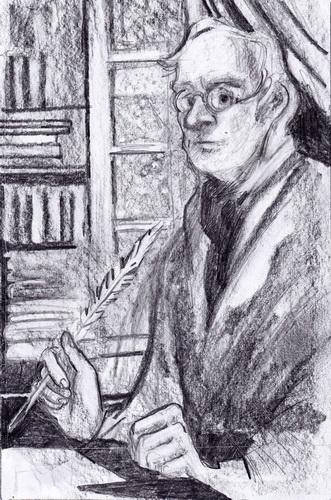
But do you know, gentlemen, what was the chief point about my spite? Why, the whole point, the real sting of it lay in the fact that continually, even in the moment of the acutest spleen, I was inwardly conscious with shame that I was not only not a spiteful but not even an embittered man, that I was simply scaring sparrows at random and amusing myself by it. I might foam at the mouth, but bring me a doll to play with, give me a cup of tea with sugar in it, and maybe I should be appeased. I might even be genuinely touched, though probably I should grind my teeth at myself afterwards and lie awake at night with shame for months after. That was my way.
I was lying when I said just now that I was a spiteful official. I was lying from spite. I was simply amusing myself with the petitioners and with the officer, and in reality I never could become spiteful. I was conscious every moment in myself of many, very many elements absolutely opposite to that. I felt them positively swarming in me, these opposite elements. I knew that they had been swarming in me all my life and craving some outlet from me, but I would not let them, would not let them, purposely would not let them come out. They tormented me till I was ashamed: they drove me to convulsions and-sickened me, at last, how they sickened me! Now, are not you fancying, gentlemen, that I am expressing remorse for something now, that I am asking your forgiveness for something? I am sure you are fancying that… However, I assure you I do not care if you are…
It was not only that I could not become spiteful, I did not know how to become anything; neither spiteful nor kind, neither a rascal nor an honest man, neither a hero nor an insect. Now, I am living out my life in my corner, taunting myself with the spiteful and useless consolation that an intelligent man cannot become anything seriously, and it is only the fool who becomes anything. Yes, a man in the nineteenth century must and morally ought to be pre-eminently a characterless creature; a man of character, an active man is pre-eminently a limited creature. That is my conviction of forty years. I am forty years old now, and you know forty years is a whole lifetime; you know it is extreme old age. To live longer than forty years is bad manners, is vulgar, immoral. Who does live beyond forty? Answer that, sincerely and honestly I will tell you who do: fools and worthless fellows. I tell all old men that to their face, all these venerable old men, all these silver-haired and reverend seniors! I tell the whole world that to its face! I have a right to say so, for I shall go on living to sixty myself. To seventy! To eighty!… Stay, let me take breath…
You imagine no doubt, gentlemen, that I want to amuse you. You are mistaken in that, too. I am by no means such a mirthful person as you imagine, or as you may imagine; however, irritated by all this babble (and I feel that you are irritated) you think fit to ask me who I am-then my answer is, I am a collegiate assessor. I was in the service that I might have something to eat (and solely for that reason), and when last year a distant relation left me six thousand roubles in his will I immediately retired from the service and settled down in my corner. I used to live in this corner before, but now I have settled down in it. My room is a wretched, horrid one in the outskirts of the town. My servant is an old country-woman, ill-natured from stupidity, and, moreover, there is always a nasty smell about her. I am told that the Petersburg climate is bad for me, and that with my small means it is very expensive to live in Petersburg. I know all that better than all these sage and experienced counsellors and monitors… But I am remaining in Petersburg; I am not going away from Petersburg! I am not going away because… ech! Why, it is absolutely no matter whether I am going away or not going away.
But what can a decent man speak of with most pleasure?
Answer: Of himself.
Well, so I will talk about myself.
II
I want now to tell you, gentlemen, whether you care to hear it or not, why I could not even become an insect. I tell you solemnly, that I have many times tried to become an insect. But I was not equal even to that. I swear, gentlemen, that to be too conscious is an illness-a real thorough-going illness. For man's everyday needs, it would have been quite enough to have the ordinary human consciousness, that is, half or a quarter of the amount which falls to the lot of a cultivated man of our unhappy nineteenth century, especially one who has the fatal ill-luck to inhabit Petersburg, the most theoretical and intentional town on the whole terrestrial globe. (There are intentional and unintentional towns.) It would have been quite enough, for instance, to have the consciousness by which all so-called direct persons and men of action live. I bet you think I am writing all this from affectation, to be witty at the expense of men of action; and what is more, that from ill-bred affectation, I am clanking a sword like my officer. But, gentlemen, whoever can pride himself on his diseases and even swagger over them?
Though, after all, everyone does do that; people do pride themselves on their diseases, and I do, may be, more than anyone. We will not dispute it; my contention was absurd. But yet I am firmly persuaded that a great deal of consciousness, every sort of consciousness, in fact, is a disease. I stick to that. Let us leave that, too, for a minute. Tell me this: why does it happen that at the very, yes, at the very moments when I am most capable of feeling every refinement of all that is "sublime and beautiful," as they used to say at one time, it would, as though of design, happen to me not only to feel but to do such ugly things, such that… Well, in short, actions that all, perhaps, commit; but which, as though purposely, occurred to me at the very time when I was most conscious that they ought not to be committed. The more conscious I was of goodness and of all that was "sublime and beautiful," the more deeply I sank into my mire and the more ready I was to sink in it altogether. But the chief point was that all this was, as it were, not accidental in me, but as though it were bound to be so. It was as though it were my most normal condition, and not in the least disease or depravity, so that at last all desire in me to struggle against this depravity passed. It ended by my almost believing (perhaps actually believing) that this was perhaps my normal condition. But at first, in the beginning, what agonies I endured in that struggle! I did not believe it was the same with other people, and all my life I hid this fact about myself as a secret. I was ashamed (even now, perhaps, I am ashamed): I got to the point of feeling a sort of secret abnormal, despicable enjoyment in returning home to my corner on some disgusting Petersburg night, acutely conscious that that day I had committed a loathsome action again, that what was done could never be undone, and secretly, inwardly gnawing, gnawing at myself for it, tearing and consuming myself till at last the bitterness turned into a sort of shameful accursed sweetness, and at last-into positive real enjoyment! Yes, into enjoyment, into enjoyment! I insist upon that. I have spoken of this because I keep wanting to know for a fact whether other people feel such enjoyment? I will explain; the enjoyment was just from the too intense consciousness of one's own degradation; it was from feeling oneself that one had reached the last barrier, that it was horrible, but that it could not be otherwise; that there was no escape for you; that you never could become a different man; that even if time and faith were still left you to change into something different you would most likely not wish to change; or if you did wish to, even then you would do nothing; because perhaps in reality there was nothing for you to change into.
And the worst of it was, and the root of it all, that it was all in accord with the normal fundamental laws of over-acute consciousness, and with the inertia that was the direct result of those laws, and that consequently one was not only unable to change but could do absolutely nothing. Thus it would follow, as the result of acute consciousness, that one is not to blame in being a scoundrel; as though that were any consolation to the scoundrel once he has come to realise that he actually is a scoundrel. But enough… Ech, I have talked a lot of nonsense, but what have I explained? How is enjoyment in this to be explained? But I will explain it. I will get to the bottom of it! That is why I have taken up my pen…
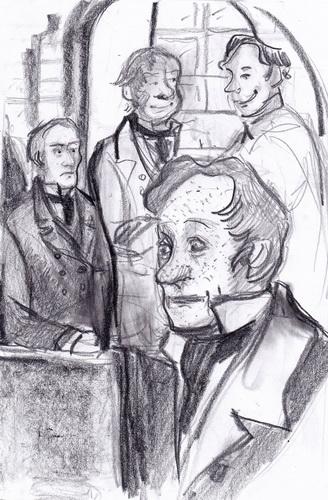
I, for instance, have a great deal of AMOUR PROPRE. I am as suspicious and prone to take offence as a humpback or a dwarf. But upon my word I sometimes have had moments when if I had happened to be slapped in the face I should, perhaps, have been positively glad of it. I say, in earnest, that I should probably have been able to discover even in that a peculiar sort of enjoyment-the enjoyment, of course, of despair; but in despair there are the most intense enjoyments, especially when one is very acutely conscious of the hopelessness of one's position. And when one is slapped in the face-why then the consciousness of being rubbed into a pulp would positively overwhelm one. The worst of it is, look at it which way one will, it still turns out that I was always the most to blame in everything. And what is most humiliating of all, to blame for no fault of my own but, so to say, through the laws of nature. In the first place, to blame because I am cleverer than any of the people surrounding me. (I have always considered myself cleverer than any of the people surrounding me, and sometimes, would you believe it, have been positively ashamed of it. At any rate, I have all my life, as it were, turned my eyes away and never could look people straight in the face.) To blame, finally, because even if I had had magnanimity, I should only have had more suffering from the sense of its uselessness. I should certainly have never been able to do anything from being magnanimous-neither to forgive, for my assailant would perhaps have slapped me from the laws of nature, and one cannot forgive the laws of nature; nor to forget, for even if it were owing to the laws of nature, it is insulting all the same. Finally, even if I had wanted to be anything but magnanimous, had desired on the contrary to revenge myself on my assailant, I could not have revenged myself on any one for anything because I should certainly never have made up my mind to do anything, even if I had been able to. Why should I not have made up my mind? About that in particular I want to say a few words.