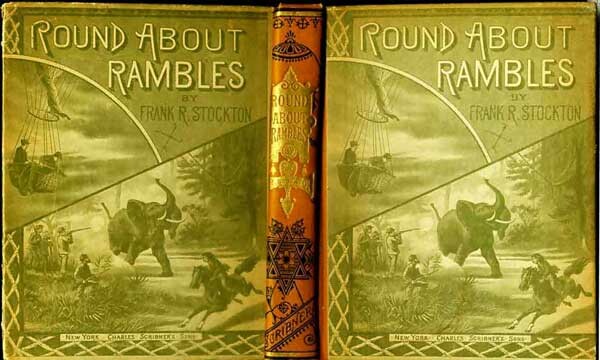



автордың кітабын онлайн тегін оқу Round-about Rambles in Lands of Fact and Fancy
ROUND-ABOUT RAMBLES
In Lands of
FACT AND FANCY
BY
FRANK R STOCKTON
NEW EDITION
NEW YORK
CHARLES SCRIBNER'S SONS
1910
Entered according to Act of Congress, in the year 1872,
BY SCRIBNER. ARMSTRONG & CO.,
In the Office of the Librarian of Congress, at Washington.
CONTENTS
page
Winter in the Woods 7 Tricks of Light 10 Saving the Toll 18 The Real King of Beasts 23 The French Soldier-boy 32 A Lively Way to Ring a Bell 34 Down in the Earth 36 The Lion 44 Bob's Hiding-place 49 The Continental Soldier 59 A Judge of Music 61 The Sensitive Plant 64 Sir Marmaduke 66 The Giraffe 69 Up in the Air 73 The Arabian Horse 87 Indian-puddings: Pumpkin-pies 90 Living in Smoke 94 The Cannon of the Palais-Royal 97 Waters, Deep and Shallow 99 Hans the Herb-gatherer 123 Some Cunning Insects 128 A First Sight of the Sea 134 The Largest Church in the World 137 The Soft Place 140 A Few Feathered Friends 146 In a Well 159 A Vegetable Gas Manufactory 163 About Bears 166 An Old Country-house 172 Far-away Forests 177 Building Ships 183 The Orang-Outang 186 Little Bridget's Bath 189 Some Novel Fishing 193 Eagles and Little Girls 203 Climbing Mountains 204 Andrew's Plan 207 The Wild Ass 212 Ancient Riding 215 Beautiful Bugs 217 A Battle on Stilts 220 Drawing the Long Bow 223 An Ancient Theatre 226 Bird Chat 229 Mummies 230 Tame Snakes 240 Gymnastics 243 Buying "the Mirror" 250 Big Game 256 The Bootblack's Dog 268 Going after the Cows 271 The Reflective Stag 274 When we must not Believe our Eyes 277 A City under the Ground 283 The Coachman 297 Geysers, and how they Work 300 A Giant Puff-ball 303 Tickled by a Straw 305 The Light in the Castle 307 The Oak Tree 311 The Sea-side 315 The Sick Pike 319 Two Kinds of Blossoms 322 About Glass 326 Carl 342 School's Out 350 Nest-builders 354 The Boomerang 368LIST OF ILLUSTRATIONS
And now, having talked enough, suppose we start.
When I was a boy, I often used to go to a green-house where there were a great many beautiful and rare plants; but I always thought that the sensitive plant was the most wonderful thing in the whole collection, and I did not know then how susceptible it was to the influence of light. I was interested in it simply because it seemed to have a sort of vegetable reason, and understood that it should shut up its leaves whenever I touched it.
There were in ancient times contrivances for riding which are at present entirely unknown, except among half-civilized nations, and which must have been exceedingly pleasant.
But this state of insensibility was passing away, and they were now in a gentle doze, and sleeping, thinking of the company they were to entertain. For these Cormorants had come to this spot to meet their cousin the Pelican to consult with him on some family matters. Upon their first arrival at the place they had set to work to get together a good supply of fish, for this is the only food of both the Cormorant and the Pelican. In a short time they landed a great number, and bestowed them in a safe place, and then they set to work catching fish for themselves and eating them greedily.
There are three kinds of gymnastics. By the first we take exercise, simply for the sake of the good we gain from it; by the second we combine pleasure with our muscular exertion; and the third kind of gymnastics is practised for the sake of making money.
WILD BOAR.
PAGE
Frontispiece. The Woodcutter 7 The Minstrel on the Wall 10 Tricks in a Church 10 The Dance of Demons 13 Nostradamus 14 The Lion's Head 15 The Theatrical Ghost 16 The Toll-bridge 18 A Royal Procession 22 An Elephant after Him 25 The Dog's Protector 27 An Elephant Nurse 29 Saving the Artillery-man 30 The Gallant Elephant 31 The French Soldier-Boy 32 On a Bell 34 Fishes found in the Mammoth Cave 36 The Bottomless Pit 41 The Lion's Home 43 The Uncaged Lion 44 A Lion's Dinner 46 A Terrible Companion 47 Off to the Kitchen 49 Blind Man's Buff 50 The Story-Teller 52 In the Cellar 54 Handing round the Apples 56 The Drummer of 1776 60 The Continental Soldier 60 The Donkey in the Parlor 61 Sir Marmaduke 66 The Giraffe 70 Above the Clouds 72 The Flying Man 74 The Parachute—shut 75 The Parachute—open 76 Le Flesseles 78 Bagnolet's Balloon 80 Coming down Roughly 80 A Balloon with Sails and Rudders 81 The Minerva 82 Safe Ballooning 84 Driven out to Sea 86 The Arabian Horse 88 In the Cornfield 90 A Big Mosquito 94 Exactly Noon 97 The Spring 99 The Brook 101 The Mill 102 The Cascade 104 The Great River 105 Falls of Gavarni 106 The Falls of Zambesi 108 Niagara 109 Fishing with a Net 110 Fishing with a Spear 111 Sponge-Fishing 113 A Pearl Oyster 114 Divers 115 Rough Water 117 The Iceberg 118 The Storm 119 The Shipwreck 120 Water-Spouts 121 A Bit of Cable 122 Hans, the Herb-Gatherer 123 Patsey 126 A Spider at Home 128 The Ant's Arch 129 The Cock-chafer's Wing 129 The Spider's Bridge 130 The Moth and the Bees 131 Learned Fleas 132 The Pacific 135 St. Peter's at Rome 137 Interior of St. Peter's 138 The Five Young Deer 141 Waking Up 142 Familiar Friends 147 The Pigeon 148 The Dove 149 The Swan 150 The Goose that Led 151 The Goose that Followed 152 The Sensible Duck 154 The Goldfinch 155 The Magpie 156 The Owl 157 Morning Singers 158 In a Well 159 The Fraxinella 163 A Company of Bears 165 The Black Bear 166 The Grizzly Bear 168 The White Bear 170 The Tame Bear 171 An old Country-House 172 Ancient Builders 174 The Pine Forest 176 Tree Ferns 177 Tropical Forest 179 The Giant Trees 181 The Great Eastern 182 The Orang-Outang 186 Bridget and the Fairies 189 Flat-Fish 193 Turbots 194 The Sea-Horse 195 The Cuttle-Fish 196 The Polypier 197 Tunnies 198 The Sword-Fish 200 The Shark 201 The Child and the Eagle 202 Climbing the Mountain 204 Andrew and Jenny 207 Wild Asses 211 The Palanquin 214 The Chariot 216 Transformation of Beetles 218 A Battle on Stilts 220 Drawing the Long Bow 223 The Colosseum 226 The Cormorants 228 The Bittern 229 The Pelican 231 The Hoopoe 232 The Falcon 234 The Mummy 236 The Stand 237 The Coffin 237 The Outside Coffin 238 The Sarcophagus 239 The Tame Snake 240 The Novel Team 241 Youngsters Fighting 242 Throwing the Hammer 243 Throwing the Stone 244 Thomas Topham 245 Venetian Acrobats 247 The Tight-Rope 249 The See-Saw 250 The Wild Boar 256 The Musk-Ox and the Sailor 258 Hunting the Brown Bear 259 A Brave Hippopotamus 261 A Rhinocerus Turning the Table 262 A Tiger-Hunt 264 A Fight with a Gorilla 265 The Boot-black's Dog 268 Going after the Cows 271 The Reflective Stag 275 The Mirage 277 Fata Morgana 280 The Spectre of the Brocken 281 A Narrow Street in Pompeii 283 A Cleared Street in Pompeii 285 The Atrium in the House of Pansa 287 Ornaments from Pompeii 290 A Pompeiian Bakery 292 The Amphitheatre of Pompeii 294 The Coachman 297 The Grand Geyser 300 The Artificial Geyser 302 A Giant Puff-ball 303 Tickled by a Straw 305 The Will-o'-the-Wisp 309 The Oak Tree 311 The Sea-Side 315 The Vessels on Shore 317 The Sick Pike 320 The Blossoms 322 Ice-Blossoms 324 Ice-Flowers 325 Ancient Bead 326 Venetian Bottle 327 German Drinking-Glass 329 Glass Jug 330 Making Bottles 332 Venetian Goblet 333 Modern Goblets 334 The Queen's Mirror 335 Bohemian Goblet 336 French Flagon 339 The Portland Vase 340 The Strange Lady 344 Carl and the Duke 348 The Dominie 351 Wrens' Nests 354 Orioles' Nest 355 Owl's Nests 357 Flamingoes' Nests 359 The little Grebe's Nest 361 The Ostrich-Nest 362 The Stork's Nest 364 A Fish's Nest 366 Throwing the Boomerang 368 The Way the Boomerang Goes 369And now, having talked enough, suppose we start.
This delusion is very simple indeed, and is produced by placing a card-figure on a screen, and throwing shadows from this upon another screen, by means of several lights, held by assistants. Thus each light throws its own shadow, and if the candles are moved up and down, and about, the shadows will dance, jump over each other, and do all sorts of wonderful things. Robertson, and other public exhibitors, had quite complicated arrangements of this kind, but they all acted on the same principle. But all of those who exhibit to the public the freaks of light are not as honest as Mr. Robertson. You may have heard of Nostradamus, who also lived in Paris, but long before Robertson, and who pretended to be a magician. Among other things, he asserted that he could show people pictures of their future husbands or wives. Marie de Medicis, a celebrated princess of the time, came to him on this sensible errand, and he, being very anxious to please her, showed her, in a looking-glass, the reflected image of Henry of Navarre, sitting upon the throne of France. This, of course, astonished the princess very much, but it need not astonish us, if we carefully examine the picture of that conjuring scene.
The mirror into which the lady was to look, was in a room adjoining that in which Henry was sitting on the throne. It was placed at such an angle that her face would not be reflected in it, but an aperture in the wall allowed the figure of Henry to be reflected from a looking-glass, hung near the ceiling, down upon the "magic" mirror. So, of course, she saw his picture there, and believed entirely in the old humbug, Nostradamus.
But there are much simpler methods by which the vagaries of light may be made amusing, and among the best of these are what are called "Chinese shadows." These require a little ingenuity, but they are certainly simple enough. They consist of nothing but a card or paper, upon which the lights of the picture intended to be represented are cut out. When this is held between a candle and a wall, a startling shadow-image may be produced, which one would not imagine to have any connection with the card, unless he had studied the manner in which said card was cut. Here is a picture of a company amusing themselves with these cards. No one would suppose that the card which the young man is holding in his hand bore the least resemblance to a lion's head, but there is no mistaking the shadow on the wall.
The most wonderful public exhibitions of optical illusions have been those in which a real ghost or spectre apparently moves across the stage of a theatre. This has frequently been done in late years, both in this country and Europe. The audiences were perfectly amazed to see a spirit suddenly appear, walk about the stage, and act like a regular ghost, who did not seem to be in the least disturbed when an actor fired a pistol at him, or ran him through with a sword. The method of producing this illusion is well shown in the accompanying picture. A large plate of glass is placed in front of the stage so that the audience does not perceive it. The edges of it must be concealed by curtains, which are not shown in the picture. An actor, dressed as a ghost, walks in front of the stage below its level, where he is not seen by the audience, and a strong electric light being thrown upon him, his reflected image appears to the spectator as if it were walking about on the stage. When the light is put out of course the spirit instantly vanishes.
This boy was one of the attendants of the Duke of Edinburgh, one of Queen Victoria's sons, who was hunting Elephants in Africa. The Elephants which the party were after on that particular day had got out of the sight of the hunters, and this boy, being mounted on a horse, went to look them up. It was not long before he found them, and he also found much more than he had bargained for. He found that one of the big fellows was very much inclined to hunt him and he came riding out of the forest as hard as he could go, with a great Elephant full tilt after him. Fortunately for the boy, the Duke was ready with his gun, and when the Elephant came dashing up he put two balls into his head. The great beast dropped mortally wounded, and the boy was saved. I don't believe that he was so curious about the whereabouts of Elephants after that.
For instance, an Elephant which was on exhibition in this country had a fast and true friend, a little dog. One day, when these animals were temporarily residing in a barn, while on their march from one town to another, the Elephant heard some men teasing the dog, just outside of the barn. The rough fellows made the poor little dog howl and yelp, as they persecuted him by all sorts of mean tricks and ill usage. When the Elephant heard the cries of his friend he became very much worried, and when at last he comprehended that the dog was being badly treated, he lifted up his trunk and just smashed a great hole in the side of the barn, making the stones and boards fly before him.
But few stories are quite as wonderful as that one. We have no difficulty at all in believing the account of the Elephant who took care of a little child. He did not wear a cap and apron, as the artist has shown in the picture, but he certainly was a very kind and attentive nurse. When the child fell down, the Elephant would put his trunk gently around it, and pick it up. When it got tangled among thorns or vines, the great nurse would disengage it as carefully as any one could have done it; and when it wandered too far, the Elephant would bring it back and make it play within proper limits. I do not know what would have been the consequence if this child had behaved badly, and the Elephant had thought fit to give it a box on the ear. But nothing of the kind ever happened, and the child was a great deal safer than it would have been with many ordinary nurses.
One of the most humane and thoughtful Elephants of whom I have ever heard was one which was attached, like our friend Kudabar, to an artillery train in India. He was walking, on a march, behind a wagon, when he perceived a soldier slip down in the road and fall exactly where, in another instant, the hind-wheel of the wagon would pass over him. Without being ordered, the Elephant seized the wheel with his trunk, lifted it—wagon and all—in the air, and held it up until it had passed over the fallen soldier!
A very pretty story is told of an Indian Elephant who was very gallant. His master, a young Burman lord, had recently been married, and, shortly after the wedding, he and his bride, with many of their guests and followers, were gathered together in the veranda, on the outside of his house. The Elephant, who was a great favorite with the young lord, happened to be conducted past the house as the company were thus enjoying themselves. Feeling, no doubt, that it was right to be as polite as possible on this occasion, he put his trunk over a bamboo-fence which enclosed a garden, and selecting the biggest and brightest flower he could see, he approached the veranda, and rearing himself upon his hind-legs, he stretched out his trunk, with the flower held delicately in the little finger at its end, towards the company. One of the women reached out her hand for it, but the Elephant would not give it to her. Then his master wished to take it, but the Elephant would not let him have it. But when the newly-made bride came forward the Elephant presented it to her with all the grace of which he was capable!
At first all will be dark, and then a few stars will twinkle out, and then there will be more of them, and each one will be brighter, and at last you will think you are looking up into a dark sky full of glorious shining stars! And if you look at the walls you will see thousands of stars that seem as if they were dropping from the sky; and if you cast your eyes upon the ground, you will see it covered with other thousands of stars that seem to have already fallen!
And when he has carried his prey to the spot where he chooses to have his dinner, he shows that no beast can surpass him in the meat-eating line. When he has satisfied his hunger on an ox, there is not much left for those who come to the second table. And there are often other Lions, younger and weaker than the one who has provided the dinner, who must wait until their master or father is done before they have a chance to take a bite. But, as you may see by this picture, they do not wait very patiently. They roar and growl and grumble until their turn comes.
Another of their peculiarities is their fear of traps and snares. Very often they will not spring upon an ox or a horse, simply because it is tied to a tree. They think there is some trick when they see the animal is fastened by a rope.
Bob was not a very big boy, but he was a lively little fellow and full of fun. You can see him there in the picture, riding on his brother Jim's back. One evening there happened to be a great many boys and girls at Bob's father's house. The grown-up folks were having a family party, and as they were going to stay all night—you see this was in the country—some of them brought their children with them.
There was a little light on the steps, for Bob did not shut the door quite tightly after him, and if there had been none at all, he would have been quite as well pleased. He was not afraid of the dark, and all that now filled his mind was the thought of getting somewhere where no one could possibly find him. So he groped his way under the steps, and there he squatted down in the darkness, behind two barrels which stood in a corner.
So, of course, Alice and Tom Green did not try to find him, but Bob, who could not see them, thought it was certainly some of the children come down to look for him.
"I wonder," said the little fellow to himself, "if I could find that red-apple barrel in the dark. But then I couldn't tell the red ones from the streakedy ones. But either of 'em would do. I guess I won't try, though, for I might put my hand on a rat. They run about when it's dark. I hope they won't come in this corner. But there's nothin' for 'em to eat in this corner but me, and they ain't lions. I wonder if they'll come down after more cider when that's all drunk up. If they do, I guess I'll come out and let Aunt Alice tell them all where I am. I don't like playin' this game when it's too long."
Those old gentlemen did not look like anything of that sort. Their old arms could hardly manage their old canes; their old legs could just about carry them on a march around the garden, and they were very particular indeed about heat and cold.
The ordinary giraffe measures about fifteen feet from the top of his head to the ground, but some of them have been known to be over sixteen feet high. Most of this height is owing to their long necks, but their fore-legs are also very long. The hind-legs seem much shorter, although, in reality, they are as long as the fore-legs. The legs and neck of the Giraffe are made long so that he can eat the leaves from the tops of young trees. This tender foliage is his favorite diet; but he will eat the foliage from any part of a tree, and he is content with the herbage on the ground, when there is nothing else.
This gentleman had an idea that he could fly by the aid of this ingenious machinery. You will see that his wings are arranged so that they are moved by his legs, and also by cords attached to his arms. The umbrella over his head is not intended to ward off the rain or the sun, but is to act as a sort of parachute, to keep him from falling while he is making his strokes. The basket, which hangs down low enough to be out of the way of his feet, is filled with provisions, which he expects to need in the course of his journey.
Sand is used because it can be emptied out and will not injure anybody in its descent. It would be rather dangerous, if ballooning were a common thing, for the aëronauts to throw out stones and old iron, such as are used for the ballast of a ship. If you ever feel a shower of sand coming down upon you through the air, look up, and you will probably see a balloon—that is, if you do not get some of the sand in your eyes.
It resembles, you see, a closed umbrella without a handle, and it has cords at the bottom, to which a car is attached. If we wish to come down by means of this contrivance, we must descend from the car of the balloon to that of the parachute, and then we must unfasten the rope which attaches us to the balloon. We shall then drop like a shot; but as soon as the air gets under our parachute it will spread open, and our descent will immediately begin to be much more gradual, and if nothing unusual occurs to us, we shall come gently to the ground. This picture shows the manner in which we would come down in a parachute.
But we shall penetrate space no longer in an upward direction. It is time we were going back to the world. We are all very cold, and the eyes and ears of some of us are becoming painful. More than that, our balloon is getting too large. The gas within it is expanding, on account of the rarity of the air.
There were other balloons devised by the early aëronauts, which were still stranger than that one which arose from Dijon. The Minerva, the picture of which you can examine at your leisure, was invented by a Mr. Robertson, in the beginning of this century. He wished to make a grand aerial voyage of several months, with a company of about sixty persons, and therefore he had to have a very large balloon. To procure this he desired the co-operation of the scientific men throughout Europe, and sent plans and descriptions of his projected balloon to all the learned societies.
Everything was to be provided for the safety and convenience of the passengers. Around the upper part of the balloon you will see a platform, with sentries and tents. These soldiers were to be called the "air-marines." There is a small balloon—about the common size—which could be sent off like a small boat whenever occasion required. If any one got tired of the expedition, and wanted to go home, there was a parachute by which he might descend. On the deck of the ship, near the stern, was to be a little church; small houses hung from below, reached by ladders of silk, which were to be used as medicine-rooms, gymnasiums, etc.; and under the ship would hang a great hogshead, as big as a house, which would contain provisions and stores, and keep them tight and dry. There was also a kitchen; and a cannon, with which to fire off salutes, besides a number of guns, which you see projecting from the port-holes of the ship. These, I suppose, were to be used against all enemies or pirates of the air, sea, or land.
If this is ever the case, I hope we may all be living to see it.
When the horse is finally bought and paid for, it had better be taken away as soon as possible, for the Arabs—even those who have no interest whatever in the sale—cannot endure to see a horse which once belonged to their tribe passing into the hands of strangers. And therefore, in order to soothe their wounded sensibilities, they often steal the animal, if they can get a chance, before the buyer carries him out of their reach.
After we have walked a mile or so more, we find that our noisy friend has quieted down very much indeed. It is a little wider, and it may be it is a little deeper, but it flows along very placidly between its low banks. It is doubtful if we should find any trout in it now, but there may be cat-fish and perch, and some sun-fish and eels.
What a delightful thing it would be, on a warm summer evening, to bathe in that deliciously cool water. It is deep enough for a good swim, and, if any of us want a shower-bath, it would be a splendid thing to sit on the rocks and let the spray from the fall dash over us! And there are fish here, I am sure. It is possible that, if we were to sit quietly on the bank and fish, we might soon get a string of very nice perch, and there is no knowing what else. This stream is now just about big enough and little enough to make the character of its fish doubtful. I have known pike—fellows two feet long—caught in such streams as this; and then again, in other small rivers, very much like it, you can catch nothing but cat-fish, roach, and eels.
There is no doubt, however, about the king of cataracts. That is Niagara. If you have seen it you can understand its grandeur, but you can never appreciate it from a written description. A picture will give you some idea of it, but not a perfect one, by any means.
The Indians called these falls "thundering water," and it was an admirable title. The waters thunder over the great precipice, as they have done for thousands of years before we were born, and will continue to do thousands of years after we are dead.
It seems as if the resistless torrent would some day tear away this lonely promontory, as it rushes upon and around it. It is not unlikely that in the course of ages the island may be carried away.
When we mention the subject, of making a living out of the water, we naturally think first of nets, and hooks and lines. It is true that mills, and steamships, and packet-lines, and manufactories, are far more important; but they require capital as well as water. Men fish all over the world, but on some waters vessels or saw-mills are never seen.
But sometimes it will not do for the fisherman to endeavor to draw up the treasures of the deep while he remains at the surface of the water; very often he must go down after them. In this way a great many of the most valuable fisheries are conducted. For instance, the sponge-fishers are obliged to dive down to the very bottom of the water, and tear off the sponges from the rocks to which they fasten themselves. Some of the most valuable sponge-fisheries are on the coast of Syria, and you may here see how they carry on their operations.
If we are upon a large and strong steamer, we may perhaps feel safe enough among the raging waves; but if our vessel be a fishing-boat, or a small pleasure-craft, we have good reason to be afraid Yet many a little sloop like this rides bravely and safely through the storms. But many other little vessels, as strong and as well steered, go to the bottom of the ocean every year. If the sailor escapes severe storms, or sails in a vessel which is so stout and ably managed as to bid defiance to the angry waves, he has other dangers in his path. He may, for instance, meet with icebergs. If the weather is clear and the wind favorable, he need not fear these floating mountains of ice. But if it be night, or foggy, and he cannot see them, or if, in spite of all his endeavors, the wind drives him down upon them, then is his vessel lost, and, in all probability, the lives of all upon it. Sometimes, however, the passengers and crew may escape in boats, and instances have been related where they have taken refuge on the iceberg itself, remaining there until rescued by a passing ship.
A large ship may bravely dare the dangers of an ordinary storm, but nothing that floats on the surface of the water can be safe when a whirlwind passes over the sea, driving everything straight before it Great ships are tossed about like playthings, and strong masts are snapped off as if they had been made of glass.
I have known boys who thought that it would be perfectly delightful to be shipwrecked. They felt certain that they would be cast (very gently, no doubt) upon a desert island, and there they would find everything that they needed to support life and make them comfortable; and what they did not get there they would obtain from the wreck of the ship, which would be lying on the rocks, at a convenient distance from the shore. And once on that island, they would be their own masters, and would not have to go to school or do anything which did not please them.
Sometimes, even when the crew think that they have safely battled through the storm, and have anchored in a secure place, the waves dash upon the vessel with such force that the anchor drags, the masts go by the board, and the great ship, with the hundreds of pale faces that crowd her deck, is dashed on the great rocks which loom up in the distance.
Waterspouts are other terrible enemies of the sailor. These, however dangerous they may be when they approach a ship, are not very common, and it is said that they may sometimes be entirely dispersed by firing a cannon-ball into the midst of the column of water. This statement is rather doubtful, for many instances have been related where the ball went directly through the water-spout without any effect except to scatter the spray in every direction. I have no doubt that sailors always keep as far away from water-spouts as they can, and place very little reliance on their artillery for their safety.
"I am sorry, Dame Martha," said she, "that I have nothing nice for you to-day, but I thought perhaps you would like to have some flowers, as it's Spring-time and you can't go out."
Of all, these wise insects, there is none with more intelligence and cunning than the ant. How many astonishing accounts have we had of these little creatures, who in some countries build great houses, almost large enough for a man to live in; who have a regular form of government, and classes of society—soldiers, workers, gentlemen and ladies; and who, as some naturalists have declared, even have handsome funerals on the occasion of the death of a queen! It is certain that they build, and work, and pursue their various occupations according to systems that are wisely conceived and most carefully carried out.
Some other ants once found a cockchafer's wing, which they thought would be a capital thing to dry for winter, and they endeavored to get it into the entrance of their hill. But it was too big. So they drew it out and made the hole larger. Then they tried again, but the wing was still too wide. They turned it and made several efforts to get it in sideways, and upside down, but it was impossible; so they lifted it away, and again enlarged the hole. But the wing would not yet go in. Without losing patience, they once more went to work, and, after having labored for three hours and a half, they at last had the pleasure of seeing their dried wing safely pulled into their store-room.
Now, to do this, they must show themselves to be engineers of no small ability. Sometimes they fasten one end of a thread to a twig on one side of the stream, and, hanging on the other end, swing over until they can land on the other side. But this is not always possible, for they cannot, in some places, get a chance for a fair swing. In such a case, they often wait until the wind is blowing across the stream from the side on which they are, and, weaving a long line, they let it out until the wind carries it over the stream, and it catches in the bushes or grass on the other side. Of course, after one thread is over, the spider can easily run backward and forward on it, and carry over all the rest of his lines.
But they soon hit upon a plan to save their honey. They blocked up all the doors of the hive with wax, leaving only a little hole, just big enough for one bee to enter at a time. Then the moths were completely dumbfounded, and gave up the honey business in despair.
But when, in the beginning of the sixteenth century, Vasco Nuñez de Balboa stood upon the shore of the Pacific, and gazed over its boundless waters, the sight to him was both grand and mysterious. He saw that a vast sea lay beneath and before him—but that was all he knew. Europeans had not visited it before, and the Indians, who had acted as his guides, knew but little about it. If he had desired to sail across those vast blue waters, Balboa would have had no idea upon what shores he would land or what wonderful countries and continents he would discover.
Its dimensions are enormous. You cannot understand what a great building it is unless you could see it side by side with some house or church with which you are familiar. Several of the largest churches in this country could be stood up inside of St. Peter's without touching walls or roof, or crowding each other in the least.
He dreamed that he saw on the grass beneath the rock where he was lying five fat young deer. Three of them were sisters, and the other two were cousins. They were discussing the propriety of taking a nap on the grass by the river-bank, and one of them had already stretched herself out. "Now," thought the Jaguar in his dream, "shall I wait until they all go to sleep, and then pounce down softly and kill them all, or shall I spring on that one on the ground and make sure of a good supper at any rate?" While he was thus deliberating in his mind which it would be best for him to do, the oldest cousin cocked up her ears as if she heard something, and just as the Jaguar was going to make a big spring and get one out of the family before they took to their heels, he woke up!
What a dreadful disappointment! Not a deer, or a sign of one, to be seen, and nothing living within a mile. But no! There is something moving! It is—yes, it is a big Alligator, lying down there on the rocks! After looking for a few minutes with disgust at the ugly creature, the Jaguar said to himself, "He must have come on shore while I was asleep. But what matters it! An Alligator! Very different indeed from five fat young deer! Ah me! I wish he had not that great horny skin, and I'd see if I could make a supper off of him. Let me see! There is a soft place, as I've been told, about the alligator! If I could but manage and get a grip of that, I think that I could settle old Mr. Hardskin, in spite of his long teeth. I've a mind and a half to try. Yes, I'll do it!"
And there is no doubt but that these are among the very best feathered friends we have. Those hens are liberal with their eggs, and those little chickens that are running around like two-legged puff-balls, are so willing to grow up and be broiled and roasted and stewed, that it would now be almost impossible for us to do without them. Eggs seem to come into use on so many occasions that, if there was to be an egg-famine, it would make itself felt in every family in the land. Not only would we miss them when boiled, fried, and cooked in omelets for breakfast; not only without them would ham seem lonely, puddings and sponge-cakes go into decline, and pound-cake utterly die, but the arts and manufactures of the whole country would feel the deprivation. Merely in the photographic business hundreds of thousands of eggs are needed every year, from which to procure the albumen used in the preparation of photographic paper.
And to do without "chicken" for dinner would seem almost as impossible for some folks. To be sure, we might live along very comfortably without those delightful broils, and roasts, and fricassees, but it would be a great pity. And, if we live in the country, there is no meat which is so cheap and easily procured all the year round as chicken. I wonder what country-people would do, especially in the summer time, when they have little other fresh meat, without their chickens. Very badly, I imagine.
Pigeons are in one respect even more closely associated with man than the domestic fowls, because they live with him as readily in cities as in the country. City chickens always seem out of place, but city pigeons are as much at home as anybody else. There are few houses so small that there is not room somewhere for a pigeon-box, and there are no roofs or yards so humble that the handsomest and proudest "pouters" and "tumblers" and "fan-tails" will not willingly come and strut and coo about them as long as they receive good treatment and plenty of food.
The doves are such near relations of the pigeons that we might suppose they would resemble them in their character as much as in appearance. But they are not very much alike. Doves are not ambitious; they don't pout, or tumble, or have fan-tails. As to carrying messages, or doing anything to give themselves renown, they never think of it. They are content to be affectionate and happy.
I suppose we all have some friends whom we are always glad to see, even if they are of no particular service to us. And this is right; we should not value people's society in exact proportion to what we think we can get out of them. Now, the swan is a feathered friend, and a good one, but I must say he is of very little practical use to us. But there is something more to be desired than victuals, clothes, feather-beds, and Easter-eggs. We should love the beautiful as well as the useful. Not so much, to be sure, but still very much. The boy or man who despises a rose because it is not a cabbage is much more nearly related to the cows and hogs than he imagines. If we accustom ourselves to look for beauty, and enjoy it, we will find it, after awhile, where we never supposed it existed—in the caterpillar, for instance, and in the snakes. There is beauty as well as practical value in almost everything around us, and we are not the lords of creation that we suppose we are, unless we are able to see it.
When they reached the church, the goose would lead his mistress to her seat and then go outside and eat grass until the services were over. When the people began to come out the goose would go in, and, taking the old woman in charge, would lead her home. At other times also he was the companion of her walks, and her family knew that old blind Grandmother was all right if she had the goose with her when she went out.
We have also friends among the feathered tribes, who are not quite so intimate and sociable as those to which we have already alluded, but which still are very well deserving of our friendship and esteem. For instance, what charming little companions are the canary-birds! To be sure, they would not often stay with us, if we did not confine them in cages; but they seem perfectly at home in their little wire houses, and sing and twitter with as much glee as if they were flying about in the woods of their native land—or rather, of the native land of their forefathers, for most of our canary-birds were born in the midst of civilization and in cages.
There are some birds, however, no bigger than canaries, which seem to have an attachment for their masters and mistresses, and which do not need the restraint of a cage. There was once a gold-finch which belonged to a gentleman who lived in a town in Picardy, France, but who was often obliged to go to Paris, where he also had apartments. Whenever he was obliged to go to the great city, his gold-finch would fly on ahead of him, and, arriving there some time in advance of the carriage, the servants would know that their master was coming, in time to have the rooms ready for him. And when the gentleman drove up to the door he would generally see his little gold-finch sitting on the finger of a cook or a chamber-maid, and twittering away as if he was endeavoring to inform the good people of all the incidents of the journey.
It may not be supposed, by some, that the owl is a friend of mankind, and I am perfectly willing to admit that very often he acts very much like an enemy, especially when he kills our young chickens and turkeys. But for all that, he has his good points, and very often behaves in a commendable manner. If you have a barn or a house that is overrun with mice, there is nothing that will be more certain to drive them out than an owl. And he will not be so apt to steal your milk or kill your canary as many of the cats which you have taken into your family without a recommendation.
We once had an owl living in our house. He belonged to my young brother, who caught him in a trap, I believe. All day long, this solemn little fellow (for he was a small brown one), would sit on the back of a chair, or some such convenient place, and if any of us came near him, he would turn his head and look at us, although he could not see very well in the day-time; and if we walked behind him, or on different sides of him, he would always keep his eyes on us, turning his head around exactly as if it was set on a pivot.
I think that these little warblers and twitterers, who fill the air with their songs and frolic about on the trees and bushes, who build their nests under our eaves and in any little box that we may put up for them, who come regularly back to us every spring, although they may have been hundreds of miles away during the cold weather, and who have chosen, of their own accord, to live around our houses and to sing in our trees and bushes, ought to be called our friends, as much as the fowls in our poultry-yards.
Washington Irving tells of a hunter who accidentally fell into a deep hole, out in the prairies, and he tumbled right on top of a great grizzly bear! How the bear got down there is not stated, and I don't suppose the hunter stopped to inquire. A fight immediately commenced between these two involuntary companions, and after a long struggle, in which the man had an arm and leg broken, and was severely bitten and torn besides, he killed the bear.
There were three of these sailors, however, who were too brave to stay there and see a bear devouring the bodies of their friends, and they returned to the island.
After these stories, I think that we will all agree that when we meet a procession of bears, be they black, white, or grizzly, we will be very wise to give them the right of way, and to endeavor to drive from our minds, as far as possible, such ideas of the animals as we may have derived from those individuals which we have seen in rural menageries, nimbly climbing poles, or sedately drinking soda-water.
It is very likely, indeed, that it was built, under the supervision of an architect, by his own slaves, and that the materials came from his own estates. But he may, of course, have spent large sums on its decoration and furniture, and it is very probable, judging from the outside of his house, that he did so. Some of those old Egyptians were most luxurious fellows.
Here are ferns as large as trees—great masses of flowers that seem as if a whole garden had been emptied down before us—vast wildernesses of green, which we know extend for miles and miles, and which, although apparently so thick and impenetrable, are full of all kinds of life, vegetable and animal. The trees are enormous, but many of them are so covered with vines and creepers that we can scarcely distinguish the massive trunks and luxuriant foliage. Every color is here, rich green, royal purple, red, yellow, lilac, brown, and gray. The vines, which overrun everything, are filled with gorgeous flowers, and hang from the branches in the most graceful forms. Monkeys chatter among the trees, beautiful parrots fly from limb to limb, butterflies of the most gorgeous hues flutter about the grass-tops and the leaves near the ground, and on every log and trunk are myriads of insects, lizards and little living things of endless varieties, all strange and wonderful to us.
But we shall not find it easy to walk through all these beauties. As I said before, we shall often be obliged to cut a path with our hatchets, and even then we may be unable to penetrate very far into this jungle of beauties. The natives of these countries, when they are compelled to pass through these dense forests, often take to the small streams and wade along in the water, which is sometimes up to their shoulders, occasionally finding shallower places, or a little space on the banks where they can pick their way along for a few hundred yards before they are obliged to take to the stream again.
But there are some fish which would not only gratify but astonish most of us, if we could be so fortunate as to pull them out of the water. For instance, here are some fish with both their eyes on one side of their heads.
These are Turbots, and are accounted most excellent eating. They resemble, in their conformation but not in their color, our flounders or flat-fish, which some of you may have caught, and many of you have eaten. These fish lie on one side, at the very bottom of the water in which they live, and consequently one eye would be buried in the mud and would be of no use, if they were formed like common fish. But as their enemies and their food must come from above them, they need both their eyes placed so that they can always look upwards. In the picture at the head of this article, you will see some Soles lying together at the bottom. These are formed in the same way. They are white on one side, which is always down except when they are swimming about, and a very dark green on the other, so that they can scarcely be distinguished from the mud when they are lying at the bottom. The Turbot, however, as you see, is very handsomely spotted.
This is a Hippocampus, or sea-horse. He is a little fellow, only a few inches in length, but he is certainly a curiosity. With a head and neck very much like those of a horse, he seems to take pleasure in keeping himself in such a position as will enable him to imitate a high mettled charger to the greatest advantage. He curves his neck and holds up his head in a manner which few horses adopt, unless they are reined up very tightly. I have seen these little fellows in aquariums, and have always regarded them as the most interesting of fishes.
This fellow you will probably recognize as the Cuttle-fish. Some persons call it the Devil-fish, but the name is misapplied. The Devil-fish is a different kind of a sea monster. But the Cuttle-fish is bad enough to have the very worst name that could be bestowed upon him. Those great arms, which sometimes grow to a length of several feet, he uses to wrap around his prey, and they are strong and tough. He has two eyes and a little mouth, and is about as pugnacious a fish as is to be found anywhere. If I should ever haul a Cuttle-fish into my boat, I think I should feel very much like getting out, no matter how deep the water might be.
But while we are hauling strange things up from the deep, suppose we take something that is not exactly a fish, but which is alive and lives in the water. What do you think of a living thing like this?
Some of the fishers that live in the sea are terrible fellows, and are by no means content with such small game as herring. The Sword-fish, for instance, always appears to prefer large victims, and he has such strong tastes of that kind, that he has been known to attack ships, driving his long sword clean through the bottom of the vessel. But he generally comes off second best on such occasions, for his sword is very often broken off and left sticking fast in the thick hull.
The Shark, as you all know, is the most ferocious and dangerous of all the fishers in the sea. He considers anything suitable for a meal which will go into his mouth; he will eagerly snap at a man, a mouse, or even a tin coffee-pot, or a band-box. So savage and relentless is this "tiger of the sea" as he is sometimes called, that it is gratifying to think that he occasionally goes out fishing and gets caught himself. Many instances have been related of natives of the Pacific Islands, who are accustomed to bathe so much in the ocean that they swim almost like fishes themselves, who have successfully given battle to Sharks which have pursued them. The Shark is unable, from the peculiar formation of his mouth, to seize the man, unless he can turn partially over. Therefore the man takes care to keep below the Shark, and a few stabs with his long knife are generally sufficient to finish the combat, and to slay the monster.
Riding in these chariots was not a very great luxury, especially to those who were not accustomed to that kind of carriage exercise. There were no seats, nor any springs. The riders were obliged to stand up, and take all the bumps that stones and roots chose to give them, and as they generally drove at full speed, these were doubtless many and hard. There was in general no back to these Chariots, and a sudden jerk of the horses would shoot the rider out behind, unless he knew how to avoid such accidents.
But all this should not make us despise the bugs any more than they deserve, particularly as they are just as beautiful as the birds, if we only look at them in the right way. A microscope will reveal beauties in some of the commonest insects, which will positively astonish those who have never before studied bugs as they ought to be studied. The most brilliant colors, the most delicate tracery and lace-work over the wings and bodies; often the most graceful forms and beautifully-contrived limbs and bodies and wing-cases and antennæ, are to be seen in many bugs when they are placed beneath the glasses of the microscope.
Our two Cormorants opened their eyes when they heard a slight splashing in the water. Something was about to invade their retreat. They had not long to wait. Slowly into the stream waded a Bittern. Seeing the Cormorants there he stopped; and, drawing himself up into as small a compass as possible, he sunk his head in his shoulders, and nothing could be seen of his long neck, while his bill was thrust up in the air as if he cared nothing for his neighbors or their affairs. The Cormorants heartily wished he would go away, and they kept their eyes open and watched him, for fear he would spy the fish they had carefully hidden in the wet grass, for the Bittern also lives on fish. So the Cormorants winked and blinked, and thought how different the Bittern looked when on the alert for his prey, or calling his mate.
Neither the Hoopoe nor Pelican had ever before seen him, but the Cormorants knew him very well. He was the Peregrine Falcon. And they knew him because, like them, he chose rocky ledges, high and inaccessible, for his nest. And although his nests were usually on loftier crags than theirs, they were quite neighborly, especially as they did not chase the same prey, the Cormorants drawing theirs from the sea, and the Falcons finding theirs in the air.
When we consider the care and skill with which the dead Egyptians used to be embalmed and encased in their sarcophagi, it is not surprising that their poor bodies have been so well preserved. At the head of this article you see a mummy as it appears when it has been embalmed and wrapped in its bandages. Here is the stand on which it is then placed.
This coffin was very handsomely ornamented, and then, in order to make everything very secure indeed, it was enclosed in another or exterior coffin, which was also decorated in the highest style known to Egyptian artists.
Then, if the inmate had ever done anything wonderful (or sometimes, no doubt, if he had not been famous for anything in particular), the history of his great achievements, real or fancied, was sculptured on the stone. These hieroglyphics have been deciphered in several instances, and we have learned from them a great deal of Egyptian history.
A French writer relates that he knew a lady who had a snake which was so tame that it came when it was called, followed its mistress about, climbed up into her lap, and gave many signs of knowing and liking her. It would even swim after her when she threw it into the water from a boat. But this last feat proved fatal to it, for once swimming thus and endeavoring to keep up with the boat, the tide became too strong for it, and it was carried away and drowned.
There are three kinds of gymnastics. By the first we take exercise, simply for the sake of the good we gain from it; by the second we combine pleasure with our muscular exertion; and the third kind of gymnastics is practised for the sake of making money.
Out-door sports differ very much in different countries. In the United States the great game is, at present, base-ball; in England cricket is preferred, and Scotland has athletic amusements peculiar to itself In the latter country a very popular game among the strong folks is called "throwing the hammer."
Another game, very much of this order, consists in tossing a heavy stone, instead of a hammer. The Scotch call this game "putting the stone," sometimes using stones that might be called young rocks, and they "put" or throw them in a different way from the people of other countries where the game is popular. In some of the mountainous regions of the continent of Europe the game is played in the manner shown in the accompanying engraving.
He had a platform built for this performance, which was constructed in such a way that he could use the whole power of his body and limbs. In this feat, however, he has been surpassed by Dr. Winship, of Boston, who has lifted, in public, heavier weights than Topham ever attempted.
One of the most popular, and at the same time dangerous, of all public gymnastic exhibitions, is that of rope-walking, and most marvellous feats on the tight-rope have been performed in many parts of the world. Even in Greece and Rome, men practised this form of gymnastics. In later days no one has become more famous than Blondin, who crossed the Niagara River on a tight-rope, performing all sorts of eccentric feats while balanced on his slender support. He carried a man over on his shoulders; he wheeled a wheelbarrow across; he walked the rope blindfolded, and did many other things which would be very difficult to most people, even if they were standing on solid ground instead of being poised on a slender rope stretched high above the waters of a rapid river. In this country, however, the taste for out-door and dangerous rope-walking is not so general as it is in some countries of Europe, where it is quite common to see acrobats walking on ropes stretched from the top of one high building, or steeple, to another. In Venice, for instance, rope-dancers have often skipped and played on ropes reaching from the summits of two of the loftiest towers of that beautiful city.
WILD BOAR.
In the fall and winter the flesh of the musk-ox is very good indeed, but in the spring it is not so nice. It then smells like your sister's glove-box (if she uses musk), only about one hundred times as strong. If we were to cut up one of these animals when his flesh is in this condition, we would find it almost impossible to get the smell off of our knives. The winter is certainly the time to shoot this game, for then not only is his flesh very good, but his skin is covered with very long and warm hair, and we would find it even better, to keep us warm, than a buffalo robe.
So now for a brown bear. He, too, is found in the regions of ice and snow, and in the North of Europe he is hunted by the peasants in a way which we will not imitate. When they find a den or cave in the rocks in which they think a bear is concealed, these sturdy hunters make all sorts of noises to worry him out, and when at last the bear comes forth to see what is the matter, he finds a man standing in front of his den, armed with a short lance with a long sharp head, and a bar of iron placed crosswise on the handle just below the head. Now, a full-grown brown bear is not afraid of a man who is armed with a little weapon like this, and so he approaches the hunter, and rearing on his hind legs, reaches forth his arms to give the man a good hug, if he comes any nearer.
The hippopotamus is naturally a timid animal, and seldom turns on its hunters, but sometimes it shows a courageous disposition. Some hunters, having shot a young but apparently a tolerably well-grown hippopotamus, were running up to their prize, when they were astounded by the old mother beast coming up out of the water and charging towards them with tremendous roars.
If, during our night-watches on the river-banks, we are so fortunate as to shoot a hippopotamus, we shall find that we have a good supply of very fine meat And what we cannot eat the natives will be delighted to get. They consider a hippopotamus a most valuable prize, and as the meat is good and there is so very much of it, their joy when they kill one is not at all surprising. The only thing that troubles them after a successful hunt is that there are so few hippopotami killed, and so many negroes to eat them.
There is no animal more graceful in its movements, handsomer in shape and color, or more bloody and ferocious in its nature, than the Royal Bengal tiger. Even in a cage he is a magnificent creature. When I go to a menagerie, I always look first for the Bengal tigers.
When we are well in the jungle, we must be careful. It is sometimes very difficult to see a tiger, even if you are quite near to him, for the stripes on his skin are very much like the reeds and leaves of the jungle, and we must keep a very sharp look-out, and as soon as we see one we must be ready with our rifles, for a tiger is very apt to begin the fight, and he will think nothing of springing on the back of an elephant and dragging one of us to the ground. Sometimes the elephants are not used to hunting tigers, and when they see the savage beasts they turn and run. In that case there is often great danger, for no one can fire coolly and with certain aim from the back of a bounding elephant.
Therefore it is that, when he is hunted, he avoids running through thick bushes, where his scent would remain on the foliage; and, if possible, he dashes into the water, and runs along the beds of shallow streams, where the hounds often lose all trace of him. When this is impossible, he bounds over the ground, making as wide gaps as he can between his tracks. Sometimes, too, he runs into a herd of cattle, and so confuses the dogs; and he has been known to jump up on the back of an ox, and take a ride on the frightened creature, in order to get his own feet partly off of the ground for a time, and thus to break the line of his scent. When very hard pressed, a stag has suddenly dropped on the ground, and when most of the dogs, unable to stop themselves, dash over him, he springs to his feet, and darts off in an opposite direction.
People used to believe in a fairy called Fata Morgana. Wonderful things were said of her, and her dominions were in the air, where she had large cities which she sometimes amused herself by turning into a variety of shapes. The cities were often seen by dwellers on the Mediterranean sea-coast. Sometimes one of them would be like an earthly city, with houses and churches, and nearly always with a background of mountains. In a moment it would change into a confused mass of long colonnades, lofty towers, and battlements waving with flags, and then the mountains reeling and falling, a long row of windows would appear glowing with rainbow colors, and perhaps, in another instant, all this would be swept away, and nothing be seen but gloomy cypress trees.
These things can be seen now occasionally, as of old, but they are no longer in Fairyland. Now we know that they are the images of cities and mountains on the coast, and the reason they assume these fantastic forms is that the layers of air through which the rays of light pass are curved and irregular.
The excavations are conducted in this manner. Among the trees, and in the cultivated fields there can be traced little hillocks, which are pretty regular in form and size. These indicate the blocks of houses in the buried city, and, of course, the streets run between them. After the land is bought from the owners, these streets are carefully marked out, the vines are cleared away, the trees cut down, and the digging out of these streets is commenced from the top. The work is carried on pretty steadily at present, but it is only within the last few years that it has been conducted with any degree of enterprise and skill.
Vesuvius, the volcano so near them, but which had been silent so many years that they had ceased to dread it, suddenly woke into activity, and threw out of its summit a torrent of burning lava and ashes, and in a few short hours buried the two cities of Herculaneum and Pompeii so completely that two centuries after no one could tell the precise place where they had stood, and men built houses and cultivated farms over the spot, never dreaming that cities lay beneath them.
A bronze statuette of a Dancing Faun, with head and arms uplifted; every muscle seems to be in motion, and the whole body dancing. Another of a boy with head bent forward, and the whole body in the attitude of listening. Then there is a fine group of statuary representing the mighty Hercules holding a stag bent over his knee; another of the beautiful Apollo with his lyre in his hand leaning against a pillar. There are figures of huntsmen in full chase, and of fishermen sitting patiently and quietly "waiting for a bite." A very celebrated curiosity is the large urn or vase of blue glass, with figures carved on it in half relief, in white. (For the ancients knew how to carve glass.) These white figures look as if made of the finest ivory instead of being carved in glass. They represent masks enveloped in festoons of vine tendrils, loaded with clusters of grapes, mingled with other foliage, on which birds are swinging, children plucking grapes or treading them under foot, or blowing on flutes, or tumbling over each other in frolicsome glee. This superb urn, which is like nothing we have nowadays, is supposed to have been intended to hold the ashes of the dead. For it was a custom of ancient days to burn the bodies of the dead, and place the urns containing their ashes in magnificent tombs.
Lovely and graceful as were these pictures, the floors of the houses are much more wonderful. They are marvels of art. Not only are flowers and running vines and complicated designs there laid in mosaics, but pictures that startle with their life-like beauty. There are many of these, but perhaps the finest of all is the one found in the same house with the Dancing Faun. It represents a battle. A squadron of victorious Greeks is rushing upon part of a Persian army. The latter are turning to flee. Those around the vanquished Persian king think only of their safety, but the king, with his hand extended towards his dying general, turns his back upon his flying forces, and invites death. Every figure in it seems to be in motion. You seem to hear the noise of battle, and to see the rage, fear, triumph, and pity expressed by the different faces. Think of such wonderful effects being produced by putting together pieces of glass and marble, colored enamel, and various stones! But, leaving all these beauties, and descending to homely everyday life, we will go into a bakery. Here is one in a good state of preservation.
The seats arose from this arena, tier above tier. There were three divisions of them, separating the rich from the middle class, and these again from the slaves. It was well arranged for the comfort of the audience, having wide aisles and plenty of places of exit. The whole was covered with an awning. In the wall around the arena are the holes where thick iron bars were inserted as a precaution against the bounds of the panthers. To the right of the principal entrance are two square rooms with gratings where the wild beasts were kept. This amphitheatre would hold twenty thousand persons!
Water having gradually accumulated in vast underground crevices and cavities, is heated by the fires, which, in volcanic regions, are not very far from the surface of the earth. If there is a channel or tube from the reservoir to the surface, the water will expand and rise until it fills the basin which is generally found at the mouth of hot springs. But the water beneath, being still further heated, will be changed into steam, which will at times burst out with great force, carrying with it a column of water high into the air. When this water falls back into the basin it is much cooler, on account of its contact with the air, and it cools the water in the basin, and also condenses the steam in the tube or channel leading from the reservoir. The spring is then quiet until enough steam is again formed to cause another eruption. A celebrated German chemist named Bunsen constructed an apparatus for the purpose of showing the operations of Geysers. Here it is.
"Why, it's only a Jack-o'-lantern!" said Hubert. "Let's go home, Hulda."
The doctor now stooped to examine it, and to his surprise the fish remained perfectly quiet in his hands. He found that the skull was fractured and one eye was injured by the violence with which the fish had struck the post. With a silver tooth-pick (he had not his instruments with him) the doctor arranged the broken portion of the pike's skull, and when the operation was completed he placed the fish in the water. For a minute or two the Pike seemed satisfied, but then it jumped out of the water on to the bank again. The doctor put the fish back, but it jumped out again, and repeated this performance several times. It seemed to know (and how, I am sure I have not the least idea) that that man was a doctor, and it did not intend to leave him until it had been properly treated—just as if it was one of his best patients.
The birds that are flying among the branches do not think much about the apples that are to come, I reckon, and neither do the early butterflies that flutter about, looking very much like falling blossoms themselves. And, for that matter, we ourselves need not think too much about the coming apple crop. We ought sometimes to think of and enjoy beauty for its own sake, without reference to what it may do in the future for our pockets and our stomachs.
These curious formations, some of which appear like stars, others like very simple blossoms, while others are very complex; and some of which take the form of fern-leaves, are caused to appear in the centre of a block of ice by means of concentrated rays of lights which are directed through the ice by means of mirrors and lenses. Sometimes they are observed by means of a magnifying-glass, and in other experiments their images are thrown upon a white screen.
Here you see the bead, and the funny little pictures on it. The pictures mean this: "The good Queen Ramaka, the loved of Athor, protectress of Thebes." This Queen Ramaka was the wife of a king who reigned in Thebes more than three thousand years ago, which is certainly a very long time for a little glass bead to remain unbroken! The great city of Thebes, where it was made, has been in ruins for hundreds of years. No doubt this bead was part of a necklace that Queen Ramaka wore, and esteemed as highly as ladies now value their rubies. It was found in the ruins of Thebes by an Englishman.
In almost any part of the world to which you may chance to go you will find Silica. You may not know it by that name, but it is that shining, flinty substance you see in sand and rock-crystal. It is found in a very great number of things besides these two, but these are the most common.
The old Egyptians made glass bottles, and so did the early Romans, and used them just as we do for a very great variety of things. Their wine-bottles were of glass, sealed and labelled like ours. We might suppose that, having once had them, people would never be without glass bottles. But history tells a different story. There evidently came a time when glass bottles vanished from the face of the earth; for we read of wooden bottles and those of goat-skin and leather, but there is no mention of glass. And men were satisfied with these clumsy contrivances, because in process of time it had been forgotten that any other were ever made.
This is how glass bottles, vases, etc., are made. When the substances mentioned above are melted together properly, a man dips a long, hollow iron tube into a pot filled with the boiling liquid glass, and takes up a little on the end of it. This he passes quickly to another man, who dips it once more, and, having twirled the tube around so as to lengthen the glass ball at the end, gives it to a third man, who places this glass ball in an earthen mould, and blows into the other end of the tube, and soon the shapeless mass of glass becomes a bottle. But it is not quite finished, for the bottom has to be completed, and the neck to have the glass band put around it. The bottom is finished by pressing it with a cone-shaped instrument as soon as it comes out of the mould. A thick glass thread is wound around the neck. And, if a name is to be put on, fresh glass is added to the side, and stamped with a seal.
I will now show you an old Venetian goblet, but you will have to handle it very carefully, or you will certainly break off one of the delicate leaves, or snap the stem of that curious flower.
And now we will look at some goblets intended for use. They are of modern manufacture, and are plain and simple, but have a beauty of their own. The right-hand one is of a very graceful shape, and the one in the middle is odd-looking, and ingeniously made with rollers, and all of them have a transparent clearness, and are almost as thin as the fragile soap-bubbles that children blow out of pipe-bowls. They do not look unlike these, and one can easily fancy that, like them, they will melt into air at a touch.
Because the ancients by some means discovered that the union of silica, lime, and soda made a perfectly transparent and hard substance it by no means follows that they knew how to make looking-glasses For this requires something behind the glass to throw back the image. But vanity is not of modern invention, and people having from the beginning of time had a desire to look at themselves, they were not slow in providing the means.
But even after the comparatively cheap process of founding came into use, looking-glasses were very expensive, and happy was the rich family that possessed one. A French countess sold a farm to buy a mirror! Queens had theirs ornamented in the most costly manner. Here is a picture of one that belonged to a queen of France, the frame of which is entirely composed of precious stones.
It seems almost a pity that so much time and labor, skill and genius should be given to a thing so easily broken. And yet we have seen that a good many glass articles have been preserved for centuries. The engraving on the Bohemian goblet is ingenious, and curious, and faithful in detail, but the flowers on this modern French flagon are really more graceful and beautiful.
About four hundred years ago there was found in a marble coffin, in a tomb near Rome, a glass vase which is now famous throughout the world. There is good reason for supposing it to have been made one hundred and thirty-eight years before Christ, consequently it is now about two thousand years old. For many years this was in the Barberini palace in Rome, and was called the Barberini Vase. Then it was bought by the Duchess of Portland, of England, for nine thousand dollars, and since then has been known as the Portland Vase.
One evening when they arrived at home, they found in their humble little cottage one of the gay-looking cavaliers they had sometimes seen on the forest road, and with him was a very beautiful lady. Old Nurse Heine was getting the spare room ready by beating up the great feather bed, and laying down on the floor the few strips of carpet they possessed. Their father was talking with the strangers, and he told them that Carl and Greta were his children; but they took no notice of them, for they were completely taken up with each other, for the gentleman, it appeared, was going away, and to leave the lady there. Carl greatly admired this cavalier, and had no doubt he was the noblest-looking man in the world, and studied him so closely that he would have known him among a thousand. Presently the forester led his children out of the cottage, and soon after the cavalier came out, and springing upon his horse, galloped away among the dark pines.
Carl was somewhat afraid of the horse, for he was not used to such a high-mettled steed; but, on the whole, he was glad he was mounted on it. For if the woods had seemed lonely in the daylight they were ten times more so in the night. And the noises seemed more fearful than before. And Carl thought if any furious beast or robber should dart upon him, he could make the horse carry him swiftly away. As it was he let the horse do as he pleased, and as Carl sat quietly and did not worry him in any way, he pleased to go along very smoothly, and rather slowly, so it was past midnight when they reached home.
What a welcome and joyful sound! In the winter, when the days are short, and the sun, near the end of the six school hours, sinks so low that the light in the room grows dim and gray, with what impatience, my dear child, do you wait for this signal! But it is in the long summer days that you find school most tiresome. The air in the room is hot and drowsy, and outside you can see there is a breeze blowing, for the trees are gently tossing their green boughs as if to twit you with having to work out sums in such glorious weather. And there come to your ears the pleasant sounds of the buzzing of insects and twittering of birds, and the brook splashing over the stones. Then the four walls of the school-room look very dreary, and the maps glare at you, and the black-boards frown darkly, and the benches seem very hard, and the ink-bespattered desks appear more grimy than ever.
The Wren, although a very common little bird with us, does not build a common nest. She makes it round, like a ball, or a woolly orange, with a little hole at one side for a door. Inside, it is just as soft and comfortable as anything can be. Being such a little bird herself, she could not cover and protect her young ones from cold and danger so well as the larger cat-birds and robins, and her nest is contrived so that there will not be much covering to do.
But, for all the apparent security of this nest, so deep, so warm, so firmly secured to the twigs and branches, the little orioles are not entirely safe. Their mother may protect them from rain and cold; from winged enemies and creeping serpents, but she cannot defend them against the attacks of boys and men. An oriole's nest is such a curious structure, and the birds are known to be of such fine form and gorgeous plumage, that many boys cannot resist the temptation of climbing up after them and, if there are young ones within, of carrying the whole affair away in order to try and "raise" the young birds. Sometimes the nest is put in a cage, where the old bird can come and feed its young, and in other cases the captor undertakes to do the feeding himself. I have seen experiments of this kind tried, but never knew the slightest success to follow them, and the attempt, generally useless, is always cruel.
There is a bird—and it is a Flamingo—which builds a nest which looks to me as if it must be very unpleasant to sit upon. And yet it suits the bird very well. In fact, on any other kind of a nest, the flamingo might not know what to do with its legs.
It seems to me that these birds must have a very pleasant time during the setting season. To start out some fine morning, after it has had its breakfast of bugs and things, to gently push its nest from shore; to jump on board; to sit down comfortably on the eggs, and sticking out its web-footed legs on each side, to paddle away among the water-lilies and the beautiful green rushes, in company with other little grebes, all uniting business and pleasure in the same way, must be, indeed, quite charming to an appreciative duck.
A pair of storks will select, as a site for their nest, a lofty place among the rocks; the top of some old ruins; or, when domesticated, as they often are, the top of a chimney. But when there are a number of storks living together in a community, they very often settle in a grove of tall trees and build their nests on the highest branches.
That is true. I did say so, and this next one is not a bird's nest but a fish's nest.
And yet there is nothing at all wonderful in the appearance of the real boomerang. It is simply a bent club, about two feet long, smooth on one side and slightly hollowed out on the other. No one would imagine, merely from looking at it, that it could behave in any way differently from any other piece of stick of its size and weight.
PREFACE
Come along, boys and girls! We are off on our rambles. But please do not ask me where we are going. It would delay us very much if I should postpone our start until I had drawn you a map of the route, with all the stopping-places set down.
We have far to go, and a great many things to see, and it may be that some of you will be very tired before we get through.
If so, I shall be sorry; but it will be a comfort to think that none of us need go any farther than we choose.
There will be considerable variety in our rambles. We shall walk about familiar places, and we shall explore streets and houses that have been buried for centuries. We shall go down deep into the earth, and we shall float in a balloon, high up into the air. We shall see many beasts of the forest; some that are bloody and cruel, and others that are gentle and wise. We will meet with birds, fishes, grand old buildings, fleas, vast woods, bugs, mummies, snakes, tight-rope dancers, gorillas, will-o'-the-wisps, beautiful blossoms, boomerangs, oceans, birds' nests, and I cannot tell you what all besides. We will also have some adventures, hear some stories, and have a peep at a fairy or two before we are done.
I shall not, however, be able to go with you everywhere. When you are enjoying a "Bird Chat;" "Buying the Mirror;" learning when "We must not Believe our Eyes;" visiting "A City under the Ground;" hearing of "The Coachman's" troubles; sitting under "The Oak-tree;" finding out wonderful things "About Glass;" watching what happens when "School's Out;" or following the fortunes of "Carl," your guide will be a lady, and I think that you will all agree that she knows very well where she ought to go, and how to get there. The rest of the time you will be with me.
And now, having talked enough, suppose we start.
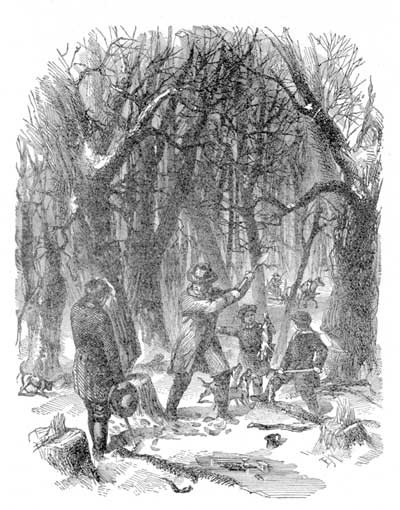
WINTER IN THE WOODS
What can be more delightful, to a boy of spirit, than a day in the woods when there has been a good snow! If he also happens to have a good friend or two, and some good dogs (who are just as likely to be friends as his boy-companions), he ought to be much happier than an ordinary king. A forest is a fine place at any time, but when the ground is well covered with snow—especially if there is a hard crust upon it—the woods seem to possess a peculiar charm. You can go anywhere then.
In the summer, the thick undergrowth, the intertwining vines, and the heavy lower branches of the trees, make it difficult even to see into the dark recesses of the forest. But in the winter all is open. The low wet places, the deep holes, the rotten bogs, everything on the ground that is in the way of a good run and a jump, is covered up. You do not walk a hundred yards under the bare branches of the trees before up starts a rabbit, or a hare, if you would rather call him by his right name,—and away go the dogs, and away you go—all of you tearing along at the top of your speed!
But poor Bunny has a small chance, when a hard snow is on the ground. His hiding-places are all covered up, and before he knows it the dogs have caught him, and your mother will have stewed rabbit for supper. It seems a hard fate for the poor little fellow, but he was born partly for that purpose.
When you have caught your rabbit, and come back to where the men are cutting wood, you will be just as proud to tell the boy who is cutting up the branches all about your splendid hunt, as if you had chased and killed a stag.
"There's where we started him!" you will cry, "and away he scudded, over there among the chestnuts, and Rover right at his heels, and when we got down there to the creek, Rover turned heels-over-head on the ice, he was going so fast; but I gave one slide right across, and just up there, by the big walnut, the other two dogs got him!"
That boy is almost as much excited as you are, and he would drop his axe in one minute, and be off with you on another chase, if his father were not there.
And now you find that you have reached the wood-cutters exactly in time, for that great tree is just about to come down.
There go the top-branches, moving slowly along through the tops of the other trees, and now they move faster, and everything begins to crack; and, with a rush and a clatter of breaking limbs, the great oak comes crashing down; jarring the very earth beneath your feet, and making the snow fly about like a sparkling cloud, while away run the dogs, with their tails between their legs.
The tree is down now, and you will want to be home in time for dinner. Farmer Brown's sled has just passed, and if you will cut across the woods you can catch up with him, and have a ride home, and tell him all about the rabbit-hunt, on the way.
If it is Saturday, and a holiday, you will be out again this afternoon, with some of the other boys, perhaps, and have a grand hunt.
Suppose it is snowing, what will you care? You will not mind the snow any more than if it were a shower of blossoms from the apple-trees in May.
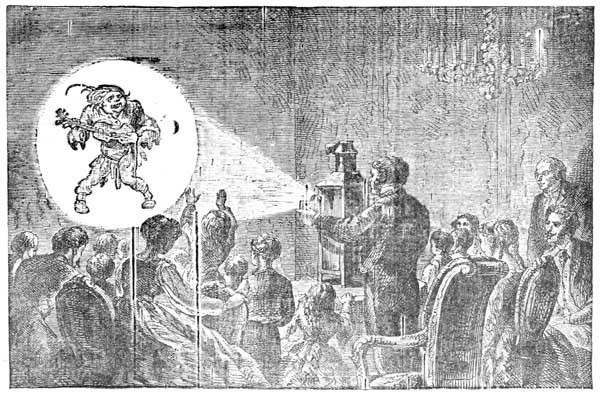
TRICKS OF LIGHT.
There is nothing more straightforward in its ways than light—when we let it alone. But, like many of us, when it is introduced to the inventions and contrivances of the civilized world, it often becomes exceedingly fond of vagaries and extravagances.
Of all the companions of light which endeavor to induce it to forsake its former simple habits, there is not one which has the influence possessed by glass. When light and glass get together it is difficult to divine what tricks they are going to perform. But some of these are very interesting, if they are a little wild, and there are very few of us who do not enjoy them.
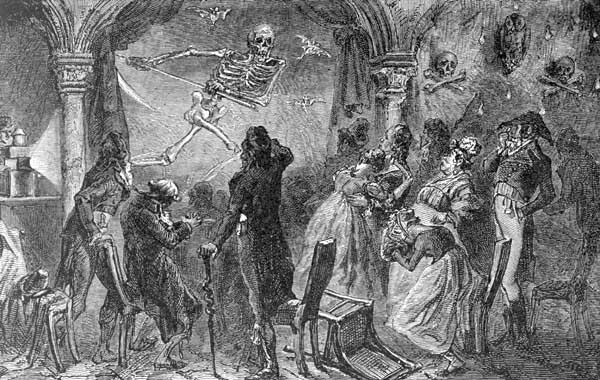
For instance, what a delight to any company, be it composed of young folks or old, is a magic-lantern! The most beautiful and the most absurd pictures may be made to appear upon the wall or screen. But there is an instrument, called the phantasmagoria, which is really nothing but an improved magic-lantern, which is capable of producing much more striking effects. It is a much larger instrument than the other, and when it is exhibited a screen is placed between it and the spectators, so that they do not see how the pictures are produced. It is mounted on castors, so that at times it can be brought nearer and nearer to the screen, until the picture seems to enlarge and grow in a wonderful manner. Then, when it is drawn back, the image diminishes and recedes far into the distance. The lenses and other mechanism of the phantasmagoria can also be moved in various directions, making the action of the pictures still more wonderful. Sometimes, when the instrument is exhibited in public, the screen is not used, but the pictures are thrown upon a cloud of smoke, which is itself almost invisible in the dim light of the room. In such a case the figures seem as if they were floating in the air.
A man, named Robertson, once gave exhibitions in Paris, in an old chapel, and at the close of his performances he generally caused a great skeleton figure of Death to appear among the pillars and arches. Many of the audience were often nearly scared to death by this apparition. The more ignorant people of Paris who attended these exhibitions, could not be persuaded, when they saw men, women, and animals walking about in the air between the arches of the chapel, that Robertson was not a magician, although he explained to them that the images were nothing but the effect of a lantern and some glass lenses. When these people could see that the figures were produced on a volume of smoke, they were still more astonished and awed, for they thought that the spirits arose from the fire which caused the smoke.
But Robertson had still other means of exhibiting the tricks of light. Opposite is a picture of the "Dance of Demons."
This delusion is very simple indeed, and is produced by placing a card-figure on a screen, and throwing shadows from this upon another screen, by means of several lights, held by assistants. Thus each light throws its own shadow, and if the candles are moved up and down, and about, the shadows will dance, jump over each other, and do all sorts of wonderful things. Robertson, and other public exhibitors, had quite complicated arrangements of this kind, but they all acted on the same principle. But all of those who exhibit to the public the freaks of light are not as honest as Mr. Robertson. You may have heard of Nostradamus, who also lived in Paris, but long before Robertson, and who pretended to be a magician. Among other things, he asserted that he could show people pictures of their future husbands or wives. Marie de Medicis, a celebrated princess of the time, came to him on this sensible errand, and he, being very anxious to please her, showed her, in a looking-glass, the reflected image of Henry of Navarre, sitting upon the throne of France. This, of course, astonished the princess very much, but it need not astonish us, if we carefully examine the picture of that conjuring scene.
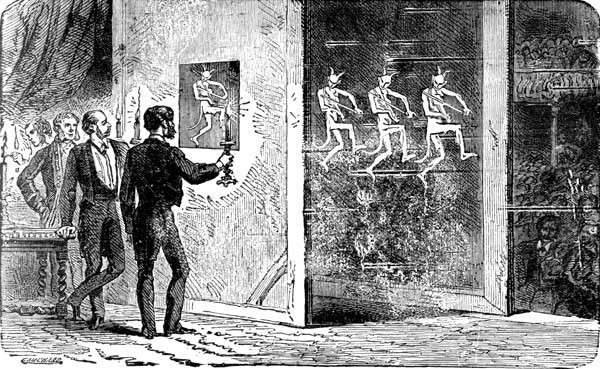
The mirror into which the lady was to look, was in a room adjoining that in which Henry was sitting on the throne. It was placed at such an angle that her face would not be reflected in it, but an aperture in the wall allowed the figure of Henry to be reflected from a looking-glass, hung near the ceiling, down upon the "magic" mirror. So, of course, she saw his picture there, and believed entirely in the old humbug, Nostradamus.
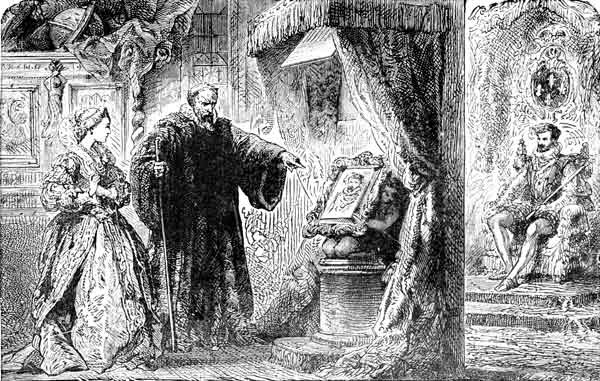
But there are much simpler methods by which the vagaries of light may be made amusing, and among the best of these are what are called "Chinese shadows." These require a little ingenuity, but they are certainly simple enough. They consist of nothing but a card or paper, upon which the lights of the picture intended to be represented are cut out. When this is held between a candle and a wall, a startling shadow-image may be produced, which one would not imagine to have any connection with the card, unless he had studied the manner in which said card was cut. Here is a picture of a company amusing themselves with these cards. No one would suppose that the card which the young man is holding in his hand bore the least resemblance to a lion's head, but there is no mistaking the shadow on the wall.
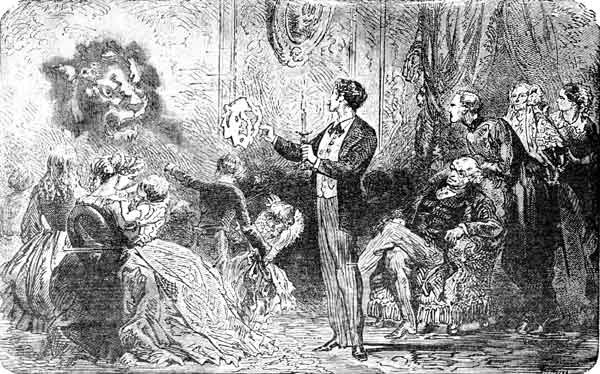
The most wonderful public exhibitions of optical illusions have been those in which a real ghost or spectre apparently moves across the stage of a theatre. This has frequently been done in late years, both in this country and Europe. The audiences were perfectly amazed to see a spirit suddenly appear, walk about the stage, and act like a regular ghost, who did not seem to be in the least disturbed when an actor fired a pistol at him, or ran him through with a sword. The method of producing this illusion is well shown in the accompanying picture. A large plate of glass is placed in front of the stage so that the audience does not perceive it. The edges of it must be concealed by curtains, which are not shown in the picture. An actor, dressed as a ghost, walks in front of the stage below its level, where he is not seen by the audience, and a strong electric light being thrown upon him, his reflected image appears to the spectator as if it were walking about on the stage. When the light is put out of course the spirit instantly vanishes.
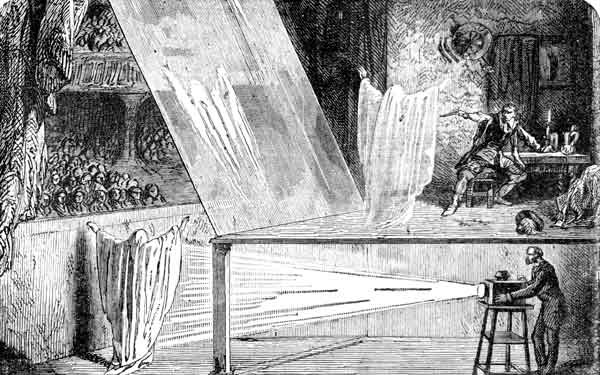
A very amusing account is given of a man who was hired to do some work about a theatre. He had finished his work for the present, and wishing to eat his supper, which he had brought with him, he chose a nice quiet place under the stage, where he thought he would not be disturbed. Not knowing that everything was prepared for the appearance of a ghost, he sat down in front of the electric lamp, and as soon as it was lighted the audience was amazed to see, sitting very comfortably in the air above the stage, a man in his shirt-sleeves, eating bread and cheese! Little did he think, when he heard the audience roaring with laughter, that they were laughing at his ghost!
Light plays so many tricks with our eyes and senses that it is possible to narrate but a few of them here. But those that I have mentioned are enough to show us what a wild fellow he is, especially where he and glass get frolicking together.
SAVING THE TOLL.
When I was a youngster and lived in the country, there were three of us boys who used to go very frequently to a small village about a mile from our homes. To reach this village it was necessary to cross a narrow river, and there was a toll-bridge for that purpose. The toll for every foot-passenger who went over this bridge was one cent. Now, this does not seem like a very high charge, but, at that time, we very often thought that we would much rather keep our pennies to spend in the village than to pay them to the old man who took toll on the bridge. But it was often necessary for us to cross the river, and to do so, and save our money at the same time, we used to adopt a very hazardous expedient.
At a short distance below the toll-bridge there was a railroad-bridge, which you cannot see in the picture. This bridge was not intended for anything but railroad trains; it was very high above the water, it was very long, and it was not floored. When any one stood on the cross-ties which supported the rails, he could look right down into the water far below him. For the convenience of the railroad-men and others who sometimes were obliged to go on the bridge, there was a single line of boards placed over the ties at one side of the track, and there was a slight hand-rail put up at that side of the bridge.
To save our pennies we used to cross this bridge, and every time we did so we risked our lives.
We were careful, however, not to go on the bridge at times when a train might be expected to cross it, for when the cars passed us, we had much rather be on solid ground. But one day, when we had forgotten the hour; or a train was behind, or ahead of time; or an extra train was on the road—we were crossing this railroad bridge, and had just about reached the middle of it, when we heard the whistle of a locomotive! Looking up quickly, we saw a train, not a quarter of a mile away, which was coming towards us at full speed. We stood paralyzed for a moment. We did not know what to do. In a minute, or less, the train would be on the bridge and we had not, or thought we had not, time to get off of it, whether we went forward or backward.
But we could not stand on that narrow path of boards while the train was passing. The cars would almost touch us. What could we do? I believe that if we had had time, we would have climbed down on the trestle-work below the bridge, and so let the train pass over us. But whatever could be done must be done instantly, and we could think of nothing better than to get outside of the railing and hold on as well as we could. In this position we would, at any rate, be far enough from the cars to prevent them from touching us. So out we got, and stood on the ends of the timbers, holding fast to the slender hand-rail. And on came the train! When the locomotive first touched the bridge we could feel the shock, and as it came rattling and grinding over the rails towards us—coming right on to us, as it seemed—our faces turned pale, you may well believe.
But the locomotive did not run off the track just at that exact spot where we were standing—a catastrophe which, I believe, in the bottom of our hearts, every one of us feared. It passed on, and the train came thundering after it. How dreadfully close those cars did come to us! How that bridge did shake and tremble in every timber; and how we trembled for fear we should be shaken off into the river so far below us! And what an enormously long train it was! I suppose that it took, really, but a very short time to pass, but it seemed to us as if there was no end to it at all, and as if it would never, never get entirely over that bridge!
But it did cross at last, and went rumbling away into the distance.
Then we three, almost too much frightened to speak to each other, crept under the rail and hurried over the bridge.
All that anxiety, that fright, that actual misery of mind, and positive danger of body, to save one cent apiece!
But we never saved any more money in that way. When we crossed the river after that, we went over the toll-bridge, and we paid our pennies, like other sensible people.
Had it been positively necessary for us to have crossed that river, and had there been no other way for us to do it but to go over the railroad bridge, I think we might have been called brave boys, for the bridge was very high above the water, and a timid person would have been very likely to have been frightened when he looked down at his feet, and saw how easy it would be for him to make a misstep and go tumbling down between the timbers.
But, as there was no necessity or sufficient reason for our risking our lives in that manner, we were nothing more or less than three little fools!
It would be well if all boys or girls, to whom a hazardous feat presents itself, would ask themselves the question: "Would it be a brave thing for me to do that, or would I be merely proving myself a simpleton?"
A ROYAL PROCESSION.
THE REAL KING OF BEASTS.
For many centuries there has been a usurper on the throne of the Beasts. That creature is the Lion.
But those who take an interest in the animal kingdom (and I am very sorry for those who do not) should force the Lion to take off the crown, put down the sceptre, and surrender the throne to the real King of Beasts—the Elephant.
There is every reason why this high honor should be accorded to the Elephant. In the first place, he is physically superior to the Lion. An Elephant attacked by a Lion could dash his antagonist to the ground with his trunk, run him through with his tusks, and trample him to death under his feet. The claws and teeth of the Lion would make no impression of any consequence on the Elephant's thick skin and massive muscles. If the Elephant was to decide his claim to the throne by dint of fighting for it, the Lion would find himself an ex-king in a very short time. But the Elephant is too peaceful to assert his right in this way—and, what is more, he does not suppose that any one could even imagine a Lion to be his superior. He never had such an idea himself.
But besides his strength of body, the Elephant is superior in intelligence to all animals, except the dog and man. He is said by naturalists to have a very fine brain, considering that he is only a beast. His instinct seems to rise on some occasions almost to the level of our practical reasoning, and the stories which are told of his smartness are very many indeed.
But no one can assert that the Lion has any particular intelligence. To be sure, there have been stories told of his generosity, but they are not many, and they are all very old. The Elephant proves his pre-eminence as a thinking beast every day. We see him very frequently in menageries, and we can judge of what he is capable. We see the Lion also, and we very soon find out what he can do. He can lie still and look grave and majestic; he can jump about in his cage, if he has been trained; and he can eat! He is certainly great in that respect.
We all know a great deal about the Elephant, how he is caught and tamed, and made the servant and sometimes the friend of man. This, however, seldom happens but in India. In Africa they do not often tame Elephants, as they hunt them generally for the sake of their ivory, and the poor beasts are killed by hundreds and hundreds so that we may have billiard-balls, knife-handles, and fine-tooth combs.
Rut whether the Elephant is wanted as a beast of burden, or it is only his great tusks that are desired, it is no joke to hunt him. He will not attack a man without provocation (except in very rare cases); when he does get in a passion it is time for the hunter to look out for his precious skin. If the man is armed with a gun, he must take the best of aim, and his bullets must be like young cannon-balls, for the Elephant's head is hard and his skin is tough. If the hunter is on a horse, he need not suppose that he can escape by merely putting his steed to its best speed. The Elephant is big and awkward-looking, but he gets over the ground in a very rapid manner.
Here is an illustration of an incident in which a boy found out, in great sorrow and trepidation, how fast an Elephant can run.
This boy was one of the attendants of the Duke of Edinburgh, one of Queen Victoria's sons, who was hunting Elephants in Africa. The Elephants which the party were after on that particular day had got out of the sight of the hunters, and this boy, being mounted on a horse, went to look them up. It was not long before he found them, and he also found much more than he had bargained for. He found that one of the big fellows was very much inclined to hunt him and he came riding out of the forest as hard as he could go, with a great Elephant full tilt after him. Fortunately for the boy, the Duke was ready with his gun, and when the Elephant came dashing up he put two balls into his head. The great beast dropped mortally wounded, and the boy was saved. I don't believe that he was so curious about the whereabouts of Elephants after that.
When the Elephant is desired as a servant, he is captured in various ways. Sometimes he is driven into great pens; sometimes he tumbles into pitfalls, and sometimes tame Elephants coax him into traps, and fondle and amuse him while their masters tie up his legs with strong ropes. The pitfalls are not favorite methods of capturing Elephants. Besides the injury that may be done to the animal, other beasts may fall into and disturb the trap, and even men may find themselves at the bottom of a great deep hole when they least expect it, for the top is very carefully covered over with sticks and leaves, so as to look as much as possible like the surrounding ground. Du Chaillu, who was a great hunter in Africa, once fell down one of these pits, and it was a long time before he could make anybody hear him and come and help him out. If an Elephant had happened to put his foot on the covering of that hole while Du Chaillu was down there, the hunter would have found himself very much crowded.
When the Elephant is caught, he is soon tamed and trained, and then he goes to work to make himself useful, if there is anything for him to do. And it is when he becomes the servant and companion of man that we have an opportunity of seeing what a smart fellow he is.
It is sometimes hard to believe all that we hear of the Elephant's cleverness and sagacity, but we know that most of the stories we hear about him are true.
For instance, an Elephant which was on exhibition in this country had a fast and true friend, a little dog. One day, when these animals were temporarily residing in a barn, while on their march from one town to another, the Elephant heard some men teasing the dog, just outside of the barn. The rough fellows made the poor little dog howl and yelp, as they persecuted him by all sorts of mean tricks and ill usage. When the Elephant heard the cries of his friend he became very much worried, and when at last he comprehended that the dog was being badly treated, he lifted up his trunk and just smashed a great hole in the side of the barn, making the stones and boards fly before him.
When the men saw this great head sticking out through the side of the barn, and that great long trunk brandishing itself above their heads, they thought it was time to leave that little dog alone.
Here, again, is an Elephant story which is almost as tough as the animal's hide, but we have no right to disbelieve it, for it is told by very respectable writers. During the war between the East Indian natives and the English, in 1858, there was an Elephant named Kudabar Moll the Second,—his mother having been a noted Elephant named Kudabar Moll. This animal belonged to the British army, and his duty was to carry a cannon on his back. In this way he became very familiar with artillery. During a battle, when his cannon was posted on a battery, and was blazing away at the enemy, the good Kudabar was standing, according to custom, a few paces in the rear of the gunners. But the fire became very hot on that battery, and very soon most of the gunners were shot down, so that there was no one to pass the cartridges from the ammunition wagon to the artillery-men. Perceiving this, Kudabar, without being ordered, took the cartridges from the wagon, and passed them, one by one, to the gunner. Very soon, however, there were only three men left, and these, just as they had loaded their cannon for another volley, fell killed or wounded, almost at the same moment. One of them, who held a lighted match in his hand, called as he fell to the Elephant and handed him the match. The intelligent Kudabar took the match in his trunk, stepped up to the cannon, and fired it off!
He was then about to apply the match to others, when re-enforcements came up, and his services as an artillery-man were no longer required.
I cannot help thinking, that if that Elephant had been furnished with a pen and ink, he might possibly have written a very good account of the battle.
But few stories are quite as wonderful as that one. We have no difficulty at all in believing the account of the Elephant who took care of a little child. He did not wear a cap and apron, as the artist has shown in the picture, but he certainly was a very kind and attentive nurse. When the child fell down, the Elephant would put his trunk gently around it, and pick it up. When it got tangled among thorns or vines, the great nurse would disengage it as carefully as any one could have done it; and when it wandered too far, the Elephant would bring it back and make it play within proper limits. I do not know what would have been the consequence if this child had behaved badly, and the Elephant had thought fit to give it a box on the ear. But nothing of the kind ever happened, and the child was a great deal safer than it would have been with many ordinary nurses.
There are so many stories told about the Elephant that I can allude to but few, even if I did not believe that you were familiar with a great many of them.
One of the most humane and thoughtful Elephants of whom I have ever heard was one which was attached, like our friend Kudabar, to an artillery train in India. He was walking, on a march, behind a wagon, when he perceived a soldier slip down in the road and fall exactly where, in another instant, the hind-wheel of the wagon would pass over him. Without being ordered, the Elephant seized the wheel with his trunk, lifted it—wagon and all—in the air, and held it up until it had passed over the fallen soldier!
Neither you nor I could have done better than that, even if we had been strong enough.
A very pretty story is told of an Indian Elephant who was very gallant. His master, a young Burman lord, had recently been married, and, shortly after the wedding, he and his bride, with many of their guests and followers, were gathered together in the veranda, on the outside of his house. The Elephant, who was a great favorite with the young lord, happened to be conducted past the house as the company were thus enjoying themselves. Feeling, no doubt, that it was right to be as polite as possible on this occasion, he put his trunk over a bamboo-fence which enclosed a garden, and selecting the biggest and brightest flower he could see, he approached the veranda, and rearing himself upon his hind-legs, he stretched out his trunk, with the flower held delicately in the little finger at its end, towards the company. One of the women reached out her hand for it, but the Elephant would not give it to her. Then his master wished to take it, but the Elephant would not let him have it. But when the newly-made bride came forward the Elephant presented it to her with all the grace of which he was capable!
Now, do you not think that an animal which is larger and more powerful than any beast which walks the earth, and is, at the same time, gentle enough to nurse a child, humane enough to protect a dog or a man, and sensible enough to be polite to a newly-married lady, is deserving of the title of the King of Beasts?
THE FRENCH SOLDIER-BOY
Anxiously the General-in-chief of the French Army stood upon a little mound overlooking the battle-field. The cannon were thundering, the musketry was rattling, and clouds of smoke obscured the field and the contending armies.
"Ah!" thought he, "if that town over yonder is not taken; if my brave captains fall, and my brave soldiers falter at that stone wall; and if our flag shall not soon wave over those ramparts, France may yet be humbled."
Is it, then, a wonder, feeling that so much depended on the result of this battle, that his eyes strove so earnestly to pierce the heavy clouds of smoke that overhung the scene?
But while he stood, there came towards him, galloping madly out of the battle, a solitary rider.
In a few minutes he had reached the General, and thrown himself from his saddle.
It was a mere boy—one of the very youngest of soldiers!
"Sire!" he cried, "we've taken the town! Our men are in the market-place, and you can ride there now! And see!—upon the walls—our flag!"
The eyes of the General flashed with joy and triumph. Here was glorious news!
As he turned to the boy to thank him for the more than welcome tidings that he brought, he noticed that the lad was pale and trembling, and that as he stood holding by the mane of his horse, his left hand was pressed upon his chest, and the blood was slowly trickling between his fingers.
"My boy!" said he, tenderly, as he fixed his eyes upon the stripling, "you're wounded!"
"No, sire!" cried the boy, his pale face flushing as his General thus addressed him, and the shouts of victory filled his ears, "I am not wounded; I am killed!" And down at his General's feet he fell and died.
There have been brave men upon the battle-field ever since the world began, but there never was a truer soldier's heart than that which kept this boy alive until he had borne to his General the glorious news of the battle won.
A LIVELY WAY TO RING A BELL.
Here are two young men who look very much as if they were trying to break their necks; but in reality they have no such desire.
They are simply ringing that great bell, and riding backward and forward on it as it swings through the air.
These young fellows are Spaniards, and in many churches in their country it is considered a fine thing to go up into the belfry of a church or cathedral, and, when the regular bell-ringers are tired, to jump on the great bells and swing away as hard as they can make them go. No matter about any particular peal or style of ringing.
The faster and the more furiously they swing, the jollier the ride, and the greater the racket. Sometimes in a cathedral there are twenty bells, all going at once, with a couple of mad chaps riding on each one of them. It is, doubtless, a very pleasant amusement, after one gets used to it, but it is a wonder that some of those young men are not shot off into the air, when the great bell gets to swinging as fast and as far as it can go.
But although they hold on as tightly as if they were riding a wild young colt, they are simply foolhardy. No man or boy has a right to risk his life and limbs in such reckless feats.
There is no probability, however, of the sport ever being introduced into this country.
Even if there were no danger in it, such a clatter and banging as is heard in a Spanish belfry, when the young men are swinging on the bells, would never be allowed in our churches. The Spaniards may like such a noise and hubbub, but they like a great many things which would not suit us.
DOWN IN THE EARTH.
Let us take a little trip down under the surface of the earth. There will be something unusual about such an excursion. Of course, as we are not going to dig our way, we will have to find a convenient hole somewhere, and the best hole for the purpose which I know of is in Edmondson County, Kentucky.
So let us go there.
When we reach this hole we find that it is not a very large one, but still quite high and wide enough for us to enter. But, before we go in to that dark place, we will get some one to carry a light and guide us; for this underground country which we are going to explore is very extensive, very dark, and, in some places, very dangerous.
Here is a black man who will go with us. He has a lantern, and he says he knows every nook and corner of the place. So we engage him, get some lanterns for ourselves, and in we go. We commence to go downwards very soon after we have passed from the outer air and sunshine, but it is not long before we stand upon a level surface, where we can see nothing of the outside world. If our lanterns went out, we should be in pitchy darkness.
Now we are in the Mammoth Cave of Kentucky!
This vast cavern, which stretches so many miles beneath the surface of the earth, has never been fully explored; but we are going over as much of it as our guide is accustomed to show to visitors, and if our legs are not tired before we get back I shall be very much surprised, for the trip will take us all day. The floor on which we are now standing is smooth and level, and runs back into the interior of the cave fully a thousand yards. This place they call the "Audubon Gallery"—after our famous naturalist who made birds the study of his life. His works are published in enormous volumes, costing about one hundred and fifty dollars apiece. Perhaps your father will get you one.
We pass quickly through this gallery, where there is not much to see, although, to be sure, they used to manufacture saltpetre here. Think of that! A manufactory in the bowels of the earth! Then we enter a large, roundish room called the "Rotunda," and from this there are a great many passages, leading off in various directions. One of these, which is called the "Grand Vestibule," will take us to the "Church."
Yes, we have a church here, and, what is more, there has been preaching in it, although I have never heard that it had any regular members. This room has a vast arched roof, and a great many stalactites hang from the walls and roof in such a way as to give one an idea of Gothic architecture. Therefore this has been called the "Gothic Church." You can see a great deal which looks like old-fashioned church ornaments and furniture, and, as the light of the lanterns flashes about on the walls and ceiling, you can imagine a great deal more.
After this we come to the "Gothic Avenue," which would be a very interesting place to us if we but had a little more time; but we hurry through it, for the next room we are to visit is called the "Haunted Chamber!" Every one of us must be very anxious to see anything of that kind. When we get into it, however, we are very much disappointed. It is not half so gloomy and dark as the rest of the cave, for here we are pretty sure to find people, and lights, and signs of life.
Here you may sometimes buy gingerbread and bottled beer, from women who have stands here for that purpose. It is expected that when visitors get this far they will be hungry. Sometimes, too, there are persons who live down here, and spend most of their time in this chamber. These are invalid people with weak lungs, who think that the air of the cave is good for them. I do not know whether they are right or not, but I am sure that they take very gloomy medicine. The only reason for calling this room the Haunted Chamber is, that the first explorers of the cave found mummies here.
Who these were when they were alive, no man can say. If they were Indians, they were very different Indians from those who have lived in this country since its discovery. They do not make mummies. But all over our land we find evidences that some race—now extinct—lived here before the present North American Indian.
Whether the ghosts of any of these mummies walk about in this room. I cannot say; but as no one ever saw any, or heard any, or knew anybody who had seen or heard any, I think it is doubtful.
When we leave this room we go down some ladders and over a bridge, and then we enter what is called the "Labyrinth," where the passage turns and twists on itself in a very abrupt manner, and where the roof is so low that all of us, except those who are very short indeed, must stoop very low. When we get through this passage, which some folks call the "Path of Humiliation"—for everybody has to bow down, you know—we come to a spot where the guide says he is going to show us something through a window.
The window is nothing but a hole broken in a rocky wall; but as we look through it, and hold the lanterns so that we can see as much as possible, we perceive that we are gazing down into a deep and enormous well. They call it the "Bottomless Pit." If we drop bits of burning paper into this well we can see them fall down, down, and down, until they go out, but can never see them stop, as if they had reached the bottom.
The hole through which we are looking is cut through one side of this well, so that there is a great deal of it above us as well as below; but although we hold our lanterns up, hoping to see the top, we can see nothing but pitchy darkness up there. The roof of this pit is too high for the light to strike upon it. Here is a picture of some persons dropping lights down into this pit, hoping to be able to see the bottom.
We must climb up and down some more ladders now, and then we will reach the "Mammoth Dome." This is a vast room—big enough for a gymnasium for giants—and the roof is so high that no ordinary light will show it. It is nearly four hundred feet from the floor. The next room we visit is one of the most beautiful places in the whole cave. It is called the Starry Chamber. The roof and walls and floor are covered with little bright bits of stone, which shine and glitter, when a light is brought into the room, like real stars in the sky. If the guide is used to his business, he can here produce most beautiful effects. By concealing his lantern behind a rock or pillar, and then gradually bringing it out, throwing more and more light upon the roof, he can create a most lovely star-light scene.
At first all will be dark, and then a few stars will twinkle out, and then there will be more of them, and each one will be brighter, and at last you will think you are looking up into a dark sky full of glorious shining stars! And if you look at the walls you will see thousands of stars that seem as if they were dropping from the sky; and if you cast your eyes upon the ground, you will see it covered with other thousands of stars that seem to have already fallen!
This is a lovely place, but we cannot stay here any longer. We want to reach the underground stream of which we have heard so much—the "River Styx."
This is a regular river, running through a great part of the Mammoth Cave. You may float on it in a boat, and, if you choose, you may fish in it, although you would not be likely to catch anything. But if you did, the fish would have no eyes! All the fish in this river are blind. You can easily perceive that eyes would be of no use in a place where it is always as dark as pitch, except when travellers come along with their lanterns.
There is a rough boat here, and we will get into it and have a row over this dark and gloomy river. Whenever our guide shouts we hear the wildest kind of echoes, and everything seems solemn and unearthly. At one time our boat stops for a moment, and the guide goes on shore, and directly we hear the most awful crash imaginable. It sounds as if a dozen gong-factories had blown up at once, and we nearly jump out of the boat! But we soon see that it was nothing but the guide striking on a piece of sheet-iron or tin. The echoes, one after another, from this noise had produced the horrible crashing sounds we had heard.
After sailing along for about half an hour we land, and soon reach an avenue which has its walls ornamented with beautiful flowers—all formed on the rocky walls by the hand of Nature.
Now we visit the "Ball Room," which is large and handsome, with its walls as white as snow. Leaving this, we take a difficult and exciting journey to the "Rocky Mountains." We go down steep paths, which are narrow, and up steep ones, which are wide; we jump over wide cracks and step over great stones, and we are getting very tired of scrambling about in the bowels of the earth; but the guide tells us that if we will but cross the "mountains"—which we find to be nothing more than great rocks, which have fallen from the roof above, but which, however, are not very easy to get over—we shall rest in the "Fairy Grotto." So on we push, and reach the delightful abode of the fairies of the Mammoth Cave. That is, if there were any fairies in this cave, they would live here.
And a splendid place they would have!
Great colonnades and magnificent arches, all ornamented with beautiful stalactites of various forms, and glittering like cut-glass in the light of our lanterns, and thousands of different ornaments of sparkling stone, many of them appearing as if they were cut by the hand of skilful artists, adorn this beautiful grotto. At one end there is a group of stalactites, which looks to us exactly like a graceful palm-tree cut out of alabaster. All over the vast hall we can hear the pattering and tinkling of the water, which has been dripping, drop by drop, for centuries, and making, as it carried with it little particles of earth and rock, all these beautiful forms which we see.
We have now walked nearly five miles into the great cave, and there is much which we have not seen. But we must go back to the upper earth. We will have a tiresome trip of it, but it is seldom that we can get anything good without taking a little trouble for it. And to have seen this greatest of all natural caverns is worth far more labor and fatigue than we have expended on its exploration. There is nothing like it in the known world.
THE LION'S HOME.
THE LION.
I do not desire to be wanting in respect to the Lion. Because I asserted that it was my opinion that he should resign the throne of the King of Beasts to the Elephant, I do not wish to deprive him of any part of his just reputation.
The Lion, with the exception of any animal but the Elephant, the Rhinoceros, the Hippopotamus, and such big fellows, is the strongest of beasts. Compared to Tigers and Panthers, he is somewhat generous, and compared to most of the flesh-eating animals, he is quite intelligent. Lions have been taught to perform certain feats when in a state of captivity; but, as all of us know who have seen the performing animals in a menagerie, he is by no means the equal of a Dog or an Elephant.
The Lion appears to the greatest advantage in the midst of his family. When he and his wife are taking their walks abroad they will often fly before a man, especially if he is a white man.
But at home, surrounded by their little ones, the case is different. Those cubs, in the picture of the Lion's home, are nice little fellows, and you might play with them without fear of more than a few scratches. But where is the brave man who would dare to go down among those rocks, armed with guns, pistols, or whatever he pleased, and take one of them!
I do not think he lives in your town.
We never see a Lion looking very brave or noble in a cage. Most of those that I have seen appeared to me to be excessively lazy. They had not half the spirit of the tigers and wolves. But, out in his native country, he presents a much more imposing spectacle, especially if one can get a full view of him when he is a little excited. Here is a picture of such a Lion as you will not see in a cage.
Considering his size, the strength of the Lion is astonishing. He will kill an ox with one blow of his great paw, if he strikes it on the back, and then seizing it in his great jaws, he will carry it off almost as easily as you could carry a baby.
And when he has carried his prey to the spot where he chooses to have his dinner, he shows that no beast can surpass him in the meat-eating line. When he has satisfied his hunger on an ox, there is not much left for those who come to the second table. And there are often other Lions, younger and weaker than the one who has provided the dinner, who must wait until their master or father is done before they have a chance to take a bite. But, as you may see by this picture, they do not wait very patiently. They roar and growl and grumble until their turn comes.
Lions have some very peculiar characteristics. When they have made a bound upon their prey and have missed it, they seldom chase the frightened animal. They are accustomed to make one spring on a deer or an ox, and to settle the matter there and then. So, after a failure to do this, they go to the place from which they have made the spring and practise the jump over and over until they feel that they can make it the next time they have a chance.
This is by no means a bad idea for a Lion—or a man either.
Another of their peculiarities is their fear of traps and snares. Very often they will not spring upon an ox or a horse, simply because it is tied to a tree. They think there is some trick when they see the animal is fastened by a rope.
And when they come upon a man who is asleep, they will very often let him lie undisturbed. They are not accustomed to seeing men lying about in their haunts, and they don't know what to make of it. Sometimes they take it in their heads to lie down there themselves. Then it becomes disagreeable for the man when he awakes.
A story of this kind is told of an African who had been hunting, and who, being tired, had lain down to sleep. When he awoke there lay a great Lion at a short distance from him! For a minute or two the man remained motionless with fright, and then he put forth his hand to take his gun, which was on the ground a few feet from him.
But when the Lion saw him move he raised his head and roared.
The man was quiet in a second.
After a while it began to be terribly hot, and the rocks on which the poor man was lying became so heated by the sun that they burned his feet.
But whenever he moved the old Lion raised his head and growled.
The African lay there for a very long time, and the Lion kept watch over him. I expect that Lion had had a good meal just before he saw this man, and he was simply saving him up until he got hungry again. But, fortunately, after the hunter had suffered awfully from the heat of the burning sun, and had also lain there all night, with this dreadful beast keeping watch over him, the Lion became thirsty before he got hungry, and when he went off to a spring to get a drink the African crawled away.
If that Lion had been a Tiger, I think he would have killed the man, whether he wished to eat him or not.
So there is something for the Lion's reputation.
BOB'S HIDING-PLACE.
Bob was not a very big boy, but he was a lively little fellow and full of fun. You can see him there in the picture, riding on his brother Jim's back. One evening there happened to be a great many boys and girls at Bob's father's house. The grown-up folks were having a family party, and as they were going to stay all night—you see this was in the country—some of them brought their children with them.
It was not long after supper that a game of Blind-Man's-Buff was proposed, and, as it would not do to have such an uproar in the sitting-room as the game would produce, the children were all packed off to the kitchen. There they have a glorious time. Jim is the first one blindfolded, and, as he gropes after the others, they go stumbling up against tables, and rattling down tin-pans, and upsetting each other in every direction. Old Grandfather, who has been smoking his pipe by the kitchen fire, takes as much pleasure in the game as the young folks, and when they tumble over his legs, or come banging up against his chair, he only laughs, and warns them not to hurt themselves.
I could not tell you how often Grandfather was caught, and how they all laughed at the blind-man when he found out whom he had seized.
But after a while the children became tired of playing Blind-Man's-Buff, and a game of Hide-and-Seek was proposed. Everybody was in favor of that, especially little Bob. It appears that Bob had not a very good time in the other game. Everybody seemed to run up against him and push him about, and whenever he was caught the blind-man said "Bob!" immediately. You see there was no mistaking Bob; he was so little.
But in Hide-and-Seek he would have a better chance. He had always liked that game ever since he had known how to play anything. He was a good little fellow for hiding, and he knew it.
When the game had begun, and all the children—except the biggest girl, who was standing in a corner, with her hands before her face, counting as fast as she could, and hoping that she would come to one hundred before everybody had hidden themselves—had scampered off to various hiding-places, Bob still stood in the middle of the kitchen-floor, wondering where in the world he should go to! All of a sudden—the girl in the corner had already reached sixty-four—he thought he would go down in the cellar.
There was no rule against that—at least none that he knew of—and so, slipping softly to the cellar-door, over in the darkest corner of the kitchen, he opened it, and went softly down the steps.
There was a little light on the steps, for Bob did not shut the door quite tightly after him, and if there had been none at all, he would have been quite as well pleased. He was not afraid of the dark, and all that now filled his mind was the thought of getting somewhere where no one could possibly find him. So he groped his way under the steps, and there he squatted down in the darkness, behind two barrels which stood in a corner.
"Now," thought Bob, "she won't find me—easy."
He waited there a good while, and the longer he waited the prouder he became.
"I'll bet mine's the hardest place of all," he said to himself.
Bob heard a great deal of noise and shouting after the big girl came out from her corner and began finding the others, and he also heard a bang above his head, but he did not know that it was some one shutting the cellar-door. After that all was quiet.
Bob listened, but could not hear a step. He had not the slightest idea, of course, that they had stopped playing and were telling stories by the kitchen fire. The big girl had found them all so easily that Hide-and-Seek had been voted down.
Bob had his own ideas in regard to this silence. "I know," he whispered to himself, "they're all found, and they're after me, and keeping quiet to hear me breathe!"
And, to prevent their finding his hiding-place by the sound of his breathing, Bob held his breath until he was red in the face. He had heard often enough of that trick of keeping quiet and listening to breathing. You couldn't catch him that way!
When he was at last obliged to take a breath, you might have supposed he would have swallowed half the air in the cellar. He thought he had never tasted anything so good as that long draught of fresh air.
"Can't hold my breath all the time!" Bob thought. "If I could, maybe they'd never find me at all," which reflection was much nearer the truth than the little fellow imagined.
I don't know how long Bob had been sitting under the steps—it may have been five minutes, or it may have been a quarter of an hour, and he was beginning to feel a little cold—when he heard the cellar-door open, and some one put their foot upon the steps.
"There they are!" he thought, and he cuddled himself up in the smallest space possible.
Some one was coming down, sure enough, but it was not the children, as Bob expected. It was his Aunt Alice and her cousin Tom Green. They had come down to get some cider and apples for the company, and had no thought of Bob. In fact, when Bob was missed it was supposed that he had got tired and had gone up-stairs, where old Aunt Hannah was putting some of the smaller children to bed.
So, of course, Alice and Tom Green did not try to find him, but Bob, who could not see them, thought it was certainly some of the children come down to look for him.
In this picture of the scene in the cellar, little Bob is behind those two barrels in the right-hand upper corner, but of course you can't see him. He knows how to hide too well for that.
But when Tom and Alice spoke, Bob knew their voices and peeped out.
"Oh!" he thought, "it's only Aunt Alice and he. They've come down for cider and things. I've got to hide safe now, or they'll tell when they go up-stairs."
"I didn't know all them barrels had apples in! I thought some were potatoes. I wish they would just go up-stairs again and leave that candle on the floor! I wonder if they will forget it! If they do, I'll just eat a whole hat-full of those big red apples, and some of the streakedy ones in the other barrel too; and then I'll put my mouth to the spigot of that cider-barrel, and turn it, and drink and drink and drink—and if there isn't enough left in that barrel, I'll go to another one and turn that. I never did have enough cider in all my life. I wish they'd hurry and go up.
"Kissin'! what's the good of kissin'! A cellar ain't no place for that. I expect they won't remember to forget the candle if they don't look out!
"Oh, pshaw! just look at 'em! They're a-going up again, and taking the candle along! The mean things!"
Poor little Bob!
There he sat in his corner, all alone again in the darkness and silence, for Tom and Alice had shut the cellar-door after them when they had gone up-stairs. He sat quietly for a minute or two, and then he said to himself:
"I b'lieve I'd just as lieve they'd find me as not."
And to help them a little in their search he began to kick very gently against one of the barrels.
Poor Bob! If you were to kick with all your force and even upset the barrel they would not hear you. And what is more, they are not even thinking of you, for the apples are now being distributed.
"I wonder," said the little fellow to himself, "if I could find that red-apple barrel in the dark. But then I couldn't tell the red ones from the streakedy ones. But either of 'em would do. I guess I won't try, though, for I might put my hand on a rat. They run about when it's dark. I hope they won't come in this corner. But there's nothin' for 'em to eat in this corner but me, and they ain't lions. I wonder if they'll come down after more cider when that's all drunk up. If they do, I guess I'll come out and let Aunt Alice tell them all where I am. I don't like playin' this game when it's too long."
And so he sat and waited and listened, and his eye-lids began to grow heavy and his head began to nod, and directly little Bob was fast asleep in the dark corner behind the barrels.
By ten o'clock the children were all put to bed, and soon after the old folks went up-stairs, leaving only Tom Green, Alice, and some of the young men and women down in the big sitting-room.
Bob's mother went up into the room where several of the children were sleeping, and after looking around, she said to the old colored nurse:
"Hannah, what have you done with Bob?"
"I didn't put him to bed, mum. I spect Miss Alice has took him to her bed. She knowed how crowded the chil'un all was, up here."
"But Alice has not gone to bed," said Bob's mother.
"Don't spect she has, mum," said Hannah. "But I reckon she put him in her bed till she come."
"I'll go and see," said Bob's mother.
She went, and she saw, but she didn't see Bob! And he wasn't in the next room, or in any bed in the house, or under any bed, or anywhere at all, as far as she could see; and so, pretty soon, there was a nice hubbub in that house!
Bob's mother and father, and his grandfather, and Hannah, and the young folks in the parlor, and nearly all the rest of the visitors, ransacked the house from top to bottom. Then they looked out of doors, and some of them went around the yard, where they could see very plainly, as it was bright moonlight. But though they searched and called, there was no Bob.
The house-doors being open, Snag the dog came in, and he joined in the search, you may be sure, although I do not know that he exactly understood what they were looking for.
Some one now opened the cellar-door, but it seemed preposterous to look down in the cellar for the little fellow.
But nothing was preposterous to Snag.
The moment the cellar-door was opened he shuffled down the steps as fast as he could go. He knew there was somebody down there.
And when those who followed him with a candle reached the cellar-floor, there was Snag, with his head between the barrels, wagging his tail as if he was trying to jerk it off, and whining with joy as he tried to stick his cold nose into the rosy face of little sleeping Bob.
It was Tom Green who carried Bob up-stairs, and very soon indeed, all the folks were gathered in the kitchen, and Bob sleepily told his story.
"But Tom and I were down in the cellar," said his Aunt Alice, "and we didn't see you."
"I guess you didn't," said Bob, rubbing his eyes. "I was a-hidin' and you was a-kissin'."
What a shout of laughter arose in the kitchen at this speech! Everybody laughed so much that Bob got wide awake and wanted some apples and cake.
The little fellow certainly made a sensation that night; but it was afterwards noticed that he ceased to care much for the game of Hide-and-Seek. He played it too well, you see.
THE CONTINENTAL SOLDIER.
Did you ever see a Continental Soldier? I doubt it. Some twenty years ago there used to be a few of them scattered here and there over the country, but they must be nearly all gone now. About a year ago there were but two of them left. Those whom some of us can remember were rather mournful old gentlemen. They shuffled about their dwelling-places, they smoked their pipes, and they were nearly always ready to talk about the glorious old days of the Revolution. It was well they had those days to fall back upon, for they had but little share in the glories of the present. When they looked abroad upon the country that their arms, and blood perhaps, had helped give to that vigorous Young America which now swells with prosperity from Alaska to Florida, they could see very little of it which they could call their own.
It was difficult to look upon those feeble old men and imagine that they were once full of vigor and fire; that they held their old flintlocks with arms of iron when the British cavalry rushed upon their bayonets; that their keen eyes flashed a deadly aim along their rusty rifle-barrels; that, with their good swords quivering in their sinewy hands, they urged their horses boldly over the battle-field, shouting brave words to their advancing men; and that they laughed at heat and cold, patiently endured hunger and privation, strode along bravely on the longest marches, and, at last, stood proudly by when Cornwallis gave up his sword.
Those old gentlemen did not look like anything of that sort. Their old arms could hardly manage their old canes; their old legs could just about carry them on a march around the garden, and they were very particular indeed about heat and cold.
But History and Art will better keep alive the memory of their good deeds, and call more vigorously upon the gratitude of their countrymen, than those old Continentallers could themselves have done it, had they lived on for years and years, and told generation after generation how once they galloped proudly along the ranks, or, in humbler station, beat with vigorous arm the stirring drum-roll that called their comrades to the battle-field.
A JUDGE OF MUSIC.
It is not well to despise anybody or anything until you know what they can do. I have known some very stupid-looking people who could do a sum in the rule-of-three in a minute, and who could add up a column of six figures abreast while I was just making a beginning at the right-hand bottom corner. But stupid-looking beings are often good at other things besides arithmetic. I have seen doctors, with very dull faces, who knew all about castor-oil and mustard-plasters, and above you see a picture of a Donkey who understood music.
This animal had a very fine ear for music. You can see how much ear he had, and I have no doubt that he enjoyed the sweet sounds from one end to the other of those beautiful long flaps. Well, he very often had an opportunity of enjoying himself, for the lady of the house was a fine musician, and she used to sing and play upon the piano nearly every day. And as soon as he heard the sweet sounds which thrilled his soul, the Donkey would come to the parlor window and listen.
One day the lady played and sang something which was particularly sweet and touching. I never heard the name of the song—whether it was "I'm sitting on the stile, Mary," or "A watcher, pale and weary"—but if it was the latter, I am not surprised that it should have overcome even a jackass. At any rate, the music so moved the soul of Mr. Donkey that he could no longer restrain himself, but entering the open door he stepped into the parlor, approached the lady, and with a voice faltering from the excess of his emotion, he joined in the chorus!
The lady jumped backwards and gave a dreadful scream, and the Donkey, thinking that the music went up very high in that part, commenced to bray at such a pitch that you could have heard him if you had been up in a balloon.
That was a lively concert; but it was soon ended by the lady rushing from the room and sending her man John to drive out the musical jackass with a big stick.
Fortunately, all donkeys have not this taste for music. The nearest that the majority of jackasses come to being votaries of music is when their skins are used for covering cases for musical instruments. And if they have any ambition in the cause of harmony, that is better than nothing.
THE SENSITIVE PLANT.
There was never a better name for a plant than this, for the delicate leaves which grow on this slender stalk are almost as sensitive to the touch as if they were alive. If you place your hand on a growing plant, you will soon see all the leaves on the stem that you have touched fold themselves up as tightly as if they had been packed up carefully to be sent away by mail or express. In some of the common kinds of this plant, which grow about in our fields, it takes some time for the leaves to fold after they have been touched or handled; but if you watch them long enough—five or ten minutes—you will see that they never fail to close. They are not so sensitive as their cultivated kindred, but they still have the family disposition.
Now this is certainly a wonderful property for a plant to possess, but it is not half so strange as another trait of these same pretty green leaves. They will shut up when it is dark, and open when it is light.
It may be said that many other plants will do this, but that is a mistake. Many flowers and leaves close at night and open in the day-time, but very few indeed exhibit the peculiar action of the sensitive plant in this respect. That plant will open at night if you bring a bright light into the room where it is growing, and it will close its leaves if the room is made dark in the day-time.
Other plants take note of times and seasons. The sensitive plant obeys no regular rules of this kind, but acts according to circumstances.
When I was a boy, I often used to go to a green-house where there were a great many beautiful and rare plants; but I always thought that the sensitive plant was the most wonderful thing in the whole collection, and I did not know then how susceptible it was to the influence of light. I was interested in it simply because it seemed to have a sort of vegetable reason, and understood that it should shut up its leaves whenever I touched it.
THE SENSITIVE PLANT.
But there were things around me in the vegetable kingdom which were still more wonderful than that, and I took no notice of them at all.
In the garden and around the house, growing everywhere, in the most common and ordinary places, were vines of various kinds—I think there were more morning-glories than anything else—and these exhibited a great deal more sense, and a much nearer approach to reasoning powers, than the sensitive plants, which were so carefully kept in the green-house.
When one of these vines came up out of the earth, fresh from its seed, the first thing it wanted, after its tendrils began to show themselves, was something to climb up upon. It would like a good high pole. Now, if there was such a pole within a few feet of the little vine it would grow straight towards it, and climb up it!
It would not grow first in one direction, and then in another and then in another, until it ran against something to climb on, but it would go right straight towards the pole, as if it saw it, and knew it was a good one for its purpose.
I think that there is not much in the vegetable kingdom more wonderful than that.
SIR MARMADUKE.
Sir Marmaduke was a good old English gentleman, all of the olden time. There you see him, in his old-fashioned dining-room, with his old-fashioned wife holding her old-fashioned distaff, while he is surrounded by his old-fashioned arms, pets, and furniture.
On his hand he holds his hawk, and his dogs are enjoying the great wood fire. His saddle is thrown on the floor; his hat and his pipes lie near it; his sword and his cross-bows are stood up, or thrown down, anywhere at all, and standing by his great chair is something which looks like a coal-scuttle, but which is only a helmet.
Sir Marmaduke was certainly a fine old gentleman. In times of peace he lived happily with his family, and was kind and generous to the poor around him. In times of war he fought bravely for his country.
But what a different old gentleman would he have been had he lived in our day!
Then, instead of saying "Rebeck me!" and "Ods Boddikins!" when his hawk bit his finger or something else put him out of humor, he would have exclaimed, "Oh, pshaw!" or, "Botheration!" Instead of playing with a hawk, he would have had a black-and-tan terrier,—if he had any pet at all; and his wife would not have been bothering herself with a distaff, when linen, already spun and woven, could be bought for fifty cents a yard. Had she lived now, the good lady would have been mending stockings or crocheting a tidy.
Instead of a pitcher of ale on his supper-table, the good knight would have had some tea or coffee; and instead of a chine of beef, a mess of pottage, and a great loaf of brown bread for his evening meal, he would have had some white bread, cakes, preserves, and other trifles of that sort, which in the olden days were considered only fit for children and women. The good old English gentlemen were tremendous eaters. They used to take five meals a day, and each one of them was heavy and substantial.
If Sir Marmaduke had any sons or daughters, he would have treated them very differently in the present day. Instead of keeping them at home, under the tuition of some young clergyman or ancient scholar, until they should be old enough and accomplished enough to become pages to a great lord, or companions to some great lady, he would have sent them to school, and the boys—the younger ones, at least—would have been prepared for some occupation which would support them, while the girls would have been taught to play on the piano and to work slippers.
In these days, instead of that old helmet on the floor, you would have seen a high-top hat—that is, if the old gentleman should continue to be as careless as the picture shows him; instead of a cross-bow on the floor, and another leaning against the chair, you would have seen a double-barrelled gun and a powder-horn; and instead of the picturesque and becoming clothes in which you see Sir Marmaduke, he would have worn some sort of a tight-fitting and ugly suit, such as old gentlemen now-a-days generally wear.
There were a great many advantages in the old style of living, and also a very great many disadvantages. On the whole, we should be very thankful indeed that we were born in this century, and not in the good old times of yore.
A little boy once made a very wise remark on this subject. He said: "I wish I could have seen George Washington and Israel Putnam; but I'm glad I didn't, for if I'd been alive then, I should have been dead now."
There is enough in that boy's remark for a whole composition, if any one chose to write it.
THE GIRAFFE.
Some one once called the Giraffe a "two-story animal," and the remark was not altogether inapplicable.
As you see him in the picture, lying down, he seems to be high enough for all ordinary purposes; but when he stands up, you will see that his legs—or his lower story—will elevate him to a surprising height.
The ordinary giraffe measures about fifteen feet from the top of his head to the ground, but some of them have been known to be over sixteen feet high. Most of this height is owing to their long necks, but their fore-legs are also very long. The hind-legs seem much shorter, although, in reality, they are as long as the fore-legs. The legs and neck of the Giraffe are made long so that he can eat the leaves from the tops of young trees. This tender foliage is his favorite diet; but he will eat the foliage from any part of a tree, and he is content with the herbage on the ground, when there is nothing else.
He is not a fighting animal. Those little horns which you see on his head, and which look as if they had been broken off—although they are really their full size—are of no use as offensive weapons. When danger threatens him he runs away, and a funny sight he is then. He can run very fast, but he is very awkward; he goes like a cow on stilts.
But when there is no chance for him to run away, he can often defend himself, for he can kick like a good fellow. His hind-legs fly so fast when he is kicking that you can hardly see them, and he has been known to drive off a lion by this means of defence.
When hunters wish to catch a giraffe alive, they generally drive him into a thick woods, where his great height prevents him from running very rapidly; and as soon as they come up with him, they endeavor to entangle him in ropes, to throw him down, and to put a halter round his neck. If they only keep out of the way of his heels, there is no need of being afraid of him. When they have secured him they lead him off, if he will come; but if he is an old fellow he will not walk after them, and he is too strong to be easily pulled along, no matter how many men may be in the hunt. So in this case they generally kill him, for his skin is valuable, and his flesh is very good to eat. But if the giraffe is a young one, he will follow his captors without difficulty, for these animals are naturally very gentle.
Why the natives of Africa should desire to obtain living giraffes, unless it is to sell them to people who wish to carry them to other countries, travellers do not inform us. We have never heard that any domestic use was made of them, nor that they were kept for the sake of their meat. But we suppose the hunters know their own business.
It is probable that the lion is really the greatest enemy of the giraffe. It is not often that this crafty and powerful hunter will put himself within reach of his victim's heels. Approaching softly and slowly, the lion waits until he is quite near the giraffe, and then, with one bound, he springs upon his back. Sometimes the giraffe succeeds in shaking him off, but generally they both fall together—the giraffe dead, and the lion with his appetite whetted for an enormous dinner.
UP IN A BALLOON.
UP IN THE AIR.
We have already taken a journey under the earth, and now, if you like, we will try a trip in the air. Anything for a novelty. We have lived on the surface of the earth ever since we were born.
We will make our ascent in a balloon. It has been thought by some folks, that there were easier methods of ascending into the air than by a cumbrous balloon, but their inventions never became popular.
For instance, look at the picture of a flying-man.
This gentleman had an idea that he could fly by the aid of this ingenious machinery. You will see that his wings are arranged so that they are moved by his legs, and also by cords attached to his arms. The umbrella over his head is not intended to ward off the rain or the sun, but is to act as a sort of parachute, to keep him from falling while he is making his strokes. The basket, which hangs down low enough to be out of the way of his feet, is filled with provisions, which he expects to need in the course of his journey.
That journey lasted exactly as long as it took him to fall from the top of a high rock to the ground below.
But we are not going to trust ourselves to any such harem-scarem contrivance as this. We are going up in a regular balloon.
We all know how balloons are made, and this one of ours is like most others. It is a great globular bag, made of strips of silk sewn together, and varnished with a certain composition which renders the balloon air-tight. The car in which we will travel is made of wicker-work, for that is both light and strong, and it is suspended from a net-work of strong cord which covers the whole balloon. It would not do, you know, to attach a cord to any particular part of the silk, for that would tear it. In the top of the balloon is a valve, and a cord from it comes down into the car. This valve is to be pulled open when we wish to come down towards the earth. The gas then escapes, and of course the balloon descends. In the car are bags of sand, and these are to be emptied out when we think we are too heavy for the balloon, and are either coming down too fast or are not as high as we wish to go. Relieved of the weight of a bag, the balloon rises.
Sand is used because it can be emptied out and will not injure anybody in its descent. It would be rather dangerous, if ballooning were a common thing, for the aëronauts to throw out stones and old iron, such as are used for the ballast of a ship. If you ever feel a shower of sand coming down upon you through the air, look up, and you will probably see a balloon—that is, if you do not get some of the sand in your eyes.
The gas with which our balloon is to be filled is hydrogen gas; but I think we will not use the pure hydrogen, for it is troublesome and expensive to produce. We will get permission of the city gas authorities to take gas from one of their pipes.
That will carry us up very well indeed. When the balloon is nearly full—we never fill it entirely, for the gas expands when it rises into lighter air, and the balloon would explode if we did not leave room for this expansion—it is almost as round as a ball, and swells out proudly, struggling and pulling at the ropes which confine it to the ground.
Now we have but to attach the car, get in, and cut loose. But we are going to be very careful on this trip, and so we will attach a parachute to the balloon. I hope we may not use it, but it may save us in case of an accident. This is the manner in which the parachute will hang from the bottom of the car.
It resembles, you see, a closed umbrella without a handle, and it has cords at the bottom, to which a car is attached. If we wish to come down by means of this contrivance, we must descend from the car of the balloon to that of the parachute, and then we must unfasten the rope which attaches us to the balloon. We shall then drop like a shot; but as soon as the air gets under our parachute it will spread open, and our descent will immediately begin to be much more gradual, and if nothing unusual occurs to us, we shall come gently to the ground. This picture shows the manner in which we would come down in a parachute.
This man's balloon has probably burst, for we see it is tumbling down, and it will no doubt reach the ground before him.
When all is ready and we are properly seated in the car, with our instruments and extra clothes and ballast, and some provisions, we will give the word to "let her go."
There!
Did you see that?
The earth dropped right down. And it is dropping, but more slowly, yet.
That is the sensation persons generally experience when they first go up in a balloon. Not being used to rising in the air, they think at first that they are stationary, and that the earth and all the people and houses on it are falling below them.
Now, then, we are off! Look down and see how everything gets smaller, and smaller, and smaller. As we pass over a river, we can look down to its very bottom; and if we were not so high we could see the fishes swimming about. The houses soon begin to look like toy-cottages, and the trees like bushes, and the creeks and rivers like silvery bands. The people now appear as black spots; we can just see some of them moving about; but if they were to shout very loud we might hear them, for sound travels upward to a great distance.
MOONLIGHT ABOVE THE CLOUDS.
Soon everything begins to be mixed up below us. We can hardly tell the woods from the fields; all seem pretty much alike. And now we think it is getting foggy; we can see nothing at all beneath us, and when we look up and around us we can see nothing but fog.
We are in the clouds! Yes, these are the clouds. There is nothing very beautiful about them—they are only masses of vapor. But how thick that vapor is! Now, when we look up, we cannot even see the balloon above us. We are sitting in our little basket-work car, and that is all we know! We are shut out from the whole world, closed up in a cloud!
But this foggy atmosphere is becoming thinner, and we soon shoot out of it! Now we can see clearly around us. Where are the clouds? Look! there they are, spread out like a great bed below us.
How they glisten and sparkle in the bright sunlight!
Is not this glorious, to ride above the clouds, in what seems to us illimitable space! The earth is only a few miles below us, it is true, but up and around us space is illimitable.
But we shall penetrate space no longer in an upward direction. It is time we were going back to the world. We are all very cold, and the eyes and ears of some of us are becoming painful. More than that, our balloon is getting too large. The gas within it is expanding, on account of the rarity of the air.
We shall pull the rope of the valve.
Now we are descending. We are in the clouds, and before we think much about it we are out of them. We see the earth beneath us, like a great circular plain, with the centre a little elevated. Now we see the rivers; the forests begin to define themselves; we can distinguish houses, and we know that we are falling very rapidly. It is time to throw out ballast. We do so, and we descend more slowly.
Now we are not much higher than the tops of the trees. People are running towards us. Out with another bag of sand! We rise a little. Now we throw out the anchor. It drags along the ground for some distance, as the wind carries us over a field, and then it catches in a fence. And now the people run up and pull us to the ground, and the most dangerous part of our expedition is over.
For it is comparatively safe to go up in a balloon, but the descent is often very hazardous indeed.
On the preceding page is a picture of a balloon which did not come down so pleasantly as ours.
With nine persons in it, it was driven over the ground by a tremendous wind; the anchors were broken; the car was bumped against the ground ever so many times; and the balloon dashed into trees, breaking off their branches; it came near running into a railroad train; it struck and carried away part of a telegraph line, and at last became tangled up in a forest, and stopped. Several of the persons in it had their limbs broken, and it is a wonder they were not all killed.
The balloon in which we ascended was a very plain, common-sense affair; but when aerial ascents were first undertaken the balloons were very fancifully decorated.
For instance, Bagnolet's balloon and that of Le Flesselles, of which we have given you pictures, are much handsomer than anything we have at present. But they were not any more serviceable for all their ornamentation, and they differed from ours in still another way—they were "hot-air balloons."
Other balloons were furnished with all sorts of fans, rudders, etc., for the purpose of steering them, or accelerating their motion up or down.
On the next page is one of that kind.
This balloon ascended from Dijon, France, in 1784, but the steering-apparatus did not prove to be of much use.
There were other balloons devised by the early aëronauts, which were still stranger than that one which arose from Dijon. The Minerva, the picture of which you can examine at your leisure, was invented by a Mr. Robertson, in the beginning of this century. He wished to make a grand aerial voyage of several months, with a company of about sixty persons, and therefore he had to have a very large balloon. To procure this he desired the co-operation of the scientific men throughout Europe, and sent plans and descriptions of his projected balloon to all the learned societies.
This great ship of the air was to be a regular little town, as you may see. The balloon was to be one hundred and fifty feet in diameter, and was to carry a large ship, on which the passengers would be safe if they descended in the water, even if it were the middle of the ocean.
Everything was to be provided for the safety and convenience of the passengers. Around the upper part of the balloon you will see a platform, with sentries and tents. These soldiers were to be called the "air-marines." There is a small balloon—about the common size—which could be sent off like a small boat whenever occasion required. If any one got tired of the expedition, and wanted to go home, there was a parachute by which he might descend. On the deck of the ship, near the stern, was to be a little church; small houses hung from below, reached by ladders of silk, which were to be used as medicine-rooms, gymnasiums, etc.; and under the ship would hang a great hogshead, as big as a house, which would contain provisions and stores, and keep them tight and dry. There was also a kitchen; and a cannon, with which to fire off salutes, besides a number of guns, which you see projecting from the port-holes of the ship. These, I suppose, were to be used against all enemies or pirates of the air, sea, or land.
I cannot enumerate all the appendages of this wonderful balloon—you see there are telescopes, sails, great speaking-trumpets, anchors, etc.; but I will merely remark that it was never constructed.
One of the safest, and sometimes the most profitable, methods of using a balloon, is that shown in the picture, "Safe Ballooning." Here a battle is going on, and the individuals in the balloon, safely watching the progress of events and the movements of the enemy, transmit their observations to the army with which they are connected. Of course the men on the ground manage a balloon of this sort, and pull it around to any point that they please, lowering it by the ropes when the observations are concluded. Balloons are often used in warfare in this manner.
But during the late siege of Paris, balloons became more useful than they have ever been since their invention. A great many aëronauts left the besieged city, floated safely over the Prussian army, and descended in friendly localities. Some of these balloons were captured, but they generally accomplished their purposes, and were of great service to the French. On one occasion, however, a balloon from Paris was driven by adverse winds to the ocean, and its occupants were drowned.
It has not been one hundred years since the balloon was invented by the brothers Montgolfier, of France. They used heated air instead of gas, and their balloons were of course inferior to those of the present day. But we have not improved very much upon the original balloon, and what progress will eventually be made in aerial navigation it is difficult to prophesy. But there are persons who believe that in time air-ships will make regular trips in all directions, like our present steamboats and railroad-trains.
If this is ever the case, I hope we may all be living to see it.
DRIVEN OUT TO SEA
THE HORSE OF ARABIA.
The Arabian horse has long been celebrated as the most valuable of his race. He is considered an aristocrat among horses, and only those steeds which can trace their descent from Arabian ancestors have the right to be called "thorough-bred."
Occasionally an Arabian horse is brought to this country, but we do not often see them. In fact, they would not be as valuable here as those horses which, besides Arabian descent, have also other characteristics which especially adapt them to our country and climate.
In Arabia the horse, as an individual, especially if he happens to be of the purest breed, is more highly prized than in any other part of the world. It is almost impossible to buy a favorite horse from an Arab, and even if he can be induced to sell it, the transaction is a very complicated one. In the first place, all the relations and allies of the owner must give their consent, for the parting with a horse to a stranger is a very important matter with them. The buyer must then make himself sure that the whole of the horse belongs to the man who is selling him, for the Arabs, when they wish to raise money, very often do so by selling to a member of their tribe a fore-leg, a hind-leg, or an ear, of one of their horses; and in this case, the person who is a part owner of the animal must have his proportionate share of all profits which may arise from its sale or use. This practice is very much like our method of mortgaging our lands.
When the horse is finally bought and paid for, it had better be taken away as soon as possible, for the Arabs—even those who have no interest whatever in the sale—cannot endure to see a horse which once belonged to their tribe passing into the hands of strangers. And therefore, in order to soothe their wounded sensibilities, they often steal the animal, if they can get a chance, before the buyer carries him out of their reach.
ARABIAN HORSE.
The Arabian horse is generally much more intelligent and docile than those of our country. But this is not altogether on account of his good blood. The Arab makes a friend and companion of his horse. The animal so constantly associates with man, is talked to so much, and treated so kindly, that he sometimes shows the most surprising intelligence. He will follow his master like a dog; come at his call; stand anywhere without moving, until his master returns to him; stop instantly if his rider falls from his back, and wait until he mounts again; and it has been said that an Arabian horse has been known to pick up his wounded master from the field of battle, and by fastening his teeth in the man's clothes, to carry him to a place of safety.
There is no doubt, if we were to treat our horses with gentleness and prudence, and in a measure make companions of them whenever it was possible, that they would come to regard us with much of the affection and obedience which the Arabian horse shows to his master.
INDIAN PUDDINGS: PUMPKIN PIES.
Some of the good old folks whom I well remember, called these things "Ingin-puddins and punkin pies," but now we all know what very incorrect expressions those were. Rut, even with such highly improper names, these delicacies tasted quite—as well in those days as they do now, and, if my youthful memory does not mislead me, they tasted a little better.
There is no stage of the rise and progress of Indian puddings and pumpkin pies, with which, when a youngster, I was not familiar. In the very beginning of things, when the fields were being ploughed, "we boys" were there. True, we went with no intent to benefit either the corn-crop or the pumpkin-vines. We merely searched in the newly turned-up earth for fish-worms. But for all that, we were there.
And when the corn was all planted, how zealous we used to be about the crows! What benevolent but idiotic old scarecrows we used to construct, and how extremely anxious we were to be intrusted with guns, that we might disperse, at once and forever, these black marauders! For well we knew that a few dead crows, stuck up here and there on stakes, would frighten away all the rest of the flock.
But we were not allowed the guns, and, even if we had had them, it is probable that the crows would all have died of old age, had they depended for an early death upon our powder and shot. With their sagacity, their long sight, and their sentinels posted on the high trees around the field, they were not likely to let a boy with a gun approach very near to them. I have heard—and have no doubt of the truth of the statement—that one of the best ways to shoot crows is to go after them in a wagon, keeping your gun, of course, as much out of sight as possible. Crows seem to know exactly what guns are intended for. But they are seldom afraid of a wagon. They expect no danger from it, and one can frequently drive along a country road while crows are quietly feeding in the field adjoining, quite close to the fence.
But if any one goes out to shoot crows in this way he had better be very careful that he has an excessively mild and unimpressible horse. For, if the horse is frightened at the report of the gun, and dashes away, and smashes the wagon, and breaks his harness, and spills everything out of the wagon into the dust, mud, and bramble-bushes, and throws the gunner heels over head into a ditch, it may be that a dead crow will hardly pay him for his trouble and expense in procuring it.
But after a time the corn got so high that it was not afraid of a bird, and then we forgot the crows. But we liked to watch the corn in all its stages. We kept a sharp look-out for the young pumpkin-vines, and were glad to see the beans, which were planted in the hills with the corn in some parts of the field.
There is one great advantage in a corn-field which many other fields do not possess: you can always walk in it! And when the corn is higher than your head, and the great long leaves are rustling in the wind, and you can hardly see each other a dozen yards away, what a glorious thing it is to wander about amidst all this cool greenness, and pick out the biggest and the fattest ears for roasting!
You have then all the loveliness of Nature, combined with the hope of a future joy, which Art—the art of your mother, or whoever roasts the corn—will give you.
But the triumph of the corn-field is not yet. The transformation of its products into Indian puddings and pumpkin pies will not occur until the golden Autumn days, when the sun, and the corn, and the pumpkins are all yellow alike, and gold—if it was not so scarce—would be nothing to compare to any of them. Then come the men, with their corn-cutters—pieces of scythe-blades, with handles fitted to them—and down go the corn-stalks. Only one crack apiece, and sometimes a big cut will slice off the stalks on a whole hill.
How we used to long to wield those corn-cutters!
But our parents thought too much of our legs.
When the corn has been cut and carried away, the pumpkins are enough to astonish anybody. We never had any idea that there were so many!
At last, when the days were getting short, and the mornings were a little cool, and the corn was in the cribs, and the pumpkins were in the barn, and some of us had taken a grist to the mill, then were the days of the pudding of Indian corn and the pies of pumpkin!
Then we stayed in the kitchen and saw the whole delightful process, from the first mixing of the yellow meal with water, and the first cut into the round pumpkins, until the swelling pudding and the tranquil pie emerged in hot and savory grandeur from the oven.
It is of no use to expect those days to return. It is easy enough to get the pies and the puddings, but it is very hard to be a boy again.
LIVING IN SMOKE.
Here is a mosquito of which the bravest man might be afraid; but, fortunately, these insects are not found quite so large as the one in the drawing, for he is considerably magnified. But when we hear even a very small fellow buzzing around our heads, in the darkness of a summer night, we are very apt to think that he sounds as if he were at least as big as a bat.
In some parts of our country, mosquitoes are at certain seasons so plentiful and bloodthirsty that it is impossible to get along comfortably in their company. But, except in spots where no one would be likely to live, whether there were mosquitoes there or not, these insects do not exist in sufficient numbers to cause us to give up our ordinary style of living and devote all our energies to keeping them at a distance.
In some other countries, however, the people are not so fortunate. In Senegal, at certain seasons, the inhabitants are driven from their habitations by the clouds of mosquitoes which spread over the land, and are forced to take refuge on high platforms, under which they keep fires continually burning.
The smoke from these fires will keep away the mosquitoes, but it cannot be very pleasant to the Senegalians. However, they become used to it, and during the worst of the mosquito season, they eat, drink, sleep, and enjoy themselves to the best of their ability on these platforms, which for the time become their houses.
A SMOKY DWELLING.
It would probably seem to most of us, that to breathe an atmosphere constantly filled with smoke, and to have it in our eyes and noses all the time, would be almost as bad, if not quite, as suffering the stings of mosquitoes.
But then we do not know anything about Senegalian mosquitoes, and the accounts which Dr. Livingstone and other travellers give of the insects in Africa, ought to make us feel pretty sure that these woolly-headed folks on the platforms know what is good for them.
THE CANNON OF THE PALAIS ROYAL.
In the Gardens of the Palais Royal, in Paris, there is a little cannon which stands on a pedestal, and is surrounded by a railing. Every day it is loaded with powder and wadding, but no one on earth is allowed to fire it off. However, far away in the realms of space, ninety-three millions of miles from our world, there is the great and glorious Sun, and every day, at twelve o'clock, he fires off that little cannon, provided there are no clouds in the way. Just before noon on bright days, the people gather around the railing, with their watches in their hands,—if they are so lucky as to have watches,—and precisely at twelve o'clock, bang! she goes.
The arrangement which produces this novel artillery-practice is very simple. A burning-glass is fixed over the cannon in such a manner that when the sun comes to the meridian—which it does every day at noon, you know—its rays are concentrated on the touch-hole, and of course the powder is ignited and the cannon is fired.
Most boys understand the power of a burning-glass, and know how easily dry grass or tinder, or a piece of paper, may be set on fire by a good glass when the sun is bright; but they would find it very difficult to place a glass over a little cannon so that it would infallibly be discharged at any set hour. And even if they could do it, they would not be sure of their cannon-clock being exactly right, for the sun does not keep the very best time. He varies a little, and there is a difference between solar time and true time. But the sun is always near enough right for all ordinary intents and purposes.
I know boys—lazy fellows—and some girls of the same sort, for that matter,—who, if they could, would have, just outside of their school-doors, one of the largest cannon, which should go off every day at the very earliest hour at which school would let out, and which should make such a tremendous report that it would be impossible for the teacher to overlook the time and keep them in too long.
But if these same boys and girls were putting up a cannon to go off at the hour when school commenced, they would get such a little one that it wouldn't frighten a mouse.
WATERS, DEEP AND SHALLOW.
With such a vast subject before us as the waters of our beautiful world, we must be systematic. So we will at first confine ourselves to the observation of pleasant waters.
Let us begin at the beginning.
This pretty little spring, with its cool water running day and night into the old barrel, and then gurgling over the staves, flowing away among the grass and flowers, is but a trifling thing perhaps, and might be passed with but little notice by people who have always lived in cities. But country-folks know how to value a cool, unfailing spring. In the hot days of summer the thirsty and tired farmer would rather see that spring than an ice-cream saloon. Yes, even if he has nothing to drink from but a gourd, which may be lying there among the stones. He may have a tin-cup with him,—and how shocking! he may drink out of his hands! But, let him use what he may, he certainly gets a most delicious drink.
I once knew a little girl who said she could not bear spring-water; she did not think it was clean, coming out of the ground in that way. I asked her if she liked well-water; but she thought that was worse yet, especially when it was hauled up in old buckets. River-water she would not even consider, for that was too much exposed to all sorts of dirty things to be fit to drink. I then wished to know what kind of water she did like, and she answered, readily enough, "hydrant-water." I don't know where she imagined hydrant-water came from, but she may have thought it was manufactured, by some clean process, out at the water-works.
But let us follow this little stream which trickles from the barrel. We cannot walk by its banks all the time, for it winds so much and runs through places where the walking is very bad; but let us go across the fields and walk a mile or two into the woods, and we will meet with it again. Here it is!
What a fine, tumbling stream it has grown to be now! It is even big enough to have a bridge over it. It does not always rush so noisily among the rocks; but this is early summer; there has been plenty of rain, and the brook is full and strong. Now, then, if this is a trout country, we ought to have our hooks and lines with us. Among the eddies of this stream we might find many a nice trout, and if we were only successful enough to catch some of them after we had found them, we would be sure of a reward for our walk, even if the beauty of the scene did not repay us.
But let us go on. This stream does not stop here.
After we have walked a mile or so more, we find that our noisy friend has quieted down very much indeed. It is a little wider, and it may be it is a little deeper, but it flows along very placidly between its low banks. It is doubtful if we should find any trout in it now, but there may be cat-fish and perch, and some sun-fish and eels.
And now the stream suddenly spreads out widely. It is a little lake! No, it is only a mill-pond.
Let us walk around and come out in front of the mill.
How the stream has diminished again!
As it comes out of the mill-race and joins itself to that portion which flows over the dam, it is a considerable creek, to be sure, but it looks very small compared to the mill-pond. But what it wants in size it makes up in speed, like some little Morgan horses you may have seen, and it goes rushing along quite rapidly again. Here, now, is a splendid chance to catch a chub.
If we had some little minnows for bait, and could stand on the bank there to the left, and throw our lines down into the race, we ought to be able to hook a chub, if there are any there, and I think it is very likely that there are. A chub, if he is a good-sized fellow, is a fish worth catching, even for people who have been fishing for trout. One big chub will make a meal for a small family.
But let us follow the creek and see what new developments we shall discover. To be sure, you may say that following up a stream from its very source involves a great deal of walking; but I can answer with certainty that a great deal of walking is a very easy thing—in books!
So on we go, and it is not long before we find that our watery friend has ceased to be a creek, and is quite worthy of being called a fine young river. But still it is scarcely fit yet for navigation. There are rocks in the very middle of the stream, and every now and then we come to a waterfall. But how beautiful some of those cascades are!
What a delightful thing it would be, on a warm summer evening, to bathe in that deliciously cool water. It is deep enough for a good swim, and, if any of us want a shower-bath, it would be a splendid thing to sit on the rocks and let the spray from the fall dash over us! And there are fish here, I am sure. It is possible that, if we were to sit quietly on the bank and fish, we might soon get a string of very nice perch, and there is no knowing what else. This stream is now just about big enough and little enough to make the character of its fish doubtful. I have known pike—fellows two feet long—caught in such streams as this; and then again, in other small rivers, very much like it, you can catch nothing but cat-fish, roach, and eels.
If we were to follow up our river, we would soon find that it grew larger and larger, until row-boats and sloops, and then schooners and perhaps large ships, sailed upon its surface. And at last we might follow it down to its mouth, and, if it happened to flow into the sea, we would probably behold a grand scene. Some rivers widen so greatly near their mouths that it is difficult to believe that they are rivers at all.
On the next page we see a river which, at its junction with the ocean, seems almost like a little sea itself.
We can hardly credit the fact that such a great river as the Amazon arose from a little spring, where you might span the body of the stream with your hand. But, at its source, there is no doubt just such a little spring. The great trouble, however, with these long rivers, is to find out where their source really is. There are so many brooks and smaller rivers flowing into them that it is difficult to determine the main line. You know that we have never settled that matter in regard to the Mississippi and Missouri. There are many who maintain that the source of the Mississippi is to be found at the head of the Missouri, and that the latter is the main river. But we shall not try to decide any questions of that sort. We are in quest of pleasant waters, not difficult questions.
FALLS OF GAVARNI.
There is no form which water assumes more grand and beautiful than the cascade or waterfall. And these are of very varied shapes and sizes. Some of the most beautiful waterfalls depend for their celebrity, not upon their height, but upon their graceful forms and the scenery by which they are surrounded, while others, like the cascade of Gavarni, are renowned principally for their great height.
There we see a comparatively narrow stream, precipitating itself down the side of an enormous precipice in the Pyrenees. Although it appears so small to us, it is really a considerable stream, and as it strikes upon the jutting rocks and dashes off into showers of spray, it is truly a beautiful sight.
There are other cascades which are noted for a vast volume of water. Some of these are well known, but there is one, perhaps, of which you have never heard.
When Dr. Livingstone was travelling in Africa he was asked by some of the natives if in his country there was any "smoke which sounds." They assured him that such a thing existed in their neighborhood, although some of them did not seem to comprehend the nature of it. The Doctor soon understood that their remarks referred to a waterfall, and so he took a journey to it. When he came within five or six miles of the cataract, he saw five columns of smoke arising in the air; but when he reached the place he found that this was not smoke, but the vapor from a great fall in the river Zambesi.
These falls are very peculiar, because they plunge into a great abyss, not more than eighty feet wide, and over three hundred feet deep. Then the river turns and flows, for many miles, at the bottom of this vast crack in the earth. Dr. Livingstone thinks these falls are one of the wonders of the world.
There is no doubt, however, about the king of cataracts. That is Niagara. If you have seen it you can understand its grandeur, but you can never appreciate it from a written description. A picture will give you some idea of it, but not a perfect one, by any means.
FALLS OF ZAMBESI.
The Indians called these falls "thundering water," and it was an admirable title. The waters thunder over the great precipice, as they have done for thousands of years before we were born, and will continue to do thousands of years after we are dead.
The Falls of Niagara are divided by an island into two portions, called the Canadian and the American Falls. This island lies nearer to the United States shore than to that of Canada. Therefore the American Falls are the smallest. This island is named Goat Island, and you have a good view of it in the picture.
It seems as if the resistless torrent would some day tear away this lonely promontory, as it rushes upon and around it. It is not unlikely that in the course of ages the island may be carried away.
Even now, portions of it are occasionally torn off by the rush of the waters.
You can cross over to Goat Island by means of a bridge, and when there you can go down under the falls. Standing in what is called the "Cave of the Winds," you can look out at a thick curtain of water, from eighteen to thirty feet thick, pouring down from the rocks above. This curtain, dark and glittering, is a portion of the great falls.
It is necessary to spend days at Niagara before its grandeur can be fully appreciated. But we must pass on to other waters, and not tarry at this glorious cataract until we are carried away by our subject.
We will now look at, for a short time, what may be called Profitable Waters. The waters of the earth are profitable in so many ways that it would be impossible for us to consider them all. But we will simply glance at a few scenes, where we can easily perceive what advantages man derives from the waters, deep or shallow. In our own country there is no more common method of making a living out of the water than by fishing with a net.
The men in the picture, when they have hauled their seine to shore, will probably find as good a reward for their labor as if they had been working on the land instead of in the river; and if it is shad for which they are fishing, their profits will probably be greater.
You know that our shad fisheries are very important sources of income to a great many people. And the oyster fisheries are still more valuable.
When we mention the subject, of making a living out of the water, we naturally think first of nets, and hooks and lines. It is true that mills, and steamships, and packet-lines, and manufactories, are far more important; but they require capital as well as water. Men fish all over the world, but on some waters vessels or saw-mills are never seen.
The styles of fishing, however, are very various. Here is a company of Africans, fishing with javelins or spears.
They build a sort of platform or pier out into the river, and on this they stand, with their spears in their hands, and when a fish is seen swimming in the water, down comes the sharp-pointed javelin, which seldom misses him. Then he is drawn upon the platform by means of the cord which is fastened to the spear. A whole family will go out fishing in this way, and spend the day on the platform. Some will spear the fish, while others will clean them, and prepare them for use. One advantage that this party possesses is, that if any of them should tumble into the water, they would not get their clothes wet.
But sometimes it will not do for the fisherman to endeavor to draw up the treasures of the deep while he remains at the surface of the water; very often he must go down after them. In this way a great many of the most valuable fisheries are conducted. For instance, the sponge-fishers are obliged to dive down to the very bottom of the water, and tear off the sponges from the rocks to which they fasten themselves. Some of the most valuable sponge-fisheries are on the coast of Syria, and you may here see how they carry on their operations.
This is a very difficult and distressing business to the divers They have to remain under the water as long as they can possibly hold their breath, and very often they are seriously injured by their exertions in this way. But when we use the sponges we never think of this. And if we did, what good would it do? All over the world men are to be found who are perfectly willing to injure their health, provided they are paid for it.
The pearl-fisheries are quite as disastrous in their effects upon the divers as those of which we have just been speaking.
The pearl-diver descends by the help of a long rope, to the end of which is attached a heavy stone. He stands on the stone, holds the rope with one hand and his nose with the other, and quickly sinks to the bottom. Then he goes to work, as fast as he can, to fill a net which hangs from his neck, with the pearl-oysters. When he can stay down no longer, the net and stone are drawn up by the cord, and he rises to the surface, often with blood running from his nose and ears. But then, those who employ them sometimes get an oyster with as fine pearls as this one contains.
It is perfectly possible, however, to dive to the bottom of the sea with very valuable results, without undergoing all this terrible injury and suffering. In this country and Europe there are men who, clad in what is called submarine armor, will go to the bottom of a river, or bay, or the sea,—where it is not very deep—and there walk about almost as comfortably as if they were on land. Air is supplied to them by long pipes, which reach to the surface, and these divers have been made very useful in discovering and removing wrecks, recovering sunken treasure, and in many other ways.
For instance, you have a picture of some divers at the bottom of the port of Marseilles. A box of gold had fallen from a steamship, and the next day these two men went down after it. They found it, and it was hauled safely to the surface by means of the ropes which they attached to it.
You see how strangely they are dressed. An iron helmet, like a great iron pot, is over each of their heads, and a reservoir, into which the air is pumped, is on their backs. They can see through little windows in their masks or helmets, and all they have to do is to walk about and attend to their business, for men above supply them with a sufficiency of air for all breathing purposes, by means of an air-pump and a long flexible tube.
We have not even alluded to many profitable waters; we have said nothing about those vast seas where the great whale is found, or of the waters where men catch the valuable little sardine.
We have not mentioned corals, nor said anything about those cod-fisheries, which are considered of sufficient importance, sometimes, to go to war about. But these, with many other subjects of the kind, we must leave unnoticed, while we cast our eyes upon some Dangerous Waters.
We all know that almost any water, if it be a few feet deep, is dangerous at certain times and under certain conditions.
The creek, which in its deepest parts is not up to your chin, may be the death of you if you venture upon it in winter, when the ice is thin, and you break through. Without help, you may be able neither to swim out or climb out.
But oceans and seas are the waters where danger may nearly always be expected. The sea may be as smooth as glass, the skies bright, and not a breath of wind be stirring; or a gentle breeze, just enough to ripple the water, may send our vessel slowly before it, and in a few hours the winds may be roaring, the waves dashing into the air, and the skies dark with storm-clouds.
If we are upon a large and strong steamer, we may perhaps feel safe enough among the raging waves; but if our vessel be a fishing-boat, or a small pleasure-craft, we have good reason to be afraid Yet many a little sloop like this rides bravely and safely through the storms. But many other little vessels, as strong and as well steered, go to the bottom of the ocean every year. If the sailor escapes severe storms, or sails in a vessel which is so stout and ably managed as to bid defiance to the angry waves, he has other dangers in his path. He may, for instance, meet with icebergs. If the weather is clear and the wind favorable, he need not fear these floating mountains of ice. But if it be night, or foggy, and he cannot see them, or if, in spite of all his endeavors, the wind drives him down upon them, then is his vessel lost, and, in all probability, the lives of all upon it. Sometimes, however, the passengers and crew may escape in boats, and instances have been related where they have taken refuge on the iceberg itself, remaining there until rescued by a passing ship.
But, be the weather fair or foul, a ship is generally quick to leave the company of so dangerous a neighbor as an iceberg. Sometimes great masses of ice take a notion to topple over, and, looking at the matter in what light you please, I think that they are not to be trusted.
Then there is the hurricane!
A large ship may bravely dare the dangers of an ordinary storm, but nothing that floats on the surface of the water can be safe when a whirlwind passes over the sea, driving everything straight before it Great ships are tossed about like playthings, and strong masts are snapped off as if they had been made of glass.
If a ship is then near a coast, her crew is seldom able, if the wind blows towards the land, to prevent her from being dashed upon the rocks; and if she is out upon the open sea, she is often utterly disabled and swallowed up by the waves.
I have known boys who thought that it would be perfectly delightful to be shipwrecked. They felt certain that they would be cast (very gently, no doubt) upon a desert island, and there they would find everything that they needed to support life and make them comfortable; and what they did not get there they would obtain from the wreck of the ship, which would be lying on the rocks, at a convenient distance from the shore. And once on that island, they would be their own masters, and would not have to go to school or do anything which did not please them.
This is the good old Robinson Crusoe idea, which at one time or another runs in the mind of nearly every boy, and many girls, too, I expect; but a real shipwreck is never desired the second time by any person who has experienced one.
Sometimes, even when the crew think that they have safely battled through the storm, and have anchored in a secure place, the waves dash upon the vessel with such force that the anchor drags, the masts go by the board, and the great ship, with the hundreds of pale faces that crowd her deck, is dashed on the great rocks which loom up in the distance.
Among other dangers of the ocean are those great tidal waves, which often follow or accompany earthquakes, and which are almost as disastrous to those living upon the sea-coast as to those in ships. Towns have been nearly destroyed by them, hundreds of people drowned, and great ships swept upon the land, and left there high and dry. In tropical latitudes these tremendous upheavals of the ocean appear to be most common, but they are known in all regions which are subject to serious shocks of earthquakes.
Waterspouts are other terrible enemies of the sailor. These, however dangerous they may be when they approach a ship, are not very common, and it is said that they may sometimes be entirely dispersed by firing a cannon-ball into the midst of the column of water. This statement is rather doubtful, for many instances have been related where the ball went directly through the water-spout without any effect except to scatter the spray in every direction. I have no doubt that sailors always keep as far away from water-spouts as they can, and place very little reliance on their artillery for their safety.
And now, have you had enough water?
We have seen how the waters of the earth may be enjoyed, how they may be made profitable to us, and when we should beware of them.
But before we leave them, I wish to show you, at the very end of this article, something which is a little curious in its appearance. Let us take a step down to the very bottom of the sea; not in those comparatively shallow places, where the divers descend to look for wrecks and treasure, but in deep Water, miles below the surface. Down there, on the very bottom, you will see this strange thing. What do you suppose it is?
It is not an animal or a fish, or a stone, or shell. But plants are growing upon it, while little animals and fishes are sticking fast to it, or swimming around it. It is not very thick—scarcely an inch—and we do not see much of it here; but it stretches thousands of miles. It reaches from America to Europe, and it is an Atlantic Cable. There is nothing in the water more wonderful than that.
HANS, THE HERB-GATHERER.
Many years ago, when people had not quite so much sense as they have now, there was a poor widow woman who was sick. I do not know what was the matter with her, but she had been confined to her bed for a long time.
She had no doctor, for in those days many of the poor people, besides having but little money, had little faith in a regular physician. They would rather depend upon wonderful herbs and simples, which were reported to have a sort of magical power, and they often used to resort to charms and secret incantations when they wished to be cured of disease.
This widow, whose name was Dame Martha, was a sensible woman, in the main, but she knew very little about sickness, and believed that she ought to do pretty much as her neighbors told her. And so she followed their advice, and got no better.
There was an old man in the neighborhood named Hans, who made it a regular business to gather herbs and roots for moral and medical purposes. He was very particular as to time and place when he went out to collect his remedies, and some things he would not touch unless he found them growing in the corner of a churchyard—or perhaps under a gallows—and other plants he never gathered unless the moon was in its first quarter, and there was a yellow streak in the northwest, about a half-hour after sunset. He had some herbs which he said were good for chills and fever; others which made children obedient; others which caused an old man's gray hair to turn black and his teeth to grow again—if he only took it long enough; and he had, besides, remedies which would cure chickens that had the pip, horses that kicked, old women with the rheumatism, dogs that howled at the moon, boys who played truant, and cats that stole milk.
Now, to our enlightened minds it is very evident that this Hans was nothing more than an old simpleton; but it is very doubtful if he thought so himself, and it is certain that his neighbors did not. They resorted to him on all occasions when things went wrong with them, whether it was the butter that would not come in their churns, or their little babies who had fevers.
Therefore, you may be sure that Dame Martha sent for Hans as soon as she was taken ill, and for about a year or so she had been using his herbs, making plasters of his roots, putting little shells that he brought under her pillow, and powwowing three times a day over bunches of dried weeds ornamented with feathers from the tails of yellow hens that had died of old age. But all that Hans, could do for her was of no manner of use. In vain he went out at night with his lantern, and gathered leaves and roots in the most particular way. Whether the moon was full or on the wane; whether the tail of the Great Dipper was above the steeple of the old church, or whether it had not yet risen as high as the roof; whether the bats flew to the east or the west when he first saw them; or whether the Jack o'lanterns sailed near the ground (when they were carried by a little Jack), or whether they were high (when a tall Jack bore them), it made no difference. His herbs were powerless, and Dame Martha did not get well.
About half a mile from the widow's cottage there lived a young girl named Patsey Moore. She was the daughter of the village Squire, and a prettier girl or a better one than Patsey is not often met with. When she heard of Dame Martha's illness she sometimes used to stop at the cottage on her way to school, and leave with her some nice little thing that a sick person might like to eat.
One day in spring, when the fields were full of blossoms and the air full of sunshine and delicious odors, Patsey stopped on her way from school to gather a bunch of wild-flowers.
They grew so thickly and there were so many different kinds, that she soon had a bouquet that was quite fit for a parlor. On her way home she stopped at Dame Martha's cottage.
"I am sorry, Dame Martha," said she, "that I have nothing nice for you to-day, but I thought perhaps you would like to have some flowers, as it's Spring-time and you can't go out."
"Indeed, Miss Patsey," said the sick woman, "you could'nt have brought me anything that would do my heart more good. It's like hearing the birds sing and sittin' under the hedges in the blossoms, to hear you talk and to see them flowers."
Patsey was very much pleased, of course, at this, and after that she brought Dame Martha a bouquet every day.
And soon the good woman looked for Patsey and her beautiful flowers as longingly and eagerly as she looked for the rising of the sun.
Old Hans very seldom came to see her now, and she took no more of his medicines. It was of no use, and she had paid him every penny that she had to spare, besides a great many other things in the way of little odds and ends that lay about the house. But when Patsey stopped in, one afternoon, a month or two after she had brought the first bunch of flowers, she said to the widow:
"Dame Martha, I believe you are a great deal better."
"Better!" said the good woman, "I'll tell you what it is, Miss Patsey, I've been a thinking over the matter a deal for the last week, and I've been a-trying my appetite, and a-trying my eyes, and a-trying how I could walk about, and work, and sew, and I just tell you what it is, Miss Patsey, I'm well!"
And so it was. The widow was well, and nobody could see any reason for it, except good Dame Martha herself. She always persisted that it was those beautiful bunches of flowers that Patsey had brought her every day.
"Oh, Miss Patsey!" she said, "If you'd been a-coming to me with them violets and buttercups, instead of old Hans with his nasty bitter yarbs, I'd a been off that bed many a day ago. There was nothing but darkness, and the shadows of tomb-stones, and the damp smells of the lonely bogs about his roots and his leaves. But there was the heavenly sunshine in your flowers, Miss Patsey, and I could smell the sweet fields, when I looked at them, and hear the hum of the bees!"
It may be that Dame Martha gave a little too much credit to Patsey's flowers, but I am not at all sure about it. Certain it is, that the daily visits of a bright young girl, with her heart full of kindness and sympathy, and her hands full of flowers from the fragrant fields, would be far more welcome and of far more advantage to many sick chambers than all the old herb-gatherers in the world, with their bitter, grave-yard roots, and their rank, evil-smelling plants that grow down in the swamps among the frogs and snakes.
Perhaps you know some sick person. Try Patsey's treatment.
SOME CUNNING INSECTS.
We hear such wonderful stories about the sense and ingenuity displayed by insects, that we are almost led to the belief that some of them must have a little reason—at least as much as a few men and women that we know.
Of all, these wise insects, there is none with more intelligence and cunning than the ant. How many astonishing accounts have we had of these little creatures, who in some countries build great houses, almost large enough for a man to live in; who have a regular form of government, and classes of society—soldiers, workers, gentlemen and ladies; and who, as some naturalists have declared, even have handsome funerals on the occasion of the death of a queen! It is certain that they build, and work, and pursue their various occupations according to systems that are wisely conceived and most carefully carried out.
Dr. Ebrard, who wrote a book about ants and their habits, tells a story of a little black ant who was building an arch at the foundation of a new ant-hill. It was necessary to have some means of supporting this arch, which was made of wet mud, until the key-stone should be put in and all made secure. The ant might have put up a couple of props, but this is not their habit in building. Their laws say nothing about props. But the arch must be supported, and so Mr. Ant thought that it would be a good idea to bend down a tall stalk of wheat which grew near the hill, and make it support the arch until it was finished. This he did by carrying bits of wet mud up to the end of the stalk until he had piled and stuck so much upon it that the heavy top bent over. But, as this was not yet low enough, and more mud could not be put on the slender stem without danger of breaking it, the ant crammed mud in between the stalk at its root and the other stalks, so that it was forced over still more. Then he used the lowered end to support his arch!
Some other ants once found a cockchafer's wing, which they thought would be a capital thing to dry for winter, and they endeavored to get it into the entrance of their hill. But it was too big. So they drew it out and made the hole larger. Then they tried again, but the wing was still too wide. They turned it and made several efforts to get it in sideways, and upside down, but it was impossible; so they lifted it away, and again enlarged the hole. But the wing would not yet go in. Without losing patience, they once more went to work, and, after having labored for three hours and a half, they at last had the pleasure of seeing their dried wing safely pulled into their store-room.
Then, there are spiders. They frequently show the greatest skill and cunning in the construction of their webs and the capture of their prey, and naturalists say that the spider has a very well developed brain. They must certainly have a geometrical talent, or they could not arrange their webs with such regularity and scientific accuracy. Some spiders will throw their webs across streams that are quite wide.
Now, to do this, they must show themselves to be engineers of no small ability. Sometimes they fasten one end of a thread to a twig on one side of the stream, and, hanging on the other end, swing over until they can land on the other side. But this is not always possible, for they cannot, in some places, get a chance for a fair swing. In such a case, they often wait until the wind is blowing across the stream from the side on which they are, and, weaving a long line, they let it out until the wind carries it over the stream, and it catches in the bushes or grass on the other side. Of course, after one thread is over, the spider can easily run backward and forward on it, and carry over all the rest of his lines.
Bees have so much sense that we ought almost to beg their pardon when we speak of their instinct. Most of us have read what Huber and others have told us of their plans, inventions, laws, and regular habits. It is astonishing to read of a bee-supervisor, going the round of the cells where the larvæ are lying, to see if each of them has enough food. He never stops until he has finished his review, and then he makes another circuit, depositing in each cell just enough food—a little in this one, a great deal in the next, and so on.
There were once some bees who were very much disturbed by a number of great moths who made a practice of coming into their hives and stealing their honey. Do what they could, the bees could not drive these strong creatures out.
But they soon hit upon a plan to save their honey. They blocked up all the doors of the hive with wax, leaving only a little hole, just big enough for one bee to enter at a time. Then the moths were completely dumbfounded, and gave up the honey business in despair.
But the insect to which the epithet of cunning may be best ascribed, is, I think, the flea. If you doubt this, try to catch one. What double backsprings he will turn, what fancy dodges he will execute, and how, at last, you will have to give up the game and acknowledge yourself beaten by this little gymnast!
But fleas have been taught to perform their tricks of strength and activity in an orderly and highly proper manner. They have been trained to go through military exercises, carrying little sticks for guns; to work and pull about small cannon, although the accounts say nothing about their firing them off; and, what seems the most wonderful of all, two fleas have been harnessed to a little coach while another one sat on the box and drove! The whole of this wonderful exhibition was so small that a microscope had to be used in order to properly observe it.
The last instance of the intelligence of insects which I will give is something almost too wonderful to believe, and yet the statement is made by a Dr. Lincecum, who studied the habits of the insect in question for twelve years, and his investigations were published in the Journal of the Linnæan Society. Dr. Lincecum says, that in Texas there is an ant called by him the Agricultural Ant, which not only lays up stores of grain, but prepares the soil for the crop; plants the seed (of a certain plant called ant-rice); keeps the ground free from weeds; and finally reaps the harvest, and separating the chaff from the grain, packs away the latter, and throws the chaff outside of the plantation. In "Wood's Bible Animals" you can read a full account of this ant, and I think that after hearing of its exploits, we can believe almost anything that we hear about the intelligence of insects.
A FIRST SIGHT OF THE SEA.
If you have ever seen the ocean, you will understand what a grand thing it is to look for the first time upon its mighty waters, stretching away into the distance, and losing themselves in the clouds and sky. We know it is thousands of miles over to the other shore, but for all that we have a pretty good idea of that shore. We know its name, and have read about the people who live there.
But when, in the beginning of the sixteenth century, Vasco Nuñez de Balboa stood upon the shore of the Pacific, and gazed over its boundless waters, the sight to him was both grand and mysterious. He saw that a vast sea lay beneath and before him—but that was all he knew. Europeans had not visited it before, and the Indians, who had acted as his guides, knew but little about it. If he had desired to sail across those vast blue waters, Balboa would have had no idea upon what shores he would land or what wonderful countries and continents he would discover.
Now-a-days, any school-boy could tell that proud, brave soldier, what lay beyond those billows. Supposing little Johnny Green (we all know him, don't we?) had been there, how quickly he would have settled matters for the Spanish chieftain.
"Ah, Mr. Balboa," Johnny would have said, "you want to know what lies off in that direction—straight across? Well, I can tell you, sir. If you are standing, as I think you are, on a point of the Isthmus of Darien, where you can look directly westward, you may cast your eyes, as far as they will go, over a body of water, which, at this point, is about eleven thousand miles wide. No wonder you jump, sir, but such is the fact. If you were to sail directly west upon this ocean you would have a very long passage before you came upon any land at all, and the first place which you would reach, if you kept straight on your westward course, would be the Mulgrave Islands. But you would have passed about seven or eight hundred miles to the southward of the Sandwich Islands, which are a very important group, where there is an enormous volcano, and where Captain Cook will be killed in about two hundred and fifty years. If you then keep on, you will pass among the Caroline Islands, which your countrymen will claim some day; and if you are not eaten up by the natives, who will no doubt coax you to land on some of their islands and will then have you for supper, you will at last reach the Philippine Islands, and will probably land, for a time, at Mindanao, to get water and things. Then, if you still keep on, you will pass to the north of a big island, which is Borneo, and will sail right up to the first land to the west, which will be part of a continent; or else you will go down around a peninsula, which lies directly in your course, and sail upon the other side of it, into a great gulf, and land anywhere you please. Do you know where you will be then, Mr. Balboa? Don't, eh? Well, sir, you would be just where Columbus hoped he would be, when he reached the end of his great voyage across the Atlantic—in the Indies! Yes, sir, all among the gold, and ivory, and spices, and elephants and other things!
"If you can get any ships here and will start off and steer carefully among the islands, you won't find anything in your way until you get there. But, it was different with Columbus, you see, sir. He had a whole continent blocking up his road to the Indies; but, for my part, I'm very glad, for various reasons, that it happened so."
It is probable that if Johnny Green could have delivered this little speech, that Vasco Nuñez de Balboa would have been one of the most astonished men in the world!
Whether he and his fellow-adventurers would ever have set out to sail over those blue waters, in search of the treasures of the East, is more than I can say, but it is certain that if he had started off on such an expedition, he would have found things pretty much as Johnny Green had told him.
THE LARGEST CHURCH IN THE WORLD.
This is St. Peter's at Rome. Is it possible to look upon such a magnificent edifice without acknowledging it as the grandest of all churches? There are some others in the world more beautiful, and some more architecturally perfect; but there is none so vast, so impressive, so grand!
This great building was commenced in 1506, but it was a century and a half before it was finished. Among other great architects, Michael Angelo assisted in its construction. The building is estimated to have cost, simply for its erection, about fifty millions of dollars, and it has cost a great deal in addition in later years.
Its dimensions are enormous. You cannot understand what a great building it is unless you could see it side by side with some house or church with which you are familiar. Several of the largest churches in this country could be stood up inside of St. Peter's without touching walls or roof, or crowding each other in the least.
There are but three works of man in the whole world which are higher than the little knob which you see on the cupola surmounting the great dome of St. Peter's. These more lofty buildings are the Great Pyramid of Egypt, the Spire of Strasbourg, and the Tower of Amiens. The highest of these, the pyramid, is, however, only forty-two feet above St. Peter's. The great dome is supported by four pillars, each of which is seventy feet thick!
But let us step inside of this great edifice. I think you will be there even more impressed with its height and extent than you were when you stood on the outside.
Is not here a vast and lofty expanse? But even from this favorable point you cannot get a complete view of the interior. In front of you, you see in the distance the light striking down from above. There is the great dome, and when you walk beneath it you will be amazed at its enormous height. There are four great halls like this one directly before us, for the church is built in the form of a cross, with the dome at the intersection of the arms. There are also openings in various directions, which lead into what are called chapels, but which are in reality as large as ordinary sized churches.
The pavement of the whole edifice is made of colored marble, and, as you see, the interior is heavily decorated with carving and statuary. Much of this is bronze and gold.
But if you should mount (and there are stairs by which you may make the ascent) into the cupola at the top of the dome, and look down into the vast church, and see the people crawling about like little insects so far below you, you would perhaps understand better than at any other time that it is not at all surprising that this church should be one of the wonders of the world.
If we ever go to Europe, we must not fail to see St. Peter's Church at Rome.
THE SOFT PLACE.
There was once a young Jaguar (he was very intimately related to the Panther family, as you may remember), and he sat upon a bit of hard rock, and cogitated. The subject of his reflections was very simple indeed, for it was nothing more nor less than this—where should he get his supper?
He would not have cared so much for his supper, if it had been that he had had no dinner, and even this would not have made so much difference if he had had his breakfast. But in truth he had eaten nothing all day.
During the summer of that year the meat-markets in that section of the country were remarkably bad. It was sometimes difficult for a panther or a wildcat to find enough food to keep her family at all decently, and there were cases of great destitution. In years before there had been plenty of deer, wild turkey, raccoons, and all sorts of good things, but they were very scarce now. This was not the first time that our young Jaguar had gone hungry for a whole day.
While he thus sat, wondering where he should go to get something to eat, he fell asleep, and had a dream. And this is what he dreamed.
He dreamed that he saw on the grass beneath the rock where he was lying five fat young deer. Three of them were sisters, and the other two were cousins. They were discussing the propriety of taking a nap on the grass by the river-bank, and one of them had already stretched herself out. "Now," thought the Jaguar in his dream, "shall I wait until they all go to sleep, and then pounce down softly and kill them all, or shall I spring on that one on the ground and make sure of a good supper at any rate?" While he was thus deliberating in his mind which it would be best for him to do, the oldest cousin cocked up her ears as if she heard something, and just as the Jaguar was going to make a big spring and get one out of the family before they took to their heels, he woke up!
What a dreadful disappointment! Not a deer, or a sign of one, to be seen, and nothing living within a mile. But no! There is something moving! It is—yes, it is a big Alligator, lying down there on the rocks! After looking for a few minutes with disgust at the ugly creature, the Jaguar said to himself, "He must have come on shore while I was asleep. But what matters it! An Alligator! Very different indeed from five fat young deer! Ah me! I wish he had not that great horny skin, and I'd see if I could make a supper off of him. Let me see! There is a soft place, as I've been told, about the alligator! If I could but manage and get a grip of that, I think that I could settle old Mr. Hardskin, in spite of his long teeth. I've a mind and a half to try. Yes, I'll do it!"
So saying, the Jaguar settled himself down as flat as he could and crept a little nearer to the Alligator, and then, with a tremendous spring, he threw himself upon him. The Alligator was asleep, but his nap came to a very sudden close, you may be sure, and he opened his eyes and his mouth both at the same time. But he soon found that he would have to bestir himself in a very lively manner, for a strong and hungry Jaguar had got hold of him. It had never before entered into the Alligator's head that anybody would want to eat him, but he did not stop to think about this, but immediately went to work to defend himself with all his might. He lashed his great tail around, he snapped his mighty jaws at his enemy, and he made the dust fly generally. But it all seemed of little use. The Jaguar had fixed his teeth in a certain soft place in his chest, under his fore-leg, and there he hung on like grim death. The Alligator could not get at him with his tail, nor could he turn his head around so as to get a good bite.
The Alligator had been in a hard case all his life, but he really thought that this surprising conduct of the Jaguar was something worse than anything he had ever been called upon to bear.
"Does he really think, I wonder," said the Alligator to himself, "that he is going to have me for his supper?"
It certainly looked very much as if Mr. Jaguar had that idea, and as if he would be able to carry out his intention, for he was so charmed at having discovered the soft place of which he had so often been told that he resolved never to let go until his victim was dead; and in the midst of the struggle he could not but regret that he had never thought of hunting Alligators before.
As it may well be imagined, the Alligator soon began to be very tired of this sort of thing. He could do nothing at all to damage his antagonist, and the Jaguar hurt him, keeping his teeth jammed into the very tenderest spot in his whole body. So he came to the conclusion that, if he could do nothing else, he would go home. If the Jaguar chose to follow him, he could not help it, of course. So, gradually, he pulled himself, Jaguar and all, down to the river, and, as the banks sloped quite suddenly at this place, he soon plunged into deep water, with his bloodthirsty enemy still hanging fiercely to him.
As soon as he found himself in the water, the Alligator rolled himself over and got on top. Then they both sank down, and there was nothing seen on the surface of the water but bubbles.
The fight did not last very long after this, but the Jaguar succeeded perfectly in his intentions. He found a soft place—in the mud at the bottom of the river—and he stayed there.
A FEW FEATHERED FRIENDS.
Whether dressed in broadcloth, silk, calico, home-spun, or feathers, friends are such valuable possessions that we must pay these folks who are now announced as much attention as possible. And if we do this and in every way endeavor to make them feel comfortable and entirely at home, we will soon perceive a very great difference between them and many of our friends who dress in coats and frocks. For the more we do for our feathered friends, the more they will do for us. Now, you can't say that of all the men and women and boys and girls that you know. I wish most sincerely that you could.
The first family who calls upon us (and the head of this family makes the very earliest calls that I know anything about) are too well known to all of us to need the slightest introduction. You will see in an instant that you have met them before.
And there is no doubt but that these are among the very best feathered friends we have. Those hens are liberal with their eggs, and those little chickens that are running around like two-legged puff-balls, are so willing to grow up and be broiled and roasted and stewed, that it would now be almost impossible for us to do without them. Eggs seem to come into use on so many occasions that, if there was to be an egg-famine, it would make itself felt in every family in the land. Not only would we miss them when boiled, fried, and cooked in omelets for breakfast; not only without them would ham seem lonely, puddings and sponge-cakes go into decline, and pound-cake utterly die, but the arts and manufactures of the whole country would feel the deprivation. Merely in the photographic business hundreds of thousands of eggs are needed every year, from which to procure the albumen used in the preparation of photographic paper.
Do without eggs? Impossible.
And to do without "chicken" for dinner would seem almost as impossible for some folks. To be sure, we might live along very comfortably without those delightful broils, and roasts, and fricassees, but it would be a great pity. And, if we live in the country, there is no meat which is so cheap and easily procured all the year round as chicken. I wonder what country-people would do, especially in the summer time, when they have little other fresh meat, without their chickens. Very badly, I imagine.
Next to these good old friends comes the pigeon family. These are very intimate with many of us.
Pigeons are in one respect even more closely associated with man than the domestic fowls, because they live with him as readily in cities as in the country. City chickens always seem out of place, but city pigeons are as much at home as anybody else. There are few houses so small that there is not room somewhere for a pigeon-box, and there are no roofs or yards so humble that the handsomest and proudest "pouters" and "tumblers" and "fan-tails" will not willingly come and strut and coo about them as long as they receive good treatment and plenty of food.
But apart from the pleasure and profit which these beautiful birds ordinarily afford to their owners, some of them—the carriers—are often of the greatest value, and perform important business that would have to be left undone if it were not for them. The late war in France has fully proved this. I remember hearing persons say that now, since telegraph lines had become so common, they supposed carrier-pigeons would no longer be held in esteem, and that the breed would be suffered to die out.
But that is a mistake. There are times, especially during wars, when telegraphic and railroad lines are utterly useless, and then the carrier-pigeon remains master of the situation.
The doves are such near relations of the pigeons that we might suppose they would resemble them in their character as much as in appearance. But they are not very much alike. Doves are not ambitious; they don't pout, or tumble, or have fan-tails. As to carrying messages, or doing anything to give themselves renown, they never think of it. They are content to be affectionate and happy.
And that is a great deal. If they did nothing all their lives but set examples to children (and to their parents also, sometimes), the doves would be among our most useful little birds.
I suppose we all have some friends whom we are always glad to see, even if they are of no particular service to us. And this is right; we should not value people's society in exact proportion to what we think we can get out of them. Now, the swan is a feathered friend, and a good one, but I must say he is of very little practical use to us. But there is something more to be desired than victuals, clothes, feather-beds, and Easter-eggs. We should love the beautiful as well as the useful. Not so much, to be sure, but still very much. The boy or man who despises a rose because it is not a cabbage is much more nearly related to the cows and hogs than he imagines. If we accustom ourselves to look for beauty, and enjoy it, we will find it, after awhile, where we never supposed it existed—in the caterpillar, for instance, and in the snakes. There is beauty as well as practical value in almost everything around us, and we are not the lords of creation that we suppose we are, unless we are able to see it.
Now, then, I have preached you a little sermon, with the swans for a text. But they are certainly beautiful subjects.
A goose, when it is swimming, is a very handsome bird, and it is most admirable when it appears on the table roasted of a delightful brown, with a dish of apple-sauce to keep it company. But, for some reason, the goose has never been treated with proper consideration. It has for hundreds of years, I expect, been considered as a silly bird. But there never was a greater mistake. If we looked at the thing in the proper light, we would not be at all ashamed to be called a goose. If any one were to call you an ostrich, I don't believe you would be very angry, but in reality it would be much more of an insult than to call you a goose, for an ostrich at times is a very silly bird.
But geese have been known to do as many sensible things as any feathered creatures of which we know anything. I am not going to say anything about the geese which saved Rome, for we have no record that they intended to do anything of the kind; but I will instance the case of a goose which belonged to an old blind woman, who lived in Germany.
Every Sunday these two friends used to go to church together, the goose carefully leading the old woman by her frock.
When they reached the church, the goose would lead his mistress to her seat and then go outside and eat grass until the services were over. When the people began to come out the goose would go in, and, taking the old woman in charge, would lead her home. At other times also he was the companion of her walks, and her family knew that old blind Grandmother was all right if she had the goose with her when she went out.
There was another goose, in a town in Scotland, who had a great attachment for a young gentleman to whom she belonged. She would follow him in his walks about the town, and always testified her delight when she saw him start for a ramble.
When he went into a barber's shop to be shaved, she would wait on the pavement until he came out; and in many of his visits she accompanied him, very decorously remaining outside while her master was enjoying the society of his friends.
Ducks, too, have been known to exhibit sociable and friendly traits. There is a story told of a drake who once came into a room where a young lady was sitting, and approaching her, caught hold of her dress with his bill and commenced to pull vigorously at it. The lady was very much surprised at this performance, and tried to drive the drake away. But he would neither depart or stop tugging at her dress, and she soon perceived that he wanted her to do something for him. So she rose from her chair, and the drake immediately began to lead her towards the door. When he had conducted her out on to the lawn, he led her to a little lake near the house, and there she saw what it was that troubled Mr. Drake. A duck, very probably his wife, had been swimming in the lake, and in poking her head about, she had caught her neck in the narrow opening of a sluice-gate and there she was, fast and tight. The lady lifted the gate, Mrs. Duck drew out her head and went quacking away, while Mr. Drake testified his delight and gratitude by flapping his wings and quacking at the top of his voice.
We have also friends among the feathered tribes, who are not quite so intimate and sociable as those to which we have already alluded, but which still are very well deserving of our friendship and esteem. For instance, what charming little companions are the canary-birds! To be sure, they would not often stay with us, if we did not confine them in cages; but they seem perfectly at home in their little wire houses, and sing and twitter with as much glee as if they were flying about in the woods of their native land—or rather, of the native land of their forefathers, for most of our canary-birds were born in the midst of civilization and in cages.
There are some birds, however, no bigger than canaries, which seem to have an attachment for their masters and mistresses, and which do not need the restraint of a cage. There was once a gold-finch which belonged to a gentleman who lived in a town in Picardy, France, but who was often obliged to go to Paris, where he also had apartments. Whenever he was obliged to go to the great city, his gold-finch would fly on ahead of him, and, arriving there some time in advance of the carriage, the servants would know that their master was coming, in time to have the rooms ready for him. And when the gentleman drove up to the door he would generally see his little gold-finch sitting on the finger of a cook or a chamber-maid, and twittering away as if he was endeavoring to inform the good people of all the incidents of the journey.
Some of these little birds, however, which are very friendly and comparatively sociable as long as they are not troubled and annoyed, are not only able to distinguish their friends from their foes, but are very apt to stand up vigorously in defence of their rights. Those little sparrows, which hop about so cunningly in the streets of many of our cities, understand very well that no one will hurt them, and that they may pick up crumbs wherever they can find them. But let a few boys get into the habit of throwing sticks and stones at them, and the little things will leave that neighborhood as quickly as if the rents of all their tiny houses had been raised beyond their means.
Magpies, too, are very companionable in their own way, if they are well treated; but if a boy should undertake to steal away with one of their nests, when it was full of young ones, he would run a very great risk of having his eyes picked out.
There is a feathered friend of ours who keeps himself so secluded, at least during the day-time, that he is very apt to escape our notice. I refer to the owl.
It may not be supposed, by some, that the owl is a friend of mankind, and I am perfectly willing to admit that very often he acts very much like an enemy, especially when he kills our young chickens and turkeys. But for all that, he has his good points, and very often behaves in a commendable manner. If you have a barn or a house that is overrun with mice, there is nothing that will be more certain to drive them out than an owl. And he will not be so apt to steal your milk or kill your canary as many of the cats which you have taken into your family without a recommendation.
We once had an owl living in our house. He belonged to my young brother, who caught him in a trap, I believe. All day long, this solemn little fellow (for he was a small brown one), would sit on the back of a chair, or some such convenient place, and if any of us came near him, he would turn his head and look at us, although he could not see very well in the day-time; and if we walked behind him, or on different sides of him, he would always keep his eyes on us, turning his head around exactly as if it was set on a pivot.
It was astonishing how easily he could turn his head without moving his body. Some folks told us that if we walked around and around him, he would turn and turn his head, until he twisted it off, but we never tried that.
It was really astonishing how soon the mice found out that there was an owl in the house. He had the range of a great part of the house all night, and in a very short time he had driven every mouse away. And the first time he found a window open, he went away himself. There is that objection to owls, as mousers. They are very good so long as they will hold the situation, but they are exceedingly apt to leave without giving the family any notice. You won't find a cat doing that. The trouble with her very often is that she will not go when you give her notice to leave.
When we speak of our feathered friends, it is hardly fair to exclude all but those which are domesticated with us, or which are willing, sometimes, to come and live in our houses. In the country, and very often in towns, our homes are surrounded, at certain seasons, by beautiful birds, that flutter and twitter about in the trees, and sing most charmingly in the bright hours of the early morning, making the spring-time and the summer tenfold more delightful than they would be without them. These birds ask nothing of us but a few cherries or berries now and then, and they pay well for these by picking up the worms and grubs from our gardens.
I think that these little warblers and twitterers, who fill the air with their songs and frolic about on the trees and bushes, who build their nests under our eaves and in any little box that we may put up for them, who come regularly back to us every spring, although they may have been hundreds of miles away during the cold weather, and who have chosen, of their own accord, to live around our houses and to sing in our trees and bushes, ought to be called our friends, as much as the fowls in our poultry-yards.
IN A WELL.
Perhaps very few of you have ever seen such an old-fashioned well as this. No pump, no windlass, no arrangement that you are apt to call at all convenient for raising the water. Nothing but that upright stake, on top of which moves a long pole, with the bucket hanging from one end of it. But the artist does not show in the picture the most important part of this arrangement. On the other end of this long pole a heavy stone is fastened, and it is easy to see that a bucket of water may be raised without much trouble, with the stone bearing down the other end of the pole. To be sure, the stone must be raised when the bucket is lowered, but that is done by pulling downward on the rope, which is not so hard as to haul a rope upward when the resistance is equal in both cases. Try it some time, and you will see that the weight of your body will count for a great deal in the operation. In old Mr. Naylor's yard—he lived in a little town in Pennsylvania—there was one of these wells. It had been dug by his father, and, as it had answered all his needs from his childhood, Mr. Naylor very justly considered it would continue to do so until his death, and he would listen to no one who proposed to put up a pump for him, or make him a windlass.
One afternoon in the summer-time, Jenny Naylor, his granddaughter, had company, and after they had been playing around the orchard for an hour or two, and had slid down the straw-stacks to their heart's content, the children all went to the well to get a drink. A bucket of water was soon hauled up, and Tommy Barrett with a tin-cup ladled out the refreshment to the company. When they had all drank enough they began to play with the well-pole. Boys and girls will play, you know, with things that no grown person would imagine could be tortured into means of amusement. In less than five minutes they had invented a game. That is, the boys had. I will give the girls the credit of standing by and looking on, in a very disapproving manner, while this game was going on. The pastime was a very simple one. When the stone-end of the pole rested on the ground, on account of the bucket being empty, one of the boys stood by the well-curb, and, seizing the rope as high up as he could, pulled upon it, the other boys lifting the stone-end at the same time. When the stone was a foot or two from the ground the boys at that end sat on the pole and endeavored to hoist up the fellow at the other end.
A glorious game!
The sport went on very nicely until Tommy Barrett took hold of the rope. He was the biggest boy, and the little fellows could not raise him. No, it was no use, so they gave it up and jumped off of the pole.
But what was their amazement to see the stone rise in the air, while at the same time Tommy Barrett disappeared down the well!
The fact was, Tommy had been trying to "show off" a little before the girls, and when he found the boys could not raise him, had stepped on the well-curb, and pushing the bucket off, had stood on it, trying, on his part, to raise the boys. So, when they jumped off, down he sank. The stone was not nearly so heavy as Tommy, but it was weighty enough to prevent his going down very fast, and he arrived safely at the bottom, where the boys and girls saw him, when they crowded around the well, standing up to his arm-pits in water.
"Pull me up, quick!" cried Tommy, who still stood on the bucket, and had hold of the rope.
The children did not wait to be asked twice. They seized the rope and pulled their very best. But they could not move Tommy one inch. The rope hung right down the middle of the well, and as they had to reach over a good deal even to touch it, they could get no opportunity of exerting their full strength upon it. And it is very well that they could not, for had they been able to raise Tommy, it is probable that one or two of them would have been jerked down the well every time he slipped down again, which he would have been certain to do a great many times before he reached the top.
They soon perceived that they could not draw Tommy from the well in that way. And the stone-end of the pole was far out of their reach. What should they do?
There was no one at the house but the two old people, and they were scarcely as strong as the children. They all said a great deal, but Jenny Naylor, who was much older than any of the others, saw that something must be done instantly, for Tommy was crying out that he was nearly frozen to death, and she was afraid that he would let go of the rope, slip off of the bucket, and be drowned.
So, without a word to anybody, she ran to the upright stake and began to climb it. This was a very unlady-like proceeding, perhaps, but Jenny did not think about anything of that kind. She was the oldest and the largest of them all, and there was no time to explain matters to the boys. Up she went, as actively as any boy, and scrambling to the crotch of the stake, she seated herself upon the pole.
Then she began to work herself slowly up towards the stone-end. And as she gradually approached the stone, so she gradually began to sink a little, and the nearer she got to it the more she sank and the higher Tommy Barrett rose in the well!
She and the stone were heavier than he was, and some of the children stood, with open mouths, looking at Jenny slowly coming down, while the others crowded around the well to see Tommy slowly coming up.
When Jenny had nearly touched the ground, there was Tommy hanging above the well!
Half a dozen little hands seized the bucket, and Tommy, as wet as a dish-rag, stepped on to the curb.
I wish, from the bottom of my heart, that whenever there is a party of children, playing around an open well, that there could be a girl like Jenny Naylor with them.
A VEGETABLE GAS MANUFACTORY.
There is a plant, called by botanists the Fraxinella, which has the peculiar property of giving out, from its leaves and stalks, a gas which is inflammable. Sometimes, on a very still day, when there is no wind to blow it away as fast as it is produced, this gas may be ignited by a match, when the plant is growing in the open air. But this is very seldom the case, for the air must be very quiet, and the plant very productive, for enough gas to be found around it to ignite when a flame is applied.
But it is perfectly possible, as you may see in the engraving, to collect sufficient gas from the Fraxinella to produce combustion whenever desired. If the plant is surrounded by a glass case, the gas, as fast as produced, is confined in the case, and at last there is so much collected in this novel gasometer, that it is only necessary to open the case, and apply a match, to see plant-gas burning.
It is not at all probable that the least use in the world could be made of this gas, but it is certainly a very pretty experiment to collect and ignite it.
There are other plants which have this property of exuding illuminating gas in very small quantities, but none, I believe, except the Fraxinella, will produce enough of it to allow this experiment to be performed.
A COMPANY OF BEARS.
A FEW WORDS ABOUT BEARS.
If you should ever be going up a hill, and should meet such a procession as that on the opposite page, coming down, I would recommend you to get just as far to one side as you can possibly go. Bears, especially when there are so many of them together, are by no means pleasant companions in a walk.
But it is likely that you might wander about the world for the rest of your lives, and never meet so many bears together as you see in the engraving. They are generally solitary animals, and unless you happened to fall in with a mother and her cubs, you would not be likely to see more than one at a time.
In our own country, in the unsettled parts of many of the States, the black bear is still quite common; and I could tell you of places where, if you pushed carefully up mountain-paths and through lonely forests, you might come upon a fine black bear, sitting at the entrance of her cave, with two or three of her young ones playing about her.
If it should so happen that the bear neither heard you, saw you, or smelt you, you might see this great beast fondling her young ones, and licking their fur as gently and tenderly as a cat with her kittens.
If she perceived you at last, and you were at a distance, it is very probable that she and her young ones, if they were big enough, would all scramble out of sight in a very short time, for the black bears are very shy of man if circumstances will permit them to get away before he approaches too near to them. But if you are so near as to make the old bear-mother fearful for the safety of her children, you will find that she will face you in a minute, and if you are not well able to take care of yourself, you will wish you had never seen a bear.
But, in the western part of our country, especially in the Rocky Mountain region, the grizzly bear is found, and he is a very different animal from his black relations.
He is the most savage and formidable animal on this continent, and very seldom is it that he runs away from a man. He is glad enough to get a chance to fight one. He is so large and powerful that he is very difficult to kill, and the hunter who has slain a grizzly bear may well be proud of the exploit.
Washington Irving tells of a hunter who accidentally fell into a deep hole, out in the prairies, and he tumbled right on top of a great grizzly bear! How the bear got down there is not stated, and I don't suppose the hunter stopped to inquire. A fight immediately commenced between these two involuntary companions, and after a long struggle, in which the man had an arm and leg broken, and was severely bitten and torn besides, he killed the bear.
The hunter had a very hard time after that, but after passing through adventures of various kinds, he floated down the Mississippi on a log and was taken in at a fort. He recovered, but was maimed for life.
I think it is probable that no other man ever killed a grizzly bear in single combat, and I also have my doubts about this one having done so. It is very likely that his victim was a black bear.
Few men care to hunt the grizzly bear except on horseback, so that if they have to run away, they may have better legs than their own under them.
The other great bear of this continent is the white or Polar bear, of which we have all heard so much. Up in the regions of ice and snow this bear lives just as comfortably as the tiger in the hot jungles of Asia, and while he is not quite so savage as the tiger, he is almost as hard to kill. But, in speaking of his disposition, I have no intention whatever to give him a character for amiability. In fact, he is very ferocious at times. He has often been known to attack parties of men, and when wounded can make a most soul-stirring defence.
The Polar bear is a big fellow, with long white hair, and he lives on seals and fish, and almost anything he can pick up. Sometimes he takes a fancy to have a man or two for his supper, as the following story will prove.
A ship, returning from Nova Zembla, anchored near an island in the Arctic Ocean, and two of the sailors went on land. They were standing on the shore, talking to each other, when one of them cried out, "Stop squeezing me!"
The other one looked around, and there was a white bear, very large but very lean and scraggy, which had sneaked up behind the sailors, and now had clutched one of them, whom he very speedily killed and commenced to eat, while the other sailor ran away.
The whole crew of the ship now landed, and came after the bear, endeavoring to drive him away from the body of their comrade; but as they approached him, he quietly looked at them for a minute, and then jumped right into the middle of the crowd, seized another man, and killed him. Upon this, the crew ran away as fast as they could, and scuttling into their boats, rowed away to the ship.
There were three of these sailors, however, who were too brave to stay there and see a bear devouring the bodies of their friends, and they returned to the island.
The bear did not move as they approached him, and they fired on him, without seeming to injure him in the least. At length one of them stepped up quite close to him, and put a ball into his head just above his eye.
But even this did not kill him, although it is probable that it lessened his vigor, for he soon began to stagger, and the sailors, falling upon him with their swords, were able to put him to death, and to rescue the remains of their comrades.
After these stories, I think that we will all agree that when we meet a procession of bears, be they black, white, or grizzly, we will be very wise to give them the right of way, and to endeavor to drive from our minds, as far as possible, such ideas of the animals as we may have derived from those individuals which we have seen in rural menageries, nimbly climbing poles, or sedately drinking soda-water.
AN OLD COUNTRY-HOUSE.
Here is a picture of a handsome summer residence. It apparently belongs to a rich man, and a man of taste. The house is large and commodious; the grounds are well laid out; there is a garden, evidently a fine one, close at hand; there is shade, water, fruit, flowers, and apparently everything that a country-house ought to have.
But yet there is a certain something strange and unusual about it.
There are handsome porticos, but they are differently arranged from those to which we have been accustomed. Such as those in front we have often seen; but the upper one, which appears to go nearly around the house, with short pillars on the sides, is different from anything that we see in our country neighborhoods. Those long pillars at the rear of the house seem very peculiar. We have never noticed anything like them in such positions. There seems to be scarcely any portico at the back, and those slim pillars are certainly useless, and, to our eyes, not very ornamental. The windows, too, are remarkable. They are not only very small, but they are wider at the bottom than the top—a strange idea of the architect to make them in that way. The upper story of the house does not appear to have any windows at all, but we suppose that they must be in the back and front, or the artist may have accidentally left them out. Even if that floor was used for lumber-rooms, there ought to be windows.
The garden has a very high wall for a private estate. It is evident that there must be great fear of thieves in that neighborhood.
But it is no wonder that some things about this house and its grounds strike us as peculiar, for it was built more than three thousand years ago.
It was the country residence of an Egyptian gentleman, and was, no doubt, replete with all the modern conveniences of the period. Even in the present day he might consider himself a very fortunate man who had so good a house and grounds as these. If the windows were made a little larger, a few changes effected in the interior of the establishment, and some chimneys and fire-places built, none of our rich men need be ashamed of such a house.
But, handsome as it is, it is not probable that this house cost the Egyptian gentleman very much.
It is very likely, indeed, that it was built, under the supervision of an architect, by his own slaves, and that the materials came from his own estates. But he may, of course, have spent large sums on its decoration and furniture, and it is very probable, judging from the outside of his house, that he did so. Some of those old Egyptians were most luxurious fellows.
If you wish to see how his slaves worked while they were building his house, just examine this picture.
To be sure, it is a temple which these men are building, but the bricklayers, hod-carriers, etc., worked in the same way when they were putting up a private house.
These poor men whom you see toiling here were probably not born slaves, and it is very likely that many of them are equal in birth and education to those who own them.
A great proportion of them are captives taken in war, and condemned for the rest of their lives to labor for their victorious enemies That will be a vast temple which they are building. Look at the foundations—what enormously thick walls! It is probable that several generations of slaves will labor upon that temple before it is finished.
They do not work exactly as we do in the present day. The hod-carrier, who is bringing bricks from the background, has a very good way of carrying them; but those who are bearing a pile of bricks between them seem to make a very awkward business of it. And the man who is carrying mortar on his shoulder, as he ascends the ladder, might very profitably take a lesson from some of our Irish hod-carriers. An earthen pot with a round bottom is certainly a poor thing in which to carry mortar up a ladder.
The man who is apparently squaring a stone, and the one who is smoothing or trimming off some bricks, are using very peculiar chopping tools. But they may have answered their purpose very well. At any rate, most magnificent edifices were built by the men who used them, although it is probable that the poor fellows progressed very slowly with their work.
It may be, when three thousand years more have elapsed, that our country-houses and our methods of building may appear as strange as this mansion of the Egyptian gentleman, and the customs of the Egyptian bricklayers, seem to us.
But then we shall be the ancient Americans, and it will make no sort of difference to us what the future moderns say about us.
PINE FOREST.
FAR-AWAY FORESTS.
I have no doubt that you all like to wander in the woods, but suppose we ramble for an hour or two in forests so far away that it is probable none of you have ever seen them.
Let us first enter a pine forest.
We have plenty of pines in our own country, and it is probable that most of you have walked in the pine woods, on many a summer's day, when the soft carpet of "needles," or "pine-shatters," as some people call them, was so pleasant to the feet, the aromatic perfume of the leaves and trees was so delicious, and everything was so quiet and solemn.
But here is a pine forest in the Eastern hemisphere.
These woods are vast and lonely. The ground is torn up by torrents, for it is a mountainous district, and the branches have been torn and broken by many a storm. It is not a pleasant place for those who love cheerful scenery, and moreover, it is not so safe to ramble here as in our own woods at home. Companies of bandits inhabit many of these forests, especially those that stretch over the mountainous portions of Italy. It seems strange that in this enlightened era and in one of the civilized countries of Europe, bandits should still exist to terrify the traveller; but so it is.
Let us get out of this pine forest, so gloomy and perhaps so dangerous.
Here, now, is a very different place. This is a forest in the tropics. You will not be likely to meet with bandits here. In fact, it is very improbable indeed that you will meet with any one. There are vast portions of these woods which have never been trodden by the foot of man, and which you can never see unless you cut your way, hatchet in hand, among the thick undergrowth and the interlacing vines.
Here are ferns as large as trees—great masses of flowers that seem as if a whole garden had been emptied down before us—vast wildernesses of green, which we know extend for miles and miles, and which, although apparently so thick and impenetrable, are full of all kinds of life, vegetable and animal. The trees are enormous, but many of them are so covered with vines and creepers that we can scarcely distinguish the massive trunks and luxuriant foliage. Every color is here, rich green, royal purple, red, yellow, lilac, brown, and gray. The vines, which overrun everything, are filled with gorgeous flowers, and hang from the branches in the most graceful forms. Monkeys chatter among the trees, beautiful parrots fly from limb to limb, butterflies of the most gorgeous hues flutter about the grass-tops and the leaves near the ground, and on every log and trunk are myriads of insects, lizards and little living things of endless varieties, all strange and wonderful to us.
In some parts of this interminable forest, where the light breaks through the foliage, we see suspended from the trees the wonderful air-plants or orchids. They seem like hanging-baskets of flowers, and are far more beautiful and luxuriant than anything of the kind that we have in our hothouses at home.
But we shall not find it easy to walk through all these beauties. As I said before, we shall often be obliged to cut a path with our hatchets, and even then we may be unable to penetrate very far into this jungle of beauties. The natives of these countries, when they are compelled to pass through these dense forests, often take to the small streams and wade along in the water, which is sometimes up to their shoulders, occasionally finding shallower places, or a little space on the banks where they can pick their way along for a few hundred yards before they are obliged to take to the stream again.
Everything is lovely and luxuriant here, but it will not do to stay too long. There are fevers and snakes.
Let us now go to the greatest woods in the whole world. I do not mean the most extensive forest, but that one where the trees are the grandest. This is the region where the giant trees of California grow.
Nowhere on the face of the earth are there such trees as these. Some of them stand over four hundred feet high, and are thirty feet in diameter!
Their age is believed to be about eighteen hundred years. Think of it! They have been growing there during the whole of the Christian era!
GIANT TREES OF CALIFORNIA.
One of them, the very largest of all, has been lying on the ground for about one hundred and fifty years. When it was standing its diameter was about forty feet.
Another trunk, which is lying on the ground, has been hollowed out by fire, and through this great bore or tube a whole company of horsemen has ridden.
One of these trees was cut down some years ago by a party of men, who, I think, should have been sent to prison for the deed. It took five men twenty-five days to cut it through with augers and saws, and then they were obliged to use a great wedge and a battering-ram to make it fall.
These are the kings of all trees. After such a grand sight, we will not want to see any more trees to-day, and we will leave the forests of Far-away and sit and think of them under our humble grape-vines and honeysuckles.
BOAT BUILDING.
BUILDING SHIPS.
It is a grand thing to own great ships, and to send them over the ocean to distant countries; but I will venture to say that few men have derived so much pleasure from their fine vessels, laden with all kinds of valuable freight, as many a boy has had in the possession of a little schooner, which would be overloaded with a quart of chestnuts. And it is not only in the ownership of these little crafts that boys delight; they enjoy the building of them quite as much.
And a boy who can build a good ship is not to be laughed at by any mechanic or architect, no matter how tall or how old he may be.
The young ship-builder who understands his trade, when he is about to put a vessel on the stocks—to speak technically—first makes up his mind whether it is to be a ship, a schooner, a sloop, or merely a sail-boat, and determines its size. Then he selects a good piece of solid, but light wood, which will be large enough for the hull. Pine is generally used; but if he can get a piece of well-seasoned white willow, he will find it to work very easily. Then he shapes his hull with knife and saw, according to the best of his ability. On this process the success of the whole undertaking depends. If the bottom is not cut perfectly true on both sides, if the bow is not shapely and even, if the stern is not rounded off and cut up in the orthodox fashion, his ship will never sail well, no matter how admirably he may execute the rest of his work. If there is a ship or boat builder's establishment anywhere within reasonable walking distance, it will well pay our young shipwright to go there, and study the forms of hulls. Even if he should never build a ship, he ought to know how they look out of the water.
When the hull is properly shaped it must be hollowed out. This is done by means of a "gouge," or chisel with a curved edge. A small vessel can be hollowed by means of a knife or ordinary chisel, but it is best to have a "gouge," if there is much wood to be taken out. When he has made the interior of his vessel as deep and wide as he thinks proper, he will put a deck on it, if it is a ship or a schooner; but if it is a sail-boat or sloop, he will probably only put in seats (or "thwarts," as the sailors call them), or else half-deck it.
Then comes the most interesting part of the work—the rigging. First the masts, which must be light and tapering, and standing back at a slight angle, are set up, and the booms and yards are attached. A great deal of ingenuity can be displayed: in making the booms work well on the masts. The bowsprit is a simple matter, and the stays, or ropes which support and strengthen the masts, are very easily attached, as they are stationary affairs. But the working-tackle and the sails will show whether our young friend has a genius for boat-building or not. If his vessel has but a single mast, and he merely makes a mainsail and a jib, he will not have much trouble; but if he intends to fit out a schooner, a brig, or a ship, with sails that will work (and where is the boy with soul so dead as to have any other kind?), he will find that he will have a difficult job before him. But if he tries hard, and examines the construction and working of sails in real ships, he will also find that he can do it.
If the vessel is a fine one, she ought to be painted (this, of course, to be done before the sails are finally fastened to the booms and yards), and her name should be tastefully painted on her stern, where of course, a rudder, carefully working on little hooks, is already hung.
It will be very difficult to tell when the ship will be actually finished. There will always be a great deal to do after you think all is done. Flags must be made, and little halyards running nicely through little pulleys or rings; ballast must be provided and adjusted; conveniences for storing away freight, if the ship is large and voyages are contemplated, must be provided; a crew; perhaps a little cannon for salutes; an anchor and windlass, and I am sure I cannot tell you what else besides, will be thought of before the ship is done.
But it will be done some time, and then comes the happy hour!
If the owner is fortunate enough to live near a pond or a brook, so that he can send her right across to where his partner stands ready to receive her, he is a lucky boy indeed.
What a proud moment, when, with all sails set and her rudder fixed at the proper angle, she is launched!
How straight she sits in the water, and how her little streamer begins to float in the wind! Now see her sails gradually puff out! She moves gently from the shore. Now she bends over a little as the wind fills her sails, and she is off! Faster and faster she glides along, her cutwater rippling the water in front of her, and her flags fluttering bravely in the air; and her delighted owner, with laughing eyes, beholds her triumphantly scudding over the surface of the pond!
I tell you what it is, boys, I have built a great many ships, and I feel very much like building another.
THE ORANG-OUTANG.
The Orang-outang and the Chimpanzee approach nearer to man in their formation and disposition than any other animals, and yet these Apes seldom evince as much apparent sense and good feeling as the dog or elephant. They imitate man very often, but they exhibit few inherent qualities which should raise them to the level of many of man's brute companions.
I do not wish, however, to cast any aspersions on an animal generally so good-tempered and agreeable in captivity as the Orang-outang. What he might become, after his family had been for several generations in a condition of domestic servitude, I cannot tell. He might then even surpass the dog in his attachment to man and his general intelligence.
At all events, the Orang-outang has a certain sense of humor which is not possessed by animals in general. He is very fond of imitating people, and sometimes acts in the most grotesque and amusing way, but, like many human wits of whom we read, his manner is always very solemn, even when performing his funniest feats.
An old gentleman once went to see a very large and fine Orang-outang, and was very much surprised when the animal approached him, and taking his hat and his cane from him, put on the hat, and, with the cane in his hand, began to walk up and down the room, imitating, as nearly as possible, the gait and figure of his venerable visitor.
There was another Orang-outang, who belonged to a missionary, who performed a trick even more amusing than this. His master was preaching one Sunday to his congregation, when Mr. Orang-outang, having escaped from the room where he had been shut up, slipped very quietly into the church, and climbed up on the top of the organ, just over the pulpit, where his master was delivering his sermon. After looking about him for a minute or two, the ape commenced to imitate the preacher, making all his gestures and motions. Of course the people began to smile when they saw this, and the minister, thinking that they were behaving very improperly, rebuked them for their inattention, and preached away more earnestly than before. The Orang-outang, of course, followed his example, and commenced to gesticulate so earnestly and powerfully that the congregation burst into laughter, and pointed out the irreverent ape.
When he turned and saw the performance of his imitator, the preacher could not help laughing himself, and the Orang-outang, after a good deal of time had been spent in catching him, was put out of church, and the services went on as usual.
Nobody likes to be made an object of ridicule, and it is probable that this disposition of making fun of people, which seems so natural to the Orang-outang, would prevent his becoming a domesticated member of our families, no matter how useful and susceptible of training he might prove to be.
Nearly all of us have some comical peculiarity, and we would not want an animal in the house who would be sure, at some time, to expose us to laughter by his imitative powers.
So I am afraid that the Orang-outangs, intelligent as they are, will have to stay in the woods.
LITTLE BRIDGET'S BATH.
Little Bridget was a good girl and a pretty one, but she had ideas of her own. She liked to study her lessons, to mind her mother, and to behave herself as a little girl should, but she did despise to be washed. There was something about the very smell of soap and the touch of water which made her shrink and shiver, and she would rather have seen the doctor come to her with a teaspoonful of medicine than to have her Aunt Ann approach with a bowlful of water, a towel, and a great piece of soap.
For a long time little Bridget believed that there was no escape from this terrible daily trial, but one bright morning, when she awoke very early, long before any one else in the house, she thought that it was too bad, when everything else was so happy,—when the birds and butterflies were flying about so gayly in the early sunbeams, and the flowers were all so gay and bright, and smelling so sweet and contented, that she should have to lie there on her little bed until her Aunt Ann came with that horrible soap and towel! She made up her mind! She wouldn't stand it; she would run away before she came to wash her. For one morning she would be happy.
So up she jumped, and without stopping to dress herself, ran out among the birds and flowers.
She rambled along by the brook, where the sand felt so nice and soft to her bare feet; she wandered through the woods, where she found blackberries and wild strawberries, and beautiful ferns; and she wandered on and on, among the rocks and the trees, and over the grass and the flowers, until she sat down by a great tree to rest. Then, without intending anything of the kind, she went fast asleep.
She had not slept more than five minutes, before along came a troop of fairies, and you may be assured that they were astonished enough to see a little girl lying fast asleep on the grass, at that time in the morning.
"Well, I never!" said the largest fairy, who was the Principal One.
"Nor I," said the Next Biggest; "It's little Bridget, and with such a dirty face! Just look! She has been eating blackberries and strawberries—and raspberries too, for all I know; for you remember, brother, that a face dirtied with raspberries is very much like one dirtied with strawberries."
"Very like, indeed, brother," said the Principal One, "and look at her feet! She's been walking in the wet sand!"
"And her hands!" cried the Very Least, "what hands! They're all smeared over with mixtures of things."
"Well," said the Next Biggest, "she is certainly a dirty little girl, but what's to be done?"
"Done?" said the Principal One. "There is only one thing to be done, and that is to wash her. There can be no doubt about that."
All the fairies agreed that nothing could be more sensible than to wash little Bridget, and so they gathered around her, and, with all gentleness, some of them lifted her up and carried her down towards the brook, while the others danced about her, and jumped over her, and hung on to long fern leaves, and scrambled among the bushes, and were as merry as a boxful of crickets.
When they approached the brook, one of the fairies jumped in to see if the water was warm enough, and the Principal One and the Next Biggest held a consultation, as to how little Bridget should be washed.
"Shall we just souse her in?" said the Next Biggest.
"I hardly think so," said the Principal One. "She may not be used to that sort of thing, and she might take cold. It will be best just to lay her down on the bank and wash her there."
So little Bridget, who had never opened her eyes all this time (and no wonder, for you will find, if you are ever carried by fairies while you are asleep, that they will bear you along so gently that you will never know it), was brought to the brook and laid softly down by the water's edge.
Then all the fairies set to work in good earnest. Some dipped clover blossoms in the water, and washed and rubbed her mouth and cheeks until there was not a sign left of strawberry or blackberry stain; others gathered fern leaves and soft grass, and washed her little feet until they were as white as lambs' wool; and the Very Least, who had been the one to carry her hand, now washed it with ever so many morning-glory-blossom-fuls of water and rubbed it dry with soft clean moss.
Other fairies curled her hair around flower stalks, while some scattered sweet smelling blossoms about her, until there was never such a sweet, clean, and fragrant little girl in the whole world.
And all this time she never opened her eyes. But no wonder, for if you are ever washed by fairies while you are asleep, you will find that you will never know it.
When all was done, and not a speck of dirt was to be seen anywhere on little Bridget, the fairies took her gently up and carried her to her mother's house, for they knew very well where she lived. There they laid her down on the doorstep, where it was both warm and shady, and they all scampered away as fast as their funny little legs could carry them.
It was now about the right time in the morning to get up, and very soon the front door opened and out came Aunt Ann, with a bucket on her arm, which she was going to fill at the well for the purpose of giving little Bridget her morning wash.
When Aunt Ann saw the little girl lying on the door step she was so astonished that she came very near dropping the bucket.
"Well, I never!" said she, "if it isn't little Bridget, and just as clean as a new pin! I do declare I believe the sweet innocent has jumped out of bed early, and gone and washed and combed herself, just to save me the trouble!"
Aunt Ann's voice was nothing like so soft and gentle as a fairy's, and it woke up little Bridget.
"You lovely dear!" cried her Aunt, "I hadn't the least idea in the world that you were such a smart little thing, and there is no doubt but that you are now old enough to wash and dress yourself, and after this you may do it!"
So, after that, Bridget washed and dressed herself, and was just as happy as the birds, the butterflies, and flowers.
SOME NOVEL FISHING.
Fishing has one great peculiarity which makes it often vastly more interesting than hunting, gunning, or many other sports of the kind, and that is that you never know exactly what you are going to get.
If we fish in waters known to us, we may be pretty sure of what we shall not get, but even in our most familiar creeks and rivers, who can say that the fish which is tugging at our line is certainly a perch, a cat-fish, or an eel? We know that we shall not pull up a shad or a salmon, but there is always a chance for some of those great prizes which are to be found, by rare good luck, in every river and good-sized stream; a rock-fish, or striped-bass perhaps, or a pike, or enormous chub.
But there are some fish which would not only gratify but astonish most of us, if we could be so fortunate as to pull them out of the water. For instance, here are some fish with both their eyes on one side of their heads.
These are Turbots, and are accounted most excellent eating. They resemble, in their conformation but not in their color, our flounders or flat-fish, which some of you may have caught, and many of you have eaten. These fish lie on one side, at the very bottom of the water in which they live, and consequently one eye would be buried in the mud and would be of no use, if they were formed like common fish. But as their enemies and their food must come from above them, they need both their eyes placed so that they can always look upwards. In the picture at the head of this article, you will see some Soles lying together at the bottom. These are formed in the same way. They are white on one side, which is always down except when they are swimming about, and a very dark green on the other, so that they can scarcely be distinguished from the mud when they are lying at the bottom. The Turbot, however, as you see, is very handsomely spotted.
But there are much stranger fish than these flat fellows, and we must take a look at some of them. What would you say if you were to pull up such a fish as this on your hook?
This is a Hippocampus, or sea-horse. He is a little fellow, only a few inches in length, but he is certainly a curiosity. With a head and neck very much like those of a horse, he seems to take pleasure in keeping himself in such a position as will enable him to imitate a high mettled charger to the greatest advantage. He curves his neck and holds up his head in a manner which few horses adopt, unless they are reined up very tightly. I have seen these little fellows in aquariums, and have always regarded them as the most interesting of fishes.
But although it is by no means probable that any of us will ever catch a sea-horse, we might get even stranger fish upon our hooks. If we had a very large hook, a long and strong line, and a tempting bait, it is just possible, if we were to go to exactly the right spot, and had extraordinary good fortune, that we might catch such a beauty as this.
This fellow you will probably recognize as the Cuttle-fish. Some persons call it the Devil-fish, but the name is misapplied. The Devil-fish is a different kind of a sea monster. But the Cuttle-fish is bad enough to have the very worst name that could be bestowed upon him. Those great arms, which sometimes grow to a length of several feet, he uses to wrap around his prey, and they are strong and tough. He has two eyes and a little mouth, and is about as pugnacious a fish as is to be found anywhere. If I should ever haul a Cuttle-fish into my boat, I think I should feel very much like getting out, no matter how deep the water might be.
There was once a sea captain, who was walking on a beach with some of his men, when he spied one of these Cuttle-fish, travelling over the sand towards the water. He thought it would be a fine thing to capture such a strange fish, and he ran after it, and caught hold of one of its legs. But he soon wished that it had got away from him, for the horrid creature turned on him, and wrapped several of its long arms or legs—whichever they may be—around him, and the poor captain soon began to fear that he himself would not be able to escape.
Nothing that he could do would loosen the hold of the monster upon him, and if it had not been for a sailor who ran up with a hatchet and cut the limbs of the Cuttle-fish from its body, the poor captain might have perished in the embrace of this most disagreeable of all fishes. There are a great many stories told of this fish, and it is very probable that all the worst ones are true. Canary birds are very fond of pecking at the bones taken from small Cuttle-fish, and India-ink is made from a black substance that it secretes, but I would rather do without canary birds altogether, and never use India-ink, than to be obliged to catch my own Cuttle-fish.
But while we are hauling strange things up from the deep, suppose we take something that is not exactly a fish, but which is alive and lives in the water. What do you think of a living thing like this?
This is a polypier, and its particular name is the fungia being so called because it resembles a vegetable fungus. The animal lives inside of that circular shell, which is formed something like the under side of a toad-stool. Between the thin plates, or leaves, the polypier thrusts out its arms with little suckers at the ends. With these it seizes its food and conveys it to its mouth, which is situated at the centre of its body.
But there are more strange fish in the sea than we can ever mention, and the strange fish are by no means the most profitable. Still there is a pleasure in fishing, no matter what we pull up.
The greatest fishers in the world are fish. The Whale will catch, in the course of a day, enough herring to last a family for many years, and in all the rivers and oceans and lakes, fishing is going on so constantly and extensively that the efforts of man in that direction seem ridiculous, by contrast.
The Tunny, a large fish, measuring from two to five feet in ordinary length, is a great fisher. He, like the Whale, is fond of herrings, and he likes them fresh, not salt, smoked, or pickled. Often, when the fishermen are busy in their boats, setting their nets for herring, a troupe of Tunnies will come along, and chase the herring in every direction, swallowing every unfortunate fellow that they can catch.
Some of the fishers that live in the sea are terrible fellows, and are by no means content with such small game as herring. The Sword-fish, for instance, always appears to prefer large victims, and he has such strong tastes of that kind, that he has been known to attack ships, driving his long sword clean through the bottom of the vessel. But he generally comes off second best on such occasions, for his sword is very often broken off and left sticking fast in the thick hull.
The Sword-fish has a better chance when he attacks a Whale, and this he has often been known to do. The Whale could probably kill the Sword-fish, if he could get one good crack at him, but the smaller fish is generally active enough to keep out of the way of harm, while he drives his sword into the Whale again and again, until the great creature often perishes from loss of blood.
The Shark, as you all know, is the most ferocious and dangerous of all the fishers in the sea. He considers anything suitable for a meal which will go into his mouth; he will eagerly snap at a man, a mouse, or even a tin coffee-pot, or a band-box. So savage and relentless is this "tiger of the sea" as he is sometimes called, that it is gratifying to think that he occasionally goes out fishing and gets caught himself. Many instances have been related of natives of the Pacific Islands, who are accustomed to bathe so much in the ocean that they swim almost like fishes themselves, who have successfully given battle to Sharks which have pursued them. The Shark is unable, from the peculiar formation of his mouth, to seize the man, unless he can turn partially over. Therefore the man takes care to keep below the Shark, and a few stabs with his long knife are generally sufficient to finish the combat, and to slay the monster.
Still, although it appears so easy to kill a Shark in this way, I think it will generally be found preferable to try for some other kind of fish.
Let others go seek the Shark, the Sword-fish, or the squirming Cuttle-fish. Give us the humble Perch and the tender Trout. Don't you say so?
THE CHILD AND THE EAGLE.
EAGLES AND LITTLE GIRLS.
Many years ago, among the mountains of Switzerland, an Eagle pounced down upon a little girl, and carried her away. Her parents were harvesting in the field, and they did not notice the danger of their little daughter, until the great bird had lifted her up in his talons, and was flying away with her to his nest in the mountain crags.
I remember having read all the particulars of this remarkable affair, but I forget whether the child was rescued alive or not. At any rate let us hope that she was.
But this incident suggests the following question: Ought little girls to be allowed to play out of doors in countries where there are Eagles?
Many a child, after looking at such a picture as that upon the opposite page, might reasonably stand in awe of the national bird of our country; but I will state that it is my firm belief that a child runs quite as much risk of being swallowed up by an earthquake as it does of being carried away by an Eagle.
There have been a few instances where the bald-headed Eagle of this country—(so called, not because its head is bald, but because it is gray)—has attacked children, but these cases are very rare indeed. The Eagle which carried off the little girl in Switzerland was of a very different kind from the national emblem of America,—much more powerful and fierce. But even in Switzerland, if the children all lived until they were carried away by Eagles, the country would soon become like one great school-house yard.
So, looking at the matter in all its various aspects, I think that we may reasonably conclude that little girls, when they play out of doors, are in more danger from horses, dogs, snakes, and bad company, than of being attacked by Eagles, and the children may all look upon the picture of the Eagle of the Alps and its baby prey without a shudder on their own account.
CLIMBING MOUNTAINS.
There is nothing which can give us grander ideas of Nature than to stand on the top of a high Mountain. But it is very hard to get there. And yet there are very few Mountains in the world which have not been ascended by man.
For hundreds of years, Mont Blanc, that lofty peak of the Alps, was considered absolutely inaccessible, but it is now frequently ascended. Even ladies, and some of them Americans, have stood upon its summit.
But few persons, except those who have actually made the ascent of high and precipitous Mountains, have any idea of the dangers and difficulties of the undertaking. The adventurers are obliged to wear shoes studded with strong iron spikes to prevent slipping; they carry long poles with iron points by which they assist themselves up the steep inclines; they are provided with ladders, and very often the whole party fasten themselves together with a long rope, so that if one slips the others may prevent him from falling.
Where there are steep and lofty precipices, crumbling rocks, and overhanging cliffs, such as those which obstruct the path of the party whose toilsome journey is illustrated in the accompanying engraving, the feat of climbing a Mountain is hazardous and difficult enough; but when heights are reached where the rocks are covered with ice, where deep clefts are concealed by a treacherous covering of snow where avalanches threaten the traveller at every step, and where the mountain-side often seems as difficult to climb as a pane of glass, the prospect seems as if it ought to appal the stoutest heart.
But some hearts are stouter than we think, and up those icy rocks, along the edges of bewildering precipices, over, under, and around great masses of rock, across steep glaciers where every footstep must be made in a hole cut in the ice, brave men have climbed and crept and gradually and painfully worked their way, until at last they stood proudly on the summit, and gazed around at the vast expanse of mountains, plains, valleys, and forests, spread far and wide beneath them.
In Europe there are regular associations or clubs of mountain-climbers, which at favorable periods endeavor to make the ascent of lofty and difficult Mountains. Nearly every peak of the Pyrenees and the Alps has felt the feet of these adventurers, who take as much delight in their dangerous pursuits as is generally found by the happiest of those who are content with the joys of ordinary altitudes.
We have very many grand Mountains in our country, but we have not yet reduced their ascent to such a system as that which these Alpine clubs have adopted. But very many of our countrymen have climbed to the loftiest peaks of the White Mountains, the Catskills, the Alleghenies, and the Rocky Mountains.
Mountain-climbing is certainly dangerous, and it is about the hardest labor of which man is capable, but the proud satisfaction of standing upon a mountain-top repays the climber for all the labor, and makes him forget all the dangers that he has passed through.
ANDREW'S PLAN.
"Oh, Andy!" said little Jenny Murdock, "I'm so glad you came along this way. I can't get over."
"Can't get over?" said Andrew; "why, what's the matter?"
"The bridge is gone," said Jenny. "When I came across after breakfast it was there, and now it's over on the other side, and how can I get back home?"
"Why so it is," said Andrew. "It was all right when I came over a little while ago, but Old Donald pulls it on the other side every morning after he has driven his cows across, and I don't think he has any right to do it. I expect he thinks the bridge was made for him and his cows."
"Now I must go down to the big bridge, Andy, and I want you to come with me. I'm afraid to go through all those dark woods by myself," said Jenny.
"But I can't go, Jenny," said Andrew; "it's nearly school time now."
Andrew was a Scotch boy, and a fine fellow. He was next to the head of his school, and he was as good at play as he was at his books. Jenny Patterson, his most particular friend, was a little girl who lived very near Andrew's home. She had no brothers or sisters, but Andrew had always been as good as a brother to her, and therefore, when she stood by the water's edge that morning, just ready to burst into tears, she thought all her troubles over when she saw Andrew approach. He had always helped her out of her difficulties before, and she saw no reason why he should not do it now. She had crossed the creek in search of wild flowers, and when she wished to return had found the bridge removed, as Andrew supposed, by Old Donald McKenzie, who pastured his cows on this side of the creek. This stream was not very wide, nor very deep at its edges, but in the centre it was four or five feet deep, and in the Spring there was quite a strong current, so that wading across it, either by cattle or men, was quite a difficult undertaking. As for Jenny, she could not get across at all without a bridge, and there was none nearer than the wagon bridge, a mile and a half below.
"You will go with me, Andy, won't you?" said the little girl.
"And be late to school?" said he. "I have never been late yet, you know, Jenny."
"Perhaps Dominie Black will think you have been sick, or had to mind the cows," said Jenny.
"He won't think so unless I tell him," said Andrew, "and you know I won't do that."
"If we were to run all the way, would you be too late?" said Jenny.
"If we were to run all the way to the bridge and I was to run all the way back, I would not get to school till after copy-time. I expect every minute to hear the school-bell ring," said Andrew.
"But what can I do, then?" said poor little Jenny. "I can't wait here till school's out, and I don't want to go up to the school-house, for all the boys to laugh at me."
"No," said Andrew, reflecting very seriously, "I must take you home some way or other. It won't do to leave you here, and no matter where you might stay, your mother would be troubled to death about you."
"Yes," said Jenny, "she would think I was drowned."
Time pressed, and Jenny's countenance became more and more overcast, but Andrew could think of no way in which he could take the little girl home without being late and losing his standing in the school.
It was impossible to get her across the stream at any place nearer than the "big bridge;" he would not take her that way and make up a false story to account for his lateness at school, and he could not leave her alone or take her with him.
What in the world was to be done?
While several absurd and impracticable projects were passing through his brain the school-bell began to ring, and he must start immediately to reach the school-house in time.
And now his anxiety and perplexity became more intense than ever, and Jenny, looking up into his troubled countenance, began to cry.
Andrew, who never before had failed to be at the school door before the first tap of the bell, began to despair.
Was there nothing to be done?
Yes! a happy thought passed through his mind. How strange that he should not have thought of it before!
He would ask Dominie Black to let him take Jenny home.
What could be more sensible and straightforward than such a plan?
Of course the good old Schoolmaster gave Andrew the desired permission, and everything ended happily. But the best thing about the whole affair was the lesson that young Scotch boy learned that day.
And the lesson was this: when we are puzzling our brains with plans to help ourselves out of our troubles, let us always stop a moment in our planning, and try to think if there is not some simple way out of the difficulty, which shall be in every respect perfectly right. If we do that we shall probably find the way, and also find it much more satisfactory as well as easier than any of our ingenious and elaborate plans.
WILD ASSES.
THE WILD ASS.
If there is any animal in the whole world that receives worse treatment or is held in less esteem than the ordinary Jackass, I am very sorry for it.
With the exception of a few warm countries, where this animal grows to a large size, and is highly valued, the Jackass or Donkey is everywhere considered a stupid beast, a lazy beast, an obstinate beast, and very often a vicious beast. To liken any one to a Jackass is to use very strong language.
In many cases, this character of the Donkey (with the exception of the stupidity, for very few Donkeys are stupid, although they try to seem so) is correct, but nevertheless it is doubtful if the animal is much to blame for it. There is every reason to believe that the dullness and laziness of the Donkey is owing entirely to his association with man.
For proof of this assertion, we have but to consider the Ass in his natural state.
There can be no reasonable doubt but that the domestic Ass is descended from the Wild Ass of Asia and Africa, for the two animals are so much alike that it would be impossible, by the eye alone, to distinguish the one from the other.
But, except in appearance, they differ very much. The tame Ass is gentle, and generally fond of the society of man; the wild Ass is one of the shyest creatures in the world; even when caught it is almost impossible to tame him. The tame Ass is slow, plodding, dull, and lazy; the wild Ass is as swift as a race-horse and as wild as a Deer. The best mounted horsemen can seldom approach him, and it is generally necessary to send a rifle-ball after him, if he is wanted very much. His flesh is considered a great delicacy, which is another difference between him and the tame animal.
If any of you were by accident to get near enough to a wild Ass to observe him closely, you would be very apt to suppose him to be one of those long-eared fellows which must be beaten and stoned and punched with sticks, if you want to get them into the least bit of a trot, and which always want to stop by the roadside, if they see so much as a cabbage-leaf or a tempting thistle.
But you would find yourself greatly mistaken and astonished when, as soon as this wild creature discovered your presence, he went dashing away, bounding over the gullies and brooks, clipping it over the rocks, scudding over the plains, and disappearing in the distance like a runaway cannon-ball.
And yet if some of these fleet and spirited animals should be captured, and they and their descendants for several generations should be exposed to all sorts of privations and hardships; worked hard as soon as their spirits were broken, fed on mean food and very little of it; beaten, kicked, and abused; exposed to cold climates, to which their nature does not suit them, and treated in every way as our Jackasses are generally treated, they would soon become as slow, poky, and dull as any Donkey you ever saw.
If we have nothing else, it is very well to have a good ancestry, and no nobleman in Europe is proportionately as well descended as the Jackass.
ANCIENT RIDING.
There are a great many different methods by which we can take a ride. When we are very young we are generally very well pleased with what most boys and girls call "piggy-back" riding, and when we get older we delight in horses and carriages, and some of us even take pleasure in the motion of railroad cars.
Other methods are not so pleasant. Persons who have tried it say that riding a Camel, a little Donkey, or a rail, is exceedingly disagreeable until you are used to it, and there are various other styles of progression which are not nearly so comfortable as walking.
There were in ancient times contrivances for riding which are at present entirely unknown, except among half-civilized nations, and which must have been exceedingly pleasant.
When, for instance, an Egyptian Princess wished to take the air, she seated herself in a Palanquin, which was nothing but a comfortable chair, with poles at the sides, and her bearers, with the ends of the poles upon their shoulders, bore her gently and easily along, while an attendant with a threefold fan kept the sun from her face and gently fanned her as she rode.
Such a method of riding must have been very agreeable, for the shoulders of practised walkers impart to the rider a much more elastic and agreeable motion than the best made springs, and, for a well fed, lazy Princess nothing could have been more charming than to be borne thus beneath the waving palm-trees, and by the banks of the streams where the lotus blossomed at the water's edge, and the Ibis sniffed the cooling breeze.
But when the father or brother of the Princess wished to ride, especially if it happened to be a time of war, he frequently used a very different vehicle from an easy-going Palanquin.
He sprang into his war-chariot, and his driver lashed the two fiery horses into a gallop, while their master aimed his arrows or hurled his javelin at the foe.
Riding in these chariots was not a very great luxury, especially to those who were not accustomed to that kind of carriage exercise. There were no seats, nor any springs. The riders were obliged to stand up, and take all the bumps that stones and roots chose to give them, and as they generally drove at full speed, these were doubtless many and hard. There was in general no back to these Chariots, and a sudden jerk of the horses would shoot the rider out behind, unless he knew how to avoid such accidents.
We of the present day would be apt to turn up our noses at these ancient conveyances, but there can be no doubt that the Egyptian Princesses and warriors derived just as much pleasure from their Palanquins and rough-going war-chariots as the ladies of to-day find in an easy-rolling barouche, or the gentlemen in a light buggy and a fast horse.
BEAUTIFUL BUGS.
We are not apt—I am speaking now of mankind in general—to be very fond of bugs. There is a certain prejudice against these little creatures, which is, in very many cases, entirely unwarranted. The fact is that most bugs are harmless, and a great many of them are positively beautiful, if we will but take the trouble to look at them properly, and consider their wonderful forms and colors. To be sure, many insects to which we give the general name of bugs are quite destructive in our orchards and gardens, but, for all that, they are only eating their natural food, and although we may be very glad to get rid of our garden bugs as a body, we can have nothing to say against any particular bug. None of them are more to blame than the robins and other birds, which eat our cherries and whatever else we have that they like, and we never call a robin "horrid" because he destroys our fruit. True, the insects exist in such great numbers that it is absolutely necessary for us to kill as many of them as possible, and it is very fortunate that the robins and black-birds are of so much benefit to us that we are glad to let them live.
But all this should not make us despise the bugs any more than they deserve, particularly as they are just as beautiful as the birds, if we only look at them in the right way. A microscope will reveal beauties in some of the commonest insects, which will positively astonish those who have never before studied bugs as they ought to be studied. The most brilliant colors, the most delicate tracery and lace-work over the wings and bodies; often the most graceful forms and beautifully-contrived limbs and bodies and wing-cases and antennæ, are to be seen in many bugs when they are placed beneath the glasses of the microscope.
TRANSFORMATIONS OF BEETLES.
But there are insects which do not need the aid of magnifying glasses to show us their beauties.
Some of the Beetles, especially the large ones, are so gorgeously colored and so richly polished that they are imitated, as closely as Art can imitate Nature, in precious stones and worn as ornaments.
There are few living things more beautiful than a great Beetle, glittering in resplendent green and gold, and the girl (or woman either) who will hold one of these in her hand or let it crawl upon her arm while she examines its varied colors, shows a capacity for perceiving and enjoying the beauties of nature that should be envied by those who would dash the pretty creature upon the floor, exclaiming, "That horrid bug!"
There are many insects with which we need not desire to be too familiar, such as Mosquitoes, Fleas, Wasps, and Bees; but when a "bug" is harmless as well as beautiful, there is no reason why we should not treat it as a friend. Who is afraid of a Butterfly?
And yet a Butterfly is really just as much a bug as a Beetle is. The fact is that the term "bug" is applied with a certain propriety to many insects which are not at all pleasant (although the Lightning Bug is an exception), and we should therefore be very careful about giving what has grown to be a bad name to insects that do not deserve it, and should avoid treating such as if they were as ugly and disagreeable as the name would seem to imply.
A BATTLE ON STILTS.
In the year 1748 the great Marshal Saxe, who was travelling through the Low Countries, came to the town of Namur in Belgium. There the citizens did everything in their power to make his stay pleasant and to do him honor, and among other things they got up a battle on stilts. These inhabitants of Namur were well used to stilts, for their town, which has a river on each side of it, lay very low, and was subject to overflows, when the people were obliged to use stilts in order to walk about the streets. In this way they became very expert in the use of these slim, wooden legs, and to make their stilts amusing as well as useful they used to have stilt-battles on all holidays and great occasions.
The young men of the town, two or three hundred on each side, would then form themselves into opposing armies, and with flags flying and trumpets blowing they would advance to the attack.
And they fought hard and well. It was against the rule to use any club or similar weapon, or to strike with the fists. Punching with their elbows, to push each other down, and kicking with their stilts, to knock their opponents' legs from under them, were the methods of assault in this kind of warfare.
The battle often lasted for an hour or two, the armies fighting and shouting, advancing and retreating; while their wives and sisters stood around them, encouraging them by shouts and hand-clapping, and when an unfortunate fellow was knocked down, these women would hasten to his assistance, and help him up again as soon as he had recovered from his fall.
This was pretty rough sport, for the combatants fought as if their lives and fortunes depended upon the victory, and although they did not often seriously injure one another, there must have been many a sore head and bruised leg and arm after the battle was over.
Marshal Saxe knew all about fighting, and on this occasion he declared, that if two real armies should engage with as much fury as these young fellows on stilts, the battle would be a butchery.
At another time, when the Archduke Albert came to Namur, the citizens had one of these stilt-battles, and it proved a very profitable one to them. Before the fight began, the governor of the city promised the Archduke to show him a battle between two bodies of men, who would be neither on horseback nor on foot; and when the engagement was over, Albert was so much pleased that he gave the town the privilege of being forever exempt from the duties on beer.
As the good folks of Namur were nearly as good at drinking beer as they were at walking on stilts, this was a most valuable present for them.
Things are different in this country. It is said that in 1859 a man walked across the rapids of the Niagara river on stilts, but I never heard of any of his taxes being remitted on that account.
DRAWING THE LONG BOW.
When a man has a bow and arrows as long as those used by some of the natives of Brazil, so that he has to lie down on his back, and hold the bow with his foot when he shoots, he may well be said to draw a long bow, but it is not of these people that I now intend to speak. Without describing any particular school of archery, I merely wish to give a few instances where "the long bow" has been drawn in words, about feats with the bow and arrows.
This expression, "drawing the long bow," does not always mean that a falsehood has been told. It often refers to a very wonderful story, which may be true enough, but which is so marvellous that it requires a firm trust in the veracity of the narrator for us to believe it.
So now let us see what long bows have been drawn about bows and arrows.
Such stories commenced long ago. The poet Virgil, in the "Æneid," tells of four archers who were shooting for a prize, the mark being a pigeon, tied by a cord to the mast of a ship. The first man struck the mast with his arrow, the second cut the cord, and the third shot the pigeon while it was flying away. There now being nothing for the fourth archer to shoot at, he just drew his bow, and sent his arrow flying towards the sky with such velocity that the friction of the air set the feathers on fire, and it swept on, like a fiery meteor, until it disappeared in the clouds.
It would be very hard, even in this progressive age, to beat that story.
The Greeks could tell tall stories, too, of their archers. An historian, named Zosimus, tells of a man who shot, at the same time, three arrows from the same bow at three different targets, and hit them all! It is to be hoped that his histories contained some things easier to believe than this.
But as we approach the present age we still find wonderful narrations about archers. Robin Hood, for instance, was a great fellow with the bow. It is said that on one occasion he shot an arrow so that it fell a mile from where he was standing! A long shot, and hard to be equalled by the crack rifles of the present day.
Sir Walter Scott, in "Ivanhoe," introduces Robin Hood under the name of Locksley, and in a shooting match, when his opponent had planted his arrow right in the centre of the bull's-eye, and everybody, of course, thought that nothing better than that could be done, Master Robin just steps up and lets fly his arrow, driving it into the arrow that was sticking in the target, splitting it from end to end!
And then there is that famous story about William Tell. Many persons have their doubts about this performance, and either assert that there never was such a person as Tell, or that no man could have confidence enough in his own skill to shoot at an apple on his son's head. But I prefer to believe this good old story, and, in fact, I see no good reason to doubt it. There was a Dane, named Foke, of whom the same story is told, and an Englishman, named William of Cloudesley, is said to have shot an apple from his son's head merely to show his expertness.
Most of the stories of bows and arrows relate to the accurate aim of the archers, but here is one which shows the tremendous force by which an arrow may be propelled, if the bow is strong and long enough. A French gentleman named Blaise de Vigenère, says that he saw a Turk, named Barbarossa, an admiral of a ship called the Grand Solyman, send an arrow from his bow, right through a cannon-ball! He did not state whether the cannon-ball had a hole through it, or not.
But I think that the most wonderful, astounding, and altogether amazing story about arrow-shooting is told of the Indians who used to inhabit Florida. It is stated that these Indians were in the habit of assembling, in parties of ten or a dozen, for the purpose of having some amusement in archery. They would form themselves into a circle, and one of them throwing an ear of maize or Indian corn into the air, the rest would shoot at it and would shell it of every grain of corn before it fell to the ground. Sometimes, the arrows would strike it so hard and fast that it would remain suspended in the air for several minutes, and the cob never fell until the very last grain had been shot from it!
After such a specimen of the drawing of the long bow as this, it would not be well to introduce any feebler illustrations, and so I will keep the rest of my anecdotal arrows in my quiver.
AN ANCIENT THEATRE.
I suppose you are all familiar with pictures of the Colosseum at Rome, but unless you have carefully studied detailed descriptions of this edifice it is impossible for you to properly comprehend the grand style in which the ancients amused themselves.
This great theatre, the ruins of which are now standing in Rome, and which will probably stand for hundreds of years longer, was built nearly eighteen hundred years ago. It is a vast oval building, four stories high, and capable of containing ninety thousand spectators!
Seats, one row above the other like steps, were placed around the walls, from top to bottom. There was no roof to the building, and if the sun was hot, or it rained, the people were obliged to shelter themselves as well as they could, although it is probable that the seats for the emperors and other great dignitaries were protected by awnings. In the centre of the building, down at the foot of the seats, was the great amphitheatre where the performances took place. And wonderful performances they were. There were sometimes great fights between lions, tigers, bulls, and bears; sometimes wild beasts were slain by men, and sometimes men were slain by wild beasts. There were gladiatorial combats, executions of criminals, and many other kinds of cruel and barbarous amusements. When the Colosseum was inaugurated, five thousand wild beasts were put to death, and afterwards, at the celebration of a great victory, eleven thousand animals perished. Under the ground, in two vast basement stories, the beasts were kept in cages until they were brought up to destroy human life or to be butchered themselves.
For six hundred years these barbarous games were celebrated in the Colosseum, but it afterwards became a fortress, and it was used at one time for a hospital. When it began to decay, many of the inhabitants of Rome carried away portions of its materials to build houses for themselves, but such depredations have long been forbidden and now the Colosseum stands, useless and ruined, a silent memento of the wickedness of man. People are bad enough in our age, but the day is past, when ninety thousand men, women, and children could be gathered together to see other men, women, and children torn and devoured by lions and tigers. Let us hope, that by the time the Colosseum has entirely crumbled away, men will no longer meet in thousands to kill and mangle each other on the battle-field.
BIRD CHAT.
BIRD CHAT.
In a far-off country, on a summer day, it chanced that two Cormorants stood on a great rock, lazily dozing. This rock was by the side of a little river that, only a few miles below, flowed into the sea; for the Cormorant is a marine bird, and haunts the sea-coast. It was a lovely place, although not very far from the habitations of men, and a number of cows had laid themselves down in the grassy field that surrounded an old ruined temple on the gentle slope of a hill above the river. The day had been still and hot, but now a soft breeze was stirring the long grasses, and bending the tassels of the reeds gracefully over the water, and the scent of flowers came floating down from the vines clambering over the old ruin, and the hum of insects filled the air.
But I do not think the Cormorants noticed any of these things. Their long necks were folded so that their heads nearly rested on their backs, for, as I said before, they were dozing. The truth is, these birds had eaten so much they had made themselves perfectly stupid, which is a bad way the Cormorant has, as, no doubt, you know; for it has probably happened to you some time in your life to have indulged yourself so freely in eating something that you liked that you have been scornfully called "a little Cormorant!"
But this state of insensibility was passing away, and they were now in a gentle doze, and sleeping, thinking of the company they were to entertain. For these Cormorants had come to this spot to meet their cousin the Pelican to consult with him on some family matters. Upon their first arrival at the place they had set to work to get together a good supply of fish, for this is the only food of both the Cormorant and the Pelican. In a short time they landed a great number, and bestowed them in a safe place, and then they set to work catching fish for themselves and eating them greedily.
You might suppose such a lazy-looking bird would find it impossible to catch anything so active as fish. But you should see it when it is fully awake and hungry. The bird darts through the water with a speed greater than that of the fishes. Its wings can be closed so tightly that they do not hinder its progress, and the tail serves for a rudder, while the broadly-webbed feet act as paddles. Its long, snake-like neck gives it the power of darting its beak with great rapidity, and the hook at the end of the beak prevents the prey from escaping. The bird is also a diver, and can stay a long time under water.
Our two Cormorants opened their eyes when they heard a slight splashing in the water. Something was about to invade their retreat. They had not long to wait. Slowly into the stream waded a Bittern. Seeing the Cormorants there he stopped; and, drawing himself up into as small a compass as possible, he sunk his head in his shoulders, and nothing could be seen of his long neck, while his bill was thrust up in the air as if he cared nothing for his neighbors or their affairs. The Cormorants heartily wished he would go away, and they kept their eyes open and watched him, for fear he would spy the fish they had carefully hidden in the wet grass, for the Bittern also lives on fish. So the Cormorants winked and blinked, and thought how different the Bittern looked when on the alert for his prey, or calling his mate.
Many a time had they been roused out of their sleep by the terrible night-cry of the Bittern—a fearful sound, something between the neighing of a horse, the bellow of a bull, and a shriek of savage laughter, and so loud and deep it seemed to shake the marshy ground.
Soon there appeared hovering over them a snowy cloud. As it floated nearer it proved to be a magnificent Pelican with its gigantic wings outspread. It alighted near the Cormorants, at the foot of a little grassy hill. It was an old male bird, very wise and very cunning. He greeted his cousin Cormorants cordially, but, ruffling up the crest of curled feathers on his head, and shaking his half-folded wings angrily, he looked askance at the Bittern.
Now the Bittern is a very unsocial bird, and as he took not the least notice of the new comer, the Pelican could not pick a quarrel with him. Therefore he turned to his cousins, and said: "I have just come from my pleasant home on a rocky island. The waters make music there all day long, and the green moss gleams through the white foam, and gay-colored fish sparkle in the sunlight; so that when men behold it they exclaim: 'See! what a beautiful spot!' There are some birds that like dingy pools, where only coarse rushes grow, where there is nothing but blight and mildew, where even carrion crows will not fly, and at which men shudder."
Now this exactly described the places the Bittern prefers to all others; but, as he really considered them very captivating, and hated the very sight of mankind, he did not feel abashed by the Pelican's stinging rebuke, and perhaps took it for a compliment; and there is no knowing how long he would have staid there, if a frisky little Hoopoe had not chanced to alight on a tree that had fallen across a foaming brook not very far from the group of birds.
Not liking so much company, the Bittern stalked away. The Hoopoe nodded so often to the birds that its beautiful tall crest trembled as if a breeze stirred it, and having preened its prettily-barred feathers for awhile, it began to talk as fast as ever it could.
"I have came from a long distance, and only stopped twice on my way to get a meal of insects, which I can dig out of decaying wood with my long curved beak, very fast, I can tell you. And what do you think I saw in that place I came from? You would never guess. Why, men had some pet Cormorants that they had trained to catch fish for them! Oh! it was fun! And I heard these men say that in the days of Charles I. of England (I hope you know who he is, for I'm sure I don't), Cormorants were kept by nobles and kings for the purpose of catching fish, and that there was attached to the Court an officer called the King's Master of the Cormorants. Did you ever hear the like of that?"
Although this was strictly true, the Cormorants had never heard of it; but, before they could answer, a loud, deep voice cried; "Heigho! What is all that?"
The startled birds turned towards the spot from whence the voice proceeded, and there, perched on a lonely rock, a good distance to the left of them, was a great bird with very large bright eyes and powerful curved beak.
Neither the Hoopoe nor Pelican had ever before seen him, but the Cormorants knew him very well. He was the Peregrine Falcon. And they knew him because, like them, he chose rocky ledges, high and inaccessible, for his nest. And although his nests were usually on loftier crags than theirs, they were quite neighborly, especially as they did not chase the same prey, the Cormorants drawing theirs from the sea, and the Falcons finding theirs in the air.
"Those people you speak of," said he sternly to the frightened Hoopoe, "may have had Cormorants to catch their fish, but I never heard of it before. Whereas all history is full of the exploits of my ancestors, and monarchs and nobles spent immense fortunes in buying and keeping Falcons that hunted birds grandly."
Now the Hoopoe knew very well that it was not this Falcon, but the great Gerfalcon, his cousin, that was formerly held in such high esteem; but he did not dare to say so, and, as he must be saying something, he turned to the Pelican.
"I have long wanted to meet with you to ask you if is true that you tear open your breast with your hooked bill, and feed your young with your own blood?"
"Not a word of truth in it!" replied the Pelican scornfully, "I am often obliged to gather food in places far from home. I do not dive into the water like the Cormorant, but catch, with a sidelong snatch of my bill, the fish that rise to the surface. This loose skin, that is now so folded up under my beak that you can scarcely see it, I can distend into an enormous pouch. This I fill with fish, and my wings being wide and powerful, I can easily carry a great weight of fish through the air. When I reach home I feed my young by pressing my beak against my breast, and thus forcing out the enclosed fish. And on the tip of my beak is a little curved hook as red as a drop of blood. And now you know the whole story."
"Thank you," said the Hoopoe, "I must go and tell the storks all about it." And away he darted like a streak of colored light. The Falcon, too, lazily spread out his large wings, and soared majestically up into the air, leaving the Pelican and Cormorants to discuss their family affairs and their dinner in peace.
MUMMIES.
A mummy is not a very pretty thing to look at; but, considered properly, it is certainly interesting. That stiff form, wrapped up tightly in ever so many dirty cloths, with a black shrivelled face which looks as if it had been cut out of a piece of wood and then smoked, was once, no doubt, a very pleasant person to know. If it was a woman, it played with the children; sewed a little, perhaps; complained of the heat, and went to parties. If it was a man, it probably whistled a little, and sang; settled up its accounts, was fond of horses, and took an interest in the vegetable garden.
Most of the mummies that have been brought from Egypt to this country were originally kings, princes, princesses, noblemen, and priests, for few but those high-born folks could afford to be so well preserved as to last all this time; but it is very certain that none of them ever imagined that, thousands of years after their death, they would be carried away to countries never heard of in their day, and be gazed at by people who wore chignons and high-top hats, and who were not born until they had been dead three thousand years.
When we consider the care and skill with which the dead Egyptians used to be embalmed and encased in their sarcophagi, it is not surprising that their poor bodies have been so well preserved. At the head of this article you see a mummy as it appears when it has been embalmed and wrapped in its bandages. Here is the stand on which it is then placed.
Very often, when the body had been a king or some great personage, its face was covered with a mask of thin gold, and its bandages were ornamented with pictures and inscriptions.
When this work of decoration was completed, it was placed in a coffin which was made large enough to hold the stand.
This coffin was very handsomely ornamented, and then, in order to make everything very secure indeed, it was enclosed in another or exterior coffin, which was also decorated in the highest style known to Egyptian artists.
One would now suppose that this great king or priest was safe enough, looking at the matter in an ordinary light. But the Egyptians did not look at these matters in ordinary lights. Quite otherwise. They intended the useless bodies of their grandees to be packed away so that they should not be disturbed as long as the world lasted, little dreaming of the Americans and Europeans who would come along, in a few thousand years, and buy them for their museums.
So they put the mummy, with its stand and its two coffins, into a great stone box called a sarcophagus, and this was fastened and plastered up so as to seem like one solid rock.
Then, if the inmate had ever done anything wonderful (or sometimes, no doubt, if he had not been famous for anything in particular), the history of his great achievements, real or fancied, was sculptured on the stone. These hieroglyphics have been deciphered in several instances, and we have learned from them a great deal of Egyptian history.
Dead poor people, as well as kings and princes, were made into mummies in Egypt, but they were not preserved by such costly means as those I have mentioned. After they had been embalmed, they were wrapped up as well as the means of their relatives would allow, and were placed in tombs and vaults, sometimes with but one coffin, and sometimes without any.
In many cases the mummy was not buried at all, but kept in the house of the family, so that the friends and relatives could always have it with them. This may have been very consoling to the ancient Egyptians, but to us it seems a truly mournful custom.
And it is by no means distressing to think, that though the people who may be in this country three thousand years hence may possibly find some of our monuments, they will discover none of our bodies.
TAME SNAKES.
We have often heard of the tamed snakes belonging to the serpent-charmers of India and Africa, but it is seldom that the harmless serpents of civilized countries have been domesticated. But the common snake, sometimes called the garter-snake, which harmlessly shows its dark green and yellow colors among the grass and bushes, has been tamed and has shown quite a fair amount of respect and affection for its human friends.
A French writer relates that he knew a lady who had a snake which was so tame that it came when it was called, followed its mistress about, climbed up into her lap, and gave many signs of knowing and liking her. It would even swim after her when she threw it into the water from a boat. But this last feat proved fatal to it, for once swimming thus and endeavoring to keep up with the boat, the tide became too strong for it, and it was carried away and drowned.
I am very much afraid that that lady did not deserve even as much affection as the snake gave her.
The boys and girls in France sometimes amuse themselves by getting up a snake-team.
They tie strings to the tails of two common harmless snakes, and then they drive them about, using a whip (I hope gently) to make these strange steeds keep together and go along lively.
It is said that snakes which have been played with in this way soon begin to like their new life, and will allow the children to do what they please with them, showing all the time the most amiable disposition.
There is nothing very strange in a tamed snake. Toads, tortoises, spiders, and many other unpromising animals have been known to show a capacity for human companionship, and to become quite tame and friendly. In fact, there are very few animals in the world that cannot be tamed by man, if man is but kind enough and patient enough.
GYMNASTICS.
Every one who has a body that is worth anything at all, ought to do his best to keep it in good order, and there is no better way of attaining this desirable object than by a proper course of gymnastics. And to know just what is proper for certain ages and certain individuals, demands a great deal of thought and judgment. Improper gymnastics are much worse than none. We can generally, however, find those who are able to advise us in regard to the exercise one ought to take.
This necessity of training the body as well as the mind has been recognized from the earliest ages, and the ancient Greeks and Romans paid as much attention to their gymnasiums as they did to their academies; and from their youth, their boys and girls were taught those exercises which develop the muscles and ensure good health. Some of their methods, however, were not exactly the most praiseworthy. For instance, they would encourage their youngsters to fight.
This engraving, copied from an ancient picture, shows how spiritedly the children practised this exercise.
It would have been better if the individual with the stick had laid it over the backs of the young combatants, instead of using it to direct their struggles.
There are three kinds of gymnastics. By the first we take exercise, simply for the sake of the good we gain from it; by the second we combine pleasure with our muscular exertion; and the third kind of gymnastics is practised for the sake of making money.
The exercises of the first division are carried on in regular gymnasiums or at home, and consist of exercises with dumb-bells, bars, suspended rings, poles, and many other appliances with which most boys and girls are familiar. Regular practice in a good gymnasium, under the direction of a competent teacher, is considered, by those who best understand the education of young people, an exceedingly necessary part of their education, and gymnastic instruction, both for boys and girls, is becoming more popular every year.
We need give but little time to this well understood division of gymnastics, but will pass at once to the second class, where diversion and exercise are combined. This is by far the best method of gaining health and strength, and should be preferred by all instructors whenever it is possible to adopt it.
It is of no use to say anything in favor of this plan to the boys and girls themselves, for they never fail to choose that form of exercise which has a good deal of play in it. And it is well they like it, for they will get more benefit from an hour of good, vigorous play, than from many lessons in the monotonous exercises in use in the gymnasiums.
I shall not now speak of the lively games of boys and girls, by which their cheeks grow rosy and their legs and arms grow strong, for we all know enough about them, but I will describe some of the athletic sports of grown-up folks. There are a great many of these, some of which are of great antiquity. Wrestling, boxing, vaulting, foot-racing, and similar exercises have been popular for thousands of years, and are carried on now with the same spirit as of old.
Out-door sports differ very much in different countries. In the United States the great game is, at present, base-ball; in England cricket is preferred, and Scotland has athletic amusements peculiar to itself In the latter country a very popular game among the strong folks is called "throwing the hammer."
These hammers are not exactly what their name implies, being heavy balls of brass or iron, fitted to a long handle. The hammer is whirled around the head several times and then thrown as far as possible. The man who throws it to the greatest distance wins the game.
Another game, very much of this order, consists in tossing a heavy stone, instead of a hammer. The Scotch call this game "putting the stone," sometimes using stones that might be called young rocks, and they "put" or throw them in a different way from the people of other countries where the game is popular. In some of the mountainous regions of the continent of Europe the game is played in the manner shown in the accompanying engraving.
But it is impossible, in a short article like this, even to allude to all the different kinds of athletic games, and I will now notice some of the gymnastics by which people make a living.
Rope-walkers, circus-riders, and acrobats of every kind are now so common, that a description of their ordinary performances is unnecessary. They are found on every portion of the globe, some of the most proficient being now seen in China and Japan.
If any of you have seen the Japanese troupe of acrobats with which "Little Allright" was connected, you will understand to what a high state of perfection physical exercises may be brought by people who give up their whole lives to the study and practice of their various feats.
In Europe and this country very remarkable gymnastic performers have appeared before the public.
About the middle of the last century, there lived in Derby, England, a man by the name of Thomas Topham, who performed in public some wonderful feats of strength. At one time he lifted, by a band passed over his shoulders, three great casks of water which collectively weighed 1,836 pounds.
He had a platform built for this performance, which was constructed in such a way that he could use the whole power of his body and limbs. In this feat, however, he has been surpassed by Dr. Winship, of Boston, who has lifted, in public, heavier weights than Topham ever attempted.
The latter, however, was enormously strong, and performed a great many feats which made him quite famous throughout England.
A favorite exhibition of public acrobats is that of pyramids, pillars, and other tall edifices, built of men, instead of bricks and stones. The Venetians used to be very expert and artistic in their arrangement of these exhibitions, and the men composing the human edifice stood as immovably and gracefully as if they had been carved out of solid stone, instead of being formed of flesh and blood.
This performance has been made quite common in late years, and I have seen the celebrated "Arabs" and other acrobats pile themselves up in a most astonishing manner.
One of the most popular, and at the same time dangerous, of all public gymnastic exhibitions, is that of rope-walking, and most marvellous feats on the tight-rope have been performed in many parts of the world. Even in Greece and Rome, men practised this form of gymnastics. In later days no one has become more famous than Blondin, who crossed the Niagara River on a tight-rope, performing all sorts of eccentric feats while balanced on his slender support. He carried a man over on his shoulders; he wheeled a wheelbarrow across; he walked the rope blindfolded, and did many other things which would be very difficult to most people, even if they were standing on solid ground instead of being poised on a slender rope stretched high above the waters of a rapid river. In this country, however, the taste for out-door and dangerous rope-walking is not so general as it is in some countries of Europe, where it is quite common to see acrobats walking on ropes stretched from the top of one high building, or steeple, to another. In Venice, for instance, rope-dancers have often skipped and played on ropes reaching from the summits of two of the loftiest towers of that beautiful city.
The Turks were once noted for their great proficiency in rope walking, but they have been equalled by Japanese, European, and American performers. Many women have been famous in this line, and a Madame Sacqui, a Frenchwoman, was such an expert artist that one of her countrymen likened her to a "Homeric goddess" (although I do not know how Juno or Minerva would have looked on a tight-rope), and asserted that her boldness and agility were the glory of the First Empire! This infatuated Frenchman must have considered glory to have been very scarce in his country in Madame Sacqui's day. There was a French baby, however, who surpassed this lady, for the little one walked on the tight-rope before she could walk on the ground, and afterwards became famous enough to perform, in 1814, before an assembly of kings—the allied sovereigns of Europe.
The public performers of different kinds of gymnastic feats often make a great deal of money; but they sometimes break their necks, and frequently injure their health by over-exertion.
So that exercises for health and amusement are the only kinds of gymnastics that I recommend.
BUYING "THE MIRROR."
Miss Harper came into the room where George and Mary Conly and Ella Lee were playing with jack-straws. They had played everything else they could think of, and, feeling tired, had quietly settled themselves down to jack-straws. They could have amused themselves from morning until night out of doors without being weary; but Mr. Conly's house was in the city, and had such a tiny bit of a yard that only fairies could have got up a frolic in it. When they were in the country there were so many things they could do, and when they were tired running about, there was the see-saw on the big log under the old elm.
But they were not in the country now, and children have not the spirit to keep up their sports in the house as they do out of doors. So, when Miss Harper appeared with a book in her hand, George and Mary sprang up from the table in delight, and exclaimed:
"Oh, cousin Fanny! are you going to read to us?"
"Yes," said Miss Harper, "I thought you would like to hear some more of those pretty stories I read to you yesterday."
"That we will!" cried George, skipping about the room, while Mary, with eyes sparkling with pleasure, hastily raked the jack-straws into a pile.
"We can both get into this big chair, Ella," she said, "and then we can hear cumfible."
Now Ella would much rather have played jack-straws, for she thought listening to reading was very dull business indeed; but she was a polite little girl, which is pretty much the same thing as saying she was not selfish, and seeing that George and Mary were so pleased, and expected her to be so also, she made no objection, and climbed up into the big chair, and found it "cumfible," as Mary had said.
"It will be awfully stupid," she thought, "and this chair is so nice I am afraid I'll go to sleep, and mamma says that is very rude when any one is reading or talking to you."
You see Ella had not learned to be fond of books. Her parents had not been in the habit of reading to her, and, although in school she could read books that had quite long words in them, still she could not read with sufficient ease to make it a pleasure to her.
But she did not go to sleep, but, on the contrary, got wider and wider awake. The stories were all short, so that when the end came she remembered the beginning perfectly, and they were such lovely stories about little fairies, and how they helped children to be good, that Ella was very sorry when the servant came to take her home.
"I thank you very much, Miss Harper, for reading to us," she said, "Will you please tell me the name of the book?"
"It is 'The Mirror,'" said Miss Harper, "and I will read to you often if you will come to see us."
Ella thought about the book all the way home, but she was so tired she was glad to go to bed after supper, and the next morning she had no time before school to say anything to her mother about the wonderful "Mirror."
But after dinner there was a pleasant surprise for her. Her father called her into his study, and, taking her up, kissed her tenderly, and said: "I saw your teacher yesterday, and she gave me such a good account of my little girl that I am very much pleased with her. And now, if there is anything you would particularly like to have, I will get it for you, if it does not cost too much. Think a moment, now! Don't be in a hurry!"
"Oh, papa," exclaimed Ella, "I don't need to think a bit! I know what I want! I do so want to have a 'Mirror!'"
"A what?" said Mr. Lee, suddenly putting Ella down on the floor.
"A 'Mirror,' papa. When will you get it for me? Oh! I am so glad!" And she clapped her little hands softly together.
"You are a very little girl to be so vain," said Mr. Lee gravely, "but as I said you should have what you wanted, I will keep my promise. Go and dress yourself, and we will get it this very afternoon."
Ella was so full of her own happy thoughts that she did not notice what he said about her being vain, or that he looked displeased, and she skipped merrily away to be dressed. In a short time she had hold of her father's hand, and was walking down Broadway, looking in at the shop windows, and talking as fast as her little tongue could go.
Mr. Lee, who knew nothing about the book with such a queer title, and supposed his daughter wanted a mirror in which to look at herself, began to hope that, as Ella stopped so often to admire the pretty things in the windows, she would see something she would prefer for a present. For, though it is a very proper thing to look in the glass to see that one's face is clean, and hair smooth, he did not like it that his daughter should want a looking-glass above everything in the world.
"O, papa, isn't that a lovely baby?" And Ella paused in admiration before a wax doll.
"Yes," said Mr. Lee, eagerly. "Would not you rather have that pretty baby than a mirror?"
Ella considered for a moment. She had a dolly she loved, though she was not as pretty as this one.
"No, papa, I'd rather have a 'Mirror.' It will be so nice to have one of my own. I hope you know where to go to get it?" she added anxiously.
"Certainly," said Mr. Lee, rather sharply, "I know just where to go."
And so they went on by windows filled with floating ribbons, and shining silks; and others where there were glittering jewels, and some of the rings small enough for Ella's fingers; and others where there were white fur capes spread out, with muffs that had such gay linings, and tassels; and windows hung to the very top with toys, and some of them such cunning ones—mice that could be made to run and squeak, and jumping frogs—but none of these things would Ella have. At last they came to one all filled with flowers, and with this Ella was in raptures.
"What a very good man must live here," she said, "to put all these things out for us to see! I can smell them through the glass!"
"They are put here to sell," said Mr. Lee, "and I know you will like that beautiful pink rose-bush a great deal better than a mirror—or that great white lily."
"No, no, papa," said Ella, moving impatiently away. "When will we come to the place?"
"Here it is," said Mr. Lee, as they stopped at a store where then were two huge windows filled with mirrors of all sizes. "Now which one will you have? Not a very large one for such a very little lady. But there is a nice little one that will just suit you, and it has a very pretty frame."
"Where? where, papa? I don't see it!" And Ella looked about the window in a very bewildered manner.
"There. In that corner, leaning against the window-frame."
"Why, papa, that's a looking-glass!"
"And is not that what you want?"
"No, sir; I want a 'Mirror'—a book."
"Oh! that's it!" said Mr. Lee, with a brighter face. "I expect you want a book called 'The Mirror.'"
"Yes, sir," said Ella, laughing, as they walked on. "How funny that you should think I wanted a looking-glass! There it is now!" she cried excitedly, pointing into the window of a book-store.
It was a large sheet of paper Ella saw, called a Poster, but it had "The Mirror" on it in very big letters. So Mr. Lee and Ella went in, and the shopman brought her the book, but it was red, and she did not want it, and then he took down a green one, and then a brown, but Ella would only have a blue one. After some trouble a blue one was found, and Ella walked off hugging it close up to her. The book Miss Harper read had a blue cover, and I believe that Ella was afraid that any other color would not contain the same stories.
BIG GAME.
When a man or a boy goes hunting—in a book—he might just as well go after good big game as after these little things that you see about home. So let us leave chipmunks, rabbits, and tit-birds to those poor fellows who have to shoot with real guns, and are obliged to be home in time for supper, and let us go out into the wide world, to hunt the very largest and most savage beasts we can find. It is perfectly safe,—in a book.
As we can go wherever we please, suppose we try our skill in hunting the Wild Boar. He will be a good beast to begin with, because he is tolerably convenient, being found in Southern Europe, Palestine, and neighboring countries, and also because he is such a destructive rascal, when he comes into the neighborhood of civilization, that every one will be much obliged to us for killing him. If he chances to get into a vineyard, in company with a set of his reckless fellows, there is small chance for a vintage that year. He tears down the vines, devours the grapes, green and ripe, and breaks and ruins trellises and everything within his reach.
If we are so fortunate as to get sight of him, we will find that he is no easy game to bag. Very different is he from his tame brethren with which we are acquainted—old grunters, who wallow about the mud-puddles and sleep serenely for hours, with their fat sides baking in the sun. The wild boar is as fast as a horse, and as savage as the crossest bull. He can run so that you can scarcely catch up to him with your nag at the top of his speed, and when you do reach him he will be very apt, if you are not watchful, to rip up your horse with his tusks and cut some terrible gashes in your own legs, besides.
