автордың кітабын онлайн тегін оқу Coffee
Transcriber’s Note
The punctuation and spelling from the original text have been faithfully preserved. Only obvious typographical errors have been corrected.
All About
Coffee
ALL ABOUT COFFEE
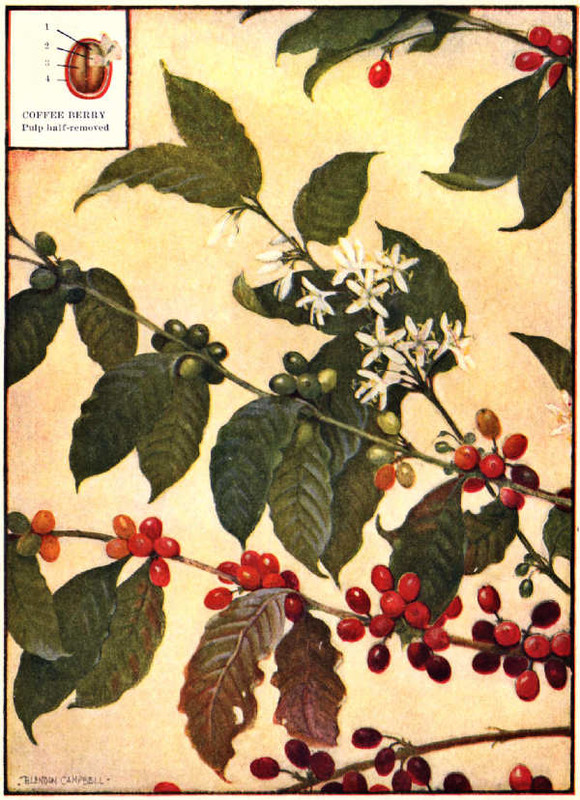
Showing the Berry in its Various Ripening Stages from Flower to Cherry
(Inset: 1, green bean; 2, silver skin; 3, parchment; 4, fruit pulp.)
Painted from life by Blendon Campbell
ALL ABOUT
COFFEE
By
WILLIAM H. UKERS, M.A.
Editor
THE TEA AND COFFEE TRADE JOURNAL
NEW YORK
THE TEA AND COFFEE TRADE JOURNAL COMPANY
1922
Copyright 1922
BY
THE TEA AND COFFEE TRADE JOURNAL COMPANY
New York
International Copyright Secured
All Rights Reserved in U.S.A. and
Foreign Countries
PRINTED IN U.S.A.
To My Wife
HELEN DE GRAFF UKERS
PREFACE
Seventeen years ago the author of this work made his first trip abroad to gather material for a book on coffee. Subsequently he spent a year in travel among the coffee-producing countries. After the initial surveys, correspondents were appointed to make researches in the principal European libraries and museums; and this phase of the work continued until April, 1922. Simultaneous researches were conducted in American libraries and historical museums up to the time of the return of the final proofs to the printer in June, 1922.
Ten years ago the sorting and classification of the material was begun. The actual writing of the manuscript has extended over four years.
Among the unique features of the book are the Coffee Thesaurus; the Coffee Chronology, containing 492 dates of historical importance; the Complete Reference Table of the Principal Kinds of Coffee Grown in the World; and the Coffee Bibliography, containing 1,380 references.
The most authoritative works on this subject have been Robinson's The Early History of Coffee Houses in England, published in London in 1893; and Jardin's Le Café, published in Paris in 1895. The author wishes to acknowledge his indebtedness to both for inspiration and guidance. Other works, Arabian, French, English, German, and Italian, dealing with particular phases of the subject, have been laid under contribution; and where this has been done, credit is given by footnote reference. In all cases where it has been possible to do so, however, statements of historical facts have been verified by independent research. Not a few items have required months of tracing to confirm or to disprove.
There has been no serious American work on coffee since Hewitt's Coffee: Its History, Cultivation and Uses, published in 1872; and Thurber's Coffee from Plantation to Cup, published in 1881. Both of these are now out of print, as is also Walsh's Coffee: Its History, Classification and Description, published in 1893.
The chapters on The Chemistry of Coffee and The Pharmacology of Coffee have been prepared under the author's direction by Charles W. Trigg, industrial fellow of the Mellon Institute of Industrial Research.
The author wishes to acknowledge, with thanks, valuable assistance and numerous courtesies by the officials of the following institutions:
British Museum, and Guildhall Museum, London; Bibliothéque Nationale, Paris; Congressional Library, Washington; New York Public Library, Metropolitan Museum of Art, and New York Historical Society, New York; Boston Public Library, and Boston Museum of Fine Arts; Smithsonian Institution, Washington; State Historical Museum, Madison, Wis.; Maine Historical Society, Portland; Chicago Historical Society; New Jersey Historical Society, Newark; Harvard University Library; Essex Institute, Salem, Mass.; Peabody Institute, Baltimore.
Thanks and appreciation are due also to:
Charles James Jackson, London, for permission to quote from his Illustrated History of English Plate;
Francis Hill Bigelow, author; and The Macmillan Company, publishers, for permission to reproduce illustrations from Historic Silver of the Colonies;
H.G. Dwight, author; and Charles Scribner's Sons, publishers, for permission to quote from Constantinople, Old and New, and from the article on "Turkish Coffee Houses" in Scribner's Magazine;
Walter G. Peter, Washington, D.C., for permission to photograph and reproduce pictures of articles in the Peter collection at the United States National Museum;
Mary P. Hamlin and George Arliss, authors, and George C. Tyler, producer, for permission to reproduce the Exchange coffee-house setting of the first act of Hamilton;
Judge A.T. Clearwater, Kingston N.Y.; R.T. Haines Halsey, and Francis P. Garvan, New York, for permission to publish pictures of historic silver coffee pots in their several collections;
The secretaries of the American Chambers of Commerce in London, Paris, and Berlin;
Charles Cooper, London, for his splendid co-operation and for his special contribution to chapter XXXV;
Alonzo H. De Graff, London, for his invaluable aid and unflagging zeal in directing the London researches;
To the Coffee Trade Association, London, for assistance rendered;
To G.J. Lethem, London, for his translations from the Arabic;
Geoffrey Sephton, Vienna, for his nice co-operation;
L.P. de Bussy of the Koloniaal Institute, Amsterdam, Holland, for assistance rendered;
Burton Holmes and Blendon R. Campbell, New York, for courtesies;
John Cotton Dana, Newark, N.J., for assistance rendered;
Charles H. Barnes, Medford, Mass., for permission to publish the photograph of Peregrine White's Mayflower mortar and pestle;
Andrew L. Winton, Ph.D., Wilton, Conn., for permission to quote from his The Microscopy of Vegetable Foods in the chapter on The Microscopy of Coffee and to reprint Prof. J. Moeller's and Tschirch and Oesterle's drawings;
F. Hulton Frankel, Ph.D., Edward M. Frankel, Ph.D., and Arno Viehoever, for their assistance in preparing the chapters on The Botany of Coffee and The Microscopy of Coffee;
A.L. Burns, New York, for his assistance in the correction and revision of chapters XXV, XXVI, XXVII, and XXXIV, and for much historical information supplied in connection with chapters XXX and XXXI;
Edward Aborn, New York, for his help in the revision of chapter XXXVI;
George W. Lawrence, former president, and T.S.B. Nielsen, president, of the New York Coffee and Sugar Exchange, for their assistance in the revision of chapter XXXI;
Helio Lobo, Brazilian consul general, New York; Sebastião Sampaio, commercial attaché of the Brazilian Embassy, Washington; and Th. Langgaard de Menezes, American representative of the Sociedade Promotora da Defeza do Café;
Felix Coste, secretary and manager, the National Coffee Roasters Association; and C.B. Stroud, superintendent, the New York Coffee and Sugar Exchange, for information supplied and assistance rendered in the revision of several chapters;
F.T. Holmes, New York, for his help in the compilation of chronological and descriptive data on coffee-roasting machinery;
Walter Chester, New York, for critical comments on chapter XXVIII.
The author is especially indebted to the following, who in many ways have contributed to the successful compilation of the Complete Reference Table in chapter XXIV, and of those chapters having to do with the early history and development of the green coffee and the wholesale coffee-roasting trades in the United States:
George S. Wright, Boston; A.E. Forbes, William Fisher, Gwynne Evans, Jerome J. Schotten, and the late Julius J. Schotten, St. Louis; James H. Taylor, William Bayne, Jr., A.J. Dannemiller, B.A. Livierato, S.A. Schonbrunn, Herbert Wilde, A.C. Fitzpatrick, Charles Meehan, Clarence Creighton, Abram Wakeman, A.H. Davies, Joshua Walker, Fred P. Gordon, Alex. H. Purcell, George W. Vanderhoef, Col. William P. Roome, W. Lee Simmonds, Herman Simmonds, W.H. Aborn, B. Lahey, John C. Loudon, J.R. Westfal, Abraham Reamer, R.C. Wilhelm, C.H. Stewart, and the late August Haeussler, New York; John D. Warfield, Ezra J. Warner, S.O. Blair, and George D. McLaughlin, Chicago; W.H. Harrison, James Heekin, and Charles Lewis, Cincinnati; Albro Blodgett and A.M. Woolson, Toledo; R.V. Engelhard and Lee G. Zinsmeister, Louisville; E.A. Kahl, San Francisco; S. Jackson, New Orleans; Lewis Sherman, Milwaukee; Howard F. Boardman, Hartford; A.H. Devers, Portland, Ore.; W. James Mahood, Pittsburgh; William B. Harris, East Orange, N.J.
New York, June 17, 1922.
FOREWORD
Some introductory remarks on the lure of coffee, its place in a rational dietary, its universal psychological appeal, its use and abuse
Civilization in its onward march has produced only three important non-alcoholic beverages—the extract of the tea plant, the extract of the cocoa bean, and the extract of the coffee bean.
Leaves and beans—these are the vegetable sources of the world's favorite non-alcoholic table-beverages. Of the two, the tea leaves lead in total amount consumed; the coffee beans are second; and the cocoa beans are a distant third, although advancing steadily. But in international commerce the coffee beans occupy a far more important position than either of the others, being imported into non-producing countries to twice the extent of the tea leaves. All three enjoy a world-wide consumption, although not to the same extent in every nation; but where either the coffee bean or the tea leaf has established itself in a given country, the other gets comparatively little attention, and usually has great difficulty in making any advance. The cocoa bean, on the other hand, has not risen to the position of popular favorite in any important consuming country, and so has not aroused the serious opposition of its two rivals.
Coffee is universal in its appeal. All nations do it homage. It has become recognized as a human necessity. It is no longer a luxury or an indulgence; it is a corollary of human energy and human efficiency. People love coffee because of its two-fold effect—the pleasurable sensation and the increased efficiency it produces.
Coffee has an important place in the rational dietary of all the civilized peoples of earth. It is a democratic beverage. Not only is it the drink of fashionable society, but it is also a favorite beverage of the men and women who do the world's work, whether they toil with brain or brawn. It has been acclaimed "the most grateful lubricant known to the human machine," and "the most delightful taste in all nature."
No "food drink" has ever encountered so much opposition as coffee. Given to the world by the church and dignified by the medical profession, nevertheless it has had to suffer from religious superstition and medical prejudice. During the thousand years of its development it has experienced fierce political opposition, stupid fiscal restrictions, unjust taxes, irksome duties; but, surviving all of these, it has triumphantly moved on to a foremost place in the catalog of popular beverages.
But coffee is something more than a beverage. It is one of the world's greatest adjuvant foods. There are other auxiliary foods, but none that excels it for palatability and comforting effects, the psychology of which is to be found in its unique flavor and aroma.
Men and women drink coffee because it adds to their sense of well-being. It not only smells good and tastes good to all mankind, heathen or civilized, but all respond to its wonderful stimulating properties. The chief factors in coffee goodness are the caffein content and the caffeol. Caffein supplies the principal stimulant. It increases the capacity for muscular and mental work without harmful reaction. The caffeol supplies the flavor and the aroma—that indescribable Oriental fragrance that wooes us through the nostrils, forming one of the principal elements that make up the lure of coffee. There are several other constituents, including certain innocuous so-called caffetannic acids, that, in combination with the caffeol, give the beverage its rare gustatory appeal.
The year 1919 awarded coffee one of its brightest honors. An American general said that coffee shared with bread and bacon the distinction of being one of the three nutritive essentials that helped win the World War for the Allies. So this symbol of human brotherhood has played a not inconspicuous part in "making the world safe for democracy." The new age, ushered in by the Peace of Versailles and the Washington Conference, has for its hand-maidens temperance and self-control. It is to be a world democracy of right-living and clear thinking; and among its most precious adjuncts are coffee, tea, and cocoa—because these beverages must always be associated with rational living, with greater comfort, and with better cheer.
Like all good things in life, the drinking of coffee may be abused. Indeed, those having an idiosyncratic susceptibility to alkaloids should be temperate in the use of tea, coffee, or cocoa. In every high-tensioned country there is likely to be a small number of people who, because of certain individual characteristics, can not drink coffee at all. These belong to the abnormal minority of the human family. Some people can not eat strawberries; but that would not be a valid reason for a general condemnation of strawberries. One may be poisoned, says Thomas A. Edison, from too much food. Horace Fletcher was certain that over-feeding causes all our ills. Over-indulgence in meat is likely to spell trouble for the strongest of us. Coffee is, perhaps, less often abused than wrongly accused. It all depends. A little more tolerance!
Trading upon the credulity of the hypochondriac and the caffein-sensitive, in recent years there has appeared in America and abroad a curious collection of so-called coffee substitutes. They are "neither fish nor flesh, nor good red herring." Most of them have been shown by official government analyses to be sadly deficient in food value—their only alleged virtue. One of our contemporary attackers of the national beverage bewails the fact that no palatable hot drink has been found to take the place of coffee. The reason is not hard to find. There can be no substitute for coffee. Dr. Harvey W. Wiley has ably summed up the matter by saying, "A substitute should be able to perform the functions of its principal. A substitute to a war must be able to fight. A bounty-jumper is not a substitute."
It has been the aim of the author to tell the whole coffee story for the general reader, yet with the technical accuracy that will make it valuable to the trade. The book is designed to be a work of useful reference covering all the salient points of coffee's origin, cultivation, preparation, and development, its place in the world's commerce and in a rational dietary.
Good coffee, carefully roasted and properly brewed, produces a natural beverage that, for tonic effect, can not be surpassed, even by its rivals, tea and cocoa. Here is a drink that ninety-seven percent of individuals find harmless and wholesome, and without which life would be drab indeed—a pure, safe, and helpful stimulant compounded in nature's own laboratory, and one of the chief joys of life!
CONTENTS
A COFFEE THESAURUS
Encomiums and descriptive phrases applied to the plant, the berry, and the beverage Page XXVII
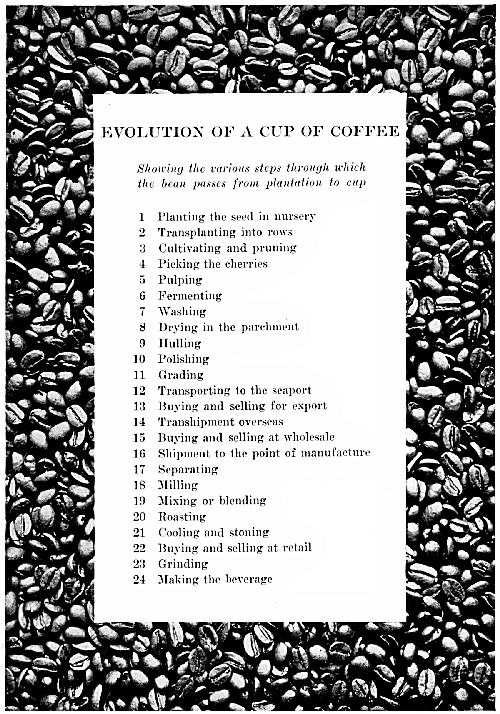
THE EVOLUTION OF A CUP OF COFFEE
Showing the various steps through which the bean passes from plantation to cup Page XXIX
CHAPTER I
Dealling with the Etymology of Coffee
Origin and translation of the word from the Arabian into various languages—Views of many writers Page 1
CHAPTER II
History of Coffee Propagation
A brief account of the cultivation of the coffee plant in the Old World, and of its introduction into the New—A romantic coffee adventure Page 5
CHAPTER III
Early History of Coffee Drinking
Coffee in the Near East in the early centuries—Stories of its origin—Discovery by physicians and adoption by the Church—Its spread through Arabia, Persia, and Turkey—Persecutions and Intolerances—Early coffee manners and customs Page 11
CHAPTER IV
Introduction of Coffee into Western Europe
When the three great temperance beverages, cocoa, tea, and coffee, came to Europe—Coffee first mentioned by Rauwolf in 1582—Early days of coffee in Italy—How Pope Clement VIII baptized it and made it a truly Christian beverage—The first European coffee house, in Venice, 1645—The famous Caffè Florian—Other celebrated Venetian coffee houses of the eighteenth century—The romantic story of Pedrocchi, the poor lemonade-vender, who built the most beautiful coffee house in the world Page 25
CHAPTER V
The Beginnings of Coffee in France
What French travelers did for coffee—the introduction of coffee by P. de la Roque into Marseilles in 1644—The first commercial importation of coffee from Egypt—The first French coffee house—Failure of the attempt by physicians of Marseilles to discredit coffee—Soliman Aga introduces coffee into Paris—Cabarets à caffè—Celebrated works on coffee by French writers Page 31
CHAPTER VI
The Introduction of Coffee into England
The first printed reference to coffee in English—Early mention of coffee by noted English travelers and writers—The Lacedæmonian "black broth" controversy—How Conopios introduced coffee drinking at Oxford—The first English coffee house in Oxford—Two English botanists on coffee Page 35
CHAPTER VII
The Introduction of Coffee into Holland
How the enterprising Dutch traders captured the first world's market for coffee—Activities of the Netherlands East India Company—The first coffee house at the Hague—The first public auction at Amsterdam in 1711, when Java coffee brought forty-seven cents a pound, green Page 43
CHAPTER VIII
The Introduction of Coffee into Germany
The contributions made by German travelers and writers to the literature of the early history of coffee—The first coffee house in Hamburg opened by an English merchant—Famous coffee houses of old Berlin—The first coffee periodical and the first kaffee-klatsch—Frederick the Great's coffee roasting monopoly—Coffee persecutions—"Coffee-smellers"—The first coffee king Page 45
CHAPTER IX
Telling How Coffee Came to Vienna
The romantic adventure of Franz George Kolschitzky, who carried "a message to Garcia" through the enemy's lines and won for himself the honor of being the first to teach the Viennese the art of making coffee, to say nothing of falling heir to the supplies of the green beans left behind by the Turks; also the gift of a house from a grateful municipality, and a statue after death—Affectionate regard in which "Brother-heart" Kolschitzky is held as the patron saint of the Vienna Kaffee-sieder—Life in the early Vienna café's Page 49
CHAPTER X
The Coffee Houses of Old London
One of the most picturesque chapters in the history of coffee—The first coffee house in London—The first coffee handbill, and the first newspaper advertisement for coffee—Strange coffee mixtures—Fantastic coffee claims—Coffee prices and coffee licenses—Coffee club of the Rota—Early coffee-house manners and customs—Coffee-house keepers' tokens—Opposition to the coffee house—"Penny universities"—Weird coffee substitutes—The proposed coffee-house newspaper monopoly—Evolution of the club—Decline and fall of the coffee house—Pen pictures of coffee-house life—Famous coffee houses of the seventeenth and eighteenth centuries—Some Old World pleasure gardens—Locating the notable coffee houses Page 53
CHAPTER XI
History of the Early Parisian Coffee Houses
The introduction of coffee into Paris by Thévenot in 1657—How Soliman Aga established the custom of coffee drinking at the court of Louis XIV—Opening of the first coffee houses—How the French adaptation of the Oriental coffee house first appeared in the real French café of François Procope—Important part played by the coffee houses in the development of French literature and the stage—Their association with the Revolution and the founding of the Republic—Quaint customs and patrons—Historic Parisian café's Page 91
CHAPTER XII
Introduction of Coffee into North America
Captain John Smith, founder of the Colony of Virginia, is the first to bring to North America a knowledge of coffee in 1607—The coffee grinder on the Mayflower—Coffee drinking in 1668—William Penn's coffee purchase in 1683—Coffee in colonial New England—The psychology of the Boston "tea party," and why the United States became a nation of coffee drinkers instead of tea drinkers, like England—The first coffee license to Dorothy Jones in 1670—The first coffee house in New England—Notable coffee houses of old Boston—A skyscraper coffee-house Page 105
CHAPTER XIII
History of Coffee in Old New York
The burghers of New Amsterdam begin to substitute coffee for "must," or beer, for breakfast in 1668—William Penn makes his first purchase of coffee in the green bean from New York merchants in 1683—The King's Arms, the first coffee house—The historic Merchants, sometimes called the "Birthplace of our Union"—The coffee house as a civic forum—The Exchange, Whitehall, Burns, Tontine, and other celebrated coffee houses—The Vauxhall and Ranelagh pleasure gardens Page 115
CHAPTER XIV
Coffee Houses of Old Philadelphia
Ye Coffee House, Philadelphia's first coffee house, opened about 1700—The two London coffee houses—The City tavern, or Merchants coffee house—How these, and other celebrated resorts, dominated the social, political, and business life of the Quaker City in the eighteenth century Page 125
CHAPTER XV
The Botany of the Coffee Plant
Its complete classification by class, sub-class, order, family, genus, and species—How the Coffea arabica grows, flowers, and bears—Other species and hybrids described—Natural caffein-free coffee—Fungoid diseases of coffee Page 131
CHAPTER XVI
The Microscopy of the Coffee Fruit
How the beans may be examined under the microscope, and what is revealed—Structure of the berry, the green, and the roasted beans—The coffee-leaf disease under the microscope—Value of microscopic analysis in detecting adulteration Page 149
CHAPTER XVII
The Chemistry of the Coffee Bean
By Charles W. Trigg.
Chemistry of the preparation and treatment of the green bean—Artificial aging—Renovating damaged coffees—Extracts—"Caffetannic acid"—Caffein, caffein-free coffee—Caffeol—Fats and oils—Carbohydrates—Roasting—Scientific aspects of grinding and packaging—The coffee brew—Soluble coffee—Adulterants and substitutes—Official methods of analysis Page 155
CHAPTER XVIII
Pharmacology of the Coffee Drink
By Charles W. Trigg
General physiological action—Effect on children—Effect on longevity—Behavior in the alimentary régime—Place in dietary—Action on bacteria—Use in medicine—Physiological action of "caffetannic acid"—Of caffeol—Of caffein—Effect of caffein on mental and motor efficiency—Conclusions Page 174
CHAPTER XIX
The Commercial Coffees of the World
The geographical distribution of the coffees grown in North America, Central America, South America, the West India Islands, Asia, Africa, the Pacific Islands, and the East Indies—A statistical study of the distribution of the principal kinds—A commercial coffee chart of the world's leading growths, with market names and general trade characteristics Page 189
CHAPTER XX
Cultivation of the Coffee Plant
The early days of coffee culture in Abyssinia and Arabia—Coffee cultivation in general—Soil, climate, rainfall, altitude, propagation, preparing the plantation, shade, wind breaks, fertilizing, pruning, catch crops, pests, and diseases—How coffee is grown around the world—Cultivation in all the principal producing countries Page 197
CHAPTER XXI
Preparing Green Coffee for Market
Early Arabian methods of preparation—How primitive devices were replaced by modern methods—A chronological story of the development of scientific plantation machinery, and the part played by English and American inventors—The marvelous coffee package, one of the most ingenious in all nature—How coffee is harvested—Picking—Preparation by the dry and the wet methods—Pulping—Fermentation and washing—Drying—Hulling, or peeling, and polishing—Sizing, or grading—Preparation methods of different countries Page 245
CHAPTER XXII
The Production and Consumption of Coffee
A statistical study of world production of coffee by countries—Per capita figures of the leading consuming countries—Coffee-consumption figures compared with tea-consumption figures in the United States and the United Kingdom—Three centuries of coffee trading—Coffee drinking in the United States, past and present—Reviewing the 1921 trade in the United States Page 273
CHAPTER XXIII
How Green Coffees Are Bought and Sold
Buying coffee in the producing countries—Transporting coffee to the consuming markets—Some record coffee cargoes shipped to the United States—Transport over seas—Java coffee "ex-sailing vessels"—Handling coffee at New York, New Orleans, and San Francisco—The coffee exchanges of Europe and the United States—Commission men and brokers—Trade and exchange contracts for delivery—Important rulings affecting coffee trading—Some well-known green coffee marks Page 303
CHAPTER XXIV
Green and Roasted Coffee Characteristics
The trade values, bean characteristics, and cup merits of the leading coffees of commerce, with a "Complete Reference Table of the Principal Kinds of Coffee Grown in the World"—Appearance, aroma, and flavor in cup-testing—How experts test coffee—A typical sample-roasting and cup-testing outfit Page 341
CHAPTER XXV
Factory Preparation of Roasted Coffee
Coffee roasting as a business—Wholesale coffee-roasting machinery—Separating, milling, and mixing or blending green coffee, and roasting by coal, coke, gas, and electricity—Facts about coffee roasting—Cost of roasting—Green-coffee shrinkage table—"Dry" and "wet" roasts—On roasting coffee efficiently—A typical coal roaster—Cooling and stoning—Finishing or glazing—Blending roasted coffees—Blends for restaurants—Grinding and packaging—Coffee additions and fillers—Treated coffees, and dry extracts Page 379
CHAPTER XXVI
Wholesale Merchandising of Coffee
How coffees are sold at wholesale—The wholesale salesman's place in merchandising—Some coffee costs analyzed—Handy coffee-selling chart—Terms and credits—About package coffees—Various types of coffee containers—Coffee package labels—Coffee package economies—Practical grocer helps—Coffee sampling—Premium method of sales promotion Page 407
CHAPTER XXVII
Retail Merchandising of Roasted Coffee
How coffees are sold at retail—The place of the grocer, the tea and coffee dealer, the chain store, and the wagon-route distributer in the scheme of distribution—Starting in the retail coffee business—Small roasters for retail dealers—Model coffee departments—Creating a coffee trade—Meeting competition—Splitting nickels—Figuring costs and profits—A credit policy for retailers—Premiums Page 415
CHAPTER XXVIII
A Short History of Coffee Advertising
Early coffee advertising—The first coffee advertisement in 1587 was frank propaganda for the legitimate use of coffee—The first printed advertisement in English—The first newspaper advertisement—Early advertisements in colonial America—Evolution of advertising—Package coffee advertising—Advertising to the trade—Advertising by means of newspapers, magazines, billboards, electric signs, motion pictures, demonstrations, and by samples—Advertising for retailers—Advertising by government propaganda—The Joint Coffee Trade publicity campaign in the United States—Coffee advertising efficiency Page 431
CHAPTER XXIX
The Coffee Trade in the United States
The coffee business started by Dorothy Jones of Boston—Some early sales—Taxes imposed by Congress in war and peace—The first coffee-plantation-machine, coffee-roaster, coffee-grinder, and coffee-pot patents—Early trade marks for coffee—Beginnings of the coffee urn, the coffee container, and the soluble-coffee business—Chronological record of the most important events in the history of the trade from the eighteenth century to the twentieth Page 467
CHAPTER XXX
Development of the Green and Roasted Coffee Business in the United States
A brief history of the growth of coffee trading—Notable firms and personalities that have played important parts in green coffee in the principal coffee centers—Green coffee trade organizations—Growth of the wholesale coffee-roasting trade, and names of those who have made history in it—The National Coffee Roasters Association—Statistics of distribution of coffee-roasting establishments in the United States Page 475
CHAPTER XXXI
Some Big Men and Notable Achievements
B.G. Arnold, the first, and Hermann Sielcken, the last of the American "coffee kings"—John Arbuckle, the original package-coffee man—Jabez Burns, the man who revolutionized the roasted-coffee business by his contributions as inventor, manufacturer, and writer—Coffee trade booms and panics—Brazil's first valorization enterprise—War-time government control of coffee—The story of soluble coffee Page 517
CHAPTER XXXII
A History of Coffee in Literature
The romance of coffee, and its influence on the discourse, poetry, history, drama, philosophic writing, and fiction of the seventeenth and eighteenth centuries and on the writers of today—Coffee quips and anecdotes Page 541
CHAPTER XXXIII
Coffee in Relation to the Fine Arts
How coffee and coffee drinking have been celebrated in painting, engraving, sculpture, caricature, lithography, and music—Epics, rhapsodies, and cantatas in praise of coffee—Beautiful specimens of the art of the potter and the silversmith as shown in the coffee service of various periods in the world's history—Some historical relics Page 587
CHAPTER XXXIV
The Evolution of Coffee Apparatus
Showing the development of coffee-roasting, coffee-grinding, coffee-making, and coffee-serving devices from the earliest time to the present day—The original coffee grinder, the first coffee roaster, and the first coffee pot—The original French drip pot, the De Belloy percolator—Count Rumford's improvement—How the commercial coffee roaster was developed—The evolution of filtration devices—The old Carter "pull-out" roaster—Trade customs in New York and St. Louis in the sixties and seventies—The story of the evolution of the Burns roaster—How the gas roaster was developed in France, Great Britain, and the United States Page 615
CHAPTER XXXV
World's Coffee Manners and Customs
How coffee is roasted, prepared, and served in all the leading civilized countries—The Arabian coffee ceremony—The present-day coffee houses of Turkey—Twentieth century improvements in Europe and the United States Page 655
CHAPTER XXXVI
Preparation of the Universal Beverage
The evolution of grinding and brewing methods—Coffee was first a food, then a wine, a medicine, a devotional refreshment, a confection, and finally a beverage—Brewing by boiling, infusion, percolation, and filtration—Coffee making in Europe in the nineteenth century—Early coffee making in the United States—Latest developments in better coffee making—Various aspects of scientific coffee brewing—Advice to coffee lovers on how to buy coffee, and how to make it in perfection Page 693
A COFFEE CHRONOLOGY
Giving dates and events of historical interest in legend, travel, literature, cultivation, plantation treatment, trading, and in the preparation and use of coffee from the earliest time to the present Page 725
A COFFEE BIBLIOGRAPHY
A list of references gathered from the principal general and scientific libraries—Arranged in alphabetic order of topics Page 738
INDEX
Page 769
ILLUSTRATIONS
Color Plates Facing page Coffee branches, flowers, and fruit (painted by Blendon Campbell) Frontispiecev
Coffea arabica; leaves, flowers, and fruit (painted by M.E. Eaton)1
The coffee tree bears fruit, leaf, and blossom at the same time16
A close-up of ripe coffee berries32
Coffee under the Stars and Stripes144
Coffee scenes in British India160
Picking and sacking coffee in Brazil176
Mild-coffee culture and preparation192
Coffee scenes in Java200
Coffee scenes in Sumatra216
Coffee preparation in Central and South America248
Typical coffee scenes in Costa Rica336
Principal varieties of green-coffee beans, natural size and color352
Coal-roasting plant, New York408
Coffee scenes in the Near and Far East544
Primitive transportation methods, Arabia640
Hulling coffee in Aden, Arabia656
Black and White Illustrations
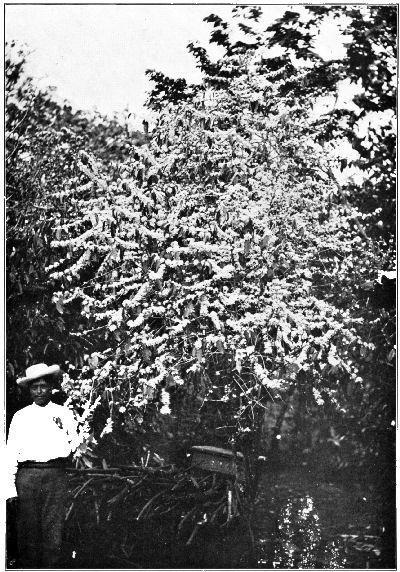
Page Coffee tree in flower4
De Clieu and his coffee plant7
Legendary discovery of coffee drink10
Title page of Dufour's book13
Frontispiece from Dufour's book15
Turkish coffee house, 17th century21
Serving coffee to a guest, Arabia23
First printed reference to coffee24
An 18th-century Italian coffee house26
Nobility in an early Venetian café27
Goldoni in a Venetian coffee house28
Florian's famous coffee house29
Title page of La Roque's work32
Coffee tree as pictured by La Roque32
Coffee branch in La Roque's work33
First printed reference in English37
Reference in Sherley's travels39
References in Biddulph's travels40
Mol's coffee house at Exeter41
Reference in Sandys' travels42
Richter's coffee house, Leipsic46
Coffee house, Germany, 17th century47
Kolschitzky in his Blue Bottle coffee house48
First coffee house in Leopoldstadt50
Statue of Kolschitzky51
First advertisement for coffee55
First newspaper advertisement57
Coffee house, time of Charles II60
London coffee house, 17th century61
Coffee house, Queen Anne's time62
Coffee-house keepers' tokens (plate 1)63
A broadside of 166364
Coffee-house keepers' tokens (plate 2)65
A broadside of 166768
A broadside of 167070
A broadside of 167270
A broadside of 167471
White's and Brooke's coffee houses78
London coffee-house politicians78
Great Fair on the frozen Thames79
Lion's head at Button's80
Trio of notables at Button's81
Vauxhall Gardens on a gala night82
Rotunda in Ranelagh Gardens83
Garraway's coffee house84
Button's coffee house84
Slaughter's coffee house85
Tom's coffee house85
Lloyd's coffee house86
Dick's coffee house87
Grecian coffee house87
Don Saltero's coffee house88
British coffee house88
French coffee house in London89
Ramponaux' Royal Drummer café90
La Foire St.-Germain92
Street coffee vender of Paris92
Armenian decorations in Paris café93
Corner of historic Café de Procope93
Café de Procope, Paris95
Cashier's desk in coffee house, Paris96
Café Foy97
Café des Mille Colonnes99
Café de Paris101
Interior of a typical Parisian café103
Chess at the Café de la Régence104
Types of colonial coffee roasters106
Early family coffee roaster106
Historic relics, early New England107
Mayflower "coffee grinder"108
Crown coffee house, Boston108
Coffee devices, Massachusetts colony109
Coffee devices of western pioneers110
Coffee pots of colonial days110
Green Dragon tavern, Boston111
Metal coffee pots, New York colony112
Exchange coffee house, Boston113
President-elect Washington's official welcome at Merchants Coffee House114
King's Arms coffee house, New York116
Burns coffee house117
Merchants coffee house119
Tontine coffee house121
Tontine building of 1850122
Niblo's Garden122
Coffee relics, Dutch New York122
New York's Vauxhall Garden of 1803123
Tavern and grocers' signs, old New York124
Second London coffee house, Philadelphia127
Selling slaves, old London coffee house128
City tavern, Philadelphia129
Coffee-house scene in "Hamilton"130
Coffee tree, flowers and fruit132
Germination of the coffee plant133
Brazil coffee plantation in flower134
Coffea arabica, Porto Rico135
Coffea arabica, flower and fruit, Costa Rica135
Young Coffea arabica, Kona, Hawaii136
Survivors of first Liberian trees in Java136
Coffea arabica in flower, Java137
Liberian coffee tree, Lamoa, P.I.138
Coffea congensis, 21⁄2 years old138
Flowering of 5-year-old Coffea excelsa139
Branches of Coffea excelsa140
Coffea stenophylla140
Near view of Coffea arabica berries141
Wild caffein-free coffee tree142
Coffee bean characteristics142
Coffea arabica berries143
Robusta coffee in flower144
One-year-old robusta estate145
Coffea Quillou flowers146
Quillou coffee tree in blossom147
Coffea Ugandæ148
Coffea arabica under the microscope149
Cross-section of coffee bean150
Cross-section of hull and bean150
Epicarp and pericarp under microscope151
Endocarp and endosperm under microscope152
Spermoderm under microscope152
Tissues of embryo under microscope152
Coffee-leaf disease under microscope153
Green and roasted coffee under microscope153
Green and roasted Bogota under microscope154
Cross-section of endosperm156
Portion of the investing membrane157
Structure of the green bean157
Ground coffee under microscope167
Coffee tree in bearing, Lamoa, P.I.196
Early coffee implements198
Cross-section of mountain slope, Yemen198
First steps in coffee-growing199
Coffee nursery, Guatemala200
Coffee under shade, Porto Rico201
Boekit Gompong estate, Sumatra202
Estate in Antioquia, Colombia203
Weeding and harrowing, São Paulo204
Fazenda Dumont, São Paulo205
Fazenda Guatapara, São Paulo206
Picking coffee, São Paulo207
Intensive cultivation, São Paulo207
Private railroad, São Paulo208
Coffee culture in São Paulo209
Heavily laden coffee tree, Bogota210
Picking coffee, Bogota211
Altamira Hacienda, Venezuela212
Carmen Hacienda, Venezuela213
Heavy fruiting, Coffea robusta, Java214
Road through coffee estate, Java215
Native picking coffee, Sumatra216
Administrator's bungalow, Java216
Administrator's bungalow, Sumatra217
Coffee culture in Guatemala218
Indians picking coffee, Guatemala219
Bungalow, coffee estate, Guatemala220
Thirty-year-old coffee trees, Mexico221
Mexican coffee picker222
Receiving coffee, Mexico223
Heavily laden coffee tree, Porto Rico224
Coffee cultivation, Costa Rica225
Picking Costa Rica coffee226
Mountain coffee estate, Costa Rica226
Mysore coffee estate227
Coffee growing under shade, India228
Coffee estate at Harar229
Wild coffee near Adis Abeba231
Mocha coffee growing on terraces232
Picking Blue Mountain berries, Jamaica233
Coffee pickers, Guadeloupe234
Coffee in blossom, Panama235
Robusta coffee, Cochin-China237
Bourbon trees, French Indo-China238
Picking coffee in Queensland239
Coffee in bloom, Kona, Hawaii240
Coffee at Hamakua, Hawaii241
Coffee trees, South Kona, Hawaii242
Plantation near Sagada, P.I.243
Coffee preparation, São Paulo244
Walker's original disk pulper246
Early English coffee peeler246
Group of English cylinder pulpers
247
Copper covers for pulper cylinders248
Granada unpulped coffee separator249
Hand-power double-disk pulper249
Tandem coffee pulper250
Horizontal coffee washer251
Vertical coffee washer251
Cobán pulper, Venezuela252
Niagara power coffee huller252
British and American coffee driers253
American Guardiola drier254
Smout peeler and polisher254
Smout peeler and polisher, exposed255
O'Krassa's coffee drier255
Six well-known hullers and separators256
El Monarca coffee classifier257
Hydro-electric installation, Guatemala258
Preparing Brazil coffee for market259
Working coffee on the drying flats260
Fermenting and washing tanks, São Paulo260
Drying grounds, Fazenda Schmidt261
Preparing Colombian coffee for market262
Old-fashioned ox-power huller263
Street-car coffee transport, Orizaba264
Coffee on drying floors, Porto Rico264
Sun-drying coffee265
Drying patio, Costa Rica266
Early Guardiola steam drier266
Indian women cleaning Mocha coffee267
Cleaning-and-grading machinery, Aden268
Drying coffee at Harar269
Preparing Java coffee for market270
Coffee transport in Java271
Meeting of Amsterdam coffee brokers, 1820291
Bill of public sale of coffee, 1790292
Last sample before export, Santos304
Stamping bags for export304
Preparing Brazil coffee for export305
Grading coffee at Santos306
The test by the cups, Santos306
New York importers' warehouse, Santos307
Pack-mule transport in Venezuela308
Coffee-carrying cart, Guatemala308
Pack-oxen fording stream, Colombia308
Coffee transport, Mexico and South America309
Donkey coffee-transport at Harar310
Coffee camels at Harar310
Selling coffee by tapping hands, Aden310
Packing and transporting coffee, Aden311
Coffee camel train at Hodeida312
Methods of loading coffee, Santos313
Coffee freighter, Cauca River, Colombia314
Coffee steamers on the Magdalena314
Loading heavy cargo on Santa Cecilia315
Unloading Java coffee from sailing vessel317
Receiving piers for coffee, New York318
Unloading coffee, covered pier, New York319
Receiving and storing coffee, New York320
Tester at work, Bush Terminal, New York321
Loading lighters, Bush Docks, Brooklyn321
New Terminal system on Staten Island322
Motor tractor, Bush piers322
Unloading with modern conveyor323
Coffee handling, New Orleans piers324
Coffee in steel-covered sheds, New Orleans325
Unloading and storing coffee, San Francisco326
Modern device for handling green coffee327
Handling green coffee at European ports328
New York Coffee and Sugar Exchange329
Coffee section, Coffee and Sugar Exchange330
Blackboards, Coffee Exchange331
"Coffee afloat" blackboard332
Well known green-coffee marks339
Bourbon-Santos beans, roasted343
Flat and Bourbon-Santos beans, roasted343
Rio beans, roasted343
Mexican beans, roasted347
Guatemala beans, roasted347
Bogota (Colombia) beans, roasted348
Maracaibo beans, roasted349
Mocha beans, roasted351
Washed Java beans, roasted353
Sample-roasting and cup-testing outfit357
Modern gas coffee-roasting plant380
Sixteen-cylinder coal roasting plant382
Green-coffee separating and milling machines384
English gas coffee-roasting plant385
German gas coffee-roasting plant386
French gas coffee-roasting plant387
Jumbo coffee roaster, Arbuckle plant388
Roasting plant of Reid, Murdoch & Co.389
Complete gas coffee-plant installation390
Burns Jubilee gas roaster391
Burns coal roaster392
Open perforated cylinder with flexible back head392
Trying the roast394
Monitor gas roaster394
A group of roasting-room accessories394
Dumping the roast395
A four-bag coffee finisher396
Burns sample-coffee roaster396
Lambert coal coffee-roasting outfit397
Coles No. 22 grinding mill398
Monitor coffee-granulating machine398
Challenge pulverizer398
Burns No. 12 grinding mill399
Monitor steel-cut grinder, separator, etc399
Johnson carton-filling, weighing, and sealing machine400
Ideal steel-cut mill400
Smyser package-making and filling machine401
Automatic coffee-packing machine402
Complete coffee-cartoning outfit403
Automatic coffee-weighing machines404
Units in manufacture of soluble coffee405
Types of coffee containers411
Fresh-roasted-coffee idea in retailing414
Premium tea and coffee dealer's display416
Chain-store interior417
Familiar A & P store front418
Specialist idea in coffee merchandising419
Monitor gas roaster, cooler, and stoner420
Royal gas coffee roaster for retailers420
Burns half-bag roaster, cooler, and stoner421
Lambert Jr. roasting outfit for retailers421
Faulder and Simplex gas roasters422
Coffee roasters used in Paris shops423
Small German roasters424
Popular French retail roaster424
Uno cabinet gas roaster and cooler424
Educational window exhibit425
Better-class American grocery, interior426
Prize-winning window display427
Americanized English grocer's shop429
Famous package coffees430
First coffee advertisement in U.S.433
Coffee advertisement of 1790434
First colored handbill for package coffee435
Reverse side of colored handbill435
St. Louis handbill of 1854436
Advertising-card copy, 1873437
Handbill copy of the seventies437
Box-end sticker, 1833438
Chase & Sanborn advertisement, 1888438
A Goldberg cartoon, 1910439
Copy used by Chase & Sanborn, 1900439
An effective cut-out442
How coffee is advertised to the trade443
Joint Coffee Trade Publicity Committee447
Magazine and newspaper copy, 1919449
Copy that stressed helpfulness of coffee, 1919–20
450
Joint Committee's house organ451
Introductory medical-journal copy451
Telling the doctors the truth, 1920452
Joint Committee's attractive booklets453
More medical journal copy, 1920454
Magazine and newspaper copy, 1921455
Educating the doctor, 1922456
Magazine and newspaper copy, 1922457
Specimen of early Yuban copy459
Historical association in advertising459
Package coffee advertising in 1922460
The social distinction argument461
Drawing upon history for atmosphere461
An impressive electric sign, Chicago462
How coffee is advertised outdoors463
Attractive car cards, spring of 1922464
Effective iced-coffee copy465
European advertising novelty, New York465
Coenties Slip, in days of sailing vessels466
First U.S. coffee-grinder patent469
Carter's Pull-out roaster patent469
First registered trade mark for coffee470
Original Arbuckle coffee packages471
Merchants coffee house tablet473
Departed dominant figures in New York green coffee trade476
"Their association with New York green coffee trade dates back nearly fifty years"477
Green coffee trade-builders who have passed on478
"Their race is run, their course is done"479
112 Front Street, New York, 1879480
At 87 Wall Street, New York, years ago480
Wall and Front Streets, New York, 1922481
Front Street, New York, 1922483
In the New Orleans coffee district486
Green coffee district, New Orleans487
California Street, San Francisco488
San Francisco's coffee district489
Pioneer coffee roasters, New York City493
Oldtime New York coffee roasters495
Pioneer coffee roasters of the North and East, U.S.500
Pioneer coffee roasters of the South and West, U.S.504
Ground coffee price list of 1862507
Organization convention, N.C.R.A., 1911510
Former presidents, N.C.R.A.512
Earliest coffee manuscript540
Song from "The Coffee House"555
Dr. Johnson's seat, the Cheshire Cheese567
Original coffee room, old Cock Tavern568
Morning gossip in the coffee room569
"His Warmest Welcome at an Inn"571
Alexander Pope at Button's, 1730577
Dutch coffee house, 1650 (by Van Ostade)586
White's coffee house, 1733 (by Hogarth)588
Tom King's, 1738 (by Hogarth)589
Petit Déjeuner (by Boucher)590
Coffee service in the home of Madame de Pompadour (by Van Loo)590
Madame Du Barry (by Decreuse)591
Coffee house at Cairo (by Gérôme)592
Kaffeebesuch (by Philippi)593
Coffee comes to the aid of the Muse (by Ruffio)593
Mad dog in a coffee house (by Rowlandson)594
Napoleon and the Curé (by Charlet)595
Coffee, a chanson (music by Colet)596
Statue of Kolschitzky597
Betty's Aria, Bach's coffee cantata598
Café Pedrocchi, Padua599
Coffee grinder set with jewels600
Italian wrought-iron coffee roaster600
Seventeenth-century tea and coffee pots601
Lantern coffee pot, 1692602
Folkingham pot, 1715–16602
Wastell pot, 1720–21603
Dish of coffee-boy design, 1692603
Chinese porcelain coffee pot604
Silver coffee pots, early 18th century604
Silver coffee pots, 18th century605
Pottery and porcelain pots606
Silver coffee pots, late 18th century607
Porcelain pots, Metropolitan Museum608
Vienna coffee pot, 1830609
Spanish coffee pot, 18th century609
Silver coffee pots in American collections610
Coffee pot by Win. Shaw and Wm. Priest611
Pot of Sheffield plate, 18th century611
Pot by Ephraim Brasher611
French silver coffee pot612
Green Dragon tavern coffee urn612
Coffee pots by American silversmiths613
Twentieth-century American coffee service613
Turkish coffee set, Peter collection614
Oldest coffee grinder616
Grain mill used by Greeks and Romans616
First coffee roaster616
First cylinder roaster, 1650616
Historical relics, U.S. National Museum617
Turkish coffee mill618
Early French wall and table grinders618
Bronze and brass mortars, 17th century619
Early American coffee roasters619
Roaster with three-sided hood620
Roasting, making, and serving devices, 17th century620
English and French coffee grinders621
Eighteenth-century roaster621
Original French drip pot621
Belgian, Russian, and French pewter pots622
17th and 18th century pewter pots623
Count Rumford's percolator623
Drawings of early French coffee makers624
Early French filtration devices624
Early American coffee-maker patents625
French coffee makers, 19th century625
First English commercial roaster patent626
Early French coffee-roasting machines627
Battery of Carter pull-out machines628
Early English and American roasters630
Early Foreign and American coffee-making devices632
Dakin roasting machine of 1848633
Globe stove roaster of 1860634
Hyde's combined roaster and stove634
Original Burns roaster, 1864635
Burns granulating mill, 1872–74636
Napier's vacuum machine637
German gas and coal roasting machines638
Other German coffee roasters639
Original Enterprise mill640
Max Thurmer's quick gas roaster640
An English gas coffee-roasting plant641
French globular roaster642
Sirocco machine (French)642
English roasting and grinding equipment643
Magic gas machine (French)644
Burns Jubilee gas machine644
Double gas roasting outfit (French)645
Lambert's Victory gas machine646
One of the first electric mills647
English electric-fuel roaster648
Ben Franklin electric coffee roaster648
Enterprise hand store mill649
Latest types electric store mills650
Italian rapid coffee-making machines651
Working of Italian rapid machines652
La Victoria Arduino Mignonne652
N.C.R.A. Home coffee mill653
Manthey-Zorn rapid infuser and dispenser653
Tricolette, single-cup filter device654
Moorish coffee house in Algiers656
Coffee house in Cairo656
Coffee service in Cairo barber shop657
Coffee-laden camels, Arabia658
Arabian coffee house658
Mahommedan brewing coffee for guest659
Native café, Harar661
Early coffee, tea, and chocolate service661
Nubian slave girl with coffee service662
Persian coffee service, 1737663
In a Turkish coffee house664
Roasting coffee outside a Turkish café664
Turkish caffinet, early 19th century665
Coffee-making in Turkey666
Street coffee vender in the Levant666
A coffee house in Syria667
Cafetan—garb of oriental café-keeper668
Street coffee service in Constantinople668
Riverside café in Damascus669
Coffee al fresco in Jerusalem671
Café Schrangl, Vienna672
Favorite English way of making coffee673
A café of Ye Mecca Company, London673
Groom's coffee house, London674
Café Monico, Piccadilly Circus, London674
Gatti's, The Strand, London675
Tea lounge, Hotel Savoy, London675
Two popular places for coffee in London676
Temple Bar restaurant, London677
Tea balcony, Hotel Cecil, London677
One of Slater's chain-shops, London677
St. James's restaurant, Picadilly, London678
An A.B.C. shop, London678
Halt of caravaners at a serai, Bulgaria678
Café de la Paix, Paris679
Sidewalk annex, Café de la Paix680
Café de la Régence, Paris681
Café de la Régence in 1922682
One of the Biard cafés, Paris683
Restaurant Procope, 1922683
Morning coffee at a Boulevard café684
Café Bauer, Unter den Linden, Berlin684
Café Bauer, exterior685
Kranzler's Unter den Linden, Berlin685
Swedish coffee boilers687
Sidewalk café, Lisbon687
Coffee rooms replacing hotel bars, U.S.688
Britannia coffee pot—a Lincoln relic690
Coffee service, Hotel Astor, New York691
Early coffee-making in Persia694
Napier vacuum coffee maker700
Napier-List steam coffee machine700
Finley Acker's filter-paper coffee pot700
Kin-Hee pot in operation701
Tricolator in operation701
King percolator701
Three American coffee-making machines in operation702
How the Tru-Bru pot operates702
Coffee-making devices used in U.S.703
English hotel coffee-making machines706
Well-known makes of large coffee urns707
Popular German drip pot708
Section of roasted bean, magnified719
Cross-section of roasted bean, magnified720
Coarse grind under the microscope720
Medium grind under the microscope721
Fine-meal grind under the microscope721
Portraits
PageAch, F.J.
447,
512Akers, Fred
495Ames, Allan P.
447Arbuckle, John
523Arnold, Benjamin Greene
476,
517Arnold, F.B.
476Bayne, William
479Bayne, William, Jr.
447Beard, Eli
493Beard, Samuel
493Bennett, William H.
479Bickford, C.E.
478Boardman, Thomas J.
500Boardman, William
500Brand, Carl W.
512Brandenstein, M.J.
504Burns, Jabez
527Canby, Edward
500Casanas, Ben C.
512Cauchois. F.A.
493Chase, Caleb
500Cheek, J.O.
504,
515Closset, Joseph
504Coste, Felix
447Crossman, Geo. W.
479Devers, A.H.
504Dwinell, James F.
500Eppens, Fred
495Eppens, Julius A.
495,
497Eppens, W.H.
493,
495Evans, David G.
504Fischer, Benedickt
493Flint, J.G.
500Folger, J.A., Jr.
504Folger, J.A., Sr.
504Forbes, A.E.
504Forbes, Jas. H.
504Geiger, Frank J.
500Gillies, Jas. W.
493Gillies, Wright
493Grossman, William
500Harrison, D.Y.
500Harrison, W.H.
500Haulenbeek, Peter
493Hayward, Martin
500Heekin, James
500Jones, W.T.
504Kimball, O.G.
478Kinsella, W.J.
504Kirkland, Alexander
495Kolschitzky, Franz George
50McLaughlin, W.F.
500Mahood, Samuel
500Mayo, Henry
495Meehan, P.C.
477Menezes, Th. Langgaard de
446Meyer, Robert
511Peck, Edwin H.
477Phyfe, Jas. W.
478Pierce, O.W., Sr.
500Pupke, John F.
495Purcell, Joseph
476Reid, Fred
495Reid, Thomas
493,
495Roome, Col. William P.
499Russell, James C.
478Sanborn, James S.
500Schilling, A.
504Schotten, Julius J.
504,
512Schotten, William
504Seelye, Frank R.
512Sielcken, Hermann
476,
519Simmonds, H.
477Sinnot, J.B.
504Smith, L.B.
493Smith, M.E.
504Sprague, Albert A.
500Stephens, Henry A.
500Stoffregen, Charles
504Stoffregen, C.H.
447Taylor, James H.
477Thomson, A.M.
500Van Loan, Thomas
498Weir, Ross W.
447,
512Westfeldt, George
479Widlar, Francis
500Wilde, Samuel
493Withington, Elijah
493Woolson, Alvin M.
500Wright, George C.
500Wright, George S.
447Young, Samuel
500Zinsmeister, J.
504Maps, Charts, and Diagrams
Page Map of London coffee-house district, 174876
Formula for Caffein160
Commercial coffee chart191
Eiffel and Woolworth towers in coffee272
World's coffee cup and largest ship275
Coffee exports, 1850–1920277
Coffee exports, 1916–1920277
Brazil coffee exports, 1850–1920278
World's coffee consumption, 1850286
Coffee imports, 1916–1920286
World trend of consumption of tea and coffee, 1860–1920288
Coffee map of World (folded insert) facing288
Pre-war annual average production of coffee by continents294
Pre-war annual average production of coffee by countries294
Pre-war average annual imports of coffee into U.S. by continents295
Pre-war average annual imports of coffee into U.S. by countries295
Pre-war coffee-imports chart297
Pre-war consumption and price chart297
Coffee map, Brazil342
Coffee map, São Paulo, Minãs, and Rio344
Mild-coffee map, 1346
Coffee map, Africa and Arabia352
Mild-coffee map, 2354
Complete reference table (21 pp.)358
Plan of milling-machine connections381
Plan of green-coffee-mixer connections383
Layout for coffee and tea department418
Chart, advertising of coffee and coffee substitutes, 1911–20440
Charts, per capita consumption of coffee, and coffee and substitute advertising441
Chart, plan of advertising campaign448
Chart, private-brand advertising, 1921458
A COFFEE THESAURUS
Encomiums and descriptive phrases applied to the plant, the berry, and the beverage
The Plant
The precious plant
This friendly plant
Mocha's happy tree
The gift of Heaven
The plant with the jessamine-like flowers
The most exquisite perfume of Araby the blest
Given to the human race by the gift of the Gods
The Berry
The magic bean
The divine fruit
Fragrant berries
Rich, royal berry
Voluptuous berry
The precious berry
The healthful bean
The Heavenly berry
The marvelous berry
This all-healing berry
Yemen's fragrant berry
The little aromatic berry
Little brown Arabian berry
Thought-inspiring bean of Arabia
The smoking, ardent beans Aleppo sends
That wild fruit which gives so beloved a drink
The Beverage
Nepenthe
Festive cup
Juice divine
Nectar divine
Ruddy mocha
A man's drink
Lovable liquor
Delicious mocha
The magic drink
This rich cordial
Its stream divine
The family drink
The festive drink
Coffee is our gold
Nectar of all men
The golden mocha
This sweet nectar
Celestial ambrosia
The friendly drink
The cheerful drink
The essential drink
The sweet draught
The divine draught
The grateful liquor
The universal drink
The American drink
The amber beverage
The convivial drink
The universal thrill
King of all perfumes
The cup of happiness
The soothing draught
Ambrosia of the Gods
The intellectual drink
The aromatic draught
The salutary beverage
The good-fellow drink
The drink of democracy
The drink ever glorious
Wakeful and civil drink
The beverage of sobriety
A psychological necessity
The fighting man's drink
Loved and favored drink
The symbol of hospitality
This rare Arabian cordial
Inspirer of men of letters
The revolutionary beverage
Triumphant stream of sable
Grave and wholesome liquor
The drink of the intellectuals
A restorative of sparkling wit
Its color is the seal of its purity
The sober and wholesome drink
Lovelier than a thousand kisses
This honest and cheering beverage
A wine which no sorrow can resist
The symbol of human brotherhood
At once a pleasure and a medicine
The beverage of the friends of God
The fire which consumes our griefs
Gentle panacea of domestic troubles
The autocrat of the breakfast table
The beverage of the children of God
King of the American breakfast table
Soothes you softly out of dull sobriety
The cup that cheers but not inebriates[1]
Coffee, which makes the politician wise
Its aroma is the pleasantest in all nature
The sovereign drink of pleasure and health[2]
The indispensable beverage of strong nations
The stream in which we wash away our sorrows
The enchanting perfume that a zephyr has brought
Favored liquid which fills all my soul with delight
The delicious libation we pour on the altar of friendship
This invigorating drink which drives sad care from the heart
EVOLUTION OF A CUP OF COFFEE
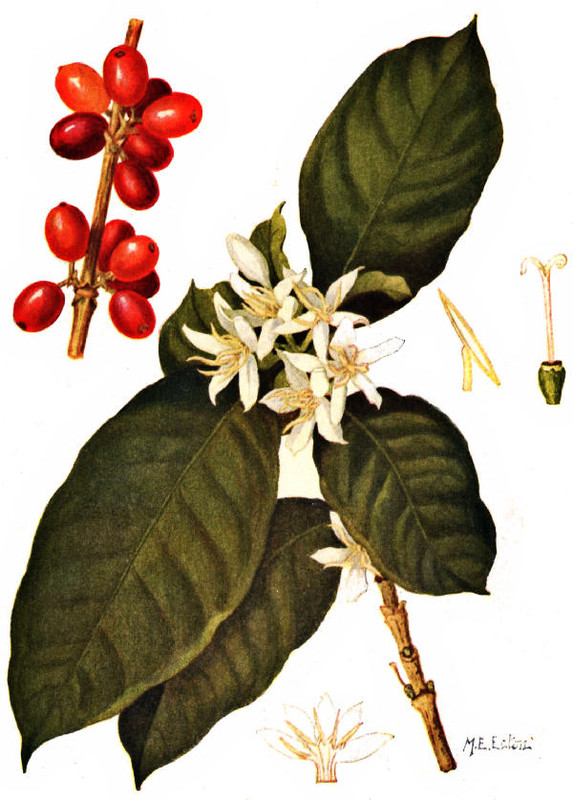
Painted from nature by M.E. Eaton—Detail sketches show anther, pistil, and section of corolla
Chapter I
DEALING WITH THE ETYMOLOGY OF COFFEE
Origin and translation of the word from the Arabian into various languages—Views of many writers
The history of the word coffee involves several phonetic difficulties. The European languages got the name of the beverage about 1600 from the original Arabic

Sir James Murray, in the New English Dictionary, says that some have conjectured that the word is a foreign, perhaps African, word disguised, and have thought it connected with the name Kaffa, a town in Shoa, southwest Abyssinia, reputed native place of the coffee plant, but that of this there is no evidence, and the name qahwah is not given to the berry or plant, which is called

Contributing to a symposium on the etymology of the word coffee in Notes and Queries, 1909, James Platt, Jr., said:
The Turkish form might have been written kahvé, as its final h was never sounded at any time. Sir James Murray draws attention to the existence of two European types, one like the French café, Italian caffè, the other like the English coffee, Dutch koffie. He explains the vowel o in the second series as apparently representing au, from Turkish ahv. This seems unsupported by evidence, and the v is already represented by the ff, so on Sir James's assumption coffee must stand for kahv-ve, which is unlikely. The change from a to o, in my opinion, is better accounted for as an imperfect appreciation. The exact sound of ă in Arabic and other Oriental languages is that of the English short u, as in "cuff." This sound, so easy to us, is a great stumbling-block to other nations. I judge that Dutch koffie and kindred forms are imperfect attempts at the notation of a vowel which the writers could not grasp. It is clear that the French type is more correct. The Germans have corrected their koffee, which they may have got from the Dutch, into kaffee. The Scandinavian languages have adopted the French form. Many must wonder how the hv of the original so persistently becomes ff in the European equivalents. Sir James Murray makes no attempt to solve this problem.
Virendranath Chattopádhyáya, who also contributed to the Notes and Queries symposium, argued that the hw of the Arabic qahwah becomes sometimes ff and sometimes only f or v in European translations because some languages, such as English, have strong syllabic accents (stresses), while others, as French, have none. Again, he points out that the surd aspirate h is heard in some languages, but is hardly audible in others. Most Europeans tend to leave it out altogether.
Col. W.F. Prideaux, another contributor, argued that the European languages got one form of the word coffee directly from the Arabic qahwah, and quoted from Hobson-Jobson in support of this:
Chaoua in 1598, Cahoa in 1610, Cahue in 1615; while Sir Thomas Herbert (1638) expressly states that "they drink (in Persia) ... above all the rest, Coho or Copha: by Turk and Arab called Caphe and Cahua." Here the Persian, Turkish, and Arabic pronunciations are clearly differentiated.
Col. Prideaux then calls, as a witness to the Anglo-Arabic pronunciation, one whose evidence was not available when the New English Dictionary and Hobson-Jobson articles were written. This is John Jourdain, a Dorsetshire seaman, whose Diary was printed by the Hakluyt Society in 1905. On May 28, 1609, he records that "in the afternoone wee departed out of Hatch (Al-Hauta, the capital of the Lahej district near Aden), and travelled untill three in the morninge, and then wee rested in the plaine fields untill three the next daie, neere unto a cohoo howse in the desert." On June 5 the party, traveling from Hippa (Ibb), "laye in the mountaynes, our camells being wearie, and our selves little better. This mountain is called Nasmarde (Nakīl Sumāra), where all the cohoo grows." Farther on was "a little village, where there is sold cohoo and fruite. The seeds of this cohoo is a greate marchandize, for it is carried to grand Cairo and all other places of Turkey, and to the Indias." Prideaux, however, mentions that another sailor, William Revett, in his journal (1609) says, referring to Mocha, that "Shaomer Shadli (Shaikh 'Ali bin 'Omar esh-Shādil) was the fyrst inventour for drynking of coffe, and therefor had in esteemation." This rather looks to Prideaux as if on the coast of Arabia, and in the mercantile towns, the Persian pronunciation was in vogue; whilst in the interior, where Jourdain traveled, the Englishman reproduced the Arabic.
Mr. Chattopádhyáya, discussing Col. Prideaux's views as expressed above, said:
Col. Prideaux may doubt "if the worthy mariner, in entering the word in his log, was influenced by the abstruse principles of phonetics enunciated" by me, but he will admit that the change from kahvah to coffee is a phonetic change, and must be due to the operation of some phonetic principle. The average man, when he endeavours to write a foreign word in his own tongue, is handicapped considerably by his inherited and acquired phonetic capacity. And, in fact, if we take the quotations made in "Hobson-Jobson," and classify the various forms of the word coffee according to the nationality of the writer, we obtain very interesting results.
Let us take Englishmen and Dutchmen first. In Danvers's Letters (1611) we have both "coho pots" and "coffao pots"; Sir T. Roe (1615) and Terry (1616) have cohu; Sir T. Herbert (1638) has coho and copha; Evelyn (1637), coffee; Fryer (1673) coho; Ovington (1690), coffee; and Valentijn (1726), coffi. And from the two examples given by Col. Prideaux, we see that Jourdain (1609) has cohoo, and Revett (1609) has coffe.
To the above should be added the following by English writers, given in Foster's English Factories in India (1618–21, 1622–23, 1624–29): cowha (1619), cowhe, couha (1621), coffa (1628).
Let us now see what foreigners (chiefly French and Italian) write. The earliest European mention is by Rauwolf, who knew it in Aleppo in 1573. He has the form chaube. Prospero Alpini (1580) has caova; Paludanus (1598) chaoua; Pyrard de Laval (1610) cahoa; P. Della Valle (1615) cahue; Jac. Bontius (1631) caveah; and the Journal d'Antoine Galland (1673) cave. That is, Englishmen use forms of a certain distinct type, viz., cohu, coho, coffao, coffe, copha, coffee, which differ from the more correct transliteration of foreigners.
In 1610 the Portuguese Jew, Pedro Teixeira (in the Hakluyt Society's edition of his Travels) used the word kavàh.
The inferences from these transitional forms seem to be: 1. The word found its way into the languages of Europe both from the Turkish and from the Arabic. 2. The English forms (which have strong stress on the first syllable) have ŏ instead of ă, and f instead of h. 3. The foreign forms are unstressed and have no h. The original v or w (or labialized u) is retained or changed into f.
It may be stated, accordingly, that the chief reason for the existence of two distinct types of spelling is the omission of h in unstressed languages, and the conversion of h into f under strong stress in stressed languages. Such conversion often takes place in Turkish; for example, silah dar in Persian (which is a highly stressed language) becomes zilif dar in Turkish. In the languages of India, on the other hand, in spite of the fact that the aspirate is usually very clearly sounded, the word qăhvăh is pronounced kaiva by the less educated classes, owing to the syllables being equally stressed.
Now for the French viewpoint. Jardin[3] opines that, as regards the etymology of the word coffee, scholars are not agreed and perhaps never will be. Dufour[4] says the word is derived from caouhe, a name given by the Turks to the beverage prepared from the seed. Chevalier d'Arvieux, French consul at Alet, Savary, and Trevoux, in his dictionary, think that coffee comes from the Arabic, but from the word cahoueh or quaweh, meaning to give vigor or strength, because, says d'Arvieux, its most general effect is to fortify and strengthen. Tavernier combats this opinion. Moseley attributes the origin of the word coffee to Kaffa. Sylvestre de Sacy, in his Chréstomathie Arabe, published in 1806, thinks that the word kahwa, synonymous with makli, roasted in a stove, might very well be the etymology of the word coffee. D'Alembert in his encyclopedic dictionary, writes the word caffé. Jardin concludes that whatever there may be in these various etymologies, it remains a fact that the word coffee comes from an Arabian word, whether it be kahua, kahoueh, kaffa or kahwa, and that the peoples who have adopted the drink have all modified the Arabian word to suit their pronunciation. This is shown by giving the word as written in various modern languages:
French, café; Breton, kafe; German, kaffee (coffee tree, kaffeebaum); Dutch, koffie (coffee tree, koffieboonen); Danish, kaffe; Finnish, kahvi; Hungarian, kavé; Bohemian, kava; Polish, kawa; Roumanian, cafea; Croatian, kafa; Servian, kava; Russian, kophe; Swedish, kaffe; Spanish, café; Basque, kaffia; Italian, caffè; Portuguese, café; Latin (scientific), coffea; Turkish, kahué; Greek, kaféo; Arabic, qahwah (coffee berry, bun); Persian, qéhvé (coffee berry, bun[5]); Annamite, ca-phé; Cambodian, kafé; Dukni[6], bunbund[7]; Teluyan[8], kapri-vittulu; Tamil[9], kapi-kottai or kopi; Canareze[10], kapi-bija; Chinese, kia-fey, teoutsé; Japanese, kéhi; Malayan, kawa, koppi; Abyssinian, bonn[11]; Foulak, legal café[12]; Sousou, houri caff[13]; Marquesan, kapi; Chinook[14], kaufee; Volapuk, kaf; Esperanto, kafva.
JOINT COFFEE TRADE PUBLICITY COMMITTEE IN UNITED STATES
F.J. Ach—1912–14
Group of Old-Time New York Coffee Roasters, 1892 Standing, left to right, W.H. Eppens, Fred Reid, unknown, Julius A. Eppens, Fred Eppens. Seated, left to right, John F. Pupke, Thomas Reid, Henry Mayo, Fred Akers, Alexander Kirkland
John Arbuckle
B.G. Arnold
Benjamin Green Arnold
F.B. Arnold
William Bayne New York
PIONEERS IN THE ROASTED COFFEE BUSINESS OF NEW YORK CITY With approximate dates of their entry into the trade
Wm. H. Bennett New York
C.E. Bickford San Francisco
PIONEER COFFEE ROASTERS OF THE NORTHERN AND EASTERN UNITED STATES
1—W.F. McLaughlin, Chicago; 2—J.G. Flint, Milwaukee; 3—Frank J. Geiger, Indianapolis; 4—Samuel Mahood, Pittsburgh; 5—Henry A. Stephens, Cleveland; 6—W.H. Harrison, Cincinnati; 7—Albert A. Sprague, Chicago; 8—D.Y. Harrison, Cincinnati; 9—William Grossman, Milwaukee; 10—Edward Canby, Dayton; 11—Thomas J. Boardman, Hartford; 12—Francis Widlar, Cleveland; 13—O.W. Pierce, Sr., Lafayette. Ind.; 14—A.M. Thomson Chicago; 15—Samuel Young, Pittsburgh; 16—Alvin M. Woolson, Toledo; 17—Martin Hayward, Boston; 18—George C. Wright, Boston; 19—William Boardman, Hartford; 20—James S. Sanborn, Boston; 21—James Heekin, Cincinnati; 22—James F. Dwinell, Boston; 23—Caleb Chase, Boston
Carl W. Brand—1918–21
PIONEER COFFEE ROASTERS OF THE SOUTHERN AND WESTERN UNITED STATES
1—J.B. Sinnot, New Orleans; 2—Julius J. Schotten, St. Louis; 3—Charles Stoffregen, St. Louis; 4—W.T. Jones, New Orleans; 5—J.A. Folger. jr., San Francisco; 6—M.E. Smith, St. Louis; 7—A.E. Forbes, St. Louis; 8—David G. Evans, St. Louis; 9—W.J. Kinsella, St. Louis; 10—James H. Forbes, St. Louis; 11—J.A. Folger, Sr., San Francisco; 12—Joseph Closset, Portland, Ore.; 13—J. Zinsmeister, Louisville; 14—Wm. Schotten, St. Louis; 15—A. Schilling, San Francisco; 16—M.J. Brandenstein, San Francisco; 17—J.O. Cheek, Nashville; 18—A.H. Devers, Portland, Ore.
Jabez Burns
Ben C. Casanas—1917–18
Joel O. Cheek, Nashville President of the National Coffee Roasters Association, 1922
George W. Crossman New York
Julius A. Eppens, New York
O.G. Kimball Boston
Franz George Kolschitzky, Patron Saint of Vienna Coffee Lovers
P.C. Meehan
Theodore Langgaard de Menezes
Robert Meyer, St. Louis First president of the Coffee Roasters' original organization
Edwin H. Peck
James W. Phyfe New York
Joseph Purcell
Col. William P. Roome, New York
James C. Russell New York
Julius J. Schotten—1911–12
Frank R. Seelye—1916–17
Hermann Sielcken
Hermann Sielcken
H. Simmonds
James H. Taylor
Thomas Van Loan, New York
Ross W. Weir—1914–16
George Westfeldt New Orleans
[1] First written about tea; improperly claimed to have been written of coffee.
[2] First written about tea; improperly claimed to have been written of coffee.
[3] Jardin, Édelestan. Le Caféier et le Café. Paris, 1895 (p. 55).
[4] Dufour, Philippe Sylvestre. Traités Nouveaux et Curieux du Café, du Thé, et du Chocolat. Lyons, 1684.
[5] Coffee covered with the skin is called boun, and the coffee-tree, boun-tree (sejar et boun).
[6] These four dialects are spoken in Hindustan.
[7] Notice must be taken of the similarity in the names of coffee in Hindustan and Abyssinia, and of the name of the coffee-tree as given by ancient authors.
[8] These four dialects are spoken in Hindustan.
[9] These four dialects are spoken in Hindustan.
[10] These four dialects are spoken in Hindustan.
[11] See note 3 above.
[12] Legal and Houri mean tree.
[13] Legal and Houri mean tree.
[14] North-American Indian.
Chapter II
HISTORY OF COFFEE PROPAGATION
A brief account of the cultivation of the coffee plant in the Old World and its introduction into the New—A romantic coffee adventure
The history of the propagation of the coffee plant is closely interwoven with that of the early history of coffee drinking, but for the purposes of this chapter we shall consider only the story of the inception and growth of the cultivation of the coffee tree, or shrub, bearing the seeds, or berries, from which the drink, coffee, is made.
Careful research discloses that most authorities agree that the coffee plant is indigenous to Abyssinia, and probably Arabia, whence its cultivation spread throughout the tropics. The first reliable mention of the properties and uses of the plant is by an Arabian physician toward the close of the ninth century A.D., and it is reasonable to suppose that before that time the plant was found growing wild in Abyssinia and perhaps in Arabia. If it be true, as Ludolphus writes,[15] that the Abyssinians came out of Arabia into Ethiopia in the early ages, it is possible that they may have brought the coffee tree with them; but the Arabians must still be given the credit for discovering and promoting the use of the beverage, and also for promoting the propagation of the plant, even if they found it in Abyssinia and brought it to Yemen.
Some authorities believe that the first cultivation of coffee in Yemen dates back to 575 A.D., when the Persian invasion put an end to the Ethiopian rule of the negus Caleb, who conquered the country in 525.
Certainly the discovery of the beverage resulted in the cultivation of the plant in Abyssinia and in Arabia; but its progress was slow until the 15th and 16th centuries, when it appears as intensively carried on in the Yemen district of Arabia. The Arabians were jealous of their new found and lucrative industry, and for a time successfully prevented its spread to other countries by not permitting any of the precious berries to leave the country unless they had first been steeped in boiling water or parched, so as to destroy their powers of germination. It may be that many of the early failures successfully to introduce the cultivation of the coffee plant into other lands was also due to the fact, discovered later, that the seeds soon lose their germinating power.
However, it was not possible to watch every avenue of transport, with thousands of pilgrims journeying to and from Mecca every year; and so there would appear to be some reason to credit the Indian tradition concerning the introduction of coffee cultivation into southern India by Baba Budan, a Moslem pilgrim, as early as 1600, although a better authority gives the date as 1695. Indian tradition relates that Baba Budan planted his seeds near the hut he built for himself at Chickmaglur in the mountains of Mysore, where, only a few years since, the writer found the descendants of these first plants growing under the shade of the centuries-old original jungle trees. The greater part of the plants cultivated by the natives of Kurg and Mysore appear to have come from the Baba Budan importation. It was not until 1840 that the English began the cultivation of coffee in India. The plantations extend now from the extreme north of Mysore to Tuticorin.
Early Cultivation by the Dutch
In the latter part of the 16th century, German, Italian, and Dutch botanists and travelers brought back from the Levant considerable information regarding the new plant and the beverage. In 1614 enterprising Dutch traders began to examine into the possibilities of coffee cultivation and coffee trading. In 1616 a coffee plant was successfully transported from Mocha to Holland. In 1658 the Dutch started the cultivation of coffee in Ceylon, although the Arabs are said to have brought the plant to the island prior to 1505. In 1670 an attempt was made to cultivate coffee on European soil at Dijon, France, but the result was a failure.
In 1696, at the instigation of Nicolaas Witsen, then burgomaster of Amsterdam, Adrian Van Ommen, commander at Malabar, India, caused to be shipped from Kananur, Malabar, to Java, the first coffee plants introduced into that island. They were grown from seed of the Coffea arabica brought to Malabar from Arabia. They were planted by Governor-General Willem Van Outshoorn on the Kedawoeng estate near Batavia, but were subsequently lost by earthquake and flood. In 1699 Henricus Zwaardecroon imported some slips, or cuttings, of coffee trees from Malabar into Java. These were more successful, and became the progenitors of all the coffees of the Dutch East Indies. The Dutch were then taking the lead in the propagation of the coffee plant.
In 1706 the first samples of Java coffee, and a coffee plant grown in Java, were received at the Amsterdam botanical gardens. Many plants were afterward propagated from the seeds produced in the Amsterdam gardens, and these were distributed to some of the best known botanical gardens and private conservatories in Europe.
While the Dutch were extending the cultivation of the plant to Sumatra, the Celebes, Timor, Bali, and other islands of the Netherlands Indies, the French were seeking to introduce coffee cultivation into their colonies. Several attempts were made to transfer young plants from the Amsterdam botanical gardens to the botanical gardens at Paris; but all were failures.
In 1714, however, as a result of negotiations entered into between the French government and the municipality of Amsterdam, a young and vigorous plant about five feet tall was sent to Louis XIV at the chateau of Marly by the burgomaster of Amsterdam. The day following, it was transferred to the Jardin des Plantes at Paris, where it was received with appropriate ceremonies by Antoine de Jussieu, professor of botany in charge. This tree was destined to be the progenitor of most of the coffees of the French colonies, as well as of those of South America, Central America, and Mexico.
The Romance of Captain Gabriel de Clieu
Two unsuccessful attempts were made to transport to the Antilles plants grown from the seed of the tree presented to Louis XIV; but the honor of eventual success was won by a young Norman gentleman, Gabriel Mathieu de Clieu, a naval officer, serving at the time as captain of infantry at Martinique. The story of de Clieu's achievement is the most romantic chapter in the history of the propagation of the coffee plant.
His personal affairs calling him to France, de Clieu conceived the idea of utilizing the return voyage to introduce coffee cultivation into Martinique. His first difficulty lay in obtaining several of the plants then being cultivated in Paris, a difficulty at last overcome through the instrumentality of M. de Chirac, royal physician, or, according to a letter written by de Clieu himself, through the kindly offices of a lady of quality to whom de Chirac could give no refusal. The plants selected were kept at Rochefort by M. Bégon, commissary of the department, until the departure of de Clieu for Martinique. Concerning the exact date of de Clieu's arrival at Martinique with the coffee plant, or plants, there is much conflict of opinion. Some authorities give the date as 1720, others 1723. Jardin[16] suggests that the discrepancy in dates may arise from de Clieu, with praiseworthy perseverance, having made the voyage twice. The first time, according to Jardin, the plants perished; but the second time de Clieu had planted the seeds when leaving France and these survived, "due, they say, to his having given of his scanty ration of water to moisten them." No reference to a preceding voyage, however, is made by de Clieu in his own account, given in a letter written to the Année Littéraire[17] in 1774. There is also a difference of opinion as to whether de Clieu arrived with one or three plants. He himself says "one" in the letter referred to.
According to the most trustworthy data, de Clieu embarked at Nantes, 1723.[18] He had installed his precious plant in a box covered with a glass frame in order to absorb the rays of the sun and thus better to retain the stored-up heat for cloudy days. Among the passengers one man, envious of the young officer, did all in his power to wrest from him the glory of success. Fortunately his dastardly attempt failed of its intended effect.
"It is useless," writes de Clieu in his letter to the Année Littéraire, "to recount in detail the infinite care that I was obliged to bestow upon this delicate plant during a long voyage, and the difficulties I had in saving it from the hands of a man who, basely jealous of the joy I was about to taste through being of service to my country, and being unable to get this coffee plant away from me, tore off a branch."
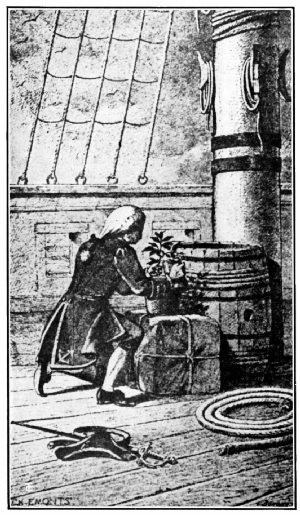
Captain de Clieu Shares His Drinking Water With the Coffee Plant He Is Carrying to Martinique
The vessel carrying de Clieu was a merchantman, and many were the trials that beset passengers and crew. Narrowly escaping capture by a corsair of Tunis, menaced by a violent tempest that threatened to annihilate them, they finally encountered a calm that proved more appalling than either. The supply of drinking water was well nigh exhausted, and what was left was rationed for the remainder of the voyage.
"Water was lacking to such an extent," says de Clieu, "that for more than a month I was obliged to share the scanty ration of it assigned to me with this my coffee plant upon which my happiest hopes were founded and which was the source of my delight. It needed such succor the more in that it was extremely backward, being no larger than the slip of a pink." Many stories have been written and verses sung recording and glorifying this generous sacrifice that has given luster to the name of de Clieu.
Arrived in Martinique, de Clieu planted his precious slip on his estate in Prêcheur, one of the cantons of the island; where, says Raynal, "it multiplied with extraordinary rapidity and success." From the seedlings of this plant came most of the coffee trees of the Antilles. The first harvest was gathered in 1726.
De Clieu himself describes his arrival as follows:
Arriving at home, my first care was to set out my plant with great attention in the part of my garden most favorable to its growth. Although keeping it in view, I feared many times that it would be taken from me; and I was at last obliged to surround it with thorn bushes and to establish a guard about it until it arrived at maturity ... this precious plant which had become still more dear to me for the dangers it had run and the cares it had cost me.
Thus the little stranger thrived in a distant land, guarded day and night by faithful slaves. So tiny a plant to produce in the end all the rich estates of the West India islands and the regions bordering on the Gulf of Mexico! What luxuries, what future comforts and delights, resulted from this one small talent confided to the care of a man of rare vision and fine intellectual sympathy, fired by the spirit of real love for his fellows! There is no instance in the history of the French people of a good deed done by stealth being of greater service to humanity.
De Clieu thus describes the events that followed fast upon the introduction of coffee into Martinique, with particular reference to the earthquake of 1727:
Success exceeded my hopes. I gathered about two pounds of seed which I distributed among all those whom I thought most capable of giving the plants the care necessary to their prosperity.
The first harvest was very abundant; with the second it was possible to extend the cultivation prodigiously, but what favored multiplication, most singularly, was the fact that two years afterward all the cocoa trees of the country, which were the resource and occupation of the people, were uprooted and totally destroyed by horrible tempests accompanied by an inundation which submerged all the land where these trees were planted, land which was at once made into coffee plantations by the natives. These did marvelously and enabled us to send plants to Santo Domingo, Guadeloupe, and other adjacent islands, where since that time they have been cultivated with the greatest success.
By 1777 there were 18,791,680 coffee trees in Martinique.
De Clieu was born in Angléqueville-sur-Saane, Seine-Inférieure (Normandy), in 1686 or 1688.[19] In 1705 he was a ship's ensign; in 1718 he became a chevalier of St. Louis; in 1720 he was made a captain of infantry; in 1726, a major of infantry; in 1733 he was a ship's lieutenant; in 1737 he became governor of Guadeloupe; in 1746 he was a ship's captain; in 1750 he was made honorary commander of the order of St. Louis; in 1752 he retired with a pension of 6000 francs; in 1753 he re-entered the naval service; in 1760 he again retired with a pension of 2000 francs.
In 1746 de Clieu, having returned to France, was presented to Louis XV by the minister of marine, Rouillé de Jour, as "a distinguished officer to whom the colonies, as well as France itself, and commerce generally, are indebted for the cultivation of coffee."
Reports to the king in 1752 and 1759 recall his having carried the first coffee plant to Martinique, and that he had ever been distinguished for his zeal and disinterestedness. In the Mercure de France, December, 1774, was the following death notice:
Gabriel d'Erchigny de Clieu, former Ship's Captain and Honorary Commander of the Royal and Military Order of Saint Louis, died in Paris on the 30th of November in the 88th year of his age.
A notice of his death appeared also in the Gazette de France for December 5, 1774, a rare honor in both cases; and it has been said that at this time his praise was again on every lip.
One French historian, Sidney Daney,[20] records that de Clieu died in poverty at St. Pierre at the age of 97; but this must be an error, although it does not anywhere appear that at his death he was possessed of much, if any, means. Daney says:
This generous man received as his sole recompense for a noble deed the satisfaction of seeing this plant for whose preservation he had shown such devotion, prosper throughout the Antilles. The illustrious de Clieu is among those to whom Martinique owes a brilliant reparation.
Daney tells also that in 1804 there was a movement in Martinique to erect a monument upon the spot where de Clieu planted his first coffee plant, but that the undertaking came to naught.
Pardon, in his La Martinique says:
Honor to this brave man! He has deserved it from the people of two hemispheres. His name is worthy of a place beside that of Parmentier who carried to France the potato of Canada. These two men have rendered immense service to humanity, and their memory should never be forgotten—yet alas! Are they even remembered?
Tussac, in his Flora de las Antillas, writing of de Clieu, says, "Though no monument be erected to this beneficent traveler, yet his name should remain engraved in the heart of every colonist."
In 1774 the Année Littéraire published a long poem in de Clieu's honor. In the feuilleton of the Gazette de France, April 12, 1816, we read that M. Donns, a wealthy Hollander, and a coffee connoisseur, sought to honor de Clieu by having painted upon a porcelain service all the details of his voyage and its happy results. "I have seen the cups," says the writer, who gives many details and the Latin inscription.
That singer of navigation, Esménard, has pictured de Clieu's devotion in the following lines:
Forget not how de Clieu with his light vessel's sail,
Brought distant Moka's gift—that timid plant and frail.
The waves fell suddenly, young zephyrs breathed no more,
Beneath fierce Cancer's fires behold the fountain store,
Exhausted, fails; while now inexorable need
Makes her unpitying law—with measured dole obeyed.
Now each soul fears to prove Tantalus torment first.
De Clieu alone defies: While still that fatal thirst,
Fierce, stifling, day by day his noble strength devours,
And still a heaven of brass inflames the burning hours.
With that refreshing draught his life he will not cheer;
But drop by drop revives the plant he holds more dear.
Already as in dreams, he sees great branches grow,
One look at his dear plant assuages all his woe.
The only memorial to de Clieu in Martinique is the botanical garden at Fort de France, which was opened in 1918 and dedicated to de Clieu, "whose memory has been too long left in oblivion.[21]"
In 1715 coffee cultivation was first introduced into Haiti and Santo Domingo. Later came hardier plants from Martinique. In 1715–17 the French Company of the Indies introduced the cultivation of the plant into the Isle of Bourbon (now Réunion) by a ship captain named Dufougeret-Grenier from St. Malo. It did so well that nine years later the island began to export coffee.
The Dutch brought the cultivation of coffee to Surinam in 1718. The first coffee plantation in Brazil was started at Pará in 1723 with plants brought from French Guiana, but it was not a success. The English brought the plant to Jamaica in 1730. In 1740 Spanish missionaries introduced coffee cultivation into the Philippines from Java. In 1748 Don José Antonio Gelabert introduced coffee into Cuba, bringing the seed from Santo Domingo. In 1750 the Dutch extended the cultivation of the plant to the Celebes. Coffee was introduced into Guatemala about 1750–60. The intensive cultivation in Brazil dates from the efforts begun in the Portuguese colonies in Pará and Amazonas in 1752. Porto Rico began the cultivation of coffee about 1755. In 1760 João Alberto Castello Branco brought to Rio de Janeiro a coffee tree from Goa, Portuguese India. The news spread that the soil and climate of Brazil were particularly adapted to the cultivation of coffee. Molke, a Belgian monk, presented some seeds to the Capuchin monastery at Rio in 1774. Later, the bishop of Rio, Joachim Bruno, became a patron of the plant and encouraged its propagation in Rio, Minãs, Espirito Santo, and São Paulo. The Spanish voyager, Don Francisco Xavier Navarro, is credited with the introduction of coffee into Costa Rica from Cuba in 1779. In Venezuela the industry was started near Caracas by a priest, José Antonio Mohedano, with seed brought from Martinique in 1784.
Coffee cultivation in Mexico began in 1790, the seed being brought from the West Indies. In 1817 Don Juan Antonio Gomez instituted intensive cultivation in the State of Vera Cruz. In 1825 the cultivation of the plant was begun in the Hawaiian Islands with seeds from Rio de Janeiro. As previously noted, the English began to cultivate coffee in India in 1840. In 1852 coffee cultivation was begun in Salvador with plants brought from Cuba. In 1878 the English began the propagation of coffee in British Central Africa, but it was not until 1901 that coffee cultivation was introduced into British East Africa from Réunion. In 1887 the French introduced the plant into Tonkin, Indo-China. Coffee growing in Queensland, introduced in 1896, has been successful in a small way.
In recent years several attempts have been made to propagate the coffee plant in the southern United States, but without success. It is believed, however, that the topographic and climatic conditions in southern California are favorable for its cultivation.
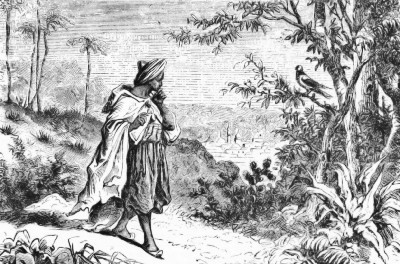
Omar and the Marvelous Coffee Bird
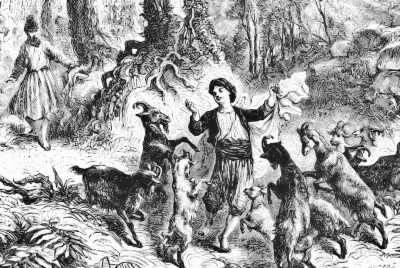
Kaldi and His Dancing Goats THE LEGENDARY DISCOVERY OF THE COFFEE DRINK From drawings by a modern French artist
Chapter III
EARLY HISTORY OF COFFEE DRINKING
Coffee in the Near East in the early centuries—Stories of its origin—Discovery by physicians and adoption by the Church—Its spread through Arabia, Persia and Turkey—Persecutions and intolerances—Early coffee manners and customs
The coffee drink had its rise in the classical period of Arabian medicine, which dates from Rhazes (Abu Bakr Muhammad ibn Zakariya El Razi) who followed the doctrines of Galen and sat at the feet of Hippocrates. Rhazes (850–922) was the first to treat medicine in an encyclopedic manner, and, according to some authorities, the first writer to mention coffee. He assumed the poetical name of Razi because he was a native of the city of Raj in Persian Irak. He was a great philosopher and astronomer, and at one time was superintendent of the hospital at Bagdad. He wrote many learned books on medicine and surgery, but his principal work is Al-Haiwi, or The Continent, a collection of everything relating to the cure of disease from Galen to his own time.
Philippe Sylvestre Dufour (1622–87)[22], a French coffee merchant, philosopher, and writer, in an accurate and finished treatise on coffee, tells us (see the early edition of the work translated from the Latin) that the first writer to mention the properties of the coffee bean under the name of bunchum was this same Rhazes, "in the ninth century after the birth of our Saviour"; from which (if true) it would appear that coffee has been known for upwards of 1000 years. Robinson[23], however, is of the opinion that bunchum meant something else and had nothing to do with coffee. Dufour, himself, in a later edition of his Traitez Nouveaux et Curieux du Café (the Hague, 1693) is inclined to admit that bunchum may have been a root and not coffee, after all; however, he is careful to add that there is no doubt that the Arabs knew coffee as far back as the year 800. Other, more modern authorities, place it as early as the sixth century.
Wiji Kawih is mentioned in a Kavi (Javan) inscription A.D. 856; and it is thought that the "bean broth" in David Tapperi's list of Javanese beverages (1667–82) may have been coffee[24].
While the true origin of coffee drinking may be forever hidden among the mysteries of the purple East, shrouded as it is in legend and fable, scholars have marshaled sufficient facts to prove that the beverage was known in Ethiopia "from time immemorial," and there is much to add verisimilitude to Dufour's narrative. This first coffee merchant-prince, skilled in languages and polite learning, considered that his character as a merchant was not inconsistent with that of an author; and he even went so far as to say there were some things (for instance, coffee) on which a merchant could be better informed than a philosopher.
Granting that by bunchum Rhazes meant coffee, the plant and the drink must have been known to his immediate followers; and this, indeed, seems to be indicated by similar references in the writings of Avicenna (Ibn Sina), the Mohammedan physician and philosopher, who lived from 980 to 1037 A.D.
Rhazes, in the quaint language of Dufour, assures us that "bunchum (coffee) is hot and dry and very good for the stomach." Avicenna explains the medicinal properties and uses of the coffee bean (bon or bunn), which he, also, calls bunchum, after this fashion:
As to the choice thereof, that of a lemon color, light, and of a good smell, is the best; the white and the heavy is naught. It is hot and dry in the first degree, and, according to others, cold in the first degree. It fortifies the members, it cleans the skin, and dries up the humidities that are under it, and gives an excellent smell to all the body.
The early Arabians called the bean and the tree that bore it, bunn; the drink, bunchum. A. Galland[25] (1646–1715), the French Orientalist who first analyzed and translated from the Arabic the Abd-al-Kâdir manuscript[26], the oldest document extant telling of the origin of coffee, observes that Avicenna speaks of the bunn, or coffee; as do also Prospero Alpini and Veslingius (Vesling). Bengiazlah, another great physician, contemporary with Avicenna, likewise mentions coffee; by which, says Galland, one may see that we are indebted to physicians for the discovery of coffee, as well as of sugar, tea, and chocolate.
Rauwolf[27] (d. 1596), German physician and botanist, and the first European to mention coffee, who became acquainted with the beverage in Aleppo in 1573, telling how the drink was prepared by the Turks, says:
In this same water they take a fruit called Bunnu, which in its bigness, shape, and color is almost like unto a bayberry, with two thin shells surrounded, which, as they informed me, are brought from the Indies; but as these in themselves are, and have within them, two yellowish grains in two distinct cells, and besides, being they agree in their virtue, figure, looks, and name with the Bunchum of Avicenna and Bunco, of Rasis ad Almans exactly: therefore I take them to be the same.
In Dr. Edward Pocoke's translation (Oxford, 1659) of The Nature of the Drink Kauhi, or Coffee, and the Berry of which it is Made, Described by an Arabian Phisitian, we read:
Bun is a plant in Yaman [Yemen], which is planted in Adar, and groweth up and is gathered in Ab. It is about a cubit high, on a stalk about the thickness of one's thumb. It flowers white, leaving a berry like a small nut, but that sometimes it is broad like a bean; and when it is peeled, parteth in two. The best of it is that which is weighty and yellow; the worst, that which is black. It is hot in the first degree, dry in the second: it is usually reported to be cold and dry, but it is not so; for it is bitter, and whatsoever is bitter is hot. It may be that the scorce is hot, and the Bun it selfe either of equall temperature, or cold in the first degree.
That which makes for its coldnesse is its stipticknesse. In summer it is by experience found to conduce to the drying of rheumes, and flegmatick coughes and distillations, and the opening of obstructions, and the provocation of urin. It is now known by the name of Kohwah. When it is dried and thoroughly boyled, it allayes the ebullition of the blood, is good against the small poxe and measles, the bloudy pimples; yet causeth vertiginous headheach, and maketh lean much, occasioneth waking, and the Emrods, and asswageth lust, and sometimes breeds melancholly.
He that would drink it for livelinesse sake, and to discusse slothfulnesse, and the other properties that we have mentioned, let him use much sweat meates with it, and oyle of pistaccioes, and butter. Some drink it with milk, but it is an error, and such as may bring in danger of the leprosy.
Dufour concludes that the coffee beans of commerce are the same as the bunchum (bunn) described by Avicenna and the bunca (bunchum) of Rhazes. In this he agrees, almost word for word, with Rauwolf, indicating no change in opinion among the learned in a hundred years.
Christopher Campen thinks Hippocrates, father of medicine, knew and administered coffee.
Robinson, commenting upon the early adoption of coffee into materia medica, charges that it was a mistake on the part of the Arab physicians, and that it originated the prejudice that caused coffee to be regarded as a powerful drug instead of as a simple and refreshing beverage.
Homer, the Bible, and Coffee
In early Grecian and Roman writings no mention is made of either the coffee plant or the beverage made from the berries. Pierre (Pietro) Delia Valle[28] (1586–1652), however, maintains that the nepenthe, which Homer says Helen brought with her out of Egypt, and which she employed as surcease for sorrow, was nothing else but coffee mixed with wine.[29] This is disputed by M. Petit, a well known physician of Paris, who died in 1687. Several later British authors, among them, Sandys, the poet; Burton; and Sir Henry Blount, have suggested the probability of coffee being the "black broth" of the Lacedæmonians.
George Paschius, in his Latin treatise of the New Discoveries Made since the Time of the Ancients, printed at Leipsic in 1700, says he believes that coffee was meant by the five measures of parched corn included among the presents Abigail made to David to appease his wrath, as recorded in the Bible, 1 Samuel, xxv, 18. The Vulgate translates the Hebrew words sein kali into sata polentea, which signify wheat, roasted, or dried by fire.
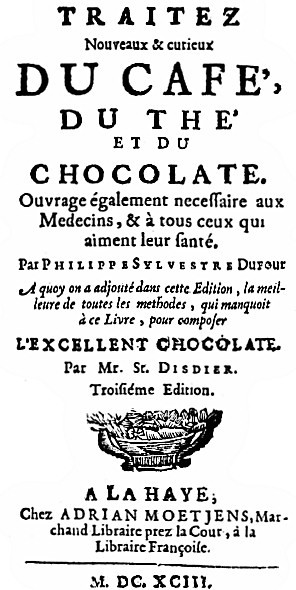
Title Page of Dufour's Book, Edition of 1693
Pierre Étienne Louis Dumant, the Swiss Protestant minister and author, is of the opinion that coffee (and not lentils, as others have supposed) was the red pottage for which Esau sold his birthright; also that the parched grain that Boaz ordered to be given Ruth was undoubtedly roasted coffee berries.
Dufour mentions as a possible objection against coffee that "the use and eating of beans were heretofore forbidden by Pythagoras," but intimates that the coffee bean of Arabia is something different.
Scheuzer,[30] in his Physique Sacrée, says "the Turks and the Arabs make with the coffee bean a beverage which bears the same name, and many persons use as a substitute the flour of roasted barley." From this we learn that the coffee substitute is almost as old as coffee itself.
Some Early Legends
After medicine, the church. There are several Mohammedan traditions that have persisted through the centuries, claiming for "the faithful" the honor and glory of the first use of coffee as a beverage. One of these relates how, about 1258 A.D., Sheik Omar, a disciple of Sheik Abou'l hasan Schadheli, patron saint and legendary founder of Mocha, by chance discovered the coffee drink at Ousab in Arabia, whither he had been exiled for a certain moral remissness.
Facing starvation, he and his followers were forced to feed upon the berries growing around them. And then, in the words of the faithful Arab chronicle in the Bibliothéque Nationale at Paris, "having nothing to eat except coffee, they took of it and boiled it in a saucepan and drank of the decoction." Former patients in Mocha who sought out the good doctor-priest in his Ousab retreat, for physic with which to cure their ills, were given some of this decoction, with beneficial effect. As a result of the stories of its magical properties, carried back to the city, Sheik Omar was invited to return in triumph to Mocha where the governor caused to be built a monastery for him and his companions.
Another version of this Oriental legend gives it as follows:
The dervish Hadji Omar was driven by his enemies out of Mocha into the desert, where they expected he would die of starvation. This undoubtedly would have occurred if he had not plucked up courage to taste some strange berries which he found growing on a shrub. While they seemed to be edible, they were very bitter; and he tried to improve the taste by roasting them. He found, however, that they had become very hard, so he attempted to soften them with water. The berries seemed to remain as hard as before, but the liquid turned brown, and Omar drank it on the chance that it contained some of the nourishment from the berries. He was amazed at how it refreshed him, enlivened his sluggishness, and raised his drooping spirits. Later, when he returned to Mocha, his salvation was considered a miracle. The beverage to which it was due sprang into high favor, and Omar himself was made a saint.
A popular and much-quoted version of Omar's discovery of coffee, also based upon the Abd-al-Kâdir manuscript, is the following:
In the year of the Hegira 656, the mollah Schadheli went on a pilgrimage to Mecca. Arriving at the mountain of the Emeralds (Ousab), he turned to his disciple Omar and said: "I shall die in this place. When my soul has gone forth, a veiled person will appear to you. Do not fail to execute the command which he will give you."
The venerable Schadheli being dead, Omar saw in the middle of the night a gigantic specter covered by a white veil.
"Who are you?" he asked.
The phantom drew back his veil, and Omar saw with surprise Schadheli himself, grown ten cubits since his death. The mollah dug in the ground, and water miraculously appeared. The spirit of his teacher bade Omar fill a bowl with the water and to proceed on his way and not to stop till he reached the spot where the water would stop moving.
"It is there," he added, "that a great destiny awaits you."
Omar started his journey. Arriving at Mocha in Yemen, he noticed that the water was immovable. It was here that he must stop.
The beautiful village of Mocha was then ravaged by the plague. Omar began to pray for the sick and, as the saintly man was close to Mahomet, many found themselves cured by his prayers.
The plague meanwhile progressing, the daughter of the King of Mocha fell ill and her father had her carried to the home of the dervish who cured her. But as this young princess was of rare beauty, after having cured her, the good dervish tried to carry her off. The king did not fancy this new kind of reward. Omar was driven from the city and exiled on the mountain of Ousab, with herbs for food and a cave for a home.
"Oh, Schadheli, my dear master," cried the unfortunate dervish one day; "if the things which happened to me at Mocha were destined, was it worth the trouble to give me a bowl to come here?"
To these just complaints, there was heard immediately a song of incomparable harmony, and a bird of marvelous plumage came to rest in a tree. Omar sprang forward quickly toward the little bird which sang so well, but then he saw on the branches of the tree only flowers and fruit. Omar laid hands on the fruit, and found it delicious. Then he filled his great pockets with it and went back to his cave. As he was preparing to boil a few herbs for his dinner, the idea came to him of substituting for this sad soup, some of his harvested fruit. From it he obtained a savory and perfumed drink; it was coffee.
The Italian Journal of the Savants for the year 1760 says that two monks, Scialdi and Ayduis, were the first to discover the properties of coffee, and for this reason became the object of special prayers. "Was not this Scialdi identical with the Sheik Schadheli?" asks Jardin.[31]
The most popular legend ascribes the discovery of the drink to an Arabian herdsman in upper Egypt, or Abyssinia, who complained to the abbot of a neighboring monastery that the goats confided to his care became unusually frolicsome after eating the berries of certain shrubs found near their feeding grounds. The abbot, having observed the fact, determined to try the virtues of the berries on himself. He, too, responded with a new exhilaration. Accordingly, he directed that some be boiled, and the decoction drunk by his monks, who thereafter found no difficulty in keeping awake during the religious services of the night. The abbé Massieu in his poem, Carmen Caffaeum, thus celebrates the event:
The monks each in turn, as the evening draws near,
Drink 'round the great cauldron—a circle of cheer!
And the dawn in amaze, revisiting that shore,
On idle beds of ease surprised them nevermore!
According to the legend, the news of the "wakeful monastery" spread rapidly, and the magical berry soon "came to be in request throughout the whole kingdom; and in progress of time other nations and provinces of the East fell into the use of it."
The French have preserved the following picturesque version of this legend:
A young goatherd named Kaldi noticed one day that his goats, whose deportment up to that time had been irreproachable, were abandoning themselves to the most extravagant prancings. The venerable buck, ordinarily so dignified and solemn, bounded about like a young kid. Kaldi attributed this foolish gaiety to certain fruits of which the goats had been eating with delight.
The story goes that the poor fellow had a heavy heart; and in the hope of cheering himself up a little, he thought he would pick and eat of the fruit. The experiment succeeded marvelously. He forgot his troubles and became the happiest herder in happy Arabia. When the goats danced, he gaily made himself one of the party, and entered into their fun with admirable spirit.
One day, a monk chanced to pass by and stopped in surprise to find a ball going on. A score of goats were executing lively pirouettes like a ladies' chain, while the buck solemnly balancé-ed, and the herder went through the figures of an eccentric pastoral dance.
The astonished monk inquired the cause of this saltatorial madness; and Kaldi told him of his precious discovery.
Now, this poor monk had a great sorrow; he always went to sleep in the middle of his prayers; and he reasoned that Mohammed without doubt was revealing this marvelous fruit to him to overcome his sleepiness.
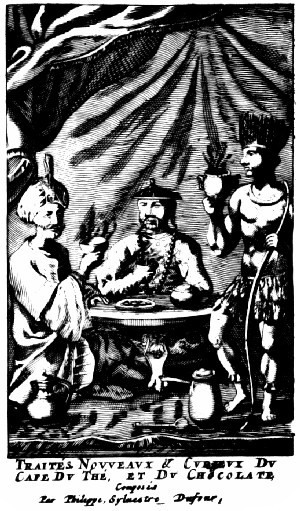
Arab Drinking Coffee; Chinaman, Tea; and Indian, Chocolate
Frontispiece from Dufour's work
Piety does not exclude gastronomic instincts. Those of our good monk were more than ordinary; because he thought of drying and boiling the fruit of the herder. This ingenious concoction gave us coffee. Immediately all the monks of the realm made use of the drink, because it encouraged them to pray and, perhaps, also because it was not disagreeable.
In those early days it appears that the drink was prepared in two ways; one in which the decoction was made from the hull and the pulp surrounding the bean, and the other from the bean itself. The roasting process came later and is an improvement generally credited to the Persians. There is evidence that the early Mohammedan churchmen were seeking a substitute for the wine forbidden to them by the Koran, when they discovered coffee. The word for coffee in Arabic, qahwah, is the same as one of those used for wine; and later on, when coffee drinking grew so popular as to threaten the very life of the church itself, this similarity was seized upon by the church-leaders to support their contention that the prohibition against wine applied also to coffee.
La Roque,[32] writing in 1715, says that the Arabian word cahouah signified at first only wine; but later was turned into a generic term applied to all kinds of drink. "So there were really three sorts of coffee; namely, wine, including all intoxicating liquors; the drink made with the shells, or cods, of the coffee bean; and that made from the bean itself."
Originally, then, the coffee drink may have been a kind of wine made from the coffee fruit. In the coffee countries even today the natives are very fond, and eat freely, of the ripe coffee cherries, voiding the seeds. The pulp surrounding the coffee seeds (beans) is pleasant to taste, has a sweetish, aromatic flavor, and quickly ferments when allowed to stand.
Still another tradition (was the wish father to the thought?) tells how the coffee drink was revealed to Mohammed himself by the Angel Gabriel. Coffee's partisans found satisfaction in a passage in the Koran which, they said, foretold its adoption by the followers of the Prophet:
[15] La Roque, Jean. Voyage de l'Arabie Heureuse. Paris, 1716.
[16] Jardin, Édelestan. Le Caféier et le Café. Paris, 1895. (p. 102).
[17] Année Littéraire. Paris, 1774 (vol. vi: p. 217).
[18] Franklin, Alfred. La Vie Privée d'Autrefois. Paris, 1893.
[19] Michaud, I.F. and L.G. Biographie Universelle. Paris.
[20] Daney, Sidney. Histoire de la Martinique. Fort Royal, 1846.
[21] Inauguration du Jardin Desclicux. Fort de France, 1918.
[22] Dufour, Philippe Sylvestre. Traités Nouveaux et Curieux du Café, du Thé, et du Chocolat. Lyons, 1684. (Title page has Traitez; elsewhere, Traités.)
[23] Robinson, Edward Forbes. The Early History of Coffee Houses in England. London, 1893.
[24] Encyclopedia Britannica. 1910. (vol. xv: p. 291.)
[25] Galland, Antoine. Lettre sur l'Origine et le Progres du Café. Paris, 1699.
[26] The Abd-al-Kâdir manuscript is described and illustrated in chapter XXXII.
[27] Rauwolf, Leonhard. Aigentliche beschreibung der Raisis so er vor diser zeit gegen auffgang inn die morgenlaender volbracht. Lauwingen, 1582–83.
[28] Della Valle, Pierre (Pietro). De Constantinople à Bombay, Lettres. 1615. (vol. i: p. 90.)
[29] "She mingled with the wine the wondrous juice of a plant which banishes sadness and wrath from the heart and brings with it forgetfulness of every woe."
[30] Scheuzer, J.J. Physique Sacrée, ou Histoire Naturelle de la Bible. Amsterdam, 1732, 1737.
[31] Jardin, Édelestan. Le Caféier et le Café. Paris, 1895.
[32] La Roque, Jean. Voyage dans l'Arabie Heureuse, de 1708 à 1713, et Traité Historique du Café. Paris, 1715. (pp. 247, 251.)
They shall be given to drink an excellent wine, sealed; its seal is that of the musk.
The most diligent research does not carry a knowledge of coffee back beyond the time of Rhazes, two hundred years after Mohammed; so there is little more than speculation or conjecture to support the theory that it was known to the ancients, in Bible times or in the days of The Praised One. Our knowledge of tea, on the other hand, antedates the Christian era. We know also that tea was intensively cultivated and taxed under the Tang dynasty in China, A.D. 793, and that Arab traders knew of it in the following century.
The First Reliable Coffee Date
About 1454 Sheik Gemaleddin Abou Muhammad Bensaid, mufti of Aden, surnamed Aldhabani, from Dhabhan, a small town where he was born, became acquainted with the virtues of coffee on a journey into Abyssinia.[33] Upon his return to Aden, his health became impaired; and remembering the coffee he had seen his countrymen drinking in Abyssinia, he sent for some in the hope of finding relief. He not only recovered from his illness; but, because of its sleep-dispelling qualities, he sanctioned the use of the drink among the dervishes "that they might spend the night in prayers or other religious exercises with more attention and presence of mind.[34]"
It is altogether probable that the coffee drink was known in Aden before the time of Sheik Gemaleddin; but the endorsement of the very learned imam, whom science and religion had already made famous, was sufficient to start a vogue for the beverage that spread throughout Yemen, and thence to the far corners of the world. We read in the Arabian manuscript at the Bibliothéque Nationale that lawyers, students, as well as travelers who journeyed at night, artisans, and others, who worked at night, to escape the heat of the day, took to drinking coffee; and even left off another drink, then becoming popular, made from the leaves of a plant called khat or cat (catha edulis).
Sheik Gemaleddin was assisted in his work of spreading the gospel of this the first propaganda for coffee by one Muhammed Alhadrami, a physician of great reputation, born in Hadramaut, Arabia Felix.
A recently unearthed and little known version of coffee's origin shows how features of both the Omar tradition and the Gemaleddin story may be combined by a professional Occidental tale-writer[35]:
Toward the middle of the fifteenth century, a poor Arab was traveling in Abyssinia. Finding himself weak and weary, he stopped near a grove. For fuel wherewith to cook his rice, he cut down a tree that happened to be covered with dried berries. His meal being cooked and eaten, the traveler discovered that these half-burnt berries were fragrant. He collected a number of them and, on crushing them with a stone, found that the aroma was increased to a great extent. While wondering at this, he accidentally let the substance fall into an earthen vessel that contained his scanty supply of water.
A miracle! The almost putrid water was purified. He brought it to his lips; it was fresh and agreeable; and after a short rest the traveler so far recovered his strength and energy as to be able to resume his journey. The lucky Arab gathered as many berries as he could, and having arrived at Aden, informed the mufti of his discovery. That worthy was an inveterate opium-smoker, who had been suffering for years from the influence of the poisonous drug. He tried an infusion of the roasted berries, and was so delighted at the recovery of his former vigor that in gratitude to the tree he called it cahuha which in Arabic signifies "force".
Galland, in his analysis of the Arabian manuscript, already referred to, that has furnished us with the most trustworthy account of the origin of coffee, criticizes Antoine Faustus Nairon, Maronite professor of Oriental languages at Rome, who was the author of the first printed treatise on coffee only,[36] for accepting the legends relating to Omar and the Abyssinian goatherd. He says they are unworthy of belief as facts of history, although he is careful to add that there is some truth in the story of the discovery of coffee by the Abyssinian goats and the abbot who prescribed the use of the berries for his monks, "the Eastern Christians being willing to have the honor of the invention of coffee, for the abbot, or prior, of the convent and his companions are only the mufti Gemaleddin and Muhammid Alhadrami, and the monks are the dervishes."
Amid all these details, Jardin reaches the conclusion that it is to chance we must attribute the knowledge of the properties of coffee, and that the coffee tree was transported from its native land to Yemen, as far as Mecca, and possibly into Persia, before being carried into Egypt.
Coffee, being thus favorably introduced into Aden, it has continued there ever since, without interruption. By degrees the cultivation of the plant and the use of the beverage passed into many neighboring places. Toward the close of the fifteenth century (1470–1500) it reached Mecca and Medina, where it was introduced, as at Aden, by the dervishes, and for the same religious purpose. About 1510 it reached Grand Cairo in Egypt, where the dervishes from Yemen, living in a district by themselves, drank coffee on the nights they intended to spend in religious devotion. They kept it in a large red earthen vessel—each in turn receiving it, respectfully, from their superior, in a small bowl, which he dipped into the jar—in the meantime chanting their prayers, the burden of which was always: "There is no God but one God, the true King, whose power is not to be disputed."
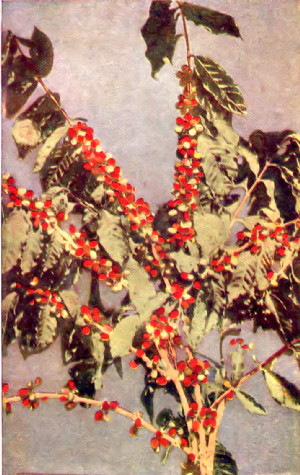
A Bouquet of Ripe Fruit
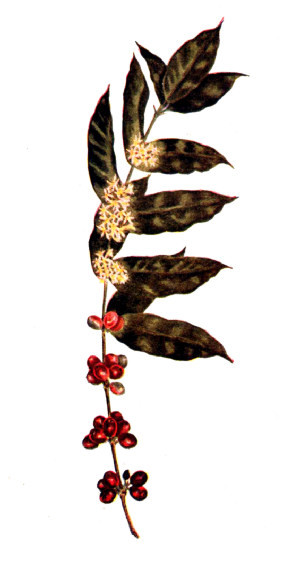
Flowers, Fruit, and Leaves
THE COFFEE TREE BEARS FRUIT, LEAF, AND BLOSSOM AT THE SAME TIME
After the dervishes, the bowl was passed to lay members of the congregation. In this way coffee came to be so associated with the act of worship that "they never performed a religious ceremony in public and never observed any solemn festival without taking coffee."
Meanwhile, the inhabitants of Mecca became so fond of the beverage that, disregarding its religious associations, they made of it a secular drink to be sipped publicly in kaveh kanes, the first coffee houses. Here the idle congregated to drink coffee, to play chess and other games, to discuss the news of the day, and to amuse themselves with singing, dancing, and music, contrary to the manners of the rigid Mahommedans, who were very properly scandalized by such performances. In Medina and in Cairo, too, coffee became as common a drink as in Mecca and Aden.
The First Coffee Persecution
At length the pious Mahommedans began to disapprove of the use of coffee among the people. For one thing, it made common one of the best psychology-adjuncts of their religion; also, the joy of life, that it helped to liberate among those who frequented the coffee houses, precipitated social, political, and religious arguments; and these frequently developed into disturbances. Dissensions arose even among the churchmen themselves. They divided into camps for and against coffee. The law of the Prophet on the subject of wine was variously construed as applying to coffee.
About this time (1511) Kair Bey was governor of Mecca for the sultan of Egypt. He appears to have been a strict disciplinarian, but lamentably ignorant of the actual conditions obtaining among his people. As he was leaving the mosque one evening after prayers, he was offended by seeing in a corner a company of coffee drinkers who were preparing to pass the night in prayer. His first thought was that they were drinking wine; and great was his astonishment when he learned what the liquor really was and how common was its use throughout the city. Further investigation convinced him that indulgence in this exhilarating drink must incline men and women to extravagances prohibited by law, and so he determined to suppress it. First he drove the coffee drinkers out of the mosque.
The next day, he called a council of officers of justice, lawyers, physicians, priests, and leading citizens, to whom he declared what he had seen the evening before at the mosque; and, "being resolved to put a stop to the coffee-house abuses, he sought their advice upon the subject." The chief count in the indictment was that "in these places men and women met and played tambourines, violins, and other musical instruments. There were also people who played chess, mankala, and other similar games, for money; and there were many other things done contrary to our sacred law—may God keep it from all corruption until the day when we shall all appear before him![37]"
The lawyers agreed that the coffee houses needed reforming; but as to the drink itself, inquiry should be made as to whether it was in any way harmful to mind or body; for if not, it might not be sufficient to close the places that sold it. It was suggested that the opinion of the physicians be sought.
Two brothers, Persian physicians named Hakimani, and reputed the best in Mecca, were summoned, although we are told they knew more about logic than they did about physic. One of them came into the council fully prejudiced, as he had already written a book against coffee, and filled with concern for his profession, being fearful lest the common use of the new drink would make serious inroads on the practise of medicine. His brother joined with him in assuring the assembly that the plant bunn, from which coffee was made, was "cold and dry" and so unwholesome. When another physician present reminded them that Bengiazlah, the ancient and respected contemporary of Avicenna, taught that it was "hot and dry," they made arbitrary answer that Bengiazlah had in mind another plant of the same name, and that anyhow, it was not material; for, if the coffee drink disposed people to things forbidden by religion, the safest course for Mahommedans was to look upon it as unlawful.
The friends of coffee were covered with confusion. Only the mufti spoke out in the meeting in its favor. Others, carried away by prejudice or misguided zeal, affirmed that coffee clouded their senses. One man arose and said it intoxicated like wine; which made every one laugh, since he could hardly have been a judge of this if he had not drunk wine, which is forbidden by the Mohammedan religion. Upon being asked whether he had ever drunk any, he was so imprudent as to admit that he had, thereby condemning himself out of his own mouth to the bastinado.
The mufti of Aden, being both an officer of the court and a divine, undertook, with some heat, a defense of coffee; but he was clearly in an unpopular minority. He was rewarded with the reproaches and affronts of the religious zealots.
So the governor had his way, and coffee was solemnly condemned as thing forbidden by the law; and a presentment was drawn up, signed by a majority of those present, and dispatched post-haste by the governor to his royal master, the sultan, at Cairo. At the same time, the governor published an edict forbidding the sale of coffee in public or private. The officers of justice caused all the coffee houses in Mecca to be shut, and ordered all the coffee found there, or in the merchants' warehouses, to be burned.
Naturally enough, being an unpopular edict, there were many evasions, and much coffee drinking took place behind closed doors. Some of the friends of coffee were outspoken in their opposition to the order, being convinced that the assembly had rendered a judgment not in accordance with the facts, and above all, contrary to the opinion of the mufti who, in every Arab community, is looked up to as the interpreter, or expounder, of the law. One man, caught in the act of disobedience, besides being severely punished, was also led through the most public streets of the city seated on an ass.
However, the triumph of the enemies of coffee was short-lived; for not only did the sultan of Cairo disapprove the "indiscreet zeal" of the governor of Mecca, and order the edict revoked; but he read him a severe lesson on the subject. How dared he condemn a thing approved at Cairo, the capital of his kingdom, where there were physicians whose opinions carried more weight than those of Mecca, and who had found nothing against the law in the use of coffee? The best things might be abused, added the sultan, even the sacred waters of Zamzam, but this was no reason for an absolute prohibition. The fountain, or well, of Zamzam, according to the Mohammedan teaching, is the same which God caused to spring up in the desert to comfort Hagar and Ishmael when Abraham banished them. It is in the enclosure of the temple at Mecca; and the Mohammedans drink of it with much show of devotion, ascribing great virtues to it.
It is not recorded whether the misguided governor was shocked at this seeming profanity; but it is known that he hastened to obey the orders of his lord and master. The prohibition was recalled, and thereafter he employed his authority only to preserve order in the coffee houses. The friends of coffee, and the lovers of poetic justice, found satisfaction in the governor's subsequent fate. He was exposed as "an extortioner and a public robber," and "tortured to death," his brother killing himself to avoid the same fate. The two Persian physicians who had played so mean a part in the first coffee persecution, likewise came to an unhappy end. Being discredited in Mecca they fled to Cairo, where, in an unguarded moment, having cursed the person of Selim I, emperor of the Turks, who had conquered Egypt, they were executed by his order.
Coffee, being thus re-established at Mecca, met with no opposition until 1524, when, because of renewed disorders, the kadi of the town closed the coffee houses, but did not seek to interfere with coffee drinking at home and in private. His successor, however, re-licensed them; and, continuing on their good behavior since then, they have not been disturbed.
In 1542 a ripple was caused by an order issued by Soliman the Great, forbidding the use of coffee; but no one took it seriously, especially as it soon became known that the order had been obtained "by surprise" and at the desire of only one of the court ladies "a little too nice in this point."
One of the most interesting facts in the history of the coffee drink is that wherever it has been introduced it has spelled revolution. It has been the world's most radical drink in that its function has always been to make people think. And when the people began to think, they became dangerous to tyrants and to foes of liberty of thought and action. Sometimes the people became intoxicated with their new found ideas; and, mistaking liberty for license, they ran amok, and called down upon their heads persecutions and many petty intolerances. So history repeated itself in Cairo, twenty-three years after the first Mecca persecution.
Coffee's Second Religious Persecution
Selim I, after conquering Egypt, had brought coffee to Constantinople in 1517. The drink continued its progress through Syria, and was received in Damascus (about 1530), and in Aleppo (about 1532), without opposition. Several coffee houses of Damascus attained wide fame, among them the Café of the Roses, and the Café of the Gate of Salvation.
Its increasing popularity and, perhaps, the realization that the continued spread of the beverage might lessen the demand for his services, caused a physician of Cairo to propound (about 1523) to his fellows this question:
What is your opinion concerning the liquor called coffee which is drank in company, as being reckoned in the number of those we have free leave to make use of, notwithstanding it is the cause of no small disorders, that it flies up into the head and is very pernicious to health? Is it permitted or forbidden?
At the end he was careful to add, as his own opinion (and without prejudice?), that coffee was unlawful. To the credit of the physicians of Cairo as a class, it should be recorded that they looked with unsympathetic eyes upon this attempt on the part of one of their number to stir up trouble for a valuable adjunct to their materia medica, and so the effort died a-borning.
If the physicians were disposed to do nothing to stop coffee's progress, not so the preachers. As places of resort, the coffee houses exercised an appeal that proved stronger to the popular mind than that of the temples of worship. This to men of sound religious training was intolerable. The feeling against coffee smouldered for a time; but in 1534 it broke out afresh. In that year a fiery preacher in one of Cairo's mosques so played upon the emotions of his congregation with a preachment against coffee, claiming that it was against the law and that those who drank it were not true Mohammedans, that upon leaving the building a large number of his hearers, enraged, threw themselves into the first coffee house they found in their way, burned the coffee pots and dishes, and maltreated all the persons they found there.
Public opinion was immediately aroused; and the city was divided into two parties; one maintaining that coffee was against the law of Mohammed, and the other taking the contrary view. And then arose a Solomon in the person of the chief justice, who summoned into his presence the learned physicians for consultation. Again the medical profession stood by its guns. The medical men pointed out to the chief justice that the question had already been decided by their predecessors on the side of coffee, and that the time had come to put some check "on the furious zeal of the bigots" and the "indiscretions of ignorant preachers." Whereupon, the wise judge caused coffee to be served to the whole company and drank some himself. By this act he "re-united the contending parties, and brought coffee into greater esteem than ever."
Coffee in Constantinople
The story of the introduction of coffee into Constantinople shows that it experienced much the same vicissitudes that marked its advent at Mecca and Cairo. There were the same disturbances, the same unreasoning religious superstition, the same political hatreds, the same stupid interference by the civil authorities; and yet, in spite of it all, coffee attained new honors and new fame. The Oriental coffee house reached its supreme development in Constantinople.
Although coffee had been known in Constantinople since 1517, it was not until 1554 that the inhabitants became acquainted with that great institution of early eastern democracy—the coffee house. In that year, under the reign of Soliman the Great, son of Selim I, one Schemsi of Damascus and one Hekem of Aleppo opened the first two coffee houses in the quarter called Taktacalah. They were wonderful institutions for those days, remarkable alike for their furnishings and their comforts, as well as for the opportunity they afforded for social intercourse and free discussion. Schemsi and Hekem received their guests on "very neat couches or sofas," and the admission was the price of a dish of coffee—about one cent.
Turks, high and low, took up the idea with avidity. Coffee houses increased in number. The demand outstripped the supply. In the seraglio itself special officers (kahvedjibachi) were commissioned to prepare the coffee drink for the sultan. Coffee was in favor with all classes.
The Turks gave to the coffee houses the name kahveh kanes (diversoria, Cotovicus called them); and as they grew in popularity, they became more and more luxurious. There were lounges, richly carpeted; and in addition to coffee, many other means of entertainment. To these "schools of the wise" came the "young men ready to enter upon offices of judicature; kadis from the provinces, seeking re-instatement or new appointments; muderys, or professors; officers of the seraglio; bashaws; and the principal lords of the port," not to mention merchants and travelers from all parts of the then known world.
Coffee House Persecutions
About 1570, just when coffee seemed settled for all time in the social scheme, the imams and dervishes raised a loud wail against it, saying the mosques were almost empty, while the coffee houses were always full. Then the preachers joined in the clamor, affirming it to be a greater sin to go to a coffee house than to enter a tavern. The authorities began an examination; and the same old debate was on. This time, however, appeared a mufti who was unfriendly to coffee. The religious fanatics argued that Mohammed had not even known of coffee, and so could not have used the drink, and, therefore, it must be an abomination for his followers to do so. Further, coffee was burned and ground to charcoal before making a drink of it; and the Koran distinctly forbade the use of charcoal, including it among the unsanitary foods. The mufti decided the question in favor of the zealots, and coffee was forbidden by law.
The prohibition proved to be more honored in the breach than in the observance. Coffee drinking continued in secret, instead of in the open. And when, about 1580, Amurath III, at the further solicitation of the churchmen, declared in an edict that coffee should be classed with wine, and so prohibited in accordance with the law of the Prophet, the people only smiled, and persisted in their secret disobedience. Already they were beginning to think for themselves on religious as well as political matters. The civil officers, finding it useless to try to suppress the custom, winked at violations of the law; and, for a consideration, permitted the sale of coffee privately, so that many Ottoman "speak-easies" sprung up—places where coffee might be had behind shut doors; shops where it was sold in back-rooms.
This was enough to re-establish the coffee houses by degrees. Then came a mufti less scrupulous or more knowing than his predecessor, who declared that coffee was not to be looked upon as coal, and that the drink made from it was not forbidden by the law. There was a general renewal of coffee drinking; religious devotees, preachers, lawyers, and the mufti himself indulging in it, their example being followed by the whole court and the city.
After this, the coffee houses provided a handsome source of revenue to each succeeding grand vizier; and there was no further interference with the beverage until the reign of Amurath IV, when Grand Vizier Kuprili, during the war with Candia, decided that for political reasons, the coffee houses should be closed. His argument was much the same as that advanced more than a hundred years later by Charles II of England, namely, that they were hotbeds of sedition. Kuprili was a military dictator, with nothing of Charles's vacillating nature; and although, like Charles, he later rescinded his edict, he enforced it, while it was effective, in no uncertain fashion. Kuprili was no petty tyrant. For a first violation of the order, cudgeling was the punishment; for a second offense, the victim was sewn in a leather bag and thrown into the Bosporus. Strangely enough, while he suppressed the coffee houses, he permitted the taverns, that sold wine forbidden by the Koran, to remain open. Perhaps he found the latter produced a less dangerous kind of mental stimulation than that produced by coffee. Coffee, says Virey, was too intellectual a drink for the fierce and senseless administration of the pashas.
Even in those days it was not possible to make people good by law. Paraphrasing the copy-book, suppressed desires will arise, though all the world o'erwhelm them, to men's eyes. An unjust law was no more enforceable in those centuries than it is in the twentieth century. Men are humans first, although they may become brutish when bereft of reason. But coffee does not steal away their reason; rather, it sharpens their reasoning faculties. As Galland has truly said: "Coffee joins men, born for society, in a more perfect union; protestations are more sincere in being made at a time when the mind is not clouded with fumes and vapors, and therefore not easily forgotten, which too frequently happens when made over a bottle."
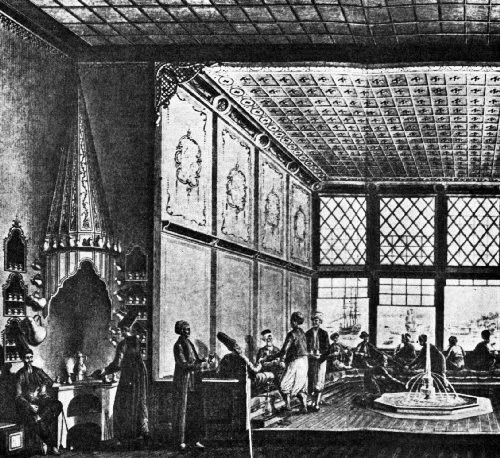
Characteristic Scene in a Turkish Coffee House of the Seventeenth Century
Despite the severe penalties staring them in the face, violations of the law were plentiful among the people of Constantinople. Venders of the beverage appeared in the market-places with "large copper vessels with fire under them; and those who had a mind to drink were invited to step into any neighboring shop where every one was welcome on such an account."
Later, Kuprili, having assured himself that the coffee houses were no longer a menace to his policies, permitted the free use of the beverage that he had previously forbidden.
Coffee and Coffee Houses in Persia
Some writers claim for Persia the discovery of the coffee drink; but there is no evidence to support the claim. There are, however, sufficient facts to justify a belief that here, as in Ethiopia, coffee has been known from time immemorial—which is a very convenient phrase. At an early date the coffee house became an established institution in the chief towns. The Persians appear to have used far more intelligence than the Turks in handling the political phase of the coffee-house question, and so it never became necessary to order them suppressed in Persia.
The wife of Shah Abbas, observing that great numbers of people were wont to gather and to talk politics in the leading coffee house of Ispahan, appointed a mollah—an ecclesiastical teacher and expounder of the law—to sit there daily to entertain the frequenters of the place with nicely turned points of history, law, and poetry. Being a man of wisdom and great tact, he avoided controversial questions of state; and so politics were kept in the background. He proved a welcome visitor, and was made much of by the guests. This example was generally followed, and as a result disturbances were rare in the coffee houses of Ispahan.
Adam Olearius[38] (1599–1671), who was secretary to the German Embassy that traveled in Turkey in 1633–36, tells of the great diversions made in Persian coffee houses "by their poets and historians, who are seated in a high chair from whence they make speeches and tell satirical stories, playing in the meantime with a little stick and using the same gestures as our jugglers and legerdemain men do in England."
At court conferences conspicuous among the shah's retinue were always to be seen the "kahvedjibachi," or "coffee-pourers."
Early Coffee Manners and Customs
Karstens Niebuhr[39] (1733–1815), the Hanoverian traveler, furnishes the following description of the early Arabian, Syrian, and Egyptian coffee houses:
They are commonly large halls, having their floors spread with mats, and illuminated at night by a multitude of lamps. Being the only theaters for the exercise of profane eloquence, poor scholars attend here to amuse the people. Select portions are read, e.g. the adventures of Rustan Sal, a Persian hero. Some aspire to the praise of invention, and compose tales and fables. They walk up and down as they recite, or assuming oratorial consequence, harangue upon subjects chosen by themselves.
In one coffee house at Damascus an orator was regularly hired to tell his stories at a fixed hour; in other cases he was more directly dependant upon the taste of his hearers, as at the conclusion of his discourse, whether it had consisted of literary topics or of loose and idle tales, he looked to the audience for a voluntary contribution.
At Aleppo, again, there was a man with a soul above the common, who, being a person of distinction, and one that studied merely for his own pleasure, had yet gone the round of all the coffee houses in the city to pronounce moral harangues.
In some coffee houses there were singers and dancers, as before, and many came to listen to the marvelous tales, of the Thousand and One Nights.
In Oriental countries it was once the custom to offer a cup of "bad coffee," i.e., coffee containing poison, to those functionaries or other persons who had proven themselves embarrassing to the authorities.
While coffee drinking started as a private religious function, it was not long after its introduction by the coffee houses that it became secularized still more in the homes of the people, although for centuries it retained a certain religious significance. Galland says that in Constantinople, at the time of his visit to the city, there was no house, rich or poor, Turk or Jew, Greek or Armenian, where it was not drunk at least twice a day, and many drank it oftener, for it became a custom in every house to offer it to all visitors; and it was considered an incivility to refuse it. Twenty dishes a day, per person, was not an uncommon average.
Galland observes that "as much money must be spent in the private families of Constantinople for coffee as for wine at Paris," and relates that it is as common for beggars to ask for money to buy coffee, as it is in Europe to ask for money to buy wine or beer.
At this time to refuse or to neglect to give coffee to their wives was a legitimate cause for divorce among the Turks. The men made promise when marrying never to let their wives be without coffee. "That," says Fulbert de Monteith, "is perhaps more prudent than to swear fidelity."
Another Arabic manuscript by Bichivili in the Bibliothéque Nationale at Paris furnishes us with this pen picture of the coffee ceremony as practised in Constantinople in the sixteenth century:
In all the great men's houses, there are servants whose business it is only to take care of the coffee; and the head officer among them, or he who has the inspection over all the rest, has an apartment allowed him near the hall which is destined for the reception of visitors. The Turks call this officer Kavveghi, that is, Overseer or Steward of the Coffee. In the harem or ladies' apartment in the seraglio, there are a great many such officers, each having forty or fifty Baltagis under them, who, after they have served a certain time in these coffee-houses, are sure to be well provided for, either by an advantageous post, or a sufficient quantity of land. In the houses of persons of quality likewise, there are pages, called Itchoglans, who receive the coffee from the stewards, and present it to the company with surprising dexterity and address, as soon as the master of the family makes a sign for that purpose, which is all the language they ever speak to them.... The coffee is served on salvers without feet, made commonly of painted or varnished wood, and sometimes of silver. They hold from 15 to 20 china dishes each; and such as can afford it have these dishes half set in silver ... the dish may be easily held with the thumb below and two fingers on the upper edge.
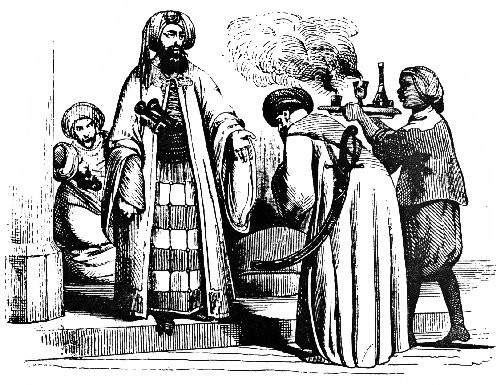
Serving Coffee to a Guest.—After a Drawing in an Early Edition of "Arabian Nights"
In his Relation of a Journey to Constantinople in 1657, Nicholas Rolamb, the Swedish traveler and envoy to the Ottoman Porte, gives us this early glimpse of coffee in the home life of the Turks:[40]
This [coffee] is a kind of pea that grows in Egypt, which the Turks pound and boil in water, and take it for pleasure instead of brandy, sipping it through the lips boiling hot, persuading themselves that it consumes catarrhs, and prevents the rising of vapours out of the stomach into the head. The drinking of this coffee and smoking tobacco (for tho' the use of tobacco is forbidden on pain of death, yet it is used in Constantinople more than any where by men as well as women, tho' secretly) makes up all the pastime among the Turks, and is the only thing they treat one another with; for which reason all people of distinction have a particular room next their own, built on purpose for it, where there stands a jar of coffee continually boiling.
It is curious to note that among several misconceptions that were held by some of the peoples of the Levant was one that coffee was a promoter of impotence, although a Persian version of the Angel Gabriel legend says that Gabriel invented it to restore the Prophet's failing metabolism. Often in Turkish and Arabian literature, however, we meet with the suggestion that coffee drinking makes for sterility and barrenness, a notion that modern medicine has exploded; for now we know that coffee stimulates the racial instinct, for which tobacco is a sedative.
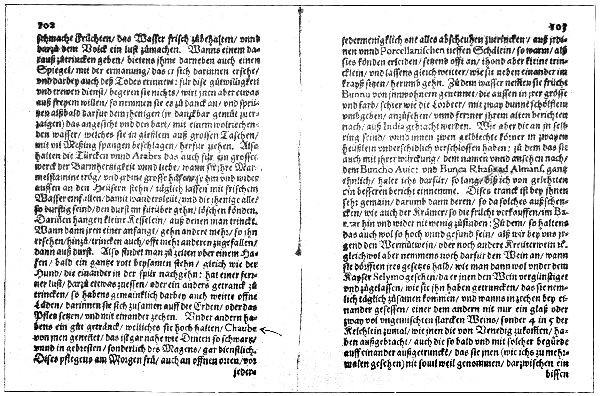
Chapter IV
INTRODUCTION OF COFFEE INTO WESTERN EUROPE
When the three great temperance beverages, cocoa, tea, and coffee, came to Europe—Coffee first mentioned by Rauwolf in 1582—Early days of coffee in Italy—How Pope Clement VIII baptized it and made it a truly Christian beverage—The first European coffee house, in Venice, 1645—The famous Caffè Florian—Other celebrated Venetian coffee houses of the eighteenth century—The romantic story of Pedrocchi, the poor lemonade-vender, who built the most beautiful coffee house in the world
Of the world's three great temperance beverages, cocoa, tea, and coffee, cocoa was the first to be introduced into Europe, in 1528, by the Spanish. It was nearly a century later, in 1610, that the Dutch brought tea to Europe. Venetian traders introduced coffee into Europe in 1615.
Europe's first knowledge of coffee was brought by travelers returning from the Far East and the Levant. Leonhard Rauwolf started on his famous journey into the Eastern countries from Marseilles in September, 1573, having left his home in Augsburg, the 18th of the preceding May. He reached Aleppo in November, 1573; and returned to Augsburg, February 12, 1576. He was the first European to mention coffee; and to him also belongs the honor of being the first to refer to the beverage in print.
Rauwolf was not only a doctor of medicine and a botanist of great renown, but also official physician to the town of Augsburg. When he spoke, it was as one having authority. The first printed reference to coffee appears as chaube in chapter viii of Rauwolf's Travels, which deals with the manners and customs of the city of Aleppo. The exact passage is reproduced herewith as it appears in the original German edition of Rauwolf published at Frankfort and Lauingen in 1582–83. The translation is as follows:
If you have a mind to eat something or to drink other liquors, there is commonly an open shop near it, where you sit down upon the ground or carpets and drink together. Among the rest they have a very good drink, by them called Chaube [coffee] that is almost as black as ink, and very good in illness, chiefly that of the stomach; of this they drink in the morning early in open places before everybody, without any fear or regard, out of China cups, as hot as they can; they put it often to their lips but drink but little at a time, and let it go round as they sit.
In this same water they take a fruit called Bunnu which in its bigness, shape and color is almost like unto a bayberry, with two thin shells surrounded, which, as they informed me, are brought from the Indies; but as these in themselves are, and have within them, two yellowish grains in two distinct cells, and besides, being they agree in their virtue, figure, looks, and name with the Bunchum of Avicenna, and Bunca, of Rasis ad Almans exactly; therefore I take them to be the same, until I am better informed by the learned. This liquor is very common among them, wherefore there are a great many of them that sell it, and others that sell the berries, everywhere in their Batzars.
The Early Days of Coffee in Italy
It is not easy to determine just when the use of coffee spread from Constantinople to the western parts of Europe; but it is more than likely that the Venetians, because of their close proximity to, and their great trade with, the Levant, were the first acquainted with it.
Prospero Alpini (Alpinus; 1553–1617), a learned physician and botanist of Padua, journeyed to Egypt in 1580, and brought back news of coffee. He was the first to print a description of the coffee plant and drink in his treatise The Plants of Egypt, written in Latin, and published in Venice, 1592. He says:
I have seen this tree at Cairo, it being the same tree that produces the fruit, so common in Egypt, to which they give the name bon or ban. The Arabians and the Egyptians make a sort of decoction of it, which they drink instead of wine; and it is sold in all their public houses, as wine is with us. They call this drink caova. The fruit of which they make it comes from "Arabia the Happy," and the tree that I saw looks like a spindle tree, but the leaves are thicker, tougher, and greener. The tree is never without leaves.
Alpini makes note of the medicinal qualities attributed to the drink by dwellers in the Orient, and many of these were soon incorporated into Europe's materia medica.
Johann Vesling (Veslingius; 1598–1649), a German botanist and traveler, settled in Venice, where he became known as a learned Italian physician. He edited (1640) a new edition of Alpini's work; but earlier (1638) published some comments on Alpini's findings, in the course of which he distinguished certain qualities found in a drink made from the husks (skins) of the coffee berries from those found in the liquor made from the beans themselves, which he calls the stones of the coffee fruit. He says:
Not only in Egypt is coffee in much request, but in almost all the other provinces of the Turkish Empire. Whence it comes to pass that it is dear even in the Levant and scarce among the Europeans, who by that means are deprived of a very wholesome liquor.
From this we may conclude that coffee was not wholly unknown in Europe at that time. Vesling adds that when he visited Cairo, he found there two or three thousand coffee houses, and that "some did begin to put sugar in their coffee to correct the bitterness of it, and others made sugar-plums of the berries."
Coffee Baptized by the Pope
Shortly after coffee reached Rome, according to a much quoted legend, it was again threatened with religious fanaticism, which almost caused its excommunication from Christendom. It is related that certain priests appealed to Pope Clement VIII (1535–1605) to have its use forbidden among Christians, denouncing it as an invention of Satan. They claimed that the Evil One, having forbidden his followers, the infidel Moslems, the use of wine—no doubt because it was sanctified by Christ and used in the Holy Communion—had given them as a substitute this hellish black brew of his which they called coffee. For Christians to drink it was to risk falling into a trap set by Satan for their souls.
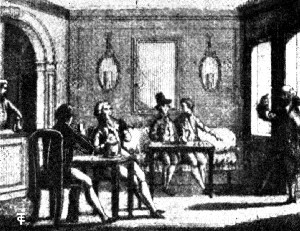
An Eighteenth Century Italian Coffee House
After Goldoni, by Zatta
It is further related that the pope, made curious, desired to inspect this Devil's drink, and had some brought to him. The aroma of it was so pleasant and inviting that the pope was tempted to try a cupful. After drinking it, he exclaimed, "Why, this Satan's drink is so delicious that it would be a pity to let the infidels have exclusive use of it. We shall fool Satan by baptizing it, and making it a truly Christian beverage."
Thus, whatever harmfulness its opponents try to attribute to coffee, the fact remains (if we are to credit the story) that it has been baptized and proclaimed unharmful, and a "truly Christian beverage," by his holiness the pope.
The Venetians had further knowledge of coffee in 1585, when Gianfrancesco Morosini, city magistrate at Constantinople, reported to the Senate that the Turks "drink a black water as hot as they can suffer it, which is the infusion of a bean called cavee, which is said to possess the virtue of stimulating mankind."
Dr. A. Couguet, in an Italian review, asserts that Europe's first cup of coffee was sipped in Venice, toward the close of the sixteenth century. He is of the opinion that the first berries were imported by Mocengio, who was called the pevere, because he made a huge fortune trading in spices and other specialties of the Orient.
In 1615 Pierre (Pietro) Delia Valle (1586–1652), the well known Italian traveler and author of Travels in India and Persia, wrote a letter from Constantinople to his friend Mario Schipano at Venice:
The Turks have a drink of black color, which during the summer is very cooling, whereas in the winter it heats and warms the body, remaining always the same beverage and not changing its substance. They swallow it hot as it comes from the fire and they drink it in long draughts, not at dinner time, but as a kind of dainty and sipped slowly while talking with one's friends. One cannot find any meetings among them where they drink it not.... With this drink, which they call cahue, they divert themselves in their conversations.... It is made with the grain or fruit of a certain tree called cahue.... When I return I will bring some with me and I will impart the knowledge to the Italians.
[33] Adjam, by many writers wrongly rendered Persia.
[34] Scheuzer, J.J. Physique Sacrée, ou Histoire Naturelle de la Bible. Amsterdam, 1732, 1737.
[35] Harper's Weekly. New York, 1911. (Jan. 21.)
[36] Nairon, Antoine Faustus. De Saluberrimá Cahue seu Café nuncupata Discursus. Rome, 1671.
[37] de Sacy, Baron Antoine Isaac Silvestre. Chresto-nathie Arabe. Paris, 1806. (vol. ii: p. 224.)
[38] Olearius, Adam. An Account of His Journeys. London, 1669.
[39] Niebuhr, Karstens. Description of Arabia. Amsterdam, 1774. (Heron trans., London, 1792: p. 266.)
[40] A Collection of Voyages and Travels. London, 1745. (vol. iv: p. 690.)
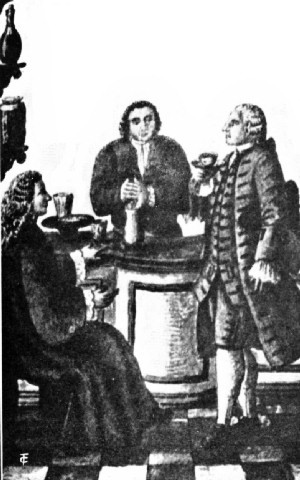
Nobility in an Early Venetian Caffè
From the Grevembroch collection in the Museo Civico
Della Valle's countrymen, however, were in a fair way to become well acquainted with the beverage, for already (1615) it had been introduced into Venice. At first it was used largely for medicinal purposes; and high prices were charged for it. Vesling says of its use in Europe as a medicine, "the first step it made from the cabinets of the curious, as an exotic seed, being into the apothecaries' shops as a drug."
The first coffee house in Italy is said to have been opened in 1645, but convincing confirmation is lacking. In the beginning, the beverage was sold with other drinks by lemonade-venders. The Italian word aquacedratajo means one who sells lemonade and similar refreshments; also one who sells coffee, chocolate, liquor, etc. Jardin says the beverage was in general use throughout Italy in 1645. It is certain, however, that a coffee shop was opened in Venice in 1683 under the Procuratie Nuove. The famous Caffè Florian was opened in Venice by Floriono Francesconi in 1720.
The first authoritative treatise devoted to coffee only appeared in 1671. It was written in Latin by Antoine Faustus Nairon (1635–1707), Maronite professor of the Chaldean and Syrian languages in the College of Rome.
During the latter part of the seventeenth century and the first half of the eighteenth, the coffee house made great progress in Italy. It is interesting to note that this first European adaptation of the Oriental coffee house was known as a caffè. The double f is retained by the Italians to this day, and by some writers is thought to have been taken from coffea, without the double f being lost, as in the case of the French and some other Continental forms.
To Italy, then, belongs the honor of having given to the Western world the real coffee house, although the French and Austrians greatly improved upon it. It was not long after its beginning that nearly every shop on the Piazza di San Marco in Venice was a caffè[41]. Near the Piazza was the Caffè della Ponte dell' Angelo, where in 1792 died the dog Tabacchio, celebrated by Vincenzo Formaleoni in a satirical eulogy that is a parody of the oration of Ubaldo Bregolini upon the death of Angelo Emo.
In the Caffè della Spaderia, kept by Marco Ancilloto, some radicals proposed to open a reading-room to encourage the spread of liberal ideas. The inquisitors sent a foot-soldier to notify the proprietor that he should inform the first person entering the room that he was to present himself before their tribunal. The idea was thereupon abandoned.
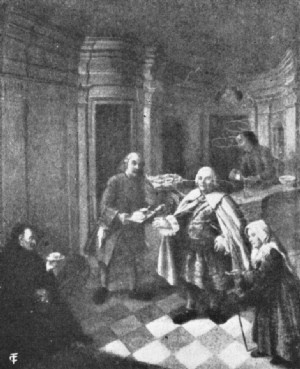
Goldoni in a Venetian Caffè
From a painting by P. Longhi
Among other celebrated coffee houses was the one called Menegazzo, from the name of the rotund proprietor, Menico. This place was much frequented by men of letters; and heated discussions were common there between Angelo Maria Barbaro, Lorenzo da Ponte, and others of their time.
The coffee house gradually became the common resort of all classes. In the mornings came the merchants, lawyers, physicians, brokers, workers, and wandering venders; in the afternoons, and until the late hours of the nights, the leisure classes, including the ladies.
For the most part, the rooms of the first Italian caffè were low, simple, unadorned, without windows, and only poorly illuminated by tremulous and uncertain lights. Within them, however, joyous throngs passed to and fro, clad in varicolored garments, men and women chatting in groups here and there, and always above the buzz there were to be heard such choice bits of scandal as made worthwhile a visit to the coffee house. Smaller rooms were devoted to gaming.
In the "little square" described by Goldoni[42] in his comedy The Coffee House, where the combined barber-shop and gambling house was located, Don Marzio, that marvelous type of slanderous old romancer, is shown as one typical of the period, for Goldoni was a satirist. The other characters of the play were also drawn from the types then to be seen every day in the coffee houses on the Piazza.
In the square of St. Mark's, in the eighteenth century, under the Procuratie Vecchie, were the caffè Re di Francia, Abbondanza, Pitt, l'eroe, Regina d'Ungheria, Orfeo, Redentore, Coraggio-Speranza, Arco Celeste, and Quadri. The last-named was opened in 1775 by Giorgio Quadri of Corfu, who served genuine Turkish coffee for the first time in Venice.
Under the Procuratie Nuove were to be found the caffè Angelo Custode, Duca di Toscana, Buon genio-Doge, Imperatore Imperatrice della Russia, Tamerlano, Fontane di Diana, Dame Venete, Aurora Piante d'oro, Arabo-Piastrelle, Pace, Venezia trionfante, and Florian.
Probably no coffee house in Europe has acquired so world-wide a celebrity as that kept by Florian, the friend of Canova the sculptor, and the trusted agent and acquaintance of hundreds of persons in and out of the city, who found him a mine of social information and a convenient city directory. Persons leaving Venice left their cards and itineraries with him; and new-comers inquired at Florian's for tidings of those whom they wished to see. "He long concentrated in himself a knowledge more varied and multifarious than that possessed by any individual before or since," says Hazlitt[43], who has given us this delightful pen picture of caffè life in Venice in the eighteenth century:
Venetian coffee was said to surpass all others, and the article placed before his visitors by Florian was the best in Venice. Of some of the establishments as they then existed, Molmenti has supplied us with illustrations, in one of which Goldoni the dramatist is represented as a visitor, and a female mendicant is soliciting alms.
So cordial was the esteem of the great sculptor Canova for him, that when Florian was overtaken by gout, he made a model of his leg, that the poor fellow might be spared the anguish of fitting himself with boots. The friendship had begun when Canova was entering on his career, and he never forgot the substantial services which had been rendered to him in the hour of need.
In later days, the Caffè Florian was under the superintendence of a female chef, and the waitresses used, in the case of certain visitors, to fasten a flower in the button-hole, perhaps allusively to the name. In the Piazza itself girls would do the same thing. A good deal of hospitality is, and has ever been, dispensed at Venice in the cafés and restaurants, which do service for the domestic hearth.
There were many other establishments devoted, more especially in the latest period of Venetian independence, to the requirements of those who desired such resorts for purposes of conversation and gossip. These houses were frequented by various classes of patrons—the patrician, the politician, the soldier, the artist, the old and the young—all had their special haunts where the company and the tariff were in accordance with the guests. The upper circles of male society—all above the actually poor—gravitated hither to a man.
For the Venetian of all ranks the coffee house was almost the last place visited on departure from the city, and the first visited on his return. His domicile was the residence of his wife and the repository of his possessions; but only on exceptional occasions was it the scene of domestic hospitality, and rare were the instances when the husband and wife might be seen abroad together, and when the former would invite the lady to enter a café or a confectioner's shop to partake of an ice.
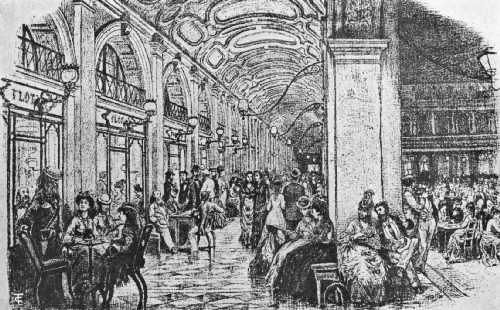
Florian's Famous Caffè in the Piazza di San Marco, Venice, Nineteenth Century
The Caffè Florian has undergone many changes, but it still survives as one of the favorite caffè in the Piazza San Marco.
By 1775 coffee-house history had begun to repeat itself in Venice. Charges of immorality, vice, and corruption, were preferred against the caffè; and the Council of Ten in 1775, and again in 1776, directed the Inquisitors of State to eradicate these "social cankers." However, they survived all attempts of the reformers to suppress them.
The Caffè Pedrocchi in Padua was another of the early Italian coffee houses that became famous. Antonio Pedrocchi (1776–1852) was a lemonade-vender who, in the hope of attracting the gay youth, the students of his time, bought an old house with the idea of converting the ground floor into a series of attractive rooms. He put all his ready money and all he could borrow into the venture, only to find there were no cellars, indispensable for making ices and beverages on the premises, and that the walls and floors were so old that they crumbled when repairs were started.
He was in despair; but, nothing daunted, he decided to have a cellar dug. What was his surprise to find the house was built over the vault of an old church, and that the vault contained considerable treasure. The lucky proprietor found himself free to continue his trade of lemonade-vender and coffee-seller, or to live a life of ease. Being a wise man, he adhered to his original plan; and soon his luxurious rooms became the favorite rendezvous for the smart set of his day. In this period lemonade and coffee frequently went together. The Caffè Pedrocchi is considered one of the finest pieces of architecture erected in Italy in the nineteenth century. It was begun in 1816, opened in 1831, and completed in 1842.
Coffee houses were early established in other Italian cities, particularly in Rome, Florence, and Genoa.
In 1764, Il Caffè, a purely philosophical and literary periodical, made its appearance in Milan, being founded by Count Pietro Verri (1728–97). Its chief editor was Cesare Beccaria. Its object was to counteract the influence and superficiality of the Arcadians. It acquired its title from the fact that Count Verri and his friends were wont to meet at a coffee house in Milan kept by a Greek named Demetrio. It lived only two years.
Other periodicals of the same name appeared at later periods.
Chapter V
THE BEGINNINGS OF COFFEE IN FRANCE
What French travelers did for coffee—The introduction of coffee by P. de la Roque into Marseilles in 1644—The first commercial importation of coffee from Egypt—The first French coffee house—Failure of the attempt by physicians of Marseilles to discredit coffee—Soliman Aga introduces coffee into Paris—Cabarets à caffè—Celebrated works on coffee by French writers
We are indebted to three great French travelers for much valuable knowledge about coffee; and these gallant gentlemen first fired the imagination of the French people in regard to the beverage that was destined to play so important a part in the French revolution. They are Tavernier (1605–89), Thévenot (1633–67), and Bernier (1625–88).
Then there is Jean La Roque (1661–1745), who made a famous "Voyage to Arabia the Happy" (Voyage de l'Arabie Heureuse) in 1708–13 and to whose father, P. de la Roque, is due the honor of having brought the first coffee into France in 1644. Also, there is Antoine Galland (1646–1715), the French Orientalist, first translator of the Arabian Nights and antiquary to the king, who, in 1699, published an analysis and translation from the Arabic of the Abd-al-Kâdir manuscript (1587), giving the first authentic account of the origin of coffee.
Probably the earliest reference to coffee in France is to be found in the simple statement that Onorio Belli (Bellus), the Italian botanist and author, in 1596 sent to Charles de l'Écluse (1526–1609), a French physician, botanist and traveler, "seeds used by the Egyptians to make a liquid they call cave.[44]"
P. de la Roque accompanied M. de la Haye, the French ambassador, to Constantinople; and afterward traveled into the Levant. Upon his return to Marseilles in 1644, he brought with him not only some coffee, but "all the little implements used about it in Turkey, which were then looked upon as great curiosities in France." There were included in the coffee service some findjans, or china dishes, and small pieces of muslin embroidered with gold, silver, and silk, which the Turks used as napkins.
Jean La Roque gives credit to Jean de Thévenot for introducing coffee privately into Paris in 1657, and for teaching the French how to use coffee.
De Thévenot writes in this entertaining fashion concerning the use of the drink in Turkey in the middle of the seventeenth century:
They have another drink in ordinary use. They call it cahve and take it all hours of the day. This drink is made from a berry roasted in a pan or other utensil over the fire. They pound it into a very fine powder.
When they wish to drink it, they take a boiler made expressly for the purpose, which they call an ibrik; and having filled it with water, they let it boil. When it boils, they add to about three cups of water a heaping spoonful of the powder; and when it boils, they remove it quickly from the fire, or sometimes they stir it, otherwise it would boil over, as it rises very quickly. When it has boiled up thus ten or twelve times, they pour it into porcelain cups, which they place upon a platter of painted wood and bring it to you thus boiling.
One must drink it hot, but in several instalments, otherwise it is not good. One takes it in little swallows[45] for fear of burning one's self—in such fashion that in a cavekane (so they call the places where it is sold ready prepared), one hears a pleasant little musical sucking sound.... There are some who mix with it a small quantity of cloves and cardamom seeds; others add sugar.
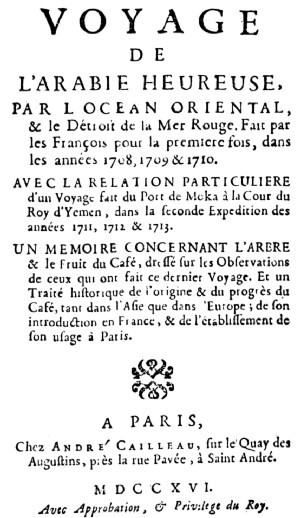
Title Page of La Roque's Work, 1716
It was really out of curiosity that the people of France took to coffee, says Jardin; "they wanted to know this Oriental beverage, so much vaunted, although its blackness at first sight was far from attractive."
About the year 1660 several merchants of Marseilles, who had lived for a time in the Levant and felt they were not able to do without coffee, brought some coffee beans home with them; and later, a group of apothecaries and other merchants brought in the first commercial importation of coffee in bales from Egypt. The Lyons merchants soon followed suit, and the use of coffee became general in those parts. In 1671 certain private persons opened a coffee house in Marseilles, near the Exchange, which at once became popular with merchants and travelers. Others started up, and all were crowded. The people did not, however, drink any the less at home. "In fine," says La Roque, "the use of the beverage increased so amazingly that, as was inevitable, the physicians became alarmed, thinking it would not agree with the inhabitants of a country hot and extremely dry."
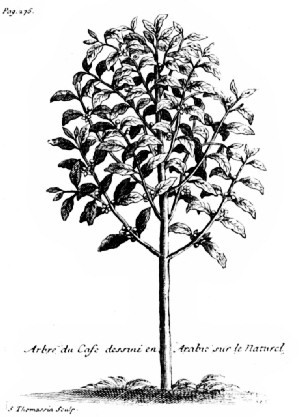
The Coffee Tree as Pictured by La Roque in His "Voyage de l'Arabie Heureuse"
The age-old controversy was on. Some sided with the physicians, others opposed them, as at Mecca, Cairo, and Constantinople; only here the argument turned mainly on the medicinal question, the Church this time having no part in the dispute. "The lovers of coffee used the physicians very ill when they met together, and the physicians on their side threatened the coffee drinkers with all sorts of diseases."
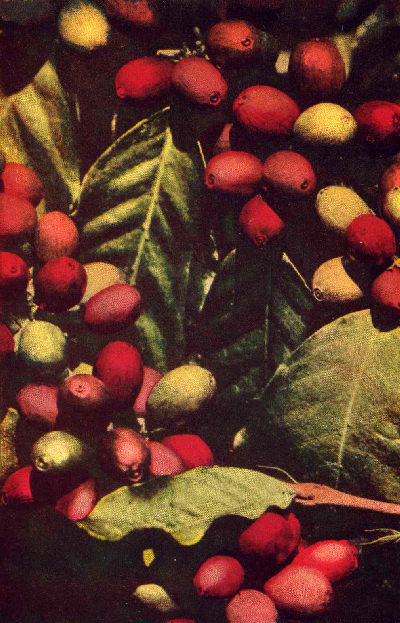
A CLOSE-UP OF RIPE COFFEE BERRIES
Matters came to a head in 1679, when an ingenious attempt by the physicians of Marseilles to discredit coffee took the form of having a young student, about to be admitted to the College of Physicians, dispute before the magistrate in the town hall, a question proposed by two physicians of the Faculty of Aix, as to whether coffee was or was not prejudicial to the inhabitants of Marseilles.
The thesis recited that coffee had won the approval of all nations, had almost wholly put down the use of wine, although it was not to be compared even with the lees of that excellent beverage; that it was a vile and worthless foreign novelty; that its claim to be a remedy against distempers was ridiculous, because it was not a bean but the fruit of a tree discovered by goats and camels; that it was hot and not cold, as alleged; that it burned up the blood, and so induced palsies, impotence, and leanness; "from all of which we must necessarily conclude that coffee is hurtful to the greater part of the inhabitants of Marseilles."
Thus did the good doctors of the Faculty of Aix set forth their prejudices, and this was their final decision upon coffee. Many thought they overreached themselves in their misguided zeal. They were handled somewhat roughly in the disputation, which disclosed many false reasonings, to say nothing of blunders as to matters of fact. The world had already advanced too far to have another decision against coffee count for much, and this latest effort to stop its onward march was of even less force than the diatribes of the Mohammedan priests. The coffee houses continued to be as much frequented as before, and the people drank no less coffee in their homes. Indeed, the indictment proved a boomerang, for consumption received such an impetus that the merchants of Lyons and Marseilles, for the first time in history, began to import green coffee from the Levant by the ship-load in order to meet the increased demand.
Meanwhile, in 1669, Soliman Aga, the Turkish ambassador from Mohammed IV to the court of Louis XIV, had arrived in Paris. He brought with him a considerable quantity of coffee, and introduced the coffee drink, made in Turkish style, to the French capital.
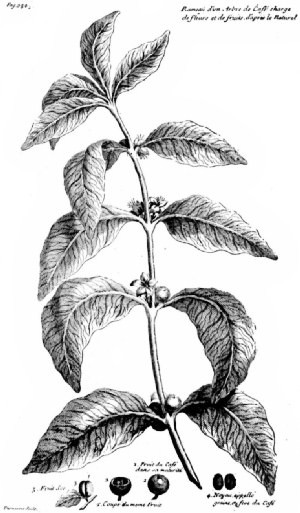
A Coffee Branch With Flowers and Fruit as Illustrated in La Roque's "Voyage de l'Arabie Heureuse"
The ambassador remained in Paris only from July, 1669, to May, 1670, but long enough firmly to establish the custom he had introduced. Two years later, Pascal, an Armenian, opened his coffee-drinking booth at the fair of St.-Germain, and this event marked the beginning of the Parisian coffee houses. The story is told in detail in chapter XI.
The custom of drinking coffee having become general in the capital, as well as in Marseilles and Lyons, the example was followed in all the provinces. Every city soon had its coffee houses, and the beverage was largely consumed in private homes. La Roque writes: "None, from the meanest citizen to the persons of the highest quality, failed to use it every morning or at least soon after dinner, it being the custom likewise to offer it in all visits."
"The persons of highest quality" encouraged the fashion of having cabaréts à caffé; and soon it was said that there could be seen in France all that the East could furnish of magnificence in coffee houses, "the china jars and other Indian furniture being richer and more valuable than the gold and silver with which they were lavishly adorned."
In 1671 there appeared in Lyons a book entitled The Most Excellent Virtues of the Mulberry, Called Coffee, showing the need for an authoritative work on the subject—a need that was ably filled that same year and in Lyons by the publication of Philippe Sylvestre Dufour's admirable treatise, Concerning the Use of Coffee, Tea, and Chocolate. Again at Lyons, Dufour published (1684) his more complete work on The Manner of Making Coffee, Tea, and Chocolate. This was followed (1715) by the publication in Paris of Jean La Roque's Voyage de l'Arabie Heureuse, containing the story of the author's journey to the court of the king of Yemen in 1711, a description of the coffee tree and its fruit, and a critical and historical treatise on its first use and introduction to France.
La Roque's description of his visit to the king's gardens is interesting because it shows the Arabs still held to the belief that coffee grew only in Arabia. Here it is:
There was nothing remarkable in the King's Gardens, except the great pains taken to furnish it with all the kinds of trees that are common in the country; amongst which there were the coffee trees, the finest that could be had. When the deputies represented to the King how much that was contrary to the custom of the Princes of Europe (who endeavor to stock their gardens chiefly with the rarest and most uncommon plants that can be found) the King returned them this answer: That he valued himself as much upon his good taste and generosity as any Prince in Europe; the coffee tree, he told them, was indeed common in his country, but it was not the less dear to him upon that account; the perpetual verdure of it pleased him extremely; and also the thoughts of its producing a fruit which was nowhere else to be met with; and when he made a present of that that came from his own Gardens, it was a great satisfaction to him to be able to say that he had planted the trees that produced it with his own hands.
The first merchant licensed to sell coffee in France was one Damame François, a bourgeois of Paris, who secured the privilege through an edict of 1692. He was given the sole right for ten years to sell coffees and teas in all the provinces and towns of the kingdom, and in all territories under the sovereignty of the king, and received also authority to maintain a warehouse.
To Santo Domingo (1738) and other French colonies the café was soon transported from the homeland, and thrived under special license from the king.
In 1858 there appeared in France a leaflet-periodical, entitled The Café, Literary, Artistic, and Commercial. Ch. Woinez, the editor, said in announcing it: "The Salon stood for privilege, the Café stands for equality." Its publication was of short duration.
Chapter VI
THE INTRODUCTION OF COFFEE INTO ENGLAND
The first printed reference to coffee in English—Early mention of coffee by noted English travelers and writers—The Lacedæmonian "black broth" controversy—How Conopios introduced coffee drinking at Oxford—The first English coffee house in Oxford—Two English botanists on coffee
English travelers and writers of the sixteenth and seventeenth centuries were quite as enterprising as their Continental contemporaries in telling about the coffee bean and the coffee drink. The first printed reference to coffee in English, however, appears as chaoua in a note by a Dutchman, Paludanus, in Linschoten's Travels, the title of an English translation from the Latin of a work first published in Holland in 1595 or 1596, the English edition appearing in London in 1598. A reproduction made from a photograph of the original work, with the quaint black-letter German text and the Paludanus notation in roman, is shown herewith.
Hans Hugo (or John Huygen) Van Linschooten (1563–1611) was one of the most intrepid of Dutch travelers. In his description of Japanese manners and customs we find one of the earliest tea references. He says:
Their manner of eating and drinking is: everie man hath a table alone, without table-clothes or napkins, and eateth with two pieces of wood like the men of Chino: they drinke wine of Rice, wherewith they drink themselves drunke, and after their meat they use a certain drinke, which is a pot with hote water, which they drinke as hote as ever they may indure, whether it be Winter or Summer.
Just here Bernard Ten Broeke Paludanus (1550–1633), Dutch savant and author, professor of philosophy at the University of Leyden, himself a traveler over the four quarters of the globe, inserts his note containing the coffee reference. He says:
The Turks holde almost the same manner of drinking of their Chaona[46], which they make of certaine fruit, which is like unto the Bakelaer[47], and by the Egyptians called Bon or Ban[48]: they take of this fruite one pound and a half, and roast them a little in the fire and then sieth them in twenty pounds of water, till the half be consumed away: this drinke they take every morning fasting in their chambers, out of an earthen pot, being verie hote, as we doe here drinke aquacomposita[49] in the morning: and they say that it strengtheneth and maketh them warme, breaketh wind, and openeth any stopping.
Van Linschooten then completes his tea reference by saying:
The manner of dressing their meat is altogether contrarie unto other nations: the aforesaid warme water is made with the powder of a certaine hearbe called Chaa, which is much esteemed, and is well accounted among them.
The chaa is, of course, tea, dialect t'eh.
In 1599, "Sir" Antony (or Anthony) Sherley (1565–1630), a picturesque gentleman-adventurer, the first Englishman to mention coffee drinking in the Orient, sailed from Venice on a kind of self-appointed, informal Persian mission, to invite the shah to ally himself with the Christian princes against the Turks, and incidentally, to promote English trade interests in the East. The English government knew nothing of the arrangement, disavowed him, and forbade his return to England. However, the expedition got to Persia; and the account of the voyage thither was written by William Parry, one of the Sherley party, and was published in London in 1601. It is interesting because it contains the first printed reference to coffee in English employing the more modern form of the word. The original reference was photographed for this work in the Worth Library of the British Museum, and is reproduced herewith on page 39.
The passage is part of an account of the manners and customs of the Turks (who, Parry says, are "damned infidells") in Aleppo. It reads:
They sit at their meat (which is served to them upon the ground) as Tailers sit upon their stalls, crosse-legd; for the most part, passing the day in banqueting and carowsing, untill they surfet, drinking a certaine liquor, which they do call Coffe, which is made of seede much like mustard seede, which will soone intoxicate the braine like our Metheglin.[50]
Another early English reference to coffee, wherein the word is spelled "coffa", is in Captain John Smith's book of Travels and Adventure, published in 1603. He says of the Turks: "Their best drink is coffa of a graine they call coava."
This is the same Captain John Smith who in 1607 became the founder of the Colony of Virginia and brought with him to America probably the earliest knowledge of the beverage given to the new Western world.
Samuel Purchas (1527–1626), an early English collector of travels, in Purchas His Pilgrimes, under the head of "Observations of William Finch, merchant, at Socotra" (Sokotra—an island in the Indian Ocean) in 1607, says of the Arab inhabitants:
Their best entertainment is a china dish of Coho, a blacke bitterish drinke, made of a berry like a bayberry, brought from Mecca, supped off hot, good for the head and stomache.[51]
Still other early and favorite English references to coffee are those to be found in the Travels of William Biddulph. This work was published in 1609. It is entitled The Travels of Certayne Englishmen in Africa, Asia, etc.... Begunne in 1600 and by some of them finished—this yeere 1608. These references are also reproduced herewith from the black-letter originals in the British Museum (see page 40).
Biddulph's description of the drink, and of the coffee-house customs of the Turks, was the first detailed account to be written by an Englishman. It also appears in Purchas His Pilgrimes (1625). But, to quote:
Their most common drinke is Coffa, which is a blacke kinde of drinke, made of a kind of Pulse like Pease, called Coaua; which being grownd in the Mill, and boiled in water, they drinke it as hot as they can suffer it; which they finde to agree very well with them against their crudities, and feeding on hearbs and rawe meates. Other compounded drinkes they have, called Sherbet, made of Water and Sugar, or Hony, with Snow therein to make it coole; for although the Countrey bee hot, yet they keepe Snow all the yeere long to coole their drinke. It is accounted a great curtesie amongst them to give unto their frends when they come to visit them, a Fin-ion or Scudella of Coffa, which is more holesome than toothsome, for it causeth good concoction, and driveth away drowsinesse.
Some of them will also drinke Bersh or Opium, which maketh them forget themselves, and talk idely of Castles in the Ayre, as though they saw Visions, and heard Revelations. Their Coffa houses are more common than Ale-houses in England; but they use not so much to sit in the houses, as on benches on both sides the streets, neere unto a Coffa house, every man with his Fin-ionful; which being smoking hot, they use to put it to their Noses & Eares, and then sup it off by leasure, being full of idle and Ale-house talke whiles they are amongst themselves drinking it; if there be any news, it is talked of there.
Among other early English references to coffee we find an interesting one by Sir George Sandys (1577–1644), the poet, who gave a start to classical scholarship in America by translating Ovid's Metamorphoses during his pioneer days in Virginia. In 1610 he spent a year in Turkey, Egypt, and Palestine, and records of the Turks:[52]
Although they be destitute of Taverns, yet have they their Coffa-houses, which something resemble them. There sit they chatting most of the day; and sippe of a drinke called Coffa (of the berry that it is made of) in little China dishes as hot as they can suffer it: blacke as soote, and tasting not much unlike it (why not that blacke broth which was in use amongst the Lacedemonians?) which helpeth, as they say, digestion, and procureth alacrity: many of the Coffa-men keeping beautifull boyes, who serve as stales to procure them customers.
Edward Terry (1590–1660), an English traveler, writes, under date of 1616, that many of the best people in India who are strict in their religion and drink no wine at all, "use a liquor more wholesome than pleasant, they call coffee; made by a black Seed boyld in water, which turnes it almost into the same colour, but doth very little alter the taste of the water [!], notwithstanding it is very good to help Digestion, to quicken the Spirits and to cleanse the Blood."
It appears as Chaona (chaoua) in the second line of the roman text notation by Paludanus
In 1623, Francis Bacon (1561–1626), in his Historia Vitae et Mortis says: "The Turkes use a kind of herb which they call caphe"; and, in 1624, in his Sylva Sylvarum[53] (published in 1627, after his death), he writes:
They have in Turkey a drink called coffa made of a berry of the same name, as black as soot, and of a strong scent, but not aromatical; which they take, beaten into powder, in water, as hot as they can drink it: and they take it, and sit at it in their coffa-houses, which are like our taverns. This drink comforteth the brain and heart, and helpeth digestion. Certainly this berry coffa, the root and leaf betel, the leaf tobacco, and the tear of poppy (opium) of which the Turks are great takers (supposing it expelleth all fear), do all condense the spirits, and make them strong and aleger. But it seemeth they were taken after several manners; for coffa and opium are taken down, tobacco but in smoke, and betel is but champed in the mouth with a little lime.
Robert Burton (1577–1640), English philosopher and humorist, in his Anatomy of Melancholy[54] writes in 1632:
The Turkes have a drinke called coffa (for they use no wine), so named of a berry as blacke as soot and as bitter (like that blacke drinke which was in use amongst the Lacedemonians and perhaps the same), which they sip still of, and sup as warme as they can suffer; they spend much time in those coffa-houses, which are somewhat like our Ale-houses or Taverns, and there they sit, chatting and drinking, to drive away the time, and to be merry together, because they find, by experience, that kinde of drinke so used, helpeth digestion and procureth alacrity.
Later English scholars, however, found sufficient evidence in the works of Arabian authors to assure their readers that coffee sometimes breeds melancholy, causes headache, and "maketh lean much." One of these, Dr. Pocoke, (1659: see chapter III) stated that, "he that would drink it for livelinesse sake, and to discusse slothfulnesse ... let him use much sweet meates with it, and oyle of pistaccioes, and butter. Some drink it with milk, but it is an error, and such as may bring in danger of the leprosy." Another writer observed that any ill effects caused by coffee, unlike those of tea, etc., ceased when its use was discontinued. In this connection it is interesting to note that in 1785 Dr. Benjamin Mosely, physician to the Chelsea Hospital, member of the College of Physicians, etc., probably having in mind the popular idea that the Arabic original of the word coffee meant force, or vigor, once expressed the hope that the coffee drink might return to popular favor in England as "a cheap substitute for those enervating teas and beverages which produce the pernicious habit of dram-drinking."
About 1628, Sir Thomas Herbert (1606–1681), English traveler and writer, records among his observations on the Persians that:
"They drink above all the rest Coho or Copha: by Turk and Arab called Caphe and Cahua: a drink imitating that in the Stigian lake, black, thick, and bitter: destrain'd from Bunchy, Bunnu, or Bay berries; wholesome, they say, if hot, for it expels melancholy ... but not so much regarded for those good properties, as from a Romance that it was invented and brew'd by Gabriel ... to restore the decayed radical Moysture of kind hearted Mahomet.'[55]
In 1634, Sir Henry Blount (1602–82), sometimes referred to as "the father of the English coffee house," made a journey on a Venetian galley into the Levant. He was invited to drink cauphe in the presence of Amurath IV; and later, in Egypt, he tells of being served the beverage again "in a porcelaine dish". This is how he describes the drink in Turkey:[56]
They have another drink not good at meat, called Cauphe, made of a Berry as big as a small Bean, dried in a Furnace, and beat to Pouder, of a Soot-colour, in taste a little bitterish, that they seeth and drink as hot as may be endured: It is good all hours of the day, but especially morning and evening, when to that purpose, they entertain themselves two or three hours in Cauphe-houses, which in all Turkey abound more than Inns and Ale-houses with us; it is thought to be the old black broth used so much by the Lacedemonians, and dryeth ill Humours in the stomach, comforteth the Brain, never causeth Drunkenness or any other Surfeit, and is a harmless entertainment of good Fellowship; for there upon Scaffolds half a yard high, and covered with Mats, they sit Cross-leg'd after the Turkish manner, many times two or three hundred together, talking, and likely with some poor musick passing up and down.
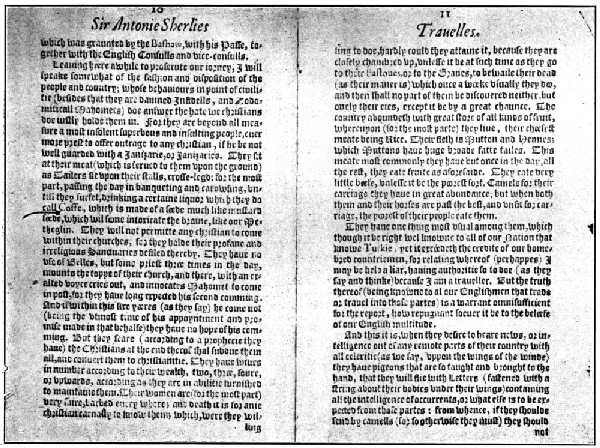
Photographed from the black-letter original of W. Parry's book in the Worth Library of the British Museum
This reference to the Lacedæmonian black broth, first by Sandys, then by Burton, again by Blount, and concurred in by James Howell (1595–1666), the first historiographer royal, gave rise to considerable controversy among Englishmen of letters in later years. It is, of course, a gratuitous speculation. The black broth of the Lacedæmonians was "pork, cooked in blood and seasoned with salt and vinegar.[57]"
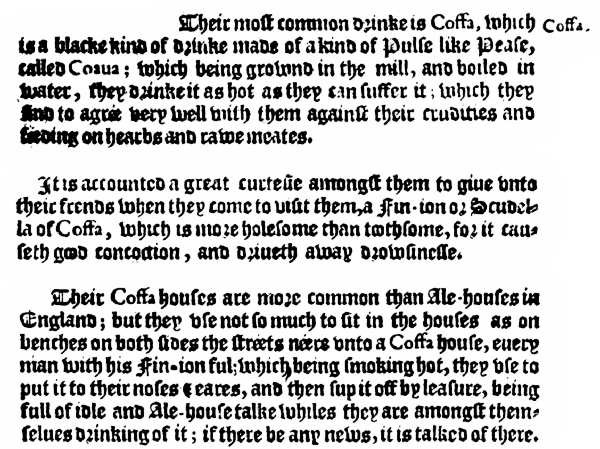
References to Coffee as Found in Biddulph's Travels 1609
From the black-letter original in the British Museum
William Harvey (1578–1657), the famous English physician who discovered the circulation of the blood, and his brother are reputed to have used coffee before coffee houses came into vogue in London—this must have been previous to 1652. "I remember", says Aubrey[58], "he was wont to drinke coffee; which his brother Eliab did, before coffee houses were the fashion in London." Houghton, in 1701, speaks of "the famous inventor of the circulation of the blood, Dr. Harvey, who some say did frequently use it."
Although it seems likely that coffee must have been introduced into England sometime during the first quarter of the seventeenth century, with so many writers and travelers describing it, and with so much trading going on between the merchants of the British Isles and the Orient, yet the first reliable record we have of its advent is to be found in the Diary and Correspondence of John Evelyn, F.R.S.[59], under "Notes of 1637", where he says:
[41] Molmenti, Pompeo. La Storia di Venezia nella Vita Privata. Bergamo, 1908. (pt. 3: p. 245.)
[42] Goldoni, Carlo. La Bottega di Caffè. 1750.
[43] Hazlitt, W. Carew. The Venetian Republic. London, 1905, (vol. 2: pp. 1012–15.)
[44] Jardin, Édelestan. Le Caféier et le Café. Paris, 1895. (p. 16.)
[45] "Drop by drop they take it in," said Cotovicus.
[46] Misprinted thus in the original Dutch and here. Read Chaoua, i.e., Arabic qahwah.
[47] Laurel berry, of which the taste is bitter and disagreeable. From Latin bacca lauri.
[48] Arabic, bunn; coffee berries.
[49] Brandewijn in original Dutch.
[50] Mead.
[51] Purchas His Pilgrimes. London, 1625.
[52] Sandys, Sir George. Sandys' Travels. London, 1673. (p. 66.)
[53] Bacon, Francis. Sylva Sylvarum. London, 1627. (vol. v: p. 26.)
[54] Burton, Robert. The Anatomy of Melancholy. Oxford, 1632. (pt. 2: sec. 5: p. 397.) This reference does not appear in the earlier editions of 1621, 24, 28.
[55] Herbert, Sir T. Travels. London, ed. 1638. (p. 241.)
[56] Blount, Sir Henry. A Voyage Into the Levant. London. 1671. (pp. 20, 21, 54, 55, 138, 139.)
[57] Gilbert, Gustav. The Constitutional Antiquities of Sparta and Athens. London, 1895. (p. 69.)
[58] Aubrey, John. Lives of Eminent Men. London, 1813. (vol. ii: pt. 2: pp. 384–85.)
[59] Works. (vol. iv: p. 389.)
There came in my time to the college (Baliol, Oxford) one Nathaniel Conopios, out of Greece, from Cyrill, the Patriarch of Constantinople, who, returning many years after was made (as I understand) Bishop of Smyrna. He was the first I ever saw drink coffee; which custom came not into England till thirty years thereafter.
Evelyn should have said thirteen years after; for then it was that the first coffee house was opened (1650).
Conopios was a native of Crete, trained in the Greek church. He became primore to Cyrill, Patriarch of Constantinople. When Cyrill was strangled by the vizier, Conopios fled to England to avoid a like barbarity. He came with credentials to Archbishop Laud, who allowed him maintenance in Balliol College.
It was observed that while he continued in Balliol College he made the drink for his own use called Coffey, and usually drank it every morning, being the first, as the antients of that House have informed me, that was ever drank in Oxon.[60]
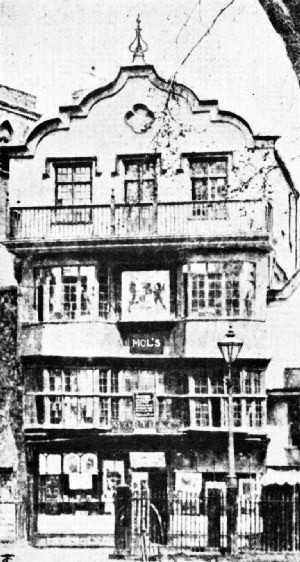
Mol's Coffee House, Exeter, England, Now Worth's Art Rooms
In 1640 John Parkinson (1567–1650), English botanist and herbalist, published his Theatrum Botanicum[61], containing the first botanical description of the coffee plant in English, referred to as "Arbor Bon cum sua Buna. The Turkes Berry Drinke".
His work being somewhat rare, it may be of historical interest to quote the quaint description here:
Alpinus, in his Booke of Egiptian plants, giveth us a description of this tree, which as hee saith, hee saw in the garden of a certain Captaine of the Ianissaries, which was brought out of Arabia felix and there planted as a rarity, never seene growing in those places before.
The tree, saith Alpinus, is somewhat like unto the Evonymus Pricketimber tree, whose leaves were thicker, harder, and greener, and always abiding greene on the tree; the fruite is called Buna and is somewhat bigger then an Hazell Nut and longer, round also, and pointed at the end, furrowed also on both sides, yet on one side more conspicuous than the other, that it might be parted in two, in each side whereof lyeth a small long white kernell, flat on that side they joyne together, covered with a yellowish skinne, of an acid taste, and somewhat bitter withall and contained in a thinne shell, of a darkish ash-color; with these berries generally in Arabia and Egipt, and in other places of the Turkes Dominions, they make a decoction or drinke, which is in the stead of Wine to them, and generally sold in all their tappe houses, called by the name of Caova; Paludanus saith Chaova, and Rauwolfius Chaube.
This drinke hath many good physical properties therein; for it strengthened a week stomacke, helpeth digestion, and the tumors and obstructions of the liver and spleene, being drunke fasting for some time together.
In 1650, a certain Jew from Lebanon, in some accounts Jacob or Jacobs by name, in others Jobson[62], opened "at the Angel in the parish of St. Peter in the East", Oxford, the earliest English coffee house and "there it [coffee] was by some who delighted in noveltie, drank". Chocolate was also sold at this first coffee house.
Authorities differ, but the confusion as to the name of the coffee-house keeper may have arisen from the fact that there were two—Jacobs, who began in 1650; and another, Cirques Jobson, a Jewish Jacobite, who followed him in 1654.
The drink at once attained great favor among the students. Soon it was in such demand that about 1655 a society of young students encouraged one Arthur Tillyard, "apothecary and Royalist," to sell "coffey publickly in his house against All Soules College." It appears that a club composed of admirers of the young Charles met at Tillyard's and continued until after the Restoration. This Oxford Coffee Club was the start of the Royal Society.
Jacobs removed to Old Southhampton Buildings, London, where he was in 1671.
Meanwhile, the first coffee house in London had been opened by Pasqua Rosée in 1652; and, as the remainder of the story of coffee's rise and fall in England centers around the coffee houses of old London, we shall reserve it for a separate chapter.
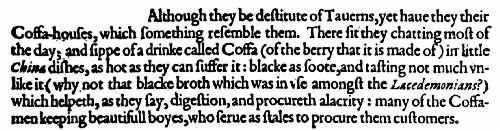
Early English Reference to Coffee by Sir George Sandys
From the seventh edition of Sandys' Travels, London, 1673
Of course, the coffee-house idea, and the use of coffee in the home, quickly spread to other cities in Great Britain; but all the coffee houses were patterned after the London model. Mol's coffee house at Exeter, Devonshire, which is pictured on page 41, was one of the first coffee houses established in England, and may be regarded as typical of those that sprang up in the provinces. It had previously been a noted club house; and the old hall, beautifully paneled with oak, still displays the arms of noted members. Here Sir Walter Raleigh and congenial friends regaled themselves with smoking tobacco. This was one of the first places where tobacco was smoked in England. It is now an art gallery.
When the Bishop of Berytus (Beirut) was on his way to Cochin China in 1666, he reported that the Turks used coffee to correct the indisposition caused in the stomach by the bad water. "This drink," he says, "imitates the effect of wine ... has not an agreeable taste but rather bitter, yet it is much used by these people for the good effects they find therein."
In 1686, John Ray (1628–1704), one of the most celebrated of English naturalists, published his Universal History of Plants, notable among other things for being the first work of its kind to extol the virtues of coffee in a scientific treatise.
R. Bradley, professor of botany at Cambridge, published (1714) A Short Historical Account of Coffee, all trace of which appears to be lost.
Dr. James Douglas published in London (1727) his Arbor Yemensis fructum Cofe ferens; or, a description and History of the Coffee Tree, in which he laid under heavy contribution the Arabian and French writers that had preceded him.
Chapter VII
THE INTRODUCTION OF COFFEE INTO HOLLAND
How the enterprising Dutch traders captured the first world's market for coffee—Activities of the Netherlands East India Company—The first coffee house at the Hague—The first public auction at Amsterdam in 1711, when Java coffee brought forty-seven cents a pound, green
The Dutch had early knowledge of coffee because of their dealings with the Orient and with the Venetians, and of their nearness to Germany, where Rauwolf first wrote about it in 1582. They were familiar with Alpini's writings on the subject in 1592. Paludanus, in his coffee note on Linschoten's Travels, furnished further enlightenment in 1598.
The Dutch were always great merchants and shrewd traders. Being of a practical turn of mind, they conceived an ambition to grow coffee in their colonial possessions, so as to make their home markets headquarters for a world's trade in the product. In considering modern coffee-trading, the Netherlands East India Company may be said to be the pioneer, as it established in Java one of the first experimental gardens for coffee cultivation.
The Netherlands East India Company was formed in 1602. As early as 1614, Dutch traders visited Aden to examine into the possibilities of coffee and coffee-trading. In 1616 Pieter Van dan Broeck brought the first coffee from Mocha to Holland. In 1640 a Dutch merchant, named Wurffbain, offered for sale in Amsterdam the first commercial shipment of coffee from Mocha. As indicating the enterprise of the Dutch, note that this was four years before the beverage was introduced into France, and only three years after Conopios had privately instituted the breakfast coffee cup at Oxford.
About 1650, Varnar, the Dutch minister resident at the Ottoman Porte, published a treatise on coffee.
When the Dutch at last drove the Portuguese out of Ceylon in 1658, they began the cultivation of coffee there, although the plant had been introduced into the island by the Arabs prior to the Portuguese invasion in 1505. However, it was not until 1690 that the more systematic cultivation of the coffee plant by the Dutch was undertaken in Ceylon.
Regular imports of coffee from Mocha to Amsterdam began in 1663. Later, supplies began to arrive from the Malabar coast.
Pasqua Rosée, who introduced the coffee house into London in 1652, is said to have made coffee popular as a beverage in Holland by selling it there publicly in 1664. The first coffee house was opened in the Korten Voorhout, the Hague, under the protection of the writer Van Essen; others soon followed in Amsterdam and Haarlem.
At the instigation of Nicolaas Witsen, burgomaster of Amsterdam and governor of the East India Company, Adrian Van Ommen, commander of Malabar, sent the first Arabian coffee seedlings to Java in 1696, recorded in the chapter on the history of coffee propagation. These were destroyed by flood, but were followed in 1699 by a second shipment, from which developed the coffee trade of the Netherlands East Indies, that made Java coffee a household word in every civilized country.
A trial shipment of the coffee grown near Batavia was received at Amsterdam in 1706, also a plant for the botanical gardens. This plant subsequently became the progenitor of most of the coffees of the West Indies and America.
The first Java coffee for the trade was received at Amsterdam 1711. The shipment consisted of 894 pounds from the Jakatra plantations and from the interior of the island. At the first public auction, this coffee brought twenty-three and two-thirds stuivers (about forty-seven cents) per Amsterdam pound.
The Netherlands East India Company contracted with the regents of Netherlands India for the compulsory delivery of coffee; and the natives were enjoined to cultivate coffee, the production thus becoming a forced industry worked by government. A "general system of cultivation" was introduced into Java in 1832 by the government, which decreed the employment of forced labor for different products. Coffee-growing was the only forced industry that existed before this system of cultivation, and it was the only government cultivation that survived the abolition of the system in 1905–08. The last direct government interest in coffee was closed out in 1918. From 1870 to 1874, the government plantations yielded an average of 844,854 piculs[63] a year; from 1875 to 1878, the average was 866,674 piculs. Between 1879 and 1883, it rose to 987,682 piculs. From 1884 to 1888, the average annual yield was only 629,942 piculs.
Holland readily adopted the coffee house; and among the earliest coffee pictures preserved to us is one depicting a scene in a Dutch coffee house of the seventeenth century, the work of Adriaen Van Ostade (1610–1675), shown on page 586.
History records no intolerance of coffee in Holland. The Dutch attitude was ever that of the constructionist. Dutch inventors and artisans gave us many new designs in coffee mortars, coffee roasters, and coffee serving-pots.
Chapter VIII
THE INTRODUCTION OF COFFEE INTO GERMANY
The contributions made by German travelers and writers to the literature of the early history of coffee—The first coffee house in Hamburg opened by an English merchant—Famous coffee houses of old Berlin—The first coffee periodical, and the first kaffee-klatsch—Frederick the Great's coffee-roasting monopoly—Coffee persecutions—"Coffee-smellers"—The first coffee king
As we have already seen, Leonhard Rauwolf, in 1573, made his memorable trip to Aleppo and, in 1582, won for Germany the honor of being the first European country to make printed mention of the coffee drink.
Adam Olearius (or Oelschlager), a German Orientalist (1599–1671), traveled in Persia as secretary to a German embassy in 1633–36. Upon his return he published an account of his journeys. In it, under date of 1637, he says of the Persians:
They drink with their tobacco a certain black water, which they call cahwa, made of a fruit brought out of Egypt, and which is in colour like ordinary wheat, and in taste like Turkish wheat, and is of the bigness of a little bean.... The Persians think it allays the natural heat.
In 1637, Joh. Albrecht von Mandelsloh, in his Oriental Trip, mentions "the black water of the Persians called Kahwe", saying "it must be drunk hot."
Coffee drinking was introduced into Germany about 1670. The drink appeared at the court of the great elector of Brandenburg in 1675. Northern Germany got its first taste of the beverage from London, an English merchant opening the first coffee house in Hamburg in 1679–80. Regensburg followed in 1689; Leipsic, in 1694; Nuremberg, in 1696; Stuttgart, in 1712; Augsburg, in 1713; and Berlin, in 1721. In that year (1721) King Frederick William I granted a foreigner the privilege of conducting a coffee house in Berlin free of all rental charges. It was known as the English coffee house, as was also the first coffee house in Hamburg. And for many years, English merchants supplied the coffees consumed in northern Germany; while Italy supplied southern Germany.
Other well known coffee houses of old Berlin were, the Royal, in Behren Strasse; that of the Widow Doebbert, in the Stechbahn; the City of Rome, in Unter-den-Linden; Arnoldi, in Kronen Strasse; Miercke, in Tauben Strasse, and Schmidt, in Post Strasse.
Later, Philipp Falck opened a Jewish coffee house in Spandauer Strasse. In the time of Frederick the Great (1712–1786) there were at least a dozen coffee houses in the metropolitan district of Berlin. In the suburbs were many tents where coffee was served.
The first coffee periodical, The New and Curious Coffee House, was issued in Leipsic in 1707 by Theophilo Georgi. The full title was The New and Curious Coffee House, formerly in Italy but now opened in Germany. First water debauchery. "City of the Well." Brunnenstadt by Lorentz Schoepffwasser [draw-water] 1707. The second issue gave the name of Georgi as the real publisher. It was intended to be in the nature of an organ for the first real German kaffee-klatsch. It was a chronicle of the comings and goings of the savants who frequented the "Tusculum" of a well-to-do gentleman in the outskirts of the city. At the beginning the master of the house declared:
I know that the gentlemen here speak French, Italian and other languages. I know also that in many coffee and tea meetings it is considered requisite that French be spoken. May I ask, however, that he who calls upon me should use no other language but German. We are all Germans, we are in Germany; shall we not conduct ourselves like true Germans?
In 1721 Leonhard Ferdinand Meisner published at Nuremberg the first comprehensive German treatise on coffee, tea, and chocolate.
During the second half of the eighteenth century coffee entered the homes, and began to supplant flour-soup and warm beer at breakfast tables.
Meanwhile coffee met with some opposition in Prussia and Hanover. Frederick the Great became annoyed when he saw how much money was paid to foreign coffee merchants for supplies of the green bean, and tried to restrict its use by making coffee a drink of the "quality". Soon all the German courts had their own coffee roasters, coffee pots, and coffee cups.
Many beautiful specimens of the finest porcelain cups and saucers made in Meissen, and used at court fêtes of this period, survive in the collections at the Potsdam and Berlin museums. The wealthy classes followed suit; but when the poor grumbled because they could not afford the luxury, and demanded their coffee, they were told in effect: "You had better leave it alone. Anyhow, it's bad for you because it causes sterility." Many doctors lent themselves to a campaign against coffee, one of their favorite arguments being that women using the beverage must forego child-bearing. Bach's Coffee Cantata[64] (1732) was a notable protest in music against such libels.
On September 13, 1777, Frederick issued a coffee and beer manifesto, a curious document, which recited:
It is disgusting to notice the increase in the quantity of coffee used by my subjects, and the amount of money that goes out of the country in consequence. Everybody is using coffee. If possible, this must be prevented. My people must drink beer. His Majesty was brought up on beer, and so were his ancestors, and his officers. Many battles have been fought and won by soldiers nourished on beer; and the King does not believe that coffee-drinking soldiers can be depended upon to endure hardship or to beat his enemies in case of the occurrence of another war.
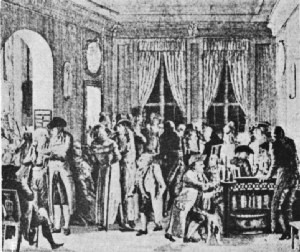
Richter's Coffee House in Leipsic—Seventeenth Century
For a time beer was restored to its honored place; and coffee continued to be a luxury afforded only by the rich. Soon a revulsion of feeling set in; and it was found that even Prussian military rule could not enforce coffee prohibition. Whereupon, in 1781, finding that all his efforts to reserve the beverage for the exclusive court circles, the nobility, and the officers of his army, were vain, the king created a royal monopoly in coffee, and forbade its roasting except in royal roasting establishments. At the same time, he made exceptions in the cases of the nobility, the clergy, and government officials; but rejected all applications for coffee-roasting licenses from the common people. His object, plainly, was to confine the use of the drink to the elect. To these representatives of the cream of Prussian society, the king issued special licenses permitting them to do their own roasting. Of course, they purchased their supplies from the government; and as the price was enormously increased, the sales yielded Frederick a handsome income. Incidentally, the possession of a coffee-roasting license became a kind of badge of membership in the upper class. The poorer classes were forced to get their coffee by stealth; and, failing this, they fell back upon numerous barley, wheat, corn, chicory, and dried-fig substitutes, that soon appeared in great numbers.
This singular coffee ordinance was known as the "Déclaration du Roi concernant la vente du café brûlé", and was published January 21, 1781.
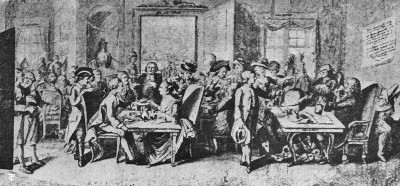
Coffee House in Germany—Middle of the Seventeenth Century
After placing the coffee regie (revenue) in the hands of a Frenchman, Count de Lannay, so many deputies were required to make collections that the administration of the law became a veritable persecution. Discharged wounded soldiers were mostly employed, and their principal duty was to spy upon the people day and night, following the smell of roasting coffee whenever detected, in order to seek out those who might be found without roasting permits. The spies were given one-fourth of the fine collected. These deputies made themselves so great a nuisance, and became so cordially disliked, that they were called "coffee-smellers" by the indignant people.
Taking a leaf out of Frederick's book, the elector of Cologne, Maximilian Frederick, bishop of Münster, (Duchy of Westphalia) on February 17, 1784, issued a manifesto which said:
To our great displeasure we have learned that in our Duchy of Westphalia the misuse of the coffee beverage has become so extended that to counteract the evil we command that four weeks after the publication of this decree no one shall sell coffee roasted or not roasted under a fine of one hundred dollars, or two years in prison, for each offense.
Every coffee-roasting and coffee-serving place shall be closed, and dealers and hotel-keepers are to get rid of their coffee supplies in four weeks. It is only permitted to obtain from the outside coffee for one's own consumption in lots of fifty pounds. House fathers and mothers shall not allow their work people, especially their washing and ironing women, to prepare coffee, or to allow it in any manner under a penalty of one hundred dollars.
All officials and government employees, to avoid a penalty of one hundred gold florins, are called upon closely to follow and to keep a watchful eye over this decree. To the one who reports such persons as act contrary to this decree shall be granted one-half of the said money fine with absolute silence as to his name.
This decree was solemnly read in the pulpits, and was published besides in the usual places and ways. There immediately followed a course of "telling-ons", and of "coffee-smellings", that led to many bitter enmities and caused much unhappiness in the Duchy of Westphalia. Apparently the purpose of the archduke was to prevent persons of small means from enjoying the drink, while those who could afford to purchase fifty pounds at a time were to be permitted the indulgence. As was to be expected, the scheme was a complete failure.
While the king of Prussia exploited his subjects by using the state coffee monopoly as a means of extortion, the duke of Württemberg had a scheme of his own. He sold to Joseph Suess-Oppenheimer, an unscrupulous financier, the exclusive privilege of keeping coffee houses in Württemberg. Suess-Oppenheimer in turn sold the individual coffee-house licenses to the highest bidders, and accumulated a considerable fortune. He was the first "coffee king."
But coffee outlived all these unjust slanders and cruel taxations of too paternal governments, and gradually took its rightful place as one of the favorite beverages of the German people.
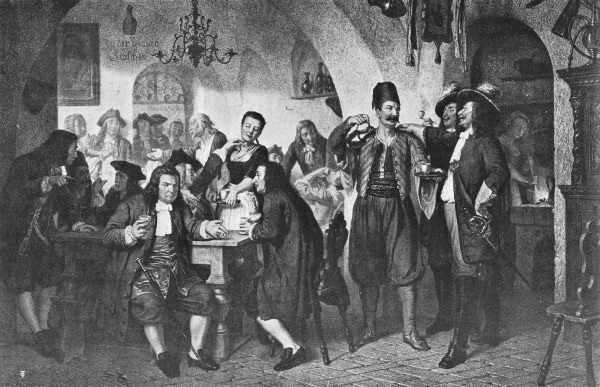
KOLSCHITZKY, THE GREAT BROTHER-HEART, IN HIS BLUE BOTTLE CAFÉ, VIENNA, 1683 From a lithograph after the painting by Franz Schams, entitled "Das Erste (Kulczycki'sche) Kaffee Haus"
Chapter IX
TELLING HOW COFFEE CAME TO VIENNA
The romantic adventure of Franz George Kolschitzky, who carried "a message to Garcia" through the enemy's lines and won for himself the honor of being the first to teach the Viennese the art of making coffee, to say nothing of falling heir to the supplies of the green beans left behind by the Turks; also the gift of a house from a grateful municipality, and a statue after death—Affectionate regard in which "brother-heart" Kolschitzky is held as the patron saint of the Vienna kaffee-sieder—Life in the early Vienna cafés
A romantic tale has been woven around the introduction of coffee into Austria. When Vienna was besieged by the Turks in 1683, so runs the legend, Franz George Kolschitzky, a native of Poland, formerly an interpreter in the Turkish army, saved the city and won for himself undying fame, with coffee as his principal reward.
It is not known whether, in the first siege of Vienna by the Turks in 1529, the invaders boiled coffee over their camp fires that surrounded the Austrian capital; although they might have done so, as Selim I, after conquering Egypt in 1517, had brought with him to Constantinople large stores of coffee as part of his booty. But it is certain that when they returned to the attack, 154 years later, they carried with them a plentiful supply of the green beans.
Mohammed IV mobilized an army of 300,000 men and sent it forth under his vizier, Kara Mustapha, (Kuprili's successor) to destroy Christendom and to conquer Europe. Reaching Vienna July 7, 1683, the army quickly invested the city and cut it off from the world. Emperor Leopold had escaped the net and was several miles away. Nearby was the prince of Lorraine, with an army of 33,000 Austrians, awaiting the succor promised by John Sobieski, king of Poland, and an opportunity to relieve the besieged capital. Count Rudiger von Starhemberg, in command of the forces in Vienna, called for a volunteer to carry a message through the Turkish lines to hurry along the rescue. He found him in the person of Franz George Kolschitzky, who had lived for many years among the Turks and knew their language and customs.
On August 13, 1683, Kolschitzky donned a Turkish uniform, passed through the enemy's lines and reached the Emperor's army across the Danube. Several times he made the perilous journey between the camp of the prince of Lorraine and the garrison of the governor of Vienna. One account says that he had to swim the four intervening arms of the Danube each time he performed the feat. His messages did much to keep up the morale of the city's defenders. At length King John and his army of rescuing Poles arrived and were consolidated with the Austrians on the summit of Mount Kahlenberg. It was one of the most dramatic moments in history. The fate of Christian Europe hung in the balance. Everything seemed to point to the triumph of the crescent over the cross. Once again Kolschitzky crossed the Danube, and brought back word concerning the signals that the prince of Lorraine and King John would give from Mount Kahlenberg to indicate the beginning of the attack. Count Starhemberg was to make a sortie at the same time.
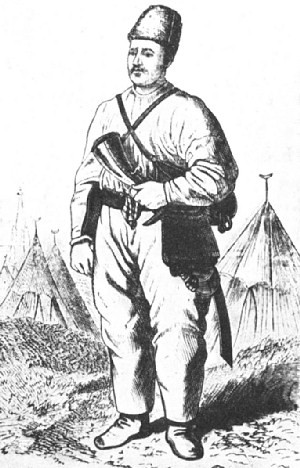
Franz George Kolschitzky, Patron Saint of Vienna Coffee Lovers
The battle took place September 12, and thanks to the magnificent generalship of King John, the Turks were routed. The Poles here rendered a never-to-be-forgotten service to all Christendom. The Turkish invaders fled, leaving 25,000 tents, 10,000 oxen, 5,000 camels, 100,000 bushels of grain, a great quantity of gold, and many sacks filled with coffee—at that time unknown in Vienna. The booty was distributed; but no one wanted the coffee. They did not know what to do with it; that is, no one except Kolschitzky. He said, "If nobody wants those sacks, I will take them", and every one was heartily glad to be rid of the strange beans. But Kolschitzky knew what he was about, and he soon taught the Viennese the art of preparing coffee. Later, he established the first public booth where Turkish coffee was served in Vienna.
This, then, is the story of how coffee was introduced into Vienna, where was developed that typical Vienna café which has become a model for a large part of the world. Kolschitzky is honored in Vienna as the patron saint of coffee houses. His followers, united in the guild of coffee makers (kaffee-sieder), even erected a statue in his honor. It still stands as part of the facade of a house where the Kolschitzygasse merges into the Favoritengasse, as shown in the accompanying picture.
Vienna is sometimes referred to as the "mother of cafés". Café Sacher is world-renowned. Tart à la Sacher is to be found in every cook-book. The Viennese have their "jause" every afternoon. When one drinks coffee at a Vienna café one generally has a kipfel with it. This is a crescent-shaped roll—baked for the first time in the eventful year 1683, when the Turks besieged the city. A baker made these crescent rolls in a spirit of defiance of the Turk. Holding sword in one hand and kipfel in the other, the Viennese would show themselves on top of their redoubts and challenge the cohorts of Mohammed IV.
Mohammed IV was deposed after losing the battle, and Kara Mustapha was executed for leaving the stores—particularly the sacks of coffee beans—at the gates of Vienna; but Vienna coffee and Vienna kipfel are still alive, and their appeal is not lessened by the years.
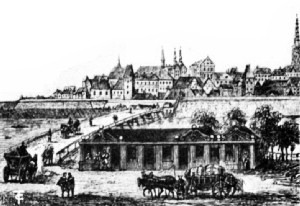
The First Coffee House in the Leopoldstadt
From a cut so titled in Bermann's Alt und Neu Wien
The hero Kolschitzky was presented with a house by the grateful municipality; and there, at the sign of the Blue Bottle, according to one account, he continued as a coffee-house keeper for many years.[65] This, in brief, is the story that—although not authenticated in all its particulars—is seriously related in many books, and is firmly believed throughout Vienna.
It seems a pity to discredit the hero of so romantic an adventure; but the archives of Vienna throw a light upon Kolschitzky's later conduct that tends to show that, after all, this Viennese idol's feet were of common clay.
It is said that Kolschitzky, after receiving the sacks of green coffee left behind by the Turks, at once began to peddle the beverage from house to house, serving it in little cups from a wooden platter. Later he rented a shop in Bischof-hof. Then he began to petition the municipal council, that, in addition to the sum of 100 ducats already promised him as further recognition of his valor, he should receive a house with good will attached; that is, a shop in some growing business section. "His petitions to the municipal council", writes M. Bermann[66], "are amazing examples of measureless self-conceit and the boldest greed. He seemed determined to get the utmost out of his own self-sacrifice. He insisted upon the most highly deserved reward, such as the Romans bestowed upon their Curtius, the Lacedæmonians upon their Pompilius, the Athenians upon Seneca, with whom he modestly compared himself."
At last, he was given his choice of three houses in the Leopoldstadt, any one of them worth from 400 to 450 gulden, in place of the money reward, that had been fixed by a compromise agreement at 300 gulden. But Kolschitzky was not satisfied with this; and urged that if he was to accept a house in full payment it should be one valued at not less than 1000 gulden. Then ensued much correspondence and considerable haggling. To put an end to the acrimonious dispute, the municipal council in 1685 directed that there should be deeded over to Kolschitzky and his wife, Maria Ursula, without further argument, the house known at that time as 30 (now 8) Haidgasse.
It is further recorded that Kolschitzky sold the house within a year; and, after many moves, he died of tuberculosis, February 20, 1694, aged fifty-four years. He was courier to the emperor at the time of his death, and was buried in the Stefansfreithof Cemetery.
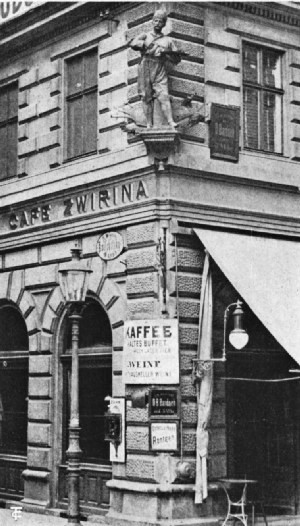
Statue of Kolschitzky Erected by the Coffee Makers Guild of Vienna
Kolschitzky's heirs moved the coffee house to Donaustrand, near the wooden Schlagbrücke, later known as Ferdinand's brücke (bridge). The celebrated coffee house of Franz Mosee (d. 1860) stood on this same spot.
In the city records for the year 1700 a house in the Stock-im-Eisen-Platz (square) is designated by the words "allwo das erste kaffeegewölbe" ("here was the first coffee house"). Unfortunately, the name of the proprietor is not given.
Many stories are told of Kolschitzky's popularity as a coffee-house keeper. He is said to have addressed everyone as bruderherz (brother-heart) and gradually he himself acquired the name bruderherz. A portrait of Kolschitzky, painted about the time of his greatest vogue, is carefully preserved by the Innung der Wiener Kaffee-sieder (the Coffee Makers' Guild of Vienna).
Even during the lifetime of the first kaffee-sieder, a number of others opened coffee houses and acquired some little fame. Early in the eighteenth century a tourist gives us a glimpse of the progress made by coffee drinking and by the coffee-house idea in Vienna. We read:
The city of Vienna is filled with coffee houses, where the novelists or those who busy themselves with the newspapers delight to meet, to read the gazettes and discuss their contents. Some of these houses have a better reputation than others because such zeitungs-doctors (newspaper doctors—an ironical title) gather there to pass most unhesitating judgment on the weightiest events, and to surpass all others in their opinions concerning political matters and considerations.
All this wins them such respect that many congregate there because of them, and to enrich their minds with inventions and foolishness which they immediately run through the city to bring to the ears of the said personalities. It is impossible to believe what freedom is permitted, in furnishing this gossip. They speak without reverence not only of the doings of generals and ministers of state, but also mix themselves in the life of the Kaiser (Emperor) himself.
Vienna liked the coffee house so well that by 1839 there were eighty of them in the city proper and fifty more in the suburbs.
Chapter X
THE COFFEE HOUSES OF OLD LONDON
One of the most picturesque chapters in the history of coffee—The first coffee house in London—The first coffee handbill, and the first newspaper advertisement for coffee—Strange coffee mixtures—Fantastic coffee claims—Coffee prices and coffee licenses—Coffee club of the Rota—Early coffee-house manners and customs—Coffee-house keepers' tokens—Opposition to the coffee house—"Penny universities"—Weird coffee substitutes—The proposed coffee-house newspaper monopoly—Evolution of the club—Decline and fall of the coffee house—Pen pictures of coffee-house life—Famous coffee houses of the seventeenth and eighteenth centuries—Some Old World pleasure gardens—Locating the notable coffee houses
The two most picturesque chapters in the history of coffee have to do with the period of the old London and Paris coffee houses of the seventeenth and eighteenth centuries. Much of the poetry and romance of coffee centers around this time.
"The history of coffee houses," says D'Israeli, "ere the invention of clubs, was that of the manners, the morals and the politics of a people." And so the history of the London coffee houses of the seventeenth and eighteenth centuries is indeed the history of the manners and customs of the English people of that period.
The First London Coffee House
"The first coffee house in London," says John Aubrey (1626–97), the English antiquary and folklorist, "was in St. Michael's Alley, in Cornhill, opposite to the church, which was sett up by one ... Bowman (coachman to Mr. Hodges, a Turkey merchant, who putt him upon it) in or about the yeare 1652. 'Twas about four years before any other was sett up, and that was by Mr. Farr. Jonathan Paynter, over-against to St. Michael's Church, was the first apprentice to the trade, viz., to Bowman."[67]
Another account, for which we are indebted to William Oldys (1696–1761), the bibliographer, relates that Mr. Edwards, a London merchant, acquired the coffee habit in Turkey, and brought home with him from Ragusa, in Dalmatia, Pasqua Rosée, an Armenian or Greek youth, who prepared the beverage for him. "But the novelty thereof," says Oldys, "drawing too much company to him, he allowed the said servant with another of his son-in-law to set up the first coffee house in London at St. Michael's Alley, in Cornhill."
From this it would appear that Pasqua Rosée had as partner in this enterprise, the Bowman, who, according to Aubrey, was coachman to Mr. Hodges, the son-in-law of Mr. Edwards, and a fellow merchant traveler.
Oldys tells us that Rosée and Bowman soon separated. John Timbs (1801–1875), another English antiquary, says they quarreled, Rosée keeping the house, and his partner Bowman obtaining leave to pitch a tent and to sell the drink in St. Michael's churchyard.
Still another version of this historic incident is to be found in Houghton's Collection, 1698. It reads:
It appears that a Mr. Daniel Edwards, an English merchant of Smyrna, brought with him to this country a Greek of the name of Pasqua, in 1652, who made his coffee; this Mr. Edwards married one Alderman Hodges's daughter, who lived in Walbrook, and set up Pasqua for a coffee man in a shed in the churchyard in St. Michael, Cornhill, which is now a scrivener's brave-house, when, having great custom, the ale-sellers petitioned the Lord Mayor against him as being no freeman. This made Alderman Hodges join his coachman, Bowman, who was free, as Pasqua's partner; but Pasqua, for some misdemeanor, was forced to run the country, and Bowman, by his trade and a contribution of 1000 sixpences, turned the shed to a house. Bowman's apprentices were first, John Painter, then Humphry, from whose wife I had this account.
This account makes it appear that Edwards was Hodges' son-in-law. Whatever the relationship, most authorities agree that Pasqua Rosée was the first to sell coffee publicly, whether in a tent or shed, in London in or about the year 1652. His original shop-bill, or handbill, the first advertisement for coffee, is in the British Museum, and from it the accompanying photograph was made for this work. It sets forth in direct fashion: "The Vertue of the COFFEE Drink First publiquely made and sold in England, by Pasqua Rosée ... in St. Michaels Alley in Cornhill ... at the Signe of his own Head."[68]
H.R. Fox Bourne[69] (about 1870) is alone in an altogether different version of this historic event. He says:
"In 1652 Sir Nicholas Crispe, a Levant merchant, opened in London the first coffee house known in England, the beverage being prepared by a Greek girl brought over for the work."
There is nothing to substantiate this story; the preponderance of evidence is in support of the Edwards-Rosée version.
Such then was the advent of the coffee house in London, which introduced to English-speaking people the drink of democracy. Oddly enough, coffee and the Commonwealth came in together. The English coffee house, like its French contemporary, was the home of liberty.
Robinson, who accepts that version of the event wherein Edwards marries Hodges's daughter, says that after the partners Rosée and Bowman separated, and Bowman had set up his tent opposite Rosée, a zealous partisan addressed these verses "To Pasqua Rosée, at the Sign of his own Head and half his Body in St. Michael's Alley, next the first Coffee-Tent in London":
Were not the fountain of my Tears
Each day exhausted by the steam
Of your Coffee, no doubt appears
But they would swell to such a stream
As could admit of no restriction
To see, poor Pasqua, thy Affliction.
What! Pasqua, you at first did broach
This Nectar for the publick Good,
Must you call Kitt down from the Coach
To drive a Trade he understood
No more than you did then your creed,
Or he doth now to write or read?
Pull Courage, Pasqua, fear no Harms
From the besieging Foe;
Make good your Ground, stand to your Arms,
Hold out this summer, and then tho'
He'll storm, he'll not prevail—your Face[70]
Shall give the Coffee Pot the chace.
Eventually Pasqua Rosée disappeared, some say to open a coffee house on the Continent, in Holland or Germany. Bowman, having married Alderman Hodges's cook, and having also prevailed upon about a thousand of his customers to lend him sixpence apiece, converted his tent into a substantial house, and eventually took an apprentice to the trade.
Concerning London's second coffee-house keeper, James Farr, proprietor of the Rainbow, who had as his most distinguished visitor Sir Henry Blount, Edward Hatton[71] says:
[60] à Wood, Anthony. Athenae Oxonienses. London, 1692. (vol. ii: col. 658.)
[61] Parkinson, John. Theatrum Botanicum. London, 1640. (p. 1622.)
[62] D'Israeli, I. Curiosities of Literature. London, 1798. (vol. i: p. 345.)
[63] A weight of from 133 to 140 pounds.
[64] See chapter XXXII.
[65] Vulcaren,. John Peter A. Relation of the Siege of Vienna. 1684.
[66] Bermann, M. Alt und Neu Wien. Vienna, 1880. (p. 964.)
[67] Manuscript in the Bodleian Library.
[68] See also chapter XXVIII.
[69] The Romance of Trade. London. (chap. ii; p. 31.)
[70] Pasqua Rosée's sign. Kitt's (or Bowman's) sign was a coffee pot.
[71] Hatton, Edward. New View of London. London, 1708. (vol. i: p. 30.)
I find it recorded that one James Farr, a barber, who kept the coffee-house which is now the Rainbow, by the Inner Temple Gate (one of the first in England), was in the year 1657, prosecuted by the inquest of St Dunstan's in the West, for making and selling a sort of liquor called coffe, as a great nuisance and prejudice to the neighborhood, etc., and who would then have thought London would ever have had near three thousand such nuisances, and that coffee would have been, as now, so much drank by the best of quality and physicians?
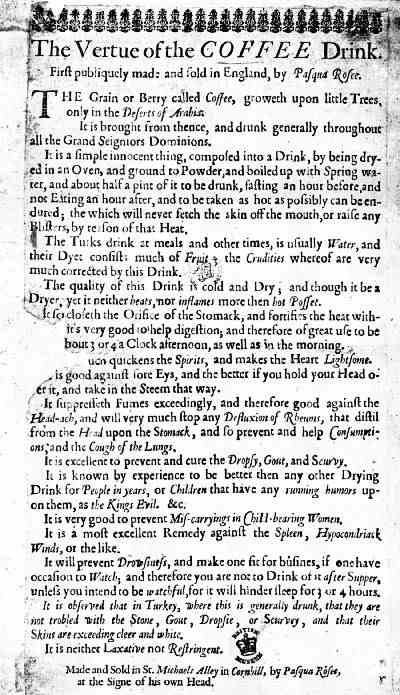
FIRST ADVERTISEMENT FOR COFFEE—1652
Handbill used by Pasqua Rosée, who opened the first coffee house in London From the original in the British Museum
Hatton evidently attributed Fair's nuisance to the coffee itself, whereas the presentment[72] clearly shows it was in Farr's chimney and not in the coffee.
Mention has already been made that Sir Henry Blount was spoken of as "the father of English coffee houses" and his claim to this distinction would seem to be a valid one, for his strong personality "stamped itself upon the system." His favorite motto, "Loquendum est cum vulgo, sentiendum cum sapientibus" (the crowd may talk about it; the wise decide it), says Robinson, "expresses well their colloquial purpose, and was natural enough on the lips of one whose experience had been world wide." Aubrey says of Sir Henry Blount, "He is now neer or altogether eighty yeares, his intellectuals good still and body pretty strong."
Women played a not inconspicuous part in establishing businesses for the sale of the coffee drink in England, although the coffee houses were not for both sexes, as in other European countries. The London City Quaeries for 1660 makes mention of "a she-coffee merchant." Mary Stringar ran a coffee house in Little Trinity Lane in 1669; Anne Blunt was mistress of one of the Turk's-Head houses in Cannon Street in 1672. Mary Long was the widow of William Long, and her initials, together with those of her husband, appear on a token issued from the Rose tavern in Bridge Street, Covent Garden. Mary Long's token from the "Rose coffee house by the playhouse" in Covent Garden is shown among the group of coffee-house keepers' tokens herein illustrated.
The First Newspaper Advertisement
The first newspaper advertisement for coffee appeared, May 26, 1657, in the Publick Adviser of London, one of the first weekly pamphlets. The name of this publication was erroneously given as the Publick Advertiser by an early writer on coffee, and the error has been copied by succeeding writers. The first newspaper advertisement was contained in the issue of the Publick Adviser for the week of May 19 to May 26, and read:
In Bartholomew Lane on the back side of the Old Exchange, the drink called Coffee, (which is a very wholsom and Physical drink, having many excellent vertues, closes the Orifice of the Stomack, fortifies the heat within, helpeth Digestion, quickneth the Spirits, maketh the heart lightsom, is good against Eye-sores, Coughs, or Colds, Rhumes, Consumptions, Head-ach, Dropsie, Gout, Scurvy, Kings Evil, and many others is to be sold both in the morning, and at three of the clock in the afternoon).
Chocolate was also advertised for sale in London this same year. The issue of the Publick Adviser for June 16, 1657, contained this announcement:
In Bishopgate Street, in Queen's Head Alley, at a Frenchman's house is an excellent West India drink called chocolate, to be sold, where you may have it ready at any time, and also unmade at reasonable rates.
Tea was first sold publicly at Garraway's (or Garway's) in 1657.
Strange Coffee Mixtures
The doctors were loath to let coffee escape from the mysteries of the pharmacopœia and become "a simple and refreshing beverage" that any one might obtain for a penny in the coffee houses, or, if preferred, might prepare at home. In this they were aided and abetted by many well-meaning but misguided persons (some of them men of considerable intelligence) who seemed possessed of the idea that the coffee drink was an unpleasant medicine that needed something to take away its curse, or else that it required a complex method of preparation. Witness "Judge" Walter Rumsey's Electuary of Cophy, which appeared in 1657 in connection with a curious work of his called Organon Salutis: an instrument to cleanse the stomach.[73] The instrument itself was a flexible whale-bone, two or three feet long, with a small linen or silk button at the end, and was designed to be introduced into the stomach to produce the effect of an emetic. The electuary of coffee was to be taken by the patient before and after using the instrument, which the "judge" called his Provang. And this was the "judge's" "new and superior way of preparing coffee" as found in his prescription for making electuary of cophy:
Take equal quantity of Butter and Sallet-oyle, melt them well together, but not boyle them: Then stirre them well that they may incorporate together: Then melt therewith three times as much Honey, and stirre it well together: Then add thereunto powder of Turkish Cophie, to make it a thick Electuary.
A little consideration will convince any one that the electuary was most likely to achieve the purpose for which it was recommended.
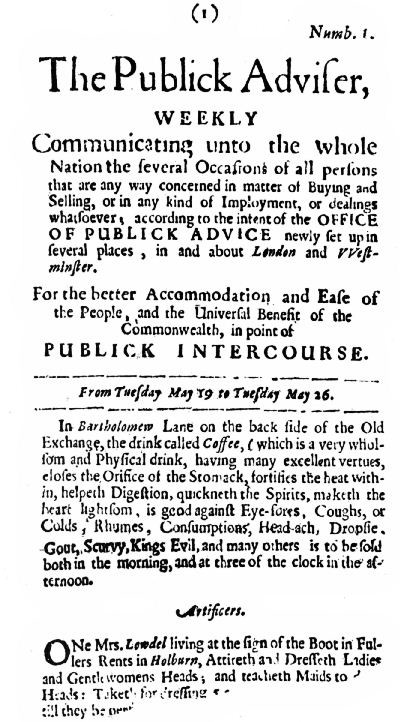
THE FIRST NEWSPAPER ADVERTISEMENT FOR COFFEE—1657
Another concoction invented by the "judge" was known as "wash-brew", and included oatmeal, powder of "cophie", a pint of ale or any wine, ginger, honey, or sugar to please the taste; to these ingredients butter might be added and any cordial powder or pleasant spice. It was to be put into a flannel bag and "so keep it at pleasure like starch." This was a favorite medicine among the common people of Wales.
The book contained in a prefix an interesting historical document in the shape of a letter from James Howell (1595–1666) the writer and historiographer, which read:
Touching coffee, I concurre with them in opinion, who hold it to be that black-broth which was us'd of old in Lacedemon, whereof the Poets sing; Surely it must needs be salutiferous, because so many sagacious, and the wittiest sort of Nations use it so much; as they who have conversed with Shashes and Turbants doe well know. But, besides the exsiccant quality it hath to dry up the crudities of the Stomach, as also to comfort the Brain, to fortifie the sight with its steem, and prevent Dropsies, Gouts, the Scurvie, together with the Spleen and Hypocondriacall windes (all which it doth without any violance or distemper at all.) I say, besides all these qualities, 'tis found already, that this Coffee-drink hath caused a greater sobriety among the nations; for whereas formerly Apprentices and Clerks with others, used to take their mornings' draught in Ale, Beer or Wine, which by the dizziness they cause in the Brain, make many unfit for business, they use now to play the Good-fellows in this wakefull and civill drink: Therefore that worthy Gentleman, Mr. Mudiford[74], who introduced the practice hereof first to London, deserves much respect of the whole nation.
The coffee drink at one time was mixed with sugar candy, and also with mustard. In the coffee houses, however, it was usually served black; "few people then mixed it with either sugar or milk."
Fantastic Coffee Claims
One can not fail to note in connection with the introduction of coffee into England that the beverage suffered most from the indiscretions of its friends. On the one hand, the quacks of the medical profession sought to claim it for their own; and, on the other, more or less ignorant laymen attributed to the drink such virtues as its real champions among the physicians never dreamed of. It was the favorite pastime of its friends to exaggerate coffee's merits; and of its enemies, to vilify its users. All this furnished good "copy" for and against the coffee house, which became the central figure in each new controversy.
From the early English author who damned it by calling it "more wholesome than toothsome", to Pasqua Rosée and his contemporaries, who urged its more fantastic claims, it was forced to make its way through a veritable morass of misunderstanding and intolerance. No harmless drink in history has suffered more at hands of friend and foe.
Did its friends hail it as a panacea, its enemies retorted that it was a slow poison. In France and in England there were those who contended that it produced melancholy, and those who argued it was a cure for the same. Dr. Thomas Willis (1621–1673), a distinguished Oxford physician whom Antoine Portal (1742–1832) called "one of the greatest geniuses that ever lived", said he would sometimes send his patients to the coffee house rather than to the apothecary's shop. An old broadside, described later in this chapter, stressed the notion that if you "do but this Rare ARABIAN cordial use, and thou may'st all the Doctors Slops Refuse."
As a cure for drunkenness its "magic" power was acclaimed by its friends, and grudgingly admitted by its foes. This will appear presently in a description of the war of the broadsides and the pamphlets. Coffee was praised by one writer as a deodorizer. Another (Richard Bradley), in his treatise concerning its use with regard to the plague, said if its qualities had been fully known in 1665, "Dr. Hodges and other learned men of that time would have recommended it." As a matter of fact, in Gideon Harvey's Advice against the Plague, published in 1665, we find, "coffee is commended against the contagion."
This is how the drink's sobering virtue was celebrated by the author of the Rebellious Antidote:
Come, Frantick Fools, leave off your Drunken fits.
Obsequious be and I'll recall your Wits,
From perfect Madness to a modest Strain
For farthings four I'll fetch you back again,
Enable all your mene with tricks of State,
Enter and sip and then attend your Fate;
Come Drunk or Sober, for a gentle Fee,
Come n'er so Mad, I'll your Physician be.
Dr. Willis, in his Pharmaceutice Rationalis (1674), was one of the first to attempt to do justice to both sides of the coffee question. At best, he thought it a somewhat risky beverage, and its votaries must, in some cases, be prepared to suffer languor and even paralysis; it may attack the heart and cause tremblings in the limbs. On the other hand it may, if judiciously used, prove a marvelous benefit; "being daily drunk it wonderfully clears and enlightens each part of the Soul and disperses all the clouds of every Function."
It was a long time before recognition was obtained for the truth about the "novelty drink"; especially that, if there were any beyond purely social virtues to be found in coffee, they were "political rather than medical."
Dr. James Duncan, of the Faculty of Montpellier, in his book Wholesome Advice against the Abuse of Hot Liquors, done into English in 1706, found coffee no more deserving of the name of panacea than that of poison.
George Cheyne (1671–1743), the noted British physician, proclaimed his neutrality in the words, "I have neither great praise nor bitter blame for the thing."
Coffee Prices and Coffee Licenses
Coffee, with tea and chocolate, was first mentioned in the English Statute books in 1660, when a duty of four pence was laid upon every gallon made and sold, "to be paid by the maker." Coffee was classed by the House of Commons with "other outlandish drinks."
It is recorded in 1662 that "the right coffee powder" was being sold at the Turk's Head coffee house in Exchange Alley for "4s. to 6s. 8d. per pound; that pounded in a mortar, 2s; East India berry, 1s. 6d.; and the right Turkie berry, well garbled [ground] at 3s. The ungarbled [in the bean] for less with directions how to use the same." Chocolate was also to be had at "2s. 6d. the pound; the perfumed from 4s. to 10s."
At one time coffee sold for five guineas a pound in England, and even forty crowns (about forty-eight dollars) a pound was paid for it.
In 1663, all English coffee houses were required to be licensed; the fee was twelve pence. Failure to obtain a license was punished by a fine of five pounds for every month's violation of the law. The coffee houses were under close surveillance by government officials. One of these was Muddiman, a good scholar and an "arch rogue", who had formerly "written for the Parliament" but who later became a paid spy. L'Estrange, who had a patent on "the sole right of intelligence", wrote in his Intelligencer that he was alarmed at the ill effects of "the ordinary written papers of Parliament's news ... making coffee houses and all the popular clubs judges of those councils and deliberations which they have nothing to do with at all."
The first royal warrant for coffee was given by Charles II to Alexander Man, a Scotsman who had followed General Monk to London, and set up in Whitehall. Here he advertised himself as "coffee man to Charles II."
Owing to increased taxes on tea, coffee, and newspapers, near the end of Queen Anne's reign (1714) coffee-house keepers generally raised their prices as follows: Coffee, two pence per dish; green tea, one and a half pence per dish. All drams, two pence per dram. At retail, coffee was then sold for five shillings per pound; while tea brought from twelve to twenty-eight shillings per pound.
Coffee Club of The Rota
"Coffee and Commonwealth", says a pamphleteer of 1665, "came in together for a Reformation, to make 's a free and sober nation." The writer argues that liberty of speech should be allowed, "where men of differing judgements croud"; and he adds, "that's a coffee-house, for where should men discourse so free as there?" Robinson's comments are apt:
Now perhaps we do not always connect the ideas of sociableness and freedom of discussion with the days of Puritan rule; yet it must be admitted that something like geniality and openness characterized what Pepys calls the Coffee Club of the Rota. This "free and open Society of ingenious gentlemen" was founded in the year 1659 by certain members of the Republican party, whose peculiar opinions had been timidly expressed and not very cordially tolerated under the Great Oliver. By the weak Government that followed, these views were regarded with extreme dislike and with some amount of terror.
"They met", says Aubrey, who was himself of their number, "at the Turk's Head [Miles's coffee house] in New Palace Yard, Westminster, where they take water, at one Miles's, the next house to the staires, where was made purposely a large ovall table, with a passage in the middle for Miles to deliver his coffee."
Robinson continues:
This curious refreshment bar and the interest with which the beverage itself was regarded, were quite secondary to the excitement caused by another novelty. When, after heated disputation, a member desired to test the opinion of the meeting, any particular point might, by agreement, be put to the vote and then everything depended upon "our wooden oracle," the first balloting-box ever seen in England. Formal methods of procedure and the intensely practical nature of the subjects discussed, combined to give a real importance to this Amateur Parliament.
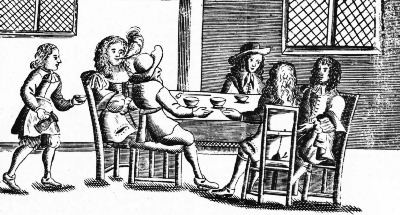
A Coffee House in the Time of Charles II
From a wood cut of 1674
The Rota, or Coffee Club, as Pepys called it, was essentially a debating society for the dissemination of republican opinions. It was preceded only, in the reign of Henry IV, by the club called La Court de Bone Compagnie; by Sir Walter Raleigh's Friday Street, or Bread Street, club; the club at the Mermaid tavern in Bread Street, of which Shakespeare, Beaumont, Fletcher, Raleigh, Selden, Donne, et al., were members; and "rare" Ben Jonson's Devil tavern club, between Middle Temple Gate and Temple Bar.
The Rota derived its name from a plan, which it was designed to promote, for changing a certain number of members of parliament annually by rotation. It was founded by James Harrington, who had painted it in fairest colors in his Oceana, that ideal commonwealth.
Sir William Petty was one of its members. Around the table, "in a room every evening as full as it could be crammed," says Aubrey, sat Milton (?) and Marvell, Cyriac Skinner, Harrington, Nevill, and their friends, discussing abstract political questions.
The Rota became famous for its literary strictures. Among these was "The censure of the Rota upon Mr. Milton's book entitled The ready and easie way to establish a free commonwealth" (1660), although it is doubtful if Milton was ever a visitor to this "bustling coffee club." The Rota also censured "Mr. Driden's Conquest of Granada" (1673).
Early Coffee-House Manners and Customs
Among many of the early coffee-house keepers there was great anxiety that the coffee house, open to high and low, should be conducted under such restraints as might secure the better class of customers from annoyance. The following set of regulations in somewhat halting rhyme was displayed on the walls of several of the coffee houses in the seventeenth century:
The Rules and Orders of the Coffee House.
Enter, Sirs, freely, but first, if you please,
Peruse our civil orders, which are these.
First, gentry, tradesmen, all are welcome hither,
And may without affront sit down together:
Pre-eminence of place none here should mind,
But take the next fit seat that he can find:
Nor need any, if finer persons come,
Rise up to assigne to them his room;
To limit men's expence, we think not fair,
But let him forfeit twelve-pence that shall swear;
He that shall any quarrel here begin,
Shall give each man a dish t' atone the sin;
And so shall he, whose compliments extend
So far to drink in coffee to his friend;
Let noise of loud disputes be quite forborne,
No maudlin lovers here in corners mourn,
But all be brisk and talk, but not too much,
On sacred things, let none presume to touch.
Nor profane Scripture, nor sawcily wrong
Affairs of state with an irreverent tongue:
Let mirth be innocent, and each man see
That all his jests without reflection be;
To keep the house more quiet and from blame,
We banish hence cards, dice, and every game;
Nor can allow of wagers, that exceed
Five shillings, which ofttimes much trouble breed;
Let all that's lost or forfeited be spent
In such good liquor as the house doth vent.
And customers endeavour, to their powers,
For to observe still, seasonable hours.
Lastly, let each man what he calls for pay,
And so you're welcome to come every day.
The early coffee houses were often up a flight of stairs, and consisted of a single large room with "tables set apart for divers topics." There is a reference to this in the prologue to a comedy of 1681 (quoted by Malone):
In a coffee house just now among the rabble
I bluntly asked, which is the treason table?
This was the arrangement at Man's and others favored by the wits, the literati, and "men of fashionable instincts." In the distinctly business coffee houses separate rooms were provided at a later time for mercantile transactions. The introduction of wooden partitions—wooden boxes, as at a tavern—was also of somewhat later date.
A print of 1674 shows five persons of different ranks in life, one of them smoking, sitting on chairs around a coffee-house table, on which are small basins, or dishes, without saucers, and tobacco pipes, while a coffee boy is serving coffee.
In the beginning, only coffee was dispensed in the English coffee houses. Soon chocolate, sherbert, and tea were added; but the places still maintained their status as social and temperance factors. Constantine Jennings (or George Constantine) of the Grecian advertised chocolate, sherbert and tea at retail in 1664–65; also free instruction in the part of preparing these liquors. "Drams and cordial waters were to be had only at coffee houses newly set up," says Elford the younger, writing about 1689. "While some few places added ale and beer as early as 1669, intoxicating liquors were not items of importance for many years."
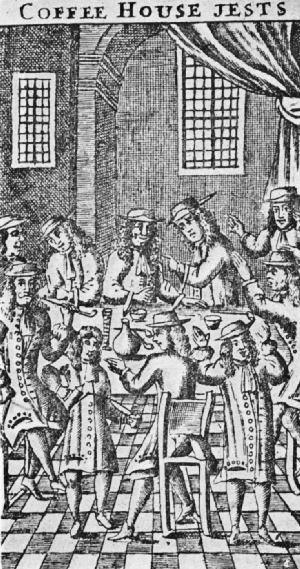
A London Coffee House of the Seventeenth Century
From a wood cut of the period
After the fire of 1666, many new coffee houses were opened that were not limited to a single room up a flight of stairs. Because the coffee-house keepers over-emphasized the sobering qualities of the coffee drink, they drew many undesirable characters from the taverns and ale houses after the nine o'clock closing hour. These were hardly calculated to improve the reputation of the coffee houses; and, indeed, the decline of the coffee houses as a temperance institution would seem to trace back to this attitude of false pity for the victims of tavern vices, evils that many of the coffee houses later on embraced to their own undoing. The early institution was unique, its distinctive features being unlike those of any public house in England or on the Continent. Later on, in the eighteenth century, when these distinctive features became obscured, the name coffee house became a misnomer.
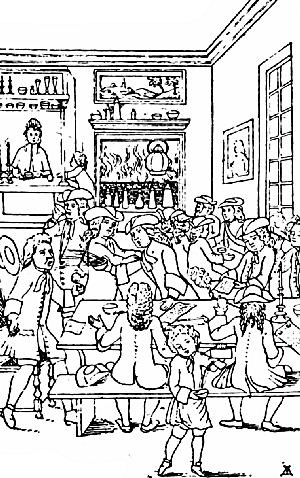
Coffee House, Queen Anne's Time—1702–14
Showing coffee pots, coffee dishes, and coffee boy
However, Robinson says, "the close intercourse between the habitués of the coffee house, before it lost anything of its generous social traditions and whilst the issue of the struggle for political liberty was as yet uncertain, was to lead to something more than a mere jumbling or huddling together of opposites. The diverse elements gradually united in the bonds of common sympathy, or were forcibly combined by persecution from without until there resulted a social, political and moral force of almost irresistible strength."
Coffee-House Keepers' Tokens
The great London fire of 1666 destroyed some of the coffee houses; but prominent among those that survived was the Rainbow, whose proprietor, James Farr, issued one of the earliest coffee-house tokens, doubtless in grateful memory of his escape. Farr's token shows an arched rainbow emerging from the clouds of the "great fire," indicating that all was well with him, and the Rainbow still radiant. On the reverse the medal was inscribed, "In Fleet Street—His Half Penny."
A large number of these trade coins were put out by coffee-house keepers and other tradesmen in the seventeenth century as evidence of an amount due, as stated thereon, by the issuer to the holder. Tokens originated because of the scarcity of small change. They were of brass, copper, pewter, and even leather, gilded. They bore the name, address, and calling of the issuer, the nominal value of the piece, and some reference to his trade. They were readily redeemed, on presentation, at their face value. They were passable in the immediate neighborhood, seldom reaching farther than the next street. C.G. Williamson writes:
Tokens are essentially democratic; they would never have been issued but for the indifference of the Government to a public need; and in them we have a remarkable instance of a people forcing a legislature to comply with demands at once reasonable and imperative. Taken as a whole series, they are homely and quaint, wanting in beauty, but not without a curious domestic art of their own.
Robinson finds an exception to the general simplicity in the tokens issued by one of the Exchange Alley houses. The dies of these tokens are such as to have suggested the skilled workmanship of John Roettier. The most ornate has the head of a Turkish sultan at that time famed for his horrible deeds, ending in suicide; its inscription runs:
Morat ye Great Men did mee call;
Where Eare I came I conquer'd all.
A number of the most interesting coffee-house keepers' tokens in the Beaufoy collection in the Guildhall Museum were photographed for this work, and are shown herewith. It will be observed that many of the traders of 1660–75 adopted as their trade sign a hand pouring coffee from a pot, invariably of the Turkish-ewer pattern. Morat (Amurath) and Soliman were frequent coffee-house signs in the seventeenth century.
J.H. Burn, in his Catalogue of Traders' Tokens, recites that in 1672 "divers persons who presumed ... to stamp, coin, exchange and distribute farthings, halfpence and pence of brass and copper" were "taken into custody, in order to a severe prosecution"; but upon submission, their offenses were forgiven, and it was not until the year 1675 that the private token ceased to pass current.
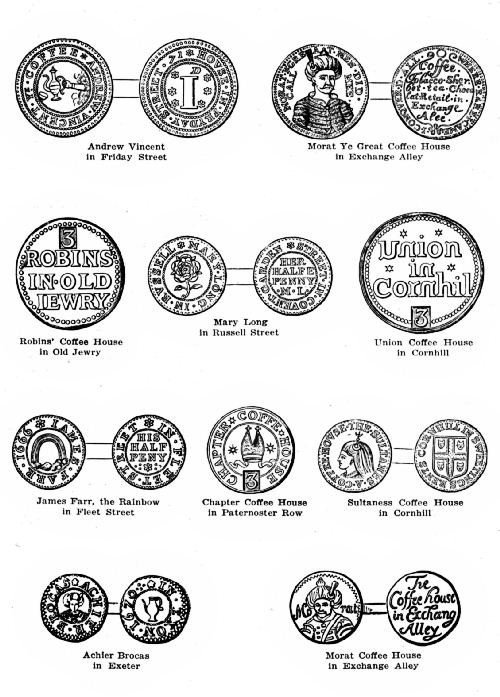
PLATE 1—COFFEE-HOUSE KEEPERS' TOKENS OF THE 17TH CENTURY
Drawn for this work from the originals in the British Museum, and in the Beaufoy collection at the Guildhall Museum
A royal proclamation at the close of 1674 enjoined the prosecution of any who should "utter base metals with private stamps," or "hinder the vending of those half pence and farthings which are provided for necessary exchange." After this, tokens were issued stamped "necessary change."
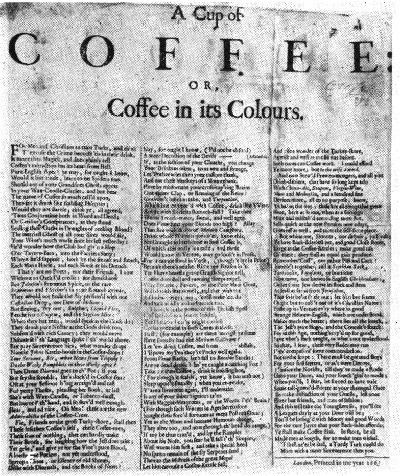
Opposition to the Coffee House
It is easy to see why the coffee houses at once found favor among men of intelligence in all classes. Until they came, the average Englishman had only the tavern as a place of common resort. But here was a public house offering a non-intoxicating beverage, and its appeal was instant and universal. As a meeting place for the exchange of ideas it soon attained wide popularity. But not without opposition. The publicans and ale-house keepers, seeing business slipping away from them, made strenuous propaganda against this new social center; and not a few attacks were launched against the coffee drink. Between the Restoration and the year 1675, of eight tracts written upon the subject of the London coffee houses, four have the words "character of a coffee house" as part of their titles. The authors appear eager to impart a knowledge of the town's latest novelty, with which many readers were unacquainted.
One of these early pamphlets (1662) was entitled The Coffee Scuffle, and professed to give a dialogue between "a learned knight and a pitifull pedagogue," and contained an amusing account of a house where the Puritan element was still in the ascendant. A numerous company is present, and each little group being occupied with its own subject, the general effect is that of another Babel. While one is engaged in quoting the classics, another confides to his neighbors how much he admires Euclid;
A third's for a lecture, a fourth a conjecture,
A fifth for a penny in the pound.
Theology is introduced. Mask balls and plays are condemned. Others again discuss the news, and are deep in the store of "mercuries" here to be found. One cries up philosophy. Pedantry is rife, and for the most part unchecked, when each 'prentice-boy "doth call for his coffee in Latin" and all are so prompt with their learned quotations that "'t would make a poor Vicar to tremble."
The first noteworthy effort attacking the coffee drink was a satirical broadside that appeared in 1663. It was entitled A Cup of Coffee: or, Coffee in its Colours. It said:
For men and Christians to turn Turks, and think
T'excuse the Crime because 'tis in their drink,
Is more than Magick....
Pure English Apes! Ye may, for ought I know,
Would it but mode, learn to eat Spiders too.
The writer wonders that any man should prefer coffee to canary, and refers to the days of Beaumont, Fletcher, and Ben Jonson. He says:
They drank pure nectar as the gods drink too,
Sublim'd with rich Canary....
shall then
These less than coffee's self, these coffee-men,
These sons of nothing, that can hardly make
Their Broth, for laughing how the jest doth take;
Yet grin, and give ye for the Vine's pure Blood
A loathsome potion, not yet understood,
Syrrop of soot, or Essence of old Shooes,
Dasht with Diurnals and the Books of news?
The author of A Cup of Coffee, it will be seen, does not shrink from using epithets.
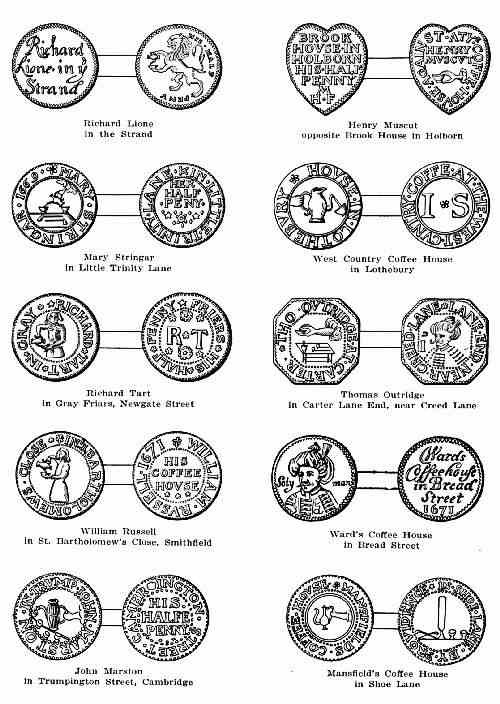
PLATE 2—COFFEE-HOUSE KEEPERS' TOKENS OF THE 17TH CENTURY
Drawn for this work from the originals in the British Museum, and in the Beaufoy collection at the Guildhall Museum]
The Coffee Man's Granado Discharged upon the Maiden's Complaint Against Coffee, a dialogue in verse, also appeared in 1663.
The Character of a Coffee House, by an Eye and Ear Witness appeared in 1665. It was a ten-page pamphlet, and proved to be excellent propaganda for coffee. It is so well done, and contains so much local color, that it is reproduced here, the text Museum. The title page reads:
The
Character of a Coffee-Housewherein
Is contained a Description of the Persons
usually frequenting it, with their Discourse
and Humors,
As Also
The Admirable Vertues of
COFFEE
By an Eye and Ear Witness
When Coffee once was vended here,
The Alc'ron shortly did appear,
For our Reformers were such Widgeons.
New Liquors brought in new Religions.
Printed in the Year, 1665.
The text and the arrangement of the body of the pamphlet are as follows:
The Character of a Coffee-HouseTHE DERIVATION OF A COFFEE-HOUSE
A Coffee-house, the learned hold
It is a place where Coffee's sold;
This derivation cannot fail us,
For where Ale's vended, that's an Ale-house.
This being granted to be true,
'Tis meet that next the Signs we shew
Both where and how to find this house
Where men such cordial broth carowse.
And if Culpepper woon some glory
In turning the Dispensatory
From Latin into English; then
Why should not all good English men
Give him much thanks who shews a cure
For all diseases men endure?
SIGNS: HOW TO FIND IT OUT
As you along the streets do trudge,
To take the pains you must not grudge,
To view the Posts or Broomsticks where
The Signs of Liquors hanged are.
And if you see the great Morat
With Shash on's head instead of hat,
Or any Sultan in his dress,
Or picture of a Sultaness,
Or John's admir'd curled pate,
Or th' great Mogul in's Chair of State,
Or Constantine the Grecian,
Who fourteen years was th' onely man
That made Coffee for th' great Bashaw,
Although the man he never saw;
Or if you see a Coffee-cup
Fil'd from a Turkish pot, hung up
Within the clouds, and round it Pipes,
Wax Candles, Stoppers, these are types
And certain signs (with many more
Would be too long to write them 'ore,)
Which plainly do Spectators tell
That in that house they Coffee sell.
Some wiser than the rest (no doubt,)
Say they can by the smell find't out;
In at a door (say they,) but thrust
Your Nose, and if you scent burnt Crust,
Be sure there's Coffee sold that's good,
For so by most 'tis understood.
Now being enter'd, there's no needing
Of complements or gentile breeding,
For you may seat you any where,
There's no respect of persons there;
Then comes the Coffee-man to greet you,
With welcome Sir, let me entreat you,
To tell me what you'l please to have,
For I'm your humble, humble slave;
But if you ask, what good does Coffee?
He'l answer, Sir, don't think I scoff yee,
If I affirm there's no disease
Men have that drink it but find ease.
THE VERTUES OF COFFEE
Look, there's a man who takes the steem
In at his Nose, has an extreme
Worm in his pate, and giddiness,
Ask him and he will say no less.
There sitteth one whose Droptick belly
Was hard as flint, now's soft as jelly.
There stands another holds his head
'Ore th' Coffee-pot, was almost dead
Even now with Rhume; ask him hee'l say
That all his Rhum's now past away.
See, there's a man sits now demure
And sober, was within this hour
Quite drunk, and comes here frequently,
For 'tis his daily Malady,
More, it has such reviving power
'Twill keep a man awake an houre,
Nay, make his eyes wide open stare
Both Sermon time and all the prayer.
Sir, should I tell you all the rest
O' th' cures 't has done, two hours at least
In numb'ring them I needs must spend,
Scarce able then to make an end.
Besides these vertues that's therein.
For any kind of Medicine,
The Commonwealth-Kingdom I'd say,
Has mighty reason for to pray
That still Arabia may produce
Enough of Berry for it's use:
For't has such strange magnetick force,
That it draws after't great concourse
Of all degrees of persons, even
From high to low, from morn till even;
Especially the sober Party,
And News-mongers do drink't most hearty
Here you'r not thrust into a Box
As Taverns do to catch the Fox,
But as from th' top of Pauls high steeple,
Th' whole City's view'd, even so all people
May here be seen; no secrets are
At th' Court for Peace, or th' Camp for War,
But straight they'r here disclos'd and known;
Men in this Age so wise are grown.
Now (Sir) what profit may accrew
By this, to all good men, judge you.
With that he's loudly call'd upon
For Coffee, and then whip he's gone.
THE COMPANY
Here at a Table sits (perplext)
A griping Usurer, and next
To him a gallant Furioso,
Then nigh to him a Virtuoso;
A Player then (full fine) sits down,
And close to him a Country Clown.
O' th' other side sits some Pragmatick,
And next to him some sly Phanatick.
THE SEVERAL LIQUORS
The gallant he for Tea doth call,
The Usurer for nought at all.
The Pragmatick he doth intreat
That they will fill him some Beau-cheat,
The Virtuoso he cries hand me
Some Coffee mixt with Sugar-candy.
Phanaticus (at last) says come,
Bring me some Aromaticum.
The Player bawls for Chocolate,
All which the Bumpkin wond'ring at,
Cries, ho, my Masters, what d' ye speak,
D' ye call for drink in Heathen Greek?
Give me some good old Ale or Beer,
Or else I will not drink, I swear.
Then having charg'd their Pipes around.
THEIR DISCOURSE
They silence break; First the profound
And sage Phanatique, Sirs what news?
Troth says the Us'rer I ne'r use
To tip my tongue with such discourse,
'Twere news to know how to disburse
A summ of mony (makes me sad)
To get ought by't, times are so bad.
The other answers, truly Sir
You speak but truth, for I'le aver
They ne'r were worse; did you not hear
What prodigies did late appear
At Norwich, Ipswich, Grantham, Gotam?
And though prophane ones do not not'em,
Yet we—Here th' Virtuoso stops
The current of his speech, with hopes
Quoth he, you will not tak'd amiss,
I say all's lies that's news like this,
For I have Factors all about
The Realm, so that no Stars peep out
That are unusual, much less these
Strange and unheard-of prodigies
You would relate, but they are tost
To me in letters by first Post.
At which the Furioso swears
Such chat as this offends his ears
It rather doth become this Age
To talk of bloodshed, fury, rage,
And t' drink stout healths in brim-fill'd Nogans.
To th' downfall of the Hogan Mogans.
With that the Player doffs his Bonnet,
And tunes his voice as if a Sonnet
Were to be sung; then gently says,
O what delight there is in Plays!
Sure if we were but all in Peace,
This noise of Wars and News would cease;
All sorts of people then would club
Their pence to see a Play that's good.
You'l wonder all this while (perhaps)
The Curioso holds his chaps.
But he doth in his thoughts devise,
How to the rest he may seem wise;
Yet able longer not to hold,
His tedious tale too must be told,
And thus begins, Sirs unto me
It reason seems that liberty
Of speech and words should be allow'd
Where men of differing judgements croud,
And that's a Coffee-house, for where
Should men discourse so free as there?
Coffee and Commonwealth begin
Both with one letter, both came in
Together for a Reformation,
To make's a free and sober Nation.
But now—With that Phanaticus
Gives him a nod, and speaks him thus,
Hold brother, I know your intent,
That's no dispute convenient
For this same place, truths seldome find
Acceptance here, they'r more confin'd
To Taverns and to Ale-house liquor,
Where men do vent their minds more quicker
If that may for a truth but pass
What's said, In vino veritas.
With that up starts the Country Clown,
And stares about with threatening frown.
As if he would even eat them all up.
Then bids the boy run quick and call up,
A Constable, for he has reason
To fear their Latin may be treason
But straight they all call what's to pay,
Lay't down, and march each several way.
THE COMPANY
At th' other table sits a Knight,
And here a grave old man ore right
Against his worship, then perhaps
That by and by a Drawer claps
His bum close by them, there down squats
A dealer in old shoes and hats;
And here withouten any panick
Fear, dread or care a bold Mechanick.
HEIR DISCOURSE
The Knight (because he's so) he prates
Of matters far beyond their pates.
The grave old man he makes a bustle,
And his wise sentence in must justle.
Up starts th' Apprentice boy and he
Says boldly so and so't must be.
The dealer in old shoes to utter
His saying too makes no small sputter.
Then comes the pert mechanick blade,
And contradicts what all have said.
***
There by the fier-side doth sit,
One freezing in an Ague fit.
Another poking in't with th' tongs,
Still ready to cough up his lungs
Here sitteth one that's melancolick,
And there one singing in a frolick.
Each one hath such a prety gesture,
At Smithfield fair would yield a tester.
Boy reach a pipe cries he that shakes,
The songster no Tobacco takes,
Says he who coughs, nor do I smoak,
Then Monsieur Mopus turns his cloak
Off from his face, and with a grave
Majestick beck his pipe doth crave.
They load their guns and fall a smoaking
Whilst he who coughs sits by a choaking,
Till he no longer can abide.
And so removes from th' fier side.
Now all this while none calls to drink,
Which makes the Coffee boy to think
Much they his pots should so enclose,
He cannot pass but tread on toes.
With that as he the Nectar fills
From pot to pot, some on't he spills
Upon the Songster. Oh cries he.
Pox, what dost do? thou'st burnt my knee;
No says the boy, (to make a bald
And blind excuse.) Sir 'twill not scald.
With that the man lends him a cuff
O' th' ear, and whips away in snuff.
The other two, their pipes being out,
Says Monsieur Mopus I much doubt
My friend I wait for will not come,
But if he do, say I'm gone home.
Then says the Aguish man I must come
According to my wonted custome,
To give ye' a visit, although now
I dare not drink, and so adieu.
The boy replies, O Sir, however
You'r very welcome, we do never
Our Candles, Pipes or Fier grutch
To daily customers and such,
They'r Company (without expence,)
For that's sufficient recompence.
Here at a table all alone,
Sits (studying) a spruce youngster, (one
Who doth conceipt himself fully witty,
And's counted one o' th' wits o' th' City,)
Till by him (with a stately grace,)
A Spanish Don himself doth place.
Then (cap in hand) a brisk Monsieur
He takes his seat, and crowds as near
As possibly that he can come.
Then next a Dutchman takes his room.
The Wits glib tongue begins to chatter,
Though't utters more of noise than matter,
Yet 'cause they seem to mind his words,
His lungs more battle still affords
At last says he to Don, I trow
You understand me? Sennor no
Says th' other. Here the Wit doth pause
A little while, then opes his jaws,
And says to Monsieur, you enjoy
Our tongue I hope? Non par ma foy,
Replies the Frenchman: nor you, Sir?
Says he to th' Dutchman, Neen mynheer,
With that he's gone, and cries, why sho'd
He stay where wit's not understood?
There in a place of his own chusing
(Alone) some lover sits a musing,
With arms across, and's eyes up lift,
As if he were of sence bereft.
Till sometimes to himself he's speaking,
Then sighs as if his heart were breaking.
Here in a corner sits a Phrantick,
And there stands by a frisking Antick,
Of all sorts some and all conditions
Even Vintners, Surgeons and Physicians.
The blind, the deaf, and aged cripple
Do here resort and Coffee tipple.
Now here (perhaps) you may expect
My Muse some trophies should erect
In high flown verse, for to set forth
The noble praises of its worth.
Truth is, old Poets beat their brains
To find out high and lofty strains
To praise the (now too frequent) use
Of the bewitching grapes strong juice,
Some have strain'd hard for to exalt
The liquor of our English Mault
Nay Don has almost crackt his nodle
Enough t'applaud his Caaco Caudle.
The Germans Mum, Teag's Usquebagh,
(Made him so well defend Tredagh,)
Metheglin, which the Brittains tope,
Hot Brandy wine, the Hogans hope.
Stout Meade which makes the Russ to laugh,
Spic'd Punch (in bowls) the Indians quaff.
All these have had their pens to raise
Them Monuments of lasting praise,
Onely poor Coffee seems to me
No subject fit for Poetry
At least 'tis one that none of mine is,
So I do wave 't, and here write—
FINIS.
[72] The prosecution came under the heading, "Disorders and Annoys."
[73] Rumsey (or Ramsey), W. Organon Salutis. London, 1657.
[74] Also given as Sir James Muddiford, Murford, Mudford, Moundeford, and Modyford.