



автордың кітабын онлайн тегін оқу The Moonlit Way
The Project Gutenberg eBook, The Moonlit Way, by Robert W. Chambers, Illustrated by A. I. Keller
This eBook is for the use of anyone anywhere at no cost and with
almost no restrictions whatsoever. You may copy it, give it away or
re-use it under the terms of the Project Gutenberg License included
with this eBook or online at www.gutenberg.org
Title: The Moonlit Way
Author: Robert W. Chambers
Release Date: August 28, 2010 [eBook #33557]
Language: English
Character set encoding: ISO-8859-1
***START OF THE PROJECT GUTENBERG EBOOK THE MOONLIT WAY***
E-text prepared by Katherine Ward, Darleen Dove, Roger Frank,
and the Project Gutenberg Online Distributed Proofreading Team
(http://www.pgdp.net)
The
MOONLIT WAY
A Novel
BY
ROBERT W. CHAMBERS
AUTHOR OF
“THE COMMON LAW,” “THE FIGHTING CHANCE,” ETC.
ILLUSTRATED BY
A. I. KELLER
D. APPLETON AND COMPANY
NEW YORK LONDON
1919
HIS STRAINED GAZE SOUGHT TO FIX ITSELF ON THIS FACE—(PAGE 325)
Copyright, 1919, by
ROBERT W. CHAMBERS
Copyright, 1918, 1919, by the
INTERNATIONAL MAGAZINE CO.
Printed in the United States of America
TO
MY FRIEND
FRANK HITCHCOCK
CONTENTS
CHAPTERPAGE Prologue—Claire-de-Lune 1
I.
A Shadow Dance 19II.
Sunrise 28III.
Sunset 39IV.
Dusk 46V.
In Dragon Court 57VI.
Dulcie 78VII.
Opportunity Knocks 87VIII.
Dulcie Answers 102IX.
Her Day 109X.
Her Evening 123XI.
Her Night 131XII.
The Last Mail 155XIII.
A Midnight Tête-à-Tête 170XIV.
Problems 186XV.
Blackmail 194XVI.
The Watcher 205XVII.
A Conference 216XVIII.
The Babbler 233XIX.
A Chance Encounter 249XX.
Grogan’s 265XXI.
The White Blackbird 278XXII.
Foreland Farms 292XXIII.
A Lion in the Path 312XXIV.
A Silent House 328XXV.
Starlight 339XXVI.
’Be-N Eirinn I! 349XXVII.
The Moonlit Way 366XXVIII.
Green Jackets 385XXIX.
Asthore 407LIST OF ILLUSTRATIONS
His strained gaze sought to fix itself on this face before him
FrontispieceNihla put her feathered steed through its absurd paces
8“You little miracle!”
100He came toward her stealthily
382Novels By Robert W. Chambers
The Laughing Girl
The Restless Sex
Barbarians
The Dark Star
The Girl Philippa
Who Goes There!
Athalie
The Business of Life
The Gay Rebellion
The Streets of Ascalon
The Common Law
The Fighting Chance
The Younger Set
The Danger Mark
The Firing Line
Japonette
Quick Action
The Adventures of A Modest Man
Anne’s Bridge
Between Friends
The Better Man
Police!!!
Some Ladies in Haste
The Tree of Heaven
The Tracer of Lost Persons
The Hidden Children
The Moonlit Way
Cardigan
The Reckoning
The Maid-at-Arms
Ailsa Paige
Special Messenger
The Haunts of Men
Lorraine
Maids of Paradise
Ashes of Empire
The Red Republic
Blue-Bird Weather
A Young Man in a Hurry
The Green Mouse
Iole
The Mystery of Choice
The Cambric Mask
The Maker of Moons
The King in Yellow
In Search of the Unknown
The Conspiritors
A King and a Few Dukes
In the Quarter
Outsiders
PROLOGUE CLAIRE-DE-LUNE
There was a big moon over the Bosphorus; the limpid waters off Seraglio Point glimmered; the Golden Horn was like a sheet of beaten silver inset with topaz and ruby where lanterns on rusting Turkish warships dyed the tarnished argent of the flood. Except for these, and the fixed lights on the foreign guard-ships and on a big American steam yacht, only a pale and nebulous shoreward glow betrayed the monster city.
Over Pera the full moon’s lustre fell, silvering palace, villa, sea and coast; its rays glimmered on bridge and wharf, bastion, tower arsenal, and minarette, transforming those big, sprawling, ramshackle blotches of architecture called Constantinople into that shadowy, magnificent enchantment of the East, which all believe in, but which exists only in a poet’s heart and mind.
Night veiled the squalour of Balat, and its filth, its meanness, its flimsy sham. Moonlight made of Galata a marvel, ennobling every bastard dome, every starved façade, every unlovely and attenuated minarette, and invested with added charm each really lovely ruin, each tower, palace, mosque, garden wall and balcony, and every crenelated battlement, where the bronze bulk of ancient cannon slanted, outlined in silver under the Prophet’s moon.
Tiny moving lights twinkled on the Galata Bridge; pale points of radiance dotted Scutari; but the group of amazing cities called Constantinople lay almost blotted out under the moon.
Darker at night than any capital in the world, its huge, solid and ancient shapes bulking gigantic in the night, its noble ruins cloaked, its cheap filth hidden, its flimsy Coney Island aspect transfigured and the stylographic-pen architecture of a hundred minarettes softened into slender elegance, Constantinople lay dreaming its immemorial dreams under the black shadow of the Prussian eagle.
The German Embassy was lighted up like a Pera café; the drawing-rooms crowded with a brilliant throng where sashes, orders, epaulettes and sabre-tache glittered, and jewels blazed and aigrettes waved under the crystal chandeliers, accenting and isolating sombre civilian evening dress, which seemed mournful, rusty, and out of the picture, even when plastered over with jewelled stars.
Few Turkish officials and officers were present, but the disquieting sight of German officers in Turkish uniforms was not uncommon. And the Count d’Eblis, Senator of France, noted this phenomenon with lively curiosity, and mentioned it to his companion, Ferez Bey.
Ferez Bey, lounging in a corner with Adolf Gerhardt, for whom he had procured an invitation, and flanked by the Count d’Eblis, likewise a guest aboard the rich German-American banker’s yacht, was very much in his element as friend and mentor.
For Ferez Bey knew everybody in the Orient—knew when to cringe, when to be patronising, when to fawn, when to assert himself, when to be servile, when impudent.
He was as impudent to Adolf Gerhardt as he dared be, the banker not knowing the subtler shades and differences; he was on an equality with the French senator, Monsieur le Comte d’Eblis because he knew that d’Eblis dared not resent his familiarity.
Otherwise, in that brilliant company, Ferez Bey was a jackal—and he knew it perfectly—but a valuable jackal; and he also knew that.
So when the German Ambassador spoke pleasantly to him, his attitude was just sufficiently servile, but not overdone; and when Von-der-Hohe Pasha, in the uniform of a Turkish General of Division, graciously exchanged a polite word with him during a moment’s easy gossip with the Count d’Eblis, Ferez Bey writhed moderately under the honour, but did not exactly squirm.
To Conrad von Heimholz he ventured to present his German-American patron, Adolf Gerhardt, and the thin young military attaché condescended in his Prussian way to notice the introduction.
“Saw your yacht in the harbour,” he admitted stiffly. “It is astonishing how you Americans permit no bounds to your somewhat noticeable magnificence.”
“She’s a good boat, the Mirage,” rumbled Gerhardt, in his bushy red beard, “but there are plenty in America finer than mine.”
“Not many, Adolf,” insisted Ferez, in his flat, Eurasian voice—“not ver’ many anyw’ere so fine like your Mirage.”
“I saw none finer at Kiel,” said the attaché, staring at Gerhardt through his monocle, with the habitual insolence and disapproval of the Prussian junker. “To me it exhibits bad taste”—he turned to the Count d’Eblis—“particularly when the Meteor is there.”
“Where?” asked the Count.
“At Kiel. I speak of Kiel and the ostentation of certain foreign yacht owners at the recent regatta.”
Gerhardt, redder than ever, was still German enough to swallow the meaningless insolence. He was not getting on very well at the Embassy of his fellow countrymen. Americans, properly presented, they endured without too open resentment; for German-Americans, even when millionaires, their contempt and bad manners were often undisguised.
“I’m going to get out of this,” growled Gerhardt, who held a good position socially in New York and in the fashionable colony at Northbrook. “I’ve seen enough puffed up Germans and over-embroidered Turks to last me. Come on, d’Eblis——”
Ferez detained them both:
“Surely,” he protested, “you would not miss Nihla!”
“Nihla?” repeated d’Eblis, who had passed his arm through Gerhardt’s. “Is that the girl who set St. Petersburg by the ears?”
“Nihla Quellen,” rumbled Gerhardt. “I’ve heard of her. She’s a dancer, isn’t she?”
Ferez, of course, knew all about her, and he drew the two men into the embrasure of a long window.
It was not happening just exactly as he and the German Ambassador had planned it together; they had intended to let Nihla burst like a flaming jewel on the vision of d’Eblis and blind him then and there.
Perhaps, after all, it was better drama to prepare her entrance. And who but Ferez was qualified to prepare that entrée, or to speak with authority concerning the history of this strange and beautiful young girl who had suddenly appeared like a burning star in the East, had passed like a meteor through St. Petersburg, leaving several susceptible young men—notably the Grand Duke Cyril—mentally unhinged and hopelessly dissatisfied with fate.
“It is ver’ fonny, d’Eblis—une histoire chic, vous savez! Figurez vous——”
“Talk English,” growled Gerhardt, eyeing the serene progress of a pretty Highness, Austrian, of course, surrounded by gorgeous uniforms and empressement.
“Who’s that?” he added.
Ferez turned; the gorgeous lady snubbed him, but bowed to d’Eblis.
“The Archduchess Zilka,” he said, not a whit abashed. “She is a ver’ great frien’ of mine.”
“Can’t you present me?” enquired Gerhardt, restlessly; “—or you, d’Eblis—can’t you ask permission?”
The Count d’Eblis nodded inattentively, then turned his heavy and rather vulgar face to Ferez, plainly interested in the “histoire” of the girl, Nihla.
“What were you going to say about that dancer?” he demanded.
Ferez pretended to forget, then, apparently recollecting:
“Ah! Apropos of Nihla? It is a ver’ piquant storee—the storee of Nihla Quellen. Zat is not ’er name. No! Her name is Dunois—Thessalie Dunois.”
“French,” nodded d’Eblis.
“Alsatian,” replied Ferez slyly. “Her fathaire was captain—Achille Dunois?—you know——?”
“What!” exclaimed d’Eblis. “Do you mean that notorious fellow, the Grand Duke Cyril’s hunting cheetah?”
“The same, dear frien’. Dunois is dead—his bullet head was crack open, doubtless by som’ ladee’s angree husban’. There are a few thousan’ roubles—not more—to stan’ between some kind gentleman and the prettee Nihla. You see?” he added to Gerhardt, who was listening without interest, “—Dunois, if he was the Gran’ Duke’s cheetah, kept all such merry gentlemen from his charming daughtaire.”
Gerhardt, whose aspirations lay higher, socially, than a dancing girl, merely grunted. But d’Eblis, whose aspirations were always below even his own level, listened with visibly increasing curiosity. And this was according to the programme of Ferez Bey and Excellenz. As the Hun has it, “according to plan.”
“Well,” enquired d’Eblis heavily, “did Cyril get her?”
“All St. Petersburg is still laughing at heem,” replied the voluble Eurasian. “Cyril indeed launched her. And that was sufficient—yet, that first night she storm St. Petersburg. And Cyril’s reward? Listen, d’Eblis, they say she slapped his sillee face. For me, I don’t know. That is the storee. And he was ver’ angree, Cyril. You know? And, by God, it was what Gerhardt calls a ‘raw deal.’ Yess? Figurez vous!—this girl, déjà lancée—and her fathaire the Grand Duke’s hunting cheetah, and her mothaire, what? Yes, mon ami, a ’andsome Géorgianne, caught quite wild, they say, by Prince Haledine! For me, I believe it. Why not?... And then the beautiful Géorgianne, she fell to Dunois—on a bet?—a service rendered?—gratitude of Cyril?——Who knows? Only that Dunois must marry her. And Nihla is their daughtaire. Voilà!”
“Then why,” demanded d’Eblis, “does she make such a fuss about being grateful? I hate ingratitude, Ferez. And how can she last, anyway? To dance for the German Ambassador in Constantinople is all very well, but unless somebody launches her properly—in Paris—she’ll end in a Pera
café.”
Ferez held his peace and listened with all his might.
“I could do that,” added d’Eblis.
“Please?” inquired Ferez suavely.
“Launch her in Paris.”
The programme of Excellenz and Ferez Bey was certainly proceeding as planned.
But Gerhardt was becoming restless and dully irritated as he began to realise more and more what caste meant to Prussians and how insignificant to these people was a German-American multimillionaire. And Ferez realised that he must do something.
There was a Bavarian Baroness there, uglier than the usual run of Bavarian baronesses; and to her Ferez nailed Gerhardt, and wriggled free himself, making his way amid the gorgeous throngs to the Count d’Eblis once more.
“I left Gerhardt planted,” he remarked with satisfaction; “by God, she is uglee like camels—the Baroness von Schaunitz! Nev’ mind. It is nobility; it is the same to Adolf Gerhardt.”
“A homely woman makes me sick!” remarked d’Eblis. “Eh, mon Dieu!—one has merely to look at these ladies to guess their nationality! Only in Germany can one gather together such a collection of horrors. The only pretty ones are Austrian.”
Perhaps even the cynicism of Excellenz had not realised the perfection of this setting, but Ferez, the nimble witted, had foreseen it.
Already the glittering crowds in the drawing rooms were drawing aside like jewelled curtains; already the stringed orchestra had become mute aloft in its gilded gallery.
The gay tumult softened; laughter, voices, the rustle of silks and fans, the metallic murmur of drawing-room equipment died away. Through the increasing stillness, from the gilded gallery a Thessalonian reed began skirling like a thrush in the underbrush.
Suddenly a sand-coloured curtain at the end of the east room twitched open, and a great desert ostrich trotted in. And, astride of the big, excited, bridled bird, sat a young girl, controlling her restless mount with disdainful indifference.
“Nihla!” whispered Ferez, in the large, fat ear of the Count d’Eblis. The latter’s pallid jowl reddened and his pendulous lips tightened to a deep-bitten crease across his face.
To the weird skirling of the Thessalonian pipe the girl, Nihla, put her feathered steed through its absurd paces, aping the haute-école.
There is little humour in your Teuton; they were too amazed to laugh; too fascinated, possibly by the girl herself, to follow the panicky gambols of the reptile-headed bird.
The girl wore absolutely nothing except a Yashmak and a zone of blue jewels across her breasts and hips.
Her childish throat, her limbs, her slim, snowy body, her little naked feet were lovely beyond words. Her thick dark hair flew loose, now framing, now veiling an oval face from which, above the gauzy Yashmak’s edge, two dark eyes coolly swept her breathless audience.
But under the frail wisp of cobweb, her cheeks glowed pink, and two full red lips parted deliciously in the half-checked laughter of confident, reckless youth.
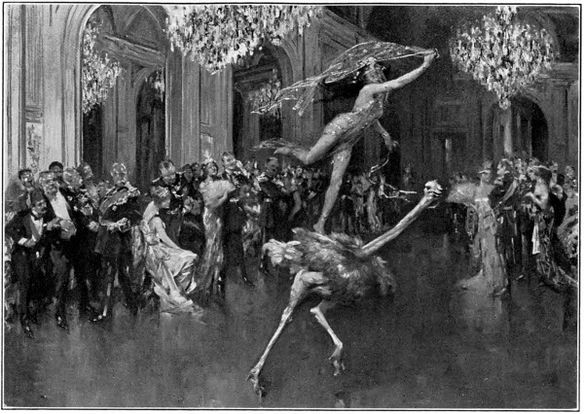
NIHLA PUT HER FEATHERED STEED THROUGH ITS ABSURD PACES
Over hurdle after hurdle she lifted her powerful, half-terrified mount; she backed it, pirouetted, made it squat, leap, pace, trot, run with wings half spread and neck stretched level.
She rode sideways, then kneeling, standing, then poised on one foot; she threw somersaults, faced to the rear, mounted and dismounted at full speed. And through the frail, transparent Yashmak her parted red lips revealed the glimmer of teeth and her childishly engaging laughter rang delightfully.
Then, abruptly, she had enough of her bird; she wheeled, sprang to the polished parquet, and sent her feathered steed scampering away through the sand-coloured curtains, which switched into place again immediately.
Breathless, laughing that frank, youthful, irresistible laugh which was to become so celebrated in Europe, Nihla Quellen strolled leisurely around the circle of her applauding audience, carelessly blowing a kiss or two from her slim finger-tips, evidently quite unspoiled by her success and equally delighted to please and to be pleased.
Then, in the gilded gallery the strings began; and quite naturally, without any trace of preparation or self-consciousness, Nihla began to sing, dancing when the fascinating, irresponsible measure called for it, singing again as the sequence occurred. And the enchantment of it all lay in its accidental and detached allure—as though it all were quite spontaneous—the song a passing whim, the dance a capricious after-thought, and the whole thing done entirely to please herself and give vent to the sheer delight of a young girl, in her own overwhelming energy and youthful spirits.
Even the Teuton comprehended that, and the applause grew to a roar with that odd undertone of animal menace always to be detected when the German herd is gratified and expresses pleasure en masse.
But she wouldn’t stay, wouldn’t return. Like one of those beautiful Persian cats, she had lingered long enough to arouse delight. Then she went, deaf to recall, to persuasion, to caress—indifferent to praise, to blandishment, to entreaty. Cat and dancer were similar; Nihla, like the Persian puss, knew when she had had enough. That was sufficient for her: nothing could stop her, nothing lure her to return.
Beads of sweat were glistening upon the heavy features of the Count d’Eblis. Von-der-Goltz Pasha, strolling near, did him the honour to remember him, but d’Eblis seemed dazed and unresponsive; and the old Pasha understood, perhaps, when he caught the beady and expressive eyes of Ferez fixed on him in exultation.
“Whose is she?” demanded d’Eblis abruptly. His voice was hoarse and evidently out of control, for he spoke too loudly to please Ferez, who took him by the arm and led him out to the moonlit terrace.
“Mon pauvere ami,” he said soothingly, “she is actually the propertee of nobodee at present. Cyril, they say, is following her—quite ready for anything—marriage——”
“What!”
Ferez shrugged:
“That is the gosseep. No doubt som’ man of wealth, more acceptable to her——”
“I wish to meet her!” said d’Eblis.
“Ah! That is, of course, not easee——”
“Why?”
Ferez laughed:
“Ask yo’self the question again! Excellenz and his guests have gone quite mad ovaire Nihla——”
“I care nothing for them,” retorted d’Eblis thickly; “I wish to know her.... I wish to know her!... Do you understand?”
After a silence, Ferez turned in the moonlight and looked at the Count d’Eblis.
“And your newspapaire—Le Mot d’Ordre?”
“Yes.... If you get her for me.”
“You sell to me for two million francs the control stock in Le Mot d’Ordre?”
“Yes.”
“An’ the two million, eh?”
“I shall use my influence with Gerhardt. That is all I can do. If your Emperor chooses to decorate him—something—the Red Eagle, third class, perhaps——”
“I attend to those,” smiled Ferez. “Hit’s ver’ fonny, d’Eblis, how I am thinking about those Red Eagles all time since I know Gerhardt. I spik to Von-der-Goltz de votre part, si vous le voulez? Oui? Alors——”
“Ask her to supper aboard the yacht.”
“God knows——”
The Count d’Eblis said through closed teeth:
“There is the first woman I ever really wanted in all my life!... I am standing here now waiting for her—waiting to be presented to her now.”
“I spik to Von-der-Goltz Pasha,” said Ferez; and he slipped through the palms and orange trees and vanished.
For half an hour the Count d’Eblis stood there, motionless in the moonlight.
She came about that time, on the arm of Ferez Bey, her father’s friend of many years.
And Ferez left her there in the creamy Turkish moonlight on the flowering terrace, alone with the Count d’Eblis.
When Ferez came again, long after midnight, with Excellenz on one arm and the proud and happy Adolf Gerhardt on the other, the whole cycle of a little drama had been played to a conclusion between those two shadowy figures under the flowering almonds on the terrace—between this slender, dark-eyed girl and this big, bulky, heavy-visaged man of the world.
And the man had been beaten and the girl had laid down every term. And the compact was this: that she was to be launched in Paris; she was merely to borrow any sum needed, with privilege to acquit the debt within the year; that, if she ever came to care for this man sufficiently, she was to become only one species of masculine property—a legal wife.
And to every condition—and finally even to the last, the man had bowed his heavy, burning head.
“D’Eblis!” began Gerhardt, almost stammering in his joy and pride. “His highness tells me that I am to have an order—an Imperial d-decoration——”
D’Eblis stared at him out of unseeing eyes; Nihla laughed outright, alas, too early wise and not even troubling her lovely head to wonder why a decoration had been asked for this burly, bushy-bearded man from nowhere.
But within his sinuous, twisted soul Ferez writhed exultingly, and patted Gerhardt on the arm, and patted d’Eblis, too—dared even to squirm visibly closer to Excellenz, like a fawning dog that fears too much to venture contact in his wriggling demonstrations.
“You take with you our pretty wonder-child to Paris to be launched, I hear,” remarked Excellenz, most affably, to d’Eblis. And to Nihla: “And upon a yacht fit for an emperor, I understand. Ach! Such a going forth is only heard of in the Arabian Nights. Eh bien, ma petite, go West, conquer, and reign! It is a prophecy!”
And Nihla threw back her head and laughed her full-throated laughter under the Turkish moon.
Later, Ferez, walking with the Ambassador, replied humbly to the curt question:
“Yes, I have become his jackal. But always at the orders of Excellenz.”
Later still, aboard the Mirage, Ferez stood alone by the after-rail, staring with ratty eyes at the blackness beyond the New Bridge.
“Oh, God, be merciful!” he whispered. He had often said it on the eve of crime. Even an Eurasian rat has emotions. And Ferez had been in love with Nihla many years, and was selling her now at a price—selling her and Adolf Gerhardt and the Count d’Eblis and France—all he had to barter—for he had sold his soul too long ago to remember even what he got for it.
The silence seemed more intense for the sounds that made it audible. From, the unlighted cities on the seven hills came an unbroken howling of dogs; transparent waves of the limpid Bosphorus slapped the vessel’s sides, making a mellow and ceaseless clatter. Far away beyond Galata Quay, in the inner reek of unseen Stamboul, the notes of a Turkish flute stole out across the darkness, where some Tzigane—some unseen wretch in rags—was playing the melancholy song of Mourad. And, mournfully responsive to the reedy complaint of a homeless wanderer from a nation without a home, the homeless dogs of Islam wailed their miserere under the Prophet’s moon.
The tragic wolf-song wavered from hill to hill; from the Fields of the Dead to the Seven Towers, from Kassim to Tophane, seeming to swell into one dreadful, endless plaint:
“My God, why hast Thou forsaken me?”
“And me!” muttered Ferez, shivering in the windy vapours from the Black Sea, which already dampened his face with their creeping summer chill.
“Ferez!”
He turned slowly. Swathed in a white wool bernous, Nihla stood there in the foggy moonlight.
“Why?” she enquired, without preliminaries and with the unfeigned curiosity of a child.
He did not pretend to misunderstand her in French:
“Thou knowest, Nihla. I have never touched thy heart. I could do nothing for thee——”
“Except to sell me,” she smiled, interrupting him in English, without the slightest trace of accent.
But Ferez preferred the refuge of French:
“Except to launch thee and make possible thy career,” he corrected her very gently.
“I thought you were in love with me?”
“I have loved thee, Nihla, since thy childhood.”
“Is there anything on earth or in paradise, Ferez, that you would not sell for a price?”
“I tell thee——”
“Zut! I know thee, Ferez!” she mocked him, slipping easily into French. “What was my price? Who pays thee, Colonel Ferez? This big, shambling, world-wearied Count, who is, nevertheless, afraid of me? Did he pay thee? Or was it this rich American, Gerhardt? Or was it Von-der-Goltz? Or Excellenz?”
“Nihla! Thou knowest me——”
Her clear, untroubled laughter checked him:
“I know you, Ferez. That is why I ask. That is why I shall have no reply from you. Only my wits can ever answer me any questions.”
She stood laughing at him, swathed in her white wool, looming like some mocking spectre in the misty moonlight of the after-deck.
“Oh, Ferez,” she said in her sweet, malicious voice, “there was a curse on Midas, too! You play at high finance; you sell what you never had to sell, and you are paid for it. All your life you have been busy selling, re-selling, bargaining, betraying, seeking always gain where only loss is possible—loss of all that justifies a man in daring to stand alive before the God that made him!... And yet—that which you call love—that shadowy emotion which you have also sold to-night—I think you really feel for me.... Yes, I believe it.... But it, too, has its price.... What was that price, Ferez?”
“Believe me, Nihla——”
“Oh, Ferez, you ask too much! No! Let me tell you, then. The price was paid by that American, who is not one but a German.”
“That is absurd!”
“Why the Red Eagle, then? And the friendship of Excellenz? What is he then, this Gerhardt, but a millionaire? Why is nobility so gracious then? What does Gerhardt give for his Red Eagle?—for the politeness of Excellenz?—for the crooked smile of a Bavarian Baroness and the lifted lorgnette of Austria? What does he give for me? Who buys me after all? Enver? Talaat? Hilmi? Who sells me? Excellenz? Von-der-Goltz? You? And who pays for me? Gerhardt, who takes his profit in Red Eagles and offers me to d’Eblis for something in exchange to please Excellenz—and you? And what, at the end of the bargaining, does d’Eblis pay for me—pay through Gerhardt to you, and through you to Excellenz, and through Excellenz to the Kaiser Wilhelm II——”
Ferez, showing his teeth, came close to her and spoke very softly:
“See how white is the moonlight off Seraglio Point, my Nihla!... It is no whiter than those loveliest ones who lie fathoms deep below these little silver waves.... Each with her bowstring snug about her snowy neck.... As fair and young, as warm and fresh and sweet as thou, my Nihla.”
He smiled at her; and if the smile stiffened an instant on her lips, the next instant her light, dauntless laughter mocked him.
“For a price,” she said, “you would sell even Life to that old miser, Death! Then listen what you have done, little smiling, whining jackal of his Excellency! I go to Paris and to my career, certain of my happy destiny, sure of myself! For my opportunity I pay if I choose—pay what I choose—when and where it suits me to pay!——”
She slipped into French with a little laugh:
“Now go and lick thy fingers of whatever crumbs have stuck there. The Count d’Eblis is doubtless licking his. Good appetite, my Ferez! Lick away lustily, for God does not temper the jackal’s appetite to his opportunities!”
Ferez let his level gaze rest on her in silence.
“Well, trafficker in Eagles, dealer in love, vendor of youth, merchant of souls, what strikes you silent?”
But he was thinking of something sharper than her tongue and less subtle, which one day might strike her silent if she laughed too much at Fate.
And, thinking, he showed his teeth again in that noiseless snicker which was his smile and laughter too.
The girl regarded him for a moment, then deliberately mimicked his smile:
“The dogs of Stamboul laugh that way, too,” she said, baring her pretty teeth. “What amuses you? Did the silly old Von-der-Goltz Pasha promise you, also, a dish of Eagle?—old Von-der-Goltz with his spectacles an inch thick and nothing living within what he carries about on his two doddering old legs! There’s a German!—who died twenty years ago and still walks like a damned man—jingling his iron crosses and mumbling his gums! Is it a resurrection from 1870 come to foretell another war? And why are these Prussian vultures gathering here in Stamboul? Can you tell me, Ferez?—these Prussians in Turkish uniforms! Is there anything dying or dead here, that these buzzards appear from the sky and alight? Why do they crowd and huddle in a circle around Constantinople? Is there something dead in Persia? Is the Bagdad railroad dying? Is Enver Bey at his last gasp? Is Talaat? Or perhaps the savoury odour comes from the Yildiz——”
“Nihla! Is there nothing sacred—nothing thou fearest on earth?”
“Only old age—and thy smile, my Ferez. Neither agrees with me.” She stretched her arms lazily.
“Allons,” she said, stifling a pleasant yawn with one slim hand,“—my maid will wake below and miss me; and then the dogs of Stamboul yonder will hear a solo such as they never heard before.... Tell me, Ferez, do you know when we are to weigh anchor?”
“At sunrise.”
“It is the same to me,”—she yawned again—“my maid is aboard and all my luggage. And my Ferez, also.... Mon dieu! And what will Cyril have to say when he arrives to find me vanished! It is, perhaps, well for us that we shall be at sea!”
Her quick laughter pealed; she turned with a careless gesture of salute, friendly and contemptuous; and her white bernous faded away in the moonlit fog.
And Ferez Bey stood staring after her out of his near-set, beady eyes, loving her, desiring her, fearing her, unrepentant that he had sold her, wondering whether the day might dawn when he would find it best to kill her for the prosperity and peace of mind of the only living being in whose service he never tired—himself.
XXV STARLIGHT
XXVI ’BE-N EIRINN I!
VIII DULCIE ANSWERS
XVIII THE BABBLER
XXVII THE MOONLIT WAY
V IN DRAGON COURT
XVI THE WATCHER
XXIV A SILENT HOUSE
XIX A CHANCE ENCOUNTER
VI DULCIE
XXIII A LION IN THE PATH
IX HER DAY
XIV PROBLEMS
XII THE LAST MAIL
IV DUSK
XX GROGAN’S
II SUNRISE
HE CAME TOWARD HER STEALTHILY
XXIX ASTHORE
XXII FORELAND FARMS
XVII A CONFERENCE
PROLOGUE CLAIRE-DE-LUNE
“YOU LITTLE MIRACLE!”
X HER EVENING
III SUNSET
XXVIII GREEN JACKETS
NIHLA PUT HER FEATHERED STEED THROUGH ITS ABSURD PACES
I A SHADOW DANCE
XXI THE WHITE BLACKBIRD
XIII A MIDNIGHT TÊTE-À-TÊTE
XI HER NIGHT
XV BLACKMAIL
VII OPPORTUNITY KNOCKS
I A SHADOW DANCE
Three years later Destiny still wore a rosy face for Nihla Quellen. And, for a young American of whom Nihla had never even heard, Destiny still remained the laughing jade he had always known, beckoning him ever nearer, with the coquettish promise of her curved forefinger, to fame and wealth immeasurable.
Seated now on a moonlit lawn, before his sketching easel, this optimistic young man, whose name was Barres, continued to observe the movements of a dim white figure which had emerged from the villa opposite, and was now stealing toward him across the dew-drenched grass.
When the white figure was quite near it halted, holding up filmy skirts and peering intently at him.
“May one look?” she inquired, in that now celebrated voice of hers, through which ever seemed to sound a hint of hidden laughter.
“Certainly,” he replied, rising from his folding camp stool.
She tiptoed over the wet grass, came up beside him, gazed down at the canvas on his easel.
“Can you really see to paint? Is the moon bright enough?” she asked.
“Yes. But one has to be familiar with one’s palette.”
“Oh. You seem to know yours quite perfectly, monsieur.”
“Enough to mix colours properly.”
“I didn’t realise that painters ever actually painted pictures by moonlight.”
“It’s a sort of hit or miss business, but the notes made are interesting,” he explained.
“What do you do with these moonlight studies?”
“Use them as notes in the studio when a moonlight picture is to be painted.”
“Are you then a realist, monsieur?”
“As much of a realist as anybody with imagination can be,” he replied, smiling at her charming, moonlit face.
“I understand. Realism is merely honesty plus the imagination of the individual.”
“A delightful mot, madam——”
“Mademoiselle,” she corrected him demurely. “Are you English?”
“American.”
“Oh. Then may I venture to converse with you in English?” She said it in exquisite English, entirely without accent.
“You are English!” he exclaimed under his breath.
“No ... I don’t know what I am.... Isn’t it charming out here? What particular view are you painting?”
“The Seine, yonder.”
She bent daintily over his sketch, holding up the skirts of her ball-gown.
“Your sketch isn’t very far advanced, is it?” she inquired seriously.
“Not very,” he smiled.
They stood there together in silence for a while, looking out over the moonlit river to the misty, tree-covered heights.
Through lighted rows of open windows in the elaborate little villa across the lawn came lively music and the distant noise of animated voices.
“Do you know,” he ventured smilingly, “that your skirts and slippers are soaking wet?”
“I don’t care. Isn’t this June night heavenly?”
She glanced across at the lighted house. “It’s so hot and noisy in there; one dances only with discomfort. A distaste for it all sent me out on the terrace. Then I walked on the lawn. Then I beheld you!... Am I interrupting your work, monsieur? I suppose I am.” She looked up at him naïvely.
He said something polite. An odd sense of having seen her somewhere possessed him now. From the distant house came the noisy American music of a two-step. With charming grace, still inspecting him out of her dark eyes, the girl began to move her pretty feet in rhythm with the music.
“Shall we?” she inquired mischievously.... “Unless you are too busy——”
The next moment they were dancing together there on the wet lawn, under the high lustre of the moon, her fresh young face and fragrant figure close to his.
During their second dance she said serenely:
“They’ll raise the dickens if I stay here any longer. Do you know the Comte d’Eblis?”
“The Senator? The numismatist?”
“Yes.”
“No, I don’t know him. I am only a Latin Quarter student.”
“Well, he is giving that party. He is giving it for me—in my honour. That is his villa. And I”—she laughed—“am going to marry him—perhaps! Isn’t this a delightful escapade of mine?”
“Isn’t it rather an indiscreet one?” he asked smilingly.
“Frightfully. But I like it. How did you happen to pitch your easel on his lawn?”
“The river and the hills—their composition appealed to me from here. It is the best view of the Seine.”
“Are you glad you came?”
They both laughed at the mischievous question.
During their third dance she became a little apprehensive and kept looking over her shoulder toward the house.
“There’s a man expected there,” she whispered, “Ferez Bey. He’s as soft-footed as a cat and he always prowls in my vicinity. At times it almost seems to me as though he were slyly watching me—as though he were employed to keep an eye on me.”
“A Turk?”
“Eurasian.... I wonder what they think of my absence? Alexandre—the Comte d’Eblis—won’t like it.”
“Had you better go?”
“Yes; I ought to, but I won’t.... Wait a moment!” She disengaged herself from his arms. “Hide your easel and colour-box in the shrubbery, in case anybody comes to look for me.”
She helped him strap up and fasten the telescope-easel; they placed the paraphernalia behind the blossoming screen of syringa. Then, coming together, she gave herself to him again, nestling between his arms with a little laugh; and they fell into step once more with the distant dance-music. Over the grass their united shadows glided, swaying, gracefully interlocked—moon-born phantoms which dogged their light young feet....
A man came out on the stone terrace under the Chinese lanterns. When they saw him they hastily backed into the obscurity of the shrubbery.
“Nihla!” he called, and his heavy voice was vibrant with irritation and impatience.
He was a big man. He walked with a bulky, awkward gait—a few paces only, out across the terrace.
“Nihla!” he bawled hoarsely.
Then two other men and a woman appeared on the terrace where the lanterns were strung. The woman called aloud in the darkness:
“Nihla! Nihla! Where are you, little devil?” Then she and the two men with her went indoors, laughing and skylarking, leaving the bulky man there alone.
The young fellow in the shrubbery felt the girl’s hand tighten on his coat sleeve, felt her slender body quiver with stifled laughter. The desire to laugh seized him, too; and they clung there together, choking back their mirth while the big man who had first appeared waddled out across the lawn toward the shrubbery, shouting:
“Nihla! Where are you then?” He came quite close to where they stood, then turned, shouted once or twice and presently disappeared across the lawn toward a walled garden. Later, several other people came out on the terrace, calling, “Nihla, Nihla,” and then went indoors, laughing boisterously.
The young fellow and the girl beside him were now quite weak and trembling with suppressed mirth.
They had not dared venture out on the lawn, although dance music had begun again.
“Is it your name they called?” he asked, his eyes very intent upon her face.
“Yes, Nihla.”
“I recognise you now,” he said, with a little thrill of wonder.
“I suppose so,” she replied with amiable indifference. “Everybody knows me.”
She did not ask his name; he did not offer to enlighten her. What difference, after all, could the name of an American student make to the idol of Europe, Nihla Quellen?
“I’m in a mess,” she remarked presently. “He will be quite furious with me. It is going to be most disagreeable for me to go back into that house. He has really an atrocious temper when made ridiculous.”
“I’m awfully sorry,” he said, sobered by her seriousness.
She laughed:
“Oh, pouf! I really don’t care. But perhaps you had better leave me now. I’ve spoiled your moonlight picture, haven’t I?”
“But think what you have given me to make amends!” he replied.
She turned and caught his hands in hers with adorable impulsiveness:
“You’re a sweet boy—do you know it! We’ve had a heavenly time, haven’t we? Do you really think you ought to go—so soon?”
“Don’t you think so, Nihla?”
“I don’t want you to go. Anyway, there’s a train every two hours——”
“I’ve a canoe down by the landing. I shall paddle back as I came——”
“A canoe!” she exclaimed, enchanted. “Will you take me with you?”
“To Paris?”
“Of course! Will you?”
“In your ball-gown?”
“I’d adore it! Will you?”
“That is an absolutely crazy suggestion,” he said.
“I know it. The world is only a big asylum. There’s a path to the river behind these bushes. Quick—pick up your painting traps——”
“But, Nihla, dear——”
“Oh, please! I’m dying to run away with you!”
“To Paris?” he demanded, still incredulous that the girl really meant it.
“Of course! You can get a taxi at the Pont-au-Change and take me home. Will you?”
“It would be wonderful, of course——”
“It will be paradise!” she exclaimed, slipping her hand into his. “Now, let us run like the dickens!”
In the uncertain moonlight, filtering through the shrubbery, they found a hidden path to the river; and they took it together, lightly, swiftly, speeding down the slope, all breathless with laughter, along the moonlit way.
In the suburban villa of the Comte d’Eblis a wine-flushed and very noisy company danced on, supped at midnight, continued the revel into the starlit morning hours. The place was a jungle of confetti.
Their host, restless, mortified, angry, perplexed by turns, was becoming obsessed at length with dull premonitions and vaguer alarms.
He waddled out to the lawn several times, still wearing his fancy gilt and tissue cap, and called:
“Nihla! Damnation! Answer me, you little fool!”
He went down to the river, where the gaily painted row-boats and punts lay, and scanned the silvered flood, tortured by indefinite apprehensions. About dawn he started toward the weed-grown, slippery river-stairs for the last time, still crowned with his tinsel cap; and there in the darkness he found his aged boat-man, fishing for gudgeon with a four-cornered net suspended to the end of a bamboo pole.
“Have you see anything of Mademoiselle Nihla?” he demanded, in a heavy, unsteady voice, tremulous with indefinable fears.
“Monsieur le Comte, Mademoiselle Quellen went out in a canoe with a young gentleman.”
“W-what is that you tell me!” faltered the Comte d’Eblis, turning grey in the face.
“Last night, about ten o’clock, M’sieu le Comte. I was out in the moonlight fishing for eels. She came down to the shore—took a canoe yonder by the willows. The young man had a double-bladed paddle. They were singing.”
“They—they have not returned?”
“No, M’sieu le Comte——”
“Who was the—man?”
“I could not see——”
“Very well.” He turned and looked down the dusky river out of light-coloured, murderous eyes. Then, always awkward in his gait, he retraced his steps to the house. There a servant accosted him on the terrace:
“The telephone, if Monsieur le Comte pleases——”
“Who is calling?” he demanded with a flare of fury.
“Paris, if it pleases Monsieur le Comte.”
The Count d’Eblis went to his own quarters, seated himself, and picked up the receiver:
“Who is it?” he asked thickly.
“Max Freund.”
“What has h-happened?” he stammered in sudden terror.
Over the wire came the distant reply, perfectly clear and distinct:
“Ferez Bey was arrested in his own house at dinner last evening, and was immediately conducted to the frontier, escorted by Government detectives.... Is Nihla with you?”
The Count’s teeth were chattering now. He managed to say:
“No, I don’t know where she is. She was dancing. Then, all at once, she was gone. Of what was Colonel Ferez suspected?”
“I don’t know. But perhaps we might guess.”
“Are you followed?”
“Yes.”
“By—by whom?”
“By Souchez.... Good-bye, if I don’t see you. I join Ferez. And look out for Nihla. She’ll trick you yet!”
The Count d’Eblis called:
“Wait, for God’s sake, Max!”—listened; called again in vain. “The one-eyed rabbit!” he panted, breathing hard and irregularly. His large hand shook as he replaced the instrument. He sat there as though paralysed, for a moment or two. Mechanically he removed his tinsel cap and thrust it into the pocket of his evening coat. Suddenly the dull hue of anger dyed neck, ears and temple:
“By God!” he gasped. “What is that she-devil trying to do to me? What has she done!”
After another moment of staring fixedly at nothing, he opened the table drawer, picked up a pistol and poked it into his breast pocket.
Then he rose, heavily, and stood looking out of the window at the paling east, his pendulous under lip aquiver.
II SUNRISE
The first sunbeams had already gilded her bedroom windows, barring the drawn curtains with light, when the man arrived. He was still wearing his disordered evening dress under a light overcoat; his soiled shirt front was still crossed by the red ribbon of watered silk; third class orders striped his breast, where also the brand new Turkish sunburst glimmered.
A sleepy maid in night attire answered his furious ringing; the man pushed her aside with an oath and strode into the semi-darkness of the corridor. He was nearly six feet tall, bulky; but his legs were either too short or something else was the matter with them, for when he walked he waddled, breathing noisily from the ascent of the stairs.
“Is your mistress here?” he demanded, hoarse with his effort.
“Y—yes, monsieur——”
“When did she come in?” And, as the scared and bewildered maid hesitated: “Damn you, answer me! When did Mademoiselle Quellen come in? I’ll wring your neck if you lie to me!”
The maid began to whimper:
“Monsieur le Comte—I do not wish to lie to you.... Mademoiselle Nihla came back with the dawn——”
“Alone?”
The maid wrung her hands:
“Does Monsieur le Comte m-mean to harm her?”
“Will you answer me, you snivelling cat!” he panted between his big, discoloured teeth. He had fished out a pistol from his breast pocket, dragging with it a silk handkerchief, a fancy cap of tissue and gilt, and some streamers of confetti which fell to the carpet around his feet.
“Now,” he breathed in a half-strangled voice, “answer my questions. Was she alone when she came in?”
“N-no.”
“Who was with her?”
“A—a——”
“A man?”
The maid trembled violently and nodded.
“What man?”
“M-Monsieur le Comte, I have never before beheld him——”
“You lie!”
“I do not lie! I have never before seen him, Monsieur le——”
“Did you learn his name?”
“No——”
“Did you hear what they said?”
“They spoke in English——”
“What!” The man’s puffy face went flabby white, and his big, badly made frame seemed to sag for a moment. He laid a large fat hand flat against the wall, as though to support and steady himself, and gazed dully at the terrified maid.
And she, shivering in her night-robe and naked feet, stared back into the pallid face, with its coarse, greyish moustache and little short side-whiskers which vulgarized it completely—gazed in unfeigned terror at the sagging, deadly, lead-coloured eyes.
“Is the man there—in there now—with her?” demanded the Comte d’Eblis heavily.
“No, monsieur.”
“Gone?”
“Oh, Monsieur le Comte, the young man stayed but a moment——”
“Where were they? In her bedroom?”
“In the salon. I—I served a pâté—a glass of wine—and the young gentleman was gone the next minute——”
A dull red discoloured the neck and features of the Count.
“That’s enough,” he said; and waddled past her along the corridor to the furthest door; and wrenched it open with one powerful jerk.
In the still, golden gloom of the drawn curtains, now striped with sunlight, a young girl suddenly sat up in bed.
“Alexandre!” she exclaimed in angry astonishment.
“You slut!” he said, already enraged again at the mere sight of her. “Where did you go last night!”
“What are you doing in my bedroom?” she demanded, confused but flushed with anger. “Leave it! Do you hear!—” She caught sight of the pistol in his hand and stiffened.
He stepped nearer; her dark, dilated gaze remained fixed on the pistol.
“Answer me,” he said, the menacing roar rising in his voice. “Where did you go last night when you left the house?”
“I—I went out—on the lawn.”
“And then?”
“I had had enough of your party: I came back to Paris.”
“And then?”
“I came here, of course.”
“Who was with you?”
Then, for the first time, she began to comprehend. She swallowed desperately.
“Who was your companion?” he repeated.
“A—man.”
“You brought him here?”
“He—came in—for a moment.”
“Who was he?”
“I—never before saw him.”
“You picked up a man in the street and brought him here with you?”
“N-not on the street——”
“Where?”
“On the lawn—while your guests were dancing——”
“And you came to Paris with him?”
“Y-yes.”
“Who was he?”
“I don’t know——”
“If you don’t name him, I’ll kill you!” he yelled, losing the last vestige of self-control. “What kind of story are you trying to tell me, you lying drab! You’ve got a lover! Confess it!”
“I have not!”
“Liar! So this is how you’ve laughed at me, mocked me, betrayed me, made a fool of me! You!—with your fierce little snappish ways of a virgin! You with your dangerous airs of a tiger-cat if a man so much as laid a finger on your vicious body! So Mademoiselle-Don’t-touch-me had a lover all the while. Max Freund warned me to keep an eye on you!” He lost control of himself again; his voice became a hoarse shout: “Max Freund begged me not to trust you! You filthy little beast! Good God! Was I crazy to believe in you—to talk without reserve in your presence! What kind of imbecile was I to offer you marriage because I was crazy enough to believe that there was no other way to possess you! You—a Levantine dancing girl—a common painted thing of the public footlights—a creature of brasserie and cabaret! And you posed as Mademoiselle Nitouche! A novice! A devotee of chastity! And, by God, your devilish ingenuity at last persuaded me that you actually were what you said you were. And all Paris knew you were fooling me—all Paris was laughing in its dirty sleeve—mocking me—spitting on me——”
“All Paris,” she said, in an unsteady voice, “gave you credit for being my lover. And I endured it. And you knew it was not true. Yet you never denied it.... But as for me, I never had a lover. When I told you that I told you the truth. And it is true to-day as it was yesterday. Nobody believes it of a dancing girl. Now, you no longer believe it. Very well, there is no occasion for melodrama. I tried to fall in love with you: I couldn’t. I did not desire to marry you. You insisted. Very well; you can go.”
“Not before I learn the name of your lover of last night!” he retorted, now almost beside himself with fury, and once more menacing her with his pistol. “I’ll get that much change out of all the money I’ve lavished on you!” he yelled. “Tell me his name or I’ll kill you!”
She reached under her pillow, clutched a jewelled watch and purse, and hurled them at him. She twisted from her arm a gemmed bracelet, tore every flashing ring from her fingers, and flung them in a handful straight at his head.
“There’s some more change for you!” she panted. “Now, leave my bedroom!”
“I’ll have that man’s name first!”
The girl laughed in his distorted face. He was within an ace of shooting her—of firing point-blank into the lovely, flushed features, merely to shatter them, destroy, annihilate. He had the desire to do it. But her breathless, contemptuous laugh broke that impulse—relaxed it, leaving it flaccid. And after an interval something else intervened to stay his hand at the trigger—something that crept into his mind; something he had begun to suspect that she knew. Suddenly he became convinced that she did know it—that she believed that he dared not kill her and stand the investigation of a public trial before a juge d’instruction—that he could not afford to have his own personal affairs scrutinised too closely.
He still wanted to kill her—shoot her there where she sat in bed, watching him out of scornful young eyes. So intense was his need to slay—to disfigure, brutalise this girl who had mocked him, that the raging desire hurt him physically. He leaned back, resting against the silken wall, momentarily weakened by the violence of passion. But his pistol still threatened her.
No; he dared not. There was a better, surer way to utterly destroy her,—a way he had long ago prepared,—not expecting any such contingency as this, but merely as a matter of self-insurance.
His levelled weapon wavered, dropped, held loosely now. He still glared at her out of pallid and blood-shot eyes in silence. After a while:
“You hell-cat,” he said slowly and distinctly. “Who is your English lover? Tell me his name or I’ll beat your face to a pulp!”
“I have no English lover.”
“Do you think,” he went on heavily, disregarding her reply, “that I don’t know why you chose an Englishman? You thought you could blackmail me, didn’t you?”
“How?” she demanded wearily.
Again he ignored her reply:
“Is he one of the Embassy?” he demanded. “Is he some emissary of Grey’s? Does he come from their intelligence department? Or is he only a police jackal? Or some lesser rat?”
She shrugged; her night-robe slipped and she drew it over her shoulder with a quick movement. And the man saw the deep blush spreading over face and throat.
“By God!” he said, “you are an actress! I admit it. But now you are going to learn something about real life. You think you’ve got me, don’t you?—you and your Englishman? Because I have been fool enough to trust you—hide nothing from you—act frankly and openly in your presence. You thought you’d get a hold on me, so that if I ever caught you at your treacherous game you could defy me and extort from me the last penny! You thought all that out—very thriftily and cleverly—you and your Englishman between you—didn’t you?”
“I don’t know what you mean.”
“Don’t you? Then why did you ask me the other day whether it was not German money which was paying for the newspaper which I bought?”
“The Mot d’Ordre?”
“Certainly.”
“I asked you that because Ferez Bey is notoriously in Germany’s pay. And Ferez Bey financed the affair. You said so. Besides, you and he discussed it before me in my own salon.”
“And you suspected that I bought the Mot d’Ordre with German money for the purpose of carrying out German propaganda in a Paris daily paper?”
“I don’t know why Ferez Bey gave you the money to buy it.”
“He did not give me the money.”
“You said so. Who did?”
“You!” he fairly yelled.
“W-what!” stammered the girl, confounded.
“Listen to me, you rat!” he said fiercely. “I was not such a fool as you believed me to be. I lavished money on you; you made a fortune for yourself out of your popularity, too. Do you remember endorsing a cheque drawn to your order by Ferez Bey?”
“Yes. You had borrowed every penny I possessed. You said that Ferez Bey owed you as much. So I accepted his cheque——”
“That cheque paid for the Mot d’Ordre. It is drawn to your order; it bears your endorsement; the Mot d’Ordre was purchased in your name. And it was Max Freund who insisted that I take that precaution. Now, try to blackmail me!—you and your English spy!” he cried triumphantly, his voice breaking into a squeak.
Not yet understanding, merely conscious of some vague and monstrous danger, the girl sat motionless, regarding him intently out of beautiful, intelligent eyes.
He burst into laughter, made falsetto by the hysteria of sheer hatred:
“That’s where you are now!” he said, leering down at her. “Every paper I ever made you sign incriminates you; your cancelled cheque is in the same packet; your dossier is damning and complete. You didn’t know that Ferez Bey was sent across the frontier yesterday, did you? Your English spy didn’t inform you last night, did he?”
“N-no.”
“You lie! You did know it! That was why you stole away last night and met your jackal—to sell him something besides yourself, this time! You knew they had arrested Ferez! I don’t know how you knew it, but you did. And you told your lover. And both of you thought you had me at last, didn’t you?”
“I—what are you trying to say to me—do to me?” she stammered, losing colour for the first time.
“Put you where you belong—you dirty spy!” he said with grinning ferocity. “If there is to be trouble, I’ve prepared for it. When they try you for espionage, they’ll try you as a foreigner—a dancing girl in the pay of Germany—as my mistress whom Max Freund and I discover in treachery to France, and whom I instantly denounce to the proper authorities!”
He shoved his pistol into his breast pocket and put on his marred silk hat.
“Which do you think they will believe—you or the Count d’Eblis?” he demanded, the nervous leer twitching at his heavy lips. “Which do you think they will believe—your denials and counter-accusations against me, or Max Freund’s corroboration, and the evidence of the packet I shall now deliver to the authorities—the packet containing every cursed document necessary to convict you!—you filthy little——”
The girl bounded from her bed to the floor, her dark eyes blazing:
“Damn you!” she said. “Get out of my bedroom!”
Taken aback, he retreated a pace or two, and, at the furious menace of the little clenched fist, stepped another pace out into the corridor. The door crashed in his face; the bolt shot home.
In twenty minutes Nihla Quellen, the celebrated and adored of European capitals, crept out of the street door. She wore the dress of a Finistère peasant; her hair was grey, her step infirm.
The commissaire, two agents de police, and a Government detective, one Souchez, already on their way to identify and arrest her, never even glanced at the shabby, infirm figure which hobbled past them on the sidewalk and feebly mounted an omnibus marked Gare du Nord.
For a long time Paris was carefully combed for the dancer, Nihla Quellen, until more serious affairs occupied the authorities, and presently the world at large. For, in a few weeks, war burst like a clap of thunder over Europe, leaving the whole world stunned and reeling. The dossier of Nihla Quellen, the dancing girl, was tossed into secret archives, together with the dossier of one Ferez Bey, an Eurasian, now far beyond French jurisdiction, and already very industrious in the United States about God knows what, in company with one Max Freund.
As for Monsieur the Count d’Eblis, he remained a senator, an owner of many third-rate decorations, and of the Mot d’Ordre.
And he remained on excellent terms with everybody at the Swedish, Greek, and Bulgarian legations, and the Turkish Embassy, too. And continued in cipher communication with Max Freund and Ferez Bey in America.
Otherwise, he was still president of the Numismatic Society of Spain, and he continued to add to his wonderful collection of coins, and to keep up his voluminous numismatic correspondence.
He was growing stouter, too, which increased his spinal waddle when he walked; and he became very prosperous financially, through fortunate “operations,” as he explained, with one Bolo Pasha.
He had only one regret to interfere with his sleep and his digestion; he was sorry he had not fired his pistol into the youthful face of Nihla Quellen. He should have avenged himself, taken his chances, and above everything else he should have destroyed her beauty. His timidity and caution still caused him deep and bitter chagrin.
For nearly a year he heard absolutely nothing concerning her. Then one day a letter arrived from Ferez Bey through Max Freund, both being in New York. And when, using his key to the cipher, he extracted the message it contained, he had learned, among other things, that Nihla Quellen was in New York, employed as a teacher in a school for dancing.
The gist of his reply to Ferez Bey was that Nihla Quellen had already outlived her usefulness on earth, and that Max Freund should attend to the matter at the first favourable opportunity.
III SUNSET
On the edge of evening she came out of the Palace of Mirrors and crossed the wet asphalt, which already reflected primrose lights from a clearing western sky.
A few moments before, he had been thinking of her, never dreaming that she was in America. But he knew her instantly, there amid the rush and clatter of the street, recognised her even in the twilight of the passing storm—perhaps not alone from the half-caught glimpse of her shadowy, averted face, nor even from that young, lissome figure so celebrated in Europe. There is a sixth sense—the sense of nearness to what is familiar. When it awakes we call it premonition.
The shock of seeing her, the moment’s exciting incredulity, passed before he became aware that he was already following her through swarming metropolitan throngs released from the toil of a long, wet day in early spring.
Through every twilit avenue poured the crowds; through every cross-street a rosy glory from the west was streaming; and in its magic he saw her immortally transfigured, where the pink light suffused the crossings, only to put on again her lovely mortality in the shadowy avenue.
At Times Square she turned west, straight into the dazzling fire of sunset, and he at her slender heels, not knowing why, not even asking it of himself, not thinking, not caring.
A third figure followed them both.
The bronze giants south of them stirred, swung their great hammers against the iron bell; strokes of the hour rang out above the din of Herald Square, inaudible in the traffic roar another square away, lost, drowned out long before the pleasant bell-notes penetrated to Forty-second Street, into which they both had turned.
Yet, as though occultly conscious that some hour had struck on earth, significant to her, she stopped, turned, and looked back—looked quite through him, seeing neither him nor the one-eyed man who followed them both—as though her line of vision were the East itself, where, across the grey sea’s peril, a thousand miles of cannon were sounding the hour from the North Sea to the Alps.
He passed her at her very elbow—aware of her nearness, as though suddenly close to a young orchard in April. The girl, too, resumed her way, unconscious of him, of his youthful face set hard with controlled emotion.
The one-eyed man followed them both.
A few steps further and she turned into the entrance to one of those sprawling, pretentious restaurants, the sham magnificence of which becomes grimy overnight. He halted, swung around, retraced his steps and followed her. And at his heels two shapes followed them very silently—her shadow and his own—so close together now, against the stucco wall that they seemed like Destiny and Fate linked arm in arm.
The one-eyed man halted at the door for a few moments. Then he, too, went in, dogged by his sinister shadow.
The red sunset’s rays penetrated to the rotunda and were quenched there in a flood of artificial light; and there their sun-born shadows vanished, and three strange new shadows, twisted and grotesque, took their places.
She continued on into the almost empty restaurant, looming dimly beyond. He followed; the one-eyed man followed both.
The place into which they stepped was circular, centred by a waterfall splashing over concrete rocks. In the ruffled pool goldfish glimmered, nearly motionless, and mandarin ducks floated, preening exotic plumage.
A wilderness of tables surrounded the pool, set for the expected patronage of the coming evening. The girl seated herself at one of these.
At the next table he found a place for himself, entirely unnoticed by her. The one-eyed man took the table behind them. A waiter presented himself to take her order; another waiter came up leisurely to attend to him. A third served the one-eyed man. There were only a few inches between the three tables. Yet the girl, deeply preoccupied, paid no attention to either man, although both kept their eyes on her.
But already, under the younger man’s spellbound eyes, an odd and unforeseen thing was occurring: he gradually became aware that, almost imperceptibly, the girl and the table where she sat, and the sleepy waiter who was taking her orders, were slowly moving nearer to him on a floor which was moving, too.
He had never before been in that particular restaurant, and it took him a moment or two to realise that the floor was one of those trick floors, the central part of which slowly revolves.
Her table stood on the revolving part of the floor, his upon fixed terrain; and he now beheld her moving toward him, as the circle of tables rotated on its axis, which was the waterfall and pool in the middle of the restaurant.
A few people began to arrive—theatrical people, who are obliged to dine early. Some took seats at tables placed upon the revolving section of the floor, others preferred the outer circles, where he sat in a fixed position.
Her table was already abreast of his, with only the circular crack in the floor between them; he could easily have touched her.
As the distance began to widen between them, the girl, her gloved hands clasped in her lap, and studying the table-cloth with unseeing gaze, lifted her dark eyes—looked at him without seeing, and once more gazed through him at something invisible upon which her thoughts remained fixed—something absorbing, vital, perhaps tragic—for her face had become as colourless, now, as one of those translucent marbles, vaguely warmed by some buried vein of rose beneath the snowy surface.
Slowly she was being swept away from him—his gaze following—hers lost in concentrated abstraction.
He saw her slipping away, disappearing behind the noisy waterfall. Around him the restaurant continued to fill, slowly at first, then more rapidly after the orchestra had entered its marble gallery.
The music began with something Russian, plaintive at first, then beguiling, then noisy, savage in its brutal precision—something sinister—a trampling melody that was turning into thunder with the throb of doom all through it. And out of the vicious, Asiatic clangour, from behind the dash of too obvious waterfalls, glided the girl he had followed, now on her way toward him again, still seated at her table, still gazing at nothing out of dark, unseeing eyes.
It seemed to him an hour before her table approached his own again. Already she had been served by a waiter—was eating.
He became aware, then, that somebody had also served him. But he could not even pretend to eat, so preoccupied was he by her approach.
Scarcely seeming to move at all, the revolving floor was steadily drawing her table closer and closer to his. She was not looking at the strawberries which she was leisurely eating—did not lift her eyes as her table swept smoothly abreast of his.
Scarcely aware that he spoke aloud, he said:
“Nihla—Nihla Quellen!...”
Like a flash the girl wheeled in her chair to face him. She had lost all her colour. Her fork had dropped and a blood-red berry rolled over the table-cloth toward him.
“I’m sorry,” he said, flushing. “I did not mean to startle you——”
The girl did not utter a word, nor did she move; but in her dark eyes he seemed to see her every sense concentrated upon him to identify his features, made shadowy by the lighted candles behind his head.
By degrees, smoothly, silently, her table swept nearer, nearer, bringing with it her chair, her slender person, her dark, intelligent eyes, so unsmilingly and steadily intent on him.
He began to stammer:
“—Two years ago—at—the Villa Tresse d’Or—on the Seine.... And we promised to see each other—in the morning——”
She said coolly:
“My name is Thessalie Dunois. You mistake me for another.”
“No,” he said, in a low voice, “I am not mistaken.”
Her brown eyes seemed to plunge their clear regard into the depths of his very soul—not in recognition, but in watchful, dangerous defiance.
He began again, still stammering a trifle:
“—In the morning, we were to—to meet—at eleven—near the fountain of Marie de Médicis—unless you do not care to remember——”
At that her gaze altered swiftly, melted into the exquisite relief of recognition. Suspended breath, released, parted her blanched lips; her little guardian heart, relieved of fear, beat more freely.
“Are you Garry?”
“Yes.”
“I know you now,” she murmured. “You are Garret Barres, of the rue d’Eryx.... You are Garry!” A smile already haunted her dark young eyes; colour was returning to lip and cheek. She drew a deep, noiseless breath.
The table where she sat continued to slip past him; the distance between them was widening. She had to turn her head a little to face him.
“You do remember me then, Nihla?”
The girl inclined her head a trifle. A smile curved her lips—lips now vivid but still a little tremulous from the shock of the encounter.
“May I join you at your table?”
She smiled, drew a deeper breath, looked down at the strawberry on the cloth, looked over her shoulder at him.
“You owe me an explanation,” he insisted, leaning forward to span the increasing distance between them.
“Do I?”
“Ask yourself.”
After a moment, still studying him, she nodded as though the nod answered some silent question of her own:
“Yes, I owe you one.”
“Then may I join you?”
“My table is more prudent than I. It is running away from an explanation.” She fixed her eyes on her tightly clasped hands, as though to concentrate thought. He could see only the back of her head, white neck and lovely dark hair.
Her table was quite a distance away when she turned, leisurely, and looked back at him.
“May I come?” he asked.
She lifted her delicate brows in demure surprise.
“I’ve been waiting for you,” she said, amiably.
The one-eyed man had never taken his eyes off them.
IV DUSK
She had offered him her hand; he had bent over it, seated himself, and they smilingly exchanged the formal banalities of a pleasantly renewed acquaintance.
A waiter laid a cover for him. She continued to concern herself, leisurely, with her strawberries.
“When did you leave Paris?” she enquired.
“Nearly two years ago.”
“Before war was declared?”
“Yes, in June of that year.”
She looked up at him very seriously; but they both smiled as she said:
“It was a momentous month for you then—the month of June, 1914?”
“Very. A charming young girl broke my heart in 1914; and so I came home, a wreck—to recuperate.”
At that she laughed outright, glancing at his youthful, sunburnt face and lean, vigorous figure.
“When did you come over?” he asked curiously.
“I have been here longer than you have. In fact, I left France the day I last saw you.”
“The same day?”
“I started that very same day—shortly after sunrise. I crossed the Belgian frontier that night, and I sailed for New York the morning after. I landed here a week later, and I’ve been here ever since. That, monsieur, is my history.”
“You’ve been here in New York for two years!” he repeated in astonishment. “Have you really left the stage then? I supposed you had just arrived to fill an engagement here.”
“They gave me a try-out this afternoon.”
“You? A try-out!” he exclaimed, amazed.
She carelessly transfixed a berry with her fork:
“If I secure an engagement I shall be very glad to fill it ... and my stomach, also. If I don’t secure one—well—charity or starvation confronts me.”
He smiled at her with easy incredulity.
“I had not heard that you were here!” he repeated. “I’ve read nothing at all about you in the papers——”
“No ... I am here incognito.... I have taken my sister’s name. After all, your American public does not know me.”
“But——”
“Wait! I don’t wish it to know me!”
“But if you——”
The girl’s slight gesture checked him, although her smile became humorous and friendly:
“Please! We need not discuss my future. Only the past!” She laughed: “How it all comes back to me now, as you speak—that crazy evening of ours together! What children we were—two years ago!”
Smilingly she clasped her hands together on the table’s edge, regarding him with that winning directness which was a celebrated part of her celebrated personality; and happened to be natural to her.
“Why did I not recognise you immediately?” she demanded of herself, frowning in self-reproof. “I am stupid! Also I have, now and then, thought about you——” She shrugged her shoulders, and again her face faltered subtly:
“Much has happened to distract my memories,” she added carelessly, impaling a strawberry, “—since you and I took the key to the fields and the road to the moon—like the pair of irresponsibles we were that night in June.”
“Have you really had trouble?”
Her slim figure straightened as at a challenge, then became adorably supple again; and she rested her elbows on the table’s edge and took her cheeks between her hands.
“Trouble?” she repeated, studying his face. “I don’t know that word, trouble. I don’t admit such a word to the honour of my happy vocabulary.”
They both laughed a little.
She said, still looking at him, and at first speaking as though to herself:
“Of course, you are that same, delightful Garry! My youthful American accomplice!... Quite unspoiled, still, but very, very irresponsible ... like all painters—like all students. And the mischief which is in me recognised the mischief in you, I suppose.... I did surprise you that night, didn’t I?... And what a night! What a moon! And how we danced there on the wet lawn until my skirts and slippers and stockings were drenched with dew!... And how we laughed! Oh, that full-hearted, full-throated laughter of ours! How wonderful that we have lived to laugh like that! It is something to remember after death. Just think of it!—you and I, absolute strangers, dancing every dance there in the drenched grass to the music that came through the open windows.... And do you remember how we hid in the flowering bushes when my sister and the others came out to look for me? How they called, ‘Nihla! Nihla! Little devil, where are you?’ Oh, it was funny—funny! And to see him come out on the lawn—do you remember? He looked so fat and stupid and anxious and bad-tempered! And you and I expiring with stifled laughter! And he, with his sash, his decorations and his academic palms! He’d have shot us both, you know....”
They were laughing unrestrainedly now at the memory of that impossible night a year ago; and the girl seemed suddenly transformed into an irresponsible gamine of eighteen. Her eyes grew brighter with mischief and laughter—laughter, the greatest magician and doctor emeritus of them all! The immortal restorer of youth and beauty.
Bluish shadows had gone from under her lower lashes; her eyes were starry as a child’s.
“Oh, Garry,” she gasped, laying one slim hand across his on the table-cloth, “it was one of those encounters—one of those heavenly accidents that reconcile one to living.... I think the moon had made me a perfect lunatic.... Because you don’t yet know what I risked.... Garry!... It ruined me—ruined me utterly—our night together under the June moon!”
“What!” he exclaimed, incredulously.
But she only laughed her gay, undaunted little laugh:
“It was worth it! Such moments are worth anything we pay for them! I laughed; I pay. What of it?”
“But if I am partly responsible I wish to know——”
“You shall know nothing about it! As for me, I care nothing about it. I’d do it again to-night! That is living—to go forward, laugh, and accept what comes—to have heart enough, gaiety enough, brains enough to seize the few rare dispensations that the niggardly gods fling across this calvary which we call life! Tenez, that alone is living; the rest is making the endless stations on bleeding knees.”
“Yet, if I thought—” he began, perplexed and troubled, “—if I thought that through my folly——”
“Folly! Non pas! Wisdom! Oh, my blessed accomplice! And do you remember the canoe? Were we indeed quite mad to embark for Paris on the moonlit Seine, you and I?—I in evening gown, soaked with dew to the knees!—you with your sketching block and easel! Quelle déménagement en famille! Oh, Garry, my friend of gayer days, was that really folly! No, no, no, it was infinite wisdom; and its memory is helping me to live through this very moment!”
She leaned there on her elbows and laughed across the cloth at him. The mockery began to dance again and glimmer in her eyes:
“After all I’ve told you,” she added, “you are no wiser, are you? You don’t know why I never went to the Fountain of Marie de Médicis—whether I forgot to go—whether I remembered but decided that I had had quite enough of you. You don’t know, do you?”
He shook his head, smiling. The girl’s face grew gradually serious:
“And you never heard anything more about me?” she demanded.
“No. Your name simply disappeared from the billboards, kiosques, and newspapers.”
“And you heard no malicious gossip? None about my sister, either?”
“None.”
She nodded:
“Europe is a senile creature which forgets overnight. Tant mieux.... You know, I shall sing and dance under my sister’s name here. I told you that, didn’t I?”
“Oh! That would be a great mistake——”
“Listen! Nihla Quellen disappeared—married some fat bourgeois, died, perhaps,”—she shrugged,—“anything you wish, my friend. Who cares to listen to what is said about a dancing girl in all this din of war? Who is interested?”
It was scarcely a question, yet her eyes seemed to make it so.
“Who cares?” she repeated impatiently. “Who remembers?”
“I have remembered you,” he said, meeting her intently questioning gaze.
“You? Oh, you are not like those others over there. Your country is not at war. You still have leisure to remember. But they forget. They haven’t time to remember anything—anybody—over there. Don’t you think so?” She turned in her chair unconsciously, and gazed eastward. “—They have forgotten me over there—” And her lips tightened, contracted, bitten into silence.
The strange beauty of the girl left him dumb. He was recalling, now, all that he had ever heard concerning her. The gossip of Europe had informed him that, though Nihla Quellen was passionately and devotedly French in soul and heart, her mother had been one of those unmoral and lovely Georgians, and her father an Alsatian, named Dunois—a French officer who entered the Russian service ultimately, and became a hunting cheetah for the Grand Duke Cyril, until himself hunted into another world by that old bag of bones on the pale and shaky nag. His daughter took the name of Nihla Quellen and what money was left, and made her début in Constantinople.
As the young fellow sat there watching her, all the petty gossip of Europe came back to him—anecdotes, panegyrics, eulogies, scandals, stage chatter, Quarter “divers,” paid réclames—all that he had ever read and heard about this notorious young girl, now seated there across the table, with her pretty head framed by slender, unjewelled fingers. He remembered the gems she had worn that June night, a year ago, and their magnificence.
“Well,” she said, “life is a pleasantry, a jest, a bon-mot flung over his shoulder by some god too drunk with nectar to invent a better joke. Life is an Olympian epigram made between immortal yawns. What do you think of my epigram, Garry?”
“I think you are just as clever and amusing as I remember you, Nihla.”
“Amusing to you, perhaps. But I don’t entertain myself very successfully. I don’t think poverty is a very funny joke. Do you?”
“Poverty!” he repeated, smiling his unbelief.
She smiled too, displayed her pretty, ringless hands humorously, for his inspection, then framed her oval face between them again and made a deliberate grimace.
“All gone,” she said. “I am, as you say, here on my uppers.”
“I can’t understand, Nihla——”
“Don’t try to. It doesn’t concern you. Also, please forget me as Nihla Quellen. I told you that I’ve taken my sister’s name, Thessalie Dunois.”
“But all Europe knows you as Nihla Quellen——”
“Listen!” she interrupted sharply. “I have troubles enough. Don’t add to them, or I shall be sorry I met you again. I tell you my name is Thessa. Please remember it.”
“Very well,” he said, reddening under the rebuke.
She noted the painful colour in his face, then looked elsewhere, indifferently. Her features remained expressionless for a while. After a few moments she looked around at him again, and her smile began to glimmer:
“It’s only this,” she said; “the girl you met once in your life—the dancing singing-girl they knew over there—is already an episode to be forgotten. End her career any way you wish, Garry,—natural death, suicide—or she can repent and take the veil, if you like—or perish at sea—only end her.... Please?” she added, with the sweet, trailing inflection characteristic of her.
He nodded. The girl smiled mischievously.
“Don’t nod your head so owlishly and pretend to understand. You don’t understand. Only two or three people do. And I hope they’ll believe me dead, even if you are not polite enough to agree with them.”
“How can you expect to maintain your incognito?” he insisted. “There will be plenty of people in your very first audience——”
“I had a sister, did I not?”
“Was she your sister?—the one who danced with you—the one called Thessa?”
“No. But the play-bills said she was. Now, I’ve told you something that nobody knows except two or three unpleasant devils—” She dropped her arms on the table and leaned a trifle forward:
“Oh, pouf!” she said. “Don’t let’s be mysterious and dramatic, you and I. I’ll tell you: I gave that woman the last of my jewels and she promised to disappear and leave her name to me to use. It was my own name, anyway, Thessalie Dunois. Now, you know. Be as discreet and nice as I once found you. Will you?”
“Of course.”
“‘Of course,’” she repeated, smiling, and with a little twitch of her shoulders, as though letting fall a burdensome cloak. “Allons! With a free heart, then! I am Thessalie Dunois; I am here; I am poor—don’t be frightened! I shall not borrow——”
“That’s rotten, Thessa!” he said, turning very red.
“Oh, go lightly, please, my friend Garry. I have no claim on you. Besides, I know men——”
“You don’t appear to!”
“Tiens! Our first quarrel!” she exclaimed, laughingly. “This is indeed serious——”
“If you need aid——”
“No, I don’t! Please, why do you scowl at me? Do you then wish I needed aid? Yours? Allez, Monsieur Garry, if I did I’d venture, perhaps, to say so to you. Does that make amends?” she added sweetly.
She clasped her white hands on the cloth and looked at him with that engaging, humorous little air which had so easily captivated her audiences in Europe—that, and her voice with the hint of recklessness ever echoing through its sweetness and youthful gaiety.
“What are you doing in New York?” she asked. “Painting?”
“I have a studio, but——”
“But no clients? Is that it? Pouf! Everybody begins that way. I sang in a café at Dijon for five francs and my soup! At Rennes I nearly starved. Oh, yes, Garry, in spite of a number of obliging gentlemen who, like you, offered—first aid——”
“That is absolutely rotten of you, Thessa. Did I ever——”
“No! For goodness’ sake let me jest with you without flying into tempers!”
“But——”
“Oh, pouf! I shall not quarrel with you! Whatever you and I were going to say during the next ten minutes shall remain unsaid!... Now, the ten minutes are over; now, we’re reconciled and you are in good humour again. And now, tell me about yourself, your painting—in other words, tell me the things about yourself that would interest a friend.”
“Are you?”
“Your friend? Yes, I am—if you wish.”
“I do wish it.”
“Then I am your friend. I once had a wonderful evening with you.... I’m having a very good time now. You were nice to me, Garry. I really was sorry not to see you again.”
“At the fountain of Marie de Médicis,” he said reproachfully.
“Yes. Flatter yourself, monsieur, because I did not forget our rendezvous. I might have forgotten it easily enough—there was sufficient excuse, God knows—a girl awakened by the crash of ruin—springing out of bed to face the end of the world without a moment’s warning—yes, the end of all things—death, too! Tenez, it was permissible to forget our rendezvous under such circumstances, was it not? But—I did not forget. I thought about it in a dumb, calm way all the while—even while he stood there denouncing me, threatening me, noisy, furious—with the button of the Legion in his lapel—and an ugly pistol which he waved in the air—” She laughed:
“Oh, it was not at all gay, I assure you.... And even when I took to my heels after he had gone—for it was a matter of life or death, and I hadn’t a minute to lose—oh, very dramatic, of course, for I ran away in disguise and I had a frightful time of it leaving France! Well, even then, at top speed and scared to death, I remembered the fountain of Marie de Médicis, and you. Don’t be too deeply flattered. I remembered these items principally because they had caused my downfall.”
“I? I caused——”
“No. I caused it! It was I who went out on the lawn. It was I who came across to see who was painting by moonlight. That began it—seeing you there—in moonlight bright enough to read by—bright enough to paint by. Oh, Garry—and you were so good-looking! It was the moon—and the way you smiled at me. And they all were dancing inside, and he was so big and fat and complacent, dancing away in there!... And so I fell a prey to folly.”
“Was it really our escapade that—that ruined you?”
“Well—it was partly that. Pouf! It is over. And I am here. So are you. It’s been nice to see you.... Please call our waiter.” She glanced at her cheap, leather wrist watch.
As they rose and left the dining-room, he asked her if they were not to see each other again. A one-eyed man, close behind them, listened for her reply.
She continued to walk on slowly beside him without answering, until they reached the rotunda.
“Do you wish to see me again?” she enquired abruptly.
“Don’t you also wish it?”
“I don’t know, Garry.... I’ve been annoyed in New York—bothered—seriously.... I can’t explain, but somehow—I don’t seem to wish to begin a friendship with anybody....”
“Ours began two years ago.”
“Did it?”
“Did it not, Thessa?”
“Perhaps.... I don’t know. After all—it doesn’t matter. I think—I think we had better say good-bye—until some happy hazard—like to-day’s encounter—” She hesitated, looked up at him, laughed:
“Where is your studio?” she asked mischievously.
The one-eyed man at their heels was listening.
V IN DRAGON COURT
There was a young moon in the southwest—a slender tracery in the April twilight—curved high over his right shoulder as he walked northward and homeward through the flare of Broadway.
His thoughts were still occupied with the pleasant excitement of his encounter with Thessalie Dunois; his mind and heart still responded to the delightful stimulation. Out of an already half-forgotten realm of romance, where, often now, he found it increasingly difficult to realise that he had lived for five happy years, a young girl had suddenly emerged as bodily witness, to corroborate, revive, and refresh his fading faith in the reality of what once had been.
Five years in France!—France with its clear sun and lovely moon;
its
silver-grey cities, its lilac haze, its sweet, deep greenness, its atmosphere of living light!—France, the dwelling-place of God in all His myriad aspects—in all His protean forms! France, the sanctuary of Truth and all her ancient and her future liberties; France, blossoming domain of Love in Love’s million exquisite transfigurations, wherein only the eye of faith can recognise the winged god amid his camouflage!Wine-strong winds of the Western World, and a pitiless Western sun which etches every contour with terrible precision, leaving nothing to imagination—no delicate mystery to rest and shelter souls—had swept away and partly erased from his mind the actuality of those five past years.
Already that past, of which he had been a part, was becoming disturbingly unreal to him. Phantoms haunted its ever-paling sunlight; its scenes were fading; its voices grew vague and distant; its hushed laughter dwindled to a whisper, dying like a sigh.
Then, suddenly, against that misty tapestry of tinted spectres, appeared Thessalie Dunois in the flesh!—straight out of the phantom-haunted void had stepped this glowing thing of life! Into the raw reek and familiar dissonance of Broadway she had vanished. Small wonder that he had followed her to keep in touch with the vanishing past, as a sleeper, waking against his will, strives still to grasp the fragile fabric of a happy dream.
Yet, in spite of Thessalie, in spite of dreams, in spite of his own home-coming, and the touch of familiar pavements under his own feet, the past, to Barres, was utterly dead, the present strange and unreal, the future obscure and all aflame behind a world afire with war.
For two years, now, no human mind in America had been able to adjust itself to the new heaven and the new earth which had sprung into lurid being at the thunderclap of war.
All things familiar had changed in the twinkling of an eye; all former things had passed away, leaving the stunned brain of humanity dulled under the shock.
Slowly, by degrees, the world was beginning to realise that the civilisation of Christ was being menaced once again by a resurgence from that ancient land of legend where the wild Hun denned;—that again the endless hordes of barbarians were rushing in on Europe out of their Eastern fastnesses—hordes which filled the shrinking skies with their clamour, vaunting the might of Baal, cheering their antichrist, drenching the knees of their own red gods with the blood of little children.
It seemed impossible for Americans to understand that these things could be—were really true—that the horrors the papers printed were actualities happening to civilised people like themselves and their neighbours.
Out of their own mouths the German tribes thundered their own disgrace and condemnation, yet America sat dazed, incredulous, motionless. Emperor and general, professor and junker, shouted at the top of their lungs the new creed, horrible as the Black Mass, reversing every precept taught by Christ.
Millions of Teuton mouths cheered fiercely for the new religion—Frightfulness; worshipped with frantic yells the new trinity—Wotan, Kaiser and Brute Strength.
Stunned
, blinded, deafened, the Western World, still half-paralysed, stirred stiffly from its inertia. Slowly, mechanically, its arteries resumed their functions; the reflex, operating automatically, started trade again in its old channels; old habits were timidly resumed; minds groped backward, searching for severed threads which connected yesterday with to-day—groped, hunted, found nothing, and, perplexed, turned slowly toward the smoke-choked future for some reason for it all—some outlook.There was no explanation, no outlook—nothing save dust and flame and the din of Teutonic hordes trampling to death the Son of Man.
So America moved about her worn, deep-trodden and familiar ways, her mind slowly clearing from the cataclysmic concussion, her power of vision gradually returning, adjusting itself, little by little, to this new heaven and new earth and this hell entirely new.
The Lusitania went down; the Great Republic merely quivered. Other ships followed; only a low murmur of pain came from the Western Colossus.
But now, after the second year, through the thickening nightmare the Great Republic groaned aloud; and a new note of menace sounded in her drugged and dreary voice.
And the thick ears of the Hun twitched and he paused, squatting belly-deep in blood, to listen.
Barres walked homeward. Somewhere along in the 40’s he turned eastward into one of those cross-streets originally built up of brownstone dwelling houses, and now in process of transformation into that architectural and commercial miscellany which marks the transition stage of the metropolis anywhere from Westchester to the sea.
Altered for business purposes, basements displayed signs and merchandise of bootmakers, dealers in oriental porcelains, rare prints, silverware; parlour windows modified into bay windows, sheeted with plate-glass, exposed, perhaps, feminine headgear, or an expensive model gown or two, or the sign of a real-estate man, or of an upholsterer.
Above the parlour floors lived people of one sort or another; furnished and unfurnished rooms and suites prevailed; and the brownstone monotony was already indented along the building line by brand-new constructions of Indiana limestone, behind the glittering plate-glass of which were to be seen reticent displays of artistic furniture, modern and antique oil paintings, here and there the lace-curtained den of some superior ladies’ hair-dresser, where beautifying also was accomplished at a price, alas!
Halfway between Sixth Avenue and Fifth, on the north side of the street, an enterprising architect had purchased half a dozen squatty, three-storied houses, set back from the sidewalk behind grass-plots. These had been lavishly stuccoed and transformed into abodes for those irregulars in the army of life known as “artists.”
In the rear the back fences had been levelled; six corresponding houses on the next street had been purchased; a sort of inner court established, with a common grass-plot planted with trees and embellished by a number of concrete works of art, battered statues, sundials, and well-curbs.
Always the army of civilisation trudges along screened, flanked, and tagged after by life’s irregulars, who cannot or will not conform to routine. And these are always roaming around seeking their own cantonments, where, for a while, they seem content to dwell at the end of one more aimless étape through the world—not in regulation barracks, but in regions too unconventional, too inconvenient to attract others.
Of this sort was the collection of squatty houses, forming a “community,” where, in the neighbourhood of other irregulars, Garret Barres dwelt; and into the lighted entrance of which he now turned, still exhilarated by his meeting with Thessalie Dunois.
The architectural agglomeration was known as Dragon Court—a faïence Fu-dog above the electric light over the green entrance door furnishing that priceless idea—a Fu-dog now veiled by mesh-wire to provide against the indiscretions of sparrows lured thither by housekeeping possibilities lurking among the dense screens of Japanese ivy covering the façade.
Larry Soane, the irresponsible superintendent, always turned gardener with April’s advent in Dragon Court, contributions from its denizens enabling him to pepper a few flower-beds with hyacinths and tulips, and later with geraniums. These former bulbs had now gratefully appeared in promising thickets, and Barres saw the dark form of the handsome, reckless-looking Irishman fussing over them in the lantern-lit dusk, while his little daughter, Dulcie, kneeling on the dim grass, caressed the first blue hyacinth blossom with thin, childish fingers.
Barres glanced into his letter-box behind the desk, above which a drop-light threw more shadows than illumination. Little Dulcie Soane was supposed to sit under it and emit information, deliver and receive letters, pay charges on packages, and generally supervise things when she was not attending school.
There were no letters for the young man. He examined a package, found it contained his collars from the laundry, tucked them under his left arm, and walked to the door looking out upon the dusky interior court.
“Soane,” he said, “your garden begins to look very fine.” He nodded pleasantly to Dulcie, and the child responded to his friendly greeting with the tired but dauntless smile of the young who are missing those golden years to which all childhood has a claim.
Dulcie’s three cats came strolling out of the dusk across the lamplit grass—a coal black one with sea-green eyes, known as “The Prophet,” and his platonic mate, white as snow, and with magnificent azure-blue eyes which, in white cats, usually betokens total deafness. She was known as “The Houri” to the irregulars of Dragon Court. The third cat, unanimously but misleadingly christened “Strindberg” by the dwellers in Dragon Court, has already crooked her tortoise-shell tail and was tearing around in eccentric circles or darting halfway up trees in a manner characteristic, and, possibly accounting for the name, if not for the sex.
“Thim cats of the kid’s,” observed Soane, “do be scratchin’ up the plants all night long—bad cess to thim! Barrin’ thim three omadhauns yonder, I’d show ye a purty bed o’ poisies, Misther Barres. But Sthrin’berg, God help her, is f’r diggin’ through to China.”
Dulcie impulsively caressed the Prophet, who turned his solemn, incandescent eyes on Barres. The Houri also looked at him, then, intoxicated by the soft spring evening, rolled lithely upon the new grass and lay there twitching her snowy tail and challenging the stars out of eyes that matched their brilliance.
Dulcie got up and walked slowly across the grass to where Barres stood:
“May I come to see you this evening?” she asked, diffidently, and with a swift, sidelong glance toward her father.
“Ah, then, don’t be worritin’ him!” grumbled Soane. “Hasn’t Misther Barres enough to do, what with all thim idees he has slitherin’ in his head, an’ all the books an’ learnin’ an’ picters he has to think of—whithout the likes of you at his heels every blessed minute, day an’ night!——”
“But he always lets me—” she remonstrated.
“G’wan, now, and lave the poor gentleman be! Quit your futtherin’ an’ muttherin’. G’wan in the house, ye little scut, an’ see what there is f’r ye to do!——”
“What’s the matter with you, Soane?” interrupted Barres good-humouredly. “Of course she can come up if she wants to. Do you feel like paying me a visit, Dulcie, before you go to bed?”
“Yes,” she nodded diffidently.
“Well, come ahead then, Sweetness! And whenever you want to come you say so. Your father knows well enough I like to have you.”
He smiled at Dulcie; the child’s shy preference for his society always had amused him. Besides, she was always docile and obedient; and she was very sensitive, too, never outwearing her welcome in his studio, and always leaving without a murmur when, looking up from book or drawing he would exclaim cheerfully: “Now, Sweetness! Time’s up! Bed for yours, little lady!”
It had been a very gradual acquaintance between them—more than two years in developing. From his first pleasant nod to her when he first came to live in Dragon Court, it had progressed for a few months, conservatively on her part, and on his with a detached but kindly interest born of easy sympathy for youth and loneliness.
But he had no idea of the passionate response he was stirring in the motherless, neglected child—of what hunger he was carelessly stimulating, what latent qualities and dormant characteristics he was arousing.
Her appearance, one evening, in her night-dress at his studio doorway, accompanied by her three cats, began to enlighten him in regard to her mental starvation. Tremulous, almost at the point of tears, she had asked for a book and permission to remain for a few moments in the studio. He had rung for Selinda, ordered fruit, cake, and a glass of milk, and had installed Dulcie upon the sofa with a lapful of books. That was the beginning.
But Barres still did not entirely understand what particular magnet drew the child to his studio. The place was full of beautiful things, books, rugs, pictures, fine old furniture, cabinets glimmering with porcelains, ivories, jades, Chinese crystals. These all, in minutest detail, seemed to fascinate the girl. Yet, after giving her permission to enter whenever she desired, often while reading or absorbed in other affairs, he became conscious of being watched; and, glancing up, would frequently surprise her sitting there very silently, with an open book on her knees, and her strange grey eyes intently fixed on him.
Then he would always smile and say something friendly; and usually forget her the next moment in his absorption of whatever work he had under way.
Only one other man inhabiting Dragon Court ever took the trouble to notice or speak to the child—James Westmore, the sculptor. And he was very friendly in his vigorous, jolly, rather boisterous way, catching her up and tossing her about as gaily and irresponsibly as though she were a rag doll; and always telling her he was her adopted godfather and would have to chastise her if she ever deserved it. Also, he was always urging her to hurry and grow up, because he had a wedding present for her. And though Dulcie’s smile was friendly, and Westmore’s nonsense pleased the shy child, she merely submitted, never made any advance.
Barres’s ménage was accomplished by two specimens of mankind, totally opposite in sex and colour; Selinda, a blonde, slant-eyed, and very trim Finn, doing duty as maid; and Aristocrates W. Johnson, lately employed in the capacity of waiter on a dining-car by the New York Central Railroad—tall, dignified, graceful, and Ethiopian—who cooked as daintily as a débutante trifling with culinary duty, and served at table with the languid condescension of a dilettante and wealthy amateur of domestic arts.
Barres ascended the two low, easy flights of stairs and unlocked his door. Aristocrates, setting the table in the dining-room, approached gracefully and relieved his master of hat, coat, and stick.
Half an hour later, a bath and fresh linen keyed up his already lively spirits; he whistled while he tied his tie, took a critical look at himself, and, dropping both hands into the pockets of his dinner jacket, walked out into the big studio, which also was his living-room.
There was a piano there; he sat down and rattled off a rollicking air from the most recent spring production, beginning to realise that he was keyed up for something livelier than a solitary dinner at home.
His hands fell from the keys and he swung around on the piano stool and looked into the dining-room rather doubtfully.
“Aristocrates!” he called.
The tall pullman butler sauntered gracefully in.
Barres gave him a telephone number to call. Aristocrates returned presently with the information that the lady was not at home.
“All right. Try Amsterdam 6703. Ask for Miss Souval.”
But Miss Souval, also, was out.
Barres possessed a red-leather covered note-book; he went to his desk and got it; and under his direction Aristocrates called up several numbers, reporting adversely in every case.
It was a fine evening; ladies were abroad or preparing to fulfil engagements wisely made on such a day as this had been. And the more numbers he called up the lonelier the young man began to feel.
Thessalie had not given him either her address or telephone number. It would have been charming to have her dine with him. He was now thoroughly inclined for company. He glanced at the empty dining-room with aversion.
“All right; never mind,” he said, dismissing Aristocrates, who receded as lithely as though leading a cake-walk.
“The devil,” muttered the young fellow. “I’m not going to dine here alone. I’ve had too happy a day of it.”
He got up restlessly and began to pace the studio. He knew he could get some man, but he didn’t want one. However, it began to look like that or a solitary dinner.
So after a few more moments’ scowling cogitation he went out and down the stairs, with the vague idea of inviting some brother painter—any one of the regular irregulars who inhabited Dragon Court.
Dulcie sat behind the little desk near the door, head bowed, her thin hands clasped over the closed ledger, and in her pallid face the expressionless dullness of a child forgotten.
“Hello, Sweetness!” he said cheerfully.
She looked up; a slight colour tinted her cheeks, and she smiled.
“What’s the matter, Dulcie?”
“Nothing.”
“Nothing? That’s a very dreary malady—nothing. You look lonely. Are you?”
“I don’t know.”
“You don’t know whether you are lonely or not?” he demanded.
“I suppose I am,” she ventured, with a shy smile.
“Where is your father?”
“He went out.”
“Any letters for me—or messages?”
“A man—he had one eye—came. He asked who you are.”
“What?”
“I think he was German. He had only one eye. He asked your name.”
“What did you say?”
“I told him. Then he went away.”
Barres shrugged:
“Somebody who wants to sell artists’ materials,” he concluded. Then he looked at the girl: “So you’re lonely, are you? Where are your three cats? Aren’t they company for you?”
“Yes....”
“Well, then,” he said gaily, “why not give a party for them? That ought to amuse you, Dulcie.”
The child still smiled; Barres walked on past her a pace or two, halted, turned irresolutely, arrived at some swift decision, and came back, suddenly understanding that he need seek no further—that he had discovered his guest of the evening at his very elbow.
“Did you and your father have your supper, Dulcie?”
“My father went out to eat at Grogan’s.”
“How about you?”
“I can find something.”
“Why not dine with me?” he suggested.
The child stared, bewildered, then went a little pale.
“Shall we have a dinner party for two—you and I, Dulcie? What do you say?”
She said nothing, but her big grey eyes were fixed on him in a passion of inquiry.
“A real party,” he repeated. “Let the people get their own mail and packages until your father returns. Nobody’s going to sneak in, anyway. Or, if that won’t do, I’ll call up Grogan’s and tell your father to come back because you are going to dine in my studio with me. Do you know the telephone number? Very well; get Grogan’s for me. I’ll speak to your father.”
Dulcie’s hand trembled on the receiver as she called up Grogan’s; Barres bent over the transmitter:
“Soane, Dulcie is going to take dinner in my studio with me. You’ll have to come back on duty, when you’ve eaten.” He hung up, looked at Dulcie and laughed.
“I wanted company as much as you did,” he confessed. “Now, go and put on your prettiest frock, and we’ll be very grand and magnificent. And afterward we’ll talk and look at books and pretty things—and maybe we’ll turn on the Victrola and I’ll teach you to dance—” He had already begun to ascend the stairs:
“In half an hour, Dulcie!” he called back; “—and you may bring the Prophet if you like.... Shall I ask Mr. Westmore to join us?”
“I’d rather be all alone with you,” she said shyly.
He laughed and ran on up the stairs.
In half an hour the electric bell rang very timidly. Aristocrates, having been instructed and rehearsed, and, loftily condescending to his rôle in a kindly comedy to be played seriously, announced: “Miss Soane!” in his most courtly manner.
Barres threw aside the evening paper and came forward, taking both hands of the white and slightly frightened child.
“Aristocrates ought to have announced the Prophet, too,” he said gaily, breaking the ice and swinging Dulcie around to face the open door again.
The Prophet entered, perfectly at ease, his eyes of living jade shining, his tail urbanely hoisted.
Dulcie ventured to smile; Barres laughed outright; Aristocrates surveyed the Prophet with toleration mingled with a certain respect. For a black cat is never without occult significance to a gentleman of colour.
With Dulcie’s hand still in his, Barres led her into the living-room, where, presently, Aristocrates brought a silver tray upon which was a glass of iced orange juice for Dulcie, and a “Bronnix,” as Aristocrates called it, for the master.
“To your health and good fortune in life, Dulcie,” he said politely.
The child gazed mutely at him over her glass, then, blushing, ventured to taste her orange juice.
When she finished, Barres drew her frail arm through his and took her out, seating her. Ceremonies began in silence, and the master of the place was not quite sure whether the flush on Dulcie’s face indicated unhappy embarrassment or pleasure.
He need not have worried: the child adored it all. The Prophet came in and gravely seated himself on a neighbouring chair, whence he could survey the table and seriously inspect each course.
“Dulcie,” he said, “how grown-up you look with your bobbed hair put up, and your fluffy gown.”
She lifted her enchanted eyes to him:
“It is my first communion dress.... I’ve had to make it longer for a graduation dress.”
“Oh, that’s so; you’re graduating this summer!”
“Yes.”
“And what then?”
“Nothing.” She sighed unconsciously and sat very still with folded hands, while Aristocrates refilled her glass of water.
She no longer felt embarrassed; her gravity matched Aristocrates’s; she seriously accepted whatever was offered or set before her, but Barres noticed that she ate it all, merely leaving on her plate, with inculcated and mathematical precision, a small portion as concession to good manners.
They had, toward the banquet’s end, water ices, bon-bons, French pastry, and ice cream. And presently a slight and blissful sigh of repletion escaped the child’s red lips. The symptoms were satisfactory but unmistakable; Dulcie was perfectly feminine; her capacity had proven it.
The Prophet’s stately self-control in the fragrant vicinity of nourishment was now to be rewarded: Barres conducted Dulcie to the studio and installed her among cushions upon a huge sofa. Then, lighting a cigarette, he dropped down beside her and crossed one knee over the other.
“Dulcie,” he said in his lazy, humorous way, “it’s a funny old world any way you view it.”
“Do you think it is always funny?” inquired the child, her deep, grey eyes on his face.
He smiled:
“Yes, I do; but sometimes the joke in on one’s self. And then, although it is still a funny world, from the world’s point of view, you, of course, fail to see the humour of it.... I don’t suppose you understand.”
“I do,” nodded the child, with the ghost of a smile.
“Really? Well, I was afraid I’d been talking nonsense, but if you understand, it’s all right.”
They both laughed.
“Do you want to look at some books?” he suggested.
“I’d rather listen to you.”
He smiled:
“All right. I’ll begin at this corner of the room and tell you about the things in it.” And for a while he rambled lazily on about old French chairs and Spanish chests, and the panels of Mille Fleur tapestry which hung behind them; the two lovely pre-Raphael panels in their exquisite ancient frames; the old Venetian velvet covering triple choir-stalls in the corner; the ivory-toned marble figure on its wood and compos pedestal, where tendrils and delicate foliations of water gilt had become slightly irridescent, harmonising with the patine on the ancient Chinese garniture flanking a mantel clock of dullest gold.
About these things, their workmanship, the histories of their times, he told her in his easy, unaccented voice, glancing sideways at her from time to time to note how she stood it.
But she listened, fascinated, her gaze moving from the object discussed to the man who discussed it; her slim limbs curled under her, her hands clasped around a silken cushion made from the robe of some Chinese princess.
Lounging there beside her, amused, humorously flattered by her attention, and perhaps a little touched, he held forth a little longer.
“Is it a nice party, so far, Dulcie?” he concluded with a smile.
She flushed, found no words, nodded, and sat with lowered head as though pondering.
“What would you rather do if you could do what you want to in the world, Dulcie?”
“I don’t know.”
“Think a minute.”
She thought for a while.
“Live with you,” she said seriously.
“Oh, Dulcie! That is no sort of ambition for a growing girl!” he laughed; and she laughed, too, watching his every expression out of grey eyes that were her chiefest beauty.
“You’re a little too young to know what you want yet,” he concluded, still smiling. “By the time that bobbed mop of red hair grows to a proper length, you’ll know more about yourself.”
“Do you like it up?” she enquired naïvely.
“It makes you look older.”
“I want it to.”
“I suppose so,” he nodded, noticing the snowy neck which the new coiffure revealed. It was becoming evident to him that Dulcie had her own vanities—little pathetic vanities which touched him as he glanced at the reconstructed first communion dress and the drooping hyacinth pinned at the waist, and the cheap white slippers on a foot as slenderly constructed as her long and narrow hands.
“Did your mother die long ago, Dulcie?”
“Yes.”
“In America?”
“In Ireland.”
“You look like her, I fancy—” thinking of Soane.
“I don’t know.”
Barres had heard Soane hold forth in his cups on one or two occasions—nothing more than the vague garrulousness of a Celt made more loquacious by the whiskey of one Grogan—something about his having been a gamekeeper in his youth, and that his wife—“God rest her!”—might have held up her head with “anny wan o’ thim in th’ Big House.”
Recollecting this, he idly wondered what the story might have been—a young girl’s perverse infatuation for her father’s gamekeeper, perhaps—a handsome, common, ignorant youth, reckless and irresponsible enough to take advantage of her—probably some such story—resembling similar histories of chauffeurs, riding-masters, grooms, and coachmen at home.
The Prophet came noiselessly into the studio, stopped at sight of his little mistress, twitched his tail reflectively, then leaped onto a carved table and calmly began his ablutions.
Barres got up and wound up the Victrola. Then he kicked aside a rug or two.
“This is to be a real party, you know,” he remarked. “You don’t dance, do you?”
“Yes,” she said diffidently, “a little.”
“Oh! That’s fine!” he exclaimed.
Dulcie got off the sofa, shook out her reconstructed gown. When he came over to where she stood, she laid her hand in his almost solemnly, so overpowering had become the heavenly sequence of events. For the rite of his hospitality had indeed become a rite to her. Never before had she stood in awe, enthralled before such an altar as this man’s hearthstone. Never had she dreamed that he who so wondrously served it could look at such an offering as hers—herself.
But the miracle had happened; altar and priest were accepting her; she laid her hand, which trembled, in his; gave herself to his guidance and to the celestial music, scarcely seeing, scarcely hearing his voice.
“You dance delightfully,” he was saying; “you’re a born dancer, Dulcie. I do it fairly well myself, and I ought to know.”
He was really very much surprised. He was enjoying it immensely. When the Victrola gave up the ghost he wound it again and came back to resume. Under his suggestions and tutelage, they tried more intricate steps, devious and ambitious, and Dulcie, unterrified by terpsichorean complications, surmounted every one with his whispered coaching and expert aid.
Now it came to a point where time was not for him. He was too interested, enjoying it too genuinely.
Sometimes, when they paused to enable him to resurrect the defunct music in the Victrola, they laughed at the Prophet, who sat upon the ancient carved table, gravely surveying them. Sometimes they rested because he thought she ought to—himself a trifle pumped—only to find, to his amazement, that he need not be solicitous concerning her.
A tall and ancient clock ringing midnight from clear, uncompromising bells, brought Barres to himself.
“Good Lord!” he exclaimed, “this won’t do! Dear child, I’m having a wonderful time, but I’ve got to deliver you to your father!”
He drew her arm through his, laughingly pretending horror and haste; she fled lightly along beside him as he whisked her through the hall and down the stairs.
A candle burned on the desk. Soane sat there, asleep, and odorous of alcohol, his flushed face buried in his arms.
But Soane was what is known as a “sob-souse”; never ugly in his cups, merely inclined to weep over the immemorial wrongs of Ireland.
He woke up when Barres touched his shoulder, rubbed his swollen eyes and black, curly head, gazed tragically at his daughter:
“G’wan to bed, ye little scut!” he said, getting to his feet with a terrific yawn.
Barres took her hand:
“We’ve had a wonderful party, haven’t we, Sweetness?”
“Yes,” whispered the child.
The next instant she was gone like a ghost, through the dusky, whitewashed corridor where distorted shadows trembled in the candlelight.
“Soane,” said Barres, “this won’t do, you know. They’ll sack you if you keep on drinking.”
The man, not yet forty, a battered, middle-aged by-product of hale and reckless vigour, passed his hands over his temples with the dignity of a Hibernian Hamlet:
“The harp that wanst through Tara’s halls—” he began; but memory failed; and two tears—by-products, also, of Grogan’s whiskey—sparkled in his reproachful eyes.
“I’m merely telling you,” remarked Barres. “We all like you, Soane, but the landlord won’t stand for it.”
“May God forgive him,” muttered Soane. “Was there ever a landlord but he was a tyrant, too?”
Barres blew out the candle; a faint light above the Fu-dog outside, over the street door, illuminated the stone hall.
“You ought to keep sober for your little daughter’s sake,” insisted Barres in a low voice. “You love her, don’t you?”
“I do that!” said Soane—“God bless her and her poor mother, who could hould up her pretty head with anny wan till she tuk up with th’ like o’ me!”
His brogue always increased in his cups; devotion to Ireland and a lofty scorn of landlords grew with both.
“You’d better keep away from Grogan’s,” remarked Barres.
“I had a bite an’ a sup at Grogan’s. Is there anny harrm in that, sorr?”
“Cut out the ‘sup,’ Larry. Cut out that gang of bums at Grogan’s, too. There are too many Germans hanging out around Grogan’s these days. You Sinn Feiners or Clan-na-Gael, or whatever you are, had better manage your own affairs, anyway. The old-time Feinans stood on their own sturdy legs, not on German beer-skids.”
“Wisha then, sorr, d’ye mind th’ ould song they sang in thim days:
“Then up steps Bonyparty
An’ takes me by the hand,
And how is ould Ireland,
And how does she shtand?
It’s a poor, disthressed country
As ever yet was seen,
And they’re hangin’ men and women
For the wearing of the green!
Oh, the wearing of the——”
“That’ll do,” said Barres drily. “Do you want to wake the house? Don’t go to Grogan’s and talk about Ireland to any Germans. I’ll tell you why: we’ll probably be at war with Germany ourselves within a year, and that’s a pretty good reason for you Irish to keep clear of all Germans. Go to bed!”
VI DULCIE
One warm afternoon late in spring, Dulcie Soane, returning from school to Dragon Court, found her father behind the desk, as usual, awaiting his daughter’s advent, to release him from duty.
A tall, bony man with hectic and sunken cheeks and only a single eye was standing by the desk, earnestly engaged in whispered conversation with her father.
He drew aside instantly as Dulcie came up and laid her school books on the desk. Soane, already redolent of Grogan’s whiskey, pushed back his chair and got to his feet.
“G’wan in f’r a bite an’ a sup,” he said to his daughter, “while I talk to the gintleman.”
So Dulcie went slowly into the superintendent’s dingy quarters for her mid-day meal, which was dinner; and between her and a sloppy scrub-woman who cooked for them, she managed to warm up and eat what Soane had left for her from his own meal.
When she returned to the desk in the hall, the one-eyed man had gone. Soane sat on the chair behind the desk, his face over-red and shiny, his heels drumming the devil’s tattoo on the tessellated pavement.
“I’ll be at Grogan’s,” he said, as Dulcie seated herself in the ancient leather chair behind the desk telephone, and began to sort the pile of mail which the postman evidently had just delivered.
“Very well,” she murmured absently, turning around and beginning to distribute the letters and parcels in the various numbered compartments behind her. Soane slid off his chair to his feet and straightened up, stretching and yawning.
“Av anny wan tilliphones to Misther Barres,” he said, “listen in.”
“What!”
“Listen in, I’m tellin’ you. And if it’s a lady, ask her name first, and then listen in. And if she says her name is Quellen or Dunois, mind what she says to Misther Barres.”
“Why?” enquired Dulcie, astonished.
“Becuz I’m tellin’ ye!”
“I shall not do that,” said the girl, flushing up.
“Ah, bother! Sure, there’s no harm in it, Dulcie! Would I be askin’ ye to do wrong, asthore? Me who is your own blood and kin? Listen then: ’Tis a woman what do be botherin’ the poor young gentleman, an’ I’ll not have him f’r to be put upon. Listen, m’acushla, and if airy a lady tilliphones, or if she comes futtherin’ an’ muttherin’ around here, call me at Grogan’s and I’ll be soon dishposen’ av the likes av her.”
“Has she ever been here—this lady?” asked the girl, uncertain and painfully perplexed.
“Sure has she! Manny’s the time I’ve chased her out,” replied Soane glibly.
“Oh. What does she look like?”
“God knows—annything ye don’t wish f’r to look like yourself! Sure, I disremember what make of woman she might be—her name’s enough for you. Call me up if she comes or rings. She may be a dangerous woman, at that,” he added, “so speak fair to her and listen in to what she says.”
Dulcie slowly nodded, looking at him hard.
Soane put on his faded brown hat at an angle, fished a cigar with a red and gold band from his fancy but soiled waistcoat, scratched a match on the seat of his greasy pants, and sauntered out through the big, whitewashed hallway into the street, with a touch of the swagger which always characterised him.
Dulcie, both hands buried in her ruddy hair and both thin elbows on the desk, sat poring over her school books.
Graduation day was approaching; there was much for her to absorb, much to memorise before then.
As she studied she hummed to herself the air of the quaint song which she was to sing at her graduation exercises. That did not interfere with her concentration; but as she finished one lesson, cast aside the book, and opened another to prepare the next lesson, vaguely happy memories of her evening party with Barres came into her mind to disturb her thoughts, tempting her to reverie and the delicious idleness she knew only when alone and absorbed in thoughts of him.
But she resolutely put him out of her mind and opened her book.
The hall clock ticked loudly through the silence; slanting sun rays fell through the street grille, across the tessellated floor where flies crawled and buzzed.
The Prophet sat full in a bar of sunlight and gravely followed the movements of the flies as though specialising on the study of those amazing insects.
Tenants of Dragon Court passed out or entered at intervals, pausing to glance at their letter-boxes or requesting their keys.
Westmore came down the eastern staircase, like an avalanche, with a cheery:
“Hello, Dulcie! Any letters? All right, old dear! If you see Mr. Mandel, tell him I’ll be at the club!”
Corot Mandel came in presently, and she gave him Westmore’s message.
“Thanks,” he said, not even glancing at the thin figure in the shabby dress too small for her. And, after peering into his letter-box, he went away with the indolent swing of a large and powerful plantigrade, gazing fixedly ahead of him out of heavy, oriental eyes, and twisting up his jet black, waxed moustache.
A tall, handsome girl called and enquired for Mr. Trenor. Dulcie returned her amiable smile, unhooked the receiver, and telephoned up. But nobody answered from Esmé Trenor’s apartment, and the girl, whose name was Damaris Souval, and whose profession varied between the stage and desultory sitting for artists, smiled once more on Dulcie and sauntered out in her very charming summer gown.
The shabby child looked after her through the sunny hallway, the smile still curving her lips—a sensitive, winning smile, untainted by envy. Then she resumed her book, serenely clearing her youthful mind of vanity and desire for earthly things.
Half an hour later Esmé Trenor sauntered in. His was a
sensitive
nature and fastidious, too. Dinginess, obscurity—everything that was shabby, tarnished, humble in life, he consistently ignored. He had ignored Dulcie Soane for three years: he ignored her now.He glanced indifferently into his letter-box as he passed the desk. Dulcie said, with the effort it always required for her to speak to him:
“Miss Souval called, but left no message.”
Trenor’s supercilious glance rested on her for the fraction of a second, then, with a bored nod, he continued on his way and up the stairs. And Dulcie returned to her book.
The desk telephone rang: a Mrs. Helmund desired to speak to Mr. Trenor. Dulcie switched her on, rested her chin on her hand, and continued her reading.
Some time afterward the telephone rang again.
“Dragon Court,” said Dulcie, mechanically.
“I wish to speak to Mr. Barres, please.”
“Mr. Barres has not come in from luncheon.”
“Are you sure?”
said
the pretty, feminine voice.“Quite sure,” replied Dulcie. “Wait a minute——”
She called Barres’s apartment; Aristocrates answered and confirmed his master’s absence with courtly effusion.
“No, he is not in,” repeated Dulcie. “Who shall I say called him?”
“Say that Miss Dunois called him up. If he comes in, say that Miss Thessalie Dunois will come at five to take tea with him. Thank you. Good-bye.”
Startled to hear the very name against which her father had warned her, Dulcie found it difficult to reconcile the sweet voice that came to her over the wire with the voice of any such person her father had described.
Still a trifle startled, she laid aside the receiver with a disturbed glance toward the wrought-iron door at the further end of the hall.
She had no desire at all to call up her father at Grogan’s and inform him of what had occurred. The mere thought of surreptitious listening in, of eavesdropping, of informing, reddened her face. Also, she had long since lost confidence in the somewhat battered but jaunty man who had always neglected her, although never otherwise unkind, even when intoxicated.
No, she would neither listen in nor inform on anybody at the behest of a father for whom, alas, she had no respect, merely those shreds of conventional feeling which might once have been filial affection, but had become merely an habitual solicitude.
No, her character, her nature refused such obedience. If there was trouble between the owner of the unusually sweet voice and Mr. Barres, it was their affair, not hers, not her father’s.
This settled in her mind, she opened another book and turned the pages slowly until she came to the lesson to be learned.
It was hard to concentrate; her thoughts were straying, now, to Barres.
And, as she leaned there, musing above her dingy school book, through the grilled door at the further end of the hall stepped a young girl in a light summer gown—a beautiful girl, lithe, graceful, exquisitely groomed—who came swiftly up to the desk, a trifle pale and breathless:
“Mr. Barres? He lives here?”
“Yes.”
“Please announce Miss Dunois.”
Dulcie flushed deeply under the shock:
“Mr.—Mr. Barres is still out——”
“Oh. Was it you I talked to over the telephone?” asked Thessalie Dunois.
“Yes.”
“Mr. Barres has not
returned
?”“No.”
Thessalie bit her lip, hesitated, turned to go. And at the same instant Dulcie saw the one-eyed man at the street door, peering through the iron grille.
Thessalie saw him, too, stiffened to marble, stood staring straight at him.
He turned and went away up the street. But Dulcie, to whom the incident signified nothing in particular except the impudence of a one-eyed man, was not prepared for the face which Thessalie Dunois turned toward her. Not a vestige of colour remained in it, and her dark eyes seemed feverish and too large.
“You need not give Mr. Barres any message from me,” she said in an altered voice, which sounded strained and unsteady. “Please do not even say that I came or mention my name.... May I ask it of you?”
Dulcie, very silent in her surprise, made no reply.
“Please may I ask it of you?” whispered Thessalie. “Do you mind not telling anybody that I was here?”
“If—you wish it.”
“I do. May I trust you?”
“Y-yes.”
“Thank you—” A bank bill was in her gloved fingers; intuition warned her; she took another swift look at Dulcie. The child’s face was flaming scarlet.
“Forgive me,” whispered Thessalie.... “And thank you, dear—” She bent over quickly, took Dulcie’s hand, pressed it, looking her in the eyes.
“It’s all right,” she whispered. “I am not asking you to do anything you shouldn’t. Mr. Barres will understand it all when I write to him.... Did you see that man at the street door, looking through the grating?”
“Yes.”
“Do you know who he is?” whispered Thessalie.
“No.”
“Have you never before seen him?”
“Yes. He was here at two o’clock talking to my father.”
“Your father?”
“My father’s name is Lawrence Soane. He is superintendent of Dragon Court.”
“What is your name?”
“Dulcie Soane.”
Thessalie still held her hand tightly. Then with a quick but forced smile, she pressed it, thanking the girl for her consideration, turned and walked swiftly through the hall out into the street.
Dulcie, dreaming over her closed books in the fading light, vaguely uneasy lest her silence might embrace the faintest shadow of disloyalty to Barres, looked up quickly at the sound of his familiar footsteps on the pavement.
“Hello, little comrade,” he called to her on his way to the stairs. “Didn’t we have a jolly party the other evening? I’m going out to another party this evening, but I bet it won’t be as jolly as ours!”
The girl smiled happily.
“Any letters, Sweetness?”
“None, Mr. Barres.”
“All the better. I have too many letters, too many visitors. It leaves me no time to have another party with you. But we shall have another, Dulcie—never fear. That is,” he added, pretending to doubt her receptiveness of his invitation, “if you would care to have another with me.”
She merely looked at him, smiling deliciously.
“Be a good child and we’ll have another!” he called back to her, running on up the western staircase.
Around seven o’clock her father came in, steady enough of foot but shiny-red in the face and maudlin drunk.
“That woman was here,” he whined, “an’ ye never called me up! I am b-bethrayed be me childer—wurra the day——”
“Please, father! If any one sees you——”
“An’ phwy not! Am I ashamed o’ the tears I shed? No, I am not. No Irishman need take shame along av the tears he sheds for Ireland—God bless her where she shtands!—wid the hob-nails av the crool tyrant foreninst her bleeding neck an’——”
“Father, please——”
“That woman I warned ye of! She was here! ’Twas the wan-eyed lad who seen her——”
Dulcie rose and took him by his arm. He made no resistance; but he wept while she conducted him bedward, as the immemorial wrongs of Ireland tore his soul.
VII OPPORTUNITY KNOCKS
The tremendous tragedy in Europe, now nearing the end of the second act, had been slowly shaking the drowsy Western World out of its snug slumber of complacency. Young America was already sitting up in bed, awake, alert, listening. Older America, more difficult to convince, rolled solemn and interrogative eyes toward Washington, where the wooden gods still sat nodding in a row, smiling vacuously at destiny out of carved and painted features. Eyes had they but they saw not, ears but they heard not; neither spake they through their mouths.
Yet, they that made them were no longer like unto them, for many an anxious idolater no longer trusted in them. For their old God’s voice was sounding in their ears.
The voice of a great ex-president, too, had been thundering from the wilderness; lesser prophets, endowed, however, with intellect and vision, had been warning the young West that the second advent of Attila was at hand; an officer of the army, inspired of God, had preached preparedness from the market places and had established for its few disciples an habitation; and a great Admiral had died of a broken heart because his lips had been officially sealed—the wisest lips that ever told of those who go down to the sea in ships.
Plainer and plainer in American ears sounded the mounting surf of that blood-red sea thundering against the frontiers of Democracy; clearer and clearer came the discordant clamour of the barbaric hordes; louder and more menacing the half-crazed blasphemies of their chief, who had given the very name of the Scourge of God to one among the degenerate litter he had sired.
Garret Barres had been educated like any American of modern New York type. Harvard, then five years abroad, and a return to his native city revealed him as an ambitious, receptive, intelligent young man, deeply interested in himself and his own affairs, theoretically patriotic, a good citizen by intention, an affectionate son and brother, and already a pretty good painter of the saner species.
A modest income of his own enabled him to bide his time and decline pot-boilers. A comparatively young father and an even more youthful mother, both of sporting proclivities, together with a sister of the same tastes, were his preferred companions when he had time to go home to the family rooftree in northern New York. His lines, indeed, were cast in pleasant places. Beside still waters in green pastures, he could always restore his city-tarnished soul when he desired to retire for a while from the battleground of endeavour.
The city, after all, offered him a world-wide battlefield; for Garret Barres was by choice a painter of thoroughbred women, of cosmopolitan men—a younger warrior of the brush imbued with the old traditions of those great English captains of portraiture, who recorded for us the more brilliant human truths of the seventeenth and eighteenth centuries.
From their stately canvases aglow, the eyes of the lovely dead look out at us; the eyes of ambition, of pride, of fatuous complacency; the haunted eyes of sorrow; the clear eyes of faith. Out of the past they gaze—those who once lived—deathlessly recorded by Van Dyck, Lely, Kneller; by Gainsborough, Reynolds, Hoppner, Lawrence, Raeburn; or consigned to a dignified destiny by Stuart, Sully, Inman, and Vanderlyn.
When Barres returned to New York after many years, he found that the aspect of the city had not altered very greatly. The usual dirt, disorder, and municipal confusion still reigned; subways were being dug, but since the memory of man runneth, the streets of the metropolis have been dug up, and its market places and byways have been an abomination.
The only visible excitement, however, was in the war columns of the newspapers, and, sometimes, around bulletin boards where wrangling groups were no uncommon sight, citizens and aliens often coming into verbal collision—sometimes physical—promptly suppressed by bored policemen.
There was a “preparedness” parade; thousands of worthy citizens marched in it, nervously aware, now, that the Great Republic’s only mobile military division was on the Mexican border, where also certain Guard regiments were likely to be directed to reinforce the regulars—pet regiments from the city, among whose corps of officers and enlisted men everybody had some friend or relative.
But these regiments had not yet entrained. There were few soldiers to be seen on the streets. Khaki began to be noticeable in New York only when the Plattsburg camps opened. After that there was an interim of the usual dull, unaccented civilian monotony, mitigated at rare intervals by this dun-coloured ebb and flow from Plattsburg.
Like the first vague premonitions of a nightmare the first ominous symptoms of depression were slowly possessing hearts already uneasy under two years’ burden of rumours unprintable, horrors incredible to those aloof and pursuing the peaceful tenor of their ways.
A growing restlessness, unbelief, the incapacity to understand—selfishness, rapacity, self-righteousness, complacency, cowardice, even stupidity itself were being jolted and shocked into something resembling a glimmer of comprehension as the hunnish U-boats, made ravenous by the taste of blood, steered into western shipping lanes like a vast shoal of sharks.
And always thicker and thicker came the damning tales of rape and murder, of cowardly savagery, brutal vileness, degenerate bestiality—clearer, nearer, distinctly audible, the sigh of a ravaged and expiring civilisation trampled to obliteration by the slavering, ferocious swine of the north.
Fires among shipping, fires amid great stores of cotton and grain destined for France or England, explosions of munitions of war ordered by nations of the Entente, the clumsy propaganda or impudent sneers of German and pro-German newspapers; reports of German meddling in Mexico, in South America, in Japan; more sinister news concerning the insolent activities of certain embassies—all these were beginning to have their logical effect among a fat and prosperous people which simply could not bear to be aroused from pleasant dreams of brotherhood to face the raw and hellish truth.
“For fifty years,” remarked Barres to his neighbour, Esmé Trenor, also a painter of somewhat eccentric portraits, “our national characteristic has been a capacity for absorbing bunk and a fixed determination to kid ourselves. There really is a war, Trenor, old top, and we’re going to get into it before very long.”
Trenor, a tall, tired, exquisitely groomed young man, who once had painted a superficially attractive portrait of a popular débutante, and had been overwhelmed with fashionable orders ever since, was the adored of women. He dropped one attenuated knee over the other and lighted an attenuated cigarette.
“Fancy anybody bothering enough about anything to fight over it!” he said languidly.
“We’re going to war, Trenor,” repeated Barres, jamming his brushes into a bowl of black soap. “That’s my positive conviction.”
“Yours is so disturbingly positive a nature,” remonstrated the other. “Why ever raise a row? Nothing positive is of any real importance—not even opinions.”
Barres, vigorously cleaning his brushes in turpentine and black soap, glanced around at Trenor, and in his quick smile there glimmered a hint of good-natured malice. For Esmé Trenor was notoriously anything except positive in his painting, always enveloping a lack of technical knowledge with a veil of camouflage. Behind this pretty veil hid many defects, perhaps even deformities—protected by vague, indefinite shadows and the effrontery of an adroit exploiter of the restless sex.
But Esmé Trenor was both clever and alert. He had not even missed that slight and momentary glimmer of good-humoured malice in the pleasant glance of Barres. But, like his more intelligent prototype, Whistler, it was impossible to know whether or not discovery ever made any particular difference to him. He tucked a lilac-bordered handkerchief a little deeper into his cuff, glanced at his jewelled wrist-watch, shook the long ash from his cigarette.
“To be positive in anything,” he drawled, “is an effort; effort entails exertion; exertion is merely a degree of violence; violence engenders toxins; toxins dull the intellect. Quod erat, dear friend. You see?”
“Oh, yes, I see,” nodded Barres, always frankly amused at Trenor and his ways.
“Well, then, if you see——” Trenor waved a long, bony, over-manicured hand, expelled a ring or two of smoke, meditatively; then, in his characteristically languid voice: “To be positive closes the door to further observation and pulls down the window shades. Nothing remains except to go to bed. Is there anything more uninteresting than to go to bed? Is there anything more depressing than to know all about something?”
“You do converse like an ass sometimes,” remarked Barres.
“Yes—sometimes. Not now, Barres. I don’t desire to know all about anybody or anything. Fancy my knowing all about art, for example!”
“Yes, fancy!” repeated Barres, laughing.
“Or about anything specific—a woman, for example!” He shrugged wearily.
“If you meet a woman and like her, don’t you want to know all there is to know about her?” inquired Barres.
“I should say not!” returned the other with languid contempt. “I don’t wish to know anything at all about her.”
“Well, we differ about that, old top.”
“Religiously. A woman can be only an incidental amusement in one’s career. You don’t go to a musical comedy twice, do you? And any woman will reveal herself sufficiently in one evening.”
“Nice, kindly domestic instincts you have, Trenor.”
“I’m merely fastidious,” returned the other, dropping his cigarette out of the open window. He rose, yawned, took his hat, stick and gloves.
“Bye,” he said languidly. “I’m painting Elsena Helmund this morning.”
Barres said, with good-humoured envy:
“I’ve neither commission nor sitter. If I had, you bet I’d not stand there yawning at my luck.”
“It is you who have the luck, not I,” drawled Trenor. “I give a portion of my spiritual and material self with every brush stroke, while you remain at liberty to flourish and grow fat in idleness. I perish as I create; my life exhausts itself to feed my art. What you call my good luck is my martyrdom. You see, dear friend, how fortunate you are?”
“I see,” grinned Barres. “But will your spiritual nature stand such a cruel drain? Aren’t you afraid your morality may totter?”
“Morality,” mused Esmé, going; “that is one of those early Gothic terms now obsolete, I believe——”
He sauntered out with his hat and gloves and stick, still murmuring:
“Morality? Gothic—very Gothic—”
Barres, still amused, sorted his wet brushes, dried them carefully one by one on a handful of cotton waste, and laid them in a neat row across the soapstone top of his palette-table.
“Hang it!” he muttered cheerfully. “I could paint like a streak this morning if I had the chance—”
He threw himself back in his chair and sat there smoking for a while, his narrowing eyes fixed on a great window which opened above the court. Soft spring breezes stirred the curtains; sparrows were noisy out there; a strip of cobalt sky smiled at him over the opposite chimneys; an April cloud floated across it.
He rose, walked over to the window and glanced down into the court. Several more hyacinths were now in blossom. The Prophet dozed majestically, curled up on an Italian garden seat. Beside him sprawled the snow white Houri, stretched out full length in the sun, her wonderful blue eyes following the irrational gambols of the tortoise-shell cat, Strindberg, who had gone loco, as usual, and was tearing up and down trees, prancing sideways with flattened ears and crooked tail, in terror at things invisible, or digging furiously toward China amid the hyacinths.
Dulcie Soane came out into the court presently and expostulated with Strindberg, who suffered herself to be removed from the hyacinth bed, only to make a hysterical charge on her mistress’s ankles.
“Stop it, you crazy thing!” insisted Dulcie, administering a gentle slap which sent the cat bucketing and corvetting across the lawn, where the eccentric course of a dead leaf, blown by the April wind, instantly occupied its entire intellectual vacuum.
Barres, leaning on the window-sill, said, without raising his voice:
“Hello, Dulcie! How are you, after our party?”
The child looked up, smiled shyly her response through the pale glory of the April sunshine.
“What are you doing to-day?” he inquired, with casual but friendly interest.
“Nothing.”
“Isn’t there any school?”
“It’s Saturday.”
“That’s so. Well, if you’re doing nothing you’re just as busy as I am,” he remarked, smiling down at her where she stood below his window.
“Why don’t you paint pictures?” ventured the girl diffidently.
“Because I haven’t any orders. Isn’t that sad?”
“Yes.... But you could paint a picture just to please yourself, couldn’t you?”
“I haven’t anybody to paint from,” he explained with amiable indifference, lazily watching the effect of alternate shadow and sunlight on her upturned face.
“Couldn’t you find—somebody?” Her heart had suddenly begun to beat very fast.
Barres laughed:
“Would you like to have your portrait painted?”
She could scarcely find voice to reply:
“Will you—let me?”
The slim young figure down there in the April sunshine had now arrested his professional attention. With detached interest he inspected her for a few moments; then:
“You’d make an interesting study, Dulcie. What do you say?”
“Do—do you mean that you want me?”
“Why—yes! Would you like to pose for me? It’s pin-money, anyway. Would you like to try it?”
“Y-yes.”
“Are you quite sure? It’s hard work.”
“Quite—sure——” she stammered. The little flushed face was lifted very earnestly to his now, almost beseechingly. “I am quite sure,” she repeated breathlessly.
“So you’d really like to pose for me?” he insisted in smiling surprise at the girl’s visible excitement. Then he added abruptly: “I’ve half a mind to give you a job as my private model!”
Through the rosy confusion of her face her grey eyes were fixed on him with a wistful intensity, almost painful. For into her empty heart and starved mind had suddenly flashed a dazzling revelation. Opportunity was knocking at her door. Her chance had come! Perhaps it had been inherited from her mother—God knows!—this deep, deep hunger for things beautiful—this passionate longing for light and knowledge.
Mere contact with such a man as Barres had already made endurable a solitary servitude which had been subtly destroying her child’s spirit, and slowly dulling the hunger in her famished mind. And now to aid him—to feel that he was using her—was to arise from her rags of ignorance and emerge upright into the light which filled that wonder-house wherein he dwelt, and on the dark threshold of which her lonely little soul had crouched so long in silence.
She looked up almost blindly at the man who, in careless friendliness, had already opened his door to her, had permitted her to read his wonder-books, had allowed her to sit unreproved and silent from sheer happiness, and gaze unsatiated upon the wondrous things within the magic mansion where he dwelt.
And now to serve this man; to aid him, to creep into the light in which he stood and strive to learn and see!—the thought already had produced a delicate intoxication in the child, and she gazed up at Barres from the sunny garden with her naked soul in her eyes. Which confused, perplexed, and embarrassed him.
“Come on up,” he said briefly. “I’ll tell your father over the ’phone.”
She entered without a sound, closed the door which he had left open for her, advanced across the thick-meshed rug. She still wore her blue gingham apron; her bobbed hair, full of ruddy lights, intensified the whiteness of her throat. In her arms she cradled the Prophet, who stared solemnly at Barres out of depthless green eyes.
“Upon my word,” thought Barres to himself, “I believe I have found a model and an uncommon one!”
Dulcie, watching his expression, smiled slightly and stroked the Prophet.
“I’ll paint you that way! Don’t stir,” said the young fellow pleasantly. “Just stand where you are, Dulcie. You’re quite all right as you are——” He lifted a half-length canvas, placed it on his heavy easel and clamped it.
“I feel exactly like painting,” he continued, busy with his brushes and colours. “I’m full of it to-day. It’s in me. It’s got to come out.... And you certainly are an interesting subject—with your big grey eyes and bobbed red hair—oh, quite interesting constructively, too—as well as from the colour point.”
He finished setting his palette, gathered up a handful of brushes:
“I won’t bother to draw you except with a brush——”
He looked across at her, remained looking, the pleasantly detached expression of his features gradually changing to curiosity, to the severity of increasing interest, to concentrated and silent absorption.
“Dulcie,” he presently concluded, “you are so unusually interesting and paintable that you make me think very seriously.... And I’m hanged if I’m going to waste you by slapping a technically adequate sketch of you onto this nice new canvas ... which might give me pleasure while I’m doing it ... and might even tickle my vanity for a week ... and then be laid away to gather dust ... and be covered over next year and used for another sketch.... No.... No!... You’re worth more than that!”
He began to pace the place to and fro, thinking very hard, glancing around at her from moment to moment, where she stood, obediently immovable on the blue meshed rug, clasping the Prophet to her breast.
“Do you want to become my private model?” he demanded abruptly. “I mean seriously. Do you?”
“Yes.”
“I mean a real model, from whom I can ask anything?”
“Oh, yes, please,” pleaded the girl, trembling a little.
“Do you understand what it means?”
“Yes.”
“Sometimes you’ll be required to wear few clothes. Sometimes none. Did you know that?”
“Yes. Mr. Westmore asked me once.”
“You didn’t care to?”
“Not for him.”
“You don’t mind doing it for me?”
“I’ll do anything you ask me,” she said, trying to smile and shivering with excitement.
“All right. It’s a bargain. You’re my model, Dulcie. When do you graduate from school?”
“In June.”
“Two months! Well—all right. Until then it will be a half day through the week, and all day Saturdays and Sundays, if I require you. You’ll have a weekly salary——” He smiled and mentioned the figure, and the girl blushed vividly. She had, it appeared, expected nothing.
“Why, Dulcie!” he exclaimed, immensely amused. “You didn’t intend to come here and give me all your time for nothing, did you?”
“Yes.”
“But why on earth should you do such a thing for me?”
She found no words to explain why.
“Nonsense,” he continued; “you’re a business woman now. Your father will have to find somebody to cook for him and take the desk when he’s out at Grogan’s. Don’t worry; I’ll fix it with him.... By the way, Dulcie, supposing you sit down.”
She found a chair and took the Prophet onto her lap.
“Now, this will be very convenient for me,” he went on, inspecting her with increasing satisfaction. “If I ever have any orders—any sitters—you can have a vacation, of course. Otherwise, I’ll always have an interesting model at hand—I’ve got chests full of wonderful costumes—genuine ones——” He fell silent, his eyes studying her. Already he was planning half a dozen pictures, for he was just beginning to perceive how adaptable the girl might be. And there was about her that indefinable something which, when a painter discovers it, interests him and arouses his intense artistic curiosity.
“You know,” he said musingly, “you are something more than pretty, Dulcie.... I could put you in eighteenth century clothes and you’d look logical. Yes, and in seventeenth century clothes, too.... I could do some amusing things with you in oriental garments.... A young Herodiade ... Calypso ... Theodora.... She was a child, too, you know. There’s a portrait with bobbed hair—a young girl by Van Dyck.... You know you are quite stimulating to me, Dulcie. You excite a painter’s imagination. It’s rather odd,” he added naïvely, “that I never discovered you before; and I’ve known you over two years.”
He had seated himself on the sofa while discoursing. Now he got up, touched a bell twice. The Finnish maid, Selinda, with her high cheek-bones, frosty blue eyes and colourless hair, appeared in cap and apron.
“Selinda,” he said, “take Miss Dulcie into my room. In a long, leather Turkish box on the third shelf of my clothes closet is a silk and gold costume and a lot of jade jewelry. Please put her into it.”
So Dulcie Soane went away with her cat in her arms, beside the neat and frosty-eyed Selinda; and Barres opened a portfolio of engravings, where were gathered the lovely aristocrats of Van Dyck and Rubens and Gainsborough and his contemporaries—a charmingly mixed company, separated by centuries and frontiers, yet all characterised by a common something—some inexplicable similarity which Barres recognised without defining.
“It’s rather amusing,” he murmured, “but that kid, Dulcie, seems to remind me of these people—somehow or other.... One scarcely looks for qualities in the child of an Irish janitor.... I wonder who her mother was....”
When he looked up again Dulcie was standing there on the thick rug. On her naked feet were jade bracelets, jade-set rings on her little toes; a cascade of jade and gold falling over her breasts to the straight, narrow breadth of peacock hue which fell to her ankles. And on her childish head, clasping the ruddy bobbed hair, glittered the jade-incrusted diadem of a fairy princess of Cathay.
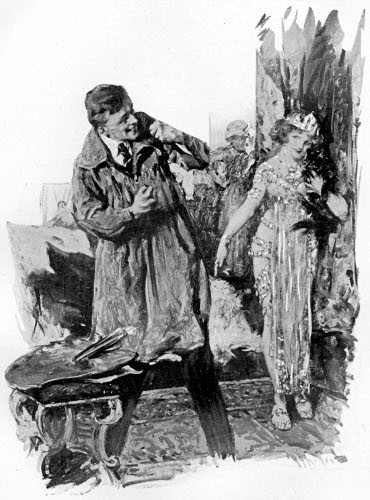
“YOU LITTLE MIRACLE!”
The Prophet, gathered close to her breast, stared back at Barres with eyes that dimmed the splendid jade about him.
“That settles it,” he said, the tint of excitement rising in his cheeks. “I have discovered a model and a wonder! And right here is where I paint my winter Academy—right here and right now!... And I call it ‘The Prophets.’ Climb up on that model stand and squat there cross-legged, and stare at me—straight at me—the way your cat stares!... There you are. That’s right! Don’t move. Stay put or I’ll come over and bow-string you!—you little miracle!”
“Do—you mean me?” faltered Dulcie.
“You bet, Sweetness! Do you know how beautiful you are? Well, never mind——” He had begun already to draw with a wet brush, and now he relapsed into absorbed silence.
The Prophet watched him steadily. The studio became intensely still.
VIII DULCIE ANSWERS
The studio door bell rang while Barres was at breakfast one morning late in June. Aristocrates leisurely answered the door, but shut it again immediately and walked out into the kitchenette without any explanation.
Selinda removed the breakfast cover and fetched the newspaper. Later, Aristocrates, having washed his master’s brushes, brought them into the studio mincingly, upon a silver service-salver.
“No letters?” inquired Barres, glancing up over the morning paper and laying aside his cigarette.
“No letters, suh. No co’espondence in any shape, fo’m or manner, suh.”
“Anybody to see me?” inquired Barres, always amused at Aristocrates’ flights of verbiage.
“Nobody, suh, excusin’ a persistless ’viduality inquihin’ fo’ you, suh.”
“What persistless individuality was that?” asked Barres.
“A ve’y or-nary human objec’, suh, pahshially afflicted with one bad eye.”
“That one-eyed man? He’s been here several times, hasn’t he? Why does he come?”
“Fo’ commercial puhposes, suh.”
“Oh, a pedlar?”
“He mentions a desiah, suh, to dispose, commercially, of vahious impo’ted materials requiahed by ahtists.”
“Didn’t you show him the sign in the hall, ‘No pedlars allowed’?”
“Yaas, suh.”
“What did he say?”
“I would not demean myse’f to repeat what this human objec’ said, suh.”
“And what did you do then?”
“Mistuh Barres, suh, I totally igno’hed that man,” replied Aristocrates languidly.
“Quite right. But you tell Soane to enforce the rule against pedlars. Every day there are two or three of them ringing at the studio, trying to sell colours, laces, or fake oriental rugs. It annoys me. Selinda can’t hear the bell and I have to leave my work and open the door. Tell that persistless one-eyed man to keep away. Tell Soane to bounce him next time he enters Dragon Court. Do you understand?”
“Yaas, suh. But Soane, suh, he’s a might friendly Irish. He’s spo’tin’ ’round Grogan’s nights, ’longa this here one-eyed ’viduality. Yaas, suh. I done seen ’em co-gatherin’ on vahious occasionalities.”
“Oho!” commented Barres. “It’s graft, is it? This one-eyed pedlar meets Soane at Grogan’s and bribes him with a few drinks to let him peddle colours in Dragon Court! That’s the Irish of it, Aristocrates. I began to suspect something like that. All right. I’ll speak to Soane myself.... Leave the studio door open; it’s warm in here.”
The month of May was now turning somewhat sultry as it melted into June. Every pivot-pane in the big studio window had been swung wide open. The sun had already clothed every courtyard tree with dense and tender foliage; hyacinth and tulip were gone and Soane’s subscription geraniums blazed in their place like beds of coals heaped up on the grass plot of Dragon Court.
But blue sky, sunshine of approaching summer, gentle winds and freshening rains brought only restlessness to New Yorkers that month of May.
Like the first two years of the war, the present year seemed strange, unreal; its vernal breezes brought no balm, its blue skies no content. The early summer sunlight seemed almost uncanny in a world where, beyond the sea, millions of men at arms swayed ceaselessly under sun and moon alike, interlocked in one gigantic death grip!—a horrible and blood-drenched human chain of butchery stretching half around the earth.
Into every Western human eye had come strange and subtle shadows which did not depart with moments of forgetful mirth, intervals of self-absorption, hours filled with familiar interests—the passions, hopes, perplexities of those years which were now no more.
Those years of yesterdays! A vast and depthless cleft already divided them from to-day. They seemed as remote as dusty centuries—those days of an ordered and tranquil world—those days of little obvious faiths unshattered—even those days of little wars, of petty local strifes, of an almost universal calm and peace and trust in brotherhood and in the obligations of civilisation.
Familiar yesterday had vanished, its creeds forgotten. It was already decades away, and fading like a legend in the ever-increasing glare of the red and present moment.
And the month of May seemed strange, and its soft skies and sun seemed out of place in a world full of dying—a world heavy with death—a western world aloof from the raging hell beyond the seas, yet already tense under the distant threat of three continents in flames—and all aquiver before the deathly menace of that horde of blood-crazed demons still at large, still unsubdued, still ranging the ruins of the planet which they had so insanely set on fire.
Entire nations were still burning beyond the ocean; other nations had sunk into cinders. Over the Eastern seas the furnace breath began to be felt along the out-thrust coast lines of the Western World. Inland, not yet; but every seaward city became now conscious of that first faint warning wave of heat from hell. Millions of ears strained to catch the first hushed whisper of the tumult. Silent in its suspense the Great Republic listened. Only the priesthood of the deaf and wooden gods continued voluble. But Israel had already begun to lift up its million eyes; and its ancient faith began to glow again; and its trust was becoming once more a living thing—the half-forgotten trust of Israel in that half-forgotten Lord, who, in the beginning, had been their helper and their shield.
Through the open studio door came Dulcie Soane. The Prophet followed at her slender heels, gently waving an urbane tail.
After his first smiling greeting—he always rose, advanced, and took her hand with that pleasant appearance of formality so adored by femininity, youthful or mature—he resumed his seat and continued to write his letters.
These finished, he stamped them, rang for Aristocrates, picked up his palette and brushes, and pulled out the easel upon which was the canvas for the morning.
Dulcie, still in the hands of Selinda, had not yet emerged. The Prophet sat upright on the carved table, motionless as a cat of ebony with green-jewelled eyes.
“Well, old sport,” said Barres, stepping across the rug to caress the cat, “you and your pretty mistress begin to look very interesting on my canvas.”
The Prophet received the blandishments with dignified gratitude. A discreet and feathery purring filled the room as Barres stroked the jet black, silky fur.
“Fine cat, you are,” commented the young man, turning as Dulcie entered.
She laid one hand on his extended arm and sprang lightly to the model stand. And the next moment she was seated—a slim, gemmed thing glimmering with imperial jade from top to toe.
Barres laid the Prophet in her arms, stepped back while Dulcie arranged the docile cat, then retreated to his canvas.
“All right, Sweetness?”
“All right,” replied the child happily. And the morning séance was on.
Barres was usually inclined to ramble along conversationally in his pleasant, detached way while at work, particularly if work went well.
“Where were we yesterday, Dulcie? Oh, yes; we were talking about the Victorian era and its art; and we decided that it was not the barren desert that the ultra-moderns would have us believe. That’s what we decided, wasn’t it?”
“You decided,” she said.
“So did you, Dulcie. It was a unanimous decision. Because we both concluded that some among the Victorians were full of that sweet, clean sanity which alone endures. You recollect how our decision started?”
“Yes. It was about my new pleasure in Tennyson, Browning, Morris, Arnold, and Swinburne.”
“Exactly. Victorian poets, if sometimes a trifle stilted and self-conscious, wrote nobly; makers of Victorian prose displayed qualities of breadth, imagination and vision and a technical cultivation unsurpassed. The musical compositions of that epoch were melodious and sometimes truly inspired; never brutal, never vulgar, never degenerate. And the Victorian sculptors and painters—at first perhaps austerely pedantic—became, as they should be, recorders of the times and customs of thought, bringing the end of the reign of a great Queen to an admirable renaissance.”
Dulcie’s grey eyes never left his. And if she did not quite understand every word, already the dawning familiarity with his vocabulary and a general comprehension of his modes of self-expansion permitted her to follow him.
“A great Queen, a great reign, a great people,” he rambled on, painting away all the while. “And if in that era architecture declined toward its lowest level of stupidity, and if taste in furniture and in the plastic, decorative, and textile arts was steadily sinking toward its lowest ebb, and if Mrs. Grundy trudged the Empire, paramount, dull and smugly ferocious, while all snobbery saluted her and the humble grovelled before her dusty brogans, yet, Dulcie, it was a great era.
“It was great because its faith had not been radically impaired; it was sane because Germany had not yet inoculated the human race with its porcine political vulgarities, its bestial degeneracy in art.... And if, perhaps, the sentimental in British art and literature predominated, thank God it had not yet been tainted with the stark ugliness, the swinish nakedness, the ferocious leer of things Teutonic!”
He continued to paint in silence for a while. Presently the Prophet yawned on Dulcie’s knees, displaying a pink cavern.
“Better rest,” he said, nodding smilingly at Dulcie. She released the cat, who stretched, arched his back, yawned again gravely, and stalked away over the velvety Eastern carpet.
Dulcie got up lithely and followed him on little jade-encrusted, naked feet.
A box of bon-bons lay on the sofa; she picked up Rossetti’s poems, turned the leaves with jewel-laden fingers, while with the other hand she groped for a bon-bon, her grey eyes riveted on the pages before her.
During these intervals between poses it was the young man’s custom to make chalk sketches of the girl, recording swiftly any unstudied attitude, any unconscious phase of youthful grace that interested him.
Dulcie, in the beginning, diffidently aware of this, had now become entirely accustomed to it, and no longer felt any responsibility to remain motionless while he was busy with red chalk or charcoal.
When she had rested sufficiently, she laid aside her book, hunted up the Prophet, who lazily endured the gentle tyranny, and resumed her place on the model stand.
And so they worked away all the morning, until luncheon was served in the studio by Aristocrates; and Barres in his blouse, and Dulcie in her peacock silk, her jade, and naked feet, gravely or lightly as their moods dictated, discussed an omelette and a pot of tea or chocolate, and the ways and manners and customs of a world which Dulcie now was discovering as a brand new and most enchanting planet.
IX HER DAY
June was ending in a very warm week. Work in the studio lagged, partly because Dulcie, preparing for graduation, could give Barres little time; partly because, during June, that young man had been away spending the week-ends with his parents and his sister at Foreland Farms, their home.
From one of these visits he returned to the city just in time to read a frantic little note from Dulcie Soane:
“Dear Mr. Barres, please, please come to my graduation. I do want somebody there who knows me. And my father is not well. Is it too much to ask of you? I hadn’t the courage to speak to you about it when you were here, but I have ventured to write because it will be so lonely for me to graduate without having anybody there I know.
“Dulcie Soane.”
It was still early in the morning; he had taken a night train to town.
So when he had been freshened by a bath and change of linen, he took his hat and went down stairs.
A heavy, pasty-visaged young woman sat at the desk in the entrance hall.
“Where is Soane?” he inquired.
“He’s sick.”
“Where is he?”
“In bed,” she replied indifferently. The woman’s manner just verged on impertinence. He hesitated, then walked across to the superintendent’s apartments and entered without knocking.
Soane, in his own room, lay sleeping off the consequences of an evening at Grogan’s. One glance was sufficient for Barres, and he walked out.
On Madison Avenue he found a florist, selected a bewildering bouquet, and despatched it with a hasty note, by messenger, to Dulcie at her school. In the note he wrote:
“I shall be there. Cheer up!”
He also sent more flowers to his studio, with pencilled orders to Aristocrates.
In a toy-shop he found an appropriate decoration for the centre of the lunch table.
Later, in a jeweller’s, he discovered a plain gold locket, shaped like a heart and inset with one little diamond. A slender chain by which to suspend it was easily chosen; and an extra payment admitted him to the emergency department where he looked on while an expert engraved upon the locket: “Dulcie Soane from Garret Barres,” and the date.
After that he went into the nearest telephone booth and called up several people, inviting them to dine with him that evening.
It was nearly ten o’clock now. He took his little gift, stopped a taxi, and arrived at the big brick high-school just in time to enter with the last straggling parents and family friends.
The hall was big and austerely bare, except for the ribbons and flags and palms which decorated it. It was hot, too, though all the great blank windows had been swung open wide.
The usual exercises had already begun; there were speeches from Authority; prayers by Divinity; choral effects by graduating pulchritude.
The class, attired in white, appeared to average much older than Dulcie. He could see her now, in her reconstructed communion dress, holding the big bouquet which he had sent her, one madonna lily of which she had detached and pinned over her breast.
Her features were composed and delicately flushed; her bobbed hair was tucked up, revealing the snowy neck.
One girl after another advanced and read or spoke, performing the particular parlour trick assigned her in the customary and perfectly unremarkable manner characteristic of such affairs.
Rapturous parental demonstrations greeted each effort; piano, violin and harp filled in nobly. A slight haze of dust, incident to pedalistic applause, invaded the place; there was an odour of flowers in the heated atmosphere.
Glancing at a programme which he had found on his seat, Barres read: “Song: Dulcie Soane.”
Looking up at her where she sat on the stage, among her comrades in white, he noticed that her eyes were busy searching the audience—possibly for him, he thought, experiencing an oddly pleasant sensation at the possibility.
The time at length arrived for Dulcie to do her parlour trick; she rose and came forward, clasping the big, fragrant bouquet, prettily flushed but self-possessed. The harp began a little minor prelude—something Irish and not very modern. Then Dulcie’s pure, untrained voice stole winningly through the picked harp-strings’ hesitation:
“Heart of a colleen,
Where do you roam?
Heart of a colleen,
Far from your home?
Laden with love you stole from her breast!
Wandering dove, return to your nest!
Sodgers are sailin’
Away to the wars;
Ladies are wailin’
Their woe to the stars;
Why is the heart of you straying so soon—
Heart that was part of you, Eileen Aroon?
Lost to a sodger,
Gone is my heart!
Lost to a sodger,
Now we must part——
I and my heart—for it journeys afar
Along with the sodgers who sail to the war!
Tears that near blind me
My pride shall dry,——
Wisha! don’t mind me!
Lave a lass cry!
Only a sodger can whistle the tune
That coaxes the heart out of Eileen Aroon!”
And Dulcie’s song ended.
Almost instantly the audience had divined in the words she sang a significance which concerned them—a warning—perhaps a prophecy. The 69th Regiment of New York infantry was Irish, and nearly every seat in the hall held a relative of some young fellow serving in its ranks.
The applause was impulsive, stormy, persistent; the audience was demanding the young girl’s recall; the noise they made became overwhelming, checking the mediating music and baffling the next embarrassed graduate, scheduled to read an essay, and who stood there mute, her manuscript in her hand.
Finally the principal of the school arose, went over to Dulcie, and exchanged a few words with her. Then he came forward, hand lifted in appeal for silence.
“The music and words of the little song you have just heard,” he said, “were written, I have just learned, by the mother of the girl who sang them. They were written in Ireland a number of years ago, when Irish regiments were sent away for over-seas service. Neither words nor song have ever been published. Miss Soane found them among her mother’s effects.
“I thought the story of the little song might interest you. For, somehow, I feel—as I think you all feel—that perhaps the day may come—may be near—when the hearts of our women, too, shall be given to their soldiers—sons, brothers, fathers—who are ‘sailin’ away to the wars.’ But if that time comes—which God avert!—then I know that every man here will do his duty.... And every woman.... And I know that:
‘Tears that near blind you,
Your pride shall dry!——’”
He paused a moment:
“Miss Soane has prepared no song to sing as an encore. In her behalf, and in my own, I thank you for your appreciation. Be kind enough to permit the exercises to proceed.”
And the graduating exercises continued.
Barres waited for Dulcie. She came out among the first of those departing, walking all alone in her reconstructed white dress, and carrying his bouquet. When she caught sight of him, her face became radiant and she made her way toward him through the crowd, seeking his outstretched hand with hers, clinging to it in a passion of gratitude and emotion that made her voice tremulous:
“My bouquet—it is so wonderful! I love every flower in it! Thank you with all my heart. You are so kind to have come—so kind to me—so k-kind——”
“It is I who should be grateful, Dulcie, for your charming little song,” he insisted. “It was fascinating and exquisitely done.”
“Did you really like it?” she asked shyly.
“Indeed I did! And I quite fell in love with your voice, too—with that trick you seem to possess of conveying a hint of tears through some little grace-note now and then.... And there were tears hidden in the words; and in the melody, too.... And to think that your mother wrote it!”
“Yes.”
After a short interval of silence he released her hand.
“I have a taxi for you,” he said gaily. “We’ll drive home in state.”
The girl flushed again with surprise and gratitude:
“Are—are you coming, too?”
“Certainly I’m going to take you home. Don’t you belong to me?” he demanded laughingly.
“Yes,” she said. But her forced little smile made the low-voiced answer almost solemn.
“Well, then!” he said cheerfully. “Come along. What’s mine I look after. We’ll have lunch together in the studio, if you are too proud to pose for a poor artist this afternoon.”
At this her sensitive face cleared and she laughed happily.
“The pride of a high-school graduate!” he commented, as he seated himself beside her in the taxicab. “Can anything equal it?”
“Yes.”
“What?”
“Her pride in your—friendship,” she ventured.
Which unexpected reply touched and surprised him.
“You dear child!” he said; “I’m proud of your friendship, too. Nothing ought to make a man prouder than winning a young girl’s confidence.”
“You are so kind,” she sighed, touching the blossoms in her bouquet with slender fingers that trembled a little. For she would have offered him a flower from it had she found courage; but it seemed presumptuous and she dropped her hand into her lap again.
Aristocrates opened the door for them: Selinda took her away.
Barres had ordered flowers for the table. In the middle of it a doll stood, attired in academic cap and gown, the Stars and Stripes in one hand, in the other a green flag bearing a gold harp.
When Dulcie came in she stopped short, enchanted at the sight of the decorated table. But when Aristocrates opened the kitchen door and her three cats came trotting in, she was overcome.
For each cat wore a red, white and blue cravat on which was pinned a silk shamrock; and although Strindberg immediately keeled over on the rug and madly attacked her cravat with her hind toes, the general effect remained admirable.
Aristocrates seated Dulcie. Upon her plate was the box containing chain and locket. And the girl cast a swift, inquiring glance across the centre flowers at Barres.
“Yes, it’s for you, Dulcie,” he said.
She turned quite pale at sight of the little gift. After a silence she leaned on the table with both elbows, shading her face with her hands.
He let her alone—let the first tense moment in her youthful life ebb out of it; nor noticed, apparently, the furtive and swift touch of her best handkerchief to her closed eyes.
Aristocrates brought her a little glass of frosted orange juice. After an interval, not looking at Barres, she sipped it. Then she took the locket and chain from the satin-lined box, read the inscription, closed her lids for a second’s silent ecstasy, opened them looking at him through rapturous tears, and with her eyes still fixed on him lifted the chain and fastened it around her slender neck.
The luncheon then proceeded, the Prophet gravely assisting from the vantage point of a neighbouring chair, the Houri, more emotional, promenading earnestly at the heels of Aristocrates. As for Strindberg, she possessed neither manners nor concentration, and she alternately squalled her desires for food or frisked all over the studio, attempting complicated maneuvres with every curtain-cord and tassel within reach.
Dulcie had found her voice again—a low, uncertain, tremulous little voice when she tried to thank him for the happiness he had given her—a clearer, firmer voice when he dexterously led the conversation into channels more familiar and serene.
They talked of the graduating exercises, of her part in them, of her classmates, of education in general.
She told him that since she was quite young she had learned to play the piano by remaining for an hour every day after school, and receiving instruction from a young teacher who needed a little extra pin money.
As for singing, she had had no instruction. Her voice had never been tried, never been cultivated.
“We’ll have it tried some day,” he said casually.
But Dulcie shook her head, explaining that it was an expensive process and not to be thought of.
“How did you pay for your piano lessons?” he asked.
“I paid twenty-five cents an hour. My mother left a little money for me when I was a baby. I spent it all that way.”
“Every bit of it?”
“Yes. I had $500. It lasted me seven years—from the time I was ten to now.”
“Are you seventeen? You don’t look it.”
“I know I don’t. My teachers tell me that my mind is very quick but my body is slow. It annoys me to be mistaken for a child of fifteen. And I have to dress that way, too, because my dresses still fit me and clothes are very expensive.”
“Are they?”
Dulcie became confidential and loquacious:
“Oh, very. You don’t know about girls’ clothes, I suppose. But they cost a very great deal. So I’ve had to wear out dresses I’ve had ever since I was fourteen and fifteen. And so I can’t put up my hair because it would make my dresses look ridiculous; and that renders the situation all the worse—to be obliged to go about with bobbed hair, you see? There doesn’t seem to be any way out of it,” she ended, with a despairing little laugh, “and I was seventeen last February!”
“Cheer up! You’ll grow old fast enough. And now you’re going to have a jolly little salary as my model, and you ought to be able to buy suitable clothes. Oughtn’t you?”
She did not answer, and he repeated the question. And drew from her, reluctantly, that her father, so far, had absorbed what money she had earned by posing.
A dull red gathered under the young man’s cheek-bones, but he said carelessly:
“That won’t do. I’ll talk it over with your father. I’m very sure he’ll agree with me that you should bank your salary and draw out what you need for your personal expenses.”
Dulcie sat silent over her fruit and bon-bons. Reaction from the keen emotions of the day had, perhaps, begun to have their effect.
They rose and reseated themselves on the sofa, where she sat in the corner among gorgeous Chinese cushions, her reconstructed dress now limp and shabby, the limp madonna lily hanging from her breast.
It had been for her the happiest day of her life. It had dawned the loneliest, but under the magic of this man’s kindness the day was ending like a day in Paradise.
To Dulcie, however, happiness was less dependent upon receiving than upon giving; and like all things feminine, mature and immature, she desired to serve where her heart was enlisted—began to experience the restless desire to give. What? And as the question silently presented itself, she looked up at Barres:
“Could I pose for you?”
“On a day like this! Nonsense, Dulcie. This is your holiday.”
“I’d really like to—if you want me——”
“No. Curl up here and take a nap. Slip off your gown so you won’t muss it and ask Selinda for a kimono. Because you’re going to need your gown this evening,” he added smilingly.
“Why? Please tell me why?”
“No. You’ve had enough excitement. Tell Selinda to give you a kimono. Then you can lie down in my room if you like. Selinda will call you in plenty of time. And after that I’ll tell you how we’re going to bring your holiday to a gay conclusion.”
She seemed disinclined to stir, curled up there, her eyes brilliant with curiosity, her lips a trifle parted in a happy smile. She lay that way for a few moments, looking up at him, her fingers caressing the locket, then she sat up swiftly.
“Must I take a nap?”
“Certainly.”
She sprang to her feet, flashed past him, and disappeared in the corridor.
“Don’t forget to wake me!” she called back.
“I won’t forget!”
When he heard her voice again, conversing with Selinda, he opened the studio door and went down stairs.
Soane, rather the worse for wear, was at the desk, and, standing beside him, was a one-eyed man carrying two pedlar’s boxes under his arms. They both looked around quickly when Barres appeared. Before he reached the desk the one-eyed man turned and walked out hastily into the street.
“Soane,” said Barres, “I’ve one or two things to say to you. The first is this: if you don’t stop drinking and if you don’t keep away from Grogan’s, you’ll lose your job here.”
“Musha, then, Misther Barres——”
“Wait a moment; I’m not through. I advise you to stop drinking and to keep away from Grogan’s. That’s the first thing. And next, go on and graft as much as you like, only warn your pedlar-friends to keep away from Studio No. 9. Do you understand?”
“F’r the love o’ God——”
“Cut out the injured innocence, Soane. I’m telling you how to avoid trouble, that’s all.”
“Misther Barres, sorr! As God sees me——”
“I can see you, too. I want you to behave, Soane. This is friendly advice. That one-eyed pedlar who just beat it has been bothering me. Other pedlars come ringing at the studio and interrupt and annoy me. You know the rules. If the other tenants care to stand for it, all right. But I’m through. Is that plain?”
“It is, sorr,” said the unabashed delinquent. The faintest glimmer of a grin came into his battered eyes. “Sorra a wan o’ thim ever lays a hand to No. 9 bell or I’ll have his life!”
“One thing more,” continued Barres, smiling in spite of himself at the Irish of it all. “I am paying Dulcie a salary——”
“Wisha then——”
“Stop! I tell you that she’s in my employment on a salary. Don’t ever touch a penny of it again.”
“Sure the child’s wages——”
“No, they don’t belong to the father. Legally, perhaps, but the law doesn’t suit me. So if you take the money that she earns, and blow it in at Grogan’s, I’ll have to discharge her because I won’t stand for what you are doing.”
“Would you do that, Mr. Barres?”
“I certainly would.”
The Irishman scratched his curly head in frank perplexity.
“Dulcie needs clothes suitable to her age,” continued Barres. “She needs other things. I’m going to take charge of her savings so don’t you attempt to tamper with them. You wouldn’t do such a thing, anyway, Soane, if this miserable drink habit hadn’t got a hold on you. If you don’t quit, it will down you. You’ll lose your place here. You know that. Try to brace up. This is a rotten deal you’re giving yourself and your daughter.”
Soane wept easily. He wept now. Tearful volubility followed—picturesque, lit up with Hibernian flashes, then rambling, and a hint of slyness in it which kept one weeping eye on duty watching Barres all the while.
“All right; behave yourself,” concluded Barres. “And, Soane, I shall have three or four people to dinner and a little dancing afterward. I want Dulcie to enjoy her graduating dance.”
“Sure, Misther Barres, you’re that kind to the child——”
“Somebody ought to be. Do you know that there was nobody she knew to see her graduate to-day, excepting myself?”
“Oh, the poor darling! Sure, I was that busy——”
“Busy sleeping off a souse,” said Barres drily. “And by the way, who is that stolid, German-looking girl who alternates with you here at the desk?”
“Miss Kurtz, sorr.”
“Oh. She seems stupid. Where did you dig her up?”
“A fri’nd o’ mine riccominds her highly, sorr.”
“Is that so? Who is he? One of your German pedlar friends at Grogan’s? Be careful, Soane. You Sinn Feiners are headed for trouble.”
He turned and mounted the stairs. Soane looked after him with an uneasy expression, partly humorous.
“Ah, then, Mr. Barres,” he said, “don’t be botherin’ afther the likes of us poor Irish. Is there anny harrm in a sup o’ beer av a Dootchman pays?”
Barres looked back at him:
“A one-eyed Dutchman?”
“Ah, g’wan, sorr, wid yer hokin’ an’ jokin’! Is it graft ye say? An’ how can ye say it, sorr, knowin’ me as ye do, Misther Barres?”
The impudent grin on the Irishman’s face was too much for the young man. He continued to mount the stairs, laughing.
X HER EVENING
As he entered the studio he heard the telephone ringing. Presently Selinda marched in:
“A lady, sir, who will not giff her name, desires to spik to Mr. Barres.”
“I don’t talk to anonymous people,” he said curtly.
“I shall tell her, sir?”
“Certainly. Did you make Miss Dulcie comfortable?”
“Yess, sir.”
“That’s right. Now, take that dress of Miss Dulcie’s, go out to some shop on Fifth Avenue, buy a pretty party gown of similar dimensions, and bring it back with you. Take a taxi both ways. Wait—take her stockings and slippers, too, and buy her some fine ones. And some underwear suitable.” He went to a desk, unlocked it, and handed the maid a flat packet of bank-notes. “Be sure the things are nice,” he insisted.
Selinda, starched, immaculate, frosty-eyed, marched out. She returned a few moments later, wearing jacket and hat.
“Sir, the lady on the telephone hass called again. The lady would inquire of Mr. Barres if perhaps he has recollection of the Fountain of Marie de Médicis.”
Barres reddened with surprise and pleasure:
“Oh! Yes, indeed, I’ll speak to that lady. Hang up the service receiver, Selinda.” And he stepped to the studio telephone.
“Nihla?” he exclaimed in a low, eager voice.
“C’est moi, Thessa! Have you a letter from me?”
“No, you little wretch! Oh, Thessa, you’re certainly a piker! Fancy my not hearing one word from you since April!—not a whisper, not a sign to tell me that you are alive——”
“Garry, hush! It was not because I did not wish to see you——”
“Yes, it was! You knew bally well that I hadn’t your address and that you had mine! Is that what you call friendship?”
“You don’t understand what you are saying. I wanted to see you. It has been impossible——”
“You are not singing and dancing anywhere in New York. I watched the papers. I even went to the Palace of Mirrors to enquire if you had signed with them there.”
“Wait! Be careful, please!——”
“Why?”
“Be careful what you say over the telephone. For my sake, Garry. Don’t use my former name or say anything to identify me with any place or profession. I’ve been in trouble. I’m in trouble still. Had you no letter from me this morning?”
“No.”
“That is disquieting news. I posted a letter to you last night. You should have had it in your morning mail.”
“No letter has come from you. I had no letters at all in the morning mail, and only one or two important business letters since.”
“Then I’m deeply worried. I shall have to see you unless that letter is delivered to you by evening.”
“Splendid! But you’ll have to come to me, Thessa. I’ve invited a few people to dine here and dance afterwards. If you’ll dine with us, I’ll get another man to balance the table. Will you?”
After a moment she said:
“Yes. What time?”
“Eight! This is wonderful of you, Thessa!” he said excitedly. “If you’re in trouble we’ll clear it up between us. I’m so happy that you will give me this proof of friendship.”
“You dear boy,” she said in a troubled voice. “I should be more of a friend if I kept away from you.”
“Nonsense! You promise, don’t you?”
“Yes ... Do you realise that to-night another summer moon is to witness our reunion?... I shall come to you once more under a full June moon.... And then, perhaps, no more.... Never.... Unless after the world ends I come to you through shadowy outer space—a ghost drifting—a shred of mist across the moon, seeking you once more!——”
“My poor child,” he said laughing, “you must be in no end of low spirits to talk that way.”
“It does sound morbid. But I have plenty of courage, Garry. I shall not snivel on the starched bosom of your evening shirt when we meet. Donc, à bientôt, monsieur. Soyez tranquille! You shall not be ashamed of me among your guests.”
“Fancy!” he laughed happily. “Don’t worry, Thessa. We’ll fix up whatever bothers you. Eight o’clock! Don’t forget!”
“I am not likely to,” she said.
Until Selinda returned from her foray along Fifth Avenue, Barres remained in the studio, lying in his armchair, still possessed by the delightful spell, still excited by the prospect of seeing Thessalie Dunois again, here, under his own roof.
But when the slant-eyed and spotlessly blond Finn arrived, he came back out of his retrospective trance.
“Did you get some pretty things for Miss Soane?” he enquired.
“Yess, sir, be-ootiful.” Selinda deposited on the table a sheaf of paid bills and the balance of the bank-notes. “Would Mr. Barres be kind enough to inspect the clothes for Miss Soane?”
“No, thanks. You say they’re all right?”
“Yess, sir. They are heavenly be-ootiful.”
“Very well. Tell Aristocrates to lay out my clothes after you have dressed Miss Dulcie. There will be two extra people to dinner. Tell Aristocrates. Is Miss Dulcie still asleep?”
“Yess, sir.”
“All right. Wake her in time to dress her so she can come out here and give me a chance——” He glanced at the clock “Better wake her now, Selinda. It’s time for her to dress and evacuate my quarters. I’ll take forty winks here until she’s ready.”
Barres lay dozing on the sofa when Dulcie came in.
Selinda, enraptured by her own efficiency in grooming and attiring the girl, marched behind her, unable to detach herself from her own handiwork.
From crown to heel the transfiguration was absolute—from the point of her silk slipper to the topmost curl on the head which Selinda had dressed to perfection.
For Selinda had been a lady’s maid in great houses, and also had a mania for grooming herself with the minute and thorough devotion of a pedigreed cat. And Dulcie emerged from her hands like some youthful sea-nymph out of a bath of foam, snowy-sweet as some fresh and slender flower.
With a shy courage born with her own transfiguration, she went to Barres, where he lay on the sofa, and bent over him.
She had made no sound; perhaps her nearness awoke him, for he opened his eyes.
“Dulcie!” he exclaimed.
“Do I please you?” she whispered.
He sat up abruptly.
“You wonderful child!” he said, frankly astonished. Whereupon he got off the sofa, walked all around her inspecting her.
“What a get-up! What a girl!” he murmured. “You lovely little thing, you astound me! Selinda, you certainly know a thing or two. Take it from me, you do Miss Soane and yourself more credit in your way than I do with paint and canvas.”
Dulcie blushed vividly; the white skin of Selinda also reddened with pleasure at her master’s enthusiasm.
“Tell Aristocrates to fix my bath and lay out my clothes,” he said. “I’ve guests coming and I’ve got to hustle!” And to Dulcie: “We’re going to have a little party in honour of your graduation. That’s what I have to tell you, dear. Does it please you? Do your pretty clothes please you?”
The girl, overwhelmed, could only look at him. Her lips, vivid and slightly parted, quivered as her breath came irregularly. But she found no words—nothing to say except in the passionate gratitude of her grey eyes.
“You dear child,” he said gently. Then, after a moment’s silence, he eased the tension with his quick smile: “Wonder-child, go and seat yourself very carefully, and be jolly careful you don’t rumple your frock, because I want you to astonish one or two people this evening.”
Dulcie found her voice:
“I—I’m so astonished at myself that I don’t seem real. I seem to be somebody else—long ago!” She stepped close to him, opened her locket for his inspection, holding it out to him as far as the chain permitted. It framed a miniature of a red-haired, grey-eyed girl of sixteen.
“Your mother, Dulcie?”
“Yes. How perfectly it fits into my locket! I carry it always in my purse.”
“It might easily be yourself, Dulcie,” he said in a low voice. “You are her living image.”
“Yes. That is what astonishes me. To-night, for the first time in my life, it occurred to me that I look like this girl picture of my mother.”
“You never thought so before?”
“Never.” She stood looking down at the laughing face in the locket for a few moments, then, lifting her eyes to his:
“I’ve been made over, in a day, to look like this.... You did it!”
“Nonsense! Selinda and her curling iron did it.”
They laughed a little.
“No,” she said, “you have made me. You began to make me all over three months ago—oh, longer ago than that!—you began to remake me the first time you ever spoke to me—the first time you opened your door to me. That was nearly two years ago. And ever since I have been slowly becoming somebody quite new—inside and outside—until to-night, you see, I begin to look like my mother.” She smiled at him, drew a deep breath, closed the locket, dropped it on her breast.
“I mustn’t keep you,” she said. “I wanted to show the picture—so you can understand what you have done for me to make me look like that.”
When Barres returned to the studio, freshened and groomed for the evening, he found Dulcie at the piano, playing the little song she had sung that morning, and singing the words under her breath. But she ceased as he came up, and swung around on the piano-stool to confront him with the most radiant smile he had ever seen on a human face.
“What a day this has been!” she said, clasping her hands tightly. “I simply cannot make it seem real.”
He laughed:
“It isn’t ended yet, either. There’s a night to every day, you know. And your graduation party will begin in a few moments.”
“I know. I’m fearfully excited. You’ll stay near me, won’t you?”
“You bet! Did I tell you who are coming? Well, then, you won’t feel strange, because I’ve merely asked two or three men who live in Dragon Court—men you see every day—Mr. Trenor, Mr. Mandel, and Mr. Westmore.”
“Oh,” she said, relieved.
“Also,” he said, “I have asked Miss Souval—that tall, pretty girl who sometimes sits for Mr. Trenor—Damaris Souval. You remember her?”
“Yes.”
“Also,” he continued, “Mr. Mandel wishes to bring a young married woman who has developed a violent desire for the artistic and informal, but who belongs in the Social Register.” He laughed. “It’s all right if Corot Mandel wants her. Her name is Mrs. Helmund—Elsena Helmund. Mr. Trenor is painting her.”
Dulcie’s face was serious but calm.
“And then, to even the table,” concluded Barres smilingly, “I invited a girl I knew long ago in Paris. Her name is Thessalie Dunois; and she’s very lovely to look upon, Dulcie. I am very sure you will like her.”
There was a silence; then the electric bell rang in the corridor, announcing the arrival of the first guest. As Barres rose, Dulcie laid her hand on his arm—a swift, involuntary gesture—as though the girl were depending on his protection.
The winning appeal touched him and amused him, too.
“Don’t worry, dear,” he said. “You’ll have the prettiest frock in the studio—if you need that knowledge to reassure you——”
The corridor door opened and closed. Somebody went into his bedroom with Selinda—that being the only available cloak-room for women.
XI HER NIGHT
“Thessalie Dunois! This is charming of you!” said Barres, crossing the studio swiftly and taking her hand in both of his.
“I’m so glad to see you, Garry—” she looked past him across the studio at Dulcie, and her voice died out for a moment. “Who is that girl?” she enquired under her breath.
“I’ll present you——”
“Wait. Who is she?”
“Dulcie Soane——”
“Soane?”
“Yes. I’ll tell you about her later——”
“In a moment, Garry.” Thessalie looked across the room at the girl for a second or two longer, then turned a troubled, preoccupied gaze on Barres. “Have you a letter from me? I posted it last night.”
“Not yet.”
The doorbell rang. He could hear more guests entering the corridor beyond. A faint smile—the forced smile of courage—altered Thessalie’s features now, until it became a fixed and pretty mask.
“Contrive to give me a moment alone with you this evening,” she whispered. “My need is great, Garry.”
“Whenever you say! Now?”
“No. I want to talk to that young girl first.”
They walked over to where Dulcie stood by the piano, silent and self-possessed.
“Thessa,” he said, “this is Miss Soane, who graduated from high school to-day, and in whose honour I am giving this little party.” And to Dulcie he said: “Miss Dunois and I were friends when I lived in France. Please tell her about your picture, which you and I are doing.” He turned as he finished speaking, and went forward to welcome Esmé Trenor and Damaris Souval, who happened to arrive together.
“Oh, the cunning little girl over there!” exclaimed the tall and lovely Damaris, greeting Barres with cordial, outstretched hands. “Where did you find such an engaging little thing?”
“You don’t recognise her?” he asked, amused.
“I? No. Should I?”
“She’s Dulcie Soane, the girl at the desk down-stairs!” said Barres, delighted. “This is her party. She has just graduated from high school, and she——”
“Belongs to Barres,” interrupted Esmé Trenor in his drawling voice. “Unusual, isn’t she, Damaris?—logical anatomy, ornamental, vague development; nice lines, not obvious—like yours, Damaris,” he added impudently. Then waving his lank hand with its over-polished nails: “I like the indefinite accented with one ripping value. Look at that hair!—lac and burnt orange rubbed in, smeared, then wiped off with the thumb! You follow the intention, Barres?”
“You talk too much, Esmé,” interrupted Damaris tartly. “Who is that lovely being talking to the little Soane girl, Garry?”
“A friend of my Paris days—Thessalie Dunois——” Again he checked himself to turn and greet Corot Mandel, subtle creator and director of exotic spectacles—another tall and rather heavily built man, with a mop of black and shiny hair, a monocle, and sanguine features slightly oriental.
With Corot Mandel had come Elsena Helmund—an attractive woman of thoroughbred origin and formal environment, and apparently fed up with both. For she frankly preferred “grades” to “registered stock,” and she prowled through every art and theatrical purlieu from the Mews to Westchester, in eternal and unquiet search for an antidote to the sex-ennui which she erroneously believed to be an intellectual necessity for self-expression.
“Who is that winning child with red hair?” she enquired, nodding informal recognition to the other guests, whom she already knew. “Don’t tell me,” she added, elevating a quizzing glass and staring at Dulcie, “that this engaging infant has a history already! It isn’t possible, with that April smile in her child eyes!”
“You bet she hasn’t a history, Elsena,” said Barres, frowning; “and I’ll see that she doesn’t begin one as long as she’s in my neighbourhood.”
Corot Mandel, who had been heavily inspecting Dulcie through his monocle, now stood twirling it by its frayed and greasy cord:
“I could do something for her—unless she’s particularly yours, Barres?” he suggested. “I’ve seldom seen a better type in New York.”
“You idiot. Don’t you recognise her? She’s Dulcie Soane! You could have picked her yourself if you’d had any flaire.”
“Oh, hell,” murmured Mandel, disgusted. “And I thought I possessed flaire. Your private property, I suppose?” he added sourly.
“Absolutely. Keep off!”
“Watch me,” murmured Corot Mandel, with a wry face, as they moved forward to join the others and be presented to the little guest of the evening.
Westmore came in at the same moment—a short, blond, vigorous young man, who knew everybody except Thessalie, and proceeded to smash the ice in characteristic fashion:
“Dulcie! You beautiful child! How are you, duckey?”—catching her by both hands,—“a little salute for Nunky? Yes?”—kissing her heartily on both cheeks. “I’ve a gift for you in my overcoat pocket. We’ll sneak out and get it after dinner!” He gave her hands a hearty squeeze, turned to the others: “I ought to have been Miss Soane’s godfather. So I appointed myself as such. Where are the cocktails, Garry?”
Road-to-ruin cocktails were served—frosted orange juice for Dulcie. Everybody drank her health. Then Aristocrates gracefully condescended to announce dinner. And Barres took out Dulcie, her arm resting light as a snowflake on his sleeve.
There were flowers everywhere in the dining-room; table, buffet, curtains, lustres were gay with early blossoms, exhaling the haunting scent of spring.
“Do you like it, Dulcie?” he whispered.
She merely turned and looked at him, quite unable to speak, and he laughed at her brilliant eyes and flushed cheeks, and, dropping his right hand, squeezed hers.
“It’s your party, Sweetness—all yours! You must have a good time every minute!” And he turned, still smiling, to Thessalie Dunois on his left:
“It’s quite wonderful, Thessa, to have you here—to be actually seated beside you at my own table. I shall not let you slip away from me again, you enchanting ghost!—and leave me with a dislocated heart.”
“Garry, that sounds almost sentimental. We’re not, you know.”
“How do I know? You never gave me a chance to be sentimental.”
She laughed mirthlessly:
“Never gave you a chance? And our brief but headlong career together, monsieur? What was it but a continuous cataract of chances?”
“But we were laughing our silly heads off every minute! I had no opportunity.”
That seemed to amuse her and awaken the ever-latent humour in her.
“Opportunity,” she observed demurely, “should be created and taken, not shyly awaited with eyes rolled upward and a sucked thumb.”
They both laughed outright. Her colour rose; the old humorous challenge was in her eyes again; the subtle mask was already slipping from her features, revealing them in all their charming recklessness.
“You know my creed,” she said; “to go forward—laugh—and accept what Destiny sends you—still laughing!” Her smile altered again, became, for a moment, strange and vague. “God knows that is what I am doing to-night,” she murmured, lifting her slim glass, in which the gush of sunny bubbles caught the candlelight. “To Destiny—whatever it may be! Drink with me, Garry!”
Around them the chatter and vivacity increased, as Damaris ended a duel of wit with Westmore and prepared for battle with Corot Mandel. Everybody seemed to be irresponsibly loquacious except Dulcie, who sat between Barres and Esmé Trenor, a silent, smiling, reserved little listener. For Barres was still conversationally involved with Thessalie, and Esmé Trenor, languid and detached, being entirely ignored by Damaris, whom he had taken out, awaited his own proper modicum of worship from his silent little neighbour on his left—which tribute he took for granted was his sacred due, and which, hitherto, he had invariably received from woman.
But nobody seemed to be inclined to worship; Damaris scarcely deigned to notice him, his impudence, perhaps, still rankling. Thessalie, laughingly engaged with Barres, remained oblivious to the fashionable portrait painter. As for Elsena Helmund, that youthful matron was busily pretending to comprehend Corot Mandel’s covert orientalisms, and secretly wondering whether they were, perhaps, as improper as Westmore kept whispering to her they were, urging her to pick up her skirts and run.
Esmé Trenor permitted a few weary but slightly disturbed glances to rest on Dulcie from time to time, but made no effort to entertain her.
And she, on her part, evinced no symptoms of worshipping him. And all the while he was thinking to himself:
“Can this be the janitor’s daughter? Is she the same rather soiled, impersonal child whom I scarcely ever noticed—the thin, immature, negligible little drudge with a head full of bobbed red hair?”
His lack of vision, of finer discernment, deeply annoyed him. Her lack of inclination to worship him, now that she had the God-sent opportunity, irritated him.
“The silly little bounder,” he thought, “how can she sit beside me without timidly venturing to entertain me?”
He stole another profoundly annoyed glance at Dulcie. The child was certainly beautiful—a slim, lovely, sensitive thing of qualities so delicate that the painter of pretty women became even more surprised and chagrined that it had taken Barres to discover this desirable girl in the silent, shabby child of Larry Soane.
Presently he lurched part way toward her in his chair, and looked at her with bored but patronising encouragement.
“Talk to me,” he said languidly.
Dulcie turned and looked at him out of uninterested grey eyes.
“What?” she said.
“Talk to me,” he repeated pettishly.
“Talk to yourself,” retorted Dulcie, and turned again to listen to the gay nonsense which Damaris and Westmore were exchanging amid peals of general laughter.
But Esmé Trenor was thunderstruck. A deep and painful colour stained his pallid features. Never before had mortal woman so flouted him. It was unthinkable. It really wouldn’t do. There must be some explanation for this young girl’s monstrous attitude toward offered opportunity.
“I say,” he insisted, still very red, “are you bashful, by any chance?”
Dulcie slowly turned toward him again:
“Sometimes I am bashful; not now.”
“Oh. Then wouldn’t you like to talk to me?”
“I don’t think so.”
“Fancy! And why not, Dulcie?”
“Because I haven’t anything to say to you.”
“Dear child, that is the incentive to all conversation—lack of anything to say. You should practise the art of saying nothing politely.”
“You should have practised it enough to say good morning to me during these last five years,” said Dulcie gravely.
“Oh, I say! You’re rather severe, you know! You were just a little thing running about underfoot!—I’m sorry you feel angry——”
“I do not. But how can I have anything to talk to you about, Mr. Trenor, when you have never even noticed me all these years, although often I have handed you your keys and your letters.”
“It was quite stupid of me. I’m sorry. But a man, you see, doesn’t notice children——”
“Some men do.”
“You mean Mr. Barres! That is unkind. Why rub it in, Dulcie? I’m rather an interesting fellow, after all.”
“Are you?” she asked absently.
Her honest indifference to him was perfectly apparent to Esmé Trenor. This would never do. She must be subdued, made sane, disciplined!
“Do you know,” he drawled, leaning lankly nearer, dropping both arms on the cloth, and fixing his heavy-lidded eyes intensely on her,“—do you know—do you guess, perhaps, why I never spoke to you in all these years?”
“You did not trouble yourself to speak to me, I imagine.”
“You are wrong. I was afraid!” And he stared at her pallidly.
“Afraid?” she repeated, puzzled.
He leaned nearer, confidential, sad:
“Shall I tell you a precious secret, Dulcie? I am a coward. I am a slave of fear. I am afraid of beauty! Isn’t that a very strange thing to say? Can you understand the subtlety of that indefinable psychology? Fear is an emotion. Fear of the beautiful is still a subtler emotion. Fear, itself, is beautiful beyond words. Beauty is Fear. Fear is Beauty. Do you follow me, Dulcie?”
“No,” said the girl, bewildered.
Esmé sighed:
“Some day you will follow me. It is my destiny to be followed, pursued, haunted by loveliness impotently seeking to express itself to me, while I, fearing it, dare only to express my fear with brush and pencil!... When shall I paint you?” he added with sad benevolence.
“What?”
“When shall I try to interpret upon canvas my subtle fear of you?” And, as the girl remained mute: “When,” he explained languidly, “shall I appoint an hour for you to sit to me?”
“I am Mr. Barres’s model,” she said, flushing.
“I shall have to arrange it with him, then,” he nodded, wearily.
“I don’t think you can.”
“Fancy! Why not?”
“Because I do not wish to sit to anybody except Mr. Barres,” she said candidly, “and what you paint does not interest me at all.”
“Are you familiar with my work?” he asked incredulously.
She shook her head, shrugged, and turned to Barres, who had at last relinquished Thessalie to Westmore.
“Well, Sweetness,” he said gaily, “do you get on with Esmé Trenor?”
“He talked,” she said in a voice perfectly audible to Esmé.
Barres glanced toward Esmé, secretly convulsed, but that young apostle of Fear had swung one thin leg over the other and was now presenting one shoulder and the back of his head to them both, apparently in delightful conversation with Elsena Helmund, who was fed up on him and his fears.
“You must always talk to your neighbours at dinner,” insisted Barres, still immensely amused. “Esmé is a very popular man with fashionable women, Dulcie,—a painter in much demand and much adored.... Why do you smile?”
Dulcie smiled again, deliciously.
“Anyway,” continued Barres, “you must now give the signal for us to rise by standing up. I’m so proud of you, Dulcie, darling!” he added impulsively; “—and everybody is mad about you!”
“You made me—” she laughed mischievously, “—out of a rag and a bone and a hank of hair!”
“You made yourself out of nothing, child! And everybody thinks you delightful.”
“Do you?”
“You dear girl!—of course I do. Does it make such a difference to you, Dulcie—my affection for you?”
“Is it—affection?”
“It certainly is. Didn’t you know it?”
“I didn’t—know—what it was.”
“Of course it is affection. Who could be with you as I have been and not grow tremendously fond of you?”
“Nobody ever did except you. Mr. Westmore was always nice. But—but you are so kind—I can’t express—I—c-can’t——” Her emotion checked her.
“Don’t try, dear!” he said hastily. “We’re going in to have a jolly dance now. You and I begin it together. Don’t you let any other fellow take you away!”
She looked up, laughed blissfully, gazing at him with brilliant eyes a little dimmed.
“They’ll all be at your heels,” he said, beginning to comprehend the beauty he had let loose on the world, “—every man-jack of them, mark my prophecy! But ours is the first dance, Dulcie. Promise?”
“I do. And I promise you the next—please——”
“Well, I’m host,” he said doubtfully, and a trifle taken aback. “We’ll have some other dances together, anyway. But I couldn’t monopolise you, Sweetness.”
The girl looked at him silently, then her grey, intelligent eyes rested directly on Thessalie Dunois.
“Will you dance with her?” she asked gravely.
“Yes, of course. And with the others, too. Tell me, Dulcie, did you find Miss Dunois agreeable?”
“I—don’t—know.”
“Why, you ought to like her. She’s very attractive.”
“She is quite beautiful,” said the girl, watching Thessalie across his shoulder.
“Yes, she really is. What did you and she talk about?”
“Father,” replied Dulcie, determined to have no further commerce with Thessalie Dunois which involved a secrecy excluding Barres. “She asked me if he were not my father. Then she asked me a great many stupid questions about him. And about Miss Kurtz, who takes the desk when father is out. Also, she asked me about the mail and whether the postman delivered letters at the desk or in the box outside, and about the tenants’ mail boxes, and who distributed the letters through them. She seemed interested,” added the girl indifferently, “but I thought it a silly subject for conversation.”
Barres, much perplexed, sat gazing at Dulcie in silence for a moment, then recollecting his duty, he smiled and whispered:
“Stand up, now, Dulcie. You are running this show.”
The girl flushed and rose, and the others stood up. Barres took her to the studio door, then returned to the table with the group of men.
“Well,” he exclaimed happily, “what do you fellows think of Soane’s little girl now? Isn’t she the sweetest thing you ever heard of?”
“A peach!” said Westmore, in his quick, hearty voice. “What’s the idea, Garry? Is it to be her career, this posing business? And where is it going to land her? In the Winter Garden?”
“Where is it going to land you?” added Esmé impudently.
“Why, I don’t know, myself,” replied Barres, with a troubled smile. “The little thing always appealed to me—her loneliness and neglect, and—and something about the child—I can’t define it——”
“Possibilities?” suggested Mandel viciously. “Take it from me, you’re some picker, Garry.”
“Perhaps. Anyway, I’ve given her the run of my place for the last two years and more. And she has been growing up all the while, and I didn’t notice it. And suddenly, this spring, I discovered her for the first time.... And—well, look at her to-night!”
“She’s your private model, isn’t she?” persisted Mandel.
“Entirely,” replied Barres drily.
“Selfish dog!” remarked Westmore, with his lively, wholesome laugh. “I once asked her to sit for me—more out of good nature than anything else. And a jolly fine little model she ought to make you, Garry. She’s beginning to acquire a figure.”
“She’s quite wonderful that way, too,” nodded Barres.
“Undraped?” inquired Esmé.
“A miracle,” nodded Barres absently. “Paint is becoming inadequate. I shall model her this summer. I tell you I have never seen anything to compare to her. Never!”
“What else will you do with her?” drawled Esmé. “You’ll go stale on her some day, of course. Am I next?”
“No!... I don’t know what she’ll do. It begins to look like a responsibility, doesn’t it? She’s such a fine little girl,” explained Barres warmly. “I’ve grown quite fond of her—interested in her. Do you know she has an excellent mind? And nice, fastidious instincts? She thinks straight. That souse of a father of hers ought to be jailed for the way he neglects her.”
“Are you thinking of adopting her?” asked Trenor, with the faintest of sneers, which escaped Barres.
“Adopt a girl? Oh, Lord, no! I can’t do anything like that. Yet—I hate to think of her future, too ... unless somebody looks out for her. But it isn’t possible for me to do anything for her except to give her a good job with a decent man——”
“Meaning yourself,” commented Mandel, acidly.
“Well, I am decent,” retorted Barres warmly, amid general laughter. “You fellows know what chances she might take with some men,” he added, laughing at his own warm retort.
Esmé and Corot Mandel nodded piously, each perfectly aware of what chance any attractive girl would run with his predatory neighbour.
“To shift the subject of discourse—that girl, Thessalie Dunois,” began Westmore, in his energetic way, “is about the cleverest and prettiest woman I’ve seen in New York outside the theatre district.”
“I met her in France,” said Barres, carelessly. “She really is wonderfully clever.”
“I shall let her talk to me,” drawled Esmé, flicking at his cigarette. “It will be a liberal education for her.”
Mandel’s slow, oriental eyes blinked contempt; he caressed his waxed moustache with nicotine-stained fingers:
“I am going to direct an out-of-door spectacle—a sort of play—not named yet—up your way, Barres—at Northbrook. It’s for the Belgians.... If Miss Dunois—unless,” he added sardonically, “you have her reserved, also——”
“Nonsense! You cast Thessalie Dunois and she’ll make your show for you, Mandel!” exclaimed Barres. “I know and I’m telling you. Don’t make any mistake: there’s a girl who can make good!”
“Oh. Is she a professional?”
It was on the tip of Barres’s tongue to say “Rather!” But he checked himself, not knowing Thessalie’s wishes concerning details of her incognito.
“Talk to her about it,” he said, rising.
The others laid aside cigars and followed him into the studio, where already the gramophone was going and Aristocrates and Selinda were rolling up the rugs.
Barres and Dulcie danced until the music, twice revived, expired in husky dissonance, and a new disc was substituted by Westmore.
“By heaven!” he said, “I’ll dance this with my godchild or I’ll murder you, Garry. Back up, there!—you soulless monopolist!” And Dulcie, half laughing, half vexed, was swept away in Westmore’s vigorous arms, with a last, long, appealing look at Barres.
The latter danced in turn with his feminine guests, as in duty bound—in pleasure bound, as far as concerned Thessalie.
“And to think, to think,” he repeated, “that you and I, who once trod the moonlit way, June-mad, moon-mad, should be dancing here together once more!”
“Alas,” she said, “though this is June again, moon and madness are lacking. So is the enchanted river and your canoe. And so is that gay heart of mine—that funny, careless little heart which was once my comrade, sending me into a happy gale of laughter every time it counselled me to folly.”
“What is the matter, Thessa?”
“Garry, there is so much the matter that I don’t know how to tell you.... And yet, I have nobody else to tell.... Is that maid of yours German?”
“No, Finnish.”
“You can’t be certain,” she murmured. “Your guests are all American, are they not?”
“Yes.”
“And the little Soane girl? Are her sympathies with Germany?”
“Why, certainly not! What gave you that idea, Thessa?”
The music ran down; Westmore, the indefatigable, still keeping possession of Dulcie, went over to wind up the gramophone.
“Isn’t there some place where I could be alone with you for a few minutes?” whispered Thessalie.
“There’s a balcony under the middle window. It overlooks the court.”
She nodded and laid her hand on his arm, and they walked to the long window, opened it, and stepped out.
Moonlight fell into the courtyard, silvering everything. Down there on the grass the Prophet sat, motionless as a black sphynx in the lustre of the moon.
Thessalie looked down into the shadowy court, then turned and glanced up at the tiled roof just above them, where a chimney rose in silhouette against the pale radiance of the sky.
Behind the chimney, flat on their stomachs, lay two men who had been watching, through an upper ventilating pane of glass, the scene in the brilliantly lighted studio below them.
The men were Soane and his crony, the one-eyed pedlar. But neither Thessalie nor Barres could see them up there behind the chimney.
Yet the girl, as though some unquiet instinct warned her, glanced up at the eaves above her head once more, and Barres looked up, too.
“What do you see up there?” he inquired.
“Nothing.... There could be nobody up there to listen, could there?”
He laughed:
“Who would want to climb up on the roof to spy on you or me——”
“Don’t speak so loud, Garry——”
“What on earth is the trouble?”
“The same trouble that drove me out of France,” she said in a low voice. “Don’t ask me what it was. All I can tell you is this: I am followed everywhere I go. I cannot make a living. Whenever I secure an engagement and return at the appointed time to fill it, something happens.”
“What happens?” he asked bluntly.
“They repudiate the agreement,” she said in a quiet voice. “They give no reasons; they simply tell me that they don’t want me. Do you remember that evening when I left the Palace of Mirrors?”
“Indeed, I do——”
“That was only one example. I left with an excellent contract, signed. The next day, when I returned, the management took my contract out of my hands and tore it up.”
“What! Why, that’s outrageous——”
“Hush! That is only one instance. Everywhere it is the same. I am accepted after a try-out; then, without apparent reason, I am told not to return.”
“You mean there is some conspiracy——” he began incredulously, but she interrupted him with a white hand over his, nervously committing him to silence:
“Listen, Garry! Men have followed me here from Europe. I am constantly watched in New York. I cannot shake off this surveillance for very long at a time. Sooner or later I become conscious again of curious eyes regarding me; of features that all at once become unpleasantly familiar in the throng. After several encounters in street or car or restaurant, I recognise these. Often and often instinct alone warns me that I am followed; sometimes I am so certain of it that I take pains to prove it.”
“Do you prove it?”
“Usually.”
“Well, what the devil——”
“Hush! I seem to be getting into deeper trouble than that, Garry. I have changed my residence so many, many times!—but every time people get into my room when I am away and ransack my effects.... And now I never enter my room unless the landlady is with me, or the janitor—especially after dark.”
“Good Lord!——”
“Listen! I am not really frightened. It isn’t fear, Garry. That word isn’t in my creed, you know. But it bewilders me.”
“In the name of common sense,” he demanded, “what reason has anybody to annoy you——”
Her hand tightened on his:
“If I only knew who these people are—whether they are agents of the Count d’Eblis or of the—the French Government! But I can’t determine. They steal letters directed to me; they steal letters which I write and mail with my own hands. I wrote to you yesterday, because I—I felt I couldn’t stand this persecution—any—longer——”
Her voice became unsteady; she waited, gripping his hand, until self-control returned. When she was mistress of herself again, she forced a smile and her tense hand relaxed.
“You know,” she said, “it is most annoying to have my little love-letter to you intercepted.”
But his features remained very serious:
“When did you mail that letter to me?”
“Yesterday evening.”
“From where?”
“From a hotel.”
He considered.
“I ought to have had it this morning, Thessa. But the mails, lately, have been very irregular. There have been other delays. This is probably an example.”
“At latest,” she said, “you should have my letter this evening.”
“Y-yes. But the evening is young yet.”
After a moment she drew a light sigh of relief, or perhaps of apprehension, he was not quite sure which.
“But about this other matter—men following and annoying you,” he began.
“Not now, Garry. I can’t talk about it now. Wait until we are sure about my letter——”
“But, Thessa——”
“Please! If you don’t receive it before I leave, I shall come to you again and ask your aid and advice——”
“Will you come here?”
“Yes. Now take me in.... Because I am not quite certain about your maid—and perhaps one other person——”
His expression of astonishment checked her for a moment, then the old irresistible laughter rang out sweetly in the moonlight.
“Oh, Garry! It is funny, isn’t it!—to be dogged and hunted day and night by a pack of shadows? If I only knew who casts them!”
She took his arm gaily, with that little, courageous lifting of the head:
“Allons! We shall dance again and defy the devil! And you may send your servant down to see whether my letter has arrived—not that maid with slanting eyes!—I have no confidence in her—but your marvellous major-domo, Garry——”
Her smile was bright and untroubled as she stepped back into the studio, leaning on his arm.
“You dear boy,” she whispered, with the irresponsible undertone of laughter ringing in her voice, “thank you for bothering with my woes. I’ll be rid of them soon, I hope, and then—perhaps—I’ll lead you another dance along the moonlit way!”
On the roof, close to the chimney, the one-eyed man and Soane peered down into the studio through the smeared ventilator.
In the studio Dulcie’s first party was drawing to an early but jolly end.
She had danced a dozen times with Barres, and her heart was full of sheerest happiness—the unreasoning bliss which asks no questions, is endowed with neither reason nor vision—the matchless delight which fills the candid, unquestioning heart of Youth.
Nothing had marred her party for her, not even the importunity of Esmé Trenor, which she had calmly disregarded as of no interest to her.
True, for a few moments, while Barres and Thessalie were on the balcony outside, Dulcie had become a trifle subdued. But the wistful glances she kept casting toward the long window were free from meaner taint; neither jealousy nor envy had ever found lodging in the girl’s mind or heart. There was no room to let them in now.
Also, she was kept busy enough, one man after another claiming her for a dance. And she adored it—even with Trenor, who danced extremely well when he took the trouble. And he was taking it now with Dulcie; taking a different tone with her, too. For if it were true, as some said, that Esmé Trenor was three-quarters charlatan, he was no fool. And Dulcie began to find him entertaining to the point of a smile or two, as her spontaneous tribute to Esmé’s efforts.
That languid apostle said afterward to Mandel, where they were lounging over the piano:
“Little devil! She’s got a mind of her own, and she knows it. I’ve had to make efforts, Corot!—efforts, if you please, to attract her mere attention. I’m exhausted!—never before had to make any efforts—never in my life!”
Mandel’s heavy-lidded eyes of a big bird rested on Dulcie, where she was seated. Her gaze was lifted to Barres, who bent over her in jesting conversation.
Mandel, watching her, said to Esmé:
“I’m always ready to train—that sort of girl; always on the lookout for them. One discovers a specimen once or twice in a decade.... Two or three in a lifetime: that’s all.”
“Train them?” repeated Esmé, with an indolent smile. “Break them, you mean, don’t you?”
“Yes. The breaking, however, is usually mutual. However, that girl could go far under my direction.”
“Yes, she could go as far as hell.”
“I mean artistically,” remarked Mandel, undisturbed.
“As what, for example?”
“As anything. After all, I have flaire, even if it failed me this time. But now I see. It’s there, in her—what I’m always searching for.”
“What may that be, dear friend?”
“What Westmore calls ‘the goods.’”
“And just what are they in her case?” inquired Esmé, persistent as a stinging gnat around a pachyderm.
“I don’t know—a voice, maybe; maybe the dramatic instinct—genius as a dancer—who knows? All that is necessary is to discover it—whatever it may be—and then direct it.”
“Too late, O philanthropic Pasha!” remarked Esmé with a slight sneer. “I’d be very glad to paint her, too, and become good friends with her—so would many an honest man, now that she’s been discovered—but our friend Barres, yonder, isn’t likely to encourage either you or me. So”—he shrugged, but his languid gaze remained on Dulcie—“so you and I had better kiss all hope good-bye and toddle home.”
Westmore and Thessalie still danced together; Mrs. Helmund and Damaris were trying new steps in new dances, much interested, indulging in much merriment. Barres watched them casually, as he conversed with Dulcie, who, deep in an armchair, never took her eyes from his smiling face.
“Now, Sweetness,” he was saying, “it’s early yet, I know, but your party ought to end, because you are coming to sit for me in the morning, and you and I ought to get plenty of sleep. If we don’t, I shall have an unsteady hand, and you a pair of sleepy eyes. Come on, ducky!” He glanced across at the clock:
“It’s very early yet, I know,” he repeated, “but you and I have had rather a long day of it. And it’s been a very happy one, hasn’t it, Dulcie?”
As she smiled, the youthful soul of her itself seemed to be gazing up at him out of her enraptured eyes.
“Fine!” he said, with deepest satisfaction. “Now, you’ll put your hand on my arm and we’ll go around and say good-night to everybody, and then I’ll take you down stairs.”
So she rose and placed her hand lightly on his arm, and together they made her adieux to everybody, and everybody was cordially demonstrative in thanking her for her party.
So he took her down stairs to her apartment, off the hall, noticing that neither Soane nor Miss Kurtz was on duty at the desk, as they passed, and that a pile of undistributed mail lay on the desk.
“That’s rotten,” he said curtly. “Will you have to change your clothes, sort this mail, and sit here until the last mail is delivered?”
“I don’t mind,” she said.
“But I wanted you to go to sleep. Where is Miss Kurtz?”
“It is her evening off.”
“Then your father ought to be here,” he said, irritated, looking around the big, empty hallway.
But Dulcie only smiled and held out her slim hand:
“I couldn’t sleep, anyway. I had really much rather sit here for a while and dream it all over again. Good-night.... Thank you—I can’t say what I feel—but m-my heart is very faithful to you, Mr. Barres—will always be—while I am alive ... because you are my first friend.”
He stooped impulsively and touched her hair with his lips:
“You dear child,” he said, “I am your friend.”
Halfway up the western staircase he called back:
“Ring me up, Dulcie, when the last mail comes!”
“I will,” she nodded, almost blindly.
Out of her lovely, abashed eyes she watched him mount the stairs, her cheeks a riot of surging colour. It was some few minutes after he was gone that she recollected herself, turned, and, slowly traversing the east corridor, entered her bedroom.
Standing there in darkness, vaguely silvered by reflected moonlight, she heard through her door ajar the guests of the evening descending the western staircase; heard their gay adieux exchanged, distinguished Esmé’s impudent drawl, Westmore’s lively accents, Mandel’s voice, the easy laughter of Damaris, the smooth, affected tones of Mrs. Helmund.
But Dulcie listened in vain for the voice which had haunted her ears since she had left the studio—the lovely voice of Thessalie Dunois.
If this radiant young creature also had departed with the other guests, she had gone away in silence.... Had she departed? Or was she still lingering upstairs in the studio for a little chat with the most wonderful man in the world?... A very, very beautiful girl.... And the most wonderful man in the world. Why should they not linger for a little chat together after the others had departed?
Dulcie sighed lightly, pensively, as one whose happiness lies in the happiness of others. To be a witness seemed enough for her.
For a little while longer she remained standing there in the silvery dusk, quite motionless, thinking of Barres.
The Prophet lay asleep, curled up on her bed; her alarm clock ticked noisily in the darkness, as though to mimic the loud, fast rhythm of her heart.
At last, and as in a dream, she groped for a match, lighted the gas jet, and began to disrobe. Slowly, dreamily, she put from her slender body the magic garments of light—his gift to her.
But under these magic garments, clothing her newborn soul, remained the radiant rainbow robe of that new dawn into which this man had led her spirit. Did it matter, then, what dingy, outworn clothing covered her, outside?
Clad once more in her shabby, familiar clothes, and bedroom slippers, Dulcie opened the door of her dim room, and crept out into the whitewashed hall, moving as in a trance. And at her heels stalked the Prophet, softly, like a lithe shape that glides through dreams.
Awaiting the last mail, seated behind the desk on the worn leather chair, she dropped her linked fingers into her lap, and gazed straight into an invisible world peopled with enchanting phantoms. And, little by little, they began to crowd her vision, throng all about her, laughing, rosy wraiths floating, drifting, whirling in an endless dance. Everywhere they were invading the big, silent hall, where the candle’s grotesque shadows wavered across whitewashed wall and ceiling. Drowsily, now, she watched them play and sway around her. Her head drooped; she opened her eyes.
The Prophet sat there, staring back at her out of depthless orbs of jade, in which all the wisdom and mysteries of the centuries seemed condensed and concentrated into a pair of living sparks.
XII THE LAST MAIL
The last mail had not yet arrived at Dragon Court.
Five people awaited it—Dulcie Soane, behind the desk in the entrance hall, already wandering drowsily with Barres along the fairy borderland of sleep; Thessalie Dunois in Barres’ studio, her rose-coloured evening cloak over her shoulders, her slippered foot tapping the dance-scarred parquet; Barres opposite, deep in his favourite armchair, chatting with her; Soane on the roof, half stupid with drink, watching them through the ventilator; and, lurking in the moonlit court, outside the office window, the dimly sinister figure of the one-eyed man. He wore a white handkerchief over his face, with a single hole cut in it. Through this hole his solitary optic was now fixed upon the back of Dulcie’s drowsy head.
As for the Prophet, perched on the desk top, he continued to gaze upon shapes invisible to all things mortal save only such as he.
The postman’s lively whistle aroused Dulcie. The Prophet, knowing him, observed his advent with indifference.
“Hello, girlie,” he said;—he was a fresh-faced and flippant young man. “Where’s Pop?” he added, depositing a loose sheaf of letters on the desk before her and sketching in a few jig steps with his feet.
“I don’t know,” she murmured, patting with one slim hand her pink and yawning lips, and watching him unlock the post-box and collect the outgoing mail. He lingered a moment to caress the Prophet, who endured it without gratitude.
“You better go to bed if you want to grow up to be a big, sassy girl some day,” he advised Dulcie. “And hurry up about it, too, because I’m going to marry you if you behave.” And, with a last affable caress for the Prophet, the young man went his way, singing to himself, and slamming the iron grille smartly behind him.
Dulcie, rising from her chair, sorted the mail, sleepily tucking each letter and parcel into its proper pigeon-hole. There was a thick letter for Barres. This she held in her left hand, remembering his request that she call him up when the last mail arrived.
This she now prepared to do—had already reseated herself, her right hand extended toward the telephone, when a shadow fell across the desk, and the Prophet turned, snarled, struck, and fled.
At the same instant grimy fingers snatched at the letter which she still held in her left hand, twisted it almost free of her desperate clutch, tore it clean in two at one violent jerk, leaving her with half the letter still gripped in her clenched fist.
She had not uttered a sound during the second’s struggle. But instantly an ungovernable rage blazed up in her at the outrage, and she leaped clean over the desk and sprang at the throat of the one-eyed man.
His neck was bony and muscular; she could not compass it with her slender hands, but she struck at it furiously, driving a sound out of his throat, half roar, half cough.
“Give me my letter!” she breathed. “I’ll kill you if you don’t!” Her furious little hands caught his clenched fist, where the torn letter protruded, and she tore at it and beat upon it, her teeth set and her grey Irish eyes afire.
Twice the one-eyed man flung her to her knees on the pavement, but she was up again and clinging to him before he could tear free of her.
“My letter!” she gasped. “I shall kill you, I tell you—unless you return it!”
His solitary yellow eye began to glare and glitter as he wrenched and dragged at her wrists and arms about him.
“Schweinstück!” he panted. “Let los, mioche de malheur! Eh! Los!—or I strike! No? Also! Attrape!—sale gallopin!——”
His blow knocked her reeling across the hall. Against the whitewashed wall she collapsed to her knees, got up half stunned, the clang of the outer grille ringing in her very brain.
With dazed eyes she gazed at the remnants of the torn letter, still crushed in her rigid fingers. Bright drops of blood from her mouth dripped slowly to the tessellated pavement.
Reeling still from the shock of the blow, she managed to reach the outer door, and stood swaying there, striving to pierce with confused eyes the lamplit darkness of the street. There was no sign of the one-eyed man. Then she turned and made her way back to the desk, supporting herself with a hand along the wall.
Waiting a few moments to control her breathing and her shaky limbs, she contrived finally to detach the receiver and call Barres. Over the wire she could hear the gramophone playing again in the studio.
“Please may I come up?” she whispered.
“Has the last mail come? Is there a letter for me?” he asked.
“Yes ... I’ll bring you w-what there is—if you’ll let me?”
“Thanks, Sweetness! Come right up!” And she heard him say: “It’s probably your letter, Thessa. Dulcie is bringing it up.”
Her limbs and body were still quivering, and she felt very weak and tearful as she climbed the stairway to the corridor above.
The nearer door of his apartment was open. Through it the music of the gramophone came gaily; and she went toward it and entered the brilliantly illuminated studio.
Soane, who still lay flat on the roof overhead, peeping through the ventilator, saw her enter, all dishevelled, grasping in one hand the fragments of a letter. And the sight instantly sobered him. He tucked his shoes under one arm, got to his stockinged feet, made nimbly for the scuttle, and from there, descending by the service stair, ran through the courtyard into the empty hall.
“Be gorry,” he muttered, “thot dommed Dootchman has done it now!” And he pulled on his shoes, crammed his hat over his ears, and started east, on a run, for Grogan’s.
Grogan’s was still the name of the Third Avenue saloon, though Grogan had been dead some years, and one Franz Lehr now presided within that palace of cherrywood, brass and pretzels.
Into the family entrance fled Soane, down a dim hallway past several doors, from behind which sounded voices joining in guttural song; and came into a rear room.
The one-eyed man sat there at a small table, piecing together fragments of a letter.
“Arrah, then,” cried Soane, “phwat th’ devil did ye do, Max?”
The man barely glanced at him.
“Vy iss it,” he enquired tranquilly, “you don’d vatch Nihla Quellen by dot wentilator some more?”
“I axe ye,” shouted Soane, “what t’hell ye done to Dulcie!”
“Vat I haff done already yet?” queried the one-eyed man, not looking up, and continuing to piece together the torn letter. “Vell, I tell you, Soane; dot kid she keep dot letter in her handt, und I haff to grab it. Sacré saligaud de malheur! Dot letter she tear herself in two. Pas de chance! Your kid she iss mad like tigers! Voici—all zat rests me de la sacré-nom-de sacrèminton de lettre——”
“Ah, shut up, y’r Dootch head-cheese!—wid y’r gillipin’ gallopin’ gabble!” cut in Soane wrathfully. “D’ye mind phwat ye done? It’s not petty larceny, ye omadhoun!—it’s highway robbery ye done—bad cess to ye!”
The one-eyed man shrugged:
“Pourtant, I must haff dot letter——” he observed, undisturbed by Soane’s anger; but Soane cut him short again fiercely:
“You an’ y’r dommed letter! Phwat do you care if I’m fired f’r this night’s wurruk? Y’r letter, is it? An’ what about highway robbery, me bucko! An’ me off me post! How’ll I be explaining that? Ah, ye sicken me entirely, ye Dootch square-head! Now, phwat’ll I say to them? Tell me that, Max Freund! Phwat’ll I tell th’ aygent whin he comes runnin’? Phwat’ll I tell th’ po-lice? Arrah, phwat’t’hell do you care, anyway?” he shouted. “I’ve a mind f’r to knock the block off ye——”
“You shall say to dot agent you haff gone out to smell,” remarked Max Freund placidly.
“Smell, is it? Smell what, ye dom——”
“You smell some smoke. You haff fear of fire. You go out to see. Das iss so simble, ach! Take shame, you Irish Sinn Fein! You behave like rabbits!” He pointed to his arrangement of the torn letter on the table: “Here iss sufficient already—regardez! Look once!” He laid one long, soiled and bony finger on the fragments: “Read it vat iss written!”
“G’wan, now!”
“I tell you, read!”
Soane, still cursing under his breath, bent over the table, reading as Freund’s soiled finger moved:
“Fein plots,” he read. “German agents ... disloyal propa ... explo ... bomb fac ... shipping munitions to ... arms for Ireland can be ... destruction of interned German li ... disloyal newspapers which ... controlled by us in Pari ... Ferez Bey ... bankers are duped.... I need your advi ... hounded day and ni ... d’Eblis or Govern ... not afraid of death but indignant ... Sinn Fei——”
Soane’s scowl had altered, and a deeper red stained his brow and neck.
“Well, by God!” he muttered, jerking up a chair from behind him and seating himself at the table, but never taking his fascinated eyes off the torn bits of written paper.
Presently Freund got up and went out. He returned in a few moments with a large sheet of wrapping paper and a pot of mucilage. On this paper, with great care, he arranged the pieces of the torn letter, neatly gumming each bit and leaving a space between it and the next fragment.
“To fill in iss the job of Louis Sendelbeck,” remarked Freund, pasting away industriously. “Is it not time we learn how much she knows—this Nihla Quellen? Iss she sly like mice? I ask it.”
Soane scratched his curly head.
“Be gorry,” he said, “av that purty girrl is a Frinch spy she don’t look the parrt, Max.”
Freund waved one unclean hand:
“Vas iss it to look like somedings? Nodding! Also, you Sinn Fein Irish talk too much. Why iss it in Belfast you march mit drums und music? To hold our tongues und vatch vat iss we Germans learn already first! Also! Sendelbeck shall haff his letter.”
“An’ phwat d’ye mean to do with that girrl, Max?”
“Vatch her! Vy you don’d go back by dot wentilator already?”
“Me? Faith, I’m done f’r th’ evenin’, an’ I thank God I wasn’t pinched on the leads!”
“Vait I catch dot Nihla somevares,” muttered Freund, regarding his handiwork.
“Ye’ll do no dirty thrick to her? Th’ Sinn Fein will shtand f’r no burkin’, mind that!”
“Ach, wass!” grunted Freund; “iss it your business vat iss done to somebody by Ferez? If you Irish vant your rifles und machine guns, leaf it to us Germans und dond speak nonsense aboud nodding!” He leaned over and pushed a greasy electric button: “Now ve drink a glass bier. Und after, you go home und vatch dot girl some more.”
“Av Misther Barres an’ th’ yoong lady makes a holler, they’ll fire me f’r this,” snarled Soane.
“Sei ruhig, mon vieux! Nihla Quellen keeps like a mouse quiet! Und she keeps dot yoong man quiet! You see! No, no! Not for Nihla to make some foolishness und publicity. French agents iss vatching for her too—l’affaire du Mot d’Ordre. She iss vat you say, ‘in Dutch’! Iss she, vielleicht, a German spy? In France they believe it. Iss she a French spy? Ach! Possibly some day; not yet! And it iss for us Germans to know always vat she iss about. Dot iss my affair, not yours, Soane.”
A heavy jowled man in a soiled apron brought two big mugs of beer and retired on felt-slippered feet.
“Hoch!” grunted Freund, burying his nose in his frothing mug.
Soane, wasting no words, drank thirstily. After a long pull he shoved aside his sloppy stein, rose, cautiously unlatched the shutter of a tiny peep-hole in the wall, and applied one eye to it.
“Bad luck!” he muttered, “there do be wan av thim secret service lads drinkin’ at the bar! I’ll not go home yet, Max.”
“Dot big vone?” inquired Freund, mildly interested.
“That’s the buck! Him wid th’ phony whiskers an’ th’ Dootch get-up!”
“Vell, vot off it? Can he do somedings?”
“And how should I know phwat that lad can do to th’ likes o’ me, or phwat the divil brings him here at all, at all! Sure, he’s been around these three nights running——”
Freund laughed his contempt for all things American, including police and secret service, and wiped his chin with the back of his hand.
“Look, once, Soane! Do these Yankees know vat it iss a police, a gendarme, a military intelligence? Vat they call secret service, wass iss it? I ask it? Schweinerei! Dummheit? Fantoches! Imbeciles! Of the Treasury they haff a secret service; of the Justice Department also another; and another of the Army, and yet another of the Posts! Vot kind of foolish system iss it?—mitout no minister, no chef, no centre, no head, no organisation—und everybody interfering in vot efferybody iss doing und nobody knowing vot nobody is doing—ach wass! Je m’en moque—I make mock myself at dot secret service which iss too dam dumm!” He yawned. “Trop bête,” he added indistinctly.
Soane, reassured, lowered the shutter, came back to the table, and finished his beer with loud gulps.
“Lave us go up to the lodge till he goes out,” he suggested. “Maybe th’ boys have news o’ thim rifles.”
Freund yawned again, nodded, and rose, and they went out to an unlighted and ill-smelling back stairway. It was so narrow that they had to ascend in single file.
Half way up they set off a hidden bell, by treading on some concealed button under foot; and a man, dressed only in undershirt and trousers, appeared at the top of the stairs, silhouetted against a bright light burning on the wall behind him.
“Oh, all right,” he said, recognising them, and turned on his heel carelessly, pocketing a black-jack.
They followed to a closed door, which was made out of iron and painted like quartered oak. In the wall on their right a small shutter slid back noiselessly, then was closed without a sound; and the iron door opened very gently in their faces.
The room they entered was stifling—all windows being closed—in spite of a pair of electric fans whirling and droning on shelves. Some perspiring Germans were playing skat over in a corner. One or two other men lounged about a centre table, reading Irish and German newspapers published in New York, Chicago, and Milwaukee. There were also on file there copies of the Evening Mail, the Evening Post, a Chicago paper, and a pile of magazines, including numbers of Pearson’s, The Fatherland, The Masses, and similar publications.
Two lithograph portraits hung side by side over the fireplace—Robert Emmet and Kaiser Wilhelm II. Otherwise, the art gallery included photographs of Von Hindenburg, Von Bissing, and the King of Greece.
A large map, on which the battle-line in Europe had been pricked out in red pins, hung on the wall. Also a map of New York City, on a very large scale; another map of New York State; and a map of Ireland. A dumb-waiter, on duty and astonishingly noiseless, slid into sight, carrying half a dozen steins of beer and some cheese sandwiches, just as Soane and Freund entered the room, and the silent iron door closed behind them of its own accord and without any audible click.
The man who had met them on the stairs, in undershirt and trousers, went over to the dumb-waiter, scribbled something on a slate which hung inside the shelf, set the beer and sandwiches beside the skat players, and returned to seat himself at the table to which Freund and Soane had pulled up cane-bottomed chairs.
“Well,” he said, in rather a pleasant voice, “did you get that letter, Max?”
Freund nodded and leisurely sketched in the episode at Dragon Court.
The man, whose name was Franz Lehr, and who had been born in New York of German parents, listened with lively interest to the narrative. But he whistled softly when it ended:
“You took a few chances, Max,” he remarked. “It’s all right, of course, because you got away with it, but——” He whistled again, thoughtfully.
“Sendelbeck must haff his letter. Yess? Also!”
“Certainly. I guess that was the only way—if she was really going to take it up to young Barres. And I guess you’re right when you conclude that Nihla won’t make any noise about it and won’t let her friend, Barres, either.”
“Sure, I’m right,” grunted Freund. “We got the goots on her now. You bet she’s scared. You tell Ferez—yess?”
“Don’t worry; he’ll hear it all. You got that letter on you?”
Freund nodded.
“Hand it to Hochstein”—he half turned on his rickety chair and addressed a squat, bushy-haired man with very black eyebrows and large, angry blue eyes—“Louis, Max got that letter you saw Nihla writing in the Hotel Astor. Here it is——” taking the pasted fragments from Freund and passing them over to Hochstein. “Give it to Sendelbeck, along with the blotter you swiped after she left the writing room. Dave Sendelbeck ought to fix it up all right for Ferez Bey.”
Hochstein nodded, shoved the folded brown paper into his pocket, and resumed his cards.
“Is thim rifles——” began Soane; but Lehr laid a hand on his shoulder:
“Now, listen! They’re on the way to Ireland now. I told you that. When I hear they’re landed I’ll let you know. You Sinn Feiners don’t understand how to wait. If things don’t happen the way you want and when you want, you all go up in the air!”
“An’ how manny hundred years would ye have us wait f’r to free th’ ould sod!” retorted Soane.
“You’ll not free it with your mouth,” retorted Lehr. “No, nor by drilling with banners and arms in Cork and Belfast, and parading all over the place!”
“Is—that—so!”
“You bet it’s so! The way to make England sick is to stick her in the back, not make faces at her across the Irish Channel. If your friends in the Clan-na-Gael, and your poets and professors who call themselves Sinn Feiners, will quit their childish circus playing and trust us, we’ll show you how to make the Lion yowl.”
“Ah, bombs an’ fires an’ shtrikes is all right, too. An’ proppygandy is fine as far as it goes. But the Clan-na-Gael is all afire f’r to start the shindy in Ireland——”
“You start it,” interrupted Lehr, “before you’re really ready, and you’ll see where it lands the Clan-na-Gael and the Sinn Fein! I tell you to leave it to Berlin!”
“An’ I tell ye lave it to the Clan-na-Gael!” retorted Soane, excitedly. “Musha——”
“For why you yell?” yawned Freund, displaying a very yellow fang. “Dot big secret service slob, he iss in the bar hinunter. Perhaps he hear you if like a pig you push forth cries.”
Lehr raised his eyebrows; then, carelessly:
“He’s only a State agent. Johnny Klein is keeping an eye on him. What does that big piece of cheese expect to get by hanging out in my bar?”
Freund yawned again, appallingly; Soane said:
“I wonder is that purty Frinch girrl agin us Irish?”
“What does she care about the Irish?” replied Lehr. “Her danger to us lies in the fact that she may blab about Ferez to some Frenchman, and that he may believe her in spite of all the proof they have in Paris against her. Max,” he added, turning to Freund, “it’s funny that Ferez doesn’t do something to her.”
“I haff no orders.”
“Maybe you’ll get ’em when Ferez reads that letter. He’s certainly not going to let that girl go about blabbing and writing letters——”
Soane struck the table with doubled fist:
“Ye’ll do no vi’lence to anny wan!” he cut in. “The Sinn Fein will shtand for no dirrty wurruk in America! Av you set fires an’ blow up plants, an’ kidnap ladies, an’ do murther, g’wan, ye Dootch scuts!—it’s your business, God help us!—not ours.
“All we axe of ye is machine-goons, an’ rifles, an’ ships to land them; an’ av ye don’t like it, phway th’ divil d’ye come botherin’ th’ likes of us Irish wid y’r proppygandy! Sorra the day,” he added, “I tuk up wid anny Dootchman at all at all——”
Lehr and Freund exchanged expressionless glances. The former dropped a propitiating hand on Soane’s shoulder.
“Can it,” he said good-humouredly. “We’re trying to help you Irish to what you want. You want Irish independence, don’t you? All right. We’re going to help you get it——”
A bell rang; Lehr sprang to his feet and hastened out through the iron door, drawing his black-jack from his hip pocket as he went.
He returned in a few moments, followed by a very good-looking but pallid man in rather careless evening dress, who had the dark eyes of a dreamer and the delicate features of a youthful acolyte.
He saluted the company with a peculiarly graceful gesture, which recognition even the gross creatures at the skat table returned with visible respect.
Soane, always deeply impressed by the presence of Murtagh Skeel, offered his chair and drew another one to the table.
Skeel accepted with a gently preoccupied smile, and seated himself gracefully. All that is chivalrous, romantic, courteous, and brave in an Irishman seemed to be visibly embodied in this pale man.
“I have just come,” he said, “from a dinner at Sherry’s. A common hatred of England brought together the dozen odd men with whom I have been in conference. Ferez Bey was there, the military attachés of the German, Austrian, and Turkish embassies, one or two bankers, officials of certain steamship lines, and a United States senator.”
He sipped a glass of plain water which Lehr had brought him, thanked him, then turning from Soane to Lehr:
“To get arms and munitions into Ireland in substantial quantities requires something besides the U-boats which Germany seems willing to offer.
“That was fully discussed to-night. Not that I have any doubt at all that Sir Roger will do his part skilfully and fearlessly——”
“He will that!” exclaimed Soane, “God bless him!”
“Amen, Soane,” said Murtagh Skeel, with a wistful and involuntary upward glance from his dark eyes. Then he laid his hand of an aristocrat on Soane’s shoulder. “What I came here to tell you is this: I want a ship’s crew.”
“Sorr?”
“I want a crew ready to mutiny at a signal from me and take over their own ship on the high seas.”
“Their own ship, sorr?”
“Their own ship. That is what has been decided. The ship to be selected will be a fast steamer loaded with arms and munitions for the British Government. The Sinn Fein and the Clan-na-Gael, between them, are to assemble the crew. I shall be one of that crew. Through powerful friends, enemies to England, it will be made possible to sign such a crew and put it aboard the steamer to be seized.
“Her officers will, of course, be British. And I am afraid there may be a gun crew aboard. But that is nothing. We shall take her over when the time comes—probably off the Irish coast at night. Now, Soane, and you, Lehr, I want you to help recruit a picked crew, all Irish, all Sinn Feiners or members of the Clan-na-Gael.
“You know the sort. Absolutely reliable, fearless, and skilled men devoted soul and body to the cause for which we all would so cheerfully die.... Will you do it?”
There was a silence. Soane moistened his lips reflectively. Lehr, intelligent, profoundly interested, kept his keen, pleasant eyes on Murtagh Skeel. Only the droning electric fans, the rattle of a newspaper, the slap of greasy cards at the skat table, the slobbering gulp of some Teuton, guzzling beer, interrupted the sweltering quiet of the room.
“Misther Murtagh, sorr,” said Soane with a light, careless laugh, “I’ve wan recruit f’r to bring ye.”
“Who is he?”
“Sure, it’s meself, sorr—av ye’ll sign the likes o’ me.”
“Thanks; of course,” said Skeel, with one of his rare smiles, and taking Soane’s hand in comradeship.
“I’ll go,” said Lehr, coolly; “but my name won’t do. Call me Grogan, if you like, and I’ll sign with you, Mr. Skeel.”
Skeel pressed the offered hand:
“A splendid beginning,” he said. “I wanted you both. Now, see what you can do in the Sinn Fein and Clan-na-Gael for a crew which, please God, we shall require very soon!”
XIII A MIDNIGHT TÊTE-À-TÊTE
When Dulcie had entered the studio that evening, her white face smeared with blood and a torn letter clutched in her hand, the gramophone was playing a lively two-step, and Barres and Thessalie Dunois were dancing there in the big, brilliantly lighted studio, all by themselves.
Thessalie caught sight of Dulcie over Barres’s shoulder, hastily slipped out of his arms, and hurried across the polished floor.
“What is the matter?” she asked breathlessly, a fearful intuition already enlightening her as her startled glance travelled from the blood on Dulcie’s face to the torn fragments of paper in her rigidly doubled fingers.
Barres, coming up at the same moment, slipped a firm arm around Dulcie’s shoulders.
“Are you badly hurt, dear? What has happened?” he asked very quietly.
She looked up at him, mute, her bruised mouth quivering, and held out the remains of the letter. And Thessalie Dunois caught her breath sharply as her eyes fell on the bits of paper covered with her own handwriting.
“There was a man hiding in the court,” said Dulcie. “He wore a white cloth over his face and he came up behind me and tried to snatch your letter out of my hand; but I held fast and he only tore it in two.”
Barres stared at the sheaf of torn paper, lying crumpled up in his open hand, then his amazed gaze rested on Thessalie:
“Is this the letter you wrote to me?” he inquired.
“Yes. May I have the remains of my letter?” she asked calmly.
He handed over the bits of paper without a word, and she opened her gold-mesh bag and dropped them in.
There was a moment’s silence, then Barres said:
“Did he strike you, Dulcie?”
“Yes, when he thought he couldn’t get away from me.”
“You hung on to him?”
“I tried to.”
Thessalie stepped closer, impulsively, and framed Dulcie’s pallid, blood-smeared face in both of her cool, white hands.
“He has cut your lower lip inside,” she said. And, to Barres: “Could you get something to bathe it?”
Barres went away to his own room. When he returned with a finger-bowl full of warm water, some powdered boric acid, cotton, and a soft towel, Dulcie was lying deep in an armchair, her lids closed; and Thessalie sat beside her on one of the padded arms, smoothing the ruddy, curly hair from her forehead.
She opened her eyes when Barres appeared, giving him a clear but inscrutable look. Thessalie gently washed the traces of battle from her face, then rinsed her lacerated mouth very tenderly.
“It is just a little cut,” she said. “Your lip is a trifle swelled.”
“It is nothing,” murmured Dulcie.
“Do you feel all right?” inquired Barres anxiously.
“I feel sleepy.” She sat erect, always with her grey eyes on Barres. “I think I will go to bed.” She stood up, conscious, now, of her shabby clothes and slippers; and there was a painful flush on her face as she thanked Thessalie and bade her a confused good-night.
But Thessalie took the girl’s hand and retained it.
“Please don’t say anything about what happened,” she said. “May I ask it of you as a very great favour?”
Dulcie turned her eyes on Barres in silent appeal for guidance.
“Do you mind not saying anything about this affair,” he asked, “as long as Miss Dunois wishes it?”
“Should I not tell my father?”
“Not even to him,” replied Thessalie gently. “Because it won’t ever happen again. I am very certain of that. Will you trust my word?”
Again Dulcie looked at Barres, who nodded.
“I promise never to speak of it,” she said in a low, serious voice.
Barres took her down stairs. At the desk she pointed out, at his request, the scene of recent action. Little by little he discovered, by questioning her, what a dogged battle she had fought there alone in the whitewashed corridor.
“Why didn’t you call for help?” he asked.
“I don’t know.... I didn’t think of it. And when he got away I was dizzy from the blow.”
At her bedroom door he took both her hands in his. The gas-jet was still burning in her room. On the bed lay her pretty evening dress.
“I’m so glad,” she remarked naïvely, “that I had on my old clothes.”
He smiled, drew her to him, and lightly smoothed the thick, bright hair from her brow.
“You know,” he said, “I am becoming very fond of you, Dulcie. You’re such a splendid girl in every way.... We’ll always remain firm friends, won’t we?”
“Yes.”
“And in perplexity and trouble I want you to feel that you can always come to me. Because—you do like me, don’t you, Dulcie?”
For a moment or two she sustained his smiling, questioning gaze, then laid her cheek lightly against his hands, which still held both of hers imprisoned. And for one exquisite instant of spiritual surrender her grey eyes closed. Then she straightened herself up; he released her hands; she turned slowly and entered her room, closing the door very gently behind her.
In the studio above, Thessalie, still wearing her rose-coloured cloak, sat awaiting him by the window.
He crossed the studio, dropped onto the lounge beside her, and lighted a cigarette. Neither spoke for a few moments. Then he said:
“Thessa, don’t you think you had better tell me something about this ugly business which seems to involve you?”
“I can’t, Garry.”
“Why not?”
“Because I shall not take the risk of dragging you in.”
“Who are these people who seem to be hounding you?”
“I can’t tell you.”
“You trust me, don’t you?”
She nodded, her face partly averted:
“It isn’t that. And I had meant to tell you something concerning this matter—tell you just enough so that I might ask your advice. In fact, that is what I wrote you in that letter—being rather scared and desperate.... But half my letter to you has been stolen. The people who stole it are clever enough to piece it out and fill in what is missing——”
She turned impulsively and took his hands between her own. Her face had grown quite white.
“How much harm have I done to you, Garry? Have I already involved you by writing as much as I did write? I have been wondering.... I couldn’t bear to bring anything like that into your life——”
“Anything like what?” he asked bluntly. “Why don’t you tell me, Thessa?”
“No. It’s too complicated—too terrible. There are elements in it that would shock and disgust you.... And perhaps you would not believe me——”
“Nonsense!”
“The Government of a great European Power does not believe me to be honest!” she said very quietly. “Why should you?”
“Because I know you.”
She smiled faintly:
“You’re such a dear,” she murmured. “But you talk like a boy. What do you really know about me? We have met just three times in our entire lives. Do any of those encounters really enlighten you? If you were a business man in a responsible position, could you honestly vouch for me?”
“Don’t you credit me with common sense?” he insisted warmly.
She laughed:
“No, Garry, dear, not with very much. Even I have more than you, and that is saying very little. We are inclined to be irresponsible, you and I—inclined to take the world lightly, inclined to laugh, inclined to tread the moonlit way! No, Garry, neither you nor I possess very much of that worldly caution born of hardened wisdom and sharpened wits.”
She smiled almost tenderly at him and pressed his hands between her own.
“If I had been worldly wise,” she said, “I should never have danced my way to America through summer moonlight with you. If I had been wiser still, I should not now be an exile, my political guilt established, myself marked for destruction by a great European Power the instant I dare set foot on its soil.”
“I supposed your trouble to be political,” he nodded.
“Yes, it is.” She sighed, looked at him with a weary little smile. “But, Garry, I am not guilty of being what that nation believes me to be.”
“I am very sure of it,” he said gravely.
“Yes, you would be. You’d believe in me anyway, even with the terrible evidence against me.... I don’t suppose you’d think me guilty if I tell you that I am not—in spite of what they might say about me—might prove, apparently.”
She withdrew her hands, clasped them, her gaze lost in retrospection for a few moments. Then, coming to herself with a gesture of infinite weariness:
“There is no use, Garry. I should never be believed. There are those who, base enough to entrap me, now are preparing to destroy me because they are cowardly enough to be afraid of me while I am alive. Yes, trapped, exiled, utterly discredited as I am to-day, they are still afraid of me.”
“Who are you, Thessa?” he asked, deeply disturbed.
“I am what you first saw me—a dancer, Garry, and nothing worse.”
“It seems strange that a European Government should desire your destruction,” he said.
“If I really were what this Government believes me to be, it would not seem strange to you.”
She sat thinking, worrying her under lip with delicate white teeth; then:
“Garry, do you believe that your country is going to be drawn into this war?”
“I don’t know what to think,” he said bitterly. “The Lusitania ought to have meant war between us and Germany. Every brutal Teutonic disregard of decency since then ought to have meant war—every unarmed ship sunk by their U-boats, every outrage in America perpetrated by their spies and agents ought to have meant war. I don’t know how much more this Administration will force us to endure—what further flagrant insult Germany means to offer. They’ve answered the President’s last note by canning Von Tirpitz and promising, conditionally, to sink no more unarmed ships without warning. But they all are liars, the Huns. So that’s the way matters stand, Thessa, and I haven’t the slightest idea of what is going to happen to my humiliated country.”
“Why does not your country prepare?” she asked.
“God knows why. Washington doesn’t believe in it, I suppose.”
“You should build ships,” she said. “You should prepare plans for calling out your young men.”
He nodded indifferently:
“There was a preparedness parade. I marched in it. But it only irritated Washington. Now, finally, the latest Mexican insult is penetrating official stupidity, and we are mobilising our State Guardsmen for service on the border. And that’s about all we are doing. We are making neither guns nor rifles; we are building no ships; the increase in our regular army is of little account; some of the most vital of the great national departments are presided over by rogues, clowns, and fools—pacifists all!—stupid, dull, grotesque and impotent. And you ask me what my country is going to do. And I tell you that I don’t know. For real Americans, Thessa, these last two years have been years of shame. For we should have armed and mobilised when the first rifle-shot cracked across the Belgian frontier at Longwy; and we should have declared war when the first Hun set his filthy hoof on Belgian soil.
“In our hearts we real Americans know it. But we had no leader—nobody of faith, conviction, vision, action, to do what was the only thing to do. No; we had only talkers to face the supreme crisis of the world—only the shallow noise of words was heard in answer to God’s own summons warning all mankind that hell’s deluge was at hand.”
The intense bitterness of what he said had made her very grave. She listened silently, intent on his every expression. And when he ended with a gesture of hopelessness and disgust, she sat gazing at him out of her lovely dark eyes, deep in reflection.
“Garry,” she said at length, “do you know anything about the European systems of intelligence?”
“No—only what I read in novels.”
“Do you know that America, to-day, is fairly crawling with German spies?”
“I suppose there are some here.”
“There are a hundred thousand paid German spies within an hour’s journey of this city.”
He looked up incredulously.
“Let me tell you,” she said, “how it is arranged here. The German Ambassador is the master spy in America. Under his immediate supervision are the so-called diplomatic agents—the personnel of the embassy and members of the consular service. These people do not class themselves as agents or as spies; they are the directors of spies and agents.
“Agents gather information from spies who perform the direct work of investigating. Spies usually work alone and report, through local agents, to consular or diplomatic agents. And these, in turn, report to the Ambassador, who reports to Berlin.
“It is all directed from Berlin. The personal source of all German espionage is the Kaiser. He is the supreme master spy.”
“Where have you learned these things, Thessa?” he asked in a troubled voice.
“I have learned, Garry.”
“Are you—a spy?”
“No.”
“Have you been?”
“No, Garry.”
“Then how——”
“Don’t ask me; just listen. There are men here in your city who are here for no good purpose. I do not mean to say that merely because they seek also to injure me—destroy me, perhaps,—God knows what they wish to do to me!—but I say it because I believe that your country will declare war on Germany some day very soon. And that you ought to watch these spies who move everywhere among you!
“Germany also believes that war is near. And this is why she strives to embroil your country with Japan and Mexico. That is why she discredits you with Holland, with Sweden. It is why she instructs her spies here to set fires in factories and on ships, blow up powder mills and great industrial plants which are manufacturing munitions for the Allies of the Triple Entente.
“America may doubt that there is to be war between her and Germany, but Germany does not doubt it.
“Let me tell you what else Germany is doing. She is spreading insidious propaganda through a million disloyal Germans and pacifist Americans, striving to poison the minds of your people against England. She secretly buys, owns, controls newspapers which are used as vehicles for that propaganda.
“She is debauching the Irish here who are discontented with England’s rule; she spends vast sums of money in teaching treachery in your schools, in arousing suspicion among farmers, in subsidising mercantile firms.
“Garry, I tell you that a Hun is always a Hun; a Boche is always a Boche, call him what else you will.
“The Germans are the monkeys of the world; they have imitated the human race. But, Garry, they are still what they always have been at heart, barbarians who have no business in Europe.
“In their hearts—and for all their priests and clergymen and cathedrals and churches—they still believe in their old gods which they themselves created—fierce, bestial supermen, more cruel, more powerful, more treacherous, more beastly than they themselves.
“That is the German. That is the Hun under all his disguises. No white man can meet him on his own ground; no white man can understand him, appeal to anything in common between himself and the Boche. He is brutal and contemptuous to women; he is tyrannical to the weak, cringing to the strong, fundamentally bestial, utterly selfish, intolerant of any civilisation which is not his conception of civilisation—his monkey-like conception of Christ—whom, in his pagan soul, he secretly sneers at—not always secretly, now!”
She straightened up with a quick little gesture of contempt. Her face was brightly flushed; her eyes brilliant with scorn.
“Garry, has not America heard enough of ‘the good German,’ the ‘kindly Teuton,’ the harmless, sentimental and ‘excellent citizen,’ whose morally edifying origin as a model emigrant came out of his own sly mouth, and who has, by his own propaganda alone, become an accepted type of good-natured thrift and erudition in your Republic?
“Let me say to you what a French girl thinks! A hundred years ago you were a very small nation, but you were homogeneous and the average of culture was far higher in America then than it is at present. For now, your people’s cultivation and civilisation is diluted by the ignorance of millions of foreigners to whom you have given hospitality. And, of these, the Germans have done you the most deadly injury, vulgarising public taste in art and literature, affronting your clean, sane intelligence by the new decadence and perversion in music, in painting, in illustration, in fiction.
“Whatever the normal Hun touches he vulgarises; whatever the decadent Boche touches he soils and degrades and transforms into a horrible abomination. This he has done under your eyes in art, in literature, in architecture, in modern German music.
“His filthy touch is even on your domestic life—this Barbarian who feeds grossly, whose personal habits are a by-word among civilised and cultured people, whose raw ferocity is being now revealed to the world day by day in Europe, whose proverbial clumsiness and stupidity have long furnished your stage with its oafs and clowns.
“This is the thing that is now also invading you with thousands of spies, betraying you with millions of traitors, and which will one day turn on you and tear you and trample you like an enraged hog, unless you and your people awake to what is passing in the world you live in!”
She was on her feet now, flushed, lovely, superb in her deep and controlled excitement.
“I’ll tell you this much,” she said. “It is Germany that wishes my destruction. Germany trapped me; Germany would have destroyed me in the trap had I not escaped. Now, Germany is afraid of me, knowing what I know. And her agents follow me, spy on me, thwart me, prevent me from earning my living, until I—I can scarcely endure it—this hounding and persecution——” Her voice broke; she waited to control it:
“I am not a spy. I never was one. I never betrayed a human soul—no, nor any living thing that ever trusted me! These people who hound me know that I am not guilty of that for which another Government is ready to try me—and condemn me. They fear that I shall prove to this other Government my innocence. I can’t. But they fear I can. And the Hun is afraid of me. Because, if I ever proved my innocence, it would involve the arrest and trial and certain execution of men high in rank in the capital of this other country. So—the Hun dogs me everywhere I go. I do not know why he does not try to kill me. Possibly he lacks courage, so far. Possibly he has not had any good opportunity, because I am very careful, Garry.”
“But this—this is outrageous!” broke out Barres. “You can’t stand this sort of thing, Thessa! It’s a matter for the police——”
“Don’t interfere!”
“But——”
“Don’t interfere! The last thing I want is publicity. The last thing I wish for is that your city, state, or national government should notice me at all or have any curiosity concerning me or any idea of investigating my affairs.”
“Why?”
“Because, although as soon as your country is at war with Germany, my danger from Germany ceases, on the other hand another very deadly danger begins at once to threaten me.”
“What danger?”
“It will come from a country with which your country will be allied. And I shall be arrested here as a German spy, and I shall be sent back to the country which I am supposed to have betrayed. And there nothing in the world could save me.”
“You mean—court-martial?”
“A brief one, Garry. And then the end.”
“Death?”
She nodded.
After a few moments she moved toward the door. He went with her, picking up his hat.
“I can’t let you go with me,” she said with a faint smile.
“Why not?”
“You are involved sufficiently already.”
“What do I care for——”
“Hush, Garry. Do you wish to displease me?”
“No, but I——”
“Please! Call me a taxicab. I wish to go back alone.”
In spite of argument she remained smilingly firm. Finally he rang up a taxi for her. When it signalled he walked down stairs, through the dim hall and out to the grilled gateway beside her.
“Good-bye,” she said, giving her hand. He detained it:
“I can’t bear to have you go alone——”
“I’m perfectly safe, mon ami. I’ve had a delightful time at your party—really I have. This affair of the letter does not spoil it. I’m accustomed to similar episodes. So now, good-night.”
“Am I to see you again soon?”
“Soon? Ah, I can’t tell you that, Garry.”
“When it is convenient then?”
“Yes.”
“And will you telephone me on your safe arrival home to-night?”
She laughed:
“If you wish. You’re so sweet to me, Garry. You always have been. Don’t worry about me. I am not in the least apprehensive. You see I’m rather a clever girl, and I know something about the Boche.”
“You had your letter stolen.”
“Only half of it!” she retorted gaily. “She is a gallant little thing, your friend Dulcie. Please give her my love. As for your other friends, they were amusing.... Mr. Mandel spoke to me about an engagement.”
“Why don’t you consider it? Corot Mandel is the most important producer in New York.”
“Is he, really? Well, if I’m not interfered with perhaps I shall go to call on Mr. Mandel.” She began to laugh mischievously to herself: “There was one man there who never gave me a moment’s peace until I promised to lunch with him at the Ritz.”
“Who the devil——”
“Mr. Westmore,” she said demurely.
“Oh, Jim Westmore! Well, Thessa, he’s a corker. He’s really a splendid fellow, but look out for him! He’s also a philanderer.”
“Oh, dear. I thought he was just a sculptor and a rather strenuous young man.”
“I wasn’t knocking him,” said Barres, laughing, “but he falls in love with every pretty woman he meets. I’m merely warning you.”
“Thank you, Garry,” she smiled. She gave him her hand again, pulled the rose-coloured cloak around her bare shoulders, ran across the sidewalk to the taxi, and whispered to the driver.
“You’ll telephone me when you get home?” he reminded her, baffled but smiling.
She laughed and nodded. The cab wheeled out into the street, backed, turned, and sped away eastward.
Half an hour later his telephone rang:
“Garry, dear?”
“Is it you, Thessa?”
“Yes. I’m going to bed.... Tell Mr. Westmore that I’m not at all sure I shall meet him at the Ritz on Monday.”
“He’ll go, anyway.”
“Will he? What devotion. What faith in woman! What a lively capacity for hope eternal! What vanity! Well, then, tell him he may take his chances.”
“I’ll tell him. But I think you might make a date with me, too, you little fraud!”
“Maybe I will. Maybe I’ll drop in to see you unexpectedly some morning. And don’t let me catch you philandering in your studio with some pretty woman!”
“No fear, Thessa.”
“I’m not at all sure. And your little model, Dulcie, is dangerously attractive.”
“Piffle! She’s a kid!”
“Don’t be too sure of that, either! And tell Mr. Westmore that I may keep my engagement. And then again I may not! Good-night, Garry, dear!”
“Good-night!”
Walking slowly back to extinguish the lights in the studio before retiring to his own room for the night, Barres noticed a piece of paper on the table under the lamp, evidently a fragment from the torn letter.
The words “Ferez Bey” and “Murtagh” caught his eye before he realised that it was not his business to decipher the fragment.
So he lighted a match, held the shred of letter paper to the flame, and let it burn between his fingers until only a blackened cinder fell to the floor.
But the two names were irrevocably impressed on his mind, and he found himself wondering who these men might be, as he stood by his bed, undressing.
XIV PROBLEMS
The weather was turning hot in New York, and by the middle of the week the city sweltered.
Barres, dropping his brushes and laying aside a dozen pictures in all stages of incompletion; and being, otherwise, deeply bitten by the dangerously enchanting art of Manship—dangerous as inspiration but enchanting to gaze upon—was very busy making out of wax a diminutive figure of the running Arethusa.
And Dulcie, poor child, what with being poised on the ball of one little foot and with the other leg slung up in a padded loop, almost perished. Perspiration spangled her body like dew powdering a rose; sweat glistened on the features and shoulder-bared arms of the impassioned sculptor, even blinding him at times; but he worked on in a sort of furious exaltation, reeking of ill-smelling wax. And Dulcie, perfectly willing to die at her post, thought she was going to, and finally fainted away with an alarming thud.
Which brought Barres to his senses, even before she had recovered hers; and he proclaimed a vacation for his overworked Muse and his model, too.
“Do you feel better, Sweetness?” he enquired, as she opened her eyes when Selinda exchanged a wet compress for an ice-bag.
Dulcie, flat on the lounge, swathed in a crash bathrobe, replied only by a slight but reassuring flutter of one hand.
Esmé Trenor sauntered in for a gossip, wearing his celebrated lilac-velvet jacket and Louis XV slippers.
“Oh, the devil,” he drawled, looking from Dulcie to the Arethusa; “she’s worth more than your amateurish statuette, Garry.”
“You bet she is. And here’s where her vacation begins.”
Esmé turned to Dulcie, lifting his eyebrows:
“You go away with him?”
The idea had never before entered Barres’s head. But he said:
“Certainly; we both need the country for a few weeks.”
“You’ll go to one of those damned artists’ colonies, I suppose,” remarked Esmé; “otherwise, washed and unwashed would expel shrill cries.”
“Probably not in my own home,” returned Barres, coolly. “I shall write my family about it to-day.”
Corot Mandel dropped in, also, that morning—he and Esmé were ever prowling uneasily around Dulcie in these days—and he studied the Arethusa through a foggy monocle, and he loitered about Dulcie’s couch.
“You know,” he said to Barres, “there’s nothing like dancing to recuperate from all this metropolitan pandemonium. If you like, I can let Dulcie in on that thing I’m putting on at Northbrook.”
“That’s up to her,” said Barres. “It’s her vacation, and she can do what she likes with it——”
Esmé interposed with characteristic impudence:
“Barres imitates Manship with impunity; I’d like to have a plagiaristic try at Sorolla and Zuloaga, if Dulcie says the word. Very agreeable job for a girl in hot weather,” he added, looking at Dulcie, “—an easy swimming pose in some nice cool little Adirondack lake——”
“Seriously,” interrupted Mandel, twirling his monocle impatiently by its greasy string, “I mean it, Barres.” He turned and looked at the lithely speeding Arethusa. “If that is Dulcie, I can give her a good part in——”
“You hear, Dulcie?” enquired Barres. “These two kind gentlemen have what they consider attractive jobs for you. All I can offer you is liberty to tumble around the hayfields at Foreland Farms, with my sketching easel in the middle distance. Now, choose your job, Sweetness.”
“The hayfields and——”
Dulcie’s voice faded to a whisper; Barres, seated beside her, leaned nearer, bending his head to listen.
“And you,” she murmured again, “—if you want me.”
“I always want you,” he whispered laughingly, in return.
Esmé regarded the scene with weariness and chagrin.
“Come on,” he said languidly to Mandel, “we’ll buy her some flowers for the evil she does us. She’ll need ’em; she’ll be finished before this amateur sculptor finishes his blooming Arethusa.”
Mandel lingered:
“I’m going up to Northbrook in a day or two, Barres. If you change—change Dulcie’s mind for her, just call me up at the Adolf Gerhardt’s.”
“Dulcie will call you up if she changes my mind.”
Dulcie laughed.
When they had gone, Barres said:
“You know I haven’t thought about the summer. What was your idea about it?”
“My—idea?”
“Yes. You’d want a couple of weeks in the country somewhere, wouldn’t you?”
“I don’t know. I never went away,” she replied vaguely.
It occurred to him, now, that for all his pleasant toleration of Soane’s little daughter during the two years and more of his residence in Dragon Court, he had never really interested himself in her well-being, never thought to enquire about anything which might really concern her. He had taken it for granted that most people have some change from the stifling, grinding, endless routine of their lives—some respite, some quiet interval for recovery and rest.
And so, returning from his own vacations, it never occurred to him that the shy girl whom he permitted within his precincts, when convenient, never knew any other break in the grey monotony—never left the dusty, soiled, and superheated city from one year’s summer to another.
Now, for the first time, he realised it.
“We’ll go up there,” he said. “My family is accustomed to models I bring there for my summer work. You’ll be very comfortable, and you’ll feel quite at home. We live very simply at Foreland Farms. Everybody will be kind and nobody will bother you, and you can do exactly as you please, because we all do that at Foreland Farms. Will you come when I’m ready to go up?”
She gave him a sweet, confused glance from her grey eyes.
“Do you think your family would mind?”
“Mind?” He smiled. “We never interfere with one another’s affairs. It’s not like many families, I fancy. We take it for granted that nobody in the family could do anything not entirely right. So we take that for granted and it’s a jolly sensible arrangement.”
She turned her face on the pillow presently; the ice-bag slid off; she sat up in her bathrobe, stretched her arms, smiled faintly:
“Shall I try again?” she asked.
“Oh, Lord!” he said, “would you? Upon my word, I believe you would! No more posing to-day! I’m not a murderer. Lie there until you’re ready to dress, and then ring for Selinda.”
“Don’t you want me?”
“Yes, but I want you alive, not dead! Anyway, I’ve got to talk to Westmore this morning, so you may be as lazy as you like—lounge about, read——” He went over to her, patted her cheek in the smiling, absent-minded way he had with her: “Tell me, ducky, how are you feeling, anyway?”
It confused her dreadfully to blush when he touched her, but she always did; and she turned her face away now, saying that she was quite all right again.
Preoccupied with his own thoughts, he nodded:
“That’s fine,” he said. “Now, trot along to Selinda, and when you’re fixed up you can have the run of the place to yourself.”
“Could I have my slippers?” She was very shy even about her bare feet when she was not actually posing.
He found her slippers for her, laid them beside the lounge, and strolled away. Westmore rang a moment later, but when he blew in like a noisy breeze Dulcie
had
disappeared.“My little model toppled over,” said Barres, taking his visitor’s outstretched hand and wincing under the grip. “I shall cut out work while this weather lasts.”
Westmore turned toward the Arethusa, laughed at the visible influence of Manship.
“All the same, Garry,” he said, “there’s a lot in your running nymph. It’s nice; it’s knowing.”
“That is pleasant to hear from a sculptor.”
“Sculptor? Sometimes I feel like a sculpin—prickly heat, you know.” He laughed heartily at his own witticism, slapped Barres on the shoulder, lighted a pipe, and flung himself on the couch recently vacated by Dulcie.
“This damned war,” he said, “takes the native gaiety out of a man—takes the laughter out of life. Over two years of it now, Garry; and it’s as though the sun is slowly growing dimmer every day.”
“I know,” nodded Barres.
“Sure you feel it. Everybody does. By God, I have periods of sickness when the illustrated London periodicals arrive, and I see those dead men pictured there—such fine, clean fellows—our own kind—half of them just kids!—well, it hurts me to look at them, and, for the sheer pain of it, I’m always inclined to shirk and turn that page quickly. But I say to myself, ‘Jim, they’re dead fighting Christ’s own battle, and the least you can do is to read their names and ages, and look upon their faces.’... And I do it.”
“So do I,” nodded Barres, sombrely gazing at the carpet.
After a silence, Westmore said:
“Well, the Boche has taken his medicine and canned Tirpitz—the wild swine that he is. So I don’t suppose we’ll get mixed up in it.”
“The Hun is a great liar,” remarked Barres. “There’s no telling.”
“Are you going to Plattsburg again this year?” enquired Westmore.
“I don’t know. Are you?”
“In the autumn, perhaps.... Garry, it’s discouraging. Do you realise what a gigantic task we have ahead of us if the Hun ever succeeds in kicking us into this war? And what a gigantic mess we’ve made of two years’ inactivity?”
Barres, pondering, scowled at his own thoughts.
“And now,” continued the other, “the Guard is off to the border, and here we are, stripped clean, with the city lousy with Germans and every species of Hun deviltry hatching out fires and explosions and disloyal propaganda from the Atlantic to the Pacific, from the Lakes to the Gulf!
“A fine mess!—no troops, nothing to arm them with, no modern artillery, no preparations; the Boche growing more insolent, more murderous, but slyer; a row on with Mexico, another brewing with Japan, all Europe and Great Britain regarding us with contempt—I ask you, can you beat it, Garry? Are there any lower depths for us?—any sub-cellars of iniquity into which we can tumble, like the basket of jelly-fish we seem to be!”
“It’s a nightmare,” said Barres. “Since Liège and the Lusitania, it’s been a bad dream getting worse. We’ll have to wake, you know. If we don’t, we’re of no more substance than the dream itself:—we are the dream, and we’ll end like one.”
“I’m going to wait a bit longer,” said Westmore restlessly, “and if there’s nothing doing, it’s me for the other side.”
“For me, too, Jim.”
“Is it a bargain?”
“Certainly.... I’d rather go under my own flag, of course.... We’ll see how this Boche backdown turns out. I don’t think it will last. I believe the Huns have been stirring up the Mexicans. It wouldn’t surprise me if they were at the bottom of the Japanese menace. But what angers me is to think that we have received with innocent hospitality these hundreds of thousands of Huns in America, and that now, all over the land, this vast, acclimated nest of snakes rises hissing at us, menacing us with their filthy fangs!”
“Thank God our police is still half Irish,” growled Westmore, puffing at his pipe. “These dirty swine might try to rush the city if war comes while the Guard is away.”
“They’re doing enough damage as it is,” said Barres, “with their traitorous press, their pacifists, their agents everywhere inciting labour to strike, teaching disorganisation, combining commercially, directing blackmail, bomb outrages, incendiaries, and infesting the Republic with a plague of spies——”
The studio bell rang sharply. Barres, who stood near the door, opened it.
“Thessa!” he exclaimed, astonished and delighted.
XV BLACKMAIL
She came in swiftly, stirring the sultry stillness of the studio with a little breeze from her gown, faintly fragrant.
“Garry, dear!—” She gave him both her hands and looked at him; and he saw the pink tint of excitement in her cheeks and her dark eyes brilliant.
“Thessa, this is charming of you——”
“No! I came——” She cast a swift glance around her, beheld Westmore, gave him one hand as he came forward.
“How do you do?” she said, almost breathlessly, plainly controlling some inward excitement.
But Westmore retained her hand and laid the other over it.
“You said you’d come to the Ritz——”
“I’m sorry.... I have been—bothered—with matters—affairs——”
“You are bothered now,” he said. “If you have something to say to Garry, I’ll go about my business.... Only I’m sorry it’s not your business, too.”
He released her hand and reached for the door-knob: her dark eyes were resting on him with a strained, intent expression. On impulse she thrust out her arm and closed the door, which he had begun to open.
“Please—Mr. Westmore.... I do want to see you. I’m trying to think clearly—” She turned and looked at Barres.
“Is it serious?” he said in a low voice.
“I—suppose so.... Garry, I wish to—to come here ... and stay.”
“What!”
She nodded.
“Is it all right?”
“All right,” he replied pleasantly, bewildered and almost inclined to laugh.
She said in a low, tense voice.
“I’m really in trouble, Garry. I told you once that the word was not in my vocabulary.... I’ve had to include it.”
“I’m so sorry! Tell me all about——”
He checked himself: she turned to Westmore—a deeper flush came into her cheeks—then she said gravely:
“I scarcely know Mr. Westmore, but if he is like you, Garry—your sort—perhaps he——”
“He’d do anything for you, Thessa, if you’ll let him. Have you confidence in me?”
“You know I have.”
“Then you can have the same confidence in Jim. I suggest it because I have a hazy idea what your trouble is. And if you came to ask advice, then I think that you’ll get double value if you include Jim Westmore in your confidence.”
She stood silent and with heightened colour for a moment, then her expression became humorous, and, partly turning, she put out her gloved hand behind her and took hold of Westmore’s sleeve. It was at once an appeal and an impulsive admission of her confidence in this young man whom she had liked from the beginning, and who must be trustworthy because he was the friend of Garret Barres.
“I’m scared half to death,” she remarked, without a quaver in her voice, but her smile had now become forced, and a quick, uneven little sigh escaped her as she passed her arms through Barres’ and Westmore’s, and, moving across the carpet between them, suffered herself to be installed among the Chinese cushions upon the lounge by the open window.
In her distractingly pretty summer hat and gown, and with her white gloves and gold-mesh purse in her lap—her fresh, engaging face and daintily rounded figure—Thessalie Dunois seemed no more mature, no more experienced in worldly wisdom, than the charming young girls one passes on Fifth Avenue on a golden morning in early spring.
But Westmore, looking into her dark eyes, divined, perhaps, something less inexperienced, less happy in their lovely, haunted depths. And, troubled by he knew not what, he waited in silence for her to speak.
Barres said to her:
“You are being annoyed, Thessa, dear. I gather that much from what has already happened. Can Jim and I do anything?”
“I don’t know.... It’s come to a point where I—I’m afraid—to be alone.”
Her gaze fell; she sat brooding for a few moments, then, with a quick intake of breath:
“It humiliates me to come to you. Would you believe that of me, Garry, that it has come to a point where I am actually afraid to be alone? I thought I had plenty of what the world calls courage.”
“You have!”
“I had. I don’t know what’s become of it—what has happened to me.... I don’t want to tell you more than I have to——”
“Tell us as much as you think necessary,” said Barres, watching her.
“Thank you.... Well, then, some years ago I earned the enmity of a man. And, through him, a European Government blacklisted me. It was a terrible thing. I did not fully appreciate what it meant at the time.” She turned to Westmore in her pretty, impulsive way: “This European Government, of which I speak, believes me to be the agent of another foreign government—believes that I betrayed its interests. This man whom I offended, to punish me and to cover his own treachery, furnished evidence which would have convicted me of treachery and espionage.”
The excited colour began to dye her cheeks again; she stretched out one arm in appeal to Westmore:
“Please believe me! I am no spy. I never was. I was too young, too stupid, too innocent in such matters to know what this man was about—that he had very cleverly implicated me in this abhorrent matter. Do you believe me, Mr. Westmore?”
“Of course I do!” he said with a fervour not, perhaps, necessary. “If you’ll be kind enough to point out that gentleman——”
“Wait, Jim,” interposed Barres, nodding to Thessalie to proceed.
She had been looking at Westmore, apparently much interested in his ardour, but she came to herself when Barres interrupted, and sat silent again as though searching her mind concerning what further she might say. Slowly the forced smile curved her lips again. She said:
“I don’t know just what that enraged European Government might have done to me had I been arrested, because I ran away ... and came here.... But the man whom I offended discovered where I was and never for a day even have his agents ceased to watch me, annoy me——”
There was a quick break in her voice; she set her lips in silence until the moment’s emotion had passed, then, turning to Westmore with winning dignity: “I am a dancer and singer—an entertainer of sorts, by profession. I——”
“Tell Westmore a little more, Thessa,” said Barres.
“If you think it necessary.”
“I’ll tell him. Miss Dunois was the most celebrated entertainer in Europe when this happened. Since she came here the man she has mentioned has, somehow, managed to interfere and spoil every business arrangement which she has attempted.” He looked at Thessa. “I don’t know whether, if Thessalie had cared to use the name under which she was known all over Europe——”
“I didn’t dare, Garry. I thought that, if some manager would only give me a chance I could make a new name for myself. But wherever I went I was dogged, and every arrangement was spoiled.... I had my jewels.... You remember some of them, Garry. I gave those away—I think I told you why. But I had other jewels—unset diamonds given to my mother by Prince Haledine. Well, I sold them and invested the money.... And my income is all I have—quite a tiny income, Mr. Westmore, but enough. Only I could have done very well here, I think, if I had not been interfered with.”
“Thessa,” said Barres, “why not tell us both a little more? We’re devoted to you.”
The girl lifted her dark eyes, and unconsciously they were turned to Westmore. And in that young man’s vigorous, virile personality perhaps she recognised something refreshing, subtlely compelling, for, still looking at him, she began to speak quite naturally of things which had long been locked within her lonely heart:
“I was scarcely more than a child when General Count Klingenkampf killed my father. The Grand Duke Cyril hushed it up.
“I had several thousand roubles. I had—trouble with the Grand Duke.... He annoyed me ... as some men annoy a woman.... And when I put him in his place he insulted the memory of my mother because she was a Georgian.... I slapped his face with a whip.... And then I had to run away.”
She drew a quick, uneven breath, smiling at Westmore from whose intent gaze her own dark eyes never wandered.
“My father had been a French officer before he took service in Russia,” she said. “I was educated in Alsace and then in England. Then my father sent for me and I returned to St. Peters—I mean Petrograd. And because I loved dancing my father obtained permission for me to study at the Imperial school. Also, I had it in me to sing, and I had excellent instruction.
“And because I did such things in my own way, sometimes my father permitted me to entertain at the gay gatherings patronised by the Grand Duke Cyril.”
She smiled in reminiscence, and her gaze became remote for a moment. Then, coming back, she lifted her eyes once more to Westmore’s:
“I ran away from Cyril and went to Constantinople, where Von-der-Goltz Pasha and others whom I had met at the Grand Duke’s parties, when little more than a child, were stationed. I entertained at the German Embassy, and at the Yildiz Palace.... I was successful. And my success brought me opportunities—of the wrong kind. Do you understand?”
Westmore nodded.
“So,” she continued, with a slight movement of disdain, “I didn’t quite see how I was to get to Paris all alone and begin a serious career. And one evening I entertained at the German Embassy—tell me, do you know Constantinople?”
“No.”
“Well, it is nothing except a vast mass of gossip and intrigue. One breakfasts on rumours, lunches on secrets, and dines on scandals. And my maid told me enough that day to make certain matters quite clear to me.
“And so I entertained at the Embassy.... Afterward it was no surprise when his Excellency whispered to me that an honest career was assured me if I chose, and that I might be honestly launched in Paris without paying the price which I would not pay.
“Later I was not surprised, either, when Ferez Bey, a friend of my father, and a man I had known since childhood, presented me to—to——” She glanced at Barres; he nodded; she concluded to name the man: “—the Count d’Eblis, a Senator of France, and owner of the newspaper called Le Mot d’Ordre.”
After a silence she stole another glance at Barres; a smile hovered on her lips. He, also, smiled; for he, too, was thinking of that moonlit way they travelled together on a night in June so long ago.
Her glance asked:
“Is it necessary to tell Mr. Westmore this?”
He shook his head very slightly.
“Well,” she went on, her eyes reverting again to Westmore, “the Count d’Eblis, it appeared, had fallen in love with me at first sight.... In the beginning he misunderstood me.... When he realised that I would endure no nonsense from any man he proved to be sufficiently infatuated with me to offer me marriage.”
She shrugged:
“At that age one man resembled another to me. Marriage was a convention, a desirable business arrangement. The Count was in a position to launch me into a career. Careers begin in Paris. And I knew enough to realise that a girl has to pay in one way or another for such an opportunity. So I said that I would marry him if I came to care enough for him. Which merely meant that if he were ordinarily polite and considerate and companionable I would ultimately become his wife.
“That was the arrangement. And it caused much trouble. Because I was a—” she smiled at Barres, “—a success from the first moment. And d’Eblis immediately began to be abominably jealous and unreasonable. Again and again he broke his promise and tried to interfere with my career. He annoyed me constantly by coming to my hotel at inopportune moments; he made silly scenes if I ventured to have any friends or if I spoke twice to the same man; he distrusted me—he and Ferez Bey, who had taken service with him. Together they humiliated me, made my life miserable by their distrust.
“I warned d’Eblis that his absurd jealousy and unkindness would not advance him in my interest. And for a while he seemed to become more reasonable. In fact, he apparently became sane again, and I had even consented to our betrothal, when, by accident, I discovered that he and Ferez were having me followed everywhere I went. And that very night was to have been a gay one—a party in honour of our betrothal—the night I discovered what he and Ferez had been doing to me.
“I was so hurt, so incensed, that—” She cast an involuntary glance at Barres; he made a slight movement of negation, and she concluded her sentence calmly: “—I quarrelled with d’Eblis.... There was a very dreadful scene. And it transpired that he had sold a preponderating interest in Le Mot d’Ordre to Ferez Bey, who was operating the paper in German interests through orders directly from Berlin. And d’Eblis thought I knew this and that I meant to threaten him, perhaps blackmail him, to shield some mythical lover with whom, he declared, I had become involved, and who was betraying him to the British Ambassador.”
She drew a deep, long breath:
“Is it necessary for me to say that there was not a particle of truth in his hysterical accusations?—that I was utterly astounded? But my amazement became anger and then sheer terror when I learned from his own lips that he had cunningly involved me in his transactions with Ferez and with Berlin. So cunningly, so cleverly, so seriously had he managed to compromise me as a German agent that he had a mass of evidence against me sufficient to have had me court-martialled and shot had it been in time of war.
“To me the situation seemed hopeless. I never would be believed by the French Government. Horror of arrest overwhelmed me. In a panic I took my unset jewels and fled to Belgium. And then I came here.”
She paused, trembling a little at the memory of it all. Then:
“The agents of d’Eblis and Ferez discovered me and have given me no peace. I do not appeal to the police because that would stir up secret agents of the French Government. But it has come now to a place where—where I don’t know what to do.... And so—being afraid at last—I am here to—to ask—advice——”
She waited to control her voice, then opened her gold-mesh bag and drew from it a letter.
“Three weeks ago I received this,” she said. “I ignored it. Two weeks ago, as I opened the door of my room to go out, a shot was fired at me, and I heard somebody running down stairs.... I was badly scared. But I went out and did my shopping, and then I went to the writing room of a hotel and wrote to Garry.... Somebody watching me must have seen me write it, because an attempt was made to steal the letter. A man wearing a handkerchief over his face tried to snatch it out of the hands of Dulcie Soane. But he got only half of the letter.
“And when I got home that same evening I found that my room had been ransacked.... That was why I did not go to meet you at the Ritz; I was too upset. Besides, I was busy moving my quarters.... But it was no use. Last night I was awakened by hearing somebody working at the lock of my bedroom. And I sat up till morning with a pistol in my hand.... And—I don’t think I had better live entirely alone—until it is safer. Do you, Garry?”
“I should think not!” said Westmore, turning red with anger.
“Did you wish us to see that letter?” asked Barres.
She handed it to him. It was typewritten; and he read it aloud, leisurely and very distinctly, pausing now and then to give full weight to some particularly significant and sinister sentence:
“Mademoiselle:
“For two years and more it has been repeatedly intimated to you that your presence in America is not desirable to certain people, except under certain conditions, which conditions you refuse to consider.
“You have impudently ignored these intimations.
“Now, you are beginning to meddle. Therefore, this warning is sent to you: Mind your business and cease your meddling!
“Moreover, you are invited to leave the United States at your early convenience.
“France, England, Russia, and Italy are closed to you. Without doubt you understand that. Also, doubtless you have no desire to venture into Germany, Austria, Bulgaria, or Turkey. Scandinavia remains open to you, and practically no other country except Spain, because we do not permit you to go to Mexico or to Central or South America. Do you comprehend? We do not permit it.
“Therefore, hold your tongue and control your furor scribendi while in New York. And make arrangements to take the next Danish steamer for Christiania.
“This is a friendly warning. For if you are still here in the United States two weeks after you have received this letter, other measures will be taken in your regard which will effectually dispose of your troublesome presence.
“The necessity which forces us to radical action in this affair is regrettable, but entirely your own fault.
“You have, from time to time during the last two years, received from us overtures of an amicable nature. You have been approached with discretion and have been offered every necessary guarantee to cover an understanding with us.
“You have treated our advances with frivolity and contempt. And what have you gained by your defiance?
“Our patience and good nature has reached its limits. We shall ask nothing further of you; we deliver you our orders hereafter. And our orders are to leave New York immediately.
“Yet, even now, at the eleventh hour, it may not be too late for us to come to some understanding if you change your attitude entirely and show a proper willingness to negotiate with us in all good faith.
“But that must be accomplished within the two weeks’ grace given you before you depart.
“You know how to proceed. If you try to play us false you had better not have been born. If you deal honestly with us your troubles are over.
“This is final.
“The Watcher.”
XVI THE WATCHER
“The Watcher,” repeated Barres, studying the typewritten signature for a moment longer. Then he looked at Westmore: “What do you think of that, Jim?”
Westmore, naturally short tempered, became very red, got to his feet, and began striding about the studio as though some sudden blaze of inward anger were driving him into violent motion.
“The thing to do,” he said, “is to catch this ‘Watcher’ fellow and beat him up. That’s the way to deal with blackmailers—catch ’em and beat ’em up—vermin of this sort—this blackmailing fraternity!—I haven’t anything to do; I’ll take the job!”
“We’d better talk it over first,” suggested Barres. “There seem to be several ways of going about it. One way, of course, is to turn detective and follow Thessa around town. And, as you say, spot any man who dogs her and beat him up very thoroughly. That’s your way, Jim. But Thessa, unfortunately, doesn’t desire to be featured, and you can’t go about beating up people in the streets of New York without inviting publicity.”
Westmore came back and stood near Thessalie, who looked up at him from her seat on the Chinese couch with visible interest:
“Mr. Westmore?”
“Yes?”
“Garry is quite right about the way I feel. I don’t want notoriety. I can’t afford it. It would mean stirring up every French Government agent here in New York. And if America should ever declare war on Germany and become an ally of France, then your own Secret Service here would instantly arrest me and probably send me to France to stand trial.”
She bent her pretty head, adding in a quiet voice:
“Extradition would bring a very swift end to my career. With the lying evidence against me and a Senator of France to corroborate it by perjury—ask yourselves, gentlemen, how long it would take a military court to send me to the parade in the nearest caserne!”
“Do you mean they’d shoot you?” demanded Westmore, aghast.
“Any court-martial to-day would turn me over to a firing squad!”
“You see,” said Barres, turning to Westmore, “this is a much more serious matter than a case of ordinary blackmail.”
“Why not go to our own Secret Service authorities and lay the entire business before them?” asked Westmore excitedly.
But Thessalie shook her head:
“The evidence against me in Paris is overwhelming. My dossier alone, as it now stands, would surely condemn me without corroborative evidence. Your people here would never believe in me if the French Government forwarded to them a copy of my dossier from the secret archives in Paris. As for my own Government——” She merely shrugged.
Barres, much troubled, glanced from Thessalie to Westmore.
“It’s rather a rotten situation,” he said. “There must be, of course, some sensible way to tackle it, though I don’t quite see it yet. But one thing is very plain to me: Thessa ought to remain here with us for the present. Don’t you think so, Jim?”
“How can I, Garry?” she asked. “You have only one room, and I couldn’t turn you out——”
“I can arrange that,” interposed Westmore, turning eagerly to Barres with a significant gesture toward the door at the end of the studio. “There’s the solution, isn’t it?”
“Certainly,” agreed Barres; and to Thessalie, in explanation: “Westmore’s two bedrooms adjoin my studio—beyond that wall. We have merely to unlock those folding doors and throw his apartment into mine, making one long suite of rooms. Then you may have my room and I’ll take his spare room.”
She still hesitated.
“I am very grateful, Garry, and I admit that I am becoming almost afraid to remain entirely alone, but——”
“Send for your effects,” he insisted cheerfully. “Aristocrates will move my stuff into Westmore’s spare room. Then you shall take my quarters and be comfortable and well guarded with Aristocrates and Selinda on one side of you, and Jim and myself just across the studio.” He cast a sombre glance at Westmore: “I suppose those rats will ultimately trail her to this place.”
Westmore turned to Thessalie:
“Where are your effects?” he asked.
She smiled forlornly:
“I gave up my lodgings this morning, packed everything, and came here, rather scared.” A little flush came over her face and she lifted her dark eyes and met Westmore’s intent gaze. “You are very kind,” she said. “My trunks are at the Grand Central Station—if you desire to make up my disconcerted mind for me. Do you really want me to come here and stay a few days?”
Westmore suppressed himself no longer:
“I won’t let you go!” he said. “I’m worried sick about you!” And to Barres, who sat slightly amazed at his friend’s warmth:
“Do you suppose any of those dirty dogs have traced the trunks?”
Thessalie said:
“I’ve never yet been able to conceal anything from them.”
“Probably, then,” said Barres, “they have traced your luggage and are watching it.”
“Give me your checks, anyway,” said Westmore. “I’ll go at once and get your baggage and bring it here. If they’re watching for you it will jolt them to see a man on the job.”
Barres nodded approval; Thessalie opened her purse and handed Westmore the checks.
“You both are so kind,” she murmured. “I have not felt so sheltered, so secure in many, many months.”
Westmore, extremely red again, controlled his emotions—whatever they were—with a visible effort:
“Don’t worry for one moment,” he said. “Garry and I are going to settle this outrageous business for you. Now, I’m off to find your trunks. And if you could give me a description of any of these fellows who follow you about——”
“Please—you are not to beat up anybody!” she reminded him, with a troubled smile.
“I’ll remember. I promise you not to.”
Barres said:
“I think one of them is a tall, bony, one-eyed man, who has been hanging around here pretending to peddle artists’ materials.”
Thessalie made a quick gesture of assent and of caution:
“Yes! His name is Max Freund. I have found it impossible to conceal my whereabouts from him. This man, with only one eye, appears to be a friend of the superintendent, Soane. I am not certain that Soane himself is employed by this gang of blackmailers, but I believe that his one-eyed friend may pay him for any scraps of information concerning me.”
“Then we had better keep an eye on Soane,” growled Westmore. “He’s no good; he’ll take graft from anybody.”
“Where is his daughter, Dulcie?” asked Thessalie. “Is she not your model, Garry?”
“Yes. She’s in my room now, lying down. This morning it was pretty hot in here, and Dulcie fainted on the model stand.”
“The poor child!” exclaimed Thessalie impulsively. “Could I go in and see her?”
“Why, yes, if you like,” he replied, surprised at her warm-hearted interest. He added, as Thessalie rose: “She is really all right again. But go in if you like. And you might tell Dulcie she can have her lunch in there if she wants it; but if she’s going to dress she ought to be about it, because it’s getting on toward the luncheon hour.”
So Thessalie went swiftly away down the corridor to knock at the door of the bedroom, and Barres walked out with Westmore as far as the stairs.
“Jim,” he said very soberly, “this whole business looks ugly to me. Thessa seems to be seriously entangled in the meshes of some blackmailing spider who is sewing her up tight.”
“It’s probably a tighter web than we realise,” growled Westmore. “It looks to me as though Miss Dunois has been caught in the main net of German intrigue. And that the big spider in Berlin did the spinning.”
“That’s certainly what it looks like,” admitted the other in a grave voice. “I don’t believe that this is merely a local matter—an affair of petty, personal vengeance: I believe that the Hun is actually afraid of her—afraid of the evidence she might be able to furnish against certain traitors in Paris.”
Westmore nodded gloomily:
“I’m pretty sure of it, too. They’ve tried, apparently, to win her over. They’ve tried, also, to drive her out of this country. Now, they mean to force her out, or perhaps kill her! Good God! Garry, did you ever hear of such filthy impudence as this entire German propaganda in America?”
“Go and get her trunks,” said Barres, deeply worried. “By the time you fetch ’em back here, lunch will be ready. Afterward, we’d all better get together and talk over this unpleasant situation.”
Westmore glanced at his watch, turned and went swinging away in his quick, energetic stride. Barres walked slowly back to the studio.
There was nobody there. Thessalie had not yet returned from her visit to Dulcie Soane.
The Prophet, however, came in presently, his tail politely hoisted. An agreeable aroma from the kitchen had doubtless allured him; he made an amicable remark to Barres, suffered himself to be caressed, then sprang to the carved table—his favourite vantage point for observation—and gazed solemnly toward the dining-room.
For half an hour or more, Barres fussed and pottered about in the rather aimless manner of all artists, shifting canvases and stacking them against the wall, twirling his wax Arethusa around to inspect her from every possible and impossible angle, using clouds of fixitive on such charcoal studies as required it, scraping away meditatively at a too long neglected palette.
He was already frankly concerned about Thessalie, and the more he considered her situation the keener grew his apprehension.
Yet he, like all his fellow Americans, had not yet actually persuaded himself to believe in spies.
Of course he read about them and their machinations in the daily papers; the spy scare was already well developed in New York; yet, to him and to the great majority of his fellow countrymen, people who made a profession of such a dramatic business seemed unreal—abstract types, not concrete examples of the human race—and he could not believe in them—could neither visualise such people nor realise that they existed outside melodrama or the covers of a best-seller.
There is an incredulity which knows yet refuses to believe in its own knowledge. It is very American and it represented the paradoxical state of mind of this deeply worried young man, as he stood there in the studio, scraping away mechanically at his crusted palette.
Then, as he turned to lay it aside, through the open studio door he saw a strange, bespectacled man looking in at him intently.
An unpleasant shock passed through him, and his instinct started him toward the open door to close it.
“Excuse,” said he of the thick spectacles; and Barres stopped short:
“Well, what is it?” he asked sharply.
The man, who was well dressed and powerfully built, squinted through his spectacles out of little, inflamed and pig-like eyes.
“Miss Dunois iss here?” he enquired politely. “I haff a message——”
“What is your name?”
“Excuse, please. My name iss not personally known to Miss Dunois——”
“Then what is your business with Miss Dunois?”
“Excuse, please. It iss of a delicacy—of a nature quite private, iff you please.”
Barres inspected him in hostile silence for a moment, then came to a swift conclusion.
“Very well. Step inside,” he said briefly.
“I thank you, I will wait here——”
“Step inside!” snapped Barres.
Startled into silence, the man only blinked at him. Under the other’s searching, suspicious gaze, the small, pig-like eyes were now shifting uneasily; then, as Barres took an abrupt step forward, the man shrank away and stammered out something about a letter which he was to deliver to Miss Dunois in private.
“You say you have a letter for Miss Dunois?” demanded Barres, now determined to get hold of him.
“I am instructed to giff it myself to her in private, all alone——”
“Give it to me!”
“I am instruc——”
“Give it to me, I tell you!—and come inside here! Do you hear what I’m saying to you?”
The spectacled man lost most of his colour as Barres started toward him.
“Excuse!” he faltered, backing off down the corridor. “I giff you the letter!” And he hastily thrust his hand into the side pocket of his coat. But it was a pistol he poked under the other’s nose—a shiny, lumpy weapon, clutched most unsteadily.
“Hands up and turn me once around your back!” whispered the man hoarsely. “Quick!—or I shoot you!”—as the other, astounded, merely gazed at him. The man had already begun to back away again, but as Barres moved he stopped and cursed him:
“Put them up your hands!” snarled the spectacled man, with a final oath. “Keep your distance or I kill you!”
Barres heard himself saying, in a voice not much like his own:
“You can’t do this to me and get away with it! It’s nonsense! This sort of thing doesn’t go in New York!”
Suddenly his mind grew coldly, terrible clear:
“No, you can’t get away with it!” he concluded aloud, in the calm, natural voice of conviction. “Your stunt is scaring women! You try to keep clear of men—you dirty, blackmailing German crook! I’ve got your number! You’re the ‘Watcher’!—you murderous rat! You’re afraid to shoot!”
It was plain that the spectacled man had not discounted anything of this sort—plain now, to Barres, that if, indeed, murder actually had been meant, it was not his own murder that had been planned with that big, blunt, silver-plated pistol, now wavering wildly before his eyes.
“I blow your face off!” whispered the stranger, beginning to back away again, and ghastly pale.
“Keep out of thiss! I am not looking for you. Get you back; step once again inside that door away!——”
But Barres had already jumped for him, had almost caught him, was reaching for him—when the man hurled the pistol straight at his face. The terrific impact of the heavy weapon striking him between the eyes dazed him; he stumbled sideways, colliding with the wall, and he reeled around there a second.
But that second’s leeway was enough for the bespectacled stranger. He turned and ran like a deer. And when Barres reached the staircase the whitewashed hall below was still echoing with the slam of the street grille.
Nevertheless, he hurried down, but found the desk-chair empty and Soane nowhere visible, and continued on to the outer door, more or less confused by the terrific blow on the head.
Of course the bespectacled man had disappeared amid the noonday foot-farers now crowding both sidewalks east and west, on their way to lunch.
Barres walked slowly back to the desk, still dazed, but now thoroughly enraged and painfully conscious of a heavy swelling where the blow had fallen on his forehead.
In the superintendent’s quarters he found Soane, evidently just awakened after a sodden night at Grogan’s, trying to dress.
Barres said:
“There is nobody at the desk. Either you or Miss Kurtz should be on duty. That is the rule. Now, I’m going to tell you something: If I ever again find that desk without anybody behind it, I shall go to the owners of this building and tell them what sort of superintendent you are! And maybe I’ll tell the police, also!”
“Arrah, then, Misther Barres——”
“That’s all!” said Barres, turning on his heel. “Anything more from you and you’ll find yourself in trouble!”
And he went up stairs.
The lumpy pistol still lay there in the corridor; he picked it up and took it into the studio. The weapon was fully loaded. It seemed to be of some foreign make—German or Austrian, he judged by the marking which had been almost erased, deliberately obliterated, it appeared to him.
He placed it in his desk, seated himself, explored his bruises gingerly with cautious finger-tips, concluded that the bridge of his nose was not broken, then threw himself back in his armchair for some grim and concentrated thinking.
XVII A CONFERENCE
The elegantly modulated accents of Aristocrates, announcing the imminence of luncheon, aroused Barres from disconcerted but wrathful reflections.
As he sat up and tenderly caressed his battered head, Thessalie and Dulcie came slowly into the studio together, their arms interlaced.
Both exclaimed at the sight of the young man’s swollen face, but he checked their sympathetic enquiries drily:
“Bumped into something. It’s nothing. How are you, Dulcie? All right again?”
She nodded, evidently much concerned about his disfigured forehead; so to terminate sympathetic advice he went away to bathe his bruises in witch hazel, and presently returned smelling strongly of that time-honoured panacea, and with a saturated handkerchief adorning his brow.
At the same time, there came a considerable thumping and bumping from the corridor; the bell rang, and Westmore appeared with the trunks—five of them. These a pair of brawny expressmen rolled into the studio and carried thence to the storeroom which separated the bedroom and bath from the kitchen.
“Any trouble?” enquired Barres of Westmore, when the expressmen had gone.
“None at all. Nobody looked at me twice. What’s happened to your noddle?”
“Bumped it. Lunch is ready.”
Thessalie came over to him:
“I have included Dulcie among my confidants,” she said in a low voice.
“You mean you’ve told her——”
“Everything. And I am glad I did.”
Barres was silent; Thessalie passed her arm around Dulcie’s waist; the two men walked behind together.
The table was a mass of flowers, over which netted sunlight played. Three cats assisted—the Prophet, always dignified, blinked pleasantly from a window ledge; the blond Houri, beside him, purred loudly. Only Strindberg was impossible, chasing her own tail under the patient feet of Aristocrates, or rolling over and over beneath the table in a mindless assault upon her own hind toes.
Seated there in the quiet peace and security of the pleasant room, amid familiar things, with Aristocrates moving noiselessly about, sunlight lacing wall and ceiling, and the air aromatic with the scent of brilliant flowers, Barres tried in vain to realise that murder could throw its shadow over such a place—that its terrible menace could have touched his threshold, even for an instant.
No, it was impossible. The fellow could not have intended murder. He was merely a blackmailer, suddenly detected and instantly frightened, pulling a gun in a panic, and even then failing in the courage to shoot.
It enraged Barres to even think about it, but he could not bring himself to attach any darker significance to the incident than just that—a blackmailer, ready to display a gun, but not to use it, had come to bully a woman; had found himself unexpectedly trapped, and had behaved according to his kind.
Barres had meant to catch him. But he admitted to himself that he had gone about it very unskilfully. This added disgust to his smouldering wrath, but he realised that he ought to tell the story.
And after the rather subdued luncheon was ended, and everybody had gone out to the studio, he did tell it, deliberately including Dulcie in his audience, because he felt that she also ought to know.
“And this is the present state of affairs,” he concluded, lighting a cigarette and flinging one knee across the other, “——that my friend, Thessalie Dunois, who came here to escape the outrageous annoyance of a gang of blackmailers, is followed immediately and menaced with further insult on my very threshold.
“This thing must stop. It’s going to be stopped. And I suggest that we discuss the matter now and decide how it ought to be handled.”
After a silence, Westmore said:
“You had your nerve, Garry. I’m wondering what I might have done under the muzzle of that pistol.”
Dulcie’s grey eyes had never left Barres. He encountered her gaze now; smiled at its anxious intensity.
“I made a botch of it, Sweetness, didn’t I?” he said lightly. And, to Westmore: “The moment I suspected him he was aware of it. Then, when I tried to figure out how to get him into the studio, it was too late. I made a mess of it, that’s all. And it’s too bad, Thessa, that I haven’t more sense.”
She gently shook her head:
“You haven’t any sense, Garry. That man might easily have killed you, in spite of your coolness and courage——”
“No. He was just a rat——”
“In a corner! You couldn’t tell what he’d do——”
“Yes, I could. He didn’t shoot. Moreover, he legged it, which was exactly what I was certain he meant to do. Don’t worry about me, Thessa; if I didn’t have brains enough to catch him, at least I was clever enough to know it was safe to try.” He laughed. “There’s nothing of the hero about me; don’t think it!”
“I think that Dulcie and I know what to call your behaviour,” she said quietly, taking the silent girl’s hand in hers and resting it in her lap.
“Sure; it was bull-headed pluck,” growled Westmore. “The drop is the drop, Garry, and you’re no mind-reader.”
But Barres persisted in taking it humorously:
“I read that gentleman’s mind correctly, and his character, too.” Then, to Thessalie: “You say you don’t recognise him from my description?”
She shook her head thoughtfully.
“Garry,” said Westmore impatiently, “if we’re going to discuss various ways of putting an end to this business, what way do you suggest?”
Barres lighted another cigarette:
“I’ve been thinking. And I haven’t a notion how to go about it, unless we turn over the matter to the police. But Thessa doesn’t wish publicity,” he added, “so whatever is to be done we must do by ourselves.”
Thessalie leaned forward from her seat on the lounge by Dulcie:
“I don’t ask that of you,” she remonstrated earnestly. “I only wanted to stay here for a little while——”
“You shall do that too,” said Westmore, “but this matter seems to involve something more than annoyance and danger to you. Those miserable rascals are Germans and they are carrying on their impudent intrigues, regardless of American laws and probably to the country’s detriment. How do we know what they are about? What else may they be up to? It seems to me that somebody had better investigate their activities—this one-eyed man, Freund—this handy gunman in spectacles—and whoever it was who took a shot at you the other day——”
“Certainly,” said Barres, “and you and I are going to investigate. But how?”
“What about Grogan’s?”
“It’s a German joint now,” nodded Barres. “One of us might drop in there and look it over. Thessa, how do you think we ought to go about this affair?”
Thessalie, who sat on the sofa with Dulcie’s hand clasped in both of hers—a new intimacy which still surprised and pleasantly perplexed Barres—said that she could not see that there was anything in particular for them to do, but that she herself intended to cease living alone for a while and refrain from going about town unaccompanied.
Then it suddenly occurred to Barres that if he and Dulcie went to Foreland Farms, Thessalie should be invited also; otherwise, she’d be alone again, except for the servants, and possibly Westmore. And he said so.
“This won’t do,” he insisted. “We four ought to remain in touch with one another for the present. If Dulcie and I go to Foreland Farms, you must come, too, Thessa; and you, Jim, ought to be there, too.”
Nobody demurred; Barres, elated at the prospect, gave Thessalie a brief sketch of his family and their home.
“There’s room for a regiment in the house,” he added, “and you will feel welcome and entirely at home. I’ll write my people to-night, if it’s settled. Is it, Thessa?”
“I’d adore it, Garry. I haven’t been in the country since I left France.”
“And you, Jim?”
“You bet. I always have a wonderful time at Foreland.”
“Now, this is splendid!” exclaimed Barres, delighted. “If you disappear, Thessa, those German rats may become discouraged and give up hounding you. Anyway, you’ll have a quiet six weeks and a complete rest; and by that time Jim and I ought to devise some method of handling these vermin.”
“Nobody,” said Thessalie, smiling, “has asked Dulcie’s opinion as to how this matter ought to be handled.”
Barres turned to meet Dulcie’s shy gaze.
“Tell us what to do, Sweetness!” he said gaily. “It was stupid of me not to ask for your views.”
For a few moments the girl remained silent, then, the lovely tint deepening in her cheeks, she suggested diffidently that the people who were annoying Thessalie had been hired to do it by others more easy to handle, if discovered.
There was a moment’s silence, then Barres struck his palm with doubled fist:
“That,” he said with emphasis, “is the right way to approach this business! Hired thugs can be handled in only two ways—beat ’em up or call in the police. And we can do neither.
“But the men higher up—the men who inspire and hire these rats—they can be dealt with in other ways. You’re right, Dulcie! You’ve started us on the only proper path!”
Considerably excited, now, as vague ideas crowded in upon him, he sat smiting his knees, his brows knit in concentrated thought, aware that they were on the right track, but that the track was but a blind trail so far.
Dulcie ventured to interrupt his frowning cogitation:
“People of position and influence who hire men to do unworthy things are cowards at heart. To discover them is to end the whole matter, I think.”
“You’re absolutely right, Sweetness! Wait! I begin to see—to see things—see something—interesting——”
He looked up at Thessalie:
“D’Eblis, Ferez Bey, Von-der-Goltz Pasha, Excellenz, Berlin—all these were mixed up with this German-American banker, Adolf Gerhardt, were they not?”
“It was Gerhardt’s money, I am sure, that bought the Mot d’Ordre from d’Eblis for Ferez—that is, for Berlin,” she said.
“Do you mean,” asked Westmore, “the New York banker, Adolf Gerhardt, of Gerhardt, Klein & Schwartzmeyer, who has that big show place at Northbrook?”
Barres smiled at him significantly:
“What do you know about that, Jim! If we go to Foreland we’re certain to be asked to the Gerhardt’s! They’re part of the Northbrook set; they’re received everywhere. They entertain the personnel of the German and Austrian Embassies. Probably their place, Hohenlinden, is a hotbed of German intrigue and propaganda! Thessa, how about you? Would you care to risk recognition in Gerhardt’s drawing-room, and see what information you could pick up?”
Thessalie’s cheeks grew bright pink, and her dark eyes were full of dancing light:
“Garry, I’d adore it! I told you I had never been a spy. And that is absolutely true. But if you think I am sufficiently intelligent to do anything to help my country, I’ll try. And I don’t care how I do it,” she added, with her sweet, reckless little laugh, and squeezed Dulcie’s hand tightly between her fingers.
“Do you suppose Gerhardt would remember you?” asked Westmore.
“I don’t think so. I don’t believe anybody would recollect me. If anybody there ever saw Nihla Quellen, it wouldn’t worry me, because Nihla Quellen is merely a memory if anything, and only Ferez and d’Eblis know I am alive and here——”
“And their hired agents,” added Westmore.
“Yes. But such people would not be guests of Adolf Gerhardt at Northbrook.”
“Ferez Bey might be his guest.”
“What of it!” she laughed. “I was never afraid of Ferez—never! He is a jackal always. A threatening gesture and he flees! No, I do not fear Ferez Bey, but I think he is horribly afraid of me.... I think, perhaps, he has orders to do me very serious harm—and dares not. No, Ferez Bey comes sniffing around after the fight is over. He does no fighting, not Ferez! He slinks outside the smoke. When it clears away and night comes he ventures forth to feed furtively on what is left. That is Ferez—my Ferez on whom I would not use a dog-whip—no!—merely a slight gesture—and he is gone like a swift shadow in the dark!”
Fascinated by the transformation in her, the other three sat gazing at Thessalie in silence. Her colour was high, her dark eyes sparkled, her lips glowed. And the superb young figure so celebrated in Europe, so straight and virile, seemed instinct with the reckless gaity and courage which rang out in her full-throated laughter as she ended with a gesture and a snap of her white fingers.
“For my country—for France, whose generous mind has been poisoned against me—I would do anything—anything!” she said. “If you think, Garry, that I have wit enough to balk d’Eblis, check Ferez, confuse the plotters in Berlin—well, then!—I shall try. If you say it is right, then I shall become what I never have been—a spy!”
She sat for a moment smiling in her flushed excitement. Nobody spoke. Then her expression altered, subtlely, and her dark eyes grew pensive.
“Perhaps,” she said wistfully, “if I could serve my country in some little way, France might believe me loyal.... I have sometimes wished I might have a chance to prove it. There is nothing I would not risk if only France would come to believe in me.... But there seemed to be no chance for me. It is death for me to go there now, with that dossier in the secret archives and a Senator of France to swear my life away——”
“If you like,” said Westmore, very red again, “I’ll go into the business, too, and help you nail some of these Hun plotters. I’ve nothing better to do; I’d be delighted to help you land a Hun or two.”
“I’m with you both, heart and soul!” said Barres. “The whole country is rotten with Boche intrigue. Who knows what we may uncover at Northbrook?”
Dulcie rose and came over to where Barres sat, and he reached up without turning around, and gave her hand a friendly little squeeze.
She bent over beside him:
“Could I help?” she asked in a low voice.
“You bet, Sweetness! Did you think you were being left out?” And he drew her closer and passed one arm absently around her as he began speaking again to Westmore:
“It seems to me that we ought to stumble on something at Northbrook worth following up, if we go about it circumspectly, Jim—with all that Austrian and German Embassy gang coming and going during the summer, and this picturesque fellow, Murtagh Skeel, being lionised by——”
Dulcie’s sudden start checked him and he looked up at her.
“Murtagh Skeel, the Irish poet and patriot,” he repeated, “who wants to lead a Clan-na-Gael raid into Canada or head a death-battalion to free Ireland. You’ve read about him in the papers, Dulcie?”
“Yes ... I want to talk to you alone——” She blushed and dropped a confused little curtsey to Thessalie: “Would you please pardon my rudeness——”
“You darling!” said Thessalie, blowing her a swift, gay kiss. “Go and talk to your best friend in peace!”
Barres rose and walked away slowly beside Dulcie. They stood still when out of earshot. She said:
“I have a few of my mother’s letters.... She knew a young man whose name was Murtagh Skeel.... He was her dear friend. But only in secret. Because I think her father and mother disliked him.... It would seem so from her letters and his.... And she was—in love with him.... And he with mother.... Then—I don’t know.... But she came to America with father. That is all I know. Do you believe he can be the same man?”
“Murtagh Skeel,” repeated Barres. “It’s an unusual name. Possibly he is the same man whom your mother knew. I should say he might have been about your mother’s age, Dulcie. He is a romantic figure now—one of those dreamy, graceful, impractical patriots—an enthusiast with one idea and that an impossible one!—the freedom of Ireland wrenched by force from the traditional tyrant, England.”
He thought a moment, then:
“Whatever the fault, and wherever lies the blame for Ireland’s unrest to-day, this is no time to start rebellion. Who strikes at England now strikes at all Freedom in the world. Who conspires against England to-day conspires with barbarism against civilisation.
“My outspoken sympathy of yesterday must remain unspoken to-day. And if it be insisted on, then it will surely change and become hostility. No, Dulcie; the line of cleavage is clean: it is Light against Darkness, Right against Might, Truth against Falsehood, and Christ against Baal!
“This man, Murtagh Skeel, is a dreamer, a monomaniac, and a dangerous fanatic, for all his winning and cultivated personality and the personal purity of his character.... It is an odd coincidence if he was once your mother’s friend—and her suitor, too.”
Dulcie stood before him, her head a trifle lowered, listening to what he said. When he ended, she looked up at him, then across the studio where Westmore had taken her place on the sofa beside Thessalie. They both seemed to be absorbed in a conversation which interested them immensely.
Dulcie hesitated, then ventured to take possession of Barres’ arm:
“Could you and I sit down over here by ourselves?” she asked.
He smiled, always amused by her increasing confidence and affection, and always a little touched by it, so plainly she revealed herself, so quaintly—sometimes very quietly and shyly, sometimes with an ardent impulse too swift for self-conscious second thoughts which might have checked her.
So they seated themselves in the carved compartments of an ancient choir-stall and she rested one elbow on the partition between them and set her rounded chin in her palm.
“You pretty thing,” he said lightly.
At that she blushed and smiled in the confused way she had when teased. And at such times she never looked at him—never even pretended to sustain his laughing gaze or brave out her own embarrassment.
“I won’t torment you, Sweetness,” he said. “Only you ought not to let me, you know. It’s a temptation to make you blush; you do it so prettily.”
“Please——” she said, still smiling but vividly disconcerted again.
“There, dear! I won’t. I’m a brute and a bully. But honestly, you ought not to let me.”
“I don’t know how to stop you,” she admitted, laughing. “I could kill myself for being so silly. Why is it, do you suppose, that I blu——”
She checked herself, scarlet now, and sat motionless with her head bent over her clenched palm, and her lip bitten till it quivered. Perhaps a flash of sudden insight had answered her own question before she had even finished asking it. And the answer had left her silent, rigid, as though not daring to move. But her bitten lip trembled, and her breath, which had stopped, came swiftly now, desperately controlled. But there seemed to be no control for her violent little heart, which was racing away and setting every pulse a faster pace.
Barres, more uneasy than amused, now, and having before this very unwillingly suspected Dulcie of an exaggerated sentiment concerning him, inspected her furtively and sideways.
“I won’t tease you any more,” he repeated. “I’m sorry. But you understand, Sweetness; it’s just a friendly tease—just because we’re such good friends.”
“Yes,” she nodded breathlessly. “Don’t notice me, please. I don’t seem to know how to behave myself when I’m with you——”
“What nonsense, Dulcie! You’re a wonderful comrade. We have bully times when we’re together. Don’t we?”
“Yes.”
“Well, then, for the love of Mike! What’s a little teasing between friends? Buck up, Sweetness, and don’t ever let me upset you again.”
“No.” She turned and looked at him, laughed. But there was a wonderful beauty in her grey eyes and he noticed it.
“You little kiddie,” he said, “your eyes are all starry like a baby’s! You are not growing up as fast as you think you are!”
She laughed again deliciously:
“How wise you are,” she said.
“Aha! So you’re joshing me, now!”
“But aren’t you very, very wise?” she asked demurely.
“You bet I am. And I’m going to prove it.”
“How, please?”
“Listen, irreverent youngster! If you are going to Foreland Farms with me, you will require various species of clothes and accessories.”
At that she was frankly dismayed:
“But I can’t afford——”
“Piffle! I advance you sufficient salary. Thessalie had better advise you in your shopping——” He hesitated, then: “You and Thessa seem to have become excellent friends rather suddenly.”
“She was so sweet to me,” explained Dulcie. “I hadn’t cared for her very much—that evening of the party—but to-day she came into your room, where I was lying on the bed, and she stood looking at me for a moment and then she said, ‘Oh, you darling!’ and dropped on her knees and drew me into her arms.... Wasn’t that a curious thing to happen? I—I was too surprised to speak for a minute; then the loveliest shiver came over me and I—I cuddled up close to her—because I had never remembered being in mother’s arms—and it seemed wonderful—I had wanted it so—dreamed sometimes—and awoke and cried myself to sleep again.... She was so sweet to me.... We talked.... She told me, finally, about the reason of her visit to you. Then she told me about herself.... So I became her friend very quickly. And I am sure that I am going to love her dearly.... And when I love”—she looked steadily away from him—“I would die to serve—my friend.”
The girl’s quiet ardour, her simplicity and candour, attracted and interested him. Always he had seemed to be aware, in her, of hidden forces—of something fresh and charmingly impetuous held in leash—of controlled impulses, restless, uneasy, bitted, curbed, and reined in.
Pride, perhaps, a natural reticence in the opposite sex—perhaps the habit of control in a girl whose childhood had had no outlet—some of these, he concluded, accounted for her subdued air, her restraint from demonstration. Save for the impulsive little hand on his arm at times, the slightest quiver of lip and voice, there was no sign of the high-strung, fresh young force that he vaguely divined within her.
“Dulcie,” he said, “how much do you know about the romance of your mother?”
She lifted her grey eyes to his:
“What romance?”
“Why, her marriage.”
“Was that a romance?”
“I gather, from your father, that your mother was very much above him in station.”
“Yes. He was a gamekeeper for my grandfather.”
“What was your mother’s name?”
“Eileen.”
“I mean her family name.”
“Fane.”
He was silent. She remained thoughtful, her chin resting between two fingers.
“Once,” she murmured, as though speaking to herself, “when my father was intoxicated, he said that Fane is my name, not Soane.... Do you know what he meant?”
“No.... His name is Soane, isn’t it?”
“I suppose so.”
“Well, what do you suppose he meant, if he meant anything?”
“I don’t quite know.”
“He is your father, isn’t he?”
She shook her head slowly:
“Sometimes, when he is intoxicated, he says that he isn’t. And once he added that my name is not Soane but Fane.”
“Did you question him?”
“No. He only cries when he is that way.... Or talks about Ireland’s wrongs.”
“Ask him some time.”
“I have asked him when he was sober. But he denied ever saying it.”
“Then ask him when he’s the other way. I—well, to be frank, Dulcie, you haven’t the slightest resemblance to your father—not the slightest—not in any mental or physical particular.”
“He says I’m like mother.”
“And her name was Eileen Fane,” murmured Barres. “She must have been beautiful, Dulcie.”
“She was——” A bright blush stained her face, but this time she looked steadily at Barres and neither of them smiled.
“She was in love with Murtagh Skeel,” said Dulcie. “I wonder why she did not marry him.”
“You say her family objected.”
“Yes, but what of that, if she loved him?”
“But even in those days he may have been a troublemaker and revolutionist——”
“Does that matter if a girl is in love?”
In Dulcie’s voice there was again that breathless tone through which something rang faintly—something curbed back, held in restraint.
“I suppose,” he said, smiling, “that if one is in love nothing else matters.”
“Nothing matters,” she said, half to herself. And he looked askance at her, and looked again with increasing curiosity.
Westmore called across the room:
“Thessalie and I are going shopping! Any objections?”
A sudden and totally unexpected dart seemed to penetrate the heart region of Garret Barres. It was jealousy and it hurt.
“No objection at all,” he said, wondering how the devil Westmore had become so familiar with her name in such a very brief encounter.
Thessalie rose and came over:
“Dulcie, will you come with us?” she asked gaily.
“That’s a first rate idea,” said Barres, cheering up. “Dulcie, tell her what things you have and she’ll tell you what you need for Foreland Farms.”
“Indeed I will,” cried Thessalie. “We’ll make her perfectly adorable in a most economical manner. Shall we, dear?”
And she held out her hand to Dulcie, and, smiling, turned her head and looked across the room at Westmore.
Which troubled Barres and left him rather silent there in the studio after they had gone away. For he had rather fancied himself as the romance in Thessalie’s life, and, at times, was inclined to sentimentalise a little about her.
And now he permitted himself to wonder how much there really might be to that agreeable sentiment he entertained for, perhaps, the prettiest girl he had ever met in his life, and, possibly, the most delightful.
XVIII THE BABBLER
The double apartment in Dragon Court, swept by such vagrant July breezes as wandered into the heated city, had become lively with preparations for departure.
Barres fussed about, collecting sketching paraphernalia, choosing brushes, colours, canvases, field kits, and costumes from his accumulated store, and boxing them for transportation to Foreland Farms, with the languid assistance of Aristocrates.
Westmore had only to ship a modelling stand, a handful of sculptors’ tools, and a ton or two of Plasteline, an evil-smelling composite clay, very useful to work with.
But the storm centre of preparation revolved around Dulcie. And Thessalie, enchanted with her new rôle as adviser, bargainer, and purchaser, and always attaching either Westmore or Barres to her skirts when she and Dulcie sallied forth, was selecting and accumulating a charming and useful little impedimenta. For the young girl had never before owned a single pretty thing, except those first unpremeditated gifts of Barres’, and her happiness in these expeditions was alloyed with trepidation at Thessalie’s extravagance, and deep misgivings concerning her ultimate ability to repay out of the salary allowed her as a private model.
Intoxicated by ownership, she watched Thessalie and Selinda laying away in her brand-new trunk the lovely things which had been selected. And one day, thrilled but bewildered, she went into the studio, where Barres sat opening his mail, and confessed her fear that only lifelong devotion in his service could ever liquidate her overwhelming financial obligations to him.
He had begun to laugh when she opened the subject:
“Thessa is managing it,” he said. “It looks like a lot of expense, but it isn’t. Don’t worry about it, Sweetness.”
“I do worry——”
“Now, what a ridiculous thing to do!” he interrupted. “It’s merely advanced salary—your own money. I told you to blow it; I’m responsible. And I shall arrange it so you won’t notice that you are repaying the loan. All I want you to do is to have a good time about it.”
“I am having a good time—when it doesn’t scare me to spend so much for——”
“Can’t you trust Thessa and me?”
The girl dropped to her knees beside his chair in a swift passion of gratitude:
“Oh, I trust you—I do——” But she could not utter another word, and only pressed her face against his arm in the tense silence of emotions which were too powerful to express, too deep and keen to comprehend or to endure.
And she sprang to her feet, flushed, confused, turning from him as he retained one hand and drew her back:
“Dear child,” he said, in his pleasant voice, “this is really a very little thing I do for you, compared to the help you have given me by hard, unremitting, uncomplaining physical labour and endurance. There is no harder work than holding a pose for painter or sculptor—nothing more cruelly fatiguing. Add to that your cheerfulness, your willingness, your quiet, loyal, unobtrusive companionship—and the freshness and inspiration and interest ever new which you always awake in me—tell me, Sweetness, are you really in my debt, or am I in yours?”
“I am in yours. You made me.”
“You always say that. It’s foolish. You made yourself, Dulcie. You are making yourself all the while. Why, good heavens!—if you hadn’t had it in you, somehow, to ignore your surroundings—take the school opportunities offered you—close your eyes and ears to the sights and sounds and habits of what was supposed to be your home——”
He checked himself, thinking of Soane, and his brogue, and his ignorance and his habits.
“How the devil you escaped it all I can’t understand,” he muttered to himself. “Even when I first knew you, there was nothing resembling your—your father about you—even if you were almost in rags!”
“I had been with the Sisters until I went to high school,” she murmured. “It makes a difference in a child’s mind what is said and thought by those around her.”
“Of course. But, Dulcie, it is usually the unfortunate rule that the lower subtly contaminates the higher, even in casual association—that the weaker gradually undermines the stronger until it sinks to lesser levels. It has not been so with you. Your clear mind remained untarnished, your aspiration uncontaminated. Somewhere within you had been born the quality of recognition; and when your eyes opened on better things you recognised them and did not forget after they disappeared——”
Again he ceased speaking, aware, suddenly, that for the first time he was making the effort to analyse this girl for his own information. Heretofore, he had accepted her, sometimes curious, sometimes amused, puzzled, doubtful, even uneasy as her mind revealed itself by degrees and her character glimmered through in little fitful gleams from that still hidden thing, herself.
He began to speak again, before he knew he was speaking—indeed, as though within him somewhere another man were using his lips and voice as vehicles:
“You know, Dulcie, it’s not going to end—our companionship. Your real life is all ahead of you; it’s already beginning—the life which is properly yours to shape and direct and make the most of.
“I don’t know what kind of life yours is going to be; I know, merely, that your career doesn’t lie down stairs in the superintendent’s lodgings. And this life of ours here in the studio is only temporary, only a phase of your development toward clearer aims, higher aspiration, nobler effort.
“Tranquillity, self-respect, intelligent responsibility, the happiness of personal independence are the prizes: the path on which you have started leads to the only pleasure man has ever really known—labour.”
He looked down at her hand lying within his own, stroked the slender fingers thoughtfully, noticing the whiteness and fineness of them, now that they had rested for three months from their patient martyrdom in Soane’s service.
“I’ll talk to my mother and sister about it,” he concluded. “All you need is a start in whatever you’re going to do in life. And you bet you’re going to get it, Sweetness!”
He patted her hand, laughed, and released it. She couldn’t speak just then—she tried to as she stood there, head averted and grey eyes brilliant with tears—but she could not utter a sound.
Perhaps aware that her overcharged heart was meddling with her voice, he merely smiled as he watched her moving slowly back to Thessalie’s room, where the magic trunk was being packed. Then he turned to his letters again. One was from his mother:
“Garry darling, anybody you bring to Foreland is always welcome, as you know. Your family never inquires of its members concerning any guests they may see fit to invite. Bring Miss Dunois and Dulcie Soane, your little model, if you like. There’s a world of room here; nobody ever interferes with anybody else. You and your guests have two thousand acres to roam about in, ride over, fish over, paint over. There’s plenty for everybody to do, alone or in company.
“Your father is well. He looks little older than you. He’s fishing most of the time, or busy reforesting that sandy region beyond the Foreland hills.
“Your sister and I ride as usual and continue to improve the breeds of the various domestic creatures in which we are interested and you are not.
“The pheasants are doing well this year, and we’re beginning to turn them out with their foster-mothers.
“Your father wishes me to tell you and Jim Westmore that the trout fishing is still fairly good, although it was better, of course, in May and June.
“The usual parties and social amenities continue in Northbrook. Everybody included in that colony seems to have arrived, also the usual influx of guests, and there is much entertaining, tennis, golf, dances—the invariable card always offered there.
“Claire and I go enough to keep from being too completely forgotten. Your father seldom bothers himself.
“Also, the war in Europe has made us, at Foreland, disinclined to frivolity. Others, too, of the older society in Northbrook are more subdued than usual, devote themselves to quieter pursuits. And those among us who have sons of military age are prone to take life soberly in these strange, oppressive days when even under sunny skies in this land aloof from war, all are conscious of the tension, the vague foreboding, the brooding stillness that sometimes heralds storms.
“But all north-country folk do not feel this way. The Gerhardts, for example, are very gay with a house full of guests and overflowing week-ends. The German Embassy, as always, is well represented at Hohenlinden. Your father won’t go there at all now. As for Claire and myself, we await political ruptures before we indulge in social ones. And it doesn’t look like war, now that Von Tirpitz has been sent to Coventry.
“This, Garry darling, is my budget of news. Bring your guests whenever you please. You wouldn’t bring anybody you oughtn’t to; your family is liberal, informal, pleasantly indifferent, and always delightfully busy with its individual manias and fads; so come as soon as you please—sooner, please—because, strange as it may seem, your mother would like to see you.”
The letter was what he had expected. But, as always, it made him very grateful.
“Wonderful mother I have,” he murmured, opening another letter from his father:
“Dear Garret:
“Why the devil don’t you come up? You’ve missed the cream of the fishing. There’s nothing doing in the streams now, but at sunrise and toward evening they’re breaking nicely in the lake.
“I’ve put in sixty thousand three-year transplants this year on that sandy stretch. They are white, Scotch and Austrian. Your children will enjoy them.
“The dogs are doing well. There’s one youngster, the litter-tyrant of Goldenrod’s brood, who ought to make a field winner. But there’s no telling. You and I’ll have ’em out on native woodcock.
“There are some grouse, but we ought to let them alone for the next few years. As for the pheasants, they’re everywhere now, in the brake, silver-grass, and weeds, peeping, scurrying, creeping—cunning little beggars and growing wild as quail.
“The horses are all right. The crops promise well. Labour is devilish scarce, and unsatisfactory when induced to accept preposterous wages. What we need are coolies, if these lazy, native slackers continue to handicap the farmers who have to employ them. The American ‘hired man’! He makes me sick. With few exceptions, he is incredibly stupid, ignorant, unwilling, lazy.
“He’s sometimes a crook, too; he takes pay for what he doesn’t do; he steals your time; he cares absolutely nothing about your interests or convenience; he will leave you stranded in harvest time, without any notice at all; decent treatment he does not appreciate; he’ll go without a warning even, leaving your horses unfed, your cattle unwatered, your crops rotting!
“He’s a degenerate relic of those real men who broke up the primæval wilderness. He is the reason for high prices, the cause of agricultural and industrial distress, the inert, sodden, fermenting, indigestible mass in the belly of the body-politic!
“The American hired man! If the country doesn’t spew him up, he’ll kill it!
“Perhaps you’ve heard me before on this subject, Garret. I’m likely to air my views, you know.
“Well, my son, I look forward to your arrival. I am glad that Westmore is coming with you. As for your other guests, they are welcome, of course.
“Your father,
“Reginald Barres.”
He laughed; this letter so perfectly revealed his father.
“Dad and his trout and his birds and his pines and his eternally accursed hired help,” he said to himself, “Dad and his monocle and his immaculate attire—the finest man who ever fussed!” And he laughed tenderly to himself as he broke the seal of his sister’s brief note:
“Garry dear, I’ve been so busy schooling horses and dancing that I’ve had no time for letter writing. So glad you’re coming at last. Bring along any good novels you see. My best to Jim. Your guests can be well mounted, if they ride. Father is wild because there are more foxes than usual, but he’s promised not to treat them as vermin, and the Northbrook pack is to hunt our territory this season, after all. Poor Dad! He is a brick, isn’t he?”
“Affectionately,
“Lee.”
Barres pocketed his sheaf of letters and began to stroll about the studio, whistling the air of some recent musical atrocity.
Westmore, in his own room, composing verses—a secret vice unsuspected by Barres—bade him “Shut up!”—the whistling no doubt ruining his metre.
But Barres, with politest intentions, forgot himself so many times that the other man locked up his “Lines to Thessalie when she was sewing on a button for me,” and came into the studio.
“Where is she?” he inquired naïvely.
“Where’s who?” demanded Barres, still sensitive over the increasing intimacy of this headlong young man and Thessalie Dunois.
“Thessa.”
“In there fussing with Dulcie’s togs. Go ahead in, if you care to.”
“Is your stuff packed up?”
Barres nodded:
“Is yours?”
“Most of it. How many trunks is Thessa taking?”
“How do I know?” said Barres, with a trace of irritation. “She’s at liberty to take as many as she likes.”
Westmore didn’t notice the irritation; his mind was entirely occupied by Thessalie—an intellectual condition which had recently become rather painfully apparent to Barres, and, doubtless, equally if not painfully apparent to Thessalie herself.
Probably Dulcie noticed it, too, but gave no sign, except when the serious grey eyes stole toward Barres at times, as though vaguely apprehensive that he might not be entirely in sympathy with Westmore’s enchanted state of mind.
As for Thessalie, though Westmore’s naïve and increasing devotion could scarcely escape her notice, it was utterly impossible to tell how it affected her—whether, indeed, it made any impression at all.
For there seemed to be no difference in her attitude toward these two men; it was plain enough that she liked them both—that she believed in them implicitly, was happy with them, tranquil now in her new security, and deeply penetrated with gratitude for their kindness to her in her hour of need.
“Come on in,” coaxed Westmore, linking his arm in Barres’, and counting on the latter to give him countenance.
The arm of Barres remained rigid and unresponsive, but his legs were reluctantly obliging and carried him along with Westmore to what had been his own room before Thessalie had installed herself there.
And there she was on her knees, amid a riot of lingerie and feminine effects, while Dulcie lovingly smoothed out and folded object after object which Selinda placed between layers of pale blue tissue paper in the trunks.
“How are things going, Thessa?” inquired Westmore, in the hearty, cheerful voice of the intruder who hopes to be made welcome. But her attitude was discouraging.
“You know you are only in the way,” she said. “Drive him out, Dulcie!”
Dulcie laughed and looked at them both with shyly friendly eyes:
“Is my trousseau not beautiful?” she asked. “If you’ll step outside I’ll put on a hat and gown for you——”
“Oh, Dulcie!” protested Thessalie, “I want you to dawn upon them, and a dress rehearsal would spoil it all!”
Westmore tiptoed around amid lovely, frail mounds of fabrics, until ordered to an empty chair and forbidden further motion. It was all the same to him, so long as his fascinated gaze could rest on Thessalie.
Which further annoyed Barres, and he backed out and walked to the studio, considerably disturbed in his mind.
“That man,” he thought, “is making an ass of himself, hanging around Thessa like a half-witted child. She can’t help noticing it, but she doesn’t seem to do anything about it. I don’t know why she doesn’t squelch him—unless she likes it——” But the idea was so unpleasant to Barres that he instantly abandoned that train of thought and prepared for himself a comfortable nest on the lounge, a pipe, and an uncut volume of flimsy summer fiction.
In the middle of these somewhat sullen preparations, there came a ring at his studio door. Only the superintendent or strangers rang that bell as a rule, and Barres went to his desk, slipped his loaded pistol into his coat pocket, then walked to the door and opened it.
Soane stood there, his face a shiny-red from drink, his legs steady enough. As usual when drunk, he was inclined to be garrulous.
“What’s the matter?” inquired Barres in a low voice.
“Wisha, Misther Barres, sorr, av ye’re not too busy f’r to——”
“S-h-h! Don’t bellow at the top of your voice. Wait a moment!”
He picked up his hat and came out into the corridor, closing the studio door behind him so that Dulcie, if she appeared on the scene, should not be humiliated before the others.
Soane began again, but the other cut him short:
“Don’t start talking here,” he said. “Come down to your own quarters if you’re going to yell your head off!” And he led the way, impatiently, down the stairs, past the desk where Miss Kurtz sat stolid and mottled-faced as a lump of uncooked sausage, and into Soane’s quarters.
“Now, you listen to me first!” he said when Soane had entered and he had closed the door behind them. “You keep out of my apartment and out of Dulcie’s way, too, when you’re drunk! You’re not going to last very long on this job; I can see that plainly——”
“Faith, sorr, you’re right! I’m fired out entirely this blessed minute!”
“You’ve been discharged?”
“I have that, sorr!”
“What for? Drunkenness?”
“Th’ divil do I know phwat for! Wisha, then, Misther Barres, is there anny harrm av a man——”
“Yes, there is! I told you Grogan’s would do the trick for you. Now you’re discharged without a reference, I suppose.”
Soane smiled airily:
“Misther Barres, dear, don’t lave that worrit ye! I want no riference from anny landlord. Sure, landlords is tyrants, too! An’ phwat the divil should I be wantin’——”
“What are you going to do then?”
Soane hooked both thumbs into the armholes of his vest, and swaggered about the room:
“God bless yer kind heart, sorr, I’ve a-plenty to do and more for good measure!” He came up to confront Barres, and laid a mysterious finger alongside his over-red nose and began to brag:
“There’s thim in high places as looks afther the likes o’ me, sorr. There’s thim that thrusts me, thim that depinds on me——”
“Have you another job?”
Soane’s scorn was superb:
“A job is ut? Misther Barres, dear, I was injuced f’r to accept a position of grave importance!”
“Here in town?”
“Somewhere around tin thousand miles away or thereabouts,” remarked Soane airily.
“Do you mean to take Dulcie with you?”
“Musha, then, Misther Barres, ’tis why I come to ye above f’r to ax ye will ye look afther Dulcie av I go away on me thravels?”
“Yes, I will!... Where are you going? What is all this stuff you’re talking, anyway——”
“Shtuff? God be good to you, it’s no shtuff I talk, Misther Barres! Sure, can’t a decent man thravel f’r to see the wurruld as God made it an’ no harrm in——”
“Be careful what company you travel in,” said Barres, looking at him intently. “You have been travelling around New York in very suspicious company, Soane. I know more about it than you think I do. And it wouldn’t surprise me if you have a run-in with the police some day.”
“The po-lice, sorr! Arrah, then, me fut in me hand an’ me tongue in me cheek to the likes o’ thim! An’ lave them go hoppin’ afther me av they like. The po-lice is ut! Open y’r two ears, asthore, an’ listen here!—there’ll be nary po-lice, no nor constabulary, nor excise, nor landlords the day that Ireland flies her flag on Dublin Castle! Sure, that will be the grand sight, with all the rats a-runnin’, an’ all the hurryin’ and scurryin’ an’ the futther and mutther——”
“What are you gabbling about, Soane? What’s all this boasting about?”
“Gabble is ut? Is it boastin’ I am? Sorra the day! An’ there do be grand gintlemen and gay ladies to-day that shall look for a roof an’ a sup o’ tay this day three weeks, when th’ fut o’ the tyrant is lifted from the neck of Ireland an’ the landlords is runnin’ for their lives——”
“I thought so!” exclaimed Barres, disgusted.
“An’ phwat was ye thinkin’, sorr?”
“That your German friends at Grogan’s are stirring up trouble among the Irish. What’s all this nonsense, anyway? Are they trying to persuade you to follow the old Fenian tactics and raid Canada? Or is it an armed expedition to the Irish coast? You’d better be careful; they’ll only lock you up here, but it’s a hanging matter over there!”
“Is it so?” grinned Soane.
“It surely is.”
“Well, then, be aisy, Misther Barres, dear. Av there’s hangin’ to be done this time, ’twill not be thim as wears the green that hangs!”
Barres slowly shook his head:
“This is German work. You’re sticking your neck into the noose.”
“Lave the noose for the Clan-na-Gael to pull, sorr, an’ ’twill shqueeze no Irish neck!”
“You’re a fool, Soane! These Germans are exploiting such men as you. Where’s your common sense? Can’t you see you’re playing a German game? What do they care what becomes of you or of Ireland? All they want is for you to annoy England at any cost. And the cost is death! Do you dream for an instant that you and your friends stand a ghost of a chance if you are crazy enough to invade Canada? Do you suppose it possible to land an expedition on the Irish coast?”
Soane deliberately winked at him. Then he burst into laughter and stood rocking there on heel and toe while his mirth lasted.
But the inevitable Celtic reaction presently sobered him and switched him into a sombre recapitulation of Erin’s wrongs. And this tragic inventory brought the inevitable tears in time. And Woe awoke in him the memory of the personal and pathetic.
The world had dealt him a wretched hand. He had sat in a crooked game from the beginning. The cards had been stacked; the dice were cogged. And now he meant to make the world disgorge—pay up the living that it owed him.
Barres attempted to stem the flow of volubility, but it instantly became a torrent.
Nobody knew the sorrows of Ireland or of the Irish. Tyranny had marked them for its own. As for himself—once a broth of a boy—he had been torn from the sacred precincts of his native shanty and consigned to a loveless, unhappy marriage.
Then Barres listened without interrupting. But the woes of Soane became vague at that point. Veiled references to being “thrampled on,” to “th’ big house,” to “thim that was high an’ shtiff-necked,” abounded in an unconnected way. There was something about being a servant at the fireside of his own wife—a footstool on the hearth of his own home—other incomprehensible plaints and mutterings, many scalding tears, a blub or two, and a sort of whining silence.
Then Barres said:
“Who is Dulcie, Soane?”
The man, seated now on his bed, lifted a congested and stupid visage as though he had not comprehended.
“Is Dulcie your daughter?” demanded Barres.
Soane’s blue eyes wandered wildly in an agony of recollection:
“Did I say she was not, sorr?” he faltered. “Av I told ye that, may the saints forgive me——”
“Is it true?”
“Ah, what was I afther sayin’, Misther——”
“Never mind what you said or left unsaid! I want to ask you another question. Who was Eileen Fane?”
Soane bounded to his feet, his blue eyes ablaze:
“Holy Mother o’ God! What have I said!”
“Was Eileen Fane your wife?”
“Did I say her blessed name!” shouted Soane. “Sorra the sup I tuk that loosed the tongue o’ me this cursed day! ’Twas the dommed whishkey inside o’ me that told ye that—not me—not Larry Soane! Wurra the day I said it! An’ listen, now, f’r the love o’ God! Take pride to yourself, sorr, for all the goodness ye done to Dulcie.
“An’ av I go, and I come no more to vex her, I thank God ’tis in a gintleman’s hands the child do be——” He choked; his marred hands dropped by his side, and he stared dumbly at Barres for a moment. Then:
“Av I come no more, will ye guard her?”
“Yes.”
“Will ye do fair by her, Misther Barres?”
“Yes.”
“Call God to hear ye say ut!”
“So—help me—God.”
Soane dropped on to the bed and took his battered face and curly head between his
hands.
“I’ll say no more,” he said thickly. “Nor you nor she shall know no more. An’ av ye have guessed it out, kape it locked in. I’ll say no more.... I was good to her—in me own way. But ye cud see—anny wan with half a cock-eye cud see.... I was—honest—with her mother.... She made the bargain.... I tuk me pay an’ held me tongue.... ’Tis whishkey talks, not me.... I tuk me pay an’ I kept to the bargain.... Wan year.... Then—she was dead of it—like a flower, sorr—like the rose ye pull an’ lave lyin’ in the sun.... Like that, sorr—in a year.... An’ I done me best be Dulcie.... I done me best. An’ held to the bargain.... An’ done me best be Dulcie—little Dulcie—the wee baby that had come at last—her baby—Dulcie Fane!...”
XIX A CHANCE ENCOUNTER
A single shaded lamp illuminated the studio, making the shapes of things vague where outline and colour were lost in the golden dusk. Dulcie, alone at the piano, accompanied her own voice with soft, scarcely heard harmonies, as she hummed, one after another, old melodies she had learned from the Sisters so long ago—“The Harp,” “Shandon Bells,” “The Exile,” “Shannon Water”—songs of that sort and period:


