


Онлайн кітапты тегін оқу Science and Practice in Farm Cultivation
Please see Transcriber’s Notes at the end of this document.
SCIENCE AND PRACTICE
IN
FARM CULTIVATION.
BY
JAMES BUCKMAN, F.L.S., F.G.S.
LATE PROFESSOR OF GEOLOGY AND RURAL ECONOMY AT THE ROYAL AGRICULTURAL COLLEGE.
LONDON:
ROBERT HARDWICKE, 192, PICCADILLY.
1865.
COX AND WYMAN,
ORIENTAL, CLASSICAL, AND GENERAL PRINTERS,
GREAT QUEEN STREET, LONDON, W.C.
TO
JOHN CHALMERS MORTON, ESQ.,
The talented Editor of the “Agricultural Gazette,”
MANY OF THE FACTS AND OPINIONS ALREADY DETAILED
IN WHICH INFLUENTIAL JOURNAL
ARE HERE BUT REPEATED,
THIS WORK
IS DEDICATED
AS A SMALL TOKEN OF ADMIRATION AND RESPECT,
BY HIS FAITHFUL FRIEND,
THE AUTHOR.
CONTENTS.
——
PART I.
HOW TO GROW GOOD ROOTS.
CHAPTER
PAGE
I.
On the Origin of Root Crops
1II.
On the Origin of Sorts of Roots
9III.
On Trueness of Sorts in Roots
13IV.
On Degenerate Roots
18V.
Effects of Growing Seed from Degenerate Roots
23VI.
On the Adulteration of Seed, more particularly of Turnips
29VII.
On the Art and Mystery of Turnip-seed Adulteration
37VIII.
General Conclusions
49——
PART II.
HOW TO GROW GOOD GRASSES.
IX.
On the Nature of Meadows and Pastures
51X.
On the Species of Meadow Grasses
56XI.
On Meadow Plants other than Grasses
73XII.
On the Weeds of Pastures
78XIII.
On the Irrigated Meadow
87XIV.
On the Laying Down of Permanent Pastures
92XV.
On the Management of Permanent Pastures
98XVI.
On the Management of Lawns
102——
PART III.
HOW TO GROW GOOD CLOVERS.
XVII.
On the Nature and Properties of the Clover Family of Plants
109XVIII.
On the Farm Species of Clovers
113XIX.
On the Varieties of Red Clovers
121XX.
On the Clover Allies
125XXI.
On Clover Sickness
137XXII.
On the Weeds of Clovers
148XXIII.
On the Parasites of Clovers
156——
PART IV.
HOW TO GROW GOOD CORN.
XXIV.
Nature of Corn
161XXV.
Wheat: its Origin and Acclimatization
163XXVI.
The Wild Oat as the Origin of the Cultivated Varieties
168XXVII.
On the supposed Origin of Barley and Rye
176XXVIII.
Epiphytical Parasites (Vegetable Blights) of Corn Crops
180XXIX.
Insects (Animal Blights) affecting Corn Crops
192XXX.
Science in the Cultivation of Corn
204XXXI.
On Harvesting Corn
213——
PART V.
HOW TO GROW GOOD FENCES.
XXXII.
On the Nature of Fences
217XXXIII.
On the Plants for “Live” Fences
220XXXIV.
On the Hearing and Planting of Hedges
227XXXV.
Weeds of Hedge-row Fences
234XXXVI.
On Hedge-row Timber
239XXXVII.
On the Vermin of Fences
246XXXVIII.
On the Management of Hedge-row Fences
254XXXIX.
Covenants with regard to Fences, &c.
259——
PART VI.
HOW TO GROW GOOD TIMBER.
XL.
On the Value of Timber for Ornament and Profit
265XLI.
On the Kinds of Timber best adapted for different Situations
274XLII.
On the British Oak
278XLIII.
On the Chestnut and Walnut
291XLIV.
On the Elm
296XLV.
On the Ash, Beech, and other White-wooded Trees
302XLVI.
On Soft-wooded Forest Trees
313——
PART VII.
HOW TO GROW GOOD ORCHARDS.
XLVII.
On the Apple and Pear as Orchard Fruits
319XLVIII.
On the Production and Choice of Fruit Trees
328XLIX.
On the Gathering and Storing of Fruit
338L.
On Cider-making and Management
345LI.
On the Uses and Economy of Cider and Perry
351 Postscript 357THE SCIENCE AND PRACTICE
OF
ROOT CULTIVATION.
CHAPTER I.
ON THE ORIGIN OF ROOT CROPS.
Few people who have studied the matter attentively but have arrived at the conclusion that those plants which we cultivate for their roots were not naturally endowed with the root portion of their structure either of the size or form which would now be considered as essential for a perfect crop plant. Thus the parsnip, carrot, turnip, beet, &c., as we find them in nature, have nowhere the large, fleshy, smooth appearance which belongs to their cultivated forms; and hence all the varieties of these that we meet with in cultivation must be considered as derivatives from original wild forms, obtained by cultivative processes; that is, collecting their seed, planting it in a prepared bed, stimulating the growth of the plants with manures, thinning, regulating, weeding, and such other acts as constitute farming or gardening, as the case may be.
Hence, then, it is concluded that such plants as are grown for their roots have a peculiar aptitude for laying on tissue, and thus increasing the bulk of their “descending axis,” that is, that portion of their structure which grows downwards—root. Besides this, they are remarkable for their capability of producing varieties—a fact which, united with a constancy in the maintenance of an induced form, renders it exceedingly easy to bring out new sorts which will maintain their characteristics under great diversities of climate, soil, and treatment.
The facility with which different sorts of roots may be procured can readily be understood from the many varieties, not only of turnip—which may perhaps be considered as an original species—but also of swede, which is a hybrid of the turnip and rape plant. Of the former we have more than thirty sorts grown by the farmer, and as many peculiar to the garden; whilst there are probably more than twenty well-recognized sorts of swedes. Of beets, with mangel-wurzel, we have almost as great a variety; so also of carrots. Of parsnips we have fewer varieties, to which may now be added the new form called the Student parsnip, the growth of which is so interesting that we shall here give a short history of its production, as an illustration of the origin of root crops.

Figures 1 and 2.—Roots of Wild Parsnips. Natural size.
In 1847 we collected some wild parsnip seed from the top of the Cotteswolds, where this is among the most frequent of weeds. This seed, after having been kept carefully during the winter, was sown in a prepared bed, in the spring of 1848, in drills about eighteen inches apart. As the plants grew they were duly thinned out, leaving for the crop, as far as it could be done, the specimens that had leaves with the broadest divisions, lightest colour, and fewest hairs. As cultivated parsnips offer a curious contrast with the wild specimens in these respects, we place the following notes, side by side, on the root-leaves of plants of the same period of growth.
1st.
Wild Parsnip.2nd.
Student Parsnip.Ft.
in.
Ft.
in.
Whole length from the base of the petiole to the apex of the leaf
0
8
Whole length from the base of the petiole to the tip of the leaf
2
0
Breadth of leaflets
0
0
3⁄
4Breadth of leaflets
3
0
1⁄
4Length of ditto
0
1
Length of leaflets
0
6
1⁄
2Petiole and leaflets, hairy. Colour, dark green.
Petiole and leaflets without hair. Colour, light green.
We have before remarked that neither in size nor form are the wild roots at all comparable with the cultivated ones. Our figures 1 and 2 were taken from fine roots of the wild parsnip of the first year’s growth; that is to say, just at the same time as a crop parsnip would be at its best. They were purposely taken from specimens obtained from the same district as the seed with which our experiments were commenced.
Our first crop of roots from the wild seed presented great diversities in shape, being for the most part even more forked than the originals, but still with a general tendency to fleshiness. Of these the best shaped were reserved for seeding; and having been kept the greater part of the winter in sand, some six of the best were planted in another plot for seed. The seed, then, of 1849 was sown in the spring of 1850, in a freshly-prepared bed, the plants being treated as before, the results showing a decided improvement, with tendencies in some examples in the following directions:—
1st. The round-topped long-root, having a resemblance to the Guernsey parsnip. (Panais long of the French.)
2nd. The hollow-crowned long-root. “Hollow-headed” of the gardener. (Panais Lisbonais type.)
3rd. The short, thick turnip-shaped root. “Turnip-rooted” of the gardener. (Panais rond form.)
These three forms were all of them much mis-shapen, with forked roots, that is, fingers and toes; but still each of them offered opportunities of procuring three original varieties from this new source.
As an example of progress, we offer the following engraving of a specimen of our Round-topped parsnip of 1852. Fig. 3.
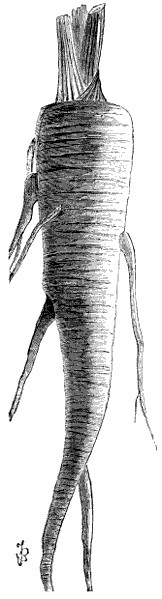
Fig. 3.—Round-topped Parsnip, five generations from wild root.
This it will be seen has strong, fleshy forks, and a tendency to form divided tap-roots; otherwise the shape is greatly improved, and the skin is tolerably smooth.
At this time our stock was for the most part fleshy and soft on boiling; the flavour, too, though much stronger than that of the usual esculent parsnip, was rather agreeable than otherwise.
This matter of flavour is a subject of interest, as most lovers of the parsnip, as a garden esculent, had got to complain of this root becoming more and more tasteless. That this was so our own experience most fully confirms; we have now, however, mended this root very materially in this respect.
Our experiments were only carried on with examples of the Hollow-crowned form, which following out from year to year, we at length obtained so perfect in form, clean in outline, delicate in skin, and unexceptionable in flavour, that we were induced to cause its seed to be distributed through the medium of the trade.
In 1881 we sowed a parcel of seed in our own garden obtained from the Messrs. Sutton, after having received from them the following notes upon the growth of the roots in their grounds:—
We are happy to tell you that in lifting some of each of all the varieties of parsnips in our trial-ground, your “Student” was decidedly the best shape, varying in length, but always clean and straight.

Fig. 4.—Student Parsnip of 1861. Two-thirds of natural size.
The engraving (Fig. 4) is taken from our garden stock of 1861, as being a common shape of this new variety. It is not quite so long and slender as the usual Long-horned parsnip, but its clean unbranched outline and solidity of structure recommend it as a good variety, whilst its flavour has been highly extolled by the lover of this, to some, favorite root. In size it is scarcely large enough for a field crop, but though not at present recommenced for the farm, its history may well serve to explain the origin of crop plants, as derived from the cultivation and improvement of wild species.[1]
[1] It may here be noted that the Student parsnip took the first prize for this root at the International Show at the Horticultural Society’s Gardens in 1862.
CHAPTER II.
ON THE ORIGIN OF SORTS OF ROOTS.
As crop plants are derived from wild ones, as the effect of cultivation, it follows as a matter of course that these will be varied, both in form and constitution, according to the circumstances under which they have been produced. Thus we may expect that any attempts to ennoble a wild root in different countries would not, even if successful, be sure to bring about the same results. Much depends even upon the individual root with which our trial may be started, and more upon the judgment employed in selecting the stock from which the experiments are to be continued.
That position and soil may make a great difference may be inferred from the fact that the attempts to improve the wild parsnip and carrot have met with varied success. De Candolle is reported to have tried to improve the carrot with success, whilst with the parsnip he utterly failed; whilst Professor Lindley, in Morton’s “Cyclopædia of Agriculture,” tells us that M. Ponsard has ascertained that “the wild parsnip becomes improved immediately when cultivated, and that experiments in improving its quality promise well:” how well, indeed, may be seen from the foregoing chapter. But still, we utterly failed with the wild carrot. Having collected seeds of the Daucus Carota (the common wild carrot) from some fine specimens growing on the road-side between Cirencester and Cheltenham, they were subjected to experiment at the same time as the parsnip, but with little, if any, favourable result. Upon this plant Professor Lindley observes as follows:—
That the hard-rooted wild carrot is really the parent of our cultivated varieties, remarkable as they are for the succulence and tenderness of their roots, has been experimentally proved by M. Vilmorin, who succeeded in obtaining by cultivation perfectly tender, eatable roots, from seeds saved from plants only three or four generations off the wild species.
Still, a modern French naturalist of great experience, M. Decaisne, tells us that he has tried to ennoble the wild carrot, and has not succeeded; and from this he draws the conclusion that our cultivated forms were created specially for the use of man. As we should suppose that very few botanists agree to this theory, we shall let the facts we have already brought forward stand in maintenance of its opposite, namely, that cultivated forms are derived from wild species often apparently very different; but at the same time it may be well to state, that in all probability some of the discrepancies of experimenters may have arisen from some confusion in the species operated upon.
In 1860 we gathered some seed of the Daucus maritima (sea-side carrot) at Bognor, which, on being sown in a prepared plot the following spring, certainly resulted in fairly succulent roots, which on being cooked were pronounced by our party of four to be excellent. While on this subject, it may be mentioned as not a little remarkable, that so many of our garden esculents should be derived from sea-side plants. Thus, probably carrot, but certainly celery, sea-kale, asparagus, and cabbage. This would seem to point to the fact that cultivation requires a complete change of the circumstances necessary to maintain a wild condition; and hence cultivated plants can only be kept up by the labours of a cultivator.
Now, as regards the sea-side carrot, we are after all inclined to the belief that it is the parent of the cultivated varieties, whilst, on the other hand, we view the Daucus Carota (the wild inland carrot) as a probable descendant from the cultivated or garden stock; and if this be so, the Daucus maritima is the original species from which both the wild and cultivated races have descended. Bentham, indeed, carries this view a little further, the following remarks tending to throw doubts upon the carrot in any form as being a true native. Under the heading of Daucus Carota he says:—
Probably an original native of the sea-coasts of modern Europe, but of very ancient cultivation, and sows itself most readily, soon degenerating to the wild form, with a slender root, and now most abundant in fields, pastures, waste places, &c., throughout Europe and Russian Asia; common in Britain, especially near the sea. Flowers the whole summer and autumn. A decidedly maritime variety, with the leaves somewhat fleshy, with shorter segments, more or less thickened peduncles, more spreading umbels, and more flattened prickles to the fruits, is often considered as a distinct species.
Seeing then that crop plants are derivatives from a wild stock, we can readily understand how the varying circumstances attendant upon the development of the former should tend to the production of varieties, and this merely as the result of the treatment of the fairly derived legitimate seed. If, again, we take these variations for the purpose of obtaining hybrids, we need not wonder at the infinite variety of sorts which can be brought about, but rather that any sort could be maintained in that trueness of character or in that state of permanency which we sometimes find to be the case.
CHAPTER III.
ON TRUENESS OF SORT IN ROOT CROPS.
The importance of trueness and purity of seed arises from the evenness of growth of a good genuine strain; while if this quality be wanting we have some parts of our crop growing well, whilst others get on but poorly. Thus a free-growing plant beside one over which it has got the advantage, maintains it for the most part through the whole period of growth. Again, some sorts are of value for being early, others for lateness of growth, and some kinds are better fitted for early than late sowing; if, therefore, we have a mixture in these respects, we may at least expect a partial failure; for whichever is best for our purpose, if mixed will be accompanied by those which are not so good. A want of trueness to sort may arise principally from the following causes:—
1st. Want of selection in seeding bulbs.
2nd. Hybridization.
3rd. A mixture of seeds.
1st. The propriety of selecting the specimens from which seed is to be grown is admitted by all: by the seedsman, who always advertises his turnip and swede seed, for example, as being “from selected bulbs;” and by the farmer, as this announcement is only made to induce him to buy. It is not only important that the roots should be selected, but that they should be stored and then planted in a fresh soil; for as these latter are among the cultivative processes by which sorts have been obtained, so should they be repeated in order to ensure a continuance of the induced condition. Seeding upon the same soil and in the same bed in which the seed is sown is hardly the way to keep up a form induced by cultivation, as this is exactly what would be done by the plants in a state of wildness.
In selecting roots for seeding, care should be taken to choose good-shaped examples, in which a clean unbranched bulb, not too large, with a small tap-root and a small top, confined to a single central bud; a branched root and a many-headed top being true signs of degeneracy. And no less so is neckiness in swedes and mangels, as well as a coarse corrugated skin in roots of all kinds.
Taking such points as these into consideration, how absurd must appear most of the huge mis-shapen roots to which prizes are usually awarded at shows, where the specimens are chosen for size, and trimmed up with the knife, to make them look more presentable. As an evidence of the mistaken principles upon which prizes are awarded to bundles of roots, let any one seed such examples, and we will venture to assert that such seed would produce a large proportion of degenerate examples, without affording so good a crop as would seed, from middle-sized but well-shapen specimens.
2nd. Some of the forms of roots, and more especially those belonging to the Brassicaceæ, such as turnips and swedes, seem to have a wonderful facility for hybridizing; and this not only to the extent of one sort of turnip with another, but sports may be caused by the fertilization of the turnip with rape and its congeners. Indeed, the hybrid with turnip and rape is doubtless the origin of the Swedish turnip; but there is reason to believe that mixtures may accidentally be made with such wild plants as charlocks and mustards, the growth of which in the vicinity of a seeding crop tends to the production of degeneracy. Seeding-patches, then, and the ground about them, cannot be kept too clean.
Again, if trueness be aimed at, there should be no mixture of sorts in seeding examples; all of the same kind should be selected for seeding-plots, as even one or two of a wrong sort may result in a very mixed sample, as it would seem that sometimes strange plants exert more than ordinary influence.
Of course, the putting seeding-patches of different sorts side by side is to be reprehended. If more than one sort be seeded in a season, it is advisable to place the patches as remote from each other as possible. And we would here remark, that, for seeding, the roots should, as a rule, be farther apart than when grown for bulbs, both in rows and in sets; as, if too close, the stems grow up thin instead of robust, and a smaller seed, with a tendency to the growth of smaller roots, will be the result.
3rd. Mixtures of seeds should be avoided for the reason assigned, that “sorts” do not usually grow evenly; and when one sees (as is by no means infrequent) a patch of swedes overshadowed by a mixture of some large early turnip,—the Tankard, for example, our crop of swedes will certainly suffer for it, even supposing the turnip to be as useful as the swede, which is seldom the case.
Mixtures, again, do not come up at the same time; sorts may differ in this respect, but especially do old and new seeds vary as to their germinating powers: two-year-old seeds taking four or five days more to come up than a new sample; thus giving a greater chance for the ravages of the flea-beetle than where the seed all comes up quickly.
Now, as a practical application of these remarks, we here quote from an article in the Agricultural Gazette of May 24th, 1862.
Who among seedsmen does not profess to offer the seeds of swedes and turnips from selected bulbs? And though it is quite true that the practice is not so universal as is the profession of it, yet the general assumption of its being so on the part of seed growers and sellers is an admission that it would be for the advantage of the buyer of seeds were the roots from which seeds are to be grown carefully selected. And on the other hand, let the observant agriculturist take a journey on any of our great lines of railway (in early summer), and he will be struck with the many patches of bright yellow flowers which he will not fail to notice on either hand. In nine cases out of ten, these are fields or portions of fields of turnips, either the Swedish or common kinds, which, from the abundance of keep, it has been thought would be more profitable to seed than to eat off, especially as they have so rapidly grown out of the way. Are these patches of selected bulbs? We happen to know, from a more than ordinarily careful examination, that not one per cent. of seeding-patches are from selected roots; but they are seeded just as they grew, and we do not know of a single instance where in such seeding the objectionable roots have been removed; but we do know of plenty of cases where the worst part of a field has been saved for seed, doubtless as the most profitable way of dealing with it under the circumstances wrought out by the spring of 1862.
Of course, this will all come into the market, and too much of it, under a stereotyped declaration of ‘from selected bulbs.’ That all the seed grown in 1862 will be sown in 1863 is simply impossible; but no matter, it will find a market somehow, some time. With such facts as these before us, who can wonder that any plant should become degenerate? Let some of the seed of this year be watched,[17] and we will answer for its evil results; and if these be facts, it then behoves the farmer to look well to pedigree in the matter of his seed.
But even here, his forethought must not end; for however select the parent may be, there is still something in ‘bringing up;’ for, however good the sort of turnip, we shall not grow its seed in perfection by selection merely, but we should transplant well-chosen roots, and so put them in a new scene, away from subjects which might contaminate them. This is indeed to bring them up in a good school, for which their seed will amply repay the trouble and expense.
CHAPTER IV.
ON DEGENERATE ROOTS.
If the reader revert to page 6, Fig. 3, he will see that the progress from a wild to a better root-form is marked by a more fleshy, but still a much forked, or finger-and-toed example. Now as it is held that a clear unbranched outline is essential to a well-formed root crop of every kind, whenever a crop becomes fingered-and-toed, it is looked upon as a disease. It must be understood that we are here speaking of finger-and-toe as distinct from anbury, which latter is a decidedly diseased condition, whether caused by insects or resulting, as some affirm, from a defect in the soil.
The difference in the two states may be briefly summed up as follows:—
Finger-and-Toe. Anbury.Root simply branched or forked, with tapering fleshy rootlets; occurs in turnips, parsnips, carrots, and mangold. (See
figs. 1,
2,
3,
5,
6,
7,
8,
9,
10.)
Root infested with irregular nodular protuberances, or with tumours suspended by roots, having very much the aspect of rows of ginger; occurs in turnips alone. (See
fig. 12.)
The example of a root at page 6 is a good form of a parsnip progressing from wildness to a better cultivated form. We now offer an engraving (fig. 5) of a hollow-crowned crop parsnip, fingered-and-toed, and evidently of a very objectionable form, as it will be seen on comparison how nearly alike are figs. 3 and 5.
Having given a few notes on the more prominent forms of insect attacks to which root crops are liable, we would now close this chapter, as details of all the insect pests would occupy more space than we can here allot to the subject; but to those who would inquire further upon this fertile theme, we would advise the perusal of “Farm Insects,” by J. Curtis, Esq., F.L.S., &c.
In looking back to the variety of insects that feed upon corn, and the multitudes that are often congregated in one heap, there can be no doubt that a very large portion must be occasionally ground up[204] with the corn and consumed by the public. This is not only a disagreeable fact, but it may be the source of very serious consequences, for I think it not improbable that many diseases might be traced to the insects which are converted with the infested flour into bread, amounting to such a large percentage, that if they have the slightest medicinal or deleterious qualities, it is impossible to deny the influence they must exercise upon the human system. I have known bushels of cocoa-nuts, which were every one worm-eaten and full of maggots, with their webs, excrement, cast-off skins, pupæ, and cocoons, all ground down to make chocolate, flavoured, I suppose, with vanilla!
[1] It may here be noted that the Student parsnip took the first prize for this root at the International Show at the Horticultural Society’s Gardens in 1862.
The engraving (Fig. 4) is taken from our garden stock of 1861, as being a common shape of this new variety. It is not quite so long and slender as the usual Long-horned parsnip, but its clean unbranched outline and solidity of structure recommend it as a good variety, whilst its flavour has been highly extolled by the lover of this, to some, favorite root. In size it is scarcely large enough for a field crop, but though not at present recommenced for the farm, its history may well serve to explain the origin of crop plants, as derived from the cultivation and improvement of wild species.[1]
Figures 1 and 2.—Roots of Wild Parsnips. Natural size.
Fig. 3.—Round-topped Parsnip, five generations from wild root.
Fig. 5.—Finger-and-toed degenerate Parsnip. Half nat. size.
Fig. 6. Carrot of First Year run to Seed. Half nat. size.
Fig. 7. Forked Carrot run to seed.
Half nat. size.
Fig. 8. Forked Belgian Carrot. Half nat. size.
Fig. 9. A Malformed or Degenerate Parsnip. Two-thirds of nat. size.
Fig. 10. A Malformed or Degenerate Swede. Two-thirds of nat. size.
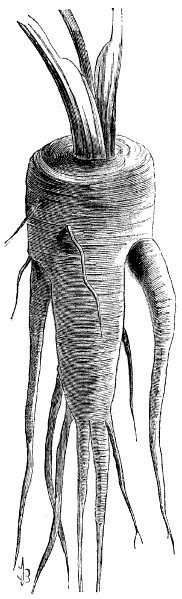
Fig. 5.—Finger-and-toed degenerate Parsnip. Half nat. size.
Now, as every degenerate crop of parsnips will be found to offer a large proportion of such roots as fig. 5, we seem bound to conclude that, inasmuch as our fig. 3 represents a root in progress towards ennobling, so fig. 5 is that of a root declining to its level,—in other words, degenerating; seed, therefore, that produces such roots can only come from a poor stock.
Our next fig. (6) is of a parsnip that had prematurely flowered. Sending up flowered stems the first year, in the case of a biennial, can only be looked upon as an instance of degeneracy. Plants that “run,” as it is termed, being comparatively useless, the best use, indeed, that can be made of them being that of pulling them up and giving them to the pigs.
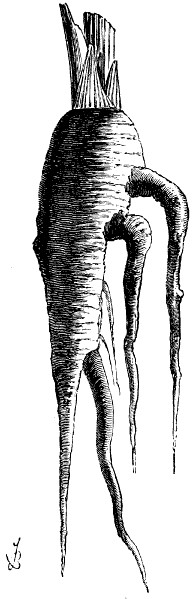
Fig. 6. Carrot of First Year run to Seed. Half nat. size.
Now this propensity is always accompanied with forked roots, more especially in carrots, which roots are even more degenerate than those represented in figs. 3 and 5, as those were fleshy and succulent; but when the roots of runners are examined, they are always found to be tough and woody, and, in fact, they very nearly resemble the wild examples.

Fig. 7. Forked Carrot run to seed.
Half nat. size.
Fig. 7 is taken from a carrot that has run, and its rough, woody, nodular, forked root is fully apparent.
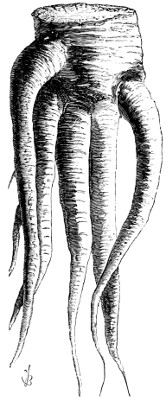
Fig. 8. Forked Belgian Carrot. Half nat. size.
Fig. 8, from a specimen of White Belgian carrot, forked as it is, is yet not uncommon; still, here the divided roots are succulent. This differs from the annual or run-to-seed roots, as this is a real biennial; but its other mark of degeneracy, besides that of finger-and-toe, was in its possessing a top (removed for experiment before the drawing was made) of many buds or heads. Now a multiheaded root, whether in turnips, carrots, parsnip, or mangel, is another sign of degeneracy, especially in the carrot or mangel, as the wild examples are remarkable for this condition; and in ennobling these roots, one of the difficulties is to get rid of this propensity. Hence, at root shows all forked examples of bulbs, multiheaded and necky examples, should be rejected; they are, however, sometimes made so fat with manuring that they pass muster for size, which indeed seems to be the great quality required at shows: which is a serious mistake, as being no sort of criterion of the state of a field of roots, unless it be an adverse one: as a 10 lb. malformed root, with its huge top, will require more ground to grow than will half a dozen roots averaging 2 lbs. each; whilst the latter are certain to be better and will keep longer.
CHAPTER V.
EFFECTS OF GROWING SEED FROM DEGENERATE ROOTS.
That the seed of malformed roots would be likely to produce a poor crop was a subject admitted by all; but neither the form nor extent of the mischief resulting therefrom had been stated upon the authority of exact experiment. In order, therefore, to arrive at direct evidence upon a point upon which so much of practical importance depends, we carefully carried out the following experiments.
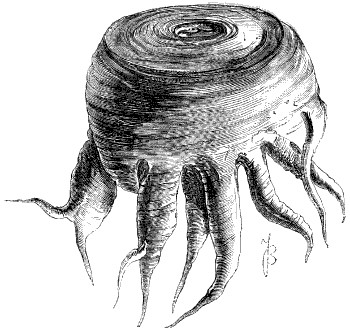
Fig. 9. A Malformed or Degenerate Parsnip. Two-thirds of nat. size.
On the 26th of March, 1860, we selected two roots from a store, namely, one of a Student parsnip from our own stock and one of a Skirving’s swede. Before committing these to the ground for the growth of seed, we made careful portraits of the two roots, of which that of the parsnip will be found in fig. 9, that of the swede in fig. 10.
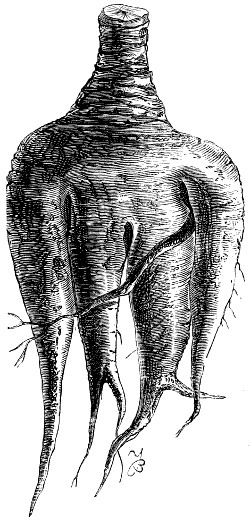
Fig. 10. A Malformed or Degenerate Swede. Two-thirds of nat. size.
Now had we been going to grow the best of seed, we should of course have selected the best-shaped roots for our purpose; but in this case, as will be seen, the most viciously formed examples were chosen.
Both of the examples whose portraits we have here given, were planted in our private garden (where, it is right to say, they were the only seeding specimens), in due time their seed ripened, which was carefully collected and stored.
Early in April, 1861, these seeds were sown in our experimental plots, without manure, in the following order:—
Plot
a.
Seed obtained from the malformed parsnip,
fig. 9.
b.
Seed of Student parsnip of the same year as that of plot
a.
c.
Seed of malformed swede.
The plot b was sown by way of comparison, and we can only regret that no plot of good swede seed was sown with the same object, and we must, therefore, compare with a piece of swedes in an adjoining field.
The following are the tabulated results:—
TABLE OF RESULTS OF EXPERIMENTS.
lb.
oz.
Plot
a.
75 roots, forming the crop from seed of the malformed parsnip (
fig. 8) weighed in all
-
7
4
Plot
b.
63 roots forming the crop from seed of good Student parsnips
-
14
0
Plot
c.
70 roots of swedes from seed of malformed plant (
fig. 10.)
-
19
8
70 roots from a row in the field, at a distance of about 30 yards
-
35
0
The roots from plot a may be described as small, though not so much fingered-and-toed as we had expected; still there was only about half the crop when compared with plot b, which latter, indeed, was only small in weight, which may be accounted for from being grown without manure. During their progress of growth the difference was very perceptible—the small leaves of a contrasting most unfavourably with the broader, brighter coloured ones of b.
As regards the swedes, they were indeed a very poor crop, presenting all the evils of degeneracy—neckiness, for which it will be seen that their parent was distinguished—want of a bulboid form; none of the 70 roots being better than a thin tap-root, and these were forked, shapeless, and fingered-and-toed in endless variety. Their spindle-shaped roots were quite remarkable, and they were the rule, although in good seed, however bad the soil, they would have been the exception. Those in the field hard by were bulboid, and averaged half a pound each—no great weight, as the land in which they were grown is only second-rate. They, however, were grown with manure, to which, of course, much of the difference is due, and yet not so much as may fairly be imputed to the difference in seed. From these experiments we conclude:—
1st. That a degenerate stock will, as a rule, result from the employment of degenerate or badly-grown seed.
2nd. That besides ugly, malformed roots, degenerated seed does not produce nearly the weight of crop of good seed, under the same circumstances of growth.
3rd. That by means of selection we may produce roots that are well-shaped, and have the capabilities of affording the best crop.
4th. That by designedly selecting malformed degenerate roots for seeding, we may produce a seed that will result in as great or greater degeneracy.
“That these are important conclusions”—we quote from the Agricultural Gazette—“few will be disposed to deny. They have most interesting bearings on the subject of vegetable physiology, and consequently should be studied by the farmer.”
It is a practice much to be desired, that not only should a proper choice be made of seeding examples, but that there be a change of situation, and, if possible, a time of storage before being planted for seed. These are all cultivative processes, and to the care with which they are carried out must we look for permanence in our derivative root-crops.
It cannot be too strongly urged, that, as an efficient sort of root has only been arrived at as the result of great care—that is, by successful breeding,—so every care must be taken for its maintenance. Defect in seed results in defect in the produce of that seed; and downward tendencies of this kind are common results of even most careful cultivation. With carelessness in this respect we must not be surprised at rapid degeneracy.
CHAPTER VI.
ON THE ADULTERATION OF SEEDS, MORE PARTICULARLY OF TURNIPS.
In order to make the experiments which illustrate this chapter tell their tale to the fullest extent, we would set out with the two following postulates:—
1st. All well-grown, well-preserved new seeds should be capable of germinating to the extent of at least 90 per cent.
2nd. Seeds in general, and more especially turnip seeds, as usually delivered to the farmer, are generally incapable of germinating to the extent of from 25 to 30 per cent., and very frequently even more.
We shall hereafter see, that this want of germinating power is too often the result of mixing charlock, Indian rape, and the like, by way of adulteration, which latter are killed to prevent “their telling tales.” But to our experiments:—
A number of tin cases were made of the following proportions: Length, 15 inches; width, 10 inches; depth, 4 inches. These, which were well perforated at the bottom, were divided across into ten equal parts, each of which was filled to within an inch of the rim, with a mixture of fine mould and silver sand. In these, seeds of different sorts of turnips were sown, and the whole was put into a bed of sand in our forcing-house. We could, however, see no difference in the results, nor could we trace any in the germinal or cotyledon leaves of swedes, turnips, or charlock. But, of course, samples of turnip-seed could not be tested as to freedom from charlock by this experiment, because charlock is killed before being mixed with the turnip.
Now, seeing that we could get no trustworthy results by this kind of experiment, it struck us that our germination-pans might be used to test the germinating power, not only of the samples we had obtained for a different purpose, but of others also. We first, then, counted a hundred of each of the following sorts of seeds, and carefully dibbled them in a fresh mixture of soil, in September, 1860; the results, which were as carefully noted from day to day, are shortly given in the following table:—
Table 1. Germination of Ten Sorts of Turnips.
No.
Name, Copy of Label.
Came up
per cent.
No. of
Days.
1
Mousetail, 1859
96
10
2
Pomeranian, or White Globe, 1859
86
11
3
Nimble Green Round, 1859
96
7
4
Lincolnshire new Red Globe, 1860
90
9
5
Yellow Tankard, 1859
92
9
6
Smart’s Mousetail, 1860
98
7
7
Green-topped Stone, 1860
84
8
8
Sutton’s Imperial Green Globe, 1860
98
9
9
Green-topped Scotch, 1860
90
9
10
Early Six-weeks, 1860
90
10
Came up
=
92
Failed
=
8
We would remark upon these results, that the temperature of the house was kept at between 60° and 70°, and the greater part of the seeds came up in four days; the numbers for the days, then, have reference to the time occupied before all that would germinate came up. Now this table is not a little instructive, as showing that samples of turnip-seed can be got in which only a very few of the seeds fail to germinate; but as experience had taught us that these samples by no means represented the usual market condition of turnip-seeds, in order to test this we begged to be allowed permission to take samples direct from the bags of a retail seedsman as they were exposed in his shop, and the following results will speak for themselves.
It should, however, be here premised that the samples were not grown by the seedsman, but were said to be just as received from the wholesale dealers.
Table 2.—Germination of Ten Sorts of Turnip Seeds from Market Samples.
No.
Copy of Label.
Came up
per cent.
No. of
Days.
1
Norfolk Green round
76
9
-
Taken from the bags by the Author.
2
White Globe
78
15
3
Early Grey-topped Stone
80
10
4
Red Tankard, or Pudding
62
11
5
Orange Jelly
52
15
6
Norfolk Round Red
80
10
7
Purple-topped yellow Scotch
76
11
8
White Dutch
64
12
9
Early Green top
64
13
10
Yellow Tankard Pudding
48
12
Came up
=
68
Failed
=
32
Eight samples of swedes from the same source are in the next table associated with a sample of Skirving’s swede, grown in our own garden (8), of the following table, and another of turnip (9), grown on a neighbouring farm. We may remark upon the last-named sample, that we had observed the growth of this seed, which was from a very poor crop, half of which had decayed on the ground with the early frost of 1860, and the rest, without transplanting or selection of any kind, was allowed to seed. Now, as this whole crop was so degenerated that it ought never to have been seeded at all, we were anxious to get some of the seed from the bulk, in order to test from its growth this year whether it will not bring forth a degenerate progeny. Its germinating qualities will be seen from the table, and yet it is by no means the worst sample, which seems to show that the others are not naturally bad, but so by mixture.
Table 3.—Germination of Swedes, &c., from Market Samples, &c.
No.
Copy of Label.
Came up
per cent.
No. of
Days.
1
Ashcroft’s improved Purple Top
58
12
-
Taken from the bags by the Author.
2
New Bangholm
96
10
3
Skirving’s Liverpool
62
16
4
Green Top
78
10
5
Marshall’s improved Purple Top
90
10
6
Hewer’s Improved White
68
17
7
Green Major
86
10
8
Skirving’s Swede (own grown)
96
10
9
Green Top Turnip, neighbour’s farm
78
6
10
Fosterton Hybrid Turnip
64
10
Came up
=
77
·6
Failed
=
22
·4
Failed of seedsman’s specimens
=
24
·8
Now, as “0 0 0” seed is supplied to customers under the designation here given, for the purpose of mixing, it is of little consequence whether it be used by the wholesale house or the retail dealer; if, however, it be employed by both, we should, indeed, get a bad sample.
As regards the seedsman’s samples in the Tables 2 and 3, we are quite unable to give exact details of their history, but we have reason to believe that the stock whence they were taken was purchased in the ordinary course of business from different “wholesale houses,” as, though the tradesman whence the samples came combines the business of “nurseryman” with that of seedsman, we happen to know that he is not a grower of seeds, at least of turnip seeds. The average, then, of eighteen samples of turnips and swedes from this source is that 28 per cent. are non-germinating seeds. The next samples are from people in a large way of business, who are not mere retailers, but to whom we must accord all the immunities of the trade as seed-growers, wholesale and retail seed-merchants, &c.
Before giving the tables with the results as regards these samples, it is necessary to state that they were not sent to us direct, but were forwarded through a farmer to whom they were sent in the ordinary small packet samples.
We would further remark, that as all that would germinate took so few days about it, being an average of six days, whilst those of Table 1, being seeds partly of 1859 and partly of 1860, occupied nine days, and those of Table 2, whose date we do not know, eleven days; in all probability the seeds in question were tolerably new, most probably of the last seed season.
Table 4.—Germination of Ten Samples of Turnips.
No.
Copy of Label.
Came up
per cent.
No. of
Days.
1
Green Globe
62
8
-
Turnips from sample papers communicated.
2
Dale’s Hybrid
84
4
3
Red Globe
90
6
4
Orange Jelly
100
4
5
White round, or Norfolk
42
5
6
Green Tankard
50
6
7
Scarisbrick (
sic)
88
11
8
White Globe
74
4
9
Golden Yellow
82
4
10
Green round
30
6
Came up
=
70
·2
Failed
=
29
·8
The specimens in next table were obtained in like manner as those of Table 4.
Table 5.—Germination of Samples of Common and Swede Turnips.
No.
Copy of Label.
Came up
per cent.
No. of
Days.
1
White Stone or Stubble
46
6
-
Swedes and Turnips from sample papers communicated.
2
Red Tankard
60
5
3
White Tankard
60
4
4
Yellow Tankard
88
5
5
Green Top Yellow Scotch
84
6
6
Purple Top ditto
62
8
7
Tankard-shaped Swede
74
7
8
White-fleshed ditto
84
8
9
Skirving’s Improved Purple Top ditto
64
8
10
Lawhead Green Top
80
7
Came up
=
70
·2
Failed
=
29
·8
Of these samples we see that within a fraction of 30 per cent. is the average of non-germinating seeds, and this is only so low on account of two or three unusually good samples, the general range being from 20 to 30 per cent. of non-germinating seeds for the last twenty samples.
If we compare No. 5, Table 2, with No. 4, Table 4, we see a difference in the Orange Jelly Turnip; in the former little more than half came up, in the latter every seed. This is of importance, as showing what genuine seed may be, the latter being doubtless as unmixed as the former was mixed.
Now as regards the charge of mixing, we are not going to make it without some evidence. In looking over the tables we have now given, it will be seen that genuine seed has but a small per-centage of non-germinating seeds—say from 5 to 10 per cent.; but not only the examples herein referred to, with hosts of separate ones which have fallen under our notice, show a general amount of dead seeds, of from 20 to 30 per cent. For these figures compare Table 1 with Tables 2, 3, 4, and 5. In those of the first lot the samples were sent direct to us from a seedsman, and their behaviour shows us clearly enough that good seeds are to be obtained, but the other tables are as clear that from some seedsmen, at any rate, though inferior samples, they are as good as are actually sold.
That seeds are mixed we have, then, good internal evidence; but we are also in possession of facts more conclusive upon this important point, and we shall in this next chapter endeavour to enlighten our readers as to the art and mystery (especially) of turnip-seed adulteration.
Confining our present remarks to turnip seeds, we assert that if farmers will try the germinating powers from the bulk of the seed which may be sent to them, they will find pretty nearly one-third to be rubbish. It is of no use to try from samples, except in comparison with bulk; and if all the farmers of Great Britain did this, and would communicate the results, what an extraordinary tale would be unfolded, more especially if the evidence be completed by notes on the purity or otherwise of the crop grown from such seeds!
CHAPTER VII.
ON THE ART AND MYSTERY OF TURNIP-SEED ADULTERATION.
It has already been shown that turnip-seed is largely adulterated; it remains now to point out the nature of the admixtures, which may be summed up under the following heads:—
1st. Old seeds are mixed with new.
2nd. Charlock, “Indian rape,” and other seeds of the Brassicaceæ, are mixed with genuine seed.
1st.—The crops of seeds vary so much in their produce per acre, in one year, as compared with another, that in most years there is a superabundance of some kinds and a scarcity of others.
Now, as most seeds are of comparatively little use except for sowing, the surplus stock can only be disposed of at extremely low prices. Accordingly some wholesale seedsmen buy large quantities in the “glut season,” as it is termed, and store them until the same articles fail in crop. For instance, swede and turnip seeds, 1857 crop, could be bought everywhere at from 15 to 20 shillings per bushel; but owing to the destruction of the roots in the winter of 1859, seedsmen in 1860 had to pay the growers 50s. per bushel. Now, in 1860 there were wholesale houses selling those seeds which they had by them for the same price. Such people can, it is true, warrant their seeds to be genuine, as they well know how much turnip-seeds deteriorate by keeping; the mixing of this with good seed is still a species of adulteration; and if not mixed at all, we can then only say that the evil is so much the greater.
As an evidence of the amount of deterioration caused to turnip-seeds by keeping, we here re-produce the table of trials of ten sorts of good seeds made in September, 1860, in contrast with experiments from the same sample, in the same month of the present year (1862), premising that the samples were kept in what we should consider a dry but not too warm a temperature.
Table6.—
Germination of Ten Sorts of Turnips.No.
Name. Copy of Label.
Came up 1860.
Percent.
Came up 1862.
Percent.
1
Mousetail, 1859
96
46
2
Pomeranian or White Globe, 1859
86
44
3
Nimble Green Round, 1859
96
94
4
Lincolnshire New Red Globe, 1860
90
58
5
Yellow Tankard, 1859
92
62
6
Smart’s Mousetail, 1860
98
92
7
Green-topped Stone, 1860
84
88
8
Sutton’s Imperial Green Globe, 1860
98
80
9
Green-topped Scotch, 1860
90
86
10
Early Six-weeks, 1860
90
70
Came up (average)
=
92
72
Failed
=
8
28
These figures are interesting as showing that though the different sorts are not affected equally, yet the seed of 1859 failed on the average to the extent of 38.8 per cent., as against 24.6 for the seed of 1860, and 28 as the average of the whole samples. Such is the great difference between two and three year old seeds.
2nd.—Even the above genuine seeds (!) are not unfrequently mixed, and we may now examine the nature of some of these mixtures. Charlock and Indian rape are all prepared for this purpose: that is to say, they are rendered incapable of germinating before mixture—“Dead men tell no tales.” Now rubbish, so prepared, is well known in the trade as 000 seed. Under this denomination all seedsmen know it, and it can be procured by the trade at about 7s. per bushel.
With respect to this 000 seed, we direct attention to the following letter addressed to a most respectable firm.
Southampton, April 27, 1860.
Gentlemen,—Being in possession of a new and improved method of killing seeds without the use of any chemicals, so that the seed when in a 000 state has not that unpleasant smell it has when killed by the old method, and does not look perished if it be crushed. A man by the new process may kill ten or twelve quarters per day, and the apparatus is so constructed that it is impossible for a single seed to leave it alive; and one great advantage is, that if you want a sack of 000 seed in a hurry you may kill a sack of rape or turnip, or any seed, and have it fit for use in an hour. Seed in the process of killing increases in measure and weight, and when you send it out to be killed, of course, the seed-killers keep the extra weight and measure. If you think it worth your attention, I will send you a small working model, so that you may kill a few pounds of kale or cauliflower, or any small seeds in a few minutes, and instructions for making a large one on receipt of a Post-office order for £2.
Yours truly,
——
To this the Messrs. Sutton append the following remarks:—
The writer of the above being unknown to us, we had the curiosity to call at the address given, and ascertained that it was no “hoax,” but was assured by the “inventor” that he had supplied several tradesmen with the apparatus, and that he was formerly in the seed trade himself. We may add, that we have since heard from the same individual at another sea-port town to which he has removed.
Having got possession of this circular, and being desirous of becoming acquainted with so notable an invention, we lost no time in setting on foot a negotiation for the possession of the secret, and having traced the inventor in his removal from Southampton to Gosport, we then had letters addressed to him upon the subject, and, if promises had been of any avail, we might possibly at this time have been in possession of a very improved and expeditious method of making 000 seeds, only that we have learnt the undesirable nature of pay beforehand.
Our next inquiry was for a sample of 000 seed itself; but, although it is well known in the trade, we have hitherto failed in procuring it. We had hoped that our seedsmen might have been able to procure some through some of their friends. The result was, that we made application to a most respectable London firm, receiving the following reply:—
London, February 27, 1861.
Sir,—In reply to your favour received this morning, we take leave to say that we shall have pleasure in complying with your request for a sample of 000 turnips, if we can obtain it. But we do not keep it ourselves, nor do we know the parties who prepare it, it being something of a trade secret. We will, however, apply to some of our friends here to let us have a small quantity, but doubt if they[41] will let us have it, as it is a matter they are rather chary respecting, and although perfectly well known and understood in the trade, they do not care to have it known beyond, and our asking for a small quantity will be sure to lead to the question, “What do we want it for?” We could obtain a large quantity without hesitation.
We remain, &c.,
——
The sentence we have placed in italics will be quite sufficient to show how well the matter of 000 seeds is understood in the trade, and how easy it is to get bushels of it, no questions being asked, while a small quantity, required only for investigation, may be refused.
It appears, then, that the machinery exists by which any one in the seed trade may quietly and easily commit enormous frauds. And it is plain that the very notoriety of this machinery, together with the condition of many of the samples of seed which we have examined (see Chap. VI.) prove that this machinery actually is employed by many seedsmen to the great injury of their customers.
We cannot, then, be doing wrong in urging any one to make trial of the seeds he is about to buy before he sows them, or even before he purchases them. Where the experience of a number of years already exists, the character of the seedsman is a guarantee for the good quality of his goods, and experience of this kind is indeed a more perfect carrying out of the system of preliminary trial or experiment, which we recommend especially to all new customers.
CHAPTER VIII.
ON THE INJURIES CAUSED BY INSECTS.
Root-crops are especially liable to injury from the depredations of insects. Thus the turnip may have its seed more or less destroyed by weevils. Immediately the seed appears above the ground, commences the attack by the turnip flea-beetles. The bulb is pierced by beetles, ending in those excrescences called “turnip-warbles;” and there is reason to think that even the root-fibrils are in some soils made the depositories of the eggs of insects, which give rise to extraordinary malformations.
Carrots and parsnips are liable to have the best-grown root made useless by its being pierced and eaten by the larvæ or grubs of a small fly, known as the Psila rosæ.
Even the mangel-wurzel, which has been so strenuously recommended as a substitute for the turnip on account of its freedom from insect attacks, and connected with which Curtis only describes a single insect, a leaf-miner, called Anthomyia Betæ, upon which he remarks that “these insects will seldom cause any loss to the mangel-wurzel crops should they ever abound to any extent.” In spite, however, of this, we find that the increased growth of this crop has caused a corresponding increase in the insect, to such an extent that, during the last two seasons, many crops have entirely failed from its depredations; as witness the following communication to the Agricultural Gazette for August 23rd, 1862:—
My mangel crop was drilled the 17th May, and came up most favourably. On Monday, the 2nd June, I asked my bailiff what was the matter with it; he said, “Oh, it was a sharp frost last night;” but on examination I found that instead of frost the leaves had within them a maggot, which had caused the plant to brown and die off. The late rains and growing weather have enabled the plant somewhat to revive, and also fresh plants to come up (for I had drilled 7 lb. per acre), but found to-day several leaves with maggots in them. My man told me “a quantity had eaten themselves out of the leaf and dropped;” and that he saw “a vast number of sparrows picking up those maggots.” I send you herewith some plants I brought up from the farm. My idea is that the seed was damp and bred the maggots, or that the leaves had been “struck with a fly,” and then the maggot followed. You will please let me have your ideas upon these points.—S. S.
The maggot, or larvæ, here described is that of a fly called the Anthomyia (Pegomyia) betæ, mangel-wurzel fly. An allied species will sometimes be found on the common dock-leaves, mining their galleries between the dermal cells of the leaves.
We have for some time observed the increase of this pest, and we are prepared to state that now we seldom see a crop that is not greatly injured by its attacks. Mr. Curtis thinks that the best method to destroy them is to employ boys to crush the leaves between the thumb and fingers at the part where the larvæ can be seen; and with this we fear we must for the present be content, unless we could devise some means to take the fly before its eggs are laid in the leaves.
We need not here dwell at length upon the natural history of those pests of the turnip—the Haltica nemorum (striped flea-beetle), and H. concinna (black flea-beetle), as the nature of their ravages are tolerably well known. Thus much, however, may be said; namely:—
a. These insects are called fleas because they have the power of hopping on being disturbed, much after the manner of a flea.
b. They have some five or six broods each year; the earlier ones probably being bred on charlocks and other weeds of the same natural order as the turnip; and hence, then, charlocks are pests, not only as being weeds, but as breeding-places for one of our most mischievous insects.
c. They migrate from their weed-haunts to the first crop of turnips, where much of their mischief may be prevented by simply dusting over the young plants with any fine powder, road-dirt answering the purpose as well as anything else.
Various devices have been employed for keeping away and killing these little creatures. We have used a contrivance for catching them, which may be described as follows:—
Some thin board (or boards), making a surface of about 4 feet long by 2 feet wide, is furnished at one end with a pair of light wheels of just sufficient diameter to lift the board about 2 or 3 inches above the plants. To the other end may be attached two crooked handles in such a manner that the machine can be wheeled flatly over the plants, or if four wheels be employed, one at each corner, a single handle can be used either to push or pull the implement. When used, it should have its underside painted over with tar or any handy viscid substance.
This should be used on bright days, the operator pushing it over the rows of turnips, so as, if possible, not to throw his shadow before. The middle of the day will be best, not only for this reason, but also because these creatures feed more actively at that time.
Now, our experience in the use of this simple contrivance on small experimental plots convinces us that a small boy could easily keep under the enemy in a good-sized field.
But now comes a very important question for consideration. Cannot we do more than kill a few of these creatures? cannot we adopt such plans as will render our crops tolerably safe from their depredations? We think so, and to this end advise the following method of proceeding:—
Let each turnip-grower prepare for the enemy by sowing from the eighth to a quarter of an acre of turnips in a sunny part of the farm as early as the first week in April. These patches would quickly attract all the turnip flea-beetles from the wild cruciferæ on which the first broods seem to depend, and in this small compass they can be killed in detail with the simple contrivance just described, so that when the real crop comes up there will be none, or at least only a few, beetles to emigrate to it; whereas, as we now manage, by the time the crop of turnips is sown, enough of the creatures are too often bred to render it necessary to sow two or three times before we can secure a crop.
Anbury is an affection to which only the different sorts of turnips are liable, in which case it differs from finger-and-toe, with which it has been very much confounded, as this latter occurs in all kinds of roots; namely, turnips, carrots, mangel-wurzel, &c., as well as both the common and Swedish turnips.
As a sample of an extreme case of finger-and-toe—digitate root,—we repeat the following figure of a Belgian carrot, in which it will be seen that the forks gradually taper to the extremities; in fact, the whole, instead of being a succulent fleshy tap or fusiform root, in which case it could readily be stored, is divided in fingers-and-toes, which are liable to break off, and this renders the product next to useless. Now, this affection may occur in any soil, as it is the result of a degeneracy in the stock of the plant; but in the affection now to be described the case is wholly different, as here the bulk of the swede (fig. 12) is affected with rough, cancerous knobs, whilst the rootlets support irregular knobs of a like kind, which have more the aspect of suspended rows of ginger than fingers-and-toes.
Fig. 6. Carrot of First Year run to Seed. Half nat. size.
Fig. 5.—Finger-and-toed degenerate Parsnip. Half nat. size.
Table 3.—Germination of Swedes, &c., from Market Samples, &c.
Table 4.—Germination of Ten Samples of Turnips.
Table 5.—Germination of Samples of Common and Swede Turnips.
Fig. 11 (Fig. 8 repeated).
Finger-and-toe Carrot. Half natural size.
Roots so affected soon rot, and have a fœtid odour, so that they are not only useless themselves, but communicate canker and decay to the whole store. In the putrid mass will be found maggots and flies and beetles of different kinds; but as yet naturalists are not agreed as to whether the nodules of disease are caused by insects, or whether these creatures are merely attracted by the fœtid matter. We are, however, inclined to the belief that some insects are connected with the diseased appearance in the first place, whilst others afterwards step in to fatten upon the decaying matter, induced by the first lot; but still it must be confessed that the subject requires much more attention than it has yet received, in order to settle these important questions.
Still it may be observed that one point has been universally admitted; namely, that anbury only occurs to any extent in sandy soils, where there is an absence of lime, a good dressing of which mineral is the best safeguard against this affection. Still, in soils that are liable to anbury, we should not recommend the continuance of turnip-growing, or at least not so frequently in the rotation as has hitherto been the case, and more especially as the soils which produce anbury to the greatest extent are just those best adapted for parsnips and carrots, which, if not wholly, may occasionally be very profitably grown in the place of the turnip.
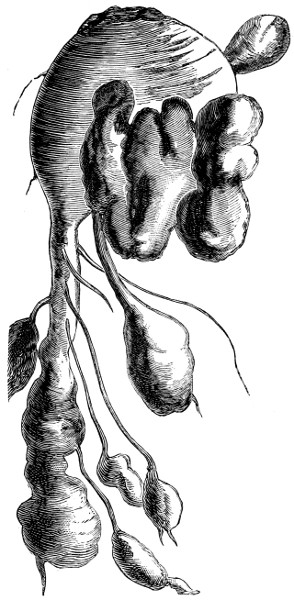
Fig. 12. Swede affected with Anbury. Nat. size.
Having given a few notes on the more prominent forms of insect attacks to which root crops are liable, we would now close this chapter, as details of all the insect pests would occupy more space than we can here allot to the subject; but to those who would inquire further upon this fertile theme, we would advise the perusal of “Farm Insects,” by J. Curtis, Esq., F.L.S., &c.
GENERAL CONCLUSIONS.
To render our subject as complete as possible, we direct attention to the following practical conclusions, to which our whole argument upon the science of root-growing points:—
First.—Cultivated roots are improved wild ones, only to be obtained by gardening on the small, or farming on the large scale; this gardening or farming being carried on by certain operations at certain seasons which we have comprehended under the term of cultivation processes.
Second.—The difference in sort of roots is caused either by cross-breeding as the result of accident or design, or of the education of some particular propensity which has been acted upon by the intelligent seed-grower.
Third.—The maintenance of sorts in purity depends upon careful selection of the right variety for the seeding examples.
Fourth.—The preservation of a good outline or shape of root can only be maintained by selecting those of good form to seed from; for, as running to seed, multiform top, forkiness, “finger-and-toe” in roots, is evidence of wild growth, so, then, cultivated plants assuming this form are considered as degenerate, and seed from such roots produces a malformed and poor crop.
Fifth.—The difficulties of getting good seed—whether of trueness to sort, from carefully selected bulbs, or free from adulteration either of old with new seed, or a mixture of charlock and others of the same family—are very great. Where, however, good seed can be depended upon, it is much cheaper, though at a considerable increase of first seeds cost, as not only quality but the quantity of live so considerably depends upon the truth and honesty of the seedsman.
Sixth.—Injuries from insect attacks, though serious as affecting the yield, are yet not due to the seed; and anbury, if it be due to insects, only occurs in the turnip-crops, and then in particular soils. The true insect attacks to be averted by simultaneous action.
In fine.—Good seed, of a true sort,—care in growth,—and a watchfulness of enemies, includes the Science and Practice of Root Cultivation.

FARM AND GARDEN SEEDS
CARRIAGE FREE.
Bangholm Swede,
East Lothian Swede,
Ward’s Beauty Swede,
Dropmore Swede,
Marshall’s Champion Swede,
Green-top Swede,
White Swede,
Improved Skirving’s Swede,
White and Red Globe, and
Norfolk Turnip,
Scotch Yellow Turnip,
Dobito’s Yellow Oval Mangel,
Ward’s Ditto,
Improved Yellow Globe Ditto,
Improved Orange Globe Ditto,
Improved Long Red Mangel,

Improved Long Yellow Mangel,
Improved Red Globe Mangel,
Improved White Field Beet,
Red Clover, Cowgrass,
White, Yellow, and Alsike
Clovers.
Pacey’s Perennial Rye-grass,
and other sorts.
Italian Rye-grass, Foreign
and English Seed.
Natural Grass Seeds, in
mixture or separate, suitable
for various soils and localities.
Light Rye-grass and other
Cheap Grasses, for sowing on
Railway Banks and Waste
Places.
Orders for Exportation promptly attended to.
PETER LAWSON, & SON, THE QUEEN’S SEEDSMEN,
28, KING STREET, CHEAPSIDE, near the Guildhall, and 15, LAWRENCE LANE, LONDON, E.C.
ESTABLISHED 1821.
SPECIAL MANURES.
GRIFFIN, MORRIS, AND GRIFFIN,
Invite Attention to their Manures which are successfully used in
FORTY-SEVEN BRITISH COUNTIES.
MANURES FOR ALL KINDS OF ROOT CROPS.
Surprising results are produced by the use of their well-known
GRASS MANURES,
TURNIP, POTATOE, AND MANGOLD MANURES.
Agriculturists are invited to send for an Annual Circular, containing List of Prices, Particulars of Premiums, &c.
CERES WORKS, WOLVERHAMPTON, January, 1863.
THE LONDON MANURE COMPANY,
ESTABLISHED 1840,
Supply Peruvian Guano, Nitrate of Soda, Dissolved Bones, Superphosphate of Lime,
AND ALL ARTIFICIAL MANURES GUARANTEED GENUINE.
116, Fenchurch Street. EDWARD PURSER, Secretary.
MILLER & JOHNSON
Manufacture Special Manures for Root, Corn, and Grass Crops,
Which they guarantee to be of the highest quality.
WORKS: NORMANDY WHARF, ROTHERHITHE;
OFFICES: 25, MARK LANE, LONDON.
EDITIONS FOR 1863.
NOW READY,
THE SHILLING PEERAGE.
THE SHILLING BARONETAGE.
THE SHILLING KNIGHTAGE.
THE SHILLING HOUSE OF COMMONS.
Containing the Birth, Accession, and Marriage of each personage, his Heir (Apparent or Presumptive), Family Name, Political Bias, and Patronage; as also a Brief Notice of the Offices which he has hitherto held, his Town Address and Country Residences.
Compiled by EDWARD WALFORD, M.A., Balliol College, Oxford.
LONDON: ROBERT HARDWICKE, 192, PICCADILLY.
FARMERS OF ENGLAND,
Read the
MAGNET,
The largest and best Agricultural and Family Gazette, and the best London newspaper especially devoted to Agriculture and the Interest of the Land.
The MAGNET is published every Monday evening, after the close of the London Corn and Cattle Markets, and in time for post.
Important to Auctioneers and other Advertisers from its large and influential circulation. Price 41⁄2d. only. Stamped for circulation by post.
OFFICE, 19, EXETER STREET, STRAND, LONDON.
In Monthly Parts, at 5s. each.
ENGLISH BOTANY.
EDITED BY
J. T. B. SYME, F.L.S., &c.
The first Volume of this splendid Work is now ready.
IT CONTAINS ALL THE
Rues, Anemones, Crowfoots, Spearworts,
Waterlilies, Poppies,
Fumitories, Mustards, Rockets, Stocks,
Lady’s Smocks, Cresses,
AND OTHER PLANTS RANKED UNDER THE ORDERS RANUNCULACEÆ,
BERBERACEÆ, NYMPHIACEÆ, PAPAVERACEÆ, AND CRUCIFERÆ.
ALL THE DRAWINGS ARE LIFE-SIZE, AND COLOURED TO NATURE
BY HAND PAINTING.
Vol. I. contains seven numbers at 5s. each,
OR COMPLETE, BOUND IN CLOTH, 38s.
“Mr. Syme’s English Botany will be the most complete Flora of Great Britain ever brought out. This great work will find a place wherever botanical science is cultivated and the study of our native plants with all their fascinating associations held dear.”—Athenæum.
LONDON: ROBERT HARDWICKE, 192, PICCADILLY.
Royal 8vo., price £1. 14s.
THE GRASSES OF GREAT BRITAIN (Completion of). Now ready, in 1 vol., containing life-size, full-coloured Drawings, with magnified Organs, of 144 British Grasses, and Observations on their Natural History and Uses. Described by C. JOHNSON. Illustrated by J. E. SOWERBY.
Complete, bound in cloth, price £1. 7s.
THE USEFUL PLANTS OF GREAT BRITAIN: a Treatise upon the principal Native Vegetables capable of Application as Food or Medicine, or in the Arts and Manufactures. By C. P. JOHNSON. Illustrated by J. E. SOWERBY. 300 Coloured Illustrations.
Fcap. 8vo., price 6s.
THE BRITISH FUNGI (a Plain and Easy Account of). With especial reference to the Esculent and other Economic Species. By M. C. COOKE. With Coloured Plates of 40 Species.
Also, by the same Author,
A MANUAL OF BOTANIC TERMS. Fcap. 8vo., upwards of 300 Illustrations, 2s. 6d.
MANUAL OF STRUCTURAL BOTANY, for the use of Students and Classes. 200 Illustrations, 1s.; bound in cloth, 1s. 6d.
Fully Illustrated, price 2s. 6d. plain, 4s. coloured.
THE BRITISH FERNS (a Plain and Easy Account of); together with their classification, arrangement of general structure, and functions, directions for in-door and out-door cultivation, and for drying. By Mrs. LANKESTER.
Small edition, 113⁄4 in. by 81⁄2 in.; large edition, 171⁄2 in. by 11 in.
THE FERN COLLECTOR’S ALBUM: a Descriptive Folio for the Reception of Natural Specimens; containing on the right-hand page a description of each fern, the opposite page being left blank for the collector to affix the dried specimen; forming, when filled, an elegant and complete collection of this interesting family of plants. Handsomely bound, price One Guinea.
A Large Edition, without descriptive letter-press, handsomely bound, One Guinea.
Fully Illustrated, 4s. coloured by hand, 2s. 6d. plain.
WILD FLOWERS WORTH NOTICE: a Selection from the British Flora of such Plants as are most attractive from their Beauty, Uses, or Associations. By Mrs. LANKESTER, Author of “A Plain and Easy Account of British Ferns.”
Fcap. 8vo., 3s. 6d.
HORSE WARRANTY: a Plain and Comprehensive Guide to the various points noted, showing which are essential and which are unimportant.
LONDON: ROBERT HARDWICKE, 192, PICCADILLY.
THE LONDON MANURE COMPANY,
ESTABLISHED 1840,
Supply Peruvian Guano, Nitrate of Soda, Dissolved Bones, Superphosphate of Lime,
AND ALL ARTIFICIAL MANURES GUARANTEED GENUINE.
116, Fenchurch Street. EDWARD PURSER, Secretary.
MILLER & JOHNSON
Manufacture Special Manures for Root, Corn, and Grass Crops,
Which they guarantee to be of the highest quality.
WORKS: NORMANDY WHARF, ROTHERHITHE;
OFFICES: 25, MARK LANE, LONDON.
Second Edition, crown 8vo., price 6s.
Subtle Brains and Lissom Fingers.
Being some of the Chisel-marks of our Industrial and Scientific Progress; and other Papers.
By ANDREW WYNTER, M.D., M.R.C.P., London.
Contains 39 Articles, amongst which will be found—
Fraudulent Trade Marks.—A Day with the Coroner.—Undersea Railroad.—Vivisection. —Restoration of our Soil.—Railways the Great Civilizers.—Physical Education.—The Clerk of the Weather.—Village Hospitals.—Air Traction.—Illuminations.—Boat Building by Machinery.—Doctors’ Stuff.—Small Pox in London.—Excursion Trains.—Early Warnings, &c.
Sixth Edition, crown 8vo., cloth, price 6s.
Our Social Bees;
PICTURES OF TOWN AND COUNTRY, AND OTHER PAPERS.
By ANDREW WYNTER, M.D.
Containing 45 entertaining and instructive Articles, among which will be found—
London Smoke.—Mock Auctions.—The Suction Post.—Our Peck of Dirt.—The Artificial Man.—Britannia’s Smelling Bottle.—The Post-office.—Commercial Grief.— Aërated Bread.—Needlemaking.—Preserved Meats.—Wenham Lake Ice.—Turkish Baths. —Who is Mr. Reuter?—Candlemaking.—London Stout.—Sewing Machines.—Physical Antipathies.—Ocean Horticulture.—Brain Difficulties.—Human Hair, &c.
Sixth Edition, crown 8vo., cloth, price 6s.
Curiosities of Civilization.
By Dr. ANDREW WYNTER.
Reprinted from the Quarterly and Edinburgh Reviews.
CONTENTS:—
The London Commissariat.—Food and its Adulterations.—Advertisements.—The Zoological Gardens.—Rats.—Woolwich Arsenal.—Shipwrecks.—Lodging, Food, and Dress of Soldiers.—The Electric Telegraph.—Fires and Fire Insurance.—The Police and the Thieves.—Mortality in Trades and Professions.—Lunatic Asylums.
LONDON: ROBERT HARDWICKE, 192, PICCADILLY.
Price 2s. 6d. Illustrated by the Best Artists.
THE
Popular Science Review,
A QUARTERLY MISCELLANY
Of Entertaining and Instructive Articles on Scientific Subjects.
EDITED BY HENRY LAWSON, M.D.,
Professor of Physiology in Queen’s College, Birmingham, and one of the Lecturers on Natural Science under the “Science and Art Department of the Committee of Council on Education.”
The Popular Science Review is, as its name implies, a Review conveying scientific knowledge in such a simple and popular form, that all who read may understand. There is at the present day a numerous and increasing class of intelligent readers who, without being scientific, are nevertheless greatly interested in scientific progress. They would willingly become acquainted with scientific truths, but are too often deterred from the pursuit of such studies by the abstruse or technical language in which these truths are conveyed. In order to meet the requirements of this portion of the community, every available means has been adopted to procure the most accurate information on all subjects of which the journal treats. No pains or expense has been spared to secure the most skilful artists to illustrate its pages.
Each number contains systematic, instructive articles (illustrated when needful) on subjects connected with some of the following sciences, viz.:—
Astronomy,
Geography,
Mineralogy,
Botany,
Geology,
Physics,
Chemistry,
Metallurgy,
Zoology,
Ethnology,
Microscopy,&c. &c., and
Scienceapplied to the Arts, Manufactures, Commerce, and Agriculture.
LIST OF CONTRIBUTORS.
- Andrews, W., M.R.I.A. (Vice-President of the Zoological Society of Ireland).
- Ansted, Professor, F.R.S., F.G.S.
- Bond, Prof. F., M.B., F.C.S. (Hartley Institute, Southampton).
- Breen, James, F.R.A.S.
- Buckland, F., F.Z.S.
- Buckman, Prof. James, F.L.S., F.G.S.
- Collingwood, C., M.A., M.B., F.L.S.
- Cooke, M.C.
- Coultas, Harland.
- Crookes, William, F.R.S.
- De Quartrefages, Professor.
- Fairbairn, W., LL.D., F.R.S.
- Fraser, W., M.D., F.L.S.
- Gore, George.
- Gosse, Philip H., F.R.S.
- Hogg, Jabez, M.R.C.S., F.L.S., &c.
- Houghton, Rev. W., F.L.S.
- Hunt, Robert, F.R.S.
- Jesse, E., F.L.S.
- Jones, Prof. Rymer, F.R.S.
- King, Prof. W. (Queen’s College, Galway).
- Lankester, E., M.D., F.R.S., &c.
- Lankester, Mrs.
- Lewes, George H.
- Plues, Miss M.
- Phipson, J., M.B., Ph.D., F.C.S.
- Seemann, B., Ph.D., F.L.S., &c.
- Tuson, Prof., F.C.S. (Royal Vet. Col.).
- Voelcker, Prof., F.C.S. (Agricultural Coll., Cirencester).
- And other writers who take a prominent part in Scientific Literature.
“One of the pleasantest and freshest of the Quarterlies.”—Examiner.
“This is a wonderful half-crown’s worth; its text, as well as its excellent and accurate illustrations, show it to be one of our cheapest and best periodicals. In this its second, as in its first number, it is fully up to the very highest standard fixed by its conductors. We wish it every success, and we heartily commend it to such of our readers as take an interest in the various phases of popular science.”—Standard.
“M. C. Cooke writes ably on Microscopic Fungi parasitic on living plants. Aided by exquisite plates, he unfolds a curious page of botanical history, and the study of which is of great importance. These Microscopic Fungi are the dread of the farmer and the gardener. When the origin and growth of these parasites are better understood, a cure for their destructiveness may be found.”—Bradford Observer.
The “Popular Science Review” appears in October, January, April, and July, price Half-a-Crown.
Price to Subscribers, 10s. per Annum, Carriage Free.
LONDON: ROBERT HARDWICKE, 192, PICCADILLY, W.
SCIENCE AND PRACTICE
IN
FARM CULTIVATION.
BY
JAMES BUCKMAN, F.L.S., F.G.S.
No. 2.
HOW TO GROW GOOD GRASSES.
LONDON:
ROBERT HARDWICKE, 192, PICCADILLY.
1863.
Fully Illustrated, price 7s. 6d. complete in Cloth.
Separate Parts, 1s. each.
SCIENCE AND PRACTICE
IN
FARM CULTIVATION.
BY
Prof. BUCKMAN, F.L.S., F.G.S.
The complete Series consists of
- 1. HOW TO GROW GOOD ROOTS.
- 2. HOW TO GROW GOOD GRASSES.
- 3. HOW TO GROW GOOD CLOVER.
- 4. HOW TO GROW GOOD CORN.
- 5. HOW TO GROW GOOD HEDGES.
- 6. HOW TO GROW GOOD TIMBER.
- 7. HOW TO GROW GOOD ORCHARDS.
LONDON:
ROBERT HARDWICKE, 192, PICCADILLY.
HOW TO GROW GOOD GRASSES.
CHAPTER IX.
ON THE NATURE OF MEADOWS AND PASTURES.
The terms “meadow” and “pasture” are usually employed together, as though they were really distinct things; yet few people think of them as different,—the fact being, that when a field is occupied with grass, it may be called a meadow, in contradistinction to that land under the plough, or arable: this yields meadow-hay if mowed for that purpose, or pasturage when fed off or depastured by our flocks or herds.
The meadow, then, as being fixed, is termed “permanent pasture.” Pasture-herbage, however, is grown in the shifting crops of arable cultivation; in which case it gets the term of “artificial pasture.” Hay from the first of these is called “meadow-hay,” whilst the mixture of grasses, clovers, &c., gets the name of “artificial grass,” or “hay,” as the case may be.
As regards permanent pasture, this may be old or new,—some meadows having been in green herbage even for centuries, whilst others, though sufficiently old, yet show traces of having been once arable in the more or less high-backed ridges left by ancient ploughing. Viewed in this way, original pasture is not so extensive as may be supposed; indeed, there is scarcely such a thing at all, as all pastures are the result of something like cultivation,—as, left to themselves, that is, to Nature, they would soon resume the aspect of jungle, moor, or marsh, according to soil and situation.
Meadows and pastures may, then, for our present purpose, be conveniently tabulated as follows:—
a. Permanent Pastures.
1. Moors and uplands, unenclosed or but partially fenced in.
2. Commons, unenclosed land, usually about villages, conferring the right of cattle and goose grazing.
3. River flats and lowlands, liable to floods.
4. Irrigated Meadow, in which the water is controllable.
5. Meadows, or permanent grass enclosures.
b. Artificial Pastures.
6. Seeds, shifting crops of some grasses, clovers, saintfoin, &c., used either mixed or separately.
1. Moors, uplands, and downs (such as Dartmoor and Salisbury Plain) are more or less wild according to their elevation and the geological formation on which they occur. They consist of large tracts of land either without fences at all, or only those of the most inefficient kind, rather boundary-lines than otherwise. They are never used for haymaking, nor are they cultivated beyond depasturing. These are dotted with patches of rough grass, thorns, briers, and shrubs or stunted trees where the surface is much broken, and the animals they are made to carry are few; but on the more rounded and smooth lines of the downs is a finer herbage, kept so not only from the nature of the case, but from the fact that such a position favours the more thickly stocking it with that close-grazing animal the sheep.
These pasturages, though very extensive, are yet being encroached upon by a higher cultivation, and the hayfields one occasionally meets with around the squatter’s cabin even in the wild mountainous parts of Wales sufficiently testify to the greater productiveness of which the most unfavourable districts are capable.
2. The village common is sometimes extensive; it, too, as the former, is only grazed. Many of them have of late years been enclosed. Where much depastured—and they usually carry as much stock as they can bear—there is a remarkable absence of plants other than grasses. Indeed, grass-herbage, and usually of the best species, will prevail, unless in places where there may be stagnant water, in which cases a little drainage would produce a large public benefit; but as what is everybody’s business is done by no one, the common is too often left much wilder, and thus made poorer than it need be.
3. The river flats here meant are, for the most part, large fields partaking of the nature of common; that is, certain farmers and others have the privilege of grazing during the autumn; but it is aimed up early in spring, for the purpose of taking a crop of hay. Such lands would be impoverished by such constant haymaking; but the winter floods leave behind them a deposit of silt and fluviatile materials, and perhaps beside act as a solvent; so that their fertility is wonderfully maintained.
Many such wide stretches of meadow occur on the banks of the Severn, as in the neighbourhood of Gloucester, Tewkesbury, Worcester, &c., where they get the name of Ham. It is much to be regretted that these hams are not made the most of, for the same reason as applies with respect to common, for the want of some efficient officer to direct improvements; and so from the water here and there stagnating good herbage is ruined, and from the floods not being controllable, even hay is lost with the summer freshets. But where such land is vested in single enterprising proprietors, not only is drainage insured, but embankments are made to keep out the waters when not required, as so much met with on the banks of the Thames; and such fields are at once an evidence of the capabilities of river flats, and the great importance of individual enterprise.
4. The last case approaches very nearly to that of irrigated meadows; but these latter are mostly situate on small streams, which can be directed to flow through, not over them, at any time: they offer a most important means of augmenting our pasturage in certain districts, and will therefore receive a chapter to themselves.
5. Permanent grass enclosures are of very varied sizes, from hundreds of acres, forming perhaps a park, to the small meadow of the homestead; they may be seldom or never used for haymaking, but most of them are aimed up for hay once, twice, or thrice in four or five years. These form the greater part of the grass-lands of our country, and are indeed nowhere greener or more productive than in the British Isles; still, as we are an advocate for their cultivation—which, if it does not quite realize the position of making two blades of grass grow where one grew before, may at least do much in this direction—we shall reserve further remarks upon this subject until we have particularly analyzed the contents of a meadow.
6. As shifting crops, grasses, and other fodder plants may be made exceedingly useful, these may therefore well occupy a chapter to themselves.
CHAPTER X.
ON THE SPECIES OF MEADOW-GRASSES.
Although we possess more than a hundred species of native grasses, we shall rarely find a fourth of them even in a wide range of meadows; and if we do so, it is rather an argument against than in favour of the quality of their herbage, as, so few are the best grasses in number, that it is almost a law for the best meadows to contain the fewest species of true grasses.
If, then, the good grasses be so few, whatever is not of these must be inferior, and, indeed, so bad are some grasses that they can only be considered as weeds. These weed-like forms are known to the farmer from his observing that the cattle usually refuse to eat them, and hence he has got to call them “sour grasses,”—a term which, though perhaps meant to convey the idea that such are objectionable in flavour, yet it is oftener that they are refused from their want of flavour, or from some mechanical objection arising from their roughness of growth, some having sharp serrated cutting edges to their leaves, whilst the spicular awns, so conspicuous in the beard of barley, cause great irritation by sticking beneath the tongue and in the gums. Of these, the first are objectionable for pasture, the last for hay, and should, therefore, not be found in really good meadows.
The figures and descriptions which follow are given in illustration of some of the more usual meadow species, which, though not fully or botanically described, will yet aid the practical farmer in estimating the species, and their value and significance, which he will commonly find in his fields.
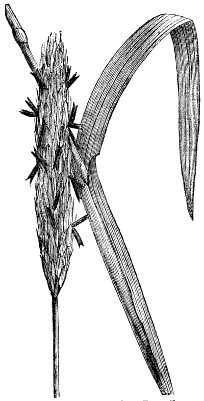
Fig. 13. The Meadow Foxtail.
The Meadow Foxtail (Alopecurus pratensis, fig. 13) is an early species of the spicate form—i.e., the flowers grow close together, into a more or less dense head. It yields a great quantity of herbage, especially in moist situations; and is particularly adapted for the irrigated meadow. It should be distinguished from the A. geniculatus (Kneeling Foxtail), whose spike is only about half the length and size, as this is particularly a water species, so that if found when a meadow is dry, it is yet an evidence that water must have lain where it occurs for a considerable period of the year. Also from the A. agrestis (Slender Foxtail), which has a longer and thinner spike, as this latter is a weed in poor hungry clays, which is useless except as serving to indicate that the land wants perhaps both drainage and manure. Here, then, our first genus presents us with species indicating the varied conditions of rich meadow, wet places, and poor arable; and it is this variableness in adaptability that makes the grasses such important indicators of the nature and condition of soils.
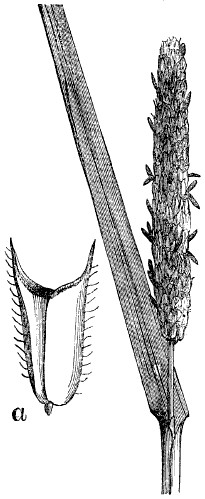
Fig. 14. The Catstail Grass.
The Catstail Grass (Phleum pratense, fig. 14) in general form is not unlike the preceding, but it is much rougher in all its parts, and is one of the latest instead of one of our earliest species. Its name of catstail is due to its rough flowers, an enlarged drawing of one of which is given at a. It has also got the name of Timothy Grass, from one Mr. Timothy Hanson, an American, to whom, probably, is owing its first introduction as a “self-crop,” large fields of this useful species, mostly by itself, being grown in Canada and the States as a fodder plant. It is very useful in the meadow, as supplying a late crop of stems and leaves; greatly augmenting the amount of herbage in some of the colder though not poor districts.
We have never seen this grass used as a self-crop in England, but we are convinced that on some of the rich alluvial flats, as in the lands reclaimed from the Severn, and warp soils in general, it would yield a large bulk of good feeding matter, which, though somewhat rough, would yet mix well with clovers, &c., in chaff-cutting.
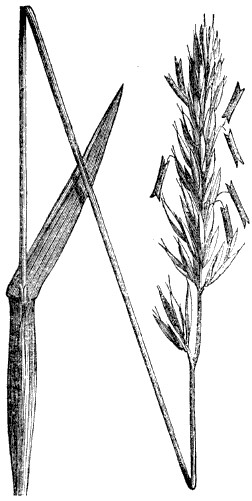
Fig. 15. The Sweet Vernal Grass.
The Sweet Vernal Grass (Anthoxanthum odoratum, fig. 15) is a very early species, with a somewhat lax spike of flowers, which usually become of a bright straw-colour by the time the hayfield is ripe for the scythe. It does not yield much bulk, but its grateful bitter when fresh, and the peculiarly sweet hayfield odour which it yields on drying, would seem to make this grass of importance, from the flavour which it imparts to the produce of the field; indeed so much so, that much of the value of natural meadow hay over that of artificial pasture may be traced to the presence of this grass.
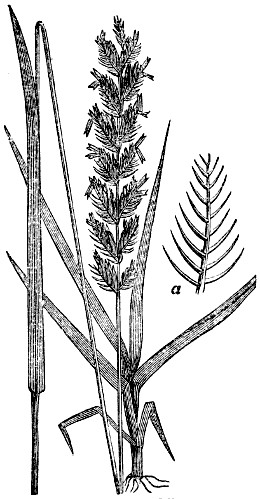
Fig. 16. The Crested Dogstail.
The Crested Dogstail (Cynosurus cristatus, fig. 16) has its florets arranged in front of a series of abortive branches, as represented at a, enlarged. It has a very slender stem, which is hard and wiry when ripe—a condition which it so universally attains, even in spite of constant depasturing, that we never recommend its use in mixtures for permanent pasture, as its stems are particularly innutritious, and its herbage is so small as to be of little value. It never prevails much in our best pastures.
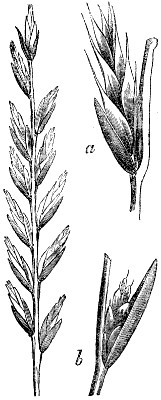
Fig. 17. Rye Grass, or Ray Grass.
Rye Grass, or Ray Grass (Lolium perenne, fig. 17), has no connection with the Cereal Rye. It is one of our commonest and most useful species, both as a plant for the natural meadow or for arable culture, especially in mixture with clovers, which has the name of “seeds.” It yields good bulk for the rick, and will so readily grow after cutting or close depasturing that it commonly affords the greater part of the herbage of a pasture. From being so valuable, its seed has been much cultivated; and as it has a tendency to form more or less permanent varieties, so we find in the market several different sorts; as “Pacey’s, Ruck’s, Russell’s, Stickney’s, Rye Grass,” &c. It should always form part in any mixture in laying down permanent pasture, in which case it should be distinguished from the Lolium Italicum, the florets and seeds of which are awned-pointed, as at a. This latter is useful as an annual self-crop, but seedsmen too often mix it in permanent-pasture collections, for the reason that it grows faster, and so makes a show the first year, and so satisfies the customer; but it soon dies out, while its large growth has kept under the more enduring forms. b represents a bunch of the tumid flowers of the Lolium temulentum (Drunken Darnel), once a pest in cornfields, but now, fortunately, of rare occurrence, if we are to believe the tales told of its so-called poisonous seeds.
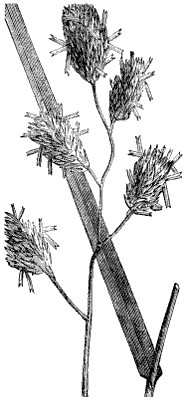
Fig. 18. The Cocksfoot.
The Cocksfoot (Dactylis glomerata, fig. 18), though a large and somewhat coarse grass, is by no means inferior in quality, its hay being highly nutritious, whilst its cut or cropped herbage is so quick of growth that it is capable of yielding a great deal of keep. It sends its root deep into the soil, so that it can grow well in poor land if dry; but it never flourishes in very wet situations. It is constant in good meadows, unless when they are always depastured, as there the constant treading greatly interferes with it: it is, therefore, by no means so abundant in sheep pastures; whence has arisen the idea with some farmers that “too much sheep-grazing wears out the richer grasses.”
We should always recommend cocksfoot as a part of mixtures for permanent pasture, taking care to well roll the meadow once or twice a year—a process of great importance—to keep the turf in an even pile, and so prevent that growing of large clusters or hassocks of one sort, a method of growth to which the cocksfoot is somewhat prone.
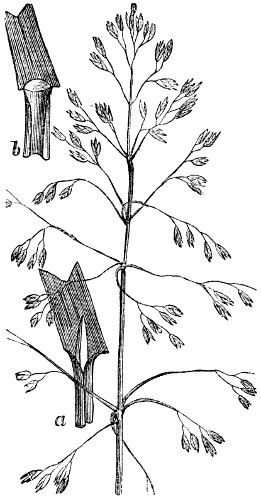
Fig. 19. The Rough-stalked Meadow Grass.
The Rough-stalked Meadow Grass (Poa trivialis, fig. 19) is a common species in moist meadows, where it often forms a considerable portion of the herbage: it is distinguished from the smooth-stalked by the long-pointed tongue (ligule) to the leaves (a), and a stem which is somewhat rough to the feel, especially when drawn downwards through the fingers. This grass yields a quantity of herbage, but our experience leads us to conclude that it does not possess quite so good a quality as Sinclair and authors who have copied from him would lead us to suppose, as we have found it wanting in feeding qualities, or what the farmer calls “proof.” It usually forms a large part of the hay of the irrigated meadow, which, though often large in quantity, is yet not equal to that of ordinary good meadows in feeding properties.
The Smooth-stalked Meadow Grass (Poa pratensis), distinguished by a blunt ligule (b) and smooth stem, is as abundant in dry situations as the former is in damp ones. We confess to a great partiality for this grass, notwithstanding that authors speak slightingly of its value; but the truth is, that it varies with soil and situation, it being a species which, when growing on a wild moor, is poor in both quantity and quality. But we know of no better sign of the improvement of a bad meadow than the increase of this grass, and its putting on, as it will do under such circumstances, of its richest green tint.
Poa nemoralis (Wood Meadow Grass) is a more slender form, whose wild habitat is in woods and shady places, especially on calcareous soils. This points it out as a useful grass for wood-glades and positions beneath trees, in which it may very properly be employed.
In laying down permanent pastures we should, then, employ these three poas as follows:—
Poa trivialis, for low, damp situations and irrigated meadows.
Poa pratensis, for sound dry pastures and uplands.
Poa nemoralis, for rides between woods, wood-glades, and shady places.

Fig. 20. Meadow Fescue.
Meadow Fescue (Festuca pratensis, fig. 20) may be taken as the type of the broad-leaved fescues. It is a common and good succulent grass in rich meadows, and should always be employed in seed mixtures for such situations, A variety, botanically known as F. loliacea, is unbranched, like the lolium or rye grass. The position of this is on rich river flats: we have seen it on the banks of the Isis at Oxford, forming a large part of most excellent herbage.
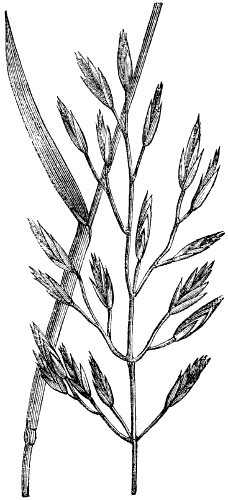
Fig. 21. The Tall Fescue.
The Tall Fescue (Festuca elatior, fig. 21) is a larger and coarser form of F. pratensis, as seed of the latter will become the former by being sown on some stiff sandy clays. It occurs abundantly on the stiff alluvial deposits of our estuaries and river flats. It is an exceedingly coarse grass, with a tendency to grow in large separate bunches; and hence its presence is destructive to good pastures: it may, however, be encouraged as a rough growth in its indicated habitats.
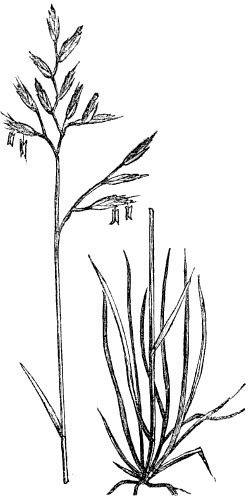
Fig. 22. Sheep’s Fescue.
Sheep’s Fescue (Festuca ovina, fig. 22) may be taken as the type of the small-leaved fescues. It is a native of our downs, and forms a large proportion of the sweet down sheep-pastures. It is known by its fine leaves, which come up immediately after the closest feeding; and if its quantity equalled its quality, it would be even more valuable than it is. A larger form, the Hard Fescue (F. duriuscula), is common to sound meadows and the hill valleys. This has much the same properties as the former, but it is taller, with longer and broader leaves. This should always be encouraged, and in laying down grass for permanent pasture, it should be plentifully added to the seed mixture.

Fig. 23. The Downy Wild Oat.
The Downy Wild Oat (Avena pubescens, fig. 23) is a common grass on thin calcareous soils. As it is very light in structure, and yields but little grass, it is not worth much as a first-rate pasture plant,—and indeed it would scarcely prefer to grow on them.
There is, however, a smaller-flowered species, the Avena flavescens (Yellow Oat-grass), which is better. It, too, occurs on chalky soils; while the Avena pratensis (Meadow Oat-grass) is found too frequently in poor clays or on starved moors, in which its rigid leaves and harsh structure render it little, if any, better than a weed.
One of the most interesting species of the genus is the Avena fatua (Wild Oat), well known as a weed in stiff arable soils. This is the parent of the crop oats in cultivation, and there is reason to know that by degeneracy the crop oat in some districts leaves behind a pest of wild oats.[2]
[2] See “Natural History of British Meadow and Pasture Grasses,” by the Author.
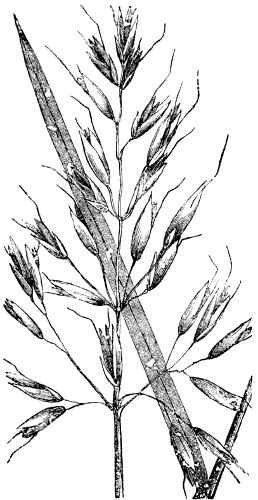
Fig. 24. The Oat-like Grass.
The Oat-like Grass (Arrhenatherum avenaceum, fig. 24), though a tall, succulent-looking species, is still too common in poor soils, as its herbage is bitter and nauseous, and not liked by cattle; and hay from it is always inferior in quality. It is sometimes recommended by seedsmen, and usually put with their mixtures; but we should at all times refuse it.
There is a peculiar form of this which occasionally occurs in sandy districts, called A. avenaceum, variety bulbosum (Onion Couch), the trivial name of which has been given from the fact that its nodes thicken below the soil, and present the appearance of small races of onions. This pest is got out of the land by harrowing and hand-picking; but as every bulb grows like joints of real couch, it is very difficult to entirely eradicate it.
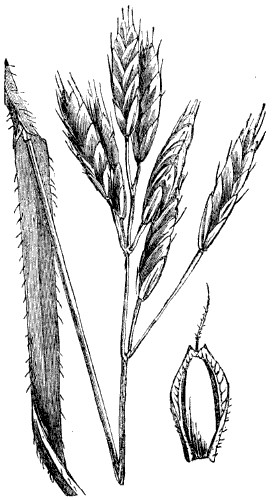
Fig. 25. The Soft Brome, or Lop Grasses.
The Soft Brome, or Lop Grasses (Bromus mollis, fig. 25), and its congeners, is an annual grass, and therefore very objectionable, whether in the meadow or in “seeds,” to both of which, when poor and neglected, it becomes attached. In both positions it is sometimes mixed with a kind that droops pretty considerably to one side; from which it has got the name of “lop.” From the meadow it is soon got rid of by manuring and depasturing; haymaking, though it cuts off the main stem, only encourages smaller ones to spring up late, and so the seed is sown. In “seeds” it is frequently mixed with rye-grass seed, as it too often occurs that a patch of rye-grass with much lop is seeded, as the most profitable way to deal with it, as its seeds are heavy and large, and therefore tell well, either by weight or measure. Our enlarged drawing of a seed with its envelopes is given to contrast with rye-grass seed, which is narrower and more pointed.
Within the last few years a species of brome grass, which was formerly very rare, has become a common weed: we mean the B. arvensis, Corn Brome-grass,—a species with smaller and more numerous heads of flowers than the one just described. This has spread with the growth of foreign seeds, and so suddenly has it appeared in some places as to cause farmers to come to the conclusion that poor cultivation has made the land spontaneously bring forth “a nasty sort of wild oat,” while others have even concluded that a cereal crop had been transformed into this grass.
The Bromus erectus (Upright Brome Grass) is very constant to poor calcareous soils. This is a perennial species, but very poor indeed in feeding qualities; however, it looks green in park-glades, and if kept down by rough stock, it may then be made useful.
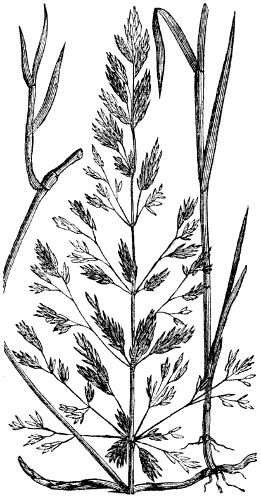
Fig. 26. The Bent Grass.
The Bent Grass (Agrostis stolonifera, fig. 26) is probably only a variety of the common marsh species, A. alba. Under the name of Fiorin Grass, this plant has been much extolled for the meadow; but our experience shows it to vary in value according to the nature of the position in which it is placed: as thus, in an irrigated meadow it sends up a large quantity of quite rich pasturage, whilst in poor or dry districts its herbage is hard and harsh, and not at all relished by cattle or sheep.
The form we have figured is more particularly agrarian where its creeping underground stem forms a kind of mischievous couch, and this, united with a tangled growth derived from shoots rooting above the ground, renders this one of the most pernicious weeds, especially in thin soils, on calcareous, brashy, or stony soils.
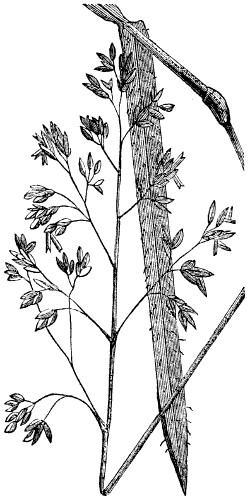
Fig. 27. Woolly Soft Grass.
Woolly Soft Grass (Holcus lanatus, fig. 27), though exceedingly pretty from its contrast in colour and form with its congeners, is still so worthless in point of feeding properties as to be little, if any, better than a weed. It is too abundant in some moist meadows; and where it forms a very large portion of the herbage, it speaks of poverty as well as wet, and would lead to the inference that a little draining, less frequent haymaking, and liberal doses of manure, would have a most decidedly beneficial effect.
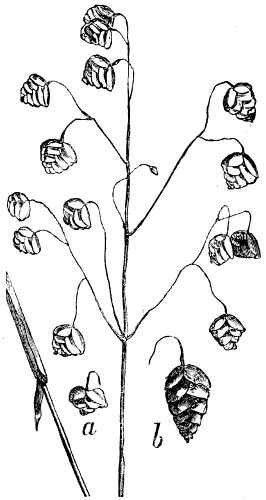
Fig. 28. Quaking Grasses.
Quaking Grasses (Briza media, fig. 28, B. minor, a, and B. maxima, b), though certainly amongst our pretty species, are all useless to the farmer. The common species is well known in all wet or poor clay meadows, and where very abundant we should usually make our calculations for something less than a ton of hay to the acre, and this would generally be late, and offer little aftermath. Like the preceding, its indications are want of draining, manure, and depasturing. If after the drains begin to act, sheep be folded upon a quaking-grass meadow, and fed with turnips, hay, pease, or cake, it will soon be eradicated. a, the smaller species, is an annual, and is only noticed here by way of distinction: its smaller and broader bunches of whitish, not purple, flowers, and rectilinear branches, will distinguish it from the common form. It is comparatively rare; but we have had some fine specimens communicated by H. C. Watson, Esq., from Thames Ditton. b is a garden specimen, remarkable for its larger flower bunches.

Fig. 29. The Hair Tussac Grass.
The Hair Grass (Aira cæspitosa, fig. 29) is commonly called hassock, or tussac grass, or bull-pates—names which its massive bunches of root-leaves clearly indicate the meaning of. Its leaves are so rough, with serrated edges, that cattle mostly refuse it, unless when very young. This grass is a never-failing indicator of wet,—so much so, that if a meadow be drained in which it abounds, the action of the drains is clearly indicated by its more or less gradual dying out. The quickest way, then, to subdue this large, coarse weed-grass is to drain, and then fold sheep upon the drying meadow: these animals tread the tussac grass into manure, which goes to feed the better species. By this means, not only this, but other rough or “sour” grasses are more quickly and more certainly removed than by spudding them out; and this leads us to remark, in concluding this chapter, that in the meadow there will usually be found growing together two sets of grasses, which may be designated as follows:—
a. Grasses more or less nutritious—sweet.
b. Grasses more or less innutritious—sour.
In a good meadow, the section a maintain the ascendancy, and so keep under those of b. In a bad meadow, the section b will be master, and so tyrannize over what would be better.
Perfect cultivation, then, of a meadow—for meadows should be cultivated—whilst it encourages the growth of good herbage, equally discourages the progress of the bad.
CHAPTER XI.
ON MEADOW PLANTS OTHER THAN GRASSES.
With the grass of the field will usually be found a large proportion of plants of a very varied, variable, and different kind. Of these, many are useful as augmenting the mass, and even improving the quality of a pasture; whilst, as others are altogether objectionable, we shall presently notice them under the head of “Meadow Weeds.”
Of the more useful adjuncts of the meadow we may tabulate the following:—
No.
Trivial Names.
Botanical Names.
1
Red clover
Trifolium pratense.
2
Zigzag clover
„medium.
3
White or Dutch clover
„repens.
4
Birdsfoot
Lotus corniculatus.
5
Yellow vetchling
Lathyrus pratensis.
6
Purple vetchling
„palustris.
7
Saintfoin
Onobrychis sativa.
8
Burnet
Sanguisorba officinalis.
9
False burnet
Poterium Sanguisorba.
10
Tormentil
Tormentilla officinalis.
11
Yarrow
Achillæa millefolia.
12
Agrimony
Agrimonia Eupatoria.
13
Plantain
Plantago lanceolata.
Some of the smaller Compositæ.
DittoUmbelliferæ.Of these, which are arranged pretty nearly in their order of merit, the clovers are by far the most important. These, as meadow plants, will usually be found under the following circumstances:—
No. 1. Plentiful in good, rich, sound meadows.
„2. Frequent in meadows on light sandy soils.
„3. On thin but good soil, upland meadows.
The clovers, and indeed the clover allies, Papilionaceæ, as a whole, are partial to lime,—so much so, that a dressing of this mineral to some fields in which clovers are scarcely represented will very quickly cause an accelerated growth of them; hence road dirt, when made from calcareous stones, as are the oolitic and mountain limestones, affords a good vehicle for the admixture of manures or ameliorators, such as guano, burnt ashes, soot, nitrate of soda, &c.
The following remarks upon these three clovers are from a paper by the author in the Bath and West of England Agricultural Journal, vol. x., part 2:—
1. Trifolium pratense—Meadow or Broad-leaved Clover—in its wild state is too well known to need any lengthened description. A careful examination of field specimens will show that even in the wild state this plant is liable to run into numberless variations; thus, we may have the leaflets of one plant broad and almost obcordate at the extremity, whilst others will be more or less ovate and lancet-shaped. In some we may see dense heads of purple flowers, varying in shade until almost white, whilst less dense heads of flowers and general variations in height, size, and luxuriance of the whole plant, are all circumstances in the natural history of this species in the wild state, which will prepare us duly to understand the nature of the many forms of the plant which are found in cultivation. Of these we have, besides others, English, French, American, and Dutch sorts, which differ in such minor details as a greater or less hairiness, or variations in the colour and size of the flowers, leaves, &c. The most important point connected with the broad-leaved clover is its permanency; some sorts scarcely maintaining a plant for two years, whilst others are said to be more or less perennial. This, however, is a matter which we conceive depends more upon the soil and the[75] kind of cultivation than upon the sort; for although all seedsmen supply two sorts, namely, Trifolium pratense and T. pratense perenne, yet they run so much the one into the other, that it is oftentimes exceedingly difficult to distinguish them. If, therefore, a farmer wants a good strain of broad clover, he should purchase his seed from seedsmen possessing judgment and character; for experience has taught us that a seed which may be all that is required in one district may result in next to a failure in another. Thus, clover-seed from the warmer parts of England does not succeed well when sown in cold, exposed positions; but that from the latter is improved on transmission to the former, whilst good changes are effected by the occasional use of foreign seed.
The sort known in the market as T. pratense perenne is probably intermediate between the wild species T. pratense and T. medium. Our own experiments have shown that, on cultivating T. medium, which is a sand-lover, in strong land, in three years it has been very difficult to distinguish it from some of the varieties of T. pratense. We incline, therefore, to the opinion that as the T. medium holds to sandy soils in the wild state, its seed was brought into cultivation with a view to light-soil cropping; and from this source has probably been derived the so-called T. pratense perenne, which variety is certainly more perennial in such light soils as would be quite unfit for the true T. pratense. The latter, indeed, seems to be more permanent in soils containing a quantity of lime, while the former, where it can be got of a good sort, is certainly best adapted for sandy soils.
2. Trifolium medium—Zigzag Trefoil—is distinguished from the T. pratense by its larger, but more lax, head of reddish pink (not purple) flowers, which are solitary, on the apex of a stalk, which at each joint is bent at a considerable angle; hence its name. Its leaflets are elliptical, and not broader at the upper margin. This plant is a constant denizen of sands and light soils. In fact, its naturally growing in soils unfitted for the broad-leaved clover seems to recommend it for cultivation; and though, as before pointed out, we more than suspect that the so-called cow-grass clover was originally derived from this source, and that the T. medium is after all but a variety of the T. pratense, it is now quite merged as a farm-plant into the broad-clover forms; so that, if we are to possess it as a separate plant, it must be again grown from the wild seed; and then, if it is to be kept pure, it must not be cultivated on clays or limestones, or, if our view be correct, it will soon lose its true distinctive character.
3. Trifolium repens—White Dutch Clover—has been long in cultivation[76] throughout Europe and America. It is one of our commonest native plants, and appears to have become less changed by cultivation than most other plants; yet there is reason to think that with careful selection a much improved strain may be brought about. In pastures an immense accession of Dutch clover is often seen to follow some kind or another of top-dressing, especially of lime, old mortar, or town rubbish. This is accounted for by the fact that this clover is in reality of universal occurrence; and its creeping habit of growth, besides seeding, causes it soon to make a rapid increase where its conditions of growth are made suitable. As an agricultural plant its position is in light soils, for which it is usually mixed with other clovers and grasses in varied proportions.
4 and 5 are often found scattered in meadows, though not usually in any abundance in those of the richer kind; still, in laying down land for permanent pasture, there can be no objection to a small admixture of their seed.
6, the Purple Vetchling, though local in rich river pastures, is yet a good plant, and might perhaps be advantageously brought out as an addendum to mixtures designed for good lowland positions.
7, Saintfoin, is a good pasture plant for chalks and limestones; and in laying down land for permanent pastures in such position, should not usually be omitted. It is also a good species to sow on railway banks, not alone for the beauty of its flowers, but for the binding effects of its deeply-diving roots.
8 and 9, the Burnets, will be found,—the true in rich damp bottoms and on river flats, the false on dry, calcareous soils. They are neither plants that we should care to grow; but in their wild state in their respective pastures we should, on the other hand, not be inclined to make war against them as weeds. The same opinion, indeed, might be briefly expressed as regards Nos. 10, 12, and 13. In fact, the whole here grouped may be said to possess more or less bitter and astringent qualities, and so become useful in checking the vapidity which is sometimes found in purely grass herbage.
11, the Yarrow, should be encouraged in most pastures, as it not only possesses the qualities just mentioned, but its leaves are so small and its stems and flowers so easily dry when cut, that there is no chance of its smothering out the grass in growing, or of its retarding the process of haymaking. It also bears constant nibbling with sheep, which are remarkably fond of it, without injury, as it rather becomes finer for being depastured.
12. The larger composite plants, as dandelion, the hawkweeds, blackhead, &c., are, from their coarseness and the room they take up, highly objectionable; but the yellow hawkbits, thrincia, and the before-mentioned yarrow, are by no means objectionable.
13. The above remarks will equally apply to the Umbelliferæ. Large plants like the cow-parsnip and common beaked parsley are objectionable from their size and want of feeding properties, whilst the small pimpinella and earth-nut do not offer these objections. Here, however, it must be confessed that we are bordering on the domains of weeds in pasture, to which we must devote a separate chapter.
CHAPTER XII.
ON THE WEEDS OF PASTURE.
“Weeds in pasture!” said an old farmer friend; “I thought hay and grass was all weeds.” This, which is by no means an uncommon notion, sufficiently explains the want of care in the cultivation of the best kinds of meadow produce, which can only be effected by the destruction of what is useless or mischievous.
Now, if we proceed upon the assumption that the best kinds of meadow are remarkable for the possession of little else than the best kinds of the true grasses, we shall see that pasturage should, in the main, be composed of good grass-growth, with only some few other plants which may be capable of augmenting quantity, by their nutritive matter, giving flavour, or improving quality.
It follows, then, that all plants having none of these requisites must be, to all intents and purposes, only mischievous weeds; as thus a large useless plant in a meadow, as in an arable field, must not only occupy the space that would be better taken up by good plants, but it appropriates a large quantity of food to the prejudice of the better crop.
Viewed in this light, then, what a mass of weeds some of our pastures will be found to contain! In fact, what with useless plants, other than grasses, and coarse, sour, or useless grasses themselves, we meet with so-called meadows to which the terms of “barren moor” or waste land would be especially applicable.
The following table is offered as an attempt at the classification of the weeds of pasture, the different divisions of which we shall presently describe in the order of their arrangement.
TABLE OF PASTURE WEEDS.
1.
Plants which take up space but yield no Produce.Trivial Name.
Botanical Name.
Remarks
Broad-leaved Plantain.
Plantago media
-
The leaves of these plants grow too close to the ground to be eaten off by cattle or to cut for hay.
Dent-de-lion
Leontodon taraxacum
Daisy
Bellis perennis
Cowslip
Primula veris
-
These plants take up much room in growing, they are not eaten by cattle, and, as they die before haymaking, yield little or nothing to the rick.
Primrose
„vulgaris
Green-winged Orchis
Orchis Morio
Early Purple Orchis
„mascula
2.
Plants which take up space, but simply dilute the hay with useless matter.Blunt-leaved Dock
Rumex obtusifolius
-
All common, especially in damp meadows, are not usually depastured, and have little or no feeding properties when made into hay.
Crisp-leaved Dock
„crispus
Marsh Dock
„palustris
Field Sorrel
„acetosa
Burdock
Arctium Lappa
-
Common about the borders of fields.
Butter Burr
Petasites vulgaris
-
Common near water courses.
Cow Parsnip
Heracleum Sphondylium
-
Very common and unsightly in pastures.
Wild-beaked Parsley
Anthriscus vulgaris
Ladies’ Smock
Cardamine pratensis
-
In damp places.
Yellow Rattle
Rhinanthus crista galli
-
In poor cold clays.
Larger Hawkweeds, &c.
Hieracium species
-
About fields in upland districts.
3.
Mechanical Plants, those with Spines, Prickles, Stings, &c.Musk Thistle
Carduus nutans
-
Mostly a weed in “seeds.”
Welted Thistle
„acanthoides
-
In hedgerows, borders of fields, or the open meadows.
Creeping Thistle
„arvensis
Cotton Thistle
„eriophorus
Spear Thistle
„lanceolatus
Marsh Plume Thistle
„palustris
-
Damp or marsh meadows.
Meadow Plume Thistle
„pratensis
Stemless Thistle
„acaulis
-
Common to poor calcareous uplands.
Carline Thistle
Carlina vulgaris
Common Stinging Nettle
Urtica dioica
-
About the homestead, corners of fields, &c.
Smaller Stinging Nettle
„urens
Wall Barley
Hordeum murinum
-
About sandy soils, both in the meadow and arable.
4.
[80]Poisonous Pasture-weeds, &c.Meadow Saffron
Colchicum autumnale
-
Usual in calcareous soils or marls.
Upright Buttercup
Ranunculus acris
-
In damp meadows.
Diseased Grasses
Secale cornutum
-
In places where mist and damp prevail.
5.
Ill-favoured Weeds or Plants which communicate bad flavour to Produce.Crow Garlic
Allium vineale
-
More or less in meadows and corners of fields.
Hogs’ Garlic
„ursinum
Jack-by-the-Hedge
Erysimum Alliaria
-
About the hedgerow.
6.
Useless Grasses, or Grass-like Plants.Rough Grasses
Species
-
Poor land and wet places.
Sedges
Species
-
In boggy, marshy, or wet sandy spots.
Rushes
Species
-
In sandy spots on clays and poor soils.
1. Taking the broad-leaved plantain as the type of this list, we shall have no difficulty in estimating the amount of mischief which it does. Here is a plant, a single specimen of which not unfrequently occupies nearly a square foot of ground, and as its leaves grow close to the soil, it effectually prevents the growth of the grass, while few, if any, leaves are cut with the scythe. The bare patches which result from the cutting up of plantains from a lawn will sufficiently establish the first position, whilst, if one occasionally meets with a few of the leaves cut off in haymaking, it commits the further mischief of being so long in drying as to retard the process of haymaking, or else to endanger the safety of the rick. It is on account of this that the plantain has in some districts got the name of the “Fire Grass.”
These are easily removed by the spud, especially if a little salt be added to their crowns.
2. Taking it for granted that grasses are for the most part the best plants for pasturage and hay, it follows that the plants of this list can only be weeds, from their taking up space and living at the expense of the wished-for crop, when, after all, the produce is either useless, or so inferior that the whole product of the field is vitiated by their presence. The best way to eradicate these and other large-leaved and tall-stemmed plants is to pull them early in the season—the true theory being, that by the repeated destruction of the leaves the rootstock ultimately decays. Close depasturing also keeps them under for the same reason, as the feet of horses and cattle so damage the leaves as to ruin the growth and progress of the other parts of the plant, which latter are requisite for its continuance.
3. Added to the evils just adverted to, this group is injurious from its adverse mechanical appliances in spinous leaves, stings, and the like. As regards thistles in pasture, they certainly argue great neglect, as they may be so readily spudded out, in which the individual is destroyed, and all hope of its progeny. It is, however, the fact that these plants are sometimes left to seed that makes the matter of destruction appear so hopeless, as the winged seeds of thistles may even find their way to a clean farm from a dirty one, and roadsides and waste places are constant sources of annoyance from this cause.
So fast has the corn thistle increased in Tasmania, as to make the people groan under a “plague of thistles,” for which they have invoked the aid of special State legislation.
The spud should be kept in active operation in the field, so as to prevent these plants seeding, or indeed at all occupying any space; and roadsides and waste places should be freed from these pests, either as part of the duties of some public servant, or else as a matter of private necessity.
As an illustration of the fecundity of thistles, we append the following estimate of their seeding powers:—
SEED-DEVELOPMENT OF THISTLES.
Name.
Seeds to a
single plant.
Description.
Musk thistle
3,750
150 seeds to a single flower-head.
Spear thistle
30,000
300 seeds to each.
Corn thistle
5,000
This plant also increases by creeping underground stems.
Stemless thistle
600
This is sometimes so thick on the downs that we have seen its flying seeds almost like a snowstorm in quantity and whiteness.
Farmers, however, mostly refuse an early summer attack both upon thistles and nettles, quoting the following rustic rhyme for their neglect:—
If thistles be cut in April, They appear in a little while; If in May, They peep out the next day; If cut in June, They reappear very soon, If in July, They’ll hardly die; If cut in August, Die they must.
The truth is, that with spring-time they will bud forth again, but always in a weakly condition. However, towards August the thistle has performed all its functions for the year, and so prepared its larger rootstocks for the future season; so that he would not be altogether so mad who, in reference to the cutting of thistles and nettles in August and September, should say—
Kill a fool’s head of your own; They’ll die of themselves if you let them alone.
Beating nettles in the early part of the year with lithe ash sticks is more effectual than the cleaner cut with the scythe, as the injuries are not so easily got over.
4. That there are many plants in pastures which if eaten exclusively would act as poisons we can have but little doubt, but there are a few which would seem to be dangerous, even when partaken of in grass mixtures. Of these, the meadow saffron is one of the most powerful.
This plant is abundant on the oolitic rocks of the Cotteswolds, about which range we constantly hear of mischief from it. We extract the following from a Cheltenham paper for September, 1844:—
It is only a few days since a farmer at Eyeford, near Stow-on-the-Wold (Gloucestershire), had ten calves killed by eating of the flowers of the colchicum, and two or three years since three cows were destroyed by this plant in flower in the same neighbourhood, whilst we frequently hear of many accidents to cattle in the spring from eating the leaves, although it is sometimes refused by them on account of its bitter and nauseous taste. Yet there is no doubt but that accidents would be still more frequent were it not that farmers keep their cattle from the meadows in which it occurs in any quantity during the spring and autumn months.
Pulling the leaves of the meadow saffron or colchicum will destroy it; but a much more simple remedy is that of a thorough rolling with a Croskill at the season when the flowers begin to expand, and again when the broad leaves come up in spring; this so crushes and bruises the whole plant, that a season or two of such treatment will be enough to keep it under, if not to destroy it outright.
As regards the buttercups, the most acrid one—viz., the upright tall species, a constant plant in marshy meadows and wet places—is the only one to be particular about. Cattle do not usually eat it, but it finds its way into the hay, and there is reason to think to its prejudice. It is to be got under by draining and close depasturing, so that by treading down it shall not seed; but poverty, induced by frequent haymaking and wet, by keeping under the growth of what is better, gives greater facility for the success of trash of this as well as of other kinds.
Ergotised grasses, by which we mean those affected with the black spur, in the place of the seed, or grain, is a common affection of grasses in autumn in low-lying or in damp places, or where fields may be enveloped in mist, as on some of our hill-ranges. This black spur is largest in the cereal rye, but it occurs in most other species of grasses, differing according to the size of their seeds.
Ergot of rye is used medicinally, and there is little doubt but that ergot in other grasses is equally active. Its effects seem to be to favour abortion; and there is reason to believe that it has caused many valuable animals to abort. Some few years since the late Earl Ducie suffered a loss of calves to an extent which he calculated to equal as much as £1,000 in one year; at that time the grasses, consisting mostly of the perennial rye-grass, were submitted to our inspection, and they were much affected by ergot.
Keeping the cattle away from meadows known to present much of this affected grass is the best remedy; but this will seldom be necessary, except in unusually wet and warm seasons, which are sure to produce these fungoid affections.
5. All the plants in this section are known to give a garlic-like flavour to the dairy produce of the fields in which they grow. The two first especially render butter unfit for market; so that if abundant they would take off a large portion of the value of the field. They occur mostly in patches, and should be pulled out as soon as strong enough: if this be done year by year, it will be found to diminish in an increased ratio; and two or three seasons will be enough to rid the field of so great a pest, and would be well worth doing if it cost much—which it ought not to do—as these weeds usually occur in otherwise tolerably good meadows.
The jack-by-the-hedge is usually confined to the vicinity of the fences, and may be removed by the hand or spud. It is a prolific seeder; so that on no account should it ever be allowed to ripen its seed.
6. Rough grasses and grass-like weeds are far too common in poor, wild, and neglected pastures. In their action they come closely to those of our second section; they are indications of a want of drainage, which operation well performed soon causes the death of this group, which end is greatly facilitated by manuring and depasturing as the drains begin to act.
In concluding this description, it may be well to remark that many more plants might have been included in the different sections; but enough has been done to show that a pasture, to be good, must not consist of any plants which chance, accident, or more commonly neglect, may throw together. In arable culture one-half the expense is, in one way or other, connected with weeding, and we are of opinion, that if only one shilling per acre was spent on the weeding of pasture, it would yield 300 per cent. profit on the outlay.
CHAPTER XIII.
ON THE IRRIGATED MEADOW.
Irrigation, as a means of increasing the amount of pasturage, is so important a process that it may be well to describe it in this place.
For a perfect irrigated meadow, we should have full command of water whenever it may be required. This water should be capable of flowing through, not of pouring over, and standing on the land,—this latter being flooding. The drainage should be so perfect that the land will be sound enough for us to walk over in the dry in a few hours after the water has been turned off.
Where these conditions can be secured, irrigation will be found most useful, not only in augmenting the supply of grass, but in producing it so much earlier than in the higher meadows that the farmer hereby gets a fresh green pasture, of great utility, especially in fattening and bringing on early lambs. From these circumstances it follows, that although some land is occupied in the water-conduits, yet the value is so far increased that meadow at 30s. per acre before irrigation has, under one’s own eye, become worth £5 per acre in four years. There are, however, some necessary expenses in setting out the work, making floodgates, &c., the extent of which will of course depend upon the nature of the ground. In Gloucestershire, on the banks of the Churn, where irrigation has been successfully carried on for years, there is a permanent cost of about 6s. an acre for keeping the works in order, and charges of the “drowner,” the name given to the man who overlooks the works, in some instances of several proprietors or tenants.
A peculiarity in irrigated meadow of the best quality is, the general absence of coarse grasses on the one hand, and of any plants other than grasses on the other; hence, then, good succulent and nutritious herbage is the rule, and anything that can be otherwise described is the rare exception. Indeed, so much is this the case, that a bit of coarse grass—such, for instance, as Aira cæspitosa (Tussac Grass)—making successful growth in any part of the meadow, is at once an evidence of a stagnation of water at that spot—a condition that a clever drowner at once looks to when he has discovered it.
As an evidence of the changes which go on as the process succeeds, as well as of their nature, we give the following as the tabulated result of the irrigation of half of a meadow whose slope was too great to allow of the whole being operated upon. From these it will be seen that the proportionals of different pasture plants before and after irrigation offer a material change; and it may be added, that in some cases, what would otherwise be a bad and useless grass, may become succulent and useful from the beneficial action of water. One of this kind is the Agrostis stolonifera (Fiorin Grass), which is in arable couch-grass weed, but in the irrigated meadow it becomes of a fine green colour, is nutritive in quality, and will bear with any amount of clipping. It may here, too, be remarked that in cases where only a part of a meadow can be irrigated, good accrues to the whole, as in depasturing the whole is ranged over by our cattle and sheep.
We here give the following
TABLE OF CHANGES IN GRASSES AND OTHER PLANTS UNDER IRRIGATION.
Trivial Names.
Botanical Names.
Before
Irrigation.
After 2 Years’
Irrigation.
After 4 Years’
Irrigation.
Meadow Foxtail Grass
Alopecurus pratensis
1
2
3
Field Meadow Grass
Poa pratensis
2
3
4
Rough-stalked ditto
„trivialis
1
2
1
Quaking Grass
Briza media
2
0
0
Dogstail Grass
Cynosurus cristatus
2
1
0
Hassock, or Tussac Grass
Aira cæspitosa
1
0
0
Marsh Bent
Agrostis stolonifera
1
2
3
Cocksfoot Grass
Dactylis glomerata
1
2
3
Yellow Oat-grass
Avena flavescens
2
3
3
Soft ditto
„pubescens
1
1
1
Meadow Barley
Hordeum pratense
1
2
2
Perennial Rye-grass
Lolium perenne
2
4
6
Meadow Crowfoot, or Buttercup
Ranunculus acris
1
3
1
Bulbous ditto
„bulbosus
3
1
0
Narrow-leaved Plantain
Plantago lanceolata
3
1
1
Broad-leaved ditto
„asiatica
3
0
0
Dutch Clover
Trifolium repens
2
0
0
Broad Clover
„pratense
1
2
2
Common-beaked Parsley
Anthriscus vulgaris
1
2
1
The general conclusions from this table are, that large and innutritious herbage is, for the most part, destroyed by irrigation, and its place is supplied by grasses; hence, then, the increased value conferred by the regulated action of water is due to an increase in quantity and quality of the grasses, added to a much more certain, as well as early, production of these. Of course the districts best adapted to irrigation will be valleys of denudation, the centres of which are occupied by more or less copious and rapid streamlets. Some of these valleys in the Cotteswolds having been scooped out of the oolitic freestones, have left the spoils of the rock as a gravelly deposit, sometimes on the lias, at others on the fuller’s earth, and then on the Oxford clays; so that, stiff as these soils would be by themselves, they now only tend to throw out the waters by natural drainage, which are again conducted over the porous gravels through which they flow with great regularity; thus fertilizing what would otherwise be but a scanty thin-soil herbage, and to such an extent that early depasturing, haymaking, and later pasturage (lattermath) are the rule year by year.
These circumstances make water-rights of great value, and which, if not in possession, are secured at a fixed charge per acre; this, however, is usually included in the expenses, which, as before stated, are covered by about 6s. per acre.
Before concluding this chapter, we must say a few words in reference to flooded meadows. These will be found on the banks of the larger rivers or on streams of sufficient importance to be called rivers, as distinguished from brooks or streamlets. Here the flooding is caused by the water overflowing the banks, as the result of sudden thaws or an unusual quantity of rain. Here then the flood is not under control, and as it may happen at any and all times of the year, the grass may be spoiled by being covered with silt and drifted materials, or even the hay may be carried away by the flood.
These river flats, then, have seldom the requisites for carrying on irrigation, although the waters are of course more abundant than those supplied by the smaller streams; for even if we could by embanking so far control the water as to get it over the field when we might wish, yet alluvial flats like those of much of the Thames and Severn would not readily drain.
From facts like these it will at once be seen that there is a wide difference between irrigation and flooding; and we have hence endeavoured to separate what is too often confounded.
CHAPTER XIV.
ON THE LAYING DOWN OF PERMANENT PASTURE.
If we reflect upon the fact that much of the meadow of Great Britain is ribbed by the ridge and furrow of former arable culture, we shall conclude that the laying down of land to permanent pasture is an ancient no less than a modern process.
Formerly new pastures were made by sowing the collected seeds from a hayloft, but as in modern farming no one in his senses would let his grass get ripe enough for seed before cutting, present practice necessitates the mixing of such seeds as may be considered best in suitable quantities for our purpose. We shall have, then, in this place to consider:—
1. The preparation of the land;
2. The kinds of seed best adapted for different places; and
3. The after-treatment of the new meadow.
1. The plan usually adopted in a preparation for grass seeds is that of sowing our mixture with the barley crop. Now this, in the case of a tenant who is not sure of his tenure, would obviously recommend itself; but to a proprietor wanting a quicker and surer result it offers many objections.
We recommend, after turnips have been fed off on the land, to make the ground as level as possible, then harrow and roll smooth with an iron or wooden roller. Upon this surface our mixture should be carefully sown; then harrow with very light harrows just to cover the seed, and roll again.
By this plan you start the seeds in good soil instead of in that from which you have carried off a crop of ripened grass, straw, and seed; but besides this, your grass will get a stronger constitution than when grown as seedlings amid taller plants, which draw up the “seeds,” and thus make them so weak and attenuated as scarcely to be able to withstand the rigour of winter—a matter of great consequence when our object is to get a vigorously-growing swarth quickly.
2. We come now to consider the kinds of seeds which should be sown; these, though few in number, will yet vary according to soil and situation.
Our remark that few kinds of grasses are required in laying down for permanent pasture may surprise those who have seen the usual prescriptions for this purpose; but if we start in our selection by leaving out coarse grasses,—such, for instance, as Phalaris canariensis (Reed Canary Grass), for damp meadows; annual forms, or at least not permanent ones, such as Lolium Italicum (Italian Rye-grass); and useless varieties, as Poa nemoralis sempervirens, Phleum pratense majus, and the like,—we shall be then confined to as few species of grass as we shall ever find will form the best parts of our best meadows.
Now, as regards sowing useless or annual species, we should recollect that the better they come up the more mischief they create, as they take up the room that the more permanent forms should occupy, and so smother them out. How often have we seen our friends in ecstasies at the success of their new pasture, when the smiling face had been suddenly put upon the matter by the quick-growing Italian rye-grass having taken a possession, which, however, in a year or two it would most probably yield; and so it has happened, that while the seedsman has been advertising a certificate vaunting of success, the pasture is declining, and the proprietor, looking for the reason for such a result, either himself concludes, or is led so to do, that as the seeds came up well, these were not in fault: it must then be the nature of the soil!
In giving such directions for grass mixtures as experience would seem to warrant, we confess to a great deal of diffidence; for as scarcely two cases are alike, the difficulty is as great as would be that of a medical man prescribing for his various patients without seeing them; indeed, to profess to do so in either case, as a general rule, savours somewhat of quackery.
The following tables, then, it must be understood, are only meant to convey some very general notions as to sorts of grasses and other fodder plants, and their quantities, which we should employ under the specified conditions of soil; albeit, even the quantities should be variable, depending upon the quality of the seeds, the season, and the climate in which they are to be sown:—
1.
Proposed selection for rich loams in best grass-growing positions.Botanical Name.
Trivial Name.
Quantity
Per Acre.
lb.
oz.
Lolium perenne
Perennial Rye
10
0
Poa pratensis
Meadow Grass
2
0
Dactylis glomerata
Cocksfoot
5
0
Festuca pratensis
Meadow Fescue
3
0
„duriuscula
Hard
„3
0
Alopecurus pratensis
Foxtail
2
0
Phleum pratense
Catstail
2
0
Anthoxanthum odoratum
Sweet Vernal
0
8
Trifolium pratense
Common Clover
4
0
„repens
Dutch
„2
0
2.
Proposed selection for a poor stiff soil on a clay subsoil.Lolium perenne
Perennial Rye
12
0
Poa pratensis
Smooth Meadow Grass
3
0
„trivialis
Rough
„ „2
0
Festuca loliacea
Lolium Fescue
2
0
„duriuscula
Hard
„2
0
Phleum pratense
Catstail
2
0
Dactylis glomerata
Cocksfoot
6
0
Anthoxanthum odoratum
Sweet Vernal
0
8
Trifolium pratense
Common Clover
6
0
„repens
Dutch
„2
0
3.
Proposed selection for thin uplands on calcareous soils.Lolium perenne
Perennial Rye
12
0
Poa pratensis
Smooth Meadow Grass
4
0
Festuca ovina
Sheep’s Fescue
2
0
„duriuscula
Hard
„2
0
Avena flavescens
Yellow Oat-Grass
1
0
„pubescens
Soft
„1
0
Anthoxanthum odoratum
Sweet Vernal
1
0
Trifolium pratense
Common Clover
3
0
„repens
Dutch
„5
0
Achillæa millefolia
Yarrow
0
8
4.
Proposed selection for light soils on sands.[96]Lolium perenne
Perennial Rye
14
0
Poa pratensis
Smooth Meadow
3
0
Festuca duriuscula
Hard Fescue
3
0
Avena flavescens
Soft Oat-Grass
1
0
Anthoxanthum odoratum
Sweet Vernal
0
8
Trifolium medium
Zigzag Clover
4
0
„pratense
Meadow or Corn Clover
2
0
„repens
Dutch Clover
5
0
Lotus corniculatus
Birdsfoot Trefoil
0
8
Achillæa millefolia
Yarrow
0
8
The above positions may so far be considered to present generic types of land which would be laid down in permanent pasture in the ordinary course of farming. Selections for park glades, covert, and the like, are exceptional, which must be provided for according to circumstances.
We should advise care in the selection of these seeds; the newer and fresher they are the better, as, perhaps, no seeds suffer more from keeping than do those of the grasses. And we would further add that, as a rule, we should prefer to procure our seeds separately and mix them ourselves: for this we should expect to have more to pay at most houses, but they will be much better. Of course, in all such strictures about seeds, we mean them to apply only to those who are not sufficiently particular to keep from trade tricks, or who do not observe that care in selection and mixing that would be necessary to ensure the fullest amount of success; for, as we are well aware that seeds, however old or worthless, are seldom destroyed, we should expect to have some of them sold to us if we did not look to the character, position, and judgment of our seedsman on the one hand, and be prepared to go to such, and so pay a fair price, on the other.
[2] See “Natural History of British Meadow and Pasture Grasses,” by the Author.
One of the most interesting species of the genus is the Avena fatua (Wild Oat), well known as a weed in stiff arable soils. This is the parent of the crop oats in cultivation, and there is reason to know that by degeneracy the crop oat in some districts leaves behind a pest of wild oats.[2]
We will now suppose that the seed has come up regularly, and so must describe the after-treatment. In the first year it will be all-important to look after weeds: should these make their appearance, it will be well to hoe or spud them out at once before they can seed, as then the grass will not only have a better chance, but little provision will be left for weed-continuance.
In the following winter, say about January, if the weather will suit, a slight but even dressing of not over-rotten manure will act as a protection to the young plants, and provide food for their spring growth by its gradual decomposition and mixing with the soil.
Towards the latter end of February, or early in March, bush-harrowing should be employed to break up and disseminate the manure, and then the roller should be actively used to consolidate the whole; and, if the grasses have at all thrown out, the croskill will prove a most efficient implement. In the following May we should stock with sheep just thick enough to prevent any extent of seeding; and if the next year should show vacant spaces, which it would be likely to do from failure or wire-worm (the latter will be less than when corn is grown), we must re-sow, mixing our seeds with a little mixed guano and soot.
These, then, are some of the simple rules upon which to act in growing a permanent pasture; and the more rigidly they are kept to at first, the sooner and the more perfect will our meadow assume the aspect we should desire for permanency.
CHAPTER XV.
ON THE MANAGEMENT OF PERMANENT PASTURES.
However good our meadows and pastures may be, it is but natural that we should wish to keep them in good condition, and, if not so good, our object should be to improve them.
We have already adverted to weeding as a requisite in the improvement of meadow; we are equally clear upon the subject of draining. On both of these points, however, we have met with opposition. The farmer who considers that all is hay that he can get together in a rick, may look more to mass than quality, though even here we are inclined to think that if we take hay and pasture together, the more grasses and the less of rubbish we can get a field to grow, the greater will be our produce in quantity and quality.
With regard to draining, we are told that it takes the goodness out of the meadow; but if we have a meadow on clay—we will suppose lias or Oxford clay,—with only a few inches of a stiff soil at the surface, we shall find that those few inches are the only available root ground. Drain, and then we shall soon see that air will follow the water: this united, air and water will decompose plant-feeding matter never before reached.
Now, where the mistake has been made is, that from this time the herbage gets less and less coarse, and perhaps in some seasons would not produce the weight of hay; but what there is both of hay and grass would be much improved, and would become capable of carrying better stock.
The following reply[3] of Mr. Bailey Denton to some objectors to draining in Middlesex is, we think, much to the point on this important subject:—
Mr. Denton stated that he had been recently over the estate of Lord Northwick, near Harrow, in company with the noble lord and some friends and tenants. On that occasion the question of the reluctance of hay farmers to drain the land was discussed, and the farmers said that as they always had a great deal of custom in London for hay, of whatever quality it was, they did not seek so much for quality as for quantity, and consequently did not think it worth while to drain the land for feeding purposes, although they admitted that draining made the herbage sweeter and better for cattle. The present system, under which the grass-land of the Harrow district had been cultivated for many years, alike impoverished the hay farmers and the land; and he was of opinion that if drained, the latter would produce grass of a much better quality, and equally as much in quantity. He thought a good plan would be to feed off part of the land and put the other into hay.
[3] Discussion Royal Agricultural Society, March 21, 1863.
If asked what would be our criteria as to the necessity of draining, we should say stagnant water at any time.
Plants, however, afford evidence to be depended upon; as thus take the indications of a few weeds common to wet meadows:—
Sedges
-
Show a want of thorough drainage.
-
Full drainage certainly required.
Rushes
Bull-pates and other coarse Grasses
-
Devil’s-bit Scabious
Perhapspartial or grip drainage may do.
Buttercups (R. acris)
Lousewort
-
Perhapsless haymaking and more manure is indicated, and draining
maybe done without.
Field Orchids
Cowslips
Moss
Now, as regards very wet meadows, it is found that they are seldom if ever manured; for, just as I was told as regards some of the low lands on the banks of the Yeo, in Somersetshire, that it did not pay to manure them; so one might easily imagine that where the land is full of water, and perhaps of moist humus, manure would not tend to the increase of good grass, though it might to that of thistles and buttercups.
Meadows that are sufficiently sound to yield tolerable hay are too much worked to this end, and are, we think, getting poorer. The Cheshire pastures offer a good example of the effects of greed in this matter. A century ago we feel sure its grass-producing powers were far beyond what they are now. Grass is gone in hay and bones and cheese, but for generations the farmer has gone on depasturing to make manure; but as it will be seen, on reflection, that cattle can only deposit as manure, matter which they have taken from the field and converted into manurial substance, they cannot add any new material: so then this method of restoration must fail at last. Another restoration employed in this county was that of using their salt as a top-dressing. This, as it killed all the coarse grass, and so converted it into manure, recovered the pasture, by, out of bad and rough grass, growing good ones; but this too would fail in time. Hay, the framework of growing cattle, and cheese, have gone on converting the phosphates and the bone matted of the soil into their substances, and it is now found that returning this in the shape of bones and superphosphates is rapidly effecting an improvement.
Hence, then, we would recommend less of greed in haymaking. Do not ripen the grasses too much before cutting. Don’t trust to grazing for restoring the phosphates and other ingredients of the hay, but bring them in the shape of manure.
Use heavy rollers in spring to smooth and consolidate the soil; replant the roots thrown out by worms; mat the turf more thoroughly together; and crush larger but useless plants.
There is, then, less difference between the cultivation of pasture and of arable land than would at first be thought.
Drainage, acts of husbandry, amelioration of soil by rubbish of all kinds where too tenacious, manuring them by farmyard dung, or, failing this, such artificial manures as bones, superphosphates, guano, nitrates, soot, &c.,—these are the sheet anchors in the improvement of our pastures; and by these we should realize the hope of making two blades of good grass grow where one did before.
CHAPTER XVI.
ON THE MANAGEMENT OF LAWNS.
The homes of our fair country are so much beautified by our nicely-shaven lawns, which nowhere are so green and smooth as in “Merrye Englande,” that a few words upon their management can hardly be out of place in a treatise on grasses; we would, therefore, direct attention to the following questions connected with the maintenance of lawns in a good condition.
1. Lawns should have grasses which combine the finest possible leaf-growth with a capability of restoring growth and colour under constant cutting.
2. Lawns should be entirely free from plants other than grasses, unless we except the Dutch clover.
3. Lawn grasses should possess the property of intimately weaving one with the other.
4. After cutting, they should grow as near the same height as possible.
Fig. 22 (bis). Sheep’s Fescue.
1. Fine Lawn Grasses.—The annexed engraving (Festuca ovina) represents one of our finest-leaved grasses; it is one, too, that will even bear the constant nibbling of sheep without losing either its vitality or its colour. This, and a larger variety called the F. duriuscula, are two forms of this genus well adapted for lawns.
If to these we add the Lolium perenne, Poa pratensis, and Cynosurus cristatus, we shall have nearly all the useful lawn grasses. As regards Poa pratensis, we should, however, leave it out where we have borders cut in the turf, as its creeping underground stems are mischievous, from their habit of getting into the borders with the flowers. This, of course, would lead us to discourage any couch-like grass. If, then, we have plots, and the soil of the lawn be sufficiently moist, we should recommend Poa trivialis to be sought in its stead.
Something like uniformity of colour is desirable; as, if we see bunches of the silvery-leaved Soft Grass, or the brown patches of the Fiorin, it is so unsightly that we should feel the necessity of introducing a new turf where it occurs.
2. Lawn Weeds.—Plantains, dandelions, and daisies can only be considered weeds whenever they occur in grass, but especially in the lawn. They are easily guarded against, if in laying down turf we only choose clean specimens, or in laying down seeds we obtain pure samples, and sow them on well-cleaned ground. But however careful we may be, we shall be sure of a few weeds. These can be kept under by cutting them out with a knife, taking care to drop a pinch of salt on the crowns that we leave behind; and then, if we use a little fine lawn-grass seed to the vacant places, and well roll after the process, we shall certainly keep them under. This should be done in spring, and not in autumn, as we shall then be more certain of success, upon the principle before explained.
If, despite all we do, a few crowns still send up shoots, our mowing must always be frequent enough to prevent their seeding; and as in the height of summer, seeding, in the case of all three of the plants, will take place in a few days, such neglect as our own lawn once got when we were away for a month’s vacation, in not being mowed sufficiently often, may take years to remedy.
3. The Mixture of Grasses is secured by constant mowing and rolling, by which means anything like a wild method of grass-growth is avoided. When, however, a lawn is left for a long time without such careful treatment, some of the grasses are sure to stool out and grow bunchy. In this case, the quickest way of putting the matter to rights will be to remove the offending tufts, and introduce new turf, taking care to keep the whole in order by the scythe and the roller.
Talking, however, of these implements of lawn-culture reminds one to remark that with some the scythe and roller are almost discarded, at least in summer. Our own lawn is rolled with an iron roller during the winter and early spring; but when mowing begins, we prefer the new lawn-mowing machines. We have now used one of Samuelson’s for four years, and it has not cost us a single sixpence for repairs; a strong boy can use it, and it possesses the advantages of cutting close and evenly, collecting not only the cut grass but scattered leaves as it goes, and, withal, most completely rolling the turf at the same time. We are, too, not awoke by scythe whetting at four o’clock in the morning, to secure the dew upon the grass, as the dry part of the day is perhaps the best for the use of the mowing-machine.
There is, then, no excuse for weeds or bunchy grass with a mowing-machine, as the whole operation, as here described, is done in less time than was formerly occupied in the scythe in mowing alone.
4. Evenness in height is a matter of importance for the lawn; for if we have grasses together, some of which make three inches of growth while the majority are growing but one inch, the whole look uneven and ugly.
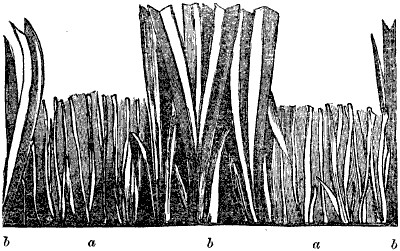
Fig. 31. The Taller Grasses.
The annexed cut (fig. 31) shows the effects of this, the taller grass being a root of cocksfoot, which is not only bunchy, but its leaves are too broad for a good lawn grass, and it grows twice as fast as the smaller species (a); its colour, too, would be so much lighter than that of the surrounding herbage as to be at once visible, and to strike one as a great blemish. Here, again, the offending patch should be removed, and better turf introduced, which operation should be performed in the autumn if possible, so as to have the full benefit the following summer.
These points in the cultivation of lawns are more particularly applicable in the process of laying down lawns with cut turves, which is the usual practice, and especially when an immediate effect is required. In this case, then, it cannot be too strongly urged that much trouble and expense may be saved by choosing the finest turf for our purpose; and the trouble of picking out an objectionable grass or weed before laying down will be amply rewarded.
If it be thought desirable to sow grass seeds to get a lawn, we would propose the following mixture:—
5. Proposed mixture for lawns, cricket-grounds, bowling-greens, &c.
Botanical Name.
Trivial Name.
Quantity
Per Acre.
lb.
oz.
Lolium perenne
Perennial Rye
25
0
Festuca duriuscula
Hard
Fescue4
0
„ovina
Sheep’s
„2
0
Poa pratensis
Smooth
Meadow1
8
„trivialis
Rougher
„1
8
Cynosurus cristatus
Dogstail
7
0
Trifolium repens
[4]Dutch Clover
8
0
[4] As some people object to Clover in a lawn, we should add a little more Sheep’s Fescue in its stead.
These seeds should be sown upon clean, well-pulverized, and smoothly-rolled ground, and the garden roller should be actively employed from the time the grass seeds have well come up until they are fairly established, when, if mown the second year with the machine, its rolling will be sufficient.
Occasionally there will be bald places in parks, such as some of the worn spots in Hyde Park, which it would be advisable to provide seed for, that should have an immediate effect. In this case we should mix a small quantity of the Poa annua with the above, as it not only effects the object of making the whole look green very quickly, but so small a grass scarcely interferes with the growth of the more permanent species, which would meanwhile be making their position, and so ultimately drive out the annual.
It now only remains to point out that the constant mowing of lawns, although it only takes away young grass, must in time have the effect of impoverishing the lawn. In such case, the grass will not be of so bright a colour as formerly, and it will become more or less mixed with moss. In this state of matters the grasses die, and different species of agarics live upon the decaying roots.
In this condition we find that colour and fertility are restored by a good sprinkling of soot, which usually operates very beneficially for four or five years. After this period a little guano, say one part to three parts of soot, will do better. Another method of restoring fertility is that of an occasional use of house slops, diluted with five parts of water; this showered evenly from a watering-pot, engine, or hydropult, usually has a most beneficial effect.
In concluding this subject of “How to Grow Good Grass,” the author would wish to impress upon his readers the important fact, that as our country is so peculiarly adapted for the growth of pasturage, and as this interesting genus of plants furnishes the best kind of herbage, so then the grass tribe is deserving of the most careful study of the home-producer of Meat, Milk, Cheese, and Butter.
Note.—Belcher’s Plantain Extractor and Turf Inoculator will be found a most efficient implement in extracting plantains, and preparing good turves to fill up the holes. We fancy, too, that it will be found useful in laying down land for permanent pasture by a system of inoculation, but await the result of experiments before stating more positively.—The Author.
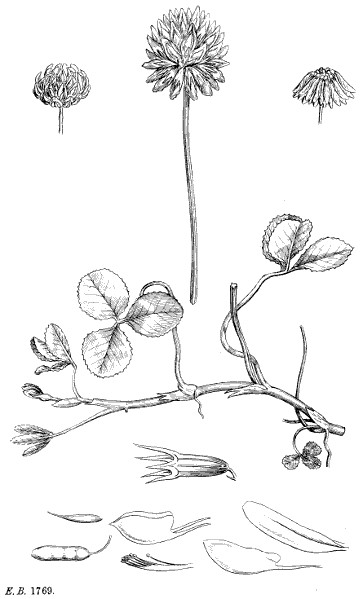
Trifolium repens. White Clover.
HOW TO GROW GOOD CLOVER.
CHAPTER XVII.
ON THE NATURE AND PROPERTIES OF THE CLOVER FAMILY OF PLANTS.
Clovers are admitted by all to be such important adjuncts to the fodder plants of the farm as to render a scientific and practical treatise upon them and their allies a matter not only of interest, but of general agricultural utility; for, if we except the grasses, perhaps no natural order of plants is of greater value to the farmer than that to which the clovers belong; for, though they differ in every point of their structure, yet in their farm products they offer an interesting analogy. Thus, whilst in the Graminaceous plants we have cereal or corn-seed products, and meadow and pasture herbs, in the Leguminous plants we have a seed-producing group termed pulse, and a herb-growing green-food or fodder series. On either hand, in both groups, there are differently-cultivated forms; for, while the grass-cereals are wholly the result of arable culture, the fodder grasses are for the most part grown under conditions distinguished by the farmer as pasture. So of leguminous plants, pulse, such as peas and beans, belongs exclusively to the arable part of the farm; but the fodder kinds, as clover, either mix with the grass of the meadow, or are grown by themselves or with grasses in shifting green crops: indeed, it is by reason of clovers eking out grass, or being used as pasturage, that they have come to be designated “artificial grasses.”
The tribe of plants under review forms an exceedingly natural group, which has been named Papilionaceæ, from the fancied resemblance in the arrangement of its flowers to the form and varied colouring of butterflies: by others it is designated Leguminosæ from the two-valved seed-pod, which by the botanist is termed a legume,—most perfect examples of which are seen in the fruits of our more ordinary pea and bean.
Though the flowers of the group are infinitely varied in size and in colour, yet they afford most permanent characters in their irregular petals, which, after all, have the same parts in the variously coloured and showy sweet-pea as in the most minute clover; so that, once examine the pea or bean, and the significance of the name of the order depending upon the flowers, will be easily understood. Again, varied as is the seed-pod, yet a little examination will show that its type is simple, there being no structural difference between the straight legume of the pea and the spirally-twisted one of the lucerne and medicks, or the many-seeded smooth pod of the common broom and the single-seeded wrinkled pod of the sainfoin.
The seeds, again, may vary in colour; some, like those of the scarlet-runner, are curious as affording an infinite variety of self-colours for their different sorts, from pure white to absolute black; or these may be so pencilled as to make a testa or seed-covering as variously mottled as are the eggs of some of our birds. Yet, whether rounded as in the pea, flat as in the bean, lenticular as in the lentil, or kidney-shaped as in the clovers, they are all readily referred to one group by the flat, oval eye (hilum of the botanist), and the fact of their ready capability of separating into two valves (cotyledons), so observable in our split peas and beans.
But of all the varieties in their parts presented by the pea-flowered tribe of plants,—if we except the fact that some are larger trees, as the locust tree, ebony, laburnum, &c., whilst some are among our smallest plants, as clovers and medicks,—the principal differences will be found in the foliage. The grass vetchling, for example, is so named from its leaves being not unlike those of grasses, while the yellow vetchling, in its mature state, has the whole leaf converted into a tendril and the appendages at the bases of the leaves (stipules) are so enlarged as to be often mistaken for leaves: in another of the vetchlings, the everlasting sweet-pea, we find that, as so much of the leaf is converted into tendrils to enable this handsome plant to climb over the hedges and thickets, the stem is made four-winged with leaf-matter, to ensure the due performance of the leaf function. Now parts called stipules are present in this whole tribe, and, like all other parts of these plants, they vary in form, size, and markings, and hence afford important aid in the discrimination of species. Again, the old furze-bush will have its leaves converted into spines, though the seedling started with a trifoliate leaf. Points like these, however, though most interesting to the student of vegetable physiology, are beyond the scope of the present work.
Like every other point connected with this interesting natural order of plants, their uses and properties are greatly varied, and perhaps variable. The Sennas are renowned for their medicinal properties, being in some kinds aromatic and purgative. A powerful aroma is given off from the Melilots, similar to that of the well-known sweet vernal grass (Anthoxanthum odoratum), on which account it has been recommended to mix a little of their seeds with clovers, or to cultivate separate patches of either the white or the yellow Melilot to place here and there, sandwich-wise, in the clover hay-rick.
In speaking of this matter of flavour in food for cattle, we may here mention that the seed of one of this order, which is now being extensively employed for its flavouring principle, is the Fœnugræc (Trigonella fœnum-græcum), which was formerly used in large quantities by horse and cattle doctors as an ingredient in drenches or drinks for horses, cows, and pigs. Latterly, however, it has been still more largely employed as a flavouring matter in the different kinds of “Cattle Feeds.”[5]
[5] We have cultivated these seeds in England, and found them to ripen very well, and if the flavouring of food be correct in principle, the seeds might readily be ground with feeding stuffs, while the dried plant could be mixed with hay and straw in chaff.
Now, whether medicinal properties reside as a rule in all of the order, it would perhaps be difficult to determine; but, as we sometimes find that certain clover crops are accused of causing “scouring,” there is perhaps reason to conclude this, but that its amount varies according to season, soil, and cultivation.
CHAPTER XVIII.
ON THE FARM SPECIES OF CLOVERS.
All the true clovers belong to the genus Trifolium, of which the following may be tabulated as agricultural species:—
(
Flowers red or purple.)
1.
Trifolium pratense—Broad-leaved clover.
2.
Trifolium medium—Zigzag, or true “cow-grass” clover.
3.
Trifolium incarnatum—Carnation clover.
(
Flowers pink.)
4.
Trifolium hybridum—Alsike clover.
5.
Trifolium fragiferum—Strawberry-headed clover.
(
Flowers white.)
6.
Trifolium repens—Dutch clover.
(
Flowers yellow.)
7.
Trifolium filiforme—Suckling clover.
8.
Trifolium procumbens—Hop clover.
1. Trifolium pratense—Meadow or broad-leaved Clover,—in its wild state, is too well known to need any lengthened description in order to its being understood. A careful examination of field specimens, however, will show that, even in the wild state, this plant is liable to run into numberless variations; thus, we may have the leaflets of one plant more or less ovate, whilst those of another may be broad and almost obcordate. In some we may see dense heads of purple flowers, varying in shade until almost white, whilst less dense heads of flowers and general variations in height, size, and luxuriance of the whole plant, are all circumstances in the natural history of this species in the wild state which will prepare us duly to understand the nature of the many forms of the plant which are found in cultivation. Of these we have, besides others, English, French, American, and Dutch sorts, which differ in such minor details, as a greater or lesser hairiness, or variations in the colour and size of the flowers, leaves, &c. The most important point connected with the broad-leaved clover is its permanency; some sorts scarcely maintaining a plant for two years, whilst others are said to be more or less perennial. This, however, is a matter which we conceive depends more upon the soil and the kind of cultivation than upon the sort; for, although all seedsmen supply two sorts, namely, Trifolium pratense and Trifolium pratense perenne, yet they run so much the one into the other, that it is oftentimes exceedingly difficult to distinguish them.
In order that the reader may see the differences and agreements of the three sorts,—1, Trifolium pratense (of the meadow); 2, Trifolium pratense (the arable plant); and 3, Trifolium pratense perenne (also of the arable),—we give their characters in parallel columns, on p. 115.
CHARACTERS OF CLOVERS.
1.
Trifolium pratense.———
From a Natural Pasture.
2.
Trifolium pratense.———
From Messrs. Sulton’s Trial Grounds.
3.
Trifolium pratense, perenne.———
From Messrs. Sulton’s Trial Grounds.
Heads of flowersdense, proceeding from two leaves by a very short stem, of from 50 to 80 sessile florets of a more or less lilac or pink colour.
Heads of flowersdense, with from 70 to 120 sessile florets.
Heads of flowerssomewhat lax, with from 50 to 100 florets, proceeding from leaves by an evident stem.
Calyxof 5 fine ciliated teeth—the lower of which is the longest—about half the length of the flower.
Calyx, much as 1.
Corolla, Standard with a long straight tube.
Corolla, much as 1.
Leavestrifoliate, more or less hairy; leaflets ovate, either broadly lanceolate, or notched at the apex; all having a more or less triangular white marking in their centre.
Leavesof 3 leaflets, more or less ovate, with the white triangular marking 3 times the size of 1, but less hairy.
Leavesof 3 ovate leaflets, with less distinct triangular spot than 2, clothed with silky hairs.
Stemsolid, channelled or angular, purple.
Stemsometimes fistular, more or less channelled or ribbed, mostly free from hairs, purple upwards.
Stemvariable, sometimes fistular mostly quite round and smooth sometimes; but not generally hairy.
Rootdescending, but considerably branched.
Roottapering with lateral branches.
Rootas 2.
Whole plantmore or less clothed with silky hairs.
Whole plant, smooth, compared with 1, still more or less hairy.
Whole plant, remarkable for its hairy leaves and generally smooth round stems.
Height from 5 to 8 inches.
Height 16 inches.
Height 18 inches.
Now, although the study of the characters, as here laid down with the specimens in our hand, may render it tolerably easy to distinguish the three forms here described, yet it must be confessed that whether we examine a series of the wilder plants from different positions, or different samples of the cultivated broad-leaved clovers, we shall find great variations; the principal of these will be discussed in another chapter: we may here, then, for the present leave this difficult subject of how to distinguish cow-grass and broad-leaved or red clover, with the observation that the common red clover is uniformly in flower two or three weeks before the other.
2. Trifolium medium (see Plate)—Zigzag Trefoil—gets its English name from the peculiar bends in its stem, which being at alternate sides, make up the zigzag outline. The stems are rounded—not channelled,—mostly of a purple colour, and clothed with short hairs. The leaves are smooth, with elliptical—not emarginate—leaflets, sometimes, but seldom, with the white lunulate spot. The calyx is smooth. The heads of flowers are solitary, on very short footstalks; they are of a bright pinkish red hue, and not of the lilac colour of the common clover.
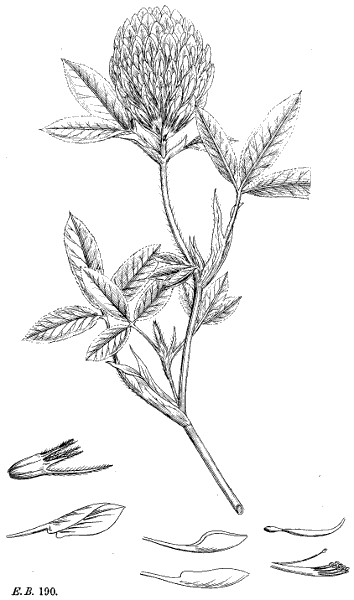
Trifolium medium.Zigzag Trefoil.
In its wild state the zigzag clover will be found in districts remarkable for the absence of lime, such as the sandstones. In the sandy deposits accompanying the coal in Wales, as also in Staffordshire, this is the prevailing form of clover. Hence, then, this species seemed to recommend itself for sandy lands, in which the common clover does not so well succeed; and we conceive that, as a consequence, it was brought into cultivation for this capability of “holding on” to such soils, which, if they will not grow the other kind, is considered clover sick. We have reason to think that the T. medium and T. pratense are not distinct species, but that the difference in their usual habitats has determined their difference in form, and we think that the T. pratense perenne of the seedsman is a form intermediate between the two: if so the position of the three may be expressed as follows:—
Trifolium pratense.Trifolium medium.
Trifolium pratense perenne.
At all events, if this plant was ever distinct in cultivation, it has merged into broad clover forms; so that, if we are to possess it as a separate plant, it must again be grown from wild seed, and then, if it is to be kept pure, it must not be cultivated on clays or limestone, or, if our view be correct, it will soon lose its true distinctive characters.
3. Trifolium incarnatum—Annual Carnation or Crimson Clover—is a large species with oblong heads of flowers of a fine carnation colour, hence its common name of “Carnation Clover.” It is a native of Southern Europe, and is said to have been found wild at the Lizard, in Cornwall. As a cultivated plant, it has not long been introduced into England, where it has been much grown in the southern counties, as there it can be sown soon enough on the wheat stubbles with only just a simple harrowing-in, when it has time to make a plant sufficiently strong to resist winter; this soon makes growth in the spring, giving an early feed, or it may be mown; in either case it is off the land sufficiently early to allow of a late sowing of turnips: so that, where the climate will allow of it, we may snatch an intermediate crop by means of the carnation clover. It yields a large crop, but its feeding qualities, according to Dr. Voelcker, are somewhat inferior to those of the broad-leaved clover. It should be noted that varieties having white flowers are in the market, and of both red and white there are earlier and later sorts which may be useful for succession.
4. Trifolium hybridum—Alsike Clover—has, perhaps, got its specific name from possessing appearances and qualities intermediate between the broad-leaf and the Dutch clovers. This species has been introduced from Sweden, and its growth, duration, and feeding qualities certainly entitle it to rank high, and more especially for growth on some of the stronger soils. In our experience we have not found it to possess such eminent perennial habits as have been claimed for it. It thins very much after the second year, and almost disappears in three years, unless it be renovated by being allowed to seed, when the new plants by no means attain to the vigour of their parents.
5. Trifolium fragiferum—Strawberry-headed Clover—has been named from the strawberry-like form which its head, of enlarged coloured calyxes, assumes after flowering; its flowers are pinkish, but otherwise of much the same size and form as those of the Dutch clover, which latter it again approaches in its creeping habit and form of its foliage. It is, however, here mentioned only to point out the difference of its habits and indications when compared with the Dutch or white clover. The strawberry trefoil is a native of cold wet pastures, such as bear the name of “hungry clays;” when present in quantity it is not to be confounded with Dutch clover, which would indicate a sound fertile soil.
6. Trifolium repens—White Dutch Clover—is a plant of very general cultivation, both at home and in the States, and in both of which quarters of the globe it maintains its character with great constancy.
Dutch clover is a valuable pasture plant either in meadows or in seeds. In the former it is much increased by the addition of nitrates, soot, &c., with guano or superphosphate. As a plant, in seed mixtures, it is usually sown with other trifoliate plants and rye grasses, but if the soil be very light the Dutch clover may be increased or wholly used.
7. Trifolium filiforme—Small Yellow Clover—is one of the least of our small yellow-flowered division. It is a common native species occurring on the waysides, and has been brought into cultivation to only a limited extent, under the impression that its small herbage is suitable as a first bite for young stock, and hence the term “suckling clover” has been applied to it. It is of little value, and does not seem capable of being greatly improved. This species is often mistaken for the following, even by pretended botanists, but its lax head of smaller flowers will well distinguish it.
8. Trifolium procumbens is called by the botanist “Hop Trefoil,” from the fact that its dried head of persistent flowers[6] exactly resembles small bunches of hop strobiles (fruiting heads). The foliage is much like that of Medicago lupulina, nonsuch, or black medick, which is the “hop” of the farmer; but the whole plant of the true hop trefoil dries up so quickly under the sunshine, and is withal so wanting in succulency and quality, that it cannot be compared with M. lupulina as a fodder plant, and hence it is but little cultivated in the present day.
[6] Flowers are so called that remain enveloping the seed while it ripens, which they do in all the clovers.
There are other clovers which have been recommended for cultivation, but they are mostly foreign, and do not appear to possess those qualities which should lead us to prefer them before those in common use. There are, too, several additional wild clovers, but they possess no agricultural interest, unless, perhaps, as indicators of soil. The Trifolium pratense (Hare’s-foot Trefoil) is a pretty, wild species, native to light sandy soils, the seed of which is sold for growing “bedding plants.”
CHAPTER XIX.
ON THE VARIETIES OF RED CLOVERS.
The Trifolium pratense of botanical authors is remarkable for the great number of varieties it assumes, even in its wild growth; but these are exceeded in the number of cultivated forms: thus in any rich meadow we may make out several sorts which may be expected to be more or less permanent, whilst the market samples of seed will offer us several varieties for the different countries of America, England, France, Holland, Germany, &c.
The following are some of the more prominent of our native wild varieties:—
1. Trifolium pratense—Common Red Clover.—Head of pink; flowers, somewhat compact; leaves more or less broad; plant smooth[7] in proportion to its size, the smaller wild specimens being usually very hairy; stem more or less purple.
2. Trifolium pratense, var. pallidum—Pale-flowered Clover.—Head of very light pink; flowers large, full, and more rotund than 1, and almost double in size and in the number of its flowers; whole plant more or less hairy; stem green.
3. Trifolium pratense, var. album—White Clover.—Flowers white; herbage a very light green; in other respects much the same as the last.
4. Trifolium pratense perenne—Perennial Red Clover.—Flowers less compact than the common clover, whole plant having stems inclining to dark purple; leaves narrower.
[122]5. Trifolium pratense perenne, sub-var. pallidum—Pale Perennial Clover.—A larger plant than the parent form, and less hairy.
6. Trifolium pratense perenne, sub-var. album—White Perennial Clover.—Not common, but still, like 3, an albino form, and is, perhaps, more delicate in constitution than the coloured sorts.
[3] Discussion Royal Agricultural Society, March 21, 1863.
The following reply[3] of Mr. Bailey Denton to some objectors to draining in Middlesex is, we think, much to the point on this important subject:—
[4] As some people object to Clover in a lawn, we should add a little more Sheep’s Fescue in its stead.
Trifolium repens[4]
[5] We have cultivated these seeds in England, and found them to ripen very well, and if the flavouring of food be correct in principle, the seeds might readily be ground with feeding stuffs, while the dried plant could be mixed with hay and straw in chaff.
In speaking of this matter of flavour in food for cattle, we may here mention that the seed of one of this order, which is now being extensively employed for its flavouring principle, is the Fœnugræc (Trigonella fœnum-græcum), which was formerly used in large quantities by horse and cattle doctors as an ingredient in drenches or drinks for horses, cows, and pigs. Latterly, however, it has been still more largely employed as a flavouring matter in the different kinds of “Cattle Feeds.”[5]
[6] Flowers are so called that remain enveloping the seed while it ripens, which they do in all the clovers.
8. Trifolium procumbens is called by the botanist “Hop Trefoil,” from the fact that its dried head of persistent flowers[6] exactly resembles small bunches of hop strobiles (fruiting heads). The foliage is much like that of Medicago lupulina, nonsuch, or black medick, which is the “hop” of the farmer; but the whole plant of the true hop trefoil dries up so quickly under the sunshine, and is withal so wanting in succulency and quality, that it cannot be compared with M. lupulina as a fodder plant, and hence it is but little cultivated in the present day.
[7] In this, as well as the generality of forms, the smoother and larger growth indicates cultivation, manuring will sometimes make the difference.
[7] In this, as well as the generality of forms, the smoother and larger growth indicates cultivation, manuring will sometimes make the difference.
Now, it appears to us that the descendants of the two types, Trifolium pratense and T. medium (see Plate) form the basis of the red or broad-leaved clover on the one hand, and the perennial or cow-grass clover on the other; whilst the market varieties have, perhaps, been modified by climate, soil, and probably hybridization with other sorts. It may, indeed, be that, after all, the plants described in chapter XVII. as two distinct species are only varieties, for though the common form of T. pratense grows everywhere on mixed soils, the more sandy positions, as the sandstones connected with the coal in South Wales, offer a greater abundance of the T. medium; and, from experiments conducted with seed of this latter obtained from near Swansea, Glamorgan, and sown on forest marble clay of the Cotteswolds, we certainly obtained plants differing very much from the typical form of T. medium, and assuming the usual broad-leaved clover variations.
Here, then, is opened up a curious subject for inquiry, which the history of the seed trade as it relates to clover-seed may tend in some measure to elucidate. Some few years ago T. pratense and T. medium were advertised as on sale by most seedsmen; in fact, the latter was the name by which what is now called cow-grass clover was known. Now, however, it is doubtful if any seedsman would pretend to send out the T. medium; but the label T. pratense perenne has been substituted for it.
Sinclair’s figure of “Trifolium medium, marl-clover, cow-grass,” in the “Hortus Gramineus Woburnensis,” facing page 141, is scarcely a true form of the plant, as its more or less emarginate leaflets incline to the form of T. pratense; and yet, at the time this author wrote, even this was doubtful. T. medium was difficult to obtain, as he says, “All the seeds and plants I have had for this (except that from Messrs. Gibbs & Co., which proved to be the present plant—T. medium of Sinclair) have turned out only two-year lived plants, or never exceeding three, though cultivated on various soils.” We have repeatedly written for seed, and ten years ago were always supplied with samples so labelled; but in no case did we get it. Latterly seedsmen honestly confess that they have not the seed, but can send T. pratense perenne.
Now, that this latter is merely a variety of the broad-leaved clover there can be but little doubt; still the fact that it is usually more perennial in its habit is of importance. We may easily understand why it should be so, if we consider that the common broad-leaved clover in its cultivation is so much earlier than the cow-grass form, so that this enables two cuttings of the former to be made in one season, two crops of hay being taken very commonly indeed; and as the plant gets well in flower before it is cut the first time, and seed is saved from the second crop, a more exhaustive plan for the crop itself or its future perennial powers could hardly be brought about. The cow-grass clover, however, is a fortnight and more later, which renders it difficult to cut two crops; and so its method of growth is not so exhaustive. We know that the common wild clover is said to last only two years, but with constant depasturing we see no reason why the same roots should not send up herbage for five or even ten years.
However theoretical such inquiries may be deemed, yet it must be confessed that they are of great practical importance; for, if a plant has a tendency to run into varieties, it makes it daily more difficult to get its seed true to sort; and if we are liable to have a sample, part of which may be less hardy or part more tardy in its development, it follows that much of it may never arrive at maturity, whilst if it does, as the crop will be uneven, it can never be reckoned upon for so good a yield.
Much of the variable nature of the sorts which we observe in a clover-field may be the result of the mixing of seeds from different and distant localities: if so, it is much to be regretted. But this only tends to show us how important it is that seed should be grown with care, to which end, as regards clover-seed, we sadly want some well-conducted experiments on different varieties, especially of a wild native plant, with a view to obtain a sample with good, permanent, and even qualities. In fact, the question of true of sort is altogether different from that of purity of sample; but that very serious mischief arises from the want of the latter will be discussed in another chapter.
CHAPTER XX.
ON THE CLOVER ALLIES.
Besides the clovers proper, there are many native plants of the same natural order that have been found useful as fodder: these it is now proposed to comment upon, premising that as we have had them all under cultivation, we are enabled to discuss their merits from a practical point of view.
Of these, the following is a list of the genera:—
I. Ulex.—A spinous shrub.
II. Anthyllis.—Flowers in a dense head, with white expanded calyces.
III. Lotus.—Flowers in lax heads; pod straight, many-seeded.
IV. Medicago.—Flowers various; pod spirally twisted.
V. Melilotus.—Flowers in spikes, drooping to one side; pod straight, few-seeded.
VI. Onobrychis.—Flowers in spikes, drooping; pod wrinkled, one-seeded.
VII. Vicia.—Flowers single or spicate in the axils of the leaves; pod straight, many-seeded.
VIII. Lathyrus.—Flowers one or many on long footstalks.
I. Ulex—Furze.
A genus of shrubby, spinous, pea-flowered plants, by far too common on our sandy heaths and wild hilly places, with varieties occupying wet commons.
We possess, according to authors, some two or three native species; but we incline to the belief that they are only varieties of the common U. Europæus, of which these seem to be large and dwarf forms. This plant, under the name of furze or gorse, has been from time to time highly extolled as a fodder plant, and machines have been invented for bruising its complicated spines; but although it will doubtless grow where scarcely anything else can be got to succeed, yet, taking into consideration the expense attendant upon its growth and utilization, and the low feeding powers which it possesses, we cannot at all agree in recommending its general use. It is, however, but right here to say that articles are from time to time inserted in such journals as the Agricultural Gazette, the authors of which advocate the growth of furze as an agricultural plant, and highly extol its feeding qualities; still, as our own experience would lead us to conclude that as even young stock scarcely hold their own upon this plant, we cannot recommend it as possessing very valuable properties.
II. Anthyllis—Ladies’ Fingers.
The Anthyllis vulneraria is well distinguished in its young state from its sometimes entire lancet-shaped, at others pinnate leaves, growing close to the ground. These are usually clothed with long hairs, and it has expanded downy calyces, when full grown. In its young condition it has been very much extolled for sheep pasturage, while its hay is said to be abundant and nutritious, though grown on the very poorest of soils. That it will grow more upright where sown, one plant drawing up another, we know from experience, but we have little faith in any very superior qualities being found in plants that can grow so well under extremely poor conditions of soil; still it is just possible that its herbage may improve in quantity and quality by liberal treatment; yet we must conclude that, as we already possess much better plants for growing on better soils, we do not think much can be gained by its cultivation.
As a plant for hay it will yield a good cut, but its extreme hairyness and general want of what the farmer calls “proof” will never allow this plant to be extensively grown.
III. Lotus—Bird’s-foot Trefoil.
This plant is well known by its loosely-packed heads of bright yellow flowers, which are succeeded by long slender pods, dark-coloured or even black when ripe, and not inaptly likened to a crow’s foot; and hence the name “Crowsfoot” which it commonly bears. We have three species, as follow:—
1. Lotus corniculatus—Common Bird’s-foot Trefoil—is common, especially in dry meadows, in which its herbage is duly appreciated by sheep and cattle, if one may judge from the pertinacity with which it is kept down. It is no bad adjunct to the rick. We are so convinced of its value as always to recommend its use in the laying down of light land for permanent pasture, and a little seed sown in old meadows after a dressing of rubbish—old mortar, town refuse, &c.—will tend greatly to the improvement of the herbage.
2. Lotus tenuis—Slender-leaved Bird’s-foot Trefoil—is, perhaps, only a variety of the former; it is, however, smaller in all its parts, and, though a denizen of stiff soils, occurs chiefly in a wild state on the margins of fields and on hedge-banks. It might be employed under the same circumstances as the L. corniculatus, especially in thin clay-beds on upland brashes; but it hardly possesses such good qualities.
3. Lotus major—Larger Bird’s-foot Trefoil—is much larger in all its parts than the other species. It occurs in moist situations, about bushes in wet land, in ditches, watercourses, and damp places generally. We have experimented upon the growth of this plant in artificial meadows, and from the size which it attains quite early in summer, and the quantity of wholesome keep it is capable of affording, we are disposed to think well of it as an occasional shifting crop, or it might be well combined with rye-grass in deep stiff soils.
IV. Medicago—Medick, &c.
This genus is principally distinguished from Trifolium by its twisted seed-pods, which in the Medicago maculata (Spotted-leaved Medick) form quite a spiral coil, ornamented with a double fringe of stiff spines. This plant is now becoming general as an agrarian weed, having been greatly spread, owing to its intermixture with foreign seeds of different kinds.
The agricultural species are:—
Medicago lupulina—Yellow Sickle Medick.—“Hop trefoil” of the farmer, but not of the botanist, who gives this name to the Trifolium procumbens (which see). From this latter the medick is easily distinguished by its heads of naked, blackened, incurved seed-vessels. As an agricultural plant it is of great value, especially in mixtures called “seeds.” It is a good adjunct to rye-grasses and common clovers, especially on light soils; but on good strong land which will bear a full crop of broad-leaved clover it would be mostly smothered out, and, if not, as we think it is properly held to be less nutritious than clover, its use is not recommended where first-rate clover crops can be grown.
We have seen this trefoil grown with sainfoin to great advantage, as it yields a tolerable crop for the first two years, and then declines, just as the sainfoin has got possession of the soil.
2. Medicago sativa—Lucerne—is a perfectly perennial plant, which, though not so much grown in England as it deserves, yet scarcely needs description; however, its purple flowers and smooth twisted seed-pods serve to distinguish it from the rest of the genus. We have grown this plant upwards of a foot high by the 1st of May, and taken no less than three cuttings of a good succulent herbage in one season. These qualities point out lucerne as an excellent green-food plant, for which purpose we should always, where practicable, recommend that at least a patch should be grown near the stable, as there is reason to believe that its alterative effects upon the horses are of a most salutary kind. It should be cultivated in drills of from 15 to 18 inches apart; and, if properly weeded and not let get too old before cutting, it will last for many years with an occasional dressing of manure.
We once had a patch one half of which was purposely neglected by way of comparison with the other half, which was well cared for; that portion left to itself yielded but poor crops, and almost disappeared at the end of four years, whilst the other portion scarcely began to decline after ten years. This remark applies with full force to all the green-food crops of this order. Weeding early, mowing when cut, and an occasional top-dressing, would increase the durability of all the perennial species.
V. Melilotus—Melilot.
These are pea-flowered plants, with ternate leaves, and spikes of flowers drooping to one side: it is named from mel, honey, in allusion to its flavour, and the genus Lotus, by which we may understand it to be a sweet-scented lotus-like plant. We have two native species, distinguished thus:—
Melilotus officinalis, an annual, with yellow flowers.
M. leucantha, a biennial, with white flowers.
Of these we may conclude that the flavour, which is like that of the Anthoxanthum odoratum—sweet vernal grass—is too strong and bitter to allow of its being recommended for culture alone; but we are inclined to think that, if grown in small quantity with seeds, or if a separate patch be cut and arranged sandwich-wise in the seed-rick, the melilots would give that sweet flavour which seems to be the principal cause of the superior qualities and sweetness of natural meadow as compared with artificial grasses.
Seeds have been forwarded to us of what is named “Cabool Clover,” and another packet labelled “Bokhara Clover,” both of which appear to belong to the M. leucantha, though certainly of a larger form than our native species, and probably consisting of the M. leucantha major. This latter must be cut young if used as recommended, as it soon gets woody. A correspondent of the Royal Agricultural Society has recently recommended the full-grown plant for paper-making; and, if of value for this purpose, we can affirm from experience that a large yield can be got from soils of a very inferior quality, as our experiments on its growth have been made on a very stiff and poor bed of forest marble clay.
VI. Onobrychis—Sainfoin.
Sainfoin, or “holy fodder” of the French, is distinguished by its brilliant spike of pink variegated flowers, which droop to one side, its winged leaves of from six to eight pairs of oval leaflets, which are entire, that is, undivided at the margin, and its short, rounded, wrinkled, and spinose seed-vessels. The forms in cultivation are—
Onobrychis sativa—Common Sainfoin. Onobrychis sativa, var. bifera—Giant Sainfoin. Of these the former has the preference in England, whilst the latter is much grown in France. Our experiments with both lead us to conclude, that although the former flowers but once and the latter twice in the season, the O. sativa still gives the greatest amount of food, as the second crop of the giant sort is usually poor and straggling, with but little leaf; while the common sort sends up a thick growth of leaves after being cut.
The O. sativa bifera is but a variety of the O. sativa, as by long continuance of growth from the same seed in this country it reverts to the common form; and hence the giant sort should be frequently renewed from an imported stock. Sainfoin has been much cultivated on calcareous soils, more especially on the free-stones of the oolite rocks, and on the chalk, off which formations it is scarcely known, except on some calcareous sands in the eastern counties. In the limestone and chalk districts sainfoin is grown as a permanent crop, and formerly lasted six or eight years. In the eastern counties the little there grown is by way of a shifting crop, in the same place and manner as common clover. The permanency of sainfoin is yearly becoming greatly diminished from the circumstance that its seed is so much mixed with that of the burnet, Poterium sanguisorba, var. muricata. To such an extent does this evil occur, that we have examined samples of sainfoin seed in which there were at the rate of from twenty to forty thousand of burnet seed-pods per bushel; and when we consider that these pods have for the most part two ripened seeds, and those of a plant growing so much more rapidly than the sainfoin, we can form some notion how the desired crop is soon smothered and overpowered by the burnet, which at best is but a rank weed, of no agricultural value; for whatever of good there may be in our ordinary native salad burnet, which is a smaller and more succulent plant, this sticky foreign interloper cannot possibly have any claim to our regard.
The reason why it has gone on so long unchallenged is that the burnet-seed, though of an entirely different shape from the sainfoin, is somewhat of the same colour; and then in their growth both plants have winged leaves, and the difference between the entire leaflets of the sainfoin and the toothed leaflets of the burnet did not at first strike the farmer; now, however, the difference is better understood, and farmers begin to require that the burnet-seed shall be sifted from the sainfoin. This of course will demand the payment of a better price for the better sample, as in the process of sifting many of the smaller sainfoin seeds go through with the burnet; but this will be well worth a better price, as the larger seeds will undoubtedly tend to produce a better crop.
If, however, there should be any doubt about pure sainfoin seed, we should recommend the decorticated seed being used, as in it the burnet could not possibly escape detection.
As the history of burnet is so important in connection with the sainfoin crop, it cannot be out of place to introduce the following description of this weed:—
The Sanguisorba officinalis (false burnet), as a wild plant, never attains any great size, and as it is a denizen of dry calcareous pastures and broken ground on limestones, and perfectly harmless in its properties in this condition, it is scarcely noticeable as a weed; indeed, it is sometimes recommended for permanent pasture admixture on calcareous uplands. There is, however, a larger form of the false burnet, which is now attracting considerable attention, as being by far too constant an attendant upon sainfoin seed.
This plant is referred by Professor Babington and the Continental botanists to another species, viz., Poterium muricatum, which is by them distinguished from the P. sanguisorba; but is “usually larger in all its parts” (Bab.), with a larger and more decidedly four-winged fruit. We, however, agree with Bentham in considering this to be a variety only, and, in fact, an agrarian form, induced by its seed being gathered with a crop and treated as a crop plant, so that its larger form may be easily accounted for; and we are not wanting in evidence to show that, under cultivation, the P. sanguisorba greatly increases in size, while, if left to grow wild, the cultivated form relapses into the wilder state. But we incline to think that the agrarian burnet has got into agriculture by being introduced with foreign seeds; and as its introduction seems to have been small at first, it attracted but little notice; for as the leaves both of the burnet and sainfoin were pinnate, the difference that the botanist would observe in the leaflets, i.e. the former being serrate, and those of the latter having an entire margin, would hardly attract the attention of the farmer; however, it soon became so serious a matter that some crops of so-called sainfoin, in their second or third year, presented as much as 90 per cent. of burnet, and as the latter grew taller than the sainfoin, it effectually smothered it out, and in its place supplied a sticky, non-succulent, and innutritious herbage, that made farmers begin to inquire seriously about the seed.
Here, however, as the seeds, or rather the fruits, of both plants were pretty much of the same colour, and both wrinkled, samples of fully half burnet passed muster in the seed-market; and, though these fruits are so different in shape and size, yet we were astonished to find that, during the trial of an action against a seedsman for supplying sainfoin seed containing a large quantity of burnet when good sainfoin seed was paid for, the judge, jury, and most of the farmers present confessed their inability to distinguish them; it becomes, therefore, at this point, a duty to describe the two.
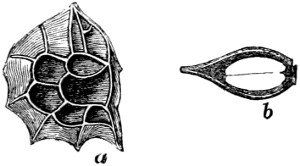
Fig. 32.
Fig. 32 a represents a short wrinkled pea-pod, broad at the back and thin in front, as seen in the section b. In the interior is a single pulse-seed, which is easily freed from its wrinkled shell.
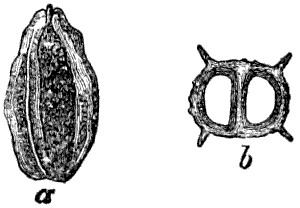
Fig. 33.
Fig. 33 a is a drawing of a fruit of false burnet. The section b shows it to be quadrangular, with a wing at each angle, and to possess two seeds in each capsule. The capsules are rather muricated (i.e. furnished with short excrescences, and not regularly wrinkled, like the sainfoin). Now the burnet is easily separable from a sample of sainfoin, as the former readily passes through the sieve; but the objection to sift it may be well understood when the bulk is diminished by the amount of the burnet, and also that of the smaller sainfoin seeds, which pass through at the same time.
The best plan, then, to pursue is to mill the sainfoin seed, in which case its outer covering is removed, and you simply have a sample of kidney-shaped pure seed-like enlarged clover-seeds, in which the burnet may be detected, because it will not mill, but simply gets its wings broken off, so that the wrinkled two-seeded capsule still remains.
Now the fact of the burnet being a two-seeded capsule is most important to be noticed, as, from analyses we have made of dirty sainfoin crops, we have estimated as follows:—
Crops.
Sainfoin
Plant.
Burnet
Plant.
Other
Weeds.
Crop in Berkshire, 3rd year
10
50
40 = 100
Crop in Cirencester, 3rd year
5
25
70 = 100
Here, then, we have a large proportion of burnet, surely much more than could be accounted for from the number of capsules, at least we will hope so; but when we consider that the capsule of the sainfoin is single-seeded and that of the burnet is two-seeded, we may readily conceive how each capsule of the latter may at least grow a single seed, but the best sample of the former could hardly be expected to all come up. Now, as we have as many as 64,000 capsules of burnet in a bushel of sainfoin seed, that × 2 = 128,000 seeds, and when we consider that the burnet grows so much faster than the sainfoin, we have two elements for the success of the former, namely, the certainty of getting its crop, and the equal certainty of smothering out a large proportional of what may germinate of the seeds of the sainfoin.
This matter would not be of such importance if the burnet was equal in point of feeding properties, but it is not so, for whatever quality be in the smaller and more succulent P. sanguisorba form, the P. muricatum is, on the contrary, hard and woody, and almost useless.
CHAPTER XXI.
ON CLOVER SICKNESS.
In considering the important question involved in the term “Clover sickness,” we would first direct attention to the fact that crop clover is a derivative plant which has been so forced that it is many times larger and more juicy and succulent than the wild plant from which it sprung. This derived nature (the propensity, as it were, for fattening) can only be maintained by a continuance from one generation to another of those luxuries to which the cultivated family has been accustomed; hence, then, if seed be brought from a richer soil to a poorer, or from a warmer to a colder climate, we may expect that its plants grown amid barley and drawn up during the summer would have but a poor constitution to withstand the rigours of winter; but can we in such a case say that the land is clover-sick, that is, sick of growing clover?
Of course the seed here supposed will grow better in one place than in another, as, for example, we have traced some American seed of broad-leaved clover grown by itself in a deep rich soil in the Vale of Gloucester, where the climate is so much milder as to be a fortnight before the elevated land of the Cotteswold Hills and producing an abundant crop; while the same forming part of a mixture of “seeds” with rye-grass and plantain on the hills, the two latter have taken possession of the soil, and the clover made no progress at all; whilst other seed, under precisely the same circumstances, has done remarkably well.
That there is much reason for these conclusions will be found in the fact that the more seed we import from warmer climates the more difficult is it found to make the land produce a plant; still importation is rapidly on the increase, because warmer climates can produce seed more certainly and in greater quantity than we can at home.
The difficulty of growing from foreign seed increases in proportion to the thinness of the soil and the backwardness of the climate, so that the elevated districts on the stony Cotteswolds just adverted to present, perhaps, more of the so-called clover-sick land than any other of like extent.
The seed of clover, then, has become more and more pampered—more the offspring of large crops from deep alluvial soils under the tropical summer heat of the south of France and the United States, where it is grown as a self-crop and not fed merely on what the corn could not carry away; and so while this enervation, or, if preferred, this civilization, of plant has gone on, we expect its seed all at once to withstand the shock of a lower temperature with constant climatal changes and cutting winds; and if it does not succeed, we say that the land is clover-sick, when, in truth, it is the seed that sickens under these new and trying conditions. As well may we say that the Northern States sicken of the negro, because he there dies out so rapidly, or that the warm south sickens of humanity, because those who are unacclimated sicken and die there.
Another circumstance which has contributed to an increased difficulty in growing clover on thin soils will be found in the farmer discarding as antiquated the practice of paring and burning, which was formerly the usual preparation for the turnip crop. In a paper on “Paring and Burning,” in the 18th volume of the Journal of the Royal Agricultural Society, Professor Voelcker remarks:—
The ashes produced by paring and burning are especially useful to turnips, and also to other green crops, because they contain a large proportion of phosphates and potash—constituents which, it is well known, favour in a high degree the luxuriant growth of root-crops.
Further, the learned professor closes a most able paper with the following conclusions:—
Paring and burning, instead of being an antiquated operation, is a practice the advantages of which are fully confirmed and explained by modern chemical science.
Paring and burning, to judge from our own experience, had the effect of converting some of the hard limestone brash into lime, in which case it broke up by the influences of air and rain, and so restored the lime and alumina which mostly exist together in limestone, the former of which is quickly lost in thin soils,—so much so, indeed, that not unfrequently the whole depth of soil, even upon a limestone, will often be curiously devoid of lime, which is a necessary ingredient in the constitution of a clover crop.
Again, we should conclude that the operation under discussion, from its decomposing that dark vegetable matter called humus, which is always found in large quantities on some of the soils which are called “dead,” from their inability to produce crops, and which often cause astonishment that such black, nice-looking earth should be unproductive. Now this soil, though it would favour the growth of some species of peat-loving plants, as Ling, Heath, &c., is not suitable for clover, as the wild plant is curiously absent from peaty positions.
Professor Voelcker remarks that “the excess of undecomposed organic matters in soils is decidedly injurious to vegetation. Roots, stems, and other vegetable matters remain buried in the ground for years without undergoing decomposition, and if we attentively study the subjoined analysis of soil in the neighbourhood of Cirencester, well adapted for burning, we shall see how the lime, alumina, and organic matter might be beneficially affected by the process:—
ANALYSIS OF SOIL ADAPTED FOR BURNING, BY PROFESSOR VOELCKER.
Moisture
·93
Organic matter
10
·67
Oxides of iron and alumina
13
·40
Carbonate of lime with a little sulphate of lime
23
·90
Carbonate of magnesia
1
·10
Phosphoric acid
trace
Potash
·38
Soda
·13
Insoluble silicious matter
49
·66
100
·17
”
The ashes, however, are obtained by burning a thin slice pared from the surface of the land, so that they are derived from surface-soil and vegetable matter, the latter often yielding a sufficient amount of phosphoric acid with which to procure a crop, and, what is all important for us to consider is, that this phosphorus, the alkalies, and lime, are rendered by the burning in a state just fitted for the growth of the plants that are to be grown upon them; whereas, before the process, these ingredients were in a measure locked up, so that plants could not grow for the want of sustenance; not that it was not in the soil, but that it was insoluble. If, then, clover or any other plant had not succeeded, it would have been called “clover-sick.”
The following analysis of vegetable ashes from a field in the neighbourhood of Cirencester will well repay attentive consideration, as illustrating these points:—
ANALYSIS OF ASHES FROM PARING AND BURNING,
BY PROFESSOR VOELCKER.
Moisture and organic matter
9
·12
Oxides of iron and alumina
14
·56
Carbonate of lime
17
·17
Sulphate of lime
1
·73
Magnesia
·40
Chloride of sodium
·08
Chloride of potassium
·32
Potash
1
·44
Phosphoric acid
1
·84
Equal to bone earth
(3
·98
)
Soluble silica (soluble in potash)
8
·70
Insoluble silicious matter
44
·64
100
·00
Now, that land so burnt and containing such ingredients would, after the process, refuse to grow clovers we cannot at all believe; but we do know that some of the land of a like composition will not grow even a crop of turnips until prepared as described; and though the taking a subsequent barley crop off before the clover would not tend to the improvement of the latter, it will be too often because the barley has taken all the available manurial matter, so that there is little left for the clover to feed upon. In such cases we have seen the clover saved by top dressing. Paring and burning had also a salutary effect upon the clover crop in the destruction which it wrought to various insect pests, and more especially the wire-worm, which now makes such increasing inroads upon our crops of wheat and barley, and so afterwards in the clover; so that bare patches, often of great extent, will be the consequence in every crop in the rotation. Now, these bare patches in the clover crop are often appealed to as evidence of clover-sickness, whilst we do not at the same time say that land is wheat-sick or barley-sick.
Insects, indeed, are yearly becoming more destructive, not only on account of the difference in the mode of farming, but greatly from the determined destruction of birds. The food of birds is in general very mixed, but at one season of the year, when they are breeding, they are most industrious destroyers of insects; but it is just at this time that they are kept from the crops, exactly when insects are working the most mischief: hence, then, as the exigencies of a small growing family become more and more pressing, birds are driven to feed their young upon seeds, fruits, buds, and other vegetable matters, as unsuitable to build up the constitution of the young bird as bread diet for an infant.
Let, however, our grand birds of prey be encouraged, instead of being shot by the keeper as vermin, or knocked over by the prowling bird-stuffer, in order to be perched up in a box for sale to some Cockney, who would fain be considered as fond of sport because his “den,” perchance, contains a stuffed owl, hawk, magpie, or some other specimen.
On a recent visit to Dorsetshire, on our own farm, we saw a man employed to “keep the birds” from a field where several labourers were engaged barley sowing; and it is quite true that, unless he had been there, the rooks would have as industriously followed the drill as they do the plough; but, as we thought, scarcely to pick up barley in the breeding season, when there was metal more attractive in the recently-hatched Elater obscurus, parent of the wireworm, which were thicker than we ever saw them before, and, doubtless, the disturbance of the soil brought these and two or three generations of wireworms to the surface. Now, we do not hesitate to give as our opinion that this birdkeeper would have done more good to the barley and the succeeding clover crop by picking up a hundred or two of these beetles and destroying them than by blazing away at rooks for a twelvemonth, and this certainly might have been done in an hour or two.
Still, that some soils do get incapable of growing a clover crop is pretty certain; and it may, we think, be equally settled that this does not entirely depend upon their having been exhausted of the ingredients which analysis demonstrates clover to contain, for we certainly have seen clover succeed after the burning of so-called clover-sick land; and though there is reason to think that this result was partially due to the setting free of a fresh supply of manurial ingredients, we are still convinced that the burning out of humus or peaty vegetable matter and the destruction of insects had their share in the induced change.
Still, however much we may suppose that the failure of the clover crop is influenced by the alteration of its constitution as the result of cultivation, the presence of choking weeds, or by the presence of prejudicial ingredients, especially in thin soils, there can be no doubt that the principal cause of the difficulty will be found in the fact that the corn crop with which the clover is grown exhausts the soil, in the most unsparing manner, of the very chemical ingredients which the clover requires.
Thus, if sheep are folded on a crop of turnips, the whole of this crop is converted into a manure at once available for the grain crop, by which it is quickly appropriated and then taken away. Here, then, we may suppose at starting that the clover is half starved; and, with a constitution drawn up in the effort of the plants to obtain a glance of sunshine, and weakened for the want of nourishment, it is expected to bear our inclement winters.
This argument will be made all the clearer if we place side by side the result of the analyses of barley and clovers, and especially if we consider what a quantity of mineral matter is taken in a short time, and by a crop ripening its straw and seed.
Now, if we look at these figures we shall see how much of the mineral matter required for the clover has been previously abstracted by the barley, and if at the same time we reflect that this robbery may, and too often does, co-exist with the other causes which we have instanced as tending to clover-sickness, we should no more call land sick of clover because it will not bear this crop under our exhaustive system of cultivation than we should call a barren sand wheat-sick for refusing to grow corn.
ANALYSES OF BARLEY AND CLOVER.
PLAYFAIR
WAY.
Barley
Grain.
Barley
Straw.
Red
Clover.
White
Clover.
Silica
28·97
46·30
3·34
3·68
Phosphoric acid
35·68
3·22
6·35
11·53
Sulphuric acid
1·22
2·61
4·18
7·21
Carbonic acid
16·93
18·03
Lime
3·06
7·59
35·39
26·41
Magnesia
8·04
3·55
11·22
8·15
and loss
and loss
Peroxide of iron
1·94
?
4·35
?
0·97
1·96
Potash
15·61
22·17
14·85
14·33
Soda
5·03
0·84
1·40
3·72
Chloride of sodium
0·45
9·37
2·36
4·94
Chloride of potassium
2·96
100·00
100·00
99·95
99·96
We cannot better conclude this chapter than by quoting the following from Baron Liebig’s Letters on Modern Agriculture, so ably translated by Professor Blyth:—
The simplest peasant has sense enough to see, and all agriculturists agree with him, that clover, turnips, hay, &c., cannot be sold off from a farm without most materially damaging the cultivation of the corn. Every one willingly admits that the sale and exportation of clover, turnips, &c., exercise a detrimental influence on the growing of corn. “Above all, let us take care to have plenty of fodder; the corn crop[146] will then take care of itself.” But that the exportation of corn may possibly exercise an injurious influence on the cultivation of clover or turnips; that it is, above all, indispensable to restore to the soil the mineral constituents of the corn, to enable the clover or turnip crop to “take care of itself;” in other words, that in order to grow clover, turnip, &c., we must manure the land—this is a notion utterly incomprehensible, nay absolutely impossible, for most agriculturists. For, is not the clover grown for the sake of manure? What advantage, then, would there be if it were necessary to manure again to produce the clover? This clover the farmer expects to grow for nothing.
The mutual relations existing in the order of nature between the two classes of plants are, however, as clear as daylight. The mineral constituents of the clover, turnips, &c., and of the corn, form the conditions for the production of the clover, turnips, &c., and of the corn, and they are in their elements quite identical. The clovers, &c., require for their growth a certain amount of phosphoric acid, potash, lime, magnesia,—so does the corn. The mineral constituents contained in the clover are the same as those in the corn, plus a certain excess of potash, lime, and sulphuric acid. The clover draws these constituents from the soil; the cereal plant receives them,—we may so represent it from the clover. In selling his clover, therefore, the farmer removes from his land the conditions for the production of corn. If, on the other hand, he sells his corn, there will be no clover crop in the following year; for in his corn he has sold some of the most essential conditions for the production of a clover crop.—pp. 183-5.
This discussion, then, upon the so-called clover-sickness leads us to adopt the following propositions:—
First. That the larger induced plant of our cultivated clovers has not, as a rule, that perennial constitution of the smaller wild species.
Second. Even its induced habit is much deteriorated by transportation under adverse climatal circumstances.
Third. The seed itself is often full of weeds, which, by gaining the mastery, kill out the young clover plant.
Fourth. This effect is enhanced by growing clover with barley, in which, if not smothered, it must become weakened.
Fifth. We ought not to expect to grow clover where we have taken away the necessary substances for its growth in the corn crop.
CHAPTER XXII.
ON THE WEEDS OF CLOVERS.
That clover crops are often very full of weeds every farmer must be fully aware, but few among them have used sufficient penetration to have discovered the source of most of the weed growth, not only in clovers, but in other crops: how much, then, may they be expected to be astonished if told that they cultivate weeds by sowing their seeds as carefully as they do those of their crops, and that they pay the same price for weed as for crop seeds!
In the spring of 1859 we published the results of some analyses of the weed admixtures in several samples of different kinds of clover seeds, which we annex (table 1, p. 149), adding to them some further results obtained during the present spring, 1863, by way of comparison.
This presents a formidable array of figures, as it shows how much of more than mere harmless matter is purchased and sown instead of good seed; and the fact of the mischief likely to accrue from putting so many enemies in the place of friends will become all the more plain by a careful study of the next table (No. 2, p. 150).
Now, in order to make this part of our argument still more complete, we add another table (No. 3, p. 150), intending to show the number of weed plants absolutely separated from a single square yard of old seeds taken from a field on the great oolite rock.
1. TABLE OF WEEDS IN CLOVER SEEDS.
Date.
Label.
Number
of Weeds
per Bushel.
Average.
1859
Red Clover
66,560
-
728,333
Ditto
140,880
Ditto
245,760
Ditto
307,200
Ditto
1,085,440
Ditto
5,524,160
Cow-grass Clover
40,960
-
401,066
Ditto
102,400
Ditto
307,200
Ditto
409,600
Ditto
768,000
Ditto
778,240
White Dutch Clover
256,000
-
2,768,106
Ditto
1,024,000
Ditto
1,299,840
Ditto
1,843,200
Ditto
4,505,600
Ditto
7,680,000
1863
Ditto
1,331,200
-
820,140
Ditto
819,200
Alsike Clover
1,976,080
Ditto
1,474,560
Red Clover
614,400
Ditto
266,240
Trefoil
Ditto
79,440
2. TABLE OF THE NUMBER OF WEEDS SOWN IN CLOVER SEEDS.
Weeds
to a
Pint.
Pints
to an
Acre.
Weeds
to an
Acre.
Weeds
to a
Square
Yard.
Broad Clover
7,840
×
13
=
100,920
21
Ditto
8,400
×
13
=
109,200
22
Cow-grass Clover
12,000
×
13
=
156,000
32
Ditto
6,400
×
13
=
83,200
17
White Dutch Clover
26,560
×
12
=
318,720
66
Ditto
70,400
×
12
=
844,800
174
3. TABLE OF WEEDS IN A SQUARE YARD OF SEEDS.
No.
Botanical Name.
Trivial Name.
Number of
Weed-
plants.
1
Plantago lanceolata
Narrow-leaved Plantain
7
2
Ranunculus repens
Creeping Crowfoot
8
3
Centaurea scabiosa
Hard Head
2
4
Leontodon taraxacum
Dandelion
2
5
Apargia autumnalis
Autumnal Hawkbit
1
6
Glechoma hederacea
Ground Ivy
6
7
Prunella vulgaris
Self Heal
4
8
Convolvulus arvensis
Corn Bindweed
1
9
Æthusa cynapium
Fool’s Parsley
1
10
Cerastium arvense
Mouse-ear
2
11
Sherardia arvensis
Field Madder
6
12
Triticum repens
Common Couch
2
13
Agrostis stolonifera
Creeping Bent
4
Total of weeds in a square yard besides annual grasses.
46
These three tables show us not only the fact that the farmer sows weeds with his crop, but, as will be seen from table 2, quite enough of these in some cases to stock the land,—how effectually, indeed, may be seen from table 3, where in arable land we find no less than forty-six plants other than the crop, and mostly of those species whose seeds will be traced in dirty samples. To further show that clovers and their mixtures with grasses called “seeds” have their own peculiar weeds, we subjoin one other table of the species of weeds observed in three kinds of seed crops as under:—
1. Old clover and common rye grass (second year).
2. “Old seeds,”—clover, trefoil, common and Italian rye grasses (second year).
3. New seeds, clover and rye grass (first year).
No. 1 examined on August 31; 2 and 3 on the 24th September, 1859.
4. TABLE OF WEED-PLANTS IN SEEDS.
The dashes (—) in three columns intimate the occurrence of the
plants signified in the fields 1, 2, and 3 respectively.
No.
Botanical Name.
Trivial Name.
Old.
1.
Old.
2.
New.
3.
1
Knautia arvensis
Corn Scabious
—
..
..
2
Centaurea Jacobea
Hard Head
—
—
—
3
„nigra
Black Head
—
..
..
4
Achillea millefolium
Milfoil
—
..
..
5
Chrysanthemum leucanthemum
Ox-eye
—
..
..
6
Tussilago farfara
Coltsfoot
—
..
..
7
Gnaphalium Germanicum
Cudweed
—
—
—
8
Anthemis arvensis
Corn Chamomile
—
..
..
9
Bellis perennis
Daisy
..
—
..
10
Senecio vulgaris
Groundsel
—
—
—
11
Leontodon taraxacum
Dandelion
—
—
—
12
Apargia hispida
Rough Hawkbit
—
..
..
13
„autumnalis
Autumnal ditto
—
..
..
14
Sonchus arvensis
Corn Sowthistle
—
—
—
15
Carduus arvensis
Corn Thistle
—
—
—
16
„lanceolatus
Lancet-leaved Thistle
..
—
..
17
„nutans
Nodding or Musk Thistle
—
—
—
18
„acanthoides
Welted Thistle
..
..
—
19
Arctium lappa
Burdock
—
—
..
20
Sinapis arvensis
Charlock
..
—
—
21
Sisymbrium officinale
Treacle Mustard
..
..
—
22
Rumex obtusifolius
Round-leaved Dock
—
—
..
23
„crispus
Curled-leaf Dock
—
—
—
24
Veronica serpyllifolia
Thyme-leaved Speedwell
—
—
..
25
„agrestis
Field Speedwell
..
—
—
26
„Buxbaumii
Buxbaum’s ditto
..
—
—
27
Euphorbia exigua
Petty Spurge
—
—
—
28
Geum urbanum
Common Avens
—
..
..
29
Prunella vulgaris
Self Heal
—
—
—
30
Acinos vulgaris
Bastard Thyme
—
—
..
31
[152]Polygonum aviculare
Knot Grass
—
—
—
32
„convolvulus
Climbing Buckwheat
..
..
—
33
Plantago media
Broad-leaved Plantain
—
—
—
34
„lanceolata
Lancet-leaved ditto
—
—
—
35
Ranunculus repens
Creeping Crowfoot
—
—
—
36
Geranium molle
Soft Cranesbill
—
—
—
37
„Columbinum
Long-stalked ditto
..
—
..
38
Galeopsis Ladanum
Red Hemp Nettle
..
..
—
39
Glechoma hederacea
Ground Ivy
—
—
..
40
Stachys sylvatica
Hedge Stachys
—
..
..
41
Stellaria media
Chickweed
..
—
—
42
Cerastium arvense
Mouse-ear
—
—
—
43
Arenaria serpyllifolia
Thyme-leaved Sandwort
—
—
—
44
Lychnis dioica
White Campion
..
..
—
45
Convolvulus arvensis
Small Bindweed
—
—
—
46
Urtica dioica
Nettle
—
..
..
47
Petroselinum segetum
Corn Parsley
—
—
..
48
Torilis anthriscus
Hedge Parsley
..
..
—
49
„nodosa
Knotted Parsley
—
—
..
50
Anagallis arvensis
Pimpernel
—
—
—
51
Capsella Bursa-pastoris
Shepherd’s Purse
—
—
—
52
Sherardia arvensis
Field Madder
—
—
—
53
Chenopodium polyspermum
Goosefoot
—
..
—
54
Potentilla anserina
Silver Weed
—
..
..
55
Bartsia odontites
Red Bartsia
..
—
—
56
Linaria spuria
Round-leaved Toad Flax
..
..
—
57
„elatine
Fluellen ditto
..
..
—
58
Myosotis arvensis
Corn Forget-me-not
..
..
—
59
Lamium amplexicaule
Henbit
..
..
—
60
Poa annua
Annual Meadow-grass
..
..
—
61
Agrostis stolonifera
Creeping Bent
—
—
..
62
Bromus mollis
Lop or Soft Brome-grass
—
..
..
63
„„var. racemosus
Lop or Smooth Brome-grass
..
—
..
64
Triticum repens
Couch
—
—
..
44
39
38
1. Trifolium pratense—Common Red Clover.—Head of pink; flowers, somewhat compact; leaves more or less broad; plant smooth[7] in proportion to its size, the smaller wild specimens being usually very hairy; stem more or less purple.
2. Trifolium pratense, var. pallidum—Pale-flowered Clover.—Head of very light pink; flowers large, full, and more rotund than 1, and almost double in size and in the number of its flowers; whole plant more or less hairy; stem green.
3. Trifolium pratense, var. album—White Clover.—Flowers white; herbage a very light green; in other respects much the same as the last.
4. Trifolium pratense perenne—Perennial Red Clover.—Flowers less compact than the common clover, whole plant having stems inclining to dark purple; leaves narrower.
[122]5. Trifolium pratense perenne, sub-var. pallidum—Pale Perennial Clover.—A larger plant than the parent form, and less hairy.
6. Trifolium pratense perenne, sub-var. album—White Perennial Clover.—Not common, but still, like 3, an albino form, and is, perhaps, more delicate in constitution than the coloured sorts.
These three fields are situate on the Agricultural College Farm, the substrata of which are forest marble and great oolite, and 2 and 3 were absolutely adjoining each other. How different, then, are the species of wild plants in fields so close together, when out of a list of sixty-four species only twenty-four, or a little more than one-third, are common to all three of the fields examined; and yet we can safely affirm that the aboriginal flora of any three fields of the district would scarcely offer half a dozen species in the one field that could not be found in all; and, indeed, in a field that had lain fallow for several years not half of the present list would be found.
That these, then, have to a great extent been sown with the seed is quite certain; but what tends further to strengthen the argument is, that the Veronica Buxbaumii (Buxbaum’s Speedwell) and the Petroselinum segetum (Corn Parsley) are not native to the farm; and, indeed, it is doubtful whether very many of our agrarian weeds are true natives, as on examination many weeds will only be found in special crops, and these occur in the same crops all over the world wherever those crops can be cultivated. Our own country, then, has, doubtless, imported a large portion of her weed flora from abroad, just as we have traced in the United States, European (not American) plants, tracking the settlers from England, Ireland, and Scotland. It is thus that the European daisy (Bellis perennis) has got the name of the “White Man’s Foot.”
Seeing, then, that the clover seeds are so liable to be dirty, it becomes an important inquiry as to whether it is possible to get pure seed; and in reply to this query we should answer, from a long experience, that though one seldom sees pure clover seed, yet it sometimes falls in our way, or at least so pure that its weeds are reduced to a minimum. Such samples may be expected to be high-priced; but still, how much cheaper than a dirty article!—for, independently of having only the seed of the crop you wish to cultivate, you are saved the annoyance which must arise when a weed has taken root, in that then the clover cannot grow, and you ultimately see the ground occupied by a spreading noxious plant, or, this dying out, there will be a vacant spot,—in either case resulting in a loss of nutriment.
But, besides the more natural method of selling dirty seed from weedy patches, seedsmen are too apt to mix the seed of plantain (Plantago lanceolata) with that of clover; for, as the colours of the seeds are not unlike, and some people speak favourably of plantain as a sheep-feed, it is unblushingly mixed and sold with clover seed, though the plantain at most is only worth about half the price.
Where it occurs naturally amongst clovers, it may be separated to make a good sample, but only to be ultimately mixed again and sold to greenhorns with a cheap sample. We have had before us samples of clover containing plantain as under:—
5. TABLE OF PLANTAIN SEEDS IN CLOVER.
Plantain
Seeds.
White Dutch Clover
1,024,000
-
In an Imperial Bushel.
Red Clover
1,085,440
Ditto
1,568,000
Ditto
2,508,160
In the instance where we had estimated as many as 1,568,000 plantain seeds to a bushel of clover seed, the seedsman admitted that he had put it with the clover at the rate of one pound of plantain to eleven pounds of clover, under the impression that it was a desirable pasture plant. Now this we know is often done; but is it not always charged for as clover in cases where it is used for adulteration?
This matter, then, of dirty seed is clearly one of importance: it, however, only wants the farmer to become acquainted with the true form of clover seed to enable him to detect any admixture in this; and then, if he has this knowledge, so requisite for his well-doing, and steadily abstains from purchasing the nasty, however cheap, he will soon find that his seedsman will supply him with a genuine article, which, all things considered, will be even cheaper than the opposite.
CHAPTER XXIII.
ON THE PARASITES OF CLOVER.
Of the truly parasitic plants affecting the clover crop, we have two genera—namely, Cuscuta or Dodder, and Orobanche or Broomrape. Both of these, some few years since, were comparatively rare as farm pests; but as they are probably more abundant on Continental than on our home farms, they are greatly increasing from the constant influx of foreign seeds.
Cuscuta—Dodder.
Of the genus Cuscuta we have two species of agricultural importance,—Cuscuta epilinum, the Flax Dodder, and C. trifolii, the Clover Dodder. In both, the plant itself consists of a mass of pink and yellowish tendrils, upon which are placed here and there compact bunches of flowers varying alike in colour. The whole plant, in both species, being entirely parasitic—that is, it lives wholly on the juices of its foster-parent,—it has no leaves of its own; still, however, the Dodder plant is in the first instance produced from seed, each flower being succeeded by a capsule containing two small wrinkled seeds, which, not being larger or lighter in the C. epilinum than a linseed, or in the still smaller seed of the clover, in the case of the C. trifolii, the seed of flax or clover crops affected with dodder will never be entirely free from it: as an evidence of its large increase, we remember once seeing a crop of flax grown from Riga seed diminished about one-twentieth by the dodder; but on the seed so produced being sown in another field of the same farm, the crop of flax was well-nigh destroyed.
Our friend Professor Voelcker had some seed of the flax dodder sent to him for analysis, the reason being that, as his correspondent had separated a great number of bushels of this weed pest from a single crop of flax, he was desirous of ascertaining whether it possessed any feeding properties or the reverse; and on this head it is satisfactory to learn that it is considered useless, though innocuous.
It was part of this sample with which we experimented on the mode of growth of dodder, which, although being the dodder of the flax or linseed plant, yet its natural history will doubtless be that of the clover dodder;[8] we shall, therefore, describe the progress of our experiments, and their results.
[8] We are desirous of instituting special experiments on the growth of clover dodder, but have failed to procure ripe seed, the reason being that the seed does not ripen after the clover has been cut down for its first crop.
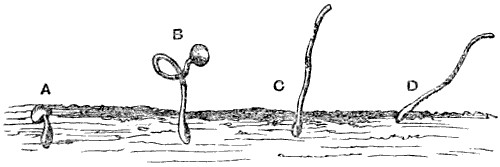
A. Seed-covering beneath which radicle or young root is pushing.
B. Leafless stem or tendril growing upwards, bearing seed-covering on its apex.
C. Young thread-like plant freed from seed-covering, on the look-out for a foster-parent.
D. Not finding a foster-parent, droops and dies.
Having prepared some finely-sifted soil in a garden saucer, we sowed a small quantity of flax seed with which had been purposely mixed a few of the seeds of flax dodder; this, on being placed in a hot-house, showed the progress indicated in the diagram.
Our next diagram shows the progress of dodder-growth when the parasite has germinated sufficiently near to a young flax plant to be attracted to it. In such case, instead of dying, it seems all at once to be animated by new vigour. The highly elastic thread, which now represents the whole dodder plant, goes through the following stages:—
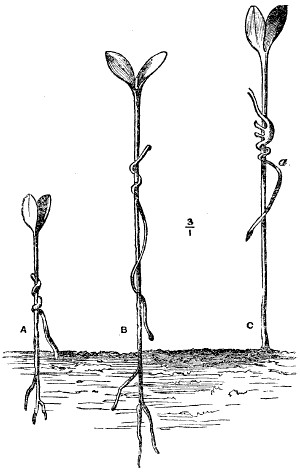
A. The dodder, having just clasped a flax plant, has made two coils round the stem of the latter.
B. Meanwhile the flax in growing lifts the dodder out of the soil.
C. While the flax is getting still taller, the dodder sends out rootlets, which pierce and fix themselves into the flax. During this the dodder sends out buds upwards, which, elongating until new flax plants are met with, explains not only how the dodder commences a growth quite independent of the soil, but, by spreading, from plant to plant, thus increases to an indefinite extent.
In this way, then, the dodder of flax, commencing from seeds at different points, spreads in more or less extended patches, which, if such centre be few, will be distinct; if many, the pest may occupy the greater part of the crop by spreading, and so becoming confluent.
Such is the method of growth of flax dodder, and we have no doubt but that the dodder of the clover progresses in like manner; at all events, we see the latter occupying more or less isolated patches in the affected crop; and in this case, as in the former, the crop-plant is not only starved, from having “its verdure sucked out,” but it is borne down to the ground and ruined.
As regards its destruction, we should be careful to look at our crops in their early growth, as, if the sickly-looking, wire-like tendril be observed then, it is easily removed by hand; if, however, it has made head, the best way would be to make a trench of a foot wide around the plague-spots, which will prevent its spreading, as the plant must have contiguous clovers to twist round if it is to extend; and then burn some straw on the dodder plot, and it will be wasted to death. Probably, however, the easiest plan is to depasture the crop,—certainly not to seed it down—in which case it will be impossible for any dodder seeds to ripen.
But here, as in other cases, the evil will be prevented by sowing pure seed, whether of flax or of clover; and as the dodder is a small, brown, roundish little seed, so different from that of either crop, there is no difficulty in recognizing it where present.
Orobanche—Broomrape.
The Broomrape is now becoming a very pernicious clover weed, especially in lighter soils. We have seen it on clover near Stonehenge so thick as to have positively spoiled the crop; and we should expect from its bitter, disagreeable flavour, that if cattle did not universally refuse to eat it, it might prove mischievous to them.
The species which attacks clover is the Orobanche minor—Lesser Broomrape,—which is at once distinguished in a clover field by its upright brownish spike of dead, dry-looking, lipped flowers; the stem without true leaves, but clothed with small brown leaf-like processes (bracts of the botanist), which, with the stem, are clothed with hairs.
This plant, which is much larger and very different from the clover, is parasitic on the principal division of the clover root; so that if the soil be carefully removed from the broomrape, it will be found to swell at the base, into which the clover root may be detected to be fastened, and a very odd appearance indeed has the small-stemmed clover united to so comparatively large a parasite.
The seeds of the broomrape are so small as scarcely to be detected in a sample of clover seed; indeed, several may be fastened to a seed as dust, so that whatever care may be used in the selection of seed will hardly prevent this pest. Any great injury to the clover crop may be speedily stopped by hand-picking the broomrape; for, although it will sometimes branch up again, it will be much lessened, and the few secondary shoots will usually be very weak.
Clovers are attacked by Epiphytes—that is, minute fungoid plants growing upon the leaves; but the natural history of these is too obscure for a general treatise, nor are they of sufficient interest to the practical farmer.[9]
[9] To such as may be interested in the study of the “rusts” of Clover, and some other plants, we would earnestly recommend a perusal of some most interesting papers on the subject, by M. C. Cooke, Esq., beautifully illustrated by Messrs. West & Sowerby, which will be found in the Popular Science Review—a serial which should have a place in the house of every country gentleman.
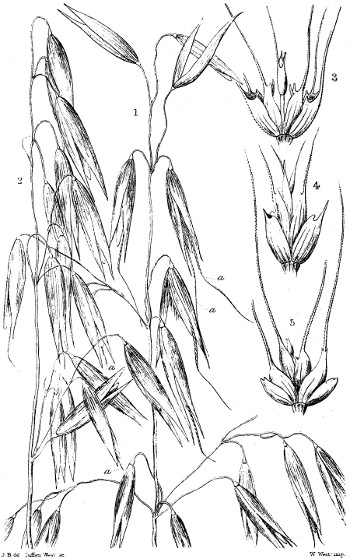
Corn.
HOW TO GROW GOOD CORN.
CHAPTER XXIV.
NATURE OF CORN.
By corn, in its enlarged sense, the farmer means all such crops as are grown for their seeds; so that all kinds of grain and pulse, such as peas and beans, belong to the corn crop, as distinguished from roots and green crops. In America the word “corn” is restricted to maize or Indian corn, and other crops are called after their respective names. Our dictionaries define corn as “seeds which grow in ears, not pods;” and it is to these that the present treatise is meant exclusively to apply, confining our remarks for the most part to such kinds as are more commonly cultivated in this country.
Corn, then, may be said to be derived from different species of grasses, whose seeds are sufficiently large to enable them to be threshed from the ear and become stored as grain, in which case it differs from the smaller kinds, whose seeds may be grown for pasturage crops.
Hence, then, grasses afford us two sets, which are differently used,—one, as affording corn fabled to be the gift of the goddess Ceres, and so called cereal or corn grasses; the other, not grown for the sake of the grain, but for herbage, and named meadow and pasture grasses.
Corn grasses, then, belong exclusively to arable cultivation; and, indeed, it may be concluded that such have been derived from wild species, and that continued culture has brought them about, and still maintains them in all their endless varieties, and also gives us a power to add to these to an extraordinary extent.
It is this facility for improvement, this capability for forming grain on the one hand, and running into varieties on the other, which enables corn to be grown under so wide a range of temperature and in such varied and variable climates; and it is a knowledge of the laws affecting these changes, and the modes of action in the growth of corn consequent thereupon, which will constitute “Science and Practice in Corn Cultivation,” and should lead to a knowledge of “How to Grow Good Corn.”
In following out this inquiry, we shall, for the most part, confine our observations to the following crops:—
1.
Wheat,
-
Their Origin, Cultivation, Diseases, Enemies, &c. &c.
2.
Oats,
3.
Barley,
4.
Rye,
CHAPTER XXV.
WHEAT: ITS ORIGIN AND ACCLIMATIZATION.
It is a popular belief that wheat, in a state fit for food, was a direct gift to man, and handed down to him unaltered in form, except in so far as relates to varieties; but if we consider how varied are the details of this plant, how very different from each other are the more remote varieties, and yet how easy it is to fill up the links on the one hand, or to arrive at equally distinct and yet new forms on the other, we can only conclude that wheat, like most, if not all, our vegetable esculents, is but a derivative plant obtained from a wild form of grass, and in very early times brought into cultivation because of the facilities for change which it was capable of undergoing.
Nowhere is wheat, as such, found wild; for, although its grain has been cultivated in all parts of the world, its scattered seeds cannot maintain a position for any length of time; for, as it has been obtained by cultivation, so its derived status can only be maintained by careful culture, without which there seems reason to believe that cereal wheat would indeed become extinct.
Many botanists had arrived at these or kindred views from observation and reasoning upon the subject, but it was not until a comparatively recent period that we possessed any direct evidence derived from experiment: this we now have, and upon it we quote the following from Mr. Bentham, in the Cyclopædia of Agriculture, article “Triticum”:—
It has never been contended that their original types have become extinct, and various, therefore, have been the conjectures as to the transformations they may have successively undergone; and as no accidental returns towards primitive forms have been observed, we have till lately had but little to guide us in these vague surmises. Within the last few years, however, the experiments and observations of M. Esprit Fabre, of Agde, in the south of France, seem to prove a fact which had been more than once suggested, but almost always scouted, that our agricultural wheats are cultivated varieties of a set of grasses common in the south of Europe, which botanists have uniformly regarded as belonging to a different genus, named Ægilops. The principal character by which the latter genus had been distinguished, consisted in the greater fragility of the ear, and in the glumes (i.e. the chaff-scales) being generally terminated by three or four, and the pales by two or three points or awns (beards). But M. Fabre has shown how readily these characters become modified by cultivation; and, wide as is the apparent difference between Ægilops ovata and common wheat, he has practically proved their botanical identity; for, from the seeds of the Ægilops first sown in 1838, carefully raised in a garden soil, and re-sown every year from their produce, he had, through successive transformations, by the eighth year (1846) obtained crops of real wheat as good as the generality of those cultivated in his neighbourhood.
It was the description of the experiments of M. Fabre, in the Journal of the Agricultural Society, which led us to institute independent inquiries, to which end, having purchased some seeds of Ægilops ovata, we sowed them in our experimental garden at Cirencester, in a prepared plot of five yards square, on a subsoil of forest marble. From this seeds were selected to carry on the experiments, whilst the mass of the plants in the plot were allowed to seed and come up spontaneously, which it did year after year, and so preserved the original type with which we started. The preserved seeds were sown in fresh plots year by year, but—perhaps owing to the coldness of the soil and the general lower climate of the Cotteswolds—progress was only slow at first; however, in the warm summer of 1859 our plot of the season had made fresh advances, which will be best understood by an examination of the accompanying drawings.
Fig. 3 represents a spikelet of the type of Ægilops ovata, introduced into our garden in 1855. In this some of the pales have double awns, others single ones. Fig. 4, a spikelet of 1859, modified by cultivation. In this the awns are single. Fig. 5, a spikelet from an ear of bearded wheat.
Now, the close affinity of these three forms must strike any one; but we feel justified in concluding that, had not our experiments been peremptorily stopped, and the results, as far as possible, spoiled from the ignorance and jealousy of the new Principal, we should before this have arrived at results much more satisfactory.
The principles of the observed changes will be understood by stating the following facts.
a. Ægilops ovata has a seed of sufficient size to be called a corn grain, and which, though not so large as that of wheat, yet rapidly improves by cultivation, which includes selection.
b. The rachis (the part on which the spikelets are placed in the wild grass) is exceedingly brittle, so that it readily breaks into bits below each spikelet; this brittleness annually gets less under cultivation.
c. The wild grass has a trailing habit of growth; but uprightness and a longer culm is at once induced by the closer contact of drilling the seeds in thick rows.
d. The cultivation of Ægilops, and especially subjecting it to rich soil, produces the same kinds of fungoid attacks as are found with wheats under like circumstances, as thus:—Puccinia graminis (mildew) of the leaves and culms; Uredo rubigo (red rust) of the chaff-scales; Uredo caries (smut or bunt) of the grain.
Now, all these circumstances seem to point to a similarity in essential structure, and a uniformity of habit somewhat remarkable in plants which at first sight would strike one as being so different; but as these differences between Ægilops and any variety of wheat are often all scarcely greater than is to be met with on contrasting two known varieties of wheat, we may agree in concluding that the evidence warrants the assumption that wheat, as a cultivated cereal, has been derived from Ægilops.
If, then, we view the wheat plant as a derivative, we shall be at no loss in understanding how the vast number of varieties have been brought about—varieties applicable, too, to a wide range of climatal conditions; and the ease with which new forms can be brought about by hybridization and selection is a matter of importance, because older varieties, too often repeated, are apt to degenerate both in quality of grain and quantity of crop. But when we speak of acclimatizing wheat, we think it would be excessively difficult to make any existing form grow well in a climate not congenial to it, though it might be easy to arrive at a new variety possessing some desired quality. We believe, however, that it is not difficult to alter a climate to suit a sort, and, in all probability, this at the present day much-used term of “acclimatization” simply means no more than making our cultivation and climate accord as nearly as possible to the habits of the plant or animal to be entertained under new conditions.
Thus, when we see the finer white wheats growing good crops on farms where such would have been impossible a few years ago, we are hardly to conclude that we have at length got this more delicate sort to become more hardy; but the climate has been ameliorated by draining and better cultivation.
We distinctly recollect when the lias clays of the Vale of Gloucester could scarcely be made to grow a good crop of even the hardier sorts of red wheat, the common cone being the sort generally grown. This was succeeded by many sorts of red wheat, and now only the best-cultivated farms produce white wheats. These, however, are facts which will be more strongly brought out when we consider the subject of cultivation; for the present we would be content with the expression of a belief that wheat, as a cereal grain, is derived by cultivation from a wild grass, and it is due to the effects of cultivation that we have so many sorts, with such variable adaptability.
CHAPTER XXVI.
THE WILD OAT AS THE ORIGIN OF THE CULTIVATED VARIETIES.
Crop oats, like wheat, have ever been considered as a direct gift from Ceres, and few, indeed, amongst scientific men were willing to believe that they were derived from a wild and weed species. Still, the farmer had long maintained that oats, when cultivated, often left behind them weed oats; and in some districts of Worcester, Gloucester, and Warwick, we have known men refuse to grow oats as a crop from their fear of producing the terrible weed, which, indeed, the wild oat is on all hands admitted to be.
Now, although we by no means wish to advance the theory of transmutation, and cannot believe that by any plan barley can be converted into oats, or oats into barley, we are yet confident that what has been termed ennobling, or the producing of a cultivated plant from a wild one, is oftentimes comparatively easy, and in none more so than in the production of crop oats from the wild species, Avena fatua.
Professor Lindley, in the article “Avena,” in Morton’s Cyclopædia of Agriculture, suggests that the cultivated oat “is a domesticated variety of some wild species, and may be not improbably referred to Avena strigosa, bristle-pointed oat;” but our experiments would show that the Avena fatua is the form from which at least the domestic sorts in general cultivation seem to have sprung.
The Avena fatua (wild oat) is an annual grass which almost universally accompanies agrarian circumstances; that is to say, it seldom, if ever, occurs in a truly wild aboriginal state, and is therefore not found in uncultivated tracts, but is the common attendant on tillage, and in some soils is a most common and disagreeable weed in various agricultural crops, but more especially amid grain, whether of wheat, barley, or oats. Sometimes it is found with beans, peas, and vetches, and, indeed, it may be said to be a common weed in some districts in any crop from which it has not been eradicated by the hoe—an operation almost impossible in grain, as its growth is so much like that of the crop itself.
It is a tall grass, rivalling the height of the finest cultivated oat crop, from some forms of which, and especially those with a lax panicle, it is at first not easily distinguished; however, a more careful examination and comparison with the so-called Avena sativa (cultivated oat) enables us to make out the following differences:—
Avena fatua, L.
Avena fatua, var.
sativa.
The valves of the inner pales, which adhere to the seeds, thick, and covered with stiff hairs, especially towards the base. The external valve has a long stiff awn, which in the ripe seed is usually twisted at the lower part, and bent at nearly right angles at about the middle. The grain-seed very small and worthless.
The valves of the inner pales not so coarse as in
A. fatua, and quite devoid of hairs. The outer valve with or without an awn, which when present is not so stiff as in the wild plant, sometimes twisted at the base, but seldom bent. Seeds large and full, forming the grain for which the crop is cultivated.
The experiments about to be detailed were performed with the Avena fatua.
In 1851, a quantity of this plant was noticed by the author on the farm of C. Lawrence, Esq., near Cirencester. It was mixed with a patch of mangel-wurzel which had been planted for seed; and from these specimens sufficient seeds were preserved wherewith to sow one of our experimental plots.
It should be noticed that the substratum was forest marble, and no doubt the seeds of the oat were brought with the manure by which the mangold patch was dressed.
In the spring of 1852 a plot of two and a half yards square was sown with seed which had been kept during the winter—a fact which should be carefully noted, as it forms a first and most important link in the chain of evidence, and constituting what we term a cultivative process, inasmuch as in wild growth the seeds are sown as soon as they become ripe.
The seeds of the first crop came up well, and on ripening, towards autumn, the plants were tall and robust; the grains presented a scarcely appreciable difference from the wild examples; if any, there may have been a slight tendency to an increased plumpness of grain.
The seeds of crop No. 1 were again collected and preserved throughout the winter, and sown in a patch of similar size, but in a different part of the garden, in the spring of 1853, repeating the process with the successive crops in 1854 and 1855, with slight alterations from year to year, though in some examples the following tendencies seemed from the first to be gaining strength in some few of the specimens:—
1st. A gradual decrease in the quantity of hairs on the pales.
2nd. A more tumid grain, in which the pales were less coarse and the awn not so strong and rigid, and less black than in the wild example.
3rd. A gradual increased development of kernel or flower.
The seeds of 1855 crop, without selection, were treated in the same manner during the winter, and were sown in the spring of 1856, the resulting crop in August of the same year presenting the following curious circumstances:—
1st. Avena fatua (typical wild oat), with large loose panicles of flowers,[10] thin hairy florets, with a bent awn twisted at the base. Five parts of crop.
2nd. Avena fatua, var. sativa, with loose panicles of flowers, florets quite smooth, tumid, with or without straight awns, some few examples slightly hairy towards the base. This is the potato-oat type. Six parts of crop.
3rd. Avena fatua, var. sativa—Panicles more compact, flowers inclining to one side, grains more tumid than 2nd, quite devoid of hairs, awn straight. These present the type of the white Tartarian oat. Twelve parts of crop. Fig. 2. See plate.
[10] Some examples of this plant, gathered at Framilode, in the Vale of Gloucester, in the past autumn, gave as many as 750 seeds to a root, from which its rate of increase as a weed may be imagined.
Having now procured a crop of separate types of oat from the same seed, we preserved them distinct, and this year carried on our experiments by cultivating a patch of each, whilst the plot of 1856 was left with self-sown seeds, in order that it should again become wild by degeneracy.
From these experiments, then, we may conclude that different types of crop oats are derived from the Avena fatua, or wild oat; but, besides this, they open out a subject for inquiry of great practical interest and importance, which may be clearly stated as follows:—
If by cultivation the wild oat assumes the cultivated form, then by degeneracy cultivated oats may become wild ones.
Those who know what a detestable weed is the wild oat wherever it occurs, and how difficult it is to eradicate,[11] will at once see the cogency of the question involved.
[11] The author once went with a rector of a parish in Gloucestershire to examine the glebe allotments of the poor people, when, catching sight of an apparent crop of oats, the landlord threatened to dispossess the tenant, “because he had carelessly left his crop without gathering.” However, the matter was explained when it was pointed out that the land was planted with wheat, which the oats had quite smothered.
Farmers in some districts, and more especially on stiff clay soils, have ever objected to the cultivation of oats, as they had always maintained that they left behind a crop of weed oats. This, which was never a favourite idea with the botanist, who is generally too much inclined to species-making, seems now to have a basis of truth, for not only is it confirmed by the experiments described, but observation of an independent kind points to the same truth.
On examining the produce of shed, or accidentally scattered oat seeds, the first crop will often present the wild tendency in a partial reversion to the hairy state, an elongation and thickening of the awn, and a lessening of the size of the kernel; and this more particularly on heavy soils. It was, indeed, an observation of this change in oats scattered on forest marble clay which induced us to try the experiments above detailed; and as the subsoil of our botanical garden is the same clay, we are, perhaps, indebted to this cause for arriving so soon at such signal results.
Again, it is known in farming that some clay lands will never produce heavy oats; a sample, however good, is sure to degenerate upon such soils. Hence, then, the foregoing experiments and observations lead to the following conclusions:—
1st. The wild oat is perhaps not a native of Britain, but derived through the degeneracy of the cereal crop; and hence its occurrence only as an agrarian.
2nd. The cereal oat, on the contrary, is the result of the impress of cultivative processes upon the wild form, and as such liable to lapse into the wild state with greater or less celerity, according to the circumstances of soil and situation.
These conclusions are of practical value, as they show the direction in which experiments should be conducted in order to attain to varieties, it being a well-known fact that one variety is suitable for one soil, and another for a different kind of land. And again, as some forms of plants would seem to have the tendency of wearing out by long cultivation, so we have the means of applying to the original source of their production, and thus of commencing a new generation.
They teach us, too, the necessity of avoiding the growth of the oat crop in some situations, and which in the case before us is not the result of the “pigheadedness” with which the farmer is often so thoughtlessly accused, but a conclusion founded in reason; and if we consider how robust is the growth of the wild oat, and that its support is secured by robbing the grain crop with which it occurs as a weed—the difficulty of separating it from the crop where it has gained a footing—and, above all, that its succession is secured by its seeds universally ripening a few days before that of the crop with which it is mixed, and the moment they are ripe they fall and become self-sown,[12]—we can see abundant reason for wholesome fear as to the introduction of cereal oats in districts liable to their degeneracy.
[12] The wild forms shed their seeds much more readily than the cultivated ones, and are, besides, earlier in ripening, and thus much of our wild seed had dropped before the other forms were fully ripe; and it much assists experiments in transmutation not to let the seeds with which they are to be carried on become dead ripe. This is another cultivative process.
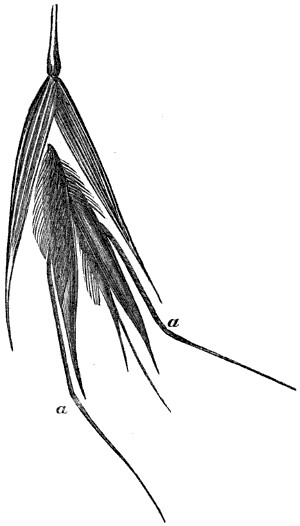
Spikelet of the Wild Oat.[13]
[13] From Popular Science Review, vol. i. p. 10.
The annexed enlarged figure of a bunch of wild oat seeds will sufficiently illustrate the changes necessary to produce the cultivated form.
Under cultivation, which supposes the selection, saving up, and sowing in a prepared bed of our seed, the wild oat seed gradually becomes smooth externally, and its awn less coarse, while internally the grain becomes larger and heavier; so that while the seed of the wild oat would weigh about 15 lb. per bushel, that of a fine sample of white cultivated oat sown on our farm this year weighed as much as 48 lb. per bushel.
Now, the proof of this theory consists in the facts—
1st. That heavy oats degenerate by being cultivated in poor soil.
2nd. By being let go wild, they sink still lower, and gradually assume the external hairs, stiff awns, and poor grain of the wild oat.
CHAPTER XXVII.
ON THE SUPPOSED ORIGIN OF BARLEY AND RYE.
The cereal barley is found to offer three important forms, which can be best explained by the annexed diagramatic arrangement:—


Two-rowed—
by abortion of four
Four-rowed—
by abortion of two
Six-rowed—
by fruition of all
|
the seeds of a spikelet.
The two-rowed barley has been named Hordeum distichum; and as we are inclined, with Professor Lindley, to the belief that this is the original from whence the other forms have sprung, we here quote the learned Professor’s remarks upon this and the probably allied forms:—
“It is probable,” he says, “that all kinds of barley grown by farmers are varieties of one species, of which, the H. distichum of Linnæus is the type. The spikelets of this genus always standing in threes, and the threes being placed back to back, it is evident that every ear of barley must consist of six rows of spikelets. If the middle spikelet of each set of threes is alone perfect, the side spikelets being abortive, we have H. distichum, the common two-rowed barley, and its many varieties; if the two-tuberal of each set is perfect, and the central spikelet imperfect, as sometimes happens, then we have four-rowed barley; if, on the other hand, all the spikelets are perfect, we have six-rowed barley, or H. hexastichum;[177] but the cases of four-rowed barley have been merely accidental—they may be referred to the six-rowed form; and thus we have only two principal kinds of barley—namely, H. distichum and H. hexastichum.
“1. H. distichum.—This is the only kind of barley that has been found apparently wild. We have now before us specimens gathered in Mesopotamia during Col. Chesney’s expedition to the Euphrates, with narrow ears, a little more than an inch long, exclusive of the awn, or four and a half inches awns included; and others from the ruins of Persepolis, with ears scarcely so large as starved rye. Both are straw-colour, but that from Mesopotamia has the glumes much more hairy than the other. The plant is also said to inhabit Tartary. The report that it grows wild in Sicily seems to have arisen from the Mediterranean Ægilops ovata having been mistaken for it. To this species belong all the varieties, from one to sixteen, formerly mentioned under Barley; as also does No. 20, fig. 34[14]—the H. zeocriton, sprat or battledore barley, an undoubted result of domestication, chiefly remarkable for the ears being so much broader at the base than the point as to produce a long ovate figure.
“2. H. hexastichum.—We found no record of this having been found wild, and presume it and its numerous varieties to be domesticated forms of H. distichum. The common bere, or winter barley, may be taken as the typical form to which Nos. 18, 21, and 22, and figs. 37 and 38[15] are evidently referable, varying in size, colour, and hairiness, more than in any other circumstance deserving botanical appreciation.
“The H. vulgare of Linnæus is a form with the grains in four rows, the naked-eared variety of which is again the H. cœleste of some writers.
“Both these forms of barley vary with naked seed, the pales losing their adhesion to the grain. But this difference is attended with no other peculiarity.
“3. The H. trifurcatum, also known under Dr. Royle’s name of H. ægiceras, is a very remarkable naked-seeded species, with much the appearance of wheat. It is a tall or glaucous six-rowed sort, but the rows are not placed in lines with the same exactness as in the two former kinds, so that the ears are round like wheat. The pales[178] are apparently in a monstrous form, the ends being three-lobed, and curved back in the form of horns, which sometimes extend into awns. It has been introduced from the Himalaya Mountains within a few years, but its economical qualities remain to be determined.”[16]
[8] We are desirous of instituting special experiments on the growth of clover dodder, but have failed to procure ripe seed, the reason being that the seed does not ripen after the clover has been cut down for its first crop.
It was part of this sample with which we experimented on the mode of growth of dodder, which, although being the dodder of the flax or linseed plant, yet its natural history will doubtless be that of the clover dodder;[8] we shall, therefore, describe the progress of our experiments, and their results.
[9] To such as may be interested in the study of the “rusts” of Clover, and some other plants, we would earnestly recommend a perusal of some most interesting papers on the subject, by M. C. Cooke, Esq., beautifully illustrated by Messrs. West & Sowerby, which will be found in the Popular Science Review—a serial which should have a place in the house of every country gentleman.
Clovers are attacked by Epiphytes—that is, minute fungoid plants growing upon the leaves; but the natural history of these is too obscure for a general treatise, nor are they of sufficient interest to the practical farmer.[9]
[10] Some examples of this plant, gathered at Framilode, in the Vale of Gloucester, in the past autumn, gave as many as 750 seeds to a root, from which its rate of increase as a weed may be imagined.
1st. Avena fatua (typical wild oat), with large loose panicles of flowers,[10] thin hairy florets, with a bent awn twisted at the base. Five parts of crop.
2nd. Avena fatua, var. sativa, with loose panicles of flowers, florets quite smooth, tumid, with or without straight awns, some few examples slightly hairy towards the base. This is the potato-oat type. Six parts of crop.
3rd. Avena fatua, var. sativa—Panicles more compact, flowers inclining to one side, grains more tumid than 2nd, quite devoid of hairs, awn straight. These present the type of the white Tartarian oat. Twelve parts of crop. Fig. 2. See plate.
[11] The author once went with a rector of a parish in Gloucestershire to examine the glebe allotments of the poor people, when, catching sight of an apparent crop of oats, the landlord threatened to dispossess the tenant, “because he had carelessly left his crop without gathering.” However, the matter was explained when it was pointed out that the land was planted with wheat, which the oats had quite smothered.
Those who know what a detestable weed is the wild oat wherever it occurs, and how difficult it is to eradicate,[11] will at once see the cogency of the question involved.
[12] The wild forms shed their seeds much more readily than the cultivated ones, and are, besides, earlier in ripening, and thus much of our wild seed had dropped before the other forms were fully ripe; and it much assists experiments in transmutation not to let the seeds with which they are to be carried on become dead ripe. This is another cultivative process.
They teach us, too, the necessity of avoiding the growth of the oat crop in some situations, and which in the case before us is not the result of the “pigheadedness” with which the farmer is often so thoughtlessly accused, but a conclusion founded in reason; and if we consider how robust is the growth of the wild oat, and that its support is secured by robbing the grain crop with which it occurs as a weed—the difficulty of separating it from the crop where it has gained a footing—and, above all, that its succession is secured by its seeds universally ripening a few days before that of the crop with which it is mixed, and the moment they are ripe they fall and become self-sown,[12]—we can see abundant reason for wholesome fear as to the introduction of cereal oats in districts liable to their degeneracy.
[13] From Popular Science Review, vol. i. p. 10.
Spikelet of the Wild Oat.[13]
[14] See Morton’s Cyclopædia of Agriculture.
[15] Ibid.
[16] Cyclopædia of Agriculture, vol. ii. p. 68.
[14] See Morton’s Cyclopædia of Agriculture.
[15] Ibid.
[16] Cyclopædia of Agriculture, vol. ii. p. 68.
We have had opportunities, through the kindness of Professor Lindley, who contributed seeds, of cultivating all the forms just described; but our experiments for two years did not elicit anything new upon the subject: we therefore feel justified in quoting the above entire, especially as the different forms in our plots afforded sufficient evidence of an uniformity of origin on the one hand, with every disposition for forming varieties on the other.
Rye (Secale cereale).—For the little that is known of the natural history and origin of this crop-plant we again quote from the Cyclopædia of Agriculture, which states as follows:—
“The common rye is a cereal grass, distinguished from wheat by its narrow glumes and constantly twin narrow florets, with a membranous abortion between them. Otherwise it is little different in structure, although the quality of its grain is so inferior. According to Karl Koch, it is found undoubtedly wild on the mountains of the Crimea, especially all around the village of Dshimil, on granite, at the elevation of from 5,000 to 6,000 feet. In such places, its ears are not more than 1 to 21⁄2 inches long. Its native country explains the reason why it is so much hardier than any variety of wheat, the southern origin of which is now ascertained.”
We have not seen any of this so-called wild rye; it would, however, be of great service could some good experiments be made with it, with a view of noting the changes which take place on cultivation. Indeed, we have long wished for authentic examples of all our wild, or supposed wild, cereals, with a view of examining side by side the nature and amount of the changes which cultivation would most assuredly produce.
Rye, unlike either wheat or barley, is not remarkable for a long list of varieties—a fact which may, perhaps, be attributed to the more limited growth of the former than the two latter. Its less extended cultivation must be attributed to its inferior qualities as food; for, though rye is in the main a hardier plant than wheat, and therefore could withstand the evils of a colder climate and colder treatment, yet with the advanced climate—the acclimatization of a country rather than a plant—the superior plant, wheat, everywhere prevails; and this cause also gives rise to the production of finer varieties, which are thus grown where only coarser ones were possible.
CHAPTER XXVIII.
EPIPHYTICAL PARASITES (VEGETABLE BLIGHTS) OF CORN CROPS.
These forms of parasite are so numerous, that nearly every species of flowering plant may become the nidus even of several named genera, with many species, or, at least, varieties of them. We here say attacked, because the advent of many of their forms passes under the name of “blight;” a term which at once recognises their injurious tendency.
Whether these epiphytes are the causes of the so-called blighted conditions, or merely their effects, is a subject upon which no little discussion has been expended. We do not, however, mean to re-open the question here; we will only remark, that in all probability this very wide range of the lower tribes of the vegetable kingdom is very variable in these respects.
Again: it will be impossible to enter into details of the different species of epiphytes. We shall hope, therefore, to elucidate their natural history, in so far as the farmer is concerned, by pointing out the more general facts connected with the following forms:—
1.
Uredo segetum—Smut or dust-brand of wheat, barley, and grasses.
2.
Uredo caries(
Tilletia)—Bunt
-
of wheat.
3.
Uredo rubigo—Red gum or red robin
4.
Uredo linearis
-
—Straw-rust, or “mildew”
5.
Puccinia graminis
6.
[181] Puccinia fabæ—Bean-rust.
7.
Æcidium berberidis—Barberry-rust.
8.
Cladosporium herbarum—Corn-ear mould.
9.
Botrytis infestans—Potato-mould and mildew.
10.
Botrytis—Turnip-mildew.
11.
Oïdium erysiphioides
-
Hop-mildew.
12.
Erysiphe macularis
13.
Oïdium abortifaciens—Ergot of grasses.
1. Uredo segetum, Smut or Dust-brand, is common to barley, and not unfrequent in wheat; in both of which crops it is easily recognised from the affected ears of corn appearing as though they had been powdered over from the sweep’s soot-bag. On closely examining these blackened ears, we find that the whole flower has, as it were, effloresced into a black powder, which, on being placed under the microscope, is shown to be composed of myriads of granules, called by the fungologist spores, in which latter are contained still smaller grains, or sporidia.
These black spores are all washed away by the time the crop is ripe, leaving the stalks bare and grainless, so that the sample suffers no injury from this blight, which, even if present after threshing, would only tend to a slight discoloration of the sample, which is remediable by the smutter. Its chief effect, however, consists in causing the loss of much grain. We have observed it to the extent of as much as an eighth, but usually the diminution is about equal to the amount of seed sown; though it is not improbable that the whole crop may in many cases be greater when the smut is present. Sheep-folding previous to barley, special manuring for this crop, and other causes of increased fertility, are constant causes of the increase of the dust-brand.
2. Uredo caries—Bunt, Pepper-brand, Smut-balls.—This blight differs from the preceding in the fact that in the grain no flower is formed, but its interior becomes filled with a dark powder, which, when viewed under a high magnifying power, is found to consist of granules, with a surface which is rough, and not smooth as in the dust-brand.
In most cases, the whole grains of the ear will be so affected; in others, only a portion of them. They will be gathered in the harvest, and as the diseased grain is readily crushed, the black powder materially damages the appearance of the sample. Nor is this all: this blight has a most disagreeable odour and flavour, both of which are communicated to the sample, and so, besides diminishing the amount of produce, it greatly deteriorates it. Its specific name of caries of course refers to this fact, as also does that of U. fœtida, adopted by Baur, an author to whom we are greatly indebted for information upon these curious productions.
Before considering the remedy for this evil, it will be well to distinguish it from the “purples, ear-cockle, or peppercorn” (vibrio tritici)—a name expressive of its animal origin, and frequently rendered “wheat-eels.” In the purples, the grain is shorter than a healthy wheat grain, irregular in shape (cockled), and purple externally; but its interior is filled with what, to the naked eye, is like very short white cotton-wool. On placing a bit of this woolly substance with the point of a needle on a slip of glass, just touching it with water and submitting it to a high magnifying power, the term “wheat-eel” will at once be seen to be justified; for, if alive, thousands of eel-like creatures will be seen writhing in the fluid.
The differences of these two affections of wheat may be expressed as follows:—
Bunt.
Ear-cockle..
Grain smooth externally, sometimes appearing black from blackened interior grains showing through the thin epidermis (bran). These corns easily crush beneath the finger, emitting the black fungi.
Grain cockled and irregular in shape, purple externally, skin thickened, interior of the grains stuffed with a white cottony substance, not compressible by the finger; but being opened, and the interior magnified, exhibits the living wheat-eels.
As regards the ear-cockle, we incline to the belief that a damp atmosphere and cold soil are chiefly concerned in its spread, if not in its production. As we have shown the difference between it and bunt, we now proceed to offer a few remarks upon the production of the latter, and its remedies.
Bunt is mainly produced by defective seed. It occurs on all kinds of soils—sands, clays, and limestones—and is not peculiar to any climate. Professor Henslow believes the disease to be wholly propagated by the spores of the fungus adhering to the wheat-seed. He says, “It has been clearly proved that wheat plants may be easily infected, and the disease thus propagated, by simply rubbing the seeds before they are sown with the black powder or spores of the fungus. It is also clearly ascertained that if seeds thus tainted be thoroughly cleansed, the plants raised from them will not be infected;” and he deduces from this a proof in favour of steeping; for he says, “This fact is now so well established, that the practice of washing or steeping seed wheat in certain solutions almost universally prevails.”[17]
[17] See an essay on Diseases of Wheat, in the Journal of the Royal Agricultural Society for 1841, by the Rev. Professor Henslow.
Our own experiments, however, recorded in the “Journal of the Royal Agricultural Society” for 1856, led us to conclude that the success derived from pickling wheat in different caustic and corrosive solutions arose from the fact of diseased grain being destroyed in the process; and we extract the following record of experiments made in 1853, as explaining this view of the matter.
Four plots of wheat, all from the same sample, were sown in the following order:—
1.
2.
3.
4.
Much diseased wheat, without pickle.
Much diseased; treated with sulphate of copper.
Perfect picked seed, without pickle.
Perfect picked seed, with sulphate of copper.
The results of these were as under:—
Plot 1. Most of the seed germinated, but the crop was much blighted, both in straw and grain; in fact, scarcely a perfect ear of the latter.
Plot 2. A small quantity of the seed germinated; the few resulting ears were free from blight.
Plot 3. Germinated, with a good and clean resulting crop.
Plot 4. The same result as Plot 3.
These experiments seemed to show that the pickling of wheat destroys the seed, so as to prevent germination when the seed is diseased or ill-formed; but if perfect seed be always employed, no pickling at all is necessary, it being strictly true that a diseased progeny must result from an imperfect stock in plants no less than in animals.
We have said that bunt is not peculiar to any climate; we have, however, always observed that employing seed from a warm district on a cold one, or using the finer white wheats in cold, exposed, or ill-drained situations, is sure to produce a large quantity of this fungus. Autumn-sown wheat, too, is less liable to the infection than spring wheat, which we attribute to the fact that many of the weaker plants will succumb to the cold rain and frost.
3. Uredo rubigo (Red-rust, Red-rag, Red-robin) makes its appearance in the inside of the chaff-scales, and ultimately in the green epidermis of the growing grains of wheat. Its first appearance is that of oval pustules, caused by the raising of the skin, which, ultimately bursting, shows the orange-coloured spores of the epiphyte. This must not be confounded with Cecidomyia tritici (wheat-midge), the larvæ of which are of a bright orange-colour; in the latter, the living moving worms may be easily detected by any common pocket lens or magnifying glass. Both these pests, to which we would apply the distinctive terms of Uredo rubigo (red-rust) and Cecidomyia tritici (red-gum), are exceedingly common in some seasons, and not unfrequently in the same crop. Good deep cultivation is the best remedy for the rust; but the treatment of the fly is a different matter. We would suggest the burning of smother-heaps on calm days, just as the wheat is bursting into ear, as smoke is decidedly obnoxious to these small insects, which in some seasons may be seen in thousands about the bursting wheat.
4 and 5. Uredo linearis; Puccinia graminis (Straw-rust and Mildew).—We refer to these epiphytes under one heading, as there can be but little doubt that the latter is a more advanced state of the former. They both occur in oblong patches on the leaves and straw of wheats and other grasses: in the uredo stage, of a dull red colour; in the puccinia stage, of a blackish hue. They are both, as, indeed, are all these fungi, interesting microscopic objects; but our object now is to describe them popularly. Both will always be found in abundance in cold poor soils, and more especially if the finer wheats be grown in such situations. The application of a dressing of salt to the soil is said to be a preventive. Be this as it may, the disease is said to be rarer in Cheshire, where salt is so much used by the farmer, than in any other county, in as far as we have observed.
Here, again, we incline to think that these are morbid affections of the plant. They are, indeed, viewed as such by Unger, in his “Die Exantheme Pflanzen,” in which the very title classes them with eruptive diseases of animals. Berkeley and Henslow, the two great authorities, however, do not accord with this view: the former remarks in reference to it—“Surely these plants are too distinctly, too regularly, and too beautifully organized to be the products of disease like warts or purulent matter in animals.” As, however, the microscope demonstrates that warts and eruptive diseases have also their special and curiously formed organisms, such a mode of reasoning is not conclusive.
Weeds have a great influence in producing mildew, which perhaps may be accounted for from the fact that weeds are in active growth as the wheat-stalks decline in vigour; and hence the constant evaporation of moisture from the weeds to the wheat is continually re-moistening an ever-drying surface—a most fertile source of mildew and moulds of several descriptions.
6. Puccinia fabæ (Bean-rust).[18]—The brown pustular rust-looking spots on the foliage of beans, and, indeed, occasionally on the stems and pods of beans, are sometimes common to this crop. They are usually accompanied by a lessening both in quantity and quality of this pulse, both in the garden and in field culture, but certainly more generally in the latter. Too gross manuring without well mixing the dung with the soil would seem to be a constant source of the evil. In fact, highly nitrogenized manures appear to favour the development of all this class of epiphytes, just as too much meat might bring about different forms of rash or eruptions in the animal. Weeds, which are too much permitted in beans, here aid in perfecting the mischief; hence, then, we may perhaps take it for granted that the mention of the causes of mischief suggests the remedy.
[18] This blight is mentioned here on account of its affinity to the former.
7. Æcidium berberidis (Barberry-rust) is here referred to, from the opinion prevailing that it is the cause of rust and mildew in wheat. We can no more believe that the barberry-rust would produce rust in wheat, than the rust of any other plant would do so; for nearly all plants are affected with some kind or other of rust. This epiphyte, too, is very different in structure from wheat-rust. Still, that wheat growing under a barberry hedge may be more blighted than in the rest of the field is quite true; and so it is with wheat grown under any kind of hedge. High fences are known to favour wheat blights; open, exposed, well-cultivated positions, when not too elevated, and without trees or hedges, being those in which the best wheats are grown.
8. Cladosporium herbarum (Corn-ear Mould) is a brown-coloured mildew, mostly occurring on the exterior of the chaff-scales of wheat, but common to many plants in a state of decadence. It consists of greenish or blackish tufts, which appear on the outside of the chaff-scales of wheat under the two following conditions:—
On wet soils, where the ears appear to have been prematurely starved.
On dry sands, where long-continued drought has caused some ears to wither and die before the seed was fully formed.
In both these cases we see that the plant has been previously injured. The decay commences under alternations of moisture and drying, and hence the fungoid attack. Here, then, the conditions necessary for preventing will be deep cultivation and a due pulverization and mixture of the soils.
9-12. Botrytis, &c. (Mildew).—Under this head we include a multitude of epiphytes, to which the terms mildew, mealdew, mehlthau (Germ.) are applicable. They appear to the naked eye as patches of white dust or meal on the leaves and stems of the affected plants. With the microscope we see that they are beautifully-organized plants, having a kind of rootlet (mycelium) or spawn entering the tissues of the living plants on which they grow, and delicate pedicels supporting spores at the externally visible portion of the plant. The botrytis of the potato and turnip, the erysiphe or oïdium of the hop, vine, and other plants, are only different forms of mildew, which in some shape or another will be found on most plants. That these attack living tissues is quite certain; but in the case of the potato, the turnip, and the vine, there is reason to believe that they result, to a very considerable extent, from diseased action in their tissues. For example: the botrytis of the potato seems to attack a crop much over-cultivated, on the approach of wet and cold nights after a prosperous growth in warm sunshine. So, the oïdium seems to us to be most abundant on renewed growth after a season of dry weather. Again: mildew in turnips is sure to follow that check which a long season of dry weather brings after a prosperous and vigorous growth. All these circumstances at least show how these attacks are favoured by the conditions which bring disease. So much, indeed, is this the case, that we found, upon experimenting with some cucumbers in a warm stove, that as long as we regularly watered the plants and gave them the requisite air, they kept healthy; but, by neglecting these conditions for a few days, we obtained mildew with the greatest certainty.
The remedies against mildew are—to obtain as healthy a growth as possible, and to maintain this with as great regularity as circumstances will permit. Of late years, both the mildew of the vine and the hop have been treated with flowers of sulphur. Dusting the affected hop-leaves with sulphur certainly arrests the mildew in an incredibly short time; and we found that by dusting sulphur from a fine sieve on our cucumber plants, the disease was immediately arrested in its progress. We therefore look upon this as an invaluable remedy in these states of mildew, whether occurring on the vine, the hop, the turnip, the cucumber, or on other plants, as we have frequently seen it in hothouses—a circumstance which shows the near affinity of all those forms of epiphytes, which, perhaps, after all, only vary with the variations in the structure and economy of the different plants on which they occur.
13. Oïdium abortifaciens (Ergot); Secale cornutum (Ergot of Rye).—The black horn-looking spur which occurs in rye and other grasses was formerly looked upon as a distinct fungus; now, however, it is known to be a diseased or malformed condition of the grain or seed, resulting from an attack by an oïdium on the immature seed.
Most of the cereal and even the meadow grasses are liable to attacks of ergot, which is increased by cold damp fogs and a moist condition of the atmosphere, the difference of the size of the spur being in accordance with the size of the affected grass seed. Thus, in rye we have seen spurs more than an inch long, while in the cock’s-foot grass it is seldom a quarter of an inch.
The ergot, as it occurs in the rye, is much used by medical men in difficult cases of parturition; and we have had evidence before us, in some cases of abortion in cows, that the constant depasturing on grasses affected with ergot (and the Lolium perenne in aftermaths is often especially so) has been the predisposing cause.
CHAPTER XXIX.
INSECTS (ANIMAL BLIGHTS) AFFECTING CORN CROPS.
The different families and species of insects affecting the various kinds of corn crops in all their stages of growth are so numerous, that a detailed list of them would occupy greater space than we can devote to this chapter.
In this position of affairs we have thought it wise to confine our remarks to some of the commoner and more mischievous species, choosing those more particularly which are common to the wheat crop, of which the following may be at once introduced as a summary in itself sufficient to show what the farmer may expect at each stage of growth:—
1.
-
The
Slug,
-
Attacking the plants soon after germination.
The
Wire-worm,
2.
-
The
Gout Fly,
-
That attacks the wheat stems as they begin to form.
The
Saw Fly,
3.
The
Wheat Midge—Commencing their injuries in the young flower.
4.
The
Aphis Flea—Which attacks the
rachisand floral envelopes.
5.
-
The
Ear cockle,
-
Which destroys the growing grain.
The
Corn Moth,
6.
The
Corn Weevil—Which eats the flower from the grain.
7.
The
Little-grain Moth—Which attacks the grain in store.
8.
The
Meal-worm Beetle—Living upon ground corn or flour.
Now, this list may be said to have reference to eight stages in the growth and preparation of wheat, and they mostly apply to other grains also—namely, 1. The germinating plant; 2. The growing plant; 3. The growing flower; 4. The green ear of corn; 5. The young grain; 6. The perfected grain; 7. The stored grain; and 8. In the state of flour.
1. The Slug may be described as a houseless snail. There are several species, but the milky slug (Limax agrestis) and the black slug (L. ater) are those most common to our corn crops, and are more especially mischievous to wheat; for, as this crop usually succeeds clover or “seeds,” in which they breed most rapidly, so, the older the clover lea, the more eggs will be ready to hatch in the wheat crop, and this all the more readily as the wheat is nearly always put in with a single ploughing, and with as little cultivation as possible.
The best remedy will be found in encouraging insectivorous birds—the lark, rook, starling, peewit, and others, eating them either in the egg or young state with great avidity; a good assistance to whose labours may be supplied in a few broods of ducks from the farmyard, which it will pay well to have tended by a good boy—where such can be found—as these birds are most efficient as destroyers of slugs and caterpillars.
Store pigs turned into old leas, where they can do no mischief, will get no bad living where snails and insects abound.
Wire-worms.—The several species of beetle which produce the wire-worm belong to the genus Elater. They are of a long oval shape: about half the length belongs to the head and thorax, and the other to the abdomen. Every schoolboy knows that when he holds the insect on its back it elevates the abdominal portion, and again lets it fall so as to make a beating sound; and hence its generic name, and also its common name of click-and-hammer beetle. If he remove his finger when in this position, the creature immediately skips up and turns on its feet, from which action it has got the name of “skipjack.”
Curtis has estimated nearly seventy species of click-beetles as producing wire-worms in this country; but the three following are those generally met with—Elater lineatus, E. obscurus, and E. ruficaudis. These all attack corn and almost every other kind of vegetable.
The larvæ of these are very much alike, being hard, leathery, wiry caterpillars, which vary in length to about three-quarters of an inch, according to age. These are mostly smooth, and have six feet on their thoracic segments, and a false foot or proleg in the middle of the underpart of the terminal section of the abdomen—characters by which wire-worms may be distinguished from all others. Their length varies with age; as they live for some years in the larva state, so the different sizes mark so many broods, which in some fields are annually provided for. It should here be observed that the wire-worm does not breed; these larvæ can only be hatched from the eggs of the female click-beetle: hence, then, destroying the worms prevents the development of their parent.
Now, as we have seen whole fields of wheat destroyed by wire-worms, it becomes important to examine the nature of this attack, with a view to point out a remedy. If, then, we go into a corn field in early spring, and see the young wheat blades looking yellow and sickly, we shall seldom be long in finding the wire-worm, on carefully taking up some of the affected plants. Its position will be at the base of the plant, sometimes eating its way into its centre, and so eating out its very heart; or perhaps it may nibble away the outer coat of the young stem, and so prevent any nutriment passing into the blade. One worm will be enough to kill a single blade; but, alas! it frequently happens that he either visits all the blades, or is assisted by many individuals to each plant. This abundance we have observed more particularly on the breaking up of old pastures, old seeds, or saintfoin lea, in which not only have we many broods of wire-worms, but the eggs of a fresh lot, which hatch in time to eat the spring wheats. Again, this large increase we have ever observed in districts where rooks are few or much molested. The rook is a constant visitor to the clover field; but when the plant is young he is driven off, because the farmer “cannot think what else he can come for but the clover buds;” and when he sees some of these strewing the ground where the birds have been, he is confirmed in his opinion: but, if he carefully looked at the buds themselves, he would find them of a sickly hue, however recent the attack, and, if he looked deeper he might find the real enemy.
Fortified, then, with repeated observations of this kind, if asked how best to keep under wire-worms, we say most unhesitatingly, encourage the rook: he is one of the farmer’s best labourers; and though, like John, and Dick, and Hodge, he will sometimes run into mischief, it is surely better to institute a judicious police than to condemn and execute without very strong evidence.
Yarrell, in his beautiful “British Birds,” has the following remarks upon this highly-important subject:—
The attempts occasionally made by man to interfere with the balance of powers as arranged and sustained by Nature, are seldom successful. An extensive experiment appears to have been made in some of the agricultural districts on the Continent, the result of which has been the opinion that farmers do wrong in destroying rooks, jays, sparrows, and, indeed, birds in general on their farms, particularly where there are orchards. In our own country, particularly on some very large farms in Devonshire, the proprietors determined, a few summers ago, to try the result of offering a great reward for heads of rooks; but the issue proved destructive to the farms, for nearly the whole of the crops failed for three successive years, and they have since been forced to import rooks and other birds to stock their farms with. A similar experiment was made a few years ago in a northern county, particularly in reference to rooks, but with no better success; the farmers were obliged to reinstate the rooks to save their crops.
But as, perhaps, the most interesting account of the value of rooks will be found in an extract from the Magazine of Natural History, vol. vi. p. 142, we cannot do better than transcribe it:—
“In the neighbourhood of my native place (in the county of York),” says the writer, Mr. T. Clithero, “is a rookery belonging to W. Vavasour, Esq., of Weston, in Wharfdale, in which it is estimated that there are 10,000 rooks; that 1 lb. of food a week is a very moderate allowance for each bird, and that nine-tenths of their food consists of worms, insects, and their larvæ; for, although they do considerable damage to the fields for a few weeks in seed-time, and a few weeks in harvest, particularly in backward seasons, yet a very large proportion of their food, even at these seasons, consists of insects and worms, which (if we except a few acorns and walnuts in autumn) compose at all other times the whole of their subsistence. Here, then, if my data[197] be correct, there is the enormous quantity of 468,000 lb., or 209 tons, of worms, insects, and their larvæ, destroyed by the rooks of a single rookery in one year. To everyone who knows how very destructive to vegetation are the larvæ of the tribes of insects, as well as worms, fed upon by rooks, some slight idea may be formed of the devastation which rooks are the means of preventing.”
Let this, then, suffice for the rooks; but starlings, wagtails, larks, and other birds, are also helpmates to the farmer; and therefore the wanton destruction of these will certainly bring, nay, has already brought, a great amount of trouble upon the cultivator of the soil.
The destruction we speak of has been committed by clubs and societies established for the purpose; but, as their members are mostly filled up with all sorts of prejudices—few being naturalists, or even accurate observers—it becomes daily a matter of more pressing importance that middle-class education, if not National-school teaching, should recognise the value of the natural sciences.
2. The Gout-fly (Chlorops glabra) and the Saw-fly (Sirex pygmæus) both lay their eggs below the first node or knot of the young plant, which, as soon as they hatch, form maggots that eat out the substance of the stems and the nodes, which thus become weakened and ultimately break off, or, if left standing, the ears of corn as they appear will be dried, whitened, and infertile.
In these, as in most cases of insect attacks, we have an occasional blight of such extent as to destroy whole crops, against which we are almost powerless, as we know so little of the economy of the creatures by whom the mischief is caused; still, there can be little doubt but that their periodical appearance, to the extent to cause them to be recognised as blights, is due to the thinning of their enemies; and we have always observed that a paucity of the Hirundines—the swallow tribe of birds, their greatest enemies—is coupled with a great increase of the smaller insects which it is the vocation of swallows, bats, and others of the hawking insectivorous creatures, to take on the wing.
3. The Wheat-midge (Cecidomyia tritici), also called the Hessian-fly, is sometimes very destructive to the wheat crop. In 1860 we observed the effects of this creature to a greater extent than we have before known, in not a few instances rendering the crop scarcely worth reaping. Upon this creature we sent the following notice to the Agricultural Gazette for August 30, 1862:—
The wheat-midge (Cecidomyia tritici) has been so destructive for the last two or three years, that every fact connected with its history ought to be of great interest. Curtis tells us that “in Scotland one-third of the crop was lost, and the farmers suffered severely in 1828 and the three following years;” whilst “in Suffolk the yield[19] of wheat was one-third less in some districts in 1841 than was expected.”
The presence or absence of this insect is so important as affecting the yield, that we now never fail to look for it in every crop upon which we would offer a judgment in this respect.
It is easily detected in the larva state on opening some of the chaff-scales—pales—of affected crops, as in the interior of these will be found some minute larvæ (maggots) of a bright yellow or orange colour. In the earlier period of the blossom these larvæ will be found about the[199] stamens and pistils; later, upon the grain, which is always shrivelled and lost where the attack has been made.
The colour of the maggots is so much like that of the red-rust as often to be mistaken for it; the difference, however, between the bunches of minute granular fungi and living worms will be made apparent to the most careless observer by the assistance of a common pocket lens. We find two terms in use for these yellow appearances—namely, red-rust and red-gum; and as we have so often found them employed indiscriminately, we would restrict the former to the fungus,[20] thus—Uredo rubigo, red-rust; and Cecidomyia tritici, red-gum. Our observations on the latter this year have chiefly been made in the counties of Sussex and Gloucester, in both of which we have seen this insidious enemy at work to an alarming extent. In the former county, with a very limited extent of red-rust; in the latter, the later and more delicate wheats have both red-rust and red-gum in the same crop: and the interest of the subject will be the more forcibly apprehended when we say that in some crops, which, from a first glance at the straw and ears, we should have put down as somewhere about thirty bushels per acre, we have, after a more minute inspection of the ears, estimated at less than twenty bushels; and, indeed, in one field which we have examined during the last week (August, 1862), affected by the Cladosporium, Uredo, and Cecidomyia, there will scarcely be a yield in good grains of the amount of the seed sown.
[19] We believe this creature to be one of the most common causes of deficient yield, so that a knowledge of its history is all-important in estimating the value of a crop, which, as a rule, we should always put lower in the seasons when this blight abounds.
[20] See ante, p. 185.
The fly which lays the eggs from which these yellow larvæ are derived is of about the size of a gnat, and usually takes the wing in the evening, in which case, if its enemies the bats are not numerous, smother fires lighted towards sundown on the wind side of the fields are not only destructive to large numbers, but act as an offensive notice to quit to others. Curtis says:—
With regard to the Hessian-fly, even if its presence could be ascertained in the early stages, it does not seem possible to devise any[200] means of destroying the eggs or young larvæ, unless feeding off the blade with sheep would effect the object; and when their progress is detected by their mischievous works, at a more advanced period, nothing, I apprehend, but sacrificing the crop would arrest them. It appears, therefore, to be an evil to which we must occasionally submit; but, to guard against its immediate recurrence, it will only be necessary to collect and burn the stubble after the corn is reaped, by which means the larvæ and pupæ which are concealed at the base of the stalk will, of course, be destroyed.
Now, in reference to wheat stubbles, we would remark that the old-fashioned plan of leaving them long as a protection, and, we may add, a preserve of food for partridges, had its good effects in an agricultural point of view; but if this be done, we advocate the burning of the stubs on the soil, as they will thus act better as a manure, while the destruction of insects by the process must be enormous. All concur that modern agriculture suffers increasingly from insects; hence, then, an extended study of their habits seems daily more desirable: and we boldly assert that if our country schoolmasters would teach their pupils to observe insect life, they may be doing more good to agriculture than all our present so-called agricultural colleges and schools put together.
4. The Aphis flea (Aphis granaria) is a creature destructive to the grain by “sucking the verdure out on’t.” We have this year (1864) seen this insect, more especially the apterous—wingless—females, sticking on to the green wheat ears to such an extent as to render a walk into the crop a disgustingly dirty process. It would seem that a continuous dry and warm season favours the increase of these creatures; but, as we have always observed that the earlier sown wheats nearly always escape, from their coming into ear and advancing to ripeness before the aphis has increased its countless broods; so then we should recommend early wheat sowing, wherever and whenever practicable, as a preventive of the pest; in fact, the being in good time with all farm work has every advantage.
5. The two affections of the grain in our table are widely different in their modes of attack, but both tend to lessen the quantity of produce. The first, the Ear-Cockle (Vitrio tritici) is an affection of the grain, which at starting it will be well to distinguish from smut or bunt. In the latter, the grain is filled with what appears a black powder, the grains of which the microscope shows to be a fungus;[21] whilst in the cockle the seed, which is purple externally—hence called “purples”—is filled with what appears to be white cotton wool. This, under the microscope, has the appearance of a multitude of eels. These are, indeed, minute infusorial worms, and are exceedingly curious; the smallest portion of the cottony substance taken on a pin’s point and just moistened with water, often showing thousands of the eels under a good instrument; for drawings and descriptions of which and good drawings (after Bauer), we should recommend the reader to consult “Curtis’s Farm Insects.” A damp season favours the production of these; hence drainage and such conditions as increase the effects of damp and cold are to be guarded against.
“1. H. distichum.—This is the only kind of barley that has been found apparently wild. We have now before us specimens gathered in Mesopotamia during Col. Chesney’s expedition to the Euphrates, with narrow ears, a little more than an inch long, exclusive of the awn, or four and a half inches awns included; and others from the ruins of Persepolis, with ears scarcely so large as starved rye. Both are straw-colour, but that from Mesopotamia has the glumes much more hairy than the other. The plant is also said to inhabit Tartary. The report that it grows wild in Sicily seems to have arisen from the Mediterranean Ægilops ovata having been mistaken for it. To this species belong all the varieties, from one to sixteen, formerly mentioned under Barley; as also does No. 20, fig. 34[14]—the H. zeocriton, sprat or battledore barley, an undoubted result of domestication, chiefly remarkable for the ears being so much broader at the base than the point as to produce a long ovate figure.
“2. H. hexastichum.—We found no record of this having been found wild, and presume it and its numerous varieties to be domesticated forms of H. distichum. The common bere, or winter barley, may be taken as the typical form to which Nos. 18, 21, and 22, and figs. 37 and 38[15] are evidently referable, varying in size, colour, and hairiness, more than in any other circumstance deserving botanical appreciation.
“3. The H. trifurcatum, also known under Dr. Royle’s name of H. ægiceras, is a very remarkable naked-seeded species, with much the appearance of wheat. It is a tall or glaucous six-rowed sort, but the rows are not placed in lines with the same exactness as in the two former kinds, so that the ears are round like wheat. The pales[178] are apparently in a monstrous form, the ends being three-lobed, and curved back in the form of horns, which sometimes extend into awns. It has been introduced from the Himalaya Mountains within a few years, but its economical qualities remain to be determined.”[16]
[17] See an essay on Diseases of Wheat, in the Journal of the Royal Agricultural Society for 1841, by the Rev. Professor Henslow.
Bunt is mainly produced by defective seed. It occurs on all kinds of soils—sands, clays, and limestones—and is not peculiar to any climate. Professor Henslow believes the disease to be wholly propagated by the spores of the fungus adhering to the wheat-seed. He says, “It has been clearly proved that wheat plants may be easily infected, and the disease thus propagated, by simply rubbing the seeds before they are sown with the black powder or spores of the fungus. It is also clearly ascertained that if seeds thus tainted be thoroughly cleansed, the plants raised from them will not be infected;” and he deduces from this a proof in favour of steeping; for he says, “This fact is now so well established, that the practice of washing or steeping seed wheat in certain solutions almost universally prevails.”[17]
[18] This blight is mentioned here on account of its affinity to the former.
6. Puccinia fabæ (Bean-rust).[18]—The brown pustular rust-looking spots on the foliage of beans, and, indeed, occasionally on the stems and pods of beans, are sometimes common to this crop. They are usually accompanied by a lessening both in quantity and quality of this pulse, both in the garden and in field culture, but certainly more generally in the latter. Too gross manuring without well mixing the dung with the soil would seem to be a constant source of the evil. In fact, highly nitrogenized manures appear to favour the development of all this class of epiphytes, just as too much meat might bring about different forms of rash or eruptions in the animal. Weeds, which are too much permitted in beans, here aid in perfecting the mischief; hence, then, we may perhaps take it for granted that the mention of the causes of mischief suggests the remedy.
[19] We believe this creature to be one of the most common causes of deficient yield, so that a knowledge of its history is all-important in estimating the value of a crop, which, as a rule, we should always put lower in the seasons when this blight abounds.
[20] See ante, p. 185.
The wheat-midge (Cecidomyia tritici) has been so destructive for the last two or three years, that every fact connected with its history ought to be of great interest. Curtis tells us that “in Scotland one-third of the crop was lost, and the farmers suffered severely in 1828 and the three following years;” whilst “in Suffolk the yield[19] of wheat was one-third less in some districts in 1841 than was expected.”
The colour of the maggots is so much like that of the red-rust as often to be mistaken for it; the difference, however, between the bunches of minute granular fungi and living worms will be made apparent to the most careless observer by the assistance of a common pocket lens. We find two terms in use for these yellow appearances—namely, red-rust and red-gum; and as we have so often found them employed indiscriminately, we would restrict the former to the fungus,[20] thus—Uredo rubigo, red-rust; and Cecidomyia tritici, red-gum. Our observations on the latter this year have chiefly been made in the counties of Sussex and Gloucester, in both of which we have seen this insidious enemy at work to an alarming extent. In the former county, with a very limited extent of red-rust; in the latter, the later and more delicate wheats have both red-rust and red-gum in the same crop: and the interest of the subject will be the more forcibly apprehended when we say that in some crops, which, from a first glance at the straw and ears, we should have put down as somewhere about thirty bushels per acre, we have, after a more minute inspection of the ears, estimated at less than twenty bushels; and, indeed, in one field which we have examined during the last week (August, 1862), affected by the Cladosporium, Uredo, and Cecidomyia, there will scarcely be a yield in good grains of the amount of the seed sown.
[21] See ante, p. 183.
[21] See ante, p. 183.
The Corn Moth is best known by the presence of a small, slightly hairy maggot, which is found to eat the flour from the grain; this is the larva of a small moth, probably the Butalis cerealella. It is easily found in the chaff scales; and during the summer of 1861 we saw as many as six in a single ear, and it was, indeed, one of the causes of the bad yield of that year. We know of no remedy for this evil; but, perhaps, if we were better acquainted with the habits of the moth itself, means might be devised for taking it before the eggs are laid in the young ear of corn.
6. The Corn or Granary Weevil (Calandra granaria) and others.—These attack corn in store, and probably differ in species according to the kind of corn. This is a small beetle, the female of which makes a hole in the grain and deposits an egg, which soon hatches into the maggot; this eats out the grain with great assiduity until its partial period of rest in the pupa state; which passed, the beetle finishes the work, and may frequently be found in the interior of wheat.
The usual structures of granaries and corn-stores contribute to the increase of this pest, as they are mostly dark and ill-ventilated chambers. The best remedy is to expose the grain to the greatest possible amount of cold, by spreading it on the floors in hard frosts, and letting in light and air. Curtis quotes the “Bulletin des Sciences Agriculture” for July, 1826, for the following plan:—“Lay fleeces of wool, which have not been scoured, on the grain; the oily matter attracts the insects amongst the wool, where they soon die, from what cause is not exactly known. M. B. C. Payrandeau related to the Philomatic Society of Paris that his father had made the discovery in 1811, and had since practised it on a large scale.”
7. The moth that visits granaries (Tinia granella) may here be adverted to. The presence of the larvæ of the little grain moth may soon be ascertained in the granary, when one finds several grains of corn united by a web, to which will be attached bunches of small granules, which are the exuviæ of the one or two caterpillars belonging to each group of corns.
The best method of preventing this is thorough cleanliness, light, and ventilation in the granary. If, however, the moth has got possession, then we recommend sulphur to be burnt in iron pans—old saucepan lids are as good as anything—stopping up all the crevices. This will be an effectual remedy, not only for the moth, but for the weevils and other insect pests; and if a pound of sulphur be occasionally burnt in the barn, even rats must succumb to the gas which is generated.
8. The Meal-worm Beetle (Tenebrio molitor), which generates commonly in the meal-bins of this country, and the T. obscurus, which has been introduced in American flour, are two forms of beetle, the larvæ of which are “meal-worms.” These are best prevented by not keeping too large a store of flour, always having this dry and in the best condition, and storing, as far as possible, in a clean, light, and airy position. Indeed, as Curtis remarks, “Cleanliness is the best guard against these insects;” and we cannot better conclude this chapter than by further quoting the following from this excellent author:—
In looking back to the variety of insects that feed upon corn, and the multitudes that are often congregated in one heap, there can be no doubt that a very large portion must be occasionally ground up[204] with the corn and consumed by the public. This is not only a disagreeable fact, but it may be the source of very serious consequences, for I think it not improbable that many diseases might be traced to the insects which are converted with the infested flour into bread, amounting to such a large percentage, that if they have the slightest medicinal or deleterious qualities, it is impossible to deny the influence they must exercise upon the human system. I have known bushels of cocoa-nuts, which were every one worm-eaten and full of maggots, with their webs, excrement, cast-off skins, pupæ, and cocoons, all ground down to make chocolate, flavoured, I suppose, with vanilla!
CHAPTER XXX.
SCIENCE IN THE CULTIVATION OF CORN.
The object of the present chapter will be to point out the principles concerned in the more immediate acts connected with the cultivation of corn. In so doing in the present case, as in the discussion of the preceding subjects, it may not be out of place here to state that it has not, nor will it be, our object to enter into the every-day practical details of crop-management, but to dwell more particularly upon those points in cultivation which may be said to belong more especially to the science of the subject.
This chapter, then, will be more especially devoted to the consideration of the three following subjects:—
1st. On the uses of special manures for corn crops.
2nd. On the quality and quantity of corn to be used for seed.
3rd. On the period for harvesting corn.
1st. On the Uses of Manures.—It is pretty generally agreed that special manuring for corn, when grown in the ordinary shifting crop system, is positively injurious, and more truly so, if farmyard dung be employed. Still, on our own farm we were over-persuaded to give a dressing of rotted dung to some wheat. As the previous crop, turnips, had all but failed, we yielded on being told that it was a common Dorset custom, but, fortunately, only to the extent of a few acres down the middle of the field, on which part, at harvest, the main of the crop had fallen to the ground, with the affection known as knee-bent. There was plenty of straw, not at all good; but the yield of plump grains can hardly be half of those of the other parts of the field.
As a general rule, we have never observed special manuring to be useful except as top-dressings in early spring, at which time soot, or, better still, a mixture of soot and guano, may be sown on most wheat crops to advantage, and more especially where the young plant has been injured by the slug or the wire-worm, as in these cases the lower joint and the winter root are destroyed. If, then, the young plant be at this time stimulated with the mixture as advised, and the crop be afterwards rolled, we supply nutriment just in the form that it can be readily assimilated, the injured plants send out new roots from the second joint, and begin a fresh life, whilst the uninjured ones push out new buds—stolons—and all grow the better, because the roller has aided in firmly fixing the plants in the ground.
There have been those who would tell us that manure can be best used to wheat by subjecting the seed to various steeps; but we need hardly stop to question the folly of the assertions which from time to time re-appear, both at home and abroad, upon this point.
Thus far the subject of manures has been treated as for wheat as a shifting crop; but this crop has been grown year after year on the same soil, and, in some cases, without an apparent diminution in quantity or quality. One instance that came under our own observation was in Gloucestershire, where a cottager had grown wheat on the same plot of ground for thirteen years, and, for aught I know, it may still be continued. Hence the subsoil was Lias shale; but it was well drained and cultivated as a garden, the manure employed being the contents of the garden-house.
In cases of this kind, an annual application of manure is absolutely necessary; and we are happy to find that different manures and their effects have been experimented upon and duly noted, for the same plots, during a period of no less than twenty years, and that by such careful and reliable inquirers as J. B. Lawes, Esq., F.R.S., and Dr. Gilbert, F.R.S.; full details of the results of whose labours upon this subject will be found in Vol. XXV. of the Journal of the Royal Agricultural Society of England, from which we have extracted some of the following general conclusions as to average yield and weight of corn for the lengthened periods quoted:—
1. TABLE OF RESULTS OF EXPERIMENTS AT ROTHAMSHEAD, BY
MESSRS. LAWES AND GILBERT.
Plots.
Manures used every year.
Average.
Average
weight
per bush.
Years.
Bush.
Pecks.
1
Unmanured every year
16
1
57·9
20 years, 1844-63.
2
Ammonia salts alone
24
1
3⁄
457·6
19 years, 1845-63.
3
14 tons Farmyard manure
32
1
3⁄
460·0
20 years, 1844-63.
4
Unmanured every year
15
2
56·5
-
12 years, 1852-63.
5
Mixed mineral manure alone
18
1
3⁄
457·9
6
Ammonia salts alone
22
2
1⁄
255·9
7
-
Ammonia salts and mixed
mineral manure
-
36
1
1⁄
258·4
8
14 tons Farmyard manure
35
1
1⁄
259·3
A glance at this table shows us the wonderful results of continuous manuring for the soil operated upon; we might, however, expect that, though the general conclusions would probably not greatly vary, yet that there would not be absolute uniformity in these respects in different soils and districts.
2. On the Quality and Quantity of Seed-corn.—It seems to be generally concluded that a thin seed, from poorer soil, should be preferred for land of a better quality; but our own experience would lead us to look for seed from as great a change of soil as possible, and to procure therefrom not a poor, but as good a sample as we could. We should, however, look for our seed, not from a richer soil or a warmer climate, but the reverse. Oats, for example, as previously shown, degenerate, even to wild ones, if the poor seed be brought from a poor, cold soil, to be cultivated in land still poorer. We, however, on our farm, sowed oats during the past season weighing 48 lb. per bushel on a sandy soil; and, although our return was not so large in bushels as though we had sown black oats, yet their weight was but just under that of the seed. Now, these oats were from Canada, and, no doubt, the warm climate of the west of England suited them as to change.
As regards barley, we prefer a good sample for seed, if it be of home-growth; at the same time, very thin samples from Russia, or the States, often do well. Last season, we sowed some American barley of so poor a quality, that it was impossible to tell its name, but which gave for 50 acres an average yield of 40 bushels per acre, so even and plump, that only 28 sacks of “tailing” were separated, and the bulk—good Chevallier barley—was equal to any in the market.
In cultivating wheat, climate must ever be considered, as only in warm situations can the finest samples of white wheats be grown. Upland cold positions are suitable for red wheats, and so are undrained lowlands; still, good farming will render it possible to grow white wheats where, before drainage and other ameliorating processes, such was impossible.
As regards the quantity to be sown per acre, it will be seen that the margin is sufficiently wide, if we say that it lies between half a peck and half a quarter. In garden cultivation, with deep digging, and in the absence of weeds, birds, or insects, where you can choose your time for every operation, dibble in a seed in a place, the minimum quantity may suffice, as good crops have been got from a very small quantity of seed; but garden experimenters rather too positively lay down the law, when they tell the farmer that this thin seeding will do equally well on broad acres, where every operation is circumscribed by circumstances. Where there is so much to do, you cannot always get everything done at the right season, even if the soil were favourable for so doing; and the period at which you get your land ready for the seed, and the time of sowing it, makes a wide difference. But there is another point of even—if possible—greater importance; namely, the quality of the seed. Now, on our farm we always ascertain the germinating power of every sample of seed before sowing; and from this, as well as from the results of numerous experiments on this subject, we have arrived at the conclusion, that there are immense differences in this respect, which cannot possibly be made out at sight, but can only be ascertained experimentally. To make this matter clear, we append a table (2) of the results of experiments on this point upon no less than forty-two samples, which were tried in 1863.
Now, these experiments showed a want of germinating power, in some of the samples, of more than 50 per cent., and in the 42 samples an average of 24.5 per cent.; from which it will be seen that sometimes the thick sower is not the thick seeder, and his failure of a crop is not always due to slugs and wireworms.
These experiments were published in the Agricultural Gazette, and they evoked some remarks from a learned divine, so unfair and uncandid, as only to be excused by the nature of his professional education and modes of thought. Now, when this gentleman affected to believe that these things could not be so, and that with him every seed germinated, we could only conclude that the days of miracles had not quite ceased; but as, in later numbers of the Gazette, his opinions have been somewhat modified in this respect, we yet think him capable of riding a hobby too hard, though not until the pace has thrown him down and broken his knees will he own it.
2. TABLE OF THE GERMINATION OF WHEAT.
No.
Label.
Wheats of 1862.
Weight per bushel.
Price per bushel.
Came up
pr. cent.
Failed
per cent.
Remarks.
s.
d.
1
Tasmania
66·
...
46
54
-
These are six samples from the International Exhibition of 1862, to which they were forwarded by various colonists.
2
Ditto60·
5
...
8
92
3
Tuscan, from Victoria
68·
...
94
6
4
Dittoditto63·
...
78
22
5
Dittoditto67·
...
90
10
6
Tasmania
60·
...
30
70
7
Ditto
59·
5
...
28
72
Taken by us; probably the same as No. 6.
8
Talavera
66·
...
98
2
-
Four samples from Hainhault Farm—amongst the best that have come before us.
9
Spalding
63·
3
...
94
6
10
Thick-set Rough Chaff
65·
...
100
None
11
Morton’s Blood Straw
62·
6
...
94
6
12
Hallett’s Pedigree
62·
9
...
78
22
Communicated.
13
Creeping Wheat
66·
5
...
98
2
Ditto.
14
Bland’s Giant Prolific
59·
...
96
4
Ditto.
15
Fuller’s Red
56·
8
...
98
2
A poor grain from the Cotteswolds.
16
Red Straw Lammas
56·
8
7
0
82
18
-
Samples taken by us from Cirencester Market. No. 21 not a seed wheat; it contains 76,800 seeds of corn cockle and 64,000 seeds of rye in the bushel.
17
Hallett’s Pedigree
64·
6
10
6
88
12
18
Browick
58·
5
6
6
88
12
19
Red Chaff White
59·
6
6
78
22
20
Free-trade
59·
5
6
3
88
12
21
Russian
55·
5
7
1⁄
232
68
22
Burwell
58·
5
8
0
18
82
23
Rough Chaff Talavera
60·
5
9
0
90
10
Communicated from a well-known seedsman.
24
Talavera
63·
10
0
38
62
-
These formed a most interesting series of several sorts of wheat—most of which looked remarkably well as hand samples.
25
Corner’s Rough Chaff
62·
10
0
52
48
26
Red Browick
65·
8
0
58
42
27
Chidham
66·
5
10
0
70
30
28
Lammas
63·
3
8
0
58
42
29
-
Britannia, or Red
Thickset
-
66·
8
0
54
46
30
Red Nursery
67·
9
0
92
8
31
Col. Quentin’s Giant
68·
9
0
38
62
32
Kessingland
63·
3
8
0
86
14
33
April
60·
3
12
0
84
16
34
Golden Drop
63·
3
8
0
92
8
35
Shirreff’s Bearded Red
60·
5
9
0
74
26
36
Essex Rough Chaff
66·
3
9
0
96
4
37
Hunter’s White
60·
8
0
60
40
Out of condition.
38
-
Shirreff’s Bearded White
-
63·
2
10
0
96
4
39
White Trump
63·
3
9
0
96
4
40
Grace’s White
65·
10
0
38
62
41
Hertfordshire White
62·
2
8
0
94
6
42
Hallett’s Pedigree
66·
10
0
92
8
3. TABLE OF THE GERMINATION OF BARLEY, 1863.
No.
Label.
Price
per
quarter.
Came up
pr. cent.
Failed
per cent.
Remarks.
s.
1
From Sherborne
29
98
2
-
All market samples.
2
„Martock
29
98
2
3
„Lulworth
24
96
4
4
„Crewkerne
28
76
24
5
„Mr. Masters
28
96
4
6
Odessa
24
96
4
7
From Salisbury
24
100
0
-
Salisbury is considered one of the best places for seed barley. The samples are mostly from the Chalk Rock.
8
Ditto
24
96
4
9
Ditto
24
90
10
10
Ditto
24
92
8
11
Ditto
24
100
0
12
From Langport
28
100
0
-
Like most of our specimens, market samples.
13
„Chard
27
82
18
14
Stiff-straw
28
82
18
15
Nottingham
32
90
10
16
Chevallier
26
96
4
17
From Yeovil
26
70
30
-
This is a low-germinating series; their uniformity of price and difference in germination is remarkable.
18
Ditto
26
70
30
19
Ditto
26
84
16
20
Ditto
26
94
6
21
Ditto
26
84
16
22
-
Chevallier, sown
on farm
-
28
96
4
-
Two good samples, and the yield of the crop of fifty acres each about 36 bush. per acre.
23
American, ditto
28
100
0
24
Ditto
30
92
8
25
New from farm, 1864
30
98
2
Average
92
8
In round numbers.
Seeing, then, that there were such variations in the germinating powers of wheat, we determined to try a series of experiments with barley; and from the results (table 3), it will be seen that, though the margin is not so wide, yet great differences occur; still, with regard to this grain, we constantly find that in samples too thin and poor for even the farmyard poultry to pick up, yet that much of this is capable of germination.
Still, theory and practice confirm the assumption that in England very much seed is wasted by being too thickly sown; and, if a farmer can get his land well prepared and in good time, we conclude, as a matter of practical experience, that just half the seed usually sown will be better than the double quantity; but we should, as a rule, make a difference of at least half a peck for each week that we were beyond the best time of wheat-sowing in any particular district. On our own farm we sowed four and six pecks of wheat where double the quantity had been the rule before Christmas, and from six to eight pecks afterwards; six pecks of barley and oats, where a sack had previously been the rule. With the wheat and barley we were right, except in the very late-sown of the latter, when time was only sufficient to grow a single head, and not to allow of stooling. Here a sack would have given a better result. The same with our oats: thin seeding caused them to run to straw; they were on a poor sand, taller than the men who cut them; but had we doubled our seed, we conclude we should have had shorter straw and more corn.
If, then, these things be so, the judgment of the farmer will be best shown in rightly weighing all the circumstances of his case; and in the matter of seeding, as with physic, he will find that homœopathy alone is only quackery.
CHAPTER XXXI.
ON HARVESTING CORN.
A knowledge of when corn is in the best condition to be harvested is a matter of great importance; and hence some observations upon this subject may fitly conclude this part of our work.
Not to enter too deeply into chemical matters, we may state, at least as a probable general conclusion, that there is a period in the growth of grain and pulse crops before they are ripe, in which all the feeding qualities will be found diffused in the several plants; a little later, and the feeding matters will be found more particularly concentrated in the seed. Now, if oats, peas, and beans, be cut in this “green” state, they make either a fresh food, or can be dried into hay, which, when cut into chaff, is found to be an excellent feeding material; and as such crops can be quickly cleared and cheaply employed, there is no doubt but that they will henceforward be more generally used in this way than formerly.
But, again, in ripening of wheat there would appear to be a point in its progress short of “dead ripe,” in which every quality is fully stored in the seed; and, after this period, the seed-covering becomes thicker, and makes more bran in proportion to flour: facts made out from the following results of experiments of samples in three different states:—
TABLE OF THE RESULTS OF EXPERIMENTS WITH WHEAT.
Sample 1.—Wheat gathered when the grain was sweet, and almost milky. The stalks green. Date, July 25th, 1856.
Sample 2.—Wheat from the same field, gathered when in the state of hardening grain. The stalk just yellowed all the way down. August 2nd.
Sample 3.—Wheat from the same field, gathered when what is termed “dead ripe,” having been, in fact, left longer than it otherwise would, for want of hands. August 18th.
4. TABLE OF RESULTS FOR TWELVE EARS OF WHEAT DRIED.
“MORTON’S RED STRAW WHITE.”
Sample.
Weight of
the ears.
No. of
grains
of corn.
Weight of
grains of corn.
Grains.
Grains.
1
400
569
284
Grain shrivelled.
2
379
431
294
Grain plump.
3
468
453
377
Grain coarser.
5. TABLE OF ANALYSIS OF THE CORN FOR THE TWELVE EARS.
Sample.
Measure.
Per-centage
of flour.
Per-centage
of bran.
1
7·5
70·4
29·6
-
Flour of a fine white quality in all the samples.
2
6·8
71·4
28·6
3
8·8
63·7
36·3
Now, this shows that although the medium ripe ears in sample 2 had a less number of grains, yet their per-centage of flour, as compared with bran, was greatly on the increase. Still, it will be seen that sample 3 has the advantage in measure: hence, then, unless the miller will agree to give a better price for a “gay”[22] sample, it will be to the farmer’s advantage to leave it to fully ripen, if he can make sure that it can be kept from shedding in harvesting, and the attacks of birds.
5. The two affections of the grain in our table are widely different in their modes of attack, but both tend to lessen the quantity of produce. The first, the Ear-Cockle (Vitrio tritici) is an affection of the grain, which at starting it will be well to distinguish from smut or bunt. In the latter, the grain is filled with what appears a black powder, the grains of which the microscope shows to be a fungus;[21] whilst in the cockle the seed, which is purple externally—hence called “purples”—is filled with what appears to be white cotton wool. This, under the microscope, has the appearance of a multitude of eels. These are, indeed, minute infusorial worms, and are exceedingly curious; the smallest portion of the cottony substance taken on a pin’s point and just moistened with water, often showing thousands of the eels under a good instrument; for drawings and descriptions of which and good drawings (after Bauer), we should recommend the reader to consult “Curtis’s Farm Insects.” A damp season favours the production of these; hence drainage and such conditions as increase the effects of damp and cold are to be guarded against.
[22] The farmer’s term for early-cut corn, in both the middle and West of England.