



автордың кітабын онлайн тегін оқу Complete Fables of Gaius Julius Phaedrus. Illustrated
Complete Fables of Gaius Julius Phaedrus
Illustrated
This carefully compiled collection includes prose translations and verse translations of Phaedrus fables.
THE FABLES: PROSE TRANSLATION
Translated by Henry Thomas Riley, 1887
Flourishing in the first century AD, Gaius Julius Phaedrus was a Roman fabulist and the first recorded versifier of Aesop’s fables into Latin. Very few facts are known about Phaedrus and there was little mention of his work during late antiquity. It was not until the discovery of a few imperfect manuscripts during the Renaissance that his importance as a teller of fables emerged. His fables survive in five books, accompanied with various prologues and epilogues.
Traditionally, the Aesopica is a collection of fables credited to Aesop, a slave and storyteller believed to have lived in ancient Greece between 620 and 564 BC. Of diverse origins, the didactic tales associated with his name have descended to modern times through a number of sources and continue to be reinterpreted in different verbal registers.
Regarding Phaedrus’ life, scholars have deduced from autobiographical hints in the extant fables a few facts. He was born in Macedonia, probably in Pydna, in c. 15 BC and he came to Rome as a slave and was freed by Augustus. He probably served as a teacher for a time, before his first book of his poems appeared in the reign of Tiberius. However, envious competitors interpreted the morals of his fables as critical of the current regime and he was tried by Sejanus, the Emperor’s powerful official. In the prologue of the third book, Phaedrus pleads with a Eutychus to intercede on his behalf, which appears to have been successful. He survived these unstable times into old age, possibly serving under Claudius. Phaedrus went on to complete two more books of fables and died towards the middle of the first century AD. Still, these few statements are regarded by some scholars as dubious.
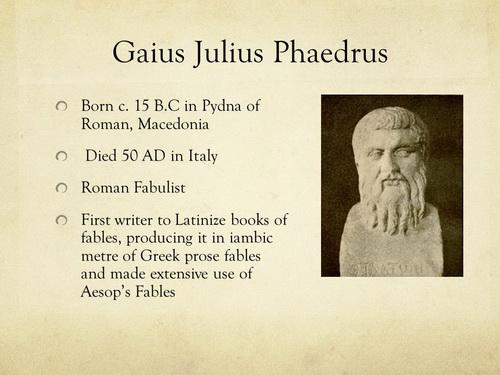
The first writer of fables in Latin, retelling the Aesopic tales in a loose iambic metre, Phaedrus remains an important writer in the history of world literature. The dates of composition and publication are unknown, though Seneca the Younger, writing between 41 and 43 AD, recommends in a letter to Claudius’ freedman Polybius that he turn his hand to Latinising Aesop, ‘a task hitherto not attempted by Roman genius’, implying that nothing was known of Phaedrus’ work at that time. By the mid-80s Martial was imitating Phaedrus and mentions his mischievous humour (improbi jocos Phaedri). The next reference to Phaedrus is a homage by his fellow fabulist Avianus, written much later in the fourth century.
A ninth century manuscript of Phaedrus’ fables was only discovered in France towards the end of the sixteenth century and published in 1596 by Pierre Pithou as Fabularum Aesopiarum libri quinque. It was followed by two more editions before century’s end. Close to the beginning of the eighteenth century, a manuscript of the fifteenth century bishop Niccolò Perotti was discovered at Parma, containing sixty-four fables of Phaedrus, of which thirty were previously unknown. These new fables were first published in 1808, and their versions were afterwards superseded by the discovery of a much better preserved manuscript of Perotti, held in the Vatican Library and published in 1831. Scholars realised that Phaedrus’ work had also served as the basis for mediaeval fable collections that survived under the name of Romulus.
Phaedrus’ fables are composed in a lively terse and simple Latin verse, with some elaborate style, and serving as excellent models for students of the language. They were not written only to amuse and teach, but also to provide compelling satirical comments on the turbulent social and political life of first century Rome.
PREFACE.
IN THE TRANSLATION of Phædrus, the Critical Edition by Orellius, 1831, has been used, and in the Æsopian Fables, the text of the Parisian Edition of Gail, 1826. The Notes will, it is believed, be found to embody the little that is known of the contemporary history of the Author.
H. T. R.
BOOK I.
THE PROLOGUE.
THE MATTER WHICH Æsop, the inventor of Fables, has provided, I have polished in Iambic verse. The advantages of this little work are twofold — that it excites laughter, and by counsel guides the life of man. But if any one shall think fit to cavil, because not only wild beasts, but even trees speak, let him remember that we are disporting in fables.
Fable I. THE WOLF AND THE LAMB.
DRIVEN BY THIRST, a Wolf and a Lamb had come to the same stream; the Wolf stood above, and the Lamb at a distance below. Then, the spoiler, prompted by a ravenous maw, alleged a pretext for a quarrel. “Why,” said he, “have you made the water muddy for me while I am drinking?” The Fleece-bearer, trembling, answered: “Prithee, Wolf, how can I do what you complain of? The water is flowing downwards from you to where I am drinking.” The other, disconcerted by the force of truth, exclaimed: “Six months ago, you slandered me.” “Indeed,” answered the Lamb, “I was not born then.” “By Hercules,” said the Wolf, “then ’twas your father slandered me;” and so, snatching him up, he tore him to pieces, killing him unjustly.
This Fable is applicable to those men who, under false pretences, oppress the innocent.