



автордың кітабын онлайн тегін оқу The Dog
The Project Gutenberg EBook of The Dog, by Dinks, Mayhew, and Hutchinson
This eBook is for the use of anyone anywhere at no cost and with
almost no restrictions whatsoever. You may copy it, give it away or
re-use it under the terms of the Project Gutenberg License included
with this eBook or online at www.gutenberg.org
Title: The Dog
Author: Dinks, Mayhew, and Hutchinson
Editor: William Henry Herbert
Release Date: May 8, 2010 [EBook #32300]
Language: English
*** START OF THIS PROJECT GUTENBERG EBOOK THE DOG ***
Produced by Julia Miller, Christine D. and the Online
Distributed Proofreading Team at http://www.pgdp.net (This
file was produced from images generously made available
by The Internet Archive/American Libraries.)
Transcriber's note:
The original text was published in 1873. The contents of this text may be dated. If in doubt, consult a Canine care professional.
SETTER AND WOODCOCK.
THE DOG.
BY
DINKS, MAYHEW, AND HUTCHINSON.
COMPILED, ABRIDGED, EDITED, AND ILLUSTRATED
BY
FRANK FORESTER,
AUTHOR OF "FIELD SPORTS," "FISH AND FISHING," "HORSES AND HORSEMANSHIP OF THE UNITED STATES AND BRITISH PROVINCES," "THE COMPLETE MANUAL FOR YOUNG SPORTSMEN," ETC., ETC.
Complete and Revised Edition.
New York:
GEO. E. WOODWARD,
191 BROADWAY.
Entered according to Act of Congress, in the year 1873,
By GEORGE E. WOODWARD,
In the Office of the Librarian of Congress, at Washington.
EDITOR'S PREFACE.
In offering to the American public a new edition of Dinks and Mayhew on the Dog, which, I am happy to find, is largely called for, I have been induced to make a further addition, which will, I think, render this the most perfect and comprehensive work in existence for the dog fancier and dog lover.
For myself I claim no merit, since, with the exception of one or two trivial changes in unimportant recipes in Dinks, and some abridgment of the last admirable work of Col. Hutchinson on Dog Breaking, which is now included in this volume, I have found occasion to make no alterations whatever, and, save a few notes, no additions.
I will add, in brief, that while I believe the little manual of Dinks to be the best short and brief compendium on the Dog, particularly as regards his breeding, conditioning, kennel and field management, and general specialities, there can be no possible doubt that Mayhew's pages are the ne plus ultra of canine pathology. There is nothing comparable to his treatment of all diseases for gentleness, simplicity, mercy to the animal, and effect. I have no hesitation in saying, that any person with sufficient intelligence to make a diagnosis according to his showing of the symptoms, and patience to exhibit his remedies, precisely according to his directions, cannot fail of success.
I have this year treated, myself, two very unusually severe cases of distemper, one of acute dysentery, one of chronic diarrhœa, and one of most aggravated mange, implicitly after his instructions, and that with perfect, and, in three instances, most unexpected, success. The cases of distemper were got rid of with less suffering to the animals, and with less—in fact, no—prostration or emaciation than I have ever before witnessed.
I shall never attempt any practice other than that of Mayhew, for distemper; and, as he says, I am satisfied it is true, that no dog, taken in time, and treated by his rules, need die of this disease.
Colonel Hutchinson's volume, which is to dog-breaking, what Mayhew's is to dog-medicining—science, experience, patience, temper, gentleness, and judgment, against brute force and unreasoning ignorance—I have so far abridged as to omit, while retaining all the rules and precepts, such anecdotes of the habits, tricks, faults, and perfections of individual animals, and the discursive matter relative to Indian field sports, and general education of animals, as, however interesting in themselves, have no particular utility to the dog-breaker or sportsman in America. Beyond this I have done no more than to change the word September to the more general term of Autumn, in the heading of the chapters, and to add a few short notes, explanatory of the differences and comparative relations of English and American game.
I will conclude by observing, that although this work is exclusively on breaking for English shooting, there is not one word in it, which is not applicable to this country.
The methods of woodcock and snipe shooting are exactly the same in both countries, excepting only that in England there is no summer-cock shooting. Otherwise, the practice, the rules, and the qualifications of dogs are identical.
The partridge, in England, varies in few of its habits from our quail—I might almost say in none—unless that it prefers turnip fields, potatoe fields, long clover, standing beans, and the like, to bushy coverts and underwood among tall timber, and that it never takes to the tree. Like our quail, it must be hunted for and found in the open, and marked into, and followed up in, its covert, whatever that may be.
In like manner, English and American grouse-shooting may be regarded as identical, except that the former is practised on heathery mountains, the latter on grassy plains; and that pointers are preferable on the latter, owing to the drought and want of water, and to a particular kind of prickly burr, which terribly afflicts the long-haired setter. The same qualities and performances constitute the excellence of dogs for either sport, and, as there the moors, so here the prairies, are, beyond all doubt, the true field for carrying the art of dog-breaking to perfection.
To pheasant shooting we have nothing perfectly analogous. Indeed, the only sport in North America which at all resembles it, is ruffed-grouse shooting, where they abound sufficiently to make it worth the sportsman's while to pursue them alone. Where they do so, there is no difference in the mode of pursuing the two birds, however dissimilar they may be in their other habits and peculiarities.
Bearing these facts in mind, the American sportsman will have no difficulty in applying all the rules given in the admirable work in question; and the American dog-breaker can by no other means produce so perfect an animal for his pains, with so little distress to himself or his pupil.
The greatest drawback to the pleasures of dog-keeping and sporting, are the occasional sufferings of the animals, when diseased, which the owner cannot relieve, and the occasional severity with which he believes himself at times compelled to punish his friend and servant.
It may be said that, for the careful student of this volume, as it is now given entire, in its three separate parts, who has time, temper, patience, and firmness, to follow out its precepts to the letter, this drawback is abolished.
The writers are—all the three—good friends to that best of the friends of man, the faithful dog; and I feel some claim to a share in their well-doing, and to the gratitude of the good animal, and of those who love him, in bringing them thus together, in an easy compass, and a form attainable to all who love the sports of the field, and yet love mercy more.
Frank Forester.
The Cedars, Newark, N.J.,
LIST OF ILLUSTRATIONS.
Setter and Woodcock,
FrontispieceBeagles,
To face page 50Group of Dogs,
73The Pointer,
241Cockers—Butler and Frisk,
463Setters—Bob and Dinks,
579The Wolf,
Page
74The Jackal,
75The Mastiff,
104Cuts Illustrating the Administration of Medicine to Dogs,
111,
112,
113A Dog under the Influence of an Emetic,
118Head of a Dog,
121Brush for Cleaning the Teeth of a Dog,
188A Scotch Terrier,
197A Dog Suffering from Inflammation of the Lung,
211A Dog with Asthma,
219" " Chronic Hepatitis,
221" " Gastritis,
233" " Colic,
252" " Superpurgation,
263" " Acute Rheumatism,
274A Rabid Dog,
300A Mad Dog on the March,
304Head of a full-sized Pug Bitch,
348The Blood Hound,
349The Beagle,
350The Gravid Uterus,
372Parturition Instrument,
381The Crochet,
384The Bull-Dog,
404Dog with a Canker-cap on,
423A Dog Taped or Muzzled for Operation,
428Bandages for Fractured Legs,
445THE
SPORTSMAN'S VADE MECUM.
BY "DINKS."
CONTAINING FULL INSTRUCTIONS IN ALL THAT RELATES TO
THE BREEDING, REARING, BREAKING, KENNELLING, AND CONDITIONING OF DOGS.
TOGETHER WITH NUMEROUS VALUABLE RECIPES
FOR THE TREATMENT OF THE VARIOUS DISEASES
TO WHICH THE CANINE RACE IS SUBJECT.
AS ALSO
A FEW REMARKS ON GUNS, THEIR LOADING AND CARRIAGE,
DESIGNED EXPRESSLY FOR THE USE OF
YOUNG SPORTSMEN.
TO THE READER.
No one work that I am aware of contains the information that is proposed for this little treatise, which does not aspire to any great originality of idea; but the author having experienced in his early days very great difficulty in finding to his hand a concise treatise, was induced to cull, from various authors what he found most beneficial in practice, into manuscript, and this collection he is induced to make public, in the hopes that any one "who runs may read," and, without searching through many and various voluminous authors, may find the cream, leaving the skim milk behind.
Wherever any known quotation is made, credit has been given to the proper persons, but it may be as well to state that most if not all of the Receipts are copies, though from what book is in a great measure unknown to the author, who extracted them in bygone days for his own use.
With this admission, he trusts that his readers will rest satisfied with the little volume which he offers to their indulgent criticism.
"Dinks."
Fort Malden Canada West
CONTENTS OF DINKS' VADE MECUM.
Page
Breeding of Dogs in general,
15Setter,
18Setter, Russian,
19Spaniel,
20Spaniel and Cocker,
20Retriever,
21Beagles,
21Breeding,
21Bitch in Use,
24Bitches in Pup,
26Feeding Pups and Weaning.—Lice.—Teats Rubbed,
27Pointer and Setter,
28Breaking,
29Ranging, how taught,
30Quartering,
33Feeding,
40Condition,
42Kennel,
44Credit given for Recipes,
49Recipes,
50General Remarks about Dogs in Physic,
50Recipes for Diseases incident to Dogs,
51Distemper,
58Tabular Form of Game Book,
68THE
SPORTSMAN'S VADE MECUM
BREEDING OF DOGS IN GENERAL.
Before commencing to treat of the most correct methods to be observed in the breeding, it will be as well to mention the different varieties of sporting dogs, and also the various sub-genera of each species, of which every one who knows anything of the subject need not be informed; but as this work affects to be a Vade Mecum for sportsmen, young far more than old, it is as well to put before the young idea certain established rules, not to be violated with impunity, and without following which no kennel can be great or glorious. A run of luck may perhaps happen, to set at naught all well defined rules, but "breeding will tell" sooner or later; and, therefore, it behoves any person who prides himself on his kennel, to study well the qualities of his dog or bitch, his or her failings and good qualities, and so to cross with another kennel as to blend the two, and form one perfect dog. This is the great art in breeding, requiring great tact and judgment.
POINTERS.
The breed of Pointers, as now generally to be met with, is called "the English," distinguished by the lightness of limb, fineness of coat, and rattishness of tail. Fifteen or twenty years ago this style of dog was seldom seen; but, in place of it, you had a much heavier animal—heavy limbs, heavy head, deep flew-jaws, long falling ears. Which of these breeds was the best 'tis hard to say, but for America I certainly should prefer the old, heavy, English Pointer. Too much, I think, has been sacrificed to lightness, rendering him too fine for long and continued exertion, too susceptible to cold and wet, too tender skinned to bear contact with briers and thorns, in fact, far too highly bred. Not that for a moment I am going to admit that American Pointers are too highly bred; far from it, for there is hardly one that, if his or her pedigree be carefully traced up, will not be found to have some admixture of blood very far from Pointer in its veins. Now this mongrel breeding will not end well, no matter how an odd cross may succeed, and the plan to be adopted is never to breed except from the most perfect and best bitches, always having in view the making of strong, well formed, tractable dogs, bearing in mind that the bitches take after the dog, and the dog pups after the dam, that temper, ill condition, and most bad qualities are just as inherent in some breeds as good qualities are in others. Here, then, to begin with, you have a difficult problem to solve; for, in addition to the defects of your own animal, you have to make yourself acquainted with those of the one you purpose putting to it. Is your dog too timid—copulate with one of high courage. But don't misunderstand me. In this there is as much difference between a high couraged and a headstrong dog as between a well bred dog and a cur. Is your dog faulty in ranging, may be too high, or may be no ranger at all, mate with the reverse, selecting your pups according to what has been stated above. If possible, always avoid crossing colors. It is a bad plan, but cannot always be avoided, for oftentimes you may see in an animal qualities so good, that it would be wrong to let him go past you. But, then, in the offspring, keep to your color.
From this general statement it will be easy to see, that in breeding dogs there is more science and skill required, more attention to minutiæ necessary, than at first sight appears to be the case. Long and deep study alone enables a person to tell whether any or what cross may be judicious, how to recover any fading excellence in his breed, or how best to acquire that of some one else. We will endeavor to give the experience of some fifteen years—devoted to this subject—to our readers, merely resting on our oars, to describe the various breeds of sporting dogs most desirable for him to possess, together with certain data on which to pin his faith in making a selection from a dealer, though as the eye may deceive, it is always as well to call in the ear as consulting physician, and by diligent inquiry endeavor to ascertain particulars.
The characteristics of a well bred Pointer may be summed up as follows: and any great deviation from them makes at once an ill bred, or, at all events, a deformed dog. To commence, then, at the head:—the head should be broad at top, long and tapering, the poll rising to a point; his nose open and large; his ears tolerably long, slightly erect, and falling between the neck and jaw bone, slightly pointed at the tip; eyes clear and bright; neck and head set on straight; his chest should be broad and deep—the contrary clearly shows want of speed and stamina; legs and arms strong, muscular, and straight; elbows well in; feet small and hard; body not over long, and well ribbed up—if not, he will be weak, and incapable of doing a day's work; loins broad at top, but thin downwards; hind quarters broad; hind legs strong and large; tail long, fine, and tapering; hair short, sleek, and close. Here you have the pure English Pointer, and as that is the best type of the dog, we shall not attempt to describe the Spanish one, which is not by any means equal to the English, and is, moreover, so quarrelsome, that he cannot be kennelled with other dogs. Good dogs are of any colors, but the most favorite ones are liver and white, white and fawn, pure black, and pure liver. The two first, however, are better adapted for this country, being more easily seen in cover.
SETTER.
We next come to the Setter. His head, like the Pointer should be broad at the top between the eyes; the muzzle though, must be longer and more tapering, and not over thick. Towards the eyes he must have a deepish indenture, and on the top of his skull a highish bony ridge. His ears should be long, pendulous, and slightly rounded. The eyes rather dark and full. His nose soft, moist, and large. Some breeds and breeders affect black noses and palates; but I must say that there are full as many good without the black as with it. I rather incline to the opinion that they are the best notwithstanding. Body like the Pointer, only deeper and broader, if anything; legs long to knee, short thence downwards; feet small, close, and thickly clothed with hair between the toes, ball and toe tufts they are termed; tail long, fine, and tapering, thickly feathered with long, soft, wavy hair; stern and legs down to feet also feathered. His body and feet also should be clothed with long, soft, silky hair, wavy, but no curl in it. This last smells badly of water spaniel. Colors, black and white, red and white, black and tan. These last I consider the finest bred ones. Roan also is good. The Irish setter is red, red and white, white and yellow spotted. The nose, lips, and palate always black. He is also rather more bony and muscular than the English breed, and ten times as headstrong and enduring. He requires constant and severe work, under most rigid discipline, to keep in anything like decent subjection.
SETTER, RUSSIAN.
The Russian Setter is as distinct from either of the above varieties as bulldog from greyhound. It is covered more profusely with long, thick, curly, soft, and silky hair, well on to the top of the head and over the eyes. He is also more bony and muscular, with a much shorter and broader head. What he wants in dash and ranging propensities, he makes up for in unwearied assiduity, extreme carefulness, and extraordinary scenting powers. The cross between this and either of the other setters is much valued by some breeders.
SPANIEL.
Of Spaniels there are several varieties, but of these the Suffolk Cocker is the only one deserving a notice. All the others are too noisy, too heedless, and too quick on their legs. It is almost impossible to keep any one of them steady, and, therefore, in this country at least, they are totally useless, since you would not see them from the beginning to the end of the day. Yaff! yaff! half a mile off, all the time putting up the birds, and you unable to stop them. The Suffolk Cocker, on the contrary, is extremely docile, can be easily broken, and kept in order. They are extremely valuable, thirty-five guineas being a low price for a brace of pure bred and well broken ones in England. The right sort are scarce, even there. Here, with two exceptions, I fancy they are not.
SPANIEL AND COCKER.
In appearance they are much like a raseed setter. The head and muzzle is much the same length and size; ears rather more rounded, but not so long; body deep, broad, and long; hair long and stiffish; legs and feet remarkably short, amounting almost to a deformity, and extraordinarily strong; tail short and bushy; it is usually curtailed a couple of joints. The purest colors are liver and white, fawn and white, and yellow and white. These dogs are slow and sure, remarkably close hunters, and obedient; just the things for cock shooting here. Too much cannot be said in their favor. They are easily taught to retrieve.
RETRIEVER.
A Retriever is a cross breed dog. There is no true type of them. Every person has a peculiar fancy regarding them. The great object is to have them tolerably small, compatible with endurance. The best I have seen were of a cross between the Labrador and water spaniel, or the pure Labrador dog.
BEAGLES.
In some parts of the States Beagles are used, and it may be as well to point out the characteristics of them. First, then, a beagle ought not to exceed fourteen inches in height; its head ought to be long and fine; its ears long, fine also, beautifully round, thin, and pendulous, rather far set back; body not too long; chest broad and deep; loins broad at top, but narrow downwards; legs strong, but short; feet small and close; hair short and close; tails curved upwards and tapering, but not too fine. There is also another sort of beagles, wire-haired, flew-jawed, heavy hung, deep-mouthed. They are very true hunters, seldom leaving the trail till dead, or run to ground.
BREEDING.
It is needless to say that at certain indefinite periods of the year a bitch comes into use, as the term is—generally twice a year, and still more generally speaking, during the time you most require her services, that is, April and September, spring snipe and grouse shooting, in consequence of which you must either sacrifice your pups or your sport. Now I am aware that in the States, for this reason, a bitch is seldom kept. For my part, I do not object to them, for from experience I can so regulate their failings as to prevent their family cares from interfering with their hunting. The knowledge of this enables me to have my pups when I want them, to get the cover of a dog I fancy, when a strange one comes my way also. The best time, then, to put the bitch to the dog is early in January. By this means you have your pups ready to wean by the middle of April. They have all summer to grow in, get strong, and large, and are fit to break in October on snipe first, and then quail, finishing off on snipe the following spring. After this litter, the bitch probably comes into use again in the end of July or in August. Young ones are not so fond of it as old ones, and, consequently, for quail shooting, your bitch is all correct and well behaved, so far as regards the dam. I look upon the breeding of dogs from any except the best and most perfectly formed of their species, as an act of great folly. There are times when it must be done to keep up the breed, or to acquire one; for no one drafts his best bitches unless he is an ass. For my part, I keep five or six constantly, and draft yearly all my dog pups but two or three, say one pointer, setter, and cocker. By this means I have the pick out of a large number of well bred ones for myself, while the drafts pay the expenses of keep and breaking. This is impossible for every one to do, and they must pick up their dogs the best way they can. It is my intention for the future to draft my setters to New York and my pointers westward. My cockers, I fear, will not go off yet, my imported dog having taken it into his head to die, and, until he is replaced from England—I have no stock for breed. I could only get a chance of four while last there out of many valuable kennels. However, I have promises of drafts from two or three parties, and ere summer cock come in, doubtless a brace or so will dare the perils of the sea for me; I have no hesitation in saying that, unless most amply remunerated, I would as soon sell my nose as the best pup in the litter, if I wanted it, nor would I advise any one else to do it. If done, you have to put up with inferior dogs. No; I breed to put a brace or so of the best young dogs yearly into my kennel, for my own use, and, while doing this, I also have, probably, ten good, well formed dogs to pick from, any one of which were one in want, would gladden the heart to get hold of. Sir William Stanley used to breed some fifty pointers yearly. Out of this lot, two brace were culled for his use. The rest were sold. They paid expenses. Many were excellent dogs, but he got the tip-top ones, and so he ought. This is the way a man who cannot afford to give great prices for good dogs must do, if he is much addicted to shooting. It requires two brace of dogs to do a day's shooting as it ought to be done. Each dog at full gallop the whole time, except, of course, when on birds; and to do this he must be shut off work about noon. Few dogs can go from morn till night without extreme fatigue. I never yet saw the dog that I could not hunt off his legs in a fortnight's hunt, taking him out every second day only, and feeding him on the best and strongest food. However, for general purposes, three brace of dogs are sufficient, and, when not often used, two are plenty; but no one ought ever to have less than two brace. It may be managed by always going out with a friend, he keeping one brace, you the other; he shooting to your dogs, you to his. For my part, give me three brace of my own, and let those be the best shaped, strongest, best bred, and best workers there can be. That is my weakness, and to achieve this I yearly sink a sufficient number of dollars to keep a poor man. But all this is digressing most fearfully from the nursery of young pointers and setters.
BITCH IN USE.
By receipt on a subsequent page, you will see how your bitch is to be brought into use. We will suppose her well formed and well bred. If faultless, put her to a dog nearly equal, if you cannot get one equal. Save the dog pups which will take after the dam. It is well understood that by breeding from young bitches you have faster and higher rangers; and this also reminds me to say that no bitch ought to be bred from till she is full grown, that is to say, till she is two years old. Many people breed at twelve months, but it is wrong. The bitch is not full grown, and, consequently, the puppies are poor, weak, and miserable. If the bitch has faults, find a dog of the same appearance as her, while he excels in those points she is deficient in. The bitches are partakers of his qualities. Are you short of bone, nose, size, form, temper, look for the excess of these. The cross, or, at all events, the next remove from it, will be just as you wish. Any peculiarity may be made inherent in a breed by sedulously cultivating that peculiarity. Avoid above all things breeding in and in brother and sister, mother and son, father and daughter—all bad, but the first far worse than either of the others, since the blood of each is the same. The other two are only half so. To perfect form should be added high ranging qualities, high courage, great docility, keen nose, and great endurance. That is the acme of breeding. A few judicious crosses will enable you to acquire it for your kennel. To the inattention and carelessness of sportsmen to these points are to be attributed the innumerable curs we nowadays see in comparison to well bred dogs. Anything that will find a bird will do. Far otherwise, to my mind. "Nothing is worth doing at all if it is not to be well done," and I would as soon pot a bevy of quail on the ground, as think of following an ill bred, ill broken, obstinate cur. It may perhaps be as well to state, that when I spoke of "crosses," I had not the slightest intention of recommending a cross of pointer and setter or bull dog. Far otherwise. Let each breed be distinct, but cultivate a "cross," be they pointer or spaniel, from another kennel of another breed of the same class of dogs.
With regard to setters, a little separate talk is necessary, for we have three sorts, English, Irish, and Russian. The cross of English and Irish may and does often benefit both races. So also does the Russian, but I would be extremely careful how I put him to one or the other. Extreme cases may and do justify the admixture, but the old blood ought to be got back as soon as possible. He is of quite a different species to the other, though with the same types or characteristics, yet this cross is rather approaching to mongrel. Having descanted somewhat largely on the preliminary portion, we will pass on to the rearing of the progeny.
BITCHES IN PUP.
Bitches in pup ought to be well fed, and suffered to run at large, and I am rather of opinion that by hunting them occasionally, or rather, by letting them see game while in this state, does not "set the young back any." Every one is aware of the sympathy between the mother and the unborn fœtus, and I for one rather do think it of use.
Few bitches can rear more than six pups, many only four, and do them justice. Cull out, therefore, the ill colored, ugly marked bitches first, and if you find too many left, after a few days you must exercise your judgment on the dogs. I don't like, however, this murdering, and prefer, by extra feeding while suckling, and afterwards, to make up for pulling the mother down, which having to nurse six or seven pups does terribly. My idea always is in the matter, that the pup I drown is to be, or rather would be, the best in the litter. It is humbug, I know, but I cannot help it. At that age all else but color and markings is a lottery. Oft have I seen the poor, miserable little one turn out not only the best, but biggest dog. Therefore, I recommend the keeping of as many as possible.
Let the bitch have a warm kennel, with plenty of straw and shavings, or shavings alone. Let her be loose, free to go or come. Feed her well with boiled oatmeal in preference to corn meal—more of this anon in the feeding department, mixed in good rich broth, just lukewarm, twice a day; About the ninth day the pups begin to see, and at a month old they will lap milk. This they ought to be encouraged to do as soon as possible, as it saves the mother vastly. At six weeks, or at most seven, they are fit to wean.
FEEDING PUPS AND WEANING.—LICE.—TEATS RUBBED.
Feed them entirely on bread and milk, boiled together to pulp. Shut them in a warm place, the spare stall of a stable, boarded up at the end. Examine them to see whether they are lousy, as they almost always are. A decoction of tobacco water (vide receipt) kills them off. Rub the bitch's teats with warm vinegar twice a day till they are dried up. If this be not done, there is great danger of their becoming caked, besides causing her to suffer severely. She must have a mild dose of salts, say half an ounce, repeated after the third day. When the weather is fine, the young pups should be turned out of doors to run about. Knock out the head of a barrel, in which put a little straw, so that they may retire to sleep when they feel disposed. Feed them three times a day, and encourage them to run about as much as possible. Nothing produces crooked legs more than confinement, nothing ill grown weeds more than starvation; so that air, liberty, exercise, and plenty of food are all equally essential to the successful rearing of fine, handsome dogs. Above all things, never frighten, nor yet take undue notice of one over the rest. Accustom them to yourself and strangers. This gives them courage and confidence. Remember, if you ever should have to select a pup in this early stage, to get them all together, fondle them a little; the one that does not skulk will be the highest couraged dog, the rest much in the same proportion, as they display fear or not. This I have invariably noticed is the case, and on this I invariably act when I have to select a pup, provided always he is not mis-formed. We have now brought our pups on till they can take care of themselves, and while they grow and prosper and get over the distemper, we will hark back a little, and say why we object to fall puppies,—simply because they are generally stunted by the cold, unless they are house-reared. They come in better, certainly, for breaking, but it is not so good to have them after September at the latest, unless it be down South, where, I fancy, the order of things would, or rather should, be reversed.
POINTER AND SETTER.
Hitherto I have omitted to compare the respective merits of pointer and setter. This I had intended to have done altogether, but fearful lest fault should be found with me for doing so, I state it as my deliberate opinion, that there is nothing to choose between them "year in and year out." A setter may stand the cold better and may stand the briers better, but the heat and want of water he cannot stand. A pointer, I admit, cannot quite stand cold so well, but he will face thorns quite as well, if he be the right sort, and pure bred, but he don't come out quite so well from it as the setter does. The one does it because it don't hurt him, the other does it because he is told so to do, and his pluck, his high moral courage won't let him say no. For heat and drought he don't care a rush, comparatively, and will kill a setter dead, were he to attempt to follow him. Westward, in the neighborhood of Detroit, the pros and cons are pretty equal. I hunt both indiscriminately, and see no difference either in their powers of endurance, see exceptions above, or hunting qualifications. For the prairies, however, I should say the pointer was infinitely superior, for there the shooting—of prairie hen—is in the two hottest months of the year, and the ground almost, if not quite, devoid of water. Therefore, the pointer there is the dog, and if well and purely bred, he is as gallant a ranger as the setter. Eastward, in New Jersey and Maryland, I am led to believe that setters may be the best there. Except "summer cock," all the shooting is in spring or late fall. Westward, we commence quail shooting on September the first. There, I believe, not until November the first. Here we have few or no briers or thorned things, save and except an odd blackberry or raspberry bush. There they have these and cat briers also, and that infernal young locust tree almost would skin a pointer. Therefore, for those regions, a setter is more preferable. Still more so the real springer.
BREAKING.
We will now pass on to the breaking of our young dogs. This may be begun when they are four or five months old, to a certain extent They may be taught to "charge" and obey a trifle, but it must be done so discreetly that it were almost better left alone. Nevertheless, I generally teach them some little, taking care never to cow them, one by one. This down-charging must be taught them in a room or any convenient place. Put them into the proper position, hind legs under the body, nose on the ground between their fore-paws. Retaining them so with one hand on their head, your feet one on each side their hind quarters, with the other hand pat and encourage them. Do not persist at this early age more than a few minutes at a time, and after it is over, play with and fondle them. At this time also teach them to fetch and carry; to know their names. Recollect that any name ending in o, as "Ponto," "Cato," &c., very common ones by the way, is bad. The only word ending in o ought to be "Toho," often abbreviated into "ho." This objection will be evident to any person who reflects for a moment, and a dog will answer to any other short two syllable word equally as well. These two lessons, and answering to the whistle, are about all that can or should be taught them.
RANGING, HOW TAUGHT.
Nine months, or better, twelve, is soon enough to enter into the serious part of breaking. This is more to be effected by kind determination than by brute force. Avoid the use of the whip. Indeed, it never in my opinion ought to be seen, except in real shooting, instead of which we would use a cord about five or ten yards long. Fasten one end round the dog's neck, the other to a peg firmly staked in the ground; before doing this, however, your young dogs should, along with a high ranging dog, be taken out into a field where there is no game, and suffered to run at large without control until they are well practised in ranging. Too much stress cannot be laid on this point, as on this first step in a great measure depends the future ranging propensities of the dog. Where a youngster sees the old one galloping about as hard as he can, he soon takes the hint and follows. After a few days, the old one may be left behind, when the pups will gallop about equally as well. These lessons should never be too long as to time, else the effect is lost. Another good plan also is to accustom them to follow you on horseback at a good rate. They will learn by this to gallop, not to trot, than which nothing is more disgusting in a dog. When you have your pup well "confirmed in ranging," take the cord, as above directed, peg him down. Probably he will attempt to follow you as you leave him, in which case the cord will check him with more or less force, according to the pace he goes at. The more he resists the more he punishes himself. At last he finds that by being still he is best off. Generally he lies down. At all events, he stands still. This is just what you desire. Without your intervention he punishes himself, and learns a lesson of great value, without attributing it to you, and consequently fearing you, to wit:—that he is not to have his own way always. After repeating this lesson a few times, you may take him to the peg, and "down" or "charge," as you like the term best, close to the peg in the proper position. Move away, but if he stirs one single inch, check him by the cord and drag him back, crying "down" or "charge." For the future I shall use the word "down." You can in practice which you please. Leave him again, checking him when he moves, or letting him do it for himself when he gets to the end of it, always bringing him, however, back to the peg, jerking the cord with more or less severity. Do this for eight or ten times, and he will not stir. You must now walk quite out of sight, round him, run at him, in fact, do anything you can to make him move, when, if he moves, he must be checked as before, until he is perfectly steady. It is essential in this system of breaking that this first lesson should be so effectually taught that nothing shall induce the dog to move, and one quarter of an hour will generally effect this. In all probability, the dog will be much cowed by this treatment. Go up to him, pat him, lift him up, caress him, and take him home for that day. Half an hour per day for each dog will soon get over a long list of them. There is no more severe, I may as well remark here, or more gentle method of breaking than this; more or less vim being put into the check, according to the nature of the beast. I never saw it fail to daunt the most resolute, audacious devil, nor yet to cow the most timid after the first or second attempt, for it is essential in the first instance that they should obey. The next day, and for many days, you commence as at first. Peg him down, &c., and after he does this properly lift him up and walk him about, holding on to the cord still pegged in the ground, suddenly cry "Down!" accompanying the word with a check more or less severe, as requisite, till he does go down. Leave him as before. If he don't move, go up to him, pat him—a young dog ought never to move while breaking until he is touched—lift him up, if necessary, lead him about, again cry "down," and check him until he falls instantly at the word. This will do for lesson No. 2. The next day commence at the beginning, following up with lesson 2, making him steady at each. Before proceeding to the next step, release the one end of the cord from the peg, take it in your hand, cry "down;" if he goes down, well; if not, check him, pat him, loose the end of cord in the hand, let him run about, occasionally crying "down," sometimes when he is close at hand, at other times further off, visiting any disobedience with a check, until he will drop at the word anywhere immediately. At these times his lesson may last for an hour twice a day. He will get steady more quickly and better.
QUARTERING.
His next step is to learn to quarter his ground thoroughly and properly. It is the most difficult to teach, and requires more care and ability, than any other part of his acquirements, on the part of the preceptor. For this purpose select a moderately sized field, say one hundred or two hundred yards wide, where you are certain there is no game. Cast him off at the word "hold up" to the right or left, up wind. This is essential, to prevent their turning inwards, and so going over the same ground twice. (I forgot to say that a cord fifteen feet is long enough now; it does not impede his ranging, and he is nearly as much at command with it as with one twice as long.) If a dog is inclined to this fault of turning inwards, you must get before him up wind, and whistle him just before he turns. This will in the end break him of that habit. If he takes too much ground up wind, call "down," and start him off, after you get to him, in the way he should go. You ought also yourself to walk on a line with the direction the dog is going. This will accustom him to take his beat right through to the fence, and not in irregular zigzags, as he otherwise would do. He must now be kept at these lessons in "down," charging, and quartering, till he is quite perfect and confirmed, setting him off indiscriminately to the right or left, so that when you hunt with another, both may not start one way. Much time will be gained, and the dog rendered by far more perfect by continuing this practice for some time. It is far better to render him au fait at his work by slight punishments, frequently repeated, and by that means more strongly impressed on his memory, than by a severe cowhiding. This latter process is apt to make him cowed, than which there is nothing worse. Many a fine dog is ruined by it. The punishment of the check is severe, and, as I said before, whilst it never fails to daunt the most resolute, so also it can be so administered as not in the end to cow the most timid.
Here it is you are to use your discretion so to temper justice and mercy that you cause yourself to be obeyed without spoiling your creature. For full a month this ought daily to be done, if fine. It is a good plan to feed your young dogs at this stage all together, with a cord round each of their necks, making them "down" several times between the trough and their kennel. Pat one dog, and let him feed awhile. The rest being "down," call him back and make him "down" also, checking him if he does not instantly obey. Pat another now, and let him feed awhile, and so on all through one day, sending one first then another. They learn by this a daily lesson of obedience, and also to let another dog pass them when at point. After your dog is perfectly steady, take him out as before, and when he has run off what is termed the wire edge, introduce him to where there are birds. Set him off up wind, and most probably he will spring the first bird, and chase. Follow him, crying "down." This, in the first ardor of the moment, he is not expected to do, but sooner or later he will. You must now pull him back to where he sprung the birds. By repeatedly doing this, he will chase less and less, always pulling him back to where the bird rises, crying "down." Gradually, by this, he will learn to drop at the rise of the bird, and ultimately to make a point; though most well bred dogs do this the first time. When they do so, cry "down," very slightly checking them if they do not. Great caution is necessary here to prevent their blinking. It is always advisable to teach all young dogs to "down" when they point. When once down, they will lie there as long as you please, and are less likely to blink, run in, chase. You ought, if possible, to get before the dog when you cry "down." It is less likely also to make him blink.
Every dog, old or young, ought to be broken to drop when a bird rises, not at the report of the gun. It renders them far more steady. A young dog ought to be hunted alone till he is perfectly confirmed in these points. It is a very absurd idea to suppose that killing birds prevents their chasing, quite "au contraire." Seeing the bird fall in its flight encourages them to chase. It is far better to get a bird and peg it down so as to flutter and run about before the dog when he is "down." This persisted in soon brings them steady. The other plan takes a much longer time to accomplish. A young dog may easily be taught to back. Make one dog down, and then cry "down" to him, checking him if he does not, and pulling him to where he ought to drop. In the field, after a time, you use the word "toho," at which also he drops or points. A young dog ought never to be hunted with an old one. The latter always has tricks; in fact, is cunning; and at that age a bad fault is easily learnt, but not so easily forgotten. This is Lloyd's art of breaking. A more sensible one I have never seen, nor do I believe is. I have broken many dogs on it, and never saw it fail. Patience, practice, and temper are all that is required, for dogs can only be taught by lessons frequently repeated. When first you shoot over a young dog, an assistant should hold the end of the long line to check him, should he attempt to run in when the bird falls. Lloyd says further, "I never use a whip on any occasion whatever." He trusts to the cord. This is all right while breaking and finishing off a dog, but after that one cannot be expected to lug fifteen feet of cord in one's pocket, though, doubtless, it is very true that it is more efficacious than the whip, and does not make them so apt to blink. Some will sneak away, and are not easily caught, after committing a fault, and others are so shy, that they would not bear a lash, and yet are readily broken with the cord. By this means also dogs are broken to fetch a soft substance, for instance, a glove stuffed with wool is put in their mouths, checking them till they hold it, calling them to you, checking them if they drop it. By degrees you get them not only to hold and bring, but also to fetch it. Practice and patience only are required. Any one possessing them, and with but a slight knowledge of sporting matters, by following the above plain and precise rules, may break his own dogs. I have much pleasure in making it known to the American public. Where the article is taken from I cannot say. I got it a few years ago in manuscript, and Lloyd, Sir J. Sebright's keeper, is the author, and very creditable it is to him. The springer is broken by this equally well with the pointer or setter, omitting the pointing part; teaching, however, the quartering and "down," in the open, most perfectly and thoroughly before ever he goes into covert—till steady on birds, dropping the moment a bird rises and a gun is fired—observing, though, to teach him to take his quarters much closer and shorter. The cocker ought never to be fifteen yards from the shooter, and when two are shooting, should take his quarters from one to the other, turning at the whistle, and only gaining a few yards each turn. For beagles, kennel discipline is of more avail than out-door teaching. They must be taught to come and go, when called. To such perfection is this kennel discipline carried in England, that I have seen fifty couples of hounds waiting in a yard to be fed; the door open, each one coming when called by name; leaving his food when ordered "to bed" or "kennel." "Dogs come over," all the dogs coming over "Bitches come over," when all the bitches come. To do this requires time and patience. Out doors they are taught to follow the huntsman to cover, receiving a hearty cut of the whip if they lag or loiter by the way, whipped up if they neglect to come to the pipe of the horn, if they run to heel, hang too long on the scent, follow false scent, fox, rabbit, or anything else they be not hunted to. With them the whip is used, and severely too, sometimes. And now I have done with the training of dogs, all but the retriever. The cord will apply for him, though in addition to this he must be taught to "seek lost" in any direction you wave your hand. His lessons, however, will extend over a far greater length of time than the others. Age only increases his abilities. The more of a companion you make of him, the more tricks in seeking lost you teach him, the more valuable he becomes. My brother has one that can be sent miles to the house for any article almost, and he brings it. Last winter he sent him for the roast before the fire, and after a tussle with the cook it came sure enough. He is one of the most knowing dogs I ever saw. A large black fellow, of what breed I know not, Newfoundland and setter though, I fancy. Four pounds was his price. He is well worth five times four. For wounded birds he is invaluable, and has only one fault; he does not "charge," which all retrievers, as well as every other sporting dog, should do; else while you are loading, and they rushing about like mad, the birds get up, and you lose a chance, from either not being ready, or your gun being empty. Before concluding, I will state all the words and motions requisite to teach your pointers and setters. "Down," "Hold up," "Toho." Holding up your hand open means "down," or "Toho," where another dog is pointing. A whistle solus to come in "to heel"—that word for them to get behind you; a whistle and a wave of the hand to the right for them to quarter that way; ditto whistle and wave to the left to quarter to the left. Avoid shouting as much as possible. Nothing is more disgusting than to be bawling all the time. If your dog don't heed your whistle, get him to heel as fast and as quietly as possible, and administer a little strap, whistling to them sharply to impress it on their mind. Never pass by a single fault without either rating or flogging. Always make your dogs point a dead bird before retrieving it; and nothing is more insane than to loo on your dogs, after a wing-tipped bird. Hunt it quietly and deliberately. I know it is difficult to restrain yourself sometimes. How much more difficult, then, to restrain your dogs. Far better to lose a bird, a thing I detest doing, than run the chance of spoiling a young dog. Never take a liberty with him, however you may do so with an old one, though even he can and will be made unsteady, by letting him chase or have his own way. One thing leads to another. I thought I had got through, but methinks it is as well to state the best plan to find a dead bird in cover, or out also, for that matter. Walk as nearly as possible to where you fancy the bird fell; there stand, nor move a step, making the dogs circle round you till they find it. Practise them at this as much as any other part of their education, calling them constantly back if they move off. Should you find a dog going off, notice the direction, but call him back. If he should still return there, you may presume it is a runner. Let him try to puzzle it out, while you keep the other dog at work close to you. By this plan it is extraordinary what few birds you will lose in a season. Always hunt a brace of dogs. More are too many; one is just one too few. It is too pot-hunterish, too slow. You lose half the beauties of the sport seeing your dogs quartering their fields, crossing one another in the centre, or thereby, without jealousy, backing one another's points—both dropping "to shot" as if shot. You get over twice as much ground in a day. This, in a thinly sprinkled game country, is something. Where very plentiful, you find them all the quicker.
FEEDING.
With regard to the feeding of dogs, some few words are necessary, and we will endeavor to point out the best way to manage them properly, and with a due regard to economy. Where only one or two dogs are kept, it is presumed that the refuse of the house is ample for them. It will keep them in good order and condition; but where more are kept, it will be necessary to look further for their supplies. We will therefore treat them as one would a kennel, distinguishing town from country; for in the one what would be extremely cheap, in the other would be dear. For ordinary feeding, then, in town, purchase beef heads, sheep ditto, offal, i.e. feet, bellies, &c., which clean. Chop them up and boil to rags in a copper, filling up your copper as the water boils away. You may add to this a little salt, cabbage, parsnips, potatoes, carrots, turnips, or any other cheap vegetable. Put this soup aside, and then boil old Indian meal till it is quite stiff. Let it also get cold. Take of the boiled meal as much as you think requisite, adding sufficient of the broth to liquefy it. This is the cheapest town food. In the country during the summer, skimmed milk, sour milk, buttermilk, or whey, may be used in place of the soup. In the winter, it is as well to give soup occasionally for a change. Never use new Indian flour. It scours the dogs dreadfully. Old does not. The plan I adopt is, to buy Indian corn this year for use next, store it, and send it to grind as I require it; and as the millers have no object in boning the old meal, returning new for it, I insure by this means no illness from feeding in my kennel. Although Indian corn has not either so much albumen or saccharine matter in it as oats, it does tolerably well with broth; but when the greatest amount of work is required in a certain given time from a certain quantity of dogs, as in a week's, fortnight's, or month's shooting excursion, I always use oatmeal, for two reasons:—1st, it is far more nourishing in itself, a less bulk of it going further than corn meal:—2nd, you cannot depend on getting old meal in the country, nor yet meat always to make soup. The dogs fed on oatmeal porridge and milk, which you always can get, do a vast deal of work, and have good scenting powers. Using these different articles, I calculate each dog to cost me one shilling York currency per week, and I pay fifty cents per bushel for Indian corn, six dollars per barrel for oatmeal (old), one York shilling for beef head, milk three cents per quart for new, probably, one and a half for skim. In a house there are always bones, potatoe peelings, and pot liquor. By cleaning the potatoes before peeling, and popping all into the dog pot, a considerable saving is effected in a year, and the dogs are benefited thereby. Mangel Wurtzel and Ruta Bagas, I believe they call them this side the water, are easily grown, and are good food, boiled up with soup.
bring me an animal affected with this complaint, that if my directions are strictly followed, the creature "shall not die." When saying this, I pretend not to have life or death at my command, and the mildest affections will sometimes terminate fatally; but I merely mean to imply, that when proper measures are adopted, distemper is less likely to destroy than the majority of those diseases to which the dog is liable.
and in wet, than in dry. When dampness and heat are combined, the mischief is yet augmented; and, probably, the worst conditions that can be supposed are when, to dampness and heat, a salt atmosphere is superadded.
better left alone. Nevertheless, I generally teach them some little, taking care never to cow them, one by one. This down-charging must be taught them in a room or any convenient place. Put them into the proper position, hind legs under the body, nose on the ground between their fore-paws. Retaining them so with one hand on their head, your feet one on each side their hind quarters, with the other hand pat and encourage them. Do not persist at this early age more than a few minutes at a time, and after it is over, play with and fondle them. At this time also teach them to fetch and carry; to know their names. Recollect that any name ending in o, as "Ponto," "Cato," &c., very common ones by the way, is bad. The only word ending in o ought to be "Toho," often abbreviated into "ho." This objection will be evident to any person who reflects for a moment, and a dog will answer to any other short two syllable word equally as well. These two lessons, and answering to the whistle, are about all that can or should be taught them.
have elapsed. Where the system is vigorous, expectorants and sedatives, with leeches to the chest, may be used. Turpentine liniment to the sides, throat, and under the jaws, may also be freely rubbed in, and the diet in quantity restricted. Tartar emetic in very minute doses may be exhibited three times daily.
breeds and breeders affect black noses and palates; but I must say that there are full as many good without the black as with it. I rather incline to the opinion that they are the best notwithstanding. Body like the Pointer, only deeper and broader, if anything; legs long to knee, short thence downwards; feet small, close, and thickly clothed with hair between the toes, ball and toe tufts they are termed; tail long, fine, and tapering, thickly feathered with long, soft, wavy hair; stern and legs down to feet also feathered. His body and feet also should be clothed with long, soft, silky hair, wavy, but no curl in it. This last smells badly of water spaniel. Colors, black and white, red and white, black and tan. These last I consider the finest bred ones. Roan also is good. The Irish setter is red, red and white, white and yellow spotted. The nose, lips, and palate always black. He is also rather more bony and muscular than the English breed, and ten times as headstrong and enduring. He requires constant and severe work, under most rigid discipline, to keep in anything like decent subjection.
of the ear, it would not be so easy to cut speedily from below upward, as to push the blade from above downwards. Well, the opening being made with the lancet, a little fluid escapes; but no pressure being put on the sac, the major portion is retained. The operator then takes a straight probe-pointed bistoury, and having introduced it into the orifice, by making only pressure, instantly divides the sac. Frequently considerable fluid escapes; the beast operated upon makes up its mind for a good howl; but, finding the affair over before its mouth was moulded to emit the sound, the cry is cut short, and the dog returns to have the tape removed, that it may lick the hand that pained it.
attack mostly yields to treatment. The third is less certain, and so is each following visitation; the chances of restoration being remote, just in proportion as the assault is removed from the original affliction.
greater force to the jackal. However, to settle the dispute, we here give the likeness of the beast, and leave to the reader to point out the particular breed of dogs to which it belongs.
for cock shooting here. Too much cannot be said in their favor. They are easily taught to retrieve.
To Soften Boots.—Use hog's lard, half a pound; mutton suet, quarter of a pound; and bees' wax, quarter of a pound. Melt well, and rub well in before the fire; or currier's oil is as good, barring the smell.
fed yourself. No servant will do it as it should be done. Ten minutes or a quarter of an hour devoted to this as soon as you return from the field, will be more than repaid when next you use them. If you ride, or rather drive to your ground, as is best to do when more than a mile away, ride your dogs also; ditto as you return. Every little helps, and this short ride wonderfully saves your animals. I invariably do this. But when I drive, say twenty miles or so, to a shooting station, I generally run one brace or so the whole way, and the other brace perhaps ten miles, taking out next day that brace which only ran the short distance. Always on a trip of this kind take a bag of meal with you also. You are then safe. The neglect of this precaution in one or two instances has obliged me to use boiled beef alone, to the very great detriment of the olfactory senses of my dogs. Their noses, on this kind of food, completely fail them. Greasy substances also are objectionable for the same cause, unless very well incorporated with meal. For this reason I object to "tallow scrap" or chandlers' graves; but this I sometimes use in summer. Regular work, correct feeding, and regular hours, that is the great secret of one man's dogs standing harder work than others. A little attention to the subject will enable any one to keep his animals pretty near the mark. Amongst the receipts will be found one used in England for feeding greyhounds when in training, if any one likes to go to the expense of it.
give temporary ease; but the last-named medicines are to be resorted to only after due consideration, as they greatly lower the strength. Stomachics and mild tonics at the same time are to be employed; but a cure is not to be expected. The treatment cannot be absolutely laid down; but the judgment must be exercised, and whenever the slightest improvement is remarked every effort must be made to prevent a relapse.
him back. If he should still return there, you may presume it is a runner. Let him try to puzzle it out, while you keep the other dog at work close to you. By this plan it is extraordinary what few birds you will lose in a season. Always hunt a brace of dogs. More are too many; one is just one too few. It is too pot-hunterish, too slow. You lose half the beauties of the sport seeing your dogs quartering their fields, crossing one another in the centre, or thereby, without jealousy, backing one another's points—both dropping "to shot" as if shot. You get over twice as much ground in a day. This, in a thinly sprinkled game country, is something. Where very plentiful, you find them all the quicker.
resorted to. It is of much service when the skin is hot and inflamed, but after it, exercise ought not to be neglected. For healthy animals the hot or warm bath should never be employed; but the sea is frequently as beneficial to dogs as to their owners; only always bearing in mind that the head should be preserved dry.
and I consequently no longer use it. To supply its place, I had the following very simple instrument made; and it answers every intention, although it is but seldom required:—
animals thus afflicted are always gross and fat. The disorder comes on gradually in most instances, though the fit is usually sudden. The appetite is not affected, or rather it is increased often to an extraordinary degree. The craving is great, and flesh is always preferred, while sweet and seasoned articles are much relished. On examination, the signs denoting the digestion to be deranged will be discovered. Piles are nearly constantly met with; the coat is generally in a bad condition, and the hair off in places. The nose may be dry; the membrane of the eyes congested; the teeth covered with tartar, and the breath offensive. The dog is slothful, and exertion is followed by distress. Cough may or may not exist; but it usually appears towards the latter period of the attack.
liquor. By cleaning the potatoes before peeling, and popping all into the dog pot, a considerable saving is effected in a year, and the dogs are benefited thereby. Mangel Wurtzel and Ruta Bagas, I believe they call them this side the water, are easily grown, and are good food, boiled up with soup.
does not run. That would be too great an exertion for an animal whose body is the abode of a deadly sickness. He proceeds in a slouching manner, in a kind of trot; a movement neither run nor walk, and his aspect is dejected. His eyes do not glare and stare, but they are dull and retracted. His appearance is very characteristic, and if once seen, can never afterwards be mistaken. In this state he will travel the most dusty roads, his tongue hanging dry from his open mouth, from which, however, there drops no foam. His course is not straight. How could it be, since it is doubtful whether at this period he sees at all? His desire is to journey unnoticed. If no one notices him, he gladly passes by them. He is very ill. He cannot stay to bite. If, nevertheless, anything oppose his progress, he will, as if by impulse, snap—as a man in a similar state might strike, and tell the person "to get out of the way." He may take his road across a field in which there are a flock of sheep. Could these creatures only make room for him, and stand motionless, the dog would pass on and leave them behind uninjured. But they begin, to run, and at the sound, the dog pricks up. His entire aspect changes. Rage takes possession of him. What made that noise? He pursues it with all the energy of madness. He flies at one, then at another. He does not mangle, nor is his bite, simply considered, terrible. He cannot pause to tear the creature he has caught. He snaps and then rushes onward, till, fairly exhausted and unable longer to follow, he sinks down, and the sheep pass forward to be no more molested. He may have bitten twenty or thirty in his mad onslaught; and would have worried more had his strength lasted, for the furor of madness then had possession of him.
strengthening but entirely fluid. The warm bath is here highly injurious; and bleeding or purging out of the question. When the distension of the stomach is so great as to threaten suffocation, the tube of the stomach-pump may be introduced; but, unless danger be present, the practitioner ought to depend upon the efforts of nature, to support which all his measures should be directed. After recovery, meat scraped as for potting, without any admixture of vegetables, must constitute the diet; and while a sufficiency is given, a very little only must be allowed at a time. With these precautions the life may be prolonged, but the restoration of health is not to be expected.
them between the posterior molar teeth. A firm hold of the head will thus be gained, and the jaws are prevented from being closed by the pain which every effort to shut the mouth produces. No time should be lost, but the pill ought to be dropped as far as possible into the mouth, and with the finger of the right hand it ought to be pushed the entire length down the throat. This will not inconvenience the dog. The epiglottis is of such a size that the finger does not excite a desire to vomit; and the pharynx and œsophagus are so lax that the passage presents no obstruction.
pectoral sound, and only after this has repeatedly been heard is the stomach able to cast off its contents.
will best save themselves by not hitting the dog; for the teeth are almost certain to mark the hand that strikes. Firmness will gain submission; cruelty will only get up a quarrel, in which the dog will conquer, and the man, even if he prove victorious, can win nothing. He who is cleaning canine teeth must not expect to earn the love of his patient; the liberty taken is so great that it is never afterwards pardoned. I scarcely ever yet have known the dog to which I was not subsequently an object of dread and hatred. Grateful and intelligent as these creatures are, I have not found one simple or noble-minded enough to appreciate a dentist.
Sporting dogs are frequently sent to me suffering under what the proprietors are pleased to term "Foul." The history of these cases is soon known. They have been withdrawn from the field at the close of the season, and have ever since been shut up in close confinement, while the working diet has been persevered with. The poor beast is supposed capable of vegetating until the return of the period for shooting requires his services. He remains chained up till he acquires every outward disease to which his kind are liable; and then, when he stinks the place out, his owner is surprised at his condition, pronouncing his misused animal to be "very foul." "Foul" is not one disease, but an accumulation of disorders brought on by the absence of exercise with a stimulating diet. The sporting dog, when really at work, may have all the flesh it can consume; but at the termination of that period its food should consist wholly of vegetable substances, while a little exercise daily is necessary, not to health, but absolutely for life. The dog with "foul" requires each seat of disease to be treated separately; beginning of course with the dressing for mange or for lice, one or the other of which the animal is certain to display.
approach the bitch whose mother was large, or whose brothers and sisters stand much higher than herself. Let the reader look at the two portraits that follow. They are evidently of one and the same family. They both had a common progenitor. The beagle is the blood-hound, only of smaller size; and often these beautiful diminutive creatures suffer in parturition, or throw pups whose size takes from them all value. However, for the chance of security, if for no more tangible object; let the dog, in every instance, be smaller than the bitch; and let it also have no disease, but be in perfect health, strong and lively. A dog in any way deformed or affected with any disorder ought to be avoided. Blindness, skin eruptions, piles, paralysis of the tongue, and a host of other annoyances, I more than suspect to be hereditary. The mental qualities are transmitted, as well as physical beauties and defects. Sagacity, health, and beauty are to be sought for, and if all cannot be obtained, those most desired must be selected. Where shape is wanted, let the dog possess such form as the bitch is deficient in; thus the female having a long-nose or legs, may be put to a male short in these respects; and the rule may be applied in other instances.
out every second day only, and feeding him on the best and strongest food. However, for general purposes, three brace of dogs are sufficient, and, when not often used, two are plenty; but no one ought ever to have less than two brace. It may be managed by always going out with a friend, he keeping one brace, you the other; he shooting to your dogs, you to his. For my part, give me three brace of my own, and let those be the best shaped, strongest, best bred, and best workers there can be. That is my weakness, and to achieve this I yearly sink a sufficient number of dollars to keep a poor man. But all this is digressing most fearfully from the nursery of young pointers and setters.
and strangers. This gives them courage and confidence. Remember, if you ever should have to select a pup in this early stage, to get them all together, fondle them a little; the one that does not skulk will be the highest couraged dog, the rest much in the same proportion, as they display fear or not. This I have invariably noticed is the case, and on this I invariably act when I have to select a pup, provided always he is not mis-formed. We have now brought our pups on till they can take care of themselves, and while they grow and prosper and get over the distemper, we will hark back a little, and say why we object to fall puppies,—simply because they are generally stunted by the cold, unless they are house-reared. They come in better, certainly, for breaking, but it is not so good to have them after September at the latest, unless it be down South, where, I fancy, the order of things would, or rather should, be reversed.
really don't know to whom the credit is due for each individual one, I trust to be forgiven. This much, however, I can say, there are not more than one or two of my own. I have tried most, if not all, and found them good. Some are not quite as in the original, having been amended by a sporting medical man, a friend of mine, to suit the new fashion of preparing medicines.
aspect; but however painful it may be to look at, there seems to be but little suffering attending it. The animal permits it to be freely handled, and does not resist even when sharp dressings are applied.
and either of the other setters is much valued by some breeders.
top, long and tapering, the poll rising to a point; his nose open and large; his ears tolerably long, slightly erect, and falling between the neck and jaw bone, slightly pointed at the tip; eyes clear and bright; neck and head set on straight; his chest should be broad and deep—the contrary clearly shows want of speed and stamina; legs and arms strong, muscular, and straight; elbows well in; feet small and hard; body not over long, and well ribbed up—if not, he will be weak, and incapable of doing a day's work; loins broad at top, but thin downwards; hind quarters broad; hind legs strong and large; tail long, fine, and tapering; hair short, sleek, and close. Here you have the pure English Pointer, and as that is the best type of the dog, we shall not attempt to describe the Spanish one, which is not by any means equal to the English, and is, moreover, so quarrelsome, that he cannot be kennelled with other dogs. Good dogs are of any colors, but the most favorite ones are liver and white, white and fawn, pure black, and pure liver. The two first, however, are better adapted for this country, being more easily seen in cover.
about the dog. It does not, therefore, depend solely upon the testimony of the present writer; but sad is the reflection, that all the pain and suffering thus occasioned was unnecessary. Canker without the ear cannot be established unless canker within the ear, in the first instance, exists. It may not be violent; it may be present only in an incipient stage, and never get beyond it; but in this state it is sufficient to annoy the animal, and make it shake its head. Doing this, however, it does enough to mislead the practitioner, and cause the death of the unfortunate animal.
Half an ounce of salts is a fair dose for a dog from nine months to any age. No. 2 is particularly recommended, whenever an early action is required. It is essentially short, sharp and decisive.
the pup being reached by instruments. The horns, in consequence of their greater length, become bent, or folded upon themselves; so that an instrument which should drag the pups to light, where more than two or three are present, should be made to pass forward in the first instance, and then be constructed to take a backward direction. Those who invented these instruments to deliver bitches with, would seem to have been ignorant of this necessity; and I here mention it to prove how perfectly inadequate such things are for the purpose intended.
accomplished. There will, however, then only be a distant chance of success; and where these indications have been remarked, the life of the mother has generally been lost. If a portion of the litter has been born, and, on the appearance of the symptoms just described, the pups refuse to suck, and when placed to the teats turn from them, the termination will be fatal. The milk seems to have lost its inviting properties, and to be rendered disgusting by the approach of death; and the sign is as conclusive as the departure of vermin from the carcase of an animal.
go or come. Feed her well with boiled oatmeal in preference to corn meal—more of this anon in the feeding department, mixed in good rich broth, just lukewarm, twice a day; About the ninth day the pups begin to see, and at a month old they will lap milk. This they ought to be encouraged to do as soon as possible, as it saves the mother vastly. At six weeks, or at most seven, they are fit to wean.
to be got back as soon as possible. He is of quite a different species to the other, though with the same types or characteristics, yet this cross is rather approaching to mongrel. Having descanted somewhat largely on the preliminary portion, we will pass on to the rearing of the progeny.
he is touched—lift him up, if necessary, lead him about, again cry "down," and check him until he falls instantly at the word. This will do for lesson No. 2. The next day commence at the beginning, following up with lesson 2, making him steady at each. Before proceeding to the next step, release the one end of the cord from the peg, take it in your hand, cry "down;" if he goes down, well; if not, check him, pat him, loose the end of cord in the hand, let him run about, occasionally crying "down," sometimes when he is close at hand, at other times further off, visiting any disobedience with a check, until he will drop at the word anywhere immediately. At these times his lesson may last for an hour twice a day. He will get steady more quickly and better.
waistcoat, rub his little body against my head and face, lick the hand lifted up to return his caresses, and then scamper off, and perhaps not come near me again the whole of that afternoon. What was this but an affectionate impulse seeking a nervous development? The way to manage an animal of this description is, to respect his evident excitability. The instant a dog appears to be getting excited, there should be a sign given, commanding a stop to be put to all further proceedings. If the respect of the animal be habitual, the person who mildly enforces it may enter a room, where the same dog is in a rabid state, and come forth unscathed.
time of breeding does not agree,—their habits are opposite, and their outward and inward character is entirely dissimilar. The above engraving is the portrait of the wolf. Is the reader in any danger of mistaking it for that of a dog?
In the chronic form, the membrane of the eye is pallid; the nose often moist; the breath offensive; the appetite ravenous; the pulse quick and weak; the anus inflamed; mostly protruding, and usually disfigured by piles; the fæces liquid, and of various hues; sometimes black, occasionally lighter than usual, very generally mixed with much mucus and a small quantity of blood, so that the leading symptoms are those of weakness, accompanied with purgation.
Here is a portrait of a Scotch terrier, and the reader will perceive the coat is by the artist truthfully depicted as remarkably long, full, and hairy.
him, the other does it because he is told so to do, and his pluck, his high moral courage won't let him say no. For heat and drought he don't care a rush, comparatively, and will kill a setter dead, were he to attempt to follow him. Westward, in the neighborhood of Detroit, the pros and cons are pretty equal. I hunt both indiscriminately, and see no difference either in their powers of endurance, see exceptions above, or hunting qualifications. For the prairies, however, I should say the pointer was infinitely superior, for there the shooting—of prairie hen—is in the two hottest months of the year, and the ground almost, if not quite, devoid of water. Therefore, the pointer there is the dog, and if well and purely bred, he is as gallant a ranger as the setter. Eastward, in New Jersey and Maryland, I am led to believe that setters may be the best there. Except "summer cock," all the shooting is in spring or late fall. Westward, we commence quail shooting on September the first. There, I believe, not until November the first. Here we have few or no briers or thorned things, save and except an odd blackberry or raspberry bush. There they have these and cat briers also, and that infernal young locust tree almost would skin a pointer. Therefore, for those regions, a setter is more preferable. Still more so the real springer.
it to be the violent division of a bone into two or more parts.
given to unload the cæcum. The medicine having acted freely, the food must be amended, the treatment altered, and such other measures taken as the digestion may require for its restoration.
dog would go up to him; and then his master, without stirring from the spot where he had fired, directed him by signals to the place where the bird had tumbled, and in proceeding thither, the dog often had to swim the stream. His master then said "Find." At that word, and not before it, his intelligent four-footed companion commenced the search for the bird, nor did he ever fail to find and bring; and so delicate was his mouth that I have often seen him deliver up a bird perfectly alive, without having deranged a feather, though, very probably, he had swam with it across one of the many creeks which intersect that part of the country. If the shot was a miss, his master's silence after reloading, and a wave of his arm to continue hunting—or the command to "Hie on," if the dog was hidden by the rushes—perhaps a low whistle would have been better,—fully informed his companion of the disappointment. He was quite as good on the large quail, and small wood-cock found in Canada, which latter makes a ringing noise on rising, not unlike the sound of a distant soft bell; but reminiscences of that capital old dog are leading me away from your young one.
CONDITION.
This brings me on to what is termed "condition," in other words, that form of body best adapted to undergo long and continued exertion. It is equally certain that a dog too fat, as well as one all skin and bone, is not in this state. These are the two forms from which different people start to bring their animals to the mark. Of the two, I certainly prefer the fat one. During the summer time, dogs should have plenty of air, water, and exercise. This is easily managed by taking them out whenever you go walking or riding, or letting them be loose all day, kennelling at night, and when this is done, by a mild dose of physic a fortnight before the season, and additional exercise along a hard road to harden their feet, say two or three hours daily, you have your dogs in fair working order. When you have a dog too fat, you must purge him, and put him through a course of long but slow exercise at first, quickening by degrees, till you work off the fat, and leave substance and muscle in its place. With a lean dog you have a far harder job to manage, and one which takes a long time to accomplish. A mild dose to put him in form first, then the best, strongest, and most nutritious food you can get. Oatmeal and strong broth, gentle and slow exercise, this is the plan to put beef on his bones without fat. As he grows in substance, increase and quicken his work. Any person living in the country does or ought to take his dogs out when he rides or drives. The pace is fast and severe enough for them, and generally lasts sufficiently long. My dogs are exercised this way every time the horses go out, and are kept in fine order, if anything too fine, perhaps; but, then, what there is, is all muscle and hard flesh. During the shooting season, always feed your dogs with warm meals. Three o'clock is the best time at that season of the year, and a separate mess kept warm for your brace at work, when they return. Nothing conduces more to the keeping your dogs in condition than regular feeding hours and regular work. One meal a day is sufficient. Three o'clock is the best hour, as the dogs have tolerably emptied themselves by the next morning. I omitted to mention in the proper place to accustom your pups to the same food as when kennelled they will get. For this purpose, as soon as they feed well, give them regular kennel food, except that they must have three feeds a day for some six months, and after that two, till they are full grown. Use as little medicine as possible. Always feed your worked dogs immediately they get home. If you wait awhile, and they are tired, they curl themselves up, get stiff, and don't feed properly; and if they so refuse their food, and are by any accident to be out next day, they will not be up to the work. No dogs, however, can stand daily work properly for more than three days, and even that is more than enough for them, but they will stand every second day, if well attended to, for a considerable time. Always see your dogs fed yourself. No servant will do it as it should be done. Ten minutes or a quarter of an hour devoted to this as soon as you return from the field, will be more than repaid when next you use them. If you ride, or rather drive to your ground, as is best to do when more than a mile away, ride your dogs also; ditto as you return. Every little helps, and this short ride wonderfully saves your animals. I invariably do this. But when I drive, say twenty miles or so, to a shooting station, I generally run one brace or so the whole way, and the other brace perhaps ten miles, taking out next day that brace which only ran the short distance. Always on a trip of this kind take a bag of meal with you also. You are then safe. The neglect of this precaution in one or two instances has obliged me to use boiled beef alone, to the very great detriment of the olfactory senses of my dogs. Their noses, on this kind of food, completely fail them. Greasy substances also are objectionable for the same cause, unless very well incorporated with meal. For this reason I object to "tallow scrap" or chandlers' graves; but this I sometimes use in summer. Regular work, correct feeding, and regular hours, that is the great secret of one man's dogs standing harder work than others. A little attention to the subject will enable any one to keep his animals pretty near the mark. Amongst the receipts will be found one used in England for feeding greyhounds when in training, if any one likes to go to the expense of it.
KENNEL.
This treatise would not be complete without making some remarks on that very essential thing, the kennel. Where only a brace of dogs are kept, the common movable box kennel is sufficient. This should be large enough to hold the two comfortably, with a sharp pitch to the roof and projecting front; but I should recommend one for each dog slightly raised from the ground, sufficiently high for the dog to stand up in, and wide enough for him to turn round in. The entrance had better be boarded up, except a hole for him to enter and get out by. But where a large number of dogs are kept, this plan of separate houses is expensive, and in their place I would recommend a brick building sixteen feet long by five feet wide and six feet high, or, if brick be not get-at-able, a boarded house will do; but it ought to be lined and boarded outside, the space between the two filled up with sawdust, and weather-boarded. Besides, this sixteen feet must be divided into three compartments right up to the top, one eight feet for the dogs, one five for the bitches, and one three feet for the worked dogs. The doors should be large enough to admit a man to clean. The beds ought to be raised on a bench from the floor, this bench movable on hinges at the back, so that it can be hoisted up, and cleaning done below. The dogs ought to be prevented getting under their beds, by a board reaching from the outside edge of the bench to the floor. Six or eight inches is sufficient raise. The floor of this kennel should slope outwards, to carry off wet. The door should have a small hole in it, with a swing door, so that by pushing against it, the dogs can get either in or out. In front of these two, that is to say, the dog and bitch departments, a court-yard, either paved or flagged, both preferable to brick, since they dry quicker, and consequently there is less fear of kennel lameness, caused by paddling on a damp floor. These courts ought to run out at least ten or fifteen feet to the front, and of course the partition kept up between the two. This outside court may be palisaded, but it should be at least ten feet high, else the dogs are liable to break kennel; and the front of the house also at the top should be fortified, to prevent their eloping that way. If possible, a stream of running water should be conducted through the yards; it aids its daily washing, as well as enabling the dogs to get as much pure water as they choose. When this cannot be had, a trough must be daily filled for their use. Clean wheat straw, removed twice a week, or shavings of pine or cedar when to be had are better, must be used for their beds. Always feed your dogs together in a V shaped trough, raised slightly from the ground, taking care to restrain the greedy and encourage the shy feeders. In a building of this sort, they will be perfectly warm and comfortable. Every portion of it must be daily cleaned out, and the rubbish carried away. Twice a year it should be whitewashed inside and out, and fumigated with sulphur, tobacco, &c. This considerably helps to destroy vermin. Nothing conduces more to disease than a filthy kennel, nothing vitiates a dog's nose more than fœtid smells. In the rear of this kennel should be your boiling house, if your establishment requires one. All that is required is a copper, set in brick, with a chimney, to boil mush and meat in, a barrel to hold soup, and a ledge or tray, three or four inches deep, to pour the mush in to cool and set; a chopping block, knife, ladle, with long wooden handle, to stir and empty the copper with, a few hooks to hang flesh on, when you use horse-flesh, &c., in place of heads—equally good, by the way, when you can get it—shovel, broom, and buckets. I believe all in this department is now complete and requisite, when you keep six or more dogs. The spare place is good for breeding bitches, when you do not require it for your tired dogs, as also for sick ones. In fact, you cannot well do without it.
And now methinks I may safely add a few words on guns. This, of course, especially to the rising generation. I need not tell you not to put the shot all in one barrel and the powder in the other, though I have frequently seen it done, aye, and done it myself, when in a mooning fit; but I will say, never carry your gun at full cock or with the hammers down, than which last there cannot be anything more dangerous. The slightest pull upon the cock is sufficient to cause it to fall so smartly on the cone or nipple as to explode the cap. Positively, I would not shoot a day, no, nor an hour, with a man that so carried his gun. At half cock there is no danger. By pulling ever so hard at the trigger, you cannot get it off; and if you raise the cock ever so little, it falls back to half cock, or, at the worst, catches at full cock. Never overcharge your gun. Two to two and a half drachms of powder, and one ounce to one and a quarter of shot, is about the load. For summer shooting, still less. Never take out a dirty gun, not even if only once fired out of, even if you have to clean it yourself. After cleaning with soap rubbed on the tow in warm, or better, cold water, without the soap, if not over dirty, remove the tow, put on clean, and pump out remaining dirt in clean warm water, rinsing out the third time in other clean warm water. Invert the barrels, muzzle downwards, while you refix your dry tow on the rod. Work them out successively with several changes of tow, till they burn again. Drop a few drops of animal oil—refined by putting shot into the bottle; neat's foot oil is best for this—on to the tow, and rub out the inside of barrels with it well. Wipe the outside with oil rag, cleaning around the nipples with a hard brush and a stick; ditto hammers and the steel furniture. Use boiled oil to rub off the stock, but it must be well rubbed in. Before using next day, rub over every part with a clean dry rag. Nothing is more disgusting than an oily gun, and yet nothing is more requisite than to keep it so when out of use. In receipts you will find a composition to prevent water penetrating to the locks, which ought to be as seldom removed as possible. I shall not tell you how to do this, for if you do know the how, where is the necessity, and if you don't, in all probability you would break a scear or mainspring in the attempt, as I did, when first I essayed, and after that had to get the gamekeeper to put it together. So your best plan in this latter case is to watch the method for a time or two, when you will know as much of the matter as I do.
The finest barrels are rusted the most easily, and suffer the more detriment by rusting. Of course the fouler the gun the greater the evil that arises from its being left foul. In hot weather, barrels suffer infinitely more than in cold; and in wet, than in dry. When dampness and heat are combined, the mischief is yet augmented; and, probably, the worst conditions that can be supposed are when, to dampness and heat, a salt atmosphere is superadded.
No man who owns a fine gun, which he values, ought ever to put it aside after use without cleaning, even if he have fired but a single shot. Again, every man who loves his gun, should make it a point to clean it with his own hands. It may do in Europe, where one has a game-keeper at his elbow who knows how to clean a gun better than he does himself, and who takes as much pride in having it clean as he. Use strong and clean shooting powders. Don't use too large, nor yet too small shot. Six, seven, and eight are about your mark for ordinary work; for duck, from common gun, number four. Never leave your dog whip at home: you always want it most on those occasions. A gun thirty-one inch barrel, fourteen gauge, and eight pounds weight, is as useful an article as you can have. Never poke at a bird, that is, try to see him along the barrels. If you do, you never can be a good or a quick shot. Fix your eye or eyes on the bird, lift up your gun, and fire the moment it touches your shoulder. Practise this a little, and believe me you will give the pokers the go by in a short time. It is the only way to be a sharp shot. And now I will have done, trusting I have not wasted your time in reading so far to no purpose.
CREDIT GIVEN FOR RECEIPTS.
In the following receipts you will find those of Blaine Youatt, Myres, Herbert, and several other people, but as I really don't know to whom the credit is due for each individual one, I trust to be forgiven. This much, however, I can say, there are not more than one or two of my own. I have tried most, if not all, and found them good. Some are not quite as in the original, having been amended by a sporting medical man, a friend of mine, to suit the new fashion of preparing medicines.
RECEIPTS.
We will commence these by directions to give a dog physic. If he is not over large, you can manage by your self. Invert a bucket, and sit on it. Set the dog down on his haunches between your legs, holding him up with your knees. Tie a cloth round his neck; this falling over his fore-paws is pressed against his ribs by your knees. His fore-legs by this dodge are hors du combat. With the finger and thumb of one hand force open his jaws, elevating his head at the same time with the same hand. If a bolus, with the other hand pass it over the root of the tongue, and give it a sharp poke downwards. Close the mouth, still holding up the head, till you see it swallowed. If a draught, give a mouthful, close the mouth, hold up the head, and stop the nostrils. Repeat this, if the draught is too large to be taken at once. If the dog is very large, you must have an assistant, else in his struggles he will upset physic and yourself into the bargain.
GENERAL REMARKS ABOUT DOGS IN PHYSIC.
Keep them dry and warm, especially when you use calomel or any mercurial preparation. Always remove them from the kennel, and put them into an hospital apart from the rest, to prevent infection, as well as to insure the poor brutes quietness. Study the appearance of the eyes, feet, nose, extremities, pulse, &c.
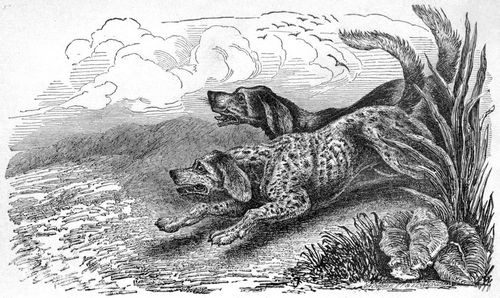
To make a bitch inclined to copulate.—Seven drops Tincture of Cantharides twice a day till effect is produced—about six days, probably.
Mange.—Caused by dirty kennels, neglect, want of nourishing, or improper, food. Cure—1 oz. salts, if dog of moderate size. Rub every third day well into the skin quantum suf. of the following mixture:—
Train oil—tanner's will do—one quart; spirits turpentine one large wineglass full; sulphur sufficient to let it just run off a stick. Mix well. Three applications are generally sufficient. Let it stay on the animal for a fortnight, when wash well with soap and water. Remember, it takes nearly two hours to well scrub the above into the skin. Smearing over the hair is no use. It must get well into the skin; and if neatly and properly done, the dog scarcely shows the application.
Worms.—℞ Cowhage, half a drachm; tin filings, very fine, four drachms. Make into four or six balls, according to size of dog. One daily, and a few hours afterwards a purge of salts or aloes. Powdered glass, as much as will lie on a shilling, i.e. a quarter dollar, new coin, in lard. Repeat once or twice alternate days. Finish off with one to two drachms Socotrine Aloes, rolled up in tissue paper. Mind, the glass must be ground into the finest kind of powder, else it will injure the coats of the stomach.
To make a dog fine in his coat.—A tablespoonful of tar in oatmeal. Make bolus.
Distemper.—Distemper is caused by low keep, neglect, and changes of atmosphere. Symptoms of the disease are as follows:—Loss of spirit, activity, and appetite, drowsiness, dulness of the eyes, lying at length with nose to the ground, coldness of extremities, legs, ears, and lips, heat in head and body, running at the nose and eyes, accompanied by sneezing, emaciation, and weakness, dragging of hinder quarters, flanks drawn in, diarrhœa, sometimes vomiting. There are several receipts for this, the worst and most fatal of all diseases. One is better than another, according to the various stages. This first, if commenced at an early stage, seldom fails. Half an ounce of salts in warm water, when the dog is first taken ill; thirty-six hours afterwards, ten grains compound Powder of Ipecacuanha in warm water. If in two days he is no better, take sixteen grains Antimonial Powder, made into four boluses; one night and morning for two days. If no improvement visible, continue these pills, unless diarrhœa comes on, in which case you must use the ipecacuanha day about with the pills. If the animal is much weakened by this, give him one teaspoonful Huxam's Tincture of Bark three times a day. Keep warm, and feed on rich broth. James's Powder is also almost a certain remedy Dose four grains; or Antimonial Powder and Calomel, three parts of first to one of latter, from eight to fifteen grains; or, after the salts, Ant. Powder, two, three, or four grains, Nitrate Potash, five, ten, or fifteen grains; Ipecacuanha, two, three, or four. Make into ball, and give twice or three times a day, according to appearances. Repeat the purge or emetics every fourth day, but avoid too great looseness of bowels. Diarrhœa sometimes supervenes, in which case give Compound Powder of Chalk, with Opium, ten grains. In case of fits coming on, destroy the animal. The same may be said of paralysis. If this disease is taken in its early stage, and attended to, and the dog kept warm, there is not much danger. Otherwise it is very fatal.
Wounds.—Poultice for a day or two; then apply Friar's Balsam, covering up the place.
For a Green Wound.—Hog's lard, turpentine, bees' wax, equal parts; verdigris, one fourth part. Simmer over a slow fire till they are well mixed.
Purgative Medicines.—Salts, one ounce; Calomel, five grains; or Socotrine Aloes, two drachms for moderate sized dog.
Stripping Feet.—Wash in bran and warm water, with a little vinegar; after apply Tincture of Myrrh. Apply sweet oil before he goes out. If his feet are tender, wash them in brine, to harden them. When actually sore, buttermilk, greasy pot liquor, or water gruel, are best. Brine inflames. The dog should be kept at home till feet are healed. Then apply the brine and vinegar.
Canker in the Ear.—Wash well with soap and warm water; fill up the ear with finely powdered charcoal or powdered borax. Clean out daily with sponge on stick and warm water, and repeat the dusting till it heals. Or, perhaps, the best receipt is,—clean out ear with sponge fastened on a pliable stick, using warm soap and water. When quite clean, dip the sponge in Sulphate of Copper-water, turning it gently round. Put seton in the neck just under the ear.
Oak Bark, one pound, chopped fine, and well boiled in soft water. When cold, take of the Decoction of Bark four ounces, Sugar of Lead, half a drachm. Put a teaspoonful into the ear night and morning, rubbing the root of ear well, to cause it to get well into the cavities. This is one of the best receipts in this book.
To make Sulphate of Copper Water.—Sulphate of Copper half a drachm, water one ounce. Mix well and keep corked.
External Canker of Ear.—Butter of Antimony, diluted in milk to the thickness of cream, will cure it; or Red Precipitate of Mercury, half an ounce, with two ounces of hog's lard, mixed well.
To make a Seton.—Take a dozen or two strands of a horse's tail; plait them; rub blistering ointment on them. Pass it through two or three inches of the skin with a curved surgical needle. Tie the two ends together. Move daily.
Bleeding.—You may readily bleed a dog in the jugular vein by holding up his head, stopping the circulation at the base of the neck. Part the hair, and with the lancet make an incision, taking care not to stick him too deeply. If the animal rejoices in a heavy coat, it may be necessary to shave away the hair. From one to eight ounces are the quantities; but in this, as in most prescriptions, the old proverb is the safest—"Keep between the banks."
For a Strain.—Use Bertine's Liniment; or one ounce Turpentine, half a pint of old beer, half a pint of brine; bathe the part and repeat; or Sal Ammonia, one ounce, vinegar one pint.
Bruises or Strains of long standing.—Gall, Opodeldoc, excellent. Shaved Camphor two ounces, Spirits of Wine three quarters of a pint. Shake well, and cork close, placing it near the fire till the camphor dissolves. Then add a bullock's gall. Shake well together. Apply, rubbing it well into the part affected till it lathers.
Dog Poisoned.—Give teacupful of castor oil. After he has vomited well, continue to pour olive oil down his throat and rub his belly.
Staggers and Fits.—This generally happens in warm weather. Throw water on them, if convenient. If not, bleed in neck, if you have lancets. If not, with your knife slit the ears, which you can cause to adhere together again; or run your knife across two or three bars next the teeth. Bitches coming off heat are more subject to this than dogs in good health.
To reduce the time a bitch is in heat.—Give her a little Nitre in water, and a dose of Calomel, four grains or thereabouts, followed by salts or aloes.
Bilious Fever.—Is caused by want of exercise and too high feeding. Calomel, six or eight grains; or, in an obstinate case, Turpeth Mineral or Yellow Mercury, six to twelve grains in a bolus.
To destroy Lice.—Sometimes the receipt below for fleas will prove efficacious, but not always; but a small quantity of Mercurial Ointment, reduced by adding hog's lard to it, say an equal quantity, rubbed along the top of the dog's back never fails. The greatest care must be taken to keep the animal warm.
Fleas.—Scotch snuff steeped in gin is infallible; but must be used with great care, and not above a teaspoonful of snuff to a pint of gin,—as the cure, if overdone, is a deadly poison.
Torn Ears.—Laudanum and brandy, equal parts. Mix well. Apply alternately with sweet oil.
Feed for Greyhounds in training.—Wheat flour and oatmeal, old, equal parts. Liquorice, aniseed, and white of eggs. Make into a paste. Make loaves. Bake them. Break up into very rich broth.
Swelled Teats.—Make pomade of Camphorated Spirit, or brandy, and goose grease, two or three times a day.
Inflammation of the Bowels.—Symptoms: Dulness of appearance and eyes; loss of appetite; lying on the belly, with outstretched legs; pulse much quickened; scratching up of the bed into a heap, and pressing the belly on it; desire to swallow stones, coal, or any cold substance not voidable; inclination to hide away. It is very dangerous; requires active treatment. Bleed most freely, till the dog faints away. Clap a blister on the pit of the stomach. Give Aloes, fifteen grains, and Opium, half a grain. Repeat dose three times a day. Bleed after twelve hours, if pulse rises again, and continue dosing and bleeding till either the dog or inflammation gives in. No half measures do in this disease. After determining that it is inflammation of bowels, set to work to get the upper hand. When that is done, there is no trouble. Otherwise it is fatal. Feed low, and attend carefully to prevent relapse.
Films over the Eyes.—Blue stone or Lunar Caustic, eight grains, spring water, one ounce. Wash the eyes with it, letting a little pass in. Repeat this daily, and you will soon cure it.
Films caused by Thorn Wounds.—Rest the dog till perfectly healed over, washing with rose water. If much inflammation, bleed, and foment with hot water, with a few drops of laudanum in it—about forty drops of laudanum to one ounce of water; or two grains of opium to one ounce of water—one as good as the other. Then apply four or five times a day the following wash:—Superacetate of Lead, half a drachm, Rose Water, six ounces.
To extract Thorns.—Cobbler's wax bound on to the place, or black pitch plaster or a poultice, are equally good.
To preserve Gun Barrels from rust of salt water.—Black lead, three ounces; hog's lard, eight ounces; camphor, quarter ounce; boiled together over a slow fire; the barrels to be rubbed with this mixture, which after three days must be wiped off clean. This need not be repeated above twice in the winter.
Bite of a Snake.—Olive oil, well rubbed in before a fire, and a copious drench of it also.
To render Boots or Shoes Water-proof.—Beef suet, quarter of a pound; bees' wax, half a pound; rosin, quarter of a pound. Stir well together over a slow fire. Melt the mixture, and rub well into the articles daily with a hard brush before the fire.
To Soften Boots.—Use hog's lard, half a pound; mutton suet, quarter of a pound; and bees' wax, quarter of a pound. Melt well, and rub well in before the fire; or currier's oil is as good, barring the smell.
Water-proofing for Gun Locks.—Make a saturated solution of Naphtha and India rubber. Add to this three times the quantity of Copal Varnish. Apply with a fine, small brush along the edges of the lock and stock.
DISTEMPER.
How best to convey to my readers a clear, and at the same time succinct account of this disease, has much troubled me. This is now the third attempt made to set before my brother sportsmen, who have had little or no experience, in the plainest terms, the symptoms and features of the disease, as well as the best remedies to be applied to its various stages and ever varying types. After considerable doubts on the subject, I fancy that by setting before you a series of cases which have come under my own treatment, the peculiar features of each case, the remedies prescribed, and the termination, whether fatal or otherwise, I shall best serve the interests of my readers. I beg expressly to state, that with one or two exceptions—the cases of the older dogs—of which I write from recollection, after a lapse of several years, and consequently cannot be so positive about, the others have all recently passed through my hands, and the course of treatment, &c., has been especially noted, and here recorded with minute exactness. The range of cases are, I believe, sufficiently numerous to meet any form and stage of the disease, from the most simple to the most complicated and fatal. With the sole exception of chorea or paralysis, a case of which I have never fairly seen through, one or two cases are noted, in which this would have been the termination, but for the remedies applied. The system pursued has been a combination of a great many various receipts, adapted to each peculiar case; and through the very severe cases that this year have depopulated my kennel, I have been under great obligations to a very talented medical man, whose advice I ever found of great service, and whose professional knowledge enabled him so to vary the quantities and forms of the medicines as best to overcome some particular form or other. Every keeper or sportsman has, or professes to have, some never-failing nostrum or other. Believe me, this is all stuff. There have been, are, and ever will be, cases incurable; but I will venture to say, that ninety-nine out of a hundred who know anything of the subject will admit that these remedies contain some one or more of the following medicines, all of which are of value:—Epsom Salts, Calomel, Jalap, Tartar Emetic, as purgatives or vomits; Antimony, Nitre, James' Powder, Ipecacuanha, as sudorifics, diaphoretics, or febrifuges. From these medicines, the most used, it is evident to see what tendency the course of treatment is designed to have, and when it fails, extra means must be employed till that is effected. Here it is that study, practice, and an intimate knowledge of medicines and their combinations prove of great advantage. At this stage more dogs are lost for want of knowledge what next to do than in any other way; for they are either getting worse or better, never standing still, and each day's illness tells much against the recovery, from the great emaciation and weakness which commences from the first, and keeps increasing daily. Never was there a more appropriate quotation than "Opus est consulto, sed ubi consulueris mature facto." It were idle to speculate on the origin of the disease. Suffice for us that we have it, and that we consider it an affection of the mucous membrane, solely, in the earlier stages, but ultimately combining itself with general mucous affections. But it will not be foreign to our purpose to state several influences which are supposed, if not actually to cause, at all events, greatly to increase its virulence. They are these:—Low Diet, Dirt, Confinement in close, unhealthy, damp kennels, too great a quantity of raw, or even boiled flesh, too little exercise, sudden changes in the atmosphere, and contagion. It cannot be called endemic, since it exists everywhere. Neither is it exactly an epidemic, though some years it does assume that form, while at other times it does not.
Bleeding we see recommended in the Field Sports. Some practitioners are very fond of the lancet. We confess quite a contrary penchant, and hold that bleeding is seldom or ever justifiable, except in cases of violent inflammations.
In distemper, we would not draw blood, once in a hundred times; for the usual course of the disease is so enervating, that in ordinary circumstances nature is reduced far more than agreeable; and as purgatives must be used under any circumstances, they will in general be sufficient to reduce any fever. We will now mention the ordinary symptoms whence we determine this complaint. Lowness of spirit, drowsiness, dimness of the eyes, staring of the coat, loss of appetite, may be noticed, and frequently disregarded. Here we will remark that a mild dose of Epsom salts, according to age—vide prescriptions at the end, No. one,—will suffice. In a day or two, however, if neglected, sometimes a running at the nose will be seen; or the ears and feet will be cold, while the head and body will be feverish; the nose will be hard, dry, and cracked. By degrees, if neglected, the nose will discharge a thick purulent matter, the belly become hotter and distended, the dog will lie full stretch, belly to the ground, the hind legs begin to fail. He may also have spasmodic and convulsive twitchings, giddiness, foaming at the mouth, epileptic fits. Now he will ravenously eat anything cold, drink any quantity of water.
FIRST CASE.
Three Setter pups, two to three months old. Appearance, &c.—Slight drowsiness, dimness of eyes, staring of coat, fæces hard. Gave two teaspoonfuls No. one, and repeated next day. Intermitted a day. Repeated dose to make sure. All well.
SECOND CASE.
Three Setter puppies, same age at the same time.—Symptoms same, and also heat in body and head; coldness of extremities; bodies inclined to hardness; fæces dark and irregular. Gave four teaspoonfuls No. one. Next morning, if anything worse, belly still hard and swelling, gave each half a grain of Calomel, half a grain of Tartar Emetic. After an hour, no vomit having been attained, repeated the dose. At night gave each a pill—Antimony, two grains, Nitre, ten grains, Ipecacuanha, three grains.
Third day.—Saw pups about eight a.m. One had had a fit, another had one while we were present, and the third seemed likely to have one. Its eyes looked wild; it was unnaturally brisk, and running about; the nose discharged more freely, but not yet any foul matter. Gave all three Calomel and Tartar Emetic as before, and repeated, it not having produced any effect. Between the doses, the two had each a fit, and several, we may as well mention, through the day, the earlier ones being the most severe. About one hour after the vomit, gave each one tablespoonful Castor oil. Fed them with bread and milk. At night gave pill to each—Antimony, three grains, Nitre, ten grains, Ipecacuanha, two grains. Next morning two pups were better. Gave them No. one, two teaspoonfuls, pill as before, night and morning, for two days. No. one the third day. Sent them to kennel. The third of this lot we found not to have had fits; but his bowels were hard, and his secretions black and improper. Gave him Calomel and Tartar Emetic as before, with No. one, usual dose, and pills as above. Gradually he got weaker and weaker, and at last he died. The error here was undoubtedly in not increasing the calomel, and leaving out emetic, so as to endeavor to alter the secretions. A pill, for instance, in this form, would have better met the case. Calomel, one grain, Antimony, two grains, Nitre, five grains, followed up in three hours by one teaspoonful No. two.
THIRD CASE.
Two Setter pups, same age as the last.—Case very bad. Fits had taken place more than once. Bodies hard, tumid head and belly hot, evidently much pain in body; ears and feet icy cold; nose hard and thick, pus in it; fæces not noticed. Gave instantly, vomit as before; Calomel and Tartar Emetic, half a grain. Repeated in one hour, not having operated. Half an hour after this had taken place, gave two teaspoonfuls No. two to each. This purged very quickly. One of the puppies appeared to be in much pain. Gave it a saltspoonful of mustard in a little milk. Fits constantly occurring, with intervals of one or two hours, repeated the mustard, and gave Spirits of Hartshorn, six drops, Camphor water, sixty drops, Sweet Spirits Nitre, twenty drops, Laudanum, six drops. Repeated this dose in six hours' time. Kept them all night by the kitchen stove. Slightly better next morning. Gave pill—Antimony, three grains, Calomel, one grain, Nitre, ten grains. Three hours after, two teaspoonfuls No. two. Fits had ceased before night. Gave pill—Antimony, two grains, Ipecacuanha, three grains, Nitre, ten grains, each night and next morning. Next day improvement visible. Wildness of the eye abated; fever in body and coldness of extremities much diminished: secretions, however, still irregular; nose dry and hard. At night gave pill—Ipecacuanha, three grains, Nitre, ten grains, Ginger Essence, five drops. Next morning gave two teaspoonfuls No. two. At night, half teaspoonful diluted Quinine Mixture. Next day gave Quinine twice. Day after, two teaspoonfuls No. one. Sent well to kennel. These were the worst cases of epileptic fits we ever saw. The pair could not have had less than twenty fits each, which lasted from a quarter to half an hour, during which they uttered most piercing howlings.
FOURTH CASE.
Pointer puppy ten months old.—Brought in from kennel: food chiefly raw flesh. Condition high. Appearance—Eyes very dull; drowsy; nose hard, dry, with thick mucous effusion; evacuations very offensive. Should consider this the putrid type. Gave half an ounce of salts in warm water. Two days after, gave ten grains Compound Powder of Ipecacuanha. No better: nose running a thick, heavy matter; fæces very offensive. Two days after giving last medicine, gave four grains Antimonial Powder, night and morning, for two days. Dog died.
Remarks.—This case happened years ago, when we were young. Our treatment was bad from the commencement, but the case was a vile one also. The following formulæ would have been more befitting:—Calomel, half a grain, Tartar Emetic, half a grain, repeated with intermissions of an hour, till a vomit was secured. Wineglassful of No. two in an hour afterwards. At night, Antimony, four grains, Nitre, ten grains, repeated next morning. If secretions then offensive, Calomel, two grains, followed by wineglass No. two, in three hours. Then use Antimony, Nitre, and Ipecacuanha, more or less, according as you wish to act on the skin, or on the lungs or kidneys. If the cough is bad, increase the Ipecacuanha. If fever prevails, add to the Antimony. Nitre acts on the bladder.
FIFTH CASE.
A Terrier bitch in very low condition, pups having been lately weaned. Age, two or three years.—Symptoms very mild. Gave half an ounce of salts, and two days after, ten grains Ipecacuanha, followed up by four grains Antimonial Powder, for two days. Results: bitch was cured of distemper, but so dreadfully weak, could not feed itself. Gave one teaspoonful of Huxam's Tincture of Bark, three times a day. Hand-fed her frequently with rich beef soup, milk, and bread. After a very hard fight, brought her round.
Remarks.—Could not have done better much, except would have given a combination of Antimony, Ipecacuanha, and Nitre at first, i.e. after purging with salts. Got great credit at the time for the cure, more deserved for nursing well.
From these cases you will be able to see, that for a simple purgative we prefer salts, as being a very cooling dose, and suiting a dog's constitution well. In the earlier stages, it sometimes effects a cure. Where there is a discharge of the nose, you must, after purging, work on the lungs. Where there is fever, you must double your purging, i.e. clean them out front and rear as quickly as possible. Where to this is added a visible disorganization of the secretions, you ought to call in Calomel in large doses, one or two grains, repeated, and this you may continue with Antimony, and so at the same time subdue the inflammation of the lungs. In the earlier part of spring and in fall, there is little fear of diarrhœa supervening. A slight attack of it will not be of much consequence provided you take care to keep it well in hand. Opium must be used with great caution; it rather tends to epileptic fits, which, by the way, we consider to result from an almost stoppage of the bowels. Compound Powder of Chalk, Quinine Mixture, Rhubarb, Catechu, will generally be sufficient.
In the Field Sports is the following receipt, and as we have invariably found Blaine and Youatt's horse and dog receipts the most reliable, we quote it. It is new to us, and so is a violent case of diarrhœa, for that matter.
℞ Magnesia, one drachm; powdered Alum, two scruples; Powdered Calumba,[1] one drachm; P. Gum Arabic, two drachms. Mix with six ounces boiled starch, and give a dessert or table spoonful every four or six hours, pro re natâ.
FOOTNOTES:
[1] Catechu, one drachm, will be better than the Calumba. It is far more efficacious.—Dinks.
CASE.
We will now suppose a case, for our practice of late years has been confined to young puppies. Ears and feet cold; body and head very hot; body hard and distended; nose hard, dry, and almost stopped up with thick matter; dry, husky cough; fæces, hard; pulse rapid, evidencing much fever. Give instantly, Calomel and Tartar Emetic, half a grain each, repeating it with intermissions of an hour, till you get a vomit. One hour after, give wine glass No. two. Twelve hours after, if fever has not abated, give three grains Calomel, followed in three hours by wine glass of No. two. If the next day you find any fever still lingering, give Calomel, three grains, as before, Antimonial Powder, eight grains. This will, with, in three hours, the usual quantity of No. two, be pretty sure to be successful. You must now address yourself to the cold and other symptoms; and you may give large doses of Ipecacuanha and Nitre. Keep the bowels open, but avoid active purging, except in cases of fever. If you find at any time the body getting hard and distended, administer the emetic. Let the dog out into the air whenever it is fine and warm, keep his nose well cleaned out, and change his bed daily. Encourage him to drink fresh water, if he will.
The receipts alluded to in the previous pages are as follows:—
No. 1.—For young pups up to six months old.—Of Epsom salts, take two ounces; of water, one quart. Mix well, and keep close corked.
No. 2.—Eight ounces of Saturated Solution of Epsom salts, in water; thirty drops Sulphuric Acid. Mix well, and cork close.
Antimony is preferable, when there is fever. It is an antiphlogistic. Ipecacuanha, when there is much debility. The last also affects the lungs, and is more efficient in removing cold.
Half an ounce of salts is a fair dose for a dog from nine months to any age. No. 2 is particularly recommended, whenever an early action is required. It is essentially short, sharp and decisive.
FORM OF GAMEBOOK
Total
Date.
Deer.
Turkey.
Ruffed Grouse.
Pinnated Grouse.
Quail.
Snipe.
Woodcock.
Duck.
Teal.
Rail.
Plover.
Guns.
Shots.
Place where
shooting.
No. of Head to
own Gun.
REMARKS.
This will be found as convenient a form as any for recording the season's bag, and I would suggest as a means to accurately determine the number of shots, to put a given number, say 50 or 80 caps, into your cap pocket every day on going out, deducting any miss-fired and wasted ones from the balance left on returning. This will give you an exact idea of your average shootings, which will be found not to exceed three out of five shots. In the column of remarks you can state your companion, quantity of game seen, &c.; in fact, any point worthy of notice, and to which afterwards you can refer. The writer's book dates back to 1845, and records every head of game killed while he was out, by his own, as also his friend's gun, remarks on the weather, curious ornithological observations, &c.
[1] Catechu, one drachm, will be better than the Calumba. It is far more efficacious.—Dinks.
℞ Magnesia, one drachm; powdered Alum, two scruples; Powdered Calumba,[1] one drachm; P. Gum Arabic, two drachms. Mix with six ounces boiled starch, and give a dessert or table spoonful every four or six hours, pro re natâ.
DOGS,
AND THEIR MANAGEMENT;
BEING A NEW PLAN FOR TREATING THE ANIMAL,
BASED UPON A CONSIDERATION OF
HIS NATURAL TEMPERAMENT.
Illustrated by numerous Engravings,
DEPICTING THE CHARACTER AND POSITION OF THE DOG
WHEN SUFFERING DISEASE.
BY
EDWARD MAYHEW, M.R.C.V.S.
SECOND AMERICAN EDITION.
PREFACE.
In the following pages is laid before the public the result of several years' study. The Author hopes to be able, ultimately, to perfect a system of treatment which shall change only with the progress of the science, of which it can be no more than an offshoot. Saying this, the writer cannot be accused of self-glorification, since there is in the field no living author over whom he might appear to triumph.
The book was also written with the hope of inducing the gentlemen of the Author's profession to study more carefully the Pathology of the Dog. This is at present not properly taught, nor is it rightly understood by the Veterinarians who profess to alleviate canine afflictions. Of all the persons who accept such offices, there is but one who, to the Author's knowledge, devotes the time, attention, or care which disease in every shape demands; and the individual thus honorably distinguished, is Mr. Gowing of Camden Town.
CONTENTS OF MAYHEW'S MANAGEMENT.
Page
General Remarks,
73Distemper,
120Mouth, Teeth, Tongue, Gullet, &c.,
179Bronchocele,
198Respiratory Organs,
200Hepatitis,
221Indigestion,
227Gastritis,
233St. Vitus's Dance,
240Bowel Diseases,
246Paralysis of the Hind Extremities,
270Rheumatism,
274The Rectum,
278Fits,
295Rabies,
299Generative Organs—Male,
313" " Female,
337Skin Diseases,
410Canker within and without the Ear,
419The Eye,
429Diseases of the Limbs,
437Fractures,
444Operations,
450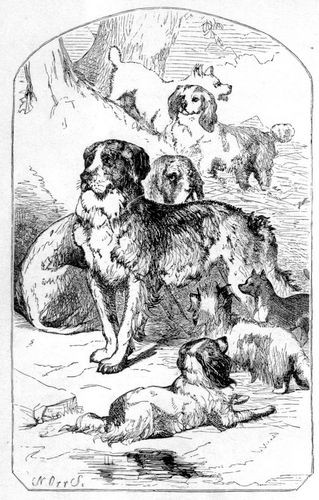
DOGS: THEIR MANAGEMENT.
GENERAL REMARKS.
There is no animal so widely distributed as the dog. The like assertion could not be made of any other domesticated creature. In countries subjected to the extremes of heat or cold, in the centre of Africa, and at the Northern Pole, the horse is absent; but wherever man is able to exist, there, in some shape or other, the dog is represented. Various have been the speculations as to its original. There is no animal in any way approaching in outward appearance to the Canine Species (properly so called), but has been assumed to be the original parent of the family. Some have even fancied the fox was father to all the dogs that trot by the side of man; but this idea seems too preposterous to be maintained. Others, with more reason, have supposed the prototype of the dog was discovered in the wolf. There are, however, many differences to reconcile before this hypothesis can be received. The formation of the two animals is distinct,—their anatomy presents positive differences,—their time of breeding does not agree,—their habits are opposite, and their outward and inward character is entirely dissimilar. The above engraving is the portrait of the wolf. Is the reader in any danger of mistaking it for that of a dog?
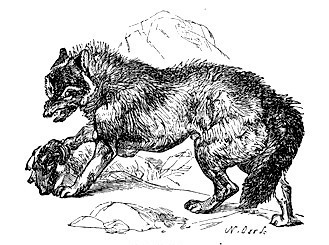
THE WOLF.
Thus the apparent separation of the two species appears to be so wide, that a child could point it out, and none but a philosopher could confound it. Others, again, have gone to warmer climates for the founder of the kind, which they have, to their own satisfaction, discovered in the jackal: but there are very many obstacles to be surmounted, before this supposition can be acknowledged. In the first place, although the dog is to be found in warm climates, he thrives least in those to which the jackal is entirely confined. Then all that has been urged against the fancy which conceived the prototype of the dog was to be found in the wolf, applies with even greater force to the jackal. However, to settle the dispute, we here give the likeness of the beast, and leave to the reader to point out the particular breed of dogs to which it belongs.
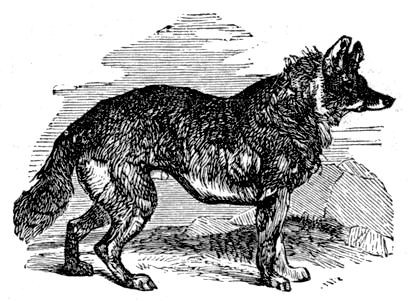
THE JACKAL.
Beyond the circumstance of the habitats of the animals being distinct, is the well-known fact that all domesticated animals have a disposition to return to their original formation; but who ever heard of a dog, however neglected, or however wild, becoming either a wolf or a jackal?
The dog is spread all over the world, and not only is the animal thus widely distributed over the face of the earth, but there is no creature that is permitted with such perfect safety to the human race to have such continual and intimate intercourse with mankind. It is found in every abode: the palace, the warehouse, the mansion, and the cottage, equally afford it shelter. No condition of life is there with which the dog is not connected. The playmate of the infant, the favorite of the woman, the servant of the man, and the companion of the aged, it is seen in and around every home.
Thus brought into intimate connexion with the human race, and continually subject to observation, it is not a little strange that the dog should be universally misunderstood. There is no quadruped which is more abused; whether treated kindly or otherwise, the dog is equally made to suffer; and probably the consequences of over indulgence are more cruel in their result than is the opposite course of treatment. The health of the beast is perhaps best preserved when neglect deprives it of man's attention; then it may suffer from want, but it escapes many of the diseases which caprice or ignorance entail upon the generality of the tribe. There exists no creature more liable to disorder, and in which disease is prone to assume a more virulent or a more complicated form. To minister to its afflictions, therefore, demands no inconsiderable skill; and it becomes the more difficult to alleviate them, since canine pathology is not fully comprehended, nor the action of the various medicines upon the poor beast clearly understood; yet there are few persons who in their own estimation are not able to vanquish the many diseases to which the dog is liable. About every stable are to be met crowds of uneducated loiterers, possessors of recipes and owners of specifics, eager to advise and confident of success. I seldom send a diseased dog into the park for exercise, that my servant does not return to me with messages which strangers have volunteered how to cure the animal. I hear of medicines that never fail, and of processes that always afford relief. Persons often of the upper rank honor me with secret communications which in their opinion are of inestimable value; ladies frequently entreat me to try particular nostrums, and sportsmen not seldom command me to do things which I am obliged to decline. In fact, the man who shall attempt to treat the diseases of the dog, will have no little annoyance to surmount. He will soon discover that science unfortunately can afford him but partial help, while prejudice on every side increases the difficulties with which he will have to contend.
Happily, however, the majority of pretended cures are harmless. A roll of sulphur in the animal's water may be permitted, since it amuses the proprietor while it does not injure his dog. Some of these domestic recipes, nevertheless, are far from harmless, and they are the more to be deprecated, because those which most people would imagine to be safe are the very ones which are attended with the greatest danger. Common salt is a poison to the dog; tobacco is the source of many a death in the kennel; castor oil often does the ill which months of care are needed to efface, even if the life be not destroyed. In the majority of cases vomits are far from beneficial; bleeding is very seldom required, and the warm bath has sealed the doom of innumerable animals.
The foregoing observations will have informed the reader of the reasons that prompt the publication of the present work, which is put forth only as a step towards the point the author does not yet pretend to have fully attained. The study of years will be required to perfect that which is now commenced, and further experience will probably demand the retraction of many of the opinions herein advanced. The reader will understand, the author in the present work asserts only that which he now believes. It must not be imagined, however positive may read the language in which his sentiments are expressed, that the writer is pledged to uphold any of the conclusions at which he may have arrived; knowledge is in its nature progressive, and canine pathology is not yet clearly made out. The advantages which accompany the study of anatomy, physiology, and therapeutics have yet to be more largely applied to the diseases of the dog, and until this has been accomplished, science, not reposing upon truth, will be constantly subjected to change. The present work, therefore, will be accepted only as a contribution to veterinary literature, and its contents will be viewed as doing nothing more than declaring the temporary convictions of one, who, desirous of truth, does not conceal that his mind is oppressed by many doubts.
In the following pages advantage will be freely taken of the labours of those authors who have written upon the subject; nor must it be supposed, because the writer may feel himself obliged to dissent from, he therefore undervalues the genius of Blaine or Youatt. Before Blaine collected and arranged the knowledge which existed concerning the diseases of the dog, canine pathology, as a separate or distinct branch of veterinary science, hardly existed. The task he accomplished; but if after the lapse of years some of his opinions are found to be unsound, and some of his statements discovered to require correction, these circumstances may be regarded as the natural consequences of progression, while they in no way deteriorate from the honor due to his name. Youatt enlarged and softened the teaching of his master, and by the liberality of his communications, and the gentleness of his example, improved and adorned the science to which he was attached. To others than these two great men I have no obligations to acknowledge. For their memories I take the opportunity of expressing the highest respect, and confess that to their instruction is fairly due any novelty which the present pages may contain; since but for those advantages their teaching afforded, it is more than doubtful if I had perceived the facts herein made known.
Before any mention is made of the diseases of the dog, it will be proper to take some notice of the temperament of the animal, as without regarding this the best selected medicines, or the most assiduous attention, may be of no avail. Any one who will observe the animal will soon be made aware of its excessive irritability. The nervous system in this creature is largely developed, and, exerting an influence over all its actions, gives character to the beast. The brain of the dog is seldom in repose, for even when asleep the twitching of the legs and the suppressed sounds which it emits inform us that it is dreaming. No animal is more actuated by the power of imagination. Who is there that has not seen the dog mistake objects during the dusk of the evening? Delirium usually precedes its death, and nervous excitability is the common accompaniment of most of its disorders. To diseases of a cerebral or spinal character it is more liable than is any other domesticated animal. Its very bark is symbolical of its temperament, and its mode of attack energetically declares the excitability of its nature. The most fearful of all the diseases to which it is exposed (rabies), is essentially of a nervous character, and there are few of its disorders which do not terminate with symptoms indicative of cranial disturbance. This tendency to cerebral affections will, if properly considered, suggest those casual and appropriate acts which the dog in affliction may require, and which it would be impossible for any author fully to describe. Gentleness should at all times be practised; but to be truly gentle the reader must understand it is imperative to be firm. Hesitation, to an irritable being, is, or soon becomes, positive torture.
He who would attend upon the dog must be able to command his feeling, and, whatever fear he may be conscious of, he must have power to conceal his emotion. The hand slowly and cautiously advanced, to be hastily retracted, is nearly certain to be bitten. Whatever therefore is attempted should be done with at least the appearance of confidence, and the determination of the man will, in the generality of cases, check the disposition of the beast. There should be no wrestling or fighting. The practitioner should so prepare his acts as to prevent the dog in the first instance from effectually resisting, and the animal mastered at the commencement is usually afterwards submissive. If, however, from any cause, the primary attempt should not be effective, the attendant, rather than provoke a contest which can be productive of no beneficial result, should for a brief period retire, and after a little time he may with better success renew his purpose.
Strange dogs are not easily examined in their own homes, especially if they be favorites and their indulgent owners are present. Like spoiled children, the beasts seem to be aware of all the advantages which the affections of their master give to their humors. They will assume so much, and play such antics, as renders it impossible to arrive at any just conclusion as to the actual state of their health. Dogs in fact are great impostors, and he who has had much to do with them soon learns how cunningly the pampered "toy" of the drawing-room can "sham." For deception, consequently, it is necessary to be prepared, and practice quickly teaches us to distinguish between what is real and that which is assumed. The exertion, however, required to feign disturbs the system, and the struggle which always accompanies the act renders it frequently impossible to make the necessary observation with requisite nicety. Petted dogs are, therefore, best examined away from their homes, and in the absence of any one who has been in the habit of caressing them. Frequently I have found it of no avail to attempt the examination of these creatures at the residences of their owners; but the same animals brought to my surgery have, without a struggle, allowed me to take what liberties I pleased. I usually carry such dogs into a room by myself, and commence by quickly but gently lifting them off their legs and throwing them upon their backs. This appears to take the creatures by surprise, and a little assurance soon allays any fear which the action may have excited. The dog seldom after resists, but permits itself to be freely handled. Should, however, any disposition to bite be exhibited, the hand ought immediately to grasp the throat, nor should the hold be relinquished until the creature is fully convinced of the inutility of its malice, and thoroughly assured that no injury is intended towards it. A few kind words, and the absence of anything approaching to severity, will generally accomplish the latter object in a short period, and confidence being gained, the brute seldom violates the contract.
Dogs are intelligent and honorable creatures, and no man will have reason to regret who teaches himself to trust in their better qualities. I have hitherto, in a great measure, escaped their teeth, and being slow and infirm, my good fortune certainly cannot be attributed to my activity. Kindness and consideration work upon animals; nor do I believe there are many of the lower creatures that will not appreciate such appeals. It is better, therefore, to work upon the sympathetic nature of the brute, than to compete with it in strength, or endeavor to outvie it in agility. Manual dexterity will often fail, and is seldom employed save when danger is present. Mental supremacy appealing to the source of action ensures safety, by subduing, not the resistance, but the desire to resist.
It is easy to ascertain when the dog has regained that tranquillity which would allow of its being trusted with security. The eye need alone be consulted, and a little observation will speedily instruct any one to read its meaning correctly. When the creature is irritated, the pupil invariably dilates, and by singly marking this circumstance, the temper of the beast may be correctly ascertained. Nor should caution be discarded until the contracted circle assures that the agitation has passed away.
With the smaller kind of spaniels and the generality of petted animals, the indications of the eye may be depended upon; but with the more robust and less familiarized species it is safest to take some precaution, even, while the sign of sagacity is exhibited. Certain dogs, those of coarse breeds and large size, are exceedingly treacherous, and sometimes are not safe even to their masters. Creatures of this kind are, however, usually as devoid of courage as they are deficient of magnanimity; and by the display of resolution are to be readily subdued.
When, however, really sick, there are few dogs which may not be approached. Under such circumstances, the utmost gentleness should be employed. The stranger should advance quietly, and not bustle rudely up to the animal. He should speak to it in accents of commiseration, which will be better comprehended than the majority of reasonable beings may be willing to admit.
The hand after a little while should be quietly offered to the dog to smell, and that ceremony being ended, the pulse may be taken, or any other necessary observation made, without dread of danger. Every consideration, however, ought to be given to the condition of the beast. No violence on any account should be indulged; it is better to be ignorant of symptoms than to aggravate the disorder by attempting to ascertain their existence. If the brain should be affected, or the nervous system sympathetically involved, silence is absolutely imperative. No chirping or loud talking ought under such circumstances to be allowed, and the animal should not be carried into the light for the purpose of inspecting it. The real condition of the patient, and the extent or nature of its disease, will be best discovered by silently watching the animal for some time, and attentively noting those actions which rarely fail to point out the true seat of the disorder. Consequently manual interference is the less needed, and in numerous instances I have, when the creature has appeared to be particularly sensitive to being handled, trusted to visible indications, and done so with perfect success. The hand certainly can confirm the eye, but the mind, properly directed, can often read sufficient without the aid of a single sense.
Having made the foregoing remarks, which the intelligence of the reader will readily enlarge, it will next be necessary to describe in what way the dog should be examined. Simple as this operation may appear, it is one which few persons properly comprehend; and as upon it everything depends, it will not be out of place to devote a few lines to its explanation.
The dog, in the first place, should be permitted to run about, released from every restraint, or only so far confined as is necessary to prevent his escape from the limits of observation. No attempt should be made to attract the animal's attention, but the practitioner, seating himself in one corner, ought to be perfectly still and silent. The way in which the creature moves; whether it roams about, stands motionless, appears restless or indifferent, avoids the light, seems desirous of companionship, or huddles itself into some place as far as possible removed from inspection; whether it crouches down, curls itself round, sits upon its haunches, turns round and round trying to bite its tail, drags itself along the floor, or lies stretched out either upon its side or belly; in what manner the head is carried, and to what part it is directed; if any particular place is licked, bitten, or scratched; if thirst is great, or the dog by scenting about shows an inclination for food; the nature of the breathing, the expression of the countenance, the appearance of the coat, and the general condition of the body, should all be noted down. When such points have been observed, the animal is addressed by name, and attempts may be made to approach and to caress it; the way in which it responds, submits to, or resents such advances being carefully remarked.
The dog may then be handled. The eyes and their membrane are inspected, to see if the one be dull or moistened by any discharge, and if the other be reddened, pallid, yellow, or discolored.
The ears are next felt around, their edges lifted to discover if any blackened wax or soreness be present in their convolutions, and slightly squeezed to ascertain if any crackling sensation is communicated to the fingers, or sign of pain evinced by the animal.
The nose is now to be remarked. If it be moist or dry; and if dry, whether it is at all encrusted. The back of the hand or side of the cheek should be applied to the part to ascertain its temperature.
The lips should next be raised, and the state of their lining membrane, with the condition of the teeth, observed.
The jaws should then be separated, that the tongue may be seen sufficiently to note its color, and the breath smelt.
The hand should subsequently be passed over the head and along the back, to feel the hair, and discover whether there exist any sore places or tumors concealed beneath it. The coat may now be generally examined, to find whether in any part the covering is thin or deficient. Its firmness should afterwards be tried, and the itchiness of the skin tested by the nails, as well as its thickness and pliancy ascertained between the fingers.
The hand should also be applied to the throat, and carried along the course of the windpipe, feeling for any swelling of the salivary glands, or enlargement of the thyroid. It is next passed to the abdomen, and the inferior part of the cavity is gently pressed upwards, to ascertain if the rectus abdominis muscle be contracted, or the animal shows symptoms of tenderness. The abdomen may subsequently be kneaded between the fingers. The amount of fat should not be unnoticed, nor should the firmness of the muscles pass unobserved.
When all this is accomplished, the dog is laid upon its side or back, and the tail being elevated, the anus is inspected and felt, to see whether it be inflamed or protruded, and to feel if it be indurated or thickened.
The feet are now taken up, and the length and shape of the nails, with the condition of the dew claws, inspected, to see whether they are growing into the flesh, or by their shortness indicate the animal has been accustomed to healthful exercise. The pad and web also receive a glance.
If the animal be a male, the prepuce is first pressed and then withdrawn, to perceive if any discharge be present, or if the lining membrane be inflamed or ulcerated.
Should it be a bitch, the vulva are inspected, to observe if they are moistened by any exudation, or if they are swollen and excited by the touch. They are separated to observe the color of the lining membrane.
The mammæ are then felt, to know if the animal has ever borne pups, or if any of them are hardened. At the same time the parts are squeezed, to discover whether or not they contain milk.
Such is a general description of the manner of proceeding, but there are many possibilities which the above directions, lengthy and minute as they may read, do not include. Such, for instance, as hernia, and disease of the testicle or scrotum. All, however, it would not be necessary to describe at length, and the foregoing instructions will lead the eye to any extraordinary appearances should they exist. The experienced practitioner probably will do less than is here set down, being educated to a promptitude which enables him to leap as it were at once to those parts which deserve his attention. For such the above is not intended; but he who has not made the dog his special study, will certainly find his advantage in going through the whole ceremony; nor will the most experienced practitioner habitually neglect any portion of it, without having cause to lament his inattention. To examine the dog properly, is perhaps even more difficult than to perform the same office upon the horse, and certainly it is a duty which there are few persons qualified to discharge.
Having spoken of the proper manner of examining the animal, before I proceed to describe its diseases, I shall touch upon some of those matters which are essential to its health. It will, however, be understood that I do not here pretend to treat of hounds, which for the most part are well attended to, and fed, exercised, &c., according to the judgment of the individual entrusted with the superintendence of the kennel. Little probably could be written which would materially amend the condition of these creatures; but petted and housed dogs are commonly treated after a fashion with which judgment has nothing to do. Persons are indulgent to their animals, and imagine that they are also kind, when too often they oppose the dictates of their reason to gratify the weakness of their momentary impulses. A little reflection will convince such people that humanity does not consist in the yielding to every expression of desire. The dog, in a state of nature, being carnivorous, and obliged to hunt for its food, in all probability would not feed every day; certainly it would seldom make more than one meal in twenty-four hours. When the prey was caught, it would be torn to pieces, and with the flesh much earth would be swallowed. The animal, however, is now to be regarded as subjected to man; but while so viewing it, nothing will be lost by keeping in sight its primitive habits.
The dog can fast for a great number of days. Abstinence for forty-eight hours seldom injures it; but it is a practice which ought not to be too frequently adopted, as by its repetition the digestion is weakened. One meal, however, is sufficient, in every case, for the twenty-four hours. Animals not worked, but kept as favourites, or allowed only to range at pleasure, should not have any meat, nor be permitted to consume any large quantity of fatty substances. Butter, fat, or grease, soon renders the skin of the dog diseased and its body gross. Milk, fine bread, cakes, or sugar, are better far for children, and can be on the human race bestowed with advantage; while given to the brute they are apt to generate disorders, which a long course of medicine will not in every case eradicate. Beer, wine, or spirits, all of which the dog can be induced to drink, show rather the master's ignorance than the creature's liking. Nice food, or that which a human being would so consider, is in fact not fitted to support the dog in health. It may appear offensive to ladies when they behold their favourites gorge rankly, but Nature has wisely ordained that her numerous children should, by their difference of appetite, consume the produce of earth. The dog, therefore, can enjoy and thrive upon that which man thinks of with disgust; but our reason sees in this circumstance no facts worthy of our exclamation. The animal seeking the provender its Creator formed its appetite to relish, is not necessarily filthy or unclean; but could dogs write books, probably the opinions of these beasts upon many of the made dishes and tit-bits of the fashionable circles, would be opposed to the ideas which delicate epicures entertain concerning such luxurious fare. The spaniel which, bloated with sweets, escapes from the drawing-room to amuse itself with a blackened bone picked from a dung-hill, follows but the inclination of its kind; and while tearing with its teeth the dirt-begrimed morsels, it is, according to its nature, daintily employed. Could we read its thoughts, probably the perverse little pet, even while it is provoking its mistress's horror, is reflecting upon the nasty trash which the human stomach can endure, and upon the tempting relishes which mankind know not, like dogs, how to appreciate. An occasional bone and a little dirt are beneficial to the canine race, while food nicely minced and served on plates is calculated to do harm. Such keep fattens to excess, destroys activity, renders the bowels costive, and causes the teeth to be encrusted with tartar.
A bone is of great service to the animal, which cannot employ a tooth-brush; and the larger it be and the less meat upon it, the better it will prove for little high-fed favorites. A dog in strong health may digest an occasional meal of bones; but the pet has generally a weak and often a diseased stomach, which would be irritated by what would otherwise do it no harm. The animal, nevertheless, true to its instinct, has always an inclination to swallow such substances, provided its teeth can break off a piece of a size fitted for deglutition. Game and chicken-bones, which are readily crushed, should therefore be withheld, for not infrequently is choking caused by pieces sticking in the œsophagus; though more often is vomiting induced by irritation of the stomach, or serious impactment of the posterior intestine ensues upon the feebleness of the digestion.
The bone, therefore, should be large, and on it there should be nothing which the knife can remove. It ought to be thrown upon the earth, and the animal should be allowed to gnaw it at leisure. During the act, a considerable quantity of earth and saliva will be swallowed, and little actual food be added to an already loaded stomach. In all points of view the animal is benefited. The soil is always slightly alkaline, and so is the saliva; any undue acidity is by both in some measure counteracted; but the earth is also of further service. Food too highly or purely nutritive will not support life; but to render it healthy, a certain quantity of indigestible or refuse matter is imperative. The latter portion acts mechanically as a stimulant to the intestines, and hence, gentlemen by choice consume bread in which a portion of the husk is mingled, finding it prevents the costiveness that the baker's "best" induces. Dogs are here very like men, but they require more of the mixture than the human being could bear. The animals, therefore, should not be fed off plates.
The better practice is to take the day's allowance and throw it upon the ground, letting the beast eat it with what addition it may please. Neither should the nature of the food itself be disregarded. Oatmeal or ship-biscuit ought always to be given, if alone the better, else rice upon which gravy has been poured. Meat, when allowed, should be lean, and the coarser the better. Paunch or tripe is excellent food for dogs, and for a continuance I have found nothing agree so well. Horse-flesh or any such filth is never to be allowed; this kind of food being very apt to generate diseases of the skin. Dogs will thrive on liver, but it is too valuable an article of diet for these creatures to be regularly given. When only occasionally administered it has a well-marked laxative property, and on this account will often be of service in rendering needless the use of medicinal agents. In the raw state, if the animal will take it, its action is more powerful; but after it has been boiled it generally is sufficiently operative. The meat, whatever it may be, should, for animals not in work, be boiled, raw flesh being more stimulative than their comparatively idle pursuits demand. Such animals, in fact, may be said to lead sedentary lives, and their diet must be lowered to suit their habits. For the pointer, &c., during the season, raw flesh is actually to be preferred, nor should the quantity be limited. The exertion is great, and the utmost indulgence in this respect will seldom do harm; but my own experience teaches me that the sporting dog is often crippled by being under-fed. It cannot consume too much, neither can that much be too nourishing, especially if the country to be shot over is of a hilly nature. It is one of the prejudices of most men to believe that a feed of oats to the horse, or a meal of flesh to the dog, just before starting, gives strength for the labor which is to be endured. We cannot, however, make strength as beds are made, at any moment, but the invigoration of a living body must be the result of a slow and a long process. On the day of work it is of less consequence what food is given than is the diet which has been allowed the many previous weeks.
Regularity in the hour of feeding should equally be observed; and if this matter be generally attended to, there will be no danger of its being forgotten, since dogs' stomachs are excellent time-keepers, and the brutes are not by any delicacy of feeling restrained from asking. The hour, after a little while, will always for the sake of peace be kept, and the animals will soon learn the rules to which they are subjected.
For home-kept dogs there is no possibility of stating the quantity of food that ought to be allowed. No two animals in this respect are alike. One eats much, and its fellow consumes but little; yet the small feeder in most cases thrives the best even where neither is stinted. The quantity, therefore, cannot be measured. The only rule to be observed is, that there be enough placed before the animal at a stated hour. Let him eat of this till the slackening of the jaws' movement and the raising of the head indicate that hunger has been for the present appeased. So soon as this is remarked the food ought to be withdrawn. On no account should the creature be allowed to gorge to repletion, or eat after its healthy craving has been satisfied. While the dog eats it should therefore be watched; and this custom works well, as the failure of the appetite often gives to the attendant the earliest indication of disease.
The dog that neglects its day's allowance should not be coaxed to feed, but ought to be left alone for some minutes, or until its companions have finished their meal. It should then be examined, and if nothing can be detected, perhaps the abstinence of a day may restore it. Until the proper hour arrives on the following day, nothing ought to be given to the animal, nor should any inclination on its part for food be noticed.
Where eating is concerned, dogs have lively sympathies. The animal which at its own kennel has feasted to satiety, will wake from its digestive slumber to taste anything of which it sees its master partaking. These creatures are so peculiarly sensitive in this respect, that they will do violence to their feelings rather than be left out when eating is going forward. Dogs moreover are most pertinacious beggars, and they soon learn the cunning of the trade. On no account should they be permitted to frequent the kitchen. If properly reared, they will be rigidly honest, but, like the "audacious cats," they offer a ready excuse to dishonest kitchen-maids, who will sometimes do injury by subjecting the animal to undeserved chastisement.
Where the servants are trustworthy this danger will not arise; but good servants mostly have tender hearts, and dogs have a peculiar tact in appealing to female weaknesses. However strict may be the orders, and however sincere may be the disposition to observe them, bits will fall,—scraps will be thrown down,—dishes will be placed upon the ground, and sometimes affection will venture to offer just "the little piece," which no one could call feeding. It is astonishing how much will in this way be picked up, for the dog that lies most before the kitchen fire is generally the fattest, laziest, and at feeding time the best behaved of his company. Consequently no dog should be allowed to enter the kitchen, for their arts in working upon mortal frailty can only be met by insisting on their absence. The dog that is well fed and not crammed, should not refuse bread when it is offered. If this be rejected, while sugar is eagerly snapped up, it will be pretty certain that the animal is either too much indulged, or that its health requires attention.
Some writers recommend pot-liquor for dogs. It is not advisable to use this. The water in which salt meat has been boiled ought never to be employed. Greens are not nutritious, but they often purge; and if the animal will eat them, they can sometimes be given when liver cannot be obtained. Potatoes will, with other substances, agree with animals not required for work, but the rice I have recommended will be found for general purposes the best, and not the most expensive food upon which the animal can be sustained. Persons having lap-dogs will moreover find the keep upon rice, properly seasoned, or soaked in gravy, less liable to render these creatures strong or tainted than the provender which is choicely selected from the joint provided for the family dinner. The warm meat too often presented to these creatures is apt to enfeeble their digestions; for their stomachs are soon deranged, and they never should be allowed to taste any kind of food which is not perfectly cold.
The food for diseased dogs should be prepared with extreme care, and no disregard of cleanliness; in fact, it should in every respect be such as a human being could partake of, provided the ingredients were not repugnant to his taste. Sickness cannot be relieved without trouble, and in many cases an animal requires as much attention as a child. To gain success, neither time, labor, nor expense must be begrudged; but the attendant must be assiduous and the cook skilful. Nothing smoked or burnt, no refuse or tainted flesh, must on any account be made use of. The meat may be coarse, but it should be fresh and wholesome. Dirty saucepans or dishes ought not to be employed; and so very important are these circumstances, that the practitioner who engages in dog practice will often surprise his acquaintances by being seen at market, or busied over the fire. Beef tea is one of the articles which in extreme cases is of great service. Few servants, however, make it properly, and when a dog is concerned there are fewer still who will credit that any pains should be bestowed upon the decoction. I generally either prepare it myself or superintend the person who undertakes that office, and not unfrequently give serious offence by my officiousness; or, spite of studious attention, fail in procuring that which I desire. Still, as in the last extremity food is even of more importance than medicine, my anxiety cannot be conquered by such schooling, and I am therefore content to bear the sneers of those who cannot understand my motives.
To make beef-tea properly, take a pound and a half of coarse, lean beef: that cut from the neck or round is best. The leg does not answer so well, however excellent it may be for soup. The rump steak is good for the purpose, but no better than other and cheaper parts; though I often use it when nothing else can be obtained so well suited for this beverage. Let the flesh be carefully separated from every portion of skin or fat, and chopped as fine as for sausage meat—the smaller the better—it cannot be too minutely minced. Without washing it, put the flesh into a clean saucepan, with a pint of water, and so place it upon the fire that it will be half an hour at least before it boils. When it boils, allow it to remain in that state for ten minutes, and then remove it, pouring off the liquor, which should be set aside to cool. When cold, any fat upon the surface should be removed, and, no salt or seasoning of any kind being added, the beef-tea is fit for use.
To the meat, which has been drained of moisture, the skin and fat may now be added and a pint and a half of water, which should be allowed to boil till it is reduced to a pint. This being set aside and afterwards cleared of fat, will be of some service if used instead of water when the next potion is required; and there is no limitation in the quantity which may be needed.
Besides beef-tea, wheaten flour, oatmeal, arrow-root, starch, biscuit powdered, and ground rice are also to be employed. These are to be mixed with water, or more often with beef-tea, and boiled; but for sick animals the compound should not be made too thick. The ordinary consistence of gruel will be about the proper substance, and a little only should be administered every hour or half-hour, as the case may require. From half a pint to a quart, divided so as to allow of a portion being given at the stated periods, will be sufficient for a large or small animal, the quantity being proportioned to the size. When the creature is so far exhausted that it is no longer willing or able to lap, the nourishment should be administered by means of a tube passed down the throat or into the œsophagus; for if given with a spoon, as the breathing is always disturbed, the consequence may be fatal, from the fluid being drawn into the lungs. The food should always be made fresh every morning; and none left from the previous day ought on any account to be mixed with it, more especially if the weather be at all warm.
These directions may to some appear needlessly particular; but so rapid are the terminations of canine diseases, and so acute are they in their development, that while the tax upon the patience is not likely to be of long duration, the care demanded during their existence must be unremitting.
Exercise is next to food, and if of one dogs generally have too much, of the other few have enough. In towns, if dogs are kept, a chain and collar should always be at hand. The servants should be ordered to take the creatures out whenever they go upon their errands, and an occasional free journey with the master will be a treat which will be the more enjoyed because of the habit thus enforced.
Washing dogs is not a custom deserving of half the consideration which is bestowed upon it. The operation is not so necessary as it is generally imagined. Soap and water make the hair look white; but the coat usually becomes soiled the quicker because of their employment.
The use of alkalies, soda, or potash, in the water, renders the immediate effects more conspicuous; but unfortunately these substances also make the after-consequences more vexatious. They take the sebaceous or unctuous secretion from the coat. The skin is deprived of its natural protector in this animal; the cuticle grows weak and dry. The hair is rendered rough; is prepared to catch the dirt; and not unfrequently the skin itself, by nature striving to counteract the effect of its deprivation, pours forth a secretion that aids in causing it to appear foul. Above all, the warmth, so repeatedly and often inhumanly applied to the entire surface of the body, debilitates the system of the creature, and generates in the long run certain disease, even if by the drying immediate disorder be not engendered. The warm-bath to the dog is peculiarly debilitating, and the heat which the hand of a cook would endure with a sense of comfort, will sometimes cause the dog to faint. Panting is a sign of sensible weakness in this animal, and few of these creatures are washed without exhibiting it. If washing is insisted upon, the water should never be warm, and in cold weather only should the chill be taken off. The soap ought to be of the mildest quality; but the yelk of an egg is much to be preferred, and in its effects is every way more beneficial where the hair, either of man or beast must be cleansed. A small dog will require the yelk of one egg; and a Newfoundland the yelks of a dozen eggs. The yelks are to be separated from the whites and smeared well into the hair. A little water is then to be poured upon the back, and the hand is to be rubbed upon the coat till a lather covers the body, after which the hair may be cleared by copious ablutions. This process is much to be preferred, and the dog dislikes it far less than when soaps are employed. His eyes are not made to smart, or his skin to burn, and if he tastes the substance he does not therefore sicken. Moreover, when the business is ended, even if some portion of the egg should cling to his hair he will not on that account neglect his personal appearance. The coat will be found to look bright, and to remain clean for a longer period than after the adoption of the customary thoughtless process.
Washing, however, is not constantly required, if a dog be kept combed and brushed every morning, and does not reside in a very filthy locality. A little dirt after a walk is easily removed, if it be allowed to dry perfectly, and the hair is then rubbed and picked by the hand of its attendant, when the comb will complete the proceeding. A bath every morning does the generality of dogs good; but it should be cold, and the animal ought not to be punished by having its head submerged. It should be plunged up to the neck, the head being held above the surface. While in the water the coat should be well rubbed with the hand, that every portion of the hair may become thoroughly soaked. This over, no attempt should be made to dry the dog, for that is not by any industry to be perfectly accomplished. Neither ought the dog to be wrapped up, placed before the fire, or suffered to lie about, which it is always by a sense of discomfort induced to do, if not made to move. The animal ought immediately to be started for a scamper, and never allowed to remain quiescent until its activity has driven every trace of moisture from its body. Not until this is thoroughly effected should the creature be brought in-doors, or be suffered to rest for a moment. If healthy it will require little exertion on its attendant's part to make it jump and run about; but some of these little animals have to carry a burthen of fat which no sense of uneasiness can provoke them to move under of their free wills. An active lad with a chain may, in these last cases, be of much use; but he should be told to exercise his charge in some spot open to the master's eye, else the boy may play while the animal shivers.
Some dogs show a great dislike to, strenuously fighting with, the collar and chain; others will exhibit the most piteous distress, by squatting upon their hocks, and whining, while they pant vehemently, and look imploringly up to the face of their leader. The first are probably not aware of the intention of the bonds to which they are subjected, and should not be harshly rebuked. The voice ought to assure them, and means be resorted to calculated to allay their fears. Gentleness and firmness will in two or three days render such animals perfectly submissive for ever after. The last kind are rank impostors. No one not familiar with these animals would credit the arts which they can with such excellent effect and apparent genuineness practise to gain their ends. They have been used to be carried, and they prefer riding in the arms of a human being. Their insinuating tricks ought to be rewarded only by laughter, accompanied with an admonition.
Dogs are very intelligent. They understand much more than men choose to give them credit for. Their pride is enormous, and through this feeling they are easily moved. Laughter, when directed against himself, no dog can endure, and the slightest reprimand is always answered by an immediate change of aspect. Rather than have their dignity offended, dogs will quickly become honest, especially when deceit is experienced to be of no avail. People who are physiognomists may detect this sentiment impressed upon the countenance. Upon the next page is a portrait of a Mastiff. Mark the absolute Asiatic dignity, only outwardly slurred over by a heedlessness of behaviour. Does it not seem as though the creature, through very pride reposing upon strength, was above forms? Who could think of laughing at such gravity? Would it not be like ridiculing nature to insult one who has such outward claims to our respect?
Sporting dogs will always take the exercise that is beneficial, and for such the cold bath is much to be recommended. Only in skin diseases should the tepid bath be resorted to. It is of much service when the skin is hot and inflamed, but after it, exercise ought not to be neglected. For healthy animals the hot or warm bath should never be employed; but the sea is frequently as beneficial to dogs as to their owners; only always bearing in mind that the head should be preserved dry.
Cleanliness—the bed being repeatedly changed—free exercise—wholesome, not stimulating food—and fresh water—are essential towards recovery. In no case should the dog suffering under these complaints be allowed to gorge or cram itself; but the victuals must be withdrawn the instant it has swallowed sufficient to support nature.
attack mostly yields to treatment. The third is less certain, and so is each following visitation; the chances of restoration being remote, just in proportion as the assault is removed from the original affliction.
give temporary ease; but the last-named medicines are to be resorted to only after due consideration, as they greatly lower the strength. Stomachics and mild tonics at the same time are to be employed; but a cure is not to be expected. The treatment cannot be absolutely laid down; but the judgment must be exercised, and whenever the slightest improvement is remarked every effort must be made to prevent a relapse.
swallow must be forced upon it, and perhaps the stone may come away when this is vomited. Every effort must be used to cause the substance to be ejected before it has reached the bowels, since if it enters these, the doom is sealed. However, should such be the case, the most violent and potent antispasmodics may be tried; and under their influence I have known comparatively large bodies to pass. No attempt must be made to quicken the passage by moulding or kneading the belly; much less must any effort be used intended to push the substance onward. The convolutions of the alimentary track are numerous, and the bowels are not stationary; therefore we have no certainty, even if the violence should do no injury, that our interference would be properly directed. Hope must depend upon antispasmodics; while every measure is taken to anticipate the irritation which is almost certain to follow.
recommenced so soon as the slightest trace of the disorder reappears.
flesh has been given; which ceased on this kind of diet being withheld, and medicine calculated to restore the tone of the stomach being ordered. In every case of fits, when the attack is over, I attend to the stomach; at the same time, ordering that the dog is to go short distances, and never to leave the house without a chain and collar.
the coverings of the eye are endowed with great powers of self-reparation. If, however, the application recommended does not perform everything to the proprietor's satisfaction, the eye wash No. 2 will perfect the cure. Accidents of this description are apt to leave scars in the shape of white marks across the eye, which time must be allowed to remove; and this in general is performed, while all the appliances of art in the writer's hand have been useless for hastening this object.
strengthening but entirely fluid. The warm bath is here highly injurious; and bleeding or purging out of the question. When the distension of the stomach is so great as to threaten suffocation, the tube of the stomach-pump may be introduced; but, unless danger be present, the practitioner ought to depend upon the efforts of nature, to support which all his measures should be directed. After recovery, meat scraped as for potting, without any admixture of vegetables, must constitute the diet; and while a sufficiency is given, a very little only must be allowed at a time. With these precautions the life may be prolonged, but the restoration of health is not to be expected.
With the older animals, so far as my experience at present teaches me, the thyroid body, when enlarged, has not suddenly increased; yet this fact by no means proves that the diseased part is always quiescent, and cannot increase in size. Because of this possibility, and the safety of the process, the disease should be eradicated. This is to be done by administering iodine by the mouth, and painting over the enlargement (having the hair first closely shaved off the part) with some of the tincture of the same drug, applied by means of a camel's hair brush. As iodine soon separates and is thrown down to the bottom, all the preparations of it should be used as freshly made as may be convenient. The mixture of which iodine is the active ingredient, and which is a week old, may be confidently said to have lost the major part of its virtue. Every three or four days this medicine should be concocted; for even when put into pills, iodine, being very volatile, will evaporate. The quantity to be given to the dog varies, from a quarter of a grain four times a day to the smallest pup, to two grains four times daily to the largest dog. The tincture used for painting the throat is made with spirits of wine, an ounce; iodide of potassium, a drachm.
may be joined. If the bowels are costive, injections of the sulphate of magnesia, or small doses of the salt, may be employed, while the food should be nourishing. Sulphuric acid and the sulphates, with generous diet, will constitute the treatment; and if the case be not too far advanced, these will ultimately restore the strength.
without fear. So strong is my impression that dogs have a general comprehension of the meaning of sounds, that when I have medicines to give, I always address them, saying, "Come and take your physic." Some will do as they are ordered; but others are less obedient. I have met with none (save clump-headed spaniels—which of all dogs are the very worst behaved) that were not to be subjected. Frankness and determination operate wonderfully on these occasions. The animal soon learns it must submit, and quickly ascertains you have no desire to hurt it. The natural and beautiful confidence the brute reposes in man is thus appealed to, and it is surely wise not to tamper with so noble a feeling. With dogs be resolute and straightforward; have no sense of fear, and have no desire for deceit. Call upon the innate submissiveness of the creature, and claim its obedience as a right. The amiable brute will respond to such appeals; as the struggles which result from weakness operating upon sensibility will originate confusion, and provoke those bites which are not maliciously aimed, but intended for self-defence.
Sporting dogs are frequently sent to me suffering under what the proprietors are pleased to term "Foul." The history of these cases is soon known. They have been withdrawn from the field at the close of the season, and have ever since been shut up in close confinement, while the working diet has been persevered with. The poor beast is supposed capable of vegetating until the return of the period for shooting requires his services. He remains chained up till he acquires every outward disease to which his kind are liable; and then, when he stinks the place out, his owner is surprised at his condition, pronouncing his misused animal to be "very foul." "Foul" is not one disease, but an accumulation of disorders brought on by the absence of exercise with a stimulating diet. The sporting dog, when really at work, may have all the flesh it can consume; but at the termination of that period its food should consist wholly of vegetable substances, while a little exercise daily is necessary, not to health, but absolutely for life. The dog with "foul" requires each seat of disease to be treated separately; beginning of course with the dressing for mange or for lice, one or the other of which the animal is certain to display.
After the enlargement is slit up, nothing more is required than to fill the sac for a day or two with lint soaked in the healing fluid; and when suppuration is established the lint may be withdrawn, and the wound, if kept clean, left to nature.
fluid. It has under disease become a vast cyst, from which, in a setter, I have actually extracted more than two gallons of serum: from a small spaniel I have taken this organ so increased in size that it positively weighed one half the amount of the body from which it was removed. The wonder is that the apparently weak covering to the liver could bear so great a pressure without bursting.
where no positive connexion can be demonstrated. The disorders of the dog in this work will be treated of after no formal plan; but the index must supply that want of arrangement, the absence of pretence to which probably will give offence to regular students.
attached to his father's residence. There is no legislation required to meet such cases. No doubt the pleasure felt by the delighted child was shared by the beast, who wagged his tail, and scarcely felt the tax imposed upon its huge strength. Had the cart been removed from the lawn to the road, and been knocked up with rough wheels and without springs, like the carts used by vagrant poor are, the load of a child would not even then have made the cases similar. To make the instances the same, the cart must not only be of the rudest construction, but it must be filled with weight limited solely by the master's capacity to buy; while on the top of the burthen must be placed, not a happy child, but an idle full grown rascal. And the vehicle thus encumbered must be dragged, not along a soft lawn, at a pace necessary to please the son and heir, but along a hard road, at a rate which alone can satisfy an impatient and brutal master.
of an injection is in the first instance almost certain to alarm the animal, who can neither understand nor passively sanction the strange liberty the operation implies. A little soothing, however, will restore his confidence, and he who has gained the trust of a dog, may subsequently do as he pleases with the body of the generous and confiding beast.
To be applied frequently.
creature pain; but when there is a prospect, however remote, of recovery, I hope there is no veterinary surgeon who would touch the life. When the animal can stand, we may anticipate good; and whatever is left of the complaint, we may assure our employers will vanish as the age increases; for St. Vitus's Dance is essentially the disease of young dogs. But as recovery progresses, we must be cautious to do nothing to fling the animal back. No walks must be enforced, under the pretence of administering exercise. The animal has enough of that in its ever-jerking limbs; and however well it may grow to be while the disease lasts, we may rest assured the dog suffering its attack stands in need of repose.
of weakness. When I am called to see a dog, if there be a lady for its nurse, I am always more certain as to the result; for the medicines I send then seem to have twice the effect.
The subsequent strength is made by increasing the quantity of turpentine.
After the tumor or tumors are cleanly removed, a course of iodine should be enforced; and it should be persevered with for several months, nor given up simply because all present symptoms have disappeared. The tendency has been exhibited, and the medicine is now employed to prevent its development for the future; and, by the continued use of the agent, we hope to accomplish that intention.
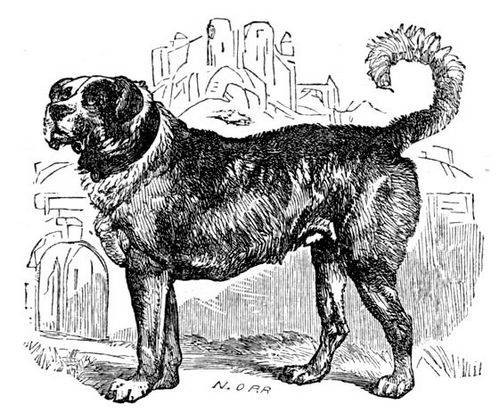
THE MASTIFF.
Vermin often are very troublesome to dogs, and I have known these animals destroyed because their owners were ignorant of the process by which the annoyance might have been readily conquered. There are many powerful drugs recommended by different writers to effect this end; but though all of them are sufficiently potent to annihilate the parasite, most of them are also strong enough to kill the dog. When fleas are numerous, the dog must be taken from the place where it has been accustomed to sleep. The bed must be entirely removed, and the kennel sluiced—not merely washed—with boiling water, after which it ought to be painted over with spirits of turpentine. The dog itself ought to be washed with eggs and water, as before directed; but with the yelk of every egg a teaspoonful of spirits of turpentine should be blended. After this, the animal should have pine shavings to sleep upon, and if these are frequently renewed, the annoyance will seldom be again complained of. As, however, exceptional cases will always start up, should the tribe not be entirely dispersed, the washing must be repeated; or if from want of time or other cause it be inconvenient to renew that operation, a little powdered camphor rubbed into the coat will mostly abate and often eradicate the nuisance.
Lice often cover the body of the dog, and especially crowd upon its head around the eyes and lips. There need be no dread of their presence, since these vermin will not live upon the human being, though similar to the kind which will. When they are perceived, the dog should be carried into some place in which grease stains are not of much consequence. It ought then to be covered with castor oil till the hair is completely saturated. In this state it should be allowed to remain at least twelve hours, at the expiration of which time the oil may be removed with yelk of eggs and water: only an additional number of eggs will be required. As to the quantity of castor oil which may be necessary, a moderate-sized dog with a long coat will require about a pound, and a large Newfoundland four times that amount. The process, as might be anticipated, operates upon the bowels; but I have never found it to do so with any dangerous power; on the contrary, the laxative effect is generally in these cases beneficial.
Medicine to the dog requires to be administered with caution. The nostrums which are so particularly recommended by grooms and farriers ought never to be made use of. The veterinary surgeon is less likely to commit error; but there are, however, few of the profession who devote attention to the dog with the zeal which the comprehension of its diseases and their treatment demand. Huntsmen and gamekeepers are generally from practical experience not altogether inapt dog doctors, where the larger and more robust kind of animal is to be treated, but for the smaller and petted species these persons ought not to be consulted. Many of their receipts are harsh—not a few of them inoperative—and some even dangerous; while all for the most part are pushed down at random, or in total ignorance of any effect the agents employed may induce beyond the intended one of doing good or working a certain cure. Nevertheless, with the kind of animals generally entrusted to their charge, such persons are so far successful that, in the absence of better advice, they deserve to be consulted for the larger species of dogs. The human physician will also, on occasions, be enabled to prescribe advantageously for the canine race; but not knowing the treatment of the diseases, and the symptoms being too often deceptive, the highest opinions are by no means to be absolutely relied upon.
Dog-doctoring is, in fact, a separate branch of science so intricate as to call for intense study strengthened by constant observation. No one not attached to the animal should attempt to master it, for success in such a case would be hopeless. The annoyances are so great that the patience is continually being tried; and the facts on which reliance can be placed are so few, that he who is content to depend upon the received assertions will never be able to realize his expectation. Nothing is more erroneous than to believe that there is any close analogy between man and the dog in the operation of medicinal substances. Aloes, rhubarb, &c., are not purgatives to the dog; but castor oil, which to the human being is a gentle laxative, to the dog is an active purge; while Epsom salts are a violent hydragogue to the canine patient, producing copious and watery stools. Common salt is in large doses a poison, and in apparent small quantities is so strong an emetic as to be dangerous. Salivation speedily ensues upon the use of minute quantities of mercury, which therefore cannot be considered safe in the hands of the general practitioner. Secale cornutum has little specific action beyond that of inducing vomiting; and strychnia cannot be with security administered, on account of its poisonous operation upon the animal. Other instances, casting more than suspicion upon the inferences which every writer upon Materia Medica draws from the action of drugs given to dogs, could easily be quoted, but they would here be somewhat out of place; and probably sufficient has been said to check a dangerous reliance upon results that admit of no positive deduction.
It is painful to peruse the "experiments" made especially by the French authors. We read that so much of some particular agent caused death to a dog in such a period; but he must be wise indeed who learns anything from statements of this kind. The word dog represents animals of various sizes and very diverse constitutions; therefore no conclusion can be drawn from an assertion that does not embrace every particular. Unfortunately, however, the operators think it no disgrace to their scientific attainments to put forth such loose and idle assertions; nor do they seem to hold it derogatory to their intelligence that they assume to reach a show of certainty by experimentalising upon a creature about which, as their reports bear witness, they literally know nothing. Equally unsatisfactory are the surgical and physiological experiments made upon these creatures. No results deduced from such acts can be of the slightest importance. The anatomy of the dog is not by them generally understood. There is no book upon this subject that is deserving of commendation; and, to instance the ignorance which prevails even in places where a superficial knowledge ought to exist, I will mention but one circumstance.
At the Royal Veterinary College there is a professor of Particular Anatomy, whose duty it is specially to instruct the pupils concerning the dog. The lectures, however, embrace but little, and that little is principally devoted to wandering remarks upon the osseous structure. Of the value of such teaching some opinion may be formed when the skeleton at the College actually exhibits the bones placed in wrong or unnatural situations. After the proof thereby afforded, with what reliance can any sane mind accept the awful declarations of those anatomists who, upon the living bodies of these creatures, have, according to their own accounts, exhibited a nicety and certainty of skill which the profoundest acquaintance with the various structures and parts would still leave incomprehensible? Such reports evidence only the presumptuous folly of individuals—the publication of such records testifies no more than the ignorance of the age.
To give medicine to the Dog often creates more bustle than the magnitude of the creature appears to justify. Moreover, if the parties concerned in the undertaking are not quite up to their business, the animal, which, between its gasping, howling, and struggling, will find time to bite, increases the activity by provoking human exclamations. I have known this species of confusion to have been continued for half an hour; during which work was stopped in a forge, and three brawny smiths joined a veterinary surgeon's efforts to give a pill to a little spaniel that could not have weighed above eight pounds. The dog was beaten and hands were bitten, but after all no pill was swallowed. The result was the natural consequence of the manner of proceeding. No man should contend with an animal, and especially with a dog, whose excitement soon renders it incapable of obedience.
With brutes of every kind, if the mastery cannot, by a bold stratagem, be gained at once, it should be only established through the confidence of the animal, which a few acts of kindness will, in the majority of cases, easily win. I have had dogs brought to me which seemed disposed rather to part with life than permit their jaws to be handled. The poor beasts had been harshly used by the persons who had previously undertaken to treat them. These creatures have remained with me, and in a little time have grown so submissive that my shop-boy could with ease give any kind of physic which I ordered to be prepared. Firmness and kindness were the only stratagems I employed. I took care never to give the dog a chance of mastery, but while ensuring my victory, I was careful that the conquest caused no sense of pain. A few pats, with a kind word, and an occasional reward in the shape of a bit of meat, induced the creature more willingly to submit when the next dose came round.
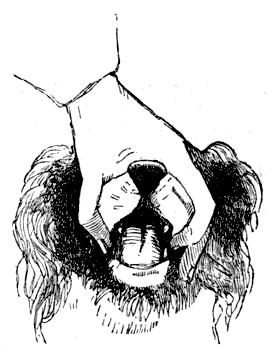
A small dog should be taken into the lap, the person who is to give the physic being seated. If the animal has learned to fight with its claws, an assistant must kneel at the side of the chair and tightly hold them when the dog has been cast upon its back. The left hand is then made to grasp the skull, the thumb and fore finger being pressed against the cheeks so as to force them between the posterior molar teeth. A firm hold of the head will thus be gained, and the jaws are prevented from being closed by the pain which every effort to shut the mouth produces. No time should be lost, but the pill ought to be dropped as far as possible into the mouth, and with the finger of the right hand it ought to be pushed the entire length down the throat. This will not inconvenience the dog. The epiglottis is of such a size that the finger does not excite a desire to vomit; and the pharynx and œsophagus are so lax that the passage presents no obstruction.
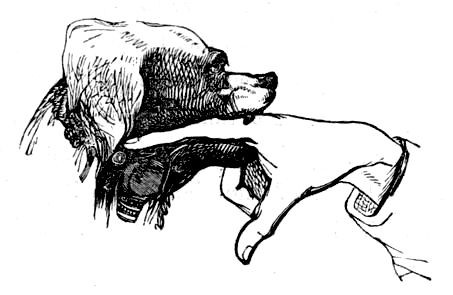
When the finger is withdrawn, the jaws ought to be clapped together, and the attention of the creature diverted. The tongue being protruded to lick the nose and lips will certify that the substance has been swallowed, and after a caress or two the dog may be released. Large brutes, however, are not thus easily mastered. Creatures of this description must be cheated, and they fortunately are not so naturally suspicious as those of the smaller kind. For months I have thus deceived a huge, ferocious, but noble guardian of a yard, who appeared incapable of conceiving that deception was being practised. The dog bolts its food, and, unless the piece be of unusual size, it is rarely masticated. The more tempting the morsel, the more eagerly is it gorged; and a bit of juicy or fat meat, cut so as to contain and cover the pill, ensures its being swallowed. Medicine, however, which in this manner is to be administered, ought to be perfectly devoid of smell, or for a certainty the trick will be discovered. Indeed, there are but few drugs possessed of odour which can be long used in dog practice, and even those that are endowed with much taste cannot be continuously employed. When the dog is very ill, the intelligent beast becomes conscious of its danger, and almost any kind or any form of medicine will be accepted. There is no difficulty generally then; but in chronic diseases, that only vex the temper and scarcely lower the spirit, the ingenuity will mostly need to be exerted. Some medicines, however, can be dissolved in the water; others may be smeared upon the food; and fortunately the majority of those drugs appropriate to slow and inveterate disorders admit of being thus exhibited. Fluids are perhaps more readily than solids given to dogs, by the generality of inexperienced persons. To administer liquids, the jaws should not be forced open and the bottle emptied into the mouth, as when this method is pursued the greater portion will be lost. The animal's head being gently raised, the corner of the mouth should be drawn aside, so as to pull the cheek from the teeth. A kind of funnel will thus be formed, and into this a quantity of the medicine equal to its capacity should be poured. After a little while the fluid will, by its own gravity, trickle into the pharynx, and oblige the dog, however unwilling it may be, to swallow. A second portion should then be given in the like way, and thus, little by little, till the full dose is consumed. Often dogs treated in this fashion swallow a draught very expeditiously; but others will remain a considerable time before they deglutate. Some, spite of every precaution, will manage to reject the greater part, and others will not waste a drop. The dexterity of the practitioner makes some difference; but no skill can ensure the drink being taken. Patience, however, is here of most avail; but when the mouth is full of fluid, by gently separating the jaws the animal may be caused to deglutate.
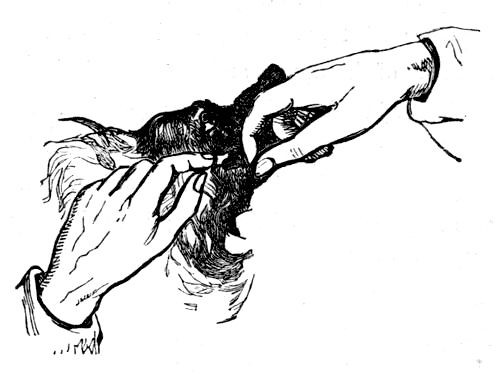
Two pieces of tape, one passed behind the canine teeth or tusks of the upper, and the other in like manner upon the lower jaw, have been recommended. The tapes are given to an assistant, who, pulling at them, forces the mouth open, and holds it in that position. In certain cases this may be adopted for pills; indeed every stratagem will be needed to meet the multifarious circumstances that will arise. For ordinary occurrences, however, the practice is not to be commended, and should never be embraced when drinks have to be given: the animal cannot swallow while the jaws are held asunder; but for solids this plan answers better. There are several objections, however, to be urged against its constant use. The operation is violent, and the restraint it necessitates not alone prevents the poor animal deglutating fluids, but also terrifies the brute, who, on the next occasion, naturally is the more resistful. Difficulties, therefore, increase, and the dog generally is not long before it learns to baffle the attempt to confine it. Moreover, unless the assistant be very well up to his business, his steadiness cannot be depended upon, and the hand often is wounded by the teeth of the patient.
I therefore do not, as a general custom, resort to the tapes, and I advise others only to employ them upon necessity. There are some creatures so artful and so resolute that any attempt to give them physic is certain to be frustrated. These are mostly small dogs that have been tutored by severity, and such animals are not subdued by any amount of suffering. The poor beasts fear the doctor more than the disease; and, though gentle in their dispositions, are resolute in their resistance. For such cases I employ the stomach pump, and by its aid introduce a dose of sulphate of magnesia; for in general it is only purgatives that require to be given in bulk. Other drugs may be either disguised, or exhibited by injection. Enemata are of great service to this animal, and I make much use of them. In their exhibition, care should always be taken to introduce the pipe without any force; having previously greased the tube to ensure its passing the more readily. While the instrument is in the rectum the dog should be firmly held, else, in its struggles, the intestine may be injured. The fluid should be gently thrown up, even when a large quantity is employed. For those injections, however, which it is desirable to have retained, from an ounce to a quarter of a pound will be sufficient. Warm water ought not to be used as an injection, since it washes away the mucus, renders the intestinal surface harsh, and prevents the passage of the fœces. Linseed tea or any mucilaginous fluid answers the purpose better, and a solution of soap is excellent in many cases, when only a laxative effect is desired. The form, however, as will in the course of this work be explained, must be repeatedly varied, since this agent may be rendered medicinal or nutritive.
Purgatives are most valuable, but are not free from danger. The digestive canal of the dog is peculiarly irritable, and no less sensitive to the action of medicine. There are few diseases in which the stomach and intestines are not involved, and very many in which purgatives are directly contra-indicated. No one should get into the habit of thrusting physic of this nature down the throats of his animals; and sportsmen may rest assured that, to the dog at all events, preparatory doses are not necessary to condition. Those, however, who persist in using such stuffs will do well not to employ the compounds in general use. The mixture of poppies, buckthorn, and castor oil is a filthy mess; and I do not understand the principles upon which the abomination is based. A better and more cleanly mixture is thus made:—
Ol: Ricini
4 parts.
Ol: Olivæ
2 "
Ol: Anisi
Q. s.
Mix.
A little pounded sugar added to this will often render it palatable, which, being of a fluid consistency, is without difficulty exhibited. The compound, however, flows the more readily if it be slightly warmed, and in winter it even requires to be thus prepared. Sulphate of magnesia I rarely employ; and, as a general purgative, it is not suited to the dog, though in exceptional cases it will be seen I recommend it. Should pills be preferred, the following will be found to answer every purpose:—
Ext: Col:
Half a scruple.
Pulv: Colch:
Six grains.
Pil: Hydrarg:
Five grains.
This is for one pill, which is a dose for a small dog of seven or eight pounds weight. Three times the quantity would be required for a Newfoundland. It is not very powerful in its action; its effect upon the system being quite as much alterative as laxative. The animal under its operation is evidently nauseated, and refuses food for about twelve hours; at the expiration of which time relief is afforded by a not very copious, but bilious evacuation. It is, however, important that, after the administration of a purgative, the dog should be permitted to remain perfectly quiet; since, if put to exercise, or much excited, the medicine will in all probability be ejected.
Emetics are shamefully abused, being so universally employed by the owners of dogs, and so strenuously recommended by writers upon their treatment, that one might think these agents were held to possess some charmed power over the health of the animal. Lecturers are marvellously fluent upon the subject of the dog's vomiting, which they dwell upon with such delight that their auditors must suppose the act of revulsion in the canine species is a pleasurable performance. Let any one, however, possessed of sense and reason, observe the creature in the act of being sick. The attitude is not characterised by ease; but the body is drawn up preparatory for some unusual effort. The countenance does not bespeak tranquillity; but the face is expressive of inward oppression. The animal's frame is shaken by convulsive spasms, each throe being announced by a deep pectoral sound, and only after this has repeatedly been heard is the stomach able to cast off its contents.
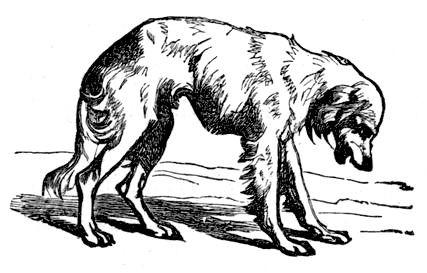
The description denotes nothing calculated to suggest that the organ whose derangement is so marked should be rudely tampered with. It is true the dog can readily be made to vomit. No creature is more easily moved in that way; but in such a circumstance reason should perceive no license to thrust emetics down the animal's throat. The organ which is so readily excited, by the fact asserts its sensibility, and on that very account ought to be the more respected. I have found oftener difficulty to check this tendency than reason to provoke it. Repeatedly are tonics rejected, and only by the reduction of the dose can the dog's stomach be made to retain the medicine. The emetics in common use are, moreover, far too violent. Antimonial wine, from half a teaspoonful to a dessertspoonful, is much preferable to tartar emetic and calomel.
On no account should such doses as Blaine prescribes ever be exhibited. Youatt in his recommendation is much better, but even the amount he orders is too great. A quarter of a grain of tartar emetic in solution is sufficient for a middling sized dog; and four grains of ipecacuanha is equally effective. If in two hours (which rarely happens) no effect is produced, it is better to repeat the dose, and continue even to do so, than to commence with a larger quantity in the first instance. These animals in their constitutions are so various, and the practitioner has so little to guide his judgment, that the utmost caution will not in every instance protect him from self-reproach; and in no case is he warranted in closing his mind against the suggestions of prudence. It is true the primary effects of an emetic are generally gratifying, but the after consequences, if carefully traced, will not be found to be equally satisfactory. Often the purge and the vomit, with which every dabbler commences his treatment of a "dog-case," appear to give relief; but, commonly, when the immediate excitation which their first operation naturally calls forth passes away, debility ensues, and the termination is not in harmony with the beginning. I once was very partial to emetics. I now rarely make use of them, and have no reason to lament my change of practice.
No notice will be bestowed upon those mysterious compounds known as alteratives, sedatives, &c., which are given merely because habit has sanctioned their administration. Names are in medicine dangerous things, and give a currency to error which, to man and beast alike, has proved fatal. Neither will any attempt be made to classify diseases; which custom, though it has some advantages, is likely to mislead, by setting up a system where no positive connexion can be demonstrated. The disorders of the dog in this work will be treated of after no formal plan; but the index must supply that want of arrangement, the absence of pretence to which probably will give offence to regular students.
DISTEMPER.
Of all the diseases to which the dog is subject, this one is the most dreaded. Writers have agreed it is the scourge of the canine race. Blaine and Youatt speak of it as capricious and untractable; the French regard it as incurable. The owners of dogs, despairing of benefit from regular means, have for a long time been content to trust in charms and specifics. Folly and cruelty have been embraced to accomplish that which kindness and science appear unequal to perform; and one general feeling seems to be entertained with regard to the distemper—most persons being agreed that the disorder is not to be subdued by medicine, and that its fatality is independent of the best efforts of man to check it.
My experience does not corroborate these various but harmonious accounts and opinions. In my conviction, the disorder is feared only because it is not understood, and is rendered worse by the injudicious attempts to relieve it. I find it tractable, easily mastered, and when submitted to me before the system is exhausted, I am very seldom disappointed by the result of my treatment. It has for some time been my custom to tell those who bring me an animal affected with this complaint, that if my directions are strictly followed, the creature "shall not die." When saying this, I pretend not to have life or death at my command, and the mildest affections will sometimes terminate fatally; but I merely mean to imply, that when proper measures are adopted, distemper is less likely to destroy than the majority of those diseases to which the dog is liable.
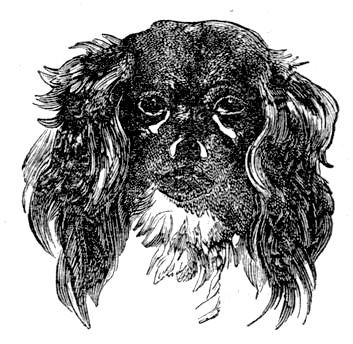
Distemper has been hitherto regarded as an inflammatory disorder, which was to be conquered only by antiphlogistic remedies. Bleeding, purging, vomiting, sedatives, blisters, and setons were employed; and the more acute the attack, the more violent were the means resorted to for the purpose of its conquest. Under such treatment I do not wonder at the evil character which the malady has obtained; for in proportion as the efforts made were great, so would be the probability of the disease proving destructive. There can be no doubt that more dogs have been killed for the distemper than would have died from it if nature had been suffered to take her course; and yet there is no disease that more requires help, or rewards the practitioner more largely for the assistance he affords.
The reader is entreated to dismiss from his mind all he may have read, or heard, or thought of this affection. Let the many tales about never-failing receipts, and the only proper modes of treatment, be for a time at all events forgotten, that the author, who undertakes to oppose prejudice and to contradict authority, may at least have a patient hearing. There is no reason to doubt that many cases which have been called distemper have, to all appearance, been saved by each of the reputed methods of cure. A pillet of tobacco, a tea-spoonful of salt, a dose of castor oil, an emetic, rubbing the nose with syrup of buckthorn, &c., &c., or anything that is famed for the purpose, may have often seemed to check the disease; but no one who has been accustomed to depend on these charms can deny he has frequently witnessed their failure. That they should sometimes have seemed to do good is easily explained. In the first place, there are very few persons who know how to recognise the early symptoms of the malady; but it is usual for every young dog that is a little poorly to be pronounced sick with the distemper.
The unfounded belief that all of these animals must have the disease makes every one anticipate its advent, and tempts them to call every ailment by the name suggested by their expectations. Two-thirds, at least, of the cases which are so quickly cured by nostrums and specifics would on inquiry prove to have been mistaken; and as, in the instances where a single dose is depended upon, nature is pretty much left to herself, the chances are that a fair share of the rest would get well of themselves. The recovery, however, could in no way be expedited by that which is credited for its accomplishment; since the little done is mostly calculated to aggravate and not to alleviate the symptoms, while there is no possibility it should eradicate the disorder.
In its character, distemper approaches very near to "continued fever" in the human subject; the chief difference being consequent upon the more delicate constitution and more irritable temperament of the dog, which prevents the two diseases from appearing exactly the same. It consists in a general fever, which produces a morbid excitement of all the mucous membranes. The digestive track is the principal seat of the disease, but of course its presence is most easily recognised at those parts which are most exposed to view. Thus the membrane of the eye, being a comparatively large surface, and by its delicacy well calculated to denote every variation of the system, is usually the first observed, and often the only place inspected. If this be cloudy or watery, the nature of the malady is at once concluded; the membrane of the nose also, though less palpable, is under observation; and if its secretion be copious and opaque, the fact is generally imagined to be established. The alterations, however, exhibited by these membranes are no more than sympathetic derangements, they being continuous with the more important organs; and when proofs are found in the eyes or nose, the disorder is generally confirmed, or has taken hold of the system. Some have supposed the disease originated in the nose, and thence extended to other parts; now I shall not stop here to consider so groundless an hypothesis. It essentially is fever affecting the entire of the mucous surfaces, but especially those of the alimentary canal.
The causes cannot be well ascertained. Contagion has been by the majority of writers supposed to be its principal source, but I cannot say my experience has corroborated that opinion. My own little cur never had the distemper, and yet she lived where the disease was scarcely ever absent. Animals virulently affected were daily brought to me, and not a few were left in my charge. From these she was not kept separate; they were her acquaintances and companions; she played with them, and often by choice shared their beds; and nevertheless she died without exhibiting the disease. I do not generally put those dogs by themselves which are affected with distemper; yet I cannot bring to mind the instance of an animal while under my care having caught the disorder. I doubt whether there is any justice in the general opinion. It would be hard to prove the prevailing notion was a prejudice, yet there can be no doubt that it is much more insisted upon than it deserves to be.
With regard to other causes, I know of none. I have not been able to observe that any circumstance can induce the disease, though at particular ages the animals are predisposed to its exhibition.
During the latter period of dentition—that is, when the second set of incisors are well up, and the permanent tusks are about half-grown, the temporary ones being still retained—is the time when pups are most disposed to display this disorder. I cannot state the precise age, because mouths are not regular in their appearances even as to mouths; but the aspect of the teeth will sufficiently mark the period when an individual may be expected to be attacked. The season certainly, in no little degree, influences the disease. In winter it is not usually seen; in the spring it is more common; in summer is rare, but less so than in winter. During the autumn, however, especially if much rain should fall, it is very frequent, and always more prevalent than at any other periods. Spring and autumn, therefore, are the times when it is to be looked for, but in the latter it is to be anticipated.
When treating of a subject like the present, there would seem to be a disposition to string together a number of words which do duty for information. Cold, wet, bad food, foul air, excessive exertion, fear, &c., are grouped together, and put forth for almost every "ill that flesh is heir to;" but I have to learn that these accepted terms have any connexion with the development of this disorder. Dogs that are starved, neglected, and cruelly tortured—animals that are judiciously fed, properly housed, and sensibly treated—as well as favorites that are crammed, nursed, and humored—all equally are its victims; and those which are most cared for fall most frequently, while those which are least prized more generally survive. If, therefore, privation or exposure be of any importance, the facts seem to infer their tendencies are either to check or mitigate the attack.
Exercise and food, however, do influence the complaint. The dog that is free suffers much less severely than the one that is confined. The animal that never tastes flesh has a much lighter attack than the one which subsists entirely upon meat. This last fact I have often proved. When the distemper has made its appearance, the opportunity for changing the diet has passed away. We have, then, only a choice of dangers. To remove the flesh to which the animal is accustomed is to cause it to pine and to weaken the strength, at a time when vigor is of every importance; whereas to continue the meat is mostly certain death; in this position I generally take away the flesh, for by so doing I give the patient a chance of recovery; and however desperate that chance may be, nevertheless it is to be much preferred to no chance at all.
The symptoms in the very early stage are not well marked or by any means distinguished for their regularity. They may assume almost any form; dulness and loss of appetite, purging, or vomiting, are very frequently the first indications. The more than usual moisture of the eyes, and a short cough, are often the earliest signs that attract attention. In the bitch a desire for copulation, with a disinclination to accept the dog, is to be regarded with suspicion; as is also a display of peevishness and a wish to be undisturbed in full-grown animals. These things denote no more than the derangement of the system; but if, conjoined with them, the inner surface of the lower eyelid should appear to be more red than usual, and the pulse should be increased in number without being materially altered in character—ranging from one hundred and twenty to one hundred and thirty in puppies, and in dogs from one hundred and ten to one hundred and twenty-five—the probability of distemper making its appearance is the greater, though even then by no means certain.
The period of the year, however, will also have to be taken into consideration; and inquiry should always be made whether any animals in the immediate neighborhood are known to have exhibited the disorder; because the disease is then proved to be in the locality. At this stage the practitioner is always more or less in the dark; and therefore he contents himself with such measures as he concludes are adapted to the symptoms, and waits for further instructions which nature will speedily develope.
When the disease is established, the animal is sensitive to cold. It seeks warmth, and is constantly shivering; when taken hold of, it is felt to tremble violently, so much so that the pulse cannot be accurately counted. The bowels are generally constipated. A thick purulent discharge flows from the eyes; and the white around the eye, if the upper lid be retracted, will be seen covered with numerous small and bright red vessels, giving to the part the appearance of acute inflammation. The vessels now spoken of are not to be confounded with the veins which are natural to this organ. These last are large, and of a purple hue, while their course is in the direction of the circumference of the cornea. The small vessels, indicative of distemper, are fine, bright in color, and their course is towards the centre, or in a line directly the opposite to that indicated by the veins. They are never present during health, though they are often to be witnessed in other diseases besides that which is here treated of. A glairy mucus, or yellow fluid, moistens the nostrils, and if the ear be applied to the head, the breathing will be discovered to be accompanied with an unusual sound. The cough is often severe and frequent; it is sometimes spasmodic—the fits being almost convulsive, and terminating with the ejection of a small quantity of yellow frothy liquid, which is thrown off by the stomach. The digestion is always impaired, and sickness is not unusual; the matter vomited having an offensive smell, and never being again consumed by the animal, as is generally the case when the creature is in health. The nose is dry and harsh; the coat staring and devoid of gloss: the skin hotter than is customary, and the paws warm. The pulse is perhaps quicker by twenty beats than during the prior stage, but less full—the artery feeling sharp, short, and thin under the finger.
When the symptoms described are apparent, the distemper is easily recognised, but it is not likely to continue stationary for any long period. In the course of a week it generally changes its character, and sometimes appears to subside altogether; the cases in which the disease steadily progresses, becoming day by day more severe, being comparatively rare.
When no abatement is witnessed, the case is not to be despaired of, but it requires to be anxiously watched; for often it will take a sudden turn, sometimes favorable, but more frequently demanding immediate assistance to prevent a fatal termination. The symptoms become aggravated. The eyes are clogged by a thick matter which glues the lids together, especially in the morning. The nostrils are plugged up by an accumulation of tenacious discharge, which becomes encrusted over the lips and nose, and impedes the breathing. The body rapidly wastes, though the appetite may return, and even be voracious. The shivering is constant. The dog seeks repose and is disinclined to move; though at times it may be playful, and in some instances will never exhibit any diminution of spirit. The cough may continue; but it more often ceases, or is only heard at irregular and distant intervals. The animal makes repeated and desperate efforts to expel the accumulated matter from the nose, and uses its paws evidently with an intention to remove the annoyance. Day by day, if not attended to, these signs grow more aggravated; the breath becomes very offensive; ulcers appear on the lips; the eyes become white; the discharge from the nostrils changes its color, and is mingled with blood and scabs, having an offensive odor. The creature at last begins to "yap," or utter short sharp cries. It becomes more weak, till at length it cannot walk, but lies upon its side; the noise being continued for hours, and then ceasing only to be again commenced. Constipation has usually been present, but at last diarrhœa sets in; the fæces have that peculiar smell which in the dog is characteristic of the latest stage of all; and gradually death, without a seeming struggle, closes the scene of suffering.
More frequently—indeed, in the majority of cases—the distemper is hardly well developed before it all at once seems to disappear. This peculiarity in the disorder has no doubt given strength to the general faith in specifics for this disease. The animal suddenly so far recovers, or appears to recover, after having been seriously affected, that the inexperienced naturally conclude the dog is either quite well, or evidently so far cured that the efficacy of the remedy administered is not to be disputed. For two or three weeks this deceptive appearance may continue, and in some cases no return of the symptoms may be witnessed; but in the majority of instances the disorder is only dormant, and again starts up as if it had been strengthened by its treacherous repose. The running from the nose comes back in excessive quantities, and either the bowels are singly inflamed, or with them the brain is involved, and fits or diarrhœa, or both united, speedily terminate in death, to arrest which medicine has seldom the power. The loss is on these occasions rarely attributed to distemper, which is thought to have been subdued; but death is commonly set down to fits, or to poison, or to inflammation of the bowels, or to anything else which the imagination of the proprietor may conceive. Hence we get an insight into the value of a large number, and perhaps into all, of the reputed nostrums; and hence it is the more necessary the reader should be made aware of those indications which denote the virus is not eradicated, but only latent as it were, lurking, to spring with greater certainty upon its victim. No one must conclude the distemper is mastered if the dog continues to lose flesh, or if the animal does not rapidly repair the waste consequent upon the earlier stages of the disorder. This tendency to stand still or decline should be carefully observed, and it will seldom deceive. When it is remarked, or even suspected, let the owner be upon his guard. When the distemper is actually overcome, there is a marked disposition to fatten; indeed, so strong is it at this time that, should it not be evident, there can be no doubt as to the cause, especially if a short and slight attack of the disorder has been known to have occurred a little time before. A warning, equally clear to those who will look for and can read it, is to be obtained from the eyes. These may be bright, and even peculiarly transparent; the face have a more animated expression than it displayed during previous health; but if the eyelids are retracted, the membranes will be found red, and the vessels before observed upon will be seen running over the white of the eye. When these things are present, although the coat may be beautifully smooth, the discharge dried up, the shivering gone, the appetite strong, and the spirits boisterous, still there is in the system the seeds of a disease which at no distant period will reappear in its most dangerous form.
Commonly, after the second stage, there is an abatement of the symptoms, without any actual cessation in the discharges. The dog is concluded to be better, and thought to be doing well, but it will not be long before something to excite alarm is witnessed. The eyes or nerves, or lungs or liver, or stomach or intestines may be attacked; or a pustular eruption, or actual mange, or a disposition in the animal to eat its own flesh, or chorœa, or paralysis may appear, and all of these possible varieties require to be separately dwelt upon.
The eyes lose their transparency, the surface is white and opaque, the sight is impaired, and the lids are nearly constantly closed. One or both of the organs of vision may be thus affected; usually the two are simultaneously affected, but seldom with the like intensity. After a few days, and sometimes at the commencement, a small circular depression is to be seen upon the very centre of the eyeball. It is round, and varies in size from that of a pin's head to that of a small pea, but rarely becomes larger. The depression, if nothing be done to check it, deepens till a little shallow pit is exhibited. At other times the hole grows larger and deeper, till the outer covering of the eye is absorbed, or, in common phrase, is eaten through, and the water escapes: this gives relief. If, however, the animal survives, the eye is often perfectly restored, though very frequently a white speck marks the spot which was ulcerated; or the dog is left with weakened eyes, and has a tendency to cataract, which may ultimately render it blind.
The affection of the lungs is denoted by the dog breathing more quickly, and often making a small plaintive or whistling noise during respiration. Though cough is quite as often absent as present; but if present it is usually severe; the pulse is increased, but small and thready, and the appetite may not be impaired. The animal is, however, disinclined to move, if put down at liberty, it always gets into some place where it hopes to be allowed to remain undisturbed. As the symptoms become more intense, the animal constantly sits upon its haunches; but I have not seen it carry the head erect, although authors state this to be one of the indications. There is a desire for fresh air, and the dog will always leave the house, or get to the window or door, if he have an opportunity of so doing. These signs are hardly to be mistaken, but they are easily confirmed. If the ear be applied to the side of a healthy dog's chest, no sound can be detected; but when the lungs are diseased, a very plain noise is readily heard. The presence, therefore, of any murmur, or of anything like air escaping over a dry rough surface, is indicative of disease, and the certainty that the lungs are involved is confirmed.
Dogs of late years have not commonly died of pneumonia during the distemper; but authors speak of the pulmonary form of the disorder as having formerly been a common cause of death. I know it only as a mild variation of the ordinary symptoms. It has not in any case under my observation proved fatal, but has readily yielded to gentle measures, aided by attention to simple diet.
The liver is generally involved. After the termination of a fatal case, this gland is found either soft or more brittle than it ought to be, else it is discovered much enlarged. I never saw it of less than its natural size. Generally it is discolored, mostly of a pale tint; which sometimes exists all over the organ, though the pendulous edges of the lobes are very generally seen of the bright red, suggestive of inflammation. The gall-bladder is always distended with a thin dark-green fluid or impure bile; and a large quantity of the same secretion, but of greater consistency, is distributed over the lining membrane of the anterior intestines. The liver obviously is the cause of the yellow distemper, which is no more than jaundice added to the original and pre-existing disease. Yellow distemper is by writers treated of as a distinct disorder, but I have not yet met with it in that form. When it has come under my notice, it has been no more than one of the many complications which the symptoms are liable to assume. The dog has been ill before his skin became discolored; but the eyes not exhibiting that ordinary discharge which denotes the true character of the affection under which he labored, the distemper was not detected.
Everything concerning distemper is by the generality of the public misunderstood. Most people imagine a dog can have the distemper but once in its life; whereas I had a patient that underwent three distinct attacks in one autumn, that of 1849. The majority of persons who profess an intimate knowledge of the dog will tell you distemper is a disorder peculiar to the young; whereas I know of no age that is exempt from its attack. I have known dogs, high-bred favorites, to be left with men selected because of their supposed familiarity with dog diseases; and these very men have brought to me the animals in the fits which are the wind-up of distemper, yet notwithstanding have been ignorant that their charges had any disease whatever. All the stages and symptoms of ordinary distemper may appear and depart unnoticed; but it is widely different with yellow distemper, for when the yellowness appears, it is so marked that no description of a peculiar symptom need be inserted, since it cannot be overlooked or mistaken. It is attended with excessive debility, and, unless properly combated, is rapidly fatal.
The stomach and intestines are always involved; I have never known a case in which either escaped. The affection of the first is generally shown by sickness during the earliest stage; when also the derangement of the last is denoted by either costiveness or relaxation, the bowels never being perfectly regular; towards the latter stages, or about the third or fourth week, the appetite sometimes becomes enormous; the craving for food is then unnatural, and is so intense that no quantity can appease the hunger. The animal will eat anything; dry bread is taken with avidity, and stones, cinders, straw, and every species of filth are eaten with apparent relish. Such, however, is not always the case, since it is not unusual for the appetite entirely to fail. In either instance the dog rapidly wastes; the flesh seems to melt as it were away, and the change produced by a few days is startling; from having been fat, a thinness which exposes every bone is witnessed in a shorter time than would be supposed possible. At this period vomiting may come on; but when the animal is morbidly ravenous, the stomach does not generally reject its contents. After death I have found it loaded with the most irritating substances, and always acutely inflamed; but no sickness in any instance of this kind has been observed. Vomiting is most generally absent, but the protruded and reddened appearance of the anus will give a clue to the actual condition of the alimentary tube. The stomach is inflamed, not throughout, but in various parts which are in different stages of disease. The pyloric orifice is always more affected than the cardiac; the duodenum, jejunum, and ileum, are inflamed; the cæcum is enlarged, inflamed, and generally impacted. The rectum, however, suffers most severely; it is much reddened and thickened, often to an extraordinary degree. I have known blood to be exuded from the surface of this bowel in such quantities as to destroy the life from actual hemorrhage. In one case, however, a spaniel vomited more than half-a-pint of blood previous to its death, which took place two hours afterwards. A small quantity of blood is ordinarily passed with the fæces toward the latter stage; but in several cases a large amount of pure blood, partly coagulated and unmingled with any fæcal matter, has flowed from the body in a continued stream, to which there will be cessation only as death approaches. The possibility of this occurring will give the reader some idea of the extent and degree in which the bowels are or may be diseased; the symptoms, nevertheless, are not such as would suggest the danger which may be shortly violently exemplified. Irregularity of the intestines may be remarked; but it is not so characterised as to force itself upon the attention. The belly during distemper mostly appears tucked up and small; the intestines, even when costiveness exists, are seldom loaded, but all except the rectum may feel empty. The animal is always bound when the bowels are acutely attacked. The first indication we get of this is often colic. The cries are high and yet full at first; but they only occur at periods, between which the dog seems easy and inclined to sleep; gradually the exclamations become more sharp and short, a quantity of dark-coloured fæces are voided, and relief is for a time experienced; the cries, however, return and become continuous; diarrhœa sets in; the excretions become more and more liquid, by degrees mixed with blood, and of a lighter color. Whenever they are discharged, pain is expressed; but as the animal sinks the cries grow less frequent, till at last the excrements pass involuntarily, and death soon takes place.
The cries, however, are not heard in every instance even of this kind, and the abdomen is not generally sensitive to pressure. When the belly is handled, the dog, by contracting the muscles covering the parts, may denote some small degree of resistance; but I have never known it to struggle during the operation. The curving of the spine, the occasional looks towards the seat of agony, and the efforts made to press or draw the belly upon the ground, will indicate the inflammatory character and the locality of the disease. The pulse does not materially aid the judgment; it becomes quicker and more sharp, but hardly to such an extent that dependence can be placed on its indications. The discharges often cease when the disease, in an acute form, becomes concentrated upon the contents of the abdomen; but the nose is almost always hot and harsh, though in a few cases I have known the part remain cold and moist even to the last. As the close draws near, a very peculiar smell, not absolutely powerful, but more sickly than offensive, is emitted. This odor is consequent upon the fæces, and when it is detected the animal seldom or never survives.
The brain, both Blaine and Youatt speak of as subject to inflammation during the latter stage of distemper. As diseases are peculiarly liable to change, and the appearances assumed at different times are by no means uniform, I may not say those estimable writers never beheld it in such a state; but I am certain I have never seen it in a similar condition; I have found it congested, but far oftener have I discovered it perfectly healthy. One of its coverings (the dura mater) has exhibited a few spots of congestion, but these have been small, each not larger than the head of a moderate sized pin, and in number about ten or twelve; generally they are situated towards the anterior of the cranium (on either side or falx), and near to the crista galli.
The bones forming the roof of the skull have, however, been highly vascular—loaded with dark blood—so that if dried they become of almost a black hue; and without disputing the accuracy of either of the authorities I have mentioned, these appearances to my mind account more satisfactorily for symptoms which no one asserts ever border upon phrenitis. The brain seems to me to be only sympathetically affected, not absolutely involved in this disease. When this is threatened, there is generally some notice given before the fits, succeeded by stupor, are displayed. The eye will sometimes brighten, and the discharge from the nose will cease. This, however, is by no means constant; as it is not rare for both to continue, or even to become more copious; but if one only should remain, the nose is certain to be the part whence the deflexion will issue. No positive dependence, therefore, can be placed upon the discharges from the eye or nose. The eye, nevertheless, is certain to denote that which is on the eve of happening. The pupil may be small; and when it is so, its decrease of size will be marked, and it will have little disposition to enlarge. This, however, is rarely witnessed. Generally the pupil is much enlarged, so much as to conceal the iris, and alter the character of the organ. The eye is moreover retracted, and the dog has a very peculiar expression of mingled pain and stupidity. If the hand be placed upon the head, it will be sensibly hot. No matter how thick the coat may be, the heat will be apparent, and the carotid arteries will sensibly throb. The coat feels dry and is warm, although the animal may be trembling to such a degree as prevents the pulse being counted. Yet the dog seems lively; it is active now, though perhaps a little while ago it was dull; every trivial circumstance now attracts its notice. The appetite is generally ravenous. The dog which only the day before was disinclined to feed, is suddenly disposed to eat more than it ever was known to consume; and it will gnaw and swallow the hardest wood for want of better provender. The amended appetite is mostly one of the symptoms, but it is not invariably witnessed; for occasionally increased activity, and the strange appearance of the eye, are all that indicate the approach of fits. It will not be long, however, before something shall be added which is more definite in its meaning. The dog which was running about suddenly stands still, and begins to smack its lips and champ its jaw. It keeps stationary while doing this, and continues so until a quantity of froth and thick saliva falls from the mouth, drops upon the ground, and then the action ceases. The animal looks around with a vacant stare, evidently not conscious where it is, and starts away, hitting itself perhaps against anything which may oppose its progress. If caught it struggles to get loose, and may even bite the hand which, when conscious, it would perish to defend. Almost immediately, however, it regains its faculties, and then seems quite as well as it appeared to be before the attack came on. It may continue subject to be thus seized for several days; or soon after the first attack, fits or convulsions may start up. During the champing colic may set in, which will only yield when the fits are established. The duration of the champing is not regular; it may be only for a few moments, or for several minutes. The attacks may be no more than one or two in the day, or twenty may occur in a single hour. Generally they remain about three days, but here also there is no rule. I have known them to be present for a week, and also to exist only for a few hours. In these latter cases the condition of the dog is generally not understood. It is taken out for a long walk, or it is indulged with a hearty meal; and in the middle of the one, or shortly after the other, it begins to champ, utters a loud sharp cry, which is suddenly cut short as if the animal was choked. The eyes glare, the mouth is open, and before perfect insensibility ensues, the dog bites at every object near it, then falls down convulsed, the limbs stiffen, the head is drawn back or twisted to one side, the urine and dung are voided; and a slate of unconsciousness, which may cease in a few minutes, or continue for hours, during which the body is in contortions, and the saliva flows freely from the mouth, stretches the poor brute upon the earth. When this is over, the dog recovers as from a trance, being always disposed to ramble, and should its strength permit, will start away at its utmost speed. There is neither to the number nor duration of these fits any limit; they may be few or frequent, and long or short. The second may end the life; or every five minutes, nay oftener, they may occur, and the animal survive for days. Any excitement will bring them on, and the passage of the fæces invariably is accompanied by an attack. Diarrhœa always begins when they commence, and the dog soon loses strength, and lies upon its side unconscious and incapable of motion; the pulse is not to be felt, and gradually without a struggle it expires. Let no man, however, be hasty in saying positively when death has taken place. Often has the life seemed gone, for the heart has been still; but minutes afterwards the animal has gasped, and then began to breathe once more. Death, however, comes at last, for if the dog sinks to such a state, I have never known it to revive.
A pustular eruption is often witnessed during the existence of distemper, and I have not seen the same phenomenon distinct from the disease. The two appear to be united, and yet we do not know the manner in which they are connected. The other symptoms are not mitigated when the pustules are matured, nor does their appearance denote any particular crisis or stage of the disorder. I have, however, most frequently seen them towards the latter or confirmed stages of distemper, and often they have immediately preceded the fits. The first indication given is a little redness, which is strictly local or confined to a particular spot. This place is not very red, but, nevertheless, it is obviously inflamed and tender; there is not much swelling, but a slight hardness can be detected. A day or two afterwards the redness dies away, and a globular eminence, perfectly round, and generally about the size of a split pea, is beheld. If it be opened, a proportionate quantity of thick pus of a healthy character escapes, and a comparatively large incrustation forms over the part; if not opened, the pustule bursts and the scab follows, but larger than in the previous case. Mostly the eruption appears on the belly and inside of the thighs, but it is seldom strictly confined to those parts. Often it affects the trunk and tail, but does not usually attack the head and fore-limbs. There is no proof that any benefit attends its development, or any known reason for attributing it to any cause; save only such as can be drawn from the statement, that I have commonly observed it in pups of a weakly constitution and emaciated condition.
The disposition to eat or gnaw some part of the body is often shown to an alarming degree, but is seldom exhibited save in the latter stage of the disease. The dog is observed to lick one of its paws, or mumble at its tail, for some days. The part is always one of the extremities, and is evidently tormented with a violent itching which cannot be allayed. The animal at length, irritated by the torture, attacks the member with its teeth. The skin is first removed, and then the flesh. The mouth may be covered with blood, the teeth clogged with hair, and the very bones attacked; but the pain which the sight of the mangled surface suggests to the spectator seems not to be felt by the dog, which appears desirous only of destroying its own body. I have known two of the toes of one fore-paw to be thus consumed, so that amputation was afterward imperative, portions of the metacarpal bones being laid bare. In several instances the root of the tail has been eaten, until the sacrum and first tail bones, with the nerves, were exposed. The rage cannot be overcome, and, unless the disposition be prevented by mechanical means, the consequence will be fatal. No author that I am acquainted with has noticed this peculiarity; and in general it is attributed to other causes than distemper, which is either not observed, or is supposed to have been got over.
Tumors on various parts of the body, and of different kinds, sometimes but not usually accompany the disease; but as I have not been able to satisfy myself they are peculiar to the disorder, or induced by any other cause than the debility attendant on distemper, there is in this place no occasion to more than point out the possibility of their appearance. They are unfavorable as indications of general weakness, but they do not seem to possess any further or direct influence over the course of the affection.
The genital organs rarely escape altogether. A thick purulent discharge, or one of a glairy nature, is often present in the male throughout the attack, and nearly always during recovery. In both sexes the bladder in the latter stages is apt to be paralysed, and the accumulation of the urine then becomes a prominent symptom. The recovery often commences after relief has been obtained, but if the necessity be overlooked, death generally ensues.
Paralysis of the hind extremities is occasionally witnessed, and when seen is generally sudden in its appearance. Sometimes, however, the loss of power is gradual, and when such is the case the hopes of a cure are always diminished. If the power of motion be lost suddenly, costiveness mostly exists; and if, on the other hand, it should be gradual, there may be diarrhœa, which will terminate in death.
Twitches, choræa, or Saint Vitus's dance, are not very usual, and may continue for months after every other symptom has subsided. All four limbs are sometimes violently agitated, and even during sleep are not quiescent. The motion is incessant, and when this is the case the animal dies, worn out by the want of bodily rest. In the majority of instances only one limb is affected; and a species of independence of volition, or incapability of controlling its movements, accompanies the affection. Though never still, the leg is comparatively useless, and is carried in a manner which denotes this fact. The muscles of the trunk are less commonly attacked, but they do not always escape. When the legs have not been thus affected, I have known the abdominal and thoracic muscles to be troubled by continuous twitchings; which, however, have been for the most part slight, and have subsided more quickly than have those of the extremities, when they have been diseased. Cholera comes on gradually; its commencement is hardly to be perceived, and it is seldom observed before the distemper is fully developed—even sometimes only when the disorder appears to be subsiding. It is not rare for it to start up while the animal is apparently recovering; and when it does so, it is always most difficult to remove. No pain is felt in the affected limb; the part rather seems to lose some portion of its sensibility.
When the hind parts are paralysed, feeling may be entirely gone; so that a pin thrust into the flesh of those parts does not even attract the notice of the dog. This does not occur in choræa, but the consciousness is dulled by that affection. The convulsed limb may be more roughly handled than the healthy ones; but violence will excite those answers which truly indicate that insensibility is not established in it. If nothing be done for the twitchings, the limb will waste; at last the general system will be sympathetically involved, and the body will grow thin. This, however, may not happen until long after all signs of distemper have disappeared; for choræa, though well known to be often fatal, is always slow in its progress, and never attended with immediate danger.
Such is an outline of the leading symptoms; and it now remains only to more particularly point out those which indicate death and denote recovery. The third or fourth week is the time when the dog mostly dies, if the disorder terminates fatally; and six weeks is the average continuance of the attack. Rapid loss of flesh is always a bad sign, and it is worse in proportion as the appetite is good, because then nature has lost the power of appropriation. The presence of vermin is likewise a circumstance which in some measure is deserving of notice. If a dog becomes, during the existence of this disorder, unusually infested with fleas, or more especially if lice all at once cover its coat,—as these parasites ever abound where the body is debilitated and the system unhealthy,—they are at such a period particularly ominous. The coat cannot, while the disease prevails, be expected to look sleek; but when it becomes more than usually harsh, and is decidedly foul, having a peculiar smell, which is communicated to the hand when it is passed over the body, the anticipations are not bright. The most marked indication is, however, given by the tongue. When this is only a little whiter than it was in health, we may hope for recovery; but if it becomes coated, discolored, and red and dry at its tip and edges, the worst may be foretold. The warning is the more decided if the breath be hot and tainted, and the belly and feet cold to the touch. While the dog can stand and walk, however feebly, there is no reason to despair; but when it falls down, and lies upon its side, rarely is medicine of much avail. Even then, however, it will sometimes recover; but if, while in this state, injections are returned as soon as they are administered, the chance that it can survive is indeed remote.
Recovery, in extreme cases, usually commences after diarrhœa which had set in has subsided, rather than during its attack. This is the only semblance to anything approaching a crisis which has come hither under my observation. If simultaneously the eyes lose their red and glassy aspect, and the cough returns, the danger may be supposed to have been passed. For weeks, however, the animal will require attention; for the convalescence is often more difficult to master than the disease itself is to cure; and relapses, always more dangerous than the original attack, are by no means unusual. The recovery may not be perfect before one or even two months have expired; but usually it is rapid, and the health is better than it was previous to the disease. A dog which would before never make flesh, having had the distemper, will often become fat. I once tried all in my power to relieve a Newfoundland dog of worms, but though I persisted for months, I was at last reluctantly obliged to admit the case was beyond any treatment I dared employ. A fortnight after I had given it up, the same animal was brought to me, suffering under evident distemper. I was not displeased to see it in that state, for I felt I could overcome the disease; and I told the proprietor that with the distemper the worms would depart. So it proved, and the dog has not since been subject to the annoyance.
When the violence of the disorder has declined, the skin generally peels, the cuticle is cut off, and the hair is scurfy. I have even known the soles of the feet to cast their outer covering, and in one case three of the nails were shed. The teeth, also, are coated with a thick fur, and the breath is offensive; but as the strength returns at the same time, these circumstances are not to be viewed in a serious light. In one or two instances, where the system seemed to be so shaken that it retained no strength to cast off the lingering remnant of the distemper, mange has burst forth, and proceeded very rapidly; but it yielded with equal speed to mild external remedies, and is therefore only to be feared inasmuch as it disfigures the dog for a time, retarding the ultimate restoration to health by further taxing the enfeebled body.
During the recovery from distemper, small and delicate animals—terriers and spaniels—are very liable to faint; the dog is lively, perhaps excited, when suddenly it falls upon its side, and all its limbs stiffen. A series of these attacks may follow one another, though generally one only occurs; when numerous and rapid, there is some danger, but, as a general rule, little apprehension need be entertained. The fainting fits are of some consequence, if they exist during a sickening for, or maturing of, distemper. In pups that have not passed the climax of the disease, they are not unseldom the cause of death; but, even in that case, I have never been convinced that the measures adopted for the relief did not kill quite as much or even more than the affection. When the symptom is mistaken, and wrong remedies are resorted to, the fainting fit will often continue for hours, or never be overcome. When let alone, the attack mostly does not last longer than a quarter of an hour, and under judicious treatment the consciousness almost immediately returns. When the fainting fits occur during the progress or advance of the disease—that is, before the symptoms have begun to amend—it is usually preceded by signs of aggravation. For twelve or twenty-four hours previously the dog is perceptibly worse; it may moan or cry, and yet no organ seems to be decidedly affected more seriously than it was before. I attribute the sounds made to headache; and, confirming this opinion, there is always some heat at the scalp. The animal is dull, but immediately before the collapse it attempts to wander, and has begun to move, probably panting at the same time, when it falls without a cry, and stiffens. In this state—the rigidity occasionally being less, but the unconsciousness continuing unchanged—it will remain; the eyes are turned upward or into the skull, the gums and tongue are pallid, the legs and belly cold: the appearances are those of approaching death, which, unless relief is afforded, may in a short time take place. When the fainting occurs after convalescence is established, the attack is sudden, the symptoms are less violent, and the coma of shorter duration. In this last case there is generally little danger, but there is always sufficient reason for alarm, and help ought never to be delayed. These attacks are commonly confounded with true distemper fits, from which they are altogether distinct; and from which they may be readily distinguished by the absence of the champing of the jaw, the want of any disposition to bite, the immediate insensibility which ensues, the shrieks not being heard, and the urine or fæces not being voided. Nevertheless, the two are usually confounded, and hence many persons are found asserting that distemper fits are easily cured; and several dogs have been shown to me at different times, which their owners were confident had been attacked by distemper fits, and radically cured by the most simple, and often ridiculous specifics. I have sometimes in despair—even against my reason—tried these boasted remedies, but in no instance has the result rewarded me. Where there was real occasion for a potent medicine, and little hope that any drug could benefit, the nostrums have, without a single exception, belied the confident recommendations with which they were offered, and either have done harm or proved inoperative.
The symptoms of distemper, as the reader will, after wading through the foregoing description, have perceived, are numerous and complicated; they admit of no positive arrangement, being both eccentric in their order and appearances. Redness of the eyes, with discharge from both eyes and nose, accompanied with ordinary signs of illness, are the early indications; but even these are not to be sought for, or to be expected in any single form. The judgment must be exercised, and study strengthened by experience will alone enable any man to pronounce the presence of distemper in many cases; while, perhaps, without knowledge or practice any person may recognise it in the generality of instances.
The treatment is rendered the more difficult because of the insidious nature of the disorder, and the uncertain character of its symptoms; under such circumstances, it is no easy task to make perfectly clear those instructions I am about to give. I am in possession of no specific; I do not pretend to teach how to conjure; I am going only to lay down certain rules which, if judiciously applied, will tend to take from this disease that fatal reputation which it has hitherto acquired. I shall be obliged, however, to leave much to the discretion of the reader; for it would employ too great a space, did I attempt to make provision for all possible accidents and probable combinations.
The diet is of all importance; it must be strictly attended to. In the first place, meat or flesh must be withheld. Boiled rice, with a little broth from which the fat has been removed, may be the food of a weakly animal, but for the majority bread and milk will be sufficient; whichever is employed must be given perfectly cold. Sugar, butter, sweet biscuits, meat, gravy, greens, tea or pot liquor—either luxuries or trash—must be scrupulously denied in any quantity, however small. Skim-milk, if perfectly sweet, is to be preferred, and coarse bread or ship biscuits are better than the same articles of a finer quality. These will form the diet, when the dog can be brought to accept them; and to rice, the favorite—however great may be the pity he elicits, or however urgent may be his solicitations for a more liberal fare—must be rigidly confined. If, after a few trials, the dog stubbornly refuses such provender, meat must of necessity be given, but it should be of the very best description, and rather underdone. Of this kind, it ought to be minced, and mixed with so much rice or ship biscuit as the animal can at first be made to eat with it; the rice or biscuit may then be gradually increased; and in the end the vegetable substance will constitute, at all events, the major part of the support. Water, constantly changed—a circumstance too little attended to where dogs are concerned—must be the only drink; the bed must be warm and dry, but airy. Cleanliness cannot be carried to too nice an extent; here the most fastidious attention is not out of place. Let the kennel be daily cleared, and the bed regularly changed at least thrice-a-week; straw or hay is better for the dog to sleep upon than cushions or blankets, which, being more expensive, are not so frequently replaced. Too much hay or straw cannot be allowed, but, on the other hand, it is difficult to regulate the quantity of the finer articles. In the last kind of bed the animal is often almost smothered, or else he scrapes them into a lump, and lies shivering on the top; whereas, when he has straw to lie upon, he can either creep beneath it, and shelter himself when sensible of cold, or expose himself to the air when oppressed by the fever. The sensations being the only guide, it is best to leave the dog, as much as possible, capable of obeying its instinct; but always let the bed be ample, as during the night the shivering generally prevails, and the cold fit is entirely independent of the heat to be felt at the skin, or the temperature of the season. Let the dog be kept away from the fire, for, if permitted, it will creep to the hearth, and may be injured by the falling cinders, when the burn will not perhaps readily heal. A cold or rather cool place is to be selected—one protected from wet, free from damp, and not exposed to wind or draughts. The kennel, if properly constructed, is the better house, for dogs do best in the open air; the only objection to which is, the chance it offers of the animal being drenched with rain. If the kennel can be placed under an open outhouse, I should always have it put there; and what else I would recommend is, of course, told by the line of conduct which I pursue.
Medicinal measures are not to be so quickly settled. A constant change of the agents employed will be imperative, and the practitioner must be prepared to meet every symptom as it appears. The treatment is almost wholly regulated by the symptoms, and as the last are various, of course the mode of vanquishing them cannot be uniform. To guide us, however, there is the well-known fact, the disease we have to subdue is of a febrile kind, and has a decided tendency to assume a typhoid character; therefore, whatever is done must be of a description not likely to exhaust,—depletion is altogether out of the question. The object we have to keep in view is the support of nature, and the husbanding of those powers which the malady is certain to prey upon: in proportion as this is done, so will be the issue. In the very early stage, purgatives or emetics are admissible. If a dog is brought to me with reddened eyes, but no discharge, and the owner does no more with regard to the animal than complain of dulness, a want of appetite, and a desire to creep to the warmth, then I give a mild emetic such as is directed, page 119; and this I repeat for three successive mornings; on the fourth day administering a gentle purge, as ordered, page 116. The tartar emetic solution and purgative pills I employ for these purposes, in preference to castor oil or ipecacuanha, and during the same time I prescribe the following pills:—
Ext. belladonna
Six to twenty-four grains.
Nitre
One to four scruples.
Extract of gentian
One to four drachms.
Powdered quassia
A sufficiency.
Make into twenty-four pills, and give three daily; choosing the lowest amount specified, or the intermediate quantities, according to the size of the animal.
Often under this treatment the disease will appear to be suddenly cut short. With the action of the purgative, or even before it has acted, all the symptoms will disappear, and nothing remains which seems to say any further treatment is required. I never rest here, for experience has taught me that these appearances are deceptive, and the disorder has a disposition to return. Consequently strict injunctions are given as to diet, and a course of tonics is adopted:—
Disulphate of quinine
One to four scruples.
Sulphate of iron
One to four scruples.
Extract of gentian
Two to eight drachms.
Powdered quassia
A sufficiency.
Make into twenty pills, and give three daily.
At the same time I give the liquor arsenicalis, which I prepare not exactly as is directed to be made by the London pharmacopœia, but after the following method:—
Take any quantity of arsenious acid, and adding to it so much distilled water as will constitute one ounce of the fluid to every four grains of the substance, put the two into a glass vessel. To these put a quantity of carbonate of potash equal to that of the acid, and let the whole boil until the liquid is perfectly clear. The strength is the same as the preparation used in human practice; the only difference is, the coloring and flavoring ingredients are omitted, because they render the medicine distasteful to the dog. The dose for the dog is from one drop to three drops; it may be carried higher, but should not be used in greater strength, when a tonic or febrifuge effect only is desired.
Of the liquor arsenicalis I take ten or twenty drops, and adding one ounce of distilled water, mingled with a little simple syrup, I order a teaspoonful to be given thrice daily with the pills, or in a little milk, or in any fluid the creature is fond of. The taste being pleasant, the dog does not object to this physic, and it is of all importance that it should be annoyed at this time as little as may be possible.
Numerous are the cases which have thus been shortened by this method; and the advantage gained by this mode of treatment is, that if the measures employed be not absolutely necessary, they do no harm, and if required, they are those which are calculated to mitigate the violence of the disease; so for three or four weeks I pursue this course, and should all then appear well, I dismiss the case.
Most generally, however, the dogs brought to us with the distemper have the disease fairly established before we see them. Then I never purge or vomit: the time when such agents could be remedial has passed, and if now used, though they will seem to do some immediate good, the after consequences are always to be regretted. The action of the purgative has scarcely subsided before the distemper assumes a more virulent form, and the probability of the termination is rendered more dark. During the distemper I pay little attention to the bowels; and, however great may be the costiveness, I never venture to resort even to a laxative, though, should I discover the rectum to be impacted with hard fæces, an enema may be employed. That which I use on these occasions is composed of gruel, to which some sulphuric ether and laudanum has been added.
Take of
cold gruel
One quart.
Sulphuric ether
Four drachms.
Laudanum
One scruple.
The above quantity will be ample for the largest dog—one-eighth will be enough for a small animal—and for a mere pup, an ounce of the fluid is often sufficient. In these cases, however, I always continue the injection until it is returned, the object not being to have it retained; but simply to lubricate the part, and thereby facilitate the passage of the fæces, while by distending the rectum, that intestine is stimulated to expel its contents. The ether and laudanum are introduced to guard against the possibility of irritation. If a more than usual disposition to costiveness be observed, twice a week a meal of liver, chopped very fine, is allowed; but even this should be given only after there is absolute proof of its necessity.
Of the cough, however distressing it may be, I take no notice. I do nothing for its relief, but persevere in the tonic treatment, and become more strict in my directions concerning diet. The cough is only one of the symptoms attendant on the disorder, and the measures likely to mitigate its severity will aggravate the disease; while by attacking the disorder, we destroy the cause, and with that the effect also disappears.
The eyes I treat, or rather refuse to treat, upon the same principle. Whatever may be the appearance they present—even though the animal should be actually blind, the eye of a dull thick white color on its entire surface, and the centre of the cornea ulcerated—nevertheless I let them alone, and turn a deaf ear to the entreaties which call on me to relieve so terrible an affliction: I forbid even the discharge to be washed off. Nothing must go near them; but the treatment must be pursued as though we were ignorant that the parts were affected. Any excessive accumulation may be gently picked off with the fingers once a-day; but even this must be performed with the utmost caution, and in most instances had better be let alone. It can only be necessary in dogs that have very long hair which becomes matted and glued together upon the cheeks; for other animals it is not imperative. If the lids should be stuck together, the fastening substance may be removed; but it should not be too quickly done even then. All water, either warm, tepid, or cold—every kind of lotion, or any sort of salve or powder—will do harm, by either weakening or irritating the organs. As to bleeding, blistering, and setoning, which have been advised, they are contrary to the dictates of humanity, and as a necessary consequence, are injurious. In medicine, at least with the dog, that which is not kind is not good. With these animals the feelings are much safer than the reason; and a lady, consulting the impulses of her heart, would be more likely to save her favorite than a veterinary surgeon, who proceeded upon the practice of that which he supposed was his science. Let the eyes of the sufferer alone—we cannot alleviate the pain, or shorten its duration. The disease regulates the torture, and to that we must give attention. If the distemper is conquered, the sight will mostly be restored; but if the eyes are tampered with, consequences may ensue which are not natural to the disease, but are induced by the crude and cruel prejudices of the doctor. The man who, during distemper, seeing an ulcer upon the cornea, under the imagination that by so doing he will set up a healthy action, presumes to touch it with lunar caustic, will in the resistance of the poor patient be rebuked, and, by the humour of the eye squirting into his face, probably be informed that he has accomplished the very object he intended to prevent, while a fungoid mass will spring up to commemorate his achievement.
When the lungs are attacked, all kinds of mistaken cruelties have been perpetrated. No wonder the disease has been so fatal, when it has been so little understood. I cannot conceive that any dog could survive the measures I was by my college tutor taught to pursue, or the plan which books told me to adopt. Needlessly severe, calculated to strengthen the disease, and to decrease the power of the animal to survive, as the general practice decidedly is, I entreat the reader to reject it. In truth, the involvement of the lungs is in distemper a very slight affair; no symptom yields more quickly or to milder means. Do not forget the diet, but let it be both low and small. The system cannot endure depletion, therefore we must gain whatever we can through abstinence. Do not starve, but be cautious not to cram the animal; only keep it so short that it remains always hungry. The meal must now never be full, or sufficient to satisfy the appetite, which is usually large. A loaded stomach would do much injury, therefore little and often is the rule. The amount for the day must be cut off in the morning; and during the day, at as many times as the owner pleases, it may little by little be offered, but no more must be allowed. If the dog should not be inclined to eat, which is not often the case at this particular period, the circumstance is hardly to be regretted; he is not, save under the direction of one qualified to give such an order, to be enticed or forced. As for medicine, let the following pill be given thrice daily:—
Extract of belladonna
One to four grains.
Nitre
Three to eight grains.
James's powder
One to four grains.
Conserve of roses
A sufficiency.
This will be the quantity for one pill; but a better effect is produced if the medicine be administered in smaller doses, and at shorter intervals. If the dog can be constantly attended to, and does not resist the exhibition of pills, or will swallow them readily when concealed in a bit of meat, the following may be given every hour:—
Extract of belladonna
A quarter grain to one grain.
Nitre
One to four grains.
James's powder
A quarter grain to one grain.
Conserve of roses
A sufficiency.
With these a very little of the tincture of aconite may be also blended, not more than one drop to four pills. The tonics ought during the time to be discontinued, and the chest should be daily auscultated to learn when the symptoms subside. So soon as a marked change is observed, the tonic treatment must be resumed, nor need we wait until all signs of chest affection have disappeared. When the more active stage is mastered by strengthening the system, the cure is often hastened; but the animal should be watched, as sometimes the affection will return. More frequently, however, while the lungs engross attention, the eyes become disordered. When such is the case, the tonics may be at once resorted to; for then there is little fear but the disease is leaving the chest to involve other structures.
Diarrhœa may next start up. If it appears, let ether and laudanum be immediately administered, both by the mouth and by injection. To one pint of gruel add two ounces of sulphuric ether, and four scruples of the tincture of opium; shake them well together. From half an ounce to a quarter of a pint of this may be employed as an enema, which should be administered with great gentleness, as the desire is that it should be retained. This should be repeated every third hour, or oftener if the symptoms seem urgent, and there is much straining after the motions. From a tablespoonful to four times that quantity of the ether and laudanum mixture, in a small quantity of simple syrup, may be given every second hour by the mouth; but if there is any indication of colic, the dose may be repeated every hour or half hour; and I have occasionally given a second dose when only ten minutes have elapsed. Should the purgation continue, and the pain subside, from five to twenty drops of liquor potassæ may be added to every dose of ether given by the mouth; which, when there is no colic, should be once in three hours, and the pills directed below may be exhibited at the same time:—
Prepared chalk
Five grains to one scruple.
Powdered ginger
Three to ten grains.
Powdered carraways
Three to ten grains.
Powdered capsicums
One to four grains.
Confection of roses
A sufficiency.
To the foregoing, from two to eight grains of powdered catechu may be added should it seem to be required, but it is not generally needed. Opium more than has been recommended, in this stage, is not usually beneficial; and, save in conjunction with ether, which appears to deprive it of its injurious property, I am not in the habit of employing it.
I have been more full in my directions for diarrhœa than was perhaps required by the majority of cases. Under the administration of the ether only I am, therefore, never in a hurry to resort even to the liquor potassæ, which, however, I use some time before I employ the astringent pills, and during the whole period I persevere with the tonic. The diet I restrict to strong beef tea, thickened with ground rice, and nothing of a solid nature is allowed. Should these measures not arrest the purgation, but the fæces become offensive, chloride of zinc is introduced into the injection, and also into the ether given by the mouth. With the first, from a teaspoonful to a tablespoonful of the solution is combined, and with the last half those quantities is blended. A wash, composed of two ounces of the solution of the chloride to a pint of cold water, is also made use of to cleanse the anus, about which, and the root of the tail, the fæces have a tendency to accumulate. Warm turpentine I have sometimes with advantage had repeatedly held to the abdomen, by means of flannels heated and then dipt into the oil, which is afterwards wrung out. This, however, is apt to be energetic in its action; but that circumstance offers no objection to its employment. When it causes much pain, it may be discontinued, and with the less regret, as the necessity is the less in proportion as the sensibility is the greater. Should it even produce no indication of uneasiness, it must nevertheless not be carried too far, since on the dog it will cause serious irritation if injudiciously employed; and we may then have the consequences of the application to contend with added to the effects of the disease. When it produces violent irritation, a wash made of a drachm of the carbonate of ammonia to half a pint of water may be applied to the surface; and when the inflammation subsides, the part may be dressed with spermaceti ointment. The fits are more to be dreaded than any other symptom; when fairly established, they are seldom mastered. I have no occasion to boast of the success of my treatment of these fits. All I can advance in favor of my practice is, that it does sometimes save the life, and certainly alleviates the sufferings of the patient; while of that plan of treatment which is generally recommended and pursued, I can confidently assert it always destroys, adding torture to the pains of death. In my hands not more than one in ten are relieved, but when I followed the custom of Blaine none ever lived,—the fate was sealed, and its horrors were increased by the folly and ignorance of him who was employed to watch over, and was supposed to be able to control. Let the owners of dogs, when these animals have true distemper fits, rather cut short their lives than allow the creatures to be tampered with for no earthly prospect. I have no hesitation when saying this; the doom of the dog with distemper fits may be regarded as sealed; and medicine, which will seldom save, should be studied chiefly as a means of lessening the last agonies. In this light alone can I recommend the practice I am in the habit of adopting. When under it any animal recovers, the result is rather to be attributed to the powers of nature than to be ascribed to the virtues of medicine; which by the frequency of its failure shows that its potency is subservient to many circumstances. Blaine and Youatt, both by the terms in which they speak of, and the directions they lay down for, the cure of distemper fits, evidently did not understand the pathology of this form of the disease. These authors seem to argue that the fits are a separate disease, and not the symptoms only of an existing disorder. The treatment they order is depletive, whereas, the attacks appearing only after the distemper has exhausted the strength, a little reflection convinces us the fits are the results of weakness. Their views are mistaken, and their remedies are prejudicial. They speak of distemper being sometimes ushered in by a fit, and their language implies that the convulsions, sometimes seen at the first period, are identical with those witnessed only during the latest stages. This is not the fact. A fit may be observed before the appearance of the distemper; and anything which, like a fit, shows the system to be deranged, may predispose the animal to be affected; but, between fits of any kind, and the termination of the affection in relation to distemper, there is no reason to imagine there is an absolute connexion. The true distemper fit is never observed early—at least, I have never beheld it—before the expiration of the third week; and I am happy in being able to add, that when my directions have from the first been followed, I have never known an instance in which the fits have started up. Therefore, if seldom to be cured, I have cause to think they may be generally prevented.
When the symptoms denote the probable appearance of fits, although the appetite should be craving, the food must be light and spare. At the Veterinary College, the pupils are taught that the increase of the appetite at this particular period is a benevolent provision to strengthen the body for the approaching trial. Nature, foreseeing the struggle her creature is doomed to undergo—the teacher used to say—gives a desire for food, that the body may have vigor to endure it; and the young gentlemen are advised, therefore, to gratify the cravings of the dog. This is sad nonsense, which pretends to comprehend those motives that are far beyond mortal recognition. We cannot read the intentions of every human mind, and it displays presumption when we pretend to understand the designs of Providence. There are subjects upon which prudence would enjoin silence. The voracity is excessive, but it is a morbid prompting. When the fits are threatened, the stomach is either acutely inflamed, or in places actually sore, the cuticle being removed, and the surface raw. After a full meal at such a period, a fit may follow, or continuous cries may evidence the pain which it inflicts. Nothing solid should be allowed; the strongest animal jelly, in which arrowroot or ground rice is mixed, must constitute the diet; and this must be perfectly cold before the dog is permitted to touch it: the quantity may be large, but the amount given at one time must be small. A little pup should have the essence of at least a pound of beef in the course of the day, and a Newfoundland or mastiff would require eight times that weight of nutriment: this should be given little by little, a portion every hour, and nothing more save water must be placed within the animal's reach. The bed must not be hay or straw, nor must any wooden utensil be at hand; for there is a disposition to eat such things. A strong canvas bag, lightly filled with sweet hay, answers the purpose best; but if the slightest inclination to gnaw is observed, a bare floor is preferable. The muzzle does not answer; for it irritates the temper which sickness has rendered sensitive. Therefore no restraint, or as little as is consonant with the circumstances, must be enforced. Emetics are not indicated. Could we know with certainty that the stomach was loaded with foreign matters, necessity would oblige their use; but there can be no knowledge of this fact—and of themselves these agents are at this time most injurious. Purgatives are poisons now. There is always apparent constipation; but it is confined only to the posterior intestine, and is only mechanical. Diarrhœa is certain to commence when the rectum is unloaded, and nothing likely to irritate the intestines is admissible. The fluid food will have all the aperient effect that can be desired. As to setons, they are useless during the active stage; and if continued after it has passed, they annoy and weaken the poor patient: in fact, nothing must be done which has not hitherto been proposed.
When signs indicative of approaching fits are remarked, small doses of mercury and ipecacuanha should be administered.
Grey powder
Five grains to one scruple.
Ipecacuanha
One to four grains.
Give the above thrice daily; but if it produces sickness, let the quantity at the next dose be one-half.
Tincture of hyoscyamus
One part.
Sulphuric ether
Three parts.
This should be mixed with cold soup, ten ounces of which should be mingled with one ounce of the medicine. Give an ounce every hour to a small dog, and four ounces to the largest animal. A full enema of the solution of soap should be thrown up; and the rectum having been emptied, an ounce or four ounces of the sulphuric ether and hyoscyamus mixture ought to be injected every hour. Over the anterior part of the forehead, from one to four leeches may be applied. To do this the hair must be cut close, and the parts shaved; then, with a pair of scissors, the skin must be snipped through, and the leech put to the wound: after tasting the blood it will take hold. To the nape of the neck a small blister may be applied; and if it rises, the hope will mount with it. A blister is altogether preferable to a seton; the one acts as a derivative, by drawing the blood immediately to the surface without producing absolute inflammation, which the other as a foreign body violently excites. The effects of vesicants are speedy, those of setons are remote; and I have seen fearful spectacles induced by their employment. With dogs setons are never safe; for these animals, with their teeth or claws, are nearly certain to tear them out. In cases of fits, if the seton causes much discharge, it is debilitating and also offensive to the dog, and the ends of the tape are to him an incessant annoyance. It is not my practice to employ setons, being convinced that those agents are not beneficial to the canine race; but to blisters, which on these animals are seldom used, I have little objection. With the ammonia and cantharides, turpentine and mustard, we have so much variety, both as to strength and speed of action, that we can suit the remedy to the circumstances, which, in the instance of a creature so sensitive and irritable as the dog, is of all importance. The blister which I employ in distemper fits is composed of equal parts of liquor ammoniæ and camphorated spirits. I saturate a piece of sponge or piline with this compound; and having removed the hair, I apply it to the nape of the neck, where it is retained from five to fifteen minutes, according to the effect it appears to produce. Great relief is often obtained by this practice; and should it be necessary, I sometimes repeat the application a little lower down towards the shoulders, but never on the same place; for even though no apparent rubefaction may be discerned, the deeper seated structures are apt to be affected, and should the animal survive, serious sloughing may follow, if the blister be repeated too quickly on one part.
The directions given above apply to that stage when the eye and other symptoms indicate the approach of fits, or when the champing has commenced. The tonic pills and liquor arsenicalis may also then be continued; but when the fits have positively occurred, other measures must be adopted. If colic should attack the animal, laudanum must be administered, and in small but repeated doses, until the pain is dismissed. Opium is of itself objectionable; but the drug does less injury than does the suffering, and, therefore, we choose between the two evils. From five to twenty drops of the tincture, combined with half-a-drachm to two drachms of sulphuric ether, may be given every half-hour during the paroxysm; and either the dose diminished or the intervals increased as the agony lessens, the animal being at the same time constantly watched. The ethereal enemas should be simultaneously exhibited, and repeated every half-hour. When a fit occurs, nothing should during its existence be given by the mouth, except with the stomach-pump, or by means of a large-sized catheter introduced into the pharynx. Unless this precaution be taken, there is much danger of the fluid being carried into the lungs. Ether by injection, however, is of every service, and where the proper instruments are at hand, it ought also to be given by the mouth. The doses have been described. To the liquor arsenicalis, from half a drop to two drops of the tincture of aconite may with every dose be blended; and the solution of the chloride of lime should be mingled with the injections, as ordered for diarrhœa, which, if not present, is certain to be near at hand. The following may also be exhibited, either as a soft mass or as a fluid mixture:—
Chlorate of potash
One to four grains.
Aromatic powder
Half-a-drachm to two drachms.
Or,
Carbonate of ammonia
Five grains to a scruple.
Chalk
One to four scruples.
Aromatic confection
One to four scruples.
Either of the above may be tried every third hour, but on no account ought the warm bath to be used. An embrocation, as directed for rheumatism, may be employed to the feet and legs, and warm turpentine may, as described in diarrhœa, be used to the abdomen. Cold or evaporating lotions to the head are of service, but unless they can be continuously applied, they do harm. Their action must be prolonged and kept up night and day, or they had better not be employed, as the reaction they provoke is excessive. Cold water dashed upon the head during the fit does no good, but rather seems to produce evil. The shock often aggravates the convulsions; and the wet which soon dries upon the skull is followed by a marked increase of temperature; while, remaining upon other parts, and chilling these, it drives the blood to the head.
From the foregoing, it will have been seen that my efforts are chiefly directed to strengthening the system, and, so far as possible, avoiding anything that might add to the irritability. On these principles I have sometimes succeeded, and most often when the fits have been caused by some foreign substance in the stomach or intestines. When such is the case, the fits are mostly short and frequent. One dog that had one of these attacks, which did not last above forty seconds every five minutes, and was very noisy, lived in pain for two days, and then passed a peach-stone, from which moment it began to recover, and is now alive. In another case, a nail was vomited, and the animal from that time commenced improving. In this instance an emetic would have been of benefit; but such occurrences are rare, and the emetic does not, even when required, do the same good as is produced by the natural ejection of the offending agent. Perhaps, where nature possesses the strength to cast off the cause of the distress, there is more power indicated; but after an emetic, I have known a dog fall upon its side, and never rise again.
During fits the dog should be confined, to prevent its exhausting itself by wandering about. A large basket is best suited for this purpose. It should be so large as not to incommode the animal, and high enough to allow the dog to stand up without hitting its head. A box is too close; and, besides the objection it presents with regard to air, it does not allow the liquids ejected to drain off.
For the pustular eruption peculiar to distemper, I apply no remedy. When the pustules are matured I open them, but I am not certain any great benefit results from this practice. If the disorder terminates favorably the symptom disappears; and, beyond giving a little additional food, perhaps allowing one meal of meat, from one ounce to six ounces, I positively do nothing in these cases. I must confess I do not understand this eruption; and in medicine, if you are not certain what you should do, it is always safest to do nothing.
The disposition to eat or gnaw any part of the body must be counteracted by mechanical measures. The limb or tail must be encased with leather or gutta percha. No application containing aloes, or any drug the dog distastes, will be of any avail. When the flesh is not sensitive, the palate is not nice, and the dog will eat away in spite of any seasoning. A mechanical obstruction is the only check that can be depended upon. A muzzle must be employed, if nothing else can be used; but generally a leather boot, or gutta percha case moulded to the part, has answered admirably. To the immediate place I apply a piece of wet lint, over which is put some oil silk, and the rag is kept constantly moist. The dose of the liquor arsenicalis is increased by one-fourth or one-half, and in a few days the morbid desire to injure itself ceases. After this the dressings are continued; and only when the recovery is perfect do I attempt to operate, no matter how serious may be the wound, or how terrible, short of mortifying, it may appear.
Tumors must be treated upon general principles: and only regarded as reasons for supporting the strength. They require no special directions at this place, but the reader is referred to that portion of the work in which they are dwelt upon.
To the genital organs of the male, when the discharge is abundant, a wash consisting of a drachm of the solution of the chloride of zinc to an ounce of water, gently applied once or twice daily, is all that will be necessary. The paralysis of the bladder requires immediate attention. In the last stage, when exhaustion sets in, it is nearly always paralysed. Sometimes the retention of urine constitutes the leading and most serious symptom; and after the water has been once drawn off, the bladder may regain its tone—another operation rarely being needed. A professional friend, formerly my pupil, brought to me a dog which exhibited symptoms he could not interpret; it was in the advanced stage of distemper. It was disinclined to move, and appeared almost as if its hind legs were partially paralysed. I detected the bladder was distended, and though the animal did not weigh more than eight pounds, nine ounces and a half of urine were taken away by means of the catheter. From that time it improved, and is now well. There can be no doubt that a few hours' delay in that case would have sealed the fate of the dog. For the manner of introducing the catheter, and the way to discover when the urine is retained, the reader is referred to that part of the present work which treats especially on this subject.
Paralysis and choræa will be here dismissed with a like remark. To those diseases the reader must turn for their treatment; but I must here state, that before any measures specially intended to relieve either are adopted, the original disease should be first subdued, as, in many cases, with the last the choræa will disappear; while in some the twitching will remain through life. All that may be attempted during the existence of distemper, will consist in the addition of from a quarter of a grain to a grain and a half of powdered nux vomica to the tonic pills; and, in severe paralysis, the use of a little friction, with a mild embrocation to the loins.
The treatment during convalescence is by no means to be despised, for here we have to restore the strength, and, while we do so, to guard against a relapse. One circumstance must not be lost sight of; namely, that nature is, after the disease has spent its violence, always anxious to repair the damage it may have inflicted. Bearing this in mind, much of our labor will be lightened, and more than ever shall we be satisfied to play second in the business. The less we do the better; but, nevertheless, there remains something which will not let us continue perfectly idle.
Never, after danger has seemingly passed, permit the animal to return all at once to flesh food. For some time, after all signs of the disease have entirely disappeared, let vegetables form a part, and a good part of the diet. Do not let the animal gorge itself. However lively it may seem to be, and however eager may be its hunger, let the quantity be proportioned to the requirements independent of the voracity. Above all, do not tempt and coax the dog to eat, under the foolish idea that the body will strengthen or fatten, because a great deal is taken into the stomach. We are not nourished by what we swallow, but by that which we digest; and too much, by distending the stomach and loading the intestines, retards the natural powers of appropriation; just as a man may be prevented from walking by a weight which, nevertheless, he may be able to support. Give enough, but divide it into at least three meals—four or five will be better—and let the animal have them at stated periods; taking care that it never at one time has as much as it can eat: and by degrees return to the ordinary mode of feeding.
The fainting fits create great alarm, but, if properly treated, they are very trivial affairs. An ethereal enema, and a dose or two of the medicine, will generally restore the animal. No other physic is needed, but greater attention to the feeding is required. Excessive exercise will cause them, and the want of exercise will also bring them on. The open air is of every service, and will do more for the perfect recovery than almost anything else. When the scarf-skin peels off, a cold bath with plenty of friction, and a walk afterwards, is frequently highly beneficial; but there are dogs with which it does not agree, and, consequently, the action must be watched. Never persevere with anything that seems to be injurious. If the mange breaks out, a simple dressing as directed for that disease will remove it, no internal remedies being in such a case required.
I cannot close my account of distemper without cautioning the reader against the too long use of quinine. It is a most valuable medicine, and, as a general rule, no less safe than useful. I do not know that it can act as a poison, or destroy the life; but it can produce evils hardly less, and more difficult to cure, than those it was employed to eradicate. The most certain and most potent febrifuge, and the most active tonic, it can also induce blindness and deafness; and by the too long or too large employment of quinine a fever is induced, which hangs upon the dog, and keeps him thin for many a month. Therefore, when the more violent stages of the disease have been conquered, it should no longer be employed. Other tonics will then do quite as well, and a change of medicine often performs that which no one, if persevered with, will accomplish.
All writers, when treating of distemper, speak of worms, and give directions for their removal during the existence of the disease. I know they are too often present, and I am afraid they too often aggravate the symptoms; but it is no easy matter to judge precisely when they do or when they do not exist. The remedies most to be depended upon for their destruction, are not such as can be beneficial to the animal laboring under this disorder; but, on the other hand, the tonic course of treatment I propose is very likely to be destructive to the worms. Therefore, rather than risk the possibility of doing harm, I rely upon the tonics, and have no reason to repent the confidence evinced in this particular.
The treatment of distemper consists in avoiding all and everything which can debilitate; it is, simply, strengthening by medicine aided by good nursing. It is neither mysterious nor complex, but is both clear and simple when once understood. It was ignorance alone which induced men to resort to filth and cruelty for the relief of that which is not difficult to cure. In animals, I am certain, kindness is ninety-nine parts of what passes for wisdom; and, in man, I do not think the proportion is much less; for how often does the mother's love preserve the life which science abandons! To dogs we may be a little experimental; and with these creatures, therefore, there is no objection to trying the effects of those gentler feelings, which the very philosophical sneer at as the indications of weakness. When I am called to see a dog, if there be a lady for its nurse, I am always more certain as to the result; for the medicines I send then seem to have twice the effect.
MOUTH, TEETH, TONGUE, GULLET, ETC.
The mouth of the dog is not subject to many diseases; but it sometimes occasions misery to the animal. Much of such suffering is consequent upon the folly and thoughtlessness of people, who, having power given them over life, act as though the highest gift of God could be rendered secondary to the momentary pleasure of man. No matter in what form vitality may appear—for itself it is sacred; it has claims and rights, which it is equally idle and ridiculous to deny or to dispute. The law of the land may declare and make man to have a possession in a beast; but no act of parliament ever yet enacted has placed health and life among human property. The body may be the master's; but the spirit that supports and animates it is reserved to another. Disease and death will resent torture, and rescue the afflicted; he who undertakes the custody of an animal is morally and religiously answerable for its happiness. To make happy becomes then a duty; and to care for the welfare is an obligation. Too little is thought of this; and the fact is not yet credited. The gentleman will sport with the agony of animals; and to speak of consideration for the brute, is regarded either as an eccentricity or an affectation. This is the case generally at the present time; and it is strange it should be so, since Providence, from the creation of the earth, has been striving to woo and to teach us to entertain gentler sentiments. No one ever played with cruelty but he lost by the game, and still the sport is fashionable. No one ever spared or relieved the meanest creature but in his feelings he was rewarded; and yet are there comparatively few who will seek such pleasure. Neither through our sensibilities nor our interests are we quick to learn that which Heaven itself is constantly striving to impress.
The dog is our companion, our servant, and our friend. With more than matrimonial faith does the honorable beast wed itself to man. In sickness and in health, literally does it obey, serve, love, and honor. Absolutely does it cleave only unto one, forsaking all others—for even from its own species does it separate itself, devoting its heart to man. In the very spirit and to the letter of the contract does it yield itself, accepting its life's load for better, for worse—for richer, for poorer—in sickness and in health—to love, cherish, and to obey till death. The name of the animal may be a reproach, but the affection of the dog realizes the ideal of conjugal fidelity. Nevertheless, with all its estimable qualities, it is despised, and we know not how to prize, or in what way to treat it. It is the inmate of our homes, and the associate of our leisure: and yet its requirements are not recognised, nor its necessities appreciated. Its docility and intelligence are employed to undermine its health; and its willingness to learn and to obey is converted into a reason for destroying its constitution. What it can do we are content to assume it was intended to perform; and that which it will eat we are satisfied to assert was destined to be its food.
Bones, stones, and bricks, are not beneficial to dogs. The animals may be tutored to carry the two last, and impelled by hunger they will eat the first. Hard substances and heavy weights, however, when firmly grasped, of course wear the teeth; and the organs of mastication are even more valuable to the meanest cur than to the wealthiest dame. If the mouth of the human being be toothless, the cook can be told to provide for the occasion, or the dentist will in a great measure supply the loss. But the toothless dog must eat its customary food; and it must do this, although the last stump or remaining fang be excoriating the lips, and ulcerating the gums. The ability to crush, and the power to digest bones, is thought to be a proof that dogs were made to thrive upon such diet; and Blaine speaks of a meal of bones as a wholesome canine dish. I beg the owners of dogs not to be led away by so unfounded an opinion. A bone to a dog is a treat, and one which should not be denied; but it should come in only as a kind of dessert after a hearty meal. Then the creature will not strain to break and strive to swallow it; but it will amuse itself picking off little bits, and at the same time benefit itself by cleaning its teeth. Much more ingenuity than force will be employed, and the mouth will not be injured. In a state of nature this would be the regular course. The dog when wild hunts its prey; and, having caught, proceeds to feast upon the flesh, which it tears off; this, being soft, does not severely tax the masticating members. When the stomach is filled, the skeleton may be polished; but hungry dogs never take to bones when there is a choice of meat. It is a mistaken charity which throws a bone to a starving hound.
Equally injurious to the teeth, are luxuries which disorder the digestion. High breeding likewise will render the mouth toothless at a very early age; but of all things the very worst is salivation, which, by the ignorant people who undertake to cure the diseases of these sensitive and delicate animals, is often induced though seldom recognised, and if recognised, always left to take its course.
The mouth of the dog is therefore exposed to several evils; and there are not many of these animals which retain their teeth even at the middle age. High-bred spaniels are the soonest toothless; hard or luxurious feeding rapidly makes bare the gums. Stones, bones, &c., wear down the teeth; but the stumps become sources of irritation, and often cause disease. Salivation may, according to its violence, either remove all the teeth, or discolor any that may be retained. The hale dog's teeth, if properly cared for, will generally last during the creature's life; and continue white almost to the remotest period of its existence. I have seen very aged animals with beautiful mouths; but such sights, for the reasons which have been pointed out, are unfortunately rare. The teeth of the dog, however, may be perfectly clean and entire even at the twelfth year; and it is no more than folly to pretend that these organs are in any way indicative of the age of this animal. They are of no further importance to a purchaser than as signs which denote the state of the system, and show the uses to which the animal has been subjected. The primary teeth are cut sometimes as early as the third week; but, in the same litter, one pup may not show more than the point of an incisor when it is six weeks old; while another may display all those teeth well up. As a general rule, the permanent incisors begin to come up about the fourth month; but I have known a dog to be ten months old, and, nevertheless, to have all the temporary teeth in its head. The deviations, consequently, are so great that no rule can be laid down; and every person who pretends to judge of the dog's age by the teeth is either deceived himself, or practising upon the ignorance of others.
Strong pups require no attention during dentition; but high-bred and weakly animals should be constantly watched during this period. When a tooth is loose, it should be drawn at once, and never suffered to remain a useless source of irritation. If suffered to continue in the mouth, it will ultimately become tightened; and the food or portions of hair getting and lodging between it and the permanent teeth, will inflame the gum, and cause the beast considerable suffering. The extraction at first is so slight an operation, that when undertaken by a person having the proper instruments, and knowing how to use them, the pup does not even vent a single cry. The temporary tusks of small dogs are very commonly retained after the permanent ones are fully up, and if not removed, will remain perhaps during the life; they become firm and fixed, the necks being united to the bone. This is more common in the upper than in the lower jaw, but I have seen it in both. Diminutive high-bred animals rarely shed the primary tusks naturally; therefore, when the incisors have been cut, and the permanent fang teeth begin to make their appearance through the gums, the temporary ones ought, as frequently as possible, to be moved backward and forward with the finger, in order to loosen them. When that is accomplished, they should be extracted, which if not done at this time will afterwards be difficult. As the tooth becomes again fixed, filth of various kinds accumulates between it and the permanent tusk; the animal feeds in pain, the gum swells and ulcerates, and sometimes the permanent tusk falls out, but the cause of the injury never naturally comes away.
To extract a temporary tusk after it has reset is somewhat difficult, and is not to be undertaken by every bungler. The gum must be deeply lanced; and a small scalpel made for the purpose answers better than the ordinary gum lancet. The instrument having been passed all round the neck of the tooth, the gum is with the forceps to be driven or pushed away, and the hold to be taken as high as possible; firm traction is then to be made, the hand of the operator being steadied by the thumb placed against the point of the permanent tusk. As the temporary teeth are almost as brittle as glass, and as the animal invariably moves its head about, endeavoring to escape, some care must be exercised to prevent the tooth being broken. However, if it is thoroughly set, we must not expect to draw it with the fang entire, for that has become absorbed, and the neck is united to the jawbone. The object, therefore, in such cases, is to grasp the tooth as high up as possible, and break it off so that the gum may close over any small remainder of the fang which shall be left in the mouth. The operator, therefore, makes his pull with this intention; and when the tooth gives way, he feels, to discover if his object has been accomplished. Should any projecting portion of tooth, or little point of dislodged bone be felt, these must be removed; and in less than a day the wound shows a disposition to heal; but it should afterwards be inspected occasionally, in case of accidents.
When foulness of the mouth is the consequence of the system of breeding, the constitution must be invigorated by the employment of such medicines as the symptoms indicate: and the teeth no further interfered with than may be required either for the health, ease, or cleanliness of the animal.
From age, improper food, and disease conjoined, the dog's mouth is frequently a torture to the beast, and a nuisance to all about it. The teeth grow black from an incrustation of tartar; the insides of the lips ulcerate; the gums bleed at the slightest touch, and the breath stinks most intolerably. The dog will not eat, and sometimes is afraid even to drink; the throat is sore, and saliva dribbles from the mouth; the animal loses flesh, and is a picture of misery.
When such is the case, the cure must be undertaken with all regard to the dog's condition; harm only will follow brutality or haste. The animal must be humored, and the business must be got through little by little. In some very bad cases of this description I have had no less than three visits before my patient was entirely cleansed. At the first sitting I examine the mouth, and with a small probe seek for every remnant of a stump, trying the firmness of every remaining tooth. All that are quite loose are extracted first, and then the stumps are drawn, the gums being lanced where it is necessary. This over, I employ a weak solution of the chloride of zinc—a grain to an ounce of sweetened water—as a lotion, and send the dog home, ordering the mouth, gums, teeth, and lips to be well washed with it, at least three times in the course of a day. In four days the animal is brought to me again, and then I scale the teeth with instruments similar to those employed by the human dentist, only of a small size. The dog resists this operation more stoutly than it generally does the extraction, and patience is imperative. The operation will be the more quickly got over by taking time, and exerting firmness without severity. A loud word or a box on the ear may on some occasions be required; but on no account should a blow he given, or anything done to provoke the anger of the animal. The mistress or master should never be present; for the cunning brute will take advantage of their fondness, and sham so artfully that it will be useless to attempt to proceed.
I usually have no assistance, but carry the dog into a room by itself; and having spoken to it, or taken such little liberties as denote my authority, I commence the more serious part of the business. Amidst remonstrance and expostulation, caresses and scolding, the work then is got over; but seldom so thoroughly that a little further attention is not needed, which is given on the following day.
The incrustation on the dog's teeth, more especially on the fangs, is often very thick. It is best removed by getting the instrument between the substance and the gum; then with a kind of wrenching action snapping it away, when frequently it will shell off in large flakes; the remaining portions should be scraped, and the tooth should afterwards look white, or nearly so. The instrument may be used without any fear of injuring the enamel, which is so hard that steel can make no impression on it; but there is always danger of hurting the gums, and as the resistance of the dog increases this, the practitioner must exert himself to guard against it. Some precaution also will be necessary to thwart occasional attempts to bite; but a little practice will give all the needful protection, and those who are not accustomed to such operations will best save themselves by not hitting the dog; for the teeth are almost certain to mark the hand that strikes. Firmness will gain submission; cruelty will only get up a quarrel, in which the dog will conquer, and the man, even if he prove victorious, can win nothing. He who is cleaning canine teeth must not expect to earn the love of his patient; the liberty taken is so great that it is never afterwards pardoned. I scarcely ever yet have known the dog to which I was not subsequently an object of dread and hatred. Grateful and intelligent as these creatures are, I have not found one simple or noble-minded enough to appreciate a dentist.
A quarter of a grain of tartar emetic in solution is sufficient for a middling sized dog; and four grains of ipecacuanha is equally effective. If in two hours (which rarely happens) no effect is produced, it is better to repeat the dose, and continue even to do so, than to commence with a larger quantity in the first instance. These animals in their constitutions are so various, and the practitioner has so little to guide his judgment, that the utmost caution will not in every instance protect him from self-reproach; and in no case is he warranted in closing his mind against the suggestions of prudence. It is true the primary effects of an emetic are generally gratifying, but the after consequences, if carefully traced, will not be found to be equally satisfactory. Often the purge and the vomit, with which every dabbler commences his treatment of a "dog-case," appear to give relief; but, commonly, when the immediate excitation which their first operation naturally calls forth passes away, debility ensues, and the termination is not in harmony with the beginning. I once was very partial to emetics. I now rarely make use of them, and have no reason to lament my change of practice.
danger. The digestive canal of the dog is peculiarly irritable, and no less sensitive to the action of medicine. There are few diseases in which the stomach and intestines are not involved, and very many in which purgatives are directly contra-indicated. No one should get into the habit of thrusting physic of this nature down the throats of his animals; and sportsmen may rest assured that, to the dog at all events, preparatory doses are not necessary to condition. Those, however, who persist in using such stuffs will do well not to employ the compounds in general use. The mixture of poppies, buckthorn, and castor oil is a filthy mess; and I do not understand the principles upon which the abomination is based. A better and more cleanly mixture is thus made:—

The only direction I have to add to the above, concerns the means necessary to guard against a relapse, and to afford general relief to the constitution. To effect the first object, prepare a weak solution of chloride of zinc—one grain to the ounce—and flavor the liquid with oil of aniseed. This give to your employer, together with a small stencilling, or poonah painting brush, which is a stiff brush used in certain mechanical pursuits of art; desire him to saturate the brush in the liquid, and with it to clean the dog's teeth every morning; which, if done as directed, will prevent fresh tartar accumulating, and in time remove any portion that may have escaped the eye of the operator, sweetening the animal's breath. With regard to that medicine the constitution may require, it is impossible to say what the different kinds of dogs affected may necessitate—none can be named here; the symptoms must be observed, and according to these should be the treatment; which must be studied from the principles inculcated throughout this work. Most usually, however, tonics, stimulants, and alteratives will be required, and their operation will be gratifying. The dog, which before was offensive and miserable, may speedily become comfortable and happy; and should the errors which induced its misfortune be afterwards avoided, it may continue to enjoy its brief life up to the latest moment; therefore the teeth should never be neglected; but if any further reason be required to enforce the necessity of attending to the mouth, surely it might be found in the frightful disease to which it is occasionally subject.
When the teeth, either by decay or from excessive wear, have been reduced to mere stumps, their vitality often is lost. They then act as foreign bodies, and inflame the parts adjacent to them. Should that inflammation not be attended to, it extends, first involving the bones of the lower jaw, and afterwards the gums, and canker of the mouth is established.
Such is the course of the disease, the symptoms of which are redness and swelling during the commencement. Suppuration from time to time appears; but as the animal with its tongue removes the pus, this last effect may not be observed. The enlargement increases, till at last a hard body seems to be formed on the jaw, immediately beneath the skin. The surface of the gums may be tender, and bleed on being touched, but the tumor itself is not painful when it first appears, and throughout its course is not highly sensitive. At length it discharges a thin fluid, which is sometimes mingled with pus, and generally with more or less blood. The stench which ultimately is given off becomes powerful; and a mass of proud flesh grows upon the part, while sinuses form in various directions. Hemorrhage now is frequent and profuse, and we have to deal with a cancerous affection, which probably it may not be in our power to alleviate. The dog, which does not appear to suffer, by its actions encourages the belief that it endures no acute pain—and for a length of time maintains its condition; but, in the end, the flesh wastes and the strength gives way; the sore enlarges, and the animal may die of any disease to which its state predisposes it to be attacked.
The treatment consists in searching for any stump or portion of tooth that may be retained. All such must be extracted, and also all the molars on the diseased side, without any regard to the few which may be left in the jaw. This done, the constitution must be strengthened, and pills, as directed, with the liquor arsenicalis, should be employed for that purpose.
Iodide of iron
One to four grains.
Powdered nux vomica
A quarter of a grain to one grain.
Salicine
One to four grains.
Extract of gentian
Three to twelve grains.
Powdered quassia
As much as may be required.
The above forms one pill, three or four of which should be given daily, with any other medicine which the case may require.
To the part itself a weak solution of the chloride of zinc may be used; but nothing further should be done until the system has been invigorated, and the health, as far as possible, restored. That being accomplished, if the tumor is still perfect, it should be cut down upon and removed. If any part of the bone is diseased, so much should be taken away as will leave a healthy surface.
However, before the dog is brought to the veterinary surgeon for treatment, very often the tumor has lost its integrity, and there is a running sore to be healed. To this probably some ignorant persons have been applying caustics and erodents, which have done much harm, and caused it to increase. In such a case we strengthen the constitution by all possible means, and to the part order fomentations of a decoction of poppy-heads, containing chloride of zinc in minute quantities. Other anodyne applications may also be employed; the object being to allay any existing irritation, for the chloride is merely added to correct the fetor, which at this period is never absent. After some days we strive to ascertain what action the internal remedies have had upon the cancer; for by this circumstance the surgeon will decide whether he is justified in hazarding an operation. If the health has improved, but simultaneously the affected part has become worse, then the inference is unfavorable; for the disease is no longer to be regarded as local. The constitution is involved, and an operation would produce no benefit, but hasten the death, while it added to the suffering of the beast. The growth would be reproduced, and its effects would be more violent; consequently nothing further can be done beyond supporting the system, and alleviating any torture the animal may endure. But if the body has improved, and the tumor has remained stationary, or is suspected to be a little better, the knife may be resorted to; although the chance of cure is rather against success. The age of the animal, and the predisposition to throw out tumors of this nature, are against the result; for too frequently, after the jaw has healed, some distant part is attacked with a disease of a similar character.
Worming, as it is generally called, is often-practised upon dogs, and both Blaine and Youatt give directions for its performance. I shall not follow their examples. It is a needless, and therefore a cruel operation; and though often requested to do so, I never will worm a dog. Several persons, some high in rank, have been offended by my refusal; but my profession has obligations which may not be infringed for the gratification of individuals. People who talk of a worm in the tongue of a dog, only show their ignorance, and by requesting it should be removed, expose their want of feeling.
Pups, when about half-grown, are sometimes seized with an inclination to destroy all kinds of property. Ladies are often vexed by discovering the havoc which their little favorites have made with articles of millinery; gloves, shawls, and bonnets, are pulled to pieces with a seeming zest for mischief, and the culprit is found wagging its tail for joy among the wreck it has occasioned. Great distress is created by this propensity, and a means to check it is naturally sought for. Mangling the tongue will not have the desired effect. For a few days pain may make the animal disinclined to use its mouth; but when this ceases, the teeth will be employed as ingeniously as before. Some good is accomplished by clipping the temporary fangs: these are very brittle, and easily cut through. The excision causes no pain, but the point being gone, the dog's pleasure is destroyed; and, as these teeth will naturally be soon shed, no injury of any consequence is inflicted. By such a simple measure, more benefit than worming ever produced is secured; for in the last case, almost in every instance, the obnoxious habit entirely ceases.
As to worming being of any, even the slightest, protection, in case rabies should attack the dog, the idea is so preposterous, that I shall not here stay to notice it.
The tongue of the high-bred spaniel is often subject to partial paralysis of one side. When such is the case, the muscles of the healthy side draw the tongue in that direction; and the member hangs out of the mouth, rendering the appearance somewhat unsightly. The organ from exposure becomes dry and hard; and not being properly used to cleanse the nose, this last becomes harsh and encrusted upon such portion of its surface as the disabled tongue cannot reach. The dog is disfigured, but it manages to live, and seems to endure more inconvenience than positive pain. The muscles on the paralysed side do not appear to be entirely deprived of nervous power. I infer this to be the case because they do not waste, and therefore attribute the affection to loss of tone rather than to actual palsy.
The cause is not known. Some dogs are pupped in this condition; others are only affected in this way when age has far advanced. In the latter case the symptom is sudden, and nothing previous has been observed which would denote the probability of the attack; but, arguing from the description of animals which are subject to this affection, and the periods when it mostly is exhibited, we may attribute it to weakness of the constitution.
For the disease nothing of a local nature can be done. I have been induced to try various topical remedies, but not with any satisfactory result; and I am not very hopeful as to future experiments in the same direction. Constitutional remedies have more power; and by these, if we cannot cure, we may limit the evil. For pups, good nursing—not petting or pampering, but whatever can invigorate—wholesome diet, airy lodging, and sufficient exercise, will do much. For older animals, the same measures, combined with such medicines as correct the digestion and give tone to the system, will be proper. An operation of dividing the muscles of that side on which the tongue protruded was once successful; but on three subsequent occasions it failed, and I have therefore relinquished it; for it is not quite safe, and puts the animal to a great deal of suffering. Dog fanciers sometimes cut off the exposed portion of the tongue, and thereby conceal the defect; but this is a brutal custom, and should not be adopted. The animal so mutilated drinks with difficulty, and the nose ultimately becomes even more unsightly than was the appearance of the hanging tongue.
The tongue is sometimes injured by the teeth, especially during fits. In such cases the wounds generally heal quickly, and require no special attention. Should the sores not mend, the fault is in the system. To that, and not to the part, medicines should be directed, and the matter will be quickly settled.
Salivation should never be produced upon the dog. The largest and strongest of these animals can but ill sustain the constitutional effects of mercury; while to those of a delicate kind it is nearly certain death. It may be induced by inunction, or rubbing in of ointment, as surely as by calomel internally administered. Chemists mix up various ointments that are called black, blue, red, white, or yellow; and sell these as specifics for skin diseases, which are in the dog all denominated mange. Such things are applied to the entire surface of the body; and as they mostly contain either Turpeth or Ethiop's mineral calomel, or one of the preparations of mercury, no great time is required to produce their fullest effect. The operation of the metal is too frequently mistaken for an aggravation of the disorder; and when the chemist is next visited, he is told to make the stuff stronger, because the other made the dog worse. No warning nature can give will stop the proceeding. Night and day the dog is rubbed with the poison, till its gums are sore, or its teeth fall out; the saliva dribbles from the mouth; the glands enlarge, the dog refusing to eat, and is so weak that it can hardly stand; then, fearing death, a doubt is for the first time entertained, and a veterinary surgeon is requested to look at the animal, and say what it wants.
Chemists are not qualified to administer the drugs they sell to human beings; but they are fairly the murderers of a fourth part of the dogs they physic. They know nothing about these animals, and dispense poison under the name of medicine when they presume to treat them. I have had creatures brought to me in the most terrible condition; and when they have been under domestic treatment—that is, when the chemist has been consulted—I always look to find symptoms of salivation. The signs are not obscure; the gums are either soft, tender, and inflamed, or else very much retracted; the teeth are of a yellow or brownish color, loose and mottled on their surfaces, but not covered with tartar; the breath has a peculiar fetor, and the saliva flows from the lips, while the glands at the jaw are hard; the weakness is excessive, and the appearance dejected. Purgation may be present, and in some instances the whole of the hair has fallen off. One dog, a Scotch terrier, lost every portion of its coat, and was nearly a year before it regained the covering.
Here is a portrait of a Scotch terrier, and the reader will perceive the coat is by the artist truthfully depicted as remarkably long, full, and hairy.
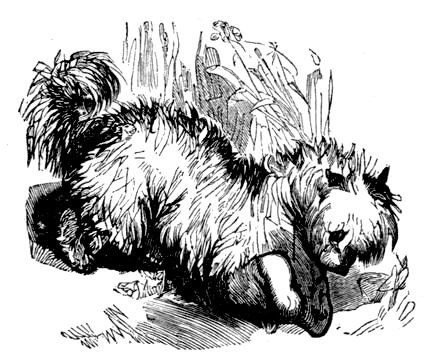
The imagination can, from this likeness of the animal in health, conjure up the resemblance such an object as the poor dog must have presented without its coat. Nor was the loss of the hair the worst part of the business; it never afterwards grew to its proper length. The other symptoms which have been described were present. Fever also existed, though the debility in a great measure concealed it; nor was the issue of the case by any means certain for a week or even longer.
The health may be restored, but the teeth will never regain their whiteness, nor the breath recover its natural odor. A mild acidulated drink, made of sulphuric acid and sweetened water, will be the most proper remedy. It should be made pleasant, and tasted before given to the dog, which will prevent its being administered of too great a potency. Of this as much as can be conveniently got down may be given, from a quarter of a pint to a quart daily; and with it the sulphate of iron, the disulphate of quinine, and vegetable bitters, made into pills, may be joined. If the bowels are costive, injections of the sulphate of magnesia, or small doses of the salt, may be employed, while the food should be nourishing. Sulphuric acid and the sulphates, with generous diet, will constitute the treatment; and if the case be not too far advanced, these will ultimately restore the strength.
BRONCHOCELE.
This disease is usually seen in greatest severity in pups. It consists in an enlargement of the thyroid body, which increases so much as to destroy the life. In old dogs it is commonly stationary, or of a fixed size. Spaniels and terriers, are much exposed to it; and of the last-mentioned breed, probably bull-terriers are, of all animals, the most liable to be attacked.
In pups, the thyroid body greatly and quickly enlarges, so as to cut short the life by when the sixth week is attained. The disease of itself, in old dogs, is rather annoying than fatal; but the manner in which it destroys the animal when very young, is by impeding the circulation and respiration. The enlarged thyroid body presses upon the trachea and jugular veins. The blood which should return from the brain and head is thereby prevented descending, and hindered from reaching the heart in a full current. The vessels enlarge so as to become obvious to the most indifferent observer. The veins not only look swelled, but they feel turgid, and cannot be compressed; the little beast is dull; the breathing is very laborious; the animal sleeps much, and at last dies without a struggle, casting off life as it were but a troubled dream. It never has perfectly enjoyed existence, and its departure is not to be regretted.
With the older animals, so far as my experience at present teaches me, the thyroid body, when enlarged, has not suddenly increased; yet this fact by no means proves that the diseased part is always quiescent, and cannot increase in size. Because of this possibility, and the safety of the process, the disease should be eradicated. This is to be done by administering iodine by the mouth, and painting over the enlargement (having the hair first closely shaved off the part) with some of the tincture of the same drug, applied by means of a camel's hair brush. As iodine soon separates and is thrown down to the bottom, all the preparations of it should be used as freshly made as may be convenient. The mixture of which iodine is the active ingredient, and which is a week old, may be confidently said to have lost the major part of its virtue. Every three or four days this medicine should be concocted; for even when put into pills, iodine, being very volatile, will evaporate. The quantity to be given to the dog varies, from a quarter of a grain four times a day to the smallest pup, to two grains four times daily to the largest dog. The tincture used for painting the throat is made with spirits of wine, an ounce; iodide of potassium, a drachm.
RESPIRATORY ORGANS.
The Larynx of the dog is affected in various ways. It is called a "little box," and the projecting part of this organ is, in the throat of man, spoken of as "Adam's apple." It opens at the back part of the mouth, and is placed at the beginning of the windpipe. All the air that inflates the lungs must pass through it, but it will permit nothing else to enter with impunity. A drop of saliva, or the smallest particle of salt, will be sufficient to call forth the most painful irritability. In fact the lining membrane of the larynx is the most tender or sensitive structure in the body; and, as parts are exposed to suffering just in proportion as they are endowed with sensation, of course, the organ so finely gifted is often the seat of disease.
The dog's larynx has many peculiarities. It is very complicated, and exquisitely constructed. Few persons have, perhaps, much attended to the notes of the animal's voice; but those who will observe the sounds may find these take a range far more wide than is generally imagined. The dog's voice is remarkably expressive, and to my ear speaks very intelligible music. The deep growl is not without variety; for by the feeling of the animal that emits it the note is always modulated. The rumble of expostulation the favorite gives utterance to when the master pretends to take away its bone does not resemble the rattle of joy with which the child's playmate accompanies a game of romps. Both, however, are distinct from the suppressed warning with which the watchdog announces the advancing stranger, or the sharp defiance by which he signifies his determination to attack. The bark also is not by any means monotonous, but is capable of infinite variety. The cries of the animal are remarkably modulated; but the soft and gentle sounds it can emit when inclined to coax its master, or answering to the excess of pleasure which his caresses create, are full of natural music. The dog's voice is not to my ear less beautiful than the song of a bird; but more delightful, because it is more full of meaning. The nightingale has but one song, which it constantly repeats. The cur has many tuneful notes, with which it responds to my attentions. Music has been recognised in the tongues of the pack, but I have heard harmony more delightful from the hound in my home. I like to hear the dog's voice, especially when not too loud, and having studied it, I have often wondered the animal did not speak. There can be little doubt it would be able to frame words if it possessed the power to comprehend their meaning; but the high intelligence of the creature unfits it for parrot-like mimicry. The dog is, in all it does, guided by its reason, and it performs no act without a reasonable motive. If any physical incapacity exist, it is to be found rather in the formation of the mouth than in the construction of the larynx, which presents no explanation of the dog's inability to frame definite sounds like words.
The part is rarely the seat of acute disease. In rabies, especially of the dumb kind, it is acutely affected; but of that form of disorder the writer will have to speak in another place. Of acute laryngitis, as met with commonly in the horse, I have not seen an example in the dog, and therefore I shall not here say anything about it. Of chronic disease of the larynx there is no lack of instances. These are brought to us frequently, and generally are submitted to our notice as cases of continued or confirmed cough. Cough, however, is but a symptom; and may be no more than a sympathetic effect induced by the derangement of a distant structure. When it is caused by the condition of the larynx, it has a deep sound, which is never entirely changed in character, however much pain induces the animal to suppress it. It is essentially the same in every stage, though it may be more or less full or loud, according to the state of the air passage.
This cough may start up from sympathy; but then it is always less sonorous, harsh, and grating. It is also less spasmodic, and likewise less the consequence of particular causes. When the larynx is the seat of the affection, the cough, should it once begin, continues for a considerable time; and cold air or excitement will invariably induce it. In bad cases every act of inspiration is followed by a kind of noise intermediate between a grunt and a cough. Sometimes the breathing is accompanied by a species of roaring; and I have seen one case in which a blood-hound had every symptom of laryngismus stridulus, or the crowing disease of the human infant.
Laryngeal disorders are seldom brought under our notice until they are confirmed, and they are difficult to cure in proportion to the length of time they have existed. The food in every case must be rigidly regulated, and no solid flesh should be allowed; but if the animal be very old or weak, beef tea or gravy may be added to the rice or biscuit which constitutes the chief portion of the diet. The condition of the stomach must so far as possible be ascertained, and the medicines necessary to correct its disease should be administered. The exercise must not be stinted, neither should confinement within doors be insisted upon. All must be done to assist the digestion and invigorate the health; such precautions being adopted as prevent the aggravation of the disease. Sudden changes of atmosphere, as from a warm room to a frosty air during the depth of winter, should obviously be avoided; neither would it be prudent to race the animal about, or induce it to perform any action calculated to accelerate the breathing.
At the commencement a gentle emetic given every other morning until six or seven have been administered, with a laxative occasionally if the bowels are torpid, is often productive of speedy benefit. A mustard poultice to the throat is also to be recommended, but he who applies it must be attentive to remove it when it appears to seriously pain the animal. It may be repeated on each successive night, or even oftener, but should never be reapplied before the skin on which it was previously placed has ceased to be tender. Leeches to the throat are often of service, as also are small blisters to the chest. I found great improvement result from wearing a very wide bandage, which was kept wet, and covered with oil silk, round the neck. This is easily made, and strips of gutta percha, or stout leather, will prevent it being doubled up by the motions of the head; and it is scarcely a disfigurement, since it only looks like a large collar. A seton in the throat may be tried, but though often beneficial, it ought only to be inserted by a person acquainted with the anatomy of the dog; for the jugular veins in this animal are connected by several large branches, which run just where the seton would be introduced. These could not be pierced with impunity, nor ought the seton to be left in so long as might induce sloughing, when the vessels probably would be opened; for as the dog badly sustains the loss of blood, the result would surely be fatal.
Internal medicines are not to be neglected. All sedatives, balsams, expectorants, and peppers, with some alkalies and stimulants, may be tried, and even alterative doses of mercury with caution resorted to. Dogs are more peculiar with respect to the medicines that act upon individuals than any other animals I am acquainted with. That which touches one will be inoperative upon another; and what violently affects one, will on a second, apparently of the same bulk, strength, age, and character, be actually powerless. This renders dog-practice so difficult, and makes the explanation of any decided mode of treatment almost impossible. A great deal must necessarily be left to the discretion of the practitioner, who, despite his utmost care, will often have reason for regret, if he do not in every new instance proceed with caution. The following pills are likely to do good:—
Barbadoes tar
Half a drachm to two drachms.
Powdered squills
A drachm to four drachms.
Extract of belladonna
Half a scruple to four scruples.
Liquorice powder
A sufficiency.
Beat into a mass, and make into twenty pills; give four daily. Or,
James's powder
One grain to four grains.
Dover's powder
Six grains to a scruple.
Balsam of Peru
A sufficiency.
Make into one pill and give as before. Or,
Extract of hyoscyamus
One to four grains.
Powdered ammoniacum,
and cubebs, of each
}Four to twelve grains.
Venice turpentine
A sufficiency.
Powdered capsicums and cantharides have also seemed to touch the disease; but no one medicine has to me appeared to have any specific influence over it. In these cases mere formulæ could be extended almost indefinitely; but the reason must be exerted, and the prescription must be dictated by the symptoms. Thus, when there is much nervous excitability accompanied with gastric derangement, Prussic acid of Scheele's strength, in doses of half a drop to two drops, may be exhibited; and if the mouth be dry, and the disposition irritable, from five to twenty drops of the tincture of Indian tobacco may be administered. If the throat is very sore, the mouth may be held open, and ten grains of powdered alum mixed with four times its weight of fine sugar may be blown into it, or in severe instances, the fauces may be mopped out by means of a piece of soft sponge tied to the end of a probe, and saturated with a solution containing six grains of nitrate of silver dissolved in an ounce of water.
Ulceration of the interior of the larynx is to be dreaded if the symptoms do not yield. This will be denoted by the cough becoming weaker, less loud, more short, and also more frequent. Prior to it there are always intervals during which the animal enjoys repose; but after ulceration of the larynx is established every inhalation provokes the irritability of the organ. With it the constitutional symptoms become more serious, and little can then by medicine be accomplished; for the passage of the air which is necessary to life causes the affection we desire to cure to spread. Tracheotomy might be performed, though the dog is so very expert with its claws, and any tape around the neck would be probably so injurious, that hitherto I have not ventured to hazard the experiment. Humanity has, in such cases, forced me to recommend the destruction of the life which I entertained no hope of comforting.
Cough is much more frequently a symptom than a disease. It, in fat dogs, usually proceeds from disordered digestion; and then to remove it the cause must be attacked. It accompanies worms; and if these are expelled, it will subside. It may, however, exist by itself, for the larynx of the dog early becomes ossified or converted into bone; and being then less yielding, the violent vibrations it is subjected to during the act of barking have a natural tendency to injure the delicate lining membrane. Its irritability is excited, and cough is the consequence. The disposition of the creature to give tongue ought, therefore, to be as much as possible checked, and a mustard poultice applied to the throat, while the pills first recommended on page 205, are given; but if these fail, the others may be employed. The general measures would be pretty much the same, only the more severe need not be resorted to. Quiet, mild food, and a little care, will often, without medicine, remove the annoyance; but it is never well to trust too long to such dubious aids, when timely assistance will procure speedy relief, and delay may lead to further evil.
Snoring is often a heavy accusation brought against the dog. It may proceed from weakness; though, in ninety-nine cases out of every hundred, it results from that debility which accompanies accumulated fat and sloth. In the one case we apply the means advised to restore the strength,—in the other, we stint the food, enforce a vegetable diet, and see that sufficient exercise be taken.
Snorting is another unpleasantness which the canine race display. The animals stand with their heads erect, and, drawing the air through the nostrils, produce a series of harsh loud sounds, which are sometimes continued till the dog falls from actual exhaustion. This is the result of irritability, in a low form, of the lining membrane of the nasal chambers. The sensation is probably that of itching, and the dog endeavors, by drawing the air quickly through the nostrils and energetically expelling it, to relieve the annoyance.
The treatment is not to be laid down; attention to the food, and medicines of an alterative nature calculated to affect or improve the secretions, are most likely to be of service. Worms may possibly be the provocative, and in that case of course they should be removed. The measures, therefore, are not to be arbitrarily pointed out. The judgment must be employed to discover in what particular the system is unsound, and the agents used must be selected with a view to the general health. Local applications have been tried without advantage, but there do not appear to be any specifics for the complaint. The snorting is to be regarded merely as an effect of some deep-seated derangement, and the remedies are to be such as the appearance of the animal suggests. I have generally been successful in these cases, but I remember no two of them which I have treated exactly in the same manner. Patience and perseverance are mostly required, but sometimes the affection will not yield to any remedy. When it appears to be obstinate, the use of medicine should not be pushed too far. The constitution of the dog is so easily injured, and with so much difficulty restored, that where a mere unpleasantness is apparently all that exists, it is better to permit that to continue than hazard the health of the animal by over-strenuous attempts to get rid of it.
Cold or Coriza is not frequent in the dog, but it will occasionally be seen. It comes on gradually, and often passes off without any assistance being given. In pups it is apt to pass first into bronchitis, and then change into distemper, which in such instances, spite of our best endeavors, will often terminate in fits.
It springs from various causes, but neglect and improper lodging are generally those to which it may be traced. In adult animals it is not to be greatly feared, but in the young it requires immediate attention. The kennel must be looked to; the food and exercise be strictly watched. Tonics, into which cayenne pepper, cubebs, or balsam of pepper enter, are to be tried, and cod-liver oil also is worth an experiment. The iodide of potassium is also not to be rejected; but the condition of the patient must decide which is the most likely to be of service in the case. When undertaken early, the symptoms yield in the majority of instances. The discharge, which at the commencement is thin, becomes more copious, grows thicker, and at last ceases. The sneezing stops and the spirits return; but should the disorder not be checked, the larynx becomes involved, and cough appears. If no relief be now sought, and the disease spreads, the breathing grows quick at first, and then laborious.
The pup may even at this stage be eager to feed, and when its attention is excited, be as playful as in health; but if watched it will be seen, when alone, to be oppressed and languid. In such cases, belladonna, combined with James's powder, an equal amount of each, should be administered. The dose should be exhibited every hour, for here the wish is to obtain the speedy effect of the drug without allowing its sedative property to seriously affect the strength. To a young pup, a quarter of a grain will be the proper quantity; and for a full-grown large-sized dog, two grains of the extract may be employed. The action, however, must be observed, and when a marked disinclination for food or drink, with a seeming wish for both, and signs of inconvenience in the throat are seen, the belladonna must be withheld. On the third day, if the cure be not complete, it may be a second time employed; and, after a like period, even a further trial may be made. At the same time, a little soap liniment may be rubbed into the throat, along the course of the windpipe, and over the chest. The bowels also should be regulated; but purgation is not to be desired. Should the liver be sluggish, mild alterative doses of the grey powder may be sprinkled upon the food, and will thus be taken without the necessity of forcing the animal. When the measures recommended do not succeed, the appearance of the patient must direct those which are next to be adopted. Where weakness prevails, and shivering denotes the presence of fever, quinine and the sulphate of iron are required. Small blisters, or mustard poultices, to the chest, may with due caution be applied. An emetic may even be administered; but, if repeated at all, it must be only after two or three days have elapsed. Where the system is vigorous, expectorants and sedatives, with leeches to the chest, may be used. Turpentine liniment to the sides, throat, and under the jaws, may also be freely rubbed in, and the diet in quantity restricted. Tartar emetic in very minute doses may be exhibited three times daily.
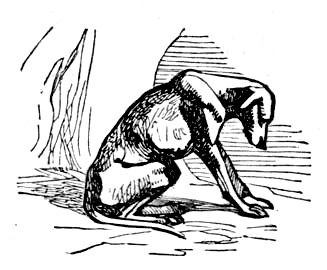
INFLAMMATION OF THE LUNGS.
The chest of the dog is not in any remarkable degree the seat of disease. The ribs of the animal being constructed for easy motion, and the muscles which move them being strong and large in proportion to the size of the bones, the lungs, therefore, are in general properly expanded; and this circumstance tends to preserve them in a healthy condition. They do not, however, always escape, but are subject to the same inflammations as those of the horse, though, from the causes stated, more rarely attacked.
Inflammation of the Lungs is denoted by a quickened pulse and breathing, preceded by shivering fits. The appetite does not always fail; in one or two instances I have seen it increased; but it is most often diminished. The animal is averse to motion; but when the affection is established, the dog sits upon its hocks, and wherever it is placed, speedily assumes that position. As the disorder becomes worse, the difficulty of breathing is more marked. The creature also shows a disposition to quit the house, and if there be an open window it will thrust its head through the aperture. The sense of suffocation is obviously present, and at length this becomes more and more obvious. The dog in the very last stage refuses to sit, but obstinately stands. One of the legs swells, and, on being felt, it is ascertained to be enlarged by fluid. There is dropsy of the chest, and the limb has sympathized in the disposition to effusion. The pulse denotes the weakness of the body; but the excitement of disease in a great measure disguises the other symptoms. The dog may even, to an unpractised eye, seem to possess considerable strength; for it resists, with all its remaining power, any attempt to move it, and its last energies are exerted to support the attitude that affords the most relief to the respiration. At length the poor brute stubbornly stands until forced to stir, when it drops suddenly, and for several moments lies as if the life had departed. Again it falls, but again revives; and always with the return of consciousness gets upon its legs; but at last it sinks, and without a struggle dies.
The lungs have been, in the first instance, inflamed, but the pleura or membrane covering the lungs, and also lining the chest, has likewise become by the progress of the disease involved. The cavity has become full of water, or rather serum, and by the pressure of the fluid the organs of respiration are compressed. It is seldom that both sides are gorged to an equal degree; but one cavity may be quite full while the other is only partially so. One lung, therefore, in part remains to perform the function on which the continuance of life depends; and if, by any movement, the weight of fluid is brought to bear upon the little left to continue respiration, the animal is literally asphyxiated. It drops, in fact, strangled, or more correctly, suffocated; and as the vital energy is strong or weak, so may the dog more or less frequently recover for a time. In the end, however, the tax upon the strength exhausts the power, and the accumulation of the fluid diminishes the source by which the life was sustained. After death, I have taken from the body of a full-sized Newfoundland one lung, which lay with ease upon my extended hand; while the two held together afforded a surface sufficient to support the other. The condensation was so great that the part was literally consolidated, and the fluid which exuded on cutting into the substance was small in quantity. The blood-vessels were, with the air-cells, compressed, and while the arterialization of the blood was imperfect, the circulation was also impeded.
The causes usually assigned to account for inflammation of the lungs will not, in the dog, explain its origin. I have usually met it where the animal had not been exposed to wet or cold; where it had not undergone excessive exertion, or been subjected to violence. Extraordinary care as rather seemed to induce, than the neglect of the creature appeared to provoke the attack. It is, however, easy to trace causes when we have a wish to explain a particular effect; but where the lungs have been inflamed I have never, to my entire satisfaction, been able to ascertain that the animal had been exposed to hardship, or subjected to labor which it had not previously sustained, and which, if the health had been good, it might not have endured.
Disease of the lungs is, in the early stage, very readily subdued; but, if allowed to establish itself, it is rarely that medicine can eradicate it. The majority of persons who profess to know anything about the diseases of dogs, look upon the nose as an indication of the health. While the appetite is good, or the nose is cold and moist, such people are confident no fear need be entertained. Of the uncertainty that attends the disposition to feed mention has been already made; but with regard to the condition of a part, the persons who assume to teach us are likely to be in such cases entirely deceived. I have known dogs with violent inflammation of the lungs; I have seen them die from dropsy of the chest; and their noses have been wet and cold, even as though the animals had iced the organs. From this mistaken notion, therefore, no doubt, are to be traced the numerous instances of dogs brought for treatment when no remedies can be of avail. They are submitted to our notice only that we may be pained to look upon their deaths; and often have my endeavors been thus limited to simple palliative measures, when an earlier application would have enabled me to employ medicine with a reasonable prospect of success.
In the commencement, when the breathing is simply increased and the pulse slightly accelerated, then if you place the ear to the side, there is merely a small increase of sound; and the animal exhibits no obstinate, or more properly, unconquerable disposition to sit upon the hocks; small quantities of belladonna, combined with James's powder, will generally put an end to the disease. The belladonna, in doses of from one to four grains, may be given three times a day; but where trouble is not objected to, and regularity can be depended upon, I prefer administering it in doses of a quarter of a grain to a grain every hour. By the last practice I think I have obtained results more satisfactory; but it is not always that a plan necessitating almost constant attention can be enforced, or that the animal to be treated will allow of such repeated interference. The following formula will serve the purpose, and the reader can divide it if the method I recommend can be pursued.
Extract of belladonna
One to four grains.
James's powder
Two to eight grains.
Nitrate of potash
Four to sixteen grains.
Extract of gentian
A sufficiency for one pill.
If, on the second day, no marked improvement is perceptible, small doses of antimonial wine may be tried; from fifteen minims to half-a-drachm may be given every fourth hour, unless vomiting be speedily induced; when the next dose must, at the stated period, be reduced five or ten minims, and even further diminished if the lessened quantity should have an emetic effect. The object in giving the antimonial wine is to create nausea, and not to excite sickness; and we endeavor to keep up the action in order to affect the system. This is frequently very decisive in the reduction of the symptoms; but, even after the danger has been dispelled, the pills before recommended must be persevered with, and every means adopted to prevent a relapse.
Sometimes, however, the disorder commences with a violence that, from the very beginning of the attack, calls for the most energetic measures. If the breathing be very quick, short, and catching; the position constant; the pulse full and strong; the jugular vein may be opened, and from one ounce to eight ounces of blood extracted; or leeches may be applied to the sides; or an ammoniacal blister may be employed. This is done by saturating a piece of rag, folded three or four times, with a solution composed of liquor ammoniaca fort., one part; distilled water, three parts; and, having placed it upon the place from which the hair has been previously cut off, holding over it a dry cloth to prevent evaporization of the volatile vesicant. A quarter of an hour will serve to raise the cuticle; but frequently that object is accomplished in less time; therefore, during its operation, the agent must be watched, or else the effect may be greater than we desire, and sloughing may ensue.
A dose of castor oil may also be administered, and the food should be composed entirely of vegetables, if the animal can be induced to eat this kind of diet. Exertion should be prevented, and quiet as much as possible enjoined. The tincture of aconite, it is said, sometimes does wonders in inflammation of the lungs; but in my hands its operation has been uncertain, though the homœopathists trust greatly to its action in this disease. They give it singly, but I have not reaped from its use on the dog those advantages which tempt me to depend solely on its influence. When employed, it may be given in doses of from half a drop to two drops of the tincture, in any pleasant vehicle, every hour.
After dropsy of the chest has been established, the chance of cure is certainly remote; but tapping at all events renders the last moments of life more easy. It is both simple and safe, and does not seem to occasion any pain; but, on the contrary, to afford immediate relief. The skin should be first punctured, and then drawn forward so as to bring the incision over the spot where the instrument is to be inserted. The place where the trocar should be introduced is between the seventh and eighth ribs, nearer to the last than to the first, and rather close to the breast-bone. The point being selected, the instrument is pushed gently into the flesh; and when the operator feels no resistance is offered to the progress of the tube, he knows the cavity has been pierced. The stilet is then withdrawn, and the fluid will pour forth. Unless the dog shows signs of faintness, as much of the water as possible ought to be taken away; but if symptoms of syncope appear, the operation must be stopped, and after a little time, when the strength has been regained, resumed. When this has been done, tonics must be freely resorted to. The following pill may be administered three or four times a day; and the diet should be confined to flesh, for everything depends on the invigoration of the body, and the inflammation is either gone, or it has become of secondary importance.
utmost care, will often have reason for regret, if he do not in every new instance proceed with caution. The following pills are likely to do good:—
Iodide of iron
One to four grains.
Sulphate of iron
Two to eight grains.
Extract of gentian
Ten grains to half a drachm.
Powdered capsicums
Two to eight grains.
Powdered quassia
A sufficiency.
The above will make two pills; and it is better to make these the more frequently, as they speedily harden, and we now desire their quickest effect, which is sooner obtained if they are soft or recently compounded.
During recovery the food must be mild, and tonics must be administered. Exercise should be allowed with the greatest caution, and all excitement ought to be avoided. The dog must be watched and nursed, being provided with a sheltered lodging and an ample bed in a situation perfectly protected from winds or draughts, but at the same time cool and airy.
Asthma is a frequent disease in old and petted dogs. It comes on by fits, and, through the severity of the attack, often seems to threaten suffocation; but I have not known a single case in which it has proved fatal. The cause is generally attributable to inordinate feeding, for the animals thus afflicted are always gross and fat. The disorder comes on gradually in most instances, though the fit is usually sudden. The appetite is not affected, or rather it is increased often to an extraordinary degree. The craving is great, and flesh is always preferred, while sweet and seasoned articles are much relished. On examination, the signs denoting the digestion to be deranged will be discovered. Piles are nearly constantly met with; the coat is generally in a bad condition, and the hair off in places. The nose may be dry; the membrane of the eyes congested; the teeth covered with tartar, and the breath offensive. The dog is slothful, and exertion is followed by distress. Cough may or may not exist; but it usually appears towards the latter period of the attack.
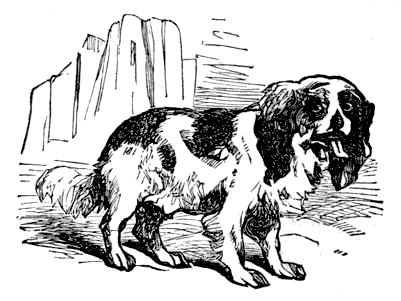
ASTHMA.
Asthma is spasm of the bronchial tubes, and when it is thoroughly established it is seldom to be cured. All medicine can accomplish is the relief of the more violent symptoms. The fits may be rendered comparatively less frequent and less severe; but the agents that best operate to that result are likely in the end to destroy the general health. Between two evils, therefore, the proprietor has to make his choice; but if he resolves to treat the disorder, he must do so knowing the drugs he makes use of are not entirely harmless.
Food is of all importance. It must be proportioned to the size of the patient, and be rather spare than full in quantity. Flesh should be denied, and coarse vegetable diet alone allowed. The digestion must also be attended to, and every means taken to invigorate the system. Exercise must be enforced, even though the animal appear to suffer in consequence of being made to walk. The skin should be daily brushed, and the bed should not be too luxurious. Sedatives are of service; and as no one of these agents will answer in every case, a constant change will be needed, that, by watching their action, the one which produces the best effect may be discovered. Opium, belladonna, hyoscyamus, assafœtida, and the rest, may be thus tried in succession; and often small doses produce those effects which the larger one seems to conceal. A pill containing any sedative, with an alterative quantity of some expectorant, may be given three times daily; but when the fit is on, I have gained the most immediate benefit by the administration of ether and opium. From one to four leeches to the chest, sometimes, are of service; but small ammoniacal blisters applied to the sides, and frequently repeated, are more to be depended upon. Trivial doses of antimonial wine or ipecacuanha wine, with an occasional emetic, will sometimes give temporary ease; but the last-named medicines are to be resorted to only after due consideration, as they greatly lower the strength. Stomachics and mild tonics at the same time are to be employed; but a cure is not to be expected. The treatment cannot be absolutely laid down; but the judgment must be exercised, and whenever the slightest improvement is remarked every effort must be made to prevent a relapse.
HEPATITIS.
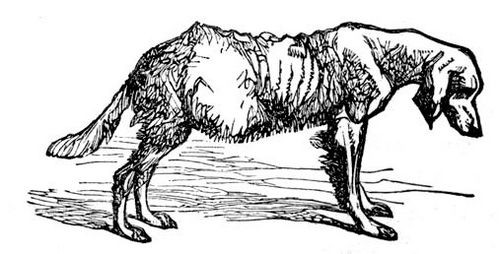
CHRONIC HEPATITIS.
Liver complaints were once fashionable. A few years ago the mind of Great Britain was in distress about its bile, and blue pill with black draught literally became a part of the national diet. At present nervous and urinary diseases appear to be in vogue; but, with dogs, hepatic disorders are as prevalent as ever. The canine liver is peculiarly susceptible to disease. Very seldom have I dipped into the mysteries of their bodies but I have found the biliary gland of these animals deranged; sometimes inflamed—sometimes in an opposite condition—often enlarged—seldom diminished—rarely of uniform color—occasionally tuberculated—and not unfrequently as fat with disease as those are which have obtained for Strasburg geese a morbid celebrity.
It is, however, somewhat strange that, notwithstanding the almost universality of liver disease among petted dogs, the symptoms which denote its existence are in these creatures so obscure and undefined as rarely to be recognised. Very few dogs have healthy livers, and yet seldom is the disordered condition of this important gland suspected. Various are the causes which different authors, English and foreign, have asserted produced this effect. I shall only allude to such as I can on my own experience corroborate, and here I shall have but little to refer to. Over-feeding and excessive indulgence are the sources to which I have always traced it. In the half-starved or well-worked dog I have seen the liver involved; but have never beheld it in such a state as led me to conclude it was the principal or original seat of the affection which ended in death. On the other hand, in fatted and petted animals, I have seen the gland in a condition that warranted no doubt as to what part the fatal attack had commenced in.
When death has been the consequence of hepatic disorder, the symptoms have in every instance been chronic. I am not aware that I have been called upon to treat a case of an acute description, excepting as a phase of distemper. It would be too much to say such a form of disease does not exist in a carnivorous animal; but I have hitherto not met with it. Neither have I seen it as the effect of inveterate mange; though I have beheld obstinate skin disease the common, but far from invariable, result of chronic hepatitis. I have also known cerebral symptoms to be produced by the derangement of this gland, which, in the dog, may be the cause of almost any possible symptom, and still give so little indication of its actual condition as almost to set our reason at defiance.
When the animal is fat, the visible mucous membranes may be pallid; the tongue white; the pulse full and quick; the spirits slothful: the appetite good; the fœces natural: the bowels irregular; the breath offensive; the anus enlarged, and the rump denuded of hair, the naked skin being covered with a scaly cuticle, thickened and partially insensible.
When the animal is thin, almost all of the foregoing signs may be wanting. The dog may be only emaciated—a living skeleton, with an enlarged belly. It is dull, and has a sleepy look when undisturbed; but when its attention is attracted, the expression of its countenance is half vacant and half wild. The pupil of the eye is dilated, and the visual organs stare as though the power of recognition were enfeebled. The appetite is good and the manner gentle. The tongue is white, and occasionally reddish towards the circumference. The membranes of the eye are very pale, but not yellow. The lining of the mouth is of a faint dull tint, and often it feels cold to the touch. The coat looks not positively bad; but rather like a skin which had been well dressed by a furrier, than one which was still upon a living body.
The history in these cases invariably informs us that the animal has been fat—very fat—about six or twelve months ago. It fell away all at once, though no change was made in the diet; and yet we learn it has been physicked. No restraint has been put upon buckthorn, castor oil, aloes, sulphur, and antimony, but yet the belly will not go down—it keeps getting bigger; and now we are told the animal has a dropsy which "wants to be cured." It is natural the figure and condition should suggest the idea of ascites; but the hair does not pull out—none of the legs are swollen—the shape of the abdomen wants the appearance of gravitation, and if the patient be placed upon its back the form of the rotundity is not altered by the position of the body. Moreover, the breathing is tolerably easy: and, though if one hand be placed against the side of the belly, and the part opposite be struck with the other, there will be a marked sense of fluctuation; still we cannot accept so dubious a test against the mass of evidence that declares dropsy is not the name of the disease. To make sure, we feel the abdomen near to the line of the false ribs. This gives no pain, so we press a little hard, and in two or three places on either side, on the right, or may be the left, high up or low down; for in abnormal growths there can be no rule—in two or three places we can detect hard, solid, but smooth lumps within the cavity. This last discovery leaves no room for further doubt, so we pronounce the liver to be the organ that is principally affected. In chronic cases, especially after the dog has begun to waste, enlargement nearly always may be felt, not invariably hard, yet often so, but never soft or so soft as the other parts; and this proof should, therefore, in every instance of the kind be sought for.
With regard to treatment, the food must not be suddenly reduced to the starvation point. Whether the dog be fat or lean, let the quality be nutritious, and the quantity sufficient; from a quarter of a pound to a pound and a half of paunch, divided into four meals, will be enough for a single day; but nothing more than this must be given. Tonics, to strengthen the system generally, should be employed; and an occasional dose of the cathartic pills administered, providing the condition is such as justifies the use of purgatives. Frequent small blisters, applied over the region of the liver, may do good; but they should not be larger than two or four inches across, and they should be repeated one every three or four days. Leeches put upon the places where hardness can be felt, also are beneficial; but depletion must be regulated by the ability of the animal to sustain it. A long course of iodide of potassium in solution, combined with the liquor potassæ, will, however, constitute the principal dependence.
Iodide of potassium
Two drachms two scruples.
Liquor potassæ
One ounce and a half.
Simple syrup
Six ounces.
Water
Twelve ounces and a half.
Give from half a teaspoonful to a teaspoonful three times a day.
The above must be persevered in for a couple of months before any effect can be anticipated. Mercury I have not found of any service, though Blaine speaks highly of it, and Youatt quotes his opinion. Perhaps I have not employed it rightly, or ventured to push it far enough.
Under the treatment recommended, the dog may be preserved from speedy death; but the structures have been so much changed that medicine cannot be expected to restore them. The pet may be saved to its indulgent mistress, and again perhaps exhibit all the charms for which it was ever prized; but the sporting-dog will never be made capable of doing work, and certainly it is not to be selected to breed from after it has sustained an attack of hepatitis.
Sometimes, during the existence of hepatitis, the animal will be seized with fits of pain, which appear to render it frantic. These I always attribute to the passage of gall stones, which I have taken in comparative large quantities from the gall-bladders of dogs. The cries and struggles create alarm, but the attack is seldom fatal. A brisk purgative, a warm bath, and free use of laudanum and ether, afford relief; for when the animal dies of chronic hepatitis, it perishes gradually from utter exhaustion.
The post-mortem examination generally presents that which much surprises the proprietor; one lobe of the gland is very greatly enlarged; it evidently contains fluid. It has under disease become a vast cyst, from which, in a setter, I have actually extracted more than two gallons of serum: from a small spaniel I have taken this organ so increased in size that it positively weighed one half the amount of the body from which it was removed. The wonder is that the apparently weak covering to the liver could bear so great a pressure without bursting.
INDIGESTION.
Things must seem to have come to a pretty pass when a book is gravely written upon dyspepsia in dogs. Nevertheless, I am in earnest when I treat upon that subject; and could the animals concerned bear witness, they would testify it was indeed no joke. The Lord Mayor of London does not retire from office with a stomach more deranged than the majority of the canine race, shielded by his worshipful authority, could exhibit. The cause in both instances is the same. Dogs as they increase in years seem to degenerate sadly; till at length they mumble dainties and relish flavors with the gusto of an alderman. Pups even are not worthy of unlimited confidence. The little animals will show much ingenuity in procuring substances that make the belly ache; and, with infantine perversity, will, of their own accord, gobble things which, if administered, would excite shrieks of resistance. A litter of high-bred pups is a source of no less constant annoyance, nor does it require less incessant watching, than a nursery of children. There is so much similarity between man and dog that, from fear of too strongly wounding the self-love of my reader, I must drop the subject.
Indigestion in dogs assumes various forms, and is the source of numerous diseases. Most skin affections may be attributed to it. The inflammation of the gums, the foulness of the teeth, and the offensiveness of the breath, are produced by it. Excessive fatness, with its attendant asthma and hollow cough, are to be directly traced to a disordered digestion. In the long run, half of the petted animals die from diseases originating in this cause; and in nearly every instance the fault lies far more with the weakness of the master than with the corruptness of the beast. He who is invested with authority has more sins, than those he piously acknowledges his own, to answer for.
The symptoms are not obscure. A dislike for wholesome food, and a craving for hotly spiced or highly sweetened diet, is an indication. Thirst and sickness are more marked. A love for eating string, wood, thread, and paper, denotes the fact; and is wrongly put down to the prompting of a mere mischievous instinct: any want of natural appetite, or any evidence of morbid desire in the case of food, declares the stomach to be disordered. The dog that, when offered a piece of bread, smells it with a sleepy eye, and without taking it licks the fingers that present it, has an impaired digestion. Such an animal will perhaps only take the morsel when it is about to be withdrawn; and, having got it, does not swallow it, but places it on the ground, and stands over it with an expression of peevish disgust. A healthy dog is always decided. No animal can be more so. It will often take that which it cannot eat, but, having done so, it either throws the needless possession away or lies down, and with a determined air watches "the property." There is no vexation in its looks, no captiousness in its manner. It acts with decision, and there is purpose in what it does. The reverse is the case with dogs suffering from indigestion. They are peevish and irresolute. They take only because another shall not have. They will perhaps eat greedily what they do not want if the cat looks longfully at that which had lain before them for many minutes, and which no coaxing could induce them to swallow. They are, in their foibles, very like the higher animal.
The treatment is simple. The dog must be put upon, and strictly kept upon, an allowance. Some persons, when these animals are sent to them, because the creatures are fat and sickly, shut the dogs up for two or four days, and allow them during the period to taste nothing but water. The trick often succeeds, but it is dangerous in severe cases, and needless in mild ones. This is a heartless practice, which ignorance only would resort to; but such conduct is very general, and the people who follow it boast laughingly of its effect. They do not care for its consequences. A weakly stomach cannot be benefited by a prolonged abstinence. I have kept a dog four-and-twenty hours without food, but never longer, and then only when the animal has been brought to me with a tale about its not eating. The report, then, is assurance that food has been offered, and the inference is that the stomach is loaded. A little rest enables it to get rid of its contents, and in some measure to recover its tone. The dog, as a general rule, does well on one meal a day; afterward, the food is regularly weighed, and nothing more than the quantity is permitted. This quantity may be divided into three or four meals, and given at stated periods, so that the last is eaten at night. When thus treated, animals, which I am assured would touch nothing, have soon become possessors of vigorous appetites. At the same time, exercise and the cold bath every morning is ordered; and either tonic or gentle sedatives, with alkalies and vegetable bitters, are administered. The following are the ordinary stomach-pills, and do very well for the generality of cases:—
Extract of hyoscyamus
Sixteen grains.
Sodæ carb.
Half an ounce.
Extract of gentian
Half an ounce.
Ferri carb.
Half an ounce.
Make into sixteen, thirty, or eight pills, and give two daily.
The reader, however, will not depend upon any one compound, for stomach disease is remarkably capricious. Sometimes one thing and sometimes another does a great deal of good; but the same thing is seldom equally good in any two cases. Stimulants, as nitrate of silver, trisnitrate of bismuth, or nux vomica, are occasionally of great service; and so also are purgatives and emetics, but these last, when they do no benefit, always do much injury. They should, therefore, be tried last, and then with caution, the order being thus:—Tonics, sedatives, and alkalies, either singly or in combination, and frequently changed. Stimulants and excitants in small doses, gradually increased. Emetics and purgatives, mingled with any of the foregoing. The food and exercise, after all, will do more for the restoration than the medicine, which must be so long continued that the mind doubts whether it is of any decided advantage. The affection is always chronic, and time is therefore imperative for its cure.
Dogs are afflicted with a disease of the stomach, which is very like to "water-brash," "pyrosis," or "cardialgia," in the human being. The animals thus tormented are generally fully grown and weakly: a peculiarity in the walk shows the strength is feeble. The chief symptom is, however, not to be mistaken. The creature is dull just before the attack: it gets by itself, and remains quiet. All at once it rises; and without an effort, no premonitory sounds being heard, a quantity of fluid is ejected from the mouth, and by the shaking of the head scattered about. This appears to afford relief, but the same thing may occur frequently during the day. This disease of itself is not dangerous; but it is troublesome, and will make any other disorder the more likely to terminate fatally; it should, therefore, be always attended to. The food must not be neglected, and either a solution of the iodide of potassium with liquor potassæ, or pills of trisnitrate of bismuth, must be given. The preparations of iron are sometimes of use; and a leech or two, after a small blister to the side, has also seemed to be beneficial. When some ground has been gained, the treatment recommended for indigestion generally must be adopted, the choice of remedies being guided by the symptoms. The practitioner, however, must not forget that the mode of feeding has probably been the cause; and, therefore, it must ever after be an object of especial care. The cold bath and exercise, proportioned to the strength, are equally to be esteemed.
Very old dogs often die from indigestion, and in such cases the stomach will become inflated to an extent that would hardly be credited. These animals I have not observed to be subject to flatulent colic; when, therefore, the abdomen becomes suddenly tympanitic the gas is usually contained in the stomach. Fits and diarrhœa may accompany or precede the attack, which in the first instance yields to treatment; but in a month more or less returns, and is far more stubborn. Ether and laudanum, by mouth and enema, are at first to be employed; and, generally, they are successful. The liquor potassæ, chloride of lime in solution, and aromatics with chalk, may also be tried, the food being strengthening but entirely fluid. The warm bath is here highly injurious; and bleeding or purging out of the question. When the distension of the stomach is so great as to threaten suffocation, the tube of the stomach-pump may be introduced; but, unless danger be present, the practitioner ought to depend upon the efforts of nature, to support which all his measures should be directed. After recovery, meat scraped as for potting, without any admixture of vegetables, must constitute the diet; and while a sufficiency is given, a very little only must be allowed at a time. With these precautions the life may be prolonged, but the restoration of health is not to be expected.
GASTRITIS
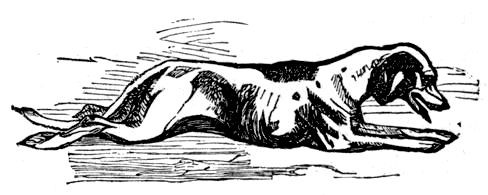
Dogs are abused for their depraved tastes, and reproached for the filth they eat; but if one of them, being of a particular disposition in the article of food, takes to killing his own mutton, he is knocked on the head as too luxurious. It is a very vulgar mistake to imagine the canine race have no preferences. They have their likes and dislikes quite as strong and as capricious as other animals. Man himself does not more frequently impair his digestion by over indulgence than does the dog. In both cases the punishment is the same, but the brute having the more delicate digestion suffers most severely. The dog's stomach is so subject to be deranged that few of these creatures can afford to gormandize; to which failing, however, they are much inclined. The consequence is soon shown. A healthy dog can make a hearty meal and sleep soundly after it. The petted favorite is often pained by a moderate quantity of food, and frequent are the housemaid's regrets that his digestion is not more retentive. He spoils other things besides victuals; and the more daintily he lives the more generally is he troublesome. It is the variety that diseases him. He grows to be omnivorous. He learns to relish that which nature did not fit him to consume, and as a consequence he pays for his bad habits. The dog in extreme cases can digest even bones; a banquet of tainted flesh will not disorder him; but he cannot subsist in health on his lady's diet. His stomach was formed to receive and assimilate certain substances, and to deny these is not to be generous or kind.
Gastritis is very common with ladies' favorites. Its symptoms are well marked. Frequent sickness is the first indication. This is taken little notice of. The mess is cleared up, and the matter is forgotten. Thirst is constant, and the lapping is long; but no further notice is taken of this circumstance, than to remark the animal has grown very fond of water. At last the thirst has increased, and no sooner is the draught swallowed than it is ejected. The appetite which may have been ravenous a little time before, now grows bad, and whatever is eaten is immediately returned. The animal is evidently ill. The nose is dry, and the breathing quick. It avoids warmth, and lies and pants, away from the hearthrug. It dislikes motion and stretches itself out, either upon its chest or on its belly. Sometimes it moans, and more rarely cries. The stomach is now inflamed; and if the symptoms could have been earlier understood, frequently has the animal been seen, prior to this stage of attack, licking the polished steel fire-irons. It has been horrifying its mistress's propriety, by its instinctive desire to touch something cold with its burning tongue; and the poor little beast perhaps has been chastised for seeking a momentary relief to its affliction.
Dogs that are properly treated rarely have gastritis. When they do, it is generally induced by some unwholesome food. I have known it to be caused by graves more often than by anything else they are accustomed to eat. I never recommend this stuff to be given to dogs. Meal and skim milk is far better, and that can always be procured where flesh is scarce. The entrails of sheep, &c., if washed and boiled with a large quantity of any kind of meal, are nutritious and wholesome; nay, even when a little tainted, they will not be refused. If, however, they were hung up in a strong draught, they would soon dry; and in that state might be preserved for use any length of time; all they afterwards require would be boiling. The paunch can be prepared in the same manner; and it would be worth some little trouble to avoid a mixture which contains nothing strengthening, and too often a great deal that is injurious.
The treatment of gastritis is simple. It is generally accompanied by more or less diarrhœa; but the violence of the leading symptom renders that of comparatively little consequence. The degree of sickness will always indicate whether the stomach is the principal seat of disease.
As nothing is retained, it would be a needless trouble to give many solids or fluids, by the mouth. From half a grain to a grain and a half of calomel, thoroughly mixed with the same quantities of powdered opium, may be sprinkled upon the tongue; and from one drachm to four drachms of sulphuric ether may be given in as much water as will dissolve it twenty minutes afterwards. The medicine will most probably be ejected; but, as it is very volatile, it may be retained sufficient time to have some influence in quieting the spasmodic irritability of the stomach. Ethereal injections should be administered every hour, and no food of any kind allowed. Besides this, from a quarter of a grain to a grain of opium may be sprinkled on the tongue every hour; and the ether draught continued until the sickness ceases, or the animal displays signs of being narcotised. An ammoniacal blister, if the symptoms are urgent, may be applied to the left side; but in mild cases, a strong embrocation will answer every purpose. Except the constitution be vigorous, and the pulse very strong, it will not be advisable to bleed, but from two to twelve leeches may be applied to the lower part of the chest. Cold water may be allowed in any quantity, but nothing warm should be given. The colder the water, the better, and the more grateful it will be to the animal. Where it can be obtained, a large lump of ice may be placed in the water, for the dog often will lick this, and sometimes even gnaw it. Small lumps of ice may be forced down as pills, and a cold bath may be given, the animal being well wrapped up afterwards, that it may become warm, and the blood, by the natural reaction, be determined to the skin.
When the sickness is conquered, the following should be administered:—
Powdered nux vomica
A quarter of a grain to a grain.
Sulphate of iron
One grain to four grains.
Extract of gentian
Sufficient to make a pill.
The above may be repeated every four hours until the stomach is quiet; but it is not always tranquillized; sickness may return, and the pills may possibly seem to aggravate it. If such should appear to be the case, try the next:—
Acid hydrocyanic, L.P.
One drop to four drops.
Carbonate of soda
Three grains to twelve grains.
Water
A sufficiency.
The ether and opium must also he persevered with, regulating the last of course by the action which it induces.
Food should consist of cold broth, slightly thickened with ground rice, arrowroot, starch, or flour, and for some days it must be composed of nothing more; but by degrees the thickness may be increased, and a little bread and milk introduced. After a time a small portion of minced underdone meat, without skin or fat, may be allowed; but the quantity must be small, and the quality unexceptionable.
The second day generally sees an abatement of the more urgent symptoms, and then the draught may be composed of five minims of laudanum to every drachm of ether, and ten drachms of water. This to be given both by mouth and injection six times daily. The former pills were intended only to allay the primary violence of the disease, and when that object is attained, the following remedy may be employed:—
Extract of hyoscyamus
One grain to four grains.
Carbonate of soda
Three grains to twelve grains.
Carbonate of ammonia
Half a grain to two grains.
Extract of gentian
Five grains to a scruple.
Powdered quassia
A sufficiency.
The above is for one pill, which should be repeated four times daily, and continued for some days; when, if the dog seems quite recovered, a course of the quinine tonic pills, as recommended for distemper, will be of use; but should any suspicion be created of the disorder not being entirely removed, the animal may be treated as advised for indigestion.
Sporting dogs are frequently sent to me suffering under what the proprietors are pleased to term "Foul." The history of these cases is soon known. They have been withdrawn from the field at the close of the season, and have ever since been shut up in close confinement, while the working diet has been persevered with. The poor beast is supposed capable of vegetating until the return of the period for shooting requires his services. He remains chained up till he acquires every outward disease to which his kind are liable; and then, when he stinks the place out, his owner is surprised at his condition, pronouncing his misused animal to be "very foul." "Foul" is not one disease, but an accumulation of disorders brought on by the absence of exercise with a stimulating diet. The sporting dog, when really at work, may have all the flesh it can consume; but at the termination of that period its food should consist wholly of vegetable substances, while a little exercise daily is necessary, not to health, but absolutely for life. The dog with "foul" requires each seat of disease to be treated separately; beginning of course with the dressing for mange or for lice, one or the other of which the animal is certain to display.
DISEASES DEPENDENT ON AN INTERNAL ORGAN.
STOMACH.—ST. VITUS'S DANCE.
This disease generally is assumed to be a nervous disorder, and so the symptoms declare it to be; but on post mortem examinations no lesion is found either upon the brain, spinal marrow, or the nerves themselves. This last circumstance, however, proves nothing; for the same thing may be said of tetanus in the human being, and of stringhalt in the horse; both of them being well-marked nervous affections. I append St. Vitus's Dance to the stomach, not because of that which I have not beheld, but because of that which I have positively seen.
It follows upon distemper. I do not know it as a distinct disorder, though it is asserted to exist as such when the greater or leading disease is unobserved. It then follows up the affection which primarily involves the stomach and intestines, and to which indications all other symptoms are secondary. On every post mortem which I have made of this disorder, I have discovered the stomach inflamed; and, therefore, not because the nerves or their centres are blank, but because on one important viscus I have found well marked signs to impress my reason, I propose to treat of this disorder as connected with the stomach.
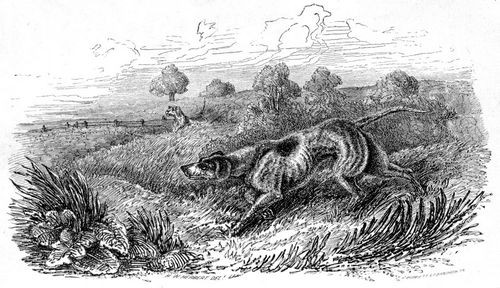
The signs to which I allude, consists of patches of well-defined inflammation; and hence, knowing how distemper has the power to involve other organs, I conclude it has caused the spinal marrow to be sympathetically affected.
The symptoms of the disease are well marked. The poor beast, whether he be standing up or lying down, is constantly worried with a catching of the limb or limbs—for only one may be affected, or all four may be attacked. Sleeping or waking, the annoyance continues. The dog cannot obtain a moment's rest from its tormentor. Day and night the movement remains; no act, no position the poor brute is capable of, can bring to the animal an instant's downright repose. Its sleep is troubled and broken; its waking moments are rendered miserable by this terrible infliction. The worst of the matter is, that the dog in every other respect appears to be well. Its spirits are good, and it is alive for happiness. If it were released from its constant affliction, it is eager to enjoy its brief lease of life as in the time of perfect health. Plaintive and piteous are its looks as, lying asleep before the fire, it is aroused by a sudden pain; wakes, turns round, and mutely appeals to its master for an explanation or a removal of the nuisance. When stricken down at last, as, unable to stand, it lies upon its straw, most sad is it to see the poor head raised, and to hear the tail in motion welcoming any one who may enter the place in which it is a helpless but a necessary prisoner.
In this disorder the best thing is to pay every attention to the food. The wretched animal generally has an enormous appetite, and, when it is unable to stand, will continue feeding to the last. This morbid hunger must not be indulged. One pound of good rice may be boiled or cooked in a sufficiency of carefully made beef-tea, every particle of meat or bone being removed. This will constitute the provender for one day necessary to sustain the largest dog, and a quarter the amount will be sufficient for one of the average size. Where good rice is not to be obtained, oatmeal or bread, allowing for the moisture which the last contains, may be substituted. No bones, nor substances likely, when swallowed, to irritate the stomach, must on any account be allowed. The quantity given at one time must ever be small; and every sort of provender offered should be soft and soothing to the internal parts; though the poor dog will be eager to eat that which will be injurious. Water should be placed within its reach, and offered during the day, the head being held while the incapacitated animal drinks.
When a dog is prostrated by this affliction, it must on no account be suffered to remain on the floor, where its limbs would speedily become excoriated, being forcibly moved upon the boards; anything placed beneath the animal to save the limbs, would be saturated with the urine and fæces the poor beast is necessitated to pass. The best bed in such cases is made of a slanting piece of woodwork, of sufficient size to allow the animal to lie with ease at full length. The planks composing the wooden stage must be placed apart, be pierced with numerous holes, have the edges rounded, and be elevated at one end so as to allow all moisture readily to run off. The wood must be covered with a quantity of straw; which sort of bedding is convenient, not only because it allows the water to speedily percolate through it, but because it is warm, and being cheap, permits of repeated change.
Physic is not of much avail in this disorder; kind nursing and mild food will do more towards recovery. Still, medicine, as an accessory, may be of considerable service, and in a secondary view deserves honorable mention. Alkalies, sedatives, and vegetable bitters, may be combined in various forms. The author's favorite sedative in stomach diseases is hyoscyamus, and alkali potash. For a bitter, quassia is a very good one; better than gentian, a small amount of the extract of which, however, may be used to make up the pill. When speaking of the pill, the most important ingredient must not be forgotten—I mean nux vomica. Some people employ strychnia, but such persons more often kill than cure their patients. Strychnia in any doses, however minute, is a violent poison to the dog. While at college I beheld animals killed with it; and there does not live the person who knows how to render this agent safe to the dog. Nux vomica, even, must be used in very minute doses, to be entirely safe—from a quarter of a grain to a small pup, to two grains to the largest animal. That quantity must be continued for a week, four pills being given daily; then add a quarter of a grain daily to the four larger pills, and a quarter of a grain every four days to all the smaller ones; keep on increasing the amount, till the physiological effects of the drug, as they are called, become developed. These consist in the beast having that which uninformed people term "a fit." He lies upon the ground, uttering rather loud cries, whilst every muscle of his body is in motion. Thus he continues scratching, as if it was his desire to be up and off at a hundred miles an hour. No sooner is he rid of one attack than he has another. He retains his consciousness, but is unable to give any sign of recognition. It is useless to crowd round the animal in this state; the drug must perform its office, and will do so, in spite of human effort. The very best thing that can be done, is to let the animal alone until the attack is over, when writers on Materia Medica tell us improvement is perceptible. I wish it was so in dogs. I have beheld the physiological effect of nux vomica repeatedly, but cannot recollect many instances in which I could date amendment from its appearance.
The following is the formula for the pill recently alluded to:—
Potash
Two to seven grains.
Extract of hyoscyamus
Half a grain to four grains.
Quassia powder
Three to sixteen grains.
Nux vomica
A quarter of a grain to two grains.
Extract of gentian
A sufficiency.
The above quantities are sufficient for one pill, four of which are to be given daily for a week, at the expiration of which period the increase may begin. If the above, after a fair test has been made of it, does not succeed, trial may be instituted of the nitrate of silver, the trisnitrate of bismuth, or any of the various drugs said to be beneficial in the disease, or of service in stomach complaints. In this disorder the same drug never appears to act twice alike, therefore a change is warranted and desirable.
Hopes of restoration may be entertained if the animal can only be kept alive to recover strength; then confident expectation can be expressed that the dog will outgrow the disease. The first signs perceptible which denote recovery are these:—The provender the beast consumes is evidently not thrown away. Instead of eating much, and ungratefully becoming thinner and thinner upon that which it consumes, the animal displays a disposition to thrive upon its victuals. It does not get fat on what it eats, but it evidently loses no flesh. It grows no thinner; and if the strength be not recruited, it obviously is not diminished. The animal does not gorge much wholesome diet daily, to exhibit more and more the signs of debility and starvation. If only a suspicion can be felt that the poor dog does not sink, then hope of ultimate success may warm the heart of a kind master; but when the reverse is obvious, though killing a dog is next to killing a child—and he who for pleasure can do the one, is not far off from doing the other—yet it is mercy then to destroy that existence which must else be miserably worn away. When there is no chance left for expectation to cling to, it becomes real charity to do violence to our feelings, in order that we may spare a suffering creature pain; but when there is a prospect, however remote, of recovery, I hope there is no veterinary surgeon who would touch the life. When the animal can stand, we may anticipate good; and whatever is left of the complaint, we may assure our employers will vanish as the age increases; for St. Vitus's Dance is essentially the disease of young dogs. But as recovery progresses, we must be cautious to do nothing to fling the animal back. No walks must be enforced, under the pretence of administering exercise. The animal has enough of that in its ever-jerking limbs; and however well it may grow to be while the disease lasts, we may rest assured the dog suffering its attack stands in need of repose.
BOWEL DISEASES.
Continuous with the stomach are the intestines, which are equally subject to disease, and more exposed to it in an acute form than even the former viscus. The dog will fill its belly with almost anything, but there is little that positively agrees with it. Boiled rice or lean meat, &c., and coarse biscuit, are the best general food; but without exercise, even these will not support health. The dog requires constant care if it is deprived of liberty: and those who keep these animals as pets, must submit to trouble, for though art may do much, it cannot conquer Nature.
The intestines of the dog are peculiar. In the first place, it has no colon, and all the guts are nearly of one size from the commencement to the termination; the duodenum and the most posterior portion of the rectum being the largest, though not so much so as materially to destroy the appearance of uniformity. The cæcum is no more than a small appendage—a little sac attached to the main tube; it has but one opening, and that is very diminutive. I think all the food, as in other animals, passes into and out of this intestine; which, because of its peculiar formation, is therefore particularly liable to be disordered. In the dog which has died of intestinal disease, the cæcum is almost invariably found enlarged and inflamed. In it, I imagine, the majority of bowel affections have their origin. The gut is first loaded, and the consequence of this is, it loses its natural function. The contents become irritants from being retained, and the whole process of digestion is deranged; other parts are involved, and inflammation is induced.
Writers do not notice the tendency of the cæcum to be diseased, or remark upon its disposition to exhibit signs of alteration; but the fact being so obvious, I wonder it should have escaped observation.
Costiveness is, in some measure, natural to the dog, and in that animal is hardly to be viewed as a disease. In health, the fæces are not expelled without considerable straining, and the matter voided ought to be of a solid character. It nevertheless should not be absolutely hard, or positively dry, for in that case the want of moisture shows the natural secretion of the rectum is deficient; the hardness proving prolonged detention, denoting the intestines have lost their activity.
Both Blaine and Youatt were educated in the old school of medicine, which taught them to regard purgatives as the surgeon's best friends, and the sheet-anchors of his practice. They prescribe them in almost every case, and almost on every occasion; but I rarely give these agents. In the dog I am convinced they are not safe, and their constant use is by no means imperative. Should an animal be supposed not to have been relieved for a week, this fact is no proof that a purgative is required. The animal may have eluded observation, and it cannot inform us if such has been the case. The intestines may be slow, or the digestion may be more than usually active. It is foolish to lay down rules for Nature, and punish her creatures if these laws are not obeyed. There are, however, means of ascertaining when a purgative is needed; and these, if employed, will very rarely deceive.
The muscles covering the abdomen of the dog are very thin, and through them the contents of the cavity may be plainly felt. By squeezing these together, the fingers will detect whether the rectum, which lies near to the spine, and of course backward or towards the tail, contains any substance. Should the presence of any solid body be ascertained, its character ought to be noted. If round and comparatively soft, a little exercise will cause it to be expelled; but if hard-pointed in places, and uneven, assistance should be afforded. An enema, of the solution of soap—or of Epsom salts, from half an ounce to a quarter of a pound, in a quarter of a pint to a quart of water—may be administered. A more active injection will be, from half a drachm to four drachms of turpentine, beaten up with the yolks of so many eggs as there are drachms of the oil, and mixed with the quantity of water just named.
Either of these will relieve the bowel; but the condition of one part justifies an inference as to the state of another, and the enema probably will not unload the cæcum, which there is reason to suppose is also clogged. A gentle dose of castor-oil, or of the pills directed on page 116, will accomplish this intention; and, afterwards, measures must be adopted to regulate the digestion, either by tonics or such medicines as the symptoms suggest, but not by the constant repetition of laxatives.
Costiveness will sometimes produce such violent pain that alarm is created, and dogs have been destroyed under the idea that they were rabid. To guard against so fatal a mistake, I shall only here say, that rabies does not come on suddenly, or, save in the latest stage, appear to influence the consciousness, which it never entirely overpowers. The agony caused by costiveness is greater than in any other affection to which the dog is liable. Apparently well, and perhaps at play, a cry breaks forth, which is the next instant a shriek, expressive of the acutest torture. The animal takes to running, and is not aware of surrounding objects; it can recognise nothing, but will bite its master if he attempts to catch it, and hit itself against anything that may be in its way; it scampers from room to room, or hurries from place to place; it is unable to be still or silent; and perhaps getting into a corner, it makes continuous efforts as though it wished to scramble up the wall, remaining there jumping with all its strength, and at the same time yelling at the top of its voice. This excitement may last for an hour or more, and then cease only to be renewed: till at length the powers fail, and in half a day the animal may be dead. Just prior to death, a mass of compact fæces is usually passed; and blood, with dysentery, is generally witnessed for the short period the animal survives. After death, general inflammation of the intestines is discovered, and the dog is reported to have perished from an attack of enteritis which no medicine could subdue.
In such cases, the first examination should be directed to the rectum; the finger, moistened or oiled, ought to be inserted, and the intestine explored as thoroughly as possible. This operation is, however, not of further use than to confirm the opinion of the practitioner; and I, knowing the cause, therefore dispense with it. A copious enema should be immediately exhibited. One containing turpentine is the most effective; but, on account of its activity, it is only safe in the beginning of the attack. A warm bath is of service, but it takes up time which may be better employed, and does not do sufficient good to recompense for the delay. A full dose of sulphuric ether and laudanum should be given to allay the pain, and it may with this intention be repeated every ten or twenty minutes. If, from the enema, nothing follows, the finger should then certainly be introduced, and perhaps a compact mass may be felt firmly grasped by the intestine. Slowly, and with great caution, this must be broken up, and brought away bit by bit. The handle of a spoon has been recommended for this purpose, but I entreat my readers not to use it. Where pain is present, and life or death hang on the issue, there is no right to be any delicacy. An instrument of any kind introduced into such a part, and employed while the body is writhing about in agony, cannot be free from danger, and scarcely can be so used as to be effective. The finger is the quickest, the most safe, and the most effectual instrument; for we have it under our command, can guide it at our will, and with it take cognisance of all the circumstances presented. Even that must be employed gently, and this will be best done by the avoidance of haste. The surgeon is bound to be skilful, but he ought never to be in a hurry. Let all the time that can be occupied on such a matter be freely taken, and during the process, let the cries of the animal be attended to; any change of note will contain a warning which must not be disregarded. Without attending to that, the intestine might be ruptured, and death would then be certain.
When the obstruction has been overcome, let a few ethereal enemas be administered to allay any local irritability; and a dose of the purgative pills—followed, six hours afterwards, should they not have operated, by one of castor-oil mixture, blended with half a scruple of chloroform—being given to unload the cæcum. The medicine having acted freely, the food must be amended, the treatment altered, and such other measures taken as the digestion may require for its restoration.
danger. The digestive canal of the dog is peculiarly irritable, and no less sensitive to the action of medicine. There are few diseases in which the stomach and intestines are not involved, and very many in which purgatives are directly contra-indicated. No one should get into the habit of thrusting physic of this nature down the throats of his animals; and sportsmen may rest assured that, to the dog at all events, preparatory doses are not necessary to condition. Those, however, who persist in using such stuffs will do well not to employ the compounds in general use. The mixture of poppies, buckthorn, and castor oil is a filthy mess; and I do not understand the principles upon which the abomination is based. A better and more cleanly mixture is thus made:—
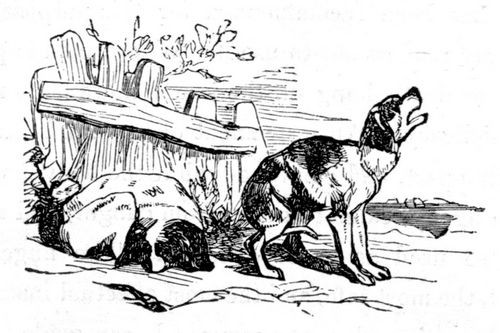
Colic.—This is an affection to which dogs are very subject. The human infant is not more liable to be griped than are the young of the canine species. The idea of a cur with a belly-ache may, to some persons, seem to be suggestive of fun; but to the creature that suffers, it is indeed a serious business. A duchess with the spasms does not endure so much, and is not in half the danger, that a dog is exposed to during a fit of gripes. The animal must be relieved, or inflammation will speedily ensue, and death will follow. In some cases, the appearance of colic is almost a certain indication that the poor beast will die. When it comes on a week or two prior to pupping, we may cure it; but during, or soon after parturition, the bitch generally perishes. When it starts up in the later or more virulent stage of distemper, especially at the time when the champing of the jaw denotes the approach of fits, the chance of a favorable termination to the disease is materially diminished. When in a violent form it attacks a litter of puppies, either simultaneously or consecutively, it is always attended with danger. At no season, and under no circumstances, is it trivial, and never ought it to be neglected. The cries and distress of the suffering animal will, when it is fully established, enforce attention; but too often it has then proceeded so far that much medicine will not check what in the first instance a single dose might have entirely banished.
The symptoms of colic have been much confused by Blaine, who, when describing them, evidently alludes to many forms of disease with which abdominal spasm has no connexion. Youatt is far more clear; but he is too concise, and omits so much that the reader does not properly appreciate the importance of that affection which is thus slightly mentioned. Neither of the two authors seems to have carefully studied the subject; for in their writings is not to be found any account of those early symptoms which most readily yield to treatment.
Prior to evincing any sign of colic, the dog appears well; healthy in its body and easy in its mind. The appetite is good, or may be better than usual. The food has been eaten and relished; then the animal instinctively lies down to sleep and aid digestion. A moan is heard; the sound is half suppressed, and the dog that utters it appears to sleep. Another cry, as feeble, but of greater length, is noticed; and now the animal that made it changes its position. The next time it may rise, look round, and seek another place; which having found, it appears to settle itself and to go to sleep. The rest once more is broken, the voice grows more full and loud; the dog jumps up and runs about for a little while, then selects a spot where it curls its body tightly up, as if resolved to have out its nap. The interruption, however, constantly recurs; and at each return the exclamation is more emphatic—the starting more energetic—the movement more abrupt—and, contrasting these, the determination or desire to repose becomes more strong. Thus endeavoring to sleep, and being constantly disturbed by some sharp and shooting pain, the dog may continue for a day, or two, or three, its cries, during the whole period, offending a neighborhood.
During the continuance of colic, the general appearance of the animal may be but little affected. The eye is not injected, but the pupil may be slightly enlarged. The nose is cool and moist, but towards the end, irritation may render the part hot or dry. The appetite is generally slight—sometimes lost; and fluids are more readily accepted than solids. The cry, however, should be remarked; because, with the pulse, it gives the earliest notice when inflammation is commencing. While colic alone exists, the pulse may, from pain, be accelerated, and rendered more full, as well as strong, though not always to any marked extent. In inflammation, the pulse is greatly quickened, the artery becomes smaller, and its beat more jerking or wiry. During simple spasm the voice is natural, rich, sonorous, and almost musical; but in inflammation it is short, harsh, high, and broken, the exclamations not being continuous, but consisting of a series of disconnected "yaps."
For the treatment, in the first instance, a turpentine enema will frequently cut short the attack. Should it fail to so, injections of ether and laudanum should succeed, and doses of the mixture should also be given every half hour; the first three being exhibited at intervals only of a quarter of an hour each. The cathartic pills should be administered; and in three hours, if the bowels have not been acted upon, a dose of castor-oil should be resorted to; but where the cathartic has been responded to, the castor-oil should be delayed for eight or twelve hours.
When the pain ceases, the ether and laudanum should not be immediately discontinued; but they may be employed at longer intervals, and gradually reduced in quantity, until the bowels are thoroughly opened, when they may be withheld. Under this treatment, the affection is rarely fatal, and never so if taken in time. An injection of ether and laudanum should always be given to any pup that exhibits even the slightest symptom of uneasiness. I have never known it to do harm, but I am convinced it has often prevented danger.
In those cases where purging and other indications denote the coats of the bowels to be already involved, and spasm co-exists with enteritis, ether and laudanum must enter into all the remedies employed. On the dog their action is, in my opinion, always beneficial; and were they not directly so, the influence they possess in deadening pain would be sufficient reason to justify their adoption. The other measures consist of such as will be found mentioned under the head of enteritis; but it is essential to observe any fæces which may be ejected by the animal that has suffered colic; for by these we may sometimes guess the cause of the attack, and more often learn the means through which a return may be prevented.
As to the causes which induce colic, I can of my own knowledge offer no information. It has to me seemed to be regulated by none of those circumstances to which it is generally attributed; at all events, I think I have witnessed it in animals which have not been exposed to any of the causes that teachers and writers assert induce it. Dogs are, however, brought to us only when the cause has ceased; for we are sought for only to treat the effect. The declarations of authors may therefore be correct, although I am unable to corroborate them; and these gentlemen say colic is produced by cold, acrid food, chills, worms, hard water, &c. In cases of this kind, therefore, it may be well to inquire if the dog has been exposed, or badly fed, or is in any way unhealthy; and, so far as possible, to rectify these matters; for, even though they may not have provoked the spasm, nevertheless we shall do good by attending to the health, diet, and comfort of the animal.
Enteritis.—The doom of the dog which is really afflicted with this disease, is generally sealed. It is a painful and a fatal disorder—equally rapid and stubborn. I fear it more than any other affection to which the animal is subject, and more frequently than any other has it set my best endeavors at defiance.
In the dog, however, enteritis is rarely seen in a pure form. The mucous membrane of the intestines is mostly inflamed, but the serous covering, as a general rule, is in no degree involved. The stomach, however, is almost in every instance more or less implicated; its inner surface being inflamed, and its muscular coat so contracted, that the lining membrane is corrugated, and remains in that condition after death.
The incentives are, unwholesome food, which is the most frequent of the causes; exposure, especially after a dog has been in winter fantastically deprived of its long hair over the loins; and over-exertion, to which the dog is often exposed, no attention being paid to its condition. Anything which disorders the digestion, or violently shakes the constitution, will induce it; for in the dog every species of revulsion has a tendency to attack the bowels. Mange improperly treated has produced it; and this may be said of almost any skin disease; so that it has been caused not by true mange or itch alone but by a skin disease having been, under the pretence of working an immediate cure, driven into the system. Neglected impactments, or colic, are among its most frequent immediate causes; for at least three parts of those cases of enteritis submitted to my notice, have been clearly traced to have commenced with something of that kind.
Of the symptoms of enteritis, colic and constipation, with a hard thin pulse, are the most prominent. Sickness is not present, or rather I have not witnessed it, at the commencement of the disorder. The extremities are cold—the eye has a stupid expression, the pupil being much dilated—the breath is hot, and the nose dry. The tail is drawn firmly downward, and pressed upon the anus; the urine is sometimes scanty, always high-colored; the tongue is rough and clammy, the thirst strong, and the appetite lost. The dog seeks darkness and privacy, and does not ramble during the early stage; it will stretch itself out either upon its belly or on its side, and I have not seen it sit upon its haunches. The abdomen is only of the heat of the body, which is generally of an increased temperature. Pressure appears to cause no pain, and the animal rather seems grateful for friction than to resist it. As the disease proceeds, diarrhœa ensues, and with it the signs of exhaustion and death generally are exhibited. Throughout the attack there is a marked disinclination to take any remedy; which is not always displayed by these creatures, and in no other disease is so violently exhibited. Dogs often become attached to those who minister to their complaints; many of them will appear to understand and appreciate the motives of him who attempts their relief. The poor things will frequently submit to operations, and lick the hand which has performed them. Eloquent are the appeals which they sometimes make to the feelings of one in whom they have placed their confidence; often staggering to meet him when he enters; looking upward into his face, and uttering low cries, which are more expressive than words could possibly be rendered. He who has had much to do with dogs must, if he be not insensible, grow to like them, and gradually learn to think these creatures possess both knowledge and reason. They will sometimes, without a struggle, swallow the most pungent and nauseous drinks; but such is not the case during enteritis. The brain in that disease is always sympathetically affected, the state of the eye, its peculiar expression and dilated pupil, denote the fact; and the manner of the dog would, without these indications, lead us to surmise the circumstance.
The treatment must be energetic. The sharp, short cries, characteristic of enteritis, as pointed out in the preceding description of colic, will be sufficient warning of the danger, and ample intimation that there is no time to be lost. A turpentine enema should be injected. The treatment ought always to begin with this, for to unload the rectum is of all importance. Afterwards, from one to four grains of calomel, with from half a grain to two grains of opium, should be shaken upon the tongue; and when ten minutes have elapsed, a draught of ether and laudanum and water, with an injection of the same composition, ought to be exhibited. While the cries last, the ether may be continued, and when the strength appears to fail, it may also be employed. Two hours subsequent to the calomel being given, from half an ounce to three ounces of castor-oil, diluted with half the quantity of olive-oil, should be used as a drench; and thrice during the day the following may be administered either as a pill or draught, in thick gruel, soup, or mucilage, at the option of the practitioner; who will, of course, be guided by the disposition of the patient, which in every particular must be considered:—
Grey powder
Five grains to a scruple.
Powdered ipecacuanha
Half a grain to four grains.
Extract of hyoscyamus
One to eight grains.
Bleeding is of some service, but the dog so quickly sinks, that it must be practised with caution. On this account, as well as for other reasons, leeches are to be preferred. If the patient be a male, they may be applied to the belly; but if a female, the side of the abdomen must be shaven, and that part selected. From four to twenty-four leeches will be sufficient; and half that number may be again used if no change for the better is observed, and the strength does not fail. Stimulating applications are likewise beneficial. A large mustard poultice has appeared to be more operative than more violent agents. After it has been removed, warm fomentations of water, with occasional ones of hot turpentine, may be employed.
In the early stage, a warm bath of 90 degrees, for half an hour, has been used with advantage; but the animal, when removed from it, must be wrapped well up in several hot blankets, and kept in them until it is perfectly dry.
On the second day from two to ten drops of the tincture of arnica, with half a drachm of the solution of the chloride of zinc, may be added to the ethereal drinks and injections, if the disorder has not been checked; and beef-tea, thickened with rice, may also be frequently administered, using it instead of water, both in the draughts and injections. No other food is admissible, and the return to solids must, if the animal survives, be very gradual.
Dysentery and Diarrhœa.—These diseases, which in works on human pathology are advantageously separated, I cannot here treat of as distinct disorders. In the dog they are so connected and blended that the line which divides them cannot be discovered; and for every practical purpose, they may be here considered as one and the same affection.
The young and the old are most liable to these complaints. Puppies are very subject, as also are aged gross favorites; things so fat that it becomes hard work to live are very generally attacked with diarrhœa. The pup, however, usually exhibits it in the acute form, whereas in the other description of animal it mostly appears in the chronic type.
When acute, colic may accompany or precede it. In proportion to the spasm will be the violence and the danger of the disorder. Sickness is mostly witnessed a little time prior to the attack, and the matter vomited has a peculiarly disagreeable and acrid odor. The dog does not again consume that which the stomach has thrown off, but sneaks away dejected, and afterwards seems dull. Sickness will occasionally continue throughout the complaint, but in general it departs as the disease appears. Thirst, however, is always present; and there is also a disposition to seek cold things and places. The pulse is quicker, but not stronger, and hardly at first less thin than during health. There is no pain on pressure being applied to the abdomen. The membranes of the eye are not injected; they may be a little deeper in color than is strictly natural, but occasionally they are the reverse. If, however, the anus be gently forced open, so as to expose the terminating surface of the rectum, the membrane there will be found more red, and perhaps less clear in tint, than it ought to be; and the presence of purgation, attended with a violent resistance to the administration of clysters, will leave no doubt as to the character of the affection.
In the chronic form, the membrane of the eye is pallid; the nose often moist; the breath offensive; the appetite ravenous; the pulse quick and weak; the anus inflamed; mostly protruding, and usually disfigured by piles; the fæces liquid, and of various hues; sometimes black, occasionally lighter than usual, very generally mixed with much mucus and a small quantity of blood, so that the leading symptoms are those of weakness, accompanied with purgation.
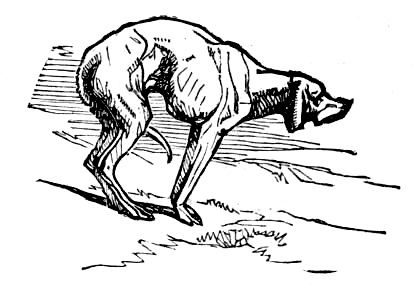
SUPERPURGATION.
Acute diarrhœa may terminate in twenty-four hours; the chronic may continue as many days. The first sometimes closes with hemorrhage, blood in large quantities being ejected, either from the mouth or from the anus; but more generally death ensues from apparent exhaustion, which is announced by coldness of the belly and mouth, attended with a peculiar faint and sickly fetor and perfect insensibility. The chronic more rarely, ends with excessive bleeding, but almost always gradually wears out the animal, which for days previous may be paralysed in the hind extremities, lying with its back arched and its feet approximated, though consciousness is retained almost to the last moment. In either case, however, the characteristic stench prevails, and the lower surface of the abdomen, as a general rule, feels hard, presenting to the touch two distinct lines, which run in the course of the spine. These lines, which Youatt mentions as cords, are the recti muscles, which in the dog are composed of continuous fibre, and consequently, when contracted under the stimulus of pain or disease, become very apparent.
On examination after death, the stomach, especially towards the pyloric orifice, is inflamed, as are the intestines, which, however, towards the middle of the track, are less violently affected than at other parts. The cæcum is enlarged, and may even, while all the other guts are empty, contain hard solid fæces. The rectum is generally black with inflammation, and seems most to suffer in these disorders. Occasionally its interior is ulcerated, and such is nearly always its condition towards the anus. Signs of colic are distributed along the entire length of the alimentary tubes.
In the acute disease, the case in the first instance should be treated as directed for colic, with turpentine enema and ether, laudanum and water, followed by mild doses of grey powder and ipecacuanha, or chalk, catechu and aromatics, in the proportions directed below:—
Powdered opium
Half a grain to two grains.
Powdered prepared chalk
Five grains to a scruple.
Catechu
Two grains to half a scruple.
Liquor potassæ
Half-a-drachm to two drachms.
Powdered ginger
Three to twelve grains.
Powdered caraways
Three to twelve grains.
Powdered capsicums
One to four grains.
This may be given every second hour. The carbonate of ammonia, from two to eight grains, is also deserving of a trial, as are the chlorides and chlorates when the odor is perceived.
Applications, as before directed, to the abdomen are also beneficial; but frequent use of the warm bath should be forbidden, for its action is far too debilitating. The ether, laudanum, and water should be persisted with throughout the treatment, and hope may be indulged so long as the injections are retained; but when these are cast back, or flow out as soon as the pipe is removed, the case may be pronounced a desperate one.
In the chronic form of diarrhœa there is always greater prospect of success. Ether, laudanum, and water will often master it, without the addition of any other medicine; but the liquor potassæ and the chalk preparation are valuable adjuncts. To the anus an ointment will be useful; and it should not only be smeared well over the part, but, by means of a penholder or the little finger, a small quantity should thrice in the course of the day be introduced up the rectum. For this purpose the following will be found to answer much better than any of those which Blaine orders to be employed on similar occasions:—
Camphor powdered
}Mercurial ointment
Of each equal parts.
Elder ointment
Cleanliness is of the utmost importance. Thrice daily, or oftener if necessary, the anus and root of the tail should be thoroughly cleansed, with a wash consisting of an ounce of the solution of chloride of zinc to a pint of distilled water. The food should be generous; but fluid beef tea, thickened with rice, will constitute the most proper diet during the existence of diarrhœa.
A little gravy and rice with scraped meat may be gradually introduced; but the dog must be drenched with the liquid rather than indulged with solids at too early a period. All the other measures necessary have been indicated when treating of previous abdominal diseases, and such rules as are therein laid down must, according to the circumstances, be applied.
Peritonitis.—In the acute form this disease is rarely witnessed, save as accompanying or following parturition. Its symptoms are, panting; restlessness; occasional cries; a desire for cold; constant stretching forth at full length upon the side; dry mouth and nose; thirst; constipation; hard quick pulse; catching breathing, and—contrary as it may be to all reasonable expectation—seldom any pain on pressure to the abdomen, toward which, however, the animal constantly inclines the head.
The treatment consists in bleeding from the jugular, from three to twelve ounces being taken; but a pup, not having all its permanent teeth, supposing such an animal could be affected, should not lose more than from half-an-ounce to two ounces. Stimulating applications to the abdomen should be employed, an ammoniacal blister, from its speedy action, being to be preferred. Ether, laudanum, and water ought to be given, to allay the pain, with calomel in small but repeated doses, combined with one-fourth its weight of opium, in order to subdue the inflammation. A turpentine enema to unload the rectum, and a full dose of castor oil to relieve the bowels, should be administered early in the disease. The warm bath, if the animal is after it well wrapped up, may also be resorted to. A second bleeding may be necessary, but it should always be by means of leeches, and should only be practised upon conviction of its necessity, for no animal is less tolerant of blood-letting than the dog.
During peritonitis, the chief aim of all the measures adopted is to reduce the inflammation; but while this is kept in view, it must not be forgotten that of equal, or perhaps of even more, importance, is it to subdue the pain and lessen the constitutional irritation which adds to the energy of the disorder, thus rendering nature the less capable of sustaining it. With this object I have often carried ether, laudanum, and water, so far as to narcotise the animal; and I have kept the dog under the action of these medicines for twelve hours, and then have not entirely relinquished them. The consequence has not always been success, but I have not seen any reason to imagine that the life has not been lengthened by the practice; and sometimes when the narcotism has ceased, the disease has exhibited so marked an improvement, that I have dated the recovery from that period.
Strangulation.—This consists in the intestines being twisted or tied together, and it is caused by sudden emotion or violent exertion. From it the dog is almost exempt, though to it some other animals are much exposed. The symptoms are sudden pain, resembling acute enteritis, accompanied with sickness and constipation, and terminating in the lethargic ease which characterises mortification.
No treatment can save the life, and all the measures justifiable are such as would alleviate the sufferings of the animal; but as, in the majority of these cases, the fact is only ascertained after death, the practitioner must in a great measure be guided by the symptoms.
Introsusception.—This is when a portion of intestine slips into another part of the alimentary tube, and there becomes fixed. Colic always precedes this, for the accident could not occur unless the bowel was in places spasmodically contracted. The symptoms are—colic, in the first instance, speedily followed by enteritis, accompanied by a seeming constipation, that resists all purgatives, and prevails up to the moment of death. The measures would be the same as were alluded to when writing of strangulation.
Stoppage.—To this the dog is much exposed. These animals are taught to run after sticks or stones, and to bring them to their masters. When this trick has been learnt, the creatures are very fond of displaying their accomplishment. They engage in the game with more than pleasure; and as no living being is half so enthusiastic as dogs, they throw their souls into the simple sport. Delighted to please their lords, the animals are in a fever of excitement; they back and run about—their eyes on fire, and every muscle of their frames in motion. The stone is flung, and away goes the dog at its topmost speed, so happy that it has lost its self-command. If the missile should be small, the poor animal, in its eagerness to seize, may unfortunately swallow it, and when that happens, the faithful brute nearly always dies. The œsophagus or gullet of the dog is larger than its intestines, and consequently the substance which can pass down the throat may in the guts become impacted. Such too frequently follows when stones are gulped; for hard things of this kind, though they should be small enough to pass through the alimentary tube, nevertheless would cause a stoppage; for a foreign body of any size, by irritating the intestine, would provoke it to contract, or induce spasm; and the bowel thus excited would close upon the substance, retaining it with a force which could not be overcome. Persons, therefore, who like their dogs to fetch and carry, should never use for this purpose any pebble so small as to be dangerous, or rather, they should never use stones of any kind for this purpose. The animal taught to indulge in this amusement seriously injures its teeth, which during the excitement are employed with imprudent violence, and the mouth sustains more injury than the game can recompense.
If a dog should swallow a stone, let the animal be immediately fed largely; half-an-hour afterwards let thrice the ordinary dose of antimonial wine be administered, and the animal directly afterwards be exercised. Probably the pebble may be returned with the food when the emetic acts. Should such not be the case, as the dog will not eat again, all the thick gruel it can be made to swallow must be forced upon it, and perhaps the stone may come away when this is vomited. Every effort must be used to cause the substance to be ejected before it has reached the bowels, since if it enters these, the doom is sealed. However, should such be the case, the most violent and potent antispasmodics may be tried; and under their influence I have known comparatively large bodies to pass. No attempt must be made to quicken the passage by moulding or kneading the belly; much less must any effort be used intended to push the substance onward. The convolutions of the alimentary track are numerous, and the bowels are not stationary; therefore we have no certainty, even if the violence should do no injury, that our interference would be properly directed. Hope must depend upon antispasmodics; while every measure is taken to anticipate the irritation which is almost certain to follow.
Stoppage may be caused by other things besides stones. Corks, pins, nails, skewers, sharp pieces of bone, particularly portions of game and poultry bones, have produced death; and this fact will serve to enforce the warning which was given in the earlier portion of this work.
PARALYSIS OF THE HIND EXTREMITIES.
It appears odd to speak of such an affliction as loss of all motor power in the hind extremities, connected with deranged bowels. What can the stomach have to do with the legs? Why, all and everything. That which is put into the stomach, nourishes the legs, and that which enters the same receptacle, may surely disease the like parts. That which nurtures health, and that which generates sickness, are more closely allied than we are willing to allow. Thus, a moderate meal nourishes and refreshes; but the same food taken in too great abundance, as surely will bring disease; and it is of too much food that I have to complain, when I speak of the bowels as associated with paralysis. Dogs will become great gluttons. They like to do what they see their master doing; but as a dog's repast comes round but once a day, and a human being eats three or four times in the twenty-four hours, so has the animal kept within doors so many additional opportunities of over-gorging itself. Nor is this all. The canine appetite is soon satisfied; the meal is soon devoured. But it is far otherwise with the human repast. The dog may consume enough provender in a few minutes to last till the following day comes round; whereas the man cannot get through the food which is to support him for six hours, in less than half a division of the time here enumerated. Supposing one or two persons to be seated at table, it is very hard to withstand a pair of large, eloquent, and imploring eyes, watching every mouthful the fork lifts from the plate. For a minute or two it may be borne; but to hold out an entire hour is more than human fortitude is capable of. A bit is thrown to the poor dog that looks so very hungry; it is eaten quickly, and then the eyes are at work again. Perhaps the other end of the board is tried, and the appeal is enforced with the supplicatory whine that seldom fails. Piece after piece is thereby extracted; and dogs fed in this fashion will eat much more than if the whole were placed before them at one time. The animal becomes enormously fat, and then one day is found by the mistress with its legs dragging after it. The lady inquires which of the servants have been squeezing the dog in the door. All deny that they have been so amusing themselves, and every one protests that she had not heard poor Fanny cry. The mistress' wrath is by no means allayed. Servants are so careless—such abominable liars—and the poor dog was no favorite down stairs. Thereupon Fanny is wrapped in a couple of shawls, and despatched to the nearest veterinary surgeon.
If the gentleman who may be consulted knows his business, he returns for answer, "The dog is too fat," and must for the future be fed more sparingly—that it has been squeezed in no door—that none of the vertebræ are injured, but the animal is suffering from an attack of paralysis. He sends some physic to be given, and some embrocation to rub on the back. The mistress is by no means satisfied. She protests the man's a fool—declares she alone knows the truth—but, despite her knowledge, does as the veterinary surgeon ordered. Under the treatment the dog recovers; after which every one feeds it, and everybody accuses the other of doing that which the doctor said was not to be done. At length the animal has a second visitation, which is more slowly removed than was the first; but it at last yields; till the third attack comes, with which the poor beast is generally destroyed as incurable.
These dogs, when brought to us, usually appear easy and well to do in the world. The coats are sleek; their eyes are placid; and the extremities alone want motion, which rather seems to surprise the animal than to occasion it any immediate suffering. They have no other obvious disease; but the malignity of their ailments seems fixed or concentrated on the affection which is present. The first attack is soon conquered. A few cathartic pills, followed by castor-oil, prepared as recommended in this work (page 116), will soon unload the bowels, and clear out the digestive canal. They must be continued until, and after, the paralysis has departed. At the same time, some stimulating embrocation must be employed to the back, belly, and hind-legs, which must be well rubbed with it four times daily, or the oftener the better. Soap liniment, as used by Veterinarians, rendered more stimulating by an additional quantity of liquor ammoniæ, will answer very well; more good being done by the friction than by the agent employed. The chief benefit sought by the rubbing, is to restore the circulation, and so bring back feeling with motion, for both are lost; a pin run into the legs produces no effort to retract the limb, nor any sign of pain.
The cure is certain,—and so is the second attack, if the feeding be persisted in; unless nature seeks and finds relief in skin disease, canker, piles, or one of the many consequences induced by over-feeding. The second attack mostly yields to treatment. The third is less certain, and so is each following visitation; the chances of restoration being remote, just in proportion as the assault is removed from the original affliction.
DISEASES ATTENDANT ON DISORDERED BOWELS.
RHEUMATISM.
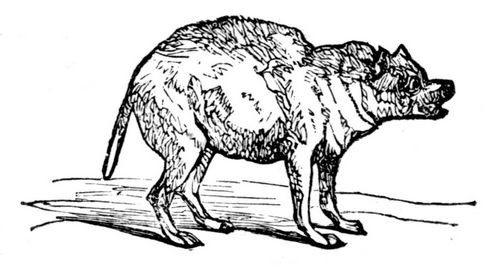
It appears almost laughable to talk about a rheumatic dog; but, in fact, the animal suffers quite as, or even more acutely than the human patient, and both from the same cause—over-indulgence; still with this difference—the man usually suffers from attachment to the bottle; the dog endures its misery from devotion to roaming under the table. It is not an uncommon sight to behold an animal so fat that it can hardly waddle, without scruple enjoying its five meals a day; which it takes with a bloated mistress, who, according to her own account, is kept alive with the utmost difficulty by eating little and often. The dog, I say, looks for its lady's tray with regularity, besides having its own personal meal, and a bone or two to indulge any odd craving between whiles. These spoiled animals are, for the most part, old and bad tempered. They would bite, but they have no teeth, and yet they will wrathfully mumble the hand they are unable to injure; while the doting mistress, in alarm for her favorite, sits upon the sofa entreating the beast may not be hurt: begging for pity, as though it were for her own life she were pleading. The animal during this is being followed from under table to chair, growling and barking all the time; and showing every disposition, if it had but ability, to do you some grievous bodily harm. At length, after a chase that has nearly caused the fond mistress to faint and you to exhaust all patience, the poor brute is overtaken and caught; but no sooner does your hand touch the miserable beast, than it sets up a howl fit to alarm the neighborhood. On this the hand is moved from the neck to the belly, intending to raise the dog from the ground; but the howl thereon is changed to a positive scream, when the mistress starts up, declaring she can bear no more. On this you desist, to ask a few questions: "The dog has often called out in that manner?" "O yes." "And has done so, no one being near or touching it?" "O yes, when quite alone." Thereupon you request the mistress to call the animal to her; and it waddles across the carpet, every member stiff, its back arched, and its neck set, but the eye fixed upon the person who has been called in.
You get the mistress to take the favorite upon her lap, and request she will oblige you by pinching the skin. "Oh, harder; pray, a little harder, madam!" Nevertheless, all your entreaties cannot move the kind mistress to do that which she fears will pain her pet; whereon you request permission to be permitted to make a trial; and it being granted, you seize the coat, and give the animal one of the hardest pinches of which your fore-finger and thumb, compressed with all your might, are capable. The animal turns its head round and licks your hand, to reward the polite attention, and solicits a continuance of your favors. The skin is thick and insensible. What teeth remain, are covered with tartar, and the breath smells like a pestilence.
The dog is taken home, and an allowance of wholesome rice and gravy placed before it, with one ounce of meat by weight. The flesh is greedily devoured, but the other mess remains untouched. The next day the untouched portion is removed, and fresh supplied; also the same meat as before, which is consumed ere the hand which presented the morsel is retracted, the head being raised to ask for more.
The second day, however, the gravy and rice are eaten, and the meat on the morrow is deficient; gravy and rice for the future constituting the animal's fare. Then, for physic, an embrocation containing one-third of turpentine is used thrice daily, to rub the animal's back, neck, and belly with. Some of the cathartic pills are given over night, with the castor-oil mixture in the morning. Constant purgation is judiciously kept up, and before the first fortnight expires, the dog ceases to howl. Then the pills and mixture are given every other night, and the quantity of turpentine in the embrocation increased to one-half, the other ingredients being of the same amount. This rubbed in as before, evidently annoys the animal, and on that account is used only twice a-day. When all signs of pain are gone, the turpentine is then lowered to one-third, the embrocation being applied only once a-day, because it now gives actual pain. Some liniment, however, is continued, generally making the poor beast howl whenever it is administered. At the expiration of a month, all treatment is abandoned for a week, that the skin may get rid of its scurf, and you may perceive the effect of the treatment you have pursued. If the skin then appears thin, especially on the neck and near the tail, being also sensitive, clean the teeth, and send the dog home with a bottle of cleansing fluid, a tooth-brush, (as before explained,) and strict injunctions with regard to diet.
EMBROCATION (FIRST STRENGTH) FOR RHEUMATISM.
Turpentine
}Laudanum
One part of each.
Soap liniment
Tincture of capsicums
A little.
The subsequent strength is made by increasing the quantity of turpentine.
THE RECTUM.
Piles.—The dog is very subject to these annoyances in all their various forms; for the posterior intestine of the animal seems to be peculiarly susceptible of disease. When enteritis exists the rectum never escapes, but is very frequently the seat of the most virulent malice of the disorder. There are reasons why such should be the case. The dog has but a small apology for what should be a cæcum, and the colon I assume to be entirely wanting. The guts, which in the horse are largest, in the canine species are not characterised by any difference of bulk; and however compact may be the food on which the dog subsists, nevertheless a proportionate quantity of its substance must be voided. If the excrement be less than in beasts of herbivorous natures, yet there being but one small receptacle in which it can be retained, the effects upon that receptacle are more concentrated, and the consequences therefore are very much more violent. The dung of the horse and ox is naturally moist, and only during disease is it ever in a contrary condition. Costiveness is nearly always in some degree present in the dog. During health the animal's bowels are never relaxed; but the violent straining it habitually employs to expel its fæces would alone suggest the injury to which the rectum is exposed, even if the inclination to swallow substances which in their passage are likely to cause excoriation did not exist. The grit, dirt, bone, and filth that dogs will, spite of every precaution, manage to obtain, must be frequent sources of piles, which without such instigation would frequently appear. Bones, which people carelessly conclude the dog should consume, it can in some measure digest; but it can do this only partially when in vigorous health. Should the body be delicate, such substances pass through it hardly affected by the powers of assimilation; they become sharp and hard projections when surrounded by, and fixed in the firm mass, which is characteristic of the excrement of the dog. A pointed piece of bone, projecting from an almost solid body, is nearly certain to lacerate the tender and soft membrane over which it would have to be propelled; and though, as I have said, strong and vigorous dogs can eat almost with impunity, and extract considerable nourishment from bones, nevertheless they do not constitute a proper food for these animals at any time. When the system is debilitated, the digestion is always feeble; and, under some conditions of disease, I have taken from the stomachs of dogs after death, in an unaltered state, meat, which had been swallowed two days prior to death. It had been eaten and had been retained for at least forty-eight hours, but all the functions had been paralyzed, and it continued unchanged. If such a thing be possible under any circumstances, then in the fact there is sufficient reason why people should be more cautious in the mode of feeding these creatures; for I have extracted from the rectums of dogs large quantities of trash, such as hardened masses of comminuted bones and of cocoanut, which, because the animal would eat it, the owners thought it to be incapable of doing harm. Nature has not fitted the dog to thrive upon many substances; certain vegetables afford it wholesome nourishment, but a large share of that which is either wantonly or ignorantly given as food, is neither nutritive nor harmless. Whatever injures the digestion, from the disposition of the rectum to sympathise in all disorders of the great mucous track, is likely to induce piles; and the anus of the animal is often as indicative of the general state of the body as is the tongue of man.
In perfect health the anus should be small, firm, close, and entirely retracted; especially should it be cleanly. Any soil upon the part, or any excrement adhering to the hair about its margin, is indicative of derangement. If the fundament protrudes, so that it can be grasped by the finger and thumb, or if it presents a sensible projection to the touch, the digestion is not sound. The indication is still worse when the orifice is enlarged—the edges not being inflamed, which indeed they seldom are, but swollen, loose, coarse, creased, and unsightly. This state will not continue long before cracks and ulcers may be detected upon the borders of the opening, which ultimately is constantly moistened by an unctuous and peculiarly fetid discharge. If the lips of the orifice be gently pulled aside, the more inward portion of the membrane will frequently be seen of a bright scarlet color, and wet with a watery fluid, but the anus is rarely of so deep a tint, the hue being, even in aggravated cases, only a pale reddish brown.
To correct this state of disease, the first thing to be attended to is the food. The diet must be strictly regulated; it should not be too much reduced either in quantity or quality, for dogs in this state are generally old, and always weakly. Enough of good food should be allowed, but nothing more ought to be given. Meat, lean, and from a healthy animal, as constituting the lightest and most nourishing diet, will here be best, and from two ounces to two pounds may be divided into four meals, and given in the course of the day. Plenty of exercise and a daily cold bath will likewise be beneficial.
Medicine must be employed for two purposes; the first, to alleviate the pain and act locally on the disease; and the second, to amend the general health, checking the constitutional disposition to be affected. As a local application, Mr. Blaine recommends an ointment; which I object to, because I have found it aggravate the suffering without conferring any compensating benefit. Astringents, such as the acetate of lead, are not curative; but the following ointment has done so much good in these cases that I can most confidently submit it to the public:—
danger. The digestive canal of the dog is peculiarly irritable, and no less sensitive to the action of medicine. There are few diseases in which the stomach and intestines are not involved, and very many in which purgatives are directly contra-indicated. No one should get into the habit of thrusting physic of this nature down the throats of his animals; and sportsmen may rest assured that, to the dog at all events, preparatory doses are not necessary to condition. Those, however, who persist in using such stuffs will do well not to employ the compounds in general use. The mixture of poppies, buckthorn, and castor oil is a filthy mess; and I do not understand the principles upon which the abomination is based. A better and more cleanly mixture is thus made:—
Camphor
Two drachms.
Strong mercurial ointment
One drachm.
Elder ointment
One ounce.
The only addition I make to the above is occasionally a drachm of powdered opium. This is smeared over the exterior of, and also inserted up, the rectum, thrice in the day. A piece of wood nicely rounded, or a penholder if the animal be small, answers very well to introduce the salve into the gut; and of course it should be done with every consideration, for the pain it will at first produce. The resistance is often strong, and the cries violent; for in some cases the rectum is so sensitive that the mere lifting of the tail cannot be silently endured. The poor dog seems in constant agony; for I have known the exclamations to be provoked by simply looking at the part, and the animal evidently shrieked from the idea of it being touched. All possible tenderness, therefore, is required; and the dog should be very firmly held, to prevent its contortions from adding to its anguish. When the ointment is regularly and properly employed, the relief is generally speedy; and after the third day the dog, which had been so energetically resistful, often submits to be dressed without a murmur. The cessation of the howling will indicate the progress of the cure, but the application should be used for some days after the animal becomes silent. If much stench is present, the fundament may be at each dressing moistened with very dilute solution of the chloride of zinc, and a small quantity may be administered as an injection, after the grease has been introduced.
The constitutional remedies must be regulated by the symptoms, and nothing absolute can be said on this subject; but in the great majority of instances tonics will be required. Purgatives are not often needed, but a day's feed of liver once or twice a week will do no harm. Should it not have the desired effect, a little olive oil may be given; but nothing stronger ought to be risked, and above all, no preparation of mercury—which, in the dog, specially acts upon the rectum—ought on any account to be permitted.
Piles, if not attended to, become causes of further disease, which may in some cases prove fatal, though in the larger number of instances they are far more distressing than dangerous.
A sero-sanguineous abscess, that is, a tumor consisting of a single sac or numerous small bladders, containing a thin and bloody fluid, is by no means a rare accompaniment of long-continued piles. These mostly appear rather to one side of, and more below than above, the opening, the verge of which they always involve. They occasion little pain, and often grow to a comparatively enormous size; when they may burst and leave a ragged ulcer, which has little disposition to heal, and is not improved by the dog's drawing it along the ground.
When these are observed, the knife should not be too quickly resorted to. The abscess should be allowed to progress until it is fully matured, the dog being in the meantime treated for simple piles. When the tumor perceptibly fluctuates, it should be freely opened, the incision being made along its entire length. This is best done with one of Liston's knives, which should be thrust fairly through the swelling, entering at the top and coming out at the lowest part, when with one movement of the wrist the substance is divided. The operation thus performed is much quicker, less painful, and more safe than it can possibly be rendered if the tumor be punctured and slit up with repeated thrusts of an ordinary lancet. I have frequently opened these sacs without the animal uttering even a moan, and mercy is wisdom where surgery is employed. Dogs will not bear torture, and soon become blindly infuriated if subjected to pain. The animal is naturally so sensitive and excitable that the brutality or suffering a horse can sustain, these animals would perish under. He, therefore, who undertakes to treat the diseases of the canine race, if the amiable qualities of the brute or his own feelings have no influence, will in the success of his practice discover ample reason for the exercise of a little humanity.
After the sac is opened a portion of lint should be used, to render the part perfectly dry, which may then be lightly pencilled over with lunar caustic, or moistened with some caustic solution. Fomentations of warm water to keep the wound free from dirt, and with no other object, are all that subsequently will be required.
Tumors of a solid nature also form about the anus, and are likewise consequent upon neglected piles. These generally appear at the root of the tail superior to the opening. They feel hard; are glistening; not very tender; but highly vascular, and in some cases pulsate strongly. The dog is generally loaded with fat, perhaps slightly mangy; nearly always old, gross and weak. The quantity of blood that at various intervals is lost from this tumor, which at length ulcerates and bleeds at the slightest touch, or without any apparent cause, is often very great; but it does not, save in the very latest stage, induce obvious emaciation. The health is not good, of course, but to the casual observer the disease does not appear to affect the system. The spirits under excitement are, to all appearances, undiminished, and the appetite is in these cases ravenous. If, however, the dog had to do work, the truth would be soon discovered. After a short space the strength would fail, and no correction could keep the poor animal to its duty.
The treatment must commence with constitutional remedies, if the state of the part permits of the requisite delay. The digestion should be amended, and the piles, which are certain to be present, attended to. After a fortnight, more or less, has been devoted to such measures, a strong ligature should be tied as tight up as possible around the base of the growth, and a fresh one should be applied every second day. There must be no forbearance in the application of the ligature, but the degree of tension must be regulated only by the strength of the operator. This is far more severe than the removal would be if the knife were employed, but I have not seen a case which I dared venture to excise. I do not like the ligature; it is long and torturing in its action; but here there will be no chance, for the vessels are too numerous and large to admit of the speedier process being resorted to. Where it is possible, it is well, however, to cut through the skin before applying the cord; for the operation is expedited considerably, and an important deduction made from the animal's agony.
When the tumor drops off, the surface may be sprinkled thrice a day with the following powder:—
Camphor in powder,
Opium in powder,
Grey powder,
Powdered galls, of each an equal quantity.
Or a little of the ointment recommended for piles may be smeared upon the wound in lieu of the above. An unguent is perhaps to be preferred, as giving better protection to the sore, over which the fæces must pass, and also as being more grateful to the feelings of the patient. Powder and ointment may be changed and varied according to the judgment of the attendant: thus, to render the last more stimulating, I mix creosote with it occasionally; or to give it an astringent property I add a portion of galls, catechu, or kino; but these I never pass into the rectum. Astringents introduced upon the sore and ulcerated surface of the intestine of course render it harsh, dry, and corrugated; and as during the exercise of its function the part is necessarily dilated, the animal is, by the pain produced from the stretching of the constringed membrane, indisposed for the performance of that act, on the regular discharge of which its health in no little measure depends. Astringents, moreover, heat and irritate the part; and the sensations induced make the dog draw its anus along the ground, thereby adding greatly to the evil it is the intention of the application to remove. Therefore prudence will approve what humanity suggests; and those who in kindly feeling can discover no motive, will in the colder reason find every inducement for the adoption of the gentler measure.
Protrusion of the rectum is also sometimes a consequence of gross feeding, starting up piles in the first instance, and then, from more intense digestive derangement, causing purgation, accompanied with violent straining. The tone of the intestine is destroyed. It becomes lax, and its muscular power is lost. The gut is at first only a little exposed during the act, and when that is over, it is retracted; but after some time, the limit of which is uncertain, it remains constantly protruded. It is not so violently inflamed as might be expected, but it soon gets dry and harsh; cracks appear upon its surface; and the pressure of the muscle which closes the anus preventing the free circulation of the blood, renders it black from congestion.
If taken early, the treatment recommended for piles will generally effect a cure; but if nothing be done in the first instance, the disease when established is apt to prove intractable. The intestine should be sopped with cold water until every particle of dirt is removed. It should then be dried with a soft cloth, and afterwards returned. There is never much difficulty in replacing the gut; but there is always considerable difficulty to get it to be retained. So soon as it is restored to its situation, a human stomach pump should be inserted up the rectum, and a full stream of the coldest spring water should be thrown into the bowel for ten minutes. The fluid will be returned so fast as it enters, and it must be allowed to do so, the fingers of one hand being employed against the anus to prevent the disordered rectum being ejected with the water. Cold injection in less quantity must be administered several times during the day, and with each a little of the tincture of galls, or of nux vomica, in the proportion of a drachm to a pint, may be united. The ointment recommended for piles may also be employed, but without opium, for no application of a sedative nature must be used. The constitutional measures will consist of tonics into which nux vomica enters. The food must be light and nourishing, and purgatives on no account must be administered. Cold will do good by invigorating the system, and should always be recommended. Some persons, unable by sedatives and purgatives, which are injurious, to obtain relief, have gone so far as to cut off the projecting bowel, and they have thereby certainly ended the case; for the dog dies whenever this is done. I remember at the Veterinary College, Professor Simonds killed a fine animal by attempting this operation; for he took a heated spatula to remove the part, and carried the incision so high up that he opened the abdomen, and the bowels protruded from the anus. Amputation of any portion of the rectum is not to be thought of; but an operation of a less heroic description will sometimes accomplish what the previous measures failed to effect. With a knife, having not too sharp but a coarse edge, a circular portion of the exposed lining membrane, of a width proportioned to the size of the animal, may be scraped off, so as to induce a cicatrix; or, if the dog be very tractable, and the operator skilful, a piece of it may partially be dissected off; but the knife, when employed in the last method, is apt to cause alarming hemorrhage. When this is done, as the wound heals the edges come together, and the gut is so far shortened as to be thereby retracted. There is, however, some danger of stricture being afterwards established; wherefore this operation, however satisfactory it may seem to be in the first instance, is not so certain in the benefit of its results that it should be resorted to, save in extreme cases when every other means have failed, and the choice at last hangs between relief and destruction.
Another affection of the part, to which Scotch terriers of great size are particularly subject, begins with an enlargement below the anus, extending either quite or almost to the testicles; for males are more frequently attacked by this form of disease than females. The dog is generally old, and a favorite with an indulgent mistress, having much to eat, and little or no work to do. The swelling is soft and attended with no pain. On pressure and on percussion it is ascertained to hold fluid, and in fact it arises from dropsy of the perinæum. The health may appear to be good, but on examination debility will be found to be present. The anus also protrudes, and the orifice is thickened; while, possibly, a marked tendency to piles may at the same time be displayed. Should no attention be paid to the case, the swelling will continue without sensibly enlarging; but after a period, hard substances may with the fingers be detected beneath it. These hard bodies are fæces, which accumulate within the rectum, and often in so great a quantity as to seriously inconvenience the animal, rendering it dull and indisposed to feed.
Before attempting to direct the treatment for these cases, it is necessary the nature of the affection should be fully explained. The enlargement, to which attention is at first solely directed, is always of secondary consideration. The dropsy is merely a symptom indicative of the loss of tone of the adjacent parts, of which the rectum is by far the most important. If this circumstance be not observed, but the swelling be treated as if it was all the practitioner had to contend with, he will in the end learn his mistake. The intestine loses its tonicity; it no longer has power to contract upon or to expel its contents; it becomes paralysed, and the dung consequently accumulates within it, distending it, and adding to its weakness by constant tension. The rectum at length retains no ability to perform its function; but the sphincter of the anus, or the circular muscle that closes the opening, appears to gain the strength of which the intestine is deprived. It contracts, and thus shuts up the fæces which the rectum cannot make an effort to dislodge; and in this circumstance the physiologist sees evidence of the sources whence the different parts derive their contractility. The rectum, like the other intestines, gains its vital power from the sympathetic nerve, or that nerve of nutrition and secretion which presides over organic life. The muscle of the anus, on the other hand, is influenced by nerves derived from the spinal column; and thus, understanding the two parts obtain their motor power from different sources, the reader will comprehend how one can be incapable of motion while the other is unaffected, or rather excited; for the presence of the retained dung acts as an irritant, and provokes the anus to contract with more than usual vigor.
If nothing be done to restore the balance of power, the rectum speedily is so much distended that its walls become attenuated, and then a cure is hopeless; a sac is formed, and the gut is not only much stretched or enlarged, but it is also, by the excessive bulk of its contents, forced from its natural position, being carried either to one side or the other, but always to where the dropsy is most conspicuous.
In such cases, when the dropsy is first observed, our care must be to invigorate the system. Small doses of nux vomica, with iron, gentian and capsicums, made into a pill, will generally do this, and the following form may be employed:—
Nux vomica, in powder
Five grains to a scruple.
Capsicums, in powder
Ten grains to two scruples.
Sulphate of iron
One to four scruples.
Extract of gentian
Two drachms to one ounce.
Cinchona powder
A sufficiency.
Make into twenty pills, and give four in the course of the day. The liver is too often at this time unhealthy, and to correct it the subjoined may be administered:—
Iodide of potassium
One drachm.
Liquor potassæ
Two ounces.
Simple syrup
Five ounces.
Water
A pint.
Dose, from a tea-spoon to a table-spoonful three times a day. The food should be chiefly vegetables, or at all events only so much meat should be allowed as is required to induce the dog to eat the mess of boiled rice. Exercise is also essential, and a daily cold bath with a brisk run afterwards, will be of service. The dog will likewise be benefited if his skin be well brushed every morning; and perhaps it is hardly necessary to state that any symptoms denoting mange or skin disease, canker, &c., should be specially counteracted.
Hitherto, however, nothing has been said about any treatment of the part which is the immediate seat of the disease. If the fluid poured into the perinæum be excessive, the part must be laid freely open by two or three incisions being made along the entire length of the swelling. After this has been done, the liquid will not escape as from an abscess; for being held within the cells of the membrane that lies immediately under the skin, comparatively little of it is released from the knife. A fine pair of scissors will be required to snip the separate bags or bladders; but that operation must be performed with caution, else injury may possibly be done. The business being concluded, let the parts be afterwards dressed with the tincture of iodine, or a tincture of the iodide of potassium, of the strength of a drachm to the ounce of proof spirit; this being preferable to water for a solution in these cases. Into the rectum also injections should be thrown at least three times a day, and all of these ought to be of a tonic and stimulating kind, being used perfectly cold. Either of the following may be administered:—
1.
Tincture of cantharides
One drachm.
Camphor mixture
One pint.
2.
Tincture of nux vomica
One drachm.
Tincture of tolu
One drachm.
Water
One pint.
3.
Tincture of cubebs
One drachm.
Liquor potassæ
One drachm.
Camphor mixture
One pint.
4.
Solution of nitrate of silver
One drachm.
Distilled water
One pint.
Any of the above may be employed, from a tablespoonful to a common wine-glass full being used for a dose. The pile ointment will likewise be beneficial, by facilitating the passage of the fæces, allaying local irritability, and correcting that tendency to piles which is generally attendant upon, if not the original cause of the affection.
From what has been described, the reader will have seen that the diseases of the dog's rectum are neither few nor insignificant. Fistula in ano is said to be often beheld; but I have never seen a case in which it assumed in the dog that serious form which characterises it in man. In the canine race I have mostly let it alone, and hitherto I have had no reason to repent my forbearance. Blaine and Youatt both speak of the affection, and give directions for its treatment by operation. The most active remedy I have found it necessary to resort to has been an astringent or mildly caustic injection; the solution of the chloride of zinc I prefer to every other, but the sulphates are also not to be despised. Injections, when not designed to be immediately operative, or meant to distend the gut and to act through being ejected, are best given by means of the India-rubber bladder, which allows the fluid to be more gently and silently thrown up. The less noise or force attending the operation the less likely is the animal to be alarmed or excited, and the probability is the enema will be retained. Small quantities are to be administered when the fluid is wished to remain; and by attracting the attention of the dog at the time, and amusing him after the business is finished, the object in view is considerably favored. The administration of an injection is in the first instance almost certain to alarm the animal, who can neither understand nor passively sanction the strange liberty the operation implies. A little soothing, however, will restore his confidence, and he who has gained the trust of a dog, may subsequently do as he pleases with the body of the generous and confiding beast.
NERVOUS DISEASES.—FITS IN THE DOG.
Youatt speaks of fits as particularly fatal to the dog, saying they "kill more than all the other diseases put together." The experience of this esteemed authority is in direct variance with my own—save from distemper. When the fits occur in that disease they are mostly fatal, being the wind-up of all the many evils which the malady in its most intense and malignant form can accumulate on one doomed life—I have not otherwise found them especially troublesome.
Fainting fits require little attention; if the dog be left quiet, it will in due time often recover without medicine.
Puerperal, or rather pupping fits, are treated of in their fitting place, and, if properly administered to, are by no means dangerous.
Fits par excellence are witnessed when a dog is taking a long walk with its master; the animal at first lingers behind, or gets a long distance before the proprietor, who notices the fact, but contents himself with whistling and walking forward. The dog does not obey the mandate; it is standing still as if stupefied; suddenly it emits a strange, loud, guttural sound, and then falls upon its side, continuing to cry, but more feebly and more naturally; its fæces and urine may be discharged involuntarily; it will bite any one who, during the existence of the attack, incautiously attempts to lay hold of it; its limbs, at first stretched rigidly out, are ultimately, with returning volition, put into violent motion; the eye is protruded and foam covers the mouth. When the convulsion has subsided, the dog raises its head and stares about; after which it would, if left alone, start at its utmost pace, and run heaven only knows where. Should idle men and foolish boys behold a dog wildly run onward after having come out of a fit, and raise the cry of "mad dog," the fate of the poor animal is then sealed, as fear is devoid of discrimination or pity. Half the dogs killed as rabid are those in this condition, scampering under the impulse of returning sensation.
The first thing any person is to do when out with a dog which has a fit is to secure the animal, and to prevent its running away when the fit has passed. The second thing is stubbornly to close his ears to the crowd who are certain to surround him. No matter what advice may be given, he is to do nothing but get the animal home as quickly as possible. He is neither to lance the mouth, slit the ear, nor cut a piece of the tail off. He is on no account to administer a full dose of salt and water, a lump of tobacco, or to throw the animal into an adjacent pond; and of all things he is to allow no man more acquainted with dogs than the other spectators to bleed the creature. Any offer to rub the nose with syrup of buckthorn, however confidently he who makes the proposal may recommend that energetic mode of treatment, is to be unhesitatingly declined. The friendly desire of any one who may express his willingness to ram a secret and choice specific down the prostrate animal's throat, must be refused with firmness. The attendant must however take advantage of the time the dog is on the ground to pass a handkerchief round the neck or through the collar. This done, he must wait patiently till the dog gets upon its legs, when he must, amidst its struggles to be free, caress it and call it kindly by its name. That part of the business over, he must take the creature in his arms, and seeking the nearest cab-stand, carry the poor animal with all expedition homeward.
I have known a dog to have a succession of fits which lasted more than an hour; and yet this creature, by the treatment I shall presently describe, was the next day upon its legs, and to all appearance as well as ever.
The dog being brought home, if the fit continues, give nothing by the mouth; because the animal being insensible cannot swallow; and the breathing being laborious, anything administered is more likely to be drawn on to the lungs, and so to suffocate the creature, than to pass into the stomach, and thus (if it have any curative properties) effect a restoration. On this account the very best physic ever invented would be dangerous, and should be withheld. Enemas are the only things in these cases to be depended upon; and the best the author is at present acquainted with, is made of 1, 2, or 3 drachms of sulphuric æther, and 2, 4, or 6 scruples of laudanum to 1½, 3, or 4½ ounces of the very coldest spring water that can be obtained. The above injection having been administered, the dog is left entirely by itself, and, as far as possible, in absolute silence for an hour; at the expiration of which time, in whatever state the animal may be in, another dose is given in the same manner as before.
There is no limitation to the quantity which may be administered; the only sign the attendant accepts that the creature has received sufficient is the sight of it coiled up as though it were composing itself to sleep, when he gives one more injection, and leaves the dog to recover at leisure, but in perfect stillness.
So valuable is this medicine in cases of fits that I have known it to cut them short as with a knife; literally to let the first part of the fit be heard, but to check the attack before the last and worst portion could put in an appearance.
Armed with this medicine I fearlessly face the disorder, which other veterinary surgeons dread; and, whether it be my good luck or no, cannot be decided, but I have not, under its operation, lost a single case.
Fits in my opinion are, in the great majority of cases, to be traced to the quantity or quality of the food consumed. In proof of this, dogs have had fits whenever flesh has been given; which ceased on this kind of diet being withheld, and medicine calculated to restore the tone of the stomach being ordered. In every case of fits, when the attack is over, I attend to the stomach; at the same time, ordering that the dog is to go short distances, and never to leave the house without a chain and collar.
The object of this last injunction is to prevent the animal running about, and thus heating itself, or causing a flow of blood to the brain.
It is to be lamented that the crowd of people prevents an injection being administered out of doors in London: but the same objection does not apply to the country; and as the effects of the æther are more marked in proportion as it is quickly exhibited, persons in the country, when, during the hot months of summer, they take dogs for an airing, should be provided with the materials necessary to render fits, if not harmless, at all events less fatal.
NERVOUS SYSTEM.—RABIES.
The dog is naturally the most nervous of all the dumb tribe. His intense affection, his ever-watchful jealousy, his method of attack, the blindness of his rage, and his insensibility to consequences, all bespeak a creature whose nervous system is developed in the highest possible degree. I myself once had a little cur, who, as I sat reading, would enter the apartment, jump upon my knee, uttering a low whimper all the time, creep along my waistcoat, rub his little body against my head and face, lick the hand lifted up to return his caresses, and then scamper off, and perhaps not come near me again the whole of that afternoon. What was this but an affectionate impulse seeking a nervous development? The way to manage an animal of this description is, to respect his evident excitability. The instant a dog appears to be getting excited, there should be a sign given, commanding a stop to be put to all further proceedings. If the respect of the animal be habitual, the person who mildly enforces it may enter a room, where the same dog is in a rabid state, and come forth unscathed.
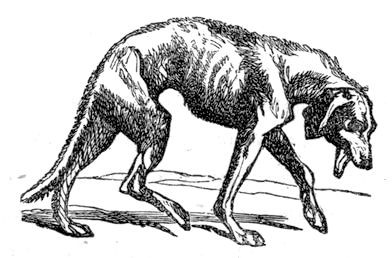
A RABID DOG.
I have hitherto been much among dogs, and, nevertheless, have almost escaped being bitten. The reason is, that I understand and respect the innate nervousness of the animal. When I go into a room, if there be a dog there and he growl, I speak kindly to him, and then seat myself, and bestow on him none of my attention for some time. My request to his master or mistress is, that he or she will not check or seek to stop the symptom of his wrath; but allow him to vent his rage until he is ashamed of it, and from a feeling of remorse is silent. When this takes place, and a sufficient time has passed to confirm him in the new mood into which he has recently entered, I approach him with my hand extended and open; this I bring near to him by degrees, avoiding all sudden movements or anything that might provoke his natural disposition. Generally he crouches, then I speak to him in tones of encouragement. If he display a return of his warlike propensity, I still bring the hand nearer and nearer to him, telling him to bite it if he pleases, if he is not ashamed to injure that which means to do him good. Then, perhaps, he will make a snap at my extended hand, which is not upon this withdrawn, or the jaws would close with nervous violence, but allowed to remain, and the teeth are felt to touch the skin without wounding it. I allow him to hold the hand for any length of time he pleases, telling him "he would lose his character if he were to harm it. That he is a courageous dog, and means no hurt; he would be ashamed to bite." And with this kind of speech, which the animal may not literally understand, but the sense and purpose of which it nevertheless appears to comprehend, I seldom fail of getting my hand safe and sound from the creature's jaws. After that I may pat him, for an intimacy has begun. He allows me to drag him forth, take him on my knees, and permits me any liberty I please to take. I do not attribute my escape to any charm that I possess; but account for it simply by my knowing and respecting the natural temperament of the beast with which I have to interfere.
This natural respect for the feelings of a most affectionate creature, with such a power of observation as will enable the individual to recognise the presence of lamentable sickness in an animal that has with truth been called "the companion of the home," shall at all times enable the uneducated in such matters to recognise a mad dog, and, unless luck be dead against the individual, save him from being bitten.
It is no pleasure to a dog to go mad. Quite the reverse. Dreadful as hydrophobia may be to the human being, rabies is worse to the dog. It makes its approach more gradually. It lasts longer, and it is more intense while it endures. The dog that is going mad, feels unwell for a long time prior to the full development of the disease. He is very ill, but he does not know what ails him. He feels nasty; dissatisfied with everything; vexed without a reason; and, greatly against his better nature, very snappish. Feeling thus, he longs to avoid all annoyance by being alone. This makes him seem strange to those who are most accustomed to him.
The sensation induces him to seek solitude. But there is another reason which decides his choice of a resting-place. The light inflicts upon him intense agony. The sun is to him an instrument of torture, which he therefore studies to avoid, for his brain aches and feels as it were a trembling jelly. This induces the poor brute to find out the holes and corners where he is least likely to be noticed, and into which the light is unable to enter. In solitude and darkness he passes his day. If his retreat be discovered and the master's voice bids him to come forth, the affectionate creature's countenance brightens; his tail beats the ground, and he leaves his hiding-place, anxious to obey the loved authority; but before he has gone half the distance, a kind of sensation comes over him, which produces an instantaneous change in his whole appearance. He seems to say to himself, "Why cannot you let me alone? Go away. Do go away. You trouble, you pain me." And thereon he suddenly turns tail and darts back into his dark corner. If let alone, there he will remain; perhaps frothing a little at the mouth, and drinking a great deal of water, but not issuing from his hiding-place to seek after food. His appetites are altered, hair, straw, dirt, filth, excrement, rags, tin shavings, stones, the most noisome and unnatural substances are then the delicacies for which the poor dog, changed by disease, longs, and swallows, in hope to ease a burning stomach. So anxious is he for liquids, and so depraved are his appetites, that no sooner has he passed a little urine than he turns round to lick it up. He is now altogether changed. Still he does not desire to bite mankind; he rather endeavors to avoid society; he takes long journeys of thirty or forty miles in extent, and lengthened by all kinds of accidents, to vent his restless desire for motion. When on these journeys he does not walk. This would be too formal and measured a pace for an animal whose whole frame quivers with excitement. He does not run. That would be too great an exertion for an animal whose body is the abode of a deadly sickness. He proceeds in a slouching manner, in a kind of trot; a movement neither run nor walk, and his aspect is dejected. His eyes do not glare and stare, but they are dull and retracted. His appearance is very characteristic, and if once seen, can never afterwards be mistaken. In this state he will travel the most dusty roads, his tongue hanging dry from his open mouth, from which, however, there drops no foam. His course is not straight. How could it be, since it is doubtful whether at this period he sees at all? His desire is to journey unnoticed. If no one notices him, he gladly passes by them. He is very ill. He cannot stay to bite. If, nevertheless, anything oppose his progress, he will, as if by impulse, snap—as a man in a similar state might strike, and tell the person "to get out of the way." He may take his road across a field in which there are a flock of sheep. Could these creatures only make room for him, and stand motionless, the dog would pass on and leave them behind uninjured. But they begin, to run, and at the sound, the dog pricks up. His entire aspect changes. Rage takes possession of him. What made that noise? He pursues it with all the energy of madness. He flies at one, then at another. He does not mangle, nor is his bite, simply considered, terrible. He cannot pause to tear the creature he has caught. He snaps and then rushes onward, till, fairly exhausted and unable longer to follow, he sinks down, and the sheep pass forward to be no more molested. He may have bitten twenty or thirty in his mad onslaught; and would have worried more had his strength lasted, for the furor of madness then had possession of him.
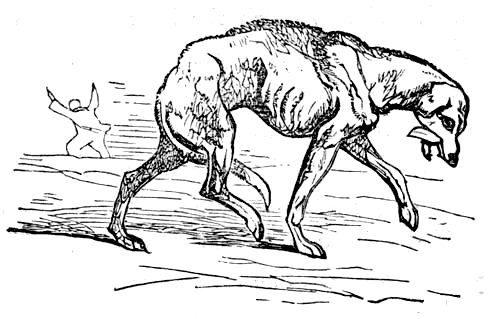
A MAD DOG ON THE MARCH.
He may be slain while on these excursions; but if he escapes he returns home and seeks the darkness and quiet of his former abode. His thirst increases; but with it comes the swelling of the throat. He will plunge his head into water, so ravenous is his desire; but not a drop of the liquid can he swallow, though its surface is covered with bubbles in consequence of the efforts he makes to gulp the smallest quantity. The throat is enlarged to that extent which will permit nothing to pass. He is the victim of the most horrible inflammation of the stomach, and the most intense inflammation of the bowels. His state of suffering is most pitiable. He has lost all self-reliance; even feeling is gone. He flies at and pulls to pieces anything that is within his reach. One animal in this condition, being confined near a fire, flew at the burning mass, pulled out the live coals, and in his fury scrunched them. He emits the most hideous cries. The noise he makes is incessant and peculiar. It begins as a bark, which sound, being too torturing to be continued, is quickly changed to a howl, which is suddenly cut short in the middle; and so the poor wretch at last falls, fairly worn out by a terrible disease.
But now comes the question, How do we know that rabies is a nervous disease? Why, the whole course of the disorder declares it, or if that be not thought sufficient, the dog at one stage very distinctly announces it. He may be sitting down, an unwilling listener to his master's voice, when the brute's eyes will wander; and at length fix themselves upon some object at a distance, which it will keep watching, crouching down as the horror seems, to the excited brain of the poor beast, to draw near; till, having apparently come within bounds, the hateful presence is no longer to be endured, and the vision-haunted animal dashes forward with a howl of execration, as if to seize and tear the terrible spectre. This action being performed, and the dog biting the air, he stands for a moment, shivers, looks stupidly around him, and slinks back. What is this but a power of seeing visions depending on a disordered brain, or positive delirium exemplified by a dumb creature? And the same piece of pantomime the dog may go through fifty times in an hour. No disappointment can teach him; and experience is lost upon the animal that in his sane state was so quick to learn.
Youatt mentions as a symptom, that the dog in all he does is instigated by the spirit of mischief or of malice,—that he desires to do injury, and is prompted by malice in all his acts. This, to an outward observer, will appear a correct judgment; but it is essentially wrong. It is the conclusion reached by one who judges mainly of exteriors; it can be true only to those who are willing to look no deeper than the surface. There can be no malice in a raging fever, which vents itself on every object within its reach, animate or inanimate. Mischief is too playful a term to apply to a consuming wrath that ultimately destroys the life. All pain is lost; as a consequence all fear is gone. The poor beast is urged by some power too mighty for its control, which lashes it on beyond all earthly restraint to pull to pieces, to gnaw, and to attempt to eat every object it can get at; but how far it is urged by malice or mischief, the following anecdote will serve to show:—
A butcher had a large bull mastiff of which he was very fond; but, observing something very strange in his pet's behavior, he came to consult the author about the dog. The man was told to bring the animal for inspection early the same evening. This order was given from no suspicion of the truth, for the owner's description was too confused to be rightly interpreted. The animal was accordingly brought punctual to time, led through the streets by a silk handkerchief carelessly tied round the neck of the beast. The author being at the exact moment of the dog's arrival, fortunately, engaged, the butcher had to wait some few minutes, during which time the writer's eyes were kept upon the huge creature. It was remarked to look round in a strange manner. The eye was retracted and the nose dry. It was at length seen to put its mouth against its master's boot, continue in that position uttering a strange noise, and to move its jaws as if biting at some substance. The butcher all this time stood perfectly still, allowing his favorite to follow the bent of its inclination without rebuke or opposition. When the mastiff's head was removed, the boot it had apparently been biting was perfectly dry. The author observed nothing more than this; but, afraid to confess his dread, lest the cry of mad dog should be raised, and do more, much more, harm than good, he called to the butcher, telling him he was going abroad shortly, and would call upon him. In the mean time, he was to take the dog home, place it where it could do no injury, and in a place whence there was no possibility of escape. The man touched his hair and retired.
No time elapsed before the author paid his promised visit; and when he did so, he was pleased to hear the dog was securely confined in that which ought to have been the front kitchen of the house in which the butcher resided. To this spot the man led the way, and was about fearlessly to open the door, when he was entreated to stay his hand. The author listened at the closed entrance, and from the interior there soon came forth sounds that left no doubt of the poor creature's real condition. The butcher was thereupon informed that his dog was mad. The man was at first wholly incredulous; whereon the writer requested him to look through a chink, and say how the animal was employed. "He is tearing a piece of wood to pieces, and munching it as though he were very hungry. Poor thing, I must go to him! He has taken no victuals or drink these three days." The author interposed, to prevent the master from fulfilling his humane suggestion. With much difficulty he was persuaded to wait the turn of events, and not to unloose the door that night. The next morning the butcher was thoroughly convinced. Neither he nor his family had been able to get any rest on account of the dog's cries; and before that day expired, to anticipate the poor animal's fate, the unfortunate beast was shot.
In this case the dog exhibited no malice, neither did he appear to be prompted solely by mischief. When the muzzle was first lowered to the master's boot, the poor animal doubtless was moved to that action by the irresistible desire natural to the disease. The longing was to bite something, no matter what; any object must be cooler than the heat that burnt within the wretched creature's throat and stomach. The teeth were impulsively prepared to bite, but between the desire and its consummation, reflection came. The affection natural to the dog acted as a restraint. It was unable entirely to destroy the prompting of disease, but it turned the bite which it was prepared to give into a mumble, and the loved master escaped unhurt.
There is also something which must not be quite overlooked in the habitual wanderings that, as the disease grows in virulence beyond the dog's control, causes the animal constantly to leave the home within which its attachment resides. There is something likewise in the disposition, which causes the poor beast to quit the society of all it loves; and to leave the house in which those for whom its life would cheerfully be sacrificed dwell, to inhabit a dark and noisome corner. It is not mischief which makes the creature respond to its master's voice so long as memory has power—even after rabies has set in. There is no malice in the end of the disease; it is blind and indiscriminate fury, which would much rather vent itself on things than upon beings—even finding an unholy pleasure in injuring itself by gnawing, biting, and tearing its own flesh; and so truly is the fury blind, that most frequently the eyes ulcerate, the humors escape, and the rabid dog becomes actually sightless.
Of the causes or treatment of this disorder we know nothing; neither are we likely to learn, when the nature of the disease is considered. The danger of the study must excuse our ignorance; nor is this much to be regretted, since it is highly improbable that medicine could cure what is so deeply seated and universally present. The entire glandular structure seems to be in the highest degree inflamed; and besides these, the brain, the organs of mastication, deglutition, digestion, nutrition, generation, and occasionally of respiration, are acutely involved. The entire animal is inflamed. Some except from this category the muscular system; but such persons forget that paralysis of the hind extremities is often present during rabies. The body seems to be yielded up to the fury of the disease, and it obviously would be folly trying to cure a malady which has so many and such various organs for its prey. Neither are we better informed with regard to the causes which generate the disease. Hot weather has been imagined to influence its development; but this belief is denied, by the fact that mad dogs are quite as, if not more, frequent in winter than in summer. Abstinence from fluids has been thought to provoke it; but this circumstance will hardly account for its absence in the arid East, and its presence in a country so well watered as England, especially when the unscrupulous nature of the dog's appetite is considered. The French have been supposed to set this latter question at rest by a cruelty, miscalled an experiment. They obtained forty dogs, and withheld all drink from the unhappy beasts till they died. Not one of them, however, exhibited rabies, and by this the French philosophers think that they have demonstrated that the disorder is not caused by want of water. No such thing; they have proved only their want of feeling, and show nothing more than that one out of every forty dogs is not liable to be attacked with rabies. They have demonstrated that the utmost malice of the human being can be vented upon his poor dumb slave without exciting rabies. They have made plain that the poor dog can endure the most hellish torments the mind of man can invent without displaying rabies. They have held themselves up to the world, and in their book have duly reported themselves as capable of perverting science to the most hideous abuses, and under its name contemplating acts and beholding sufferings at which the feelings of humanity recoil with disgust.
It is rarely that more than one mad dog appears at a time in England; so, to perfect their experiment, it would be requisite for the French philosophers to procure all the specimens of the canine species in this island, and doom them to torture; since, of the predisposing disposition or circumstances necessary to the development of this disease, man knows nothing. Ignorance is not to be concealed under the practices of barbarity.
Irritation or teazing, by exciting the nervous irritability of the dog, appears more likely than any physical want to excite rabies.
Tetanus.—I have witnessed no case of this description in the dog. Both Blaine and Youatt speak of tetanus as extremely rare in that animal; but both mention having encountered it, and that it was in every instance fatal. Since such is its termination, I am in no hurry to meet with it, and care not how long it remains a stranger to me. If any of my readers were to have a dog subject to this disease, the best treatment would be the application of ether internally as medicine, with slops or light puddings as food. The effects of the ether ought to be kept up for a considerable period at one time, and recommenced so soon as the slightest trace of the disorder reappears.
GENERATIVE ORGANS.—MALE.
These parts in the dogs are liable to various diseases, among the most common of which is a thick discharge, either of pus or of impure mucus. Petted animals are very frequently thus affected, and are a source of annoyance to those who lap them. In this condition they also offend the ideas of propriety, by paying certain lingual attentions to themselves without regard to privacy. The favourite is for these things repeatedly chid and thrust from the knee; but it cannot be instructed to forego the impulses of its nature, or of itself to restrain the symptoms of its affliction. Indeed, the dog is not to blame; the fault lies with the owner.
The generative organs, in the male of the canine species, are peculiarly sympathetic with the digestive functions. This is so with man, but in the dog it is much more strongly marked. If a dog become from bad food affected with mange, canker, sore feet, &c., the part is never cleanly. When, however, the animal is fat and gross, though neither mange, canker, nor other disease be present, the organ may, nevertheless, be a source of painful irritation, and beyond a little thin fluid about the opening of the prepuce, there will be nothing to attract attention.
In such a case the discharge originally is thick and mattery. It accumulates upon the few hairs that fringe the urinal orifice, and sometimes almost impedes the passage of the water. The symptom being neglected, the running becomes less consistent. The part is frequently erect, and the animal persists in licking it. The organ is now painful, and should be without delay attended to. If, however, no heed be taken of the creature's necessity, to which its instinct directs the proprietor's eye, swellings appear about the sheath, and blood is mingled with the exudation. Sores then appear externally, and the member becomes a mass of acute disease, often of a frightful character.
If, when the discharge first appears, the dog be taken on the knee, and its back being slightly bent, so as to bring the hind-legs forward—if, having the animal in this position, the sheath be retracted, so as to expose the glans, it is generally found to be inflamed. When the case is slight, the inflammation is confined to the base of the member, just around that part where the lining membrane is reflected upon the inner surface of the prepuce. As far back, therefore, as it can be exposed, a little redness may be discovered; but this will be so distributed as to convince us that the interior of the sheath is also involved. All the inflammation that can be detected will not be sufficient to account for the quantity of pus that is thrown out; and some persons have therefore allowed the disease to progress, imagining there was nothing present requiring to be treated. This is always a mistake. The lining membrane of the prepuce in these animals cannot be readily laid bare, and that part is always the most seriously attacked. The penis during health ought to be moist and of a delicate flesh color; it should not be wet, neither should it be in any degree red. The appearance ought to suggest the secluded situation to which the part is by nature assigned, and the sensitiveness with which it is endued. It should not denote uncleanliness or anger; but convey an idea of delicacy, and even beauty, to those who have good sense enough to appreciate nature's provisions.
When the want of early attention has allowed the structures to be seriously implicated, ulcers appear, which enlarge, and ultimately by uniting form a mass of sores. There is then often resistance exhibited when the part is touched, and cries declare the pain which pulling back the sheath occasions. The prepuce sometimes is not to be withdrawn, and the struggles of the animal are excessive when its retraction is attempted. There are then fungoid growths within, and the heat and tenderness denote the condition of the surface, which cannot without much violence be beheld.
All this suffering is to be traced to the misplaced kindness of the owner. Over-feeding is the cause; and, so far as I know, the single cause which gives rise to the serious aspect of this form of disease. Should it accompany debility, it is mild in its character, and as the strength returns it will disappear. Even in this last case, however, it would be more certainly, and with more speed removed, by a few simple measures which necessitate no vast trouble.
In its mildest shape, any astringent eye-lotion will generally answer; but the strength may with safety and advantage be increased.
1.
Sulphate of copper or zinc
Five grains.
Distilled water
One ounce.
2.
Liquor plumbi
One drachm.
Distilled water
One ounce.
3.
Alum
Half a scruple.
Rose water
One ounce.
Either of the foregoing will be of service; but before any of them, I prefer the subjoined:—
Chloride of zinc
One grain.
Distilled water
One ounce.
Whichever of the lotions the practitioner may prefer, should be used at least thrice daily, and if more frequently employed, no injury will be done. The mode of applying the lotion is extremely simple. The seat of the disease being exposed, with a piece of lint or soft rag the fluid is passed over the surface. No friction is resorted to; but a simple bathing, in the gentlest possible manner, is all that can be required. In a few days the effect will be perceived, for by such means the affection can be cured; but unless the food is improved, and the digestion relieved, there can be no security against its speedy return.
Under its more virulent form it is not to be thus easily got rid of, though even then it is to be subdued. If there be much pain, I inject the lotion up the sheath, and by closing the orifice around the point of the syringe, endeavor to pass the fluid over the whole of the interior. Sometimes the pain or irritation is excessive: I then combine sedatives with the lotions, and their strength I increase as the occasion warrants; but the non-professional person had better use none more potent than one drachm of tincture of opium to every ounce of lotion. When the pain, decreasing, allows the penis to be protruded, if any sprouting fungus or proud flesh is upon it, a pair of scissors should be used to snip it off. Some bleeding will ensue, but a little burnt alum will generally stay it; though, if allowed to continue, I have thought the local depletion was beneficial, and it has never to my knowledge been attended with danger. The burnt alum I use in powder, and I prefer it in these cases to the lunar caustic; which gives more pain; acts less immediately as a styptic, and is not so satisfactory in its subsequent effects, and, as the animal can hardly be kept from licking the place, it may possibly be objectionable on that account. Such treatment usually is beneficial; and the only further direction to be added concerns such minor points as reason probably would not need to have specially pointed out.
When the hairs at the orifice are matted together, it is best to snip them away, which will not only remove a present inconvenience, but effectually prevent its recurrence. The wounds which occasionally cover the exterior of the sheath are of no vast importance, or, at all events, they are of secondary consideration. With the healing of the inward sores they mostly depart; but their disappearance will be hastened, and the comfort of the animal improved, if, when the injection is used, they are at the same time smeared with some mild ointment. That composed of camphor, &c., and to be found described at page 265, does very well for such a purpose; but any other of a gentle nature would probably answer as well.
Soreness of the scrotum is very common, and I have seen it in every description of dog. I attribute it to derangement of the digestion; never having witnessed it in animals that were not thus affected, and not having been able to discover it had any more immediate origin. It mostly appears first as a redness, which soon becomes covered with small pimples, that break and discharge a thin watery fluid. The fluid coagulates, and a thin scab covers the surface. The scab is generally detached, being retained only by the straggling hairs that grow upon the bag. The scab being removed, shows a moist and unhealthy patch, the margin of which is of a faint dirty red color.
This condition of the scrotum yields, in the first instance, to simple applications; but, should nothing be done, it will continue bad for some period, and may involve the whole of the bag. It will, in most instances, so far as the outward and more acute symptom is concerned; that is, the discharge will cease, the scab fall off, and nothing be left for the eye to dwell upon. With the seeming cessation, however, other and more deep-seated structures become involved. The disease leaves the surface only, and its virulence fixes upon the internal parts. The skin at the place thickens, becomes hard and gristly. There is no pain; but the sensation is diminished, which, to the surgeon, is a far worse sign than is a little anguish. The thickening is sometimes stationary; and the animal dies without any further evil afflicting him. There is, however, no security that it will remain thus passive; for occasionally it increases in size, inflames, gets hurt or rubbed, and ulcerates: in fact, cancer of the scrotum is established; and as this mostly comes on when the constitution is weakened, little relief and no promise of cure can generally be afforded.
These cancers do not appear to burst of themselves. They get sensation as they inflame; but in every instance that has fallen under my notice, before ulceration has taken place, they have been slightly wounded; either by the dog's dragging himself upon the earth, or otherwise. The smallest injury, however, is sufficient to provoke the action, which when once excited is not afterwards to be subdued. The ulcer being established, enlarges; and the humanity of the owner does not allow the lingering and disgusting disease to take its course, but the poor dog is destroyed to spare its suffering.
At the commencement the diet must be changed, for the manner of feeding is at fault. The remedies proper to improve the general health must be employed, and everything done to restore the system.
To the scrotum a mild ointment will be sufficient. Should that not succeed, some of those recommended for mange may be tried; or the surface may be lightly passed over once with a stick of lunar caustic, care being taken to tie the head of the dog up afterwards to prevent it licking the part.
The measures already spoken of apply only to mild and recent cases. When the disease has probably existed for years, such remedies will be of little service. The skin being unnaturally hard and thick, feeling like cartilage, and giving the idea that a firm or resistant tumor is connected with the integument; such being the condition of the part, the surgeon pauses before he advises it should be interfered with. As it seems to be possessed of small sensibility, and appears to have assumed a form in which there is a probability of its remaining, the less done to the local affection the better.
The relief should be directed wholly to keep the cancer, for such it is, in a passive or quiescent state. There is no hope that nature will remove it; and every effort must be made to prevent its malignant character being by accident or otherwise provoked. With a little care the dog may die of old age, and the disease may even at the time of death be dormant. A very mild mercurial ointment may be daily applied to the surface. This will remove scurf, allay irritability, and prevent the itching, which might induce the animal to injure the part. The food must be good, proportioned to the work the creature has to perform,—sufficiently nutritive, but easy of digestion, and by no means heating. The stomach must be strengthened by tonics and vegetable bitters, combined with alkalies. Sedatives are sometimes required, and hyosciamus is in that case to be preferred. A course of iodide of potassium is likewise frequently beneficial; but it must be employed only in alterative doses, and persevered with for a considerable period. The eighth of a grain or half-a-grain may be given three times a day for six months; and on the first indication of irritability appearing, the medicine must be resumed. Should the symptoms of activity be such as to excite alarm, the iodide must be administered in quantities likely to affect the system. This is to be done with safety, by dissolving two drachms of the salt in two ounces of water, every drop of which will then hold in solution the eighth of a grain of the medicine. From two to ten drops may be given at the commencement, and every day afterwards one drop may be added to the dose, which should be regularly administered thrice in the twenty-four hours. The physic should thus be gradually increased until the appetite fails; or the eyes become inflamed; or the animal is in an obvious degree dull. When that result is obtained, the dose ought to be withheld for a time, or to be diminished three or twelve drops, and the lessened quantity only given until the symptoms have subsided. The spirits, or appetite, having returned, and sufficient time having been allowed to make certain of the fact, the dose may once more be increased; and thus by degrees be augmented, until it is worked up to from fifty to a hundred drops three times a day, beyond which it ought not to be pushed. Even while this is being done, it is well to give tonic and strengthening pills; but purgatives are to be used with extreme caution.
Too frequently our assistance is not sought until the disease has assumed its worst aspect. There is then an open cancer, and we are asked to cure it. There is in medicine no known means of performing so desirable an object; physic can, in such a case, only be palliative—whatever hope then remains must rest upon the employment of the knife. The surgeon, however, must well examine the part before he consents to operate. Entreaties will not unfrequently be urgent; and where the life of an animal only is involved in the result, it is hard to say "no" to supplications which may be accompanied with tears. The professional man, however, must consult his judgment, and by its dictates resolutely abide; for those who are most eager in their requests are always most sanguine in their hopes. The issue, if unsuccessful, will not do otherwise than expose the surgeon to reproaches, perhaps more bitter than the supplications to which he yielded were imploring. Even should the proprietor be silent, the reputation of the operator will be injured; for, when the knife is resorted to, mankind will not tolerate failure. Therefore it is prudent, and also humane, to consider how far surgery can eradicate the affection ere excision is employed to add to the immediate suffering, and perhaps hasten the consequence it was designed to prevent.
The tumor should be circumscribed, or, at all events, there should be around it a fair proportion of healthy skin whenever its removal is attempted. When such exists, the operation is justifiable; but without such being present, it is to be condemned. The skin is wanted to close the orifice, and it must be healthy, in order that it may properly unite. In extreme cases, where the life of the animal depends upon activity, it may be proper to remove both testicles; but this should, if possible, be avoided.
Castration in the dog is not of itself dangerous; but it renders the animal disposed to accumulate fat, and destroys many of those qualities for which it is esteemed. The creature afterwards becomes lethargic, and its spirits never are recovered. It is best performed by cutting through the spermatic nerve, and scraping the artery, so as to separate it; taking care to do this sufficiently high up to prevent the cord from being exposed.
When the operator has decided to take away the spermatic glands, he does so at the commencement of the operation. With one cut he lays the scrotum open, and pulling forth the testicle, divides the nerve; then with the edge of a blunt but coarse knife, scrapes it as the cords lie upon his finger. Having done this on one or both sides, as the case may require, he inspects the tumor, the substance of which is now exposed to view. By the aspect of the growth he decides upon the course he will next adopt; or rather shapes the manner he had proposed to proceed. Seldom will it occasion him to change his plan; but he must be prepared to do so, if the appearances should be contrary to his anticipations. The skin is here of primary importance; wherever it is not involved, it is dissected back, and every portion of hard or gristly matter scrupulously sought for and cut away. All such substance being excised, care is then directed to bring the edges together. A pair of scissors may be required to make them exactly even, but the less snipping there may be the better. To retain the lips of the wound in the places desired, collodium will be found far superior to sutures or plasters. It is with a camel's hair pencil laid in bands along the parts, which are held in their intended situations while it dries. A few threads of linen are embedded in it while it is in a liquid state, so as to increase its strength; and layer after layer is added until the mind is assured the purpose is obtained. The application must on no account be made in one continuous sheet; for before union can take place suppuration must be established, and spaces are necessary to allow the matter to escape. Therefore, in several fine strips stretching over the wound, and holding its edges close, the collodium is to be employed; and this being ended, subsequent attention is generally required only to regulate the health, on which the healing process will greatly depend.
To stone in the bladder the dog is liable. The cause cannot be directly traced, but the symptoms are not obscure; the animal is constantly voiding its urine, which, though small in quantity, is not of a healthy character. A few drops of blood occasionally are passed; and, in attempting to go down stairs, sudden cries are often emitted. Fits of pain and seasons of illness are frequent, and the point of the penis is protruded from the sheath, never being withdrawn. The leg is not raised to void the urine; but the creature strains when the act has either been accomplished, or there is no power to perform it. If the dog be taken on the knee, and one knowing the situation of the contents gently manipulates the abdomen, the body may be felt within the bladder, which will mostly be contracted and empty.
The nature of the disease having been ascertained, little can be done beyond relieving the immediate distress. Some writers have given directions for operating under such circumstances; but none of them tell us they have successfully performed lithotomy upon the animal. In every case of the kind upon which I have been consulted, the idea of such a measure was not for an instant to be countenanced. Dogs thus afflicted, are mostly small, and the calculus is generally of great proportional size, prior to our attention being directed to it. In a creature so very delicate as the dog, every operation requires to be well considered before it is resorted to; and though the cutler might make knives sufficiently diminutive for the occasion, it may be doubted if our hands are sufficiently nice to employ them. The stones I have met with were of a size I would not have liked to have drawn through the urethra; and therefore, though I will not assert lithotomy cannot be performed upon the dog, I must confess I have not performed it, and must say I should require strong inducements to attempt it upon the animal.
All I aim at is to limit the increase of the deposit, and to alleviate the painful symptoms it gives rise to. A strictly vegetable diet best accomplishes the first object, and doses of ether and laudanum, repeatedly administered by mouth and injection, most speedily secure the second. Pills of henbane are likewise of service; and with them small quantities of the balsams may be combined, though the last should not be continued if they have any marked diuretic action. The peppers, especially cubebs, I have thought serviceable, and very minute doses of cantharides have seemed to be attended with benefit. Here, however, I speak with doubt; for the agents have by me been employed only in homœopathic quantities, and I have not the means of saying they had very decided action. They appeared to do good, since under their use the animals improved; and that is all I can state in their behalf. Proprietors, however, when the pressing annoyance is allayed, being told there is no prospect of a radical cure, do not generally afford us much opportunity to watch the action of medicines.
Hæmaturia or bloody urine is met with in the dog; and I (having been unfortunate in those cases where I employed acetate of lead) adopted small doses of cantharides, and with these to my surprise succeeded; for which reason I have persevered in my homœopathic treatment. The quantity of tincture of cantharides I employ is three minims to two ounces of water, and to my wonder, this appears to answer every purpose; the only fault, indeed, that a general practitioner might find with it being that it did its work too quickly.
Swelling of the glans penis is not uncommon. It comes on suddenly, and the dog is by it rendered offensive to the owner's sight. The membrane is in a state of erection, and being so, is of course protruded; and while thus exposed, the end of it loses its mild red color, becoming of a paler hue, and at the same time enlarging. Its size increases to such an extent, that when the erection subsides, it cannot be retracted.
This generally happens to animals that are weakly; such being of what are called high breeds, or having recovered from some dangerous disorder. It is not a dangerous affection, and if taken early is very easily subdued. With a silk handkerchief, the exposed part should be grasped by the left hand; and while every means is employed to push the gland back, the fingers of the right hand ought to be used, to draw the prepuce over it. A little time and care will, in most instances, do what is desired; and there is no need of haste, or justification for violence. Oil is not required, as the parts are sufficiently lubricated by their own secretion; and still less are those practices some persons have advocated, admissible.
The scarification of the glans, or the slitting of the prepuce, should not ever be allowed, save the absolute failure of all other measures has demonstrated relief is not otherwise to be procured. Before these severe resorts are sanctioned, the effects of cold and stimulants, locally applied, ought to be fully and patiently tried. A lotion containing ether, in such proportions as water will dissolve it, should be applied to the part; and spirit of nitric ether, to which double its amount of proof spirit has been added, may be with a camel's hair pencil painted over its surface. Ice is even better, but both, according as they can be readily obtained, are beneficial. Gentle manipulations will also be of benefit, and if the patience of the practitioner be not too easily exhausted, he will rarely need more to bring about that which is desired.
Retention of urine, though not very common in the dog, is, however, encountered too frequently to be termed a rare affection. It mostly accompanies debility, during the last stage of distemper, and is sometimes present in paralysis of the hind extremities. I have not seen a case in which it took the acute form, though obviously it may do so.
The symptoms generally are obscure; for in the majority of instances the distension of the bladder will simply aggravate the general uneasiness. The condition of the part, therefore, may not be suspected, but in such cases it is to be ascertained by manipulation. By taking the animal, and gently pressing its abdomen, if the bladder be empty, the intestines will be felt; but if the viscus be full, there will be a soft and pulpy mass under the fingers. The sensation imparted by it conveys the idea that it is fluid, and the greatest care will in it detect nothing denoting substance or form. The proof thus obtained is positive, and will not deceive him who has accepted it. All pretending to administer to canine disease should be able to read this indication, but sometimes others direct attention to its presence.
The dog having the bladder gorged, and not so debilitated as to be deprived of power to move, or by paralysis disabled, mostly lies, but even then it is never at rest. The position is constantly shifted. Food and drink are refused, great dulness is exhibited, and a low plaintive moan is from time to time emitted. If made to walk, the animal straddles the hind-legs, and its gait is peculiar. The spine is arched, but the posterior limbs are not drawn or carried forward. If pressure is made upon the belly, it provokes resistance; and any attempt to raise the dog from the ground induces it to struggle.
Relief should without loss of time be afforded by the use of the catheter. When I was a pupil at the college, the professor used to assert that the introduction of such an instrument was in the dog a physical impossibility. The bone found in the penis of this animal, the gentleman instructed his pupils to believe, opposed an obstacle which could not be overcome. My former teacher, however, was in error. He had either never made the trial, or he had not judgment sufficient to conduct an operation which, when properly undertaken, is remarkably easy and simple. I believe I was the first practitioner in England who used the catheter for the dog, though prior to my doing so, reports were published of the instrument having been employed in France. On the Continent, however, I have heard of no one who had thought of introducing a catheter into the bladder of the bitch. That also I have done; and find the operation to be unattended with danger or difficulty. The method of operating upon the female will be explained in another place. Here I have to speak of the mode in which the male is to be relieved.
Let the dog be placed upon its side, and by means of a handkerchief the penis be drawn. A catheter of proportionate size must be selected. Metallic tubes will not do; but the gum elastic are to be employed. Before one of these is introduced, the wire must be taken out, and the outer surface moistened with olive oil.
The human catheters answer admirably for small dogs; but these are not made long enough to be of service to animals of the larger kinds. For a dog of middle height, an instrument twice the length of those employed on man ought to be at hand; and for a huge Newfoundland, one thrice as long will be useful. The shorter catheters may be of the sizes sold as Nos. 1, 2, and 3; the middle length, 4 and 5; the longest, Nos. 6, 7, and 8.
The dog being placed upon its side, and retained there in a position such as the operator may think most advantageous to his movements, the catheter is introduced with one hand while the penis is held by the other. The meatus being found—there is no great ingenuity required to discover it—the instrument is inserted and pushed gently onward. At first its passage is easy, but it has not gone far before a check is felt. The stoppage arises from the spasmodic contraction of the canal, caused by the point of the instrument having reached the bone of the penis. For a period the passage is effectually closed; but no force must be employed to overcome the obstacle. Gentle but steady pressure is kept up; and under this it is rarely longer than a few minutes before the spasm yields. The catheter then glides forward, and the operator, resigning the hold of the penis to his assistant, passes his free hand to the perinæum. When he feels the point of the tube below the anus, he uses his fingers to direct its course,—for at this part the canal curves, taking a direction forward,—and after a little further way has been made, another check is experienced. This last springs from the contraction of the neck of the bladder; and once more gentle, but steady pressure must he employed to overcome the spasm. It rarely resists long; but the sudden absence of all opposition, and the flow of urine, shows that the object of the operation has been obtained.
The dog offers no resistance to the passage of the instrument. I have never known one to cry, or seen one exhibit a struggle. I could not account for this by attributing it to any fondness for the necessary restraint, under which the creature is temporarily placed. During the flowing of the urine, the dog invariably remains perfectly quiet; and the relief afforded seems to dispose it almost to sleep; for after it is over, the animal lies in a kind of happy lethargy. The fluid, however, does not jet forth or empty quickly. The operator must not be impatient, for the stream is perfectly passive; since, in consequence of the distension, the bladder has lost its contractive power. To obtain the whole of the contents, has sometimes required a quarter of an hour, and the quantity procured has frequently been quite disproportioned to the size of the patient. From a small petted spaniel, brought under my notice by my friend, Mr. Henderson, I extracted very nearly half a pint of urine, and the animal from that period began to get well. From a very small dog, the property of a lady of fortune, I for several days, every night and morning, withdrew about four ounces of the excretion with marked benefit to the animal. The operation is tedious, but it repays us for the time it occupies. Towards the conclusion the stream is frequently interrupted. It stops, then recommences; ceases, and then begins again; and the last portions are often ejected with a force which the first did not display. A little straining may attend the closing of the operation. For this the operator must be prepared, and immediately withdraw the catheter; lest the bladder, energetically contracting upon it, should cause the point to pierce the sides of the viscus. The instrument is no longer required when straining is excited; for then the contractive function has been resumed, and nature will subsequently perform her office without assistance.
The bladder that has been relieved, may require the care of the surgeon a second time; but no officiousness should be indulged in that respect. Let the necessity be present before the operation is resorted to; and the need for its adoption can be so accurately ascertained, that there is no excuse whatever for needless interference. The operation is attended with no immediate danger or subsequent ill consequences, that I am aware of; but it is particularly recommended by the fact, that in the dog it is not accompanied with that pain, which in man usually provokes exclamation, sometimes causes fainting, and not unfrequently induces irritability of the membrane lining the canal.
The testicles are occasionally the sources of annoyance to the proprietor. In one instance a high-bred dog was sold, the person who bought the animal making the purchase with a view to breeding from it. Disappointment followed, for no sexual desire could be excited; and as a stock-dog, the beast was useless. An examination was then made, and the scrotum was discovered to contain no glands.
A most infamous fraud was now accused against him who had sold the dog; and as dog-dealers are not so respectable, and are almost as little credited as horse-dealers, any charge imputing dishonesty required no evidence to substantiate it. An infamous villain was convicted of having castrated the dog before he parted with it, in order that a valuable strain might not be rendered common. This same dog was brought to me. I could detect no testicles, and I could perceive no cicatrix. The body was fat and the disposition sluggish, but the frame well developed. It was possible the scar, if the operation had been performed early, should have disappeared: and there are means practised by which the testicles can be in a great measure destroyed without making an incision. Here, however, there was nothing to denote they had been present; or evidence to show they had been removed. I could by manipulation discover no bodies in the inguinal canals. Under the circumstances, I was unable to give a positive opinion; but I leant to the idea that the appearances resulted from defective conformation.
My indecision exposed me to some remarks at the time; for the veterinary surgeon is never permitted to doubt. Ignorance is the only reason the majority of his patrons can conceive to account for his deliberation. A year subsequent, however, the dog died; and the body was then brought to me, in order that the point might be decided. I found both glands, which were not larger than they should have been at birth, within the abdomen, whence they never had descended.
It is very common to find small dogs, especially spaniels and terriers, with only one testicle in the scrotum; but in the larger number of such cases the other can be detected, though it will be of small size, within the canal. Animals in this condition are quite capable of being used as stock-dogs, and are for such purposes as certain, as those more perfectly formed. Of this I have had repeated proofs; and, consequently, the absence of one gland is not to be viewed as a serious defect; though I do not know that it can be regarded in the light of a recommendation. Speaking from observation, and bringing the results of positive experience to bear upon my opinion, I may assert, that in diminutive dogs—animals intended only to be esteemed as "toys,"—the absence of one testicle is not of the slightest import; though, in the larger breeds intended for actual work, I should by no means be inclined so to regard it.
The testicles are also subject to enlarge and become hard, more than is natural. In that state they most frequently are devoid of sensation; though sometimes, but rarely, they are unnaturally tender. The size and degree of feeling may be the only indications; but generally the scrotum is at the same time thickened, and exhibits an alteration in structure.
Blaine speaks of castration under such circumstances. I have hitherto abstained from direct interference. Notwithstanding the alteration, which has been obvious, I have, beyond daily rubbing in the ointment, containing camphor and mercury, resorted to no topical application. In one instance I employed an unguent, containing iodine; but it was ultimately discontinued, from a conviction that it was in its operation injurious, seeming to produce effects the opposite of those desired. The food, however, I alter; and by gentle aperients I endeavor to regulate the bowels. A course of the iodide of potassium I have likewise adopted, and can with confidence recommend. Alterative doses only should be administered; and the drug ought to be continued for three months at least. If prepared in the following form, it will not perhaps be readily swallowed up, but the animal will very seldom violently resist its administration:—
Simple syrup
Two ounces.
Water
Six ounces.
Iodide of potassium
Fifteen grains to one drachm.
Dose, one drachm, or a teaspoonful thrice daily
The quantity ordered contains from a quarter of a grain to a grain of the iodide; and, if there be motive for desiring it should be exhibited in substance, the like amounts may be made into pills with conserve of roses, and a little powdered liquorice. The form is of little importance; but I prefer the fluid, because I have found that the animal can, with no great trouble or vast tax upon ingenuity, be brought to accept it readily; and with dogs, as with children, we gain by convincing them we are practising no deception. These creatures possess remarkable discernment: it is astonishing how long the doubt, when once excited, will act upon the canine mind. A pill, for this reason, is better pushed down the throat than presented in meat; for the imposition, being once detected, will for a long time subsequent to it be suspected. It is, therefore, best to proceed openly and without fear. So strong is my impression that dogs have a general comprehension of the meaning of sounds, that when I have medicines to give, I always address them, saying, "Come and take your physic." Some will do as they are ordered; but others are less obedient. I have met with none (save clump-headed spaniels—which of all dogs are the very worst behaved) that were not to be subjected. Frankness and determination operate wonderfully on these occasions. The animal soon learns it must submit, and quickly ascertains you have no desire to hurt it. The natural and beautiful confidence the brute reposes in man is thus appealed to, and it is surely wise not to tamper with so noble a feeling. With dogs be resolute and straightforward; have no sense of fear, and have no desire for deceit. Call upon the innate submissiveness of the creature, and claim its obedience as a right. The amiable brute will respond to such appeals; as the struggles which result from weakness operating upon sensibility will originate confusion, and provoke those bites which are not maliciously aimed, but intended for self-defence.
GENERATIVE ORGANS.—FEMALE.
The ignorant are always inclined to be officious where procreation is concerned. The knowledge they pretend to, concerning such matters, however, consists of mingled indecency and mystery; and, when exposed, only commands contempt. The poor dog, nevertheless, suffers cruelly through the practices which such persons subject it to; and great as may be the ignorance of the parties who go about the country under various assumed denominations, to torture the canine race, surely, they who pay such fellows, or allow their animals to be abused by these pretenders, display a want of sense even more deplorable? Still this is done every day. The nobility continue to be the profitable dupes of a host of confident impostors; and strangely seem to be infatuated with the belief that the man who sells a dog can likewise administer to the diseases of the creatures in which he trades.
The bitch is most unfortunate in the variety of severities she is compelled to undergo. Some foolish persons have imagined they can at will induce the periodical desire for offspring in the animal. To do this, violent stimulants are employed; being often given by the mouth, but more frequently injected up the passage. I have no proof that such means are ever successful; and were they capable of doing all they are employed to accomplish, I would certainly refuse to make use of them. Nature cannot be coerced to man's profit; and any interference with her laws is always dangerous. The consequences may not be so immediate that in every instance the effect is traced to the cause; but the major portion of the affections of which the female generative organs of the dog are too commonly the seat, may be attributed to the carelessness, or cruelty of the owner, or of those by whom he is surrounded.
Various morbid growths are apt to appear upon or within the parts when old age advances. These have been generally produced by violence endured at a period long prior to the development of the disease. Potent injections may have been employed to bring on the condition called "heat;" or undue force may have been exerted to drag away the pups when the bitch was in labor; or brutality may have been resorted to, to tear apart the animals during the performance of the act of impregnation. Other sources of accident and injury may likewise operate in disposing the delicate membrane of the vagina to exhibit disease; for boys, and others also, are cruelly inquisitive, and the dumb creature cannot complain.
The growths that appear upon the parts are not peculiar to its locality. They are only such as may be present on similar structures. They assume one of three forms, viz. either that of tumor, fungus, or polypus.
The tumor may be of any shape or size; and it may be very hard or comparatively soft. Its consistence and dimension will depend upon its character; and this is seldom in two cases exactly alike. Mostly it is confined to the more external parts of the passage; but so deep-rooted is it that it cannot be conveniently dissected away. It may have a broad base or widely spreading attachment; and those I have examined after death most frequently were mixed up with the structures on which they seemed to repose.
When such is the case, nothing can be done beyond attending to the general health; as by supporting the constitution, the tendency to disease is likely to be checked. To the part no local application should be used; and every care is required to prevent the animal from injuring it.
When more externally situated, a careful examination must be made, to decide whether there is a fair hope of the growth being successfully excised. If it is hard and circumscribed, an operation is justifiable; but the skin should be healthy. All the integument must be preserved, and the entire bulk of the morbid body cleanly taken away. The parts are not so sensitive as to render the operation exceedingly severe; however large the wound may be, it generally heals rapidly. After the operation no dressing will be required, unless some untoward circumstance should arise, when, of course, the remedies needed to counteract it must be resorted to.
Fungus is invariably preceded by a purulent discharge, which, when the growth is developed, is mingled with blood. The system is feverish, and the parts are hot, irritable, and painful. The animal is continually licking itself, and is disinclined for motion or food.
In the first instance the cure is speedy; but if allowed to proceed, the affection is troublesome, and may be difficult to eradicate. When any unnatural discharge exudes, a mild tepid lotion should be injected. It should be of an astringent nature, and an infusion of green tea or any of the eye-washes recommended will be of service. The strength should likewise be supported, and the cold bath given daily, while exercise is particularly attended to.
When blood mingles with the exudation, a careful examination, with a speculum, if required, must be made; and the diseased surface should be touched with lunar caustic, or sulphate of copper. After this, an injection of the chloride of zinc, one grain to distilled water one ounce, should be employed thrice daily.
Should, however, the growth be of any size, it should be snipped off with a pair of probe-pointed scissors; and the lunar caustic ought then to be applied and repeated when the bleeding has entirely ceased. If the bleeding be excessive, cold water may be thrown up, or a pair of bellows, to drive a current of air upon the place, supposing it to be situated where it can be thus acted upon, may be made use of. Too frequently, however, the affection is deeply located, and then injections are alone to be resorted to, though, at the same time, constitutional measures may be employed. The case is not to be despaired of, but the prospect of success may not be satisfactory.
Polypus is a round pear-shaped body, generally hanging by a pedicle, or neck, like to the stalk of the fruit. It is smooth, also moist, and highly vascular, having a red and shining appearance. When present, its attachment is commonly rather backward, or pretty deep within the passage. A small glairy discharge is at first observed. The fluid emitted is simply mucous, caused by the increased secretion of the membrane, which is irritated by the presence of a foreign growth. The parts subsequently seem to be swollen, and the animal does not appear otherwise affected. At length something red and glistening is remarked to protrude. It is seen occasionally, and then withdrawn; but most generally it appears subsequent to the urine having been voided. Ultimately, however, it constantly hangs out; and as, when exposed, it annoys the animal, it may be injured, and bleed freely.
The practitioner must cautiously examine the part. Before he makes up his mind concerning the nature of that which is presented, he must assure himself that the womb has not become inverted. I was once requested by a veterinary surgeon to see him remove a polypus from the vagina of a bitch, as he had determined to excise it. Luckily I went, and saved him from cutting away the animal's uterus, which would assuredly have destroyed her. A contrary course was pursued, and that dog, in three days afterwards, was returned to its master well. The following particulars will enable him who may be in such a difficulty to discriminate the uterus from a polypus.
The uterus is soft, but rough when exposed; no vessels are to be seen upon its surface; it does not shine; it is not round or pear-shaped; it feels like a thick empty sac, and never appears upon pressure to contain any substance; it cannot be traced to any stalk-like attachment, and, if returned, the situation it will occupy denotes the position it was ordained to hold.
A polypus is smooth, glistening, and on its surface generally exhibits vessels. Its covering is always tense, and contains a semi-solid substance; it is often sensitive, and, if the space allows of the passage of the finger, the neck or point of attachment can be felt; it cannot, like the womb, or the bladder when inverted, be forced inward, or made to take the situation which either of them would occupy.
Moreover, the appearance of a polypus is an affair which must have attracted notice some months prior to its occurrence; whereas, the inversion of the bladder or the womb, occupies but an instant, and is commonly preceded by no symptoms.
Being assured there is a polypus, if a fine silk can be passed round the neck or stalk and be tied tight, so as to cut off the circulation of blood to the part, the growth will drop off in two days, supposing the operation to have been effectively performed. When a ligature cannot be applied, the body should be seized with a proper pair of forceps, and it should then be turned round and round several times. The object in doing this is to twist the stalk, so as to strangulate the vessels within it; and this sometimes answers quite as well as the ligature itself, but the last is best, as being more sure and less likely to be attended with accident. When neither can be accomplished, the polypus may be forcibly dragged away, or literally torn out; but the pain of this is very great, and the operation has nothing to recommend it but its absolute necessity.
The polypus being removed, perfectly cold, mild, astringent injections, to act as healing and cleansing lotions, should be used; or if any portion of the stalk remain, to that caustic may be applied.
Authors speak of cancer of the vagina. I have seen nothing yet in the animal that I may designate by such a term. I have, it is true, met with serious wounds and grievous sores; but all of these have yielded to treatment, and I am not aware that, if their nature had been malignant, they could have been subdued by any medicinal measures.
Dropsy of the uterus I have encountered, though, as no teacher or work speaks of such an affection in the dog, it was some time before I was able to recognise the disease. The bitch thus afflicted is generally petted into ill-health. She is fat, slothful, and weakly. All the various symptoms show the digestion to be deranged; and in most cases she eventually perishes of abdominal disease, which is in its termination independent of the condition of the uterus. The only marked symptom directing attention to the womb, is the cessation of every sign indicating sexual desire. For years there may be no appearance of "heat;" but otherwise the bitch shall be regarded only as delicate, and not be esteemed to be decidedly unwell. If, however, the body of the animal be examined after death, the body and horns of the uterus will be found distended with a thin aqueous fluid; and the walls of the organ will be seen to be very attenuated, and much wanting in vascularity. There is no precise limit to the size the uterus may attain; but, in consequence of its increased volume, it occupies another situation to that it naturally holds in the abdomen of the bitch. Generally, when dropsical to any extent, it will repose immediately upon the linea alba; and it is apt to be injured if care be not taken when the post mortem examination is made.
For dropsy of the uterus, general measures must alone be employed, and these must be of a tonic character; for, however much the dog may be petted, or however fat its body may be, the disease is always consequent upon debility. Among the tonics are several which have a stimulating action upon the uterus, and where it is suspected to be affected the following medicines may be administered:—
Powdered cinnamon
One scruple to one and a half drachm.
Powdered borate of soda
Ten grains to two scruples.
Powdered secale cornutum
One to six grains.
Extract of gentian
One drachm to half an ounce.
Powdered quassia
A sufficiency.
Make in twenty-four pills, and give three daily.
This may be given every second hour. The carbonate of ammonia, from two to eight grains, is also deserving of a trial, as are the chlorides and chlorates when the odor is perceived.