



автордың кітабын онлайн тегін оқу A Satire Anthology
A SATIRE ANTHOLOGY
“SATIRE should, like a polished razor keen,
Wound with a touch that’s scarcely felt or seen.”
—LADY MARY WORTLEY MONTAGU.
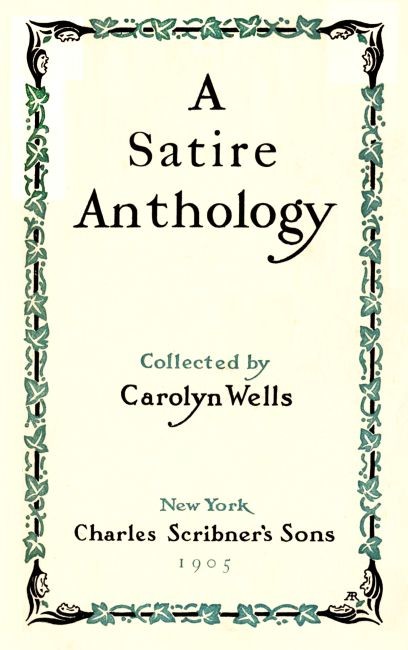
A
Satire
Anthology
Collected by
Carolyn Wells
New York
Charles Scribner’s Sons
1905
Copyright, 1905, by
CHARLES SCRIBNER’S SONS
—————
Published, October, 1905
TO
MINNIE HARPER PILLING
NOTE
Acknowledgment is hereby gratefully made to the publishers of the various poems included in this compilation.
Those by Oliver Wendell Holmes, James Russell Lowell, John G. Saxe, Edward Rowland Sill, John Hay, Bayard Taylor and Edith Thomas are published by permission of Messrs. Houghton, Mifflin & Co.
The poems by Anthony Deane and Owen Seaman are used by arrangement with John Lane.
Through the courtesy of Small, Maynard & Co., are included poems by Bliss Carman, Charlotte Perkins Stetson-Gilman, Stephen Crane, and Frederic Ridgely Torrence.
Poems by Sam Walter Foss are published by permission of Lothrop, Lee & Shepherd Co.
The Century Co. are the publishers of poems by Richard Watson Gilder and Mary Mapes Dodge.
Frederich A. Stokes Company give permission for poems by Gelett Burgess and Stephen Crane.
“The Buntling Ball,” by Edgar Fawcett is published by permission of Funk and Wagnalls Company; “Hoch der Kaiser” by Rodney Blake, by the courtesy of the New Amsterdam Book Co. The poems by James Jeffrey Roche by permission of E. H. Bacon & Co.; and “The Font in the Forest” by Herman Knickerbocker Vielé, by permission of Brentano’s.
“The Evolution of a Name,” by Charles Battell Loomis, is quoted from “Just Rhymes,” Copyright, 1899, by R. H. Russell.
“He and She,” by Eugene Fitch Ware, is published by permission of G. P. Putnam’s Sons.
[viii] [ix]
CONTENTS
PageChorus of Women
Aristophanes
3A Would-Be Literary Bore
Horace
4The Wish for Length of Life
Juvenal
6The Ass’s Legacy
Ruteboeuf
7A Ballade of Old-Time Ladies (Translated by John Payne).
François Villon
11A Carman’s Account of a Lawsuit
Sir David Lyndsay
12The Soul’s Errand
Sir Walter Raleigh
13Of a Certain Man
Sir John Harrington
16A Precise Tailor
Sir John Harrington
16The Will
John Donne
18From “King Henry IV”
William Shakespeare
20From “Love’s Labour’s Lost”
William Shakespeare
21From “As You Like It”
William Shakespeare
22Horace Concocting An Ode
Thomas Dekker
23On Don Surly
Ben Jonson
24The Scholar and His Dog
John Marston
25The Manly Heart
George Wither
26The Constant Lover
Sir John Suckling
27The Remonstrance
Sir John Suckling
28Saintship versus Conscience
Samuel Butler
29Description of Holland
Samuel Butler
30The Religion of Hudibras
Samuel Butler
31Satire on the Scots
John Cleiveland
32Song
Richard Lovelace
34The Character of Holland
Andrew Marvell
35The Duke of Buckingham
John Dryden
37On Shadwell
John Dryden
38Satire on Edward Howard
Charles Sackville, Earl of Dorset
39St. Anthony’s Sermon to the Fishes
Abraham á Sancta Clara
39Introduction to the True-Born Englishman
Daniel Defoe
41An Epitaph
Matthew Prior
43The Remedy Worse than the Disease
Matthew Prior
45Twelve Articles
Jonathan Swift
46The Furniture of a Woman’s Mind
Jonathan Swift
48From “The Love of Fame”
Edward Young
50Dr. Delany’s Villa
Thomas Sheridan
52The Quidnunckis
John Gay
54The Sick Man and the Angel
John Gay
55Sandys’ Ghost
Alexander Pope
57From “The Epistle to Dr. Arbuthnot”
Alexander Pope
60The Three Black Crows
John Byrom
63An Epitaph
George John Cayley
64An Epistle to Sir Robert Walpole
Henry Fielding
65The Public Breakfast
Christopher Anstey
67An Elegy on the Death of a Mad Dog
Oliver Goldsmith
72On Smollett
Charles Churchill
73The Uncertain Man
William Cowper
74A Faithful Picture of Ordinary Society
William Cowper
74On Johnson
John Wolcott (Peter Pindar)
75To Boswell
John Wolcott (Peter Pindar)
76The Hen
Matt. Claudius
77Let Us All be Unhappy Together
Charles Dibdin
78The Friar of Orders Gray
John O’Keefe
79The Country Squire
Tomas Yriarte
80The Eggs
Tomas Yriarte
82The Literary Lady
Richard Brinsley Sheridan
84Sly Lawyers
George Crabbe
85Reporters
George Crabbe
85Address to the Unco Guid, or the Rigidly Righteous
Robert Burns
86Holy Willie’s Prayer
Robert Burns
88Kitty of Coleraine
Edward Lysaght
91The Friend of Humanity and the Knife-Grinder
George Canning
92Nora’s Vow
Sir Walter Scott
94Job
Samuel T. Coleridge
95Cologne
Samuel T. Coleridge
96Giles’s Hope
Samuel T. Coleridge
96The Battle of Blenheim
Robert Southey
97The Well of St. Keyne
Robert Southey
99The Poet of Fashion
James Smith
101Christmas Out of Town
James Smith
103Eternal London
Thomas Moore
105The Modern Puffing System
Thomas Moore
106Lying
Thomas Moore
108The King of Yvetot (Version of W. M. Thackeray)
Pierre Jean de Béranger
109Sympathy
Reginald Heber
111A Modest Wit
Selleck Osborn
112The Philosopher’s Scales
Jane Taylor
114From “The Feast of the Poets”
James Henry Leigh Hunt
116Rich and Poor; or, Saint and Sinner
Thomas L. Peacock
117Mr. Barney Maguire’s Account of the Coronation
Richard Harris Barham
119From “The Devil’s Drive”
Lord Byron
123From “English Bards and Scotch Reviewers”
Lord Byron
125To Woman
Lord Byron
126A Country House Party
Lord Byron
127Greediness Punished
Friedrich Rückert
130Woman
Fitz-Greene Halleck
132The Rich and the Poor Man (From the Russian of Kremnitzer)
Sir John Bowring
132Ozymandias
Percy Bysshe Shelley
134Cui Bono
Thomas Carlyle
135Father-Land and Mother Tongue
Samuel Lover
135Father Molloy
Samuel Lover
136Gaffer Gray (From “Hugh Trevor”)
Thomas Holcroft
139Cockle v. Cackle
Thomas Hood
140Our Village
Thomas Hood
145The Devil at Home (From “The Devil’s Progress”)
Thomas Kibble Hervey
149How to Make a Novel
Lord Charles Neaves
150Two Characters
Henry Taylor
151The Sailor’s Consolation
William Pitt
152Verses on seeing the Speaker asleep in his Chair during One of the Debates of the First Reformed Parliament
Winthrop M. Praed
154Pelters of Pyramids
Richard Hengist Horne
155The Annuity
George Outram
156Malbrouck
Translated by Father Prout
161A Man’s Requirements
Elizabeth Barrett Browning
163Critics
Elizabeth Barrett Browning
164The Miser
Edward Fitzgerald
166Cacoëthes Scribendi
Oliver Wendell Holmes
166A Familiar Letter to Several Correspondents
Oliver Wendell Holmes
167Contentment
Oliver Wendell Holmes
171How to Make a Man of Consequence
Mark Lemon
173The Widow Malone
Charles Lever
173The Pauper’s Drive
T. Noel
175On Lytton
Alfred Tennyson
177Sorrows of Werther
William Makepeace Thackeray
178Mr. Molony’s Account of the Ball Given to the Nepaulese Ambassador by the Peninsular and Oriental Company
William Makepeace Thackeray
179Damages, Two Hundred Pounds
William Makepeace Thackeray
182The Lost Leader
Robert Browning
186The Pope and the Net
Robert Browning
188Soliloquy of the Spanish Cloister
Robert Browning
190Cynical Ode to an Ultra-Cynical Public
Charles Mackay
192The Great Critics
Charles Mackay
193The Laureate
William E. Aytoun
194Woman’s Will
John Godfrey Saxe
196The Mourner á la Mode
John Godfrey Saxe
197There is no God
Arthur Hugh Clough
199The Latest Decalogue
Arthur Hugh Clough
200From “A Fable for Critics”
James Russell Lowell
201The Pious Editor’s Creed
James Russell Lowell
206Revelry in India
Bartholomew Dowling
210A Fragment
Grace Greenwood
212Nothing to Wear
William Allen Butler
213A Review (The Inn Album, By Robert Browning)
Bayard Taylor
221The Positivists
Mortimer Collins
224Sky-Making
Mortimer Collins
226My Lord Tomnoddy
Robert Barnabas Brough
227Hiding the Skeleton
George Meredith
229Midges
Robert Bulwer Lytton
230The Schoolmaster Abroad with his Son
Charles Stuart Calverley
233Of Propriety
Charles Stuart Calverley
235Peace. A Study
Charles Stuart Calverley
236All Saints
Edmund Yates
237Fame’s Penny Trumpet
Lewis Carroll
238The Diamond Wedding
Edmund Clarence Stedman
240True to Poll
Frank C. Burnand
247Sleep On
W. S. Gilbert
249To the Terrestrial Globe, By a Miserable Wretch
W. S. Gilbert
250The Ape and the Lady
W. S. Gilbert
250Anglicised Utopia
W. S. Gilbert
252Etiquette
W. S. Gilbert
254The Æsthete
W. S. Gilbert
260Too Late
Fitz-Hugh Ludlow
261Life in Laconics
Mary Mapes Dodge
263Distiches
John Hay
264The Poet and the Critics
Austin Dobson
265The Love Letter
Austin Dobson
267Fame
James Herbert Morse
269Five Lives
Edward Rowland Sill
270He and She
Eugene Fitch Ware
272What Will We Do?
Robert J. Burdette
272The Tool
Richard Watson Gilder
273Give Me a Theme
Richard Watson Gilder
274The Poem, To the Critic
Richard Watson Gilder
274Ballade of Literary Fame
A. Lang
274Chorus of Anglomaniacs (From The Buntling Ball)
Edgar Fawcett
275The Net of Law
James Jeffrey Roche
277A Boston Lullaby
James Jeffrey Roche
277The V-A-S-E
James Jeffrey Roche
278Thursday
Frederick E. Weatherly
280A Bird in the Hand
Frederick E. Weatherly
281An Advanced Thinker
Brander Matthews
282A Thought
J. K. Stephen
283A Sonnet
J. K. Stephen
284They Said
Edith M. Thomas
284To R. K.
J. K. Stephen
286To Miguel de Cervantes Saavedra
R. K. Munkittrick
287What’s in a Name
R. K. Munkittrick
288Wed
H. C. Bunner
289Atlantic City
H. C. Bunner
290The Font in the Forest
Herman Knickerbocker Vielé
294The Origin of Sin
Samuel Walter Foss
294A Philosopher
Samuel Walter Foss
295The Fate of Pious Dan
Samuel Walter Foss
298The Meeting of the Clabberhuses
Samuel Walter Foss
300Wedded Bliss
Charlotte Perkins (Stetson) Gilman
303A Conservative
Charlotte Perkins (Stetson) Gilman
304Same Old Story
Harry B. Smith
306Hem and Haw
Bliss Carman
307The Sceptics
Bliss Carman
308The Evolution of a “Name”
Charles Battell Loomis
310“The Hurt that Honour Feels”
Owen Seaman
310John Jenkins
Anthony C. Deane
313A Certain Cure
Anthony C. Deane
316The Beauties of Nature (A Fragment from an Unpublished Epic)
Anthony C. Deane
317Paradise. A Hindoo Legend
George Birdseye
319Hoch! der Kaiser
Rodney Blake
320On a Magazine Sonnet
Russell Hilliard Loines
321Earth
Oliver Herford
321A Butterfly of Fashion
Oliver Herford
322General Summary
Rudyard Kipling
324The Conundrum of the Workshops
Rudyard Kipling
326Extracts from the Rubaiyat of Omar Cayenne
Gelett Burgess
328Ballade of Expansion
Hilda Johnson
331Friday Afternoon at the Boston Symphony Hall
Faulkner Armytage
332War is Kind
Stephen Crane
336Lines
Stephen Crane
337From “The House of a Hundred Lights”
Frederic Ridgely Torrence
340The British Visitor
From The Troliopiad
343A Match
Punch
343Wanted a Governess
Anonymous
346Lines by an Old Fogy
Anonymous
348[xvii] [xviii] [xix]
[1]
[2]
[3]
Quick, quick despatch me where I stand;
Big words? But view his figure, view his face!
To you, my lord, he left the whole.”
Manhood to lose and a cowl to wear?
Within aucht days I gat but libellandum;
Tell Faith it’s fled the city;
Tell how the country erreth;
Tell, Manhood shakes off pity;
Tell, Virtue least preferreth;
And if they do reply,
Spare not to give the lie.
And talk so like a waiting-gentlewoman
A mean most meanly; and in ushering,
With eyes severe, and beard of formal cut,
Immortal name, game, dame, tame, lame, lame, lame,
May hear my epigrams, but like of none.
What care I how good she be?
Such a constant lover.
Prov’d false again?” “Two hundred more.”
Whole towns are cast away in storms, and wreckt;
Than dog distract or monkey sick;
My muse hath done. A voyder for the nonce,
And, spread in solemn state, supinely reign.
The crabs so edified.
And downright English, Englishmen confute.
They neither wanted nor abounded.
But bubbles on the rapid stream of time,
It cannot blow for want of room.
To show his parts, bestride a twig.
Your neighbours want, and you abound.”
“Let Warwick’s muse with Ashurst join,
And Ozell’s with Lord Hervey’s;
Tickell and Addison combine,
And Pope translate with Jervas.
“Lansdowne himself, that lively lord,
Who bows to every lady,
Shall join with Frowde in one accord,
And be like Tate and Brady.
“Not, sir, if you revise it, and retouch.”
Though, in regard to number, not exact;
Should call me to negotiation,
Around from all the neighbouring streets
The wondering neighbours ran,
And swore the dog had lost his wits
To bite so good a man.
Poetry may, but colours cannot, paint—
A goose’s feather or exalt a straw;
And that joy is your true melancholy;
From bulky folios down to slender twelves,
The choicest tomes in many an even row,
Display’d their letter’d backs upon the shelves,
A goodly show.
With such a stock, which seemingly surpass’d
The best collection ever form’d in Spain,
What wonder if the owner grew at last
Supremely vain?
How far, perhaps, they rue it
An’ pish’d wi’ dread,
You’re sent as a plague to the girls of Coleraine!”
With politics, sir.”
“A maiden’s vows,” old Callum spoke,
“Are lightly made and lightly broke.
The heather on the mountain’s height
Begins to bloom in purple light;
The frost-wind soon shall sweep away
That lustre deep from glen and brae;
Yet Nora, ere its bloom be gone,
May blithely wed the Earlie’s son.”
And loves to disappoint the devil,
After the field was won,
Drank of this crystal well,
Bucklersbury now seeks what St. James’ once sought,
Will leave their puddings and coal fires,
So long the blissful bond endures;
Famed in the country for good wine.
They gazed at each other, the maid and the knight;
How fair was her form, and how goodly his height!
“One mournful embrace,” sobb’d the youth, “ere we die!”
So kissing and crying kept company.
When a bee chanced to light on the opposite scale;
And thank him with smiles for that sweet, pretty poem!
With its hollow cheeks, and eyes half shut,
Combined usurpers on the throne of taste;
When hope is fled, and passion’s over!
Small is the rest of those who would be smart.
They might have been contented!
A rich man burst the door—
As Crœsus rich, I’m sure;
He could not pride himself upon his wit
Nor wisdom, for he had not got a bit:
He had what’s better—he had wealth.
What a confusion! All stand up erect!
These crowd around to ask him of his health;
These bow in honest duty and respect;
And these arrange a sofa or a chair,
And these conduct him there.
“Allow me, sir, the honour;” then a bow
Down to the earth. Is’t possible to show
Meet gratitude for such kind condescension?
The poor man hung his head,
And to himself he said,
“This is indeed beyond my comprehension.”
Then looking round,
One friendly face he found,
And said, “Pray tell me, why is wealth preferred
To wisdom?” “That’s a silly question, friend,”
Replied the other; “have you never heard,
A man may lend his store
Of gold or silver ore,
But wisdom none can borrow, none can lend?”
Sir John Bowring.
(From the Russian of Kremnitzer.)
Do call our country “Father-land.”
Warmly fenced both in back and in front.
As venom’d dart from Indian’s hollow cane,
Before the angels’ faces;
Down into a well, lady, thrust your lover;
Truth, as some folks tell, there he may discover;
Step-dames, sure though slow, rivals of your daughters.
Bring, as from below, Styx and all its waters.
Crime that breaks all bounds, bigamy and arson,
Poison, blood, and wounds, will carry well the farce on;
Now it’s just in shape; yet, with fire and murder,
Treason, too, and rape might help it all the further.
But never solving questions. Vain he is;
Of the House on a question of sixteen pence;
With stupid stare, until resentment grew,
When I murmur, Love me!
To the critics, by publishing, as you propose.
I shall not miss them much—
“Oh,” says he, “you’re my Molly Malone!”
He’s only a pauper, whom nobody owns.
If half the little soul is dirt? . . .
And the happy land of England, where true justice does abound!
One sure, if another fails.
Brute of a public!
We’ll praise the dead!
Teasingly, sneezingly.
And metaphor—warranted new:
And do not think about it.
Advantage rarely comes of it.
Of the soul shall sing no more?
As I stood
Interjections, verbs, pronouns, till language quite failed
Writes i’ the Album, goes without and waits.
Then he was Man, and a Positivist.
Why not two laughing lips?
Her Majesty’s councils his words will grace.
And my foolish heart went after him, and, lo! I blessed him as he rose.
Heard children’s voices on the sands;
IN a church which is furnish’d with mullion and gable,
With altar and reredos, with gargoyle and groin,
The penitents’ dresses are sealskin and sable,
The odour of sanctity’s eau-de-Cologne.
But only could Lucifer, flying from Hades,
Gaze down on this crowd with its panniers and paints,
He would say, as he look’d at the lords and the ladies,
“Oh, where is All-Sinners’, if this is All-Saints’?”
Edmund Yates.
And when the topmost height ye gain,
And stand in glory’s ether clear,
And grasp the prize of all your pain—
So many hundred pounds a year—
Then let Fame’s banner be unfurled!
Sing pæans for a victory won!
Ye tapers, that would light the world,
And cast a shadow on the Sun;
Whose robes are now the wide world’s wonder
Like them an Earl of Thackeray, and p’r’aps a Duke of Dickens—
Be eloquent in praise of the very dull old days which have long since passed away,
And convince ’em, if you can, that the reign of good Queen Anne was Culture’s palmiest day.
Of course you will pooh-pooh whatever’s fresh and new, and declare it’s crude and mean,
And that Art stopped short in the cultivated court of the Empress Josephine.
And every one will say,
As you walk your mystic way,
“If that’s not good enough for him which is good enough for me,
Why, what a very cultivated kind of youth this kind of youth must be!”
Then a sentimental passion of a vegetable fashion must excite your languid spleen,
An attachment à la Plato for a bashful young potato, or a not-too-French French bean.
Though the Philistines may jostle, you will rank as an apostle in the high æsthetic band,
If you walk down Piccadilly with a poppy or a lily in your mediæval hand.
And every one will say,
As you walk your flowery way,
“If he’s content with a vegetable love, which would certainly not suit me,
Why, what a most particularly pure young man this pure young man must be!”
W. S. Gilbert.
Two spoons, love, a basin of pottage!
And your heirs will ere long be contesting your will.
Men for a title to-day crawl to the feet of a king.
Or much what B. had said of rhyme.
To keep your life”—(and balance at your banker’s).
And a fairy figure dances.
Was lost to the frog that goggled from his stone;
Oh, what will we do when the good time comes?
They are all in the Fourpenny Box!
With a sneer at the republic we obey!
Bids my darling close his eyes
Abbot and monks disconsolate;
And they had lovers three times three
The woman’s anguish, and the baby’s chatter—
How tedious must thy service be;
And an unmelodious verse?—
His “Portrait of a Child,”
Is mingled with malt; where each man smokes;
He never tried to render less;
An’ kinder git his stomach fed,
Must ever interrupt my prayers.”
You know nothing but your shell.”
Same old plots I played with in my happy childhood’s days;
They yammered and went it blind.
-niversal!
To preach it, in season and out,
Myself—mit Gott!
Beggars, millionaires, and mice,
Real Roses are quite out of date.”
When the flicker of London Sun falls faint on the Club-room’s green and gold,
The sons of Adam sit them down and scratch with their pens in the mould;
They scratch with their pens in the mould of their graves, and the ink and the anguish start,
For the Devil mutters behind the leaves, “It’s pretty, but is it Art?”
Now, if we could win to the Eden Tree where the Four Great Rivers flow,
And the Wreath of Eve is red on the turf as she left it long ago,
And if we could come when the sentry slept and softly scurry through,
By the favour of God we might know as much—as our father Adam knew!
Rudyard Kipling.
Himself, before he Meed of Praise refuse!
Relentless fire his cause shall speed.
And when the concert’s o’er, we’ll go where Huyler serves his best vanilla;
Eagle with crest of red and gold,
And I were like “decay.”
INTRODUCTION
SATIRE, though a form of literature familiar to everyone, is difficult to define. Partaking variously of sarcasm, irony, ridicule, and burlesque, it is exactly synonymous with no one of these.
Satire is primarily dependent on the motive of its writer. Unless meant for satire, it is not the real thing; unconscious satire is a contradiction of terms, or a mere figure of speech.
Secondarily, satire depends on the reader. What seems to us satire to-day, may not seem so to-morrow. Or, what seems satire to a pessimistic mind, may seem merely good-natured chaff to an optimist.
This, of course, refers to the subtler forms of satire. Many classic satires are direct lampoons or broadsides which admit of only one interpretation.
Literature numbers many satirists among its most honoured names; and the best satires show intellect, education, and a keen appreciation of human nature.
Nor is satire necessarily vindictive or spiteful. Often its best examples show a kindly tolerance for the vice or folly in question, and even hint a tacit acceptance of the conditions condemned. Again, in the hands of a carping and unsympathetic critic, satire is used with vitriolic effects on sins for which the writer has no mercy.
This lashing form of satire was doubtless the earliest type. The Greeks show sardonic examples of it, but the Romans allowed a broader sense of humour to soften the satirical sting.
Following and outstripping Lucilius, Horace is the acknowledged father of satire, and was himself followed, and, in the opinion of some, outstripped by Juvenal.
But the works of the ancient satirists are of interest mainly to scholars, and cannot be included in a collection destined for a popular audience. The present volume, therefore, is largely made up from the products of more recent centuries.
From the times of Horace and Juvenal, down through the mediæval ages to the present day, satires may be divided into the two classes founded by the two great masters: the work of Horace’s followers marked by humour and tolerance, that of Juvenal’s imitators by bitter invective. On the one side, the years have arrayed such names as Chaucer, Swift, Goldsmith, and Thackeray; on the other, Langland, Dryden, Pope, and Burns.
A scholarly gentleman of our own day classifies satires in three main divisions: those directed at society, those which ridicule political conditions, and those aimed at individual characters.
These variations of the art of satire form a fascinating study, and to one interested in the subject, this small collection of representative satires can be merely a series of guide-posts.
It is the compiler’s regret that a great mass of material is necessarily omitted for lack of space; other selections are discarded because of their present untimeliness, which deprives them of their intrinsic interest. But an endeavour has been made to represent the greatest and best satiric writers, and also to include at least extracts from the masterpieces of satire.
It is often asked why we have no satire at the present day. Many answers have been given, but one reason is doubtless to be found in the acceleration of the pace of life; fads and foibles follow one another so quickly, that we have time neither to write nor read satiric disquisitions upon them.
Another reason lies in the fact that we have achieved a broader and more tolerant human outlook.
Again, the true satirist must be possessed of earnestness and sincerity. And it is a question whether the mental atmosphere of the twentieth century tends to stimulate and foster those qualities.
These explanations, however, seem to apply to American writers more especially than to English.
The leisurely thinking Briton, with his more personal viewpoint, has produced, and is even now producing, satires marked by strength, honesty, and literary value.
But America is not entirely unrepresented. The work of James Russell Lowell cannot suffer by comparison with that of any contemporary English author; and, though now forgotten because dependent on local and timely interest, many political satires written by Americans during the early part of the nineteenth century show clever and ingenious work founded on a comprehensive knowledge of the truth.
Yet, though the immediate present is not producing masterpieces of satire, the lack is partially made up by the large quantity of really meritorious work that is being done in a satirical vein. In this country and in England are young and middle-aged writers who show evidences of satiric power, which, though it does not make for fame and glory, is yet not without its value.
[1] [2] [3]
A SATIRE ANTHOLOGY
CHORUS OF WOMEN
(From the “Thesmophoriazusæ.”)
THEY’RE always abusing the women,
As a terrible plague to men;
They say we’re the root of all evil,
And repeat it again and again—
Of war, and quarrels, and bloodshed,
All mischief, be what it may.
And pray, then, why do you marry us,
If we’re all the plagues you say?
And why do you take such care of us,
And keep us so safe at home,
And are never easy a moment
If ever we chance to roam?
When you ought to be thanking Heaven
That your plague is out of the way,
You all keep fussing and fretting—
“Where is my Plague to-day?”
If a Plague peeps out of the window,
Up go the eyes of men;
If she hides, then they all keep staring
Until she looks out again.
Aristophanes.
A WOULD-BE LITERARY BORE
IT chanced that I, the other day,
Was sauntering up the Sacred Way,
And musing, as my habit is,
Some trivial random fantasies,
When there comes rushing up a wight
Whom only by his name I knew.
“Ha! my dear fellow, how d’ye do?”
Grasping my hand, he shouted. “Why,
As times go, pretty well,” said I;
“And you, I trust, can say the same.”
But after me as still he came,
“Sir, is there anything,” I cried,
“You want of me?” “Oh,” he replied,
“I’m just the man you ought to know:
A scholar, author!” “Is it so?
For this I’ll like you all the more!”
Then, writhing to escape the bore,
I’ll quicken now my pace, now stop,
And in my servant’s ear let drop
Some words; and all the while I feel
Bathed in cold sweat from head to heel.
“Oh, for a touch,” I moaned in pain,
“Bolanus, of the madcap vein,
To put this incubus to rout!”
As he went chattering on about
Whatever he describes or meets—
The city’s growth, its splendour, size.
“You’re dying to be off,” he cries
(For all the while I’d been stock dumb);
“I’ve seen it this half-hour. But come,
Let’s clearly understand each other;
It’s no use making all this pother.
My mind’s made up to stick by you;
So where you go, there I go too.”
“Don’t put yourself,” I answered, “pray,
So very far out of your way.
I’m on the road to see a friend
Whom you don’t know, that’s near his end,
Away beyond the Tiber far,
Close by where Cæsar’s gardens are.”
“I’ve nothing in the world to do,
And what’s a paltry mile or two?
I like it: so I’ll follow you!”
Down dropped my ears on hearing this,
Just like a vicious jackass’s,
That’s loaded heavier than he likes,
But off anew my torment strikes:
“If well I know myself, you’ll end
With making of me more a friend
Than Viscus, ay, or Varius; for,
Of verses, who can run off more,
Or run them off at such a pace?
Who dance with such distinguished grace?
And as for singing, zounds!” says he,
“Hermogenes might envy me!”
Here was an opening to break in:
“Have you a mother, father, kin,
To whom your life is precious?” “None;
I’ve closed the eyes of everyone.”
Oh, happy they, I inly groan;
Now I am left, and I alone.
Quick, quick despatch me where I stand;
Now is the direful doom at hand,
Which erst the Sabine beldam old,
Shaking her magic urn, foretold
In days when I was yet a boy:
“Him shall no poison fell destroy,
Nor hostile sword in shock of war,
Nor gout, nor colic, nor catarrh.
In fulness of time his thread
Shall by a prate-apace be shred;
So let him, when he’s twenty-one,
If he be wise, all babblers shun.”
Quintus Horatius Flaccus Horace.
THE WISH FOR LENGTH OF LIFE
PRODUCE the urn that Hannibal contains,
And weigh the mighty dust that yet remains.
And this is all? Yet this was once the bold,
The aspiring chief, whom Attic could not hold.
Afric, outstretched from where the Atlantic roars
To Nilus; from the Line to Libya’s shores.
Spain conquered, o’er the Pyrenees he bounds.
Nature opposed her everlasting mounds,
Her Alps and snows. O’er these with torrent force
He pours, and rends through rocks his dreadful course.
Yet thundering on, “Think nothing done,” he cries,
“Till o’er Rome’s prostrate walls I lead my powers,
And plant my standard on her hated towers!”
Big words? But view his figure, view his face!
Ah, for some master hand the lines to trace,
As through the Etrurian swamps, by floods increased,
The one-eyed chief urged his Getulian beast!
But what ensued? Illusive glory, say:
Subdued on Zama’s memorable day,
He flies in exile to a petty state,
With headlong haste, and at a despot’s gate
Sits, mighty suppliant—of his life in doubt,
Till the Bithynian’s morning nap be out.
Nor swords, nor spears, nor stones from engines hurled,
Shall quell the man whose frowns alarmed the world.
The vengeance due to Cannæ’s fatal field,
And floods of human gore, a ring shall yield!
Go, madman, go! at toil and danger mock,
Pierce the deep snow, and scale the eternal rock,
To please the rhetoricians, and become
A declamation for the boys of Rome.
Juvenal.
THE ASS’S LEGACY
A PRIEST there was, in times of old,
Fond of his church, but fonder of his gold,
Who spent his days, and all his thought,
In getting what he preached was naught.
His chests were full of robes and stuff;
Corn filled his garners to the roof,
Stored up against the fair-times gay
From St. Rémy to Easter day.
An ass he had within his stable,
A beast most sound and valuable;
For twenty years he lent his strength
For the priest, his master, till at length,
Worn out with work and age, he died.
The priest, who loved him, wept and cried;
And, for his service long and hard,
Buried him in his own churchyard.
Now turn we to another thing:
’Tis of a bishop that I sing.
No greedy miser he, I ween;
Prelate so generous ne’er was seen.
Full well he loved in company
Of all good Christians still to be;
When he was well, his pleasure still;
His medicine best when he was ill.
Always his hall was full, and there
His guests had ever best of fare.
Whate’er the bishop lacked or lost,
Was bought at once, despite the cost.
And so, in spite of vent and score,
The bishop’s debts grew more and more.
For true it is—this ne’er forget—
Who spends too much gets into debt.
One day his friends all with him sat,
The bishop talking this and that,
Till the discourse on rich clerks ran,
Of greedy priests, and how their plan
Was all good bishops still to grieve,
And of their dues their lords deceive.
And then the priest of whom I’ve told
Was mentioned—how he loved his gold.
And, because men do often use
More freedom than the truth would choose,
They gave him wealth, and wealth so much,
As those like him could scarcely touch.
“And then, besides, a thing he’s done
By which great profit might be won,
Could it be only spoken here.”
Quoth the bishop, “Tell it without fear.”
“He’s worse, my lord, than Bedouin,
Because his own dead ass, Baldwin,
He buried in the sacred ground.”
“If this is truth, as shall be found,”
The bishop cried, “a forfeit high
Will on his worldly riches lie.
Summon this wicked priest to me;
I will myself in this case be
The judge. If Robert’s word be true,
Mine are the fine, and forfeit too.”
“Disloyal! God’s enemy and mine,
Prepare to pay a heavy fine.
Thy ass thou buriest in the place
Sacred by church. Now, by God’s grace,
I never heard of crime more great.
What! Christian men with asses wait!
Now, if this thing be proven, know
Surely to prison thou wilt go.”
“Sir,” said the priest, “thy patience grant;
A short delay is all I want.
Not that I fear to answer now,
But give me what the laws allow.”
And so the bishop leaves the priest,
Who does not feel as if at feast;
But still, because one friend remains,
He trembles not at prison pains.
His purse it is which never fails
For tax or forfeit, fine or vails.
The term arrived, the priest appeared,
And met the bishop, nothing feared;
For ’neath his girdle safe there hung
A leathern purse, well stocked and strung
With twenty pieces fresh and bright,
Good money all, none clipped or light.
“Priest,” said the bishop, “if thou have
Answer to give to charge so grave,
’Tis now the time.”
“Sir, grant me leave
My answer secretly to give.
Let me confess to you alone,
And, if needs be, my sins atone.”
The bishop bent his head to hear;
The priest he whispered in his ear:
“Sir, spare a tedious tale to tell.
My poor ass served me long and well.
For twenty years my faithful slave;
Each year his work a saving gave
Of twenty sous, so that, in all,
To twenty livres the sum will fall;
And, for the safety of his soul,
To you, my lord, he left the whole.”
“’Twas rightly done,” the bishop said.
And gravely shook his godly head;
“And that his soul to heaven may go,
My absolution I bestow.”
Now have you heard a truthful lay,
How with rich priests the bishops play;
And Rutebœuf the moral draws
That, spite of kings’ and bishops’ laws,
No evil times has he to dread
Who still has silver at his need.
Rutebœuf.
A BALLADE OF OLD-TIME LADIES
(Translated by John Payne.)
TELL me, where, in what land of shade,
Hides fair Flora of Rome? and where
Are Thaìs and Archipiade,
Cousins-german in beauty rare?
And Echo, more than mortal fair,
That when one calls by river flow,
Or marish, answers out of the air?
But what has become of last year’s snow?
Where did the learn’d Héloïsa vade,
For whose sake Abelard did not spare
(Such dole for love on him was laid)
Manhood to lose and a cowl to wear?
And where is the queen who will’d whilere
That Buridan, tied in a sack, should go
Floating down Seine from the turret-stair?
But what has become of last year’s snow?
Blanche, too, the lily-white queen, that made
Sweet music as if she a siren were?
Broad-foot Bertha? and Joan, the maid,
The good Lorrainer the English bare
Captive to Rouen, and burn’d her there?
Beatrix, Eremburge, Alys—lo!
Where are they, virgins debonair?
But what has become of last year’s snow?
Envoi
Prince, you may question how they fare,
This week, or liefer this year, I trow:
Still shall this burden the answer bear—
But what has become of last year’s snow?
François Villon.
A CARMAN’S ACCOUNT OF A LAWSUIT
MARRY, I lent my gossip my mare, to fetch hame coals,
And he her drounit into the quarry holes;
And I ran to the consistory, for to pleinyie,
And there I happenit amang ane greedie meinyie.
They gave me first ane thing they call citandum,
Within aucht days I gat but libellandum;
Within ane month I gat ad opponendum;
In half ane year I gat inter-loquendum;
And syne I gat—how call ye it?—ad replicandum;
Bot I could never ane word yet understand him:
And then they gart me cast out mony placks,
And gart me pay for four-and-twenty acts.
Bot or they came half gate to concludendum,
The fiend ane plack was left for to defend him.
Thus they postponed me twa year with their train,
Syne, hodie ad octo, bade me come again;
And then their rooks they rowpit wonder fast
For sentence, silver, they cryit at the last.
Of pronunciandum they made me wonder fain,
Bot I gat never my gude gray mare again.
Sir David Lyndsay.
THE SOUL’S ERRAND
GO, Soul, the body’s guest,
Upon a thankless errand;
Fear not to touch the best;
The truth shall be thy warrant.
Go, since I needs must die,
And give them all the lie.
Go tell the Court it glows
And shines like rotten wood;
Go tell the Church it shows
What’s good, but does no good.
If Court and Church reply,
Give Court and Church the lie.
Tell Potentates they live
Acting, but oh! their actions;
Not loved, unless they give,
Not strong but by their factions.
If Potentates reply,
Give Potentates the lie.
Tell men of high condition,
That rule affairs of state,
Their purpose is ambition;
Their practice only hate;
And if they do reply,
Then give them all the lie.
Tell those that brave it most,
They beg for more by spending,
Who in their greatest cost
Seek nothing but commending;
And if they make reply,
Spare not to give the lie.
Tell Zeal it lacks devotion;
Tell Love it is but lust;
Tell Time it is but motion;
Tell Flesh it is but dust;
And wish them not reply,
For thou must give the lie.
Tell Age it daily wasteth;
Tell Honour how it alters;
Tell Beauty how it blasteth;
Tell Favour that she falters;
And as they do reply,
Give every one the lie.
Tell Wit how much it wrangles
In fickle points of niceness;
Tell Wisdom she entangles
Herself in overwiseness;
And if they do reply,
Then give them both the lie.
Tell Physic of her boldness;
Tell Skill it is pretension;
Tell Charity of coldness;
Tell Law it is contention;
And if they yield reply,
Then give them all the lie.
Tell Fortune of her blindness;
Tell Nature of decay;
Tell Friendship of unkindness;
Tell Justice of delay;
And if they do reply,
Then give them still the lie.
Tell Arts they have no soundness,
But vary by esteeming;
Tell Schools they lack profoundness,
And stand too much on seeming.
If Arts and Schools reply,
Give Arts and Schools the lie.
Tell Faith it’s fled the city;
Tell how the country erreth;
Tell, Manhood shakes off pity;
Tell, Virtue least preferreth;
And if they do reply,
Spare not to give the lie.
So, when thou hast, as I
Commanded thee, done blabbing,
Although to give the lie
Deserves no less than stabbing,
Yet stab at thee who will,
No stab the Soul can kill!
Sir Walter Raleigh.
OF A CERTAIN MAN
THERE was (not certain when) a certain preacher
That never learned, and yet became a teacher,
Who, having read in Latin thus a text
Of erat quidam homo, much perplexed,
He seemed the same with study great to scan,
In English thus, There was a certain man.
“But now,” quoth he, “good people, note you this,
He said there was: he doth not say there is;
For in these days of ours it is most plain
Of promise, oath, word, deed, no man’s certain;
Yet by my text you see it comes to pass
That surely once a certain man there was;
But yet, I think, in all your Bible no man
Can find this text, There was a certain woman.”
Sir John Harrington.
A PRECISE TAILOR
A TAILOR, thought a man of upright dealing—
True, but for lying, honest, but for stealing—
Did fall one day extremely sick by chance,
And on the sudden was in wondrous trance;
The fiends of hell mustering in fearful manner,
Of sundry colour’d silks display’d a banner
Which he had stolen, and wish’d, as they did tell,
That he might find it all one day in hell.
The man, affrighted with this apparition,
Upon recovery grew a great precisian:
He bought a Bible of the best translation,
And in his life he show’d great reformation;
He walkéd mannerly, he talkéd meekly,
He heard three lectures and two sermons weekly;
He vow’d to shun all company unruly,
And in his speech he used no oath but truly;
And zealously to keep the Sabbath’s rest,
His meat for that day on the eve was drest;
And lest the custom which he had to steal
Might cause him sometimes to forget his zeal,
He gives his journeyman a special charge,
That if the stuff, allowance being large,
He found his fingers were to filch inclined,
Bid him to have the banner in his mind.
This done (I scant can tell the rest for laughter),
A captain of a ship came, three days after,
And brought three yards of velvet and three-quarters,
To make Venetians down below the garters.
He, that precisely knew what was enough,
Soon slipt aside three-quarters of the stuff.
His man, espying it, said in derision,
“Master, remember how you saw the vision!”
“Peace, knave!” quoth he, “I did not see one rag
Of such a colour’d silk in all the flag.”
Sir John Harrington.
THE WILL
BEFORE I sigh my last gasp, let me breathe,
Great Love, some legacies: Here I bequeathe
Mine eyes to Argus, if mine eyes can see;
If they be blind, then, Love, I give them thee;
My tongue to fame; to embassadors mine ears;
To women or the sea, my tears.
Thou, Love, hast taught me heretofore,
By making me serve her who had twenty more,
That I should give to none but such as had too much before.
My constancy I to the planets give;
My truth to them who at the court do live;
My ingenuity and openness
To Jesuits; to buffoons my pensiveness;
My silence to any who abroad have been;
My money to a Capuchin.
Thou, Love, taught’st me, by appointing me
To love there where no love received can be,
Only to give to such as have an incapacity.
My faith I give to Roman Catholics;
All my good works unto the schismatics
Of Amsterdam; my best civility
And courtship to a university;
My modesty I give to soldiers bare;
My patience let gamesters share.
Thou, Love, taught’st me, by making me
Love her that holds my love disparity,
Only to give to those that count my gifts indignity.
I give my reputation to those
Which were my friends; mine industry to foes;
To schoolmen I bequeathe my doubtfulness;
My sickness to physicians, or excess;
To Nature all that I in rhyme have writ;
And to my company my wit.
Thou, Love, by making me adore
Her who begot this love in me before,
Taught’st me to make as though I gave, when I do but restore.
To him for whom the passing bell next tolls
I give my physic-books; my written rolls
Of moral counsel I to Bedlam give;
My brazen medals unto them which live
In want of bread; to them which pass among
All foreigners, mine English tongue.
Thou, Love, by making me love one
Who thinks her friendship a fit portion
For younger lovers, dost my gifts thus disproportion.
Therefore I’ll give no more, but I’ll undo
The world by dying, because love dies too.
Then all your beauties will no more be worth
Than gold in mines where none doth draw it forth;
And all your graces no more use shall have
Than a sundial in a grave.
Thou, Love, taught’st me, by making me
Love her who doth neglect both thee and me,
To invent and practise this one way to annihilate all three.
John Donne.
SHAKESPEAREAN SATIRE
FROM “KING HENRY IV”
MY liege, I did deny no prisoners;
But I remember, when the fight was done,
When I was dry with rage and extreme toil,
Breathless and faint, leaning upon my sword,
Came there a certain lord, neat, trimly dress’d,
Fresh as a bridegroom; and his chin, new reap’d,
Show’d like a stubble-land at harvest-home.
He was perfuméd like a milliner,
And ’twixt his finger and his thumb he held
A pouncet-box, which ever and anon
He gave his nose and took ’t away again;
Who, therewith angry, when it next came there,
Took it in snuff: and still he smil’d and talk’d,
And as the soldiers bore dead bodies by,
He call’d them untaught knaves, unmannerly,
To bring a slovenly, unhandsome corse
Betwixt the wind and his nobility.
With many holiday and lady terms
He question’d me; among the rest, demanded
My prisoners in your Majesty’s behalf.
I then, all smarting with my wounds being cold,
To be so pester’d with a popinjay,
Out of my grief and my impatience,
Answer’d neglectingly I know not what,
He should, or he should not; for he made me mad
To see him shine so brisk, and smell so sweet,
And talk so like a waiting-gentlewoman
Of guns and drums and wounds—God save the mark!—
And telling me the sovereign’st thing on earth
Was parmaceti for an inward bruise;
And that it was great pity, so it was,
This villainous saltpetre should be digg’d
Out of the bowels of the harmless earth,
Which many a good tall fellow had destroy’d
So cowardly; and but for these vile guns,
He would himself have been a soldier.
This bald, unjointed chat of his, my lord,
I answer’d indirectly, as I said;
And I beseech you, let not this report
Come current for an accusation
Betwixt my love and your high Majesty.
Shakespeare.
FROM “LOVE’S LABOUR’S LOST”
THIS fellow pecks up wit, as pigeons pease,
And utters it again when God doth please.
He is wit’s pedler, and retails his wares
At wakes and wassails, meetings, markets, fairs;
And we that sell by gross, the Lord doth know,
Have not the grace to grace it with such show.
This gallant pins the wenches on his sleeve;
Had he been Adam, he had tempted Eve.
He can carve, too, and lisp; why, this is he
That kiss’d his hand away in courtesy;
This is the ape of form, monsieur the nice,
That, when he plays at table, chides the dice
In honourable terms; nay, he can sing
A mean most meanly; and in ushering,
Mend him who can: the ladies call him sweet;
The stairs, as he treads on them, kiss his feet.
This is the flower that smiles on every one,
To show his teeth as white as whale’s bone;
And consciences that will not die in debt
Pay him the due of honey-tongued Boyet.
......
See where it comes!—Behaviour, what wert thou
Till this man show’d thee? and what art thou now?
Shakespeare.
FROM “AS YOU LIKE IT”
ALL the world’s a stage,
And all the men and women merely players:
They have their exits, and their entrances;
And one man in his time plays many parts,
His acts being seven ages. At first the infant,
Mewling and puking in the nurse’s arms:
Then the whining schoolboy, with his satchel,
And shining morning face, creeping like snail
Unwillingly to school: And then the lover,
Sighing like furnace, with a woful ballad
Made to his mistress’ eyebrow: Then a soldier,
Full of strange oaths, and bearded like the pard,
Jealous in honour, sudden and quick in quarrel,
Seeking the bubble reputation
Even in the cannon’s mouth: And then the justice,
In fair round belly with good capon lin’d,
With eyes severe, and beard of formal cut,
Full of wise saws and modern instances;
And so he plays his part: The sixth age shifts
Into the lean and slipper’d pantaloon,
With spectacles on nose, and pouch on side;
His youthful hose well sav’d, a world too wide
For his shrunk shank; and his big manly voice,
Turning again toward childish treble, pipes
And whistles in his sound: Last scene of all,
That ends this strange eventful history,
Is second childishness and mere oblivion,
Sans teeth, sans eyes, sans taste, sans everything.
Shakespeare.
HORACE CONCOCTING AN ODE
TO thee, whose forehead swells with roses,
Whose most haunted bower
Gives life and scent to every flower,
Whose most adoréd name encloses
Things abstruse, deep, and divine;
Whose yellow tresses shine
Bright as Eoan fire:
Oh, me thy priest inspire!
For I to thee and thine immortal name,
In—in—in golden tunes,
For I to thee and thine immortal name—
In—sacred raptures flowing, flowing, swimming, swimming:
In sacred raptures swimming,
Immortal name, game, dame, tame, lame, lame, lame,
(Foh) hath, shame, proclaim, oh—
In sacred raptures flowing, will proclaim. (No!)
Oh, me thy priest inspire!
For I to thee and thine immortal name,
In flowing numbers filled with spright and flame,
(Good! good!)
In flowing numbers filled with spright and flame.
Thomas Dekker.
ON DON SURLY
DON SURLY, to aspire the glorious name
Of a great man, and to be thought the same,
Makes serious use of all great trade he knows.
He speaks to men with a rhinocerote’s nose,
Which he thinks great; and so reads verses too;
And that is done as he saw great men do.
He has tympanies of business in his face,
And can forget men’s names with a great grace.
He will both argue and discourse in oaths,
Both which are great, and laugh at ill-made clothes;
That’s greater yet, to cry his own up neat.
He doth, at meals, alone his pheasant eat,
Which is main greatness; and at his still board
He drinks to no man: that’s, too, like a lord.
He keeps another’s wife, which is a spice
Of solemn greatness; and he dares, at dice,
Blaspheme God greatly; or some poor hind beat,
That breathes in his dog’s way: and this is great.
Nay, more, for greatness’ sake he will be one
May hear my epigrams, but like of none.
Surly, use other arts; these only can
Style thee a most great fool, but no great man.
Ben Jonson.
THE SCHOLAR AND HIS DOG
I WAS a scholar: seven useful springs
Did I deflower in quotations
Of cross’d opinions ’bout the soul of man;
The more I learnt, the more I learnt to doubt.
Delight my spaniel slept, whilst I baus’d leaves,
Toss’d o’er the dunces, pored on the old print
Of titled words: and still my spaniel slept.
Whilst I wasted lamp-oil, baited my flesh,
Shrunk up my veins: and still my spaniel slept.
And still I held converse with Zabarell,
Aquinas, Scotus, and the musty saw
Of antick Donate: still my spaniel slept.
Still on went I; first, an sit anima;
Then, an it were mortal. Oh, hold, hold! at that
They’re at brain buffets, fell by the ears amain
Pell-mell together; still my spaniel slept.
Then, whether ’t were corporeal, local, fixt,
Ex traduce, but whether ’t had free will
Or no, hot philosphers
Stood banding factions, all so strongly propt,
I stagger’d, knew not which was firmer part,
But thought, quoted, read, observ’d, and pryed,
Stufft noting-books: and still my spaniel slept.
At length he wak’d, and yawned; and by yon sky,
For aught I know he knew as much as I.
John Marston.
THE MANLY HEART
SHALL I, wasting in despair,
Die because a woman’s fair?
Or my cheeks make pale with care
’Cause another’s rosy are?
Be she fairer than the day,
Or the flowery meads in May,
If she be not so to me,
What care I how fair she be?
Shall my foolish heart be pined
’Cause I see a woman kind;
Or a well-disposéd nature
Joinéd with a lovely feature?
Be she meeker, kinder, than
Turtle-dove or pelican,
If she be not so to me,
What care I how kind she be?
Shall a woman’s virtues move
Me to perish for her love?
Or her merit’s value known
Make me quite forget my own?
Be she with that goodness blest
Which may gain her name of Best,
If she seem not such to me,
What care I how good she be?
’Cause her fortune seems too high,
Shall I play the fool and die?
Those that bear a noble mind
Where they want of riches find,
Think what with them they would do
Who without them dare to woo;
And unless that mind I see,
What care I though great she be?
Great or good, or kind or fair,
I will ne’er the more despair;
If she loves me, this believe,
I will die ere she shall grieve;
If she slight me when I woo,
I can scorn and let her go;
For if she be not for me,
What care I for whom she be?
George Wither.
THE CONSTANT LOVER
OUT upon it! I have loved
Three whole days together,
And am like to love three more,
If it prove fair weather.
Time shall moult away his wings
Ere he shall discover
In the whole wide world again
Such a constant lover.
But the spite on ’t is, no praise
Is due at all to me:
Love with me had made no stays,
Had it any been but she.
Had it any been but she,
And that very face,
There had been at least ere this
A dozen dozen in her place.
Sir John Suckling.
THE REMONSTRANCE
WHY so pale and wan, fond lover?
Prithee, why so pale?
Will, when looking well can’t move her,
Looking ill prevail?
Prithee, why so pale?
Why so dull and mute, young sinner?
Prithee, why so mute?
Will, when speaking well can’t win her,
Saying nothing do’t?
Prithee, why so mute?
Quit, quit, for shame! this will not move,
This cannot take her;
If of herself she will not love,
Nothing can make her:
The devil take her!
Sir John Suckling.
SAINTSHIP VERSUS CONSCIENCE
“WHY didst thou choose that cursed sin,
Hypocrisy, to set up in?”
“Because it is the thriving’st calling,
The only saints’ bell that rings all in;
In which all churches are concern’d,
And is the easiest to be learn’d.”
......
Quoth he, “I am resolv’d to be
Thy scholar in this mystery;
And therefore first desire to know
Some principles on which you go.
What makes a knave a child of God,
And one of us?” “A livelihood.”
“What renders beating out of brains,
And murder, godliness?” “Great gains.”
“What’s tender conscience?” “’Tis a botch
That will not bear the gentlest touch;
But, breaking out, despatches more
Than th’ epidemical’st plague-sore.”
“What makes y’ encroach upon our trade,
And damn all others?” “To be paid.”
“What’s orthodox and true believing,
Against a conscience?” “A good living.”
“What makes rebelling against kings
A good old cause?” “Administ’rings.”
“What makes all doctrines plain and clear?”
“About two hundred pounds a year.”
“And that which was prov’d true before,
Prov’d false again?” “Two hundred more.”
“What makes the breaking of all oaths
A holy duty?” “Food and clothes.”
“What, laws and freedom, persecution?”
“Being out of power and contribution.”
“What makes a church a den of thieves?”
“A dean and chapter, and white sleeves.”
“And what would serve, if these were gone,
To make it orthodox?” “Our own.”
“What makes morality a crime,
The most notorious of the time;
Morality, which both the saints
And wicked, too, cry out against?”
“’Cause grace and virtue are within
Prohibited degrees of kin;
And therefore no true saint allows
They shall be suffered to espouse.”
Samuel Butler.
DESCRIPTION OF HOLLAND
A COUNTRY that draws fifty foot of water,
In which men live as in the hold of Nature,
And when the sea does in upon them break,
And drowns a province, does but spring a leak;
That always ply the pump, and never think
They can be safe but at the rate they stink;
They live as if they had been run aground,
And, when they die, are cast away and drowned;
That dwell in ships, like swarms of rats, and prey
Upon the goods all nations’ fleets convey;
And when their merchants are blown up and crackt,
Whole towns are cast away in storms, and wreckt;
That feed, like cannibals, on other fishes,
And serve their cousin-germans up in dishes:
A land that rides at anchor, and is moored,
In which they do not live, but go aboard.
Samuel Butler.
THE RELIGION OF HUDIBRAS
FOR his religion it was fit
To match his learning and his wit:
Twas Presbyterian true blue;
For he was of that stubborn crew
Of errant saints, whom all men grant
To be the true Church militant;
Such as do build their faith upon
The holy text of pike and gun;
Decide all controversies by
Infallible artillery,
And prove their doctrine orthodox,
By apostolic blows and knocks;
Call fire, and sword, and desolation,
A godly, thorough reformation.
Which always must be carried on,
And still be doing, never done;
As if religion were intended
For nothing else but to be mended;
A sect whose chief devotion lies
In odd perverse antipathies;
In falling out with that or this,
And finding somewhat still amiss;
More peevish, cross, and splenetic,
Than dog distract or monkey sick;
That with more care keep holy-day
The wrong, than others the right way;
Compound for sins they are inclin’d to,
By damning those they have no mind to;
Still so perverse and opposite,
As if they worshipped God for spite;
The self-same thing they will abhor
One way, and long another for;
Free-will they one way disavow,
Another, nothing else allow;
All piety consists therein
In them, in other men all sin;
Rather than fail, they will defy
That which they love most tenderly;
Quarrel with minc’d pies, and disparage
Their best and dearest friend, plum porridge;
Fat pig and goose itself oppose,
And blaspheme custard through the nose.
Samuel Butler.
SATIRE ON THE SCOTS
A LAND where one may pray with cursed intent,
Oh, may they never suffer banishment!
Had Cain been Scot, God would have chang’d his doom—
Not forc’d him wander, but confin’d him home.
Like Jews they spread and as infection fly,
As if the devil had ubiquity;
Hence ’tis they live as rovers, and defy
This or that place, rags of geography;
They’re citizens o’ th’ world, they’re all in all;
Scotland’s a nation epidemical.
And yet they ramble not to learn the mode
How to be drest, or how to lisp abroad....
No, the Scots errant fight, and fight to eat;
Their ostrich-stomachs make their swords their meat;
Nature with Scots as tooth-drawers hath dealt,
Who use to string their teeth upon their belt....
Lord! what a godly thing is want of shirts!
How a Scotch stomach and no meat converts!
They wanted food and raiment; so they took
Religion for their seamstress and their cook.
Unmask them well, their honours and estate,
As well as conscience, are sophisticate.
Shrive but their title and their moneys poize,
A laird and twenty pence pronounc’d with noise,
When constru’d but for a plain yeoman go,
And a good sober twopence, and well so.
Hence, then, you proud impostors! get you gone,
You Picts in gentry and devotion,
You scandal to the stock of verse—a race
Able to bring the gibbet in disgrace!
Hyperbolus by suffering did traduce
The ostracism, and sham’d it out of use.
The Indian that heaven did forswear,
Because he heard some Spaniards were there,
Had he but known what Scots in hell had been,
He would, Erasmus-like, have hung between.
My muse hath done. A voyder for the nonce,
I wrong the devil should I pick their bones;
That dish is his; for when the Scots decease,
Hell, like their nation, feeds on barnacles.
A Scot when from the gallow-tree got loose,
Drops into Styx, and turns a Soland goose.
John Cleiveland.
SONG
WHY should you swear I am forsworn,
Since thine I vowed to be?
Lady, it is already morn,
And ’twas last night I swore to thee
That fond impossibility.
Have I not loved thee much and long,
A tedious twelve hours’ space?
I must all other beauties wrong,
And rob thee of a new embrace,
Could I still dote upon thy face.
Not but all joy in thy brown hair
By others may be found;
But I must search the black and fair,
Like skilful mineralists that sound
For treasure in unploughed-up ground.
Then, if when I have loved my round,
Thou prov’st the pleasant she;
With spoils of meaner beauties crowned,
I laden will return to thee,
Even sated with variety.
Richard Lovelace.
THE CHARACTER OF HOLLAND
HOLLAND, that scarce deserves the name of land,
As but the off-scouring of the British sand,
And so much earth as was contributed
By English pilots when they heaved the lead;
Or what by th’ ocean’s slow alluvion fell,
Of shipwrecked cockle and the mussel-shell;
This indigested vomit of the sea
Fell to the Dutch by just propriety.
Glad then, as miners who have found the ore,
They, with mad labour, fished the land to shore;
And dived as desperately for each piece
Of earth as if ’t had been of ambergreese;
Collecting anxiously small loads of clay,
Less than what building-swallows bear away;
Or than those pills which sordid beetles roll,
Transfusing into them their dunghill soul.
How did they rivet, with gigantic piles,
Thorough the centre their new-catched miles;
And to the stake a struggling country bound,
Where barking waves still bait the forcéd ground;
Building their watery Babel far more high
To reach the sea, than those to scale the sky.
Yet still his claim the injured ocean laid,
And oft at leap-frog o’er their steeples played;
As if on purpose it on land had come
To shew them what’s their mare liberum.
A daily deluge over them does boil;
The earth and water play at level-coil.
The fish ofttimes the burgher dispossessed,
And sat, not as a meat, but as a guest;
And oft the Tritons and the sea-nymphs saw
Whole shoals of Dutch served up for cabillau;
Or, as they over the new lever ranged,
For pickled herring, pickled heeren changed.
Nature, it seemed, ashamed of her mistake,
Would throw their land away at duck and drake,
Therefore necessity, that first make kings,
Something like government among them brings;
For, as with pigmies, who best kills the crane,
Among the hungry he that treasures grain,
Among the blind the one-eyed blinkard reigns,
So rules among the drowned he that drains.
Not who first see the rising sun commands,
But who could first discern the rising lands.
Who best could know to pump an earth so leak,
Him they their Lord and Country’s Father speak.
To make a bank was a great plot of state;
Invent a shovel, and be a magistrate.
Hence some small dike-grave unperceived invades
The power, and grows, as ’twere, a king of spades;
But, for less envy, some joined states endures,
Who look like a commission of the sewers:
For these Half-anders, half wet, and half dry,
Nor bear strict service, nor pure liberty.
’Tis probable religion, after this,
Came next in order, which they could not miss.
How could the Dutch but be converted, when
The apostles were so many fishermen?
Besides, the waters of themselves did rise,
And, as their land, so them did rebaptize.
Andrew Marvell.
THE DUKE OF BUCKINGHAM
SOME of their chiefs were princes of the land:
In the first rank of these did Zimri stand,
A man so various that he seemed to be
Not one, but all mankind’s epitome:
Stiff in opinions, always in the wrong,
Was everything by starts, and nothing long;
But, in the course of one revolving moon,
Was chymist, fiddler, statesman, and buffoon;
Then all for women, painting, rhyming, drinking,
Besides ten thousand freaks that died in thinking.
Blest madman, who could every hour employ
With something new to wish or to enjoy!
Railing and praising were his usual themes,
And both, to shew his judgment, in extremes;
So over-violent, or over-civil,
That every man with him was god or devil.
In squandering wealth was his peculiar art;
Nothing went unrewarded but desert:
Beggared by fools, whom still he found too late,
He had his jest, and they had his estate;
He laughed himself from court, then sought relief
By forming parties, but could ne’er be chief;
For, spite of him, the weight of business fell
On Absalom and wise Achitophel.
Thus, wicked but in will, of means bereft,
He left not faction, but of that was left.
John Dryden.
ON SHADWELL
ALL human things are subject to decay,
And, when Fate summons, monarchs must obey.
This Flecknoe found, who, like Augustus, young
Was called to empire, and had governed long.
In prose and verse was owned, without dispute,
Through all the realms of Nonsense absolute.
This aged prince, now flourishing in peace,
And blest with issue of a large increase,
Worn out with business, did at length debate
To settle the succession of the state;
And pondering which of all his sons was fit
To reign, and wage immortal war with Wit,
Cried: “’Tis resolved; for Nature pleads that he
Should only rule who most resembles me.
Shadwell alone my perfect image bears,
Mature in dulness from his tender years;
Shadwell alone of all my sons is he
Who stands confirmed in full stupidity.
The rest to some faint meaning make pretence,
But Shadwell never deviates into sense.
Some beams of wit on other souls may fall,
Strike through, and make a lucid interval,
But Shadwell’s genuine night admits no ray;
His rising fogs prevail upon the day.
Besides, his goodly fabric fills the eye,
And seems designed for thoughtless majesty—
Thoughtless as monarch oaks that shade the plain,
And, spread in solemn state, supinely reign.
Heywood and Shirley were but types of thee,
Thou last great prophet of tautology!
Even I, a dunce of more renown than they,
Was sent before but to prepare thy way.”
John Dryden.
SATIRE ON EDWARD HOWARD
THEY lie, dear Ned, who say thy brain is barren,
When deep conceits, like maggots, breed in carrion.
Thy stumbling foundered jade can trot as high
As any other Pegasus can fly.
So the dull eel moves nimbler in the mud
Than all the swift-finned racers of the flood.
As skilful divers to the bottom fall
Sooner than those who cannot swim at all,
So in this way of writing, without thinking,
Thou hast a strange alacrity in sinking.
Charles Sackville, Earl of Dorset.
ST. ANTHONY’S SERMON TO THE FISHES
SAINT ANTHONY at church
Was left in the lurch,
So he went to the ditches
And preached to the fishes.
They wriggled their tails,
In the sun glanced their scales.
The carps, with their spawn,
Are all thither drawn;
Have opened their jaws,
Eager for each clause.
No sermon beside
Had the carps so edified.
Sharp-snouted pikes,
Who keep fighting like tikes,
Now swam up harmonious
To hear Saint Antonius.
No sermon beside
Had the pikes so edified.
And that very odd fish,
Who loves fast-days, the cod-fish—
The stock-fish, I mean—
At the sermon was seen.
No sermon beside
Had the cods so edified.
Good eels and sturgeon,
Which aldermen gorge on,
Went out of their way
To hear preaching that day.
No sermon beside
Had the eels so edified.
Crabs and turtles also,
Who always move low,
Made haste from the bottom
As if the devil had got ’em.
No sermon beside
The crabs so edified.
Fish great and fish small,
Lords, lackeys, and all,
Each looked at the preacher
Like a reasonable creature.
At God’s word,
They Anthony heard.
The sermon now ended,
Each turned and descended;
The pikes went on stealing,
The eels went on eeling.
Much delighted were they,
But preferred the old way.
The crabs are backsliders,
The stock-fish thick-siders,
The carps are sharp-set—
All the sermon forget.
Much delighted were they,
But preferred the old way.
Abraham á Sancta-Clara.
INTRODUCTION TO THE TRUE-BORN ENGLISHMAN
SPEAK, satire; for there’s none can tell like thee
Whether ’tis folly, pride, or knavery
That makes this discontented land appear
Less happy now in times of peace than war?
Why civil feuds disturb the nation more
Than all our bloody wars have done before?
Fools out of favour grudge at knaves in place,
And men are always honest in disgrace;
The court preferments make men knaves in course,
But they which would be in them would be worse.
’Tis not at foreigners that we repine,
Would foreigners their perquisites resign;
The grand contention’s plainly to be seen,
To get some men put out, and some put in.
For this our senators make long harangues,
And florid members whet their polished tongues.
Statesmen are always sick of one disease,
And a good pension gives them present ease;
That’s the specific makes them all content
With any king and any government.
Good patriots at court abuses rail,
And all the nation’s grievances bewail;
But when the sovereign’s balsam’s once applied,
The zealot never fails to change his side;
And when he must the golden key resign,
The railing spirit comes about again.
Who shall this bubbled nation disabuse,
While they their own felicities refuse,
Who the wars have made such mighty pother,
And now are falling out with one another:
With needless fears the jealous nation fill,
And always have been saved against their will:
Who fifty millions sterling have disbursed,
To be with peace and too much plenty cursed:
Who their old monarch eagerly undo,
And yet uneasily obey the new?
Search, satire, search; a deep incision make;
The poison’s strong, the antidote’s too weak.
’Tis pointed truth must manage this dispute,
And downright English, Englishmen confute.
Whet thy just anger at the nation’s pride,
And with keen phrase repel the vicious tide;
To Englishmen their own beginnings show,
And ask them why they slight their neighbours so.
Go back to elder times and ages past,
And nations into long oblivion cast;
To old Britannia’s youthful days retire,
And there for true-born Englishmen inquire.
Britannia freely will disown the name,
And hardly knows herself from whence they came;
Wonders that they of all men should pretend
To birth and blood, and for a name contend.
Go back to causes where our follies dwell,
And fetch the dark original from hell.
Speak, satire, for there’s none like thee can tell.
Daniel Defoe.
AN EPITAPH
INTERRED beneath this marble stone
Lie sauntering Jack and idle Joan.
While rolling threescore years and one
Did round this globe their courses run.
If human things went ill or well,
If changing empires rose or fell,
The morning past, the evening came,
And found this couple just the same.
They walked and ate, good folks. What then?
Why, then they walked and ate again;
They soundly slept the night away;
They did just nothing all the day,
Nor sister either had, nor brother;
They seemed just tallied for each other.
Their moral and economy
Most perfectly they made agree;
Each virtue kept its proper bound,
Nor trespassed on the other’s ground.
Nor fame nor censure they regarded;
They neither punished nor rewarded.
He cared not what the footman did;
Her maids she neither praised nor chid;
So every servant took his course,
And, bad at first, they all grew worse;
Slothful disorder filled his stable,
And sluttish plenty decked her table.
Their beer was strong, their wine was port;
Their meal was large, their grace was short.
They gave the poor the remnant meat,
Just when it grew not fit to eat.
They paid the church and parish rate,
And took, but read not, the receipt;
For which they claimed their Sunday’s due
Of slumbering in an upper pew.
No man’s defects sought they to know,
So never made themselves a foe.
No man’s good deeds did they commend,
So never raised themselves a friend.
Nor cherished they relations poor,
That might decrease their present store;
Nor barn nor house did they repair,
That might oblige their future heir.
They neither added nor confounded;
They neither wanted nor abounded.
Nor tear nor smile did they employ
At news of grief or public joy.
When bells were rung and bonfires made,
If asked, they ne’er denied their aid;
Their jug was to the ringers carried,
Whoever either died or married.
Their billet at the fire was found,
Whoever was deposed or crowned.
Nor good, nor bad, nor fools, nor wise;
They would not learn, nor could advise;
Without love, hatred, joy, or fear,
They led—a kind of—as it were;
Nor wished, nor cared, nor laughed, nor cried.
And so they lived, and so they died.
Matthew Prior.
THE REMEDY WORSE THAN THE DISEASE
I sent for Ratcliffe; was so ill,
That other doctors gave me over:
He felt my pulse, prescribed his pill,
And I was likely to recover.
But when the wit began to wheeze,
And wine had warm’d the politician,
Cured yesterday of my disease,
I died last night of my physician.
Matthew Prior.
TWELVE ARTICLES
I
LEST it may more quarrels breed,
I will never hear you read.
II
By disputing, I will never,
To convince you, once endeavour.
III
When a paradox you stick to,
I will never contradict you.
IV
When I talk, and you are heedless,
I will show no anger needless.
V
When your speeches are absurd,
I will ne’er object a word.
VI
When you, furious, argue wrong,
I will grieve, and hold my tongue.
VII
Not a jest or humorous story
Will I ever tell before ye.
To be chidden for explaining,
When you quite mistake the meaning.
VIII
Never more will I suppose,
You can taste my verse or prose.
IX
You no more at me shall fret,
While I teach and you forget.
X
You shall never hear me thunder,
When you blunder on, and blunder.
XI
Show your poverty of spirit,
And in dress place all your merit;
Give yourself ten thousand airs:
That with me shall break no squares.
XII
Never will I give advice,
Till you please to ask me thrice:
Which if you in scorn reject,
’Twill be just as I expect.
Thus we both shall have our ends,
And continue special friends.
Jonathan Swift.
THE FURNITURE OF A WOMAN’S MIND
A SET of phrases learned by rote;
A passion for a scarlet coat;
When at a play, to laugh or cry,
Yet cannot tell the reason why;
Never to hold her tongue a minute,
While all she prates has nothing in it;
Whole hours can with a coxcomb sit,
And take his nonsense all for wit.
Her learning mounts to read a song,
But half the words pronouncing wrong;
Has every repartee in store
She spoke ten thousand times before;
Can ready compliments supply
On all occasions, cut and dry;
Such hatred to a parson’s gown,
The sight would put her in a swoon;
For conversation well endued,
She calls it witty to be rude;
And, placing raillery in railing,
Will tell aloud your greatest failing;
Nor make a scruple to expose
Your bandy leg or crooked nose;
Can at her morning tea run o’er
The scandal of the day before;
Improving hourly in her skill,
To cheat and wrangle at quadrille.
In choosing lace, a critic nice,
Knows to a groat the lowest price;
Can in her female clubs dispute
What linen best the silk will suit,
What colours each complexion match,
And where with art to place a patch.
If chance a mouse creeps in her sight,
Can finely counterfeit a fright;
So sweetly screams, if it comes near her,
She ravishes all hearts to hear her.
Can dexterously her husband tease,
By taking fits whene’er she please;
By frequent practice learns the trick
At proper seasons to be sick;
Thinks nothing gives one airs so pretty,
At once creating love and pity.
If Molly happens to be careless,
And but neglects to warm her hair-lace,
She gets a cold as sure as death,
And vows she scarce can fetch her breath;
Admires how modest woman can
Be so robustious, like a man.
In party, furious to her power,
A bitter Whig, or Tory sour,
Her arguments directly tend
Against the side she would defend;
Will prove herself a Tory plain,
From principles the Whigs maintain,
And, to defend the Whiggish cause,
Her topics from the Tories draws.
Jonathan Swift.
FROM “THE LOVE OF FAME”
BEGIN. Who first the catalogue shall grace?
To quality belongs the highest place.
My lord comes forward; forward let him come!
Ye vulgar! at your peril, give him room:
He stands for fame on his forefathers’ feet,
By heraldry proved valiant or discreet.
With what a decent pride he throws his eyes
Above the man by three descents less wise!
If virtues at his noble hands you crave,
You bid him raise his fathers from the grave.
Men should press forward in fame’s glorious chase;
Nobles look backward, and so lose the race.
Let high birth triumph! What can be more great?
Nothing—but merit in a low estate.
To virtue’s humblest son let none prefer
Vice, though descended from the Conqueror.
Shall men, like figures, pass for high or base,
Slight or important, only by their place?
Titles are marks of honest men, and wise;
The fool or knave, that wears a title, lies.
......
On buying books Lorenzo long was bent,
But found, at length, that it reduced his rent;
His farms were flown; when, lo! a sale comes on,
A choice collection—what is to be done?
He sells his last, for he the whole will buy;
Sells even his house—nay, wants whereon to lie
So high the generous ardor of the man
For Romans, Greeks, and Orientals ran.
When terms were drawn, and brought him by the clerk,
Lorenzo signed the bargain—with his mark.
Unlearned men of books assume the care,
As eunuchs are the guardians of the fair.
......
The booby father craves a booby son,
And by Heaven’s blessing thinks himself undone.
......
These subtle wights (so blind are mortal men,
Though satire couch them with her keenest pen)
Forever will hang out a solemn face,
To put off nonsense with a better grace:
As perlers with some hero’s head make bold—
Illustrious mark!—where pins are to be sold.
What’s the bent brow, or neck in thought reclined?
The body’s wisdom to conceal the mind.
A man of sense can artifice disdain,
As men of wealth may venture to go plain;
And be this truth eternal ne’er forgot,
Solemnity’s a cover for a sot.
I find the fool, when I behold the screen;
For ’tis the wise man’s interest to be seen.
......
And what so foolish as the chance of fame?
How vain the prize! how impotent our aim!
For what are men who grasp at praise sublime,
But bubbles on the rapid stream of time,
That rise and fall, that swell, and are no more,
Born, and forgot, ten thousand in an hour?
......
Thus all will judge, and with one single aim,
To gain themselves, not give the writer fame.
The very best ambitiously advise,
Half to serve you, and half to pass for wise.
Critics on verse, as squibs on triumphs wait,
Proclaim the glory, and augment the state;
Hot, envious, noisy, proud, the scribbling fry
Burn, hiss, and bounce, waste paper, stink, and die.
Edward Young.
DR. DELANY’S VILLA
WOULD you that Delville I describe?
Believe me, sir, I will not gibe;
For who could be satirical
Upon a thing so very small?
You scarce upon the borders enter,
Before you’re at the very centre.
A single crow can make it night,
When o’er your farm she takes her flight:
Yet, in this narrow compass, we
Observe a vast variety;
Both walks, walls, meadows, and parterres,
Windows, and doors, and rooms, and stairs,
And hills, and dales, and woods, and fields,
And hay, and grass, and corn, it yields;
All to your haggard brought so cheap in,
Without the mowing or the reaping:
A razor, tho’ to say’t I’m loth,
Would shave you and your meadows both.
Tho’ small’s the farm, yet here’s a house
Full large to entertain a mouse;
But where a rat is dreaded more
Than savage Caledonian boar;
For, if it’s enter’d by a rat,
There is no room to bring a cat.
A little rivulet seems to steal
Down thro’ a thing you call a vale,
Like tears adown a wrinkled cheek,
Like rain along a blade of leek:
And this you call your sweet meander,
Which might be suck’d up by a gander,
Could he but force his nether bill
To scoop the channel of the rill.
For sure you’d make a mighty clutter,
Were it as big as city gutter.
Next come I to your kitchen garden,
Where one poor mouse would fare but hard in;
And round this garden is a walk,
No longer than a tailor’s chalk;
Thus I compare what space is in it,
A snail creeps round it in a minute.
One lettuce makes a shift to squeeze
Up thro’ a tuft you call your trees:
And, once a year, a single rose
Peeps from the bud, but never blows;
In vain then you expect its bloom!
It cannot blow for want of room.
In short, in all your boasted seat,
There’s nothing but yourself that’s GREAT.
Thomas Sheridan.
THE QUIDNUNCKIS
“HOW vain are mortal man’s endeavours?
(Said, at Dame Elleot’s, Master Travers)
Good Orleans dead! in truth ’tis hard:
Oh, may all statesmen die prepar’d!
I do foresee (and for foreseeing
He equals any man in being)
The army ne’er can be disbanded.
I with the king was safely landed.
Ah, friends, great changes threat the land!
All France and England at a stand!
There’s Meroweis—mark! strange work!
And there’s the Czar, and there’s the Turk—
The Pope—” An Indian merchant by,
Cut short the speech with this reply:
“All at a stand? You see great changes?
Ah, sir, you never saw the Ganges.
There dwells the nation of Quidnunckis
(So Monomotapa calls monkeys);
On either bank, from bough to bough,
They meet and chat (as we may now);
Whispers go round, they grin, they shrug,
They bow, they snarl, they scratch, they hug;
And, just as chance or whim provoke them,
They either bite their friends, or stroke them.
There have I seen some active prig,
To show his parts, bestride a twig.
Lord, how the chatt’ring tribe admire!
Not that he’s wiser, but he’s higher.
All long to try the vent’rous thing
(For power is but to have one’s swing);
From side to side he springs, he spurns,
And bangs his foes and friends by turns.
Thus as in giddy freaks he bounces,
Crack goes the twig, and in he flounces!
Down the swift stream the wretch is borne,
Never, ah, never to return!
Zounds! what a fall had our dear brother!
Morbleu! cries one, and damme, t’other.
The nation gives a general screech;
None cocks his tail, none claws his breech;
Each trembles for the public weal,
And for awhile forgets to steal.
Awhile all eyes intent and steady
Pursue him whirling down the eddy:
But, out of mind when out of view,
Some other mounts the twig anew;
And business on each monkey shore
Runs the same track it ran before.”
John Gay.
THE SICK MAN AND THE ANGEL
Is there no hope? the Sick Man said.
The silent doctor shook his head,
And took his leave with signs of sorrow,
Despairing of his fee to-morrow.
When thus the Man with gasping breath:
“I feel the chilling wound of death;
Since I must bid the world adieu,
Let me my former life review.
I grant, my bargains well were made,
But all men overreach in trade;
’Tis self-defence in each profession;
Sure, self-defence is no transgression.
The little portion in my hands,
By good security on lands,
Is well increased. If unawares,
My justice to myself and heirs
Hath let my debtor rot in jail,
For want of good sufficient bail;
If I by writ, or bond, or deed,
Reduce a family to need,
My will hath made the world amends;
My hope on charity depends.
When I am numbered with the dead,
And all my pious gifts are read,
By heaven and earth ’twill then be known,
My charities were amply shown.”
An angel came. “Ah, friend,” he cried,
“No more in flattering hope confide.
Can thy good deeds in former times
Outweigh the balance of thy crimes?
What widow or what orphan prays
To crown thy life with length of days?
A pious action’s in thy power;
Embrace with joy the happy hour.
Now, while you draw the vital air,
Prove your intention is sincere:
This instant give a hundred pounds;
Your neighbours want, and you abound.”
“But why such haste?” the Sick Man whines:
“Who knows as yet what Heaven designs?
Perhaps I may recover still;
That sum, and more, are in my will.”
“Fool,” says the Vision, “now ’tis plain,
Your life, your soul, your heaven was gain;
From every side, with all your might,
You scraped, and scraped beyond your right;
And after death would fain atone,
By giving what is not your own.”
“Where there is life there’s hope,” he cried;
“Then why such haste?”—so groaned, and died.
John Gay.
SANDYS’ GHOST
OR A PROPER NEW BALLAD OF THE NEW OVID’S METAMORPHOSES, AS IT WAS INTENDED TO BE TRANSLATED BY PERSONS OF QUALITY
YE Lords and Commons, men of wit
And pleasure about town,
Read this, ere you translate one bit
Of books of high renown.
Beware of Latin authors all!
Nor think your verses sterling,
Though with a golden pen you scrawl,
And scribble in a Berlin;
For not the desk with silver nails,
Nor bureau of expense,
Nor standish well japanned avails
To writing of good sense.
Hear how a ghost in dead of night,
With saucer eyes of fire,
In woful wise did sore affright
A wit and courtly squire.
Rare Imp of Phœbus, hopeful youth,
Like puppy tame that uses
To fetch and carry, in his mouth,
The works of all the Muses.
Ah, why did he write poetry,
That hereto was so civil,
And sell his soul for vanity,
To rhyming and the devil?
A desk he had of curious work,
With glittering studs about;
Within the same did Sandys lurk,
Though Ovid lay without.
Now, as he scratched to fetch up thought,
Forth popped the sprite so thin,
And from the key-hole bolted out,
All upright as a pin,
With whiskers, band, and pantaloon,
And ruff composed most duly.
The squire he dropped his pen full soon,
While as the light burnt bluely.
“Ho! Master Sam,” quoth Sandys’ sprite,
“Write on, nor let me scare ye;
Forsooth, if rhymes fall in not right,
To Budgell seek, or Carey.
“I hear the beat of Jacob’s drums;
Poor Ovid finds no quarter.
See first the merry P—— comes
In haste, without his garter.
“Then lords and lordlings, squires and knights,
Wits, witlings, prigs, and peers;
Garth at St. James’s, and at White’s,
Beat up for volunteers.
“What Fenton will not do, nor Gay,
Nor Congreve, Rowe, nor Stanyan,
Tom Burnett or Tom D’Urfey may,
John Dunton, Steele, or anyone.
“If Justice Philips’ costive head
Some frigid rhymes disburses,
They shall like Persian tales be read,
And glad both babes and nurses.
“Let Warwick’s muse with Ashurst join,
And Ozell’s with Lord Hervey’s;
Tickell and Addison combine,
And Pope translate with Jervas.
“Lansdowne himself, that lively lord,
Who bows to every lady,
Shall join with Frowde in one accord,
And be like Tate and Brady.
“Ye ladies, too, draw forth your pen;
I pray where can the hurt lie?
Since you have brains as well as men,
As witness Lady Wortley.
“Now, Tonson, ’list thy forces all,
Review them, and tell noses;
For to poor Ovid shall befall
A strange metamorphosis;
“A metamorphosis more strange
Than all his books can vapour.”
“To what” (quoth squire) “shall Ovid change?”
Quoth Sandys, “To waste paper.”
Alexander Pope.
FROM “THE EPISTLE TO DR. ARBUTHNOT”
“SHUT, shut the door, good John!” fatigued I said;
Tie up the knocker; say I’m sick, I’m dead.
The dog-star rages! nay, ’tis past a doubt,
All Bedlam, or Parnassus, is let out;
Fire in each eye, and papers in each hand,
They rave, recite, and madden round the land.
What walls can guard me, or what shades can hide?
They pierce my thickets, through my grot they glide.
By land, by water, they renew the charge;
They stop the chariot, and they board the barge.
No place is sacred, not the church is free;
Ev’n Sunday shines no Sabbath-day to me;
Then from the Mint walks forth the man of rhyme,
Happy to catch me—just at dinner-time.
Is there a parson much bemus’d in beer,
A maudlin poetess, a rhyming peer,
A clerk foredoom’d his father’s soul to cross,
Who pens a stanza when he should engross?
Is there, who, lock’d from ink and paper, scrawls
With desperate charcoal round his darken’d walls?
All fly to Twit’nam, and in humble strain
Apply to me, to keep them mad or vain.
Arthur, whose giddy son neglects the laws,
Imputes to me and my damn’d works the cause;
Poor Cornus sees his frantic wife elope,
And curses wit, and poetry, and Pope.
Friend to my life (which did you not prolong,
The world had wanted many an idle song),
What drop or nostrum can this plague remove?
Or which must end me, a fool’s wrath or love?
A dire dilemma—either way I’m sped;
If foes, they write; if friends, they read me dead.
Seiz’d and ty’d down to judge, how wretched I,
Who can’t be silent, and who will not lie.
To laugh, were want of goodness and of grace;
And to be grave, exceeds all power of face.
I sit with sad civility; I read
With honest anguish, and an aching head,
And drop at last, but in unwilling ears,
This saving counsel, “Keep your piece nine years.”
“Nine years!” cries he, who high in Drury Lane,
Lull’d by soft zephyrs through the broken pane,
Rhymes ere he wakes, and prints before term ends,
Oblig’d by hunger, and request of friends:
“The piece, you think, is incorrect? Why take it;
I’m all submission; what you’d have it, make it.”
Three things another’s modest wishes bound,
My friendship, and a prologue, and ten pound.
Pitholeon sends to me: “You know his grace.
I want a patron: ask him for a place.”
Pitholeon libell’d me. “But here’s a letter
Informs you, sir, ’twas when he knew no better.
Dare you refuse him? Curll invites to dine;
He’ll write a journal, or he’ll turn divine.”
Bless me! a packet. “’Tis a stranger sues,
A virgin tragedy, an orphan muse.”
If I dislike it, “Juries, death, and rage!”
If I approve, “Commend it to the stage.”
There (thank my stars!), my whole commission ends;
The players and I are luckily no friends.
Fir’d that the house reject him, “’Sdeath! I’ll print it,
And shame the fools. Your interest, sir, with Lintot.”
“Lintot, dull rogue! will think your price too much.”
“Not, sir, if you revise it, and retouch.”
All my demurs but double his attacks;
At last he whispers, “Do, and we go snacks.”
Glad of a quarrel, straight I clap the door:
“Sir, let me see your works and you no more!”
Alexander Pope.
THE THREE BLACK CROWS
Two honest tradesmen meeting in the Strand,
One took the other briskly by the hand;
“Hark-ye,” said he, “’tis an odd story, this,
About the crows!” “I don’t know what it is,”
Replied his friend. “No! I’m surprised at that;
Where I came from it is the common chat;
But you shall hear—an odd affair indeed!
And that it happened, they are all agreed.
Not to detain you from a thing so strange,
A gentleman, that lives not far from ’Change,
This week, in short, as all the alley knows,
Taking a puke, has thrown up three black crows.”
“Impossible!” “Nay, but it’s really true;
I have it from good hands, and so may you.”
“From whose, I pray?” So, having named the man,
Straight to inquire his curious comrade ran.
“Sir, did you tell”—relating the affair.
“Yes, sir, I did; and, if it’s worth your care,
Ask Mr. Such-a-one, he told it me.
But, by the bye, ’twas two black crows—not three.”
Resolved to trace so wondrous an event,
Whip, to the third, the virtuoso went;
“Sir”—and so forth. “Why, yes; the thing is fact,
Though, in regard to number, not exact;
It was not two black crows—’twas only one;
The truth of that you may depend upon;
The gentleman himself told me the case.”
“Where may I find him?” “Why, in such a place.”
Away goes he, and, having found him out,
“Sir, be so good as to resolve a doubt.”
Then to his last informant he referred,
And begged to know if true what he had heard.
“Did you, sir, throw up a black crow?” “Not I.”
“Bless me! how people propagate a lie!
Black crows have been thrown up, three, two, and one;
And here, I find, all comes, at last, to none.
Did you say nothing of a crow at all?”
“Crow—crow—perhaps I might, now I recall
The matter over.” “And pray, sir, what was’t?”
“Why, I was horrid sick, and, at the last,
I did throw up, and told my neighbor so,
Something that was—as black, sir, as a crow.”
John Byrom.
AN EPITAPH
A lovely young lady I mourn in my rhymes;
She was pleasant, good-natured, and civil (sometimes);
Her figure was good; she had very fine eyes,
And her talk was a mixture of foolish and wise.
Her adorers were many, and one of them said
“She waltzed rather well—it’s a pity she’s dead.”
George John Cayley.
AN EPISTLE TO SIR ROBERT WALPOLE
WHILE at the helm of State you ride,
Our nation’s envy, and its pride;
While foreign courts with wonder gaze,
And curse those counsels that they praise;
Would you not wonder, sir, to view
Your bard a greater man than you?
Which that he is, you cannot doubt,
When you have read the sequel out.
You know, great sir, that ancient fellows,
Philosophers, and such folks, tell us,
No great analogy between
Greatness and happiness is seen.
If, then, as it might follow straight,
Wretched to be, is to be great,
Forbid it, gods, that you should try
What ’tis to be so great as I!
The family that dines the latest
Is in our street esteem’d the greatest;
But latest hours must surely fall
’Fore him who never dines at all.
Your taste in architect, you know,
Hath been admired by friend and foe;
But can your earthly domes compare
With all my castles—in the air?
We’re often taught, it doth behove us
To think those greater who’re above us;
Another instance of my glory,
Who live above you, twice two story,
And from my garret can look down
On the whole street of Arlington.
Greatness by poets still is painted
With many followers acquainted;
This, too, doth in my favour speak;
Your levée is but twice a week;
From mine I can exclude but one day—
My door is quiet on a Sunday.
Nor in the manner of attendance
Doth your great bard claim less ascendance;
Familiar, you to admiration
May be approached by all the nation;
While I, like the Mogul in Indo,
Am never seen but at my window.
If with my greatness you’re offended,
The fault is easily amended;
For I’ll come down, with wondrous ease,
Into whatever place you please.
I’m not ambitious; little matters
Will serve us, great but humble creatures.
Suppose a secretary o’ this isle,
Just to be doing with a while;
Admiral, general, judge, or bishop—
Or I can foreign treaties dish up.
If the good genius of the nation
Should call me to negotiation,
Tuscan and French are in my head;
Latin I write, and Greek—I read.
If you should ask, What pleases best?
To get the most, and do the least.
What fittest for? You know, I’m sure:
I’m fittest for—a sinecure.
Henry Fielding.
THE PUBLIC BREAKFAST
NOW my lord had the honour of coming down
post,
To pay his respects to so famous a toast,
In hopes he her ladyship’s favour might win,
By playing the part of a host at an inn.
I’m sure he’s a person of great resolution,
Though delicate nerves and a weak constitution;
For he carried us all to a place ’cross the river,
And vowed that the rooms were too hot for his liver.
He said it would greatly our pleasure promote,
If we all for Spring Gardens set out in a boat.
I never as yet could his reason explain,
Why we all sallied forth in the wind and the rain;
For sure such confusion was never yet known;
Here a cap and a hat, there a cardinal blown;
While his lordship, embroidered and powdered all o’er,
Was bowing, and handing the ladies ashore.
How the Misses did huddle, and scuddle, and run!
One would think to be wet must be very good fun;
For by waggling their tails, they all seemed to take pains
To moisten their pinions like ducks when it rains.
And ’twas pretty to see how, like birds of a feather,
The people of quality flocked all together;
All pressing, addressing, caressing, and fond,
Just the same as these animals are in a pond.
You’ve read all their names in the news, I suppose,
But, for fear you have not, take the list as it goes:
There was Lady Greasewrister,
And Madam Van-Twister,
Her ladyship’s sister;
Lord Cram, and Lord Vulter,
Sir Brandish O’Culter,
With Marshal Carouzer,
And old Lady Mouzer,
And the great Hanoverian Baron Panzmowzer;
Besides many others, who all in the rain went,
On purpose to honour this great entertainment.
The company made a most brilliant appearance,
And ate bread and butter with great perseverance;
All the chocolate, too, that my lord set before ’em,
The ladies despatched with the utmost decorum.
Soft musical numbers were heard all around,
The horns and the clarions echoing sound.
Sweet were the strains, as odourous gales that blow
O’er fragrant banks, where pinks and roses grow.
The peer was quite ravish, while close to his side
Sat Lady Bunbutter, in beautiful pride.
Oft turning his eyes, he with rapture surveyed
All the powerful charms she so nobly displayed;
As when at the feast of the great Alexander,
Timotheus, the musical son of Thersander,
Breathed heavenly measures.
The prince was in pain,
And could not contain,
While Thais was sitting beside him;
But, before all his peers,
Was for shaking the spheres,
Such goods the kind gods did provide him.
Grew bolder and bolder,
And cocked up his shoulder,
Like the son of great Jupiter Ammon,
Till at length, quite opprest,
He sunk on her breast,
And lay there, as dead as a salmon.
Oh, had I a voice that was stronger than steel,
With twice fifty tongues to express what I feel,
And as many good mouths, yet I never could utter
All the speeches my lord made to Lady Bunbutter!
So polite all the time, that he ne’er touched a bit,
While she ate up his rolls and applauded his wit;
For they tell me that men of true taste, when they treat,
Should talk a great deal, but they never should eat;
And if that be the fashion, I never will give
Any grand entertainment as long as I live;
For I’m of opinion, ’tis proper to cheer
The stomach and bowels as well as the ear.
Nor me did the charming concerto of Abel
Regale like the breakfast I saw on the table;
I freely will own I the muffins preferred
To all the genteel conversation I heard.
E’en though I’d the honour of sitting between
My Lady Stuff-damask and Peggy Moreen,
Who both flew to Bath in the nightly machine.
Cries Peggy: “This place is enchantingly pretty;
We never can see such a thing in the city.
You may spend all your lifetime in Cateaton Street,
And never so civil a gentleman meet;
You may talk what you please, you may search London through,
You may go to Carlisle’s, and to Almack’s, too,
And I’ll give you my head if you find such a host,
For coffee, tea, chocolate, butter, and toast.
How he welcomes at once all the world and his wife,
And how civil to folks he ne’er saw in his life!”
“These horns,” cries my lady, “so tickle one’s ear,
Lord! what would I give that Sir Simon was here!
To the next public breakfast Sir Simon shall go,
For I find here are folks one may venture to know.
Sir Simon would gladly his lordship attend,
And my lord would be pleased with so cheerful a friend.”
So, when we had wasted more bread at a breakfast
Than the poor of our parish have ate for this week past,
I saw, all at once, a prodigious great throng
Come bustling, and rustling, and jostling along;
For his lordship was pleased that the company now
To my Lady Bunbutter should courtesy and bow;
And my lady was pleased, too, and seemed vastly proud
At once to receive all the thanks of a crowd.
And when, like Chaldeans, we all had adored
This beautiful image set up by my lord,
Some few insignificant folk went away,
Just to follow the employments and calls of the day;
But those who knew better their time how to spend,
The fiddling and dancing all chose to attend.
Miss Clunch and Sir Toby performed a cotillion,
Just the same as our Susan and Bob the postilion;
All the while her mamma was expressing her joy
That her daughter the morning so well could employ.
Now, why should the Muse, my dear mother, relate
The misfortunes that fall to the lot of the great?
As homeward we came, ’tis with sorrow you’ll hear
What a dreadful disaster attended the peer;
For whether some envious god had decreed
That a naiad should long to ennoble the breed,
Or whether his lordship was charmed to behold
His face in the stream, like Narcissus of old,
In handing old Lady B—— and daughter,
This obsequious lord tumbled into the water;
But a nymph of the flood brought him safe to the boat,
And I left all the ladies a-cleaning his coat.
Christopher Anstey.
AN ELEGY ON THE DEATH OF A MAD DOG
GOOD people all, of every sort,
Give ear unto my song;
And if you find it wondrous short
It cannot hold you long.
In Islington there was a man
Of whom the world might say
That still a godly race he ran
Whene’er he went to pray.
A kind and gentle heart he had,
To comfort friends and foes;
The naked every day he clad,
When he put on his clothes.
And in that town a dog was found,
As many dogs there be,
Both mongrel, puppy, whelp, and hound,
And curs of low degree.
This dog and man at first were friends,
But when a pique began,
The dog, to gain his private ends,
Went mad, and bit the man.
Around from all the neighbouring streets
The wondering neighbours ran,
And swore the dog had lost his wits
To bite so good a man.
The wound it seemed both sore and sad
To every Christian eye;
And while they swore the dog was mad,
They swore the man would die.
But soon a wonder came to light,
That show’d the rogues they lied:
The man recover’d of the bite,
The dog it was that died.
Oliver Goldsmith.
ON SMOLLETT
WHENCE could arise this mighty critic spleen,
The muse a trifler, and her theme so mean?
What had I done that angry Heaven should send
The bitterest foe where most I wished a friend?
Oft hath my tongue been wanton at thy name,
And hailed the honours of thy matchless fame.
For me let hoary Fielding bite the ground,
So nobler Pickle stand superbly bound;
From Livy’s temples tear the historic crown,
Which with more justice blooms upon thine own.
Compared with thee, be all life-writers dumb,
But he who wrote the life of Tommy Thumb.
Who ever read “The Regicide” but swore
The author wrote as man ne’er wrote before?
Others for plots and under-plots may call;
Here’s the right method—have no plot at all!
Charles Churchill.
THE UNCERTAIN MAN
DUBIUS is such a scrupulous good man—
Yes, you may catch him tripping, if you can.
He would not with a peremptory tone
Assert the nose upon his face his own;
With hesitation admirably slow,
He humbly hopes—presumes—it may be so.
His evidence, if he were called by law
To swear to some enormity he saw,
For want of prominence and just belief,
Would hang an honest man and save a thief.
Through constant dread of giving truth offence,
He ties up all his hearers in suspense;
Knows what he knows as if he knew it not;
What he remembers, seems to have forgot;
His sole opinion, whatsoe’er befall,
Centring at last in having none at all.
William Cowper.
A FAITHFUL PICTURE OF ORDINARY SOCIETY
THE circle formed, we sit in silent state,
Like figures drawn upon a dial-plate.
“Yes, ma’am” and “No, ma’am” uttered softly, show
Every five minutes how the minutes go.
Each individual, suffering a constraint—
Poetry may, but colours cannot, paint—
As if in close committee on the sky,
Reports it hot or cold, or wet or dry,
And finds a changing clime a happy source
Of wise reflection and well-timed discourse.
We next inquire, but softly and by stealth,
Like conservators of the public health,
Of epidemic throats, if such there are
Of coughs and rheums, and phthisic and catarrh.
That theme exhausted, a wide chasm ensues,
Filled up at last with interesting news:
Who danced with whom, and who are like to wed;
And who is hanged, and who is brought to bed,
But fear to call a more important cause,
As if ’twere treason against English laws.
The visit paid, with ecstasy we come,
As from a seven years’ transportation, home
And there resume an unembarrassed brow,
Recovering what we lost we know not how,
The faculties that seemed reduced to naught,
Expression, and the privilege of thought.
William Cowper.
ON JOHNSON
I OWN I like not Johnson’s turgid style,
That gives an inch th’ importance of a mile;
Casts of manure a wagon-load around,
To raise a simple daisy from the ground;
Uplifts the club of Hercules—for what?
To crush a butterfly or brain a gnat;
Creates a whirlwind from the earth, to draw
A goose’s feather or exalt a straw;
Sets wheels on wheels in motion—such a clatter—
To force up one poor nipperkin of water;
Bids ocean labour with tremendous roar
To heave a cockle-shell upon the shore;
Alike in every theme his pompous art,
Heaven’s awful thunder or a rumbling cart!
John Wolcott (Peter Pindar).
TO BOSWELL
O Boswell, Bozzy, Bruce, what’re thy name,
Thou mighty shark for anecdote and fame,
Thou jackal, leading lion Johnson forth
To eat Macpherson midst his native north,
To frighten grave professors with his roar,
And shake the Hebrides from shore to shore,
All hail!
Triumphant thou through time’s vast gulf shalt sail,
The pilot of our literary whale;
Close to the classic Rambler shalt thou cling,
Close as a supple courtier to a king;
Fate shall not shake thee off with all its power,
Stuck like a bat to some old ivied tower.
Nay, though thy Johnson ne’er had blessed thy eyes,
Paoli’s deeds had raised thee to the skies:
Yes, his broad wing had raised thee (no bad hack),
A tomtit twittering on an eagle’s back.
John Wolcott (Peter Pindar).
THE HEN
WAS once a hen of wit not small
(In fact, ’twas not amazing),
And apt at laying eggs withal,
Who, when she’d done, would scream and bawl,
As if the house were blazing.
A turkey-cock, of age mature,
Felt thereat indignation;
’Twas quite improper, he was sure—
He would no more the thing endure;
So, after cogitation,
He to the lady straight repaired,
And thus his business he declared:
“Madam, pray, what’s the matter,
That always, when you’ve laid an egg,
You make so great a clatter?
I wish you’d do the thing in quiet.
Do be advised by me, and try it.”
“Advised by you!” the lady cried,
And tossed her head with proper pride;
“And what do you know, now I pray,
Of the fashion of the present day,
You creature ignorant and low?
However, if you want to know,
This is the reason why I do it:
I lay my egg, and then review it!”
Matthew Claudius.
LET US ALL BE UNHAPPY TOGETHER
WE bipeds, made up of frail clay,
Alas! are the children of sorrow;
And, though brisk and merry to-day,
We may all be unhappy to-morrow.
For sunshine’s succeeded by rain;
Then, fearful of life’s stormy weather,
Lest pleasure should only bring pain,
Let us all be unhappy together.
I grant the best blessing we know
Is a friend, for true friendship’s a treasure;
And yet, lest your friend prove a foe,
Oh, taste not the dangerous pleasure.
Thus, friendship’s a flimsy affair;
Thus, riches and health are a bubble;
Thus, there’s nothing delightful but care,
Nor anything pleasing but trouble.
If a mortal could point out that life
Which on earth could be nearest to heaven,
Let him, thanking his stars, choose a wife
To whom truth and honour are given.
But honour and truth are so rare,
And horns, when they’re cutting, so tingle,
That, with all my respect to the fair,
I’d advise him to sigh, and live single.
It appears from these premises plain,
That wisdom is nothing but folly;
That pleasure’s a term that means pain,
And that joy is your true melancholy;
That all those who laugh ought to cry;
That ’tis fine frisk and fun to be grieving;
And that, since we must all of us die,
We should taste no enjoyment while living.
Charles Dibdin.
THE FRIAR OF ORDERS GRAY
I AM a friar of orders gray,
And down in the valleys I take my way;
I pull not blackberry, haw, or hip;
Good store of venison fills my scrip;
My long bead-roll I merrily chant;
Where’er I walk no money I want;
And why I’m so plump the reason I tell:
Who leads a good life is sure to live well.
What baron or squire,
Or knight of the shire,
Lives half so well as a holy friar?
After supper, of heaven I dream,
But that is a pullet and clouted cream;
Myself by denial I mortify—
With a dainty bit of a warden-pie;
I’m clothed in sackcloth for my sin—
With old sack wine I’m lined within;
A chirping cup is my matin song,
And the vesper’s bell is my bowl, ding-dong.
What baron or squire,
Or knight of the shire,
Lives half so well as a holy friar?
John O’Keefe.
THE COUNTRY SQUIRE
A COUNTRY squire, of greater wealth than wit
(For fools are often bless’d with fortune’s smile),
Had built a splendid house, and furnish’d it
In splendid style.
“One thing is wanted,” said a friend; “for, though
The rooms are fine, the furniture profuse,
You lack a library, dear sir, for show,
If not for use.”
“’Tis true; but, zounds!” replied the squire with glee,
“The lumber-room in yonder northern wing
(I wonder I ne’er thought of it) will be
The very thing.
“I’ll have it fitted up without delay
With shelves and presses of the newest mode.
And rarest wood, befitting every way
A squire’s abode.
“And when the whole is ready, I’ll despatch
My coachman—a most knowing fellow—down,
To buy me, by admeasurement, a batch
Of books in town.”
But ere the library was half supplied
With all its pomp of cabinet and shelf,
The booby squire repented him, and cried
Unto himself:
“This room is much more roomy than I thought;
Ten thousand volumes hardly would suffice
To fill it, and would cost, however bought,
A plaguy price.
“Now, as I only want them for their looks,
It might, on second thoughts, be just as good,
And cost me next to nothing, if the books
Were made of wood.
“It shall be so. I’ll give the shaven deal
A coat of paint—a colourable dress,
To look like calf or vellum, and conceal
Its nakedness.
And gilt and letter’d with the author’s name,
Whatever is most excellent and rare
Shall be, or seem to be (’tis all the same),
Assembled there.“
The work was done; the simulated hoards
Of wit and wisdom round the chamber stood.
In bindings some; and some, of course, in boards,
Were all of wood.
From bulky folios down to slender twelves,
The choicest tomes in many an even row,
Display’d their letter’d backs upon the shelves,
A goodly show.
With such a stock, which seemingly surpass’d
The best collection ever form’d in Spain,
What wonder if the owner grew at last
Supremely vain?
What wonder, as he paced from shelf to shelf,
And conn’d their titles, that the Squire began,
Despite his ignorance, to think himself
A learned man?
Let every amateur, who merely looks
To backs and bindings, take the hint, and sell
His costly library; for painted books
Would serve as well.
Tomas Yriarte.
THE EGGS
BEYOND the sunny Philippines
An island lies, whose name I do not know;
But that’s of little consequence, if so
You understand that there they had no hens,
Till, by a happy chance, a traveller,
After a while, carried some poultry there.
Fast they increased as anyone could wish,
Until fresh eggs became the common dish.
But all the natives ate them boiled, they say,
Because the stranger taught no other way.
At last th’ experiment by one was tried—
Sagacious man!—of having his eggs fried.
And oh, what boundless honours, for his pains,
His fruitful and inventive fancy gains!
Another, now, to have them baked devised—
Most happy thought! and still another, spiced.
Who ever thought eggs were so delicate!
Next, someone gave his friends an omelette:
“Ah!” all exclaimed, “what an ingenious feat!”
But scarce a year went by, an artist shouts,
“I have it now! ye’re all a pack of louts!
With nice tomatoes all my eggs are stewed.”
And the whole island thought the mode so good,
That they would so have cooked them to this day,
But that a stranger, wandering out that way,
Another dish the gaping natives taught,
And showed them eggs cooked à la Huguenot.
Successive cooks thus proved their skill diverse,
But how shall I be able to rehearse
All of the new, delicious condiments
That luxury from time to time invents?
Soft, hard, and dropped; and now with sugar sweet,
And now boiled up with milk, the eggs they eat;
In sherbet, in preserves; at last they tickle
Their palates fanciful with eggs in pickle.
All had their day—the last was still the best.
But a grave senior thus one day addressed
The epicures: “Boast, ninnies, if you will,
These countless prodigies of gastric skill,
But blessings on the man who brought the hens!”
Beyond the sunny Philippines
Our crowd of modern authors need not go
New-fangled modes of cooking eggs to show.
Tomas Yriarte.
THE LITERARY LADY
WHAT motley cares Corilla’s mind perplex,
Whom maids and metaphors conspire to vex!
In studious dishabille behold her sit,
A letter’d gossip and a household wit:
At once invoking, though for different views,
Her gods, her cook, her milliner, and muse.
Round her strew’d room a frippery chaos lies,
A checker’d wreck of notable and wise,
Bills, books, caps, couplets, combs, a varied mass,
Oppress the toilet and obscure the glass;
Unfinish’d here an epigram is laid,
And there a mantua-maker’s bill unpaid.
There new-born plays foretaste the town’s applause,
There dormant patterns pine for future gauze.
A moral essay now is all her care,
A satire next, and then a bill of fare.
A scene she now projects, and now a dish;
Here Act the First, and here Remove with Fish.
Now, while this eye in a fine frenzy rolls,
That soberly casts up a bill for coals;
Black pins and daggers in one leaf she sticks,
And tears, and threads, and bowls, and thimbles mix.
Richard Brinsley Sheridan.
SLY LAWYERS
LO, that small office! there th’ incautious guest
Goes blindfold in, and that maintains the rest;
There in his web th’ observant spider lies,
And peers about for fat, intruding flies;
Doubtful at first, he hears the distant hum,
And feels them flutt’ring as they nearer come;
They buzz and blink, and doubtfully they tread
On the strong birdlime of the utmost thread;
But when they’re once entangled by the gin,
With what an eager clasp he draws them in!
Nor shall they ’scape till after long delay,
And all that sweetens life is drawn away.
George Crabbe.
REPORTERS
FIRST, from each brother’s hoard a part they draw,
A mutual theft that never feared a law;
Whate’er they gain, to each man’s portion fall,
And read it once, you read it through them all.
For this their runners ramble day and night,
To drag each lurking deep to open light;
For daily bread the dirty trade they ply,
Coin their fresh tales, and live upon the lie.
Like bees for honey, forth for news they spring—
Industrious creatures! ever on the wing;
Home to their several cells they bear the store,
Culled of all kinds, then roam abroad for more.
George Crabbe.
ADDRESS TO THE UNCO GUID, OR THE RIGIDLY RIGHTEOUS
OH, ye wha are sae guid yoursel’,
Sae pious an’ sae holy,
Ye’ve nought to do but mark an’ tell
Your neibour’s fauts an’ folly!
Whase life is like a weel-gaun mill,
Supplied wi’ store o’ water,
The heapéd happer’s ebbing still,
An’ still the clap plays clatter.
Hear me, ye venerable core,
As counsel for poor mortals,
That frequent pass douce Wisdom’s door,
For glaiket Folly’s portals:
I, for their thoughtless, careless sakes,
Would here propone defences,
Their donsie tricks, their black mistakes,
Their failings an’ mischances.
Ye see your state wi’ theirs compar’d,
An’ shudder at the niffer,
But cast a moment’s fair regard,
What mak’s the mighty differ?
Discount what scant occasion gave,
That purity ye pride in,
An’ (what’s aft mair than a’ the lave)
Your better art o’ hiding.
Think, when your castigated pulse
Gi’es now an’ then a wallop,
What ragings must his veins convulse,
That still eternal gallop.
Wi’ wind an’ tide fair i’ your tail,
Right on ye scud your sea-way;
But in the teeth o’ baith to sail,
It makes an unco lee-way.
See social life an’ glee sit down,
All joyous an’ unthinking,
Till, quite transmugrified, they’re grown
Debauchery an’ drinking:
Oh, would they stay to calculate
Th’ eternal consequences;
Or your more dreaded hell to state,
Damnation of expenses!
Ye high, exalted, virtuous dames,
Tied up in godly laces,
Before ye gi’e poor frailty names,
Suppose a change o’ cases;
A dear loved lad, convenience snug,
A treacherous inclination—
But, let me whisper i’ your lug,
Ye’re aiblins nae temptation.
Then gently scan your brother man,
Still gentler sister woman;
Though they may gang a kennin’ wrang,
To step aside is human.
One point must still be greatly dark,
The moving why they do it;
An’ just as lamely can ye mark
How far, perhaps, they rue it
Who made the heart, ’tis He alone
Decidedly can try us;
He knows each chord—its various tone,
Each spring—its various bias;
Then at the balance let’s be mute—
We never can adjust it;
What’s done we partly may compute,
But know not what’s resisted.
Robert Burns.
HOLY WILLIE’S PRAYER
O THOU, wha in the heavens dost dwell,
Wha, as it pleases best Thysel,
Sends ane to heaven an’ ten to hell,
A’ for Thy glory,
And no for ony guid or ill
They’ve done before Thee!
I bless and praise Thy matchless might,
When thousands Thou hast left in night,
That I am here, before Thy sight,
For gifts an’ grace,
A burnin’ an’ a shinin’ light
To a’ this place.
What was I, or my generation,
That I should get sic exaltation!
I, wha deserv’d most just damnation,
For broken laws
Sax thousand years ere my creation,
Thro’ Adam’s cause.
When frae my mither’s womb I fell,
Thou might hae plung’d me deep in hell,
To gnash my gooms, to weep and wail
In burnin’ lakes,
Whare damnéd devils roar and yell,
Chain’d to their stakes.
Yet I am here, a chosen sample,
To show Thy grace is great and ample;
I’m here a pillar o’ Thy temple,
Strong as a rock,
A guide, a buckler, an example
To a’ Thy flock!
But yet, O Lord! confess I must,
At times I’m fash’d wi’ fleshly lust;
An’ sometimes, too, wi’ warldly trust,
Vile self gets in;
But Thou remembers we are dust,
Defil’d wi’ sin.
May be Thou lets this fleshly thorn
Beset Thy servant e’en and morn,
Lest he owre proud and high should turn
That he’s sae gifted:
If sae, Thy han’ maun e’en be borne
Until Thou lift it.
Lord, bless Thy chosen in this place,
For here Thou hast a chosen race:
But God confound their stubborn face,
An’ blast their name,
Wha bring Thy elders to disgrace
An’ open shame!
Lord, mind Gawn Hamilton’s deserts;
He drinks, an’ swears, an’ plays at carts,
Yet has sae mony takin’ arts,
Wi’ great and sma’,
Frae God’s ain priests the people’s hearts
He steals awa.
An’ when we chasten’d him therefor,
Thou kens how he bred sic a splore,
As set the warld in a roar
O’ laughin’ at us;
Curse Thou his basket and his store,
Kail an’ potatoes!
Lord, hear my earnest cry and pray’r
Against the Presbyt’ry of Ayr!
Thy strong right hand, Lord, mak it bare
Upo’ their heads!
Lord, visit them, an’ dinna spare,
For their misdeeds!
O Lord, my God! that glib-tongu’d Aiken,
My vera heart and saul are quakin’,
To think how we stood sweatin’, shakin’,
An’ pish’d wi’ dread,
While he wi’ hingin’ lip an’ snakin,
Held up his head.
Lord, in Thy day o’ vengeance try him!
Lord, visit them wha did employ him,
And pass not in Thy mercy by them,
Nor hear their pray’r;
But for Thy people’s sake destroy them,
An’ dinna spare!
But, Lord, remember me and mine,
Wi’ mercies temp’ral and divine,
That I for grace and gear may shine,
Excell’d by nane,
An’ a’ the glory shall be Thine,
Amen, Amen!
Robert Burns.
KITTY OF COLERAINE
As beautiful Kitty one morning was tripping,
With a pitcher of milk from the fair of Coleraine,
When she saw me she stumbled, the pitcher down tumbled,
And all the sweet buttermilk watered the plain.
“Oh, what shall I do now? ’twas looking at you, now!
Sure, sure, such a pitcher I’ll ne’er meet again;
’Twas the pride of my dairy! O Barney M’Cleary,
You’re sent as a plague to the girls of Coleraine!”
I sat down beside her, and gently did chide her
That such a misfortune should give her such pain;
A kiss then I gave her, and, ere I did leave her,
She vowed for such pleasure she’d break it again.
’Twas hay-making season—I can’t tell the reason—
Misfortunes will never come single, ’tis plain;
For very soon after poor Kitty’s disaster
The devil a pitcher was whole in Coleraine.
Edward Lysaght.
THE FRIEND OF HUMANITY AND THE KNIFE-GRINDER
FRIEND OF HUMANITY
“NEEDY Knife-grinder, whither are you going?
Rough is the road, your wheel is out of order;
Bleak blows the blast; your hat has got a hole in’t,
So have your breeches!
“Weary Knife-grinder, little think the proud ones,
Who in their coaches roll along the turnpike
Road, what hard work ’tis crying all day, ‘Knives and
Scissors to grind O!’
“Tell me, Knife-grinder, how came you to grind knives?
Did some rich man tyrannically use you?
Was it the squire? or parson of the parish?
Or the attorney?
“Was it the squire, for killing of his game? or
Covetous parson, for his tithes distraining?
Or roguish lawyer, made you lose your little
All in a lawsuit?
“(Have you not read the ‘Rights of Man,’ by Tom Paine?)
Drops of compassion tremble on my eyelids,
Ready to fall, as soon as you have told your
Pitiful story.”
KNIFE-GRINDER
“Story! God bless you! I have none to tell, sir,
Only last night, a-drinking at the Chequers,
This poor old hat and breeches, as you see, were
Torn in a scuffle.
“Constables came up, for to take me into
Custody; they took me before the justice;
Justice Oldmixon put me in the parish—
Stocks for a vagrant.
“I should be glad to drink your Honour’s health in
A pot of beer, if you will give me sixpence;
But for my part, I never love to meddle
With politics, sir.”
FRIEND OF HUMANITY
“I give thee sixpence! I will see thee damned first—
Wretch! whom no sense of wrongs can rouse to vengeance—
Sordid, unfeeling, reprobate, degraded,
Spiritless outcast!”
(Kicks the Knife-grinder, overturns his wheel, and exit in a transport of Republican enthusiasm and universal philanthropy.)
George Canning.
NORA’S VOW
HEAR what Highland Nora said:
“The Earlie’s son I will not wed,
Should all the race of Nature die,
And none be left but he and I.
For all the gold, for all the gear,
And all the lands both far and near,
That ever valour lost and won,
I would not wed the Earlie’s son.”
“A maiden’s vows,” old Callum spoke,
“Are lightly made and lightly broke.
The heather on the mountain’s height
Begins to bloom in purple light;
The frost-wind soon shall sweep away
That lustre deep from glen and brae;
Yet Nora, ere its bloom be gone,
May blithely wed the Earlie’s son.”
“The swan,” she said, “the lake’s clear breast
May barter for the eagle’s nest;
The Awe’s fierce stream may backward turn,
Ben Cruaichan fall, and crush Kilchurn;
Our kilted clans, when blood is high,
Before their foes may turn and fly;
But I, were all these marvels done,
Would never wed the Earlie’s son.”
Still in the water-lily’s shade
Her wonted nest the wild swan made,
Ben Cruaichan stands as fast as ever,
Still downward foams the Awe’s fierce river;
To shun the clash of foeman’s steel,
No Highland brogue has turn’d the heel;
But Nora’s heart is lost and won—
She’s wedded to the Earlie’s son!
Sir Walter Scott.
JOB
SLY Beelzebub took all occasions
To try Job’s constancy and patience.
He took his honour, took his health;
He took his children, took his wealth,
His servants, horses, oxen, cows—
But cunning Satan did not take his spouse.
But Heaven, that brings out good from evil,
And loves to disappoint the devil,
Had predetermined to restore
Twofold all he had before;
His servants, horses, oxen, cows—
Short-sighted devil, not to take his spouse!
Samuel T. Coleridge.
COLOGNE
IN Köln, a town of monks and bones,
And pavements fanged with murderous stones,
And rags, and hags, and hideous wenches,
I counted two-and-seventy stenches,
All well defined, and separate stinks!
Ye nymphs that reign o’er sewers and sinks,
The river Rhine, it is well known,
Doth wash your city of Cologne;
But tell me, nymphs, what power divine
Shall henceforth wash the river Rhine?
Samuel T. Coleridge.
GILES’ HOPE
“WHAT! rise again with all one’s bones?”
Quoth Giles. “I hope you fib.
I trusted, when I went to heaven,
To go without my rib.”
Samuel T. Coleridge.
THE BATTLE OF BLENHEIM
IT was a summer’s evening;
Old Casper’s work was done,
And he before his cottage-door
Was sitting in the sun;
And by him sported on the green
His little grandchild Wilhelmine.
She saw her brother Peterkin
Roll something large and round,
That he beside the rivulet
In playing there had found.
He came to ask what he had found,
That was so large, and smooth, and round.
Old Casper took it from the boy,
Who stood expectant by;
And then the old man shook his head,
And with a natural sigh,
“’Tis some poor fellow’s skull,” said he,
“Who fell in the great victory.
“I find them in the garden, for
There’s many here about;
And often, when I go to plough,
The ploughshare turns them out;
For many thousand men,” said he,
“Were slain in the great victory.”
“Now tell us what ’twas all about,”
Young Peterkin he cries;
And little Wilhelmine looks up,
With wonder-waiting eyes:
“Now tell us all about the war,
And what they kill’d each other for.”
“It was the English,” Casper cried,
“That put the French to rout;
But what they kill’d each other for,
I could not well make out;
But everybody said,” quoth he,
“That ’twas a famous victory.
“My father lived at Blenheim then,
Yon little stream hard by;
They burnt his dwelling to the ground,
And he was forced to fly;
So with his wife and child he fled,
Nor had he where to rest his head.
“With fire and sword the country round
Was wasted far and wide,
And many a childing mother then
And new-born infant died.
But things like that, you know, must be
At every famous victory.
“They say it was a shocking sight,
After the field was won,
For many a thousand bodies here
Lay rotting in the sun.
But things like that, you know, must be
After a famous victory.
“Great praise the Duke of Marlbro’ won,
And our good Prince Eugene.”
“Why, ’twas a very wicked thing!”
Said little Wilhelmine.
“Nay, nay, my little girl,” quoth he,
“It was a famous victory;
“And everybody praised the duke,
Who such a fight did win.”
“But what good came of it at last?”
Quoth little Peterkin.
“Why, that I cannot tell,” said he;
“But ’twas a famous victory.”
Robert Southey.
THE WELL OF ST. KEYNE
A WELL there is in the west country,
And a clearer one never was seen;
There is not a wife in the west country
But has heard of the Well of St. Keyne.
An oak and an elm-tree stand beside,
And behind doth an ash-tree grow,
And a willow from the bank above
Droops to the water below.
A traveller came to the Well of St. Keyne,
Joyfully he drew nigh,
For from cock-crow he had been travelling,
And there was not a cloud in the sky.
He drank of the water so cool and clear,
For thirsty and hot was he;
And he sat down upon the bank
Under the willow-tree.
There came a man from the house hard by,
At the well to fill his pail;
On the well-side he rested it,
And he bade the stranger hail.
“Now art thou a bachelor, stranger?” quoth he,
“For an’ if thou has a wife,
The happiest draught thou hast drank this day
That ever thou didst in thy life.
“Or has thy good woman, if one thou hast,
Ever here in Cornwall been?
For an’ if she have, I’ll venture my life
She has drank of the Well of St. Keyne.”
“I have left a good woman who never was here,”
The stranger he made reply;
“But that my draught should be better for that,
I pray you answer me why?”
“St. Keyne,” quoth the Cornishman, “many a time
Drank of this crystal well,
And before the angels summon’d her,
She laid on the water a spell.
“If the husband of this gifted well
Shall drink before his wife,
A happy man henceforth is he,
For he shall be master for life.
“But if the wife should drink of it first,
God help the husband then!”
The stranger stooped to the Well of St. Keyne,
And drank of the water again.
“You drank of the well, I warrant, betimes?”
He to the Cornishman said;
But the Cornishman smiled as the stranger spake,
And sheepishly shook his head.
“I hasten’d as soon as the wedding was done,
And left my wife in the porch;
But i’ faith she had been wiser than me,
For she took a bottle to church.”
Robert Southey.
THE POET OF FASHION
HIS book is successful, he’s steeped in renown,
His lyric effusions have tickled the town;
Dukes, dowagers, dandies, are eager to trace
The fountain of verse in the verse-maker’s face;
While, proud as Apollo, with peers tête-à-tête,
From Monday till Saturday dining off plate,
His heart full of hope, and his head full of gain,
The Poet of Fashion dines out in Park Lane.
Now lean-jointured widows who seldom draw corks,
Whose teaspoons do duty for knives and for forks,
Send forth, vellum-covered, a six-o’clock card,
And get up a dinner to peep at the bard;
Veal, sweetbread, boiled chickens, and tongue crown the cloth,
And soup à la reine, little better than broth.
While, past his meridian, but still with some heat,
The Poet of Fashion dines out in Sloane Street.
Enrolled in the tribe who subsist by their wits,
Remember’d by starts, and forgotten by fits,
Now artists and actors, the bardling engage,
To squib in the journals, and write for the stage.
Now soup à la reine bends the knee to ox-cheek,
And chickens and tongue bow to bubble and squeak.
While, still in translation employ’d by “the Row,”
The Poet of Fashion dines out in Soho.
Pushed down from Parnassus to Phlegethon’s brink,
Toss’d, torn, and trunk-lining, but still with some ink,
Now squat city misses their albums expand,
And woo the worn rhymer for “something offhand”;
No longer with stinted effrontery fraught,
Bucklersbury now seeks what St. James’ once sought,
And (oh, what a classical haunt for a bard!)
The Poet of Fashion dines out in Barge-yard.
James Smith.
CHRISTMAS OUT OF TOWN
FOR many a winter in Billiter Lane,
My wife, Mrs. Brown, was not heard to complain;
At Christmas the family met there to dine
On beef and plum-pudding, and turkey and chine.
Our bark has now taken a contrary heel;
My wife has found out that the sea is genteel.
To Brighton we duly go scampering down,
For nobody now spends his Christmas in town.
Our register-stoves, and our crimson-baized doors,
Our weather-proof walls, and our carpeted floors,
Our casements well fitted to stem the north wind,
Our arm-chair and sofa, are all left behind.
We lodge on the Steyne, in a bow-window’d box,
That beckons up-stairs every Zephyr that knocks;
The sun hides his head, and the elements frown,
But nobody now spends his Christmas in town.
In Billiter Lane, at this mirth-moving time,
The lamp-lighter brought us his annual rhyme;
The tricks of Grimaldi were sure to be seen;
We carved a twelfth-cake, and we drew king and queen.
These pastimes gave oil to Time’s round-about wheel,
Before we began to be growing genteel;
’Twas all very well for a cockney or clown,
But nobody now spends his Christmas in town.
At Brighton I’m stuck up in Donaldson’s shop,
Or walk upon bricks till I’m ready to drop;
Throw stones at an anchor, look out for a skiff,
Or view the Chain-pier from the top of the cliff:
Till winds from all quarters oblige me to halt,
With an eye full of sand and a mouth full of salt,
Yet still I am suffering with folks of renown,
For nobody now spends his Christmas in town.
In gallop the winds at the full of the moon,
And puff up the carpet like Sadler’s balloon;
My drawing-room rug is besprinkled with soot,
And there is not a lock in the house that will shut.
At Mahomet’s steam-bath I lean on my cane,
And murmur in secret, “Oh, Billiter Lane!”
But would not express what I think for a crown,
For nobody now spends his Christmas in town.
The Duke and the Earl are no cronies of mine;
His Majesty never invites me to dine;
The Marquis won’t speak when we meet on the pier,
Which makes me suspect that I’m nobody here.
If that be the case, why, then welcome again
Twelfth-cake and snap-dragon in Billiter Lane.
Next winter I’ll prove to my dear Mrs. Brown
That Nobody now spends his Christmas in town.
James Smith.
ETERNAL LONDON
AND is there, then, no earthly place
Where we can rest in dream Elysian,
Without some cursed round English face
Popping up near to break the vision?
’Mid northern lakes, ’mid southern vines,
Unholy cits we’re doomed to meet;
Nor highest Alps, nor Apennines,
Are sacred from Threadneedle Street.
If up the Simplon’s path we wind,
Fancying we leave this world behind,
Such pleasant sounds salute one’s ear
As, “Baddish news from ’Change, my dear:
The Funds (phew! curse this ugly hill!)
Are lowering fast (what! higher still?)
And (zooks! we’re mounting up to heaven!)
Will soon be down to sixty-seven.”
Go where we may, rest where we will,
Eternal London haunts us still.
The trash of Almack’s or Fleet-Ditch—
And scarce a pin’s-head difference which—
Mixes, though even to Greece we run,
With every rill from Helicon.
And if this rage for travelling lasts,
If cockneys of all sets and castes,
Old maidens, aldermen, and squires,
Will leave their puddings and coal fires,
To gape at things in foreign lands
No soul among them understands;
If Blues desert their coteries,
To show off ’mong the Wahabees;
If neither sex nor age controls,
Nor fear of Mamelukes forbids
Young ladies, with pink parasols,
To glide among the Pyramids:
Why, then, farewell all hope to find
A spot that’s free from London-kind!
Who knows, if to the West we roam,
But we may find some Blue “at home”
Among the Blacks of Carolina,
Or, flying to the eastward, see,
Some Mrs. Hopkins taking tea
And toast upon the Wall of China?
Thomas Moore.
THE MODERN PUFFING SYSTEM
UNLIKE those feeble gales of praise
Which critics blew in former days,
Our modern puffs are of a kind
That truly, really “raise the wind”;
And since they’ve fairly set in blowing,
We find them the best trade-winds going.
What storm is on the deep—and more
Is the great power of Puff on shore,
Which jumps to glory’s future tenses
Before the present even commences,
And makes “immortal” and “divine” of us,
Before the world has read one line of us.
In old times, when the god of song
Drew his own two-horse team along,
Carrying inside a bard or two
Booked for posterity “all through,”
Their luggage a few close-packed rhymes
(Like yours, my friend, for after-times),
So slow the pull to Fame’s abode
That folks oft slumbered on the road;
And Homer’s self sometimes, they say,
Took to his nightcap on the way.
But now, how different is the story
With our new galloping sons of glory,
Who, scorning all such slack and slow time,
Dash to posterity in no time!
Raise but one general blast of puff
To start your author—that’s enough:
In vain the critics sit to watch him,
Try at the starting-post to catch him;
He’s off—the puffers carry it hollow—
The critics, if they please, may follow;
Ere they’ve laid down their first positions,
He’s fairly blown through six editions!
In vain doth Edinburgh dispense
Her blue and yellow pestilence
(That plague so awful in my time
To young and touchy sons of rhyme);
The Quarterly, at three months’ date,
To catch the Unread One comes too late;
And nonsense, littered in a hurry,
Becomes “immortal” spite of Murray.
Thomas Moore.
LYING
I do confess, in many a sigh,
My lips have breath’d you many a lie,
And who, with such delights in view,
Would lose them for a lie or two?
Nay—look not thus, with brow reproving:
Lies are, my dear, the soul of loving!
If half we tell the girls were true,
If half we swear to think and do,
Were aught but lying’s bright illusion,
The world would be in strange confusion!
If ladies’ eyes were, every one,
As lovers swear, a radiant sun,
Astronomy should leave the skies,
To learn her lore in ladies’ eyes!
Oh no!—believe me, lovely girl,
When nature turns your teeth to pearl,
Your neck to snow, your eyes to fire,
Your yellow locks to golden wire,
Then, only then, can heaven decree,
That you should live for only me,
Or I for you, as night and morn,
We’ve swearing kiss’d, and kissing sworn.
And now, my gentle hints to clear,
For once, I’ll tell you truth, my dear!
Whenever you may chance to meet
A loving youth, whose love is sweet,
Long as you’re false and he believes you,
Long as you trust and he deceives you,
So long the blissful bond endures;
And while he lies, his heart is yours.
But, oh! you’ve wholly lost the youth
The instant that he tells you truth!
Thomas Moore.
THE KING OF YVETOT[A]
THERE was a king of Yvetot,
Of whom renown hath little said,
Who let all thoughts of glory go,
And dawdled half his days abed;
And every night, as night came round,
By Jenny with a nightcap crowned,
Slept very sound:
Sing ho, ho, ho! and he, he, he!
That’s the kind of king for me.
And every day it came to pass
That four lusty meals made he;
And step by step, upon an ass,
Rode abroad, his realms to see;
And wherever he did stir,
What think you was his escort, sir?
Why, an old cur.
Sing ho, ho, ho! and he, he, he!
That’s the kind of king for me.
If e’er he went into excess,
’Twas from a somewhat lively thirst;
But he who would his subjects bless,
Odd’s fish! must wet his whistle first;
And so, from every cask they got,
Our king did to himself allot
At least a pot.
Sing ho, ho, ho! and he, he, he!
That’s the kind of king for me.
To all the ladies of the land
A courteous king, and kind, was he;
The reason why, you’ll understand—
They named him Pater Patriæ.
Each year he called his fighting men,
And marched a league from home, and then.
Marched back again.
Sing ho, ho, ho! and he, he, he!
That’s the kind of king for me.
Neither by force nor false pretence,
He sought to make his kingdom great,
And made (O princes, learn from hence)
“Live and let live” his rule of state.
’Twas only when he came to die,
That his people who stood by
Were known to cry.
Sing ho, ho, ho! and he, he, he!
That’s the kind of king for me.
The portrait of this best of kings
Is extant still, upon a sign
That on a village tavern swings,
Famed in the country for good wine.
The people in their Sunday trim,
Filling their glasses to the brim,
Look up to him,
Singing, “Ha, ha, ha!” and “He, he, he!
That’s the sort of king for me.”
Pierre Jean De Béranger.
FOOTNOTE:
[A] Version of W. M. Thackeray.
SYMPATHY
A KNIGHT and a lady once met in a grove,
While each was in quest of a fugitive love.
A river ran mournfully murmuring by,
And they wept in its waters for sympathy.
“Oh, never was knight such a sorrow that bore!”
“Oh, never was maid so deserted before!”
“From life and its woes let us instantly fly,
And jump in together for company!”
They search’d for an eddy that suited the deed,
But here was a bramble, and there was a weed.
“How tiresome it is!” said the fair, with a sigh;
So they sat down to rest them in company.
They gazed at each other, the maid and the knight;
How fair was her form, and how goodly his height!
“One mournful embrace,” sobb’d the youth, “ere we die!”
So kissing and crying kept company.
“Oh, had I but loved such an angel as you!”
“Oh, had but my swain been a quarter as true!”
“To miss such perfection, how blinded was I!”
Sure now they were excellent company.
At length spoke the lass, ’twixt a smile and a tear,
“The weather is cold for a watery bier;
When summer returns we may easily die,
Till then let us sorrow in company.”
Reginald Heber.
A MODEST WIT
A SUPERCILIOUS nabob of the East—
Haughty, being great—purse-proud, being rich—
A governor, or general, at the least,
I have forgotten which—
Had in his family a humble youth,
Who went from England in his patron’s suite,
An unassuming boy, in truth
A lad of decent parts, and good repute.
This youth had sense and spirit;
But yet with all his sense,
Excessive diffidence
Obscured his merit.
One day, at table, flushed with pride and wine,
His honour, proudly free, severely merry,
Conceived it would be vastly fine
To crack a joke upon his secretary.
“Young man,” he said, “by what art, craft, or trade
Did your good father gain a livelihood?”
“He was a saddler, sir,” Modestus said,
“And in his time was reckoned good.”
“A saddler, eh? and taught you Greek,
Instead of teaching you to sew!
Pray, why did not your father make
A saddler, sir, of you?”
Each parasite, then, as in duty bound,
The joke applauded, and the laugh went round.
At length Modestus, bowing low,
Said (craving pardon, if too free he made),
“Sir, by your leave, I fain would know
Your father’s trade!”
“My father’s trade! by Heaven, that’s too bad!
My father’s trade? Why, blockhead, are you mad?
My father, sir, did never stoop so low—
He was a gentleman, I’d have you know.”
“Excuse the liberty I take,”
Modestus said, with archness on his brow,
“Pray, why did not your father make
A gentleman of you?”
Selleck Osborn.
THE PHILOSOPHER’S SCALES
A MONK, when his rites sacerdotal were o’er,
In the depth of his cell with its stone-covered floor,
Resigning to thought his chimerical brain,
Once formed the contrivance we now shall explain;
But whether by magic’s or alchemy’s powers
We know not; indeed, ’tis no business of ours.
Perhaps it was only by patience and care,
At last, that he brought his invention to bear.
In youth ’twas projected, but years stole away,
And ere ’twas complete he was wrinkled and gray;
But success is secure, unless energy fails,
And at length he produced The Philosopher’s Scales.
“What were they?” you ask. You shall presently see.
These scales were not made to weigh sugar and tea.
Oh, no; for such properties wondrous had they,
That qualities, feelings, and thoughts they could weigh,
Together with articles small or immense,
From mountains or planets to atoms of sense.
Naught was there so bulky but there it would lay,
And naught so ethereal but there it would stay,
And naught so reluctant but in it must go:
All which some examples more clearly will show.
The first thing he weighed was the head of Voltaire,
Which retained all the wit that had ever been there.
As a weight, he threw in a torn scrap of a leaf
Containing the prayer of the penitent thief;
When the skull rose aloft with so sudden a spell,
That it bounced like a ball on the roof of the cell.
One time he put in Alexander the Great,
With the garment that Dorcas had made, for a weight;
And though clad in armour from sandals to crown,
The hero rose up, and the garment went down.
A long row of almshouses, amply endowed
By a well-esteemed Pharisee, busy and proud,
Next loaded one scale; while the other was pressed
By those mites the poor widow dropped into the chest:
Up flew the endowment, not weighing an ounce.
And down, down the farthing-worth came with a bounce.
By further experiments (no matter how)
He found that ten chariots weighed less than one plough;
A sword with gilt trapping rose up in the scale,
Though balanced by only a ten penny nail;
A shield and a helmet, a buckler and spear,
Weighed less than a widow’s uncrystallized tear.
A lord and a lady went up at full sail,
When a bee chanced to light on the opposite scale;
Ten doctors, ten lawyers, two courtiers, one earl,
Ten counsellors’ wigs, full of powder and curl,
All heaped in one balance and swinging from thence,
Weighed less than a few grains of candor and sense;
A first-water diamond, with brilliants begirt,
Than one good potato just washed from the dirt;
Yet not mountains of silver and gold could suffice
One pearl to outweigh—’twas The Pearl of Great Price.
Last of all, the whole world was bowled in at the grate,
With the soul of a beggar to serve for a weight,
When the former sprang up with so strong a rebuff
That it made a vast rent and escaped at the roof!
When balanced in air, it ascended on high,
And sailed up aloft, a balloon in the sky;
While the scale with the soul in’t so mightily fell,
That it jerked the philosopher out of his cell.
Jane Taylor.
FROM “THE FEAST OF THE POETS”
NEXT came Walter Scott, with a fine, weighty face,
For as soon as his visage was seen in the place,
The diners and barmaids all crowded to know him,
And thank him with smiles for that sweet, pretty poem!
However, he scarcely had got through the door,
When he looked adoration, and bowed to the floor,
For his host was a god—what a very great thing!
And what was still greater in his eyes—a king!
Apollo smiled shrewdly, and bade him sit down,
With, “Well, Mr. Scott, you have managed the town;
Now, pray, copy less—have a little temerity;
Try if you can’t also manage posterity.
All you add now only lessens your credit;
And how could you think, too, of taking to edit?
A great deal’s endured where there’s measure and rhyme,
But prose such as yours is a pure waste of time—
A singer of ballads unstrung by a cough,
Who fairly talks on, till his hearers walk off.
Be original, man; study more, scribble less,
Nor mistake present favor for lasting success;
And remember, if laurels are what you would find,
The crown of all triumph is freedom of mind.”
James Henry Leigh Hunt.
RICH AND POOR; OR, SAINT AND SINNER
THE poor man’s sins are glaring;
In the face of ghostly warning,
He is caught in the fact
Of an overt act—
Buying greens on Sunday morning.
The rich man’s sins are hidden
In the pomp of wealth and station;
And escape the sight
Of the children of light,
Who are wise in their generation.
The rich man has a kitchen,
And cooks to dress his dinner;
The poor, who would roast,
To the baker’s must post,
And thus becomes a sinner.
The rich man has a cellar,
And a ready butler by him;
The poor must steer
For his pint of beer,
Where the saint can’t choose but spy him.
The rich man’s painted windows
Hide the concerts of the quality;
The poor can but share
A crack’d fiddle in the air,
Which offends all sound morality.
The rich man is invisible
In the crowd of his gay society;
But the poor man’s delight
Is a sore in the sight,
And a stench in the nose of piety.
Thomas L. Peacock.
MR. BARNEY MAGUIRE’S ACCOUNT OF THE CORONATION
OCH! the Coronation! what celebration
For emulation can with it compare?
When to Westminster the Royal Spinster
And the Duke of Leinster, all in order did repair!
’Twas there you’d see the new Polishemen
Make a scrimmage at half after four;
And the Lords and Ladies, and the Miss O’Gradys,
All standing round before the Abbey door.
Their pillows scorning, that selfsame morning
Themselves adorning, all by the candle-light,
With roses and lilies, and daffy-down-dillies,
And gould and jewels, and rich di’monds bright.
And then approaches five hundred coaches,
With Gineral Dullbeak.—Och! ’twas mighty fine
To see how aisy bould Corporal Casey,
With his sword drawn, prancing, made them kape the line.
Then the guns’ alarums, and the King of Arums,
All in his Garters and his Clarence shoes,
Opening the massy doors to the bould Ambassydors,
The Prince of Potboys, and great haythen Jews;
’Twould have made you crazy to see Esterhazy
All jools from his jasey to his di’mond boots;
With Alderman Harmer, and that swate charmer,
The famale heiress, Miss Anjä-ly Coutts.
And Wellington, walking with his swoord drawn, talking
To Hill and Hardinge, haroes of great fame;
And Sir De Lacy, and the Duke Dalmasey
(They call’d him Sowlt afore he changed his name),
Themselves presading, Lord Melbourne lading
The Queen, the darling, to her royal chair,
And that fine ould fellow, the Duke of Pell-Mello,
The Queen of Portingal’s Chargy-de-fair.
Then the noble Prussians, likewise the Russians,
In fine laced jackets with their goulden cuffs,
And the Bavarians, and the proud Hungarians,
And Everythingarians all in furs and muffs.
Then Misther Spaker, with Misther Pays the Quaker,
All in the gallery you might persave;
But Lord Brougham was missing, and gone a-fishing,
Ounly crass Lord Essex would not give him lave.
There was Baron Alten himself exalting,
And Prince Von Schwartzenburg, and many more;
Och! I’d be bother’d, and entirely smother’d,
To tell the half of ’em was to the fore;
With the swate Peeresses, in their crowns and dresses,
And Aldermanesses, and the Boord of Works;
But Mehemet Ali said, quite gintalely,
“I’d be proud to see the likes among the Turks!”
Then the Queen—Heaven bless her!—och! they did dress her
In her purple garments and her goulden crown,
Like Venus, or Hebe, or the Queen of Sheby,
With eight young ladies houlding up her gown.
Sure ’twas grand to see her, also for to he-ar
The big drums bating and the trumpets blow;
And Sir George Smart, oh! he played a consarto,
With his four-and-twenty fiddlers all on a row!
Then the Lord Archbishop held a goulden dish up
For to resave her bounty and great wealth,
Saying, “Plase your Glory, great Queen Vic-tory!
Ye’ll give the Clargy lave to dhrink your health!”
Then his Riverence, retrating, discoorsed the mating:
“Boys, here’s your Queen! deny it if you can!
And if any bould traitor, or infarior craythur,
Sneezes at that, I’d like to see the man!”
Then the Nobles kneeling, to the Pow’rs appealing—
“Heaven send your Majesty a glorious reign!”
And Sir Claudius Hunter, he did confront her,
All in his scarlet gown and goulden chain.
The great Lord May’r, too, sat in his chair, too,
But mighty sarious, looking fit to cry,
For the Earl of Surrey, all in his hurry,
Throwing the thirteens, hit him in his eye.
Then there was preaching, and good store of speeching,
With dukes and marquises on bended knee;
And they did splash her with raal Macasshur,
And the Queen said, “Ah! then thank ye all for me!”
Then the trumpets braying, and the organ playing,
And the swate trombones, with their silver tones;
But Lord Rolle was rolling—’twas mighty consoling
To think his lordship did not break his bones!
Then the crames and custard, and the beef and mustard,
All on the tombstones like a poultherer’s shop;
With lobsters and white-bait, and other swatemeats,
And wine and nagus, and Imparial Pop!
There was cakes and apples in all the Chapels,
With fine polonies, and rich, mellow pears.
Och! the Count Von Strogonoff, sure he got prog enough,
The sly ould divil, undernathe the stairs.
Then the cannons thunder’d, and the people wonder’d,
Crying, “God save Victoria, our Royal Queen!”
Och! if myself should live to be a hundred,
Sure it’s the proudest day that I’ll have seen!
And now, I’ve ended, what I pretended,
This narration splendid in swate poe-thry,
Ye dear bewitcher, just hand the pitcher;
Faith, it’s mesilf that’s getting mighty dhry.
Richard Harris Barham.
FROM “THE DEVIL’S DRIVE.”
[A] Version of W. M. Thackeray.
THE KING OF YVETOT[A]
THE devil returned to hell by two,
And he stayed at home till five;
When he dined on some homicides done in ragoût,
And a rebel or so in an Irish stew,
And sausages made of a self-slain Jew—
And bethought himself what next to do,
“And,” quoth he, “I’ll take a drive.
I walked in the morning, I’ll ride to-night;
In darkness my children take most delight,
And I’ll see how my favorites thrive.
“And what shall I ride in?” quoth Lucifer then;
“If I followed my taste, indeed,
I should mount in a wagon of wounded men,
And smile to see them bleed.
But these will be furnished again and again,
And at present my purpose is speed,
To see my manor as much as I may,
And watch that no souls shall be poached away.
“I have a state coach at Carlton House,
A chariot in Seymour Place,
But they’re lent to two friends, who make me amends
By driving my favorite pace;
And they handle their reins with such a grace,
I have something for both at the end of the race.
“So now for the earth to take my chance.”
Then up to the earth sprung he,
And making a jump from Moscow to France,
He stepped across the sea,
And rested his hoof on a turnpike road,
No very great way from a bishop’s abode.
But first, as he flew, I forgot to say,
That he hovered a moment upon his way
To look upon Leipsic plain;
And so sweet to his eye was its sulphury glare,
And so soft to his ear was the cry of despair,
That he perched on a mountain of slain;
And he gazed with delight from its growing height,
Nor often on earth had he seen such a sight,
Nor his work done half as well:
For the field ran so red with the blood of the dead,
That it blushed like the waves of hell!
Then loudly and wildly and long laughed he:
“Methinks they have here little need of me!”
......
But the softest note that soothed his ear
Was the sound of a widow sighing;
And the sweetest sight was the icy tear,
Which horror froze in the blue eye clear
Of a maid by her lover lying,
As round her fell her long fair hair;
And she looked to heaven with that frenzied air,
Which seemed to ask if a God were there!
And, stretched by the wall of a ruined hut,
With its hollow cheeks, and eyes half shut,
A child of famine dying:
And the carnage begun, when resistance is done,
And the fall of the vainly flying!
Lord Byron.
FROM “ENGLISH BARDS AND SCOTCH REVIEWERS”
A MAN must serve his time to ev’ry trade
Save censure; critics all are ready-made.
Take hackney’d jokes from Miller, got by rote,
With just enough of learning to misquote;
A mind well skill’d to find or forge a fault,
A turn for punning, call it Attic salt;
To Jeffrey go, be silent and discreet;
His pay is just ten sterling pounds per sheet.
Fear not to lie—’twill seem a sharper hit;
Shrink not from blasphemy—’twill pass for wit;
Care not for feeling; pass your proper jest,
And stand a critic, hated yet caress’d.
And shall we own such judgment? No! as soon
Seek roses in December, ice in June,
Hope constancy in wind, or corn in chaff,
Believe a woman or an epitaph,
Or any other thing that’s false, before
You trust in critics, who themselves are sore;
Or yield one single thought to be misled
By Jeffrey’s heart or Lambe’s Bœotian head.
To these young tyrants, by themselves misplaced,
Combined usurpers on the throne of taste;
To these, when authors bend in humble awe,
And hail their voice as truth, their word as law—
While these are censors, ’twould be sin to spare;
While such are critics, why should I forbear?
But yet, so near all modern worthies run,
’Tis doubtful whom to seek or whom to shun;
Nor know we when to spare or where to strike,
Our bards and censors are so much alike.
Then should you ask me why I venture o’er
The path which Pope and Gifford trod before;
If not yet sicken’d, you can still proceed;
Go on; my rhyme will tell you as you read.
“But hold!” exclaims a friend—“here’s some neglect:
This, that, and t’other line seems incorrect.”
What then? the self-same blunder Pope has got,
And careless Dryden—“Ay, but Pye has not.”
Indeed! ’tis granted, faith! but what care I?
Better to err with Pope than shine with Pye.
Lord Byron.
TO WOMAN
WOMAN, experience might have told me
That all must love thee who behold thee;
Surely experience might have taught,
Thy firmest promises are naught;
But, placed in all thy charms before me,
All I forget, but to adore thee.
O Memory! thou choicest blessing,
When join’d with hope, when still possessing;
But how much cursed by every lover,
When hope is fled, and passion’s over!
Woman, that fair and fond deceiver,
How prompt are striplings to believe her!
How throbs the pulse when first we view
The eye that rolls in glossy blue,
Or sparkles black, or mildly throws
A beam from under hazel brows!
How quick we credit every oath,
And hear her plight the willing troth!
Fondly we hope ’twill last for aye,
When, lo! she changes in a day.
This record will forever stand,
“Woman, thy vows are trac’d in sand.”
Lord Byron.
A COUNTRY HOUSE PARTY
THE gentlemen got up betimes to shoot
Or hunt: the young, because they liked the sport—
The first thing boys like after play and fruit;
The middle-aged to make the day more short;
For ennui is a growth of English root,
Though nameless in our language: we retort
The fact for words, and let the French translate
That awful yawn which sleep cannot abate.
The elderly walk’d through the library,
And tumbled books, or criticised the pictures,
Or saunter’d through the gardens piteously,
And made upon the hothouse several strictures;
Or rode a nag which trotted not too high,
Or on the morning papers read their lectures;
Or on the watch their longing eyes would fix,
Longing, at sixty, for the hour of six.
But none were gêné: the great hour of union
Was rung by dinner’s knell; till then all were
Masters of their own time—or in communion,
Or solitary, as they chose to bear
The hours, which how to pass is but to few known.
Each rose up at his own, and had to spare
What time he chose for dress, and broke his fast
When, where, and how he chose for that repast.
The ladies—some rouged, some a little pale—
Met the morn as they might. If fine, they rode,
Or walk’d; if foul, they read, or told a tale,
Sung, or rehearsed the last dance from abroad;
Discuss’d the fashion which might next prevail,
And settled bonnets by the newest code;
Or cramm’d twelve sheets into one little letter,
To make each correspondent a new debtor.
For some had absent lovers, all had friends.
The earth has nothing like a she-epistle,
And hardly heaven—because it never ends.
I love the mystery of a female missal,
Which, like a creed, ne’er says all it intends,
But, full of cunning as Ulysses’ whistle
When he allured poor Dolon. You had better
Take care what you reply to such a letter.
Then there were billiards; cards, too, but no dice—
Save in the clubs, no man of honour plays;
Boats when ’twas water, skating when ’twas ice,
And the hard frost destroy’d the scenting days:
And angling, too, that solitary vice,
Whatever Izaak Walton sings or says:
The quaint, old, cruel coxcomb, in his gullet
Should have a hook, and a small trout to pull it.
With evening came the banquet and the wine;
The conversazione; the duet,
Attuned by voices more or less divine
(My heart or head aches with the memory yet).
The four Miss Rawbolds in a glee would shine;
But the two youngest loved more to be set
Down to the harp—because to music’s charms
They added graceful necks, white hands and arms.
Sometime a dance (though rarely on field-days,
For then the gentlemen were rather tired)
Display’d some sylph-like figures in its maze:
Then there was small-talk ready when required;
Flirtation, but decorous; the mere praise
Of charms that should or should not be admired.
The hunters fought their fox-hunt o’er again.
And then retreated soberly—at ten.
The politicians, in a nook apart,
Discuss’d the world, and settled all the spheres:
The wits watch’d every loophole for their art,
To introduce a bon mot, head and ears.
Small is the rest of those who would be smart.
A moment’s good thing may have cost them years
Before they find an hour to introduce it;
And then, even then, some bore may make them lose it.
But all was gentle and aristocratic
In this our party; polish’d, smooth, and cold,
As Phidian forms cut out of marble Attic.
There now are no Squire Westerns, as of old;
And our Sophias are not so emphatic,
But fair as then, or fairer to behold.
We have no accomplish’d blackguards, like Tom Jones,
But gentlemen in stays, as stiff as stones.
They separated at an early hour—
That is, ere midnight, which is London’s noon;
But in the country, ladies seek their bower
A little earlier than the waning moon.
Peace to the slumbers of each folded flower—
May the rose call back its true colour soon!
Good hours of fair cheeks are the fairest tinters,
And lower the price of rouge—at least some winters.
Lord Byron.
GREEDINESS PUNISHED
IT was the cloister Grabow, in the land of Usedom;
For years had God’s free goodness to fill its larder come:
They might have been contented!
Along the shore came swimming, to give the monks good cheer
Who dwelt within the cloister, two fishes every year:
They might have been contented!
Two sturgeons—two great fat ones; and then this law was set,
That one of them should yearly be taken in a net:
They might have been contented!
The other swam away then until next year came round,
Then with a new companion he punctually was found:
They might have been contented!
So then again they caught one, and served him in the dish,
And regularly caught they, year in, year out, a fish:
They might have been contented!
One year, the time appointed two such great fishes brought,
The question was a hard one, which of them should be caught:
They might have been contented!
They caught them both together, but every greedy wight
Just spoiled his stomach by it; it served the gluttons right:
They might have been contented!
This was the least of sorrows: hear how the cup ran o’er!
Henceforward to the cloister no fish came swimming more:
They might have been contented!
So long had God supplied them of his free grace alone,
That now it is denied them, the fault is all their own:
They might have been contented!
Friedrich Rückert.
WOMAN
ALL honour to woman, the sweetheart, the wife,
The delight of our firesides by night and by day,
Who never does anything wrong in her life,
Except when permitted to have her own way.
Fitz-Greene Halleck.
THE RICH AND THE POOR MAN
SO goes the world. If wealthy, you may call
This friend, that brother—friends and brothers all;
Though you are worthless, witless, never mind it;
You may have been a stable-boy—what then?
’Tis wealth, good sir, makes honourable men.
You seek respect, no doubt, and you will find it.
But if you’re poor, Heaven help you! Though your sire
Had royal blood within him, and though you
Possess the intellect of angels, too,
’Tis all in vain; the world will ne’er inquire
On such a score. Why should it take the pains?
’Tis easier to weigh purses, sure, than brains.
I once saw a poor devil, keen and clever,
Witty and wise; he paid a man a visit,
And no one noticed him, and no one ever
Gave him a welcome. “Strange,” cried I, “whence it is so!”
He walked on this side, then on that,
He tried to introduce a social chat;
Now here, now there, in vain he tried;
Some formally and freezingly replied, and some
Said by their silence, “Better stay at home.”
A rich man burst the door—
As Crœsus rich, I’m sure;
He could not pride himself upon his wit
Nor wisdom, for he had not got a bit:
He had what’s better—he had wealth.
What a confusion! All stand up erect!
These crowd around to ask him of his health;
These bow in honest duty and respect;
And these arrange a sofa or a chair,
And these conduct him there.
“Allow me, sir, the honour;” then a bow
Down to the earth. Is’t possible to show
Meet gratitude for such kind condescension?
The poor man hung his head,
And to himself he said,
“This is indeed beyond my comprehension.”
Then looking round,
One friendly face he found,
And said, “Pray tell me, why is wealth preferred
To wisdom?” “That’s a silly question, friend,”
Replied the other; “have you never heard,
A man may lend his store
Of gold or silver ore,
But wisdom none can borrow, none can lend?”
Sir John Bowring.
(From the Russian of Kremnitzer.)
OZYMANDIAS
I MET a traveller from an antique land,
Who said: “Two vast and trunkless legs of stone
Stand in the desert. Near them, on the sand,
Half sunk, a shattered visage lies, whose frown,
And wrinkled lip, and sneer of cold command,
Tell that its sculptor well those passions read
Which yet survive, stamped on these lifeless things,
The hand that mocked them and the heart that fed.
And on the pedestal these words appear:
‘My name is Ozymandias, king of kings:
Look on my works, ye mighty, and despair!’
Nothing besides remains. Round the decay
Of that colossal wreck, boundless and bare
The lone and level sands stretch far away.”
Percy Bysshe Shelley.
CUI BONO?
WHAT is hope? A smiling rainbow
Children follow through the wet.
’Tis not here—still yonder, yonder;
Never urchin found it yet.
What is life? A thawing iceboard
On a sea with sunny shore.
Gay we sail; it melts beneath us;
We are sunk, and seen no more.
What is man? A foolish baby;
Vainly strives, and fights, and frets;
Demanding all, deserving nothing,
One small grave is what he gets!
Thomas Carlyle.
FATHER-LAND AND MOTHER-TONGUE
OUR Father-land! And would’st thou know
Why we should call it Father-land?
It is, that Adam here below
Was made of earth by Nature’s hand;
And he, our father, made of earth,
Hath peopled earth on ev’ry hand,
And we, in memory of his birth,
Do call our country “Father-land.”
At first, in Eden’s bowers, they say,
No sound of speech had Adam caught,
But whistled like a bird all day,
And may be ’twas for want of thought.
But Nature, with resistless laws,
Made Adam soon surpass the birds;
She gave him lovely Eve, because,
If he’d a wife, they must have words.
And so, the native land, I hold,
By male descent is proudly mine;
The language, as the tale hath told,
Was given in the female line.
And thus, we see, on either hand,
We name our blessings whence they’ve sprung;
We call our country Father-land;
We call our language Mother-tongue.
Samuel Lover.
FATHER MOLLOY
OR, THE CONFESSION
PADDY McCABE was dying one day,
And Father Molloy he came to confess him;
Paddy pray’d hard he would make no delay,
But forgive him his sins and make haste for to bless him.
“First tell me your sins,” says Father Molloy,
“For I’m thinking you’ve not been a very good boy.”
“Oh,” says Paddy, “so late in the evenin’, I fear,
’Twould throuble you such a long story to hear,
For you’ve ten long miles o’er the mountains to go,
While the road I’ve to travel’s much longer, you know.
So give us your blessin’ and get in the saddle;
To tell all my sins my poor brain it would addle;
And the docther gave ordhers to keep me so quiet—
’Twould disturb me to tell all my sins, if I’d thry it,
And your Reverence has tould us, unless we tell all,
’Tis worse than not makin’ confession at all.
So I’ll say in a word I’m no very good boy—
And, therefore, your blessin’, sweet Father Molloy.”
“Well, I’ll read from a book,” says Father Molloy,
“The manifold sins that humanity’s heir to;
And when you hear those that your conscience annoy,
You’ll just squeeze my hand, as acknowledging thereto.”
Then the father began the dark roll of iniquity,
And Paddy, thereat, felt his conscience grow rickety,
And he gave such a squeeze that the priest gave a roar.
“Oh, murdher,” says Paddy, “don’t read any more,
For, if you keep readin’, by all that is thrue,
Your Reverence’s fist will be soon black and blue;
Besides, to be throubled my conscience begins,
That your Reverence should have any hand in my sins,
So you’d betther suppose I committed them all,
For whether they’re great ones, or whether they’re small,
Or if they’re a dozen, or if they’re fourscore,
’Tis your Reverence knows how to absolve them, astore;
So I’ll say in a word, I’m no very good boy—
And, therefore, your blessin’, sweet Father Molloy.”
“Well,” says Father Molloy, “if your sins I forgive,
So you must forgive all your enemies truly;
And promise me also that, if you should live,
You’ll leave off your old tricks, and begin to live newly.”
“I forgive ev’rybody,” says Pat, with a groan,
“Except that big vagabone Micky Malone;
And him I will murdher if ever I can—”
“Tut, tut,” says the priest, “you’re a very bad man;
For without your forgiveness, and also repentance,
You’ll ne’er go to heaven, and that is my sentence.”
“Poo!” says Paddy McCabe, “that’s a very hard case—
With your Reverence and heaven I’m content to make pace;
But with heaven and your Reverence I wondher—Och hone—
You would think of comparin’ that blackguard Malone.
But since I’m hard press’d, and that I must forgive,
I forgive, if I die—but as sure as I live
That ugly blackguard I will surely desthroy!
So, now for your blessin’, sweet Father Molloy!”
Samuel Lover.
GAFFER GRAY
(From “Hugh Trevor.”)
HO! why dost thou shiver and shake,
Gaffer Gray?
And why does thy nose look so blue?
“’Tis the weather that’s cold,
’Tis I’m grown very old,
And my doublet is not very new,
Well-a-day!”
Then line thy worn doublet with ale,
Gaffer Gray!
And warm thy old heart with a glass.
“Nay, but credit I’ve none,
And my money’s all gone;
Then say how may that come to pass?
Well-a-day!”
Hie away to the house on the brow,
Gaffer Gray,
And knock at the jolly priest’s door.
“The priest often preaches
Against worldly riches,
But ne’er gives a mite to the poor,
Well-a-day!”
The lawyer lives under the hill,
Gaffer Gray;
Warmly fenced both in back and in front.
“He will fasten his locks,
And will threaten the stocks,
Should he ever more find me in want,
Well-a-day!”
The squire has fat beeves and brown ale,
Gaffer Gray;
And the season will welcome you there.
“His beeves and his beer,
And his merry New Year,
Are all for the flush and the fair,
Well-a-day!”
My keg is but low, I confess,
Gaffer Gray;
What then? While it lasts, man, we’ll live.
“The poor man alone,
When he hears the poor moan,
Of his morsel a morsel will give,
Well-a-day!”
Thomas Holcroft.
COCKLE V. CACKLE
THOSE who much read advertisement and bills,
Must have seen puffs of Cockle’s pills,
Call’d Anti-bilious,
Which some physicians sneer at, supercilious,
But which we are assured, if timely taken,
May save your liver and bacon;
Whether or not they really give one ease,
I, who have never tried,
Will not decide;
But no two things in union go like these,
Viz., quacks and pills—save ducks and pease.
Now Mrs. W. was getting sallow,
Her lilies not of the white kind, but yellow,
And friends portended was preparing for
A human pâté périgord;
She was, indeed, so very far from well,
Her son, in filial fear, procured a box
Of those said pellets to resist bile’s shocks,
And, tho’ upon the ear it strangely knocks,
To save her by a Cockle from a shell!
But Mrs. W., just like Macbeth,
Who very vehemently bids us “throw
Bark to the Bow-wows,” hated physic so,
It seem’d to share “the bitterness of death”:
Rhubarb, magnesia, jalap, and the kind,
Senna, steel, asafœtida, and squills,
Powder or draught; but least her throat inclined
To give a course to boluses or pills.
No, not to save her life, in lung or lobe,
For all her lights’ or liver’s sake,
Would her convulsive thorax undertake
Only one little uncelestial globe!
’Tis not to wonder at, in such a case,
If she put by the pill-box in a place
For linen rather than for drugs intended;
Yet, for the credit of the pills, let’s say,
After they thus were stow’d away,
Some of the linen mended.
But Mrs. W. by disease’s dint,
Kept getting still more yellow in her tint,
When lo! her second son, like elder brother,
Marking the hue on the parental gills,
Brought a new charge of Anti-turmeric Pills,
To bleach the jaundiced visage of his mother;
Who took them—in her cupboard—like the other.
“Deeper and deeper still,” of course,
The fatal colour daily grew in force;
Till daughter W., newly come from Rome,
Acting the selfsame filial, pillial part,
To cure mamma, another dose brought home
Of Cockles—not the Cockles of her heart!
These going where the others went before,
Of course she had a very pretty store.
And then some hue of health her cheek adorning,
The medicine so good must be,
They brought her dose on dose, which she
Gave to the up-stairs cupboard, “night and morning”;
Till, wanting room at last for other stocks,
Out of the window one fine day she pitch’d
The pillage of each box, and quite enrich’d
The feed of Mister Burrell’s hens and cocks.
A little Barber of a bygone day,
Over the way,
Whose stock in trade, to keep the least of shops,
Was one great head of Kemble—that is, John—
Staring in plaster, with a Brutus on,
And twenty little Bantam fowls, with crops.
Little Dame W. thought, when through the sash
She gave the physic wings,
To find the very things
So good for bile, so bad for chicken rash,
For thoughtless cock and unreflecting pullet!
But while they gathered up the nauseous nubbles,
Each peck’d itself into a peck of troubles,
And brought the hand of Death upon its gullet.
They might as well have addled been, or rattled,
For long before the night—ah, woe betide
The pills!—each suicidal Bantam died,
Unfatted!
Think of poor Burrell’s shock,
Of Nature’s debt to see his hens all payers,
And laid in death as Everlasting Layers,
With Bantam’s small ex-Emperor, the Cock,
In ruffled plumage and funereal hackle,
Giving, undone by Cockle, a last cackle!
To see as stiff as stone his unlive stock,
It really was enough to move his block.
Down on the floor he dash’d, with horror big,
Mr. Bell’s third wife’s mother’s coachman’s wig;
And with a tragic stare like his own Kemble,
Burst out with natural emphasis enough,
And voice that grief made tremble,
Into that very speech of sad Macduff:
“What! all my pretty chickens and their dam,
At one fell swoop!
Just when I’d bought a coop,
To see the poor lamented creatures cram!”
After a little of this mood,
And brooding over the departed brood,
With razor he began to ope each craw,
Already turning black, as black as coals;
When lo! the undigested cause he saw—
“Pison’d by goles!”
To Mrs. W.’s luck a contradiction,
Her window still stood open to conviction;
And by short course of circumstantial labour,
He fix’d the guilt upon his adverse neighbour.
Lord! how he rail’d at her, declaring how,
He’d bring an action ere next term of Hilary;
Then, in another moment, swore a vow
He’d make her do pill-penance in the pillory!
She, meanwhile distant from the dimmest dream
Of combating with guilt, yard-arm or arm-yard,
Lapp’d in a paradise of tea and cream;
When up ran Betty with a dismal scream:
“Here’s Mr. Burrell, ma’am, with all his farmyard!”
Straight in he came, unbowing and unbending,
With all the warmth that iron and a barber
Can harbour;
To dress the head and front of her offending,
The fuming phial of his wrath uncorking;
In short, he made her pay him altogether,
In hard cash, very hard, for ev’ry feather,
Charging, of course, each Bantam as a Dorking.
Nothing could move him, nothing make him supple,
So the sad dame, unpocketing her loss,
Had nothing left but to sit hands across,
And see her poultry “going down ten couple.”
Now birds by poison slain,
As venom’d dart from Indian’s hollow cane,
Are edible; and Mrs. W.’s thrift—
She had a thrifty vein—
Destined one pair for supper to make shift—
Supper, as usual, at the hour of ten.
But ten o’clock arrived, and quickly pass’d—
Eleven—twelve—and one o’clock at last,
Without a sign of supper even then!
At length, the speed of cookery to quicken,
Betty was called, and with reluctant feet,
Came up at a white heat:
“Well, never I see chicken like them chicken!
My saucepans, they have been a pretty while in ’em!
Enough to stew them, if it comes to that,
To flesh and bones, and perfect rags; but drat
Those Anti-biling Pills! there is no bile in ’em!”
Thomas Hood.
OUR VILLAGE
OUR village, that’s to say, not Miss Mitford’s village, but our village of Bullock’s Smithy,
Is come into by an avenue of trees, three oak pollards, two elders, and a withy;
And in the middle there’s a green, of about not exceeding an acre and a half;
It’s common to all and fed off by nineteen cows, six ponies, three horses, five asses, two foals, seven pigs and a calf!
Besides a pond in the middle, as is held by a sort of common law lease,
And contains twenty ducks, six drakes, three ganders, two dead dogs, four drowned kittens, and twelve geese.
Of course the green’s cropt very close, and does famous for bowling when the little village boys play at cricket;
Only some horse, or pig, or cow, or great jackass, is sure to come and stand right before the wicket.
There’s fifty-five private houses, let alone barns and workshops, and pig-sties, and poultry huts, and such-like sheds,
With plenty of public-houses—two Foxes, one Green Man, three Bunch of Grapes, one Crown, and six King’s Heads.
The Green Man is reckoned the best, as the only one that for love or money can raise
A postillion, a blue jacket, two deplorable lame white horses, and a ramshackle “neat post-chaise!”
There’s one parish church for all the people, whatsoever may be their ranks in life or their degrees,
Except one very damp, small, dark, freezing cold, little Methodist Chapel of Ease;
And close by the churchyard, there’s a stone-mason’s yard, that when the time is seasonable
Will furnish with afflictions sore and marble urns and cherubims, very low and reasonable.
There’s a cage comfortable enough; I’ve been in it with Old Jack Jeffery and Tom Pike;
For the Green Man next door will send you in ale, gin, or anything else you like.
I can’t speak of the stocks, as nothing remains of them but the upright post;
But the pound is kept in repairs for the sake of Cob’s horse as is always there almost.
There’s a smithy of course, where that queer sort of a chap in his way, Old Joe Bradley,
Perpetually hammers and stammers, for he stutters and shoes horses very badly.
There’s a shop of all sorts that sells everything, kept by the widow of Mr. Task;
But when you go there it’s ten to one she’s out of everything you ask.
You’ll know her house by the swarm of boys, like flies, about the old sugary cask:
There are six empty houses and not so well papered inside as out.
For bill-stickers won’t beware, but stick notices of sales and election placards all about.
That’s the Doctor’s with a green door, where the garden pots in the window is seen;
A weakly monthly rose that don’t blow, and a dead geranium, and a tea plant with five black leaves, and one green.
As for hollyhocks at the cottage doors, and the honeysuckles and jasmines, you may go and whistle;
But the Tailor’s front garden grows two cabbages, a dock, a ha’porth of pennyroyal, two dandelions, and a thistle!
There are three small orchards—Mr. Busby’s the schoolmaster’s is the chief—
With two pear trees that don’t bear; one plum, and an apple that every year is stripped by a thief.
There’s another small day-school too, kept by the respectable Mrs. Gaby,
A select establishment for six little boys, and one big, and four little girls and a baby;
There’s a rectory with pointed gables and strange odd chimneys that never smokes,
For the Rector don’t live on his living like other Christian sort of folks;
There’s a barber once a week well filled with rough black-bearded, shock-headed churls,
And a window with two feminine men’s heads, and two masculine ladies in false curls;
There’s a butcher, and a carpenter’s, and a plumber, and a small green grocer’s, and a baker,
But he won’t bake on a Sunday; and there’s a sexton that’s a coal merchant besides, and an undertaker;
And a toy-shop, but not a whole one, for a village can’t compare with the London shops;
One window sells drums, dolls, kites, carts, bats, Clout’s balls, and the other sells malt and hops.
And Mrs. Brown, in domestic economy, not to be a bit behind her betters,
Lets her house to a milliner, a watchmaker, a rat-catcher, a cobbler, lives in it herself, and it’s the post-office for letters.
Now I’ve gone through all the village—ay, from end to end, save and except one more house,
But I haven’t come to that—and I hope I never shall—and that’s the village Poor House!
Thomas Hood.
THE DEVIL AT HOME
THE Devil sits in his easy chair,
Sipping his sulphur tea,
And gazing out, with a pensive air,
O’er the broad bitumen sea;
Lulled into sentimental mood
By the spirits’ far-off wail,
That sweetly, o’er the burning flood,
Floats on the brimstone gale!
The Devil, who can be sad at times,
In spite of all his mummery,
And grave—though not so prosy quite
As drawn by his friend Montgomery—
The Devil to-day has a dreaming air,
And his eye is raised, and his throat is bare;
His musings are of many things,
That, good or ill, befell,
Since Adam’s sons macadamized
The highways into hell:
And the Devil—whose mirth is never loud—
Laughs with a quiet mirth,
As he thinks how well his serpent-tricks
Have been mimicked upon earth;
Of Eden, and of England soiled,
And darkened by the foot
Of those who preach with adder-tongues,
And those who eat the fruit;
Of creeping things, that drag their slime
Into God’s chosen places,
And knowledge leading into crime
Before the angels’ faces;
Of lands, from Nineveh to Spain,
That have bowed beneath his sway,
And men who did his work, from Cain
To Viscount Castlereagh!
Thomas Kibble Hervey.
From “The Devil’s Progress.”
HOW TO MAKE A NOVEL
TRY with me, and mix what will make a novel,
All hearts to transfix in house or hall or hovel:
Put the caldron on, set the bellows blowing;
We’ll produce anon something worth the showing.
Never mind your plot—’tisn’t worth the trouble;
Throw into the pot what will boil and bubble.
Character’s a jest—what’s the use of study?
All will stand the test that’s black enough and bloody.
Here’s the Newgate Guide, here’s the Causes Célèbres;
Tumble in, besides, pistol, gun, and sabre;
These police reports, those Old Bailey trials,
Horrors of all sorts, to match the Seven Vials.
Down into a well, lady, thrust your lover;
Truth, as some folks tell, there he may discover;
Step-dames, sure though slow, rivals of your daughters.
Bring, as from below, Styx and all its waters.
Crime that breaks all bounds, bigamy and arson,
Poison, blood, and wounds, will carry well the farce on;
Now it’s just in shape; yet, with fire and murder,
Treason, too, and rape might help it all the further.
Or, by way of change, in your wild narration,
Choose adventures strange of fraud and personation;
Make the job complete; let your vile assassin
Rob, and forge, and cheat, for his victim passin’.
Tame is virtue’s school; paint, as more effective,
Villain, knave, and fool, with always a detective;
Hate for love may sit; gloom will do for gladness;
Banish sense and wit, and dash in lots of madness.
Stir the broth about, keep the furnace glowing;
Soon we’ll pour it out, in three bright volumes flowing:
Some may jeer and jibe; we know where the shop is
Ready to subscribe for a thousand copies.
Lord Charles Neaves.
TWO CHARACTERS
THAN Lord de Vaux there’s no man sooner sees
Whatever at a glance is visible;
What is not, he can never see at all.
Quick-witted is he, versatile, seizing points,
He’ll see them all successively, distinctly,
But never solving questions. Vain he is;
It is his pride to see things on all sides;
Which best to do he sets them on their corners.
Present before him arguments by scores,
Bearing diversely on the affair in hand,
Yet never two of them can see together,
Or gather, blend, and balance what he sees
To make up one account; a mind it is
Accessible to reason’s subtlest rays,
And many enter there, but none converge;
It is an army with no general,
An arch without a key-stone. Then the other,
Good Martin Blondel-Vatre: he is rich
In nothing else but difficulties and doubts.
You shall be told the evil of your scheme,
But not the scheme that’s better. He forgets
That policy, expecting not clear gain,
Deals ever in alternatives. He’s wise
In negatives, is skilful at erasures,
Expert in stepping backward, an adept
At auguring eclipses. But admit
His apprehensions, and demand, what then?
And you shall find you’ve turned the blank leaf over.
Henry Taylor.
THE SAILOR’S CONSOLATION
ONE night came on a hurricane,
The sea was mountains rolling,
When Barney Buntline turned his quid,
And said to Billy Bowling:
“A strong nor’-wester’s blowing, Bill—
Hark! don’t ye hear it roar now?
Lord help ’em! how I pities all
Unhappy folks on shore now!
“Foolhardy chaps who live in town—
What danger they are all in,
And now are quaking in their beds,
For fear the roof should fall in.
Poor creatures! how they envies us,
And wishes, I’ve a notion,
For our good luck, in such a storm
To be upon the ocean.
“But as for them who’re out all day,
On business from their houses,
And late at night are coming home,
To cheer the babes and spouses,
While you and I, Bill, on the deck
Are comfortably lying,
My eyes! what tiles and chimney-pots
About their heads are flying!
“And very often have we heard
How men are killed and undone
By overturns of carriages,
By thieves and fires in London.
We know what risks all landsmen run,
From noblemen to tailors;
Then, Bill, let us thank Providence
That you and I are sailors!”
William Pitt.
VERSES ON SEEING THE SPEAKER
ASLEEP IN HIS CHAIR DURING
ONE OF THE DEBATES OF THE
FIRST REFORMED PARLIAMENT
SLEEP, Mr. Speaker; ’tis surely fair,
If you mayn’t in your bed, that you should
in your chair;
Louder and longer still they grow,
Tory and Radical, Aye and No;
Talking by night and talking by day.
Sleep, Mr. Speaker—sleep while you may!
Sleep, Mr. Speaker; slumber lies
Light and brief on a Speaker’s eyes;
Fielden or Finn in a minute or two
Some disorderly thing will do;
Riot will chase repose away.
Sleep, Mr. Speaker—sleep while you may!
Sleep, Mr. Speaker; Sweet to men
Is the sleep that cometh but now and then;
Sweet to the weary, sweet to the ill,
Sweet to the children that work in the mill.
You have more need of repose than they.
Sleep, Mr. Speaker—sleep while you may!
Sleep, Mr. Speaker; Harvey will soon
Move to abolish the sun and the moon;
Hume will no doubt be taking the sense
Of the House on a question of sixteen pence;
Statesmen will howl, and patriots bray.
Sleep, Mr. Speaker—sleep while you may!
Sleep, Mr. Speaker, and dream of the time,
When loyalty was not quite a crime;
When Grant was a pupil in Canning’s school,
And Palmerston fancied Wood a fool.
Lord, how principles pass away!
Sleep, Mr. Speaker—sleep while you may!
Winthrop M. Praed.
PELTERS OF PYRAMIDS
A SHOAL of idlers, from a merchant craft
Anchor’d off Alexandria, went ashore,
And mounting asses in their headlong glee,
Round Pompey’s Pillar rode with hoots and taunts,
As men oft say, “What art thou more than we?”
Next in a boat they floated up the Nile,
Singing and drinking, swearing senseless oaths,
Shouting, and laughing most derisively
At all majestic scenes. A bank they reach’d,
And clambering up, play’d gambols among tombs;
And in portentous ruins (through whose depths,
The nightly twilight of departed gods,
Both sun and moon glanced furtive, as in awe)
They hid, and whoop’d, and spat on sacred things.
At length, beneath the blazing sun they lounged
Near a great Pyramid. Awhile they stood
With stupid stare, until resentment grew,
In the recoil of meanness from the vast;
And gathering stones, they with coarse oaths and gibes
(As they would say, “What art thou more than we?”)
Pelted the Pyramid! But soon these men,
Hot and exhausted, sat them down to drink—
Wrangled, smok’d, spat, and laugh’d, and drowsily
Curs’d the bald Pyramid, and fell asleep.
Night came. A little sand went drifting by,
And morn again was in the soft blue heavens.
The broad slopes of the shining Pyramid
Look’d down in their austere simplicity
Upon the glistening silence of the sands,
Whereon no trace of mortal dust was seen.
Richard Hengist Horne.
THE ANNUITY
I GAED to spend a week in Fife;
An unco week it proved to be,
For there I met a waesome wife
Lamentin’ her viduity.
Her grief brak out sae fierce and fell,
I thought her heart wad burst the shell;
And—I was sae left to mysel’—
I sell’t her an annuity.
The bargain lookit fair eneugh—
She just was turned o’ saxty-three.
I couldna guessed she’d prove sae teugh,
By human ingenuity.
But years have come, and years have gane,
And there she’s yet, as stieve as stane;
The limmer’s growin’ young again,
Since she got her annuity.
She’s crined awa’ to bane and skin,
But that, it seems, is naught to me;
She’s like to live, although she’s in
The last stage o’ tenuity.
She munches wi’ her wizen’d gums,
An’ stumps about on legs o’ thrums,
But comes, as sure as Christmas comes,
To ca’ for her annuity.
I read the tables drawn wi’ care
For an insurance company;
Her chance o’ life was stated there
Wi’ perfect perspicuity.
But tables here, or tables there,
She’s lived ten years beyond her share,
An’ ’s like to live a dozen mair,
To ca’ for her annuity.
Last Yule she had a fearfu’ host;
I thought a kink might set me free;
I led her out, ’mang snaw and frost,
Wi’ constant assiduity.
But deil ma’ care—the blast gaed by,
And miss’d the auld anatomy—
It just cost me a tooth, forbye
Discharging her annuity.
If there’s a sough o’ cholera,
Or typhus, wha sae gleg as she?
She buys up baths, an’ drugs, an’ a’,
In siccan superfluity,
She doesna need—she’s fever-proof;
The pest walked o’er her very roof—
She tauld me sae; an’ then her loof
Held out for her annuity.
Ae day she fell, her arm she brak—
A compound fracture as could be;
Nae leech the cure wad undertake,
Whate’er was the gratuity.
It’s cured! she handles ’t like a flail—
It does as weel in bits as hale;
But I’m a broken man mysel’,
Wi’ her and her annuity.
Her broozled flesh and broken banes
Are weel as flesh and banes can be;
She beats the toads that live in stanes
An’ fatten in vacuity!
They die when they’re exposed to air—
They canna thole the atmosphere;
But her! expose her onywhere,
She lives for her annuity.
If mortal means could nick her thread,
Sma’ crime it wad appear to me;
Ca’t murder—or ca’t homicide,
I’d justify ’t, an’ do it tae.
But how to fell a withered wife
That’s carved out o’ the tree of life,
The timmer limmer dares the knife
To settle her annuity.
I’d try a shot—but whar’s the mark?
Her vital parts are hid frae me;
Her backbone wanders through her sark
In an unkenn’d corkscrewity.
She’s palsified, an’ shakes her head
Sae fast about, ye scarce can see ’t;
It’s past the power o’ steel or lead
To settle her annuity.
She might be drowned, but go she’ll not
Within a mile o’ loch or sea;
Or hanged, if cord could grip a throat
O’ siccan exiguity.
It’s fitter far to hang the rope—
It draws out like a telescope;
’Twad tak’ a dreadfu’ length o’ drop
To settle her annuity.
Will poison do it? It has been tried,
But be ’t in hash or fricassee,
That’s just the dish she can’t abide,
Whatever kind o’ gout it hae.
It’s needless to assail her doubts;
She gangs by instinct, like the brutes,
An’ only eats an’ drinks what suits
Hersel’ and her annuity.
The Bible says the age o’ man
Threescore and ten, perchance, may be;
She’s ninety-four. Let them who can,
Explain the incongruity.
She should hae lived afore the flood;
She’s come o’ patriarchal blood;
She’s some auld Pagan mummified,
Alive for her annuity.
She’s been embalmed inside and oot;
She’s sauted to the last degree;
There’s pickle in her very snoot,
Sae caper-like an’ cruety.
Lot’s wife was fresh compared to her;
They’ve kyanized the useless knir;
She canna decompose—nae mair
Than her accurs’d annuity.
The water-drop wears out the rock,
As this eternal jaud wears me;
I could withstand the single shock,
But not the continuity.
It’s pay me here, an’ pay me there,
An’ pay me, pay me, evermair.
I’ll gang demented wi’ despair—
I’m charged for her annuity.
George Outram.
MALBROUCK
MALBROUCK, the prince of commanders,
Is gone to the war in Flanders;
His fame is like Alexander’s;
But when will he come home?
Perhaps at Trinity Feast, or
Perhaps he may come at Easter.
Egad! he had better make haste, or
We fear he may never come.
For Trinity Feast is over,
And has brought no news from Dover;
And Easter is past, moreover,
And Malbrouck still delays.
Milady in her watch-tower
Spends many a pensive hour,
Not well knowing why or how her
Dear lord from England stays.
While sitting quite forlorn in
That tower, she spies returning
A page clad in deep mourning,
With fainting steps and slow.
“O page, prithee, come faster!
What news do you bring of your master?
I fear there is some disaster,
Your looks are so full of woe.”
“The news I bring, fair lady,”
With sorrowful accent said he,
“Is one you are not ready
So soon, alas! to hear.
“But since to speak I’m hurried,”
Added this page, quite flurried,
“Malbrouck is dead and buried!”
(And here he shed a tear.)
“He’s dead! he’s dead as a herring!
For I beheld his ‘berring,’
And four officers transferring
His corpse away from the field.
“One officer carried his sabre,
And he carried it not without labour,
Much envying his next neighbour,
Who only bore a shield.
“The third was helmet-bearer—
That helmet which on its wearer
Filled all who saw with terror,
And covered a hero’s brains.
“Now, having got so far, I
Find that (by the Lord Harry!)
The fourth is left nothing to carry;
So there the thing remains.”
Translated by Father Prout.
A MAN’S REQUIREMENTS
LOVE me, sweet, with all thou art,
Feeling, thinking, seeing;
Love me in the lightest part,
Love me in full being.
Love me with thine open youth
In its frank surrender;
With the vowing of thy mouth,
With its silence tender.
Love me with thine azure eyes,
Made for earnest granting;
Taking colour from the skies—
Can Heaven’s truth be wanting?
Love me with their lids, that fall
Snow-like at first meeting;
Love me with thine heart, that all
Neighbours then see beating.
Love me with thine hand, stretched out
Freely, open-minded:
Love me with thy loitering foot—
Hearing one behind it.
Love me with thy voice, that turns
Sudden faint above me;
Love me with thy blush, that burns
When I murmur, Love me!
Love me with thy thinking soul,
Break it to love-sighing;
Love me with thy thoughts, that roll
On through living, dying.
Love me in thy gorgeous airs,
When the world has crown’d thee;
Love me, kneeling at thy prayers,
With the angels round thee.
Love me pure, as musers do,
Up the woodlands shady;
Love me gayly, fast and true,
As a winsome lady.
Though all hopes that keep us brave,
Further off or nigher,
Love me for the house and grave,
And for something higher.
Thus, if thou wilt prove me, dear,
Woman’s love no fable,
I will love thee—half a year,
As a man is able.
Elizabeth Barrett Browning.
CRITICS
MY critic Hammond flatters prettily,
And wants another volume like the last.
My critic Belfair wants another book
Entirely different, which will sell (and live?)—
A striking book, yet not a startling book.
The public blames originalities
(You must not pump spring water unawares
Upon a gracious public, full of nerves),
Good things, not subtle, new, yet orthodox,
As easy reading as the dog-eared page
That’s fingered by said public fifty years,
Since first taught spelling by its grandmother,
And yet a revelation in some sort;
That’s hard, my critic Belfair! So, what next?
My critic Stokes objects to abstract thoughts;
“Call a man John, a woman, Joan,” says he,
“And do not prate so of humanities;”
Whereat I call my critic simply Stokes.
My critic Johnson recommends more mirth,
Because a cheerful genius suits the times,
And all true poets laugh unquenchably,
Like Shakespeare and the gods. That’s very hard.
The gods may laugh, and Shakespeare; Dante smiled
With such a needy heart on two pale lips,
We cry, “Weep, rather, Dante.” Poems are
Men, if true poems; and who dares exclaim
At any man’s door, “Here, ’tis understood
The thunder fell last week and killed a wife,
And scared a sickly husband—what of that?
Get up, be merry, shout, and clap your hands,
Because a cheerful genius suits the times?”
None says so to the man—and why, indeed,
Should any to the poem?
Elizabeth Barrett Browning.
THE MISER
A FELLOW all his life lived hoarding gold,
And, dying, hoarded left it. And behold,
One night his son saw peering through the house
A man, with yet the semblance of a mouse,
Watching a crevice in the wall, and cried,
“My father?” “Yes,” the Mussulman replied,
“Thy father!” “But why watching thus?” “For fear
Lest any smell my treasure buried here.”
“But wherefore, sir, so metamousified?”
“Because, my son, such is the true outside
Of the inner soul by which I lived and died.”
Edward Fitzgerald.
CACOËTHES SCRIBENDI
IF all the trees in all the woods were men,
And each and every blade of grass a pen;
If every leaf on every shrub and tree
Turned to a sheet of foolscap; every sea
Were changed to ink, and all earth’s living tribes
Had nothing else to do but act as scribes,
And for ten thousand ages, day and night,
The human race should write, and write, and write,
Till all the pens and paper were used up,
And the huge inkstand was an empty cup,
Still would the scribblers clustered round its brink
Call for more pens, more paper, and more ink.
Oliver Wendell Holmes.
A FAMILIAR LETTER TO SEVERAL CORRESPONDENTS
YES, write if you want to—there’s nothing like trying;
Who knows what a treasure your casket may hold?
I’ll show you that rhyming’s as easy as lying,
If you’ll listen to me while the art I unfold.
Here’s a book full of words: one can choose as he fancies,
As a painter his tint, as a workman his tool;
Just think! all the poems and plays and romances
Were drawn out of this, like the fish from a pool!
You can wander at will through its syllabled mazes,
And take all you want—not a copper they cost;
What is there to hinder your picking out phrases
For an epic as clever as “Paradise Lost”?
Don’t mind if the index of sense is at zero;
Use words that run smoothly, whatever they mean;
Leander and Lillian and Lillibullero
Are much the same thing in the rhyming machine.
There are words so delicious their sweetness will smother
That boarding-school flavour of which we’re afraid;
There is “lush” is a good one, and “swirl” is another;
Put both in one stanza, its fortune is made.
With musical murmurs and rhythmical closes
You can cheat us of smiles when you’ve nothing to tell;
You hand us a nosegay of milliner’s roses,
And we cry with delight, “Oh, how sweet they do smell!”
Perhaps you will answer all needful conditions
For winning the laurels to which you aspire,
By docking the tails of the two prepositions
I’ the style o’ the bards you so greatly admire.
As for subjects of verse, they are only too plenty
For ringing the changes on metrical chimes;
A maiden, a moonbeam, a lover of twenty,
Have filled that great basket with bushels of rhymes.
Let me show you a picture—’tis far from irrelevant—
By a famous old hand in the arts of design;
’Tis only a photographed sketch of an elephant;
The name of the draughtsman was Rembrandt of Rhine.
How easy! no troublesome colours to lay on;
It can’t have fatigued him, no, not in the least;
A dash here and there with a haphazard crayon,
And there stands the wrinkled-skinned, baggy-limbed beast.
Just so with your verse—’tis as easy as sketching;
You can reel off a song without knitting your brow,
As lightly as Rembrandt a drawing or etching;
It is nothing at all, if you only know how.
Well, imagine you’ve printed your volume of verses;
Your forehead is wreathed with the garland of fame;
Your poem the eloquent school-boy rehearses;
Her album the school-girl presents for your name.
Each morning the post brings you autograph letters;
You’ll answer them promptly—an hour isn’t much
For the honour of sharing a page with your betters,
With magistrates, members of Congress, and such.
Of course you’re delighted to serve the committees
That come with requests from the country all round;
You would grace the occasion with poems and ditties
When they’ve got a new school-house, or poor-house, or pound.
With a hymn for the saints, and a song for the sinners,
You go and are welcome wherever you please;
You’re a privileged guest at all manner of dinners;
You’ve a seat on the platform among the grandees.
At length your mere presence becomes a sensation;
Your cup of enjoyment is filled to its brim
With the pleasure Horatian of digitmonstration,
As the whisper runs round of “That’s he!” or “That’s him!”
But, remember, O dealer in phrases sonorous,
So daintily chosen, so tunefully matched,
Though you soar with the wings of the cherubim o’er us,
The ovum was human from which you were hatched.
No will of your own, with its puny compulsion,
Can summon the spirit that quickens the lyre;
It comes, if at all, like the sibyl’s convulsion,
And touches the brain with a finger of fire.
So, perhaps, after all, it’s as well to be quiet,
If you’ve nothing you think is worth saying in prose,
As to furnish a meal of their cannibal diet
To the critics, by publishing, as you propose.
But it’s all of no use, and I’m sorry I’ve written;
I shall see your thin volume some day on my shelf;
For the rhyming tarantula surely has bitten,
And music must cure you, so pipe it yourself.
Oliver Wendell Holmes.
CONTENTMENT
“MAN WANTS BUT LITTLE HERE BELOW”
LITTLE I ask; my wants are few;
I only wish a hut of stone
(A very plain brown stone will do)
That I may call my own;
And close at hand is such a one,
In yonder street that fronts the sun.
Plain food is quite enough for me;
Three courses are as good as ten;
If Nature can subsist on three,
Thank Heaven for three—Amen!
I always thought cold victual nice—
My choice would be vanilla-ice.
I care not much for gold or land;
Give me a mortgage here and there,
Some good bank-stock, some note of hand,
Or trifling railroad share.
I only ask that Fortune send
A little more than I shall spend.
Honours are silly toys, I know,
And titles are but empty names;
I would, perhaps, be Plenipo—
But only near St. James;
I’m very sure I should not care
To fill our Gubernator’s chair.
Jewels are baubles; ’tis a sin
To care for such unfruitful things;
One good-sized diamond in a pin,
Some, not so large, in rings,
A ruby, and a pearl or so,
Will do for me; I laugh at show.
My dame should dress in cheap attire
(Good, heavy silks are never dear);
I own, perhaps, I might desire
Some shawls of true Cashmere—
Some marrowy crapes of China silk,
Like wrinkled skins on scalded milk.
Wealth’s wasteful tricks I will not learn,
Nor ape the glitt’ring upstart fool;
Shall not carved tables serve my turn,
But all must be of buhl?
Give grasping pomp its double care—
I ask but one recumbent chair.
Thus humble let me live and die,
Nor long for Midas’ golden touch;
If Heaven more gen’rous gifts deny,
I shall not miss them much—
Too grateful for the blessing lent
Of simple tastes and mind content!
Oliver Wendell Holmes.
HOW TO MAKE A MAN OF CONSEQUENCE
A BROW austere, a circumspective eye.
A frequent shrug of the os humeri;
A nod significant, a stately gait,
A blustering manner, and a tone of weight,
A smile sarcastic, an expressive stare:
Adopt all these, as time and place will bear;
Then rest assur’d that those of little sense
Will deem you sure a man of consequence.
Mark Lemon.
THE WIDOW MALONE
DID ye hear of the Widow Malone,
Ohone!
Who lived in the town of Athlone,
Alone?
Oh, she melted the hearts
Of the swains in them parts,
So lovely the Widow Malone,
Ohone!
So lovely the Widow Malone.
Of lovers she had a full score,
Or more;
And fortunes they all had galore,
In store;
From the minister down
To the Clerk of the Crown,
All were courting the Widow Malone,
Ohone!
All were courting the Widow Malone.
But so modest was Mrs. Malone,
’Twas known
No one ever could see her alone,
Ohone!
Let them ogle and sigh,
They could ne’er catch her eye,
So bashful the Widow Malone,
Ohone!
So bashful the Widow Malone.
Till one Mister O’Brien from Clare—
How quare.
It’s little for blushing they care
Down there—
Put his arm round her waist,
Gave ten kisses at laste—
“Oh,” says he, “you’re my Molly Malone,
My own!”
“Oh,” says he, “you’re my Molly Malone!”
And the widow they all thought so shy,
My eye!
Ne’er thought of a simper or sigh—
For why?
“But, Lucius,” says she,
“Since you’ve now made so free,
You may marry your Molly Malone,
Ohone!
You may marry your Molly Malone.”
There’s a moral contained in my song,
Not wrong;
And, one comfort, it’s not very long,
But strong:
If for widows you die,
Learn to kiss, not to sigh,
For they’re all like sweet Mistress Malone,
Ohone!
Oh! they’re very like Mistress Malone!
Charles Lever.
THE PAUPER’S DRIVE
THERE’S a grim one-horse hearse in a jolly round trot;
To the churchyard a pauper is going, I wot;
The road it is rough, and the hearse has no springs;
And hark to the dirge which the sad driver sings:
Rattle his bones over the stones!
He’s only a pauper, whom nobody owns.
Oh, where are the mourners? Alas! there are none;
He has left not a gap in the world, now he’s gone;
Not a tear in the eye of child, woman, or man;
To the grave with his carcass as fast as you can.
Rattle his bones over the stones!
He’s only a pauper, whom nobody owns.
What a jolting, and creaking, and splashing, and din!
The whip, how it cracks, and the wheels, how they spin!
How the dirt, right and left, o’er the hedges is hurled!
The pauper at length makes a noise in the world!
Rattle his bones over the stones!
He’s only a pauper, whom nobody owns.
Poor pauper defunct! he has made some approach
To gentility, now that he’s stretched in a coach;
He’s taking a drive in his carriage at last,
But it will not be long, if he goes on so fast.
Rattle his bones over the stones!
He’s only a pauper, whom nobody owns.
You bumpkins, who stare at your brother conveyed,
Behold what respect to a cloddy is paid!
And be joyful to think, when by death you’re laid low,
You’ve a chance to the grave like a gemman to go.
Rattle his bones over the stones!
He’s only a pauper, whom nobody owns.
But a truce to this strain; for my soul it is sad,
To think that a heart in humanity clad
Should make, like the brutes, such a desolate end,
And depart from the light without leaving a friend.
Bear soft his bones over the stones!
Though a pauper, he’s one whom his Maker yet owns.
Thomas Noel.
ON LYTTON
WE know him, out of Shakespeare’s art,
And those fine curses which he spoke—
The Old Timon with his noble heart,
That strongly loathing, greatly broke.
So died the Old; here comes the New;
Regard him—a familiar face;
I thought we knew him. What! it’s you,
The padded man that wears the stays;
Who killed the girls, and thrilled the boys
With dandy pathos when you wrote:
O Lion, you that made a noise,
And shook a mane en papillotes. . . .
What profits now to understand
The merits of a spotless shirt,
A dapper boot, a little hand,
If half the little soul is dirt? . . .
A Timon you! Nay, nay, for shame!
It looks too arrogant a jest—
That fierce old man, to take his name,
You bandbox! Off, and let him rest!
Alfred Tennyson.
SORROWS OF WERTHER
WERTHER had a love for Charlotte
Such as words could never utter;
Would you know how first he met her?
She was cutting bread and butter.
Charlotte was a married lady,
And a moral man was Werther,
And, for all the wealth of Indies,
Would do nothing for to hurt her.
So he sighed and pined and ogled,
And his passion boiled and bubbled,
Till he blew his silly brains out,
And no more was by it troubled.
Charlotte, having seen his body
Borne before her on a shutter,
Like a well-conducted person,
Went on cutting bread and butter.
William Makepeace Thackeray.
MR. MOLONY’S ACCOUNT OF THE BALL
GIVEN TO THE NEPAULESE AMBASSADOR BY THE PENINSULAR AND ORIENTAL COMPANY
OH, will ye choose to hear the news?
Bedad, I cannot pass it o’er;
I’ll tell you all about the Ball
To the Naypaulase Ambassador.
Begor! this fête all balls does bate
At which I’ve worn a pump, and I
Must here relate the splendthor great
Of th’ Oriental Company.
These men of sinse dispoised expinse,
To fête these black Achilleses.
“We’ll show the blacks,” says they, “Almack’s,
And take the rooms at Willis’s.”
With flags and shawls, for these Nepauls,
They hung the rooms of Willis up,
And decked the walls, and stairs, and halls,
With roses and with lilies up.
And Jullien’s band it tuck its stand
So sweetly in the middle there,
And soft bassoons played heavenly chunes,
And violins did fiddle there.
And when the Coort was tired of spoort,
I’d lave you, boys, to think there was
A nate buffet before them set,
Where lashins of good dhrink there was.
At ten, before the ballroom door
His moighty Excellincy was,
He smoiled and bowed to all the crowd,
So gorgeous and imminse he was.
His dusky shuit, sublime and mute
Into the doorway followed him;
And oh, the noise of the blackguard boys,
As they hurrood and hollowed him!
The noble Chair stud at the stair,
And bade the dhrums to thump; and he
Did thus evince to that Black Prince
The welcome of his Company.
Oh, fair the girls, and rich the curls,
And bright the oys you saw there, was;
And fixed each oye, ye there could spoi,
On Gineral Jung Behawther was!
This gineral great then tuck his sate,
With all the other ginerals
(Bedad his troat, his belt, his coat,
All bleezed with precious minerals);
And as he there, with princely air,
Recloinin’ on his cushion was,
All round about his royal chair
The squeezin’ and the pushin’ was.
O Pat, such girls, such jukes, and earls,
Such fashion and nobilitee!
Just think of Tim, and fancy him
Amidst the hoigh gentilitee!
There was Lord de L’Huys, and the Portygeese
Ministher and his lady there,
And I reckonized, with much surprise,
Our messmate, Bob O’Grady, there.
There was Baroness Brunow, that looked like Juno,
And Baroness Rehausen there,
And Countess Roullier, that looked peculiar
Well, in her robes of gauze in there.
There was Lord Crowhurst (I knew him first,
When only Misther Pips he was),
And Mick O’Toole, the great big fool,
That after supper tipsy was.
There was Lord Fingall, and his ladies all,
And Lords Killeen and Dufferin,
And Paddy Fife, with his fat wife:
I wondher how he could stuff her in.
There was Lord Belfast, that by me passed,
And seemed to ask how should I go there?
And the Widow Macrae, and Lord A. Hay,
And the Marchioness of Sligo there.
Yes, jukes, and earls, and diamonds, and pearls,
And pretty girls, was sporting there;
And some beside (the rogues!) I spied,
Behind the windies, coorting there.
Oh, there’s one I know, bedad would show
As beautiful as any there,
And I’d like to hear the pipers blow,
And shake a fut with Fanny there!
William Makepeace Thackeray.
DAMAGES, TWO HUNDRED POUNDS.
SPECIAL jurymen of England, who admire your country’s laws,
And proclaim a British jury worthy of the realm’s applause,
Gayly compliment each other at the issue of a cause
Which was tried at Guildford ’Sizes, this day week, as ever was.
Unto that august tribunal comes a gentleman in grief
(Special was the British jury, and the judge, the Baron Chief)—
Comes a British man and husband, asking of the law relief,
For his wife was stolen from him; he’d have vengeance on the thief.
Yes, his wife, the blessed treasure with the which his life was crowned,
Wickedly was ravished from him by a hypocrite profound;
And he comes before twelve Britons, men for sense and truth renowned,
To award him for his damage twenty hundred sterling pound.
He by counsel and attorney there at Guildford does appear,
Asking damage of the villain who seduced his lady dear;
But I can’t help asking, though the lady’s guilt was all too clear,
And though guilty the defendant, wasn’t the plaintiff rather queer?
First the lady’s mother spoke, and said she’d seen her daughter cry
But a fortnight after marriage—early times for piping eye;
Six months after, things were worse, and the piping eye was black,
And this gallant British husband caned his wife upon the back.
Three months after they were married, husband pushed her to the door,
Told her to be off and leave him, for he wanted her no more.
As she would not go, why, he went: thrice he left his lady dear—
Left her, too, without a penny, for more than a quarter of a year.
Mrs. Frances Duncan knew the parties very well indeed;
She had seen him pull his lady’s nose, and make her lip to bleed;
If he chanced to sit at home, not a single word he said;
Once she saw him throw the cover of a dish at his lady’s head.
Sarah Green, another witness, clear did to the jury note
How she saw this honest fellow seize his lady by the throat;
How he cursed her and abused her, beating her into a fit,
Till the pitying next-door neighbours crossed the wall and witnessed it.
Next door to this injured Briton Mr. Owers, a butcher, dwelt;
Mrs. Owers’s foolish heart toward this erring dame did melt
(Not that she had erred as yet—crime was not developed in her),
But, being left without a penny, Mrs. Owers supplied her dinner—
God be merciful to Mrs. Owers, who was merciful to this sinner!
Caroline Naylor was their servant, said they led a wretched life;
Saw this most distinguished Briton fling a teacup at his wife;
He went out to balls and pleasures, and never once, in ten months’ space,
Sat with his wife, or spoke her kindly. This was the defendant’s case.
Pollock, C. B., charged the jury; said the woman’s guilt was clear:
That was not the point, however, which the jury came to hear;
But the damage to determine which, as it should true appear,
This most tender-hearted husband, who so used his lady dear—
Beat her, kicked her, caned her, cursed her, left her starving, year by year.
Flung her from him, parted from her, wrung her neck, and boxed her ear—
What the reasonable damage this afflicted man could claim
By the loss of the affections of this guilty, graceless dame?
Then the honest British twelve, to each other turning round,
Laid their clever heads together with a wisdom most profound:
And towards his lordship looking, spoke the foreman wise and sound:
“My Lord, we find for this here plaintiff, damages two hundred pound.”
So, God bless the special jury! pride and joy of English ground,
And the happy land of England, where true justice does abound!
British jurymen and husbands, let us hail this verdict proper:
If a British wife offends you, Britons, you’ve a right to whop her.
Though you promised to protect her, though you promised to defend her,
You are welcome to neglect her; to the devil you may send her;
You may strike her, curse, abuse her; so declares our law renowned;
And if after this you lose her, why, you’re paid two hundred pound.
William Makepeace Thackeray.
THE LOST LEADER
I
JUST for a handful of silver he left us,
Just for a riband to stick in his coat—
Found the one gift of which fortune bereft us,
Lost all the others, she lets us devote;
They, with the gold to give, doled him out silver,
So much was theirs who so little allowed:
How all our copper had gone for his service!
Rags—were they purple, his heart had been proud!
We that had loved him so, followed him, honoured him,
Lived in his mild and magnificent eye,
Learned his great language, caught his clear accents,
Made him our pattern, to live and to die?
Shakespeare was of us, Milton was for us,
Burns, Shelley, were with us—they watched from their graves!
He alone breaks from the van and the freemen,
He alone sinks to the rear and the slaves!
II
We shall march prospering, not thro’ his presence;
Songs may inspirit us, not from his lyre;
Deeds will be done, while he boasts his quiescence,
Still bidding crouch whom the rest bade aspire.
Blot out his name, then; record one lost soul more,
One task more declined, one more footpath untrod;
One more devils’ triumph, and sorrow for angels,
One wrong more to man, one more insult to God!
Life’s night begins; let him never come back to us!
There would be doubt, hesitation, and pain,
Forced praise on our part—the glimmer of twilight,
Never glad, confident morning again!
Best fight on well, for we taught him—strike gallantly,
Menace our heart ere we master his own;
Then let him receive the new knowledge, and wait us,
Pardoned in heaven, the first by the throne!
Robert Browning.
THE POPE AND THE NET
WHAT! he on whom our voices unanimously ran,
Made Pope at our last Conclave? Full low his life began:
His father earned the daily bread as just a fisherman.
So much the more his boy minds book, gives proof of mother-wit,
Becomes first Deacon, and then Priest, then Bishop; see him sit
No less than Cardinal ere long, while no one cries “Unfit!”
But some one smirks, some other smiles, jogs elbow, and nods head;
Each winks at each: “I’ faith, a rise! Saint Peter’s net, instead
Of swords and keys, is come in vogue!” You think he blushes red?
Not he, of humble, holy heart! “Unworthy me,” he sighs;
“From fisher’s drudge to Church’s prince—it is indeed a rise!
So, here’s my way to keep the fact forever in my eyes!”
And straightway in his palace-hall, where commonly is set
Some coat-of-arms, some portraiture ancestral, lo, we met
His mean estate’s reminder in his fisher-father’s net!
Which step conciliates all and some, stops cavil in a trice:
“The humble, holy heart that holds of new-born pride no spice,
He’s just the saint to choose for Pope!” Each adds. “’Tis my advice.”
So Pope he was; and when we flocked—its sacred slipper on—
To kiss his foot we lifted eyes, alack, the thing was gone—
That guarantee of lowlihead—eclipsed that star which shone!
Each eyed his fellow; one and all kept silence. I cried “Pish!
I’ll make me spokesman for the rest, express the common wish:
Why, Father, is the net removed?” “Son, it hath caught the fish.”
Robert Browning.
SOLILOQUY OF THE SPANISH CLOISTER
GR-R-R—there go, my heart’s abhorrence!
Water your damned flower-pots, do!
If hate killed men, Brother Lawrence,
God’s blood, would not mine kill you!
What! your myrtle-bush wants trimming?
Oh, that rose has prior claims—
Needs its leaden vase filled brimming?
Hell dry you up with its flames!
At the meal we sit together:
Salve tibi! I must hear
Wise talk of the kind of weather,
Sort of season, time of year;
Not a plenteous cork-crop; scarcely
Dare we hope oak-galls, I doubt:
What’s the Latin name for “parsley”?
What’s the Greek name for swine’s snout?
Whew! we’ll have our platter burnished,
Laid with care on our own shelf;
With a fire-new spoon we’re furnished,
And a goblet for ourself,
Rinsed like something sacrificial
Ere ’tis fit to touch our chaps
Marked with L for our initial!
(He-he! There his lily snaps!)
Saint, forsooth! While brown Dolores
Squats outside the convent bank
With Sanchicha, telling stories,
Steeping tresses in the tank,
Blue-black, lustrous, thick like horsehairs,
Can’t I see his dead eye glow
Bright as ’t were a Barbary corsair’s?
(That is, if he’d let it show!)
When he finishes refection,
Knife and fork he never lays
Crosswise, to my recollection,
As do I, in Jesu’s praise.
I the Trinity illustrate,
Drinking watered orange pulp—
In three sips the Arian frustrate,
While he drains his at one gulp.
Oh, those melons! If he’s able,
We’re to have a feast, so nice!
One goes to the abbot’s table,
All of us get each a slice.
How go on your flowers? None double?
Not one fruit-sort can you spy?
Strange! And I, too, at such trouble
Keep them close-nipped on the sly!
There’s a great text in Galatians,
Once you trip on it, entails
Twenty-nine distinct damnations,
One sure, if another fails.
If I trip him just a-dying,
Sure of heaven as sure can be,
Spin him round and send him flying
Off to hell, a Manichee?
Or, my scrofulous French novel
On gray paper, with blunt type!
Simply glance at it, you grovel
Hand and foot in Belial’s gripe.
If I double down its pages
At the woful sixteenth print,
When he gathers his greengages,
Ope a sieve and slip it in’t?
Or, there’s Satan! One might venture
Pledge one’s soul to him, yet leave
Such a flaw in the indenture
As he’d miss till, past retrieve,
Blasted lay that rose-acacia
We’re so proud of! Hy, Zy, Hine....
’St, there’s Vespers! Plena gratia,
Ave, Virgo! Gr-r-r—you swine!
Robert Browning.
CYNICAL ODE TO AN ULTRA-CYNICAL PUBLIC
YOU prefer a buffoon to a scholar,
A harlequin to a teacher,
A jester to a statesman,
An anonyma flaring on horseback
To a modest and spotless woman—
Brute of a public!
You think that to sneer shows wisdom;
That a gibe outvalues a reason;
That slang, such as thieves delight in,
Is fit for the lips of the gentle,
And rather a grace than a blemish—
Thick-headed public!
You think that if merit’s exalted,
’Tis excellent sport to decry it,
And trail its good name in the gutter;
And that cynics, white-gloved and cravatted,
Are the cream and quintessence of all things—
Ass of a public!
You think that success must be merit;
That honour and virtue and courage
Are all very well in their places,
But that money’s a thousand times better—
Detestable, stupid, degraded
Pig of a public!
Charles Mackay.
THE GREAT CRITICS
WHOM shall we praise?
Let’s praise the dead!
In no men’s ways
Their heads they raise,
Nor strive for bread
With you or me.
So, do you see,
We’ll praise the dead!
Let living men
Dare but to claim
From tongue or pen
Their meed of fame,
We’ll cry them down,
Spoil their renown,
Deny their sense,
Wit, eloquence,
Poetic fire,
All they desire.
Our say is said,
Long live the dead!
Charles Mackay.
THE LAUREATE
WHO would not be
The Laureate bold,
With his butt of sherry
To keep him merry,
And nothing to do but to pocket his gold?
’Tis I would be the Laureate bold!
When the days are hot, and the sun is strong,
I’d lounge in the gateway all the day long,
With her Majesty’s footmen in crimson and gold.
I’d care not a pin for a waiting-lord;
But I’d lie on my back on the smooth greensward,
With a straw in my mouth, and an open vest,
And the cool wind blowing upon my breast,
And I’d vacantly stare at the clear blue sky,
And watch the clouds that are listless as I,
Lazily, lazily!
And I’d pick the moss and the daisies white,
And chew their stalks with a nibbling bite;
And I’d let my fancies roam abroad
In search of a hint for a birthday ode,
Crazily, crazily!
Oh, that would be the life for me,
With plenty to get and nothing to do,
But to deck a pet poodle with ribbons of blue,
And whistle all day to the Queen’s cockatoo,
Trance-somely, trance-somely!
Then the chambermaids, that clean the rooms,
Would come to the windows and rest on their brooms,
With their saucy caps and their crispéd hair,
And they’d toss their heads in the fragrant air,
And say to each other, “Just look down there,
At the nice young man, so tidy and small,
Who is paid for writing on nothing at all,
Handsomely, handsomely!”
They would pelt me with matches and sweet pastilles,
And crumpled-up balls of the royal bills,
Giggling and laughing, and screaming with fun,
As they’d see me start, with a leap and a run,
From the broad of my back to the points of my toes,
When a pellet of paper hit my nose,
Teasingly, sneezingly.
Then I’d fling them bunches of garden flowers,
And hyacinths plucked from the castle bowers;
And I’d challenge them all to come down to me,
And I’d kiss them all till they kisséd me,
Laughingly, laughingly.
Oh, would not that be a merry life,
Apart from care and apart from strife,
With the Laureate’s wine and the Laureate’s pay,
And no deductions at quarter-day?
Oh, that would be the post for me!
With plenty to get and nothing to do,
But to deck a pet poodle with ribbons of blue,
And whistle a tune to the Queen’s cockatoo,
And scribble of verses remarkably few,
And empty at evening a bottle or two,
Quaffingly, quaffingly!
’Tis I would be
The Laureate bold,
With my butt of sherry
To keep me merry,
And nothing to do but to pocket my gold!
William E. Aytoun.
WOMAN’S WILL
MEN, dying, make their wills, but wives
Escape a work so sad;
Why should they make what all their lives
The gentle dames have had?
John Godfrey Saxe.
THE MOURNER À LA MODE
I SAW her last night at a party
(The elegant party at Mead’s),
And looking remarkably hearty
For a widow so young in her weeds;
Yet I know she was suffering sorrow
Too deep for the tongue to express—
Or why had she chosen to borrow
So much from the language of dress?
Her shawl was as sable as night;
And her gloves were as dark as her shawl;
And her jewels—that flashed in the light—
Were black as a funeral pall;
Her robe had the hue of the rest,
(How nicely it fitted her shape!)
And the grief that was heaving her breast
Boiled over in billows of crape!
What tears of vicarious woe,
That else might have sullied her face,
Were kindly permitted to flow
In ripples of ebony lace
While even her fan, in its play,
Had quite a lugubrious scope,
And seemed to be waving away
The ghost of the angel of Hope!
Yet rich as the robes of a queen
Was the sombre apparel she wore;
I’m certain I never had seen
Such a sumptuous sorrow before;
And I couldn’t help thinking the beauty,
In mourning the loved and the lost,
Was doing her conjugal duty
Altogether regardless of cost!
One surely would say a devotion
Performed at so vast an expense
Betrayed an excess of emotion
That was really something immense;
And yet, as I viewed, at my leisure,
Those tokens of tender regard,
I thought: It is scarce without measure—
The sorrow that goes by the yard!
Ah, grief is a curious passion;
And yours—I am sorely afraid
The very next phase of the fashion
Will find it beginning to fade;
Though dark are the shadows of grief,
The morning will follow the night;
Half-tints will betoken relief,
Till joy shall be symboled in white!
Ah, well! it were idle to quarrel
With fashion, or aught she may do;
And so I conclude with a moral
And metaphor—warranted new:
When measles come handsomely out,
The patient is safest, they say;
And the sorrow is mildest, no doubt,
That works in a similar way!
John Godfrey Saxe.


