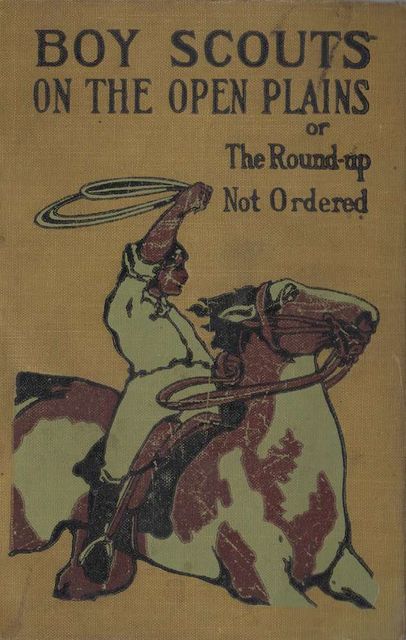



автордың кітабын онлайн тегін оқу Boy Scouts on the Open Plains; Or, The Round-Up Not Ordered
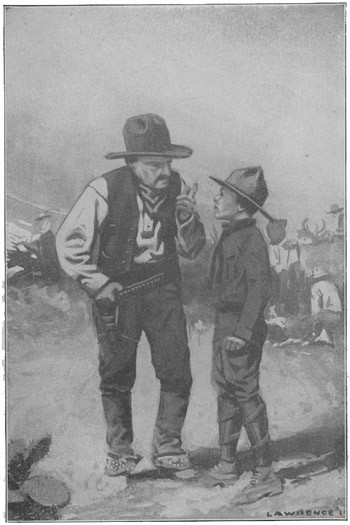
“But ain’t yuh meanin’ tuh pay me anything fo’ shootin’ up my pets thisaway?” Harkness demanded.
BOY SCOUTS ON THE OPEN PLAINS
OR
THE ROUND-UP NOT ORDERED
By
G. HARVEY RALPHSON
Author of
BOY SCOUTS IN THE CANAL ZONE
BOY SCOUTS IN THE NORTHWEST
BOY SCOUTS IN A MOTOR BOAT
BOY SCOUTS IN A SUBMARINE
Chicago
M. A. DONOHUE & COMPANY
Copyright 1914
by
M. A. Donohue & Co.
CHICAGO
Contents
I.
Over the EdgeII.
Lucky JimmyIII.
The Helping HandIV.
Picking up PointsV.
Around the Camp FireVI.
The Wolf PackVII.
Everybody BusyVIII.
An Unwelcome GuestIX.
The Homing PigeonX.
At Double Cross RanchXI.
The Sheep and the GoatsXII.
Nipping a MutinyXIII.
At Washout CoulieXIV.
Stampeding the Prize BunchXV.
Jimmy’s Unwilling RideXVI.
After the Rustlers’ RaidXVII.
The Shrewd Old FoxXVIII.
More Trouble AheadXIX.
At Bay in the CanyonXX.
Smoked OutXXI.
In the Hands of the RustlersXXII.
Coming of the Real Boss—ConclusionBoy Scouts on the Open Plains
CHAPTER I.
OVER THE EDGE.
“’Tis meself that calls this pretty tough mountain climbin’, and me athinkin’ all the while the road to Uncle Job’s cattle ranch would take us along the bully open plain all the way!”
“Hold your horses, Jimmy; we’ve got to about the end of this hill climbing. After we cross this divide it’s going to be the kind of travel you mention, all on the level. One more town to pass through, and then we strike out for the ranch. Any minute now we ought to glimpse the low country through this canyon that we’ve been following over the ridge.”
“There it is right now, Ned, and let me tell you I’m glad myself that this hard work is nearly over with. Whew! did you ever see a prettier picture than this is, with the whole country spread out like a big map?”
“And that’s where we aim to spend some little time, is it, boys?” asked a third one of the four boys who, leading a loaded pack burro apiece, had been climbing a range of rocky mountains away down in a corner of Nevada not a great distance from the Arizona border.
“Yes, that’s going to be our stamping ground, Jack, for some little time to come. My uncle Job Haines has his ranch away over there somewhere or other, in the hazy distance. His partner, another uncle of mine, James Henshaw, is with him in the business—you know my mother was married twice, and this last gentleman is the brother of her first husband, which is how I come to have so many uncles. What d’ye say to resting up a bit here before we start down the grade, Ned?”
The way three of them turned toward the other young fellow was evidence enough in itself to show that he must be the leader of the little company, which was in fact the truth.
All of the mountain climbers were wearing rather faded but serviceable khaki suits, which with the leggins and campaign hats proved that they must belong to some troop of Boy Scouts. But it was many days’ journey from their present surroundings to the scene of their home activities, for they belonged in New York City.
Those of our young readers who have had the pleasure and privilege of possessing one or more of the previous volumes connected with this series of stories will readily recognize the four lads as old and valued acquaintances. For the sake of the few who may not have enjoyed meeting the lively quartette before, a few sentences of introduction may be necessary before going on further. And while they are resting both themselves and their pack animals, at the same time drinking in the magnificent scenery that was spread out before them, looking toward the southeast, it would seem to be a fitting opportunity for this service.
The leader of the little party was Ned Nestor, who also served as assistant scout master of the troop, having duly qualified for the office according to the rules of the organization. He was a good hunter and tracker, and possessed a wide knowledge of woodcraft in its best sense.
Some time previous to this Ned had been given various chances to work for the Secret Service of the Government at Washington, and had conducted himself in such a manner as to win the confidence of the authorities. They realized that there were many opportunities when a bright lad might accomplish things unsuspected where a man would be apt to slip up. And judging from the success which had on most occasions followed Ned’s taking up a case, it appeared as though this might have been a wise move.
One of the other boys, a short chap with red hair and a freckled face, often acted as Ned’s assistant in these dangerous adventures. His name was Jimmy McGraw, and at one time he had been a regular tough little Bowery boy in New York, until he happened to meet Ned under strange conditions, and was virtually adopted by the other’s father, so that he now made his home with the Nestors. Jimmy could not entirely shake off some of the old habits; and this accounted for his making use of a little slang now and then, when trying to express himself forcibly.
The third lad was named Jack Bosworth. Jack was a splendid chum, faithful as the needle can be to the pole, and as brave as he was robust. His father being a rich corporation lawyer and capitalist, the boy had been allowed to do pretty much as he chose. Fortunately Jack was a true scout in every sense of the word, and could be depended upon to keep out of mischief. He believed Ned Nestor to be the finest patrol leader that ever wore the khaki and was ready to follow his lead, no matter where it took him.
Harry Stevens, the fourth and last of the quartette, was inclined to be a student rather than a lover of the trail and hunters’ camp. His hobby seemed to lie along the study of wild animals’ habits, and also the history of the ancient Indian tribes that, centuries back, were known to have inhabited the southwestern portion of our country. He had kept harping all the while upon the subject of the strange Zunis, the Hopis, and the Moquis, all of whom he knew had descended from the original cliff-dwellers. And he hoped before going back home again to find a chance to investigate some of their quaint rock dwellings high up in the cliffs bordering the wonderful Colorado Canyon.
Harry was really on his way to the ranch of his uncles. Not being in any hurry he and his chums had first visited San Francisco, and then Los Angeles. While here they somehow conceived the rather singular idea of crossing the desert afoot, in order to have new experiences, and be able to say that they knew what it was to find themselves alone on a sandy tract that stretched as far as the eye could see in every direction.
What remarkable adventures had come their way while carrying out this scheme have already been set down in the pages of the volume just preceding this book, under the title of “Boy Scouts in Death Valley,” so there would be no need of our repeating any of the exciting episodes here. They had purchased the four burros from a discouraged party of men who were prospecting for gold in the mountains to the west of the parched valley of the evil name.
Since they managed to escape from Death Valley, after almost leaving their bones there as the penalty of their rashness, some days had passed; in fact it was now a week later. They had done considerable traveling in that time, and overcome all obstacles with their accustomed ability.
All of them had grown weary of so much mountain climbing, and Jimmy really voiced the united sentiment of the party when he declared that he was yearning for a chance to see the open plain, with grass instead of the eternal blistering sand, and mottes of trees dotting the picture with pleasing bunches of green that would be a relief to their tortured eyes.
So they sat there and talked of the past, as well as tried to lift the veil that hid the immediate future, as though anxious to know what awaited them in the new life to which they were hastening.
Finally Ned Nestor arose and stretched himself, as he remarked:
“I think we’d better be on our way, fellows, if we hope to get down there to the level before night comes along. The sun’s headed for the west, you notice, and as this ridge will shut him out from us early, we haven’t any too much time.”
“I guess you’re about right there, Ned,” commented Jack; “and for one I want to say I’d be right glad to make camp at the foot of the mountains. We can’t say good-bye to these rocky backbones of the region any too soon to please me.”
The four burros had rested after their arduous climb, and there was not the least difficulty about getting them started moving. In fact they seemed to already scent the grass of the plains below, so different from anything that had been encountered thus far on the trip, and were showing signs of a mad desire to reach the lowlands.
Several times Ned had to caution one of the others about undue haste.
“Hold your burro in more, Jimmy,” he would say; “there are too many precipices on our trail to take chances of his slipping, and dragging you over with him. To be sure mules and donkeys are clever about keeping their footing and almost equal Rocky Mountain sheep, or the chamois of the Alps that way; but they can stumble, we know, and it might come at a bad time. They’re wild to get down out of this; but for one I don’t care to take a short cut by plunging over a three hundred foot precipice. Easy now, Teddy; behave yourself, old boy. That’s an ugly hole we’re passing right now, and we want to go slow.”
Jimmy himself was apt to be a reckless sort of a chap; and many a time did Ned have to check his impatience in days gone by. Jack, too, often did things without sufficient consideration, though he could hold himself in on occasion; while Harry seldom if ever had to be cautioned, for he was inclined to be slow.
They often found themselves put to it to make progress, for while they followed what seemed to be a trail over the ridge, it had been seldom used, and many obstructions often blocked the way.
Once they had to get wooden crowbars and pry a huge boulder loose that had fallen so as to completely block progress. Fortunately it had been easy to move it a few inches at a time, until they sent it into a gulf that yawned alongside the trail, to hear it crash downward for hundreds of feet, and make the face of the mountain quiver under the shock.
In this fashion they had managed to get a third of the way down from the apex of the ridge, and Ned, comparing the time with the progress made, announced it as his opinion that he believed they would be easily able to make the bottom before night came on.
“That sounds all to the good to me, Ned,” declared Jimmy, with a broad grin on his freckled face.
“Hope you’re a true prophet, that’s all,” said Harry.
“I agree with Ned,” Jack broke in with, “and say, we ought to make the foot of the range before night, the way we’re going, unless we hit up against some bad spot that’ll hold us up worse than we’ve struck yet.”
“That isn’t likely to happen,” Ned observed, “because the further down we get the easier the going ought to be.”
“But I notice that the holes are just as deep,” Harry told him.
“And a fall would jolt a feller as hard too, seems like,” Jimmy admitted as he craned his neck to look over at a place where the trail was only a few feet wide with a blank wall on the right and an empty void on the left.
Harry nervously caught his breath, and called out:
“Better be careful there, Jimmy, how you bend over and look down. You might get dizzy and take a lurch or the frisky burro give a lug just then and upset you. We all think too much of you to want to gather up your remains down at the bottom of a precipice.”
Jimmy laughed and seemed pleased at the compliment. He did not again bother about looking over, but occupied himself with managing his pack animal, which kept showing an increasing desire to hasten. At one point Ned had stopped to tighten the ropes that held the pack on his burro, and in some manner Jimmy managed to get at the head of the little procession that wound, single file, down that steep mountain trail.
It was Ned’s intention to assume the lead again at the first opportunity, when he could pass the others. Meantime he thought he could keep an observant eye on Jimmy, so as to restrain him in case he began to show any sign of rashness.
After all it was not so much Jimmy’s fault that it happened, but the fact that his burro had quite lost its head in the growing desire to get down to the green pastures from which it had been debarred so very long, and for which it was undoubtedly hungering greatly.
That the unlucky animal should chance to make that stumble just at the time of passing another narrow place in the trail, where the conditions again caused them to move in single file, was one of those strange happenings which sometimes spring unannounced upon the unwary traveler.
Jimmy at one time even walked along with the end of the rope wound about his waist in a lazy fashion; but Ned had immediately told him never to think of doing such a thing again, when there was even the slightest chance of the burro slipping over the edge of the sloping platform and dragging his master along. But right then Jimmy had such a rigid clutch upon the rope that he did not seem to know enough to let go when the pack animal stumbled, tried to cling desperately to the rocky edge, and then vanished from sight into the gulf.
In fact Jimmy’s first idea seemed to be a desire to drag the tottering animal back to safety, and it was because he was tugging for all he was worth on the rope that he was pulled over the edge himself.
The other three scouts seemed to be petrified with horror when they saw their plucky but rash chum dragged over. None of them could jump to his assistance on account of the burros being in the way and plunging and kicking wildly, as though terrified at the fate that had overtaken their mate.
Ned was at the end of the line, and Harry, though not far from the spot where the terrible accident happened, seemed to be too terrified to know what to do, until it was all over, and poor Jimmy had vanished from their view.
CHAPTER II.
LUCKY JIMMY.
“Oh! Ned, he’s gone—poor Jimmy—pulled right over by that burro!” Harry was crying as he stood there almost petrified with horror, while his own pack animal acted as though it might be terrified by the fate that had overtaken its mate, for it snorted and pulled back strenuously.
Ned knew that unless the remaining three burros were quieted a still greater disaster was apt to overtake them.
“Speak to your animal, Harry; get him soothed right away! Easy now, Teddy, stand still where you are! It’s all right, old fellow! Back up against the rock and stand still there.”
Ned as he spoke in this strain managed to throw a coil or two of the leading rope over a jutting spur of rock. Then turning round, he crept on hands and knees to the edge of the yawning precipice and looked over, shuddering to note that while not nearly so high as that other precipice had been, at the same time the fall must be all of seventy feet.
There at the foot he could see the unfortunate burro on his back and with never a sign of life about him. Doubtless that tumble must have effectually broken his neck and ended his days of usefulness.
“Do you see him, Ned?” asked a trembling voice close by, and the scout leader knew that Jack too had crawled to the edge in order to discover what had become of poor Jimmy McGraw.
“Not yet,” replied Ned, sadly; “he may be hidden under the burro, or lying in among that clump of bushes.”
“But glory be, he ain’t, all the same!” said a voice just then that thrilled them all. “If ye be lookin’ over this way ye’ll discover the same Jimmy aholdin’ on with a death grip to a fine old rock that sticks out from the face of the precipice. But ’tis me arms that feel like they was pulled part way out of the sockets with the jerk; and I’d thank ye to pass a rope down as soon as ye get over the surprise of havin’ a ghost address ye.”
“Bully for you, Jimmy!” exclaimed Jack; “seems like you’ve got nearly as many lives as a cat. Hold on like anything, because Ned’s getting a rope right now, and he’ll heave it over in three shakes of a lamb’s tail. Don’t look down, Jimmy, but keep your eye on me. We’ll pull you out of that in a jiffy, sure we will. And here comes Ned right now with the rope. He’s even made a noose at the end, so as to let you put your foot in the same. Keep holding on, Jimmy, old fellow!”
In this manner, then, did Jack try to encourage the one in peril, so as to stiffen his muscles, and cause him to keep his grip on that friendly crag that had saved him from sharing the dreadful fate of the wretched burro.
Jimmy had fortunately kept his wits about him, and although the strain was very great, because he could find no rest for his dangling feet, he managed to hold his awkward position until the rope came within reach.
“Be careful, now, how you manage!” called Ned, from his position fifteen feet above the head of the imperiled scout. “Let me angle for your foot, and once I get the noose fast around it, you can rest your weight safely. But Jimmy, remember not to let go with one hand, because your other might slip. Leave it all to me.”
Ned was already working the rope so that the open noose twirled slowly around, coming in contact with Jimmy’s foot, which the other thrust out purposely. While no expert in such angling and more or less worked up with fears lest Jimmy suddenly lose his precarious hold, and go down to his death, Ned presently met with success. The noose passed over the waiting foot, and was instantly jerked tight by a quick movement from above.
By then Jack was alongside the scout master eager to lend his assistance when it came to the point of lifting Jimmy. Harry, too, hovered just behind them, unable to look over because it made him dizzy when so terribly excited, but only too ready to take hold of the end of the rope and bracing his feet against some projection of the rocky trail, throw all his weight into the endeavor to draw the one they meant to rescue to the safety of the path.
It was speedily but cautiously accomplished, for Ned would not allow himself to be needlessly hurried, knowing how disasters so often result from not taking the proper care.
Jimmy was looking a trifle peaked and worried as he came clambering over the edge of the narrow path, assisted by Ned, who as soon as he could get a grip on the other scout’s jacket knew that all was well. No sooner did Jimmy realize that he was surely safe than he proceeded to indulge on one of his favorite grins, although they could see that a deep sigh of gratitude accompanied the same.
The very first thing he did was to turn around, and lying flat on his chest, look back down into that gulf from which he had just been dragged.
“Gee, whiz! but that was somethin’ of a drop, believe me!” he remarked, trying to keep his voice from trembling. “And there lies me silly old burro on his back with never a sign of a kick acomin’. He’s sure on the blink and whatever am I agoin’ to do now, without any Navajo blanket to sleep in nights? Mebbe we might have ropes aplenty to lower me down there, so I could recover me valuables. ’Tis a piece of great luck I had me Marlin gun in me hands at the time and dropped it on the ledge, so I did.”
“If we couldn’t get the things any other way, Jimmy,” announced Ned, “perhaps I’d agree to that spliced rope business, because we’ve got more than thirty yards of good line with us, but I’d go down myself and not let you try a second time. Still I don’t think it’ll be necessary. From what I see of the lay of the mountain we can reach that place after we leave this narrow trail.”
Jimmy did not insist. Perhaps his nerves had been more roughly shaken by his recent experience than he cared to admit; and the possibility of again finding himself dangling in space did not appeal very strongly to him.
It was just as well that Ned decided the matter as he did, for they found that once the end of the narrow stretch of rock was gained it was no great task to creep along the side of the mountain to the place where the dead pack animal lay.
Ned and Jack made the little journey and in due time turned up again carrying with them all that had been upon the burro, save the water keg.
“We left that behind,” explained Ned, “because as we are done with desert travel for this trip we won’t find any need of such a thing. But here’s your precious Navajo colored blanket, Jimmy; likewise we’ve saved what grub there was in the pack.”
“Good for you, Ned; I’d hated to lose that blanket the worst kind, you know; and as for the food end of the deal, well, what’s the use telling you how I feel about that when you all know that I’m the candy boy when the dinner horn blows.”
Jimmy was a great “feeder,” as Jack called it, and on many an occasion this weakness on his part had made him the butt of practical jokes on the part of his chums. But Jimmy was not the one to give up any cherished object simply because some one laughed at him on account of it. He was more apt to join in the merriment and consider it all a good joke.
The journey was now resumed, and the balance of the afternoon they met with no new hardships or perils worth recording. When the day was done and the shadows of coming night began to steal forth from all their hiding places where the bright sunlight had failed to locate them, the four scouts had reached the foot of the rocky mountain range and looked out upon the plain.
Here they made camp and passed a pleasant night with nothing to disturb their slumbers save the distant howl of a wolf, which was a familiar sound in the ears of these lads, since they had roughed it on many occasions in the past in more than a few strange parts of the world.
Although they had recently passed through some very arduous experiences these were only looked on as vague reminiscences by these energetic chums. The future beckoned with rosy fingers and that level plain looked very attractive in their eyes, after such a long and painful trip across the burning deserts and through that terrible Death Valley, where so many venturesome prospectors, gold-mad, have left their bones as a monument to their folly.
When morning came again they cooked breakfast with new vim. And the fragrant odor of the coffee seemed to appeal to them with more than ordinary force because of the bright prospect that opened before them.
“Ned says it might be only two more days before we get close to Uncle Job’s ranch,” remarked Harry, as he assisted Jimmy in getting breakfast; for since the latter was so fond of eating his comrades always saw to it that he had a hand in the preparation of the meals, to which Jimmy was never heard to offer the slightest objection.
“Then it’s me that will have to be studying harder on all them cowboy terms so they won’t take me for a greeny,” Jimmy went on to say in reply. “You just wait and see how I branch out a full-blown puncher. Right now I c’n ride a bucking pony and stick in the saddle like a leech; and I’m practicin’ how to throw a rope, though I must say I don’t get it very good and sometimes drop the old loop over my own coco instead of the post I’m aimin’ to lasso. But I’ll never give it up till I get there. That’s the way with the McGraws, we’re all set in our way and want baseball championships and everything else that’s good to own.”
“Jimmy,” called out Jack just then, “I think if you didn’t talk so much we’d be getting our breakfast sooner, because you kind of cool things off. There, see how the coffee boils like mad whenever you hold up. How about it, Harry, isn’t it nearly done? I’m feeling half-starved, to tell you the truth.”
“Then I’m not the only pebble on the beach this time, it seems,” chuckled Jimmy, who was so used to being made fun of on account of his voracious appetite that he felt happy to find that someone else could also get hungry on occasion.
“In three minutes we’ll give you the high sign, Jack,” Harry announced and he was as good as his word, for it was not long before the chums might have been seen discussing the food that had been prepared and making merry over the meal as was their usual custom.
Starting forth in high spirits they began to head across the plain and at about noon all of them were electrified on hearing the distant but unmistakable whistle of a locomotive, showing that they were approaching the railroad.
After their recent experiences in the dead lands this sign of civilization was enough to thrill them through and through. Jimmy was immediately waving his hat and letting off a few yells to denote his overwhelming joy; while even Ned looked around with more or less of a smile on his face.
“Sounds like home, don’t it?” asked Jack, beaming on the rest. “Takes you back to good old New York, where you can sit down next to a plate of ice cream when your tongue feels thick from the heat and cool off. Seems like I’d never get my fill of cold stuff again.”
Pushing on they presently sighted the railroad and also discovered that just as Ned had figured would be the case, they were approaching a town.
“That’s where we ordered our mail to be sent on from Los Angeles, up to the tenth, and I hope we find letters waiting for us,” Harry remarked; for he was quite a correspondent, though not in the same class with Frank Shaw, another member of the Black Bear Patrol, whose father owned a big daily in New York and who often contributed letters to its columns when he was away on trips with Ned.
Ned on his part was wondering whether he would receive anything in the way of business communications from the Government people in Washington, for it would be forwarded on from Los Angeles if such a message did come in cipher.
So anxious were the boys to reach the settlement on the railroad that it was decided not to stop for any lunch at noon but to push right along. If there was any eating place in the town they could get a bite before leaving; and the change from camp fare might be agreeable to them all.
At two o’clock they reached the place, which was hardly of respectable size, although it had a station and post office. The first thing the boys did was to head for this latter place and ask for mail, which was handed out after the old man had slowly gone over several packages. Strangers were such a novelty in that Nevada railroad settlement that the postmaster evidently was consumed with curiosity to know what could have brought four lively looking boys dressed in khaki suits very much on the same pattern as United States regulars, to that jumping-off place. But they did not bother themselves explaining and he had to take it out in guessing that the Government was so hard pushed for recruits now in the army that they had to enlist boys not fully grown.
While the other boys were eagerly devouring the contents of the various envelopes they had received, bearing the New York post mark, Ned, who had put his own letters in his pocket for later reading, sauntered over to the station to interview the telegraph agent, who was also the ticket man, express agent and filled various other offices as well after the usual custom of these small towns.
It was only a short time later that Jack, Harry and Jimmy, still devouring the long letters they had received, in which all the news of the home circles was retailed, saw Ned walking briskly toward them.
“He’s struck something or other that’s given him reason to chirk up,” announced the observant Jimmy, as he took a shrewd look at Ned’s face on the scout master drawing near. “Ten to one he’s had word from the head of the Secret Service in Washington. It’d sure be pretty punk now if after comin’ so far over deserts and the like to visit your uncle, we had to drop off here and take the train back to Los Angeles, so Ned could help gather in some gang of counterfeiters or look up a bunch of smugglers bringing the Heathen Chinese across the Mexican border while all that fighting is goin’ on down there between Villa and Huerta.”
Ned quickly joined them. They could see from the alert look on his face that something must have happened since he left them shortly before to arouse Ned. His eyes shone with resolution and he had the look that appears on a hunter’s face when he discovers the track of the animal he had long wanted to bag.
“Did you find a message waiting for you here, Ned?” asked Harry.
“Just what I did,” came the reply.
“Then it must have been from Washington?” suggested Jack, anxiously. “But let’s hope for Harry’s sake it won’t call you off from this scheme we’ve got started.”
“That’s the strangest thing of it all,” replied Ned; “because, you see, this message was meant to send me from Los Angeles straight down into this very section of the Colorado River country.”
CHAPTER III.
THE HELPING HAND.
When Ned made this announcement the others exchanged looks in which wonder struggled with curiosity.
“Tell me about that, now,” muttered Jimmy; “was there ever anything like the luck that chases after us all the while? Here we start out to visit Harry’s uncle, so he might carry out a mission that his folks sent him on, and of course the Government must a guessed all about it, since they went and laid a game to be hatched out right in the same part of the Wild and Wooly West. Can you beat it?”
“Let Ned tell us what the game is, can’t you, Jimmy?” demanded Harry.
“Yes, and please don’t break in again with your remarks until he’s all through,” added Jack. “It bothers a fellow to make connections when you get started. If you must talk, why, we’ll throw in and hire a hall for the occasion. Now, Ned, tell us what the Secret Service folks want you to do.”
“I’ve had a message in cipher from my people in Washington, telling me that while I’m out in this section they’d like me to look up one Clem Parsons, who’s been wanted for a long time on the charge of counterfeiting Government notes. When last heard from he was running a stage line somewhere in the country of the Colorado and doing a little in the way of fleecing unsuspecting travelers who come out here to see the wonders of the Canyon. So from now on we’ll begin to ask questions and see whether we can get on the trail of this gentleman who’s given some of the smartest agents in the Secret Service the call-down.”
“And then they have to depend on Ned Nestor and his able assistant, Jimmy McGraw,” remarked the last mentioned scout; “excuse me, fellers, but if you don’t blow your own horn, who d’ye reckon’ll be fool enough to do it for you? But Ned, if our luck holds as good as it generally does, chances are ten to one this same Clem Parsons will come tumbling right up against us. It seems like you might be a magnet and they all have to come our way sooner or later.”
“Any description of what he looks like?” asked Jack, who had known Ned to get similar orders on previous occasions and could guess that it was not all left to his imagination.
“Yes, they tell me he is tall and thin and has a scar on his left cheek. He used to be a cow puncher at one time and might be working at his old trade now. That’s a point to remember when we get to the Double Cross Ranch. Every puncher will have to run the gantlet of our eyes and if one of them happens to be marked with a scar on his left cheek, it’ll be a bad day for him.”
“Now, wouldn’t it be queer if we did run across the mutt there at your uncle’s place, Harry?” remarked Jimmy. “But here we are again, Ned, uniting business with pleasure like we’ve done heaps of times before now. Mr. Clem Parsons, I’m sure sorry for you when this combination gets started to work, because you’ve got to come in out of the wet and that’s all there is to it!”
It might appear that Jimmy was much given to boasting; but as a rule he made good, so that this failing might be forgiven by those who knew him and his propensity for joking.
They moved out of town after getting a pretty poor apology for a lunch at the tavern. Jimmy declared that he would starve on such fare and announced his intention of immediately opening a box of crackers he had purchased at a local store so as to keep himself from suffering.
Ned, as was his habit, had interviewed about everybody that crossed his path, so as to improve upon the rude map he carried and which he had found to be faulty on several occasions, which fact caused him to distrust it as a guide.
“We ought to make the ranch by tomorrow evening, if all goes well,” he told his three chums, as they walked onward over the plain, still heading almost due southwest.
“Not much danger of anything upsetting our calculations from now on,” observed Jack, “unless we meet up with drunken punchers, run across some bad men who have been chased by the sheriff’s posse out of the railroad towns and who try to make a living by holding up travelers once in six months; or else get caught in a fine old prairie fire.”
“Say, that last could happen, that’s right,” Jack went on to exclaim, looking a little uneasily at the dead grass that in places completely concealed the greener growth underneath. “If a big gale was blowing and a spark should get into this stuff she would go awhooping along as fast as a train could run. That’s something I’ve often read about and thought I’d like to see, but come to think of it, now that I’m on the ground, I don’t believe I care much about it after all.”
“They say it’s a grand sight,” Harry volunteered; “but according to my mind a whole lot depends on which side of the fire you happen to be. What’s interesting to some might even mean death to others.”
“Yes, I’ve read lots about the same,” admitted Jack, “and of the trouble people have had in saving themselves when chased by one of these fires on the plains. If we do see one of the same here’s hoping we are to windward of the big blaze.”
When the sun sank that evening they were hurrying to reach what seemed to be a stream of some sort, judging from the line of trees that cut across the plain and which only grow where there is more or less water to be had.
The three burros must have scented the presence of water, for there was no keeping the animals within bounds. They increased their pace until they were almost on the run; and Jimmy threw away the fag end of a whip with which he had been amusing himself by tickling the haunches of the burro in his charge and urging him to move along faster.
One of the animals started to bray in a fashion that could have been easily heard half a mile or more away.
Hardly had the discordant sounds died away than the boys were considerably surprised to hear a shrill voice coming from directly ahead, as though the exultant bray of the pack animal had given warning of their presence to some one who needed assistance the worst kind.
“Help! Come quick and get me! Help—help!” came the words as clear as a bell and causing Harry and Jimmy to stare at each other as though their first thought might have been along the line of some deception that was being practiced upon them.
But there was Ned already on the jump and shouting over his shoulder as he ran:
“Jimmy, give your burro over to Harry to look after; you too, Jack and follow me on the run!”
“That suits me all right!” cried Jack; “here Harry, please look after my pack!” and with these words he was off at full speed.
Jimmy was close at his heels. He had only waited long enough to snatch his rifle from the top of the pack on the burro that had been given into his charge after his own had been lost in the mountain disaster. Jimmy was always thinking they might be attacked by Indians off their reservation or else run across some bad men who liked to play their guns on strangers just to see them dance. For that reason he seldom if ever allowed himself to be caught far away from his repeating Marlin these days.
When they had pushed into the patch of cottonwoods they found that Ned was already at work trying to lend the assistance that had been so lustily called for in that childish treble.
A figure was in the stream, although just his head and a small portion of his body could be seen. He was stretching out his hands towards Ned in a beseeching manner that at first puzzled Jimmy.
“Why, I declare if it ain’t a little boy!” he exclaimed; “but what’s he doin’ out there, I want to know? Why don’t he come ashore if the water’s too deep. What ails the cub, d’ye think, Jack?”
“Don’t know—might be quicksand!” snapped the other, as he once more started to hurry forward.
Ned was talking with the stranger now, evidently assuring him that there was no further need of anxiety since they had reached the spot.
“Can’t you budge at all?” they heard him ask.
“Not a foot,” came the reply; “seems like I mout be jest glued down here for keeps and that’s a fact, stranger.”
“How long have you been caught there?” asked the scout master.
“Reckon as it mout be half hour er thereabouts,” the boy who was held fast in the iron grip of the treacherous quicksand told him; and so far as Jack could see he did not exhibit any startling signs of fright, for he was a boy of the plains and evidently used to running into trouble as well as perilous traps.
“But,” Jack broke in with, “you never shouted all that time, or we’d have heard you long before we did?”
“Never let out a yip till I ketched that burro speakin’,” the boy replied; “what was the use when I didn’t think there was a single person inside o’ five mile? I jest tried and tried to git out but she hung on all the tighter; and the water kept acreepin’ up till it’d been over my mouth in ten minutes more I reckon.”
“Well, we are going to get you out of that in a hurry, now,” Ned told him in a reassuring tone; “Jack, climb up after me, to help pull. Jimmy, you stand by to do anything else that’s wanted.”
Ned, being a born woodsman, had immediately noted the fact that the limb of a tree exactly overhung the spot where the boy had been trapped in the shifting sand. This made his task the easier; but had it been otherwise he would have found some means for accomplishing his ends, even though he had to make a mattress of bushes and branches on which to safely approach the one in deadly peril.
Creeping out on that stout limb Ned dropped the noose of his rope down to the boy, who was only some six feet below him.
“Put it around under your arms,” Ned told him; but as though he understood the method of procedure already, the boy in the sand was even in the act of doing this when Ned spoke.
“Tie the end around the limb and let me pull myself up, Mister, won’t you?” the boy pleaded, as though ashamed of having been caught in a trap, and wishing to do something looking to his own release.
This suited Ned just as well, though he meant to have a hand in the pulling process himself and also give Jack a chance. So when he fastened the rope to the limb of the tree he did so at a point midway between himself and Jack.
“Get hold and pull!” he said in a low tone to his chum; for already was the boy below straining himself with might and main to effect his own release.
It would have proved a much harder task than he contemplated; but the scouts did not mean that he should exhaust himself any further in trying. They managed to get some sort of grip on the rope and then Ned called out cheerily:
“Yo heave-o! here he comes! Yo-heave-o! up with him, Jack! Now, once more, all together for a grand pull—yo-heave-o! Hurrah, he’s nearly out of the sand!”
Five seconds later and the energetic boy was scrambling across the limb of the tree; and in as many minutes all of them had descended to the ground, the end accomplished and nobody much the worse for the experience.
“It was a close call for me, that’s sure,” the boy was saying, as he gravely went around and shook hands with each one of the scouts, not excepting Harry, who had meanwhile come up, leading the three burros; “an’ I want you all to know I’m glad that donkey let out his whoop when he did. Why, I might a been all under when you got here; but say, I lost my gun and that makes me mad.”
Looking at the boy more closely they were struck with the fact that while he did not seem to be more than nine years old, he was dressed like a cow-puncher and had a resolute air. How much of this was assumed in order to impress them with the idea that he had not been alarmed in the least by his recent peril, of course no one could say. Ned was wondering how the boy, brought up undoubtedly amidst such perils and on the lookout for danger all the while, could have fallen into such a silly little trap as this.
“What were you doing in the stream that you stood there and let the sand suck you in?” he asked as he proceeded to help the boy scrape himself off so as to appear more presentable.
“I was a little fool, all right,” the kid immediately answered, with an expression of absolute disgust on his sharp face; “you see, I glimpsed a bunch of deer feeding just over yonder to windward and as they were headin’ in this way I thought I’d lie low under the river bank and wait till they got inside easy gunshot. I tied my pony over in the thickest place of the timber and then walked out to where the water jest come to my knees, where I got low down to wait. Say, I was that taken up with watchin’ them deer afeedin’ up that I forgets all about everything else and was some s’prised to feel the water tricklin’ around my waist like. After that I knowed the huntin’ game was all up, and that less I wanted to be smothered I’d have to get out in a hurry. But it didn’t matter much how I pulled, an’ heaved and tried to swim I jest stuck like I was bolted down to a snubbin’ post and somebody had cinched the girth on me. Then, after a while, when I was expectin’ to swaller water, I heard that burro singin’ and afore I could help it I jest hollored out. Guess you must a thought it was a maverick. I could a kicked myself right away afterwards ’cause I give tongue so wild like!”
Ned smiled. He realized that the cub had imbibed the spirit of the Indian warrior who disdains to display any weakness of the flesh. No matter how much he may have been frightened by his recent terrible predicament, he did not choose any one to know about it. Indians may feel fear but they have learned never to show it by look or action and to go to their deaths, if need be, taunting the foe.
“Well,” he told the small boy, “we intended to camp for the night here close to the river and we’d be glad to have you stay over with us. Plenty of grub for everybody and it might be much more pleasant than being by yourself. We are not Western boys but then we’ve been around more or less and know something about how things are done out here. Will you join us—er—”
“My name is Amos, Amos Adams, and I’ll be right well pleased to stay over with you to-night, sure I will,” the boy went on to say.
So it was settled, and out of just such small things as their meeting Amos in such a strange way great events sometimes spring. But none of the scouts so much as suspected this when they busied themselves preparing the camp, building the cooking fire, and seeing that all the animals were staked out to feed, after watering them.
CHAPTER IV.
PICKING UP POINTS.
“Ned, whatever do you imagine this kid is doing out here all by himself?”
Jack asked this question in a low tone. They had cooked supper, and disposed of it promptly; and there had been an abundance for the guest, as well as the four chums. And now the two scouts were lounging near the fire, while Jimmy and Amos cleaned up the tin dishes and cooking utensils; Harry meanwhile being busily engaged with some notes he wanted to jot down for future use, in comparing his recent experiences with those of others who had suffered tortures in the notorious Death Valley.
“Well, you’ve heard as much of his talk as any of us, Jack,” replied the leader of the expedition, quietly, “and so far there’s been nothing said about himself. I’m going to beckon to Amos to come over here, and put a few leading questions to him. Out here when a fellow is entertained at the camp fire, it’s only fair that he give some sort of an account of himself. Besides, Amos looks so much like a kid, just as you say, that it makes the thing seem queer.”
A minute later, catching the eye of the boy, he crooked his finger and nodded his head. Plainly Amos understood, for he immediately came across.
“Sit down, Amos,” Ned told him.
The small boy in the cowboy suit did so, at the same time allowing a sort of smile to come upon his bronzed face.
“Want to know somethin’ about me, I reckon?” he remarked, keenly.
Jack chuckled as though amused at his shrewdness; but Ned only said:
“Well, ordinarily out here on the plains I understand that men seldom express any curiosity about their chance guests; it isn’t always a safe thing to do. But you see, Amos, in your case it’s different.”
“Sure it is; I get on to that, Mr. Scout Master,” replied the boy, readily; for he had ere this noticed the emblem which Ned bore upon his khaki coat, and which stamped him as authorized to answer to this name, which would indicate that Amos knew something about the Boy Scout business.
“In the first place we chanced to be of some little assistance to you.”
“A heap!” broke in the other, quickly.
“And then, excuse me for saying it, but you are such a kid that anybody would be surprised to run across you out by yourself, carrying a gun, riding a pony like the smartest puncher going, and after big game at the time you got stuck in that quicksand—all of which, Amos, must be our excuse for feeling that we’d like to hear something about you.”
“That’s only fair and square, Ned,” the boy spoke up immediately; “Jimmy there has been telling me the greatest lot of stuff about what you fellows have been doing all over, that I’d think he was stuffing me, only he held up his hand right in the start, and declared he never told anything but the truth, the whole truth, and nothing but the truth, so help him. And I’m ready to tell you who I am, and what I’m adoin’ out here.”
“Not that we think you’re anything that you shouldn’t be, Amos,” put in Jack.
“Well, my name’s Amos Adams, just like I said, and all my life I’ve been around a cattle ranch. That’s why I know so much about roping steers, and riding buckin’ broncs. I guess I was in a saddle before my ma weaned me. There are a few things mebbe I can’t quite do as well as some of these here prize punchers, but it’s only because I ain’t as strong as them, that’s all.”
Looking at his confident face the scouts believed that Amos was only speaking the plain truth.
“My dad’s name is Hy Adams,” continued the kid puncher. “I guess you ain’t been around these diggin’s much yet, or you’d a heard who he is. They call him the Bad Man of the Bittersweets, and when he raises his fog-horn of a voice lots of men that think themselves brave just give a hitch to their shoulders this way,” and he imitated it to the life as he spoke, “and does what he tells ’em. That’s when he’s been drinkin’. But then there are other times—oh, well, I reckon, I hadn’t ought to tell family secrets.
“We live in a cabin, ’bout ten miles away from here. My dad, he’s in the cattle business, when he don’t loaf. Sometimes he’s ’round home, and agin he ain’t, just ’cordin’ to how things are agoin’. Mam, she’s a little woman, but she knows how to run the house. I gotter sister, too, younger’n me, and her name it’s Polly. I ain’t gone to school any to speak of, but mam, she kinder teaches me, when I ain’t ridin’ out on the range, or totin’ my gun on a hunt. That makes me mad to think I lost my gun in the drink there.”
“No use hunting for it in the morning, I should think?” suggested Jack.
“Nary bit,” the boy replied quickly; “it’s down under that shiftin’ sand long before now. But then she was an old gun, and I’m savin’ up to git a new six-shot rifle, so it don’t need to be long now before I’ll be heeled agin.”
“Is your father a rancher, then, Amos?” Jack went on to ask, idly.
The boy grinned and looked at him queerly.
“Well,” he replied, with a quaint drawl that amused the scouts, “I don’t know as you could call him that way, exactly. He’s been cow puncher, and nigh everything else a man c’n be down thisaway to make a livin’. Me and my awful dad we don’t git on well. That’s one reason I gen’rally skips out when he takes a notion to lay ’round home for a spell. He knows right well I ain’t afeard of him, if he has got the name of bein’ a holy terror. I happen to belong to the same fambly. ’Sides, he ain’t what you’d call my real and true dad.”
“Oh! I see, you adopted him, did you, Amos?” Jack asked, laughingly.
“My mam she married agin after pop he was planted, and they went an’ changed my name from Scroggins to Adams. I don’t know which I likes best; but Scroggins that’s honest, anyway, which Adams ain’t—leastways some people around this region say it ain’t. When I grows up I reckon I’ll be a Scroggins, or else get a new name.”
Again the scouts exchanged amused glances. Amos was certainly a most entertaining little chap, with his quaint sayings.
“Now, you see, dad never comes home alone any more, but fetches some of his cronies along with him, and there’s unpleasant scenes ahappenin’ all the time; which is one of the reasons why I skip out. They gets to drinkin’, too, purty hard, till mam she has to douse a bucket of water over each puncher, and start ’em off. Mam she don’t approve of the kinds of business that dad takes up. But he keeps amakin’ these here visits to home further apart all the while, ’cause things ain’t as pleasant as they might be. Some time mebbe he won’t come no more. I’m bankin’ on that, which is one reason I ain’t never laid a hand on him when he gets roarin’ like a mad bull. There are others, too, but I wont mention the same.”
Amos had apparently been very frank with his new friends. He seemed to have taken a great fancy for them all, and, in turn, asked many questions concerning their expected visit to Harry’s uncle on Double Cross Ranch, which place he knew very well.
The conversation by degrees became general, and finally the scouts went on to talk about their own affairs. During this exchange of opinions, it happened that the name of Clem Parsons was mentioned by Ned. Perhaps it would be hardly fair to call it “chance,” when in reality the scout master wanted to find out whether the kid puncher seemed to be familiar with the name of the man whom the Government authorities in Washington wished him to round up.
The bait took, for immediately he heard Amos say:
“What’s that, Clem Parsons? Say, I happen to know a man by that name, and he’s been over to our house lots of times, too.”
“Then he’s a puncher, is he?” asked Ned.
“Well, I reckon he has been ’bout everything in his day, for I’ve heard him say so,” came the reply. “He rides with my awful dad, an’ they seem to git on together, which is some queer, because most of ’em is that skeered o’ dad they tries to steer clear o’ him.”
“My! but this dad of yours must be a grizzly bear, Amos?” remarked Jimmy, who had been greatly impressed with what he heard the boy say.
“Just you wait till you see him, that’s all,” was what Amos told him. “Mam, she reckons as how ’twas this same Clem Parsons as had got dad to ridin’ ’round the kentry doin’ things that might git him into trouble, an’ she hates him like pizen, for the same. Since they got to goin’ together, dad he’s allers showing plenty of the long-green, which he never handled before. But I ain’t tellin’ fambly secrets, and I reckons I’d better shut up shop.”
He had said enough, however, to convince Ned and Jack that he strongly suspected his step-father of having joined forces with a band of cattle thieves who were stealing the fattest beeves neighboring ranchers owned, and selling them on the side.
There is always this temptation existing when cattle are raised on the range, often feeding for days and weeks many miles away from the ranch house, and scattered among the little valleys where the grass grows greenest. In the darkness of the night, a few of these experienced rustlers can cut out what they want of a herd, and drive them far away, effectually concealing the trail. Then the brands are changed adroitly, and the cattle shipped away to be sold in a distant market.
So long as this lawless business can be carried on successfully, it brings in big money to the reckless rustlers; but if discovered in the act they are usually treated with scant ceremony by the angry punchers and shot down like wolves.
To some men the fascination of the life causes them to ignore its perils. Then besides, the fact that money pours in upon them with so little effort, is a temptation they are unable to resist. So long as there are ranches, and cattle to be raised for the market, there will be men who go wrong and try to get a fat living off those who do the work.
It did not surprise Ned to learn that this clever rascal, whom he had been asked to look up and apprehend if possible, had for the time being forsaken the counterfeiting game and started on a new lay. Clem Parsons was no one idea man. His past fairly bristled with shrewd devices, whereby he deluded the simple public and eluded the detectives sent out by the Secret Service to enmesh him.
He had played the part of moonshiner, smuggler, and bogus moneymaker for years, and snapped his fingers at the best men on the pay roll of the Government. Now, if as seemed possible, he had turned cattle rustler, perhaps there might come a complete change in the programme; for if the irate ranchmen and their faithful punchers only got on a hot trail with Clem at the other end, the authorities at Washington might be saved much further anxiety; for a man who has been strung up to a telegraph pole and riddled with bullets is not apt to give any one trouble again.
Ned had learned some important facts that were apt to prove more or less valuable to him presently. Already he felt that they had been paid many times over for the little effort it had taken to rescue Amos from the sand of the shallow river.
Scouts are taught to do a good deed without any thought of a return; but all the same, it is pleasant to know that the reward does often come, and if any of the four chums had failed to find a chance to turn his badge right-side up that day, on account of having given a helping hand to some one, certainly they must feel entitled to that privilege after lifting Amos out of his sad predicament. Saving a precious human life must surely be counted as answering the requirements of the scout law.
When Amos, a little later, left them to saunter down to the brink of the river, in order to give his mottled pony a last drink before leaving him at the end of his rope to crop grass the remainder of the night, Jack turned to the scout master and gave expression to his convictions as follows:
“Well, it looks like your old luck holds good, Ned, and that you stand a chance of running across your game the very first thing after getting here. If this Clem Parsons Amos tells us about turns out to be the same man the Government wants you to tackle, he’ll be walking into the net any old time from now on. Why, we may run across him tomorrow or the day afterwards, who knows?”
“He’s the right party,” said Ned, quietly. “I asked Amos if he had a scar on his cheek, and he said it gave Clem a look as though he was grinning all the time, a sort of sneering expression, I imagine. And as you say, Jack, I’m in great luck to strike a hot trail so early in the hunt. Given the chance, and I’ll have Mr. Clem Parsons on the way to Los Angeles, by rail, with a hop, skip and a jump.”
“He’s a nifty character, all right,” remarked Jimmy; “and trains with a hard crowd out here, so we’ll all have to pitch in and help lift him. Four of us, armed with rifles as we are, ought to be enough to flag him.”
“One thing in our favor,” ventured Jack, “is that he’ll never for a minute dream of being afraid of a pack of Boy Scouts. While he might keep a suspicious eye on every strange man he meets, and his hand ready to draw a gun, he’ll hardly give us a second look. That’s where we can get the bulge on Clem, and his ignorance is going to be his undoing yet.”
“Perhaps we’d better be a little careful how we mention these things while Amos is around,” Ned went on to say.
“But sure, you don’t think that little runt would peach on us, do you?” demanded Jimmy, who had apparently taken a great liking for the diminutive puncher.
“Certainly not,” answered Ned, “but you understand one of the things that goes to make a successful Secret Service operator is in knowing how to keep his own counsel. He’s got to learn all he can about others, and tell as little about himself as will carry him through. So please keep quiet about my wanting to invite this Clem Parsons to an interview with the Collector in Los Angeles.”
Jimmy promptly raised his hand.
“I’m on,” he said. “Mum’s the word till you lift the embargo, Ned. But it begins to look like we might have some interestin’ happenings ahead of us, from what we know about this Clem Parsons, and what we guess is agoin’ on between the ranchers and the cattle rustlers. I thought all the froth had blown off the top, after we quit that Death Valley, but now I’m beginnin’ to believe we’re agoin’ to scratch gravel again right smart. Which suits Jimmy McGraw all right, because he’s built that way, and never did like to see the green mould set on top of the pond. Keep things astirrin’, that’s my way. When folks go to sleep, give the same a punch, and start something doin’.”
“Well,” said Harry, looking up from his work close by, “if you have a few more narrow squeaks like that one to-day up on the mountain trail, it won’t be long before they plant you under the daisies,” but Jimmy only laughed at the warning.
CHAPTER V.
AROUND THE CAMP FIRE.
It was a lovely night, with the moon looking almost as round as a big yellow cart-wheel when it rose in the east, where the horizon lay low, with the level plain and sky meeting.
Besides, it was not nearly as hot there on the plains as they had found it back where the sands of the Mojave Desert shifted with the terrible winds that seemed to come from the regions of everlasting fire, they scorched so.
The scouts appeared to be enjoying themselves so much that even Jimmy, usually the sleepy member of the party, gave no sign of wanting to crawl under his brilliant and beloved Navajo blanket.
Near by the three pack animals were tethered, along with the calico pony owned by Amos. They cropped the grass as though they could never get enough of the same. Everything seemed so very peaceful that one would find it difficult to imagine that there could come any change to the scene.
Amos had joined the circle again, and once more the conversation had become general. Ned asked numerous questions concerning the ranch which they expected to visit, and in this way they learned in advance considerable about the puncher gang, some of the peculiarities of various members of the same, as well as the floating news of the region.
When Amos was asked about the hunting he gave glowing accounts of the sport to be had by those willing to ride twenty miles or more to the coulies of the foothills, where a panther or a grizzly bear might be run across, and deer were to be stalked.
“How about wolves?” Jimmy wanted to know.
Jimmy always declared war on wolves. He had had some experiences with the treacherous animals in the past, and could not forget. There was a standing grudge between them, and every time Jimmy found a chance he liked to knock over a gray prowler.
Amos shrugged his narrow shoulders as though he took very little stock in such cowardly animals.
“Oh! the punchers they have a round-up for the critters every fall, an’ so you see they kind of keep ’em low in stock. Then besides, ever since they took to payin’ a bounty for wolf scalps, men go out to hunt for the same when they ain’t got nothin’ else to do. They ain’t aplenty about this part of the country nowadays. I reckon as how that’s why Wolf Harkness took to raisin’ the critters.”
“What’s that, raising wolves, do you mean, Amos? Sure you must be kiddin’?” was the way Jimmy greeted this announcement.
“Not me, Jimmy; it’s plain United States I’m giving you, sure I am,” the other insisted.
“But there ain’t no great call for wolf pelts, like there is for black fox and ’coon, and otter, and skunks and that sort of thing. How d’ye s’pose this Wolf Harkness makes it pay?”
“Oh! that’s easy,” replied Amos, carelessly. “You see, he kills off a certain number of his stock once in so often and sells the skins. Then later on they reckon that he collects the bounty for wolf scalps from the State.”
“But say, that looks kind of queer for any man to raise pests, and then expect to make the State pay him so much for every one he kills,” Jimmy remarked, shaking his head as though he found it difficult to believe.
“Don’t know how he manages,” the boy continued. “Heard some say that the law, it left a loophole for such practices, and that they couldn’t stop him. Others kind of think he sells the scalps to some hunter, who collects for the same. But everybody just knows Harkness does get a heap of cash out of his queer business.”
“Ever been to his pen and seen his stock?” asked Jimmy.
“Yes, once I happened that way, but the smell drove me away. There must have been thirty or more wolves in the stockade right then, and they looked like they was pretty nigh starved, too. I dreamed that night they broke loose and got me cornered in an empty cabin. I barred the door, but they pushed underneath and clumb through the broken windows, and everywhere I looked I saw red tongues and pale yellow eyes! Then I woke up, and was scared near stiff, for there was a pair of eyes in the dark right alongside me in the loft at home. But say, that turned out to be only our old black cat.”
All of them laughed with Amos, as though they could fully appreciate the scare he must have received on that occasion.
The subject of the wolf farm seemed to have interested Jimmy intensely, for he went on asking more questions concerning the raising of the animals, what they were fed on, the price of wolf pelts, and a lot more along the same lines until finally Harry turned to Ned and complained.
“Tell him to change the subject, won’t you, Ned? He’ll have the lot of us dreaming we’re beset by a horde of wolves. And you’d better make him draw all the charges out of his gun to-night, because he’s sure to sit up and begin blazing away, to keep from being dragged off. Jimmy’s got a big imagination, you know, and every once in a while it runs away with him.”
“Tell me,” announced Jimmy, rather indignantly, “who’s got a better right to be askin’ questions about the habits of the animals than me, who’s a member of that same Wolf Patrol? How can you expect a feller to give the right kind of a howl when he wants to signal to his mates, unless he finds out all these things.”
“Oh! if that’s the worst you are after, Jimmy, go ahead and find out,” Jack was heard to say, condescendingly. “I thought you had a more serious scheme in that head of yours than just accumulating knowledge.”
Jimmy turned and looked at him suspiciously.
“And what did you think I had up me sleeve, if it’s a fair question?” he asked.
“Why, you see,” began Jack, with a twinkle in his eye, “I was afraid that you might want to invest what money you’ve got saved in starting a wolf ranch of your own, or trying to buy this old man Harkness out. I supposed that was why you wanted to know the exact value of wolf hides, and what the State paid bounty on scalps. But I’m just as glad to find that you’re not bothering your head over the business part of the game. Perhaps you’d like to meet up with this Harkness, thinking he might give you a chance to shoot his collection of hungry wolves. That would be a snap for a fellow who hates the beasts like you do, and has made a vow to never let one get past him, when he had a gun handy or a stone to heave.”
Jimmy only grinned. He did not know whether Jack was joking or not, but there seemed to be something complimentary in his way of talking; and Jimmy was not at all averse to being known as a champion wolf killer.
“I only hope I get a chance to see this Harkness and his bunch of slick critters before we quit this neck of the woods,” he remarked. “But as I ain’t a butcher you needn’t think that I’d ask him to let me cut down his list with my new Marlin gun. Out in the open I’m death on the sneakers every time; but it’d go against my grain to knock ’em over, when they hadn’t got any show for their money. I never could do the axe business for a chicken at home, even when we were livin’ in the country.”
“Oh! well, you must excuse me for speaking of such a thing, Jimmy,” said Jack, with assumed gravity; “I was mistaken, that’s all, in sizing you up. Appearances are often deceitful, you know, and things don’t always turn out as they seem. Now, few people looking at you would ever dream that they were gazing on a marvelous phenomenon. I guess you caught that trick from association with Ned, here,” and Jack might have continued along that vein still further had he not been nudged sharply by the scout master, and heard Ned mutter:
“Mum’s the word, Jack. Don’t tell all you know!”
This brought him to his senses, for he remembered that there was a stranger present, and that it had been decided not to expose their full hand to the gaze of Amos, at least for the present.
In this fashion the time passed.
All of the scouts were in a humor to vote that one of the most delightful camps they had ever been in. Perhaps this partly arose from the great contrast it afforded when compared with recent nights passed under the most trying of conditions, when crossing the desert, and the terrible valley lying to the east of it.
Amos had a blanket along with him. Apparently the lad was accustomed to sleeping by himself on the open plain, and always went prepared. Things were not as pleasant as they might be at his cabin home, frequently enough; and besides this, he must be possessed of a wandering nature, feeling perfectly satisfied to take care of himself, and capable of doing it, too.
They were still lying around the dying fire, and each waiting for some one else to take the lead in mentioning such a thing as going to sleep, when Amos suddenly sat upright.
Ned noticed that he had his head cocked on one side, and appeared to be in the attitude of listening for a repetition of some sound that may have struck his acute hearing.
“There it comes again,” Amos remarked. “You see, the wind has veered around that way more or less; but say, twelve miles as the crow flies is pretty hefty of a distance to hear that pack give tongue, seems to me.”
Ned had caught it that time.
“You must mean the wolves that Harkness keeps shut up in his pen for breeding purposes, is that it, Amos?” he inquired.
“Nothing more nor less than that,” came the reply.
“There, I caught it as plain as anything then!” acknowledged Jimmy, with a vein of triumph and satisfaction in his voice, as though he did not mean to be left at the post, when the whole bunch was running swiftly.
“Whew! they do make a racket, when they’re excited, for a fact!” declared Jack.
“Is it the wolves you’re talking about?” asked Harry.
“Don’t you be hearing the noise beyond there?” Jimmy asked him. “P’raps now, meat is so scarce that the old man’s put his pets on half rations, and the whoopin’ we hear is meant for a protest.”
“Well, what of that?” Jack wanted to know; “I guess you’d raise a bigger howl than that, Jimmy, if we tried to put you on half rations. I can fancy how you’d be trying to lift the roof off, and they’d have to call the fire company out to soak you with their hose so as to make you stop. But don’t get alarmed, Jimmy, because none of us have any intention that way.”
They sat there and listened for several minutes. No doubt, Jimmy was endeavoring to picture in his mind what the den of trapped wolves must look like; and at the same time, he was promising himself once more to try and visit the Harkness place before leaving the country. He would like to be able to say he had set eyes on so strange a thing as a wolf ranch.
Harry began to yawn, and stretch tremendously.
“What ails you fellows; don’t any of you expect to crawl into your blankets and pick up a little sleep? Talking may be all very well, but it doesn’t rest you up any. Ned, why don’t you tell Jimmy to sound taps, all lights out so the rest of us can adjourn? As long as Jimmy’s afloat to do the grand talking act, it isn’t any use trying to go to sleep, because you just can’t.”
Jimmy seemed ready to take up that challenge, and entered upon an argument calculated to prove that he was a mild mannered individual alongside of some people he could mention, though not wanting to give names. Ned, however, put his foot down.
“Harry’s right this time, Jimmy, and you know it. So make up your mind to simmer down, and keep the rest for another time. We’ll find a soft spot and see how well this ground lies. And we ought to make up some for lost sleep to-night, with that soft breeze blowing, and the air getting fresher right along.”
At that plain invitation Jimmy began to make his blanket ready, for he never liked seeing any one crawl in ahead of him any more than he did to be the first one up in the morning.
Amos still sat there. Ned, looking at the boy, saw that there was a little frown on his forehead, as though he did not exactly like something or other.
“What’s wrong, Amos?” he asked, quietly.
“The breeze, it is no stronger than before, you can see, Ned,” the kid puncher replied, as he held up his wet forefinger, after the fashion of range riders and plainsmen in general.
“That’s true enough,” replied the scout master, always willing to pick up points in woodcraft, for he did not pretend to know everything there was going.
“But listen!” added Amos; “it is much louder now, you see.”
Ned became intensely interested at once.
“You are right,” he remarked, “the sound of that wolfish howling does come three times as loud as in the start, and yet the wind couldn’t be the reason of that. Do you know what makes it, Amos?”
“I could give a guess, mebbe.”
“As how?” continued Ned, while Jack and Jimmy and Harry all stopped their preparations for fixing their blankets to suit their individual wants, in order to hear what the kid puncher would say.
“When I was over there at the wolf ranch,” Amos commenced, “I remember now that I noticed the pen looked old and weak. I asked the hunter about it, and he said it’d hold, he guessed; that wolves, they didn’t have the intelligence of hosses, or even cattle, so as to make a combined rush at a weak place.”
“Well?” Ned remarked, as Amos paused.
“It might be that somethin’ happened to make that weak place in the big pen give way, and the whole pack is loose, acomin’ for the river, hungry as all get-out, and ready to attack anything that walks on two legs, because they are nearly starved!”
When Amos gave this as his opinion, the scouts who had been getting their blankets ready for a quiet night’s sleep seemed suddenly to lose all interest in the proceedings. Instead Jimmy started reaching around him for that new Marlin repeating rifle, which had already proven its worth on several occasions.
“Whew!” they could hear him saying, almost breathlessly to himself; “thirty hungry wolves, all at a pop, hey? That’s what I call crowding the mourners. I may be set on knockin’ over an occasional critter when I run across the same; but say, I ain’t so greedy as all that. Think I’m in the wholesale line, do you? Well, you’ve got another guess acomin’ to you, that’s all!”
CHAPTER VI.
THE WOLF PACK.
“What can we do, Ned?” asked Jack.
Jimmy was not the only one now who had seized hold of his gun, for the other three scouts could be seen gripping their rifles. Only poor Amos was without his rifle, though he carried a revolver, cowboy fashion, attached to his belt.
“It’s out of the question for us to get away,” replied the scout master; “because we only have three poor burros, and they’d be overtaken before they’d gone a mile.”
“Yes,” added Jimmy, “and don’t forget there’s four of us, Ned, darlint.”
“Amos could skip out if he feels like it, because his pony has fleet heels, and might outrun the wolf pack?” Jack suggested.
“But all the same Amos is agoin’ to hang around, and take pot luck with the rest of the bunch,” remarked the kid puncher, quietly.
“But how about the animals,” asked Harry, nervously; “do we leave them to be pulled down by the savage beasts of prey? All of us could shinny up some of these trees, but burros can’t climb.”
“Huh, I’ve seen the time when I thought they could do everything but fly,” grunted Jimmy; “and I wasn’t so sure about that, either.”
“We might bring them in close and stand guard over the poor things,” Ned went on to say.
At that they hurried to where the four animals were tethered. Already something seemed to have told the burros and the calico pony that danger hovered in that breeze, for they were beginning to show signs of excitement, and it was not such an easy job after all to lead them in close to the dying camp fire.
Hastily they were firmly secured.
“Will the ropes hold if they get to cutting up?” Harry asked, after he had tied his as many as five different times, to make sure there would be no slipping of the knot.
“They are all good and practically new,” Ned informed him, “and I think there’s no doubt about their holding. Now to get ourselves fixed. Pick your tree, everybody, but let it be where you can keep watch over the animals, so as to knock over every wolf that makes a jump for them.”
They caught on to the idea Ned had in mind. This was to occupy, say as many as three trees that chanced to grow in a triangle around the fire and the spot where the burros and pony had been fastened.
The bright moon would give them all needed opportunity to see any movement on the part of the assailants, and woe to the daring wolf that ventured to cross the dead line.
Ned waited to see which trees the others would pick out before choosing his own place of refuge. He did this because he thought it good policy to have their forces scattered, as by that means they could guard the camp more surely.
As they went on with these preparations, looking to the repulse of invading hosts of sleek gray-coated beasts of prey, they could hear the fiendish chorus of wolfish howls drawing steadily nearer all the while. There may have been a lingering doubt in the mind of Jack or Harry concerning the accuracy of that guess on the part of Amos, but it was gone by this time. Those constantly increasing howls had convinced them beyond all question.
Jimmy had picked out his tree easily enough. Indeed, it was a habit of his these times to settle in his mind just what tree would make the best harbor of refuge in case of a sudden necessity. This he always did as soon as a camp had been decided upon. Jimmy was wont to say with considerable pride that he was only following out the customary scout law “be prepared,” which might cover the case, as it does many others.
He seemed to have little trouble about climbing into this tree, first pushing up his Marlin gun, and then the beloved Navajo blanket with its bright colors; for Jimmy did not mean to leave his personal possessions to the mercy of the thievish pack that had broken bounds and was wildly hunting for food.
He climbed after the rest, and it happened that no one else had picked on that particular tree for their refuge, so that Jimmy was going to have it all to himself.
The lower limbs grew rather close to the ground, Jimmy now realized; and he began to wonder whether he had after all been wise in choosing such a tree. Would he be in any danger from the sharp teeth and claws of the wolves when they came rushing up? Jimmy did not believe that wolves could climb trees; but all the same he did not feel altogether easy about it. Still, when he found himself clutching his trusty gun new confidence seemed to be born in his soul.
“Let ’em come if they want to,” he said aloud, between his set teeth. “If they will have it, I guess I’ll be able to take care of the lot. Every bullet ought to count for a victim; and, mebbe, now I’ll be able to see if the bully gun can’t send the lead through a couple at one time. It’s passed through a six-inch tree, and that’s goin’ some, let me tell you. My stars! but don’t they yap to beat the band. And say, they can’t be more’n a mile away right now, I should think.”
The thought was enough to make his blood leap through his veins with renewed excitement. In imagination, Jimmy already began to picture himself blazing away as fast as he could work the mechanism of his modern firearm; and, of course, bowling over a fresh victim with every discharge.
“Jimmy!”
That was Harry calling.
“Hello, there!” replied the one addressed.
“Did you think to grab up the grub and take it up with you?” continued Harry.
“Oh! thunder!”
Jimmy was all broken up by this sudden intelligence. The others had apparently expected him to look out for the food supply, because Jimmy was always ready to take this burden on his shoulders.
And now, alas, what had seemed to be everyone’s duty had proved to be no one’s; their precious supply of food was left unguarded at the foot of that central tree, close to which the burros and pony had been hitched.
Could he reach it, and get back before the advance gray runner arrived on the scene, bringing his appetite with him and, likewise, his teeth well sharpened for business?
Jimmy came to a conclusion almost instantly, and having a convenient crotch in which he could leave his gun and blanket, he dropped down from his perch.
“Hey! get back there!” shouted Jack; “don’t you hear the pack coming along? They’ll get you, Jimmy! Climb up again!”
But Jimmy, undismayed, was already making a bolt for the spot where he could see the pack he knew contained pretty much all the food they had left. He had to face one of two evils; and to Jimmy’s mind, it was far worse to run the chances of being starved to death than to accept the risk of the wolves coming up before he could climb into his tree of refuge again.
Jimmy knew what it was to suffer the pangs of hunger; and as he had never yet been bitten by wolves, he decided according to his light.
There was surely need of haste, as he knew while bending over the package which he meant to save. The clamor of wolfish tongues was very close at hand, and with what seemed to be a full dozen joining in the yelping orgy it certainly went to make up a fiendish noise.
He could hear the rush of jumping forms through the underbrush as though those eager animals had already scented what they considered their prey, and were straining every nerve in the endeavor to beat each other to the spot.
Jimmy in turning after securing the bundle had the misfortune to catch his left foot in a projecting root and fall headlong. He felt a thrill of horror, under the impression that his foot might be gripped fast in the upturned root, and that he would be held in this position until the bounding beasts had reached him, no matter how the other boys poured in a hot fire.
But it was not so bad as that, and when he started to scramble to his feet again, Jimmy found that he could move all right.
He could have made much faster time had he obeyed the order which Ned called out to him, to abandon the packet and make for his tree haven with all speed. But there was that old spirit of obstinacy urging Jimmy to hold what he had, to the bitter end. What would he think of himself in times to come if he remembered that he had tamely submitted to conditions that were not of his own making and abandoned the entire visible food supply for himself and friends to those savage half-famished creatures?
On gaining his feet Jimmy again headed for his tree, gripping the bundle with both arms. That was a sight the other boys would not soon forget; but Ned was not very much surprised, for he knew the nature of his assistant, and had on other occasions witnessed just such specimens of his grit.
“Drop it, Jimmy!” shrieked Harry, afraid that something terrible was about to follow this action on the part of the other scout, because the rush of the coming wolves had increased to a pitch that was next door to terrible.
“Don’t do it, Jimmy; we’ll hedge you in, all right! Bully boy, Jimmy!” Jack was calling out, for Jack, being much more of a fighter than Harry, could better appreciate the daring feat Jimmy was carrying to a successful end.
Ned did not venture to say anything. He knew the weakness of Jimmy, and how easily he could be “rattled” when others were shouting conflicting appeals to him. And so Ned contented himself with sitting there, holding his gun ready for work and keeping a close watch, so as to discover the very first sign of the leading wolf of the coming pack.
Jimmy was now at his tree, but the next thing was to get the package of food safely lodged up among the limbs, where they formed crotches at the junction with the main trunk.
He tossed it upwards, but was compelled to stretch out his hands and catch it again, pretty much as an eager football player might smother the pigskin oval in his arms on occasion. That wasted just so many seconds, but although he heard the rushing sound coming steadily toward him, Jimmy was game to the core, and would not allow himself to think of giving up his part in the play.
A second time did he give the packet a toss, and this effort had more steam back of it, for the object of his attention went considerably higher. It must have struck a limb, for it rebounded back, and once again landed at the feet of Jimmy.
He saw a flitting figure shoot across a little open spot where the moon’s rays fell upon the ground; and Jimmy knew full well that this must be the leading wolf, heading straight toward him, through the instinct that draws carniverous animals directly to their intended prey.
Nevertheless, he bent down and deliberately took the package of food in his possession once more, meaning to give a third trial, possibly under the belief that two good attempts deserve another.
This time luck did follow his effort. The packet managed to lodge somewhere among the branches, for certainly it failed to fall back again. And so Jimmy felt that having vindicated his reputation for courage, it was now up to him to look out for himself.
So he commenced to climb. Jimmy had never been one of the best climbers in the troop; for there were quite a number who could, as he would have said, “cut circles all around” him in the tree-tops. But this was a case where he was encouraged to exert himself to the utmost. There was something worth while at stake, for should those famished creatures ever reach him, he might expect them to make short work of their task.
Jimmy under other conditions would doubtless have climbed that tree more gracefully, but he could certainly not have done it in less time than on that present occasion. Speed was everything to him just then, and he was willing to sacrifice agility, grace and make-believe coolness to the one object of avoiding too close acquaintance with the cruel fangs, which he knew must already be snapping and grinding in anticipation of a feast.
Once he slipped and came very near falling back to the ground. He felt a cold chill pass through his whole frame at the bare horror of the thing; then his grip held its own, and he managed to give one more desperate heave that landed him up in the first crotch.
Even there he was not safe. It was too near the ground, and one of those agile jumpers might easily spring that high, with half an effort. So Jimmy, without even waiting to catch a fresh breath, put the spurs in and made another heave.
He had an indistinct view of some object flashing toward his tree, more like a streak of light than a living creature. It must be that leading wolf, crazy to be the first to seize upon the prey they had scented from afar.
Jimmy might have shouted at the beast, in hopes of sending him back in alarm; but, in the first place, he did not have much breath left with which to engineer such a programme. Then again he was not given half a show. Not that the wolf sprang up, and took hold of his shins, that being the part of Jimmy’s anatomy extending further down the tree than any other. Oh! no, such a catastrophe did not happen at all, because there was no chance that it could with such vigilant guardians near at hand.
Ned had, meanwhile, sung out something to his other two chums. This was in the nature of the “I’ve got it!” of the fielder, when a high fly comes his way; for he wants to warn his neighbors in due time, so that they may not interfere with his play and make a mess of it all.
When Jimmy heard the sharp report of that rifle so close at hand, his heart felt glad within him; for he guessed who had pulled the trigger, and his faith in Ned’s marksmanship was very great.
“How’s that, Mr. Umpire?” he managed to call, shrilly; and Jack, apparently entering into the spirit of the thing, was heard to bawl lustily back, as though the appeal had been directed to him personally:
“Out at first!”
“Next batter up!” yipped little Amos; which was enough to tell the scouts that the great National game was no mystery to this diminutive cow-puncher, with the face and body of a child, but the head of a grown person.
Then the fun suddenly became fast and furious.
CHAPTER VII.
EVERYBODY BUSY.
“My turn next!” shouted Jack, as a further rushing sound announced the arrival of a second detachment of the escaped wolfish horde.
Ned had his shooting eye at its best when he sent the first leaden pellet toward that leading sprinter. The beast had come with a furious rush, and chanced to pass through a succession of shadowy patches, so that the scout master could not pull the trigger as quickly as he might have wished. The wolf had actually made one wild leap upward after Jimmy’s retreating and plump form before the crash of the gun came.
It happened that Jimmy was looking back over his shoulder at the time, though he knew that must be a foolish thing to do, and cost many a fleeing hunter dear. He would not soon forget the picture that met his eyes, as that gaunt gray pirate of the herd came rising toward him with that splendid bound.
“Why,” Jimmy was heard to say afterwards, when the shock of battle was a thing only of memory, “both his lamps looked like yellow fires, and that red tongue hung from his mouth, while I could see his long white fangs bared to beat the band. Then I heard the bang of Ned’s gun, and that wolf fell back in a heap. When I saw the way he lay crunched up at the foot of my tree, I knew he’d gone and croaked. Gee whiz! but that was a pretty close shave for Jimmy McGraw, let me tell you!”
Jack got his turn and he found it no easy task to knock over a leaping wolf, as glimpsed in the deceptive light. The moon’s rays dazzled his eyes, and when he saw the newcomer flashing through the bars of light and shade Jack pulled the trigger with no assurance that he had held positively on his target.
It was true that the beast took a header, which proved that he must have been hit by the bullet; but, even as Jack’s nervous hands started to pump another cartridge from the magazine into the firing chamber of his rifle, he saw his intended victim scramble to its feet, utter one long howl, and then start to slink away.
“No you don’t there; just hold on a bit!” cried Jack.
In his excitement, he fumbled more than he should with the mechanism of his gun, and thus lost a couple of precious seconds. Indeed, the wounded wolf might have vanished from view amidst the brush, only that Harry took it upon himself to “put his oar in,” with the result that the bombarded beast crumpled up.
By that time even Jimmy was ready for business, having managed to snatch up his Marlin, and then look eagerly around for some target at which to fire.
“Don’t forget the directions!”
That was Ned calling out. He knew the value of economizing ammunition when far from a base of supply; and, consequently, did not want the others to needlessly do anything of this sort. One bit of lead ought to be enough for each beast, if properly delivered.
This warning was really meant more for Jimmy than either of the others; for he had been known to get tremendously excited on other occasions, when peril threatened, and mix things up considerably.
As everybody had had a shot but Jimmy, it was now his turn, according to the order of events which had been arranged. Jack recognized this fact by advising him to “be prepared” as a true scout always should.
“Here they come with a whoop!” Amos was heard to exclaim, as there came a louder rush through the brushwood than at any previous time, proving that quite a bunch of the hungry animals must be at hand.
“Steady, Jimmy, and be quick to pick your game!” called Ned, thinking to thus keep the other from getting “rattled.”
From the furious way in which the balance of the pack was coming on, it seemed evident that they did not realize what sort of a surprise awaited them near the river bank. Hunger and a keen scent was doing the business for them. They appeared to know that there was something worth while in the eating line around that particular part of the country, and evidently meant to make a bold bid for the same, regardless of consequences.
Jimmy was straining his eyes to discover the first sign of the oncoming pack. He had his faithful repeater up against his shoulder and was aiming at the spot he believed would speedily be occupied by a leaping wolf.
Jimmy was no sharpshooter, though he had done some fairly creditable work along the line of knocking over game in times past. As a rule, he preferred shooting at random into a bunch of quail and taking chances of making a fine bag. So now he indulged in the hope that several of the wolves would break cover in a heap, when he could just blaze away and, perhaps, knock over a couple with one shot; which he fancied would put a feather in his hat as a marksman who knew how to conserve his ammunition.
Then the time came to fire. He could see a confused mass tearing along through the spaces where those bars of light and shadow rather dazzled the eye; and, not daring to wait any longer, Jimmy let fly.
“Hurroo! did you see that beggar roll over? And listen to the other howl, like he had the toothache, and no dentist within twenty miles! Tell me about that, will you? Soak it to ’em, fellers, good and plenty!”
Of course, all this was pretty much lost, because, what with the racket created by howling, yelping and yapping wolves, and the banging of the guns in the hands of the scouts, a din had started that made it impossible to hear any single human voice.
Jimmy realized that if he wanted to have a further share in the disposal of the savage pack, he had better be getting busy again. So he up with his rifle, and looked eagerly for some target at which he could fire.
There never could be a more exciting affair than that battle with the escaped wolves that Harkness, the herder, had been feeding and keeping for breeding purposes. They were far from tamed by their recent confinement; indeed, Ned could not remember ever having run across a more savage pack in all his experience.
Afterwards, in commenting on this strange fact, he came to the conclusion that it was caused by a combination of two things: the animals had not been fed recently, and were almost crazy for food; and then, he learned that Harkness had ever been a cruel despot, using a black-snake whip with a long cutting lash to quiet his pack in their enclosure, whenever their howling annoyed him—always keeping well out of the reach of their fangs when plying the whip, it may be understood; for he had a species of “pulpit” built out far above the pen, in which he was free to swing that instrument of keen torture.
It was just slaughter, for the wretched wolves really had no chance at all to retaliate. Ned sickened of the business quickly, but what could they do otherwise? It was a condition that had been forced upon them. They had not invited the attack, and must defend themselves against the pack, no matter at what cost.
Before long there were dead and dying wolves lying all around, as “thick as blackberries in the good old summertime,” as Jimmy put it. Others that had received wounds, and no longer felt the same furious desire to try conclusions with the enemies perched beyond their reach in the trees, began to slink away. Doubtless, they remembered old lairs in the distant hills to which they might fly; and, in some fashion, supply themselves with the necessary food, without taking such desperate chances.
“All gone, it looks like, Ned!” sang out Jack, “and just when I’ve gone and got the magazine of my gun charged again, too.”
“Set ’em up in the other alley!” cried Jimmy. “I accounted for some of the victims, you can roll your hoop on that!”
“My stars! but that was a warm session!” exclaimed Harry; “and I wonder now if you got any sort of picture, Jack, when you used your flashlight on the scrimmage?”
That was just what Jack had done, laid his rifle aside for a minute, and made a good use of his camera, prepared for the occasion. The sudden flare of the cartridge had illuminated the scene as might a flash of lightning; and, possibly, this had been one of the causes that frightened the balance of the pack away, for the attack weakened from that moment.
“Dast we get down now?” asked Jimmy.
While he was speaking, Amos Adams dropped from his perch, as though he could see no further reason for playing the part of a bird and perching there among the branches.
During the racket Ned had several times heard the lighter report of a six-shooter, and understood that the kid cow-puncher was trying to do his share of the work in diminishing the number of Harkness’ pets. Whether success followed his efforts or not, Ned was unable to say, though he imagined the boy knew how to shoot the gun he “toted” in the holster at his belt.
As there was no reappearance of the wolves, the rest of the campers came down. The burros and the calico pony had acted as though frantic during the melee; but, as the boys had made sure to secure them properly, they were all there and by degrees quieting down, when they found that they were not going to be made a meal of by those savage beasts of prey.
The scouts counted just thirteen dead wolves scattered about. Two others were trying to crawl away, dragging their broken limbs after them.
“We must knock those fellows on the head,” said Ned; “because they’ll die anyway, and it’s the duty of a scout to put an end to needless pain.”
Although he had already had more than enough of the slaughter, Ned followed after the two escaping animals. They showed their venomous natures by turning on him and snarling furiously; but Ned stopped far enough away not to endanger himself from those glistening fangs exposed when the red lips were drawn back.
Two quick shots did the business, and then there were fifteen.
“Huh! Harkness’ game is about up this time, and he won’t raise any more young wolves to sell the skins for lap-robes and turn over the scalps to the State for bounty money,” Jack observed, as they all gathered again near the fire, which was started up afresh; for they could not think of such a thing as sleep for some little time, after so much excitement.
“If there’s even two dollars apiece, it would net a feller thirty plunks right now, to raise the hair of this bunch,” speculated Jimmy.
“But we don’t want to go into the wolf scalping business, do we, Ned?” expostulated Harry, who viewed the idea with considerable disgust.
“Certainly not,” replied the scout master. “Let Harkness come and get his property if he wants, for all of us. We’ve saved him all the trouble of cleaning up his pack. He ought to thank us for it; but, if what Amos here says about him is true, I don’t believe he will.”
“Well,” said Jack, frowning, “he’d better not get too gay and try to blame us for cleaning out the pack, because we won’t stand any abuse. It was a case of give and take. They meant to pull us down and make a fine meal; and they got what was coming to them. Harkness had better go slow how he complains.”
“I was wondering,” mused Ned, as he settled down comfortably again, just as though nothing worth mentioning had happened to disturb him, “whether anything had come to Harkness?”
“How could there?” demanded Jimmy.
“Oh! of course, I don’t know, but then it might be the wolves had caught him off his guard and torn him to pieces before they skipped out. If we have time, perhaps we ought to go around that way and see if there’s anything wrong.”
The others did not seem to look at it in the same light that Ned was doing.
“A waste of time, Ned,” Jack declared, vehemently.
“That’s what I say,” added Harry.
“Can’t see what it matters to us whether the old rascal has been hoisted by his own infernal machine or not!” grumbled Jimmy.
“But don’t forget that we’re scouts,” Ned continued impressively, “and that we ought to follow the scout law which teaches us to do good, even to our enemies, if the chance opens up.”
“After we’ve licked the same good and plenty, I admit,” Jimmy spoke up, with one of his famous grins decorating his freckled face and a twinkle in his eye. “P’raps you’re right, Ned; and, as we’ve upset the old man’s business, we could call that a lickin’ and let her go at that. If you’re of the same mind in the mornin’, tell me. But say, I b’lieve I could snatch a few winks right now, since things have calmed down.”
Save for the distant mournful howling of several of the hungry wolves nothing was to be heard all around them. So after arranging for keeping “watch and watch,” the scouts turned in. Amos snuggled down alongside them; while Jack, upon whom had fallen the choice for the first spell at playing sentry, settled his back up against a tree, laid his ready gun across his knees, and prepared to do his duty.
The fire burned brightly for a long time and Jack sat there thinking of many things connected with both the past and the immediate future. Doubtless, he felt that it began to look as though they were not yet through with hazards and adventures on this trip, when, on what was practically their first night out on the open plain, they had been so savagely beset by Harkness’ escaped wolf pack.
By degrees even the distant howling of the few survivors died away, as they no doubt started for the distant mountains, afraid to come back to the scene of the recent carnage, even though the scent of blood must have tempted them dreadfully.
Jimmy had gone to sleep immediately he lay down, for he never knew the time when he could not forget his troubles in sweet slumber. Once or twice he managed to get on his back and aroused Ned by his heavy breathing. On these occasions the scout master was in the habit of giving the offender a sharp punch in the ribs and it seemed as though Jimmy understood what was wanted, even in his sleep, for he would inevitably turn over on his side.
Ned had just been through the third experience of this kind and was wondering whether he had not better suggest that they always tie Jimmy in a certain position as he lay down to sleep, when he heard a voice close by.
As Ned instantly sat up he recognized the tones as belonging to Pard Jack, who was evidently laying down the law to some party:
“Hold up your hands, you there in the bushes, and step right up to the fire, or I’ll shoot; and, let me tell you, this gun goes straight! Lively now, Mister, and no foolishness! Oh! Ned! come here, will you? We’ve got a visitor!”
CHAPTER VIII.
AN UNWELCOME GUEST.
When Ned started toward the spot where he knew Jack was on guard, he could hear Harry groping for his rifle, and this told him the other would also be close on his heels. Harry, finding that Jimmy still slumbered peacefully, managed to give him a severe poke in the ribs as he passed that had an immediate effect.
“Here, who’s doin’ that now?” broke from Jimmy’s lips, and then, no doubt, he suddenly realized that there was something up, for he saw Ned poking the fire, holding his gun in the other hand, and Harry also standing erect, armed in the same manner.
Accordingly, Jimmy made haste to discover his gun and follow after them. In the meantime, the dusky figure among the bushes which Jack was covering had stood erect and started to advance toward the fire, as ordered, holding his hands high above his head.
“It’s Harkness!” cried out the kid puncher, who had been on his feet about as soon as Ned; and, somehow, no one was much surprised at the information thus conveyed.
Ned saw that Harkness was just about such a looking man as one might picture if asked to describe a wolf-raiser. He had grayish hair and a scraggy beard; his face was ugly, and his eyes, like those of a rat for keenness and audacity. Taken in all, he was as tough looking a character as the scouts had run across in many a day.
“Wot d’ye mean a holdin’ a man up thisaway, when he jest natrally draps in to arsk who killed them pets o’ his’n?” the wolf-herder blurted out, though careful not to take his hands down, for he knew that Jack was still covering him with that dangerous looking repeating rifle, and there was an air of business about the weapon that warned him not to get careless.
“Oh! you can lower your hands now, if you want,” Jack sang out, “because we’re all on deck and could riddle your hide with lead if you tried to use your gun. So just take things easy now, Mr. Harkness, if that’s your name.”
“It air!” growled the man, staring hard at each boy in turn, as though he did not know what to make of their khaki uniforms and was a little afraid he had run up against a detachment of United States regulars.
“And I reckon then that all these dead wolves belonged to you?” Ned went on to remark, as he swept his hand around.
The man said something hard under his breath.
“Ye gone an’ busted up my bizness, thet’s wot ye done, w’en ye laid out tuh kill the animiles!” he complained, as he gritted his yellow teeth very much as one of the wounded wolves had done at Ned’s approach.
“That couldn’t be helped, Harkness,” the scout master told him. “Your wolves had broken out, and you couldn’t expect to ever trap many of them again, at the best. They came at us like fury, and we had to defend ourselves, or we’d have been torn to pieces like a flash. And that’s why this happened. We weren’t out hunting for trouble; but you’ve lost you pack on account of a weak place in your pen.”
“But ain’t yuh meanin’ tuh pay me anything fo’ shootin’ up my pets thisaways?” Harkness demanded, trying to look fierce, though keeping an eye on Jack with his ready gun.
Jimmy laughed out very loud.
“Would you be after hearing the nerve of him, fellers?” he exclaimed in derision. ’Tis meself that thinks it sounds like adding insult to injury. After lettin’ the pack loose to make a square meal from us, then askin’ pay, because we had to fight to save our precious lives. ’Tis a rare joke, it is—not on your tintype, Mister Harkness. Our principle is ‘millions for defense, not a plunk for tribute.’ So put that in your pipe and smoke it.“
“You’ve got a lot of assurance, Harkness,” Ned told him, severely, “to think of asking such a thing. Why, the boot is on the other foot, and we ought to be demanding that you pay us back for all the ammunition it took to clean up your pack for you. I’m half inclined to believe we could prosecute you for keeping such a lot of savage animals. You’d be wise to go mighty slow about trying to make trouble for any of us. We might take a notion to run you in.”
The man’s whole demeanor changed when he discovered that his bluster was not going to alarm the scouts.
“I hopes now,” he went on to say in a whining tone, “thet yuh won’t keep me from taking the pelts off my poor pets. They’s worth sumpin’ tuh me, likewise the scalps o’ the same. I been bankin’ on thet money this long time. Hit’s all I got tuh see me through the winter. Don’t be too hard on me, gents. I’m out o’ the wolf raisin’ line fo’ keeps, arter this bust-up.”
Ned consulted with his chums for a minute or two and then turned again to the intruder.
“Here’s what we propose to have you do, Harkness,” he remarked, with such an air of finality that the man knew he must yield to circumstances, “hand over that gun of yours to me; you’ll get it again in the morning, when we break camp. Then lie down and go to sleep. One of us will be on the watch all the time, so if you try any monkey-doodle business, as Jimmy here would call it, better go slow, or something will happen. Do you understand that, Harkness?”
The man’s ugly face grew as black as a thunder cloud, and then with an effort he tried to grin, though it only added to his unsavory appearance.
“Thar be times w’en a feller has tuh eat crow an’ I reckons as how this be sech a time fo’ me, younker,” he said, slowly. “Oh! I hain’t no ’jections tuh stayin’ hyar alongside the fire; but I hopes as how yuh’ll let me hev my pelts w’en mo’nin’ comes ’long.”
“Yes, we’ll agree to that and, if you behave, you can take your property after we clear out in the morning. Perhaps we’ll go so far as to invite you to breakfast, too, in the bargain, Harkness, to show that we have no bad feelings because your pack made us have a pretty hot session to-night. So that’s settled. Your gun, please.”
The wolf-herder handed it over, though with an ill grace. No doubt, he was what they call a “bad man” down in the Southwest, and this thing of being made a prisoner by a parcel of half-grown boys, as it seemed, galled him greatly.
After that he dropped down near the fire, clasped both arms about his knees and stared moodily into the flames.
“Jack, seems to me you’ve outstayed the time limit we set,” Ned suggested, after taking a quick look up to where the moon was sailing through a star-decked sky; for scouts early learn to tell time from the positions of heavenly bodies, and the setting of a star will be almost as sure an indication that a certain hour has arrived as though a watch had been consulted.
“Oh! well, I thought you seemed to be sleeping so sound that I’d let it run on a little,” the other made answer, for Jack was as generous as they make boys, “and then, you see, I got interested watching him come creeping along like a snake, stopping every minute to examine one of the dead wolves, and saying something to himself each time, like he kept getting madder and madder.”
“Well, I’m going on duty now, Jack, so just crawl over to your blanket and turn in,” said Ned, in his quiet but positive way.
Amos was hovering near him at the time, as though he wanted to say a few words on the sly. He found the chance when Ned sat down, also leaning against the same tree that had supported the other vidette.
“I wouldn’t think too much about hurtin’ the feelings of that old mule-skinner if I was you, Ned,” the kid cow-puncher went on to say, “he ain’t near so mad as he puts on. Why, if it hadn’t been for you and the rest, he’d never got a single pelt of all that pack. They were free and would a got clear away, if we hadn’t rounded the same up here. Fifteen hides, and as many scalps, he gets, without wasting his ammunition. He’s putting on—that’s what. But keep an eye out for him, Ned. That was a smart trick to take his gun away; but you’ve only scotched the snake, not killed it.”
Ned promised that he would watch the wolf-herder closely and not allow him to make any sort of suspicious move.
“I don’t think he means to try any funny business, though,” he added. “You see he stands to lose all his pelts if he pulls his freight and gives us the good-bye sign. And with five against him, the odds are too big; for a boy with a rifle can be just as dangerous as a full-grown man.”
It was somewhere near one o’clock at the time of the alarm. The moon was high up in the heavens and even starting down her road toward the western horizon.
Ned kept watch and ward diligently. He did not mean to be caught napping by any unsuspected circumstance. It was hardly likely that Harkness could have any allies near by. Ned had been particular in asking about that, and Amos assured him that so far as he knew, the wolf-herder conducted his business alone, shunning the society of others, save on rare occasions when he came to town for a spree.
The night passed away without anything else happening to disturb the sleep of Jimmy. Harry awoke later on and insisted on taking his turn at keeping watch; so Ned secured his blanket and lay down close to him, having impressed it on Harry’s mind that, at the least sign of a movement on the part of Harkness, he was to reach out a hand and shake him.
But just as Ned had said, the wolf man must have figured it out that he had everything to gain and nothing to lose by staying where he was and waiting for the boys to break camp, when his gun would be returned and himself left at liberty to rid those dead animals of their shaggy gray coats.
Jimmy was thoughtful to cook enough breakfast for an extra mouth, and so Harkness was given his full share of coffee, bacon, and fried potatoes, as well as all the crackers he could eat.
He said little or nothing, unless some question happened to be fired his way, when he would make a curt answer. All the while he kept his ears open and eyed the boys in a suspicious way, as though disturbed by their presence in the neighborhood. Those suits of khaki evidently puzzled Harkness, who could never have run across Boy Scouts before and knew nothing about their ways.
Noticing these looks on his part, and how he appeared to be listening intently, as though desirous of picking up certain information that might prove of value to him later on, Ned cautioned his chums against speaking of their affairs. This he managed to do, through certain gestures and nods, when the man’s eyes happened to be turned in another direction.
Later on they made ready to pull up stakes and once more start on their journey toward the cattle ranch, which they expected to reach before sunset on this same day.
Harkness was eagerly waiting to be handed his gun, which Ned had taken the trouble to unload while it was in his possession. There was not much chance that the man would dare fire upon them, since he knew what the result would be and how apt to prove unpleasant for a fellow of his size; but, then, Ned believed in taking all precautions possible, and he certainly did not like the looks of that heavy face with its rat-like eyes, which Jimmy compared with the glittering orbs of a pet ferret he had at home.
He had already been busily engaged removing the hides of the slain wolves and seemed to be willing to accept what the fates had given him. All the same, Ned believed he was a treacherous character who would betray his best friend for a money consideration, and he did not mean to trust him too far.
When everything had been packed and they were ready to depart, Ned laid the rusty gun of the wolf-herder on the ground.
“There’s your property, Harkness,” he remarked casually, “just as I promised. And I want to say in parting company with you, that I think you’re lucky to get about half your pelts, after losing the whole outfit. Of course, we don’t expect you to thank us for saving half a loaf; but we’ll be looking back as we leave here to see how you get on. And, Harkness, I wouldn’t be in any too big a hurry to step over to where I laid your gun. So-long!”
The man said never a word in reply but if looks could kill, surely Ned must have met his finish then and there, to judge from the black scowl that settled on the heavy face of the wolf man.
In this fashion, then, they started out on what they hoped would be their last day’s journey before arriving at the ranch of Harry’s uncle. All of the scouts seemed to be feeling particularly merry on this bright morning. Perhaps it was because of the clever way in which they had escaped from the many perils that had lain in wait to ambush them since leaving the Coast.
“We’re well out of gunshot distance by now,” observed Jack, “and he’s still working with his pelts, so it doesn’t seem as though we’d have any trouble with that Harkness. Of all the tough looking characters I’ve ever run across, he sure takes the cake. I don’t believe there could be anything worse made.”
At that Amos was heard to chuckle.
“Oh! you think so, do you, Jack?” he remarked with lofty scorn, “just wait till you glimpse my awful dad, and then you can talk. He’s a holy terror! Why, even the yellow curs in the town streets take to running with their tails between their hind legs when they see him coming along. His looks and his fog-horn voice have carried him through many a tight place; but there’s one hole he always sticks in. My dad is as good as a whole regiment, to make men shake in their boots; but—” and again did the kid puncher pause in that strange way, while a mysterious smile crept over his dark face, as though certain recollections gave him more or less amusement.
Ned’s curiosity had been aroused to a mild extent, but he would not ask questions, preferring to wait for time to unravel the mystery connected with these vague hints on the part of Amos Adams.
A short time later and they had lost all track of the previous night’s camp in the hazy distance. And from that time forward, the scouts were interested only in what lay ahead; for somewhere far off they knew was to be found the cattle ranch to which they were bound and where a warm welcome, undoubtedly, awaited them, after their perilous hike across burning deserts, towering mountain ridges, and the valley with the evil name.
CHAPTER IX.
THE HOMING PIGEON.
“What are we turning aside for, Ned?” and as Jimmy asked this question he laid a hand on the arm of the scout master, having pushed up from behind, leading the pack animal that had been given over to his charge after his own was lost.
“Why,” replied Ned, readily enough, “you see, Amos lives over among those trees, where there’s a little stream, and he hinted pretty broadly that, while we were passing, he’d like us to meet up with his mother.”
“Oh! that’s all right,” Jimmy asserted. “I’ve taken quite a liking for the kid and a little rest will do the bunch good, anyway. One thing I’ve made up my mind about, Ned, and I don’t care who hears me say it.”
“All right, pitch in, and let’s get the glad news, Jimmy,” remarked Jack, from a point near by.
“Never again for me to start our on a trip afoot while I’m here in this hot country!” Jimmy declared solemnly, holding up his hand, as though he were in the witness box. “What sillies we were not to have thought of that instead of putting our good cash into that bunco automobile that played out before it even got decently started.”
“It seems that we’ve all learned our little lesson,” Ned admitted, “and after this we ride, if we go at all. Cars may do very well, where there are half-way decent roads; but out on the sandy desert and on the plains give me a broncho every time.
“But say, are you fellows noticing how jolly this scenery is around here?” Harry wanted to know just then, from the rear. “Look at that sage brush on the slope of that low hill over to the right. It must be breast high to a horse, and seems like I could smell its fragrance away off here. How gray it looks, except where the wind waves it and then it seems nearly purple.”
“Yes,” added Ned, “and this must be what they call rattlesnake weed, though I don’t know what it’s got to do with the crawlers. You can see the grasshoppers jumping in that lush stuff where the ground’s moist. And there’s a king bird sitting on that high weed yonder.”
“Listen to the gophers whistling a warning to their kind, when they see us coming,” remarked Jack. “Yes, Harry, you’re right, this is worth looking at. Why, I wouldn’t be surprised now, if at night-time, you could hear the drowsy chirp of the crickets and the shrill rattle of katydids around here. A bigger contrast to what we went through in that desert you couldn’t imagine.”
“It’s sure all to the good,” asserted Jimmy, “and I don’t blame that mother of Amos for pitching her dugout in this particular region. But mebbe she’ll be sorry the boy didn’t fetch any game home with him.”
“Oh! Amos says he means to start out again in a different direction and knows where he’s pretty sure to get an antelope, anyhow,” Jack remarked.
They were now approaching the trees in which some sort of human habitation evidently had been constructed, for smoke was seen curling lazily upward.
It proved to be one of those half-dugout, half-building which is to be found in many parts of the Wild West where lumber is scarce. As there was practically no winter weather in this part of the country, it answered all purposes, though far from a thing of beauty.
Still, that mother of Amos’ had brightened things up more or less, so that it could be seen the hand of a woman was around. A small garden lay back of the house, surrounded by a wire fence to keep animals from devouring the precious green stuff which was grown there.
Several dogs started toward them with yelps and deep-throated barking; and Jimmy unconsciously reached out a hand for the Marlin that was fastened to the pack of his burro. Jimmy’s dislike for wolves was shared by dogs of all kinds. He said it must have been born in him, since he could not remember ever having had any desperate adventure with canine foes while a kid.
Amos, however, threw oil on the troubled waters and, at the sound of his voice, the fury of the dogs changed instantly to a noisy greeting. They jumped up and fawned on the kid in a way that told how much they loved him. And, doubtless, instinct told each beast that those in company of the young master must also be friends; for, when Ned whistled and snapped his fingers, one of the dogs immediately started to approach, wagging his tail in a neighborly way.
A small-sized woman had come out of the dugout and stood there with a hand shading her eyes, as though to see who might be approaching. Ned noticed that she carried a shotgun in her other hand, and it struck him that a woman who might often be left at home alone in this strange country had need of knowing how to use some sort of firearm.
She looked very meek and did not seem to have very much snap and go about her. When Amos introduced the boys and told what a great favor they had done him, she went around shaking hands in an odd way; but evidently Mrs. Adams differed from the vast majority of her sex, for she did not seem to have much to say.
“Gee! what a shame!” Jimmy muttered in Ned’s ear.
“What is?” asked the scout master, also in a whisper.
“That’s always the way it goes,” continued the observing Jimmy, “seems like there never was a shrinking little woman, as timid as they make ’em, but what she had to go and link herself with some big bully of a blustering man. Opposites seem to attract in this world; you’ve seen a speck of a girl pick out the tallest feller she could find, and the other way, too.”
“Yes, it does look like that, Jimmy,” admitted Ned, as he tried to discover some trace of spunk about the little woman, and utterly failed.
“Chances are,” Jimmy continued, in his reflective way, “that when this bad man of a Hy Adams, the worst case along the whole border, they say, gets on one of his tearin’ fits, he just makes Rome howl. And say, I can just see that poor timid little thing cowering down like a scared puppy when it hears its master raging. But, then, mebbe Amos he hangs around to sort of protect his maw; though it don’t seem as if a small chap like him could do much along that line.”
“If he does, he didn’t think it right to do any boasting that I can remember,” Ned replied, again studying the mistress of the dugout, but without much success.
Mrs. Adams insisted on their resting a short while and taking a cup of coffee with her. Apparently, she had some means of her own, for there seemed to be plenty to do with in the place; and when the boys saw the bunks used for sleeping they pronounced them not at all bad. Indeed Jimmy promptly began yawning; and, if any one had invited him to test one of the bunks, the chances are he would have only too willingly complied.
There was little said during the meal, at least by the mother of Amos. Perhaps, as Jimmy suggested in an aside to Ned, the weight of her troubles in being mated to a human hurricane like Hy Adams had taken all the life out of her, and hence she evinced but little interest in whatever happened.
Amos, as if to cover up this lack of conversational gifts on the part of his mother, kept the boys busy telling some of their past adventures. And, finally, Ned advised that they had better be getting ready to pull out, as considerable territory remained to be covered before they could expect to reach the cattle ranch buildings.
“You’ll sure look us up before long, Amos?” he said to the lad, as they shook hands at parting.
“I should say yes,” added impulsive Jimmy; “because I’d hate to think I wasn’t goin’ to see you again.”
Amos looked serious.
“I did promise you, didn’t I?” he observed slowly, “and when I says a thing I nigh always keep my word; but I kinder reckon as how I mightn’t be welcome over to the Double Cross Ranch.”
“You mean, because you have the hard luck to be connected with a bad man like Hy Adams?” Harry remarked. “But don’t bother about a little thing like that. My two uncles are the kind of men who judge a fellow by what he’s done himself, and not by his relations. Why, we had a bad egg in our family once, and seems to me he was hung or something of the kind. But that’s no reason I ought to be, is it?”
“Er, I don’t know about that,” muttered Jimmy, with a sparkle in his fun-loving blue eyes.
The good-byes were said, and the scouts started again toward the southeast. Amos had given them full directions, so that there was no possibility of their going wrong. And as the day was far cooler than many they had experienced of late, all of them were feeling in fine spirits.
They watched the buzzards lazily wheeling around high up in the heavens, apparently bent on finding out where they could get their next meal.
“What a fine view they must have of the plain up there,” Harry happened to remark; “makes me think of when we went up with those aviators, who had the dirigible balloon near the border of Death Valley and were experimenting in dropping bombs down, just like will be done in the next big war between the Nations, when battleships must give way to aeroplanes and submarines.”
“Watch that hawk, will you!” cried Jack, “see how he is chasing after that bird! I declare, it looks like he’d sure get his dinner.”
“How I hate hawks!” exclaimed Jimmy, hotly, as he reached for his gun, “they’re the pirates of the air, and just duck down on poor little birds whenever they feel like having a bite. Hey! he got the innocent that rush, didn’t he? Oh! wouldn’t I just like to get a shot at the murderer, though!”
Jimmy, of course, forgot this was the daily business of the hawk and that he only slew when he was hungry and not for pleasure. He also forgot that many men who call themselves sportsmen persist in killing game or game fish long after they have reached the limit of disposing of the same for food and even throw the victims of their cruelty aside in heaps—the more shame to their claim to manhood.
“Well, perhaps you may have a chance to play the noble role of avenger,” chuckled Jack, “that is, if you can shoot straight; because you notice the hawk has now flown with his prey to that dead treetop and alighted there. Jimmy, get your gun and show us what you can do.”
“Just what I will,” replied the other promptly.
It was a pretty long shot for Jimmy. He seemed to doubt his ability to do the needful, without having some sort of rest for his gun.
“Jack, will you do me a favor?” he asked.
“Sure I will, Jimmy; just name it,” was the reply.
“Be my gun rest, won’t you now; because I’d like to do for that pirate the worst kind, but ’tis thinkin’ I am that it’s a bit too far for me. What I’ve gone through lately has made me hand a little unsteady, like.”
Jack was accommodating enough to back up in front of the intended sharpshooter and arrange himself in such fashion that Jimmy could rest his rifle on one of his shoulders.
“There you are,” he remarked, placing fingers in both ears, so that the report might not deafen him. “I’ll hold as steady as Gibraltar Rock, Jimmy, so if you miss you mustn’t go and lay the blame on me, hear?”
“Easy now, and I’m off!” muttered the other, as he took aim.
The sharp report sounded a couple of seconds later.
“Bully for you, Jimmy!” shouted Jack, immediately.
“Did I get him?” cried the delighted marksman.
“Did you!” echoed Harry, “look at him circling down to the ground right now! You knocked him galley-west, I should say, if I was on a boat now. Go and get your game, Jimmy, and let’s see the old buccaneer.”
“Bring in the dinner he caught, too,” remarked Ned, “I’m curious to see what it is; because it didn’t look like any wild bird around here.”
“And be careful how you handle the hawk, if he’s only winged,” warned Jack, “for they can fight like all get-out, and the first thing he’ll try to get at will be your eyes. Knock him on the head, Jimmy, before you handle him.”
“Shucks! tell me somethin’ I don’t know!” laughed the other, starting off, gun in hand, toward the trees growing along the same stream that passed the door of Hy Adams’ dugout, some three miles away.
He came back after a little while carrying a dead hawk.
“It was a fine shot, for a fact!” admitted Jack, as he took the bird into his hands, the better to see where the bullet had struck.
“What’s that you’ve got besides, Jimmy?” asked Harry.
“Me to the foolish house if it don’t make me think of a pet pigeon I used to have long ago,” Jimmy ventured.
“It is a pigeon,” said Ned, as he handled the dead bird that had been chased and captured by the hungry hawk.
“What’s that, Ned; a tame pigeon out here on the plains?” Jack questioned.
“Well, there are no wild pigeons any more, all gone,” Ned explained, “and this bird is a passenger pigeon or a carrier. You can see from the odd shape of its bill.”
“What they call a homing pigeon, you mean, don’t you, Ned?” asked Harry.
“Just that,” was the reply, “and here, as sure as you live, there’s a message tied with a thread to his leg, right now. Why, somebody must have been experimenting sending a message back home by this air post.”
“Blast that old hawk, he spoiled the whole game!” muttered Jimmy, wrathfully.
“But stop and think, Jimmy,” Harry told him, “if it hadn’t been for the hawk you shot, we wouldn’t have known about this thing at all. But there’s Ned opening the little piece of tissue paper on which the message is written. Tell us about it, Ned, won’t you?”
The scout master was staring at the thin piece of paper he had smoothed out, as though it contained certain information that interested him deeply.
And as the other three scouts gathered around him, eagerly waiting until he took them more fully into his confidence, they seemed to feel as though the very air was charged with a fresh supply of mystery.