автордың кітабын онлайн тегін оқу Library of the World's Best Literature, Ancient and Modern
The Project Gutenberg EBook of Library of the World's Best Literature,
Ancient and Modern, Vol. 13, by Various
This eBook is for the use of anyone anywhere at no cost and with
almost no restrictions whatsoever. You may copy it, give it away or
re-use it under the terms of the Project Gutenberg License included
with this eBook or online at www.gutenberg.net
Title: Library of the World's Best Literature, Ancient and Modern, Vol. 13
Author: Various
Editor: Charles Dudley Warner
Release Date: November 23, 2010 [EBook #34408]
Language: English
*** START OF THIS PROJECT GUTENBERG EBOOK WORLD'S BEST LITERATURE, VOL 13 ***
Produced by Juliet Sutherland and the Online Distributed
Proofreading Team at http://www.pgdp.net
THE GOTHIC BIBLE OF ULFILAS. Codex Argenteus. Library of Upsala.
Socrates, a Greek ecclesiastic of the fifth century, and several other Byzantine writers, inform us, that Ulfilas, belonging to a family of Cappadocia, having been carried away captive by the Goths, when they invaded that country in A.D. 366, was subsequently elevated to the episcopal dignity in his new country, which had been converted to Christianity; that he was sent as a legate to the Emperor Valens, at Constantinople, in the year 377, to ask for a province of the empire, as a refuge for the Goths from the Huns, by whom they had been conquered; that Ulfilas obtained permission for them to settle in Moesia, on the right bank of the Danube; and that, in order to confirm them in the Christian faith, he translated the Old and New Testaments into the Gothic language, and invented for that purpose an especial alphabet; which, from this circumstance, has been named the alphabet of Ulfilas, or the alphabet of the Goths of Moesia. This translation of the Bible is the oldest existing literary monument in the Germanic languages. The principal manuscript is the Codex Argenteus, written in silver characters on a purple ground. The accompanying facsimile is from the Gospel according to St. Mark, chapter VII., beginning in the 3d verse at the words "Jews eat not," and ending in the 7th verse at "In vain do they worship me, teaching...."
LIBRARY OF THE
WORLD'S BEST LITERATURE
ANCIENT AND MODERN
CHARLES DUDLEY WARNER
EDITOR
HAMILTON WRIGHT MABIE
LUCIA GILBERT RUNKLE
GEORGE HENRY WARNER
ASSOCIATE EDITORS
Connoisseur Edition
Vol. XIII.
NEW YORK
THE INTERNATIONAL SOCIETY
Connoisseur Edition
LIMITED TO FIVE HUNDRED COPIES IN HALF RUSSIA
No. ..........
Copyright, 1896, by
R. S. PEALE AND J. A. HILL
All rights reserved
THE ADVISORY COUNCIL
CRAWFORD H. TOY, A. M., LL. D.,
Professor of Hebrew, Harvard University, Cambridge, Mass.
THOMAS R. LOUNSBURY, LL. D., L. H. D.,
Professor of English in the Sheffield Scientific School of Yale University, New Haven, Conn.
WILLIAM M. SLOANE, Ph. D., L. H. D.,
Professor of History and Political Science, Princeton University, Princeton, N. J.
BRANDER MATTHEWS, A. M., LL. B.,
Professor of Literature, Columbia University, New York City.
JAMES B. ANGELL, LL. D.,
President of the University of Michigan, Ann Arbor, Mich.
WILLARD FISKE, A. M., Ph. D.,
Late Professor of the Germanic and Scandinavian Languages and Literatures, Cornell University, Ithaca, N. Y.
EDWARD S. HOLDEN, A. M., LL. D.,
Director of the Lick Observatory, and Astronomer, University of California, Berkeley, Cal.
ALCÉE FORTIER, LIT. D.,
Professor of the Romance Languages, Tulane University, New Orleans, La.
WILLIAM P. TRENT, M. A.,
Dean of the Department of Arts and Sciences, and Professor of English and History, University of the South, Sewanee, Tenn.
PAUL SHOREY, Ph. D.,
Professor of Greek and Latin Literature, University of Chicago, Chicago, Ill.
WILLIAM T. HARRIS, LL. D.,
United States Commissioner of Education, Bureau of Education, Washington, D. C.
MAURICE FRANCIS EGAN, A. M., LL. D.,
Professor of Literature in the Catholic University of America, Washington, D. C.
TABLE OF CONTENTS
VOL. XIII
LIVED PAGE Toru Dutt
1856-1877
5075 Jogadhya UmaOur Casuarina-Tree
John S. Dwight
1813-1893
5084 Music as a Means of Culture
Georg Moritz Ebers
1837-
5091 The Arrival at Babylon ('An Egyptian Princess')
José Echegaray
1832-
5101 From 'Madman or Saint?'From 'The Great Galeoto'
The Eddas
5113
BY WILLIAM H. CARPENTER
Thor's Adventures on his Journey to the Land of the Giants ('Snorra Edda')
The Lay of Thrym ('Elder Edda')
Of the Lamentation of Gudrun over Sigurd Dead: First Lay of Gudrun
Waking of Brunhilde on the Hindfell by Sigurd (Morris's 'Story of Sigurd the Völsung')
Alfred Edersheim
1825-1889
5145 The Washing of Hands ('The Life and Times of Jesus the Messiah')
Maria Edgeworth
1767-1849
5151 Sir Condy's Wake ('Castle Rackrent')Sir Murtagh Rackrent and His Lady (same)
Anne Charlotte Leffler Edgren
1849-1893
5162 Open SesameA Ball in High Life ('A Rescuing Angel')
Jonathan Edwards
1703-1758
5175BY EGBERT C. SMYTH
From Narrative of His Religious History
"Written on a Blank Leaf in 1723"
The Idea of Nothing ('Of Being')
The Notion of Action and Agency Entertained by Mr. Chubb and Others ('Inquiry into the Freedom of the Will')
Excellency of Christ
Essence of True Virtue ('The Nature of True Virtue')
Georges Eekhoud
1854-
5189 Ex-VotoKors Davie
Edward Eggleston
1837-
5215 Roger Williams, the Prophet of Religious Freedom ('The Beginners of a Nation')
Egyptian Literature
5225
BY FRANCIS LLEWELLYN GRIFFITH AND KATE BRADBURY GRIFFITH
The Shipwrecked Sailor
Story of Sanehat
The Doomed Prince
Story of the Two Brothers
Story of Setna
Inscription of Una
Songs of Laborers
Love Songs: Love-Sickness; The Lucky Doorkeeper; Love's Doubts; The Unsuccessful Bird-Catcher
Hymn to Usertesen III.
Hymn to the Aten
Hymns to Amen Ra
Songs to the Harp
From an Epitaph
From a Dialogue Between a Man and His Soul
'The Negative Confession'
Teaching of Amenemhat
The Prisse Papyrus: Instruction of Ptahhetep
From the 'Maxims of Any'
Instruction of Dauf
Contrasted Lots of Scribe and Fellâh
Reproaches to a Dissipated Student
Joseph Von Eichendorff
1788-1857
5345 From 'Out of the Life of a Good-for-Nothing'Separation
Lorelei
George Eliot
1819-1880
5359BY CHARLES WALDSTEIN
The Final Rescue ('The Mill on the Floss')
Village Worthies ('Silas Marner')
The Hall Farm ('Adam Bede')
Mrs. Poyser "Has Her Say Out" (same)
The Prisoners ('Romola')
"Oh, May I Join the Choir Invisible"
Ralph Waldo Emerson
1803-1882
5421BY RICHARD GARNETT
The Times
Friendship
Nature
Compensation
Love
Circles
Self-Reliance
History
Each and All
The Rhodora
The Humble-Bee
The Problem
Days
Musketaquid
From the 'Threnody'
Concord Hymn
Ode Sung in the Town Hall, Concord, July 4, 1857
FULL-PAGE ILLUSTRATIONS
VOLUME XIII
PAGE Gothic Bible of Ulfilas
Colored Plate Frontispiece
Georg Ebers (Portrait) 5091 "Babylonian Marriage Market" (Photogravure) 5098Egyptian Hieroglyphic Writing (Outline Fac-Simile)
5226 "The Sphynx" (Photogravure) 5260 "Egyptian Funeral Feast" (Photogravure) 5290 "Uncial Greek Writing" (Fac-Simile) 5338 George Eliot (Portrait) 5359 Ralph Waldo Emerson (Portrait) 5421 "Concord Battle Monument" (Photogravure) 5466VIGNETTE PORTRAITS
José Echegaray
Maria Edgeworth
Jonathan Edwards
Edward Eggleston
TORU DUTT
(1856-1877)
n 1874 there appeared in the Bengal Magazine an essay upon Leconte de Lisle, which showed not only an unusual knowledge of French literature, but also decided literary qualities. The essayist was Toru Dutt, a Hindu girl of eighteen, daughter of Govin Chunder Dutt, for many years a justice of the peace at Calcutta. The family belonged to the high-caste cultivated Hindus, and Toru's education was conducted on broad lines. Her work frequently discloses charming pictures of the home life that filled the old garden house at Calcutta. Here it is easy to see the studious child poring over French, German, and English lexicons, reading every book she could lay hold of, hearing from her mother's lips those old legends of her race which had been woven into the poetry of native bards long before the civilization of modern Europe existed. In her thirteenth year Toru and her younger sister were sent to study for a few months in France, and thence to attend lectures at Cambridge and to travel in England. A memory of this visit appears in Toru's little poem, 'Near Hastings,' which shows the impressionable nature of the Indian girl, so sensitive to the romance of an alien race, and so appreciative of her friendly welcome to English soil.
After four years' travel in Europe the Dutts returned to India to resume their student life, and Toru began to learn Sanskrit. She showed great aptitude for the French language and a strong liking for the French character, and she made a special study of French romantic poetry. Her essays on Leconte de Lisle and Joséphin Soulary, and a series of English translations of poetry, were the fruit of her labor. The translations, including specimens from Béranger, Théophile Gautier, François Coppée, Sully-Prud'homme, and other popular writers, were collected in 1876 under the title 'A Sheaf Gleaned in French Fields.' A few copies found their way into Europe, and both French and English reviewers recognized the value of the harvest of this clear-sighted gleaner. One critic called these poems, in which Toru so faithfully reproduced the spirit of one alien tongue in the forms of another, transmutations rather than translations.
But marvelous as is the mastery shown over the subtleties of thought and the difficulties of translation, the achievement remains that of acquirement rather than of inspiration. But Toru's English renditions of the native Indian legends, called 'Ancient Ballads of Hindustan,' give a sense of great original power. Selected from much completed work left unpublished at her too early death, these poems are revelations of the Eastern religious thought, which loves to clothe itself in such forms of mystical beauty as haunt the memory and charm the fancy. But in these translations it is touched by the spirit of the new faith which Toru had adopted. The poems remain, however, essentially Indian. The glimpses of lovely landscape, the shining temples, the greening gloom of the jungle, the pink flush of the dreamy atmosphere, are all of the East, as is the philosophic calm that breathes through the verses. The most beautiful of the ballads is perhaps that of 'Savitri,' the king's daughter who by love wins back her husband after he has passed the gates of death. Another, 'Sindher,' re-tells the old story of that king whose great power is unavailing to avert the penalty which follows the breaking of the Vedic law, even though it was broken in ignorance. Still another, 'Prehlad,' reveals that insight into things spiritual which characterizes the true seer or "called of God." Two charming legends, 'Jogadhya Uma,' and 'Buttoo,' full of the pastoral simplicity of the early Aryan life, and a few miscellaneous poems, complete this volume upon which Toru's fame will rest.
A posthumous novel written in French makes up the sum of her contribution to letters. 'Le Journal de Mlle. D'Arvers' was found completed among her posthumous papers. It is a romance of modern French life, whose motive is the love of two brothers for the same girl. The tragic element dominates the story, and the author has managed the details with extraordinary ease without sacrificing either dignity or dramatic effect. The story was edited by Mademoiselle Bader, a correspondent of Toru, and her sole acquaintance among European authors. In 1878, the year after the poet's death, appeared a second edition of 'A Sheaf Gleaned in French Fields' containing forty-three additional poems, with a brief biographical sketch written by her father. The many translators of the 'Sakoontala' and of other Indian dramas show how difficult it is for the Western mind to express the indefinable spirituality of temper that fills ancient Hindu poetry. This remarkable quality Toru wove unconsciously into her English verse, making it seem not exotic but complementary, an echo of that far-off age when the genius of the two races was one.
JOGADHYA UMA
"Shell bracelets, ho! Shell bracelets, ho! Fair maids and matrons, come and buy!" Along the road, in morning's glow, The peddler raised his wonted cry. The road ran straight, a red, red line, To Khigoram, for cream renowned, Through pasture meadows where the kine, In knee-deep grass, stood magic bound And half awake, involved in mist That floated in dun coils profound, Till by the sudden sunbeams kist, Rich rainbow hues broke all around.
"Shell bracelets, ho! Shell bracelets, ho!" The roadside trees still dripped with dew And hung their blossoms like a show. Who heard the cry? 'Twas but a few; A ragged herd-boy, here and there, With his long stick and naked feet; A plowman wending to his care, The field from which he hopes the wheat; An early traveler, hurrying fast To the next town; an urchin slow Bound for the school; these heard and passed, Unheeding all,—"Shell bracelets, ho!"
Pellucid spread a lake-like tank Beside the road now lonelier still; High on three sides arose the bank Which fruit-trees shadowed at their will; Upon the fourth side was the ghat, With its broad stairs of marble white, And at the entrance arch there sat, Full face against the morning light, A fair young woman with large eyes, And dark hair falling to her zone; She heard the peddler's cry arise, And eager seemed his ware to own.
"Shell bracelets, ho! See, maiden; see! The rich enamel, sunbeam-kist! Happy, oh happy, shalt thou be, Let them but clasp that slender wrist; These bracelets are a mighty charm; They keep a lover ever true, And widowhood avert, and harm. Buy them, and thou shalt never rue. Just try them on!"—She stretched her hand. "Oh, what a nice and lovely fit! No fairer hand in all the land, And lo! the bracelet matches it."
Dazzled, the peddler on her gazed, Till came the shadow of a fear, While she the bracelet-arm upraised Against the sun to view more clear. Oh, she was lovely! but her look Had something of a high command That filled with awe. Aside she shook Intruding curls, by breezes fanned, And blown across her brows and face, And asked the price; which when she heard She nodded, and with quiet grace For payment to her home referred.
"And where, O maiden, is thy house? But no,—that wrist-ring has a tongue; No maiden art thou, but a spouse, Happy, and rich, and fair, and young." "Far otherwise; my lord is poor, And him at home thou shalt not find; Ask for my father; at the door Knock loudly; he is deaf, but kind. Seest thou that lofty gilded spire, Above these tufts of foliage green? That is our place; its point of fire Will guide thee o'er the tract between."
"That is the temple spire."—"Yes, there We live; my father is the priest; The manse is near, a building fair, But lowly to the temple's east. When thou hast knocked, and seen him, say, His daughter, at Dhamaser Ghat, Shell bracelets bought from thee to-day, And he must pay so much for that. Be sure, he will not let thee pass Without the value, and a meal. If he demur, or cry alas! No money hath he,—then reveal;
"Within the small box, marked with streaks Of bright vermilion, by the shrine, The key whereof has lain for weeks Untouched, he'll find some coin,—'tis mine. That will enable him to pay The bracelet's price. Now fare thee well!" She spoke; the peddler went away, Charmed with her voice as by some spell; While she, left lonely there, prepared To plunge into the water pure, And like a rose, her beauty bared, From all observance quite secure.
Not weak she seemed, nor delicate; Strong was each limb of flexile grace, And full the bust; the mien elate, Like hers, the goddess of the chase On Latmos hill,—and oh the face Framed in its cloud of floating hair! No painter's hand might hope to trace The beauty and the glory there! Well might the peddler look with awe, For though her eyes were soft, a ray Lit them at times, which kings who saw Would never dare to disobey.
Onward through groves the peddler sped, Till full in front, the sunlit spire Arose before him. Paths which led To gardens trim, in gay attire, Lay all around. And lo! the manse, Humble but neat, with open door! He paused, and blessed the lucky chance That brought his bark to such a shore. Huge straw-ricks, log huts full of grain, Sleek cattle, flowers, a tinkling bell, Spoke in a language sweet and plain, "Here smiling Peace and Plenty dwell."
Unconsciously he raised his cry, "Shell-bracelets, ho!" And at his voice Looked out the priest, with eager eye, And made his heart at once rejoice. "Ho, Sankha peddler! Pass not by, But step thou in, and share the food Just offered on our altar high, If thou art in a hungry mood. Welcome are all to this repast! The rich and poor, the high and low! Come, wash thy feet, and break thy fast; Then on thy journey strengthened go."
"Oh, thanks, good priest! Observance due And greetings! May thy name be blest! I came on business, but I knew, Here might be had both food and rest Without a charge; for all the poor Ten miles around thy sacred shrine Know that thou keepest open door, And praise that generous hand of thine. But let my errand first be told: For bracelets sold to thine this day, So much thou owest me in gold; Hast thou the ready cash to pay?
"The bracelets were enameled,—so The price is high."—"How! Sold to mine? Who bought them, I should like to know?" "Thy daughter, with the large black eyne, Now bathing at the marble ghat." Loud laughed the priest at this reply, "I shall not put up, friend, with that; No daughter in the world have I; An only son is all my stay; Some minx has played a trick, no doubt: But cheer up, let thy heart be gay, Be sure that I shall find her out."
"Nay, nay, good father! such a face Could not deceive, I must aver; At all events, she knows thy place, 'And if my father should demur To pay thee,'—thus she said,—'or cry He has no money, tell him straight The box vermilion-streaked to try, That's near the shrined'"—"Well, wait, friend, wait!" The priest said, thoughtful; and he ran And with the open box came back:— "Here is the price exact, my man,— No surplus over, and no lack.
"How strange! how strange! Oh, blest art thou To have beheld her, touched her hand, Before whom Vishnu's self must bow, And Brahma and his heavenly band! Here have I worshiped her for years, And never seen the vision bright; Vigils and fasts and secret tears Have almost quenched my outward sight; And yet that dazzling form and face I have not seen, and thou, dear friend, To thee, unsought-for, comes the grace: What may its purport be, and end?
"How strange! How strange! Oh, happy thou! And couldst thou ask no other boon Than thy poor bracelet's price? That brow Resplendent as the autumn moon Must have bewildered thee, I trow, And made thee lose thy senses all." A dim light on the peddler now Began to dawn; and he let fall His bracelet-basket in his haste, And backward ran, the way he came: What meant the vision fair and chaste; Whose eyes were they,—those eyes of flame?
Swift ran the peddler as a hind; The old priest followed on his trace; They reached the ghat, but could not find The lady of the noble face. The birds were silent in the wood; The lotus flowers exhaled a smell, Faint, over all the solitude; A heron as a sentinel Stood by the bank. They called,—in vain; No answer came from hill or fell; The landscape lay in slumber's chain; E'en Echo slept within her shell.
Broad sunshine, yet a hush profound! They turned with saddened hearts to go; Then from afar there came a sound Of silver bells;—the priest said low, "O Mother, Mother, deign to hear, The worship-hour has rung; we wait In meek humility and fear. Must we return home desolate? Oh come, as late thou cam'st unsought, Or was it but some idle dream? Give us some sign, if it was not; A word, a breath, or passing gleam."
Sudden from out the water sprung A rounded arm, on which they saw As high the lotus buds among It rose, the bracelet white, with awe. Then a wide ripple tost and swung The blossoms on that liquid plain, And lo! the arm so fair and young Sank in the waters down again. They bowed before the mystic Power, And as they home returned in thought, Each took from thence a lotus flower In memory of the day and spot.
Years, centuries, have passed away, And still before the temple shrine Descendants of the peddler pay Shell-bracelets of the old design As annual tribute. Much they own In lands and gold,—but they confess From that eventful day alone Dawned on their industry, success. Absurd may be the tale I tell, Ill-suited to the marching times; I loved the lips from which it fell, So let it stand among my rhymes.
OUR CASUARINA-TREE
thee with silver and gold, because thou bringest me to Pharaoh; for I become a great marvel, they shall rejoice for me in all the land. And thou shalt go to thy village."
Esut, appearing glorious on the throne of Horus among the living from day to day even as his father Ra; the good god, lord of the South Land, Him of Edfû
aquiline nose, and thin lips of the rider. His whole bearing bore the stamp of great power and immoderate pride.
establishing his excellence upon earth: he who knoweth hath satisfaction of his knowledge. A noble
O tenderly the haughty day Fills his blue urn with fire; One morn is in the mighty heaven, And one in our desire.
The cannon booms from town to town, Our pulses beat not less, The joy-bells chime their tidings down, Which children's voices bless.
For He that flung the broad blue fold O'er mantling land and sea, One third part of the sky unrolled For the banner of the free.
The men are ripe of Saxon kind To build an equal state,— To take the statue from the mind And make of duty fate.
United States! the ages plead,— Present and Past in under-song,— Go put your creed into your deed, Nor speak with double tongue.
For sea and land don't understand, Nor skies without a frown See rights for which the one hand fights By the other cloven down.
Be just at home; then write your scroll Of honor o'er the sea, And bid the broad Atlantic roll, A ferry of the free.
And henceforth there shall be no chain, Save underneath the sea The wires shall murmur through the main Sweet songs of liberty.
The conscious stars accord above, The waters wild below, And under, through the cable wove, Her fiery errands go.
For He that worketh high and wise, Nor pauses in his plan, Will take the sun out of the skies Ere freedom out of man.
ceeded to the camp which was on the west of the Atiu canal; he was purified in the midst of the Cool Pool, his face was washed in the stream of Nu, in which Ra washes his face. He proceeded to the sand-hill in Anu, he made a great sacrifice on the sand-hill in Anu, before the face of Ra at his rising, consisting of white bulls, milk, frankincense, incense, all woods sweet-smelling. He came, proceeding to the house of Ra; he entered the temple with rejoicings. The chief lector praised the god that warded off miscreants
Like a huge python, winding round and round The rugged trunk, indented deep with scars Up to its very summit near the stars, A creeper climbs, in whose embraces bound No other tree could live. But gallantly The giant wears the scarf, and flowers are hung In crimson clusters all the boughs among, Whereon all day are gathered bird and bee; And oft at night the garden overflows With one sweet song that seems to have no close, Sung darkling from our tree, while men repose.
Unknown, yet well known to the eye of faith! Ah, I have heard that wail far, far away In distant lands, by many a sheltered bay, When slumbered in his cave the water wraith, And the waves gently kissed the classic shore Of France or Italy, beneath the moon, When earth lay trancèd in a dreamless swoon; And every time the music rose, before Mine inner vision rose a form sublime, Thy form, O tree! as in my happy prime I saw thee in my own loved native clime.
But not because of its magnificence Dear is the Casuarina to my soul: Beneath it we have played: though years may roll, O sweet companions, loved with love intense, For your sakes shall the tree be ever dear! Blent with your images, it shall arise In memory, till the hot tears blind mine eyes. What is that dirge-like murmur that I hear Like the sea breaking on a shingle beach? It is the tree's lament, an eerie speech, That haply to the Unknown Land may reach.
When first my casement is wide open thrown At dawn, my eyes delighted on it rest; Sometimes,—and most in winter,—on its crest A gray baboon sits statue-like alone, Watching the sunrise; while on lower boughs His puny offspring leap about and play; And far and near kokilas hail the day; And to their pastures wend our sleepy cows; And in the shadow, on the broad tank cast By that hoar tree, so beautiful and vast, The water-lilies spring, like snow enmassed.
JOHN S. DWIGHT
(1813-1893)

ohn Sullivan Dwight was born in Boston, Massachusetts, May 13th, 1813. After graduation at Harvard in 1832, he studied at the Divinity School, and for two years was pastor of a Unitarian church in Northampton, Massachusetts. He then became interested in founding the famous Brook Farm community, which furnished Hawthorne with the background for 'The Blithedale Romance'; and he is mentioned in the preface to this book with Ripley, Dana, Channing, Parker, etc. This was a "community" scheme, undertaken by joint ownership in a farm in West Roxbury near Boston; associated with the names of Hawthorne, Emerson, George William Curtis, and C.A. Dana,—a scheme which Emerson called "a perpetual picnic, a French Revolution in small, an age of reason in a patty-pan." This community existed seven years, and to quote again from Emerson,—"In Brook Farm was this peculiarity, that there was no head. In every family is the father; in every factory a foreman; in a shop a master; in a boat the skipper; but in this Farm no authority; each was master or mistress of their actions; happy, hapless anarchists."
Here Mr. Dwight edited The Harbinger, a periodical published by that community; taught languages and music, besides doing his share of the manual labor. In 1848 he returned to Boston and engaged in literature and musical criticism; and in 1852 he established Dwight's Journal of Music, which he edited for thirty years. Many of his best essays appeared in the Atlantic Monthly, and he contributed to various periodicals.
He was one of the pioneers of scholarly, intelligent, original, and literary musical criticism in America, and he possessed fine general attainments and a distinct style. It is because of his clear perception of the indispensableness of the arts—and especially of the art of music—to life, and because of his clear statement of their vital relationship, that his work belongs to literature.
MUSIC AS A MEANS OF CULTURE
From the Atlantic Monthly, 1870, by permission of Houghton, Mifflin and Company
We as a democratic people, a great mixed people of all races, overrunning a vast continent, need music even more than others. We need some ever-present, ever-welcome influence that shall insensibly tone down our self-asserting and aggressive manners, round off the sharp, offensive angularity of character, subdue and harmonize the free and ceaseless conflict of opinions, warm out the genial individual humanity of each and every unit of society, lest he become a mere member of a party, or a sharer of business or fashion. This rampant liberty will rush to its own ruin, unless there shall be found some gentler, harmonizing, humanizing culture, such as may pervade whole masses with a fine enthusiasm, a sweet sense of reverence for something far above us, beautiful and pure; awakening some ideality in every soul, and often lifting us out of the hard hopeless prose of daily life. We need this beautiful corrective of our crudities. Our radicalism will pull itself up by the roots, if it do not cultivate the instinct of reverence. The first impulse of freedom is centrifugal,—to fly off the handle,—unless it be restrained by a no less free impassioned love of order. We need to be so enamored of the divine idea of unity, that that alone—the enriching of that—shall be the real motive for assertion of our individuality. What shall so temper and tone down our "fierce democracy"? It must be something better, lovelier, more congenial to human nature than mere stern prohibition, cold Puritanic "Thou shalt not!" What can so quickly magnetize a people into this harmonic mood as music? Have we not seen it, felt it?
The hard-working, jaded millions need expansion, need the rejuvenating, the ennobling experience of joy. Their toil, their church, their creed perhaps, their party livery, and very vote, are narrowing; they need to taste, to breathe a larger, freer life. Has it not come to thousands, while they have listened to or joined their voices in some thrilling chorus that made the heavens seem to open and come down? The governments of the Old World do much to make the people cheerful and contented; here it is all laissez-faire, each for himself, in an ever keener strife of competition. We must look very much to music to do this good work for us; we are open to that appeal; we can forget ourselves in that; we blend in joyous fellowship when we can sing together; perhaps quite as much so when we can listen together to a noble orchestra of instruments interpreting the highest inspirations of a master. The higher and purer the character and kind of music, the more of real genius there is in it, the deeper will this influence be.
Judge of what can be done, by what already, within our own experience, has been done and daily is done. Think what the children in our schools are getting, through the little that they learn of vocal music,—elasticity of spirit, joy in harmonious co-operation, in the blending of each happy life in others; a rhythmical instinct of order and of measure in all movement; a quickening of ear and sense, whereby they will grow up susceptible to music, as well as with some use of their own voices, so that they may take part in it; for from these spacious nurseries (loveliest flower gardens, apple orchards in full bloom, say, on their annual fête days) shall our future choirs and oratorio choruses be replenished with good sound material....
We esteem ourselves the freest people on this planet; yet perhaps we have as little real freedom as any other, for we are the slaves of our own feverish enterprise, and of a barren theory of discipline, which would fain make us virtuous to a fault through abstinence from very life. We are afraid to give ourselves up to the free and happy instincts of our nature. All that is not pursuit of advancement in some good, conventional, approved way of business, or politics, or fashion, or intellectual reputation, or professed religion, we count waste. We lack geniality; nor do we as a people understand the meaning of the word. We ought to learn it practically of our Germans. It comes of the same root with the word genius. Genius is the spontaneous principle; it is free and happy in its work; it is artist and not drudge; its whole activity is reconciliation of the heartiest pleasure with the purest loyalty to conscience, with the most holy, universal, and disinterested ends. Genius, as Beethoven gloriously illustrates in his Choral Symphony (indeed, in all his symphonies), finds the keynote and solution of the problem of the highest state in "Joy," taking his text from Schiller's Hymn. Now, all may not be geniuses in the sense that we call Shakespeare, Mozart, Raphael, men of genius. But all should be partakers of this spontaneous, free, and happy method of genius; all should live childlike, genial lives, and not wear all the time the consequential livery of their unrelaxing business, nor the badge of party and profession, in every line and feature of their faces. This genial, childlike faculty of social enjoyment, this happy art of life, is just what our countrymen may learn from the social "Liedertafel" and the summer singing-festivals of which the Germans are so fond. There is no element of national character which we so much need; and there is no class of citizens whom we should be more glad to adopt and own than those who set us such examples. So far as it is a matter of culture, it is through art chiefly that the desiderated genial era must be ushered in. The Germans have the sentiment of art, the feeling of the beautiful in art, and consequently in nature, more developed than we have. Above all, music offers itself as the most available, most popular, most influential of the fine arts,—music, which is the art and language of the feelings, the sentiments, the spiritual instincts of the soul; and so becomes a universal language, tending to unite and blend and harmonize all who may come within its sphere.
Such civilizing, educating power has music for society at large. Now, in the finer sense of culture, such as we look for in more private and select "society," as it is called, music in the salon, in the small chamber concert, where congenial spirits are assembled in its name—good music of course—does it not create a finer sphere of social sympathy and courtesy? Does it not better mold the tone and manners from within than any imitative "fashion" from without? What society, upon the whole, is quite so sweet, so satisfactory, so refined, as the best musical society, if only Mozart, Mendelssohn, Franz, Chopin, set the tone! The finer the kind of music heard or made together, the better the society. This bond of union only reaches the few; coarser, meaner, more prosaic natures are not drawn to it. Wealth and fashion may not dictate who shall be of it. Here congenial spirits meet in a way at once free, happy, and instructive, meet with an object which insures "society"; whereas so-called society, as such, is often aimless, vague, modifying and fatiguing, for the want of any subject-matter. Here one gets ideas of beauty which are not mere arbitrary fashions, ugly often to the eye of taste. Here you may escape vulgarity by a way not vulgar in itself, like that of fashion, which makes wealth and family and means of dress its passports. Here you can be as exclusive as you please, by the soul's light, not wronging any one; here learn gentle manners, and the quiet ease and courtesy with which cultivated people move, without in the same process learning insincerity.
Of course the same remarks apply to similar sincere reunions in the name of any other art, or of poetry. But music is the most social of them all, even if each listener find nothing set down to his part (or even hers!) but tacet.
We have fancied ourselves entertaining a musical house together, but we must leave it with no time to make report or picture out the scene. Now, could we only enter the chamber, the inner sanctum, the private inner life of a thoroughly musical person, one who is wont to live in music! Could we know him in his solitude! (You can only know him in yourself, unless he be a poet and creator in his art, and bequeath himself in that form in his works for any who know how to read.) If the best of all society is musical society, we go further and say: The sweetest of all solitude is when one is alone with music. One gets the best of music, the sincerest part, when he is alone. Our poet-philosopher has told us to secure solitude at any cost; there's nothing which we can so ill afford to do without. It is a great vice of our society, that it provides for and disposes to so little solitude, ignoring the fact that there is more loneliness in company than out of it. Now, to a musical person, in the mood of it, in the sweet hours by himself, comes music as the nearest friend, nearer and dearer than ever before; and he soon finds that he never was in such good company. I doubt if symphony of Beethoven, opera of Mozart, Passion Music of Bach, was ever so enjoyed or felt in grandest public rendering, as one may feel it while he recalls its outline by himself at his piano (even if he be a slow and bungling reader and may get it out by piecemeal). I doubt if such an one can carry home from the performance, in presence of the applauding crowd, nearly so much as he may take to it from such inward, private preparation.
Are you alone? What spirits can you summon up to fill the vacancy, and people it with life and love and beauty! Take down the volume of sonatas, the arrangement of the great Symphony, the recorded reveries of Chopin, the songs of Schubert, Schumann, Franz, or even the chorals, with the harmony of Bach, in which the four parts blend their several individual melodies together in such loving service of the whole, that the plain people's tune becomes a germ unfolding into endless wealth and beauty of meaning; and you have the very essence of all prayer, and praise, and gratitude, as if you were a worshiper in the ideal church. Nothing like music, then, to banish the benumbing ghost of ennui. It lends secret sympathy, relief, expression, to all one's moods, loves, longings, sorrows; comes nearer to the soul or to the secret wound than any friend or healing sunshine from without. It nourishes and feeds the hidden springs of hope and love and faith; renews the old conviction of life's springtime,—that the world is ruled by love, that God is good, that beauty is a divine end of life, and not a snare and an illusion. It floods out of sight the unsightly, muddy grounds of life's petty, anxious, doubting moments, and makes immortality a present fact, lived in and realized. It locks the door against the outer world of discords, contradictions, importunities, beneath the notice of a soul so richly occupied: lets "Fate knock at the door" (as Beethoven said in explanation of his symphony),—Fate and the pursuing Furies,—and even welcomes them, and turns them into gracious goddesses,—Eumenides! Music, in this way, is a marvelous elixir to keep off old age. Youth returns in solitary hours with Beethoven and Mozart. Touching the chords of the 'Moonlight Sonata,' the old man is once more a lover; with the andante of the 'Pastoral Symphony' he loiters by the shady brookside, hand in hand with his fresh heart's first angel. You are past the sentimental age, yet you can weep alone in music,—not weep exactly, but find outlet more expressive and more worthy of your manly faith.
A great grief comes, an inconsolable bereavement, a humiliating, paralyzing reverse, a blow of Fate, giving the lie to your best plans and bringing your best powers into discredit with yourself; then you are best prepared and best entitled to receive the secret visitations of these tuneful goddesses and muses.
"Who never ate his bread in tears, He knows you not, ye heavenly powers!"
So sings the German poet. It is the want of inward, deep experience, it is innocence of sorrow and of trial, more than the lack of any special cultivation of musical taste and knowledge, that debars many people—naturally most young people, and all who are what we call shallow natures—from the feeling and enjoyment of many of the truest, deepest, and most heavenly of all the works of music. Take the Passion Music of Bach, for instance; if you can sit down alone at your piano and decipher strains and pieces of it when you need such music, you shall find that in its quiet quaintness, its sincerity and tenderness, its abstinence from all striving for effect, it speaks to you and entwines itself about your heart, like the sweetest, deepest verses in the Bible; when "the soul muses till the fire burns."
Such a panacea is this art for loneliness. But sometimes too it may intensify the sense of loneliness, only for more heavenly relief at last. Think of the deep composer, of lonely, sad Beethoven, wreaking his pain upon expression in those impatient chords and modulations, putting his sorrows into sonatas, and wringing triumph always out of all! Look at him as he was then,—morose, they say, and lonely and tormented; look where he is now, as the whole world knows him, feels him, seeks him for its joy and inspiration—and who can doubt of immortality?
Now, in such private solace, in such solitary joys, is there not culture? Can one rise from such communings with the good spirits of the tone-world and go out, without new peace, new faith, new hope, and good-will in his soul? He goes forth in the spirit of reconciliation and of patience, however much he may hate the wrong he sees about him, or however little he accept authorities and creeds that make war on his freedom. The man who has tasted such life, and courted it till he has become acclimated in it, whether he be of this party or that, or none at all; whether he be believer or "heretic," conservative or radical, follower of Christ by name or "Free Religionist,"—belongs to the harmonic and anointed body-guard of peace, fraternity, good-will; his instincts have all caught the rhythm of that holy march; the good genius leads, he has but to follow cheerfully and humbly. For somehow the minutest fibres, the infinitesimal atoms of his being, have got magnetized as it were into a loyal, positive direction towards the pole-star of unity; he has grown attuned to a believing, loving mood, just as the body of a violin, the walls of a music hall, by much music-making become gradually seasoned into smooth vibration.
GEORG EBERS.
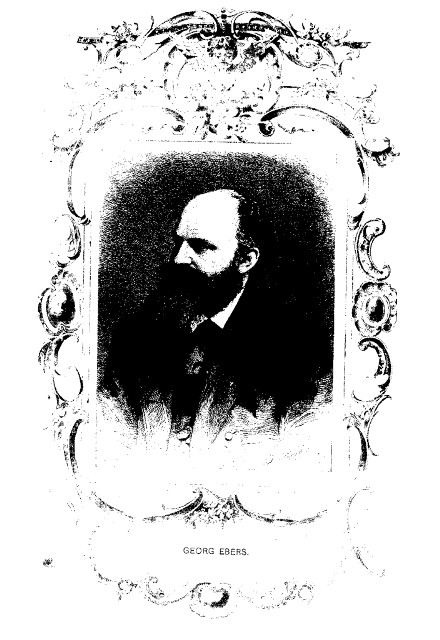
GEORG MORITZ EBERS
(1837-)

eorg Ebers, distinguished as an Egyptian archaeologist and as a historical novelist, was born in Berlin in 1837. At ten years of age he was sent to school in Keilhau, where under the direction of Froebel he was taught the delights of nature and the pleasure of study. His university career at Göttingen was interrupted by a long and serious illness. During his convalescence he pursued with avidity his study of Egyptian archæology, and with neither dictionary nor grammar to help him in the mastery of hieroglyphics, he acquired to some degree this ancient language. Later, under the learned Lepsius, he became a thorough and brilliant scholar in the science which is his specialty. It was at this epoch that he wrote 'An Egyptian Princess,' for the purpose of realizing to himself a period which he was studying. Thirteen years later his second work, 'Uarda' was published. When restored to health, he launched himself with enthusiasm on the life of a university professor. He taught for a time at Jena, and in 1870 removed to Leipsic. He has made several journeys into Egypt, sharing his experiences with the public.
'The Egyptian Princess' is Ebers's most representative romance. It is perhaps the subtle quality of popularity, rather than exceptional merit, which has insured its success. The scene of the story is laid at the time when Egypt drew its last free breath, unconscious that at the very height of its intellectual vigor its national life was to be cut off; the time when Amasis held the throne of the Pharaohs, and Cambyses was king of Persia. 'Uarda' gives a picture of Egypt under one of the Rameses. 'Homo Sum,' a tale of the desert anchorites in the fourth century, is filled with the spirit of the early Christians. In the story of 'Die Schwestern' (The Sisters) Ebers takes the reader to Memphis, the temple of Serapis, and the palace of the Ptolemies. The ethical element enters largely into the novel 'Der Kaiser' (The Emperor), of Christianity in the time of Hadrian.
In the 'Frau Bürgermeisterin' (The Burgomaster's Wife), Ebers leaves behind him the world of antiquity, and deals with the heroic struggle against the Spanish rule made in 1547 by the city of Leyden. 'Gred,' a long and quiet novel, most carefully executed, is a minute picture of middle-class Nürnberg, some centuries ago. 'Ein Wort' (A Word: Only a Word) also stands apart from the historical romances. It is a psychological and ethical story, working out the development of inconspicuous character. Both in 'Serapis' and 'The Bride of the Nile,' the victory of Christianity over heathenism is celebrated. Not less interesting than his fiction is his book of travels called 'Durch Gosen zum Sinai' (Through Goshen to Sinai). In 1889, on account of his health, Ebers resigned his professorship. He now passes his winters in Munich, where his life is that of a scholar and a writer.
THE ARRIVAL AT BABYLON
From 'An Egyptian Princess'
Seven weeks later, a long line of chariots and riders of every description wound along the great highway that led from the west to Babylon, the gigantic city which could be seen from a long distance.
Nitetis, the Egyptian princess, sat in a gilt four-wheeled chariot, called a "Harmamaxa." The cushions were covered with gold brocade; the roof was supported by wooden columns; its sides could be closed by means of curtains.
Her companions, the Persian nobles, the dethroned King of Lydia and his son, rode by the side of her chariot. Fifty carriages and six hundred sumpter-horses followed, and a regiment of Persian soldiers on splendid horses preceded the procession.
The road lay along the Euphrates, through luxuriant fields of wheat, barley, and sesame, which yielded two or even three hundredfold. Slender date-palms, with heavy clusters of fruit, stood in the fields, which were intersected in all directions by canals and conduits. Although it was winter, the sun shone warm and clear in the cloudless sky. The mighty river was crowded with barges and boats, which brought the produce of the Armenian highlands to the Mesopotamian plain, and forwarded to Babylon the greater part of the wares which were brought to Thapsacus from Greece.
Engines, pumps, and water-wheels poured refreshing moisture on the fields and plantations along the banks, which were dotted with numerous villages. Everything indicated that the capital of a civilized and well-governed country was close at hand.
The carriage and suite of Nitetis stopped before a long building of brick covered with bitumen, by the side of which grew numerous plane-trees. Croesus was helped from his horse, approached the carriage of the Egyptian princess, and cried to her:—"We have reached the last station-house. The high tower that stands out against the horizon is the famous tower of Bel, like your Pyramids one of the greatest achievements of mortal hands. Before the sun sets we shall reach the brazen gates of Babylon. Permit me to help you from the carriage, and to send your women to you into the house. To-day you must dress yourself according to the custom of Persian queens, so that you may be pleasant in the eyes of Cambyses. In a few hours you will stand before your husband. How pale you are! See that your women skillfully paint joyous excitement on your cheeks. The first impression is often decisive, and this is the case with your future husband, more than with any one else. If, as I do not doubt, you please him at first sight, you have won his heart forever. If you displease him, he will, in accordance with his rough habits, scarcely deign to look on you again with kindness. Courage, my daughter. Above all things, remember what I have taught you."
Nitetis wiped away a tear, and returned:—"How shall I thank you for all your kindness, Croesus, my second father, my protector and adviser! Oh, do not ever desert me! When the path of my poor life passes through sorrow and grief, remain my guide and protector, as you have been during this long journey over dangerous mountain passes. Thank you, my father, thank you a thousand times."
With these words, the girl put her beautiful arms round the old man's neck and kissed him like an affectionate daughter.
When she entered the court of the gloomy house, a man came towards her, followed by a train of Asiatic serving-women. The leader, the chief eunuch, one of the most important Persian court officials, was tall and stout. There was a sweet smile on his beardless face; valuable rings hung from his ears; his arms and legs, his neck, his long womanish garments, were covered with gold ornaments, and his stiff artificial curls were surrounded by a purple fillet, and sent forth a pungent odor. Boges, for this was the eunuch's name, bowed respectfully to the Egyptian and said, holding his fleshy hand covered with rings before his mouth:—"Cambyses, the ruler of the world, sends me to meet you, O queen, that I may refresh your heart with the dew of his greetings. He further sends to you through me, his poorest slave, the garments of Persian women, that you may approach the gate of the Achæmenidæ in Median dress, as beseems the wife of the greatest of rulers. These women your servants await your commands. They will transform you from an Egyptian emerald into a Persian diamond." Boges drew back, and with a condescending movement of his hand allowed the host of the inn to present the princess with a most tastefully arranged basket of fruit.
Nitetis thanked both men with friendly words, entered the house, and tearfully put off the robes of her home; the thick plait, the mark of an Egyptian princess, was unfastened, and strange hands clad her in Median fashion.
Meanwhile her companions commanded a meal to be prepared. Nimble servants fetched chairs, tables, and golden utensils from the wagon; the cooks bustled about, and were so ready and eager to help each other that soon, as if by magic, a splendidly laid table where nothing was wanting, down to the very flowers, awaited the hungry travelers.
The same luxury had been displayed during the whole journey, for the sumpter-horses that followed the royal travelers carried every imaginable convenience, from gold-woven water-proof tents down to silver footstools, and the carts that accompanied them bore bakers, cooks, cup-bearers, carvers, men to prepare ointment, wreath-winders, and hair-dressers.
Well-appointed inns were established at regular intervals along the high-road. Here the horses that had fallen on the way were replaced by fresh ones, shady trees offered a pleasant shelter from the heat of the sun, and on the mountains the fires of the inns protected the traveler from cold and snow.
The Persian inns, which resembled our post-houses, were first established by Cyrus the Great, who sought to shorten the enormous distances between the different parts of his realm by means of well-kept roads. He had also organized a regular postal service. At every station the riders with their knapsacks found substitutes on fresh horses ready for instant departure, who, after receiving the letters which were to be forwarded, galloped off post-haste, and when they reached the next inn threw their knapsacks to other riders who stood in readiness. These couriers were called Angares, and were considered the swiftest horsemen in the world.
When the company, who had been joined by Boges the eunuch, rose from table, the door of the inn opened. A long-drawn sigh of admiration was heard, for Nitetis stood before the Persians in the splendid Median court dress, proudly exultant in the consciousness of her beauty, and yet suffused with blushes at her friends' astonishment.
The servants involuntarily prostrated themselves in the Asiatic manner, but the noble Achæmenidæ bowed low and reverently. It was as if the princess had laid aside all shyness with the simple dress of her home, and assumed the pride and dignity of a queen with the silken garments, heavy with gold and jewels, of a Persian princess.
The deep respect which had just been shown her seemed to please her. With a condescending movement of her hand she thanked her admiring friends; then she turned to the chief eunuch and said to him kindly but proudly:—"You have done your duty. I am not dissatisfied with the robes and the slaves you have provided for me. I shall duly praise your care to my husband. Meanwhile, receive this golden chain as a sign of my gratitude."
The powerful overseer of the king's wives kissed her hand and silently accepted the gift. None of his charges had yet treated him with such pride. All the wives whom Cambyses had owned till now were Asiatics, and as they were acquainted with the full power of the chief eunuch, they were accustomed to do all they could to win his favor by means of flattery and submission.
Boges again bowed low to Nitetis; but without paying any further attention to him, she turned to Croesus and said in a low tone:—"I cannot thank you, my gracious friend, with word or gift for what you have done for me; it will be owing to you alone if my life at this court becomes, if not happy, at least peaceful." Then she continued in a louder voice, audible to her traveling companions:—"Take this ring, which has not left my hand since our departure from Egypt. Its value is small, its significance great. Pythagoras, the noblest of all the Greeks, gave it to my mother when he came to Egypt to listen to the wise teachings of our priests. She gave it to me when I left home. There is a seven engraved on this simple turquoise. This number, which is indivisible, represents the health of body and soul, for nothing is less divisible than health. If but a small portion of the body suffers, the whole body is ill; if one evil thought nestles in our heart, the harmony of the soul is disturbed. Whenever you look at this seven, let it remind you that I wish you perfect enjoyment of bodily health, and the continuance of that benignity which makes you the most virtuous and therefore the most healthy of men. No thanks, my father, for I should remain in your debt though I should restore to Croesus the wealth of Croesus. Gyges, take this Lydian lyre of ivory, and when its strings give forth music, remember the giver. To you, Zopyrus, I give this chain, for I have noticed that you are the most faithful friend of your friends, and we Egyptians put bonds and ropes into the fair hands of our goddess of love and friendship, beautiful Hathor, as a symbol of her binding qualities. To you, Darius, the friend of Egyptian lore and the starry firmament, I give for a keepsake this golden ring, on which you will find the Zodiac engraved by a skillful hand. Bartja, my dear brother-in-law, you shall receive the most precious treasure I possess. Take this amulet of blue stone. My sister Tachot put it round my neck when for the last time I pressed a kiss upon her lips before we fell asleep. She told me this talisman would bring sweet happiness in love to him who wore it. She wept as she spoke, Bartja. I do not know what she was thinking of, but I hope I am carrying out her wish when I lay this treasure in your hand. Think that Tachot is giving it to you through me her sister, and think sometimes of the garden of Sais."
She had spoken in Greek till then. Now she turned to the servants, who were waiting at a respectful distance, and said in broken Persian:—"You too must accept my thanks. You shall receive a thousand gold staters. Boges," she added, turning to the eunuch, "I command you to see that the sum is distributed not later than the day after to-morrow! Lead me to my carriage, Croesus!"
The old man hastened to comply with her request. While he conducted Nitetis to the carriage, she pressed his arm against her breast and whispered, "Are you satisfied with me, my father?"
"I tell you, maiden," returned the old man, "you will be the first at this court after the king's mother, for true regal pride is on your brow, and you possess the art of doing great things with small means. Believe me, a trifling gift, chosen as you can choose, will cause greater pleasure to a nobleman than a heap of gold flung down before him. The Persians are accustomed to bestow and to receive costly gifts. They know how to enrich one another. You will teach them to make each other happy. How beautiful you are! Is that right, or do you desire higher cushions? But what is that! Do you not see clouds of dust rolling hither from the town? That must be Cambyses, who is coming to meet you. Keep yourself upright, girl. Above all, try to bear your husband's glance and return it. Few can bear the fire of his eye. If you succeed in meeting it without fear or embarrassment, you have conquered. Courage, courage, my daughter! May Aphrodite adorn you with her loveliest charms! To horse, my friends! I think the King is coming to meet us."
Nitetis sat very erect in the golden carriage, and pressed her hands on her heart. The cloud of dust came nearer and nearer. Now bright sunbeams were reflected in the weapons of the approaching host, and darted from the cloud of dust like lightning from a stormy sky. Now the cloud divided, and figures could be distinguished; now the approaching procession vanished behind the thick bushes at a turn of the road; and now, not a hundred feet away, the galloping riders were seen distinctly as they approached nearer and nearer.
The whole procession seemed to consist of a gay crowd of horses, men, purple, gold, silver, and jewels. More than two hundred riders, all on snow-white Nisæan steeds, whose bridles and caparisons glittered with gold bells and buckles, feathers, tassels, and embroidery, were followed by a man who was often carried away by the powerful coal-black horse on which he rode, but who generally proved to the unmanageable, foaming animal that he was strong enough to tame its wildness. The rider, whose knees pressed the horse so that the animal trembled and panted, wore a garment with a scarlet and white pattern, which was embroidered with silver eagles and falcons. His trousers were of purple, his boots of yellow leather. He wore a golden belt round his waist, in which was a short dagger-like sword, whose hilt and sheath were incrusted with jewels. The rest of his dress resembled Bartja's. His tiara also was surrounded by the blue-and-white fillet of the Achæmenidæ. Thick jet-black hair streamed from it. A thick beard of the same color covered the whole lower portion of his hale, rigid face. His eyes were even darker than his hair and beard, and glittered with a fire that burned instead of warming. A deep red scar, caused by the sword of a Massagetian warrior, marked the lofty brow, large aquiline nose, and thin lips of the rider. His whole bearing bore the stamp of great power and immoderate pride.
Nitetis could not turn her eyes from his form. She had never seen any one like him. She thought she saw the essence of all manliness in the intensely proud face. It seemed to her as if the whole world, but especially she herself, had been created to serve this man. She feared him, and yet her humble woman's heart longed to cling to this strong man as the vine clings to the elm. She did not know whether the father of all evil, terrible Seth, or the giver of all light, great Ra, was to be imagined in this form.
As light and shade alternate when the heavens are clouded at noon, so did deep red and ashy pallor appear on her face. She forgot the precepts of her fatherly friend; and yet when Cambyses forced his wild snorting steed to stand still by the side of her carriage, she gazed breathlessly into the flashing eyes of the man, for she knew that he was the King, though no one had told her.
The stern face of the ruler of half the world softened more and more, the longer she, urged by a strange impulse, endured his piercing glance. At last he waved his hand in welcome and rode towards her companions, who had dismounted, and who either prostrated themselves in the dust before the King, or stood bowing low, in accordance with Persian custom, hiding their hands in the sleeves of their garments.
Now he himself sprang from his horse. At the same time all his followers swung themselves out of the saddle. The carpet-bearers in his train spread, quick as thought, a heavy purple carpet on the road, so that the King's foot should not touch the dust. A few seconds later, Cambyses greeted his friends and relations with a kiss.
Then he shook Croesus's hand, and ordered him to mount again and accompany him to Nitetis as interpreter.
The highest dignitaries hastened up and helped the King to mount. He gave the signal, and the whole procession moved on. Croesus rode beside Cambyses by the golden carriage.
"She is beautiful, and pleasing to my heart," cried the Persian to his Lydian friend. "Now translate to me faithfully what she says in answer to my questions, for I understand only Persian, Babylonian, and Median."
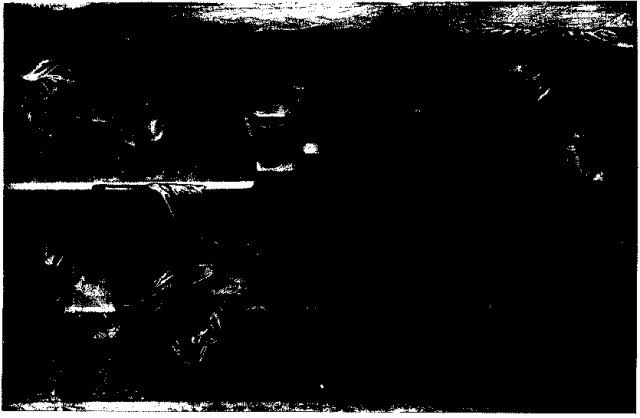
BABYLONIAN MARRIAGE MARKET.
Photogravure from a Painting by Edwin Long, R.A.
"Once a year in each village the maidens of age to marry were collected all together into one place, while the men stood round them in a circle. Then a herald called up the damsels one by one and offered them for sale. He began with the most beautiful; when she was sold for no small sum, he offered for sale the one who came next to her in beauty. All of them were sold to be wives. The richest of the Babylonians who wished to wed, bid against each other for the loveliest maidens, while the humbler wife-seekers who were indifferent about beauty took the more homely damsels with a marriage portion.... The marriage portions were furnished by the money paid for the beautiful damsels, and thus the fairer maidens portioned out the uglier.
No one was allowed to give his daughter in marriage to the man of his choice, nor might any one carry away the damsel whom he had purchased without finding bail really and truly to make her his wife. If, however, it turned out that they did not agree, the money might be paid back."—Herodotus, Book I. Sec. 196.
Nitetis had understood his words. Inexpressible joy filled her heart, and before Croesus could answer the King she said in a low tone, in broken Persian, "How shall I thank the gods, who let me find favor in your eyes? I am not ignorant of the language of my lord, for this noble old man has instructed me in the Persian language during our long journey. Pardon me if I can answer in broken words only. My time for instruction was short, and my understanding is only that of a poor ignorant maiden."
The usually stern King smiled. His vanity was flattered by Nitetis's eagerness to gain his approbation, and this diligence in a woman seemed as strange as it was praiseworthy to the Persian, who was used to see women grow up in ignorance and idleness, thinking of nothing but dress and intrigue.
He therefore answered with evident satisfaction, "I am glad that I can speak to you without an interpreter. Continue to try to learn the beautiful language of my fathers. My companion Croesus shall remain your teacher in the future."
"Your command fills me with joy," said the old man, "for I could not desire a more grateful or more eager pupil than the daughter of Amasis."
"She confirms the ancient fame of Egyptian wisdom," returned the King; "and I think that she will soon understand and accept with all her soul the teachings of the magi, who will instruct her in our religion."
Nitetis looked down. The dreaded moment was approaching. She was henceforth to serve strange gods in place of the Egyptian deities.
Cambyses did not observe her emotion, and continued:—"My mother Cassandane shall initiate you in your duties as my wife. I will conduct you to her myself to-morrow. I repeat what you accidentally overheard: you please me. Look to it that you keep my favor. We will try to make you like our country; and because I am your friend I advise you to treat Boges, whom I sent to meet you, graciously, for you will have to obey him in many things, as he is the superintendent of the harem."
"He may be the head of the women's house," returned Nitetis. "But it seems to me that no mortal but you has a right to command your wife. Give but a sign and I will obey, but consider that I am a princess, and come from a land where weak woman shares the rights of strong men; that the same pride fills my breast which shines in your eyes, my beloved! I will gladly obey you the great man, my husband and ruler; but it is as impossible for me to sue for the favor of the unmanliest of men, a bought servant, as it is for me to obey his commands."
Cambyses's astonishment and satisfaction increased. He had never heard any woman save his mother speak like this, and the subtle way in which Nitetis unconsciously recognized and exalted his power over her whole existence satisfied his self-complacency. The proud man liked her pride. He nodded approvingly and said, "You are right. I will have a special house prepared for you. I alone will command you. The pleasant house in the hanging gardens shall be prepared for you to-day."
"I thank you a thousand times!" cried Nitetis. "If you but knew how you delight me by your gift! Your brother Bartja told me much of the hanging gardens, and none of the splendors of your great realm pleased us as much as the love of the king who built the green mountain."
"To-morrow you will be able to enter your new dwelling. Tell me how you and the Egyptians liked my envoys?"
"How can you ask! Who could become acquainted with noble Croesus without loving him? Who could help admiring the excellent qualities of the young heroes, your friends? They have become dear to our house, especially your beautiful brother Bartja, who won all hearts. The Egyptians are averse to strangers, but whenever Bartja appeared among them a murmur of admiration arose from the gaping throng."
At these words the King's face grew dark. He gave his horse a heavy blow, so that it reared, turned its head, galloped in front of his retinue, and in a few minutes reached the walls of Babylon....
The walls seemed perfectly impregnable, for they were two hundred cubits high, and their breadth was so great that two carriages could easily pass each other. Two hundred and fifty high towers surmounted and fortified this huge rampart. A greater number of these citadels would have been necessary if Babylon had not been protected on one side by impenetrable marshes. The enormous city lay on both sides of the Euphrates. It was more than nine miles in circumference, and the walls protected buildings which surpassed even the pyramids and the temples of Thebes and Memphis in size....
Nitetis looked with astonishment at this huge gate; with joyful emotion she gazed at the long wide street, which was festively decked in her honor.
JOSÉ ECHEGARAY
(1832-)

he period of political disorder and disturbance which followed the revolution of 1868 in Spain was also a period of disorder and decline for the Spanish stage. The drama—throwing off the fetters of French classicism that paralyzed inspiration at the beginning of the century—had revived for a time. But after its rejuvenescence of the glories of the Golden Age of Spanish literature, uniting a new beauty of form with truth to nature in the Classic-Romantic School, it sank into a debasement hitherto unknown. Meretricious sentiment, dullness, or buffoonery, chiefly of foreign production, occupied the scene before adorned by the imagination, the wisdom, and the wit, of a Zorilla, a Tamayo, a Ventura de la Vega.
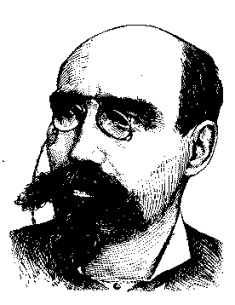
José Echegaray
It was at this period of dramatic decadence that Echegaray appeared to revive once more the romantic traditions of the Spanish stage, peopling it again with noble and heroic figures,—in whom, however, the chivalric spirit of the Middle Ages is at times strangely joined to the casuistic modern conscience. The explanation of this is perhaps to be found in part in the mental constitution of the dramatist, in whom the analytic and the imaginative faculties are united in marked degree, and who had acquired a distinguished reputation as a civil engineer long before he entered the lists as an aspirant for dramatic honors. Born in Madrid in 1832, his earlier years were passed in Murcia, where he took his degree of bachelor of arts, applying himself afterward with notable success to the study of the exact sciences. Returning to Madrid, after enlarging his knowledge of his profession of civil engineer by practical study in various provinces of Spain, he was appointed a professor in the School of Engineers, where he taught theoretical and applied mathematics, finding time however for the production of important scientific works, and for the study of political economy and general literature. On the breaking out of the revolution of 1868 he joined actively in the movement, taking office under the new government as Director of Public Works, and holding a ministerial portfolio. He took office a second time in 1872, and later filled the post of Minister of Finance, which he resigned on the proclamation of the Republic. Retiring from public life, he went to Paris; and while there wrote, being then a little past forty, his first dramatic work, 'The Check-Book,' a domestic drama in one act, which was represented anonymously in Madrid two years later, when the author for the third time held a ministerial portfolio.
'The Check-Book' was followed in rapid succession by a series of productions whose titles, 'La Esposa del Vengador' (The Avenger's Bride), 'La Ultima Noche' (The Last Night), 'En el Puño de la Espada' (In the Hilt of the Sword), 'Como Empieza y Como Acaba' (How it Begins and How it Ends), sufficiently indicate their character. They are of unequal merit, but all show dramatic power of a high order. But on the representation in 1877 of 'Locura o Santidad?' (Madman or Saint?), the fame of the statesman and the scientist was completely and finally eclipsed by that of the dramatist, in whom the press and public of Madrid unanimously recognized a new and vital force in the Spanish drama. In this tragedy the keynote of Echegaray's philosophy is clearly struck. Moral perfection, unfaltering obedience to the right, is the end and aim of man; and the catastrophe is brought about by the inability of the hero to make those nearest to him accept this ideal of life. "Then virtue is but a lie," he cries, when the conviction of his moral isolation is forced upon him; "and you, all of you whom I have most loved in this world, perceiving what I regarded as divinity in you, are only miserable egoists, incapable of sacrifice, a prey to greed and the mere playthings of passion! Then you are all of you but clay; you resolve yourselves to dust and let the wind of the tempest carry you off! ... Beings shaped without conscience or free-will are simply atoms that meet to-day and separate to-morrow. Such is matter—then let it go!"
But the punishment of sin, in Echegaray's moral code, is visited upon the innocent equally with the guilty; and the guilty are never allowed to escape the retributive consequences of their wrong-doing. The pessimistic coloring of the picture would be at times unendurably oppressive, were it not relieved and lightened by the moral dignity of the hero. Echegaray's pessimism is, so to say, altruistic, never egoistic; and the compensating sense of righteousness vindicated rarely fails to explain, if not to justify, his darkest scenes.
Judged by the canons of art, Echegaray's dramatic productions will be found to have many imperfections. But their defects are the defects of genius, not of mediocrity, and spring generally from an excess of imagination, not from poverty of invention or faulty insight. The plot is often overweighted with an accumulation of incidents, and the means employed to bring about the desired end are often lacking in verisimilitude. Synthetic rather than analytic in his methods, and a master in producing contrasts, Echegaray captivates the imagination by arts which the cooler judgment not seldom condemns. His characters too are not always inhabitants of the real world, and not infrequently act contrary to the laws which govern it. The secondary characters are too often carelessly drawn, sometimes being mere shadowy outlines, while an altogether disproportionate part of the development of the plot is intrusted to them.
On the other hand, in the world of the passions Echegaray treads with secure step. Its labyrinthine windings, its depths and its heights, are all familiar to him. Here every accent uttered is the accent of truth; every act is prompted by unerring instinct. Nothing is false; nothing is trivial; nothing is strained. The elemental forces of nature seem to be at work, and the catastrophe results as inevitably from their action as if decreed by fate.
The genius of Echegaray, which in its irregular grandeur and its ethical tendency has been not inaptly likened by a Spanish critic to that of Victor Hugo, rarely descends from the tragic heights on which it achieved its first and its greatest triumphs; but that its range has been limited by choice, not nature, is abundantly proved in the best of his lighter productions, 'Un Critico Incipiente' (An Embryo Critic). Of his achievement in tragedy the culminating point was reached—after a second series of noteworthy productions, among them 'Lo Que no Puede Decirse' (What Cannot be Told), 'Mar Sin Orillas' (A Shoreless Sea), and 'En el Seno de la Muerte' (In the Bosom of Death)—in 'El Gran Galeoto' (The Great Galeoto), represented in 1881 before an audience which hailed its author as a "prodigy of genius," a second Shakespeare. Other notable works followed,—'Conflicto entre Dos Deberes' (Conflict between Two Duties), 'Vida Alegre y Muerte Triste' (A Merry Life and a Sad Death), 'Lo Sublime en lo Vulgar' (The Sublime in the Commonplace); but 'El Gran Galeoto' has remained thus far its author's supreme dramatic achievement. In its title is personified the evil speaking which not always with evil intent, sometimes even with the best motives, slays, with a venom surer than that of the adder's tongue, the reputation which it attacks; turning innocence itself by its contaminating power into guilt.
FROM 'MADMAN OR SAINT?'
[Don Lorenzo, a man of wealth and position living in Madrid, has discovered that he is the son, not as he and all the world had supposed, of the lady whose wealth and name he has inherited, but of his nurse Juana, who dies after she has revealed to him the secret of his birth. In consequence he resolves publicly to renounce his name and his possessions, although by doing so he will prevent the marriage of his daughter Inez to Edward, the son of the Duchess of Almonte. The mother will consent to Don Lorenzo's renunciation of his possessions but not of his name, as this would throw a stigma on Inez's origin. He refuses to listen either to the reasoning or to the entreaties of his wife, the duchess, Edward, and Dr. Tomás. Finally they are persuaded that he is mad, and Dr. Tomás calls in a specialist to examine him. The specialist, with two keepers, arrives at the house at the same time with the notary, whom Don Lorenzo has sent for to make before him a formal act of renunciation of his name and possessions.]
Don Lorenzo enters and stands listening to Inez
Don Lorenzo [aside]—"Die," she said!
Edward—You to die! No, Inez, not that; do not say that.
Inez—And why not? If I do not die of grief—if happiness could ever visit me again—I should die of remorse.
Lorenzo [aside]—"Of remorse!" She! "If happiness could ever visit her again!" What new fatality floats in the air and hangs threateningly above my head? Remorse! I have surprised another word in passing! I traverse rooms and halls, and I go from one place to another, urged by intolerable anguish, and I hear words that I do not understand, and I meet glances that I do not understand, and tears greet me here and smiles there, and no one opposes me, and every one avoids me or watches me. [Aloud.] What is this? What is this?
Inez [hurrying to him and throwing herself into his arms]—Father!
Lorenzo—Inez! How pale you are! Why are your lips drawn as if with pain? Why do you feign smiles that end in sighs!—How lovely in her sorrow! And I am to blame for all!
Inez—No, father.
Lorenzo—How cruel I am! Ah! you think it, although you do not say it.
Edward—Inez is an angel. Rebellious thoughts can find no place in her heart; but who that sees her can fail to think it and to say it?
Lorenzo—No one; you are right.
Edward [with energy]—If I am right, then you are wrong.
Lorenzo—I am right also. There is something more pallid than the pallid brow of a lovesick maiden; there is something sadder than the sad tears that fall from her beautiful eyes; something more bitter than the smile that contracts her lips; something more tragic than the death of her beloved.
Edward [with scornful vehemence]—And what is that pallor, what are those tears, and what the tragedies you speak of?
Lorenzo—Insensate! [Seizing him by the arm.] The pallor of crime, the tears of remorse, the consciousness of our own vileness.
Edward—And it would be vile, and criminal, and a source of remorse, to make Inez happy?
Lorenzo [despairingly]—It ought not to be so—but it would! [Pause.] And this it is that tortures me. This is the thought that is driving me mad!
Inez—No, father, do not say that! Follow the path you have marked out for yourself, without thought of me. What does it matter whether I live or die?
Lorenzo—Inez!
Inez—But do not vacillate—and above all, let no one see that you vacillate; let your speech be clear and convincing as it is now; let not anger blind you. Be calm, be calm, father; I implore it of you in the name of God.
Lorenzo—What do you mean by those words? I do not understand you.
Inez—Do I rightly know myself what I mean? There—I am going. I do not wish to pain you.
Edward [to Lorenzo]—Ah, if you would but listen to your heart; if you would but silence the cavilings of your conscience.
Inez [to Edward]—Leave him in peace—come with me; do not anger him, or you will make him hate you.
Lorenzo—Poor girl! She too struggles, but she too will conquer! [With an outburst of pride.] She will show that she is indeed my daughter!
[Inez and Edward go up the stage; passing the study door, Inez sees the keepers and gives a start of horror.]
Inez—What sinister vision affrights my gaze!—No, father, do not enter there.
Edward—Come, come, my Inez!
Inez [to her father]—No, no, I entreat you!
Lorenzo [approaching her]—Inez!
Inez—Those men there—look!
[Inez stretches out her hand toward the study; Don Lorenzo stands and follows her gaze. At this moment the keepers, hearing her cry, show themselves between the curtains.]
Edward [leading Inez away]—At last!
Lorenzo—Now I am more tranquil! The wound is mortal! I feel it here in my heart! I thank thee, merciful God!
Dr. Tomás and Dr. Bermúdez enter and stop to observe Don Lorenzo.
Dr. Tomás—There he is—sitting in the arm-chair.
Dr. Bermúdez—Unfortunate man!
Lorenzo [rising, aside]—Ah, miserable being! Still cherishing impossible hopes. Impossible? And what if they honestly believe that I— [Despairingly] Ah! If they loved me they would not believe it. [Pause.] Did I not hear Inez—the child of my heart—speak of remorse? Why should she speak of remorse? [Aloud, with increasing agitation.] They are all wretches! They would almost be glad that I should die. But no: I will not die until I have fulfilled my duty as an honorable man; until I have put the climax to my madness.
Dr. Tomás [laying his hand on Don Lorenzo's shoulder]—Lorenzo—
Lorenzo [turning, recognizes him and draws back angrily]—He!
Dr. Tomás—Let me present to you Dr. Bermúdez, one of my best friends. [Pause. Don Lorenzo regards both strangely.]
Dr. Bermúdez [to Dr. Tomás, in a low voice]—See the effort he makes to control himself; he is vaguely conscious of his condition—there is not a doubt left on my mind.
Lorenzo—One of your best friends—one of your best friends—
Dr. Bermúdez [aside to Dr. Tomás]—The idea is escaping him, and he is striving to retain it.
Lorenzo [ironically]—If he is one of your best friends, then your loyalty is a guarantee for his.
Dr. Bermúdez [aside, to Dr. Tomás]—At last he has found the word. But notice how unnatural is the tone of his voice. [Aloud.] I have come to be a witness, according to what Dr. Tomás tells me, of a very noble action.
Lorenzo—And of an act of base treachery also.
Dr. Tomás—Lorenzo!
Dr. Bermúdez [aside, to Dr. Tomás]—Let him go on talking.
Lorenzo—And of an exemplary punishment.
Dr. Bermúdez [aside to Dr. Tomás]—A serious case, my friend, a serious case.
Lorenzo [to Dr. Tomás]—Call everybody: those of the household and strangers alike. Let them assemble here, and here await my orders, while I go to fulfill my duty yonder. What are you waiting for?
Dr. Bermúdez [aside, to Dr. Tomás]—Let him have his way; call them.
[Dr. Tomás rings a bell; a servant enters, to whom he speaks in a low voice and who then goes out.]
Lorenzo—It is the final trial; I could almost feel pity for the traitors. Ah! I am sustained by the certainty of my triumph. Be still, my heart. There they are—there they are. I do not wish to see them. To treat me thus who loved them so dearly!—I do not wish, and yet my eyes turn toward them—seeking them—seeking them!
Lorenzo—Inez! It cannot be! She! no, no. It cannot be! My child!
[Hurries towards her with outstretched arms. Inez runs to him.]
Inez—Father!
[Dr. Bermúdez hastens to interpose, and separates them forcibly.]
Dr. Bermúdez—Come, come, Don Lorenzo; you might hurt your daughter seriously.
Lorenzo [seizing him by the arm and shaking him violently]—Wretch! Who are you to part me from my child?
Dr. Tomás—Lorenzo!
Edward—Don Lorenzo!
Angela—My God!
[The women group themselves instinctively together, Inez in her mother's arms, the duchess beside them. Dr. Tomás and Edward hasten to free Bermúdez from Don Lorenzo's grasp.]
Lorenzo [aside, controlling himself]—So! The imbeciles think it is another access of madness! Ha, ha, ha! [Laughing with suppressed laughter. All watch him.]
Dr. Bermúdez [aside to Dr. Tomás]—It is quite clear.
Angela [aside]—Oh, my poor Lorenzo!
Inez [aside]—My poor father!
Lorenzo [aside]—Now you shall see how my madness will end. Before I leave this house, with what pleasure will I turn that doctor out of it. Courage! The coming struggle inspires me with new strength. What! Is a man to be declared mad because he is resolved to do his duty? Ah, it cannot be! Humanity is neither so blind nor so base as that. Enough! I must be calm. Treachery has begun its work; then let the punishment begin too. [Aloud.] The hour has come for me to perform a sacred duty, though a most painful one. It would be useless to ask you to witness formalities which the law requires, but which you would only find irksome. The representative of the law awaits me in yonder room; and in obedience to another and a higher law, I am going now to renounce a fortune which is not mine, and a name which neither I nor my family can conscientiously bear longer. After this is done I will return here, and with my wife, and—and my daughter—and let no one seek to dissuade me from my purpose, for it would be in vain—I will leave this house which has been for me in the past the abode of love and happiness, but which is to-day the abode of treachery and baseness. Gentlemen [to Dr. Tomás and Dr. Bermúdez], lead the way; I beg you to do so.
[All slowly enter the study. On the threshold Lorenzo casts a last look at Inez.]
Translation made for 'A Library of the World's Best Literature,' by Mary J. Serrano
FROM 'THE GREAT GALEOTO'
[In the scenes which are here cited the poison of slander begins to work. Don Severo, uttering the anonymous gossip of the world, has implanted in the mind of his middle-aged brother Don Julian the first suspicion of the honor of his young wife Teodora and the loyalty of his adopted son Ernest. Teodora, who has been warned by Mercedes, Don Severo's wife, overhears the accusing words of her brother-in-law, who is talking with her husband in an inner apartment; and horror-struck, is about to fly from the room.]
Julian [inside]—Let me go!
Mercedes [inside]—No, for Heaven's sake!
Julian—It is they. I will go!
Teodora [to Ernest]—Go! go!
Severo [to Ernest]—You shall give me satisfaction for this!
Ernest—I will not refuse it.
Enter Julian, pale and disordered; wounded and seemingly in a dying condition, supported by Mercedes. Don Severo stations himself at the right, Teodora and Ernest remain in the background.
Julian—Together! Where are they going?—Stop them! They shun my presence! Traitors!
[He makes a movement as if to rush toward them, but his strength fails him and he totters.]
Severo [hurrying to his assistance]—No, no.
Julian—They deceived me—they lied to me! Wretches! [While he is speaking, Mercedes and Severo lead him to the arm-chair on the right.] There—look at them—she and Ernest! Why are they together?
Teodora and Ernest [separating]—No!
Julian—Why do they not come to me? Teodora!
Teodora [stretching out her arms, but without advancing]—My Julian!
Julian—Here, on my heart! [Teodora runs to Julian and throws herself into his arms. He presses her convulsively to his breast. Pause.] You see!—You see! [To his brother.] I know that she deceives me! I press her in my arms—I might kill her if I would—and she would deserve it—but I look at her—I look at her—and I cannot!
Teodora—Julian!
Julian—And he? [Pointing to Ernest.]
Ernest—Sir!—
Julian—And I loved him! Be silent and come hither. [Ernest advances.] You see she is still mine. [Presses her closer.]
Teodora—Yours—yours!
Julian—Do not act a part! Do not lie to me!
Mercedes—For God's sake! [Trying to calm him.]
Severo—Julian!
Julian [to both]—Peace. Be silent. [To Teodora.] I divined your secret. I know that you love him. [Teodora and Ernest try to protest, but he will not let them.] Madrid knows it too—all Madrid!
Ernest—No, father.
Teodora—No.
Julian—They would still deny it! When it is patent to all! When I feel it in every fibre of my being, for the fever that consumes me has illuminated my mind with its flame!
Ernest—All these fancied wrongs are the offspring of a fevered imagination, of delirium! Hear me, sir—
Julian—You will lie to me again!
Ernest—She is innocent! [Pointing to Teodora.]
Julian—I do not believe you.
Ernest—By my father's memory I swear it!
Julian—You profane his name and his memory by the oath.
Ernest—By my mother's last kiss—
Julian—It is no longer on your brow.
Ernest—By all you hold most sacred, father, I swear it, I swear it!
Julian—Let there be no oaths, no deceitful words, no protests.
Ernest—Well, then, what do you wish?
Teodora—What do you wish?
Julian—Deeds!
Ernest—What does he desire, Teodora? What would he have us do?
Teodora—I do not know. What can we do, what can we do, Ernest?
Julian [watching them with instinctive distrust]—Ah, would you deceive me to my very face? You are laying your plans together, wretches! Do I not see it?
Ernest—These are the imaginings of fever.
Julian—Fever, yes! The fire of fever has consumed the bandage with which you both blindfolded me, and at last I see clearly! And now why do you gaze on each other? why, traitors? Why do your eyes shine, Ernest? Speak. Their brightness is not the brightness of tears. Come nearer—nearer still.
[Draws Ernest to him, bends his head, and so forces him to his knees. Don Julian thus remains between Teodora, who stands at his side, and Ernest, who kneels at his feet. Don Julian passes his hand over Ernest's eyes.]
Julian—I was right—It is not with tears! They are dry!
Ernest—Pardon!—Pardon!
Julian—You ask my pardon? Then you confess your guilt.
Ernest—No!
Julian—Yes!
Ernest—It is not that!
Julian—Then look into each other's eyes before me.
Severo—Julian!
Mercedes—Sir!
Julian [to Teodora and Ernest]—You are afraid, then? You do not love each other like brother and sister, then? If you do, prove it! Let your souls rise to your eyes and in my presence mingle their reflection there, that so I may see, watching them closely, if that brightness is the brightness of light or of fire. You too, Teodora—I will have it so. Come—both; nearer still!
[Forces Teodora to kneel before him, draws their faces together, and compels them to look at each other.]
Teodora [freeing herself by a violent effort]—Oh no!
Ernest [also tries to release himself, but Julian holds him in his grasp]—I cannot!
Julian—You love each other! You love each other! I see it clearly! [To Ernest.] Your life!
Ernest—Yes.
Julian—Your blood!
Ernest—All!
Julian [keeping him on his knees]—Remain there.
Teodora—Julian! [Restraining him.]
Julian—Ah, you defend him, you defend him.
Teodora—Not for his sake.
Severo—In Heaven's name—
Julian [to Severo]—Silence! Bad friend! bad son! [Holding him at his feet.]
Ernest—Father!
Julian—Disloyal! Treacherous!
Ernest—No, father.
Julian—Thus do I brand you as a traitor on the cheek—now with my hand, soon with my sword! [With a supreme effort he raises himself and strikes Ernest on the face.]
Ernest [rises to his feet with a terrible cry and retreats, covering his face with his hands]—Ah!
Severo—Justice! [Stretching out his hand toward Ernest.]
Teodora—My God! [Hides her face with her hands and falls into a chair.]
Mercedes [to Ernest, exculpating Julian]—It was delirium!
[These four exclamations in rapid succession. A moment of stupor; Julian still standing and regarding Ernest, Mercedes and Severo trying to calm him.]
Julian—It was not delirium, it was chastisement, by Heaven! What! Did you think your treachery would go unpunished, ingrate!
Mercedes—Let us go, let us go!
Severo—Come, Julian.
Julian—Yes, I am going.
[Walks with difficulty toward his room, supported by Severo and Mercedes, stopping from time to time to look back at Ernest and Teodora.]
Mercedes—Quick, Severo!
Julian—Look at them, the traitors! It was justice! Was it not justice? So I believe.
Severo—For God's sake, Julian! For my sake!
Julian—You, you alone, of all the world, have loved me truly. [Embraces him.]
Severo—Yes, I alone!
Julian [stops near the door and looks at them again]—She weeps for him—and does not follow me. She does not even look at me; she does not see that I am dying—yes, dying!
Severo—Julian!
Julian—Wait, wait! [Pauses on the threshold.] Dishonor for dishonor!—Farewell, Ernest! [Exeunt Julian, Severo, and Mercedes.]
Translation made for 'A Library of the World's Best Literature,' by Mary J. Serrano
THE EDDAS
(ICELANDIC; NINTH TO THIRTEENTH CENTURIES)
BY WILLIAM H. CARPENTER
he fanciful but still commonly believed meaning of the word "Edda," which even many of the dictionaries explain as "great-grandmother," does not, after all, inaptly describe by suggestion the general character of the work to which it is given. The picture of an ancient dame at the fireside, telling tales and legendary lore of times whose memory has all but disappeared, is a by no means inappropriate personification, even if it has no other foundation. In point of fact, 'Edda' as the title of a literary work has nothing whatsoever to do with a great-grandmother, but means "the art of poetry," "poetics"; and only by an extension of its original use does it belong to all that is now included under it.
There are in reality two 'Eddas,' which are in a certain sense connected in subject-material, but yet in more ways than one are wholly distinct. As originally applied, the name now used collectively unquestionably belonged to the one, variously called, to distinguish it from the other, the 'Younger Edda,' on account of the relative age of its origin; the 'Prose Edda,' since in its greater part it is written in prose; and the 'Snorra Edda,' the Edda of Snorri, from the author of the work in its original form. In contradistinction to this, the other is called the 'Elder Edda,' the 'Poetical Edda,' and from the name of its once assumed author, the 'Sæmundar Edda,' the Edda of Sæmund.
Legitimately and by priority of usage, the name 'Edda' belongs to the first-named work alone. In the form in which it has ultimately come down to us, this is the compilation of many hands at widely different times; but in its most important and fundamental parts it was undoubtedly either written by the Icelander Snorri himself, or under his immediate supervision.
Snorri Sturluson, its author, both from the part he played in national politics in his day and from his literary legacy to the present, is altogether the most remarkable man in the history of Iceland. He was born in 1179, his father, Sturla Thordarson, being one of the most powerful chieftains of the island. As was the custom of the time, he was sent from home to be fostered, remaining away until his foster-father's death, or until he was nineteen years old; his own father in the meantime having died as well. He entered upon active life with but little more than his own ambition to further him; but through his brother's influence he made the following year a brilliant marriage, and thus laid the foundation of his power, which thereafter steadily grew. In 1215 Snorri was elected "Speaker of the Law" for the Commonwealth. At the expiration of his term of service in the summer of 1218 he went to Norway, where he was received with extraordinary hospitality both by King Hakon, who made him his liegeman, and by the King's father-in-law, Earl Skuli. On the authority of some of the sagas, he is said to have promised the latter at this time to use his influence to bring Iceland under the dominion of Norway. Two years later he returned to Iceland, taking back with him as a present from the King a ship and many other valuable gifts. In 1222 he was again made "Speaker of the Law," which post he now held continuously for nine years.
Iceland, as the Commonwealth neared its end, was torn apart by the jealous feuds of the chieftains. A long series of complications had aroused a bitter hostility to Snorri among his own relatives. In 1229, he found it necessary to ride to the Althing at the head of eight hundred men. The matter did not then come to an open rupture, but in 1239 it finally resulted in a regular battle, in which Snorri's faction was worsted. To avoid consequences he immediately after fled to Norway. Unwisely, he here gave his adherence to Earl Skuli, now at odds with the King, and thereby incurred the active displeasure of the latter; who, evidently fearing the use of Snorri's power against him, forbade him by letter to return to Iceland. The command was disregarded, however, and he presently was back again in his native land. In 1240 Skuli was slain, and shortly afterward King Hakon seems to have resolved upon Snorri's death. Using Arni, a son-in-law of the Icelander, as a willing messenger, he sent a letter to Gissur, another son-in-law, between whom and his father-in-law an active feud was on foot, demanding that he send the latter a prisoner to Norway, or if that were impossible, to kill him. Gissur accordingly, with seventy men at his back, came to Snorri's farmstead Reykjaholt on the night of the 22d of September, 1241, when the old chieftain was mercilessly slain in the cellar, where he had taken refuge, by an unknown member of the band.
In spite of his political life, Snorri found opportunity for abundant literary work. The 'Icelandic Annals' say that he "compiled the 'Edda' and many other books of historical learning, and Icelandic sagas." Of these, however, only two have come down to us: his 'Edda' and the sagas of the Norse kings, known since the seventeenth century as the 'Heimskringla,' the best piece of independent prose literature, and in its bearing the most important series of sagas, of all the number that are left to attest the phenomenal literary activity of the Icelanders.
Snorri's 'Edda'—both as he, the foremost poet of his day, originally conceived it, and with its subsequent additions—is a handbook for poets, an Ars poetica, as its name itself signifies. That it served its purpose as a recognized authority is discoverable from the references to it in later Icelandic poets, where "rules of Edda," "laws of Edda," "Eddic art," and "Edda" are of frequent occurrence, as indicating an ideal of poetical expression striven for by some and deprecated by others. As Snorri wrote it, the 'Edda' was an admirably arranged work in three parts: the 'Gylfaginning,' a compendium of the old mythology, the knowledge of which in Snorri's day was fast dying out; the 'Skáldskaparmál,' a dictionary of poetical expressions, many of which, contained in ancient poems, were no longer intelligible; and the 'Háttatal,' a poem or rather series of poems, exemplifying in its own construction the use and kinds of metre. As it has come down to us, it has been greatly added to and altered. A long preface filled with the learning of the Middle Ages now introduces the whole; the introductions and conclusions of the parts of the work have been extended; several old poems have been included; a Skáldatal, or list of skalds, has been added, as have also several grammatical and rhetorical tracts,—some of which are of real historical value.
With regard to matter and manner, the parts of Snorri's 'Edda' are as follows:—The 'Gylfaginning' (the Delusion of Gylfi) is a series of tales told in answer to the questions of Gylfi, a legendary Swedish king, who comes in disguise to the gods in Asgard to learn the secret of their power. By way of illustration it quotes, among other poetical citations, verses from several of the lays of the 'Elder Edda.' The 'Skáldskaparmál' (Poetical Diction) is also in great part in the form of questions and answers. It contains under separate heads the periphrases, appellatives, and synonyms used in ancient verse, which are often explained by long tales; and like the preceding part, it also is illustrated by numerous poetical quotations here, particularly from the skalds. The 'Háttatal' (Metres), finally, consists of three poems: the first an encomium on the Norwegian king Hakon, and the others on Earl Skuli. It exemplifies in not fewer than one hundred and two strophes the use of as many kinds of metre, many of them being accompanied by a prose commentary of greater or less length.
That Snorri really wrote the work as here described seems to be undoubted, although there is no trace of it as a whole until after his death. At what period of his career it arose, can however merely be conjectured. We only know with certainty the date of the 'Háttatal'; that may not unlikely have been the nucleus of the whole, which falls undoubtedly between 1221 and 1223, shortly after the return from the first visit to Norway. The oldest manuscript of the 'Snorra Edda,'—now in the University Library at Upsala, Sweden,—which was written before 1300, assigns the work to him by name; and the 'Icelandic Annals,' as has already been stated, under the year of his death corroborate the statement of his authorship of "the Edda"—that is, of course, of this particular 'Edda,' for there can be no thought of the other.
Snorri's poetical work outside of the 'Edda' is represented only by fugitive verses. An encomium that he wrote on the wife of Earl Hakon has been lost. As a poet, Snorri undoubtedly stands upon a lower plane than that which he occupies as a historian. He wrote at a time when poetry was in its decline in Iceland; and neither in the 'Háttatal' nor in his other verse, except in form and phraseology, of which he had a wonderful control, does he rise to the level of a host of earlier skalds. It is his critical knowledge of the old poetry of Norway and Iceland that makes his 'Edda' of such unique value, and particularly as no small part of the material accessible to him has since been irrevocably lost. Snorri's 'Edda,' in its very conception, is a wonderful book to have arisen at the time in which it was written, and in no other part of the Germanic North in the thirteenth century had such a thing been possible. It is not only, however, as a commentary on old Norse poetry that it is remarkable. Its importance as a compendium of the ancient Northern mythology is as great,—one whose loss nothing could supplant. As a whole, it is of incalculable value to the entire Germanic race for the light that it sheds upon its early intellectual life, its ethics, and its religion.
The history of the 'Elder Edda' does not go back of the middle of the seventeenth century. In 1643 the Icelandic bishop Brynjolf Sveinsson sent as a present to Frederick III. of Denmark several old Icelandic vellums, among which was the manuscript, dating, according to the most general assignment, from not earlier than 1350; since called the 'Codex Regius' of the 'Edda.' Not a word is known about its previous history. As to when it came into the hands of the bishop, or where it was discovered, he has given us no clew whatsoever. He had nevertheless not only a name ready for it, but a distinct theory of its authorship, for he wrote on the back of a copy that he had made, "Edda Sæmundi Multiscii" (the Edda of Sæmund the Wise).
Both Bishop Brynjolf's title for the work and his assumption as to the name of its author—for both are apparently his—are open to criticism. The name 'Edda' belongs, as we have seen, to Snorri's book; to which it was given, if not by himself, certainly by one of his immediate followers. It is not difficult, however, to explain its new application. Snorri's 'Edda' cites, as has been mentioned, a number of single strophes of ancient poems, many of which were now found to be contained in Brynjolf's collection in a more or less complete form. This latter was, accordingly, not unnaturally looked upon as the source of the material of Snorri's work; and since its subject-matter too was the old poetry, it was consequently an earlier 'Edda.' Subsequently the title was extended to include a number of poems in the same manner found elsewhere; and 'Edda' has since been irretrievably the title both of the old Norse lays and of the old Norse Ars poetica, to which it more appropriately belongs.
The attribution of the work to Sæmund was even less justifiable. Sæmund Sigfusson was an Icelandic priest, who lived from 1056 to 1133. As a young man he studied in Germany, France, and Italy, but came back to Iceland about 1076. Afterward he settled down as priest and chieftain, as was his father before him, on the paternal estate Oddi in the south of Iceland, where he lived until his death. Among his contemporaries and subsequently he was celebrated for his great learning, the memory of which has even come down to the present day in popular legend, where like learned men elsewhere he is made an adept in the black art, and many widely spread tales of supernatural power have clustered locally about his name. Sæmund is the first writer among the Icelanders of whom we have any information; and besides poems, he is reputed to have written some of the best of the sagas and other historical works. It is not unlikely that he did write parts of the history of Iceland and Norway in Latin, but nothing has come down to us that is with certainty to be attributed to him. There is however no ancient reference whatsoever to Sæmund as a poet, and it is but a legend that connects him in any way with the Eddie lays. Internal criticism readily yields the fact that they are not only of widely different date of origin, but are so unlike in manner and in matter that it is idle to suppose a single authorship at all. Nor is it possible that Sæmund, as Bishop Brynjolf may have supposed was the case, even collected the lays contained in this 'Edda.' It is on the contrary to be assumed that the collection, of which Brynjolf's manuscript is but a copy, arose during the latter half of the twelfth century, in the golden age of Icelandic literature; a time when attention was most actively directed to the past, when many of the sagas current hitherto only as oral tradition were given a permanent form, and historical works of all sorts were written and compiled.
The fact of the matter is, that here is a collection of old Norse poems, the memory of whose real time and place of origin has disappeared, and whose authorship is unknown. Earlier commentators supposed them to be of extreme age, and carried them back to the very childhood of the race. Modern criticism has dispelled the illusions of any such antiquity. It has been proved, furthermore, that the oldest of the poems does not go back of the year 850, and that the youngest may have been written as late as 1200. As to their place of origin, although all have come to us from Iceland, by far the greater number of them apparently originated in Norway; several arose in the Norse colonies in Greenland; and although the whole collection was made in Iceland, where alone many of them had been remembered, but two are undoubtedly of distinct Icelandic parentage. With regard to their authorship, results are less direct. Folk-songs they are not in the proper sense of the word, in that in their present shape they are the work of individual poets, who made over in versified form material already existing in oral tradition. Only a small part of the ancient poetry that arose in this way has been preserved. From prose interpolations which supply breaks in the continuity of the lays in the 'Elder Edda' itself, as well as from isolated strophes of old poems, else unknown, quoted in Snorri's 'Edda,' and from the citation and use of such poetical material in sagas and histories,—we know for a certainty that many other lays in the ancient manner once existed that have now been for all time lost.
Brynjolf's manuscript contains, whole or in part, as they are now considered to exist, thirty-two poems. From other sources six poems have since been added, presumably as ancient as the lays of the 'Codex Regius,' so that the 'Elder Edda' is made up of thirty-eight poems, not all of which, however, are even reasonably complete. In form they are in alliterative verse, but three different metres being represented, all the simplest and least artificial of the many kinds used by the Norsemen. In content the lays fall under three heads: they are mythic, in that they contain the myths of the old heathen religion of the Norsemen; ethic, in that they embody their views of life and rules of living; or they are heroic, in that they recount the deeds of legendary heroes of the race.
The mythic poems of the 'Edda,' taken together, give us a tolerably complete picture of the Northern mythology in the Viking Age; although some of them were not written until after the introduction of Christianity, and are therefore open to the imputation of having been to a greater or less extent affected by its teachings. The oldest poems of the collection are mythical in character. In some of them a particular god is the principal figure. Several of them, like the 'Vafthrúdnismál,' the 'Grimnismál,' 'Baldrs Draumar,' and the 'Hárbardsljód,' in this way are particularly devoted to Odin, whose supremacy they show over all other beings, and whose part they describe in the government of the universe; in others, like the 'Hymiskvida,' the 'Thrymskvida,' and the 'Alvismál,' Thor occupies the prominent part in his strife with the giants; single ones have other gods as their principal actors, like Skirnir, the messenger of Frey, in the 'Skirnismál,' Loki, the god of destruction, in the 'Lokasenna,' or Heimdall, the guardian of the rainbow bridge which stretched from heaven to earth, in the 'Rígsthúla.' A few of them are both mythic and heroic at the same time, like the 'Lay of Völund,' which tells of the fearful revenge of the mythical smith upon the Swedish king; or the 'Song of Grotti,' the magical mill, which ground what was wished, first peace and gold for its owner, King Frodi of Denmark, but later so much salt on the ship of Mysing, who had conquered the king and taken it away, that all together sunk into the sea, which henceforth was salt. By far the greater of the mythic lays is the long but fragmentary poem 'Völuspá,' the 'Prophecy of the Sibyl,' which is entitled to stand not only at the head of the Eddic songs but of all old Germanic poetry, for the beauty and dignity of its style, its admirable choice of language, and the whole inherent worth of its material. Its purpose is to give a complete picture, although only in its most essential features, of the whole heathen religion. It contains in this way the entire history of the universe: the creation of the world out of chaos; the origin of the giants, the dwarfs, of gods, and of men; and ends with their destruction and ultimate renewal. The Sibyl is represented at the beginning in an assemblage of the whole human race, whom she bids be silent in order that she may be heard. Many of the strophes, even in translation, retain much of their inherent dignity and poetic picturesqueness:—
"There was in times of old where Ymir dwelt, nor land nor sea, nor gelid waves; earth existed not, nor heaven above; there was a chaotic chasm, and verdure nowhere.
"Before Bur's sons raised up heaven's vault, they who the noble mid-earth shaped, the sun shone from the south on the structure's rocks; then was the earth begrown with green herbage.
"The sun from the south, the moon's companion, her right hand cast round the heavenly horses: the sun knew not where she had a dwelling: the moon knew not what power he possessed; the stars knew not where they had station."
The gods thereupon gave the heavenly bodies names, and ordained the times and seasons. This was the golden age of the young world, before guilt and sin had come into it; a time of joy and beneficent activity. A deed of violence proclaimed its approaching end, and out of the slain giants' blood and bones the dwarfs were created. The gods then made the first man and woman, for whom the Norns established laws and allotted life and destiny. The use of gold was introduced, and with it its attendant evils; the Valkyries come, and the first warfare occurs in the world; the gods' stronghold is broken, and Odin hurls his spear among the people. In rapid succession follow the pictures of the awful ills that happen to gods and men, which finally end in Ragnarök, the twilight of the gods, and the conflagration of the universe. This however is not the end. The Sibyl describes the reappearance of the green earth from the ocean. The gods again come back, and a new golden age begins of peace and happiness which shall endure forever.
Scarcely inferior to the 'Völuspá' for the importance of its material is the ethical poem or rather collection of poems called the 'Hávamál,' the 'Speech of the High One,'—that is, of Odin the supreme god. The poem consists of sententious precepts and epigrammatic sayings, which ultimately have been set together to form a connected, though scarcely systematic, philosophy of life. The whole is naturally attributed to Odin, the source of all wisdom, the father and giver of all things. A part of the poem is the oldest of all the Eddic lays, and the whole of it was at hand early in the tenth century. Although many of its maxims show a primitive state of society, as a whole they are the experience of a people more advanced in culture than we are apt to fancy the Norsemen of the Viking Age, who could nevertheless philosophize at home as sturdily as they fought abroad. The morality of the 'Hávamál' is not always our morality, but many of its maxims are eternally true. Its keynote, again and again repeated, is the perishability of all earthly possessions, and the endurance alone of fairly won fame:—
"Cattle die, kindred die, we ourselves also die; but the fair fame never dies of him who has earned it."
The heroic poems of the 'Elder Edda' recount as if belonging to a single legendary cycle what originally belonged to two; the one of Northern origin, the other the common property of the whole Germanic race. They are the Helgi poems on the one hand, and the Völsung poems on the other. Together they tell the "Story of the North," and come nearest to forming its greatest epic; it is the same story which Wagner has set to music as immortal in his 'Ring of the Nibelung,'—although the principal source of his material is the prose 'Völsunga Saga' and not the 'Edda,'—and which in a form much later than the Icelandic versions is also told in the German 'Nibelungenlied.'
The Helgi poems are only loosely connected with the story of Sigurd the Völsung, and originally, but without doubt long before they were committed to writing, had no connection with it at all. As they now stand at the head of the heroic lays they are made to tell the deeds of early members of the Völsung race; namely, of Helgi Hjörvard's son, and Helgi Hundingsbane, who is said to have been named after him. The latter the 'Edda' makes the son of Sigmund the Völsung, and consequently an elder brother of Sigurd, the hero of the subsequent cycle of poems. To these last they are joined by a prose piece ending with a description of Sigurd's parentage and birth, and his own personality, which the poems themselves do not give at length.
The remaining poems, fifteen in all, tell the old Germanic story of Sigurd, the Siegfried of the Nibelungenlied, in the most ancient form in which it has come down to us. As contained in the 'Edda' it is a picture of great deeds, painted in powerful strokes which gain in force by the absence of carefully elaborated detail. In various ways it is unfortunate that the lays composing the cycle are not more closely consecutive; a difficulty that was felt by the earliest editors of the manuscript, who endeavored to bring the poems and fragments of poems then extant into some sort of connection, by the interpolation of prose passages of various lengths wherever it was considered necessary to the intelligibility of the story. As it is however there is even yet, and cannot help but be, on account of the differences in age, authorship, and place of origin of the lays, an inherent lack of correlation. Many of the poems overlap, and parts of the action are told several times and in varying form.
The Sigurd poems belong to a time prior to the introduction of Christianity, as is incontestably proved by the genuine heathen spirit that throughout pervades them. Their action is in the early days, when the gods walked upon earth and mixed themselves in human affairs. The real theme of the epic which the lays form is the mythical golden hoard, and with it the fated ring of the Nibelung, owned originally by the dwarf Andvari, from whom it is wrung by the gods in their extremity. Andvari curses it to its possessors, and it is cursed again by the gods who are forced to deliver it up to Hreidmar as blood-money for his son, whom Loki had slain. Fafnir and Regin, the brothers of the slain Ottur, demand of their father their share of the blood-fine, and when this is refused, Hreidmar is killed while asleep, and Regin is driven away by Fafnir, who then in the guise of a dragon lies upon the golden hoard to guard it. Egged on by Regin, Sigurd slays Fafnir, and Regin also when he learns that he intends treachery.
Sigurd gives the ring of Andvari, taken from the hoard, to the Valkyrie Brynhild, as a pledge of betrothal; and when in the likeness of Gunnar the Nibelung,—having by wiles forgotten his former vows,—he rides to her through the fire, the ring is given back to him by Brynhild, who does not recognize him. The fatal ring is now given by Sigurd to his wife, Gudrun the Nibelung, who in a moment of anger shows it to Brynhild and taunts her with a recital of his history. Brynhild cannot bear to see the happiness of Gudrun, and does not rest until Sigurd is slain; and in slaying him, Guthorm, the youngest of the Nibelungs, is killed, struck down by the sword of the dying Sigurd. Brynhild, who will not outlive Sigurd, perishes on her own sword. Gudrun is subsequently, against her will, wedded to Atli the Hun. Gunnar and Högni, her brothers, the two remaining Nibelungs, are invited to visit Atli, when they are straightway fallen upon, their followers are killed, and they are bound. They are asked to give up the golden hoard, whose hiding-place was known to them alone; but Gunnar first demands the death of his brother Högni, and then triumphantly tells Atli that the treasure is forever hidden in the Rhine,—where, he only knows. He is cast into a serpent pit, and dies. Atli's sons and Gudrun's are slain by their mother, changed by the madness of grief at the slaughter of her brothers into an avenging Fury, and Atli himself and his men are burned in the hall. Carried then by the sea, into which she has hurled herself, Gudrun comes to the land of King Jonakr, who makes her his wife. Swanhild, the daughter of Sigurd and Gudrun, had been married to King Jörmunrek, but coming under unjust suspicion, is trodden to death by horses; and Gudrun dies of a broken heart, with a prayer to Sigurd upon her lips. Last of all, the sons of Gudrun and Jonakr, who, incited by their mother, had been sent out to avenge their sister, are stoned to death; and the curse only ceases to work when there is nothing more left for it to wreak itself upon.
It is a story of great deeds, whose motives are the bitter passions of that early time before the culture of Christianity had softened the hearts of men. The psychological truthfulness of its characters, however, in spite of their distance from to-day, is none the less unmistakable; and we watch the action with bated breath, as they are hurried on by a fate as relentless and inevitable as any that ever pursued an Oedipus. They are not the indistinct and shadowy forms which in many early literatures seem to grope out toward us from the mists of the past, whose clinging heaviness the present is unable wholly to dispel, but are human men and women who live and act; and the principal characters, particularly, in this way become the realities of history, instead of what they actually are, the creations of legend and myth.
Many of the poems of the 'Edda' have been several times translated into English. Notable renderings are those by Dean Herbert, and by William Morris in the translation of the 'Völsunga Saga,' by Magnusson and Morris. The only metrical version of all the lays is that of Benjamin Thorpe (London, 1866). A literal translation of the entire extant old poetry of the North is contained in Vigfusson's monumental work, the 'Corpus Poeticum Boreale.' The 'Snorra Edda' has been translated by G.W. Dasent (Stockholm, 1842); by I.A. Blackwell in 'Northern Antiquities' (London, 1847); and by R. B. Anderson (Chicago, 1880).
FROM THE 'SNORRA EDDA'
Thor's Adventures on his Journey to the Land of the Giants
From 'Northern Antiquities': Bohn's Library (London), 1878
One day the god Thor set out, in his car drawn by two he-goats, and accompanied by Loki, on a journey. Night coming on, they put up at a peasant's cottage, when Thor killed his goats, and after flaying them put them in the kettle. When the flesh was sodden, he sat down with, his fellow-traveler to supper, and invited the peasant and his family to partake of the repast. The peasant's son was named Thjalfi, and his daughter Röska. Thor bade them throw all the bones into the goats' skins, which were spread out near the fireplace; but young Thjalfi broke one of the shank-bones with his knife, to come at the marrow. Thor having passed the night in the cottage, rose at the dawn of day; and when he was dressed took his mallet Mjölnir, and lifting it up, consecrated the goats' skins, which he had no sooner done than the two goats reassumed their wonted form, only that one of them now limped in one of its hind legs. Thor, perceiving this, said that the peasant or one of his family had handled the shank-bone of this goat too roughly, for he saw clearly that it was broken. It may readily be imagined how frightened the peasant was, when he saw Thor knit his brows, and grasp the handle of his mallet with such force that the joints of his fingers became white from the exertion. Fearing to be struck down by the very looks of the god, the peasant and his family made joint suit for pardon, offering whatever they possessed as an atonement for the offense committed. Thor, seeing their fear, desisted from his wrath and became more placable, and finally contented himself by requiring the peasant's children, Thjalfi and Röska, who became his bond-servants, and have followed him ever since.
Leaving his goats with the peasant, Thor proceeded eastward on the road to Jötunheim, until he came to the shores of a vast and deep sea, which having passed over, he penetrated into a strange country along with his companions, Loki, Thjalfi, and Röska. They had not gone far before they saw before them an immense forest, through which they wandered all day. Thjalfi was of all men the swiftest of foot. He bore Thor's wallet, but the forest was a bad place for finding anything eatable to stow in it. When it became dark, they searched on all sides for a place where they might pass the night, and at last came to a very large hall, with an entrance that took up the whole breadth of one of the ends of the building. Here they chose them a place to sleep in; but towards midnight were alarmed by an earthquake, which shook the whole edifice. Thor, rising up, called on his companions to seek with him a place of safety. On the right they found an adjoining chamber, into which they entered; but while the others, trembling with fear, crept into the furthest corner of this retreat, Thor remained at the doorway with his mallet in his hand, prepared to defend himself whatever might happen. A terrible groaning was heard during the night, and at dawn of day Thor went out and observed lying near him a man of enormous bulk, who slept and snored pretty loudly. Thor could now account for the noise they had heard over night, and girding on his Belt of Prowess, increased that divine strength which he now stood in need of. The giant, awakening, rose up, and it is said that for once in his life Thor was afraid to make use of his mallet, and contented himself by simply asking the giant his name.
"My name is Skrymir," said the other; "but I need not ask thy name, for I know thou art the god Thor. But what hast thou done with my glove?" And stretching out his hand Skrymir picked up his glove, which Thor then perceived was what they had taken over night for a hall, the chamber where they had sought refuge being the thumb. Skrymir then asked whether they would have his fellowship, and Thor consenting, the giant opened his wallet and began to eat his breakfast. Thor and his companions having also taken their morning repast, though in another place, Skrymir proposed that they should lay their provisions together, which Thor also assented to. The giant then put all the meat into one wallet, which he slung on his back and went before them, taking tremendous strides, the whole day, and at dusk sought out for them a place where they might pass the night, under a large oak-tree. Skrymir then told them that he would lie down to sleep. "But take ye the wallet," he added, "and prepare your supper."
Skrymir soon fell asleep, and began to snore strongly, but incredible though it may appear, it must nevertheless be told that when Thor came to open the wallet he could not untie a single knot, nor render a single string looser than it was before. Seeing that his labor was in vain, Thor became wroth, and grasping his mallet with both hands while he advanced a step forward, launched it at the giant's head. Skrymir, awakening, merely asked whether a leaf had not fallen on his head, and whether they had supped and were ready to go to sleep. Thor answered that they were just going to sleep, and so saying, went and laid himself down under another oak-tree. But sleep came not that night to Thor, and when he remarked that Skrymir snored again so loud that the forest re-echoed with the noise, he arose, and grasping his mallet launched it with such force that it sunk into the giant's skull up to the handle. Skrymir, awakening, cried out:—
"What's the matter? did an acorn fall on my head? How fares it with thee, Thor?"
But Thor went away hastily, saying that he had just then awoke, and that as it was only midnight, there was still time for sleep. He however resolved that if he had an opportunity of striking a third blow, it should settle all matters between them. A little before daybreak he perceived that Skrymir was again fast asleep, and again grasping his mallet, dashed it with such violence that it forced its way into the giant's cheek up to the handle. But Skrymir sat up, and stroking his cheek, said:—
"Are there any birds perched on this tree? Methought when I awoke some moss from the branches fell on my head. What! art thou awake, Thor? Methinks it is time for us to get up and dress ourselves; but you have not now a long way before you to the city called Utgard. I have heard you whispering to one another that I am not a man of small dimensions; but if you come into Utgard you will see there many men much taller than myself. Wherefore I advise you, when you come there, not to make too much of yourselves, for the followers of Utgard-Loki will not brook the boasting of such mannikins as ye are. The best thing you could do would probably be to turn back again; but if you persist in going on, take the road that leads eastward, for mine now lies northward to those rocks which you may see in the distance."
Hereupon he threw his wallet over his shoulders and turned away from them into the forest, and I could never hear that Thor wished to meet with him a second time.
Thor and his companions proceeded on their way, and towards noon descried a city standing in the middle of a plain. It was so lofty that they were obliged to bend their necks quite back on their shoulders, ere they could see to the top of it. On arriving at the walls they found the gateway closed, with a gate of bars strongly locked and bolted. Thor, after trying in vain to open it, crept with his companions through the bars, and thus succeeded in gaining admission into the city. Seeing a large palace before them, with the door wide open, they went in and found a number of men of prodigious stature sitting on benches in the hall. Going further, they came before the King, Utgard-Loki, whom they saluted with great respect. Their salutations were however returned by a contemptuous look from the King, who after regarding them for some time said with a scornful smile:—
"It is tedious to ask for tidings of a long journey, yet if I do not mistake me, that stripling there must be Aku-Thor. Perhaps," he added, addressing himself to Thor, "thou mayest be taller than thou appearest to be. But what are the feats that thou and thy fellows deem yourselves skilled in? for no one is permitted to remain here who does not in some feat or other excel all men."
"The feat I know," replied Loki, "is to eat quicker than any one else; and in this I am ready to give a proof against any one here who may choose to compete with me."
"That will indeed be a feat," said Utgard-Loki, "if thou performest what thou promisest; and it shall be tried forthwith."
He then ordered one of his men, who was sitting at the further end of the bench, and whose name was Logi, to come forward and try his skill with Loki. A trough filled with flesh-meat having been set on the hall floor, Loki placed himself at one end and Logi at the other, and each of them began to eat as fast as he could, until they met in the middle of the trough. But it was soon found that Loki had only eaten the flesh, whereas his adversary had devoured both flesh and bone, and the trough to boot. All the company therefore adjudged that Loki was vanquished.
Utgard-Loki then asked what feat the young man who accompanied Thor could perform. Thjalfi answered that he would run a race with any one who might be matched against him. The King observed that skill in running was something to boast of, but that if the youth would win the match he must display great agility. He then arose and went with all who were present to a plain where there was good ground for running on, and calling a young man named Hugi, bade him run a match with Thjalfi. In the first course, Hugi so much outstripped his competitor that he turned back and met him, not far from the starting-place.
"Thou must ply thy legs better, Thjalfi," said Utgard-Loki, "if thou wilt win the match; though I must needs say that there never came a man here swifter of foot than thou art."
In the second course, Thjalfi was a full bow-shot from the goal when Hugi arrived at it.
"Most bravely dost thou run, Thjalfi," said Utgard-Loki, "though thou wilt not, methinks, win the match. But the third course must decide."
They accordingly ran a third time, but Hugi had already reached the goal before Thjalfi had got half-way. All who were present then cried out that there had been a sufficient trial of skill in this kind of exercise.
Utgard-Loki then asked Thor in what feats he would choose to give proofs of that dexterity for which he was so famous. Thor replied that he would begin a drinking match with any one. Utgard-Loki consented, and entering the palace, bade his cup-bearer bring the large horn which his followers were obliged to drink out of, when they had trespassed in any way against established usage. The cup-bearer having presented it to Thor, Utgard-Loki said:—
"Whoever is a good drinker will empty that horn at a single draught, though some men make two of it; but the most puny drinker of all can do it at three."
Thor looked at the horn, which seemed of no extraordinary size, though somewhat long; however, as he was very thirsty, he set it to his lips, and without drawing breath, pulled as long and as deeply as he could, that he might not be obliged to make a second draught of it; but when he set the horn down and looked in, he could scarcely perceive that the liquor was diminished.
"'Tis well drunken," exclaimed Utgard-Loki, "though nothing much to boast of; and I would not have believed, had it been told me, that Asa-Thor could not take a greater draught; but thou no doubt meanest to make amends at the second pull."
Thor without answering went at it again with all his might; but when he took the horn from his mouth it seemed to him as if he had drunk rather less than before, although the horn could now be carried without spilling.
"How now! Thor," said Utgard-Loki: "Thou must not spare thyself more, in performing a feat, than befits thy skill; but if thou meanest to drain the horn at the third draught thou must pull deeply; and I must needs say that thou wilt not be called so mighty a man here as thou art among the Æsir, if thou showest no greater powers in other feats than methinks will be shown in this."
Thor, full of wrath, again set the horn to his lips and exerted himself to the utmost to empty it entirely; but on looking in, found that the liquor was only a little lower; upon which he resolved to make no further attempt, but gave back the horn to the cup-bearer.
"I now see plainly," said Utgard-Loki, "that thou art not quite so stout as we thought thee; but wilt thou try any other feat?—though methinks thou art not likely to bear any prize away with thee hence."
"I will try another feat," replied Thor; "and I am sure such draughts as I have been drinking would not have been reckoned small among the Æsir; but what new trial hast thou to propose?"
"We have a very trifling game here," answered Utgard-Loki, "in which we exercise none but children. It consists in merely lifting my cat from the ground; nor should I have dared to mention such a feat to Asa-Thor, if I had not already observed that thou art by no means what we took thee for."
As he finished speaking, a large gray cat sprang on the hall floor. Thor, advancing, put his hand under the cat's belly, and did his utmost to raise him from the floor; but the cat, bending his back, had—notwithstanding all Thor's efforts—only one of his feet lifted up; seeing which, Thor made no further attempt.
"This trial has turned out," said Utgard-Loki, "just as I imagined it would; the cat is large, but Thor is little in comparison with our men."
"Little as ye call me," answered Thor, "let me see who amongst you will come hither, now I am in wrath, and wrestle with me."
"I see no one here," said Utgard-Loki, looking at the men sitting on the benches, "who would not think it beneath him to wrestle with thee: let somebody, however, call hither that old crone, my nurse Elli, and let Thor wrestle with her if he will. She has thrown to the ground many a man not less strong and mighty than this Thor is."
A toothless old woman then entered the hall, and was told by Utgard-Loki to take hold of Thor. The tale is shortly told. The more Thor tightened his hold on the crone the firmer she stood. At length, after a very violent struggle, Thor began to lose his footing, and was finally brought down upon one knee. Utgard-Loki then told them to desist, adding that Thor had now no occasion to ask any one else in the hall to wrestle with him, and it was also getting late. He therefore showed Thor and his companions to their seats, and they passed the night there in good cheer.
The next morning, at break of day, Thor and his companions dressed themselves and prepared for their departure. Utgard-Loki then came and ordered a table to be set for them, on which there was no lack of either victuals or drink. After the repast Utgard-Loki led them to the gate of the city, and on parting asked Thor how he thought his journey had turned out, and whether he had met with any men stronger than himself. Thor told him that he could not deny but that he had brought great shame on himself. "And what grieves me most," he added, "is that ye call me a man of little worth."
"Nay," said Utgard-Loki, "it behoves me to tell thee the truth, now thou art out of the city; which so long as I live and have my way thou shalt never re-enter. And by my troth, had I known beforehand that thou hadst so much strength in thee, and wouldst have brought me so near to a great mishap, I would not have suffered thee to enter this time. Know, then, that I have all along deceived thee by my illusions: first in the forest, where I arrived before thee, and there thou wert not able to untie the wallet, because I had bound it with iron wire, in such a manner that thou couldst not discover how the knot ought to be loosened. After this, thou gavest me three blows with thy mallet; the first, though the least, would have ended my days had it fallen on me, but I brought a rocky mountain before me which thou didst not perceive, and in this mountain thou wilt find three glens, one of them remarkably deep. These are the dints made by thy mallet. I have made use of similar illusions in the contests ye have had with my followers. In the first, Loki, like hunger itself, devoured all that was set before him; but Logi was in reality nothing else than ardent fire, and therefore consumed not only the meat but the trough which held it. Hugi, with whom Thjalfi contended in running, was Thought; and it was impossible for Thjalfi to keep pace with that. When thou in thy turn didst try to empty the horn, thou didst perform, by my troth, a deed so marvelous that had I not seen it myself I should never have believed it. For one end of that horn reached the sea, which thou wast not aware of, but when thou comest to the shore thou wilt perceive how much the sea has sunk by thy draughts, which have caused what is now called the ebb. Thou didst perform a feat no less wonderful by lifting up the cat; and to tell thee the truth, when we saw that one of his paws was off the floor, we were all of us terror-stricken; for what thou tookest for a cat was in reality the great Midgard serpent that encompasseth the whole earth, and he was then barely long enough to inclose it between his head and tail, so high had thy hand raised him up towards heaven. Thy wrestling with Elli was also a most astonishing feat, for there was never yet a man, nor ever shall be, whom Old Age—for such in fact was Elli—will not sooner or later lay low if he abide her coming. But now, as we are going to part, let me tell thee that it will be better for both of us if thou never come near me again; for shouldst thou do so, I shall again defend myself by other illusions, so that thou wilt never prevail against me."
On hearing these words, Thor in a rage laid hold of his mallet and would have launched it at him; but Utgard-Loki had disappeared, and when Thor would have returned to the city to destroy it, he found nothing around him but a verdant plain. Proceeding therefore on his way, he returned without stopping to Thrúdváng.
Translation of I. A. Blackwell.
THE LAY OF THRYM
From the 'Elder Edda'
Wroth was Vingthor, when he awoke, and his hammer missed; his beard he shook, his forehead struck, the son of earth felt all around him;
And first of all these words he uttered:— "Hear now, Loki! what I now say, which no one knows anywhere on earth, nor in heaven above: the As's hammer is stolen!"
They went to the fair Freyja's dwelling, and he these words first of all said:— "Wilt thou me, Freyja, thy feather-garment lend, that perchance my hammer I may find?"
FREYJA
"That I would give thee, although of gold it were, and trust it to thee, though it were of silver."
Flew then Loki— the plumage rattled— until he came beyond the Æsir's dwellings, and came within the Jötun's land.
On a mound sat Thrym, the Thursar's lord; for his greyhounds plaiting gold bands, and his horses' manes smoothing.
THRYM
"How goes it with the Æsir? How goes it with the Alfar? Why art thou come alone to Jötunheim?"
LOKI
"Ill it goes with the Æsir, Ill it goes with the Alfar. Hast thou Hlorridi's hammer hidden?"
THRYM
"I have Hlorridi's hammer hidden eight rasts beneath the earth; it shall no man get again, unless he bring me Freyja to wife."
Flew then Loki— the plumage rattled— until he came beyond the Jötun's dwellings, and came within the Æsir's courts; there he met Thor, in the middle court, who these words first of all uttered:—
"Hast thou had success, as well as labor? Tell me from the air the long tidings. Oft of him who sits are the tales defective, and he who lies down utters falsehood."
LOKI
"I have had labor and success: Thrym has thy hammer, the Thursar's lord. It shall no man get again, unless he bring him Freyja to wife."
They went the fair Freyja to find; and he those words first of all said:— "Bind thee, Freyja, in bridal raiment: we two must drive to Jötunheim."
Wroth then was Freyja, and with anger chafed; all in Æsir's hall beneath her trembled; in shivers flew the famed Brisinga necklace: "Know me to be of women lewdest, if with thee I drive to Jötunheim."
Straightway went the Æsir all to council, and the Asynjur all to hold converse; and deliberated the mighty gods, how they Hlorridi's hammer might get back.
Then said Heimdall, of Æsir brightest— he well foresaw like other Vanir— "Let us clothe Thor with bridal raiment, let him have the famed Brisinga necklace.
"Let by his side keys jingle, and woman's weeds fall round his knees, but on his breast place precious stones, and a neat coif set on his head."
Then said Thor, the mighty As:— "Me the Æsir will call womanish, if I let myself be clad in bridal raiment."
Then spake Loki, Laufey's son:— "Do thou, Thor! refrain from such-like words; forthwith the Jötuns will Asgard inhabit, unless thy hammer thou gettest back."
Then they clad Thor in bridal raiment, and with the noble Brisinga necklace; let by his side keys jingle, and woman's weeds fall round his knees; and on his breast placed precious stones, and a neat coif set on his head.
Then said Loki, Laufey's son:— "I will with thee as a servant go; we two will drive to Jötunheim."
Straightway were the goats homeward driven, hurried to the traces; they had fast to run. The rocks were shivered, the earth was in a blaze; Odin's son drove to Jötunheim.
Then said Thrym, the Thursar's lord:— "Rise up, Jötuns! and the benches deck, now they bring me Freyja to wife, Njörd's daughter, from Noatun.
"Hither to our court let bring gold-horned cows, all-black oxen, for the Jötuns' joy. Treasures I have many, necklaces many; Freyja alone seemed to me wanting."
In the evening they early came, and for the Jötuns beer was brought forth. Thor alone an ox devoured, salmons eight, and all the sweetmeats women should have. Sif's consort drank three salds of mead.
Then said Thrym, the Thursar's prince:— "Where hast thou seen brides eat more voraciously? I never saw brides feed more amply, nor a maiden drink more mead."
Sat the all-crafty serving-maid close by, who words fitting found against the Jötun's speech:— "Freyja has nothing eaten for eight nights, so eager was she for Jötunheim."
Under her veil he stooped, desirous to salute her, but sprang back along the hall:— "Why are so piercing Freyja's looks? Methinks that fire burns from her eyes."
Sat the all-crafty serving-maid close by, who words fitting found against the Jötun's speech:— "Freyja for eight nights has not slept, so eager was she for Jötunheim."
In came the Jötun's luckless sister; for a bride-gift she dared to ask:— "Give me from thy hands the ruddy rings, if thou wouldst gain my love, my love and favor all."
Then said Thrym, the Thursar's lord:— "Bring the hammer in, the bride to consecrate; lay Mjöllnir on the maiden's knee; unite us each with other by the hand of Vör."
Laughed Hlorridi's soul in his breast, when the fierce-hearted his hammer recognized. He first slew Thrym, the Thursar's lord, and the Jötun's race all crushed;
He slew the Jötun's aged sister, her who a bride-gift had demanded; she a blow got instead of skillings, a hammer's stroke for many rings. So got Odin's son his hammer back.
Translation of Benjamin Thorpe in 'The Edda of Sæmund the Learned'
OF THE LAMENTATION OF GUDRUN OVER SIGURD DEAD
First Lay of Gudrun
Gudrun of old days Drew near to dying, As she sat in sorrow Over Sigurd; Yet she sighed not Nor smote hand on hand, Nor wailed she aught As other women.
Then went earls to her, Full of all wisdom, Fain help to deal To her dreadful heart: Hushed was Gudrun Of wail, or greeting, But with heavy woe Was her heart a-breaking.
Bright and fair Sat the great earls' brides, Gold-arrayed Before Gudrun; Each told the tale Of her great trouble, The bitterest bale She erst abode.
Then spake Giaflaug, Giuki's sister:— "Lo, upon earth I live most loveless, Who of five mates Must see the ending, Of daughters twain And three sisters, Of brethren eight, And abide behind lonely."
Naught gat Gudrun Of wail or greeting, So heavy was she For her dead husband; So dreadful-hearted For the King laid dead there.
Then spake Herborg, Queen of Hunland:— "Crueler tale Have I to tell of, Of my seven sons Down in the Southlands, And the eighth man, my mate, Felled in the death-mead.
"Father and mother, And four brothers, On the wide sea The winds and death played with; The billows beat On the bulwark boards.
"Alone must I sing o'er them, Alone must I array them, Alone must my hands deal with Their departing; And all this was In one season's wearing, And none was left For love or solace.
"Then was I bound A prey of the battle, When that same season Wore to its ending; As a tiring-may Must I bind the shoon Of the duke's high dame, Every day at dawning.
"From her jealous hate Gat I heavy mocking; Cruel lashes She laid upon me; Never met I Better master Or mistress worser In all the wide world."
Naught gat Gudrun Of wail or greeting, So heavy was she For her dead husband; So dreadful-hearted For the King laid dead there.
Then spake Gullrond, Giuki's daughter:— "O foster-mother, Wise as thou mayst be, Naught canst thou better The young wife's bale." And she bade uncover The dead King's corpse.
She swept the sheet Away from Sigurd, And turned his cheek Toward his wife's knees:— "Look on thy loved one, Lay lips to his lips, E'en as thou wert clinging To thy King alive yet!"
Once looked Gudrun— One look only, And saw her lord's locks Lying all bloody, The great man's eyes Glazed and deadly, And his heart's bulwark Broken by sword-edge.
Back then sank Gudrun, Back on the bolster; Loosed was her head-array, Red did her cheeks grow, And the rain-drops ran Down over her knees.
Then wept Gudrun, Giuki's daughter, So that the tears flowed Through the pillow; As the geese withal That were in the home-field, The fair fowls the may owned, Fell a-screaming.
Then spake Gullrond, Giuki's daughter:— "Surely knew I No love like your love Among all men, On the mold abiding; Naught wouldst thou joy in Without or within doors, O my sister, Save beside Sigurd."
Then spake Gudrun, Giuki's daughter:— "Such was my Sigurd Among the sons of Giuki, As is the king leek O'er the low grass waxing, Or a bright stone Strung on band, Or a pearl of price On a prince's brow.
"Once was I counted By the king's warriors Higher than any Of Herjan's mays; Now am I as little As the leaf may be, Amid wind-swept wood, Now when dead, he lieth.
"I miss from my seat, I miss from my bed, My darling of sweet speech. Wrought the sons of Giuki, Wrought the sons of Giuki, This sore sorrow; Yea, for their sister Most sore sorrow.
"So may your lands Lie waste on all sides, As ye have broken Your bounden oaths! Ne'er shalt thou, Gunnar, The gold have joy of; The dear-bought rings Shall drag thee to death, Whereon thou swarest Oath unto Sigurd.
"Ah, in the days bygone, Great mirth in the home-field, When my Sigurd Set saddle on Grani, And they went their ways For the wooing of Brynhild! An ill day, an ill woman, And most ill hap!"
Then spake Brynhild, Budli's daughter:— "May the woman lack Both love and children, Who gained greeting For thee, O Gudrun! Who gave thee this morning Many words!"
Then spake Gullrond, Giuki's daughter:— "Hold peace of such words, Thou hated of all folk! The bane of brave men Hast thou been ever; All waves of ill Wash over thy mind; To seven great kings Hast thou been a sore sorrow, And the death of good-will To wives and women."
Then spake Brynhild, Budli's daughter:— "None but Atli Brought bale upon us; My very brother, Born of Budli.
"When we saw in the hall Of the Hunnish people The gold a-gleaming On the kingly Giukings; I have paid for that faring Oft and fully, And for the sight That then I saw."
By a pillar she stood And strained its wood to her; From the eyes of Brynhild, Budli's daughter, Flashed out fire, And she snorted forth venom, As the sore wounds she gazed on Of the dead-slain Sigurd.
William Morris in 'The Story of the Völsungs and Niblungs': translated by Magnusson and Morris, London, 1870
THE WAKING OF BRUNHILDE ON THE HINDFELL BY SIGURD
From 'The Story of Sigurd the Völsung,' by William Morris
He looketh, and loveth her sore, and he longeth her spirit to move, And awaken her heart to the world, that she may behold him and love. And he toucheth her breast and her hands, and he loveth her passing sore; And he saith, "Awake! I am Sigurd;" but she moveth never the more.
Then he looked on his bare bright blade, and he said, "Thou—what wilt thou do? For indeed as I came by the war-garth thy voice of desire I knew." Bright burnt the pale blue edges, for the sunrise drew anear, And the rims of the Shield-burg glittered, and the east was exceeding clear: So the eager edges he setteth to the Dwarf-wrought battle-coat Where the hammered ring-knit collar constraineth the woman's throat; But the sharp Wrath biteth and rendeth, and before it fail the rings, And, lo, the gleam of the linen, and the light of golden things; Then he driveth the blue steel onward, and through the skirt, and out, Till naught but the rippling linen is wrapping her about; Then he deems her breath comes quicker and her breast begins to heave, So he turns about the War-Flame and rends down either sleeve, Till her arms lie white in her raiment, and a river of sun-bright hair Flows free o'er bosom and shoulder and floods the desert bare.
Then a flush cometh over her visage and a sigh upheaveth her breast, And her eyelids quiver and open, and she wakeneth into rest; Wide-eyed on the dawning she gazeth, too glad to change or smile, And but little moveth her body, nor speaketh she yet for a while; And yet kneels Sigurd moveless, her wakening speech to heed, While soft the waves of the daylight o'er the starless heavens speed, And the gleaming rims of the Shield-burg yet bright and brighter grow, And the thin moon hangeth her horns dead-white in the golden glow. Then she turned and gazed on Sigurd, and her eyes met the Völsung's eyes, And mighty and measureless now did the tide of his love arise. For their longing had met and mingled, and he knew of her heart that she loved, As she spake unto nothing but him, and her lips with the speech-flood moved:—
"Oh, what is the thing so mighty that my weary sleep hath torn, And rent the fallow bondage, and the wan woe over-worn?"
He said, "The hand of Sigurd and the Sword of Sigmund's son, And the heart that the Völsungs fashioned, this deed for thee have done."
But she said, "Where then is Odin that laid me here alow? Long lasteth the grief of the world, and man-folk's tangled woe!"
"He dwelleth above," said Sigurd, "but I on the earth abide, And I came from the Glittering Heath the waves of thy fire to ride."
But therewith the sun rose upward and lightened all the earth, And the light flashed up to the heavens from the rims of the glorious girth;...
Then they turned and were knit together; and oft and o'er again They craved, and kissed rejoicing, and their hearts were full and fain.
ALFRED EDERSHEIM
(1825-1889)

mong writers on Biblical topics Dr. Alfred Edersheim occupies a unique place. Bred in the Jewish faith, he brought to his writings the traditions of his ancestry. The history of the Children of Israel was a reality to him, who had known the Talmud and the Old Testament through the lessons of his boyhood, and had been taught to reverence the Hebrew sacred rites handed down through the ages. All the intangible, unconscious religious influences of his youth entered into the work of his manhood. And although this converted Rabbi wrote as a Christian, yet the Bible stories were colored and vivified for him by his Jewish sympathies. Thus his work had the especial value of a double point of view.
Born in Vienna in 1825 of German parents, he studied at the university of his native city and in Berlin, finishing his theological education in Edinburgh. He became a minister of the Free Church of Scotland in 1849, passing over to the Church of England in 1875. In 1881 he received from Oxford an honorary A.M., and was for a time lecturer on the Septuagint at the university. He died in Mentone, France, on March 16th, 1889.
The earlier writings of Dr. Edersheim consist almost entirely of translations from the German, and of Jewish stories written for educational purposes. Of his later works the most important are—'The Bible History,' his largest work, in seven volumes; 'The Temple, its Ministers and Services as they were at the Time of Christ'; 'Sketches of Jewish Social Life in the Days of Christ'; and a 'History of the Jewish Nation after the Destruction of Jerusalem under Titus.' From the evangelical point of view, his 'Life and Times of Jesus the Messiah' is of final authority, brilliantly exemplifying his peculiar fitness to be the interpreter of Jewish life and thought at the period of the rise of Christianity. He presents not only the story of the Christ of the Gospels, but draws a picture of the whole political and social life of the Jews, and of their intellectual and religious condition—a picture which his Rabbinical learning and his race sympathies make authentic. He wrote English with unaffected directness, embodying in the simplest forms the results of his wide scholarship. His books have a very wide and constant sale.
THE WASHING OF HANDS
From 'The Life and Times of Jesus the Messiah'
The externalism of all these practices [ceremonial practices of the Hebrews] will best appear from the following account which the Talmud gives of "a feast." As the guests enter, they sit down on chairs, and water is brought to them, with which they wash one hand. Into this the cup is taken, when each speaks the blessing over the wine partaken of before dinner. Presently they all lie down at table. Water is again brought them, with which they now wash both hands, preparatory to the meal, when the blessing is spoken over the bread, and then over the cup, by the chief person at the feast, or else by one selected by way of distinction. The company respond by Amen, always supposing the benediction to have been spoken by an Israelite, not a heathen, slave, nor law-breaker. Nor was it lawful to say it with an unlettered man, although it might be said with a Cuthæan (heretic, or Samaritan,) who was learned. After dinner the crumbs, if any, are carefully gathered—hands are again washed, and he who first had done so leads in the prayer of thanksgiving. The formula in which he is to call on the rest to join him by repeating the prayers after him is prescribed, and differs according to the number of those present. The blessing and the thanksgiving are allowed to be said not only in Hebrew, but in any other language.
In regard to the position of the guests, we know that the uppermost seats were occupied by the Rabbis. The Talmud formulates it in this manner: That the worthiest lies down first, on his left side, with his feet hanging down. If there are two "cushions" (divans), the next worthiest lies at his feet; if there are three cushions, the third worthiest lies above the first (at his left), so that the chief person is in the middle. The water before eating is first handed to the worthiest, and so in regard to the washing after meat. But if a very large number are present, you begin after dinner with the least worthy till you come to the last five, when the worthiest in the company washes his hands, and the other four after him. The guests being thus arranged, the head of the house, or the chief person at table, speaks the blessing and then cuts the bread. By some it was not deemed etiquette to begin till after he who had said the prayer had done so, but this does not seem to have been the rule among the Palestinian Jews. Then, generally, the bread was dipped into salt or something salted, etiquette demanding that where there were two they should wait one for the other, but not where there were three or more.
This is not the place to furnish what may be termed a list of menus at Jewish tables. In earlier times the meal was no doubt very simple. It became otherwise when intercourse with Rome, Greece, and the East made the people familiar with foreign luxury, while commerce supplied its requirements. Indeed, it would scarcely be possible to enumerate the various articles which seem to have been imported from different, and even distant, countries.
To begin with: The wine was mixed with water, and indeed, some thought that the benediction should not be pronounced till the water had been added to the wine. According to one statement two parts, according to another three parts, of water were to be added to the wine. Various vintages are mentioned: among them a red wine of Saron, and a black wine. Spiced wine was made with honey and pepper. Another mixture, chiefly used for invalids, consisted of old wine, water, and balsam; yet another was "wine of myrrh"; we also read of a wine in which capers had been soaked. To these we should add wine spiced either with pepper or with absinthe, and what is described as vinegar, a cooling drink made either of grapes that had not ripened, or of the lees. Besides these, palm wine was also in use. Of foreign drinks, we read of wine from Ammon and from the province Asia, the latter a kind of "must" boiled down. Wine in ice came from Lebanon; a certain kind of vinegar from Idumæa; beer from Media and Babylon; barley wine (zythos) from Egypt. Finally, we ought to mention Palestinian apple cider, and the juice of other fruits. If we adopt the rendering of some, even liqueurs were known and used.
Long as this catalogue is, that of the various articles of food, whether native or imported, would occupy a much larger space. Suffice it that as regarded the various kinds of grain, meat, fish, and fruits, either in their natural state or preserved, it embraced almost everything known to the ancient world. At feasts there was an introductory course, consisting of appetizing salted meat, or of some light dish. This was followed by the dinner itself, which finished with dessert (aphikomon or terugima), consisting of pickled olives, radishes and lettuce, and fruits, among which even preserved ginger from India is mentioned. The most diverse and even strange statements are made as to the healthiness, or the reverse, of certain articles of diet, especially vegetables. Fish was a favorite dish, and never wanting at a Sabbath meal. It was a saying that both salt and water should be taken at every meal, if health was to be preserved. Condiments, such as mustard or pepper, were to be sparingly used. Very different were the meals of the poor. Locusts—fried in flour or honey, or preserved—required, according to the Talmud, no blessing; since the animal was really among the curses of the land. Eggs were a common article of food, and sold in the shops. Then there was a milk dish, into which people dipped their bread. Others who were better off had a soup made of vegetables, especially onions, and meat; while the very poor would satisfy the cravings of hunger with bread and cheese, or bread and fruit, or some vegetables, such as cucumbers, lentils, beans, peas, or onions.
At meals the rules of etiquette were strictly observed, especially as regarded the sages. Indeed, there are added to the Talmud two tractates, one describing the general etiquette, the other that of "sages," of which the title may be translated as 'The Way of the World' (Derech Erez), being a sort of code of good manners. According to some, it was not good breeding to speak while eating. The learned and most honored occupied not only the chief places, but were sometimes distinguished by a double portion. According to Jewish etiquette, a guest should conform in everything to his host, even though it were unpleasant. Although hospitality was the greatest and most prized social virtue, which, to use a rabbinic expression, might make every home a sanctuary and every table an altar, an unbidden guest, or a guest who brought another guest, was proverbially an unwelcome apparition. Sometimes, by way of self-righteousness, the poor were brought in, and the best part of the meal ostentatiously given to them. At ordinary entertainments, people were to help themselves. It was not considered good manners to drink as soon as you were asked, but you ought to hold the cup for a little in your hand. But it would be the height of rudeness either to wipe the plates, to scrape together the bread, as though you had not had enough to eat, or to drop it, to the inconvenience of your neighbor. If a piece were taken out of a dish, it must of course not be put back; still less must you offer from your cup or plate to your neighbor. From the almost religious value attaching to bread, we scarcely wonder that these rules were laid down: not to steady a cup or plate upon bread, nor to throw away bread, and that after dinner the bread was to be carefully swept together. Otherwise, it was thought, demons would sit upon it. 'The Way of the World' for sages lays down these as the marks of a rabbi: that he does not eat standing; that he does not lick his fingers; that he sits down only beside his equals—in fact, many regarded it as wrong to eat with the unlearned; that he begins cutting the bread where it is best baked, nor ever breaks off a bit with his hand; and that when drinking, he turns away his face from the company. Another saying was, that the sage was known by four things: at his cups, in money matters, when angry, and in his jokes. After dinner, the formalities concerning hand-washing and prayer, already described, were gone through, and then frequently aromatic spices burnt, over which a special benediction was pronounced. We have only to add that on Sabbaths it was deemed a religious duty to have three meals, and to procure the best that money could obtain, even though one were to save and fast for it all the week. Lastly, it was regarded as a special obligation and honor to entertain sages.
We have no difficulty now in understanding what passed at the table of the Pharisee. When the water for purification was presented to him, Jesus would either refuse it, or if, as seems more likely at a morning meal, each guest repaired by himself for the prescribed purification, he would omit to do so, and sit down to meat without this formality. No one who knows the stress which Pharisaism laid on this rite would argue that Jesus might have conformed to the practice. Indeed, the controversy was long and bitter between the Schools of Shammai and Hillel, on such a point as whether the hands were to be washed before the cup was filled with wine, or after that, and where the towel was to be deposited. With such things the most serious ritual inferences were connected on both sides. A religion which spent its energy on such trivialities must have lowered the moral tone. All the more that Jesus insisted so earnestly, as the substance of his teaching, on that corruption of our nature which Judaism ignored and on that spiritual purification which was needful for the reception of his doctrine,—would he publicly and openly set aside ordinances of man which diverted thoughts of purity into questions of the most childish character. On the other hand, we can also understand what bitter thoughts must have filled the mind of the Pharisee whose guest Jesus was, when he observed his neglect of the cherished rite. It was an insult to himself, a defiance of Jewish law, a revolt against the most cherished traditions of the synagogue. Remembering that a Pharisee ought not to sit down to a meal with such, he might feel that he should not have asked Jesus to his table.
MARIA EDGEWORTH
(1767-1849)
he famous author of Irish novels and didactic tales was the daughter of Richard Lovell Edgeworth and his first wife Anna Ehrs, and was born at Black Bourton, Oxfordshire, January 1st, 1767. When she was twelve years old the family settled on the estate at Edgeworth's-town, County Longford, Ireland, which was her home during the remainder of her long life. It was a singularly happy family circle, of which Maria was the centre. Her father married four times, and had twenty-two children, on whom he exercised his peculiar educational ideas. He devoted himself most particularly to Maria's training, and made her his most confidential companion. Several of her works were written in conjunction with her father, and over almost all he exercised a supervision which doubtless hindered the free expression of her genius. Her first publication, 'Letters to Literary Ladies,' on the education of women, appeared in 1795. This was followed by educational and juvenile works illustrating the theories of Mr. Edgeworth: 'The Parent's Assistant,' 'Practical Education' (a joint production), supplemented later by 'Early Lessons'; 'Rosamond,' 'Harry and Lucy,' and a sequel to the 'Parent's Assistant.' In 1800 appeared 'Castle Rackrent,' the first of her novels of Irish life, and her best known work; soon followed by 'Belinda,' and the well-known 'Essay on Irish Bulls,' by her father and herself. Miss Edgeworth's reputation was now established, and on a visit to Paris at this time she received much attention. Here occurred the one recorded romance of her life, the proposal of marriage from Count Edelcrantz, a Swedish gentleman. On her return she wrote 'Leonora.' In 1804 she published 'Popular Tales'; in 1809 the first series of 'Fashionable Tales.' These tales include 'Almeria' and 'The Absentee,' considered by many critics her masterpiece. 'Patronage' was begun years before as 'The Freeman Family.' In 1817 she published 'Harrington' and 'Ormond,' which rank among her best works. In the same year her father died, leaving to her the completion of his 'Memoirs,' which appeared in 1820. Her last novel, 'Helen,' published in 1834, shows no diminution of her charm and grace. With occasional visits to Paris and London, and a memorable trip to Scotland in 1823, when she was entertained at Abbotsford, she lived serene and happy at Edgeworth's-town until her sudden death, May 21st 1849.
Maria Edgeworth
Miss Edgeworth was extremely small, not beautiful; but a brilliant talker and a great favorite in the exclusive society to which she everywhere had access. Her greatest success was in the new field opened in her Irish stories, full of racy, rollicking Irish humor, and valuable pictures of bygone conditions, for the genial peasant of her pages is now rarely found. Not the least we owe her is the influence which her national tales had on Sir Walter Scott, who declared that her success led him to do the same for his own country in the Waverley Novels. Miss Edgeworth's style is easy and animated. Her tales show her extraordinary power of observation, her good sense, and remarkable skill in dialogue, though they are biased by the didactic purpose which permeates all her writings. As Madame de Staël remarked, she was "lost in dreary utility." And doubtless this is why she just missed greatness, and has been consigned to the ranks of "standard" authors who are respectfully alluded to but seldom read. The lack of tenderness and imagination was perhaps the result of her unusual self-control, shown in her custom of writing in the family sitting-room, and so concentrating her mind on her work that she was deaf to all that went on about her. Surely some of the creative power of her mind must have been lost in that strenuous effort. Her noble character, as well as her talents, won for her the friendship of many distinguished people of her day. With Scott she was intimate, Byron found her charming, and Macaulay was an enthusiastic admirer. In her recently edited letters are found many interesting and valuable accounts of the people she met in the course of her long life.
Miss Edgeworth's life has been written by Helen Zimmern and Grace A. Oliver; her 'Life and Letters,' edited by Augustus J. C. Hare, appeared in 1895. 'Pen Portraits of Literary Women,' by Helen Gray Cone and Jeannette L. Gilder, contains a sketch of her.
SIR CONDY'S WAKE
From 'Castle Rackrent'
When they were made sensible that Sir Condy was going to leave Castle Rackrent for good and all, they set up a whillaluh that could be heard to the farthest end of the street; and one fine boy he was, that my master had given an apple to that morning, cried the loudest; but they all were the same sorry, for Sir Condy was greatly beloved among the childher, for letting them go a-nutting in the demesne without saying a word to them, though my lady objected to them. The people in the town, who were the most of them standing at their doors, hearing the childher cry, would know the reason of it; and when the report was made known the people one and all gathered in great anger against my son Jason, and terror at the notion of his coming to be landlord over them, and they cried, "No Jason! no Jason! Sir Condy! Sir Condy! Sir Condy Rackrent forever!" and the mob grew so great and so loud I was frightened, and made my way back to the house to warn my son to make his escape or hide himself, for fear of the consequences. Jason would not believe me till they came all round the house and to the windows with great shouts; then he grew quite pale, and asked Sir Condy what had he best do? "I'll tell you what you'd best do," said Sir Condy, who was laughing to see his fright: "finish your glass first; then let's go to the window and show ourselves, and I'll tell 'em, or you shall if you please, that I'm going to the lodge for change of air for my health, and by my own desire, for the rest of my days." "Do so," said Jason who never meant it should have been so, but could not refuse him the lodge at this unseasonable time. Accordingly Sir Condy threw up the sash and explained matters, and thanked all his friends, and bid 'em look in at the punch-bowl, and observe that Jason and he had been sitting over it very good friends; so the mob was content, and he sent 'em out some whisky to drink his health, and that was the last time his Honor's health was ever drunk at Castle Rackrent.
The very next day, being too proud, as he said to me, to stay an hour longer in a house that did not belong to him, he sets off to the lodge, and I along with him not many hours after. And there was great bemoaning through all O'Shaughlin's Town, which I stayed to witness, and gave my poor master a full account of when I got to the lodge. He was very low and in his bed when I got there, and complained of a great pain about his heart; but I guessed it was only trouble, and all the business, let alone vexation, he had gone through of late; and knowing the nature of him from a boy, I took my pipe, and while smoking it by the chimney, began telling him how he was beloved and regretted in the county, and it did him a deal of good to hear it. "Your Honor has a great many friends yet, that you don't know of, rich and poor in the country," says I; "for as I was coming along the road, I met two gentlemen in their own carriages, who asked after you, knowing me, and wanted to know where you was, and all about you, and even how old I was: think of that!" Then he wakened out of his doze, and began questioning me who the gentlemen were. And the next morning it came into my head to go, unknown to anybody, with my master's compliments, round to many of the gentlemen's houses where he and my lady used to visit, and people that I knew were his great friends, and would go to Cork to serve him any day in the year, and I made bold to try to borrow a trifle of cash from them. They all treated me very civil for the most part, and asked a great many questions very kind about my lady and Sir Condy and all the family, and were greatly surprised to learn from me Castle Rackrent was sold, and my master at the lodge for health; and they all pitied him greatly, and he had their good wishes, if that would do, but money was a thing they unfortunately had not any of them at this time to spare. I had my journey for my pains, and I, not used to walking, nor supple as formerly, was greatly tired, but had the satisfaction of telling my master, when I got to the lodge, all the civil things said by high and low.
"Thady," says he, "all you've been telling me brings a strange thought into my head: I've a notion I shall not be long for this world anyhow, and I've a great fancy to see my own funeral afore I die." I was greatly shocked at the first speaking, to hear him speak so light about his funeral, and he to all appearances in good health, but recollecting myself answered:—"To be sure it would be as fine a sight as one could see, I dared to say, and one I should be proud to witness; and I did not doubt his Honor's would be as great a funeral as ever Sir Patrick O'Shaughlin's was, and such a one as that had never been known in the county before or since." But I never thought he was in earnest about seeing his own funeral himself, till the next day he returns to it again. "Thady," says he, "as far as the wake goes, sure I might without any great trouble have the satisfaction of seeing a bit of my own funeral." "Well, since your Honor's Honor's so bent upon it," says I, not willing to cross him, and he in trouble, "we must see what we can do." So he fell into a sort of a sham disorder, which was easy done, as he kept his bed and no one to see him; and I got my shister, who was an old woman very handy about the sick, and very skillful, to come up to the lodge to nurse him; and we gave out, she knowing no better, that he was just at his latter end, and it answered beyond anything; and there was a great throng of people, men, women, and children, and there being only two rooms at the lodge, except what was locked up full of Jason's furniture and things, the house was soon as full and fuller than it could hold, and the heat and smoke and noise wonderful great; and standing among them that were near the bed, but not thinking at all of the dead, I was startled by the sound of my master's voice from under the greatcoats that had been thrown all at top, and I went close up, no one noticing. "Thady," says he, "I've had enough of this; I'm smothering, and can't hear a word of all they're saying of the deceased." "God bless you, and lie still and quiet," says I, "a bit longer; for my shister's afraid of ghosts and would die on the spot with fright, was she to see you come to life all on a sudden this way without the least preparation." So he lays him still, though well-nigh stifled, and I made all haste to tell the secret of the joke, whispering to one and t'other, and there was a great surprise, but not so great as we had laid out it would. "And aren't we to have the pipes and tobacco, after coming so far to-night?" said some; but they were all well enough pleased when his Honor got up to drink with them, and sent for more spirits from a shebean-house, where they very civilly let him have it upon credit. So the night passed off very merrily, but to my mind Sir Condy was rather upon the sad order in the midst of it all, not finding there had been such a great talk about himself after his death as he had always expected to hear.
SIR MURTAGH RACKRENT AND HIS LADY
From 'Castle Rackrent'
Now it was that the world was to see what was in Sir Patrick. On coming into the estate he gave the finest entertainment ever was heard of in the country; not a man could stand after supper but Sir Patrick himself, who could sit out the best man in Ireland, let alone the three kingdoms itself. He had his house, from one year's end to another, as full of company as ever it could hold, and fuller; for rather than be left out of the parties at Castle Rackrent, many gentlemen, and those men of the first consequence and landed estates in the country,—such as the O'Neils of Ballynagrotty, and the Moneygawls of Mount Juliet's Town, and O'Shannons of New Town Tullyhog,—made it their choice often and often, when there was no moon to be had for love nor money, in long winter nights, to sleep in the chicken-house, which Sir Patrick had fitted up for the purpose of accommodating his friends and the public in general, who honored him with their company unexpectedly at Castle Rackrent; and this went on I can't tell you how long: the whole country rang with his praises—long life to him! I'm sure I love to look upon his picture, now opposite to me; though I never saw him, he must have been a portly gentleman—his neck something short, and remarkable for the largest pimple on his nose, which by his particular desire is still extant in his picture, said to be a striking likeness though taken when young. He is said also to be the inventor of raspberry whisky; which is very likely, as nobody has ever appeared to dispute it with him, and as there still exists a broken punch-bowl at Castle Rackrent in the garret, with an inscription to that effect—a great curiosity. A few days before his death he was very merry; it being his Honor's birthday, he called my grandfather in, God bless him! to drink the company's health, and filled a bumper himself, but could not carry it to his head on account of the great shake in his hand; on this he cast his joke, saying:—"What would my poor father say to me if he was to pop out of the grave and see me now? I remember when I was a little boy, the first bumper of claret he gave me after dinner, how he praised me for carrying it so steady to my mouth. Here's my thanks to him—a bumper toast." Then he fell to singing the favorite song he learned from his father for the last time, poor gentleman; he sung it that night as loud and as hearty as ever, with a chorus:—
"He that goes to bed, and goes to bed sober, Falls as the leaves do, Falls as the leaves do, and dies in October; But he that goes to bed, and goes to bed mellow, Lives as he ought to do. Lives as he ought to do, and dies an honest fellow."
Sir Patrick died that night: just as the company rose to drink his health with three cheers, he fell down in a sort of fit, and was carried off; they sat it out, and were surprised, on inquiry in the morning, to find that it was all over with poor Sir Patrick. Never did any gentleman live and die more beloved in the country by rich and poor. His funeral was such a one as was never known before or since in the county! All the gentlemen in the three counties were at it; far and near, how they flocked! My great-grandfather said that to see all the women even in their red cloaks, you would have taken them for the army drawn out. Then such a fine whillaluh! you might have heard it to the farthest end of the county, and happy the man who could get but a sight of the hearse! But who'd have thought it? just as all was going on right, through his own town they were passing, when the body was seized for debt: a rescue was apprehended from the mob, but the heir, who attended the funeral, was against that for fear of consequences, seeing that those villains who came to serve acted under the disguise of the law; so, to be sure, the law must take its course, and little gain had the creditors for their pains. First and foremost, they had the curses of the country; and Sir Murtagh Rackrent, the new heir, in the next place, on account of this affront to the body, refused to pay a shilling of the debts, in which he was countenanced by all the best gentlemen of property, and others of his acquaintance. Sir Murtagh alleging in all companies, that he all along meant to pay his father's debts of honor, but the moment the law was taken of him there was an end of honor to be sure. It was whispered (but none but the enemies of the family believed it) that this was all a sham seizure to get quit of the debts, which he had bound himself to pay in honor.
It's a long time ago, there's no saying how it was, but this for certain: the new man did not take at all after the old gentleman; the cellars were never filled after his death, and no open house or anything as it used to be; the tenants even were sent away without their whisky. I was ashamed myself, and knew not what to say for the honor of the family; but I made the best of a bad case, and laid it all at my lady's door, for I did not like her anyhow, nor anybody else; she was of the family of the Skinflints, and a widow; it was a strange match for Sir Murtagh; the people in the country thought he demeaned himself greatly, but I said nothing: I knew how it was; Sir Murtagh was a great lawyer, and looked to the great Skinflint estate; there however he overshot himself; for though one of the co-heiresses, he was never the better for her, for she outlived him many's the long day—he could not see that, to be sure, when he married her. I must say for her, she made him the best of wives, being a very notable stirring woman, and looking close to everything. But I always suspected she had Scotch blood in her veins; anything else I could have looked over in her from a regard to the family. She was a strict observer for self and servants of Lent, and all fast days, but not holy days. One of the maids having fainted three time the last day of Lent, to keep soul and body together we put a morsel of roast beef in her mouth, which came from Sir Murtagh's dinner,—who never fasted, not he; but somehow or other it unfortunately reached my lady's ears, and the priest of the parish had a complaint made of it the next day, and the poor girl was forced as soon as she could walk to do penance for it, before she could get any peace or absolution, in the house or out of it. However, my lady was very charitable in her own way. She had a charity school for poor children, where they were taught to read and write gratis, and where they were kept well to spinning gratis for my lady in return; for she had always heaps of duty yarn from the tenants, and got all her household linen out of the estate from first to last; for after the spinning, the weavers on the estate took it in hand for nothing, because of the looms my lady's interest could get from the linen board to distribute gratis. Then there was a bleach-yard near us, and the tenant dare refuse my lady nothing, for fear of a law suit Sir Murtagh kept hanging over him about the water-course.
With these ways of managing, 'tis surprising how cheap my lady got things done, and how proud she was of it. Her table, the same way, kept for next to nothing,—duty fowls, and duty turkeys, and duty geese came as fast as we could eat 'em, for my lady kept a sharp lookout, and knew to a tub of butter everything the tenants had, all round. They knew her way, and what with fear of driving for rent and Sir Murtagh's lawsuits, they were kept in such good order, they never thought of coming near Castle Rackrent without a present of something or other—nothing too much or too little for my lady: eggs, honey, butter, meal, fish, game, grouse, and herrings, fresh or salt, all went for something. As for their young pigs, we had them, and the best bacon and hams they could make up, with all young chickens in spring; but they were a set of poor wretches, and we had nothing but misfortunes with them, always breaking and running away. This, Sir Murtagh and my lady said, was all their former landlord Sir Patrick's fault, who let 'em all get the half-year's rent into arrear; there was something in that, to be sure. But Sir Murtagh was as much the contrary way; for let alone making English tenants of them, every soul, he was always driving and driving and pounding and pounding, and canting and canting and replevying and replevying, and he made a good living of trespassing cattle; there was always some tenant's pig, or horse, or cow, or calf, or goose trespassing, which was so great a gain to Sir Murtagh that he did not like to hear me talk of repairing fences. Then his heriots and duty work brought him in something; his turf was cut, his potatoes set and dug, his hay brought home, and in short, all the work about his house done for nothing; for in all our leases there were strict clauses heavy with penalties, which Sir Murtagh knew well how to enforce: so many days' duty work of man and horse from every tenant he was to have, and had, every year; and when a man vexed him, why, the finest day he could pitch on, when the cratur was getting in his own harvest, or thatching his cabin, Sir Murtagh made it a principle to call upon him and his horse; so he taught 'em all, as he said, to know the law of landlord and tenant.
As for law, I believe no man, dead or alive, ever loved it so well as Sir Murtagh. He had once sixteen suits pending at a time, and I never saw him so much himself; roads, lanes, bogs, wells, ponds, eel weirs, orchards, trees, tithes, vagrants, gravel pits, sand pits, dung-hills, and nuisances,—everything upon the face of the earth furnished him good matter for a suit. He used to boast that he had a law suit for every letter in the alphabet. How I used to wonder to see Sir Murtagh in the midst of the papers in his office! Why, he could hardly turn about for them. I made bold to shrug my shoulders once in his presence, and thank my stars I was not born a gentleman to so much toil and trouble; but Sir Murtagh took me up short with his old proverb, "Learning is better than house or land." Out of forty-nine suits which he had, he never lost one but seventeen; the rest he gained with costs, double costs, treble costs sometimes; but even that did not pay. He was a very learned man in the law, and had the character of it; but how it was I can't tell, these suits that he carried cost him a power of money: in the end he sold some hundreds a year of the family estate: but he was a very learned man in the law, and I know nothing of the matter, except having a great regard for the family; and I could not help grieving when he sent me to post up notices of the sale of the fee-simple of the lands and appurtenances of Timoleague. "I know, honest Thady," says he to comfort me, "what I'm about better than you do; I'm only selling to get the ready money wanting to carry on my suit with spirit with the Nugents of Carrickashaughlin."
He was very sanguine about that suit with the Nugents of Carrickashaughlin. He could have gained it, they say, for certain, had it pleased Heaven to have spared him to us, and it would have been at the least a plump two thousand a year in his way; but things were ordered otherwise,—for the best, to be sure. He dug up a fairy mount against my advice, and had no luck afterward. Though a learned man in the law, he was a little too incredulous in other matters. I warned him that I heard the very Banshee that my grandfather heard under Sir Patrick's window a few days before his death. But Sir Murtagh thought nothing of the Banshee, nor of his cough with a spitting of blood,—brought on, I understand, by catching cold in attending the courts, and overstraining his chest with making himself heard in one of his favorite causes. He was a great speaker, with a powerful voice; but his last speech was not in the courts at all. He and my lady, though both of the same way of thinking in some things, and though she was as good a wife and great economist as you could see, and he the best of husbands as to looking into his affairs, and making money for his family,—yet I don't know how it was, they had a great deal of sparring and jarring between them. My lady had her privy purse, and she had her weed ashes, and her sealing money upon the signing of all the leases, with something to buy gloves besides; and besides, again, often took money from the tenants, if offered properly, to speak for them to Sir Murtagh about abatements and renewals. Now the weed ashes and the glove money he allowed her clear perquisites; though once when he saw her in a new gown saved out of the weed ashes, he told her to my face (for he could say a sharp thing) that she should not put on her weeds before her husband's death. But in a dispute about an abatement, my lady would have the last word, and Sir Murtagh grew mad; I was within hearing of the door, and now I wish I had made bold to step in. He spoke so loud the whole kitchen was out on the stairs. All on a sudden he stopped, and my lady too. Something has surely happened, thought I—and so it was, for Sir Murtagh in his passion broke a blood-vessel, and all the law in the land could do nothing in that case. My lady sent for five physicians, but Sir Murtagh died, and was buried. She had a fine jointure settled upon her, and took herself away, to the great joy of the tenantry. I never said anything one way or the other, while she was part of the family, but got up to see her go at three o'clock in the morning. "It's a fine morning, honest Thady," says she; "good-by to ye," and into the carriage she stepped, without a word more, good or bad, or even half a crown; but I made my bow, and stood to see her safe out of sight, for the sake of the family.
ANNE CHARLOTTE LEFFLER EDGREN
(1849-1892)
nne Charlotte Leffler Edgren, afterwards Duchess of Cajanello, was born in Stockholm, October 1st, 1849. She was the most prominent among contemporary women writers of Sweden, and won for herself an eminent position in the world of letters, not only for the truthfulness of her delineation of life, but for the brilliancy of her style and her skill in using her material. The circumstances of her early life were comfortable and commonplace. She was the only daughter of a Swedish rector, and from her mother, also the daughter of a clergyman, she inherited her literary tendencies. From her parents and her three devoted brothers she received every encouragement, but with wise foresight they restrained her desire to publish her early writings; and it was not until her talent was fully developed that her first book, a collection of stories entitled 'Händelsvis' (By Chance), appeared in 1869, under the pseudonym of "Carlot." In 1872 she was married to Gustav Edgren, secretary of the prefecture in Stockholm; and though fitting and harmonious, this marriage was undoubtedly one of convenience, brought about by the altered circumstances of her life.
In 1873 she published the drama 'Skådespelerskan' (The Actress), which held the stage in Stockholm for an entire winter, and this was followed by 'Pastorsadjunkten' (The Curate), 1876, and 'Elfvan' (The Elf), 1880, the latter being even more than usually successful. Her equipment as a dramatist was surprisingly slender, as until the time of her engagement to Mr. Edgren she had never visited the theatre, and necessarily was absolutely ignorant of the technique of the stage. Nevertheless, her natural dramatic instincts supplied the defects of a lack of training, and her plays met with almost universal success. The theme of all her dramas, under various guises, is the same,—the struggle of a woman's individuality with the conventional environment of her life. Mrs. Edgren herself laments that she was born a woman, when nature had so evidently intended her for a man.
Her first work to be published under her own name was in 1882,—a collection of tales entitled 'Ur Lifvet' (From Life), which were received with especial applause. Her works were translated into Danish, Russian, and German, and she now became widely known as one of the most talented of Swedish writers. In 1883 appeared a second volume of 'From Life'; and still later, in 1889, yet another under the same title. These later stories betrayed a boldness of thought and expression not before evinced, and placed the author in the ranks of the radicals. The drama 'Sanna Kvinnor' (Ideal Women) appeared in 1883; 'Huru Man Gör Godt' (How We do Good) in 1885; and in 1888, in collaboration with Sónya Kovalévsky, 'Kampen för Lyckan' (The Struggle for Happiness).
In company with her brother, Professor Mittag-Leffler, she attended a Mathematical Congress in Algiers, in the early part of the year 1888; and upon the return journey through Italy she made the acquaintance of Signor Pasquale del Pezzo, subsequently Duke of Cajanello, a mathematician and friend of her brother, and professor in the University of Naples. Mrs. Edgren was married to the Duke of Cajanello in 1890, after the dissolution of her marriage with Mr. Edgren. After this event she published a romance which attracted a great deal of attention, called 'Kvinlighet och Erotik' (Womanliness and Erotics), 1890, and among others the drama 'Familjelycka' (Domestic Happiness), and 'En Räddende Engel' (A Rescuing Angel), with which last she achieved her greatest dramatic success. Her last work was a biography of her intimate friend Sónya Kovalévsky. While in the midst of her literary labors, and in the fullness of her powers, she died suddenly at Naples, October 21st, 1893.
The subjects of her writings are the deepest questions of life. Her special theme is the relation between men and women, and in her studies of the question she has given to the world a series of types of wonderful vividness and accuracy. The life that she knows best is the social life of the upper classes; and in all her work, but particularly in her dramas, she treats its problems with a masculine vigor and strength. Realism sometimes overshadows poetry, but the faithfulness of her work is beyond question.
OPEN SESAME
"It was once upon a time"—so the fairy stories begin.
At that particular time there was a government clerk, not precisely young, and a little moth-eaten in appearance, who was on his way home from the office the day after his wedding.
On the wedding day itself he had also sat in the office and written until three o'clock. After this he had gone out, and as usual eaten his frugal midday meal at an unpretending restaurant in a narrow street, and then had gone home to his upper chamber in an old house in the Österlånggata, in order to get his somewhat worn dress coat, which had done good and faithful service for twelve years. He had speculated a good deal about buying a new coat for his wedding day, but had at last arrived at the conclusion that, all in all, it would be a superfluous luxury.
The bride was a telegraph operator, somewhat weakly, and nervous from labor and want, and of rather an unattractive exterior. The wedding took place in all quietness at the house of the bride's old unmarried aunt, who lived in Söder. The bride had on a black-silk dress, and the newly married pair drove home in a droschke.
So the wedding day had passed, but now it was the day after. From ten o'clock on he had sat in his office, just as on all other days. Now he was on the way home—his own home!
That was a strange feeling; indeed, it was such an overpowering feeling that he stood still many times on the way and fell into a brown study.
A memory of childhood came into his mind.
He saw himself as a little boy, sitting at his father's desk in the little parsonage, reading fairy tales. How many times had he read, again and again, his favorite story out of the Arabian Nights of 'Ali Baba and the Forty Thieves!' How his heart had beaten in longing suspense, when he stood with the hero of the story outside the closed door of the mountain and called, first gently and a little anxiously, afterwards loudly and boldly: "Sesame, Sesame! Open Sesame!"
And when the mountain opened its door, what splendor! The poor room of the parsonage was transformed into the rich treasure chamber of the mountain, and round about on the walls gleamed the most splendid jewels. There were, besides horses and carriages, beautifully rigged ships, weapons, armor—all the best that a child's fantasy could dream. His old father looked in astonishment at his youngest child, it was so long since he himself had been a child, and all the others were already grown up. He did not understand him, but asked him half reprovingly what he was thinking about, that his eyes glistened so.
Thus he also came to think about his youth, about his student years at Upsala. He was a poet, a singer; he had the name of being greatly gifted, and stood high in his comrades' estimation. What if any one had told him at that time that he should end as a petty government clerk, be married to a telegraph operator, and live in the Repslagaregata in Söder! Bah! Life had a thousand possibilities. The future's perspective was illimitable. Nothing was impossible. No honor was so great that he could not attain it; no woman so beautiful that he could not win her. What did it signify that he was poor, that he was only named Andersson, and that he was the eighth child of a poor parson, who himself was peasant-born? Had not most of the nation's gifted men sprung from the ranks of the people? Yes, his endowments, they were the magic charm, the "Open Sesame!" which were to admit him to all the splendors of life.
As to how things, later on, had gone with him, he did not allow himself to think. Either his endowments had not been as great as he had believed, or the difficulties of living had stifled them, or fortune had not been with him: enough, it had happened to him as to Ali Baba's wicked brother Casim, who stood inside the mountain only to find out to his horror that he had forgotten the magic charm, and in the anguish of death beat about in his memory to recall it. That was a cruel time—but it was not worth while now to think about it longer.
Rapidly one thought followed upon another in his mind. Now he came to think upon the crown princess, who had made a royal entrance into the capital just at this time. He had received permission to accompany his superiors and stand in the festal pavilion when she landed. That was a glorious moment. The poet's gifts of his youth were not far from awakening again in the exaltation of the moment; and had he still been the young applauding poet of earlier days, instead of the neglected government clerk, he would probably have written a festal poem and sent it to the Post.
For it was fine to be the Princess Victoria at that moment. It was one of the occasions that life has not many of. To be nineteen years old, newly married to a young husband, loved and loving, and to make a ceremonious entry into one's future capital, which is in festal array and lies fabulously beautiful in the autumn sun, to be greeted with shouts of joy by countless masses of men, and to be so inexperienced in life that one has no presentiment of the shadows which hide themselves back of this bright picture—yes, that might indeed be an unforgettable moment; one of those that only fall to the lot of few mortals, so that they seem to belong more to the world of fable than to reality! Had the magic charm, "Open Sesame!" conjured up anything more beautiful?
And yet! yet!—The government clerk had neared his home and stood in front of his own door. No, the crown prince was surely not happier when he led his bride into his rejoicing capital, than was he at this moment. He had found again the long-lost magic charm. The little knob there on the door—that was his "Open Sesame!" He needed only to press upon it, when the mountain would again open its treasures to him—not weapons and gleaming armor as in his childhood—not honors and homage and social position as in his youth—no, something better than all these. Something that forms the kernel itself of all human happiness, upon the heights of life as well as in its most concealed hiding-places—a heart that only beat for him, his own home, where there was one who longed for him—a wife! Yes, a wife whom he loved, not with the first passion of youth, but with the tenderness and faithfulness of manhood.
He stood outside his own door; he was tired and hungry, and his wife waited for him at the midday meal; that was, to be sure, commonplace and unimportant—and yet it was so wonderfully new and attractive.
Gently, cautiously as a child who had been given a new plaything, he pressed upon the little knob on the door—and then he stood still with restrained breath and listened for the light quick step that approached.
It was just as though in his childhood he stood outside the mountain and called, first gently and half in fear, and then loudly and with a voice trembling with glad expectation, "Sesame, Sesame! Open Sesame!"
Translated for 'A Library of the World's Best Literature' by William H. Carpenter
A BALL IN HIGH LIFE
From 'A Rescuing Angel'
The counselor's wife sat down on the sofa with her hands folded in her lap. Arla remained standing a little farther away, so that the green lamp-shade left her face in shadow.
"My little girl," began her mother in a mild voice, "do not feel hurt, but I must make a few remarks on your behavior to-night. First of all, you will have to hold yourself a little straighter when you dance. This tendency to droop the head looks very badly. I noticed it especially when you danced with Captain Lagerskiöld—and do you know, it looked almost as if you were leaning your head against his shoulder."
Arla blushed; she did not know why, but this reproach hurt her deeply.
"The dancing-teacher always said that to dance well one must lean toward one's partner," she objected in a raised voice.
"If that is so, it is better not to dance so well," answered her mother seriously. "And another thing. I heard you ask Mr. Örn to excuse you. And you danced the cotillon after all."
"I suppose one has a right to dance with whom one pleases."
"One never has a right to hurt others; and besides, you said to Mr. Örn that you were tired out and not able to dance again. How could you then immediately after—"
"Captain Lagerskiöld leads so well," she said, lifting her head, and her mother saw that her eyes were shining. "To dance with him is no exertion."
Her mother seemed inclined to say something, but hesitated.
"Come a little nearer," she said. "Let me look at you."
Arla came up, knelt down on a footstool, hid her face in her mother's dress, and began to cry softly.
"I shall have to tell you, then," said her mother, smoothing her hair. "Poor child, don't give yourself up to these dreams. Captain Lagerskiöld is the kind of a man that I should have preferred never to have asked to our house. He is a man entirely without character and principles—to be frank, a bad man."
Arla raised her tear-stained face quickly.
"I know that," she said almost triumphantly. "He told me so himself."
Her mother was silent with astonishment, and Aria continued, rising, "He has never had any parents nor any home, but has always been surrounded with temptations. And," she went on in a lower voice, "he has never found any one that he could really love, and it is only through love that he can be rescued from the dark powers that have ruled his life."
She repeated almost word for word what he had said. He had expressed himself in so commonplace a way, and she was so far from suspecting what his confession really meant, that she would not have been able to clothe them in her own words. She had only a vague impression that he was unhappy and sinful—and that she should save him. Sinful was to her a mere abstract idea: everybody was full of sin, and his sin was very likely that he lived without God. He had perhaps never learned to pray, and maybe he never went to church or took the communion. She knew that there were men who never did. And then perhaps he had been engaged to Cecilia, and had broken the engagement when he saw that he did not really love her.
"And all this he has told you already!" exclaimed her mother, when she got over her first surprise. "Well then, I can also guess what he said further. Do you want me to tell you? You are the first girl he has really loved—you are to be his rescuing angel—"
Arla made a faint exclamation.
"You do not suppose I have been listening?" asked her mother. "I know it without that; men like this always speak so when they want to win an innocent girl. When I was young I had an admirer of this kind—that is not an uncommon experience."
Not uncommon! These words were not said to her only; other men had said the same before this to other young girls! Oh! but not in the same way, at any rate! thought Arla. As he had said them—with such a look—such a voice—no, nobody else could ever have done that.
"And you didn't understand that a man who can make a young girl a declaration of love the first time he sees her must be superficial and not to be trusted?" continued her mother.
"Mamma does not know what love is," thought Aria. "She does not know that it is born in a moment and lasts for life. She has of course never loved papa; then they would not be so matter-of-fact now."
"And what did you answer?" asked her mother.
Arla turned away. "I answered nothing," she said in a low voice.
The mother's troubled face grew a little brighter.
"That was right," she said, patting her on the cheek. "Then you left him at once."
Arla was on the point of saying, "Not at once," but she could not make this confession. Other questions would then follow, and she would be obliged to describe what had happened. Describe a scene like this to her mother, who did not know what love was! That was impossible! So she said yes, but in so weak and troubled a voice that her mother at once saw it was not true. This was not Arla's first untruth; on the contrary, she had often been guilty of this fault when a child. She was so shy and loving that she could not stand the smallest reproach, and a severe look was enough to make her cry; consequently she was always ready to deny as soon as she had made the slightest mistake. But when her mother took her face between her hands and looked straight into her eyes, she saw at once how matters stood, for the eyes could hide nothing. And since Arla grew older she had fought so much against this weakness that she had almost exaggerated her truthfulness. She was now as quick to confess what might bring displeasure on herself, as if she were afraid of giving temptation the slightest room.
The mother, who with deep joy had noticed her many little victories over herself, was painfully impressed by this relapse. She could not now treat Arla as she had done when she was a little girl. Instead of this, she opened the Bible by one of the many book-marks, with a somewhat trembling hand.
"Although it is late, shall we not read a chapter together, as we always do before we go to bed?" she asked, and looked up at her daughter.
Arla stepped back, and cast an almost frightened glance at the little footstool where she had been sitting at her mother's knee every evening since she was a little girl. All this seemed now so strange—it was no longer herself, it was a little younger sister, who used to sit there and confess to her mother all her dreams and all her little sorrows.
"I don't want to—I cannot read to-night."
Her mother laid the book down again, gave her daughter a mild, sad look and said, "Then remember, my child, that this was the consequence of your first ball."
Arla bent her head and left the room slowly. Her mother let her go; she found it wisest to leave her to herself until her emotion had somewhat worn itself out. Aria would not go into her own room; she dreaded Gurli's chatter; she had to be alone to get control over her thoughts. In the drawing-room she found her father.
"Is mamma in her room?" he asked.
"Yes."
"Is she alone? Are the children asleep?"
"Yes, mamma is alone."
"Well! Good-night, my girl." He kissed her lips and went into the bedroom.
Arla opened a window in the drawing-room to let out the hot air, and then began to walk up and down wrapped in a large shawl, enjoying the clear cold winter moonlight, which played over the snow and hid itself behind the trees in the park outside the window. There they were to meet to-morrow! Oh, if only he had said now, at once! If only she could slip out now in her thin gown, and he could wrap his cape around her to keep her warm—she did not remember that the men of to-day did not wear capes like Romeo—and if then they could have gone away together—far, far away from this prosaic world, where nobody understood that two hearts could meet and find each other from the first moment.
She was not left alone long; a door was opened, light steps came tripping, and a white apparition in night-gown stood in the full light of the moonbeam.
"But Arla, are you never, never coming?"
"Why, Gurli dear, why aren't you asleep long ago?"
"Eh? do you think I can sleep before I have heard something about the ball? Come in now; how cold it is here!"
She was so cold that she shivered in her thin night-gown, but clung nevertheless to her sister, who was standing by the window.
"Go; you are catching cold."
"I don't care," she said, chattering. "I am not going till you come."
Arla was, as usual, obliged to give in to the younger sister's strong will. She closed the window and they went into their room, where Gurli crept into bed again and drew the cover up to her very chin. Arla began to unfasten her dress and take the flowers out of her hair.
"Well, I suppose you had a divine time," came a voice from the bed behind chattering teeth. There was nothing to be seen out on the floor. "Then you are much more of a schoolgirl than I. Is there perhaps any man who has told you that he loves you? Is there?"
"Oh, but Gurli, what nonsense," said Arla laughing outright. "Has really one of Arvid's friends—"
"Arvid's friends!" repeated Gurli with an expression of indescribable contempt. "Do you think such little boys would dare? Ph! I would give them a box on the ear,—that would be the quickest way of getting rid of such little whipper-snappers. No indeed; it is a man, a real man—a man that any girl would envy me."
She was so pretty as she stood there in her white gown, with her dancing eyes and thick hair standing like a dark cloud around her rosy young face, that a light broke on Arla, and a suspicion of the truth flashed through her mind.
"It is not possible that you mean—of course you don't mean—him—that you just spoke of—Captain Lagerskiöld?"
"And what if it were he!" cried Gurli, who in her triumph forgot to keep her secret. Arla's usual modest self-possession left her completely at this news.
"Captain Lagerskiöld has told you that he loves you!" she cried with a sharp and cutting voice, unlike her usual mild tone. "Oh, how wicked, how wicked!"
She hid her face in her hands and burst out crying.
Gurli was frightened at her violent outbreak. She must have done something awful, that Arla, who was always so quiet, should carry on so. She crept close up to her sister, half ashamed and half frightened, and whispered:—"He has only said it once. It was the day before yesterday, and I ran away from him at once—I thought it was so silly, and—"
"Day before yesterday!" cried Arla and looked up with frightened, wondering eyes. "Day before yesterday he told you that he loved you?"
"Yes; if only you will not be so awfully put out, I will tell you all about it. He used to come up to the coasting-hill a great deal lately, and then we walked up and down in the park and talked, and when I wanted to coast he helped me get a start, and drew my sleigh up-hill again. At first I did not notice him much, but then I saw he was very nice—he would look at me sometimes for a long, long time—and you can't imagine how he does look at one! And then day before yesterday he began by of Gurli but a pair of impatient dark eyes, under a wilderness of brown hair.
Arla was sitting at the toilet-table, her back to her sister.
"Oh yes," she said.
"I see on your card that you danced two dances with Captain Lagerskiöld. I suppose he dances awfully well, eh?"
"Do you know him?" asked Arla, and turned on the chair.
"Oh yes, I do. Didn't he ask for me?"
"Yes, now I remember. He said he had seen you with the children on the coasting-hill. You must have been a little rude to him?"
The whole head came out above the cover now.
"Rude! how?"
"He said something about your being so pert."
"Pert? Oh, what a fib you do tell!" cried Gurli, and sat up in bed with a jump.
"I don't usually tell stories," said Arla with wounded dignity, but blushed at the same time.
"Oh yes, you do now, I am sure you do. I don't believe you, if you don't tell me word for word what he said. Who began talking of me? And what did he say? And what did you say?"
"You had better tell me why you are so much interested in him," said Arla in the somewhat superior tone of the elder sister.
"That is none of your business. I will tell you that I am no longer a little girl, as you seem to think. And even though I am treated like a child here at home, there are others who—who—"
"Are you not a child?" said Arla. "You are not confirmed yet."
"Oh, is that it? That 'confirmation' is only a ceremony, which I submit to for mamma's sake. And don't imagine that it is confirmation which makes women of us; no indeed, it is something else."
"What then?" asked Arla, much surprised.
"It is—it is—love," burst out Gurli, and hid her head under the covers.
"Love! But Gurli, how you do talk! What do you know about that? You, a little schoolgirl!"
"Don't say 'little schoolgirl'—that makes me furious," cried Gurli, as she pushed the cover aside with both hands and jumped saying that I had such pretty eyes—and then he said that such a happy little sunbeam as I could light up his whole life, and that if he could not meet me, he would not know what to do—"
"Gurli!" cried Arla, and grasped her sister's arm violently. "Do you love him?"
Gurli let her eyes wander a little, and looked shy.
"I think I do—I have read in the novels Arvid borrowed in school—only don't tell mamma anything about it; but I have read that when you are in love you always have such an awful palpitation of the heart when he comes—and when I merely catch sight of him far off on the hill in Kommandörsgatan, I felt as if I should strangle."
"Captain Lagerskiöld is a bad, bad man!" sobbed Arla, and rushed out of the room, hiding her face in her hands.
The counselor's wife was still up and was reading, while her husband had gone to bed. A tall screen standing at the foot of the bed kept the light away from the sleeper. The counselor had just had a talk with his wife, which most likely would keep her awake for the greater part of the night; but he had fallen asleep as soon as he had spoken to the point.
"You must forgive me that I cannot quite approve your way of fulfilling your duties as hostess," he had said when he came in to her.
His wife crossed her hands on the table and looked up at him with a mild and patient face.
"You show your likes and dislikes too much," he continued, "and think too little of the claims of social usage. For instance, to pay so much attention to Mrs. Ekström and her daughters—"
"It was because nobody else paid any attention to them."
"But even so, my dear, a drawing-room is not a charity institution, I take it. Etiquette goes before everything else. And then you were almost rude to Admiral Hornfeldt's wife, who is one of the first women in society."
"Forgive me; but I cannot be cordial to a woman for whom I have no respect."
The counselor shrugged his shoulders with a gesture of great impatience.
"I wish you could learn to see how wrong it is to let yourself be influenced by these moral views in society."
His wife was silent; it was her usual way of ending a conversation which she knew could lead to no result, since each kept his own opinion after all.
"Did you notice Arla?" asked the counselor.
"Yes. Why?"
"Did you not see that she made herself conspicuous by taking such an interest in this outlived Lagerskiöld?"
"I asked you not to invite Captain Lagerskiöld," said his wife mildly.
"The trouble is not there," interrupted her husband; "but the trouble is that your daughter is brought up to be a goose who understands nothing. That is the result of your convent system. Girls so guarded are always ready to fall into the arms of the first man who knows somewhat how to impress them."
This was the counselor's last remark before he fell asleep. It awakened a feeling of great bitterness and hopelessness in his wife. Her heart felt heavy at the thought of all the frivolity, all the impurity into which her girls were to be thrown one after another. When Arla, in whose earnestness and purity of character she had so great a confidence, had shown herself so little proof against temptation, what then would become of Gurli, who had such dangerous tendencies? And the two little ones who were now sleeping soundly in the nursery?
"To what use is then all the striving and all the prayers?" she asked herself. "What good then does it do to try to protect the children from evil, if just this makes them more of a prey to temptation?"
She laid her arms on the table and rested her forehead on her hands. The awful question "What is the use of it? what is the use of it?" lay heavy upon her.
Then there came a soft knock at her door; it was opened a little, and a timid voice whispered, "Is mamma alone? May I come in?"
A ray of happiness came into the mother's face.
"Come in, my child," she whispered, and stretched out her hands toward her. "Papa sleeps so soundly, you need not be afraid of waking him."
Arla came in on tiptoe, dressed in white gown and dressing-sack and with her hair loose. There were red spots on her cheeks, and her eyes were swollen from crying. She knelt down gently beside her mother, hid her face in her mother's dress, and whispered in a voice trembling with suppressed tears, "Will you read to me now, mamma?"
Translated for 'A Library of the World's Best Literature' by Olga Flinch
JONATHAN EDWARDS
(1703-1758)
BY EGBERT C. SMYTH

robably for most persons the influence of Edwards will longest survive through his wonderful personality. "From the days of Plato," says a writer in the Westminster Review, "there has been no life of more simple and imposing grandeur." There are four memoirs. The earliest is from Samuel Hopkins, D.D., a pupil and intimate friend. It "has the quaint charm of Walton's Lives." The second, by Sereno Edwards Dwight, D. D., is much more complete. He first brought to light the remarkable early papers on topics in physics, natural history, and philosophy. Dr. Samuel Miller's, in Sparks's 'Library of American Biography,' is mainly a brief compend. The latest Life is by Professor Alexander V. E. Allen, D. D. It endeavors to show "what he [Edwards] thought, and how he came to think as he did," and is an interesting and important contribution to a critical study of his works. There is still need of an adequate biography, which can only be written in connection with a thorough study of the manuscripts. A more full and critical edition of Edwards's writings is also much to be desired.
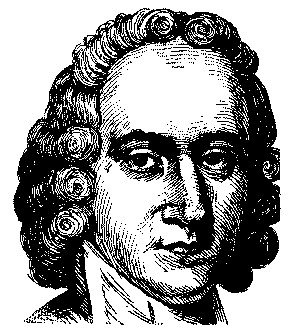
Jonathan Edwards
Edwards's first publication (1731) was a sermon preached in Boston on 'God Glorified in Man's Dependence.' The conditions under which it was produced afford striking contrasts to those attendant upon Schleiermacher's epoch-making 'Reden über Religion'; but the same note of absolute dependence upon God is struck by each with masterly power. A yet more characteristic and deeply spiritual utterance was given in the next published discourse, entitled 'A Divine and Supernatural Light Immediately Imparted to the Soul by the Spirit of God, Shown to be both a Scriptural and Rational Doctrine' (1734). These two sermons are of primary significance for a right understanding of their author's teaching. All is of God; faith is sensibleness of what is real in the work of redemption; this reality is divinely and transcendently excellent; this quality of it is revealed to the soul by the Holy Spirit, and becomes the spring of all holiness. "The central idea of his system," says Henry B. Smith, "is that of spiritual life (holy love) as the gift of divine grace." All of Edwards's other writings may be arranged in relation to this principle,—as introductory, explicative, or defensive.
When the sermon on the 'Reality of Spiritual Light' was delivered, the movement had begun which, as afterwards extended from Northampton to many communities in New England and beyond, is known as "The Great Awakening." The preaching of Edwards was a prominent instrumentality in its origination, and he became its most effective promoter and champion, and no less its watchful observer and critic. Among the published (1738) sermons which it occasioned should be specially mentioned those on 'Justification by Faith Alone,' 'The Justice of God in the Damnation of Sinners,' 'The Excellency of Jesus Christ,' 'The Distinguishing Marks of a Work of the Spirit of God, applied to that uncommon operation that has lately appeared on the minds of many of the people of New England: with a particular consideration of the extraordinary circumstances with which this work is attended' (1741). The same year (1741) appeared the sermon on 'Sinners in the Hands of an Angry God.' Some five years previous, moved by the notice taken in London by Dr. Watts and Dr. Guise of the religious revival in Northampton and several other towns, and by a special request from Rev. Dr. Colman of Boston, Edwards prepared a careful 'Narrative,' which, with a preface by the English clergymen just named, was published in London in 1737, and the year following in Boston. The sermon on the 'Distinguishing Marks of a Work of the True Spirit of God' was followed by the treatise entitled 'Some Thoughts Concerning the Present Revival of Religion, and the way in which it ought to be acknowledged and promoted' (1742); and four years later, by the elaborate work on 'Religious Affections.' The latter sums up all that Edwards had learned, through his participation in the movement whose beginnings and early stages are described in the 'Narrative,' and by his long-continued and most earnest endeavor to determine the true hopes of the spiritual life which had enlisted and well-nigh absorbed all the powers of his mind and soul. It is a religious classic of the highest order, yet, like the 'De Imitatione Christi,' suited only to those who can read it with independent insight. They who can thus use it will find it inexhaustible in its strenuous discipline and spiritual richness, light, and sweetness. Its chief defect lies in its failure to discover and unfold the true relation between the natural and the spiritual, and to recognize the stages of Christian growth, the genuineness and value of what is still "imperfect Christianity."
The "revival," with the endeavor to discover and apply the tests of a true Christian life, brought into prominence as a practical issue the old question of the proper requirements for church membership. The common practice failed to emphasize the necessity of spiritual regeneration and conversion, as upheld by Edwards and his followers. The controversy became acute at Northampton, and combined with other issues, resulted in his dismissal from his pastorate. His meek yet lofty bearing during this season of partisan strife and bitter animosity has commanded general admiration. Before he closed the contest he published two works which, in the Congregational churches, settled the question at issue in accordance with his principles—viz., 'An Humble Inquiry into the Rules of the Word of God concerning the Qualifications requisite to a Complete Standing and Full Communion in the Visible Christian Church,' and 'Misrepresentations Corrected and Truth Vindicated in a Reply to the Rev. Solomon Williams's Book,' etc.
The reply to Williams was written and published after Edwards's removal to Stockbridge. The period of his residence there (1751-1758, January) was far from tranquil. His conscientious resistance to schemes of pecuniary profit in the management of the Indian Mission there, brought upon him bitter opposition. For six months he was severely ill. In the French and Indian war a frontier town like Stockbridge was peculiarly exposed to alarm and danger. Yet at this time Edwards prepared the treatises on the 'Freedom of the Will,' the 'Ultimate End of Creation,' the 'Nature of Virtue,' and 'Original Sin.' The first was published in 1754, the others after his death (1758), as were many of his sermons, the 'History of Redemption,' and extracts from his note-book ('Miscellaneous Observations,' 'Miscellaneous Remarks'). Early in 1758, having accepted the presidency of the College of New Jersey, he removed to Princeton, where he died March 22d.
That with enfeebled health, and under the conditions of his life at Stockbridge, he should have prepared such works as those just enumerated, is a striking evidence of his intellectual discipline and power. It would probably have been impossible even for him, but for the practice he had observed from youth of committing his thoughts to writing, and their concentration on the subjects handled in these treatises. A careful study of his manuscript notes would probably be of service for new and critical editions, and would seem to be especially appropriate, since only the work on the 'Freedom of the Will' was published by its author.
It is impossible in the space of this sketch to analyze these elaborate treatises, or to attempt a critical estimate of their value. Foregoing this endeavor, I will simply add a few suggestions occasioned principally by some recent studies, either of the originals or copies of unpublished manuscripts.
Edwards's published works consist of compositions prepared with reference to some immediate practical aim. When called to Princeton he hesitated to accept, lest he should be interrupted in the preparation of "a body of divinity in an entire new method, being thrown into the form of a history." It was on his "mind and heart," "long ago begun," "a great work." The beginnings of it are preserved in the 'History of Redemption' posthumously published, but this was written as early as 1739, as a series of sermons, and without thought of publication. The volume of miscellanies, also published after his death, are extracts from his note-book, arranged by the editor. Nowhere has Edwards himself given a systematic exposition of his conception of Christianity. The incompleteness of even the fullest edition of his works increases the liability of misconstruction. It would not be suspected, for instance, to what extent his mind dealt with the conception of God as triune, or with the Incarnation.
His published works show on their face his relation to the religious questions uppermost in men's minds during his lifetime. "He that would know," writes Mr. Bancroft, "the workings of the New England mind in the middle of the last century and the throbbings of its heart, must give his days and nights to the study of Jonathan Edwards." And Professor Allen justly adds, "He that would understand ... the significance of later New England thought, must make Edwards the first object of his study." Besides these high claims to attention, one more may be made. The greatness of Edwards's character implies a contact of his mind with permanent and the highest truth—a profound knowledge and consciousness of God. Human and therefore imperfect, colored by inherited prepossessions, and run into some perishable molds, his thought is pervaded by a spiritual insight which has an original and undying worth. It is not unlikely that the future will assign him a higher rank than the past.
In one of the earliest, if not the first of his private philosophical papers, the essay entitled 'Of Being,' may be found the key to his fundamental conceptions. An exposition of his system, wrought out from this point of view, will show that he has a secure and eminent position among those who have contributed to that spiritual apprehension of nature and man, of matter and mind, of the universe and God, which has ever marked the thinking and influence of the finest spirits and highest teachers of our race.
Edwards was born October 5th, 1703, in East Windsor, Connecticut. He was the son of Rev. Timothy and Esther Stoddard Edwards; was graduated at Yale College in 1720; studied theology at New Haven; from August 1722 to March 1723 preached in New York; from 1724 to 1726 was a tutor at Yale; on the 15th of February, 1727, was ordained at Northampton, Massachusetts; in 1750 was dismissed from the church there, and in 1751 removed to Stockbridge, Massachusetts. He was called to Princeton in 1757, and died there March 22d, 1758.
FROM NARRATIVE OF HIS RELIGIOUS HISTORY
From about that time I began to have a new kind of apprehensions and ideas of Christ, and the work of redemption, and the glorious way of salvation by him. An inward sweet sense of these things at times came into my heart, and my soul was led away in pleasant views and contemplations of them. And my mind was greatly engaged to spend my time in reading and meditating on Christ, on the beauty and excellency of his person, and the lovely way of salvation by free grace in him....
Not long after I first began to experience these things, I gave an account to my father of some things that had passed in my mind. I was pretty much affected by the discourse we had together; and when the discourse was ended I walked abroad alone, in a solitary place in my father's pasture, for contemplation. And as I was walking there and looking upon the sky and clouds, there came into my mind so sweet a sense of the glorious majesty and grace of God as I know not how to express. I seemed to see them both in a sweet conjunction; majesty and meekness joined together: it was a sweet, and gentle, and holy majesty; and also a majestic meekness; an awful sweetness; a high, and great, and holy gentleness.
After this my sense of divine things gradually increased, and became more and more lively, and had more of that inward sweetness. The appearance of everything was altered; there seemed to be, as it were, a calm, sweet cast, or appearance of divine glory, in almost everything. God's excellency, his wisdom, his purity and love, seemed to appear in everything; in the sun, moon, and stars, in the clouds and blue sky, in the grass, flowers, trees, in the water and all nature; which used greatly to fix my mind. I often used to sit and view the moon for a long time, and in the day spent much time in viewing the clouds and sky, to behold the sweet glory of God in these things; in the meantime singing forth, with a low voice, my contemplations of the Creator and Redeemer. And scarce anything among all the works of nature was so sweet to me as thunder and lightning; formerly nothing had been so terrible to me. Before, I used to be uncommonly terrified with thunder, and to be struck with terror when I saw a thunder-storm rising; but now, on the contrary, it rejoiced me. I felt God, if I may so speak, at the first appearance of a thunder-storm; and used to take the opportunity at such times to fix myself in order to view the clouds and see the lightnings play and hear the majestic and awful voice of God's thunder, which oftentimes was exceedingly entertaining, leading me to sweet contemplations of my great and glorious God. While thus engaged it always seemed natural for me to sing or chant forth my meditations, or to speak my thoughts in soliloquies with a singing voice.
My sense of divine things seemed gradually to increase, till I went to preach at New York, which was about a year and a half after they began; and while I was there I felt them very sensibly, in a much higher degree than I had done before. My longings after God and holiness were much increased. . . .
Holiness, as I then wrote down some of my contemplations on it, appeared to me to be of a sweet, pleasant, charming, serene, calm nature, which brought an inexpressible purity, brightness, peacefulness, and ravishment to the soul. In other words, that it made the soul like a field or garden of God, with all manner of pleasant flowers; enjoying a sweet calm and the gently vivifying beams of the sun. The soul of a true Christian, as I then wrote my meditations, appeared like such a little white flower as we see in the spring of the year; low and humble on the ground, opening its bosom to receive the pleasant beams of the sun's glory; rejoicing as it were in a calm rapture; diffusing around a sweet fragrancy; standing peacefully and lovingly in the midst of other flowers round about; all in like manner opening their bosoms, to drink in the light of the sun. There was no part of creature-holiness, that I had so great a sense of its loveliness, as humility, brokenness of heart, and poverty of spirit; and there was nothing that I so earnestly longed for. My heart panted after this—to lie low before God, as in the dust; that I might be nothing, and that God might be All; that I might become as a little child.
RESOLUTIONS
"Resolved, Never to do any manner of thing, whether in soul or body, less or more, but what tends to the glory of God; nor be nor suffer it, if I can possibly avoid it."
"Resolved, To live with all my might while I do live."
"Resolved, When I think of any theorem in divinity to be solved, immediately to do what I can towards solving it, if circumstances do not hinder."
"Resolved, To endeavor to my utmost to deny whatever is not most agreeable to a good and universally sweet and benevolent, quiet, peaceable, contented and easy, compassionate and generous, humble and meek, submissive and obliging, diligent and industrious, charitable and even, patient, moderate, forgiving and sincere temper; and to do at all times what such a temper would lead me to; and to examine strictly, at the end of every week, whether I have so done."
"On the supposition that there was never to be but one individual in the world, at any one time, who was properly a complete Christian, in all respects of a right stamp, having Christianity always shining in its true lustre, and appearing excellent and lovely, from whatever part and under whatever character viewed: Resolved, To act just as I would do, if I strive with all my might to be that one, who should live in my time."
"I observe that old men seldom have any advantage of new discoveries, because they are beside the way of thinking to which they have been so long used: Resolved, If ever I live to years, that I will be impartial to hear the reasons of all pretended discoveries, and receive them if rational, how long soever I have been used to another way of thinking. My time is so short that I have not time to perfect, myself in all studies: Wherefore resolved, to omit and put off all but the most important and needful studies."
WRITTEN ON A BLANK LEAF IN 1723
They say there is a young lady [in New Haven] who is beloved of that Great Being who made and rules the world, and that there are certain seasons in which this Great Being, in some way or other invisible, comes to her and fills her mind with exceeding sweet delight, and that she hardly cares for anything except to meditate on him—that she expects after a while to be received up where he is, to be raised up out of the world and caught up into heaven; being assured that he loves her too well to let her remain at a distance from him always. There she is to dwell with him, and to be ravished with his love and delight forever. Therefore, if you present all the world before her, with the richest of its treasures, she disregards it and cares not for it, and is unmindful of any pain or affliction. She has a strange sweetness in her mind, and singular purity in her affections; is most just and conscientious in all her conduct; and you could not persuade her to do anything wrong or sinful, if you would give her all the world, lest she should offend this Great Being. She is of a wonderful sweetness, calmness, and universal benevolence of mind; especially after this great God has manifested himself to her mind. She will sometimes go about from place to place, singing sweetly; and seems to be always full of joy and pleasure; and no one knows for what. She loves to be alone, walking in the fields and groves, and seems to have some one invisible always conversing with her.
THE IDEA OF NOTHING
From 'Of Being'
A state of absolute nothing is a state of absolute contradiction. Absolute nothing is the aggregate of all the absurd contradictions in the world; a state wherein there is neither body nor spirit, nor space, neither empty space nor full space, neither little nor great, narrow nor broad, neither infinitely great space nor finite space, nor a mathematical point, neither up nor down, neither north nor south (I do not mean as it is with respect to the body of the earth or some other great body, but no contrary point nor positions or directions), no such thing as either here or there, this way or that way, or only one way. When we go about to form an idea of perfect nothing we must shut out all these things; we must shut out of our minds both space that has something in it, and space that has nothing in it. We must not allow ourselves to think of the least part of space, never so small. Nor must we suffer our thoughts to take sanctuary in a mathematical point. When we go to expel body out of our thoughts, we must cease not to leave empty space in the room of it; and when we go to expel emptiness from our thoughts, we must not think to squeeze it out by anything close, hard, and solid, but we must think of the same that the sleeping rocks dream of; and not till then shall we get a complete idea of nothing.
THE NOTION OF ACTION AND AGENCY ENTERTAINED BY MR. CHUBB AND OTHERS
From the 'Inquiry into the Freedom of the Will,' Part iv., § 2
So that according to their notion of the act, considered with regard to its consequences, these following things are all essential to it: viz., That it should be necessary, and not necessary; that it should be from a cause, and no cause; that it should be the fruit of choice and design, and not the fruit of choice and design; that it should be the beginning of motion or exertion, and yet consequent on previous exertion; that it should be before it is; that it should spring immediately out of indifference and equilibrium, and yet be the effect of preponderation; that it should be self-originated, and also have its original from something else; that it is what the mind causes itself, of its own will, and can produce or prevent according to its choice or pleasure, and yet what the mind has no power to prevent, precluding all previous choice in the affair.
So that an act, according to their metaphysical notion of it, is something of which there is no idea.... If some learned philosopher who had been abroad, in giving an account of the curious observations he had made in his travels, should say he had been in Tierra del Fuego, and there had seen an animal, which he calls by a certain name, that begat and brought forth itself, and yet had a sire and dam distinct from itself; that it had an appetite and was hungry, before it had a being; that his master, who led him and governed him at his pleasure, was always governed by him and driven by him where he pleased; that when he moved he always took a step before the first step; that he went with his head first, and yet always went tail foremost; and this though he had neither head nor tail: it would be no impudence at all to tell such a traveler, though a learned man, that he himself had no idea of such an animal as he gave an account of, and never had, nor ever would have.
EXCELLENCY OF CHRIST
When we behold a beautiful body, a lovely proportion and beautiful harmony of features, delightful airs of countenance and voice, and sweet motions and gestures, we are charmed with it, not under the notion of a corporeal but a mental beauty. For if there could be a statue that should have exactly the same, that could be made to have the same sounds and the same motions precisely, we should not be so delighted with it, we should not fall entirely in love with the image, if we knew certainly that it had no perception or understanding. The reason is, we are apt to look upon this agreeableness, those airs, to be emanations of perfections of the mind, and immediate effects of internal purity and sweetness. Especially it is so when we love the person for the airs of voice, countenance, and gesture, which have much greater power upon us than barely colors and proportion of dimensions. And it is certainly because there is an analogy between such a countenance and such airs and those excellencies of the mind,—a sort of I know not what in them that is agreeable, and does consent with such mental perfections; so that we cannot think of such habitudes of mind without having an idea of them at the same time. Nor can it be only from custom; for the same dispositions and actings of mind naturally beget such kind of airs of countenance and gesture, otherwise they never would have come into custom. I speak not here of the ceremonies of conversation and behavior, but of those simple and natural motions and airs. So it appears, because the same habitudes and actings of mind do beget [airs and movements] in general the same amongst all nations, in all ages.
And there is really likewise an analogy or consent between the beauty of the skies, trees, fields, flowers, etc., and spiritual excellencies, though the agreement be more hid, and require a more discerning, feeling mind to perceive it than the other. Those have their airs, too, as well as the body and countenance of man, which have a strange kind of agreement with such mental beauties. This makes it natural in such frames of mind to think of them and fancy ourselves in the midst of them. Thus there seem to be love and complacency in flowers and bespangled meadows; this makes lovers so much delight in them. So there is a rejoicing in the green trees and fields, and majesty in thunder beyond all other noises whatever.
Now, we have shown that the Son of God created the world for this very end, to communicate himself in an image of his own excellency. He communicates himself, properly, only to spirits; and they only are capable of being proper images of his excellency, for they only are properly beings, as we have shown. Yet he communicates a sort of a shadow, a glimpse, of his excellencies to bodies, which, as we have shown, are but the shadows of beings, and not real beings. He who by his immediate influence gives being every moment, and by his spirit actuates the world, because he inclines to communicate himself and his excellencies, doth doubtless communicate his excellency to bodies, as far as there is any consent or analogy. And the beauty of face and sweet airs in men are not always the effect of the corresponding excellencies of mind; yet the beauties of nature are really emanations or shadows of the excellencies of the Son of God.
So that when we are delighted with flowery meadows and gentle breezes of wind, we may consider that we see only the emanations of the sweet benevolence of Jesus Christ. When we behold the fragrant rose and lily, we see this love and purity. So the green trees, and fields, and singing of birds are the emanations of his infinite joy and benignity. The easiness and naturalness of trees and vines are shadows of his beauty and loveliness. The crystal rivers and murmuring streams are the footsteps of his favor, grace, and beauty. When we behold the light and brightness of the sun, the golden edges of an evening cloud, or the beauteous bow, we behold the adumbrations of his glory and goodness; and in the blue sky, of his mildness and gentleness. There are also many things wherein we may behold his awful majesty: in the sun in his strength, in comets, in thunder, in the hovering thunder-clouds, in ragged rocks and the brows of mountains. That beauteous light with which the world is filled in a clear day is a lively shadow of his spotless holiness, and happiness, and delight, in communicating himself; and doubtless this is a reason that Christ is so often compared to those things and called by their names,—as, the Sun of Righteousness, the Morning Star, the Rose of Sharon, the Lily of the Valley, the apple-tree amongst the trees of the wood, a bundle of myrrh, a roe, or a young hart. By this we may discover the beauty of many of those metaphors and similes which to an unphilosophical person do seem so uncouth.
In like manner, when we behold the beauty of man's body in its perfection we still see like emanations of Christ's divine perfections; although they do not always flow from the mental excellencies of the person that has them. But we see far the most proper image of the beauty of Christ when we see beauty in the human soul.
Corol. I. From hence it is evident that man is in a fallen state; and that he has naturally scarcely anything of those sweet graces which are an image of those which are in Christ. For no doubt, seeing that other creatures have an image of them according to their capacity, so all the rational and intelligent part of the world once had according to theirs.
Corol. II. There will be a future state wherein man will have them according to his capacity. How great a happiness will it be in Heaven for the saints to enjoy the society of each other, since one may see so much of the loveliness of Christ in those things which are only shadows of beings. With what joy are philosophers filled in beholding the aspectable world. How sweet will it be to behold the proper image and communications of Christ's excellency in intelligent beings, having so much of the beauty of Christ upon them as Christians shall have in heaven. What beautiful and fragrant flowers will those be, reflecting all the sweetnesses of the Son of God! How will Christ delight to walk in this garden among those beds of spices, to feed in the gardens, and to gather lilies!
THE ESSENCE OF TRUE VIRTUE
From 'The Nature of True Virtue,' Chapters i, ii
True virtue most essentially consists in benevolence to being in general. Or perhaps, to speak more accurately, it is that consent, propensity, and union of heart to being in general, which is immediately exercised in a general good-will....
A benevolent propensity of heart to being in general, and a temper or disposition to love God supremely, are in effect the same thing.... However, every particular exercise of love to a creature may not sensibly arise from any exercise of love to God, or an explicit consideration of any similitude, conformity, union or relation to God, in the creature beloved.
The most proper evidence of love to a created being arising from that temper of mind wherein consists a supreme propensity of heart to God, seems to be the agreeableness of the kind and degree of our love to God's end in our creation, and in the creation of all things, and the coincidence of the exercises of our love, in their manner, order, and measure, with the manner in which God himself exercises love to the creature in the creation and government of the world, and the way in which God, as the first cause and supreme disposer of all things, has respect to the creature's happiness in subordination to himself as his own supreme end. For the true virtue of created beings is doubtless their highest excellency and their true goodness.... But the true goodness of a thing must be its agreeableness to its end, or its fitness to answer the design for which it was made. Therefore they are good moral agents whose temper of mind or propensity of heart is agreeable to the end for which God made moral agents....
A truly virtuous mind ... above all things seeks the glory of God.... This consists in the expression of God's perfections in their proper effects,—the manifestation of God's glory to created understandings; the communication of the infinite fullness of God to the creature; the creature's highest esteem of God, love to and joy in him; and in the proper exercises and expressions of these. And so far as virtuous mind exercises true virtue in benevolence to created beings, it chiefly seeks the good of the creature; consisting in its knowledge or view of God's glory and beauty, its union with God, uniformity and love to him, and joy in him. And that disposition of heart, that consent, union, or propensity of mind to being in general which appears chiefly in such exercises, is virtue, truly so called; or in other words, true grace and real holiness. And no other disposition or affection but this is of the nature of virtue.
GERORGES EEKHOUD
(1854-)
a Jeune Belgique" is more than a school; it is a literary movement, which began about the year 1880. The aim of this group of writers is to found a national literature, which uses the French language and technique for the expression of the Flemish or Walloon spirit, and the peculiar sentiment and individuality of the Belgian race which has developed between the more powerful nations of France and Germany. In the words of William Sharp:—
"To one who has closely studied the whole movement in its intimate and extra-national bearings, as well as in its individual manifestations and aberrations, its particular and collective achievement in the several literary genres, there is no question as to the radical distinction between Belgic and French literature. Whether there be a great future for the first, is almost entirely dependent on the concurrent political condition of Belgium. If Germany were to appropriate the country, it is almost certain that only the Flemish spirit would retain its independent vitality, and even that probably only for a generation or two. But if Belgium were absorbed by France, Brussels would almost immediately become as insignificant a literary centre as is Lyons or Bordeaux, or be, at most, not more independent of Paris than is Marseilles. Literary Belgium would be a memory, within a year of the hoisting of the French tricolor from the Scheldt to the Liege. Meanwhile, the whole energy of 'Young Belgium' is consciously or unconsciously concentrated in the effort to withstand Paris."
Among the leading spirits of "La Jeune Belgique" are Maurice Maeterlinck, Georges Eekhoud, Camille Lemonnier, Georges Rodenbach, J.K. Huysmans, Auguste Jenart, Eugene Demolder, and a number of others, who have distinguished themselves in fiction and poetry. Their works are generally inspired by the uncompromising sense of the reality of ordinary life, which would sometimes be repulsive if it were not for their brilliant style and psychological undercurrent.
This school of literature is somewhat analogous to that of the Flemish painting. Nature is always an important accessory to the development of the action; and therefore the landscapes and the genre pictures are given with a rapid and sure touch and in a vivid and high key,—so high that at times the colors are almost crude. The reader of these Belgian writers often feels, in consequence, that he is looking at a series of paintings which are being explained by a narrator.
Of all these writers, Georges Eekhoud, whom Mr. Sharp calls "the Maupassant of the Low Countries," is the one who has made the greatest effort to model his work upon the style of the contemporary French authors. He was born in Antwerp, May 27th 1854. His literary career was begun as an editor of the Precursor, in Antwerp, but he soon became associated with L'Étoile Beige as literary editor. In 1877 he published his first volume, entitled 'Myrtes et Cyprès.' This was succeeded by a second book of poetry, 'Zigzags Poetiqués et Pittoresques,' which appeared in 1879. Among the most admired of these poems are 'La Mare aux Sangues,' 'Nina,' 'Raymonne,' and the strong 'La Guigne.'
French critics say that his diction lacks polish, but that he has strength, color, and a talent for description. His novels are—'Kees Doorik' (1884), 'Les Kermesses' (1884), 'Les Milices de Saint-Frangois' (1886), 'Les Nouvelles Kermesses' (1887), and 'La Nouvelle Carthage' (1888). The latter is considered his most brilliant novel, and won for him the quinquennial prize of 5,000 francs given for French literature in Belgium. It is a vivid picture of Antwerp, with vigorous and highly colored descriptions of its middle-class citizens, enriched by centuries of continued prosperity. In general, Eekhoud is naturalistic, and intent only on painting life as he sees and feels it. His other books include—'Cycle Patibulaire' (1892); 'Au Siecle de Shakespeare,' a valuable book on the English literature of the Elizabethan period (1893); and 'Mes Communions' (1895).
EX-VOTO
From 'The Massacre of the Innocents, and Other Tales by Belgian Writers': copyright 1895, by Stone & Kimball
The country I know and love best does not exist for the tourist, and neither guide nor doctor ever dreams of recommending it. This reassures me, for I love my country selfishly, exclusively. The land is ancient, flat, the home of fogs. With the exception of the Polder schorres, the district fertilized by the overflowing of the river, few districts are cultivated. A single canal from the Scheldt irrigates its fields and plains, and occasional railways connect its unfrequented towns.
The politician execrates it, the merchant despises it, it intimidates and baffles legions of bad painters.
Poets of the boudoir! virtuosi! This flat country will always elude your descriptions! For you, landscape painters, there is no inspiration to be gained here. O chosen land, neither thou nor thy secret can be seen at a glance! The degenerate folk who pass through this country feel nothing of its healthy, intoxicating charm, or are only wearied in the midst of this gray peaceful nature, unrelieved by hill or torrent; and still less sympathy have they with the country louts who stare at them with placid bovine eyes.
The people remain robust, uncouth, obstinate, and ignorant. No music stirs me like the Flemish from their lips. They mouth it, drawl it, linger lovingly over the guttural syllables, while the harsh consonants fall heavily as their fists. They move slowly, swingingly, bent-shouldered and heavy-jawed; like bulls, they are at once fierce and taciturn. Never shall I meet more comely, firm-bosomed lassies, never see eyes more appealing, than those of this dear land of mine. Under their blue kiel the brawny lads swagger well content; though when in drink, if dispute arises, rivalry may drive them into fatal conflicts. The tierendar ends many a quarrel without further ado; and as the combatants cut and hack, their faces preserve that dogged smile of the old Germans who fought in the Roman arenas. During the kermesses they over-eat themselves, they get drunk, dance with a kind of gauche solemnity, embrace their sweethearts without much ceremony, and when the dance is over, gratify themselves with all manner of excesses.
One and all, they are slow to give themselves away; but once gained, their affection is unalterable.
Those who depict them thick-set, laughter-loving, misshapen boors, do not know this race. The Campine peasantry recall rather the brown shepherd folk of Jordaens than the pot-house scenes by Teniers, a great man who slandered his Perck rustics.
They preserve the faith of past centuries, undertake pilgrim-ages, respect their pastoor, believe in the Devil, in the wizard, in the evil eye, that jettatura of the North. So much the better. These yokels fascinate me. I prefer their poetic traditions, the legends drawled out by an old pachteresse in the evening hours, to the liveliest tale of Voltaire, and their clan-narrowness and religious fanaticism stir me more than the patriotic declamations and the insipid civic rhodomontade of the journalist. Splendid and glorious rebels, these Vendeans of ours; may philosophy and civilization long forget them. When the day of equality, dreamed of by geometric minds, comes, they will disappear also, my superb brutes; hunted down, crushed by invasion, but to the end unyielding to Positivist influences. My brothers, utilitarianism will do away with you, you and your rude remote country!
Meanwhile, I who have your hot rebel blood coursing in my veins, I who shall not survive you, am fain to steep my spirit in yours, to be at one with you in all that is rude and savage in you, to stupefy myself at great casks of brown ale at the fairs, with you to raise up my voice when the clouds of incense rise like smoke above your sacred processions, to seat myself in silence beside your smoky hearths or to wander alone across the desolate sand-dunes at the hour when the frogs croak, and when the distraught shepherd, become an incendiary and a lost man, grazes his flock of fire across the heaths....
At the beginning of the June of 1865, I had just reached my eleventh birthday and made my first communion with the Frères de la Misericorde at M——. One morning I was called into the parlor; there I found the father superior and my uncle, who told me that he would take me to Antwerp to see my father. At the idea of this unexpected holiday and the prospect of embracing my kind parent, who had been a widower for five years and to whom I was now everything, I did not notice my uncle's serious looks nor the pitying glances of the monk.
We set off. The train did not go fast enough for my liking. However, we arrived at last. To ring the door-bell of the simple little house; to embrace Yana the servant; to submit to the caresses of good Lion, a splendid brown spaniel, to race up-stairs with him four steps at a time, to bound into the familiar bedroom, then two words:—"Father!—George!"—to feel myself lifted up and pressed against his heart; to be devoured with kisses, my lips seeking his in the big fair beard: these actions followed one another rapidly; but transient as they were, they are forever graven on my memory. What a long time the dear man held me in his arms! He looked at me with tender admiration, repeating, "What a big boy you have grown, my Jurgen, my Krapouteki!" and he repeated a whole string of impossible but adorable pet names he had invented for me, and among which he interspersed caresses. It was still early in the morning.
When I entered, followed by Lion, Yana, and finally by my uncle, the least member of the four, my father was in his dressing-gown, but was about to dress.
He looked splendid to me. His color was fresh, but too flushed about the cheek-bones, I was told afterwards; his eyes sparkled—sparkled too much; his voice was a little hoarse, but sweet, caressing, despite its grave tone,—a tone never to be forgotten by me.
He was then forty-six. I see his tall figure rise before me now, with his well-set limbs; and his kind face still smiles on me in my dreams.
My uncle clasped his hand.
"You see that I keep my word, Ferdinand. Here's the little scamp himself!"
"Thank you, Henry. Pardon the trouble I have caused you.... You will laugh at me; but if you had not brought him, I should have gone to the convent myself to-day.... I should have scorned the doctor's regime and prescriptions.... You do not know, Georgie.... I have not been very well.... Oh, a mere nothing; a small ailment, a neglected cold.... A slight cold, was it not, Yana? ... I have lost it, as you see.... Ah! my boy, what good it does me to see you! ... What fun we shall have! We are going out into the country at once.... I have prepared a surprise for you."
I listened enchanted—oh the selfishness of childhood! The promise of this expedition made me deaf to his cough—a dry, convulsive cough which he tried to stifle by holding his silk handkerchief to his mouth. Neither did I notice—or rather I did notice but attached no importance to—the bottles of medicine and pill-boxes which stood on the chimney-piece and on the bed-table. A bottle of syrup had just been opened, and a drop remained in the silver spoon. Yana held a prescription in her hand, which had been written that morning. A heavy odor of opiates and other drugs filled the room. These details only recurred to me afterwards.
My uncle took leave.
"Above all, no imprudence!" he said to my father. "You promise me? Be back in town before the dew falls.... I will take George to school again to-morrow morning."
"Set your mind at rest; we will be wise!" replied my father, excited and preoccupied, thinking only of his child.
I believe that he was not sorry to find himself alone with me, and as the prospect of returning to M——, evoked by the old officer, had saddened me, he took me on his knee.
"Courage! little one," he said. "It is not for long. I feel too lonely since the death of your poor mother. I have told my family that in the future I do not intend to be separated from you ... You have made your first communion, ... you are big, ... you shall go back to school for a week, just time to pack up and to settle in our new quarters.... Come, there, I am betraying the secret ... Never mind, after all, I may as well tell you everything now. I have bought a pretty little house, almost a farmstead, three miles from here.... We are going to live in the country, like peasants, to wear sabots and smocks. Hey? That will make you grow.... What do you say to it?... We shall be always together."
I clapped my hands, and jumped round the room.
"What joy! Always we two, is that it? Then we shall be always together. Is it really true?"
"Really true."
We sealed this understanding in a long embrace.
An hour later my father, Yana, and I stepped into a landau at the door.
It was one of those enervating equinoctial days when the warmth and the intense quietness affect one almost to tears. The sun, in a beautiful Flemish sky of pale, soft turquoise, had dispersed the morning mist.
"Look at him, sir," said Yana, pointing to me; "he is as happy as a king!"
"Now is the time to take in a plentiful supply of air," remarked my father; "one only needs to open one's mouth!"
I opened mine quite wide, as if I were yawning.
What a difference, too, between this air and the air at school; even that which one breathed out of doors in the cloistered court, shut in by four forbidding high walls, sweating with damp and decaying with mildew.
Seated with my back to the coachman, my hands on my father's knee, I uttered exclamations of surprise and besieged him with questions. He sat back in the carriage, shielded from the wind by his big overcoat. Yana sat beside him; Lion ran on in advance.
Passing along the chief street of the suburb, we came out into the open country. The tufts of young leaves gave a sweet freshness to the hoary trunks of the great beech-trees which lined the road. In place of the yellow withered grass in the meadows, there was a vivid emerald carpet; splendid cows, with well-rounded flanks and dewlaps reaching the ground, nibbled the tender shoots. The full rows of young corn promised a plentiful harvest. Between a double hedge of weeping-willows and alders ran silvery waters, swollen by the melting of the late snows. When we passed a flower-garden the scent of lilac filled the dreamy air. Gates with gilt knobs opened on avenues of elms and oaks; sloping lawns led up to a castle, whose terrace was ornamented with clipped and modeled orange-trees. The majestic passing of a pair of big swans or the scurry of hare-brained ducks stirred the stagnant pond, and left wakes amid the flags and water-lilies.
Moss-grown farmsteads, flanked by barns with green shutters fixed to the red bricks, draw-wells, chickens picking about on the manure-heaps,—these were my chief delight. Sometimes a countryman's cart with its white awning stood on one side for us to pass.
We drove through Deurne, then through Wyneghem.
For the third time a slender spire lifted its gray-slated point into the opaline sky.
"S'Gravenwezel tower!" exclaimed Yana.
"S'Gravenwezel! But that is your village!" I cried. "Are we going to live there?"
The good creature smiled in the affirmative.
Some few moments later, the driver, directed by Yana, stopped in front of a lonely farm, a quarter of an hour away from the rest of the long, straggling village.
"This is my parents' home!" she said.
I can still see the little one-storied farmhouse, with its overhanging thatched roof, festooned with stone-crop, a white chalk cross on the brickwork to protect it from lightning. At sound of the carriage, the whole household ran to the door. There was Yana's father, a short, thick-set sexagenarian, bent but still healthy-looking, his face wrinkled like old parchment, with a stiff beard and bright eyes; the mother, a buxom woman about ten years younger, very active despite her stoutness; then a host of brothers and sisters, varying from twenty-five to fifteen; the boys bold, dark, curly-headed, muscular, square-set fellows; the girls fresh-looking, tanned by the sun, all like Yana their elder sister, who, to my mind, was the most charming boerine annversoise that one could imagine, with her dark hair, her big emerald-green eyes and sweeping lashes. In honor of S'Gravenwezel kermesse,—sounds of which could already be heard in the distance, —they said, but more in honor of our visit, the men wore their Sunday trousers, and bright blue smocks coquettishly gathered at the neck. The women had taken out their lace caps with big wings, the head-dresses with silver pins, woolen dresses, and large silk handkerchiefs which crossed over the breast and fell in a point behind. The good people complimented my father on his appearance. "That is Mynheer's son,—Jonkheer Jorss!" In a few moments I had made friends with these simple cordial folk, and particularly with a fine lad of nineteen—"onze Jan" (our Jean), said Yana—on the eve of drawing lots for the conscription.
When his sister laid the table,—for we were to stay to dinner there,—he offered to show me the orchard, the garden, and the stables. I accepted joyfully. I could no longer keep still. Jean, with my hand in his, took me first to the cows. As they lay down, chained up in their sheds, they lowed piteously. The dung-strewn bedding shone with bronze and old-gold, and the far end of the stable resembled a picture by Rembrandt—at least, it is thus that I recall to-day that reddish-brown half-light. That I might be better able to admire the animals, he roused them with a kick. They got up lazily, sulkily. He told me their names and their good points. That big black one, with the spot between her eyes, was Lottekè; this big glutton chewing the early clover was called La Blanche. Jan persuaded me to pat them. They rubbed their horns against the posts which divided them. The boy told me that they were excellent milkers. I counted six in all. A strong smell of milk filled the air, warm with all this breathing, heaving animality. Jan promised to take me to work in the fields with him when I came to live in the village. I should dig the ground and become a real peasant, a boer like himself. Boer Jorss, he called me, laughing. But I took this prospect of country life quite seriously; I admired the fine figure, the proud healthy bearing, of this young peasant. I in my turn should grow like that, I thought. A career such as his awaited me! That was better than wearing a frock-coat and a black hat, than growing pale and fevered over books and copies, and seeing nothing of beautiful nature except what can be found in a suburb: weeds growing over waste places and patches of sky amid spotted roofs! He took me also to the garden, an oblong inclosure with well-kept paths, and planted with sunflowers, peonies, and hollyhocks. The beds were edged with strawberry plants, the fruit just ripening. The kind lad promised me the first that were gathered.
We were called back to the house, while I was making the acquaintance of Spits the watch-dog. The kermesse meal awaited us. At the express request of my father, who threatened to eat nothing, the family, at least the men, sat down with us. As to the women, they all pretended to wait on us. My eyes wandered with delight around this room, so new to me; the alcoves where the parents and older members of the family slept, receded into the wall and were hidden by flowered curtains; the wide chimney-piece was ornamented with a crucifix and plates imprinted with historical subjects; a branch of consecrated box hung below; then there were enormous spits and the imposing chimney-hook.
Yana placed on the table a tureen of cabbage and bacon soup, the smell of which would have aroused the appetite of the dead.
We all made the sign of the cross, bowed our heads and clasped our hands over the soup-basins, the savory smell from which rose towards the smoky beam like the perfume of incense. For some seconds nothing was audible save the lowing of the cows from the sheds, the buzzing of flies on the window-panes, and the striking of S'Gravenwezel clock, which rang out midday with the silvery, melancholy chimes of village bells.
What a delicious meal we had! My father thought of all the most expressive adjectives in the patois to express the merits of the soup, I sang the praises of the eggs which served as a golden frame to the red-and-white slices of ham. A mountain of mealy potatoes disappeared beneath our lively forks. I had a healthy country appetite!
Yana, who was touched, declared that her master had not eaten so much for a month.
We were obliged to taste all the products of the farm: butter, milk, cream cheese, early vegetables, and fruit. I laughed at Yana, who had thought it necessary to bring provisions. She did not know the parental hospitality! But I no longer made fun of her forethought when she brought out the contents of the wonderful basket: two bottles of old wine and a plum tart of her own making, which she placed triumphantly in the middle of the table. They all drank to my father's health, to mine, and to our happy stay in S'Gravenwezel.
"It is settled, then, that in a week's time you shall come to my house-warming, you hear, all of you!" said my father definitely.... "And now, Djodgy, we must be going, for you are longing to see our nest."...
Jan came with us. He walked behind with his sister. Lion ran backwards and forwards, showing his joy by his wild leaps and bounds, and chasing the small animals which he raised among the rye.
Poppies and cornflowers already lit up the changing ears of corn with their bright color, and white or brown butterflies flitted above like animated flowers. We had followed a path which ran across the cornfields, behind Ambroes farm, to the left of the high road. Some minutes later we skirted a little oak wood, and immediately behind it my father pointed our home out to me.
Simple cottage! you haunt me still, above all in springtime, when the air is warm and soft as on that memorable day.... Your white walls will ever be to me a sad though sweet and loving memory.
The little house was simple and quiet as possible. There was one story only, and it contained but four rooms. An out-house with hen-roost, which would serve as a shed for the gardener, stood on one side. Yana's brother had for the time being put into it a pretty white kid, which bleated loudly at our approach; he ran to set it free.
Fruit-trees covered the wall facing south. The inclosure, encircled by a hedge of beech, was half orchard, half pleasure garden, and covered an area of three thousand metres. In front of the house was a square lawn, divided by a path from the gate to the front door. Leafy copses of plantain, chestnuts, American oaks, and birches, offered delightful retreats on either side of the house for reading or dreaming. As we went round the grounds, my father explained with animation the improvements which he projected. Here was to be a clump of rhododendrons, here a bed of Orleans roses, there a grove of lilacs. He consulted me with a feverish "Hey?" He was excited, unreserved; rarely had I seen him in such high spirits. Since the death of my mother his beautiful, sonorous, and contagious laugh had been heard no more.
Chattering thus, we came to a mound at the bottom of the garden, from which we could see a corner of the village; the spire emerging from a screen of limes, the crossed sails of a silent mill perched on a grassy knoll, farms scattered among cornfields and meadows, until the plain was lost in the horizon.
"Look, George," he said, "this will be our world in future.... It will be good for us both to live here; for if I need solace, you will gain equally.... No more confinement, my dear little fellow; we are rich enough to live in the country as philosophers.... And when I am gone ... for one must provide for everything...." He stopped. I remember that a broken-winded barrel organ ground out a polka behind the screen of limes which shut off the village.
My father had suddenly become serious, and the solemnity of his last words moved me deeply. Then that distant melancholy air made me shudder. When he had finished speaking, he coughed for a long time.
We were seated on the slope, our backs to the house, facing the vast plain, the silence of which was rendered more overwhelming by the jarring notes of the barrel organ.
"Father," I murmured, as if in prayer, "what do you mean?"
In reply he drew me towards him, took my head in his hands and looked at me long, his eyes lost in mine; then he embraced me, attempted to smile, and said:—
"It is nothing. I am well, am I not? Why do my family worry me with their advice? Indeed, they will frighten me with their long faces and perpetual visits.... To-day at least I have escaped from them.... We two are alone ... free! Soon it will be always so!"
Despite this reanimation, an inexpressible agony wrung my heart, and I made no effort to escape from this influence, which I felt to be due to our deep sympathy.
Regret was already mingled with my delight; and on this exquisite afternoon there was that heart-rending sense of things which have been and will never be again—never.
I threw my arms round my father's neck, and made no other reply to his last words. It required a mutual effort to break the silence; neither of us made the effort. In the distance the organ continued to grind out the tune as if it too were choked with sobs.
Thus we remained for long, until the day waned.
"Is it not time to go back, sir?"
Yana's interruptions aroused us. Silently my father got up, and with my hand still in his we passed through the graying country, where the twilight already created fantastic shadows. At about a hundred yards from the house he turned round, and made me look once more at the little corner of earth, the hermitage which was to shelter us.
"We will call it Mon Repos!" he said, and he moved on.
Mon Repos! How he lingered over those three syllables. Even thus are certain nocturnes of Chopin prolonged.
When we reached Ambroes farm, we took affectionate farewell of Yana's family. My father thanked them for their welcome, and reminded them of his invitation. He gave Jan a few further instructions about the garden; the lad stood cap in hand, his dark eyes expressive of vivid sympathy.
Yet another "au revoir"; then the carriage drove away, and we turned our backs on the dear village.
Was it still the kermesse organ which obsessed me, lingering above all other sounds, growing fainter and fainter but never quite dying away? And why did I ceaselessly repeat to myself, whatever the music, these three unimportant syllables "Mon Repos"?
The sun was setting when we reached the gates of the town. Country masons, white and dusty, with tools over their shoulder and tins hanging by their side, walked rapidly to the villages which we had left behind. Happy workmen! They were wise to go back to the village, and to leave the hideous slums of West Antwerp to their town comrades.
A fresh breeze had risen which stirred the tops of the aspens. The purple light on the horizon beyond the ramparts grew faint. During the whole drive my father remained sunk in prostration; his hands, which I stroked, were moist; now burning, now icy. He roused himself from this painful torpor only to slip his hand through my hair, and to smile at me as never friend has smiled since.
Yana too looked sad now, and pretended that it was the dust which caused her to wipe her eyes continually with her handkerchief.
I was tired, overcome with so much open air, but I could not fall asleep that night. I dreamed with open eyes of the events of the day, of the farm, of good-natured Jan, of the happy meal, of the kid, of the coming day when I should be "boer Jorss," as the kind fellow said.... I was happy, but from time to time a fit of terrible coughing from the next room stifled me, and then I recalled the scene in the garden, our silence against the jarring sound of the organ, and later these two words "Mon Repos." I did not close my eyes until the morning.
When I awoke, my uncle was already waiting for me. He was an old officer and adhered to military time only.
"We must be off!" he said in his gruff, harsh voice. "You must go back to work, my lad."
Must I go away again? Why this week's separation? What did my uncle's authoritative tone mean in my father's house, in our house? Why did Yana look at him respectfully but sullenly? I did not guess the horrible but absolute necessity for this intrusion; it exasperated me.
What a bitter leave-taking! And that, too, for a week's separation only. It was in vain that my uncle made fun of our tears. I clung to my beloved father, and he had not the strength to repel me. The impatient officer tore me at last from his embrace.
"The train does not wait!" he grumbled. "Were there ever such chicken-hearted people!"
I was indignant.
"No, not at parting from you," I said to my unsympathetic relation,... "but from him!"
"Djodgy! Djodgy!" my father tried to say in a tone of reproach. "Forgive him, Henry.... Au revoir! In a week's time!... Be good ever."
This time Yana no longer tried to hide her tears. Lion moved sadly from one to another, and his human eyes appeared to say, "Stay with him."
But nothing would move my obdurate uncle. We drove away in the same carriage which had taken us the day before to S'Gravenwezel.
We waved to one another as long as the carriage was in the street.
In a week I should see him again!
In a week he was dead!
But I have forgotten nothing.
Thus it is, ever since then, that I love, I adore this Flemish country as my heritage from him who loved it above all others; from him, the sole human being who never wrought me any ill. These vast pale-blue horizons, often veiled with mist or fog, gleam before me again as that tearful smile which I caught for the last time upon his dear face.
KORS DAVIE
From 'The Massacre of the Innocents, and Other Tales by Belgian Writers': copyrighted 1895, by Stone & Kimball
It was fair-time, yet Rika Let, the young dairymaid of baes Verhulst, was sad. She had worked so hard all August that this morning, before mass, the baezine had given her a bright florin and spoken kindly to her:—
"Rika, it is fair-time for every one. Enjoy yourself, my girl. Here is something to buy yourself a neckerchief at the fair, a bright-colored one with fringe to cross over your breast."...
Rika accepted her mistress's present. Alone in her garret above the stable, she turned the shining coin over and over, but hesitated to exchange it for some coveted trifle at Suske Derk's stall, down there by the church. Great tears sprang to her eyes, eyes which were faintly tinged with green. What sorrow filled the heart of this fair young girl of eighteen summers?
"Ah," she sighed, "if only one of the village lads would take me to the fair and give me a gay kerchief! But who cares for poor Rika? Our lads woo other girls, better born and richer than I am! Baezine Verhulst knew that, or she would not have given me money to buy a thing which the poorest laborer, or even the humblest thresher, gives gladly to his sweetheart to-day.... Who will dance this evening with Rika Let at the Golden Swan?... No one.... No, baezine Verhulst, it is not a fête day for every one!"
Tears rested on her fair lashes as the morning dew clings to the bearded ears of corn. Mechanically she looked at herself in a piece of glass which hung beneath a little Notre-Dame of Montaigu. She was not plainer than many of her companions who were admired by the ardent and happy lovers. Ugly—Rika! No indeed. Fair as the August cornfields of the Verhulsts were her tresses. Her lips were red and full as ripe cherries. If you feel aught of the charm of the young peasant girls of our country, you would admire Rika.
She dressed herself in her simple Sunday clothes; a little collar and flat cap, both of dazzling whiteness; a skirt and bodice, unsoiled by any speck of dust.
The bell sounded for mass.
Go and pray, Rika! Who can say? the good God mayhap will unseal the eyes of the blind gallants of Viersel.
She told her beads so earnestly, that a friend had to remind her when the service was at an end.
Outside the church a crowd of gay youths, with crossed arms and flowers between their lips, watched the blushing procession of girls who were to be their partners in the evening. Sympathetic glances were exchanged, and with a smile or a simple movement of the head a meeting was arranged, a promise confirmed, a consent given. Eager hearts throbbed under the blue smocks, the many-colored kerchiefs; but no glance sought to attract the bright eyes of the orphan girl, not one of those young hearts beat in unison with hers.
To reach the farm, Rika had to pass through the fair. Suske Derk had displayed her wares. Rika did not even deign to look at them. The mercer called to her:—
"Ha! my pretty devotee! Won't you even wear a scapulary?"
At midday there was a great feast at the Verhulst farm in honor of the fair. Masters, friends, and servants, all with big appetites, seated themselves round a table laden with enormous dishes, brought in by the farmer's wife and Rika. A savory smell filled the large room; the steam dimmed the copper ornaments on the chimney-piece, the crucifix, the candlesticks, the big plates, which were the pride of the cleanly Rika. At first the guests, speechless, gravely and solemnly satisfied their hunger. Then came the bumpers to wash down the viands, for mealy Polder potatoes make one thirsty. As the tankards were re-filled, tongues were loosed, and jokes piquant as the waters of the Scheldt flew apace.
Rika in her turn sat down to the table, but the sorrow at her heart robbed her of appetite, and she ate little. The lively guests, distressed by her silence, attributed it to arrogance, and turned their attention elsewhere. Later they would rejoin their buxom wenches, and think no more of the poor little soul tormented with the desire for love.
The more the day advanced, the less Rika thought of purchasing a fichu at Suske Derk's stall; she would rather return the florin to her mistress! Bugles and screeching fiddles could be heard from the Golden Swan.
Houpsa! rich and poor hasten to the dance, some in shoes, others in sabots. Lourelourela! The quadrilles form. The couples hail their vis-à-vis across the room. All is ready. They set off....
Rika alone is absent from the ball. Seated on the threshold of the barn, the sound of the brass and wind instruments, the patter of feet, the laughter and oaths, reach her ear.
The low-roofed houses of the village fade slowly in the twilight. The church steeple rises heavenward as the watchful finger of God; at its base lies the Golden Swan; against the four red-curtained windows the figures of the dancing couples are outlined black as imps.
Rika could not tear herself away from this scene. Her heart, till now pure as the veil of a first communicant, was filled with bitter thoughts.
Marvelous tales were told of Zanne Hokespokes. The little old woman possessed some wonderful secrets; she could give rot to sheep, make cows run dry, and poison nurses' milk. She could see the fate of those who consulted her in cards and in coffee-grounds. She could recall the fickle lover to the side of the deserted maiden. Perhaps she could find a sweetheart for lonely Rika?
Unholy thoughts rose with the oppressive mists of the evening. They grew in the solitude, in the remoteness from others' joy. The ungainly couples danced up and down, black as imps, against the four red windows. The music grated and jarred; but for the last hour the village steeple, which rose heavenward as the watchful finger of God, had been lost in the darkness.
Would it be well to take advantage of the absence of her master and mistress and consult the fortune-teller? No one would meet her. All the village was at the Golden Swan.
Holy Virgin! how they are enjoying themselves! Among the whirling couples Rika saw two figures intertwined, their faces so close that their lips must meet!
Yes, she would have recourse to the spells of the old woman Hokespokes, whatever might happen. She had still the bright coin in her pocket. This and the few coppers which she had saved would suffice.
The sorceress lived in a clay hut deep in the dark woods of Zoersel. The peasants avoided these woods and passed through them in broad daylight only, making the sign of the cross. At nightfall weird melancholy sounds, which seemed to come from another world, murmured in the tree-tops. It took an hour to reach the cottage from Viersel. Rika calculated that she could be home before midnight. Her master and mistress would not return earlier than that. She overcame her last fears, and set out bravely towards the lonely heath.
"In this bag, little one, are the ashes of the tooth of a corpse; the tooth was picked up in the cemetery of Safftingen, the village that was submerged by the Scheldt; therein is also a mushroom, called 'toadstool,' gathered at the foot of the tree on which Nol Bardaf the cobbler was hanged. Next full moon, on a cloudless night, sprinkle the magic powder at the foot of your bed, and prick the mushroom deeply with a hairpin, uttering these words three times:—'I command thee, charmed plant, to bring me the man who shall wound me as I wound thee!' Then go to bed with the mushroom under your pillow, and wait in perfect quiet without speaking. The beloved one will appear. Open your eyes, but above all things neither speak nor move. You must even hold your breath. If he leaves you, do not try to detain him. You will see him again, and will then become his wife."
Thus spoke Zanne Hokespokes.
Rika followed the instructions of the sorceress. She waited several days for the fine cloudless night, and when the full moon rose she did as the witch had bidden her.
"I command thee, charmed thing, to bring me the man who shall wound me as I wound thee!"
Once—twice—thrice.
Rika, with wide-open eyes and strained ear, lay in bed eagerly awaiting the promised vision. Shadow became substance in the garret, which was bathed in the silvery-blue beams of the moon. The silence was so overwhelming that Rika thought she heard the sound of the white light as it fell on the bare floor.
Now she regretted her traffic with a servant of the Devil, now she rejoiced at the prospect of seeing him, the man who would love her; but again she feared that he might not come.
The yard door swung on its hinges. A hasty, heavy step crossed the court without disturbing the watch-dog. He opened the kitchen door. Clope! Clope! rapidly he climbed the ladder which led to the attic. Terror seized Rika; she stifled a cry, as the trap-door opened.
There he was in her room; a soldier, a young artilleryman. He passed by her unnoticed in the white light of the moon.
Ah! Rika loves him at first sight; it is he for whom she has waited. He has a round face, curly auburn hair, a well-cut mouth, a slightly aquiline nose, with dilating nostrils, a square chin, and broad shoulders. A fine mustache covers his upper lip. He wears a brigadier's braids on his sleeve, and spurs on his heels. What mad race has he been running? His broad chest rises and falls, he gasps for breath, and throws himself down on the only stool. Rika longs to rush to him, to wipe the sweat from his brow. As if overpowered, he loosens his tunic, unclasps his belt, and exposes his fine chest. Somewhat rested, oblivious of Rika, he scrutinizes his uniform from head to foot, and notices that one of the buttonholes of his boot-strap is torn. He takes off the strap, and with a knife which he draws from his pocket makes a fresh hole in the leather. Then he readjusts the strap to the trouser.
Rika observed all these movements. More and more she admired his military bearing and the ease with which he moved. Animated by his run, the soldier's face struck her as more expressive than the faces of the other fellows of her acquaintance, even than the faces of the scornful Odo and Freek, the Verhulsts' two sons, whom she had once admired.
The stranger re-buttoned his coat, fastened his belt, put his cap on his head, and left the room with the same quick firm step. She dared not call to him and hold out her arms. The door closed.
The sound of his footsteps, the clank of his sword, were lost in the distance. To Rika a memory only remained.
Has it not all been a dream, poor impressionable little thing?
No; a moment ago he sat quite near Rika's bed.
By the wan light of the moon she saw a sparkling object, the knife which he had just used; here was her proof. She could no longer doubt. She picked up the knife, pressed the still-open blade to her lips, and as her breath dulled the steel, she wiped it, kissed it again; twenty times she repeated the same childish trick.
Truly the good Zanne Hokespokes keeps her word. The pretty knife with its tortoise-shell handle will henceforth be a pledge for Rika. Her fingers lovingly caressed the blade, as if they stroked the mustache of the brigadier; she would fain see her reflection in the dark eyes of the beloved one, as she saw it in the shining metal.
Her eyes grew weary with gazing on the bright surface; she was compelled to lie down. She slept and dreamt of her soldier visitor, with the precious knife clasped to her breast.
Tarata! Tarata! Tarata!
"Wake up, Kors Davie! ... Perhaps you're sorry to leave the barracks! Confound it! the fellow snores as if he did not care for his holiday!"
Brigadier Warner Cats, Davie's fellow-countryman and comrade, tired of speaking, shook Kors roughly, as the bugle sounded the réveille. Kors sat up, stretched himself, appeared astonished, and rubbed his eyes with his fists.
"That's strange! Pouh! What a vile dream!" he muttered with a yawn. "Comrade, just listen: I was out in the country, very much against my will, I assure you.... A horrible old woman pursued me with repeated blows. We crossed heath and swamp; my shoulder-belt and my sword caught in the thickets; my skin was scratched with thorns.... I flew over ditches three yards wide to escape from my persecutor. But the wicked old woman galloped after me and belabored me incessantly.... I was too much of a coward to turn and face her.... Oh! that race by starlight!... I almost hated our beloved Campine,... for all this happened in La Bruyère.... But I'll be hanged if I know where!... Oh! my legs, my poor legs.... You'll not believe, but I'm as exhausted...."
"Pouh! Pouh!" interrupted the faithful Warner Cats.... "Dreams are lies! so my grandmother used to say. You'll have forgotten all about these phantoms by the time you're beyond the ramparts, on the way to our beautiful Wildonck, these phantoms will all vanish.... Be done with grumbling.... Hang nightmares, if only the awakening is sweet!"
Kors got up, packed his kit, folded his blankets, and cheered by the thought of his holiday, hummed a soldier's tune.
As he felt in his pocket he stopped suddenly. "Good heavens! I could have sworn that I put it in my waistcoat pocket."
"What? What's up now, you grumbling devil?" asked Warner.
"Dash it! Begga Leuven's penknife, ... my Begga.... The pretty knife which she bought me for my fête day when I was last in Antwerp."
"Well?"
"I cannot find it!... There's a fine state of things.... What will Begga say? I wanted to show her the little treasure still bright and new. The dear soul will never forgive my carelessness."
"Nonsense! she'll give you another.... Besides, it is not lucky to give knives; they cut the bonds of love!" Warner added gravely; "they bring misfortune."
"In the mean time, the bother is that I've lost the knife. Damn it!"
He turned his pockets inside out in vain.
"Well, I suppose I must make the best of it," he said at last.
When he was ready, he shook hands with his comrade and took up his bundle.
"Au revoir!" said Warner. "Remember me to all friends, and drink a pint to my health next Sunday at Maus Walkiers. Don't forget to go and see my old parents, and tell them that my purse is as flat as a pancake. Remember me also to Stans the wheelwright."
"Good. Are these all my orders?"
Davie hastened into the street.
Having left the town by the Vieux-Dieu fort, he followed the treeless military road on a hot July morning. When he came within sight of the spire of Wommelghem, he turned off by the short cut which led to Ranst and Broechem. Here the copses and brushwood protected him from the intense heat of the sun. He walked sharply, cap in hand, the sweat standing on his brow. Over his shoulder he carried his bundle, tied in a red handkerchief and fastened to a stick which he had cut on the way. He stopped for a drink of beer at the toll-houses and cross-roads, chatted with the barmaids if they took his fancy, then went happily on. Towards midday he had passed through or skirted four villages, and was a mile only from the home where his father and Begga awaited him. As he recalled the bright healthy face of his young sweetheart, the remembrance of his bad dream and of the loss of the knife came back to him. Confounded knife! Kors could not separate the thought of Begga from the lost treasure, and by a strange contradiction of human nature he was almost angry with the poor girl, because she had bought him this pocket-knife which had now come between them. This ungenerous conclusion more and more took possession of him. So preoccupied was he that he forgot to look where he was going. Suddenly he noticed that he had gone astray.
He was about to cross a bridge over the Campine canal, though this bridge did not really lie in his route. Beyond it, trees lined the road on either side for a great distance. Between the trunks could be seen vast meadows, which stretched towards an immense purple heath, bathed in soft mist. Four fine cows stood knee-deep in the meadow-grass which fringed the banks of the canal; not far from the cows a young girl with a branch in her hand sat on the slope guarding them.
He called to her:—
"Hi, Mietje, come here!"
She sprang up, and jumped lightly over the fence, but when she came within a few yards of the stranger she stopped, looked at him for a moment, covered her face with her hands, and turned to go away. In a few rapid strides the soldier overtook her, and caught her gently by the arm. He was secretly flattered by the embarrassment of the young peasant girl. Silent, but blushing red as a poppy, she looked down, and the blue-green of her eyes could be seen beneath the fair lashes. She tried to turn away and escape the scrutiny of the gallant.
"Bless me, what a pretty little puss!" he exclaimed. "Tell me, my beautiful one, where do such dainty maidens come from?"
"I come from Viersel," she replied, in a very timid voice.
"Then we are neighbors, and almost fellow-villagers, for I live at Wildonck, and was on my way thither."
"You will never reach it, if you follow this road."
"Egad! I don't deny it, my pretty one! A moment ago I thought myself a fool for losing my way. Now I bless my stupidity."
She did not reply to this compliment, but flushed crimson.
He would not set her free. The vision of Begga, sullen and displeased at the loss of the knife, grew fainter and fainter. In this frame of mind he welcomed the stranger gladly, as a pleasant diversion from the thoughts which had tormented him just before.
"What is your name, my flower of Viersel?"
"Hendrika Let—Rika."
"That has always been one of my favorite names. It was my mother's. Do your parents live far from here?"
"My parents! I never knew them. I am a servant at boer Verhulst's, whose farm you see down there, a short distance away behind the alder-trees."
"You do not ask my name, Rika?"
She was burning to know the name of the beloved one, for he was indeed the brilliant visitor of the enchanted night. She stilled the throbbing of her beating heart, and pretended to show only the polite indifference which an honest girl would feel to an agreeable passer-by who accosted her on the road.
"You shrug your shoulders and pout, Rika! Of what interest is a soldier's name to you? Probably he is a bad fellow, as the curé preaches,—a spendthrift, a deceiver of women. Well, I will tell you all the same. I am Cornelis Davie, otherwise Kors, Kors the Black, now brigadier in the first battery of the fifth regiment of artillery, stationed at Fort IV., at Vieux-Dieu, near Antwerp. In two months I shall return to Wildonck for good, and take up the management of the Stork Farm, for old Davie has worked long enough. Then, Rika, Kors Davie will marry. Can you not suggest some girl for him, my sweet Rika? Do you think he will find some fair ones to choose from at Viersel?"
"I think you are getting further and further away from Wildonck!" said the coquette.
It was true; they had walked along together, and the canal was now far behind them.
"You rogue!" said Kors, a little annoyed. "Why need you remind me of the moment of parting?"
"If you follow this road, you may perhaps arrive to-morrow. Farewell, my soldier. My cows may go astray as you have."
The happy girl pretended to move away. This time he seized her round the waist, and holding her in his arms, repeated again and again. "You are beautiful, Rika!"
"If our Viersel lads saw you so foolish, they would laugh at you. Are there no girls at Wildonck, or in the town?"
"The devil take the lads of Viersel, the girls of Wildonck, and the women of Antwerp! I will win you from all the men in your village, sweet one! you are more beautiful to me than all the girls of my native place! Rika, if you will consent, our marriage shall be fixed."
"This love will not last."
He pressed her more closely to him.
"Let me go, let me go, brigadier, or I shall scream. You have surely been drinking. There are several inns between here and your fort, are there not? What would people say if they met me with you? Ah! to the right there is a road which branches off and will take you home. Be off! Good-night!"
The susceptible Davie had now forgotten the very existence of the fair and prudent Begga Leuven.
"Well, if it must be, I will go!" he said, in a firm yet tender voice. "But one word more, Rika. If I return in three days' time; if I repeat then that I love you madly; if I ask you to be my wife, will you refuse me?"
"Cornelis Davie is making fun of Rika Let; land-owners do not marry their farm servants."
"I swear that I am in earnest! I have one desire, one wish only. Rika, when I return in three days' time, on Monday, will you meet me here?"
A feeble consent was wrung from her.
When Kors tried to kiss her lips, she had not the strength to resist; she returned his kiss passionately.
Then, not without a pang, he walked rapidly in the direction of the foot-path, not daring to look back.
Breathless with excitement and triumph, Rika followed him with her eyes, until he was lost behind a leafy clump of oaks.
It was fair-time again, but now Rika Let was happy; she dined at Viersel with her former employers the Verhulsts, accompanied by her husband, the fine Kors Davie of Wildonck, Kors the Black, the owner of the Stork Farm.
Poor old Davie had fretted and died! Ah! the sorcery of old Zanne Hokespokes was indeed potent; she had changed the loyal Kors into an undutiful son and a faithless lover. Poor Begga was helpless against the spells of the Devil. Nothing could do away with the power of the incantation. "Do not be unhappy, sweet Begga! Marry tall Milè, the lock-keeper; he has neither the money nor the manly bearing of the ex-brigadier, but he will love you better."
It was just a year ago, to the day, since Rika Let consulted the witch. The poor dairymaid had reaped ample revenge for the slights cast upon her. She wished to pay a visit to the Verhulsts' and introduce her rich husband to them, for the Verhulsts' wealth was nothing compared to that of the Davies.
Rika was gorgeously dressed. Think, baezine Verhulst, of offering her a woolen kerchief from Suske Derk's stall! Feel the silk of her dress; it cost ten francs a yard, neither more nor less. The lace on her large fête-cap is worth the price of at least three fat pigs, and the diamond heart, a jewel which belonged to the late baezine Davie, the mother of Kors, hanging round her throat on a massive gold chain, is more valuable than all your trinkets!
At midday there was feasting at the Verhulsts' farm in honor of the fair, and more especially to welcome the Davies. Masters, friends, plowmen and haymakers, all with good appetite, seated themselves round a table laden with enormous dishes brought in by the farmer's wife and Rika's successor.
The obsequious Madame Verhulst overpowered her former servant with attention.
"Baezine Davie, take one of these carbonades? They are soft as butter.... A slice of ham? It's fit for a king. Or perhaps you will have some more of this chine, which has been specially kept for your visit? Or a spoonful of saffron rice? It melts in the mouth."
"You are very kind, Madame Verhulst, but we breakfasted late just before starting.... Kors, have our horses been fed?"
"Do not be afraid, baezine Davie; Verhulst will see to that himself."
Kors, who was more and more in love with his wife, presided at the men's end of the table; near him sat Odo and Freek Verhulst, who had formerly treated Rika so disdainfully. Kors, well shaven, rubicund, merry, and wearing a dark-blue smock-frock, looked lovingly and longingly in the direction of his wife.
A savory smell filled the large room, the steam dimmed the copper ornaments on the chimney-piece, the crucifix, the candlesticks, the plates, which were formerly the pride of the cleanly Rika.
At first the guests gravely and solemnly satisfied their hunger, without saying a word. Then came the bumpers to wash down the viands, for mealy Polder potatoes make one thirsty! As the tankards were re-filled, tongues were loosed, and jokes piquant as the waters of the Scheldt flew apace.
Later, coffee, together with white bread and butter, sprinkled with currants, was served for the ladies. The men bestirred themselves unwillingly. Silently and solemnly they filled their pipes and smoked, while the old gossips and white-capped young girls chattered like magpies. The low-roofed houses of the village, which stand at the foot of the steeple pointing upward as the watchful finger of God, fade in the gathering twilight.
Before the bugles and violins struck up in the Golden Swan, whither baezine Davie was longing to go with her husband, the proud Rika took him by the arm and showed him round the Verhulsts's farm. After visiting the cowsheds, the stables, the pig-sties, and the dairy, they climbed to the garret where Rika used to sleep. The same little camp bed stood there, the same broken mirror, the solitary rickety stool. A feeling of emotion, mingled perhaps with remorse, overcame the pretty farmer's wife at sight of the familiar objects, and she threw herself into her husband's arms. The young farmer kissed her passionately over and over again. Rika sat on his knee with his arms around her, and they were oblivious to all save their love....
Below in the court-yard shrill voices called to them; it was time for the dances.
"There is no need to hasten, is there, my Rika?"
"Kors, my well-beloved," Rika said at last with a sigh, after a long and delicious silence, "do you not remember this room?"
"What a strange question, little woman! you know this is the first time I have crossed the threshold!"
"Are you certain?"
She laughed, amused at his puzzled, half-angry, half good-natured look.
"Have you ever lost anything, Kors?" she persisted.
"Be done with riddles! Rather let us go and dance," replied Kors, relieved for the moment by the strident tones of the music, and the sound of dancing.
Houps! Lourelourela! Rich and poor joined in the dance, their figures outlined like black imps against the red windows of the Golden Swan.
"One word more," said Rika, catching hold of Kors's blouse; "have you no recollection of a little thing which you lost one night on a journey?"
"No more enigmas for me, sweet one; let us be off. My feet itch for the dance."
"Must I remind you?—look!"
She drew Begga Leuven's knife from her pocket.
He turned and held out his hand. At touch of the knife, the remembrance of that strange night came back to him. Again he saw the hideous old woman who pursued him with blows; he crossed heath and swamp, his sword caught in the brushwood; he ran until he was breathless.... But now he understood more than he did on that morning when he told his nightmare to his loyal friend Warner Cats, the intimate friend whom he had lost in consequence of his willful marriage.... He recognized this accursed garret, where he had lost the pretty knife, a present from his first lover. Reason returned, and with it all his pure and holy passion for Begga. She who was called baezine Davie had won him by sorcery. To kiss her lips he forsook Begga, his gentle comrade; later, he was deaf to the curses of his grandfather, he was indifferent when Begga married tall Milè, and he shed no tears at the grave of the father whose death was brought about by his disgraceful marriage.
And she, the abominable accomplice of the sorceress, still clung to him,—the vampire!
The pale moon had risen, and now bathed the attic in silver rays tinged with blue.
Rika sank to the ground beneath the unrecognizing glance of Kors; she stretched out her hands to ward off what she felt must come.
In Black Kors's contracted, bloodless hand, the open knife shone as on the night of the charm.
Between two harsh and vibrating strains of music which came from the Golden Swan, a discordant burst of laughter echoed across the silent tragic plain surrounding Verhulst Farm.
At that moment, Kors in a fit of delirium plunged the knife into Rika's breast.... She fell without uttering a cry.
Did not the incantation run:—"I command thee, charmed plant, to bring me the man who will wound me as I wound thee"?
EDWARD EGGLESTON
(1837-)

dward Eggleston was born at Vevay, Indiana, December 10th, 1837. His father was a native of Amelia County, Virginia, and was of a family which migrated from England to Virginia in the seventeenth century, and which became one of much distinction in the State. A brief biography of Mr. Eggleston lately published affords some information as to his early years. He was a sufferer from ill health as a child. He had repeatedly to be removed from school for this cause, and he spent a considerable part of his boyhood on farms in Indiana, where he made acquaintance with that rude backwoods life which he has described in 'The Hoosier Schoolmaster' and other stories. An important incident of his youth was a visit of thirteen months which he paid to his relations in Virginia in 1854. This opportunity of making acquaintance under such favorable circumstances with slave society, must have been of great value to one who was to make American history the chief pursuit of his life. In 1856 he went to Minnesota, and there lived a frontier life to the great improvement of his health. The accounts we have of him show him to have had the ardent and energetic character which belongs to the youth of the West. When not yet nineteen years old he became a Methodist preacher in that State. Later, ill health forced him again to Minnesota, where with the enthusiasm of a young man he traveled on foot, shod in Indian moccasins, in winter and summer preaching to the mixed Indian and white populations on the Minnesota River.
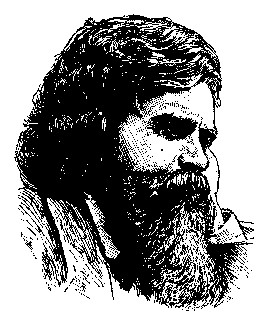
Edward Eggleston
Mr. Eggleston's literary career began, while he was still preaching, with contributions to Western periodicals. Having written for the New York Independent, he was offered in 1870 the place of literary editor of that paper, and the following year became its editor-in-chief. He was afterwards editor of Hearth and Home, to the columns of which journal he contributed 'The Hoosier Schoolmaster,' a story that has been very popular. He wrote a number of other novels, 'The End of the World,' 'The Mystery of Metropolisville,' 'The Circuit Rider,' 'Roxy,' etc. In January 1880, while on a visit to Europe, he began to make plans for a 'History of Life in the United States.' He had always had a strong taste for this subject, a keen natural interest in history being evident here and there in his stories. His historical researches were carried on in many of the chief libraries of Europe and the United States. A result of these studies was the thirteen articles on 'Life in the Colonial Period' published in the Century Magazine. These, however, were but preliminary studies to the work which he intended should be the most important of his life. The first volume of this work, 'The Beginners of a Nation,' was published in 1896.
This work does not pretend to be a particular account of colonial history. It is an attempt rather to describe the colonial individual and colonial society, to state the succession of cause and effect in the establishment of English life in North America, and to describe principles rather than details,—giving however as much detail as is necessary to illustrate principles. The volume of 1896 contains chapters on 'The James River Experiments' and 'The Procession of Motives' which led to colonization. Book ii. of this volume is upon the Puritan migration, and has chapters on the rise of Puritanism in England, on the Pilgrim migration, and the great Puritan exodus. Book iii. receives the name of 'Centrifugal Forces in Colony Planting,' and contains accounts of Lord Baltimore's Maryland colony, of Roger Williams, and the 'New England Dispersions,' by which is meant the establishment of communities in Connecticut and elsewhere. In the sketch of Lord Baltimore, the courtier and friend of kings, we have a striking contrast with the type of men who led the Puritan migrations. There were odd characters in those days; and a court favorite and worldling who, after having feathered his nest, is willing to make two such voyages to Newfoundland as his must have been, and to spend a winter there, all out of zeal for the establishment of his religion in the Western wilds, is certainly a person worthy of study.
The play of the forces that produced emigration, and their relations to the migrations, are described very clearly by the author. People did not emigrate when they were happy at home. Thus, Catholic emigration was small under Laud, when English Catholics were beginning to think that the future was theirs; just as Puritan emigration, vigorous under Laud, dwindled with the days of the Puritan triumph in England. We have in 'The James River Experiments' a good example of the writer's method. The salient and significant facts are given briefly, but with sufficient fullness to enable the reader to have a satisfactory grasp of the matter; and where some principle or general truth is to be pointed out, the author sets this forth strongly. For instance, in describing the motives of colonization in Virginia, he shows how these motives were in almost all cases delusions; how a succession of such delusions ran through the times of Elizabeth and James; and how colonization succeeded in the end only by doing what its projectors had never intended to do. The Jamestown emigrants expected to find a passage to India, to discover gold and silver, to raise wine and silk. But none of these things were done. Wines and silk indeed were raised. It is said that Charles I.'s coronation robe was made of Virginian silk, and Mr. Eggleston tells us that Charles II. certainly wore silk from worms hatched and fed in his Virginian dominions. But these industries, although encouraged to the utmost by government, could not be made to take root. On the other hand, a determined effort was made to discourage the production of tobacco. James I. wrote a book against the culture of that pernicious "weed," as he was the first to describe it. But the hardy plant held its own and flourished in spite of the royal disfavor. Nor were the colonists more successful in their political intentions. Especially interesting, in view of recent discussions, is the account given of the communistic experiments which belonged to the early history of the American colonies. In Virginia all the products of the colony were to go into a common stock. But after twelve years' trial of this plan, there was a division of the land among the older settlers. The pernicious character of the system had been demonstrated. "Every man sharked for his own bootie," says a writer on Virginia in 1609, "and was altogether careless of the succeeding penurie." The two years of communism in the Plymouth colony was scarcely more successful. Bradford, finding that the matter was one of life and death with the colony, abolished the system, although the abolition was a revolutionary stroke, in violation of the contract with the shareholders.
This idea, that the outcome was to be very different from the intentions, appears not only in the striking chapter on 'The Procession of Motives,' but crops up again and again in other parts of the book. Thus, the ill success which attended the government of the colonies from London resulted in the almost unconscious establishment of several independent democratic communities in America. This happened in Virginia and Plymouth. The Massachusetts Bay Colony, however, was self-governing from the start.
But although causes and principles are matters of chief interest with Mr. Eggleston, his book is full of a picturesqueness which is all the more effective for being unobtrusive. The author has not that tiresome sort of picturesqueness which insists on saying the whole thing itself. The reader is credited with a little imagination, and that faculty has frequent opportunity for exercise. It is charmed by the striking passage in which is described the delight of the emigrants of the Massachusetts Bay Colony, when, after having set sail from England, they found themselves upon the open sea for the first time without the supervision, or even the neighborhood, of bosses. We know the sense of freedom which the broad and blue ocean affords to us all; what must have been that feeling to men who had scarcely ever had an hour of life untroubled by the domination of an antagonistic religious authority! Every day, for ten weeks together, they had preaching and exposition. "On one ship," says Mr. Eggleston, "the watches were set to the accompaniment of psalm-singing."
The candor and fair-mindedness of this work is one of its special merits. We have an indication of this quality in the author's refusal to accept the weak supposition, common among writers upon American history, that the faults of our ancestors were in some way more excusable than those of other people. He says in his Preface:—"I have disregarded that convention which makes it obligatory for a writer of American history to explain that intolerance in the first settlers was not just like other intolerance, and that their cruelty and injustice were justifiable under the circumstances." Other very important characteristics are sympathy, warmth of heart, and moral enthusiasm. Nor is the work wanting in an adequate literary merit. The style, especially in the later chapters, is free, simple, nervous, and rhythmical.
Little has been said of Mr. Eggleston's novels in the course of these remarks. But the qualities of his historical writing appear in his novels. The qualities of the realistic novelist are of great use to the historian, when the novelist has the thoroughness and the industry of Mr. Eggleston. By the liveliness of his imagination, he succeeds in making history as real as fiction should be. Mr. Eggleston's novels deserve the popularity they have attained. They are themselves, particularly those which describe Western life, valuable contributions to history. The West, we may add, is Mr. Eggleston's field. His most recent novel, 'The Faith Doctor,' the scene of which is laid in New York, is very inferior to his Western stories. Of these novels probably the best is 'The Graysons,' a book full of its author's reality and warmth of human sympathy; of this book the reader will follow every word with the same lively interest with which he reads 'The Beginners of a Nation.'
ROGER WILLIAMS: THE PROPHET OF RELIGIOUS FREEDOM
From 'The Beginners of a Nation': copyright 1896, by Edward Eggleston
Local jealousy and sectarian prejudice have done what they could to obscure the facts of the trial and banishment of Williams. It has been argued by more than one writer that it was not a case of religious persecution at all, but the exclusion of a man dangerous to the State. Cotton, with characteristic verbal legerdemain, says that Williams was "enlarged" rather than banished. The case has even been pettifogged in our own time by the assertion that the banishment was only the action of a commercial company excluding an uncongenial person from its territory. But with what swift indignation would the Massachusetts rulers of the days of Dudley and Haynes have repudiated a plea which denied their magistracy! They put so strong a pressure on Stoughton, who said that the assistants were not magistrates, that he made haste to renounce his pride of authorship and to deliver his booklet to be officially burned; nor did even this prevent his punishment. The rulers of "the Bay" were generally frank advocates of religious intolerance; they regarded toleration as a door set open for the Devil to enter. Not only did they punish for unorthodox expressions, they even assumed to inquire into private beliefs. Williams was only one of scores bidden to depart on account of opinion.
The real and sufficient extenuation for the conduct of the Massachusetts leaders is found in the character and standards of the age. A few obscure and contemned sectaries—Brownists, Anabaptists, and despised Familists—in Holland and England had spoken more or less clearly in favor of religious liberty before the rise of Roger Williams, but nobody of weight or respectable standing in the whole world had befriended it. All the great authorities in Church and State, Catholic and Protestant, prelatical and Puritan, agreed in their detestation of it. Even Robinson, the moderate pastor of the Leyden Pilgrims, ventured to hold only to the "toleration of tolerable opinions." This was the toleration found at Amsterdam and in some other parts of the Low Countries. Even this religious sufferance, which did not amount to liberty, was sufficiently despicable in the eyes of that intolerant age to bring upon the Dutch the contempt of Christendom. It was a very qualified and limited toleration, and one from which Catholics and Arminians were excluded. It seems to have been that practical amelioration of law which is produced more effectually by commerce than by learning or religion. Outside of some parts of the Low Countries, and oddly enough of the Turkish Empire, all the world worth counting decried toleration as a great crime. It would have been wonderful indeed if Massachusetts had been superior to the age. "I dare aver," says Nathaniel Ward, the New England lawyer-minister, "that God doth nowhere in his Word tolerate Christian States to give tolerations to such adversaries of his Truth, if they have power in their hands to suppress them." To set up toleration was "to build a sconce against the walls of heaven to batter God out of his chair," in Ward's opinion.
This doctrine of intolerance was sanctioned by many refinements of logic, such as Cotton's delicious sophistry that if a man refused to be convinced of the truth, he was sinning against conscience, and therefore it was not against the liberty of conscience to coerce him. Cotton's moral intuitions were fairly suffocated by logic. He declared that men should be compelled to attend religious service, because it was "better to be hypocrites than profane persons. Hypocrites give God part of his due, the outward man, but the profane person giveth God neither outward nor inward man." To reason thus is to put subtlety into the cathedra of common-sense, to bewilder vision by legerdemain. Notwithstanding his natural gift for devoutness and his almost immodest godliness, Cotton was incapable of high sincerity. He would not specifically advise Williams's banishment, but having labored with him round a corner according to his most approved ecclesiastical formula, he said, "We have no more to say in his behalf, but must sit down;" by which expression of passivity he gave the signal to the "secular arm" to do its worst, while he washed his hands in innocent self-complacency. When one scrupulous magistrate consulted him as to his obligation in Williams's case, Cotton answered his hesitation by saying, "You know they are so much incensed against his course that it is not your voice, nor the voice of two or three more, that can suspend the sentence." By such shifty phrases he shirked responsibility for the results of his own teaching. Of the temper that stands alone for the right, nature had given him not a jot. Williams may be a little too severe, but he has some truth when he describes Cotton on this occasion as "swimming with the stream of outward credit and profit," though nothing was further from Cotton's conscious purpose than such worldliness. Cotton's intolerance was not like that of Dudley and Endicott, the offspring of an austere temper; it was rather the outgrowth of his logic and his reverence for authority. He sheltered himself behind the examples of Elizabeth and James I., and took refuge in the shadow of Calvin, whose burning of Servetus he cites as an example, without any recoil of heart or conscience. But the consideration of the character of the age forbids us to condemn the conscientious men who put Williams out of the Massachusetts theocracy as they would have driven the Devil out of the garden of Eden. When, however, it comes to judging the age itself, and especially to judging the Puritanism of the age, these false and harsh ideals are its sufficient condemnation. Its government and its very religion were barbarous; its Bible, except for mystical and ecclesiastical uses, might as well have closed with the story of the Hebrew judges and the imprecatory Psalms. The Apocalypse of John, grotesquely interpreted, was the one book of the New Testament that received hearty consideration, aside from those other New Testament passages supposed to relate to a divinely appointed ecclesiasticism. The humane pity of Jesus was unknown not only to the laws, but to the sermons of the time. About the time of Williams's banishment the lenity of John Winthrop was solemnly rebuked by some of the clergy and rulers as a lax imperiling of the safety of the gospel; and Winthrop, overborne by authority, confessed, explained, apologized, and promised amendment. The Puritans substituted an unformulated belief in the infallibility of "godly" elders acting with the magistrates, for the ancient doctrine of an infallible Church.
In this less scrupulous but more serious age it is easy to hold Williams up to ridicule. Never was a noble and sweet-spirited man bedeviled by a scrupulosity more trivial. Cotton aptly dubbed him "a haberdasher of small questions." His extant letters are many of them vibrant with latent heroism; there is manifest in them an exquisite charity and a pathetic magnanimity: but in the midst of it all the writer is unable to rid himself of a swarm of scruples as pertinacious as the buzzing of mosquitoes in the primitive forest about him. In dating his letters, where he ventures to date at all, he never writes the ordinary name of the day of the week or the name of the month, lest he should be guilty of etymological heathenism. He often avoids writing the year, and when he does insert it he commits himself to the last two figures only and adds a saving clause. Thus 1652 appears as "52 (so called)," and other years are tagged with the same doubting words, or with the Latin "ut vulgo." What quarrel the tender conscience had with the Christian era it is hard to guess. So too he writes to Winthrop, who had taken part in his banishment, letters full of reverential tenderness and hearty friendship. But his conscience does not allow him even to seem to hold ecclesiastical fellowship with a man he honors as a ruler and loves as a friend. Once at least he guards the point directly by subscribing himself "Your worship's faithful and affectionate in all civil bonds." It would be sad to think of a great spirit so enthralled by the scrupulosity of his time and his party, if these minute restrictions had been a source of annoyance to him. But the cheerful observance of little scruples seems rather to have taken the place of a recreation in his life; they were to him perhaps what bric-à-brac is to a collector, what a well-arranged altar and candlesticks are to a ritualist.
Two fundamental notions supplied the motive power of every ecclesiastical agitation of that age. The notion of a succession of churchly order and ordinance from the time of the apostles was the mainspring of the High Church movement. Apostolic primitivism was the aim of the Puritan, and still more the goal of the Separatist. One party rejoiced in a belief that a mysterious apostolic virtue had trickled down through generations of bishops and priests to its own age; the other rejoiced in the destruction of institutions that had grown up in the ages, and in getting back to the primitive nakedness of the early Christian conventicle. True to the law of his nature, Roger Williams pushed this latter principle to its ultimate possibilities. If we may believe the accounts, he and his followers at Providence became Baptists that they might receive the rite of baptism in its most ancient Oriental form. But in an age when the fountains of the great deep were utterly broken up, he could find no rest for the soles of his feet. It was not enough that he should be troubled by the Puritan spirit of apostolic primitivism: he had now swung round to where this spirit joined hands with its twin, the aspiration for apostolic succession. He renounced his baptism because it was without apostolic sanction, and announced himself of that sect which was the last reduction of Separatism. He became a Seeker.
Here again is a probable influence from Holland. The Seekers had appeared there long before. Many Baptists had found that their search for primitivism, if persisted in, carried them to this negative result; for it seemed not enough to have apostolic rites in apostolic form unless they were sanctioned by the "gifts" of the apostolic time. The Seekers appeared in England as early as 1617, and during the religious turmoils of the Commonwealth period the sect afforded a resting-place for many a weather-beaten soul. As the miraculous gifts were lost, the Seekers dared not preach, baptize, or teach; they merely waited, and in their mysticism they believed their waiting to be an "upper room" to which Christ would come. It is interesting to know that Williams, the most romantic figure of the whole Puritan movement, at last found a sort of relief from the austere externalism and ceaseless dogmatism of his age by traveling the road of literalism, until he had passed out on the other side into the region of devout and contented uncertainty.
In all this, Williams was the child of his age, and sometimes more childish than his age. But there were regions of thought and sentiment in which he was wholly disentangled from the meshes of his time, and that not because of intellectual superiority,—for he had no large philosophical views,—but by reason of elevation of spirit. Even the authority of Moses could not prevent him from condemning the harsh severity of the New England capital laws. He had no sentimental delusions about the character of the savages,—he styles them "wolves endued with men's brains"; but he constantly pleads for a humane treatment of them. All the bloody precedents of Joshua could not make him look without repulsion on the slaughter of women and children in the Pequot war, nor could he tolerate dismemberment of the dead or the selling of Indian captives into perpetual slavery. From bigotry and resentment he was singularly free. On many occasions he joyfully used his ascendency over the natives to protect those who kept in force against him a sentence of perpetual banishment. And this ultra-Separatist, almost alone of the men of his time, could use such words of catholic charity as those in which he speaks of "the people of God wheresoever scattered about Babel's banks, either in Rome or England."
Of his incapacity for organization or administration we shall have to speak hereafter. But his spiritual intuitions, his moral insight, his genius for justice, lent a curious modernness to many of his convictions. In a generation of creed-builders which detested schism, he became an individualist. Individualist in thought, altruist in spirit, secularist in governmental theory, he was the herald of a time yet more modern than this laggard age of ours. If ever a soul saw a clear-shining inward light, not to be dimmed by prejudices or obscured by the deft logic of a disputatious age, it was the soul of Williams. In all the region of petty scrupulosity the time-spirit had enthralled him; but in the higher region of moral decision he was utterly emancipated from it. His conclusions belong to ages yet to come.
This union of moral aspiration with a certain disengagedness constitutes what we may call the prophetic temperament. Bradford and Winthrop were men of high aspiration, but of another class. The reach of their spirits was restrained by practical wisdom, which compelled them to take into account the limits of the attainable. Not that they consciously refused to follow their logic to its end, but that, like other prudent men of affairs, they were, without their own knowledge or consent, turned aside by the logic of the impossible. Precisely here the prophet departs from the reformer. The prophet recks nothing of impossibility; he is ravished with truth disembodied. From Elijah the Tishbite to Socrates, from Socrates to the latest and perhaps yet unrecognized voice of our own time, the prophetic temperament has ever shown an inability to enter into treaty with its environment. In the seventeenth century there was no place but the wilderness for such a John Baptist of the distant future as Roger Williams. He did not belong among the diplomatic builders of churches, like Cotton, or the politic founders of States, like Winthrop. He was but a babbler to his own time; but the prophetic voice rings clear and far, and ever clearer as the ages go on.
Reprinted by consent of the author, and of D. Appleton & Company, publishers, New York.
EGYPTIAN LITERATURE
BY FRANCIS LLEWELLYN GRIFFITH AND KATE BRADBURY GRIFFITH
he advance that has been made in recent years in the decipherment of the ancient writings of the world enables us to deal in a very matter-of-fact way with the Egyptian inscriptions. Their chief mysteries are solved, their philosophy is almost fathomed, their general nature is understood. The story they have to tell is seldom startling to the modern mind. The world was younger when they were written. The heart of man was given to devious ways then, as now and in the days of Solomon,—that we can affirm full well; but his mind was simpler: apart from knowledge of men and the conduct of affairs, the educated Egyptian had no more subtlety than a modern boy of fifteen, or an intelligent English rustic of a century ago.
To the Egyptologist by profession the inscriptions have a wonderful charm. The writing itself in its leading form is the most attractive that has ever been seen. Long rows of clever little pictures of everything in heaven and earth compose the sentences: every sign is a plaything, every group a pretty puzzle, and at present, almost every phrase well understood brings a tiny addition to the sum of the world's knowledge. But these inscriptions, so rich in facts that concern the history of mankind and the progress of civilization, seldom possess any literary charm. If pretentious, as many of them are, they combine bald exaggeration with worn-out simile, in which ideas that may be poetical are heaped together in defiance of art. Such are the priestly laudations of the kings by whose favor the temples prospered. Take, for instance, the dating of a stela erected under Rameses II. on the route to the Nubian gold mines. It runs:—
"On the fourth day of the first month of the season of winter, in the third year of the Majesty of Horus, the Strong Bull, beloved of the Goddess of Truth, lord of the vulture and of the urseus diadems, protecting Egypt and restraining the barbarians, the Golden Horus, rich in years, great in victories, King of Upper Egypt and King of Lower Egypt, Mighty in Truth of Ra, Chosen of Ra,[1] the son of Ra, Rameses Beloved of Amen, granting life for ever and ever, beloved of Amen Ra lord of the 'Throne of the Two Lands'[2] in Apt Esut, appearing glorious on the throne of Horus among the living from day to day even as his father Ra; the good god, lord of the South Land, Him of Edfû[3] Horus bright of plumage, the beauteous sparrow-hawk of electrum that hath protected Egypt with his wing, making a shade for men, fortress of strength and of victory; he who came forth terrible from the womb to take to himself his strength, to extend his borders, to whose body color was given of the strength of Mentu[4]; the god Horus and the god Set. There was exultation in heaven on the day of his birth; the gods said, 'We have begotten him;' the goddesses said, 'He came forth from us to rule the kingdom of Ra;' Amen spake, 'I am he who hath made him, whereby I have set Truth in her place; the earth is established, heaven is well pleased, the gods are satisfied by reason of him.' The Strong Bull against the vile Ethiopians, which uttereth his roaring against the land of the negroes while his hoofs trample the Troglodytes, his horn thrusteth at them; his spirit is mighty in Nubia and the terror of him reacheth to the land of the Kary[5]; his name circulateth in all lands because of the victory which his arms have won; at his name gold cometh forth from the mountain as at the name of his father, the god Horus of the land of Baka; beloved is he in the Lands of the South even as Horus at Meama, the god of the Land of Buhen,[6] King of Upper and Lower Egypt, Mighty in Truth of Ra, son of Ra, of his body, Lord of Diadems Rameses Beloved of Amen, giving life for ever and ever like his father Ra, day by day." [Revised from the German translation of Professor Erman.]
As Professor Erman has pointed out, the courtly scribe was most successful when taking his similes straight from nature, as in the following description, also of Rameses II.:—
"A victorious lion putting forth its claws while roaring loudly and uttering its voice in the Valley of the Gazelles.... A jackal swift of foot seeking what it may find, going round the circuit of the land in one instant.... his mighty will seizeth on his enemies like a flame catching the ki-ki plant[7] with the storm behind it, like the strong flame which hath tasted the fire, destroying, until everything that is in it becometh ashes; a storm howling terribly on the sea, its waves like mountains, none can enter it, every one that is in it is engulphed in Duat.[8]"
Here and there amongst the hieroglyphic inscriptions are found memorials of the dead, in which the praises of the deceased are neatly strung together and balanced like beads in a necklace, and passages occur of picturesque narrative worthy to rank as literature of the olden time. We may quote in this connection from the biographical epitaph of the nomarch Ameny, who was governor of a province in Middle Egypt for twenty-five years during the long reign of Usertesen I. (about 2700 B.C.). This inscription not only recounts the achievements of Ameny and the royal favor which was shown him, but also tells us in detail of the capacity, goodness, charm, discretion, and insight by which he attached to himself the love and respect of the whole court, and of the people over whom he ruled and for whose well-being he cared. Ameny says:—
"I was a possessor of favor, abounding in love, a ruler who loved his city. Moreover I passed years as ruler in the Oryx nome. All the works of the house of the King came into my hand. Behold, the superintendent of the gangs[9] of the domains of the herdsmen of the Oryx nome gave me 3,000 bulls of their draught stock. I was praised for it in the house of the King each year of stock-taking. I rendered all their works to the King's house: there were no arrears to me in any of his offices.
"The entire Oryx nome served me in numerous attendances.[10] There was not the daughter of a poor man that I wronged, nor a widow that I oppressed. There was not a farmer that I chastised, not a herdsman whom I drove away, not a foreman of five whose men I took away for the works.[11] There was not a pauper around me, there was not a hungry man of my time. When there came years of famine, I arose and ploughed all the fields of the Oryx nome to its boundary south and north, giving life to its inhabitants, making its provisions. There was not a hungry man in it. I gave to the widow as to her that possessed a husband, and I favored not the elder above the younger in all that I gave. Thereafter great rises of the Nile took place, producing wheat and barley, and producing all things abundantly, but I did not exact the arrears of farming."
Elsewhere in his tomb there are long lists of the virtues of Amenemhat, and from these the following may be selected both on account of picturesqueness of expression and the appreciation of fine character which they display.
"Superintendent of all things which heaven gives and earth produces, overseer of horns, hoofs, feathers, and shells ... Master of the art of causing writing to speak ... Caressing of heart to all people, making to prosper the timid man, hospitable to all, escorting [travelers] up and down the river ... Knowing how to aid, arriving at time of need; free of planning evil, without greediness in his body, speaking words of truth.... Unique as a mighty hunter, the abode of the heart of the King.... Speaking the right when he judges between suitors, clear of speaking fraud, knowing how to proceed in the council of the elders, finding the knot in the skein.... Great of favors in the house of the King, contenting the heart on the day of making division, careful of his goings to his equals, gaining reverence on the day of weighing words, beloved of the officials of the palace."
The cursive forms of writing—hieratic from the earliest times, demotic in the latest—were those in which records were committed to papyrus. This material has preserved to us documents of every kind, from letters and ledgers to works of religion and philosophy. To these, again, "literature" is a term rarely to be applied; yet the tales and poetry occasionally met with on papyri are perhaps the most pleasing of all the productions of the Egyptian scribe.
It must be confessed that the knowledge of writing in Egypt led to a kind of primitive pedantry, and a taste for unnatural and to us childish formality: the free play and naïveté of the story-teller is too often choked, and the art of literary finish was little understood. Simplicity and truth to nature alone gave lasting charm, for though adornment was often attempted, their rude arts of literary embellishment were seldom otherwise than clumsily employed.
A word should be said about the strange condition in which most of the literary texts have come down to us. It is rarely that monumental inscriptions contain serious blunders of orthography; the peculiarities of late archaistic inscriptions which sometimes produce a kind of "dog Egyptian" can hardly be considered as blunders, for the scribe knew what meaning he intended to convey. But it is otherwise with copies of literary works on papyrus. Sometimes these were the productions of schoolboys copying from dictation as an exercise in the writing-school, and the blank edges of these papyri are often decorated with essays at executing the more difficult signs. The master of the school would seem not to have cared what nonsense was produced by the misunderstanding of his dictation, so long as the signs were well formed. The composition of new works on the model of the old, and the accurate understanding of the ancient works, were taught in a very different school, and few indeed attained to skill in them. The boys turned out of the writing-school would read and write a little; the clever ones would keep accounts, write letters, make out reports as clerks in the government service, and might ultimately acquire considerable proficiency in this kind of work. Apparently men of the official class sometimes amused themselves with puzzling over an ill-written copy of some ancient tale, and with trying to copy portions of it. The work however was beyond them: they were attracted by it, they revered the compilations of an elder age and those which were "written by the finger of Thoth himself"; but the science of language was unborn, and there was little or no systematic instruction given in the principles of the ancient grammar and vocabulary. Those who desired to attain eminence in scholarship after they had passed through the writing-school had to go to Heliopolis, Hermopolis, or wherever the principal university of the time might be, and there sit at the feet of priestly professors; who we fancy were reverenced as demigods, and who in mysterious fashion and with niggardly hand imparted scraps of knowledge to their eager pupils. Those endowed with special talents might after almost lifelong study become proficient in the ancient language. Would that we might one day discover the hoard of rolls of such a copyist and writer!
There must have been a large class of hack-copyists practiced in forming characters both uncial and cursive. Sometimes their copies of religious works are models of deft writing, the embellishments of artist and colorist being added to those of the calligrapher: the magnificent rolls of the 'Book of the Dead' in the British Museum and elsewhere are the admiration of all beholders. Such manuscripts satisfy the eye, and apparently neither the multitude in Egypt nor even the priestly royal undertakers questioned their efficacy in the tomb. Yet are they very apples of Sodom to the hieroglyphic scholar; fair without, but ashes within. On comparing different copies of the same text, he sees in almost every line omissions, perversions, corruptions, until he turns away baffled and disgusted. Only here and there is the text practically certain, and even then there are probably grammatical blunders in every copy. Nor is it only in the later papyri that these blunders are met with. The hieroglyphic system of writing, especially in its cursive forms, lends itself very readily to perversion by ignorant and inattentive copyists; and even monumental inscriptions, so long as they are mere copies, are usually corrupted. The most ridiculous perversions of all, date from the Ramesside epoch when the dim past had lost its charm, for the glories of the XVIIIth Dynasty were still fresh, while new impulses and foreign influence had broken down adherence to tradition and isolation.
In the eighth century B.C. the new and the old were definitely parted, to the advantage of each. On the one hand the transactions of ordinary life were more easily registered in the cursive demotic script, while on the other the sacred writings were more thoroughly investigated and brought into order by the priests. Hence, in spite of absurdities that had irremediably crept in, the archaistic texts copied in the XXVIth Dynasty are more intelligible than the same class of work in the XIXth and XXth Dynasties.
In reading translations from Egyptian, it must be remembered that uncertainty still remains concerning the meanings of multitudes of words and phrases. Every year witnesses a great advance in accuracy of rendering; but the translation even of an easy text still requires here and there some close and careful guesswork to supply the connecting links of passages or words that are thoroughly understood, or the resort to some conventional rendering that has become current for certain ill-understood but frequently recurring phrases. The renderings given in the following pages are with one exception specially revised for this publication, and exclude most of what is doubtful. The Egyptologist is now to a great extent himself aware whether the ground on which he is treading is firm or treacherous; and it seems desirable to make a rule of either giving the public only what can be warranted as sound translation, or else of warning them where accuracy is doubtful. A few years ago such a course would have curtailed the area for selection to a few of the simplest stories and historical inscriptions; but now we can range over almost the whole field of Egyptian writing, and gather from any part of it warranted samples to set before the reading public. The labor, however, involved in producing satisfactory translations for publication, not mere hasty readings which may give something of the sense, is very great; and at present few texts have been well rendered. It is hoped that the following translations will be taken for what they are intended,—attempts to show a little of the Ancient Egyptian mind in the writings which it has left to us.
We may now sketch briefly the history of Egyptian literature, dealing with the subject in periods:[12]—
I. The Ancient Kingdom, about B.C. 4500-3000
The earliest historic period—from the Ist Dynasty to the IIId, about B.C. 4500—has left no inscriptions of any extent. Some portions of the 'Book of the Dead' profess to date from these or earlier times, and probably much of the religious literature is of extremely ancient origin. The first book of *'Proverbs' in the Prisse Papyrus is attributed by its writer to the end of the IIId Dynasty (about 4000 B.C.). From the IVth Dynasty to the end of the VIth, the number of the inscriptions increases; tablets set up to the kings of the IVth Dynasty in memory of warlike raids are found in the peninsula of Sinai, and funerary inscriptions abound. The pyramids raised at the end of the Vth and during the VIth Dynasty are found to contain interminable religious inscriptions, forming almost complete rituals for the deceased kings. Professor Maspero, who has published these texts, states that they "contain much verbiage, many pious platitudes, many obscure allusions to the affairs of the other world, and amongst all this rubbish some passages full of movement and wild energy, in which poetical inspiration and religious emotion are still discernible through the veil of mythological expressions." Of the funerary and biographical inscriptions the most remarkable is that of *Una. Another, slightly later but hardly less important, is on the façade of the tomb of Herkhuf, at Aswân, and recounts the expeditions into Ethiopia and the southern oases which this resourceful man carried through successfully. In Herkhuf's later life he delighted a boy King of Egypt by bringing back for him from one of his raids a grotesque dwarf dancer of exceptional skill: the young Pharaoh sent him a long letter on the subject, which was copied in full on the tomb as an addition to the other records there. It is to the Vth Dynasty also that the second collection of *'Proverbs' in the Prisse Papyrus is dated. The VIIth and VIIIth Dynasties have left us practically no records of any kind.
II. The Middle Kingdom, B.C. 3000 TO 1600
The Middle Kingdom, from the IXth to the XVIIth Dynasty, shows a great literary development. Historical records of some length are not uncommon. The funerary inscriptions descriptive of character and achievement are often remarkable.
Many papyri of this period have survived: the *Prisse Papyrus of 'Proverbs,' a papyrus discovered by Mr. Flinders Petrie with the *'Hymn to Usertesen III.,' papyri at Berlin containing a *dialogue between a man and his soul, the *'Story of Sanehat,' the 'Story of the Sekhti,' and a very remarkable fragment of another story; besides the 'Westcar Papyrus of Tales' and at St. Petersburg the *'Shipwrecked Sailor.' The productions of this period were copied in later times; the royal *'Teaching of Amenemhat,' and the worldly *'Teaching of Dauf' as to the desirability of a scribe's career above any other trade or profession, exist only in late copies. Doubtless much of the later literature was copied from the texts of the Middle Kingdom. There are also *treatises extant on medicine and arithmetic. Portions of the Book of the Dead are found inscribed on tombs and sarcophagi.
III. The New Kingdom, etc.
From the New Kingdom, B.C. 1600-700, we have the *'Maxims of Any,' spoken to his son Khonsuhetep, numerous hymns to the gods, including *that of King Akhenaten to the Aten (or disk of the sun), and the later *hymns to Amen Ra. Inscriptions of every kind, historical, mythological, and funereal, abound. The historical *inscription of Piankhy is of very late date. On papyri there are the stories of the *'Two Brothers,' of the 'Taking of Joppa,' of the *'Doomed Prince.'
From the Saite period (XXVIth Dynasty, B.C. 700) and later, there is little worthy of record in hieroglyphics: the inscriptions follow ancient models, and present nothing striking or original. In demotic we have the *'Story of Setna,' a papyrus of moralities, a chronicle somewhat falsified, a harper's song, a philosophical dialogue between a cat and a jackal, and others.
Here we might end. Greek authors in Egypt were many: some were native, some of foreign birth or extraction, but they all belong to a different world from the Ancient Egyptian. With the adaptation of the Greek alphabet to the spelling of the native dialects, Egyptian came again to the front in Coptic, the language of Christian Egypt. Coptic literature, if such it may be called, was almost entirely produced in Egyptian monasteries and intended for edification. Let us hope that it served its end in its day. To us the dull, extravagant, and fantastic Acts of the Saints, of which its original works chiefly consist, are tedious and ridiculous except for the linguist or the church historian. They certainly display the adjustment of the Ancient Egyptian mind to new conditions of life and belief; but the introduction of Christianity forms a fitting boundary to our sketch, and we will now proceed to the texts themselves.
List of Selections
Stories:
The Shipwrecked Sailor
The Story of Sanehat
The Doomed Prince
The Story of the Two Brothers
The Story of Setna
History:
The Stela of Piankhy
The Inscription of Una
Poetry:
Songs of Laborers
Love Songs
Hymn to Usertesen III.
Hymn to Aten
Hymns to Amen Ra
Songs to the Harp
From an Epitaph
From a Dialogue Between a Man and His Soul
Moral and Didactic:
The Negative Confession
The Teaching of Amenemhat
The Prisse Papyrus
From the Maxims of Any
Instruction of Dauf
Contrasted Lots of Scribe and Fellâh
Reproaches to a Dissipated Student
THE SHIPWRECKED SAILOR
[One of the most complete documents existing on papyrus is the 'Story of the Shipwrecked Sailor.' The tale itself seems to date from a very early period, when imagination could still have full play in Upper Nubia. In it a sailor is apparently presenting a petition to some great man, in hopes of royal favor as the hero of the marvels which he proceeds to recount.
The Papyrus, which apparently is of the age of the XIth Dynasty, is preserved at St. Petersburg, but is still unpublished. It has been translated by Professors Golenisheff and Maspero. The present version is taken from 'Egyptian Tales,' by W. M. Flinders Petrie.]
The wise servant said, "Let thy heart be satisfied, O my lord, for that we have come back to the country; after we have long been on board, and rowed much, the prow has at last touched land. All the people rejoice and embrace us one after another. Moreover, we have come back in good health, and not a man is lacking; although we have been to the ends of Wawat[13] and gone through the land of Senmut,[14] we have returned in peace, and our land—behold, we have come back to it. Hear me, my lord; I have no other refuge. Wash thee and turn the water over thy fingers, then go and tell the tale to the Majesty."
His lord replied, "Thy heart continues still its wandering words! But although the mouth of a man may save him, his words may also cover his face with confusion. Wilt thou do, then, as thy heart moves thee. This that thou wilt say, tell quietly."
The sailor then answered:—
"Now I shall tell that which has happened to me, to my very self. I was going to the mines of Pharaoh, and I went down on the Sea[15] on a ship of 150 cubits long and 40 cubits wide, with 150 sailors of the best of Egypt, who had seen heaven and earth, and whose hearts were stronger than lions. They had said that the wind would not be contrary, or that there would be none. But as we approached the land the wind arose, and threw up waves eight cubits high. As for me, I sized a piece of wood; but those who were in the vessel perished, without one remaining. A wave threw me on an island, after that I had been three days alone, without a companion beside my own heart. I laid me in a thicket and the shadow covered me. Then stretched I my limbs to try to find something for my mouth. I found there figs and grapes, all manner of good herbs, berries and grain, melons of all kinds, fishes and birds. Nothing was lacking. And I satisfied myself, and left on the ground that which was over, of what my arms had been filled withal. I dug a pit, I lighted a fire, and I made a burnt-offering unto the gods.
"Suddenly I heard a noise as of thunder, which I thought to be that of a wave of the sea. The trees shook and the earth was moved. I uncovered my face, and I saw that a serpent drew near. He was thirty cubits long, and his beard greater than two cubits; his body was overlaid with gold, and his color as that of true lazuli. He coiled himself before me.
"Then he opened his mouth, while that I lay on my face before him, and he said to me, 'What has brought thee, what has brought thee, little one, what has brought thee? If thou sayest not speedily what has brought thee to this isle, I will make thee know thyself; as a flame thou shalt vanish, if thou tellest me not something I have not heard, or which I knew not before thee.'
"Then he took me in his mouth and carried me to his resting-place, and laid me down without any hurt. I was whole and sound, and nothing was gone from me. Then he opened his mouth against me, while that I lay on my face before him, and he said, 'What has brought thee, what has brought thee, little one, what has brought thee to this isle which is in the sea, and of which the shores are in the midst of the waves?'
"Then I replied to him, and holding my arms low before him,[16] I said to him:—'I was embarked for the mines by the order of the Majesty, in a ship; 150 cubits was its length, and the width of it 40 cubits. It had 150 sailors of the best of Egypt, who had seen heaven and earth, and the hearts of whom were stronger than lions. They said that the wind would not be contrary, or that there would be none. Each of them exceeded his companion in the prudence of his heart and the strength of his arm, and I was not beneath any of them. A storm came upon us while we were on the sea. Hardly could we reach to the shore when the wind waxed yet greater, and the waves rose even eight cubits. As for me, I seized a piece of wood, while those who were in the boat perished without one being left with me for three days. Behold me now before thee, for I was brought to this isle by a wave of the sea!"
"Then said he to me, 'Fear not, fear not, little one, and make not thy face sad. If thou hast come to me, it is God[17] who has let thee live. For it is he who has brought thee to this isle of the blest, where nothing is lacking, and which is filled with all good things. See now thou shalt pass one month after another, until thou shalt be four months in this isle. Then a ship shall come from thy land with sailors, and thou shalt leave with them and go to thy country, and thou shalt die in thy town. Converse is pleasing, and he who tastes of it passes over his misery. I will therefore tell thee of that which is in this isle. I am here with my brethren and my children around me; we are seventy-five serpents, children, and kindred; without naming a young girl who was brought unto me by chance, and on whom the fire of heaven fell and burnt her to ashes. As for thee, if thou art strong, and if thy heart waits patiently, thou shalt press thy infants to thy bosom and embrace thy wife. Thou shalt return to thy house which is full of all good things, thou shalt see thy land, where thou shalt dwell in the midst of thy kindred!'
"Then I bowed in my obeisance, and I touched the ground before him. 'Behold now that which I have told thee before. I shall tell of thy presence unto Pharaoh, I shall make him to know of thy greatness, and I will bring to thee of the sacred oils and perfumes, and of incense of the temples with which all gods are honored. I shall tell moreover of that which I do now see (thanks to him), and there shall be rendered to thee praises before the fullness of all the land. I shall slay asses for thee in sacrifice, I shall pluck for thee the birds, and I shall bring for thee ships full of all kinds of the treasures of Egypt, as is comely to do unto a god, a friend of men in a far country, of which men know not.'
"Then he smiled at my speech, because of that which was in his heart, for he said to me, 'Thou art not rich in perfumes, for all that thou hast is but common incense. As for me, I am prince of the land of Punt,[18] and I have perfumes. Only the oil which thou saidst thou wouldst bring is not common in this isle. But when thou shalt depart from this place, thou shalt never more see this isle; it shall be changed into waves.'
"And behold, when the ship drew near, attending to all that he had told me before, I got me up into an high tree, to strive to see those who were within it. Then I came and told to him this matter; but it was already known unto him before. Then he said to me, 'Farewell, farewell; go to thy house, little one, see again thy children, and let thy name be good in thy town; these are my wishes for thee!'
"Then I bowed myself before him, and held my arms low before him, and he, he gave me gifts of precious perfumes, of cassia, of sweet woods, of kohl, of cypress, an abundance of incense, of ivory tusks, of baboons, of apes, and all kinds of precious things. I embarked all in the ship which was come, and bowing myself, I prayed God for him.
"Then he said to me, 'Behold, thou shalt come to thy country in two months, thou shalt press to thy bosom thy children, and thou shalt rest in thy tomb!' After this I went down to the shore unto the ship, and I called to the sailors who were there. Then on the shore I rendered adoration to the master of this isle and to those who dwelt therein.
"When we shall come, in our return, to the house of Pharaoh, in the second month, according to all that the serpent has said, we shall approach unto the palace. And I shall go in before Pharaoh, I shall bring the gifts which I have brought from this isle into the country. Then he shall thank me before the fullness of all the land. Grant then unto me a follower, and lead me to the courtiers of the king. Cast thine eye upon me after that I am come to land again, after that I have both seen and proved this. Hear my prayer, for it is good to listen to people. It was said unto me, 'Become a wise man, and thou shalt come to honor,' and behold I have become such."
This is finished from its beginning unto its end, even as it was found in a writing. It is written by the scribe of cunning fingers, Ameniamenaa; may he live in life, wealth, and health.
THE STORY OF SANEHAT
[The story of Sanehat is practically complete. A papyrus at Berlin contains all the text except about twenty lines at the beginning, the whole being written in about three hundred and thirty short lines. Scraps of the missing portion were found in the collection of Lord Amherst of Hackney; and these, added to a complete but very corrupt text of about the first fifty lines, enable one to restore the whole with tolerable certainty. The story was written about the time of the XIIth or XIIIth Dynasty, but was known at a much later period: one extract from the beginning of the tale and one from the end have been found written in ink on limestone flakes or "ostraca" of about the XXth Dynasty (about 1150 B.C.). It seems to be a straightforward relation of actual occurrences, a real piece of biography. At any rate, it is most instructive as showing the kind of intercourse that was possible between Egypt and Palestine about 2500 B.C.]
The hereditary prince, royal seal-bearer, trusty companion, judge, keeper of the gate of the foreigners, true and beloved royal acquaintance, the attendant Sanehat says:—
I attended my lord as a servant of the king, of the household of the hereditary princess, the greatly favored, the royal wife, Ankhet-Usertesen [?], holding a place at Kanefer, the pyramid of King Amenemhat.[19]
In the thirtieth year, the month Paophi, the seventh day, the god[20] entered his horizon, the King Sehetepabra flew up to heaven; he joined the sun's disk, he attended the god, he joined his Maker. The Residence[21] was silenced, the hearts were weakened, the Great Portals were closed, the courtiers crouching on the ground, the people in hushed mourning.
Now his Majesty had sent a great army with the nobles to the land of the Temehu,[22] his son and heir as their commander, the good King Usertesen.[23] And now he was returning, and had brought away captives and all kinds of cattle without end. The Companions of the Court sent to the West Side[24] to let the king know the state of affairs that had come about in the Audience Chamber.[25] The messenger found him on the road; he reached him at the time of evening. "It was a time for him to hasten greatly [was the message]: Let the Hawk[26] fly [hither] with his attendants, without allowing the army to know of it." And when the royal sons who commanded in that army sent messages, not one of them was summoned to audience. Behold, I was standing [near]; I heard his voice while he was speaking.[27] I fled far away, my heart beating, my arms outspread; trembling had fallen on all my limbs. I ran hither and thither[28] to seek a place to hide me, I threw myself amongst the bushes: and when I found a road that went forward, I set out southward, not indeed thinking to come to this Residence.[29] I expected that there would be disturbance. I spake not of life after it.[30] I wandered across my estate[31] [?] in the neighborhood of Nehat; I reached the island [or lake] of Seneferu, and spent the day [resting?] on the open field. I started again while it was yet day,[32] and came to a man standing at the side of the road. He asked of me mercy, for he feared me. By supper-time I drew near to the town of Negau. I crossed the river on a raft without a rudder, by the aid of a west wind, and landed at the quay [?] of the quarrymen of the Mistress at the Red Mountain.[33] Then I fled on foot northward, and reached the Walls of the Ruler, built to repel the Sati.[34] I crouched in a bush for fear, seeing the day-patrol at its duty on the top of the fortress. At nightfall I set forth, and at dawn reached Peten, and skirted the lake of Kemur.[35] Then thirst hasted me on; I was parched, my throat was stopped, and I said, "This is the taste of death." When I lifted up my heart and gathered strength, I heard a voice and the lowing of cattle. I saw men of the Sati; and an alien amongst them—he who is [now?] in Egypt[36]—recognized me. Behold, he gave me water, and boiled me milk, and I went with him to his camp,—may a blessing be their portion! One tribe passed me on to another: I departed to Sun [?], and came to Kedem.[37]
There I spent a year and a month [?]. But Ammui-nen-sha, Ruler of the Upper Tenu,[38] took me and said to me:—"Comfort thyself with me, that thou mayest hear the speech of Egypt." He said thus, for that he knew my character, and had heard of my worth; for men of Egypt who were there with him bore witness of me. Then he said to me:—"For what hast thou come hither? what is it? Hath a matter come to pass in the Residence? The King of the Two Lands, Sehetepabra, hath gone to heaven, and one knoweth not what may have happened thereon." But I answered with concealment and said:—"I returned with an expedition from the land of the Temehu; my desire was redoubled, my heart leaped, there was no satisfaction within me. This drove me to the ways of a fugitive. I have not failed in my duty, my mouth hath not uttered any bitter words, I have not hearkened to any evil plot, my name hath not been heard in the mouth of the informer. I know not what hath brought me into this country." [And the Ruler Ammui-nen-sha said:][39] "This is like the disposition of God. And now what is that land like if it know not that excellent god,[40] of whom the dread was over the nations like Sekhemt[41] in a year of pestilence?" I spake [thus] to him, and replied to him:—"Nay, but his son hath entered the palace, and taken the heritage of his father, and he is a god without an equal, nor was there any other before him [like unto him]. He is a master of wisdom, prudent in his designs, excellent in his decrees; coming out and going in is at his command. It was he that curbed the nations while his father remained within the palace, and he reported the execution of that which was laid upon him [to perform]. He is a mighty man also, working with his strong arm; a valiant one, who hath not his equal. See him when he springeth upon the barbarians, and throweth himself on the spoilers; he breaketh the horns and weakeneth the hands; his enemies cannot wield their weapons. He is fearless and dasheth heads to pieces; none can stand before him. He is swift of going, to destroy him who fleeth; and none turning his back to him reacheth his home. He is sturdy of heart in the moment [of stress]; he is a lion that striketh with the claw; never hath he turned his back. He is stout of heart when he seeth multitudes, he letteth none repose beyond what his desire would spare. He is bold of face when he seeth hesitation: his joy is to fall on the barbarians. He seizeth the buckler, and leapeth forward; he repeateth not his stroke, he slayeth, and none can turn his lance; without his bow being drawn the barbarians flee from his arms like dogs; for the great goddess hath granted him to war against those who know not his name; he is thorough, he spareth not and leaveth naught behind. He is full of grace and sweetness, a love-winner; his city loveth him more than itself, it rejoiceth in him more than in its own god; men and women go their ways, calling their children by his name. For he is a king that took the kingdom while he was in the egg, and ruled from his birth. He is a multiplier of offspring. And he is One Alone, the essence of God; this land rejoiceth in his government. He is one that enlargeth his borders; he will take the lands of the South, but he will not design to hold the countries of the North: yet he prepareth to smite the Sati, to crush the Wanderers of the Sand. When he cometh here, let him know thy name; dispute not, but go over to his command[42]: for he will not fail to treat well the country that floateth with his stream."
Said he, agreeing to me:—"Verily, Egypt is excellent in its stream[43] beyond anything, and it flourisheth; behold, as long as thou art with me I will do good unto thee." He placed me at the head of his children, he married me with his eldest daughter. He allowed me to choose for myself from his land, and from the choicest of what he possessed on the border of the next land. It was a goodly land; Iaa[44] is its name. Therein were figs and grapes; its wine was more plentiful than water; abundant was its honey, many were its oil-trees, and all fruits were upon its trees; there too was barley and spelt, and cattle of all kinds without end. Great honors also were granted to me, flowing from his love to me; he set me as sheikh of a tribe in a choice portion of his country. There were made for me rations of bread, wine from day to day, cooked meat and roasted fowl, besides wild game snared for me or brought to me, as well as what my hunting dogs caught. They made me many dainties, and milk food cooked in all manner of ways. Thus I passed many years; my children became valiant men, each one the conqueror of a tribe. When a messenger came north or went south to the Residence,[45] he tarried with me; for I gave all men gifts; I gave water to the thirsty, I set the strayed wanderer on his road, and I rescued those who were carried off captive. The Sati who went to war or to repel the kings of the nations, I commanded their expeditions; for this Ruler of the Tenu made me to spend many years as captain of his army. Every land to which I turned I overcame. I destroyed its green fields and its wells, I captured its cattle, I took captive its inhabitants, I deprived them of their provisions, and I slew much people of them by my sword, my bow, my marchings, and my good devices. Thus my excellence was in his heart; he loved me and he knew my valor; until he set me at the head of his sons, when he saw the success of my handiwork.
There came a champion of the Tenu to defy me in my tent; a bold man without equal, for he had vanquished all his rivals. He said, "Let Sanehat fight with me." He thought to overcome me; he designed to take my cattle, being thus counseled by his tribe. This ruler [Ammui-nen-sha] conferred with me. I said:—"I know him not. I assuredly am no associate of his; I hold me far from his place. Have I ever opened his door, or leaped over his fence? It is perverseness of heart from seeing me doing his work. Forsooth, I am as it were a stranger bull among the cows, which the bull of the herd charges, and the strong bull catches! But shall a wretched beggar desire to attain to my fortune? A common soldier cannot take part as a counselor. Then what pray shall establish the assembly?[46] But is there a bull that loveth battle, a courageous bull that loveth to repeat the charge in terrifying him whose strength he hath measured? If he hath stomach to fight, let him speak what he pleaseth. Will God forget what is ordained for him? How shall fate be known?" The night long I strung my bow, I made ready my arrows; I made keen my dagger, I furbished my arms. At daybreak the Tenu came together; it had gathered its tribes and collected the neighboring peoples. Its thoughts were on this combat; every bosom burned for me, men and women crying out; every heart was troubled for me; they said, "Is there yet another champion to fight with him?" Then [he took] his buckler, his battle-axe, and an armful of javelins. But thereon I avoided his weapons, and turned aside his arrows to the ground, useless. One drew near to the other and he rushed upon me. I shot at him and my arrow stuck in his neck; he cried out, and fell upon his nose: I brought down upon him his own battle-axe, and raised my shout of victory on his back. All the Asiatics roared, and I and his vassals whom he had oppressed gave thanks unto Mentu; this Ruler, Ammui-nen-sha, took me to his embrace. Then I took his goods, I seized his cattle. What he had thought to do to me, I did it unto him; I seized that which was in his tent, I spoiled his dwelling. I grew great thereby, I increased in my possessions. I abounded in cattle.
"May[47] the god be disposed to pardon him in whom he had trusted, and who deserted to a foreign country. Now is his anger quenched. I who at one time fled away a fugitive, my guarantee is now in the Residence. Having wandered a starved wanderer, now I give bread to those around. Having left my land in rags, now I shine in fine linen. Having been a fugitive without followers, now I possess many serfs. My house is fair, my dwelling large, I am spoken of in the palace. All the gods destined me this flight. Mayest thou be gracious; may I be restored to the Residence; favor me that I may see the place in which my heart dwelleth. Behold how great a thing is it that my body should be embalmed in the land where I was born! Come; if afterwards there be good fortune, I will give an offering to God that he may work to make good the end of his suppliant, whose heart is heavy at long absence in a strange land. May he be gracious; may he hear the prayer of him who is afar off, that he may revisit the place of his birth, and the place from which he removed.
"May the King of Egypt be gracious to me, by whose favor men live. I salute the mistress of the land, who is in his palace; may I hear the news of her children, and may my body renew its vigor thereby. But old age cometh, weakness hasteneth me on, the eyes are heavy, my arms are failing, my feet have ceased to follow the heart. Weariness of going on approacheth me; may they convey me to the cities of eternity. May I serve the mistress of all.[48] Oh that she may tell me the beauties of her children; may she bring eternity to me."
Now the Majesty of the King of Upper and Lower Egypt, Kheper-ka-ra, justified, spake concerning this condition in which I was. His Majesty sent unto me with presents from before the king, that he might make glad the heart of your servant,[49] as he would unto the Ruler of any country; and the royal sons who were in his palace caused me to hear their news.
Copy of the command which was brought to the humble servant to bring him back to Egypt.
"The Horus, Life of Births, Lord of the Crowns, Life of Births, King of Upper and Lower Egypt, Kheper-ka-ra, Son of the Sun, Usertesen[50] Ever Living unto Eternity. Royal Command for the attendant, Sanehat.
"Behold, this command of the king is sent to thee to give thee information: Whereas thou didst go round strange lands from Kedem[51] to Tenu, one country passed thee on to another as thy heart devised for thee. Behold, what thou hast done hath been done unto thee: Thou hast not blasphemed, so also the accusation against thee hath been repelled. So also thy sayings have been respected; thou hast not spoken against the Council of the Nobles. But this matter carried away thy heart; it was not [devised] in thy heart.
"This thy Heaven[52] who is in the palace is stablished and flourishing even now: she herself shareth in the rule of the land, and her children are in the Audience Chamber.[53]
"Leave the riches that thou hast, and in the abundance of which thou livest. When thou comest to Egypt thou shalt visit the Residence in which thou wast, thou shalt kiss the ground before the Great Portals, thou shalt assume authority amongst the Companions. But day by day, behold, thou growest old; thy vigor is lost; thou thinkest on thy day of burial. Thou shalt be conducted to the blessed state; there shall be assigned to thee a night of sacred oils and wrappings from the hands of the goddess Tayt. There shall be held for thee a procession [behind thy statues] and a visit [to the temple] on the day of burial, the mummy case gilded, the head blue, the canopy above thee; the putting in the skin-frame, oxen to draw thee, singers going before thee, the answering chant, and mourners crouching at the door of thy tomb-chapel. Prayers for offerings shall be recited for thee, victims shall be slaughtered at the door portrayed upon thy tablet[54]; and thy mastaba shall be built of white stone, in the company of the royal children. Thou shalt not die in a strange land, nor be buried by the Amu; thou shalt not be put in a sheepskin, thou shalt be well regarded. It is vain [?] to beat the ground and think on troubles.
"Thou hast reached the end.[55]
When this order came to me, I stood in the midst of my tribe, and when it was read unto me, I threw me on my belly; I bowed to the ground and let the dust spread upon my breast. I strode around my tent rejoicing and saying:—"How is this done to the servant, whose heart had transgressed to a strange country of babbling tongue? But verily good is compassion, that I should be saved from death. Thy Ka[56] it is that will cause me to pass the end of my days in the Residence."
Copy of the acknowledgment of this command.
"The servant of the royal house [?], Sanehat, says:—
"In most excellent peace! Known is it to thy Ka that this flight of thy servant was made in innocence. Thou the Good God, Lord of both Lands, Beloved of Ra, Favored of Mentu, lord of Uast, and of Amen, lord of the Thrones of the Two Lands, of Sebek, Ra, Horus, Hathor, Atmu and his Ennead, of Sepdu, Neferbiu, Semsetu, Horus of the east, and of the Mistress of the Cave[57] who resteth on thy head, of the chief circle of the gods of the waters, Min, Horus of the desert, Urert mistress of Punt, Nut, Harur-Ra, all the gods of the land of Egypt and of the isles of the sea.[58] May they put life and strength to thy nostril, may they present thee with their gifts, may they give to thee eternity without end, everlastingness without bound. May the fear of thee be doubled in the lands and in the foreign countries, mayest thou subdue the circuit of the sun. This is the prayer of the servant for his master, who hath delivered him from Amenti.[59]
"The possessor of understanding understandeth the higher order of men, and the servant recognizeth the majesty of Pharaoh. But thy servant feareth to speak it: it is a weighty matter to tell of. The great God, like unto Ra, knoweth well the work which he himself hath wrought. Who is thy servant that he should be considered, that words should be spent upon him? Thy majesty is as Horus, and the strength of thy arms extendeth to all lands.
"Then let his Majesty command that there be brought to him Meki of Kedem, Khentiu-aaush of Khent-keshu, and Menus of the Two Lands of the Fenkhu; these are chiefs as hostages that the Tenu act according to the desire of thy Ka, and that Tenu will not covet what belongeth to thee in it, like thy dogs.[60] Behold this flight that thy servant made: I did not desire it, it was not in my heart; I do not boast of it; I know not what took me away from my place; it was like the leading of a dream, as a man of Adhu sees himself in Abu,[61] as a man of the Corn-land sees himself in the Land of Gardens.[62] There was no fear, none was hastening in pursuit of me; I did not listen to an evil plot, my name was not heard in the mouth of the informer; but my limbs went, my feet wandered, my heart drew me; a god ordained this flight, and led me on. But I am not stiff-necked; a man feareth if he knoweth [?], for Ra hath spread thy fear over the land, thy terrors in every foreign country. Behold me in thy palace or behold me in this place,[63] still thou art he who doth clothe this horizon. The sun riseth at thy pleasure, the water in the rivers is drunk at thy will, the wind in heaven is breathed at thy saying.
"Thy servant will leave to a successor the viziership which thy servant hath held in this land. And when thy servant shall arrive[64] let thy Majesty do as pleaseth him, for one liveth by the breath that thou givest. O thou who art beloved of Ra, of Horus, and of Hathor! It is thy august nostril that Mentu, lord of Uast, desireth should live for ever."
It was granted that I should spend a day in Iaa,[65] to pass over my goods to my children, my eldest son leading my tribe, and all my goods in his hand, my people and all my cattle, my fruit, and all my pleasant trees. When thy humble servant[66] journeyed to the south, and arrived at the Roads of Horus, the officer who was over the frontier-patrol sent a report to the Residence to give notice. His Majesty sent the good overseer of the peasants of the king's domains, and ships with him laden with presents from the king for the Sati who had come with me to convey me to the Roads of Horus. I spoke to each one by his name, each officer according to his rank. I received and I returned the salutation, and I continued thus[67] until I reached Athtu.[68]
When the land was lightened, and the second day came,[69] there came some to summon me, four men in coming, four men in going,[70] to carry [?] me to the palace. I alighted on the ground between the gates of reception [?]; the royal children stood at the platform to greet [?] me; the Companions and those who ushered to the hall brought me on the way to the royal chamber.
I found his Majesty on the great throne on a platform of pale gold. Then I threw myself on my belly; this god, in whose presence I was, knew me not while he questioned me graciously; but I was as one caught in the night; my spirit fainted, my limbs shook, my heart was no longer in my bosom, and I knew the difference between life and death. His Majesty said to one of the Companions, "Lift him up; let him speak to me." And his Majesty said:—"Behold, thou hast come; thou hast trodden the deserts; thou hast played the wanderer. Decay falleth on thee, old age hath reached thee; it is no small thing that thy body should be embalmed, that thou shalt not be buried by foreign soldiers.[71] Do not, do not, be silent and speechless; tell thy name; is it fear that preventeth thee?" I answered with the answer of one terrified, "What is it that my lord hath said? O that I might answer it! It was not my act: it was the hand of God; it was a terror that was in my body, as it were causing a flight that had been foreordained. Behold I am before thee, thou art life; let thy Majesty do what pleaseth him."
The royal children were brought in, and his Majesty said to the queen, "Behold thou, Sanehat hath come as an Amu, whom the Sati have produced."
She shrieked aloud, and the royal children joined in one cry, and said before his Majesty, "Verily it is not he, O king, my lord." Said his Majesty, "It is verily he." Then they brought their tinkling bead-strings, their wands, and their sistra in their hands, and waved them[72] before his Majesty [and they sang]:—
[66] A frequent phrase for the writer or narrator, especially common in letters.
[38] Later called Upper Retenu: they were the inhabitants of the high lands of Palestine. Ammi was a divine name in Ancient Arabia, and the name Ammi-anshi, found in South-Arabian inscriptions, perhaps of 1000 B.C., is almost identical with that of the king who befriended Sanehat.
[56] The Ka or "double" was one of the spiritual constituents of man; but "thy Ka" is merely a mode of address to the exalted Pharaoh.
[53] Taking part in the councils of the king and in the administration of the kingdom.
[48] A phrase for the queen.
[35] Kemur was one of the Bitter Lakes in the line of the present Suez Canal.
[60] As dogs do the bidding of their master and spare his property.
[34] Asiatics and Bedawin.
[4] The coloration or configuration of his limbs indicated to the learned in such matters his victorious career. Mentu was the god of war.
[36] Possibly one of the three persons proposed as hostages to Egypt below, p. 5246. The word translated "alien" is uncertain. It may mean a kind of consul or mediator between the tribes for the purposes of trade, etc., or simply a "sheikh." Sanehat himself, returned from Egypt in his old age, is called by the same title, p. 5248.
[49] The narrator.
[46] A difficult passage.
[15] A name often applied to the great river Nile.
[28] It was of course night-time.
[51] Or Adim; see above, p. 5239, note.
[71] Instead of Egyptian priests.
[65] Sanehat's own territory; see p. 5241.
[70] This probably means "four men behind me and the same number in front," either conducting Sanehat or more probably carrying him in a litter.
[58] In this long array of gods, Mentu and Amen rank next to Ra. They were both worshiped at Thebes, which was then probably capital of the whole country. It certainly was so in the next dynasty, during which this tale was presumably written down. It is curious that Ptah the god of Memphis does not appear.
[42] Lit, "stick."
[19] This paragraph is very difficult to restore and very doubtful.
[72] These instruments rattled or clattered as they were waved or beaten together.
[30] Perhaps the meaning is that Sanehat did not imagine life possible "after the king's death," or it may be "outside the Residence." The pronoun for "it" is masculine, and may refer either to the palace or to the king.
[21] The king's city, and so throughout the story.
[45] I. e., of Pharaoh; see above, p. 5238.
[24] I. e., the western edge of Lower Egypt.
[52] The queen, his exalted mistress.
[31] Or possibly "I turned my course," turning now northward.
[11] I. e., he did not impress men (wrongfully?) for the government works, such as irrigation or road-making.
[7] The castor-oil plant (Ricinus communis).
[29] The Royal Residence called Athet-taui lay on the boundary of Upper and Lower Egypt, between Memphis and the entrance to the Faiyûm, and so in the direction which Sanehat at first took in his flight from the western edge of the Delta. One might prefer the word Capital to Residence, but it can hardly be doubted that Thebes and Memphis were then the real capitals of Egypt.
[57] I. e., the uræus or cobra.
[25] Perhaps this refers to the death of the king, or to the deliberations of the royal councilors.
[68] Probably the Residence; more commonly called Athet-taui, but here abbreviated in name.
[6] Baka, Meama, Buhen were in Nubia.
[44] Meaning "reeds" (?).
[54] This seems to refer to the so-called false door, representing the entrance to the underworld. All that precedes refers to burial with great ceremony.
[27] Sanehat, accidentally hearing the news of the old king's death, which was kept secret even from the members of the royal family, was overcome with agitation and fled.
[26] Apparently a term for the king.
[47] Without any pause or introduction Sanehat begins to quote from his petition to the King of Egypt. It is difficult to say whether this arrangement is due to an oversight of the scribe, or is intended to heighten the picturesqueness of the narrative by sudden contrast. The formal introduction might well be omitted as uninteresting. The end of the document with the salutations is preserved.
[43] A metaphor for the "policy," "will," of a king or god.
[12] An asterisk (*) attached to the title of a text indicates that a translation of part or all of it is printed in the following pages.
[14] District about the first cataract.
[61] As a man of Natho (the marshes in the north of the Delta) dreams that he is at Elephantine (the rocky southern frontier).
[23] Usertesen I., the son and heir of Amenemhat I., reigned ten years jointly with his father.
[9] The fellâhîn herdsmen of the time seem to have clubbed together into gangs, each of which was represented by a ganger, and the whole body by a superintendent of the gangs.
[40] I. e., What does Egypt do without the king?
[41] The goddess of destruction.
[39] These words appear to have been omitted by the scribe.
[13] Lower Nubia.
[55] I. e., of the king's command. The absence of any concluding salutation is noticeable.
[20] I. e., the King Sehetepabra Amenemhat I., whose death is recorded in the next clause.
[8] The underworld.
[64] Or, "Now thy servant hath finished."
[22] The land of the Temehu was in the Libyan desert on the west of Egypt.
[1] The italicized phrases represent the principal names of the King.
[33] Here the MS. is injured, and some of the words are doubtful. The quarries are those still worked for hard quartzite at Jebel Ahmar (Red Mountain), northeast of Cairo. The positions of most of the places mentioned in the narrative are uncertain. Doubtless Sanehat crossed the Nile just above the fork of the Delta and landed in the neighborhood of the quarries. The "Mistress" (Heryt), must be a goddess, or the queen.
[18] Punt was the "land of spices" to the Egyptian, and thence, too, the finest incense was brought for the temple services. It included Somaliland in Africa, and the south of Arabia.
[2] The temple of Karnak.
[17] The polytheistic Egyptians frequently used the term "God" without specifying any particular deity; perhaps, too, in their own minds they did not define the idea, but applied it simply to some general notion of Divinity.
[3] Horus as the winged disk of the sun, so often figured as a protecting symbol over the doors of temples.
[67] "Nodding and touching my forehead" is perhaps the real translation of some difficult words here paraphrased.
[32] Or possibly "the next day."
[37] Or possibly Adim, i. e., Edom; and so throughout.
[63] So the MS., and it conveys a fair meaning; but perhaps the original ran, "Behold, thou art in the palace and I am in this place yet," etc.
[5] The southern boundary of the Egyptian empire.
[16] The usual Egyptian attitude of respect to a superior was to stand bent slightly forward, holding the arms downward.
[62] The second is the name of the southernmost nome of Egypt, that of Elephantine, which has practically no corn-land. It was probably made fruitful by artificial irrigation, with culture of plants, trees, and vines.
[69] Or perhaps "very early."
[59] The place of the dead.
[50] The scribe has written Amenemhat by mistake for Usertesen.
[10] Corvée work for the government.
"May thy hands prosper, O King; May the graces of the Lady of Heaven continue. May the goddess Nub[73] give life to thy nostril; May the mistress of the stars favor thee, that which is north of her going south and that which is south of her going north. All wisdom is in the mouth of thy Majesty; The staff [?] is put upon thy forehead, driving away from thee the beggarly [?] Thou art pacified, O Ra, lord of the lands; They call on thee as on the Mistress of all. Strong is thy horn; let fall thine arrow. Grant the breath of life to him who is without it; Grant thy favor to this alien Samehit,[74] the foreign soldier born in the land of Egypt, Who fled away from fear of thee, And left the land from thy terrors. The face shall not grow pale, of him who beholdeth thy countenance; The eye shall not fear which looketh upon thee."
Said his Majesty:—"He shall not fear; let him be freed from terror. He shall be a Companion amongst the nobles; he shall be put within the circle of the courtiers. Go ye to the chamber of praise to seek wealth for him."
When I went out from the Audience Chamber, the royal children offered their hands to me; and we walked afterwards to the Great Portals. I was placed in a house of a king's son, in which were fine things; there was a cool bower therein, fruits of the granary, treasures of the White House,[75] clothes of the king's guard-robe, frankincense, the finest perfumes of the king and the nobles whom he loves, in every chamber; and every kind of servitor in his proper office. Years were removed from my limbs: I was shaved, and my locks of hair were combed; the foulness was cast to the desert, with the garments of the Nemausha.[76] I clothed me in fine linen, and anointed myself with the best oil; I laid me on a bed. I gave up the sand to those who lie on it; the oil of wood to him who would anoint himself therewith.
There was given to me the house of Neb-mer [?], which had belonged to a Companion. There were many craftsmen building it; all its woodwork was strengthened anew. Portions were brought to me from the palace thrice and four times a day, besides the gifts of the royal children; there was not a moment's ceasing from them. There was built for me a pyramid of stone amongst the pyramids. The overseer of the architects measured its ground; the chief treasurer drew it; the sacred masons did the sculpture; the chief of the laborers in the necropolis brought the bricks; and all the instruments applied to a tomb were there employed. There were given to me fields; there was made for me a necropolis garden, the land in it better than a farm estate; even as is done for the chief Companion. My statue was overlaid with gold, its girdle with pale gold; his Majesty caused it to be made. Such is not done to a man of low degree.
Thus am I in the favor of the king until the day of death shall come.
This is finished from beginning to end, as was found in the writing.
Translation of F. Ll. Griffith.
THE DOOMED PRINCE
['The Story of the Doomed Prince' was written at some time during the XVIIIth Dynasty (about 1450 B.C.). The papyrus on which it has been preserved to us, and which is in the British Museum, is much mutilated, and the end is entirely lost.]
There was once a king to whom no male child was born; he prayed for himself unto the gods whom he worshiped for a son. They decreed to cause that there should be born to him one. And his wife, after her time was fulfilled, gave birth to a male child. Came the Hathors[77] to decree for him a destiny; they said, "He dies by the crocodile, or by the serpent, or by the dog." Then the people who stood by the child heard this; they went to tell it to his Majesty. Then his Majesty's heart was exceeding sad. His Majesty caused a house to be built upon the desert, furnished with people and with all good things of the royal house, out of which the child should not go. Now when the child was grown he went up upon its roof and saw a greyhound; it was following a man walking on the road. He said to his page who was with him, "What is this that goeth behind the man coming along the road?" He said to him, "It is a greyhound." The child said to him, "Let there be brought to me one like it." The page went and reported it to his Majesty. His Majesty said, "Let there be brought to him a little trotter, lest his heart be sad." Then they brought to him the greyhound.
Now when the days were multiplied after these things, the child grew up in all his limbs, he sent a message to his father saying, "Wherefore should I remain here? Behold, I am destined to three dooms, and if I do according to my desire God will still do what is in his heart." They hearkened to all he said, and gave him all kinds of weapons, and also his greyhound to follow him, and they conveyed him over to the east side and said to him, "Go thou whither thou wilt." His greyhound was with him; he traveled northward following his heart in the desert; he lived on the best of all the game of the desert. He came to the chief of Naharaina.
Behold, there was no child born to the prince of Naharaina except one daughter. Behold, he built for her a house; its window was seventy cubits from the ground, and he caused to be brought all the sons of all the chiefs of the land of Kharu,[78] and said to them, "He who shall reach the window of my daughter, she shall be to him for a wife."
Now when the days had multiplied after these things, as they were in their daily task, the youth came by them. They took the youth to their house, they bathed him, they gave provender to his horse, they did every kind of thing for the youth; they anointed him, they bound up his feet, they gave him portions of their own food; they spake to him in the manner of conversation, "Whence comest thou, good youth?" He said to them:—"I am the son of an officer of the land of Egypt; my mother is dead, my father has taken another wife. When she bore children, she began to hate me, and I have come as a fugitive from before her." They embraced him and kissed him.
Now when the days were multiplied after these things, he said to the youths, "What is it that ye do here?" And they said to him, "We spend our time in this: we climb up, and he who shall reach the window of the daughter of the prince of Naharaina, to him she will be given to wife." He said to them, "Lo! I desire to try, I shall go to climb with you." They went to climb, as was their daily wont: the youth stood afar off to behold; and the face of the daughter of the prince of Naharaina was turned to him. Now when the days were multiplied after these things, the youth came to climb with the sons of the chiefs. He climbed, he reached the window of the daughter of the prince of Naharaina. She kissed him, she embraced him.
One went to rejoice the heart of her father, and said to him, "A man has reached the window of thy daughter." The prince spake of it, saying, "The son of which of the princes is it?" He said to him, "It is the son of an officer, who has come as a fugitive from the land of Egypt, fleeing from before his step-mother when she had children." Then the prince of Naharaina was exceeding angry; he said, "Shall I indeed give my daughter to the Egyptian fugitive? Let him go back." One came to tell the youth, "Go back to the place from which thou hast come." But the maiden took hold of him; she swore an oath by God, saying, "By the life of Ra Harakhti, if one taketh him from me, I will not eat, I will not drink, I shall die in that same hour." The messenger went to tell unto her father all that she said. Then the prince sent men to slay him, while he was in his house. But the maiden said, "By the life of Ra, if one slay him I shall be dead ere the sun goeth down. I will not pass an hour of life if I am parted from him." One went to tell her father. Then ... the prince came; he embraced him, he kissed him all over, and said, "Tell me who thou art; behold, thou art to me as a son." He said to him:—"I am a son of an officer of the land of Egypt; my mother died, my father took to him a second wife; she came to hate me, and I fled from before her." He gave to him his daughter to wife; he gave also to him people and fields, also cattle and all manner of good things.
Now when time had passed over these things, the youth said to his wife, "I am destined to three dooms—a crocodile, a serpent, and a dog." She said to him, "Let one kill the dog that runs before thee." He said to her, "I will not let my dog be killed, which I have brought up from when it was small." And she feared greatly for her husband, and would not let him go alone abroad.
One did ... the land of Egypt, to travel. Behold, the crocodile, ... he came opposite the city in which the youth was.... Behold, there was a mighty man therein; the mighty man would not suffer the crocodile to go out, ... the crocodile. The mighty man went out to walk when the sun ... every day, during two months of days.
Now when the days passed after this, the youth sat making a good day in his house. When the evening came he lay down on his bed; sleep seized upon his limbs; his wife filled a bowl of milk and placed it by his side. There came out a serpent from his hole, to bite the youth; behold, his wife was sitting by him; she lay not down. Thereupon the servants gave milk to the serpent; it drank and became drunk, and lay down, upside down; his wife cut it in pieces with her hatchet. They woke her husband ... she said to him, "Behold, thy god hath given one of thy dooms into thy hand; he shall give...." And he sacrificed to God, adoring him, and praising his mighty spirit from day to day.
Now when the days were multiplied after these things, the youth went to walk in the pathway in his enclosure, for he went not outside alone; behold, his dog was behind him. His dog put his nose to the ground [to pursue some game], and he ran after him. He came to the sea, and entered the sea behind his dog. The crocodile came out, he took him to the place where the mighty man was.... The crocodile, he said to the youth, "I am thy doom, following after thee...."
[Here the papyrus breaks off.]
Translation of F. Ll. Griffith.
THE STORY OF THE TWO BROTHERS
['The Story of the Two Brothers' is in places incoherent, but charms throughout by beautiful and natural touches. The copy in which it has been preserved to us is practically complete, but is full of errors of writing and of composition, whole sentences having crept in that are useless, or contradictory to the context. The style is however absolutely simple and narrative, and the language entirely free from archaisms.
The papyrus, which bears the name of Seti II. as crown prince, dates from the XIXth Dynasty. The beginnings of many of the sentences and paragraphs are written in red: this is specially the case when a sentence commences with an indication of time, usually expressed in a fixed formula. In such cases the translation of the passage written in red is here printed in italics.]
Once there were two brothers, of one mother and one father; Anpu was the name of the elder, and Bata was the name of the younger. Now, as for Anpu, he had a house and he had a wife. His younger brother was to him as it were a son; he it was who made for him his clothes, while he walked behind his oxen to the fields; he it was who did the plowing; he it was who harvested the corn; he it was who did for him all the work of the fields. Behold, his younger brother grew to be an excellent worker; there was not his equal in the whole land; behold, the strain of a god was in him.
Now when the days multiplied after these things, his younger brother followed his oxen as his manner was, daily; every evening he turned again to the house, laden with all the herbs of the field, with milk and with wood, and with all things of the field. He put them down before his elder brother, who was sitting with his wife; he drank and ate; he lay down in his stable with the cattle.
Now when the earth lighted and the second day came, he took bread which he had baked, and laid it before his elder brother; and he took with him his bread to the field, and he drave his cattle to pasture them in the fields. And he used to walk behind his cattle, they saying to him, "Good is the herbage which is in such a place;" and he hearkened to all that they said, and he took them to the good pasture which they desired. And the cattle which were before him became exceeding excellent, and they became prolific greatly.
Now at the time of plowing, his elder brother said unto him, "Let us make ready for ourselves a yoke of oxen for plowing; for the land hath come out from the water; it is good for plowing in this state; and do thou come to the field with corn, for we will begin the plowing in the morrow morning." Thus said he to him; and his younger brother did everything that his elder brother had bidden him, to the end.
Now when the earth lighted and the second day came, they went to the fields with their yoke of oxen; and their hearts were pleased exceedingly with that which they accomplished in the beginning of their work.
Now when the days were multiplied after these things, they were in the field; they stopped for seed corn, and he sent his younger brother, saying, "Haste thou, bring to us corn from the farm." And the younger brother found the wife of his elder brother; [some] one was sitting arranging her hair. He said to her [the wife], "Get up, and give to me seed corn, that I may run to the field, for my elder brother hastened me; be not slow." She said to him, "Go, open the store, and thou shalt take for thyself what is in thy heart; do not interrupt the course of my hair-dressing."
The youth went into his stable; he took a large measure, for he desired to take much corn; he loaded it with barley and spelt; and he went out carrying them. She said to him, "How much of the corn that is wanted, is that which is on thy shoulder?" He said to her, "Three bushels of spelt, and two of barley, in all five; these are what are upon my shoulder;" thus said he to her. And she spake with him, saying, "There is great strength in thee, for I see thy might every day." And her desire was to know him with the knowledge of youth. She arose and took hold of him, and said to him, "Come, lie with me; behold, this shall be to thine advantage, for I will make for thee beautiful garments." Then the youth became like a leopard of the south in fury at the evil speech which she had made to him; and she feared greatly. He spake with her, saying, "Behold, thou art to me as a mother; thy husband is to me as a father; for he who is elder than I hath brought me up. What is this great wickedness that thou hast said? Say it not to me again. For I will not tell it to any man, that it should go forth by the mouth of all men." He lifted up his burden, and he went to the field and came to his elder brother; and they took up their work, to labor at their task.
Now afterwards, at the time of evening, his elder brother was returning to his house; the younger brother was following after his oxen; he loaded himself with all the things of the field; he brought his oxen before him, to make them lie down in their stable which was in the farm. Behold, the wife of the elder brother was afraid for the words which she had said. She took a pot of fat; she made herself as one who had been beaten by miscreants, in order that she might say to her husband, "It is thy younger brother who hath done this wrong." Her husband returned in the even, as his manner was every day; he came unto his house; he found his wife lying down, ill of violence; she did not put water upon his hands as his manner was; she did not make a light before him; his house was in darkness, and she was lying vomiting. Her husband said to her, "Who hath spoken with thee?" Behold, she said, "No one hath spoken with me except thy younger brother. When he came to take for thee seed corn he found me sitting alone; he said to me, 'Come, let us lie together; put on thy wig[79];' thus spake he to me. I would not hearken to him: 'Behold, am I not thy mother, is not thy elder brother to thee as a father?' Thus spake I to him, and he feared, and he beat me to stop me from making report to thee, and if thou lettest him live I shall kill myself. Now behold, when he cometh to-morrow, seize upon him; I will accuse him of this wicked thing which he would have done the day before."
The elder brother became as a leopard of the south; he sharpened his knife; he took it in his hand; he stood behind the door of his stable to slay his younger brother as he came in the evening to let his cattle into the stable.
Now the sun went down, and he loaded himself with all the herbs of the field in his manner of every day. He came; his leading cow entered the stable; she said to her keeper, "Behold, thy elder brother is standing before thee with his knife to slay thee; flee from before him." He heard what his leading cow had said; the next entered and said likewise. He looked beneath the door of the stable; he saw the feet of his elder brother standing behind the door with his knife in his hand. He put down his load on the ground, he set out to flee swiftly; his elder brother pursued after him with his knife. Then the younger brother cried out unto Ra Harakhti, saying, "My good Lord! Thou art he who distinguishest wrong from right." Ra hearkened to all his complaint; Ra caused to be made a great water between him and his elder brother, full of crocodiles; the one brother was on one bank, the other on the other bank; and the elder brother smote twice on his hands at not slaying him. Thus did he. The younger brother called to the elder on the bank, saying, "Stand still until the dawn of day; when Ra ariseth I shall argue with thee before him, and he giveth the wrong to the right. For I shall not be with thee unto eternity. I shall not be in the place in which thou art; I shall go to the Valley of the Acacia."
Now when the earth lighted and the second day came, Ra Harakhti[80] shone out, and each of them saw the other. The youth spake with his elder brother, saying:—"Wherefore earnest thou after me to slay me wrongfully, when thou hadst not heard my mouth speak? For I am thy younger brother in truth; thou art to me as a father; thy wife is to me even as a mother: is it not so? Verily, when I was sent to bring for us seed corn, thy wife said to me, 'Come lie with me.' Behold, this has been turned over to thee upside down." He caused him to understand all that happened with him and his wife. He swore an oath by Ra Harakhti, saying, "Thy coming to slay me wrongfully, having thy spear, was the instigation of a wicked and filthy one." He took a reed knife and mutilated himself; he cast the flesh into the water, and the silurus swallowed it. He sank; he became faint; his elder brother chided his heart greatly; he stood weeping for him loudly, that he could not cross to where his younger brother was, because of the crocodiles. The younger brother called unto him, saying, "Whereas thou hast devised an evil thing, wilt thou not also devise a good thing, or such a thing as I would do unto thee? When thou goest to thy house thou must look to thy cattle; for I stay not in the place where thou art, I am going to the Valley of the Acacia. Now as to what thou shalt do for me: verily, understand this, that things shall happen unto me; namely, that I shall draw out my soul, that I shall put it upon the top of the flowers of the acacia; the acacia-tree will be cut down, it shall fall to the ground, and thou shalt come to seek for it, and if thou passest seven years searching for it, let not thy heart sicken. Thou shalt find it; thou must put it in a cup of cold water that I may live again, that I may make answer to what hath been done wrong. Thou shalt understand this; namely, that things are happening to me, when one shall give to thee a pot of beer in thy hand and it shall foam up: stay not then, for verily it shall come to pass with thee."
He went to the Valley of the Acacia; his elder brother went to his house; his hand was laid on his head; he cast dust on his head; he came to his house, he slew his wife, he cast her to the dogs, and he sat in mourning for his younger brother.
Now when the days were multiplied after these things, his younger brother was in the Valley of the Acacia; there was none with him; he spent the day hunting the game of the desert, he came back in the even to lie down under the acacia, the top-most flower of which was his soul.
Now when the days were multiplied after these things, he built himself a tower with his hand, in the Valley of the Acacia; it was full of all good things, that he might provide for himself a home.
He went out from his tower, he met the Ennead of the gods,[81] who were going forth to arrange the affairs of their whole land. The Nine Gods talked one with another, they said unto him: "Ho! Bata, Bull of the Ennead of the gods, art thou remaining alone, having fled thy village from before the wife of Anpu thy elder brother? Behold, his wife is slain. Thou hast given him an answer to all that was transgressed against thee." Their hearts were sad for him exceedingly. Ra Harakhti said to Khnumu,[81] "Behold, frame thou a wife for Bata, that he may not sit alone." Khnumu made for him a mate to dwell with him. She was more beautiful in her limbs than any woman who is in the whole land. Every god was in her. The seven Hathors came to see her: they said with one mouth, "She will die a sharp death."
He loved her very exceedingly, and she dwelt in his house; he passed his time in hunting the game of the desert, and brought what he took before her. He said, "Go not outside, lest the sea seize thee; for I cannot rescue thee from it, for I am a woman like thee: my soul is placed on the top of the flower of the acacia; and if another find it, I shall be vanquished by him." He explained to her all about his soul.
Now when the days were multiplied after these things, Bata went to hunt as his daily manner was. The girl went to walk under the acacia which was by the side of her house; the sea saw her, and cast its waves up after her. She set out to run away from it; she entered her house. The sea called unto the acacia, saying, "Oh, catch hold of her for me!" The acacia brought a lock from her hair, the sea carried it to Egypt, and dropped it in the place of the washers of Pharaoh's linen. The smell of the lock of hair entered into the clothes of Pharaoh. They were wroth with Pharaoh's washers, saying, "The smell of ointment is in the clothes of Pharaoh." The men were rebuked every day; they knew not what they should do. The chief of the washers of Pharaoh went down to the seaside; his soul was black within him because of the chiding with him daily. He stopped and stood upon the sandy shore opposite to the lock of hair, which was in the water; he made one go in, and it was brought to him; there was found in it a smell, exceeding sweet. He took it to Pharaoh; the scribes and the wise men were brought to Pharaoh; they said unto Pharaoh:—"This lock of hair belongs to a daughter of Ra Harakhti; the strain of every god is in her; it is a tribute to thee from a strange land. Let messengers go to every foreign land to seek her: as for the messenger who shall go to the Valley of the Acacia, let many men go with him to bring her." Then said his Majesty, "Excellent exceedingly is what we have said;" and the men were sent.
When the days were multiplied after these things, the people who went abroad came to give report unto the king: but there came not those who went to the Valley of the Acacia, for Bata had slain them; he spared one of them to give a report to the king. His Majesty sent many men and soldiers as well as horsemen, to bring her back. There was a woman among them, into whose hand was put every kind of beautiful ornaments for a woman. The girl came back with her; there were rejoicings for her in the whole land.
His Majesty loved her exceedingly, and raised her to be a princess of high rank; he spake with her that she should tell concerning her husband. She said to his Majesty, "Let the acacia be cut down, and let one chop it up." They sent men and soldiers with their weapons to cut down the acacia; they came to the acacia, they cut the flower upon which was the soul of Bata, and he fell dead upon the instant.
Now when the earth lighted and the second day came, the acacia was cut down. And Anpu, the elder brother of Bata, entered his house; he sat down and washed his hands: one gave him a pot of beer, it foamed up; another was given him of wine, it became foul. He took his staff, his sandals, likewise his clothes, with his weapons of war; he set out to walk to the Valley of the Acacia. He entered the tower of his younger brother; he found his younger brother lying on his bed; he was dead. He wept when he saw his younger brother verily lying dead. He went out to seek the soul of his younger brother under the acacia tree, under which his younger brother used to lie in the evening. He spent three years in seeking for it, but found it not. When he began the fourth year, he desired in his heart to return into Egypt; he said, "I will go to-morrow;" thus spake he in his heart.
When the earth lighted and the second day came, he went out under the acacia, and set to work to seek it again. He found a seed-pod. He returned with it. Behold, this was the soul of his younger brother. He brought a cup of cold water, he dropped it into it: he sat down, as his manner of every day was. Now when the night came his [Bata's] soul absorbed the water; Bata shuddered in all his limbs, he looked on his elder brother; his soul was in the cup. Then Anpu took the cup of cold water in which the soul of his younger brother was; he [Bata] drank it, his soul stood again in its place, he became as he had been. They embraced each other, and they spake with one another.
Bata said to his elder brother, "Behold, I am to become as a great bull, with all the right markings; no one knoweth its history, and thou must sit upon his back. When the sun arises we will go to that place where my wife is, that I may return answer to her; and thou must take me to the place where the king is. For all good things shall be done for thee, and one shall lade thee with silver and gold, because thou bringest me to Pharaoh; for I become a great marvel, they shall rejoice for me in all the land. And thou shalt go to thy village."
When the earth lighted and the second day came, Bata became in the form which he had told to his elder brother. And Anpu his elder brother sat upon his back until the dawn. He came to the place where the king was; they made his Majesty to know of him; he saw him, and he rejoiced exceedingly. He made for him great offerings, saying, "This is a great wonder which has come to pass." There were rejoicings over him in the whole land. They loaded him with silver and gold for his elder brother, who went and settled in his village. They gave to the bull many men and many things, and Pharaoh loved him exceedingly above all men that are in this land.
Now when the days were multiplied after these things, the bull entered the place of purifying; he stood in the place where the princess was; he began to speak with her, saying, "Behold, I am alive indeed." She said to him, "Who then art thou?" He said to her: "I am Bata. Thou knewest well when thou causedst that they should cut down the acacia for Pharaoh, that it was to my hurt, that I might not be suffered to live. Behold, I am alive indeed, being as an ox." Then the princess feared exceedingly for the words that her husband had spoken to her. And he went out from the place of purifying.
His Majesty was sitting, making a good day with her: she was at the table of his Majesty, and the king was exceeding pleased with her. She said to his Majesty, "Swear to me by God, saying, 'What thou shalt say, I will obey it for thy sake.'" He hearkened unto all that she said. And she said, "Let me eat of the liver of this bull, because he will do nothing;" thus spake she to him. He was exceedingly vexed at that which she said, the heart of Pharaoh was grieved exceedingly.
Now when the earth lighted and the second day came, there was proclaimed a great feast with offerings to the ox. The king sent one of the chief butchers of his Majesty, to have the ox sacrificed. Afterwards it was caused to be sacrificed, and when it was in the hands of the men, it shook its neck, and threw two drops of blood over against the double door of his Majesty. One fell upon the one side of the great door of Pharaoh, and the other upon the other side. They grew as two great Persea trees; each of them was excellent.
THE SPHYNX.
From an Original Drawing illustrating "Mizraim."
Published by Henry G. Allen, New York.
Reproduced by Permission.
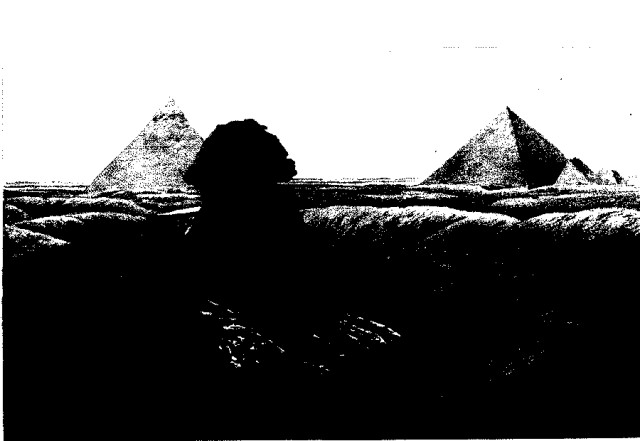
One went to tell unto his Majesty, "Two great Persea trees have grown, as a great marvel for his Majesty, in the night, by the side of the great gate of his Majesty." There was rejoicing for them in all the land, and there were offerings made to them.
Now when the days were multiplied after these things, his Majesty was adorned with a blue crown, with garlands of flowers on his neck; he was upon the chariot of electrum; he went out from the palace to behold the Persea trees: the princess also went out with horses behind Pharaoh. His Majesty sat beneath one of the Persea trees, and it spake thus with his wife:—"Oh thou deceitful one, I am Bata; I am alive, though I have suffered violence. Thou knewest well that the causing of the acacia to be cut down for Pharaoh was to my hurt. I then became an ox, and thou hadst me slain."
Now when the days were multiplied after these things, the princess stood at the table of Pharaoh, and the king was pleased with her. She said to his Majesty, "Swear to me by God, saying, 'That which the princess shall say to me I will obey it for her.' Thus do thou." And he hearkened unto all that she said. She said, "Let these two Persea trees be cut down, and let them be made into goodly timber." He hearkened unto all that she said.
Now when the days were multiplied after these things, his Majesty sent skillful craftsmen, and they cut down the Persea trees of Pharaoh, while the princess, the royal wife, stood by and saw it. A chip flew up and entered into the mouth of the princess; and she perceived that she had conceived, and while her days were being fulfilled Pharaoh did all that was in her heart therein.[82]
Now when the days were multiplied after these things, she bore a male child. One went to tell his Majesty, "There is born to thee a son." They brought him [i. e., the child, to the king], and gave to him a nurse and servants; there were rejoicings in the whole land. The king sat making a good day; they performed the naming of him, his Majesty loved him exceedingly on the instant, the king raised him to be the royal son of Kush.
Now when the days were multiplied after these things, his Majesty made him heir of all the land.
Now when the days were multiplied after these things, when he had fulfilled many years as heir of the whole land, his Majesty flew up to heaven. There was command given, "Let my great nobles of his Majesty be brought before me, that I may make them to know all that has happened to me." And they brought to him his wife, and he argued with her before them, and their case was decided. They brought to him his elder brother; he made him hereditary prince in all his land. He was thirty years King of Egypt, and he died, and his elder brother stood in his place on the day of burial.
Excellently finished in peace, for the Ka of the scribe of the treasury, Kagabu, of the treasury of Pharaoh, and for the scribe Hora, and the scribe Meremapt. Written by the scribe Anena, the owner of this roll. He who speaks against this roll, may Tahuti be his opponent.
Translation of F. Ll. Griffith.
THE STORY OF SETNA
[The beginning of this tale is lost, but it is clear from what remains of it that Setna Kha-em-uast, son of a Pharaoh who may be identified with Rameses II., of the XIXth Dynasty (about 1300 B.C.), was a diligent student of the ancient writings, chiefly for the sake of the occult knowledge which they were supposed to contain. He discovered, or was told of, the existence of a book which Thoth, the god of letters, science and magic, had "written with his own hand," and learned that this book was to be found in the cemetery of Memphis, in the tomb of Na-nefer-ka-ptah, the only son of some earlier Pharaoh. Setna evidently succeeded in finding and entering this tomb, and there he saw the kas or ghosts of Na-nefer-ka-ptah, his wife (and sister) Ahura, and their little boy Merab; and with them was the book. To dissuade Setna from abstracting the book, Ahura tells him how they had become possessed of it, and had paid for it with their earthly lives; and it is with her tale that the papyrus begins. Setna, however, insists upon taking the book; but Na-nefer-ka-ptah challenges him, as a good scribe and a learned man, to a trial of skill in a game, and in the imposition of magical penalties on the loser. Setna agrees; but being worsted, he calls in outside help and succeeds in carrying off the book. Na-nefer-ka-ptah comforts Ahura for its loss by assuring her that Setna shall ignominiously restore it. Setna studies the book with delight; but presently, by the magic power of Na-nefer-ka-ptah, he becomes the victim of an extraordinary hallucination, and the strength of his spirit is broken because (in imagination at least) he is steeped in impurity and crime. When he awakes from this trance, Pharaoh persuades him to return the book to its dead owners. On his return to the tomb, Na-nefer-ka-ptah exacts from him the promise to go to the cemetery of Koptos and bring thence to Memphis the bodies of Ahura and of Merab, which had been buried there, apart from him. Setna duly performs his promise, and so the story ends.
The only known copy of this tale appears to have been written in 251 B.C., the thirty-fifth year of Ptolemy Philadelphus, and it must have been composed at least as late as the Sebennyte Dynasty, early in the fourth century, although it refers to historical characters of a thousand years before.
The story is more elaborate, and its plot is more coherent than is the case with the earlier tales such as that of Anpu and Bata, in which events succeed each other often without natural connection. The language however is in simple narrative style, without any attempt at fine writing.
At the point at which the mutilated papyrus begins, we find that Ahura is telling Setna the story of her life. Apparently he has just been told how she sent a messenger to the king, asking that she may be married to her brother Na-nefer-ka-ptah. The king has refused her request, and the messenger has reproached him for his unkindness; the king replies:—]
"It is thou who art dealing wrongly towards me. If it happen that I have not a child after two children, is it the law to marry the one with the other of them? I will marry Naneferkaptah with the daughter of a commander of troops, and I will marry Ahura with the son of another commander of troops: it has so happened in our family much.'
"It came to pass that the amusement was set before Pharaoh, and they came for me and took me to the amusement named, and it happened that my soul was troubled exceedingly and I behaved not in my manner of the previous day. Said Pharaoh to me, 'Ahura, is it thou that didst cause them to come to me in these anxieties, saying, "Let me marry with Naneferkaptah, my elder brother"?'
"Said I to him, 'Let me marry with the son of a commander of troops, and let him marry with the daughter of another commander of troops: it has happened in our family much.'
"I laughed, Pharaoh laughed, and his soul was exceeding gladdened. Said Pharaoh to the steward of the king's house, 'Let Ahura be taken to the house of Naneferkaptah to-night, and let all things that are good be taken with her.'
"I was taken as a wife to the house of Naneferkaptah in the night named, and a present of silver and gold was brought to me; the household of Pharaoh caused them all to be brought to me. And Naneferkaptah made a good day[83] with me; he received all the heads of the household of Pharaoh. And he found me pleasing, he quarreled not with me, ever, ever: each of us loved his fellow. And when I was about to bear a child, report of it was made before Pharaoh, and his soul was exceeding gladdened, and Pharaoh caused many things to be taken for me on the instant; he caused to be brought to me a present of silver and gold and royal linen, beautiful exceedingly. Then came my time of bearing; I bore this boy that is before thee, whose name is called Merab, and he was caused to write in the book of the 'House of Life.'[84]
"It came to pass that Naneferkaptah, my brother, had no habit on the earth[85] but to walk in the cemetery of Memphis, reading the writings that were in the catacombs of the Pharaohs, with the tablets of the scribes of the 'House of Life,' and the inscriptions that were on the monuments; and he was eager for writing exceedingly.
"After these things it befell that there was a procession in honor of Ptah; Naneferkaptah went into the temple to worship, and he chanced to be walking behind the procession reading the inscriptions that were in the shrines of the gods. An aged priest saw him and laughed. Naneferkaptah said to him, 'For what art thou laughing at me?'
"And he said:—'I am not laughing at thee; if I laughed, it was that thou art reading writings that no one on earth has any good of. If it be that thou seekest to read writings, come to me, and I will bring thee to the place where that roll is which it was Thoth that wrote with his own hand, and which goes down to fetch the gods. There are two formulas of writing that are upon it, and when thou readest the first formula thou will enchant the heaven, the earth, the underworld, the mountains, and the seas; thou shalt discover all that the birds of the heaven and the creeping things shall say; thou shalt see the fishes of the deep, for there is a power from God brings them into water above them. And when thou readest the second formula, if it be that thou art in Ament[86] thou takest thy form of earth again. Thou wilt see the sun rising in the sky with his circle of gods, and the moon in its form of shining.'
"And Naneferkaptah said, 'As the king liveth! Let a good thing that thou dost desire be told me, and I will have it done for thee, if thou wilt direct me to the place where this roll is.'
"Said the priest to Naneferkaptah: 'If it be that thou desirest to be directed to the place where this roll is, thou shalt give me three hundred ounces of silver for my funeral, and provide that they shall make me two coffin cases as a great priest, rich in silver.'
"Naneferkaptah called a lad, and caused to be given the three hundred ounces of silver for the priest, and he caused to be done what he desired for two coffin cases; he caused them to be made as for a great and rich priest.
"Said the priest to Naneferkaptah:—'The roll named, it is in the midst of the Sea of Koptos,[87] in a box of iron. In the iron box is a box of bronze, in the bronze box is a box of Kedt wood, in the box of Kedt wood is a box of ivory and ebony, in the box of ivory and ebony is a box of silver, in the box of silver is a box of gold in which is the roll. There is a mile of snakes, scorpions, and every kind of reptile surrounding the box in which the roll is; there is a snake of eternity surrounding the box named.'
"At the time of the relation that the priest made before Naneferkaptah, Naneferkaptah knew not what place on earth he was in.[88] And he came out of the temple and related before me all that the priest had said to him. He said to me, 'I shall go to Koptos, I shall fetch this roll thence; I shall not be slow in coming back to the north again.'
"It came to pass that I opposed the priest, saying: 'Beware of this thing that thou hast spoken before him! Thou hast brought to me the strife of the nome of Thebes;[89] I have found it cruel.' I caused my hand to stay[90] with Naneferkaptah, in order not to let him go to Koptos. He did not hearken to me; he went before Pharaoh and related before Pharaoh everything that the priest had said to him—all. Pharaoh said to him, 'What is it that thou desirest?'
"He said to him, 'Cause to be given to me the royal pleasure boat with its equipment: I will take Ahura and Merab her boy to the south with me; I will fetch this roll without delaying.'
"They gave him the royal pleasure-boat with its equipment, and we went up on board it; we set sail and reached Koptos. And they made report of it before the priests of Isis of Koptos and the high priest of Isis; they came down to meet us, they delayed not to meet Naneferkaptah; their women came down to meet me also. We went up on shore; we went into the temple of Isis and Harpokrates, and Naneferkaptah caused to be brought ox, goose, and wine; he made a burnt-offering and a drink-offering before Isis of Koptos and Harpokrates. We were taken to a house exceeding beautiful, filled with all good things, and Naneferkaptah spent four days making a good day with the priests of Isis of Koptos, the women of the priests of Isis making a good day with myself.
"Came the morning of our fifth day: Naneferkaptah caused to be brought to him pure wax.[91] He made a boat, furnished with its crew and its tackle. He read a spell to them, he caused them to live, he gave them breath, he cast them into the sea. He loaded the royal pleasure-boat of Pharaoh with sand; he caused the boat to be brought, he went on board. I sat by the sea of Koptos, saying, 'I will discover what will become of him.'
"He said, 'Boatmen, row on with me as far as the place in which this roll is.' And they rowed by night as by midday.
"And when he reached it, in three days, he threw sand before him, then there became a space of dry land. And when he found a mile of serpents and scorpions, and every kind of creeping thing encompassing the box in which the roll was, and when he found a snake of eternity encompassing the box, he read a spell to the mile of serpents, scorpions, and every kind of creeping thing that was around the box, and suffered them not to leap up. He went to the place in which was the snake of eternity; he made battle with it, he slew it. It lived; it made its form again. He made battle with it again for a second time; he slew it: it lived. He made battle with it again for a third time; he made it in two pieces; he put sand between one piece and its fellow. It died; it did not make its form ever again.
"Naneferkaptah went to the place where the box was. He found that it was a box of iron; he opened it, he found a box of bronze; he opened it, he found a box of Kedt wood; he opened it, he found a box of ivory and ebony; he opened it, he found a box of silver; he opened it, he found a box of gold; he opened it, he found the book in it. He took up the roll from in the box of gold, he read a formula of writing from it. He enchanted the heaven, the earth, the underworld, the mountains, and the seas; he discovered all that the birds of the heaven with the fishes of the deep, the beasts of the mountains said—all. He read another formula of writing, he saw the Sun rising in the sky with all his circle of gods, and the moon rising, and the stars in their shapes; he saw the fishes of the deep, for there was a power from God brought them into the water over them. He read a spell to the sea, and restored it as it was. He embarked. He said to the crew, 'Row on for me as far as the place to which I go.' And they rowed at night like as at midday. When he reached the place where I was, he found me sitting by the sea of Koptos, without drinking or eating anything, without doing anything on the earth, being in the likeness of one who has reached the Good Houses.[92]
"I said to Naneferkaptah, 'O Naneferkaptah, let me see this book, for which we have taken these pains!'
"He put the roll into my hand. I read a formula of writing in it; I enchanted the heaven, the earth, the underworld, the mountains, the seas; I discovered what the birds of the sky, the fishes of the deep, and the beasts of the hills said—-all. I read another formula of the writing, and I saw the sun rising in the sky with his circle of gods; I saw the moon shining with all the stars of the heaven in their nature; I saw the fishes of the deep, for it was that a power from God brought them into the water above where they were. As I could not write, it was that I spoke to Naneferkaptah my elder brother, who was a good scribe and a learned man exceedingly; and he caused to be brought before him a piece of new papyrus; he wrote every word that was on the roll before him—all. He dipped it in beer, he melted it in water, he saw that it had been melted, he drank it, he knew that which was in it.[93]
"We returned to Koptos on the day named: we made a good day before Isis of Koptos and Harpokrates. We embarked, we went down to the river, we reached north of Koptos by one mile. Behold, Thoth had discovered everything that happened to Naneferkaptah on account of the roll; Thoth delayed not, he complained before the Sun, saying, 'Know my right, my judgment with Naneferkaptah the son of Pharaoh Mernebptah! He went to my place, he robbed it, he took my box containing my book, he killed my guard who was watching it.'
"It was said to him, 'He is before thee, with every man that belongeth to him—all.'[94]
"There was sent a power from God down from heaven, saying, 'Let not Naneferkaptah go to Memphis safe, with every man that belongeth to him—all.'
"An hour passed: Merab, the boy, came out from under the awning of the pleasure-boat of Pharaoh, he fell into the river, he did the will of Ra. Everybody that was on board uttered a cry—all. Naneferkaptah came out from under his cabin, he read a writing over him, he caused him to come up, for it was that a power from God in the water was laid on his upper side.[95] He read a writing over him, he made him relate before him of everything that had happened to him—all, and the accusation that Thoth made before Ra.
"We returned to Koptos with him. We caused him to be taken to the Good House and laid in state; we caused him to be embalmed like a prince and great man; we caused him to rest in his coffin in the cemetery of Koptos.
"Said Naneferkaptah my brother, 'Let us go down the river, let us not delay before Pharaoh hear the things that have happened to us, and his soul be sad therefore.'
"We embarked, we went down-stream, we delayed not; and traveled to the north of Koptos by one mile. At the place of the falling of Merab the boy into the river, I came out from under the awning of the pleasure-boat of Pharaoh, I fell into the river, I did the will of Ra. Everybody that was on board uttered a cry—all. They told it to Naneferkaptah, he came out from under the awning of the pleasure-boat of Pharaoh, he read a writing over me, he caused me to leap up, for it was that a power from God in the water rested on my upper side. He caused me to be taken up, he read a writing over me, he caused me to relate before him everything that had happened unto me—all; and the accusation that Thoth had made before Ra. He returned to Koptos with me, he caused me to be brought to the Good House, he caused me to be laid in state, he caused me to be embalmed with the embalmment of a prince and very great person, he caused me to rest in the tomb where Merab the boy lay.
"He embarked, he went down-stream, he hastened north of Koptos by one mile to the place of our falling into the river. He spake with his soul, saying:—'Can I go to Koptos and dwell there? Otherwise, if it be that I go to Memphis, the moment that Pharaoh asks me after his children, what shall I say to him? Can I tell it to him, saying, I took thy children to the nome of Thebes, I killed them, I being alive; I came to Memphis, I being alive still?'
"He caused them to bring a strip of royal linen before him; he made it into a girdle. He bound the roll, he put it upon his stomach, he made it firm. Naneferkaptah came out from under the awning of the pleasure-boat of Pharaoh, he fell into the river, he did the will of Ra. Everybody that was on board uttered a cry—all, saying: 'Great woe! Oppressive woe! Has he gone back,[96] the good scribe, the learned man, to whom there is no equal?'
"The pleasure-boat of Pharaoh went down-stream, without any one on earth knowing where Naneferkaptah was. They reached Memphis, they made report of it before Pharaoh. Pharaoh came down to meet the pleasure-boat of Pharaoh in mourning, the army of Memphis took mourning—all, together with the priests of Ptah, the chief prophet of Ptah, with the officials and household of Pharaoh—all. They saw Naneferkaptah clinging to the rudders of the pleasure-boat of Pharaoh, by virtue of his art of a good scribe. They drew him up, they saw the roll on his stomach. Said Pharaoh, 'Let this roll that is on his stomach be hidden away.'
"Said the officers of Pharaoh, with the priests of Ptah, and the chief prophet of Ptah, before Pharaoh: 'O our great lord the King, may he accomplish the duration of Ra![97] Naneferkaptah was a good scribe, a learned man exceedingly.'
"Pharaoh caused to be given to him entrance to the Good House for sixteen days, wrapping for thirty-five and coffining for seventy; he was caused to rest in his tomb, in his places of rest."
[80] The sun.
[96] An expression for death, like our "gone home."
[76] Meaning "wanderers on the Sand," Bedawin.
[91] Wax was the regular material used for the manufacture of models which were intended to be used in the practice of magic.
[88] A frequent phrase for extreme delight or amazement.
[93] A similar method is still employed by Arab doctors and wizards. To heal a disease a formula is written out and then washed off the paper in a bowl of water, which is given to the patient to drink.
[77] The Hathors were seven goddesses who attended the birth of a child in order to tell its fate. They somewhat correspond to the fairy godmothers of later fairy tales.
[97] I. e., "May he live as long as the Sun god."
[82] I. e., in the matter of the trees.
[85] I. e., as we should say, "he did nothing in the world but walk in the cemetery of Memphis," etc.
[90] An idiomatic phrase like "he caused his hand to go after the roll" for "put out his hand to take the roll," p. 5272.
[74] Samehit "son of the north," is a play on the name Sanehat, "son of the sycamore."
[81] Ra Harakhti was the chief of this Ennead. Khnumu, one of his companion gods, was the craftsman, sometimes represented as fashioning mankind upon the potter's wheel.
[87] It is difficult to locate this lake in accordance with the actual geography of Egypt.
[94] Cf. Job i., 12.
[78] Syria.
[92] The place of embalmment.
[95] I. e., above him.
[83] "To make a good day"—to keep holiday, to hold festival.
[89] There seems to be some reference to past history in this.
[73] A form of Hathor.
[79] The Egyptians shaved their heads and wore wigs, as a matter of cleanliness in a hot climate.
[84] This apparently means that he was enrolled as one to be educated as a learned scribe.
[86] The realm of Osiris as god of the dead.
[75] The treasury containing silver, gold, clothing, wine, and valuables of all kinds.
[Having finished her story, Ahura proceeds to point out the moral to Setna.]
"I am suffering the ills which have come upon us because of this roll of which thou sayest, 'Let it be given to me!' Thou hast no claim to it: our life on earth has been taken for it."
Said Setna, "Ahura, let this roll be given me which I see between thee and Naneferkaptah, else will I take it by force."
Rose Naneferkaptah on the couch; he said: "Art thou Setna, before whom this woman has told these misfortunes which thou hast not suffered—all? The book named, canst thou take it only by strength of a good scribe? It were sufficient to play draughts with me. Let us play for it at the game of fifty-two points."
And Setna said, "I am ready."
The board and its pieces were put before them. They played at the fifty-two, and Naneferkaptah won a game from Setna. He [Naneferkaptah] read a spell over him; he [Setna] defended himself with the game-board that was before him. He [Naneferkaptah] made him [Setna] go into the ground as far as his feet. He did its like in the second game; he won it from Setna, he made him go into the ground as far as his middle. He did its like in the third game; he made him go into the ground as far as his ears. After these things Setna made a great blow on the hand of Naneferkaptah. Setna called to Anheru, his brother by Anherart,[98] saying: "Make haste and go up upon the earth, do thou relate of everything that has happened to me before Pharaoh, and do thou bring the amulets of Ptah my father,[99] and my rolls of magic."
He hastened up upon earth, he related before Pharaoh of everything that had happened to Setna. Said Pharaoh, "Take to him the amulets of Ptah his father, and his rolls of magic."
Anheru hastened down into the tomb; he laid the talismans on the body of Setna, he [Setna] sprang to heaven at the moment named.[100] Setna caused his hand to go after the roll, he took it. It came to pass that Setna went up from the tomb, Light walking before him and Darkness walking behind him, and Ahura weeping after him, saying, "Hail to thee, King Darkness! Farewell to thee, King Light! All consolation is gone that was in the tomb."
Said Naneferkaptah to Ahura, "Be not troubled of soul; I will make him bring this book hither, there being a fork for a staff in his hand, there being a pan of fire on his head."[101]
And Setna came up from the tomb, he made it fast behind him in its manner.
Setna went before Pharaoh, he related before him of the thing that had happened to him with the roll. Said Pharaoh to Setna, "Take this roll to the tomb of Naneferkaptah in the manner of a prudent man, else he will make thee bring it, there being a fork for a staff in thine hand, there being a pan of fire on thine head."
Not did Setna hearken to him. It came to pass that Setna had no habit on earth but unrolling the roll and reading it before everybody.
After these things there was a day when Setna passed time in the court of Ptah, and saw a woman beautiful exceedingly, there being no woman of her beauty. There were ornaments of much gold upon her, there were children and women walking behind her, there were fifty-two persons of chiefs of households assigned to her. The hour that Setna saw her he knew not the place on earth where he was. Setna called to his attendant youth, saying, "Go quickly to the place where this woman is; learn what comes under her command."
The attendant youth went quickly to the place where the woman was, he addressed the handmaid who walked behind her, he asked her, saying, "What person is this woman?" She said to him, "She is Tabubua, the daughter of the prophet of Bast, lady of Ankhtaui, she having come hither to pray before Ptah the great god."
The youth went back to Setna, he related before him of everything that she had told him—all.
[In his infatuation for this woman, Setna forgets all decorum and all duty, and follows her home to Bubastis, and "ashamed was every one that was about Setna." To win the favor of Tabubua, he hands over to her all his possessions and the inheritance of his children; and at length she demands that his children should be put to death to prevent disputes.]
Setna said, "Let there be done unto them the abomination that has entered thy heart."
She caused his children to be slain before his face; she caused them to be cast down from the window before the dogs and the cats. They devoured their flesh, he hearing them, he drinking with Tabubua.
[Setna awakens from the trance in which he has in imagination sunk to such depths of wickedness, to find himself lying naked in a strange place.]
An hour it was that passed when Setna saw a great man riding on a chariot, there being many men running at his feet, he being like Pharaoh. Setna came to rise; he could not rise for shame, for there was no clothing upon him. Pharaoh said, "Setna, what has befallen thee in this state in which thou art?"
Said he, "Naneferkaptah is he who hath done this to me—all."
Pharaoh said, "Go to Memphis: thy children they are seeking for thee; they are standing on their feet before Pharaoh."
Setna said before Pharaoh, "My great lord the King, may he accomplish the duration of Ra! What is the manner of going to Memphis that I can do, there being no clothes on earth upon me?"
Pharaoh called to a youth standing by, he made him give clothing to Setna. Said Pharaoh to Setna, "Go to Memphis: thy children, they are alive, they are standing on their feet before Pharaoh."
Setna came to Memphis, he embraced his children with hand, he found them alive. Pharaoh said, "Is it drinking that hath brought thee thus?"
Setna related everything that had happened to him with Tabubua, with Naneferkaptah—all. Pharaoh said: "Setna, I put my hand upon thee before,[102] saying, 'Thou wilt be slain if thou dost not take this roll to the place from which it was brought.' Thou didst not listen to me till this hour. Give this roll to Naneferkaptah, there being a forked stick for a staff in thine hand, there being a pan of fire on thine head."
Setna came out from before Pharaoh, there being a forked stick for a staff in his hand, there being a pan of fire on his head. He went down to the tomb in which was Naneferkaptah. Ahura said to him, "Setna, it is Ptah the great god who hath brought thee back safe."
Naneferkaptah laughed, saying, "This is a thing that I told thee before."
Setna saluted Naneferkaptah; he found him as it is said, "He is the sun that is in the whole tomb." Ahura and Naneferkaptah saluted Setna greatly. Setna said, "Naneferkaptah, is there aught that is disgraceful?"
Naneferkaptah said, "Setna, thou knowest this, that Ahura and Merab her child, they are in Koptos: bring them here into this tomb by the skill of a good scribe. Let it be commanded before thee, and do thou take pains, and do thou go to Koptos, and do thou bring them hither."
Setna came up from the tomb and went before Pharaoh; he related before Pharaoh of everything that Naneferkaptah had said to him—all.
Pharaoh said, "Setna, go to Koptos, bring Ahura and Merab her child."
He said before Pharaoh, "Let the pleasure-boat of Pharaoh be given to me with its equipment."
The pleasure-boat of Pharaoh was given to him with its equipment; he embarked, he sailed up, he did not delay, he arrived at Koptos.
Information of it was given before the priests of Isis of Koptos, and the chief prophet of Isis. They came down to meet him, they took his hand to the shore. He went up, he went into the temple of Isis of Koptos and Harpokrates. He caused ox, goose, wine to be brought; he made a burnt-offering, a drink-offering, before Isis of Koptos and Harpokrates. He went to the cemetery of Koptos, with the priests of Isis and the chief prophet of Isis; they spent three days and three nights searching in the tombs which were in the cemetery of Koptos—all, turning over the stelæ of the scribes of the House of Life, reading the inscriptions that were on them. They found not the places of rest in which were Ahura and Merab her son.
Naneferkaptah perceived that they found not the places of rest of Ahura and Merab her son. He rose from the dead as an old man, great of age exceedingly. He came to meet Setna, and Setna saw him. Setna said to the old man, "Thou art of the appearance of a man great of age: knowest thou the places of rest in which are Ahura and Merab her child?"
The old man said to Setna, "The father of the father of my father told to the father of my father, and the father of my father told to my father, that the resting-places of Ahura and Merab her child are by the south corner of the house of Pehemato, as his name is."
Said Setna to the old man, "Is it not an injury that Pehemato hath done thee, by reason of which thou comest to cause his house to be brought down to the ground?"
The old man said to Setna, "Let watch be set over me and let the house of Pehemato be taken down. If it be that they find not Ahura and Merab her child under the south corner of his house, may abomination be done to me."
A watch was set over the old man; the resting-place of Ahura and Merab her child was found under the south corner of the house of Pehemato. Setna caused them to enter as great people on the pleasure-boat of Pharaoh; he caused the house of Pehemato to be built in its former manner. Naneferkaptah made Setna to discover what had happened: that it was he who had come to Koptos to let them find the resting-place in which Ahura and Merab her child were.
Setna embarked on the pleasure-boat of Pharaoh, he went down the river, he did not delay, he reached Memphis with all the army that was with him—all. Report was made of it before Pharaoh, he came down to meet the pleasure-boat of Pharaoh. He caused them to be introduced as great persons to the tomb where Naneferkaptah was, he caused dirges to be made above them.
This is a complete writing, relating of Setna Khaemuast, and Naneferkaptah, and Ahura his wife, and Merab her child. This ... was written in the XXXVth year, the month Tybi.
Translation of F. Ll. Griffith.
THE STELA OF PIANKHY
[The following inscription, one of the longest in existence, covers both faces and the sides of a large stela of black basalt in the Museum at Gîzeh. It was found in the temple of Gebel Barkal, beyond Dongola in Nubia. Here was one of the capitals of a native Ethiopian dynasty, and in the temple dedicated to Amen a number of historical stelæ were set up by different kings, of whom Piankhy (about 800 B.C.) was the earliest. Not improbably he was descended from the priest kings of the XXIst Egyptian dynasty (at Thebes, about 1000 B.C.); at any rate, the name which he bore occurs in that dynasty, and his devotion to Amen agrees with the theory. We learn from the stela that by some means he had obtained the suzerainty over Upper Egypt, which was governed by local kings and nomarchs; while Lower Egypt was similarly divided but independent. Among the princes of the North land the most powerful was Tafnekht, probably a Libyan nomarch of Sais who had absorbed the whole of the western side of Lower Egypt. The stela relates the conflict that ensued when Tafnekht endeavored to unite Lower Egypt in a confederacy and invade the Upper Country. This gave Piankhy, who knew his own strength, an opportunity of which he was not slow to avail himself. The Delta was protected from invasion by its network of canals, and by its extensive marshes. But when the armies and navies of the local kings had been drawn into Upper Egypt and there repeatedly defeated, weakened and cowed, the princes of the North Land were at the mercy of the victorious Ethiopian, who was rewarded for his activity and skill in strategy with an abundance of spoil and tribute, probably also with the permanent subjection of the country.
The inscription is in a very perfect state; with the exception of one lacuna of sixteen short lines the losses are very small. The narrative is far more artistic and sustained than was usual in records of any considerable length. The piety of the Ethiopian and his trust in his god Amen are remarkably indicated; and some passages cannot fail to remind us of the Biblical records of certain Jewish kings and of the prophecies concerning Nebuchadnezzar and Cyrus. There is nothing that suggests the bloodthirstiness and wanton cruelty of the contemporary kings of Assyria. Altogether, when the time and circumstances are taken into account, the impression left is one very favorable to Piankhy. If he seems to insist overmuch on his Divine mission, this exaggeration is perhaps due to the priests of Amen who drafted the document, desirous of thereby promoting the honor both of their god and of their king.
There are numerous indications in the signs composing the inscription that the text was written originally in a cursive character, and afterwards transcribed into hieroglyphics for record on stone.]
[Date.]
Year xxi, month Thoth,[103] under the Majesty of the King of Upper and Lower Egypt, Meriamen Piankhy, living forever:—
[Attention demanded.]
Command: My Majesty saith, Hear how I have done more than the ancestors! I am a king, the figure of a god, the living image of Tum, who came forth from the body fashioned as a a ruler, whose elders feared him, ... whose mother recognized that he would reign [while he was yet] in the egg; the good God, beloved of the gods, Son of the Sun, working with his hand,[104] Meriamen Piankhy.
[The narrative. Report of Tafnekht's invasion received: the king's joy thereat.]
There came one to tell his Majesty, whereas the ruler of the West, the nomarch and chief in Neter, Tafnekht, was in the [Harpoon] Nome, in the Nome of the Bull of the Desert, in Hap, in ..., in An, in Per-nub, and in Mennefer,[105] he took unto himself the entire West from the sea-coast to Athet-taui, and went south with a great army; the two lands were united in following him, the nomarchs and the rulers of fenced cities were as hounds at his feet. No fortress was closed [against him]; the nomes of the South, Mertum, and Per-Sekhem-Kheper-ra, the Temple of Sebek, Per-Mezed, Tekanesh,[106] and every city of the West, opened their gates in fear of him. He turned back to the Eastern nomes; they opened to him even as the former. Het-benu, Tayuzayt, Het-seten, Per-nebt-tep-ah.[107] Behold [he hath crossed over to] besiege Henen-seten,[108] he hath ringed it about,[109] not allowing outgoers to go out, not allowing incomers to enter, by reason of the daily fighting. He hath measured it out on every side, each nomarch gauging his own [length of] wall, that he may post each one of the nomarchs and the rulers of fenced cities at his section."
Now [his Majesty heard these things] with good courage, laughing, and with joy of heart.
[Anxiety of the King's governors in Upper Egypt at Tafnekht's progress. Loss of Hermopolis.]
Behold these chiefs, nomarchs, and captains of the host who were in their various cities sent to his Majesty daily, saying: "Hast thou ceased [from action] until thou forgettest the South Country, the nomes of the royal domain[110]? Tafnekht is pushing forward his conquest, he findeth not any to repel his arm. Nemart [the ruler in Hermopolis] and nomarch of Het-Ur[111] hath breached the fortress of Neferus, he hath ruined his own city for fear lest he [Tafnekht] should take it, and then lay siege to another city. Behold, he hath gone to be at his [Tafnekht's] feet;[112] he hath refused allegiance to his Majesty, and standeth with him [Tafnekht] like one of [his retainers. He hath harried] the nome of Oxyrhynkhos,[113] and he giveth to him[114] [Tafnekht] gifts, as his heart inclineth, of all things that he findeth [therein]."
[Piankhy orders the governors to besiege Hermopolis.]
Then his Majesty sent a message to the nomarchs and the captains of the host who were in Egypt, the captain Puarma, with the captain Armersekny, with every captain of his Majesty who was in Egypt, saying: "Make haste in striking, join battle, encircle [Hermopolis], capture its people, its cattle, its ships upon the river. Let not the fellâhîn come out to the field; let not the plowman plow; lay siege to the Hare-city,[115] fight against it daily." Thereupon they did so.
[Piankhy dispatches an army from Ethiopia, bidding them fear not to fight, for Amen is their strength; and to do homage unto the god at Thebes.]
Then his Majesty sent an army to Egypt, urging them very greatly:—"[Spend day and] night as though ye were playing drafts, so that ye fight according as ye see that he hath arrayed battle at a distance. If he say the infantry and cavalry have hastened to another city, why then remain ye until his army come, and fight even as he shall say. And if his allies are in another city, hasten ye to them; and the nomarchs, and those whom he bringeth to strengthen him, the Tehenu[116] and his chosen troops, let battle be arrayed against them. One of old saith:—'We know not how to cry unto him. It is the enlistment of troops and the yoking of war-horses, the pick of thy stables, that giveth victory in battle. Thou knowest that Amen is the god that leadeth us.'[117]
"When ye reach Thebes, the approach to Apt-esut,[118] enter ye into the water, wash ye in the river, dress on the bank of the stream, unstring the bow, loosen the arrow. Let no chief boast as possessing might, there being no strength to the mighty if he regard him [Amen] not. He maketh the feeble-handed into strong-handed; a multitude may turn their backs before the few; one man may conquer a thousand. Sprinkle yourselves with the water of his altars; kiss ye the ground before his face; say ye to him, 'Give unto us a way that we may fight in the shadow of thy strong arm. The band that thou leadest, it cometh to pass that it overthroweth that which hath overthrown many.'"
Then they cast themselves on their bellies before his Majesty [saying], "It is thy name that giveth us strength of arm, thy wisdom is the mooring-post[119] of thy soldiers; thy bread is in our bellies on every road, thy beer quencheth our thirst; it is thy valor that giveth us strength of arm; one is fortified at the remembrance of thy name! while the host is lacking whose captain is a vile coward. Who is like unto thee in these things? Thou art a mighty King that worketh with his hands, master of the art of war!"
[The Ethiopian army, after leaving Thebes, defeat the van of Tafnekht's fleet.]
They went down-stream; they reached Thebes; they did according to all the things said by his Majesty.
They went down-stream upon the river; they found many ships coming up-stream, with soldiers, sailors, levies of troops, every mighty man of the North land, furnished with weapons of war to fight against the host of his Majesty. There was made a great slaughter of them, the number thereof is not known; their troops were captured with their ships, they were brought as live prisoners to the place where his Majesty was.[120]
[Proceeding to attack Heracleopolis, they are met on the river by the confederates under Tafnekht, and defeat them.]
They went to Henen-seten, arraying battle. The nomarchs with the kings of the North land were informed [thereof]. Now the King Nemart with the King Auapeth; the chief of the Me,[121] Sheshenk of Busiris, with the chief of the Me, Zed-Amen-auf-ankh of Mendes, and his son and heir, who was captain of the host of Hermopolis Parva; the host of the Erpa Bakennefi, with his son and heir, chief of the Me, Nesnakedy in the home of Hesebka; and every chief wearing the feather[122] who was in the North land, with the King Usorkon who was in Bubastis and in the land of Ra-nefer: every nomarch, and the governors of fenced cities in the West and in the East and in the islands in the midst, assembled with one purpose, as following the feet of the great chief of the West, ruler of the fenced cities of the North land, priest of Neith, mistress of Sais, and Sem-priest of Ptah, Tafnekht.[123]
When they went out against them, a mighty overthrow was made of them, greater than anything, and their ships were captured upon the river; the remainder crossed over and moored on the west side, in the neighborhood of Per-peg.
[In a second battle, fought by land on the opposite shore, the enemy is overthrown; most escaped northward, but Nemart returns to Hermopolis, having eluded the besiegers (i. e., the army of the loyal governors). Hermopolis is more closely besieged.]
When the land lightened very early, the soldiers of his Majesty crossed over to them. One host met the other. Then they slew many men of them, and horses without number, in the charge [?]. Those who remained fled to the North land with lamentations loud and sore, more than anything.[124] Account of the overthrow made of them: men, persons ...[125] [But] the King Nemart went up-stream to the South when it was reported to him, "Khmenu[126] is in the midst of enemies; the soldiers of his Majesty are capturing its men and its cattle." Then he [Nemart] entered into Unu, while the soldiers of his Majesty were at the port of the Hare-city. Then they heard of it; they surrounded the Hare-city on its four sides; they allowed not goers out to go out, nor enterers in to enter in.
[The King, enraged at the escape of the enemy, vows that after the New Year he will go to Thebes, and having discharged a pious duty there, take the war in hand himself.]
They sent to report to his Majesty, the King of Upper and Lower Egypt, Meriamen Piankhy, Giving Life, of every defeat they had made, and of all the victories of his Majesty. Then his Majesty raged at it like a leopard:—"Shall one grant unto them that there be left a remnant of the soldiers of the North land to permit a goer out to go out from them, to say, 'He commandeth not to make them die until they be utterly destroyed'? As I live, as I love Ra, as my father Amen praiseth me, I will go north myself to ruin that which [Nemart] hath done; I will cause him to withdraw from battle forever. Verily, after performing the ceremonies of the New Year, I will sacrifice to my father Amen in his beautiful festival, when he maketh his fair manifestation of the New Year. He will lead me in peace to see Amen in the good feast of the festival of Apt; I shall bring him forth gloriously in his divine form unto Southern Apt, in his goodly feast of the feast of Apt at night-time,[127] in the feast established in Thebes, the feast which Ra instituted for him originally. And I will bring him forth gloriously to his own house, to rest upon his throne, on the day of making the god to enter.[128] On the second day of Athyr[129] I will cause the land of the North to taste the taste of my fingers."
[To retrieve their reputation, the army assaults and captures three cities; but the King is not appeased.]
Then the soldiers who were remaining in Egypt heard the rage that his Majesty was in against them. Then they fought against Per Mezed[130] in the nome of Oxyrhynkhos; they took it like a flood of water. They sent a message to his Majesty, but his heart was not appeased thereby.
Then they fought against Tatehen,[131] the very strong; they found it filled with soldiers, and every strong man of the North land. Then there was made a battering-ram for it; its walls were breached and a great slaughter was made of them, the number thereof is not known, including the son of the chief of the Me, Tafnekht.[132] Then they sent word to his Majesty of it, but his heart was not appeased thereby.
Then they fought against Het Benu; its citadel was opened and the soldiers of his Majesty entered into it. Then they sent word to his Majesty, but his heart was not appeased thereby.
[The King comes to Thebes, and thence proceeds to Hermopolis. He chides his troops.]
On the ninth day of Thoth,[133] came his Majesty down the river to Thebes; he completed the feast of Amen in the festival of Apt. His Majesty floated down to the city of the Hare.[134] His Majesty came out of the pavilion of the boat; horses were yoked and chariots mounted. The fear of his Majesty reached unto the ends of Asia;[135] his terror was in every heart. Then his Majesty came forth disposed to hate his soldiers, raging at them like a leopard: "Doth it yet remain for you to fight? This is slackness in my business: the year is completed to the end in putting terror of me in the North land."[136] They made a great and grievous lamentation, like one beaten.[137]
He pitched his tent in the Southwest of Khmenu. It [the city] was besieged every day. There was made an earthwork to cover the wall; there was erected a wooden tower to raise the archers shooting arrows, and the slingers slinging stones, slaying the people thereof every day.
[Hermopolis, vigorously attacked, is brought to great straits. It treats with the King, and Nemart's wife prays the Queen to intercede for them.]
The third day came; Unu was abominable to the nose, evil in its smell. Then Unu threw itself on its belly, praying before the face of the King; messengers came out and entered with all things good to behold; gold, every precious mineral, stuffs in a chest. The diadem was on his [Piankhy's] head, the uræus was giving forth its terror; there was no ceasing for many days in praying to his divine crown. His [Nemart's] wife, the royal wife Satnestentmeh, was caused to approach, to pray the royal wives, the royal concubines, the royal daughters, the royal sisters. She cast herself upon her belly in the chamber of the women, before the face of the royal wives: "Come ye unto me, O ye royal wives, daughters, and sisters, that ye may pacify Horus,[138] lord of the palace. Great is his mighty spirit! How grand is his right of victory! Let...."[139]
[Presumably the Queen intercedes; Nemart comes out to Piankhy, surrenders, and brings tributes.]
"Who is it that hath led thee?[140] Who is it that hath led thee? Who is it that hath led thee? Who is it that led thee? [Thou hast missed] the road of life. But shall the heaven rain with arrows? I am [satisfied when] the South is in obeisance, and the North lands [cry], 'Put us in thy shadow.' Behold, it is evil ... with his offerings. The heart is a rudder that wrecketh its owner in that which concerneth the will of God; it looketh on flame as ice.... not a prince; see who is his father. Thy nomes are full of children."[141]
Then he cast himself upon his belly before his Majesty [saying]: "Come to me, Horus, lord of the palace! It is thy mighty will that doeth this unto me: I am one of the servants of the King that pay dues to the treasury.... Count their dues: I have paid to thee more than they."
Then he offered to him silver, gold, lapis lazuli, malachite, bronze, and minerals of all kinds in great quantity. Behold, the treasury was filled with this tribute. He brought a horse in his right hand, a sistrum in his left, a sistrum of gold and lapis lazuli.
[Piankhy enters Hermopolis and sacrifices to Thoth. Finding the horses in the rebel King's stables starved, he is wroth with Nemart and confiscates his goods.]
Behold, his [Majesty] was brought forth gloriously from his palace, and proceeded to the house of Thoth, lord of Khmenu. He sacrificed bulls, oxen, and fowl to his father Thoth, lord of Khmenu, and the gods in the House of the Eight.[142] The soldiers of the Hermopolite nome rejoiced and sang; they said: "How beautiful is Horus resting in his country, Son of the Sun, Piankhy! Celebrate for us a Sed festival,[143] even as thou hast protected the Hare-name."
His Majesty proceeded to the house of the King Nemart, he went to every apartment of the palace, his treasury and his storehouses; he caused to be brought to him the King's wives and the King's daughters; they praised his Majesty with things that women use;[144] but his Majesty would not amuse himself with them. His Majesty proceeded to the stables of the horses, the stalls of the foals; he beheld that they were starved. He said:—"As I live, as I love Ra, as my nostril is refreshed with life! very grievous are these things to my heart, the starving of my horses, more than any ill that thou hast done in the fulfilling of thine own desire. The fear which thy surroundings have of thee, beareth witness to me of thee. Dost thou ignore that the shadow of God is over me, and he doth not fail in any undertaking of mine? Would that he who did this unto me were another, knowing me not, [then] I would not censure him for it! But I, when I was born from the womb, when I was formed in the egg, the deed of God was in me; and as his Ka endureth,[145] I do nothing without him! He it is who commandeth me to act."
Then he counted his [Nemart's] goods to the Treasury, his granary to the sacred store of Amen in Apt-esut.[146]
[The King of Heracleopolis, the siege of which had been raised by the King's troops, brings presents and promises tribute.]
The ruler of Henen-seten, Pefauibast, came with tribute to Pharaoh: gold, silver, every kind of mineral, and horses of the chosen ones of the stable. He cast himself on his belly before his Majesty, and said, "Salutation to thee, Horus, mighty King, bull overthrowing bulls. Duat[147] drew me down, I was over whelmed in darkness, for which light hath been given unto me.
"I found not a friend on the day of trouble, who would stand in the day of fight, except thee, O mighty King! Thou hast drawn away the darkness from me, and I will be thy servant with all that pertain to me. Henen-seten shall pay tribute to thy storehouse, thou the image of Harakhti, chief of the Akhmu Seku.[148] While he exists, so long shalt thou exist as King; if he be not destroyed thou shalt not be destroyed, O King Piankhy, living for ever!"
[El Lahûn, prepared to oppose the entry of the King, yields without fighting: the treasuries are confiscated.]
His Majesty went north to the opening of the canal near Rahent[149]; he found Per-sekhem-kheper-ra with its walls raised high, its citadel closed and filled with every valiant man of the North land. Then his Majesty sent to them saying: "Ye who live in death, ye who live in death, miserable ones, wretched ones living in death! If a moment passeth without opening [to me], behold, ye are reckoned as conquered, and that is painful to the King. Close not the gates of your life so as to come to the execution block of this day. Do not love death and hate your life; ... [embrace] life in the face of all the land."
Then they sent to his Majesty to say: "Behold, the shadow of God is upon thy head; the son of Nut[150] gives to thee his two hands. What thy heart desireth is accomplished immediately, as that which issues from the mouth of a god. Behold thou it! Thou wast born as a god, and thou seest us in thy two hands. Behold thy city, its forts [are open; do as thou wilt with it]; enterers enter in and goers out go out: let his Majesty do as he pleaseth."
Then they came out with the son of the chief of the Me, Tafnekht. The host of his Majesty entered into it; he slew not one of all the people whom he found. [The chancellors came], with the royal seal-bearers to seal its goods, assigning its treasuries to the Treasury, its granaries to the divine offerings of his father Amen Ra, lord of the thrones of the two lands.
[Likewise with Mêdûm and Athet-taui.]
His Majesty floated down-stream, he found that Mêdûm, the Abode of Seker, lord of making light, had been shut up; it could not be reached, it had put fighting into its heart. [But they feared] terror [seized] them; awe closed their mouths. Then his Majesty sent to them saying: "Behold ye, there are two ways before you, choose ye as ye will: open, and ye live; close, and ye die. My Majesty passeth not by a city closed."
Then they opened immediately. His Majesty entered this city; he offered [an oblation] to the god Menhy in Sehez. He assigned its treasury and granaries to the divine offerings of Amen in Apt-esut.
His Majesty floated down-stream to Athet-taui; he found the fortress closed, the walls full of valiant soldiers of the North land. Behold, they opened the forts, they cast themselves on their bellies [singing praises before] his Majesty. "Thy father hath destined for thee his heritage as lord of the two lands; thou art in them,[151] thou art lord of what is upon earth."
His Majesty proceeded [to the temple] to cause to be offered a great offering to the gods who are in this city, of bulls, fat oxen and fowls, and everything good and pure. Then its treasury was assigned to the Treasury, its granaries to the divine offerings [of Amen].
[To Memphis he offers a free pardon, but the city prepares to fight.]
His Majesty went north towards Anbuhez. Then he sent to them, saying, "Do not close, do not fight, O Residence originally of Shu![152] Let the enterers enter and the comers out come out: let none going be stopped. I will offer sacrifice to Ptah and the gods who are in Anbuhez; I will worship Sokaris in the Secret Place; I will behold Res-Anbef.[153] I will go north in peace [for his Majesty loveth that] Anbuhez be safe and sound, and that [even] the children weep not. Ye saw the nomes of the South: not one [soul] was slain therein except the rebels who had blasphemed God. Execution on the block was done to the rebellious."
Then they closed their forts; they caused soldiers to go out against a few of the host of his Majesty, consisting of artisans, of chief builders, and pilots [who had gone towards] the quay of Anbuhez.
[Tafnekht himself visits Memphis in the night, encourages the troops, and departs, promising to return when he has arranged matters with the allies.]
Now that chief of Sais came to Anbuhez in the night, urging its soldiers, its sailors and all the best of its troops, in number eight thousand men, urging them greatly, greatly. "Behold, Mennefer is full of soldiers of all the best of the North land, barley and durra, and all kinds of grain, the granaries are overflowing, and all kinds of weapons of [war. There is a] wall built, a great battlement made with cunning craft. The river bounds the eastern side, and no way of attack is there. The stalls remain full of fat cattle, the treasury is furnished with all things: silver, gold, copper, bronze, stuffs, incense, honey, ointment. I will go, I will give things to the chiefs of Lower Egypt; I will open to them their nomes.[154] I shall be [away traveling] three [?] days until I return." He mounted a horse, he called not for his chariots, he went north in fear of his Majesty.
[Piankhy finds Memphis strongly fortified and the high Nile risen to its walls. The army proposes to bridge it, or attack the city it by elaborate approaches.]
When the earth lightened and it was the second day[155] his Majesty came to Anbuhez. He moored upon its north side, he found the water risen to the walls and ships moored at [the quay of] Mennefer. Then his Majesty saw that it was mighty indeed, the wall raised high with new building, the battlement manned with strength; no way of attacking it was found. Each person fell to saying his say among the hosts of his Majesty of every rule of warfare, and every man said, "Let us lay siege to [Anbuhez]; behold, her soldiers are many." Others said: "Make a causeway unto it; let us raise the ground to its wall; let us construct a wooden work, let us set up ships' masts, let us make its edges of poles. Let us divide it with these things[156] on every side of it, with embankments and ... upon its north side, in order to raise the ground to its wall that we may find a way for our feet."
[The King determines to assault it immediately; he seizes all the boats at the quay, where the houses were comparatively unprotected, and landing his men in them at that point captures the city.]
Then his Majesty raged against it [the city] like a leopard, he said:—"As I live, as I love Ra, as my father Amen who formed me praiseth me, these things have happened unto it by the command of Amen. These things are what men say: '[The North Country] with the nomes of the South they open to him [Tafnekht] from afar; they had not placed Amen in their hearts, they knew not what he had commanded. [Then] he [Amen] made him [Piankhy] in order to accomplish his mighty will, to cause the awe of him to be seen.' I will take it like a water flood; [this] hath [my father Amen] commanded me."
Then he caused his ships and his army to set out to attack the quay of Mennefer. They brought back to him every ferry-boat, every cabin-boat, every dahabiyeh, and the ships in all their number that were moored at the quay of Mennefer, the bows being moored in its houses [on account of the height of the water.[157] Not] the least of the soldiers of his Majesty mourned.[158]
His Majesty came to direct the ships in person in all their number. His Majesty commanded his soldiers: "Forward to it! Scale the walls, enter the houses upon the bank of the stream. If one of you enters upon the wall there will be no stand against him [for a moment], the levies [?] will not bar you. Moreover, it is feeble that we should shut up the South Country, moor at the North land, and sit still at 'the Balance of the two lands.'[159]
Then Mennefer was captured as by a flood of water; men were slain within it in great numbers, and were taken as prisoners to the place where his Majesty was.
[133] The first month of the season of inundation, and of the Egyptian year.
[152] Ra, the first King of Egypt, was fabled to have resided at Heliopolis; Shu his son and successor at Memphis. The city is called sometimes Anbuhez, "white wall," sometimes Men-nefer, after the pyramid of Pepy I.
[123] Tafnekht is here given most of his principal titles, including the sacerdotal ones of high priest of Neith in Sais, and of Ptah in Memphis. With the rise of Sais, Neith had become the leading deity of Lower Egypt, ranking even above Ptah. The priests at Gebel Barkal doubtless took a special pride in the overthrow of the protégé of Neith and Ptah by Piankhy, the worshiper of Amen.
[107] He crossed over to the east bank and went northward, the cities on his road throwing open their gates to him. With the exception of the last, Per-nebt-tep-ah [Aphroditopolis], the modern Atfih opposite Mêdûm, they are difficult to identify positively.
[119] Our equivalent term would be "sheet-anchor."
[146] Karnak.
[157] The boats were floating on a level with the top of the quay.
[149] The mouth of the barrier, i. e., the entrance into the Faiyûm. The name El Lahûn is derived from Rahent; and the city Per-sekhem-kheper-ra, "The house of Usorkon I.," must have been at or close to the modern village of El Lahûn.
[145] An oath.
[153] "South of his wall," an epithet of Ptah, god of Memphis.
[135] To be taken of course in a general sense, referring to the majestic and terrible aspect of the King.
[111] Hûr, opposite Beni Hasan.
[138] I. e., the King.
[118] The great temple of Amen at Karnak.
[105] Neter was probably Iseum in the centre of the Delta, and so a nomarchship quite separate from Tafnekht's extensive territory in the west. The list following the name of Tafnekht seems to name localities representative of the VIIth(?), VIth, Vth, IVth(?), IIId(?), and Ist nomes in Lower Egypt, in their proper order; the last, Mennefer, being Memphis. These would form literally the whole western side of Lower Egypt "from the coast to Athet-taui." Athet-taui (Lisht?) was a city marking the boundary of Upper and Lower Egypt.
[131] Tehneh(?)
[136] I. e., "It has taken a full year," etc.
[101] This choice of symbols of submission is not yet explained.
[108] I. e., Heracleopolis Magna, a very powerful city on the edge of the western desert, left in the rear on Tafnekht's expedition up the river. Its king was named Pefaui Bast. Its modern name is Ahnâs.
[98] The presence of names compounded with the name of Anher, god of Sebennytus, indicates that the story was written during or after the supremacy of that city, at the end of the native rule.
[159] Meaning of course "at the boundary between Upper and Lower Egypt."
[121] The title "chief of the Me" seems to mean "captain of the Libyan troops." The list contains the names of princes of Lower Egypt only, with the exception of Nemart of Hermopolis Magna, in Upper Egypt.
[102] Compare the expression noted on p. 5265.
[143] A "jubilee" after a thirty-years' reign; the expression is therefore equivalent to wishing the King a thirty-years' reign. The soldiers represent the King as the god Horus come to claim his own land.
[156] Perhaps "Let us put these things at intervals."
[137] Or, "They were sorely and grievously beaten with blows."
[109] Lit., "he hath made himself into a tail-in-the-mouth." [!]
[148] The stars of the northern hemisphere; see Maspero's 'Dawn of Civilization' p. 94. By Harakhti, the sun is probably meant.
[134] Hermopolis.
[144] Music, dancing, etc.
[115] Hermopolis.
[147] The underworld.
[155] Or "very early."
[110] The precise extent of Piankhy's dominion at this time is uncertain.
[113] Oxyrhynkhos itself was already in the hands of Tafnekht; the Hermopolite nome, including Hûr, Nefrus, etc., lay immediately south of it.
[124] Or "beaten sorely and grievously."
[112] The notion intended to be conveyed is that of a dog at heel.
[116] Libyans, mercenaries or otherwise. The XXIId Dynasty was probably Libyan, and as will be seen from subsequent notes, Libyan influence was still strong in the time of Piankhy.
[151] Athet-taui (Lisht?) was the boundary of Upper and Lower Egypt, and probably lay in both of them. "The gods who are in this city" of the next paragraph are doubtless kings of the XIIth Dynasty as presiding deities of the place, this royal Residence having apparently been founded by Amenenhat I. Compare p. 5238.
[103] The first month of the inundation season and of the Egyptian year. This is the date of the first events recorded, not of the dedication of the stela: the "command" is parenthetical.
[140] Apparently Piankhy is addressing Nemart.
[130] Oxyrhynkhos.
[139] Here there is a lacuna of sixteen short lines in the inscription.
[122] The feather was a Libyan badge of rank.
[125] Here should be the numbers of the slain.
[100] Evidently a strong expression, to show the instantaneous and powerful effect of the amulets in drawing him out of the ground.
[114] The pronoun "he" is used much too freely in this inscription: occasionally it is impossible to decide to whom it refers.
[154] It is difficult to see what is meant by this. Possibly Tafnekht was proposing to bribe the Northern chiefs into continuing the war, by giving up his recently acquired claims as suzerain.
[104] The same expression occurs further on, and evidently refers to the personal activity of the king.
[117] This would seem to be a quotation taken from some address to an earlier king. Thothmes III., for instance, attributed his successes to Amen.
[128] The return procession to Karnak.
[126] "Khmenu," "Unu," "Hare-city," are all names of Hermopolis Magna, the capital of Nemart's petty kingdom.
[132] Tafnekht, stripped of his grandeur after his defeat at Heracleopolis, is reduced to the rank of "Chief of the Me in Sais."
[106] Mêdûm, El Lahûn, Crocodilopolis in the Faiyûm, Oxyrhynkhos, Diknâsh, all—except perhaps the last—in order from north to south.
[142] Khmenu means eight. Thoth, in late times at any rate, combined the powers of the eight gods who accompanied him. He was sometimes called "twice great," sometimes "eight times great" = 23, an arithmetical term especially indicated by the Greek name [Greek: Hermês Trismhegistos].
[141] The meaning is not clear; but there seems to be a reference to the diminution of the adult population by prolonged wars.
[129] The third month of the season of inundation. Of course a year would then have elapsed, since the date given in the first line of the inscription.
[150] Set, the god of physical strength.
[127] Evidently a torchlight procession from Karnak to Luxor (Southern Apt).
[158] I. e., no single one of the assailants was injured in the slightest degree.
[99] Setna Kha-em-uast was high priest of Ptah.
[120] In Ethiopia.