



автордың кітабын онлайн тегін оқу The Works of Robert Louis Stevenson - Swanston Edition Vol. 25 (of 25)
The Project Gutenberg EBook of The Works of Robert Louis Stevenson -
Swanston Edition Vol. 25 (of 25), by Robert Louis Stevenson
This eBook is for the use of anyone anywhere at no cost and with
almost no restrictions whatsoever. You may copy it, give it away or
re-use it under the terms of the Project Gutenberg License included
with this eBook or online at www.gutenberg.org
Title: The Works of Robert Louis Stevenson - Swanston Edition Vol. 25 (of 25)
Author: Robert Louis Stevenson
Other: Andrew Lang
Release Date: December 19, 2009 [EBook #30714]
Language: English
*** START OF THIS PROJECT GUTENBERG EBOOK WORKS OF STEVENSON ***
Produced by Marius Masi, Jonathan Ingram and the Online
Distributed Proofreading Team at http://www.pgdp.net
Transcriber's note:
A few punctuation errors have been corrected. They appear in the text
like this, and the explanation will appear when the mouse pointer is moved over the marked passage. Hyphenation inconsistencies were left unchanged.
THE WORKS OF
ROBERT LOUIS STEVENSON
SWANSTON EDITION
VOLUME XXV
Of this SWANSTON EDITION in Twenty-five
Volumes of the Works of ROBERT LOUIS
STEVENSON Two Thousand and Sixty Copies
have been printed, of which only Two Thousand
Copies are for sale.
This is No. ............
THE WORKS OF
ROBERT LOUIS
STEVENSON
VOLUME TWENTY-FIVE
LONDON: PUBLISHED BY CHATTO AND
WINDUS: IN ASSOCIATION WITH CASSELL
AND COMPANY LIMITED: WILLIAM
HEINEMANN: AND LONGMANS GREEN
AND COMPANY MDCCCCXII
For permission to use the Letters in the
Swanston Edition of Stevenson’s Works
the Publishers are indebted to the kindness of
Messrs. Methuen & Co., Ltd.
ALL RIGHTS RESERVED
THE LETTERS OF
ROBERT LOUIS STEVENSON
EDITED BY
SIDNEY COLVIN
PARTS XI—XIV
CONTENTS
XI. LIFE IN SAMOA
PART I.—THE OLD BUCCANEER
PAGE
Introductory
3Letters—
To Sidney Colvin
9To E. L. Burlingame
24To Sidney Colvin
25To E. L. Burlingame
32To Sidney Colvin
34To Henry James
43To Rudyard Kipling
46To Sidney Colvin
48To Marcel Schwob
51To Charles Baxter
53To Sidney Colvin
54To H. B. Baildon
56To Sidney Colvin
58To the Same
66To W. Craibe Angus
69To Edmund Gosse
71To Miss Rawlinson
74To Sidney Colvin
76To Miss Adelaide Boodle
80To Charles Baxter
82To Sidney Colvin
83To E. L. Burlingame
86To W. Craibe Angus
87To H. C. Ide
88To Sidney Colvin
90To the Same
94To the Same
102To Henry James
108To E. L. Burlingame
110To the Same
111To Sidney Colvin
112To W. Craibe Angus
118To Miss Annie H. Ide
118To Charles Baxter
120To Sidney Colvin
121To Fred Orr
127To E. L. Burlingame
128To Henry James
130To Sidney Colvin
132XII. LIFE IN SAMOA—continued
SECOND YEAR AT VAILIMA
Introductory
144Letters—
To E. L. Burlingame
146To Miss Adelaide Boodle
147To Sidney Colvin
152To J. M. Barrie
154To Sidney Colvin
156To William Morris
162To Mrs. Charles Fairchild
163To Sidney Colvin
166To E. L. Burlingame
174To the Rev. S. J. Whitmee
174To Charles Baxter
177To Sidney Colvin
178To the Same
193To T. W. Dover
209To E. L. Burlingame
210To Sidney Colvin
211To Charles Baxter
213To W. E. Henley
214To E. L. Burlingame
215To Andrew Lang
216To Miss Adelaide Boodle
217To Sidney Colvin
221To the Countess of Jersey
228To the Same
229To Sidney Colvin
230To Mrs. Charles Fairchild
240To the Children in the Cellar
243To Sidney Colvin
249To Gordon Browne
252To Miss Morse
253To Miss Taylor
254To E. L. Burlingame
257To Sidney Colvin
258To J. M. Barrie
264To E. L. Burlingame
266To Lieutenant Eeles
267To Charles Baxter
270To Sidney Colvin
271To Mrs. Fleeming Jenkin
273To Henry James
274To J. M. Barrie
276To Charles Baxter
278XIII. LIFE IN SAMOA—continued
THIRD YEAR AT VAILIMA
Introductory
280Letters—
To Sidney Colvin
282To Charles Baxter
288To Sidney Colvin
289To the Same
291To Charles Baxter
292To Sidney Colvin
294To A. Conan Doyle
299To Sidney Colvin
299To S. R. Crockett
305To Augustus St. Gaudens
308To Sidney Colvin
310To Edmund Gosse
317To Henry James
320To Sidney Colvin
324To James S. Stevenson
334To Henry James
335To A. Conan Doyle
336To Charles Baxter
337To Sidney Colvin
338To A. Conan Doyle
339To Augustus St. Gaudens
341To James S. Stevenson
342To George Meredith
343To Charles Baxter
345To Sidney Colvin
347To the Same
352To J. Horne Stevenson
357To John P——n
358To Russell P——n
359To Alison Cunningham
359To Charles Baxter
360To J. M. Barrie
362To R. Le Gallienne
364To Mrs. A. Baker
366To Henry James
367To Sidney Colvin
367XIV. LIFESAMOA—concluded
FOURTH YEAR AT VAILIMA—THE END
Introductory
373Letters—
To Charles Baxter
376To H. B. Baildon
377To W. H. Low
378To Sidney Colvin
380To H. B. Baildon
381To Sidney Colvin
382To J. H. Bates
384To William Archer
384To Sidney Colvin
386To W. B. Yeats
390To George Meredith
390To Charles Baxter
392To Mrs. Sitwell
393To Charles Baxter
394To Sidney Colvin
396To R. A. M. Stevenson
398To Sidney Colvin
404To Henry James
406To Marcel Schwob
409To A. St. Gaudens
410To Miss Adelaide Boodle
410To Mrs. A. Baker
413To Sidney Colvin
414To J. M. Barrie
416To Sidney Colvin
422To Dr. Bakewell
424To James Payn
425To Miss Middleton
428To A. Conan Doyle
429To Sidney Colvin
430To Charles Baxter
433To R. A. M. Stevenson
434To Sir Herbert Maxwell
440To Sidney Colvin
441To Alison Cunningham
445To James Payn
446To Sidney Colvin
448To Professor Meiklejohn
450To Lieutenant Eeles
451To Sir Herbert Maxwell
453To Andrew Lang
453To Edmund Gosse
454Appendix I—Account of the Death and Burial of R. L. Stevenson, by Lloyd Osbourne
457Appendix II—Address of R. L. Stevenson to the Chiefs on the Opening of the Road of Gratitude, October 1894
462Index to the Letters :
VolumesXXIII-XXV
469Index to Volumes I—XXII
509
THE LETTERS
OF ROBERT LOUIS STEVENSON
1890—1894
THE LETTERS
OF ROBERT LOUIS STEVENSON
XI
LIFE IN SAMOA
FIRST YEAR AT VAILIMA
November 1890-December 1891
Returning from Sydney at the end of October 1890, Stevenson and his wife at once took up their abode in the wooden four-roomed cottage, or “rough barrack,” as he calls it, which had been built for them in the clearing at Vailima during the months of their absence at Sydney and on their cruise in the Equator. Mr. Lloyd Osbourne in the meantime had started for England to wind up the family affairs at Bournemouth. During the first few months, as will be seen by the following letters, the conditions of life at Vailima were rough to the point of hardship. But matters soon mended; the work of clearing and planting went on under the eye of the master and mistress diligently and in the main successfully, though not of course without complications and misadventures. Ways and means of catering were found, and abundance began to reign in place of the makeshifts and privations of the first days. By April a better house, fit to receive the elder Mrs. Stevenson, had been built; and later in the year plans for further extension were considered, but for the present held over. The attempt made at first to work the establishment by means of white servants and head-men indoors and out proved unsatisfactory, and was gradually superseded by the formation of an efficient native staff, which in course of time developed itself into something like a small, devoted feudal clan.
During the earlier months of 1891 Stevenson was not in continuous residence on his new property, but went away on two excursions, the first to Sydney to meet his mother; the second, in company of the American Consul Mr. Sewall, to Tutuila, a neighbouring island of the Samoan group. Of the latter, to him very interesting, trip, the correspondence contains only the beginning of an account abruptly broken off: more, will be found in the extracts from his diary given in Mr. Graham Balfour’s Life (ed. 1906, pp. 312 f.). During part of the spring he was fortunate in having the company of two distinguished Americans, the painter Lafarge and the historian Henry Adams, in addition to that of the local planters, traders, and officials, a singular and singularly mixed community. After some half-year’s residence he began to realise that the arrangements made for the government of Samoa by treaty between the three powers England, Germany, and America were not working nor promising to work well. Stevenson was no abstracted student or dreamer; the human interests and human duties lying immediately about him were ever the first in his eyes; and he found himself drawn deeply into the complications of local politics, as so active a spirit could not fail to be drawn, however little taste he might have for the work.
He kept in the meantime at a fair level of health, and among the multitude of new interests was faithful in the main business of his life—that is, to literature. He did not cease to toil uphill at the heavy task of preparing for serial publication the letters, or more properly chapters, on the South Seas. He planned and began delightedly his happiest tale of South Sea life, The High Woods of Ulufanua, afterwards changed to The Beach of Falesá; conceived the scheme, which was never carried out, of working two of his old conceptions into one long genealogical novel or fictitious family history to be called The Shovels of Newton French; and in the latter part of the year worked hard in continuation of The Wrecker. Having completed this during November, he turned at once, from a sense of duty rather than from any literary inspiration, to the Footnote to History, a laboriously prepared and minutely conscientious account of recent events in Samoa.
From his earliest days at Vailima, determined that our intimacy should suffer no diminution by absence, Stevenson began, to my great pleasure, the practice of writing me a monthly budget containing a full account of his doings and interests. At first the pursuits of the enthusiastic farmer, planter, and overseer filled these letters delightfully, to the exclusion of almost everything else except references to his books projected or in hand. Later these interests began to give place in his letters to those of the local politician, immersed in affairs which seemed to me exasperatingly petty and obscure, however grave the potential European complications which lay behind them. At any rate, they were hard to follow intelligently from the other side of the globe; and it was a relief whenever his correspondence turned to matters literary or domestic, or humours of his own mind and character. These letters, or so much of them as seemed suitable for publication, were originally printed separately, in the year following the writer’s death, under the title Vailima Letters. They are here placed, with some additions, in chronological order among those addressed to other friends or acquaintances. During this first year at Vailima his general correspondence was not nearly so large as it afterwards became; Mr. Burlingame, as representative of the house of Scribner, receiving the lion’s share next to myself.
For the love of Stevenson I will ask readers to take the small amount of pains necessary to grasp and remember the main facts of Samoan politics in the ten years 1889-99. At the date when he settled in Vailima the government of the islands had lately been re-ordered between the three powers interested—namely, Germany, England, and the United States—at the Convention of Berlin (July 14, 1889). The rivalries and jealousies of these three powers, complicated with the conflicting claims of various native kings or chiefs, had for some time kept the affairs of the islands dangerously embroiled. Under the Berlin Convention, Malietoa Laupepa, who had previously been deposed and deported by the Germans in favour of a nominee of their own, was reinstated as king, to the exclusion of his kinsman, the powerful and popular Mataafa, whose titles were equally good and abilities certainly greater, but who was especially obnoxious to the Germans owing to his resistance to them during the troubles of the preceding years. In the course of that resistance a small German force had been worsted in a petty skirmish at Fagalii, and resentment at this affront to the national pride was for several years one of the chief obstacles to the reconciliation of contending interests. For a time the two kinsmen, Laupepa and Mataafa, lived on amicable terms, but presently differences arose between them. Mataafa had expected to occupy a position of influence in the government: finding himself ignored, he withdrew to a camp (Malie) a few miles outside the town of Apia, where he lived in semi-royal state as a sort of passive rebel or rival to the recognised king. In the meantime, in the course of the year 1891, the two white officials appointed under the Berlin Convention—namely, the Chief Justice, a Swedish gentleman named Cedercrantz, and the President of the Council, Baron Senfft von Pilsach—had come out to the islands and entered on their duties. These gentlemen soon proved themselves unfitted for their task to a degree both disastrous and grotesque. Almost the entire white community were soon against them; with the native population they had no influence or credit; affairs both political and municipal went from bad to worse; and the consuls of the three powers, acting as an official board of advisers to the king, could do very little to mend them.
To the impropriety of some of the official proceedings Stevenson felt compelled to call attention in a series of letters to the Times, the first of which appeared in 1891, the remainder in 1892. He had formed the conviction that for the cure of Samoan troubles two things were necessary: first and above all, the reconciliation of Laupepa and Mataafa; secondly, the supersession of the unlucky Chief Justice and President by men better qualified for their tasks. To effect the former purpose, he made his only practical intromission in local politics, and made it unsuccessfully. The motive of his letters to the Times was the hope to effect the second. In this matter, after undergoing the risk, which was at one moment serious, of deportation, he in the end saw his wishes fulfilled. The first Chief Justice and President were replaced by better qualified persons in the course of 1893. But meantime the muddle had grown to a head. In the autumn of that year war broke out between the partisans of Laupepa and Mataafa: the latter were defeated, and Mataafa exiled to a distant island. At the close of the following year Stevenson died. Three years later followed the death of Laupepa: then came more confused rivalries between various claimants to the kingly title. The Germans, having by this time come round to Stevenson’s opinion, backed the claims of Mataafa, which they had before stubbornly disallowed, while the English and Americans stood for another candidate. In 1899 these differences resulted in a calamitous and unjustifiable action, the bombardment of native villages for several successive days by English and American war-ships. As a matter of urgent necessity, to avert worse things, new negotiations were set on foot between the three powers, with the result that England withdrew her claims in Samoa altogether, America was satisfied with the small island of Tutuila with its fine harbour of Pago-pago, while the two larger islands of Upolu and Savaii were ceded to Germany. German officials have governed them well and peacefully ever since, having allowed the restored Mataafa, as long as he lived, a recognised position of headship among the native chiefs. Stevenson during his lifetime was obnoxious to the German official world. But his name and memory are now held in honour by them, his policy to a large extent practically followed, and he would have been the first to acknowledge the merits of the new order had he lived to witness it.
These remarks, following the subject down to what remains for the present its historic conclusion, will, I hope, be enough to clear it for the present purpose out of the reader’s way and enable him to understand as much as is necessary of the political allusions in this and the following sections of the correspondence.
It need only be added that in reading the following pages it must be borne in mind that Mulinuu and Malie, the places respectively of Laupepa’s and Mataafa’s residence, are also used to signify their respective parties and followings.
To Sidney Colvin
During the absence of the Stevensons at Sydney some eight acres of the Vailima property had been cleared of jungle, a cottage roughly built on the clearing, and something done towards making the track up the hill from Apia into a practicable road. They occupied the cottage at once, and the following letters narrate of the sequel.
In the Mountain, Apia, Samoa, Monday, November 2nd, 1890.
MY DEAR COLVIN,—This is a hard and interesting and beautiful life that we lead now. Our place is in a deep cleft of Vaea Mountain, some six hundred feet above the sea, embowered in forest, which is our strangling enemy, and which we combat with axes and dollars. I went crazy over outdoor work, and had at last to confine myself to the house, or literature must have gone by the board. Nothing is so interesting as weeding, clearing, and path-making; the oversight of labourers becomes a disease; it is quite an effort not to drop into the farmer; and it does make you feel so well. To come down covered with mud and drenched with sweat and rain after some hours in the bush, change, rub down, and take a chair in the verandah, is to taste a quiet conscience. And the strange thing that I mark is this: If I go out and make sixpence, bossing my labourers and plying the cutlass or the spade, idiot conscience applauds me; if I sit in the house and make twenty pounds, idiot conscience wails over my neglect and the day wasted. For near a fortnight I did not go beyond the verandah; then I found my rush of work run out, and went down for the night to Apia; put in Sunday afternoon with our consul, “a nice young man,” dined with my friend H. J. Moors in the evening, went to church—no less—at the white and half-white church—I had never been before, and was much interested; the woman I sat next looked a full-blood native, and it was in the prettiest and readiest English that she sang the hymns; back to Moors’, where we yarned of the islands, being both wide wanderers, till bedtime; bed, sleep, breakfast, horse saddled; round to the mission, to get Mr. Clarke to be my interpreter; over with him to the King’s, whom I have not called on since my return; received by that mild old gentleman; have some interesting talk with him about Samoan superstitions and my land—the scene of a great battle in his (Malietoa Laupepa’s) youth—the place which we have cleared the platform of his fort—the gulley of the stream full of dead bodies—the fight rolled off up Vaea mountain-side; back with Clarke to the mission; had a bit of lunch and consulted over a queer point of missionary policy just arisen, about our new Town Hall and the balls there—too long to go into, but a quaint example of the intricate questions which spring up daily in the missionary path.1
Then off up the hill; Jack very fresh, the sun (close on noon) staring hot, the breeze very strong and pleasant; the ineffable green country all round—gorgeous little birds (I think they are humming-birds, but they say not) skirmishing in the wayside flowers. About a quarter way up I met a native coming down with the trunk of a cocoa palm across his shoulder; his brown breast glittering with sweat and oil: “Talofa”—“Talofa, alii—You see that white man? He speak for you.” “White man he gone up here?”—“Ioe” (Yes)—“Tofa, alii”—“Tofa, soifua!” I put on Jack up the steep path, till he is all as white as shaving stick—Brown’s euxesis, wish I had some—past Tanugamanono, a bush village—see into the houses as I pass—they are open sheds scattered on a green—see the brown folk sitting there, suckling kids, sleeping on their stiff wooden pillows—then on through the wood path—and here I find the mysterious white man (poor devil!) with his twenty years’ certificate of good behaviour as a book-keeper, frozen out by the strikes in the colonies, come up here on a chance, no work to be found, big hotel bill, no ship to leave in—and come up to beg twenty dollars because he heard I was a Scotchman, offering to leave his portmanteau in pledge. Settle this, and on again; and here my house comes in view, and a war whoop fetches my wife and Henry (or Simelé), our Samoan boy, on the front balcony; and I am home again, and only sorry that I shall have to go down again to Apia this day week. I could, and would, dwell here unmoved, but there are things to be attended to.
Never say I don’t give you details and news. That is a picture of a letter.
I have been hard at work since I came; three chapters of The Wrecker, and since that, eight of the South Sea book, and, along and about and in between, a hatful of verses. Some day I’ll send the verse to you, and you’ll say if any of it is any good. I have got in a better vein with the South Sea book, as I think you will see; I think these chapters will do for the volume without much change. Those that I did in the Janet Nicoll, under the most ungodly circumstances, I fear will want a lot of suppling and lightening, but I hope to have your remarks in a month or two upon that point. It seems a long while since I have heard from you. I do hope you are well. I am wonderful, but tired from so much work; ’tis really immense what I have done; in the South Sea book I have fifty pages copied fair, some of which has been four times, and all twice written; certainly fifty pages of solid scriving inside a fortnight, but I was at it by seven a.m. till lunch, and from two till four or five every day; between whiles, verse and blowing on the flageolet; never outside. If you could see this place! but I don’t want any one to see it till my clearing is done, and my house built. It will be a home for angels.
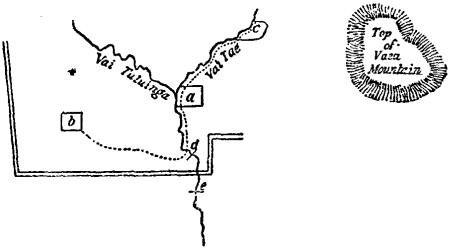
... O, I don’t know if I mentioned that having seen your new tail to the magazine, I cried off interference, at least for this trip. Did I ask you to send me my books and papers, and all the bound volumes of the mag.? quorum pars. I might add that were there a good book or so—new—I don’t believe there is—such would be welcome.
having carried me in a very satisfactory manner since I can remember;
source of pleasure to me, for my sins, I suppose. What a work is the Rideau Cramoisi! and L’Ensorcelée! and Le Chevalier Des Touches!
before the Chief Justice; and he asked me to accompany him as if I were his nurse. We went down about dinner time; and by the way received from a lurking native the famous letter in an official blue envelope gummed up to the edges. It proved to be a declaration of war, quite formal, but with some variations that really made you bounce. White residents were directly threatened, bidden to have nothing to do with the King’s party, not to receive their goods in their houses, etc., under pain of an accident. However, the Chief Justice took it very wisely and mildly, and between us, he and I and Tui made up a plan which has proved successful—so far. The war is over—fifteen chiefs are this morning undergoing a curious double process of law, comparable to a court martial; in which their complaints are to be considered, and if possible righted, while their conduct is to be criticised, perhaps punished. Up to now, therefore, it has been a most successful policy; but the danger is before us. My own feeling would decidedly be that all would be spoiled by a single execution. The great hope after all lies in the knotless, rather flaccid character of the people. These are no Maoris. All the powers that Cedercrantz let go by disuse the new C. J. is stealthily and boldly taking back again; perhaps some others also. He has shamed the chiefs in Mulinuu into a law against taking heads, with a punishment of six years’ imprisonment and, for a chief, degradation. To him has been left the sole conduct of this anxious and decisive inquiry. If the natives stand it, why, well! But I am nervous.
parties to shy bricks at me; and now it begins to look as if I should survive to see myself impotent and forgotten. It’s a pity suicide is not thought the ticket in the best circles.
exacerbate internal ill-feeling. Consequently, I feel less apprehension of difficulty now, by about a hundredfold. All that I stick to, is that if war begins, there are ten chances to one we shall have it bad. The natives have been scurvily used by all the white powers without exception; and they labour under the belief, of which they can’t be cured, that they defeated Germany. This makes an awkward complication.
ain’t very good, it’s not so very bad. Travels and Excursions, vol. III., to be these resuscitated letters—Miscellanies, vol. II.—comme vous voudrez, cher monsieur!
anecdote was welcome. What you say about unwilling work, my dear sir, is a consideration always present with me, and yet not easy to give its due weight to. You grow gradually into a certain income; without spending a penny more, with the same sense of restriction as before when you painfully scraped two hundred a year together, you find you have spent, and you cannot well stop spending, a far larger sum; and this expense can only be supported by a certain production. However, I am off work this month, and occupy myself instead in weeding my cacao, paper-chases, and the like. I may tell you, my average of work in favourable circumstances is far greater than you suppose: from six o’clock till eleven at latest,
on your side of the ocean, I should know comparatively few of them.
notice. Absit omen! But I feel very sure that these considerations will have done you more good than medicine.
my own particular pet. It may amuse you, perhaps, as much as “The Inn” amused me, if I tell you what made this dog particularly mine. My father was the natural god of all the dogs in our house, and poor Jura took to him of course. Jura was stolen, and kept in prison somewhere for more than a week, as I remember. When he came back Smeoroch had come and taken my father’s heart from him. He took his stand like a man, and positively never spoke to my father again from that day until the day of his death. It was the only sign of character he ever showed. I took him up to my room and to be my dog in consequence, partly because I was sorry for him, and partly because I admired his dignity in misfortune.
1 “In the missionary work which is being done among the Samoans, Mr. Stevenson was especially interested. He was an observant, shrewd, yet ever generous critic of all our religious and educational organisations. His knowledge of native character and life enabled him to understand missionary difficulties, while his genial contact with all sorts and conditions of men made him keen to detect deficiencies in men and methods, and apt in useful suggestion.” The above is the testimony of the Mr. Clarke here mentioned (Rev. W. E. Clarke of the London Missionary Society). This gentleman was from the first one of the most valued friends of Mr. Stevenson and his family in Samoa, and, when the end came, read the funeral service beside his grave on Mount Vaea.
in. It is thought by my family to be an excellent likeness of Mark Twain. This poor fellow, by the by, met with the devil of an accident. A model of a statue which he had just finished with a desperate effort was smashed to smithereens on its way to exhibition.
Braxfield is already a thing of beauty and a joy for ever, and so far as he has gone far my best character.
be done, it must! Do, please, make a virtuous effort, come and take a glimpse of a new world I am sure you do not dream of, and some old friends who do often dream of your arrival.
is, for the first time, a tale of Greeks—Homeric Greeks—mingled with moderns, and all true; Odysseus alongside of Rajah Brooke, proportion gardée; and all true. Here is for the first time since the Greeks (that I remember) the history of a handful of men, where all know each other in the eyes, and live close in a few acres, narrated at length, and with the seriousness of history. Talk of the modern novel; here is a modern history. And if I had the misfortune to found a school, the legitimate historian might lie down and die, for he could never overtake his material. Here is a little tale that has not “caret”-ed its “vates”; “sacer” is another point.
troubles with Lord Advocate Prestongrange; captivity on the Bass Rock; journey into France and Holland; and singular relations with James More Drummond or Macgregor, a son of the notorious Rob Roy.
course; and the first time even it was necessary to skip. E pur si muove. But Barrie is a beauty, the Little Minister and the Window in Thrums, eh? Stuff in that young man; but he must see and not be too funny. Genius in him, but there’s a journalist at his elbow—there’s the risk. Look, what a page is the glove business in the Window! knocks a man flat; that’s guts, if you please.
don’t know when; dreamed a large handsome man (a New Orleans planter) had insulted my wife, and, do what I pleased, I could not make him fight me; and woke to find it was the eleventh anniversary of my marriage. A letter usually takes me from a week to three days; but I’m sometimes two days on a page—I was once three—and then my friends kick me. C’est-y-bête! I wish letters of that charming quality could be so timed as to arrive when a fellow wasn’t working at the truck in question; but, of course, that can’t be. Did not go down last night. It showered all afternoon, and poured heavy and loud all night.
must part from prettiness and the graces. We but attain qualities to lose them; life is a series of farewells, even in art; even our proficiencies are deciduous and evanescent. So here with these exquisite pieces the XVIIth, XVIIIth, and IVth of the present collection. You will perhaps never excel them; I should think the “Hermes,” never. Well, you will do something else, and of that I am in expectation.—Yours cordially,
and was a hideous spot; my wife’s ear and our visit to Apia being the causes: our Paul we prefer not to see upon that theatre, and God knows he has plenty to do elsewhere.
here—86 in the shade is about our hottest—and it is never cold except just in the early mornings. Take it for all in all, I suppose this island climate to be by far the healthiest in the world—even the influenza entirely lost its sting. Only two patients died, and one was a man nearly eighty, and the other a child below four months. I won’t tell you if it is beautiful, for I want you to come here and see for yourself. Everybody on the premises except my wife has some Scotch blood in their veins—I beg your pardon—except the natives—and then my wife is a Dutchwoman—and the natives are the next thing conceivable to Highlanders before the forty-five. We would have some grand cracks!
days applied and published. Adelaide Road leads also into the bush, to the banana patch and by a second bifurcation over the left branch of the stream to the plateau and the right hand of the gorges. In short, it leads to all sorts of good, and is, besides, in itself a pretty winding path, bound downhill among big woods to the margin of the stream.
Gaelic, but I could set some of them to the pipes if this rencounter goes as it’s to be desired. Let’s first, as I understand you to move, do each other this rational courtesy; and if either will survive, we may grow better acquaint. For your tastes for what’s martial and for poetry agree with mine.
bettered by the voyage; I have been as jolly as a sand-boy as usual at sea. The Amanuensis sits opposite to me writing to her offspring. Fanny is on deck. I have just supplied her with the Canadian Pacific Agent, and so left her in good hands. You should hear me at table with the Ulster purser and a little punning microscopist called Davis. Belle does some kind of abstruse Boswell-ising; after the first meal, having gauged the kind of jests that would pay here, I observed, “Boswell is Barred during this cruise.”
I seem to have got rid of the pleurisy. Poor Fanny had very little fun of her visit, having been most of the time on a diet of maltine and slops—and this while the rest of us were rioting on oysters and mushrooms. Belle’s only devil in the hedge was the dentist. As for me, I was entertained at the General Assembly of the Presbyterian Church, likewise at a sort of artistic club; made speeches at both, and may therefore be said to have been, like Saint Paul, all things to all men. I have an account of the latter racket which I meant to have enclosed in this.... Had some splendid photos taken, likewise a medallion by a French sculptor; met Graham, who returned with us as far as Auckland. Have seen a good deal too of Sir George Grey; what a wonderful old historic figure to be walking on your arm and recalling ancient events and instances! It makes a man small, and yet the extent to which he approved what I had done—or rather have tried to do—encouraged me. Sir George is an expert at least, he knows these races: he is not a small employé with an ink-pot and a Whitaker.
affair, and all the officials who came to me the other day are to be attacked! This is the unpleasant side of being (without a salary) in public life; I will leave any one to judge if my speech was well intended, and calculated to do good. It was even daring—I assure you one of the chiefs looked like a fiend at my description of Samoan warfare. Your warning was not needed; we are all determined to keep the peace and to hold our peace. I know, my dear fellow, how remote all this sounds! Kindly pardon your friend. I have my life to live here; these interests are for me immediate; and if I do not write of them, I might as soon not write at all. There is the difficulty in a distant correspondence. It is perhaps easy for me to enter into and understand your interests; I own it is difficult for you; but you must just wade through them for friendship’s sake, and try to find tolerable what is vital for your friend. I cannot forbear challenging you to it, as to intellectual lists. It is the proof of intelligence, the proof of not being a barbarian, to be able to enter into something outside of oneself, something that does not touch one’s next neighbour in the city omnibus.
machine, and practises upon it every morning for an hour: he is beginning to be a kind of young Samson. Austin grows fat and brown, and gets on not so ill with his lessons, and my mother is in great price. We are having knock-me-down weather for heat; I never remember it so hot before, and I fancy it means we are to have a hurricane again this year, I think; since we came here, we have not had a single gale of wind! The Pacific is but a child to the North Sea; but when she does get excited, and gets up and girds herself, she can do something good. We have had a very interesting business here. I helped the chiefs who were in prison; and when they were set free, what should they do but offer to make a part of my road for me out of gratitude? Well, I was ashamed to refuse, and the trumps dug my road for me, and put up this inscription on a board:—
their war-fine; the band besides, as it came up the mountain, had collected a following of children by the way, and we had a picking of Samoan ladies to receive them. Chicken, ham, cake and fruits were served out with coffee and lemonade, and all the afternoon we had rounds of claret negus flavoured with rum and limes. They played to us, they danced, they sang, they tumbled. Our boys came in the end of the verandah and gave them a dance for a while. It was anxious work getting this stopped once it had begun, but I knew the band was going on a programme. Finally they gave three cheers for Mr. and Mrs. Stevens, shook hands, formed up and marched off playing—till a kicking horse in the paddock put their pipes out something of the suddenest—we thought the big drum was gone, but Simelé flew to the rescue. And so they wound away down the hill with ever another call of the bugle, leaving us extinct with fatigue, but perhaps the most contented hosts that ever watched the departure of successful guests. Simply impossible to tell how well these blue-jackets behaved; a most interesting lot of men; this education of boys for the navy is making a class, wholly apart—how shall I call them?—a kind of lower-class public school boy, well-mannered, fairly intelligent, sentimental as a sailor. What is more shall be writ on board ship if anywhere.
of the business. I have always said that there is nothing like pain; toothache, dumb-ague, arthritic gout, it does not matter what you call it, if the screw is put upon the nerves sufficiently strong, there is nothing left in heaven or in earth that can interest the sufferer. Still, even to this there is the consolation that it cannot last for ever. Either you will be relieved and have a good hour again before the sun goes down, or else you will be liberated. It is something after all (although not much) to think that you are leaving a brave example; that other literary men love to remember, as I am sure they will love to remember, everything about you—your sweetness, your brightness, your helpfulness to all of us, and in particular those one or two really adequate and noble papers which you have been privileged to write during these last years.—With the heartiest and kindest good-will, I remain, yours ever,
when there it was my part to answer the door. The steady procession of people begging, and the expectant and confident manner in which they presented themselves, struck me more and more daily; and I could not but remember with surprise that though my father lived but a few streets away in a fine house, beggars scarce came to the door once a fortnight or a month. From that time forward I made it my business to inquire, and in the stories which I am very fond of hearing from all sorts and conditions of men, learned that in the time of their distress it was always from the poor they sought assistance, and almost always from the poor they got it.
Though oft I’ve been touched by the volatile dart,
To none have I grovelled but Adela Chart,
There are passable ladies, no question, in art—
But where is the marrow of Adela Chart?
I dreamed that to Tyburn I passed in the cart—
I dreamed I was married to Adela Chart:
From the first I awoke with a palpable start,
The second dumbfoundered me, Adela Chart!
Saga Library. I cannot get enough of Sagas; I wish there were nine thousand; talk about realism!
I leave you Wreckerless. As soon as the mail leaves I tackle it straight.—Yours very sincerely,
am scribbling a lot just now; if you are taken badly that way, apply to the South Seas. I could send you some, I believe, anyway, only none of it is thoroughly ripe. If you have kept back the volume of ballads, I’ll soon make it of a respectable size if this fit continue. By the next mail you may expect some more Wrecker, or I shall be displeased. Probably no more than a chapter, however, for it is a hard one, and I am denuded of my proofs, my collaborator having walked away with them to England; hence some trouble in catching the just note.
France Contemporaine
cake, and when I come home for the holidays, I should like to have a pony.—I am, sir, your obedient servant,
an exile. My uncle’s pedigree is wrong; there was never a Stevenson of Caldwell, of course, but they were tenants of the Mures; the farm held by them is in my introduction; and I have already written to Charles Baxter to have a search made in the Register House. I hope he will have had the inspiration to put it under your surveillance. Your information as to your own family is intensely interesting, and I should not wonder but what you and we and old John Stevenson, “land labourer in the parish of Dailly,” came all of the same stock. Ayrshire—and probably Cunningham—seems to be the home of the race—our part of it. From the distribution of the name—which your collections have so much extended without essentially changing my knowledge of—we seem rather pointed to a British origin. What you say of the Engineers is fresh to me, and must be well thrashed out. This introduction of it will take a long while to walk about!—as perhaps I may be tempted to let it become long; after all, I am writing this for my own pleasure solely. Greetings to you and other Speculatives of our date, long bygone, alas!—Yours very sincerely,
enchanted palace among publishing houses. If it be not so, if the Footnotes were really sent, I hope you will fall upon the Post Office with all the vigour you possess. How does The Wrecker go in the States? It seems to be doing exceptionally well in England.—Yours sincerely,
no blot of heart’s blood and the Old Night: there are no harmonics, there is scarce harmony to his music; and in Henley—all of these; a touch, a sense within sense, a sound outside the sound, the shadow of the inscrutable, eloquent beyond all definition. The First London Voluntary knocked me wholly.—Ever yours affectionately, my dear Charles,
have beaten me fairly on my own ground. I hope you may continue to do so, and thanking you heartily for your nice letter, I shall beg you to believe me yours truly,
close. If you insist on the longer line, equip “grave” with an epithet.
who was really one of the best where all are good—or all but one!... In short, I fell in love with “The First Book” series, and determined that it should be all our first books, and that I could not hold back where the white plume of Conan Doyle waved gallantly in the front. I hope they will republish them, though it’s a grievous thought to me that that effigy in the German cap—likewise the other effigy of the noisome old man with the long hair, telling indelicate stories to a couple of deformed negresses in a rancid shanty full of wreckage—should be perpetuated. I may seem to speak in pleasantry—it is only a seeming—that German cap, sir, would be found, when I come to die, imprinted on my heart. Enough—my heart is too full. Adieu.—Yours very truly,
and the tale concludes in Paris, and be Poll-parrotted. This is the last authentic news. You are not a real hard-working novelist; not a practical novelist; so you don’t know the temptation to let your characters maunder. Dumas did it, and lived. But it is not war; it ain’t sportsmanlike, and I have to be stopping their chatter all the time. Brown’s appendix is great reading.
Hamilton’s folded hands and quiet face said a great deal more to me than the scenery.
laid aside before, and it touched me more than anything else. A.M.]
how little one cares about the wounded; hospital sights, etc.; things that used to murder me. I was far more struck with the excellent way in which things were managed; as if it had been a peep-show; I held some of the things at an operation, and did not care a dump.
the always is such a little while now! He is another of the landmarks gone; when it comes to my own turn to lay my weapons down, I shall do so with thankfulness and fatigue; and whatever be my destiny afterward, I shall be glad to lie down with my fathers in honour. It is human at least, if not divine. And these deaths make me think of it with an ever greater readiness. Strange that you should be beginning a new life, when I, who am a little your junior, am thinking of the end of mine. But I have had hard lines; I have been so long waiting for death, I have unwrapped my thoughts from about life so long, that I have not a filament left to hold by; I have done my fiddling so long under Vesuvius, that I have almost forgotten to play, and can only wait for the eruption, and think it long of coming. Literally, no man has more wholly outlived life than I. And still it’s good fun.
the pruning-knife. I cannot fight longer; I am sensible of having done worse than I hoped, worse than I feared; all I can do now is to do the best I can for the future, and clear the book, like a piece of bush, with axe and cutlass. Even to produce the MS. of this will occupy me, at the most favourable opinion, till the middle of next year; really five years were wanting, when I could have made a book; but I have a family, and—perhaps I could not make the book after all.
Robert Stevenson, C.E., Edinburgh, and Robert Stevenson, Esq., Secretary to the Royal Exchange, Glasgow, and I presume a son of Hugh Stevenson who died in Tobago 16th April 1774, that I have not yet consulted my cousins in Glasgow.
I always suspect you of a volume of sonnets up your sleeve; when is it coming down? I am in one of my moods of wholesale impatience with all fiction and all verging on it, reading instead, with rapture, Fountainhall’s Decisions. You never read it: well, it hasn’t much form, and is inexpressibly dreary, I should suppose, to others—and even to me for pages. It’s like walking in a mine underground, and with a damned bad lantern, and picking out pieces of ore. This, and war, will be my excuse for not having read your (doubtless) charming work of fiction. The revolving year will bring me round to it; and I know, when fiction shall begin to feel a little solid to me again, that I shall love it, because it’s James. Do you know, when I am in this mood, I would rather try to read a bad book? It’s not so disappointing, anyway. And Fountainhall is prime, two big folio volumes, and all dreary, and all true, and all as terse as an obituary; and about one interesting fact on an average in twenty pages, and ten of them unintelligible for technicalities. There’s literature, if you like! It feeds; it falls about you genuine like rain. Rain: nobody has done justice to rain in literature yet: surely a subject for a Scot. But then you can’t do rain in that ledger-book style that I am trying for—or between a ledger-book and an old ballad. How to get over, how to escape from, the besotting particularity of fiction. “Roland approached the house; it had green doors and window blinds; and there was a scraper on the upper step.” To hell with Roland and the scraper!—Yours ever,
and ingratiating! No, sir, I can’t dislike him; but if I don’t make hay of him, it shall not be for want of trying.
great talent for compliment, accompanied by a hateful, even a diabolic frankness.
money for my folks. The blows that have fallen upon you are truly terrifying; I wish you strength to bear them. It is strange, I must seem to you to blaze in a Birmingham prosperity and happiness; and to myself I seem a failure. The truth is, I have never got over the last influenza yet, and am miserably out of heart and out of kilter. Lungs pretty right, stomach nowhere, spirits a good deal overshadowed; but we’ll come through it yet, and cock our bonnets. (I confess with sorrow that I am not yet quite sure about the intellects; but I hope it is only one of my usual periods of non-work. They are more unbearable now, because I cannot rest. No rest but the grave for Sir Walter! O the words ring in a man’s head.)
still; as when Belle and Lady Jersey came out to brush their teeth in front of the rebel King’s palace, and the night guard squatted opposite on the grass and watched the process; or when I and my interpreter, and the King with his secretary, mysteriously disappeared to conspire.—Ever yours sincerely,
and re-writing, order will emerge. It is indeed a queer hope; there is one piece for instance that I want in—I cannot put it one place for a good reason—I cannot put it another for a better—and every time I look at it, I turn sick and put the MS. away.
if he doesn’t know my work, I shall have the better chance of making his acquaintance. I read The Pupil the other day with great joy; your little boy is admirable; why is there no little boy like that unless he hails from the Great Republic?
muttering in town. People had no fancy for amateur explosions, for one thing. For another, it did not clearly appear that it was legal; the men had been condemned to six months’ prison, which they were peaceably undergoing; they had not been condemned to death. And lastly, it seemed a somewhat advanced example of civilisation to set before barbarians. The mutter in short became a storm, and yesterday, while I was down, a cutter was chartered, and the prisoners were suddenly banished to the Tokelaus. Who has changed the sentence? We are going to stir in the dynamite matter; we do not want the natives to fancy us consenting to such an outrage.
as I did it. If only I could secure a violent death, what a fine success! I wish to die in my boots; no more Land of Counterpane for me. To be drowned, to be shot, to be thrown from a horse—ay, to be hanged, rather than pass again through that slow dissolution.
quite a rotten novel; it always has and always must have the incurable illogicalities of life about it, the fathoms of slack and the miles of tedium. Still, that’s where the fun comes in; and when you have at last managed to shut up the castle spectre (dulness), the very outside of his door looks beautiful by contrast. There are pages in these books that may seem nothing to the reader; but you remember what they were, you know what they might have been, and they seem to you witty beyond comparison. In my Grandfather I’ve had (for instance) to give up the temporal order almost entirely; doubtless the temporal order is the great foe of the biographer; it is so tempting, so easy, and lo! there you are in the bog!—Ever yours,
the particular objection; so soon does falsehood await the politician in his whirling path.
still indignantly staring on this button! It’s not even a button; it’s a teetotal badge!—Ever yours,
meanwhile crowded her with sail; fifteen sails in all, every stay being gratified with a stay-sail, a boat-boom sent aloft for a maintop-gallant yard, and the derrick of a crane brought in service as bowsprit. All the time we have had a fine, fair wind and a smooth sea; to-day at noon our run was 203 miles (if you please!), and we are within some 360 miles of Sydney. Probably there has never been a more gallant success; and I can say honestly it was well worked for. No flurry, no high words, no long faces; only hard work and honest thought; a pleasant, manly business to be present at. All the chances were we might have been six weeks—ay, or three months at sea—or never turned up at all, and now it looks as though we should reach our destination some five days too late.
and even a style? I know about as much of Tacitus, and more of Horace; it is not enough between contemporaries, such as we still are. I have just remembered another of my books, which I re-read the other day, and thought in places good—Prince Otto. It is not as good as either of the others; but it has one recommendation—it has female parts, so it might perhaps please better in France.
hand, go and see your father, and do ditto, and give him a real good hour or two. We shall both be glad hereafter.—Yours ever,
some of the brevity of history, some of the detail of romance. The Shovels of Newton French will be the name. The idea is an old one; it was brought to birth by an accident; a friend in the islands who picked up F. Jenkin,
Bailey session papers. I have 1778, 1784, and 1786. Should you be able to lay hands on any other volumes, above all a little later, I should be very glad you should buy them for me. I particularly want one or two during the course of the Peninsular War. Come to think, I ought rather to have communicated this want to Bain. Would it bore you to communicate to that effect with the great man? The sooner I have them, the better for me. ’Tis for Henry Shovel. But Henry Shovel has now turned into a work called The Shovels of Newton French: including Memoirs of Henry Shovel, a Private in the Peninsular War, which work is to begin in 1664 with the marriage of Skipper, afterwards Alderman Shovel of Bristol, Henry’s great-great-grandfather, and end about 1832 with his own second marriage to the daughter of his runaway aunt. Will the public ever stand such an opus? Gude kens, but it tickles me. Two or three historical personages will just appear: Judge Jeffreys, Wellington, Colquhoun, Grant, and I think Townsend the runner. I know the public won’t like it; let ’em lump it then; I mean to make it good; it will be more like a saga.
of an income that would come in—mine has all got to be gone and fished for with the immortal mind of man. What I want is the income that really comes in of itself while all you have to do is just to blossom and exist and sit on chairs. Think how beautiful it would be not to have to mind the critics, and not even the darkest of the crowd—Sidney Colvin. I should probably amuse myself with works that would make your hair curl, if you had any left.
public, at which I wondered; not that I set much account by my verses, which are the verses of Prosator; but I do know how to tell a yarn, and two of the yarns are great. Rahero is for its length a perfect folk-tale: savage and yet fine, full of tailforemost morality, ancient as the granite rocks; if the historian, not to say the politician, could get that yarn into his head, he would have learned some of his ABC. But the average man at home cannot understand antiquity; he is sunk over the ears in Roman civilisation; and a tale like that of Rahero falls on his ears inarticulate. The Spectator said there was no psychology in it; that interested me much: my grandmother (as I used to call that able paper, and an able paper it is, and a fair one) cannot so much as observe the existence of savage psychology when it is put before it. I am at bottom a psychologist and ashamed of it; the tale seized me one-third because of its picturesque features, two-thirds because of its astonishing psychology, and the Spectator says there’s none. I am going on with a lot of island work, exulting in the knowledge of a new world, “a new created world” and new men; and I am sure my income will DECLINE and FALL off; for the effort of comprehension is death to the intelligent public, and sickness to the dull.
We are now very much installed; the dining-room is done, and looks lovely. Soon we shall begin to photograph and send you our circumstances. My room is still a howling wilderness. I sleep on a platform in a window, and strike my mosquito bar and roll up my bedclothes every morning, so that the bed becomes by day a divan. A great part of the floor is knee-deep in books, yet nearly all the shelves are filled, alas! It is a place to make a pig recoil, yet here are my interminable labours begun daily by lamp-light, and sometimes not yet done when the lamp has once more to be lighted. The effect of pictures in this place is surprising. They give great pleasure.
the north with Sir Walter, eighty years ago, labuntur anni! They are not remarkably good, but he was not a bad observer, and several touches seem to me speaking. It has occurred to me you might like them to appear in the Magazine. If you would, kindly let me know, and tell me how you would like it handled. My grandad’s MS. runs to between six and seven thousand words, which I could abbreviate of anecdotes that scarce touch Sir W. Would you like this done? Would you like me to introduce the old gentleman? I had something of the sort in my mind, and could fill a few columns rather à propos. I give you the first offer of this, according to your request; for though it may forestall one of the interests of my biography, the thing seems to me particularly suited for prior appearance in a magazine.
helpers, and do remember to register everything, else it is not safe.
public, could you get them run up in some luxuous manner, so that fools might be induced to buy them in just a sufficient quantity to pay expenses and the thing remain still in a manner private? We could supply photographs of the illustrations—and the poems are of Vailima and the family—I should much like to get this done as a surprise for Fanny.
I do not know why you permit yourself this licence with grammar; you show, in so many pages, that you are superior to the paltry sense of rhythm which usually dictates it—as though some poetaster had been suffered to correct the poet’s text. By the way, I confess to a heartfelt weakness for Auriculas.—Believe me the very grateful and characteristic pick-thank, but still sincere and affectionate,
Margery Ide (the C.J.’s daughter) being seriously ill, alarmingly ill. Fanny wanted to go down; it was a difficult choice; she was not fit for it; on the other hand (and by all accounts) the patient would die if she did not get better nursing. So we made up our own minds, and F. and I set out about dusk, came to the C.J.’s in the middle of dinner, and announced our errand. I am glad to say the C.J. received her very willingly; and I came home again, leaving her behind, where she was certainly much wanted.
with my ladies, and sings me “the melancholy airs of my native land” with much acceptancy. His name has recently become changed in Vailima. Beginning with the courteous “Mr. Meiklejohn,” it shaded off into the familiar “Hughie,” and finally degenerated into “the Whitrett.”
a memento of you, but as a perpetual encouragement to do better with his Lordship. I have not yet received the transcripts. They must be very interesting. Do you know I picked up the other day an old Longman’s where I found an article of yours that I had missed, about Christie’s? I read it with great delight. The year ends with us pretty much as it began, among wars and rumours of wars, and a vast and splendid exhibition of official incompetence.—Yours ever,
to mark private and confidential, or I might get into deep water, and believe me, yours very truly,
my mother is going to stand the winter. It she can, it will be a very good thing for her. We are in that part of the year which I like the best—the Rainy or Hurricane Season. “When it is good, it is very, very good; and when it is bad, it is horrid,” and our fine days are certainly fine like heaven; such a blue of the sea, such green of the trees, and such crimson of the hibiscus flowers, you never saw; and the air as mild and gentle as a baby’s breath, and yet not hot!
even find some amusement in seeing that the maps fill the bill. If your map-maker be a poor creature, plainness is best; if he were a fellow of some genuine go, he might give it a little of the bird’s-eye quality. I leave this to your good taste. If I have time I will copy the dedication to go herewith; I am pleased with it. The first map (suppose we take two) would go in at the beginning, the second at Chapter XI. The topography is very much worked into the story, and I have alluded in the dedication to our common fancy for exploring Auld Reekie.
your old friend; but not a hope of my dying soon and cleanly, and “winning off the stage.” Rather I am daily better in physical health. I shall have to see this business out, after all; and I think, in that case, they should have—they might have—spared me all my ill-health this decade past, if it were not to unbar the doors. I have no taste for old age, and my nose is to be rubbed in it in spite of my face. I was meant to die young, and the gods do not love me.
original plan of the Master of Ballantrae a sort of introduction describing my arrival in Edinburgh on a visit to yourself and your placing in my hands the papers of the story. I actually wrote it, and then condemned the idea—as being a little too like Scott, I suppose. Now I must really find the MS. and try to finish it for the E.E. It will give you, what I should so much like you to have, another corner of your own in that lofty monument.
somehow; and I can only hope the intrinsic horror and pathos, and a kind of fierce glow of colour there is to it, and the surely remarkable wealth of striking incident, may guide our little shallop into port. If Gordon Browne is to get it, he should see the Brassey photographs of Papeete. But mind, the three waifs were never in the town; only on the beach and in the calaboose. By George, but it’s a good thing to illustrate for a man like that! Fanny is all right again. False alarm! I was down yesterday afternoon at Papauta, and heard much growling of war, and the delightful news that the C. J. and the President are going to run away from Mulinuu and take refuge in the Tivoli hotel.
deport me; I should prefer it so; I do not think that I could bear a German officialdom, and should probably have to leave sponte mea, which is only less picturesque and more expensive.
the future in the regular and human manner from one 13th November to the next. The effect on me is more doubtful; I may, as you suggest, live for ever; I might, on the other hand, come to pieces like the one-horse shay at a moment’s notice; doubtless the step was risky, but I do not the least regret that which enables me to sign myself your revered and delighted name-father,
made, etc., in order to set up rubbish that is not fit for the Saturday Scotsman. It would be the climax of shame.
the mountain-side, where the Tapu a fafine (or spirit of the land) has her dwelling, and the work-boys fear to go alone, is called by a name that I think our gamekeeper has heard before—Adelaide Road.
You’re away up in the ranks now and (according to works that I have read) doubtless design assassinations. But I am an outsider; and I have a certain liking for a light unto my path which would deter me from joining the rank and file of so vast and dim a confraternity. At your altitude it becomes (of course) amusing and perhaps useful. Yes, I remember the L.J.R.,
Suffice it to breathe in your ear that she was what Hardy calls (and others in their plain way don’t) a Pure Woman.
lives in me. I do, but tell it not in Gath; every man has these fanciful superstitions, coming, going, but yet enduring; only most men are so wise (or the poet in them so dead) that they keep their follies for themselves.—I am, yours very truly,
Office. Not a single copy of the Footnote has yet reached Samoa, but I hear of one having come to its address in Hawaii. Glad to hear good news of Stoddard.—Yours sincerely,
from six in the morning till eight at night, with trifling and not always agreeable intervals for meals.
rejoice like a strong man in their injustice. I trust you got my letter about your Browning book. In case it missed, I wish to say again that your publication of Browning’s kind letter, as an illustration of his character, was modest, proper, and in radiant good taste.—In Witness whereof, etc. etc.,
is, of course, they will step into power as a personnel, but God knows what they may believe when they come to do so; it can’t be stranger or more improbable than what Christianity had come to be by the same time.
real. Do it again. Madame de Maintenon struck me as quite good. Have you any document for the decapitation? It sounds steepish. The devil of all that first part is that you see old Dumas; yet your Louis XIV. is distinctly good. I am much interested with this book, which fulfils a good deal, and promises more. Question: How far a Historical Novel should be wholly episodic? I incline to that view, with trembling. I shake hands with you on old Murat.
maître-ès-arts express an opinion on what I do. I put this very tamely, being on the whole a quiet elderly man; but it is a strong passion with me, though intermittent. Now, try to follow my example and tell me something about yourself, Louisa, the Bab, and your work; and kindly send me some specimens of what you’re about. I have only seen one thing by you, about Notre Dame in the Westminster or St. James’s, since I left England, now I suppose six years ago.
injured—except me. I had a strong conviction that I was a great hand at writing inscriptions, and meant to exhibit and test my genius on the walls of my house; and now I see I can’t. It is generally thus. The Battle of the Golden Letters will never be delivered. On making preparation to open the campaign, the King found himself face to face with invincible difficulties, in which the rapacity of a mercenary soldiery and the complaints of an impoverished treasury played an equal part.—Ever yours,
most particular, and the only one that never looked up or knocked off, I could not but think I should have been sent on exhibition as an example to young literary men. Here is how to learn to write, might be the motto. You should have seen us; the verandah was like an Irish bog; our hands and faces were bedaubed with soil; and Faauma was supposed to have struck the right note when she remarked (à propos of nothing), “Too much eleele (soil) for me!” The cacao (you must understand) has to be planted at first in baskets of plaited cocoa-leaf. From four to ten natives were plaiting these in the wood-shed. Four boys were digging up soil and bringing it by the boxful to the verandah. Lloyd and I and Belle, and sometimes S. (who came to bear a hand), were filling the baskets, removing stones and lumps of clay; Austin and Faauma carried them when full to Fanny, who planted a seed in each, and then set them, packed close, in the corners of the verandah. From twelve on Friday till five P.M. on Saturday we planted the first 1500, and more than 700 of a second lot. You cannot dream how filthy we were, and we were all properly tired. They are all at it again to-day, bar Belle and me, not required, and glad to be out of it. The Chief Justice has not yet replied, and I have news that he received my letter. What a man!
and I would not in the least wonder if the visit proved the signal of war. With this I have no concern, and the thing wholly suits my book and fits my predilections for Samoa. What a pity the mail leaves, and I must leave this adventure to be continued in our next! But I need scarcely say that all this is deadly private—I expect it all to come out, not without explosion; only it must not be through me or you. We had a visit yesterday from a person by the name of Count Nerli, who is said to be a good painter. Altogether the aristocracy clusters thick about us. In which radiant light, as the mail must now be really put up, I leave myself until next month,—Yours ever,
and to see that you spell my name right. This is a point (for some reason) of great difficulty; and I believe that a gentleman who can spell Stevenson with a v at sixteen, should have a show for the Presidency before fifty. By that time
further information, and if so I should be glad of it. If you have not, pray do not trouble to answer. As to your father’s blunder of “Stevenson of Cauldwell,” it is now explained: Carsewell may have been confounded with Cauldwell: and it seems likely our man may have been a tenant or retainer of Mure of Cauldwell, a very ancient and honourable family, who seems to have been at least a neighbouring laird to the parish of Neilston. I was just about to close this, when I observed again your obliging offer of service, and I take you promptly at your word.
style of the ’45. What a misfortune, my dear cousin, that you should have arrived while your cousin Graham was occupying my only guest-chamber—for Osterley Park is not so large in Samoa as it was at home—but happily our friend Haggard has found a corner for you!
came here, the critics (those genial gentlemen) used to deplore the relaxation of my fibre and the idleness to which I had succumbed. I hear less of this now; the next thing is they will tell me I am writing myself out! and that my unconscientious conduct is bringing their grey hairs with sorrow to the dust. I do not know—I mean I do know one thing. For fourteen years I have not had a day’s real health; I have wakened sick and gone to bed weary; and I have done my work unflinchingly. I have written in bed, and written out of it, written in hemorrhages, written in sickness, written torn by coughing, written when my head swam for weakness; and for so long, it seems to me I have won my wager and recovered my glove. I am better now, have been rightly speaking since first I came to the Pacific; and still, few are the days when I am not in some physical distress. And the battle goes on—ill or well, is a trifle; so as it goes. I was made for a contest, and the Powers have so willed that my battlefield should be this dingy, inglorious one of the bed and the physic bottle. At least I have not failed, but I would have preferred a place of trumpetings and the open air over my head.
small degree of inward strain and anxiety. He had not yet put by any provision for his wife and step-family (the income from the moderate fortune left by his father naturally going to his mother during her life). His earnings had since 1887 been considerable, at the rate of £4,000 a year or thereabouts; but his building expenses and large mode of life at Vailima, together with his habitual generosity, which scarce knew check or limit, towards the less fortunate of his friends and acquaintances in various parts of the world, made his expenditure about equal to his income. The idea originally entertained of turning part of the Vailima estate into a profitable plantation turned out chimerical. The thought began to haunt him, What if his power of earning were soon to cease? And occasional signs of inward depression and life-weariness began to appear in his correspondence. But it was only in writing, and then but rarely, that he let such signs appear: to those about him he retained the old affectionate charm and inspiring gaiety undiminished, fulfilling without failure the words of his own prayer, “Give us to awake with smiles, give us to labour smiling; as the sun lightens the world, so let our loving-kindness make bright this house of our habitation.”
moonlight, drinking port, hearing the cousin play and sing, till presently we were informed that our boys had got up a siva in Lafaele’s house to which we were invited. It was entirely their own idea. The house, you must understand, is one-half floored, and one-half bare earth, and the daïs stands a little over knee high above the level of the soil. The daïs was the stage, with three footlights. We audience sat on mats on the floor, and the cook and three of our work-boys, sometimes assisted by our two ladies, took their places behind the footlights and began a topical Vailima song. The burden was of course that of a Samoan popular song about a white man who objects to all that he sees in Samoa. And there was of course a special verse for each one of the party—Lloyd was called the dancing man (practically the Chief’s handsome son) of Vailima; he was also, in his character I suppose of overseer, compared to a policeman—Belle had that day been the almoner in a semi-comic distribution of wedding rings and thimbles (bought cheap at an auction) to the whole plantation company, fitting a ring on every man’s finger, and a ring and a thimble on both the women’s. This was very much in character with her native name Teuila, the adorner of the ugly—so of course this was the point of her verse and at a given moment all the performers displayed the rings upon their fingers. Pelema (the cousin—our cousin) was described as watching from the house and whenever he saw any boy not doing anything, running and doing it himself. Fanny’s verse was less intelligible, but it was accompanied in the dance with a pantomime of terror well-fitted to call up her haunting, indefatigable and diminutive presence in a blue gown.
but you have done some exceedingly spirited and satisfactory illustrations to my story The Beach of Falesá, and I wish to write and thank you expressly for the care and talent shown. Such numbers of people can do good black and whites! So few can illustrate a story, or apparently read it. You have shown that you can do both, and your creation of Wiltshire is a real illumination of the text. It was exactly so that Wiltshire dressed and looked, and you have the line of his nose to a nicety. His nose is an inspiration. Nor should I forget to thank you for Case, particularly in his last appearance. It is a singular fact—which seems to point still more directly to inspiration in your case—that your missionary actually resembles the flesh-and-blood person from whom Mr. Tarleton was drawn. The general effect of the islands is all that could be wished; indeed I have but one criticism to make, that in the background of Case taking the dollar from Mr. Tarleton’s head—head—not hand, as the fools have printed it—the natives have a little too much the look of Africans.
APPENDIX II
ADDRESS OF R. L. STEVENSON TO THE CHIEFS ON THE OPENING OF THE ROAD OF GRATITUDE, OCTOBER 1894
Mr. Stevenson said, “We are met together to-day to celebrate an event and to do honour to certain chiefs, my friends,—Lelei, Mataafa, Salevao, Poè, Teleso, Tupuola Lotofaga, Tupuola Amaile, Muliaiga, Ifopo, and Fatialofa. You are all aware in some degree of what has happened. You know these chiefs to have been prisoners; you perhaps know that during the term of their confinement I had it in my power to do them certain favours. One thing some of you cannot know, that they were immediately repaid by answering attentions. They were liberated by the new administration; by the King, and the Chief Justice, and the Ta’its’ifono, who are here amongst us to-day, and to whom we all desire to tender our renewed and perpetual gratitude for that favour. As soon as they were free men—owing no man anything—instead of going home to their own places and families, they came to me; they offered to do this work for me as a free gift, without hire, without supplies, and I was tempted at first to refuse their offer. I knew the country to be poor, I knew famine threatening; I knew their families long disorganised for want of supervision. Yet I accepted, because I thought the lesson of that road might be more useful to Samoa than a thousand breadfruit trees; and because to myself it was an exquisite pleasure to receive that which was so handsomely offered. It is now done; you have trod it to-day in coming hither. It has been made for me by chiefs; some of them old, some sick, all newly delivered from a harassing confinement, and in spite of weather unusually hot and insalubrious. I have seen these chiefs labour valiantly with their own hands upon the work, and I have set up over it, now that it is finished, the name of ‘The Road of Gratitude’ (the road of loving hearts) and the names of those that built it. ‘In perpetuam memoriam,’ we say, and speak idly. At least so long as my own life shall be spared, it shall be here perpetuated; partly for my pleasure and in my gratitude; partly for others; to continually publish the lesson of this road.”
Addressing himself to the chiefs, Mr. Stevenson then said:—
“I will tell you, Chiefs, that, when I saw you working on that road, my heart grew warm; not with gratitude only, but with hope. It seemed to me that I read the promise of something good for Samoa: it seemed to me, as I looked at you, that you were a company of warriors in a battle, fighting for the defence of our common country against all aggression. For there is a time to fight, and a time to dig. You Samoans may fight, you may conquer twenty times, and thirty times, and all will be in vain. There is but one way to defend Samoa. Hear it before it is too late. It is to make roads, and gardens, and care for your trees, and sell their produce wisely, and, in one word, to occupy and use your country. If you do not, others will.”
The speaker then referred to the Parable of the Talents, Matt. xxv. 14-30, and continuing, impressively asked: “What are you doing with your talent, Samoa? Your three talents, Savaii, Upolu, and Tutuila? Have you buried it in a napkin? Not Upolu at least. You have rather given it out to be trodden under feet of swine: and the swine cut down food trees and burn houses, according to the nature of swine, or of that much worse animal, foolish man, acting according to his folly. ‘Thou knewest that I reap where I sowed not, and gather where I have not strawed.’ But God has both sown and strawed for you here in Samoa; He has given you a rich soil, a splendid sun, copious rain; all is ready to your hand, half done. And I repeat to you that thing which is sure: if you do not occupy and use your country, others will. It will not continue to be yours or your children’s, if you occupy it for nothing. You and your children will in that case be cast out into outer darkness, where shall be weeping and gnashing of teeth; for that is the law of God which passeth not away. I who speak to you have seen these things. I have seen them with my eyes—these judgments of God. I have seen them in Ireland, and I have seen them in the mountains of my own country—Scotland—and my heart was sad. These were a fine people in the past—brave, gay, faithful, and very much like Samoans, except in one particular, that they were much wiser and better at that business of fighting of which you think so much. But the time came to them as it now comes to you, and it did not find them ready. The messenger came into their villages, and they did not know him; they were told, as you are told, to use and occupy their country, and they would not hear. And now you may go through great tracts of the land and scarce meet a man or a smoking house, and see nothing but sheep feeding. The other people that I tell you of have come upon them like a foe in the night, and these are the other people’s sheep who browse upon the foundation of their houses. To come nearer; and I have seen this judgment in Oahu also. I have ridden there the whole day along the coast of an island. Hour after hour went by and I saw the face of no living man except that of the guide who rode with me. All along that desolate coast, in one bay after another, we saw, still standing, the churches that have been built by the Hawaiians of old. There must have been many hundreds, many thousands, dwelling there in old times, and worshipping God in these now empty churches. For to-day they were empty; the doors were closed, the villages had disappeared, the people were dead and gone; only the church stood on like a tombstone over a grave, in the midst of the white men’s sugar fields. The other people had come and used that country, and the Hawaiians who occupied it for nothing had been swept away, ‘where is weeping and gnashing of teeth.’
“I do not speak of this lightly, because I love Samoa and her people. I love the land, I have chosen it to be my home while I live, and my grave after I am dead; and I love the people, and have chosen them to be my people to live and die with. And I see that the day is come now of the great battle; of the great and the last opportunity by which it shall be decided whether you are to pass away like these other races of which I have been speaking, or to stand fast and have your children living on and honouring your memory in the land you received of your fathers.
“The Land Commission and the Chief Justice will soon have ended their labours. Much of your land will be restored to you, to do what you can with. Now is the time the messenger is come into your villages to summon you; the man is come with the measuring rod; the fire is lighted in which you shall be tried, whether you are gold or dross. Now is the time for the true champions of Samoa to stand forth. And who is the true champion of Samoa? It is not the man who blackens his face, and cuts down trees, and kills pigs and wounded men. It is the man who makes roads, who plants food trees, who gathers harvests, and is a profitable servant before the Lord, using and improving that great talent that has been given him in trust. That is the brave soldier; that is the true champion; because all things in a country hang together like the links of the anchor cable, one by another: but the anchor itself is industry.
“There is a friend of most of us, who is far away; not to be forgotten where I am, where Tupuola is, where Poè Lelei, Mataafa, Solevao, Poè Teleso, Tupuola Lotofaga, Tupuolo Amaile, Muliaiga, Ifopo, Fatialofa, Lemusu are. He knew what I am telling you; no man better. He saw the day was come when Samoa had to walk in a new path, and to be defended not only with guns and blackened faces, and the noise of men shouting, but by digging and planting, reaping and sowing. When he was still here amongst us, he busied himself planting cacao; he was anxious and eager about agriculture and commerce, and spoke and wrote continually; so that when we turn our minds to the same matters, we may tell ourselves that we are still obeying Mataafa. Ua tautala mai pea o ia ua mamao.
“I know that I do not speak to idle or foolish hearers. I speak to those who are not too proud to work for gratitude. Chiefs! You have worked for Tusitala, and he thanks you from his heart. In this, I could wish you could be an example to all Samoa—I wish every chief in these islands would turn to, and work, and build roads, and sow fields, and plant food trees, and educate his children and improve his talents—not for love of Tusitala, but for the love of his brothers, and his children, and the whole body of generations yet unborn.
“Chiefs! On this road that you have made many feet shall follow. The Romans were the bravest and greatest of people! mighty men of their hands, glorious fighters and conquerors. To this day in Europe you may go through parts of the country where all is marsh and bush, and perhaps after struggling through a thicket, you shall come forth upon an ancient road, solid and useful as the day it was made. You shall see men and women bearing their burdens along that even way, and you may tell yourself that it was built for them perhaps fifteen hundred years before,—perhaps before the coming of Christ,—by the Romans. And the people still remember and bless them for that convenience, and say to one another, that as the Romans were the bravest men to fight, so they were the best at building roads.
“Chiefs! Our road is not built to last a thousand years, yet in a sense it is. When a road is once built, it is a strange thing how it collects traffic, how every year, as it goes on, more and more people are found to walk thereon and others are raised up to repair and perpetuate it and keep it alive; so that perhaps even this road of ours may, from reparation to reparation, continue to exist and be useful hundreds and hundreds of years after we are mingled in the dust. And it is my hope that our far-away descendants may remember and bless those who laboured for them to-day.”
INDEX TO THE LETTERS
[For short Index to Vols. I.-XXII., see pp. 509-519.]
Cent Jours: d’ye ken anything in my way? I want in particular to know about them and the Napoleonic functionaries and officers, and to get the colour and some vital details of the business of exchange of departments from one side to the other.
is the only holiday I have had for more than 2 years; I dare say it will be as long again before I take another. And I am going to spend a lot of money. Ahem!
have succeeded. Talolo (our native cook, and a very good one too) likened them the other day to the head of a German; and even this hyperbolical image was grudging. I remember all the trouble you had with servants at the Roost. The most of them were nothing to the trances that we have to go through here at times, when I have to hold a bed of justice, and take evidence which is never twice the same, and decide, practically blindfold, and after I have decided have the accuser take back the accusation in block and beg for mercy for the culprit. Conceive the annoyance of all this when you are very fond of both.—Your affectionate friend,
copies of The Footnote to History reached Samoa, and the book, so far from being a cause of offence to his friends the managers of that firm, as both he and they had feared, was found acceptable and devoid of offence by them: a result celebrated in the convivial manner described in the last letter of this section. On the whole the year had been a prosperous one, full of successful work and eager interests, although darkened in its later months by disquietude on account of his wife’s health. He had himself well maintained the improved strength and the renewed capacity both for literary work and outdoor activity which life in the South Seas had brought him from the first.
APPENDIX II
ADDRESS OF R. L. STEVENSON TO THE CHIEFS ON THE OPENING OF THE ROAD OF GRATITUDE, OCTOBER 1894
Mr. Stevenson said, “We are met together to-day to celebrate an event and to do honour to certain chiefs, my friends,—Lelei, Mataafa, Salevao, Poè, Teleso, Tupuola Lotofaga, Tupuola Amaile, Muliaiga, Ifopo, and Fatialofa. You are all aware in some degree of what has happened. You know these chiefs to have been prisoners; you perhaps know that during the term of their confinement I had it in my power to do them certain favours. One thing some of you cannot know, that they were immediately repaid by answering attentions. They were liberated by the new administration; by the King, and the Chief Justice, and the Ta’its’ifono, who are here amongst us to-day, and to whom we all desire to tender our renewed and perpetual gratitude for that favour. As soon as they were free men—owing no man anything—instead of going home to their own places and families, they came to me; they offered to do this work for me as a free gift, without hire, without supplies, and I was tempted at first to refuse their offer. I knew the country to be poor, I knew famine threatening; I knew their families long disorganised for want of supervision. Yet I accepted, because I thought the lesson of that road might be more useful to Samoa than a thousand breadfruit trees; and because to myself it was an exquisite pleasure to receive that which was so handsomely offered. It is now done; you have trod it to-day in coming hither. It has been made for me by chiefs; some of them old, some sick, all newly delivered from a harassing confinement, and in spite of weather unusually hot and insalubrious. I have seen these chiefs labour valiantly with their own hands upon the work, and I have set up over it, now that it is finished, the name of ‘The Road of Gratitude’ (the road of loving hearts) and the names of those that built it. ‘In perpetuam memoriam,’ we say, and speak idly. At least so long as my own life shall be spared, it shall be here perpetuated; partly for my pleasure and in my gratitude; partly for others; to continually publish the lesson of this road.”
Addressing himself to the chiefs, Mr. Stevenson then said:—
“I will tell you, Chiefs, that, when I saw you working on that road, my heart grew warm; not with gratitude only, but with hope. It seemed to me that I read the promise of something good for Samoa: it seemed to me, as I looked at you, that you were a company of warriors in a battle, fighting for the defence of our common country against all aggression. For there is a time to fight, and a time to dig. You Samoans may fight, you may conquer twenty times, and thirty times, and all will be in vain. There is but one way to defend Samoa. Hear it before it is too late. It is to make roads, and gardens, and care for your trees, and sell their produce wisely, and, in one word, to occupy and use your country. If you do not, others will.”
The speaker then referred to the Parable of the Talents, Matt. xxv. 14-30, and continuing, impressively asked: “What are you doing with your talent, Samoa? Your three talents, Savaii, Upolu, and Tutuila? Have you buried it in a napkin? Not Upolu at least. You have rather given it out to be trodden under feet of swine: and the swine cut down food trees and burn houses, according to the nature of swine, or of that much worse animal, foolish man, acting according to his folly. ‘Thou knewest that I reap where I sowed not, and gather where I have not strawed.’ But God has both sown and strawed for you here in Samoa; He has given you a rich soil, a splendid sun, copious rain; all is ready to your hand, half done. And I repeat to you that thing which is sure: if you do not occupy and use your country, others will. It will not continue to be yours or your children’s, if you occupy it for nothing. You and your children will in that case be cast out into outer darkness, where shall be weeping and gnashing of teeth; for that is the law of God which passeth not away. I who speak to you have seen these things. I have seen them with my eyes—these judgments of God. I have seen them in Ireland, and I have seen them in the mountains of my own country—Scotland—and my heart was sad. These were a fine people in the past—brave, gay, faithful, and very much like Samoans, except in one particular, that they were much wiser and better at that business of fighting of which you think so much. But the time came to them as it now comes to you, and it did not find them ready. The messenger came into their villages, and they did not know him; they were told, as you are told, to use and occupy their country, and they would not hear. And now you may go through great tracts of the land and scarce meet a man or a smoking house, and see nothing but sheep feeding. The other people that I tell you of have come upon them like a foe in the night, and these are the other people’s sheep who browse upon the foundation of their houses. To come nearer; and I have seen this judgment in Oahu also. I have ridden there the whole day along the coast of an island. Hour after hour went by and I saw the face of no living man except that of the guide who rode with me. All along that desolate coast, in one bay after another, we saw, still standing, the churches that have been built by the Hawaiians of old. There must have been many hundreds, many thousands, dwelling there in old times, and worshipping God in these now empty churches. For to-day they were empty; the doors were closed, the villages had disappeared, the people were dead and gone; only the church stood on like a tombstone over a grave, in the midst of the white men’s sugar fields. The other people had come and used that country, and the Hawaiians who occupied it for nothing had been swept away, ‘where is weeping and gnashing of teeth.’
“I do not speak of this lightly, because I love Samoa and her people. I love the land, I have chosen it to be my home while I live, and my grave after I am dead; and I love the people, and have chosen them to be my people to live and die with. And I see that the day is come now of the great battle; of the great and the last opportunity by which it shall be decided whether you are to pass away like these other races of which I have been speaking, or to stand fast and have your children living on and honouring your memory in the land you received of your fathers.
“The Land Commission and the Chief Justice will soon have ended their labours. Much of your land will be restored to you, to do what you can with. Now is the time the messenger is come into your villages to summon you; the man is come with the measuring rod; the fire is lighted in which you shall be tried, whether you are gold or dross. Now is the time for the true champions of Samoa to stand forth. And who is the true champion of Samoa? It is not the man who blackens his face, and cuts down trees, and kills pigs and wounded men. It is the man who makes roads, who plants food trees, who gathers harvests, and is a profitable servant before the Lord, using and improving that great talent that has been given him in trust. That is the brave soldier; that is the true champion; because all things in a country hang together like the links of the anchor cable, one by another: but the anchor itself is industry.
“There is a friend of most of us, who is far away; not to be forgotten where I am, where Tupuola is, where Poè Lelei, Mataafa, Solevao, Poè Teleso, Tupuola Lotofaga, Tupuolo Amaile, Muliaiga, Ifopo, Fatialofa, Lemusu are. He knew what I am telling you; no man better. He saw the day was come when Samoa had to walk in a new path, and to be defended not only with guns and blackened faces, and the noise of men shouting, but by digging and planting, reaping and sowing. When he was still here amongst us, he busied himself planting cacao; he was anxious and eager about agriculture and commerce, and spoke and wrote continually; so that when we turn our minds to the same matters, we may tell ourselves that we are still obeying Mataafa. Ua tautala mai pea o ia ua mamao.
“I know that I do not speak to idle or foolish hearers. I speak to those who are not too proud to work for gratitude. Chiefs! You have worked for Tusitala, and he thanks you from his heart. In this, I could wish you could be an example to all Samoa—I wish every chief in these islands would turn to, and work, and build roads, and sow fields, and plant food trees, and educate his children and improve his talents—not for love of Tusitala, but for the love of his brothers, and his children, and the whole body of generations yet unborn.
“Chiefs! On this road that you have made many feet shall follow. The Romans were the bravest and greatest of people! mighty men of their hands, glorious fighters and conquerors. To this day in Europe you may go through parts of the country where all is marsh and bush, and perhaps after struggling through a thicket, you shall come forth upon an ancient road, solid and useful as the day it was made. You shall see men and women bearing their burdens along that even way, and you may tell yourself that it was built for them perhaps fifteen hundred years before,—perhaps before the coming of Christ,—by the Romans. And the people still remember and bless them for that convenience, and say to one another, that as the Romans were the bravest men to fight, so they were the best at building roads.
“Chiefs! Our road is not built to last a thousand years, yet in a sense it is. When a road is once built, it is a strange thing how it collects traffic, how every year, as it goes on, more and more people are found to walk thereon and others are raised up to repair and perpetuate it and keep it alive; so that perhaps even this road of ours may, from reparation to reparation, continue to exist and be useful hundreds and hundreds of years after we are mingled in the dust. And it is my hope that our far-away descendants may remember and bless those who laboured for them to-day.”
INDEX TO THE LETTERS
[For short Index to Vols. I.-XXII., see pp. 509-519.]
* Point referred to in text.
........ Paths.
======== Our boundary.
a. Garden.
b. Present house.
c. Banana Patch.
d. Waterfall.
e. Large waterfall into deep gorge where the heat of the fight was.
So far I wrote after my bit of dinner, some cold meat and bananas, on arrival. Then out to see where Henry and some of the men were clearing the garden; for it was plain there was to be no work to-day indoors, and I must set in consequence to farmering. I stuck a good while on the way up, for the path there is largely my own handiwork, and there were a lot of sprouts and saplings and stones to be removed. Then I reached our clearing just where the streams join in one; it had a fine autumn smell of burning, the smoke blew in the woods, and the boys were pretty merry and busy. Now I had a private design:— The Vaita’e I had explored pretty far up; not yet the other stream, the Vaituliga (g=nasal n, as ng in sing); and up that, with my wood knife, I set off alone. It is here quite dry; it went through endless woods; about as broad as a Devonshire lane, here and there crossed by fallen trees; huge trees overhead in the sun, dripping lianas and tufted with orchids, tree ferns, ferns depending with air roots from the steep banks, great arums—I had not skill enough to say if any of them were the edible kind, one of our staples here!—hundreds of bananas—another staple—and alas! I had skill enough to know all of these for the bad kind that bears no fruit. My Henry moralised over this the other day; how hard it was that the bad banana flourished wild, and the good must be weeded and tended; and I had not the heart to tell him how fortunate they were here, and how hungry were other lands by comparison. The ascent of this lovely lane of my dry stream filled me with delight. I could not but be reminded of old Mayne Reid, as I have been more than once since I came to the tropics; and I thought, if Reid had been still living, I would have written to tell him that, for me, it had come true; and I thought, forbye, that, if the great powers go on as they are going, and the Chief Justice delays, it would come truer still; and the war-conch will sound in the hills, and my home will be inclosed in camps, before the year is ended. And all at once—mark you, how Mayne Reid is on the spot—a strange thing happened. I saw a liana stretch across the bed of the brook about breast-high, swung up my knife to sever it, and—behold, it was a wire! On either hand it plunged into thick bush; to-morrow I shall see where it goes and get a guess perhaps of what it means. To-day I know no more than—there it is. A little higher the brook began to trickle, then to fill. At last, as I meant to do some work upon the homeward trail, it was time to turn. I did not return by the stream; knife in hand, as long as my endurance lasted, I was to cut a path in the congested bush.
At first it went ill with me; I got badly stung as high as the elbows by the stinging plant; I was nearly hung in a tough liana—a rotten trunk giving way under my feet; it was deplorable bad business. And an axe—if I dared swing one—would have been more to the purpose than my cutlass. Of a sudden things began to go strangely easier; I found stumps, bushing out again; my body began to wonder, then my mind; I raised my eyes and looked ahead; and, by George, I was no longer pioneering, I had struck an old track overgrown, and was restoring an old path. So I laboured till I was in such a state that Carolina Wilhelmina Skeggs2 could scarce have found a name for it. Thereon desisted; returned to the stream; made my way down that stony track to the garden, where the smoke was still hanging and the sun was still in the high tree-tops, and so home. Here, fondly supposing my long day was over, I rubbed down; exquisite agony; water spreads the poison of these weeds; I got it all over my hands, on my chest, in my eyes, and presently, while eating an orange, à la Rarotonga, burned my lip and eye with orange juice. Now all day, our three small pigs had been adrift, to the mortal peril of our corn, lettuce, onions, etc., and as I stood smarting on the back verandah, behold the three piglings issuing from the wood just opposite. Instantly I got together as many boys as I could—three, and got the pigs penned against the rampart of the sty, till the others joined; whereupon we formed a cordon, closed, captured the deserters, and dropped them, squeaking amain, into their strengthened barracks where, please God, they may now stay!
Perhaps you may suppose the day now over; you are not the head of a plantation, my juvenile friend. Politics succeeded: Henry got adrift in his English, Bene was too cowardly to tell me what he was after: result, I have lost seven good labourers, and had to sit down and write to you to keep my temper. Let me sketch my lads.—Henry—Henry has gone down to town or I could not be writing to you—this were the hour of his English lesson else, when he learns what he calls “long explessions” or “your chief’s language” for the matter of an hour and a half—Henry is a chiefling from Savaii; I once loathed, I now like and—pending fresh discoveries—have a kind of respect for Henry. He does good work for us; goes among the labourers, bossing and watching; helps Fanny; is civil, kindly, thoughtful; O si sic semper! But will he be “his sometime self throughout the year”? Anyway, he has deserved of us, and he must disappoint me sharply ere I give him up.—Bene—or Peni—Ben, in plain English—is supposed to be my ganger; the Lord love him! God made a truckling coward, there is his full history. He cannot tell me what he wants; he dares not tell me what is wrong; he dares not transmit my orders or translate my censures. And with all this, honest, sober, industrious, miserably smiling over the miserable issue of his own unmanliness.—Paul—a German—cook and steward—a glutton of work—a splendid fellow; drawbacks, three: (1) no cook; (2) an inveterate bungler; a man with twenty thumbs, continually falling in the dishes, throwing out the dinner, preserving the garbage; (3) a dr——, well, don’t let us say that—but we daren’t let him go to town, and he—poor, good soul—is afraid to be let go.—Lafaele (Raphael), a strong, dull, deprecatory man; splendid with an axe, if watched; the better for a rowing, when he calls me “Papa” in the most wheedling tones; desperately afraid of ghosts, so that he dare not walk alone up in the banana patch—see map. The rest are changing labourers; and to-night, owing to the miserable cowardice of Peni, who did not venture to tell me what the men wanted—and which was no more than fair—all are gone—and my weeding in the article of being finished! Pity the sorrows of a planter.
I am, Sir, yours, and be jowned to you, The Planter,
R. L. S.
Tuesday, 3rd.—I begin to see the whole scheme of letter-writing; you sit down every day and pour out an equable stream of twaddle.
This morning all my fears were fled, and all the trouble had fallen to the lot of Peni himself, who deserved it; my field was full of weeders; and I am again able to justify the ways of God. All morning I worked at the South Seas, and finished the chapter I had stuck upon on Saturday. Fanny, awfully hove-to with rheumatics and injuries received upon the field of sport and glory, chasing pigs, was unable to go up and down stairs, so she sat upon the back verandah, and my work was chequered by her cries. “Paul, you take a spade to do that—dig a hole first. If you do that, you’ll cut your foot off! Here, you boy, what you do there? You no get work? You go find Simelé; he give you work. Peni, you tell this boy he go find Simelé; suppose Simelé no give him work, you tell him go ’way. I no want him here. That boy no good.”—Peni (from the distance in reassuring tones), “All right, sir!”—Fanny (after a long pause), “Peni, you tell that boy go find Simelé! I no want him stand here all day. I no pay that boy. I see him all day. He no do nothing.”—Luncheon, beef, soda-scones, fried bananas, pine-apple in claret, coffee. Try to write a poem; no go. Play the flageolet. Then sneakingly off to farmering and pioneering. Four gangs at work on our place; a lively scene; axes crashing and smoke blowing; all the knives are out. But I rob the garden party of one without a stock, and you should see my hand—cut to ribbons. Now I want to do my path up the Vaituliga single-handed, and I want it to burst on the public complete. Hence, with devilish ingenuity, I begin it at different places; so that if you stumble on one section, you may not even then suspect the fulness of my labours. Accordingly, I started in a new place, below the wire, and hoping to work up to it. It was perhaps lucky I had so bad a cutlass, and my smarting hand bid me stay before I had got up to the wire, but just in season, so that I was only the better of my activity, not dead beat as yesterday.
A strange business it was, and infinitely solitary; away above, the sun was in the high tree-tops; the lianas noosed and sought to hang me; the saplings struggled, and came up with that sob of death that one gets to know so well; great, soft, sappy trees fell at a lick of the cutlass, little tough switches laughed at and dared my best endeavour. Soon, toiling down in that pit of verdure, I heard blows on the far side, and then laughter. I confess a chill settled on my heart. Being so dead alone, in a place where by rights none should be beyond me, I was aware, upon interrogation, if those blows had drawn nearer, I should (of course quite unaffectedly) have executed a strategic movement to the rear; and only the other day I was lamenting my insensibility to superstition! Am I beginning to be sucked in? Shall I become a midnight twitterer like my neighbours? At times I thought the blows were echoes; at times I thought the laughter was from birds. For our birds are strangely human in their calls. Vaea mountain about sundown sometimes rings with shrill cries, like the hails of merry, scattered children. As a matter of fact, I believe stealthy wood-cutters from Tanugamanono were above me in the wood and answerable for the blows; as for the laughter, a woman and two children had come and asked Fanny’s leave to go up shrimp-fishing in the burn; beyond doubt, it was these I heard. Just at the right time I returned; to wash down, change, and begin this snatch of letter before dinner was ready, and to finish it afterwards, before Henry has yet put in an appearance for his lesson in “long explessions.”
Dinner: stewed beef and potatoes, baked bananas, new loaf-bread hot from the oven, pine-apple in claret. These are great days; we have been low in the past; but now are we as belly-gods, enjoying all things.
Wednesday, (Hist. Vailima resumed.)—A gorgeous evening of after-glow in the great tree-tops and behind the mountain, and full moon over the lowlands and the sea, inaugurated a night of horrid cold. To you effete denizens of the so-called temperate zone, it had seemed nothing; neither of us could sleep; we were up seeking extra coverings, I know not at what hour—it was as bright as day. The moon right over Vaea—near due west, the birds strangely silent, and the wood of the house tingling with cold; I believe it must have been 60°! Consequence: Fanny has a headache and is wretched, and I could do no work. (I am trying all round for a place to hold my pen; you will hear why later on; this to explain penmanship.) I wrote two pages, very bad, no movement, no life or interest; then I wrote a business letter; then took to tootling on the flageolet, till glory should call me farmering.
I took up at the fit time Lafaele and Mauga—Mauga, accent on the first, is a mountain, I don’t know what Maugà means—mind what I told you of the value of g—to the garden, and set them digging, then turned my attention to the path. I could not go into my bush path for two reasons: 1st, sore hands; 2nd, had on my trousers and good shoes. Lucky it was. Right in the wild lime hedge which cuts athwart us just homeward of the garden, I found a great bed of kuikui—sensitive plant—our deadliest enemy. A fool brought it to this island in a pot, and used to lecture and sentimentalise over the tender thing. The tender thing has now taken charge of this island, and men fight it, with torn hands, for bread and life. A singular, insidious thing, shrinking and biting like a weasel; clutching by its roots as a limpet clutches to a rock. As I fought him, I bettered some verses in my poem, The Woodman;3 the only thought I gave to letters. Though the kuikui was thick, there was but a small patch of it, and when I was done I attacked the wild lime, and had a hand-to-hand skirmish with its spines and elastic suckers. All this time, close by, in the cleared space of the garden, Lafaele and Maugà were digging. Suddenly quoth Lafaele, “Somebody he sing out.”—“Somebody he sing out? All right. I go.” And I went and found they had been whistling and “singing out” for long, but the fold of the hill and the uncleared bush shuts in the garden so that no one heard, and I was late for dinner, and Fanny’s headache was cross; and when the meal was over, we had to cut up a pineapple which was going bad, to make jelly of; and the next time you have a handful of broken blood-blisters, apply pine-apple juice, and you will give me news of it, and I request a specimen of your hand of write five minutes after—the historic moment when I tackled this history. My day so far.
Fanny was to have rested. Blessed Paul began making a duck-house; she let him be; the duck-house fell down, and she had to set her hand to it. He was then to make a drinking-place for the pigs; she let him be again—he made a stair by which the pigs will probably escape this evening, and she was near weeping. Impossible to blame the indefatigable fellow; energy is too rare and goodwill too noble a thing to discourage; but it’s trying when she wants a rest. Then she had to cook the dinner; then, of course—like a fool and a woman—must wait dinner for me, and make a flurry of herself. Her day so far. Cetera adhuc desunt.
Friday—I think.—I have been too tired to add to this chronicle, which will at any rate give you some guess of our employment. All goes well; the kuikui—(think of this mispronunciation having actually infected me to the extent of misspelling! tuitui is the word by rights)—the tuitui is all out of the paddock—a fenced park between the house and boundary; Peni’s men start to-day on the road; the garden is part burned, part dug; and Henry, at the head of a troop of underpaid assistants, is hard at work clearing. The part clearing you will see from the map; from the house run down to the stream side, up the stream nearly as high as the garden; then back to the star which I have just added to the map.
My long, silent contests in the forest have had a strange effect on me. The unconcealed vitality of these vegetables, their exuberant number and strength, the attempts—I can use no other word—of lianas to enwrap and capture the intruder, the awful silence, the knowledge that all my efforts are only like the performance of an actor, the thing of a moment, and the wood will silently and swiftly heal them up with fresh effervescence; the cunning sense of the tuitui, suffering itself to be touched with wind-swayed grasses and not minding—but let the grass be moved by a man, and it shuts up; the whole silent battle, murder, and slow death of the contending forest; weigh upon the imagination. My poem The Woodman stands; but I have taken refuge in a new story, which just shot through me like a bullet in one of my moments of awe, alone in that tragic jungle:—
The High Woods of Ulufanua4
1. A South Sea Bridal.
2. Under the Ban.
3. Savao and Faavao.
4. Cries in the High Wood.
5. Rumour full of Tongues.
6. The Hour of Peril.
7. The Day of Vengeance.
It is very strange, very extravagant, I dare say; but it’s varied, and picturesque, and has a pretty love affair, and ends well. Ulufanua is a lovely Samoan word, ulu = grove; fanua = land; grove-land—“the tops of the high trees.” Savao, “sacred to the wood,” and Faavao, “wood-ways,” are the names of two of the characters, Ulufanua the name of the supposed island.
I am very tired, and rest off to-day from all but letters. Fanny is quite done up; she could not sleep last night, something it seemed like asthma—I trust not. I suppose Lloyd will be about, so you can give him the benefit of this long scrawl.5 Never say that I can’t write a letter, say that I don’t.—Yours ever, my dearest fellow,
R. L. S.
Later on Friday.—The guidwife had bread to bake, and she baked it in a pan, O! But between whiles she was down with me weeding sensitive in the paddock. The men have but now passed over it; I was round in that very place to see the weeding was done thoroughly, and already the reptile springs behind our heels. Tuitui is a truly strange beast, and gives food for thought. I am nearly sure—I cannot yet be quite, I mean to experiment, when I am less on the hot chase of the beast—that, even at the instant he shrivels up his leaves, he strikes his prickles downward so as to catch the uprooting finger; instinctive, say the gabies; but so is man’s impulse to strike out. One thing that takes and holds me is to see the strange variation in the propagation of alarm among these rooted beasts; at times it spreads to a radius (I speak by the guess of the eye) of five or six inches; at times only one individual plant appears frightened at a time. We tried how long it took one to recover; ’tis a sanguine creature; it is all abroad again before (I guess again) two minutes. It is odd how difficult in this world it is to be armed. The double armour of this plant betrays it. In a thick tuft, where the leaves disappear, I thrust In my hand, and the bite of the thorns betrays the top-most stem. In the open again, and when I hesitate if it be clover, a touch on the leaves, and its fine sense and retractile action betrays its identity at once. Yet it has one gift incomparable. Rome had virtue and knowledge; Rome perished. The sensitive plant has indigestible seeds—so they say—and it will flourish for ever. I give my advice thus to a young plant—have a strong root, a weak stem, and an indigestible seed; so you will outlast the eternal city, and your progeny will clothe mountains, and the irascible planter will blaspheme in vain. The weak point of tuitui is that its stem is strong.
Supplementary Page.—Here beginneth the third lesson, which is not from the planter but from a less estimable character, the writer of books.
I want you to understand about this South Sea Book. The job is immense; I stagger under material. I have seen the first big tache. It was necessary to see the smaller ones; the letters were at my hand for the purpose, but I was not going to lose this experience; and, instead of writing mere letters, have poured out a lot of stuff for the book. How this works and fits, time is to show. But I believe, in time, I shall get the whole thing in form. Now, up to date, that is all my design, and I beg to warn you till we have the whole (or much) of the stuff together, you can hardly judge—and I can hardly judge. Such a mass of stuff is to be handled, if possible without repetition—so much foreign matter to be introduced—if possible with perspicuity—and, as much as can be, a spirit of narrative to be preserved. You will find that come stronger as I proceed, and get the explanations worked through. Problems of style are (as yet) dirt under my feet; my problem is architectural, creative—to get this stuff jointed and moving. If I can do that, I will trouble you for style; anybody might write it, and it would be splendid; well-engineered, the masses right, the blooming thing travelling—twig?
This I wanted you to understand, for lots of the stuff sent home is, I imagine, rot—and slovenly rot—and some of it pompous rot; and I want you to understand it’s a lay-in.
Soon, if the tide of poeshie continues, I’ll send you a whole lot to damn. You never said thank you for the handsome tribute addressed to you from Apemama;6 such is the gratitude of the world to the God-sent poick. Well, well:—“Vex not thou the poick’s mind, With thy coriaceous ingratitude, The P. will be to your faults more than a little blind, And yours is a far from handsome attitude.” Having thus dropped into poetry in a spirit of friendship, I have the honour to subscribe myself, Sir, your obedient humble servant,
Silas Wegg.
I suppose by this you will have seen the lad—and his feet will have been in the Monument—and his eyes beheld the face of George.7 Well!
There is much eloquence in a well!
I am, Sir,
Yours
The Epigrammatist
To E. L. Burlingame
The opening sentences of the following refer of course to The Wrecker, and particularly to a suggestion of mine concerning the relation of the main narrative to the prologue:—
Vailima, Apia, Samoa, Nov. 7, 1890.
I wish you to add to the words at the end of the prologue; they run, I think, thus, “And this is the yarn of Loudon Dodd”; add, “not as he told, but as he wrote it afterwards for his diversion.” This becomes the more needful, because, when all is done, I shall probably revert to Tai-o-hae, and give final details about the characters in the way of a conversation between Dodd and Havers. These little snippets of information and faits-divers have always a disjointed, broken-backed appearance; yet, readers like them. In this book we have introduced so many characters, that this kind of epilogue will be looked for; and I rather hope, looking far ahead, that I can lighten it in dialogue.
We are well past the middle now. How does it strike you? and can you guess my mystery? It will make a fattish volume!
I say, have you ever read the Highland Widow? I never had till yesterday: I am half inclined, bar a trip or two, to think it Scott’s masterpiece; and it has the name of a failure! Strange things are readers.
I expect proofs and revises in duplicate.
We have now got into a small barrack at our place. We see the sea six hundred feet below filling the end of two vales of forest. On one hand the mountain runs above us some thousand feet higher; great trees stand round us in our clearing; there is an endless voice of birds; I have never lived in such a heaven; just now, I have fever, which mitigates but not destroys my gusto in my circumstances.—You may envy
Robert Louis Stevenson.
... O, I don’t know if I mentioned that having seen your new tail to the magazine, I cried off interference, at least for this trip. Did I ask you to send me my books and papers, and all the bound volumes of the mag.? quorum pars. I might add that were there a good book or so—new—I don’t believe there is—such would be welcome.
I desire—I positively begin to awake—to be remembered to Scribner, Low, St. Gaudens, Russell Sullivan. Well, well, you fellows have the feast of reason and the flow of soul; I have a better-looking place and climate: you should hear the birds on the hill now! The day has just wound up with a shower; it is still light without, though I write within here at the cheek of a lamp; my wife and an invaluable German are wrestling about bread on the back verandah; and how the birds and the frogs are rattling, and piping, and hailing from the woods! Here and there a throaty chuckle; here and there, cries like those of jolly children who have lost their way; here and there, the ringing sleigh-bell of the tree frog. Out and away down below me on the sea it is still raining; it will be wet under foot on schooners, and the house will leak; how well I know that! Here the showers only patter on the iron roof, and sometimes roar; and within, the lamp burns steady on the tafa-covered walls, with their dusky tartan patterns, and the book-shelves with their thin array of books; and no squall can rout my house or bring my heart into my mouth.—The well-pleased South Sea Islander,
R. L. S.
To Sidney Colvin
Vailima, Tuesday, November 25th,1890.
MY DEAR COLVIN,—I wanted to go out bright and early to go on with my survey. You never heard of that. The world has turned, and much water run under bridges, since I stopped my diary. I have written six more chapters of the book, all good I potently believe, and given up, as a deception of the devil’s, the High Woods. I have been once down to Apia, to a huge native feast at Seumanutafa’s, the chief of Apia. There was a vast mass of food, crowds of people, the police charging among them with whips, the whole in high good humour on both sides; infinite noise; and a historic event—Mr. Clarke, the missionary, and his wife, assisted at a native dance. On my return from this function, I found work had stopped; no more South Seas in my belly. Well, Henry had cleared a great deal of our bush on a contract, and it ought to be measured. I set myself to the task with a tape-line; it seemed a dreary business; then I borrowed a prismatic compass, and tackled the task afresh. I have no books; I had not touched an instrument nor given a thought to the business since the year of grace 1871; you can imagine with what interest I sat down yesterday afternoon to reduce my observations; five triangles I had taken; all five came right, to my ineffable joy. Our dinner—the lowest we have ever been—consisted of one avocado pear between Fanny and me, a ship’s biscuit for the guidman, white bread for the Missis, and red wine for the twa. No salt horse, even, in all Vailima! After dinner Henry came, and I began to teach him decimals; you wouldn’t think I knew them myself after so long desuetude!
I could not but wonder how Henry stands his evenings here; the Polynesian loves gaiety—I feed him with decimals, the mariner’s compass, derivations, grammar, and the like; delecting myself, after the manner of my race, moult tristement. I suck my paws; I live for my dexterities and by my accomplishments; even my clumsinesses are my joy—my woodcuts, my stumbling on the pipe, this surveying even—and even weeding sensitive; anything to do with the mind, with the eye, with the hand—with a part of me; diversion flows in these ways for the dreary man. But gaiety is what these children want; to sit in a crowd, tell stories and pass jests, to hear one another laugh and scamper with the girls. It’s good fun, too, I believe, but not for R. L. S., ætat. 40. Which I am now past forty, Custodian, and not one penny the worse that I can see; as amusable as ever; to be on board ship is reward enough for me; give me the wages of going on—in a schooner! Only, if ever I were gay, which I misremember, I am gay no more. And here is poor Henry passing his evenings on my intellectual husks, which the professors masticated; keeping the accounts of the estate—all wrong I have no doubt—I keep no check, beyond a very rough one; marching in with a cloudy brow, and the day-book under his arm; tackling decimals, coming with cases of conscience—how would an English chief behave in such a case? etc.; and, I am bound to say, on any glimmer of a jest, lapsing into native hilarity as a tree straightens itself after the wind is by. The other night I remembered my old friend—I believe yours also—Scholastikos, and administered the crow and the anchor—they were quite fresh to Samoan ears (this implies a very early severance)—and I thought the anchor would have made away with my Simelé altogether.
Fanny’s time, in this interval, has been largely occupied in contending publicly with wild swine. We have a black sow; we call her Jack Sheppard; impossible to confine her—impossible also for her to be confined! To my sure knowledge she has been in an interesting condition for longer than any other sow in story; else she had long died the death; as soon as she is brought to bed, she shall count her days. I suppose that sow has cost us in days’ labour from thirty to fifty dollars; as many as eight boys (at a dollar a day) have been twelve hours in chase of her. Now it is supposed that Fanny has outwitted her; she grins behind broad planks in what was once the cook-house. She is a wild pig; far handsomer than any tame; and when she found the cook-house was too much for her methods of evasion, she lay down on the floor and refused food and drink for a whole Sunday. On Monday morning she relapsed, and now eats and drinks like a little man. I am reminded of an incident. Two Sundays ago, the sad word was brought that the sow was out again; this time she had carried another in her flight. Moors and I and Fanny were strolling up to the garden, and there by the waterside we saw the black sow, looking guilty. It seemed to me beyond words; but Fanny’s cri du cœur was delicious: “G-r-r!” she cried; “nobody loves you!”
I would I could tell you the moving story of our cart and cart-horses; the latter are dapple-grey, about sixteen hands, and of enormous substance; the former was a kind of red and green shandrydan with a driving bench; plainly unfit to carry lumber or to face our road. (Remember that the last third of my road, about a mile, is all made out of a bridle-track by my boys—and my dollars.) It was supposed a white man had been found—an ex-German artilleryman—to drive this last; he proved incapable and drunken; the gallant Henry, who had never driven before, and knew nothing about horses—except the rats and weeds that flourish on the islands—volunteered; Moors accepted, proposing to follow and supervise: despatched his work and started after. No cart! he hurried on up the road—no cart. Transfer the scene to Vailima, where on a sudden, to Fanny and me, the cart appears, apparently at a hard gallop, some two hours before it was expected; Henry radiantly ruling chaos from the bench. It stopped: it was long before we had time to remark that the axle was twisted like the letter L. Our first care was the horses. There they stood, black with sweat, the sweat raining from them—literally raining—their heads down, their feet apart—and blood running thick from the nostrils of the mare. We got out Fanny’s under-clothes—couldn’t find anything else but our blankets—to rub them down, and in about half an hour we had the blessed satisfaction to see one after the other take a bite or two of grass. But it was a toucher; a little more and these steeds would have been foundered.
Monday, 31st(?) November.—Near a week elapsed, and no journal. On Monday afternoon, Moors rode up and I rode down with him, dined, and went over in the evening to the American consulate; present, Consul-General Sewall, Lieut. Parker and Mrs. Parker, Lafarge the American decorator, Adams an American historian; we talked late, and it was arranged I was to write up for Fanny, and we should both dine on the morrow.
On the Friday, I was all forenoon in the mission house, lunched at the German consulate, went on board the Sperber(German war-ship) in the afternoon, called on my lawyer on my way out to American Consulate, and talked till dinner time with Adams, whom I am supplying with introductions and information for Tahiti and the Marquesas. Fanny arrived a wreck, and had to lie down. The moon rose, one day past full, and we dined in the verandah, a good dinner on the whole; talk with Lafarge about art and the lovely dreams of art students.8 Remark by Adams, which took me briskly home to the Monument—“I only liked one young woman—and that was Mrs. Procter.”9 Henry James would like that. Back by moonlight in the consulate boat—Fanny being too tired to walk—to Moors’s. Saturday, I left Fanny to rest, and was off early to the Mission, where the politics are thrilling just now. The native pastors (to every one’s surprise) have moved of themselves in the matter of the native dances, desiring the restrictions to be removed, or rather to be made dependent on the character of the dance. Clarke, who had feared censure and all kinds of trouble, is, of course, rejoicing greatly. A characteristic feature: the argument of the pastors was handed in in the form of a fictitious narrative of the voyage of one Mr. Pye, an English traveller, and his conversation with a chief; there are touches of satire in this educational romance. Mr. Pye, for instance, admits that he knows nothing about the Bible. At the Mission I was sought out by Henry in a devil of an agitation; he has been made the victim of a forgery—a crime hitherto unknown in Samoa. I had to go to Folau, the chief judge here, in the matter. Folau had never heard of the offence, and begged to know what was the punishment; there may be lively times in forgery ahead. It seems the sort of crime to tickle a Polynesian. After lunch—you can see what a busy three days I am describing—we set off to ride home. My Jack was full of the devil of corn and too much grass, and no work. I had to ride ahead and leave Fanny behind. He is a most gallant little rascal is my Jack, and takes the whole way as hard as the rider pleases. Single incident: half-way up, I find my boys upon the road and stop and talk with Henry in his character of ganger, as long as Jack will suffer me. Fanny drones in after; we make a show of eating—or I do—she goes to bed about half-past six! I write some verses, read Irving’s Washington, and follow about half-past eight. O, one thing more I did, in a prophetic spirit. I had made sure Fanny was not fit to be left alone, and wrote before turning in a letter to Chalmers, telling him I could not meet him in Auckland at this time. By eleven at night, Fanny got me wakened—she had tried twice in vain—and I found her very bad. Thence till three, we laboured with mustard poultices, laudanum, soda and ginger—Heavens! wasn’t it cold; the land breeze was as cold as a river; the moon was glorious in the paddock, and the great boughs and the black shadows of our trees were inconceivable. But it was a poor time.
Sunday morning found Fanny, of course, a complete wreck, and myself not very brilliant. Paul had to go to Vailele re cocoa-nuts; it was doubtful if he could be back by dinner; never mind, said I, I’ll take dinner when you return. Off set Paul. I did an hour’s work, and then tackled the house work. I did it beautiful: the house was a picture, it resplended of propriety. Presently Mr. Moors’ Andrew rode up; I heard the doctor was at the Forest House and sent a note to him; and when he came, I heard my wife telling him she had been in bed all day, and that was why the house was so dirty! Was it grateful? Was it politic? Was it TRUE?—Enough! In the interval, up marched little L. S., one of my neighbours, all in his Sunday white linens; made a fine salute, and demanded the key of the kitchen in German and English. And he cooked dinner for us, like a little man, and had it on the table and the coffee ready by the hour. Paul had arranged me this surprise. Some time later, Paul returned himself with a fresh surprise on hand; he was almost sober; nothing but a hazy eye distinguished him from Paul of the week days: vivat!
On the evening I cannot dwell. All the horses got out of the paddock, went across, and smashed my neighbour’s garden into a big hole. How little the amateur conceives a farmer’s troubles. I went out at once with a lantern, staked up a gap in the hedge, was kicked at by a chestnut mare, who straightway took to the bush; and came back. A little after, they had found another gap, and the crowd were all abroad again. What has happened to our own garden nobody yet knows.
Fanny had a fair night, and we are both tolerable this morning, only the yoke of correspondence lies on me heavy. I beg you will let this go on to my mother. I got such a good start in your letter, that I kept on at it, and I have neither time nor energy for more.—Yours ever,
R. L. S.
Something new.—I was called from my letters by the voice of Mr. ——, who had just come up with a load of wood, roaring, “Henry! Henry! Bring six boys!” I saw there was something wrong, and ran out. The cart, half unloaded, had upset with the mare in the shafts; she was all cramped together and all tangled up in harness and cargo, the off shaft pushing her over, the carter holding her up by main strength, and right along-side of her—where she must fall if she went down—a deadly stick of a tree like a lance. I could not but admire the wisdom and faith of this great brute; I never saw the riding-horse that would not have lost its life in such a situation; but the cart-elephant patiently waited and was saved. It was a stirring three minutes, I can tell you.
I forgot in talking of Saturday to tell of one incident which will particularly interest my mother. I met Dr. Davis from Savaii, and had an age-long talk about Edinburgh folk; it was very pleasant. He has been studying in Edinburgh, along with his son; a pretty relation. He told me he knew nobody but college people: “I was altogether a student,” he said with glee. He seems full of cheerfulness and thick-set energy. I feel as if I could put him in a novel with effect; and ten to one, if I know more of him, the image will be only blurred.
Tuesday, Dec. 2nd.—I should have told you yesterday that all my boys were got up for their work in moustaches and side-whiskers of some sort of blacking—I suppose wood-ash. It was a sight of joy to see them return at night, axe on shoulder, feigning to march like soldiers, a choragus with a loud voice singing out, “March—step! March—step!” in imperfect recollection of some drill.
R. L. S.
To E. L. Burlingame
The intention here announced was only carried out to the extent of finishing one paper, My First Book, and beginning a few others—Genesis of the Master of Ballantrae, Rosa Quo Locorum, etc.; see Edinburgh edition, Miscellanies, vol. iv. The “long experience of gambling places” is a phrase which must not be misunderstood. Stevenson loved risk to life and limb, but hated gambling for money, and had known the tables only as a looker-on during holiday or invalid travels as a boy and young man. “Tamate” is the native (Rarotongan) word for trader, used especially as a name for the famous missionary pioneer, the Rev. James Chalmers, for whom Stevenson had an unbounded respect.
[Vailima, December1890.]
MY DEAR BURLINGAME,—By some diabolical accident, I have mislaid your last. What was in it? I know not, and here I am caught unexpectedly by the American mail, a week earlier than by computation. The computation, not the mail, is supposed to be in error. The vols. of Scribner’s have arrived, and present a noble appearance in my house, which is not a noble structure at present. But by autumn we hope to be sprawling in our verandah, twelve feet, sir, by eighty-eight in front, and seventy-two on the flank; view of the sea and mountains, sunrise, moonrise, and the German fleet at anchor three miles away in Apia harbour. I hope some day to offer you a bowl of kava there, or a slice of a pine-apple, or some lemonade from my own hedge. “I know a hedge where the lemons grow”—Shakespeare. My house at this moment smells of them strong; and the rain, which a while ago roared there, now rings in minute drops upon the iron roof. I have no Wrecker for you this mail, other things having engaged me. I was on the whole rather relieved you did not vote for regular papers, as I feared the traces. It is my design from time to time to write a paper of a reminiscential (beastly word) description; some of them I could scarce publish from different considerations; but some of them—for instance, my long experience of gambling places—Homburg, Wiesbaden, Baden-Baden, old Monaco, and new Monte Carlo—would make good magazine padding, if I got the stuff handled the right way. I never could fathom why verse was put in magazines; it has something to do with the making-up, has it not? I am scribbling a lot just now; if you are taken badly that way, apply to the South Seas. I could send you some, I believe, anyway, only none of it is thoroughly ripe. If you have kept back the volume of ballads, I’ll soon make it of a respectable size if this fit continue. By the next mail you may expect some more Wrecker, or I shall be displeased. Probably no more than a chapter, however, for it is a hard one, and I am denuded of my proofs, my collaborator having walked away with them to England; hence some trouble in catching the just note.
I am a mere farmer: my talk, which would scarce interest you on Broadway, is all of fuafua and tuitui and black boys, and planting and weeding, and axes and cutlasses; my hands are covered with blisters and full of thorns; letters are, doubtless, a fine thing, so are beer and skittles, but give me farmering in the tropics for real interest. Life goes in enchantment; I come home to find I am late for dinner; and when I go to bed at night, I could cry for the weariness of my loins and thighs. Do not speak to me of vexation, the life brims with it, but with living interest fairly.
Christmas I go to Auckland, to meet Tamate, the New Guinea missionary, a man I love. The rest of my life is a prospect of much rain, much weeding and making of paths, a little letters, and devilish little to eat.—I am, my dear Burlingame, with messages to all whom it may concern, very sincerely yours,
Robert Louis Stevenson.
To Sidney Colvin
[Vailima] Monday, twenty-somethingth of December 1890.
MY DEAR COLVIN,—I do not say my Jack is anything extraordinary; he is only an island horse; and the profane might call him a Punch; and his face is like a donkey’s; and natives have ridden him, and he has no mouth in consequence, and occasionally shies. But his merits are equally surprising; and I don’t think I should ever have known Jack’s merits if I had not been riding up of late on moonless nights. Jack is a bit of a dandy; he loves to misbehave in a gallant manner, above all on Apia Street, and when I stop to speak to people, they say (Dr. Stuebel the German consul said about three days ago), “O what a wild horse! it cannot be safe to ride him.” Such a remark is Jack’s reward, and represents his ideal of fame. Now when I start out of Apia on a dark night, you should see my changed horse; at a fast steady walk, with his head down, and sometimes his nose to the ground—when he wants to do that, he asks for his head with a little eloquent polite movement indescribable—he climbs the long ascent and threads the darkest of the wood. The first night I came it was starry; and it was singular to see the starlight drip down into the crypt of the wood, and shine in the open end of the road, as bright as moonlight at home; but the crypt itself was proof, blackness lived in it. The next night it was raining. We left the lights of Apia and passed into limbo. Jack finds a way for himself, but he does not calculate for my height above the saddle; and I am directed forward, all braced up for a crouch and holding my switch upright in front of me. It is curiously interesting. In the forest, the dead wood is phosphorescent; some nights the whole ground is strewn with it, so that it seems like a grating over a pale hell; doubtless this is one of the things that feed the night fears of the natives; and I am free to confess that in a night of trackless darkness where all else is void, these pallid ignes suppositi have a fantastic appearance, rather bogey even. One night, when it was very dark, a man had put out a little lantern by the wayside to show the entrance to his ground. I saw the light, as I thought, far ahead, and supposed it was a pedestrian coming to meet me; I was quite taken by surprise when it struck in my face and passed behind me. Jack saw it, and he was appalled; do you think he thought of shying? No, sir, not in the dark; in the dark Jack knows he is on duty; and he went past that lantern steady and swift; only, as he went, he groaned and shuddered. For about 2500 of Jack’s steps we only passed one house—that where the lantern was; and about 1500 of these are in the darkness of the pit. But now the moon is on tap again, and the roads lighted.
9 Mrs. B. W. Procter, the stepdaughter of Basil Montagu and widow of Barry Cornwall. The death of this spirited veteran in 1888 snapped one of the last links with the days and memories of Keats and Coleridge. A shrewd and not too indulgent judge of character, she took R. L. S. into warm favour at first sight, and never spoke of or inquired after him but with unwonted tenderness.
5 Mr. Lloyd Osbourne had come to England to pack and wind up affairs at Skerryvore.
4 Afterwards changed into The Beach of Falesá.
6 The lines beginning “I heard the pulse of the besieging sea”; see Vol. xxiv., p. 366.
8 The late Mr. John Lafarge, long an honoured doyen among New York artists, whose record of his holiday in the South Seas, in the shape of a series of water-colour sketches of the scenery and people (with a catalogue full of interesting notes and observations), was one of the features of the Champ de Mars Salon in 1895.
7 “The Monument” was his name for my house at the British Museum, and George was my old faithful servant, George Went.
3 First published in the New Review, January 1895.
2 The lady in the Vicar of Wakefield who declares herself “all in a muck of sweat.”
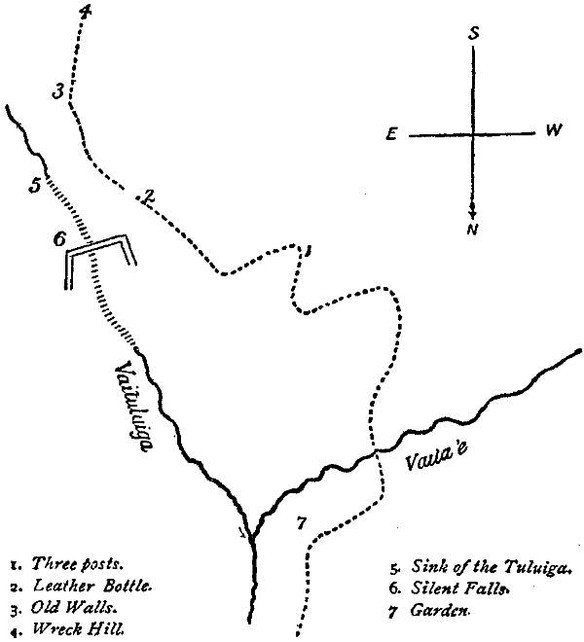
I have been exploring up the Vaituluiga; see your map. It comes down a wonderful fine glen; at least 200 feet of cliffs on either hand, winding like a corkscrew, great forest trees filling it. At the top there ought to be a fine double fall; but the stream evades it by a fault and passes underground. Above the fall it runs (at this season) full and very gaily in a shallow valley, some hundred yards before the head of the glen. Its course is seen full of grasses, like a flooded meadow; that is the sink! beyond the grave of the grasses, the bed lies dry. Near this upper part there is a great show of ruinous pig-walls; a village must have stood near by.
To walk from our house to Wreck Hill (when the path is buried in fallen trees) takes one about half an hour, I think; to return, not more than twenty minutes; I dare say fifteen. Hence I should guess it was three-quarters of a mile. I had meant to join on my explorations passing eastward by the sink; but, Lord! how it rains.
Later.—I went out this morning with a pocket compass and walked in a varying direction, perhaps on an average S. by W., 1754 paces. Then I struck into the bush, N.W. by N., hoping to strike the Vaituluiga above the falls. Now I have it plotted out I see I should have gone W. or even W. by S.; but it is not easy to guess. For 600 weary paces I struggled through the bush, and then came on the stream below the gorge, where it was comparatively easy to get down to it. In the place where I struck it, it made cascades about a little isle, and was running about N.E., 20 to 30 feet wide, as deep as to my knee, and piercing cold. I tried to follow it down, and keep the run of its direction and my paces; but when I was wading to the knees and the waist in mud, poison brush, and rotted wood, bound hand and foot in lianas, shovelled unceremoniously off the one shore and driven to try my luck upon the other—I saw I should have hard enough work to get my body down, if my mind rested. It was a damnable walk; certainly not half a mile as the crow flies, but a real bucketer for hardship. Once I had to pass the stream where it flowed between banks about three feet high. To get the easier down, I swung myself by a wild-cocoanut—(so called, it bears bunches of scarlet nutlets)—which grew upon the brink. As I so swung, I received a crack on the head that knocked me all abroad. Impossible to guess what tree had taken a shy at me. So many towered above, one over the other, and the missile, whatever it was, dropped in the stream and was gone before I had recovered my wits. (I scarce know what I write, so hideous a Niagara of rain roars, shouts, and demonizes on the iron roof—it is pitch dark too—the lamp lit at 5!) It was a blessed thing when I struck my own road; and I got home, neat for lunch time, one of the most wonderful mud statues ever witnessed. In the afternoon I tried again, going up the other path by the garden, but was early drowned out; came home, plotted out what I had done, and then wrote this truck to you.
Fanny has been quite ill with ear-ache. She won’t go,10 hating the sea at this wild season; I don’t like to leave her; so it drones on, steamer after steamer, and I guess it’ll end by no one going at all. She is in a dreadful misfortune at this hour; a case of kerosene having burst in the kitchen. A little while ago it was the carpenter’s horse that trod in a nest of fourteen eggs, and made an omelette of our hopes. The farmer’s lot is not a happy one. And it looks like some real uncompromising bad weather too. I wish Fanny’s ear were well. Think of parties in Monuments! think of me in Skerryvore, and now of this. It don’t look like a part of the same universe to me. Work is quite laid aside; I have worked myself right out.
Christmas Eve.—Yesterday, who could write? My wife near crazy with ear-ache; the rain descending in white crystal rods and playing hell’s tattoo, like a tutti of battering rams, on our sheet-iron roof; the wind passing high overhead with a strange dumb mutter, or striking us full, so that all the huge trees in the paddock cried aloud, and wrung their hands, and brandished their vast arms. The horses stood in the shed like things stupid. The sea and the flagship lying on the jaws of the bay vanished in sheer rain. All day it lasted; I locked up my papers in the iron box, in case it was a hurricane, and the house might go. We went to bed with mighty uncertain feelings; far more than on shipboard, where you have only drowning ahead—whereas here you have a smash of beams, a shower of sheet-iron, and a blind race in the dark and through a whirlwind for the shelter of an unfinished stable—and my wife with ear-ache! Well, well, this morning, we had word from Apia; a hurricane was looked for, the ships were to leave the bay by 10 A.M.; it is now 3.30, and the flagship is still a fixture, and the wind round in the blessed east, so I suppose the danger is over. But heaven is still laden; the day dim, with frequent rattling bucketfuls of rain; and just this moment (as I write) a squall went overhead, scarce striking us, with that singular, solemn noise of its passage, which is to me dreadful. I have always feared the sound of wind beyond everything. In my hell it would always blow a gale.
I have been all day correcting proofs, and making out a new plan for our house. The other was too dear to be built now, and it was a hard task to make a smaller house that would suffice for the present, and not be a mere waste of money in the future. I believe I have succeeded; I have taken care of my study anyway.
Two favours I want to ask of you. First, I wish you to get Pioneering in New Guinea, by J. Chalmers. It’s a missionary book, and has less pretensions to be literature than Spurgeon’s sermons. Yet I think even through that, you will see some of the traits of the hero that wrote it; a man that took me fairly by storm for the most attractive, simple, brave, and interesting man in the whole Pacific. He is away now to go up the Fly River; a desperate venture, it is thought; he is quite a Livingstone card.
Second, try and keep yourself free next winter; and if my means can be stretched so far, I’ll come to Egypt and we’ll meet at Shepheard’s Hotel, and you’ll put me in my place, which I stand in need of badly by this time. Lord, what bully times! I suppose I’ll come per British Asia, or whatever you call it, and avoid all cold, and might be in Egypt about November as ever was—eleven months from now or rather less. But do not let us count our chickens.
Last night three piglings were stolen from one of our pig-pens. The great Lafaele appeared to my wife uneasy, so she engaged him in conversation on the subject, and played upon him the following engaging trick. You advance your two forefingers towards the sitter’s eyes; he closes them, whereupon you substitute (on his eyelids) the fore and middle fingers of the left hand; and with your right (which he supposes engaged) you tap him on the head and back. When you let him open his eyes, he sees you withdrawing the two forefingers. “What that?” asked Lafaele. “My devil,” says Fanny. “I wake um, my devil. All right now. He go catch the man that catch my pig.” About an hour afterwards, Lafaele came for further particulars. “O, all right,” my wife says. “By and by, that man he sleep, devil go sleep same place. By and by, that man plenty sick. I no care. What for he take my pig?” Lafaele cares plenty; I don’t think he is the man, though he may be; but he knows him, and most likely will eat some of that pig to-night. He will not eat with relish.
Saturday, 27th.—It cleared up suddenly after dinner, and my wife and I saddled up and off to Apia, whence we did not return till yesterday morning. Christmas Day I wish you could have seen our party at table. H. J. Moors at one end with my wife, I at the other with Mrs. M., between us two native women, Carruthers the lawyer, Moors’s two shop-boys—Walters and A. M. the quadroon—and the guests of the evening, Shirley Baker, the defamed and much-accused man of Tonga, and his son, with the artificial joint to his arm—where the assassins shot him in shooting at his father. Baker’s appearance is not unlike John Bull on a cartoon; he is highly interesting to speak to, as I had expected; I found he and I had many common interests, and were engaged in puzzling over many of the same difficulties. After dinner it was quite pretty to see our Christmas party, it was so easily pleased and prettily behaved. In the morning I should say I had been to lunch at the German consulate, where I had as usual a very pleasant time. I shall miss Dr. Stuebel11 much when he leaves, and when Adams and Lafarge go also, it will be a great blow. I am getting spoiled with all this good society.
On Friday morning, I had to be at my house affairs before seven; and they kept me in Apia till past ten, disputing, and consulting about brick and stone and native and hydraulic lime, and cement and sand, and all sorts of otiose details about the chimney—just what I fled from in my father’s office twenty years ago; I should have made a languid engineer. Rode up with the carpenter. Ah, my wicked Jack! on Christmas Eve, as I was taking the saddle bag off, he kicked at me, and fetched me too, right on the shin. On Friday, being annoyed at the carpenter’s horse having a longer trot, he uttered a shrill cry and tried to bite him! Alas, alas, these are like old days; my dear Jack is a Bogue,12 but I cannot strangle Jack into submission.
I have given up the big house for just now; we go ahead right away with a small one, which should be ready in two months, and I suppose will suffice for just now.
O I know I haven’t told you about our aitu, have I? It is a lady, aitu fafine: she lives on the mountain-side; her presence is heralded by the sound of a gust of wind; a sound very common in the high woods; when she catches you, I do not know what happens; but in practice she is avoided, so I suppose she does more than pass the time of day. The great aitu Saumai-afe was once a living woman, and became an aitu, no one understands how; she lives in a stream at the well-head, her hair is red, she appears as a lovely young lady, her bust particularly admired, to handsome young men; these die, her love being fatal;—as a handsome youth she has been known to court damsels with the like result, but this is very rare; as an old crone she goes about and asks for water, and woe to them who are uncivil! Saumai-afe means literally, “Come here a thousand!” A good name for a lady of her manners. My aitu fafine does not seem to be in the same line of business. It is unsafe to be a handsome youth in Samoa; a young man died from her favours last month—so we said on this side of the island; on the other, where he died, it was not so certain. I, for one, blame it on Madam Saumai-afe without hesitation.
Example of the farmer’s sorrows. I slipped out on the balcony a moment ago. It is a lovely morning, cloudless, smoking hot, the breeze not yet arisen. Looking west, in front of our new house, I saw two heads of Indian corn wagging, and the rest and all nature stock still. As I looked, one of the stalks subsided and disappeared. I dashed out to the rescue; two small pigs were deep in the grass—quite hid till within a few yards—gently but swiftly demolishing my harvest. Never be a farmer.
12.30 p.m.—I while away the moments of digestion by drawing you a faithful picture of my morning. When I had done writing as above it was time to clean our house. When I am working, it falls on my wife alone, but to-day we had it between us; she did the bedroom, I the sitting-room, in fifty-seven minutes of really most unpalatable labour. Then I changed every stitch, for I was wet through, and sat down and played on my pipe till dinner was ready, mighty pleased to be in a mildly habitable spot once more. The house had been neglected for near a week, and was a hideous spot; my wife’s ear and our visit to Apia being the causes: our Paul we prefer not to see upon that theatre, and God knows he has plenty to do elsewhere.
I am glad to look out of my back door and see the boys smoothing the foundations of the new house; this is all very jolly, but six months of it has satisfied me; we have too many things for such close quarters; to work in the midst of all the myriad misfortunes of the planter’s life, seated in a Dyonisius’ (can’t spell him) ear, whence I catch every complaint, mishap and contention, is besides the devil; and the hope of a cave of my own inspires me with lust. O to be able to shut my own door and make my own confusion! O to have the brown paper and the matches and “make a hell of my own” once more!
I do not bother you with all my troubles in these outpourings; the troubles of the farmer are inspiriting—they are like difficulties out hunting—a fellow rages at the time and rejoices to recall and to commemorate them. My troubles have been financial. It is hard to arrange wisely interests so distributed. America, England, Samoa, Sydney, everywhere I have an end of liability hanging out and some shelf of credit hard by; and to juggle all these and build a dwelling-place here, and check expense—a thing I am ill fitted for—you can conceive what a nightmare it is at times. Then God knows I have not been idle. But since The Master nothing has come to raise any coins. I believe the springs are dry at home, and now I am worked out, and can no more at all. A holiday is required.
Dec. 28th.—I have got unexpectedly to work again, and feel quite dandy. Good-bye.
R. L. S.
To Henry James
Mr. Lafarge the artist and Mr. Henry Adams the historian have been mentioned already. The pinch in the matter of eatables only lasted for a little while, until Mrs. Stevenson had taken her bearings and made her arrangements in the matter of marketing, etc.
Vailima, Apia, Samoa, December 29th, 1890.
MY DEAR HENRY JAMES,—It is terrible how little everybody writes, and how much of that little disappears in the capacious maw of the Post Office. Many letters, both from and to me, I now know to have been lost in transit: my eye is on the Sydney Post Office, a large ungainly structure with a tower, as being not a hundred miles from the scene of disappearance; but then I have no proof. The Tragic Muse you announced to me as coming; I had already ordered it from a Sydney bookseller: about two months ago he advised me that his copy was in the post; and I am still tragically museless.
News, news, news. What do we know of yours? What do you care for ours? We are in the midst of the rainy season, and dwell among alarms of hurricanes, in a very unsafe little two-storied wooden box 650 feet above and about three miles from the sea-beach. Behind us, till the other slope of the island, desert forest, peaks, and loud torrents; in front green slopes to the sea, some fifty miles of which we dominate. We see the ships as they go out and in to the dangerous roadstead of Apia; and if they lie far out, we can even see their topmasts while they are at anchor. Of sounds of men, beyond those of our own labourers, there reach us, at very long intervals, salutes from the warships in harbour, the bell of the cathedral church, and the low of the conch-shell calling the labour boys on the German plantations. Yesterday, which was Sunday—the quantième is most likely erroneous; you can now correct it—we had a visitor—Baker of Tonga. Heard you ever of him? He is a great man here: he is accused of theft, rape, judicial murder, private poisoning, abortion, misappropriation of public moneys—oddly enough, not forgery, nor arson; you would be amused if you knew how thick the accusations fly in this South Sea world. I make no doubt my own character is something illustrious; or if not yet, there is a good time coming.
But all our resources have not of late been Pacific. We have had enlightened society: Lafarge the painter, and your friend Henry Adams: a great privilege—would it might endure. I would go oftener to see them, but the place is awkward to reach on horseback. I had to swim my horse the last time I went to dinner; and as I have not yet returned the clothes I had to borrow, I dare not return in the same plight: it seems inevitable—as soon as the wash comes in, I plump straight into the American consul’s shirt or trousers! They, I believe, would come oftener to see me but for the horrid doubt that weighs upon our commissariat department; we have often almost nothing to eat; a guest would simply break the bank; my wife and I have dined on one avocado pear; I have several times dined on hard bread and onions. What would you do with a guest at such narrow seasons?—eat him? or serve up a labour boy fricasseed?
Work? work is now arrested, but I have written, I should think, about thirty chapters of the South Sea book; they will all want rehandling, I dare say. Gracious, what a strain is a long book! The time it took me to design this volume, before I could dream of putting pen to paper, was excessive; and then think of writing a book of travels on the spot, when I am continually extending my information, revising my opinions, and seeing the most finely finished portions of my work come part by part in pieces. Very soon I shall have no opinions left. And without an opinion, how to string artistically vast accumulations of fact? Darwin said no one could observe without a theory; I suppose he was right; ’tis a fine point of metaphysic; but I will take my oath, no man can write without one—at least the way he would like to, and my theories melt, melt, melt, and as they melt the thaw-waters wash down my writing, and leave unideal tracts—wastes instead of cultivated farms.
Kipling is by far the most promising young man who has appeared since—ahem—I appeared. He amazes me by his precocity and various endowment. But he alarms me by his copiousness and haste. He should shield his fire with both hands “and draw up all his strength and sweetness in one ball.” (“Draw all his strength and all His sweetness up into one ball”? I cannot remember Marvell’s words.) So the critics have been saying to me: but I was never capable of—and surely never guilty of—such a debauch of production. At this rate his works will soon fill the habitable globe; and surely he was armed for better conflicts than these succinct sketches and flying leaves of verse? I look on, I admire, I rejoice for myself; but in a kind of ambition we all have for our tongue and literature I am wounded. If I had this man’s fertility and courage, it seems to me I could heave a pyramid.
Well, we begin to be the old fogies now; and it was high time something rose to take our places. Certainly Kipling has the gifts; the fairy godmothers were all tipsy at his christening: what will he do with them?
Good-bye, my dear James; find an hour to write to us, and register your letter.—Yours affectionately,
R. L. S.
To Rudyard Kipling
In 1890, on first becoming acquainted with Mr. Kipling’s Soldiers Three, Stevenson had written off his congratulations red-hot. “Well and indeed, Mr. Mulvaney,” so ran the first sentences of his note, “but it’s as good as meat to meet in with you, sir. They tell me it was a man of the name of Kipling made ye; but indeed and they can’t fool me; it was the Lord God Almighty that made you.” Taking the cue thus offered, Mr. Kipling had written back in the character of his own Irishman, Thomas Mulvaney, addressing Stevenson’s Highlander, Alan Breck Stewart. In the following letter, which belongs to an uncertain date in 1891, Alan Breck is made to reply. “The gentleman I now serve with” means, of course, R. L. S. himself.
[Vailima, 1891.]
SIR,—I cannot call to mind having written you, but I am so throng with occupation this may have fallen aside. I never heard tell I had any friends in Ireland, and I am led to understand you are come of no considerable family. The gentleman I now serve with assures me, however, you are a very pretty fellow and your letter deserves to be remarked. It’s true he is himself a man of a very low descent upon the one side; though upon the other he counts cousinship with a gentleman, my very good friend, the late Mr. Balfour of the Shaws, in the Lothian; which I should be wanting in good fellowship to forget. He tells me besides you are a man of your hands; I am not informed of your weapon; but if all be true it sticks in my mind I would be ready to make exception in your favour, and meet you like one gentleman with another. I suppose this’ll be your purpose in your favour, which I could very ill make out; it’s one I would be sweir to baulk you of. It seems, Mr. McIlvaine, which I take to be your name, you are in the household of a gentleman of the name of Coupling: for whom my friend is very much engaged. The distances being very uncommodious, I think it will be maybe better if we leave it to these two to settle all that’s necessary to honour. I would have you to take heed it’s a very unusual condescension on my part, that bear a King’s name; and for the matter of that I think shame to be mingled with a person of the name of Coupling, which is doubtless a very good house but one I never heard tell of, any more than Stevenson. But your purpose being laudable, I would be sorry (as the word goes) to cut off my nose to spite my face.—I am, Sir, your humble servant,
A. Stewart,
Chevalier de St. Louis.
To Mr. M’Ilvaine,
Gentleman Private in a foot regiment,
under cover to Mr. Coupling.
He has read me some of your Barrack Room Ballants, which are not of so noble a strain as some of mine in the Gaelic, but I could set some of them to the pipes if this rencounter goes as it’s to be desired. Let’s first, as I understand you to move, do each other this rational courtesy; and if either will survive, we may grow better acquaint. For your tastes for what’s martial and for poetry agree with mine.
A. S.
To Sidney Colvin
This is the first appearance in Stevenson’s letters of the Swedish Chief Justice of Samoa, Mr. Conrad Cedercrantz, of whom we shall hear enough and more than enough in the sequel.
S.S. Lübeck, between Apia and Sydney,
Jan. 17th, 1891.
MY DEAR COLVIN,—The Faamasino Sili, or Chief Justice, to speak your low language, has arrived. I had ridden down with Henry and Lafaele; the sun was down, the night was close at hand, so we rode fast; just as I came to the corner of the road before Apia, I heard a gun fire; and lo, there was a great crowd at the end of the pier, and the troops out, and a chief or two in the height of Samoa finery, and Seumanu coming in his boat (the oarsmen all in uniform), bringing the Faamasino Sili sure enough. It was lucky he was no longer; the natives would not have waited many weeks. But think of it, as I sat in the saddle at the outside of the crowd (looking, the English consul said, as if I were commanding the manœuvres), I was nearly knocked down by a stampede of the three consuls; they had been waiting their guest at the Matafele end, and some wretched intrigue among the whites had brought him to Apia, and the consuls had to run all the length of the town and come too late.
The next day was a long one; I was at a marriage of Gurr the banker to Fanua, the virgin of Apia. Bride and bridesmaids were all in the old high dress; the ladies were all native; the men, with the exception of Seumanu, all white.
It was quite a pleasant party, and while we were writing, we had a bird’s-eye view of the public reception of the Chief Justice. The best part of it were some natives in war array; with blacked faces, turbans, tapa kilts, and guns, they looked very manly and purposelike. No, the best part was poor old drunken Joe, the Portuguese boatman, who seemed to think himself specially charged with the reception, and ended by falling on his knees before the Chief Justice on the end of the pier and in full view of the whole town and bay. The natives pelted him with rotten bananas; how the Chief Justice took it I was too far off to see; but it was highly absurd.
I have commemorated my genial hopes for the regimen of the Faamasino Sili in the following canine verses, which, if you at all guess how to read them, are very pretty in movement, and (unless he be a mighty good man) too true in sense.
We’re quarrelling, the villages, we’ve beaten the wooden drums,
Sa femisai o nu’u, sa taia o pate,
Is confounded thereby the justice,
Ua atuatuvale a le faamasino e,
The chief justice, the terrified justice,
Le faamasino sili, le faamasino se,
Is on the point of running away the justice,
O le a solasola le faamasino e,
The justice denied any influence, the terrified justice,
O le faamasino le ai a, le faamasino se,
O le a solasola le faamasino e.
Well, after this excursion into tongues that have never been alive—though I assure you we have one capital book in the language, a book of fables by an old missionary of the unpromising name of Pratt, which is simply the best and the most literary version of the fables known to me. I suppose I should except La Fontaine, but L. F. takes a long time; these are brief as the books of our childhood, and full of wit and literary colour; and O, Colvin, what a tongue it would be to write, if one only knew it—and there were only readers. Its curse in common use is an incredible left-handed wordiness; but in the hands of a man like Pratt it is succinct as Latin, compact of long rolling polysyllables and little and often pithy particles, and for beauty of sound a dream. Listen, I quote from Pratt—this is good Samoan, not canine—

1 almost wa, 2 the two a’s just distinguished, 3 the ai is practically suffixed to the verb, 4 almost vow. The excursion has prolonged itself.
I started by the Lübeck to meet Lloyd and my mother; there were many reasons for and against; the main reason against was the leaving of Fanny alone in her blessed cabin, which has been somewhat remedied by my carter, Mr. ——, putting up in the stable and messing with her; but perhaps desire of change decided me not well, though I do think I ought to see an oculist, being very blind indeed, and sometimes unable to read. Anyway I left, the only cabin passenger, four and a kid in the second cabin, and a dear voyage it had like to have proved. Close to Fiji (choose a worse place on the map) we broke our shaft early one morning; and when or where we might expect to fetch land or meet with any ship, I would like you to tell me. The Pacific is absolutely desert. I have sailed there now some years; and scarce ever seen a ship except in port or close by; I think twice. It was the hurricane season besides, and hurricane waters. Well, our chief engineer got the shaft—it was the middle crank shaft—mended; thrice it was mended, and twice broke down; but now keeps up—only we dare not stop, for it is almost impossible to start again. The captain in the meanwhile crowded her with sail; fifteen sails in all, every stay being gratified with a stay-sail, a boat-boom sent aloft for a maintop-gallant yard, and the derrick of a crane brought in service as bowsprit. All the time we have had a fine, fair wind and a smooth sea; to-day at noon our run was 203 miles (if you please!), and we are within some 360 miles of Sydney. Probably there has never been a more gallant success; and I can say honestly it was well worked for. No flurry, no high words, no long faces; only hard work and honest thought; a pleasant, manly business to be present at. All the chances were we might have been six weeks—ay, or three months at sea—or never turned up at all, and now it looks as though we should reach our destination some five days too late.
To Marcel Schwob
Sydney, January 19th,1891.
MY DEAR SIR,—Sapristi, comme vous y allez! Richard III. and Dumas, with all my heart: but not Hamlet. Hamlet is great literature; Richard III. a big, black, gross, sprawling melodrama, writ with infinite spirit but with no refinement or philosophy by a man who had the world, himself, mankind, and his trade still to learn. I prefer the Vicomte de Bragelonne to Richard III.; it is better done of its kind: I simply do not mention the Vicomte in the same part of the building with Hamlet, or Lear, or Othello, or any of those masterpieces that Shakespeare survived to give us.
Also, comme vous y allez in my commendation! I fear my solide éducation classique had best be described, like Shakespeare’s, as “little Latin and no Greek” and I was educated, let me inform you, for an engineer. I shall tell my bookseller to send you a copy of Memories and Portraits, where you will see something of my descent and education, as it was, and hear me at length on my dear Vicomte. I give you permission gladly to take your choice out of my works, and translate what you shall prefer, too much honoured that so clever a young man should think it worth the pains. My own choice would lie between Kidnapped and the Master of Ballantrae. Should you choose the latter, pray do not let Mrs. Henry thrust the sword up to the hilt in the frozen ground—one of my inconceivable blunders, an exaggeration to stagger Hugo. Say “she sought to thrust it in the ground.” In both these works you should be prepared for Scotticisms used deliberately.
I fear my stepson will not have found time to get to Paris; he was overwhelmed with occupation, and is already on his voyage back. We live here in a beautiful land, amid a beautiful and interesting people. The life is still very hard: my wife and I live in a two-roomed cottage, about three miles and six hundred and fifty feet above the sea; we have had to make the road to it; our supplies are very imperfect; in the wild weather of this (the hurricane) season we have much discomfort: one night the wind blew in our house so outrageously that we must sit in the dark; and as the sound of the rain on the roof made speech inaudible, you may imagine we found the evening long. All these things, however, are pleasant to me. You say l’artiste inconscient set off to travel: you do not divide me right. 0.6 of me is artist; 0.4, adventurer. First, I suppose, come letters; then adventure; and since I have indulged the second part, I think the formula begins to change: 0.55 of an artist, 0.45 of the adventurer were nearer true. And if it had not been for my small strength, I might have been a different man in all things.
Whatever you do, do not neglect to send me what you publish on Villon: I look forward to that with lively interest. I have no photograph at hand, but I will send one when I can. It would be kind if you would do the like, for I do not see much chance of our meeting in the flesh: and a name, and a handwriting, and an address, and even a style? I know about as much of Tacitus, and more of Horace; it is not enough between contemporaries, such as we still are. I have just remembered another of my books, which I re-read the other day, and thought in places good—Prince Otto. It is not as good as either of the others; but it has one recommendation—it has female parts, so it might perhaps please better in France.
I will ask Chatto to send you, then—Prince Otto, Memories and Portraits, Underwoods, and Ballads, none of which you seem to have seen. They will be too late for the New Year: let them be an Easter present.
You must translate me soon; you will soon have better to do than to transvase the work of others.—Yours very truly,
Robert Louis Stevenson,
With the worst pen in the South Pacific.
To Charles Baxter
Stevenson had been indignant with an old friend at Edinburgh, who had received much kindness from his mother, for neglecting to call on her after her return from her wanderings in the Pacific.
S.S. Lübeck, at sea [on the return voyage from Sydney, February 1891].
MY DEAR CHARLES,—Perhaps in my old days I do grow irascible; “the old man virulent” has long been my pet name for myself. Well, the temper is at least all gone now; time is good at lowering these distemperatures; far better is a sharp sickness, and I am just (and scarce) afoot again after a smoking hot little malady at Sydney. And the temper being gone, I still think the same.... We have not our parents for ever; we are never very good to them; when they go and we have lost our front-file man we begin to feel all our neglects mighty sensibly. I propose a proposal. My mother is here on board with me; to-day for once I mean to make her as happy as I am able, and to do that which I know she likes. You, on the other hand, go and see your father, and do ditto, and give him a real good hour or two. We shall both be glad hereafter.—Yours ever,
R. L. S.
To Sidney Colvin
Stevenson had been sharply ailing as usual at Sydney, and was now on his way back. Having received proofs of some of his South Sea chapters, he had begun to realise that they were not what he had hoped to make them.
[On Board Ship between Sydney and Apia, February1891.]
MY DEAR COLVIN,—The Janet Nicoll stuff was rather worse than I had looked for; you have picked out all that is fit to stand, bar two others (which I don’t dislike)—the Port of Entry and the House of Temoana; that is for a present opinion; I may condemn these also ere I have done. By this time you should have another Marquesan letter, the worst of the lot, I think; and seven Paumotu letters, which are not far out of the vein, as I wish it; I am in hopes the Hawaiian stuff is better yet: time will show, and time will make perfect. Is something of this sort practicable for the dedication?
TERRA MARIQUE PER PERICULA PER ARDUA AMICAE COMITI D.D. AMANS VIATOR
’Tis a first shot concocted this morning in my berth: I had always before been trying it in English, which insisted on being either insignificant or fulsome: I cannot think of a better word than comes, there being not the shadow of a Latin book on board; yet sure there is some other. Then viator (though it sounds all right) is doubtful; it has too much, perhaps, the sense of wayfarer? Last, will it mark sufficiently that I mean my wife? And first, how about blunders? I scarce wish it longer.
Have had a swingeing sharp attack in Sydney; beating the fields13 for two nights, Saturday and Sunday. Wednesday was brought on board, tel quel, a wonderful wreck; and now, Wednesday week, am a good deal picked up, but yet not quite a Samson, being still groggy afoot and vague in the head. My chess, for instance, which is usually a pretty strong game, and defies all rivalry aboard, is vacillating, devoid of resource and observation, and hitherto not covered with customary laurels. As for work, it is impossible. We shall be in the saddle before long, no doubt, and the pen once more couched. You must not expect a letter under these circumstances, but be very thankful for a note. Once at Samoa, I shall try to resume my late excellent habits, and delight you with journals, you unaccustomed, I unaccustomed; but it is never too late to mend.
It is vastly annoying that I cannot go even to Sydney without an attack; and heaven knows my life was anodyne. I only once dined with anybody; at the club with Wise; worked all morning—a terrible dead pull; a month only produced the imperfect embryos of two chapters; lunched in the boarding-house, played on my pipe; went out and did some of my messages; dined at a French restaurant, and returned to play draughts, whist, or Van John with my family. This makes a cheery life after Samoa; but it isn’t what you call burning the candle at both ends, is it? (It appears to me not one word of this letter will be legible by the time I am done with it, this dreadful ink rubs off.) I have a strange kind of novel under construction; it begins about 1660 and ends 1830, or perhaps I may continue it to 1875 or so, with another life. One, two, three, four, five, six generations, perhaps seven, figure therein; two of my old stories, “Delafield” and “Shovel,” are incorporated; it is to be told in the third person, with some of the brevity of history, some of the detail of romance. The Shovels of Newton French will be the name. The idea is an old one; it was brought to birth by an accident; a friend in the islands who picked up F. Jenkin,14 read a part, and said: “Do you know, that’s a strange book? I like it; I don’t believe the public will; but I like it.” He thought it was a novel! “Very well,” said I, “we’ll see whether the public will like it or not; they shall have the chance.”—Yours ever,
R. L. S.
To H. B. Baildon
The late Mr. H. Bellyse Baildon, for some time Lecturer on English Literature at the University of Vienna and afterwards at Dundee, had been an old schoolmate and fellow-aspirant in literature with Stevenson at Edinburgh. “Chalmers,” of course, is the Rev. James Chalmers of Rarotonga and New Guinea already referred to above, the admirable missionary, explorer, and administrator, whom Stevenson sometimes expressed a desire to survive, for the sake only of writing his life.
Vailima, Upolu [Spring 1891].
MY DEAR BAILDON,—This is a real disappointment. It was so long since we had met, I was anxious to see where time had carried and stranded us. Last time we saw each other—it must have been all ten years ago, as we were new to the thirties—it was only for a moment, and now we’re in the forties, and before very long we shall be in our graves. Sick and well, I have had a splendid life of it, grudge nothing, regret very little—and then only some little corners of misconduct for which I deserve hanging, and must infallibly be damned—and, take it all over, damnation and all, would hardly change with any man of my time, unless perhaps it were Gordon or our friend Chalmers: a man I admire for his virtues, love for his faults, and envy for the really A1 life he has, with everything heart—my heart, I mean—could wish. It is curious to think you will read this in the grey metropolis; go the first grey, east-windy day into the Caledonian Station, if it looks at all as it did of yore: I met Satan there. And then go and stand by the cross, and remember the other one—him that went down—my brother, Robert Fergusson. It is a pity you had not made me out, and seen me as patriarch and planter. I shall look forward to some record of your time with Chalmers: you can’t weary me of that fellow, he is as big as a house and far bigger than any church, where no man warms his hands. Do you know anything of Thomson? Of A——, B——, C——, D——, E——, F——, at all? As I write C.’s name mustard rises in my nose; I have never forgiven that weak, amiable boy a little trick he played me when I could ill afford it: I mean that whenever I think of it, some of the old wrath kindles, not that I would hurt the poor soul, if I got the world with it. And Old X——? Is he still afloat? Harmless bark! I gather you ain’t married yet, since your sister, to whom I ask to be remembered, goes with you. Did you see a silly tale, John Nicholson’s Predicament,15 or some such name, in which I made free with your home at Murrayfield? There is precious little sense in it, but it might amuse. Cassell’s published it in a thing called Yule-Tide years ago, and nobody that ever I heard of read or has ever seen Yule-Tide. It is addressed to a class we never met—readers of Cassell’s series and that class of conscientious chaff, and my tale was dull, though I don’t recall that it was conscientious. Only, there’s the house at Murrayfield and a dead body in it. Glad the Ballads amused you. They failed to entertain a coy public, at which I wondered; not that I set much account by my verses, which are the verses of Prosator; but I do know how to tell a yarn, and two of the yarns are great. Rahero is for its length a perfect folk-tale: savage and yet fine, full of tailforemost morality, ancient as the granite rocks; if the historian, not to say the politician, could get that yarn into his head, he would have learned some of his ABC. But the average man at home cannot understand antiquity; he is sunk over the ears in Roman civilisation; and a tale like that of Rahero falls on his ears inarticulate. The Spectator said there was no psychology in it; that interested me much: my grandmother (as I used to call that able paper, and an able paper it is, and a fair one) cannot so much as observe the existence of savage psychology when it is put before it. I am at bottom a psychologist and ashamed of it; the tale seized me one-third because of its picturesque features, two-thirds because of its astonishing psychology, and the Spectator says there’s none. I am going on with a lot of island work, exulting in the knowledge of a new world, “a new created world” and new men; and I am sure my income will DECLINE and FALL off; for the effort of comprehension is death to the intelligent public, and sickness to the dull.
I do not know why I pester you with all this trash, above all as you deserve nothing. I give you my warm talofa (“my love to you,” Samoan salutation). Write me again when the spirit moves you. And some day, if I still live, make out the trip again and let us hob-a-nob with our grey pows on my verandah.—Yours sincerely,
Robert Louis Stevenson.
To Sidney Colvin
15 The Misadventures of John Nicholson.
14 Memoir of Fleeming Jenkin, by R. L. S., prefixed to Papers Literary, Scientific, etc., by the late Fleeming Jenkin, F.R.S., LL.D.; 2 vols. London, Longmans, 1887. The first chapters consist of a genealogical history of the family. This, to my mind one of the best works of R. L. S., has lately been separately reprinted, having long been accessible only in the Edinburgh and Pentland editions. Of Delafleld I never heard; the plan of Shovel, which was to be in great part a story of the Peninsular War, had been sketched out and a few chapters written as long ago as the seventies.
10 On a projected expedition to Sydney.
13 Battre les champs, to wander in mind.
12 One of the many aliases of the wicked Skye-terrier of Hyères, Davos, and Bournemouth days, celebrated in the essay On the Character of Dogs.
11 See A Footnote to History for more in praise of Dr. Stuebel, and of his exceptional deserts among white officials in Samoa.
The latter part of this letter was written in the course of an expedition on which Stevenson had been invited by the American Consul, Mr. Sewall, to the neighbouring island of Tutuila. Unluckily the letter breaks off short, and the only record of this trip occurs in the diary partly quoted in Mr. Balfour’s Life, ch. xiv.
Vailima, Friday, March 19th [1891].
MY DEAR S. C.,—You probably expect that now I am back at Vailima I shall resume the practice of the diary letter. A good deal is changed. We are more; solitude does not attend me as before; the night is passed playing Van John for shells; and, what is not less important, I have just recovered from a severe illness, and am easily tired.
I will give you to-day. I sleep now in one of the lower rooms of the new house, where my wife has recently joined me. We have two beds, an empty case for a table, a chair, a tin basin, a bucket and a jug; next door in the dining-room, the carpenters camp on the floor, which is covered with their mosquito nets. Before the sun rises, at 5.45 or 5.50, Paul brings me tea, bread, and a couple of eggs; and by about six I am at work. I work in bed—my bed is of mats, no mattress, sheets, or filth—mats, a pillow, and a blanket—and put in some three hours. It was 9.5 this morning when I set off to the stream-side to my weeding; where I toiled, manuring the ground with the best enricher, human sweat, till the conch-shell was blown from our verandah at 10.30. At eleven we dine; about half-past twelve I tried (by exception) to work again, could make nothing on’t, and by one was on my way to the weeding, where I wrought till three. Half-past five is our next meal, and I read Flaubert’s Letters till the hour came round; dined, and then, Fanny having a cold, and I being tired, came over to my den in the unfinished house, where I now write to you, to the tune of the carpenters’ voices, and by the light—I crave your pardon—by the twilight of three vile candles filtered through the medium of my mosquito bar. Bad ink being of the party, I write quite blindfold, and can only hope you may be granted to read that which I am unable to see while writing.
I said I was tired; it is a mild phrase; my back aches like toothache; when I shut my eyes to sleep, I know I shall see before them—a phenomenon to which both Fanny and I are quite accustomed—endless vivid deeps of grass and weed, each plant particular and distinct, so that I shall lie inert in body, and transact for hours the mental part of my day business, choosing the noxious from the useful. And in my dreams I shall be hauling on recalcitrants, and suffering stings from nettles, stabs from citron thorns, fiery bites from ants, sickening resistances of mud and slime, evasions of slimy roots, dead weight of heat, sudden puffs of air, sudden starts from bird-calls in the contiguous forest—some mimicking my name, some laughter, some the signal of a whistle, and living over again at large the business of my day.
Though I write so little, I pass all my hours of field-work in continual converse and imaginary correspondence. I scarce pull up a weed, but I invent a sentence on the matter to yourself; it does not get written; autant en emportent les vents; but the intent is there, and for me (in some sort) the companionship. To-day, for instance, we had a great talk. I was toiling, the sweat dripping from my nose, in the hot fit after a squall of rain: methought you asked me—frankly, was I happy. Happy (said I); I was only happy once; that was at Hyères; it came to an end from a variety of reasons, decline of health, change of place, increase of money, age with his stealing steps; since then, as before then, I know not what it means. But I know pleasure still; pleasure with a thousand faces, and none perfect, a thousand tongues all broken, a thousand hands, and all of them with scratching nails. High among these I place this delight of weeding out here alone by the garrulous water, under the silence of the high wood, broken by incongruous sounds of birds. And take my life all through, look at it fore and back, and upside down,—though I would very fain change myself—I would not change my circumstances, unless it were to bring you here. And yet God knows perhaps this intercourse of writing serves as well; and I wonder, were you here indeed, would I commune so continually with the thought of you. I say “I wonder” for a form; I know, and I know I should not.
So far, and much further, the conversation went, while I groped in slime after viscous roots, nursing and sparing little spears of grass, and retreating (even with outcry) from the prod of the wild lime. I wonder if any one had ever the same attitude to Nature as I hold, and have held for so long? This business fascinates me like a tune or a passion; yet all the while I thrill with a strong distaste. The horror of the thing, objective and subjective, is always present to my mind; the horror of creeping things, a superstitious horror of the void and the powers about me, the horror of my own devastation and continual murders. The life of the plants comes through my finger-tips, their struggles go to my heart like supplications. I feel myself blood-boltered; then I look back on my cleared grass, and count myself an ally in a fair quarrel, and make stout my heart.
It is but a little while since I lay sick in Sydney, beating the fields about the navy and Dean Swift and Dryden’s Latin hymns; judge if I love this reinvigorating climate, where I can already toil till my head swims and every string in the poor jumping Jack (as he now lies in bed) aches with a kind of yearning strain, difficult to suffer in quiescence.
As for my damned literature,16 God knows what a business it is, grinding along without a scrap of inspiration or a note of style. But it has to be ground, and the mill grinds exceeding slowly though not particularly small. The last two chapters have taken me considerably over a month, and they are still beneath pity. This I cannot continue, time not sufficing; and the next will just have to be worse. All the good I can express is just this; some day, when style revisits me, they will be excellent matter to rewrite. Of course, my old cure of a change of work would probably answer, but I cannot take it now. The treadmill turns; and, with a kind of desperate cheerfulness, I mount the idle stair. I haven’t the least anxiety about the book; unless I die, I shall find the time to make it good; but the Lord deliver me from the thought of the Letters! However, the Lord has other things on hand; and about six to-morrow, I shall resume the consideration practically, and face (as best I may) the fact of my incompetence and disaffection to the task. Toil I do not spare; but fortune refuses me success. We can do more, Whatever-his-name-was, we can deserve it. But my misdesert began long since, by the acceptation of a bargain quite unsuitable to all my methods.17
To-day I have had a queer experience. My carter has from the first been using my horses for his own ends; when I left for Sydney, I put him on his honour to cease, and my back was scarce turned ere he was forfeit. I have only been waiting to discharge him; and to-day an occasion arose. I am so much the old man virulent, so readily stumble into anger, that I gave a deal of consideration to my bearing, and decided at last to imitate that of the late ——. Whatever he might have to say, this eminently effective controversialist maintained a frozen demeanour and a jeering smile. The frozen demeanour is beyond my reach; but I could try the jeering smile; did so, perceived its efficacy, kept in consequence my temper, and got rid of my friend, myself composed and smiling still, he white and shaking like an aspen. He could explain everything; I said it did not interest me. He said he had enemies; I said nothing was more likely. He said he was calumniated; with all my heart, said I, but there are so many liars, that I find it safer to believe them. He said, in justice to himself, he must explain: God forbid I should interfere with you, said I, with the same factitious grin, but it can change nothing. So I kept my temper, rid myself of an unfaithful servant, found a method of conducting similar interviews in the future, and fell in my own liking. One thing more: I learned a fresh tolerance for the dead ——; he too had learned—perhaps had invented—the trick of this manner; God knows what weakness, what instability of feeling, lay beneath. Ce que c’est que de nous! poor human nature; that at past forty I must adjust this hateful mask for the first time, and rejoice to find it effective; that the effort of maintaining an external smile should confuse and embitter a man’s soul.
To-day I have not weeded; I have written instead from six till eleven, from twelve till two; with the interruption of the interview aforesaid; a damned Letter is written for the third time; I dread to read it, for I dare not give it a fourth chance—unless it be very bad indeed. Now I write you from my mosquito curtain, to the song of saws and planes and hammers, and wood clumping on the floor above; in a day of heavenly brightness; a bird twittering near by; my eye, through the open door, commanding green meads, two or three forest trees casting their boughs against the sky, a forest-clad mountain-side beyond, and close in by the door-jamb a nick of the blue Pacific. It is March in England, bleak March, and I lie here with the great sliding doors wide open in an undershirt and p’jama trousers, and melt in the closure of mosquito bars, and burn to be out in the breeze. A few torn clouds—not white, the sun has tinged them a warm pink—swim in heaven. In which blessed and fair day, I have to make faces and speak bitter words to a man—who has deceived me, it is true—but who is poor, and older than I, and a kind of a gentleman too. On the whole, I prefer the massacre of weeds.
Sunday.—When I had done talking to you yesterday, I played on my pipe till the conch sounded, then went over to the old house for dinner, and had scarce risen from table ere I was submerged with visitors. The first of these despatched, I spent the rest of the evening going over the Samoan translation of my Bottle Imp18 with Claxton the missionary; then to bed, but being upset, I suppose, by these interruptions, and having gone all day without my weeding, not to sleep. For hours I lay awake and heard the rain fall, and saw faint, far-away lightning over the sea, and wrote you long letters which I scorn to reproduce. This morning Paul was unusually early; the dawn had scarce begun when he appeared with the tray and lit my candle; and I had breakfasted and read (with indescribable sinkings) the whole of yesterday’s work before the sun had risen. Then I sat and thought, and sat and better thought. It was not good enough, nor good; it was as slack as journalism, but not so inspired; it was excellent stuff misused, and the defects stood gross on it like humps upon a camel. But could I, in my present disposition, do much more with it? in my present pressure for time, were I not better employed doing another one about as ill, than making this some thousandth fraction better? Yes, I thought; and tried the new one, and behold, I could do nothing: my head swims, words do not come to me, nor phrases, and I accepted defeat, packed up my traps, and turned to communicate the failure to my esteemed correspondent. I think it possible I overworked yesterday. Well, we’ll see to-morrow—perhaps try again later. It is indeed the hope of trying later that keeps me writing to you. If I take to my pipe, I know myself—all is over for the morning. Hurray, I’ll correct proofs!
Pago-Pago, Wednesday.—After I finished on Sunday I passed a miserable day; went out weeding, but could not find peace. I do not like to steal my dinner, unless I have given myself a holiday in a canonical manner; and weeding after all is only fun, the amount of its utility small, and the thing capable of being done faster and nearly as well by a hired boy. In the evening Sewall came up (American consul) and proposed to take me on a malaga,19 which I accepted. Monday I rode down to Apia, was nearly all day fighting about drafts and money; the silver problem does not touch you, but it is (in a strange and I hope passing phase) making my situation difficult in Apia.
About eleven, the flags were all half-masted; it was old Captain Hamilton (Samasoni the natives called him) who had passed away. In the evening I walked round to the U.S. consulate; it was a lovely night with a full moon; and as I got round to the hot corner of Matautu I heard hymns in front. The balcony of the dead man’s house was full of women singing; Mary (the widow, a native) sat on a chair by the doorstep, and I was set beside her on a bench, and next to Paul the carpenter; as I sat down I had a glimpse of the old captain, who lay in a sheet on his own table. After the hymn was over, a native pastor made a speech which lasted a long while; the light poured out of the door and windows; the girls were sitting clustered at my feet; it was choking hot. After the speech was ended, Mary carried me within; the captain’s hands were folded on his bosom, his face and head were composed; he looked as if he might speak at any moment; I have never seen this kind of waxwork so express or more venerable; and when I went away, I was conscious of a certain envy for the man who was out of the battle. All night it ran in my head, and the next day when we sighted Tutuila, and ran into this beautiful landlocked loch of Pago Pago (whence I write), Captain Hamilton’s folded hands and quiet face said a great deal more to me than the scenery.
I am living here in a trader’s house; we have a good table, Sewall doing things in style; and I hope to benefit by the change, and possibly get more stuff for Letters. In the meanwhile, I am seized quite mal-à-propos with desire to write a story, The Bloody Wedding, founded on fact—very possibly true, being an attempt to read a murder case—not yet months old, in this very place and house where I now write. The indiscretion is what stops me; but if I keep on feeling as I feel just now it will have to be written. Three Star Nettison, Kit Nettison, Field the Sailor, these are the main characters: old Nettison, and the captain of the man of war, the secondary. Possible scenario. Chapter I....
To Sidney Colvin
Saturday, April 18th [1891].
MY DEAR COLVIN,—I got back on Monday night, after twenty-three hours in an open boat; the keys were lost; the consul (who had promised us a bottle of Burgundy) nobly broke open his storeroom, and we got to bed about midnight. Next morning the blessed consul promised us horses for the daybreak; forgot all about it, worthy man; set us off at last in the heat of the day, and by a short cut which caused infinite trouble, and we were not home till dinner. I was extenuated, and have had a high fever since, or should have been writing before. To-day for the first time, I risk it. Tuesday I was pretty bad; Wednesday had a fever to kill a horse; Thursday I was better, but still out of ability to do aught but read awful trash. This is the time one misses civilisation; I wished to send out for some police novels; Montépin would have about suited my frozen brain. It is a bother when all one’s thought turns on one’s work in some sense or other; I could not even think yesterday; I took to inventing dishes by way of entertainment. Yesterday, while I lay asleep in the afternoon, a very lucky thing happened; the Chief Justice came to call; met one of our employés on the road; and was shown what I had done to the road.
“Is this the road across the island?” he asked.
“The only one,” said Innes.
“And has one man done all this?”
“Three times,” said the trusty Innes. “It has had to be made three times, and when Mr. Stevenson came, it was a track like what you see beyond.”
“This must be put right,” said the Chief Justice.
Sunday.—The truth is, I broke down yesterday almost as soon as I began, and have been surreptitiously finishing the entry to-day. For all that I was much better, ate all the time, and had no fever. The day was otherwise uneventful. I am reminded; I had another visitor on Friday; and Fanny and Lloyd, as they returned from a forest raid, met in our desert, untrodden road, first Father Didier, Keeper of the conscience of Mataafa, the rising star; and next the Chief Justice, sole stay of Laupepa, the present and unsteady star, and remember, a few days before we were close to the sick bed and entertained by the amateur physician of Tamasese, the late and sunken star. “That is the fun of this place,” observed Lloyd; “everybody you meet is so important.” Everybody is also so gloomy. It will come to war again, is the opinion of all the well informed—and before that to many bankruptcies; and after that, as usual, to famine. Here, under the microscope, we can see history at work.
Wednesday.—I have been very neglectful. A return to work, perhaps premature, but necessary, has used up all my possible energies, and made me acquainted with the living headache. I just jot down some of the past notabilia. Yesterday B., a carpenter, and K., my (unsuccessful) white man, were absent all morning from their work; I was working myself, where I hear every sound with morbid certainty, and I can testify that not a hammer fell. Upon inquiry I found they had passed the morning making ice with our ice machine and taking the horizon with a spirit level! I had no sooner heard this than—a violent headache set in; I am a real employer of labour now, and have much of the ship captain when aroused; and if I had a headache, I believe both these gentlemen had aching hearts. I promise you, the late —— was to the front; and K., who was the most guilty, yet (in a sense) the least blameable, having the brains and character of a canary-bird, fared none the better for B.’s repartees. I hear them hard at work this morning, so the menace may be blessed. It was just after my dinner, just before theirs, that I administered my redoubtable tongue—it is really redoubtable—to these skulkers. (Paul used to triumph over Mr. J. for weeks. “I am very sorry for you,” he would say; “you’re going to have a talk with Mr. Stevenson when he comes home: you don’t know what that is!”) In fact, none of them do, till they get it. I have known K., for instance, for months; he has never heard me complain, or take notice, unless it were to praise; I have used him always as my guest, and there seems to be something in my appearance which suggests endless, ovine long-suffering! We sat in the upper verandah all evening, and discussed the price of iron roofing, and the state of the draught-horses, with Innes, a new man we have taken, and who seems to promise well.
One thing embarrasses me. No one ever seems to understand my attitude about that book; the stuff sent was never meant for other than a first state; I never meant it to appear as a book. Knowing well that I have never had one hour of inspiration since it was begun, and have only beaten out my metal by brute force and patient repetition, I hoped some day to get a “spate of style” and burnish it—fine mixed metaphor. I am now so sick that I intend, when the Letters are done and some more written that will be wanted, simply to make a book of it by the pruning-knife. I cannot fight longer; I am sensible of having done worse than I hoped, worse than I feared; all I can do now is to do the best I can for the future, and clear the book, like a piece of bush, with axe and cutlass. Even to produce the MS. of this will occupy me, at the most favourable opinion, till the middle of next year; really five years were wanting, when I could have made a book; but I have a family, and—perhaps I could not make the book after all.
To W. Craibe Angus
The late Mr. Craibe Angus of Glasgow was one of the chief organisers of the Burns Exhibition in that city, and had proposed to send out to Samoa a precious copy of the Jolly Beggars to receive the autograph of R. L. S. and be returned for the purposes of that Exhibition. The line quoted, “But still our hearts are true,” etc., should, it appears, run, “But still the blood is strong, the heart is Highland.” The author of the Canadian Boat Song which opens thus was Hugh, twelfth Earl of Eglinton. The first quotation is of course from Burns.
Vailima, Samoa, April 1891.
DEAR MR. ANGUS,—Surely I remember you! It was W. C. Murray who made us acquainted, and we had a pleasant crack. I see your poet is not yet dead. I remember even our talk—or you would not think of trusting that invaluable Jolly Beggars to the treacherous posts, and the perils of the sea, and the carelessness of authors. I love the idea, but I could not bear the risk. However—
“Hale be your heart, hale be your fiddle—”
it was kindly thought upon.
My interest in Burns is, as you suppose, perennial. I would I could be present at the exhibition, with the purpose of which I heartily sympathise; but the Nancy has not waited in vain for me, I have followed my chest, the anchor is weighed long ago, I have said my last farewell to the hills and the heather and the lynns: like Leyden, I have gone into far lands to die, not stayed like Burns to mingle in the end with Scottish soil. I shall not even return like Scott for the last scene. Burns Exhibitions are all over. ’Tis a far cry to Lochow from tropical Vailima.
“But still our hearts are true, our hearts are Highland,
And we in dreams behold the Hebrides.”
When your hand is in, will you remember our poor Edinburgh Robin? Burns alone has been just to his promise; follow Burns, he knew best, he knew whence he drew fire—from the poor, white-faced, drunken, vicious boy that raved himself to death in the Edinburgh madhouse. Surely there is more to be gleaned about Fergusson, and surely it is high time the task was set about. I may tell you (because your poet is not dead) something of how I feel: we are three Robins who have touched the Scots lyre this last century. Well, the one is the world’s; he did it, he came off, he is for ever; but I and the other—ah! what bonds we have—born in the same city; both sickly, both pestered, one nearly to madness, one to the madhouse, with a damnatory creed; both seeing the stars and the dawn, and wearing shoe-leather on the same ancient stones, under the same pends, down the same closes, where our common ancestors clashed in their armour, rusty or bright. And the old Robin, who was before Burns and the flood, died in his acute, painful youth, and left the models of the great things that were to come; and the new, who came after, outlived his green-sickness, and has faintly tried to parody the finished work. If you will collect the strays of Robin Fergusson, fish for material, collect any last re-echoing of gossip, command me to do what you prefer—to write the preface—to write the whole if you prefer: anything, so that another monument (after Burns’s) be set up to my unhappy predecessor on the causey of Auld Reekie. You will never know, nor will any man, how deep this feeling is: I believe Fergusson lives in me. I do, but tell it not in Gath; every man has these fanciful superstitions, coming, going, but yet enduring; only most men are so wise (or the poet in them so dead) that they keep their follies for themselves.—I am, yours very truly,
Robert Louis Stevenson.
To Edmund Gosse
Vailima, April 1891.
MY DEAR GOSSE,—I have to thank you and Mrs. Gosse for many mementoes, chiefly for your Life of your father. There is a very delicate task, very delicately done. I noted one or two carelessnesses, which I meant to point out to you for another edition; but I find I lack the time, and you will remark them for yourself against a new edition. There were two, or perhaps three, flabbinesses of style which (in your work) amazed me. Am I right in thinking you were a shade bored over the last chapters? or was it my own fault that made me think them susceptible of a more athletic compression? (The flabbinesses were not there, I think, but in the more admirable part, where they showed the bigger.) Take it all together, the book struck me as if you had been hurried at the last, but particularly hurried over the proofs, and could still spend a very profitable fortnight in earnest revision and (towards the end) heroic compression. The book, in design, subject, and general execution, is well worth the extra trouble. And even if I were wrong in thinking it specially wanted, it will not be lost; for do we not know, in Flaubert’s dread confession, that “prose is never done”? What a medium to work in, for a man tired, perplexed among different aims and subjects, and spurred by the immediate need of “siller”! However, it’s mine for what it’s worth; and it’s one of yours, the devil take it; and you know, as well as Flaubert, and as well as me, that it is never done; in other words, it is a torment of the pit, usually neglected by the bards who (lucky beggars!) approached the Styx in measure. I speak bitterly at the moment, having just detected in myself the last fatal symptom, three blank verses in succession—and I believe, God help me, a hemistich at the tail of them; hence I have deposed the labourer, come out of hell by my private trap, and now write to you from my little place in purgatory. But I prefer hell: would I could always dig in those red coals—or else be at sea in a schooner, bound for isles unvisited: to be on shore and not to work is emptiness—suicidal vacancy.
I was the more interested in your Life of your father, because I meditate one of mine, or rather of my family. I have no such materials as you, and (our objections already made) your attack fills me with despair; it is direct and elegant, and your style is always admirable to me—lenity, lucidity, usually a high strain of breeding, an elegance that has a pleasant air of the accidental. But beware of purple passages. I wonder if you think as well of your purple passages as I do of mine? I wonder if you think as ill of mine as I do of yours? I wonder; I can tell you at least what is wrong with yours—they are treated in the spirit of verse. The spirit—I don’t mean the measure, I don’t mean you fall into bastard cadences; what I mean is that they seem vacant and smoothed out, ironed, if you like. And in a style which (like yours) aims more and more successfully at the academic, one purple word is already much; three—a whole phrase—is inadmissible. Wed yourself to a clean austerity: that is your force. Wear a linen ephod, splendidly candid. Arrange its folds, but do not fasten it with any brooch. I swear to you, in your talking robes, there should be no patch of adornment; and where the subject forces, let it force you no further than it must; and be ready with a twinkle of your pleasantry. Yours is a fine tool, and I see so well how to hold it; I wonder if you see how to hold mine? But then I am to the neck in prose, and just now in the “dark interstylar cave,” all methods and effects wooing me, myself in the midst impotent to follow any. I look for dawn presently, and a full flowing river of expression, running whither it wills. But these useless seasons, above all, when a man must continue to spoil paper, are infinitely weary.
We are in our house after a fashion; without furniture, ’tis true, camping there, like the family after a sale. But the bailiff has not yet appeared; he will probably come after. The place is beautiful beyond dreams; some fifty miles of the Pacific spread in front; deep woods all round; a mountain making in the sky a profile of huge trees upon our left; about us, the little island of our clearing, studded with brave old gentlemen (or ladies, or “the twa o’ them”) whom we have spared. It is a good place to be in; night and morning, we have Theodore Rousseaus (always a new one) hung to amuse us on the walls of the world; and the moon—this is our good season, we have a moon just now—makes the night a piece of heaven. It amazes me how people can live on in the dirty north; yet if you saw our rainy season (which is really a caulker for wind, wet, and darkness—howling showers, roaring winds, pit-blackness at noon) you might marvel how we could endure that. And we can’t. But there’s a winter everywhere; only ours is in the summer. Mark my words: there will be a winter in heaven—and in hell. Cela rentre dans les procédés du bon Dieu; et vous verrez! There’s another very good thing about Vailima, I am away from the little bubble of the literary life. It is not all beer and skittles, is it? By the by, my Ballads seem to have been dam bad; all the crickets sing so in their crickety papers; and I have no ghost of an idea on the point myself: verse is always to me the unknowable. You might tell me how it strikes a professional bard: not that it really matters, for, of course, good or bad, I don’t think I shall get into that galley any more. But I should like to know if you join the shrill chorus of the crickets. The crickets are the devil in all to you: ’tis a strange thing, they seem to rejoice like a strong man in their injustice. I trust you got my letter about your Browning book. In case it missed, I wish to say again that your publication of Browning’s kind letter, as an illustration of his character, was modest, proper, and in radiant good taste.—In Witness whereof, etc. etc.,
Robert Louis Stevenson.
To Miss Rawlinson
The next is written to a young friend and visitor of Bournemouth days (see vol. xxiv. p. 227) on the news of her engagement to Mr. Alfred Spender.
Vailima, Apia, Samoa, April 1891.
MY DEAR MAY,—I never think of you by any more ceremonial name, so I will not pretend. There is not much chance that I shall forget you until the time comes for me to forget all this little turmoil in a corner (though indeed I have been in several corners) of an inconsiderable planet. You remain in my mind for a good reason, having given me (in so short a time) the most delightful pleasure. I shall remember, and you must still be beautiful. The truth is, you must grow more so, or you will soon be less. It is not so easy to be a flower, even when you bear a flower’s name. And if I admired you so much, and still remember you, it is not because of your face, but because you were then worthy of it, as you must still continue.
Will you give my heartiest congratulations to Mr. Spender? He has my admiration; he is a brave man; when I was young, I should have run away from the sight of you, pierced with the sense of my unfitness. He is more wise and manly. What a good husband he will have to be! And you—what a good wife! Carry your love tenderly. I will never forgive him—or you—it is in both your hands—if the face that once gladdened my heart should be changed into one sour or sorrowful.
What a person you are to give flowers! It was so I first heard of you; and now you are giving the May flower!
Yes, Skerryvore has passed; it was, for us. But I wish you could see us in our new home on the mountain, in the middle of great woods, and looking far out over the Pacific. When Mr. Spender is very rich, he must bring you round the world and let you see it, and see the old gentleman and the old lady. I mean to live quite a long while yet, and my wife must do the same, or else I couldn’t manage it; so, you see, you will have plenty of time; and it’s a pity not to see the most beautiful places, and the most beautiful people moving there, and the real stars and moon overhead, instead of the tin imitations that preside over London. I do not think my wife very well; but I am in hopes she will now have a little rest. It has been a hard business, above all for her; we lived four months in the hurricane season in a miserable house, overborne with work, ill-fed, continually worried, drowned in perpetual rain, beaten upon by wind, so that we must sit in the dark in the evenings; and then I ran away, and she had a month of it alone. Things go better now; the back of the work is broken; and we are still foolish enough to look forward to a little peace. I am a very different person from the prisoner of Skerryvore. The other day I was three-and-twenty hours in an open boat; it made me pretty ill; but fancy its not killing me half-way! It is like a fairy story that I should have recovered liberty and strength, and should go round again among my fellow-men, boating, riding, bathing, toiling hard with a wood-knife in the forest. I can wish you nothing more delightful than my fortune in life; I wish it you; and better, if the thing be possible.
Lloyd is tinkling below me on the typewriter; my wife has just left the room; she asks me to say she would have written had she been well enough, and hopes to do it still.—Accept the best wishes of your admirer,
Robert Louis Stevenson.
To Sidney Colvin
This letter announces (1) the arrival of Mrs. Thomas Stevenson from Sydney, to take up her abode in her son’s island home now that the conditions of life there had been made fairly comfortable; and (2) the receipt of a letter from me expressing the disappointment felt by Stevenson’s friends at home at the impersonal and even tedious character of some portions of the South Sea Letters that had reached us. As a corrective of this opinion, I may perhaps mention here that there is a certain many-voyaged master-mariner as well as master-writer—no less a person than Mr. Joseph Conrad—who does not at all share it, and prefers In the South Seas to Treasure Island.
[Vailima] April 29th, ’91.
MY DEAR COLVIN,—I begin again. I was awake this morning about half-past four. It was still night, but I made my fire, which is always a delightful employment, and read Lockhart’s Scott until the day began to peep. It was a beautiful and sober dawn, a dove-coloured dawn, insensibly brightening to gold. I was looking at it some while over the down-hill profile of our eastern road when I chanced to glance northward, and saw with extraordinary pleasure the sea lying outspread. It seemed as smooth as glass, and yet I knew the surf was roaring all along the reef, and indeed, if I had listened, I could have heard it—and saw the white sweep of it outside Matautu.
I am out of condition still, and can do nothing, and toil to be at my pen, and see some ink behind me. I have taken up again The High Woods of Ulufanua. I still think the fable too fantastic and far-fetched. But, on a re-reading, fell in love with my first chapter, and for good or evil I must finish it. It is really good, well fed with facts, true to the manners, and (for once in my works) rendered pleasing by the presence of a heroine who is pretty. Miss Uma is pretty; a fact. All my other women have been as ugly as sin, and like Falconet’s horse (I have just been reading the anecdote in Lockhart), mortes forbye.
News: our old house is now half demolished; it is to be rebuilt on a new site; now we look down upon and through the open posts of it like a bird-cage, to the woods beyond. My poor Paulo has lost his father and succeeded to thirty thousand thalers (I think); he had to go down to the consulate yesterday to send a legal paper; got drunk, of course, and is still this morning in so bemused a condition that our breakfasts all went wrong. Lafaele is absent at the deathbed of his fair spouse; fair she was, but not in deed, acting as harlot to the wreckers at work on the warships, to which society she probably owes her end, having fallen off a cliff, or been thrust off it—inter pocula. Henry is the same, our stand-by. In this transition stage he has been living in Apia; but the other night he stayed up, and sat with us about the chimney in my room. It was the first time he had seen a fire in a hearth; he could not look at it without smiles, and was always anxious to put on another stick. We entertained him with the fairy tales of civilisation—theatres, London, blocks in the street, Universities, the Underground, newspapers, etc., and projected once more his visit to Sydney. If we can manage, it will be next Christmas. (I see it will be impossible for me to afford a further journey this winter.) We have spent since we have been here about £2,500, which is not much if you consider we have built on that three houses, one of them of some size, and a considerable stable, made two miles of road some three times, cleared many acres of bush, made some miles of path, planted quantities of food, and enclosed a horse paddock and some acres of pig run; but ’tis a good deal of money regarded simply as money. K. is bosh; I have no use for him; but we must do what we can with the fellow meanwhile; he is good-humoured and honest, but inefficient, idle himself, the cause of idleness in others, grumbling, a self-excuser—all the faults in a bundle. He owes us thirty weeks’ service—the wretched Paul about half as much. Henry is almost the only one of our employés who has a credit.
May 17th.—Well, am I ashamed of myself? I do not think so. I have been hammering letters ever since, and got three ready and a fourth about half through; all four will go by the mail, which is what I wish, for so I keep at least my start. Days and days of unprofitable stubbing and digging, and the result still poor as literature, left-handed, heavy, unillumined, but I believe readable and interesting as matter. It has been no joke of a hard time, and when my task was done, I had little taste for anything but blowing on the pipe. A few necessary letters filled the bowl to overflowing.
My mother has arrived, young, well, and in good spirits. By desperate exertions, which have wholly floored Fanny, her room was ready for her, and the dining-room fit to eat in. It was a famous victory. Lloyd never told me of your portrait till a few days ago; fortunately, I had no pictures hung yet; and the space over my chimney waits your counterfeit presentment. I have not often heard anything that pleased me more; your severe head shall frown upon me and keep me to the mark. But why has it not come? Have you been as forgetful as Lloyd?
18th.—Miserable comforters are ye all! I read your esteemed pages this morning by lamplight and the glimmer of the dawn, and as soon as breakfast was over, I must turn to and tackle these despised labours! Some courage was necessary, but not wanting. There is one thing at least by which I can avenge myself for my drubbing, for on one point you seem impenetrably stupid. Can I find no form of words which will at last convey to your intelligence the fact that these letters were never meant, and are not now meant, to be other than a quarry of materials from which the book may be drawn? There seems something incommunicable in this (to me) simple idea; I know Lloyd failed to comprehend it, I doubt if he has grasped it now; and I despair, after all these efforts, that you should ever be enlightened. Still, oblige me by reading that form of words once more, and see if a light does not break. You may be sure, after the friendly freedoms of your criticism (necessary I am sure, and wholesome I know, but untimely to the poor labourer in his landslip) that mighty little of it will stand.
Our Paul has come into a fortune, and wishes to go home to the Hie Germanie. This is a tile on our head, and if a shower, which is now falling, lets up, I must go down to Apia, and see if I can find a substitute of any kind. This is, from any point of view, disgusting; above all, from that of work; for, whatever the result, the mill has to be kept turning; apparently dust, and not flour, is the proceed. Well, there is gold in the dust, which is a fine consolation, since—well, I can’t help it; night or morning, I do my darndest, and if I cannot charge for merit, I must e’en charge for toil, of which I have plenty and plenty more ahead before this cup is drained; sweat and hyssop are the ingredients.
We are clearing from Carruthers’ Road to the pig fence, twenty-eight powerful natives with Catholic medals about their necks, all swiping in like Trojans; long may the sport continue!
The invoice to hand. Ere this goes out, I hope to see your expressive, but surely not benignant countenance! Adieu, O culler of offensive expressions—‘and a’ to be a posy to your ain dear May!’—Fanny seems a little revived again after her spasm of work. Our books and furniture keep slowly draining up the road, in a sad state of scatterment and disrepair; I wish the devil had had K. by his red beard before he had packed my library. Odd leaves and sheets and boards—a thing to make a bibliomaniac shed tears—are fished out of odd corners. But I am no bibliomaniac, praise Heaven, and I bear up, and rejoice when I find anything safe.
19th.—However, I worked five hours on the brute, and finished my Letter all the same, and couldn’t sleep last night by consequence. Haven’t had a bad night since I don’t know when; dreamed a large handsome man (a New Orleans planter) had insulted my wife, and, do what I pleased, I could not make him fight me; and woke to find it was the eleventh anniversary of my marriage. A letter usually takes me from a week to three days; but I’m sometimes two days on a page—I was once three—and then my friends kick me. C’est-y-bête! I wish letters of that charming quality could be so timed as to arrive when a fellow wasn’t working at the truck in question; but, of course, that can’t be. Did not go down last night. It showered all afternoon, and poured heavy and loud all night.
You should have seen our twenty-five popés (the Samoan phrase for a Catholic, lay or cleric) squatting when the day’s work was done on the ground outside the verandah, and pouring in the rays of forty-eight eyes through the back and the front door of the dining-room, while Henry and I and the boss pope signed the contract. The second boss (an old man) wore a kilt (as usual) and a Balmoral bonnet with a little tartan edging and the tails pulled off. I told him that hat belong to my country—Sekotia; and he said, yes, that was the place that he belonged to right enough. And then all the Papists laughed till the woods rang; he was slashing away with a cutlass as he spoke.
The pictures20 have decidedly not come; they may probably arrive Sunday.
To Miss Adelaide Boodle
The reference in the first paragraph is to a previous letter concerning private matters, in which Stevenson had remonstrated with his correspondent on what seemed to him her mistaken reasons for a certain course of conduct.
[Vailima, May 1891.]
MY DEAR ADELAIDE,—I will own you just did manage to tread on my gouty toe; and I beg to assure you with most people I should simply have turned away and said no more. My cudgelling was therefore in the nature of a caress or testimonial.
God forbid, I should seem to judge for you on such a point; it was what you seemed to set forth as your reasons that fluttered my old Presbyterian spirit—for, mind you, I am a child of the Covenanters—whom I do not love, but they are mine after all, my father’s and my mother’s—and they had their merits too, and their ugly beauties, and grotesque heroisms, that I love them for, the while I laugh at them; but in their name and mine do what you think right, and let the world fall. That is the privilege and the duty of private persons; and I shall think the more of you at the greater distance, because you keep a promise to your fellow-man, your helper and creditor in life, by just so much as I was tempted to think the less of you (O not much, or I would never have been angry) when I thought you were the swallower of a (tinfoil) formula.
I must say I was uneasy about my letter, not because it was too strong as an expression of my unregenerate sentiments, but because I knew full well it should be followed by something kinder. And the mischief has been in my health. I fell sharply sick in Sydney, was put aboard the Lübeck pretty bad, got to Vailima, hung on a month there, and didn’t pick up as well as my work needed; set off on a journey, gained a great deal, lost it again; and am back at Vailima, still no good at my necessary work. I tell you this for my imperfect excuse that I should not have written you again sooner to remove the bad taste of my last.
A road has been called Adelaide Road; it leads from the back of our house to the bridge, and thence to the garden, and by a bifurcation to the pig pen. It is thus much traversed, particularly by Fanny. An oleander, the only one of your seeds that prospered in this climate, grows there; and the name is now some week or ten days applied and published. Adelaide Road leads also into the bush, to the banana patch and by a second bifurcation over the left branch of the stream to the plateau and the right hand of the gorges. In short, it leads to all sorts of good, and is, besides, in itself a pretty winding path, bound downhill among big woods to the margin of the stream.
What a strange idea, to think me a Jew-hater! Isaiah and David and Heine are good enough for me; and I leave more unsaid. Were I of Jew blood, I do not think I could ever forgive the Christians; the ghettos would get in my nostrils like mustard or lit gunpowder. Just so you, as being a child of the Presbytery, I retain—I need not dwell on that. The ascendant hand is what I feel most strongly; I am bound in and in with my forbears; were he one of mine, I should not be struck at all by Mr. Moss of Bevis Marks, I should still see behind him Moses of the Mount and the Tables and the shining face. We are all nobly born; fortunate those who know it; blessed those who remember.
I am, my dear Adelaide, most genuinely yours,
Robert Louis Stevenson.
Write by return to say you are better, and I will try to do the same.
16 The South Sea Letters.
18 The first serial tale, says Mr. Clarke, ever read by Samoans in their own language was the story of the Bottle Imp, “which found its way into print at Samoa, and was read with wonder and delight in many a thatched Samoan hut before it won the admiration of readers at home.” In the English form the story was published first in Black and White, and afterwards in the volume called Island Nights’ Entertainments.
20 Portraits of myself for which he had asked.
19 Boating expedition: pronounce malanga.
17 The price advanced for these Letters was among the considerations which originally induced the writer to set out on his Pacific voyage.
To Charles Baxter
The following refers again to the project of a long genealogical novel expanded from the original idea of Henry Shovel.
[Vailima] Tuesday, 19th May ’91.
MY DEAR CHARLES,—I don’t know what you think of me, not having written to you at all during your illness. I find two sheets begun with your name, but that is no excuse.... I am keeping bravely; getting about better every day, and hope soon to be in my usual fettle. My books begin to come; and I fell once more on the Old Bailey session papers. I have 1778, 1784, and 1786. Should you be able to lay hands on any other volumes, above all a little later, I should be very glad you should buy them for me. I particularly want one or two during the course of the Peninsular War. Come to think, I ought rather to have communicated this want to Bain. Would it bore you to communicate to that effect with the great man? The sooner I have them, the better for me. ’Tis for Henry Shovel. But Henry Shovel has now turned into a work called The Shovels of Newton French: including Memoirs of Henry Shovel, a Private in the Peninsular War, which work is to begin in 1664 with the marriage of Skipper, afterwards Alderman Shovel of Bristol, Henry’s great-great-grandfather, and end about 1832 with his own second marriage to the daughter of his runaway aunt. Will the public ever stand such an opus? Gude kens, but it tickles me. Two or three historical personages will just appear: Judge Jeffreys, Wellington, Colquhoun, Grant, and I think Townsend the runner. I know the public won’t like it; let ’em lump it then; I mean to make it good; it will be more like a saga.
Adieu.—Yours ever affectionately,
R. L. Stevenson.
To Sidney Colvin
[Vailima] June 1891.
SIR,—To you, under your portrait, which is, in expression, your true, breathing self, and up to now saddens me; in time, and soon, I shall be glad to have it there; it is still only a reminder of your absence. Fanny wept when we unpacked it, and you know how little she is given to that mood; I was scarce Roman myself, but that does not count—I lift up my voice so readily. These are good compliments to the artist.21 I write in the midst of a wreck of books, which have just come up, and have for once defied my labours to get straight. The whole floor is filled with them, and (what’s worse) most of the shelves forbye; and where they are to go to, and what is to become of the librarian, God knows. It is hot to-night, and has been airless all day, and I am out of sorts, and my work sticks, the devil fly away with it and me. We had an alarm of war since last I wrote my screeds to you, and it blew over, and is to blow on again, and the rumour goes they are to begin by killing all the whites. I have no belief in this, and should be infinitely sorry if it came to pass—I do not mean for us, that were otiose—but for the poor, deluded schoolboys, who should hope to gain by such a step.
Letter resumed, June 20th.—No diary this time. Why? you ask. I have only sent out four Letters, and two chapters of The Wrecker. Yes, but to get these I have written 132 pp., 66,000 words in thirty days; 2200 words a day; the labours of an elephant. God knows what it’s like, and don’t ask me, but nobody shall say I have spared pains. I thought for some time it wouldn’t come at all. I was days and days over the first letter of the lot—days and days writing and deleting and making no headway whatever, till I thought I should have gone bust; but it came at last after a fashion, and the rest went a thought more easily, though I am not so fond as to fancy any better.
Your opinion as to the Letters as a whole is so damnatory that I put them by. But there is a “hell of a want of” money this year. And these Gilbert Island papers, being the most interesting in matter, and forming a compact whole, and being well illustrated, I did think of as a possible resource.
It would be called
Six Months in Melanesia,
Two Island Kings,
—— Monarchies,
Gilbert Island Kings,
—— Monarchies,
and I dare say I’ll think of a better yet—and would divide thus:—
Butaritari
I.
A Town Asleep.
II.
The Three Brothers.
III.
Around our House.
IV.
A Tale of a Tapu.
V.
The Five Days’ Festival.
VI.
Domestic Life—(which might be omitted, but not well, better be recast).
The King of Apemama
VII.
The Royal Traders.
VIII.
Foundation of Equator Town.
IX.
The Palace of Mary Warren.
X.
Equator Town and the Palace.
XI.
King and Commons.
XII.
The Devil Work Box.
XIII.
The Three Corslets.
XIV.
Tail piece; the Court upon a Journey.
I wish you to watch these closely, judging them as a whole, and treating them as I have asked you, and favour me with your damnatory advice. I look up at your portrait, and it frowns upon me. You seem to view me with reproach. The expression is excellent; Fanny wept when she saw it, and you know she is not given to the melting mood. She seems really better; I have a touch of fever again, I fancy overwork, and to-day, when I have overtaken my letters, I shall blow on my pipe. Tell Mrs. Sitwell I have been playing Le Chant d’Amour lately, and have arranged it, after awful trouble, rather prettily for two pipes; and it brought her before me with an effect scarce short of hallucination. I could hear her voice in every note; yet I had forgot the air entirely, and began to pipe it from notes as something new, when I was brought up with a round turn by this reminiscence. We are now very much installed; the dining-room is done, and looks lovely. Soon we shall begin to photograph and send you our circumstances. My room is still a howling wilderness. I sleep on a platform in a window, and strike my mosquito bar and roll up my bedclothes every morning, so that the bed becomes by day a divan. A great part of the floor is knee-deep in books, yet nearly all the shelves are filled, alas! It is a place to make a pig recoil, yet here are my interminable labours begun daily by lamp-light, and sometimes not yet done when the lamp has once more to be lighted. The effect of pictures in this place is surprising. They give great pleasure.
June 21st.—A word more. I had my breakfast this morning at 4.30! My new cook has beaten me and (as Lloyd says) revenged all the cooks in the world. I have been hunting them to give me breakfast early since I was twenty; and now here comes Mr. Ratke, and I have to plead for mercy. I cannot stand 4.30; I am a mere fevered wreck; it is now half-past eight, and I can no more, and four hours divide me from lunch, the devil take the man! Yesterday it was about 5.30, which I can stand; day before 5, which is bad enough; to-day, I give out. It is like a London season, and as I do not take a siesta once in a month, and then only five minutes, I am being worn to the bones, and look aged and anxious.
We have Rider Haggard’s brother here as a Land Commissioner; a nice kind of a fellow; indeed, all the three Land Commissioners are very agreeable.
To E. L. Burlingame
For the result of the suggestion made in the following, see Scribner’s Magazine, October 1893, p. 494.
Vailima [Summer 1891].
MY DEAR BURLINGAME,—I find among my grandfather’s papers his own reminiscences of his voyage round the north with Sir Walter, eighty years ago, labuntur anni! They are not remarkably good, but he was not a bad observer, and several touches seem to me speaking. It has occurred to me you might like them to appear in the Magazine. If you would, kindly let me know, and tell me how you would like it handled. My grandad’s MS. runs to between six and seven thousand words, which I could abbreviate of anecdotes that scarce touch Sir W. Would you like this done? Would you like me to introduce the old gentleman? I had something of the sort in my mind, and could fill a few columns rather à propos. I give you the first offer of this, according to your request; for though it may forestall one of the interests of my biography, the thing seems to me particularly suited for prior appearance in a magazine.
I see the first number of The Wrecker; I thought it went lively enough; and by a singular accident, the picture is not unlike Tai-o-hae!
Thus we see the age of miracles, etc.—Yours very sincerely,
R. L. S.
Proofs for next mail.
To W. Craibe Angus
Referring again to the Burns Exhibition and to his correspondent’s request for an autograph in a special copy of The Jolly Beggars.
[Summer 1891.]
DEAR MR. ANGUS,—You can use my letter as you will. The parcel has not come; pray Heaven the next post bring it safe. Is it possible for me to write a preface here? I will try if you like, if you think I must: though surely there are Rivers in Assyria. Of course you will send me sheets of the catalogue; I suppose it (the preface) need not be long; perhaps it should be rather very short? Be sure you give me your views upon these points. Also tell me what names to mention among those of your helpers, and do remember to register everything, else it is not safe.
The true place (in my view) for a monument to Fergusson were the churchyard of Haddington. But as that would perhaps not carry many votes, I should say one of the two following sites:—First, either as near the site of the old Bedlam as we could get, or, second, beside the Cross, the heart of his city. Upon this I would have a fluttering butterfly, and, I suggest, the citation,
Poor butterfly, thy case I mourn.
For the case of Fergusson is not one to pretend about. A more miserable tragedy the sun never shone upon, or (in consideration of our climate) I should rather say refused to brighten.—Yours truly,
Robert Louis Stevenson.
Where Burns goes will not matter. He is no local poet, like your Robin the First; he is general as the casing air. Glasgow, as the chief city of Scottish men, would do well; but for God’s sake, don’t let it be like the Glasgow memorial to Knox; I remember, when I first saw this, laughing for an hour by Shrewsbury clock.
R. L. S.
To H. C. Ide
The following is written to the American Land Commissioner (later Chief Justice for a term) in Samoa, whose elder daughter, then at home in the States, had been born on a Christmas Day, and consequently regarded herself as defrauded of her natural rights to a private anniversary of her own.
[Vailima, June 19, 1891.]
DEAR MR. IDE,—Herewith please find the Document, which I trust will prove sufficient in law. It seems to me very attractive in its eclecticism; Scots, English, and Roman law phrases are all indifferently introduced, and a quotation from the works of Haynes Bayly can hardly fail to attract the indulgence of the Bench.—Yours very truly,
Robert Louis Stevenson.
I, Robert Louis Stevenson, Advocate of the Scots Bar, author of The Master of Ballantrae and Moral Emblems, stuck civil engineer, sole owner and patentee of the Palace and Plantation known as Vailima in the island of Upolu, Samoa, a British Subject, being in sound mind, and pretty well, I thank you, in body;
In consideration that Miss Annie H. Ide, daughter of H. C. Ide, in the town of Saint Johnsbury, in the county of Caledonia, in the state of Vermont, United States of America, was born, out of all reason, upon Christmas Day, and is therefore out of all justice denied the consolation and profit of a proper birthday;
And considering that I, the said Robert Louis Stevenson, have attained an age when O, we never mention it, and that I have now no further use for a birthday of any description;
And in consideration that I have met H. C. Ide, the father of the said Annie H. Ide, and found him about as white a land commissioner as I require;
Have transferred, and do hereby transfer, to the said Annie H. Ide, all and whole my rights and privileges in the thirteenth day of November, formerly my birthday, now, hereby, and henceforth, the birthday of the said Annie H. Ide, to have, hold, exercise, and enjoy the same in the customary manner, by the sporting of fine raiment, eating of rich meats, and receipt of gifts, compliments, and copies of verse, according to the manner of our ancestors;
And I direct the said Annie H. Ide to add to the said name of Annie H. Ide the name Louisa—at least in private; and I charge her to use my said birthday with moderation and humanity, et tamquam bona filia familiæ, the said birthday not being so young as it once was, and having carried me in a very satisfactory manner since I can remember;
And in case the said Annie H. Ide shall neglect or contravene either of the above conditions, I hereby revoke the donation and transfer my rights in the said birthday to the President of the United States of America for the time being;
In witness whereof I have hereto set my hand and seal this nineteenth day of June in the year of grace eighteen hundred and ninety-one.

Robert Louis Stevenson.
Witness, Lloyd Osbourne,
Witness, Harold Watts.
To Sidney Colvin
The misgivings herein expressed about the imminence of a native war were not realised until two years later, and the plans of defence into which Stevenson here enters with characteristic gusto were not put to the test.
[Vailima, June and July 1891.]
MY DEAR COLVIN,—I am so hideously in arrears that I know not where to begin. However, here I am a prisoner in my room, unfit for work, incapable of reading with interest, and trying to catch up a bit. We have a guest here: a welcome guest: my Sydney music master, whose health broke down, and who came with his remarkable simplicity, to ask a month’s lodging. He is newly married, his wife in the family way: beastly time to fall sick. I have found, by good luck, a job for him here which will pay some of his way: and in the meantime he is a pleasant guest, for he plays the flute with little sentiment but great perfection, and endears himself by his simplicity. To me, especially; I am so weary of finding people approach me with precaution, pick their words, flatter, and twitter; but the muttons of the good God are not at all afraid of the lion. They take him as he comes, and he does not bite—at least not hard. This makes us a party of 1, 2, 3, 4, 5, 6, 7, 8, at table; deftly waited on by Mary Carter, a very nice Sydney girl, who served us at a boarding-house and has since come on—how long she will endure this exile is another story; and gauchely waited on by Faauma, the new left-handed wife of the famed Lafaele, a little creature in native dress of course and as beautiful as a bronze candlestick, so fine, clean and dainty in every limb; her arms and her little hips in particular masterpieces. The rest of the crew may be stated briefly: the great Henry Simelé, still to the front; King, of the yellow beard, rather a disappointment—I am inclined on this point to republican opinions: Ratke, a German cook, good—and Germanly bad, he don’t make my kitchen; Paul, now working out his debts outdoor; Emma, a strange weird creature—I suspect (from her colour) a quarter white—widow of a white man, ugly, capable, a really good laundress; Java—yes, that is the name—they spell it Siava, but pronounce it, and explain it Java—her assistant, a creature I adore from her plain, wholesome, bread-and-butter beauty. An honest, almost ugly, bright, good-natured face; the rest (to my sense) merely exquisite. She comes steering into my room of a morning, like Mrs. Nickleby, with elaborate precaution; unlike her, noiseless. If I look up from my work, she is ready with an explosive smile. I generally don’t, and wait to look at her as she stoops for the bellows, and trips tiptoe off again, a miracle of successful womanhood in every line. I am amused to find plain, healthy Java pass in my fancy so far before pretty young Faauma. I observed Lloyd the other day to say that Java must have been lovely “when she was young”; and I thought it an odd word, of a woman in the height of health, not yet touched with fat, though (to be just) a little slack of bust.
Our party you know: Fanny, Lloyd, my mother, Belle, and “the babe”—as we call him—Austin. We have now three instruments; Boehm flageolet, flute, and Bb clarinet; and we expect in a few days our piano. This is a great pleasure to me; the band-mastering, the playing and all. As soon as I am done with this stage of a letter, I shall return, not being allowed to play, to band-master, being engaged in an attempt to arrange an air with effect for the three pipes. And I’ll go now, by jabers.
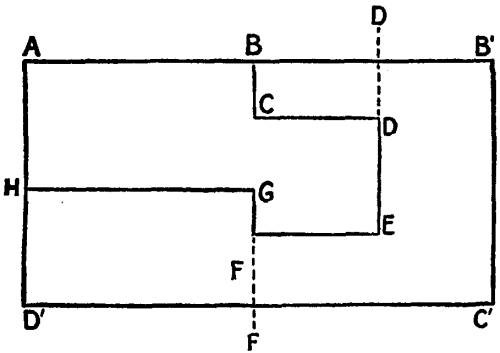
July 3rd.—A long pause: occasioned, first by some days of hard work: next by a vile quinsey—if that be the way to spell it. But to-day I must write. For we have all kinds of larks on hand. The wars and rumours of wars begin to take consistency, insomuch that we have landed the weapons this morning, and inspected the premises with a view to defence. Of course it will come to nothing; but as in all stories of massacres, the one you don’t prepare for is the one that comes off. All our natives think ill of the business; none of the whites do. According to our natives the demonstration threatened for to-day or to-morrow is one of vengeance on the whites—small wonder—and if that begins—where will it stop? Anyway I don’t mean to go down for nothing, if I can help it; and to amuse you I will tell you our plans.
There is the house, upper story. Our weak point is of course the sides AB, AH; so we propose to place half our garrison in the space HGFD and half in the opposite corner, BB′CD. We shall communicate through the interior, there is a water-tank in the angle C, my mother and Austin are to go in the loft. The holding of only these two corners and deserting the corner C′ is for economy and communication, two doors being in the sides GF and CD; so that any one in the corner C′ could only communicate or be reinforced by exposure. Besides we are short of mattresses. Garrison: R. L. S., Lloyd, Fanny, King, Ratke—doubtful, he may go—Emma, Mary, Belle; weapons: eight revolvers and a shot gun, and swords galore; but we’re pretty far gone when we come to the swords. It has been rather a lark arranging; but I find it a bore to write, and I doubt it will be cruel stale to read about, when all’s over and done, as it will be ere this goes, I fancy: far more ere it reaches you.
Date unknown.—Well, nothing as yet, though I don’t swear by it yet. There has been a lot of trouble, and there still is a lot of doubt as to the future; and those who sit in the chief seats, who are all excellent, pleasant creatures, are not, perhaps, the most wise of mankind. They actually proposed to kidnap and deport Mataafa; a scheme which would have loosed the avalanche at once. But some human being interfered and choked off this pleasing scheme. You ask me in yours just received, what will become of us if it comes to a war? Well, if it is a war of the old sort, nothing. It will mean a little bother, and a great deal of theft, and more amusement. But if it comes to the massacre lark, I can only answer with the Bell of Old Bow. You are to understand that, in my reading of the native character, every day that passes is a solid gain. They put in the time public speaking; so wear out their energy, develop points of difference and exacerbate internal ill-feeling. Consequently, I feel less apprehension of difficulty now, by about a hundredfold. All that I stick to, is that if war begins, there are ten chances to one we shall have it bad. The natives have been scurvily used by all the white powers without exception; and they labour under the belief, of which they can’t be cured, that they defeated Germany. This makes an awkward complication.
I was extremely vexed to hear you were ill again. I hope you are better. ’Tis a long time we have known each other now, to be sure. Well, well! you say you are sure to catch fever in the bush; so we do continually; but you are to conceive Samoa fever as the least formidable malady under heaven: implying only a day or so of slight headache and languor and ill humour, easily reduced by quinine or antipyrine. The hot fever I had was from over-exertion and blood poisoning, no doubt, and irritation of the bladder; it went of its own accord and with rest. I have had since a bad quinsey which knocked me rather useless for about a week, but I stuck to my work, with great difficulty and small success.
Date unknown.—But it’s fast day and July, and the rude inclement depth of winter, and the thermometer was 68 this morning and a few days ago it was 63, and we have all been perishing with cold. All still seems quiet. Your counterfeit presentments are all round us: the pastel over my bed, the Dew-Smith photograph over my door, and the “celebrity” on Fanny’s table. My room is now done, and looks very gay, and chromatic with its blue walls and my coloured lines of books.
To Sidney Colvin
This is the first letter in which Stevenson expresses the opinion which had been forcing itself upon him, and which he felt it his duty in the following year to express publicly in letters to the Times, of the unwisdom of the government established under the treaty between the Three Powers and the incompetence of the officials appointed to carry it out.
[Vailima] Sunday, Sept. 5(?), 1891.
My Dear Colvin,—Yours from Lochinver has just come. You ask me if I am ever homesick for the Highlands and the Isles. Conceive that for the last month I have been living there between 1786 and 1850, in my grandfather’s diaries and letters. I had to take a rest; no use talking; so I put in a month over my Lives of the Stevensons with great pleasure and profit and some advance; one chapter and a part drafted. The whole promises well. Chapter I. Domestic Annals. Chapter II. The Northern Lights. Chapter III. The Bell Rock. Chapter IV. A Family of Boys. Chap. V. The Grandfather. VI. Alan Stevenson. VII. Thomas Stevenson. My materials for my great-grandfather are almost null; for my grandfather copious and excellent. Name, a puzzle. A Scottish Family, A Family of Engineers, Northern Lights, The Engineers of the Northern Lights: A Family History. Advise; but it will take long. Now, imagine if I have been homesick for Barrahead and Island Glass, and Kirkwall, and Cape Wrath, and the Wells of the Pentland Firth; I could have wept.
Now for politics. I am much less alarmed; I believe the malo (= raj, government) will collapse and cease like an overlain infant, without a shot fired. They have now been months here on their big salaries—and Cedercrantz, whom I specially like as a man, has done nearly nothing, and the Baron, who is well-meaning, has done worse. They have these large salaries, and they have all the taxes; they have made scarce a foot of road; they have not given a single native a position—all to white men; they have scarce laid out a penny on Apia, and scarce a penny on the King; they have forgot they were in Samoa, or that such a thing as Samoans existed, and had eyes and some intelligence. The Chief Justice has refused to pay his customs! The President proposed to have an expensive house built for himself, while the King, his master, has none! I had stood aside, and been a loyal, and, above all, a silent subject, up to then; but now I snap my fingers at their malo. It is damned, and I’m damned glad of it. And this is not all. Last “Wainiu,” when I sent Fanny off to Fiji, I hear the wonderful news that the Chief Justice is going to Fiji and the Colonies to improve his mind. I showed my way of thought to his guest, Count Wachtmeister, whom I have sent to you with a letter—he will tell you all the news. Well, the Chief Justice stayed, but they said he was to leave yesterday. I had intended to go down, and see and warn him! But the President’s house had come up in the meanwhile, and I let them go to their doom, which I am only anxious to see swiftly and (if it may be) bloodlessly fall.
Thus I have in a way withdrawn my unrewarded loyalty. Lloyd is down to-day with Moors to call on Mataafa; the news of the excursion made a considerable row in Apia, and both the German and the English consuls besought Lloyd not to go. But he stuck to his purpose, and with my approval. It’s a poor thing if people are to give up a pleasure party for a malo that has never done anything for us but draw taxes, and is going to go pop, and leave us at the mercy of the identical Mataafa, whom I have not visited for more than a year, and who is probably furious.
The sense of my helplessness here has been rather bitter; I feel it wretched to see this dance of folly and injustice and unconscious rapacity go forward from day to day, and to be impotent. I was not consulted—or only by one man, and that on particular points; I did not choose to volunteer advice till some pressing occasion; I have not even a vote, for I am not a member of the municipality.
What ails you, miserable man, to talk of saving material? I have a whole world in my head, a whole new society to work, but I am in no hurry; you will shortly make the acquaintance of the Island of Ulufanua, on which I mean to lay several stories; the Bloody Wedding, possibly the High Woods—(O, it’s so good, the High Woods, but the story is craziness; that’s the trouble)—a political story, the Labour Slave, etc. Ulufanua is an imaginary island; the name is a beautiful Samoan word for the top of a forest; ulu=leaves or hair, fanua=land. The ground or country of the leaves. “Ulufanua the isle of the sea,” read that verse dactylically and you get the beat; the u’s are like our double oo; did ever you hear a prettier word?
I do not feel inclined to make a volume of Essays,22 but if I did, and perhaps the idea is good—and any idea is better than the South Seas—here would be my choice of the Scribner articles: Dreams, Beggars, Lantern-Bearers, Random Memories. There was a paper called the Old Pacific Capital in Fraser, in Tulloch’s time, which had merit; there were two on Fontainebleau in the Magazine of Art in Henley’s time. I have no idea if they’re any good; then there’s the Emigrant Train. Pulvis et Umbra is in a different key, and wouldn’t hang on with the rest.
I have just interrupted my letter and read through the chapter of the High Woods that is written, a chapter and a bit, some sixteen pages, really very fetching, but what do you wish? the story is so wilful, so steep, so silly—it’s a hallucination I have outlived, and yet I never did a better piece of work, horrid, and pleasing, and extraordinarily true; it’s sixteen pages of the South Seas; their essence. What am I to do? Lose this little gem—for I’ll be bold, and that’s what I think it—or go on with the rest, which I don’t believe in, and don’t like, and which can never make aught but a silly yarn? Make another end to it? Ah, yes, but that’s not the way I write; the whole tale is implied; I never use an effect, when I can help it, unless it prepares the effects that are to follow; that’s what a story consists in. To make another end, that is to make the beginning all wrong. The dénouement of a long story is nothing; it is just a “full close,” which you may approach and accompany as you please—it is a coda, not an essential member in the rhythm; but the body and end of a short story is bone of the bone and blood of the blood of the beginning. Well, I shall end by finishing it against my judgment; that fragment is my Delilah. Golly, it’s good. I am not shining by modesty; but I do just love the colour and movement of that piece so far as it goes.
I was surprised to hear of your fishing. And you saw the Pharos,23 thrice fortunate man; I wish I dared go home, I would ask the Commissioners to take me round for old sake’s sake, and see all my family pictures once more from the Mull of Galloway to Unst. However, all is arranged for our meeting in Ceylon, except the date and the blooming pounds. I have heard of an exquisite hotel in the country, airy, large rooms, good cookery, not dear; we shall have a couple of months there, if we can make it out, and converse or—as my grandfather always said—“commune.” “Communings with Mr. Kennedy as to Lighthouse Repairs.” He was a fine old fellow, but a droll.
Evening.—Lloyd has returned. Peace and war were played before his eyes at heads or tails. A German was stopped with levelled guns; he raised his whip; had it fallen, we might have been now in war. Excuses were made by Mataafa himself. Doubtless the thing was done—I mean the stopping of the German—a little to show off before Lloyd. Meanwhile —— was up here, telling how the Chief Justice was really gone for five or eight weeks, and begging me to write to the Times and denounce the state of affairs; many strong reasons he advanced; and Lloyd and I have been since his arrival and ——’s departure, near half an hour, debating what should be done. Cedercrantz is gone; it is not my fault; he knows my views on that point—alone of all points;—he leaves me with my mouth sealed. Yet this is a nice thing that because he is guilty of a fresh offence—his flight—the mouth of the only possible influential witness should be closed? I do not like this argument. I look like a cad, if I do in the man’s absence what I could have done in a more manly manner in his presence. True; but why did he go? It is his last sin. And I, who like the man extremely—that is the word—I love his society—he is intelligent, pleasant, even witty, a gentleman—and you know how that attaches—I loathe to seem to play a base part; but the poor natives—who are like other folk, false enough, lazy enough, not heroes, not saints—ordinary men damnably misused—are they to suffer because I like Cedercrantz, and Cedercrantz has cut his lucky? This is a little tragedy, observe well—a tragedy! I may be right, I may be wrong in my judgment, but I am in treaty with my honour. I know not how it will seem to-morrow. Lloyd thought the barrier of honour insurmountable, and it is an ugly obstacle. He (Cedercrantz) will likely meet my wife three days from now, may travel back with her, will be charming if he does; suppose this, and suppose him to arrive and find that I have sprung a mine—or the nearest approach to it I could find—behind his back? My position is pretty. Yes, I am an aristocrat. I have the old petty, personal view of honour? I should blush till I die if I do this; yet it is on the cards that I may do it. So much I have written you in bed, as a man writes or talks, in a bittre Wahl. Now I shall sleep, and see if I am more clear. I will consult the missionaries at least—I place some reliance in M. also—or I should if he were not a partisan; but a partisan he is. There’s a pity. To sleep! A fund of wisdom in the prostrate body and the fed brain. Kindly observe R. L. S. in the talons of politics! ’Tis funny—’tis sad. Nobody but these cursed idiots could have so driven me; I cannot bear idiots.
My dear Colvin, I must go to sleep; it is long past ten—a dreadful hour for me. And here am I lingering (so I feel) in the dining-room at the Monument, talking to you across the table, both on our feet, and only the two stairs to mount, and get to bed, and sleep, and be waked by dear old George—to whom I wish my kindest remembrances—next morning. I look round, and there is my blue room, and my long lines of shelves, and the door gaping on a moonless night, and no word of S. C. but his twa portraits on the wall. Good-bye, my dear fellow, and good-night. Queer place the world!
Monday.—No clearness of mind with the morning; I have no guess what I should do. ’Tis easy to say that the public duty should brush aside these little considerations of personal dignity; so it is that politicians begin, and in a month you find them rat and flatter and intrigue with brows of brass. I am rather of the old view, that a man’s first duty is to these little laws; the big he does not, he never will, understand; I may be wrong about the Chief Justice and the Baron and the state of Samoa; I cannot be wrong about the vile attitude I put myself in if I blow the gaff on Cedercrantz behind his back.
Tuesday.—One more word about the South Seas, in answer to a question I observed I have forgotten to answer. The Tahiti part has never turned up, because it has never been written. As for telling you where I went or when, or anything about Honolulu, I would rather die; that is fair and plain. How can anybody care when or how I left Honolulu? A man of upwards of forty cannot waste his time in communicating matter of that indifference. The letters, it appears, are tedious; they would be more tedious still if I wasted my time upon such infantile and sucking-bottle details. If ever I put in any such detail, it is because it leads into something or serves as a transition. To tell it for its own sake, never! The mistake is all through that I have told too much; I had not sufficient confidence in the reader, and have overfed him; and here are you anxious to learn how I—O Colvin! Suppose it had made a book, all such information is given to one glance of an eye by a map with a little dotted line upon it. But let us forget this unfortunate affair.
Wednesday.—Yesterday I went down to consult Clarke, who took the view of delay. Has he changed his mind already? I wonder: here at least is the news. Some little while back some men of Manono—what is Manono?—a Samoan rotten borough, a small isle of huge political importance, heaven knows why, where a handful of chiefs make half the trouble in the country. Some men of Manono (which is strong Mataafa) burned down the houses and destroyed the crops of some Malietoa neighbours. The President went there the other day and landed alone on the island, which (to give him his due) was plucky. Moreover, he succeeded in persuading the folks to come up and be judged on a particular day in Apia. That day they did not come; but did come the next, and, to their vast surprise, were given six months’ imprisonment and clapped in gaol. Those who had accompanied them cried to them on the streets as they were marched to prison, “Shall we rescue you?” The condemned, marching in the hands of thirty men with loaded rifles, cried out “No”! And the trick was done. But it was ardently believed a rescue would be attempted; the gaol was laid about with armed men day and night; but there was some question of their loyalty, and the commandant of the forces, a very nice young beardless Swede, became nervous, and conceived a plan. How if he should put dynamite under the gaol, and in case of an attempted rescue blow up prison and all? He went to the President, who agreed; he went to the American man-of-war for the dynamite and machine, was refused, and got it at last from the Wreckers. The thing began to leak out, and there arose a muttering in town. People had no fancy for amateur explosions, for one thing. For another, it did not clearly appear that it was legal; the men had been condemned to six months’ prison, which they were peaceably undergoing; they had not been condemned to death. And lastly, it seemed a somewhat advanced example of civilisation to set before barbarians. The mutter in short became a storm, and yesterday, while I was down, a cutter was chartered, and the prisoners were suddenly banished to the Tokelaus. Who has changed the sentence? We are going to stir in the dynamite matter; we do not want the natives to fancy us consenting to such an outrage.
Fanny has returned from her trip, and on the whole looks better. The High Woods are under way, and their name is now the Beach of Falesá, and the yarn is cured. I have about thirty pages of it done; it will be fifty to seventy I suppose. No supernatural trick at all; and escaped out of it quite easily; can’t think why I was so stupid for so long. Mighty glad to have Fanny back to this “Hell of the South Seas,” as the German Captain called it. What will Cedercrantz think when he comes back? To do him justice, had he been here, this Manono hash would not have been.
Here is a pretty thing. When Fanny was in Fiji all the Samoa and Tokelau folks were agog about our “flash” house; but the whites had never heard of it.
Robert Louis Stevenson,
Author of The Beach of Falesá.
To Sidney Colvin
[Vailima], Sept. 28, 1891.
MY DEAR COLVIN,—Since I last laid down my pen, I have written and rewritten The Beach of Falesá; something like sixty thousand words of sterling domestic fiction (the story, you will understand, is only half that length); and now I don’t want to write any more again for ever, or feel so; and I’ve got to overhaul it once again to my sorrow. I was all yesterday revising, and found a lot of slacknesses and (what is worse in this kind of thing) some literaryisms. One of the puzzles is this: It is a first person story—a trader telling his own adventure in an island. When I began I allowed myself a few liberties, because I was afraid of the end; now the end proved quite easy, and could be done in the pace; so the beginning remains about a quarter tone out (in places); but I have rather decided to let it stay so. The problem is always delicate; it is the only thing that worries me in first person tales, which otherwise (quo’ Alan) “set better wi’ my genius.” There is a vast deal of fact in the story, and some pretty good comedy. It is the first realistic South Sea story; I mean with real South Sea character and details of life. Everybody else who has tried, that I have seen, got carried away by the romance, and ended in a kind of sugar candy sham epic, and the whole effect was lost—there was no etching, no human grin, consequently no conviction. Now I have got the smell and look of the thing a good deal. You will know more about the South Seas after you have read my little tale than if you had read a library. As to whether any one else will read it, I have no guess. I am in an off time, but there is just the possibility it might make a hit; for the yarn is good and melodramatic, and there is quite a love affair—for me; and Mr. Wiltshire (the narrator) is a huge lark, though I say it. But there is always the exotic question, and everything, the life, the place, the dialects—trader’s talk, which is a strange conglomerate of literary expressions and English and American slang, and Beach de Mar, or native English,—the very trades and hopes and fears of the characters, are all novel, and may be found unwelcome to that great, hulking, bullering whale, the public.
Since I wrote, I have been likewise drawing up a document to send in to the President; it has been dreadfully delayed, not by me, but to-day they swear it will be sent in. A list of questions about the dynamite report are herein laid before him, and considerations suggested why he should answer.
October 5th.—Ever since my last snatch I have been much chivied about over the President business; his answer has come, and is an evasion accompanied with schoolboy insolence, and we are going to try to answer it. I drew my answer and took it down yesterday; but one of the signatories wants another paragraph added, which I have not yet been able to draw, and as to the wisdom of which I am not yet convinced.
Next day, Oct. 7th the right day.—We are all in rather a muddled state with our President affair. I do loathe politics, but at the same time, I cannot stand by and have the natives blown in the air treacherously with dynamite. They are still quiet; how long this may continue I do not know, though of course by mere prescription the Government is strengthened, and is probably insured till the next taxes fall due. But the unpopularity of the whites is growing. My native overseer, the great Henry Simelé, announced to-day that he was “weary of whites upon the beach. All too proud,” said this veracious witness. One of the proud ones had threatened yesterday to cut off his head with a bush knife! These are “native outrages”; honour bright, and setting theft aside, in which the natives are active, this is the main stream of irritation. The natives are generally courtly, far from always civil, but really gentle, and with a strong sense of honour of their own, and certainly quite as much civilised as our dynamiting President.
We shall be delighted to see Kipling.24 I go to bed usually about half-past eight, and my lamp is out before ten; I breakfast at six. We may say roughly we have no soda water on the island, and just now truthfully no whisky. I have heard the chimes at midnight; now no more, I guess. But—Fanny and I, as soon as we can get coins for it, are coming to Europe, not to England: I am thinking of Royat. Bar wars. If not, perhaps the Apennines might give us a mountain refuge for two months or three in summer. How is that for high? But the money must be all in hand first.
October 13th.—How am I to describe my life these last few days? I have been wholly swallowed up in politics, a wretched business, with fine elements of farce in it too, which repay a man in passing, involving many dark and many moonlight rides, secret counsels which are at once divulged, sealed letters which are read aloud in confidence to the neighbours, and a mass of fudge and fun, which would have driven me crazy ten years ago, and now makes me smile.
On Friday, Henry came and told us he must leave and go to “my poor old family in Savaii”; why? I do not quite know—but, I suspect, to be tattooed—if so, then probably to be married, and we shall see him no more. I told him he must do what he thought his duty; we had him to lunch, drank his health, and he and I rode down about twelve. When I got down, I sent my horse back to help bring down the family later. My own afternoon was cut out for me; my last draft for the President had been objected to by some of the signatories. I stood out, and one of our small number accordingly refused to sign. Him I had to go and persuade, which went off very well after the first hottish moments; you have no idea how stolid my temper is now. By about five the thing was done; and we sat down to dinner at the Chinaman’s—the Verrey or Doyen of Apia—Gurr and I at each end as hosts; Gurr’s wife—Fanua, late maid of the village; her (adopted) father and mother, Seumanu and Faatulia, Fanny, Belle, Lloyd, Austin, and Henry Simelé, his last appearance. Henry was in a kilt of grey shawl, with a blue jacket, white shirt, and black necktie, and looked like a dark genteel guest in a Highland shooting-box. Seumanu (opposite Fanny, next G.) is chief of Apia, a rather big gun in this place, looking like a large, fatted, military Englishman, bar the colour. Faatulia, next me, is a bigger chief than her husband. Henry is a chief too—his chief name, Iiga (Ee-eeng-a), he has not yet “taken” because of his youth. We were in fine society, and had a pleasant meal-time, with lots of fun. Then to the Opera—I beg your pardon, I mean the Circus. We occupied the first row in the reserved seats, and there in the row behind were all our friends—Captain Foss and his Captain-Lieutenant, three of the American officers, very nice fellows, the Dr., etc., so we made a fine show of what an embittered correspondent of the local paper called “the shoddy aristocracy of Apia”; and you should have seen how we carried on, and how I clapped, and Captain Foss hollered “wunderschön!” and threw himself forward in his seat, and how we all in fact enjoyed ourselves like school-children, Austin not a shade more than his neighbours. Then the Circus broke up, and the party went home, but I stayed down, having business on the morrow.
Yesterday, October 12th, great news reaches me, and Lloyd and I, with the mail just coming in, must leave all, saddle, and ride down. True enough, the President had resigned! Sought to resign his presidency of the council, and keep his advisership to the King; given way to the consuls’ objections and resigned all—then fell out with them about the disposition of the funds, and was now trying to resign from his resignation! Sad little President, so trim to look at, and I believe so kind to his little wife! Not only so, but I meet Dunnet on the beach. Dunnet calls me in consultation, and we make with infinite difficulty a draft of a petition to the King.... Then to dinner at Moors’s, a very merry meal, interrupted before it was over by the arrival of the committee. Slight sketch of procedure agreed upon, self appointed spokesman, and the deputation sets off. Walk all through Matafele, all along Mulinuu, come to the King’s house; he has verbally refused to see us in answer to our letter, swearing he is gasegase (chief sickness, not common man’s) and indeed we see him inside in bed. It is a miserable low house, better houses by the dozen in the little hamlet (Tanugamanono) of bushmen on our way to Vailima; and the President’s house in process of erection just opposite! We are told to return to-morrow; I refuse; and at last we are very sourly received, sit on the mats, and I open out, through a very poor interpreter, and sometimes hampered by unacceptable counsels from my backers. I can speak fairly well in a plain way now. C. asked me to write out my harangue for him this morning; I have done so, and couldn’t get it near as good. I suppose (talking and interpreting) I was twenty minutes or half an hour on the deck; then his majesty replied in the dying whisper of a big chief; a few words of rejoinder (approving), and the deputation withdrew, rather well satisfied.
A few days ago this intervention would have been a deportable offence; not now, I bet; I would like them to try. A little way back along Mulinuu, Mrs. Gurr met us with her husband’s horse; and he and she and Lloyd and I rode back in a heavenly moonlight. Here ends a chapter in the life of an island politician! Catch me at it again; ’tis easy to go in, but it is not a pleasant trade. I have had a good team, as good as I could get on the beach; but what trouble even so, and what fresh troubles shaping. But I have on the whole carried all my points; I believe all but one, and on that (which did not concern me) I had no right to interfere. I am sure you would be amazed if you knew what a good hand I am at keeping my temper, talking people over, and giving reasons which are not my reasons, but calculated for the meridian of the particular objection; so soon does falsehood await the politician in his whirling path.
24 Mr. Rudyard Kipling was at this time planning a trip to Samoa, but the plan was unfortunately not carried out, and he and Stevenson never met.
21 Miss Fanny Macpherson, now Lady Holroyd.
23 The steam-yacht of the Commissioners of Northern Lights, on which he had been accustomed as a lad to accompany his father on the official trips of inspection round the coast.
22 In reply to a suggestion which ultimately took effect in the shape of the volume called Across the Plains (Chatto & Windus, 1892).
To Henry James
Stevenson had again been reading Mr. James’s Lesson of the Master; Adela Chart is the heroine of the second story in that collection, called The Marriages.
[Vailima, October 1891.]
MY DEAR HENRY JAMES,—From this perturbed and hunted being expect but a line, and that line shall be but a whoop for Adela. O she’s delicious, delicious; I could live and die with Adela—die, rather the better of the two; you never did a straighter thing, and never will.
David Balfour, second part of Kidnapped, is on the stocks at last; and is not bad, I think. As for The Wrecker, it’s a machine, you know—don’t expect aught else—a machine, and a police machine; but I believe the end is one of the most genuine butcheries in literature; and we point to our machine with a modest pride, as the only police machine without a villain. Our criminals are a most pleasing crew, and leave the dock with scarce a stain upon their character.
What a different line of country to be trying to draw Adela, and trying to write the last four chapters of The Wrecker! Heavens, it’s like two centuries; and ours is such rude, transpontine business, aiming only at a certain fervour of conviction and sense of energy and violence in the men; and yours is so neat and bright and of so exquisite a surface! Seems dreadful to send such a book to such an author; but your name is on the list. And we do modestly ask you to consider the chapters on the Norah Creina with the study of Captain Nares, and the forementioned last four, with their brutality of substance and the curious (and perhaps unsound) technical manœuvre of running the story together to a point as we go along, the narrative becoming more succinct and the details fining off with every page.—Sworn affidavit of
R. L. S.
No person now alive has beaten Adela: I adore Adela and her maker. Sic subscrib.
Robert Louis Stevenson.
A Sublime Poem to follow.
Adela, Adela, Adela Chart,
What have you done to my elderly heart?
Of all the ladies of paper and ink
I count you the paragon, call you the pink.
The word of your brother depicts you in part:
“You raving maniac!” Adela Chart;
But in all the asylums that cumber the ground,
So delightful a maniac was ne’er to be found.
I pore on you, dote on you, clasp you to heart,
I laud, love, and laugh at you, Adela Chart,
And thank my dear maker the while I admire
That I can be neither your husband nor sire.
Your husband’s, your sire’s were a difficult part;
You’re a byway to suicide, Adela Chart;
But to read of, depicted by exquisite James,
O, sure you’re the flower and quintessence of dames.
R. L. S.
Eructavit cor meum
My heart was inditing a goodly matter about Adela Chart.
Though oft I’ve been touched by the volatile dart,
To none have I grovelled but Adela Chart,
There are passable ladies, no question, in art—
But where is the marrow of Adela Chart?
I dreamed that to Tyburn I passed in the cart—
I dreamed I was married to Adela Chart:
From the first I awoke with a palpable start,
The second dumbfoundered me, Adela Chart!
Another verse bursts from me, you see; no end to the violence of the Muse.
To E. L. Burlingame
[Vailima], October 8th, 1891.
MY DEAR BURLINGAME,—All right, you shall have the Tales of my Grandfather soon, but I guess we’ll try and finish off The Wrecker first. A propos of whom, please send some advanced sheets to Cassell’s—away ahead of you—so that they may get a dummy out.
Do you wish to illustrate My Grandfather? He mentions as excellent a portrait of Scott by Basil Hall’s brother. I don’t think I ever saw this engraved; would it not, if you could get track of it, prove a taking embellishment? I suggest this for your consideration and inquiry. A new portrait of Scott strikes me as good. There is a hard, tough, constipated old portrait of my grandfather hanging in my aunt’s house, Mrs. Alan Stevenson, 16 St. Leonard’s Terrace, Chelsea, which has never been engraved—the better portrait, Joseph’s bust, has been reproduced, I believe, twice—and which, I am sure, my aunt would let you have a copy of. The plate could be of use for the book when we get so far, and thus to place it in the Magazine might be an actual saving.
I am swallowed up in politics for the first, I hope for the last, time in my sublunary career. It is a painful, thankless trade; but one thing that came up I could not pass in silence. Much drafting, addressing, deputationising has eaten up all my time, and again (to my contrition) I leave you Wreckerless. As soon as the mail leaves I tackle it straight.—Yours very sincerely,
Robert Louis Stevenson.
To E. L. Burlingame
[Vailima, October 1891.]
MY DEAR BURLINGAME,—The time draws nigh, the mail is near due, and I snatch a moment of collapse so that you may have at least some sort of a scratch of note along with the
\ end
\ of
\ The
\ Wrecker.Hurray!
which I mean to go herewith. It has taken me a devil of a pull, but I think it’s going to be ready. If I did not know you were on the stretch waiting for it and trembling for your illustrations, I would keep it for another finish; but things being as they are, I will let it go the best way I can get it. I am now within two pages of the end of Chapter XXV., which is the last chapter, the end with its gathering up of loose threads, being the dedication to Low, and addressed to him; this is my last and best expedient for the knotting up of these loose cards. ’Tis possible I may not get that finished in time, in which case you’ll receive only Chapters XXII. to XXV. by this mail, which is all that can be required for illustration.
I wish you would send me Memoirs of Baron Marbot (French); Introduction to the Study of the History of Language, Strong, Logeman & Wheeler; Principles of Psychology, William James; Morris & Magnusson’s Saga Library, any volumes that are out; George Meredith’s One of our Conquerors; Là Bas, by Huysmans (French); O’Connor Morris’s Great Commanders of Modern Times; Life’s Handicap, by Kipling; of Taine’s Origines de la France Contemporaine, I have only as far as la Révolution, vol. iii.; if another volume is out, please add that. There is for a book-box.
I hope you will like the end; I think it is rather strong meat. I have got into such a deliberate, dilatory, expansive turn, that the effort to compress this last yarn was unwelcome; but the longest yarn has to come to an end some time. Please look it over for carelessnesses, and tell me if it had any effect upon your jaded editorial mind. I’ll see if ever I have time to add more.
I add to my book-box list Adams’ Historical Essays; the Plays of A. W. Pinero—all that have appeared, and send me the rest in course as they do appear; Noughts and Crosses by Q.; Robertson’s Scotland under her Early Kings.
Sunday.—The deed is done, didst thou not hear a noise? “The end” has been written to this endless yarn, and I am once more a free man. What will he do with it?
To Sidney Colvin
[Vailima] Monday, October 24th.
MY DEAR CARTHEW,25—See what I have written, but it’s Colvin I’m after—I have written two chapters, about thirty pages of Wrecker since the mail left, which must be my excuse, and the bother I’ve had with it is not to be imagined; you might have seen me the day before yesterday weighing British sov.’s and Chili dollars to arrange my treasure chest. And there was such a calculation, not for that only, but for the ship’s position and distances when—but I am not going to tell you the yarn—and then, as my arithmetic is particularly lax, Lloyd had to go over all my calculations; and then, as I had changed the amount of money, he had to go over all his as to the amount of the lay; and altogether, a bank could be run with less effusion of figures than it took to shore up a single chapter of a measly yarn. However, it’s done, and I have but one more, or at the outside two, to do, and I am Free! and can do any damn thing I like.
Before falling on politics, I shall give you my day. Awoke somewhere about the first peep of day, came gradually to, and had a turn on the verandah before 5.55, when “the child” (an enormous Wallis Islander) brings me an orange; at 6, breakfast; 6.10, to work; which lasts till, at 10.30, Austin comes for his history lecture; this is rather dispiriting, but education must be gone about in faith—and charity, both of which pretty nigh failed me to-day about (of all things) Carthage; 11, luncheon; after luncheon in my mother’s room, I read Chapter XXIII. of The Wrecker, then Belle, Lloyd, and I go up and make music furiously till about 2 (I suppose), when I turn into work again till 4; fool from 4 to half-past, tired out and waiting for the bath hour; 4.30, bath; 4.40, eat two heavenly mangoes on the verandah, and see the boys arrive with the pack-horses; 5, dinner; smoke, chat on verandah, then hand of cards, and at last at 8 come up to my room with a pint of beer and a hard biscuit, which I am now consuming, and as soon as they are consumed I shall turn in.
Such are the innocent days of this ancient and outworn sportsman; to-day there was no weeding, usually there is however, edged in somewhere. My books for the moment are a crib to Phædo, and the second book of Montaigne; and a little while back I was reading Frederic Harrison, Choice of Books, etc.—very good indeed, a great deal of sense and knowledge in the volume, and some very true stuff, contra Carlyle, about the eighteenth century. A hideous idea came over me that perhaps Harrison is now getting old. Perhaps you are. Perhaps I am. Oh, this infidelity must be stared firmly down. I am about twenty-three—say twenty-eight; you about thirty, or, by’r lady, thirty-four; and as Harrison belongs to the same generation, there is no good bothering about him.
Here has just been a fine alert; I gave my wife a dose of chlorodyne. “Something wrong,” says she. “Nonsense,” said I. “Embrocation,” said she. I smelt it, and—it smelt very funny. “I think it’s just gone bad, and to-morrow will tell.” Proved to be so.
Wednesday.—History of Tuesday.—Woke at usual time, very little work, for I was tired, and had a job for the evening—to write parts for a new instrument, a violin. Lunch, chat, and up to my place to practise; but there was no practising for me—my flageolet was gone wrong, and I had to take it all to pieces, clean it, and put it up again. As this is a most intricate job—the thing dissolves into seventeen separate members, most of these have to be fitted on their individual springs as fine as needles, and sometimes two at once with the springs shoving different ways—it took me till two. Then Lloyd and I rode forth on our errands; first to Motootua, where we had a really instructive conversation on weeds and grasses. Thence down to Apia, where we bought a fresh bottle of chlorodyne and conversed on politics.
My visit to the King, which I thought at the time a particularly nugatory and even schoolboy step, and only consented to because I had held the reins so tight over my little band before, has raised a deuce of a row—new proclamation, no one is to interview the sacred puppet without consuls’ permission, two days’ notice, and an approved interpreter—read (I suppose) spy. Then back; I should have said I was trying the new horse; a tallish piebald, bought from the circus; he proved steady and safe, but in very bad condition, and not so much the wild Arab steed of the desert as had been supposed. The height of his back, after commodious Jack, astonished me, and I had a great consciousness of exercise and florid action, as I posted to his long, emphatic trot. We had to ride back easy; even so he was hot and blown; and when we set a boy to lead him to and fro, our last character for sanity perished. We returned just neat for dinner; and in the evening our violinist arrived, a young lady, no great virtuoso truly, but plucky, industrious, and a good reader; and we played five pieces with huge amusement, and broke up at nine. This morning I have read a splendid piece of Montaigne, written this page of letter, and now turn to The Wrecker.
Wednesday.—November 16th or 17th—and I am ashamed to say mail day. The Wrecker is finished, that is the best of my news; it goes by this mail to Scribner’s; and I honestly think it a good yarn on the whole and of its measly kind. The part that is genuinely good is Nares, the American sailor; that is a genuine figure; had there been more Nares it would have been a better book; but of course it didn’t set up to be a book, only a long tough yarn with some pictures of the manners of to-day in the greater world—not the shoddy sham world of cities, clubs, and colleges, but the world where men still live a man’s life. The worst of my news is the influenza; Apia is devastate; the shops closed, a ball put off, etc. As yet we have not had it at Vailima, and, who knows? we may escape. None of us go down, but of course the boys come and go.
Your letter had the most wonderful “I told you so” I ever heard in the course of my life. Why, you madman, I wouldn’t change my present installation for any post, dignity, honour, or advantage conceivable to me. It fills the bill; I have the loveliest time. And as for wars and rumours of wars, you surely know enough of me to be aware that I like that also a thousand times better than decrepit peace in Middlesex? I do not quite like politics; I am too aristocratic, I fear, for that. God knows I don’t care who I chum with; perhaps like sailors best; but to go round and sue and sneak to keep a crowd together—never. My imagination, which is not the least damped by the idea of having my head cut off in the bush, recoils aghast from the idea of a life like Gladstone’s, and the shadow of the newspaper chills me to the bone. Hence my late eruption was interesting, but not what I like. All else suits me in this (killed a mosquito) A1 abode.
About politics. A determination was come to by the President that he had been an idiot; emissaries came to Gurr and me to kiss and be friends. My man proposed I should have a personal interview; I said it was quite useless, I had nothing to say; I had offered him the chance to inform me, had pressed it on him, and had been very unpleasantly received, and now “Time was.” Then it was decided that I was to be made a culprit against Germany; the German Captain—a delightful fellow and our constant visitor—wrote to say that as “a German officer” he could not come even to say farewell. We all wrote back in the most friendly spirit, telling him (politely) that some of these days he would be sorry, and we should be delighted to see our friend again. Since then I have seen no German shadow.
Mataafa has been proclaimed a rebel; the President did this act, and then resigned. By singular good fortune, Mataafa has not yet moved; no thanks to our idiot governors. They have shot their bolt; they have made a rebel of the only man (to their own knowledge, on the report of their own spy) who held the rebel party in check; and having thus called on war to fall, they can do no more, sit equally “expertes” of vis and counsel, regarding their handiwork. It is always a cry with these folks that he (Mataafa) had no ammunition. I always said it would be found; and we know of five boat-loads that have found their way to Malie already. Where there are traders, there will be ammunition; aphorism by R. L. S.
Now what am I to do next?
Lives of the Stevensons? Historia Samoae? A History for Children? Fiction? I have had two hard months at fiction; I want a change. Stevensons? I am expecting some more material; perhaps better wait. Samoa? rather tempting; might be useful to the islands—and to me; for it will be written in admirable temper; I have never agreed with any party, and see merits and excuses in all; should do it (if I did) very slackly and easily, as if half in conversation. History for Children? This flows from my lessons to Austin; no book is any good. The best I have seen is Freeman’s Old English History; but his style is so rasping, and a child can learn more, if he’s clever. I found my sketch of general Aryan history, given in conversation, to have been practically correct—at least what I mean is, Freeman had very much the same stuff in his early chapters, only not so much, and I thought not so well placed; and the child remembered some of it. Now the difficulty is to give this general idea of main place, growth, and movement; it is needful to tack it on a yarn. Now Scotch is the only history I know; it is the only history reasonably represented in my library; it is a very good one for my purpose, owing to two civilisations having been face to face throughout—or rather Roman civilisation face to face with our ancient barbaric life and government, down to yesterday, to 1750 anyway. But the Tales of a Grandfather stand in my way; I am teaching them to Austin now, and they have all Scott’s defects and all Scott’s hopeless merit. I cannot compete with that; and yet, so far as regards teaching History, how he has missed his chances! I think I’ll try; I really have some historic sense, I feel that in my bones. Then there’s another thing. Scott never knew the Highlands; he was always a Borderer. He has missed that whole, long, strange, pathetic story of our savages, and, besides, his style is not very perspicuous to childhood. Gad, I think I’ll have a flutter. Buridan’s Ass! Whither to go, what to attack. Must go to other letters; shall add to this, if I have time.
To W. Craibe Angus
Vailima, Samoa, November 1891.
MY DEAR MR. ANGUS,—Herewith the invaluable sheets. They came months after your letter, and I trembled; but here they are, and I have scrawled my vile name on them, and “thocht shame” as I did it. I am expecting the sheets of your catalogue, so that I may attack the preface. Please give me all the time you can. The sooner the better; you might even send me early proofs as they are sent out, to give me more incubation. I used to write as slow as judgment; now I write rather fast; but I am still “a slow study,” and sit a long while silent on my eggs. Unconscious thought, there is the only method: macerate your subject, let it boil slow, then take the lid off and look in—and there your stuff is, good or bad. But the journalist’s method is the way to manufacture lies; it is will-worship—if you know the luminous quaker phrase; and the will is only to be brought in the field for study and again for revision. The essential part of work is not an act, it is a state.
I do not know why I write you this trash.
Many thanks for your handsome dedication. I have not yet had time to do more than glance at Mrs. Begg; it looks interesting.—Yours very truly,
Robert Louis Stevenson.
To Miss Annie H. Ide
Vailima, Samoa [November 1891].
MY DEAR LOUISA,—Your picture of the church, the photograph of yourself and your sister, and your very witty and pleasing letter, came all in a bundle, and made me feel I had my money’s worth for that birthday. I am now, I must be, one of your nearest relatives; exactly what we are to each other, I do not know, I doubt if the case has ever happened before—your papa ought to know, and I don’t believe he does; but I think I ought to call you in the meanwhile, and until we get the advice of counsel learned in the law, my name-daughter. Well, I was extremely pleased to see by the church that my name-daughter could draw; by the letter, that she was no fool; and by the photograph, that she was a pretty girl, which hurts nothing. See how virtues are rewarded! My first idea of adopting you was entirely charitable; and here I find that I am quite proud of it, and of you, and that I chose just the kind of name-daughter I wanted. For I can draw too, or rather I mean to say I could before I forgot how; and I am very far from being a fool myself, however much I may look it; and I am as beautiful as the day, or at least I once hoped that perhaps I might be going to be. And so I might. So that you see we are well met, and peers on these important points. I am very glad also that you are older than your sister. So should I have been, if I had had one. So that the number of points and virtues which you have inherited from your name-father is already quite surprising.
I wish you would tell your father—not that I like to encourage my rival—that we have had a wonderful time here of late, and that they are having a cold day on Mulinuu, and the consuls are writing reports, and I am writing to the Times, and if we don’t get rid of our friends this time I shall begin to despair of everything but my name-daughter.
You are quite wrong as to the effect of the birthday on your age. From the moment the deed was registered (as it was in the public press with every solemnity), the 13th of November became your own and only birthday, and you ceased to have been born on Christmas Day. Ask your father: I am sure he will tell you this is sound law. You are thus become a month and twelve days younger than you were, but will go on growing older for the future in the regular and human manner from one 13th November to the next. The effect on me is more doubtful; I may, as you suggest, live for ever; I might, on the other hand, come to pieces like the one-horse shay at a moment’s notice; doubtless the step was risky, but I do not the least regret that which enables me to sign myself your revered and delighted name-father,
Robert Louis Stevenson.
To Charles Baxter
[Vailima, November 1891.]
DEAR CHARLES,—[After dealing with some matters of business] I believe that’s a’. By this time, I suppose you will have heard from McClure, and the Beach of Falesá will be decided on for better for worse. The end of The Wrecker goes by this mail, an awfae relief. I am now free and can do what I please. What do I please? I kenna. I’ll bide a wee. There’s a child’s history in the wind; and there’s my grandfather’s life begun; and there’s a histry of Samoa in the last four or five years begun—there’s a kind of sense to this book; it may help the Samoans, it may help me, for I am bound on the altar here for anti-Germanism. Then there’s The Pearl Fisher about a quarter done; and there’s various short stories in various degrees of incompleteness. De’il, there’s plenty grist; but the mill’s unco slaw! To-morrow or next day, when the mail’s through, I’ll attack one or other, or maybe something else. All these schemes begin to laugh at me, for the day’s far through, and I believe the pen grows heavy. However, I believe The Wrecker is a good yarn of its poor sort, and it is certainly well nourished with facts; no realist can touch me there; for by this time I do begin to know something of life in the XIXth century, which no novelist either in France or England seems to know much of. You must have great larks over masonry. You’re away up in the ranks now and (according to works that I have read) doubtless design assassinations. But I am an outsider; and I have a certain liking for a light unto my path which would deter me from joining the rank and file of so vast and dim a confraternity. At your altitude it becomes (of course) amusing and perhaps useful. Yes, I remember the L.J.R.,26 and the constitution, and my homily on Liberty, and yours on Reverence, which was never written—so I never knew what reverence was. I remember I wanted to write Justice also; but I forget who had the billet. My dear papa was in a devil of a taking; and I had to go and lunch at Ferrier’s in a strangely begrutten state, which was infra dig. for a homilist on liberty. It was about four, I suppose, that we met in the Lothian Road,—had we the price of two bitters between us? questionable!
Your bookseller (I have lost his letter, I mean the maid has, arranging my room, and so have to send by you) wrote me a letter about Old Bailey Papers. Gosh, I near swarfed; dam’d, man, I near had dee’d o’t. It’s only yin or twa volumes I want; say 500 or 1000 pages of the stuff; and the worthy man (much doubting) proposed to bury me in volumes. Please allay his rage, and apologise that I have not written him direct. His note was civil and purposelike. And please send me a copy of Henley’s Book of Verses; mine has disappeared.
R. L. S.
To Sidney Colvin
Nov. 25th, 1891.
MY DEAR COLVIN, MY DEAR COLVIN,—I wonder how often I’m going to write it. In spite of the loss of three days, as I have to tell, and a lot of weeding and cacao planting, I have finished since the mail left four chapters, forty-eight pages of my Samoa history. It is true that the first three had been a good deal drafted two years ago, but they had all to be written and re-written, and the fourth chapter is all new. Chapter I. Elements of Discord—Native. II. Elements of Discord—Foreign. III. The Success of Laupepa. IV. Brandeis. V. Will probably be called “The Rise of Mataafa.” VI. Furor Consularis—a devil of a long chapter. VII. Stuebel the Pacificator. VIII. Government under the Treaty of Berlin. IX. Practical Suggestions. Say three-sixths of it are done, maybe more; by this mail five chapters should go, and that should be a good half of it; say sixty pages. And if you consider that I sent by last mail the end of The Wrecker, coming on for seventy or eighty pages, and the mail before that the entire tale of the Beach of Falesá, I do not think I can be accused of idleness. This is my season; I often work six and seven, and sometimes eight hours; and the same day I am perhaps weeding or planting for an hour or two more—and I dare say you know what hard work weeding is—and it all agrees with me at this time of the year—like—like idleness, if a man of my years could be idle.
My first visit to Apia was a shock to me; every second person the ghost of himself, and the place reeking with infection. But I have not got the thing yet, and hope to escape. This shows how much stronger I am; think of me flitting through a town of influenza patients seemingly unscathed. We are all on the cacao planting.
The next day my wife and I rode over to the German plantation, Vailele, whose manager is almost the only German left to speak to us. Seventy labourers down with influenza! It is a lovely ride, half-way down our mountain towards Apia, then turn to the right, ford the river, and three miles of solitary grass and cocoa palms, to where the sea beats and the wild wind blows unceasingly about the plantation house. On the way down Fanny said, “Now what would you do if you saw Colvin coming up?”
Next day we rode down to Apia to make calls.
Yesterday the mail came, and the fat was in the fire.
Nov. 29th (?).—Book.27 All right. I must say I like your order. And the papers are some of them up to dick, and no mistake. I agree with you the lights seem a little turned down. The truth is, I was far through (if you understand Scots), and came none too soon to the South Seas, where I was to recover peace of body and mind. No man but myself knew all my bitterness in those days. Remember that, the next time you think I regret my exile. And however low the lights are, the stuff is true, and I believe the more effective; after all, what I wish to fight is the best fought by a rather cheerless presentation of the truth. The world must return some day to the word duty, and be done with the word reward. There are no rewards, and plenty duties. And the sooner a man sees that and acts upon it like a gentleman or a fine old barbarian, the better for himself.
There is my usual puzzle about publishers. Chatto ought to have it, as he has all the other essays; these all belong to me, and Chatto publishes on terms. Longman has forgotten the terms we are on; let him look up our first correspondence, and he will see I reserved explicitly, as was my habit, the right to republish as I choose. Had the same arrangement with Henley, Magazine of Art, and with Tulloch, Fraser’s.—For any necessary note or preface, it would be a real service if you would undertake the duty yourself. I should love a preface by you, as short or as long as you choose, three sentences, thirty pages, the thing I should like is your name. And the excuse of my great distance seems sufficient. I shall return with this the sheets corrected as far as I have them; the rest I will leave, if you will, to you entirely; let it be your book, and disclaim what you dislike in the preface. You can say it was at my eager prayer. I should say I am the less willing to pass Chatto over, because he behaved the other day in a very handsome manner. He asked leave to reprint Damien; I gave it to him as a present, explaining I could receive no emolument for a personal attack. And he took out my share of profits, and sent them in my name to the Leper Fund. I could not bear after that to take from him any of that class of books which I have always given him. Tell him the same terms will do. Clark to print, uniform with the others.
I have lost all the days since this letter began rehandling Chapter IV. of the Samoa racket. I do not go in for literature; address myself to sensible people rather than to sensitive. And, indeed, it is a kind of journalism, I have no right to dally; if it is to help, it must come soon. In two months from now it shall be done, and should be published in the course of March. I propose Cassell gets it. I am going to call it A Footnote to History: Eight Years of Trouble in Samoa, I believe. I recoil from serious names; they seem so much too pretentious for a pamphlet. It will be about the size of Treasure Island, I believe. Of course, as you now know, my case of conscience cleared itself off, and I began my intervention directly to one of the parties. The other, the Chief Justice, I am to inform of my book the first occasion. God knows if the book will do any good—or harm; but I judge it right to try. There is one man’s life certainly involved; and it may be all our lives. I must not stand and slouch, but do my best as best I can. But you may conceive the difficulty of a history extending to the present week, at least, and where almost all the actors upon all sides are of my personal acquaintance. The only way is to judge slowly, and write boldly, and leave the issue to fate.... I am far indeed from wishing to confine myself to creative work; that is a loss, the other repairs; the one chance for a man, and, above all, for one who grows elderly, ahem, is to vary drainage and repair. That is the one thing I understand—the cultivation of the shallow solum of my brain. But I would rather, from soon on, be released from the obligation to write. In five or six years this plantation—suppose it and us still to exist—should pretty well support us and pay wages; not before, and already the six years seem long to me. If literature were but a pastime!
I have interrupted myself to write the necessary notification to the Chief Justice.
I see in looking up Longman’s letter that it was as usual the letter of an obliging gentleman; so do not trouble him with my reminder. I wish all my publishers were not so nice. And I have a fourth and a fifth baying at my heels; but for these, of course, they must go wanting.
Dec. 2nd.—No answer from the Chief Justice, which is like him, but surely very wrong in such a case. The lunch bell! I have been off work, playing patience and weeding all morning. Yesterday and the day before I drafted eleven and revised nine pages of Chapter V., and the truth is, I was extinct by lunch-time, and played patience sourly the rest of the day. To-morrow or next day I hope to go in again and win. Lunch 2nd Bell.
Dec. 2nd, afternoon.—I have kept up the idleness; blew on the pipe to Belle’s piano; then had a ride in the forest all by my nainsel; back and piped again, and now dinner nearing. Take up this sheet with nothing to say. The weird figure of Faauma is in the room washing my windows, in a black lavalava (kilt) with a red handkerchief hanging from round her neck between her breasts; not another stitch; her hair close cropped and oiled; when she first came here she was an angelic little stripling, but she is now in full flower—or half-flower—and grows buxom. As I write, I hear her wet cloth moving and grunting with some industry; for I had a word this day with her husband on the matter of work and meal-time, when she is always late. And she has a vague reverence for Papa, as she and her enormous husband address me when anything is wrong. Her husband is Lafaele, sometimes called the archangel, of whom I have writ you often. Rest of our household, Talolo, cook; Pulu, kitchen boy, good, steady, industrious lads; Henry, back again from Savaii, where his love affair seems not to have prospered, with what looks like a spear-wound in the back of his head, of which Mr. Reticence says nothing; Simi, Manuele, and two other labourers outdoors. Lafaele is provost of the live-stock, whereof now, three milk-cows, one bull-calf, one heifer, Jack, Macfarlane, the mare, Harold, Tifaga Jack, Donald and Edinburgh—seven horses—O, and the stallion—eight horses; five cattle; total, if my arithmetic be correct, thirteen head of beasts; I don’t know how the pigs stand, or the ducks, or the chickens; but we get a good many eggs, and now and again a duckling or a chickling for the table; the pigs are more solemn, and appear only on birthdays and sich.
Monday, Dec. 7.—On Friday morning about eleven 1500 cacao seeds arrived, and we set to and toiled from twelve that day to six, and went to bed pretty tired. Next day I got about an hour and a half at my History, and was at it again by 8.10, and except an hour for lunch kept at it till four P.M. Yesterday, I did some History in the morning, and slept most of the afternoon; and to-day, being still averse from physical labour, and the mail drawing nigh, drew out of the squad, and finished for press the fifth chapter of my History; fifty-nine pages in one month; which (you will allow me to say) is a devil of a large order; it means at least 177 pages of writing; 89,000 words! and hours going to and fro among my notes. However, this is the way it has to be done; the job must be done fast, or it is of no use. And it is a curious yarn. Honestly, I think people should be amused and convinced, if they could be at the pains to look at such a damned outlandish piece of machinery, which of course they won’t. And much I care.
When I was filling baskets all Saturday, in my dull mulish way, perhaps the slowest worker there, surely the most particular, and the only one that never looked up or knocked off, I could not but think I should have been sent on exhibition as an example to young literary men. Here is how to learn to write, might be the motto. You should have seen us; the verandah was like an Irish bog; our hands and faces were bedaubed with soil; and Faauma was supposed to have struck the right note when she remarked (à propos of nothing), “Too much eleele (soil) for me!” The cacao (you must understand) has to be planted at first in baskets of plaited cocoa-leaf. From four to ten natives were plaiting these in the wood-shed. Four boys were digging up soil and bringing it by the boxful to the verandah. Lloyd and I and Belle, and sometimes S. (who came to bear a hand), were filling the baskets, removing stones and lumps of clay; Austin and Faauma carried them when full to Fanny, who planted a seed in each, and then set them, packed close, in the corners of the verandah. From twelve on Friday till five P.M. on Saturday we planted the first 1500, and more than 700 of a second lot. You cannot dream how filthy we were, and we were all properly tired. They are all at it again to-day, bar Belle and me, not required, and glad to be out of it. The Chief Justice has not yet replied, and I have news that he received my letter. What a man!
I have gone crazy over Bourget’s Sensations d’Italie; hence the enclosed dedication,28 a mere cry of gratitude for the best fun I’ve had over a new book this ever so!
To Fred Orr
The following is in answer to an application for an autograph from a young gentleman in the United States:—
Vailima, Upolu, Samoa, November 28th, 1891.
DEAR SIR,—Your obliging communication is to hand. I am glad to find that you have read some of my books, and to see that you spell my name right. This is a point (for some reason) of great difficulty; and I believe that a gentleman who can spell Stevenson with a v at sixteen, should have a show for the Presidency before fifty. By that time
I, nearer to the wayside inn,
predict that you will have outgrown your taste for autographs, but perhaps your son may have inherited the collection, and on the morning of the great day will recall my prophecy to your mind. And in the papers of 1921 (say) this letter may arouse a smile.
Whatever you do, read something else besides novels and newspapers; the first are good enough when they are good; the second, at their best, are worth nothing. Read great books of literature and history; try to understand the Roman Empire and the Middle Ages; be sure you do not understand when you dislike them; condemnation is non-comprehension. And if you know something of these two periods, you will know a little more about to-day, and may be a good President.
I send you my best wishes, and am yours,
Robert Louis Stevenson,
Author of a vast quantity of little books.
To E. L. Burlingame
The next letter announces to his New York publishers the beginning of his volume on the troubles of Samoa, A Footnote to History.
[Vailima, December 1891.]
MY DEAR BURLINGAME,—The end of The Wrecker having but just come in, you will, I dare say, be appalled to receive three (possibly four) chapters of a new book of the least attractive sort: a history of nowhere in a corner, or no time to mention, running to a volume! Well, it may very likely be an illusion; it is very likely no one could possibly wish to read it, but I wish to publish it. If you don’t cotton to the idea, kindly set it up at my expense, and let me know your terms for publishing. The great affair to me is to have per return (if it might be) four or five—better say half a dozen—sets of the roughest proofs that can be drawn. There are a good many men here whom I want to read the blessed thing, and not one would have the energy to read MS. At the same time, if you care to glance at it, and have the time, I should be very glad of your opinion as to whether I have made any step at all towards possibly inducing folk at home to read matter so extraneous and outlandish. I become heavy and owlish; years sit upon me; it begins to seem to me to be a man’s business to leave off his damnable faces and say his say. Else I could have made it pungent and light and lively. In considering, kindly forget that I am R. L. S.; think of the four chapters as a book you are reading, by an inhabitant of our “lovely but fatil” islands; and see if it could possibly amuse the hebetated public. I have to publish anyway, you understand; I have a purpose beyond; I am concerned for some of the parties to this quarrel. What I want to hear is from curiosity; what I want you to judge of is what we are to do with the book in a business sense. To me it is not business at all; I had meant originally to lay all the profits to the credit of Samoa; when it comes to the pinch of writing, I judge this unfair—I give too much—and I mean to keep (if there be any profit at all) one-half for the artisan; the rest I shall hold over to give to the Samoans for that which I choose and against work done. I think I have never heard of greater insolence than to attempt such a subject; yet the tale is so strange and mixed, and the people so oddly charactered—above all, the whites—and the high note of the hurricane and the warships is so well prepared to take popular interest, and the latter part is so directly in the day’s movement, that I am not without hope that some may read it; and if they don’t, a murrain on them! Here is, for the first time, a tale of Greeks—Homeric Greeks—mingled with moderns, and all true; Odysseus alongside of Rajah Brooke, proportion gardée; and all true. Here is for the first time since the Greeks (that I remember) the history of a handful of men, where all know each other in the eyes, and live close in a few acres, narrated at length, and with the seriousness of history. Talk of the modern novel; here is a modern history. And if I had the misfortune to found a school, the legitimate historian might lie down and die, for he could never overtake his material. Here is a little tale that has not “caret”-ed its “vates”; “sacer” is another point.
R. L. S.
26 See vol. xxiii. pp. 46, 48.
28 For the volume Across the Plains.
27 Across the Plains. The papers specially referred to in the next lines are those written at Saranac Lake in the winter of 1887-88, including A Letter to a Young Gentleman, Pulvis et Umbra, A Christmas Sermon.
25 Readers of The Wrecker will not need to be reminded that this is the name of the personage on whom the mystery in that story hinges.
To Henry James
Mr. Henry James was in the habit of sending out for Stevenson’s reading books that seemed likely to interest him, and among the last had been M. Paul Bourget’s Sensations d’Italie.
December 7th, 1891.
MY DEAR HENRY JAMES,—Thanks for yours; your former letter was lost; so it appears was my long and masterly treatise on the Tragic Muse. I remember sending it very well, and there went by the same mail a long and masterly tractate to Gosse about his daddy’s life, for which I have been long expecting an acknowledgment, and which is plainly gone to the bottom with the other. If you see Gosse, please mention it. These gems of criticism are now lost literature, like the tomes of Alexandria. I could not do ’em again. And I must ask you to be content with a dull head, a weary hand, and short commons, for to-day, as I am physically tired with hard work of every kind, the labours of the planter and the author both piled upon me mountain deep. I am delighted beyond expression by Bourget’s book: he has phrases which affect me almost like Montaigne; I had read ere this a masterly essay of his on Pascal; this book does it; I write for all his essays by this mail, and shall try to meet him when I come to Europe. The proposal is to pass a summer in France, I think in Royat, where the faithful could come and visit me; they are now not many. I expect Henry James to come and break a crust or two with us. I believe it will be only my wife and myself; and she will go over to England, but not I, or possibly incog. to Southampton, and then to Boscombe to see poor Lady Shelley. I am writing—trying to write in a Babel fit for the bottomless pit; my wife, her daughter, her grandson and my mother, all shrieking at each other round the house—not in war, thank God! but the din is ultra martial, and the note of Lloyd joins in occasionally, and the cause of this to-do is simply cacao, whereof chocolate comes. You may drink of our chocolate perhaps in five or six years from now, and not know it. It makes a fine bustle, and gives us some hard work, out of which I have slunk for to-day.
I have a story coming out: God knows when or how; it answers to the name of the Beach of Falesá, and I think well of it. I was delighted with the Tragic Muse; I thought the Muse herself one of your best works; I was delighted also to hear of the success of your piece, as you know I am a dam failure,29 and might have dined with the dinner club that Daudet and these parties frequented.
Next day.—I have just been breakfasting at Baiae and Brindisi, and the charm of Bourget hag-rides me. I wonder if this exquisite fellow, all made of fiddle-strings and scent and intelligence, could bear any of my bald prose. If you think he could, ask Colvin to send him a copy of these last essays of mine when they appear; and tell Bourget they go to him from a South Sea Island as literal homage. I have read no new book for years that gave me the same literary thrill as his Sensations d’Italie. If (as I imagine) my cut-and-dry literature would be death to him, and worse than death—journalism—be silent on the point. For I have a great curiosity to know him, and if he doesn’t know my work, I shall have the better chance of making his acquaintance. I read The Pupil the other day with great joy; your little boy is admirable; why is there no little boy like that unless he hails from the Great Republic?
Here I broke off, and wrote Bourget a dedication; no use resisting; it’s a love affair. O, he’s exquisite, I bless you for the gift of him. I have really enjoyed this book as I—almost as I—used to enjoy books when I was going twenty-twenty-three; and these are the years for reading!
R. L. S.
To Sidney Colvin
[Vailima] Tuesday, Dec. 1891.
SIR,—I have the honour to report further explorations of the course of the river Vaea, with accompanying sketch plan. The party under my command consisted of one horse, and was extremely insubordinate and mutinous, owing to not being used to go into the bush, and being half-broken anyway—and that the wrong half. The route indicated for my party was up the bed of the so-called river Vaea, which I accordingly followed to a distance of perhaps two or three furlongs eastward from the house of Vailima, where the stream being quite dry, the bush thick, and the ground very difficult, I decided to leave the main body of the force under my command tied to a tree, and push on myself with the point of the advance guard, consisting of one man. The valley had become very narrow and airless; foliage close shut above; dry bed of the stream much excavated, so that I passed under fallen trees without stooping. Suddenly it turned sharply to the north, at right angles to its former direction; I heard living water, and came in view of a tall face of rock and the stream spraying down it; it might have been climbed, but it would have been dangerous, and I had to make my way up the steep earth banks, where there is nowhere any looting for man, only for trees, which made the rounds of my ladder. I was near the top of this climb, which was very hot and steep, and the pulses were buzzing all over my body, when I made sure there was one external sound in my ears, and paused to listen. No mistake; a sound of a mill-wheel thundering, I thought, close by, yet below me, a huge mill-wheel, yet not going steadily, but with a schottische movement, and at each fresh impetus shaking the mountain. There, where I was, I just put down the sound to the mystery of the bush; where no sound now surprises me—and any sound alarms; I only thought it would give Jack a fine fright, down where he stood tied to a tree by himself, and he was badly enough scared when I left him. The good folks at home identified it; it was a sharp earthquake.
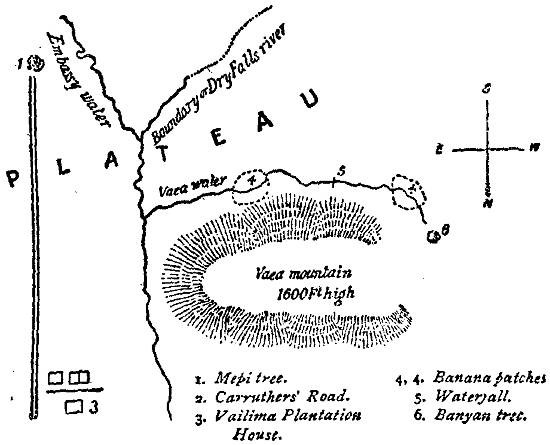
At the top of the climb I made my way again to the watercourse; it is here running steady and pretty full; strange these intermittencies—and just a little below the main stream is quite dry, and all the original brook has gone down some lava gallery of the mountain—and just a little further below, it begins picking up from the left hand in little boggy tributaries, and in the inside of a hundred yards has grown a brook again.30 The general course of the brook was, I guess, S.E.; the valley still very deep and whelmed in wood. It seemed a swindle to have made so sheer a climb and still find yourself at the bottom of a well. But gradually the thing seemed to shallow, the trees to seem poorer and smaller; I could see more and more of the silver sprinkles of sky among the foliage, instead of the sombre piling up of tree behind tree. And here I had two scares—first, away up on my right hand I heard a bull low; I think it was a bull from the quality of the low, which was singularly songful and beautiful; the bulls belong to me, but how did I know that the bull was aware of that? and my advance guard not being at all properly armed, we advanced with great precaution until I was satisfied that I was passing eastward of the enemy. It was during this period that a pool of the river suddenly boiled up in my face in a little fountain. It was in a very dreary, marshy part among dilapidated trees that you see through holes in the trunks of; and if any kind of beast or elf or devil had come out of that sudden silver ebullition, I declare I do not think I should have been surprised. It was perhaps a thing as curious—a fish, with which these head waters of the stream are alive. They are some of them as long as my finger, should be easily caught in these shallows, and some day I’ll have a dish of them.
Very soon after I came to where the stream collects in another banana swamp, with the bananas bearing well. Beyond, the course is again quite dry; it mounts with a sharp turn a very steep face of the mountain, and then stops abruptly at the lip of a plateau, I suppose the top of Vaea mountain: plainly no more springs here—there was no smallest furrow of a watercourse beyond—and my task might be said to be accomplished. But such is the animated spirit in the service that the whole advance guard expressed a sentiment of disappointment that an exploration, so far successfully conducted, should come to a stop in the most promising view of fresh successes. And though unprovided either with compass or cutlass, it was determined to push some way along the plateau, marking our direction by the laborious process of bending down, sitting upon, and thus breaking the wild cocoanut trees. This was the less regretted by all from a delightful discovery made of a huge banyan growing here in the bush, with flying-buttressed flying buttresses, and huge arcs of trunk hanging high overhead and trailing down new complications of root. I climbed some way up what seemed the original beginning; it was easier to climb than a ship’s rigging, even rattled; everywhere there was foot-hold and hand-hold. It was judged wise to return and rally the main body, who had now been left alone for perhaps forty minutes in the bush.
The return was effected in good order, but unhappily I only arrived (like so many other explorers) to find my main body or rear-guard in a condition of mutiny; the work, it is to be supposed, of terror. It is right I should tell you the Vaea has a bad name, an aitu fafine—female devil of the woods—succubus—haunting it, and doubtless Jack had heard of her; perhaps, during my absence, saw her; lucky Jack! Anyway, he was neither to hold nor to bind, and finally, after nearly smashing me by accident, and from mere scare and insubordination several times, deliberately set in to kill me; but poor Jack! the tree he selected for that purpose was a banana! I jumped off and gave him the heavy end of my whip over the buttocks! Then I took and talked in his ear in various voices; you should have heard my alto—it was a dreadful, devilish note—I knew Jack knew it was an aitu. Then I mounted him again, and he carried me fairly steadily. He’ll learn yet. He has to learn to trust absolutely to his rider; till he does, the risk is always great in thick bush, where a fellow must try different passages, and put back and forward, and pick his way by hair’s-breadths.
The expedition returned to Vailima in time to receive the visit of the R. C. Bishop. He is a superior man, much above the average of priests.
Thursday.—Yesterday the same expedition set forth to the southward by what is known as Carruthers’ Road. At a fallen tree which completely blocks the way, the main body was as before left behind, and the advance guard of one now proceeded with the exploration. At the great tree known as Mepi Tree, after Maben the surveyor, the expedition struck forty yards due west till it struck the top of a steep bank which it descended. The whole bottom of the ravine is filled with sharp lava blocks quite unrolled and very difficult and dangerous to walk among; no water in the course, scarce any sign of water. And yet surely water must have made this bold cutting in the plateau. And if so, why is the lava sharp? My science gave out; but I could not but think it ominous and volcanic. The course of the stream was tortuous, but with a resultant direction a little by west of north; the sides the whole way exceeding steep, the expedition buried under fathoms of foliage. Presently water appeared in the bottom, a good quantity; perhaps thirty or forty cubic feet, with pools and waterfalls. A tree that stands all along the banks here must be very fond of water; its roots lie close-packed down the stream, like hanks of guts, so as to make often a corrugated walk, each root ending in a blunt tuft of filaments, plainly to drink water. Twice there came in small tributaries from the left or western side—the whole plateau having a smartish inclination to the east; one of the tributaries in a handsome little web of silver hanging in the forest. Twice I was startled by birds; one that barked like a dog; another that whistled loud ploughman’s signals, so that I vow I was thrilled, and thought I had fallen among runaway blacks, and regretted my cutlass which I had lost and left behind while taking bearings. A good many fishes in the brook, and many crayfish; one of the last with a queer glow-worm head. Like all our brooks, the water is pure as air, and runs over red stones like rubies. The foliage along both banks very thick and high, the place close, the walking exceedingly laborious. By the time the expedition reached the fork, it was felt exceedingly questionable whether the moral of the force were sufficiently good to undertake more extended operations. A halt was called, the men refreshed with water and a bath, and it was decided at a drumhead council of war to continue the descent of the Embassy Water straight for Vailima, whither the expedition returned, in rather poor condition, and wet to the waist, about 4 P.M.
Thus in two days the two main watercourses of this country have been pretty thoroughly explored, and I conceive my instructions fully carried out. The main body of the second expedition was brought back by another officer despatched for that purpose from Vailima. Casualties: one horse wounded; one man bruised; no deaths—as yet, but the bruised man feels to-day as if his case was mighty serious.
Dec. 25, ’91.—Your note with a very despicable bulletin of health arrived only yesterday, the mail being a day behind. It contained also the excellent Times article, which was a sight for sore eyes. I am still taboo; the blessed Germans will have none of me; and I only hope they may enjoy the Times article. ’Tis my revenge! I wish you had sent the letter too, as I have no copy, and do not even know what I wrote the last day, with a bad headache, and the mail going out. However, it must have been about right, for the Times article was in the spirit I wished to arouse. I hope we can get rid of the man before it is too late. He has set the natives to war; but the natives, by God’s blessing, do not want to fight, and I think it will fizzle out—no thanks to the man who tried to start it. But I did not mean to drift into these politics; rather to tell you what I have done since I last wrote.
Well, I worked away at my History for a while, and only got one chapter done; no doubt this spate of work is pretty low now, and will be soon dry; but, God bless you, what a lot I have accomplished; Wrecker done, Beach of Falesá done, half the History: c’est étonnant. (I hear from Burlingame, by the way, that he likes the end of the Wrecker; ’tis certainly a violent, dark yarn with interesting, plain turns of human nature), then Lloyd and I went down to live in Haggard’s rooms, where Fanny presently joined us. Haggard’s rooms are in a strange old building—old for Samoa, and has the effect of the antique like some strange monastery; I would tell you more of it, but I think I’m going to use it in a tale. The annexe close by had its door sealed; poor Dowdney lost at sea in a schooner. The place is haunted. The vast empty sheds, the empty store, the airless, hot, long, low rooms, the claps of wind that set everything flying—a strange uncanny house to spend Christmas in.
Jan. 1st,’92.—For a day or two I have sat close and wrought hard at the History, and two more chapters are all but done. About thirty pages should go by this mail, which is not what should be, but all I could overtake. Will any one ever read it? I fancy not; people don’t read history for reading, but for education and display—and who desires education in the history of Samoa, with no population, no past, no future, or the exploits of Mataafa, Malietoa, and Consul Knappe? Colkitto and Galasp are a trifle to it. Well, it can’t be helped, and it must be done, and, better or worse, it’s capital fun. There are two to whom I have not been kind—German Consul Becker and the English Captain Hand, R. N.
On Dec. 30th I rode down with Belle to go to (if you please) the Fancy Ball. When I got to the beach, I found the barometer was below 29°, the wind still in the east and steady, but a huge offensive continent of clouds and vapours forming to leeward. It might be a hurricane; I dared not risk getting caught away from my work, and, leaving Belle, returned at once to Vailima. Next day—yesterday—it was a tearer; we had storm shutters up; I sat in my room and wrote by lamplight—ten pages, if you please, seven of them draft, and some of these compiled authorities, so that was a brave day’s work. About two a huge tree fell within sixty paces of our house; a little after, a second went; and we sent out boys with axes and cut down a third, which was too near the house, and buckling like a fishing rod. At dinner we had the front door closed and shuttered, the back door open, the lamp lit. The boys in the cook-house were all out at the cook-house door, where we could see them looking in and smiling. Lauilo and Faauma waited on us with smiles. The excitement was delightful. Some very violent squalls came as we sat there, and every one rejoiced; it was impossible to help it; a soul of putty had to sing. All night it blew; the roof was continually sounding under missiles; in the morning the verandahs were half full of branches torn from the forest. There was a last very wild squall about six; the rain, like a thick white smoke, flying past the house in volleys, and as swift, it seemed, as rifle balls; all with a strange, strident hiss, such as I have only heard before at sea, and, indeed, thought to be a marine phenomenon. Since then the wind has been falling with a few squalls, mostly rain. But our road is impassable for horses; we hear a schooner has been wrecked and some native houses blown down in Apia, where Belle is still and must remain a prisoner. Lucky I returned while I could! But the great good is this; much bread-fruit and bananas have been destroyed; if this be general through the islands, famine will be imminent; and whoever blows the coals, there can be no war. Do I then prefer a famine to a war? you ask. Not always, but just now. I am sure the natives do not want a war; I am sure a war would benefit no one but the white officials, and I believe we can easily meet the famine—or at least that it can be met. That would give our officials a legitimate opportunity to cover their past errors.
Jan. 2nd.—I woke this morning to find the blow quite ended. The heaven was all a mottled grey; even the east quite colourless; the downward slope of the island veiled in wafts of vapour, blue like smoke; not a leaf stirred on the tallest tree; only, three miles away below me on the barrier reef, I could see the individual breakers curl and fall, and hear their conjunct roaring rise, as it still rises at 1 P.M., like the roar of a thoroughfare close by. I did a good morning’s work, correcting and clarifying my draft, and have now finished for press eight chapters, ninety-one pages, of this piece of journalism. Four more chapters, say fifty pages, remain to be done; I should gain my wager and finish this volume in three months, that is to say, the end should leave me per February mail; I cannot receive it back till the mail of April. Yes, it can be out in time; pray God that it be in time to help.
How do journalists fetch up their drivel? I aim only at clearness and the most obvious finish, positively at no higher degree of merit, not even at brevity—I am sure it could have been all done, with double the time, in two-thirds of the space. And yet it has taken me two months to write 45,500 words; and, be damned to my wicked prowess, I am proud of the exploit! The real journalist must be a man not of brass only, but bronze. Chapter IX. gapes for me, but I shrink on the margin, and go on chattering to you. This last part will be much less offensive (strange to say) to the Germans. It is Becker they will never forgive me for; Knappe I pity and do not dislike; Becker I scorn and abominate. Here is the tableau. I. Elements of Discord: Native. II. Elements of Discord: Foreign. III. The Sorrows of Laupepa. IV. Brandeis. V. The Battle of Matautu. VI. Last Exploits of Becker. VII. The Samoan Camps. VIII. Affairs of Lautii and Fangalii. IX. “Furor Consularis.” X. The Hurricane. XI. Stuebel Recluse. XII. The Present Government. I estimate the whole roughly at 70,000 words. Should anybody ever dream of reading it, it would be found amusing. 70000/300 = 233 printed pages; a respectable little five-bob volume, to bloom unread in shop windows. After that, I’ll have a spank at fiction. And rest? I shall rest in the grave, or when I come to Italy. If only the public will continue to support me! I lost my chance not dying; there seems blooming little fear of it now. I worked close on five hours this morning; the day before, close on nine; and unless I finish myself off with this letter, I’ll have another hour and a half, or aiblins twa, before dinner. Poor man, how you must envy me, as you hear of these orgies of work, and you scarce able for a letter. But Lord, Colvin, how lucky the situations are not reversed, for I have no situation, nor am fit for any. Life is a steigh brae. Here, have at Knappe, and no more clavers!
Jan. 3rd.—There was never any man had so many irons in the fire, except Jim Pinkerton.31 I forgot to mention I have the most gallant suggestion from Lang, with an offer of MS. authorities, which turns my brain. It’s all about the throne of Poland and buried treasure in the Mackay country, and Alan Breck can figure there in glory.
Yesterday, J. and I set off to Blacklock’s (American Consul) who lives not far from that little village I have so often mentioned as lying between us and Apia. I had some questions to ask him for my History; thence we must proceed to Vailele, where I had also to cross-examine the plantation manager about the battle there. We went by a track I had never before followed down the hill to Vaisigano, which flows here in a deep valley, and was unusually full, so that the horses trembled in the ford. The whole bottom of the valley is full of various streams posting between strips of forest with a brave sound of waters. In one place we had a glimpse of a fall some way higher up, and then sparkling in sunlight in the midst of the green valley. Then up by a winding path scarce accessible to a horse for steepness, to the other side, and the open cocoanut glades of the plantation. Here we rode fast, did a mighty satisfactory afternoon’s work at the plantation house, and still faster back. On the return Jack fell with me, but got up again; when I felt him recovering I gave him his head, and he shoved his foot through the rein; I got him by the bit however, and all was well; he had mud over all his face, but his knees were not broken. We were scarce home when the rain began again; that was luck. It is pouring now in torrents; we are in the height of the bad season. Lloyd leaves along with this letter on a change to San Francisco; he had much need of it, but I think this will brace him up. I am, as you see, a tower of strength. I can remember riding not so far and not near so fast when I first came to Samoa, and being shattered next day with fatigue; now I could not tell I have done anything; have re-handled my battle of Fangalii according to yesterday’s information—four pages rewritten; and written already some half-dozen pages of letters.
I observe with disgust that while of yore, when I own I was guilty, you never spared me abuse—but now, when I am so virtuous, where is the praise? Do admit that I have become an excellent letter-writer—at least to you, and that your ingratitude is imbecile.—Yours ever,
R. L. S.
1 “In the missionary work which is being done among the Samoans, Mr. Stevenson was especially interested. He was an observant, shrewd, yet ever generous critic of all our religious and educational organisations. His knowledge of native character and life enabled him to understand missionary difficulties, while his genial contact with all sorts and conditions of men made him keen to detect deficiencies in men and methods, and apt in useful suggestion.” The above is the testimony of the Mr. Clarke here mentioned (Rev. W. E. Clarke of the London Missionary Society). This gentleman was from the first one of the most valued friends of Mr. Stevenson and his family in Samoa, and, when the end came, read the funeral service beside his grave on Mount Vaea.
2 The lady in the Vicar of Wakefield who declares herself “all in a muck of sweat.”
3 First published in the New Review, January 1895.
4 Afterwards changed into The Beach of Falesá.
5 Mr. Lloyd Osbourne had come to England to pack and wind up affairs at Skerryvore.
6 The lines beginning “I heard the pulse of the besieging sea”; see Vol. xxiv., p. 366.
7 “The Monument” was his name for my house at the British Museum, and George was my old faithful servant, George Went.
8 The late Mr. John Lafarge, long an honoured doyen among New York artists, whose record of his holiday in the South Seas, in the shape of a series of water-colour sketches of the scenery and people (with a catalogue full of interesting notes and observations), was one of the features of the Champ de Mars Salon in 1895.
9 Mrs. B. W. Procter, the stepdaughter of Basil Montagu and widow of Barry Cornwall. The death of this spirited veteran in 1888 snapped one of the last links with the days and memories of Keats and Coleridge. A shrewd and not too indulgent judge of character, she took R. L. S. into warm favour at first sight, and never spoke of or inquired after him but with unwonted tenderness.
10 On a projected expedition to Sydney.
11 See A Footnote to History for more in praise of Dr. Stuebel, and of his exceptional deserts among white officials in Samoa.
12 One of the many aliases of the wicked Skye-terrier of Hyères, Davos, and Bournemouth days, celebrated in the essay On the Character of Dogs.
13 Battre les champs, to wander in mind.
14 Memoir of Fleeming Jenkin, by R. L. S., prefixed to Papers Literary, Scientific, etc., by the late Fleeming Jenkin, F.R.S., LL.D.; 2 vols. London, Longmans, 1887. The first chapters consist of a genealogical history of the family. This, to my mind one of the best works of R. L. S., has lately been separately reprinted, having long been accessible only in the Edinburgh and Pentland editions. Of Delafleld I never heard; the plan of Shovel, which was to be in great part a story of the Peninsular War, had been sketched out and a few chapters written as long ago as the seventies.
15 The Misadventures of John Nicholson.
16 The South Sea Letters.
17 The price advanced for these Letters was among the considerations which originally induced the writer to set out on his Pacific voyage.
18 The first serial tale, says Mr. Clarke, ever read by Samoans in their own language was the story of the Bottle Imp, “which found its way into print at Samoa, and was read with wonder and delight in many a thatched Samoan hut before it won the admiration of readers at home.” In the English form the story was published first in Black and White, and afterwards in the volume called Island Nights’ Entertainments.
19 Boating expedition: pronounce malanga.
20 Portraits of myself for which he had asked.
21 Miss Fanny Macpherson, now Lady Holroyd.
22 In reply to a suggestion which ultimately took effect in the shape of the volume called Across the Plains (Chatto & Windus, 1892).
23 The steam-yacht of the Commissioners of Northern Lights, on which he had been accustomed as a lad to accompany his father on the official trips of inspection round the coast.
24 Mr. Rudyard Kipling was at this time planning a trip to Samoa, but the plan was unfortunately not carried out, and he and Stevenson never met.
25 Readers of The Wrecker will not need to be reminded that this is the name of the personage on whom the mystery in that story hinges.
26 See vol. xxiii. pp. 46, 48.
27 Across the Plains. The papers specially referred to in the next lines are those written at Saranac Lake in the winter of 1887-88, including A Letter to a Young Gentleman, Pulvis et Umbra, A Christmas Sermon.
28 For the volume Across the Plains.
29 i.e. on the stage.
30 As to this peculiar intermittency of the Samoan streams, full in their upper course, but below in many places dry or lost, compare the late Lord Pembroke’s South Sea Bubbles, p. 212:—“One odd thing connected with these ravines is the fact that the higher you go the more water you find. Unlike the Thames, which begins, I believe, in half a mile of dusty lane, and expands in its brimming breadth as it approaches the sea, a Samoan stream begins in bubbling plenty and ends in utter drought a mile or two from the salt water. Gradually as you ascend you become more and more hopeful; moist patches of sand appear here and there, then tiny pools that a fallen leaf might cover, then larger ones with little thread-like runs of water between them; larger and larger, till at last you reach some hard ledge of trap, over which a glorious stream gurgles and splashes into a pool ample enough for the bath of an elephant.”
31 In The Wrecker. As to the story thus suggested by Mr. Andrew Lang, see below, pp. 171, 187, etc.
XII
LIFE IN SAMOA—Continued
SECOND YEAR AT VAILIMA
January-December 1892
The New Year found Stevenson down with his first attack of the influenza epidemic, then virulent all over the world. But the illness was not sufficient to stop his work, and in the first two months of the year he was busy continuing his conscientious labours on The Footnote to History, seeing The Wrecker and The Beach of Falesá through the press, planning the South Sea plantation novel Sophia Scarlet, which never got beyond that inchoate stage, and writing the continuation to Kidnapped, first intended to bear the name of the hero, David Balfour, and afterwards changed to Catriona. With this he proceeded swimmingly, completing it between February and September, in a shorter time than any other of his sustained narratives; and on publication its success was great. By May he had finished the Footnote, and then had a dash at the first chapters of The Young Chevalier, which stand in their truncated state a piece of work as vivid and telling as he had ever done. Early in the autumn he struck a still fuller note in the draft of the first chapters of Weir of Hermiston.
During this year the household at Vailima received a new temporary inmate in the person of Mr. Graham Balfour, a cousin whom Stevenson had not previously known, but with whom he soon formed the closest and most confidential friendship of his later life. In the summer and early autumn he was much taken up both with politics and with hospitalities. As hereinafter narrated, he made, and was thwarted in, a serious attempt to effect a reconciliation between the two rival chiefs; and continued his series of letters to the Times showing up the incompetence, and worse, of the responsible Treaty officials. In August he took lively pleasure in a visit paid to the islands by Lady Jersey and some members of her family from Australia. During the course of their stay he conducted the visitors to the rebel camp under aliases, as the needs of the time required, and in a manner that seemed like the realisation of a chapter of a Waverley novel. A month or two later he became aware, with more amusement than alarm, of measures for his deportation set on foot but not carried through by the Treaty officials. For a man of his temper, the political muddle and mismanagement of which the Samoan Islands were the scene—and not only these, however much he might lament them for the sake of the inhabitants, but even the risks he ran of serious personal consequences from his own action,—added to life at least as much of zest and excitement as of annoyance.
In October he determined, not without serious financial misgivings and chiefly in deference to his mother’s urgency, to enlarge his house at Vailima by putting up a new block adjoining and communicating with that which he had hitherto inhabited. The work was promptly and efficiently carried out by the German Firm and completed by the end of the year. Quite towards the close of December, copies of The Footnote to History reached Samoa, and the book, so far from being a cause of offence to his friends the managers of that firm, as both he and they had feared, was found acceptable and devoid of offence by them: a result celebrated in the convivial manner described in the last letter of this section. On the whole the year had been a prosperous one, full of successful work and eager interests, although darkened in its later months by disquietude on account of his wife’s health. He had himself well maintained the improved strength and the renewed capacity both for literary work and outdoor activity which life in the South Seas had brought him from the first.
To E. L. Burlingame
[Vailima] Jan, 2nd, ’92.
MY DEAR BURLINGAME,—Overjoyed you were pleased with The Wrecker, and shall consider your protests. There is perhaps more art than you think for in the peccant chapter, where I have succeeded in packing into one a dedication, an explanation, and a termination. Surely you had not recognised the phrase about boodle? It was a quotation from Jim Pinkerton, and seemed to me agreeably skittish. However, all shall be prayerfully considered.
To come to a more painful subject. Herewith go three more chapters of the wretched History; as you see, I approach the climax. I expect the book to be some 70,000 words, of which you have now 45. Can I finish it for next mail? I am going to try! ’Tis a long piece of journalism, and full of difficulties here and there, of this kind and that, and will make me a power of friends to be sure. There is one Becker who will probably put up a window to me in the church where he was baptized; and I expect a testimonial from Captain Hand.
Sorry to let the mail go without the Scott; this has been a bad month with me, and I have been below myself. I shall find a way to have it come by next, or know the reason why. The mail after, anyway.
A bit of a sketch map appears to me necessary for my History; perhaps two. If I do not have any, ’tis impossible any one should follow; and I, even when not at all interested, demand that I shall be able to follow; even a tourist book without a map is a cross to me; and there must be others of my way of thinking. I inclose the very artless one that I think needful. Vailima, in case you are curious, is about as far again behind Tanugamanono as that is from the sea.
M’Clure is publishing a short story of mine, some 50,000 words, I think, The Beach of Falesá; when he’s done with it, I want you and Cassell to bring it out in a little volume; I shall send you a dedication for it; I believe it good; indeed, to be honest, very good. Good gear that pleases the merchant.
The other map that I half threaten is a chart for the hurricane. Get me Kimberley’s report of the hurricane: not to be found here. It is of most importance; I must have it with my proofs of that part, if I cannot have it earlier, which now seems impossible.—Yours in hot haste,
R. L. Stevenson.
To Miss Adelaide Boodle
At the news that his correspondent was occupied teaching and entertaining a class of children in a Kilburn basement, Stevenson bethinks himself of helping her by writing an account of Samoa and Samoan life for children.
Vailima, January 4th, 1892.
MY DEAR ADELAIDE,—We were much pleased with your letter and the news of your employment. Admirable, your method. But will you not run dry of fairy stories? Please salute your pupils, and tell them that a long, lean, elderly man who lives right through on the under side of the world, so that down in your cellar you are nearer him than the people in the street, desires his compliments. This man lives in an island which is not very long, and extremely narrow. The sea beats round it very hard, so that it is difficult to get to shore. There is only one harbour where ships come, even that is very wild and dangerous; four ships of war were broken there a little while ago, and one of them is still lying on its side on a rock clean above water, where the sea threw it as you might throw your fiddle bow on the table. All round the harbour the town is strung out, it is nothing but wooden houses, only there are some churches built of stone, not very large, but the people have never seen such fine buildings. Almost all the houses are of one story. Away at one end lives the king of the whole country. His palace has a thatched roof which stands upon posts; it has no walls, but when it blows and rains, they have Venetian blinds which they let down between the posts and make it very snug. There is no furniture, and the king and queen and the courtiers sit and eat on the floor, which is of gravel: the lamp stands there too, and every now and then it is upset. These good folks wear nothing but a kilt about their waists, unless to go to church or for a dance, or the New Year, or some great occasion. The children play marbles all along the street; and though they are generally very jolly, yet they get awfully cross over their marbles, and cry and fight like boys and girls at home. Another amusement in country places is to shoot fish with a bow and arrow. All round the beach there is bright shallow water where fishes can be seen darting or lying in shoals. The child trots round the shore, and wherever he sees a fish, lets fly an arrow and misses, and then wades in after his arrow. It is great fun (I have tried it) for the child, and I never heard of it doing any harm to the fishes: so what could be more jolly? The road up to this lean man’s house is uphill all the way and through forests; the forests are of great trees, not so much unlike the trees at home, only here and there are some very queer ones mixed with them, cocoa-nut palms, and great forest trees that are covered with blossom like red hawthorn, but not near so bright; and from all the trees thick creepers hang down like ropes, and nasty-looking weeds that they call orchids grow in the forks of the branches; and on the ground many prickly things are dotted which they call pine-apples: I suppose every one has eaten pineapple drops.
On the way up to the lean man’s house you pass a little village, all of houses like the king’s house, so that as you ride through you can see everybody sitting at dinner, or if it be night, lying in their beds by lamplight; for all these people are terribly afraid of ghosts, and would not lie in the dark for any favour. After the village, there is only one more house, and that is the lean man’s. For the people are not very many, and live all by the sea, and the whole inside of the island is desert woods and mountains. When the lean man goes into this forest, he is very much ashamed to say it, but he is always in a terrible fright. The wood is so great and empty and hot, and it is always filled with curious noises; birds cry like children and bark like dogs, and he can hear people laughing and felling trees; and the other day (when he was far in the woods) he heard a great sound like the biggest mill-wheel possible going with a kind of dot-and-carry-one movement like a dance. That was the noise of an earthquake away down below him in the bowels of the earth, and that is the same thing as to say away up towards you in your cellar in Kilburn. All these noises make him feel lonely and scared, and he doesn’t quite know what he is scared of. Once when he was just about to cross a river, a blow struck him on the top of his head and knocked him head-foremost down the bank and splash into the water. It was a nut, I fancy, that had fallen from a tree, by which accidents people are sometimes killed. But at the time he thought it was a black boy.
Aha, say you, and what is a black boy? Well, there are here a lot of poor people who are brought here from distant islands to labour as slaves for the Germans. They are not at all like the king or his people, who are brown and very pretty; but these are black as negroes and as ugly as sin, poor souls, and in their own lands they live all the time at war and cook and eat men’s flesh. The Germans thrash them with whips to make them work, and every now and then some run away into the Bush, as the forest is called, and build little sheds of leaves, and eat nuts and roots and fruit, and dwell there by themselves in the great desert. Sometimes they are bad and wild and come down in the villages and steal and kill; and people whisper to each other that some of them have gone back to their horrid old habits, and catch men and women in order to eat them. But it is very likely not true; and the most of them are only poor, stupid, trembling, half-starved, pitiful creatures like frightened dogs. Their life is all very well when the sun shines, as it does eight or nine months in the year. But it is very different the rest of the time. The wind rages here most violently. The great trees thrash about like whips; the air is filled with leaves and great branches flying about like birds; and the sound of the trees falling shakes the earth. It rains too as it never rains at home. You can hear a shower while it is yet half a mile away, hissing like a shower-bath in the forest; and when it comes to you, the water blinds your eyes, and the cold drenching takes your breath away as though some one had struck you. In that kind of weather it must be dreadful indeed to live in the woods, one man alone by himself. And you must know that, if the lean man feels afraid to be in the forest, the people of the island and the black boys are much more afraid than he. For they believe the woods to be quite filled with spirits; some are like pigs, and some are like flying things; but others (and these are thought the most dangerous) come in the shape of beautiful young women and young men, beautifully dressed in the island manner, with fine kilts and fine necklaces and crowns of scarlet seeds and flowers. Woe betide he or she who gets to speak with one of these! They will be charmed out of their wits, and come home again quite silly, and go mad and die. So that the poor black boy must be always trembling and looking about for the coming of the women-devils.
Sometimes the women-devils go down out of the woods into the villages, and here is a tale the lean man heard last year. One of the islanders was sitting in his house, and he had cooked fish. There came along the road two beautiful young women, dressed as I told you, who came into his house and asked for some of his fish. It is the fashion in the islands always to give what is asked, and never to ask folk’s names. So the man gave them fish and talked to them in the island jesting way. And presently he asked one of the women for her red necklace, which is good manners and their way; he had given the fish, and he had a right to ask for something back. “I will give it you by and by,” said the woman, and she and her companion went away; but he thought they were gone very suddenly, and the truth is they had vanished. The night was nearly come, when the man heard the voice of the woman crying that he should come to her and she would give the necklace. And he looked out, and behold she was standing calling him from the top of the sea, on which she stood as you might on the table. At that, fear came on the man; he fell on his knees and prayed, and the woman disappeared. It was known afterwards that this was once a woman indeed, but should have died a thousand years ago, and has lived all that while as a devil in the woods beside the spring of a river. Saumai-afe (Sow-my-affy) is her name, in case you want to write to her.—Ever your friend Tusitala (tale-writer),
alias Robert Louis Stevenson.
29 i.e. on the stage.
30 As to this peculiar intermittency of the Samoan streams, full in their upper course, but below in many places dry or lost, compare the late Lord Pembroke’s South Sea Bubbles, p. 212:—“One odd thing connected with these ravines is the fact that the higher you go the more water you find. Unlike the Thames, which begins, I believe, in half a mile of dusty lane, and expands in its brimming breadth as it approaches the sea, a Samoan stream begins in bubbling plenty and ends in utter drought a mile or two from the salt water. Gradually as you ascend you become more and more hopeful; moist patches of sand appear here and there, then tiny pools that a fallen leaf might cover, then larger ones with little thread-like runs of water between them; larger and larger, till at last you reach some hard ledge of trap, over which a glorious stream gurgles and splashes into a pool ample enough for the bath of an elephant.”
31 In The Wrecker. As to the story thus suggested by Mr. Andrew Lang, see below, pp. 171, 187, etc.
To Sidney Colvin
The South Sea novel here mentioned, Sophia Scarlet, never got beyond the rough draft of an opening chapter or two.
[Vailima] Jan. 31st, ’92.
MY DEAR COLVIN,—No letter at all from you, and this scratch from me! Here is a year that opens ill. Lloyd is off to “the coast” sick—the coast means California over most of the Pacific—I have been down all month with influenza, and am just recovering—I am overlaid with proofs, which I am just about half fit to attend to. One of my horses died this morning, and another is now dying on the front lawn—Lloyd’s horse and Fanny’s. Such is my quarrel with destiny. But I am mending famously, come and go on the balcony, have perfectly good nights, and though I still cough, have no oppression and no hemorrhage and no fever. So if I can find time and courage to add no more, you will know my news is not altogether of the worst; a year or two ago, and what a state I should have been in now! Your silence, I own, rather alarms me. But I tell myself you have just miscarried; had you been too ill to write, some one would have written me. Understand, I send this brief scratch not because I am unfit to write more, but because I have 58 galleys of The Wrecker and 102 of The Beach of Falesá to get overhauled somehow or other in time for the mail, and for three weeks I have not touched a pen with my finger.
Feb. 1st.—The second horse is still alive, but I still think dying. The first was buried this morning. My proofs are done; it was a rough two days of it, but done. Consummatum est; ua uma. I believe The Wrecker ends well; if I know what a good yarn is, the last four chapters make a good yarn—but pretty horrible. The Beach of Falesá I still think well of, but it seems it’s immoral and there’s a to-do, and financially it may prove a heavy disappointment. The plaintive request sent to me, to make the young folks married properly before “that night,” I refused; you will see what would be left of the yarn, had I consented.32 This is a poison bad world for the romancer, this Anglo-Saxon world; I usually get out of it by not having any women in it at all; but when I remember I had The Treasure of Franchard refused as unfit for a family magazine, I feel despair weigh upon my wrists.
As I know you are always interested in novels, I must tell you that a new one is now entirely planned. It is to be called Sophia Scarlet, and is in two parts. Part I. The Vanilla Planter. Part II. The Overseers. No chapters, I think; just two dense blocks of narrative, the first of which is purely sentimental, but the second has some rows and quarrels, and winds up with an explosion, if you please! I am just burning to get at Sophia, but I must do this Samoan journalism—that’s a cursed duty. The first part of Sophia, bar the first twenty or thirty pages, writes itself; the second is more difficult, involving a good many characters—about ten, I think—who have to be kept all moving, and give the effect of a society. I have three women to handle, out and well-away! but only Sophia is in full tone. Sophia and two men, Windermere, the Vanilla Planter, who dies at the end of Part I., and Rainsforth, who only appears in the beginning of Part II. The fact is, I blush to own it, but Sophia is a regular novel; heroine and hero, and false accusation, and love, and marriage, and all the rest of it—all planted in a big South Sea plantation run by ex-English officers—à la Stewart’s plantation in Tahiti.33 There is a strong undercurrent of labour trade which gives it a kind of Uncle Tom flavour, absit omen!
The first start is hard; it is hard to avoid a little tedium here, but I think by beginning with the arrival of the three Miss Scarlets hot from school and society in England, I may manage to slide in the information. The problem is exactly a Balzac one, and I wish I had his fist—for I have already a better method—the kinetic, whereas he continually allowed himself to be led into the static. But then he had the fist, and the most I can hope is to get out of it with a modicum of grace and energy, but for sure without the strong impression, the full, dark brush. Three people have had it, the real creator’s brush: Scott, see much of The Antiquary and The Heart of Midlothian (especially all round the trial, before, during, and after)—Balzac—and Thackeray in Vanity Fair. Everybody else either paints thin, or has to stop to paint, or paints excitedly, so that you see the author skipping before his canvas. Here is a long way from poor Sophia Scarlet!
This day is published
Sophia Scarlet
By
Robert Louis Stevenson
To J. M. Barrie
The following is the first of several letters to Mr. J. M. Barrie, for whose work Stevenson had a warm admiration, and with whom he soon established by correspondence a cordial friendship.
Vailima, Samoa, February 1892.
DEAR MR. BARRIE,—This is at least the third letter I have written you, but my correspondence has a bad habit of not getting so far as the post. That which I possess of manhood turns pale before the business of the address and envelope. But I hope to be more fortunate with this: for, besides the usual and often recurrent desire to thank you for your work—you are one of four that have come to the front since I was watching and had a corner of my own to watch, and there is no reason, unless it be in these mysterious tides that ebb and flow, and make and mar and murder the works of poor scribblers, why you should not do work of the best order. The tides have borne away my sentence, of which I was weary at any rate, and between authors I may allow myself so much freedom as to leave it pending. We are both Scots besides, and I suspect both rather Scotty Scots; my own Scotchness tends to intermittency, but is at times erisypelitous—if that be rightly spelt. Lastly, I have gathered we had both made our stages in the metropolis of the winds: our Virgil’s “grey metropolis,” and I count that a lasting bond. No place so brands a man.
Finally, I feel it a sort of duty to you to report progress. This may be an error, but I believed I detected your hand in an article—it may be an illusion, it may have been by one of those industrious insects who catch up and reproduce the handling of each emergent man—but I’ll still hope it was yours—and hope it may please you to hear that the continuation of Kidnapped is under way. I have not yet got to Alan, so I do not know if he is still alive, but David seems to have a kick or two in his shanks. I was pleased to see how the Anglo-Saxon theory fell into the trap: I gave my Lowlander a Gaelic name, and even commented on the fact in the text; yet almost all critics recognised in David and Alan a Saxon and a Celt. I know not about England; in Scotland at least, where Gaelic was spoken in Fife little over the century ago, and in Galloway not much earlier, I deny that there exists such a thing as a pure Saxon, and I think it more than questionable if there be such a thing as a pure Celt.
But what have you to do with this? and what have I? Let us continue to inscribe our little bits of tales, and let the heathen rage!—Yours, with sincere interest in your career,
Robert Louis Stevenson.
To Sidney Colvin
[Vailima] Feb. 1892.
MY DEAR COLVIN,—This has been a busyish month for a sick man. First, Faauma—the bronze candlestick, whom otherwise I called my butler—bolted from the bed and bosom of Lafaele, the Archangel Hercules, prefect of the cattle. There was a deuce to pay, and Hercules was inconsolable, and immediately started out after a new wife, and has had one up on a visit, but says she has “no conversation”; and I think he will take back the erring and possibly repentant candlestick; whom we all devoutly prefer, as she is not only highly decorative, but good-natured, and if she does little work makes no rows. I tell this lightly, but it really was a heavy business; many were accused of complicity, and Rafael was really very sorry. I had to hold beds of justice—literally—seated in my bed and surrounded by lying Samoans seated on the floor; and there were many picturesque and still inexplicable passages. It is hard to reach the truth in these islands.
The next incident overlapped with this. S. and Fanny found three strange horses in the paddock: for long now the boys have been forbidden to leave their horses here one hour because our grass is over-grazed. S. came up with the news, and I saw I must now strike a blow. “To the pound with the lot,” said I. He proposed taking the three himself, but I thought that too dangerous an experiment, said I should go too, and hurried into my boots so as to show decision taken, in the necessary interviews. They came of course—the interviews—and I explained what I was going to do at huge length, and stuck to my guns. I am glad to say the natives, with their usual (purely speculative) sense of justice, highly approved the step after reflection. Meanwhile off went S. and I with the three corpora delicti; and a good job I went! Once, when our circus began to kick, we thought all was up; but we got them down all sound in wind and limb. I judged I was much fallen off from my Elliot forefathers, who managed this class of business with neatness and despatch.
As we got down to town, we met the mother and daughter of my friend ——, bathed in tears; they had left the house over a row, which I have not time or spirits to describe. This matter dashed me a good deal, and the first decent-looking day I mounted and set off to see if I could not patch things up. Half-way down it came on to rain tropic style, and I came back from my second outing drenched like a drowned man—I was literally blinded as I came back among these sheets of water; and the consequence was I was laid down with diarrhœa and threatenings of Samoa colic for the inside of another week. Meanwhile up came Laulii,34 in whose house Mrs. and Miss —— have taken refuge. One of Mrs. ——’s grievances is that her son has married one of these “pork-eaters and cannibals.” (As a matter of fact there is no memory of cannibalism in Samoa.) And a strange thing it was to hear the “cannibal” Laulii describe her sorrows. She is singularly pretty and sweet, her training reflects wonderful credit on her husband; and when she began to describe to us—to act to us, in the tone of an actress walking through a rehearsal—the whole bearing of her angry guests; indicating the really tragic notes when they came in, so that Fanny and I were ashamed to laugh, and touching off the merely ludicrous with infinite tact and sly humour; showing, in fact, in her whole picture of a couple of irate barbarian women, the whole play and sympathy of what we call the civilised mind; the contrast was seizing. I speak with feeling. To-day again, being the first day humanly possible for me, I went down to Apia with Fanny, and between two and three hours did I argue with that old woman—not immovable, would she had been! but with a mechanical mind like a piece of a musical snuff-box, that returned always to the same starting-point; not altogether base, for she was long-suffering with me and professed even gratitude, and was just (in a sense) to her son, and showed here and there moments of genuine and not undignified emotion; but O! on the other side, what lapses—what a mechanical movement of the brain, what occasional trap-door devils of meanness, what a wooden front of pride! I came out damped and saddened and (to say truth) a trifle sick. My wife had better luck with the daughter; but O, it was a weary business!
To add to my grief—but that’s politics. Before I sleep to-night I have a confession to make. When I was sick I tried to get to work to finish that Samoa thing; wouldn’t go; and at last, in the colic time, I slid off into David Balfour,35 some 50 pages of which are drafted, and like me well. Really I think it is spirited; and there’s a heroine that (up to now) seems to have attractions: absit omen! David, on the whole, seems excellent. Alan does not come in till the tenth chapter, and I am only at the eighth, so I don’t know if I can find him again; but David is on his feet, and doing well, and very much in love, and mixed up with the Lord Advocate and the (untitled) Lord Lovat, and all manner of great folk. And the tale interferes with my eating and sleeping. The join is bad; I have not thought to strain too much for continuity; so this part be alive, I shall be content. But there’s no doubt David seems to have changed his style, de’il ha’e him! And much I care, if the tale travel!
Friday, Feb.?? 19th?—Two incidents to-day which I must narrate. After lunch, it was raining pitilessly; we were sitting in my mother’s bedroom, and I was reading aloud Kinglake’s Charge of the Light Brigade, and we had just been all seized by the horses aligning with Lord George Paget, when a figure appeared on the verandah; a little, slim, small figure of a lad, with blond (i.e. limed) hair, a propitiatory smile, and a nose that alone of all his features grew pale with anxiety. “I come here stop,” was about the outside of his English; and I began at once to guess that he was a runaway labourer,36 and that the bush-knife in his hand was stolen. It proved he had a mate, who had lacked his courage, and was hidden down the road; they had both made up their minds to run away, and had “come here stop.” I could not turn out the poor rogues, one of whom showed me marks on his back, into the drenching forest; I could not reason with them, for they had not enough English, and not one of our boys spoke their tongue; so I bade them feed and sleep here to-night, and to-morrow I must do what the Lord shall bid me.
Near dinner time, I was told that a friend of Lafaele’s had found human remains in my bush. After dinner, a figure was seen skulking across towards the waterfall, which produced from the verandah a shout, in my most stentorian tones: “O ai le ingoa?” literally “Who the name?” which serves here for “What’s your business?” as well. It proved to be Lafaele’s friend; I bade a kitchen boy, Lauilo, go with him to see the spot, for though it had ceased raining, the whole island ran and dripped. Lauilo was willing enough, but the friend of the archangel demurred; he had too much business; he had no time. “All right,” I said, “you too much frightened, I go along,” which of course produced the usual shout of delight from all those who did not require to go. I got into my Saranac snow boots; Lauilo got a cutlass; Mary Carter, our Sydney maid, joined the party for a lark, and off we set. I tell you our guide kept us moving; for the dusk fell swift. Our woods have an infamous reputation at the best, and our errand (to say the least of it) was grisly. At last they found the remains; they were old, which was all I cared to be sure of; it seemed a strangely small “pickle-banes” to stand for a big, flourishing, buck-islander, and their situation in the darkening and dripping bush was melancholy. All at once, I found there was a second skull, with a bullet-hole I could have stuck my two thumbs in—say anybody else’s one thumb. My Samoans said it could not be, there were not enough bones; I put the two pieces of skull together, and at last convinced them. Whereupon, in a flash, they found the not unromantic explanation. This poor brave had succeeded in the height of a Samoan warrior’s ambition; he had taken a head, which he was never destined to show to his applauding camp. Wounded himself, he had crept here into the bush to die with his useless trophy by his side. His date would be about fifteen years ago, in the great battle between Laupepa and Talavou, which took place on My Land, Sir. To-morrow we shall bury the bones and fire a salute in honour of unfortunate courage.
Do you think I have an empty life? or that a man jogging to his club has so much to interest and amuse him?—touch and try him too, but that goes along with the others: no pain, no pleasure, is the iron law. So here I stop again, and leave, as I left yesterday, my political business untouched. And lo! here comes my pupil, I believe, so I stop in time.
March 2nd.—Since I last wrote, fifteen chapters of David Balfour have been drafted, and five tirés au clair. I think it pretty good; there’s a blooming maiden that costs anxiety—she is as virginal as billy; but David seems there and alive, and the Lord Advocate is good, and so I think is an episodic appearance of the Master of Lovat. In Chapter XVII. I shall get David abroad—Alan went already in Chapter XII. The book should be about the length of Kidnapped; this early part of it, about D.’s evidence in the Appin case, is more of a story than anything in Kidnapped, but there is no doubt there comes a break in the middle, and the tale is practically in two divisions. In the first James More and the M’Gregors, and Catriona, only show; in the second, the Appin case being disposed of, and James Stewart hung, they rule the roast and usurp the interest—should there be any left. Why did I take up David Balfour? I don’t know. A sudden passion.
Monday, I went down in the rain with a colic to take the chair at a public meeting; dined with Haggard; sailed off to my meeting, and fought with wild beasts for three anxious hours. All was lost that any sensible man cared for, but the meeting did not break up—thanks a good deal to R. L. S.—and the man who opposed my election, and with whom I was all the time wrangling, proposed the vote of thanks to me with a certain handsomeness; I assure you I had earned it.... Haggard and the great Abdul, his high-caste Indian servant, imported by my wife, were sitting up for me with supper, and I suppose it was twelve before I got to bed. Tuesday raining, my mother rode down, and we went to the Consulate to sign a Factory and Commission. Thence, I to the lawyers, to the printing office, and to the mission. It was dinner time when I returned home.
This morning, our cook-boy having suddenly left—injured feelings—the archangel was to cook breakfast. I found him lighting the fire before dawn; his eyes blazed, he had no word of any language left to use, and I saw in him (to my wonder) the strongest workings of gratified ambition. Napoleon was no more pleased to sign his first treaty with Austria than was Lafaele to cook that breakfast. All morning, when I had hoped to be at this letter, I slept like one drugged, and you must take this (which is all I can give you) for what it is worth—
D. B.
Memoirs of his Adventures at Home and Abroad. The Second Part; wherein are set forth the misfortunes in which he was involved upon the Appin Murder; his troubles with Lord Advocate Prestongrange; captivity on the Bass Rock; journey into France and Holland; and singular relations with James More Drummond or Macgregor, a son of the notorious Rob Roy.
Chapters.—I. A Beggar on Horseback. II. The Highland Writer. III. I go to Pilrig. IV. Lord Advocate Prestongrange. V. Butter and Thunder. VI. I make a fault in honour. VII. The Bravo. VIII. The Heather on Fire. IX. I begin to be haunted with a red-headed man. X. The Wood by Silvermills. XI. On the march again with Alan. XII. Gillane Sands. XIII. The Bass Rock. XIV. Black Andie’s Tale of Tod Lapraik. XV. I go to Inveraray.
That is it, as far as drafted. Chapters IV. V. VII. IX. and XIV. I am specially pleased with; the last being an episodical bogie story about the Bass Rock told there by the Keeper.
To William Morris
The following draft letter addressed to Mr. William Morris was found among Stevenson’s papers after his death. It has touches of affectation and constraint not usual with him, and it is no doubt on that account that he did not send it; but though not in his best manner, it seems worth printing as illustrating the variety of his interests and admirations in literature.
Vailima, Samoa, Feb. 1892.
MASTER,—A plea from a place so distant should have some weight, and from a heart so grateful should have some address. I have been long in your debt, Master, and I did not think it could be so much increased as you have now increased it. I was long in your debt and deep in your debt for many poems that I shall never forget, and for Sigurd before all, and now you have plunged me beyond payment by the Saga Library. And so now, true to human nature, being plunged beyond payment, I come and bark at your heels.
For surely, Master, that tongue that we write, and that you have illustrated so nobly, is yet alive. She has her rights and laws, and is our mother, our queen, and our instrument. Now in that living tongue where has one sense, whereas another. In the Heathslayings Story, p. 241, line 13, it bears one of its ordinary senses. Elsewhere and usually through the two volumes, which is all that has yet reached me of this entrancing publication, whereas is made to figure for where.
For the love of God, my dear and honoured Morris, use where, and let us know whereas we are, wherefore our gratitude shall grow, whereby you shall be the more honoured wherever men love clear language, whereas now, although we honour, we are troubled.
Whereunder, please find inscribed to this very impudent but yet very anxious document, the name of one of the most distant but not the youngest or the coldest of those who honour you
Robert Louis Stevenson.
To Mrs. Charles Fairchild
The projected visit of Mr. Kipling, with his wife and brother-in-law, to Samoa, which is mentioned towards the close of this letter, never took place, much to the regret of both authors.
[Vailima, March 1892.]
MY DEAR MRS. FAIRCHILD,—I am guilty in your sight, but my affairs besiege me. The chief-justiceship of a family of nineteen persons is in itself no sinecure, and sometimes occupies me for days: two weeks ago for four days almost entirely, and for two days entirely. Besides which, I have in the last few months written all but one chapter of a History of Samoa for the last eight or nine years; and while I was unavoidably delayed in the writing of this, awaiting material, put in one-half of David Balfour, the sequel to Kidnapped. Add the ordinary impediments of life, and admire my busyness. I am now an old, but healthy skeleton, and degenerate much towards the machine. By six at work: stopped at half-past ten to give a history lesson to a step-grandson; eleven, lunch; after lunch we have a musical performance till two; then to work again; bath, 4.40; dinner, five; cards in the evening till eight; and then to bed—only I have no bed, only a chest with a mat and blankets—and read myself to sleep. This is the routine, but often sadly interrupted. Then you may see me sitting on the floor of my verandah haranguing and being harangued by squatting chiefs on a question of a road; or more privately holding an inquiry into some dispute among our familiars, myself on my bed, the boys on the floor—for when it comes to the judicial I play dignity—or else going down to Apia on some more or less unsatisfactory errand. Altogether it is a life that suits me, but it absorbs me like an ocean. That is what I have always envied and admired in Scott; with all that immensity of work and study, his mind kept flexible, glancing to all points of natural interest. But the lean hot spirits, such as mine, become hypnotised with their bit occupations—if I may use Scotch to you—it is so far more scornful than any English idiom. Well, I can’t help being a skeleton, and you are to take this devious passage for an apology.
I thought Aladdin37 capital fun; but why, in fortune, did he pretend it was moral at the end? The so-called nineteenth century, où va-t-il se nicher? ’Tis a trifle, but Pyle would do well to knock the passage out, and leave his boguey tale a boguey tale, and a good one at that.
The arrival of your box was altogether a great success to the castaways. You have no idea where we live. Do you know, in all these islands there are not five hundred whites, and no postal delivery, and only one village—it is no more—and would be a mean enough village in Europe? We were asked the other day if Vailima were the name of our post town, and we laughed. Do you know, though we are but three miles from the village metropolis, we have no road to it, and our goods are brought on the pack-saddle? And do you know—or I should rather say, can you believe—or (in the famous old Tichborne trial phrase) would you be surprised to learn, that all you have read of Vailima—or Subpriorsford, as I call it—is entirely false, and we have no ice-machine, and no electric light, and no water supply but the cistern of the heavens, and but one public room, and scarce a bedroom apiece? But, of course, it is well known that I have made enormous sums by my evanescent literature, and you will smile at my false humility. The point, however, is much on our minds just now. We are expecting an invasion of Kiplings; very glad we shall be to see them; but two of the party are ladies, and I tell you we had to hold a council of war to stow them. You European ladies are so particular; with all of mine, sleeping has long become a public function, as with natives and those who go down much into the sea in ships.
Dear Mrs. Fairchild, I must go to my work. I have but two words to say in conclusion.
First, civilisation is rot.
Second, console a savage with more of the milk of that over-civilised being, your adorable schoolboy.
As I wrote these remarkable words, I was called down to eight o’clock prayers, and have just worked through a chapter of Joshua and five verses, with five treble choruses, of a Samoan hymn; but the music was good, our boys and precentress (’tis always a woman that leads) did better than I ever heard them, and to my great pleasure I understood it all except one verse. This gave me the more time to try and identify what the parts were doing, and further convict my dull ear. Beyond the fact that the soprano rose to the tonic above, on one occasion I could recognise nothing. This is sickening, but I mean to teach my ear better before I am done with it or this vile carcase.
I think it will amuse you (for a last word) to hear that our precentress—she is the washerwoman—is our shame. She is a good, healthy, comely, strapping young wench, full of energy and seriousness, a splendid workwoman, delighting to train our chorus, delighting in the poetry of the hymns, which she reads aloud (on the least provocation) with a great sentiment of rhythm. Well, then, what is curious? Ah, we did not know! but it was told us in a whisper from the cook-house—she is not of good family. Don’t let it get out, please; everybody knows it, of course, here; there is no reason why Europe and the States should have the advantage of me also. And the rest of my house-folk are all chief-people, I assure you. And my late overseer (far the best of his race) is a really serious chief with a good “name.” Tina is the name; it is not in the Almanach de Gotha, it must have got dropped at press. The odd thing is, we rather share the prejudice. I have almost always—though not quite always—found the higher the chief the better the man through all the islands; or, at least, that the best man came always from a highish rank. I hope Helen will continue to prove a bright exception.
With love to Fairchild and the Huge Schoolboy, I am, my dear Mrs. Fairchild, yours very sincerely,
Robert Louis Stevenson.
To Sidney Colvin
[Vailima] March 9th [1892].
MY DEAR S. C.,—Take it not amiss if this is a wretched letter. I am eaten up with business. Every day this week I have had some business impediment—I am even now waiting a deputation of chiefs about the road—and my precious morning was shattered by a polite old scourge of a faipule—parliament man—come begging. All the time David Balfour is skelping along. I began it the 13th of last month; I have now 12 chapters, 79 pages ready for press, or within an ace, and, by the time the month is out, one-half should be completed, and I’ll be back at drafting the second half. What makes me sick is to think of Scott turning out Guy Mannering in three weeks! What a pull of work: heavens, what thews and sinews! And here am I, my head spinning from having only re-written seven not very difficult pages—and not very good when done. Weakling generation. It makes me sick of myself, to make such a fash and bobbery over a rotten end of an old nursery yarn, not worth spitting on when done. Still, there is no doubt I turn out my work more easily than of yore; and I suppose I should be singly glad of that. And if I got my book done in six weeks, seeing it will be about half as long as a Scott, and I have to write everything twice, it would be about the same rate of industry. It is my fair intention to be done with it in three months, which would make me about one-half the man Sir Walter was for application and driving the dull pen. Of the merit we shall not talk; but I don’t think Davie is without merit.
March 12th.—And I have this day triumphantly finished 15 chapters, 100 pages—being exactly one-half (as near as anybody can guess) of David Balfour; the book to be about a fifth as long again (altogether) as Treasure Island: could I but do the second half in another month! But I can’t, I fear; I shall have some belated material arriving by next mail, and must go again at the History. Is it not characteristic of my broken tenacity of mind, that I should have left Davie Balfour some five years in the British Linen Company’s Office, and then follow him at last with such vivacity? But I leave you again; the last (15th) chapter ought to be re-wrote, or part of it, and I want the half completed in the month, and the month is out by midnight; though, to be sure, last month was February, and I might take grace. These notes are only to show I hold you in mind, though I know they can have no interest for man or God or animal.
I should have told you about the Club. We have been asked to try and start a sort of weekly ball for the half-castes and natives, ourselves to be the only whites; and we consented, from a very heavy sense of duty, and with not much hope. Two nights ago we had twenty people up, received them in the front verandah, entertained them on cake and lemonade, and I made a speech—embodying our proposals, or conditions, if you like—for I suppose thirty minutes. No joke to speak to such an audience, but it is believed I was thoroughly intelligible. I took the plan of saying everything at least twice in a different form of words, so that if the one escaped my hearers, the other might be seized. One white man came with his wife, and was kept rigorously on the front verandah below! You see what a sea of troubles this is like to prove; but it is the only chance—and when it blows up, it must blow up! I have no more hope in anything than a dead frog; I go into everything with a composed despair, and don’t mind—just as I always go to sea with the conviction I am to be drowned, and like it before all other pleasures. But you should have seen the return voyage, when nineteen horses had to be found in the dark, and nineteen bridles, all in a drench of rain, and the club, just constituted as such, sailed away in the wet, under a cloudy moon like a bad shilling, and to descend a road through the forest that was at that moment the image of a respectable mountain brook. My wife, who is president with power to expel, had to begin her functions....
25th March.—Heaven knows what day it is, but I am ashamed, all the more as your letter from Bournemouth of all places—poor old Bournemouth!—is to hand, and contains a statement of pleasure in my letters which I wish I could have rewarded with a long one. What has gone on? A vast of affairs, of a mingled, strenuous, inconclusive, desultory character; much waste of time, much riding to and fro, and little transacted or at least peracted.
Let me give you a review of the present state of our live stock.—Six boys in the bush; six souls about the house. Talolo, the cook, returns again to-day, after an absence which has cost me about twelve hours of riding, and I suppose eight hours’ solemn sitting in council. “I am sorry indeed for the Chief Justice of Samoa,” I said; “it is more than I am fit for to be Chief Justice of Vailima.”—Lauilo is steward. Both these are excellent servants; we gave a luncheon party when we buried the Samoan bones, and I assure you all was in good style, yet we never interfered. The food was good, the wine and dishes went round as by mechanism.—Steward’s assistant and washman, Arrick, a New Hebridee black boy, hired from the German firm; not so ugly as most, but not pretty neither; not so dull as his sort are, but not quite a Crichton. When he came first, he ate so much of our good food that he got a prominent belly. Kitchen assistant, Tomas (Thomas in English), a Fiji man, very tall and handsome, moving like a marionette with sudden bounds, and rolling his eyes with sudden effort.—Washerwoman and precentor, Helen, Tomas’s wife. This is our weak point; we are ashamed of Helen; the cook-house blushes for her; they murmur there at her presence. She seems all right; she is not a bad-looking, strapping wench, seems chaste, is industrious, has an excellent taste in hymns—you should have heard her read one aloud the other day, she marked the rhythm with so much gloating, dissenter sentiment. What is wrong, then? says you. Low in your ear—and don’t let the papers get hold of it—she is of no family. None, they say; literally a common woman. Of course, we have out-islanders, who may be villeins; but we give them the benefit of the doubt, which is impossible with Helen of Vailima; our blot, our pitted speck. The pitted speck I have said is our precentor. It is always a woman who starts Samoan song; the men who sing second do not enter for a bar or two. Poor, dear Faauma, the unchaste, the extruded Eve of our Paradise, knew only two hymns; but Helen seems to know the whole repertory, and the morning prayers go far more lively in consequence.—Lafaele, provost of the cattle. The cattle are Jack, my horse, quite converted, my wife rides him now, and he is as steady as a doctor’s cob; Tifaga Jack, a circus horse, my mother’s piebald, bought from a passing circus; Belle’s mare, now in childbed or next door, confound the slut! Musu—amusingly translated the other day “don’t want to,” literally cross, but always in the sense of stubbornness and resistance—my wife’s little dark-brown mare, with a white star on her forehead, whom I have been riding of late to steady her—she has no vices, but is unused, skittish and uneasy, and wants a lot of attention and humouring; lastly (of saddle horses) Luna—not the Latin moon, the Hawaiian overseer, but it’s pronounced the same—a pretty little mare too, but scarce at all broken, a bad bucker, and has to be ridden with a stock-whip and be brought back with her rump criss-crossed like a clan tartan; the two cart horses, now only used with pack-saddles; two cows, one in the straw (I trust) to-morrow, a third cow, the Jersey—whose milk and temper are alike subjects of admiration—she gives good exercise to the farming saunterer, and refreshes him on his return with cream; two calves, a bull, and a cow; God knows how many ducks and chickens, and for a wager not even God knows how many cats; twelve horses, seven horses, five kine: is not this Babylon the Great which I have builded? Call it Subpriorsford.
Two nights ago the club had its first meeting; only twelve were present, but it went very well. I was not there, I had ridden down the night before after dinner on my endless business, took a cup of tea in the mission like an ass, then took a cup of coffee like a fool at Haggard’s, then fell into a discussion with the American Consul.... I went to bed at Haggard’s, came suddenly broad awake, and lay sleepless the live night. It felt chill, I had only a sheet, and had to make a light and range the house for a cover—I found one in the hall, a macintosh. So back to my sleepless bed, and to lie there till dawn. In the morning I had a longish ride to take in a day of a blinding, staggering sun, and got home by eleven, our luncheon hour, with my head rather swimmy; the only time I have feared the sun since I was in Samoa. However, I got no harm, but did not go to the club, lay off, lazied, played the pipe, and read a novel by James Payn—sometimes quite interesting, and in one place really very funny with the quaint humour of the man. Much interested the other day. As I rode past a house, I saw where a Samoan had written a word on a board, and there was an ∀, perfectly formed, but upside down. You never saw such a thing in Europe; but it is as common as dirt in Polynesia. Men’s names are tattooed on the forearm; it is common to find a subverted letter tattooed there. Here is a tempting problem for psychologists.
I am now on terms again with the German consulate, I know not for how long; not, of course, with the President, which I find a relief; still, with the Chief Justice and the English consul. For Haggard, I have a genuine affection; he is a loveable man.
Wearyful man! “Here is the yarn of Loudon Dodd, not as he told it, but as it was afterwards written.”38 These words were left out by some carelessness, and I think I have been thrice tackled about them. Grave them in your mind and wear them on your forehead.
The Lang story will have very little about the treasure; the Master39 will appear; and it is to a great extent a tale of Prince Charlie after the ’45, and a love story forbye: the hero is a melancholy exile, and marries a young woman who interests the prince, and there is the devil to pay. I think the Master kills him in a duel, but don’t know yet, not having yet seen my second heroine. No—the Master doesn’t kill him, they fight, he is wounded, and the Master plays deus ex machina. I think just now of calling it The Tail of the Race; no—heavens! I never saw till this moment—but of course nobody but myself would ever understand Mill-Race, they would think of a quarter-mile. So—I am nameless again. My melancholy young man is to be quite a Romeo. Yes, I’ll name the book from him: Dyce of Ythan—pronounce Eethan.
Dyce of Ythan
by R. L. S.
O, Shovel—Shovel waits his turn, he and his ancestors. I would have tackled him before, but my State Trials have never come. So that I have now quite planned:—
Dyce of Ythan. (Historical, 1750.)
Sophia Scarlet. (To-day.)
The Shovels of Newton French. (Historical, 1650 to 1830.)
And quite planned and part written:—
The Pearl Fisher. (To-day.) (With Lloyd: a machine.)40
David Balfour. (Historical, 1751.)
And, by a strange exception for R. L. S., all in the third person except D. B.
I don’t know what day this is now (the 29th), but I have finished my two chapters, ninth and tenth, of Samoa in time for the mail, and feel almost at peace. The tenth was the hurricane, a difficult problem; it so tempted one to be literary; and I feel sure the less of that there is in my little handbook, the more chance it has of some utility. Then the events are complicated, seven ships to tell of, and sometimes three of them together; O, it was quite a job. But I think I have my facts pretty correct, and for once, in my sickening yarn, they are handsome facts: creditable to all concerned; not to be written of—and I should think, scarce to be read—without a thrill. I doubt I have got no hurricane into it, the intricacies of the yarn absorbing me too much. But there—it’s done somehow, and time presses hard on my heels. The book, with my best expedition, may come just too late to be of use. In which case I shall have made a handsome present of some months of my life for nothing and to nobody. Well, through Her the most ancient heavens are fresh and strong.41
30th.—After I had written you, I re-read my hurricane, which is very poor; the life of the journalist is hard, another couple of writings and I could make a good thing, I believe, and it must go as it is! But, of course, this book is not written for honour and glory, and the few who will read it may not know the difference. Very little time. I go down with the mail shortly, dine at the Chinese restaurant, and go to the club to dance with islandresses. Think of my going out once a week to dance.
Politics are on the full job again, and we don’t know what is to come next. I think the whole treaty raj seems quite played out! They have taken to bribing the faipule men (parliament men) to stay in Mulinuu, we hear; but I have not yet sifted the rumour. I must say I shall be scarce surprised if it prove true; these rumours have the knack of being right.—Our weather this last month has been tremendously hot, not by the thermometer, which sticks at 86°, but to the sensation: no rain, no wind, and this the storm month. It looks ominous, and is certainly disagreeable.
No time to finish.—Yours ever,
R. L. S.
41 Wordsworth’s Ode to Duty, a shade misquoted.
38 In answer to the obvious remark that the length and style of The Wrecker, then running in Scribner’s Magazine, were out of keeping with what professed at the outset to be a spoken yarn.
34 The native wife of a carpenter in Apia.
33 For a lively account of this plantation and its history, see Lord Pembroke’s South Sea Bubbles, chap. i.
32 Editors and publishers (since those days we have been déniaisés with a vengeance) had actually been inclined to shy at the terms of the fraudulent marriage contract, which is the pivot of the whole story; see below, p. 187.
37 By Howard Pyle.
39 Of Ballantrae: the story is the unfinished Young Chevalier.
35 The sequel to Kidnapped, published in the following year under the title Catriona.
36 Most of the work on the plantations in Samoa is done by “black boys,” i.e. imported labourers from other (Melanesian) islands.
40 Afterwards changed into The Ebb Tide.
To E. L. Burlingame
The first sentences of the following refer to A Footnote to History, Chapter x. of which, relating to the hurricane of 1889, was first published in the Scots Observer, edited by Mr. Henley.
[Vailima, March 1892.]
MY DEAR BURLINGAME,—Herewith Chapters IX. and X., and I am left face to face with the horrors and dilemmas of the present regimen: pray for those that go down to the sea in ships. I have promised Henley shall have a chance to publish the hurricane chapter if he like, so please let the slips be sent quam primum to C. Baxter, W.S., 11 S. Charlotte Street, Edinburgh. I got on mighty quick with that chapter—about five days of the toughest kind of work. God forbid I should ever have such another pirn to wind! When I invent a language, there shall be a direct and an indirect pronoun differently declined—then writing would be some fun.
Direct
He
Him
His
Indirect
Tu
Tum
Tus
Ex.: He seized tum by tus throat; but tu at the same moment caught him by his hair. A fellow could write hurricanes with an inflection like that! Yet there would be difficulties too.
Please add to my former orders—
Le Chevalier Des Touches
Les Diabohques
}by Barbey d’Aurevilly.
Correspondence de Henri Beyle (Stendahl).
Yours sincerely,
R. L. Stevenson.
To the Rev. S. J. Whitmee
In this letter the essential points of Stevenson’s policy for Samoa are defined more clearly than anywhere else. His correspondent, an experienced missionary who had been absent from the islands and lately returned, and whom Stevenson describes as being of a nature essentially “childlike and candid,” had been induced to support the idea of a one-man power as necessary for putting an end to the existing confusion, and to suggest the Chief Justice, Mr. Cedercrantz, as the person to wield such power. In the present letter and a subsequent conversation Stevenson was able to persuade his correspondent to abandon at least that part of his proposal which concerned the Chief Justice.
[Vailima] Sunday. Better Day, Better Deed.
April 24th, 1892.
Private and confidential.
DEAR MR. WHITMEE,—I have reflected long and fully on your paper, and at your kind request give you the benefit of my last thoughts.
I. I cannot bring myself to welcome your idea of one man. I fear we are too far away from any moderative influence; and suppose it to be true that the paper is bought, we should not even have a voice. Could we be sure to get a Gordon or a Lawrence, ah! very well. But in this out-of-the-way place, are these extreme experiments wise? Remember Baker; with much that he has done, I am in full sympathy; and the man, though wholly insincere, is a thousand miles from ill-meaning; and see to what excesses he was forced or led.
II. But I willingly admit the idea is possible with the right man, and this brings me with greater conviction to my next point. I cannot endorse, and I would rather beg of you to reconsider, your recommendation of the Chief Justice. I told you the man has always attracted me, yet as I have earnestly reconsidered the points against him, I find objection growing....
But there is yet another argument I have to lay before you. We are both to write upon this subject. Many of our opinions coincide, and, as I said the other day, on these we may reasonably suppose that we are not far wrong. Now here is a point on which we shall directly counter. No doubt but this will lessen the combined weight of our arguments where they coincide. And to avoid this effect, it might seem worth while to you to modify or cancel the last paragraph of your article.
III. But I now approach what seems to me by far the most important. White man here, white man there, Samoa is to stand or fall (bar actual seizure) on the Samoan question. And upon this my mind is now really made up. I do not believe in Laupepa alone; I do not believe in Mataafa alone. I know that their conjunction implies peace; I am persuaded that their separation means either war or paralysis. It is the result of the past, which we cannot change, but which we must accept and use or suffer by. I have now made up my mind to do all that I may be able—little as it is—to effect a reconciliation between these two men Laupepa and Mataafa; persuaded as I am that there is the one door of hope. And it is my intention before long to approach both in this sense. Now, from the course of our interview, I was pleased to see that you were, if not equally strong with myself, at least inclined to much the same opinion. And in a carefully weighed paper, such as that you read me, I own I should be pleased to have this cardinal matter touched upon. At home it is not, it cannot be, understood: Mataafa is thought a rebel; the Germans profit by the thought to pursue their career of vengeance for Fagalii; the two men are perpetually offered as alternatives—they are no such thing—they are complementary; authority, supposing them to survive, will be impossible without both. They were once friends, fools and meddlers set them at odds, they must be friends again or have so much wisdom and public virtue as to pretend a friendship. There is my policy for Samoa. And I wish you would at least touch upon that point, I care not how; because, although I am far from supposing you feel it to be necessary in the same sense or to the same degree as I do, I am well aware that no man knows Samoa but must see its huge advantages. Excuse this long and tedious lecture, which I see I have to mark private and confidential, or I might get into deep water, and believe me, yours very truly,
Robert Louis Stevenson.
To Charles Baxter
The maps herein bespoken do not adorn the ordinary editions of Catriona, only the Edinburgh edition, for which they were executed by Messrs. Bartholomew in a manner that would have rejoiced the writer’s heart.
[Vailima] April 28, 1892.
MY DEAR CHARLES,—I have just written the dedication of David Balfour to you, and haste to put a job in your hands. This is a map of the environs of Edinburgh circa 1750. It must contain Hope Park, Hunter’s Bog, Calton Hill, the Mouter Hill, Lang Dykes, Nor’ Loch, West Kirk, Village of Dean, pass down the water to Stockbridge, Silver Mills, the two mill lakes there, with a wood on the south side of the south one which I saw marked on a plan in the British Museum, Broughton, Picardy, Leith Walk, Leith, Pilrig, Lochend, Figgate Whins. And I would like a piece in a corner, giving for the same period Figgate Whins, Musselburgh, Inveresk, Prestonpans, battlefield of Gladsmuir, Cockenzie, Gullane—which I spell Gillane—Fidra, Dirleton, North Berwick Law, Whitekirk, Tantallon Castle and Castleton, Scougal and Auldhame, the Bass, the Glenteithy rocks, Satan’s Bush, Wildfire rocks, and, if possible, the May. If need were, I would not stick at two maps. If there is but one, say, Plan to illustrate David Balfour’s adventures in the Lothians. If two, call the first Plan to illustrate David Balfour’s adventures about the city of Edinburgh, and the second, Plan to illustrate David Balfour’s adventures in East Lothian. I suppose there must be a map-maker of some taste in Edinburgh; I wish few other names in, but what I have given, as far as possible. As soon as may be I will let you have the text, when you might even find some amusement in seeing that the maps fill the bill. If your map-maker be a poor creature, plainness is best; if he were a fellow of some genuine go, he might give it a little of the bird’s-eye quality. I leave this to your good taste. If I have time I will copy the dedication to go herewith; I am pleased with it. The first map (suppose we take two) would go in at the beginning, the second at Chapter XI. The topography is very much worked into the story, and I have alluded in the dedication to our common fancy for exploring Auld Reekie.
The list of books came duly, for which many thanks. I am plunged to the nostrils in various business.—Yours ever,
R. L. S.
To Sidney Colvin
[Vailima] May 1st, 1892.
MY DEAR COLVIN,—As I rode down last night about six, I saw a sight I must try to tell you of. In front of me, right over the top of the forest into which I was descending, was a vast cloud. The front of it accurately represented the somewhat rugged, long-nosed, and beetle-browed profile of a man, crowned by a huge Kalmuck cap; the flesh part was of a heavenly pink, the cap, the moustache, the eyebrows were of a bluish grey; to see this with its childish exactitude of design and colour, and hugeness of scale—it covered at least 25°—held me spell-bound. As I continued to gaze, the expression began to change; he had the exact air of closing one eye, dropping his jaw, and drawing down his nose; had the thing not been so imposing, I could have smiled; and then almost in a moment, a shoulder of leaden-coloured bank drove in front and blotted it. My attention spread to the rest of the cloud, and it was a thing to worship. It rose from the horizon, and its top was within thirty degrees of the zenith; the lower parts were like a glacier in shadow, varying from dark indigo to a clouded white in exquisite gradations. The sky behind, so far as I could see, was all of a blue already enriched and darkened by the night, for the hill had what lingered of the sunset. But the top of my Titanic cloud flamed in broad sunlight, with the most excellent softness and brightness of fire and jewels, enlightening all the world. It must have been far higher than Mount Everest, and its glory, as I gazed up at it out of the night, was beyond wonder. Close by rode the little crescent moon; and right over its western horn, a great planet of about equal lustre with itself. The dark woods below were shrill with that noisy business of the birds’ evening worship. When I returned, after eight, the moon was near down; she seemed little brighter than before, but now that the cloud no longer played its part of a nocturnal sun, we could see that sight, so rare with us at home that it was counted a portent, so customary in the tropics, of the dark sphere with its little gilt band upon the belly. The planet had been setting faster, and was now below the crescent. They were still of an equal brightness.
I could not resist trying to reproduce this in words, as a specimen of these incredibly beautiful and imposing meteors of the tropic sky that make so much of my pleasure here; though a ship’s deck is the place to enjoy them. O what awful scenery, from a ship’s deck, in the tropics! People talk about the Alps, but the clouds of the trade wind are alone for sublimity.
Now to try and tell you what has been happening. The state of these islands, and of Mataafa and Laupepa (Malietoas ambo), had been much on my mind. I went to the priests and sent a message to Mataafa, at a time when it was supposed he was about to act. He did not act, delaying in true native style, and I determined I should go to visit him. I have been very good not to go sooner; to live within a few miles of a rebel camp, to be a novelist, to have all my family forcing me to go, and to refrain all these months, counts for virtue. But hearing that several people had gone and the government done nothing to punish them, and having an errand there which was enough to justify myself in my own eyes, I half determined to go, and spoke of it with the half-caste priest. And here (confound it) up came Laupepa and his guards to call on me; we kept him to lunch, and the old gentleman was very good and amiable. He asked me why I had not been to see him? I reminded him a law had been made, and told him I was not a small boy to go and ask leave of the consuls, and perhaps be refused. He told me to pay no attention to the law but come when I would, and begged me to name a day to lunch. The next day (I think it was) early in the morning, a man appeared; he had metal buttons like a policeman—but he was none of our Apia force; he was a rebel policeman, and had been all night coming round inland through the forest from Malie. He brought a letter addressed
I lana susuga
Misi Mea.
To his Excellency
Mr. Thingumbob.
(So as not to compromise me.) I can read Samoan now, though not speak it. It was to ask me for last Wednesday. My difficulty was great; I had no man here who was fit, or who would have cared, to write for me; and I had to postpone the visit. So I gave up half-a-day with a groan, went down to the priests, arranged for Monday week to go to Malie, and named Thursday as my day to lunch with Laupepa. I was sharply ill on Wednesday, mail day. But on Thursday I had to trail down and go through the dreary business of a feast, in the King’s wretched shanty, full in view of the President’s fine new house; it made my heart burn.
This gave me my chance to arrange a private interview with the king, and I decided to ask Mr. Whitmee to be my interpreter. On Friday, being too much exhausted to go down, I begged him to come up. He did. I told him the heads of what I meant to say; and he not only consented, but said, if we got on well with the king, he would even proceed with me to Malie. Yesterday, in consequence, I rode down to W.’s house by eight in the morning; waited till ten; received a message that the king was stopped by a meeting with the president and faipule; made another engagement for seven at night; came up; went down; waited till eight, and came away again, bredouille, and a dead body. The poor, weak, enslaved king had not dared to come to me even in secret. Now I have to-day for a rest, and to-morrow to Malie. Shall I be suffered to embark? It is very doubtful; they are on the trail. On Thursday, a policeman came up to me and began that a boy had been to see him, and said I was going to see Mataafa.—“And what did you say?” said I.—“I told him I did not know about where you were going,” said he.—“A very good answer,” said I, and turned away. It is lashing rain to-day, but to-morrow, rain or shine, I must at least make the attempt; and I am so weary, and the weather looks so bad. I could half wish they would arrest me on the beach. All this bother and pother to try and bring a little chance of peace; all this opposition and obstinacy in people who remain here by the mere forbearance of Mataafa, who has a great force within six miles of their government buildings, which are indeed only the residences of white officials. To understand how I have been occupied, you must know that “Misi Mea” has had another letter, and this time had to answer himself; think of doing so in a language so obscure to me, with the aid of a Bible, concordance, and dictionary! What a wonderful Baboo compilation it must have been! I positively expected to hear news of its arrival in Malie by the sound of laughter. I doubt if you will be able to read this scrawl, but I have managed to scramble somehow up to date; and to-morrow, one way or another, should be interesting. But as for me, I am a wreck, as I have no doubt style and handwriting both testify.
8 P.M.—Wonderfully rested; feel almost fit for to-morrow’s dreary excursion—not that it will be dreary if the weather favour, but otherwise it will be death; and a native feast, and I fear I am in for a big one, is a thing I loathe. I wonder if you can really conceive me as a politician in this extra-mundane sphere—presiding at public meetings, drafting proclamations, receiving mis-addressed letters that have been carried all night through tropical forests? It seems strange indeed, and to you, who know me really, must seem stranger. I do not say I am free from the itch of meddling, but God knows this is no tempting job to meddle in; I smile at picturesque circumstances like the Misi Mea (Monsieur Chose is the exact equivalent) correspondence, but the business as a whole bores and revolts me. I do nothing and say nothing; and then a day comes, and I say “this can go on no longer.”
9.30 P.M.—The wretched native dilatoriness finds me out. News has just come that we must embark at six to-morrow; I have divided the night in watches, and hope to be called to-morrow at four and get under way by five. It is a great chance if it be managed; but I have given directions and lent my own clock to the boys, and hope the best. If I get called at four we shall do it nicely. Good-night; I must turn in.
May 3rd.—Well, we did get off by about 5.30, or, by’r lady! quarter to six; myself on Donald, the huge grey cart-horse, with a ship-bag across my saddle bow, Fanny on Musu and Belle on Jack. We were all feeling pretty tired and sick, and I looked like heaven knows what on the cart-horse: “death on the pale horse,” I suggested—and young Hunt the missionary, who met me to-day on the same charger, squinted up at my perch and remarked, “There’s a sweet little cherub that sits up aloft.” The boat was ready and we set off down the lagoon about seven, four oars, and Talolo, my cook, steering.
May 9th (Monday anyway).—And see what good resolutions came to! Here is all this time past, and no speed made. Well, we got to Malie and were received with the most friendly consideration by the rebel chief. Belle and Fanny were obviously thought to be my two wives; they were served their kava together, as were Mataafa and myself. Talolo utterly broke down as interpreter; long speeches were made to me by Mataafa and his orators, of which he could make nothing but they were “very much surprised”—his way of pronouncing obliged—and as he could understand nothing that fell from me except the same form of words, the dialogue languished and all business had to be laid aside. We had kava,42 and then a dish of arrowroot; one end of the house was screened off for us with a fine tapa, and we lay and slept, the three of us, heads and tails, upon the mats till dinner. After dinner his illegitimate majesty and myself had a walk, and talked as well as my twopenny Samoan would admit. Then there was a dance to amuse the ladies before the house, and we came back by moonlight, the sky piled full of high faint clouds that long preserved some of the radiance of the sunset. The lagoon was very shallow; we continually struck, for the moon was young and the light baffling; and for a long time we were accompanied by, and passed and repassed, a huge whale-boat from Savaii, pulling perhaps twelve oars, and containing perhaps forty people who sang in time as they went. So to the hotel, where we slept, and returned the next Tuesday morning on the three same steeds.
Meanwhile my business was still untransacted. And on Saturday morning, I sent down and arranged with Charlie Taylor to go down that afternoon. I had scarce got the saddle-bags fixed and had not yet mounted, when the rain began. But it was no use delaying now; off I went in a wild waterspout to Apia; found Charlie (Salé) Taylor—a sesquipedalian young half-caste—not yet ready, had a snack of bread and cheese at the hotel while waiting him, and then off to Malie. It rained all the way, seven miles; the road, which begins in triumph, dwindles down to a nasty, boggy, rocky footpath with weeds up to a horseman’s knees; and there are eight pig fences to jump, nasty beastly jumps—the next morning we found one all messed with blood where a horse had come to grief—but my Jack is a clever fencer; and altogether we made good time, and got to Malie about dark. It is a village of very fine native houses, high, domed, oval buildings, open at the sides, or only closed with slatted Venetians. To be sure, Mataafa’s is not the worst. It was already quite dark within, only a little fire of cocoa-shell blazed in the midst and showed us four servants; the chief was in his chapel, whence we heard the sound of chaunting. Presently he returned; Taylor and I had our soaking clothes changed, family worship was held, kava brewed, I was exhibited to the chiefs as a man who had ridden through all that rain and risked deportation to serve their master; they were bidden learn my face, and remember upon all occasions to help and serve me. Then dinner, and politics, and fine speeches until twelve at night—O, and some more kava—when I could sit up no longer; my usual bed-time is eight, you must remember. Then one end of the house was screened off for me alone, and a bed made—you never saw such a couch—I believe of nearly fifty (half at least) fine mats, by Mataafa’s daughter, Kalala. Here I reposed alone; and on the other side of the tapa, Majesty and his household. Armed guards and a drummer patrolled about the house all night; they had no shift, poor devils; but stood to arms from sun-down to sun-up.
About four in the morning, I was awakened by the sound of a whistle pipe blown outside on the dark, very softly and to a pleasing simple air; I really think I have hit the first phrase:
Andante tranquillo
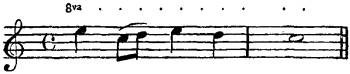
It sounded very peaceful, sweet and strange in the dark; and I found this was a part of the routine of my rebel’s night, and it was done (he said) to give good dreams. By a little before six, Taylor and I were in the saddle again fasting. My riding boots were so wet I could not get them on, so I must ride barefoot. The morning was fair but the roads very muddy, the weeds soaked us nearly to the waist, Salé was twice spilt at the fences, and we got to Apia a bedraggled enough pair. All the way along the coast, the paté (small wooden drum) was beating in the villages and the people crowding to the churches in their fine clothes. Thence through the mangrove swamp, among the black mud and the green mangroves, and the black and scarlet crabs, to Mulinuu, to the doctor’s, where I had an errand, and so to the inn to breakfast about nine. After breakfast I rode home. Conceive such an outing, remember the pallid brute that lived in Skerryvore like a weevil in a biscuit, and receive the intelligence that I was rather the better for my journey. Twenty miles’ ride, sixteen fences taken, ten of the miles in a drenching rain, seven of them fasting and in the morning chill, and six stricken hours’ political discussions by an interpreter; to say nothing of sleeping in a native house, at which many of our excellent literati would look askance of itself.
You are to understand: if I take all this bother, it is not only from a sense of duty, or a love of meddling—damn the phrase, take your choice—but from a great affection for Mataafa. He is a beautiful, sweet old fellow, and he and I grew quite fulsome on Saturday night about our sentiments. I had a messenger from him to-day with a flannel undershirt which I had left behind like a gibbering idiot; and perpetrated in reply another Baboo letter. It rains again to-day without mercy; blessed, welcome rains, making up for the paucity of the late wet season; and when the showers slacken, I can hear my stream roaring in the hollow, and tell myself that the cacaos are drinking deep. I am desperately hunted to finish my Samoa book before the mail goes; this last chapter is equally delicate and necessary. The prayers of the congregation are requested. Eheu! and it will be ended before this letter leaves and printed in the States ere you can read this scribble. The first dinner gong has sounded; je vous salue, monsieur et cher confrère. Tofa, soifua! Sleep! long life! as our Samoan salutation of farewell runs.
Friday, May 13th.—Well, the last chapter, by far the most difficult and ungrateful, is well under way, I have been from six to seven hours upon it daily since I last wrote; and that is all I have done forbye working at Samoan rather hard, and going down on Wednesday evening to the club. I make some progress now at the language; I am teaching Belle, which clears and exercises myself. I am particularly taken with the finesse of the pronouns. The pronouns are all dual and plural, and the first person, both in the dual and plural, has a special exclusive and inclusive form. You can conceive what fine effects of precision and distinction can be reached in certain cases. Take Ruth, i. vv. 8 to 13, and imagine how those pronouns come in; it is exquisitely elegant, and makes the mouth of the littérateur to water. I am going to exercitate my pupil over those verses to-day for pronoun practice.
Tuesday.—Yesterday came yours. Well, well, if the dears prefer a week, why, I’ll give them ten days, but the real document, from which I have scarcely varied, ran for one night.43 I think you seem scarcely fair to Wiltshire, who had surely, under his beast-ignorant ways, right noble qualities. And I think perhaps you scarce do justice to the fact that this is a place of realism à outrance; nothing extenuated or coloured. Looked at so, is it not, with all its tragic features, wonderfully idyllic, with great beauty of scene and circumstance? And will you please to observe that almost all that is ugly is in the whites? I’ll apologise for Papa Randal if you like; but if I told you the whole truth—for I did extenuate there!—and he seemed to me essential as a figure, and essential as a pawn in the game, Wiltshire’s disgust for him being one of the small, efficient motives in the story. Now it would have taken a fairish dose to disgust Wiltshire.—Again, the idea of publishing the Beach substantively is dropped—at once, both on account of expostulation, and because it measured shorter than I had expected. And it was only taken up, when the proposed volume, Beach de Mar, petered out. It petered out thus: the chief of the short stories got sucked into Sophia Scarlet—and Sophia is a book I am much taken with, and mean to get to, as soon as—but not before—I have done David Balfour and The Young Chevalier. So you see you are like to hear no more of the Pacific or the nineteenth century for a while. The Young Chevalier is a story of sentiment and passion, which I mean to write a little differently from what I have been doing—if I can hit the key; rather more of a sentimental tremolo to it. It may thus help to prepare me for Sophia, which is to contain three ladies, and a kind of a love affair between the heroine and a dying planter who is a poet! large orders for R. L. S.
O the German taboo is quite over; no soul attempts to support the C. J. or the President, they are past hope; the whites have just refused their taxes—I mean the council has refused to call for them, and if the council consented, nobody would pay; ’tis a farce, and the curtain is going to fall briefly. Consequently in my History, I say as little as may be of the two dwindling stars. Poor devils! I liked the one, and the other has a little wife, now lying in! There was no man born with so little animosity as I. When I heard the C. J. was in low spirits and never left his house, I could scarce refrain from going to him.
It was a fine feeling to have finished the History; there ought to be a future state to reward that grind! It’s not literature, you know; only journalism, and pedantic journalism. I had but the one desire, to get the thing as right as might be, and avoid false concords—even if that! And it was more than there was time for. However, there it is: done. And if Samoa turns up again, my book has to be counted with, being the only narrative extant. Milton and I—if you kindly excuse the juxtaposition—harnessed ourselves to strange waggons, and I at least will be found to have plodded very soberly with my load. There is not even a good sentence in it, but perhaps—I don’t know—it may be found an honest, clear volume.
Wednesday.—Never got a word set down, and continues on Thursday, 19th May, his own marriage day as ever was. News; yes. The C. J. came up to call on us! After five months’ cessation on my side, and a decidedly painful interchange of letters, I could not go down—could not—to see him. My three ladies received him, however; he was very agreeable as usual, but refused wine, beer, water, lemonade, chocolate, and at last a cigarette. Then my wife asked him, “So you refuse to break bread?” and he waved his hands amiably in answer. All my three ladies received the same impression that he had serious matters in his mind: now we hear he is quite cock-a-hoop since the mail came, and going about as before his troubles darkened. But what did he want with me? ’Tis thought he had received a despatch—and that he misreads it (so we fully believe) to the effect that they are to have war ships at command and can make their little war after all. If it be so, and they do it, it will be the meanest wanton slaughter of poor men for the salaries of two white failures. But what was his errand with me? Perhaps to warn me that unless I behave he now hopes to be able to pack me off in the Curaçoa when she comes.
I have celebrated my holiday from Samoa by a plunge at the beginning of The Young Chevalier. I am afraid my touch is a little broad in a love story; I can’t mean one thing and write another. As for women, I am no more in any fear of them; I can do a sort all right; age makes me less afraid of a petticoat, but I am a little in fear of grossness. However, this David Balfour’s love affair, that’s all right—might be read out to a mother’s meeting—or a daughters’ meeting. The difficulty in a love yarn, which dwells at all on love, is the dwelling on one string; it is manifold, I grant, but the root fact is there unchanged, and the sentiment being very intense, and already very much handled in letters, positively calls for a little pawing and gracing. With a writer of my prosaic literalness and pertinency of point of view, this all shoves toward grossness—positively even toward the far more damnable closeness. This has kept me off the sentiment hitherto, and now I am to try: Lord! Of course Meredith can do it, and so could Shakespeare; but with all my romance, I am a realist and a prosaist, and a most fanatical lover of plain physical sensations plainly and expressly rendered; hence my perils. To do love in the same spirit as I did (for instance) D. Balfour’s fatigue in the heather; my dear sir, there were grossness—ready made! And hence, how to sugar? However, I have nearly done with Marie-Madeleine, and am in good hopes of Marie-Salomé, the real heroine; the other is only a prologuial heroine to introduce the hero.
Friday.—Anyway, the first prologuial episode is done, and Fanny likes it. There are only four characters: Francis Blair of Balmile (Jacobite Lord Gladsmuir) my hero; the Master of Ballantrae; Paradou, a wine-seller of Avignon; Marie-Madeleine his wife. These two last I am now done with, and I think they are successful, and I hope I have Balmile on his feet; and the style seems to be found. It is a little charged and violent; sins on the side of violence; but I think will carry the tale. I think it is a good idea so to introduce my hero, being made love to by an episodic woman. This queer tale—I mean queer for me—has taken a great hold upon me. Where the devil shall I go next? This is simply the tale of a coup de tête of a young man and a young woman; with a nearly, perhaps a wholly, tragic sequel, which I desire to make thinkable right through, and sensible; to make the reader, as far as I shall be able, eat and drink and breathe it. Marie-Salomé des Saintes-Maries is, I think, the heroine’s name; she has got to be yet: sursum corda! So has the young Chevalier, whom I have not yet touched, and who comes next in order. Characters: Balmile, or Lord Gladsmuir, comme vous voulez; Prince Charlie; Earl Marischal; Master of Ballantrae; and a spy, and Dr. Archie Campbell, and a few nondescripts; then, of women, Marie-Salomé and Flora Blair; seven at the outside; really four full lengths, and I suppose a half-dozen episodic profiles. How I must bore you with these ineptitudes! Have patience. I am going to bed; it is (of all hours) eleven. I have been forced in (since I began to write to you) to blatter to Fanny on the subject of my heroine, there being two cruces as to her life and history: how came she alone? and how far did she go with the Chevalier? The second must answer itself when I get near enough to see. The first is a back-breaker. Yet I know there are many reasons why a fille de famille, romantic, adventurous, ambitious, innocent of the world, might run from her home in these days; might she not have been threatened with a convent? might there not be some Huguenot business mixed in? Here am I, far from books; if you can help me with a suggestion, I shall say God bless you. She has to be new run away from a strict family, well-justified in her own wild but honest eyes, and meeting these three men, Charles Edward, Marischal, and Balmile, through the accident of a fire at an inn. She must not run from a marriage, I think; it would bring her in the wrong frame of mind. Once I can get her, sola, on the highway, all were well with my narrative. Perpend. And help if you can.
Lafaele, long (I hope) familiar to you, has this day received the visit of his son from Tonga; and the son proves to be a very pretty, attractive young daughter! I gave all the boys kava in honour of her arrival; along with a lean, side-whiskered Tongan, dimly supposed to be Lafaele’s step-father; and they have been having a good time; in the end of my verandah, I hear Simi, my present incapable steward, talking Tongan with the nondescript papa. Simi, our out-door boy, burst a succession of blood-vessels over our work, and I had to make a position for the wreck of one of the noblest figures of a man I ever saw. I believe I may have mentioned the other day how I had to put my horse to the trot, the canter and (at last) the gallop to run him down. In a photograph I hope to send you (perhaps with this) you will see Simi standing in the verandah in profile. As a steward, one of his chief points is to break crystal; he is great on fracture—what do I say?—explosion! He cleans a glass, and the shards scatter like a comet’s bowels.
N.B.—If I should by any chance be deported, the first of the rules hung up for that occasion is to communicate with you by telegraph.—Mind, I do not fear it, but it is possible.
Monday, 25th.—We have had a devil of a morning of upset and bustle; the bronze candlestick Faauma has returned to the family, in time to take her position of step-mamma, and it is pretty to see how the child is at once at home, and all her terrors ended.
27th. Mail day.—And I don’t know that I have much to report. I may have to leave for Malie as soon as these mail packets are made up. ’Tis a necessity (if it be one) I rather deplore. I think I should have liked to lazy; but I dare say all it means is the delay of a day or so in harking back to David Balfour; that respectable youth chides at being left (where he is now) in Glasgow with the Lord Advocate, and after five years in the British Linen, who shall blame him? I was all forenoon yesterday down in Apia, dictating, and Lloyd typewriting, the conclusion of Samoa; and then at home correcting till the dinner bell; and in the evening again till eleven of the clock. This morning I have made up most of my packets, and I think my mail is all ready but two more, and the tag of this. I would never deny (as D. B. might say) that I was rather tired of it. But I have a damned good dose of the devil in my pipe-stem atomy; I have had my little holiday outing in my kick at The Young Chevalier, and I guess I can settle to David Balfour to-morrow or Friday like a little man. I wonder if any one had ever more energy upon so little strength?—I know there is a frost; the Samoa book can only increase that—I can’t help it, that book is not written for me but for Miss Manners; but I mean to break that frost inside two years, and pull off a big success, and Vanity whispers in my ear that I have the strength. If I haven’t, whistle ower the lave o’t! I can do without glory and perhaps the time is not far off when I can do without coin. It is a time coming soon enough, anyway; and I have endured some two and forty years without public shame, and had a good time as I did it. If only I could secure a violent death, what a fine success! I wish to die in my boots; no more Land of Counterpane for me. To be drowned, to be shot, to be thrown from a horse—ay, to be hanged, rather than pass again through that slow dissolution.
I fancy this gloomy ramble is caused by a twinge of age; I put on an under-shirt yesterday (it was the only one I could find) that barely came under my trousers; and just below it, a fine healthy rheumatism has now settled like a fire in my hip. From such small causes do these valuable considerations flow!
I shall now say adieu, dear Sir, having ten rugged miles before me and the horrors of a native feast and parliament without an interpreter, for to-day I go alone.—Yours ever,
R. L. S.
To Sidney Colvin
Describing a family expedition to visit Mataafa at Malie.
[Vailima] Sunday, 29th May [1892].
How am I to overtake events? On Wednesday, as soon as my mail was finished, I had a wild whirl to look forward to. Immediately after dinner, Belle, Lloyd, and I set out on horseback, they to the club, I to Haggard’s, thence to the hotel, where I had supper ready for them. All next day we hung round Apia with our whole house-crowd in Sunday array, hoping for the mail steamer with a menagerie on board. No such luck; the ship delayed; and at last, about three, I had to send them home again, a failure of a day’s pleasuring that does not bear to be discussed. Lloyd was so sickened that he returned the same night to Vailima, Belle and I held on, sat most of the evening on the hotel verandah stricken silly with fatigue and disappointment, and genuine sorrow for our poor boys and girls, and got to bed with rather dismal appreciations of the morrow.
These were more than justified, and yet I never had a jollier day than Friday 27th. By 7.30 Belle and I had breakfast; we had scarce done before my mother was at the door on horseback, and a boy at her heels to take her not very dashing charger home again. By 8.10 we were all on the landing pier, and it was 9.20 before we had got away in a boat with two inches of green wood on the keel of her, no rudder, no mast, no sail, no boat flag, two defective rowlocks, two wretched apologies for oars, and two boys—one a Tongan half-caste, one a white lad, son of the Tonga schoolmaster, and a sailor lad—to pull us. All this was our first taste of the tender mercies of Taylor (the sesquipedalian half-caste introduced two letters back, I believe). We had scarce got round Mulinuu when Salé Taylor’s heart misgave him; he thought we had missed the tide; called a halt, and set off ashore to find canoes. Two were found; in one my mother and I were embarked with the two biscuit tins (my present to the feast), and the bag with our dry clothes, on which my mother was perched—and her cap was on the top of it—feminine hearts please sympathise; all under the guidance of Salé. In the other Belle and our guest; Tauilo, a chief-woman, the mother of my cook, were to have followed. And the boys were to have been left with the boat. But Tauilo refused. And the four, Belle, Tauilo, Frank the sailor-boy, and Jimmie the Tongan half-caste, set off in the boat across that rapidly shoaling bay of the lagoon.
How long the next scene lasted, I could never tell. Salé was always trying to steal away with our canoe and leave the other four, probably for six hours, in an empty, leaky boat, without so much as an orange or a cocoanut on board, and under the direct rays of the sun. I had at last to stop him by taking the spare paddle off the outrigger and sticking it in the ground—depth, perhaps two feet—width of the bay, say three miles. At last I bid him land me and my mother and go back for the other ladies. “The coast is so rugged,” said Salé.—“What?” I said, “all these villages and no landing-place?”—“Such is the nature of Samoans,” said he. Well, I’ll find a landing-place, I thought; and presently I said, “Now we are going to land there.”—“We can but try,” said the bland Salé, with resignation. Never saw a better landing-place in my life. Here the boat joined us. My mother and Salé continued in the canoe alone, and Belle and I and Tauilo set off on foot for Malie. Tauilo was about the size of both of us put together and a piece over; she used us like a nurse with children. I had started barefoot; Belle had soon to pull off her gala shoes and stockings; the mud was as deep as to our knees, and so slippery that (moving, as we did, in Indian file, between dense scratching tufts of sensitive) Belle and I had to take hands to support each other, and Tauilo was steadying Belle from the rear. You can conceive we were got up to kill, Belle in an embroidered white dress and white hat, I in a suit of Bedford cords hot from the Sydney tailors; and conceive us, below, ink-black to the knees with adhesive clay, and above, streaming with heat. I suppose it was better than three miles, but at last we made the end of Malie. I asked if we could find no water to wash our feet; and our nursemaid guided us to a pool. We sat down on the pool side, and our nursemaid washed our feet and legs for us—ladies first, I suppose out of a sudden respect to the insane European fancies: such a luxury as you can scarce imagine. I felt a new man after it. But before we got to the King’s house we were sadly muddied once more. It was 1 p.m. when we arrived, the canoe having beaten us by about five minutes, so we made fair time over our bog-holes.
But the war dances were over, and we came in time to see only the tail end (some two hours) of the food presentation. In Mataafa’s house three chairs were set for us covered with fine mats. Of course, a native house without the blinds down is like a verandah. All the green in front was surrounded with sheds, some of flapping canvas, some of green palm boughs, where (in three sides of a huge oblong) the natives sat by villages in a fine glow of many-hued array. There were folks in tapa, and folks in patchwork; there was every colour of the rainbow in a spot or a cluster; there were men with their heads gilded with powdered sandal-wood, others with heads all purple, stuck full of the petals of a flower. In the midst there was a growing field of outspread food, gradually covering acres; the gifts were brought in, now by chanting deputations, now by carriers in a file; they were brandished aloft and reclaimed over, with polite sacramental exaggerations, by the official receiver. He, a stalwart, well-oiled quadragenarian, shone with sweat from his exertions, brandishing cooked pigs. At intervals, from one of the squatted villages, an orator would arise. The field was almost beyond the reach of any human speaking voice; the proceedings besides continued in the midst; yet it was possible to catch snatches of this elaborate and cut-and-dry oratory—it was possible for me, for instance, to catch the description of my gift and myself as the alii Tusitala, O le alii o malo tetele—the chief Write Information, the chief of the great Governments. Gay designation? In the house, in our three curule chairs, we sat and looked on. On our left a little group of the family. In front of us, at our feet, an ancient Talking-man, crowned with green leaves, his profile almost exactly Dante’s; Popo his name. He had worshipped idols in his youth; he had been full grown before the first missionary came hither from Tahiti; this makes him over eighty. Near by him sat his son and colleague. In the group on our left, his little grandchild sat with her legs crossed and her hands turned, the model already (at some three years old) of Samoan etiquette. Still further off to our right, Mataafa sat on the ground through all the business; and still I saw his lips moving, and the beads of his rosary slip stealthily through his hand. We had kava, and the King’s drinking was hailed by the Popos (father and son) with a singular ululation, perfectly new to my ears; it means, to the expert, “Long live Tuiatua”; to the inexpert, is a mere voice of barbarous wolves. We had dinner, retired a bit behind the central pillar of the house; and, when the King was done eating, the ululation was repeated. I had my eyes on Mataafa’s face, and I saw pride and gratified ambition spring to life there and be instantly sucked in again. It was the first time, since the difference with Laupepa, that Popo and his son had openly joined him, and given him the due cry as Tuiatua—one of the eight royal names of the islands, as I hope you will know before this reaches you.
Not long after we had dined, the food-bringing was over. The gifts (carefully noted and tallied as they came in) were now announced by a humorous orator, who convulsed the audience, introducing singing notes, now on the name of the article, now on the number; six thousand odd heads of taro, three hundred and nineteen cooked pigs; and one thing that particularly caught me (by good luck), a single turtle “for the king”—le tasi mo le tupu. Then came one of the strangest sights I have yet witnessed. The two most important persons there (bar Mataafa) were Popo and his son. They rose, holding their long shod rods of talking men, passed forth from the house, broke into a strange dance, the father capering with outstretched arms and rod, the son crouching and gambolling beside him in a manner indescribable, and presently began to extend the circle of this dance among the acres of cooked food. Whatever they leaped over, whatever they called for, became theirs. To see mediæval Dante thus demean himself struck a kind of a chill of incongruity into our Philistine souls; but even in a great part of the Samoan concourse, these antique and (I understand) quite local manners awoke laughter. One of my biscuit tins and a live calf were among the spoils he claimed, but the large majority of the cooked food (having once proved his dignity) he re-presented to the king.
Then came the turn of le alii Tusitala. He would not dance, but he was given—five live hens, four gourds of oil, four fine tapas, a hundred heads of taro, two cooked pigs, a cooked shark, two or three cocoanut branches strung with kava, and the turtle, who soon after breathed his last, I believe, from sunstroke. It was a royal present for “the chief of the great powers.” I should say the gifts were, on the proper signal, dragged out of the field of food by a troop of young men, all with their lava-lavas kilted almost into a loin-cloth. The art is to swoop on the food-field, pick up with unerring swiftness the right things and quantities, swoop forth again on the open, and separate, leaving the gifts in a new pile: so you may see a covey of birds in a corn-field. This reminds me of a very inhumane but beautiful passage I had forgotten in its place. The gift-giving was still in full swing, when there came a troop of some ninety men all in tapa lava-lavas of a purplish colour; they paused, and of a sudden there went up from them high into the air a flight of live chickens, which, as they came down again, were sent again into the air, for perhaps a minute, from the midst of a singular turmoil of flying arms and shouting voices; I assure you, it was very beautiful to see, but how many chickens were killed?
No sooner was my food set out than I was to be going. I had a little serious talk with Mataafa on the floor, and we went down to the boat, where we got our food aboard, such a cargo—like the Swiss Family Robinson, we said. However, a squall began, Tauilo refused to let us go, and we came back to the house for half an hour or so, when my ladies distinguished themselves by walking through a Fono (council), my mother actually taking up a position between Mataafa and Popo! It was about five when we started—turtle, pigs, taro, etc., my mother, Belle, myself, Tauilo, a portly friend of hers with the voice of an angel, and a pronunciation so delicate and true that you could follow Samoan as she sang, and the two tired boys Frank and Jimmie, with the two bad oars and the two slippery rowlocks to impel the whole. Salé Taylor took the canoe and a strong Samoan to paddle him. Presently after he went inshore, and passed us a little after, with his arms folded, and two strong Samoans impelling him Apia-ward. This was too much for Belle, who hailed, taunted him, and made him return to the boat with one of the Samoans, setting Jimmie instead in the canoe. Then began our torment, Salé and the Samoan took the oars, sat on the same thwart (where they could get no swing on the boat had they tried), and deliberately ladled at the lagoon. We lay enchanted. Night fell; there was a light visible on shore; it did not move. The two women sang, Belle joining them in the hymns she has learned at family worship. Then a squall came up; we sat a while in roaring midnight under rivers of rain, and, when it blew by, there was the light again, immovable. A second squall followed, one of the worst I was ever out in; we could scarce catch our breath in the cold, dashing deluge. When it went, we were so cold that the water in the bottom of the boat (which I was then baling) seemed like a warm footbath in comparison, and Belle and I, who were still barefoot, were quite restored by laving in it.
All this time I had kept my temper, and refrained as far as might be from any interference, for I saw (in our friend’s mulish humour) he always contrived to twist it to our disadvantage. But now came the acute point. Young Frank now took an oar. He was a little fellow, near as frail as myself, and very short; if he weighed nine stone, it was the outside; but his blood was up. He took stroke, moved the big Samoan forward to bow, and set to work to pull him round in fine style. Instantly, a kind of race competition—almost race hatred—sprang up. We jeered the Samoan. Salé declared it was the trim of the boat; “if this lady was aft” (Tauilo’s portly friend) “he would row round Frank.” We insisted on her coming aft, and Frank still rowed round the Samoan. When the Samoan caught a crab (the thing was continual with these wretched oars and rowlocks), we shouted and jeered; when Frank caught one, Salé and the Samoan jeered and yelled. But anyway the boat moved, and presently we got up with Mulinuu, where I finally lost my temper, when I found that Salé proposed to go ashore and make a visit—in fact, we all three did. It is not worth while going into, but I must give you one snatch of the subsequent conversation as we pulled round Apia bay. “This Samoan,” said Salé, “received seven German bullets in the field of Fangalii.” “I am delighted to hear it,” said Belle. “His brother was killed there,” pursued Salé; and Belle, prompt as an echo, “Then there are no more of the family? how delightful!” Salé was sufficiently surprised to change the subject; he began to praise Frank’s rowing with insufferable condescension: “But it is after all not to be wondered at,” said he, “because he has been for some time a sailor. My good man, is it three or five years that you have been to sea?” And Frank, in a defiant shout: “Two!” Whereupon, so high did the ill-feeling run, that we three clapped and applauded and shouted, so that the President (whose house we were then passing) doubtless started at the sounds. It was nine when we got to the hotel; at first no food was to be found, but we skirmished up some bread and cheese and beer and brandy; and (having changed our wet clothes for the rather less wet in our bags) supped on the verandah.
On Saturday, 28th, I was wakened about 6.30, long past my usual hour, by a benevolent passer-by. My turtle lay on the verandah at my door, and the man woke me to tell me it was dead, as it had been when we put it on board the day before. All morning I ran the gauntlet of men and women coming up to me: “Mr. Stevenson, your turtle is dead.” I gave half of it to the hotel keeper, so that his cook should cut it up; and we got a damaged shell, and two splendid meals, beefsteak one day and soup the next. The horses came for us about 9.30. It was waterspouting; we were drenched before we got out of the town; the road was a fine going Highland trout stream; it thundered deep and frequent, and my mother’s horse would not better on a walk. At last she took pity on us, and very nobly proposed that Belle and I should ride ahead. We were mighty glad to do so, for we were cold. Presently, I said I should ride back for my mother, but it thundered again; Belle is afraid of thunder, and I decided to see her through the forest before I returned for my other hen—I may say, my other wet hen. About the middle of the wood, where it is roughest and steepest, we met three pack-horses with barrels of lime-juice. I piloted Belle past these—it is not very easy in such a road—and then passed them again myself, to pilot my mother. This effected, it began to thunder again, so I rode on hard after Belle. When I caught up with her, she was singing Samoan hymns to support her terrors! We were all back, changed, and at table by lunch time, 11 A.M. Nor have any of us been the worse for it sin-syne. That is pretty good for a woman of my mother’s age and an invalid of my standing; above all, as Tauilo was laid up with a bad cold, probably increased by rage.
Friday, 3rd June.—On Wednesday the club could not be held, and I must ride down town and to and fro all afternoon delivering messages, then dined and rode up by the young moon. I had plenty news when I got back; there is great talk in town of my deportation: it is thought they have written home to Downing Street requesting my removal, which leaves me not much alarmed; what I do rather expect is that H. J. Moors and I may be haled up before the C. J. to stand a trial for lèse-majesty. Well, we’ll try and live it through.
The rest of my history since Monday has been unadulterated David Balfour. In season and out of season, night and day, David and his innocent harem—let me be just, he never has more than the two—are on my mind. Think of David Balfour with a pair of fair ladies—very nice ones too—hanging round him. I really believe David is as good a character as anybody has a right to ask for in a novel. I have finished drafting Chapter XX. to-day, and feel it all ready to froth when the spigot is turned.
O, I forgot—and do forget. What did I mean? A waft of cloud has fallen on my mind, and I will write no more.
Wednesday, I believe, 8th June.—Lots of David, and lots of David, and the devil any other news. Yesterday we were startled by great guns firing a salute, and to-day Whitmee (missionary) rode up to lunch, and we learned it was the Curaçoa come in, the ship (according to rumour) in which I was to be deported. I went down to meet my fate, and the captain is to dine with me Saturday, so I guess I am not going this voyage. Even with the particularity with which I write to you, how much of my life goes unexpressed; my troubles with a madman by the name of ——, a genuine living lunatic, I believe, and jolly dangerous; my troubles about poor ——, all these have dropped out; yet for moments they were very instant, and one of them is always present with me.
I have finished copying Chapter XXI. of David—“solus cum sola; we travel together.” Chapter XXII., “Solus cum sola; we keep house together,” is already drafted. To the end of XXI. makes more than 150 pages of my manuscript—damn this hair—and I only designed the book to run to about 200; but when you introduce the female sect, a book does run away with you. I am very curious to see what you will think of my two girls. My own opinion is quite clear; I am in love with both. I foresee a few pleasant years of spiritual flirtations. The creator (if I may name myself, for the sake of argument, by such a name) is essentially unfaithful. For the duration of the two chapters in which I dealt with Miss Grant, I totally forgot my heroine, and even—but this is a flat secret—tried to win away David. I think I must try some day to marry Miss Grant. I’m blest if I don’t think I’ve got that hair out! which seems triumph enough; so I conclude.
Tuesday.—Your infinitesimal correspondence has reached me, and I have the honour to refer to it with scorn. It contains only one statement of conceivable interest, that your health is better; the rest is null, and so far as disquisitory unsound. I am all right, but David Balfour is ailing; this came from my visit to the man-of-war, where I had a cup of tea, and the most of that night walked the verandah with extraordinary convictions of guilt and ruin, many of which (but not all) proved to have fled with the day, taking David along with them; he R.I.P. in Chapter XXII.
On Saturday I went down to the town, and fetched up Captain Gibson to dinner; Sunday I was all day at Samoa, and had a pile of visitors. Yesterday got my mail, including your despicable sheet; was fooled with a visit from the high chief Asi, went down at 4 P.M. to my Samoan lesson from Whitmee—I think I shall learn from him, he does not fool me with cockshot rules that are demolished next day, but professes ignorance like a man; the truth is, the grammar has still to be expiscated—dined with Haggard, and got home about nine.
Wednesday.—The excellent Clarke up here almost all day yesterday, a man I esteem and like to the soles of his boots; I prefer him to any one in Samoa, and to most people in the world; a real good missionary, with the inestimable advantage of having grown up a layman. Pity they all can’t get that! It recalls my old proposal, which delighted Lady Taylor so much, that every divinity student should be thirty years old at least before he was admitted. Boys switched out of college into a pulpit, what chance have they? That any should do well amazes me, and the most are just what was to be expected.
Saturday.—I must tell you of our feast. It was long promised to the boys, and came off yesterday in one of their new houses. My good Simelé arrived from Savaii that morning asking for political advice; then we had Tauilo; Elena’s father, a talking man of Tauilo’s family; Talolo’s cousin; and a boy of Simelé’s family, who attended on his dignity; then Metu, the meat-man—you have never heard of him, but he is a great person in our household—brought a lady and a boy—and there was another infant—eight guests in all. And we sat down thirty strong. You should have seen our procession, going (about two o’clock), all in our best clothes, to the hall of feasting! All in our Sunday’s best. The new house had been hurriedly finished; the rafters decorated with flowers; the floor spread, native style, with green leaves; we had given a big porker, twenty-five pounds of fresh beef, a tin of biscuit, cocoanuts, etc. Our places were all arranged with much care; the native ladies of the house facing our party; the sides filled up by the men; the guests, please observe: the two chief people, male and female, were placed with our family, the rest between S. and the native ladies. After the feast was over, we had kava, and the calling of the kava was a very elaborate affair, and I thought had like to have made Simelé very angry; he is really a considerable chief, but he and Tauilo were not called till after all our family, and the guests, I suppose the principle being that he was still regarded as one of the household. I forgot to say that our black boy did not turn up when the feast was ready. Off went the two cooks, found him, decorated him with huge red hibiscus flowers—he was in a very dirty undershirt—brought him back between them like a reluctant maid, and thrust him into a place between Faauma and Elena, where he was petted and ministered to. When his turn came in the kava drinking—and you may be sure, in their contemptuous, affectionate kindness for him, as for a good dog, it came rather earlier than it ought—he was cried under a new name. Aleki is what they make of his own name Arrick; but instead of {the cup of “le ipu a} Aleki!” it was called “le ipu a Vailima,” and it was explained that he had “taken his chief-name”! a jest at which the plantation still laughs. Kava done, I made a little speech, Henry translating. If I had been well, I should have alluded to all, but I was scarce able to sit up; so only alluded to my guest of all this month, the Tongan, Tomas, and to Simelé, partly for the jest of making him translate compliments to himself. The talking man replied with many handsome compliments to me, in the usual flood of Samoan fluent neatness; and we left them to an afternoon of singing and dancing. Must stop now, as my right hand is very bad again. I am trying to write with my left.
Sunday.—About half-past eight last night, I had gone to my own room, Fanny and Lloyd were in Fanny’s, every one else in bed, only two boys on the premises—the two little brown boys Mitaiele (Michael), age I suppose 11 or 12, and the new steward, a Wallis islander, speaking no English and about fifty words of Samoan, recently promoted from the bush work, and a most good, anxious, timid lad of 15 or 16—looks like 17 or 18, of course—they grow fast here. In comes Mitaiele to Lloyd, and told some rigmarole about Paatalise (the steward’s name) wanting to go and see his family in the bush.—“But he has no family in the bush,” said Lloyd. “No,” said Mitaiele. They went to the boy’s bed (they sleep in the walled-in compartment of the verandah, once my dressing-room) and called at once for me. He lay like one asleep, talking in drowsy tones but without excitement, and at times “cheeping” like a frightened mouse; he was quite cool to the touch, and his pulse not fast; his breathing seemed wholly ventral; the bust still, the belly moving strongly. Presently he got from his bed, and ran for the door, with his head down not three feet from the floor and his body all on a stretch forward, like a striking snake: I say “ran,” but this strange movement was not swift. Lloyd and I mastered him and got him back in bed. Soon there was another and more desperate attempt to escape, in which Lloyd had his ring broken. Then we bound him to the bed humanely with sheets, ropes, boards, and pillows. He lay there and sometimes talked, sometimes whispered, sometimes wept like an angry child; his principal word was “Faamolemole”—“Please”—and he kept telling us at intervals that his family were calling him. During this interval, by the special grace of God, my boys came home; we had already called in Arrick, the black boy; now we had that Hercules, Lafaele, and a man Savea, who comes from Paatalise’s own island and can alone communicate with him freely. Lloyd went to bed, I took the first watch, and sat in my room reading, while Lafaele and Arrick watched the madman. Suddenly Arrick called me; I ran into the verandah; there was Paatalise free of all his bonds and Lafaele holding him. To tell what followed is impossible. We were five people at him—Lafaele and Savea, very strong men, Lloyd, I and Arrick, and the struggle lasted until 1 A.M. before we had him bound. One detail for a specimen: Lloyd and I had charge of one leg, we were both sitting on it and lo! we were both tossed into the air—I, I dare say, a couple of feet. At last we had him spread-eagled to the iron bedstead, by his wrists and ankles, with matted rope; a most inhumane business, but what could we do? it was all we could do to manage it even so. The strength of the paroxysms had been steadily increasing, and we trembled for the next. And now I come to pure Rider Haggard. Lafaele announced that the boy was very bad, and he would get “some medicine” which was a family secret of his own. Some leaves were brought mysteriously in; chewed, placed on the boy’s eyes, dropped in his ears (see Hamlet) and stuck up his nostrils; as he did this, the weird doctor partly smothered the patient with his hand; and by about 2 A.M. he was in a deep sleep, and from that time he showed no symptom of dementia whatever. The medicine (says Lafaele) is principally used for the wholesale slaughter of families; he himself feared last night that his dose was fatal; only one other person, on this island, knows the secret; and she, Lafaele darkly whispers, has abused it. This remarkable tree we must try to identify.
The man-of-war doctor came up to-day, gave us a strait-waistcoat, taught us to bandage, examined the boy and saw he was apparently well—he insisted on doing his work all morning, poor lad, and when he first came down kissed all the family at breakfast! The doctor was greatly excited, as may be supposed, about Lafaele’s medicine.
Tuesday.—All yesterday writing my mail by the hand of Belle, to save my wrist. This is a great invention, to which I shall stick, if it can be managed. We had some alarm about Paatalise, but he slept well all night for a benediction. This lunatic asylum exercise has no attractions for any of us.
I don’t know if I remembered to say how much pleased I was with Across the Plains in every way, inside and out, and you and me. The critics seem to taste it, too, as well as could be hoped, and I believe it will continue to bring me in a few shillings a year for a while. But such books pay only indirectly.
To understand the full horror of the mad scene, and how well my boys behaved, remember that they believed P.’s ravings, they knew that his dead family, thirty strong, crowded the front verandah and called on him to come to the other world. They knew that his dead brother had met him that afternoon in the bush and struck him on both temples. And remember! we are fighting the dead, and they had to go out again in the black night, which is the dead man’s empire. Yet last evening, when I thought P. was going to repeat the performance, I sent down for Lafaele, who had leave of absence, and he and his wife came up about eight o’clock with a lighted brand. These are the things for which I have to forgive my old cattle-man his manifold shortcomings; they are heroic—so are the shortcomings, to be sure.
It came over me the other day suddenly that this diary of mine to you would make good pickings after I am dead, and a man could make some kind of a book out of it without much trouble. So, for God’s sake, don’t lose them, and they will prove a piece of provision for my “poor old family,” as Simelé calls it.
About my coming to Europe, I get more and more doubtful, and rather incline to Ceylon again as place of meeting. I am so absurdly well here in the tropics, that it seems like affectation. Yet remember I have never once stood Sydney. Anyway, I shall have the money for it all ahead, before I think of such a thing.
We had a bowl of punch on your birthday, which my incredible mother somehow knew and remembered.
By the time you receive this, my Samoan book will I suppose be out and the worst known. If I am burned in effigy for it no more need be said; if on the other hand I get off cheap with the authorities, this is to say that, supposing a vacancy to occur, I would condescend to accept the office of H.B.M.’s consul with parts, pendicles and appurtenances. There is a very little work to do except some little entertaining, to which I am bound to say my family and in particular the amanuensis who now guides the pen look forward with delight; I with manly resignation. The real reasons for the step would be three: 1st, possibility of being able to do some good, or at least certainty of not being obliged to stand always looking on helplessly at what is bad: 2nd, larks for the family: 3rd, and perhaps not altogether least, a house in town and a boat and a boat’s crew.44
But I find I have left out another reason: 4th, growing desire on the part of the old man virulent for anything in the nature of a salary—years seem to invest that idea with new beauty.
I sometimes sit and yearn for anything in the nature of an income that would come in—mine has all got to be gone and fished for with the immortal mind of man. What I want is the income that really comes in of itself while all you have to do is just to blossom and exist and sit on chairs. Think how beautiful it would be not to have to mind the critics, and not even the darkest of the crowd—Sidney Colvin. I should probably amuse myself with works that would make your hair curl, if you had any left.
R. L. S.
44 This about the consulship was only a passing notion on the part of R. L. S. No vacancy occurred, and in his correspondence he does not recur to the subject.
42 “Kava, properly Ava, is a drink more or less intoxicating, made from the root of the Piper Methysticum, a Pepper plant. The root is grated: formerly it was chewed by fair damsels. The root thus broken up is rubbed about in a great pail, with water slowly added. A strainer of bark cloth is plunged into it at times, and wrung out so as to carry away the small fragments of root. The drink is made and used in ceremony. Every detail is regulated by rules, and the manner of the mixture of the water, the straining, the handling of the cup, the drinking out of it and returning, should all be done according to a well-established manner and in certain cadences.” I borrow this explanation from the late Mr. Lafarge’s notes to his catalogue of South Sea Drawings. It may serve to make clearer several passages in later letters of the present collection. Readers of the late Lord Pembroke’s South Sea Bubbles will remember the account of this beverage and its preparation in Chap. viii. of that volume.
43 Referring to the marriage contract in the Beach of Falesá: see above, p. 152.
To T. W. Dover
Stevenson’s correspondent in this case is an artisan, who had been struck by the truth of a remark in his essay on Beggars that it is only or mainly the poor who habitually give to the poor; and who wrote to ask whether it was from experience that Stevenson knew this.
Vailima Plantation, Upolu, Samoa,
June 20th, 1892.
SIR,—In reply to your very interesting letter, I cannot fairly say that I have ever been poor, or known what it was to want a meal. I have been reduced, however, to a very small sum of money, with no apparent prospect of increasing it; and at that time I reduced myself to practically one meal a day, with the most disgusting consequences to my health. At this time I lodged in the house of a working-man, and associated much with others. At the same time, from my youth up, I have always been a good deal and rather intimately thrown among the working-classes, partly as a civil engineer in out-of-the-way places, partly from a strong and, I hope, not ill-favoured sentiment of curiosity. But the place where, perhaps, I was most struck with the fact upon which you comment was the house of a friend, who was exceedingly poor, in fact, I may say destitute, and who lived in the attic of a very tall house entirely inhabited by persons in varying stages of poverty. As he was also in ill-health, I made a habit of passing my afternoon with him, and when there it was my part to answer the door. The steady procession of people begging, and the expectant and confident manner in which they presented themselves, struck me more and more daily; and I could not but remember with surprise that though my father lived but a few streets away in a fine house, beggars scarce came to the door once a fortnight or a month. From that time forward I made it my business to inquire, and in the stories which I am very fond of hearing from all sorts and conditions of men, learned that in the time of their distress it was always from the poor they sought assistance, and almost always from the poor they got it.
Trusting I have now satisfactorily answered your question, which I thank you for asking, I remain, with sincere compliments,
Robert Louis Stevenson.
To E. L. Burlingame
Vailima, Summer 1892.
MY DEAR BURLINGAME,—First of all, you have all the corrections on The Wrecker. I found I had made what I meant and forgotten it, and was so careless as not to tell you.
Second, of course, and by all means, charge corrections on the Samoa book to me; but there are not near so many as I feared. The Lord hath dealt bountifully with me, and I believe all my advisers were amazed to see how nearly correct I had got the truck, at least I was. With this you will receive the whole revise and a type-written copy of the last chapter. And the thing now is Speed, to catch a possible revision of the treaty. I believe Cassells are to bring it out, but Baxter knows, and the thing has to be crammed through prestissimo, à la chasseur.
You mention the belated Barbeys; what about the equally belated Pineros? And I hope you will keep your bookshop alive to supplying me continuously with the Saga Library. I cannot get enough of Sagas; I wish there were nine thousand; talk about realism!
All seems to flourish with you; I also prosper; none the less for being quit of that abhorred task, Samoa. I could give a supper party here were there any one to sup. Never was such a disagreeable task, but the thing had to be told....
There, I trust I am done with this cursed chapter of my career, bar the rotten eggs and broken bottles that may follow, of course. Pray remember, speed is now all that can be asked, hoped, or wished. I give up all hope of proofs, revises, proof of the map, or sic like; and you on your side will try to get it out as reasonably seemly as may be.
Whole Samoa book herewith. Glory be to God.—Yours very sincerely,
Robert Louis Stevenson.
To Sidney Colvin
The following consists of scraps merely, taken from a letter almost entirely occupied with private family affairs.
[Vailima] Saturday, 2nd July 1892.
The character of my handwriting is explained, alas! by scrivener’s cramp. This also explains how long I have let the paper lie plain.
1 P.M.—I was busy copying David Balfour with my left hand—a most laborious task—Fanny was down at the native house superintending the floor, Lloyd down in Apia, and Belle in her own house cleaning, when I heard the latter calling on my name. I ran out on the verandah; and there on the lawn beheld my crazy boy with an axe in his hand and dressed out in green ferns, dancing. I ran downstairs and found all my house boys on the back verandah, watching him through the dining-room. I asked what it meant?—“Dance belong his place,” they said.—“I think this no time to dance,” said I. “Has he done his work?”—“No,” they told me, “away bush all morning.” But there they all stayed on the back verandah. I went on alone through the dining-room, and bade him stop. He did so, shouldered the axe, and began to walk away; but I called him back, walked up to him, and took the axe out of his unresisting hands. The boy is in all things so good, that I can scarce say I was afraid; only I felt it had to be stopped ere he could work himself up by dancing to some craziness. Our house boys protested they were not afraid; all I know is they were all watching him round the back door and did not follow me till I had the axe. As for the out boys, who were working with Fanny in the native house, they thought it a very bad business, and made no secret of their fears.
Wednesday, 6th.—I have no account to give of my stewardship these days, and there’s a day more to account for than mere arithmetic would tell you. For we have had two Monday Fourths, to bring us at last on the right side of the meridian, having hitherto been an exception in the world and kept our private date. Business has filled my hours sans intermission.
Tuesday, 12th.—I am doing no work and my mind is in abeyance. Fanny and Belle are sewing-machining in the next room; I have been pulling down their hair, and Fanny has been kicking me, and now I am driven out. Austin I have been chasing about the verandah; now he has gone to his lessons, and I make believe to write to you in despair. But there is nothing in my mind; I swim in mere vacancy, my head is like a rotten nut; I shall soon have to begin to work again or I shall carry away some part of the machinery. I have got your insufficient letter, for which I scorn to thank you. I have had no review by Gosse, none by Birrell; another time, if I have a letter in the Times, you might send me the text as well; also please send me a cricket bat and a cake, and when I come home for the holidays, I should like to have a pony.—I am, sir, your obedient servant,
Jacob Tonson.
P.S.—I am quite well; I hope you are quite well. The world is too much with us, and my mother bids me bind my hair and lace my bodice blue.
To Charles Baxter
Vailima Plantation, Upolu, Samoan Islands, 18th July 1892.
MY DEAR CHARLES,— ... I have been now for some time contending with powers and principalities, and I have never once seen one of my own letters to the Times. So when you see something in the papers that you think might interest the exiles of Upolu, do not think twice, out with your saxpence, and send it flying to Vailima. Of what you say of the past, eh, man, it was a queer time, and awful miserable, but there’s no sense in denying it was awful fun. Do you mind the youth in highland garb and the tableful of coppers? Do you mind the SIGNAL of Waterloo Place?—Hey, how the blood stands to the heart at such a memory!—Hae ye the notes o’t? Gie’s them.—Gude’s sake, man, gie’s the notes o’t; I mind ye made a tüne o’t an’ played it on your pinanny; gie’s the notes. Dear Lord, that past.
Glad to hear Henley’s prospects are fair: his new volume is the work of a real poet. He is one of those who can make a noise of his own with words, and in whom experience strikes an individual note. There is perhaps no more genuine poet living, bar the Big Guns. In case I cannot overtake an acknowledgment to himself by this mail, please let him hear of my pleasure and admiration. How poorly Kipling compares! He is all smart journalism and cleverness: it is all bright and shallow and limpid, like a business paper—a good one, s’entend; but there is no blot of heart’s blood and the Old Night: there are no harmonics, there is scarce harmony to his music; and in Henley—all of these; a touch, a sense within sense, a sound outside the sound, the shadow of the inscrutable, eloquent beyond all definition. The First London Voluntary knocked me wholly.—Ever yours affectionately, my dear Charles,
Robert Louis Stevenson.
Kind memories to your father and all friends.
To W. E. Henley
Vailima Plantation, Upolu, Samoa, August 1st, 1892.
MY DEAR HENLEY,—It is impossible to let your new volume pass in silence. I have not received the same thrill of poetry since G. M.’s Joy of Earth volume and Love in a Valley; and I do not know that even that was so intimate and deep. Again and again, I take the book down, and read, and my blood is fired as it used to be in youth. Andante con moto in the Voluntaries, and the thing about the trees at night (No. XXIV. I think) are up to date my favourites. I did not guess you were so great a magician; these are new tunes, this is an undertone of the true Apollo; these are not verse, they are poetry—inventions, creations, in language. I thank you for the joy you have given me, and remain your old friend and present huge admirer,
Robert Louis Stevenson.
The hand is really the hand of Esau, but under a course of threatened scrivener’s cramp.
For the next edition of the Book of Verses, pray accept an emendation. Last three lines of Echoes No. XLIV. read—
“But life in act? How should the grave
Be victor over these,
Mother, a mother of men?”
The two vocatives scatter the effect of this inimitable close. If you insist on the longer line, equip “grave” with an epithet.
R. L. S.
To E. L. Burlingame
Accompanying the MS. of the article giving extracts from the record kept by Robert Stevenson the elder of the trip on which Sir Walter Scott sailed in his company on board the Northern Lights yacht: printed in Scribner’s Magazine, 1893.
Vailima, Upolu, August 1st, ’92.
MY DEAR BURLINGAME,—Herewith My Grandfather. I have had rather a bad time suppressing the old gentleman, who was really in a very garrulous stage; as for getting him in order, I could do but little towards that; however, there are one or two points of interest which may justify us in printing. The swinging of his stick and not knowing the sailor of Coruiskin, in particular, and the account of how he wrote the lives in the Bell Book particularly please me. I hope my own little introduction is not egoistic; or rather I do not care if it is. It was that old gentleman’s blood that brought me to Samoa.
By the by, vols. vii., viii., and ix. of Adams’s History have never come to hand; no more have the dictionaries.
Please send me Stonehenge on the Horse, Stories and Interludes by Barry Pain, and Edinburgh Sketches and Memoirs by David Masson. The Wrecker has turned up. So far as I have seen, it is very satisfactory, but on pp. 548, 549, there has been a devil of a miscarriage. The two Latin quotations instead of following each other being separated (doubtless for printing considerations) by a line of prose. My compliments to the printers; there is doubtless such a thing as good printing, but there is such a thing as good sense.
The sequel to Kidnapped, David Balfour by name, is about three-quarters done and gone to press for serial publication. By what I can find out it ought to be through hand with that and ready for volume form early next spring.—Yours very sincerely,
R. L. S.
To Andrew Lang
Mr. Andrew Lang had been supplying Stevenson with some books and historical references for his proposed novel The Young Chevalier.
[Vailima, August 1892.]
MY DEAR LANG,—I knew you would prove a trusty purveyor. The books you have sent are admirable. I got the name of my hero out of Brown—Blair of Balmyle—Francie Blair. But whether to call the story Blair of Balmyle, or whether to call it The Young Chevalier, I have not yet decided. The admirable Cameronian tract—perhaps you will think this a cheat—is to be boned into David Balfour, where it will fit better, and really furnishes me with a desired foothold over a boggy place.
Later; no, it won’t go in, and I fear I must give up “the idolatrous occupant upon the throne,” a phrase that overjoyed me beyond expression. I am in a deuce of a flutter with politics, which I hate, and in which I certainly do not shine; but a fellow cannot stand aside and look on at such an exhibition as our government. ’Tain’t decent; no gent can hold a candle to it. But it’s a grind to be interrupted by midnight messengers and pass your days writing proclamations (which are never proclaimed) and petitions (which ain’t petited) and letters to the Times, which it makes my jaw yawn to re-read, and all your time have your heart with David Balfour; he has just left Glasgow this morning for Edinburgh, James More has escaped from the castle; it is far more real to me than the Behring Sea or the Baring brothers either—he got the news of James More’s escape from the Lord Advocate, and started off straight to comfort Catriona. You don’t know her; she’s James More’s daughter, and a respectable young wumman; the Miss Grants think so—the Lord Advocate’s daughters—so there can’t be anything really wrong. Pretty soon we all go to Holland, and be hanged; thence to Dunkirk, and be damned; and the tale concludes in Paris, and be Poll-parrotted. This is the last authentic news. You are not a real hard-working novelist; not a practical novelist; so you don’t know the temptation to let your characters maunder. Dumas did it, and lived. But it is not war; it ain’t sportsmanlike, and I have to be stopping their chatter all the time. Brown’s appendix is great reading.
My only grief is that I can’t
Use the idolatrous occupant.
Yours ever,
R. L. S.
Blessing and praising you for a useful (though idolatrous) occupant of Kensington.
To Miss Adelaide Boodle
Samoa and the Samoans for children, continued after an eight months’ pause.
Vailima Plantation, Samoan Islands, August 14th, 1892.
MY DEAR MISS BOODLE,—The lean man is exceedingly ashamed of himself, and offers his apologies to the little girls in the cellar just above. If they will be so good as to knock three times upon the floor, he will hear it on the other side of his floor, and will understand that he is forgiven. I believe I got you and the children—or rather left you and the children—still on the road to the lean man’s house. When you get up there a great part of the forest has been cleared away. It comes back again pretty quick, though not quite so high; but everywhere, except where the weeders have been kept busy, young trees have sprouted up, and the cattle and the horses cannot be seen as they feed. In this clearing there are two or three houses scattered about, and between the two biggest I think the little girls in the cellar would first notice a sort of thing like a gridiron on legs made of logs and wood. Sometimes it has a flag flying on it made of rags of old clothes. It is a fort (so I am told) built by the person here who would be much the most interesting to the girls in the cellar. This is a young gentleman of eleven years of age answering to the name of Austin. It was after reading a book about the Red Indians that he thought it more prudent to create this place of strength. As the Red Indians are in North America, and this fort seems to me a very useless kind of building, I am anxious to hope that the two may never be brought together. When Austin is not engaged in building forts, nor on his lessons, which are just as annoying to him as other children’s lessons are to them, he walks sometimes in the bush, and if anybody is with him, talks all the time. When he is alone I don’t think he says anything, and I dare say he feels very lonely and frightened, just as the lean man does, at the queer noises and the endless lines of the trees. He finds the strangest kinds of seeds, some of them bright coloured like lollipops, or really like precious stones; some of them in odd cases like tobacco-pouches. He finds and collects all kinds of little shells with which the whole ground is scattered, and which, though they are the shells of land animals like our snails, are nearly of as many shapes and colours as the shells on our sea-beaches. In the streams that come running down out of the mountains, and which are all as clear and bright as mirror glass, he sees eels and little bright fish that sometimes jump together out of the surface of the brook in a little knot of silver, and fresh-water prawns which lie close under the stones, and can be seen looking up at him with eyes of the colour of a jewel. He sees all kinds of beautiful birds, some of them blue and white, some of them blue and white and red, and some of them coloured like our pigeons at home, and these last the little girls in the cellar may like to know live almost entirely on nutmegs as they fall ripe off the trees. Another little bird he may sometimes see, as the lean man saw him only this morning, a little fellow not so big as a man’s hand, exquisitely neat, of a pretty bronze black like ladies’ shoes, and who sticks up behind him (much as a peacock does) his little tail shaped and fluted like a scallop shell.
Here are a lot of curious and interesting things that Austin sees round him every day; and when I was a child at home in the old country I used to play and pretend to myself that I saw things of the same kind. That the rooms were full of orange and nutmeg trees, and the cold town gardens outside the windows were alive with parrots and with lions. What do the little girls in the cellar think that Austin does? He makes believe just the other way: he pretends that the strange great trees with their broad leaves and slab-sided roots are European oaks; and the places on the road up (where you and I and the little girls in the cellar have already gone) he calls by old-fashioned, far-away European names, just as if you were to call the cellar stair and the corner of the next street—if you could only manage to pronounce the names—Upolu and Savaii. And so it is with all of us, with Austin and the lean man and the little girls in the cellar; wherever we are it is but a stage on the way to somewhere else, and whatever we do, however well we do it, it is only a preparation to do something else that shall be different.
But you must not suppose that Austin does nothing but build forts and walk among the woods and swim in the rivers. On the contrary, he is sometimes a very busy and useful fellow; and I think the little girls in the cellar would have admired him very nearly as much as he admired himself if they had seen him setting off on horseback with his hand on his hip and his pockets full of letters and orders, at the head of quite a procession of huge white cart-horses with pack-saddles, and big brown native men with nothing on but gaudy kilts. Mighty well he managed all his commissions; and those who saw him ordering and eating his single-handed luncheon in the queer little Chinese restaurant on the beach declare he looked as if the place, and the town, and the whole archipelago belonged to him. But I am not going to let you suppose that this great gentleman at the head of all his horses and his men, like the King of France in the old rhyme, would be thought much of a dandy on the streets of London. On the contrary, if he could be seen there with his dirty white cap, and his faded purple shirt, and his little brown breeks that do not reach his knees, and the bare shanks below, and the bare feet stuck in the stirrup leathers, for he is not quite long enough to reach the irons, I am afraid the little boys and girls in your part of the town might feel very much inclined to give him a penny in charity. So you see that a very, very big man in one place might seem very small potatoes in another, just as the king’s palace here (of which I told you in my last) would be thought rather a poor place of residence by a Surrey gipsy. And if you come to that, even the lean man himself, who is no end of an important person, if he were picked up from the chair where he is now sitting, and slung down, feet foremost, in the neighbourhood of Charing Cross, would probably have to escape into the nearest shop, or take the consequences of being mobbed. And the ladies of his family, who are very pretty ladies, and think themselves uncommonly well-dressed for Samoa, would (if the same thing were done to them) be extremely glad to get into a cab.
I write to you by the hands of another, because I am threatened again with scrivener’s cramp. My health is beyond reproach; I wish I could say as much for my wife’s, which is far from the thing. Give us some news of yours, and even when none of us write, do not suppose for a moment that we are forgetful of our old gamekeeper. Our prettiest walk, an alley of really beautiful green sward which leads through Fanny’s garden to the river and the bridge and the beginning of the high woods on the mountain-side, where the Tapu a fafine (or spirit of the land) has her dwelling, and the work-boys fear to go alone, is called by a name that I think our gamekeeper has heard before—Adelaide Road.
With much love from all of us to yourself, and all good wishes for your future, and the future of the children in the cellar, believe me your affectionate friend,
Robert Louis Stevenson.
To Sidney Colvin
Vailima [August 1892].
MY DEAR COLVIN,—You will have no letter at all this month and it is really not my fault. I have been saving my hand as much as possible for Davy Balfour; only this morning I was getting on first rate with him, when about half-past nine there came a prick in the middle of the ball of my thumb, and I had to take to the left hand and two words a minute. I fear I slightly exaggerate the speed of my left hand; about a word and a half in the minute—which is dispiriting to the last degree. Your last letter with the four excellent reviews and the good news about The Wrecker was particularly welcome. I have already written to Charles Baxter about the volume form appearance of The Beach of Falesá. In spite of bad thumbs and other interruptions I hope to send to Baxter by this mail the whole first part (a good deal more than half) of David Balfour ready for press. This is pretty satisfactory, and I think ought to put us beyond the reach of financial catastrophe for the year.
A cousin of mine, Graham Balfour, arrived along with your last. It was rather a lark. Fanny, Belle and I stayed down at the hotel two nights expecting the steamer, and we had seven horses down daily for the party and the baggage. These were on one occasion bossed by Austin, age eleven. “I’m afraid I cannot do that now,” said he in answer to some communication, “as I am taking charge of the men here.” In the course of the forenoon he took “his” men to get their lunch, and had his own by himself at the Chinese restaurant. What a day for a boy. The steamer came in at last on Saturday morning after breakfast. We three were out at the place of anchorage in the hotel boat as she came up, spotting rather anxiously for our guest, whom none of us had ever seen. We chose out some rather awful cads and tried to make up our mind to them; they were the least offensive yet observed among an awful crew of cabin passengers; but when the Simon Pure appeared at last upon the scene he was as nice a young fellow as you would want. Followed a time of giddy glory—one crowded hour of glorious life—when I figured about the deck with attendant shemales in the character of the local celebrity, was introduced to the least unpresentable of the ruffians on board, dogged about the deck by a diminutive Hebrew with a Kodak, the click of which kept time to my progress like a pair of castanets, and filled up in the Captain’s room on iced champagne at 8.30 of God’s morning. The Captain in question, Cap. Morse, is a great South Sea character, like the side of a house and the green-room of a music-hall, but with all the saving qualities of the seaman. The celebrity was a great success with this untutored observer. He was kind enough to announce that he expected (rather with awe) a much more “thoughtful” person; and I think I pleased him much with my parting salutation, “Well, Captain, I suppose you and I are the two most notorious men in the Pacific.” I think it will enable you to see the Captain if I tell you that he recited to us in cold blood the words of a new comic song; doubtless a tribute to my literary character. I had often heard of Captain Morse and always had detested all that I was told, and detested the man in confidence, just as you are doing; but really he has a wonderful charm of strength, loyalty, and simplicity. The whole celebrity business was particularly characteristic; the Captain has certainly never read a word of mine; and as for the Jew with the Kodak, he had never heard of me till he came on board. There was a third admirer who sent messages in to the Captain’s cabin asking if the Lion would accept a gift of Webster’s Unabridged. I went out to him and signified a manly willingness to accept a gift of anything. He stood and bowed before me, his eyes danced with excitement. “Mr. Stevenson,” he said and his voice trembled, “your name is very well known to me. I have been in the publishing line in Canada and I have handled many of your works for the trade.” “Come,” I said, “here’s genuine appreciation.”
From this gaudy scene we descended into the hotel boat with our new second cousin, got to horse and returned to Vailima, passing shot of Kodak once more on the Nulivae bridge, where the little Jew was posted with his little Jew wife, each about three feet six in stature and as vulgar as a lodging house clock.
We were just writing this when another passenger from the ship arrived up here at Vailima. This is a nice quiet simple blue-eyed little boy of Pennsylvania Quaker folk. Threatened with consumption of my sort, he has been sent here by his doctor on the strength of my case. I am sure if the case be really parallel he could not have been better done by. As we had a roast pig for dinner we kept him for that meal; and the rain coming on just when the moon should have risen kept him again for the night. So you see it is now to-morrow.
Graham Balfour the new cousin and Lloyd are away with Clark the Missionary on a school inspecting malaga, really perhaps the prettiest little bit of opera in real life that can be seen, and made all the prettier by the actors being children. I have come to a collapse this morning on D.B.: wrote a chapter one way, half re-copied it in another, and now stand halting between the two like Buridan’s donkey. These sorts of cruces always are to me the most insoluble, and I should not wonder if D.B. stuck there for a week or two. This is a bother, for I understand McClure talks of beginning serial publication in December. If this could be managed, what with D.B., the apparent success of The Wrecker, Falesá, and some little pickings from Across the Plains—not to mention, as quite hopeless, The History of Samoa—this should be rather a profitable year, as it must be owned it has been rather a busy one. The trouble is, if I miss the December publication, it may take the devil and all of a time to start another syndicate. I am really tempted to curse my conscientiousness. If I hadn’t recopied Davie he would now be done and dead and buried; and here I am stuck about the middle, with an immediate publication threatened and the fear before me of having after all to scamp the essential business of the end. At the same time, though I love my Davy, I am a little anxious to get on again on The Young Chevalier. I have in nearly all my works been trying one racket: to get out the facts of life as clean and naked and sharp as I could manage it. In this other book I want to try and megilp them together in an atmosphere of sentiment, and I wonder whether twenty-five years of life spent in trying this one thing will not make it impossible for me to succeed in the other. However it is the only way to attempt a love story. You can’t tell any of the facts, and the only chance is to paint an atmosphere.
It is a very warm morning—the parrot is asleep on the door (she heard her name, and immediately awakened)—and my brains are completely addled by having come to grief over Davy.
Hurray! a subject discovered! The parrot is a little white cockatoo of the small variety. It belongs to Belle, whom it guards like a watch dog. It chanced that when she was sick some months ago I came over and administered some medicine. Unnecessary to say Belle bleated, whereupon the parrot bounded upon me and buried his neb in my backside. From that day on the little wretch attacked me on every possible occasion, usually from the rear, though she would also follow me along the verandah and as I went downstairs attack my face. This was far from funny. I am a person of average courage, but I don’t think I was ever more cordially afraid of anything than of this miserable atomy, and the deuce of it was that I could not but admire her appalling courage and there was no means of punishing such a thread-paper creature without destroying it entirely. Act II. On Graham’s arrival I gave him my room and came out to Lloyd’s in the lower floor of Belle’s—I beg your pardon—the parrot’s—house. The first morning I was to wake Belle early so that breakfast should be seen to for our guest. It was a mighty pretty dawn, the birds were singing extraordinary strong, all was peace, and there was the damned parrot hanging to the knob of Belle’s door. Courage, my heart! On I went and Cockie buried her bill in the joint of my thumb. I believe that Job would have killed that bird; but I was more happily inspired—I caught it up and flung it over the verandah as far as I could throw. I must say it was violently done, and I looked with some anxiety to see in what state of preservation it would alight. Down it came however on its two feet, uttered a few oaths in a very modified tone of voice, and set forth on the return journey to its mansion. Its wings being cut and its gait in walking having been a circumstance apparently not thoroughly calculated by its maker, it took about twenty-five minutes to get home again. Now here is this remarkable point—that bird has never bitten me since. When I have early breakfast she and the cat come down and join me, and she sits on the back of my chair. When I am at work with the door shut she sits outside and demolishes the door with that same beak which was so recently reddened with my heart’s blood—and in the evening she does her business all over my clothes in the most friendly manner in the world. I ought to add a word about the parrot and the cat. Three cats were brought by Belle from Sydney. This one alone remains faithful and domestic. One of the funniest things I have ever seen was Polly and Maud over a piece of bacon. Polly stood on one leg, held the bacon in the other, regarded Maudie with a secret and sinister look and very slowly and quietly—far too quietly for the word I have to use—gnashed her bill at her. Maudie came up quite close; there she stuck—she was afraid to come nearer, to go away she was ashamed; and she assisted at the final and very deliberate consumption of the bacon, making about as poor a figure as a cat can make.
Next day.—Date totally unknown, or rather it is now known but is reserved because it would certainly prove inconsistent with dates previously given. I went down about two o’clock in company with a couple of chance visitors to Apia. It was smoking hot, not a sign of any wind and the sun scorching your face. I found the great Haggard in hourly expectation of Lady Jersey, surrounded by crowds of very indifferent assistants, and I must honestly say—the only time I ever saw him so—cross. He directed my attention to all the new paint, his own handiwork he said, and made me visit the bathroom which he has just fixed up. I think I never saw a man more miserable and happy at the same time. Had some hock and a seltzer, went down town, met Fanny and Belle, and so home in time for a magnificent dinner of prawns and an eel cooked in oil, both from our own river.
This morning the overseer—the new overseer Mr. Austin Strong—went down in charge of the pack-horses and a squad of men, himself riding a white horse with extreme dignity and what seemed to onlookers a perhaps somewhat theatrical air of command. He returned triumphantly, all his commissions apparently executed with success, bringing us a mail—not your mail, Colonial ways—and the news of Lady Jersey’s arrival and reception among flying flags and banging guns.
As soon as I had concluded my flattering description of Polly she bit one of my toes to the blood. But put not your trust in shemales, though to say the truth she looks more like a Russian colonel.
Aug. 15th.—On the Saturday night Fanny and I went down to Haggard’s to dine and be introduced to Lady Jersey. She is there with her daughter Lady Margaret and her brother Captain Leigh, a very nice kind of glass-in-his-eye kind of fellow. It is to be presumed I made a good impression; for the meeting has had a most extraordinary sequel. Fanny and I slept in Haggard’s billiard room, which happens to be Lloyd’s bungalow. In the morning she and I breakfasted in the back parts with Haggard and Captain Leigh, and it was then arranged that the Captain should go with us to Malie on the Tuesday under a false name; so that Government House at Sydney might by no possibility be connected with a rebel camp. On Sunday afternoon up comes Haggard in a state of huge excitement: Lady J. insists on going too, in the character of my cousin; I write her a letter under the name of Miss Amelia Balfour, proposing the excursion; and this morning up comes a copy of verses from Amelia. I wrote to Mataafa announcing that I should bring two cousins instead of one, that the second was a lady, unused to Samoan manners, and it would be a good thing if she could sleep in another house with Ralala. Sent a copy of this to Amelia, and at the same time made all arrangements, dating my letter 1745. We shall go on ahead on the Malie Road; she is to follow with Haggard and Captain Leigh, and overtake us at the ford of the Gasi-gasi, whence Haggard will return and the rest of us pursue our way to the rebeldom.
This lark is certainly huge. It is all nonsense that it can be concealed; Miss Amelia Balfour will be at once identified with the Queen of Sydney, as they call her; and I would not in the least wonder if the visit proved the signal of war. With this I have no concern, and the thing wholly suits my book and fits my predilections for Samoa. What a pity the mail leaves, and I must leave this adventure to be continued in our next! But I need scarcely say that all this is deadly private—I expect it all to come out, not without explosion; only it must not be through me or you. We had a visit yesterday from a person by the name of Count Nerli, who is said to be a good painter. Altogether the aristocracy clusters thick about us. In which radiant light, as the mail must now be really put up, I leave myself until next month,—Yours ever,
R. L. S.
To the Countess of Jersey
Following up the last letter, Stevenson here tells the story of the visit paid to Apia by the Countess of Jersey, who had come over from Sydney with her brother Captain Leigh and her young daughter Lady Margaret Villiers. “A warm friendship,” writes Lady Jersey, “was the immediate result; we constantly met, either in the hospitable abode of our host Mr. Bazett Haggard, or in Mr. Stevenson’s delightful mountain home, and passed many happy hours in riding, walking, and conversation.” The previous letter has shown how it was arranged that the party should pay a visit of curiosity to the “rebel king,” or more properly the rival claimant to the kingly power, Mataafa, in his camp at Malie, and how Stevenson at once treated the adventure as a chapter out of a Waverley novel. “The wife of the new Governor of New South Wales,” writes Lady Jersey on her part, “could not pay such a visit in her own name, so Mr. Stevenson adopted me as his cousin, ‘Amelia Balfour.’ This transparent disguise was congenial to his romantic instincts, and he writes concerning the arrangements made for the expedition, carefully dating his letter ‘Aug. 14, 1745.’”
August 14, 1745.
To Miss Amelia Balfour—my dear cousin,—We are going an expedition to leeward on Tuesday morning. If a lady were perhaps to be encountered on horseback—say, towards the Gasi-gasi river—about six A.M., I think we should have an episode somewhat after the style of the ’45. What a misfortune, my dear cousin, that you should have arrived while your cousin Graham was occupying my only guest-chamber—for Osterley Park is not so large in Samoa as it was at home—but happily our friend Haggard has found a corner for you!
The King over the Water—the Gasi-gasi water—will be pleased to see the clan of Balfour mustering so thick around his standard.
I have (one serious word) been so lucky as to get a really secret interpreter, so all is for the best in our little adventure into the Waverley Novels.—I am, your affectionate cousin,
Robert Louis Stevenson.
Observe the stealth with which I have blotted my signature, but we must be political à outrance.
To the Countess of Jersey
MY DEAR COUSIN,—I send for your information a copy of my last letter to the gentleman in question. ’Tis thought more wise, in consideration of the difficulty and peril of the enterprise, that we should leave the town in the afternoon, and by several detachments. If you would start for a ride with the Master of Haggard and Captain Lockhart of Lee, say at three o’clock of the afternoon, you would make some rencounters by the wayside which might be agreeable to your political opinions. All present will be staunch.
The Master of Haggard might extend his ride a little, and return through the marsh and by the nuns’ house (I trust that has the proper flavour), so as a little to diminish the effect of separation.—I remain your affectionate cousin to command,
O Tusitala.
P.S.—It is to be thought this present year of grace will be historical.
To Sidney Colvin
This letter tells without preface the story of the expedition planned in the preceding.
[Vailima, August 1892.]
MY DEAR COLVIN,—This is Friday night, the (I believe) 18th or 20th August or September. I shall probably regret to-morrow having written you with my own hand like the Apostle Paul. But I am alone over here in the workman’s house, where I and Belle and Lloyd and Austin are pigging; the rest are at cards in the main residence. I have not joined them because “belly belong me” has been kicking up, and I have just taken 15 drops of laudanum.
On Tuesday, the party set out—self in white cap, velvet coat, cords and yellow half boots, Belle in a white kind of suit and white cap to match mine, Lloyd in white clothes and long yellow boots and a straw hat, Graham in khakis and gaiters, Henry (my old overseer) in blue coat and black kilt, and the great Lafaele with a big ship-bag on his saddle-bow. We left the mail at the P.O., had lunch at the hotel, and about 1.50 set out westward to the place of tryst. This was by a little shrunken brook in a deep channel of mud, on the far side of which, in a thicket of low trees, all full of moths of shadow and butterflies of sun, we lay down to await her ladyship. Whisky and water, then a sketch of the encampment for which we all posed to Belle, passed off the time until 3.30. Then I could hold on no longer. 30 minutes late. Had the secret oozed out? Were they arrested? I got my horse, crossed the brook again, and rode hard back to the Vaea cross roads, whence I was aware of white clothes glancing in the other long straight radius of the quadrant. I turned at once to return to the place of tryst; but D. overtook me, and almost bore me down, shouting “Ride, ride!” like a hero in a ballad. Lady Margaret and he were only come to shew the place; they returned, and the rest of our party, reinforced by Captain Leigh and Lady Jersey, set on for Malie. The delay was due to D.’s infinite precautions, leading them up lanes, by back ways, and then down again to the beach road a hundred yards further on.
It was agreed that Lady Jersey existed no more; she was now my cousin Amelia Balfour. That relative and I headed the march; she is a charming woman, all of us like her extremely after trial on this somewhat rude and absurd excursion. And we Amelia’d or Miss Balfour’d her with great but intermittent fidelity. When we came to the last village, I sent Henry on ahead to warn the King of our approach and amend his discretion, if that might be. As he left I heard the villagers asking which was the great lady? And a little further, at the borders of Malie itself, we found the guard making a music of bugles and conches. Then I knew the game was up and the secret out. A considerable guard of honour, mostly children, accompanied us; but, for our good fortune, we had been looked for earlier, and the crowd was gone.
Dinner at the king’s; he asked me to say grace, I could think of none—never could; Graham suggested Benedictus Benedicat, at which I leaped. We were nearly done, when old Popo inflicted the Atua howl (of which you have heard already) right at Lady Jersey’s shoulder. She started in fine style.—“There,” I said, “we have been giving you a chapter of Scott, but this goes beyond the Waverley Novels.” After dinner, kava. Lady J. was served before me, and the king drank last; it was the least formal kava I ever saw in that house,—no names called, no show of ceremony. All my ladies are well trained, and when Belle drained her bowl, the King was pleased to clap his hands. Then he and I must retire for our private interview, to another house. He gave me his own staff and made me pass before him; and in the interview, which was long and delicate, he twice called me afioga. Ah, that leaves you cold, but I am Samoan enough to have been moved. Susuga is my accepted rank; to be called afioga—Heavens! what an advance—and it leaves Europe cold. But it staggered my Henry. The first time it was complicated “lana susuga ma lana afioga—his excellency and his majesty” the next time plain Majesty. Henry then begged to interrupt the interview and tell who he was—he is a small family chief in Savaii, not very small—“I do not wish the king,” says he, “to think me a boy from Apia.” On our return to the palace, we separated. I had asked for the ladies to sleep alone—that was understood; but that Tusitala—his afioga Tusitala—should go out with the other young men, and not sleep with the highborn females of his family—was a doctrine received with difficulty. Lloyd and I had one screen, Graham and Leigh another, and we slept well.
In the morning I was first abroad before dawn; not very long, already there was a stir of birds. A little after, I heard singing from the King’s chapel—exceeding good—and went across in the hour when the east is yellow and the morning bank is breaking up, to hear it nearer. All about the chapel, the guards were posted, and all saluted Tusitala. I could not refrain from smiling: “So there is a place too,” I thought, “where sentinels salute me.” Mine has been a queer life.


