Light between worlds: Where time disappears
Қосымшада ыңғайлырақҚосымшаны жүктеуге арналған QRRuStore · Samsung Galaxy Store
Huawei AppGallery · Xiaomi GetApps

автордың кітабын онлайн тегін оқу  Light between worlds: Where time disappears

Serge de Brook

Light between worlds: Where time disappears


Contents

ANNOTATION

This is not a story about the future.

And not about the past.

This is a story about what sounds inside you right now, if you dare to hear it.

Jan Kowalski, a man with an ordinary name and an extraordinary destiny, one day awakens — not from sleep, but from oblivion of the essence. His path passes through silence, flame, the song of water and the deep call of the Earth. He does not fight, does not preach, does not save. He remembers — and thereby ignites others.

Guides appear on his path — children, elders, silent souls, elemental bearers of the Song. Together they restore the lost atonement between man and the World. They do not create something new. They help to return to what has always been: to the sound that connects us all.

“Light Between Worlds” is not just a novel. It is a vibration that penetrates the heart. It is a reminder that the Truth does not scream. It sounds quietly, like an inner voice that we so rarely allow to speak.

If you have ever felt that the world is alive, that you are not alone, that there is something more than roles, fears and noise — then this Song is already in you.

A parable novel, a metaphysical fantasy and a mystical message for those who are looking not for answers, but for meaning.

The story of Jan Kowalski has not ended.

It has simply changed the space.

PART ONE. “Seed of Light: The Beginning of the Great Return”

Chapter I — Mannaron. City of Light

“Cities are not just walls and streets, but reflections of the souls of those who created them. And when the soul shines, the walls begin to sing.” — From the treatise of Elder Celaria, Temple of Light, 1st century AD

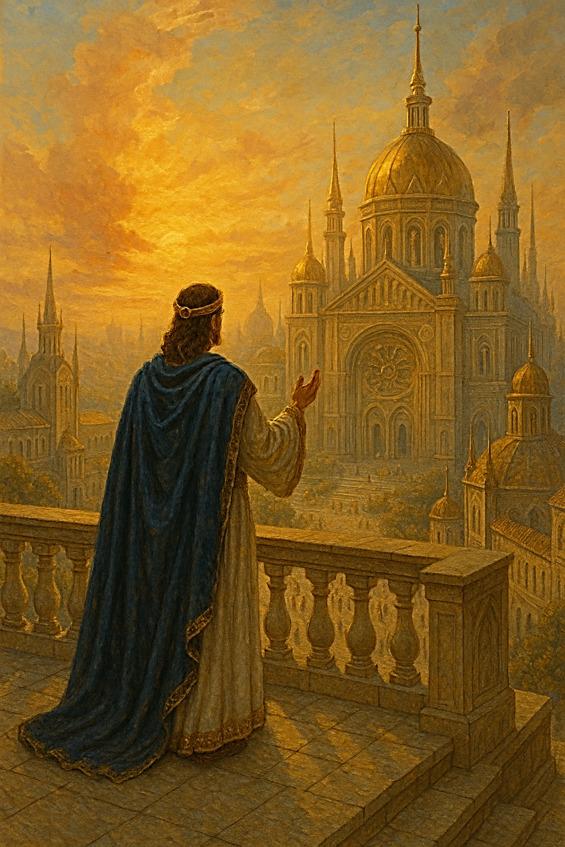
Mannaron awoke like a living being, a giant breathing the golden light of the morning sun. The air gardens on the roofs of the sanctuaries shimmered with dew, and transparent spheres hovered above the central square — messages from the Sky Sages.

The streets were paved with white-silver quartz, on which walked not only people, but also dreams that had strayed from their heavenly orbits.

On the high balcony of the Council Citadel stood he — Jan Kowalski, Duke of Light of the Kingdom of Manna, the Warrior Whose Seal Reborn the Realm.

His gaze was directed into the distance, beyond the horizon, where the clouds parted like inviting gates to other worlds.

Twenty-one days had passed since the Great Ceremony of the Rebirth of the Kingdom of Manna had ended. The city was flourishing, but in Jan’s heart — a restlessness was being born again. It was not anxiety, not fear, but a call. Deep, ancient, almost forgotten.

“Do you hear that?” he asked his companion, the Oracle Ariara. The old man, dressed in a snow-white robe with golden threads, only smiled softly:

— It is not the ears that hear. It is the soul that remembers. You are entering the next circle, Jan of the Kingdom of Mann. The worlds await you.

He did not sleep that night. In a dream or in reality — it was hard to tell — he found himself again at the Temple of the Winds, on the edge of the mountain plateau where the Abyss breathed. From the depths rose an airship, made not of metal, but of light, of the pulsation of matter itself.

Its steering wheel turned by itself, and above the hull there flickered an inscription in the ancient language of Lemur: Id es vocem stellarum — This is the call of the stars.

Jan woke up with the last echo of this phrase on his lips.

He knew it was an invitation. It was the gate of Mann.

At dawn, surrounded by the Elders of the Order and the Guardians of the Portals, he arrived at the Circle of Ascension, a place where the air was thinner and time flowed according to its own laws. There, among the columns entwined with crystal vines, stood the Key-Lighthouse, built back in the days of Proto -Manna.

When Jan approached and touched the symbol of Unity, the portal came to life. A whirlwind of air rushed over the arena, and a passage opened in the sky, soft as the breath of the Great Mother. Ancient constellations, long erased from earthly maps, flared up above Jan.

One by one, his mentors appeared before him, including Nilu T’Arana from the Ethereum and the young Seer Sael from the dimension of Miranda.

All of them were connected with his past, present and future.

Their voices sounded as one:

— You have passed the first great stage.

But beyond the light of this world there is other Knowledge.

It was time to hear the Call. And he stepped.

— It is not the ears that hear. It is the soul that remembers. You are entering the path destined for you by the stars, Jan. A path full of dangers and discoveries,

— Ariara’s voice sounded like the rustling of ancient scrolls full of secrets.

— Do you feel the calling? The calling of an ancient power sleeping beneath the earth of Mannaron?

Jan nodded, his gaze still fixed on the horizon.

The Great Ceremony that rebuilt Mannaron from ruin left behind not only a shining city, but also a sense of fragility, like thin ice on the surface of a bottomless abyss.

He felt that this power that Ariar spoke of was not simply dormant.

She was awakening, and he was the key to her release, or her imprisonment.

Ariar raised his hand, and a thin, shimmering light appeared on his palm, similar to that which emanated from the celestial spheres above the central square.

The light pulsed, reminiscent of a heartbeat.

“The power slumbered within the Crystal Heart,” the Oracle whispered.

— An artifact lost a thousand years ago.

His power is capable of both bringing Mannaron back to life and turning him to dust.

Your call, Jan, is a call from the Heart itself.

It’s calling you.

Jan clenched his fists. He remembered the legends of the Crystal Heart, stories passed down from generation to generation like fairy tales.

Now they seemed like prophecies that were about to be fulfilled.

He felt the weight of responsibility pressing down on him like a stone slab.

He is not just the Duke of Light of the Sovereign Kingdom of Manna; he is the guardian of Mannaron’s fate.

“Where can I find him?” Jan asked, his voice hoarse with tension.

— Legends point to the Forbidden Valley,

— Ariar answered, his eyes shining with an unusual gleam.

— A place scorched by the power of ancient wars.

A place where the boundaries between worlds are erased, where reality intertwines with illusions.

The way there will be dangerous, Jan.

Traps, monsters and ghosts of the past await you.

But only you can find the Crystal Heart.

Ariar took out from his bosom a small, skillfully carved wooden amulet depicting a stylized sun.

— This amulet will help you find the way.

It will show you the direction, but it will not protect you from danger.

Your strength, Jan, is your faith and courage.

Jan took the amulet, feeling warmth spread through his chest.

Before him stretched Mannaron, the city of light, the city of hope.

But beyond its glittering walls, the Forbidden Valley awaited him, full of secrets and threats.

He knew he could not give up this path.

The call of the Crystal Heart was too strong, too real.

He is the Duke of Light, the Warrior Whose Seal Revived the Sovereign Kingdom of Manna, and he must fulfill his destiny.

Even at the cost of his own life.

His heart beat in unison with the flickering light of the amulet, ready to accept the challenge of fate.

He turned to Ariaru, his gaze full of determination:

— Will you lead me, Oracle?
Chapter II — THE KEEPERS OF THE FIVE STONES

“We do not seek truth in the future. We seek it in the dust, in the scars of the earth, and in the voices lost between the layers of time.” — from the Codex of the Field Order of Manna, Volume I

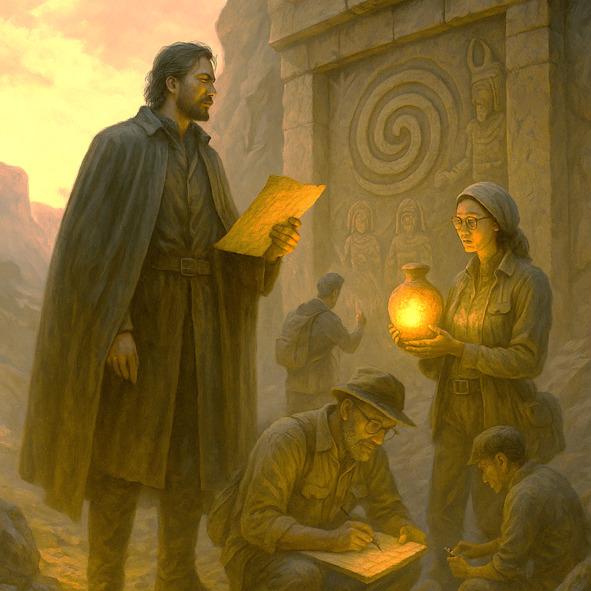
High in the hills of the Zalivan Valley of the Kingdom of Manna, where the wind tears the petals of time from the cliffs, a team of archaeologists set up camp. The team of archaeologists was led by Jan Kowalski — not as a warrior, not as a prophet, but as a researcher of forgotten meanings.

He stood before the bare wall of the rock temple. The sun played on the polished basalt, and under Jan’s fingers the stone trembled — not from the wind, but from memory.

“These are not just artifacts,” he said, looking at the handprint carved into the stone.

— It is… an imprint of thought, a sacrifice made by time.

Dr. Saida Alem, an expert on pre-Iranian civilizations, approached with a tablet.

— The inscription matches the Haldi temple. It is possible that this is one of the forgotten centers of worship. Local legends call this place “Heart of God”.

“Who was God?” asked the young intern with shining eyes.

“Not ‘who,’” Jan corrected.

They descended into an underground hall where the walls were covered with familiar and unfamiliar symbols.

Among them are images of a warrior with winged sandals and a woman holding out a glowing vessel.

— This seems to be Nanaia, the goddess of heavenly waters and memory,

— said Saida.

— Her name is also found among the Babylonians.

“But here,” Jan ran his hand along the crack,

— her vessel is broken.

This is a story in which the truth has been lost.

At dawn they found a clay cylinder — sealed like a time vessel. It took a day to decipher. The inscription read:

“In the name of the light kept beneath the stone, we vow not to let oblivion eat the vow. Haldi is our sword, Nanaia is our vessel, and Memory is our temple.”

Jan peered at the symbols. He recognized the outline of one of the most ancient signs — an inverted spiral of light, similar to the coat of arms of the Order of Manna. Only much older.

— “It was their Testament,” he whispered.

— We are not building a new Order. We are… restoring an ancient one.

That day, the team recorded more than twenty unique artifacts.

But the main discovery was not the stone, not the metal, not the name. The main thing was the understanding: the Mannai culture had not disappeared. It hid in the song of the stone, in the symbols, and waited to be heard.

— We’re not just researching,

— said Jan by the evening fire.

— We become the Voice of their Silence.

And above the camp tent, illuminated by the dim light of the lamp, a shadow seemed to flash — not of the past, but of Memory, awaiting recognition.

Chapter III — IMAGES THAT CAME DOWN FROM THE STONE: THE ARCHAEOLOGY OF THE MANNAI FAITH

“The gods that have been forgotten have not disappeared — they wait. Their shadows live in the clay, their breath in the cracks of the temples, and their voice in the silence of the figurines.” — from the notes of Professor El-Hakim, “Temple of the Song of Stone” expedition

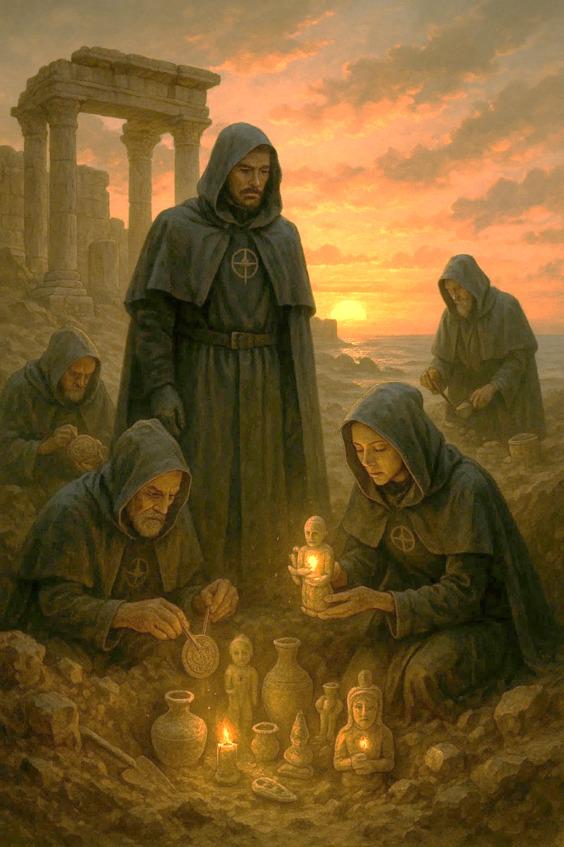
When the Order’s team set up camp at the foot of the ancient plateau where the Mannai once lived, the air was already thick with silent knowledge. It was a place where no one spoke — but everything spoke for itself.

They stood before the ruins of a sanctuary, with a cracked altar in the center. Around them were fragments of columns, traces of ancient masonry, and on the ground were figurines. Some were baked clay, others bronze, a few carved stone. All were embodiments of something greater than form.

“These weren’t just images,” Saida said, carefully picking up a statue of a man with a lion’s head.

— These were carriers of meaning. Symbols embedded in matter.

Many of the finds were repeated: a man with a horned headdress; a woman with a cup, half-covered by a veil; hybrid creatures with wings and fangs guarding the entrance to temples.

Almost all of them had clear gestures: the hand was raised up, the fingers were brought together in a special way. These were not random poses. This was the ritual language of the gods.

“Here is Haldi,” said Jan, pointing to a figurine with a sword and a lion.

— But, most likely, Nanaia is the goddess of memory and waters. But the images are distorted. Perhaps they reflect a late stage of the cult.

— Or these are… personal images. Faith is not always canonical, — added El-Hakim.

— There is always a person living in ceramics.

They found clay vessels with embossed signs — circles, lines, similar to solar and lunar symbols.

One of the vessels was filled with ashes and dried petals: perhaps it was a vessel for sacrifice or aromatic resins.

On another vessel is a scene of a man kneeling before a creature whose head is either a bull or the sun. And above the entire scene is a symbol resembling an inverted spiral, previously seen in the temple of Ulu-Miranda.

“Look,” Saida put the lens to her eye.

— This is a sign of the Transition. In the Mannai culture, the transition to the deity symbolized not death, but the expansion of consciousness.

At a depth of two meters, they came across a collection of seals. On one of them is a scene with three figures. All are holding vessels, and above them are three stars. This could be an image of three priestesses or divine guardians of light.

Each find raised new questions. Why do some figures have huge eyes, while others have none at all? Why do some smile, while others are tense, as if in pain? These details held secrets that even the dusty wind remained silent about.

— “We may not be looking at images of gods,” Jan said.

— And on people who became saints. Or on the idea itself, how a person turns into a symbol.

By the end of the day, they had collected two dozen figurines and more than a hundred fragments. Jan wrote in his diary:

“Each statue is a prayer frozen in time. They were not mass-produced. They were imprints of faith.

This is the soul of the people of Manna, speaking to the future through form.”

As the expedition returned to camp, the sky above the plateau turned copper. It seemed as if the Earth itself blessed their touch.

The figures — small, crooked, broken in places — lay on the fabric like relics. But a new story was already shining in them.

A story that needed to be heard.