



автордың кітабын онлайн тегін оқу The One Hoss Shay / With its Companion Poems How the Old Horse Won the Bet & / The Broomstick Train
The Project Gutenberg EBook of The One Hoss Shay, by Oliver Wendell Holmes
This eBook is for the use of anyone anywhere at no cost and with
almost no restrictions whatsoever. You may copy it, give it away or
re-use it under the terms of the Project Gutenberg License included
with this eBook or online at www.gutenberg.net
Title: The One Hoss Shay
With its Companion Poems How the Old Horse Won the Bet &
The Broomstick Train
Author: Oliver Wendell Holmes
Illustrator: Howard Pyle
Release Date: October 18, 2009 [EBook #30279]
Language: English
*** START OF THIS PROJECT GUTENBERG EBOOK THE ONE HOSS SHAY ***
Produced by Julia Miller and the Online Distributed
Proofreading Team at http://www.pgdp.net (This file was
produced from images generously made available by The
Internet Archive/American Libraries.)
Transcriber’s Note
Obvious typographical errors have been corrected. A list of corrections is found at the end of the text.
The One Hoss Shay
With its Companion Poems
How the Old Horse Won the Bet
&
The Broomstick Train
By Oliver Wendell Holmes
With Illustrations by
Howard Pyle
Boston and New York
Houghton, Mifflin and Company
The Riverside Press, Cambridge>
M DCCC XCII
Copyright, 1858, 1877, 1886, and 1890,
By OLIVER WENDELL HOLMES.
Copyright, 1891,
By HOUGHTON, MIFFLIN & CO.
All rights reserved.
The Riverside Press, Cambridge, Mass., U.S.A.
Electrotyped and Printed by H. O. Houghton & Co.
Preface
My publishers suggested the bringing together of the three poems here presented to the reader as being to some extent alike in their general character. “The Wonderful One-Hoss Shay” is a perfectly intelligible conception, whatever material difficulties it presents. It is conceivable that a being of an order superior to humanity should so understand the conditions of matter that he could construct a machine which should go to pieces, if not into its constituent atoms, at a given moment of the future. The mind may take a certain pleasure in this picture of the impossible. The event follows as a logical consequence of the presupposed condition of things.
There is a practical lesson to be got out of the story. Observation shows us in what point any particular mechanism is most likely to give way. In a wagon, for instance, the weak point is where the axle enters the hub or nave. When the wagon breaks down, three times out of four, I think, it is at this point that the accident occurs. The workman should see to it that this part should never give way; then find the next vulnerable place, and so on, until he arrives logically at the perfect result attained by the deacon.
Unquestionably there is something a little like extravagance in “How the Old Horse won the Bet,” which taxes the credulity of experienced horsemen. Still there have been a good many surprises in the history of the turf and the trotting course.
The Godolphin Arabian was taken from ignoble drudgery to become the patriarch of the English racing stock.
Old Dutchman was transferred from between the shafts of a cart to become a champion of the American trotters in his time.
“Old Blue,” a famous Boston horse of the early decades of this century, was said to trot a mile in less than three minutes, but I do not find any exact record of his achievements.
Those who have followed the history of the American trotting horse are aware of the wonderful development of speed attained in these last years. The lowest time as yet recorded is by Maud S. in 2.08¾.
If there are any anachronisms or other inaccuracies in this story, the reader will please to remember that the narrator’s memory is liable to be at fault, and if the event recorded interests him, will not worry over any little slips or stumbles.
The terrible witchcraft drama of 1692 has been seriously treated, as it well deserves to be. The story has been told in two large volumes by the Rev. Charles Wentworth Upham, and in a small and more succinct volume, based upon his work, by his daughter-in-law, Caroline E. Upham.
The delusion commonly spoken of, as if it belonged to Salem, was more widely diffused through the towns of Essex County. Looking upon it as a pitiful and long dead and buried superstition, I trust my poem will no more offend the good people of Essex County than Tam O’Shanter worries the honest folk of Ayrshire.
The localities referred to are those with which I am familiar in my drives about Essex County.
O. W. H.
July, 1891.
List of Illustrations
THE DEACON’S MASTERPIECE.PAGE
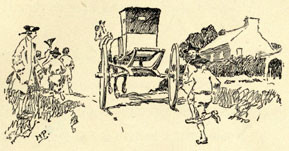
The Deacon Frontispiece. Half Title 11 The Masterpiece 12 “A chaise breaks down” 14 “The Deacon inquired of the village folk” 16 “Naow she’ll dew” 18 “She was a wonder, and nothing less” 19 “Deacon and deaconess dropped away” 20 “Eighteen Hundred” 21 “Fifty-Five” 21 “Its hundredth year” 22 “A general flavor of mild decay” 23 “In another hour it will be worn out” 24 “The parson takes a drive” 25 “All at once the horse stood still” 26 “Then something decidedly like a spill” 27 “Just as bubbles do when they burst” 28 “End of the wonderful one-hoss-shay” 29 HOW THE OLD HORSE WON THE BET. Half Title 30“The famous trotting ground”
31 “Many a noted steed” 32 “The Sunday swell” 33 “The jointed tandem” 34 “So shy with us, so free with these” 35 “The lovely bonnets beamed their smiles” 36 “I’ll bet you two to one” 37 “Harnessed in his one-hoss-shay” 38 “The sexton ... led forth the horse” 40 “A sight to see” 41 “They lead him, limping, to the track” 42 “To limber out each stiffened joint” 43 “Something like a stride” 45 “A mighty stride he swung” 47 “Off went a shoe” 48 “And now the stand he rushes by” 50 “And off they spring” 51 “They follow at his heels” 52 “They’re losing ground” 52 “He’s distanced all the lot” 53 “Some took his time” 54 “Back in the one-hoss shay he went” 56 “A horse can trot, for all he’s old” 57 THE BROOMSTICK TRAIN. Half Title 58 “Clear the track” 59 “An Essex Deacon dropped in to call” 60 “The old dwellings” 61 “The small square windows” 61 “Dark, dim, Dante-like solitudes” 63“Norman’s Woe”
64 “The Screeching Woman of Marblehead” 65 “It isn’t fair” 66 “You’re a good old—fellow—come, let us go” 68 “See how tall they’ve grown” 69 “They called the cats” 70 “The Essex people had dreadful times” 71 “The withered hags were free” 72 “A strange sea-monster stole their bait” 74 “They could hear him twenty miles” 75 “They came ... at their master’s call” 76 “You can hear her black cat’s purr” 78 “Catch a gleam from her wicked eye” 79 Tail Piece 80
The Deacon’s Masterpiece
Have you heard of the wonderful one-hoss shay,
That was built in such a logical way
It ran a hundred years to a day,
And then, of a sudden, it—ah, but stay,
I’ll tell you what happened without delay,
Scaring the parson into fits,
Frightening people out of their wits,—
Have you ever heard of that, I say?
Seventeen hundred and fifty-five,
Georgius Secundus was then alive,—
Snuffy old drone from the German hive;
That was the year when Lisbon-town
Saw the earth open and gulp her down,
And Braddock’s army was done so brown,
Left without a scalp to its crown.
It was on the terrible earthquake-day
That the Deacon finished the one-hoss-shay.
Now in building of chaises, I tell you what,
There is always somewhere a weakest spot,—
In hub, tire, felloe, in spring or thill,
In panel, or crossbar, or floor, or sill,
In screw, bolt, thoroughbrace,—lurking still,
Find it somewhere you must and will,—
Above or below, or within or without,—
And that’s the reason, beyond a doubt,
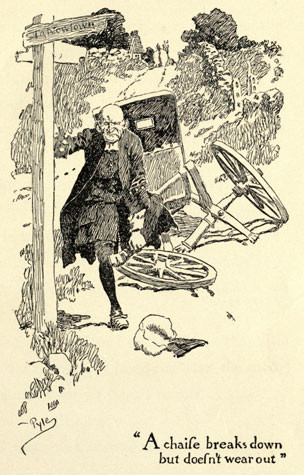
A chaise breaks down, but doesn’t wear out.
But the Deacon swore (as Deacons do,
With an “I dew vum,” or an “I tell yeou,”)
He would build one shay to beat the taown
’n’ the keounty ’n’ all the kentry raoun’;
It should be so built that it couldn’ break daown!
—“Fur,” said the Deacon, “’t’s mighty plain
Thut the weakes’ place mus’ stan’ the strain;
’n’ the way t’ fix it, uz I maintain,
Is only jest T’ make that place uz strong uz the rest.”
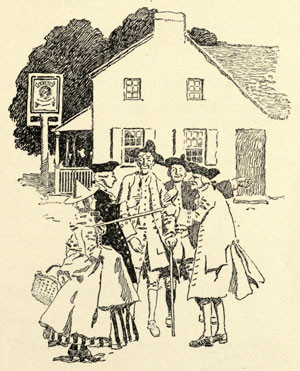
So the Deacon inquired of the village folk
Where he could find the strongest oak,
That couldn’t be split nor bent nor broke,—
That was for spokes and floor and sills;
He sent for lancewood to make the thills;
The crossbars were ash, from the straightest trees,
The panels of whitewood, that cuts like cheese,
But lasts like iron for things like these;
The hubs of logs from the “Settler’s ellum,”—
Last of its timber,—they couldn’t sell ’em,
Never an axe had seen their chips,
And the wedges flew from between their lip
Their blunt ends frizzled like celery-tips;
Step and prop-iron, bolt and screw,
Spring, tire, axle, and linchpin too,
Steel of the finest, bright and blue;
Thoroughbrace bison-skin, thick and wide;
Boot, top, dasher, from tough old hide
Found in the pit when the tanner died.
That was the way he “put her through.”
“There!” said the Deacon, “naow she’ll dew.”
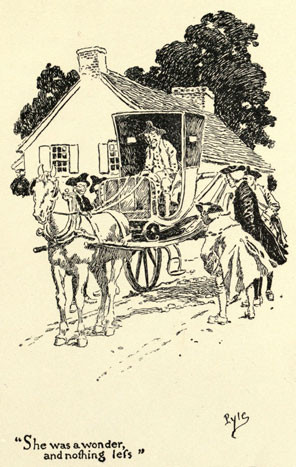
Do! I tell you, I rather guess
She was a wonder, and nothing less!
Colts grew horses, beards turned gray,
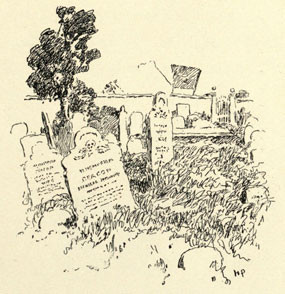
Deacon and deaconess dropped away,
Children and grandchildren—where were they?
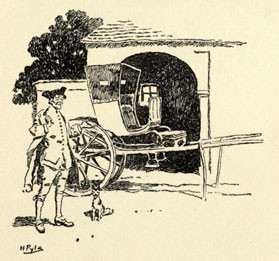
But there stood the stout old one-hoss-shay
As fresh as on Lisbon-earthquake-day!
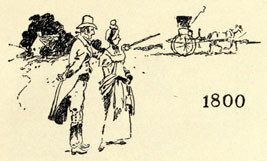
Eighteen Hundred;—it came and found
The Deacon’s Masterpiece strong and sound.
Eighteen hundred increased by ten;—
“Hahnsum kerridge” they called it then.
Eighteen hundred and twenty came;—
Running as usual; much the same.
Thirty and forty at last arrive,
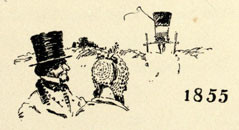
And then come fifty, and FIFTY-FIVE.
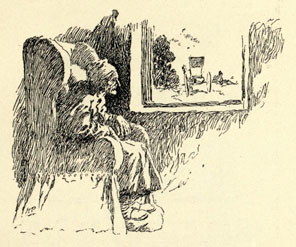
Little of all we value here
Wakes on the morn of its hundredth year
Without both feeling and looking queer.
In fact, there’s nothing that keeps its youth,
So far as I know, but a tree and truth.
(This is a moral that runs at large;
Take it.—You’re welcome.—No extra charge.)
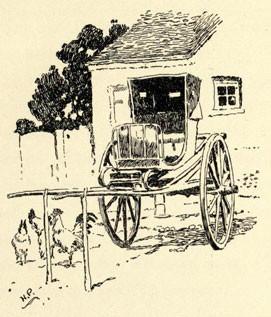
First of November,—the Earthquake-day.—
There are traces of age in the one-hoss-shay,
A general flavor of mild decay,
But nothing local, as one may say.
There couldn’t be,—for the Deacon’s art
Had made it so like in every part
That there wasn’t a chance for one to start.
For the wheels were just as strong as the thills,
And the floor was just as strong as the sills,
And the panels just as strong as the floor,
And the whippletree neither less nor more,
And the back-crossbar as strong as the fore,
And spring and axle and hub encore,
And yet, as a whole, it is past a doubt
In another hour it will be worn out!
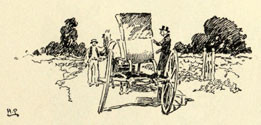
First of November, ’Fifty-five!
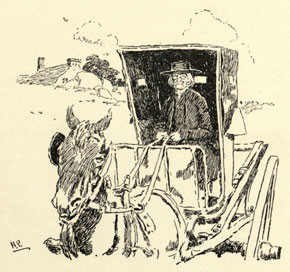
This morning the parson takes a drive.
Now, small boys, get out of the way!
Here comes the wonderful one-hoss-shay,
Drawn by a rat-tailed, ewe-necked bay.
“Huddup!” said the parson.—Off went they.
The parson was working his Sunday’s text,—
Had got to fifthly, and stopped perplexed
At what the—Moses—was coming next.
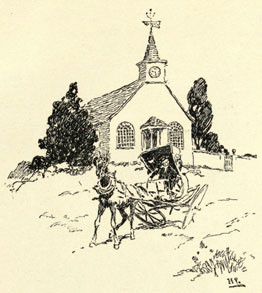
All at once the horse stood still,
Close by the meet’n’-house on the hill.
—First a shiver, and then a thrill,
Then something decidedly like a spill,—
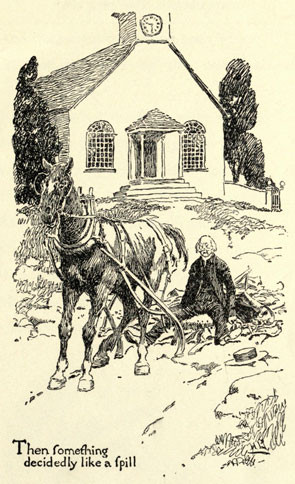
And the parson was sitting upon a rock,
At half-past nine by the meet’n’-house clock,—
Just the hour of the Earthquake shock!
—What do you think the parson found,
When he got up and stared around?
The poor old chaise in a heap or mound,
As if it had been to the mill and ground!
You see, of course, if you’re not a dunce,
How it went to pieces all at once,—
All at once, and nothing first,—
Just as bubbles do when they burst.
End of the wonderful one-hoss-shay.
Logic is logic. That’s all I say.
HOW THE OLD HORSE WON THE BET
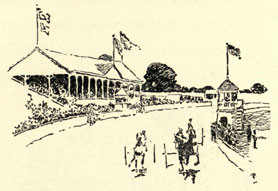
’T was on the famous trotting-ground,
The betting men were gathered round
From far and near; the “cracks” were there
Whose deeds the sporting prints declare:
The swift g. m., Old Hiram’s nag,
The fleet s. h., Dan Pfeiffer’s brag,
With these a third—and who is he
That stands beside his fast b. g.?
Budd Doble, whose catarrhal name
So fills the nasal trump of fame.
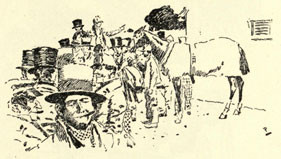
There too stood many a noted steed
Of Messenger and Morgan breed;
Green horses also, not a few;
Unknown as yet what they could do;
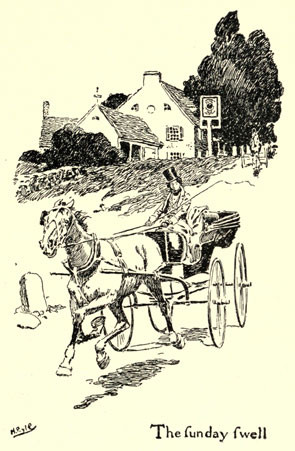
And all the hacks that know so well
The scourgings of the Sunday swell.
Blue are the skies of opening day;
The bordering turf is green with May;
The sunshine’s golden gleam is thrown
On sorrel, chestnut, bay, and roan;
The horses paw and prance and neigh,
Fillies and colts like kittens play,
And dance and toss their rippled manes
Shining and soft as silken skeins;
Wagons and gigs are ranged about,
And fashion flaunts her gay turn-out;
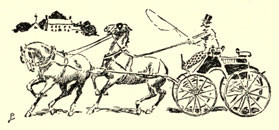
Here stands,—each youthful Jehu’s dream,—
The jointed tandem, ticklish team!
And there in ampler breadth expand
The splendors of the four-in-hand;
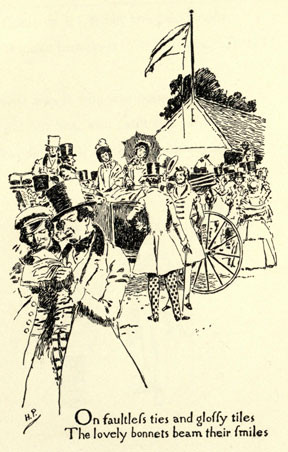
On faultless ties and glossy tiles
The lovely bonnets beam their smiles;
(The style’s the man, so books avow;
The style’s the woman, anyhow;)
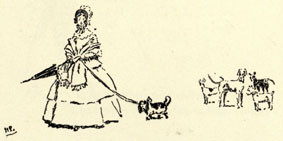
From flounces frothed with creamy lace
Peeps out the pug-dog’s smutty face,
Or spaniel rolls his liquid eye,
Or stares the wiry pet of Skye;—
O woman, in your hours of ease
So shy with us, so free with these!
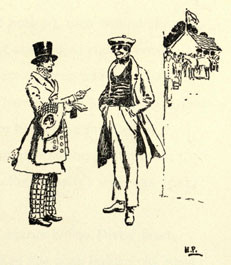
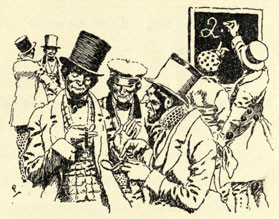
“Come on! I’ll bet you two to one
I’ll make him do it!” “Will you? Done!”
What was it who was bound to do?
I did not hear and can’t tell you,—
Pray listen till my story’s through.
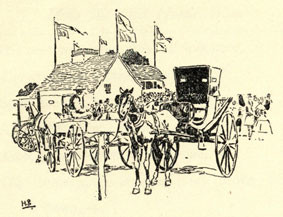
Scarce noticed, back behind the rest,
By cart and wagon rudely prest,
The parson’s lean and bony bay
Stood harnessed in his one-horse shay—
Lent to his sexton for the day;
(A funeral—so the sexton said;
His mother’s uncle’s wife was dead.)
Like Lazarus bid to Dives’ feast,
So looked the poor forlorn old beast;
His coat was rough, his tail was bare,
The gray was sprinkled in his hair;
Sportsmen and jockeys knew him not,
And yet they say he once could trot
Among the fleetest of the town,
Till something cracked and broke him down,—
The steed’s, the statesman’s, common lot!
“And are we then so soon forgot?”
Ah me! I doubt if one of you
Has ever heard the name “Old Blue,”
Whose fame through all this region rung
In those old days when I was young!
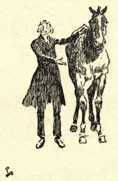
“Bring forth the horse!” Alas! he showed
Not like the one Mazeppa rode;
Scant-maned, sharp-backed, and shaky-kneed,
The wreck of what was once a steed,
Lips thin, eyes hollow, stiff in joints;
Yet not without his knowing points.
The sexton laughing in his sleeve,
As if ’t were all a make-believe,
Led forth the horse, and as he laughed
Transcriber’s Note
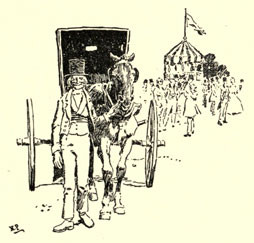
Unhitched the breeching from a shaft,
Unclasped the rusty belt beneath,
Drew forth the snaffle from his teeth,
Slipped off his head-stall, set him free
From strap and rein,—a sight to see!
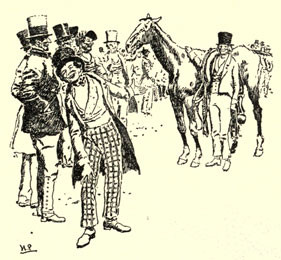
So worn, so lean in every limb,
It can’t be they are saddling him!
It is! his back the pig-skin strides
And flaps his lank, rheumatic sides;
With look of mingled scorn and mirth
They buckle round the saddle-girth;
With horsey wink and saucy toss
A youngster throws his leg across,
And so, his rider on his back,
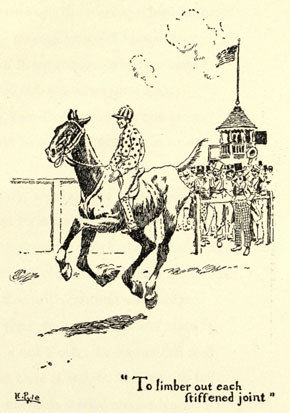
They lead him, limping, to the track,
Far up behind the starting-point,
To limber out each stiffened joint.
As through the jeering crowd he past,
One pitying look old Hiram cast;
“Go it, ye cripple, while ye can!”
Cried out unsentimental Dan;
“A Fast-Day dinner for the crows!”
Budd Doble’s scoffing shout arose.
Slowly, as when the walking-beam
First feels the gathering head of steam,
With warning cough and threatening wheeze
The stiff old charger crooks his knees;
At first with cautious step sedate,
As if he dragged a coach of state;
He’s not a colt; he knows full well
That time is weight and sure to tell;
No horse so sturdy but he fears
The handicap of twenty years.
As through the throng on either hand
The old horse nears the judges’ stand,
Beneath his jockey’s feather-weight
He warms a little to his gait,
And now and then a step is tried
That hints of something like a stride.
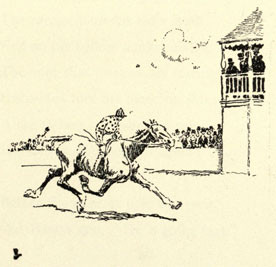
“Go!”—Through his ear the summons stung
As if a battle-trump had rung;
The slumbering instincts long unstirred
Start at the old familiar word;
It thrills like flame through every limb—
What mean his twenty years to him?
The savage blow his rider dealt
Fell on his hollow flanks unfelt;
The spur that pricked his staring hide
Unheeded tore his bleeding side;
Alike to him are spur and rein,—
He steps a five-year-old again!
Before the quarter pole was past,
Old Hiram said, “He’s going fast.”
Long ere the quarter was a half,
The chuckling crowd had ceased to laugh;
Tighter his frightened jockey clung
As in a mighty stride he swung,
The gravel flying in his track,
His neck stretched out, his ears laid back,
His tail extended all the while
Behind him like a rat-tail file!
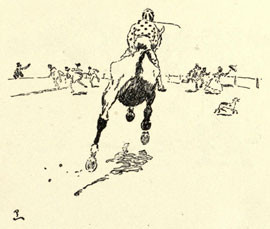
Off went a shoe,—away it spun,
Shot like a bullet from a gun;
The quaking jockey shapes a prayer
From scraps of oaths he used to swear;
He drops his whip, he drops his rein,
He clutches fiercely for a mane;
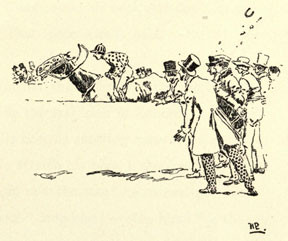
He’ll lose his hold—he sways and reels—
He’ll slide beneath those trampling heels!
The knees of many a horseman quake,
The flowers on many a bonnet shake,
And shouts arise from left and right,
“Stick on! Stick on!” “Hould tight! Hould tight!”
“Cling round his neck and don’t let go—”
“That pace can’t hold,—there! steady! whoa!”
But like the sable steed that bore
The spectral lover of Lenore,
His nostrils snorting foam and fire,
No stretch his bony limbs can tire;
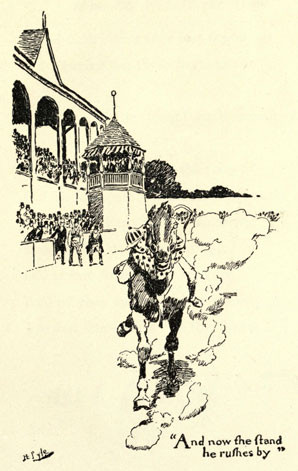
And now the stand he rushes by,
And “Stop him!—stop him!” is the cry.
Stand back! he’s only just begun,—
He’s having out three heats in one!
“Don’t rush in front! he’ll smash your brains;
But follow up and grab the reins!”
Old Hiram spoke. Dan Pfeiffer heard,
And sprang impatient at the word;
Budd Doble started on his bay,
Old Hiram followed on his gray,
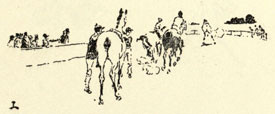
And off they spring, and round they go,
The fast ones doing “all they know.”
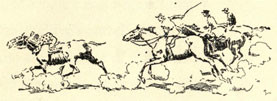
Look! twice they follow at his heels,
As round the circling course he wheels,
And whirls with him that clinging boy
Like Hector round the walls of Troy;
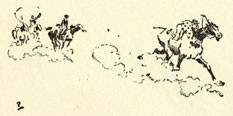
Still on, and on, the third time round!
They’re tailing off! they’re losing ground!
Budd Doble’s nag begins to fail!
Dan Pfeiffer’s sorrel whisks his tail!
And see! in spite of whip and shout,
Old Hiram’s mare is giving out!
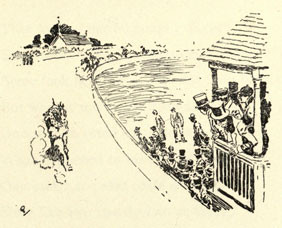
Now for the finish! at the turn,
The old horse—all the rest astern,—
Comes swinging in, with easy trot;
By Jove! he’s distanced all the lot!
That trot no mortal could explain;
Some said, “Old Dutchman come again!”
Some took his time,—at least they tried,
But what it was could none decide;
One said he couldn’t understand
What happened to his second hand;
One said 2.10; that couldn’t be—
More like two twenty two or three;
Old Hiram settled it at last;
“The time was two—too dee-vel-ish fast!”
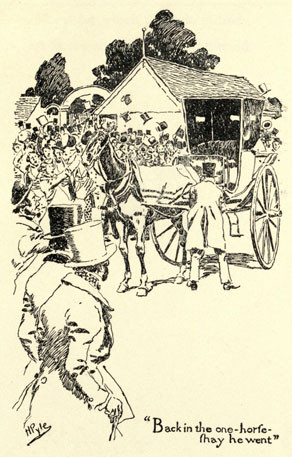
The parson’s horse had won the bet;
It cost him something of a sweat;
Back in the one-hoss shay he went;
The parson wondered what it meant,
And murmured, with a mild surprise
And pleasant twinkle of the eyes,
“That funeral must have been a trick,
Or corpses drive at double-quick;
I shouldn’t wonder, I declare,
If brother—Jehu—made the prayer!”
And this is all I have to say
About that tough old trotting bay.
Huddup! Huddup! G’lang!—Good-day!
Moral for which this tale is told:
A horse can trot, for all he’s old.
THE BROOMSTICK TRAIN
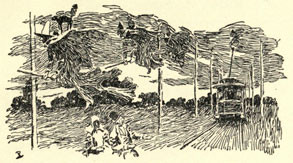
Look out! Look out, boys! Clear the track!
The witches are here! They’ve all come back!
They hanged them high,—No use! No use!
What cares a witch for a hangman’s noose?
They buried them deep, but they wouldn’t lie still,
For cats and witches are hard to kill;
They swore they shouldn’t and wouldn’t die,—
Books said they did, but they lie! they lie!
—A couple of hundred years, or so,
They had knocked about in the world below,
When an Essex Deacon dropped in to call,
And a homesick feeling seized them all;
For he came from a place they knew full well,
And many a tale he had to tell.
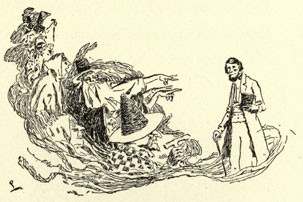
They long to visit the haunts of men,
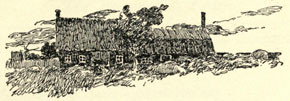
To see the old dwellings they knew again,
And ride on their broomsticks all around
Their wide domain of unhallowed ground.
In Essex county there’s many a roof
Well known to him of the cloven hoof;
The small square windows are full in view
Which the midnight hags went sailing through,
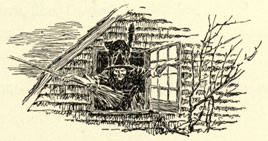
On their well-trained broomsticks mounted high,
Seen like shadows against the sky;
Crossing the track of owls and bats,
Hugging before them their coal-black cats.
Well did they know, those gray old wives,
The sights we see in our daily drives:
Shimmer of lake and shine of sea,
Brown’s bare hill with its lonely tree,
(It wasn’t then as we see it now,
With one scant scalp-lock to shade its brow;)
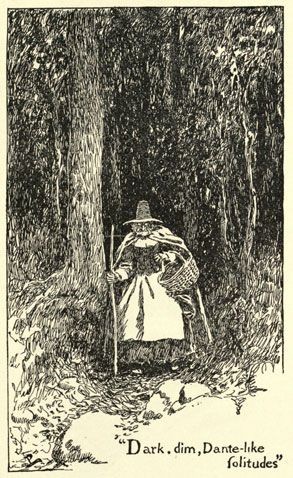
Dusky nooks in the Essex woods,
Dark, dim, Dante-like solitudes,
Where the tree-toad watches the sinuous snake
Glide through his forests of fern and brake;
Ipswich River; its old stone bridge;
Far off Andover’s Indian Ridge,
And many a scene where history tells
Some shadow of bygone terror dwells,—
Of “Norman’s Woe” with its tale of dread,
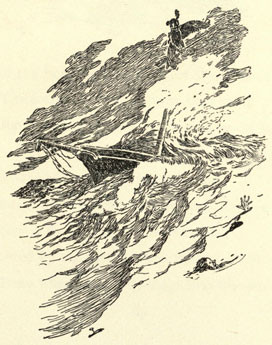
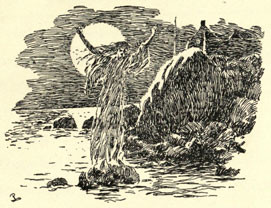
Of the Screeching Woman of Marblehead,
(The fearful story that turns men pale:
Don’t bid me tell it,—my speech would fail.)
Who would not, will not, if he can,
Bathe in the breezes of fair Cape Ann,—
Rest in the bowers her bays enfold,
Loved by the sachems and squaws of old?
Home where the white magnolias bloom,
Sweet with the bayberry’s chaste perfume,
Hugged by the woods and kissed by the sea!
Where is the Eden like to thee?
For that “couple of hundred years, or so,”
There had been no peace in the world below;
The witches still grumbling, “It isn’t fair;
Come, give us a taste of the upper air!
We’ve had enough of your sulphur springs,
And the evil odor that round them clings;
We long for a drink that is cool and nice,—
Great buckets of water with Wenham ice;
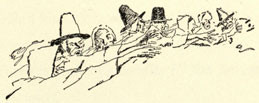
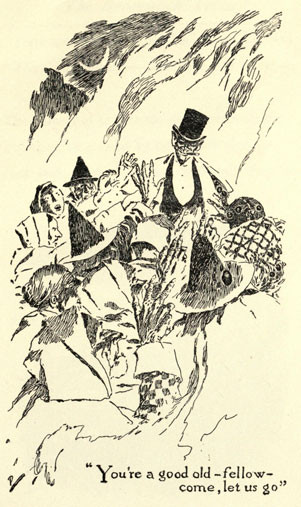
We’ve served you well up-stairs, you know;
You’re a good old—fellow—come, let us go!”
I don’t feel sure of his being good,
But he happened to be in a pleasant mood,—
As fiends with their skins full sometimes are,—
(He’d been drinking with “roughs” at a Boston bar.)
So what does he do but up and shout
To a graybeard turnkey, “Let ’em out!”
To mind his orders was all he knew;
The gates swung open, and out they flew
“Where are our broomsticks?” the beldams cried.
“Here are your broomsticks,” an imp replied.
“They’ve been in—the place you know—so long
They smell of brimstone uncommon strong;
But they’ve gained by being left alone,—
Just look, and you’ll see how tall they’ve grown.”
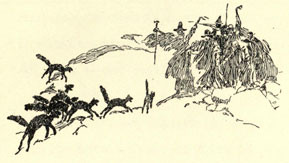
—“And where is my cat?” a vixen squalled.
“Yes, where are our cats?” the witches bawled,
And began to call them all by name:
As fast as they called the cats, they came:
There was bob-tailed Tommy and long-tailed Tim,
And wall-eyed Jacky and green-eyed Jim,
And splay-foot Benny and slim-legged Beau,
And Skinny and Squally, and Jerry and Joe,
And many another that came at call,—
It would take too long to count them all.
All black,—one could hardly tell which was which,
But every cat knew his own old witch;
And she knew hers as hers knew her,—
Ah, didn’t they curl their tails and purr!
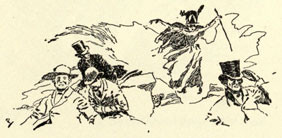
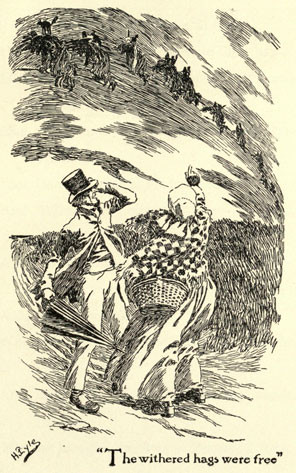
No sooner the withered hags were free
Than out they swarmed for a midnight spree;
I couldn’t tell all they did in rhymes,
But the Essex people had dreadful times.
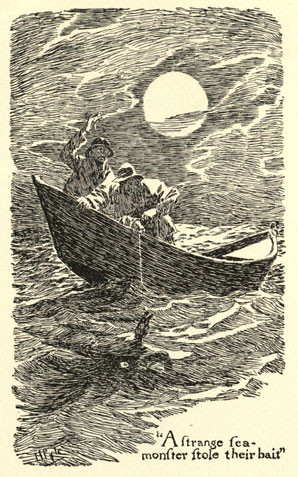
The Swampscott fishermen still relate
How a strange sea-monster stole their bait;
How their nets were tangled in loops and knots,
And they found dead crabs in their lobster-pots.
Poor Danvers grieved for her blasted crops,
And Wilmington mourned over mildewed hops.
A blight played havoc with Beverly beans,—
It was all the work of those hateful queans!
A dreadful panic began at “Pride’s,”
Where the witches stopped in their midnight rides,
And there rose strange rumors and vague alarms
’Mid the peaceful dwellers at Beverly Farms.
Now when the Boss of the Beldams found
That without his leave they were ramping round,
He called,—they could hear him twenty miles,
From Chelsea beach to the Misery Isles;
The deafest old granny knew his tone
Without the trick of the telephone.
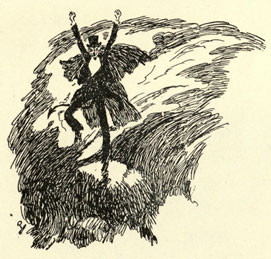
“Come here, you witches! Come here!” says he,—
“At your games of old, without asking me!
I’ll give you a little job to do
That will keep you stirring, you godless crew!”
They came, of course, at their master’s call,
The witches, the broomsticks, the cats, and all;
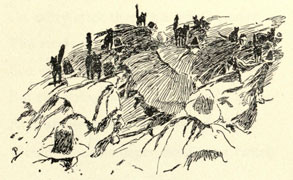
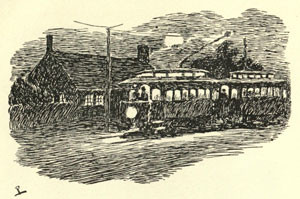
He led the hags to a railway train
The horses were trying to drag in vain.
“Now, then,” says he, “you’ve had your fun,
And here are the cars you’ve got to run.
The driver may just unhitch his team,
We don’t want horses, we don’t want steam
You may keep your old black cats to hug,
But the loaded train you’ve got to lug.”
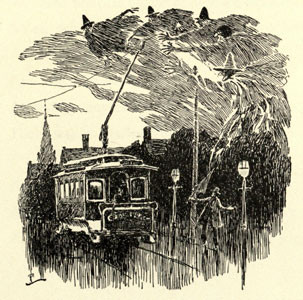
Since then on many a car you’ll see
A broomstick plain as plain can be;
On every stick there’s a witch astride,—
The string you see to her leg is tied.
She will do a mischief if she can,
But the string is held by a careful man,
And whenever the evil-minded witch
Would cut some caper, he gives a twitch.
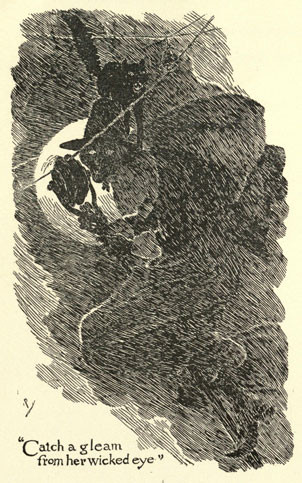
As for the hag, you can’t see her,
But hark! you can hear her black cat’s purr,
And now and then, as a car goes by,
You may catch a gleam from her wicked eye.
Often you’ve looked on a rushing train,
But just what moved it was not so plain.
It couldn’t be those wires above,
For they could neither pull nor shove;
Where was the motor that made it go
You couldn’t guess, but now you know.
Remember my rhymes when you ride again
On the rattling rail by the broomstick train!
Transcriber’s Note
The following typographical errors were corrected.
Page
Error
9one-hoss-shay
one-hoss shay
49let go—
let go—”
End of Project Gutenberg's The One Hoss Shay, by Oliver Wendell Holmes
*** END OF THIS PROJECT GUTENBERG EBOOK THE ONE HOSS SHAY ***
***** This file should be named 30279-h.htm or 30279-h.zip *****
This and all associated files of various formats will be found in:
http://www.gutenberg.org/3/0/2/7/30279/
Produced by Julia Miller and the Online Distributed
Proofreading Team at http://www.pgdp.net (This file was
produced from images generously made available by The
Internet Archive/American Libraries.)
Updated editions will replace the previous one--the old editions
will be renamed.
Creating the works from public domain print editions means that no
one owns a United States copyright in these works, so the Foundation
(and you!) can copy and distribute it in the United States without
permission and without paying copyright royalties. Special rules,
set forth in the General Terms of Use part of this license, apply to
copying and distributing Project Gutenberg-tm electronic works to
protect the PROJECT GUTENBERG-tm concept and trademark. Project
Gutenberg is a registered trademark, and may not be used if you
charge for the eBooks, unless you receive specific permission. If you
do not charge anything for copies of this eBook, complying with the
rules is very easy. You may use this eBook for nearly any purpose
such as creation of derivative works, reports, performances and
research. They may be modified and printed and given away--you may do
practically ANYTHING with public domain eBooks. Redistribution is
subject to the trademark license, especially commercial
redistribution.
*** START: FULL LICENSE ***
THE FULL PROJECT GUTENBERG LICENSE
PLEASE READ THIS BEFORE YOU DISTRIBUTE OR USE THIS WORK
To protect the Project Gutenberg-tm mission of promoting the free
distribution of electronic works, by using or distributing this work
(or any other work associated in any way with the phrase "Project
Gutenberg"), you agree to comply with all the terms of the Full Project
Gutenberg-tm License (available with this file or online at
http://gutenberg.net/license).
Section 1. General Terms of Use and Redistributing Project Gutenberg-tm
electronic works
1.A. By reading or using any part of this Project Gutenberg-tm
electronic work, you indicate that you have read, understand, agree to
and accept all the terms of this license and intellectual property
(trademark/copyright) agreement. If you do not agree to abide by all
the terms of this agreement, you must cease using and return or destroy
all copies of Project Gutenberg-tm electronic works in your possession.
If you paid a fee for obtaining a copy of or access to a Project
Gutenberg-tm electronic work and you do not agree to be bound by the
terms of this agreement, you may obtain a refund from the person or
entity to whom you paid the fee as set forth in paragraph 1.E.8.
1.B. "Project Gutenberg" is a registered trademark. It may only be
used on or associated in any way with an electronic work by people who
agree to be bound by the terms of this agreement. There are a few
things that you can do with most Project Gutenberg-tm electronic works
even without complying with the full terms of this agreement. See
paragraph 1.C below. There are a lot of things you can do with Project
Gutenberg-tm electronic works if you follow the terms of this agreement
and help preserve free future access to Project Gutenberg-tm electronic
works. See paragraph 1.E below.
1.C. The Project Gutenberg Literary Archive Foundation ("the Foundation"
or PGLAF), owns a compilation copyright in the collection of Project
Gutenberg-tm electronic works. Nearly all the individual works in the
collection are in the public domain in the United States. If an
individual work is in the public domain in the United States and you are
located in the United States, we do not claim a right to prevent you from
copying, distributing, performing, displaying or creating derivative
works based on the work as long as all references to Project Gutenberg
are removed. Of course, we hope that you will support the Project
Gutenberg-tm mission of promoting free access to electronic works by
freely sharing Project Gutenberg-tm works in compliance with the terms of
this agreement for keeping the Project Gutenberg-tm name associated with
the work. You can easily comply with the terms of this agreement by
keeping this work in the same format with its attached full Project
Gutenberg-tm License when you share it without charge with others.
1.D. The copyright laws of the place where you are located also govern
what you can do with this work. Copyright laws in most countries are in
a constant state of change. If you are outside the United States, check
the laws of your country in addition to the terms of this agreement
before downloading, copying, displaying, performing, distributing or
creating derivative works based on this work or any other Project
Gutenberg-tm work. The Foundation makes no representations concerning
the copyright status of any work in any country outside the United
States.
1.E. Unless you have removed all references to Project Gutenberg:
1.E.1. The following sentence, with active links to, or other immediate
access to, the full Project Gutenberg-tm License must appear prominently
whenever any copy of a Project Gutenberg-tm work (any work on which the
phrase "Project Gutenberg" appears, or with which the phrase "Project
Gutenberg" is associated) is accessed, displayed, performed, viewed,
copied or distributed:
This eBook is for the use of anyone anywhere at no cost and with
almost no restrictions whatsoever. You may copy it, give it away or
re-use it under the terms of the Project Gutenberg License included
with this eBook or online at www.gutenberg.net
1.E.2. If an individual Project Gutenberg-tm electronic work is derived
from the public domain (does not contain a notice indicating that it is
posted with permission of the copyright holder), the work can be copied
and distributed to anyone in the United States without paying any fees
or charges. If you are redistributing or providing access to a work
with the phrase "Project Gutenberg" associated with or appearing on the
work, you must comply either with the requirements of paragraphs 1.E.1
through 1.E.7 or obtain permission for the use of the work and the
Project Gutenberg-tm trademark as set forth in paragraphs 1.E.8 or
1.E.9.
1.E.3. If an individual Project Gutenberg-tm electronic work is posted
with the permission of the copyright holder, your use and distribution
must comply with both paragraphs 1.E.1 through 1.E.7 and any additional
terms imposed by the copyright holder. Additional terms will be linked
to the Project Gutenberg-tm License for all works posted with the
permission of the copyright holder found at the beginning of this work.
1.E.4. Do not unlink or detach or remove the full Project Gutenberg-tm
License terms from this work, or any files containing a part of this
work or any other work associated with Project Gutenberg-tm.
1.E.5. Do not copy, display, perform, distribute or redistribute this
electronic work, or any part of this electronic work, without
prominently displaying the sentence set forth in paragraph 1.E.1 with
active links or immediate access to the full terms of the Project
Gutenberg-tm License.
1.E.6. You may convert to and distribute this work in any binary,
compressed, marked up, nonproprietary or proprietary form, including any
word processing or hypertext form. However, if you provide access to or
distribute copies of a Project Gutenberg-tm work in a format other than
"Plain Vanilla ASCII" or other format used in the official version
posted on the official Project Gutenberg-tm web site (www.gutenberg.net),
you must, at no additional cost, fee or expense to the user, provide a
copy, a means of exporting a copy, or a means of obtaining a copy upon
request, of the work in its original "Plain Vanilla ASCII" or other
form. Any alternate format must include the full Project Gutenberg-tm
License as specified in paragraph 1.E.1.
1.E.7. Do not charge a fee for access to, viewing, displaying,
performing, copying or distributing any Project Gutenberg-tm works
unless you comply with paragraph 1.E.8 or 1.E.9.
1.E.8. You may charge a reasonable fee for copies of or providing
access to or distributing Project Gutenberg-tm electronic works provided
that
- You pay a royalty fee of 20% of the gross profits you derive from
the use of Project Gutenberg-tm works calculated using the method
you already use to calculate your applicable taxes. The fee is
owed to the owner of the Project Gutenberg-tm trademark, but he
has agreed to donate royalties under this paragraph to the
Project Gutenberg Literary Archive Foundation. Royalty payments
must be paid within 60 days following each date on which you
prepare (or are legally required to prepare) your periodic tax
returns. Royalty payments should be clearly marked as such and
sent to the Project Gutenberg Literary Archive Foundation at the
address specified in Section 4, "Information about donations to
the Project Gutenberg Literary Archive Foundation."
- You provide a full refund of any money paid by a user who notifies
you in writing (or by e-mail) within 30 days of receipt that s/he
does not agree to the terms of the full Project Gutenberg-tm
License. You must require such a user to return or
destroy all copies of the works possessed in a physical medium
and discontinue all use of and all access to other copies of
Project Gutenberg-tm works.
- You provide, in accordance with paragraph 1.F.3, a full refund of any
money paid for a work or a replacement copy, if a defect in the
electronic work is discovered and reported to you within 90 days
of receipt of the work.
- You comply with all other terms of this agreement for free
distribution of Project Gutenberg-tm works.
1.E.9. If you wish to charge a fee or distribute a Project Gutenberg-tm
electronic work or group of works on different terms than are set
forth in this agreement, you must obtain permission in writing from
both the Project Gutenberg Literary Archive Foundation and Michael
Hart, the owner of the Project Gutenberg-tm trademark. Contact the
Foundation as set forth in Section 3 below.
1.F.
1.F.1. Project Gutenberg volunteers and employees expend considerable
effort to identify, do copyright research on, transcribe and proofread
public domain works in creating the Project Gutenberg-tm
collection. Despite these efforts, Project Gutenberg-tm electronic
works, and the medium on which they may be stored, may contain
"Defects," such as, but not limited to, incomplete, inaccurate or
corrupt data, transcription errors, a copyright or other intellectual
property infringement, a defective or damaged disk or other medium, a
computer virus, or computer codes that damage or cannot be read by
your equipment.
1.F.2. LIMITED WARRANTY, DISCLAIMER OF DAMAGES - Except for the "Right
of Replacement or Refund" described in paragraph 1.F.3, the Project
Gutenberg Literary Archive Foundation, the owner of the Project
Gutenberg-tm trademark, and any other party distributing a Project
Gutenberg-tm electronic work under this agreement, disclaim all
liability to you for damages, costs and expenses, including legal
fees. YOU AGREE THAT YOU HAVE NO REMEDIES FOR NEGLIGENCE, STRICT
LIABILITY, BREACH OF WARRANTY OR BREACH OF CONTRACT EXCEPT THOSE
PROVIDED IN PARAGRAPH F3. YOU AGREE THAT THE FOUNDATION, THE
TRADEMARK OWNER, AND ANY DISTRIBUTOR UNDER THIS AGREEMENT WILL NOT BE
LIABLE TO YOU FOR ACTUAL, DIRECT, INDIRECT, CONSEQUENTIAL, PUNITIVE OR
INCIDENTAL DAMAGES EVEN IF YOU GIVE NOTICE OF THE POSSIBILITY OF SUCH
DAMAGE.
1.F.3. LIMITED RIGHT OF REPLACEMENT OR REFUND - If you discover a
defect in this electronic work within 90 days of receiving it, you can
receive a refund of the money (if any) you paid for it by sending a
written explanation to the person you received the work from. If you
received the work on a physical medium, you must return the medium with
your written explanation. The person or entity that provided you with
the defective work may elect to provide a replacement copy in lieu of a
refund. If you received the work electronically, the person or entity
providing it to you may choose to give you a second opportunity to
receive the work electronically in lieu of a refund. If the second copy
is also defective, you may demand a refund in writing without further
opportunities to fix the problem.
1.F.4. Except for the limited right of replacement or refund set forth
in paragraph 1.F.3, this work is provided to you 'AS-IS' WITH NO OTHER
WARRANTIES OF ANY KIND, EXPRESS OR IMPLIED, INCLUDING BUT NOT LIMITED TO
WARRANTIES OF MERCHANTIBILITY OR FITNESS FOR ANY PURPOSE.
1.F.5. Some states do not allow disclaimers of certain implied
warranties or the exclusion or limitation of certain types of damages.
If any disclaimer or limitation set forth in this agreement violates the
law of the state applicable to this agreement, the agreement shall be
interpreted to make the maximum disclaimer or limitation permitted by
the applicable state law. The invalidity or unenforceability of any
provision of this agreement shall not void the remaining provisions.
1.F.6. INDEMNITY - You agree to indemnify and hold the Foundation, the
trademark owner, any agent or employee of the Foundation, anyone
providing copies of Project Gutenberg-tm electronic works in accordance
with this agreement, and any volunteers associated with the production,
promotion and distribution of Project Gutenberg-tm electronic works,
harmless from all liability, costs and expenses, including legal fees,
that arise directly or indirectly from any of the following which you do
or cause to occur: (a) distribution of this or any Project Gutenberg-tm
work, (b) alteration, modification, or additions or deletions to any
Project Gutenberg-tm work, and (c) any Defect you cause.
Section 2. Information about the Mission of Project Gutenberg-tm
Project Gutenberg-tm is synonymous with the free distribution of
electronic works in formats readable by the widest variety of computers
including obsolete, old, middle-aged and new computers. It exists
because of the efforts of hundreds of volunteers and donations from
people in all walks of life.
Volunteers and financial support to provide volunteers with the
assistance they need are critical to reaching Project Gutenberg-tm's
goals and ensuring that the Project Gutenberg-tm collection will
remain freely available for generations to come. In 2001, the Project
Gutenberg Literary Archive Foundation was created to provide a secure
and permanent future for Project Gutenberg-tm and future generations.
To learn more about the Project Gutenberg Literary Archive Foundation
and how your efforts and donations can help, see Sections 3 and 4
and the Foundation web page at http://www.pglaf.org.
Section 3. Information about the Project Gutenberg Literary Archive
Foundation
The Project Gutenberg Literary Archive Foundation is a non profit
501(c)(3) educational corporation organized under the laws of the
state of Mississippi and granted tax exempt status by the Internal
Revenue Service. The Foundation's EIN or federal tax identification
number is 64-6221541. Its 501(c)(3) letter is posted at
http://pglaf.org/fundraising. Contributions to the Project Gutenberg
Literary Archive Foundation are tax deductible to the full extent
permitted by U.S. federal laws and your state's laws.
The Foundation's principal office is located at 4557 Melan Dr. S.
Fairbanks, AK, 99712., but its volunteers and employees are scattered
throughout numerous locations. Its business office is located at
809 North 1500 West, Salt Lake City, UT 84116, (801) 596-1887, email
business@pglaf.org. Email contact links and up to date contact
information can be found at the Foundation's web site and official
page at http://pglaf.org
For additional contact information:
Dr. Gregory B. Newby
Chief Executive and Director
gbnewby@pglaf.org
Section 4. Information about Donations to the Project Gutenberg
Literary Archive Foundation
Project Gutenberg-tm depends upon and cannot survive without wide
spread public support and donations to carry out its mission of
increasing the number of public domain and licensed works that can be
freely distributed in machine readable form accessible by the widest
array of equipment including outdated equipment. Many small donations
($1 to $5,000) are particularly important to maintaining tax exempt
status with the IRS.
The Foundation is committed to complying with the laws regulating
charities and charitable donations in all 50 states of the United
States. Compliance requirements are not uniform and it takes a
considerable effort, much paperwork and many fees to meet and keep up
with these requirements. We do not solicit donations in locations
where we have not received written confirmation of compliance. To
SEND DONATIONS or determine the status of compliance for any
particular state visit http://pglaf.org
While we cannot and do not solicit contributions from states where we
have not met the solicitation requirements, we know of no prohibition
against accepting unsolicited donations from donors in such states who
approach us with offers to donate.
International donations are gratefully accepted, but we cannot make
any statements concerning tax treatment of donations received from
outside the United States. U.S. laws alone swamp our small staff.
Please check the Project Gutenberg Web pages for current donation
methods and addresses. Donations are accepted in a number of other
ways including including checks, online payments and credit card
donations. To donate, please visit: http://pglaf.org/donate
Section 5. General Information About Project Gutenberg-tm electronic
works.
Professor Michael S. Hart is the originator of the Project Gutenberg-tm
concept of a library of electronic works that could be freely shared
with anyone. For thirty years, he produced and distributed Project
Gutenberg-tm eBooks with only a loose network of volunteer support.
Project Gutenberg-tm eBooks are often created from several printed
editions, all of which are confirmed as Public Domain in the U.S.
unless a copyright notice is included. Thus, we do not necessarily
keep eBooks in compliance with any particular paper edition.
Most people start at our Web site which has the main PG search facility:
http://www.gutenberg.net
This Web site includes information about Project Gutenberg-tm,
including how to make donations to the Project Gutenberg Literary
Archive Foundation, how to help produce our new eBooks, and how to
subscribe to our email newsletter to hear about new eBooks.
“Back in the one-hoss shay he went”
go—”
“That pace can’t hold,—there! steady! whoa!”
But like the sable steed that bore
The spectral lover of Lenore,
His nostrils snorting foam and fire,
No stretch his bony limbs can tire;
And now the stand he rushes by,
And “Stop him!—stop him!” is the cry.


