



автордың кітабын онлайн тегін оқу Vivian Grey
VIVIAN GREY
By The Earl Of Beaconsfield, Benjamin Disraeli
The English Comédie Humaine
Second Series
PUBLISHER’S NOTE.
As a novelist, Benjamin Disraeli belongs to the early part of the nineteenth century. “Vivian Grey” (1826-27) and “Sybil” (1845) mark the beginning and the end of his truly creative period; for the two productions of his latest years, “Lothair” (1870) and “Endymion” (1880), add nothing to the characteristics of his earlier volumes except the changes of feeling and power which accompany old age. His period, thus, is that of Bulwer, Dickens, and Thackeray, and of the later years of Sir Walter Scott—a fact which his prominence as a statesman during the last decade of his life, as well as the vogue of “Lothair” and “Endymion,” has tended to obscure. His style, his material, and his views of English character and life all date from that earlier time. He was born in 1804 and died in 1881.
Disraeli was barely twenty-one when he published “Vivian Grey,” his first work of fiction; and the young author was at once hailed as a master of his art by an almost unanimous press.
In this, as in his subsequent books, it was not so much Disraeli’s notable skill as a novelist but rather his portrayal of the social and political life of the day that made him one of the most popular writers of his generation, and earned for him a lasting fame as a man of letters. In “Vivian Grey” is narrated the career of an ambitious young man of rank; and in this story the brilliant author has preserved to us the exact tone of the English drawing-room, as he so well knew it, sketching with sure and rapid strokes a whole portrait gallery of notables, disguised in name may be, but living characters nevertheless, who charm us with their graceful manners and general air of being people of consequence. “Vivian Grey,” then, though not a great novel is beyond question a marvelously true picture of the life and character of an interesting period of English history and made notable because of Disraeli’s fine imagination and vivid descriptive powers.
CONTENTS
VIVIAN GREY
BOOK I
CHAPTER I
CHAPTER II
CHAPTER III
CHAPTER IV
CHAPTER V
CHAPTER VI
CHAPTER VII
CHAPTER VIII
CHAPTER IX
BOOK II
CHAPTER I
CHAPTER II
CHAPTER III
CHAPTER IV
CHAPTER V
CHAPTER VI
CHAPTER VII
CHAPTER VIII
CHAPTER IX
CHAPTER X
CHAPTER XI
CHAPTER XII
CHAPTER XIII
CHAPTER XIV
CHAPTER XV
CHAPTER XVI
BOOK III
CHAPTER I
CHAPTER II
CHAPTER III
CHAPTER IV
CHAPTER V
CHAPTER VI
CHAPTER VII
CHAPTER VIII
CHAPTER IX
BOOK IV
CHAPTER I
CHAPTER II
CHAPTER III
CHAPTER IV
CHAPTER V
CHAPTER VI
BOOK V
CHAPTER I
CHAPTER II
CHAPTER III
CHAPTER IV
CHAPTER V
CHAPTER VI
CHAPTER VII
CHAPTER VIII
CHAPTER IX
CHAPTER X
CHAPTER XI
CHAPTER XII
CHAPTER XIII
CHAPTER XIV
CHAPTER XV
BOOK VI
CHAPTER I
CHAPTER II
CHAPTER III
CHAPTER IV
CHAPTER V
CHAPTER VI
CHAPTER VII
CHAPTER VIII
BOOK VII
CHAPTER I
CHAPTER II
CHAPTER III
CHAPTER IV
CHAPTER V
CHAPTER VI
CHAPTER VII
CHAPTER VIII
CHAPTER IX
CHAPTER X
CHAPTER XI
CHAPTER XII
BOOK VIII
CHAPTER I
CHAPTER II
CHAPTER III
CHAPTER IV
List of Illustrations
Frontispiece
Titlepage
Small Silver Box
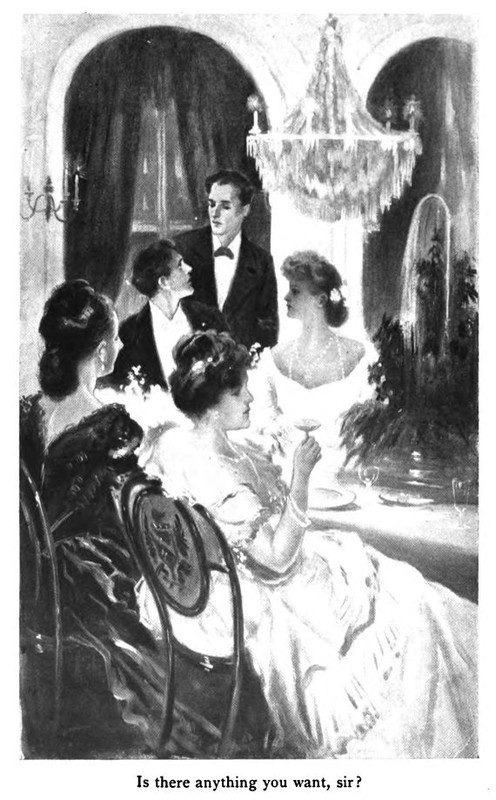
Is there anything you want, sir?
Dark Thought
VIVIAN GREY
BOOK I
CHAPTER I
We are not aware that the infancy of Vivian Grey was distinguished by any extraordinary incident. The solicitude of the most affectionate of mothers, and the care of the most attentive of nurses, did their best to injure an excellent constitution. But Vivian was an only child, and these exertions were therefore excusable. For the first five years of his life, with his curly locks and his fancy dress, he was the pride of his own and the envy of all neighbouring establishments; but, in process of time, the spirit of boyism began to develop itself, and Vivian not only would brush his hair straight and rebel against his nurse, but actually insisted upon being—breeched! At this crisis it was discovered that he had been spoiled, and it was determined that he should be sent to school. Mr. Grey observed, also, that the child was nearly ten years old, and did not know his alphabet, and Mrs. Grey remarked that he was getting ugly. The fate of Vivian was decided.
“I am told, my dear,” observed Mrs. Grey, one day after dinner to her husband, “I am told, my dear, that Dr. Flummery’s would do very well for Vivian. Nothing can exceed the attention which is paid to the pupils. There are sixteen young ladies, all the daughters of clergymen, merely to attend to the morals and the linen; terms moderate: 100 guineas per annum, for all under six years of age, and few extras, only for fencing, pure milk, and the guitar. Mrs. Metcalfe has both her boys there, and she says their progress is astonishing! Percy Metcalfe, she assures me, was quite as backward as Vivian; indeed, backwarder; and so was Dudley, who was taught at home on the new system, by a pictorial alphabet, and who persisted to the last, notwithstanding all the exertions of Miss Barrett, in spelling A-P-E, monkey, merely because over the word there was a monster munching an apple.”
“And quite right in the child, my dear. Pictorial alphabet! pictorial fool’s head!”
“But what do you say to Flummery’s, Horace?”
“My dear, do what you like. I never trouble myself, you know, about these matters;” and Mr. Grey refreshed himself, after this domestic attack, with a glass of claret.
Mr. Grey was a gentleman who had succeeded, when the heat of youth was over, to the enjoyment of a life estate of some two thousand a year. He was a man of lettered tastes, and had hailed with no slight pleasure his succession to a fortune which, though limited in its duration, was still a great thing for a young lounger about town, not only with no profession, but with a mind unfitted for every species of business. Grey, to the astonishment of his former friends, the wits, made an excellent domestic match; and, leaving the whole management of his household to his lady, felt himself as independent in his magnificent library as if he had never ceased to be that true freeman, A MAN OF CHAMBERS.
The young Vivian had not, by the cares which fathers are always heirs to, yet reminded his parent that children were anything else but playthings. The intercourse between father and son was, of course, extremely limited; for Vivian was, as yet, the mother’s child; Mr. Grey’s parental duties being confined to giving his son a daily glass of claret, pulling his ears with all the awkwardness of literary affection, and trusting to God “that the urchin would never scribble.”
“I won’t go to school, mamma,” bawled Vivian.
“But you must, my love,” answered Mrs. Grey; “all good boys go to school;” and in the plenitude of a mother’s love she tried to make her offspring’s hair curl.
“I won’t have my hair curl, mamma; the boys will laugh at me,” rebawled the beauty.
“Now who could have told the child that?” monologised mamma, with all a mamma’s admiration.
“Charles Appleyard told me so; his hair curled, and the boys called him girl. Papa! give me some more claret; I won’t go to school.”
CHAPTER II
Three or four years passed over, and the mind of Vivian Grey astonishingly developed itself. He had long ceased to wear frills, had broached the subject of boots three or four times, made a sad inroad during the holidays in Mr. Grey’s bottle of claret, and was reported as having once sworn at the butler. The young gentleman began also to hint, during every vacation, that the fellows at Flummery’s were somewhat too small for his companionship, and (first bud of puppyism!) the former advocate of straight hair now expended a portion of his infant income in the purchase of Macassar, and began to cultivate his curls. Mrs. Grey could not entertain for a moment the idea of her son’s associating with children, the eldest of whom (to adopt his own account) was not above eight years old; so Flummery, it was determined, he should leave. But where to go? Mr. Grey was for Eton, but his lady was one of those women whom nothing in the world can persuade that a public school is anything else but a place where boys are roasted alive; and so with tears, and taunts, and supplications, the point of private education was conceded.
At length it was resolved that the only hope should remain at home a season, until some plan should be devised for the cultivation of his promising understanding. During this year Vivian became a somewhat more constant intruder into the library than heretofore; and living so much among books, he was insensibly attracted to those silent companions, that speak so eloquently.
How far the character of the parent may influence the character of the child the metaphysician must decide. Certainly the character of Vivian Grey underwent, at this period of his life, a sensible change. Doubtless, constant communion with a mind highly refined, severely cultivated, and much experienced, cannot but produce a beneficial impression, even upon a mind formed and upon principles developed: how infinitely more powerful must the influence of such communion be upon a youthful heart, ardent, innocent, and unpractised! As Vivian was not to figure in the microcosm of a public school, a place for which, from his temper, he was almost better fitted than any young genius whom the playing fields of Eton or the hills of Winton can remember, there was some difficulty in fixing upon his future Academus. Mr. Grey’s two axioms were, first, that no one so young as his son should settle in the metropolis, and that Vivian must consequently not have a private tutor; and, secondly, that all private schools were quite worthless; and, therefore, there was every probability of Vivian not receiving any education whatever.
At length, an exception to axiom second started up in the establishment of Mr. Dallas. This gentleman was a clergyman, a profound Grecian, and a poor man. He had edited the Alcestis, and married his laundress; lost money by his edition, and his fellowship by his match. In a few days the hall of Mr. Grey’s London mansion was filled with all sorts of portmanteaus, trunks, and travelling cases, directed in a boy’s sprawling hand to “Vivian Grey, Esquire, at the Reverend Everard Dallas, Burnsley Vicarage, Hants.”
“God bless you, my boy! write to your mother soon, and remember your Journal.”
CHAPTER III
The rumour of the arrival of “a new fellow” circulated with rapidity through the inmates of Burnsley Vicarage, and about fifty young devils were preparing to quiz the newcomer, when the school-room door opened, and Mr. Dallas, accompanied by Vivian, entered.
“A dandy, by Jove!” whispered St. Leger Smith. “What a knowing set out!” squeaked Johnson secundus. “Mammy-sick!” growled Barlow primus. This last exclamation was, however, a scandalous libel, for certainly no being ever stood in a pedagogue’s presence with more perfect sang froid, and with a bolder front, than did, at this moment, Vivian Grey.
One principle in Mr. Dallas’s system was always to introduce a new-comer in school-hours. He was thus carried immediately in medias res, and the curiosity of his co-mates being in a great degree satisfied at the time when that curiosity could not personally annoy him, the new-comer was, of course, much better prepared to make his way when the absence of the ruler became a signal for some oral communication with “the arrival.”
However, in the present instance the young savages at Burnsley Vicarage had caught a Tartar; and in a very few days Vivian Grey was decidedly the most popular fellow in the school. He was “so dashing! so devilish good-tempered! so completely up to everything!” The magnates of the land were certainly rather jealous of his success, but their very sneers bore witness to his popularity. “Cursed puppy,” whispered St. Leger Smith. “Thinks himself knowing,” squeaked Johnson secundus. “Thinks himself witty,” growled Barlow primus.
Notwithstanding this cabal, days rolled on at Burnsley Vicarage only to witness the increase of Vivian’s popularity. Although more deficient than most of his own age in accurate classical attainments, he found himself, in talents and various acquirements, immeasurably their superior. And singular is it that at school distinction in such points is ten thousand times more admired by the multitude than the most profound knowledge of Greek Metres, or the most accurate acquaintance with the value of Roman coins. Vivian Grey’s English verses and Vivian Grey’s English themes were the subject of universal commendation. Some young lads made copies of these productions, to enrich, at the Christmas holidays, their sisters’ albums; while the whole school were scribbling embryo prize-poems, epics of twenty lines on “the Ruins of Paestum” and “the Temple of Minerva;” “Agrigentum,” and “the Cascade of Terni.” Vivian’s productions at this time would probably have been rejected by the commonest twopenny publication about town, yet they turned the brain of the whole school; while fellows who were writing Latin Dissertations and Greek Odes, which might have made the fortune of the Classical Journal, were looked on by the multitude as as great dunderheads as themselves. Such is the advantage which, even in this artificial world, everything that is genuine has over everything that is false and forced. The dunderheads who wrote “good Latin” and “Attic Greek” did it by a process by means of which the youngest fellow in the school was conscious he could, if he chose, attain the same perfection. Vivian Grey’s verses were unlike anything which had yet appeared in the literary Annals of Burnsley Vicarage, and that which was quite novel was naturally thought quite excellent.
There is no place in the world where greater homage is paid to talent than an English school. At a public school, indeed, if a youth of great talents be blessed with an amiable and generous disposition, he ought not to envy the Minister of England. If any captain of Eton or praefect of Winchester be reading these pages, let him dispassionately consider in what situation of life he can rationally expect that it will be in his power to exercise such influence, to have such opportunities of obliging others, and be so confident of an affectionate and grateful return. Aye, there’s the rub! Bitter thought! that gratitude should cease the moment we become men.
And sure I am that Vivian Grey was loved as ardently and as faithfully as you might expect from innocent young hearts. His slight accomplishments were the standard of all perfection, his sayings were the soul of all good fellowship, and his opinion the guide in any crisis which occurred in the monotonous existence of the little commonwealth. And time flew gaily on.
One winter evening, as Vivian, with some of his particular cronies, were standing round the school-room fire, they began, as all schoolboys do when it grows rather dark and they grow rather sentimental, to talk of HOME.
“Twelve weeks more,” said Augustus Etherege; “twelve weeks more, and we are free! The glorious day should be celebrated.”
“A feast, a feast!” exclaimed Poynings.
“A feast is but the work of a night,” said Vivian Grey; “something more stirring for me! What say you to private theatricals?”
The proposition was, of course, received with enthusiasm, and it was not until they had unanimously agreed to act that they universally remembered that acting was not allowed. And then they consulted whether they should ask Dallas, and then they remembered that Dallas had been asked fifty times, and then they “supposed they must give it up;” and then Vivian Grey made a proposition which the rest were secretly sighing for, but which they were afraid to make themselves; he proposed that they should act without asking Dallas. “Well, then, we’ll do it without asking him,” said Vivian; “nothing is allowed in this life, and everything is done: in town there is a thing called the French play, and that is not allowed, yet my aunt has got a private box there. Trust me for acting, but what shall we perform?”
This question was, as usual, the fruitful source of jarring opinions. One proposed Othello, chiefly because it would be so easy to black a face with a burnt cork. Another was for Hamlet, solely because he wanted to act the ghost, which he proposed doing in white shorts and a night-cap. A third was for Julius Caesar, because the murder scene would be such fun.
“No! no!” said Vivian, tired at these various and varying proposals, “this will never do. Out upon Tragedies; let’s have a Comedy!”
“A Comedy! a Comedy! oh! how delightful!”
CHAPTER IV
After an immense number of propositions, and an equal number of repetitions, Dr. Hoadley’s bustling drama was fixed upon. Vivian was to act Ranger, Augustus Etherege was to personate Clarinda, because he was a fair boy and always blushing; and the rest of the characters found able representatives. Every half-holiday was devoted to rehearsals, and nothing could exceed the amusement and thorough fun which all the preparations elicited. All went well; Vivian wrote a pathetic prologue and a witty epilogue. Etherege got on capitally in the mask scene, and Poynings was quite perfect in Jack Maggot. There was, of course, some difficulty in keeping all things in order, but then Vivian Grey was such an excellent manager! and then, with infinite tact, the said manager conciliated the Classics, for he allowed St. Leger Smith to select a Greek motto, from the Andromache, for the front of the theatre; and Johnson secundus and Barlow primus were complimented by being allowed to act the chairmen.
But alas! in the midst of all this sunshine, the seeds of discord and dissension were fast flourishing. Mr. Dallas himself was always so absorbed in some freshly-imported German commentator that it was a fixed principle with him never to trouble himself with anything that concerned his pupils “out of school hours.” The consequence was, that certain powers were necessarily delegated to a certain set of beings called USHERS.
The usherian rule had, however, always been comparatively light at Burnsley Vicarage, for the good Dallas, never for a moment entrusting the duties of tuition to a third person, engaged these deputies merely as a sort of police, to regulate the bodies, rather than the minds, of his youthful subjects. One of the first principles of the new theory introduced into the establishment of Burnsley Vicarage by Mr. Vivian Grey was, that the ushers were to be considered by the boys as a species of upper servants; were to be treated with civility, certainly, as all servants are by gentlemen; but that no further attention was to be paid them, and that any fellow voluntarily conversing with an usher was to be cut dead by the whole school. This pleasant arrangement was no secret to those whom it most immediately concerned, and, of course, rendered Vivian rather a favourite with them. These men had not the tact to conciliate the boy, and were, notwithstanding, too much afraid of his influence in the school to attack him openly; so they waited with that patience which insulted beings can alone endure.
One of these creatures must not be forgotten; his name was Mallett; he was a perfect specimen of the genuine usher. The monster wore a black coat and waistcoat; the residue of his costume was of that mysterious colour known by the name of pepper-and-salt. He was a pallid wretch with a pug nose, white teeth, and marked with the small-pox: long, greasy, black hair, and small black, beady eyes. This daemon watched the progress of the theatrical company with eyes gloating with vengeance. No attempt had been made to keep the fact of the rehearsal a secret from the police; no objection, on their part, had as yet been made; the twelve weeks diminished to six; Ranger had secretly ordered a dress from town, and was to get a steel-handled sword from Fentum’s for Jack Maggot; and everything was proceeding with delightful success, when one morning, as Mr. Dallas was apparently about to take his departure, with a volume of Becker’s Thucydides under his arm, the respected Dominie stopped, and thus harangued: “I am informed that a great deal is going on in this family with which it is intended that I shall be kept unacquainted. It is not my intention to name anybody or anything at present; but I must say that of late the temper of this family has sadly changed. Whether there be any seditious stranger among you or not, I shall not at present even endeavour to discover; but I will warn my old friends of their new ones:” and so saying, the Dominie withdrew.
All eyes were immediately fixed on Vivian, and the faces of the Classics were triumphant with smiles; those of the manager’s particular friends, the Romantics, we may call them, were clouded; but who shall describe the countenance of Mallett? In a moment the school broke up with an agitated and tumultuous uproar. “No stranger!” shouted St. Leger Smith; “no stranger!” vociferated a prepared gang. Vivian’s friends were silent, for they hesitated to accept for their leader the insulting title. Those who were neither Vivian’s friends nor in the secret, weak creatures who side always with the strongest, immediately swelled the insulting chorus of Mr. St. Leger Smith. That worthy, emboldened by his success and the smiles of Mallett, contained himself no longer: “Down with the manager!” he cried. His satellites chorussed. But now Vivian rushed forward. “Mr. Smith, I thank you for being so definite; take that!” and he struck Smith with such force that the Cleon staggered and fell; but Smith instantly recovered, and a ring was instantly formed. To a common observer, the combatants were unequally matched; for Smith was a burly, big-limbed animal, alike superior to Grey in years and strength. But Vivian, though delicate in frame and more youthful, was full his match in spirit, and, thanks to being a Cockney! ten times his match in science. He had not built a white great coat or drunk blue ruin at Ben Burn’s for nothing!
Oh! how beautifully he fought! how admirably straight he hit! and his stops quick as lightning! and his followings up confounding his adversary with their painful celerity! Smith alike puzzled and punished, yet proud in his strength, hit round, and wild, and false, and foamed like a furious elephant. For ten successive rounds the result was dubious; but in the eleventh the strength of Smith began to fail him, and the men were more fairly matched. “Go it, Ranger! go it, Ranger!” halloed the Greyites; “No stranger! no stranger!” eagerly bawled the more numerous party. “Smith’s floored, by Jove!” exclaimed Poynings, who was Grey’s second. “At it again! at it again!” exclaimed all. And now, when Smith must certainly have given in, suddenly stepped forward Mr. Mallett, accompanied by—Dallas!
“How, Mr. Grey! No answer, sir; I understand that you have always an answer ready. I do not quote Scripture lightly, Mr. Grey; but ‘Take heed that you offend not, even with your tongue.’ Now, sir, to your room.”
When Vivian Grey again joined his companions, he found himself almost universally shunned. Etherege and Poynings were the only individuals who met him with their former frankness.
“A horrible row, Grey,” said the latter. “After you went, the Doctor harangued the whole school, and swears you have seduced and ruined us all; everything was happiness until you came, &c. Mallett is of course at the bottom of the whole business: but what can we do? Dallas says you have the tongue of a serpent, and that he will not trust himself to hear your defence. Infamous shame! I swear! And now every fellow has got a story against you: some say you are a dandy, others want to know whether the next piece performed at your theatre will be ‘The Stranger;’ as for myself and Etherege, we shall leave in a few weeks, and it does not signify to us; but what the devil you’re to do next half, by Jove, I can’t say. If I were you, I would not return.”
“Not return, eh! but that will I, though; and we shall see who, in future, can complain of the sweetness of my voice! Ungrateful fools!”
CHAPTER V
The Vacation was over, and Vivian returned to Burnsley Vicarage. He bowed cavalierly to Mr. Dallas on his arrival, and immediately sauntered up into the school-room, where he found a tolerable quantity of wretches looking as miserable as schoolboys who have left their pleasant homes generally do for some four-and-twenty hours. “How d’ye do, Grey? How d’ye do, Grey?” burst from a knot of unhappy fellows, who would have felt quite delighted had their newly arrived co-mate condescended to entertain them, as usual, with some capital good story fresh from town. But they were disappointed.
“We can make room for you at the fire, Grey,” said Theophilus
“I thank you, I am not cold.”
“I suppose you know that Poynings and Etherege don’t come back, Grey?”
“Everybody knew that last half:” and so he walked on.
“Grey, Grey!” halloed King, “don’t go into the dining-room; Mallett is there alone, and told us not to disturb him. By Jove, the fellow is going in: there will be a greater row this half between Grey and Mallett than ever.”
Days, the heavy first days of the half, rolled on, and all the citizens of the little commonwealth had returned.
“What a dull half this will be!” said Eardley; “how one misses Grey’s set! After all, they kept the school alive: Poynings was a first-rate fellow, and Etherege so deuced good-natured! I wonder whom Grey will crony with this half; have you seen him and Dallas speak together yet? He cut the Doctor quite dead at Greek to-day.”
“Why, Eardley! Eardley! there is Grey walking round playing fields with Mallett!” halloed a sawney who was killing the half-holiday by looking out of the window.
“The devil! I say, Matthews, whose flute is that? It is a devilish handsome one!”
“It’s Grey’s! I clean it for him,” squeaked a little boy. “He gives me sixpence a week!”
“Oh, you sneak!” said one.
“Cut him over!”
“Roast him!” cried a third.
“To whom are you going to take the flute?” asked a fourth.
“To Mallett,” squeaked the little fellow. “Grey lends his flute to Mallett every day.”
“Grey lends his flute to Mallett! The deuce he does! So Grey and Mallett are going to crony!”
A wild exclamation burst forth from the little party; and away each of them ran, to spread in all directions the astounding intelligence.
If the rule of the ushers had hitherto been light at Burnsley Vicarage, its character was materially changed during this half-year. The vexatious and tyrannical influence of Mallett was now experienced in all directions, meeting and interfering with the comforts of the boys in every possible manner. His malice was accompanied, too, by a tact which could not have been expected from his vulgar mind, and which, at the same time, could not have been produced by the experience of one in his situation. It was quite evident to the whole community that his conduct was dictated by another mind, and that that mind was one versed in all the secrets of a school-boy’s life, and acquainted with all the workings of a school-boy’s mind: a species of knowledge which no pedagogue in the world ever yet attained. There was no difficulty in discovering whose was the power behind the throne. Vivian Grey was the perpetual companion of Mallett in his walks, and even in the school; he shunned also the converse of every one of the boys, and did not affect to conceal that his quarrel was universal. Superior power, exercised by a superior mind, was for a long time more than a match even for the united exertions of the whole school. If any one complained, Mallett’s written answer (and such Dallas always required) was immediately ready, explaining everything in the most satisfactory manner, and refuting every complaint with the most triumphant spirit. Dallas, of course, supported his deputy, and was soon equally detested. This tyranny had continued through a great part of the long half-year, and the spirit of the school was almost broken, when a fresh outrage occurred, of such a nature that the nearly enslaved multitude conspired.
The plot was admirably formed. On the first bell ringing for school, the door was to be immediately barred, to prevent the entrance of Dallas. Instant vengeance was then to be taken on Mallett and his companion—the sneak! the spy! the traitor! The bell rang: the door was barred: four stout fellows seized on Mallett, four rushed to Vivian Grey: but stop: he sprang upon his desk, and, placing his back against the wall, held a pistol at the foremost: “Not an inch nearer, Smith, or I fire. Let me not, however, baulk your vengeance on yonder hound: if I could suggest any refinements in torture, they would be at your service.” Vivian Grey smiled, while the horrid cries of Mallett indicated that the boys were “roasting” him. He then walked to the door and admitted the barred-out Dominie. Silence was restored. There was an explanation and no defence; and Vivian Grey was expelled.
CHAPTER VI
Vivian was now seventeen; and the system of private education having so decidedly failed, it was resolved that he should spend the years antecedent to his going to Oxford at home. Nothing could be a greater failure than the first weeks of his “course of study.” He was perpetually violating the sanctity of the drawing-room by the presence of Scapulas and Hederics, and outraging the propriety of morning visitors by bursting into his mother’s boudoir with lexicons and slippers.
“Vivian, my dear,” said his father to him one day, “this will never do; you must adopt some system for your studies, and some locality for your reading. Have a room to yourself; set apart certain hours in the day for your books, and allow no consideration on earth to influence you to violate their sacredness; and above all, my dear boy, keep your papers in order. I find a dissertation on ‘The Commerce of Carthage’ stuck in my large paper copy of ‘Dibdin’s Decameron,’ and an ‘Essay on the Metaphysics of Music’ (pray, my dear fellow, beware of magazine scribbling) cracking the back of Montfaucon’s ‘Monarchie.’”
Vivian apologised, promised, protested, and finally sat down “TO READ.” He had laid the foundations of accurate classical knowledge under the tuition of the learned Dallas; and twelve hours a day and self-banishment from society overcame, in twelve months, the ill effects of his imperfect education. The result of this extraordinary exertion may be conceived. At the end of twelve months, Vivian, like many other young enthusiasts, had discovered that all the wit and wisdom of the world were concentrated in some fifty antique volumes, and he treated the unlucky moderns with the most sublime spirit of hauteur imaginable. A chorus in the Medea, that painted the radiant sky of Attica, disgusted him with the foggy atmosphere of Great Britain; and while Mrs. Grey was meditating a visit to Brighton, her son was dreaming of the gulf of Salamis. The spectre in the Persae was his only model for a ghost, and the furies in the Orestes were his perfection of tragical machinery.
Most ingenious and educated youths have fallen into the same error, but few have ever carried such feelings to the excess that Vivian Grey did; for while his mind was daily becoming more enervated under the beautiful but baneful influence of Classic Reverie, the youth lighted upon PLATO.
Wonderful is it that while the whole soul of Vivian Grey seemed concentrated and wrapped in the glorious pages of the Athenian; while, with keen and almost inspired curiosity, he searched, and followed up, and meditated upon, the definite mystery, the indefinite development; while his spirit alternately bowed in trembling and in admiration, as he seemed to be listening to the secrets of the Universe revealed in the glorious melodies of an immortal voice; wonderful is it, I say, that the writer, the study of whose works appeared to the young scholar, in the revelling of his enthusiasm, to be the sole object for which man was born and had his being, was the cause by which Vivian Grey was saved from being all his life a dreaming scholar.
Determined to spare no exertions, and to neglect no means, by which he might enter into the very penetralia of his mighty master’s meaning, Vivian determined to attack the latter Platonists. These were a race of men, of whose existence he knew merely by the references to their productions which were sprinkled in the commentaries of his “best editions.” In the pride of boyish learning, Vivian had limited his library to Classics, and the proud leaders of the later schools did not consequently grace his diminutive bookcase. In this dilemma he flew to his father, and confessed by his request that his favourites were not all-sufficient.
“Father! I wish to make myself master of the latter Platonists. I want Plotinus, and Porphyry, and Iamblichus, and Syrirnus, and Maximus Tyrius, and Proclus, and Hierocles, and Sallustius, and Damascius.”
Mr. Grey stared at his son, and laughed.
“My dear Vivian! are you quite convinced that the authors you ask for are all pure Platonists? or have not some of them placed the great end rather in practical than theoretic virtue, and thereby violated the first principles of your master? which would be shocking. Are you sure, too, that these gentlemen have actually ‘withdrawn the sacred veil, which covers from profane eyes the luminous spectacles?’ Are you quite convinced that every one of these worthies lived at least five hundred years after the great master? for I need not tell so profound a Platonist as yourself that it was not till that period that even glimpses of the great master’s meaning were discovered. Strange! that TIME should alike favour the philosophy of theory and the philosophy of facts. Mr. Vivian Grey, benefiting, I presume, by the lapse of further centuries, is about to complete the great work which Proclus and Porphyry commenced.”
“My dear sir! you are pleased to be amusing this morning.”
“My dear boy! I smile, but not with joy. Sit down, and let us have a little conversation together. Father and son, and father and son on such terms as we are, should really communicate oftener together than we do. It has been, perhaps, my fault; it shall not be so again.”
“My dear sir!”
“Nay, nay, it shall be my fault now. Whose it shall be in future, Vivian, time will show. My dear Vivian, you have now spent upwards of a year under this roof, and your conduct has been as correct as the most rigid parent might require. I have not wished to interfere with the progress of your mind, and I regret it. I have been negligent, but not wilfully so. I do regret it; because, whatever may be your powers, Vivian, I at least have the advantage of experience. I see you smile at a word which I so often use. Well, well, were I to talk to you for ever, you would not understand what I mean by that single word. The time will come when you will deem that single word everything. Ardent youths in their closets, Vivian, too often fancy that they are peculiar beings; and I have no reason to believe that you are an exception to the general rule. In passing one whole year of your life, as you have done, you doubtless imagine that you have been spending your hours in a manner which no others have done before. Trust me, my boy, thousands have done the same; and, what is of still more importance, thousands are doing, and will do, the same. Take the advice of one who has committed as many, ay more, follies than yourself; but who would bless the hour that he had been a fool if his experience might be of benefit to his beloved son.”
“My father!”
“Nay, don’t agitate yourself; we are consulting together. Let us see what is to be done. Try to ascertain, when you are alone, what may be the chief objects of your existence in this world. I want you to take no theological dogmas for granted, nor to satisfy your doubts by ceasing to think; but, whether we are in this world in a state of probation for another, or whether we cease altogether when we cease to breathe, human feelings tell me that we have some duties to perform; to our fellow creatures, to our friends, to ourselves. Pray tell me, my dear boy, what possible good your perusal of the latter Platonists can produce to either of these three interests? I trust that my child is not one of those who look with a glazed eye on the welfare of their fellow-men, and who would dream away an useless life by idle puzzles of the brain; creatures who consider their existence as an unprofitable mystery, and yet are afraid to die. You will find Plotinus in the fourth shelf of the next room, Vivian.”
CHAPTER VII
In England, personal distinction is the only passport to the society of the great. Whether this distinction arise from fortune, family, or talent, is immaterial; but certain it is, to enter into high society, a man must either have blood, a million, or a genius.
The reputation of Mr. Grey had always made him an honoured guest among the powerful and the great. It was for this reason that he had always been anxious that his son should be at home as little as possible; for he feared for a youth the fascination of London society. Although busied with his studies, and professing “not to visit,” Vivian could not avoid occasionally finding himself in company in which boys should never be seen; and, what was still worse, from a certain social spirit, an indefinable tact with which Nature had endowed him, this boy of nineteen began to think this society delightful. Most persons of his age would have passed through the ordeal with perfect safety; they would have entered certain rooms, at certain hours, with stiff cravats, and Nugee coats, and black velvet waistcoats; and after having annoyed all those who condescended to know of their existence, with their red hands and their white gloves, they would have retired to a corner of the room, and conversationised with any stray four-year-older not yet sent to bed.
But Vivian Grey was a graceful, lively lad, with just enough of dandyism to preserve him from committing gaucheries, and with a devil of a tongue. All men will agree with me that the only rival to be feared by a man of spirit is a clever boy. What makes them so popular with women it is difficult to explain; however, Lady Julia Knighton, and Mrs. Frank Delmington, and half a score of dames of fashion, were always patronising our hero, who found an evening spent in their society not altogether dull, for there is no fascination so irresistible to a boy as the smile of a married woman. Vivian had passed such a recluse life for the last two years and a half, that he had quite forgotten that he was once considered an agreeable fellow; and so, determined to discover what right he ever had to such a reputation, he dashed into all these amourettes in beautiful style.
But Vivian Grey was a young and tender plant in a moral hothouse. His character was developing itself too soon. Although his evenings were now generally passed in the manner we have alluded to, this boy was, during the rest of the day, a hard and indefatigable student; and having now got through an immense series of historical reading, he had stumbled upon a branch of study certainly the most delightful in the world; but, for a boy, as certainly the most perilous, THE STUDY OF POLITICS.
And now everything was solved! the inexplicable longings of his soul, which had so often perplexed him, were at length explained. The want, the indefinable want, which he had so constantly experienced, was at last supplied; the grand object on which to bring the powers of his mind to bear and work was at last provided. He paced his chamber in an agitated spirit, and panted for the Senate.
It may be asked, what was the evil of all this? and the reader will, perhaps, murmur something about an honourable spirit and youthful ambition. The evil was great. The time drew nigh for Vivian to leave his home for Oxford, that is, for him to commence his long preparation for entering on his career in life. And now this person, who was about to be a pupil, this stripling, who was going to begin his education, had all the desires of a matured mind, of an experienced man, but without maturity and without experience. He was already a cunning reader of human hearts; and felt conscious that his was a tongue which was born to guide human beings. The idea of Oxford to such an individual was an insult!
CHAPTER VIII
We must endeavour to trace, if possible, more accurately the workings of Vivian Grey’s mind at this period of his existence. In the plenitude of his ambition, he stopped one day to enquire in what manner he could obtain his magnificent ends.
“The Bar: pooh! law and bad jokes till we are forty; and then, with the most brilliant success, the prospect of gout and a coronet. Besides, to succeed as an advocate, I must be a great lawyer; and, to be a great lawyer, I must give up my chance of being a great man. The Services in war time are fit only for desperadoes (and that truly am I); but, in peace, are fit only for fools. The Church is more rational. Let me see: I should certainly like to act Wolsey; but the thousand and one chances against me! And truly I feel my destiny should not be on a chance. Were I the son of a millionaire, or a noble, I might have all. Curse on my lot! that the want of a few rascal counters, and the possession of a little rascal blood, should mar my fortunes!”
Such was the general tenor of Vivian’s thoughts, until, musing himself almost into madness, he at last made, as he conceived, the Grand Discovery. Riches are Power, says the Economist; and is not Intellect? asks the Philosopher. And yet, while the influence of the millionaire is instantly felt in all classes of society, how is it that “Noble Mind” so often leaves us unknown and unhonoured? Why have there been statesmen who have never ruled, and heroes who have never conquered? Why have glorious philosophers died in a garret? and why have there been poets whose only admirer has been Nature in her echoes? It must be that these beings have thought only of themselves, and, constant and elaborate students of their own glorious natures, have forgotten or disdained the study of all others. Yes! we must mix with the herd; we must enter into their feelings; we must humour their weaknesses; we must sympathise with the sorrows that we do not feel; and share the merriment of fools. Oh, yes! to rule men, we must be men; to prove that we are strong, we must be weak; to prove that we are giants, we must be dwarfs; even as the Eastern Genie was hid in the charmed bottle. Our wisdom must be concealed under folly, and our constancy under caprice.
“I have been often struck by the ancient tales of Jupiter’s visits to the earth. In these fanciful adventures, the god bore no indication of the Thunderer’s glory; but was a man of low estate, a herdsman, a hind, often even an animal. A mighty spirit has in Tradition, Time’s great moralist, perused ‘the wisdom of the ancients.’ Even in the same spirit, I would explain Jove’s terrestrial visitings. For, to govern man, even the god appeared to feel as a man; and sometimes as a beast, was apparently influenced by their vilest passions. Mankind, then, is my great game.
“At this moment, how many a powerful noble wants only wit to be a Minister; and what wants Vivian Grey to attain the same end? That noble’s influence. When two persons can so materially assist each other, why are they not brought together? Shall I, because my birth baulks my fancy, shall I pass my life a moping misanthrope in an old château? Supposing I am in contact with this magnifico, am I prepared? Now, let me probe my very soul. Does my cheek blanch? I have the mind for the conception; and I can perform right skilfully upon the most splendid of musical instruments, the human voice, to make those conceptions beloved by others. There wants but one thing more: courage, pure, perfect courage; and does Vivian Grey know fear?” He laughed an answer of bitterest derision.
CHAPTER IX
Is it surprising that Vivian Grey, with a mind teeming with such feelings, should view the approach of the season for his departure to Oxford with sentiments of disgust? After hours of bitter meditation, he sought his father; he made him acquainted with his feelings, but concealed from him his actual views, and dwelt on the misery of being thrown back in life, at a period when society seemed instinct with a spirit peculiarly active, and when so many openings were daily offered to the adventurous and the bold.
“Vivian,” said Mr. Grey, “beware of endeavouring to become a great man in a hurry. One such attempt in ten thousand may succeed: these are fearful odds. Admirer as you are of Lord Bacon, you may perhaps remember a certain parable of his, called ‘Memnon, or a youth too forward.’ I hope you are not going to be one of those sons of Aurora, ‘who, puffed up with the glittering show of vanity and ostentation, attempt actions above their strength.’
“You talk to me about the peculiarly active spirit of society; if the spirit of society be so peculiarly active, Mr. Vivian Grey should beware lest it outstrip him. Is neglecting to mature your mind, my boy, exactly the way to win the race? This is an age of unsettled opinions and contested principles; in the very measures of our administration, the speculative spirit of the present day is, to say the least, not impalpable. Nay, don’t start, my dear fellow, and look the very Prosopopeia of Political Economy! I know exactly what you are going to say; but, if you please, we will leave Turgot and Galileo to Mr. Canning and the House of Commons, or your Cousin Hargrave and his Debating Society. However, jesting apart, get your hat, and walk with me as far as Evans’s, where I have promised to look in, to see the Mazarin Bible, and we will talk this affair over as we go along.
“I am no bigot, you know, Vivian. I am not one of those who wish to oppose the application of refined philosophy to the common business of life. We are, I hope, an improving race; there is room, I am sure, for great improvement, and the perfectibility of man is certainly a pretty dream. (How well that Union Club House comes out now, since they have made the opening), but, although we may have steam kitchens, human nature is, I imagine, much the same this moment that we are walking in Pall Mall East, as it was some thousand years ago, when as wise men were walking on the banks of the Ilyssus. When our moral powers increase in proportion to our physical ones, then huzza, for the perfectibility of man! and respectable, idle loungers like you and I, Vivian, may then have a chance of walking in the streets of London without having their heels trodden upon, a ceremony which I have this moment undergone. In the present day we are all studying science, and none of us are studying ourselves. This is not exactly the Socratic process; and as for the [Greek: gnothi seauton] of the more ancient Athenian, that principle is quite out of fashion in the nineteenth century (I believe that’s the phrase). Self is the only person whom we know nothing about.
“But, my dear Vivian, as to the immediate point of our consideration. In my library, uninfluenced and uncontrolled by passion or by party, I cannot but see that it is utterly impossible that all that we are wishing and striving for can take place, without some, without much evil. In ten years’ time, perhaps, or less, the fever will have subsided, and in ten years’ time, or less, your intellect will be matured. Now, my good sir, instead of talking about the active spirit of the age, and the opportunities offered to the adventurous and the bold, ought you not rather to congratulate yourself that a great change is effecting at a period of your life when you need not, individually, be subjected to the possibility of being injured by its operation; and when you are preparing your mind to take advantage of the system, when that system is matured and organised?
“As to your request, it assuredly is one of the most modest, and the most rational, that I have lately been favoured with. Although I would much rather that any influence which I may exercise over your mind, should be the effect of my advice as your friend than of my authority as your father; still I really feel it my duty, parentally, to protest against this crude proposition of yours. However, if you choose to lose a term or two, do. Don’t blame me, you know, if afterwards you repent it.”
Here dashed by the gorgeous equipage of Mrs. Ormolu, the wife of a man who was working all the gold and silver mines in Christendom. “Ah! my dear Vivian,” said Mr. Grey, “it is this which has turned all your brains. In this age every one is striving to make an immense fortune, and what is most terrific, at the same time a speedy one. This thirst for sudden wealth it is which engenders the extravagant conceptions, and fosters that wild spirit of speculation which is now stalking abroad; and which, like the Daemon in Frankenstein, not only fearfully wanders over the whole wide face of nature, but grins in the imagined solitude of our secret chambers. Oh! my son, it is for the young men of the present day that I tremble; seduced by the temporary success of a few children of fortune, I observe that their minds recoil from the prospects which are held forth by the ordinary, and, mark me, by the only modes of acquiring property, fair trade, and honourable professions. It is for you and your companions that I fear. God grant that there may not be a moral as well as a political disorganisation! God grant that our youth, the hope of our state, may not be lost to us! For, oh! my son, the wisest has said, ‘He that maketh haste to be rich shall not be innocent.’ Let us step into Clarke’s and take an ice.”
BOOK II
CHAPTER I
The Marquess of Carabas started in life as the cadet of a noble family. The earl, his father, like the woodman in the fairy tale, was blessed with three sons: the first was an idiot, and was destined for the Coronet; the second was a man of business, and was educated for the Commons; the third was a Roué, and was shipped to the Colonies.
The present Marquess, then the Honourable Sidney Lorraine, prospered in his political career. He was servile, and pompous, and indefatigable, and loquacious, so whispered the world: his friends hailed him as, at once, a courtier and a sage, a man of business and an orator. After revelling in his fair proportion of commissionerships, and under-secretaryships, and the rest of the milk and honey of the political Canaan, the apex of the pyramid of his ambition was at length visible, for Sidney Lorraine became President of a Board, and wriggled into the adytum of the cabinet.
At this moment his idiot brother died. To compensate for his loss of office, and to secure his votes, the Earl of Carabas was promoted in the peerage, and was presented with some magnificent office, meaning nothing; swelling with dignity, and void of duties. As years rolled on, various changes took place in the administration, of which his Lordship was once a component part; and the ministry, to their surprise, getting popular, found that the command of the Carabas interest was not of such vital importance to them as heretofore, and so his Lordship was voted a bore, and got shelved. Not that his Lordship was bereaved of his splendid office, or that anything occurred, indeed, by which the uninitiated might have been led to suppose that the beams of his Lordship’s consequence were shorn; but the Marquess’s secret applications at the Treasury were no longer listened to, and pert under-secretaries settled their cravats, and whispered “that the Carabas interest was gone by.”
The noble Marquess was not insensible to his situation, for he was what the world calls ambitious; but the vigour of his faculties had vanished beneath the united influence of years and indolence and ill-humour; for his Lordship, to avoid ennui, had quarrelled with his son, and then, having lost his only friend, had quarrelled with himself.
Such was the distinguished individual who graced, one day at the latter end of the season of 18—, the classic board of Horace Grey, Esquire. The reader will, perhaps, be astonished, that such a man as his Lordship should be the guest of such a man as our hero’s father; but the truth is, the Marquess of Carabas had just been disappointed in an attempt on the chair of the President of the Royal Society, which, for want of something better to do, he was ambitious of filling, and this was a conciliatory visit to one of the most distinguished members of that body, and one who had voted against him with particular enthusiasm. The Marquess, still a politician, was now, as he imagined, securing his host’s vote for a future St. Andrew’s day.
The cuisine of Mr. Grey was superb; for although an enthusiastic advocate for the cultivation of the mind, he was an equally ardent supporter of the cultivation of the body. Indeed, the necessary dependence of the sanity of the one on the good keeping of the other, was one of his favourite theories, and one which, this day, he was supporting with pleasant and facetious reasoning. His Lordship was delighted with his new friend, and still more delighted with his new friend’s theory. The Marquess himself was, indeed, quite of the same opinion as Mr. Grey; for he never made a speech without previously taking a sandwich, and would have sunk under the estimates a thousand times, had it not been for the juicy friendship of the fruit of Portugal.
The guests were not numerous. A regius professor of Greek; an officer just escaped from Sockatoo; a man of science, and two M.P.‘s with his Lordship; the host, and Mr. Vivian Grey, constituted the party. Oh, no! there were two others. There was a Mr. John Brown, a fashionable poet, and who, ashamed of his own name, published his melodies under the more euphonious and romantic title of “Clarence Devonshire,” and there was a Mr. Thomas Smith, a fashionable novelist; that is to say, a person who occasionally publishes three volumes, one half of which contain the adventures of a young gentleman in the country, and the other volume and a half the adventures of the same young gentleman in the metropolis; a sort of writer, whose constant tattle about beer and billiards, and eating soup, and the horribility of “committing” puns, give truly an admirable and accurate idea of the conversation of the refined society of the refined metropolis of Great Britain. These two last gentlemen were “pets” of Mrs. Grey.
The conversation may be conceived. Each person was of course prepared with a certain quota of information, without which no man in London is morally entitled to dine out; and when the quota was expended, the amiable host took the burthen upon his own shoulders, and endeavoured, as the phrase goes, to draw out his guests.
O London dinners! empty artificial nothings! and that beings can be found, and those too the flower of the land, who, day after day, can act the same parts in the same dull, dreary farce! The officer had discoursed sufficiently about “his intimate friend, the Soudan,” and about the chain armour of the Sockatoo cuirassiers; and one of the M.P.‘s, who was in the Guards, had been defeated in a ridiculous attempt to prove that the breast-plates of the household troops of Great Britain were superior to those of the household troops of Timtomtoo. Mrs. Grey, to whose opinion both parties deferred, gave it in favour of the Soudan. And the man of science had lectured about a machine which might destroy fifteen square feet of human beings in a second, and yet be carried in the waistcoat pocket. And the classic, who, for a professor, was quite a man of the world, had the latest news of the new Herculaneum process, and was of opinion that, if they could but succeed in unrolling a certain suspicious-looking scroll, we might be so fortunate as to possess a minute treatise on &c., &c., &c. In short, all had said their say. There was a dead pause, and Mrs. Grey looked at her husband, and rose.
How singular it is, that when this move takes place every one appears to be relieved, and yet every one of any experience must be quite aware that the dead bore work is only about to commence. Howbeit, all filled their glasses, and the peer, at the top of the table, began to talk politics. I am sure I cannot tell what the weighty subject was that was broached by the ex-minister; for I did not dine with Grey that day, and had I done so, I should have been equally ignorant, for I am a dull man, and always sleep at dinner. However, the subject was political, the claret flew round, and a stormy argument commenced. The Marquess was decidedly wrong, and was sadly badgered by the civil M.P. and the professor. The host, who was of no party, supported his guest as long as possible, and then left him to his fate. The military M.P. fled to the drawing-room to philander with Mrs. Grey; and the man of science and the African had already retired to the intellectual idiocy of a May Fair “At Home.” The novelist was silent, for he was studying a scene; and the poet was absent, for he was musing a sonnet.
The Marquess refuted, had recourse to contradiction, and was too acute a man to be insensible to the forlornness of his situation; when, at this moment, a voice proceeded from the end of the table, from a young gentleman, who had hitherto preserved a profound silence, but whose silence, if the company were to have judged from the tones of his voice, and the matter of his communication, did not altogether proceed from a want of confidence in his own abilities. “In my opinion,” said Mr. Vivian Grey, as he sat lounging in his father’s vacated seat, “in my opinion his Lordship has been misunderstood; and it is, as is generally the case, from a slight verbal misconception in the commencement of this argument, that the whole of this difference arises.”
The eyes of the Marquess sparkled, and the mouth of the Marquess was closed. His Lordship was delighted that his reputation might yet be saved; but as he was not perfectly acquainted in what manner that salvation was to be effected, he prudently left the battle to his youthful champion.
Mr. Vivian Grey proceeded with the utmost sang froid; he commented upon expressions, split and subtilised words, insinuated opinions, and finally quoted a whole passage of Bolingbroke to prove that the opinion of the most noble the Marquess of Carabas was one of the soundest, wisest, and most convincing of opinions that ever was promulgated by mortal man. The tables were turned, the guests looked astounded, the Marquess settled his ruffles, and perpetually exclaimed, “Exactly what I meant!” and his opponents, full of wine and quite puzzled, gave in.
It was a rule with Vivian Grey never to advance any opinion as his own. He had been too deep a student of human nature, not to be aware that the opinions of a boy of twenty, however sound, and however correct, stand but a poor chance of being adopted by his elder, though feebler, fellow-creatures. In attaining any end, it was therefore his system always to advance his opinion as that of some eminent and considered personage; and when, under the sanction of this name, the opinion or advice was entertained and listened to, Vivian Grey had no fear that he could prove its correctness and its expediency. He possessed also the singular faculty of being able to improvise quotations, that is, he could unpremeditatedly clothe his conceptions in language characteristic of the style of any particular author; and Vivian Grey was reputed in the world as having the most astonishing memory that ever existed; for there was scarcely a subject of discussion in which he did not gain the victory, by the great names he enlisted on his side of the argument. His father was aware of the existence of this dangerous faculty, and had often remonstrated with his son on the use of it. On the present occasion, when the buzz had somewhat subsided, Mr. Grey looked smiling to his son, and said, “Vivian, my dear, can you tell me in what work of Bolingbroke I can find the eloquent passage you have just quoted?”
“Ask Mr. Hargrave, sir,” replied the son, with perfect coolness; then, turning to the member, “You know, Mr. Hargrave, you are reputed the most profound political student in the House, and more intimately acquainted than any other person with the works of Bolingbroke.”
Mr. Hargrave knew no such thing; but he was a weak man, and, seduced by the compliment, he was afraid to prove himself unworthy of it by confessing his ignorance of the passage.
Coffee was announced.
Vivian did not let the peer escape him in the drawing-room. He soon managed to enter into conversation with him; and certainly the Marquess of Carabas never found a more entertaining companion. Vivian discoursed on a new Venetian liqueur, and taught the Marquess how to mull Moselle, an operation of which the Marquess had never heard (as who has?); and then the flood of anecdotes, and little innocent personalities, and the compliments so exquisitely introduced, that they scarcely appeared to be compliments; and the voice so pleasant, and conciliating, and the quotation from the Marquess’s own speech; and the wonderful art of which the Marquess was not aware, by which, during all this time, the lively, chattering, amusing, elegant conversationist, so full of scandal, politics, and cookery, did not so much appear to be Mr. Vivian Grey as the Marquess of Carabas himself.
“Well, I must be gone,” said the fascinated noble; “I really have not felt in such spirits for some time; I almost fear I have been vulgar enough to be amusing, eh! eh! eh! but you young men are sad fellows, eh! eh! eh! Don’t forget to call on me; good evening! and Mr. Vivian Grey! Mr. Vivian Grey!” said his lordship, returning, “you will not forget the receipt you promised me for making tomahawk punch.”
“Certainly not, my Lord,” said the young man; “only it must be invented first,” thought Vivian, as he took up his light to retire. “But never mind, never mind;
Chapeau bas! chapeau bas!
Glorie au Marquis de Carabas!!”
CHAPTER II
A few days after the dinner at Mr. Grey’s, as the Marquess of Carabas was sitting in his library, and sighing, in the fulness of his ennui, as he looked on his large library table, once triply covered with official communications, now thinly besprinkled with a stray parliamentary paper or two, his steward’s accounts, and a few letters from some grumbling tenants, Mr. Vivian Grey was announced.
“I fear I am intruding on your Lordship, but I really could not refrain from bringing you the receipt I promised.”
“Most happy to see ye, most happy to see ye.”
“This is exactly the correct receipt, my Lord. TO EVERY TWO BOTTLES OF STILL CHAMPAGNE, ONE PINT OF CURAÇOA.” The Peer’s eyes glistened, and his companion proceeded; “ONE PINT OF CURAÇOA; CATCH THE AROMA OF A POUND OF GREEN TEA, AND DASH THE WHOLE WITH GLENLIVET.”
“Splendid!” ejaculated the Marquess.
“The nice point, however, which it is impossible to define in a receipt, is catching the aroma. What sort of a genius is your Lordship’s chêf?”
“First-rate! Laporte is a genius.”
“Well, my Lord! I shall be most happy to superintend the first concoction for you; and remember particularly,” said Vivian, rising, “remember it must be iced.”
“Certainly, my dear fellow; but pray don’t think of going yet.”
“I am very sorry, my Lord; but such a pressure of engagements; your Lordship’s kindness is so great, and, really, I fear, that at this moment especially, your Lordship can scarcely be in a humour for my trifling.”
“Why this moment especially, Mr. Vivian Grey?”
“Oh, my Lord! I am perfectly aware of your Lordship’s talents for business; but still I had conceived, that the delicate situation in which your Lordship is now placed, requiring such anxious attention such—”
“Delicate situation! anxious attention! why man! you speak riddles. I certainly have a great deal of business to transact: people are so obstinate, or so foolish, they will consult me, certainly; and certainly I feel it my duty, Mr. Vivian Grey; I feel it the duty, sir of every Peer in this happy country (here his Lordship got parliamentary): yes, sir, I feel it due to my character, to my family, to, to, to assist with my advice all those who think fit to consult me.” Splendid peroration!
“Oh, my Lord!” carelessly remarked Vivian, “I thought it was a mere on dit.”
“Thought what, my dear sir? you really quite perplex me.”
“I mean to say, my Lord; I, I thought it was impossible the overtures had been made.”
“Overtures, Mr. Vivian Grey?”
“Yes, my Lord! Overtures; has not your Lordship seen the Post. But I knew it was impossible; I said so, I—”
“Said what, Mr. Vivian Grey?”
“Said that the whole paragraph was unfounded.”
“Paragraph! what paragraph?” and his Lordship rose, and rang the library bell with vehemence: “Sadler, bring me the Morning Post.”
The servant entered with the paper. Mr. Vivian Grey seized it from his hands before it reached the Marquess, and glancing his eye over it with the rapidity of lightning, doubled up the sheet in a convenient readable form, and pushing it into his Lordship’s hands, exclaimed, “There, my Lord! there, that will explain all.”
His Lordship read:
“We are informed that some alteration in the composition of the present administration is in contemplation; Lord Past Century, it is said, will retire; Mr. Liberal Principles will have the—; and Mr. Charlatan Gas the—. A noble Peer, whose practised talents have already benefited the nation, and who, on vacating his seat in the Cabinet, was elevated in the Peerage, is reported as having had certain overtures made him, the nature of which may be conceived, but which, under present circumstances, it would be indelicate in us to hint at.”
It would have been impossible for a hawk to watch its quarry with eyes of more fixed and anxious earnestness than did Vivian Grey the Marquess of Carabas, as his Lordship’s eyes wandered over the paragraph. Vivian drew his chair close to the table opposite to the Marquess, and when the paragraph was read, their eyes met.
“Utterly untrue,” whispered the Peer, with an agitated voice, and with a countenance which, for a moment, seemed intellectual.
“But why Mr. Vivian Grey should deem the fact of such overtures having been made ‘impossible,’ I confess, astonishes me.”
“Impossible, my Lord!”
“Ay, Mr. Grey, impossible, that was your word.”
“Oh, my Lord! what should I know about these matters?”
“Nay, nay, Mr. Grey, something must have been floating in your mind: why impossible, why impossible? Did your father think so?”
“My father! Oh! no, he never thinks about these matters; ours is not a political family; I am not sure that he ever looks at a newspaper.”
“But, my dear Mr. Grey, you would not have used the word without some meaning. Why did you think it impossible? impossible is such a peculiar word.” And here the Marquess looked up with great earnestness to a portrait of himself, which hung over the fire-place. It was one of Sir Thomas’s happiest efforts; but it was not the happiness of the likeness, or the beauty of the painting, which now attracted his Lordship’s attention; he thought only of the costume in which he appeared in that portrait: the court dress of a Cabinet Minister. “Impossible, Mr. Grey, you must confess, is a very peculiar word,” reiterated his Lordship.
“I said impossible, my Lord, because I did conceive, that had your Lordship been of a disposition to which such overtures might have been made with any probability of success, the Marquess of Carabas would have been in a situation which would have precluded the possibility of those overtures being made at all.”
“Hah!” and the Marquess nearly started from his seat.
“Yes, my Lord, I am a young, an inexperienced young man, ignorant of the world’s ways; doubtless I was wrong, but I have much to learn,” and his voice faltered; “but I did conceive, that having power at his command, the Marquess of Carabas did not exercise it, merely because he despised it: but what should I know of such matters, my Lord?”
“Is power a thing so easily to be despised, young man?” asked the Marquess. His eye rested on a vote of thanks from the “Merchants and Bankers of London to the Right Honourable Sydney Lorraine, President, &c., &c., &c.,” which, splendidly emblazoned, and gilt, and framed, and glazed, was suspended opposite the President’s portrait.
“Oh, no! my Lord, you mistake me,” eagerly burst forth Vivian. “I am no cold-blooded philosopher that would despise that, for which, in my opinion, men, real men, should alone exist. Power! Oh! what sleepless nights, what days of hot anxiety! what exertions of mind and body! what travel! what hatred! what fierce encounters! what dangers of all possible kinds, would I not endure with a joyous spirit to gain it! But such, my Lord, I thought were feelings peculiar to inexperienced young men: and seeing you, my Lord, so situated, that you might command all and everything, and yet living as you do, I was naturally led to believe that the object of my adoration was a vain glittering bauble, of which those who could possess it, knew the utter worthlessness.”
The Peer sat in a musing mood, playing the Devil’s tattoo on the library table; at last he raised his eyes, and said in a low whisper, “Are you so certain that I can command all and everything?”
“All and everything! did I say all and everything? Really, my Lord, you scan my expressions so critically! but I see your Lordship is smiling at my boyish nonsense! and really I feel that I have already wasted too much of your Lordship’s valuable time, and displayed too much of my own ignorance.”
“My dear sir! I am not aware that I was smiling.”
“Oh! your Lordship is so very kind.”
“But, my dear sir! you are really labouring under a great mistake. I am desirous, I am particularly desirous, of having your opinion upon this subject.”
“My opinion, my Lord! what should my opinion be, but an echo of the circle in which I live, but a faithful representation of the feelings of general society?”
“And, Mr. Grey, I should be glad to know what can possibly be more interesting to me than a faithful representation of the feelings of general society on this subject?”
“The many, my Lord, are not always right.”
“Mr. Grey, the many are not often wrong. Come, my dear sir, do me the favour of being frank, and let me know why the public is of opinion that all and everything are in my power, for such, after all, were your words.”
“If I did use them, my Lord, it was because I was thinking, as I often do, what, after all, in this country is public life? Is it not a race in which the swiftest must surely win the prize; and is not that prize power? Has not your Lordship treasure? There is your moral steam which can work the world. Has not your Lordship’s treasure most splendid consequence, pure blood and aristocratic influence? The Millionaire has in his possession the seeds of everything, but he must wait for half a century till his descendant finds himself in your Lordship’s state; till he is yclept noble, and then he starts fair in the grand course. All these advantages your Lordship has apparently at hand, with the additional advantage (and one, oh! how great!) of having already proved to your country that you know how to rule.”
There was a dead silence, which at length the Marquess broke. “There is much in what you say; but I cannot conceal it from myself, I have no wish to conceal it from you; I am not what I was.” O, ambition! art thou the parent of truth?
“Ah! my Lord!” eagerly rejoined Vivian, “here is the terrible error into which you great statesmen have always fallen. Think you not, that intellect is as much a purchasable article as fine parks and fair castles? With your Lordship’s tried and splendid talents, everything might be done; but, in my opinion, if, instead of a practised, an experienced, and wary Statesman, I was now addressing an idiot Earl, I should not see that the great end might not equally be consummated.”
“Say you so, my merry man, and how?”
“Why, my Lord: but, but, I feel that I am trespassing on your Lordship’s time, otherwise I think I could show why society is of opinion that your Lordship can do all and everything; how, indeed, your Lordship might, in a very short time, be Prime Minister.”
“No, Mr. Grey; this conversation must be finished. I will just give orders that we may not be disturbed, and then we shall proceed immediately. Come, now! your manner takes me, and we shall converse in the spirit of the most perfect confidence.”
Here, as the Marquess settled at the same time his chair and his countenance, and looked as anxious as if Majesty itself were consulting him on the formation of a ministry, in burst the Marchioness, notwithstanding all the remonstrances, entreaties, threats, and supplications of Mr. Sadler.
Her Ladyship had been what they style a splendid woman; that was now past, although, with the aid of cashmeres, diamonds, and turbans, her general appearance was still striking. Her Ladyship was not remarkable for anything save a correct taste for poodles, parrots, and bijouterie, and a proper admiration of Theodore Hook and John Bull.
“Oh! Marquess,” exclaimed her Ladyship, and a favourite green parrot, which came flying in after its accustomed perch, her Ladyship’s left shoulder, shrieked at the same time in concert, “Oh! Marquess, my poor Julie! You know we have noticed how nervous she has been for some days past, and I had just given her a saucer of arrow-root and milk, and she seemed a little easier, and I said to Miss Graves. ‘I really do think she is a leetle better’ and Miss Graves said, ‘Yes, my Lady, I hope she is; ‘when just as we flattered ourselves that the dear little creature was enjoying a quiet sleep, Miss Graves called out, ‘Oh, my Lady! my Lady! Julie’s in a fit!’ and when I turned round she was lying on her back, kicking, with her eyes shut.’ And here the Marchioness detected Mr. Grey, and gave him as sublime a stare as might be expected from a lady patroness of Almack’s.
“The Marchioness, Mr. Vivian Grey, my love, I assure you we are engaged in a most important, a most—”
“Oh! I would not disturb you for the world, only if you will just tell me what you think ought to be done; leeches, or a warm bath; or shall I send for Doctor Blue Pill?”
The Marquess looked a little annoyed, as if he wished her Ladyship in her own room again. He was almost meditating a gentle reprimand, vexed that his grave young friend should have witnessed this frivolous intrusion, when that accomplished stripling, to the astonishment of the future minister, immediately recommended “the warm bath,” and then lectured, with equal rapidity and erudition, on dogs, and their diseases In general.
The Marchioness retired, “easier in her mind about Julie than she had been for some days,” as Vivian assured her “that it was not apoplexy, but only the first symptom of an epidemic.” And as she retired, she murmured her gratitude gracefully to Julie’s young physician.
“Now, Mr. Grey,” said his Lordship, endeavouring to recover his dignity, “we were discussing the public sentiments you know on a certain point, when this unfortunate interruption—”
Vivian had not much difficulty in collecting his ideas, and he proceeded, not as displeased as his Lordship with the domestic scene.
“I need not remind your Lordship that the two great parties into which this State is divided are apparently very unequally proportioned. Your Lordship well knows how the party to which your Lordship is said to belong: your Lordship knows, I imagine, how that is constituted. We have nothing to do with the other. My Lord, I must speak out. No thinking man, and such, I trust, Vivian Grey is, no thinking man can for a moment suppose, that your Lordship’s heart is very warm in the cause of a party, which, for I will not mince my words, has betrayed you. How is it, it is asked by thinking men, how is it that the Marquess of Carabas is the tool of a faction?”
The Marquess breathed aloud, “They say so, do they?”
“Why, my Lord, listen even to your servants in your own hall, need I say more? How, then! is this opinion true? Let us look to your conduct to the party to which you are said to belong. Your votes are theirs, your influence is theirs; and for all this, what return, my Lord Marquess, what return? My Lord, I am not rash enough to suppose, that your Lordship, alone and unsupported, can make yourself the arbiter of this country’s destinies. It would be ridiculous to entertain such an idea for a second. The existence of such a man would not be endured by the nation for a second. But, my Lord, union is strength. Nay, my Lord, start not; I am not going to advise you to throw yourself into the arms of opposition; leave such advice for greenhorns. I am not going to adopt a line of conduct, which would, for a moment, compromise the consistency of your high character; leave such advice for fools. My Lord, it is to preserve your consistency, it is to vindicate your high character, it is to make the Marquess of Carabas perform the duties which society requires from him, that I, Vivian Grey, a member of that society, and an humble friend of your Lordship, speak so boldly.”
“My friend,” said the agitated Peer, “you cannot speak too boldly. My mind opens to you. I have felt, I have long felt, that I was not what I ought to be, that I was not what society requires me to be; but where is your remedy? what is the line of conduct that I should pursue?”
“The remedy, my Lord! I never conceived, for a moment, that there was any doubt of the existence of means to attain all and everything. I think that was your Lordship’s phrase. I only hesitated as to the existence of the inclination on the part of your Lordship.”
“You cannot doubt it now,” said the Peer, in a low voice; and then his Lordship looked anxiously round the room, as if he feared that there had been some mysterious witness to his whisper.
“My Lord,” said Vivian, and he drew his chair close to the Marquess, “the plan is shortly this. There are others in a similar situation with yourself. All thinking men know, your Lordship knows still better, that there are others equally influential, equally ill-treated. How is it that I see no concert, among these individuals? How is it that, jealous of each other, or each trusting that he may ultimately prove an exception to the system of which he is a victim; how is it, I say, that you look with cold hearts on each other’s situation? My Lord Marquess, it is at the head of these that I would place you, it is these that I would have act with you; and this is the union which is strength.”
“You are right, you are right; there is Courtown, but we do not speak; there is Beaconsfield, but we are not intimate: but much might be done.”
“My Lord, you must not be daunted at a few difficulties, or at a little exertion. But as for Courtown, or Beaconsfield, or fifty other offended men, if it can be shown to them that their interest is to be your Lordship’s friend, trust me, that ere six months are over, they will have pledged their troth. Leave all this to me, give me your Lordship’s name,” said Vivian, whispering most earnestly in the Marquess’s ear, and laying his hand upon his Lordship’s arm; “give me your Lordship’s name, and your Lordship’s influence, and I will take upon myself the whole organisation of the Carabas party.”
“The Carabas party! Ah! we must think more of this.”
The Marquess’s eyes smiled with triumph, as he shook Vivian cordially by the hand, and begged him to call upon him on the morrow.
CHAPTER III
The intercourse between the Marquess and Vivian after this interview was constant. No dinner-party was thought perfect at Carabas House without the presence of the young gentleman; and as the Marchioness was delighted with the perpetual presence of an individual whom she could always consult about Julie, there was apparently no domestic obstacle to Vivian’s remaining in high favour.
The Earl of Eglamour, the only child in whom were concentrated all the hopes of the illustrious House of Lorraine, was in Italy. The only remaining member of the domestic circle who was wanting was the Honourable Mrs. Felix Lorraine, the wife of the Marquess’s younger brother. This lady, exhausted by the gaiety of the season, had left town somewhat earlier than she usually did, and was inhaling fresh air, and studying botany, at the magnificent seat of the Carabas family, Château Desir, at which splendid place Vivian was to pass the summer.
In the meantime all was sunshine with Vivian Grey. His noble friend and himself were in perpetual converse, and constantly engaged in deep consultation. As yet, the world knew nothing, except that, according to the Marquess of Carabas, “Vivian Grey was the most astonishingly clever and prodigiously accomplished fellow that ever breathed;” and, as the Marquess always added, “resembled himself very much when he was young.”
But it must not be supposed that Vivian was to all the world the fascinating creature that he was to the Marquess of Carabas. Many complained that he was reserved, silent, satirical, and haughty. But the truth was, Vivian Grey often asked himself, “Who is to be my enemy to-morrow?” He was too cunning a master of the human mind, not to be aware of the quicksands upon which all greenhorns strike; he knew too well the danger of unnecessary intimacy. A smile for a friend, and a sneer for the world, is the way to govern mankind, and such was the motto of Vivian Grey.
CHAPTER IV
How shall we describe Château Desir, that place fit for all princes? In the midst of a park of great extent, and eminent for scenery, as varied as might please nature’s most capricious lover; in the midst of green lawns and deep winding glens, and cooling streams, and wild forest, and soft woodland, there was gradually formed an elevation, on which was situate a mansion of great size, and of that bastard, but picturesque style of architecture, called the Italian Gothic. The date of its erection was about the middle of the sixteenth century. You entered by a noble gateway, in which the pointed style still predominated; but in various parts of which, the Ionic column, and the prominent keystone, and other creations of Roman architecture, intermingled with the expiring Gothic, into a large quadrangle, to which the square casement windows, and the triangular pediments or gable ends supplying the place of battlements, gave a varied and Italian feature. In the centre of the court, from a vast marble basin, the rim of which was enriched by a splendidly sculptured lotus border, rose a marble group representing Amphitrite with her marine attendants, whose sounding shells and coral sceptres sent forth their subject element in sparkling showers. This work, the chef d’oeuvre celebrated artist of Vicenza, had been purchased by Valerian, first Lord Carabas, who having spent the greater part of his life as the representative of his monarch at the Ducal Court of Venice, at length returned to his native country; and in the creation of Château Desir endeavoured to find some consolation for the loss of his beautiful villa on the banks of the Adige.
Over the gateway there rose a turreted tower, the small square window of which, notwithstanding its stout stanchions, illumined the muniment room of the House of Carabas. In the spandrils of the gateway and in many other parts of the building might be seen the arms of the family; while the tall twisted stacks of chimneys, which appeared to spring from all parts of the roof, were carved and built in such curious and quaint devices that they were rather an ornament than an excrescence. When you entered the quadrangle, you found one side solely occupied by the old hall, the huge carved rafters of whose oak roof rested on corbels of the family supporters against the walls. These walls were of stone, but covered half-way from the ground with a panelling of curiously-carved oak; whence were suspended, in massy frames, the family portraits, painted by Dutch and Italian artists. Near the dais, or upper part of the hall, there projected an oriel window, which, as you beheld, you scarcely knew what most to admire, the radiancy of its painted panes or the fantastic richness of Gothic ornament, which was profusely lavished in every part of its masonry. Here too the Gothic pendent and the Gothic fan-work were intermingled with the Italian arabesques, which, at the time of the building of the Château, had been recently introduced into England by Hans Holbein and John of Padua.
How wild and fanciful are those ancient arabesques! Here at Château Desir, in the panelling of the old hall, might you see fantastic scrolls, separated by bodies ending in termini, and whose heads supported the Ionic volute, while the arch, which appeared to spring from these capitals, had, for a keystone, heads more monstrous than those of the fabled animals of Ctesias; or so ludicrous, that you forgot the classic griffin in the grotesque conception of the Italian artist. Here was a gibbering monkey, there a grinning pulcinello; now you viewed a chattering devil, which might have figured in the “Temptation of St. Anthony;” and now a mournful, mystic, bearded countenance, which might have flitted in the back scene of a “Witches’ Sabbath.”
A long gallery wound through the upper story of two other sides of the quadrangle, and beneath were the show suite of apartments with a sight of which the admiring eyes of curious tourists were occasionally delighted.
The grey stone walls of this antique edifice were, in many places, thickly covered with ivy and other parasitical plants, the deep green of whose verdure beautifully contrasted with the scarlet glories of the pyrus japonica, which gracefully clustered round the windows of the lower chambers. The mansion itself was immediately surrounded by numerous ancient forest trees. There was the elm with its rich branches bending down like clustering grapes; there was the wide-spreading oak with its roots fantastically gnarled; there was the ash, with its smooth bark and elegant leaf; and the silver beech, and the gracile birch; and the dark fir, affording with its rough foliage a contrast to the trunks of its more beautiful companions, or shooting far above their branches, with the spirit of freedom worthy of a rough child of the mountains.
Around the Castle were extensive pleasure-grounds, which realised the romance of the “Gardens of Verulam.” And truly, as you wandered through their enchanting paths there seemed no end to their various beauties, and no exhaustion of their perpetual novelty. Green retreats succeeded to winding walks; from the shady berçeau you vaulted on the noble terrace; and if, for an instant, you felt wearied by treading the velvet lawn, you might rest in a mossy cell, while your mind was soothed by the soft music of falling waters. Now your curious eyes were greeted by Oriental animals, basking in a sunny paddock; and when you turned from the white-footed antelope and the dark-eyed gazelle, you viewed an aviary of such extent, that within its trellised walls the imprisoned, songsters could build, in the free branches of a tree, their natural nests.
“O fair scene!” thought Vivian Grey, as he approached, on a fine summer’s afternoon, the splendid Château, “O fair scene! doubly fair to those who quit for thee the thronged and agitated city. And can it be, that those who exist within this enchanted domain, can think of anything but sweet air, and do aught but revel in the breath of perfumed flowers?” And here he gained the garden-gate: so he stopped his soliloquy, and gave his horse to his groom.
CHAPTER V
The Marquess had preceded Vivian in his arrival about three or four days, and of course, to use the common phrase, the establishment “was quite settled.” It was, indeed, to avoid the possibility of witnessing the domestic arrangements of a nobleman in any other point of view save that of perfection, that Vivian had declined accompanying his noble friend to the Château. Mr. Grey, junior, was an epicurean, and all epicureans will quite agree with me, that his conduct on this head was extremely wise. I am not very nice myself about these matters; but there are, we all know, a thousand little things that go wrong on the arrivals of even the best regulated families; and to mention no others, for any rational being voluntarily to encounter the awful gaping of an English family, who have travelled one hundred miles in ten successive hours, appears to me to be little short of madness.
“Grey, my boy, quite happy to see ye! later than I expected; first bell rings in five minutes. Sadler will show you your room. Your father, I hope, quite well?”
Such was the salutation of the Marquess; and Vivian accordingly retired to arrange his toilet.
The first bell rang, and the second bell rang, and Vivian was seated at the dinner-table. He bowed to the Marchioness, and asked after her poodle, and gazed with some little curiosity at the vacant chair opposite him.
“Mrs. Felix Lorraine, Mr. Vivian Grey,” said the Marquess, as a lady entered the room.
Now, although we are of those historians who are of opinion that the nature of the personages they celebrate should be developed rather by a recital of their conduct than by a set character on their introduction, it is, nevertheless, incumbent upon us to devote a few lines to the lady who has just entered, which the reader will be so good as to get through, while she is accepting an offer of some white soup; by this means he will lose none of the conversation.
The Honourable Felix Lorraine we have before described as a roué. After having passed through a career with tolerable credit, which would have blasted the character of any vulgar personage, Felix Lorraine ended by pigeoning a young nobleman, whom, for that purpose, he had made his intimate friend. The affair got wind; after due examination, was proclaimed “too bad,” and the guilty personage was visited with the heaviest vengeance of modern society; he was expelled his club. By this unfortunate exposure, Mr. Felix Lorraine was obliged to give in a match, which was on the tapis, with the celebrated Miss Mexico, on whose million he had determined to set up a character and a chariot, and at the same time pension his mistress, and subscribe to the Society for the Suppression of Vice. Felix left England for the Continent, and in due time was made drum-major at Barbadoes, or fiscal at Ceylon, or something of that kind. While he loitered in Europe, he made a conquest of the heart of the daughter of some German baron, and after six weeks passed in the most affectionate manner, the happy couple performing their respective duties with perfect propriety, Felix left Germany for his colonial appointment, and also left his lady behind him.
Mr. Lorraine had duly and dutifully informed his family of his marriage; and they, as amiably and affectionately, had never answered his letters, which he never expected they would. Profiting by their example, he never answered his wife’s, who, in due time, to the horror of the Marquess, landed in England, and claimed the protection of her “beloved husband’s family.” The Marquess vowed he would never see her; the lady, however, one morning gained admittance, and from that moment she had never quitted her brother-in-law’s roof, and not only had never quitted it, but now made the greatest favour of her staying.
The extraordinary influence which Mrs. Felix Lorraine possessed was certainly not owing to her beauty, for the lady opposite Vivian Grey had apparently no claims to admiration, on the score of her personal qualifications. Her complexion was bad, and her features were indifferent, and these characteristics were not rendered less uninterestingly conspicuous by, what makes an otherwise ugly woman quite the reverse, namely, a pair of expressive eyes; for certainly this epithet could not be applied to those of Mrs. Felix Lorraine, which gazed in all the vacancy of German listlessness.
The lady did bow to Mr. Grey, and that was all; and then she negligently spooned her soup, and then, after much parade, sent it away untouched. Vivian was not under the necessity of paying any immediate courtesy to his opposite neighbour, whose silence, he perceived, was for the nonce, and consequently for him. But the day was hot, and Vivian had been fatigued by his ride, and the Marquess’ champagne was excellent; and so, at last, the floodgates of his speech burst, and talk he did. He complimented her Ladyship’s poodle, quoted German to Mrs. Felix Lorraine, and taught the Marquess to eat cabinet pudding with Curaçoâ sauce (a custom which, by-the-bye, I recommend to all); and then his stories, his scandal, and his sentiment; stories for the Marquess, scandal for the Marchioness, and sentiment for the Marquess’ sister! That lady, who began to find out her man, had no mind to be longer silent, and although a perfect mistress of the English language, began to articulate a horrible patois, that she might not be mistaken for an Englishwoman, an occurrence which she particularly dreaded. But now came her punishment, for Vivian saw the effect which he had produced on Mrs. Felix Lorraine, and that Mrs. Felix Lorraine now wished to produce a corresponding effect upon him, and this he was determined she should not do; so new stories followed, and new compliments ensued, and finally he anticipated her sentences, and sometimes her thoughts. The lady sat silent and admiring! At last the important meal was finished, and the time came when good dull English dames retire; but of this habit Mrs. Felix Lorraine did not approve, and although she had not yet prevailed upon Lady Carabas to adopt her ideas on field-days, still, when alone, the good-natured Marchioness had given in, and to save herself from hearing the din of male voices at a time at which during her whole life she had been unaccustomed to them, the Marchioness of Carabas dozed. Her worthy spouse, who was prevented, by the presence of Mrs. Felix Lorraine, from talking politics with Vivian, passed the bottle pretty briskly, and then, conjecturing that “from the sunset we should have a fine day to-morrow,” fell back in his easy-chair, and snored.
Mrs. Felix Lorraine looked at her noble relatives, and shrugged up her shoulders with an air which baffleth all description. “Mr. Grey, I congratulate you on this hospitable reception; you see we treat you quite en famille. Come! ‘tis a fine evening; you have seen as yet but little of Château Desir: we may as well enjoy the fine air on the terrace.”
CHAPTER VI
“You must know, Mr. Grey, that this is my favourite walk, and I therefore expect that it will be yours.”
“It cannot indeed fail to be such, the favourite as it alike is of nature and Mrs. Felix Lorraine.”
“On my word, a very pretty sentence! And who taught you, young sir, to bandy words so fairly?”
“I never can open my mouth, except in the presence of a woman,” observed Vivian, with impudent mendacity; and he looked interesting and innocent.
“Indeed! And what do you know about such wicked work as talking to women?” and here Mrs. Felix Lorraine imitated Vivian’s sentimental voice. “Do you know,” she continued, “I feel quite happy that you have come down here; I begin to think that we shall be great friends.”
“Nothing appears to me more evident,” said Vivian.
“How delicious is friendship!” exclaimed Mrs. Felix Lorraine; “delightful sentiment, that prevents life from being a curse! Have you a friend, Mr. Vivian Grey?”
“Before I answer that question, I should like to know what meaning Mrs. Felix Lorraine attaches to that important monosyllable, friend.”
“Oh, you want a definition. I hate definitions; and of all the definitions in the world, the one I have been most unfortunate in has been a definition of friendship; I might say” (and here her voice sunk), “I might say of all the sentiments in the world, friendship is the one which has been must fatal to me; but I must not inoculate you with my bad spirits, bad spirits are not for young blood like yours, leave them to old persons like myself.”
“Old!” said Vivian, in a proper tone of surprise.
“Old! ay old; how old do you think I am?”
“You may have seen twenty summers,” gallantly conjectured Vivian.
The lady looked pleased, and almost insinuated that she had seen one or two more.
“A clever woman,” thought Vivian, “but vain; I hardly know what to think of her.”
“Mr. Grey, I fear you find me in bad spirits to-day; but alas! I—I have cause. Although we see each other to-day for the first time, yet there is something in your manner, something in the expression of your eyes, that make me believe my happiness is not altogether a matter of indifference to you.” These words, uttered in one of the sweetest voices by which ever human being was fascinated, were slowly and deliberately spoken, as if it were intended that they should rest on the ear of the object to whom they were addressed.
“My dearest madam! it is impossible that I can have but one sentiment with regard to you, that of—”
“Of what, Mr. Grey?”
“Of solicitude for your welfare.”
The lady gently took the arm of the young man, and then with an agitated voice, and a troubled spirit, dwelt upon the unhappiness of her lot, and the cruelty of her fortunes. Her husband’s indifference was the sorrowful theme of her lamentations; and she ended by asking Mr. Vivian Grey’s advice, as to the line of conduct which she should pursue with regard to him; first duly informing Vivian that this was the only time and he the only person to whom this subject had been ever mentioned.
“And why should I mention it here, and to whom? The Marquess is the best of men, but—” and here she looked up in Vivian’s face, and spoke volumes; “and the Marchioness is the most amiable of women: at least, I suppose her lap-dog thinks so.”
The advice of Vivian was concise. He sent the husband to the devil in two seconds, and insisted upon the wife’s not thinking of him for another moment; and then the lady dried her eyes, and promised to do her best.
“And now,” said Mrs. Felix Lorraine, “I must talk about your own affairs. I think your plan excellent.”
“Plan, madam!”
“Yes, plan, sir! the Marquess has told me all. I have no head for politics, Mr. Grey; but if I cannot assist you in managing the nation, I perhaps may in managing the family, and my services are at your command. Believe me, you will have enough to do: there, I pledge you my troth. Do you think it a pretty hand?”
Vivian did think it a very pretty hand, and he performed due courtesies in a becoming style.
“And now, good even to you,” said the lady; “this little gate leads to my apartments. You will have no difficulty in finding your way back.” So saying, she disappeared.
CHAPTER VII
The first week at Château Desir passed pleasantly enough. Vivian’s morning was amply occupied in maturing with the Marquess the grand principles of the new political system: in weighing interests, in balancing connections, and settling “what side was to be taken on the great questions?” O politics, thou splendid juggle! The whole business, although so magnificent in its result, appeared very easy to the two counsellors, for it was one of the first principles of Mr. Vivian Grey, that everything was possible. Men did fail in life to be sure, and after all, very little was done by the generality; but still all these failures, and all this inefficiency, might be traced to a want of physical and mental courage. Some men were bold in their conceptions, and splendid heads at a grand system, but then, when the day of battle came, they turned out very cowards; while others, who had nerve enough to stand the brunt of the hottest fire, were utterly ignorant of military tactics, and fell before the destroyer, like the brave untutored Indians before the civilised European. Now Vivian Grey was conscious that there was at least one person in the world who was no craven either in body or in mind, and so he had long come to the comfortable conclusion, that it was impossible that his career could be anything but the most brilliant. And truly, employed as he now was, with a peer of the realm, in a solemn consultation on that realm’s most important interests, at a time when creatures of his age were moping in Halls and Colleges, is it to be wondered at that he began to imagine that his theory was borne out by experience and by fact? Not that it must be supposed, even for a moment, that Vivian Grey was what the world calls conceited. Oh no! he knew the measure of his own mind, and had fathomed the depth of his powers with equal skill and impartiality; but in the process he could not but feel that he could conceive much, and dare do more.
We said the first week at Château Desir passed pleasantly enough; and so it did, for Vivian’s soul revelled in the morning councils on his future fortunes, with as much eager joy as a young courser tries the turf, preliminary to running for the plate. And then, in the evening, were moonlit walks with Mrs. Felix Lorraine! And then the lady abused England so prettily, and initiated her companion, in all the secrets of German Courts, and sang beautiful French songs, and told the legends of her native land in such, an interesting, semi-serious tone, that Vivian almost imagined, that she believed them; and then she would take him beside the luminous lake in the park, and now it looked just like the dark blue Rhine! and then she remembered Germany, and grew sad, and abused her husband; and then she taught Vivian the guitar, and some other fooleries besides.
CHAPTER VIII
The second week of Vivian’s visit had come round, and the flag waved proudly on the proud tower of Château Desir, indicating to the admiring county, that the most noble Sidney, Marquess of Carabas, held public days twice a week at his grand castle. And now came the neighbouring peer, full of grace and gravity, and the mellow baronet, with his hearty laugh, and the jolly country squire, and the middling gentry, and the jobbing country attorney, and the flourishing country surveyor; some honouring by their presence, some who felt the obligation equal, and others bending before the noble host, as if paying him adoration was almost an equal pleasure with that of guzzling his venison pasties and quaffing his bright wines.
Independently of all these periodical visitors, the house was full of permanent ones. There were the Viscount and Viscountess Courtown and their three daughters, and Lord and Lady Beaconsfield and their three sons, and Sir Berdmore and Lady Scrope, and Colonel Delmington of the Guards, and Lady Louisa Manvers and her daughter Julia. Lady Louisa was the only sister of the Marquess, a widow, proud and penniless.
To all these distinguished personages Vivian was introduced by the Marquess as “a monstrous clever young man, and his Lordship’s most particular friend,” and then the noble Carabas left the game in his young friend’s hands.
And right well Vivian did his duty. In a week’s time it would have been hard to decide with whom of the family of the Courtowns Vivian was the greatest favourite. He rode with the Viscount, who was a good horseman, and was driven by his Lady, who was a good whip; and when he had sufficiently admired the tout ensemble of her Ladyship’s pony phaeton, he entrusted her, “in confidence,” with some ideas of his own about martingales, a subject which he assured her Ladyship “had been the object of his mature consideration.” The three honourable Misses were the most difficult part of the business; but he talked sentiment with the first, sketched with the second, and romped with the third.
Ere the Beaconsfields could be jealous of the influence of the Courtowns, Mr. Vivian Grey had promised his Lordship, who was a collector of medals, an unique which had never yet been heard of; and her Ladyship, who was a collector of autographs, the private letters of every man of genius that ever had been heard of. In this division of the Carabas guests he was not bored with a family; for sons he always made it a rule to cut dead; they are the members of a family who, on an average, are generally very uninfluential, for, on an average, they are fools enough to think it very knowing to be very disagreeable. So the wise man but little loves them, but woe to the fool who neglects the daughters!
Sir Berdmore Scrope Vivian found a more unmanageable personage; for the baronet was confoundedly shrewd, and without a particle of sentiment in his composition. It was a great thing, however, to gain him; for Sir Berdmore was a leading country gentleman, and having quarrelled with Ministers about the corn laws, had been counted disaffected ever since. The baronet, however, although a bold man to the world, was luckily henpecked; so Vivian made love to the wife and secured the husband.
CHAPTER IX
I think that Julia Manvers was really the most beautiful creature that ever smiled in this fair world. Such a symmetrically formed shape, such perfect features, such a radiant complexion, such luxuriant auburn hair, and such blue eyes, lit up by a smile of such mind and meaning, have seldom blessed the gaze of admiring man! Vivian Grey, fresh as he was, was not exactly the creature to lose his heart very speedily. He looked upon marriage as a comedy in which, sooner or later, he was, as a well-paid actor, to play his part; and could it have advanced his views one jot he would have married the Princess Caraboo to-morrow. But of all wives in the world, a young and handsome one was that which he most dreaded; and how a statesman who was wedded to a beautiful woman could possibly perform his duties to the public, did most exceedingly puzzle him. Notwithstanding these sentiments, however, Vivian began to think that there really could be no harm in talking to so beautiful a creature as Julia, and a little conversation with her would, he felt, be no unpleasing relief to the difficult duties in which he was involved.
To the astonishment of the Honourable Buckhurst Stanhope, eldest son of Lord Beaconsfield, Mr. Vivian Grey, who had never yet condescended to acknowledge his existence, asked him one morning, with the most fascinating of smiles and with the most conciliating voice, “whether they should ride together.” The young heir-apparent looked stiff and assented. He arrived again at Château Desir in a couple of hours, desperately enamoured of the eldest Miss Courtown. The sacrifice of two mornings to the Honourable Dormer Stanhope and the Honourable Gregory Stanhope sent them home equally captivated by the remaining sisters. Having thus, like a man of honour, provided for the amusement of his former friends, the three Miss Courtowns, Vivian left Mrs. Felix Lorraine to the Colonel, whose moustache, by-the-bye, that lady considerably patronised; and then, having excited an universal feeling of gallantry among the elders, Vivian found his whole day at the service of Julia Manvers.
“Miss Manvers, I think that you and I are the only faithful subjects in this Castle of Indolence. Here am I lounging on an ottoman, my ambition reaching only so far as the possession of a chibouque, whose aromatic and circling wreaths, I candidly confess, I dare not here excite; and you, of course, much too knowing to be doing anything on the first of August save dreaming of races, archery feats, and county balls: the three most delightful things which the country can boast, either for man, woman, or child.”
“Of course, you except sporting for yourself, shooting especially, I suppose.”
“Shooting, oh! ah! there is such a thing. No, I am no shot; not that I have not in my time cultivated a Manton; but the truth is, having, at an early age, mistaken my intimate friend for a cock pheasant, I sent a whole crowd of fours into his face, and thereby spoilt one of the prettiest countenances in Christendom; so I gave up the field. Besides, as Tom Moore says, I have so much to do in the country, that, for my part, I really have no time for killing birds and jumping over ditches: good work enough for country squires, who must, like all others, have their hours of excitement. Mine are of a different nature, and boast a different locality; and so when I come into the country, ‘tis for pleasant air, and beautiful trees, and winding streams; things which, of course, those who live among them all the year round do not suspect to be lovely and adorable creations. Don’t you agree with Tom Moore, Miss Manvers?”
“Oh, of course! but I think it is very improper, that habit, which every one has, of calling a man of such eminence as the author of ‘Lalla Rookh’ Tom Moore.”
“I wish he could but hear you! But, suppose I were to quote Mr. Moore, or Mr. Thomas Moore, would you have the most distant conception whom I meant? Certainly not. By-the-bye, did you ever hear the pretty name they gave him at Paris?”
“No, what was it?”
“One day Moore and Rogers went to call on Denon. Rogers gave their names to the Swiss, Monsieur Rogers et Monsieur Moore. The Swiss dashed open the library door, and, to the great surprise of the illustrious antiquary, announced, Monsieur l’Amour! While Denon was doubting whether the God of Love was really paying him a visit or not, Rogers entered. I should like to have seen Denon’s face!”
“And Monsieur Denon did take a portrait of Mr. Rogers as Cupid, I believe?”
“Come, madam, ‘no scandal about Queen Elizabeth.’ Mr. Rogers is one of the most elegant-minded men in the country.”
“Nay! do not lecture me with such a laughing face, or else your moral will be utterly thrown away.”
“Ah! you have Retsch’s ‘Faust’ there. I did not expect on a drawing-room table at Château Desir to see anything so old, and so excellent, I thought the third edition of Tremaine would be a very fair specimen of your ancient literature, and Major Denham’s hair-breadth escapes of your modern. There was an excellent story about, on the return of Denham and Clapperton. The travellers took different routes, in order to arrive at the same point of destination. In his wanderings the Major came unto an unheard-of Lake, which, with the spirit which they of the Guards surely approved, he christened ‘Lake Waterloo.’ Clapperton arrived a few days after him; and the pool was immediately re-baptized ‘Lake Trafalgar.’ There was a hot quarrel in consequence. Now, if I had been there, I would have arranged matters, by proposing as a title, to meet the views of all parties, ‘The United Service Lake.’”
“That would have been happy.”
“How beautiful Margaret is,” said Vivian, rising from his ottoman, and seating himself on the sofa by the lady. “I always think that this is the only Personification where Art has not rendered Innocence insipid.”
“Do you think so?”
“Why, take Una in the Wilderness, or Goody Two Shoes. These, I believe, were the most innocent persons that ever existed, and I am sure you will agree with me, they always look the most insipid. Nay, perhaps I was wrong in what I said; perhaps it is Insipidity that always looks innocent, not Innocence always insipid.”
“How can you refine so, when the thermometer is at 100°! Pray, tell me some more stories.”
“I cannot, I am in a refining humour: I could almost lecture to-day at the Royal Institution. You would not call these exactly Prosopopeias of Innocence?” said Vivian, turning over a bundle of Stewart Newton’s beauties, languishing, and lithographed. “Newton, I suppose, like Lady Wortley Montague, is of opinion, that the face is not the most beautiful part of woman; at least, if I am to judge from these elaborate ankles. Now, the countenance of this Donna, forsooth, has a drowsy placidity worthy of the easy-chair she is lolling in, and yet her ankle would not disgrace the contorted frame of the most pious faquir.”
“Well! I am an admirer of Newton’s paintings.”
“Oh! so am I. He is certainly a cleverish fellow, but rather too much among the blues; a set, of whom, I would venture to say, Miss Manvers knoweth little about.”
“Oh, not the least! Mamma does not visit that way. What are they?”
“Oh, very powerful people! though ‘Mamma does not visit that way.’ Their words are Ukases as far as Curzon Street, and very Decretals in the general vicinity of May Fair; but you shall have a further description another time. How those rooks bore! I hate staying with ancient families; you are always cawed to death. If ever you write a novel, Miss Manvers, mind you have a rookery in it. Since Tremaine, and Washington Irving, nothing will go down without.”
“By-the-bye, who is the author of Tremaine?”
“It is either Mr. Ryder, or Mr. Spencer Percival, or Mr. Dyson, or Miss Dyson, or Mr. Bowles, or the Duke of Buckingham, or Mr. Ward, or a young officer in the Guards, or an old Clergyman in the North of England, or a middle-aged Barrister on the Midland Circuit.”
“Mr. Grey, I wish you could get me an autograph of Mr. Washington Irving; I want it for a particular friend.”
“Give me a pen and ink; I will write you one immediately.”
“Ridiculous!”
“There! now you have made me blot Faustus.”
At this moment the room-door suddenly opened, and as suddenly shut.
“Who was that?”
“Mephistopheles, or Mrs. Felix Lorraine; one or the other, perhaps both.”
“What!”
“What do you think of Mrs. Felix Lorraine, Miss Manvers?”
“Oh! I think her a very amusing woman, a very clever woman a very—but—”
“But what?”
“But I cannot exactly make her out.”
“Nor I; she is a dark riddle; and, although I am a very Oedipus, I confess I have not yet unravelled it. Come, there is Washington Irving’s autograph for you; read it; is it not quite in character? Shall I write any more? One of Sir Walter’s, or Mr. Southey’s, or Mr. Milman’s or Mr. Disraeli’s? or shall I sprawl a Byron?”
“I really cannot sanction such unprincipled conduct. You may make me one of Sir Walter’s, however.”
“Poor Washington!” said Vivian, writing. “I knew him well. He always slept at dinner. One day, as he was dining at: Mr. Hallam’s, they took him, when asleep, to Lady Jersey’s: and, to see the Sieur Geoffrey, they say, when he opened his eyes in the illumined saloons, was really quite admirable! quite an Arabian tale!”
“How delightful! I should have so liked to have seen him! He seems quite forgotten now in England. How came we to talk of him?”
“Forgotten! Oh! he spoilt his elegant talents in writing German and Italian twaddle with all the rawness of a Yankee. He ought never to have left America, at least in literature; there was an uncontested and glorious field for him. He should have been managing director of the Hudson Bay Company, and lived all his life among the beavers.”
“I think there is nothing more pleasant than talking over the season, in the country, in August.”
“Nothing more agreeable. It was dull though, last season, very dull; I think the game cannot be kept going another year. If it were not for the General Election, we really must have a war for variety’s sake. Peace gets quite a bore. Everybody you dine with has a good cook, and gives you a dozen different wines, all perfect. We cannot bear this any longer; all the lights and shadows of life are lost. The only good thing I heard this year was an ancient gentlewoman going up to Gunter and asking him for ‘the receipt for that white stuff,’ pointing to his Roman punch. I, who am a great man for receipts, gave it her immediately: ‘One hod of mortar to one bottle of Noyau.’”
“And did she thank you?”
“Thank me! ay, truly; and pushed a card into my hand, so thick and sharp that it cut through my glove. I wore my arm in a sling for a month afterwards.”
“And what was the card?”
“Oh, you need not look so arch. The old lady was not even a faithless duenna. It was an invitation to an assembly, or something of the kind, at a place, somewhere, as Theodore Hook or Mr. Croker would say, ‘between Mesopotamia and Russell Square.’”
“Pray, Mr. Grey, is it true that all the houses in Russell Square are tenantless?”
“Quite true; the Marquess of Tavistock has given up the county in consequence. A perfect shame, is it not? Let us write it up.”
“An admirable plan! but we will take the houses first, at a pepper-corn rent.”
“What a pity, Miss Manvers, the fashion has gone out of selling oneself to the devil.”
“Good gracious, Mr. Grey!”
“On my honour, I am quite serious. It does appear to me to be a very great pity. What a capital plan for younger brothers! It is a kind of thing I have been trying to do all my life, and never could succeed. I began at school with toasted cheese and a pitchfork; and since then I have invoked, with all the eloquence of Goethe, the evil one in the solitude of the Hartz, but without success. I think I should make an excellent bargain with him: of course I do not mean that ugly vulgar savage with a fiery tail. Oh, no! Satan himself for me, a perfect gentleman! Or Belial: Belial would be the most delightful. He is the fine genius of the Inferno, I imagine, the Beranger of Pandemonium.”
“I really cannot listen to such nonsense one moment longer. What would you have if Belial were here?”
“Let us see. Now, you shall act the spirit, and I, Vivian Grey. I wish we had a short-hand writer here to take down the Incantation Scene. We would send it to Arnold. Commençons: Spirit! I will have a fair castle.”
The lady bowed.
“I will have a palace in town.”
The lady bowed.
“I will have a fair wife. Why, Miss Manvers, you forget to bow!”
“I really beg your pardon!”
“Come, this is a novel way of making an offer, and, I hope, a successful one.”
“Julia, my dear,” cried a voice in the veranda, “Julia, my dear, I want you to walk with me.”
“Say you are engaged with the Marchioness,” whispered Vivian, with a low but distinct—voice; his eyes fixed on the table, and his lips not appearing to move.
“Mamma, I am—”
“I want you immediately and particularly, Julia,” cried Lady Louisa, in an earnest voice.
“I am coming, I am coming. You see I must go.”
CHAPTER X
“Confusion on that old hag! Her eye looked evil on me, at the very moment! Although a pretty wife is really the destruction of a young man’s prospects, still, in the present case, the niece of my friend, my patron, high family, perfectly unexceptionable, &c. &c. &c. Such blue eyes! upon my honour, this must be an exception to the general rule,” Here a light step attracted his attention, and, on turning round, he found Mrs. Felix Lorraine at his elbow.
“Oh! you are here, Mr. Grey, acting the solitaire in the park! I want your opinion about a passage in ‘Herman and Dorothea.’”
“My opinion is always at your service; but if the passage is not perfectly clear to Mrs. Felix Lorraine, it will be perfectly obscure, I am convinced, to me.”
“Ah! yes, of course. Oh, dear! after all my trouble, I have forgotten my book. How mortifying! Well, I will show it to you after dinner: adieu! and, by-the-bye, Mr. Grey, as I am here, I may as well advise you not to spoil all the Marquess’s timber, by carving a certain person’s name on his park trees. I think your plans in that quarter are admirable. I have been walking with Lady Louisa the whole morning, and you cannot think how I puffed you! Courage, Cavalier, and we shall soon be connected, not only in friendship, but in blood.”
The next morning, at breakfast, Vivian was surprised to find that the Manvers party was suddenly about to leave the Castle. All were disconsolate at their departure: for there was to be a grand entertainment at Château Desir that very day, but particularly Mrs. Felix Lorraine and Mr. Vivian Grey. The sudden departure was accounted for by the arrival of “unexpected,” &c. &c. &c. There was no hope; the green post-chariot was at the door, a feeble promise of a speedy return; Julia’s eyes were filled with tears. Vivian was springing forward to press her hand, and bear her to the carriage, when Mrs. Felix Lorraine seized his arm, vowed she was going to faint, and, ere she could recover herself, or loosen her grasp, the Manvers were gone.
CHAPTER XI
The gloom which the parting had diffused over all countenances was quite dispelled when the Marquess entered.
“Lady Carabas,” said he, “you must prepare for many visitors to-day. There are the Amershams, and Lord Alhambra, and Ernest Clay, and twenty other young heroes, who, duly informed that the Miss Courtowns were honouring us with their presence, are pouring in from all quarters; is it not so, Juliana?” gallantly asked the Marquess of Miss Courtown: “but who do you think is coming besides?”
“Who, who?” exclaimed all.
“Nay, you shall guess,” said the Peer.
“The Duke of Waterloo?” guessed Cynthia Courtown, the romp.
“Prince Hungary?” asked her sister Laura.
“Is it a gentleman?” asked Mrs. Felix Lorraine.
“No, no, you are all wrong, and all very stupid. It is Mrs. Million.”
“Oh, how delightful!” said Cynthia.
“Oh, how annoying!” said the Marchioness.
“You need not look so agitated, my love,” said the Marquess; “I have written to Mrs. Million to say that we shall be most happy to see her; but as the castle is very full, she must not come with five carriages-and-four, as she did last year.”
“And will Mrs. Million dine with us in the Hall, Marquess?” asked Cynthia Courtown.
“Mrs. Million will do what she likes; I only know that I shall dine in the Hall, whatever happens, and whoever comes; and so, I suppose, will Miss Cynthia Courtown?”
Vivian rode out alone, immediately after breakfast, to cure his melancholy by a gallop.
Returning home, he intended to look in at a pretty farm-house, where lived one John Conyers, a great friend of Vivian’s. This man had, about a fortnight ago, been of essential service to our hero, when a vicious horse, which he was endeavouring to cure of some ugly tricks, had nearly terminated his mortal career.
“Why are you crying so, my boy?” asked Vivian of a little Conyers, who was sobbing bitterly at the floor. He was answered only with desperate sobs.
“Oh, ‘tis your honour,” said a decent-looking woman, who came out of the house; “I thought they had come back again.”
“Come back again! why, what is the matter, dame?”
“Oh! your honour, we’re in sad distress; there’s been a seizure this morning, and I’m mortal fear’d the good man’s beside himself.”
“Good heavens! why did not you come to the Castle?”
“Oh! your honour, we a’nt his Lordship’s tenants no longer; there’s been a change for Purley Mill, and now we’re Lord Mounteney’s people. John Conyers has been behind-hand since he had the fever, but Mr. Sedgwick always gave time: Lord Mounteney’s gem’man says the system’s bad, and so he’ll put an end to it; and so all’s gone, your honour; all’s gone, and I’m mortal fear’d the good man’s beside himself.”
“And who is Lord Mounteney’s man of business?”
“Mr. Stapylton Toad,” sobbed the good dame.
“Here, boy, leave off crying, and hold my horse; keep your hold tight, but give him rein, he’ll be quiet enough then. I will see honest John, dame.”
“I’m sure your honour’s very kind, but I’m mortal fear’d the good man’s beside himself, and he’s apt to do very violent things when the fits on him. He hasn’t been so bad since young Barton behaved so wickedly to his sister.”
“Never mind! there is nothing like a friend’s face in the hour of sorrow.”
“I wouldn’t advise your honour,” said the good dame. “It’s an awful hour when the fit’s on him; he knows not friend or foe, and scarcely knows me, your honour.”
“Never mind, I’ll see him.”
Vivian entered the house; but who shall describe the scene of desolation! The room was entirely stripped; there was nothing left, save the bare whitewashed walls, and the red tiled flooring. The room was darkened; and seated on an old block of wood, which had been pulled out of the orchard, since the bailiff had left, was John Conyers. The fire was out, but his feet were still among the ashes. His head was buried in his hands, and bowed down nearly to his knees. The eldest girl, a fine sensible child of about thirteen, was sitting with two brothers on the floor in a corner of the room, motionless, their faces grave, and still as death, but tearless. Three young children, of an age too tender to know grief, were acting unmeaning gambols near the door.
“Oh! pray beware, your honour,” earnestly whispered the poor dame, as she entered the cottage with the visitor.
Vivian walked up with a silent step to the end of “the room, where Conyers was sitting. He remembered this little room, when he thought it the very model of the abode of an English husbandman. The neat row of plates, and the well-scoured utensils, and the fine old Dutch clock, and the ancient and amusing ballad, purchased at some neighbouring fair, or of some itinerant bibliopole, and pinned against the wall, all gone!
“Conyers!” exclaimed Vivian.
There was no answer, nor did the miserable man appear in the slightest degree to be sensible of Vivian’s presence.
“My good John!”
The man raised his head from his resting-place, and turned to the spot whence the voice proceeded. There was such an unnatural fire in his eyes, that Vivian’s spirit almost quailed. His alarm was not decreased, when he perceived that the master of the cottage did not recognize him. The fearful stare was, however, short, and again the sufferer’s face was hid.
The wife was advancing, but Vivian waved his hand to her to withdraw, and she accordingly fell into the background; but her fixed eye did not leave her husband for a second.
“John Conyers, it is your friend, Mr. Vivian Grey, who is here,” said Vivian.
“Grey!” moaned the husbandman; “Grey! who is he?”
“Your friend, John Conyers. Do you quite forget me?” said Vivian advancing, and with a tone “which Vivian Grey could alone assume.
“I think I have seen you, and you were kind,” and the face was again hid.
“And always will be kind, John. I have come to comfort you. I thought that a friend’s voice would do you good. Come, cheer up, my man!” and Vivian dared to touch him. His hand was not repulsed. “Do you remember what good service you did me when I rode white-footed Moll? Why, I was much worse off then than you are now: and yet, you see, a friend came and saved me. You must not give way so, my good fellow. After all, a little management will set everything right,” and he took the husbandman’s sturdy hand.
“I do remember you,” he faintly cried. “You were always very kind.”
“And always will be, John; always to friends like you. Come, come, cheer up and look about you, and let the sunbeam enter your cottage:” and Vivian beckoned to the wife to open the closed shutter.
Conyers stared around him, but his eye rested only on bare walls, and the big tear coursed down his hardy cheek.
“Nay, never mind, man,” said Vivian, “we will soon have chairs and tables again. And as for the rent, think no more about that at present.”
The husbandman looked up, and then burst into weeping. Vivian could scarcely hold down his convulsed frame on the rugged seat; but the wife advanced from the back of the room, and her husband’s head rested against her bosom. Vivian held his honest hand, and the eldest girl rose unbidden from her silent sorrow, and clung to her father’s knee.
“The fit is over,” whispered the wife. “There, there, there’s a man, all is now well;” and Vivian left him resting on his wife’s bosom.
“Here, you curly-headed rascal, scamper down to the village immediately, and bring up a basket of something to eat; and tell Morgan Price that Mr. Grey says he is to send up a couple of beds, and some chairs here immediately, and some plates and dishes, and everything else, and don’t forget some ale;” so saying, Vivian flung the urchin a sovereign.
“And now, dame, for Heaven’s sake, light the fire. As for the rent, John, do not waste this trifle on that,” whispered Vivian, slipping his purse into his hand, “for I will see Stapylton Toad, and get time. Why, woman, you’ll never strike a light, if your tears drop so fast into the tinder-box. Here, give it me. You are not fit to work to-day. And how is the trout in Ravely Mead, John, this hot weather? You know you never kept your promise with me. Oh! you are a sad fellow! There! there’s a spark! I wonder why old Toad did not take the tinder-box. It is a very valuable piece of property, at least to us. Run and get me some wood, that’s a good boy. And so white-footed Moll is past all recovery? Well, she was a pretty creature! There, that will do famously,” said Vivian, fanning the flame with his hat. “See, it mounts well! And now, God bless you all! for I am an hour too late, and must scamper for my very life.”
CHAPTER XII
Mrs. Million arrived, and kept her promise; only three carriages-and-four! Out of the first descended the mighty lady herself, with some noble friends, who formed the most distinguished part of her suite: out of the second came her physician, Dr. Sly; her toad-eater, Miss Gusset; her secretary, and her page. The third carriage bore her groom of the chambers, and three female attendants. There were only two men servants to each equipage; nothing could be more moderate, or, as Miss Gusser said, “in better taste.”
Mrs. Million, after having granted the Marquess a private interview in her private apartments, signified her imperial intention of dining in public, which, as she had arrived late, she trusted she might do in her travelling dress. The Marquess kotooed like a first-rate mandarin, and vowed “that her will was his conduct.”
The whole suite of apartments were thrown open, and were crowded with guests. Mrs. Million entered; she was leaning on the Marquess’ arm, and in a travelling dress, namely, a crimson silk pelisse, hat and feathers, with diamond ear-rings, and a rope of gold round her neck. A train of about twelve persons, consisting of her noble fellow-travellers, toad-eaters, physicians, secretaries, &c. &c. &c. followed. The entree of Her Majesty could not have created a greater sensation than did that of Mrs. Million. All fell back. Gartered peers, and starred ambassadors, and baronets with blood older than the creation, and squires, to the antiquity of whose veins chaos was a novelty; all retreated, with eyes that scarcely dared to leave the ground; even Sir Plantagenet Pure, whose family had refused a peerage regularly every century, now, for the first time in his life, seemed cowed, and in an awkward retreat to make way for the approaching presence, got entangled with the Mameluke boots of my Lord Alhambra.
At last a sofa was gained, and the great lady was seated, and the sensation having somewhat subsided, conversation was resumed; and the mighty Mrs. Million was not slightly abused, particularly by those who had bowed lowest at her entree; and now the Marquess of Carabas, as was wittily observed by Mr. Septimus Sessions, a pert young barrister, “went the circuit,” that is to say, made the grand tour of the suite of apartments, making remarks to every one of his guests, and keeping up his influence in the county.
“Ah, my Lord Alhambra! this is too kind; and how is your excellent father, and my good friend? Sir Plantagenet, yours most sincerely! we shall have no difficulty about that right of common. Mr. Leverton, I hope you find the new plough work well; your son, sir, will do the county honour. Sir Godfrey, I saw Barton upon that point, as I promised. Lady Julia, I am rejoiced to see ye at Château Desir, more blooming than ever! Good Mr. Stapylton Toad, so that little change was effected: My Lord Devildrain, this is a pleasure indeed!”
“Why, Ernest Clay,” said Mr. Buckhurst Stanhope, “I thought Alhambra wore a turban; I am quite disappointed.”
“Not in the country. Stanhope; here he only sits cross-legged on an ottoman, and carves his venison with an ataghan.”
“Well, I am glad he does not wear a turban; that would be bad taste, I think,” said Fool Stanhope. “Have you read his poem?”
“A little. He sent me a copy, and as I am in the habit of lighting my pipe or so occasionally with a leaf, why I cannot help occasionally seeing a line: it seems quite first-rate.”
“Indeed!” said Fool Stanhope; “I must get it.”
“My dear Puff! I am quite glad to find you here,” said Mr. Cayenne, a celebrated reviewer, to Mr. Partenopex Puff, a small author and smaller wit. “Have you seen Middle Ages lately?”
“Not very lately,” drawled Mr. Partenopex, “I breakfasted with him before I left town, and met a Professor Bopp there, a very interesting man, and Principal of the celebrated University of Heligoland, the model of the London.”
“Ah, indeed! talking of the London, is Foaming Fudge to come in for Cloudland?”
“Doubtless! Oh! he is a prodigious fellow! What do you think Booby says? He says that Foaming Fudge can do more than any man in Great Britain; that he had one day to plead in the King’s Bench, spout at a tavern, speak in the House, and fight a duel; and that he found time for everything but the last.”
“Excellent!” laughed Mr. Cayenne.
Mr. Partenopex Puff was reputed, in a certain set, a sayer of good things, but he was a modest wit, and generally fathered his bon mots on his valet Booby, his monkey, or his parrot.
“I saw you in the last number,” said Cayenne. “From the quotations from your own works, I imagine the review of your own book was by yourself?”
“What do you think Booby said?”
“Mr. Puff, allow me to introduce you to Lord Alhambra,” said Ernest Clay, by which means Mr. Puff’s servant’s last good thing was lost.
“Mr. Clay, are you an archer?” asked Cynthia Courtown.
“No, fair Dian; but I can act Endymion.”
“I don’t know what you mean. Go away.”
“Aubrey Vere, welcome to ——shire. Have you seen Prima Donna?”
“No; is he here? How did you like his last song in the Age?”
“His last song! Pooh! pooh! he only supplies the scandal.”
“Groves,” said Sir Hanway Etherington, “have you seen the newspaper this morning? Baron Crupper has tried fifteen men for horse-stealing at York, and acquitted every one.”
“Well then, Sir Hanway, I think his Lordship’s remarkable wrong; for when a man gets a horse to suit him, if he loses it, ‘tisn’t so easy to suit himself again. That’s the ground I stand upon.”
All this time the Marquess of Carabas had wanted Vivian Grey twenty times, but that gentleman had not appeared. The important moment arrived, and his Lordship offered his arm to Mrs. Million, who, as the Gotha Almanack says, “takes precedence of all Archduchesses, Grand Duchesses, Duchesses, Princesses, Landgravines, Margravines, Palsgravines, &c. &c. &c.”
CHAPTER XIII
In their passage to the Hall, the Marquess and Mrs. Million met Vivian Grey, booted and spurred, and covered with mud.
“Oh! Mrs. Million—Mr. Vivian Grey. How is this, my dear fellow? you will be too late.”
“Immense honour!” said Vivian, bowing to the ground to the lady. “Oh! my Lord I was late, and made a short cut over Fearnley Bog. It has proved a very Moscow expedition. However, I am keeping you. I shall be in time for the guava and liqueurs, and you know that is the only refreshment I ever take.”
“Who is that, Marquess?” asked Mrs. Million.
“That is Mr. Vivian Grey, the most monstrous clever young man, and nicest fellow I know.”
“He does, indeed, seem, a very nice young man,” said Mrs. Million.
Some steam process should be invented for arranging guests when they are above five hundred. In the present instance all went wrong when they entered the Hall; but, at last, the arrangements, which, of course, were of the simplest nature, were comprehended, and the guests were seated. There were three tables, each stretching down the Hall; the dais was occupied by a military band. The number of guests, the contrast between the antique chamber and their modern costumes, the music, the various liveried menials, all combined to produce a whole, which at the same time was very striking, and “in remarkable good taste.”
In process of time, Mr. Vivian Grey made his entrance. There were a few vacant seats at the bottom of the table, “luckily for him,” as kindly remarked Mr. Grumbleton. To the astonishment and indignation, however, of this worthy squire, the late comer passed by the unoccupied position, and proceeded onward with undaunted coolness, until he came to about the middle of the middle table, and which was nearly the best situation in the Hall.
“Beautiful Cynthia,” said Vivian Grey, softly and sweetly whispering in Miss Courtown’s ear, “I am sure you will give up your place to me; you have nerve enough, you know, for anything, and would no more care for standing out than I for sitting in.” There is nothing like giving a romp credit for a little boldness. To keep up her character she will out-herod Herod.
“Oh! Grey, is it you? certainly, you shall have my place immediately; but I am not sure that we cannot make room for you. Dormer Stanhope, room must be made for Grey, or I shall leave the table immediately. You men!” said the hoyden, turning round to a set of surrounding servants, “push this form down and put a chair between.”
The men obeyed. All who sat lower in the table on Miss Cynthia Courtown’s side than that lady, were suddenly propelled downwards about the distance of two feet. Dr. Sly, who was flourishing a carving-knife and fork, preparatory to dissecting a gorgeous haunch, had these fearful instruments suddenly precipitated into a trifle, from whose sugared trellis-work he found great difficulty in extricating them; while Miss Gusset, who was on the point of cooling herself with some exquisite iced jelly, found her frigid portion as suddenly transformed into a plate of peculiarly ardent curry, the property, but a moment before, of old Colonel Rangoon. Everything, however, receives a civil reception from a toad-eater, so Miss Gusset burnt herself to death by devouring a composition, which would have reduced anyone to ashes who had not fought against Bundoolah.
“Now that is what I call a sensible arrangement; what could go off better?” said Vivian.
“You may think so, sir,” said Mr. Boreall, a sharp-nosed and conceited-looking man, who, having got among a set whom he did not the least understand, was determined to take up Dr. Sly’s quarrel, merely for the sake of conversation. “You, I say, sir, may think it so, but I rather imagine that the ladies and gentlemen lower down can hardly think it a sensible arrangement;” and here Boreall looked as if he had done his duty, in giving a young man a proper reproof.
Vivian glanced a look of annihilation. “I had reckoned upon two deaths, sir, when I entered the Hall, and finding, as I do, that the whole business has apparently gone off without any fatal accident, why, I think the circumstances bear me out in my expression.”
Mr. Boreall was one of those unfortunate men who always take things to the letter: he consequently looked amazed, and exclaimed, “Two deaths, sir?”
“Yes, sir, two deaths; I reckoned, of course, on some corpulent parent being crushed to death in the scuffle, and then I should have had to shoot his son through the head for his filial satisfaction. Dormer Stanhope, I never thanked you for exerting yourself: send me that fricandeau you have just helped yourself to.”
Dormer, who was, as Vivian well knew, something of an epicure, looked rather annoyed, but by this time he was accustomed to Vivian Grey, and sent him the portion he had intended for himself. Could epicure do more?
“Whom are we among, bright Cynthia?” asked Vivian.
“Oh! an odd set,” said the lady, looking dignified; “but you know we can be exclusive.”
“Exclusive! pooh! trash! Talk to everybody; it looks as if you were going to stand for the county. Have we any of the millionaires near us?”
“The Doctor and Toady are lower down.”
“Where is Mrs. Felix Lorraine?”
“At the opposite table, with Ernest Clay.”
“Oh! there is Alhambra, next to Dormer Stanhope. Lord Alhambra, I am quite rejoiced to see you.”
“Ah! Mr. Grey, I am quite rejoiced to see you. How is your father?”
“Extremely well; he is at Paris; I heard from him yesterday. Do you ever see the Weimar Literary Gazette, my Lord?”
“No; why?”
“There is an admirable review of your poem in the last number I have received.”
The young nobleman looked agitated. “I think, by the style,” continued Vivian, “that it is by Goëthe. It is really delightful to see the oldest poet in Europe dilating on the brilliancy of a new star on the poetical horizon.”
This was uttered with a perfectly grave voice, and now the young nobleman blushed. “Who is Gewter?” asked Mr. Boreall, who possessed such a thirst for knowledge that he never allowed an opportunity to escape him of displaying his ignorance.
“A celebrated German writer,” lisped the modest Miss Macdonald.
“I never heard his name,” persevered the indefatigable Boreall; “how do you spell it?”
“GOETHE,” re-lisped modesty.
“Oh! Goty!” exclaimed the querist. “I know him well: he wrote the Sorrows of Werter.”
“Did he indeed, sir?” asked Vivian, with the most innocent and inquiring face.
“Oh! don’t you know that?” said Boreall, “and poor stuff it is!”
“Lord Alhambra! I will take a glass of Johannisberg with you, if the Marquess’ wines are in the state they should be:
The Crescent warriors sipped their sherbet spiced,
For Christian men the various wines were iced.
I always think that those are two of the best lines in your Lordship’s poem,” said Vivian.
His Lordship did not exactly remember them: it would have been a wonder if he had: but he thought Vivian Grey the most delightful fellow he ever met, and determined to ask him to Helicon Castle for the Christmas holidays.
“Flat! flat!” said Vivian, as he dwelt upon the flavour of the Rhine’s glory. “Not exactly from the favourite bin of Prince Metternich, I think. By-the-bye, Dormer Stanhope, you have a taste that way; I will tell you two secrets, which never forget: decant your Johannisberg, and ice your Maraschino. Ay, do not stare, my dear Gastronome, but do it.”
“O, Vivian! why did not you come and speak to me?” exclaimed a lady who was sitting at the side opposite Vivian, but higher in the table.
“Ah! adorable Lady Julia! and so you were done on the grey filly.”
“Done!” said the sporting beauty with pouting lips; “but it is a long story, and I will tell it you another time.”
“Ah! do. How is Sir Peter?”
“Oh! he has had a fit or two, since you saw him last.”
“Poor old gentleman! let us drink his health. Do you know Lady Julia Knighton?” asked Vivian of his neighbour. “This Hall is bearable to dine in; but I once breakfasted here, and I never shall forget the ludicrous effect produced by the sun through the oriel window. Such complexions! Every one looked like a prize-fighter ten days after a battle. After all, painted glass is a bore; I wish the Marquess would have it knocked out, and have it plated.”
“Knock out the painted glass!” said Mr. Boreall; “well, I must confess, I cannot agree with you.”
“I should have been extremely surprised if you could. If you do not insult that man, Miss Courtown, in ten minutes I shall be no more. I have already a nervous fever.”
“May I have the honour of taking a glass of champagne with you, Mr. Grey?” said Boreall.
“Mr. Grey, indeed!” muttered Vivian: “Sir, I never drink anything but brandy.”
“Allow me to give you some champagne, Miss,” resumed Boreall, as he attacked the modest Miss Macdonald: “champagne, you know,” continued he, with a smile of agonising courtesy, “is quite the lady’s wine.”
“Cynthia Courtown,” whispered Vivian with a sepulchral voice, “‘tis all over with me: I have been thinking what would come next. This is too much: I am already dead. Have Boreall arrested; the chain of circumstantial evidence is very strong.”
“Baker!” said Vivian, turning to a servant, “go and inquire if Mr. Stapylton Toad dines at the Castle to-day.”
A flourish of trumpets announced the rise of the Marchioness of Carabas, and in a few minutes the most ornamental portion of the guests had disappeared. The gentlemen made a general “move up,” and Vivian found himself opposite his friend, Mr. Hargrave.
“Ah! Mr. Hargrave, how d’ye do? What do you think of the Secretary’s state paper?”
“A magnificent composition, and quite unanswerable. I was just speaking of it to my friend here, Mr. Metternich Scribe. Allow me to introduce you to Mr. Metternich Scribe.”
“Mr. Metternich Scribe, Mr. Vivian Grey!” and here Mr. Hargrave introduced Vivian to an effeminate-looking, perfumed young man, with a handsome, unmeaning face and very white hands; in short, as dapper a little diplomatist as ever tattled about the Congress of Verona, smirked at Lady Almack’s supper after the Opera, or vowed “that Richmond Terrace was a most convenient situation for official men.”
“We have had it with us some time before the public received it,” said the future under-secretary, with a look at once condescending and conceited.
“Have you?” said Vivian: “well, it does your office credit. It is a singular thing that Canning and Croker are the only official men who can write grammar.”
The dismayed young gentleman of the Foreign Office was about to mince a repartee, when Vivian left his seat, for he had a great deal of business to transact. “Mr. Leverton,” said he, accosting a flourishing grazier, “I have received a letter from my friend, M. De Noé. He is desirous of purchasing some Leicestershires for his estate in Burgundy. Pray, may I take the liberty of introducing his agent to you?”
Mr. Leverton was delighted.
“I also wanted to see you about some other little business. Let me see, what was it? Never mind, I will take my wine here, if you can make room for me; I shall remember it, I dare say, soon. Oh! by-the-bye: ah! that was it. Stapylton Toad; Mr. Stapylton Toad; I want to know all about Mr. Stapylton Toad. I dare say you can tell me. A friend of mine intends to consult him on some parliamentary business, and he wishes to know something about him before he calls.”
We will condense, for the benefit of the reader, the information of Mr. Leverton.
Stapylton Toad had not the honour of being acquainted with his father’s name; but as the son found himself, at an early age, apprenticed to a solicitor of eminence, he was of opinion that his parent must have been respectable. Respectable! mysterious word! Stapylton was a diligent and faithful clerk, but was not so fortunate in his apprenticeship as the celebrated Whittington, for his master had no daughter and many sons; in consequence of which, Stapylton, not being able to become his master’s partner, became his master’s rival.
On the door of one of the shabbiest houses in Jermyn Street the name of Mr. Stapylton Toad for a long time figured, magnificently engraved on a broad brass plate. There was nothing however, otherwise, in the appearance of the establishment, which indicated that Mr. Toad’s progress was very rapid, or his professional career extraordinarily prosperous. In an outward office one solitary clerk was seen, oftener stirring his office fire than wasting his master’s ink; and Mr. Toad was known by his brother attorneys as a gentleman who was not recorded in the courts as ever having conducted a single cause. In a few years, however, a story was added to the Jermyn Street abode, which, new pointed and new painted, began to assume a mansion-like appearance. The house-door was also thrown open, for the solitary clerk no longer found time to answer the often agitated bell; and the eyes of the entering client were now saluted by a gorgeous green baize office door; the imposing appearance of which was only equalled by Mr. Toad’s new private portal, splendid with a brass knocker and patent varnish. And now his brother attorneys began to wonder “how Toad got on! and who Toad’s clients were!”
A few more years rolled over, and Mr. Toad was seen riding in the Park at a classical hour, attended by a groom in a classical livery. And now “the profession” wondered still more, and significant looks were interchanged by “the respectable houses:” and flourishing practitioners in the City shrugged up their shoulders, and talked mysteriously of “money business,” and “some odd work in annuities.” In spite, however, of the charitable surmises of his brother lawyers, it must be confessed that nothing of even an equivocal nature ever transpired against the character of the flourishing Mr. Toad, who, to complete the mortification of his less successful rivals, married, and at the same time moved from Jermyn Street to Cavendish Square. The new residence of—Mr. Toad had previously been the mansion of a noble client, and one whom, as the world said, Mr. Toad “had got out of difficulties.” This significant phrase will probably throw some light upon the nature of the mysterious business of our prosperous practitioner. Noble Lords who have been in difficulties will not much wonder at the prosperity of those who get them out.
About this time Mr. Toad became acquainted with Lord Mounteney, a nobleman in great distress, with fifty thousand per annum. His Lordship “really did not know how he had got involved: he never gamed, he was not married, and his consequent expenses had never been unreasonable: he was not extraordinarily negligent; quite the reverse: was something of a man of business, remembered once looking over his accounts; and yet in spite of his regular and correct career, found himself quite involved, and must leave England.”
The arrangement of the Mounteney property was the crowning stroke of Mr. Stapylton Toad’s professional celebrity. His Lordship was not under the necessity of quitting England, and found himself in the course of five years in the receipt of a clear rental of five-and-twenty thousand per annum. His Lordship was in raptures; and Stapylton Toad purchased an elegant villa in Surrey, and became a Member of Parliament. Goodburn Park, for such was the name of Mr. Toad’s country residence, in spite of its double lodges and patent park paling, was not, to Mr. Toad, a very expensive purchase; for he “took it off the hands” of a distressed client who wanted an immediate supply, “merely to convenience him,” and, consequently, became the purchaser at about half its real value. “Attorneys,” as Bustle the auctioneer says, “have such opportunities!”
Mr. Toad’s career in the House was as correct as his conduct out of it. After ten years’ regular attendance, the boldest conjecturer would not have dared to define his political principles. It was a rule with Stapylton Toad never to commit himself. Once, indeed, he wrote an able pamphlet on the Corn Laws, which excited the dire indignation of the Political Economy Club. But Stapylton cared little for their subtle confutations and their loudly expressed contempt. He had obliged the country gentlemen of England, and ensured the return, at the next election, of Lord Mounteney’s brother for the county. At this general election, also, Stapylton Toad’s purpose in entering the House became rather more manifest; for it was found, to the surprise of the whole country, that there was scarcely a place in England; county, town, or borough; in which Mr. Stapylton Toad did not possess some influence. In short, it was discovered, that Mr. Stapylton Toad had “a first-rate parliamentary business;” that nothing could be done without his co-operation, and everything with it. In spite of his prosperity, Stapylton had the good sense never to retire from business, and even to refuse a baronetcy; on condition, however, that it should be offered to his son.
Stapylton, like the rest of mankind, had his weak points. The late Marquess of Almack’s was wont to manage him very happily, and Toad was always introducing that minister’s opinion of his importance. “‘My time is quite at your service, General,’ although the poor dear Marquess used to say, ‘Mr. Stapylton Toad, your time is mine.’ He knew the business I had to get through!” The family portraits also, in ostentatious frames, now adorned the dining-room of his London mansion; and it was amusing to hear the worthy M.P. dilate upon his likeness to his respected father.
“You see, my Lord,” Stapylton would say, pointing to a dark, dingy picture of a gentleman in a rich court dress, “you see, my Lord, it is not in a very good light, and it certainly is a very dark picture, by Hudson; all Hudson’s pictures were dark. But if I were six inches taller, and could hold the light just there, I think your Lordship would be astonished at the resemblance; but it’s a dark picture, certainly it is dark; all Hudson’s pictures were.”
CHAPTER XIV
The Cavaliers have left the ancient Hall, and the old pictures frown only upon empty tables. The Marquess immediately gained a seat by Mrs. Million, and was soon engrossed in deep converse with that illustrious lady. In one room, the most eminent and exclusive, headed by Mrs. Felix Lorraine, were now winding through the soothing mazes of a slow waltz, and now whirling, with all the rapidity of Eastern dervishes, to true double Wien time. In another saloon, the tedious tactics of quadrilles commanded the exertions of less civilised beings: here Liberal Snake, the celebrated political economist, was lecturing to a knot of alarmed country gentlemen; and there an Italian improvisatore poured forth to an admiring audience all the dulness of his inspiration. Vivian Grey was holding an earnest conversation in one of the recesses with Mr. Stapylton Toad. He had already charmed that worthy by the deep interest which he took in everything relating to elections and the House of Commons, and now they were hard at work on the Corn Laws. Although they agreed upon the main points, and Vivian’s ideas upon this important subject had, of course, been adopted after studying Mr. Toad’s “most luminous and convincing pamphlet,” still there were a few minor points on which Vivian “was obliged to confess” that “he did not exactly see his way.” Mr. Toad was astonished, but argumentative, and, of course, in due time, had made a convert of his companion; “a young man,” as he afterwards remarked to Lord Mounteney, “in whom he knew not which most to admire, the soundness of his own views, or the candour with which he treated those of others.” If you wish to win a man’s heart, allow him to confute you.
“I think, Mr. Grey, you must admit that my definition of labour is the correct one?” said Mr. Toad, looking earnestly in Vivian’s face, his finger just presuming to feel a button.
“That exertion of mind or body which is not the involuntary effect of the influence of natural sensations,” slowly repeated Vivian, as if his whole soul was concentrated in each monosyllable. “Y-e-s, Mr. Toad, I do admit it.”
“Then, my dear sir, the rest follows of course,” triumphantly exclaimed the member; “don’t you see it?”
“Although I admit the correctness of your definition, Mr. Toad, I am not free to confess that I am ex-act-ly convinced of the soundness of your conclusion,” said Vivian, in a musing mood.
“But, my dear sir, I am surprised that you don’t see that—”
“Stop, Mr. Toad,” eagerly exclaimed Vivian; “I see my error. I misconceived your meaning: you are right, sir; your definition is correct.”
“I was confident that I should convince you, Mr. Grey.”
“This conversation, I assure you, Mr. Toad, has been to me a peculiarly satisfactory one. Indeed, sir, I have long wished to have the honour of making your acquaintance. When but a boy, I remember, at my father’s table, the late Marquess of Almack’s—”
“Yes, Mr. Grey.”
“One of the ablest men, Mr. Toad, after all, that this country ever produced.”
“Oh, poor dear man!”
“I remember his observing to a friend of mine, who was at that time desirous of getting into the House: ‘Hargrave,’ said his Lordship, ‘if you want any information upon points of practical politics;’ that was his phrase; you remember, Mr. Toad, that his Lordship was peculiar in his phrases?”
“Oh! yes, poor dear man; but you were observing, Mr. Grey—”
“Ay, ay! ‘If you want any information,’ said his Lordship, ‘on such points, there is only one man in the kingdom whom you should consult, and he is one of the soundest heads I know, and that is Stapylton Toad, the member for Mounteney;’ you know you were in for Mounteney then, Mr. Toad.”
“I was, and accepted the Chilterns to make room for Augustus Clay, Ernest Clay’s brother, who was so involved, that the only way to keep him out of the House of Correction was to get him into the House of Commons. But the Marquess said so, eh?”
“Ay, and much more, which I scarcely can remember;” and then followed a long dissertation on the character of the noble statesman, and his views as to the agricultural interest, and the importance of the agricultural interest; and then a delicate hint was thrown out as to “how delightful it would be to write a pamphlet together” on this mighty agricultural interest; and then came a panegyric on the character of country gentlemen, and English yeomen, and the importance of keeping up the old English spirit in the peasantry, &c. &c. &c. &c.; and then, when Vivian had led Mr. Toad to deliver a splendid and patriotic oration on this point, he “just remembered (quite apropos to the sentiments which Mr. Toad had just delivered, and which, he did not hesitate to say, ‘did equal honour to his head and heart’) that there was a little point, which, if it was not trespassing too much on Mr. Toad’s attention, he would just submit to him;” and then he mentioned poor John Conyers’ case, although “he felt convinced, from Mr. Toad’s well-known benevolent character, that it was quite unnecessary for him to do so, as he felt assured that it would be remedied immediately it fell under his cognisance; but then Mr. Toad had really so much business to transact, that perhaps these slight matters might occasionally not be submitted to him,” &c. &c. &c.
What could Stapylton Toad do but, after a little amiable grumbling about “bad system and bad precedent,” promise everything that Vivian Grey required?
“Mr. Vivian Grey,” said Mrs. Felix Lorraine, “I cannot understand why you have been talking to Mr. Toad so long. Will you waltz?”
Before Vivian could answer, a tittering, so audible that it might almost be termed a shout, burst forth from the whole room. Cynthia Courtown had stolen behind Lord Alhambra, as he was sitting on an ottoman a la Turque, and had folded a cashmere shawl round his head with a most Oriental tie. His Lordship, who, notwithstanding his eccentricities, was really a very amiable man, bore his blushing honours with a gracious dignity worthy of a descendant of the Abencerrages. The sensation which this incident occasioned favoured Vivian’s escape from Mrs. Felix, for he had not left Mr. Stapylton Toad with any intention of waltzing.
But he had hardly escaped from the waltzers ere he found himself in danger of being involved in a much more laborious duty; for now he stumbled on the Political Economist, and he was earnestly requested by the contending theorists to assume the office of moderator. Emboldened by his success. Liberal Snake had had the hardihood to attack a personage of whose character he was not utterly ignorant, but on whom he was extremely desirous of “making an—impression.” This important person was Sir Christopher Mowbray, who, upon the lecturer presuming to inform him “what rent was,” damned himself several times from sheer astonishment at the impudence of the fellow. I don’t wish to be coarse, but Sir Christopher is a great man, and the sayings of great men, particularly when they are representative of the sentiment of a species, should not pass unrecorded.
Sir Christopher Mowbray is member for the county of ——; and member for the county he intends to be next election, although he is in his seventy-ninth year, for he can still follow a fox with as pluck a heart and with as stout a voice as any squire in Christendom. Sir Christopher, it must be confessed, is rather peculiar in his ideas. His grandson, Peregrine Mowbray, who is as pert a genius as the applause of a common-room ever yet spoiled, and as sublime an orator as the cheerings of the Union ever yet inspired, says “the Baronet is not up to the nineteenth century;” and perhaps this phrase will give the reader a more significant idea of Sir Christopher Mowbray than a character as long and as laboured as the most perfect of my Lord Clarendon’s. The truth is, the good Baronet had no idea of “liberal principles,” or anything else of that school. His most peculiar characteristic is a singular habit which he has got of styling political economists French Smugglers. Nobody has ever yet succeeded in extracting a reason from him for this singular appellation, and even if you angle with the most exquisite skill for the desired definition, Sir Christopher immediately salutes you with a volley of oaths, and damns French wines, Bible Societies, and Mr. Huskisson. Sir Christopher for half a century has supported in the senate, with equal sedulousness and silence, the constitution and the corn laws; he is perfectly aware of “the present perilous state of the country,” and watches with great interest all “the plans and plots” of this enlightened age. The only thing which he does not exactly comprehend is the London University. This affair really puzzles the worthy gentleman, who could as easily fancy a county member not being a freeholder as an university not being at Oxford or Cambridge. Indeed to this hour the old gentleman believes that the whole business is “a hoax;” and if you tell him that, far from the plan partaking of the visionary nature he conceives, there are actually four acres of very valuable land purchased near White Conduit House for the erection, and that there is little apprehension that, in the course of a century, the wooden poles which are now stuck about the ground will not be as fair and flourishing as the most leafy bowers of New College Gardens, the old gentleman looks up to heaven, as if determined not to be taken in, and leaning back in his chair, sends forth a sceptical and smiling “No! no! no! that won’t do.”
Vivian extricated himself with as much grace as possible from the toils of the Economist, and indeed, like a skilful general, turned this little rencontre to account in accomplishing the very end for the attainment of which he had declined waltzing with Mrs. Felix Lorraine.
“My dear Lord,” said Vivian, addressing the Marquess, who was still by the side of Mrs. Million, “I am going to commit a most ungallant act; but you great men must pay a tax for your dignity. I am going to disturb you. You are wanted by half the county! What could possibly induce you ever to allow a Political Economist to enter Château Desir? There are. at least, three baronets and four squires in despair, writhing under the tortures of Liberal Snake. They have deputed me to request your assistance, to save them from being defeated in the presence of half their tenantry; and I think, my Lord,” said Vivian, with a serious voice, “if you could possibly contrive to interfere, it would be desirable. That lecturing knave never knows when to stop, and he is actually insulting men before whom, after all, he ought not to dare open his lips. I see that your Lordship is naturally not very much inclined to quit your present occupation, in order to act moderator to a set of brawlers; but come, you shall not be quite sacrificed to the county. I will give up the waltz in which I was engaged, and keep your seat until your return.”
The Marquess, who was always “keeping up county influence,” was very shocked at the obstreperous conduct of Liberal Snake. Indeed he had viewed the arrival of this worthy with no smiling countenance, but what could he say, as he came in the suit of Lord Pert, who was writing, with the lecturer’s assistance, a little pamphlet on the Currency? Apologising to Mrs. Million, and promising to return as soon as possible and lead her to the music-room, the Marquess retired, with the determination of annihilating one of the stoutest members of the Political Economy Club.
Vivian began by apologising to Mrs. Million for disturbing her progress to the Hall by his sudden arrival before dinner; and then for a quarter of an hour poured forth the usual quantity of piquant anecdotes and insidious compliments. Mrs. Million found Vivian’s conversation no disagreeable relief to the pompous prosiness of his predecessor.
And now, having succeeded in commanding Mrs. Million’s attention by that general art of pleasing which was for all the world, and which was, of course, formed upon his general experience of human nature, Vivian began to make his advances to Mrs. Million’s feelings by a particular art of pleasing; that is, an art which was for the particular person alone whom he was at any time addressing, and which was founded on his particular knowledge of that person’s character.
“How beautiful the old Hall looked to-day! It is a scene which can only be met with in ancient families.”
“Ah! there is nothing like old families!” remarked Mrs. Million, with all the awkward feelings of a parvenue.
“Do you think so?” said Vivian; “I once thought so myself, but I confess that my opinion is greatly changed. After all, what is noble blood? My eye is now resting on a crowd of nobles; and yet, being among them, do we treat them in a manner differing in any way from that which we should employ to individuals of a lower caste who were equally uninteresting?”
“Certainly not,” said Mrs. Million.
“The height of the ambition of the less exalted ranks is to be noble, because they conceive to be noble implies to be superior; associating in their minds, as they always do, a pre-eminence over then equals. But to be noble among nobles, where is the preeminence?”
“Where indeed?” said Mrs. Million; and she thought of herself, sitting the most considered personage in this grand castle, and yet with sufficiently base blood flowing in her veins.
“And thus, in the highest circles,” continued Vivian, “a man is of course not valued because he is a Marquess or a Duke; but because he is a great warrior, or a great statesman, or very fashionable, or very witty. In all classes but the highest, a peer, however unbefriended by nature or by fortune, becomes a man of a certain rate of consequence; but to be a person of consequence in the highest class requires something else besides high blood.”
“I quite agree with you in your sentiments, Mr. Grey. Now what character or what situation in life would you choose, if you had the power of making your choice?”
“That is really a most metaphysical question. As is the custom of all young men, I have sometimes, in my reveries, imagined what I conceived to be a lot of pure happiness: and yet Mrs. Million will perhaps be astonished that I was neither to be nobly born nor to acquire nobility, that I was not to be a statesman, or a poet, or a warrior, or a merchant, nor indeed any profession, not even a professional dandy.”
“Oh! love in a cottage, I suppose,” interrupted Mrs. Million.
“Neither love in a cottage, nor science in a cell.”
“Oh! pray tell me what it is.”
“What it is? Oh! Lord Mayor of London, I suppose; that is the only situation which answers to my oracular description.”
“Then you have been joking all this time!”
“Not at all. Come then, let us imagine this perfect lot. In the first place, I would be born in the middle classes of society, or even lower, because I would wish my character to be impartially developed. I would be born to no hereditary prejudices, no hereditary passions. My course in life should not be carved out by the example of a grandfather, nor my ideas modelled to a preconceived system of family perfection. Do you like my first principle, Mrs. Million?”
“I must hear everything before I give an opinion.”
“When, therefore, my mind was formed, I would wish to become the proprietor of a princely fortune.”
“Yes!” eagerly exclaimed Mrs. Million.
“And now would come the moral singularity of my fate. If I had gained this fortune by commerce, or in any other similar mode, my disposition, before the creation of this fortune, would naturally have been formed, and been permanently developed; and my mind would have been similarly affected, had I succeeded to some ducal father; for I should then, in all probability, have inherited some family line of conduct, both moral and political. But under the circumstances I have imagined, the result would be far different. I should then be in the singular situation of possessing, at the same time, unbounded wealth, and the whole powers and natural feelings of my mind unoppressed and unshackled. Oh! how splendid would be my career! I would not allow the change in my condition to exercise any influence on my natural disposition. I would experience the same passions and be subject to the same feelings, only they should be exercised and influential in a wider sphere. Then would be seen the influence of great wealth, directed by a disposition similar to that of the generality of men, inasmuch as it had been formed like that of the generality of men; and consequently, one much better acquainted with their feelings, their habits, and their wishes. Such a lot would indeed be princely! Such a lot would infallibly ensure the affection and respect of the great majority of mankind; and, supported by them, what should I care if I were misunderstood by a few fools and abused by a few knaves?”
Here came the Marquess to lead the lady to the concert. As she quitted her seat, a smile, beaming with graciousness, rewarded her youthful companion. “Ah!” thought Mrs. Million, “I go to the concert, but leave sweeter music than can possibly meet me there. What is the magic of these words? It is not flattery; such is not the language of Miss Gusset! It is not a rifacimento of compliments; such is not the style with which I am saluted by the Duke of Doze and the Earl of Leatherdale! Apparently I have heard a young philosopher delivering his sentiments upon an abstract point in human life; and yet have I not listened to a brilliant apology for my own character, and a triumphant defence of my own conduct. Of course it was unintentional; and yet how agreeable to be unintentionally defended!” So mused Mrs. Million, and she made a thousand vows not to let a day pass over without obtaining a pledge from Vivian Grey to visit her on their return to the metropolis.
Vivian remained in his seat for some time after the departure of his companion. “On my honour, I have half a mind to desert my embryo faction and number myself in her gorgeous retinue. Let me see. What part should I act? her secretary, or her toad-eater, or her physician, or her cook? or shall I be her page? Me-thinks I should make a pretty page, and hand a chased goblet as gracefully as any monkey that ever bent his knee in a lady’s chamber. Well! at any rate, there is this chance to be kept back, as the gambler does his last trump, or the cunning fencer his last ruse.”
He rose to offer his arm to some stray fair one; for crowds were now hurrying to pineapples and lobster salads: that is to say, supper was ready in the Long Gallery.
In a moment Vivian’s arm was locked in that of Mrs. Felix Lorraine.
“Oh, Mr. Grey, I have got a much better ghost story than even that of the Leyden Professor for you; but I am so wearied with waltzing that I must tell it you to-morrow. How came you to be so late this morning? Have you been paying many calls to-day? I quite missed you at dinner. Do you think Ernest Clay handsome? I dare not repeat what Lady Scrope said of you! You are an admirer of Lady Julia Knighton, I believe? I do not much like this plan of supping in the Long Gallery; it is a favourite locale of mine, and I have no idea of my private promenade being invaded by the uninteresting presence of trifles and Italian creams. Have you been telling Mrs. Million that she was very witty?” asked Vivian’s companion, with a significant look.
CHAPTER XV
Sweet reader! you know what a Toadey is? That agreeable animal which you meet every day in civilised society. But perhaps you have not speculated very curiously upon this interesting race. So much the worse! for you cannot live many lustres without finding it of some service to be a little acquainted with their habits.
The world in general is under a mistake as to the nature of these vermin. They are by no means characterised by that similarity of disposition for which your common observer gives them credit. There are Toadeys of all possible natures.
There is your Common-place Toadey, who merely echoes its feeder’s common-place observations. There is your Playing-up Toadey, who, unconscious to its feeder, is always playing up to its feeder’s weaknesses; and, as the taste of that feeder varies, accordingly provides its cates and confitures. A little bit of scandal for a dashing widow, or a pious little hymn for a sainted one; the secret history of a newly discovered gas for a May Fair feeder, and an interesting anecdote about a Newgate bobcap or a Penitentiary apron for a charitable one. Then there is your Drawing-out Toadey, who omits no opportunity of giving you a chance of being victorious in an argument where there is no contest, and a dispute where there is no difference; and then there is—but we detest essay writing, so we introduce you at once to a party of these vermin. If you wish to enjoy a curious sight, you must watch the Toadeys when they are unembarrassed by the almost perpetual presence of their breeders; when they are animated by “the spirit of freedom;” when, like Curran’s Negro, the chain bursts by the impulse of their swelling veins. The great singularity is the struggle between their natural and their acquired feelings: the eager opportunity which they seize of revenging their voluntary bondage, by their secret taunts, on their adopted task-masters, and the servility which they habitually mix up even with their scandal. Like veritable Grimalkins, they fawn upon their victims previous to the festival; compliment them upon the length of their whiskers and the delicacy of their limbs prior to excoriating them, and dwelling on the flavour of their crashed bones. ‘Tis a beautiful scene, and ten thousand times more piquant than the humours of a Servants’ Hall, or the most grotesque and glorious moments of high life below stairs.
“Dear Miss Graves,” said Miss Gusset, “you can’t imagine how terrified I was at that horrible green parrot flying upon my head! I declare it pulled out three locks of hair.”
“Horrible green parrot, my dear madam! Why, it was sent to my Lady by Prince Xtmnprqtosklw, and never shall I forget the agitation we were in about that parrot. I thought it would never have got to the Château, for the Prince could only send his carriage with it as far as Toadcaster. Luckily my Lady’s youngest brother, who was staying at Desir, happened to get drowned at the time; and so Davenport, very clever of him! sent her on in my Lord Dormer’s hearse.”
“In the hearse! Good heavens, Miss Graves! How could you think of green parrots at such an awful moment? I should have been in fits for three days; eh! Dr. Sly?”
“Certainly you would, madame; your nerves are very delicate.”
“Well! I, for my part, never could see much use in giving up to one’s feelings. It is all very well for commoners,” rather rudely exclaimed the Marchioness’ Toadey; “but we did not choose to expose ourselves to the servants when the old General died this year. Everything went on as usual. Her Ladyship attended Almack’s; my Lord took his seat in the House; and I looked in at Lady Doubtful’s where we do not visit, but where the Marchioness wishes to be civil.”
“We do not visit Lady Doubtful either,” replied Miss Gusset: “she had not a card for our fête champêtre. I was so sorry you were not in town. It was so delightful!”
“Do tell me who was there? I quite long to know all about it. I saw some account of it. Everything seemed to go off so well. Do tell me who was there?”
“Oh! there was plenty of Royalty at the head of the list. Really I cannot go into particulars, but everybody was there who is anybody; eh! Dr. Sly?”
“Certainly, madam. The pines were most admirable. There are few people for whom I entertain a higher esteem, than Mr. Gunter.”
“The Marchioness seems very fond of her parrot, Miss Graves; but she is a sweet woman!”
“Oh, a dear, amiable creature! but I cannot think how she can bear the eternal screaming of that noisy bird.”
“Nor I, indeed. Well, thank goodness, Mrs. Million has no pets; eh! Dr. Sly?”
“Certainly. I am clearly of opinion that it cannot be wholesome to have so many animals about a house. Besides which, I have noticed that the Marchioness always selects the nicest morsels for that little poodle; and I am also clearly of opinion, Miss Graves, that the fit it had the other day arose from repletion.”
“I have no doubt of it in the world. She consumes three pounds of arrowroot weekly and two pounds of the finest loaf sugar, which I have the trouble of grating every Monday morning. Mrs. Million appears to be a most amiable woman, Miss Gusset?”
“Quite perfection; so charitable, so intellectual, such a soul! It is a pity, though, her manner is so abrupt; she really does not appear to advantage sometimes; eh! Dr. Sly?”
The Toadey’s Toadey bowed assent as usual. “Well,” rejoined Miss Graves, “that is rather a fault of the dear Marchioness, a little want of consideration for another’s feelings; but she means nothing.”
“Oh, no! nor Mrs. Million, dear creature! She means nothing; though I dare say, not knowing her so well as we do; eh! Dr. Sly? you were a little surprised at the way in which she spoke to me at dinner.”
“All people have their oddities, Miss Gusset. I am sure the Marchioness is not aware how she tries my patience about that little wretch Julie. I had to rub her with warm flannels for an hour and a half before the fire this morning; that is that Vivian Grey’s doing.”
“Who is this Mr. Grey, Miss Graves?”
“Who, indeed! Some young man the Marquess has picked up, and who comes lecturing here about poodles and parrots, and thinking himself quite Lord Paramount, I can assure you. I am surprised that the Marchioness, who is a most sensible woman, can patronise such conduct a moment; but whenever she begins to see through him the young gentleman has always got a story about a bracelet, or a bandeau, and quite turns her head.”
“Very disagreeable, I am sure.”
“Some people are so easily managed! By-the-bye, Miss Gusset, who could have advised Mrs. Million to wear crimson? So large as she is, it does not at all suit her. I suppose it’s a favourite colour.”
“Dear Miss Graves, you are always so insinuating. What can Miss Graves mean; eh! Dr. Sly?”
A Lord Burleigh shake of the head.
“Cynthia Courtown seems as lively as ever,” said Miss Gusset.
“Yes, lively enough; but I wish her manner was less brusque.”
“Brusque, indeed! you may well say so. She nearly pushed me down in the Hall; and when I looked as if I thought she might have given me a little more room, she tossed her head and said, ‘Beg pardon, never saw you!’”
“I wonder what Lord Alhambra sees in that girl?”
“Oh! those forward misses always take the men.”
“Well,” said Miss Graves, “I have no notion that it will come to anything; I am sure, I, for one, hope not,” added she, with all a Toadey’s venom.
“The Marquess seems to keep a remarkably good table,” said the physician. “There was a haunch to-day, which I really think was the finest haunch I ever met with; but that little move at dinner; it was, to say the least, very ill-timed.”
“Yes, that was Vivian Grey again,” said Miss Graves, very indignantly.
“So you have got the Beaconsfields here, Miss Graves! nice, unaffected, quiet people.”
“Yes, very quiet.”
“As you say, Miss Graves, very quiet, but a little heavy.”
“Yes, heavy enough.”
“If you had but seen the quantity of pineapples that boy Dormer Stanhope devoured at our fête champêtre! but I have the comfort of knowing that they made him very ill; eh! Dr. Sly?”
“Oh! he learnt that from his uncle,” said Miss Graves; “it is quite disgusting to see how that Vivian Grey encourages him.”
“What an elegant, accomplished woman Mrs. Felix Lorraine seems to be, Miss Graves! I suppose the Marchioness is very fond of her?”
“Oh, yes; the Marchioness is so good-natured that I dare say she thinks very well of Mrs. Felix Lorraine. She thinks well of everyone; but I believe Mrs. Felix is rather a greater favourite with the Marquess.”
“O—h!” drawled out Miss Gusset with a very significant tone. “I suppose she is one of your playing-up ladies. I think you told me she was only on a visit here.”
“A pretty long visit, though, for a sister-in-law, if sister-in-law she be. As I was saying to the Marchioness the other day, when Mrs. Felix offended her so violently by trampling on the dear little Julie, if it came into a court of justice I should like to see the proof; that’s all. At any rate, it is pretty evident that Mr. Lorraine has had enough of his bargain.”
“Quite evident, I think; eh! Dr. Sly? Those German women never make good English wives,” continued Miss Gusset, with all a Toadey’s patriotism.
“Talking of wives, did not you think Lady Julia spoke very strangely of Sir Peter after dinner to-day? I hate that Lady Julia, if it be only for petting Vivian Grey so.”
“Yes, indeed, it is quite enough to make one sick; eh! Dr. Sly?”
The doctor shook his head mournfully, remembering the haunch.
“They say Ernest Clay is in sad difficulties, Miss Gusset.”
“Well, I always expected his dash would end in that. Those wild harum-scarum men are monstrous disagreeable. I like a person of some reflection; eh! Dr. Sly?”
Before the doctor could bow his usual assent there entered a pretty little page, very daintily attired in a fancy dress of green and silver. Twirling his richly chased dirk with one tiny white hand, and at the same time playing with a pet curl which was picturesquely flowing over his forehead, he advanced with ambling gait to Miss Gusset, and, in a mincing voice and courtly phrase, summoned her to the imperial presence.
The lady’s features immediately assumed the expression which befitted the approaching interview, and in a moment Miss Graves and the physician were left alone.
“Very amiable young woman Miss Gusset appears to be, Dr. Sly?”
“Oh! the most amiable being in the world; I owe her the greatest obligations.”
“So gentle in her manners.”
“O yes, so gentle.”
“So considerate for everybody.”
“Oh, yes! so considerate,” echoed the Aberdeen M.D.
“I am afraid, though, she must sometimes meet with people who do not exactly understand her character; such extraordinary consideration for others is sometimes liable to misconstruction.”
“Very sensibly remarked, Miss Graves. I am sure Miss Gusset means well; and that kind of thing is all very admirable in its way; but, but—”
“But what, Dr. Sly?”
“Why, I was merely going to hazard an observation, that according to my feelings, that is, to my own peculiar view of the case, I should prefer some people thinking more about their own business, and, and, but I mean nothing.”
“Oh, no, of course not, Dr. Sly! You know we always except our own immediate friends, at least when we can be sure they are our friends; but, as you were saying, or going to say, those persons who are so very anxious about other people’s affairs are not always the most agreeable persons in the world to live with. It certainly did strike me that that interference of Miss Gusset’s about Julie to-day was, to say the least, very odd.”
“Oh, my dear madam! when you know her as well as I do, you will see she is always ready to put in a word.”
“Well! do you know, Dr. Sly, between ourselves, that was exactly my impression; and she is then very, very, I do not exactly mean to say meddling or inquisitive; but, but you understand me, Dr. Sly?”
“Perfectly; and if I were to speak my mind, which I do not hesitate to do in confidence to you, Miss Graves, I really should say that she is the most jealous, irritable, malicious, meddling, and at the same time fawning, disposition that I ever met with in the whole course of my life, and I speak from experience.”
“Well, do you know, Dr. Sly, from all I have seen, that was exactly my impression; therefore I have been particularly careful not to commit myself to such a person.”
“‘Ah! Miss Graves! if all ladies were like you’ O—h!”
“My dear Dr. Sly!”
CHAPTER XVI
Vivian had duly acquainted the Marquess with the successful progress of his negotiations with their intended partisans, and Lord Carabas had himself conversed with them singly on the important subject. It was thought proper, however, in this stage of the proceedings, that the persons interested should meet together; and so the two Lords, and Sir Berdmore, and Vivian were invited to dine with the Marquess alone, and in his library.
There was abundance of dumb waiters and other inventions by which the ease of the guests might be consulted, without risking even their secret looks to the gaze of liveried menials. The Marquess’ gentleman sat in an ante-chamber, in case human aid might be necessary, and everything, as his Lordship averred, was “on the same system as the Cabinet Dinners.”
In the ancient kingdom of England it hath ever been the custom to dine previously to transacting business. This habit is one of those few which are not contingent upon the mutable fancies of fashion, and at this day we see Cabinet Dinners and Vestry Dinners alike proving the correctness of our assertion. Whether the custom really expedites the completion or the general progress of the business which gives rise to it, is a grave question, which we do not feel qualified to decide. Certain it is that very often, after the dinner, an appointment is made for the transaction of the business on the following morning: at the same time it must be remembered that, had it not been for the opportunity which the banquet afforded of developing the convivial qualities of the guests, and drawing out, by the assistance of generous wine, their most kindly sentiments and most engaging feelings, it is very probable that the appointment for the transaction of the business would never have been made at all.
There certainly was every appearance that “the great business,” as the Marquess styled it, would not be very much advanced by the cabinet dinner at Château Desir. For, in the first place, the table was laden “with every delicacy of the season,” and really, when a man is either going to talk sense, fight a duel, or make his will, nothing should be seen at dinner save cutlets and the lightest Bordeaux. And, in the second place, it must be confessed, that when it came to the point of all the parties interested meeting, the Marquess’ courage somewhat misgave him. Not that any particular reason occurred to him which would have induced him to yield one jot of the theory of his sentiments, but the putting them in practice rather made him nervous. In short, he was as convinced as ever that he was an ill-used man, of great influence and abilities; but then he remembered his agreeable sinecure and his dignified office, and he might not succeed. The thought did not please.
But here they were all assembled; receding was impossible; and so the Marquess took a glass of claret, and felt more courageous.
“My Lords and Gentlemen,” he began, “although I have myself taken the opportunity of communicating to you singly my thoughts upon a certain subject, and although, if I am rightly informed, my excellent young friend has communicated to you more fully upon that subject; yet, my Lords and Gentlemen, I beg to remark that this is the first time that we have collectively assembled to consult on the possibility of certain views, upon the propriety of their nature, and the expediency of their adoption.” (Here the claret passed.) “The present state of parties,” the Marquess continued, “has doubtless for a long time engaged your attention. It is very peculiar, and although the result has been gradually arrived at, it is nevertheless, now that it is realised, startling, and not, I apprehend, very satisfactory. There are few distinctions now between the two sides of the House of Commons, very different from the times in which most, I believe all, of us, my Lords and Gentlemen, were members of that assembly. The question then naturally arises, why a certain body of individuals, who now represent no opinions, should arrogate to themselves the entire government and control of the country? A second question would occur, how they contrive to succeed in such an assumption? They succeed clearly because the party who placed them in power, because they represented certain opinions, still continue to them their support. Some of the most influential members of that party, I am bold to say, may be found in this room. I don’t know, if the boroughs of Lord Courtown and Lord Beaconsfield were withdrawn at a critical division, what might be the result. I am quite sure that if the forty country gentlemen who follow, I believe I am justified in saying, our friend Sir Berdmore, and wisely follow him, were to declare their opposition to any particular tax, the present men would be beaten, as they have been beaten before. I was myself a member of the government when so beaten, and I know what Lord Liverpool said the next morning. Lord Liverpool said the next morning. ‘Forty country gentlemen, if they choose, might repeal every tax in the Budget.’ Under these circumstances, my Lords and Gentlemen, it becomes us, in my opinion, to consider our situation. I am far from wishing to witness any general change, or indeed, very wide reconstruction of the present administration. I think the interests of the country require that the general tenor of their system should be supported; but there are members of that administration whose claims to that distinction appear to me more than questionable, while at the same time there are individuals excluded, personages of great influence and recognised talents, who ought no longer, in my opinion, to occupy a position in the background. Mr. Vivian Grey, a gentleman whom I have the honour to call my particular friend, and who, I believe, has had already the pleasure of incidentally conversing with you on the matters to which I have referred, has given great attention to this important subject. He is a younger man than any of us, and certainly has much better lungs than I have. I will take the liberty, therefore, of requesting him to put the case in its completeness before us.”
A great deal of “desultory conversation,” as it is styled, relative to the great topic of debate, now occurred. When the blood of the party was tolerably warmed, Vivian addressed them. The tenor of his oration may be imagined. He developed the new political principles, demonstrated the mistake under the baneful influence of which they had so long suffered, promised them place, and power, and patronage, and personal consideration, if they would only act on the principles which he recommended, in the most flowing language and the most melodious voice in which the glories of ambition were ever yet chaunted. There was a buzz of admiration when the flattering music ceased; the Marquess smiled triumphantly, as if to say, “Didn’t I tell you he was a monstrous clever fellow?” and the whole business seemed settled. Lord Courtown gave in a bumper, “Mr. Vivian Grey, and success to his maiden speech!” and Vivian replied by proposing “The New Union!” At last, Sir Berdmore, the coolest of them all, raised his voice: “He quite agreed with Mr. Grey in the principles which he had developed; and, for his own part, he was free to confess that he had perfect confidence in that gentleman’s very brilliant abilities, and augured from their exertion complete and triumphant success. At the same time, he felt it his duty to remark to their Lordships, and also to that gentleman, that the House of Commons was a new scene to him; and he put it, whether they were quite convinced that they were sufficiently strong as regarded talent in that assembly. He could not take it upon himself to offer to become the leader of the party. Mr. Grey might be capable of undertaking that charge, but still, it must be remembered that in that assembly he was as yet untried. He made no apology to Mr. Grey for speaking his mind so freely; he was sure that his motives could not be misinterpreted. If their Lordships, on the whole, were of opinion that this charge should be entrusted to him, he, Sir Berdmore, having the greatest confidence in Mr. Grey’s abilities, would certainly support him to the utmost.”
“He can do anything,” said the Marquess.
“He is a surprising clever man!” said Lord Courtown.
“He is a surprising clever man!” echoed Lord Beaconsfield.
“Stop, my Lords,” said Vivian; “your good opinion deserves my gratitude, but these important matters do indeed require a moment’s consideration. I trust that Sir Berdmore Scrope does not imagine that I am the vain idiot to be offended at his most excellent remarks, even for a moment. Are we not met here for the common good, and to consult for the success of the common cause? Whatever my talents are, they are at your service, and in your service will I venture anything; but surely, my Lords, you will not unnecessarily entrust this great business to a raw hand! I need only aver that I am ready to follow any leader who can play his great part in a becoming manner.”
“Noble!” said the Marquess.
But who was the leader to be? Sir Berdmore frankly confessed that he had none to propose; and the Viscount and the Baron were quite silent.
“Gentlemen!” exclaimed the Marquess, “Gentlemen! there is a man who could do our bidding,” The eyes of every guest were fixed on the haranguing host.
“Gentlemen, fill your glasses, I give you our leader, Mr. Frederick Cleveland!”
“Cleveland”’ every one exclaimed. A glass of claret fell from Lord Courtown’s hand; Lord Beaconsfield stopped as he was about to fill his glass, and stood gaping at the Marquess with the decanter in his hand; and Sir Berdmore stared on the table, as men do when something unexpected and astounding has occurred at dinner which seems past all their management.
“Cleveland!” exclaimed the guests.
“I should as soon have expected you to have given us Lucifer!” said Lord Courtown.
“Or the present Secretary!” said Lord Beaconsfield.
“Or yourself,” said Sir Berdmore.
“And does any one maintain that Frederick Cleveland is not capable of driving out a much stronger Government than he will have to cope with?” demanded the Marquess with a rather fierce air.
“We do not deny Mr. Cleveland’s powers, my Lord; we only humbly beg to suggest that it appears to us that, of all the persons in the world, the man with whom Mr. Cleveland would be least inclined to coalesce would be the Marquess of Carabas.”
The Marquess looked somewhat blank.
“Gentlemen,” said Vivian, “do not despair; it is enough for me to know that there is a man who is capable of doing our work. Be he animate man or incarnate fiend, provided he can be found within this realm, I pledge myself that within ten days he is drinking my noble friend’s health at this very board.”
The Marquess said, “Bravo,” the rest smiled, and rose from the table in some confusion. Little more was said on the “great business.” The guests took refuge in coffee and a glass of liqueur. The pledge was, however, apparently accepted, and Lord Carabas and Vivian were soon left alone. The Marquess seemed agitated by Vivian’s offer and engagement. “This is a grave business,” he said: “you hardly know, my dear Vivian, what you have undertaken; but, if anybody can succeed, you will. We must talk of this to-morrow. There are some obstacles, and I should once have thought, invincible. I cannot conceive what made me mention his name; but it has been often in my mind since you first spoke to me. You and he together, we might carry everything before us. But there are some obstacles; no doubt there are some obstacles. You heard what Courtown said, a man who does not make difficulties, and Beaconsfield, a man who does not say much. Courtown called him Lucifer. He is Lucifer. But, by Jove, you are the man to overcome obstacles. We must talk of it to-morrow. So now, my dear fellow, good night!”
“What have I done?” thought Vivian; “I am sure that Lucifer may know, for I do not. This Cleveland is, I suppose, after all, but a man. I saw the feeble fools were wavering, and, to save all, made a leap in the dark. Well! is my skull cracked? Nous verrons. How hot either this room or my blood is! Come, for some fresh air (he opened the library window). How fresh and soft it is! Just the night for the balcony. Hah! music! I cannot mistake that voice. Singular woman! I will just walk on till I am beneath her window.”
Vivian accordingly proceeded along the balcony, which extended down one whole side of the Château. While he was looking at the moon he stumbled against some one. It was Colonel Delmington. He apologised to the militaire for treading on his toes, and wondered “how the devil he got there!”
BOOK III
CHAPTER I
Fredrick Cleveland was educated at Eton and at Cambridge; and after having proved, both at the school and the University, that he possessed talents of a high order, he had the courage, in order to perfect them, to immure himself for three years in a German University. It was impossible, therefore, for two minds to have been cultivated on more contrary systems than those of Frederick Cleveland and Vivian Grey. The systems on which they had been educated were not, however, more discordant than the respective tempers of the pupils. With that of Vivian Grey the reader is now somewhat acquainted. It has been shown that he was one precociously convinced of the necessity of managing mankind, by studying their tempers and humouring their weaknesses. Cleveland turned from the Book of Nature with contempt, and although his was a mind of extraordinary acuteness, he was, at three-and-thirty, as ignorant of the workings of the human heart as when, in the innocence of boyhood, he first reached Eton.
Although possessed of no fortune, from his connections and the reputation of his abilities, he entered Parliament at an early age. His success was eminent. It was at this period that he formed a great intimacy with the present Marquess of Carabas, then Under Secretary of State. His exertions for the party to which Mr. Under Secretary Lorraine belonged were unremitting; and it was mainly through their influence that a great promotion took place in the official appointments of the party. When the hour of reward came, Mr. Lorraine and his friends unfortunately forgot their youthful champion. He remonstrated, and they smiled: he reminded them of private friendship, and they answered him with political expediency. Mr. Cleveland went down to the House, and attacked his old comates in a spirit of unexampled bitterness. He examined in review the various members of the party that had deserted him. They trembled on their seats, while they writhed beneath the keenness of his satire: but when the orator came to Mr. President Lorraine, he flourished the tomahawk on high like a wild Indian chieftain; and the attack was so awfully severe, so overpowering, so annihilating, that even this hackneyed and hardened official trembled, turned pale, and quitted the House, Cleveland’s triumph was splendid, but it was only for a night. Disgusted with mankind, he scouted the thousand offers of political connections which crowded upon him; and having succeeded in making an arrangement with his creditors, he accepted the Chiltern Hundreds.
By the interest of his friends he procured a judicial situation of sufficient emolument, but of local duty; and to fulfil this duty he was obliged to reside in North Wales. The locality, indeed, suited him well, for he was sick of the world at nine-and-twenty; and, carrying his beautiful and newly-married wife from the world, which without him she could not love, Mr. Cleveland enjoyed all the luxuries of a cottage ornée in the most romantic part of the Principality. Here were born unto him a son and daughter, beautiful children, upon whom the father lavished all the affection which Nature had intended for the world.
Four years had Cleveland now passed in his solitude, an unhappy man. A thousand times during the first year of his retirement he cursed the moment of excitement which had banished him from the world; for he found himself without resources, and restless as a curbed courser. Like many men who are born to be orators, like Curran and like Fox, Cleveland was not blessed, or cursed, with the faculty of composition; and indeed, had his pen been that of a ready writer, pique would have prevented him from delighting or instructing a world whose nature he endeavoured to persuade himself was base, and whose applause ought, consequently, to be valueless. In the second year he endeavoured to while away his time by interesting himself in those pursuits which Nature has kindly provided for country gentlemen. Farming kept him alive for a while; but, at length, his was the prize ox; and, having gained a cup, he got wearied of kine too prime for eating, wheat too fine for the composition of the staff of life, and ploughs so ingeniously contrived that the very ingenuity prevented them from being useful. Cleveland was now seen wandering over the moors and mountains, with a gun over his shoulder and a couple of dogs at his heels; but ennui returned in spite of his patent percussion: and so, at length, tired of being a sportsman, he almost became what he had fancied himself in an hour of passion, a misanthrope.
After having been closeted with Lord Carabas for a considerable time the morning after the cabinet dinner, Vivian left Château Desir.
He travelled night and day, until he arrived in the vicinity of Mr. Cleveland’s abode. What was he to do now? After some deliberation, he despatched a note to Mr. Cleveland, informing him “that he (Mr. Grey) was the bearer to Mr. Cleveland of a ‘communication of importance.’ Under the circumstances of the case, he observed that he had declined bringing any letters of introduction. He was quite aware, therefore, that he should have no right to complain if he had to travel back three hundred miles without having the honour of an interview; but he trusted that this necessary breach of etiquette would be overlooked.”
The note produced the desired effect, and an appointment was made for Mr. Grey to call at Kenrich Lodge on the following morning.
Vivian, as he entered the room, took a rapid glance at its master. Mr. Cleveland was tall and distinguished, with a fare which might have been a model for manly beauty. He came forward to receive Vivian with a Newfoundland dog on one side and a large black greyhound on the other; and the two animals, after having elaborately examined the stranger, divided between them the luxuries of the rug. The reception which Mr. Cleveland gave our hero was cold and constrained; but it did not appear to be purposely uncivil, and Vivian flattered himself that his manner was not unusually stiff.
“I do not know whether I have the honour of addressing the son of Mr. Horace Grey?” said Mr. Cleveland, with a frowning countenance, which was intended to be courteous.
“I have that honour.”
“Your father, sir, is a most amiable and able man. I had the pleasure of his acquaintance when I was in London, many years ago, at a time when Mr. Vivian Grey was not entrusted, I rather imagine, with missions ‘of importance.’” Although Mr. Cleveland smiled when he said this, his smile was anything but a gracious one. The subdued satire of his keen eye burst out for an instant, and he looked as if he would have said, “Who is this yonker who is trespassing upon my retirement?”
Vivian had, unbidden, seated himself by the side of Mr. Cleveland’s library table; and, not knowing exactly how to proceed, was employing himself by making a calculation whether there were more black than white spots on the body of the old Newfoundland, who was now apparently happily slumbering.
“Well, sir!” continued the Newfoundland’s master, “the nature of your communication? I am fond of coming to the point.”
Now this was precisely the thing which Vivian had determined not to do; and so he diplomatised, in order to gain time. “In stating, Mr. Cleveland, that the communication which I had to make was one of importance, I beg to be understood, that it was with reference merely to my opinion of its nature that that phrase was used, and not as relative to the possible, or, allow me to say, the probable, opinion of Mr. Cleveland.”
“Well, sir!” said that gentleman, with a somewhat disappointed air.
“As to the purport or nature of the communication it is,” said Vivian, with one of his sweetest cadences and looking up to Mr. Cleveland’s face with an eye expressive of all kindness, “it is of a political nature.”
“Well, sir!” again exclaimed Cleveland, looking very anxious, and moving restlessly on his library chair.
“When we take into consideration, Mr. Cleveland, the present aspect of the political world, when we call to mind the present situation of the two great political parties, you will not be surprised, I feel confident, when I mention that certain personages have thought that the season was at hand when a move might be made in the political world with very considerable effect—”
“Mr. Grey, what am I to understand?” interrupted Mr. Cleveland, who began to suspect that the envoy was no greenhorn.
“I feel confident, Mr. Cleveland, that I am doing very imperfect justice to the mission with which I am entrusted; but, sir, you must be aware that the delicate nature of such disclosures, and—”
“Mr. Grey, I feel confident that you do not doubt my honour; and, as for the rest, the world has, I believe, some foolish tales about me; but, believe me, you shall be listened to with patience. I am certain that, whatever may be the communication, Mr. Vivian Grey is a gentleman who will do its merits justice.”
And now Vivian, having succeeded in exciting Cleveland’s curiosity and securing himself the certainty of a hearing, and having also made a favourable impression, dropped the diplomatist altogether, and was explicit enough for a Spartan.
“Certain Noblemen and Gentlemen of eminence and influence, hitherto considered as props of the —— party, are about to take a novel and decided course next Session. It is to obtain the aid and personal co-operation of Mr. Cleveland that I am now in Wales.
“Mr. Grey, I have promised to listen to you with patience: you are too young a man to know much, perhaps, of the history of so insignificant a personage as myself, otherwise you would have been aware that there is no subject in the world on which I am less inclined to converse than that of politics. If I were entitled to take such a liberty, I would recommend you to think of them as little as I do; but enough of this. Who is the mover of the party?”
“My Lord Courtown is a distinguished member of it.”
“Courtown, Courtown; powerful enough: but surely the good Viscount’s skull is not exactly the head for the chief of a cabal?”
“There is my Lord Beaconsfield.”
“Powerful, too; but a dolt.”
“Well,” thought Vivian, “it must out at last; and so to it boldly. And, Mr. Cleveland, there is little fear that we may secure the great influence and tried talents of the Marquess of Carabas.”
“The Marquess of Carabas!” almost shrieked Mr. Cleveland, as he started from his seat and paced the room with hurried steps; and the greyhound and the Newfoundland jumped up from the rug, shook themselves, growled, and then imitated their master in promenading the apartment, but with more dignified and stately paces. “The Marquess of Carabas! Now, Mr. Grey, speak to me with the frankness which one gentleman should use to another; is the Marquess of Carabas privy to this application?”
“He himself proposed it.”
“Then he is baser than even I conceived. Mr. Grey, I am a man spare of my speech to those with whom I am unacquainted, and the world tails me a soured, malicious man. And yet, when I think for a moment that one so young as you are, endowed as I must suppose with no ordinary talents, and actuated as I will believe with a pure and honourable spirit, should be the dupe, or tool, or even present friend of such a creature as this perjured Peer, it gives me pang.”
“Mr. Cleveland,” said Vivian, “I am grateful for your kindness; and although we may probably part, in a few hours, never to meet again, I will speak to you with the frankness which you have merited, and to which I feel you are entitled. I am not the dupe of the Marquess of Carabas; I am not, I trust, the dupe, or tool, of any one whatever. Believe me, sir, there is that at work in England which, taken at the tide, may lead on to fortune. I see this, sir; I, a young man, uncommitted in political principles, unconnected in public life, feeling some confidence, I confess, in my own abilities, but desirous of availing myself, at the same time, of the powers of others. Thus situated, I find myself working for the same end as my Lord Carabas and twenty other men of similar calibre, mental and moral; and, sir, am I to play the hermit in the drama of life because, perchance, my fellow-actors may be sometimes fools, and occasionally knaves? If the Marquess of Carabas has done you the ill-service which Fame says he has, your sweetest revenge will be to make him your tool; your most perfect triumph, to rise to power by his influence.
“I confess that I am desirous of finding in you the companion of my career. Your splendid talents have long commanded my admiration; and, as you have given me credit for something like good feeling, I will say that my wish to find in you a colleague is greatly increased when I see that those splendid talents are even the least estimable points in Mr. Cleveland’s character. But, sir, perhaps all this time I am in error; perhaps Mr. Cleveland is, as the world reports him, no longer the ambitious being who once commanded the admiration of a listening Senate; perhaps, convinced of the vanity of human wishes, Mr. Cleveland would rather devote his attention to the furtherance of the interests of his immediate circle; and, having schooled his intellect in the Universities of two nations, is probably content to pass the hours of his life in mediating in the quarrels of a country village.”
Vivian ceased. Cleveland heard him with his head resting on both his arms. He started at the last expression, and something like a blush suffused his cheek, but he did not reply. At last he jumped up and rang the bell. “Come, Mr. Grey,” said he, “I am in no humour for politics this morning. You must not, at any rate, visit Wales for nothing. Morris! send down to the village for this gentleman’s luggage. Even we cottagers have a bed for a friend, Mr. Grey: come, and I will introduce you to my wife.”
CHAPTER II
And Vivian was now an inmate of Kenrich Lodge. It would have been difficult to have conceived a life of more pure happiness than that which was apparently enjoyed by its gifted master. A beautiful wife and lovely children, and a romantic situation, and an income sufficient not only for their own but for the wants of their necessitous neighbours; what more could man wish? Answer me, thou inexplicable myriad of sensations which the world calls human nature!
Three days passed over in delightful converse. It was so long since Cleveland had seen any one fresh from the former scenes of his life, that the company of any one would have been agreeable; but here was a companion who knew every one, everything, full of wit and anecdote, and literature and fashion; and then so engaging in his manners, and with such a winning voice.
The heart of Cleveland relented; his stern manner gave way; all his former warm and generous feeling gained the ascendant; he was in turn amusing, communicative, and engaging. Finding that he could please another, he began to be pleased himself. The nature of the business upon which Vivian was his guest rendered confidence necessary; confidence begets kindness. In a few days Vivian necessarily became more acquainted with Mr. Cleveland’s disposition and situation than if they had been acquainted for as many years; in short.
They talked with open heart and tongue,
Affectionate and true,
A pair of friends.
Vivian, for some time, dwelt upon everything but the immediate subject of his mission; but when, after the experience of a few days, their hearts were open to each other, and they had mutually begun to discover that there was a most astonishing similarity in their principles, their tastes, their feelings, then the magician poured forth his incantation, and raised the once-laid ghost of Cleveland’s ambition. The recluse agreed to take the lead of the Carabas party. He was to leave Wales immediately, and resign his place; in return for which the nephew of Lord Courtown was immediately to give up, in his favour, an office of considerable emolument; and, having thus provided some certainty for his family, Frederick Cleveland prepared himself to combat for a more important office.
CHAPTER III
“Is Mr. Cleveland handsome?” asked Mrs. Felix Lorraine of Vivian, immediately on his return, “and what colour are his eyes?”
“Upon my honour, I have not the least recollection of ever looking at them; but I believe he is not blind.”
“How foolish you are! now tell me, pray, point de moquerie, is he amusing?”
“What does Mrs. Felix Lorraine mean by amusing?” asked Vivian.
“Oh! you always tease me with your definitions; go away. I will quarrel with you.”
“By-the-bye, Mrs. Felix Lorraine, how is Colonel Delmington?”
Vivian redeemed his pledge: Mr. Cleveland arrived. It was the wish of the Marquess, if possible, not to meet his old friend till dinner-time. He thought that, surrounded by his guests, certain awkward senatorial reminiscences might be got over. But, unfortunately, Mr. Cleveland arrived about an hour before dinner, and, as it was a cold autumnal day, most of the visitors who were staying at Château Desir were assembled in the drawing-room. The Marquess sallied forward to receive his guest with a most dignified countenance and a most aristocratic step; but, before he got half-way, his coronation pace degenerated into a strut, and then into a shamble, and with an awkward and confused countenance, half impudent and half flinching, he held forward his left hand to his newly-arrived visitor. Mr. Cleveland looked terrifically courteous and amiably arrogant. He greeted the Marquess with a smile at once gracious and grim, and looked something like Goliath, as you see the Philistine depicted in some old German painting, looking down upon the pigmy fighting men of Israel.
As is generally the custom when there is a great deal to be arranged and many points to be settled, days flew over, and very little of the future system of the party was matured. Vivian made one or two ineffectual struggles to bring the Marquess to a business-like habit of mind, but his Lordship never dared to trust himself alone with Cleveland, and, indeed, almost lost the power of speech when in presence of the future leader of his party; so, in the morning, the Marquess played off the two Lords and Sir Berdmore against his former friend, and then, to compensate for not meeting Mr. Cleveland in the morning, he was particularly courteous to him at dinner-time, and asked him always “how he liked his ride?” and invariably took wine with him. As for the rest of the day, he had particularly requested his faithful counsellor, Mrs. Felix Lorraine, “for God’s sake to take this man off his shoulders;” and so that lady, with her usual kindness, and merely to oblige his Lordship, was good enough to patronise Mr. Cleveland, and on the fourth day was taking a moonlit walk with him.
Mr. Cleveland had now been ten days at Château Desir, and was to take his departure the next morning for Wales, in order to arrange everything for his immediate settlement in the metropolis. Every point of importance was postponed until their meeting in London. Mr. Cleveland only agreed to take the lead of the party in the Commons, and received the personal pledge of Lord Courtown as to the promised office.
It was a September day, and to escape from the excessive heat of the sun, and at the same time to enjoy the freshness of the air, Vivian was writing his letters in the conservatory, which opened into one of the drawing-rooms. The numerous party which then honoured the Château with their presence were out, as he conceived, on a picnic excursion to the Elfin’s Well, a beautiful spot about ten miles off; and among the adventurers were, as he imagined, Mrs. Felix Lorraine and Mr. Cleveland.
Vivian was rather surprised at hearing voices in the adjoining room, and he was still more so when, on looking round, he found that the sounds proceeded from the very two individuals whom he thought were far away. Some tall American plants concealed him from their view, but he observed all that passed distinctly, and a singular scene it was. Mrs. Felix Lorraine was on her knees at the feet of Mr. Cleveland; her countenance indicated the most contrary passions, contending, as it were, for mastery; supplication, anger, and, shall I call it, love? Her companion’s countenance was hid, but it was evident that it was not wreathed with smiles: there were a few hurried sentences uttered, and then both quitted the room at different doors, the lady in despair, and the gentleman in disgust.
CHAPTER IV
And now Château Desir was almost deserted. Mrs. Million continued her progress northward. The Courtowns, and the Beaconsfields, and the Scropes quitted immediately after Mr. Cleveland; and when the families that form the material of the visiting corps retire, the nameless nothings that are always lounging about the country mansions of the great, such as artists, tourists, authors, and other live stock, soon disappear. Mr. Vivian Grey agreed to stay another fortnight, at the particular request of the Marquess.
Very few days had passed ere Vivian was exceedingly struck at the decided change which suddenly took place in his Lordship’s general demeanour towards him.
The Marquess grew reserved and uncommunicative, scarcely mentioning “the great business” which had previously been the sole subject of his conversation but to find fault with some arrangement, and exhibiting, whenever his name was mentioned, a marked acrimony against Mr. Cleveland. This rapid change alarmed as much as it astonished Vivian, and he mentioned his feelings and observations to Mrs. Felix Lorraine. That lady agreed with him that something certainly was wrong; but could not, unfortunately, afford him any clue to the mystery. She expressed the liveliest solicitude that any misunderstanding should be put an end to, and offered her services for that purpose.
In spite, however, of her well-expressed anxiety, Vivian had his own ideas on the subject; and, determined to unravel the affair, he had recourse to the Marchioness.
“I hope your Ladyship is well to-day. I had a letter from Count Caumont this morning. He tells me that he has got the prettiest poodle from Paris that you can possibly conceive! waltzes like an angel, and acts proverbs on its hind feet.”
Her Ladyship’s eyes glistened with admiration.
“I have told Caumont to send it me down immediately, and I shall then have the pleasure of presenting it to your Ladyship.”
Her Ladyship’s eyes sparkled with delight.
“I think,” continued Vivian, “I shall take a ride to-day. By-the-bye, how is the Marquess? he seems in low spirits lately.”
“Oh, Mr. Grey! I do not know what you have done to him,” said her Ladyship, settling at least a dozen bracelets; “but, but—”
“But what?”
“He thinks; he thinks.”
“Thinks what, dear lady?”
“That you have entered into a combination, Mr. Grey.”
“Entered into a combination!”
“Yes, Mr. Grey! a conspiracy, a conspiracy against the Marquess, with Mr. Cleveland. He thinks that you have made him serve your purpose, and now you are going to get rid of him.”
“Well, that is excellent, and what else does he think?”
“He thinks you talk too loud,” said the Marchioness, still working at her bracelets.
“Well! that is shockingly vulgar! Allow me to recommend your Ladyship to alter the order of those bracelets, and place the blue and silver against the maroon. You may depend upon it, that is the true Vienna order. And what else dues the Marquess say?”
“He thinks you are generally too authoritative. Not that I think so, Mr. Grey: I am sure your conduct to me has been most courteous. The blue and silver next to the maroon, did you say? Yes; certainly it does look better. I have no doubt the Marquess is quite wrong, and I dare say you will set things right immediately. You will remember the pretty poodle, Mr. Grey? and you will not tell the Marquess I mentioned anything.”
“Oh! certainly not. I will give orders for them to book an inside place for the poodle, and send him down by the coach immediately, I must be off now. Remember the blue and silver next to the maroon. Good morning to your Ladyship.”
“Mrs. Felix Lorraine, I am your most obedient slave,” said Vivian Grey, as he met that lady on the landing-place. “I can see no reason why I should not drive you this bright day to the Elfin’s Well; we have long had an engagement to go there.”
The lady smiled a gracious assent: the pony phaeton was immediately ordered.
“How pleasant Lady Courtown and I used to discourse about martingales! I think I invented one, did not I? Pray, Mrs. Felix Lorraine, can you tell me what a martingale is? for upon my honour I have forgotten, or never knew.”
“If you found a martingale for the mother, Vivian, it had been well if you had found a curb for the daughter. Poor Cynthia! I had intended once to advise the Marchioness to interfere; but one forgets these things.”
“One does. O, Mrs. Felix!” exclaimed Vivian, “I told your admirable story of the Leyden Professor to Mrs. Cleveland. It is universally agreed to be the best ghost-story extant. I think you said you knew the Professor.”
“Well! I have seen him often, and heard the story from his own lips. And, as I mentioned before, far from being superstitious, he was an esprit fort. Do you know, Mr. Grey, I have such an interesting packet from Germany to-day; from my cousin, Baron Rodenstein. But I must keep all the stories for the evening; come to my boudoir, and I will read them to you. There is one tale which I am sure will make a convert even of you. It happened to Rodenstein himself, and within these three months,” added the lady in a serious tone. “The Rodensteins are a singular family. My mother was a Rodenstein. Do you think this beautiful?” said Mrs. Felix, showing Vivian a small miniature which was attached to a chain round her neck. It was the portrait of a youth habited in the costume of a German student. His rich brown hair was flowing over his shoulders, and his dark blue eyes beamed with such a look of mysterious inspiration, that they might have befitted a young prophet.
“Very, very beautiful!”
“‘Tis Max, Max Rodenstein,” said the lady, with a faltering voice. “He was killed at Leipsic, at the head of a band of his friends and fellow-students. O, Mr. Grey! this is a fair work of art, but if you had but seen the prototype you would have gazed on this as on a dim and washed-out drawing. There was one portrait, indeed, which did him more justice; but then that portrait was not the production of mortal pencil.”
Vivian looked at his companion with a somewhat astonished air, but Mrs. Felix Lorraine’s countenance was as little indicative of jesting as that of the young student whose miniature rested on her bosom.
“Did you say not the production of a mortal hand, Mrs. Felix Lorraine?”
“I am afraid I shall weary you with my stories, but the one I am about to tell you is so well evidenced that I think even Mr. Vivian Grey will hear it without a sneer.”
“A sneer! O lady-love, do I ever sneer?”
“Max Rodenstein was the glory of his house. A being so beautiful in body and in soul you cannot imagine, and I will not attempt to describe. This miniature has given you some faint idea of his image, and yet this is only the copy of a copy. The only wish of the Baroness Rodenstein, which never could be accomplished, was the possession of a portrait of her youngest son, for no consideration could induce Max to allow his likeness to be taken. His old nurse had always told him that the moment his portrait was taken he would die. The condition upon which such a beautiful being was allowed to remain in the world was, she always said, that his beauty should not be imitated. About three months before the battle of Leipsic, when Max was absent at the University, which was nearly four hundred miles from Rodenstein Castle, there arrived one morning a large case directed to the Baroness. On opening it it was found to contain a picture, the portrait of her son. The colouring was so vivid, the general execution so miraculous, that for some moments they forgot to wonder at the incident in their admiration of the work of art. In one corner of the picture, in small characters yet fresh, was an inscription, which on examining they found consisted of these words: ‘Painted last night. Now, lady, thou hast thy wish.’ My aunt sank into the Baron’s arms.
“In silence and in trembling the wonderful portrait was suspended over the fireplace of my aunt’s favourite apartment. The next day they received letters from Max. He was quite well, but mentioned nothing of the mysterious painting.
“Three months afterwards, as a lady was sitting alone in the Baroness’s room, and gazing on the portrait of him she loved right dearly, she suddenly started from her seat, and would have shrieked, had not an indefinable sensation prevented her. The eyes of the portrait moved. The lady stood leaning on a chair, pale, and trembling like an aspen, but gazing steadfastly on the animated portrait. It was no illusion of a heated fancy; again the eyelids trembled, there was a melancholy smile, and then they closed. The clock of Rodenstein Castle struck three. Between astonishment and fear the lady was tearless. Three days afterwards came the news of the battle of Leipsic, and at the very moment that the eyes of the portrait closed Max Rodenstein had been pierced by a Polish Lancer.”
“And who was this wonderful lady, the witness of this wonderful incident?” asked Vivian.
“That lady was myself.”
There was something so singular in the tone of Mrs. Felix Lorraine’s voice, and so peculiar in the expression of her countenance, as she uttered these words, that the jest died on Vivian’s tongue; and, for want of something better to do, he lashed the little ponies, which were already scampering at their full speed.
The road to the Elfin’s Well ran through the wildest parts of the park; and after an hour and a half’s drive they reached the fairy spot. It was a beautiful and pellucid spring, that bubbled up in a small wild dell, which, nurtured by the flowing stream, was singularly fresh and green. Above the spring had been erected a Gothic arch of grey stone, round which grew a few fine birch-trees. In short, nature had intended the spot for picnics. There was fine water, and an interesting tradition; and as the parties always bring, or always should bring, a trained punster, champagne, and cold pasties, what more ought Nature to have provided?
“Come, Mrs. Lorraine, I will tie Gypsey to this ash, and then you and I will rest ourselves beneath these birch-trees, just where the fairies dance.”
“Oh, delightful!”
“Now, truly, we should have some book of beautiful poetry to while away an hour. You will blame me for not bringing one. Do not. I would sooner listen to your voice; and, indeed, there is a subject on which I wish to ask your particular advice.”
“Is there?”
“I have been thinking that this is a somewhat rash step of the Marquess; this throwing himself into the arms of his former bitterest enemy, Cleveland.”
“You really think so?”
“Why, Mrs. Lorraine, does it appear to you to be the most prudent course of action which could have been conceived?”
“Certainly not.”
“You agree with me, then, that there is, if not cause for regret at this engagement, at least for reflection on its probable consequences?”
“I quite agree with you.”
“I know you do. I have had some conversation with the Marquess upon this subject this very morning.”
“Have you?” eagerly exclaimed the lady, and she looked pale and breathed short.
“Ay; and he tells me you have made some very sensible observations on the subject. ‘Tis pity they were not made before Mr. Cleveland left; the mischief might then have been prevented.”
“I certainly have made some observations.”
“And very kind of you. What a blessing for the Marquess to have such a friend!”
“I spoke to him,” said Mrs. Felix, with a more assured tone, “in much the same spirit as you have been addressing me. It does, indeed, seem a most imprudent act, and I thought it my duty to tell him so.”
“Ay, no doubt; but how came you, lady fair, to imagine that I was also a person to be dreaded by his Lordship; I, Vivian Grey!”
“Did I say you?” asked the lady, pale as death.
“Did you not, Mrs. Felix Lorraine? Have you not, regardless of my interests, in the most unwarrantable and unjustifiable manner; have you not, to gratify some private pique which you entertain against Mr. Cleveland; have you not, I ask you, poisoned the Marquess’ mind against one who never did aught to you but what was kind and honourable?”
“I have been imprudent; I confess it; I have spoken somewhat loosely.”
“Now, listen to me once more,” and Vivian grasped her hand. “What has passed between you and Mr. Cleveland it is not for me to inquire. I give you my word of honour that he never even mentioned your name to me. I can scarcely understand how any man could have incurred the deadly hatred which you appear to entertain for him. I repeat, I can contemplate no situation in which you could be placed together which would justify such behaviour. It could not be justified, even if he had spurned you while—kneeling at his feet.”
Mrs. Felix Lorraine shrieked and fainted. A sprinkling from the fairy stream soon recovered her. “Spare me! spare me!” she faintly cried: “say nothing of what you have seen.”
“Mrs. Lorraine, I have no wish. I have spoken thus explicitly that we may not again misunderstand each other. I have spoken thus explicitly, I say, that I may not be under the necessity of speaking again, for if I speak again it must not be to Mrs. Felix Lorraine. There is my hand; and now let the Elfin’s Well be blotted out of our memories.”
Vivian drove rapidly home, and endeavoured to talk in his usual tone and with his usual spirit; but his companion could not be excited. Once, ay twice, she pressed his hand, and as he assisted her from the phaeton she murmured something like a blessing. She ran upstairs immediately. Vivian had to give some directions about the ponies; Gipsey was ill, or Fanny had a cold, or something of the kind; and so he was detained for about a quarter of an hour before the house, speaking most learnedly to grooms, and consulting on cases with a skilled gravity worthy of Professor Coleman.
When he entered the house he found the luncheon prepared, and Mrs. Felix pressed him earnestly to take some refreshment. He was indeed wearied, and agreed to take a glass of hock and seltzer.
“Let me mix it for you,” said Mrs. Felix; “do you like sugar?”
Tired with his drive, Vivian Grey was leaning on the mantelpiece, with his eyes vacantly gazing on the looking-glass which rested on the marble slab. It was by pure accident that, reflected in the mirror, he distinctly beheld Mrs. Felix Lorraine open a small silver box, and throw some powder into the tumbler which she was preparing for him. She was leaning down, with her back almost turned to the glass, but still Vivian saw it distinctly. A sickness came over him, and ere he could recover himself his Hebe tapped him on the shoulder.
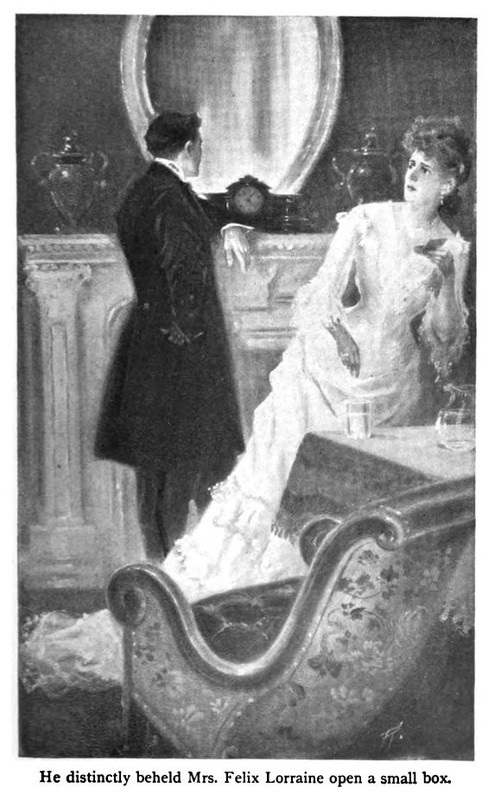
“Here, drink, drink while it is effervescent.”
“I cannot drink,” said Vivian, “I am not thirsty; I am too hot; I am anything—”
“How foolish you are! It will be quite, spoiled.”
“No, no; the dog shall have it. Here, Fidele, you look thirsty enough; come here—”
“Mr. Grey, I do not mix tumblers for dogs,” said the lady, rather agitated: “if you will not take it,” and she held it once more before him, “here it goes for ever.” So saying she emptied the tumbler into a large globe of glass, in which some gold and silver fish were swimming their endless rounds.
CHAPTER V
This last specimen of Mrs. Felix Lorraine was somewhat too much even for the steeled nerves of Vivian Grey, and he sought his chamber for relief.
“Is it possible? Can I believe my senses? Or has some demon, as we read of in old tales, mocked me in a magic mirror? I can believe anything. Oh! my heart is very sick! I once imagined that I was using this woman for my purpose. Is it possible that aught of good can come to one who is forced to make use of such evil instruments as these? A horrible thought sometimes comes over my spirit. I fancy that in this mysterious foreigner, that in this woman, I have met a kind of double of myself. The same wonderful knowledge of the human mind, the same sweetness of voice, the same miraculous management which has brought us both under the same roof: yet do I find her the most abandoned of all beings; a creature guilty of that which, even in this guilty age, I thought was obsolete. And is it possible that I am like her? that I can resemble her? that even the indefinite shadow of my most unhallowed thought can for a moment be as vile as her righteousness? O God! the system of my existence seems to stop. I cannot breathe.” He flung himself upon his bed, and felt for a moment as if he had quaffed the poisoned draught so lately offered.
“It is not so; it cannot be so; it shall not be so! In seeking the Marquess I was unquestionably impelled by a mere feeling of self-interest; but I have advised him to no course of action in which his welfare is not equally consulted with my own. Indeed, if not principle, interest would make me act faithfully towards him, for my fortunes are bound up in his. But am I entitled, I, who can lose nothing, am I entitled to play with other men’s fortunes? Am I all this time deceiving myself with some wretched sophistry? Am I, then, an intellectual Don Juan, reckless of human minds, as he was of human bodies; a spiritual libertine? But why this wild declamation? Whatever I have done, it is too late to recede; even this very moment delay is destruction, for now it is not a question as to the ultimate prosperity of our worldly prospects, but the immediate safety of our very bodies. Poison! O God! O God! Away with all fear, all repentance, all thought of past, all reckoning of future. If I be the Juan that I fancied myself, then Heaven be praised! I have a confidant in all my troubles; the most faithful of counsellors, the craftiest of valets; a Leporello often tried and never found wanting: my own good mind. And now, thou female fiend! the battle is to the strongest; and I see right well that the struggle between two such spirits will be a long and a fearful one. Woe, I say, to the vanquished! You must be dealt with by arts which even yourself cannot conceive. Your boasted knowledge of human nature shall not again stand you in stead; for, mark me, from henceforward Vivian Grey’s conduct towards you shall have no precedent in human nature.”
As Vivian re-entered the drawing-room he met a servant carrying in the globe of gold and silver fishes.
“What, still in your pelisse, Mrs. Lorraine!” said Vivian. “Nay, I hardly wonder at it, for surely, a prettier pelisse never yet fitted prettier form. You have certainly a most admirable taste in dress; and this the more surprises me, for it is generally your plain personage that is the most recherché in frills and fans and flounces.”
The lady smiled.
“Oh! by-the-bye,” continued her companion, “I have a letter from Cleveland this morning. I wonder how any misunderstanding could possibly have existed between you, for he speaks of you in such terms.”
“What does he say?” was the quick question.
“Oh! what does he say?” drawled out Vivian; and he yawned, and was most provokingly uncommunicative.
“Come, come, Mr. Grey, do tell me.”
“Oh! tell you, certainly. Come, let us walk together in the conservatory:” so saying, he took the lady by the hand, and they left the room.
“And now for the letter, Mr. Grey.”
“Ay, now for the letter;” and Vivian slowly drew an epistle from his pocket, and therefrom read some exceedingly sweet passages, which made Mrs. Felix Lorraine’s very heart-blood tingle. Considering that Vivian Grey had never in his life received a single letter from Mr. Cleveland, this was tolerably well: but he was always an admirable improvisatore! “I am sure that when Cleveland comes to town everything will be explained; I am sure, at least, that it will not be my fault if you are not the best friends. I am heroic in saying all this, Mrs. Lorraine; there was a time when (and here Vivian seemed so agitated that he could scarcely proceed), there was a time when I could have called that man liar who would have prophesied that Vivian Grey could have assisted another in riveting the affections of Mrs. Felix Lorraine. But enough of this. I am a weak, inexperienced boy, and misinterpret, perhaps, that which is merely the compassionate kindness natural to all women into a feeling of a higher nature. But I must learn to contain myself; I really do feel quite ashamed of my behaviour about the tumbler to-day. To act with such, unwarrantable unkindness, merely because I had remembered that you once performed the same kind office for Colonel Delmington, was indeed too bad.”
“Colonel Delmington is a vain, empty-headed fool. Do not think of him, my dear Mr. Grey,” said Mrs. Felix, with a countenance beaming with smiles.
“Well, I will not; and I will try to behave like a man; like a man of the world, I should say. But indeed you must excuse the warm feelings of a youth; and truly, when I call to mind the first days of our acquaintance, and then remember that our moonlit walks are gone for ever, and that our—”
“Nay, do not believe so, my dear Vivian; believe me, as I ever shall be. your friend, your—”
“I will, I will, my dear, my own Amalia!”
CHAPTER VI
It was an autumnal night; the wind was capricious and changeable as a petted beauty, or an Italian greyhound, or a shot silk. Now the breeze blew so fresh that the white clouds dashed along the sky as if they bore a band of witches too late for their Sabbath meeting, or some other mischief; and now, lulled and soft as the breath of a slumbering infant, you might almost have fancied it Midsummer Eve; and the bright moon, with her starry court, reigned undisturbed in the light blue sky. Vivian Grey was leaning against an old beech-tree in the most secluded part of the park, and was gazing on the moon.
O thou bright moon! thou object of my first love! thou shalt not escape an invocation, although perchance at this very moment some varlet sonnetteer is prating of “the boy Endymion” and “thy silver bow.” Here to thee, Queen of the Night! in whatever name thou most delightest! Or Bendis, as they hailed thee in rugged Thrace; or Bubastis, as they howled to thee in mysterious Egypt; or Dian, as they sacrificed to thee in gorgeous Rome; or Artemis, as they sighed to thee on the bright plains of ever glorious Greece! Why is it that all men gaze on thee? Why is it that all men love thee? Why is it that all men worship thee?
Shine on, shine on, sultana of the soul! the Passions are thy eunuch slaves, Ambition gazes on thee, and his burning brow is cooled, and his fitful pulse is calm. Grief wanders in her moonlit walk and sheds no tear; and when thy crescent smiles the lustre of Joy’s revelling eye is dusked. Quick Anger, in thy light, forgets revenge; and even dove-eyed Hope feeds on no future joys when gazing on the miracle of thy beauty.
Shine on, shine on! although a pure Virgin, thou art the mighty mother of all abstraction! The eye of the weary peasant returning from his daily toil, and the rapt gaze of the inspired poet, are alike fixed on thee; thou stillest the roar of marching armies, and who can doubt thy influence o’er the waves who has witnessed the wide Atlantic sleeping under thy silver beam?
Shine on, shine on! they say thou art Earth’s satellite; yet when I gaze on thee my thoughts are not of thy suzerain. They teach us that thy power is a fable, and that thy divinity is a dream. Oh, thou bright Queen! I will be no traitor to thy sweet authority; and verily, I will not believe that thy influence o’er our hearts is, at this moment, less potent than when we worshipped in thy glittering fane of Ephesus, or trembled at the dark horrors of thine Arician rites. Then, hail to thee, Queen of the Night! Hail to thee, Diana, Triformis; Cynthia, Orthia, Taurica; ever mighty, ever lovely, ever holy! Hail! hail! hail!
Were I a metaphysician, I would tell you why Vivian Grey had been gazing two hours on the moon; for I could then present you with a most logical programme of the march of his ideas, since he whispered his last honied speech in the ear of Mrs. Felix Lorraine, at dinner-time, until this very moment, when he did not even remember that such a being as Mrs. Felix Lorraine breathed. Glory to the metaphysician’s all-perfect theory! When they can tell me why, at a bright banquet, the thought of death has flashed across my mind, who fear not death; when they can tell me why, at the burial of my beloved friend, when my very heart-strings seemed bursting, my sorrow has been mocked by the involuntary remembrance of ludicrous adventures and grotesque tales; when they can tell me why, in a dark mountain pass, I have thought of an absent woman’s eyes; or why, when in the very act of squeezing the third lime into a beaker of Burgundy cup, my memory hath been of lean apothecaries and their vile drugs; why then, I say again, glory to the metaphysician’s all-perfect theory! and fare you well, sweet world, and you, my merry masters, whom, perhaps, I have studied somewhat too cunningly: nosce teipsum shall be my motto. I will doff my travelling cap, and on with the monk’s cowl.
There are mysterious moments in some men’s lives when the faces of human beings are very agony to them, and when the sound of the human voice is jarring as discordant music. These fits are not the consequence of violent or contending passions: they grow not out of sorrow, or joy, or hope, or fear, or hatred, or despair. For in the hour of affliction the tones of our fellow-creatures are ravishing as the most delicate lute; and in the flush moment of joy where is the smiler who loves not a witness to his revelry or a listener to his good fortune? Fear makes us feel our humanity, and then we fly to men, and Hope is the parent of kindness. The misanthrope and the reckless are neither agitated nor agonised. It is in these moments that men find in Nature that congeniality of spirit which they seek for in vain in their own species. It is in these moments that we sit by the side of a waterfall and listen to its music the live-long day. It is in these moments that men gaze upon the moon. It is in these moments that Nature becomes our Egeria; and, refreshed and renovated by this beautiful communion, we return to the world better enabled to fight our parts in the hot war of passions, to perform the great duties for which man appeared to have been created, to love, to hate, to slander, and to slay.
It was past midnight, and Vivian was at a considerable distance from the Château. He proposed entering by a side door, which led into the billiard-room, and from thence, crossing the Long Gallery, he could easily reach his apartment without disturbing any of the household. His way led through the little gate at which he had parted with Mrs. Felix Lorraine on the first day of their meeting.
As he softly opened the door which led into the Long Gallery he found he was not alone: leaning against one of the casements was a female. Her profile was to Vivian as he entered, and the moon, which shone bright through the window, lit up a countenance which he might be excused for not immediately recognising as that of Mrs. Felix Lorraine. She was gazing steadfastly, but her eye did not seem fixed upon any particular object. Her features appeared convulsed, but their contortions were not momentary, and, pale as death, a hideous grin seemed chiselled on her idiot countenance.
Vivian scarcely knew whether to stay or to retire. Desirous not to disturb her, he determined not even to breathe; and, as is generally the case, his very exertions to be silent made him nervous, and to save himself from being stifled he coughed.
Mrs. Lorraine immediately started and stared wildly around her, and when her eye caught Vivian’s there was a sound in her throat something like the death-rattle.
“Who are you?” she eagerly asked.
“A friend, and Vivian Grey.”
“How came you here?” and she rushed forward and wildly seized his hand, and then she muttered to herself, “‘tis flesh.”
“I have been playing, I fear, the mooncalf to-night; and find that, though I am a late watcher, I am not a solitary one.”
Mrs. Lorraine stared earnestly at him, and then she endeavoured to assume her usual expression of countenance; but the effort was too much for her. She dropped Vivian’s arm, and buried her face in her own hands. Vivian was retiring, when she again looked up. “Where are you going?” she asked, with a quick voice.
“To sleep, as I would advise all: ‘tis much past midnight.”
“You say not the truth. The brightness of your eye belies the sentence of your tongue. You are not for sleep.”
“Pardon me, dear Mrs. Lorraine; I really have been yawning for the last hour,” said Vivian, and he moved on.
“You are speaking to one who takes her answer from the eye, which does not deceive, and from the speaking lineaments of the face, which are Truth’s witnesses. Keep your voice for those who can credit man’s words. You will go, then? What! are you afraid of a woman, because ‘tis past midnight,’ and you are in an old gallery?”
“Fear, Mrs. Lorraine, is not a word in my vocabulary.”
“The words in your vocabulary are few, boy! as are the years of your age. He who sent you here this night sent you here not to slumber. Come hither!” and she led Vivian to the window: “what see you?”
“I see Nature at rest, Mrs. Lorraine; and I would fain follow the example of beasts, birds, and fishes.”
“Yet gaze upon this scene one second. See the distant hills, how beautifully their rich covering is tinted with the moonbeam! These nearer fir-trees, how radiantly their black skeleton forms are tipped with silver; and the old and thickly foliaged oaks bathed in light! and the purple lake reflecting in its lustrous bosom another heaven? la it not a fair scene?”
“Beautiful! most beautiful!”
“Yet, Vivian, where is the being for whom all this beauty exists? Where is your mighty creature, Man? The peasant on his rough couch enjoys, perchance, slavery’s only service-money, sweet sleep; or, waking in the night, curses at the same time his lot and his lord. And that lord is restless on some downy couch; his night thoughts, not of this sheeny lake and this bright moon, but of some miserable creation of man’s artifice, some mighty nothing, which Nature knows not of, some offspring of her bastard child, Society. Why, then, is Nature loveliest when man looks not on her? For whom, then, Vivian Grey, is this scene so fair?”
“For poets, lady; for philosophers; for all those superior spirits who require some relaxation from the world’s toils; spirits who only commingle with humanity on the condition that they may sometimes commune with Nature.”
“Superior spirits! say you?” and here they paced the gallery. “When Valerian, first Lord Carabas, raised this fair castle; when, profuse for his posterity, all the genius of Italian art and Italian artists was lavished on this English palace; when the stuffs and statues, the marbles and the mirrors, the tapestry, and the carvings, and the paintings of Genoa, and Florence, and Venice, and Padua, and Vicenza, were obtained by him at miraculous cost, and with still more miraculous toil; what think you would have been his sensations. If, while his soul was revelling in the futurity of his descendants keeping their state in this splendid pile, some wizard had foretold to him that, ere three centuries could elapse, the fortunes of his mighty family would be the sport of two individuals; one of them a foreigner, unconnected in blood, or connected only in hatred; and the other a young adventurer alike unconnected with his race, in blood or in love; a being ruling all things by the power of his own genius, and reckless of all consequences save his own prosperity? If the future had been revealed to my great ancestor, the Lord Valerian, think you, Vivian Grey, that you and I should be walking in this Long Gallery?”
“Really, Mrs. Lorraine, I have been so interested in discovering what people think in the nineteenth century, that I have had but little time to speculate on the possible opinions of an old gentleman who flourished in the sixteenth.”
“You may sneer, sir; but I ask you, if there are spirits so superior to that of the slumbering Lord of this castle as those of Vivian Grey and Amelia Lorraine, why may there not be spirits proportionately superior to our own?”
“If you are keeping me from my bed, Mrs. Lorraine, merely to lecture my conceit by proving that there are in this world wiser heads than that of Vivian Grey, on my honour you are giving yourself a great deal of unnecessary trouble.”
“You will misunderstand me, then, you wilful boy!”
“Nay, lady, I will not affect to misunderstand your meaning; but I recognise, you know full well, no intermediate essence between my own good soul and that ineffable and omnipotent spirit in whose existence philosophers and priests alike agree.”
“Omnipotent and ineffable essence! Leave such words to scholars and to school-boys! And think you that such indefinite nothings, such unmeaning abstractions, can influence beings whose veins are full of blood, bubbling like this?” And here she grasped Vivian with a feverish hand. “Omnipotent and ineffable essence! Oh! I have lived in a land where every mountain, and every stream, and every wood, and every ruin, has its legend and its peculiar spirit; a land in whose dark forests the midnight hunter, with his spirit-shout, scares the slumbers of the trembling serf; a land from whose winding rivers the fair-haired Undine welcomes the belated traveller to her fond and fatal embrace; and you talk to me of omnipotent and ineffable essence! Miserable Mocker! It is not true, Vivian Grey; you are but echoing the world’s deceit, and even at this hour of the night you dare not speak as you do think. You worship no omnipotent and ineffable essence; you believe in no omnipotent and ineffable essence. Shrined in this secret chamber of your soul there is an image before which you bow down in adoration, and that image is YOURSELF. And truly, when I do gaze upon your radiant eyes,” and here the lady’s tone became more terrestrial; “and truly, when I do look upon your luxuriant curls,” and here the lady’s small white hand played like lightning through Vivian’s dark hair; “and truly, when I do remember the beauty of your all-perfect form, I cannot deem your self-worship a false idolatry,” and here the lady’s arms were locked round Vivian’s neck, and her head rested on his bosom.
“Oh, Amalia! it would lie far better for you to rest here than to think of that of which the knowledge is vanity.”
“Vanity!” shrieked Mrs. Lorraine, and she violently loosened her embrace, and extricated herself from the arm which, rather in courtesy than in kindness, had been wound round her delicate waist: “Vanity! Oh! if you knew but what I know, oh! if you had but seen what I have seen;” and here her voice failed her, and she stood motionless in the moonshine, with averted head and outstretched arms.
“Amalia! this is madness; for Heaven’s sake calm yourself!”
“Calm myself! Yes, it is madness; very, very madness! ‘tis the madness of the fascinated bird; ‘tis the madness of the murderer who is voluntarily broken on the wheel; ‘tis the madness of the fawn that gazes with adoration on the lurid glare of the anaconda’s eye; ‘tis the madness of woman who flies to the arms of her Fate;” and here she sprang like a tigress round Vivian’s neck, her long light hair bursting from its bands, and clustering down her shoulders.
And here was Vivian Grey, at past midnight, in this old gallery, with this wild woman clinging round his neck. The figures in the ancient tapestry looked living in the moon, and immediately opposite him was one compartment of some old mythological tale, in which were represented, grinning, in grim majesty, the Fates.
The wind now rose again, and the clouds which had vanished began to reassemble in the heavens. As the blue sky was gradually covering, the gigantic figures of Clotho, Lachesis, and Atropos became as gradually dimmer and dimmer, and the grasp of Vivian’s fearful burden looser and looser. At last the moon was entirely hid, the figures of the Fates vanished, and Mrs. Felix Lorraine sank lifeless into his arms.
Vivian groped his way with difficulty to the nearest window, the very one at which she was leaning when he first entered the gallery. He played with her wild curls; he whispered to her in a voice sweeter than the sweetest serenade; but she only raised her eyes from his breast and stared wildly at him, and then clung round his neck with, if possible, a tighter grasp.
For nearly half an hour did Vivian stand leaning against the window, with his mystic and motionless companion. At length the wind again fell; there was a break in the sky, and a single star appeared in the midst of the clouds, surrounded with a little heaven of azure.
“See there, see there!” the lady cried, and then she unlocked her arms. “What would you give, Vivian Grey, to read that star?”
“Am I more interested in that star, Amalia, than in any other of the bright host?” asked Vivian with a serious tone, for he thought it necessary to humour his companion.
“Are you not? is it not the star of your destiny?”
“Are you learned in all the learning of the Chaldeans, too?”
“Oh, no, no, no!” slowly murmured Mrs. Lorraine, and then she started: but Vivian seized her arms, and prevented her from again clasping his neck.
“I must keep these pretty hands close prisoners,” he said, smiling, “unless you promise to behave with more moderation. Come, my Amalia! you shall be my instructress! Why am I so interested in this brilliant star?” and holding her hands in one of his, he wound his arm round her waist, and whispered her such words as he thought might calm her troubled spirit. The wildness of her eyes gradually gave way; at length she raised them to Vivian with a look of meek tenderness, and her head sank upon his breast.
“It shines, it shines, it shines, Vivian!” she softly whispered; “glory to thee and woe to me! Nay, you need not hold my hands; I will not harm you. I cannot: ‘tis no use. O Vivian! when we first met, how little did I know to whom I pledged myself!”
“Amalia, forget these wild fancies; estrange yourself from the wild belief which has exercised so baneful an influence, not only over your mind, but over the very soul of the land from which you come. Recognise in me only your friend, and leave the other world to those who value it more, or more deserve it. Does not this fair earth contain sufficient of interest and enjoyment?”
“O Vivian! you speak with a sweet voice, but with a sceptic’s spirit. You know not what I know.”
“Tell me, then, my Amalia; let me share your secrets, provided they be your sorrows.”
“Almost within this hour, and in this park, there has happened that which—” and here her voice died, and she looked fear-fully round her.
“Nay, fear not; no one can harm you here, no one shall harm you. Rest upon me, and tell me all thy grief.”
“I dare not, I cannot tell you.”
“Nay, thou shalt.”
“I cannot speak; your eye scares me. Are you mocking me? I cannot speak if you look so at me.”
“I will not look on you; I will gaze on yonder star. Now speak on.”
“O Vivian, there is a custom in my native land: the world calls it an unhallowed one; you, in your proud spirit, will call it a vain one. But you would not deem it vain if you were the woman now resting on your bosom. At certain hours of particular nights, and with peculiar ceremonies, which I need not here mention, we do believe that in a lake or other standing water fate reveals itself to the solitary votary. O Vivian, I have been too long a searcher after this fearful science; and this very night, agitated in spirit, I sought yon water. The wind was in the right direction, and everything concurred in favouring a propitious divination. I knelt down to gaze on the lake. I had always been accustomed to view my own figure performing some future action, or engaged in some future scene of my life. I gazed, but I saw nothing but a brilliant star. I looked up into the heavens, but the star was not there, and the clouds were driving quick across the sky. More than usually agitated by this singular occurrence, I gazed once more; and just at the moment when with breathless and fearful expectation I waited the revelation of my immediate destiny there flitted a figure across the water. It was there only for the breathing of u second, and as it passed it mocked me.” Here Mrs. Lorraine writhed in Vivian’s arms; her features were moulded in the same unnatural expression as when he first entered the gallery, and the hideous grin was again sculptured on her countenance. Her whole frame was in such a state of agitation that she rose up and down in Vivian’s arms, and it was only with the exertions of his whole strength that he could retain her.
“Why, Amalia, this, this was nothing; your own figure.”
“No, not my own; it was yours!”
Uttering a piercing shriek, which echoed through the winding gallery, she swooned.
Vivian gazed on her in a state of momentary stupefaction, for the extraordinary scene had begun to influence his own nerves. And now he heard the tread of distant feet, and a light shone through the key-hole of the nearest door. The fearful shriek had alarmed some of the household. What was to be done? In desperation Vivian caught the lady up in his arms, and dashing out of an opposite door bore her to her chamber.
CHAPTER VII
What is this chapter to be about? Come, I am inclined to be courteous! You shall choose the subject of it. What shall it be, sentiment or scandal? a love-scene or a lay sermon? You will not choose? Then we must open the note which Vivian, in the morning, found on his pillow:—
“Did you hear the horrid shriek last night? It must have disturbed every one. I think it must have been one of the South American birds which Captain Tropic gave the Marchioness. Do not they sometimes favour the world with these nocturnal shriekings? Is not there a passage in Spix apropos to this? A——.”
“Did you hear the shriek last night, Mr. Grey?” asked the Marchioness, as Vivian entered the breakfast-room.
“Oh, yes! Mr. Grey, did you hear the shriek?” asked Miss Graves.
“Who did not?”
“What could it be?” said the Marchioness.
“What could it be?” said Miss Graves.
“What should it be; a cat in a gutter, or a sick cow, or a toad dying to be devoured, Miss Graves?”
Always snub toadeys and led captains. It is only your greenhorns who endeavour to make their way by fawning and cringing to every member of the establishment. It is a miserable mistake. No one likes his dependants to be treated with respect, for such treatment affords an unpleasant contrast to his own conduct. Besides, it makes the toadey’s blood unruly. There are three persons, mind you, to be attended to: my lord, or my lady, as the case may be (usually the latter), the pet daughter, and the pet dog. I throw out these hints en passant, for my principal objects in writing this work are to amuse myself and to instruct society. In some future hook, probably the twentieth or twenty-fifth, when the plot logins to wear threadbare, and we can afford a digression. I may give a chapter on Domestic Tactics.
“My dear Marchioness,” continued Vivian, “see there: I have kept my promise, there is your bracelet. How is Julie to-day?”
“Poor dear, I hope she is better.”
“Oh! yes, poor Julie. I think she is better.”
“I do not know that, Miss Graves,” said her Ladyship, somewhat tartly, not at all approving of a toadey thinking. “I am afraid that scream last night must have disturbed her. O dear, Mr. Grey, I am afraid she will be ill again.”
Miss Graves looked mournful, and lifted up her eyes and hands to Heaven, but did not dare to speak this time.
“I thought she looked a little heavy about the eyes this morning,” said the Marchioness, apparently very agitated; “and I have heard from Eglamour this post; he is not well, too; I think everybody is ill now; he has caught a fever going to see the ruins of Paestum. I wonder why people go to see ruins!”
“I wonder, indeed,” said Miss Graves; “I never could see anything in a ruin.”
“O, Mr. Grey!” continued the Marchioness, “I really am afraid Julie is going to be very ill.”
“Let Miss Graves pull her tail and give her a little mustard seed: she will be better tomorrow.”
“Remember that, Miss Graves.”
“Oh! y-e-s, my Lady!”
“Mrs. Felix,” said the Marchioness, as that lady entered the room, “you are late to-day; I always reckon upon you as a supporter of an early breakfast at Desir.”
“I have been half round the park.”
“Did you hear the scream, Mrs. Felix?”
“Do you know what it was, Marchioness?”
“No: do you?”
“See the reward of early rising and a walk before breakfast. It was one of your new American birds, and it has half torn down your aviary.”
“One of the new Americans? O the naughty thing; and has it broken the new fancy wirework?”
Here a little odd-looking, snuffy old man, with a brown scratch wig, who had been very busily employed the whole breakfast-time with a cold game pie, the bones of which Vivian observed him most scientifically pick and polish, laid down his knife and fork, and addressed the Marchioness with an air of great interest.
“Pray, will your Ladyship have the goodness to inform me what bird this is?”
The Marchioness looked astounded at any one presuming to ask her a question; and then she drawled, “Mr. Grey, you know everything; tell this gentleman what some bird is.”
Now this gentleman was Mr. Mackaw, the most celebrated ornithologist extant, and who had written a treatise on Brazilian parroquets, in three volumes folio. He had arrived late at the Château the preceding night, and, although he had the honour of presenting his letter of introduction to the Marquess, this morning was the first time he had been seen by any of the party present, who were of course profoundly ignorant of his character.
“Oh! we were talking of some South American bird given to the Marchioness by the famous Captain Tropic; you know him, perhaps; Bolivar’s brother-in-law, or aide-de-camp, or something of that kind; and which screams so dreadfully at night that the whole family is disturbed. The Chowchowtow it is called; is not it, Mrs. Lorraine?”
“The Chowchowtow!” said Mr. Mackaw; “I don’t know it by that name.”
“Do not you? I dare say we shall find an account of it in Spix, however,” said Vivian, rising, and taking a volume from the book-case; “ay! here it is; I will read it to you.”
“‘The Chowchowtow is about five feet seven inches in height from the point of the bill to the extremity of the claws. Its plumage is of a dingy, yellowish white; its form is elegant, and in its movements and action a certain pleasing and graceful dignity is observable; but its head is by no means worthy of the rest of its frame; and the expression of its eye is indicative of the cunning and treachery of its character. The habits of this bird are peculiar: occasionally most easily domesticated, it is apparently sensible of the slightest kindness; but its regard cannot be depended upon, and for the slightest inducement, or with the least irritation, it will fly at its feeder. At other times it seeks perfect solitude, and can only be captured with the utmost skill and perseverance. It generally feeds three times a day, but its appetite is not rapacious; it sleeps little, is usually on the wing at sunrise, and proves that it slumbers but little in the night by its nocturnal and thrilling shrieks.’”
“What an extraordinary bird! Is that the bird you meant, Mrs. Felix Lorraine?”
Mr. Mackaw was restless the whole time that Vivian was reading this interesting passage. At last he burst forth with an immense deal of science and a great want of construction, a want which scientific men often experience, always excepting those mealy-mouthed professors who lecture “at the Royal,” and get patronised by the blues, the Lavoisiers of May Fair!
“Chowchowtow, my Lady! five feet seven inches high! Brazilian bird! When I just remind your Ladyship that the height of the tallest bird to be found in Brazil, and in mentioning this fact, I mention nothing hypothetical, the tallest bird does not stand higher than four feet nine. Chowchowtow! Dr. Spix is a name, accurate traveller, don’t remember the passage, most singular bird! Chowchowtow! don’t know it by that name. Perhaps your Ladyship is not aware; I think you called that gentleman Mr. Grey; perhaps Mr. Grey is not aware, that I am Mr. Mackaw, I arrived late here last night, whose work in three volumes folio, on Brazilian Parroquets, although I had the honour of seeing his Lordship is, I trust, a sufficient evidence that I am not speaking at random on this subject; and consequently, from the lateness of the hour, could not have the honour of being introduced to your Ladyship.”
“Mr. Mackaw!” thought Vivian. “The deuce you are! Oh! why did I not say a Columbian cassowary, or a Peruvian penguin, or a Chilian condor, or a Guatemalan goose, or a Mexican mastard; anything but Brazilian. Oh! unfortunate Vivian Grey!”
The Marchioness, who was quite overcome with this scientific appeal, raised her large, beautiful, sleepy eyes from a delicious compound of French roll and new milk, which she was working up in a Sèvre saucer for Julie; and then, as usual, looked to Vivian for assistance.
“Mr. Grey, you know everything; tell Mr. Mackaw about a bird.”
“Is there any point on which you differ from Spix in his account of the Chowchowtow, Mr. Mackaw?”
“My dear sir, I don’t follow him at all. Dr. Spix is a most excellent man, a most accurate traveller, quite a name; but, to be sure, I’ve only read his work in our own tongue; and I fear from the passage you have just quoted, five feet seven inches high! in Brazil! it must be an imperfect version. I say, that four feet nine is the greatest height I know. I don’t speak without some foundation for my statement. The only bird I know above that height is the Paraguay cassowary; which, to be sure, is sometimes found in Brazil. But the description of your bird, Mr. Grey, does not answer that at all. I ought to know. I do not speak at random. The only living specimen of that extraordinary bird, the Paraguay cassowary, in this country, is in my possession. It was sent me by Bompland, and was given to him by the Dictator of Paraguay himself. I call it, in compliment, Doctor Francia. I arrived here so late last night, only saw his Lordship, or I would have had it on the lawn this morning.”
“Oh, then, Mr. Mackaw,” said Vivian, “that was the bird which screamed last night!”
“Oh, yes! oh, yes! Mr. Mackaw,” said Mrs. Felix Lorraine.
“Lady Carabas!” continued Vivian, “it is found out. It is Mr. Mackaw’s particular friend, his family physician, whom he always travels with, that awoke us all last night.”
“Is he a foreigner?” asked the Marchioness, looking up.
“My dear Mr. Grey, impossible! the Doctor never screams.”
“Oh! Mr. Mackaw, Mr. Mackaw!” said Vivian.
“Oh! Mr. Mackaw, Mr. Mackaw!” said Mrs. Felix Lorraine.
“I tell you he never screams,” reiterated the man of science; “I tell you he can’t scream; he’s muzzled.”
“Oh, then, it must Have been the Chowchowtow.”
“Yes, I think it must have been the Chowchowtow.”
“I should very much like to hear Spix’s description again,” said Mr. Mackaw, “only I fear it is troubling you too much, Mr. Grey.”
“Read it yourself, my dear sir,” said Vivian, putting the book into his hand, which was the third volume of Tremaine.
Mr. Mackaw looked at the volume, and turned it over, and sideways, and upside downwards: the brain of a man who has written three folios on parroquets is soon puzzled. At first, he thought the book was a novel; but then, an essay on predestination, under the title of Memoirs of a Man of Refinement, rather puzzled him; then he mistook it for an Oxford reprint of Pearson on the Creed; and then he stumbled on rather a warm scene in an old Château in the South of France.
Before Mr. Mackaw could gain the power of speech the door opened, and entered, who? Dr. Francia.
Mr. Mackaw’s travelling companion possessed the awkward accomplishment of opening doors, and now strutted in, in quest of his beloved master. Affection for Mr. Mackaw was not, however, the only cause which induced this entrance.
The household of Château Desir, unused to cassowaries, had neglected to supply Dr. Francia with his usual breakfast, which consisted of half a dozen pounds of rump steaks, a couple of bars of hard iron, some pig lead, and brown stout. The consequence was, the Dictator was sadly famished.
All the ladies screamed; and then Mrs. Felix Lorraine admired the Doctor’s violet neck, and the Marchioness looked with an anxious eye on Julie, and Miss Graves, as in duty bound, with an anxious eye on the Marchioness.
There stood the Doctor, quite still, with his large yellow eye fixed on Mr. Mackaw. At length he perceived the cold pasty, and his little black wings began to flutter on the surface of his immense body.
“Che, che, che, che!” said the ornithologist, who did not like the symptoms at all: “Che, che, che, che, don’t be frightened, ladies! you see he’s muzzled; che, che, che, che, now, my dear doctor, now, now, now, Franky, Franky, Franky, now go away, go away, that’s a dear doctor, che, che, che, che!”
But the large yellow eye grew more flaming and fiery, and the little black wings grew larger and larger; and now the left leg was dashed to and fro with a fearful agitation. Mackaw looked agonised. What a whirr! Francia is on the table! All shriek, the chairs tumble over the ottomans, the Sèvre china is in a thousand pieces, the muzzle is torn off and thrown at Miss Graves; Mackaw’s wig is dashed in the clotted cream, and devoured on the spot; and the contents of the boiling urn are poured over the beauteous and beloved Julie!
CHAPTER VIII
THE HONOURABLE CYNTHIA COURTOWN TO VIVIAN GREY, ESQ.
“Alburies, Oct. 18—.
“DEAR GREY,
“We have now been at Alburies for a fortnight. Nothing can be more delightful. Here is everybody in the world that I wish to see, except yourself. The Knightons, with as many outriders as usual: Lady Julia and myself are great allies; I like her amazingly. The Marquess of Grandgoût arrived here last week, with a most delicious party; all the men who write ‘John Bull.’ I was rather disappointed at the first sight of Stanislaus Hoax. I had expected, I do not know why, something juvenile and squibbish, when lo! I was introduced to a corpulent individual, with his coat buttoned up to his chin, looking dull, gentlemanlike, and apoplectic. However, on acquaintance, he came out quite rich, sings delightfully, and improvises like a prophet, ten thousand times more entertaining than Pistrucci. We are sworn friends; and I know all the secret history of ‘John Bull.’ There is not much, to be sure, that you did not tell me yourself; but still there are some things. I must not trust them, however, to paper, and therefore pray dash down to Alburies immediately; I shall be most happy to introduce you to Lord Devildrain. There was an interview. What think you of that? Stanislaus told me all, circumstantially, and after dinner; I do not doubt that it is quite true. What would you give for the secret history of the ‘rather yellow, rather yellow,’ chanson? I dare not tell it you. It came from a quarter that will quite astound you, and in a very elegant, small, female hand. You remember Lambton did stir very awkwardly in the Lisbon business. Stanislaus wrote all the songs that appeared in the first number, except that; but he never wrote a single line of prose for the first three months: it all came from Vivida Vis.
“I like the Marquess of Grandgoût so much! I hope he will be elevated in the peerage: he looks as if he wanted it so! Poor dear man!”
“Oh! do you know I have discovered a liaison between Bull and Blackwood. I am to be in the next Noctes; I forget the words of the chorus exactly, but Courtown is to rhyme with port down, or something of that kind, and then they are to dash their glasses over their heads, give three cheers, and adjourn to whisky-toddy and the Chaldee chamber. How delightful!
“The Prima Donnas are at Cheltenham, looking most respectable. Do you ever see the ‘Age’? It is not proper for me to take it in. Pray send me down your numbers, and tell me all about it. Is it true that his Lordship paragraphises a little?
“I have not heard from Ernest Clay, which I think very odd. If you write to him, mention this, and tell him to send me word how Dormer Stanhope behaves at mess. I understand there has been a melee, not much; merely a rouette; do get it all out of him.
“Colonel Delmington is at Cheltenham, with the most knowing beard you can possibly conceive; Lady Julia rather patronises him. Lady Doubtful has been turned out of the rooms; fifty challenges in consequence and one duel; missed fire, of course.
“I have heard from Alhambra; he has been wandering about in all directions. He has been to the Lakes, and is now at Edinburgh. He likes Southey. He gave the laureate a quantity of hints for his next volume of the Peninsular War, but does not speak very warmly of Wordsworth: gentlemanly man, but only reads his own poetry.
“Here has been a cousin of yours about us; a young barrister going the circuit; by name Hargrave Grey. The name attracted my notice, and due inquiries having been made and satisfactorily answered, I patronised the limb of law. Fortunate for him! I got him to all the fancy balls and pic-nics that were going on. He was in heaven for a fortnight, and at length, having overstayed his time, he left us, also leaving his bag and only brief behind him. They say he is ruined for life. Write soon.
“Yours ever,
“CYNTHIA COURTOWN.” ERNEST CLAY, ESQ., TO VIVIAN GREY, ESQ.
“October, 18—.
“DEAR GREY,
“I am sick of key-bugles and country-balls! All the girls in the town are in love with me, or my foraging cap. I am very much obliged to you for your letter to Kennet, which procured everything I wanted. The family turned out bores, as you had prepared me. I never met such a clever family in my life; the father is summoning up courage to favour the world with a volume of sermons; and Isabella Kennet most satisfactorily proved to me, after an argument of two hours, which for courtesy’s sake I fought very manfully, that Sir Walter Scott was not the author of Waverley; and then she vowed, as I have heard fifty young literary ladies vow before, that she had ‘seen the Antiquary in manuscript.’
“There has been a slight row to diversify the monotony of our military life. Young Premium, the son of the celebrated loan-monger, has bought in; and Dormer Stanhope, and one or two others equally fresh, immediately anticipated another Battier business; but, with the greatest desire to make a fool of myself, I have a natural repugnance to mimicking the foolery of others; so with some little exertion, and very fortunately for young Premium, I got the tenth voted vulgar, on the score of curiosity, and we were civil to the man. As it turned out, it was all very well, for Premium is a quiet, gentlemanlike fellow enough, and exceedingly useful. He will keep extra grooms for the whole mess, if they want it. He is very grateful to me for what does not deserve any gratitude, and for what gave me no trouble; for I did not defend him from any feeling of kindness: and both the Mounteneys, and young Stapylton Toad, and Augustus, being in the regiment, why, I have very little trouble in commanding a majority, if it come to a division.
“I dined the other day at old Premium’s, who lives near this town in a magnificent old hall; which, however, is not nearly splendid enough for a man who is the creditor of every nation from California to China; and, consequently, the great Mr. Stucco is building a plaster castle for him in another part of the park. Glad am I enough that I was prevailed upon to patronise the Premium; for I think I seldom witnessed a more amusing scene than I did the day I dined there.
“I was ushered through an actual street of servitors, whose liveries were really cloth of gold, and whose elaborately powdered heads would not have disgraced the most ancient mansion in St. James’s Square, into a large and crowded saloon. I was, of course, received with miraculous consideration; and the ear of Mrs. Premium seemed to dwell upon the jingling of my spurs (for I am adjutant) as upon exquisite music. It was bona fide evidence of ‘the officers being there.’
“Premium is a short, but by no means vulgar-looking man, about fifty, with a high forehead covered with wrinkles, and with eyes deep sunk in his head. I never met a man of apparently less bustle, and of a cooler temperament. He was an object of observation from his very unobtrusiveness. There were. I immediately perceived, a great number of foreigners in the room. They looked much too knowing for Arguelles and Co., and I soon found that they were members of the different embassies, or missions of the various Governments to whose infant existence Premium is foster father. There were two striking figures in Oriental costume, who were shown to me as the Greek Deputies; not that you are to imagine that they always appear in this picturesque dress. It was only as a particular favour, and to please Miss Premium (there, Grey, my boy! there is a quarry!), that the illustrious envoys appeared habited this day in their national costume.
“You would have enjoyed the scene. In one part of the room was a naval officer, just hot from the mines of Mexico, and lecturing eloquently on the passing of the Cordillera. In another was a man of science, dilating on the miraculous powers of a newly-discovered amalgamation process to a knot of merchants, who, with bent brows and eager eyes, were already forming a Company for its adoption. Here floated the latest anecdote of Bolivar; and there a murmur of some new movement of Cochrane’s. And then the perpetual babble about ‘rising states,’ and ‘new loans,’ and ‘enlightened views,’ and ‘juncture of the two oceans,’ and ‘liberal principles,’ and ‘steamboats to Mexico,’ and the earnest look which every one had in the room. How different to the vacant gaze that we have been accustomed to! I was really particularly struck by the circumstance. Every one at Premium’s looked full of some great plan, as if the fate of empires wag on his very breath. I hardly knew whether they were most like conspirators, or gamblers, or the lions of a public dinner, conscious of an universal gaze, and consequently looking proportionately interesting. One circumstance particularly struck me: as I was watching the acute countenance of an individual, who young Premium informed me was the Chilian minister, and who was listening with great attention to a dissertation from Captain Tropic, the celebrated traveller, on the feasibility of a railroad over the Andes, I observed a great sensation among those around me; every one shifting, and shuffling, and staring, and assisting in that curious and confusing ceremony called ‘making way.’ Even Premium appeared a little excited when he came forward with a smile on his face to receive an individual, apparently a foreigner, and who stepped on with great though gracious dignity. Being curious to know who this great man was, I found that this was an ambassador, the representative of a recognised state.
“‘Pon my honour, when I saw all this, I could not refrain from moralising on the magic of wealth; and when I just remembered the embryo plot of some young Hussar officers to cut the son of the magician, I rather smiled; but while I, with even greater reverence than all others, was making way for his Excellency, I observed Mrs. Premium looking at my spurs. ‘Farewell Philosophy!’ thought I; ‘Puppyism for ever!’
“Dinner was at last announced, and the nice etiquette which was observed between recognised states and non-recognised states was really excessively amusing: not only the ambassador would take precedence of the mere political agent, but his Excellency’s private secretary was equally tenacious as to the agent’s private secretary. At length we were all seated: the spacious dining-room was hung round with portraits of most of the successful revolutionary leaders, and over Mr. Premium was suspended a magnificent portrait of Bolivar. If you could but have seen the plate! By Jove! I have eaten off the silver of most of the first families in England, yet never in my life did it enter into my imagination that it was possible for the most ingenious artist that ever existed to repeat a crest half so often in a tablespoon as in that of Premium. The crest is a bubble, and really the effect produced by it is most ludicrous.
“I was very much struck at table by the appearance of an individual who came in very late, but who was evidently, by his bearing, no insignificant personage. He was a tall man, with a long hooked nose and high cheek bones, and with an eye (were you ever at the Old Bailey? there you may see its fellow); his complexion looked as if it had been accustomed to the breezes of many climes, and his hair, which had once been red, was now silvered, or rather iron-greyed, not by age. Yet there was in his whole bearing, in his slightest actions, even in the easy, desperate air with which he took a glass of wine, an indefinable something (you know what I mean) which attracted your unremitting attention to him. I was not wrung in my suspicions of his celebrity; for, as Miss Premium, whom I sat next to, whispered, ‘he was quite a lion.’ It was Lord Oceanville What he is after no one knows. Some say he is going to Greece, others whisper an invasion of Paraguay, and others, of course, say other things; perhaps equally correct. I think he is for Greece. I know he is one of the most extraordinary men I ever met with. I am getting prosy. Good-bye! Write soon. Any fun going on? How is Cynthia? I ought to have written. How is Mrs. Felix Lorraine? She is a deuced odd woman!
“Yours faithfully,
“ERNEST CLAY.” HARGRAVE GREY, ESQ., TO VIVIAN GREY, ESQ.
“October, 18—.
“DEAR VIVIAN,
“You ought not to expect a letter from me. I cannot conceive why you do not occasionally answer your correspondents’ letters, if correspondents they may be called. It is really a most unreasonable habit of yours; any one but myself would quarrel with you.
“A letter from Baker met me at this place, and I find that the whole of that most disagreeable and annoying business is arranged. From the promptitude, skill, and energy which are apparent in the whole affair, I suspect I have to thank the very gentleman whom I was just going to quarrel with. You are a good fellow, Vivian, after all. For want of a brief, I sit down to give you a sketch of my adventures on this my first circuit.
“This circuit is a cold and mercantile adventure, and I am disappointed in it. Not so either, for I looked for but little to enjoy. Take one day of my life as a specimen; the rest are mostly alike. The sheriff’s trumpets are playing; one, some tune of which I know nothing, and the other no tune at all. I am obliged to turn out at eight. It is the first day of the Assize, so there is some chance of a brief, being a new place. I push my way into court through files of attorneys, as civil to the rogues as possible, assuring them there is plenty of room, though I am at the very moment gasping for breath wedged-in in a lane of well-lined waistcoats. I get into court, take my place in the quietest corner, and there I sit, and pass other men’s fees and briefs like a twopenny postman, only without pay. Well! ‘tis six o’clock, dinner-time, at the bottom of the table, carve for all, speak to none, nobody speaks to me, must wait till last to sum up, and pay the bill. Reach home quite devoured by spleen, after having heard every one abused who happened to be absent.
“I travelled to this place with Manners, whom I believe you know, and amused myself by getting from him an account of my fellows, anticipating, at the same time, what in fact happened; to wit, that I should afterwards get his character from them. It is strange how freely they deal with each other; that is, the person spoken of being away. I would not have had you see our Stanhope for half a hundred pounds; your jealousy would have been so excited. To say the truth, we are a little rough; our mane wants pulling and our hoofs trimming, but we jog along without performing either operation; and, by dint of rattling the whip against the splash-board, using all one’s persuasion of hand and voice, and jerking the bit in his mouth, we do contrive to get into the circuit town, usually, just about the time that the sheriff and his posse comitatus are starting to meet my Lord the King’s Justice: and that is the worst of it; for their horses are prancing and pawing coursers just out of the stable, sleek skins and smart drivers. We begin to be knocked up just then, and our appearance is the least brilliant of any part of the day. Here I had to pass through a host of these powdered, scented fops; and the multitude who had assembled to gaze on the nobler exhibition rather scoffed at our humble vehicle. As Manners had just then been set down to find the inn and lodging, I could not jump out and leave our equipage to its fate, so I settled my cravat, and seemed not to mind it, only I did.
“But I must leave off this nonsense, and attend to his Lordship’s charge, which is now about to commence. I have not been able to get you a single good murder, although I have kept a sharp look-out, as you desired me; but there is a chance of a first-rate one at ——n.
“I am quite delighted with Mr. Justice St. Prose. He is at this moment in a most entertaining passion, preparatory to a ‘conscientious’ summing up; and in order that his ideas may not be disturbed, he has very liberally ordered the door-keeper to have the door oiled immediately, at his own expense. Now for my Lord the King’s Justice.
“‘Gentlemen of the Jury,
“‘The noise is insufferable, the heat is intolerable, the door-keepers let the people keep shuffling in, the ducks in the corner are going quack, quack, quack, here’s a little girl being tried for her life, and the judge can’t hear a word that’s said. Bring me my black cap, and I’ll condemn her to death instantly.’
“‘You can’t, my Lord.’ shrieks the infant sinner; ‘it’s only for petty larceny!’
“I have just got an invite from the Kearneys. Congratulate me.
“Dear Vivian, yours faithfully,
“HARGRAVE GREY.” LADY SCROPE TO VIVIAN GREY, ESQ.
“Ormsby Park, Oct. 18—.
“MY DEAR VIVIAN,
“By desire of Sir Berdmore, I have to request the fulfilment of a promise, upon the hope of which being performed I have existed through this dull month. Pray, my dear Vivian, come to us immediately. Ormsby has at present little to offer for your entertainment. We have had that unendurable bore Vivacity Dull with us for a whole fortnight. A report of the death of the Lord Chancellor, or a rumour of the production of a new tragedy, has carried him up to town; but whether it be to ask for the seals, or to indite an ingenious prologue to a play which will be condemned the first night, I cannot inform you. I am quite sure he is capable of doing either. However, we shall have other deer in a few days.
“I believe you have never met the Mounteneys. They have never been at Hallesbrooke since you have been at Desir. They are coming to us immediately. I am sure you will like them very much. Lord Mounteney is one of those kind, easy-minded, accomplished men, who, after all, are nearly the pleasantest society one ever meets. Rather wild in his youth, but with his estate now unencumbered, and himself perfectly domestic. His lady is an unaffected, agreeable woman. But it is Caroline Mounteney whom I wish you particularly to meet. She is one of those delicious creatures who, in spite of not being married, are actually conversable. Spirited, without any affectation or brusquerie; beautiful, and knowing enough to be quite conscious of it; perfectly accomplished, and yet never annoying you with tattle about Bochsa, and Ronzi de Begnis, and D’Egville.
“We also expect the Delmonts, the most endurable of the Anglo-Italians that I know. Mrs. Delmont is not always dropping her handkerchief like Lady Gusto, as if she expected a miserable cavalier servente to be constantly upon his knees; or giving those odious expressive looks, which quite destroy my nerves whenever I am under the same roof as that horrible Lady Soprano. There is a little too much talk, to be sure, about Roman churches, and newly-discovered mosaics, and Abbate Maii, but still we cannot expect perfection. There are reports going about that Ernest Clay is either ruined or going to be married. Perhaps both are true. Young Premium has nearly lost his character by driving a square-built, striped green thing, drawn by one horse. Ernest Clay got him through this terrible affair. What can be the reasons of the Sieur Ernest’s excessive amiability?
“Both the young Mounteneys are with their regiment, but Aubrey Vere is coming to us, and I have half a promise from—; but I know you never speak to unmarried men, so why do I mention them? Let me, I beseech you, my dear Vivian, have a few days of you to myself before Ormsby is full, and before you are introduced to Caroline Mounteney. I did not think it was possible that I could exist so long without seeing you; but you really must not try me too much, or I shall quarrel with you. I have received all your letters, which are very, very agreeable; but I think rather, rather impudent. Adieu!
“HARRIETTE SCROPE.” HORACE GREY, ESQ., TO VIVIAN GREY, ESQ.
“Paris, Oct. 18—.
“MY DEAR VIVIAN,
“I have received yours of the 9th, and have read it with mixed feelings of astonishment and sorrow.
“You are now, my dear son, a member of what is called the great world; society formed on anti-social principles. Apparently you have possessed yourself of the object of your wishes; but the scenes you live in are very moveable; the characters you associate with are all masked; and it will always be doubtful whether you can retain that long, which has been obtained by some slippery artifice. Vivian, you are a juggler; and the deceptions of your sleight-of-hand tricks depend upon instantaneous motions.
“When the selfish combine with the selfish, bethink you how many projects are doomed to disappointment! how many cross interests baffle the parties at the same time joined together without ever uniting. What a mockery is their love! but how deadly are their hatreds! All this great society, with whom so young an adventurer has trafficked, abate nothing of their price in the slavery of their service and the sacrifice of violated feelings. What sleepless nights has it cost you to win over the disobliged, to conciliate the discontented, to cajole the contumatious! You may smile at the hollow flatteries, answering to flatteries as hollow, which like bubbles when they touch, dissolve into nothing; but tell me, Vivian, what has the self-tormentor felt at the laughing treacheries which force a man down into self-contempt?
“Is it not obvious, my dear Vivian, that true Fame and true Happiness must rest upon the imperishable social affections? I do not mean that coterie celebrity which paltry minds accept as fame; but that which exists independent of the opinions or the intrigues of individuals: nor do I mean that glittering show of perpetual converse with the world which some miserable wanderers call Happiness; but that which can only be drawn from the sacred and solitary fountain of your own feelings.
“Active as you have now become in the great scenes of human affairs, I would not have you be guided by any fanciful theories of morals or of human nature. Philosophers have amused themselves by deciding on human actions by systems; but, as these system? are of the most opposite natures, it is evident that each philosopher, in reflecting his own feelings in the system he has so elaborately formed, has only painted his own character.
“Do not, therefore, conclude, with Hobbes and Mandeville, that man lives in a state of civil warfare with man; nor with Shaftesbury, adorn with a poetical philosophy our natural feelings. Man is neither the vile nor the excellent being which he sometimes imagines himself to be. He does not so much act by system as by sympathy. If this creature cannot always feel for others, he is doomed to feel for himself; and the vicious are, at least, blessed with the curse of remorse.
“You are now inspecting one of the worst portions of society in what is called the great world (St. Giles’ is bad, but of another kind), and it may be useful, on the principle that the actual sight of brutal ebriety was supposed to have inspired youth with the virtue of temperance; on the same principle that the Platonist, in the study of deformity, conceived the beautiful. Let me warn you not to fall into the usual error of youth in fancying that the circle you move in is precisely the world itself. Do not imagine that there are not other beings, whose benevolent principle is governed by finer sympathies, by more generous passions, and by those nobler emotions which really constitute all our public and private virtues. I give you this hint, lest, in your present society, you might suppose these virtues were merely historical.
“Once more, I must beseech you not to give loose to any elation of mind. The machinery by which you have attained this unnatural result must be so complicated that in the very tenth hour you will find yourself stopped in some part where you never counted on an impediment; and the want of a slight screw or a little oil will prevent you from accomplishing your magnificent end.
“We are, and have been, very dull here. There is every probability of Madame de Genlis writing more volumes than ever. I called on the old lady, and was quite amused with the enthusiasm of her imbecility. Chateaubriand is getting what you call a bore; and the whole city is mad about a new opera by Boieldieu. Your mother sends her love, and desires me to say, that the salmi of woodcocks, à la Lucullus, which you write about, does not differ from the practice here in vogue. How does your cousin Hargrave prosper on his circuit? The Delmingtons are here, which makes it very pleasant for your mother, as well as for myself; for it allows me to hunt over the old bookshops at my leisure. There are no new books worth sending you, or they would accompany this; but I would recommend you to get Meyer’s new volume from Treüttel and Wurtz, and continue to make notes as you read it. Give my compliments to the Marquess, and believe me,
“Your affectionate father,
“HORACE GREY.”
CHAPTER IX
It was impossible for any human being to behave with more kindness than the Marquess of Carabas did to Vivian Grey after that young gentleman’s short conversation with Mrs. Felix Lorraine in the conservatory. The only feeling which seemed to actuate the Peer was an eager desire to compensate, by his present conduct, for any past misunderstanding, and he loaded his young friend with all possible favour. Still Vivian was about to quit Château Desir; and in spite of all that had passed, he was extremely loth to leave his noble friend under the guardianship of his female one.
About this time, the Duke and Duchess of Juggernaut, the very pink of aristocracy, the wealthiest, the proudest, the most ancient, and most pompous couple in Christendom, honoured Château Desir with their presence for two days; only two days, making the Marquess’s mansion a convenient resting-place in one of their princely progresses to one of their princely castles.
Vivian contrived to gain the heart of her Grace by his minute acquaintance with the Juggernaut pedigree; and having taken the opportunity, in one of their conversations, to describe Mrs. Felix Lorraine as the most perfect specimen of divine creation with which he was acquainted, at the same time the most amusing and the most amiable of women, that lady was honoured with an invitation to accompany her Grace to Himalaya Castle. As this was the greatest of all possible honours, and as Desir was now very dull, Mrs. Felix Lorraine accepted the invitation, or rather obeyed the command, for the Marquess would not hear of a refusal, Vivian having dilated in the most energetic terms on the opening which now presented itself of gaining the Juggernaut. The coast being thus cleared, Vivian set off the next day for Sir Berdmore Scrope’s.
BOOK IV
CHAPTER I
The important hour drew nigh. Christmas was to be passed by the Carabas family, the Beaconsfields, the Scropes, and the Clevelands at Lord Courtown’s villa at Richmond; at which place, on account of its vicinity to the metropolis, the Viscount had determined to make out the holidays, notwithstanding the Thames entered his kitchen windows, and the Donna del Lago was acted in the theatre with real water, Cynthia Courtown performing Elena, paddling in a punt.
“Let us order our horses, Cleveland, round to the Piccadilly gate, and walk through the Guards. I must stretch my legs. That bore, Horace Buttonhole, captured me in Pall Mall East, and has kept me in the same position for upwards of half an hour. I shall make a note to blackball him at the Athenaeum. How is Mrs. Cleveland?”
“Extremely well. She goes down to Buckhurst Lodge with Lady Carabas. Is not that Lord Lowersdale?”
“His very self. He is going to call on Vivida Vis, I have no doubt. Lowersdale is a man of very considerable talent; much more than the world gives him credit for.”
“And he doubtless finds a very able counsellor in Monsieur le Sécrétaire?”
“Can you name a better one?”
“You rather patronise Vivida, I think, Grey?”
“Patronise him! he is my political pet!”
“And yet Kerrison tells me you reviewed the Suffolk papers in the Edinburgh.”
“So I did; what of that? I defended them in Blackwood.”
“This, then, is the usual method of you literary gentlemen. Thank God! I never could write a line.”
“York House rises proudly; if York House be its name.”
“This confounded Catholic Question is likely to give us a great deal of trouble, Grey. It is perfect madness for us to advocate the cause of the ‘six millions of hereditary bondsmen;’ and yet, with not only the Marchese, but even Courtown and Beaconsfield committed, it is, to say the least, a very delicate business.”
“Very delicate, certainly; but there are some precedents, I suspect, Cleveland, for the influence of a party being opposed to measures which the heads of that party had pledged themselves to adopt.”
“Does old Gifford still live at Pimlico, Grey?”
“Still.”
“He is a splendid fellow, after all.”
“Certainly, a mind of great powers, but bigoted.”
“Oh, yes! I know exactly what you are going to say. It is the fashion, I am aware, to abuse the old gentleman. He is the Earl of Eldon of literature; not the less loved because a little vilified. But, when I just remember what Gifford has done; when I call to mind the perfect and triumphant success of everything he has undertaken; the Anti-Jacobin, the Baviad and Maeviad, the Quarterly; all palpable hits, on the very jugular; I hesitate before I speak of William Gifford in any other terms, or in any other spirit, than those of admiration and of gratitude.
“And to think. Grey, that the Tory Administration and the Tory party of Great Britain should never, by one single act, or in a single instance, have indicated that they were in the least aware that the exertions of such a man differed in the slightest degree from those of Hunt and Hone! Of all the delusions which flourish in this mad world, the delusion of that man is the most frantic who voluntarily, and of his own accord, supports the interest of a party. I mention this to you because it is the rock on which all young politicians strike. Fortunately, you enter life under different circumstances from those which usually attend most political debutants. You have your connections formed and your views ascertained. But if, by any chance, you find yourself independent and unconnected, never, for a moment, suppose that you can accomplish your objects by coming forward, unsolicited, to fight the battle of a party. They will cheer your successful exertions, and then smile at your youthful zeal; or, crossing themselves for the unexpected succour, be too cowardly to reward their unexpected champion. No, Grey; make them fear you, and they will kiss your feet. There is no act of treachery or meanness of which a political party is not capable; for in politics there is no honour.
“As to Gifford, I am surprised at their conduct towards him, although I know better than most men of what wood a minister is made, and how much reliance may be placed upon the gratitude of a party: but Canning; from Canning I certainly did expect different conduct.”
“Oh, Canning! I love the man: but as you say, Cleveland, ministers have short memories, and Canning’s; that was Antilles that just passed us; apropos to whom, I quite rejoice that the Marquess has determined to take such a decided course on the West India Question.”
“Oh, yes! curse your East India sugar.”
“To be sure; slavery and sweetmeats forever!”
“But, aside with joking, Grey, I really think, that if any man of average ability dare rise in the House, and rescue many of the great questions of the day from what Dugald Stuart or Disraeli would call the spirit of Political Religionism, with which they are studiously mixed up, he would not fail to make a great impression upon the House, and a still greater one upon the country.”
“I quite agree with you; and certainly I should recommend commencing with the West India Question. Singular state of affairs when even Canning can only insinuate his opinion when the very existence of some of our most valuable colonies is at stake, and when even his insinuations are only indulged with an audience on the condition that he favours the House with an introductory discourse of twenty minutes on ‘the divine Author of our faith,’ and an éloge of equal length on the Génie du Christianisme, in a style worthy of Chateaubriand.”
“Miserable work, indeed! I have got a pamphlet on the West India Question sent me this morning. Do you know any raving lawyer, any mad Master in Chancery, or something of the kind, who meddles in these affairs?”
“Oh! Stephen! a puddle in a storm! He is for a crusade for the regeneration of the Antilles; the most forcible of feebles, the most energetic of drivellers; Velluti acting Pietro l’Eremita.”
“Do you know, by any chance, whether Southey’s Vindiciae is out yet? I wanted to look it over during the holidays.”
“Not out, though it has been advertised some time; but what do you expect?”
“Nay, it is an interesting controversy, as controversies go. Not exactly Milton and Salmasius; but fair enough.”
“I do not know. It has long degenerated into a mere personal bickering between the Laureate and Butler. Southey is, of course, revelling in the idea of writing an English work with a Latin title! and that, perhaps, is the only circumstance for which the controversy is prolonged.”
“But Southey, after all, is a man of splendid talents.”
“Doubtless; the most philosophical of bigots, and the most poetical of prose writers.”
“Apropos to the Catholic Question, there goes Colonial Bother’em trying to look like Prince Metternich; a decided failure.”
“What can keep him in town?”
“Writing letters, I suppose, Heaven preserve me from receiving any of them!”
“Is it true, then, that his letters are of the awful length that is whispered?”
“True! Oh! they are something beyond all conception! Perfect epistolary Boa Constrictors. I speak with feeling, for I have myself suffered under their voluminous windings.”
“Have you seen his quarto volume: ‘The Cure for the Catholic Question?’”
“Yes.”
“If you have it, lend it to me. What kind of thing is it?”
“Oh! what should it be! ingenious and imbecile. He advises the Catholics, in the old nursery language, to behave like good boys; to open their mouths and shut their eyes, and see what God will send them.”
“Well, that is the usual advice. Is there nothing more characteristic of the writer?”
“What think you of a proposition of making Jockey of Norfolk Patriarch of England, and of an ascertained credo for our Catholic fellow-subjects? Ingenious, is not it?”
“Have you seen Puff’s new volume of Ariosto?”
“I have. What could possibly have induced Mr. Partenopex Puff to have undertaken such a duty? Mr. Puff is a man destitute of poetical powers, possessing no vigour of language, and gifted with no happiness of expression. His translation is hard, dry, and husky, as the outside of a cocoanut. I am amused to see the excellent tact with which the public has determined not to read his volumes, in spite of the incessant exertions of a certain set to ensure their popularity; but the time has gone by when the smug coterie could create a reputation.”
“Do you think the time ever existed, Cleveland?”
“What could have seduced Puff into being so ambitious? I suppose his admirable knowledge of Italian; as if a man were entitled to strike a die for the new sovereign merely because he was aware how much alloy might legally debase its carats of pure gold.”
“I never can pardon Puff for that little book on Cats. The idea was admirable; but, instead of one of the most delightful volumes that ever appeared, to take up a dull, tame compilation from Bingley’s Animal Biography!”
“Yes! and the impertinence of dedicating such a work to the Officers of His Majesty’s Household troops! Considering the quarter from whence it proceeded, I certainly did not expect much, but still I thought that there was to be some little esprit. The poor Guards! how nervous they must have been at the announcement! What could have been the point of that dedication?”
“I remember a most interminable proser, who was blessed with a very sensible-sounding voice, and who, on the strength of that, and his correct and constant emphases, was considered by the world, for a great time, as a sage. At length it was discovered that he was quite the reverse. Mr. Puff’s wit is very like this man’s wisdom. You take up one of his little books, and you fancy, from its titlepage, that it is going to be very witty; as you proceed, you begin to suspect that the man is only a wag, and then, surprised at not ‘seeing the point,’ you have a shrewd suspicion that he is a great hand at dry humour. It is not till you have closed the volume that you wonder who it is that has had the hardihood to intrude such imbecility upon an indulgent world.”
“Come, come! Mr. Puff is a worthy gentleman. Let him cease to dusk the radiancy of Ariosto’s sunny stanzas, and I shall be the first man who will do justice to his merits. He certainly tattles prettily about tenses and terminations, and is not an inelegant grammarian.”
“Our literature, I think, is at a low ebb.”
“There is nothing like a fall of stocks to affect what it is the fashion to style the Literature of the present day, a fungus production which has flourished from the artificial state of our society, the mere creature of our imaginary wealth. Everybody being very rich, has afforded to be very literary, books being considered a luxury almost as elegant and necessary as ottomans, bonbons, and pier-glasses. Consols at 100 were the origin of all book societies. The Stockbrokers’ ladies took off the quarto travels and the hot-pressed poetry. They were the patronesses of your patent ink and your wire-wove paper. That is all past. Twenty per cent difference in the value of our public securities from this time last year, that little incident has done more for the restoration of the old English feeling, than all the exertions of Church and State united. There is nothing like a fall in Consols to bring the blood of our good people of England into cool order. It is your grand state medicine, your veritable Doctor Sangrado!
“A fall in stocks! and halt to ‘the spread of knowledge!’ and ‘the progress of liberal principles’ is like that of a man too late for post-horses. A fall in stocks! and where are your London Universities, and your Mechanics’ Institutes, and your new Docks? Where your philosophy, your philanthropy, and your competition? National prejudices revive as national prosperity decreases. If the Consols were at 60 we should be again bellowing, God save the King! eating roast beef, and damning the French.”
“And you imagine literature is equally affected, Grey?”
“Clearly. We were literary because we were rich. Amid the myriad of volumes which issued monthly from the press, what one was not written for the mere hour? It is all very well to buy mechanical poetry and historical novels when our purses have a plethora; but now, my dear fellow, depend upon it, the game is up. We have no scholars now, no literary recluses, no men who ever appear to think. ‘Scribble, scribble, scribble’ as the Duke of Cumberland said to Gibbon, should be the motto of the mighty ‘nineteenth century.’”
“Southey, I think, Grey, is an exception.”
“By no means. Southey is a political writer, a writer for a particular purpose. All his works, from those in three volumes quarto to those in one duodecimo, are alike political pamphlets.”
“We certainly want a master-spirit to set us right, Grey. We want Byron.”
“There was the man! And that such a man should be lost to us at the very moment that he had begun to discover why it had pleased the Omnipotent to have endowed him with such powers!”
“If one thing were more characteristic of Byron’s mind than another, it was his strong, shrewd, common sense; his pure, unalloyed sagacity.”
“You knew him, I think, Cleveland?”
“Well, I was slightly acquainted with him when in England; slightly, however, for I was then very young. But many years afterwards I met him in Italy. It was at Pisa, just before he left that place for Genoa. I was then very much struck at the alteration in his appearance.”
“Indeed.”
“Yes; his face was swollen, and he was getting fat. His hair was grey, and his countenance had lost that spiritual expression which it once eminently possessed. His teeth were decaying; and he said that if ever he came to England it would be to consult Wayte about them. I certainly was very much struck at his alteration for the worse. Besides, he was dressed in the most extraordinary manner.”
“Slovenly?”
“Oh, no, no, no! in the most dandified style that you can conceive; but not that of an English dandy either. He had on a magnificent foreign foraging cap, which he wore in the room, but his grey curls were quite perceptible; and a frogged surtout; and he had a large gold chain round his neck, and pushed into his waistcoat pocket. I imagined, of course, that a glass was attached to it; but I afterwards found that it bore nothing but a quantity of trinkets. He had also another gold chain tight round his neck, like a collar.”
“How odd! And did you converse much with him?”
“I was not long at Pisa, but we never parted, and there was only one subject of conversation, England, England, England. I never met a man in whom the maladie du pays was so strong. Byron was certainly at this time restless and discontented. He was tired of his dragoon captains and pensioned poetasters, and he dared not come back to England with what he considered a tarnished reputation. His only thought was of some desperate exertion to clear himself: it was for this he went to Greece. When I was with him he was in correspondence with some friends in England about the purchase of a large tract of land in Colombia. He affected a great admiration of Bolivar.”
“Who, by-the-bye, is a great man.”
“Assuredly.”
“Your acquaintance with Byron must have been one of the gratifying incidents of your life, Cleveland?”
“Certainly; I may say with Friar Martin, in Goetz of Berlichingen, ‘The sight of him touched my heart. It is a pleasure to have seen a great man.’”
“Hobhouse was a faithful friend to him?”
“His conduct has been beautiful; and Byron had a thorough affection for him, in spite of a few squibs and a few drunken speeches, which damned good-natured friends have always been careful to repeat.”
“The loss of Byron can never be retrieved. He was indeed a real man; and when I say this, I award him the most splendid character which human nature need aspire to. At least, I, for my part, have no ambition to be considered either a divinity or an angel; and truly, when I look round upon the creatures alike effeminate in mind and body of which the world is, in general, composed, I fear that even my ambition is too exalted. Byron’s mind was like his own ocean, sublime in its yesty madness, beautiful in its glittering summer brightness, mighty in the lone magnificence of its waste of waters, gazed upon from the magic of its own nature, yet capable of representing, but as in a glass darkly, the natures of all others.”
“Hyde Park is greatly changed since I was a dandy, Vivian. Pray, do the Misses Otranto still live in that house?”
“Yes; blooming as ever.”
“It is the fashion to abuse Horace Walpole, but I really think him the most delightful writer that ever existed. I wonder who is to be the Horace Walpole of the present century? some one, perhaps, we least suspect.”
“Vivida Vis, think you?”
“More than probable. I will tell you who ought to be writing Memoirs; Lord Dropmore. Does my Lord Manfred keep his mansion there, next to the Misses Otranto?”
“I believe so, and lives there.”
“I knew him in Germany; a singular man, and not understood. Perhaps he does not understand himself. I see our horses.”
“I will join you in an instant, Cleveland. I just want to speak one word to Osborne, whom I see coming down here. Well, Osborne, I must come and knock you up one of these mornings. I have got a commission for you from Lady Julia Knighton, to which you must pay particular attention.”
“Well, Mr. Grey, how does Lady Julia like the bay mare?”
“Very much, indeed; but she wants to know what you have done about the chestnut.”
“Oh! put it off, sir, in the prettiest style, on young Mr. Feoffment, who has just married, and taken a house in Gower Street. He wanted a bit of blood; hopes he likes it!”
“Hopes he does, Jack. There is a particular favour which you can do for me, Osborne, and which I am sure you will. Ernest Clay; you know Ernest Clay; a most excellent fellow is Ernest Clay, you know, and a great friend of yours, Osborne; I wish you would just step down to Connaught Place, and look at those bays he bought of Harry Mounteney. He is in a little trouble, and we must do what we can for him; you know he is an excellent fellow, and a great friend of yours. Thank you, I knew you would. Good morning; remember Lady Julia. So you really fitted young Feoffment with the chestnut; well, that was admirable! Good morning.”
“I do not know whether you care for these things at all, Cleveland, but Premium, a famous millionaire, has gone this morning, for I know not how much! Half the new world will be ruined; and in this old one a most excellent fellow, my friend Ernest Clay. He was engaged to Premium’s daughter, his last resource, and now, of course, it is all up with him.”
“I was at College with his brother, Augustus Clay. He is a nephew of Lord Mounteney’s, is he not?”
“The very same. Poor fellow! I do not know what we must do for him. I think I shall advise him to change his name to Clayville; and if the world ask him the reason of the euphonious augmentation, why, he can swear it was to distinguish himself from his brothers. Too many roués of the same name will never do. And now spurs to our steeds! for we are going at least three miles out of our way, and I must collect my senses and arrange my curls before dinner, for I have to flirt with at least three fair ones.”
CHAPTER II
These conversations play the very deuce with one’s story. We had intended to have commenced this book with something quite terrific, a murder or a marriage; and all our great ideas have ended in a lounge. After all, it is, perhaps, the most natural termination. In life, surely man is not always as monstrously busy as he appears to be in novels and romances. We are not always in action, not always making speeches or making money, or making war, or making love. Occasionally we talk, about the weather generally; sometimes about, ourselves; oftener about our friends; as often about our enemies, at least, those who have any; which, in my opinion, is the vulgarest of all possessions.
But we must get on.
Mr. Cleveland and Mrs. Felix Lorraine again met, and the gentleman scarcely appeared to be aware that this meeting was not their first. The lady sighed and remonstrated. She reproached Mr. Cleveland with passages of letters. He stared, and deigned not a reply to an artifice which he considered equally audacious and shallow. There was a scene. Vivian was forced to interfere; but as he deprecated all explanation, his interference was of little avail; and, as it was ineffectual for one party and uncalled for by the other, it was, of course, not encouraged. The presence of Mrs. Cleveland did not tend to assist Mrs. Felix in that self-control which, with all her wildness, she could appositely practise. In the presence of the Clevelands she was fitful, capricious, perplexing; sometimes impertinent, sometimes humble; but always ill at ease, and never charming.
Peculiar, however, as was her conduct in this particular relation, it was in all others, at this moment, most exemplary. Her whole soul seemed concentrated in the success of the approaching struggle. No office was too mechanical for her attention, or too elaborate for her enthusiastic assiduity. Her attentions were not confined merely to Vivian and the Marquess, but were lavished with equal generosity on their colleagues. She copied letters for Sir Berdmore, and composed letters for Lord Courtown, and construed letters to Lord Beaconsfield; they, in return, echoed her praises to her delighted relative, who was daily congratulated on the possession of “such a fascinating sister in law.”
“Well, Vivian,” said Mrs. Lorraine, to that young gentleman, the day previous to his departure from Buckhurst Lodge, “you are going to leave me behind you.”
“Indeed!”
“Yes! I hope you will not want me. I am very annoyed at not being able to go to town with you, but Lady Courtown is so pressing! and I have really promised so often to stay a week with her, that I thought it was better to make out my promise at once than in six months hence.”
“Well! I am exceedingly sorry, for you really are so useful! and the interest you take in everything is so encouraging, that I very much fear we shall not be able to get on without you. The important hour draws nigh.”
“It does, indeed, Vivian; and I assure you that there is no person awaiting it with intenser interest than myself. I little thought,” she added, in a low but distinct voice, “I little thought, when I first reached England, that I should ever again be interested in anything in this world.”
Vivian was silent, for he had nothing to say.
“Vivian!” very briskly resumed Mrs. Lorraine, “I shall get you to frank all my letters for me. I shall never trouble the Marquess again. Do you know, it strikes me you will make a very good speaker!”
“You flatter me exceedingly; suppose you give me a few lessons.”
“But you must leave off some of your wicked tricks, Vivian! You must not improvise parliamentary papers!”
“Improvise papers, Mrs. Lorraine! What can you mean?”
“Oh! nothing. I never mean anything.”
“But you must have had some meaning.”
“Some meaning! Yes, I dare say I had; I meant; I meant; do you think it will rain to-day?”
“Every prospect of a hard frost. I never knew before that I was an improvisatore.”
“Nor I. Have you heard from papa lately? I suppose he is quite in spirits at your success?”
“My father is a man who seldom gives way to any elation of mind.”
“Ah, indeed! a philosopher, I have no doubt, like his son.”
“I have no claims to the title of philosopher, although I have had the advantage of studying in the school of Mrs. Felix Lorraine.”
“What do you mean? If I thought you meant to be impertinent, I really would; but I excuse you; I think the boy means well.”
“The boy ‘means nothing; he never means anything.’”
“Come, Vivian! we are going to part. Do not let us quarrel the last day. There, there is a sprig of myrtle for you!
What! not accept my foolish flower?
Nay, then, I am indeed unblest!
and now you want it all! Unreasonable young man! If I were not the kindest lady in the land I should tear this sprig into a thousand pieces sooner; but come, my child! you shall have it. There! it looks quite imposing in your button-hole. How handsome you look to-day!”
“How agreeable you are! I love compliments!”
“Ah, Vivian! will you never give me credit for anything but a light and callous heart? Will you never be convinced that, that; but why make this humiliating confession? Oh! no, let me be misunderstood for ever! The time may come when Vivian Grey will find that Amalia Lorraine was—”
“Was what, madam?”
“You shall choose the word, Vivian.”
“Say, then, my friend.”
“‘Tis a monosyllable full of meaning, and I will not quarrel with it. And now, adieu! Heaven prosper you! Believe me, that my first thoughts and my last are for you and of you!”
CHAPTER III
“This is very kind of you, Grey! I was afraid my note might not have caught you. You have not breakfasted? Really I wish you would take up your quarters in Carabas House, for I want you now every moment.”
“What is the urgent business of this morning?”
“Oh! I have seen Bromley.”
“Hah!”
“And everything most satisfactory, I did not go into detail; I left that for you: but I ascertained sufficient to convince me that management is now alone required.”
“Well, my Lord, I trust that will not be wanting.”
“No, Vivian; you have opened my eyes to the situation in which fortune has placed me. The experience of every day only proves the truth and soundness of your views. Fortunate, indeed, was the hour in which we met.”
“My Lord, I do trust that it was a meeting which neither of us will live to repent.”
“Impossible! my dear friend, I do not hesitate to say that I would not change my present lot for that of any Peer of this realm; no, not for that of His Majesty’s most favoured counsellor. What! with my character and my influence, and my connections, I to be a tool! I, the Marquess of Carabas! I say nothing of my own powers; but, as you often most justly and truly observe, the world has had the opportunity of judging of them; and I think I may recur, without vanity, to the days in which my voice had some weight in the Royal Councils. And, as I have often remarked, I have friends, I have you, Vivian. My career is before you. I know what I should have done at your age; not to say what I did do. I to be a tool! The very last person that ought to be a tool. But I see my error: you have opened my eyes, and blessed be the hour in which we met. But we must take care how we act, Vivian; we must be wary; eh! Vivian, wary, wary. People must know what their situations are; eh! Vivian?”
“Exceedingly useful knowledge; but I do not exactly understand the particular purport of your Lordship’s last observation.”
“You do not, eh?” asked the Peer; and he fixed his eyes as earnestly and expressively as he possibly could upon his young companion. “Well, I thought not. I was positive it was not true,” continued the Marquess in a murmur.
“What, my Lord?”
“Oh! nothing, nothing; people talk at random, at random, at random. I feel confident you quite agree with me; eh! Vivian?”
“Really, my Lord, I fear I am unusually dull this morning.”
“Dull! no, no; you quite agree with me. I feel confident you do. People must be taught what their situations are; that is what I was saying, Vivian. My Lord Courtown,” added the Marquess, in a whisper, “is not to have everything his own way; eh! Vivian?”
“Oh, oh!” thought Vivian; “this, then, is the result of that admirable creature, Miss Felix Lorraine, staying a week with her dear friend, Lady Courtown.”
“My Lord, it would be singular if, in the Carabas party, the Carabas interest was not the predominant one.”
“I knew you thought so. I could not believe for a minute that you could think otherwise: but some people take such strange ideas into their heads, I cannot account for them. I felt confident what would be your opinion. My Lord Courtown is not to carry everything before him in the spirit that I have lately observed; or rather, in the spirit which I understand, from very good authority, is exhibited. Eh! Vivian; that is your opinion, is not it?”
“Oh! my dear Marquess, we must think alike on this, as on all points.”
“I knew it. I felt confident as to your sentiments upon this subject. I cannot conceive why some people take such strange ideas into their heads! I knew that you could not disagree with me upon this point. No, no, no; my Lord Courtown must feel which is the predominant interest, as you so well express it. How choice your expressions always are! I do not know how it is, but you always hit upon the right expression, Vivian. The predominant interest, the pre-do-mi-nant in-te-rest. To be sure. What! with my high character and connections, with my stake in society, was it to be expected that I, the Marquess of Carabas, was going to make any move which compromised the predominancy of my interests? No, no, no, my Lord Courtown; the predominant interest must be kept predominant; eh! Vivian?”
“To be sure, my Lord; explicitness and decision will soon arrange any désagrémens.”
“I have been talking to Lady Carabas, Vivian, upon the expediency of her opening the season early. I think a course of parliamentary dinners would produce a good effect. It gives a tone to a political party.”
“Certainly; the science of political gastronomy has never been sufficiently studied.”
“Egad! Vivian, I am in such spirits this morning. This business of Bromley so delights me; and finding you agree with me about Lord Courtown, I was confident as to your sentiments on that point. But some people take such strange ideas into their heads! To be sure, to be sure, the predominant interest, mine, that is to say ours, Vivian, is the predominant interest. I have no idea of the predominant interest not being predominant; that would be singular! I knew you would agree with me; we always agree. ‘Twas a lucky hour when we met. Two minds so exactly alike! I was just your very self when I was young; and as for you, my career is before you.”
Here entered Mr. Sadler with the letters.
“One from Courtown. I wonder if he has seen Mounteney. Mounteney is a very good-natured fellow, and I think might be managed. Ah! I wish you could get hold of him, Vivian; you would soon bring him round. What it is to have brains, Vivian!” and here the Marquess shook his head very pompously, and at the same time tapped very significantly on his left temple. “Hah! what, what is all this? Here, read it, read it, man; I have no head to-day.”
Vivian took the letter, and his quick eye dashed through its contents in a second. It was from Lord Courtown, and dated far in the country. It talked of private communications, and premature conduct, and the suspicious, not to say dishonourable, behaviour of Mr. Vivian Grey: it trusted that such conduct was not sanctioned by his Lordship, but “nevertheless obliged to act with decision, regretted the necessity,” &c. &c. &c. &c. In short, Lord Courtown had deserted, and recalled his pledge as to the official appointment promised to Mr. Cleveland, “because that promise was made while he was the victim of delusions created by the representations of Mr. Grey.”
“What can all this mean, my Lord?”
The Marquess swore a fearful oath, and threw another letter.
“This is from Lord Beaconsfield, my Lord,” said Vivian, with a face pallid as death, “and apparently the composition of the same writer; at least, it is the same tale, the same refacimento of lies, and treachery, and cowardice, doled out with diplomatic politesse. But I will off to ——shire instantly. It is not yet too late to save everything. This is Wednesday; on Thursday afternoon I shall be at Norwood Park. Thank God! I came this morning.”
The face of the Marquess, who was treacherous as the wind, seemed already to indicate “Adieu! Mr. Vivian Grey!” but that countenance exhibited some very different passions when it glanced over the contents of the next epistle. There was a tremendous oath and a dead silence. His Lordship’s florid countenance turned as pale as that of his companion. The perspiration stole down in heavy drops. He gasped for breath!
“Good God! my Lord, what is the matter?”
“The matter!” howled the Marquess, “the matter! That I have been a vain, weak, miserable fool!” and then there was another oath, and he flung the letter to the other side of the table.
It was the official congé of the Most Noble Sydney Marquess of Carabas. His Majesty had no longer any occasion for his services. His successor was Lord Courtown!
We will not affect to give any description of the conduct of the Marquess of Carabas at this moment. He raved, he stamped, he blasphemed! but the whole of his abuse was levelled against his former “monstrous clever” young friend; of whose character he had so often boasted that his own was she prototype, but who was now an adventurer, a swindler, a scoundrel, a liar, a base, deluding, flattering, fawning villain, &c. &c. &c. &c,
“My Lord,” said Vivian.
“I will not hear you; out on your fair words! They have duped me enough already. That I, with my high character and connections! that I, the Marquess of Carabas, should have been the victim of the arts of a young scoundrel!”
Vivian’s fist was once clenched, but it was only for a moment. The Marquess leant back in his chair with his eyes shut. In the agony of the moment a projecting tooth of his upper jaw had forced itself through his under lip, and from the wound the blood was flowing freely over his dead white countenance. Vivian left the room.
CHAPTER IV
He stopped one moment on the landing-place, ere he was about to leave the house for ever.
“‘Tis all over! and so, Vivian Grey, your game is up! and to die, too, like a dog! a woman’s dupe! Were I a despot, I should perhaps satiate my vengeance upon this female fiend with the assistance of the rack, but that cannot be; and, after all, it would be but a poor revenge in one who has worshipped the Empire of the Intellect to vindicate the agony I am now enduring upon the base body of a woman. No! ‘tis not all over. There is yet an intellectual rack of which few dream: far, far more terrific than the most exquisite contrivances of Parysatis. Jacinte,” said he to a female attendant that passed, “is your mistress at home?”
“She is, sir.”
“‘Tis well,” said Vivian, and he sprang upstairs.
“Health to the lady of our love!” said Vivian Grey, as he entered the elegant boudoir of Mrs. Felix Lorraine. “In spite of the easterly wind, which has spoiled my beauty for the season, I could not refrain from inquiring after your prosperity before I went to the Marquess. Have you heard the news?”
“News! no; what news?”
“‘Tis a sad tale,” said Vivian, with a melancholy voice.
“Oh! then, pray do not tell it me. I am in no humour for sorrow to-day. Come! a bon-mot, or a calembourg, or exit Mr. Vivian Grey.”
“Well, then, good morning! I am off for a black crape, or a Barcelona kerchief. Mrs. Cleveland is dead.”
“Dead!” exclaimed Mrs. Lorraine.
“Dead! She died last night, suddenly. Is it not horrible?”
“Shocking!” exclaimed Mrs. Lorraine, with a mournful voice and an eye dancing with joy. “Why, Mr. Grey, I do declare you are weeping.”
“It is not for the departed!”
“Nay, Vivian! for Heaven’s sake, what is the matter?”
“My dear Mrs. Lorraine!” but here the speaker’s voice was choked with grief, and he could not proceed.
“Pray compose yourself.”
“Mrs. Felix Lorraine, can I speak with you half an hour, undisturbed?”
“By all means. I will ring for Jacinte. Jacinte! mind I am not at home to anyone. Well, what is the matter?”
“O! madam, I must pray your patience; I wish you to shrive a penitent.”
“Good God! Mr. Grey! for Heaven’s sake be explicit.”
“For Heaven’s sake, for your sake, for my soul’s sake, I would be explicit; but explicitness is not the language of such as I am. Can you listen to a tale of horror? can you promise me to contain yourself?”
“I will promise anything. Pray, pray proceed.”
But in spite of her earnest solicitations her companion was mute. At length he rose from his chair, and leaning on the chimney-piece, buried his face in his hands and wept.
“Vivian,” said Mrs. Lorraine, “have you seen the Marquess yet?”
“Not yet,” he sobbed; “I am going to him, but I am in no humour for business this morning.”
“Compose yourself, I beseech you. I will hear everything. You shall not complain of an inattentive or an irritable auditor. Now, my dear Vivian, sit down and tell me all.” She led him to a chair, and then, after stifling his sobs, with a broken voice he proceeded.
“You will recollect, madam, that accident made me acquainted with certain circumstances connected with yourself and Mr. Cleveland. Alas! actuated by the vilest of sentiments, I conceived a violent hatred against that gentleman, a hatred only to be equalled by my passion for you; but I find difficulty in dwelling upon the details of this sad story of jealousy and despair.”
“Oh! speak, speak! compensate for all you have done by your present frankness; be brief, be brief.”
“I will be brief,” said Vivian, with earnestness: “I will be brief. Know then, madam, that in order to prevent the intercourse between you and Mr. Cleveland from proceeding I obtained his friendship, and became the confidante of his heart’s sweetest secret. Thus situated, I suppressed the letters with which I was entrusted from him to you, and, poisoning his mind, I accounted for your silence by your being employed in other correspondence; nay, I did more; with the malice of a fiend, I boasted of—; nay, do not stop me; I have more to tell.”
Mrs. Felix Lorraine, with compressed lips and looks of horrible earnestness, gazed in silence.
“The result of all this you know; but the most terrible part is to come; and, by a strange fascination, I fly to confess my crimes at your feet, even while the last minutes have witnessed my most heinous one. Oh! madam. I have stood over the bier of the departed; I have mingled my tears with those of the sorrowing widower, his young and tender child was on my knee, and as I kissed his innocent lips, me thought it was but my duty to the departed to save the father from his mother’s rival—” He stopped.
“Yes, yes, yes,” said Mrs. Felix Lorraine, in a low whisper.
“It was then, even then, in the hour of his desolation, that I mentioned your name, that it might the more disgust him; and while he wept over his virtuous and sainted wife, I dwelt on the vices of his rejected mistress.”
Mrs. Lorraine clasped her hands, and moved restlessly on her seat.
“Nay! do not stop me; let me tell all. ‘Cleveland,’ said I, ‘if ever you become the husband of Mrs. Felix Lorraine, remember my last words: it will be well for you if your frame be like that of Mithridates of Pontus, and proof against —— poison.’”
“And did you say this?” shrieked the woman.
“Even these were my words.”
“Then may all evil blast you!” She threw herself on the sofa; her voice was choked with the convulsions of her passion, and she writhed in fearful agony.
Vivian Grey, lounging in an arm-chair in the easiest of postures, and with a face brilliant with smiles, watched his victim with the eye of a Mephistopheles.
She slowly recovered, and, with a broken voice, poured forth her sacred absolution to the relieved penitent.
“You wonder I do not stab you; hah! hah! hah! there is no need for that! the good powers be praised that you refused the draught I once proffered. Know, wretch, that your race is run. Within five minutes you will breathe a beggar and an outcast. Your golden dreams are over, your cunning plans are circumvented, your ambitious hopes are crushed for ever, you are blighted in the very spring of your life. Oh, may you never die! May you wander for ever, the butt of the world’s malice; and may the slow moving finger of scorn point where’er you go at the ruined Charlatan!”
“Hah, hah! is it so? Think you that Vivian Grey would fall by a woman’s wile? Think you that Vivian Grey could be crushed by such a worthless thing as you? Know, then, that your political intrigues have been as little concealed from me as your personal ones; I have been acquainted with all. The Marquess has himself seen the Minister, and is more firmly established in his pride of place than ever. I have myself seen our colleagues, whom you tampered with, and their hearts are still true, and their purpose still fixed. All, all prospers; and ere five days are passed ‘the Charlatan’ will be a Senator.”
The shifting expression of Mrs. Lorraine’s countenance, while Vivian was speaking, would have baffled the most cunning painter. Her complexion was capricious as the chameleon’s, and her countenance was so convulsed that her features seemed of all shapes and sizes. One large vein protruded nearly a quarter of an inch from her forehead, and the dank light which gleamed in her tearful eye was like an unwholesome meteor quivering in a marsh. When he ended she sprang from the sofa, and, looking up and extending her arms with unmeaning wildness, she gave one loud shriek and dropped like a bird shot on the wing; she had burst a blood-vessel.
Vivian raised her on the sofa and paid her every possible attention. There is always a medical attendant lurking about the mansions of the noble, and to this worthy and the attendant Jacinte Vivian delivered his patient.
Had Vivian Grey left the boudoir a pledged bridegroom his countenance could not have been more triumphant; but he was labouring under unnatural excitement; for it is singular that when, as he left the house, the porter told him that Mr. Cleveland was with his Lord, Vivian had no idea at the moment what individual bore that name. The fresh air of the street revived him, and somewhat cooled the bubbling of his blood. It was then that the man’s information struck upon his senses.
“So, poor Cleveland!” thought Vivian; “then he knows all!” His own misery he had not yet thought of; but when Cleveland occurred to him, with his ambition once more baulked, his high hopes once more blasted, and his honourable soul once more deceived; when he thought of his fair wife, and his infant children, and his ruined prospects, a sickness came over his heart, he grew dizzy, and fell.
“And the gentleman’s ill, I think,” said an honest Irishman; and, in the fulness of his charity, he placed Vivian on a door-step.
“So it seems,” said a genteel passenger in black; and he snatched, with great sang-froid, Vivian’s watch. “Stop thief!” hallooed the Hibernian. Paddy was tripped up. There was a row, in the midst of which Vivian Grey crawled to an hotel.
CHAPTER V
In half an hour Vivian was at Mr. Cleveland’s door.
“My master is at the Marquess of Carabas’, sir; he will not return, but is going immediately to Richmond, where Mrs. Cleveland is staying.”
Vivian immediately wrote to Mr. Cleveland. “If your master have left the Marquess’, let this be forwarded to him at Richmond immediately.”
“CLEVELAND!
“You know all. It would be mockery were I to say that at this moment I am not thinking of myself. I am a ruined man in body and in mind. But my own misery is nothing; I can die, I can go mad, and who will be harmed? But you! I had wished that we should never meet again; but my hand refuses to trace the thoughts with which my heart is full, and I am under the sad necessity of requesting you to see me once more. We have been betrayed, and by a woman; but there has been revenge. Oh, what revenge!
“VIVIAN GREY.”
When Vivian left Mr. Cleveland’s he actually did not know what to do with himself. Home, at present, he could not face, and so he continued to wander about, quite unconscious of locality. He passed in his progress many of his acquaintance, who, from his distracted air and rapid pace, imagined that he was intent on some important business. At length he found himself in one of the most sequestered parts of Kensington Gardens. It was a cold, frosty day, and as Vivian flung himself upon one of the summer seats the snow drifted from off the frozen board; but Vivian’s brow was as burning hot as if he had been an inhabitant of Sirius. Throwing his arms on a small garden table, he buried his face in his hands and wept as men can but once weep in this world.
O, thou sublime and most subtle philosopher, who, in thy lamp-lit cell, art speculating upon the passions which thou hast never felt! O, thou splendid and most admirable poet, who, with cunning words, art painting with a smile a tale of woe! tell me what is Grief, and solve me the mystery of Sorrow.
Not for himself, for after the first pang he would have whistled off his high hopes with the spirit of a Ripperda; not even for Cleveland, for at this moment, it must be confessed, his thoughts were not for his friend, did Vivian Grey’s soul struggle as if it were about to leave its fleshy chamber. We said he wept as men can weep but once in this world, and yet it would have been impossible for him to have defined what, at that fearful moment, was the cause of his heart’s sorrow. Incidents of childhood of the most trivial nature, and until this moment forgotten, flashed across his memory; he gazed on the smile of his mother, he listened to the sweet tones of his father’s voice, and his hand clenched, with still more agonised grasp, his rude resting-place, and the scalding tears dashed down his cheek in still more ardent torrents. He had no distinct remembrance of what had so lately happened; but characters flitted before him as in a theatre, in a dream, dim and shadowy, yet full of mysterious and undefinable interest; and then there came a horrible idea across his mind that his glittering youth was gone and wasted; and then there was a dark whisper of treachery, and dissimulation, and dishonour; and then he sobbed as if his very heart were cracking. All his boasted philosophy vanished; his artificial feelings fled him. Insulted Nature reasserted her long-spurned authority, and the once proud Vivian Grey felt too humble even to curse himself. Gradually his sobs became less convulsed and his brow more cool; and, calm from very exhaustion, he sat for upwards of an hour motionless.
At this moment there issued, with their attendant, from an adjoining shrubbery, two beautiful children. They were so exceedingly lovely that the passenger would have stopped to gaze upon them. The eldest, who yet was very young, was leading his sister hand in hand with slow and graceful steps, mimicking the courtesy of men. But when his eye caught Vivian’s the boy uttered a loud cry of exultation, and rushed, with the eagerness of infantile affection, to his gentle and favourite playmate. They were the young Clevelands. With what miraculous quickness will man shake off the outward semblance of grief when his sorrow is a secret! The mighty merchant, who knows that in four-and-twenty hours the world must be astounded by his insolvency, will walk in the front of his confident creditor as if he were the lord of a thousand argosies; the meditating suicide will smile on the arm of a companion as if to breathe in this sunny world were the most ravishing and rapturous bliss. We cling to our stations in our fellow-creatures’ minds and memories; we know too well the frail tenure on which we are in this world great and considered personages. Experience makes us shrink from the specious sneer of sympathy; and when we are ourselves falling, bitter Memory whispers that we have ourselves been neglectful.
And so it was that even unto these infants Vivian Grey dared not appear other than a gay and easy-hearted man; and in a moment he was dancing them on his knee, and playing with their curls, and joining in their pretty prattle, and pressing their small and fragrant lips.
It was night when he paced down—. He passed his club; that club to become a member of which had once been the object of his high ambition, and to gain which privilege had cost such hours of canvassing, such interference of noble friends, and the incurring of favours from so many people, “which never could be forgotten!”
A desperate feeling actuated him, and he entered the Club-house. He walked into the great saloon and met some fifty “most particular friends,” all of whom asked him “how the Marquess did,” or “have you seen Cleveland?” and a thousand other as comfortable queries. At length, to avoid these disagreeable rencontres, and indeed to rest himself, he went to a smaller and more private room. As he opened the door his eyes lighted upon Cleveland.
He was standing with his back to the fire. There were only two other persons in the room; one was a friend of Cleveland’s, and the other an acquaintance of Vivian’s. The latter was writing at the table.
When Vivian saw Cleveland he would have retired, but he was bid to “come in” in a voice of thunder.
As he entered he instantly perceived that Cleveland was under the influence of wine. When in this situation, unlike other men, Mr. Cleveland’s conduct was not distinguished by any of the little improprieties of behaviour by which a man is always known by his friends “to be very drunk.” He neither reeled, nor hiccuped, nor grew maudlin. The effect of drinking upon him was only to increase the intensity of the sensation by which his mind was at the moment influenced. He did not even lose the consciousness of identity of persons. At this moment it was clear to Vivian that Cleveland was under the influence of the extremest passion; his eyes rolled wildly, and seemed fixed only upon vacancy. As Vivian was no friend to scenes before strangers he bowed to the two gentlemen and saluted Cleveland with his wonted cordiality; but his proffered hand was rudely repelled.
“Away!” exclaimed Cleveland, in a furious tone; “I have no friendship for traitors.”
The two gentlemen stared, and the pen of the writer stopped.
“Cleveland!” said Vivian, in an earnest whisper, as he came up close to him; “for God’s sake contain yourself. I have written you a letter which explains all; but—”
“Out! out upon you. Out upon your honied words and your soft phrases! I have been their dupe too long;” and he struck Vivian.
“Sir John Poynings!” said Vivian, with a quivering lip, turning to the gentleman who was writing at the table, “we were school-fellows; circumstances have prevented us from meeting often in after-life; but I now ask you, with the frankness of an old acquaintance, to do me the sad service of accompanying me in this quarrel, a quarrel which I call Heaven to witness is not of my seeking.”
The Baronet, who was in the Guards, and although a great dandy, quite a man of business in these matters, immediately rose from his seat and led Vivian to a corner of the room. After some whispering he turned round to Mr. Cleveland, and bowed to him with a very significant look. It was evident that Cleveland comprehended his meaning, for, though he was silent, he immediately pointed to the other gentleman, his friend, Mr. Castleton.
“Mr. Castleton,” said Sir John, giving his card, “Mr. Grey will accompany me to my rooms in Pall Mall; it is now ten o’clock; we shall wait two hours, in which time I hope to hear from you. I leave time, and place, and terms to yourself. I only wish it to be understood that it is the particular desire of my principal that the meeting should be as speedy as possible.”
About eleven o’clock the communication from Mr. Castleton arrived. It was quite evident that Cleveland was sobered, for in one instance Vivian observed that the style was corrected by his own hand. The hour was eight the next morning, at —— Common, about six miles from town.
Poynings wrote to a professional friend to be on the ground at half-past seven, and then he and Vivian retired.
Did you ever fight a duel? No? nor send a challenge either? Well! you are fresh, indeed! ‘Tis an awkward business, after all, even for the boldest. After an immense deal of negotiation, and giving your opponent every opportunity of coming to an honourable understanding, the fatal letter is at length signed, sealed, and sent. You pass your mornings at your second’s apartments, pacing his drawing-room with a quivering lip and uncertain step. At length he enters with an answer; and while he reads you endeavour to look easy, with a countenance merry with the most melancholy smile. You have no appetite for dinner, but you are too brave not to appear at table; and you are called out after the second glass by the arrival of your solicitor, who comes to alter your will. You pass a restless night, and rise in the morning as bilious as a Bengal general. Urged by impending fate, you make a desperate effort to accommodate matters; but in the contest between your pride and your terror you at the same time prove that you are a coward and fail in the negotiation. You both fire and miss, and then the seconds interfere, and then you shake hands: everything being arranged in the most honourable manner and to the mutual satisfaction of both parties. The next day you are seen pacing Bond Street with an erect front and a flashing eye, with an air at once dandyish and heroical, a mixture at the same time of Brummell and the Duke of Wellington.
It was a fine February morning. Sir John drove Vivian to the ground in his cabriolet.
“Nothing like a cab, Grey, for the business you are going on: you glide along the six miles in such style that it actually makes you quite courageous. I remember once going down, on a similar purpose, in a post and pair, and ‘pon my soul, when I came to the ground, my hand shook so that I could scarcely draw. But I was green then. Now, when I go in my cab, with Philidor with his sixteen-mile-an-hour paces, egad! I wing my man in a trice; and take all the parties home to Pall Mall, to celebrate the event with a grilled bone, Havannahs, and Regent’s punch. Ah! there! that is Cleveland that we have just passed, going to the ground in a chariot: he is a dead man, or my name is not Poynings.”
“Come, Sir John; no fear of Cleveland’s dying,” said Vivian, with a smile.
“What? You mean to fire in the air, and all that sort of thing? Sentimental, but slip-slop!”
The ground is measured, all is arranged. Cleveland, a splendid shot, fired first. He grazed Vivian’s elbow. Vivian fired in the air. The seconds interfered. Cleveland was implacable, and, “in the most irregular manner,” as Sir John declared, insisted upon another shot. To the astonishment of all, he fired quite wild. Vivian shot at random, and his bullet pierced Cleveland’s heart. Cleveland sprang nearly two yards from the ground and then fell upon his back. In a moment Vivian was at the side of his fallen antagonist, but the dying man “made no sign;” he stared wildly, and then closed his eyes for ever!
CHAPTER VI
When Vivian Grey remembered his existence he found himself in bed. The curtains of his couch were closed; but as he stared around him they were softly withdrawn, and a face that recalled everything to his recollection gazed upon him with a look of affectionate anxiety.
“My father!” exclaimed Vivian; but the finger pressed on the parental lip warned him to silence. His father knelt by his side, and then the curtains were again closed.
Six weeks, unconsciously to Vivian, had elapsed since the fatal day, and he was now recovering from the effects of a fever from which his medical attendants had supposed he never could have rallied. And what had been the past? It did indeed seem like a hot and feverish dream. Here was he once more in his own quiet room, watched over by his beloved parents; and had there then ever existed such beings as the Marquess, and Mrs. Lorraine, and Cleveland, or were they only the actors in a vision? “It must be so,” thought Vivian; and he jumped up in his bed and stared wildly around him. “And yet it was a horrid dream! Murder, horrible murder! and so real, so palpable! I muse upon their voices as upon familiar sounds, and I recall all the events, not as the shadowy incidents of sleep, that mysterious existence in which the experience of a century seems caught in the breathing of a second, but as the natural and material consequences of time and stirring life. O, no! it is too true!” shrieked the wretched sufferer, as his eye glanced upon a despatch-box which was on the table, and which had been given to him by Lord Carabas; “It is true! it is true! Murder! murder!” He foamed at the mouth, and sank exhausted on his pillow.
But the human mind can master many sorrows, and, after a desperate relapse and another miraculous rally, Vivian Grey rose from his bed.
“My father, I fear that I shall live!”
“Hope, rather, my beloved.”
“Oh! why should I hope?” and the sufferer’s head sank upon his breast.
“Do not give way, my son; all will yet be well, and we shall all yet be happy,” said the father, with streaming eyes.
“Happy! oh, not in this world, my father!”
“Vivian, my dearest, your mother visited you this morning, but you were asleep. She was quite happy to find you slumbering so calmly.”
“And yet my dreams were not the dreams of joy. O, my mother! you were wont to smile upon me; alas! you smiled upon your sorrow.”
“Vivian, my beloved! you must indeed restrain your feelings. At your age life cannot be the lost game you think it. A little repose, and I shall yet see my boy the honour to society which he deserves to be.”
“Alas! my father, you know not what I feel. The springiness of my mind has gone. O, man, what a vain fool thou art! Nature has been too bountiful to thee. She has given thee the best of friends, and thou valuest not the gift of exceeding price until the griefs are past even friendship’s cure. O, my father! why did I leave thee?” and he seized Mr. Grey’s hand with convulsive grasp.
Time flew on, even in this house of sorrow. “My boy,” said Mr. Grey to his son one day, “your mother and I have been consulting together about you; and we think, now that you have somewhat recovered your strength, it may be well for you to leave England for a short time. The novelty of travel will relieve your mind without too much exciting it; and if you can manage by the autumn to settle down anywhere within a thousand miles of England, why we will come and join you, and you know that will be very pleasant. What say you to this little plan?”
In a few weeks after this proposition had been made Vivian Grey was in Germany. He wandered for some months in that beautiful land of rivers, among which flows the Rhine, matchless in its loveliness; and at length the pilgrim shook the dust off his feet at Heidelberg, in which city Vivian proposed taking up his residence. It is, in truth, a place of surpassing loveliness, where all the romantic wildness of German scenery is blended with the soft beauty of the Italian. An immense plain, which, in its extent and luxuriance, reminds you of the fertile tracts of Lombardy, is bordered on one side by the Bergstrasse Mountains, and on the other by the range of the Vosges. Situate on the river Neckar, in a ravine of the Bergstrasse, amid mountains covered with vines, is Heidelberg; its ruined castle backing the city, and still frowning from one of the most commanding heights. In the middle of the broad plain may be distinguished the shining spires of Mannheim, Worms, and Frankenthal; and pouring its rich stream through this luxuriant land, the beautiful and abounding Rhine receives the tribute of the Neckar. The range of the Vosges forms the extreme distance.
To the little world of the little city of which he was now an habitant Vivian Grey did not appear a broken-hearted man. He lived neither as a recluse nor a misanthrope. He became extremely addicted to field sports, especially to hunting the wild boar; for he feared nothing so much as thought, and dreaded nothing so much as the solitude of his own chamber. He was an early riser to escape from hideous dreams; and at break of dawn he wandered among the wild passes of the Bergstrasse; or, climbing a lofty ridge, was a watcher for the rising sun; and in the evening he sailed upon the star-lit Neckar.
BOOK V
CHAPTER I
Thou rapid Aar! thy waves are swollen by the snows of a thousand hills; but for whom are thy leaping waters fed? Is it for the Rhine?
Calmly, O placid Neckar! does thy blue stream glide through thy vine-clad vales; but calmer seems thy course when it touches the rushing Rhine!
How fragrant are the banks which are cooled by thy dark-green waters, thou tranquil Maine! but is not the perfume sweeter of the gardens of the Rhine?
Thou impetuous Nah! I lingered by thine islands of nightingales, and I asked thy rushing waters why they disturbed the music of thy groves? They told me they were hastening to the Rhine!
Red Moselle! fierce is the swell of thy spreading course; but why do thy broad waters blush when they meet the Rhine?
Thou delicate Meuse! how clear is the current of thy limpid wave; as the wife yields to the husband do thy pure waters yield to the Rhine!
And thou, triumphant and imperial River, flushed with the tribute of these vassal streams! thou art thyself a tributary, and hastenest even in the pride of conquest to confess thine own vassalage! But no superior stream exults in the homage of thy servile waters; the Ocean, the eternal Ocean, alone comes forward to receive thy kiss! not as a conqueror, but as a parent, he welcomes with proud joy his gifted child, the offspring of his honour; thy duty, his delight; thy tribute, thine own glory!
Once more upon thy banks, most beauteous Rhine! In the spring-time of my youth I gazed on thee, and deemed thee matchless. Thy vine-enamoured mountains, thy spreading waters, thy traditionary crags, thy shining cities, the sparkling villages of thy winding shores, thy antique convents, thy grey and silent castles, the purple glories of thy radiant grape, the vivid tints of thy teeming flowers, the fragrance of thy sky, the melody of thy birds, whose carols tell the pleasures of their sunny woods; are they less lovely now, less beautiful, less sweet?
The keen emotions of our youth are often the occasion of our estimating too ardently; but the first impression of beauty, though often overcharged, is seldom supplanted: and as the first great author which he reads is reverenced by the boy as the most immortal, and the first beautiful woman that he meets is sanctified by him as the most adorable; so the impressions created upon us by those scenes of nature which first realise the romance of our reveries never escape from our minds, and are ever consecrated in our memories; and thus some great spirits, after having played their part on the theatre of the world, have retired from the blaze of courts and cities to the sweet seclusion of some spot with which they have accidentally met in the earliest years of their career.
But we are to speak of one who had retired from the world before his time.
Upwards of a year had elapsed since Vivian Grey left England. The mode of life which he pursued at Heidelberg for many months has already been mentioned. He felt himself a broken-hearted man, and looked for death, whose delay was no blessing; but the feelings of youth which had misled him in his burning hours of joy equally deceived him in his days of sorrow. He lived; and in the course of time found each day that life was less burdensome. The truth is, that if it be the lot of man to suffer, it is also his fortune to forget. Oblivion and sorrow share our being, as Darkness and Light divide the course of time. It is not in human nature to endure extremities, and sorrows soon destroy either us or themselves. Perhaps the fate of Niobe is no fable, but a type of the callousness of our nature. There is a time in human suffering when succeeding sorrows are but like snow falling on an iceberg. It is indeed horrible to think that our peace of mind should arise, not from a retrospection of the past, but from a forgetfulness of it; but, though this peace be produced at the best by a mental opiate, it is not valueless; and Oblivion, after all, is a just judge. As we retain but a faint remembrance of our felicity, it is but fair that the smartest stroke of sorrow should, if bitter, at least be brief. But in feeling that he might yet again mingle in the world, Vivian Grey also felt that he must meet mankind with different feelings, and view their pursuits with a different interest. He woke from his secret sorrow in as changed a state of being as the water nymph from her first embrace; and he woke with a new possession, not only as miraculous as Undine’s soul, but gained at as great a price, and leading to as bitter results. The nymph woke to new pleasures and to new sorrows; and, innocent as an infant, she deemed mankind a god, and the world a paradise. Vivian Grey discovered that this deity was but an idol of brass, and this garden of Eden but a savage waste; for, if the river nymph had gained a soul, he had gained Experience.
Experience, mysterious spirit! whose result is felt by all, whose nature is described by none. The father warns the son of thy approach, and sometimes looks to thee as his offspring’s cure and his own consolation. We hear of thee in the nursery, we hear of thee in the world, we hear of thee in books; but who has recognised thee until he was thy subject, and who has discovered the object of so much fame until he has kissed thy chain? To gain thee is the work of all and the curse of all; thou art at the same time necessary to our happiness and destructive of our felicity; thou art the saviour of all things and the destroyer of all things; our best friend and our bitterest enemy; for thou teachest us truth, and that truth is, despair. Ye youth of England, would that ye could read this riddle!
To wake from your bright hopes, and feel that all is vanity, to be roused from your crafty plans and know that all is worthless, is a bitter, but your sure, destiny. Escape is impossible; for despair is the price of conviction. How many centuries have fled since Solomon, in his cedar palaces, sung the vanity of man! Though his harp was golden and his throne of ivory, his feelings were not less keen, and his conviction not less complete. How many sages of all nations have, since the monarch of Jerusalem, echoed his sad philosophy! yet the vain bubble still glitters and still allures, and must for ever.
The genealogy of Experience is brief; for Experience is the child of Thought, and Thought is the child of Action. We cannot learn men from books, nor can we form, from written descriptions, a more accurate idea of the movements of the human heart than we can of the movements of nature. A man may read all his life, and form no conception of the rush of a mountain torrent, or the waving of a forest of pines in a storm; and a man may study in his closet the heart of his fellow-creatures for ever, and have no idea of the power of ambition, or the strength of revenge.
It is when we have acted ourselves, and have seen others acting; it is when we have laboured ourselves under the influence of our passions, and have seen others labouring; it is when our great hopes have been attained or have been baulked; it is when, after having had the human heart revealed to us, we have the first opportunity to think; it is then that the whole truth lights upon us; it is then that we ask of ourselves whether it be wise to endure such anxiety of mind, such agitation of spirit, such harrowing of the soul, to gain what may cease to interest to-morrow, or for which, at the best, a few years of enjoyment can alone be afforded; it is then that we waken to the hollowness of all human things; it is then that the sayings of sages and the warnings of prophets are explained and understood; it is then that we gain Experience.
Vivian Grey was now about to join, for the second time, the great and agitated crowd of beings who are all intent in the search after that undiscoverable talisman, Happiness. That he entertained any hope of being the successful inquirer is not to be imagined. He considered that the happiest moment in human life is exactly the sensation of a sailor who has escaped a shipwreck, and that the mere belief that his wishes are to be indulged is the greatest bliss enjoyed by man.
How far his belief was correct, how he prospered in this his second venture on the great ocean of life, it is our business to relate. There were moments when he wished himself neither experienced nor a philosopher; moments when he looked back to the lost paradise of his innocent boyhood, those glorious hours when the unruffled river of his Life mirrored the cloudless heaven of his Hope!
CHAPTER II
Vivian pulled up his horse as he ascended through the fine beechwood which leads immediately to the city of Frankfort from the Darmstadt road. The crowd seemed to increase every moment, but as they were all hastening the same way, his progress was not much impeded. It was Frankfort fair; and all countenances were expressive of that excitement which we always experience at great meetings of our fellow-creatures; whether the assemblies be for slaughter, pleasure, or profit, and whether or not we ourselves join in the banquet, the battle, or the fair. At the top of the hill is an old Roman tower, and from this point the flourishing city of Frankfort, with its picturesque Cathedral, its numerous villas, and beautiful gardens in the middle of the fertile valley of the Maine, burst upon Vivian’s sight. On crossing the bridge over the river, the crowd became almost impassable, and it was with the greatest difficulty that Vivian steered his way through the old narrow winding streets, full of tall ancient houses, with heavy casements and notched gable ends. These structures did not, however, at the present moment, greet the traveller with their usual sombre and antique appearance: their outside walls were, in most instances, covered with pieces of broad cloth of the most showy colours, red, blue, and yellow predominating. These standards of trade were not merely used for the purpose of exhibiting the quality of the article sold in the interior, but also of informing the curious traveller the name and nation of their adventurous owners. Inscriptions in German, French, Russian, English, Italian, and even Hebrew, appeared in striking characters on each woollen specimen; and, as if these were not sufficient to attract the attention of the passenger, an active apprentice, or assistant, commented in eloquent terms on the peculiar fairness and honesty of his master. The public squares and other open spaces, and indeed every spot which was secure from the hurrying wheels of the heavy old-fashioned coaches of the Frankfort aristocracy and the spirited pawings of their sleek and long-tailed coach-horses, were covered with large and showy booths, which groaned under the accumulated treasures of all countries. French silks and French clocks rivalled Manchester cottons and Sheffield cutlery, and assisted to attract or entrap the gazer, in company with Venetian chains, Neapolitan coral, and Vienna pipe-heads: here was the booth of a great book-seller, who looked to the approaching Leipsic fair for some consolation for his slow sale and the bad taste of the people of Frankfort; and there was a dealer in Bologna sausages, who felt quite convinced that in some things the taste of the Frankfort public was by no means to be lightly spoken of. All was bustle, bargaining, and business: there were quarrels and conversation in all languages; and Vivian Grey, although he had no chance either of winning or losing money, was amused.
At last Vivian gained the High Street; and here, though the crowd was not less, the space was greater; and so in time he arrived at the grand hotel of “the Roman Emperor,” where he stopped. It was a long time before he could be informed whether Baron Julius von Konigstein at present honoured that respectable establishment with his presence; for, although Vivian did sometimes succeed in obtaining an audience of a hurrying waiter, that personage, when in a hurry, has a peculiar habit of never attending to a question which a traveller addresses to him. In this dilemma Vivian was saluted by a stately-looking personage above the common height. He was dressed in a very splendid uniform of green and gold, covered with embroidery, and glittering with frogs. He wore a cocked hat adorned with a flowing parti-coloured plume, and from his broad golden belt was suspended a weapon of singular shape and costly workmanship. This personage was as stiff and stately as he was magnificent. His eyes were studiously preserved from the profanation of meeting the ground, and his well-supported neck seldom condescended to move from its perpendicular position. His coat was buttoned to the chin and over the breast, with the exception of one small aperture, which was elegantly filled up by a delicate white cambric handkerchief, very redolent of rich perfumes. This gorgeous gentleman, who might have been mistaken for an elector of the German Empire, had the German Empire been in existence, or the governor of the city at the least, turned out to be the chasseur of the Baron von Konigstein; and with his courtly assistance Vivian soon found himself ascending the staircase of the Roman Emperor.
Vivian was ushered into an apartment, in which he found three or four individuals at breakfast. A middle-aged man of distinguished appearance, in a splendid chamber robe, sprung up from a many-cushioned easy-chair, and seized his hand as he was announced.
“My dear Mr. Grey! I have left notes for you at the principal hotels. And how is Eugene? wild blood for a student, but an excellent heart, and you have been so kind to him! He feels under such particular obligations to you. Will you breakfast? Ah! I see you smile at my supposing a horseman unbreakfasted. And have you ridden here from Heidelberg this morning? Impossible! Only from Darmstadt! I thought so! You were at the Opera then last night. And how is the little Signora? We are to gain her though! trust the good people of Frankfort for that! Pray be seated, but really I am forgetting the commonest rules of breeding. Next to the pleasure of having friends is that of introducing them to each other. Prince, you will have great pleasure in being introduced to my friend, Mr. Grey: Mr. Grey! Prince Salvinski! my particular friend, Prince Salvinski. The Count von Altenburgh! Mr. Grey! my very particular friend, the Count von Altenburgh. And the Chevalier de Boeffleurs! Mr. Grey! my most particular friend, the Chevalier de Boeffleurs.”
Baron Julius von Konigstein was minister to the Diet of Frankfort from a first-rate German power. In person he was short, but delicately formed; his head a little bald, but as he was only five-and-thirty, this could scarcely be from age; and his remaining hair, black, glossy, and curling, proved that their companion ringlets had not been long lost. His features were small, but not otherwise remarkable, except a pair of liquid black eyes, of great size, which would have hardly become a Stoic, and which gleamed with great meaning and perpetual animation.
“I understand, Mr. Grey, that you are a regular philosopher. Pray who is the favourite master? Kant or Fichte? or is there any other new star who has discovered the origin of our essence, and proved the non-necessity of eating? Count, let me help you to a little more of these saucisses aux choux. I am afraid, from Eugene’s account, that you are almost past redemption; and I am sorry to say that, although I am very desirous of being your physician and effecting your cure, Frankfort will supply me with very few means to work your recovery. If you could but get me an appointment once again to your delightful London, I might indeed produce some effect; or were I even at Berlin, or at your delicious Vienna, Count Altenburgh! (the Count bowed); or at that Paradise of women, Warsaw, Prince Salvinski!! (the Prince bowed); or at Paris, Chevalier!!! (the Chevalier bowed); why, then, indeed, you should have some difficulty in finding an excuse for being in low spirits with Julius von Konigstein! But Frankfort, eh! de Boeffleurs?”
“Oh! Frankfort!” sighed the French Chevalier, who was also attached to a mission in this very city, and who was thinking of his own gay Boulevards and his brilliant Tuileries.
“We are mere citizens here!” continued the Baron, taking a long pinch of snuff, “mere citizens! Do you snuff?” and here he extended to Vivian a gold box, covered with the portrait of a crowned head, surrounded with diamonds. “A present from the King of Sardinia, when I negotiated the marriage of the Duke of —— and his niece, and settled the long-agitated controversy about the right of anchovy fishing on the left shore of the Mediterranean.
“But the women,” continued the Baron, “the women; that is a different thing. There is some amusement among the little bourgeoises, who are glad enough to get rid of their commercial beaus; whose small talk, after a waltz, is about bills of exchange, mixed up with a little patriotism about their free city, and some chatter about what they call ‘the fine arts;’ their awful collections of ‘the Dutch school:’ school forsooth! a cabbage, by Gerard Dowl and a candlestick, by Mieris! And now will you take a basin of soup, and warm yourself, while his Highness continues his account of being frozen to death this spring at the top of Mont-Blanc: how was it, Prince?”
“Your Highness has been a great traveller?” said Vivian.
“I have seen a little of most countries. These things are interesting enough when we are young; but when we get a little more advanced in life, the novelty wears off, and the excitement ceases. I have been in all quarters of the globe. In Europe I have seen everything except the miracles of Prince Hohenlohe. In Asia, everything except the ruins of Babylon. In Africa, I have seen every thing but Timbuctoo; and, in America, everything except Croker’s Mountains.”
Next to eating, music is the business in which an Austrian is most interested, and Count von Altenburgh, having had the misfortune of destroying, for the present, one great source of his enjoyment, became now very anxious to know what chance there existed of his receiving some consolation from the other. Pushing his plate briskly from him, he demanded with an anxious air, “Can any gentleman inform me what chance there is of the Signora coming?”
“No news to-day,” said the Baron, with a mournful look; “I am almost in despair. What do you think of the last notes that have been interchanged?”
“Very little chance,” said the Chevalier de Boeffleurs, shaking his head. “Really these burghers, with all their affected enthusiasm, have managed the business exceedingly bad. No opera can possibly succeed that is not conducted by a committee of noblemen.”
“Certainly!” said the Baron; “we are sure then to have the best singers, and be in the Gazette the same season.”
“Which is much better, I think, Von Konigstein, than paying our bills and receiving no pleasure.”
“But,” continued the Baron, “these clumsy burghers, with their affected enthusiasm, as you well observe; who could have contemplated such novices in diplomacy! Whatever may be the issue, I can at least lay my head upon my pillow and feel that I have done my duty. Did not I, de Boeffleurs, first place the negotiation on a basis of acknowledged feasibility and mutual benefit? Who drew the protocol, I should like to know? Who baffled the intrigues of the English Minister, the Lord Amelius Fitzfudge Boroughby? Who sat up one whole night with the Signora’s friend, the Russian Envoy, Baron Squallonoff, and who was it that first arranged about the extra chariot?” and here the representative of a first-rate German Power looked very much like a resigned patriot, who feels that he deserves a ribbon.
“No doubt of it, my dear Von Konigstein,” echoed the French Chargé d’Affaires, “and I think, whatever may be the result, that I, too, may look back to this negotiation with no ungratified feelings. Had the arrangement been left as I had wished, merely to the Ministers of the Great Powers, I am confident that the Signora would have been singing this night in our Opera House.”
“What is the grand point of difference at present?” asked the Austrian.
“A terrific one,” said the Baron; “the lady demanded twenty covers, two tables, two carriages, one of which I arranged should be a chariot; that at least the town owes to me; and, what else? merely a town mansion and establishment. Exerting myself day and night, these terms were at length agreed to by the municipality, and the lady was to ride over from Darmstadt to sign and seal. In the course of her ride she took a cursed fancy to the country villa of a great Jew banker, and since that moment the arrangement has gone off. We have offered her everything; the commandant’s country castle; his lady’s country farm; the villa of the director of the Opera; the retreat of our present prima donna; all in vain. We have even hinted at a temporary repose in a neighbouring royal residence; but all useless. The banker and the Signora are equally intractable, and Frankfort is in despair.”
“She ought to have signed and sealed at Darmstadt,” said the Count, very indignantly.
“To be sure! they should have closed upon her caprice, and taken her when she was in the fancy.”
“Talking of Opera girls,” commenced the Polish Prince, “I remember the Countess Katszinski—”
“Your Highness has nothing upon your plate,” quickly retorted the Baron, who was in no humour for a story.
“Nothing more, I thank you,” continued the Prince: “as I was saying, I remember the Countess Katszinski—” but just at this moment the door opened, and Ernstorff entered and handed a despatch to the Baron, recommending it to his Excellency’s particular attention.
“Business, I suppose,” said the Plenipotentiary; “it may wait till to-morrow.”
“From M. Clarionet, your Excellency.”
“From M. Clarionet!” eagerly exclaimed the Baron, and tore open the epistle. “Gentlemen! congratulate me, congratulate yourselves, congratulate Frankfort;” and the diplomatist, overcome, leant back in his chair. “She is ours, Salvinski! she is ours, Von Altenburgh! she is ours, my dear de Boeffleurs! Mr. Grey, you are most fortunate; the Signora has signed and sealed; all is arranged; she sings to-night! What a fine-spirited body is this Frankfort municipality! what elevation of soul! what genuine enthusiasm! eh! de Boeffleurs?”
“Most genuine!” exclaimed the Chevalier, who hated German music with all his heart, and was now humming an air from La Dame Blanche.
“But mind, my dear friend, this is a secret, a cabinet secret; the municipality are to have the gratification of announcing the event to the city in a public decree; it is but fair. I feel that I have only to hint to secure your silence.”
At this moment, with a thousand protestations of secresy, the party broke up, each hastening to have the credit of first spreading the joyful intelligence through the circles, and of depriving the Frankfort senate of their hard-earned gratification. The Baron, who was in high spirits, ordered the carriage to drive Vivian round the ramparts, where he was to be introduced to some of the most fashionable beauties, previous to the evening triumph.
CHAPTER III
Vivian passed a week very agreeably at Frankfort. In the Baron and his friends he found the companions that he had need of; their conversation and pursuits diverted his mind without engaging his feelings, and allowed him no pause to brood. There were moments, indeed, when he found in the Baron a companion neither frivolous nor uninstructive. His Excellency had travelled in most countries, and had profited by his travels. His taste for the fine arts was equalled by his knowledge of them; and his acquaintance with many of the most eminent men of Europe enriched his conversation with a variety of anecdotes, to which his lively talents did ample justice. He seemed fond at times of showing Vivian that he was not a mere artificial man of the world, destitute of all feelings, and thinking only of himself: he recurred with satisfaction to moments of his life when his passions had been in full play; and, while he acknowledged the errors of his youth with candour, he excused them with grace. In short, Vivian and he became what the world calls friends; that is to say, they were men who had no objection to dine in each other’s company, provided the dinner were good; assist each other in any scrape, provided no particular personal responsibility were incurred by the assistant; and live under the same roof, provided each were master of his own time. Vivian and the Baron, indeed, did more than this; they might have been described as particular friends, for his Excellency had persuaded our hero to accompany him for the summer to the Baths of Ems, a celebrated German watering-place, situate in the duchy of Nassau, in the vicinity of the Rhine.
On the morrow they were to commence their journey. The fair of Frankfort, which had now lasted nearly a month, was at its close. A bright sunshiny afternoon was stealing into twilight, when Vivian, escaping from the principal street and the attractions of the Braunfels, or chief shops under the Exchange, directed his steps to some of the more remote and ancient streets. In crossing a little square his attention was excited by a crowd which had assembled round a conjuror, who, from the top of a small cart, which he had converted into a stage, was haranguing, in front of a green curtain, an audience with great fervency, and apparently with great effect; at least Vivian judged so from the loud applauses which constantly burst forth. The men pressed nearer, shouted, and clapped their hands; and the anxious mothers struggled to lift their brats higher in the air that they might early form a due conception of the powers of magic, and learn that the maternal threats which were sometimes extended to them at home were not mere idle boasting. Altogether, the men with their cocked hats, stiff holiday coats, and long pipes; the women with their glazed gowns of bright fancy patterns, close lace caps, or richly-chased silver headgear; and the children with their gaping mouths and long heads of hair, offered quaint studies for a German or Flemish painter. Vivian became also one of the audience, and not an uninterested one.
The appearance of the conjuror was peculiar. He was not much more than five feet high, but so slightly formed that he reminded you rather of the boy than the dwarf. The upper part of his face was even delicately moulded; his sparkling black eyes became his round forehead, which was not too much covered by his short glossy black hair; his complexion was clear, but quite olive; his nose was very small and straight, and contrasted singularly with his enormous mouth, the thin bluish lips of which were seldom closed, and consequently did not conceal his large square teeth, which, though very white, were set apart, and were so solid that they looked almost like double teeth. This enormous mouth, which was supported by large jawbones, attracted the attention of the spectator so keenly that it was some time before you observed the prodigious size of the ears, which also adorned this extraordinary countenance. The costume of this being was not less remarkable than his natural appearance. He wore a complete under dress of pliant leather, which fitted close up to his throat and down to his wrists and ankles, where it was clasped with large fastenings, either of gold or some gilt material. This, with the addition of a species of hussar jacket of green cloth, which was quite unadorned with the exception of its vivid red lining, was the sole covering of the conjuror; who, with a light cap and feather in his hand, was now haranguing the spectators. The object of his discourse was a panegyric of himself and a satire on all other conjurors. He was the only conjuror, the real one, a worthy descendant of the magicians of old.
“Were I to tell that broad-faced Herr,” continued the conjuror, “who is now gaping opposite to me, that this rod is the rod of Aaron, mayhap he would call me a liar; yet were I to tell him that he was the son of his father, he would not think it wonderful! And yet, can he prove it? My friends, if I am a liar, the whole world is a liar, and yet any one of you who’ll go and proclaim that on the Braunfels will get his skull cracked. Every truth is not to be spoken, and every lie is not to be punished. I have told you that it is better for you to spend your money in seeing my tricks than in swigging schnaps in the chimney corner; and yet, my friends, this may be a lie. I have told you that the profits of this whole night shall be given to some poor and worthy person in this town; and perhaps I shall give them to myself. What then! I shall speak the truth; and you will perhaps crack my skull. Is this a reward for truth? O generation of vipers! My friends, what is truth? who can find it in Frankfort? Suppose I call upon you, Mr. Baker, and sup with you this evening; you will receive me as a neighbourly man should, tell me to make myself at home, and do as I like. Is it not so? I see you smile, as if my visit would make you bring out one of the bottles of your best Asmanshausen!”
Here the crowd laughed out; for we are always glad when there is any talk of another’s hospitality being put to the test, although we stand no chance of sharing in the entertainment ourselves. The baker looked foolish, as all men singled out in a crowd do.
“Well, well,” continued the conjuror, “I have no doubt his wine would be as ready as your tobacco, Mr. Smith; or a wafila from your basket, my honest cake-seller;” and so saying, with a long thin wand the conjuror jerked up the basket of an itinerant and shouting pastry-cook, and immediately began to thrust the contents into his mouth with a rapidity ludicrously miraculous. The laugh now burst out again, but the honest baker joined in it this time with an easy spirit.
“Be not disconcerted, my little custard-monger; if thou art honest, thou shalt prosper. Did I not say that the profits of this night were for the most poor and the most honest? If thy stock in trade were in thy basket, my raspberry-puff, verily thou art not now the richest here; and so, therefore, if thy character be a fair one, that is to say, if thou only cheat five times a day, and give a tenth of thy cheatery to the poor, thou shalt have the benefit. I ask thee again, what is truth? If I sup with the baker, and he tells me to do what I like with all that is his, and I kiss his wife, he will kick me out; yet to kiss his wife might be my pleasure, if her breath were sweet. I ask thee again, what is truth? Truth, they say, lies in a well; but perhaps this is a lie. How do we know that truth is not in one of these two boxes?” asked the conjuror, placing his cap on his head, and holding one small snuff-box to a tall, savage-looking, one-eyed Bohemian, who, with a comrade, had walked over from the Austrian garrison at Mentz.
“I see but one box,” growled the soldier.
“It is because thou hast only one eye, friend; open the other, and thou shalt see two,” said the conjuror, in a slow, malicious tone, with his neck extended, and his hand with the hateful box outstretched in it.
“Now, by our black Lady of Altoting, I’ll soon stop thy prate, chitterling!” bellowed the enraged Bohemian.
“Murder! the protection of the free city against the Emperor of Austria, the King of Bohemia, Hungary, and Lombardy!” and the knave retreated to the very extremity of the stage, and affecting agitating fear, hid himself behind the green curtain, from a side of which his head was alone visible, or rather an immense red tongue, which wagged in all shapes at the unlucky soldier, except when it retired to the interior of his mouth, to enable him to reiterate “Murder!” and invoke the privileges of the free city of Frankfort.
When the soldier was a little cooled, the conjuror again came forward, and, having moved his small magical table to a corner, and lit two tapers, one of which he placed at each side of the stage, he stripped off his hussar jacket, and began to imitate a monkey; an animal which, by the faint light, in his singular costume, he very much resembled. How amusing were his pranks! He first plundered a rice plantation, and then he cracked cocoa-nuts; then he washed his face and arranged his toilet with, his right paw; and finally he ran a race with his own tail, which humorous appendage to his body was very wittily performed for the occasion by a fragment, of an old tarred rope. His gambols were so diverting that they even extracted applause from his enemy the one-eyed serjeant; and, emboldened by the acclamations, from monkeys the conjuror began to imitate men. He first drank like a Dutchman, and having reeled round with a thousand oaths, to the manifold amusement of the crowd, he suddenly began to smoke like a Prussian. Nothing could be more admirable than the look of complacent and pompous stolidity with which he accompanied each puff of his pipe. The applause was continued; and the one-eyed Bohemian serjeant, delighted at the ridicule which was heaped on his military rival, actually threw the mimic some groschen.
“Keep thy pence, friend,” said the conjuror; “thou wilt soon owe me more; we have not yet closed accounts. My friends, I have drank like a Dutchman; I have smoked like a Prussian; and now I will eat like an Austrian!” and here the immense mouth of the actor seemed distended even a hundred degrees bigger, while with gloating eyes and extended arms he again set to at the half-emptied wafila basket of the unhappy pastry-cook.
“Now, by our black Lady of Altoting, thou art an impudent varlet!” growled the Austrian soldier.
“You are losing your temper again,” retorted the glutton, with his mouth full; “how difficult you are to please! Well, then, if the Austrians may not be touched, what say you to a Bohemian! a tall one-eyed Bohemian serjeant, with an appetite like a hog and a liver like a lizard?”
“Now, by our black Lady of Altoting, this is too much!” and the soldier sprang at the conjuror.
“Hold him!” cried Vivian Grey; for the mob, frightened at the soldier, gave way.
“There is a gentle’s voice under a dark cloak!” cried the conjuror; “but I want no assistance;” and so saying, with a dexterous spring the conjuror leaped over the heads of two or three staring children, and lighted on the nape of the serjeant’s gigantic neck; placing his forefingers behind each of the soldier’s ears, he threatened to slit them immediately if he were not quiet. The serjeant’s companion, of course, came to his rescue, but Vivian engaged him, and attempted to arrange matters. “My friends, surely a gay word at a fair is not to meet with military punishment! What is the use of living in the free city of Frankfort, or, indeed, in any other city, if jokes are to be answered with oaths, and a light laugh met with a heavy blow? Avoid bloodshed, if possible, but stand by the conjuror. His business is jibes and jests, and this is the first time that I ever saw Merry Andrew arrested. Come, my good fellows!” said he to the soldiers, “we had better be off; men so important as you and I should not be spectators of these mummeries.” The Austrians, who understood Vivian’s compliment literally, were not sorry to make a dignified retreat; particularly as the mob, encouraged by Vivian’s interference, began to show fight. Vivian also took his departure as soon as he could possibly steal off unnoticed; but not before he had been thanked by the conjuror.
“I knew there was gentle blood under that cloak. If you like to see the Mystery of the Crucifixion, with the Resurrection, and real fireworks, it begins at eight o’clock, and you shall be admitted gratis. I knew there was gentle blood under that cloak, and some day or other, when your Highness is in distress, you shall not want the aid of ESSPER GEORGE!”
CHAPTER IV
It was late in the evening when a britzska stopped at the post-house at Coblentz. The passage-boat from Bingen had just arrived; and a portly judge from the Danube, a tall, gaunt Prussian officer, a sketching English artist, two University students, and some cloth-merchants, returning from Frankfort fair, were busily occupied at a long table in the centre of the room, at an ample banquet, in which sour-crout, cherry-soup, and savoury sausages were not wanting. So keen were the appetites of these worthies, that the entrance of the new comers, who seated themselves at a small table in the corner of the room, was scarcely noticed; and for half-an-hour nothing was heard but the sound of crashing jaws and of rattling knives and forks. How singular is the sight of a dozen hungry individuals intent upon their prey! What a noisy silence! A human voice was at length heard. It proceeded from the fat judge; a man at once convivial, dignified, and economical: he had not spoken for two minutes before his character was evident to every person in the room, although he flattered himself that his secret purpose was concealed from all. Tired with the thin Moselle gratuitously allowed to the table, the judge wished to comfort himself with a glass of more generous liquor; aware of the price of a bottle of good Rudesheimer, he was desirous of forming a copartnership with one or two gentlemen in the venture; still more aware of his exalted situation, he felt it did not become him to appear in the eyes of any one as an unsuccessful suppliant.
“This Moselle is very thin,” observed the judge, shaking his head.
“Very fair table-wine, I think” said the artist, refilling his tumbler, and then proceeding with his sketch, which was a rough likeness, in black chalk, of the worthy magistrate himself.
“Very good wine, I think,” swore the Prussian, taking the bottle. With the officer there was certainly no chance.
The cloth-merchants mixed even this thin Moselle with water, and therefore they could hardly be looked to as boon companions; and the students were alone left. A German student is no flincher at the bottle, although he generally drinks beer. These gentry, however, were no great favourites with the magistrate, who was a loyal man, of regular habits, and no encourager of brawls, duels, and other still more disgraceful outrages; to all which abominations, besides drinking beer and chewing tobacco, the German student is remarkably addicted; but in the present case what was to be done? He offered the nearest a pinch of snuff, as a mode of commencing his acquaintance and cultivating his complacency. The student dug his thumb into the box, and, with the additional aid of the forefinger sweeping out half its contents, growled out something like thanks, and then drew up in his seat, as if he had too warmly encouraged the impertinent intrusion of a Philistine to whom he had never been introduced.
The cloth-merchant, ceasing from sipping his meek liquor, and taking out of his pocket a letter, from which he tore off the back, carefully commenced collecting with his forefinger the particles of dispersed snuff in a small pyramid, which, when formed, was dexterously slided into the paper, then folded up and put into his pocket; the prudent merchant contenting himself for the moment with the refreshment which was afforded to his senses by the truant particles which had remained in his nail.
“Waiter, a bottle of Rudesheimer!” bellowed the judge; “and if any gentleman or gentlemen would like to join me, they may,” he added, in a more subdued tone. No one answered, and the bottle was put down. The judge slowly poured out the bright yellow fluid into a tall bell glass, adorned with a beautiful and encircling wreath of vine leaves; he held the glass a moment before the lamp, for his eye to dwell with still greater advantage on the transparent radiancy of the contents; and then deliberately pouring them down his throat, and allowing them to dwell a moment on his palate, he uttered an emphatic “bah!” and sucking in his breath, leaned back in his chair. The student immediately poured out a glass from the same bottle, and drank it off. The judge gave him a look, and then blessed himself that, though his boon companion was a brute, still he would lessen the expense of the bottle, which nearly amounted to a day’s pay; and so he again filled his glass, but this was merely to secure his fair portion. He saw the student was a rapid drinker; and, although he did not like to hurry his own enjoyment, he thought it most prudent to keep his glass well stored by his side.
“I hope your Lordships have had a pleasant voyage,” exclaimed a man, entering the room rapidly as he spoke; and, deliberately walking up to the table, he pushed between two of the cloth-merchants, who quietly made way; and then placing a small square box before him, immediately opened it, and sweeping aside the dishes and glasses which surrounded him, began to fill their places with cups, balls, rings, and other mysterious-looking matters, which generally accompany a conjuror.
“I hope your Lordships have had a pleasant voyage. I have been thinking of you all the day. (Here the cups were arranged.) Next to myself, I am interested for my friends. (Here the rice was sprinkled.) I came from Fairy-land this morning. (Here the trick was executed.) Will any gentleman lend me a handkerchief? Now, sir, tie any knot you choose: tighter, tighter, tight as you can, tight as you can: now pull! Why, sir, where’s your knot?” Here most of the company good-naturedly laughed at a trick which had amused them before a hundred times. But the dignified judge had no taste for such trivial amusements; and, besides, he thought that all this noise spoilt the pleasure of his wine, and prevented him from catching the flavour of his Rudesheimer. Moreover, the Judge was not in a very good humour. The student appeared to have little idea of the rules and regulations of a fair partnership: for not only did he not regulate his draughts by the moderate example of his bottle companion, but actually filled the glass of his University friend, and even offered the precious green flask to his neighbour, the cloth-merchant. That humble individual modestly refused the proffer. The unexpected circumstance of having his health drank by a stranger seemed alone to have produced a great impression upon him; and adding a little more water to his already diluted potation, he bowed reverently to the student, who, in return, did not notice him. All these little circumstances prevented the judge from laughing at the performances of our friend Essper George; for we need hardly mention that the conjuror was no other. His ill-humour did not escape the lord of the cups and balls, who, as was his custom, immediately began to torment him.
“Will you choose a card?” asked the magician of the judge, with a most humble look.
“No, sir!”
Essper George looked very penitent, as if he felt he had taken a great liberty by his application; and so, to compensate for his incorrect behaviour, he asked the magistrate whether he would have the goodness to lend him his watch. The judge was irate, and determined to give the intruder a set down.
“I am not one of those who can be amused by tricks that his grandfather knew.”
“Grandfather!” shrieked Essper; “what a wonderful grandfather yours must have been! All my tricks are fresh from Fairyland this morning. Grandfather, indeed! Pray, is this your grandfather?” and here the conjuror, leaning over the table, with a rapid catch drew out from the fat paunch of the judge a long grinning wooden figure, with great staring eyes, and the parrot nose of a pulcinello. The laugh which followed this sleight-of-hand was loud, long, and universal. The judge lost his temper; and Essper George took the opportunity of the confusion to drink off the glass of Rudesheimer which stood, as we have mentioned, ready charged, at the magistrate’s elbow.
The waiter now went round to collect the money of the various guests who had partaken of the boat-supper; and, of course, charged the judge extra for his ordered bottle, bowing at the same time very low, as was proper to so good a customer. These little attentions at inns encourage expenditure. The judge tried at the same time the bottle, which he found empty, and applied to his two boon companions for their quota; but the students affected a sort of brutal surprise at any one having the impudence to imagine that they were going to pay their proportion; and flinging down the money for their own supper on the table, they retired. The magistrate, calling loudly for the landlord, followed them out of the room.
Essper George stood moralising at the table, and emptying every glass whose contents were not utterly drained, with the exception of the tumblers of the cloth-merchants, of whose liquor he did not approve.
“Poor man! to get only one glass out of his own bottle! Ay! call for M. Maas; threaten as you will. Your grandfather will not help you here. Blood out of a wall and money out of a student come the same day. Ah! is your Excellency here?” said Essper, turning round to our two travellers with affected surprise, although he had observed them the whole time. “Is your Excellency here? I have been looking for you through Frankfort this whole morning. There! it will do for your glass. It is of chamois leather, and I made it myself, from a beast I caught last summer in the valley of the Rhone.” So saying, he threw over Vivian’s neck a neat chain, or cord, of curiously-worked leather.
“Who the devil is this, Grey?” asked the Baron.
“A funny knave, whom I once saved from a thrashing, or something of the kind, which I do him the justice to say he well deserved.”
“Who the devil is this?” said Essper George. “Why, that is exactly the same question I myself asked when I saw a tall, pompous, proud fellow, dressed like a peacock on a May morning, standing at the door just now. He looked as if he would pass himself off for an ambassador at least; but I told him that if he got his wages paid he was luckier than most servants. Was I right, your Excellency?”
“Poor Ernstorff!” said the Baron, laughing. “Yes; he certainly gets paid. Here, you are a clever varlet; fill your glass.”
“No; no wine. Don’t you hear the brawling, and nearly the bloodshed, which are going on upstairs about a sour bottle of Rudesheimer? and here I see two gentles who have ordered the best wine merely to show that they are masters and not servants of the green peacock, and lo! cannot get through a glass. Lord! lord! what is man? If my fat friend and his grandfather would but come down stairs again, here is liquor enough to make wine and water of the Danube; for he comes from thence by his accent. No, I’ll have none of your wine; keep it to throw on the sandy floor, that the dust may not hurt your delicate shoes, nor dirt the hand of the gentleman in green and gold when he cleans them for you in the morning.”
Here the Baron laughed again, and, as he bore his impertinence, Essper George immediately became polite.
“Does your Highness go to Ems?”
“We hardly know, my friend.”
“Oh! go there, gentlemen. I have tried them all; Aix-la-Chapelle, Spa, Wiesbaden, Carlsbad, Pyrmont, every one of them; but what are these to Ems? There we all live in the same house and eat from the same table. When there I feel that you are all under my protection; I consider you all as my children. Besides, the country, how delightful! the mountains, the valleys, the river, the woods, and then the company so select! No sharpers, no adventurers, no blacklegs: at Ems you can be taken in by no one except your intimate friend. To Ems, by all means. I would advise you, however, to send the gentleman in the cocked hat on before you to engage rooms; for I can assure you that you will have a hard chance. The baths are very full.”
“And how do you get there, Essper?” asked Vivian.
“Those are subjects on which I never speak,” answered the conjuror, with a solemn air.
“But have you all your stock-in-trade with you, my good fellow? Where is the Mystery?”
“Sold, sir; sold! I never keep to anything long. Variety is the mother of Enjoyment. At Ems I shall not be a conjuror: but I never part with my box. It takes no more room than one of those medicine chests, which I dare say you have got with you in your carriage, to prop up your couple of shattered constitutions.”
“By Jove! you are a merry, impudent fellow,” said the Baron; “and if you like to get up behind my britzska, you may.”
“No; I carry my own box and my own body, and I shall be at Ems to-morrow in time enough to receive your Lordships.”


