


автордың кітабын онлайн тегін оқу The Vigil / Night Watches, Part 8
The Project Gutenberg EBook of The Vigil, by W.W. Jacobs
This eBook is for the use of anyone anywhere at no cost and with
almost no restrictions whatsoever. You may copy it, give it away or
re-use it under the terms of the Project Gutenberg License included
with this eBook or online at www.gutenberg.net
Title: The Vigil
Night Watches, Part 8.
Author: W.W. Jacobs
Release Date: April 26, 2004 [EBook #12158]
Language: English
*** START OF THIS PROJECT GUTENBERG EBOOK THE VIGIL ***
Produced by David Widger
THE VIGIL
"I'm the happiest man in the world," said Mr. Farrer, in accents of dreamy tenderness.
Miss Ward sighed. "Wait till father comes in," she said.
Mr. Farrer peered through the plants which formed a welcome screen to the window and listened with some uneasiness. He was waiting for the firm, springy step that should herald the approach of ex-Sergeant-Major Ward. A squeeze of Miss Ward's hand renewed his courage.
"Perhaps I had better light the lamp," said the girl, after a long pause. "I wonder where mother's got to?"
"She's on my side, at any rate," said Mr. Farrer.
"Poor mother!" said the girl. "She daren't call her soul her own. I expect she's sitting in her bedroom with the door shut. She hates unpleasantness. And there's sure to be some."
"So do I," said the young man, with a slight shiver. "But why should there be any? He doesn't want you to keep single all your life, does he?"
"He'd like me to marry a soldier," said Miss Ward. "He says that the young men of the present day are too soft. The only thing he thinks about is courage and strength."
She rose and, placing the lamp on the table, removed the chimney, and then sought round the room for the matches. Mr. Farrer, who had two boxes in his pocket, helped her.
They found a box at last on the mantelpiece, and Mr. Farrer steadied her by placing one arm round her waist while she lit the lamp. A sudden exclamation from outside reminded them that the blind was not yet drawn, and they sprang apart in dismay as a grizzled and upright old warrior burst into the room and confronted them.
"Pull that blind down!" he roared. "Not you," he continued, as Mr. Farrer hastened to help. "What do you mean by touching my blind? What do you mean by embracing my daughter? Eh? Why don't you answer?"
"We—we are going to be married," said Mr. Farrer, trying to speak boldly.
The sergeant-major drew himself up, and the young man gazed in dismay at a chest which seemed as though it would never cease expanding.
"Married!" exclaimed the sergeant-major, with a grim laugh. "Married to a little tame bunny-rabbit! Not if I know it. Where's your mother?" he demanded, turning to the girl.
"Upstairs," was the reply.
Her father raised his voice, and a nervous reply came from above. A minute later Mrs. Ward, pale of cheek, entered the room.
"Here's fine goings-on!" said the sergeant major, sharply. "I go for a little walk, and when I come back this—this infernal cockroach has got its arm round my daughter's waist. Why don't you look after her? Do you know anything about it?"
His wife shook her head.
"Five feet four and about thirty round the chest, and wants to marry my daughter!" said the sergeant-major, with a sneer. "Eh? What's that? What did you say? What?"
"I said that's a pretty good size for a cockroach," murmured Mr. Farrer, defiantly. "Besides, size isn't everything. If it was, you'd be a general instead of only a sergeant-major."
"You get out of my house," said the other, as soon as he could get his breath. "Go on Sharp with it."
"I'm going," said the mortified Mr. Farrer. "I'm sorry if I was rude. I came on purpose to see you to-night. Bertha—Miss Ward, I mean—told me your ideas, but I couldn't believe her. I said you'd got more common sense than to object to a man just because he wasn't a soldier."
"I want a man for a son-in-law," said the other. "I don't say he's got to be a soldier."
"Just so," said Mr. Farrer. "You're a man, ain't you? Well, I'll do anything that you'll do."
"Pph!" said the sergeant-major. "I've done my little lot. I've been in action four times, and wounded in three places. That's my tally."
"The colonel said once that my husband doesn't know what fear is," said Mrs. Ward, timidly. "He's afraid of nothing."
"Except ghosts," remarked her daughter, softly.
"Hold your tongue, miss," said her father, twisting his moustache. "No sensible man is afraid of what doesn't exist."
"A lot of people believe they do, though," said Mr. Farrer, breaking in. "I heard the other night that old Smith's ghost has been seen again swinging from the apple tree. Three people have seen it."
"Rubbish!" said the sergeant-major.
"Maybe," said the young man; "but I'll bet you, Mr. Ward, for all your courage, that you won't go up there alone at twelve o'clock one night to see."
"I thought I ordered you out of my house just now," said the sergeant- major, glaring at him.
"Going into action," said Mr. Farrer, pausing at the door, "is one thing —you have to obey orders and you can't help yourself; but going to a lonely cottage two miles off to see the ghost of a man that hanged himself is another."
"Do you mean to say I'm afraid?" blustered the other.
Mr. Farrer shook his head. "I don't say anything," he remarked; "but even a cockroach does a bit of thinking sometimes."
"Perhaps you'd like to go," said the sergeant-major.
"I don't mind," said the young man; "and perhaps you'll think a little better of me, Mr. Ward. If I do what you're afraid to do—"
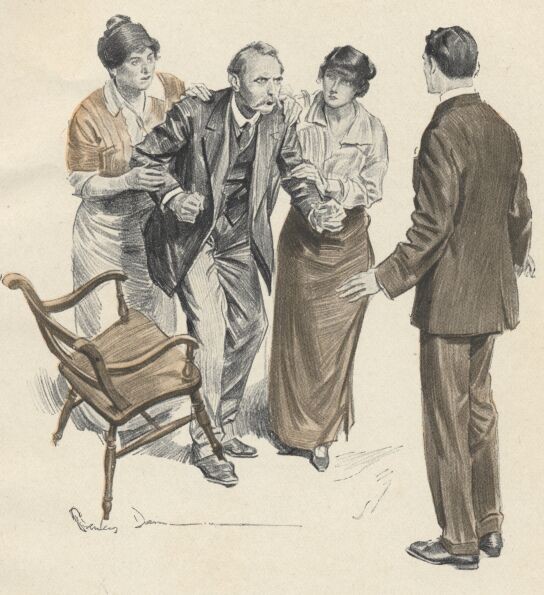
Mrs. Ward and her daughter flung themselves hastily between the sergeant- major and his intended sacrifice. Mr. Farrer, pale but determined, stood his ground.
"I'll dare you to go up and spend a night there alone," he said.
"I'll dare you," said the incensed warrior, weakly.
"All right; I'll spend Wednesday night there," said Mr. Farrer, "and I'll come round on Thursday and let you know how I got on."
"I dare say," said the other; "but I don't want you here, and, what's more, I won't have you. You can go to Smith's cottage on Wednesday at twelve o'clock if you like, and I'll go up any time between twelve and three and make sure you're there. D'ye understand? I'll show you whether I'm afraid or not."
"There's no reason for you to be afraid," said Mr. Farrer. "I shall be there to protect you. That's very different to being there alone, as I shall be. But, of course, you can go up the next night by yourself, and wait for me, if you like. If you like to prove your courage, I mean."
"When I want to be ordered about," said the sergeant-major, in a magnificent voice, "I'll let you know. Now go, before I do anything I might be sorry for afterwards."
He stood at the door, erect as a ramrod, and watched the young man up the road. His conversation at the supper-table that night related almost entirely to puppy-dogs and the best way of training them.
He kept a close eye upon his daughter for the next day or two, but human nature has its limits. He tried to sleep one afternoon in his easy-chair with one eye open, but the exquisite silence maintained by Miss Ward was too much for it. A hum of perfect content arose from the feature below, and five minutes later Miss Ward was speeding in search of Mr. Farrer.
"I had to come, Ted," she said, breathlessly, "because to-morrow's Wednesday. I've got something to tell you, but I don't know whether I ought to."
"Tell me and let me decide," said Mr. Farrer, tenderly.
"I—I'm so afraid you might be frightened," said the girl. "I won't tell you, but I'll give you a hint. If you see anything awful, don't be frightened."
Mr. Farrer stroked her hand. "The only thing I'm afraid of is your father," he said, softly.
"Oh!" said the girl, clasping her hands together. "You have guessed it."
"Guessed it?" said Mr. Farrer.
Miss Ward nodded. "I happened to pass his door this morning," she said, in a low voice. "It was open a little way, and he was standing up and measuring one of mother's nightgowns against his chest. I couldn't think what he was doing it for at first."
Mr. Farrer whistled and his face hardened.
"That's not fair play," he said at last. "All right; I'll be ready for him."
"He doesn't like to be put in the wrong," said Miss Ward. "He wants to prove that you haven't got any courage. He'd be disappointed if he found you had."
"All right," said Mr. Farrer again. "You're an angel for coming to tell me."
"Father would call me something else, I expect," said Miss Ward, with a smile. "Good-bye. I want to get back before he wakes up."
She was back in her chair, listening to her father's slumbers, half an hour before he awoke.
"I'm making up for to-morrow night," he said, opening his eyes suddenly.
His daughter nodded.
"Shows strength of will," continued the sergeant-major, amiably. "Wellington could go to sleep at any time by just willing it. I'm the same way; I can go to sleep at five minutes' notice."
"It's a very useful gift," said Miss Ward, piously, "very."
Mr. Ward had two naps the next day. He awoke from the second at twelve- thirty a.m., and in a somewhat disagreeable frame of mind rose and stretched himself. The house was very still. He took a small brown- paper parcel from behind the sofa and, extinguishing the lamp, put on his cap and opened the front door.
If the house was quiet, the little street seemed dead. He closed the door softly and stepped into the darkness. In terms which would have been understood by "our army in Flanders" he execrated the forefathers, the name, and the upbringing of Mr. Edward Farrer.
Not a soul in the streets; not a light in a window. He left the little town behind, passed the last isolated house on the road, and walked into the greater blackness of a road between tall hedges. He had put on canvas shoes with rubber soles, for the better surprise of Mr. Farrer, and his own progress seemed to partake of a ghostly nature. Every ghost story he had ever heard or read crowded into his memory. For the first time in his experience even the idea of the company of Mr. Farrer seemed better than no company at all.
The night was so dark that he nearly missed the turning that led to the cottage. For the first few yards he had almost to feel his way; then, with a greater yearning than ever for the society of Mr. Farrer, he straightened his back and marched swiftly and noiselessly towards the cottage.
It was a small, tumble-down place, set well back in an overgrown garden. The sergeant-major came to a halt just before reaching the gate, and, hidden by the hedge, unfastened his parcel and shook out his wife's best nightgown.
He got it over his head with some difficulty, and, with his arms in the sleeves, tried in vain to get his big hands through the small, lace- trimmed wristbands. Despite his utmost efforts he could only get two or three fingers through, and after a vain search for his cap, which had fallen off in the struggle, he made his way to the gate and stood there waiting. It was at this moment that the thought occurred to him that Mr. Farrer might have failed to keep the appointment.
His knees trembled slightly and he listened anxiously for any sound from the house. He rattled the gate and, standing with white arms outstretched, waited. Nothing happened. He shook it again, and then, pulling himself together, opened it and slipped into the garden. As he did so a large bough which lay in the centre of the footpath thoughtfully drew on one side to let him pass.
Mr. Ward stopped suddenly and, with his gaze fixed on the bough, watched it glide over the grass until it was swallowed up in the darkness. His own ideas of frightening Mr. Farrer were forgotten, and in a dry, choking voice he called loudly upon the name of that gentleman.
He called two or three times, with no response, and then, in a state of panic, backed slowly towards the gate with his eyes fixed on the house. A loud crash sounded from somewhere inside, the door was flung violently open, and a gruesome figure in white hopped out and squatted on the step.
It was evident to Sergeant-Major Ward that Mr. Farrer was not there, and that no useful purpose could be served by remaining. It was clear that the young man's courage had failed him, and, with grey head erect, elbows working like the sails of a windmill, and the ends of the nightgown streaming behind him, the sergeant-major bent his steps towards home.
He dropped into a walk after a time and looked carefully over his shoulder. So far as he could see he was alone, but the silence and loneliness were oppressive. He looked again, and, without stopping to inquire whether his eyes had deceived him, broke into a run again. Alternately walking and running, he got back to the town, and walked swiftly along the streets to his house. Police-Constable Burgess, who was approaching from the other direction, reached it at almost the same moment, and, turning on his lantern, stood gaping with astonishment. "Anything wrong?" he demanded.
"Wrong?" panted the sergeant-major, trying to put a little surprise and dignity into his voice. "No."
"I thought it was a lady walking in her sleep at first," said the constable. "A tall lady."
The sergeant-major suddenly became conscious of the nightgown. "I've been—for a little walk," he said, still breathing hard. "I felt a bit chilly—so I—put this on."
"Suits you, too," said the constable, stiffly. "But you Army men always was a bit dressy. Now if I put that on I should look ridikerlous."
The door opened before Mr. Ward could reply, and revealed, in the light of a bedroom candle, the astonished countenances of his wife and daughter.
"George!" exclaimed Mrs. Ward.
"Father!" said Miss Ward.
The sergeant-major tottered in and, gaining the front room, flung himself into his arm-chair. A stiff glass of whisky and water, handed him by his daughter, was swallowed at a gulp.
"Did you go?" inquired Mrs. Ward, clasping her hands.
The sergeant-major, fully conscious of the suspicions aroused by his disordered appearance, rallied his faculties. "Not likely," he said, with a short laugh. "After I got outside I knew it was no good going there to look for that young snippet. He'd no more think of going there than he would of flying. I walked a little way down the road—for exercise—and then strolled back."
"But—my nightgown?" said the wondering Mrs. Ward.
"Put it on to frighten the constable," said her husband.
He stood up and allowed her to help him pull it off. His face was flushed and his hair tousled, but the bright fierceness of his eye was unquenched. In submissive silence she followed him to bed.
He was up late next morning, and made but a poor breakfast. His after- dinner nap was disturbed, and tea was over before he had regained his wonted calm. An hour later the arrival of a dignified and reproachful Mr. Farrer set him blazing again.
"I have come to see you about last night," said Mr. Farrer, before the other could speak. "A joke's a joke, but when you said you would come I naturally expected you would keep your word."
"Keep my word?" repeated the sergeant-major, almost choking with wrath.
"I stayed there in that lonely cottage from twelve to three, as per agreement, waiting for you," said Mr. Farrer.
"You were not there," shouted the sergeant-major.
"How do you know?" inquired the other.
The sergeant-major looked round helplessly at his wife and daughter.
"Prove it," said Mr. Farrer, pushing his advantage. "You questioned my courage, and I stayed there three hours. Where were you?"
"You were not there," said the sergeant-major. "I know. You can't bluff me. You were afraid."
"I was there, and I'll swear it," said Mr. Farrer. "Still, there's no harm done. I'll go there again to-night, and I'll dare you to come for me?"
"Dare?" said the sergeant-major, choking. "Dare?"
"Dare," repeated the other; "and if you don't come this time I'll spread it all over Marcham. To-morrow night you can go there and wait for me. If you see what I saw—"
"Oh, Ted!" said Miss Ward, with a shiver. "Saw?" said the sergeant- major, starting. "Nothing harmful," said Mr. Farrer, calmly.
"As a matter of fact, it was very interesting."
"What was?" demanded the sergeant-major.
"It sounds rather silly, as a matter of fact," said Mr. Farrer, slowly. "Still, I did see a broken bough moving about the garden."
Mr. Ward regarded him open-mouthed.
"Anything else?" he inquired, in a husky voice.
"A figure in white," said Mr. Farrer, "with long waving arms, hopping about like a frog. I don't suppose you believe me, but if you come to-night perhaps you'll see it yourself. It's very interesting.
"Wer—weren't you frightened?" inquired the staring Mrs. Ward.
Mr. Farrer shook his head. "It would take more than that to frighten me," he said, simply. "I should be ashamed of myself to be afraid of a poor thing like that. It couldn't do me any harm."
"Did you see its face?" inquired Mrs. Ward, nervously.
Mr. Farrer shook his head.
"What sort of a body had it got?" said her daughter.
"So far as I could see, very good," said Mr. Farrer. "Very good figure —not tall, but well made."
An incredible suspicion that had been forming in the sergeant-major's mind began to take shape. "Did you see anything else?" he asked, sharply.
"One more," said Mr. Farrer, regarding him pleasantly. "One I call the Running Ghost."
"Run—" began the sergeant-major, and stopped suddenly.
"It came in at the front gate," pursued Mr. Farrer. "A tall, well-knit figure of martial bearing—much about your height, Mr. Ward—with a beautiful filmy white robe down to its knees—"
He broke off in mild surprise, and stood gazing at Miss Ward, who, with her handkerchief to her mouth, was rocking helplessly in her chair.
"Knees," he repeated, quietly. "It came slowly down the path, and half way to the house it stopped, and in a frightened sort of voice called out my name. I was surprised, naturally, but before I could get to it—to reassure it—"
"That'll do," said the sergeant-major, rising hastily and drawing himself up to his full height.
"You asked me," said Mr. Farrer, in an aggrieved voice.
"I know I did," said the sergeant-major, breathing heavily. "I know I did; but if I sit here listening to any more of your lies I shall be ill. The best thing you can do is to take that giggling girl out and give her a breath of fresh air. I have done with her."
End of the Project Gutenberg EBook of The Vigil, by W.W. Jacobs
*** END OF THIS PROJECT GUTENBERG EBOOK THE VIGIL ***
***** This file should be named 12158-h.htm or 12158-h.zip *****
This and all associated files of various formats will be found in:
http://www.gutenberg.net/1/2/1/5/12158/
Produced by David Widger
Updated editions will replace the previous one--the old editions
will be renamed.
Creating the works from public domain print editions means that no
one owns a United States copyright in these works, so the Foundation
(and you!) can copy and distribute it in the United States without
permission and without paying copyright royalties. Special rules,
set forth in the General Terms of Use part of this license, apply to
copying and distributing Project Gutenberg-tm electronic works to
protect the PROJECT GUTENBERG-tm concept and trademark. Project
Gutenberg is a registered trademark, and may not be used if you
charge for the eBooks, unless you receive specific permission. If you
do not charge anything for copies of this eBook, complying with the
rules is very easy. You may use this eBook for nearly any purpose
such as creation of derivative works, reports, performances and
research. They may be modified and printed and given away--you may do
practically ANYTHING with public domain eBooks. Redistribution is
subject to the trademark license, especially commercial
redistribution.
*** START: FULL LICENSE ***
THE FULL PROJECT GUTENBERG LICENSE
PLEASE READ THIS BEFORE YOU DISTRIBUTE OR USE THIS WORK
To protect the Project Gutenberg-tm mission of promoting the free
distribution of electronic works, by using or distributing this work
(or any other work associated in any way with the phrase "Project
Gutenberg"), you agree to comply with all the terms of the Full Project
Gutenberg-tm License (available with this file or online at
http://gutenberg.net/license).
Section 1. General Terms of Use and Redistributing Project Gutenberg-tm
electronic works
1.A. By reading or using any part of this Project Gutenberg-tm
electronic work, you indicate that you have read, understand, agree to
and accept all the terms of this license and intellectual property
(trademark/copyright) agreement. If you do not agree to abide by all
the terms of this agreement, you must cease using and return or destroy
all copies of Project Gutenberg-tm electronic works in your possession.
If you paid a fee for obtaining a copy of or access to a Project
Gutenberg-tm electronic work and you do not agree to be bound by the
terms of this agreement, you may obtain a refund from the person or
entity to whom you paid the fee as set forth in paragraph 1.E.8.
1.B. "Project Gutenberg" is a registered trademark. It may only be
used on or associated in any way with an electronic work by people who
agree to be bound by the terms of this agreement. There are a few
things that you can do with most Project Gutenberg-tm electronic works
even without complying with the full terms of this agreement. See
paragraph 1.C below. There are a lot of things you can do with Project
Gutenberg-tm electronic works if you follow the terms of this agreement
and help preserve free future access to Project Gutenberg-tm electronic
works. See paragraph 1.E below.
1.C. The Project Gutenberg Literary Archive Foundation ("the Foundation"
or PGLAF), owns a compilation copyright in the collection of Project
Gutenberg-tm electronic works. Nearly all the individual works in the
collection are in the public domain in the United States. If an
individual work is in the public domain in the United States and you are
located in the United States, we do not claim a right to prevent you from
copying, distributing, performing, displaying or creating derivative
works based on the work as long as all references to Project Gutenberg
are removed. Of course, we hope that you will support the Project
Gutenberg-tm mission of promoting free access to electronic works by
freely sharing Project Gutenberg-tm works in compliance with the terms of
this agreement for keeping the Project Gutenberg-tm name associated with
the work. You can easily comply with the terms of this agreement by
keeping this work in the same format with its attached full Project
Gutenberg-tm License when you share it without charge with others.
1.D. The copyright laws of the place where you are located also govern
what you can do with this work. Copyright laws in most countries are in
a constant state of change. If you are outside the United States, check
the laws of your country in addition to the terms of this agreement
before downloading, copying, displaying, performing, distributing or
creating derivative works based on this work or any other Project
Gutenberg-tm work. The Foundation makes no representations concerning
the copyright status of any work in any country outside the United
States.
1.E. Unless you have removed all references to Project Gutenberg:
1.E.1. The following sentence, with active links to, or other immediate
access to, the full Project Gutenberg-tm License must appear prominently
whenever any copy of a Project Gutenberg-tm work (any work on which the
phrase "Project Gutenberg" appears, or with which the phrase "Project
Gutenberg" is associated) is accessed, displayed, performed, viewed,
copied or distributed:
This eBook is for the use of anyone anywhere at no cost and with
almost no restrictions whatsoever. You may copy it, give it away or
re-use it under the terms of the Project Gutenberg License included
with this eBook or online at www.gutenberg.net
1.E.2. If an individual Project Gutenberg-tm electronic work is derived
from the public domain (does not contain a notice indicating that it is
posted with permission of the copyright holder), the work can be copied
and distributed to anyone in the United States without paying any fees
or charges. If you are redistributing or providing access to a work
with the phrase "Project Gutenberg" associated with or appearing on the
work, you must comply either with the requirements of paragraphs 1.E.1
through 1.E.7 or obtain permission for the use of the work and the
Project Gutenberg-tm trademark as set forth in paragraphs 1.E.8 or
1.E.9.
1.E.3. If an individual Project Gutenberg-tm electronic work is posted
with the permission of the copyright holder, your use and distribution
must comply with both paragraphs 1.E.1 through 1.E.7 and any additional
terms imposed by the copyright holder. Additional terms will be linked
to the Project Gutenberg-tm License for all works posted with the
permission of the copyright holder found at the beginning of this work.
1.E.4. Do not unlink or detach or remove the full Project Gutenberg-tm
License terms from this work, or any files containing a part of this
work or any other work associated with Project Gutenberg-tm.
1.E.5. Do not copy, display, perform, distribute or redistribute this
electronic work, or any part of this electronic work, without
prominently displaying the sentence set forth in paragraph 1.E.1 with
active links or immediate access to the full terms of the Project
Gutenberg-tm License.
1.E.6. You may convert to and distribute this work in any binary,
compressed, marked up, nonproprietary or proprietary form, including any
word processing or hypertext form. However, if you provide access to or
distribute copies of a Project Gutenberg-tm work in a format other than
"Plain Vanilla ASCII" or other format used in the official version
posted on the official Project Gutenberg-tm web site (www.gutenberg.net),
you must, at no additional cost, fee or expense to the user, provide a
copy, a means of exporting a copy, or a means of obtaining a copy upon
request, of the work in its original "Plain Vanilla ASCII" or other
form. Any alternate format must include the full Project Gutenberg-tm
License as specified in paragraph 1.E.1.
1.E.7. Do not charge a fee for access to, viewing, displaying,
performing, copying or distributing any Project Gutenberg-tm works
unless you comply with paragraph 1.E.8 or 1.E.9.
1.E.8. You may charge a reasonable fee for copies of or providing
access to or distributing Project Gutenberg-tm electronic works provided
that
- You pay a royalty fee of 20% of the gross profits you derive from
the use of Project Gutenberg-tm works calculated using the method
you already use to calculate your applicable taxes. The fee is
owed to the owner of the Project Gutenberg-tm trademark, but he
has agreed to donate royalties under this paragraph to the
Project Gutenberg Literary Archive Foundation. Royalty payments
must be paid within 60 days following each date on which you
prepare (or are legally required to prepare) your periodic tax
returns. Royalty payments should be clearly marked as such and
sent to the Project Gutenberg Literary Archive Foundation at the
address specified in Section 4, "Information about donations to
the Project Gutenberg Literary Archive Foundation."
- You provide a full refund of any money paid by a user who notifies
you in writing (or by e-mail) within 30 days of receipt that s/he
does not agree to the terms of the full Project Gutenberg-tm
License. You must require such a user to return or
destroy all copies of the works possessed in a physical medium
and discontinue all use of and all access to other copies of
Project Gutenberg-tm works.
- You provide, in accordance with paragraph 1.F.3, a full refund of any
money paid for a work or a replacement copy, if a defect in the
electronic work is discovered and reported to you within 90 days
of receipt of the work.
- You comply with all other terms of this agreement for free
distribution of Project Gutenberg-tm works.
1.E.9. If you wish to charge a fee or distribute a Project Gutenberg-tm
electronic work or group of works on different terms than are set
forth in this agreement, you must obtain permission in writing from
both the Project Gutenberg Literary Archive Foundation and Michael
Hart, the owner of the Project Gutenberg-tm trademark. Contact the
Foundation as set forth in Section 3 below.
1.F.
1.F.1. Project Gutenberg volunteers and employees expend considerable
effort to identify, do copyright research on, transcribe and proofread
public domain works in creating the Project Gutenberg-tm
collection. Despite these efforts, Project Gutenberg-tm electronic
works, and the medium on which they may be stored, may contain
"Defects," such as, but not limited to, incomplete, inaccurate or
corrupt data, transcription errors, a copyright or other intellectual
property infringement, a defective or damaged disk or other medium, a
computer virus, or computer codes that damage or cannot be read by
your equipment.
1.F.2. LIMITED WARRANTY, DISCLAIMER OF DAMAGES - Except for the "Right
of Replacement or Refund" described in paragraph 1.F.3, the Project
Gutenberg Literary Archive Foundation, the owner of the Project
Gutenberg-tm trademark, and any other party distributing a Project
Gutenberg-tm electronic work under this agreement, disclaim all
liability to you for damages, costs and expenses, including legal
fees. YOU AGREE THAT YOU HAVE NO REMEDIES FOR NEGLIGENCE, STRICT
LIABILITY, BREACH OF WARRANTY OR BREACH OF CONTRACT EXCEPT THOSE
PROVIDED IN PARAGRAPH F3. YOU AGREE THAT THE FOUNDATION, THE
TRADEMARK OWNER, AND ANY DISTRIBUTOR UNDER THIS AGREEMENT WILL NOT BE
LIABLE TO YOU FOR ACTUAL, DIRECT, INDIRECT, CONSEQUENTIAL, PUNITIVE OR
INCIDENTAL DAMAGES EVEN IF YOU GIVE NOTICE OF THE POSSIBILITY OF SUCH
DAMAGE.
1.F.3. LIMITED RIGHT OF REPLACEMENT OR REFUND - If you discover a
defect in this electronic work within 90 days of receiving it, you can
receive a refund of the money (if any) you paid for it by sending a
written explanation to the person you received the work from. If you
received the work on a physical medium, you must return the medium with
your written explanation. The person or entity that provided you with
the defective work may elect to provide a replacement copy in lieu of a
refund. If you received the work electronically, the person or entity
providing it to you may choose to give you a second opportunity to
receive the work electronically in lieu of a refund. If the second copy
is also defective, you may demand a refund in writing without further
opportunities to fix the problem.
1.F.4. Except for the limited right of replacement or refund set forth
in paragraph 1.F.3, this work is provided to you 'AS-IS' WITH NO OTHER
WARRANTIES OF ANY KIND, EXPRESS OR IMPLIED, INCLUDING BUT NOT LIMITED TO
WARRANTIES OF MERCHANTIBILITY OR FITNESS FOR ANY PURPOSE.
1.F.5. Some states do not allow disclaimers of certain implied
warranties or the exclusion or limitation of certain types of damages.
If any disclaimer or limitation set forth in this agreement violates the
law of the state applicable to this agreement, the agreement shall be
interpreted to make the maximum disclaimer or limitation permitted by
the applicable state law. The invalidity or unenforceability of any
provision of this agreement shall not void the remaining provisions.
1.F.6. INDEMNITY - You agree to indemnify and hold the Foundation, the
trademark owner, any agent or employee of the Foundation, anyone
providing copies of Project Gutenberg-tm electronic works in accordance
with this agreement, and any volunteers associated with the production,
promotion and distribution of Project Gutenberg-tm electronic works,
harmless from all liability, costs and expenses, including legal fees,
that arise directly or indirectly from any of the following which you do
or cause to occur: (a) distribution of this or any Project Gutenberg-tm
work, (b) alteration, modification, or additions or deletions to any
Project Gutenberg-tm work, and (c) any Defect you cause.
Section 2. Information about the Mission of Project Gutenberg-tm
Project Gutenberg-tm is synonymous with the free distribution of
electronic works in formats readable by the widest variety of computers
including obsolete, old, middle-aged and new computers. It exists
because of the efforts of hundreds of volunteers and donations from
people in all walks of life.
Volunteers and financial support to provide volunteers with the
assistance they need, is critical to reaching Project Gutenberg-tm's
goals and ensuring that the Project Gutenberg-tm collection will
remain freely available for generations to come. In 2001, the Project
Gutenberg Literary Archive Foundation was created to provide a secure
and permanent future for Project Gutenberg-tm and future generations.
To learn more about the Project Gutenberg Literary Archive Foundation
and how your efforts and donations can help, see Sections 3 and 4
and the Foundation web page at http://www.pglaf.org.
Section 3. Information about the Project Gutenberg Literary Archive
Foundation
The Project Gutenberg Literary Archive Foundation is a non profit
501(c)(3) educational corporation organized under the laws of the
state of Mississippi and granted tax exempt status by the Internal
Revenue Service. The Foundation's EIN or federal tax identification
number is 64-6221541. Its 501(c)(3) letter is posted at
http://pglaf.org/fundraising. Contributions to the Project Gutenberg
Literary Archive Foundation are tax deductible to the full extent
permitted by U.S. federal laws and your state's laws.
The Foundation's principal office is located at 4557 Melan Dr. S.
Fairbanks, AK, 99712., but its volunteers and employees are scattered
throughout numerous locations. Its business office is located at
809 North 1500 West, Salt Lake City, UT 84116, (801) 596-1887, email
business@pglaf.org. Email contact links and up to date contact
information can be found at the Foundation's web site and official
page at http://pglaf.org
For additional contact information:
Dr. Gregory B. Newby
Chief Executive and Director
gbnewby@pglaf.org
Section 4. Information about Donations to the Project Gutenberg
Literary Archive Foundation
Project Gutenberg-tm depends upon and cannot survive without wide
spread public support and donations to carry out its mission of
increasing the number of public domain and licensed works that can be
freely distributed in machine readable form accessible by the widest
array of equipment including outdated equipment. Many small donations
($1 to $5,000) are particularly important to maintaining tax exempt
status with the IRS.
The Foundation is committed to complying with the laws regulating
charities and charitable donations in all 50 states of the United
States. Compliance requirements are not uniform and it takes a
considerable effort, much paperwork and many fees to meet and keep up
with these requirements. We do not solicit donations in locations
where we have not received written confirmation of compliance. To
SEND DONATIONS or determine the status of compliance for any
particular state visit http://pglaf.org
While we cannot and do not solicit contributions from states where we
have not met the solicitation requirements, we know of no prohibition
against accepting unsolicited donations from donors in such states who
approach us with offers to donate.
International donations are gratefully accepted, but we cannot make
any statements concerning tax treatment of donations received from
outside the United States. U.S. laws alone swamp our small staff.
Please check the Project Gutenberg Web pages for current donation
methods and addresses. Donations are accepted in a number of other
ways including including checks, online payments and credit card
donations. To donate, please visit: http://pglaf.org/donate
Section 5. General Information About Project Gutenberg-tm electronic
works.
Professor Michael S. Hart is the originator of the Project Gutenberg-tm
concept of a library of electronic works that could be freely shared
with anyone. For thirty years, he produced and distributed Project
Gutenberg-tm eBooks with only a loose network of volunteer support.
Project Gutenberg-tm eBooks are often created from several printed
editions, all of which are confirmed as Public Domain in the U.S.
unless a copyright notice is included. Thus, we do not necessarily
keep eBooks in compliance with any particular paper edition.
Each eBook is in a subdirectory of the same number as the eBook's
eBook number, often in several formats including plain vanilla ASCII,
compressed (zipped), HTML and others.
Corrected EDITIONS of our eBooks replace the old file and take over
the old filename and etext number. The replaced older file is renamed.
VERSIONS based on separate sources are treated as new eBooks receiving
new filenames and etext numbers.
Most people start at our Web site which has the main PG search facility:
http://www.gutenberg.net
This Web site includes information about Project Gutenberg-tm,
including how to make donations to the Project Gutenberg Literary
Archive Foundation, how to help produce our new eBooks, and how to
subscribe to our email newsletter to hear about new eBooks.
EBooks posted prior to November 2003, with eBook numbers BELOW #10000,
are filed in directories based on their release date. If you want to
download any of these eBooks directly, rather than using the regular
search system you may utilize the following addresses and just
download by the etext year.
http://www.gutenberg.net/etext06
(Or /etext 05, 04, 03, 02, 01, 00, 99,
98, 97, 96, 95, 94, 93, 92, 92, 91 or 90)
EBooks posted since November 2003, with etext numbers OVER #10000, are
filed in a different way. The year of a release date is no longer part
of the directory path. The path is based on the etext number (which is
identical to the filename). The path to the file is made up of single
digits corresponding to all but the last digit in the filename. For
example an eBook of filename 10234 would be found at:
http://www.gutenberg.net/1/0/2/3/10234
or filename 24689 would be found at:
http://www.gutenberg.net/2/4/6/8/24689
An alternative method of locating eBooks:
http://www.gutenberg.net/GUTINDEX.ALL