


автордың кітабын онлайн тегін оқу Chaucer's Works, Volume 2 (of 7) — Boethius and Troilus
Transcriber's note:
A Glossary including words from the two texts in this volume is included in Skeat's Volume VI, available from Project Gutenberg
here.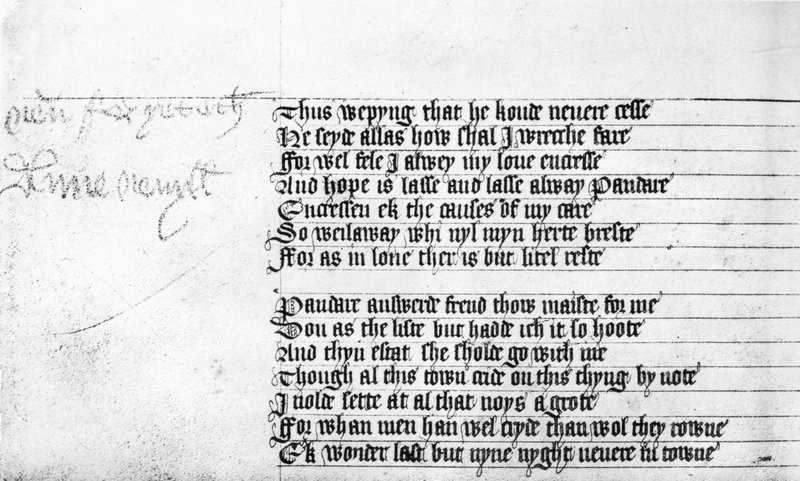
MS. Corp. Chr. Coll., Cambridge. Troil. iv. 575-588
Frontispiece**
THE COMPLETE WORKS
OF
GEOFFREY CHAUCER
EDITED, FROM NUMEROUS MANUSCRIPTS
BY THE
Rev. WALTER W. SKEAT, M.A.
Litt.D., LL.D., D.C.L., Ph.D.
ELRINGTON AND BOSWORTH PROFESSOR OF ANGLO-SAXON AND FELLOW OF CHRIST'S COLLEGE, CAMBRIDGE
* *
BOETHIUS AND TROILUS
'Adam scriveyn, if ever it thee befalle
Boece or Troilus to wryten newe,
Under thy lokkes thou most have the scalle,
But after my making thou wryte trewe.'
Chaucers Wordes unto Adam.
SECOND EDITION
Oxford
AT THE CLARENDON PRESS
M DCCCC
Oxford
PRINTED AT THE CLARENDON PRESS
BY HORACE HART, M.A.
PRINTER TO THE UNIVERSITY
CONTENTS.
PAGE
Introduction to Boethius.—§
1. Date of the Work. §
2. Boethius. §
3. The Consolation of Philosophy; and fate of its author. §
4. Jean de Meun. §
5. References by Boethius to current events. §
6. Cassiodorus. §
7. Form of the Treatise. §
8. Brief sketch of its general contents. §
9. Early translations. §
10. Translation by Ælfred. §
11. MS. copy, with A.S. glosses. §
12. Chaucer's translation mentioned. §
13. Walton's verse translation. §
14. Specimen of the same. §
15. His translation of Book ii. met. 5. §
16. M. E. prose translation; and others. §
17. Chaucer's translation and le Roman de la Rose. §
18. Chaucer's scholarship. §
19. Chaucer's prose. §
20. Some of his mistakes. §
21. Other variations considered. §
22. Imitations of Boethius in Chaucer's works. §
23. Comparison with 'Boece' of other works by Chaucer. §
24. Chronology of Chaucer's works, as illustrated by 'Boece.' §
25. The Manuscripts. §
26. The Printed Editions. §
27. The Present Edition
vii Introduction to Troilus.—§
1. Date of the Work. §
2. Sources of the Work; Boccaccio's Filostrato. §§
3,
4. Other sources. §
5. Chaucer's share in it. §
6. Vagueness of reference to sources. §
7. Medieval note-books. §
8. Lollius. §
9. Guido delle Colonne. §
10. 'Trophee.' §§
11,
12. The same continued. §§
13-
17. Passages from Guido. §§
18,
19. Dares, Dictys, and Benôit de Ste-More. §
20. The names; Troilus, &c. §
21. Roman de la Rose. §
22. Gest Historiale. §
23. Lydgate's Siege of Troye. §
24. Henrysoun's Testament of Criseyde. §
25. The MSS. §
26. The Editions. §
27. The Present Edition. §
28. Deficient lines. §
29. Proverbs. §
30. Kinaston's Latin translation. §
31. Sidnam's translation
xlix Boethius de Consolatione Philosophie 1 Book I. 1 Book II. 23 Book III. 51 Book IV. 92 Book V. 126Troilus and Criseyde
153 Book I. 153 Book II. 189 Book III. 244 Book IV. 302 Book V. 357 Notes to Boethius 419 Notes to Troilus 461INTRODUCTION TO BOETHIUS.
§ 1. Date of the Work.
In my introductory remarks to the Legend of Good Women, I refer to the close connection that is easily seen to subsist between Chaucer's translation of Boethius and his Troilus and Criseyde. All critics seem now to agree in placing these two works in close conjunction, and in making the prose work somewhat the earlier of the two; though it is not at all unlikely that, for a short time, both works were in hand together. It is also clear that they were completed before the author commenced the House of Fame, the date of which is, almost certainly, about 1383-4. Dr. Koch, in his Essay on the Chronology of Chaucer's Writings, proposes to date 'Boethius' about 1377-8, and 'Troilus' about 1380-1. It is sufficient to be able to infer, as we can with tolerable certainty, that these two works belong to the period between 1377 and 1383. And we may also feel sure that the well-known lines to Adam, beginning—
'Adam scriveyn, if ever it thee befalle
Boece or Troilus to wryten newe'—
were composed at the time when the fair copy of Troilus had just been finished, and may be dated, without fear of mistake, in 1381-3. It is not likely that we shall be able to determine these dates within closer limits; nor is it at all necessary that we should be able to do so. A few further remarks upon this subject are given below.
§ 2. Boethius.
Before proceeding to remark upon Chaucer's translation of Boethius, or (as he calls him) Boece, it is necessary to say a few words as to the original work, and its author.
Anicius Manlius Torquatus Severinus Boethius, the most learned philosopher of his time, was born at Rome about A. D. 480, and was put to death A. D. 524. In his youth, he had the advantage of a liberal training, and enjoyed the rare privilege of being able to read the Greek philosophers in their own tongue. In the particular treatise which here most concerns us, his Greek quotations are mostly taken from Plato, and there are a few references to Aristotle, Homer, and to the Andromache of Euripides. His extant works shew that he was well acquainted with geometry, mechanics, astronomy, and music, as well as with logic and theology; and it is an interesting fact that an illustration of the way in which waves of sound are propagated through the air, introduced by Chaucer into his House of Fame, ll. 788-822, is almost certainly derived from the treatise of Boethius De Musica, as pointed out in the note upon that passage. At any rate, there is an unequivocal reference to 'the felinge' of Boece 'in musik' in the Nonnes Preestes Tale, B 4484.
§ 3. The most important part of his political life was passed in the service of the celebrated Theodoric the Goth, who, after the defeat and death of Odoacer, A. D. 493, had made himself undisputed master of Italy, and had fixed the seat of his government in Ravenna. The usual account, that Boethius was twice married, is now discredited, there being no clear evidence with respect to Elpis, the name assigned to his supposed first wife; but it is certain that he married Rusticiana, the daughter of the patrician Symmachus, a man of great influence and probity, and much respected, who had been consul under Odoacer in 485. Boethius had the singular felicity of seeing his two sons, Boethius and Symmachus, raised to the consular dignity on the same day, in 522. After many years spent in indefatigable study and great public usefulness, he fell under the suspicion of Theodoric; and, notwithstanding an indignant denial of his supposed crimes, was hurried away to Pavia, where he was imprisoned in a tower, and denied the means of justifying his conduct. The rest must be told in the eloquent words of Gibbon[1].
'While Boethius, oppressed with fetters, expected each moment the sentence or the stroke of death, he composed in the tower of Pavia the "Consolation of Philosophy"; a golden volume, not unworthy of the leisure of Plato or Tully, but which claims incomparable merit from the barbarism of the times and the situation of the author. The celestial guide[2], whom he had so long invoked at Rome and at Athens, now condescended to illumine his dungeon, to revive his courage, and to pour into his wounds her salutary balm. She taught him to compare his long prosperity and his recent distress, and to conceive new hopes from the inconstancy of fortune[3]. Reason had informed him of the precarious condition of her gifts; experience had satisfied him of their real value[4]; he had enjoyed them without guilt; he might resign them without a sigh, and calmly disdain the impotent malice of his enemies, who had left him happiness, since they had left him virtue[5]. From the earth, Boethius ascended to heaven in search of the SUPREME GOOD[6], explored the metaphysical labyrinth of chance and destiny[7], of prescience and freewill, of time and eternity, and generously attempted to reconcile the perfect attributes of the Deity with the apparent disorders of his moral and physical government[8]. Such topics of consolation, so obvious, so vague, or so abstruse, are ineffectual to subdue the feelings of human nature. Yet the sense of misfortune may be diverted by the labour of thought; and the sage who could artfully combine, in the same work, the various riches of philosophy, poetry, and eloquence, must already have possessed the intrepid calmness which he affected to seek. Suspense, the worst of evils, was at length determined by the ministers of death, who executed, and perhaps exceeded, the inhuman mandate of Theodoric. A strong cord was fastened round the head of Boethius, and forcibly tightened till his eyes almost started from their sockets; and some mercy may be discovered in the milder torture of beating him with clubs till he expired. But his genius survived to diffuse a ray of knowledge over the darkest ages of the Latin world; the writings of the philosopher were translated by the most glorious of the English Kings, and the third emperor of the name of Otho removed to a more honourable tomb the bones of a catholic saint, who, from his Arian persecutors, had acquired the honours of martyrdom and the fame of miracles. In the last hours of Boethius, he derived some comfort from the safety of his two sons, of his wife, and of his father-in-law, the venerable Symmachus. But the grief of Symmachus was indiscreet, and perhaps disrespectful; he had presumed to lament, he might dare to revenge, the death of an injured friend. He was dragged in chains from Rome to the palace of Ravenna; and the suspicions of Theodoric could only be appeased by the blood of an innocent and aged senator.'
This deed of injustice brought small profit to its perpetrator; for we read that Theodoric's own death took place shortly afterwards; and that, on his death-bed, 'he expressed in broken murmurs to his physician Elpidius, his deep repentance for the murders of Boethius and Symmachus.'
§ 4. For further details, I beg leave to refer the reader to the essay on 'Boethius' by H. F. Stewart, published by W. Blackwood and Sons, Edinburgh and London, in 1891. We are chiefly concerned here with the 'Consolation of Philosophy,' a work which enjoyed great popularity in the middle ages, and first influenced Chaucer indirectly, through the use of it made by Jean de Meun in the poem entitled Le Roman de la Rose, as well as directly, at a later period, through his own translation of it. Indeed, I have little doubt that Chaucer's attention was drawn to it when, somewhat early in life, he first perused with diligence that remarkable poem; and that it was from the following passage that he probably drew the inference that it might be well for him to translate the whole work:—
'Ce puet l'en bien des clers enquerre
Qui Boëce de Confort lisent,
Et les sentences qui là gisent,
Dont grans biens as gens laiz feroit
Qui bien le lor translateroit' (ll. 5052-6).
I.e. in modern English:—'This can be easily ascertained from the learned men who read Boece on the Consolation of Philosophy, and the opinions which are found therein; as to which, any one who would well translate it for them would confer much benefit on the unlearned folk':—a pretty strong hint[9]!
§ 5. The chief events in the life of Boethius which are referred to in the present treatise are duly pointed out in the notes; and it may be well to bear in mind that, as to some of these, nothing further is known beyond what the author himself tells us. Most of the personal references occur in Book i. Prose 4, Book ii. Prose 3, and in Book iii. Prose 4. In the first of these passages, Boethius recalls the manner in which he withstood one Conigastus, because he oppressed the poor (l. 40); and how he defeated the iniquities of Triguilla, 'provost' (præpositus) of the royal household (l. 43). He takes credit for defending the people of Campania against a particularly obnoxious fiscal measure instituted by Theodoric, which was called 'coemption' (coemptio); (l. 59.) This Mr. Stewart describes as 'a fiscal measure which allowed the state to buy provisions for the army at something under market-price—which threatened to ruin the province.' He tells us that he rescued Decius Paulinus, who had been consul in 498, from the rapacity of the officers of the royal palace (l. 68); and that, in order to save Decius Albinus, who had been consul in 493, from wrongful punishment, he ran the risk of incurring the hate of the informer Cyprian (l. 75). In these ways, he had rendered himself odious to the court-party, whom he had declined to bribe (l. 79). His accusers were Basilius, who had been expelled from the king's service, and was impelled to accuse him by pressure of debt (l. 81); and Opilio and Gaudentius, who had been sentenced to exile by royal decree for their numberless frauds and crimes, but had escaped the sentence by taking sanctuary. 'And when,' as he tells us, 'the king discovered this evasion, he gave orders that, unless they quitted Ravenna by a given day, they should be branded on the forehead with a hot iron and driven out of the city. Nevertheless on that very day the information laid against me by these men was admitted' (ll. 89-94). He next alludes to some forged letters (l. 123), by means of which he had been accused of 'hoping for the freedom of Rome,' (which was of course interpreted to mean that he wished to deliver Rome from the tyranny of Theodoric). He then boldly declares that if he had had the opportunity of confronting his accusers, he would have answered in the words of Canius, when accused by Caligula of having been privy to a conspiracy against him—'If I had known it, thou shouldst never have known it' (ll. 126-135). This, by the way, was rather an imprudent expression, and probably told against him when his case was considered by Theodoric.
He further refers to an incident that took place at Verona (l. 153), when the king, eager for a general slaughter of his enemies, endeavoured to extend to the whole body of the senate the charge of treason, of which Albinus had been accused; on which occasion, at great personal risk, Boethius had defended the senate against so sweeping an accusation.
In Book ii. Prose 3, he refers to his former state of happiness and good fortune (l. 26), when he was blessed with rich and influential parents-in-law, with a beloved wife, and with two noble sons; in particular (l. 35), he speaks with justifiable pride of the day when his sons were both elected consuls together, and when, sitting in the Circus between them, he won general praise for his wit and eloquence.
In Book iii. Prose 4, he declaims against Decoratus, with whom he refused to be associated in office, on account of his infamous character.
§ 6. The chief source of further information about these circumstances is a collection of letters (Variæ Epistolæ) by Cassiodorus, a statesman who enjoyed the full confidence of Theodoric, and collected various state-papers under his direction. These tell us, in some measure, what can be said on the other side. Here Cyprian and his brother Opilio are spoken of with respect and honour; and the only Decoratus whose name appears is spoken of as a young man of great promise, who had won the king's sincere esteem. But when all has been said, the reader will most likely be inclined to think that, in cases of conflicting evidence, he would rather take the word of the noble Boethius than that of any of his opponents.
§ 7. The treatise 'De Consolatione Philosophiæ' is written in the form of a discourse between himself and the personification of Philosophy, who appears to him in his prison, and endeavours to soothe and console him in his time of trial. It is divided (as in this volume) into five Books; and each Book is subdivided into chapters, entitled Metres and Proses, because, in the original, the alternate chapters are written in a metrical form, the metres employed being of various kinds. Thus Metre 1 of Book I is written in alternate hexameters and pentameters; while Metre 7 consists of very short lines, each consisting of a single dactyl and spondee. The Proses contain the main arguments; the Metres serve for embellishment and recreation.
In some MSS. of Chaucer's translation, a few words of the original are quoted at the beginning of each Prose and Metre, and are duly printed in this edition, in a corrected form.
§ 8. A very brief sketch of the general contents of the volume may be of some service.
Book I. Boethius deplores his misfortunes (met. 1). Philosophy appears to him in a female form (pr. 2), and condoles with him in song (met. 2); after which she addresses him, telling him that she is willing to share his misfortunes (pr. 3). Boethius pours out his complaints, and vindicates his past conduct (pr. 4). Philosophy reminds him that he seeks a heavenly country (pr. 5). The world is not governed by chance (pr. 6). The book concludes with a lay of hope (met. 7).
Book II. Philosophy enlarges on the wiles of Fortune (pr. 1), and addresses him in Fortune's name, asserting that her mutability is natural and to be expected (pr. 2). Adversity is transient (pr. 3), and Boethius has still much to be thankful for (pr. 4). Riches only bring anxieties, and cannot confer happiness (pr. 5); they were unknown in the Golden Age (met. 5). Neither does happiness consist in honours and power (pr. 6). The power of Nero only taught him cruelty (met. 6). Fame is but vanity (pr. 7), and is ended by death (met. 7). Adversity is beneficial (pr. 8). All things are bound together by the chain of Love (met. 8).
Book III. Boethius begins to receive comfort (pr. 1). Philosophy discourses on the search for the Supreme Good (summum bonum; pr. 2). The laws of nature are immutable (met. 2). All men are engaged in the pursuit of happiness (pr. 3). Dignities properly appertain to virtue (pr. 4). Power cannot drive away care (pr. 5). Glory is deceptive, and the only true nobility is that of character (pr. 6). Happiness does not consist in corporeal pleasures (pr. 7); nor in bodily strength or beauty (pr. 8). Worldly bliss is insufficient and false; and in seeking true felicity, we must invoke God's aid (pr. 9). Boethius sings a hymn to the Creator (met. 9); and acknowledges that God alone is the Supreme Good (p. 10). The unity of soul and body is necessary to existence, and the love of life is instinctive (pr. 11). Error is dispersed by the light of Truth (met. 11). God governs the world, and is all-sufficient, whilst evil has no true existence (pr. 12). The book ends with the story of Orpheus (met. 12).
Book IV. This book opens with a discussion of the existence of evil, and the system of rewards and punishments (pr. 1). Boethius describes the flight of Imagination through the planetary spheres till it reaches heaven itself (met. 1). The good are strong, but the wicked are powerless, having no real existence (pr. 2). Tyrants are chastised by their own passions (met. 2). Virtue secures reward; but the wicked lose even their human nature, and become as mere beasts (pr. 3). Consider the enchantments of Circe, though these merely affected the outward form (met. 4). The wicked are thrice wretched; they will to do evil, they can do evil, and they actually do it. Virtue is its own reward; so that the wicked should excite our pity (pr. 4). Here follows a poem on the folly of war (met. 4). Boethius inquires why the good suffer (pr. 5). Philosophy reminds him that the motions of the stars are inexplicable to one who does not understand astronomy (met. 5). She explains the difference between Providence and Destiny (pr. 6). In all nature we see concord, due to controlling Love (met. 6). All fortune is good; for punishment is beneficial (pr. 7). The labours of Hercules afford us an example of endurance (met. 7).
Book V. Boethius asks questions concerning Chance (pr. 1). An example from the courses of the rivers Tigris and Euphrates (met. 1). Boethius asks questions concerning Free-will (pr. 2). God, who sees all things, is the true Sun (met. 2). Boethius is puzzled by the consideration of God's Predestination and man's Free-will (pr. 3). Men are too eager to inquire into the unknown (met. 3). Philosophy replies to Boethius on the subjects of Predestination, Necessity, and the nature of true Knowledge (pr. 4); on the impressions received by the mind (met. 4); and on the powers of Sense and Imagination (pr. 5). Beasts look downward to the earth, but man is upright, and looks up to heaven (met. 5). This world is not eternal, but only God is such; whose prescience is not subject to necessity, nor altered by human intentions. He upholds the good, and condemns the wicked; therefore be constant in eschewing vice, and devote all thy powers to the love of virtue (pr. 6).
§ 9. It is unnecessary to enlarge here upon the importance of this treatise, and its influence upon medieval literature. Mr. Stewart, in the work already referred to, has an excellent chapter 'On Some Ancient Translations' of it. The number of translations that still exist, in various languages, sufficiently testify to its extraordinary popularity in the middle ages. Copies of it are found, for example, in Old High German by Notker, and in later German by Peter of Kastl; in Anglo-French by Simun de Fraisne; in continental French by Jean de Meun[10], Pierre de Paris, Jehan de Cis, Frere Renaut de Louhans, and by two anonymous authors; in Italian, by Alberto della Piagentina and several others; in Greek, by Maximus Planudes; and in Spanish, by Fra Antonio Ginebreda; besides various versions in later times. But the most interesting, to us, are those in English, which are somewhat numerous, and are worthy of some special notice. I shall here dismiss, as improbable and unnecessary, a suggestion sometimes made, that Chaucer may have consulted some French version in the hope of obtaining assistance from it; there is no sure trace of anything of the kind, and the internal evidence is, in my opinion, decisively against it.
§ 10. The earliest English translation is that by king Ælfred, which is particularly interesting from the fact that the royal author frequently deviates from his original, and introduces various notes, explanations, and allusions of his own. The opening chapter, for example, is really a preface, giving a brief account of Theodoric and of the circumstances which led to the imprisonment of Boethius. This work exists only in two MSS., neither being of early date, viz. MS. Cotton, Otho A VI, and MS. Bodley NE. C. 3. 11. It has been thrice edited; by Rawlinson, in 1698; by J. S. Cardale, in 1829; and by S. Fox, in 1864. The last of these includes a modern English translation, and forms one of the volumes of Bohn's Antiquarian Library; so that it is a cheap and accessible work. Moreover, it contains an alliterative verse translation of most of the Metres contained in Boethius (excluding the Proses), which is also attributed to Ælfred in a brief metrical preface; but whether this ascription is to be relied upon, or not, is a difficult question, which has hardly as yet been decided. A summary of the arguments, for and against Ælfred's authorship, will be found in Wülker's Grundriss zur Geschichte der angelsächsischen Litteratur, pp. 421-435.
§ 11. I may here mention that there is a manuscript copy of this work by Boethius, in the original Latin, in Corpus Christi College, Cambridge, No. 214, which contains a considerable number of Anglo-Saxon glosses. A description of this MS., by Prof. J. W. Bright and myself, is printed in the American Journal of Philology, vol. v, no. 4.
§ 12. The next English translation, in point of date, is Chaucer's; concerning which I have more to say below.
§ 13. In the year 1410, we meet with a verse translation of the whole treatise, ascribed by Warton (Hist. E. Poetry, § 20, ed. 1871, iii. 39) to John Walton, Capellanus, or John the Chaplain, a canon of Oseney. 'In the British Museum,' says Warton, 'there is a correct MS. on parchment[11] of Walton's translation of Boethius; and the margin is filled throughout with the Latin text, written by Chaundler above mentioned [i. e. Thomas Chaundler, among other preferments dean of the king's chapel and of Hereford Cathedral, chancellor of Wells, and successively warden of Wykeham's two colleges at Winchester and Oxford.] There is another less elegant MS. in the same collection[12]. But at the end is this note:—'Explicit liber Boecij de Consolatione Philosophie de Latino in Anglicum translatus A.D. 1410, per Capellanum Ioannem. This is the beginning of the prologue:—"In suffisaunce of cunnyng and witte[13]." And of the translation:—"Alas, I wrecch, that whilom was in welth." I have seen a third copy in the library of Lincoln cathedral[14], and a fourth in Baliol college[15]. This is the translation of Boethius printed in the monastery of Tavistock in 1525[16], and in octave stanzas. This translation was made at the request of Elizabeth Berkeley.'
Todd, in his Illustrations of Gower and Chaucer, p. xxxi, mentions another MS. 'in the possession of Mr. G. Nicol, his Majesty's bookseller,' in which the above translation is differently attributed in the colophon, which ends thus: 'translatus anno domini millesimo ccccxo. per Capellanum Iohannem Tebaud, alius Watyrbeche.' This can hardly be correct[17].
I may here note that this verse translation has two separate Prologues. One Prologue gives a short account of Boethius and his times, and is extant in MS. Gg. iv. 18 in the Cambridge University Library. An extract from the other is quoted below. MS. E Museo 53, in the Bodleian Library, contains both of them.
§ 14. As to the work itself, Metre 1 of Book i. and Metre 5 of the same are printed entire in Wülker's Altenglisches Lesebuch, ii. 56-9. In one of the metrical prologues to the whole work the following passage occurs, which I copy from MS. Royal 18 A xiii:—
'I have herd spek and sumwhat haue y-seyne,
Of diuerse men[18], that wounder subtyllye,
In metir sum, and sum in prosë pleyne,
This book translated haue[19] suffishantlye
In-to[20] Englissh tongë, word for word, wel nye[21];
Bot I most vse the wittes that I haue;
Thogh I may noght do so, yit noght-for-thye,
With helpe of god, the sentence schall I saue.
To Chaucer, that is floure of rethoryk
In Englisshe tong, and excellent poete,
This wot I wel, no-thing may I do lyk,
Thogh so that I of makynge entyrmete:
And Gower, that so craftily doth trete,
As in his book, of moralitee,
Thogh I to theym in makyng am vnmete,
Ȝit most I schewe it forth, that is in me.'
This is an early tribute to the excellence of Chaucer and Gower as poets.
§ 15. When we examine Walton's translation a little more closely, it soon becomes apparent that he has largely availed himself of Chaucer's prose translation, which he evidently kept before him as a model of language. For example, in Bk. ii. met. 5, l. 16, Chaucer has the expression:—'tho weren the cruel clariouns ful hust and ful stille.' This reappears in one of Walton's lines in the form:—'Tho was ful huscht the cruel clarioun.' This is poetry made easy, no doubt.
In order to exhibit this a little more fully, I here transcribe the whole of Walton's translation of this metre, which may be compared with Chaucer's rendering at pp. 40, 41 below. I print in italics all the words which are common to the two versions, so as to shew this curious result, viz. that Walton was here more indebted to Chaucer, than Chaucer, when writing his poem of 'The Former Age,' was to himself. The MS. followed is the Royal MS. mentioned above (p. xvi).
§ 1. Date of the Work.
§ 2. Boethius.
§ 3. The most important part of his political life was passed in the service of the celebrated Theodoric the Goth, who, after the defeat and death of Odoacer, A. D. 493, had made himself undisputed master of Italy, and had fixed the seat of his government in Ravenna. The usual account, that Boethius was twice married, is now discredited, there being no clear evidence with respect to Elpis, the name assigned to his supposed first wife; but it is certain that he married Rusticiana, the daughter of the patrician Symmachus, a man of great influence and probity, and much respected, who had been consul under Odoacer in 485. Boethius had the singular felicity of seeing his two sons, Boethius and Symmachus, raised to the consular dignity on the same day, in 522. After many years spent in indefatigable study and great public usefulness, he fell under the suspicion of Theodoric; and, notwithstanding an indignant denial of his supposed crimes, was hurried away to Pavia, where he was imprisoned in a tower, and denied the means of justifying his conduct. The rest must be told in the eloquent words of Gibbon[1].
§ 4. For further details, I beg leave to refer the reader to the essay on 'Boethius' by H. F. Stewart, published by W. Blackwood and Sons, Edinburgh and London, in 1891. We are chiefly concerned here with the 'Consolation of Philosophy,' a work which enjoyed great popularity in the middle ages, and first influenced Chaucer indirectly, through the use of it made by Jean de Meun in the poem entitled Le Roman de la Rose, as well as directly, at a later period, through his own translation of it. Indeed, I have little doubt that Chaucer's attention was drawn to it when, somewhat early in life, he first perused with diligence that remarkable poem; and that it was from the following passage that he probably drew the inference that it might be well for him to translate the whole work:—
§ 5. The chief events in the life of Boethius which are referred to in the present treatise are duly pointed out in the notes; and it may be well to bear in mind that, as to some of these, nothing further is known beyond what the author himself tells us. Most of the personal references occur in Book i. Prose 4, Book ii. Prose 3, and in Book iii. Prose 4. In the first of these passages, Boethius recalls the manner in which he withstood one Conigastus, because he oppressed the poor (l. 40); and how he defeated the iniquities of Triguilla, 'provost' (præpositus) of the royal household (l. 43). He takes credit for defending the people of Campania against a particularly obnoxious fiscal measure instituted by Theodoric, which was called 'coemption' (coemptio); (l. 59.) This Mr. Stewart describes as 'a fiscal measure which allowed the state to buy provisions for the army at something under market-price—which threatened to ruin the province.' He tells us that he rescued Decius Paulinus, who had been consul in 498, from the rapacity of the officers of the royal palace (l. 68); and that, in order to save Decius Albinus, who had been consul in 493, from wrongful punishment, he ran the risk of incurring the hate of the informer Cyprian (l. 75). In these ways, he had rendered himself odious to the court-party, whom he had declined to bribe (l. 79). His accusers were Basilius, who had been expelled from the king's service, and was impelled to accuse him by pressure of debt (l. 81); and Opilio and Gaudentius, who had been sentenced to exile by royal decree for their numberless frauds and crimes, but had escaped the sentence by taking sanctuary. 'And when,' as he tells us, 'the king discovered this evasion, he gave orders that, unless they quitted Ravenna by a given day, they should be branded on the forehead with a hot iron and driven out of the city. Nevertheless on that very day the information laid against me by these men was admitted' (ll. 89-94). He next alludes to some forged letters (l. 123), by means of which he had been accused of 'hoping for the freedom of Rome,' (which was of course interpreted to mean that he wished to deliver Rome from the tyranny of Theodoric). He then boldly declares that if he had had the opportunity of confronting his accusers, he would have answered in the words of Canius, when accused by Caligula of having been privy to a conspiracy against him—'If I had known it, thou shouldst never have known it' (ll. 126-135). This, by the way, was rather an imprudent expression, and probably told against him when his case was considered by Theodoric.
§ 6. The chief source of further information about these circumstances is a collection of letters (Variæ Epistolæ) by Cassiodorus, a statesman who enjoyed the full confidence of Theodoric, and collected various state-papers under his direction. These tell us, in some measure, what can be said on the other side. Here Cyprian and his brother Opilio are spoken of with respect and honour; and the only Decoratus whose name appears is spoken of as a young man of great promise, who had won the king's sincere esteem. But when all has been said, the reader will most likely be inclined to think that, in cases of conflicting evidence, he would rather take the word of the noble Boethius than that of any of his opponents.
§ 7. The treatise 'De Consolatione Philosophiæ' is written in the form of a discourse between himself and the personification of Philosophy, who appears to him in his prison, and endeavours to soothe and console him in his time of trial. It is divided (as in this volume) into five Books; and each Book is subdivided into chapters, entitled Metres and Proses, because, in the original, the alternate chapters are written in a metrical form, the metres employed being of various kinds. Thus Metre 1 of Book I is written in alternate hexameters and pentameters; while Metre 7 consists of very short lines, each consisting of a single dactyl and spondee. The Proses contain the main arguments; the Metres serve for embellishment and recreation.
§ 8. A very brief sketch of the general contents of the volume may be of some service.
§ 9. It is unnecessary to enlarge here upon the importance of this treatise, and its influence upon medieval literature. Mr. Stewart, in the work already referred to, has an excellent chapter 'On Some Ancient Translations' of it. The number of translations that still exist, in various languages, sufficiently testify to its extraordinary popularity in the middle ages. Copies of it are found, for example, in Old High German by Notker, and in later German by Peter of Kastl; in Anglo-French by Simun de Fraisne; in continental French by Jean de Meun[10], Pierre de Paris, Jehan de Cis, Frere Renaut de Louhans, and by two anonymous authors; in Italian, by Alberto della Piagentina and several others; in Greek, by Maximus Planudes; and in Spanish, by Fra Antonio Ginebreda; besides various versions in later times. But the most interesting, to us, are those in English, which are somewhat numerous, and are worthy of some special notice. I shall here dismiss, as improbable and unnecessary, a suggestion sometimes made, that Chaucer may have consulted some French version in the hope of obtaining assistance from it; there is no sure trace of anything of the kind, and the internal evidence is, in my opinion, decisively against it.
§ 10. The earliest English translation is that by king Ælfred, which is particularly interesting from the fact that the royal author frequently deviates from his original, and introduces various notes, explanations, and allusions of his own. The opening chapter, for example, is really a preface, giving a brief account of Theodoric and of the circumstances which led to the imprisonment of Boethius. This work exists only in two MSS., neither being of early date, viz. MS. Cotton, Otho A VI, and MS. Bodley NE. C. 3. 11. It has been thrice edited; by Rawlinson, in 1698; by J. S. Cardale, in 1829; and by S. Fox, in 1864. The last of these includes a modern English translation, and forms one of the volumes of Bohn's Antiquarian Library; so that it is a cheap and accessible work. Moreover, it contains an alliterative verse translation of most of the Metres contained in Boethius (excluding the Proses), which is also attributed to Ælfred in a brief metrical preface; but whether this ascription is to be relied upon, or not, is a difficult question, which has hardly as yet been decided. A summary of the arguments, for and against Ælfred's authorship, will be found in Wülker's Grundriss zur Geschichte der angelsächsischen Litteratur, pp. 421-435.
§ 11. I may here mention that there is a manuscript copy of this work by Boethius, in the original Latin, in Corpus Christi College, Cambridge, No. 214, which contains a considerable number of Anglo-Saxon glosses. A description of this MS., by Prof. J. W. Bright and myself, is printed in the American Journal of Philology, vol. v, no. 4.
§ 12. The next English translation, in point of date, is Chaucer's; concerning which I have more to say below.
§ 13. In the year 1410, we meet with a verse translation of the whole treatise, ascribed by Warton (Hist. E. Poetry, § 20, ed. 1871, iii. 39) to John Walton, Capellanus, or John the Chaplain, a canon of Oseney. 'In the British Museum,' says Warton, 'there is a correct MS. on parchment[11] of Walton's translation of Boethius; and the margin is filled throughout with the Latin text, written by Chaundler above mentioned [i. e. Thomas Chaundler, among other preferments dean of the king's chapel and of Hereford Cathedral, chancellor of Wells, and successively warden of Wykeham's two colleges at Winchester and Oxford.] There is another less elegant MS. in the same collection[12]. But at the end is this note:—'Explicit liber Boecij de Consolatione Philosophie de Latino in Anglicum translatus A.D. 1410, per Capellanum Ioannem. This is the beginning of the prologue:—"In suffisaunce of cunnyng and witte[13]." And of the translation:—"Alas, I wrecch, that whilom was in welth." I have seen a third copy in the library of Lincoln cathedral[14], and a fourth in Baliol college[15]. This is the translation of Boethius printed in the monastery of Tavistock in 1525[16], and in octave stanzas. This translation was made at the request of Elizabeth Berkeley.'
§ 14. As to the work itself, Metre 1 of Book i. and Metre 5 of the same are printed entire in Wülker's Altenglisches Lesebuch, ii. 56-9. In one of the metrical prologues to the whole work the following passage occurs, which I copy from MS. Royal 18 A xiii:—
§ 15. When we examine Walton's translation a little more closely, it soon becomes apparent that he has largely availed himself of Chaucer's prose translation, which he evidently kept before him as a model of language. For example, in Bk. ii. met. 5, l. 16, Chaucer has the expression:—'tho weren the cruel clariouns ful hust and ful stille.' This reappears in one of Walton's lines in the form:—'Tho was ful huscht the cruel clarioun.' This is poetry made easy, no doubt.
§ 16. MS. Auct. F. 3. 5, in the Bodleian Library, contains a prose translation, different from Chaucer's. After this, the next translation seems to be one by George Colvile; the title is thus given by Lowndes: 'Boetius de Consolatione Philosophiæ, translated by George Coluile, alias Coldewel. London: by John Cawoode; 1556. 4to.' This work was dedicated to Queen Mary, and reprinted in 1561; and again, without date.
§ 17. I now return to the consideration of Chaucer's translation, as printed in the present volume.
§ 18. When we come to consider the style and manner in which Chaucer has executed his self-imposed task, we must first of all make some allowance for the difference between the scholarship of his age and of our own. One great difference is obvious, though constantly lost sight of, viz. that the teaching in those days was almost entirely oral, and that the student had to depend upon his memory to an extent which would now be regarded by many as extremely inconvenient. Suppose that, in reading Boethius, Chaucer comes across the phrase 'ueluti quidam clauus atque gubernaculum' (Bk. iii. pr. 12, note to l. 55), and does not remember the sense of clauus; what is to be done? It is quite certain, though this again is frequently lost sight of, that he had no access to a convenient and well-arranged Latin Dictionary, but only to such imperfect glossaries as were then in use. Almost the only resource, unless he had at hand a friend more learned than himself, was to guess. He guesses accordingly; and, taking clauus to mean much the same thing as clauis, puts down in his translation: 'and he is as a keye and a stere.' Some mistakes of this character were almost inevitable; and it must not greatly surprise us to be told, that the 'inaccuracy and infelicity' of Chaucer's translation 'is not that of an inexperienced Latin scholar, but rather of one who was no Latin scholar at all,' as Mr. Stewart says in his Essay, p. 226. It is useful to bear this in mind, because a similar lack of accuracy is characteristic of Chaucer's other works also; and we must not always infer that emendation is necessary, when we find in his text some curious error.
§ 19. The next passage in Mr. Stewart's Essay so well expresses the state of the case, that I do not hesitate to quote it at length. 'Given (he says) a man who is sufficiently conversant with a language to read it fluently without paying too much heed to the precise value of participle and preposition, who has the wit and the sagacity to grasp the meaning of his author, but not the intimate knowledge of his style and manner necessary to a right appreciation of either, and—especially if he set himself to write in an uncongenial and unfamiliar form—he will assuredly produce just such a result as Chaucer has done.
§ 20. Most of the instances in which Chaucer's rendering is inaccurate, unhappy, or insufficient are pointed out in the notes. I here collect some examples, many of which have already been remarked upon by Dr. Morris and Mr. Stewart.
§ 21. In the case of a few supposed errors, as pointed out by Mr. Stewart, there remains something to be said on the other side. I note the following instances.
§ 22. After all, the chief point of interest about Chaucer's translation of Boethius is the influence that this labour exercised upon his later work, owing to the close familiarity with the text which he thus acquired. I have shewn that we must not expect to find such influence upon his earliest writings; and that, in the case of the Book of the Duchesse, it affected him at second hand, through Jean de Meun. But in other poems, viz. Troilus, the House of Fame, The Legend of Good Women, some of the Balades, and in the Canterbury Tales, the influence of Boethius is frequently observable; and we may usually suppose such influence to have been direct and immediate; nevertheless, we should always keep an eye on Le Roman de la Rose, for Jean de Meun was, in like manner, influenced in no slight degree by the same work. I have often taken an opportunity of pointing out, in my Notes to Chaucer, passages of this character; and I find that Mr. Stewart, with praiseworthy diligence, has endeavoured to give (in Appendix B, following his Essay, at p. 260) 'An Index of Passages in Chaucer which seem to have been suggested by the De Consolatione Philosophiae.' Very useful, in connection with this subject, is the list of passages in which Chaucer seems to have been indebted to Le Roman de la Rose, as given by Dr. E. Köppel in Anglia, vol. xiv. 238-265. Another most useful help is the comparison between Troilus and Boccaccio's Filostrato, by Mr. W. M. Rossetti; which sometimes proves, beyond all doubt, that a passage which may seem to be due to Boethius, is really taken from the Italian poet. As this seems to be the right place for exhibiting the results thus obtained, I proceed to give them, and gladly express my thanks to the above-named authors for the opportunity thus afforded.
§ 23. Comparison with 'Boece' of other works by Chaucer.
§ 24. It is worth while to see what light is thrown upon the chronology of the Canterbury Tales by comparison with Boethius.
§ 25. The Manuscripts.
§ 26. The Printed Editions.
§ 27. The Present Edition.
§ 1. Date of the Work. The probable date is about 1380-2, and can hardly have been earlier than 1379 or later than 1383. No doubt it was in hand for a considerable time. It certainly followed close upon the translation of Boethius; see p. vii above.
§ 2. Sources of the Work. The chief authority followed by Chaucer is Boccaccio's poem named Il Filostrato, in 9 Parts or Books of very variable length, and composed in ottava rima, or stanzas containing eight lines each. I have used the copy in the Opere Volgari di G. Boccaccio; Firenze, 1832.
§ 3. I have taken occasion, at the same time, to note other passages for which Chaucer is indebted to some other authors. Of these we may particularly note the following. In Book I, lines 400-420 are translated from Petrarch's 88th Sonnet, which is quoted at length at p. 464. In Book III, lines 813-833, 1625-9, and 1744-1768 are all from the second Book of Boethius (Prose 4, 86-120 and 4-10, and Metre 8). In Book IV, lines 974-1078 are from Boethius, Book V. In Book V, lines 1-14 and 1807-27 are from various parts of Boccaccio's Teseide; and a part of the last stanza is from Dante. On account of such borrowings, we may subtract about 220 lines more from Chaucer's 'balance'; which still leaves due to him nearly 5436 lines.
§ 4. Of course it will be readily understood that, in the case of these 5436 lines, numerous short quotations and allusions occur, most of which are pointed out in the notes. Thus, in Book II, lines 402-3 are from Ovid, Art. Amat. ii. 118; lines 716-8 are from Le Roman de la Rose[47]; and so on. No particular notice need be taken of this, as similar hints are utilised in other poems by Chaucer; and, indeed, by all other poets. But there is one particular case of borrowing, of considerable importance, which will be considered below, in § 9 (p. liii).
§ 5. It is, however, necessary to observe here that, in taking his story from Boccaccio, Chaucer has so altered and adapted it as to make it peculiarly his own; precisely as he has done in the case of the Knightes Tale. Sometimes he translates very closely and even neatly, and sometimes he takes a mere hint from a long passage. He expands or condenses his material at pleasure; and even, in some cases, transposes the order of it. It is quite clear that he gave himself a free hand.
§ 6. It has been observed that, whilst Chaucer carefully read and made very good use of two of Boccaccio's works, viz. Il Filostrato and Il Teseide, he nowhere mentions Boccaccio by name; and this has occasioned some surprise. But we must not apply modern ideas to explain medieval facts, as is so frequently done. When we consider how often MSS. of works by known authors have no author's name attached to them, it becomes likely that Chaucer obtained manuscript copies of these works unmarked by the author's name; and though he must doubtless have been aware of it, there was no cogent reason why he should declare himself indebted to one in whom Englishmen were, as yet, quite uninterested. Even when he refers to Petrarch in the Clerk's Prologue (E 27-35), he has to explain who he was, and to inform readers of his recent death. In those days, there was much laxity in the mode of citing authors.
§ 7. It will help us to understand matters more clearly, if we further observe the haphazard manner in which quotations were often made. We know, for example, that no book was more accessible than the Vulgate version of the Bible; yet it is quite common to find the most curious mistakes made in reference to it. The author of Piers Plowman (B. text, iii. 93-95) attributes to Solomon a passage which he quotes from Job, and (B. vii. 123) to St. Luke, a passage from St. Matthew; and again (B. vi. 240) to St. Matthew, a passage from St. Luke. Chaucer makes many mistakes of a like nature; I will only cite here his reference to Solomon (Cant. Tales, A 4330), as the author of a passage in Ecclesiasticus. Even in modern dictionaries we find passages cited from 'Dryden' or 'Bacon' at large, without further remark; as if the verification of a reference were of slight consequence. This may help to explain to us the curious allusion to Zanzis as being the author of a passage which Chaucer must have known was from his favourite Ovid (see note to Troil. iv. 414), whilst he was, at the same time, well aware that Zanzis was not a poet, but a painter (Cant. Tales, C 16); however, in this case we have probably to do with a piece of our author's delicious banter, since he adds that Pandarus was speaking 'for the nonce.'
§ 8. The first and second scraps from Horace are hackneyed quotations. 'Multa renascentur' occurs in Troil. ii. 22 (see note, p. 468); and 'Humano capiti' in Troil. ii. 1041 (note, p. 472). In the third case (p. 464), there is no reason why we should hesitate to accept the theory, suggested by Dr. G. Latham (Athenæum, Oct. 3, 1868) and by Professor Ten Brink independently, that the well-known line (Epist. I, 2. 1)—
§ 9. I have spoken (§ 4) of 'a particular case of borrowing,' which I now propose to consider more particularly. The discovery that Chaucer mainly drew his materials from Boccaccio seems to have satisfied most enquirers; and hence it has come to pass that one of Chaucer's sources has been little regarded, though it is really of some importance. I refer to the Historia Troiana of Guido delle Colonne[49], or, as Chaucer rightly calls him, Guido de Columpnis, i.e. Columnis (House of Fame, 1469). Chaucer's obligations to this author have been insufficiently explored.
§ 10. Before answering this question, it will be best to consider the famous crux, as to the meaning of the word Trophee.
§ 11. If we examine the sources of the story of Hercules in the Monkes Tale, we see that all the supposed facts except the one mentioned in the two lines above quoted are taken from Boethius and Ovid (see the Notes). Now the next most obvious source of information was Guido's work, since the very first Book has a good deal about Hercules, and the Legend of Hypsipyle clearly shews us that Chaucer was aware of this. And, although neither Ovid (in Met. ix.) nor Boethius has any allusion to the Pillars of Hercules, they are expressly mentioned by Guido. In the English translation called the Gest Historiale of the Destruction of Troy, ed. Panton and Donaldson (which I call, for brevity, the alliterative Troy-book), l. 308, we read:—
§ 12. Why this particular book was so called, we have no means of knowing[51]; but this does not invalidate the fact here pointed out. Of course the Latin side-note in some of the MSS. of the Monkes Tale, which explains 'Trophee' as referring to 'ille vates Chaldeorum Tropheus,' must be due to some mistake, even if it emanated (as is possible) from Chaucer himself. It is probable that, when the former part of the Monkes Tale was written, Chaucer did not know much about Guido's work; for the account of Hercules occurs in the very first chapter. Perhaps he confused the name of Tropheus with that of Trogus, i.e. Pompeius Trogus the historian, whose work is one of the authorities for the history of the Assyrian monarchy.
§ 13. It remains for me to point out some of the passages in Troilus which are clearly due to Guido, and are not found in Boccaccio at all.
§ 17. With regard to the statement in Guido, that Achilles slew Hector treacherously, we must remember how much turns upon this assertion. His object was to glorify the Trojans, the supposed ancestors of the Roman race, and to depreciate the Greeks. The following passage from Guido, Book XXV, is too characteristic to be omitted. 'Set o Homere, qui in libris tuis Achillem tot laudibus, tot preconiis extulisti, que probabilis racio te induxit, vt Achillem tantis probitatis meritis vel titulis exultasses?' Such was the general opinion about Homer in the thirteenth and fourteenth centuries.
§ 18. This is not the place for a full consideration of the further question, as to the sources of information whence Boccaccio and Guido respectively drew their stories. Nor is it profitable to search the supposed works of Dares and Dictys for the passages to which Chaucer appears to refer; since he merely knew those authors by name, owing to Guido's frequent appeals to them. Nevertheless, it is interesting to find that Guido was quite as innocent as were Chaucer and Lydgate of any knowledge of Dares and Dictys at first hand. He acquired his great reputation in the simplest possible way, by stealing the whole of his 'History' bodily, from a French romance by Benoît de Sainte-More, entitled Le Roman de Troie, which has been well edited and discussed by Mons. A. Joly. Mons. Joly has shewn that the Roman de Troie first appeared between the years 1175 and 1185; and that Guido's Historia Troiana is little more than an adaptation of it, which was completed in the year 1287, without any acknowledgment as to its true source.
§ 19. The whole question of the various early romances that relate to Troy is well considered in a work entitled 'Testi Inediti di Storia Trojana, preceduti da uno studio sulla Leggenda Trojana in Italia, per Egidio Gorra; Torino, 1887'; where various authorities are cited, and specimens of several texts are given. At p. 136 are given the very lines of Benoît's Roman (ll. 795-6) where Guido found a reference to the columns of Hercules:—
§ 20. A few words may be said as to the names of the characters. Troilus is only once mentioned in Homer, where he is said to be one of the sons of Priam, who were slain in battle, Iliad, xxiv. 257; so that his story is of medieval invention, except as to the circumstance of his slayer being Achilles, as stated by Vergil, Æn. i. 474, 475; cf. Horace, Carm. ii. 9. 16. Pandarus occurs as the name of two distinct personages; (1) a Lycian archer, who wounded Menelaus; see Homer, Il. iv. 88, Vergil, Æn. 5. 496; and (2) a companion of Æneas, slain by Turnus; see Vergil, Æn. ix. 672, xi. 396. Diomede is a well-known hero in the Iliad, but his love-story is of late invention. The heroine of Benoît's poem is Briseida, of whom Dares (c. 13) has merely the following brief account: 'Briseidam formosam, alta statura, candidam, capillo flauo et molli, superciliis junctis[59], oculis venustis, corpore aequali, blandam, affabilem, uerecundam, animo simplici, piam'; but he records nothing more about her. The name is simply copied from Homer's Βρισηΐδα, Il. i. 184, the accusative being taken (as often) as a new nominative case; this Briseis was the captive assigned to Achilles. But Boccaccio substitutes for this the form Griseida, taken from the accusative of Homer's Chryseis, mentioned just two lines above, Il. i. 182. For this Italian form Chaucer substituted Criseyde, a trisyllabic form, with the ey pronounced as the ey in prey. He probably was led to this correction by observing the form Chryseida in his favourite author, Ovid; see Remed. Amoris, 469. Calchas, in Homer, Il. i. 69, is a Grecian priest; but in the later story he becomes a Trojan soothsayer, who, foreseeing the destruction of Troy, secedes to the Greek side, and is looked upon as a traitor. Cf. Vergil, Æn. ii. 176; Ovid, Art. Amat. ii. 737.
§ 21. In Anglia, xiv. 241, there is a useful comparison, by Dr. E. Köppel, of the parallel passages in Troilus and the French Roman de la Rose, ed. Méon, Paris, 1814, which I shall denote by 'R.' These are mostly pointed out in the Notes. Köppel's list is as follows:—
§ 22. I have frequently alluded above to the alliterative 'Troy-book,' or 'Gest Historiale,' edited for the Early English Text Society, in 1869-74, by Panton and Donaldson. This is useful for reference, as being a tolerably close translation of Guido, although a little imperfect, owing to the loss of some leaves and some slight omissions (probably) on the part of the scribe. It is divided into 36 Books, which agree, very nearly, with the Books into which the original text is divided. The most important passages for comparison with Troilus are lines 3922-34 (description of Troilus); 3794-3803 (Diomede); 7268-89 (fight between Troilus and Diomede); 7886-7905 (Briseida and her dismissal from Troy); 8026-8181 (sorrow of Troilus and Briseida, her departure, and the interviews between Briseida and Diomede, and between her and Calchas her father); 8296-8317 (Diomede captures Troilus' horse, and presents it to Briseida); 8643-60 (death of Hector); 9671-7, 9864-82, 9926-9 (deeds of Troilus); 9942-59 (Briseida visits the wounded Diomede); 10055-85, 10252-10311 (deeds of Troilus, and his death); 10312-62 (reproof of Homer for his false statements).
§ 23. Another useful book, frequently mentioned above, is Lydgate's Siege of Troye[61], of which I possess a copy printed in 1555. This contains several allusions to Chaucer's Troilus, and more than one passage in praise of Chaucer's poetical powers, two of which are quoted in Mr. Rossetti's remarks on MS. Harl. 3943 (Chaucer Soc. 1875), pp. x, xi. These passages are not very helpful, though it is curious to observe that he speaks of Chaucer not only as 'my maister Chaucer,' but as 'noble Galfride, chefe Poete of Brytaine,' and 'my maister Galfride.' The most notable passages occur in cap. xv, fol. K 2; cap. xxv, fol. R 2, back; and near the end, fol. Ee 2. Lydgate's translation is much more free than the preceding one, and he frequently interpolates long passages, besides borrowing a large number of poetical expressions from his 'maister.'
§ 24. Finally, I must not omit to mention the remarkable poem by Robert Henrysoun, called the Testament and Complaint of Criseyde, which forms a sequel to Chaucer's story. Thynne actually printed this, in his edition of 1532, as one of Chaucer's poems, immediately after Troilus; and all the black-letter editions follow suit. Yet the 9th and 10th stanzas contain these words, according to the edition of 1532:—
§ 25. The Manuscripts.
§ 26. The Editions. 'Troilus' was first printed by Caxton, about 1484; but without printer's name, place, or date. See the description in Blades' Life of Caxton, p. 297. There is no title-page. Each page contains five stanzas. Two copies are in the British Museum; one at St. John's College, Oxford; and one (till lately) was at Althorp. The second edition is by Wynkyn de Worde, in 1517. The third, by Pynson, in 1526. These three editions present Troilus as a separate work. After this, it was included in Thynne's edition of 1532, and in all the subsequent editions of Chaucer's Works.
§ 27. The Present Edition. The present edition has the great advantage of being founded upon Cl. and Cp., neither of which have been previously made use of, though they are the two best. Bell's text is founded upon the Harleian MSS. numbered 1239, 2280, and 3943, in separate fragments; hence the text is neither uniform nor very good. Morris's text is much better, being founded upon H. (closely related to Cl. and Cp.), with a few corrections from other unnamed sources.
§ 28. It is worth notice that Troilus contains about fifty lines in which the first foot consists of a single syllable. Examples in Book I are:—
§ 29. Proverbs. Troilus contains a considerable number of proverbs and proverbial phrases or similes. See, e. g., I. 257, 300, 631, 638, 694, 708, 731, 740, 946-952, 960, 964, 1002, 1024; II. 343, 398, 403, 585, 784, 804, 807, 861, 867, 1022, 1030, 1041, 1238, 1245, 1332, 1335, 1380, 1387, 1553, 1745; III. 35, 198, 294, 308, 329, 405, 526, 711, 764, 775, 859, 861, 931, 1625, 1633; IV. 184, 415, 421, 460, 588, 595, 622, 728, 836, 1098, 1105, 1374, 1456, 1584; V. 484, 505, 784, 899, 971, 1174, 1265, 1433.
§ 30. A translation of the first two books of Troilus into Latin verse, by Sir Francis Kinaston, was printed at Oxford in 1635. The volume also contains a few notes, but I do not find in them anything of value. The author tries to reproduce the English stanza, as thus:—
§ 31. Hazlitt's Handbook to Popular Literature records the following title:—'A Paraphrase vpon the 3 first bookes of Chaucer's Troilus and Cressida. Translated into modern English ... by J[onathan] S[idnam]. About 1630. Folio; 70 leaves; in 7-line stanzas.'
mountaignes, is arested and resisted ofte tyme by the encountringe
covere al the erthe:—al this acordaunce of thinges is bounden with
the yifte: that is to seyn, that, til he be out of helle, yif he loke
and brende the venim. And Achelous the flood, defouled in his
[1]
Decline and Fall of the Roman Empire, chap. xxxix. See the whole chapter.
[2]
Philosophy personified; see Book i, Prose 1, l. 3.
[3]
See Book ii, Prose 1.
[4]
See Book ii, Proses 5, 6.
[5]
See Book iii, Prose 9.
[6]
See Book iv, Metre 1.
[7]
See Book iv, Prose 6.
[8]
See Book v.
[9]
See the Romaunt of the Rose (in vol. i.), ll. 5659-5666; and the note to l. 5661. It is also tolerably obvious, that Chaucer selected Metre 5 of Book ii. of Boethius for poetical treatment in his 'Former Age,' because Jean de Meun had selected for similar treatment the very same passage; see Rom. de la Rose, ll. 8395-8406.
[10]
There is a copy of this in the British Museum, MS. Addit. 10341.
[11]
MS. Harl. 44 (Wülker); not MS. Harl. 43, as in Warton, who has confused this MS. with that next mentioned.
[12]
MS. Harl. 43 (Wülker); not MS. Harl. 44, as in Warton.
[13]
There is a better copy than either of the above in MS. Royal 18 A. xiii. The B. M. Catalogue of the Royal MSS., by Casley, erroneously attributes this translation to Lydgate. And there is yet a fourth copy, in MS. Sloane 554. The Royal MS. begins, more correctly:—'In suffisaunce of cunnyng and of wyt.'
[14]
MS. i. 53.
[15]
MS. B. 5. There is yet another MS. in the library of Trinity College, Oxford, no. 75; and others in the Bodleian Library (MS. Rawlinson 151), in the Cambridge University Library (Gg. iv. 18), and in the Phillipps collection (as in note 5 below).
[16]
'The Boke of Comfort, translated into Englesse tonge. Enprented in the exempt Monastery of Tavestok in Denshyre, by me, Dan Thomas Rychard, Monke; 1525. 4to.'—Lowndes.
[17]
The MS. is now in the collection of Sir Thomas Phillipps; no. 1099.
[18]
He here implies that Chaucer's translation was by no means the only one then in existence; a remarkable statement.
[19]
MS. inserts full, needlessly.
[20]
Perhaps read In.
[21]
MS. neye.
Boethius: Book II: Meter V.
A verse translation by John Walton.
Full wonder blisseful was that rather age,
When mortal men couthe holde hem-selven[22] payed
To fede hem-selve[23] with-oute suche outerage,
With mete that trewe feeldes[24] have arrayed;
With acorne[s] thaire hunger was alayed,
And so thei couthe sese thaire talent;
Thei had[den] yit no queynt[e] craft assayed,
As clarry for to make ne pyment[25].
To de[y]en purpure couthe thei noght be-thynke,
The white flees, with venym Tyryen;
The rennyng ryver yaf hem lusty drynke,
And holsom sleep the[y] took vpon the grene.
The pynes, that so full of braunches been,
That was thaire hous, to kepe[n] vnder schade.
The see[26] to kerve no schippes were there seen;
Ther was no man that marchaundise made.
They liked not to sailen vp and doun,
But kepe hem-selven[27] where thei weren bred;
Tho was ful huscht the cruel clarioun,
For eger hate ther was no blood I-sched,
Ne therwith was non armour yet be-bled;
For in that tyme who durst have be so wood
Suche bitter woundes that he nold have dred,
With-outen réward, for to lese his blood.
I wold oure tyme myght turne certanly,
And wise[28] maneres alwey with vs dwelle;
But love of hauyng brenneth feruently,
More fersere than the verray fuyre of helle.
Allas! who was that man that wold him melle
With[29] gold and gemmes that were kevered thus[30],
That first began to myne; I can not telle,
But that he fond a perel[31] precious.
§ 16. MS. Auct. F. 3. 5, in the Bodleian Library, contains a prose translation, different from Chaucer's. After this, the next translation seems to be one by George Colvile; the title is thus given by Lowndes: 'Boetius de Consolatione Philosophiæ, translated by George Coluile, alias Coldewel. London: by John Cawoode; 1556. 4to.' This work was dedicated to Queen Mary, and reprinted in 1561; and again, without date.
There is an unprinted translation, in hexameters and other metres, in the British Museum (MS. Addit. 11401), by Bracegirdle, temp. Elizabeth. See Warton, ed. Hazlitt, iii. 39, note 6.
Lowndes next mentions a translation by J. T., printed at London in 1609, 12mo.
A translation 'Anglo-Latine expressus per S. E. M.' was printed at London in quarto, in 1654, according to Hazlitt's Hand-book to Popular Literature.
Next, a translation into English verse by H. Conningesbye, in 1664, 12mo.
The next is thus described: 'Of the Consolation of Philosophy, made English and illustrated with Notes by the Right Hon. Richard (Graham) Lord Viscount Preston. London; 1695, 8vo. Second edition, corrected; London; 1712, 8vo.'
A translation by W. Causton was printed in London in 1730; 8vo.
A translation by the Rev. Philip Ridpath, printed in London in 1785, 8vo., is described by Lowndes as 'an excellent translation with very useful notes, and a life of Boethius, drawn up with great accuracy and fidelity.'
A translation by R. Duncan was printed at Edinburgh in 1789, 8vo.; and an anonymous translation, described by Lowndes as 'a pitiful performance,' was printed in London in 1792, 8vo.
In a list of works which the Early English Text Society proposes shortly to print, we are told that 'Miss Pemberton has sent to press her edition of the fragments of Queen Elizabeth's Englishings (in the Record Office) from Boethius, Plutarch, &c.'
§ 17. I now return to the consideration of Chaucer's translation, as printed in the present volume.
I do not think the question as to the probable date of its composition need detain us long. It is so obviously connected with 'Troilus' and the 'House of Fame,' which it probably did not long precede, that we can hardly be wrong in dating it, as said above, about 1377-1380; or, in round numbers, about 1380 or a little earlier. I quite agree with Mr. Stewart (Essay, p. 226), that, 'it is surely most reasonable to connect its composition with those poems which contain the greatest number of recollections and imitations of his original;' and I see no reason for ascribing it, with Professor Morley (English Writers, v. 144), to Chaucer's youth. Even Mr. Stewart is so incautious as to suggest that Chaucer's 'acquaintance with the works of the Roman philosopher ... would seem to date from about the year 1369, when he wrote the Deth of Blaunche.' When we ask for some tangible evidence of this statement, we are simply referred to the following passages in that poem, viz. the mention of 'Tityus (588); of Fortune the debonaire (623); Fortune the monster (627); Fortune's capriciousness and her rolling wheel (634, 642); Tantalus (708); the mind compared to a clean parchment (778); and Alcibiades (1055-6);' see Essay, p. 267. In every one of these instances, I believe the inference to be fallacious, and that Chaucer got all these illustrations, at second hand, from Le Roman de la Rose. As a matter of fact, they are all to be found there; and I find, on reference, that I have, in most instances, already given the parallel passages in my notes. However, to make the matter clearer, I repeat them here.
Book Duch. 588. Cf. Comment li juisier Ticius
Book Duch. 588. Cf. S'efforcent ostoir de mangier;
Book Duch. 588. Cf. Rom. Rom. Rose, 19506.
Book Duch. 588. Cf. Si cum tu fez, las Sisifus, &c.;
Book Duch. 588. Cf. Rom. R. R. 19499.
Book Duch. 623. The dispitouse debonaire,
Book Duch. 623. That scorneth many a creature.
I cannot give the exact reference, because Jean de Meun's description of the various moods of Fortune extends to a portentous length. Chaucer reproduces the general impression which a perusal of the poem leaves on the mind. However, take ll. 4860-62 of Le Roman:—
Que miex vaut asses et profite
Fortune perverse et contraire
Que la mole et la debonnaire.
Surely 'debonaire' in Chaucer is rather French than Latin. And see debonaire in the E. version of the Romaunt, l. 5412.
Book Duch. 627. She is the monstres heed y-wryen,
Book Duch. 627. As filth over y-strawed with floures.
Book Duch. 627. Si di, par ma parole ovrir,
Book Duch. 627. Qui vodroit un femier covrir
Book Duch. 627. De dras de soie ou de floretes; R. R. 8995.
As the second of the above lines from the Book of the Duchesse is obviously taken from Le Roman, it is probable that the first is also; but it is a hard task to discover the particular word monstre in this vast poem. However, I find it, in l. 4917, with reference to Fortune; and her wheel is not far off, six lines above.
B. D. 634, 642. Fortune's capriciousness is treated of by Jean de Meun at intolerable length, ll. 4863-8492; and elsewhere. As to her wheel, it is continually rolling through his verses; see ll. 4911, 5366, 5870, 5925, 6172, 6434, 6648, 6880, &c.
B. D. 708. Cf. Et de fain avec Tentalus; R. R. 19482.
B. D. 778. Not from Le Roman, nor from Boethius, but from Machault's Remède de Fortune, as pointed out by M. Sandras long ago; see my note.
B. D. 1055-6. Cf. Car le cors Alcipiades
B. D. 1055-6. Cf. Qui de biauté avoit adés ...
B. D. 1055-6. Cf. Ainsinc le raconte Boece; R. R. 8981.
See my note on the line; and note the spelling of Alcipiades with a p, as in the English MSS.
We thus see that all these passages (except l. 778) are really taken from Le Roman, not to mention many more, already pointed out by Dr. Köppel (Anglia, xiv. 238). And, this being so, we may safely conclude that they were not taken from Boethius directly. Hence we may further infer that, in all probability, Chaucer, in 1369, was not very familiar with Boethius in the Latin original. And this accounts at once for the fact that he seldom quotes Boethius at first hand, perhaps not at all, in any of his earlier poems, such as the Complaint unto Pite, the Complaint of Mars, or Anelida and Arcite, or the Lyf of St. Cecilie. I see no reason for supposing that he had closely studied Boethius before (let us say) 1375; though it is extremely probable, as was said above, that Jean de Meun inspired him with the idea of reading it, to see whether it was really worth translating, as the French poet said it was.
§ 18. When we come to consider the style and manner in which Chaucer has executed his self-imposed task, we must first of all make some allowance for the difference between the scholarship of his age and of our own. One great difference is obvious, though constantly lost sight of, viz. that the teaching in those days was almost entirely oral, and that the student had to depend upon his memory to an extent which would now be regarded by many as extremely inconvenient. Suppose that, in reading Boethius, Chaucer comes across the phrase 'ueluti quidam clauus atque gubernaculum' (Bk. iii. pr. 12, note to l. 55), and does not remember the sense of clauus; what is to be done? It is quite certain, though this again is frequently lost sight of, that he had no access to a convenient and well-arranged Latin Dictionary, but only to such imperfect glossaries as were then in use. Almost the only resource, unless he had at hand a friend more learned than himself, was to guess. He guesses accordingly; and, taking clauus to mean much the same thing as clauis, puts down in his translation: 'and he is as a keye and a stere.' Some mistakes of this character were almost inevitable; and it must not greatly surprise us to be told, that the 'inaccuracy and infelicity' of Chaucer's translation 'is not that of an inexperienced Latin scholar, but rather of one who was no Latin scholar at all,' as Mr. Stewart says in his Essay, p. 226. It is useful to bear this in mind, because a similar lack of accuracy is characteristic of Chaucer's other works also; and we must not always infer that emendation is necessary, when we find in his text some curious error.
§ 19. The next passage in Mr. Stewart's Essay so well expresses the state of the case, that I do not hesitate to quote it at length. 'Given (he says) a man who is sufficiently conversant with a language to read it fluently without paying too much heed to the precise value of participle and preposition, who has the wit and the sagacity to grasp the meaning of his author, but not the intimate knowledge of his style and manner necessary to a right appreciation of either, and—especially if he set himself to write in an uncongenial and unfamiliar form—he will assuredly produce just such a result as Chaucer has done.
'We must now glance (he adds) at the literary style of the translation. As Ten Brink has observed, we can here see as clearly as in any work of the middle ages what a high cultivation is requisite for the production of a good prose. Verse, and not prose, is the natural vehicle for the expression of every language in its infancy, and it is certainly not in prose that Chaucer's genius shews to best advantage. The restrictions of metre were indeed to him as silken fetters, while the freedom of prose only served to embarrass him; just as a bird that has been born and bred in captivity, whose traditions are all domestic, finds itself at a sad loss when it escapes from its cage and has to fall back on its own resources for sustenance. In reading "Boece," we have often as it were to pause and look on while Chaucer has a desperate wrestle with a tough sentence; but though now he may appear to be down, with a victorious knee upon him, next moment he is on his feet again, disclaiming defeat in a gloss which makes us doubt whether his adversary had so much the best of it after all. But such strenuous endeavour, even when it is crowned with success, is strange in a writer one of whose chief charms is the delightful ease, the complete absence of effort, with which he says his best things. It is only necessary to compare the passages in Boethius in the prose version with the same when they reappear in the poems, to realise how much better they look in their verse dress. Let the reader take Troilus' soliloquy on Freewill and Predestination (Bk. iv. ll. 958-1078), and read it side by side with the corresponding passage in "Boece" (Bk. v. proses 2 and 3), and he cannot fail to feel the superiority of the former to the latter. With what clearness and precision does the argument unfold itself, how close is the reasoning, how vigorous and yet graceful is the language! It is to be regretted that Chaucer did not do for all the Metra of the "Consolation" what he did for the fifth of the second book. A solitary gem like "The Former Age" makes us long for a whole set[32]. Sometimes, whether unconsciously or of set purpose, it is difficult to decide, his prose slips into verse:—
It lyketh me to shewe, by subtil song,
With slakke and délitáble soun of strenges (Bk. iii. met. 2. 1).
Whan Fortune, with a proud right hand (Bk. ii. met. 1. 1)[33].'
The reader should also consult Ten Brink's History of English Literature, Book iv. sect. 7. I here give a useful extract.
'This version is complete, and faithful in all essential points. Chaucer had no other purpose than to disclose, if possible wholly, the meaning of this famous work to his contemporaries; and notwithstanding many errors in single points, he has fairly well succeeded in reproducing the sense of the original. He often employs for this purpose periphrastic turns, and for the explanation of difficult passages, poetical figures, mythological and historical allusions; and he even incorporates a number of notes in his text. His version thus becomes somewhat diffuse, and, in the undeveloped state of prose composition so characteristic of that age, often quite unwieldy. But there is no lack of warmth, and even of a certain colouring....
'The language of the translation shews many a peculiarity; viz. numerous Latinisms, and even Roman idioms in synthesis, inflexion, or syntax, which are either wholly absent or at least found very rarely in Chaucer's poems. The labour of this translation proved a school for the poet, from which his powers of speech came forth not only more elevated but more self-reliant; and above all, with a greater aptitude to express thoughts of a deeper nature.'
§ 20. Most of the instances in which Chaucer's rendering is inaccurate, unhappy, or insufficient are pointed out in the notes. I here collect some examples, many of which have already been remarked upon by Dr. Morris and Mr. Stewart.
i. met. 1. 3. rendinge Muses: 'lacerae Camenae.'
i. "et. 1. 20. unagreable dwellinges[34]: 'ingratas moras.'
i. pr. 1. 49. til it be at the laste: 'usque in exitium;' (but see the note).
i. pr. 3. 2. I took hevene: 'hausi caelum.'
i. met. 4. 5. hete: 'aestum;' (see the note). So again, in met. 7. 3.
i. pr. 4. 83. for nede of foreine moneye: 'alienae aeris necessitate.'
i. pr. 4. 93. lykned: 'astrui;' (see the note).
i. met. 5. 9. cometh eft ayein hir used cours: 'Solitas iterum mutet habenas;' (see the note).
ii. pr. 1. 22. entree: 'adyto;' (see the note).
ii. pr. 1. 45. use hir maneres: 'utere moribus.'
ii. pr. 5. 10. to hem that despenden it: 'effundendo.'
ii. "r. 5. 11. to thilke folk that mokeren it: 'coaceruando.'
ii. "r. 5. 90. subgit: 'sepositis;' (see the note).
ii. met. 6. 21. the gloss is wrong; (see the note).
ii. met. 7. 20. cruel day: 'sera dies;' (see the note).
iii. pr. 2. 57. birefte awey: 'adferre.' Here MS. C. has afferre, and Chaucer seems to have resolved this into ab-ferre.
iii. pr. 3. 48. foreyne: 'forenses.'
iii. pr. 4. 42. many maner dignitees of consules: 'multiplici consulatu.'
iii. pr. 4. 64. of usaunces: 'utentium.'
iii. pr. 8. 11. anoyously: 'obnoxius;' (see the note).
iii. "r. 8. 29. of a beest that highte lynx: 'Lynceis;' (see the note).
iii. pr. 9. 16. Wenest thou that he, that hath nede of power, that him ne lakketh no-thing? 'An tu arbitraris quod nihilo indigeat egere potentia?' On this Mr. Stewart remarks that 'it is easy to see that indigeat and egere have changed places.' To me, it is not quite easy; for the senses of the M.E. nede and lakken are very slippery. Suppose we make them change places, and read:—'Wenest thou that he, that hath lak of power, that him ne nedeth no-thing?' This may be better, but it is not wholly satisfactory.
iii. pr.9. 39-41. that he ... yif him nedeth = whether he needeth. A very clumsy passage; see the Latin quoted in the note.
iii. pr. 10. 165. the soverein fyn and the cause: 'summa, cardo, atque caussa.'
iii. pr. 12. 55, 67. a keye: 'clauus;' and again, 'clauo.'
iii. p". 12. 55, 74. a yok of misdrawinges: 'detrectantium iugum.'
iii. p". 12. 55, 75. the savinge of obedient thinges: 'obtemperantium salus.'
iii. pr. 12. 136. the whiche proeves drawen to hem-self hir feith and hir acord, everich of hem of other: 'altero ex altero fidem trahente ... probationibus.' (Not well expressed.)
iii. met. 12. 5. the wodes, moveable, to rennen; and had maked the riveres, &c.: 'Siluas currere, mobiles Amnes,' &c.
iii. met. 17-19. Obscure and involved.
iv. pr. 1. 22. of wikkede felounes: 'facinorum.'
iv. pr. 2. 97. Iugement: 'indicium' (misread as iudicium).
iv. met. 7. 15. empty: 'immani;' (misread as inani).
v. pr. 1. 3. ful digne by auctoritee: 'auctoritate dignissima.'
v. p". 1. 34. prince: 'principio.'
v. p". 1. 57. the abregginge of fortuit hap: 'fortuiti caussae compendii.'
v. pr. 4. 30. by grace of position (or possessioun): 'positionis gratia.'
v. pr. 4. 56. right as we trowen: 'quasi uero credamus.'
v. met. 5. 6. by moist fleeinge: 'liquido uolatu.'
§ 21. In the case of a few supposed errors, as pointed out by Mr. Stewart, there remains something to be said on the other side. I note the following instances.
i. pr. 6. 28. Lat. 'uelut hiante ualli robore.' Here Mr. Stewart quotes the reading of MS. A., viz. 'so as the strengthe of the paleys schynyng is open.' But the English text in that MS. is corrupt. The correct reading is 'palis chyning;' where palis means palisade, and translates ualli; and chyning is open means is gaping open, and translates hiante.
ii. pr. 5. 16. Lat. 'largiendi usu.' The translation has: 'by usage of large yevinge of him that hath yeven it.' I fail to see much amiss; for the usual sense of large in M. E. is liberal, bounteous, lavish. Of course we must not substitute the modern sense without justification.
ii. pr. 5. 35. 'of the laste beautee' translates Lat. 'postremae pulcritudinis.' For this, see my note on p. 431.
ii. pr. 7. 38. Lat. 'tum commercii insolentia.' Chaucer has: 'what for defaute of unusage and entrecomuninge of marchaundise.' There is not much amiss; but MS. A. omits the word and after unusage, which of course makes nonsense of the passage.
ii. met. 8. 6. Lat. 'Ut fluctus auidum mare Certo fine coerceat.' Chaucer has: 'that the see, greedy to flowen, constreyned with a certein ende hise floodes.' Mr. Stewart understands 'greedy to flowen' to refer to 'fluctus auidum.' It seems to me that this was merely Chaucer's first idea of the passage, and that he afterwards meant 'hise floodes' to translate 'fluctus,' but forgot to strike out 'to flowen.' I do not defend the translation.
iii. pr. 11. 86. Lat. 'sede;' Eng. 'sete.' This is quite right. Mr. Stewart quotes the Eng. version as having 'feete,' but this is only a corrupt reading, though found in the best MS. Any one who is acquainted with M. E. MSS. will easily guess that 'feete' is merely mis-copied from 'ſeete,' with a long s; and, indeed, sete is the reading of the black-letter editions. There is a blunder here, certainly; only it is not the author's, but due to the scribes.
iv. pr. 6. 176. Lat. 'quidam me quoque excellentior:' Eng. 'a philosophre, the more excellent by me.' The M. E. use of by is ambiguous; it frequently means 'in comparison with.'
v. met. 5. 14. Lat. 'male dissipis:' Eng. 'wexest yvel out of thy wit.' In this case, wexest out of thy wit translates dissipis; and yvel, which is here an adverb, translates male.
Of course we must also make allowances for the variations in Chaucer's Latin MS. from the usually received text. Here we are much assisted by MS. C., which, as explained below, appears to contain a copy of the very text which he consulted, and helps to settle several doubtful points. To take two examples. In Book ii. met. 5. 17, Chaucer has 'ne hadde nat deyed yit armures,' where the usual Lat. text has 'tinxerat arua.' But many MSS. have arma; and, of these, MS. C. is one.
Once more, in Book ii. met. 2. 11, Chaucer has 'sheweth other gapinges,' where the usual Lat. text has 'Altos pandit hiatus.' But some MSS. have Alios; and, of these, MS. C. is one.
§ 22. After all, the chief point of interest about Chaucer's translation of Boethius is the influence that this labour exercised upon his later work, owing to the close familiarity with the text which he thus acquired. I have shewn that we must not expect to find such influence upon his earliest writings; and that, in the case of the Book of the Duchesse, it affected him at second hand, through Jean de Meun. But in other poems, viz. Troilus, the House of Fame, The Legend of Good Women, some of the Balades, and in the Canterbury Tales, the influence of Boethius is frequently observable; and we may usually suppose such influence to have been direct and immediate; nevertheless, we should always keep an eye on Le Roman de la Rose, for Jean de Meun was, in like manner, influenced in no slight degree by the same work. I have often taken an opportunity of pointing out, in my Notes to Chaucer, passages of this character; and I find that Mr. Stewart, with praiseworthy diligence, has endeavoured to give (in Appendix B, following his Essay, at p. 260) 'An Index of Passages in Chaucer which seem to have been suggested by the De Consolatione Philosophiae.' Very useful, in connection with this subject, is the list of passages in which Chaucer seems to have been indebted to Le Roman de la Rose, as given by Dr. E. Köppel in Anglia, vol. xiv. 238-265. Another most useful help is the comparison between Troilus and Boccaccio's Filostrato, by Mr. W. M. Rossetti; which sometimes proves, beyond all doubt, that a passage which may seem to be due to Boethius, is really taken from the Italian poet. As this seems to be the right place for exhibiting the results thus obtained, I proceed to give them, and gladly express my thanks to the above-named authors for the opportunity thus afforded.
§ 23. Comparison with 'Boece' of other works by Chaucer.
Troilus and Criseyde: Book I.
365.[35] a mirour.—Cf. B. v. met. 4. 8.
638. sweetnesse, &c.—B. iii. met. 1. 4.
730. What? slombrestow as in a lytargye?—See B. i. pr. 2. 14.
731. an asse to the harpe.—B. i. pr. 4. 2.
786. Ticius.—B. iii. met. 12. 29.
837. Fortune is my fo.—B. i. pr. 4. 8.
838-9. May of hir cruel wheel the harm withstonde.—B. ii. pr. 1. 80-82.
840. she pleyeth.—B. ii. met. 1. 10; pr. 2. 36.
841. than blamestow Fortune.—B. ii. pr. 2. 14.
846-7. That, as hir Ioyes moten overgoon,
846-7. So mote hir sorwes passen everichoon.—B. ii. pr. 3. 52-4.
848-9. For if hir wheel stinte any-thing to torne,
848-9. Than cessed she Fortune anoon to be.
B. ii. pr. 1. 82-4.
850. Now, sith hir wheel by no wey may soiorne, &c.—B. ii. pr. 2. 59.
857. For who-so list have helping of his leche.—B. i. pr. 4. 3.
1065-71. For every wight that hath an hous to founde.—B. iv. pr. 6. 57-60.
Troilus: Book II.
*42.[36] Forthy men seyn, ech contree hath his lawes.—B. ii. pr. 7. 49-51. (This case is doubtful. Chaucer's phrase—men seyn—shews that he is quoting a common proverb. 'Ase fele thedes, as fele thewes, quoth Hendyng.' 'Tant de gens, tant de guises.'—Ray. So many countries, so many customs.—Hazlitt).
526. O god, that at thy disposicioun
526. Ledest the fyn, by Iuste purveyaunce,
526. Of every wight. B. iv. pr. 6. 149-151.
766-7. And that a cloud is put with wind to flighte
766-7. Which over-sprat the sonne as for a space.
B. i. met. 3. 8-10.
Troilus: Book III.
617.[37] But O, Fortune, executrice of wierdes,
617. O influences of thise hevenes hye!
617. Soth is, that, under god, ye ben our hierdes.
B. iv. pr. 6. 60-71.
624. The bente mone with hir hornes pale.—B. i. met. 5. 6.
813. O god—quod she—so worldly selinesse ...
813. Y-medled is with many a bitternesse.—B. ii. pr. 4. 86, 87.
816. Ful anguisshous than is, god woot—quod she—
816. Condicioun of veyn prosperitee.
B. ii. pr. 4. 56.
820-833.—B. ii. pr. 4. 109-117.
*836. Ther is no verray wele in this world here.
B. ii. pr. 4. 130.
1219. And now swetnesse semeth more swete.—B. iii. met. 1. 4.
1261. Benigne Love, thou holy bond of thinges.—B. ii. met. 8. 9-11.
1625-8. For of Fortunes sharp adversitee, &c.—B. ii. pr. 4. 4-7.
1691-2. Feicitee.—B. iii. pr. 2. 55.
1744-68. Love, that of erthe and see hath governaunce, &c.
B. ii. met. 8. 9-11; 15, 16; 3-8; 11-14; 17, 18.
Troilus: Book IV.
*1-7. (Fortune's changes, her wheel, and her scorn).—B. ii. pr. 1. 12; met. 1. 1, 5-10; pr. ii. 37. (But note, that ll. 1-3 are really due to the Filostrato, Bk. iii. st. 94; and ll. 6, 7 are copied from Le Roman de la Rose, 8076-9).
200. cloud of errour.—B. iii. met. 11. 7.
391. Ne trust no wight to finden in Fortune
391. Ay propretee; hir yeftes ben comune.
B. ii. pr. 2. 7-9; 61-2.
*481-2. (Repeated from Book III. 1625-8. But, this time, it is copied from the Filostrato, Bk. iv. st. 56).
503. For sely is that deeth, soth for to seyne,
503. That, oft y-cleped, comth and endeth peyne.
B. i. met. 1. 12-14.
*835. And alle worldly blisse, as thinketh me,
*835. The ende of blisse ay sorwe it occupyeth.
B. ii. pr. 4. 90.
(A very doubtful instance; for l. 836 is precisely the same as Prov. xiv. 13. The word occupyeth is decisive; see my note to Cant. Ta. B 421).
958; 963-6. (Predestination).—B. v. pr. 2. 30-34.
974-1078. (Necessity and Free Will).—B. v. pr. 3. 7-19; 21-71.
*1587. ... thenk that lord is he
*1587. Of Fortune ay, that nought wol of hir recche;
*1587. And she ne daunteth no wight but a wrecche.
B. ii. pr. 4. 98-101.
(But note that l. 1589 really translates two lines in the Filostrato, Bk. iv. st. 154).
Troilus: Book V.
278. And Phebus with his rosy carte.—B. ii. met. 3. 1, 2.
763. Felicitee clepe I my suffisaunce.—B. iii. pr. 2. 6-8.
*1541-4. Fortune, whiche that permutacioun
*1541-4. Of thinges hath, as it is hir committed
*1541-4. Through purveyaunce and disposicioun
*1541-4. Of heighe Iove. B. iv. pr. 6. 75-77.
*1809. (The allusion here to the 'seventh spere' has but a remote reference to Boethius (iv. met. 1. 16-19); for this stanza 259 is translated from Boccaccio's Teseide, Bk. xi. st. 1).
It thus appears that, for this poem, Chaucer made use of B. i. met. 1, pr. 2, met. 3, pr. 4, met. 5; ii. pr. 1, met. 1, pr. 2, pr. 3, met. 3, pr. 4, pr. 7, met. 8; iii. met. 1, pr. 2, met. 2, pr. 3, met. 11, 12; iv. pr. 6; v. pr. 2, pr. 3.
The House of Fame.
*535 (Book ii. 27). Foudre. (This allusion to the thunderbolt is copied from Machault, as shewn in my note; but Machault probably took it from Boeth. i. met. 4. 8; and it is curious that Chaucer has tour, not toun).
730-746 (Book ii. 222-238).—Compare B. iii. pr. 11; esp. 98-111. (Also Le Roman de la Rose, 16957-69; Dante, Purg. xviii. 28).
972-8 (Book ii. 464-70).—B. iv. met. 1. 1-5.
1368-1375 (Book iii. 278-285).—Compare B. i. pr. 1. 8-12.
*1545-8 (Book iii. 455-8).—Compare B. i. pr. 5. 43, 44. (The likeness is very slight).
1920 (Book iii. 830). An hous, that domus Dedali, That Laborintus cleped is.—B. iii. pr. 12. 118.
Legend of Good Women.
195 (p. 78). tonne.—B. ii. pr. 2. 53-5.
*2228-30. (Philomela, 1-3).—B. iii. met. 9. 8-10. (Doubtful; for the same is in Le Roman de la Rose, 16931-6, which is taken from Boethius. And Köppel remarks that the word Eternally answers to nothing in the Latin text, whilst it corresponds to the French Tous jors en pardurableté).
MINOR POEMS.
III. Book of the Duchesse.
The quotations from Boethius are all taken at second-hand. See above, pp. xx, xxi.
V. Parlement of Foules.
*380. That hoot, cold, hevy, light, [and] moist and dreye, &c.—B. iii. pr. 11. 98-103.
(Practically, a chance resemblance; these lines are really from Alanus, De Planctu Naturæ; see the note).
599. ... as oules doon by light;
599. The day hem blent, ful wel they see by night.
B. iv. pr. 4. 132-3.
IX. The Former Age.
Partly from B. ii. met. 5; see the notes.
X. Fortune.
1-4. Compare B. ii. met. 1. 5-7.
10-12. Compare B. ii. pr. 8. 22-25.
13. Compare B. ii. pr. 4. 98-101.
*17. Socrates.—B. i. pr. 3. 20. (But really from Le Roman de la Rose, 5871-4).
25. No man is wrecched, but himself it wene.—B. ii. pr. 4. 79, 80; cf. pr. 2. 1-10.
29-30. Cf. B. ii. pr. 2. 17, 18.
31. Cf. B. ii. pr. 2. 59, 60.
33, 34. Cf. B. ii. pr. 8. 25-28.
38. Yit halt thyn ancre.—B. ii. pr. 4. 40.
43, 44. Cf. B. ii. pr. 1. 69-72, and 78-80.
45, 46. Cf. B. ii. pr. 2. 60-62; and 37.
50-52. Cf. B. ii. pr. 8. 25-28.
57-64. Cf. B. ii. pr. 2. 11-18.
65-68. Cf. B. iv. pr. 6. 42-46.
68. Ye blinde bestes.—B. iii. pr. 3. 1.
71. Thy laste day.—B. ii. pr. 3. 60, 61.
XIII. Truth.
2. Cf. B. ii. pr. 5. 56, 57.
3. For hord hath hate.—B. ii. pr. 5. 11.
3. and climbing tikelnesse.—B. iii. pr. 8. 10, 11.
7. And trouthe shal delivere. Cf. B. iii. met. 11. 7-9; 15-20.
8. Tempest thee noght.—B. ii. pr. 4. 50.
9. hir that turneth as a bal.—B. ii. pr. 2. 37.
15. That thee is sent, receyve in buxumnesse.—B. ii. pr. 1. 66-68.
17, 19. Her nis non hoom. Cf. B. i. pr. 5. 11-15.
18. Forth, beste.—B. iii. pr. 3. 1.
19. Know thy contree, lok up.—B. v. met. 5. 14, 15.
XIV. Gentilesse.
For the general idea, see B. iii. pr. 6. 24-38; met. 6. 2, and 6-10. With l. 5 compare B. iii. pr. 4. 25.
XV. Lak of Stedfastnesse.
For the general idea, cf. B. ii. met. 8.
Canterbury Tales: Group A.
Prologue. 337-8. Pleyn delyt, &c.—B. iii. pr. 2. 55.
741-2. The wordes mote be cosin to the dede.—B. iii. pr. 12. 152.
Knightes Tale. 925. Thanked be Fortune, and hir false wheel.—B. ii. pr. 2. 37-39.
1164. Who shal yeve a lover any lawe?—B. iii, met. 12. 37.
*1251-4. Cf. B. iv. pr. 6. 147-151.
1255, 1256. Cf. B. iii. pr. 2. 19; ii. pr. 5. 122.
1262. A dronke man, &c.—B. iii. pr. 2. 61.
1266. We seke faste after felicitee,
1266. But we goon wrong ful often, trewely.
B. iii. pr. 2. 59, 60; met. 8. 1.
1303-12. O cruel goddes, that governe, &c.—B. i. met. 5. 22-26; iv. pr. 1. 19-26.
*1946. The riche Cresus. Cf. B. ii. pr. 2. 44. (But cf. Monkes Ta. B. 3917, and notes.)
2987-2993[38]. The firste moevere, &c.—B. ii. met. 8. 6-11. (But see also the Teseide, Bk. ix. st. 51.)
2994-9, 3003-4.—B. iv. pr. 6. 29-35.
3005-3010.—B. iii. pr. 10. 18-22.
3011-5.—B. iv. pr. 6.
Group B.
Man of Lawes Tale. 295-299. O firste moeving cruel firmament. Cf. B. i. met. 5. 1-3; iii. pr. 8. 22; pr. 12. 145-147; iv. met. 1. 6.
481-3. Doth thing for certein ende that ful derk is.—B. iv. pr. 6. 114-117, and 152-154.
813-6. O mighty god, if that it be thy wille.—B. i. met. 5. 22-30; iv. pr. 1. 19-26.
N.B. The stanzas 421-7, and 925-931, are not from Boethius, but from Pope Innocent; see notes.
The Tale of Melibeus. The suggested parallels between this Tale and Boece are only three; the first is marked by Mr. Stewart as doubtful, the third follows Albertano of Brescia word for word; and the second is too general a statement. It is best to say that no certain instance can be given[39].
The Monk's Prologue. 3163. Tragedie.—B. ii. pr. 2. 51.
The Monkes Tale: Hercules. 3285-3300.—B. iv. met. 7. 20-42. (But see Sources of the Tales, § 48; vol. iii. p. 430.)
*3329. Ful wys is he that can him-selven knowe. Cf. B. ii. pr. 4. 98-101.
3434. For what man that hath freendes thurgh fortune,
3434. Mishap wol make hem enemys, I gesse.
B. iii. pr. 5. 48-50.
3537. But ay fortune hath in hir hony galle.—B. ii. pr. 4. 86-7.
3587. Thus can fortune hir wheel governe and gye.—B. ii. pr. 2. 37-39.
*3636. Thy false wheel my wo al may I wyte.—B. ii. pr. 1. 7-10.
3653. Nero. See B. ii. met. 6; esp. 5-16.
3914. Julius Cesar. No man ne truste upon hir favour longe. B. ii. pr. 1. 48-53.
3921. Cresus.—B. ii. pr. 2. 44-46.
3951. Tragedie.—B. ii. pr. 2. 51-2. (See 3163 above.)
3956. And covere hir brighte face with a cloude.—B. ii. pr. 1. 42.
Nonne Preestes Tale. 4190. That us governeth alle as in comune.—B. ii. pr. 2. 61.
4424. But what that god forwoot mot nedes be.—B. v. pr. 3. 7-10.
4433. Whether that godes worthy forwiting, &c.—B. v. pr. 3. 5-15; 27-39; pr. 4. 25-34; &c.
Group D.
*100. Wyf of Bath. He hath not every vessel al of gold.—B. iv. pr. 1. 30-33. (But cf. 2 Tim. ii. 20.)
170. Another tonne.—B. ii. pr. 2. 53.
[22]
MS. hymself.
[23]
MS. theym self.
[24]
Printed feldes by Mr. Stewart.
[25]
Observe that this line is due to Chaucer's gloss, not to his text.
[26]
MS. Thisee (!).
[27]
MS. hem self.
[28]
Printed thise by Mr. Stewart.
[29]
MS. This (giving no sense).
[30]
Mr. Stewart omits thus.
[31]
MS. parelous (!). This shews that Walton's text can be corrected by Chaucer's.
[32]
Yet we must remember that 'The Former Age' only reproduces a part of this Metre; and that it also introduces a passage from Jerome, besides reminiscences of Ovid and of Le Roman de la Rose; as shewn in the notes.
[33]
Mr. Stewart adds another instance, from Bk. iii. met. 5. 5:—
And that the last ile in the see
That hight Tyle, be thral to thee.
I hope this was unintentional, for they are poor verses. It is higher praise to say that, especially in the Metres, Chaucer's prose often flows well, with a certain melody of its own. Mr. Stewart also gives some instances in which he supposes that Chaucer 'actually reproduces the original Latin metre;' but they are imperfect and unintended.
[34]
Mr. Stewart quotes this as: 'a long unagreable dwellynges;' but 'draweth a-long' is a fair translation of 'protrahit.'
[35]
365 is the number of the line; see p. 164 below. I refer to Boethius by the letter 'B.', meaning the text as printed in the present volume, giving the line of the text as well as the number of the Prose or Metre, so that every passage can easily be found.
[36]
The prefixed asterisk marks a doubtful or wrong instance.
[37]
I omit the comparison of Bk. iii. ll. 8-14 with Boethius; for the whole stanza is copied from the Filostrato, Bk. iii. st. 75. Also, that of l. 373 with B. iii. met. 9. 1; for l. 373 is copied from the Filostrato, Bk. iii. st. 15.
[38]
I omit mention of l. 2839 (compared with B. ii. met. 3. 14); for it is taken from the Teseide, Bk. ix, 10, 11.
[39]
The three points are: (1) Avarice is insatiable, l. 2321, which answers to 'finem quaerendi non inuenit,' quoted as from Seneca, but really from Palladius; see Albertani Brixiensis Liber Consolationis, ed. T. Sundby, p. 37: (2) Good and evil are two contraries, l. 2479; compare the same, p. 96: (3) Fortune the nurse, l. 2635, translated from 'fortuna usque nunc me fouit'; see the same, p. 89.
1109-1116. 'Gentilesse.'—B. iii. pr. 6. 24-38; met. 6. 6, 7.
1140. Caucasus.—B. ii. pr. 7. 43.
1142. Yit wol the fyr as faire lye and brenne.—B. iii. pr. 4. 47.
1170. That he is gentil that doth gentil dedis.—B. iii. met. 6. 7-10.
1187. He that coveyteth is a povre wight.—B. iii. pr. 5. 20-32.
1203. Povert a spectacle is, as thinketh me.—B. ii. pr. 8. 23-25, 31-33.
The Freres Tale. 1483. For som-tyme we ben goddes instruments.—B. iv. pr. 6. 62-71.
The Somnours Tale. 1968. Lo, ech thing that is oned in him-selve, &c.—B. iii. pr. 11. 37-40.
Group E.
The Clerkes Tale. Mr. Stewart refers ll. 810-2 to Boethius, but these lines translate Petrarch's sentence—'Nulla homini perpetua sors est.' Also ll. 1155-1158, 1161; but these lines translate Petrarch's sentence—'Probat tamen et sæpe nos, multis ac grauibus flagellis exerceri sinit, non ut animum nostrum sciat, quem sciuit antequam crearemur ... abundè ergo constantibus uiris ascripserim, quisquis is fuerit, qui pro Deo suo sine murmure patiatur.' I find no hint that Chaucer was directly influenced by Boethius, while writing this Tale.
The Marchantes Tale. Mr. Stewart refers ll. 1311-4 to Boethius, but they are more likely from Albertanus Brixiensis, Liber de Amore dei, fol. 30 a (as shewn by Dr. Köppel):—'Et merito uxor est diligenda, qui donum est Dei,' followed by a quotation from Prov. xix. 14.
1582. a mirour—B. v. met. 4. 8.
1784. O famulier foo.—B. iii. pr. 5. 50.
1849. The slakke skin.—B. i. met. 1. 12.
1967-9. Were it by destinee or aventure, &c.—B. iv. pr. 6. 62-71.
2021. felicitee Stant in delyt.—B. iii. pr. 2. 55.
2062. O monstre, &c.—B. ii. pr. 1. 10-14.
Group F.
The Squieres Tale. *258. As sore wondren somme on cause of thonder. Cf. B. iv. met. 5. 6. (Somewhat doubtful.)
608. Alle thing, repeiring to his kinde.—B. iii. met. 2. 27-29.
611. As briddes doon that men in cages fede.—B. iii. met. 2. 15-22.
The Frankeleins Tale. 865. Eterne god, that thurgh thy purveyaunce, &c.—B. i. met. 5. 22, 23; iii. met. 9. 1; cf. iii. pr. 9. 147, 148.
879. Which mankinde is so fair part of thy werk.—B. i. met. 5. 38.
886. Al is for the beste.—B. iv. pr. 6. 194-196.
1031. God and governour, &c.—B. i. met. 6. 10-14.
Group G.
The Seconde Nonnes Tale. I think it certain that this early Tale is quite independent of Boethius. L. 114, instanced by Mr. Stewart, is from 'Ysidorus'; see my note.
The Canouns Yemannes Tale. *958. We fayle of that which that we wolden have.—B. iii. pr. 9. 89-91. (Very doubtful.)
Group H.
The Maunciples Tale. 160.
ther may no man embrace
As to destreyne a thing, which that nature
Hath naturelly set in a creature.—B. iii. met. 2. 1-5.
163. Tak any brid, &c.—B. iii. met. 2. 15-22.
Group I.
The Persones Tale. *212. A shadwe hath the lyknesse of the thing of which it is shadwe, but shadwe is nat the same thing of which it is shadwe.—B. v. pr. 4. 45, 46. (Doubtful.)
*471. Who-so prydeth him in the goodes of fortune, he is a ful greet fool; for som-tyme is a man a greet lord by the morwe, that is a caitif and a wrecche er it be night.—B. ii. met. 3. 16-18. (I think this is doubtful, and mark it as such.)
472. Som-tyme the delyces of a man is cause of the grevous maladye thurgh which he dyeth.—B. iii. pr. 7. 3-5.
§ 24. It is worth while to see what light is thrown upon the chronology of the Canterbury Tales by comparison with Boethius.
In the first place, we may remark that, of the Tales mentioned above, there is nothing to shew that The Seconde Nonnes Tale, the Clerkes Tale, or even the Tale of Melibeus, really refer to any passages in Boethius. They may, in fact, have been written before that translation was made. In the instance of the Second Nonnes Tale, this was certainly the case; and it is not unlikely that the same is true with respect to the others.
But the following Tales (as revised) seem to be later than 'Boece,' viz. The Knightes Tale, The Man of Lawes Tale, and The Monkes Tale; whilst it is quite certain that the following Tales were amongst the latest written, viz. the Nonne Preestes Tale, the three tales in Group D (Wyf, Frere, Somnour), the Marchantes Tale, the Squieres Tale, the Frankeleins Tale, the Canouns Yemannes Tale, and the Maunciples Tale; all of which are in the heroic couplet, and later than 1385.
The case of the Knightes Tale is especially interesting; for the numerous references in it to Boece, and the verbal resemblances between it and Troilus shew that either the original Palamoun and Arcite was written just after those works, or else (which is more likely) it was revised, and became the Knight's Tale, nearly at that time. The connection between Palamon and Arcite, Anelida, and the Parlement of Foules, and the introduction of three stanzas from the Teseide near the end of Troilus, render the former supposition unlikely; whilst at the same time we are confirmed in the impression that the (revised) Knightes Tale succeeded Boece and Troilus at no long interval, and was, in fact, the first of the Canterbury Tales that was written expressly for the purpose of being inserted in that collection, viz. about 1385-6.
§ 25. The Manuscripts.
I have now to explain the sources of the present edition.
1. MS. C. = MS. Camb. Ii. 3. 21. This MS., in the Cambridge University Library, is certainly the best; and has therefore been taken as the basis of the text. The English portion of it was printed by Dr. Furnivall for the Chaucer Society in 1886; and I have usually relied upon this very useful edition[40]. It is a fine folio MS., wholly occupied with Boethius (De Consolatione Philosophiae), and comments upon it.
It is divided into two distinct parts, which have been bound up together. The latter portion consists of a lengthy commentary upon Boethius, at the end of which we find the title, viz.—'Exposicio preclara quam Iohannes Theutonicus prescripsit et finiuit Anno domini MoCCCvj viij ydus Iunii;' i.e. An Excellent Commentary, written by Johannes Teutonicus, and finished June 6, 1306. This vast commentary occupies 118 folios, in double columns.
The former part of the volume concerns us more nearly. I take it to be, for all practical purposes, the authentic copy. For it presents the following peculiarities. It contains the whole of the Latin text, as well as Chaucer's English version; and it is surprising to find that these are written in alternate chapters. Thus the volume begins with the Latin text of Metre 1, at the close of which there follows immediately, on the same page, Chaucer's translation of Metre 1. Next comes Prose 1 in Latin, followed by Prose 1 in English; and so throughout.
Again, if we examine the Latin text, there seems reason to suppose that it fairly represents the very recension which Chaucer used. It abounds with side-notes and glosses, all in Latin; and the glosses correspond to those in Chaucer's version. Thus, to take an example, the following lines occur near the end of Bk. iii. met. 11:—
'Nam cur rogati sponte recte[41] censetis
Ni mersus alto uiueret fomes corde.'
Over rogati is written the gloss i. interrogato.
Over censetis is written i. iudicatis.
Over Ni is i. nisi; over mersus alto is i. latenter conditos; over uiueret is i. vigeret; and over fomes is i. radix veritatis.
Besides these glosses, there is here the following side-note:—'Nisi radix veritatis latenter conditus vigeret in abscondito mentis, homo non iudicaret recta quacunque ordinata interrogata.'
When we turn to Chaucer's version, we find that he first gives a translation of the two verses, thus:—
'For wherefor elles demen ye of your owne wil the rightes, whan ye ben axed, but-yif so were that the norisshinge of resoun ne livede y-plounged in the depthe of your herte?'
After this he adds, by way of comment:—'This is to seyn, how sholden men demen the sooth of anything that were axed, yif ther nere a rote of soothfastnesse that were y-plounged and hid in naturel principles, the whiche soothfastnesse lived with-in the deepnesse of the thought.'
It is obvious that he has here reproduced the general sense of the Latin side-note above quoted. The chief thing which is missing in the Latin is the expression 'in naturel principles.' But we have only to look to a passage a little higher up, and we find the line—
'Suis retrusum possidere thesauris.'
Over the word retrusum is written i. absconditum; and over thesauris is i. naturalibus policiis et principiis naturaliter inditis. Out of these we have only to pick the words absconditum naturalibus ... principiis, and we at once obtain the missing phrase—'hid in naturel principles.'
Or, to take another striking example. Bk. iv. met. 7 begins, in the MS., with the lines:
'Bella bis quinis operatus annis
Vltor attrides frigie ruinis,
Fratris amissos thalamos piauit.'
At the beginning, just above these, is written a note: 'Istud metrum est de tribus exemplis: de agamenone (sic); secundum de vlixe; tertium, de hercule.'
The glosses are these; over quinis is i. decim; over attrides is agamenon (sic); over Fratris is s. menelai; and over piauit is i. vlcissendo (sic) purgauit: troia enim erat metropolis Frigie.
If we turn to Chaucer's version, in which I print the additions to the text in italics, we find that it runs thus:—
'The wreker Attrides, that is to seyn, Agamenon, that wroughte and continuede the batailes by ten yeer, recovered and purgede in wrekinge, by the destruccioun of Troye, the loste chaumbres of mariage of his brother; this is to seyn, that he, Agamenon, wan ayein Eleyne, that was Menelaus wyf his brother.'
We see how this was made up. Not a little curious are the spellings Attrides and Agamenon[42], as occurring both in the Latin part of this MS. and in Chaucer's version. Again, Chaucer has ten, corresponding to the gloss decim, not to the textual phrase bis quinis. His explanation of piauit by recovered and purgede in wrekinge is clearly due to the gloss ulciscendo purgauit. His substitution of Troye for Frigie is due to the gloss: troia enim erat metropolis Frigie. And even the name Menelaus his brother answers to Fratris, s. menelai. And all that is left, as being absolutely his own, are the words and continuede, recovered, and wan ayein Eleyne. We soon discover that, in a hundred instances, he renders a single Latin verb or substantive by two English verbs or substantives, by way of making the sense clearer; which accounts for his introduction of the verbs continuede and recovered; and this consideration reduces Chaucer's additional contribution to a mention of the name of Eleyne, which was of course extremely familiar to him.
Similarly, we find in this MS. the original of the gloss explaining coempcioun (p. 11); of the 'Glose' on p. 15; of the 'Glosa' on p. 26; and of most of the notes which, at first sight, look like additions by Chaucer himself[43].
The result is that, in all difficulties, the first authority to be consulted is the Latin text in this particular MS.; for we are easily led to conclude that it was intentionally designed to preserve both Chaucer's translation and the original text. It does not follow that it is always perfect; for it can only be a copy of the Latin, and the scribe may err. In writing recte for recta (see note on p. xxxviii), he has certainly committed an error by a slip of the pen. The same mistake has been observed to occur in another MS., viz. Codex Gothanus I.
The only drawback is this. The MS. is so crowded with glosses and side-notes, many of them closely written in small characters, that it is almost impossible to consult them all. I have therefore contented myself with resorting to them for information in difficult passages only. For further remarks on this subject, I must refer the reader to the Notes.
Lastly, I may observe that the design of preserving in this MS. all the apparatus referring to Chaucer's Boethius, is made the more apparent by the curious fact that, in this MS. only, the two poems by Chaucer that are closely related to Boethius, viz. The Former Age, and Fortune, are actually inserted into the very body of it, immediately after Bk. ii. met. 5. This place was of course chosen because The Former Age is, to some extent, a verse translation of that metre; and Fortune was added because, being founded upon scraps from several chapters, it had no definite claim to any specific place of its own.
In this MS., the English text, like the Latin one, has a few imperfections. One imperfection appears in certain peculiarities of spelling. The scribe seems to have had some habits of pronunciation that betoken a greater familiarity with Anglo-French than with English. The awkward position of the guttural sound of gh in neighebour seems to have been too much for him; hence he substituted ssh (= sh-sh) for gh, and gives us the spelling neysshebour (Bk. ii. pr. 3. 24, foot-note; pr. 7. 57, foot-note.) Nevertheless, it is the best MS. and has most authority. For further remarks, see the account of the present edition, on pp. xlvi-xlviii.
2. MS. Camb. Ii. 1. 38. This MS. also belongs to the Cambridge University Library, and was written early in the fifteenth century. It contains 8 complete quires of 8 leaves, and 1 incomplete quire of 6 leaves, making 70 leaves in all. The English version appears alone, and occupies 68 leaves, and part of leaf 69 recto; leaf 69, verso, and leaf 70, are blank. The last words are:—'þe eyen of þe Iuge þat seeth and demeth alle thinges. Explicit liber boecij, &c.' Other treatises, in Latin, are bound up with it, but are unrelated. The readings of this MS. agree very closely with those of Ii. 3. 21, and of our text. Thus, in Met. i. l. 9, it has the reading wyerdes, with the gloss s. fata, as in Ii. 3. 21. (The scribe at first wrote wyerldes, but the l is marked for expunction.) In l. 12, it has emptid, whereas the Addit. MS. has emty; and in l. 16 it has nayteth, whereas the Addit. MS. wrongly has naieth. On account of its close agreement with the text, I have made but little use of it.
It is worth notice that this MS. (like Harl. 2421) frequently has correct readings in cases where even the MS. above described exhibits some blunder. A few such instances are given in the notes. For example, it has the reading wrythith in Bk. i. met. 4. 7, where MS. C. has the absurd word writith, and MS. A. has wircheth. In the very next line, it has thonder-leit, and it is highly probable that leit is the real word, and light an ignorant substitution; for leit (answering to A.S. lēget, līget) is the right M.E. word for 'lightning'; see the examples in Stratmann. So again, in Bk. ii. met. 3. 13, it reads ouer-whelueth, like the black-letter editions; whilst MS. C. turns whelueth into welueeth, and MS. A. gives the spelling whelweth. In Bk. ii. pr. 6. 63, it correctly retains I after may, though MSS. C. and A. both omit it. In Bk. ii. pr. 8. 17, it has wyndy, not wyndynge; and I shew (in the note at p. 434) that windy is, after all, the correct reading, since the Lat. text has uentosam. In Bk. iii. met. 3. 1, it resembles the printed editions in the insertion of the words or a goter after river. In Bk. iv. pr. 3. 47, 48, it preserves the missing words: peyne, he ne douteth nat þat he nys entecchid and defouled with. In Bk. iv. met. 6. 24, it has the right reading, viz. brethith. Finally, it usually retains the word whylom in places where the MS. next described substitutes the word somtyme. If any difficulty in the text raises future discussion, it is clear that this MS. should be consulted.
3. MS. A. = MS. Addit. 10340, in the British Museum. This is the MS. printed at length by Dr. Morris for the Early English Text Society, and denoted by the letter 'A.' in my foot-notes. As it is so accessible, I need say but little. It is less correct than MS. Ii. 3. 21 in many readings, and the spelling, on the whole, is not so good. The omissions in it are also more numerous, but it occasionally preserves a passage which the Cambridge MS. omits. It is also imperfect, as it omits Prose 8 and Metre 8 of Bk. ii., and Prose 1 of Bk. iii. It has been collated throughout, though I have usually refrained from quoting such readings from it as are evidently inferior or wrong. I notice one peculiarity in particular, viz. that it almost invariably substitutes the word somtyme for the whylom found in other copies; and whylom, in this treatise, is a rather common word. Dr. Morris's account of the MS. is here copied.
'The Additional MS. is written by a scribe who was unacquainted with the force of the final -e. Thus he adds it to the preterites of strong verbs, which do not require it; he omits it in the preterites of weak verbs where it is wanted, and attaches it to passive participles of weak verbs, where it is superfluous. The scribe of the Cambridge MS. is careful to preserve the final -e where it is a sign (1) of the definite declension of the adjective; (2) of the plural adjective; (3) of the infinitive mood; (4) of the preterite of weak verbs; (5) of present participles; (6) of the 2nd pers. pret. indic. of strong verbs; (7) of adverbs; (8) of an older vowel-ending.
'The Addit. MS. has frequently thilk (singular and plural) and -nes (in wrechednes, &c.), when the Camb. MS. has thilke (as usual in the Canterbury Tales) and -nesse.'
The copy of Boethius is contained on foll. 3-40. On fol. 41, recto, is a copy of Chaucer's Truth, and the description of the 'Persone,' extracted from the Prologue to the Cant. Tales. The other side of the leaf is blank. This is, in fact, the MS. which I denote by 'At.,' as described in the Introduction to the 'Minor Poems' in vol. i. p. 57.
4. MS. Addit. 16165, in the British Museum. This is one of Shirley's MSS., being that which I denote by 'Ad.,' and have described in the Introduction to the 'Minor Poems' in vol. i. p. 56. I believe this MS. to be of less value than MS. A. (above), and have therefore not collated it; for even A. is not a very good authority.
5. MS. Harl. 2421. The Harleian Catalogue describes it thus: 'Torq. Sever. Boetius: his 5 Books of the Comfort of Philosophy. Translated into English. On vellum, 152 leaves. XV century.'
A small quarto MS. of the middle of the fifteenth century. The first Prose of Bk. i. begins (like MS. A.) with the words: 'In þe mene while þat y stil recorded þese þinges;' &c. Hence are derived the readings marked 'H.' in Morris's edition, pp. 62-64. It rightly reads writheth, wyndy, bretheth (see p. xlii).
6. The celebrated Hengwrt MS. of the Canterbury Tales (denoted by 'Hn.' in the foot-notes to that poem) contains a part of Chaucer's Boethius. See the Second Report of the Historical MSS. Commission, p. 106.
7. There is also a copy in a MS. belonging to the Cathedral Library at Salisbury. It was discovered by Dr. Wülker in 1875; see the Academy for Oct. 5, 1875. Bk. i. met. 1 was printed, from this MS., by Dr. Wülker in Anglia, ii. 373. It resembles MS. A.
8. In the Phillipps collection, MS. no. 9472 is described as 'Boetius' Boke of Comfort,' and is said to be of the fifteenth century. I do not know its real contents.
§ 26. The Printed Editions.
Caxton. Chaucer's Boethius was first printed by Caxton, without date; but probably before 1479. See the description in The Biography and Typography of W. Caxton, by W. Blades; second edition, 1882; p. 213. A complete collation of this text with MS. A., as printed by Morris, was printed by L. Kellner, of Vienna, in Englische Studien, vol. xiv, pp. 1-53; of which I have gladly availed myself. The text agrees very closely indeed with that printed by Thynne in 1532, and resembles MS. C. rather than MS. A.
Perhaps it is necessary to remark that the readings of MS. C., as given in Kellner's collation, are sometimes incorrect, because MS. C. had not at that time been printed, and the readings of that MS. were only known to him from the foot-notes in Morris's edition, which are not exhaustive, but only record the more important variations. There is a curious but natural error, for example, in his note on l. 1002 of Morris's edition (Bk. ii. met. 3. 14, p. 32, l. 1), where MS. C. has ȝeelde (= zeelde). The word is missing in MS. A., but Morris supplied it from C. to complete the text. Hence the foot-note has: '[ȝeelde]—from C.'; meaning that A. omits ȝeelde, which is supplied from C. This Kellner took to mean that A. has ȝeelde, and C. has from. However, the readings of A. and of Caxton are given with all possible care and minuteness; and now that C. is also in type, the slight inevitable errors are easily put right. This excellent piece of work has saved me much trouble.
It turns out that Caxton's text is of great value. He followed a MS. (now lost) which is, in some places, even more correct than MS. C. The following readings are of great importance, as they correct MSS. C. and A. (I denote Caxton's edition by the symbol Cx.)
Bk. i. met. 4. 7. Cx. writheth. (Cf. p. xlii. above, l. 6.)
Bk. i. met. 4. 8. Cx. thonder leyte[44].
Bk. i. met. 5. 26. Cx. punisheth.
Bk. i. met. 5. 28. Cx. on the nekkes.
Bk. i. pr. 6. 54. Cx. funden (but read founden).
Bk. i. pr. 6. 65. Cx. norissing. (Perhaps better than norisshinges, as in the MSS.; for the Lat. text has the sing. fomitem.) Cf. Bk. iii. met. 11. 27.
Bk. ii. pr. 3. 59. Cx. seeld (better selde). It is clear that yelde in MS. A. arose from a reading ȝelde, which really meant zelde, the Southern form of selde. See below.
Bk. ii. met. 3. 14. Cx. selde (correctly). And so again in Bk. ii. pr. 6. 15.
Bk. ii. pr. 6. 63. Cx. may I most. (MSS. C. A. omit I.)
Bk. ii. pr. 8. 17. Cx. wyndy (which is right; see note, p. 434).
Bk. iii. pr. 1. 26. Cx. thyne (better thyn, as in Thynne).
Bk. iii. pr. 10. 10. Cx. denyed (or read deneyed).
Bk. iii. pr. 10. 51. Cx. that the fader. (MSS. that this prince.) Caxton's translation is closer; Lat. text, patrem.
Bk. iii. pr. 11. 116. Cx. slepen.
Bk. iii. pr. 11. 152. Cx. maistow (Thynne has mayst thou) MS. C. omits thou; and MS. A. is defective.
Bk. iii. pr. 12. 143. Cx. Parmenides.
Bk. iv. pr. 6. 52. Cx. be cleped.
Bk. iv. pr. 6. 188, 189. Cx. and some dispyse that they mowe not here (misprint for bere). MSS. C. and A. omit this clause.
Bk. v. pr. 1. 9, 10. Cx. assoilen to the the dette (where the former the = thee).
Bk. v. pr. 3. 142. Cx. impetren.
In a few places, Caxton's text is somewhat fuller than that of the MSS. Thus in Bk. ii. pr. 3. 8, Cx. has: thei ben herd and sowne in eeres thei, &c. However, the Lat. text has merely: 'cum audiuntur.' And again, only 9 lines lower (l. 17), Cx. inserts and ajuste after moeve; but the Lat. text has merely: 'admouebo.' In some cases, it is closer to the Latin text; as, e. g. in Bk. i. met. 3. 9, where Cx. has kaue (Lat. antro), whereas MSS. C. and A. have the pl. kaues. In Bk. i. pr. 3. 41, where C. has the E. form Sorans, Cx. preserves the Latin form Soranos.
It thus appears that a collation with Caxton's text is of considerable service.
Thynne. Thynne's edition of Chaucer, printed in 1532, contains Boethius. I suspect that Thynne simply reprinted Caxton's text, without consulting any other authority; for it is hard to detect any difference, except that his spellings are somewhat less archaic. Hence this text, by a lucky accident, is an extremely good one, and I have constantly referred to it in all cases of difficulty. Readings from this edition are marked in the foot-notes with the symbol 'Ed.'
The later black-letter copies are mere reprints of Thynne's text, each being, as usual, a little worse than its predecessor, owing to the introduction of misprints and later forms. I have consulted the editions of 1550 (undated) and 1561. Perhaps the most readable edition is that by Chalmers, in vol. i. of his British Poets, as it is in Roman type. It closely resembles the edition of 1561, and is therefore not very correct.
§ 27. The Present Edition.
The present edition is, practically, the first in which the preparation of the text has received adequate attention. Caxton's edition probably represents a single MS., though a very good one; and all the black-letter editions merely reproduce the same text, with various new errors. Dr. Morris's edition was unfortunately founded on an inferior MS., as he discovered before the printing of it was completed. Dr. Furnivall's text reproduces the excellent MS. C., but collation was rightly refrained from, as his object was to give the exact spellings of the MS. for the benefit of students. Hence there are several passages, in both of these editions, which do not afford the best sense; in a few places, they are less correct than the black-letter editions. It is also a considerable drawback to the reader, that they reproduce, of course intentionally and fully, the troublesome and obscure punctuation-marks of the MSS.
Finding the ground thus clear, I have taken occasion to introduce the following improvements. The text is founded on MS. C., certainly the best extant authority, which it follows, on the whole, very closely. At the same time, it has been carefully collated throughout with the text of MS. A., and (what is even more important) with the texts printed by Caxton and Thynne and with the original Latin text (1) as given in the edition by Obbarius (Jena 1843)[45] and (2) as existing in MS. C. The latter usually gives the exact readings of the MS. used by Chaucer himself. By taking these precautions, I have introduced a considerable number of necessary corrections, so that we now possess a very close approximation to the original text as it left Chaucer's hands. In all cases where emendations are made, the various readings are given in the foot-notes, where 'C.' and 'A.' refer to the two chief MSS., and 'Ed.' refers to Thynne's first edition (1532). But I have intentionally refrained from crowding these foot-notes with inferior readings which are certainly false. Some readings from the excellent MS. Ii. 1. 38 are given in the Notes; I now wish that I had collated it throughout. I have introduced modern punctuation. As I am here entirely responsible, the reader is at liberty to alter it, provided that he is justified in so doing by the Latin text.
Wherever Chaucer has introduced explanatory words and phrases which are not in the Latin text, I have printed them in italics; as in lines 6, 7, and 18 on page 1. However, these words and phrases are seldom original; they are usually translated or adapted from some of the Latin glosses and notes with which MS. C. abounds; as explained above, at p. xxxviii.
I have also adopted an entirely new system of numbering. In Dr. Morris's edition, every line of the printed text is numbered consecutively, from 1 up to 5219, which is the last line of the treatise. In Dr. Furnivall's print of MS. C., a new numbering begins on every page, from 1 to 32, 33, 34, or 35. Both these methods are entirely useless for general reference. The right method of reference is Tyrwhitt's, viz. to treat every chapter separately. Thus a reference to 'Bk. 1. met. 2' serves for every edition; but I have further taken occasion to number the lines of every chapter, for greater convenience. Thus the word acountinge occurs in Bk. i. met. 2. 10: and even in referring to a black-letter edition, the number 10 is of some use, since it shews that the word occurs very nearly in the middle of the Metre. The usual method of referring to editions by the page is an extremely poor and inconvenient makeshift; and it is really nearly time that editors should learn this elementary lesson. Unfortunately, some difficulty will always remain as to the numbering of the lines of prose works, because the length of each line is indefinite. The longest chapter, Bk. iv. pr. 6, here extends to 258 lines; the shortest, Bk. iii. met. 3, has less than 7 lines.
I have also corrected the spelling of MS. C. in a large number of places, but within very narrow limits. The use of the final e in that MS. is exceedingly correct, and has almost always been followed, except where notice to the contrary is given in the notes. My corrections are chiefly limited to the substitution of in for yn, and of i for short y, in such words as bygynnen, for which I write biginnen; the substitution of y for long i, as in whylom, when the MS. has whilom; the use of v for the MS. symbol u (where necessary); the substitution of sch or ssh for ss, when the sound intended is double sh; and the substitution of e and o for ee and oo where the vowels are obviously long by their position in the word. I also substitute -eth and -ed for the variable -eth or -ith, and -ed, -id, or -yd of the MS. Such changes render the text more uniformly phonetic, and much more readable, without really interfering with the evidence. Changes of a bolder character are duly noted.
The introduction of these slight improvements will not really trouble the reader. The trouble has been the editor's; for I found that the only satisfactory way of producing a really good text was to rewrite the whole of it. It seemed worth while to have a useful critical edition of 'Boethius' for general reference, because of the considerable use which Chaucer himself made of his translation when writing many of his later poems.
The Notes are all new, in the sense that no annotated edition of Chaucer's text has hitherto appeared. But many of them are, necessarily, copied or adapted from the notes to the Latin text in the editions by Vallinus and Valpy.
INTRODUCTION TO TROILUS.
§ 1. Date of the Work. The probable date is about 1380-2, and can hardly have been earlier than 1379 or later than 1383. No doubt it was in hand for a considerable time. It certainly followed close upon the translation of Boethius; see p. vii above.
§ 2. Sources of the Work. The chief authority followed by Chaucer is Boccaccio's poem named Il Filostrato, in 9 Parts or Books of very variable length, and composed in ottava rima, or stanzas containing eight lines each. I have used the copy in the Opere Volgari di G. Boccaccio; Firenze, 1832.
Owing to the patient labours of Mr. W. M. Rossetti, who has collated the Filostrato with the Troilus line by line, and published the results of his work for the Chaucer Society in 1875, we are able to tell the precise extent to which Chaucer is indebted to Boccaccio for this story. The Filostrato contains 5704 lines; and the Troilus 8239 lines[46], if we do not reckon in the 12 Latin lines printed below, at p. 404. Hence we obtain the following result.
Total of lines in
Troilus8239
Adapted from the
Filostrato(2730 lines, condensed into)
2583
Balance due to Chaucer
5656
In other words, Chaucer's debt to Boccaccio amounts to less than one-third of the whole poem; and there remains more than two-thirds of it to be accounted for from other sources. But even after all deductions have been made for passages borrowed from other authors, very nearly two-thirds remain for which Chaucer is solely responsible. As in the case of the Knightes Tale, close investigation shews that Chaucer is, after all, less indebted to Boccaccio than might seem, upon a hasty comparison, to be the case.
As it was found impracticable to give Mr. Rossetti's results in full, I have drawn up lists of parallel passages in a somewhat rough way, which are given in the Notes, at the beginning of every Book; see pp. 461, 467, 474, 484, 494. These lists are sufficiently accurate to enable the reader, in general, to discover the passages which are in no way due to the Filostrato.
§ 3. I have taken occasion, at the same time, to note other passages for which Chaucer is indebted to some other authors. Of these we may particularly note the following. In Book I, lines 400-420 are translated from Petrarch's 88th Sonnet, which is quoted at length at p. 464. In Book III, lines 813-833, 1625-9, and 1744-1768 are all from the second Book of Boethius (Prose 4, 86-120 and 4-10, and Metre 8). In Book IV, lines 974-1078 are from Boethius, Book V. In Book V, lines 1-14 and 1807-27 are from various parts of Boccaccio's Teseide; and a part of the last stanza is from Dante. On account of such borrowings, we may subtract about 220 lines more from Chaucer's 'balance'; which still leaves due to him nearly 5436 lines.
§ 4. Of course it will be readily understood that, in the case of these 5436 lines, numerous short quotations and allusions occur, most of which are pointed out in the notes. Thus, in Book II, lines 402-3 are from Ovid, Art. Amat. ii. 118; lines 716-8 are from Le Roman de la Rose[47]; and so on. No particular notice need be taken of this, as similar hints are utilised in other poems by Chaucer; and, indeed, by all other poets. But there is one particular case of borrowing, of considerable importance, which will be considered below, in § 9 (p. liii).
§ 5. It is, however, necessary to observe here that, in taking his story from Boccaccio, Chaucer has so altered and adapted it as to make it peculiarly his own; precisely as he has done in the case of the Knightes Tale. Sometimes he translates very closely and even neatly, and sometimes he takes a mere hint from a long passage. He expands or condenses his material at pleasure; and even, in some cases, transposes the order of it. It is quite clear that he gave himself a free hand.
The most important point is that he did not accept the characters of the three chief actors, Troilus, Criseyde, and Pandarus, as pourtrayed by Boccaccio; he did not even accept all the incidents which gave occasion for their behaviour. Pandarus is no longer the cousin of Criseyde, a young and dashing gallant, but her middle-aged uncle, with blunted perceptions of what is moral and noble. In fact, Chaucer's Pandarus is a thorough and perfect study of character, drawn with a dramatic skill not inferior to that of Shakespeare, and worthy of the author of the immortal Prologue to the Canterbury Tales. I must leave the fuller consideration of these points to others; it is hardly necessary to repeat, at full length, the Prefatory Remarks by Mr. Rossetti, whilst at the same time, if I begin to quote from them, I shall hardly know where to stop. See also Ten Brink's English Literature, and Morley's English Writers, vol. v.
§ 6. It has been observed that, whilst Chaucer carefully read and made very good use of two of Boccaccio's works, viz. Il Filostrato and Il Teseide, he nowhere mentions Boccaccio by name; and this has occasioned some surprise. But we must not apply modern ideas to explain medieval facts, as is so frequently done. When we consider how often MSS. of works by known authors have no author's name attached to them, it becomes likely that Chaucer obtained manuscript copies of these works unmarked by the author's name; and though he must doubtless have been aware of it, there was no cogent reason why he should declare himself indebted to one in whom Englishmen were, as yet, quite uninterested. Even when he refers to Petrarch in the Clerk's Prologue (E 27-35), he has to explain who he was, and to inform readers of his recent death. In those days, there was much laxity in the mode of citing authors.
§ 7. It will help us to understand matters more clearly, if we further observe the haphazard manner in which quotations were often made. We know, for example, that no book was more accessible than the Vulgate version of the Bible; yet it is quite common to find the most curious mistakes made in reference to it. The author of Piers Plowman (B. text, iii. 93-95) attributes to Solomon a passage which he quotes from Job, and (B. vii. 123) to St. Luke, a passage from St. Matthew; and again (B. vi. 240) to St. Matthew, a passage from St. Luke. Chaucer makes many mistakes of a like nature; I will only cite here his reference to Solomon (Cant. Tales, A 4330), as the author of a passage in Ecclesiasticus. Even in modern dictionaries we find passages cited from 'Dryden' or 'Bacon' at large, without further remark; as if the verification of a reference were of slight consequence. This may help to explain to us the curious allusion to Zanzis as being the author of a passage which Chaucer must have known was from his favourite Ovid (see note to Troil. iv. 414), whilst he was, at the same time, well aware that Zanzis was not a poet, but a painter (Cant. Tales, C 16); however, in this case we have probably to do with a piece of our author's delicious banter, since he adds that Pandarus was speaking 'for the nonce.'
There is another point about medieval quotations which must by no means be missed. They were frequently made, not from the authors themselves, but from manuscript note-books which contained hundreds of choice passages, from all sorts of authors, collected by diligent compilers. Thus it was, I strongly suspect, that Albertano of Brescia was enabled to pour out such quantities of quotations as those which Chaucer copied from him in his Tale of Melibeus. Thus it was that borrowers of such note-books often trusted to their strong memories for the words of a quotation, yet forgot or mistook the author's name; as was readily done when a dozen such names occurred on every page. A MS. of this character is before me now. It contains many subjects in alphabetical order. Under Fortitudo are given 17 quotations which more or less relate to it, from Ambrose, Gregory, Chrysostom, and the rest, all in less than a single page. And thus it was, without doubt, that Chaucer made acquaintance with the three scraps of Horace which I shall presently consider. It is obvious that Chaucer never saw Horace's works in the complete state; if he had done so, he would have found a writer after his own heart, and he would have quoted him even more freely than he has quoted Ovid. 'Chaucer on Horace' would have been delightful indeed; but this treat was denied, both to him and to us.
§ 8. The first and second scraps from Horace are hackneyed quotations. 'Multa renascentur' occurs in Troil. ii. 22 (see note, p. 468); and 'Humano capiti' in Troil. ii. 1041 (note, p. 472). In the third case (p. 464), there is no reason why we should hesitate to accept the theory, suggested by Dr. G. Latham (Athenæum, Oct. 3, 1868) and by Professor Ten Brink independently, that the well-known line (Epist. I, 2. 1)—
[40]
I have noted a few inaccuracies, chiefly due to confusion of c and t (which are written alike), and to abbreviations. At p. 2, l. 13, for 'procede' read 'percede.' At p. 9, l. 28, for 'basilicis' read 'basilius.' At p. 11, l. 32, read 'auauntede.' At p. 12, l. 10, read 'conuict'; &c. Cf. note to Bk. v. pr. 6. 82.
[41]
Here recte is miswritten for recta, clearly because the scribe was still thinking of the latter syllable of the preceding sponte. But observe that Ch. has 'the rightes,' a translation of recta. This proves at once that Chaucer did not use this particular copy as his original; and of course the peculiar mode in which it is written precludes such a supposition. But I believe it to be copied from Chaucer's copy, all the same.
[42]
This shews how entirely wrong an editor would be who should change the forms into Atrides and Agamemnon; unless, indeed, he were to give due notice. For it destroys the evidence. Note also, that Agamenon is the usual M. E. form. It appears as Agamenoun in Troil. iii. 382.
[43]
Hence it is easy to see that when Chaucer's glosses agree, as they sometimes do, with those in Notker's Old High German version or in any other version, the agreement is due to the fact that both translators had similar Latin glosses before them.
[44]
My text has thonder-light, as in the MSS.; but leyte or leyt is better; see note to the line (p. 422), and see above, p. xlii, l. 8.
[45]
There is a later edition by Peiper, said to be the best; but it is out of print, and I failed to obtain a copy. But I have also collated the Latin text in the Delphin edition, ed. Valpy, 1823, and the edition by Renatus Vallinus, 1656; both of these contain useful notes.
[46]
Mr. Rossetti has a note, shewing that Prof. Morley's figures are incorrect. He himself reckons Troilus as containing 8246 lines, because the number of stanzas in Book V. of Dr. Furnivall's print of MS. Harl. 3943 is wrongly given as 268 instead of 267.
A mayde, oon of this world the best y-preysed;
1024. cherl, man. 'You are afraid the man will fall out of the moon!' Alluding to the old notion that the spots on the moon's surface represent a man with a bundle of sticks. See the curious poem on this subject in Wright's Specimens of Lyric Poetry, p. 110; also printed in Ritson's Ancient Songs, i. 68, and in Böddeker's Altenglische Dichtungen, p. 176, where a fear is expressed that the man may fall out of the moon. Cf. Temp. ii. 2. 141; Mids. Nt. Dr. v. 1. 249; and see Alex. Neckam, ed. Wright, pp. xviii, 54.
1752. cankedort, a state of suspense, uncertainty, or anxiety; as appears from the context. The word occurs nowhere else. Only one MS. (H2) has the spelling kankerdort, usually adopted in modern editions; Thynne has cankedorte, but it needs no final e. The etymology is unknown nor do we even know how to divide it. There is a verb kanka, to shake, be unsteady, &c., in Swedish dialects (Rietz), and the Swed. ort is a place, quarter; if there is any relationship, kanked-ort might mean 'shaky place,' or ticklish position. Another theory is that canker relates to canker, a cancer, disease, and that dort is related to Lowl. Sc. dort, sulkiness. But this is assuming that the right spelling is canker-dort, a theory which the MSS. do not favour. Neither does the sense of 'ill-humour' seem very suitable. As I am bound, in this difficult case, to suggest what I can, I must add that it is also possible to suppose that cankedort is of French origin, answering to an O. F. quant que dort, lit. 'whenever he is asleep (?),' or 'although he is asleep(?);' and hence (conceivably) meaning 'in a sleepy state.' The phrase quant que, also spelt kan ke (and in many other ways) is illustrated by a column of examples in Godefroy's Dictionary; but its usual sense is 'as well as,' or 'whatever'; thus kan ke poet = as well as he can. Or can we make it = com ki dort, like one who sleeps?
[47]
For a fuller comparison with this poem, see § 21 below; p. lxv.
§ 9. I have spoken (§ 4) of 'a particular case of borrowing,' which I now propose to consider more particularly. The discovery that Chaucer mainly drew his materials from Boccaccio seems to have satisfied most enquirers; and hence it has come to pass that one of Chaucer's sources has been little regarded, though it is really of some importance. I refer to the Historia Troiana of Guido delle Colonne[49], or, as Chaucer rightly calls him, Guido de Columpnis, i.e. Columnis (House of Fame, 1469). Chaucer's obligations to this author have been insufficiently explored.
'Troiani belli scriptorem, maxime Lolli,'
was misunderstood by Chaucer (or by some one else who misled him) as implying that Lollius was the name of a writer on the Trojan war. Those who are best acquainted with the ways of medieval literature will least hesitate to adopt this view. It is notorious that first lines of a poem are frequently quoted apart from their context, and repeated as if they were complete; and, however amazing such a blunder may seem to us now, there is really nothing very extraordinary about it.
We should also notice that Lollius was to Chaucer a mere name, which he used, in his usual manner, as a sort of convenient embellishment; for he is inconsistent in his use of it. In Book i. 394, 'myn autour called Lollius' really means Petrarch; whereas in Book v. 1653, though the reference is to the Filostrato, Bk. viii. st. 8, Chaucer probably meant no more than that Lollius was an author whom the Italian poet might have followed[48]. Cf. my note to the House of Fame, 1468, where the name occurs for the third time. We may also notice that, in Book iii. 1325, Chaucer bears testimony to the 'excellence' of his 'auctor.' The statement, in Book ii. 14, that he took the story 'out of Latin' is less helpful than it appears to be; for 'Latin' may mean either Latin or Italian.
§ 9. I have spoken (§ 4) of 'a particular case of borrowing,' which I now propose to consider more particularly. The discovery that Chaucer mainly drew his materials from Boccaccio seems to have satisfied most enquirers; and hence it has come to pass that one of Chaucer's sources has been little regarded, though it is really of some importance. I refer to the Historia Troiana of Guido delle Colonne[49], or, as Chaucer rightly calls him, Guido de Columpnis, i.e. Columnis (House of Fame, 1469). Chaucer's obligations to this author have been insufficiently explored.
When, in 1889, in printing the Legend of Good Women with an accuracy never before attempted, I restored the MS. reading Guido for the Ouyde of all previous editions in l. 1396, a clue was thus obtained to a new source for some of Chaucer's work. It was thus made clear that the Legend of Hypsipyle and Medea was primarily derived from this source; and further, that it was from Guido that Chaucer derived his use of Ilioun to mean the citadel of Troy (Leg. of Good Women, 936, and note). In the Nonne Prestes Tale, B 4331, as was pointed out by Tyrwhitt long ago, the dream of Andromache is taken from Guido. And I find in Lounsbury's Studies in Chaucer, ii. 315, the significant but insufficient remark, that 'it was in Guido da (sic) Colonna's work that Chaucer found the martial deeds of Troilus recounted in full, the slaughter he wrought, and the terror he inspired.' Hence we naturally come to the question, what incidents in Troilus are expressly due to Guido?
§ 10. Before answering this question, it will be best to consider the famous crux, as to the meaning of the word Trophee.
When Lydgate is speaking of his master's Troilus, viz. in his Prologue to the Falls of Princes, st. 3, he says that Chaucer
'made a translacion
Of a boke which called is Trophe
In Lumbarde tong,' &c.
No book or author is now known by that name; and, as Chaucer was in this case much indebted to Boccaccio, critics have jumped to the conclusion that Trophee means either Boccaccio or the Filostrato; and this conclusion has been supported by arguments so hopeless as to need no repetition. But it is most likely that Lydgate, who does not seem to have known any Italian[50], spoke somewhat casually; and, as Chaucer was to some extent indebted to Guido, he may possibly have meant Guido.
So far, I have merely stated a supposition which is, in itself, possible; but I shall now adduce what I believe to be reasonable and solid proof of it.
We have yet another mention of Trophee, viz. in Chaucer himself! In the Monkes Tale, B 3307, he says of Hercules—
'At bothe the worldes endes, seith Trophee,
In stede of boundes, he a piler sette.'
Whence, we may ask, is this taken? My answer is, from Guido.
§ 11. If we examine the sources of the story of Hercules in the Monkes Tale, we see that all the supposed facts except the one mentioned in the two lines above quoted are taken from Boethius and Ovid (see the Notes). Now the next most obvious source of information was Guido's work, since the very first Book has a good deal about Hercules, and the Legend of Hypsipyle clearly shews us that Chaucer was aware of this. And, although neither Ovid (in Met. ix.) nor Boethius has any allusion to the Pillars of Hercules, they are expressly mentioned by Guido. In the English translation called the Gest Historiale of the Destruction of Troy, ed. Panton and Donaldson (which I call, for brevity, the alliterative Troy-book), l. 308, we read:—
'But the wonders that he wroght in this world here
In yche cuntré ben knowen under Criste evyn.
Tow pyllers he pight in a place lowe
Vppon Gades groundes, that he gotton had.'
And again, further on, the Latin text has:—'Locus ille, in quo predicte Herculis columpne sunt affixe, dicitur Saracenica lingua Saphy.' To which is added, that Alexander afterwards came to the same spot.
When Lydgate, in translating Guido, comes to this passage, he says:—
'And of the pyllers that at Gades he set,
Which Alexsaundre, of Macedone the kyng,
That was so worthy here in his lyuynge,
Rood in his conquest, as Guydo list to write,
With all his hoost proudely to visyte ...
And these boundes named be of all
Of Hercules, for he hymselfe theim set
As for his markes, all other for to lette
Ferther to passe, as Guydo maketh mynde'; &c.
Siege of Troye, ed. 1555, fol. B6.
We can now easily see that, when Lydgate speaks of the book 'which called is Trophe in Lumbarde tong,' he is simply copying the name of the book from Chaucer, though he seems also to have heard some rumour of its being so called in Italy.
§ 12. Why this particular book was so called, we have no means of knowing[51]; but this does not invalidate the fact here pointed out. Of course the Latin side-note in some of the MSS. of the Monkes Tale, which explains 'Trophee' as referring to 'ille vates Chaldeorum Tropheus,' must be due to some mistake, even if it emanated (as is possible) from Chaucer himself. It is probable that, when the former part of the Monkes Tale was written, Chaucer did not know much about Guido's work; for the account of Hercules occurs in the very first chapter. Perhaps he confused the name of Tropheus with that of Trogus, i.e. Pompeius Trogus the historian, whose work is one of the authorities for the history of the Assyrian monarchy.
§ 13. It remains for me to point out some of the passages in Troilus which are clearly due to Guido, and are not found in Boccaccio at all.
Book I. 145-7:—
'But the Troyane gestes, as they felle,
In Omer, or in Dares, or in Dyte,
Who-so that can, may rede hem as they wryte.'
The reference here is simply to Guido's history, whence, and not at first hand, both Chaucer and his readers could easily get the required information. Guido constantly refers to these authors; and, although he speaks disrespectfully of Homer[52], he professes to put great faith in Dares and Dytes, whose names he frequently cites as being those of his best authorities[53].
With the description of Troilus in ll. 1072-1085, it is interesting to compare the words of Guido, in Book VIII. 'Troilus vero, licet multum fuit corpore magnus, magis fuit tamen corde magnanimus; animosus multum, set multam habuit in sua animositate temperiem; dilectus plurimum a puellis cum ipse aliqualem seruando modestiam delectaretur in illis. In viribus et strenuitate bellandi uel fuit alius Hector uel secundus ab ipso. In toto eciam regno Troie iuuenis nullus fuit tantis viribus nec tanta audacia gloriosus[54].' The latter part of this description should be compared with Book II. 157-161, where the very phrase 'Ector the secounde' is used; see also ll. 181-189.
§ 14. Book II. 618. 'The yate ... Of Dardanus.' The six gates of Troy are named in Guido, Book IV, 'Quarum vna Dardanides, secunda Tymbrea, tercia Helyas, quarta Chetas, quinta Troiana, vltima Anthenorides vocabantur.'
'The furst and the fairest fourmet was Dardan.'
Allit. Troy-book, l. 1557.
Lydgate keeps the form 'Dardanydes'; cap. xi. fol. F 5.
§ 15. Book IV. 204. 'For he was after traytour to the toun.' The treason of Antenor is told by Guido at great length; see 'Boke xxviii' of the allit. Troy-book, p. 364; Lydgate, Siege of Troye, Y 6, back. Cf. Dictys Cretensis, lib. iv. c. 22.
Book IV. 1397, &c. 'For al Apollo and his clerkish lawes,' &c. Guido gives rather a long account of the manner in which Criseyde upbraided her father Chalcas at their meeting. Chaucer says nothing about this matter in Book V. 193, but he here introduces an account of the same speech, telling us that Creseyde intended to make it! I quote from Book XIX. 'Sane deceperunt te Apollinis friuola responsa, a quo dicis te suscepisse mandatum vt tu paternas Lares desereres, et tuos in tanta acerbitate Penates[55] sic tuis specialiter hostibus adhereres. Sane non fuit ille deus Apollo, set, puto, fuit comitiua infernalium Furiarum a quibus responsa talia recepisti.' Cf. allit. Troy-book, 8103-40; and observe that Lydgate, in his Siege of Troye, R 3, back, omits the speech of Criseyde to her father, on the ground that it is given in Chaucer. Yet such is not the case, unless we allow the present passage to stand for it. In Book V. 194, Chaucer (following Boccaccio) expressly says that she was mute!
Book IV. 1695-1701. This last stanza is not in Boccaccio; but the general sense of it is in Guido, Book XIX, where the interview ends thus:—'Set diei Aurora quasi superueniente uicina, Troilus a Brisaida in multis anxietatibus et doloribus discessit; et ea relicta ad sui palacii menia properauit.' Lydgate, at this point, refers us to Chaucer; Siege of Troye, fol. R 2, back. The allit. Troy-book actually does the same; l. 8054.
§ 16. Book V. 92-189. These fourteen stanzas are not in Boccaccio. The corresponding passage in Guido (Book XIX) is as follows:—
'Troilus et Troiani redeunt, Grecis eam recipientibus in suo commeatu. Inter quos dum esset Diomedes, et illam Diomedes inspexit, statim in ardore veneris exarsit et eam vehementi desiderio concupiuit, qui collateralis associando Brisaidam cum insimul equitarent, sui ardoris flammam continere non valens Brisaide reuelat sui estuantis cordis amorem; quam in multis affectuosis verbis et blandiciis necnon et promissionibus reuera magnificis allicere satis humiliter est rogatus. Set Brisaida in primis monitis, vt mulierum moris est, suum prestare recusauit assensum; nec tamen passa est quin post multa Diomedis verba, ipsum nolens a spe sua deicere verbis similibus dixit ei: "Amoris tui oblaciones ad presens nec repudio nec admitto, cum cor meum non sit ad presens ita dispositum quod tibi possim aliter respondere."'
Book V. 799-805[56]. The description of Diomede in Boccaccio (Fil. VI. 33) is merely as follows:—
'Egli era grande e bel della persona,
Giovane fresco e piacevole assai,
E forte e fier siccome si ragiona,
E parlante quant'altro Greco mai,
E ad amor la natura aveva prona.'
The account in Guido (Book VIII) is as follows:—'Diomedes vero multa fuit proceritate, distensus amplo pectore, robustis scapulis, aspectu ferox; in promissis fallax; in armis strenuus; victorie cupidus; timendus a multis, cum multum esset iniuriosus; sermonibus sibi nimis impaciens, cum molestus seruientibus nimis esset; libidinosus quidem multum, et qui multas traxit angustias ob feruorem amoris.' Cf. allit. Troy-book, ll. 3794-3803; Lydgate, Siege of Troye, fol. K 1, back.
Book V. 810. To gon y-tressed, &c. Perhaps suggested by the remark in Guido (Book XIX) that Cressid's hair was unbound in her hour of deepest sorrow:—'aureos crines suos a lege ligaminis absolutos a lactea sui capitis cute diuellit.' Cf. IV. 736.
Book V. 827-840. Troilus is not described by Boccaccio. Guido's description of him has already been quoted above; see remarks on Book I. 1072; pp. lvi, lvii.
Book V. 1002-4. The parallel passage in Guido has already been quoted, viz.: 'Amoris tui oblaciones ad presens nec repudio nec admitto.' See remarks on l. 92; p. lviii.
Book V. 1013. Obviously from Guido; the passage follows soon after that last quoted. 'Associauit [Diomedes] eam vsquequo Brisaida recipere in sui patris tentoria se debebat. Et ea perueniente ibidem, ipse eam ab equo descendentem promptus adiuit, et vnam de cirothecis[57], quam Brisaida gerebat in manu, ab ea nullo percipiente furtiue subtraxit. Set cum ipsa sola presensit, placitum furtum dissimulauit amantis.'
For this incident of the glove, cf. allit. Troy-book, l. 8092.
Book V. 1023-1099. This passage is not in Boccaccio. Several hints for it seem to have been taken from Guido, Book XIX, whence I quote the following.
'Nondum dies illa ad horas declinauerat vespertinas, cum iam suas Brisaida recentes mutauerat voluntates,' &c.. 'Et iam nobilis Troili amor ceperat in sua mente tepescere, et sic repente subito facta volubilis se in omnibus variauit. Quid est ergo quod dicitur de constancia mulierum,' &c.
'Tunc ilico Diomedes superuenit . . qui repente in Troilum irruit, ipsum ab equo prosternit, ab eo auferens equum suum, quem per suum nuncium specialem ad Brisaidam in exennium[58] destinauit, mandans nuncio suo predicto vt Brisaide nunciet equum ipsum eius fuisse dilecti . . . . Brisaida vero equum Troili recepit hilariter, et ipsi nuncio refert hec verba: "Dic secure domino tuo quod ilium odio habere non possum, qui me tanta puritate cordis affectat . . . . [Diomedes] Brisaidam accedit, et eam suplex hortatur vt sibi consenciat in multitudine lacrimarum. Set illa, que multum vigebat sagacitatis astucia, Diomedem sagacibus machinacionibus differre procurat, ut ipsum afflictum amoris incendio magis affligat, et eius amoris vehemenciam in maioris augmentum ardoris extollat. Vnde Diomedi suum amorem non negat, etiam nec promittit."'
In l. 1039, read he, i. e. Diomede; see my note on the line, at p. 499.
In l. 1037, the story means the Historia Troiana; and in l. 1044, in the stories elles-where means 'elsewhere in the same History.' The passage (in Book XXV) is as follows:—
'Troilus autem tunc amorem Brisaide Diomedi obprobriosis verbis improperat; set Greci Diomedem ... abstraxerunt' ...
'Interim Brisaida contra patris sui voluntatem videre Diomedem in lecto suo iacentem ex vulnere sibi facto frequenter accedit, et licet sciuisset illum a Troilo dudum dilecto suo sic vulneratum, multa tamen in mente sua reuoluit; et dum diligenter attendit de se iungenda cum Troilo nullam sibi superesse fiduciam, totum suum animum, tanquam varia et mutabilis, sicut est proprium mulierum, in Diomedis declinat amorem.'
Cf. Troy-book, ll. 9942-59; Lydgate, Siege of Troye, fol. U 4.
Book V. 1558-60. The treacherous slaughter of Hector by Achilles is in Guido, near the end of Book XXV. See my note to l. 1558, at p. 503.
Book V. 1771. 'Read Dares.' This merely means that Guido cites Dares as his authority for the mighty deeds of Troilus. In Book XXV, I find:—'Scripsit enim Dares, quod illo die mille milites interfecit [Troilus] ex Grecis'; cf. l. 1802 below. So in the allit. Troy-book, ll. 9877-9:—
'As Dares of his dedis duly me tellus,
A thowsaund thro knightes throng he to dethe,
That day with his dynttes, of the derffe Grekes.'
So Lydgate, Siege of Troye, fol. U 3, back:—
'And, as Dares wryteth specyally,
A thousand knightes this Troyan champyowne
That day hath slayne, rydyng vp and downe,
As myne auctour Guydo lyst endyte;
Saue after hym, I can no ferther wryte.'
I. e. he only knew of Dares through the medium of Guido. In fact, Dares (capp. 29, 31, 32) has 'multos,' not 'mille.'
Book V. 1849-1855. The introduction of this stanza is quite irrelevant, unless we remember that, in Guido, the story of Troy is completely mixed up with invectives against idolatry. In Book X, there is a detailed account of the heathen gods, the worship of which is attributed to the instigation of fiends. See the long account in the allit. Troy-book, ll. 4257-4531, concluding with the revelation by Apollo to Calchas of the coming fall of Troy. Cf. Lydgate, Siege of Troye, fol. K 6. Of course, this notion of the interference of the gods in the affairs of the Greeks and Trojans is ultimately due to Homer.
§ 17. With regard to the statement in Guido, that Achilles slew Hector treacherously, we must remember how much turns upon this assertion. His object was to glorify the Trojans, the supposed ancestors of the Roman race, and to depreciate the Greeks. The following passage from Guido, Book XXV, is too characteristic to be omitted. 'Set o Homere, qui in libris tuis Achillem tot laudibus, tot preconiis extulisti, que probabilis racio te induxit, vt Achillem tantis probitatis meritis vel titulis exultasses?' Such was the general opinion about Homer in the thirteenth and fourteenth centuries.
§ 18. This is not the place for a full consideration of the further question, as to the sources of information whence Boccaccio and Guido respectively drew their stories. Nor is it profitable to search the supposed works of Dares and Dictys for the passages to which Chaucer appears to refer; since he merely knew those authors by name, owing to Guido's frequent appeals to them. Nevertheless, it is interesting to find that Guido was quite as innocent as were Chaucer and Lydgate of any knowledge of Dares and Dictys at first hand. He acquired his great reputation in the simplest possible way, by stealing the whole of his 'History' bodily, from a French romance by Benoît de Sainte-More, entitled Le Roman de Troie, which has been well edited and discussed by Mons. A. Joly. Mons. Joly has shewn that the Roman de Troie first appeared between the years 1175 and 1185; and that Guido's Historia Troiana is little more than an adaptation of it, which was completed in the year 1287, without any acknowledgment as to its true source.
Benoît frequently cites Dares (or Daires), and at the end of his poem, ll. 30095-6, says:—
'Ce que dist Daires et Dithis
I avons si retreit et mis.'
In his Hist. of Eng. Literature (E. version, ii. 113), Ten Brink remarks that, whilst Chaucer prefers to follow Guido rather than Benoît in his Legend of Good Women, he 'does the exact opposite to what he did in Troilus.' For this assertion I can find but little proof. It is hard to find anything in Benoît's lengthy Romance which he may not have taken, much more easily, from Guido. There are, however, just a few such points in Book V. 1037-1078. Thus, in l. 1038, Criseyde gives Diomede Troilus' horse; cf. Benoît, l. 15046—'lo cheval Vos presterai.' L. 1043 is from the same, ll. 15102-4:—
'La destre manche de son braz
Bone et fresche de ciclaton
Li done en leu de gonfanon.'
Ll. 1051-7 answer to the same, beginning at l. 20233; and l. 1074 is from the same, l. 20308:—'Dex donge bien à Troylus!' I doubt if there is much more.
For some further account of the works ascribed to Dares Phrygius and Dictys Cretensis, both duly edited among the 'Delphin Classics,' I must refer the reader to Smith's Classical Dictionary.
§ 19. The whole question of the various early romances that relate to Troy is well considered in a work entitled 'Testi Inediti di Storia Trojana, preceduti da uno studio sulla Leggenda Trojana in Italia, per Egidio Gorra; Torino, 1887'; where various authorities are cited, and specimens of several texts are given. At p. 136 are given the very lines of Benoît's Roman (ll. 795-6) where Guido found a reference to the columns of Hercules:—
'Et les bonnes ilec ficha
Ou Alixandre les trova.'
This hint he has somewhat elaborated, probably because he took a personal interest in 'columns,' on account of their reference to his own name—'delle Colonne.' I believe that the notion of Alexander finding Hercules' Pillars is due to a rather large blunder in geography. Hercules set up his pillars 'at the end of the world,' viz. at the straits of Gibraltar, whereas Alexander set up his at another 'end of the world,' viz. at the furthest point of India which he succeeded in reaching. So says his Romance; see Alexander and Dindimus, ed. Skeat, l. 1137; Wars of Alexander, l. 5063. The setting up of pillars as boundary-marks seems to have been common; cf. Vergil, Æn. xi. 262. Among the points noticed by Gorra, I may mention the following:—
1. Some account (p. 7) of the Ephemeris Belli Troiani by Dictys Cretensis, who, it was pretended, accompanied Idomeneus to the Trojan war. Achilles is depicted in dark colours; he is treacherous towards Agamemnon; falls in love with the Trojan princess, Polyxena; and slays Hector by a stratagem. It appears to have been a work of invention, resting upon no Greek original.
2. Some account (p. 17) of the Historia de Excidio Troiae of Dares Phrygius, a work which (as was pretended) was discovered by Cornelius Nepos. This also, in the opinion of most critics, was an original work. At p. 115, there is a comparison of the lists of Greek leaders and the number of their ships (cf. Homer, Il. ii.) as given by Dares, Benoît, and Guido.
3. At p. 123, there is an enumeration of points in which Guido varies from Benoît.
4. At p. 152, is an account of some Italian prose versions of the story of Troy. Such are: La Istorietta Trojana, with extracts from it at p. 371; a romance by Binduccio dello Scelto, with extracts relating to 'Troilo e Briseida' at p. 404; a version of Guido by Mazzeo Bellebuoni, with extracts relating to 'Paride ed Elena' at p. 443; an anonymous version, with extracts relating to 'Giasone e Medea' at p. 458; a version in the Venetian dialect, with extracts relating to 'Ettore ed Ercole' at p. 481; another anonymous version, with extracts at p. 493; and La 'Fiorita' of Armannino, Giudice da Bologna, with extracts at p. 532.
5. At p. 265, is an account of Italian poetical versions, viz. Enfances Hector, Poema d'Achille, Il Trojano di Domenico da Montechiello, Il Trojano a stampa (i.e. a printed edition of Il Trojano), and L'Intelligenza. At p. 336, Boccaccio's Filostrato is discussed; followed by a brief notice of an anonymous poem, also in ottava rima, called Il cantare di Insidoria. It appears that Boccaccio followed some recension of the French text of Benoît, but much of the work is his own invention. In particular, he created the character of Pandaro, who resembles a Neapolitan courtier of his own period.
The most interesting of the extracts given by Gorra are those from Binduccio dello Scelto; at p. 411, we have the incident of Diomede possessing himself of Briseida's glove, followed by the interview between Briseida and her father Calcas. At p. 413, Diomede overthrows Troilus, takes his horse from him and sends it to Briseida, who receives it graciously; and at p. 417, Briseida gives Diomede her sleeve as a love-token, after which a 'jousting' takes place between Diomede and Troilus, in which the former is badly wounded.
For further remarks, we are referred, in particular, to H. Dunger's Dictys-Septimius: über die ursprüngliche Abfassung und die Quellen der Ephemeris belli Troiani; Dresden, 1878 (Programm des Vitzthumschen Gymnasiums); to another essay by the same author on Die Sage vom trojanischen Kriege, Leipzig, 1869; to Koerting's Dictys und Dares, &c., Halle, 1874; to A. Joly's Benoît de Sainte-More et le Roman de Troie, Paris, 1871; and to an article by C. Wagener on Dares Phrygius, in Philologus, vol. xxxviii. The student may also consult E. Meybrinck, Die Auffassung der Antike bei Jacques Millet, Guido de Columna, und Benoît de Ste-More, printed in Ausgaben und Abhandlungen aus dem Gebiete für Romanischen Philologie, Marburg, 1886; where the author concludes that Millet was the originator of the story in France. Also W. Greif, Die mittelalterlichen Bearbeitungen der Trojanersage; Marburg, 1886.
§ 20. A few words may be said as to the names of the characters. Troilus is only once mentioned in Homer, where he is said to be one of the sons of Priam, who were slain in battle, Iliad, xxiv. 257; so that his story is of medieval invention, except as to the circumstance of his slayer being Achilles, as stated by Vergil, Æn. i. 474, 475; cf. Horace, Carm. ii. 9. 16. Pandarus occurs as the name of two distinct personages; (1) a Lycian archer, who wounded Menelaus; see Homer, Il. iv. 88, Vergil, Æn. 5. 496; and (2) a companion of Æneas, slain by Turnus; see Vergil, Æn. ix. 672, xi. 396. Diomede is a well-known hero in the Iliad, but his love-story is of late invention. The heroine of Benoît's poem is Briseida, of whom Dares (c. 13) has merely the following brief account: 'Briseidam formosam, alta statura, candidam, capillo flauo et molli, superciliis junctis[59], oculis venustis, corpore aequali, blandam, affabilem, uerecundam, animo simplici, piam'; but he records nothing more about her. The name is simply copied from Homer's Βρισηΐδα, Il. i. 184, the accusative being taken (as often) as a new nominative case; this Briseis was the captive assigned to Achilles. But Boccaccio substitutes for this the form Griseida, taken from the accusative of Homer's Chryseis, mentioned just two lines above, Il. i. 182. For this Italian form Chaucer substituted Criseyde, a trisyllabic form, with the ey pronounced as the ey in prey. He probably was led to this correction by observing the form Chryseida in his favourite author, Ovid; see Remed. Amoris, 469. Calchas, in Homer, Il. i. 69, is a Grecian priest; but in the later story he becomes a Trojan soothsayer, who, foreseeing the destruction of Troy, secedes to the Greek side, and is looked upon as a traitor. Cf. Vergil, Æn. ii. 176; Ovid, Art. Amat. ii. 737.
§ 21. In Anglia, xiv. 241, there is a useful comparison, by Dr. E. Köppel, of the parallel passages in Troilus and the French Roman de la Rose, ed. Méon, Paris, 1814, which I shall denote by 'R.' These are mostly pointed out in the Notes. Köppel's list is as follows:—
Troilus. I. 635 (cf. III. 328).—Rom. Rose, 8041. 637.—R. 21819. 747.—R. 7595. 810.—R. 21145. 969—R. 12964.
II. 167.—R. 5684. 193.—R. 8757. 716.—R. 5765. 754.—R. 6676. 784 (cf. III. 1035).—R. 12844. 1564.—R. 18498.
III. 294.—R. 7085. 328; see I. 635. 1035; see II. 784. 1634.—R. 8301.
IV. 7.—R. 8076. 519.—R. 6406. 1398.—R. 6941.
V. 365.—R. 18709.
Some of the resemblances are but slight; but others are obvious. The numbers refer to the beginning of a passage; sometimes the really coincident lines are found a little further on.
The parallel passages common to Troilus and Boethius are noted above, pp. xxviii-xxx.
An excellent and exhaustive treatise on the Language of Chaucer's Troilus, by Prof. Kitteredge, is now (1893) being printed for the Chaucer Society. A Ryme-Index to the same, compiled by myself, has been published for the same society, dated 1891.
§ 22. I have frequently alluded above to the alliterative 'Troy-book,' or 'Gest Historiale,' edited for the Early English Text Society, in 1869-74, by Panton and Donaldson. This is useful for reference, as being a tolerably close translation of Guido, although a little imperfect, owing to the loss of some leaves and some slight omissions (probably) on the part of the scribe. It is divided into 36 Books, which agree, very nearly, with the Books into which the original text is divided. The most important passages for comparison with Troilus are lines 3922-34 (description of Troilus); 3794-3803 (Diomede); 7268-89 (fight between Troilus and Diomede); 7886-7905 (Briseida and her dismissal from Troy); 8026-8181 (sorrow of Troilus and Briseida, her departure, and the interviews between Briseida and Diomede, and between her and Calchas her father); 8296-8317 (Diomede captures Troilus' horse, and presents it to Briseida); 8643-60 (death of Hector); 9671-7, 9864-82, 9926-9 (deeds of Troilus); 9942-59 (Briseida visits the wounded Diomede); 10055-85, 10252-10311 (deeds of Troilus, and his death); 10312-62 (reproof of Homer for his false statements).
At l. 8053, we have this remarkable allusion; speaking of Briseida and Troilus, the translator says:—
'Who-so wilnes to wit of thaire wo fir [futher],
Turne hym to Troilus, and talke[60] there ynoughe!'
I.e. whoever wishes to know more about their wo, let him turn to Troilus, and there find enough. This is a clear allusion to Chaucer's work by its name, and helps to date the translation as being later than 1380 or 1382. And, as the translator makes no allusion to Lydgate's translation of Guido, the date of which is 1412-20, we see that he probably wrote between 1382 and 1420[61]; so that the date 'about 1400,' adopted in the New Eng. Dictionary (s. v. Bercelet, &c.) cannot be far wrong[62].
§ 23. Another useful book, frequently mentioned above, is Lydgate's Siege of Troye[61], of which I possess a copy printed in 1555. This contains several allusions to Chaucer's Troilus, and more than one passage in praise of Chaucer's poetical powers, two of which are quoted in Mr. Rossetti's remarks on MS. Harl. 3943 (Chaucer Soc. 1875), pp. x, xi. These passages are not very helpful, though it is curious to observe that he speaks of Chaucer not only as 'my maister Chaucer,' but as 'noble Galfride, chefe Poete of Brytaine,' and 'my maister Galfride.' The most notable passages occur in cap. xv, fol. K 2; cap. xxv, fol. R 2, back; and near the end, fol. Ee 2. Lydgate's translation is much more free than the preceding one, and he frequently interpolates long passages, besides borrowing a large number of poetical expressions from his 'maister.'
§ 24. Finally, I must not omit to mention the remarkable poem by Robert Henrysoun, called the Testament and Complaint of Criseyde, which forms a sequel to Chaucer's story. Thynne actually printed this, in his edition of 1532, as one of Chaucer's poems, immediately after Troilus; and all the black-letter editions follow suit. Yet the 9th and 10th stanzas contain these words, according to the edition of 1532:—
'Of his distresse me nedeth nat reherse;
For worthy Chaucer, in that same boke,
In goodly termes, and in ioly verse,
Compyled hath his cares, who wyl loke.
To breke my slepe, another queare I toke,
In whiche I founde the fatal desteny
Of fayre Creseyde, whiche ended wretchedly.
Who wot if al that Chaucer wrate was trewe?
Nor I wotte nat if this narration
Be authorysed, or forged of the newe
Of some poete by his inuention,
Made to reporte the lamentation
And woful ende of this lusty Creseyde,
And what distresse she was in or she deyde.'
§ 25. The Manuscripts.
1. MS. Cl.—The Campsall MS., on vellum, written before 1413; prepared for Henry, Prince of Wales, afterwards Henry V, as shewn by his arms on leaf 2. The poem occupies leaves 2-120; each page usually contains five stanzas. Two pages have been reproduced by the autotype process for the Chaucer Society; viz. leaf 1, recto, containing stanzas 1-5, and leaf 42, verso, containing stanzas 249-251 of Book II, and stanza 1 of Book III. This is a beautifully written MS., and one of the best; but it is disappointing to find that it might easily have been much better. The scribe had a still better copy before him, which he has frequently treated with supreme carelessness; but it is some consolation to find that his mistakes are so obvious that they can easily be corrected. Thus, in Book I, l. 27, he writes dorst for dorste, though it ruins the grammar and the metre; in l. 31, he actually has hym for hem, to the destruction of the sense; in l. 69, he has high (!) for highte; and so on. It therefore requires careful control. In particular, the scribe gives many examples of the fault of 'anticipation,' i.e. the fault whereby the mind, swifter than the pen, has induced him to write down letters that belong to a later syllable or word, or to omit one or more letters. Thus in Book I. l. 80, he omits u in pryuely, writing pryely; in l. 126, he omits and before hoom; in l. 198, he omits lewede; in l. 275, he omits gan; &c. But the faults of 'anticipation' appear most clearly in such startling forms as addermost for aldermost, I. 248, where the former d is due to the one that is coming; assent for absent, IV. 1642, for a like reason; estal for estat, because the next word is royal, I. 432; þyn for þyng, because the next word is myn, I. 683; nat for nas, because the next word is not, I. 738; seynt for seyn, because the next word is that, V. 369; shad for shal, because the next word is drede, V. 385; liten for litel, because weten follows, IV. 198; make for may, because the line ends with wake, III. 341; fleld for feld, II. 195. Sometimes, however, the scribe's mind reverts to something already written, so that we find Delphebus for Delphicus, because Phebus precedes, I. 70; bothen for bothe, because deden precedes, I. 82; falles for fallen, after unhappes, II. 456; daunder for daunger, III. 1321; tolle for tolde, III 802; &c. Downright blunders are not uncommon; as incocent for innocent (where again the former c is due to the latter), II. 1723; agarst for agast, III. 737; right for rit, V. 60. We even find startling variations in the reading, as in III. 1408:—
'Reson wil not that I speke of shep,
For it accordeth nough[t] to my matere.'
Certainly, shep (sheep) is irrelevant enough; however, Chaucer refers to sleep. And again, the line in II. 1554, which should run—
As for to bidde a wood man for to renne
appears in the startling form—
As for to bydde a womman for to renne.
As all the variations of 'Cl.' from the correct text are given in the foot-notes, it is not necessary to say more about these peculiarities. I must add, however, that, as in Boethius, I have silently corrected yn to in in such words as thing; besides altering ee and oo to e and o in open syllables, writing v for u, and the like. See above.
The Campsall MS., now in the possession of Mr. Bacon Frank, has been printed in full, as written, for the Chaucer Society; and I have relied upon the accuracy of this well-edited print.
2. MS. Cp.—MS. No. 61 in Corpus Christi College, Cambridge, described in Nasmith's Catalogue, p. 40, as 'a parchment book in folio neatly written, and ornamented with a frontispiece richly illuminated, containing Chaucer's Troilus, in four [error for five] books.' It is a fine folio MS., 12 inches by 8½. This MS., noticed by Warton, has not as yet been printed, though the Chaucer Society have undertaken to print it, upon my recommendation. It contains many pages that are left wholly or partially blank, obviously meant to be supplied with illuminations; which shews that it was written for some wealthy person. On the left margin, near the 83rd stanza of Book IV, is a note of ownership, in a hand of the fifteenth century—'neuer foryeteth: Anne neuyll.' This probably refers to Anne Neville, wife of Humphrey, duke of Buckingham (who was killed at Northampton in 1460), and daughter of Ralph Neville, earl of Westmoreland, and of Joan Beaufort, daughter of John of Gaunt. That is, she was John of Gaunt's granddaughter; and it seems reasonable to infer that the MS. was actually written for one of John of Gaunt's family. This probability is a very interesting one, when we consider how much Chaucer owed to John of Gaunt's favour and protection.
The MS. is slightly deficient, owing to the omission of a few stanzas; but not much is missing. It is of a type closely resembling the preceding, and gives excellent readings. I have therefore taken the opportunity of founding the text upon a close collation of Cl. and Cp., taking Cl. as the foundation, but correcting it by Cp. throughout, without specifying more than the rejected reading of Cl. in passages where these MSS. differ. In this way the numerous absurdities of Cl. (as noted above) have been easily corrected, and the resulting text is a great improvement upon all that have hitherto appeared. In a few places, as shewn by the foot-notes, the readings of other MSS. have been preferred.
3. MS. H.—MS. Harl. 2280, in the British Museum. An excellent MS., very closely related to both the preceding. Printed in full for the Chaucer Society, and collated throughout in the present edition. It was taken as the basis of the text in Morris's Aldine edition, which in many passages closely resembles the present text. It is certainly the third best MS. One leaf is missing (Bk. V. 1345-1428; twelve stanzas).
4. MS. Cm.—MS. Gg. 4. 27, in the Cambridge University Library; the same MS. as that denoted by 'Cm.' in the foot-notes to the Canterbury Tales, and by 'C.' in the foot-notes to the Legend of Good Women. A remarkable MS., printed in full for the Chaucer Society. It exhibits a different type of text from that found in Cl., Cp., and H. The most noteworthy differences are as follows. In Bk. ii. 734, 5, this MS. has quite a different couplet, viz.:
Men louyn women þour al þis toun aboute;
Be þey þe wers? whi, nay, with-outyn doute.
Bk. ii. 792 runs thus:—
How ofte tyme may men rede and se.
Bk. iv. 309-15 (stanza 45) runs thus:—
What shulde ye don but, for myn disconfort,
Stondyn for nought, and wepyn out youre ye?
Syn sche is queynt that wont was yow disport[63],
In vayn from this forth have I seyn twye;
For[64] medycyn youre vertu is a-weye;
O crewel eyen, sythyn that youre dispyt
Was al to sen Crisseydes eyen bryght.
Bk. iv. 638 runs thus:—
Pandare answerde, of that be as be may.
After Bk. iv. 735, MS. Cm. introduces the following stanza, which, in the present text, appears a little later (ll. 750-6) in a slightly altered form.
[48]
Lydgate accepts Chaucer's view without question. He says—'And of this syege wrote eke Lollius'; Siege of Troye, ed. 1555, fol. B 2, back.
§ 4. Of course it will be readily understood that, in the case of these 5436 lines, numerous short quotations and allusions occur, most of which are pointed out in the notes. Thus, in Book II, lines 402-3 are from Ovid, Art. Amat. ii. 118; lines 716-8 are from Le Roman de la Rose[47]; and so on. No particular notice need be taken of this, as similar hints are utilised in other poems by Chaucer; and, indeed, by all other poets. But there is one particular case of borrowing, of considerable importance, which will be considered below, in § 9 (p. liii).
[49]
Usually called Guido de Colonna, probably because he was supposed to belong to a famous family named Colonna; but his name seems to have been taken from the name of a place (see note 1 on p. lvi). My quotations from Guido are from MS. Mm. 5. 14, in the Cambridge University Library.
[50]
He refers to the story of Troy as existing 'in the Latyn and the Frenshe'; Siege of Troye, fol. B 1, back; and explains 'the Latyn' as 'Guido.'
[51]
In an Italian work entitled 'Testi Inediti di Storia Trojana,' by E. Gorra, Turin, 1887, a passage is quoted at p. 137, from Book XIII of Guido, which says that Terranova, on the S. coast of Sicily, was also called 'columpne Herculis,' and Gorra suggests that this was the place whence Guido derived his name 'delle Colonne.' At any rate, Guido was much interested in these 'columns'; see Lydgate, Siege of Troye, fol. M 4. I think Tropæus, from Gk. τροπαῖα, may refer to these columnæ; or Guido may have been connected with Tropea, on the W. coast of Calabria, less than fifty miles from Messina, where he was a judge.
[52]
'Homerus ... fingens multa que non fuerunt, et que fuerunt aliter transformando'; Prologus. See the E. translation in the Gest Hystoriale, or alliterative Troy-book, ll. 38-47; Lydgate, Siege of Troye, fol. B 2.
[53]
See allit. Troy-book, ll. 60-79.
[54]
See allit. Troy-book, ll. 3922-34; Lydgate, Siege of Troye, fol. F 3, back.
[55]
MS. penatos.
[56]
The mention of Escaphilo, i.e. Ascalaphus, in Book V. 319, was perhaps suggested by the mention of Ascalaphus by Guido (after Dictys, i. 13, Homer, Il. ii. 512) as being one of the Grecian leaders; see allit. Troy-book, l. 4067.
[57]
I. e. glove; from Gk. χείρ, hand, and θήκη, case.
[58]
Put for xenium (ξένιον), a gift, present.
[59]
Cf. 'And save hir browes ioyneden y-fere'; Troil. v. 813.
[60]
Talke is not in the Glossary. As lk is a common way of writing kk (as shewn in my paper on 'Ghost-words' for the Phil. Soc.), the word is really takke, a variant of take; and the sense is 'let him take.'
[61]
Lydgate began his Troy-book on Oct. 31, 1412, and finished it in 1420; see this shewn in my letter to the Academy, May 7, 1892.
[62]
Hence it was not written by Sir Hugh Eglintoun, if he died either in 1376 or 1381; see Pref. to allit. Troy-book, pp. xvii, xxv.
[63]
MS. to disport; but to is needless.
[64]
MS. I for; I is needless.
The salte teris from hyre eyȝyn tweyn
Out ran, as schour of aprille, ful swythe;
Hyre white brest sche bet, and for the peyne,
Aftyr the deth cryede a thousent sithe,
Syn he that wonyt was hir wo for to lythe,
Sche mot forgon; for which disauenture
Sche held hire-selue a for-lost creature.
Bk. iv. 806-33 (four stanzas) are omitted; so also are the 18 stanzas referring to Free-Will, viz. Bk. iv. 953-1078. Bk. v. 230-1 runs thus:—
To whom for eueremor myn herte is holde:
And thus he pleynyd, and ferthere-more he tolde.
We cannot believe that Bk. iv. 309-15, as here given, can be genuine[65]; but it seems possible that some of the other readings may be so. The stanza, Bk. iv. 750-6, as here given, seems to represent the first draft of these lines, which were afterwards altered to the form in which they appear in the text, whilst at the same time the stanza was shifted down. However, this is mere speculation; and it must be confessed that, in many places, this MS. is strangely corrupted. Several stanzas have only six lines instead of seven, and readings occur which set all ideas of rime at defiance. Thus, in I. 1260, paste (riming with caste) appears as passede; in I. 1253, ryde (riming with aspyde) appears as rydende; in III. 351, hayes (riming with May is) appears as halis; &c.
Yet the MS. is worth collating, as it gives, occasionally, some excellent readings. For example, in Bk. i. 143, it preserves the word here, which other MSS. wrongly omit; and, in the very next line, rightly has to longe dwelle, not to longe to dwelle.
The MS. has been, at some time, shamefully maltreated by some one who has cut out several leaves, no doubt for the sake of their illuminated initials. Hence the following passages do not appear: I. 1-70; I. 1037—II. 84; III. 1-56; III. 1807—IV. 112; IV. 1667—V. 35; V. 1702—end (together with a piece at the beginning of the Canterbury Tales).
5. MS. H2.—Harleian MS. 3943, in the British Museum. Printed in full for the Chaucer Society in 1875, together with a most valuable line by line collation with Boccaccio's Filostrato, by Wm. Michael Rossetti. Referred to in Prof. Lounsbury's Studies in Chaucer, i. 398, as 'much the worst that has been printed,' where his object is to depreciate its authority. Yet it is well worth a careful study, and it must be particularly borne in mind that it consists of two parts, written at different dates, and of different value. In Bell's Chaucer, we read of it:—'Unfortunately it is imperfect. The first few leaves, and the whole of the latter part of the poem, appear to have been destroyed, and the deficiency supplied by a later copyist.' The late hand occurs in I. 1-70, 498-567, III. 1429-1638, IV. 197—end, and Book V.; and thus occupies a large portion of the MS. Moreover, two leaves are lost after leaf 59, comprising III. 1289-1428; these are supplied in Dr. Furnivall's edition from Harl. 1239, which accounts for the extraordinary disorder in which these stanzas are arranged. The MS. also omits III. 1744-1771, and some other stanzas occasionally.
This is one of those curious MSS. which, although presenting innumerable corrupt readings (the worst being Commodious for Commeveden in III. 17), nevertheless have some points of contact with an excellent source. All editors must have observed a few such cases. Thus, in II. 615, it happily restores the right reading latis, where the ordinary reading gates is ludicrously wrong. In III. 49, it supplies the missing word gladnes. In V. 8, it has 'The Auricomus tressed Phebus hie on lofte,' instead of 'The golden tressed'; and this reading, though false, lets us into the secret of the origin of this epithet, viz. that it translates the Latin auricomus; see note to the line. In the very next line, V. 9, it preserves the correct reading bemes shene[66], riming with grene, quene, where other MSS. have bemes clere, a reminiscence of the opening line of Book III. Hence I have carefully collated this MS., and all readings of value are given in the Notes. See, e. g. III. 28, 49, 136, 551, 1268, 1703, &c.
6. MS. Harl. 1239 (B. M.). 'It is an oblong folio, written from the beginning in a small, clear character, which ceases at an earlier place [III. 231] than the change occurs in MS. 3943 [IV. 197], leaving the remainder comparatively useless as an authority.'—Bell. Dr. Furnivall has printed the passages in III. 1289-1428, and III. 1744-1771, from this MS. to supply the gaps in H 2 (see above); we thus see that it transposes several of the stanzas, and is but a poor authority.
7. MS. Harl. 2392 (B. M.). A late MS. on paper, not very correct; once the property of Sir H. Spelman. As an example of a strange reading, observe 'O mortal Gower,' in V. 1856. Still, it has the correct reading sheene in V. 9; and in III. 49, supplies the rare reading gladnesse, which is necessary to the sense.
This MS. has a large number of notes and glosses. Some are of small interest, but others are of value, and doubtless proceeded from the author himself, as they furnish useful references and explanations. I here notice the best of them.
II. 8. 'Cleo: domina eloquencie.' This view of Clio explains the context.
II. 784. Side-note: 'nota mendacium.' A remarkable comment.
II. 1238-9. 'Leuis impressio, leuis recessio.' Clearly, a proverb.
III. 933. 'Dulcarnon: i. fuga miserorum.' This proves that Chaucer confused the 47th proposition of Euclid with the 5th; see note.
III. 1177. 'Beati misericordes'; from Matt. v. 7.
III. 1183. 'Petite et accipi[e]tis'; a remarkable comment.
III. 1415. 'Gallus vulgaris astrologus; Alanus, de Planctu Nature'; see note.
III. 1417. 'Lucifera: Stella matutina.'
III. 1466. 'Aurora: amica solis'; shewing the confusion of Tithonus with Titan.
IV. 22. 'Herine (sic), furie infernales; unde Lucanus, me pronuba duxit Herinis.' This proves that Chaucer really took the name from Lucan, Phars. viii. 90, q. v.
IV. 32. 'Sol in Leone'; i. e. the sun was in Leo; see note.
IV. 600. 'Audaces fortuna iuuat'; error for 'Audentes'; see note.
IV. 790. 'Vmbra subit terras,' &c.; Ovid, Met. xi. 61.
IV. 836. 'Extrema gaudii luctus'; see note.
IV. 1138. 'Flet tamen, et tepide,' &c.; Ovid, Met. x. 500.
IV. 1504. 'Non est bonum perdere substantiam propter accidens.'
IV. 1540. 'Styx, puteus infernalis.' Chaucer's mistake.
V. 8. 'The gold-tressed Phebus,' glossed 'Auricomus Sol'; which is from Valerius Flaccus; see note.
V. 319. Reference to Ovid's Metamorphoses; see note.
V. 655. 'Latona, i. luna'; shewing that 'Latona' is mis-written for 'Lucina.' Cf. IV. 1591.
V. 664. Reference to Ovid, Metam. ii. See note.
V. 1039. For 'she,' MS. has 'he,' correctly (see note); side-note, 'Nota, de donis c. d.', i. e. of Criseyde to Diomede.
V. 1107. 'Laurigerus'; see note.
V. 1110. 'Nisus,' glossed 'rex'; 'douhter,' glossed 'alauda'; see note.
V. 1548. 'Parodye: duracio'; see note.
V. 1550. 'Vnbodye: decorporare.'
There are many more such glosses, of lesser interest.
8. MS. Harl. 4912 (B. M.). On vellum; rather large pages, with wide margins; five stanzas on the page. Imperfect; ends at IV. 686. A poor copy. In III. 49, it retains the rare reading 'gladnes,' but miswritten as 'glanes.'
9. MS. Addit. 12044 (B. M.). On vellum; five stanzas to the page. Last leaf gone; ends at V. 1820. Not a good copy. In III. 17, it has 'Comeued hem,' an obvious error for 'Comeueden,' which is the true reading. In V. 8, it has 'golden dressed,' error for 'golden tressed.' Note this correct form 'golden'; for it is miswritten as 'gold' or 'golde' in nearly all other copies.
The next four are in the Bodleian Library, Oxford.
10. Arch. Seld. B. 24 is the Scottish MS., dated 1472, described in the Introduction to the Minor Poems, where it is denoted by 'Ar.,' and fully collated throughout the Legend of Good Women, where it appears in the foot-notes as 'A.' It seems to be the best of the Oxford MSS., and has some good readings. In III. 17, it has 'Commeued tham' for Commeueden,' which is near enough for a MS. that so freely drops inflexions; and the line ends with 'and amoreux tham made.' In III. 49, it correctly preserves 'gladness.'
11. MS. Rawlinson, Poet. 163. Not a very good copy. It omits the Prologue to Book III. At the end is the colophon:—
'Tregentyll

Heer endith the book of
Troylus and of Cresseyde

Chaucer.'
I take 'Tregentyll' to be the scribe's name[67]. Besides the 'Troilus,' the MS. contains, on a fly-leaf, the unique copy of the Balade to Rosemounde, beneath which is written (as in the former case) 'tregentil' to the left of the page, and 'chaucer' to the right; connected by a thin stroke. See my 'Twelve Facsimiles of Old English MSS.'; Plate XII.
12. MS. Arch. Seld. supra 56. Small quarto, 8 inches by 5½, on paper; vellum binding; writing clear. A poor copy. The grammar shews a Northern dialect.
13. MS. Digby 181. Incomplete; nearly half being lost. It ends at III. 532—'A certayn houre in which she come sholde.' A poor copy, closely allied to the preceding. Thus, in III. 17, both have moreux for amoreux; in III. 2, both have Adornes; in III. 6, both absurdly have Off (Of) for O; and so on.
14. MS. L. 1, in St. John's College, Cambridge. A fair MS., perhaps earlier than 1450. Subjoined to the Troilus is a sixteenth century copy of the Testament of Creseide. Quarto; on vellum; 10 inches by 6½; in 10 sheets of 12 leaves each. Leaf g 12 is cut out, and g 11 is blank, but nothing seems to be lost. It frequently agrees with Cp., as in I. 5, fro ye; 21, be this; 36, desespeyred; 45, fair ladys so; 70, Delphicus; 308, kan thus. In I. 272, it correctly has: percede; in 337, nouncerteyne. In II. 734, it agrees with H.; 735 runs—'And whan hem list no lenger, lat hem leue'; a good line. In II. 894, it has 'mosten axe,' the very reading which I give; and in II. 968, stalkes.
15. MS. Phillipps 8252; the same MS. as that described in my preface to the C. text of Piers the Plowman, p. xix, where it is numbered XXVIII.
16. A MS. in the Library of Durham Cathedral, marked V. ii. 13. A single stanza of Troilus, viz. I. 631-7, occurs in MS. R. 3. 20, in Trinity College Library, Cambridge; and three stanzas, viz. III. 302-322, in MS. Ff. 1. 6, leaf 150, in the Cambridge University Library; all printed in Odd Texts of Chaucer's Minor Poems, ed. F. J. Furnivall, Chaucer Society, 1880, pp. x-xii. In 1887, Dr. Stephens found two vellum strips in the cover of a book, containing fragments of a MS. of Troilus (Book V. 1443-1498); see Appendix to the Report of the Cambridge Antiquarian Society, May 24, 1887; pp. 331-5.
The MSS. fall, as far as I can tell, into two main families. The larger family is that which resembles Cl., Cp., and H. Of the smaller, Cm. may be taken as the type. The description of Cm. shews some of the chief variations. Observe that many MSS. omit I. 890-6; in the John's MS., it is inserted in a much later hand. The stanza is obviously genuine.
§ 26. The Editions. 'Troilus' was first printed by Caxton, about 1484; but without printer's name, place, or date. See the description in Blades' Life of Caxton, p. 297. There is no title-page. Each page contains five stanzas. Two copies are in the British Museum; one at St. John's College, Oxford; and one (till lately) was at Althorp. The second edition is by Wynkyn de Worde, in 1517. The third, by Pynson, in 1526. These three editions present Troilus as a separate work. After this, it was included in Thynne's edition of 1532, and in all the subsequent editions of Chaucer's Works.
Of these, the only editions accessible to me have been Thynne's (1532), of which there is a copy in the Cambridge University Library; also the editions of 1550 (or thereabouts) and 1561, of both of which I possess copies.
Thynne's edition was printed from so good a MS. as to render it an excellent authority. In a few places, I fear he has altered the text for the worse, and his errors have been carefully followed and preserved by succeeding editors. Thus he is responsible for altering io (= jo) into go, III. 33; for creating the remarkable 'ghost-word' gofysshe, III. 584; and a few similar curiosities. But I found it worth while to collate it throughout; and readings from it are marked 'Ed.' The later black-letter copies are mere reproductions of it.
§ 27. The Present Edition. The present edition has the great advantage of being founded upon Cl. and Cp., neither of which have been previously made use of, though they are the two best. Bell's text is founded upon the Harleian MSS. numbered 1239, 2280, and 3943, in separate fragments; hence the text is neither uniform nor very good. Morris's text is much better, being founded upon H. (closely related to Cl. and Cp.), with a few corrections from other unnamed sources.
Thanks to the prints provided by the Chaucer Society, I have been able to produce a text which, I trust, leaves but little to be desired. I point out some of the passages which now appear in a correct form for the first time, as may be seen by comparison with the editions by Morris and Bell, which I denote by M. and B.
I. 136; derre, dearer; M. B. dere (no rime). 285. meninge, i. e. intention; and so in l. 289; M. B. mevynge. 388. M. B. insert a semicolon after arten. 465. fownes (see note); M. B. fantasye (line too long). 470 felle, fell, pl. adj.; M. B. fille, i. e. fell (verb). 590. no comfort; M. comfort; B. eny comfort. 786. Ticius (see note); M. Syciphus; B. Siciphus. 896. Thee oughte; M. To oght (no sense); B. The oght (will not scan). 1026. See note; put as a question in M. B.; B. even inserts not before to done. 1050. me asterte; M. may sterte; B. me stert (better).
II. 41. seyde, i. e. if that they seyde; M. B. seyinge (will not scan). 138. were (would there be); M. B. is. 180. wight; M. B. knyght (but see l. 177). 808. looth; M. B. leve. 834. Ye; M. B. The. 1596. For for; M. B. For.
III. 17. Comeveden (see note); M. Comeneden; B. Commodious. him; M. B. hem. 33. io (= jo); M. B. go. 49. M. B. omit gladnes. 572. Yow thurfte; M. Thow thruste; B. Yow durst. 584. goosish; M. goofish; B. gofisshe. 674. M. Thei voide [present], dronke [past], and traveres drawe [present] anon; B. They voyded, and drunk, and travars drew anone. Really, dronke and drawe are both past participles; see note. 725. Cipris; M. Cyphes; B. Ciphis. 1231. Bitrent and wryth, i. e. winds about and wreathes itself; M. Bytrent and writhe is; B. Bitrent and writhen is. Wryth is short for writheth; not a pp. 1453. bore, i. e. hole; M. boure; B. bowre. 1764. to-hepe, i. e. together; M. B. to kepe.
IV. 538. kyth; M. B. right (no sense). 696. thing is; M. B. thynges is. 818. martyre; M. B. matere (neither sense nor rime).
V. 49. helpen; M. B. holpen. 469. howve; M. B. howen. 583. in my; M. B. omit my. 927. wight; M. B. with. 1208. trustinge; M. B. trusten (against grammar). 1266. bet; M. B. beste. 1335, 6. wyte The teres, i. e. blame the tears; M. B. wite With teres. 1386. Commeve; M. Com in to; B. Can meven. 1467. She; M. B. So. 1791. pace; M. B. space (see note).
It is curious to find that such remarkable words as commeveden, io, voidee, goosish, to-hepe, appear in no Chaucerian glossary; they are only found in the MSS., being ignored in the editions.
A large number of lines are now, for the first time, spelt with forms that comply with grammar and enable the lines to be scanned. For example, M. and B. actually give wente and wonte in V. 546, instead of went and wont; knotles for knotteles in V. 769, &c.
I have also, for the first time, numbered the lines and stanzas correctly. In M., Books III. and IV. are both misnumbered, causing much trouble in reference. Dr. Furnivall's print of the Campsall MS. omits I. 890-6; and his print of MS. Harl. 3943 counts in the Latin lines here printed at p. 404.
§ 28. It is worth notice that Troilus contains about fifty lines in which the first foot consists of a single syllable. Examples in Book I are:—
That | the hot-e fyr of lov' him brende: 490.
Lov' | ayeins the which who-so defendeth: 603.
Twen | ty winter that his lady wiste: 811.
Wer' | it for my suster, al thy sorwe: 860.
Next | the foule netle, rough and thikke: 948.
Now | Pandar', I can no mor-e seye: 1051.
Al | derfirst his purpos for to winne: 1069.
So also II. 369, 677, 934, 1034, 1623 (and probably 1687); III. 412, 526, 662, 855 (perhaps 1552), 1570; IV. 176, 601, 716, 842, 1328, 1676; V. 67 (perhaps 311), 334, 402, 802, 823, 825, 831, 880, 887, 949, 950, 1083, 1094, 1151, 1379, 1446, 1454, 1468, 1524.
It thus appears that deficient lines of this character are by no means confined to the poems in 'heroic verse,' but occur in stanzas as well. Compare the Parlement of Foules, 445, 569.
§ 29. Proverbs. Troilus contains a considerable number of proverbs and proverbial phrases or similes. See, e. g., I. 257, 300, 631, 638, 694, 708, 731, 740, 946-952, 960, 964, 1002, 1024; II. 343, 398, 403, 585, 784, 804, 807, 861, 867, 1022, 1030, 1041, 1238, 1245, 1332, 1335, 1380, 1387, 1553, 1745; III. 35, 198, 294, 308, 329, 405, 526, 711, 764, 775, 859, 861, 931, 1625, 1633; IV. 184, 415, 421, 460, 588, 595, 622, 728, 836, 1098, 1105, 1374, 1456, 1584; V. 484, 505, 784, 899, 971, 1174, 1265, 1433.
§ 30. A translation of the first two books of Troilus into Latin verse, by Sir Francis Kinaston, was printed at Oxford in 1635. The volume also contains a few notes, but I do not find in them anything of value. The author tries to reproduce the English stanza, as thus:—
'Dolorem Troili duplicem narrare,
Qui Priami Regis Trojae fuit gnatus,
Vt primùm illi contigit amare,
Vt miser, felix, et infortunatus
Erat, decessum ante sum conatus.
Tisiphone, fer opem recensere
Hos versus, qui, dum scribo, visi flere.'
For myself, I prefer the English.
§ 31. Hazlitt's Handbook to Popular Literature records the following title:—'A Paraphrase vpon the 3 first bookes of Chaucer's Troilus and Cressida. Translated into modern English ... by J[onathan] S[idnam]. About 1630. Folio; 70 leaves; in 7-line stanzas.'
ERRATA AND ADDENDA.
I. BOETHIUS.
P. 8, Book I, met. 4, l. 8. For thonder-light a better reading is thonder-leit; see p. xliii, and the note (p. 422).
P. 10; foot-notes, l. 10. Read: C. vnplitable; A. inplitable.
P. 26, Book II, met. 1, l. 11. For proeueth read proeveth.
P. 29, Book II, pr. 3, l. 3. Delete the comma after wherwith.
P. 48, Book II, pr. 7, l. 86. For thas read that.
P. 50, Book II, pr. 8, l. 17. For windinge read windy. See pp. xlii, 434.
P. 58, Book III, pr. 3, l. 68. For all read al.
P. 62, l. 4. Counted as l. 10; it is really l. 9.
P. 63, Book III, pr. 5, l. 41. For of read of (in italics).
P. 74, Book III, pr. 10, l. 6. For has read hast.
P. 111. The side-number 215 is one line too high.
P. 122, Book IV, met. 6, l. 24. Delete the square brackets; see pp. xlii, xliii.
P. 124, Book IV, pr. 7, l. 61. MS. C. has confirme; and MS. A. has conferme. But the right reading must be conforme; for the Latin text has conformandae.
II. TROILUS.
P. 159, Book I, 204. For cast read caste.
P. 160, Book I, 217. The alternative reading is better; see note, p. 463.
P. 160, Book I, 239. For yet read yit (for the rhyme).
P. 162, Book I, 284. For neuer read never.
P. 163, Book, I, 309. For Troylus read Troilus.
P. 163, Book I, 310. For thyng read thing.
P. 165, Book I, 401. Alter ! to ?
P. 166, Book I, 406. For thurst read thurste.
P. 166, Book I, 420. For deye read dye (for the rhyme).
P. 171, Book I, 570. For euery read every.
P. 172, Book I, 621. For Troylus read Troilus (as elsewhere).
P. 173, Book I, 626. Delete the comma after 'fare.'
P. 174, Book I, 656. For y read I.
P. 174, Book I, 657. Insert ' at the beginning.
P. 181, Book I, 879. For the read thee.
P. 192, Book II, 113. Delete ' at the end.
P. 194, Book II, 170. Insert ' at the beginning.
P. 205, Book II, 529. For penaunc read penaunce.
P. 208, Book II, 628. For swych read swich.
P. 229, Book II, 1294. Insert ' at the beginning.
P. 234, Book II, 1461. For streyt read streght, as in MS. H.
P. 260, Book III, 522. Delete the comma after laft.
P. 260, Book III, 535. For made read mad or maad.
P. 261, Book III, 558. For lengere read lenger.
P. 264, Book III, 662. For thondre read thonder.
P. 271, Book III, 885. For ringe read ring.
P. 282, Book III, 1219. For sweet read swete.
P. 312, Book IV, 318. For to the peyne read to my peyne.
P. 390, Book V, 1039. For she read he. Cf. note, p. 499; and p. lx, l. 3.
P. 431, note to Prose 5, 35; l. 3. Delete for which I find no authority. (In fact, postremo is the reading given by Peiper, from one MS. only; most MSS. have postremae, the reading given by Obbarius, who does not recognise the reading postremo).
P. 463. Note to I, 217. Add—So too in Barbour's Bruce, i. 582: 'Bot oft failyeis the fulis thocht.'
P. 479, last line; and p. 480, first line. For represents the Pers. and Arab. dū’lkarnayn, lit. two-horned; from Pers. dū, two, and karn, horn—read represents the Arab, zū’lkarnayn, lit. two-horned; from Arab. zū, lord of, hence, possessing, and the dual form of karn, horn.
Notes to I. 948, 951; II. 36, 1335; III. 1219. Dr. Köppel has shewn (in Archiv für das Studium der neueren Sprachen, xc. 150, that Chaucer here quotes from Alanus de Insulis, Liber Parabolarum (as printed in Migne, Cursus Patrologicus, vol. ccx). The passages are:—
Fragrantes uicina rosas urtica perurit (col. 582).
Post noctem sperare diem, post nubila solem;
Post lacrimas risus laetitiamque potes (583).
Mille uiae ducunt homines per saecula Romam (591).
De nuce fit corylus, de glande fit ardua quercus (583).
Dulcius haerescunt humano mella palato,
Si malus hoc ipsum mordeat ante sapor (592).
P. 498, Note to V, 806. Add—L. 813 is due to Dares; see p. lxiv, note.
P. 499, Note to V, 1039, l. 6. For the rest is Chaucer's addition read the statement that she gave it to Diomede is due to Benoît; see p. lxii. Again, just below, read The incidents of the 'broche' and 'pensel' are also due to the same; see p. lxii.
BOETHIUS DE CONSOLATIONE PHILOSOPHIE.
BOOK I.
Metre I.
Carmina qui quondam studio florente peregi.
Allas! I, weping, am constreined to biginnen vers of sorowful
matere, that whylom in florisching studie made delitable ditees.
For lo! rendinge Muses of poetes endyten to me thinges to be
writen; and drery vers of wrecchednesse weten my face with
5
verray teres. At the leeste, no drede ne mighte overcomen tho
Muses, that they ne weren felawes, and folweden my wey, that is
to seyn, whan I was exyled; they that weren glorie of my youthe,
whylom weleful and grene, comforten now the sorowful werdes of
me, olde man. For elde is comen unwarly upon me, hasted by
10
the harmes that I have, and sorow hath comaunded his age to be
in me. Heres hore ben shad overtymeliche upon myn heved,
and the slake skin trembleth upon myn empted body. Thilke
deeth of men is weleful that ne cometh not in yeres that ben
swete, but cometh to wrecches, often y-cleped.
15
Allas! allas! with how deef an ere deeth, cruel, torneth awey
fro wrecches, and naiteth to closen wepinge eyen! Whyl Fortune,
unfeithful, favorede me with lighte goodes, the sorowful houre,
that is to seyn, the deeth, hadde almost dreynt myn heved. But
now, for Fortune cloudy hath chaunged hir deceyvable chere to
20
me-ward, myn unpitous lyf draweth a-long unagreable dwellinges
in me. O ye, my frendes, what or wherto avauntede ye me to
ben weleful? for he that hath fallen stood nat in stedefast
degree.
C. = MS. Ii. 3. 21, Cambridge; A. = MS. Addit. 10340 (Brit. Mus.). The text follows C. mainly. Ed. = Printed edition (1532), quoted occasionally.
1, 2. Imperfect in C. 6. C. foleweden; A. folweden. 8. C. sorful; A. sorouful. // C. wierdes, glossed fata; A. werdes. 11. C. arn; A. ben. 12. C. of; A. upon. // C. emptyd; A. emty. 16. C. nayteth; A. Ed. naieth. 17. A. glosses lighte by sc. temporels. // C. sorwful; A. sorouful. 19. C. deceyuable; A. disceyuable. 20. C. vnpietous; A. vnpitouse. 22. C. stidefast; A. stedfast.
Prose I.
Hec dum mecum tacitus ipse reputarem.
Whyle that I stille recordede thise thinges with my-self, and
markede my weeply compleynte with office of pointel, I saw,
stondinge aboven the heighte of myn heved, a woman of ful greet
reverence by semblaunt, hir eyen brenninge and cleer-seinge over
5
the comune might of men; with a lyfly colour, and with swich
vigour and strengthe that it ne mighte nat ben empted; al were it
so that she was ful of so greet age, that men ne wolde nat trowen,
in no manere, that she were of oure elde. The stature of hir was
of a doutous Iugement; for som-tyme she constreinede and shronk
10
hir-selven lyk to the comune mesure of men, and sum-tyme it
semede that she touchede the hevene with the heighte of hir
heved; and whan she heef hir heved hyer, she percede the
selve hevene, so that the sighte of men looking was in ydel. Hir
clothes weren maked of right delye thredes and subtil crafte, of
15
perdurable matere; the whiche clothes she hadde woven with hir
owene hondes, as I knew wel after by hir-self, declaringe and
shewinge to me the beautee; the whiche clothes a derknesse of a
forleten and dispysed elde hadde dusked and derked, as it is wont
to derken bi-smokede images.
20
In the nethereste hem or bordure of thise clothes men redden,
y-woven in, a Grekissh P, that signifyeth the lyf Actif; and aboven
that lettre, in the heyeste bordure, a Grekissh T, that signifyeth
the lyf Contemplatif. And bi-twixen these two lettres ther weren
seyn degrees, nobly y-wroght in manere of laddres; by whiche
25
degrees men mighten climben fro the nethereste lettre to the
uppereste. Natheles, handes of some men hadde corven that cloth
by violence and by strengthe; and everiche man of hem hadde
born awey swiche peces as he mighte geten. And forsothe, this
forseide woman bar smale bokes in hir right hand, and in hir left
30
hand she bar a ceptre.
And whan she say thise poetical Muses aprochen aboute my
bed, and endytinge wordes to my wepinges, she was a litel
amoved, and glowede with cruel eyen. 'Who,' quod she, 'hath
suffred aprochen to this syke man thise comune strompetes of
35
swich a place that men clepen the theatre? The whiche nat
only ne asswagen nat hise sorwes with none remedies, but they
wolden feden and norisshen hem with swete venim. Forsothe,
thise ben tho that with thornes and prikkinges of talents or
affecciouns, whiche that ne ben no-thing fructefyinge nor
40
profitable, destroyen the corn plentevous of fruites of resoun;
for they holden the hertes of men in usage, but they ne delivere
nat folk fro maladye. But if ye Muses hadden withdrawen fro
me, with your flateryes, any uncunninge and unprofitable man, as
men ben wont to finde comunly amonges the poeple, I wolde
45
wene suffre the lasse grevously; for-why, in swiche an unprofitable
man, myn ententes ne weren no-thing endamaged. But ye withdrawen
me this man, that hath be norisshed in the studies or
scoles of Eleaticis and of Achademicis in Grece. But goth now
rather awey, ye mermaidenes, whiche that ben swete til it be at
50
the laste, and suffreth this man to be cured and heled by myne
Muses,' that is to seyn, by noteful sciences.
And thus this companye of Muses y-blamed casten wrothly the
chere dounward to the erthe; and, shewinge by reednesse hir
shame, they passeden sorowfully the threshfold.
55
And I, of whom the sighte, plounged in teres, was derked so
that I ne mighte not knowen what that womman was, of so
imperial auctoritee, I wex al abaisshed and astoned, and caste my
sighte doun to the erthe, and bigan stille for to abyde what she
wolde don afterward. Tho com she ner, and sette hir doun up-on
60
the uttereste corner of my bed; and she, biholdinge my chere,
that was cast to the erthe, hevy and grevous of wepinge, compleinede,
with thise wordes that I shal seyen, the perturbacioun
of my thought.
Pr. I. 1. C. While that; A. In the mene while that. 2. C. sawh; A. sawe. 3. C. heyhte; A. heyȝt. // C. gret; A. greet. 5. C. myht; A. myȝt. 6. C. vygor; A. vigoure. // C. myhte; A. myȝt. // C. emted; A. emptid. 7. C. gret; A. greet (and so often). 9. C. dowtows; A. doutous (and so ow for ou often). 10. C. lyk; A. lyche. 11. C. heyhte; A. heyȝte (and so elsewhere). 12. C. hef; A. heued; Ed. houe. 14. C. riht (and so h for gh often). 16. C. knewh; A. knewe. 17. C. dirknesse; A. derkenes. 19. Both dyrken. // C. the smokede; A. bysmoked. 21. A. in swiche; C. om. swiche. C. glosses P by practik. // C. syngnifieth; A. signifieth. 22. C. glosses T by theorik. // C. singnifieth; A. signifieth. 23. C. by-twixen; A. by-twene. 24. C. nobely; A. nobly. 25. C. clymbyn (and so -yn for -en constantly). // C. Ed. nethereste; A. nethemast. 26. C. Ed. vppereste; A. ouermast 31. C. say; A. sauȝ. 33. C. amoued; A. ameued. // C. cruwel; A. cruel. 34. C. sike; A. seek. // C. the; A. thise (Lat. has). 37. C. noryssyn; A. norysche. // C. hym; A. hem. 39. C. fructefiynge; A. frutefiyng. 40. C. corn; A. cornes (Lat. segetem). 41. C. om. the. // C. om. ne. 42. C. maledye; A. maladye. 44. C. poeple; A. peple. 45. C. greuosly; A. greuously (and so often os for ous in C.). 48. C. schooles; A. scoles. 53. C. downward; A. adounward. // C. om. and. // C. rednesse; A. redenesse. 54. C. sorwfully. // C. thresshfold; A. threschefolde. 55. C. dyrked; A. derked. 57. C. wax; A. wex. // C. cast; A. caste. 58. C. down to; A. adoune in-to. 59. C. ner; A. nere. 61. C. compleyde; A. compleinede. 63. C. thowht; A. thouȝt.
Metre II.
Heu quam precipiti mersa profundo.
'Allas! how the thought of man, dreint in over-throwinge
deepnesse, dulleth, and forleteth his propre cleernesse, mintinge
to goon in-to foreine derknesses, as ofte as his anoyous bisinesse
wexeth with-oute mesure, that is driven to and fro with worldly
5
windes! This man, that whylom was free, to whom the hevene
was open and knowen, and was wont to goon in heveneliche
pathes, and saugh the lightnesse of the rede sonne, and saugh the
sterres of the colde mone, and whiche sterre in hevene useth
wandering recourses, y-flit by dyverse speres—this man, overcomer,
10
hadde comprehended al this by noumbre of acountinge in
astronomye. And over this, he was wont to seken the causes
whennes the souning windes moeven and bisien the smothe water
of the see; and what spirit torneth the stable hevene; and why
the sterre aryseth out of the rede eest, to fallen in the westrene
15
wawes; and what atempreth the lusty houres of the firste somer
sesoun, that highteth and apparaileth the erthe with rosene flowres;
and who maketh that plentevouse autompne, in fulle yeres, fleteth
with hevy grapes. And eek this man was wont to telle the
dyverse causes of nature that weren y-hidde. Allas! now lyeth
20
he empted of light of his thought; and his nekke is pressed with
hevy cheynes; and bereth his chere enclyned adoun for the grete
weighte, and is constreined to looken on the fool erthe!
Me. II. 3. C. dyrk-; A. derk-. 4. C. wordely; A. worldly (Lat. terrenis). 5. C. Ed. whilom; A. sumtyme. 7. C. lythnesse; A. lyȝtnesse. 10. C. comprendyd; A. Ed. comprehendid. 11. C. seken; A. seche. 14. C. est; A. eest. 15. C. fyrst; A. fyrste. 17. A. that; C. the. // C. autompne; A. autumpne. 19. C. I-hydde; A. yhidde. // C. lith; A. lieth. 20. A. emptid; C. emted. 22. C. the fool; Ed. the fole; A. foule (Lat. stolidam).
Prose II.
Set medicine, inquit, tempus est.
[65]
Two false rimes; ye and aweye; dispyt and bright (correctly, bright e).
[66]
Not clene, as in the St. John's MS. and in the Phillipps MS.; for Chaucer never rimes clene (with open e) with such words as grene, quene (with close e); see, on this point, the remarks on my Rime-Index to Troilus, published for the Chaucer Society. MS. Harl. 2392 likewise has sheene, a word in which the long e is of 'variable' quality.
[67]
Some guess that it means 'Tres gentil Chaucer.' But this seems to me very improbable, if not stupid.
A mayde, oon of this world the best y-preysed;
But tyme is now,' quod she, 'of medicine more than of
compleinte.' Forsothe than she, entendinge to me-ward with alle
the lookinge of hir eyen, seide:—'Art nat thou he,' quod she,
'that whylom y-norisshed with my milk, and fostered with myne
5
metes, were escaped and comen to corage of a parfit man?
Certes, I yaf thee swiche armures that, yif thou thy-self ne
haddest first cast hem a-wey, they shulden han defended thee
in sikernesse that may nat ben over-comen. Knowest thou me
nat? Why art thou stille? Is it for shame or for astoninge?
10
It were me lever that it were for shame; but it semeth me that
astoninge hath oppressed thee.' And whan she say me nat only
stille, but with-outen office of tunge and al doumb, she leide hir
hand softely upon my brest, and seide: 'Here nis no peril,' quod
she; 'he is fallen into a litargie, whiche that is a comune sykenes
15
to hertes that ben deceived. He hath a litel foryeten him-self,
but certes he shal lightly remembren him-self, yif so be that he
hath knowen me or now; and that he may so don, I wil wypen a
litel his eyen, that ben derked by the cloude of mortal thinges.'
Thise wordes seide she, and with the lappe of hir garment, y-plyted
20
in a frounce, she dryede myn eyen, that weren fulle of the wawes
of my wepinges.
Pr. II. 4. C. Ed. whilom; A. sumtyme. // C. noryssed; A. I-norschide. 5. C. escaped; A. ascaped. 8. C. Knowestow; A. Knowest thou. 9. C. artow; A. art thou. // C. it is; A. Ed. is it. // C. asthonynge (but astonynge below). 14. C. litarge; A. litargie. // C. sykenesse; A. sekenes. 15. C. desseyued; A. desceiued. 16. C. remenbren; A. remembren.
Metre III.
Tunc me discussa liquerunt nocte tenebre.
Thus, whan that night was discussed and chased a-wey,
derknesses forleften me, and to myn eyen repeirede ayein hir
firste strengthe. And, right by ensaumple as the sonne is hid
whan the sterres ben clustred (that is to seyn, whan sterres ben
5
covered with cloudes) by a swifte winde that highte Chorus, and
that the firmament stant derked by wete ploungy cloudes, and
that the sterres nat apperen up-on hevene, so that the night
semeth sprad up-on erthe: yif thanne the wind that highte Borias,
y-sent out of the caves of the contree of Trace, beteth this night
10
(that is to seyn, chaseth it a-wey), and descovereth the closed day:
than shyneth Phebus y-shaken with sodein light, and smyteth
with his bemes in mervelinge eyen.
Me. III. 1. C. descussed; A. discussed. 2. C. dirk-; A. derk-. // C. om. ayein. 3. C. fyrst; A. firste. 5. C. heyhte; A. hyȝt. 6. C. dirked; A. derked. 8. C. hyhte; A. hyȝt.
Prose III.
Haud aliter tristicie nebulis dissolutis.
Right so, and non other wyse, the cloudes of sorwe dissolved
and don a-wey, I took hevene, and receivede minde to knowen the
face of my fysicien; so that I sette myn eyen on hir, and fastnede
my lookinge. I beholde my norice Philosophie, in whos houses
5
I hadde conversed and haunted fro my youthe; and I seide thus.
'O thou maistresse of alle vertues, descended from the soverein
sete, why artow comen in-to this solitarie place of myn exil?
Artow comen for thou art maked coupable with me of false
blames?'
10
'O,' quod she, 'my norry, sholde I forsaken thee now, and
sholde I nat parten with thee, by comune travaile, the charge
that thou hast suffred for envie of my name? Certes, it nere
not leveful ne sittinge thing to Philosophie, to leten with-outen
companye the wey of him that is innocent. Sholde I thanne
15
redoute my blame, and agrysen as though ther were bifallen a
newe thing? quasi diceret, non. For trowestow that Philosophie
be now alderfirst assailed in perils by folk of wikkede maneres?
Have I nat striven with ful greet stryf, in olde tyme, bifore the
age of my Plato, ayeines the foolhardinesse of folye? And eek,
20
the same Plato livinge, his maister Socrates deservede victorie of
unrightful deeth in my presence. The heritage of which Socrates—the
heritage is to seyn the doctrine of the whiche Socrates in his
opinioun of Felicitee, that I clepe welefulnesse—whan that the
poeple of Epicuriens and Stoiciens and many othre enforceden
25
hem to go ravisshe everich man for his part—that is to seyn,
that everich of hem wolde drawen to the defence of his opinioun the
wordes of Socrates—they, as in partie of hir preye, to-drowen me,
cryinge and debatinge ther-ayeins, and corven and to-renten my
clothes that I hadde woven with myn handes; and with tho
30
cloutes that they hadden araced out of my clothes they wenten
awey, weninge that I hadde gon with hem everydel.
In whiche Epicuriens and Stoiciens, for as moche as ther semede
some traces or steppes of myn habite, the folye of men, weninge
tho Epicuriens and Stoiciens my famuleres, perverted (sc. persequendo)
35
some through the errour of the wikkede or uncunninge
multitude of hem. This is to seyn that, for they semede philosophres,
they weren pursued to the deeth and slayn. So yif thou hast nat
knowen the exilinge of Anaxogore, ne the enpoysoninge of
Socrates, ne the tourments of Zeno, for they weren straungeres:
40
yit mightestow han knowen the Senecciens and the Canios and
the Sorans, of whiche folk the renoun is neither over-olde ne
unsolempne The whiche men, no-thing elles ne broughte hem to
the deeth but only for they weren enfourmed of myne maneres,
and semeden most unlyke to the studies of wikkede folk. And
45
forthy thou oughtest nat to wondren though that I, in the bittre
see of this lyf, be fordriven with tempestes blowinge aboute, in
the whiche tempestes this is my most purpos, that is to seyn, to
displesen to wikkede men. Of whiche shrewes, al be the ost
never so greet, it is to dispyse; for it nis governed with no leder
50
of resoun, but it is ravisshed only by fletinge errour folyly and
lightly. And if they som-tyme, makinge an ost ayeins us, assaile
us as strenger, our leder draweth to-gidere hise richesses in-to his
tour, and they ben ententif aboute sarpulers or sachels unprofitable
for to taken. But we that ben heye aboven, siker fro alle
55
tumulte and wode noise, warnestored and enclosed in swich a
palis, whider as that chateringe or anoyinge folye ne may nat
atayne, we scorne swiche ravineres and henteres of fouleste
thinges.
Pr. III. 3. C. fesissien; A. fyciscien; Ed. phisycien. // C. fastnede; A. festned. 4. Lat. respicio. 6. C. vertuus; A. vertues. 7. C. artow; A. art thou. 13. A. om. thing. 14. C. compaygnie; A. compaignie. 16. C. trowestow; A. trowest thou. 20. C. desseruede; A. deserued. 21. C. eritage; A. heritage. 25. C. rauysse; A. rauische. 26. C. deffence; A. defence. 30. C. arraced; A. arased. 31. C. om. I. 33. C. or; A. and. 34. A. familers. 36. A. om. that. 38. C. om. 1st of. 40. C. myhtestow; A. myȝtest thou. // C. Senecciens; A. Senectiens; Ed. Senecas. 43. C. enformyd; A. vnfourmed. 44. C. vnlyk; A. vnlyke. 48. C. oost, glossed i. acies. 50. C. rauyssed; A. rauysched. // C. folyly, i. sine consilio. 52. A. hys rycchesse. 53. C. sarpuleris; A. sarpulers. 55. C. tumolte; A. tumulte. // A. stored. 56. C. palis; A. palays (Lat. uallo). // C. om. that. // C. anoyenge; A. anoying. 57 C. atayne; A. attayne. // C. schorne; A. scorne.
Metre IV.
Quisquis composito serenus euo.
Who-so it be that is cleer of vertu, sad, and wel ordinat of
livinge, that hath put under foot the proude werdes and looketh
upright up-on either fortune, he may holde his chere undiscomfited.
The rage ne the manaces of the see, commoevinge or
5
chasinge upward hete fro the botme, ne shal not moeve that
man; ne the unstable mountaigne that highte Vesevus, that
wrytheth out through his brokene chiminees smokinge fyres. Ne
the wey of thonder-light, that is wont to smyten heye toures, ne
shal nat moeve that man. Wher-to thanne, o wrecches, drede ye
10
tirauntes that ben wode and felonous with-oute any strengthe?
Hope after no-thing, ne drede nat; and so shaltow desarmen
the ire of thilke unmighty tiraunt. But who-so that, quakinge,
dredeth or desireth thing that nis nat stable of his right, that
man that so doth hath cast awey his sheld and is remoeved fro
15
his place, and enlaceth him in the cheyne with the which he may
ben drawen.
Me. IV. 2. C. leuynge; A. lyuyng. // Both wierdes; C. has the gloss fata. 3. C. may his cheere holde vndescounfited; A. may holde hys chiere vndiscomfited. 4. C. manesses; A. manace (Lat. minae). 5. hete (Lat. aestum). 6. C. hihte; A. hyȝt. 7. Ed. writheth; C. writith; A. wircheth (Lat. torquet). // A. chemineys. 9. C. Whar-; A. Wher-. 10. C. felonos; A. felownes. 11. C. deseruien; A. desarmen; Ed. disarmen. 14. C. remwed; A. remoeued. 15. A. om. the before which.
Prose IV.
Sentisne, inquit, hec.
'Felestow,' quod she, 'thise thinges, and entren they aught in
thy corage? Artow lyke an asse to the harpe? Why wepestow,
why spillestow teres? Yif thou abydest after help of thy leche,
thee bihoveth discovere thy wounde.'
5
Tho I, that hadde gadered strengthe in my corage, answerede
and seide: 'And nedeth it yit,' quod I, 'of rehersinge or of
amonicioun; and sheweth it nat y-nough by him-self the sharpnesse
of Fortune, that wexeth wood ayeins me? Ne moeveth it
nat thee to seen the face or the manere of this place (i. prisoun)?
10
Is this the librarie whiche that thou haddest chosen for a right
certein sete to thee in myn hous, ther-as thou desputedest ofte
with me of the sciences of thinges touchinge divinitee and touchinge
mankinde? Was thanne myn habite swich as it is now?
Was than my face or my chere swiche as now (quasi diceret, non),
15
whan I soughte with thee secrets of nature, whan thou enformedest
my maneres and the resoun of alle my lyf to the ensaumple of
the ordre of hevene? Is nat this the guerdoun that I referre to
thee, to whom I have be obeisaunt? Certes, thou confermedest,
by the mouth of Plato, this sentence, that is to seyn, that comune
20
thinges or comunalitees weren blisful, yif they that hadden studied
al fully to wisdom governeden thilke thinges, or elles yif it so
bifille that the governoures of comunalitees studieden to geten
wisdom.
Thou seidest eek, by the mouth of the same Plato, that it was
25
a necessarie cause, wyse men to taken and desire the governaunce
of comune thinges, for that the governements of citees, y-left
in the handes of felonous tormentours citizenes, ne sholde nat
bringe in pestilence and destruccioun to gode folk. And therfor
I, folwinge thilke auctoritee (sc. Platonis), desired to putten forth
30
in execucioun and in acte of comune administracioun thilke
thinges that I hadde lerned of thee among my secree resting-whyles.
Thou, and god that putte thee in the thoughtes of wyse
folk, ben knowinge with me, that no-thing ne broughte me to
maistrie or dignitee, but the comune studie of alle goodnesse.
35
And ther-of comth it that bi-twixen wikked folk and me han ben
grevous discordes, that ne mighten ben relesed by preyeres; for
this libertee hath the freedom of conscience, that the wratthe of
more mighty folk hath alwey ben despysed of me for savacioun of
right.
40
How ofte have I resisted and withstonde thilke man that highte
Conigaste, that made alwey assautes ayeins the prospre fortunes of
pore feble folk? How ofte eek have I put of or cast out him,
Trigwille, provost of the kinges hous, bothe of the wronges that he
hadde bigunne to don, and eek fully performed? How ofte have
45
I covered and defended by the auctoritee of me, put ayeins perils—
that is to seyn, put myn auctoritee in peril for—the wrecched
pore folk, that the covetyse of straungeres unpunished tourmenteden
alwey with miseyses and grevaunces out of noumbre? Never man
ne drow me yit fro right to wronge. Whan I say the fortunes and
50
the richesses of the poeple of the provinces ben harmed or
amenused, outher by privee ravynes or by comune tributes or
cariages, as sory was I as they that suffreden the harm.
Glossa. Whan that Theodoric, the king of Gothes, in a dere
yere, hadde hise gerneres ful of corn, and comaundede that no man
55
ne sholde byen no corn til his corn were sold, and that at a grevous
dere prys, Boece withstood that ordinaunce, and over-com it, knowinge
al this the king him-self.
Textus. Whan it was in the soure hungry tyme, ther was
establisshed or cryed grevous and inplitable coempcioun, that men
60
sayen wel it sholde greetly turmenten and endamagen al the
province of Campaigne, I took stryf ayeins the provost of the pretorie
for comune profit. And, the king knowinge of it, I overcom
it, so that the coempcioun ne was not axed ne took effect.
[Glossa.] Coempcioun, that is to seyn, comune achat or bying
65
to-gidere, that were establisshed up-on the poeple by swiche a manere
imposicioun, as who-so boughte a busshel corn, he moste yeve the king
the fifte part.
[Textus.] Paulin, a counseiller of Rome, the richesses of the
whiche Paulin the houndes of the palays, that is to seyn, the officeres,
70
wolden han devoured by hope and covetise, yit drow I him out of
the Iowes (sc. faucibus) of hem that gapeden. And for as moche
as the peyne of the accusacioun aiuged biforn ne sholde nat
sodeinly henten ne punisshen wrongfully Albin, a counseiller of
Rome, I putte me ayeins the hates and indignaciouns of the
75
accusor Ciprian. Is it nat thanne y-nough y-seyn, that I have
purchased grete discordes ayeins my-self? But I oughte be the
more assured ayeins alle othre folk (s. Romayns), that for the love
of rightwisnesse I ne reserved never no-thing to my-self to hem-ward
of the kinges halle, sc. officers, by the whiche I were the more
80
siker. But thorugh tho same accusers accusinge, I am condempned.
Of the noumbir of the whiche accusers oon Basilius,
that whylom was chased out of the kinges service, is now compelled
in accusinge of my name, for nede of foreine moneye.
Also Opilion and Gaudencius han accused me, al be it so that the
85
Iustice regal hadde whylom demed hem bothe to go in-to exil for
hir trecheryes and fraudes withoute noumbir. To whiche Iugement
they nolden nat obeye, but defendeden hem by the sikernesse
of holy houses, that is to seyn, fledden into seintuaries; and
whan this was aperceived to the king, he comaundede, that but
90
they voidede the citee of Ravenne by certein day assigned, that
men sholde merken hem on the forheved with an hoot yren and
chasen hem out of the toune. Now what thing, semeth thee,
mighte ben lykned to this crueltee? For certes, thilke same day
was received the accusinge of my name by thilke same accusers.
95
What may ben seid her-to? (quasi diceret, nichil). Hath my
studie and my cunninge deserved thus; or elles the forseide dampnacioun
of me, made that hem rightful accusers or no? (quasi
diceret, non). Was not Fortune ashamed of this? Certes, al
hadde nat Fortune ben ashamed that innocence was accused, yit
100
oughte she han had shame of the filthe of myne accusours.
But, axestow in somme, of what gilt I am accused, men seyn
that I wolde save the companye of the senatours. And desirest
thou to heren in what manere? I am accused that I sholde han
destourbed the accuser to beren lettres, by whiche he sholde han
105
maked the senatoures gilty ayeins the kinges real maiestee. O
maistresse, what demestow of this? Shal I forsake this blame,
that I ne be no shame to thee? (quasi diceret, non). Certes, I have
wold it, that is to seyn, the savacioun of the senat, ne I shal never
leten to wilne it, and that I confesse and am aknowe; but the
110
entente of the accuser to be destourbed shal cese. For shal I
clepe it thanne a felonie or a sinne that I have desired the
savacioun of the ordre of the senat? (quasi diceret, dubito quid).
And certes yit hadde thilke same senat don by me, thorugh hir
decrets and hir Iugements, as though it were a sinne or a felonie;
115
that is to seyn, to wilne the savacioun of hem (sc. senatus). But
folye, that lyeth alwey to him-self, may not chaunge the merite
of thinges. Ne I trowe nat, by the Iugement of Socrates, that
it were leveful to me to hyde the sothe, ne assente to lesinges.
But certes, how so ever it be of this, I putte it to gessen or
120
preisen to the Iugement of thee and of wyse folk. Of whiche
thing al the ordinaunce and the sothe, for as moche as folk that
ben to comen after our dayes shullen knowen it, I have put it
in scripture and in remembraunce. For touching the lettres falsly
maked, by whiche lettres I am accused to han hoped the fredom
125
of Rome, what aperteneth me to speke ther-of? Of whiche
lettres the fraude hadde ben shewed apertly, yif I hadde had
libertee for to han used and ben at the confessioun of myne
accusours, the whiche thing in alle nedes hath greet strengthe.
For what other fredom may men hopen? Certes, I wolde that
130
som other fredom mighte ben hoped. I wolde thanne han
answered by the wordes of a man that highte Canius; for whan
he was accused by Gaius Cesar, Germeynes sone, that he
(Canius) was knowinge and consentinge of a coniuracioun
y-maked ayeins him (sc. Gaius), this Canius answerede thus:
135
"Yif I hadde wist it, thou haddest nat wist it." In which thing
sorwe hath nat so dulled my wit, that I pleyne only that shrewede
folk aparailen felonies ayeins vertu; but I wondre greetly how
that they may performe thinges that they hadde hoped for to
don. For-why, to wilne shrewednesse, that comth peraventure
140
of oure defaute; but it is lyk a monstre and a mervaille, how
that, in the present sighte of god, may ben acheved and performed
swiche thinges as every felonous man hath conceived in his
thought ayeins innocents. For which thing oon of thy famileres
nat unskilfully axed thus: "Yif god is, whennes comen wikkede
145
thinges? And yif god ne is, whennes comen gode thinges?"
But al hadde it ben leveful that felonous folk, that now desiren
the blood and the deeth of alle gode men and eek of alle the
senat, han wilned to gon destroyen me, whom they han seyen
alwey batailen and defenden gode men and eek al the senat,
150
yit had I nat desserved of the faderes, that is to seyn, of the
senatoures, that they sholden wilne my destruccioun.
Thou remembrest wel, as I gesse, that whan I wolde doon or
seyen any thing, thou thyself, alwey present, rewledest me. At
the city of Verone, whan that the king, gredy of comune slaughter,
155
caste him to transporten up al the ordre of the senat the gilt of
his real maiestee, of the whiche gilt that Albin was accused, with
how gret sikernesse of peril to me defendede I al the senat!
Thou wost wel that I seye sooth, ne I ne avauntede me never
in preysinge of my-self. For alwey, whan any wight receiveth
160
precious renoun in avauntinge him-self of his werkes, he amenuseth
the secree of his conscience. But now thou mayst wel seen to
what ende I am comen for myne innocence; I receive peyne
of fals felonye for guerdon of verray vertu. And what open
confessioun of felonye hadde ever Iuges so acordaunt in crueltee,
165
that is to seyn, as myn accusinge hath, that either errour of mannes
wit or elles condicioun of Fortune, that is uncertein to alle mortal
folk, ne submittede some of hem, that is to seyn, that it ne enclynede
som Iuge to han pitee or compassioun? For al-thogh I hadde ben
accused that I wolde brenne holy houses, and strangle preestes
170
with wikkede swerde, or that I hadde greythed deeth to al gode
men, algates the sentence sholde han punisshed me, present,
confessed, or convict. But now I am remewed fro the citee of
Rome almost fyve hundred thousand pas, I am with-oute defence
dampned to proscripcioun and to the deeth, for the studie and
175
bountees that I have doon to the senat. But O, wel ben they
worthy of merite (as who seith, nay), ther mighte never yit non
of hem be convict of swiche a blame as myne is! Of whiche
trespas, myne accusours sayen ful wel the dignitee; the whiche
dignitee, for they wolden derken it with medeling of som felonye,
180
they baren me on hand, and lyeden, that I hadde polut and
defouled my conscience with sacrilege, for coveitise of dignitee.
And certes, thou thy-self, that are plaunted in me, chacedest
out of the sege of my corage al coveitise of mortal thinges; ne
sacrilege hadde no leve to han a place in me biforn thyne eyen.
185
For thou droppedest every day in myne eres and in my thought
thilke comaundement of Pictagoras, that is to seyn, men shal
serve to godde, and not to goddes. Ne it was nat convenient,
ne no nede, to taken help of the foulest spirites; I, that thou
hast ordeined and set in swiche excellence that thou makedest
190
me lyk to god. And over this, the right clene secree chaumbre
of myne hous, that is to seyn, my wyf, and the companye of
myn honest freendes, and my wyves fader, as wel holy as worthy
to ben reverenced thorugh his owne dedes, defenden me from
alle suspecioun of swich blame. But O malice! For they that
195
accusen me taken of thee, Philosophie, feith of so gret blame!
For they trowen that I have had affinitee to malefice or enchauntement,
by-cause that I am replenisshed and fulfilled with thy
techinges, and enformed of thy maneres. And thus it suffiseth
not only, that thy reverence ne availe me not, but-yif that thou,
200
of thy free wille, rather be blemished with myn offencioun. But
certes, to the harmes that I have, ther bitydeth yit this
encrees of harm, that the gessinge and the Iugement of moche
folk ne looken no-thing to the desertes of thinges, but only
to the aventure of fortune; and iugen that only swiche thinges
205
ben purveyed of god, whiche that temporel welefulnesse commendeth.
Glose. As thus: that, yif a wight have prosperitee, he is a
good man and worthy to han that prosperitee; and who-so hath
adversitee, he is a wikked man, and god hath forsake him, and
210
he is worthy to han that adversitee. This is the opinioun of some
folk.
And ther-of comth that good gessinge, first of alle thing, forsaketh
wrecches: certes, it greveth me to thinke right now the
dyverse sentences that the poeple seith of me. And thus moche
215
I seye, that the laste charge of contrarious fortune is this: that,
whan that any blame is leyd upon a caitif, men wenen that he
hath deserved that he suffreth. And I, that am put awey fro
gode men, and despoiled of dignitees, and defouled of my name
by gessinge, have suffred torment for my gode dedes. Certes,
220
me semeth that I see the felonous covines of wikked men
habounden in Ioye and in gladnesse. And I see that every
lorel shapeth him to finde out newe fraudes for to accuse gode
folk. And I see that gode men beth overthrowen for drede
of my peril; and every luxurious tourmentour dar doon alle
225
felonye unpunisshed and ben excited therto by yiftes; and
innocents ne ben not only despoiled of sikernesse but of defence;
and therfore me list to cryen to god in this wyse:—
Pr. IV. 1. C. Felistow; A. Felest thou. 2. A. Art thou. // C. wepistow; A. wepest thou. 3. A. spillest thou. 9. C. sen; A. seen. 11. A. sege (for sete). 12. So A.; C. deuynyte. // C. om. 2nd touchinge. 13. C. om. it is. 14. C. om. quasi ... non. 17. After this, C. has nonne; A. has ironice. // C. gerdouns; A. gerdoun (Lat. praemia). 18. C. conformedest (Lat. sanxisti); see note. 19. C. Mowht; A. mouthe. 20. A. comunabletes. 22. A. studieden in grete wisdomes. 25. C. whise; A. wyse. 26. A. of comune citees (Lat. urbium). 27. C. citesenes; A. citizenis. 29. A. folowynge. // C. autorite; A. auctoritee. 30. C. excussioun(!); A. execusioun. 32. C. whise; A. wise. 33. A. knowen; C. has the gloss concij (= conscii). 34. C. dignete; A. dignite. // C. om. the. 36. So A.; C. descordes. // Above preyeres, C. has i. est inexorabiles. 37. A. om. 2nd the. 38. C. sauacioun; A. saluacioun. 40. C. recisted. // C. hyhte; A. hyȝt. 41. C. Ed. prospere; A. propre. 42. A. poure. // C. fookk; A. folke. 45. C. deffended; A. defended. // C. autorite; A. auctorite. 47. C. vnpunyssed; A. -nysched. 49. C. ne drowh; A. drowe. 50. A. rychesse. // C. om. 2nd the. 51. A. eyther (for outher). // C. pryuey; A. priue. // C. Raueynes; A. rauynes. 54. C. yer; A. yere. 55. C. A. solde. 58. C. sowre; A. soure (Lat. acerbae famis tempore). 59. A. establissed; C. estabelissed. // C. vnplitable; A. inplitable (Lat. inexplicabilis). 61. Ed. Campayne; C. A. Compaygne. 64. The gloss (Coempcioun ... part) is misplaced in both MSS., so as to precede Whan it was (58). 65. C. estabelissed. // A. om. the. 66. C. imposiscioun. // C. bossel; A. busshel. 68. So A.; C. consoler (!). // A. rychesse. 69. C. palysse; A. palays. 70. C. drowh; A. drowe. 71. sc. faucibus from A. 73. C. punisse; A. punischen. // C. conseyler. 75. A. yseyne. 77. A. asseured. 78. After no-thing, C. adds i. affinite. 79. C. om. 2nd the. 81. A. om. 2nd the. 82, 85. C. whilom; A. somtyme. 84. C. caudencius (wrongly). 88. C. sentuarye; A. seyntuaries. 89. C. om. was. 90. C. assingned; A. assigned. 91. C. me (= men); A. men. // C. marke; A. merken. 92. A. om. the. // C. om. thee. 93. C. crwelte. 94. C. resseyued. 98. C. asshamyd; A. asshamed. 99. C. whas. 101. A. axest thou. 102. C. desires. 104. C. destorbed; A. distourbed. 106. C. maysteresse; A. meistresse. A. demest thou. 109. C. om. that. 109. C. I am; A. Ed. om. I. 110. C. destorbed. 111. A. a felonie than. 114. C. and (for or). 119. C. A. put. 120. C. whise. 122. C. shellen; A. schollen (better shullen). 123. A. om. 2nd in. C. thowchinge. 125. C. om. Of whiche lettres. 129. C. om. what. // C. hoepen. 133. C. om. Canius. 136. C. sorw. 137. C. felonies; A. folies (Lat. scelerata). // A. vertues (wrongly). 138. C. han; A. had (better hadde). 139. C. om. to. 148. C. gon and; A. Ed. om. and. 151. C. willene; A. wilne. 153. C. rwledest. 154. C. om. 1st the. 155. C. transpor(!). C. vp; A. vp on. 157. C. deffendede. 158. A. om. 2nd ne. 159. C. resseyueth; A. resceiueth. 162. C. resseyue; A. receiue. 163. A. in (for for). // Both gerdoun; Ed. gwerdone. 164. C. crwelte. 171. C. punyssed; A. punysched. 172. A. conuict; C. conuict. // So A.; C. remwed. 173. C. paas. 176. C. merite; A. mercye; (gloss in C. ironice; O meritos). 179. C. dirken. 180. C. an; A. on. 181. C. sacrilege; glossed sorcerie. 183. C. alle; A. al. 185. C. om. 2nd in. 187. in margin of C.; Homo debet seruire deo et non diis. // C. om. was. // A. no couenaunt (Lat. Nec conueniebat). 188. A. spirites; C. spirite (Lat. spirituum). 189. C. and; A. or. 190. C. chaumbyr; A. chaumbre. 191. C. compaygnye; A. compaignie. 193. C. deffenden. // C. from; A. of. 195. C. the philosophre; A. the philosophie (Lat. te). 196. A. enchauntementz. 198. C. thechinges. 207. A. Glosa. 208. C. who; A. who so. 217. C. desserued. 218. C. of (1); A. from. 223. C. beth; A. ben. 225. C. vnpunnysshed; A. vnpunissed. 227. C. wise; A. manere; Ed. maner.
Metre V.
O stelliferi conditor orbis.
O thou maker of the whele that bereth the sterres, which that
art y-fastned to thy perdurable chayer, and tornest the hevene
with a ravisshing sweigh, and constreinest the sterres to suffren
thy lawe; so that the mone som-tyme shyning with hir ful hornes,
5
meting with alle the bemes of the sonne hir brother, hydeth the
sterres that ben lesse; and somtyme, whan the mone, pale with
hir derke hornes, approcheth the sonne, leseth hir lightes; and
that the eve-sterre Hesperus, whiche that in the firste tyme of
the night bringeth forth hir colde arysinges, cometh eft ayein
10
hir used cours, and is pale by the morwe at the rysing of the
sonne, and is thanne cleped Lucifer. Thou restreinest the day
by shorter dwelling, in the tyme of colde winter that maketh
the leves to falle. Thou dividest the swifte tydes of the night,
whan the hote somer is comen. Thy might atempreth the
15
variaunts sesons of the yere; so that Zephirus the deboneir
wind bringeth ayein, in the first somer sesoun, the leves that
the wind that highte Boreas hath reft awey in autumpne, that
is to seyn, in the laste ende of somer; and the sedes that the
sterre that highte Arcturus saw, ben waxen heye cornes whan the
20
sterre Sirius eschaufeth hem. Ther nis no-thing unbounde from
his olde lawe, ne forleteth the werke of his propre estat.
O thou governour, governinge alle thinges by certein ende, why
refusestow only to governe the werkes of men by dewe manere?
Why suffrest thou that slydinge fortune torneth so grete entrechaunginges
25
of thinges, so that anoyous peyne, that sholde dewely
punisshe felouns, punissheth innocents? And folk of wikkede
maneres sitten in heye chayres, and anoyinge folk treden, and
that unrightfully, on the nekkes of holy men? And vertu cler-shyninge
naturelly is hid in derke derkenesses, and the rightful
30
man bereth the blame and the peyne of the feloun. Ne forsweringe
ne the fraude, covered and kembd with a fals colour,
ne anoyeth nat to shrewes; the whiche shrewes, whan hem list
to usen hir strengthe, they reioysen hem to putten under hem
the sovereyne kinges, whiche that poeple with-outen noumbre
35
dreden.
O thou, what so ever thou be that knittest alle bondes of
thinges, loke on thise wrecchede erthes; we men that ben nat
a foule party, but a fayr party of so grete a werk, we ben
tormented in this see of fortune. Thou governour, withdraw
40
and restreyne the ravisshinge flodes, and fastne and ferme thise
erthes stable with thilke bonde, with whiche thou governest the
hevene that is so large.'
Me. V. 1. C. whel; A. whele. 3. C. Rauessyng; A. rauyssyng. // C. sweyh; A. sweigh; Ed. sweygh. 4. C. wyt (for with). 6. A. lasse. // C. wan (for whan). 9. C. est; A. eft (Lat. iterum). // A. aȝeynes. 10. C. om. the after at. 13. C. falle; A. to falle. // C. swift; A. swifte. 14. C. wan (for whan). 15. C. sesoun (wrongly); A. sesons. 17. C. hihte; A. hyȝt. // C. borias. 19. C. hihte; A. hyȝt. // C. sawgh; A. saw. // C. hyye; A. hey. // C. wan. 20. C. eschaufed; A. eschaufeth; (Lat. urat). // C. fram. 21. C. the werke; A. hym. 23. C. refowsestow; A. refusest thou. // C. dwwe; A. dewe. 24. C. suffres. // C. so; A. to. // A. vtter; (for entre-). 25. C. dwwelly; A. duelly. 26. C. punysshe; A. punissitȝ. 27. C. heere; A. heiȝe (Lat. celsos). // C. chayres; A. chaiers. 28. C. oon (read on); A. in. 29. A. clere and shynyng (Lat. clara). 30. A. Ne the forsweryng. 32. C. weche (for whiche). // C. wan (for whan). 34. C. weche. // C. nowmbyr; A. noumbre. 38. C. om. a bef. werk. 39. C. this; A. the. // C. withdrawh. 40. C. restryne; A. restreyne. // C. thei (for the). // C. rauesynge; A. rauyssinge. 41. C. by whiche; A. with whiche (better?)
Prose V.
Hic ubi continuato dolore delatraui.
Whan I hadde, with a continuel sorwe, sobbed or borken out
thise thinges, she with hir chere pesible, and no-thing amoeved
with my compleintes, seide thus: 'Whan I say thee,' quod she,
'sorweful and wepinge, I wiste anon that thou were a wrecche
5
and exiled; but I wiste never how fer thyne exile was, yif thy
tale ne hadde shewed it to me. But certes, al be thou fer fro thy
contree, thou nart nat put out of it; but thou hast failed of thy
weye and gon amis. And yif thou hast lever for to wene that
thou be put out of thy contree, than hast thou put out thy-self
10
rather than any other wight hath. For no wight but thy-self ne
mighte never han don that to thee. For yif thou remembre of
what contree thou art born, it nis nat governed by emperours, ne
by governement of multitude, as weren the contrees of hem of
Athenes; but oo lord and oo king, and that is god, that is lord of
15
thy contree, whiche that reioyseth him of the dwelling of hise
citezenes, and nat for to putte hem in exil; of the whiche lorde
it is a soverayne fredom to be governed by the brydel of him and
obeye to his Iustice. Hastow foryeten thilke right olde lawe of thy
citee, in the whiche citee it is ordeined and establisshed, that for
20
what wight that hath lever founden ther-in his sete or his hous than
elles-wher, he may nat be exiled by no right from that place? For
who-so that is contened in-with the palis and the clos of thilke citee,
ther nis no drede that he may deserve to ben exiled. But who-so
that leteth the wil for to enhabite there, he forleteth also to deserve
25
to ben citezein of thilke citee. So that I sey, that the face of this
place ne moveth me nat so mochel as thyne owne face. Ne I
axe nat rather the walles of thy librarie, aparayled and wrought
with yvory and with glas, than after the sete of thy thought. In
whiche I putte nat whylom bokes, but I putte that that maketh
30
bokes worthy of prys or precious, that is to seyn, the sentence of
my bokes. And certeinly of thy desertes, bistowed in comune
good, thou hast seid sooth, but after the multitude of thy gode
dedes, thou hast seid fewe; and of the honestee or of the falsnesse
of thinges that ben aposed ayeins thee, thou hast remembred
35
thinges that ben knowen to alle folk. And of the felonyes and
fraudes of thyne accusours, it semeth thee have y-touched it forsothe
rightfully and shortly, al mighten tho same thinges betere
and more plentivousely ben couth in the mouthe of the poeple
that knoweth al this.
40
Thou hast eek blamed gretly and compleined of the wrongful
dede of the senat. And thou hast sorwed for my blame, and thou
hast wopen for the damage of thy renoun that is apayred; and thy
laste sorwe eschaufede ayeins fortune, and compleinest that guerdouns
ne ben nat evenliche yolden to the desertes of folk. And
45
in the latere ende of thy wode Muse, thou preyedest that thilke
pees that governeth the hevene sholde governe the erthe. But
for that manye tribulaciouns of affecciouns han assailed thee, and
sorwe and ire and wepinge to-drawen thee dyversely; as thou art
now feble of thought, mightier remedies ne shullen nat yit touchen
50
thee, for whiche we wol usen somdel lighter medicines: so that
thilke passiouns that ben woxen harde in swellinge, by perturbaciouns
flowing in-to thy thought, mowen wexen esy and softe,
to receiven the strengthe of a more mighty and more egre
medicine, by an esier touchinge.
Pr. V. 1. C. om. a. // C. borken (= barked); A. broken (Lat. delatraui). 2. A. peisible. 4. C. soruful; A. sorweful. // C. wrechche; A. wrecche. 6. C. nadde; A. ne hadde. // A. to me; C. om. to. 8. C. wey; A. weye. 11. C. remenbre; A. remembre. 13. C. om. hem of. 16. C. cytesenis; A. citezenis. C. put; A. putte. 17. C. brydul; A. bridel. 18. C. hasthow; A. hast thou. 19. C. weche. 20. C. whyht; A. wyȝt. 21. C. wer; A. where. 22. C. contyned; A. contened. // C. palys; A. paleis (Lat. uallo). 23. C. desserue. 25. C. cytesein; A. Citezein. // C. face, glossed i. manere (Lat. facies). 26. C. moueth; A. amoeueth. 27. A. Ne I ne axe. // C. wrowht; A. wrouȝt. 29. C. put; A. putte (twice). // C. whilom; A. somtyme. 30. C. presyous. 32. C. seyde; A. seid. 33. A. vnhonestee (wrongly). 34. A. Ed. opposed. // C. remenbryd. 36. C. Acusours. // C. I-twoched (for I-towched); A. I-touched. 38: C. mowhth; A. mouthe. 42. A. wepen. 43. C. A. gerdouns; Ed. guerdons. 44. C. om. nat. 45. C. latere; A. lattre. // C. glosses wode by s. seuientis. 52. A. perturbacioun folowyng (wrongly).
Metre VI.
Cum Phebi radiis graue
Cancri sidus inestuat.
Whan that the hevy sterre of the Cancre eschaufeth by the
bemes of Phebus, that is to seyn, whan that Phebus the sonne is
in the signe of the Cancre, who-so yeveth thanne largely hise sedes
to the feldes that refusen to receiven hem, lat him gon, bigyled of
5
trust that he hadde to his corn, to acorns of okes. Yif thou wolt
gadre violettes, ne go thou not to the purpur wode whan the feld,
chirkinge, agryseth of colde by the felnesse of the winde that highte
Aquilon. Yif thou desirest or wolt usen grapes, ne seke thou nat,
with a glotonous hond, to streyne and presse the stalkes of the
10
vine in the ferst somer sesoun; for Bachus, the god of wyne, hath
rather yeven hise yiftes to autumpne, the later ende of somer.
God tokneth and assigneth the tymes, ablinge hem to hir
propres offices; ne he ne suffreth nat the stoundes whiche that
him-self hath devyded and constreyned to ben y-medled to-gidere.
15
And forthy he that forleteth certein ordinaunce of doinge by over-throwinge
wey, he ne hath no glade issue or ende of his werkes.
Me. VI. 1. C. cankyr; A. Ed. cancre. 2. C. beemes; A. beme (Lat. radiis). 3. C. cankyr; A. Ed. Cancre. 4. C. feeldes. // C. Reseyue; A. receiuen. // C. glosses hem by s. corn. 5. C. Accornes of Okes; A. acorns or okes. // C. wolt; A. wilt. 6. C. gadery; A. gadre. // C. feeld; A. felde. 7. C. felnesses; A. felnesse. // C. hyhte; A. hyȝt. 9. C. stryne; A. streyne. 11. C. later; A. latter. 13. C. propres; A. propre. 16. C. issw; A. issue.
Prose VI.
Primum igitur paterisne me pauculis rogacionibus.
First woltow suffre me to touche and assaye the estat of thy
thought by a fewe demaundes, so that I may understonde what
be the manere of thy curacioun?'
'Axe me,' quod I, 'at thy wille, what thou wolt, and I shal
5
answere.'
Tho seide she thus: 'Whether wenestow,' quod she, 'that
this world be governed by foolish happes and fortunous, or
elles that ther be in it any governement of resoun?'
'Certes,' quod I, 'I ne trowe nat in no manere, that so
10
certein thinges sholde be moeved by fortunous fortune; but I
wot wel that god, maker and mayster, is governour of his werk.
Ne never nas yit day that mighte putte me out of the sothnesse
of that sentence.'
'So is it,' quod she; 'for the same thing songe thou a litel
15
her-biforn, and biweyledest and biweptest, that only men weren
put out of the cure of god. For of alle other thinges thou
ne doutedest nat that they nere governed by resoun. But owh!
(i. pape!) I wondre gretly, certes, why that thou art syk, sin
that thou art put in so holsom a sentence. But lat us seken
20
depper; I coniecte that ther lakketh I not nere what. But
sey me this: sin that thou ne doutest nat that this world be
governed by god, with whiche governailes takestow hede that
it is governed?'
'Unnethe,' quod I, 'knowe I the sentence of thy questioun;
25
so that I ne may nat yit answeren to thy demaundes.'
'I nas nat deceived,' quod she, 'that ther ne faileth somwhat,
by whiche the maladye of thy perturbacioun is crept into
thy thought, so as the strengthe of the palis chyning is open.
But sey me this: remembrest thou what is the ende of thinges,
30
and whider that the entencioun of alle kinde tendeth?'
'I have herd it told som-tyme,' quod I; 'but drerinesse hath
dulled my memorie.'
'Certes,' quod she, 'thou wost wel whennes that alle thinges
ben comen and procedeth?'
35
'I wot wel,' quod I, and answerede, that 'god is beginning
of al.'
'And how may this be,' quod she, 'that, sin thou knowest
the beginning of thinges, that thou ne knowest nat what is the
ende of thinges? But swiche ben the customes of perturbaciouns,
40
and this power they han, that they may moeve a
man out of his place, that is to seyn, fro the stablenes and perfeccioun
of his knowinge; but, certes, they may nat al arace
him, ne aliene him in al. But I wolde that thou woldest
answere to this: remembrestow that thou art a man?'
45
'Why sholde I nat remembre that?' quod I.
'Maystow nat telle me thanne,' quod she, 'what thing is a man?'
'Axestow me nat,' quod I, 'whether that I be a resonable
mortal beest? I woot wel, and I confesse wel that I am it.'
'Wistestow never yit that thou were any other thing?' quod
50
she.
'No,' quod I.
'Now woot I,' quod she, 'other cause of thy maladye, and
that right grete. Thou hast left for to knowen thy-self, what
thou art; thorugh whiche I have pleynly founden the cause of
55
thy maladye, or elles the entree of recoveringe of thyn hele.
For-why, for thou art confounded with foryeting of thy-self, for-thy
sorwestow that thou art exiled of thy propre goodes. And
for thou ne wost what is the ende of thinges, for-thy demestow
that felonous and wikked men ben mighty and weleful. And
60
for thou hast foryeten by whiche governements the world is
governed, for-thy wenestow that thise mutaciouns of fortune
fleten with-oute governour. Thise ben grete causes not only
to maladye, but, certes, grete causes to deeth. But I thanke
the auctor and the maker of hele, that nature hath not al
65
forleten thee. I have grete norisshinges of thyn hele, and that
is, the sothe sentence of governaunce of the worlde; that thou
bilevest that the governinge of it nis nat subiect ne underput
to the folie of thise happes aventurous, but to the resoun of
god. And ther-for doute thee no-thing; for of this litel spark
70
thyn hete of lyf shal shyne.
But for as moche as it is nat tyme yit of faster remedies, and
the nature of thoughtes deceived is this, that as ofte as they
casten awey sothe opiniouns, they clothen hem in false opiniouns,
of which false opiniouns the derkenesse of perturbacioun wexeth
75
up, that confoundeth the verray insighte: and that derkenesse
shal I assaye som-what to maken thinne and wayk by lighte
and meneliche remedies; so that, after that the derkenesse of
deceivinge desiringes is don awey, thou mowe knowe the shyninge
of verray light.
Pr. VI. 1. C. woltow; A. wolt thou. // C. estat; A. stat. 6. C. wheyther. // C. weenesthow; A. wenest thou. 8. A. ins. wenest thou after elles. 9. A. om. 2nd I. 11. C. his; A. this (Lat. suo). 12. C. put; A. putte. 14. C. lytul; A. lytel. 17. C. dowtedest, A. doutest. // C. owh; A. how; Ed. ough. 18. C. syk; A. seek. 19. C. sin that; A. sithen. // A. in-to (for in). 20. A. om. nere. 21. C. syn; A. sithen. 22. A. takest thou. 23. C. om. it. 25. C. om. nat. // A. demaunde (Lat. inquisita). 26. C. desseyued. 27. C. of thi; A. om. thi. 28. C. palys chynyng; A. paleys schynyng (Lat. hiante ualli robore). 29. C. remenbres. // A. adds thi bef. thinges; and om. and. 30. C. entensyn. 34. A. proceded. 35. A. is the. 37. C. syn; A. sithen. 39. A. endyng. 42. C. arrace; A. arace. 44. C. Remenbresthow; A. remembrest thou. 45. C. remenbre. 46. C. Maysthow; A. Maiste thou. // C. thinge. 47. C. Axestow me nat; A. Axest not me. // C. wheither. // A. om. I after that. 48. A. best mortel. 49. C. Wystesthow; A. Wistest thou. 54. C. fwonde; A. knowen. 56. C. confwndyd. 57. C. sorwistow; A. sorwest thou. 58. C. domesthow; A. demest. 59. A. om. And. 60. C. ast foryeeten. // C. gouernement; A. gouernementz (Lat. gubernaculis). 61. A. wenest thou. 63. C. thi deth; A. (rightly) om. thi. 64. C. alle; A. al. 65. A. ins. and before I have. 67. A. subgit. // C. -putte; A. -put. 68. C. Auentros; A. auenturouses; Ed. auenturous. // C. om. to. 69. C. lytul; A. litel. 70. A. heet. 71. C. meche (= moche). 72. C. desseyued; A. disseiued. 74. C. dirkenesse; A. derknesse. // C. perturba (!). // C. wexit. 78. C. A. desseyuynge.
Metre VII.
Nubibus atris.
The sterres, covered with blake cloudes, ne mowen yeten
a-doun no light. Yif the trouble wind that hight Auster, turning
and walwinge the see, medleth the hete, that is to seyn,
the boyling up from the botme; the wawes, that whylom weren
5
clere as glas and lyke to the faire clere dayes, withstande anon
the sightes of men by the filthe and ordure that is resolved.
And the fletinge streem, that royleth doun dyversly fro heye
mountaignes, is arested and resisted ofte tyme by the encountringe
of a stoon that is departed and fallen from som roche.
10
And for-thy, yif thou wolt loken and demen sooth with cleer
light, and holden the wey with a right path, weyve thou Ioye,
dryf fro thee drede, fleme thou hope, ne lat no sorwe aproche;
that is to seyn, lat non of thise four passiouns over-comen thee
or blende thee. For cloudy and derke is thilke thought, and
15
bounde with brydles, where-as thise thinges regnen.'
Me. VII. 1. C. Ed. yeten; A. geten. 2. C. A. wynde. 4. C. Ed. whilom; A. somtyme. 5. C. lyk; A. lyke. // C. cleere dayes and brihte; A. bryȝt dayes. // C. withstand; A. withstant. 7. C. hy; A. heyȝe. 9. C. fram. 14. C. A. dirke. 15. C. were (for where). // C. reygnen; A. regnen.
Explicit Liber Primus.
BOOK II.
Prose I.
Postea paulisper conticuit.
After this she stinte a litel; and, after that she hadde gadered
by atempre stillenesse myn attencioun, she seide thus: (As who
mighte seyn thus: After thise thinges she stinte a litel; and whan
she aperceived by atempre stillenesse that I was ententif to herkene
5
hir, she bigan to speke in this wyse): 'Yif I,' quod she, 'have
understonden and knowen outrely the causes and the habit of
thy maladye, thou languissest and art defeted for desyr and
talent of thy rather fortune. She, that ilke Fortune only, that
is chaunged, as thou feynest, to thee-ward, hath perverted the
10
cleernesse and the estat of thy corage. I understonde the
fele-folde colours and deceites of thilke merveilous monstre
Fortune, and how she useth ful flateringe familaritee with hem
that she enforceth to bigyle; so longe, til that she confounde
with unsufferable sorwe hem that she hath left in despeyr unpurveyed.
15
And yif thou remembrest wel the kinde, the maneres,
and the desert of thilke Fortune, thou shalt wel knowe that,
as in hir, thou never ne haddest ne hast y-lost any fair thing.
But, as I trowe, I shal nat gretly travailen to do thee remembren
on thise thinges. For thou were wont to hurtelen and despysen
20
hir, with manly wordes, whan she was blaundissinge and present,
and pursewedest hir with sentences that were drawen out of myn
entree, that is to seyn, out of myn informacioun. But no sodein
mutacioun ne bitydeth nat with-oute a manere chaunginge of
corages; and so is it befallen that thou art a litel departed
25
fro the pees of thy thought.
But now is tyme that thou drinke and ataste some softe and
delitable thinges; so that, whan they ben entred with-in thee,
it mowe maken wey to strengere drinkes of medicynes. Com
now forth therfore the suasioun of swetenesse rethorien, whiche
30
that goth only the right wey, whyl she forsaketh nat myne estatuts.
And with Rhetorice com forth Musice, a damisel of our hous,
that singeth now lighter moedes or prolaciouns, now hevyer.
What eyleth thee, man? What is it that hath cast thee in-to
morninge and in-to wepinge? I trowe that thou hast seyn
35
som newe thing and uncouth. Thou wenest that Fortune be
chaunged ayein thee; but thou wenest wrong, yif thou that
wene. Alwey tho ben hir maneres; she hath rather kept, as
to thee-ward, hir propre stablenesse in the chaunginge of hir-self.
40
Right swich was she whan she flatered thee, and deceived
thee with unleveful lykinges of fals welefulnesse. Thou
hast now knowen and ataynt the doutous or double visage of
thilke blinde goddesse Fortune. She, that yit covereth hir and
wimpleth hir to other folk, hath shewed hir every-del to thee.
Yif thou aprovest hir and thenkest that she is good, use hir
45
maneres and pleyne thee nat. And yif thou agrysest hir false
trecherye, despyse and cast awey hir that pleyeth so harmfully;
for she, that is now cause of so muche sorwe to thee, sholde
ben cause to thee of pees and of Ioye. She hath forsaken
thee, forsothe; the whiche that never man may ben siker that
50
she ne shal forsake him.
Glose. But natheles, some bokes han the text thus: For sothe,
she hath forsaken thee, ne ther nis no man siker that she ne
hath nat forsaken.
Holdestow than thilke welefulnesse precious to thee that shal
55
passen? And is present Fortune dereworthe to thee, which that
nis nat feithful for to dwelle; and, whan she goth awey, that
she bringeth a wight in sorwe? For sin she may nat ben withholden
at a mannes wille, she maketh him a wrecche whan she
departeth fro him. What other thing is flittinge Fortune but a
60
maner shewinge of wrecchednesse that is to comen? Ne it ne
suffyseth nat only to loken on thinge that is present biforn the
eyen of a man. But wisdom loketh and amesureth the ende
of thinges; and the same chaunginge from oon in-to an-other,
that is to seyn, from adversitee in-to prosperitee, maketh that the
65
manaces of Fortune ne ben nat for to dreden, ne the flateringes
of hir to ben desired. Thus, at the laste, it bihoveth thee to
suffren with evene wille in pacience al that is don in-with the
floor of Fortune, that is to seyn, in this world, sin thou hast
ones put thy nekke under the yok of hir. For yif thou wolt
70
wryten a lawe of wendinge and of dwellinge to Fortune, whiche
that thou hast chosen frely to ben thy lady, artow nat wrongful
in that, and makest Fortune wroth and aspere by thyn inpatience,
and yit thou mayst nat chaunge hir?
Yif thou committest and bitakest thy sailes to the winde, thou
75
shall be shoven, not thider that thou woldest, but whider that the
wind shoveth thee. Yif thou castest thy sedes in-to the feldes,
thou sholdest han in minde that the yeres ben, amonges, other-whyle
plentevous and other-whyle bareyne. Thou hast bitaken
thy-self to the governaunce of Fortune, and for-thy it bihoveth
80
thee to ben obeisaunt to the maneres of thy lady. Enforcest
thou thee to aresten or withholden the swiftnesse and the sweigh
of hir turninge whele? O thou fool of alle mortal fooles, if
Fortune bigan to dwelle stable, she cesede thanne to ben
Fortune!
Pr. I. 1. C. lytul; A. litel; (and so below). // A. she; C. I (wrongly). 2. C. atencioun. 4. C. aperseyuyd; A. aperceiued. 5. C. here; A. hire. // C. whise. 6. A. vtterly. 7. C. maledye. // A. talent and desijr. 9. C. changed; A. chaunged. 10. A. astat. 11. C. feelefold; A. felefolde. // A. colour. // C. meruayles; A. merueillous. 14. C. onsufferabele; A. vnsuffreable. // C. dyspeyr; A. despeir. 15. C. remenbrest. 16. A. om. that. 17. C. thinge. 18. C. remenbre; A. remembren. 19. C. on; A. of. // C. hurtelyn; A. hurtlen. 20. C. wan. // C. om. was. 21. C. purswedest; A. pursewedest. 24. A. departed a litel. 26. C. ataast; A. atast. 29. C. suacyoun; A. suasioun. 30. C. estatutes; A. estatutz. 31. A. damoisel. 32. C. A. moedes (Lat. modos). // C. probasyons; A. prolaciouns. 36. C. weenes. 38. C. stabylnesse; A. stablenes. // C. ins. standeth bef. in. // C. chaunnynge. 40. C. desseyued; A. desseiued. // C. vnlefful; A. vnleueful. 42. C. coueryht. 43. C. hat (for hath). 44. C. thinkest; A. thenkest. // C. god; A. goode. 48. A. to the cause. 53. C. forsake; A. forsaken. 54. C. holdestow; A. holdest thou. // C. presyes; A. preciouse. 56. C. feythfulle; A. feithful. 57. C. whitholden. 62. A. om. a. // A. mesureth. 63. C. fram. 64. C. in-to; A. to. 65. C. manesses; A. manaces. 67. C. wit. 68. C. syn; A. sythen. 69. C. welt; A. wilt; Ed. wolt. 71. C. artow; A. art thou. 75. C. thedyr; A. thider. // C. whedyr. 76. C. A. wynde. // C. in-to; A. in. // C. feeldes. 77. A. om. amonges. 78. C. barayne. 81. C. sweyȝ; A. sweyes (Lat. impetum). 82. C. wheel; A. whele.
Metre I.
Hec cum superba uerterit uices dextra.
Whan Fortune with a proud right hand hath torned hir
chaunginge stoundes, she fareth lyk the maneres of the boilinge
Eurype. Glosa. Eurype is an arm of the see that ebbeth and
floweth; and som-tyme the streem is on o syde, and som-tyme on
5
the other. Text. She, cruel Fortune, casteth adoun kinges
that whylom weren y-drad; and she, deceivable, enhaunseth up
the humble chere of him that is discomfited. Ne she neither
hereth ne rekketh of wrecchede wepinges; and she is so hard
that she laugheth and scorneth the wepinges of hem, the whiche
10
she hath maked wepe with hir free wille. Thus she pleyeth,
and thus she proeueth hir strengthes; and sheweth a greet wonder
to alle hir servauntes, yif that a wight is seyn weleful, and over-throwe
in an houre.
Me. I. 3. C. A. Eurippe (twice); Ed. Eurype. 5. C. the; A. that. 6. C. whilom; A. somtyme. // C. enhanseth; A. enhaunseth. 7. C. vmble; A. humble. // C. descounfited; A. discomfited. // C. Ne; A. and. 9. C. lyssheth; A. lauȝeth; Ed. laugheth (Lat. ridet.) 11. A. preueth. // A. strengthe (Lat. uires). // C. A. grete. 12. C. whiht; A. wyȝt.
Prose II.
Vellem autem pauca tecum.
Certes, I wolde pleten with thee a fewe thinges, usinge the
wordes of Fortune; tak hede now thy-self, yif that she axeth
right. "O thou man, wher-fore makest thou me gilty by thyne
every-dayes pleyninges? What wrong have I don thee? What
5
goodes have I bireft thee that weren thyne? Stryf or plete
with me, bifore what Iuge that thou wolt, of the possessioun
of richesses or of dignitees. And yif thou mayst shewen me
that ever any mortal man hath received any of tho thinges to
ben hise in propre, than wol I graunte frely that alle thilke
10
thinges weren thyne whiche that thou axest. Whan that nature
broughte thee forth out of thy moder wombe, I receyved thee
naked and nedy of alle thinges, and I norisshede thee with my
richesses, and was redy and ententif through my favour to
susteyne thee; and that maketh thee now inpacient ayeins me;
15
and I envirounde thee with alle the aboundance and shyninge
of alle goodes that ben in my right. Now it lyketh me to
with-drawen my hand; thou hast had grace as he that hath
used of foreine goodes: thou hast no right to pleyne thee, as
though thou haddest outrely for-lorn alle thy thinges. Why
20
pleynest thou thanne? I have done thee no wrong. Richesses,
honours, and swiche other thinges ben of my right. My servauntes
knowen me for hir lady; they comen with me, and departen
whan I wende. I dar wel affermen hardily, that yif tho thinges,
of which thou pleynest that thou hast forlorn, hadde ben thyne,
25
thou ne haddest not lorn hem. Shal I thanne only ben defended
to usen my right?
Certes, it is leveful to the hevene to make clere dayes, and,
after that, to coveren tho same dayes with derke nightes. The
yeer hath eek leve to apparailen the visage of the erthe, now
30
with floures and now with fruit, and to confounden hem som-tyme
with reynes and with coldes. The see hath eek his right
to ben som-tyme calme and blaundishing with smothe water,
and som-tyme to ben horrible with wawes and with tempestes.
But the covetise of men, that may nat ben stanched, shal it
35
binde me to ben stedefast, sin that stedefastnesse is uncouth
to my maneres? Swich is my strengthe, and this pley I pleye
continuely. I torne the whirlinge wheel with the torning cercle;
I am glad to chaungen the lowest to the heyest, and the heyest
to the lowest. Worth up, if thou wolt, so it be by this lawe,
40
that thou ne holde nat that I do thee wronge thogh thou
descende adoun, whan the resoun of my pley axeth it.
Wistest thou nat how Cresus, the king of Lydiens, of whiche
king Cyrus was ful sore agast a litel biforn, that this rewliche
Cresus was caught of Cyrus and lad to the fyr to ben brent,
45
but that a rayn descendede doun fro hevene that rescowede
him? And is it out of thy minde how that Paulus, consul of
Rome, whan he hadde taken the king of Perciens, weep pitously
for the captivitee of the self kinge? What other thing biwailen
the cryinges of tragedies but only the dedes of Fortune, that
50
with an unwar stroke overtorneth realmes of grete nobley?
Glose. Tragedie is to seyn, a ditee of a prosperitee for a tyme,
that endeth in wrecchednesse.
Lernedest nat thou in Greke, whan thou were yonge, that
in the entree, or in the celere, of Iupiter, ther ben couched two
55
tonnes; that on is ful of good, that other is ful of harm? What
right hast thou to pleyne, yif thou hast taken more plentevously
of the goode syde, that is to seyn, of my richesses and prosperites;
and what eek if I ne be nat al departed fro thee? What eek
yif my mutabilitee yiveth thee rightful cause of hope to han yit
60
beter thinges? Natheles dismaye thee nat in thy thought; and
thou that art put in the comune realme of alle, ne desyre nat to
liven by thyn only propre right.
Pr. II. 3. C. makes; A. makest. 4. A. wronges (Lat. iniuriam). 5. C. pleten; A. plete (Lat. contende). 8. C. reseyued. // C. tho; A. these. 9. C. thykke; A. thilke. 11. C. browht; A. brouȝt. // C. resseyued. 12. A. al thing. // C. noryssede; A. norysshed. 13. C. fauor; A. fauour. 19. A. vtterly lorn. 20. C. pleynes. 25. C. I shal; A. Shal I. // C. deffendyd. 28. C. coeueryn; A. keuere (better coveren). // C. dirk; A. derke. 29. C. apayrelyn; A. apparaile. 30. C. frut; A. fruyt. 32. C. kalm; A. calme. // C. blawndyssynge; A. blaundyshing. 33. C. om. 2nd with. 35. C. stidefast; A. stedfast. So stide(sted-)fastnesse. 41. C. dessende. // A. doun. // A. om. the. 42. C. wistesthow; A. Wost thou (Lat. Nesciebas). // A. om. the. 44. C. kawth; A. cauȝt. 45. C. dessendede; A. descended. 48. C. kapteuite; A. captiuitee. // C. thinge; A. thinges. 49. C. cryenges; A. criinges. 50. A. the realmes; C. om. the. // C. noblye; A. nobley. 54. A. seler. // C. cowched; A. couched (Lat. iacere). 56. C. hasthow. 57. A. rycchesse. 58. A. om. be and al. 59. C. yeueth; A. ȝiueth. 60. A. desmaye. 61. A. om. the.
Metre II.
Si quantas rapidis flatibus incitus.
Though Plentee, that is goddesse of richesses, hielde adoun
with ful horn, and withdraweth nat hir hand, as many richesses
as the see torneth upward sandes whan it is moeved with
ravisshinge blastes, or elles as many richesses as ther shynen
5
brighte sterres on hevene on the sterry nightes; yit, for al
that, mankinde nolde not cese to wepe wrecchede pleyntes.
And al be it so that god receyveth gladly hir preyers, and
yiveth them (as fool-large) moche gold, and aparaileth coveitous
men with noble or clere honours: yit semeth hem haven y-geten
10
no-thing, but alwey hir cruel ravyne, devouringe al that they
han geten, sheweth other gapinges; that is to seyn, gapen and
desyren yit after mo richesses. What brydles mighten withholden,
to any certein ende, the desordenee covetise of men, whan,
ever the rather that it fleteth in large yiftes, the more ay brenneth
15
in hem the thurst of havinge? Certes he that, quakinge and
dredful, weneth him-selven nedy, he ne liveth never-more riche."
Me. II. 1. A. rycche. // Both hielde; Ed. hylde. 2. A. recches(!). 4. C. rauyssynge. // A. rycches. 5. A. nyȝt (Lat. noctibus). 6. C. plentes; A. pleyntes. 7. C. resseyueth. // C. preyres; A. prayers. 8. C. A. yeueth. // A. ful (for fool). 9. A. folk (for men). 10. C. thinge; A. thing. // C. crewel. 12. A. rycchesse. 15. A. threst. 16. C. leueth; A. lyueth. // A. -mo.
Prose III.
Hiis igitur si pro se tecum Fortuna loqueretur.
Therfor, yif that Fortune spake with thee for hir-self in this
manere, for-sothe thou ne haddest nat what thou mightest answere.
And, if thou hast any-thing wherwith, thou mayest rightfully defenden
thy compleint, it behoveth thee to shewen it; and I wol
5
yeven thee space to tellen it.'
'Certeynly,' quod I thanne, 'thise beth faire thinges, and
enointed with hony swetenesse of rethorike and musike; and
only whyl they ben herd they ben delicious. But to wrecches is
a depper felinge of harm; this is to seyn, that wrecches felen the
10
harmes that they suffren more grevously than the remedies or the
delites of thise wordes mowen gladen or comforten hem; so that,
whan thise thinges stinten for to soune in eres, the sorwe that is
inset greveth the thought.'
'Right so is it,' quod she. 'For thise ne ben yit none remedies
15
of thy maladye; but they ben a maner norisshinges of thy sorwe,
yit rebel ayein thy curacioun. For whan that tyme is, I shal
moeve swiche thinges that percen hem-self depe. But natheles,
that thou shalt not wilne to leten thy-self a wrecche, hast thou
foryeten the noumber and the manere of thy welefulnesse? I
20
holde me stille, how that the soverayne men of the citee token
thee in cure and kepinge, whan thou were orphelin of fader and
moder, and were chosen in affinitee of princes of the citee; and
thou bigunne rather to be leef and dere than forto ben a neighbour;
the whiche thing is the most precious kinde of any propinquitee
25
or alyaunce that may ben. Who is it that ne seide tho
that thou were right weleful, with so grete a nobleye of thy fadres-in-lawe,
and with the chastitee of thy wyf, and with the oportunitee
and noblesse of thy masculin children, that is to seyn, thy sones?
And over al this—me list to passen the comune thinges—how
30
thou haddest in thy youthe dignitees that weren werned to olde
men. But it delyteth me to comen now to the singuler uphepinge
of thy welefulnesse. Yif any fruit of mortal thinges may han any
weighte or prys of welefulnesse, mightest thou ever foryeten, for
any charge of harm that mighte bifalle, the remembraunce of
35
thilke day that thou saye thy two sones maked conseileres, and
y-lad to-gedere fro thyn house under so greet assemblee of
senatoures and under the blythenesse of poeple; and whan thou
saye hem set in the court in here chayeres of dignitees? Thou,
rethorien or pronouncere of kinges preysinges, deservedest glorie
40
of wit and of eloquence, whan thou, sittinge bitwene thy two sones,
conseileres, in the place that highte Circo, fulfuldest the abydinge
of the multitude of poeple that was sprad abouten thee, with so large
preysinge and laude, as men singen in victories. Tho yave thou
wordes to Fortune, as I trowe, that is to seyn, tho feffedest thou
45
Fortune with glosinge wordes and deceivedest hir, whan she acoyede
thee and norisshede thee as hir owne delyces. Thou bere away of
Fortune a yifte, that is to seyn, swiche guerdoun, that she never yaf
to privee man. Wilt thou therfor leye a rekeninge with Fortune?
She hath now twinkled first upon thee with a wikkede eye. Yif
50
thou considere the noumbre and the manere of thy blisses and
of thy sorwes, thou mayst nat forsaken that thou art yit blisful.
For if thou therfor wenest thy-self nat weleful, for thinges that
tho semeden ioyful ben passed, ther nis nat why thou sholdest wene
thy-self a wrecche; for thinges that semen now sorye passen also.
55
Art thou now comen first, a sodein gest, in-to the shadwe or
tabernacle of this lyf; or trowest thou that any stedefastnesse be
in mannes thinges, whan ofte a swift houre dissolveth the same
man; that is to seyn, whan the soule departeth fro the body? For,
al-though that selde is ther any feith that fortunous thinges wolen
60
dwellen, yit natheles the laste day of a mannes lyf is a manere
deeth to Fortune, and also to thilke that hath dwelt. And therfor,
what, wenestow, thar [thee] recche, yif thou forlete hir in deyinge,
or elles that she, Fortune, forlete thee in fleeinge awey?
Pr. III. 2. A. om. nat. 4. A. tellen (for defenden). 6. C. bet (for beth); A. ben. 8. C. delysyos; A. deliciouse. 15. C. maledye. // C. noryssynges; A. norissinges. // C. sorwes; A. sorwe (Lat. doloris). 17. C. swych; A. swiche. 20. C. souerane; A. souerayn. 23. C. begunne; A. bygunne. 24. C. neysshebour; A. neyȝbour. // C. presyous. 26. A. om. tho that. // A. nere (for were). // C. fadyris. 27. C. castete; A. chastite. 29. C. lyste; A. lyst. // C. the; A. of. 30. A. thought (for youthe); Ed. youthe. 32. C. wel-; A. wele-. // C. frute; A. fruyt. 36. C. A semble; A. Ed. assemble. 37. C. peeple; A. poeple. 39. C. des-; A. de-. 40. C. bitwyen; A. bytwix; Ed. bytwene. 41. C. hihte; A. hyȝt. // C. A. Ed. all insert and before fulfuldest; I omit it, because it obscures the sense. 42. A. om. the and so. 44. C. to; A. of. 45. So Ed.; C. A. desseiuedest. 46. C. noryssede; A. norsshed; Ed. norisshed. // A. hast had (for bere away). // C. bar. 47. C. A. gerdoun; Ed. guerdon. 48. C. lye; A. leye; Ed. laye (Lat. ponere). 49. C. om. a. 50. C. blysse (wrongly); A. Ed. blisses. 51. C. art; A. Ed. nart. // C. blysse-; A. blys-. 53. C. the; A. tho (Lat. tunc). 57. C. dyssoluede; A. Ed. dissolueth. 59. C. al that thowgh; A. Ed. although that. // Ed. selde; C. ȝelde (= zelde); A. yelde (= ȝelde); Lat. rara. // C. fortune; A. Ed. fortunous. 62: C. weenestow; A. wenest thou. // C. dar; A. thar. // I supply thee. // C. recke; A. recche.
Metre III.
Cum polo Phebus roseis quadrigis.
Whan Phebus, the sonne, biginneth to spreden his cleernesse
with rosene chariettes, thanne the sterre, y-dimmed, paleth hir
whyte cheres, by the flambes of the sonne that overcometh the
sterre-light. This is to seyn, whan the sonne is risen, the dey-sterre
5
wexeth pale, and leseth hir light for the grete brightnesse of the
sonne.
Whan the wode wexeth rody of rosene floures, in the first somer
sesoun, thorugh the brethe of the winde Zephirus that wexeth
warm, yif the cloudy wind Auster blowe felliche, than goth awey
10
the fairenesse of thornes.
Ofte the see is cleer and calm withoute moevinge flodes; and
ofte the horrible wind Aquilon moeveth boilinge tempestes and
over-whelveth the see.
Yif the forme of this worlde is so selde stable, and yif it turneth
15
by so many entrechaunginges, wolt thou thanne trusten in the
tomblinge fortunes of men? Wolt thou trowen on flittinge goodes?
It is certein and establisshed by lawe perdurable, that no-thing that
is engendred nis stedefast ne stable.'
Me. III. 1. C. hyr; A. Ed. his. 2. C. palyt. 3. A. flamus. 7. C. rosyn; A. rosene. 9. C. A. wynde. 10. C. thornesse. 11. C. floedes. 13. Ed. -whelueth; C. -welueeth; A. -whelweth. 14. Ed. selde; C. ȝeelde (= zeelde); A. om. (Lat. rara). 15. C. wolthow; A. Ed. wilt thou. 16. C. towmblynge; Ed. tomblyng; A. trublynge (Lat. caducis). // C. wolthow; A. Ed. wilt thou. // C. Ed. on; A. in. // C. flettynge; A. flittyng. 17. C. is it; A. It is. // C. A. establyssed; Ed. establysshed. // C. thinge; A. thing. 18. C. estable; A. stable.
Prose IV.
Tunc ego, uera, inquam, commemoras.
Thanne seide I thus: 'O norice of alle vertues, thou seist ful
sooth; ne I ne may nat forsake the right swifte cours of my
prosperitee; that is to seyn, that prosperitee ne be comen to me
wonder swiftly and sone. But this is a thing that greetly smerteth
5
me whan it remembreth me. For in alle adversitee of fortune,
the most unsely kinde of contrarious fortune is to han ben
weleful.'
'But that thou,' quod she, 'abyest thus the torment of thy
false opinioun, that mayst thou nat rightfully blamen ne aretten
10
to thinges: as who seith, for thou hast yit many habundaunces of
thinges.
Text. For al be it so that the ydel name of aventurous
welefulnesse moeveth thee now, it is leveful that thou rekne with
me of how manye grete thinges thou hast yit plentee. And
15
therfor, yif that thilke thing that thou haddest for most precious
in al thy richesse of fortune be kept to thee yit, by the grace of
god, unwemmed and undefouled, mayst thou thanne pleyne
rightfully upon the meschef of Fortune, sin thou hast yit thy
beste thinges? Certes, yit liveth in good point thilke precious
20
honour of mankinde, Symacus, thy wyves fader, which that is
a man maked alle of sapience and of vertu; the whiche man
thou woldest byen redely with the prys of thyn owne lyf. He
biwayleth the wronges that men don to thee, and nat for him-self;
for he liveth in sikernesse of any sentences put ayeins him. And
25
yit liveth thy wyf, that is atempre of wit, and passinge other
wimmen in clennesse of chastetee; and for I wol closen shortely
hir bountees, she is lyk to hir fader. I telle thee wel, that she
liveth looth of this lyf, and kepeth to thee only hir goost; and is
al maat and overcomen by wepinge and sorwe for desyr of thee,
30
in the whiche thing only I moot graunten that thy welefulnesse is
amenused. What shal I seyn eek of thy two sones, conseilours,
of whiche, as of children of hir age, ther shyneth the lyknesse of
the wit of hir fader or of hir elder fader? And sin the sovereyn
cure of alle mortel folk is to saven hir owen lyves, O how weleful
35
art thou, yif thou knowe thy goodes! For yit ben ther
thinges dwelled to thee-ward, that no man douteth that they ne
ben more dereworthe to thee than thyn owen lyf. And for-thy
drye thy teres, for yit nis nat everich fortune al hateful to thee-ward,
ne over greet tempest hath nat yit fallen upon thee, whan
40
that thyn ancres cleven faste, that neither wolen suffren the
counfort of this tyme present ne the hope of tyme cominge to
passen ne to faylen.'
'And I preye,' quod I, 'that faste moten they halden; for
whyles that they halden, how-so-ever that thinges ben, I shal wel
45
fleten forth and escapen; but thou mayst wel seen how grete
aparayles and aray that me lakketh, that ben passed away fro
me.'
'I have som-what avaunsed and forthered thee,' quod she, 'yif
that thou anoye nat or forthinke nat of al thy fortune: as who
50
seith, I have som-what comforted thee, so that thou tempest thee nat
thus with al thy fortune, sin thou hast yit thy beste thinges. But
I may nat suffren thy delices, that pleynest so wepinge and
anguissous, for that ther lakketh som-what to thy welefulnesse.
For what man is so sad or of so parfit welefulnesse, that he ne
55
stryveth and pleyneth on som halve ayen the qualitee of his
estat? For-why ful anguissous thing is the condicioun of mannes
goodes; for either it cometh nat al-togider to a wight, or elles it
last nat perpetuel. For sum man hath grete richesses, but he is
ashamed of his ungentel linage; and som is renowned of noblesse
60
of kinrede, but he is enclosed in so grete anguisshe of nede
of thinges, that him were lever that he were unknowe. And
som man haboundeth both in richesse and noblesse, but yit he
bewaileth his chaste lyf, for he ne hath no wyf. And som man is
wel and selily y-maried, but he hath no children, and norissheth
65
his richesses to the eyres of strange folkes. And som man is
gladed with children, but he wepeth ful sory for the trespas of
his sone or of his doughter. And for this ther ne acordeth no
wight lightly to the condicioun of his fortune; for alwey to every
man ther is in som-what that, unassayed, he ne wot nat; or elles
70
he dredeth that he hath assayed. And adde this also, that every
weleful man hath a ful delicat felinge; so that, but-yif alle thinges
bifalle at his owne wil, for he is impacient, or is nat used to han
non adversitee, anon he is throwen adoun for every litel thing.
And ful litel thinges ben tho that withdrawen the somme or the
75
perfeccioun of blisfulnesse fro hem that ben most fortunat. How
many men, trowest thou, wolden demen hem-self to ben almost in
hevene, yif they mighten atayne to the leest party of the remnaunt
of thy fortune? This same place that thou clepest exil, is
contree to hem that enhabiten heer, and forthy nothing [is]
80
wrecched but whan thou wenest it: as who seith, thou thy-self, ne
no wight elles, nis a wrecche, but whan he weneth him-self a wrecche
by reputacioun of his corage. And ayeinward, alle fortune is blisful
to a man by the agreabletee or by the egalitee of him that
suffreth it.
85
What man is that, that is so weleful, that nolde changen his
estat whan he hath lost pacience? The swetnesse of mannes
welefulnesse is sprayned with many biternesses; the whiche welefulnesse,
al-though it seme swete and ioyful to hem that useth it,
yit may it nat ben with-holden that it ne goth away whan it wole.
90
Thanne is it wel sene, how wrecched is the blisfulnesse of mortal
thinges, that neither it dureth perpetuel with hem that every
fortune receiven agreablely or egaly, ne it delyteth nat in al to
hem that ben anguissous. O ye mortal folk, what seke ye thanne
blisfulnesse out of your-self, whiche that is put in your-self?
95
Errour and folye confoundeth yow.
I shal shewe thee shortely the poynt of sovereyne blisfulnesse.
Is ther any-thing more precious to thee than thy-self? Thou
wolt answere, "nay." Thanne, yif it so be that thou art mighty
over thy-self, that is to seyn, by tranquillitee of thy sowle, than hast
100
thou thing in thy power that thou noldest never lesen, ne Fortune
ne may nat beneme it thee. And that thou mayst knowe that
blisfulnesse ne may nat standen in thinges that ben fortunous
and temporel, now understonde and gader it to-gidere thus:
Yif blisfulnesse be the sovereyn good of nature that liveth by
105
resoun, ne thilke thing nis nat sovereyn good that may be taken
awey in any wyse, (for more worthy thing and more digne is
thilke thing that may nat ben taken awey); than sheweth it wel,
that the unstablenesse of fortune may nat atayne to receiven
verray blisfulnesse. And yit more-over: what man that this
110
toumbling welefulnesse ledeth, either he woot that it is chaungeable,
or elles he woot it nat. And yif he woot it nat, what blisful
fortune may ther be in the blindnesse of ignorance? And yif he
woot that it is chaungeable, he moot alwey ben adrad that he ne
lese that thing that he ne doubteth nat but that he may lesen it;
115
as who seith, he mot ben alwey agast, lest he lese that he wot wel he
may lese it. For which, the continuel dreed that he hath ne
suffreth him nat to ben weleful. Or yif he lese it, he weneth to
be dispysed and forleten. Certes eek, that is a ful litel good that
is born with evene herte whan it is lost; that is to seyn, that men
120
do no more fors of the lost than of the havinge. And for as moche
as thou thy-self art he, to whom it hath ben shewed and proved
by ful manye demonstraciouns, as I wot wel, that the sowles of
men ne mowe nat deyen in no wyse; and eek sin it is cleer and
certein, that fortunous welefulnesse endeth by the deeth of the
125
body; it may nat ben douted that, yif that deeth may take awey
blisfulnesse, that alle the kinde of mortal thinges ne descendeth
in-to wrecchednesse by the ende of the deeth. And sin we knowen
wel, that many a man hath sought the fruit of blisfulnesse nat
only with suffringe of deeth, but eek with suffringe of peynes and
130
tormentes; how mighte than this present lyf maken men blisful,
sin that, whan thilke selve lyf is ended, it ne maketh folk no
wrecches?
Pr. IV. 1. C. vertuus; A. vertues. 4. C. om. a. 6. C. vnȝely (= vnzely); A. Ed. vnsely. 8. A. abaist (!). // C. tormentz; A. tourment (Lat. supplicium). 10. C. -daunce; A. Ed. -daunces. 13. C. leefful; A. leueful. 15. C. thinge; A. thing. 19. C. leueth; A. lyueth. 21. C. om. 2nd of. 24. C. leueth; A. liueth. 29. C. maad; A. maat; Ed. mate. 30. C. thinge; A. thing. 31. C. amenyssed; A. Ed. amenused. 32. C. lyke-; A. lyk-. 33. A. Ed. eldefadir. 35. A. But (for For). 36. So C. Ed.; A. dwellyng. // A. -wardes. 40. A. cliue. 42. A. fallen. 43. A. holden. 44. C. A. halden. 45. C. mayste. 49. A. forthenke. 52. C. delites (?); A. Ed. delices (Lat. delicias). 55. C. Ed. and; A. or. 57. A. om. nat. 58. A. lasteth. // A. perpetuely. // A. rycchesse. 59. A. renomed. 60. anguisshe of] A. angre for. 63. Ed. chaste; C. caste; A. chast. 64. C. zelyly; A. Ed. selily. // C. hat. // C. noriseth; A. norissheth. 66. C. A. sory; Ed. sore. 69. A. is in mest som-what. 71. A. wel (for ful). 72. Ed. is; C. A. om. 77. A. remenaunt. 79. I supply is; Lat. nihil est miserum. 80. C. ho; A. who. 81. A. no (for a). 83. C. egreablete; A. agreablete. 86. C. what (!); A. whan. // C. lost; A. lorn. 87. C. sprayngd (!); A. y-spranid; Ed. spraynte. // C. beter-; A. bitter-. // C. weche. 89. C. wan. // C. woole; A. wol. 92. C. resseyuen; A. receyuen. 100, 106. C. thinge; A. thing. 101. A. bynyme. 102. A. om. ne. 107. C. take; A. taken. 108. C. resseyuen; A. receyue. 110. A. om. it. 115. C. list; A. lest. 116. A. om. it. 118. A. forleten hit. 120. C. A. lost; Ed. losse. // C. meche (for moche). 126. C. dessendeth; A. descendith. 128. C. frut; A. fruit.
Metre IV.
Quisquis uolet perennem Cautus ponere sedem.
What maner man, stable and war, that wole founden him
a perdurable sete, and ne wole nat ben cast down with the loude
blastes of the wind Eurus; and wole despyse the see, manasinge
with flodes; lat him eschewen to bilde on the cop of the mountaigne
5
or in the moiste sandes. For the felle wind Auster
tormenteth the cop of the mountaigne with all his strengthes;
and the lause sandes refusen to beren the hevy wighte.
And forthy, if thou wolt fleen the perilous aventure, that is to
seyn, of the worlde; have minde certeinly to ficchen thyn hous of
10
a merye site in a lowe stoon. For al-though the wind, troubling
the see, thondre with over-throwinges, thou that art put in quiete,
and weleful by strengthe of thy palis, shalt leden a cleer age,
scorninge the woodnesses and the ires of the eyr.
Me. IV. 1. C. waar. 7. Ed. lose; A. lowe see(!); (Lat. solutae). // A. weyȝte. 10. C. lowh; A. Ed. lowe. 12. C. A. palys (Lat. ualli).
Prose V.
Set cum rationum iam in te.
But for as moche as the norisshinges of my resouns descenden
now in-to thee, I trowe it were tyme to usen a litel strenger
medicynes. Now understond heer, al were it so that the yiftes of
Fortune ne were nat brutel ne transitorie, what is ther in hem
5
that may be thyn in any tyme, or elles that it nis foul, yif that it
be considered and loked perfitly? Richesses, ben they precious
by the nature of hem-self, or elles by the nature of thee? What is
most worth of richesses? Is it nat gold or might of moneye
assembled? Certes, thilke gold and thilke moneye shyneth and
10
yeveth betere renoun to hem that despenden it thanne to thilke
folk that mokeren it; for avarice maketh alwey mokereres to ben
hated, and largesse maketh folk cleer of renoun. For sin that
swich thing as is transferred fram o man to another ne may nat
dwellen with no man; certes, thanne is thilke moneye precious
15
whan it is translated into other folk and stenteth to ben had, by
usage of large yevinge of him that hath yeven it. And also: yif
that al the moneye that is over-al in the worlde were gadered
toward o man, it sholde maken alle other men to ben nedy as of that.
And certes a voys al hool, that is to seyn, with-oute amenusinge,
20
fulfilleth to-gidere the hering of moche folk; but certes, youre
richesses ne mowen nat passen in-to moche folke with-oute
amenusinge. And whan they ben apassed, nedes they maken
hem pore that for-gon the richesses.
O! streite and nedy clepe I this richesse, sin that many folk
25
ne may nat han it al, ne al may it nat comen to o man with-outen
povertee of alle other folk! And the shyninge of gemmes, that
I clepe precious stones, draweth it nat the eyen of folk to hem-ward,
that is to seyn, for the beautee? But certes, yif ther were
beautee or bountee in the shyninge of stones, thilke cleernesse is
30
of the stones hem-self, and nat of men; for whiche I wondre
gretly that men mervailen on swiche thinges. For-why, what
thing is it, that yif it wanteth moeving and Ioynture of sowle and
body, that by right mighte semen a fair creature to him that hath
a sowle of resoun? For al be it so that gemmes drawen to hem-self
35
a litel of the laste beautee of the world, through the entente of
hir creatour and through the distinccioun of hem-self; yit, for as
mochel as they ben put under youre excellence, they ne han nat
deserved by no wey that ye sholden mervailen on hem. And
the beautee of feldes, delyteth it nat mochel un-to yow?'
40
Boece. 'Why sholde it nat delyten us, sin that it is a right fair
porcioun of the right faire werke, that is to seyn, of this world?
And right so ben we gladed som-tyme of the face of the see
whan it is cleer; and also mervailen we on the hevene and on the
sterres, and on the sonne and on the mone.'
45
Philosophye. 'Aperteneth,' quod she, 'any of thilke thinges to
thee? Why darst thou glorifyen thee in the shyninge of any
swiche thinges? Art thou distingwed and embelised by the
springinge floures of the first somer sesoun, or swelleth thy
plentee in the fruites of somer? Why art thou ravisshed with
50
ydel Ioyes? Why embracest thou straunge goodes as they weren
thyne? Fortune ne shal never maken that swiche thinges ben
thyne, that nature of thinges hath maked foreine fro thee. Sooth
is that, with-outen doute, the frutes of the erthe owen to ben to
the norissinge of bestes. And yif thou wolt fulfille thy nede after
55
that it suffyseth to nature, than is it no nede that thou seke after
the superfluitee of fortune. For with ful fewe things and with ful
litel thinges nature halt hir apayed; and yif thou wolt achoken
the fulfillinge of nature with superfluitees, certes, thilke thinges
that thou wolt thresten or pouren in-to nature shullen ben unioyful
60
to thee, or elles anoyous. Wenest thou eek that it be a fair
thing to shyne with dyverse clothinge? Of whiche clothinge yif
the beautee be agreeable to loken up-on, I wol mervailen on the
nature of the matere of thilke clothes, or elles on the werkman
that wroughte hem. But also a long route of meynee, maketh
65
that a blisful man? The whiche servants, yif they ben vicious of
condiciouns, it is a great charge and a distruccioun to the hous,
and a greet enemy to the lord him-self. And yif they ben goode
men, how shal straunge or foreine goodnesse ben put in the
noumbre of thy richesse? So that, by all these forseide thinges,
70
it is clearly y-shewed, that never oon of thilke thinges that thou
acountedest for thyne goodes nas nat thy good. In the whiche
thinges, yif ther be no beautee to ben desyred, why sholdest thou
ben sory yif thou lese hem, or why sholdest thou reioysen thee
to holden hem? For yif they ben faire of hir owne kinde, what
75
aperteneth that to thee? For al so wel sholden they han ben
faire by hem-selve, though they weren departed fram alle thyne
richesses. Forwhy faire ne precious ne weren they nat, for that
they comen among thy richesses; but, for they semeden faire and
precious, ther-for thou haddest lever rekne hem amonges thy
80
richesses.
But what desirest thou of Fortune with so grete a noise, and
with so grete a fare? I trowe thou seke to dryve awey nede with
habundaunce of thinges; but certes, it torneth to you al in the
contrarie. Forwhy certes, it nedeth of ful manye helpinges to
85
kepen the diversitee of precious ostelments. And sooth it is,
that of manye thinges han they nede that manye thinges han; and
ayeinward, of litel nedeth hem that mesuren hir fille after the nede
of kinde, and nat after the outrage of coveityse. Is it thanne so,
that ye men ne han no proper good y-set in you, for which
90
ye moten seken outward youre goodes in foreine and subgit
thinges? So is thanne the condicioun of thinges torned up-so-down,
that a man, that is a devyne beest by merite of his resoun,
thinketh that him-self nis neither faire ne noble, but-yif it be
thorugh possessioun of ostelments that ne han no sowles. And
95
certes, al other thinges ben apayed of hir owne beautee; but ye
men, that ben semblable to god by your resonable thought,
desiren to aparailen your excellent kinde of the lowest thinges;
ne ye understonden nat how greet a wrong ye don to your
creatour. For he wolde that mankinde were most worthy and
100
noble of any othre erthely thinges; and ye threste adoun your
dignitees benethe the lowest thinges. For yif that al the good of
every thinge be more precious than is thilke thing whos that
the good is: sin ye demen that the fouleste thinges ben youre
goodes, thanne submitten ye and putten your-selven under tho
105
fouleste thinges by your estimacioun; and certes, this tydeth nat
with-oute youre desertes. For certes, swiche is the condicioun of
alle mankinde, that only whan it hath knowinge of it-selve, than
passeth it in noblesse alle other thinges; and whan it forleteth the
knowinge of it-self, than is it brought binethen alle beestes. For-why
110
al other livinge beestes han of kinde to knowe nat hem-self;
but whan that men leten the knowinge of hemself, it cometh hem
of vice. But how brode sheweth the errour and the folye of yow
men, that wenen that any thing may ben aparailed with straunge
aparailements! But for sothe that may nat ben doon. For yif
115
a wight shyneth with thinges that ben put to him, as thus, if
thilke thinges shynen with which a man is aparailed, certes, thilke
thinges ben comended and preysed with which he is aparailed;
but natheles, the thing that is covered and wrapped under that
dwelleth in his filthe.
120
And I denye that thilke thing be good that anoyeth him that
hath it. Gabbe I of this?. Thou wolt seye "nay." Certes,
richesses han anoyed ful ofte hem that han tho richesses; sin that
every wikked shrewe, (and for his wikkednesse the more gredy
after other folkes richesses, wher-so ever it be in any place, be it
125
gold or precious stones), weneth him only most worthy that hath
hem. Thou thanne, that so bisy dredest now the swerd and now
the spere, yif thou haddest entred in the path of this lyf a voide
wayferinge man, than woldest thou singe beforn the theef; as
who seith, a pore man, that berth no richesse on him by the weye,
130
may boldely singe biforn theves, for he hath nat wherof to ben
robbed. O precious and right cleer is the blisfulnesse of mortal
richesses, that, whan thou hast geten it, than hast thou lorn thy
sikernesse!
Pr. V. 1. C. A. noryssinges; Ed. norisshynges. // C. dess-; A. desc-. 6. A. Richesse. 8. A. worthi. // A. rycchesse. // C. om. it. 15. C. stenteth; A. stynteth. 19. A. al hool; Ed. al hole; C. om.; (Lat. tota). 21. A. rycchesse. 24. A. thise rycchesses. 25. A. om. 1st ne. 27. A. in-to. 28. C. beautes; A. Ed. beaute. // C. But; A. For. 29. A. om. the. 31. C. gretely; A. gretly. 32. C. Ioyngture; A. ioynture. 33. C. myht; A. myȝt. 35. C. last; A. laste. 36. C. om. and. 38. C. A. desserued. // A. shullen. 41. C. ryhte; A ryȝt. 46. C. darsthow; A. darst thou. 47. C. Arthow; A. Art thou. 49. A. om. the. // C. fructes; A. fruytes. // C. arthow. // C. rauyssed; A. rauyshed. 52. A. om. hath. // A. Syche (!). 53. A. on (for 2nd to). 59. C. shollen; A. shullen. 60. C. anoyos; A. anoies; Ed. anoyous. 64. C. wrowht; A. wrouȝt. 70. oon] A. none. 71. A. accoumptedest. 75. A. as (for al-so). 77, 78, 80. A. rycchesse. 90. A. outwardes. 98. A. ne ye ne, &c. 100. A. Ed. erthely; C. wordly. 103. C. tho; A. the. // C. A. foulest. 104. A. summytten. // C. the; A. tho. 106. A. desert. 110. A. om. livinge. // C. hym-; A. hem-. 111. C. om. that. 119. So A.; C. felthe. 122. A. rycchesse (thrice). // C. tho; A. the. 125. C. A. Ed. and weneth; but and must be omitted (see Latin text). // C. hat. 126. A. om. 2nd now. 128. A. wayfaryng. 132. A. rycchesse.
Metre V.
Felix nimium prior etas.
Blisful was the first age of men! They helden hem apayed
with the metes that the trewe feldes broughten forth. They
ne distroyede nor deceivede nat hem-self with outrage. They
weren wont lightly to slaken hir hunger at even with acornes
5
of okes. They ne coude nat medly the yifte of Bachus to the
cleer hony; that is to seyn, they coude make no piment nor clarree;
ne they coude nat medle the brighte fleeses of the contree of
Seriens with the venim of Tyrie; this is to seyn, they coude nat
deyen whyte fleeses of Serien contree with the blode of a maner
10
shelfisshe that men finden in Tyrie, with whiche blood men deyen
purpur. They slepen hoolsom slepes up-on the gras, and
dronken of the renninge wateres; and layen under the shadwes
of the heye pyn-trees. Ne no gest ne straungere ne carf yit
the heye see with ores or with shippes; ne they ne hadde seyn
15
yit none newe strondes, to leden marchaundyse in-to dyverse
contrees. Tho weren the cruel clariouns ful hust and ful stille,
ne blood y-shad by egre hate ne hadde nat deyed yit armures.
For wher-to or which woodnesse of enemys wolde first moeven
armes, whan they seyen cruel woundes, ne none medes be of
20
blood y-shad?
I wolde that oure tymes sholde torne ayein to the olde
maneres! But the anguissous love of havinge brenneth in folk
more cruely than the fyr of the mountaigne Ethna, that ay brenneth.
Allas! what was he that first dalf up the gobetes or the weightes
25
of gold covered under erthe, and the precious stones that wolden
han ben hid? He dalf up precious perils. That is to seyn, that
he that hem first up dalf, he dalf up a precious peril; for-why for
the preciousnesse of swiche thinge, hath many man ben in peril.
Me. V. 2. Ed. feldes; C. feeldes; A. erthes. 3. C. desseyuyd; A. desceyued. 4. C. accornes; A. acornes. 6. C. nor; Ed. or; A. of. 7. C. fleezes; A. flies; Ed. fleces. 8. A. siriens (Lat. Serum). 9. C. flezes; A. flies; Ed. fleces. // C. syryen; A. sirien; Ed. Syrien. 10. C. shylle-; A. Ed. shel-. 13. A. om. 3rd ne. // C. karue; A. karf; Ed. carfe. 16. C. crwel (and so again below). // C. Ed. hust; A. whist. 17. A. y-shed. // A. armurers (!). 18. C. wer to. 19. C. say; A. seien. 22. C. angwissos; A. anguissous. 23. C. om. 2nd the. // A. Ed. of Ethna; C. om. of. // A. euer (for ay). 27. C. om. 2nd he. 28. A. om. thinge. // A. ben; C. be.
Prose VI.
Quid autem de dignitatibus.
But what shal I seye of dignitees and of powers, the whiche
ye men, that neither knowen verray dignitee ne verray power,
areysen hem as heye as the hevene? The whiche dignitees and
powers, yif they comen to any wikked man, they don as grete
5
damages and destrucciouns as doth the flaumbe of the mountaigne
Ethna, whan the flaumbe walweth up; ne no deluge ne doth so
cruel harmes. Certes, thee remembreth wel, as I trowe, that
thilke dignitee that men clepen the imperie of consulers, the
whiche that whylom was biginninge of fredom, youre eldres
10
coveiteden to han don away that dignitee, for the pryde of the
consulers. And right for the same pryde your eldres, biforn that
tyme, hadden don awey, out of the citee of Rome, the kinges
name; that is to seyn, they nolde han no lenger no king. But
now, yif so be that dignitees and powers be yeven to goode men,
15
the whiche thing is ful selde, what agreable thing is ther in tho
dignitees or powers but only the goodnesse of folkes that usen
hem? And therfor it is thus, that honour ne comth nat to vertu
for cause of dignitee, but ayeinward honour comth to dignitee for
cause of vertu. But whiche is thilke youre dereworthe power,
20
that is so cleer and so requerable? O ye ertheliche bestes,
considere ye nat over which thinge that it semeth that ye han
power? Now yif thou saye a mous amonges other mys, that
chalaunged to him-self-ward right and power over alle other mys,
how greet scorn woldest thou han of it! Glosa. So fareth it by
25
men; the body hath power over the body. For yif thou loke wel
up-on the body of a wight, what thing shall thou finde more
freele than is mankinde; the whiche men wel ofte ben slayn with
bytinge of smale flyes, or elles with the entringe of crepinge
wormes in-to the privetees of mannes body? But wher shal man
30
finden any man that may exercen or haunten any right up-on
another man, but only up-on his body, or elles up-on thinges
that ben lowere than the body, the whiche I clepe fortunous
possessiouns? Mayst thou ever have any comaundement over
a free corage? Mayst thou remuen fro the estat of his propre
35
reste a thought that is clyvinge to-gidere in him-self by stedefast
resoun? As whylom a tyraunt wende to confounde a free man
of corage, and wende to constreyne him by torment, to maken
him discoveren and acusen folk that wisten of a coniuracioun,
which I clepe a confederacie, that was cast ayeins this tyraunt;
40
but this free man boot of his owne tonge and caste it in the
visage of thilke wode tyraunt; so that the torments that this
tyraunt wende to han maked matere of crueltee, this wyse man
maked it matere of vertu.
But what thing is it that a man may don to another man, that
45
he ne may receyven the same thing of othre folk in him-self:
or thus, what may a man don to folk, that folk ne may don him the
same? I have herd told of Busirides, that was wont to sleen his
gestes that herberweden in his hous; and he was sleyn him-self
of Ercules that was his gest. Regulus hadde taken in bataile
50
many men of Affrike and cast hem in-to feteres; but sone after
he moste yeve his handes to ben bounde with the cheynes of
hem that he hadde whylom overcomen. Wenest thou thanne
that he be mighty, that hath no power to don a thing, that othre
ne may don in him that he doth in othre? And yit more-over,
55
yif it so were that thise dignitees or poweres hadden any propre
or natural goodnesse in hem-self, never nolden they comen to
shrewes. For contrarious thinges ne ben nat wont to ben
y-felawshiped to-gidere. Nature refuseth that contrarious thinges
ben y-ioigned. And so, as I am in certein that right wikked folk
60
han dignitees ofte tyme, than sheweth it wel that dignitees and
powers ne ben nat goode of hir owne kinde; sin that they suffren
hem-self to cleven or ioinen hem to shrewes. And certes, the
same thing may I most digneliche iugen and seyn of alle the
yiftes of fortune that most plentevously comen to shrewes; of
65
the whiche yiftes, I trowe that it oughte ben considered, that no
man douteth that he nis strong in whom he seeth strengthe; and
in whom that swiftnesse is, sooth it is that he is swift. Also
musike maketh musiciens, and phisike maketh phisiciens, and
rethorike rethoriens. For-why the nature of every thing maketh
70
his propretee, ne it is nat entremedled with the effects of the
contrarious thinges; and, as of wil, it chaseth out thinges that
ben to it contrarie. But certes, richesse may not restreyne
avarice unstaunched; ne power ne maketh nat a man mighty
over him-self, whiche that vicious lustes holden destreyned with
75
cheynes that ne mowen nat be unbounden. And dignitees that
ben yeven to shrewede folk nat only ne maketh hem nat digne,
but it sheweth rather al openly that they ben unworthy and
undigne. And why is it thus? Certes, for ye han Ioye to clepen
thinges with false names that beren hem alle in the contrarie;
80
the whiche names ben ful ofte reproeved by the effecte of the
same thinges; so that thise ilke richesses ne oughten nat by
right to ben cleped richesses; ne swich power ne oughte nat
ben cleped power; ne swich dignitee ne oughte nat ben cleped
dignitee.
85
And at the laste, I may conclude the same thing of alle the
yiftes of Fortune, in which ther nis nothing to ben desired, ne
that hath in him-self naturel bountee, as it is ful wel y-sene. For
neither they ne ioignen hem nat alwey to goode men, ne maken
hem alwey goode to whom that they ben y-ioigned.
Pr. VI. 1. A. seyne. 2. A. om. ye. 5. C. flawmbe; A. flamme (twice). 6. A. ins. wit (!) bef. walweth. 7. C. crwel. // C. remenbryth. 8. A. thilke; C. thikke. // A. emperie; C. Imperiye. 11. A. conseilers. 13. A. kyng; C. kynge. 15. Ed. selde; C. A. zelde. // C. A. Ed. thinges; read thing (Lat. quid placet). 19. A. om. thilke. 22. C. musȝ; A. myse; Ed. myce. 23. C. mysȝ; A. myse; Ed. myce. 26. C. shalthow. 27. A. mannes kynde. // A. whiche ben ful ofte slayn. 29. A. mennes bodyes. 33. C. Maysthow. 34. C. Maysthow remwen. 35. A. cleuyng. // C. stidefast; A. stedfast. 40. Ed. caste; C. A. cast. 42. C. crwelte. 45. C. resseyuen; A. receyue. 48. A. herburghden. 52. C. om. he. // C. whylom; A. somtyme. // C. weenesthow. 53. C. thinge; A. thing. 54. A. om. 1st in. // A. to (for 2nd in). 63. Ed. I (after may); C. A. omit. 67. C. om. it. 68. So A.; C. musuciens, phisissiens. 70. A. effectis; C. effect. // A. om. the. 72. C. A. to it ben. 73. A. om. 2nd ne. 81, 82. A. rycchesse (twice). 82, 83. A. whiche (for swich; twice). 87. C. I-seene; A. sene.
Metre VI.
Nouimus quantas dederit ruinas.
We han wel knowen how many grete harmes and destrucciouns
weren don by the emperor Nero. He leet brenne the citee of
Rome, and made sleen the senatoures. And he, cruel, whylom
slew his brother; and he was maked moist with the blood of
5
his moder; that is to seyn, he leet sleen and slitten the body of
his moder, to seen wher he was conceived; and he loked on every
halve up-on her colde dede body, ne no tere ne wette his face, but
he was so hard-herted that he mighte ben domes-man or Iuge of
hir dede beautee. And natheles, yit governede this Nero by
10
ceptre alle the poeples that Phebus the sonne may seen, cominge
from his outereste arysinge til he hyde his bemes under the
wawes; that is to seyn, he governed alle the poeples by ceptre imperial
that the sonne goth aboute, from est to west. And eek this
Nero governed by ceptre alle the poeples that ben under the
15
colde sterres that highten "septem triones"; this is to seyn, he
governede alle the poeples that ben under the party of the north.
And eek Nero governed alle the poeples that the violent wind
Nothus scorkleth, and baketh the brenning sandes by his drye
hete; that is to seyn, alle the poeples in the south. But yit ne
20
mighte nat al his hye power torne the woodnesse of this wikked
Nero. Allas! it is a grevous fortune, as ofte as wikked swerd
is ioigned to cruel venim; that is to seyn, venimous crueltee to
lordshippe.'
Me. VI. 2. C. let; A. letee (!). 3. C. crwel. // C. whylom; A. somtyme. 5. C. lette (wrongly); A. let. 6. C. conseyued; A. conceiued. 7. A. half. // C. wecte; A. wette. 9. A. ȝitte neuertheles. 11. A. hidde. 12. C. sceptre; A. ceptre. 15. C. vii. tyryones (sic); A. the seuene triones; Ed. the Septentrions. 16. A. parties. 18. C. Ed. scorklith; A. scorchith. 19-21. A. om. But yit ... Nero; Ed. retains it, omitting hye. // For Allas ... it is, A. has—But ne how greuous fortune is; C. om. a bef. greuous, but Ed. retains it. C. repeats it is. 22. C. crwel; crwelte.
Prose VII.
Tum ego, scis, inquam.
Thanne seyde I thus: 'Thou wost wel thy-self that the coveitise
of mortal thinges ne hadde never lordshipe of me; but
I have wel desired matere of thinges to done, as who seith, I
desire to han matere of governaunce over comunalitees, for vertu,
5
stille, ne sholde nat elden;' that is to seyn, that [him] leste that,
or he wex olde, his vertu, that lay now ful stille, ne should nat
perisshe unexercised in governaunce of comune; for which men
mighten speken or wryten of his goode governement.
Philosophye. 'For sothe,' quod she, 'and that is a thing that
10
may drawen to governaunce swiche hertes as ben worthy and
noble of hir nature; but natheles, it may nat drawen or tollen
swiche hertes as ben y-brought to the fulle perfeccioun of vertu,
that is to seyn, coveitise of glorie and renoun to han wel administred
the comune thinges or don gode desertes to profit of the
15
comune. For see now and considere, how litel and how voide of
alle prys is thilke glorie. Certein thing is, as thou hast lerned by
the demonstracioun of astronomye, that al the environinge of the
erthe aboute ne halt nat but the resoun of a prikke at regard of the
greetnesse of hevene; that is to seyn, that yif ther were maked
20
comparisoun of the erthe to the greetnesse of hevene, men wolden
iugen in al, that the erthe ne helde no space. Of the whiche litel
regioun of this worlde, the ferthe partye is enhabited with livinge
bestes that we knowen, as thou thyself hast y-lerned by Tholomee
that proveth it. And yif thou haddest with-drawen and abated in
25
thy thought fro thilke ferthe partye as moche space as the see and
the mareys contenen and over-goon, and as moche space as the
regioun of droughte over-streccheth, that is to seyn, sandes and
desertes, wel unnethe sholde ther dwellen a right streit place to
the habitacioun of men. And ye thanne, that ben environed and
30
closed with-in the leste prikke of thilke prikke, thinken ye to
manifesten your renoun and don youre name to ben born forth?
But your glorie, that is so narwe and so streite y-throngen in-to so
litel boundes, how mochel coveiteth it in largesse and in greet
doinge? And also sette this there-to: that many a nacioun,
35
dyverse of tonge and of maneres and eek of resoun of hir livinge,
ben enhabited in the clos of thilke litel habitacle; to the whiche
naciouns, what for difficultee of weyes and what for dyversitee of
langages, and what for defaute of unusage and entrecomuninge of
marchaundise, nat only the names of singuler men ne may nat
40
strecchen, but eek the fame of citees ne may nat strecchen. At
the laste, certes, in the tyme of Marcus Tullius, as him-self writ in
his book, that the renoun of the comune of Rome ne hadde nat
yit passed ne cloumben over the mountaigne that highte Caucasus;
and yit was, thilke tyme, Rome wel waxen and greetly redouted of
45
the Parthes and eek of other folk enhabitinge aboute. Seestow
nat thanne how streit and how compressed is thilke glorie that ye
travailen aboute to shewe and to multiplye? May thanne the
glorie of a singuler Romaine strecchen thider as the fame of the
name of Rome may nat climben ne passen? And eek, seestow nat
50
that the maneres of dyverse folk and eek hir lawes ben discordaunt
among hem-self; so that thilke thing that som men
iugen worthy of preysinge, other folk iugen that it is worthy of
torment? And ther-of comth it that, though a man delyte him in
preysinge of his renoun, he may nat in no wyse bringen forth ne
55
spreden his name to many maner poeples. There-for every man
oughte to ben apayed of his glorie that is publisshed among his
owne neighbours; and thilke noble renoun shal ben restreyned
within the boundes of o manere folke. But how many a man,
that was ful noble in his tyme, hath the wrecched and nedy
60
foryetinge of wryteres put out of minde and don awey! Al be
it so that, certes, thilke wrytinges profiten litel; the whiche
wrytinges long and derk elde doth awey, bothe hem and eek hir
autours. But ye men semen to geten yow a perdurabletee, whan
ye thenken that, in tyme to-cominge, your fame shal lasten. But
65
natheles, yif thou wolt maken comparisoun to the endeles spaces
of eternitee, what thing hast thou by whiche thou mayst reioysen
thee of long lastinge of thy name? For yif ther were maked comparisoun
of the abydinge of a moment to ten thousand winter,
for as mochel as bothe the spaces ben ended, yit hath the
70
moment som porcioun of it, al-though it litel be. But natheles,
thilke selve noumbre of yeres, and eek as many yeres as
ther-to may be multiplyed, ne may nat, certes, ben comparisoned
to the perdurabletee that is endeles; for of thinges that han ende
may be maked comparisoun, but of thinges that ben with-outen
75
ende, to thinges that han ende, may be maked no comparisoun.
And forthy is it that, al-though renoun, of as long tyme as ever
thee list to thinken, were thought to the regard of eternitee, that
is unstaunchable and infinit, it ne sholde nat only semen litel, but
pleynliche right naught. But ye men, certes, ne conne don
80
nothing a-right, but-yif it be for the audience of poeple and for
ydel rumours; and ye forsaken the grete worthinesse of conscience
and of vertu, and ye seken your guerdouns of the smale wordes of
straunge folk.
Have now heer and understonde, in the lightnesse of swich
85
pryde and veine glorie, how a man scornede festivaly and merily
swich vanitee. Whylom ther was a man that hadde assayed
with stryvinge wordes another man, the whiche, nat for usage of
verray vertu but for proud veine glorie, had taken up-on him
falsly the name of a philosophre. This rather man. that I spak
90
of thoughte he wolde assaye, wher he, thilke, were a philosophre
or no; that is to seyn, yif that he wolde han suffred lightly in
pacience the wronges that weren don un-to him. This feynede
philosophre took pacience a litel whyle, and, whan he hadde
received wordes of outrage, he, as in stryvinge ayein and reioysinge
95
of him-self, seyde at the laste right thus: "understondest
thou nat that I am a philosophre?" That other man answerde
ayein ful bytingly, and seyde: "I hadde wel understonden it, yif
thou haddest holden thy tonge stille." But what is it to thise
noble worthy men (for, certes, of swiche folke speke I) that seken
100
glorie with vertu? What is it?' quod she; 'what atteyneth fame
to swiche folk, whan the body is resolved by the deeth at the
laste? For yif it so be that men dyen in al, that is to seyn, body
and sowle, the whiche thing our resoun defendeth us to bileven,
thanne is ther no glorie in no wyse. For what sholde thilke glorie
105
ben, whan he, of whom thilke glorie is seyd to be, nis right naught
in no wyse? And yif the sowle, whiche that hath in it-self science
of goode werkes, unbounden fro the prison of the erthe, wendeth
frely to the hevene, despyseth it nat thanne alle erthely occupacioun;
and, being in hevene, reioyseth that it is exempt fro alle
110
erthely thinges? As who seith, thanne rekketh the sowle of no
glorie of renoun of this world.
Pr. VII. 4. A. desired. 5. I supply him (to make sense). // Ed. leste; C. A. list. 6. A. wex; C. wax. 7. C. perise; A. perisshe. // Ed. vnexercysed; C. A. vnexcercised. 17. A. om. 1st the. // C. om. of. 21. A. that erthe helde. 26. A. and mareys. // C. spaces (for space). 28. C. vel; A. wel. 32. C. narwh; A. narwe. 36. A. cloos. 37. C. deficulte; A. difficulte. // C. deficulte (repeated); A. Ed. diuersite. 38. A. om. and after vnusage. 39. Ed. synguler; C. A. syngler. // A. om. nat (bef. 1st strecchen). 41. C. marchus; A. Marcus. // Ed. Tullius; C. A. Tulius. // C. writ; A. writeth. 43. C. om. yit. // A. hyȝt. 44. C. thikke; A. thilk. // A. wexen. 45. C. sestow; A. Sest thou. 48. Ed. synguler; C. singler; A. singlere. // A. strecchen; C. strechchen. 49. C. seysthow; A. sest thou; Ed. seest thou. 51. C. thinge; A. thing. 56. A. paied. // Ed. publysshed; C. publyssed; A. puplissed. 57. A. neyȝbores; Ed. neyghbours; C. nesshebours. 59. A. nedy and wrecched. 63. A. autours; Ed. auctours; C. actorros (!). // A. Ed. ye men semen; C. yow men semeth. 64. A. thenke; C. thinken. // A. comyng (om. to-). 65. A. space (Lat. spatia). 69. C. A. Ed. insert for bef. yit (wrongly). 70. A. it a litel. 73. C. -durablyte; A. -durablete. // A. eenles (for endeles). 74, 75. A. om. but of ... comparisoun. 77. A. by (for 2nd to). 82. C. A. gerdouns; Ed. guerdones. 84. A. whiche (for swich). 89. A. speke. 90. C. weere he; A. where he; Ed. wheder he. 91. A. om. that. 94. C. resseyuyd; A. receiued. 95. C. vnderstondow. 97. A. om. it. 98. C. glosses it by s. fama. 102. A. om. it. 103. C. deffendeth; A. defendith. 105. A. for (for whan). 107. C. glosses erthe by i. corporis. 108. C. glosses it by i. anima. 110, 111. A. om. As who ... this world.
Metre VII.
Quicunque solam mente praecipiti petit.
Who-so that, with overthrowinge thought, only seketh glorie of
fame, and weneth that it be sovereyn good: lat him loken up-on
the brode shewinge contrees of hevene, and up-on the streite site
of this erthe; and he shal ben ashamed of the encrees of his
5
name, that may nat fulfille the litel compas of the erthe. O!
what coveiten proude folk to liften up hir nekkes in ydel in the
dedly yok of this worlde? For al-though that renoun y-sprad,
passinge to ferne poeples, goth by dyverse tonges; and al-though
that grete houses or kinredes shynen with clere titles of honours;
10
yit, natheles, deeth despyseth alle heye glorie of fame: and deeth
wrappeth to-gidere the heye hevedes and the lowe, and maketh
egal and evene the heyeste to the loweste. Wher wonen now the
bones of trewe Fabricius? What is now Brutus, or stierne
Catoun? The thinne fame, yit lastinge, of hir ydel names, is
15
marked with a fewe lettres; but al-though that we han knowen
the faire wordes of the fames of hem, it is nat yeven to knowe
hem that ben dede and consumpte. Liggeth thanne stille, al
outrely unknowable; ne fame ne maketh yow nat knowe. And
yif ye wene to liven the longer for winde of your mortal name,
20
whan o cruel day shal ravisshe yow, thanne is the seconde deeth
dwellinge un-to yow.' Glose. The first deeth he clepeth heer the
departinge of the body and the sowle; and the seconde deeth he
clepeth, as heer, the stintinge of the renoun of fame.
3. C. cyte (for site); A. sete (error for site; Lat. situm). 6. A. liften vpon hire nekkes in ydel and dedely. 7. A. om. that. 9. A. om. that. // C. cler; A. clere. 13. A. stiern; Ed. sterne. 17. A. Ed. consumpt. 18. A. vtterly. 21. Ed. to (for un-to); A. in. // A. Ed. the; C. om. (after heer).
Prose VIII.
Set ne me inexorabile contra fortunam.
'But for as mochel as thou shalt nat wenen', quod she, 'that I
bere untretable bataile ayeins fortune, yit som-tyme it bifalleth that
she, deceyvable, deserveth to han right good thank of men; and
that is, whan she hir-self opneth, and whan she descovereth hir
5
frount, and sheweth hir maneres. Peraventure yit understondest
thou nat that I shal seye. It is a wonder that I desire to telle,
and forthy unnethe may I unpleyten my sentence with wordes; for
I deme that contrarious Fortune profiteth more to men than
Fortune debonaire. For alwey, whan Fortune semeth debonaire,
10
than she lyeth falsly in bihetinge the hope of welefulnesse; but
forsothe contrarious Fortune is alwey soothfast, whan she sheweth
hir-self unstable thorugh hir chaunginge. The amiable Fortune
deceyveth folk; the contrarie Fortune techeth. The amiable
Fortune bindeth with the beautee of false goodes the hertes of
15
folk that usen hem; the contrarie Fortune unbindeth hem by the
knowinge of freele welefulnesse. The amiable Fortune mayst
thou seen alwey windinge and flowinge, and ever misknowinge of
hir-self; the contrarie Fortune is atempre and restreyned, and wys
thorugh exercise of hir adversitee. At the laste, amiable Fortune
20
with hir flateringes draweth miswandringe men fro the sovereyne
good; the contrarious Fortune ledeth ofte folk ayein to soothfast
goodes, and haleth hem ayein as with an hooke. Wenest thou
thanne that thou oughtest to leten this a litel thing, that this aspre
and horrible Fortune hath discovered to thee the thoughtes of thy
25
trewe freendes? For-why this ilke Fortune hath departed and uncovered
to thee bothe the certein visages and eek the doutous
visages of thy felawes. Whan she departed awey fro thee, she
took awey hir freendes, and lafte thee thyne freendes. Now whan
thou were riche and weleful, as thee semede, with how mochel
30
woldest thou han bought the fulle knowinge of this, that is to seyn,
the knowinge of thy verray freendes? Now pleyne thee nat thanne
of richesse y-lorn, sin thou hast founden the moste precious kinde
of richesses, that is to seyn, thy verray freendes.
Pr. VIII. A. omits to end of bk. iii. pr. 1. 3. C. desseyuable. // C. desserueth. 7. So C.; Ed. vnplyten. 13. C. desseyueth. 17. C. maysthow. 30. C. woldesthow.
Metre VIII.
Quod mundus stabili fide.
That the world with stable feith varieth acordable chaunginges;
that the contrarious qualitee of elements holden among hem-self
aliaunce perdurable; that Phebus the sonne with his goldene
chariet bringeth forth the rosene day; that the mone hath commaundement
5
over the nightes, which nightes Hesperus the eve-sterre
hath brought; that the see, greedy to flowen, constreyneth
with a certein ende hise flodes, so that it is nat leveful to strecche
hise brode termes or boundes up-on the erthes, that is to seyn, to
covere al the erthe:—al this acordaunce of thinges is bounden with
10
Love, that governeth erthe and see, and hath also commaundements
to the hevenes. And yif this Love slakede the brydeles,
alle thinges that now loven hem to-gederes wolden maken a bataile
continuely, and stryven to fordoon the fasoun of this worlde, the
whiche they now leden in acordable feith by faire moevinges.
15
This Love halt to-gideres poeples ioigned with an holy bond, and
knitteth sacrement of mariages of chaste loves; and Love endyteth
lawes to trewe felawes. O! weleful were mankinde, yif thilke
Love that governeth hevene governed youre corages!'
Me. VIII. 6. C. hat. 7. C. lueful; Ed. leful. 8. erthes; Lat. terris.
Explicit Liber secundus.
BOOK III.
Prose I.
Iam cantum illa finierat.
By this she hadde ended hir song, whan the sweetnesse of hir
ditee hadde thorugh-perced me that was desirous of herkninge,
and I astoned hadde yit streighte myn eres, that is to seyn, to
herkne the bet what she wolde seye; so that a litel here-after I
5
seyde thus: 'O thou that art sovereyn comfort of anguissous
corages, so thou hast remounted and norisshed me with the
weighte of thy sentences and with delyt of thy singinge; so that
I trowe nat now that I be unparigal to the strokes of Fortune:
as who seyth, I dar wel now suffren al the assautes of Fortune, and
10
wel defende me fro hir. And tho remedies whiche that thou
seydest her-biforn weren right sharpe, nat only that I am nat
a-grisen of hem now, but I, desirous of heringe, axe gretely to
heren the remedies.'
Than seyde she thus: 'That felede I ful wel,' quod she, 'whan
15
that thou, ententif and stille, ravisshedest my wordes; and I
abood til that thou haddest swich habite of thy thought as thou
hast now; or elles til that I my-self hadde maked to thee the
same habit, which that is a more verray thing. And certes, the
remenaunt of thinges that ben yit to seye ben swiche, that first
20
whan men tasten hem they ben bytinge, but whan they ben
receyved withinne a wight, than ben they swete. But for thou
seyst that thou art so desirous to herkne hem, with how gret
brenninge woldest thou glowen, yif thou wistest whider I wol
leden thee!'
25
'Whider is that?' quod I.
'To thilke verray welefulnesse,' quod she, 'of whiche thyn herte
dremeth; but for as moche as thy sighte is ocupied and distorbed
by imaginacioun of erthely thinges, thou mayst nat yit seen thilke
selve welefulnesse.'
30
'Do,' quod I, 'and shewe me what is thilke verray welefulnesse,
I preye thee, with-oute taryinge.'
'That wole I gladly don,' quod she, 'for the cause of thee;
but I wol first marken thee by wordes and I wol enforcen me to
enformen thee thilke false cause of blisfulnesse that thou more
35
knowest; so that, whan thou hast fully bi-holden thilke false
goodes, and torned thyn eyen to that other syde, thou mowe knowe
the cleernesse of verray blisfulnesse.
Pr. I. 3. C. streyhte; Ed. streyght. 5. C angwissos. 7. C. weyhte; Ed. weight. // C. sentenses; Ed. sentences. 8. C. vnparygal; Ed. vnperegall. 10. C. deffende; Ed. defende. 11. C. hir-; Ed. here-. 12. C. desiros; Ed. desyrous. 17. C. Ed. had. 21. C. resseyued. 22. C. wit; Ed. with. 23. C. woldesthow; Ed. woldest thou. 26. C. thynge (!); Ed. thyn; Lat. tuus. 28. C. herthely; Ed. erthly. 31. C. tarynge; Ed. taryeng; Lat. cunctatione. 33. C. the (for thee); Ed. om.
Metre I.
Qui serere ingenuum uolet agrum.