



автордың кітабын онлайн тегін оқу The Peacock 'At Home:' / A Sequel to the Butterfly's Ball
Project Gutenberg's The Peacock 'At Home:', by Catherine Ann Dorset
This eBook is for the use of anyone anywhere at no cost and with
almost no restrictions whatsoever. You may copy it, give it away or
re-use it under the terms of the Project Gutenberg License included
with this eBook or online at www.gutenberg.org
Title: The Peacock 'At Home:'
A Sequel to the Butterfly's Ball
Author: Catherine Ann Dorset
Release Date: November 1, 2007 [EBook #23281]
Language: English
*** START OF THIS PROJECT GUTENBERG EBOOK THE PEACOCK 'AT HOME:' ***
Produced by David Wilson and the Online Distributed
Proofreading Team at http://www.pgdp.net (This file was
produced from images generously made available by The
Internet Archive/American Libraries.)
THE
PEACOCK “AT HOME:”
A SEQUEL
TO THE
BUTTERFLY’S BALL.
WRITTEN
BY A LADY.
THE TWENTY-SEVENTH EDITION, WITH NOTES.
LONDON:
PRINTED FOR J. HARRIS,
CORNER OF ST. PAUL’S CHURCH YARD.
1815.
J. Swan, Printer, 76, Fleet Street, London.
[p 3]THE
PEACOCK “AT HOME.”
The Butterfly’s Ball and the Grasshopper’s Feasts
Excited the spleen of the Birds and the Beasts:
For their mirth and good cheer—of the Bee was the theme,
And the Gnat blew his horn, as he danc’d in the beam.
’Twas humm’d by the Beetle, ’twas buzz’d by the Fly,
And sung by the myriads that sport through the sky.
The Quadrupeds listen’d with sullen displeasure,
But the tenants of air were enraged beyond measure.
The Peacock display’d his bright plumes to the Sun,
And, addressing his Mates, thus indignant begun:
[p 4]“Shall we, like domestic, inelegant Fowls,
As unpolished as Geese, and as stupid as Owls,
Sit tamely at home, hum drum with our Spouses,
While Crickets and Butterflies open their houses?
Shall such mean little insects pretend to the fashion?
Cousin Turkey-cock, well may you be in a passion!
If I suffer such insolent airs to prevail,
May Juno pluck out all the eyes in my tail?
So a Fête I will give, and my taste I’ll display,
And send out my cards for St. Valentine’s Day.”
—This determin’d, six fleet Carrier-pigeons went out,
To invite all the birds to Sir Argus’s Rout.
The nest-loving Turtle-dove sent an excuse;
Dame Partlet lay in, as did good Mrs. Goose.
The Turkey, poor soul! was confined to the rip:
For all her young brood had just fail’d with the pip.
The Partridge was ask’d; but a Neighbour hard by
Had engag’d a snug party to meet in a Pye;
And the Wheat-ear declin’d recollecting her Cousins,
Last year, to a feast were invited by dozens,
[p 5]But, alas! they return’d not; and she had no taste
To appear in a costume of vine-leaves or paste.
The Woodcock preferr’d his lone haunt on the moor;
And the Traveller, Swallow, was still on his tour.
While the Cuckoo, who should have been one of the guests
Was rambling on visits to other
Birds’
Nests.Original illustration→
“Such ruffling of feathers, such pruning of coats, &c.” Page 5.
But the rest all accepted the kind invitation,
And much bustle it caused in the plumed creation:
Such ruffling of feathers, such pruning of coats;
Such chirping, such whistling, such clearing of throats;
Such polishing bills and such oiling of pinions
Had never been known in the biped dominions.
The Taylor Bird offer’d to make up new clothes
For all the young Birdlings, who wish’d to be Beaux:
He made for the Robin a doublet of red,
And a new velvet cap for the Goldfinch’s head;
He added a plume to the Wren’s golden crest,
And spangled with silver the Guinea-Fowl’s breast;
While the Halcyon bent over the streamlet to view,
How pretty she look’d in her boddice of blue!
[p 6]Thus adorn’d, they set off for the Peacock’s abode,
With the Guide Indicator, who show’d them the road:
From all points of the compass, flock’d Birds of all feather;
And the
Parrot
can tell who and who were together.There was Lord Cassowary and General Flamingo,
And Don Peroqueto, escap’d from Domingo;
From his high rock built eyrie the Eagle came forth,
And the Duchess of Ptarmigan flew from the North.
The Grebe and the Eider Duck came up by water,
With the Swan, who brought out the young Cygnet, her daughter.
From his woodland abode came the Pheasant to meet
Two kindred, arrived by the last India fleet;
The one, like a Nabob, in habit most splendid,
Where gold with each hue of the Rainbow was blended:
In silver and black, like a fair pensive Maid,
Who mourns for her love, was the other array’d.
The Chough came from Cornwall, and brought up his Wife;
The Grouse travell’d south, from his Lairdship in Fife;
[p 7]The Bunting forsook her soft nest in the reeds,
And the Widow-bird came, though she still wore her weeds.
Sir John Heron, of the Lakes, strutted in a grand pas,
But no card had been sent to the pilfering Daw,
As the Peacock kept up his progenitor’s quarrel,
Which Æsop relates, about cast-off apparel;
For Birds are like Men in their contests together,
And, in questions of right, can dispute for a feather.
Original illustration→
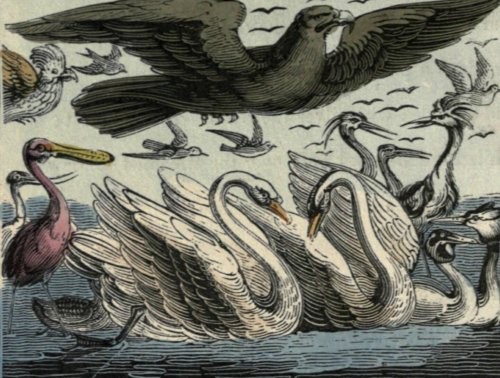
“From his high rock-built eyrie the Eagle came forth, &c.” Page 6.
Original illustration→
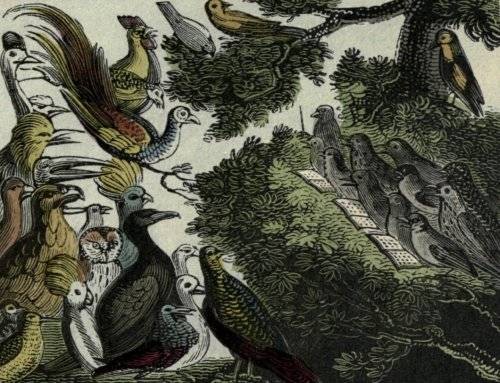
“A holly-bush form’d the orchestra, &c.” Page 7.
The Peacock, Imperial, the pride of his race,
Receiv’d all his guests with an infinite grace,
Wav’d high his blue neck, and his train he display’d,
Embroider’d with gold, and with em’ralds inlaid.
Then with all the gay troop to the shrubb’ry repair’d,
Where the musical Birds had a concert prepar’d;
A holly bush form’d the Orchestra, and in it
Sat the Black-bird, the Thrush, the Lark, and the Linnet;
A Bull-finch, a captive! almost from the nest,
Now escap’d from his cage, and, with liberty blest,
In a sweet mellow tone, join’d the lessons of art
With the accents of nature, which flow’d from his heart.
[p 8]The Canary, a much admir’d foreign musician,
Condescended to sing to the Fowls of condition.
While the Nightingale warbled and quaver’d so fine,
That they all clapp’d their wings, and pronounc’d it divine!
The Sky Lark, in extacy, sang from a cloud,
And Chanticleer crow’d, and the Yaffil laugh’d loud.
The dancing began, when the singing was over;
A Dotterell first opened the ball with the Plover;
Baron Stork, in a waltz, was allowed to excel,
With his beautiful partner, the fair Demoiselle;
And a newly-fledg’d Gosling, so fair and genteel,
A minuet swam with the spruce Mr. Teal.
A London-bred Sparrow—>a pert forward Cit!
Danc’d a reel with Miss Wagtail, and little Tom Tit.
And the Sieur Guillemot next performed a pas seul,
While the elderly bipeds were playing a Pool.
The Dowager Lady Toucan first cut in,
With old Doctor Buzzard and Adm’ral Penguin,
From Ivy bush tow’r came Dame Owlet the Wise,
And Counsellor Crossbill sat by to advise.
Original illustration→

“Baron Stork, in a waltz, was allowed to excel, &c.” Page 8.
Original illustration→
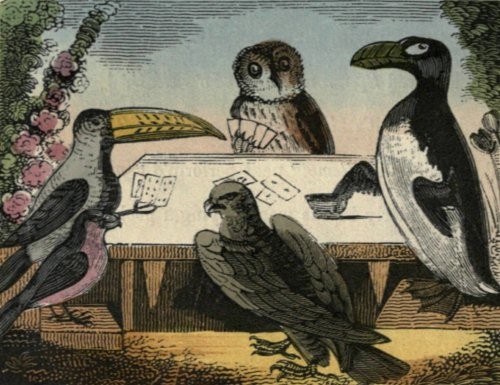
“The Dowager Lady Toucan first cut in, &c.” Page 8.
Original illustration→
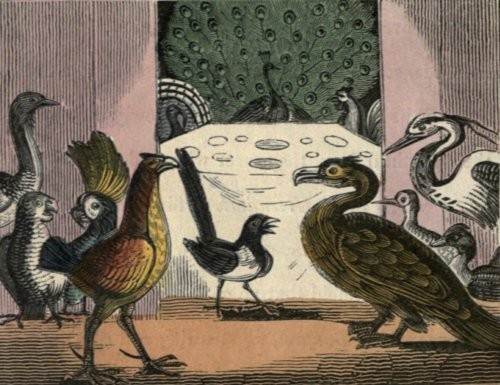
“Till a Magpie, at length, the banquet announcing, &c.” Page 9.
[p 9]Some birds past their prime, o’er whose heads it was fated,
Should pass many St. Valentines—yet be unmated,
Sat by, and remark’d that the prudent and sage
Were quite overlook’d in this frivolous age,
When Birds, scarce pen-feathered, were brought to a rout,
Forward Chits! from the egg-shell but newly come out:
In their youthful days, they ne’er witness’d such frisking,
And how wrong! in the Greenfinch to flirt with the Siskin.
So thought Lady Mackaw, and her Friend Cockatoo,
And the Raven foretold that no good could ensue!
They censur’d the Bantam for strutting and crowing
In those vile pantaloons, which he fancied look’d knowing:
And a want of decorum caus’d many demurs
Against the Game Chicken, for coming in spurs.
Old Alderman Cormrant, for supper impatient,
At the Eating-room door, for an hour had been station’d,
Till a Magpye, at length, the banquet announcing,
Gave the signal, long wish’d for, of clamouring and pouncing;
At the well-furnish’d board all were eager to perch,
But the little Miss Creepers were left in the lurch.
[p 10]Description must fail; and the pen is unable
To recount all the lux’ries that cover’d the table.
Each delicate viand that taste could denote,
Wasps a la sauce piquante, and Flies en compôte;
Worms and Frogs en friture, for the web-footed Fowl;
And a barbecu’d Mouse was prepar’d for the Owl;
Nuts, grains, fruit, and fish, to regale ev’ry palate,
And groundsel and chickweed serv’d up in a sallad,
The Razor-Bill carv’d for the famishing group,
And the Spoon-Bill obligingly ladled the soup;
So they fill’d all their crops with the dainties before ’em,
And the tables were clear’d with the utmost decorum.
When they gaily had caroll’d till peep of the dawn,
The Lark gently hinted, ’twas time to be gone;
And his clarion, so shrill, gave the company warning,
That Chanticleer scented the gales of the morning.
So they chirp’d, in full chorus, a friendly adieu;
And, with hearts beating light as the plumage that grew
On their merry-thought bosoms, away they all flew.
Original illustration→
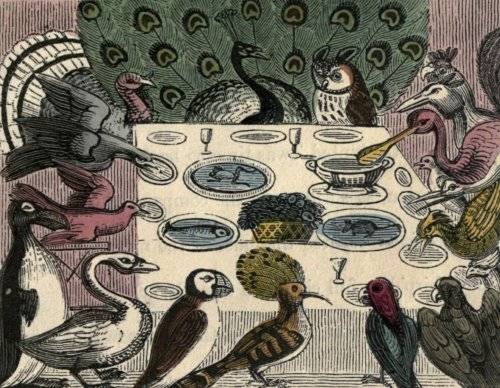
“So they fill’d all their crops, &c.” Page 10.
[p 11]Then long live the Peacock, in splendour unmatch’d,
Whose Ball shall be talk’d of, by Birds yet unhatch’d,
His praise let the Trumpeter loudly proclaim,
And the Goose lend her quill to transmit it to Fame.
NOTES.
Page 4. l. 15. The Rip.] A machine used in poultry-yards, under which it is usual to confine the mother bird with the young brood, till it has acquired strength to follow her. The word is derived from the Saxon, Hrip, meaning a covering, or protection, for the young.
P. 5. l. 13. The Taylor Bird (Motacilla Sutoria).] So called from the singular manner in which it constructs its nest, which is composed of two leaves, sewed together with wonderful skill, by the little taylor, whose bill serves him for a needle, and the fine fibres of leaves furnishes him with a substitute for thread, and by which means he attaches a dead leaf to a living one, growing at the end of a branch. The Taylor Bird is an inhabitant of India.
P. 5. l. 17. The Golden-crested Wren (Motacilla Regulus).] Is the smallest of the British birds; it takes its name from a circle of gold-coloured feathers, bordered with black, forming an arch above its eyes, which it has the power of raising or depressing: it is a native of every part of Europe, and is also to be found in Asia and America.
P. 5. l. 19. Halcyon, or Kingfisher, (Alcedo-irpedo).] Esteemed the most beautiful of our native birds; but its form is clumsy, and its bill very disproportionate to its size. It inhabits the banks of rivers and streams, where it will sit for hours, on a projecting branch, watching for its prey. The ancients relate many fabulous stories of this bird, as that of its laying its eggs in the depth of winter, and that during the time of its incubation the weather remains perfectly calm, whence the expression Halcyon Days.
P. 6. l. 2. Cuculus Indicator.] A Bird of the Cuckoo kind, found in the interior parts of Africa; it has a shrill note, which the Natives answer by a soft whistle; and the Birds repeating the note, the Natives are thereby conducted to the wild Bee-hives, which this Bird frequents.
P. 6. l. 5. Cassowary.] A large singular bird, found in the Island of Java, in Africa, and the southern parts of India. The head of this bird is armed with a kind of natural helmet, extending from the base of the bill to near half way over the head.
P. 6. l. 5. Flamingo Phœnicopterus.] A bird of the Crane kind, but web-footed, whose plumage is of a bright scarlet; when standing erect, it measures above six feet, though its body is not larger than that of a goose, and is a native of Africa, Persia, and South America.
P. 6. l. 8. Ptarmigan (Tetrao).] The white grons, or white game, inhabits the Highlands of Scotland and the Western Islands; it prefers the coldest situations on the highest mountains, where it burrows under the snow. It changes its feathers twice in the year, and about the end of February puts on its summer dress of dusky brown, ash, and orange-coloured feathers; which it loses in winter for a plumage perfectly white, except a black line between the bill and the eye. The legs and toes are warmly clothed with a thick long coat of soft white feathers.
P. 6. l. 17. The Chough (Corrus Graculus).] This bird, which is about the size of the daw, has a long curved bill, sharp at the point, which, as well as the legs and feet, is of a bright scarlet, contrasting beautifully with its black plumage, which varies as the light falls on it, to a deep purple or violet. Its general haunts are the crevices of high cliffs in Devonshire and Cornwall.
P. 7. l. 2. The Widow, or Widah Bird.] Is a species of bunting, a native of Angola and other parts of Africa. And is remarkable for the feathers of its tail. The two middle ones are about four inches long, and ending in a long thread, the two next are thirteen inches in length, broad and narrowing towards the points, from these proceed another long thread.
P. 8. l. 6. Yaffil the Woodpecker (Picus Viridus).] The name Yaffil is provincial, but is so very expressive of the noise it continually makes, that I have preferred it on that account. It is a beautiful bird, and is sometimes called the English parrot; the colour of its plumage, green, yellow, and scarlet, giving it some resemblance to that bird.
P. 8. l. 10. The Numidian Crane, or Demoiselle.] From the elegance of its appearance, and its singular carriage, is called the Demoiselle, which means the young Lady; for this bird walks very gracefully, and sometimes skips and leaps, as though it were trying to dance.
P. 8. l. 15. Guillemot (Colymbus).] A sea bird, of which there are several species numerously spread over the northern world; from whence they come towards winter to the British shores and remain till they have reared their young: it is sometimes called the foolish Guillemot from his stupidity; for when their companions are shot one after another, they have so little sense of danger, that they make a small circuit, and then return and settle in the same place, to share the same fate.
P. 8. l. 17. Toucan (Ramphastos).] A native of America, where it builds in the hollows of trees, and sits at the entrance, ready to peck at the monkeys, who often endeavour to destroy and eat the young. It is about the size of a Magpye, but the head large in proportion, to enable it to support its immense bill, which is six inches and a half in length, but extremely thin. It is a mild inoffensive bird, and easily tamed, but cannot endure the cold of our climate; the feathers of the breast are highly esteemed by the natives.
P. 8. l. 20. Cross-bill (Loxia).] So called because the two mandibles cross each other in different directions: they feed chiefly on the seeds of fir-trees; the singular construction of their bills being admirably adapted to separate the seeds of the cones. The pips of apples are also a favourite food, and to obtain them, they split the apple with one stroke of their bill; they are consequently found to be very injurious to orchards. It has been observed that they have been more frequently seen in England since the fir-tree has been generally more planted, than formerly.
P. 9. l. 8. Siskin (Fringilla Spinus).] A migratory bird, which is seen in the Southern parts of England at the time of the barley harvest, and is sometimes called the Barley-bird. It has a pleasing note, and is sold as a singing bird in the London bird-shops by the name of the Aberdevine. The accusation of its flirtation with the Greenfinch, is to be understood as pure scandal, the most prying naturalist never having discovered any particular attachment between them.
P. 10. l. 9. Razor bill (Alea).] A migratory sea-bird which visits the Northern shores in spring, and leaves them in winter; they lay a single egg on the ledges of the rocks without any nest, and on which it is said to be fixed by a cement.
P. 10. l. 10. Spoon-bill (Platea).] So called from the construction of the bill, which is flat the whole length, but widens towards the end in the form of a spoon or spatula; and it is equally remarkable in its substance, not being hard like bone, but flexible like whalebone; they feed on snakes, worms, frogs, and fish, even on shellfish, which they first break with their bills.
P. 11. l. 3. The Agami, or Trumpeter, a native of America, remarkable for a singular noise, resembling the instrument from which it takes its name.
THE END.
J. Swan, Printer, 76, Fleet Street, London.
Transcriber’s Notes:
Obvious spelling/typographical and punctuation errors have been corrected after careful comparison with other occurrences within the text and consultation of external sources.
Transcriber’s notes in text—mostly detailing corrections—are indicated by faint dotted underlining. Scroll the mouse over the word and the note will
appear
.The illustrations used in this e-text are taken from a later edition of the poem. Apart from slight differences in colouring, they are identical to those in the original book. Links to the original illustrations are provided.
End of Project Gutenberg's The Peacock 'At Home:', by Catherine Ann Dorset
*** END OF THIS PROJECT GUTENBERG EBOOK THE PEACOCK 'AT HOME:' ***
***** This file should be named 23281-h.htm or 23281-h.zip *****
This and all associated files of various formats will be found in:
http://www.gutenberg.org/2/3/2/8/23281/
Produced by David Wilson and the Online Distributed
Proofreading Team at http://www.pgdp.net (This file was
produced from images generously made available by The
Internet Archive/American Libraries.)
Updated editions will replace the previous one--the old editions
will be renamed.
Creating the works from public domain print editions means that no
one owns a United States copyright in these works, so the Foundation
(and you!) can copy and distribute it in the United States without
permission and without paying copyright royalties. Special rules,
set forth in the General Terms of Use part of this license, apply to
copying and distributing Project Gutenberg-tm electronic works to
protect the PROJECT GUTENBERG-tm concept and trademark. Project
Gutenberg is a registered trademark, and may not be used if you
charge for the eBooks, unless you receive specific permission. If you
do not charge anything for copies of this eBook, complying with the
rules is very easy. You may use this eBook for nearly any purpose
such as creation of derivative works, reports, performances and
research. They may be modified and printed and given away--you may do
practically ANYTHING with public domain eBooks. Redistribution is
subject to the trademark license, especially commercial
redistribution.
*** START: FULL LICENSE ***
THE FULL PROJECT GUTENBERG LICENSE
PLEASE READ THIS BEFORE YOU DISTRIBUTE OR USE THIS WORK
To protect the Project Gutenberg-tm mission of promoting the free
distribution of electronic works, by using or distributing this work
(or any other work associated in any way with the phrase "Project
Gutenberg"), you agree to comply with all the terms of the Full Project
Gutenberg-tm License (available with this file or online at
http://gutenberg.org/license).
Section 1. General Terms of Use and Redistributing Project Gutenberg-tm
electronic works
1.A. By reading or using any part of this Project Gutenberg-tm
electronic work, you indicate that you have read, understand, agree to
and accept all the terms of this license and intellectual property
(trademark/copyright) agreement. If you do not agree to abide by all
the terms of this agreement, you must cease using and return or destroy
all copies of Project Gutenberg-tm electronic works in your possession.
If you paid a fee for obtaining a copy of or access to a Project
Gutenberg-tm electronic work and you do not agree to be bound by the
terms of this agreement, you may obtain a refund from the person or
entity to whom you paid the fee as set forth in paragraph 1.E.8.
1.B. "Project Gutenberg" is a registered trademark. It may only be
used on or associated in any way with an electronic work by people who
agree to be bound by the terms of this agreement. There are a few
things that you can do with most Project Gutenberg-tm electronic works
even without complying with the full terms of this agreement. See
paragraph 1.C below. There are a lot of things you can do with Project
Gutenberg-tm electronic works if you follow the terms of this agreement
and help preserve free future access to Project Gutenberg-tm electronic
works. See paragraph 1.E below.
1.C. The Project Gutenberg Literary Archive Foundation ("the Foundation"
or PGLAF), owns a compilation copyright in the collection of Project
Gutenberg-tm electronic works. Nearly all the individual works in the
collection are in the public domain in the United States. If an
individual work is in the public domain in the United States and you are
located in the United States, we do not claim a right to prevent you from
copying, distributing, performing, displaying or creating derivative
works based on the work as long as all references to Project Gutenberg
are removed. Of course, we hope that you will support the Project
Gutenberg-tm mission of promoting free access to electronic works by
freely sharing Project Gutenberg-tm works in compliance with the terms of
this agreement for keeping the Project Gutenberg-tm name associated with
the work. You can easily comply with the terms of this agreement by
keeping this work in the same format with its attached full Project
Gutenberg-tm License when you share it without charge with others.
1.D. The copyright laws of the place where you are located also govern
what you can do with this work. Copyright laws in most countries are in
a constant state of change. If you are outside the United States, check
the laws of your country in addition to the terms of this agreement
before downloading, copying, displaying, performing, distributing or
creating derivative works based on this work or any other Project
Gutenberg-tm work. The Foundation makes no representations concerning
the copyright status of any work in any country outside the United
States.
1.E. Unless you have removed all references to Project Gutenberg:
1.E.1. The following sentence, with active links to, or other immediate
access to, the full Project Gutenberg-tm License must appear prominently
whenever any copy of a Project Gutenberg-tm work (any work on which the
phrase "Project Gutenberg" appears, or with which the phrase "Project
Gutenberg" is associated) is accessed, displayed, performed, viewed,
copied or distributed:
This eBook is for the use of anyone anywhere at no cost and with
almost no restrictions whatsoever. You may copy it, give it away or
re-use it under the terms of the Project Gutenberg License included
with this eBook or online at www.gutenberg.org
1.E.2. If an individual Project Gutenberg-tm electronic work is derived
from the public domain (does not contain a notice indicating that it is
posted with permission of the copyright holder), the work can be copied
and distributed to anyone in the United States without paying any fees
or charges. If you are redistributing or providing access to a work
with the phrase "Project Gutenberg" associated with or appearing on the
work, you must comply either with the requirements of paragraphs 1.E.1
through 1.E.7 or obtain permission for the use of the work and the
Project Gutenberg-tm trademark as set forth in paragraphs 1.E.8 or
1.E.9.
1.E.3. If an individual Project Gutenberg-tm electronic work is posted
with the permission of the copyright holder, your use and distribution
must comply with both paragraphs 1.E.1 through 1.E.7 and any additional
terms imposed by the copyright holder. Additional terms will be linked
to the Project Gutenberg-tm License for all works posted with the
permission of the copyright holder found at the beginning of this work.
1.E.4. Do not unlink or detach or remove the full Project Gutenberg-tm
License terms from this work, or any files containing a part of this
work or any other work associated with Project Gutenberg-tm.
1.E.5. Do not copy, display, perform, distribute or redistribute this
electronic work, or any part of this electronic work, without
prominently displaying the sentence set forth in paragraph 1.E.1 with
active links or immediate access to the full terms of the Project
Gutenberg-tm License.
1.E.6. You may convert to and distribute this work in any binary,
compressed, marked up, nonproprietary or proprietary form, including any
word processing or hypertext form. However, if you provide access to or
distribute copies of a Project Gutenberg-tm work in a format other than
"Plain Vanilla ASCII" or other format used in the official version
posted on the official Project Gutenberg-tm web site (www.gutenberg.org),
you must, at no additional cost, fee or expense to the user, provide a
copy, a means of exporting a copy, or a means of obtaining a copy upon
request, of the work in its original "Plain Vanilla ASCII" or other
form. Any alternate format must include the full Project Gutenberg-tm
License as specified in paragraph 1.E.1.
1.E.7. Do not charge a fee for access to, viewing, displaying,
performing, copying or distributing any Project Gutenberg-tm works
unless you comply with paragraph 1.E.8 or 1.E.9.
1.E.8. You may charge a reasonable fee for copies of or providing
access to or distributing Project Gutenberg-tm electronic works provided
that
- You pay a royalty fee of 20% of the gross profits you derive from
the use of Project Gutenberg-tm works calculated using the method
you already use to calculate your applicable taxes. The fee is
owed to the owner of the Project Gutenberg-tm trademark, but he
has agreed to donate royalties under this paragraph to the
Project Gutenberg Literary Archive Foundation. Royalty payments
must be paid within 60 days following each date on which you
prepare (or are legally required to prepare) your periodic tax
returns. Royalty payments should be clearly marked as such and
sent to the Project Gutenberg Literary Archive Foundation at the
address specified in Section 4, "Information about donations to
the Project Gutenberg Literary Archive Foundation."
- You provide a full refund of any money paid by a user who notifies
you in writing (or by e-mail) within 30 days of receipt that s/he
does not agree to the terms of the full Project Gutenberg-tm
License. You must require such a user to return or
destroy all copies of the works possessed in a physical medium
and discontinue all use of and all access to other copies of
Project Gutenberg-tm works.
- You provide, in accordance with paragraph 1.F.3, a full refund of any
money paid for a work or a replacement copy, if a defect in the
electronic work is discovered and reported to you within 90 days
of receipt of the work.
- You comply with all other terms of this agreement for free
distribution of Project Gutenberg-tm works.
1.E.9. If you wish to charge a fee or distribute a Project Gutenberg-tm
electronic work or group of works on different terms than are set
forth in this agreement, you must obtain permission in writing from
both the Project Gutenberg Literary Archive Foundation and Michael
Hart, the owner of the Project Gutenberg-tm trademark. Contact the
Foundation as set forth in Section 3 below.
1.F.
1.F.1. Project Gutenberg volunteers and employees expend considerable
effort to identify, do copyright research on, transcribe and proofread
public domain works in creating the Project Gutenberg-tm
collection. Despite these efforts, Project Gutenberg-tm electronic
works, and the medium on which they may be stored, may contain
"Defects," such as, but not limited to, incomplete, inaccurate or
corrupt data, transcription errors, a copyright or other intellectual
property infringement, a defective or damaged disk or other medium, a
computer virus, or computer codes that damage or cannot be read by
your equipment.
1.F.2. LIMITED WARRANTY, DISCLAIMER OF DAMAGES - Except for the "Right
of Replacement or Refund" described in paragraph 1.F.3, the Project
Gutenberg Literary Archive Foundation, the owner of the Project
Gutenberg-tm trademark, and any other party distributing a Project
Gutenberg-tm electronic work under this agreement, disclaim all
liability to you for damages, costs and expenses, including legal
fees. YOU AGREE THAT YOU HAVE NO REMEDIES FOR NEGLIGENCE, STRICT
LIABILITY, BREACH OF WARRANTY OR BREACH OF CONTRACT EXCEPT THOSE
PROVIDED IN PARAGRAPH F3. YOU AGREE THAT THE FOUNDATION, THE
TRADEMARK OWNER, AND ANY DISTRIBUTOR UNDER THIS AGREEMENT WILL NOT BE
LIABLE TO YOU FOR ACTUAL, DIRECT, INDIRECT, CONSEQUENTIAL, PUNITIVE OR
INCIDENTAL DAMAGES EVEN IF YOU GIVE NOTICE OF THE POSSIBILITY OF SUCH
DAMAGE.
1.F.3. LIMITED RIGHT OF REPLACEMENT OR REFUND - If you discover a
defect in this electronic work within 90 days of receiving it, you can
receive a refund of the money (if any) you paid for it by sending a
written explanation to the person you received the work from. If you
received the work on a physical medium, you must return the medium with
your written explanation. The person or entity that provided you with
the defective work may elect to provide a replacement copy in lieu of a
refund. If you received the work electronically, the person or entity
providing it to you may choose to give you a second opportunity to
receive the work electronically in lieu of a refund. If the second copy
is also defective, you may demand a refund in writing without further
opportunities to fix the problem.
1.F.4. Except for the limited right of replacement or refund set forth
in paragraph 1.F.3, this work is provided to you 'AS-IS' WITH NO OTHER
WARRANTIES OF ANY KIND, EXPRESS OR IMPLIED, INCLUDING BUT NOT LIMITED TO
WARRANTIES OF MERCHANTIBILITY OR FITNESS FOR ANY PURPOSE.
1.F.5. Some states do not allow disclaimers of certain implied
warranties or the exclusion or limitation of certain types of damages.
If any disclaimer or limitation set forth in this agreement violates the
law of the state applicable to this agreement, the agreement shall be
interpreted to make the maximum disclaimer or limitation permitted by
the applicable state law. The invalidity or unenforceability of any
provision of this agreement shall not void the remaining provisions.
1.F.6. INDEMNITY - You agree to indemnify and hold the Foundation, the
trademark owner, any agent or employee of the Foundation, anyone
providing copies of Project Gutenberg-tm electronic works in accordance
with this agreement, and any volunteers associated with the production,
promotion and distribution of Project Gutenberg-tm electronic works,
harmless from all liability, costs and expenses, including legal fees,
that arise directly or indirectly from any of the following which you do
or cause to occur: (a) distribution of this or any Project Gutenberg-tm
work, (b) alteration, modification, or additions or deletions to any
Project Gutenberg-tm work, and (c) any Defect you cause.
Section 2. Information about the Mission of Project Gutenberg-tm
Project Gutenberg-tm is synonymous with the free distribution of
electronic works in formats readable by the widest variety of computers
including obsolete, old, middle-aged and new computers. It exists
because of the efforts of hundreds of volunteers and donations from
people in all walks of life.
Volunteers and financial support to provide volunteers with the
assistance they need, is critical to reaching Project Gutenberg-tm's
goals and ensuring that the Project Gutenberg-tm collection will
remain freely available for generations to come. In 2001, the Project
Gutenberg Literary Archive Foundation was created to provide a secure
and permanent future for Project Gutenberg-tm and future generations.
To learn more about the Project Gutenberg Literary Archive Foundation
and how your efforts and donations can help, see Sections 3 and 4
and the Foundation web page at http://www.pglaf.org.
Section 3. Information about the Project Gutenberg Literary Archive
Foundation
The Project Gutenberg Literary Archive Foundation is a non profit
501(c)(3) educational corporation organized under the laws of the
state of Mississippi and granted tax exempt status by the Internal
Revenue Service. The Foundation's EIN or federal tax identification
number is 64-6221541. Its 501(c)(3) letter is posted at
http://pglaf.org/fundraising. Contributions to the Project Gutenberg
Literary Archive Foundation are tax deductible to the full extent
permitted by U.S. federal laws and your state's laws.
The Foundation's principal office is located at 4557 Melan Dr. S.
Fairbanks, AK, 99712., but its volunteers and employees are scattered
throughout numerous locations. Its business office is located at
809 North 1500 West, Salt Lake City, UT 84116, (801) 596-1887, email
business@pglaf.org. Email contact links and up to date contact
information can be found at the Foundation's web site and official
page at http://pglaf.org
For additional contact information:
Dr. Gregory B. Newby
Chief Executive and Director
gbnewby@pglaf.org
Section 4. Information about Donations to the Project Gutenberg
Literary Archive Foundation
Project Gutenberg-tm depends upon and cannot survive without wide
spread public support and donations to carry out its mission of
increasing the number of public domain and licensed works that can be
freely distributed in machine readable form accessible by the widest
array of equipment including outdated equipment. Many small donations
($1 to $5,000) are particularly important to maintaining tax exempt
status with the IRS.
The Foundation is committed to complying with the laws regulating
charities and charitable donations in all 50 states of the United
States. Compliance requirements are not uniform and it takes a
considerable effort, much paperwork and many fees to meet and keep up
with these requirements. We do not solicit donations in locations
where we have not received written confirmation of compliance. To
SEND DONATIONS or determine the status of compliance for any
particular state visit http://pglaf.org
While we cannot and do not solicit contributions from states where we
have not met the solicitation requirements, we know of no prohibition
against accepting unsolicited donations from donors in such states who
approach us with offers to donate.
International donations are gratefully accepted, but we cannot make
any statements concerning tax treatment of donations received from
outside the United States. U.S. laws alone swamp our small staff.
Please check the Project Gutenberg Web pages for current donation
methods and addresses. Donations are accepted in a number of other
ways including checks, online payments and credit card donations.
To donate, please visit: http://pglaf.org/donate
Section 5. General Information About Project Gutenberg-tm electronic
works.
Professor Michael S. Hart is the originator of the Project Gutenberg-tm
concept of a library of electronic works that could be freely shared
with anyone. For thirty years, he produced and distributed Project
Gutenberg-tm eBooks with only a loose network of volunteer support.
Project Gutenberg-tm eBooks are often created from several printed
editions, all of which are confirmed as Public Domain in the U.S.
unless a copyright notice is included. Thus, we do not necessarily
keep eBooks in compliance with any particular paper edition.
Most people start at our Web site which has the main PG search facility:
http://www.gutenberg.org
This Web site includes information about Project Gutenberg-tm,
including how to make donations to the Project Gutenberg Literary
Archive Foundation, how to help produce our new eBooks, and how to
subscribe to our email newsletter to hear about new eBooks.


