


автордың кітабын онлайн тегін оқу The Poems of Madison Cawein, vol. 2
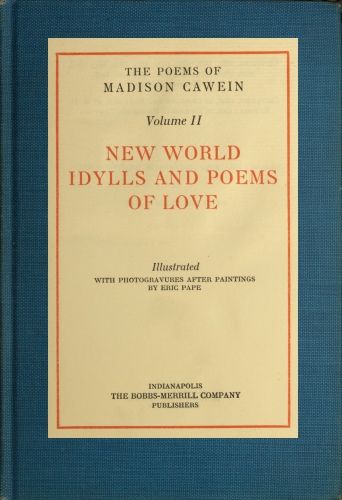
THE POEMS OF
MADISON CAWEIN
VOLUME II
NEW WORLD IDYLLS AND
POEMS OF LOVE
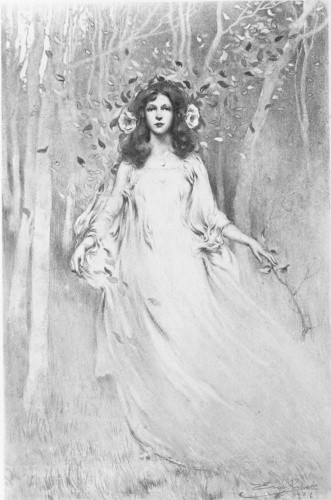
Ah, girlhood, through the rosy haze Come like a moonbeam slipping. Page 3 One Day and Another
THE POEMS OF
M A D I S O N C A W E I N
Volume II
NEW WORLD IDYLLS AND POEMS OF LOVE
Illustrated
WITH PHOTOGRAVURES AFTER PAINTINGS
BY ERIC PAPE
INDIANAPOLIS
THE BOBBS-MERRILL COMPANY
PUBLISHERS
Copyright, 1887, 1888, 1889, 1890, 1891, 1892, 1893, 1894, 1896, 1898, 1899, 1901, 1902, 1905 and 1907, by Madison Cawein
Copyright, 1896, by Copeland and Day; 1898, by R. H Russell; 1901, by Richard G. Badger and Company
PRESS OF BRAUNWORTH & CO. BOOKBINDERS AND PRINTERS BROOKLYN, N. Y.
WITH ENDURING FRIENDSHIP, LOVE AND LOYALTY
TO
JAMES WHITCOMB RILEY
CONTENTS
NEW WORLD IDYLLS
PAGE Brothers, The 246 Dead Man’s Run 241 Deep in the Forest 196 Epic of South-Fork, An 180 Feud, The 237 Idyll of the Standing-Stone, The 161 Lynchers 239 Mosby at Hamilton 235 Niello, A 192 One Day and Another 1 Raid, The 244 Red Leaves and Roses 116 Siren Sands 217 Some Summer Days 171 War-Time Silhouettes 224 Wild Thorn and Lily 122 Wreckage 209POEMS OF LOVE
After Death 482 Among the Acres of the Wood 343 An Autumn Night 519 Andalia and the Springtime 304 Apart 356 Apocalypse 327 At Her Grave 386 At Nineveh 476 At Parting 509 At Sunset 405 At the Stile 288 At Twenty-One 351 At Twilight 391 Blind God, The 357 Burden of Desire, The 274 Can I Forget? 328 Cara Mia 358 Carissima Mea 517 Carmen 473 Castle of Love, The 295 Caverns of Kaf, The 431 Chords 382 Christmas Catch, A 378 “Come to the Hills” 512 Conclusion 529 Confession, A 388 Consecration 298 Constance 362 Contrasts 516 Creole Serenade 321 Daughter of the Snow, The 414 Daughter of the States, A 521 Day and Night 392 Dead and Gone 406 Epilogue 261 Evasion 513 Fern-Seed 290 Finale 527 Floridian 374 Forest Pool, The 403 Gertrude 267 Glory and the Dream, The 501 Ghost Weather 402 Gypsying 278 Heart’s Desire, The 395 Heart of My Heart 269 Helen 365 Her Eyes 354 Her Vesper Song 499 Her Violin 492 Her Vivien Eyes 496 Ideal Divination 324 “If I Were Her Lover” 337 In A Garden 335 In Autumn 488 Indifference 401 In May 503 In June 331 In the Garden of Girls 511 Kinship 352 Last Days 390 Lora of the Vales 313 Lost Love 283 Love 268 Love and A Day 369 Love in A Garden 372 Lyanna 447 Lydia 364 March and May 486 Margery 360 Masks 469 Meeting in Summer 494 Memories 485 Messengers 355 Metamorphosis 350 Mignon 367 Miriam 524 My Rose 329 Nocturne 348 Noëra 340 Old Man Dreams, The 483 Olivia in the Autumn 306 One Night 407 Oriental Romance 317 Out of the Depths 397 Overseas 285 Pastoral Love 302 Pledges 315 Porphyrogenita 292 Pupil of Pan, A 312 Quarrel, The 522 Reasons 497 Reed Call for April 490 Restraint 330 Romantic Love 300 Salamander, The 438 Senorita 479 “She is so Much” 353 Since Then 481 Sirens, The 346 Snow and Fire 502 Song for Yule, A 380 Spirits of Light and Darkness, The 454 Spirit of the Star, The 417 Spirit of the Van, The 423 Strollers 271 Succuba, The 464 Summer Sea, The 525 Sylvia of the Woodland 308 The Parting 412 The Ride 507 The Tryst 276 “This is the Face of Her” 399 Three Birds 393 Tollman’s Daughter, The 319 Transubstantiation 368 Uncertainty 280 Unrequited 394 Water Witch, The 459 “Were I an Artist” 505 “When She Draws Near” 489 When Ships Put Out to Sea 376 Why? 347 Will O’ The Wisps 333 Will You Forget? 515 Witnesses 310 Words 345LIST OF ILLUSTRATIONS
Ah, girlhood, through the rosy haze Come like a moonbeam slipping.(See
page 3)
Frontispiece PAGE Where the woodcock call.(See
page 161)
160
Something drew me, unreturning, Filled me with a finer flame.(See
page 419)
350
I look into thy heart and then I know The wondrous poetry of the long-ago.(See
page 497)
490
NEW WORLD IDYLLS
Tampa, Florida, February, 1893.
And she will know, and bow her head and weep.”
—The wood is haunted since that night.
“But what of your eyes, my destiny?”
“That blessed us unaware.”
Only be brave and bear!”
Awaits my first true lover.”
If still ye have youth!”
At last, dear heart, ’t is day!”
And pride that will not stand and wait.—
All in the summer gloaming.”
My meaning should be plain to you!”
Beauty and mystery.”
Men whispered—“Lyanna is dead!”
Weary, ah me! ah me!”
She is like sweet Moll!”
And only we have, trysting, met.”
O lyrist of the lowly and the true, The song I sought for you Still bides unsung. What hope for me to find, Lost in the dædal mind, The living utterance with lovely tongue, To sing,—as once he sung, Rare Ariosto, of Knight-Errantry,— How you in Poesy, Song’s Paladin, Knight of the Dream and Day, The shield of magic sway! Of that Atlantes’ power, sweet and terse, The skyey-builded verse! The shield that dazzles, brilliant with surprise, Our unanointed eyes.— Oh, could I write as it were worthy you, Each word, a spark of dew,— As once Ferdusi wrote in Persia,— Would string each rosy spray Of each unfolding flower of my song; And Iran’s bulbul tongue Would sob its heart out o’er the fountain’s slab In gardens of Afrasiab.
ONE DAY AND ANOTHER
A Lyrical Eclogue
PART I
LATE SPRING
The mottled moth at eventide Beats glimmering wings against the pane; The slow, sweet lily opens wide, White in the dusk like some dim stain; The garden dreams on every side And breathes faint scents of rain: Among the flowering stocks they stand; A crimson rose is in her hand.
I
Outside her garden. He waits musing:
Herein the dearness of her is; The thirty perfect days of June Made one, in maiden loveliness Were not more sweet to clasp and kiss, With love not more in tune.
Ah me! I think she is too true, Too spiritual for life’s rough way: So say her eyes,—her soul looks through,— Two bluet blossoms, watchet-blue, Are not more pure than they.
So kind, so beautiful is she, So soft and white, so fond and fair, Sometimes my heart fears she may be Not long for Earth, and secretly Sweet sister to the air.
II
Dusk deepens. A whippoorwill calls.
The whippoorwills are calling where The golden west is graying; “’Tis time,” they say, “to meet him there— Why are you still delaying?
“He waits you where the old beech throws Its gnarly shadow over Wood violet and the bramble rose, Frail lady-fern and clover.
“Where elder and the sumac peep Above your garden’s paling, Whereon, at noon, the lizards sleep, Like lichen on the railing.
“Come! ere the early rising moon’s Gold floods the violet valleys; Where mists, like phantom picaroons Anchor their stealthy galleys.
“Come! while the deepening amethyst Of dusk above is falling— ’Tis time to tryst! ’tis time to tryst!” The whippoorwills are calling.
They call you to these twilight ways With dewy odor dripping— Ah, girlhood, through the rosy haze Come like a moonbeam slipping.
III
He enters the garden, speaking dreamily:
There is a fading inward of the day, And all the pansy sunset clasps one star; The twilight acres, eastward, glimmer gray, While all the world to westward smoulders far.
Now to your glass will you pass for the last time? Pass! humming some ballad, I know. Here where I wait it is late and is past time— Late! and the moments are slow, are slow.
There is a drawing downward of the night; The bridegroom Heaven bends down to kiss the moon: Above, the heights hang silver in her light; Below, the vales stretch purple, deep with June.
There in the dew is it you hiding lawny? You? or a moth in the vines?— You!—by your hand! where the band twinkles tawny! You!—by your ring, like a glow-worm that shines!
IV
She approaches, laughing. She speaks:
You’d given up hope?
He
Believe me!
She
Why! is your love so poor?
He
No. Yet you might deceive me!
She
As many a girl before.— Ah, dear, you will forgive me?
He
Say no more, sweet, say no more!
She
Love trusts; and that’s enough, my dear. Trust wins through love; whereof, my dear, Love holds through trust: and love, my dear, Is—all my life and lore.
He
Come, pay me or I’ll scold you.— Give me the kiss you owe.— You run when I would hold you?
She
No! no! I say! now, no!— How often have I told you, You must not use me so?
He
More sweet the dusk for this is, For lips that meet in kisses.— Come! come! why run from blisses As from a dreadful foe?
V
She stands smiling at him, shyly, then speaks:
How many words in the asking! How easily I can grieve you!— My “yes” in a “no” was a-masking, Nor thought, dear, to deceive you.— A kiss?—the humming-bird happiness here In my heart consents.... But what are words, When the thought of two souls in speech accords? Affirmative, negative—what are they, dear? I wished to say “yes,” but somehow said “no.” The woman within me knew you would know, Knew that your heart would hear.
He speaks:
So many words in the doing!— Therein you could not deceive me; Some things are sweeter for the pursuing: I knew what you meant, believe me.— Bunched bells of the blush pomegranate, to fix At your throat.... Six drops of fire they are.... Will you look—where the moon and its following star Rise silvery over yon meadow ricks? While I hold—while I bend your head back, so.... For I know it is “yes” though you whisper “no,” And my kisses, sweet, are six.
VI
Moths flutter around them. She speaks:
Look!—where the fiery Glow-worm in briery Banks of the moon-mellowed bowers Sparkles—how hazily Pinioned and airily Delicate, warily, Drowsily, lazily, Flutter the moths to the flowers.
White as the dreamiest Bud of the creamiest Rose in the garden that dozes, See how they cling to them! Held in the heart of their Hearts, like a part of their Perfume, they swing to them Wings that are soft as a rose is.
Dim as the forming of Dew in the warming of Moonlight, they light on the petals; All is revealed to them; All!—from the sunniest Tips to the honiest Heart, whence they yield to them Spice, through the darkness that settles.
So to our tremulous Souls come the emulous Agents of love; through whose power All that is best in us, All that is beautiful, Selfless and dutiful, Is manifest in us, Even as the scent of a flower.
VII
Taking her hand he says:
What makes you beautiful? Answer, now, answer!— Is it that dutiful Souls are all beautiful? Is it romance or Beauty of spirit, Which souls, that merit, Of heaven inherit?— Have you an answer?
She, roguishly:
What makes you lovable? Answer, now, answer!— Is it not provable That man is lovable Just because chance, or Nature, makes woman Love him?—Her human Part’s to illumine.— Have you an answer?
VIII
Then, regarding him seriously, she continues:
Could I recall every joy that befell me There in the past with its anguish and bliss, Here in my heart it hath whispered to tell me,— They were no joys like this.
Were it not well if our love could forget them, Veiling the Was with the dawn of the Is? Dead with the past we should never regret them, Being no joys like this.
Now they are gone and the Present stands speechful, Ardent of word and of look and of kiss,— What though we know that their eyes are beseechful!— They were no joys like this.
Were it not well to have more of the spirit, Living high Futures this earthly must miss? Less of the flesh, with the Past pining near it? Knowing no joys like this!
IX
Leaving the garden for the lane. He, with lightness of heart:
We will leave reason, Sweet, for a season: Reason were treason Now that the nether Spaces are clad, oh, In silvery shadow— We will be glad, oh, Glad as this weather!
She, responding to his mood:
Heart unto heart! where the moonlight is slanted, Let us believe that our souls are enchanted:— I in the castle-keep; you are the airy Prince who comes seeking me; love is the fairy Bringing us two together.
He
Starlight in masses Over us passes; And in the grass is Many a flower.—
Now will you tell me How ’d you enspell me? What once befell me There in your bower?
She
Soul unto soul!—in the moon’s wizard glory, Let us believe we are parts in a story:— I am a poem; a poet you hear it Whispered in star and in flower; a spirit, Love, puts my soul in your power.
X
He, suddenly and very earnestly:
Perhaps we lived in the days Of the Khalif Haroun er Reshid; And loved, as the story says Did the Sultan’s favorite one And the Persian Emperor’s son, Ali ben Bekkar, he Of the Kisra dynasty.
Do you know the story?—Well, You were Haroun’s Sultana. When night on the palace fell, A slave, through a secret door,— Low-arched on the Tigris’ shore,— By a hidden winding stair Brought me to your bower there.
Then there was laughter and mirth, And feasting and singing together, In a chamber of wonderful worth; In a chamber vaulted high On columns of ivory; Its dome, like the irised skies, Mooned over with peacock eyes; Its curtains and furniture, Damask and juniper.
Ten slave girls—so many blooms— Stand, holding tamarisk torches, Silk-clad from the Irak looms; Ten handmaidens serve the feast, Each maid like a star in the east; Ten lutanists, lutes a-tune, Wait, each like the Ramadan moon.
For you, in a stuff of Merv Blue-clad, unveiled and jeweled, No metaphor made may serve: Scarved deep with your raven hair, The jewels like fireflies there— Blossom and moon and star, The Lady Shemsennehar.
The zone that girdles your waist Would ransom a Prince and Emeer; In your coronet’s gold enchased, And your bracelet’s twisted bar, Burn rubies of Istakhar; And pearls of the Jamshid race Hang looped on your bosom’s lace.
You stand like the letter I; Dawn-faced, with eyes that sparkle Black stars in a rosy sky; Mouth, like a cloven peach, Sweet with your smiling speech; Cheeks, that the blood presumes To make pomegranate blooms.
With roses of Rocknabad, Hyacinths of Bokhara,— Creamily cool and clad In gauze,—girls scatter the floor From pillar to cedarn door. Then, a pomegranate bloom in each ear, Come the dancing-girls of Kashmeer.
Kohl in their eyes, down the room,— That opaline casting-bottles Have showered with rose-perfume,— They glitter and drift and swoon To the dulcimer’s languishing tune; In the liquid light like stars And moons and nenuphars.
Carbuncles, tragacanth-red, Smoulder in armlet and anklet: Gleaming on breast and on head, Bangles of coins, that are angled, Tinkle: and veils, that are spangled, Flutter from coiffure and wrist Like a star-bewildered mist.
Each dancing-girl is a flower Of the Tuba from vales of El Liwa.— How the bronzen censers glower! And scents of ambergris pour, And of myrrh, brought out of Lahore, And of musk of Khoten! how good Is the scent of the sandalwood!
A lutanist smites her lute, Sings loves of Mejnoon and Leila:— Her voice is an Houri flute;— While the fragrant flambeaux wave, Barbaric, o’er free and slave, O’er fabrics and bezels of gems And roses in anadems.
Sherbets in ewers of gold, Fruits in salvers carnelian; Flagons of grotesque mold, Made of a sapphire glass, Brimmed with wine of Shirâz; Shaddock and melon and grape On plate of an antique shape.
Vases of frosted rose, Of alabaster graven, Filled with the mountain snows; Goblets of mother-of-pearl, One filigree silver-swirl; Vessels of gold foamed up With spray of spar on the cup.
Then a slave bursts in with a cry: “The eunuchs! the Khalif’s eunuchs!— With scimitars bared draw nigh! Wesif and Afif and he, Chief of the hideous three, Mesrour!—the Sultan ’s seen ’Mid a hundred weapons’ sheen!”
Did we part when we heard this?—No! It seems that my soul remembers How I clasped and kissed you, so.... When they came they found us—dead, On the flowers our blood dyed red; Our lips together, and The dagger in my hand.
XI
She, musingly:
How it was I can not tell, For I know not where nor why; But I know we loved too well In some world that does not lie East or west of where we dwell, And beneath no earthly sky.
Was it in the golden ages?— Or the iron?—that I heard,— In the prophecy of sages,— Haply, how had come a bird, Underneath whose wing were pages Of an unknown lover’s word.
I forget. You may remember How the earthquake shook our ships; How our city, one huge ember, Blazed within the thick eclipse: When you found me—deep December Sealed my icy eyes and lips.
I forget. No one may say That such things can not be true:— Here a flower dies to-day, There, to-morrow, blooms anew.... Death is silent.—Tell me, pray, Why men doubt what God can do?
XII
He, with conviction:
As to that, nothing to tell! You being all my belief, Doubt can not enter or dwell Here where your image is chief; Here where your name is a spell, Potent in joy and in grief.
Is it the glamour of spring Working in us so we seem Aye to have loved? that we cling Even to some fancy or dream, Rainbowing everything, Here in our souls, with its gleam?
See! how the synod is met There of the planets to preach us:— Freed from the earth’s oubliette, See how the blossoms beseech us!— Were it not well to forget Winter and death as they teach us?
Dew and a bud and a star, All,—like a beautiful thought, Over man’s wisdom how far!— God for some purpose hath wrought.— Could we but know why they are, And that they end not in naught!
Stars and the moon; and they roll Over our way that is white.— Here shall we end the long stroll? Here shall I kiss you good night? Or, for a while, soul to soul, Linger and dream of delight?
XIII
They reënter the garden. She speaks somewhat pensively:
Myths tell of walls and cities, lyred of love, That rose to music.—Were that power my own, Had I that harp, that magic barbiton, What had I builded for our lives thereof?—
In docile shadows under bluebell skies, A home upon the poppied edge of eve, Beneath pale peaks the splendors never leave, ’Mid lemon orchards whence the egret flies.
Where, pitiless, the ruined hand of death Should never reach. No bud, no flower fade: Where all were perfect, pure and unafraid: And life serener than an angel’s breath.
The days should move to music: song should tame The nights, attentive with their listening stars: And morn outrival eve in opal bars, Each preaching beauty with rose-tongues of flame.
O home! O life! desired and to be! How shall we reach you?—Far the way and dim.— Give me your hand, sweet! let us follow him, Love with the madness and the melody.
XIV
He, observing the various dowers around them:
Violets and anemones The surrendered Hours Pour, as handsels, round the knees Of the Spring, who to the breeze Flings her myriad flowers.
Like to coins, the sumptuous day Strews with blossoms golden Every furlong of his way,— Like a Sultan gone to pray At a Kaaba olden.
Warlock Night, with spark on spark, Clad in dim attire, Dots with stars the haloed dark,— As a priest around the Ark Lights his lamps of fire.
These are but the cosmic strings Of the harp of Beauty, Of that instrument which sings, In our souls, of love, that brings Peace and faith and duty.
XV
She, seriously:
Duty?—Comfort of the sinner And the saint!—When grief and trial Weigh us, and within our inner Selves,—responsive to love’s viol,— Hope’s soft voice grows thin and thinner. It is kin to self-denial.
Self-denial! Through whose feeling We are gainer though we ’re loser; All the finer force revealing Of our natures. No accuser Is the conscience then, but healing Of the wound of which we ’re chooser.
Who the loser, who the winner, If the ardor fail as preacher?— None who loved was yet beginner, Though another’s love-beseecher: Love’s revealment ’s of the inner Life and God Himself is teacher.
Heine said “no flower knoweth Of the fragrance it revealeth; Song, its heart that overfloweth, Never nightingale’s heart feeleth”— Such is love the spirit groweth, Love unconscious if it healeth.
XVI
He, looking smilingly into her eyes, after a pause, lightly:
An elf there is who stables the hot Red wasp that sucks on the apricot; An elf, who rowels his spiteful bay, Like a mote on a ray, away, away; An elf, who saddles the hornet lean And dins i’ the ear o’ the swinging bean; Who straddles, with cap cocked, all awry, The bottle-green back o’ the dragon-fly.
And this is the elf who sips and sips From clover-horns whence the perfume drips; And, drunk with dew, in the glimmering gloam Awaits the wild-bee’s coming home; In ambush lies where none may see, And robs the caravan bumblebee: Gold bags of honey the bees must pay To the bandit elf of the fairy-way.
Another ouphen the butterflies know, Who paints their wings with the hues that glow On blossoms: squeezing from tubes of dew Pansy colors of every hue On his bloom’s pied pallet, he paints the wings Of the butterflies, moths, and other things. This is the elf that the hollyhocks hear, Who dangles a brilliant in each one’s ear; Teases at noon the pane’s green fly, And lights at night the glow-worm’s eye.
But the dearest elf, so the poets say, Is the elf who hides in an eye of gray; Who curls in a dimple or slips along The strings of a lute to a lover’s song; Who smiles in her smile and frowns in her frown, And dreams in the scent of her glove or gown; Hides and beckons, as all may note, In the bloom or the bow of a maiden’s throat.
XVII
She, pensively, standing among the flowers:
Soft through the trees the night wind sighs, And swoons and dies. Above, the stars hang wanly white; Here, through the dark, A drizzled gold, the fireflies Rain mimic stars in spark on spark.— ’Tis time to part, to say good night. Good night.
From fern to flower the night-moths cross At drowsy loss. The moon drifts, veiled, through clouds of white; And pearly pale, In silvery blurs, through beds of moss, Their tiny moons the glow-worms trail.— ’Tis time to part, to say good night. Good night.
XVIII
He, at parting, as they proceed down the garden:
You say we can not marry, now That roses and the June are here? To your decision I must bow.— Ah, well!—perhaps ’t is best, my dear. Let’s swear again each old love vow And love another year.
Another year of love with you! Of dreams and days, of sun and rain! When field and forest bloom anew, And locust clusters pelt the lane, When all the song-birds wed and woo, I’ll not take “no” again.
Oft shall I lie awake and mark The hours by no clanging clock, But, in the dim and dewy dark, Far crowing of some punctual cock; Then up, as early as the lark To meet you by our rock.
The rock, where first we met at tryst; Where first I wooed and won your love.— Remember how the moon and mist Made mystery of the heaven above As now to-night?—Where first I kissed Your lips, you trembling like a dove.
So, then, we will not marry now That roses and the June are here, That warmth and fragrance weigh each bough? And, yet, your reason is not clear ... Ah, well! We ’ll swear anew each vow And wait another year.
PART II
EARLY SUMMER
The cricket in the rose-bush hedge Sings by the vine-entangled gate; The slim moon slants a timid edge Of pearl through one low cloud of slate; Around dark door and window-ledge Like dreams the shadows wait. And through the summer dusk she goes, On her white breast a crimson rose.
I
She delays, meditating. A rainy afternoon.
Gray skies and a foggy rain Dripping from streaming eaves; Over and over again Dull drop of the trickling leaves: And the woodward-winding lane, And the hill with its shocks of sheaves One scarce perceives.
Shall I go in such wet weather By the lane or over the hill?— Where the blossoming milkweed’s feather The diamonded rain-drops fill; Where, draggled and drenched together, The ox-eyes rank the rill By the old corn-mill.
The creek by now is swollen, And its foaming cascades sound; And the lilies, smeared with pollen, In the dam look dull and drowned. ’Tis the path I oft have stolen To the bridge; that rambles round With willows bound.
Through a bottom wild with berry, And packed with the ironweeds And elder,—washed and very Fragrant,—the fenced path leads Past oak and wilding cherry, Where the tall wild-lettuce seeds, To a place of reeds.
The sun through the sad sky bleaches— Is that a thrush that calls?— A bird in the rain beseeches: And see! on the balsam’s balls, And leaves of the water-beeches— One blister of wart-like galls— No rain-drop falls.
My shawl instead of a bonnet!... ’Though the woods be dripping yet, Through the wet to the rock I’ll run it!— How sweet to meet in the wet!— Our rock with the vine upon it,— Each flower a fiery jet,— Where oft we ’ve met.
II
They meet. He speaks:
How fresh the purple clover Smells in its veil of rain! And where the leaves brim over How musky wild the lane! See, how the sodden acres, Forlorn of all their rakers, Their hay and harvest makers, Look green as spring again.
Drops from the trumpet-flowers Rain on us as we pass; And every zephyr showers, From tilted leaf or grass, Clear beads of moisture, seeming Pale, pointed emeralds gleaming; Where, through the green boughs streaming, The daylight strikes like glass.
She speaks:
How dewy, clean and fragrant Look now the green and gold!— And breezes, trailing vagrant, Spill all the spice they hold. The west begins to glimmer; And shadows, stretching slimmer, Make gray the ways; and dimmer Grow field and forest old.
Beyond those rainy reaches Of woodland, far and lone, A whippoorwill beseeches; And now an owlet’s moan Drifts faint upon the hearing.— These say the dusk is nearing. And, see, the heavens, clearing, Take on a tender tone.
How feebly chirps the cricket! How thin the tree-toads cry! Blurred in the wild-rose thicket Gleams wet the firefly.— This way toward home is nearest; Of weeds and briers clearest.... We ’ll meet to-morrow, dearest; Till then, dear heart, good-by.
III
They meet again under the greenwood tree. He speaks:
Here at last! And do you know That again you ’ve kept me waiting? Wondering, anticipating That your “yes” meant “no.”
Now you ’re here we ’ll have our day.... Let us take this daisied hollow, And beneath these beeches follow This wild strip of way
To the stream; wherein are seen Stealing gar and darting minnow; Over which snake-feeders winnow Wings of black and green.
Like a cactus flames the sun; And the mighty weaver, Even, Tenuous colored, there in heaven, His rich weft ’s begun....
How I love you! from the time— You remember, do you not?— When, within your orchard-plot, I was reading rhyme,
As I told you. And ’t was thus:— “By the blue Trinacrian sea, Far in pastoral Sicily With Theocritus”—
That I answered you who asked. But the curious part was this:— That the whole thing was amiss; That the Greek but masked
Tales of old Boccaccio: Tall Decameronian maids Strolled for me among the glades, Smiling, sweet and slow.
And when you approached,—my book Dropped in wonder,—seemingly To myself I said, “’Tis she!” And arose to look
In Lauretta’s eyes and—true! Found them yours.—You shook your head, Laughing at me, as you said, “Did I frighten you?”
You had come for cherries; these Coatless then I climbed for while You still questioned with a smile, And still tried to tease.
Ah, love, just two years have gone Since then.... I remember, you Wore a dress of billowy blue Muslin.—Was it “lawn”?—
And your apron still I see— All its whiteness cherry-stained— Which you held; wherein I rained Ripeness from the tree.
And I asked you—for, you know, To my eyes your serious eyes Said such deep philosophies— If you ’d read Rousseau.
You remember how a chance, Somewhat like to mine, one June Happened him at castle Toune, Over there in France?
And a cherry dropping fair On your cheek, I, envying it, Cried—remembering Rousseau’s wit— “Would my lips were there!” ...
Here we are at last. We ’ll row Down the stream.—The west has narrowed To one streak of rose, deep-arrowed.— There ’s our skiff below.
IV
Entering the skiff, she speaks:
Waters flowing dark and bright In the sunlight or the moon, Fill my soul with such delight As some visible music might; As some slow, majestic tune Made material to the sight.
Blossoms colored like the skies, Sunset-hued and tame or wild, Fill my soul with such surmise As the mind might realize If one’s thoughts, all undefiled, Should take form before the eyes.
So to me do these appeal; So they sway me every hour: Letting all their beauty steal On my soul to make it feel Through a rivulet or flower, More than any words reveal.
V
He speaks, rowing:
See, sweetheart, how the lilies lay Their lambent leaves about our way; Or, pollen-dusty, bob and float Their nenuphars around our boat.— The middle of the stream is reached Three strokes from where our boat was beached.
Look up. You scarce can see the sky, Through trees that lean, dark, dense and high; That, coiled with grape and trailing vine, Build vast a roof of shade and shine; A house of leaves, where shadows walk, And whispering winds and waters talk.
There is no path. The saplings choke The trunks they spring from. There an oak, Floods from the Alleghanies bore, Lies rotting; and that sycamore, Which lays its bulk from shore to shore,— Uprooted by the rain,—perchance May be the bridge to some romance: Its heart of punk, a spongy white, Glows, ghostly foxfire, in the night.
Now opening through a willow fringe The waters creep, one tawny tinge Of sunset; and on either marge The cottonwoods make walls of shade, With breezy balsam pungent: large, The gradual hills loom; darkly fade The waters wherein herons wade, Or wing, like Faëry birds, from grass That mats the shore by which we pass.
She speaks:
On we pass; we rippling pass, On sunset waters still as glass. A vesper-sparrow flies above, Soft twittering, to its woodland love. A tufted-titmouse calls afar; And from the west, like some swift star, A glittering jay flies screaming. Slim The sand-snipes and kingfishers skim Before us; and some twilight thrush— Who may discover where such sing?— The silence rinses with a gush Of limpid music bubbling.
He speaks:
On we pass.—Now let us oar To yonder strip of ragged shore, Where, from a rock with lichens hoar, A ferny spring falls, babbling frore Through woodland mosses. Gliding by The sulphur-colored firefly Lights its pale lamp where mallows gloom, And wild-bean and wild-mustard bloom.— Some hunter there within the woods Last fall encamped, those ashes say And campfire boughs.—The solitudes Grow dreamy with the death of day.
VI
She sings:
Over the fields of millet A young bird tries its wings; And wild as a woodland rillet, Its first mad music rings rings— Soul of my soul, where the meadows roll What is the song it sings?
“Love, and a glad good-morrow, Heart where the rapture is! Good-morrow, good-morrow! Adieu to sorrow! Here is the road to bliss: Where all day long you may hearken my song, And kiss, kiss, kiss;”
Over the fields of clover, Where the wild bee drones and sways, The wind, like a shepherd lover, Flutes on the fragrant ways— Heart of my heart, where the blossoms part, What is the air he plays?
“Love, and a song to follow, Soul with the face a-gleam! Come follow, come follow, O’er hill and through hollow, To the land o’ the bloom and beam: Where, under the flowers, you may listen for hours, And dream, dream, dream!”
VII
He speaks, letting the boat drift:
Here the shores are irised; grasses Clump the water gray, that glasses Broken wood and deepened distance. Far the musical persistence Of a field-lark lingers low In the west’s rich tulip-glow.
White before us flames one pointed Star; and Day hath Night anointed King; from out her azure ewer Pouring starry fire, truer Than pure gold. Star-crowned he stands With the starlight in his hands.
Will the moon bleach through the ragged Tree-tops ere we reach yon jagged Rock that rises gradually, Pharos of our homeward valley?— All the west is smouldering red; Embers are the stars o’erhead.
At my soul some Protean elf is: You ’re Simætha; I am Delphis, You are Sappho and your Phaon, I.—We love.—There lies our way, on,— Let us say,—Æolian seas, To the violet Lesbian leas.
On we drift. I love you. Nearer Looms our Island. Rosier, clearer, The Leucadian cliff we follow, Where the temple of Apollo Shines—a pale and pillared fire.... Strike, oh, strike the Lydian lyre!— Out of Hellas blows the breeze Singing to the Sapphic seas.
VIII
Landing, he sings:
Night, night, ’t is night. The moon drifts low above us, And all its gold is tangled in the stream: Love, love, my love, and all the stars, that love us, The stars smile down and every star ’s a dream.
In odorous purple, where the falling warble Of water cascades and the plunged foam glows, A columned ruin lifts its sculptured marble Friezed with the chiselled rebeck and the rose.
She sings:
Sleep, sleep, sweet sleep sleeps at the drifting tiller, And in our sail the Spirit of the Rain— Love, love, my love, ah, bid thy heart be stiller, And, hark! the music of the singing main.
What flowers are those that blow their balm unto us, From mouths of wild aroma, each a flame?— Or is it Love that breathes? sweet Love who drew us, Who kissed our eyes and made us see the same?
He speaks:
Dreams; dreams we dream! no dream that we would banish! The temple and the nightingale are there! Our love hath made them, nevermore to vanish, Real as yon moon, this wild-rose in your hair.
Night, night, ’tis night!—and Love’s own star ’s before us, Its starred reflection in the starry stream.— Yes, yes, ah yes! his presence shall watch o’er us, To-night, to-night, and every night we dream.
IX
Homeward through flowers; she speaks:
Behold the offerings of the common hills! Whose lowly names have made them three times dear: One evening-primrose and an apron-full Of violets; and there, in multitudes, Dim-seen in moonlight, sweet cerulean wan, The bluet, making heaven of every dell With morn’s ambrosial blue: dew-dropping plumes Of the mauve beard’s-tongue; and the red-freaked cups Of blackberry-lilies all along the creek, Where, lulled, the freckled silence sleeps, and vague The water flows, when, at high noon, the cows Wade knee-deep, and the heat is honied with The drone of drowsy bees and dizzy flies. How bright the moon is on that fleur-de-lis; Blue, streaked with crystal like a summer day: And is it moonlight there? or is it flowers? White violets? lilies? or a daisy bed? And now the wind, with softest lullaby, Swings all their cradled heads and rocks-to-sleep Their fragrant faces and their golden eyes, Curtained, and frailly wimpled with the dew.
Simple suggestions of a life most fair! Flowers, you speak of love and untaught faith, Whose habitation is within the soul, Not of the Earth, yet for the Earth indeed....
What is it halcyons my heart? makes calm, With calmness not of knowledge, all my soul This night of nights?—Is ’t love? or faith? or both?— The lore of all the world is less than these Simple suggestions of a life most fair, And love most sweet that I have learned to know!
X
He speaks, musingly:
Yes, I have known its being so; Long ago was I seeing so— Beckoning on to a fairer land, Out of the flowers it waved its hand; Bidding me on to life and love, Life with the hope of the love thereof.
What is the value of knowing it, If you are shy in showing it?— Need of the earth unfolds the flower, Dewy sweet, at the proper hour; And, in the world of the human heart, Love is the flower’s counterpart.
So when the soul is heedable, Then is the heart made readable.— I in the book of your heart have read Words that are truer than truth hath said: Measures of love, the spirit’s song, Writ of your soul to haunt me long.
Love can hear each laudable Thought of the loved made audible, Spoken in wonder, or joy, or pain, And reëcho it back again: Ever responsive, ever awake, Ever replying with ache for ache.
XI
She speaks, dreamily:
Earth gives its flowers to us And heaven its stars. Indeed, These are as lips that woo us, Those are as lights that lead, With love that doth pursue us, With hope that still doth speed.
Yet shall the flowers lie riven, And lips forget to kiss; The stars fade out of heaven, And lights lead us amiss— As love for which we ’ve striven; As hope that promises.
XII
He laughs, wishing to dispel her seriousness:
If love I have had of you, you had of me, Then doubtless our loving were over; One would be less than the other, you see; Since what you returned to your lover Were only his own; and—
XIII
She interrupts him, speaking impetuously:
But if I lose you, if you part with me, I will not love you less Loving so much now. If there is to be A parting and distress,— What will avail to comfort or relieve The soul that’s anguished most?— The knowledge that it once possessed, perceive, The love that it has lost. You must acknowledge, under sun and moon All that we feel is old; Let morning flutter from night’s brown cocoon Wide wings of flaxen gold; The moon burst through the darkness, soaring o’er, Like some great moth and white, These have been seen a myriad times before And with renewed delight.— So ’tis with love;—how old yet new it is!— This only should we heed,— To once have known, to once have felt love’s bliss, Is to be rich indeed.— Whether we win or lose, we lose or win, Within our gain or loss Some purpose lies, some end unseen of sin, Beyond our crown or cross.
XIV
Nearing her home, he speaks:
True, true!—Perhaps it would be best To be that lone star in the west; Above the earth, within the skies, Yet shining here in your blue eyes.
Or, haply, better here to blow A flower beneath your window low; That, brief of life and frail and fair, Finds yet a heaven in your hair.
Or well, perhaps, to be the breeze That sighs its soul out to the trees; A voice, a breath of rain or drouth, That has its wild will with your mouth.
These things I long to be. I long To be the burthen of some song You love to sing; a melody, Sure of sweet immortality.
XV
At the gate. She speaks:
Sunday shall we ride together? Not the root-rough, rambling way Through the wood we went that day, In last summer’s sultry weather.
Past the Methodist camp-meeting, Where religion helped the hymn Gather volume; and a slim Minister, with textful greeting,
Welcomed us and still expounded.— From the service on the hill We had passed three hills and still Loud, though far, the singing sounded.
Nor that road through weed and berry Drowsy days led me and you To the old-time barbecue, Where the country-side made merry.
Dusty vehicles together; Darkies with the horses near Tied to trees; the atmosphere Redolent of bark and leather,
And of burgoo and of beef; there Roasting whole within the trench; Near which spread the long pine bench Under shading limb and leaf there.
As we went the homeward journey You exclaimed, “They intermix Pleasure there and politics, Love and war: our modern tourney.”
And the fiddles!—through the thickets, How they thumped the old quadrille! Scraping, droning on the hill, It was like a swarm of crickets....
Neither road! The shady quiet Of that path by beech and birch, Winding to the ruined church Near the stream that sparkles by it.
Where the silent Sundays listen For the preacher—Love—we bring In our hearts to preach and sing Week-day shade to Sabbath glisten.
XVI
He, at parting:
Yes, to-morrow. Early morn.— When the House of Day uncloses Portals that the stars adorn,— Whence Light’s golden presence throws his Flaming lilies, burning roses, At the wide wood’s world of wall, Spears of sparkle at each fall:
Then together we will ride To the wood’s cathedral places; Where, like prayers, the wildflowers hide, Sabbath in their fairy faces; Where, in truest, untaught phrases, Worship in each rhythmic word, God is praised by many a bird.
Look above you.—Pearly white, Star on star now crystallizes Out of darkness: Afric night Hangs them round her like devices Of strange jewels. Vapor rises, Glimmering, from each wood and dell.— Till to-morrow, then, farewell.
XVII
She tarries at the gate a moment, watching him disappear down the lane. He sings, and the sound of his singing grows fainter and fainter and at last dies away in the distance:
Say, my heart, O my heart, These be the eves for speaking! There is no wight will work us spite Beneath the sunset’s streaking.
Yes, my sweet, O my sweet, Now is the time for telling! To walk together in starry weather Down lanes with elder smelling.
O my heart, yes, my heart, Now is the time for saying! When lost in dreams each wildflower seems And every blossom praying.
Lean, my sweet, listen, sweet,— No sweeter time than this is,— So says the rose, the moth that knows,— To take sweet toll in kisses.
PART III
LATE SUMMER
Heat lightning flickers in one cloud, As in a flower a firefly; Some rain-drops, that the rose-bush bowed, Jar through the leaves and dimly lie: Among the trees, now low, now loud, The whispering breezes sigh. The place is lone; the night is hushed; Upon the path a rose lies crushed.
I
Musing, he strolls among the quiet lanes by farm and field:
Now rests the season in forgetfulness, Careless in beauty of maturity; The ripened roses round brown temples, she Fulfils completion in a dreamy guess. Now Time grants night the more and day the less: The gray decides; and brown, Dim golds and drabs in dulling green express Themselves and redden as the year goes down. Sadder the fields where, thrusting hoary high Their tasseled heads, the Lear-like corn-stocks die, And, Falstaff-like, buff-bellied pumpkins lie.— Deeper to tenderness, Sadder the blue of hills that lounge along The lonesome west; sadder the song Of the wild red-bird in the leafage yellow.— Deeper and dreamier, ay! Than woods or waters, leans the languid sky Above lone orchards where the cider-press Drips and the russets mellow.
Nature grows liberal: from the beechen leaves The beech-nuts’ burrs their little pockets thrust, Bulged with the copper of the nuts that rust; Above the grass the spendthrift spider weaves A web of silver for which dawn designs Thrice twenty rows of pearls: beneath the oak, That rolls old roots in many gnarly lines,— The polished acorns, from their saucers broke, Strew oval agates.—On sonorous pines The far wind organs; but the forest near Is silent; and the blue-white smoke Of burning brush, beyond that field of hay, Hangs like a pillar in the atmosphere; But now it shakes—it breaks and all the vines And tree-tops tremble;—see! the wind is here! Billowing and boisterous; and the smiling day Rejoices in its clamor. Earth and sky Resound with glory of its majesty, Impetuous splendor of its rushing by.— But on those heights the forest still is still, Expectant of its coming.... Far away Each anxious tree upon each waiting hill Tingles anticipation, as in gray Surmise of rapture. Now the first gusts play, Like laughter low, about their rippling spines; And now the wildwood, one exultant sway, Shouts—and the light at each tumultuous pause, The light that glooms and shines, Seems hands in wild applause.
How glows that garden! though the white mists keep The vagabonding flowers reminded of Decay that comes to slay in open love, When the full moon hangs cold and night is deep; Unheeding still, their cardinal colors leap And laugh encircled of the scythe of death,— Like lovely children he prepares to reap,— Staying his blade a breath To mark their beauty ere, with one last sweep, He lays them dead and turns away to weep.— Let me admire,— Before the sickle of the coming cold Shall mow them down,—their beauties manifold: How like to spurts of fire That scarlet salvia lifts its blooms, which heap Yon square of sunlight. And, as sparkles creep Through charring parchment, up that window’s screen The cypress dots with crimson all its green, The haunt of many bees. Cascading dark those porch-built lattices, The nightshade bleeds with berries; drops of blood, Hanging in clusters, ’mid the blue monk’s-hood.
There, in that garden old, The bright-hued clumps of zinnias unfold Their formal flowers; and the marigold Lifts its pinched shred of orange sunset caught And elfed in petals. The nasturtium, All pungent leaved and acrid of perfume, Hangs up its goblin bonnet, fairy-brought From Gnomeland. There, predominant red, And arrogant, the dahlia lifts its head, Beside the balsam’s rose-stained horns of honey, Deep in the murmuring, sunny, Dry wildness of the weedy flower-bed; Where crickets and the weed-bugs, noon and night, Shrill dirges for the flowers that soon will die, And flowers already dead.— I seem to hear the passing Summer sigh: A voice, that seems to weep, “Too soon, too soon the Beautiful passes by! And soon, amid her bowers, Will dripping Autumn mourn with all her flowers.”— If I, perchance, might peep Beneath those leaves of podded hollyhocks, That the bland wind with odorous whispers rocks, I might behold her,—white And weary,—Summer, ’mid her flowers asleep, Her drowsy flowers asleep, The withered poppies knotted in her locks.
II
He is reminded of another day with her:
The hips were reddening on this rose, Those haws were hung with fire, That day we went this way that goes Up hills of bough and brier. This hooked thorn caught her gown and seemed Imploring her to linger; Upon her hair a sun-ray streamed Like some baptizing finger.
This false-foxglove, so golden now With yellow blooms, like bangles, Was bloomless then. But yonder bough,— The sumac’s plume entangles,— Was like an Indian’s painted face; And, like a squaw, attended That bush, in vague vermilion grace, With beads of berries splendid.
And here we turned to mount that hill, Down which the wild brook tumbles; And, like to-day, that day was still, And mild winds swayed the umbels Of these wild-carrots, lawny gray: And there, deep-dappled o’er us, An orchard stretched; and in our way Dropped ripened fruit before us.
With muffled thud the pippin fell, And at our feet rolled dusty; A hornet clinging to its bell, The pear lay bruised and rusty: The smell of pulpy peach and plum, From which the juice oozed yellow,— Around which bees made sleepy hum,— Made warm the air and mellow.
And then we came where, many-hued, The wet wild morning-glory Hung its balloons in shadows dewed For dawning’s offertory: With bush and bramble, far away, Beneath us stretched the valley, Cleft of one creek, as clear as day, That rippled musically.
The brown, the bronze, the green, the red Of weed and brier ran riot To walls of woods, whose pathways led To nooks of whispering quiet: Long waves of feathering goldenrod Ran through the gray in patches, As in a cloud the gold of God Burns, that the sunset catches.
And there, above the blue hills rolled, Like some far conflagration, The sunset, flaming marigold, We watched in exultation: Then, turning homeward, she and I Went in love’s sweet derangement— How different now seem earth and sky, Since this undreamed estrangement.
III
He enters the woods. He sits down despondently:
Here where the day is dimmest, And silence company, Some might find sympathy For loss, or grief the grimmest, In each great-hearted tree— Here where the day is dimmest— But, ah, there ’s none for me!
In leaves might find communion, Returning sigh for sigh, For love the heavens deny; The love that yearns for union, Yet parts and knows not why.— In leaves might find communion— But, ah, not I, not I!
My eyes with tears are aching.— Why has she written me? And will no longer see?— My heart with grief is breaking, With grief that this should be.— My eyes with tears are aching— Why has she written me?
IV
He proceeds in the direction of a stream:
Better is death than sleep, Better for tired eyes.— Why do we weep and weep When near us the solace lies? There, in that stream, that, deep,— Reflecting woods and skies,— Could comfort all our sighs. The mystery of things, Of dreams, philosophies, To which the mortal clings, That can unriddle these.— What is ’t the water sings? What is ’t it promises?— End to my miseries!
V
He seats himself on a rock and gazes steadily into the stream:
And here alone I sit and it is so!— O vales and hills! O valley-lands and knobs! What cure have you for woe? What balm that robs The brain of thought, the knowledge of its woe? None! none! ah me! that my sick heart may know!— The wearying sameness!—yet this thing is so! This thing is so, and still the waters flow, The leaves drop slowly down; the daylight throbs With sun and wind, and yet this thing is so! There is no sympathy in heaven or earth For human sorrow! all we see is mirth, Or madness; cruelty or lust; Nature is heedless of her children’s grief; Man is to her no more than is a leaf, That buds and has its summer, that is brief, Then falls, and mixes with the common dust. Here, at this culvert’s mouth, The shadowy water, flowing toward the south, Seems deepest, stagnant-stayed.— What is it yonder that makes me afraid? Of my own self afraid?—I do not know!— What power draws me to the striate stream? What evil? or what dream? Me! dropping pebbles in the quiet wave, That echoes, strange as music in a cave, Hollow and thin; vibrating in the shade, As if ’t were tears that fell, and, falling, made A crystal sound, a shadow wail of woe, Wrung from the rocks and waters there below; An ailing phantom that will not be laid; Complaining ghosts of sobs that fill my breast,— That will not forth,—and give my heart no rest.
There, in the water, how the lank sword-grass Mats its long blades, each blade a crooked kris, Making a marsh; ’mid which the currents miss Their rock-born melodies. But there and there, one sees The wide-belled mallow, as within a glass, Long-pistiled, leaning o’er The root-contorted shore, As if its own pink image it would kiss. And there the tangled wild-potato vine Lifts beakered blossoms, each a cup of wine, As pale as moonlight is:— No mandrake, curling convolutions up, Loops heavier blossoms, each a conical cup That swoons moon-nectar and a serpent’s hiss.— And there tall gipsy lilies, all a-sway, Of coppery hue Streaked as with crimson dew, Mirror fierce faces in the deeps, O’er which they lean, bent in inverted view.— And where the stream around those rushes creeps, The dragon-fly, in endless error, keeps Sewing the pale-gold gown of day With tangled stitches of a burning blue: Its brilliant body is a needle fine, A thread of azure ray, Black-pinioned, shuttling the shade and shine. But here before me where my pensive shade Looks up at me, the stale stream, stagnant, lies, Deep, dark, but clear and silent; streaked with hues Of ragweed pollen, and of spawny ooze, Through which the seeping bubbles, bursting, rise.— All flowers here refuse To grow or blossom; beauties, too, are few, That haunt its depths: no glittering minnows braid Its sleepy crystal; and no gravels strew With colored orbs its bottom. Half afraid I shrink from my own eyes There in its cairngorm of reflected skies.— I know not why, and yet it seems I see— What is ’t I see there moving stealthily?
I know not what!—But where the kildees wade, Slim in the foamy scum, From that direction hither doth it come, Whate’er it is, that makes my soul afraid. Nearer it draws to where those low rocks ail, Warm rocks, on which some water-snake hath clomb, Basking its spotted body, coiling numb, Brown in the brindled shade.— At first it seemed a prism on the grail, A bubble’s prism, like the shadow made Of water-striders; then a trail, An angled sparkle in a webby veil Of duckweed, green as verdigris, it swayed Frog-like through deeps, to crouch, a flaccid, pale, Squat bulk below.... I gaze, and though I would, I can not go. Reflected trees and skies, And breeze-blown clouds that lounge at sunny loss, Seem in its stolid eyes, Its fishy gaze, that holds me in strange wise. Ghoul-like it seems to rise, And now to sink; its eldritch features fail, Then come again in rhythmic waviness, With arms like tentacles that seem to press Thro’ weed and water: limbs that writhe and fade, And clench, and twist, and toss, Root-like and gnarled, and cross and inter-cross Through flabby hair of smoky moss.
How horrible to see this thing at night! Or when the sunset slants its brimstone light Above the pool! when, blue, in phantom flight, The will-o’-the-wisps, perhaps, above it reel. Then, haply, would it rise, a rotting green, Up, up, and gather me with arms of steel, Soft steel, and drag me where the wave is white, Beneath that boulder brown, that plants a keel Against the ripple there, a shoulder lean.— No, no! I must away before ’tis night! Before the fireflies dot The dark with sulphur blurrings bright! Before, upon that height, The white wild-carrots vanish from the sight; And boneset blossoms, tossing there in clusters, Fade to a ridge, a streak of ghostly lustres: And, in that sunlit spot, Yon cedar tree is not! But a huge cap instead, that, half-asleep, Some giant dropped while driving home his sheep: And ’mid those fallow browns And russet grays, the fragrant peak Of yonder timothy stack, Is not a stack, but something hideous, black, That threatens and, grotesquely demon, frowns.
I must away from here.— Already dusk draws near. The owlet’s dolorous hoot Sounds quavering as a gnome’s wild flute; The toad, within the wet, Begins to tune its goblin flageolet: The slow sun sinks behind Those hills; and, like a withered cheek Of Quaker quiet, sorrow-burdened, there The spectral moon ’s defined Above those trees,—as in a wild-beast’s lair A golden woman, dead, with golden hair,— Above that mass of fox-grape vines That, like a wrecked appentice, roofs those pines.— Oh, I am faint and weak.— I must away, away! Before the close of day!— Already at my back I feel the woods grow black; And sense the evening wind, Guttural and gaunt and blind, Whining behind me like an unseen wolf. Deeper now seems the gulf Into whose deeps I gaze; From which, with madness and amaze, That seems to rise, the horror there, With webby hands and mossy eyes and hair.— Oh, will it pierce, With all its feelers fierce, Beyond the pool’s unhallowed water-streak?—
Yes; I must go, must go! Must leave this ghastly creek, This place of hideous fear! For everywhere I hear A dripping footstep near, A voice, like water, gurgling at my ear, Saying, “Come to me! come and rest below! Sleep and forget her and with her thy woe!”— I try to fly.—I can not.—Yes, and no!— What madness holds me!—God! that obscene, slow, Sure mastering chimera there, Perhaps, has fastened round my neck, Or in my matted hair, Some horrible feeler, dire, invisible!— Off, off! thou hoop of Hell! Thou devil’s coil!... Back, back into thy cesspool! Off of me!— See, how the waters thrash and boil! At last! at last! thank God! my soul is free! My mind is freed of that vile mesmerism That drew me to—what end? my God! what end? Haply ’twas merely fancy, that strange fiend: My fancy, and a prism Of sunset in the stream, a firefly fleck, That now, a lamp of golden fairy oil, Lights me my homeward way, the way I flee. No more I stare, magnetic-fixed; nor reck, Nor little care to foil The madness there! the murder there! that slips Back to its lair of slime, that seeps and drips, That sought in vain to fasten on my lips.
VI
Taking a letter from his pocket, he hurries away:
What can it mean for me? what have I done to her? I, in our season of love as a sun to her: She, all my heaven of silvery, numberless Stars and its moon, shining golden and slumberless; Who on my life, that was thorny and lowery, Came—and made beautiful; smiled—and made flowery. She, to my heart and my soul a divinity! She, who—I dreamed!—seemed my spirit-affinity!— What have I done to her? what have I done?
What can she mean by this?—what have I said to her? I, who have idolized, worshiped, and pled to her; Sung with her, laughed with her, sorrowed and sighed for her; Lived for her only; and gladly had died for her! See! she has written me thus! she has written me— Sooner would dagger or serpent had smitten me!— Would you had shriveled ere ever you’d read of it, Eyes, that are wide to the grief and the dread of it!— What have I said to her? what have I said? What shall I make of it? I who am trembling, Fearful of losing.—A moth, the dissembling Flame of a taper attracts with its guttering, Flattering on till its body lies fluttering, Scorched in the summer night.—Foolish, importunate, Why didst thou quit the cool flowers, unfortunate!— Such has she been to me, making me such to her!— Slaying me, saying I never was much to her!— What shall I make of it? what can I make?
Love, in thy everglades, moaning and motionless, Look, I have fallen; the evil is potionless: I, with no thought but the day that did lock us in, Set naked feet ’mid the cottonmouth-moccasin, Under the roses, the Cherokee, eying me:— I,—in the heav’n with the egrets that, flying me, Winging like blooms from magnolias, rose slenderly, Pearl and pale pink: where the mocking-bird tenderly Sang, making vistas of mosses melodious, Wandered,—unheeding my steps,—in the odious Ooze and the venom. I followed the wiry Violet curve of thy star falling fiery— So was I lost in night! thus am undone!
Have I not told to her—living alone for her— Purposed unfoldments of deeds I had sown for her Here in the soil of my soul? their variety Endless—and ever she answered with piety. See! it has come to this—all the tale’s suavity At the ninth chapter grows hateful with gravity; Cruel as death all our beautiful history— Close it!—the final is more than a mystery.— Yes; I will go to her; yes; and will speak.
VII
After the final meeting; the day following:
I seem to see her still; to see That blue-hung room. Her perfume comes From lavender folds, draped dreamily,— A-blossom with brocaded blooms,— Some stuff of orient looms.
I seem to hear her speak; and back, Where sleeps the sun on books and piles Of porcelain and bric-à-brac, A tall clock ticks above the tiles, Where Love’s framed profile smiles.
I hear her say, “Ah, had I known!— I suffer too for what has been— For what must be.”—A wild ache shone In her sad gaze that seemed to lean On something far, unseen.
And as in sleep my own self seems Outside my suffering self.—I flush ’Twixt facts and undetermined dreams, And stand, as silent as that hush Of lilac light and plush.
Smiling, but suffering, I feel, Beneath that face, so sweet and sad, In those pale temples, thoughts, like steel, Pierce burningly.... I had gone mad Had I once thought her glad.—
Unconsciously, with eyes that yearn To look beyond the present far, For one faint future hope, I turn— There, in her garden, one fierce star, A cactus, red as war,
Vermilion as a storm-sunk sun, Flames torrid splendor,—brings to life A sunset; memory of one Rich eve she said she ’d be my wife; An eve with beauty rife.
Again amid the heavy hues, Soft crimson, seal, and satiny gold Of flowers there, I stood ’mid dews With her; deep in her garden old, While sunset’s flame unrolled.
And now!... It can not be! and yet To see ’tis so!—In heart and brain To know ’tis so!—While, warm and wet, I seem to smell those scents again, Verbena scents and rain.
I turn, in hope she ’ll bid me stay. Again her cameo beauty mark Set in that smile.—She turns away. No farewell! no regret! no spark Of hope to cheer the dark!
That sepia sketch—conceive it so— A jaunty head with mouth and eyes Tragic beneath a rose-chapeau, Silk-masked, unmasking—it denies The look we half surmise,
We know is there. ’Tis thus we read The true beneath the false; perceive The ache beneath the smile.—Indeed! Whose soul unmasks?... Not mine!—I grieve,— Oh God!—but laugh and leave....
VIII
He walks aimlessly on:
Beyond those knotted apple-trees, That partly hide the old brick barn, Its tattered arms and tattered knees A scarecrow tosses to the breeze Among the shocks of corn.
My heart is gray as is the day, In which the rain-wind drearily Makes all the rusty branches sway, And in the hollows, by each way, The dead leaves rustle wearily.
And soon we ’ll hear the far wild-geese Honk in frost-bitten heavens under Arcturus; when my walks must cease, And by the fireside’s log-heaped peace I ’ll sit and nod and ponder.—
When every fall of this loud creek Is silent with the frost; and tented Brown acres of the corn stretch bleak And shaggy with the snows, that streak The hillsides, hollow-dented;
I ’ll sit and dream of that glad morn We met by banks with elder snowing; That dusk we strolled through flower and thorn, By tasseled meads of cane and corn, To where the stream was flowing.
Again I ’ll oar our boat among The dripping lilies of the river, To reach her hat, the grape-vine long Struck in the stream; we ’ll row to song; And then ... I ’ll wake and shiver.
Why is it that my mind reverts To that sweet past? while full of parting The present is: so full of hurts And heartache, that what it asserts Adds only to the smarting.
How often shall I sit and think Of that sweet past! through lowered lashes What-might-have-been trace link by link; Then watch it gradually sink And crumble into ashes.
Outside I ’ll hear the sad wind weep Like some lone spirit, grieved, forsaken; Then, shuddering, to bed will creep, To lie awake, or, haply, sleep A sleep by visions shaken.
By visions of the past, that draw The present in a hue that’s wanting; A scarecrow thing of sticks and straw,— Like that just now I, passing, saw,— Its empty tatters flaunting.
IX
He compares the present day with a past one:
The sun a splintered splendor was In trees, whose waving branches blurred Its disc, that day we went together, ’Mid wild-bee hum and whirring buzz Of locusts, through the fields that purred With summer in the perfect weather.
So sweet it was to look, and lean To her young face and feel the light Of eyes that met my own unsaddened! Her laugh that left lips more serene; Her speech that blossomed like the white Life-everlasting there and gladdened.
Maturing summer, you were fraught With more of beauty then than now Parades the pageant of September: Where What-is-now contrasts in thought With What-was-once, that bloom and bough Can only help me to remember.
X
He pauses before a deserted house by the wayside:
Through ironweeds and roses And scraggy beech and oak, Old porches it discloses Above the weeds and roses The drizzling raindrops soak.
Neglected walks a-tangle With dodder-strangled grass; And every mildewed angle Heaped with dead leaves that spangle The paths that round it pass.
The creatures there that bury Or hide within its rooms And spidered closets—very Dim with old webs—will hurry Out when the evening glooms.
Owls roost on beam and basement; Bats haunt its hearth and porch; And, by each ruined casement, Flits, in the moon’s enlacement, The wisp, like some wild torch.
There is a sense of frost here, And winds that sigh alway Of something that was lost here, Long, long ago was lost here, But what, they can not say.
My foot, perhaps, would startle Some owl that mopes within; Some bat above its portal, That frights the daring mortal, And guards its cellared sin.
The creaking road winds by it This side the dusty toll.— Why do I stop to eye it? My heart can not deny it— The house is like my soul.
XI
He proceeds on his way:
I bear a burden—look not therein! Naught will you find save sorrow and sin; Sorrow and sin that wend with me Wherever I go. And misery, A gaunt companion, my wretched bride, Goes ever with me, side by side.
Sick of myself and all the earth, I ask my soul now: Is life worth The little pleasure that we gain For all our sorrow and our pain? The love, to which we gave our best, That turns a mockery and a jest?
XII
Among the twilight fields:
The things we love, the loveliest things we cherish, Pass from us soonest, vanish utterly. Dust are our deeds, and dust our dreams that perish Ere we can say They be!
I have loved man and learned we are not brothers— Within myself, perhaps, may lie the cause;— Then set one woman high above all others, And found her full of flaws.
Made unseen stars my keblahs of devotion; Aspired to knowledge, and remained a clod: With heart and soul, led on by blind emotion, The way to failure trod.
Chance, say, or fate, that works through good and evil; Or destiny, that nothing may retard, That to some end, above life’s empty level, Perhaps withholds reward.
PART IV
LATE AUTUMN
They who die young are blest.— Should we not envy such?— They are Earth’s happiest, God-loved and favored much!— They who die young are blest.
I
Sick and sad, propped with pillows, she sits at her window:
When the dog’s-tooth violet comes With April showers, And the wild-bee haunts and hums About the flowers, We shall never wend as when Love laughed leading us from men Over violet vale and glen, Where the red-bird sang for hours, And we heard the flicker drum.
Now November heavens are gray: Autumn kills Every joy—like leaves of May In the rills.— Here I sit and lean and listen To a voice that has arisen In my heart; with eyes that glisten Gazing at the happy hills, Fading dark blue, far away.
II
She looks down upon the dying garden:
There rank death clutches at the flowers And drags them down and stamps in earth. At morn the thin, malignant hours, Shrill-voiced, among the wind-torn bowers, Clamor a bitter mirth— Or is it heartbreak that, forlorn, Would so conceal itself in scorn.
At noon the weak, white sunlight crawls, Like feeble age, once beautiful, From mildewed walks to mildewed walls, Down which the oozing moisture falls Upon the cold toadstool:— Faint on the leaves it drips and creeps— Or is it tears of love who weeps?
At night a misty blur of moon Slips through the trees,—pale as a face Of melancholy marble hewn;— And, like the phantom of some tune, Winds whisper in the place— Or is it love come back again, Seeking its perished joy in vain?
III
She muses upon the past:
When, in her cloudy chiton, Spring freed the frozen rills, And walked in rainbowed light on The blossom-blowing hills; Beyond the world’s horizon, That no such glory lies on, And no such hues bedizen, Love led us far from ills.
When Summer came, a sickle Stuck in her sheaf of beams, And let the honey trickle From out her bee-hives’ seams; Within the violet-blotted Sweet book to us allotted,— Whose lines are flower-dotted,— Love read us many dreams.
Then Autumn came,—a liar, A fair-faced heretic;— In gypsy garb of fire, Throned on a harvest rick.— Our lives, that fate had thwarted, Stood pale and broken-hearted,— Though smiling when we parted,— Where love to death lay sick.
Now is the Winter waited, The tyrant hoar and old, With death and hunger mated, Who counts his crimes like gold.— Once more, before forever We part—once more, then never!— Once more before we sever, Must I his face behold!
IV
She takes up a book and reads:
What little things are those That hold our happiness! A smile, a glance; a rose Dropped from her hair or dress; A word, a look, a touch,— These are so much, so much.
An air we can’t forget; A sunset’s gold that gleams; A spray of mignonette, Will fill the soul with dreams, More than all history says, Or romance of old days.
For, of the human heart, Not brain, is memory; These things it makes a part Of its own entity; The joys, the pains whereof Are the very food of love.
V
She lays down the book, and sits musing:
How true! how true!—but words are weak, In sympathy they give the soul, To music—music, that can speak All the heart’s pain and dole; All that the sad heart treasures most Of love that ’s lost, of love that ’s lost.— I would not hear sweet music now. My heart would break to hear it now.
So weary am I, and so fain To see his face, to feel his kiss Thrill rapture through my soul again!— There is no hell like this!— Ah, God! my God, were it not best To give me rest, to give me rest!— Come, death, and breathe upon my brow. Sweet death, come kiss my mouth and brow.
VI
She writes to her lover to come to her:
Dead lie the dreams we cherished, The dreams we loved so well; Like forest leaves they perished, Like autumn leaves they fell. Alas! that dreams so soon should pass! Alas! alas!
The stream lies bleak and arid, That once went singing on; The flowers once that varied Its banks are dead and gone: Where these were once are thorns and thirst— The place is curst.
Come to me. I am lonely. Forget all that occurred. Come to me; if for only One last, sad, parting word: For one last word. Then let the pall Fall over all.
The day and hour are suited For what I ’d say to you Of love that I uprooted.— But I have suffered, too!— Come to me; I would say good-by Before I die.
VII
The wind rises; the trees are agitated:
Woods that beat the wind with frantic Gestures and sow darkly round Acorns gnarled and leaves that antic Wildly on the rustling ground,
Is it tragic grief that saddens Through your souls this autumn day? Or the joy of death that gladdens In exultance of decay?
Arrogant you lift defiant Boughs against the moaning blast, That, like some invisible giant, Wrapped in tumult, thunders past.
Is it that in such insurgent Fury, tossed from tree to tree, You would quench the fiercely urgent Pangs of some old memory?
As in toil and violent action, That still help them to forget, Mortals drown the dark distraction And insistence of regret.
VIII
She sits musing in the gathering twilight:
Last night I slept till midnight; then woke, and, far away, A cock crowed; lonely and distant I heard a watch-dog bay: But lonelier yet the tedious old clock ticked on to’ards day.
And what a day!—remember those morns of summer and spring, That bound our lives together! each morn a wedding-ring Of dew, aroma, and sparkle, and buds and birds a-wing.
Clear morns, when I strolled my garden, awaiting him, the rose Expected too, with blushes,—the Giant-of-battle that grows A bank of radiance and fragrance, and the Maréchal-Niel that glows.
Not in vain did I wait, departed summer, amid your phlox! ’Mid the powdery crystal and crimson of your hollow hollyhocks; Your fairy-bells and poppies, and the bee that in them rocks.
Cool-clad ’mid the pendulous purple of the morning-glory vine, By the jewel-mine of the pansies and the snapdragons in line, I waited, and there he met me whose heart was one with mine.
Around us bloomed my mealy-white dusty-millers gay, My lady-slippers, bashful of butterfly and ray; My gillyflowers, spicy, each one, as a day of May.
Ah me! when I think of the handfuls of little gold coins, amass, My bachelor’s-buttons scattered over the garden grass, The marigolds that boasted their bits of burning brass;
More bitter I feel the autumn tighten on spirit and heart; And regret those days, remembered as lost, that stand apart, A chapter holy and sacred, I read with eyes that smart.
How warm was the breath of the garden when he met me there that day! How the burnished beetle and humming-bird flew past us, each a ray!— The memory of those meetings still bears me far away:
Again to the woods a-trysting by the water-mill I steal, Where the lilies tumble together, the madcap wind at heel; And meet him among the flowers, the rocks and the moss conceal:
Or the wild-cat gray of the meadows that the black-eyed Susans dot, Fawn-eyed and leopard-yellow, that tangle a tawny spot Of languid panther beauty that dozes, summer-hot....
Ah! back again in the present! with the winds that pinch and twist The leaves in their peevish passion, and whirl wherever they list; With the autumn, hoary and nipping, whose mausolean mist
Entombs the sun and the daylight: each morning shaggy with fog, That fits gray wigs on the cedars, and furs with frost each log; That velvets white the meadows, and marbles brook and bog.—
Alone at dawn—indifferent: alone at eve—I sigh: And wait, like the wind complaining: complain and know not why: But ailing and longing and pining because I can not die.
How dull is that sunset! dreary and cold, and hard and dead! The ghost of those last August that, mulberry-rich and red, The wine of God’s own vintage, poured purple overhead.
But now I sit with the sighing dead dreams of a dying year; Like the fallen leaves and the acorns, am worthless and feel as sere, With a soul that ’s sick of the body, whose heart is one big tear.
As I stare from my window the daylight, like a bravo, its cloak puts on. The moon, like a cautious lanthorn, glitters, and then is gone.— Will he come to-night? will he answer?—Ah, God! would it were dawn!
IX
He enters. Taking her in his arms he speaks:
They said you were dying.— You shall not die!... Why are you crying? Why do you sigh?— Cease that sad sighing!— Love, it is I.
All is forgiven!— Love is not poor; Though he was driven Once from your door, Back he has striven, To part nevermore!
Will you remember When I forget Words, each an ember, That you regret, Now in November, Now we have met?
What if love wept once! What though you knew! What if he crept once Pleading to you!— He never slept once, Nor was untrue.
Often forgetful, Love may forget; Froward and fretful, Dear, he will fret; Ever regretful, He will regret.
Life is completer Through his control; Lifted, made sweeter, Filled and made whole, Hearing love’s metre Sing in the soul.
Flesh may not hear it, Being impure; But in the spirit, There we are sure; There we come near it, There we endure.
So when to-morrow Ceases and we Quit this we borrow, Mortality, What chastens sorrow So it may see?—
(When friends are sighing; Round one, and one Nearer is lying, Nearer the sun, When one is dying And all is done?
When there is weeping, Weary and deep,— God’s be the keeping Of those who weep!— When our loved, sleeping, Sleep their long sleep?—)
Love! that is dearer Than we’re aware; Bringing us nearer, Nearer than prayer; Being the mirror That our souls share.
Still you are weeping! Why do you weep?— Are tears in keeping With joy so deep? Gladness so sweeping? Hearts so in keep?
Speak to me, dearest! Say it is true! That I am nearest, Dearest to you.— Smile, with those clearest Eyes of gray blue.
X
She smiles on him through her tears; holding his hand she speaks:
They did not say I could not live beyond this weary night, But now I know that I shall die before the morning’s light. How weak I am!—but you ’ll forgive me when I tell you how I loved you—love you; and the pain it is to leave you now?
We could not wed!—Alas! the flesh, that clothes the soul of me, Ordained at birth a sacrifice to this heredity, Denied, forbade.—Ah, you have seen the bright spots in my cheeks Glow hectic, as before comes night the west burns blood-red streaks?
Consumption.—“But I promised you my hand?”—a thing forlorn Of life; diseased!—O God!—and so, far better so, forsworn!— Oh, I was jealous of your love. But think: if I had died Ere babe of mine had come to be a solace at your side!
Had it been little then—your grief, when Heaven had made us one In everything that’s good on earth and then the good undone? No! no! and had I had a child—what grief and agony To know that blight born in him, too, against all help of me!
Just when we cherished him the most, and youthful, sunny pride Sat on his curly front, to see him die ere we had died.— Whose fault?—Ah, God!—not mine! but his, that ancestor who gave Escutcheon to our sorrowful house, a Death’s-head and a Grave.
Beneath the pomp of those grim arms we live and may not move; Nor faith, nor truth, nor wealth avail to hurl them down, nor love! How could I tell you this?—not then! when all the world was spun Of morning colors for our love to walk and dance upon.
I could not tell you how disease hid here a viper germ, Precedence slowly claiming and so slowly fixing firm. And when I broke my plighted troth and would not tell you why, I loved you, thinking, “time enough when I have come to die.”
Draw off my rings and let my hands rest so ... the wretched cough Will interrupt my feeble speech and will not be put off ... Ah, anyhow, my anodyne is this: to know that you Are near and love me!—Kiss me now, as you were wont to do.
And tell me you forgive me all; and say you will forget The sorrow of that breaking-off, the fever and the fret.— Now set those roses near me here, and tell me death’s a lie— Once it was hard for me to live ... now it is hard to die.
PART V
WINTER
We, whom God sets a task, Striving, who ne’er attain, We are the curst!—who ask Death, and still ask in vain. We, whom God sets a task.
I
In the silence of his room. After many days:
All, all are shadows. All must pass As writing in the sand or sea: Reflections in a looking-glass Are not less permanent than we.
The days that mold us—what are they? That break us on their whirling wheel? What but the potters! we the clay They fashion and yet leave unreal.
Linked through the ages, one and all, In long anthropomorphous chain, The human and the animal Inseparably must remain.
Within us still the monstrous shape That shrieked in air and howled in slime, What are we?—partly man and ape— The tools of fate, the toys of time!
II
The bitterness of his bereavement speaks in him:
Vased in her bedroom window, white As her glad girlhood, never lost, I smelt the roses—and the night Outside was fog and frost.
What though I claimed her dying there! God nor one angel understood Nor cared, who from sweet feet to hair Had changed to snow her blood.
She had been mine so long, so long! Our harp of life was one in word— Why did death thrust his hand among The chords and break one chord!
What lily lilier than her face! More virgin than her lips I kissed! When morn, like God, with gold and grace, Broke massed in mist! broke massed in mist!
III
Her dead face seems to rise up before him:
The face that I said farewell to, Pillowed a flower on flowers, Comes back, with its eyes to tell to My soul what my heart should quell to Calm, that is mine at hours.
Dear, is your soul still daggered There by something amiss? Love—is he ever laggard? Hope—is her face still haggard? Tell me what it is!
You, who are done with to-morrow! Done with these worldly skies! Done with our pain and sorrow! Done with the griefs we borrow! Joys that are born of sighs!
Must we say “gone forever?” Or will it all come true? Does mine touch your thought ever? And, over the doubts that sever, Rise to the fact that ’s you?
Love, in my flesh so fearful, Medicine me this pain!— Love, with the eyes so tearful, How can my soul be cheerful, Seeing its joy is slain!...
Gone!—’t was only a vision!— Gone! like a thought, a gleam!— Such to our indecision Utter no empty mission;— Truth is in all we dream!
IV
He sinks into deep thought:
There are shadows that compel us, There are powers that control: More than substance these can tell us, Speaking to the human soul.
In the moonlight, when it glistened On my window, white of glow, Once I woke and, leaning, listened To a voice that sang below.
Full of gladness, full of yearning, Strange with dreamy melody, Like a bird whose heart was burning, Wildly sweet it sang to me.
I arose; and by the starlight, Pale beneath the summer sky, There I saw it, full of far light,— My dead joy go singing by.
In the darkness, when the glimmer Of the storm was on the pane, Once I sat and heard a dimmer Voice lamenting in the rain.
Full of parting and unspoken Heartbreak, faint with agony, Like a bird whose heart was broken, Moaning low it cried to me.
I arose; and in the darkness, Wan beneath the winter sky, There I saw it, cold to starkness,— My dead love go wailing by.
V
He arouses from his abstraction, buries his face in his hands and thinks:
So long it seems since last I saw her face, So long ago it seems, Like some sad soul in unconjectured space, Still seeking happiness through perished grace And unrealities, a little while Illusions lead me, ending in the smile Of Death, triumphant in a thorny place, Among Love’s ruined roses and dead dreams.
Since she is gone, no more I feel the light,— Since she has left all dark,— Cleave, with its revelation, all the night. I wander blindly, on a crumbling height, Among the fragments and the wrecks and stones Of Life, where Hope, amid Life’s skulls and bones, With weary face, disheartened, wild and white, Trims her pale lamp with its expiring spark.
Now she is dead, the Soul, naught can o’erawe,— Now she is gone from me,— Questions God’s justice that seems full of flaw, As is His world, where misery is law, And all men fools, too willing to be slaves.— My House of Faith, built up on dust of graves, The wind of doubt sweeps down as made of straw, And all is night and I no longer see.
VI
He looks from his window toward the sombre west:
Ridged and bleak the gray, forsaken Twilight at the night has guessed; And no star of dusk has taken Flame unshaken in the west.
All day long the woodlands, dying, Moaned, and drippings as of grief Rained from barren boughs with sighing Death of flying twig and leaf.
Ah, to live a life unbroken Of the flings and scorns of fate! Like that tree, with branches oaken, Strength’s unspoken intimate.—
Who can say that we have never Lived the life of plants and trees?— Not so wide the lines that sever Us forever here from these.
Colors, odors, that are cherished, Haply hint we once were flowers: Memory alone has perished In this garnished world that’s ours.
Music,—that all things expresses, All for which we’ve sought and sinned,— Haply in our treey tresses Once was guesses of the wind.
But I dream!—The dusk, dark braiding Locks that lack both moon and star, Deepens; and, the darkness aiding, Earth seems fading, faint and far.
And within me doubt keeps saying— “What is wrong, and what is right? Hear the cursing! hear the praying! All are straying on in night.”
VII
He turns from the window, takes up a book, and reads:
The soul, like Earth, hath silences Which speak not, yet are heard: The voices mute of memories Are louder than a word.
Theirs is a speech which is not speech; A language that is bound To soul-vibrations, vague, that reach Deeper than any sound.
No words are theirs. They speak through things, A visible utterance Of thoughts—like those some sunset brings, Or withered rose, perchance.
The heavens that once, in purple and flame, Spake to two hearts as one, In after years may speak the same To one sad heart alone.
Through it the vanished face and eyes Of her, the sweet and fair, Of her the lost, again shall rise To comfort his despair.
And so the love that led him long From golden scene to scene, Within the sunset is a tongue That speaks of what has been.—
How loud it speaks of that dead day, The rose whose bloom is fled! Of her who died; who, clasped in clay, Lies numbered with the dead.
The dead are dead; with them ’tis well Within their narrow room;— No memories haunt their hearts who dwell Within the grave and tomb.
But what of those—the dead who live! The living dead, whose lot Is still to love—ah, God forgive!— To live and love, forgot!
VIII
The storm is heard sounding wildly outside with wind and hail:
The night is wild with rain and sleet; Each loose-warped casement claps or groans: I hear the plangent woodland beat The tempest with long blatant moans, Like one who fears defeat.
And sitting here beyond the storm, Alone within the lonely house, It seems that some mesmeric charm Holds all things—even the gnawing mouse Has ceased its faint alarm.
And in the silence, stolen o’er Familiar objects, lo, I fear— I fear—that, opening yon door, I ’ll find my dead self standing near, With face that once I wore.
The stairway creaks with ghostly gusts: The flue moans; all its gorgon throat One wail of winds: ancestral dusts,— Which yonder Indian war-gear coat With gray, whose quiver rusts,—
Are shaken down.—Or, can it be, That he who wore it in the dance, Or battle, now fills shadowy Its wampumed skins? and shakes his lance And spectral plume at me?—
Mere fancy!—Yet those curtains toss Mysteriously as if some dark Hand moved them.—And I would not cross The shadow there, that hearthstone’s spark, A glow-worm sunk in moss.
Outside ’t were better!—Yes, I yearn To walk the waste where sway and dip Deep, dark December boughs—where burn Some late last leaves, that drip and drip No matter where you turn.
Where sodden soil, you scarce have trod, Fills oozy footprints—but the blind Night there, though like the frown of God, Presents no fancies to the mind, Like those that have o’erawed.—
The months I count: how long it seems Since summer! summer, when with her, When on her porch, in rainy gleams We watched the flickering lightning stir In heavens gray as dreams.
When all the west, a sheet of gold, Flared,—like some Titan’s opened forge,— With storm; revealing, manifold, Vast peaks of clouds with crag and gorge, Where thunder-torrents rolled.
Then came the wind: again, again Storm lit the instant earth—and how The forest rang with roaring rain!— We could not read—where is it now?— That tale of Charlemagne:
That old romance! that tale, which we Were reading; till we heard the plunge Of distant thunder sullenly, And left to watch the lightning lunge, And storm-winds toss each tree.
That summer!—How it built us there, Of sorcery and necromance, A mental-world, where all was fair; A land like one great pearl, a-trance With lilied light and air.
Where every flower was a thought; And every bird, a melody; And every fragrance, zephyr brought, Was but the rainbowed drapery Of some sweet dream long sought.
’Mid which we reared our heart’s high home, Fair on the hills; with terraces, Vine-hung and wooded, o’er the foam Of undiscovered fairy seas, All violet in the gloam.
O land of shadows! shadow-home, Within my world of memories! Around whose ruins sweeps the foam Of sorrow’s immemorial seas, To whose dark shores I come!
How long in your wrecked halls, alone With ghosts of joys must I remain? Between the unknown and the known, Still hearing through the wind and rain My lost love moan and moan.
IX
He sits by the slowly dying fire. The storm is heard with increased violence:
Wild weather. The lash of the sleet On the gusty casement, clapping— The sound of the storm like a sheet My soul and senses wrapping.
Wild weather. And how is she, Now the rush of the rain falls serried There on the turf and the tree Of the place where she is buried?
Wild weather. How black and deep Is the night where the mad winds scurry!— Do I sleep? do I dream in my sleep That I hear her footsteps hurry?
Hither they come like flowers— And I see her raiment glisten, Like the robes of one of the hours Where the stars to the angels listen.
Before me, behold, how she stands! With lips high thoughts have weighted, With testifying hands, And eyes with glory sated.
I have spoken and I have kneeled: I have kissed her feet in wonder— But, lo! her lips—they are sealed, God-sealed, and will not sunder.
Though I sob, “Your stay was long! You are come,—but your feet were laggard!— With mansuetude and song For the heart your death has daggered.”
Never a word replies, Never, to all my weeping— Only a sound of sighs, And of raiment past me sweeping....
I wake; and a clock tolls three— And the night and the storm beat serried There on the turf and the tree Of the place where she is buried.
RED LEAVES AND ROSES
I
And he had lived such loveless years That suffering had made him wise; And she had known no graver tears Than those of girlhood’s eyes.
And he, perhaps, had loved before— One, who had wedded, or had died;— So life to him had been but poor In love for which he sighed.
In years and heart she was so young Love paused and beckoned at the gate, And bade her hear his songs, unsung; She laughed that “love must wait.”
He understood. She only knew Love’s hair was faded, face was gray— Nor saw the rose his autumn blew There in her heedless way.
II
If he had come to her when May Danced down the wildwood,—every way Marked with white flow’rs, as if her gown Had torn and fallen,—it might be She had not met him with a frown, Nor used his love so bitterly.
Or if he had but come when June Set stars and roses to one tune, And breathed in honeysuckle throats Clove-honey of her spicy mouth, His heart had found some loving notes In hers to cheer his life’s long drouth.
He came when Fall made mad the sky, And on the hills leapt like a cry Of battle; when his youth was dead; To her, the young, the wild, the white; Whose symbol was the rose, blood-red, And his the red leaf pinched with blight.
He might have known, since youth was flown, And autumn claimed him for its own; And winter neared with snow, wild whirled, His love to her would seem absurd; To youth like hers; whose lip had curled Yet heard him to his last sad word.
Then laughed and—well, his heart denied The words he uttered then in pride; And he remembered how the gray Was his of autumn, ah! and hers, The rose-hued colors of the May, And May was all her universe.
And then he left her: and, like blood, In her deep hair, the rose; whose bud Was badge to her: while unto him, His middle-age, must still remain The red-leaf, withering at the rim, As symbol of the all-in-vain.
III
“Such days as these,” she said, and bent Among her marigolds, all dew, And dripping zinnia stems, “were meant For spring not autumn; days we knew In childhood; these endearing those; Much dearer since they have grown old: Days, once imperfect with the rose, Now perfect with the marigold.”
“Such days as these,” he said, and gazed Long with unlifted eyes that held Sad autumn nights, “our hopes have raised In futures that are mist-enspelled. And so it is the fog blows in Days dearer for the death they paint With hues of life and joy,—as sin, At death, puts off all earthly taint.”
IV
Like deeds of hearts that have not kept Their riches, as a miser, when Sad souls have asked, with eyes that wept, Among the toiling tribes of men, The summer days gave Earth sweet alms In silver of white lilies, while Each night, with healing, outstretched palms Stood Christ-like with its starry smile.
Will she remember him when dull Months drag their duller hours by? With feet that crush the beautiful And leave the beautiful to die? Or never see? nor sit with lost Dreams withered, ’mid hope’s empty husks, And wait, heart-counting-up the cost Of love’s illusions ’mid life’s dusks?
V
He is as one who, treading salty scurf Of lonely sea-sands, hears the roaring rocks Of some lost isle of misty crags and lochs; Who sees no sea, but, through a world of surf, Gray ghosts of gulls and screaming petrel flocks: When, from the deep’s white ruin and wild wreck, Above the fog, beneath the ghostly gull, The iron ribs of some storm-shattered hull Loom, packed with pirate treasure to the deck A century rotten: feels his wealth replete, When long-baulked ocean claims it; and one dull Wave flings, derisive at despondent feet, A skull, one doubloon rattling in the skull.
VI
And when full autumn sets the dahlia stems On fire with flowers, and the chill dew turns The maple trees, above geranium urns, To Emir tents, and strings with flawless gems The moon-flower and the wahoo-bush that burns; Calmly she sees the year grow sad and strange, And stands with one among the wilted walks Of the old garden of the gray, old grange, And feels no sorrow for the frost-maimed stalks Since—though the wailing autumn to her talks— Youth marks swift spring on life’s far mountain-range. Or she will lean to her old harpsichord; A youthful face beside her; and the glow Of hickory on the hearth will balk the blow Of blustering rain that beats the casement hard; And sing of summer and so thwart the snow.
“Haply, some day, she yet may sit alone,” He thinks, “within the shadow-saddened house, When round the gables stormy echoes moan, And in the closet gnaws the lonesome mouse; And Memory come stealing down the stair From dusty attics where is piled the Past— Like so much rubbish that we hate to keep— And turn the knob; and, framed in frosty hair, A grave, forgotten face look in at last, And she will know, and bow her head and weep.”
WILD THORN AND LILY
I
That night, returning to the farm, we rode Before a storm. Uprolling from the west, Incessant with distending fire, loomed The multitudes of tempest: towering here A shadowy Shasta, there a cloudy Hood, Veined as with agonies, aurora-born, Of torrent gold; resplendent heaven to heaven, Far peak to peak, terrific spoke; the vast Sierras of the storm, within which beat The caverned thunder like a mighty stream: Vibrating on, with rushing wind and flame, Now th’ opening welkin shone, one livid sheet Of instantaneous gold, a giant’s forge, Wild-clanging; now, with streak on angled streak Of momentary light, a labyrinth Where shouting Darkness stalked with Titan torch: Again the firmament hung hewn with fire Whence leapt the thunder; and it seemed that hosts Of Heaven rushed to war with blazing shields And swords of splendor. And before the storm We galloped, while the frantic trees above Went wild with rain, through whose mad limbs and leaves Splashed black the first big drops. On, on we drove, And gained the gates, pillaring the avenue Of ancient beech, at whose far, flickering end, At last, beaconed the lights of home.
And she? Was it the lightning that lent lividness And terror to her countenance? or fear Of her own heart? revulsion? memory? Did deep regret, that, now the thing was done, That she was mine, a yearning to be free, Away from me, assail her? or, the thought, The knowledge, that she did not love the man Whom she had wedded? knowing better now That all her heart was Julien’s from the first, And would be Julien’s until the end. And did she now look backward on the past? Or forward—on the barrier that the church For all the future years had placed between The possible and impossible? God knows!
Yet I had won her honestly with words Love, only, uttered out of its soul’s truth; Had won her—was it openly?—perhaps!— Although engaged to Julien.—What else Had led us to elopement?—Well, ’t was done! The whole, mad, lovely, miserable affair Of love and youthful folly. Being done We must abide the reckoning. That is, I would; and she?—she saw her duty there Beside her husband. And within myself, When we alighted from the carriage, thus,— Beneath the porch,—my mind resolved the thing: “I am her husband now, and she my wife. Less than her husband, I, much less a man, Were I not able to regain and keep The love she gave me, that she thinks is his, That is not his. ’T is pity merely now That makes her pensive. I am pensive, too, For Julien, the poet and the friend; The dreamer and the lover.—But all ’s fair In love they say; and I,—well, willingly I’ll bear the burthen of the blame of all.” Scarce had we entered when high heaven oped Vast gates of bronze and doors of booming brass That dammed a deluge, and the deluge poured.— I thought of him still; for I felt that she Was thinking too of Julien and his moods, That often swept his soul with storm like this, Yet oftener with sunlight than with storm; That soul of sun and tempest, ray and rain, My school-friend Julien! whom once she won To think she loved—I know not how. My play Was open as the morning, and as fair. His poverty and genius here, and here My wealth and—platitude; and I had won. But it was hard for him. I did not dream That it would end so. And when Gwendolyn Used every gentleness—and that is much— I did not dream his poet’s temperament Were so affected of a love affair, A wrong or right; he, whose sole aim seemed song. I did not dream he ’d take it desperately, And end so tragically. Who ’d have thought His character, although so sensitive, Would fall into extremes of morbidness And melancholy! Had it now been I, Whose heart had lost in the great game of love, None would have wondered; for I am of those Whose vigorous iron does not bend, but break At one decisive blow: his should have sprung— Or so I think, not broken as it had— Elastic as fine-tempered steel that bends And then resumes its usual usefulness.
A pale smile strained the corners of her mouth When, from the porch, into the parlor’s blaze I led her. And her mother met us there, Her mother and her father. And I saw The slow reflection of their happiness Make glad her eyes, as their approval grew From half-severe rebukes, that were well meant, To open, glad avowal of their joy. She had done well, and we were soon forgiven....
But I resumed his letter when alone: His letter written her three months before, When all was over, and we two were one, And well upon our way to Italy For six sweet months of honeymoon. His word, His letter, all of her, that came to me At Venice, that I opened in mistake, Amid a lot of papers sent from home. She had not read, and never should while I Had power to conceal until I ’d read. I would not let the dead scrawl mar or soil My late-won joy, my testament of love. No! I would read it, afterwards destroy. Thoughts made of music for a last farewell, When he knew all and asked her to perpend Expressions of past things her gift of love Had given speech to in the happy days. And so I read:—
II
“The rhyme is mine, but yours The thought and all the music, springing from The rareness of the love that dawned on me A little while to make my sad life glad. Should I regret the sunset it refused, Since all my morn was richer than the world? Or that my day should stride without a change Of crimson, or of purple, or of gold, Into the barren blackness where the moon And all God’s stars lay dead? Should I complain, Upbraid or censure or one moment curse, I with my morning? ’T is a memory That stains the midnight now: one wild-rose ray Laid like a finger pointing me the path I follow, and I go rejoicingly.
Our love was very young (nor had it aged— If we had lived long lifetimes—here in me), When one day, strolling in the sun, you spoke Words I perceived should hint a coming change: I made three stanzas of the thought, you see: But now ’t is like the sea-shell that suggests, And still associates us with the sea In its vague song and elfland workmanship. Yet it has lost a something that it had There by the far sand’s foaming; something rare, A different beauty like an element:
I wonder on what life will do When love is loser of all love; When life still longs to love anew And has not love enough:— I ’ll turn my heart into a ray, And wait—a day?
I wonder on what love will hold When life is weary of all life; And life and love have both grown old With scars of sin and strife:— I’ll change my soul into a flower, And wait—an hour?
I wonder on why men forget The life that love made laugh; and why Weak women will remember yet The life that love made sigh:— I’ll sing my thought into a song, And wait—how long?
III
“And once you questioned of our mocking-bird, And of the German nightingale, and I Knowing a sweeter bird than those sweet two, Made fast associates of birds and brooks And learned their numbers. Middle April made The path of lilac leading to your porch A rift of fallen Paradise; a blue So full of fragrance that the birds that built Among the lilacs thought that God was there, And of God’s goodness they would sing and sing, Till every throat seemed bursting with its song, Note on wild note, diviner each than each. And waiting by the gate, that reached the lane, For you, who gave sweet eloquence to all, The afternoon, the lilacs and the spring, My heart was singing and it sang of you:
Two glow-worms are the jewels in Her ears; and underneath her chin A diamond like a firefly: There is no starlight in the sky When Gwendolyn stands in the maze Of woodbine, near the portico; For all the stars are in her gaze, The night and stars I know.
A clinging dream of mist the lawn She wears; and like a bit of dawn Her fan with one red jewel pinned: Among the boughs there breathes no wind When Gwendolyn comes down the path Of lilacs from the portico; For all the breeze her coming hath, The beam and breeze I know.
Two locust-blooms her hands; and slips Of eglantine her cheeks and lips; Her hair, a hyacinth of gloom: The balmy buds give no perfume When Gwendolyn draws near to me, The gate beyond the portico; For all aroma sweet is she, All fragrance that I know.
Life, love, and faith are in her face, And in her presence all their grace: And my religion is a word, A wish of hers. No mocking-bird, When Gwendolyn laughs near, dare float One bubble from the portico; For all of song is in her throat, All music that I know.
IV
“The mocking-bird! and then weird fancy filled My soul with vision, and I saw a song Pursue a bird that was no bird—a voice Concealed in dim expressions of the spring,— Who sits among the forests and the fields, With dark-blue eyes smiling to life the flowers,— Where we strolled happy as the April hills:
A sunbeam, all the day that fell Upon the fountain,— Like laughter gurgling in the dell Below the mountain,— Drank, with its sparkle, one by one, The water-words that, in the sun, Made melody,—the sun-rays tell,— That never yet was done.
A moon-ray, that had gone astray ’Mid wildwood alleys, Where Echo haunts the forest way Among the valleys, The livelong night upon the rocks Slept, hid among girl Echo’s locks, And stole her voice,—the moonbeams say,— That mocks and only mocks.
A shadow, that had made its seat Amid the roses And thorns—the bitter and the sweet That life discloses— Mixed with the rose-balm and the dew And crimson thorns that pierced it through, Until its soul,—the shades repeat,— Was portion of them, too.
A Fairy found the beam of gold, And ray of glitter; The shadow, whose dim soul did hold Both sweet and bitter; And made a bird, that haunts the morn And night; that flits from flower to thorn, A voice of laughter,—it is told,— Love, mockery, and scorn.
V
“Among the white haw-blossoms, where the creek Droned under drifts of dogwood and of haw, The red-bird, like a crimson blossom blown Against the snow-white bosom of the Spring, The chaste confusion of her lawny breast, Sang on, prophetic of serener days, As confident as June’s completer hours. And I stood listening like a hind, who hears A wood-nymph breathing in a forest flute Among gray beech-trees of myth-haunted ways: And when it ceased, the memory of the air Blew like a syrinx in my brain: I made A lyric of the notes that men might know:
He flies with flirt and fluting— As flies a falling star From flaming star-beds shooting shooting— From where the roses are.
Wings past and sings; and seven Notes, sweet as fragrance is,— That turn to sylphs in heaven,— Float round him full of bliss.
He sings; each burning feather Thrills, throbbing at his throat; A song of glow-worm weather, And of a firefly boat:
Of Elfland and a princess Who, born of a perfume, His music lulls,—where winces That rose’s cradled bloom.
No bird is half so airy, No bird of dusk or dawn, O masking King of Fairy! O red-crowned Oberon.
VI
“Alas! the nightingale I never heard. Yet I, remembering how your voice would thrill Me with exalted expectation, felt The passion-throated nightingale would win Into my soul in some wild way like this, With reminiscences of dusks long dead, Presentiments of nights, that mate the flowers And the prompt stars, and marry them with song. Of such,—love whispered me when deep in dreams,— I made my nightingale. It is a voice Heard in the April of our year of love:
Between the stars and roses There lies a path no man may see, Where every breeze that blows is A wandering melody; Down which each bright star gazes Upon each rose that raises Its face up lovingly, As if with prayers and praises.
The star and rose are wiser Than all but love beneath the skies; No hoard of any miser Is rich as these are wise: No bee may reach or rifle, No mist may cloud or stifle Their love that never dies, That knows nor trick nor trifle.
There is a bird that carries Love-messages; and comes and goes Between each star that tarries, And every rose that blows: A bird that can not tire, Whose throat ’s a throbbing lyre, Whose song is now a rose, And now a starry fire.
VII
“O May-time woods! O May-time lanes and hours! And stars, that knew how often there at night Beside the path, where woodbine odors blew Between the drowsy eyelids of the dusk,— When, like a great, white, pearly moth, the moon Hung, silvering long windows of your room,— I stood among the shrubs! The dark house slept. I watched and waited for—I know not what— Some tremor of your gown: a velvet leaf’s Unfolding to caresses of the spring: A rustle of your footsteps: or the dew That softly rolled, a syllable of love, In sweet avowal, from a rose’s lips Of odorous scarlet: or the whispered word Of something lovelier than new leaf or rose— The word young lips half murmur in a dream:
Serene with sleep, light visions load her eyes; And underneath her window blooms a quince. The night is a sultana who doth rise In slippered caution, to admit a prince, Love, who her eunuchs and her lord defies.
Are these her dreams? or is it that the breeze Pelts me with petals of the quince, and lifts The Balm-of-Gilead buds? and seems to squeeze Aroma on aroma through sweet rifts Of Eden, dripping from the rainy trees?
Along the path the buckeye trees begin To heap their hills of blossoms.—Oh, that they Were Romeo ladders, whereby I might win Her chamber’s sanctity,—where love must pray And guard her soul!—so stainless of all sin!
There might I see the balsam scent erase Its sweet intrusion; and the starry night Conclude majestic pomp; the virgin grace Of every bud abashed before the white, Pure passion-flower of her sleeping face.
VIII
“And once, in early May, a sparrow sang Among the garden bushes; and you asked If the suave song stayed knocking at my heart. I smiled some answer, and, behold, that night Found that my heart had locked this fancy in:
Rain, rain, and a ribbon of song Uncurled where the blossoms are sprinkled; The song-sparrow sings, and I long For, the silver-sweet throat, that has tinkled, To sing in the bloom and the rain, Sing again, and again, and again, Under my window-pane.
Rain, rain, and the trickling tips Of the million pink blooms of the quinces; And I hear the song rill from the lips, The lute-haunted lips of my princess: O love! in the rain and the bloom, Sing again in the pelting perfume, Sweetheart, under my room.
Rain, rain, and the dripping of drops From cups of the blossoms they load, or Tilt over with tipsiest tops: And eyes as of sun-beam and odor, There, under the bloom-blowing tree— A face like a flower to see, Love is looking at me.
IX
“Once in the village I had heard a song, A melody which I wrote down for you, And which you sang. But, there among your hills, The dawns and sunsets and the serious stars Made trite its thought and words, that seemed as stale As musty parlors of the commonplace. I changed its words, and here and there its thought, But, though you praised, you never sang it more, And so I knew, like some poor poet, it Had fallen on disfavor, God knows why, With its high patron. Thus its metre ran: Look, happy eyes, and let me know The timid flower her love hath cherished Fades not before the fruit shall show, Seen in the clear truth of your glow Where naught of love hath perished.
Lift, happy lips, and let me take The sacred secret of her spirit To mine in kisses, that shall make Mute marriage of our souls, and wake The heart’s sweet silence near it.
X
“And so I wrote another filled with birds, Deliberate twilight and eve’s punctual star; And made the music of that song obey The metre of my own and melody:
Only to hear that you love me, Only to feel it is true; Stars and the gloaming above me, I in the gloaming with you. Staining through violet fire, A sunset of poppy and gold, Red as a heart with desire, Rich with a secret untold.
Deep where the shadows are doubled, Deep where the blossoms are long, Listen!—deep love in the bubbled Breath of a mocking-bird’s song. You, who have made them the dearer, Drawing them near from afar!— Stars and the heaven the nearer, Sweet, through the joy that you are.
XI
“Confronted with the certainty that I Had no approval for my love from you, No visible sign, but my own prompting hope’s, Conforming with my heart’s one wild desire, Who had not dreaded disappointment there! The shadow of a heart’s unformed denial, That should take form and soon confirm the doubt: The doubt that would content itself with this:
If I might hold her by the hand,— Her hands so full of soothing peace!— Her heart would hear and understand My heart’s demand, And all her idling cease.
If she would let my eyes look in Her eyes, whose deeps are full of truth, Her soul might see how mine would win Her, without sin, In all her happy youth.
If I might kiss her mouth, and lead The kiss up to her eyes and hair, There is no prayer that so could plead,— And find sure heed,— My love’s divine despair.
XII
“And, uninstructed, smiled and wrote ‘despair,’ Enamoured, yet fearful of the shade that should Some day come stealing through my silent door To sit unbidden through the lonely hours.— I cast the shudder off, and in the fields Found hope again, and beauty born of dreams: For it was summer, and all living things, The common flowers and the birds and bees, Became interpreters of love for me:
Say that he can not tell her how he loves her— Words, for such adoration, often fail,— When but a bow of ribbon, glove that gloves her, Clothes her fair femininity in mail.
So many ways and wisdoms to express what To th’ language of devotion is denied; Ambassadors to make the maiden guess what Before her heart’s high fortress long has sighed.
A bird to sing his secret—she’ll perpend him: A bee to bid her soul to hear and see: A blossom, like a sweet appeal, to bend him, Before her there, upon a worshiping knee.
XIII
“So was my love confessed to you. I thought You loved me as love led me to believe: And so, no matter where I, dreaming, went Among the hills, the woods, and quiet fields, All had a poetry so intimate, So happy and so ready that, for me, ’Twas but to stoop and gather as I went, As one goes reaching roses in the June. Three withered wild ones that I gathered then I send you now. Their scent and bloom are dust:
1
What wild-flower shows perfection Such as thy face, no blemish mars? I leave to the selection Of all the wild-flower stars: To every wildwood bloom that blows, Wild phlox, wild daisy, and wild rose.
What cascade hath suspicion O’ the marvel that thy whiteness is? I leave to the decision Of each proclaiming breeze: To winds that kiss the buds awake, And roll the ripple on the lake.
What bird can sing the naming Of all the music that thou art? I leave to the proclaiming Of that within my heart: My heart, wherein, the whole day long, Sits adoration rapt in song.
2
What witch then hast thou met, Who wrought this amulet? This charm, that makes each look, love, Of thine a rose; Thy face an open book, love, Where beauty gleams and glows, And thought to music set.
What fairy of the wood, To whom thou once wast good, Gave thee this gift?—Thy words, love, Should be pure gold; And all thy songs as bird’s, love, Sweet as the Mays of old With youth and love imbued.
What elfin of the glade This white enchantment made, That filled thee with the essence Of all the Junes? That made thy soul, thy presence, Like to the moon’s Above a far cascade.
What wizard of the cave Hath made my heart thy slave? That dreams of thee when sleeping, And, when awake, My anxious spirit keeping ’Neath spells I can not break, Sweet spells, whence naught can save.
3
Dear, (though given conclusion to), Songs,—no memory surrenders,— Still their music breathe in you; Silence meditation renders Audible with notes it knew.
Sweet, when all the flowers are dead, Perfumes,—that the heart remembers Made of them a marriage-bed,— Shall not fail me in December’s Gloom, but from your face be shed.
Dear, when night denies a star, Darkness will not suffer, seeing Song and fragrance are not far; Starlight of the summer being In the loveliness you are.
XIV
“Revealing distant vistas where I thought I saw your love stand as ’mid lily blooms, Long, angel goblets molded out of stars, Pouring aroma at your feet: and life Took fire with thoughts your soul must help you read:
A song; and songs (who does not know?) Reveal no music but is thine. Thou singest, and the waters flow, The breezes blow, The sunbeams shine, And all the earth grows young, divine.
Low laughter; and I look away; Whate’er the time of year, I dream I walk beneath sweet skies of May On ways where play Both gloom and gleam, And hear a bird and forest stream.
A thought; and straight it seems to me, However dark, the stars arise, And rain down memories of thee,— As, it may be, From Paradise One feels an angel-lover’s eyes.
XV
“But is it well to tell you what I felt When I beheld no change beyond the moods That gloomed or glistened in your raven eyes? When I sat singing ’neath one steadfast star Of morning with no phantoms of strange fears To slay the look or word that helped me sing: When song came easier than come buds in spring, That make the barren boughs one pomp of pearls:
Oh, let the happy day go past, And let the night be short or long, When life and love are one at last, And hearts are full of song, ’Tis sweet midsummer of the dream, And all the dreams thou hast Are truer than they seem.
And once I dreamt in autumn of Death with cadaverous eyes that gazed From out a shadow.... It was love Whose deathless eyes were raised From the deep darkness that unrolled Wild splendor; and, amazed, Thy soul I did behold.
And then it seemed that some one said, The dead are nearer than dost know. And when they tell thee love is dead,— Although it seems ’t is so,— Still shalt thou feel in every beat And heart-throb of thy woe Love breathing, bitter-sweet.
XVI
“One evening when I came to talk with you, Impatience hurt me in your brief replies. And I who had refused,—because we dread Approaching horror of our lives made maimed,— The inevitable, could not help but see Some change in you to’ards me.—That night I dreamed I wandered ’mid old ruins, where the snake And scorpion crawled in poison-spotted heat; Plague-bloated bulks of hideous vine and root Wrapped fallen fanes; and bristling cacti bloomed Blood-red and death-white on forgotten tombs. And from my soul went forth a bitter cry That pierced the silence that was packed with death And pale presentiment. And so I went, A white flame beckoning before my face, And in my ears sounds of primordial seas That boasted preadamic gods and men: A flame before me and, beyond, a voice: But, lo, the white flame when I reached for it Became thin ashes like a dead man’s dust; And when I thought I should behold the sea, Stagnation, turned to filth and rottenness, Rolled out a swamp: the voice became a stench.
If we should pray together now For sunshine and for rain, And thou shouldst get fair weather now, And I the clouds again, Would ray and rain keep single, Or for the rainbow mingle?
Dear, if this should be made to me, That I had asked for light, And God had given shade to me, And all to thee that’s bright, Wouldst thou go by with scorning, Refusing darkness morning?
If all my life were winter, love, And all thy life were spring, And mine with frost should splinter, love, While thine with birds should sing, Wouldst thou walk past and glitter, Forgetful mine is bitter?
XVII
“Still on the anguish of a dying hope An infant hope was nourished; all in vain. For, at the last, although we parted friends, The friendship lay like sickness on my soul, That saw all gladness perish from the world With loss of thee; and, ’mid the future years, Love building high a sepulchre for hope.
Ah, could you learn forgetfulness, And teach my heart how to forget; And I unlearn all fretfulness, And teach your soul that still will fret; The mornings of the world would burn Before us and we would not turn, For we would not regret.
Did you but know what sorrow keeps, That drives the joy of life away, And I what each to-morrow keeps For us until it is to-day; No grief or change would then surprise Our lives with what our lives were wise, And nothing could betray.
If you could be interior to My dreams that are all love’s desire; And I could be superior to Myself and such in you inspire; Long stairways would the years unroll To lift us upward, soul to soul, To what celestial fire!
XVIII
“There came no words of comfort from your lips. Not that I asked for pity! that had been As fire unto the scalded or dry bread Unto the famished fallen ’mid the sands! But all your actions said that I was wrong, But how, I know not and have ceased to care; Still standing like one stricken blind at noon, Who gropes and fumbles, feeling all grow strange That once was so familiar; cursing God Who locks him in with darkness and despair.— Your judgment had been juster had it had A lesser love than mine to judge.—O love, Where lay the justice of thy judge in this?—
‘If thou hadst praised thy God as long As thou hast praised a woman’s eyes, Perhaps thou hadst not suffered wrong, As now, and sat with sighs: But, through thy prayer and praise made strong, Perhaps thou hadst grown wise.
‘If thou hadst bade thy God be more Than I, thy life had not been sad; His love to thee had not been poor As mine. But thou wast mad, And cam’st, a beggar, to my door, And had more than I had.
‘If thou hadst taught me how to love, Nor played with love as monarchs play, My heart had learned right soon enough, From thine, love’s lowlier way. But all thy love stood far above, Nor touched my soul to sway.’
XIX
“Thus did you write me, or in words like these, When all was over and your heart was led, Through pity, haply, thus to justify Yourself, that needed not to justify, Since all your reason lay in four small words, Enough to wreck my world and all my life, You did not love: what more is there to tell?— Yet, haply, it was this: One soul, that still Demanded more than it could well return; And, searching inward, yet could never pierce Beyond its superficiality. You did not know; yet I had felt in me The rich fulfillment of a rare accord, And could not, though the longing lay like song And music on me, win your soul’s response.
Were it well, lifting me Eyes that give heed, Down in your soul to see Thought, the affinity Of act and deed? Knowing what naught may tell Of heart and soul: Yet were the knowledge whole, And were it well?
Were it well, giving true Love all enough, Still to discover new Depths of true love for you, Infinite love? Feeling what naught may tell Of heart and soul: Yet were the knowledge whole, And were it well?
XX
“What else but, laboring for some good, to lift Ourselves above the despotism of self, All egoism strangling strength and hope, To work and work, and, in the love of work, Which takes the place, in some, of love’s real self, To quench the flame that eats into the heart? Art, our intensest and our truest love, Immaculateness that has never led One of her lovers wrong, his love all soul! I followed beauty, and my ardor prayed Your memory would, feature and form and face, Be blotted out within me; rise no more To mar the labor that I owed to Art. I prayed, yea, to forget you, you I loved: I prayed; and, see!—how Heaven answered me:
I have no song to tell thee The love that I would sing; The song that should enspell thee With words, and so compel thee That thou, with love, must wing Into my life to-morrow— For all my songs are sorrow.
My strength is not a giant To hold thee with strong hands, To make thee less defiant; Thy spirit more compliant With all my love demands: Alas! my love is meekness, And all my strength is weakness.
What hope have I to hover— When wings refuse to rise— Within thy heart’s close cover, And there to play the lover, Concealed from mortal eyes? What hope! to give me boldness, When all thy looks are coldness?
XXI
“I prayed; and for a time felt strong as strength, And held both hands out to the loveliness That lured in the ideal. And I felt Compelling power upon me that would lift My face to heaven, now, to see the stars, Now bend it back to earth to see the flowers. I learned long lessons ’twixt a look and look:
Breezes and linden blooms, Sunshine and showers; Rain, that the May perfumes, Cupped in the flowers: Clouds and the leaves that patter Raindrops that glint and glare— Or be they gems that scatter? Sapphires the sylphides shake, When their loose fillets break, Out of their radiant hair?
Now is my heart a lute! Now doth it pinion Song in love’s swift pursuit In thought’s dominion! Dreaming of all thou meanest, Thou, with uneager eyes, Nature! of worlds thou queenest, Whither thy mother hand Draws us from land to land, Far from the worldly wise!
XXII
“Thus would I scatter grain around my life, Gold grain of song, to lure them down to me, Cloud-colored doves of peace to fill my soul, And find them turn to ravens while they flew, Black ravens of despair that would not out. The old, dull, helpless aching at the heart, As if some scar had turned a wound again. While idle grief stared at the brutal past, Which held a loss that made the past more rich Than all Earth’s arts: that marveled how it came Such puny folly should usurp love’s high Proud pedestal of life that held your form, In Parian, sculptured by the hands of thought. And oft I shook myself,—for nightmares weighed Each sense,—and seemed to wake; yet evermore Beheld a death’s-head grinning at my eyes.
So when the opening of the door doth thrill My soul with sudden knowledge death is come, Let me forget you or remember still, It will not matter then that life went ill, When death bends to me and my lips are dumb.
Then I shall not remember: and shall leave No memory behind me, and no trace Of aught my life accomplished. Let none grieve. There is no heart my passing will bereave; And there are thousands who can fill my place.
Who knocks?—The night camps on each hill and heath: And round my door are minions of the night: And like a weapon, riven from its sheath, The wind sweeps, and the tempest grinds its teeth Around me and my wild, hand-hollowed light.
Who knocks?—the door is open!—And I see The Darkness threatening, with distorted fists Of cloudy terror, Courage on her knee: Shine far, O candle! for it so may be Love is bewildered in the night and mists.—
No wandering wisp art thou, that haunts the rain With pallid flicker, fading as it flies!— The door is open!—Will he knock again?— The door is open!—Shall it be in vain?— Come in! delay not! thou, whose ways are wise!
Who knocked has entered: let the darkness pass, The door be closed!—Now morning lights shall thrust It open; and the sunlight shine and mass Its splendor here where once but darkness was, And in its rays—motes and a little dust.”
. . . . . . . . . . . . .
XXIII
And I had read, read to the bitter end; Half hearing lone surmises of the rain And trouble of the wind. At last I rose And went to Gwendolyn. She did not know The kiss I gave her had a shudder in it; Nor how the form of Julien rose between Me and her lips, a blood-stain o’er his heart.
THE IDYLL OF THE STANDING-STONE
I
She knows its windings and its crooks; The wildflowers of its lovely woods; The crowfoot’s golden sisterhoods, That crowd its sunny nooks: The iris, whose blue blossoms seem Mab’s bonnets; and, each leaf a-gleam, The trillium’s fairy-books.
He knows its shallows and its pools, Its stair-like beds of rock that go, Foaming, with waterfall and flow, Where dart the minnow schools; Its grassy banks that herons haunt, Or where the woodcock call; and gaunt The mushrooms lift their stools.
She seeks the columbine and phlox, The bluebell, where the bushes fill The old stones of the ruined mill; She wades among the rocks: Her feet are rose-pearl in the stream; Her eyes are bluet-blue; a beam Lies on her nut-brown locks.
He comes with fishing-reel and line To angle in the darker deeps, Where the reflected forest sleeps Of sycamore and pine: And now and then a shadow swoops Above him of a hawk that stoops From skies as clear as wine.
And will he see, if they should meet, That she is fairer than each flower Her apron fills? and in that hour Feel life less incomplete?... He stops below: she walks above— The brook floats down, as white as love, One blossom to his feet.
And she?—should she behold the tan Of manly face and honest eyes, Would all her soul idealize Him? make him more than man?... She dropped one blossom when she heard Soft whistling—was it man or bird, Whose notes so sweetly ran?
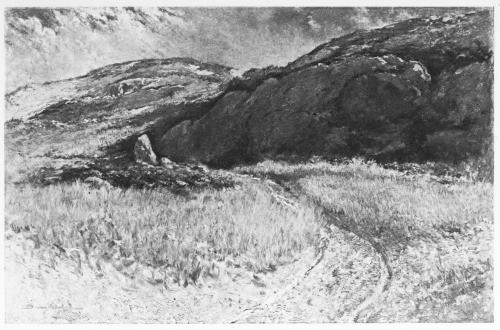
Where the woodcock call Page 161 The Idyll of the Standing-Stone
They knew before they came to meet; For some divulging influence Had touched them thro’ the starry lens God holds to bring in beat Two hearts—her heart one haunting wish, And his—forgetful of the fish, Her flower at his feet.
II
The sassafras twigs had just lit up The yellow stars of their fragrant candles, And the dogwood brimmed each blossom-cup With spring to its brown-tipped handles; When down the orchard, ’mid apple blooms— Say, ho, the hum o’ the honey-bee!— A glimpse of Spring in the sprinkled glooms? Or only a girl? with the warm perfumes Blown round her breezily.
The maple, as red as the delicate flush Of an afterglow, was airy crimson; And the haw-tree, white in the wing-whipped hush, Gleamed cool as a cloud that the moonlight dims on; And under the oak, whose branches strung— Say, heigh, the rap o’ the sapsuckér!— Gray buds in tassels that sweetly swung, They stood and listened a bird that sung, As glad as the heart in her.
Yellow the bloom of the rattle-weed, And white the bloom of the plum and cherry; And red as a stain the red-bud’s brede, And clover the color of sherry: And a wren sings there in the orchard drift,— And, ho! the dew from the web that slips!— And a thrush sings there in the woodland rift, Where he to his face her face doth lift, Her face with the willing lips.
For a while they sat on the moss and grass, Where the forest bloomed a great wild garden;— Then the beam from the hollow—it seemed to pass, And the ray on the hills to harden, When she rose to go, and his joy fell flat;— And, heigh, the wasp i’ the pawpaw bell!— As she waved her hand—why, it seemed at that ’Twas Spring’s own self he was gazing at, And the life of his life as well.
III
The teasel and the horsemint spread The hillsides, as with sunset sown, Blooming along the Standing-Stone That ripples in its rocky bed: There are no treasuries that hold Gold yellower than the marigold That crowds its mouth and head.
’T is harvest-time: a mower stands Among the morning wheat and whets His scythe, and for a space forgets The labor of the ripening lands; Then bends, and through the dewy grain His long scythe hisses, and again He swings it in his hands.
And she beholds him where he mows On acres whence the water sends Faint music of reflecting bends And falls that interblend with flows: She stands among the old bee-gums,— Where all the apiary hums,— Like some sweet bramble-rose.
She hears him whistling as he leans, And, reaping, sweeps the ripe wheat by; She sighs and smiles and knows not why:— These are but simple country scenes: He whets his scythe again, and sees Her smiling near the hives of bees Beneath the flowering beans.
The peacock-purple lizard creeps Along the rail; and deep the drone Of insects makes the country lone With summer where the water sleeps: She hears him singing as he swings His scythe; he thinks of other things— Not toil, and, singing, reaps.
IV
Into the woods they went again, Over the wind-blown oats; Out of the acres of golden grain, In where the light was a violet stain, In where the lilies’ throats Were brimmed with the summer rain.
Hung on a bough a reaper’s hook, Over the wind-blown oats; A girl’s glad laugh and a girl’s glad look, And the hush and ripple of tree and brook, And a wild bird’s silvery notes, And a kiss that a strong man took.
Out of the woods the lovers went, Over the wind-waved wheat; She with a face, where love was blent, Like to an open testament; He, from his head to feet, Dazed with his hope that was eloquent.
Here how oft had they come to tryst, Over the wind-waved wheat! Here how oft had they laughed and kissed! Talked and tarried where no one wist, Here where the woods are sweet, Dim and deep as a dewy mist.
V
Her pearls are blossoms-of-the-vale, Her only diamonds are the dews; Such jewels never can grow stale, Nor any value lose.
Among the millet beards she stands: The languid wind lolls everywhere: There are wild roses in her hands, One wild rose in her hair.
To-morrow, where the shade is warm, Among the unmown wheat she’ll stop, And from one daisy-loaded arm One ox-eyed daisy drop.
She’ll meet his brown eyes, true and brave, With blue eyes, false yet dreamy sweet: He is her lover and her slave, Who mows among the wheat.
. . . . . . . . . . . . .
When buds broke on the apple trees She wore an apple-blossom dress, And laughed with him across the leas, And love was all a guess.
When goose-plums ripened in the rain, Plum-colored was her gown of red; He kissed her in the creek-road lane— She was his life, he said.
When apples thumped the droughty land, A russet color was her gown: Another came, and—won her hand?— Nay! carried off to town....
When grapes hung purple in the hot, None missed her and her simple dress, Save one, whom, haply, she forgot, Who loved her none the less.
When snow made white each harvest sheaf, He sought her out amid her show; Her rubies, redder than the leaf That autumn forests sow.
Not one regret her shame reveals; She smiles at him, then puts him by; He pleads; and she? she merely steels Her heart and—lives her lie.
VI
And he returned when poppies strewed Their golden blots o’er moss and leaf,— Blond little Esaus of the wood, So fair of face, of life so brief.— Did he forget?—Not he, in truth!— “No month,” he thought, “holds so much grace, No month of spring, such grace and youth, As the sweet April of her face.”
In fall the frail gerardia Hung hints of sunset and of dawn On root and rock, as if to draw Her lips, remind him of one gone:— Of one unworthy, in pursuit Of butterflies, who does not dream A flower, broken by her foot, Sweeps, helpless, with her down the stream.
SOME SUMMER DAYS
I
If you had seen her waiting there Among the tiger-lily blooms,— That sowed their jewels everywhere Among the woodland gleams and glooms,— You had confessed her very fair, And sweeter than the wood’s perfumes.
A country girl with bare brown feet, She waits, while day slopes down the deeps: The afternoon is dead with heat, And all the weary shadow sleeps Like toil, arm-pillowed in the wheat, Beside the scythe with which he reaps.
There is no sound more distant than The cow-bell on the vine-hung hill; No nearer than the locust’s span Of noise that makes the silence shrill: And now there comes a sun-browned man Through tiger-lilies of the rill.
Long will they talk: till, in the end, The clear west glows, the east grows pale; Until the glow and pallor blend Like moonlight on a shifting sail; And then he ’ll clasp her; she will bend Her head, consenting. Day will fail:
The west will flame, then fade away Through heavy orange, rose, and red, And leave the heavens violet gray Above a gypsy-lily bed: Then they will go; and he will say Such words to her as none has said.
A million stars the night will win Above them; and one firefly Pulse like a tangled starbeam in The cedar dark against the sky: Then he will lift her dimpled chin And take the kiss she ’ll not deny.
And when the moon, like the great book Of Judgment, golden with the light Of God, lies open o’er yon nook Of darkest wood and wildest height, Together they will cross the brook And reach the gate and kiss good night.
II
And now he wipes his hand along The beaded fire of his brow Hard toil has heated; and the strong Face flushes fuller health as now He fills his hay-fork to the prong, And, tossing it, again doth bow.
And now he rests, and looks away Across the sun-fierce hills and meads No rolling cloud has cooled to-day; And from his face the brawny beads Drip; and he marks the heaps of hay, The fields of corn, the fields of weeds.
At last he sees the tempest build Black battlements along the west, Black breastworks that are thunder filled; And bares his brow; and on his chest The sweat of toil is cooled; and stilled The pulse of toil within his breast.
A strong wind brings the odorous death Of far hay-meadows, and the scent Is good within his nostrils’ breath: The mighty trees are bowed, that leant For no man, as when Power saith “Bow down!” and stalwart men are bent.
He laughs, long-gazing as he goes Along the elder-sweetened lane: He feels the storm wind as it blows Across the sheaves of golden grain, And stops to pull one bramble-rose, And watch the swiftly coming rain.
And there, ’mid locust trees, the farm Dreams in a martin-haunted place: He marks the far-off streaks of storm That, driven of the thunder, race: He sees his child upon her arm, And in the door his wife’s fair face.
III
Below the sunset’s range of rose, Below the heaven’s bending blue, Down woodways where the balsam blows, And milkweed tufts hang, gray of hue, A Jersey heifer stops and lows— The cows come home by one, by two.
There is no star yet: but the smell Of hay and pennyroyal mix With herb-aromas of the dell; And the root-hidden cricket clicks: Among the ironweeds a bell Clangs near the rail-fenced clover-ricks.
She waits upon the slope beside The windlassed well the plum-trees shade, The well-curb that the goose-plums hide; Her light hand on the bucket laid, Unbonneted she waits, glad-eyed, Her dress as simple as her braid.
She sees fawn-colored backs among The sumacs now; a tossing horn; A clashing bell of brass that rung: Long shadows lean upon the corn, And all the day dies scarlet-stung, The cloud in it a rosy thorn.
Below the pleasant moon, that tips The tree-tops of the hillside, fly The evening bats; the twilight slips Some fireflies like spangles by; She meets him, and their happy lips Touch; and one star leaps in the sky.
He takes her bucket, and they speak Of married hopes while in the grass The plum lies glowing as her cheek; The patient cows look back or pass; And in the west one golden streak Burns like a great cathedral glass.
IV
The skies are amber, blue, and green Before the coming of the sun; And all the deep hills sleep, serene As if enchanted; every one Is ribbed with morning mists that lean On woods through which vague whispers run.
Birds wake: and on the vine-hung knobs, Above the brook, a twittering Confuses songs; one warbler robs Another of its note; a wing Beats by; and now a wild throat throbs Triumphant; all the woodlands sing.
The sun is up: the hills are heaped With instant splendor; and the vales Surprised with shimmers that are steeped In purple where the thin mist trails; The water-fall, the rock it leaped, Are burning gold that foams and fails.
He drives his horses to the plow Along the vineyard slopes, where bask Dew-heavy grapes, half-ripened now, In sun-shot shafts of shade: no mask Of joy he wears; his face and brow Glow as he enters on his task.
Before him, soaring through the mist, The gray hawk wildly wings and screams; Its dewy back gleams, sunbeam-kissed, Above the wood that drips and dreams; He guides the plow with one strong fist; The soil rolls back in level seams.
Packed to the right the sassafras Lifts leafy walls of spice that shade The blackberries, whose tendrils mass Big berries in the coolness made; And drop their ripeness on the grass Where trumpet-flowers fall and fade.
White on the left the fence and trees That mark the garden; and the smoke, Uncurling in the early breeze, Tells of the roof beneath the oak; He turns his team, and, turning, sees The damp, dark soil his coulter broke.
Bees hum; and o’er the berries poise Lean-bodied wasps; loud blackbirds turn Following the plow: there is a noise Of insect wings that buzz and burn;— And now he hears his wife’s low voice, The song she sings to help her churn.
V
There are no clouds that drift around The moon’s pearl-kindled crystal, (white As some sky-summoned spirit wound In raiment lit with limbs of light), That have not softened like the sound Of harps when Heaven forgets to smite.
The vales are deeper than the dark, And darker than the vales the woods That shadowy hill and meadow mark With broad, blurred lines, whereover broods Deep calm; and now a fox-hound’s bark Upon the quietude intrudes.
And though the night is never still, Yet what we name its noises makes Its silence:—now a whippoorwill; A frog, whose hoarser tremor breaks The hush; then insect sounds that fill The night; an owl that hoots and wakes.
They lean against the gate that leads Into the lane that lies between The yard and orchard; flowers and weeds Smell sweeter than the odors keen That day distils from hotness; beads Of dew make cool the gray and green.
Their infant sleeps. They feel the peace Of something done that God has blessed, Still as the pulse that will not cease There in the cloud that lights the west: The peace of love that shall increase While soul to soul still gives its best.
AN EPIC OF SOUTH-FORK
I
The wild brook gleams on the sand and ripples Over the rocks of the riffle; brimming Under the elms like a nymph who dripples, Dips and glimmers and shines in swimming: Under the linns and the ash-trees lodging, Loops of the limpid waters lie, Shaken of schools of the minnows, dodging The glancing wings of the dragon-fly.
Lower, the loops are lines of laughter Over the stones and the crystal gravel; Afar they gloom, like a face seen after Mirth, where the waters slowly travel; Shadowy slow where the Fork is shaken Of the dropping bark of the sycamore, Where the water-snake, that the footsteps waken, Slides like a crooked root from shore.
Peace of the forest; and silence, dimmer Than dreams. And now a wing that winnows The willow leaves, with their shadows slimmer In the shallow there than a school of minnows: Calm of the creek; and a huge tree twisted, Ringed, and turned to a tree of pearl; A gray-eyed man, who is farmer-fisted, And a dark-eyed, sinewy country girl.
The brow of the man is gnarled and wrinkled With the weight of the words that have just been spoken; And the girl has smiled and her eyes have twinkled, Though the bonds and the bands of their love lie broken: She smiles, nor knows how the days have knotted Her to the heart of the man who says: “Let us follow the paths that we think allotted. I will go my ways and you your ways.
“And the man between us is your decision. Worse or better he is your lover.— Shall I say he ’s worse since the sweet Elysian Prize he wins where I discover Only the hell of the luckless chooser?— Shall I say he ’s better than I, or more, Since he is winner and I am loser, His life ’s made rich and mine made poor?”
“I tell you now as I oft and ever Have told,” she answered, the laughter dying Down in her eyes, “that his arms have never Held me!—no!—but you think me lying, And you are wrong. And I think it better To part forever than still to dwell With the sad distrust, like an evil tetter, On our lives forever, and so farewell.”
And she turned away; and he watched her going, The girlish pride in her eyes a-smoulder: He saw her go, and his lips were glowing Fever that parched. And he stood, one shoulder Slouched to the tree; and he saw her stooping, There by the bank, with a reckless foot; Straighten; and tear from her breast his drooping Lilies and fasten the pleurisy-root.
With its orange fire he saw her passing On and on; and the blood beat, burning His brain to madness; and seemingly massing The weight of the world on his heart in yearning ... Butterflies swarmed in the moist sand-alleys; A fairy fleet of Ionian sails They seemed with their wings, or of pirate galleys, Maroon and yellow, for Elfland gales.
He watched her going; and harder, thicker The pulse of his breath and his heart’s hard throbbing.— How should he know that her heart was sicker? How should he know that her soul was sobbing?— She never looked back: and he saw her vanish In swirls of the startled butterflies, Like a storm of flowers; and he could not banish The thought he had lost his all through lies.
II
He heard the cocks crow out the lonely hours. How long the night! how far away the dawn! It seemed long months since he had seen the flowers, The leaves, the sunlight, and the bee-hived lawn; Had heard the thrush flute in the tangled showers.
His burning eyes ached, staring at the black Stolidity of midnight. Would God send No cool relief unto his mind,—a rack Of inquisition,—tortures to unbend, That stretched him forward and now strained him back?
Incomprehensible and undivulged, The thought that took him back, retraced their walks, Through woods, on which the sudden perfumes bulged, The bird-songs and the brilliant-blossomed stalks; And all the freedom which their talk indulged.
Oh, strong appeal! And he would almost yield; When, firmly forward, he could feel her fault Oppose the error of a rock-like shield, And to resisting phalanxes cry halt— And, lo! bright cohorts broken on the field.
O mulct of morning! to the despot night Count down unminted gold, and let the day Walk free from dungeons of the dark; delight Herself on mountains of the violet ray, Clad in white maidenhood and morning white!
A melancholy coast, plunged deep in dream And death and silence, stretched the drowsy dark, Wherein he heard a round-eyed screech-owl scream, In lamentation, and a watch-dog bark, Vague as oblivion, lost in night’s deep stream.
And then hope moved him to divide the blinds To see if those bright sparkles were a star’s, Or but his feverish eyelids, which the mind’s Commotion weighed.—No hint of morning bars With glimmer heaven’s swart tapestry he finds.
So he remained, impatient, till the first Exploring crevices of Aztec morn, Dim cracks of treasure, Eldorados burst: Then could he face his cowardice and scorn His jealousy that thus his life had cursed.
Love knew no barriers now. And where he went Each woodland path was musical with birds; Each flow’r was richer, more divine of scent; For love sought love with such expressive words That dawn’s delivery was less eloquent.
III
Who is it hunts with his dog There where the heron is flying Gray through the feathering fog Over the Fork, where is lying, Bridge-like, a butternut log, There where the horsemint is drying?
Who is it hunts in the brush, Under the linns and the beeches, Here where the water-falls rush, Dark, where the noon never reaches? Here where the Fork is one crush Of flags with a bloom like the peach’s?
He is handsome and supple and tall, Blond-haired and vigorous-chested, Blue-eyed as the bud by the fall Where he listens,—his rifle half rested, Half leaned on the crumbling stone wall,— Whose briers he lately has breasted.
He waits; and the sun on the dew Of the cedars and leaves of the bushes Strikes glittering frostiness through ... If a covey of partridges flushes What good will a Winchester do, Or the dog to his feet that he crushes?
Then a man breaks strong through the weeds Where the buck-bushes toss and the spires Of the white-blossomed cohosh; ’mid reeds Wild-carrots, and trammelling briers: It is he! to his loved one who speeds— And the man in the bushes—he fires....
From leaves of the wind-shaken wood The dew of the dawn is still falling: He is gone from the place where he stood, Just there where the black crow is calling: There is blood on the weeds: is it blood On the face of the man who is crawling?
Red blood or a smudge of the dawn?— Now he lies with his gray eyes wide, staring, Stiff, still at the sun: he has drawn His limbs in a heap: and the faring Bee-martins light near or pass on, Not one of them knowing or caring.
It is noon: and the wood-dove is deep In the calm of its cooing: and over The tops of the forest trees sweep The shadows of buzzards that hover: Wide-winged they sail on as asleep: And the bob-white is whistling from cover.
It is dusk: and the heat, that made wilt The leaves and the wildflowers’ faces, Gives place to the dew-drops that tilt With coolness the weeds where are traces Of horror and darkness and guilt, That nothing can wash from those places.
It is night: and the hoot-owlet mocks The dove of the day with wild weeping, The Fork is scarce heard on its rocks Where the man is so quietly sleeping: Through the woods snaps the bark of a fox; The lightning is fitfully leaping.
IV
All day, ’twixt hope and fear, She waited at the gate, Looking for him, more dear Now that he made her wait: Day went and night draws near: Stormy it grows and late.
Still, still she waits: great limbs The winds rend from the ridge; Each swollen shallow swims Head-deep below the bridge; The drift, that breaks and brims Swirls lighter than the midge.
The night grows wildly gray With lightning-litten rain; The forests sound and sway, An oak is rent in twain; The thunder rolls away Like some vast bolt and chain.
The Fork is whirling wreck Of field and farm and wood; And many a foaming fleck Drives where the rock-fence stood;— A torrent sweeps break-neck Above the washed-out blood.
Night deepens: still she waits Expectant in despair: The Fork has reached the gates, The wood’s wreck everywhere. But when the storm abates, She thinks, he will be there.
She sees the lightning rush Its blazing hells above; She hears the thunder crush Heaven as if earthquake-clove— Loud in the tempest’s hush She calls with all her love.
He comes, she feels; and stands The rushing waters o’er Her feet, and on her hands And hair the wild down-pour, The lightnings are wild brands To light him to her door.
Night deepens: but she knows God will not fail to send Her love to soothe her woes, And one day’s errors mend.— The wild stream foams and flows Booming in fall and bend.
Again the lightnings light The night like some wild torch; The waters foam and fight; And one uprooted larch Sweeps down, with something white Wedged in it, by her porch.
She stoops: the lurid rain Beats on her back and head— Ay! he hath come again! With livid lips once red! A bullet in his brain The night hath brought him—dead!
A NIELLO
I
It is not early spring and yet Of bloodroot blooms along the stream, And blotted banks of violet, My heart will dream.
Is it because the wind-flower apes The beauty that was once her brow, That the white thought of it still shapes The April now?
Because the wild-rose learned its blush From her fresh cheeks of maidenhood, Their thought makes June of barren brush And empty wood?
And then I think how young she died— Straight, barren death stalks down the trees, The hard-eyed hours by his side That kill and freeze.
II
When orchards are in bloom again My heart will bound, my blood will beat, To hear the red-bird so repeat, On boughs of rosy stain, His blithe, loud song,—like some far strain From out the past,—among the bloom,— (Where bee, and wasp, and hornet boom)— Fresh, redolent with rain.
When orchards are in bloom once more, Invasions of lost dreams will draw My feet, like some insistent law, Through blossoms to her door: In dreams I’ll ask her, as before, To let me help her at the well; And fill her pail; and long to tell My love as once of yore.
I shall not speak until we quit The farm-gate, leading to the lane And orchard, all in bloom again, ’Mid which the wood-doves sit And coo; and through whose blossoms flit The cat-birds crying while they fly: Then tenderly I’ll speak, and try To tell her all of it.
And in my dream again she’ll place Her hand in mine, as oft before,— When orchards are in bloom once more,— With all her old-time grace: And we will tarry till a trace Of sunset dyes the heav’ns; and then— We’ll part, and, parting, I again Will bend and kiss her face.
And homeward, dreaming, I will go Along the cricket-chirring ways, While sunset, like one crimson blaze Of blossoms, lingers low: And my lost youth again I’ll know, And all her love, when spring is here— Hers! hers! now dead this many a year Whose love still haunts me so.
III
I would not die when Springtime lifts The white world to her maiden mouth, And heaps its cradle with gay gifts, Breeze-blown from out the singing South: Too full of life and loves that cling, Too heedless of all mortal woe, The young, unsympathetic Spring, That death should never know.
I would not die when Summer shakes Her daisied locks below her hips, And, naked as a star that takes A cloud, into the silence slips. Too rich is Summer; poor in needs; Wrapped in her own warm loveliness Her pomp goes by, and never heeds If one be more or less.
But I would die when Autumn goes, The sad rain dripping from her hair, Through forests where the wild wind blows Death and the red wreck everywhere: Sweet as love’s last farewells and tears ’T would be to die, when heavens are gray, In the old autumn of my years, Like a dead leaf borne far away.
DEEP IN THE FOREST
I
SPRING ON THE HILLS
Ah, shall I follow, on the hills, The Spring, as wild wings follow? Where wild-plum trees make wan the hills, Crab-apple trees the hollow, Haunts of the bee and swallow?
In red-bud brakes and flowery Acclivities of berry; In dogwood dingles, showery With dew, where wrens make merry? Or drifts of swarming cherry?
In valleys of wild-strawberries, And of the clumped May-apple; Or cloud-like trees of hawberries, With which the south-winds grapple, That brook and pathway dapple?
With eyes of far forgetfulness,— Like some white wood-thing’s daughter, Whose feet are bee-like fretfulness,— To see her run like water Through boughs that slipped or caught her.
O Spring, to seek, yet find you not, To search and still continue; To glimpse, to touch, but bind you not, To lose and then to win you, All sweet evasion in you.
In pearly, peach-blush distances You gleam; the woods are braided Of myths, of dream-existences;— There, where the brook is shaded, Some splendor surely faded.
O presence, like the primrose’s, Once more I feel your power! In rainy scents of dim roses I breathe you for an hour, Elusive as a flower.
II
THE WOOD SPIRIT
Ah me! I still remember How flushed, before the shower, The dusk was; like a scarlet rose, Or blood-red poppy-flower.
Now heaven is starred; the moonlight Lays blurs upon the grain— You may not know it from white frost, The moonlight on the rain.
And all the forest utters A restless moan in rest, For all the deep, dark shadow lies Like iron on its breast.
I mark the moveless shadow, I mark the unreaped corn, Then something whispers overhead, “Come to me, mortal-born.”
I sit alone and listen; The low leaves sound and sigh; The dew drips from the bearded grain, A mist slips from the sky.—
I hear her whisper, whisper, And breathe in some dim place; Her feet are easier than the dew, And than the mist her face.
I may not clasp her ever, This spirit made for song, Who dwelleth in the young, young oak The old, old oaks among.
Her limbs are molded moonlight; Her breasts are silver moons: She glimmers and she glitters where The purple shadow swoons.
And since she knows I love her, She says my soul has died, And laughs and mocks me in the mist That haunts the forest-side.
When winds run mad in woodlands And all the great boughs swing, I see her wild hair blow and blow Black as a raven’s wing.
When winds are tamed and tethered And stars are keen as frost, I search and seek within the wood, There where my soul was lost.
I seek her, and she flies me; I follow; and the whole Dim woodland echoes with her voice, Soft calling to my soul.
III
OWL ROOST
The slope is a mass of vines: If you walk in the daylight there, A gleam as of twilight shines Through the vines massed everywhere: Each trunk, that a creeper twines, Is a column, strong to bear The dome of its leaves that wave, Cathedral-dim and grave.
Black moss makes silent the feet: And, above, the fox-grapes lace So thick that the noonday heat Is chill as a murdered face: And the winds for miles repeat The fugue of a rolling bass: The deep leaves twinkle and turn But over no flower or fern.
An angular spider weaves Great webs between the trees, Webs that are witches’ sieves: And honey-and bumblebees Go droning among the leaves, Like the fairies’ oboës: At dark the owlets croon To the stars and the sickle-moon.
At dark I will not go There where the branches sigh; Where naught but the glow-worms glow, Each one like a demon’s eye: O’er which, like a battle-bow, With an arrow that it lets fly, The new-moon and one star Hang and glimmer afar.
At dawn, if my mood be dim, And the day be a cloudless one, There where the sad winds hymn I ’ll walk, but its shade will shun; Its shade, where I feel the grim Horror of something done Here in the years long past, That the place conceals to the last.
IV
MOSS AND FERN
Where rise the brakes of bramble there, Wrapped with the trailing rose, Through cane where waters ramble, there Where deep the green cress grows, Who knows? Perhaps, unseen of eyes of man, Hides Pan.
Perhaps the creek, whose pebbles make A foothold for the mint, May bear,—where soft its trebles make Confession,—some vague hint— (The print, Goat-hoofed, of one who lightly ran)— Of Pan.
Where, in the hollow of the hills Ferns deepen to the knees, What sounds are those above the hills, And now among the trees?— No breeze!— The syrinx, haply, none may scan, Of Pan.
In woods where waters break upon The hush like some soft word; Where sun-shot shadows shake upon The moss, who has not heard— No bird!— The flute, as breezy as a fan, Of Pan?
Far in, where mosses lay for us Still carpets, cool and plush; Where bloom and branch and ray for us Swoon in the noonday flush, The hush May sound the satyr hoof a span Of Pan.
In woods where thrushes sing to us, And brooks dance sparkling heels; Where wild aromas cling to us, And all our worship kneels,— Who steals Upon us, haunch and face of tan, But Pan?
V
WOODLAND WATERS
Through leaves of the nodding trees, Where blossoms sway in the breeze, Pink bag-pipes made for the bees, Whose slogan is droning and drawling: Where the columbine scatters its bells, And the wild bleeding-heart its shells, O’er mosses and rocks of the dells The brook of the forest is falling.
You can hear it under the hill When the wind in the wood is still, And, strokes of a fairy drill, Sounds the bill of the yellow-hammer: By the solomon’s-seal it slips, Cohosh and the grass that drips— Like the words of an Undine’s lips, Is the sound of its falls that stammer.
I lie in the woods: and the scent Of the honeysuckle is blent With the sound: and a Sultan’s tent Is my dream, with the East enmeshéd:— A slave-girl sings; and I hear The languor of lute-strings near, And a dancing-girl of Cashmere In the harem of good Er Reshid.
From ripples of Irak lace She flashes the amorous grace Of her naked limbs and her face, While her golden anklets tinkle: Then over mosaic floors Open seraglio doors Of cedar: by twos, by fours,— Like stars that tremble and twinkle,—
While the dulcimers sing, unseen, The handmaids come of the Queen ’Neath silvern lamps, one sheen Of jewels of Afrite treasure: And I see the Arabia rise Of the Nights that were rich and wise, Beautiful, dark, in the eyes Of Zubeideh, the Queen of Pleasure.
VI
THE THORN-TREE
The night is sad with silver and the day is glad with gold, And the woodland silence listens to a legend never old, Of the Lady of the Fountain, whom the fairy people know, With her limbs of samite whiteness and her hair of golden glow, Whom the boyish South-wind seeks for and the girlish-stepping rain, Whom the sleepy leaves still whisper men shall never see again; She whose Vivien charms were mistress of the magic Merlin knew, That could change the dew to glow-worms and the glow-worms into dew.
There’s a thorn-tree in the forest, and the fairies know the tree, With its branches gnarled and wrinkled as a face with sorcery; But the May-time brings it clusters of a rainy fragrant white, Like the bloom-bright brows of beauty or a hand of lifted light. And all day the silence whispers to the sun-ray of the morn How the bloom is lovely Vivien and how Merlin is the thorn: How she won the doting wizard with her naked loveliness Till he told her demon secrets that but made his magic less.
How she charmed him and enchanted in the thorn-tree’s thorns to lie Forever with his passion that should never dim or die: And with wicked laughter looking on this thing that she had done, Like a visible aroma lingered sparkling in the sun; How she stooped to kiss the pathos of an elf-lock of his beard, All in mockery, at parting, and mock pity of his weird: But her magic had forgotten that “who bends to give a kiss Will bring down the curse upon them of the person whose it is”: So the silence tells the secret.—And at night the fairies see How the tossing bloom is Vivien, who is struggling to be free, In the thorny arms of Merlin, who, forever, is the tree.
VII
THE HAMADRYAD
She stood among the longest ferns The valley held; and in her hand One blossom like the light that burns, Vermilion, o’er a sunset land; And round her hair a twisted band Of pink-pierced mountain-laurel blooms: And darker than dark pools, that stand Below the star-communing glooms, Her eyes beneath her hair’s perfumes.
I saw the moon-pearl sandals on Her flower-white feet, that seemed too chaste To tread pure gold: and, like the dawn On splendid peaks that lord a waste Of solitude lost gods have graced, Her face: she stood there, faultless-hipped, Bound with the cestused silver,—chased With acorn-cup and crown, and tipped With oak-leaves,—whence her chiton slipped.
Limbs that the gods call loveliness!— The grace and glory of all Greece Wrought in one marble form were less Than her perfection!—’Mid the trees I saw her; and time seemed to cease For me—And, lo! I lived my old Greek life again of classic ease, Barbarian as the myths that rolled Me back into the Age of Gold.
WRECKAGE
I
Love and the drift of many dreams, Under the moon of a Florida night, Over the beach with its silvery seams White as a sail is white.
Love that entered into two lives Out of the dreams that the nights have borne, Over the waves where the vapor drives, Mists that the stars have torn.
Love that welded two hearts and hands There by the sea, ’neath the shell-white moon, Like to the stars and the mists and the sands Setting two lives in tune.
Nights of love that one still keeps Sacred;—nights, that the faith of one Heartened there in the treacherous deeps, Under a tropic sun.
II
Parting he said to her: “Let us be true to them,— All of our dreams, of the night, of the morning: What is our present, its hope, but a clew to them? What is our past but a dream and a warning? Have you considered the life that regretfully Foldeth weak arms to the fate it might master?— Had I been true to my dreams, never fretfully Halted, my future and joy had been faster.”
They had come down to the ocean that, bellowing, Boiled on the sand and the shells that were broken; All of the summer was fading and yellowing; Now they must part and their vows had been spoken. It had befallen that heaven was lowering; Over the sea, like the wraith of a wrecker, Clamored the gull; and the mist in the showering East seemed the ghost of a lofty three-decker.
Infinite foam; and the boom of the hollowing Breakers that buried the rocks to their shoulders; Battle and boast of the deep in the wallowing World of the waves where the red sunset smoulders. Long was the leap of the foam on the thunderous Beach; and each end of the beach was a flying Fog of the spray: and she said, “Let it sunder us! Still we will love, for love is undying!”
Yet, if it comes to the thing he has said to her?— Wreckage and death?—the love she has given Turned into sorrow?—Oh, that was a dread to her! He, like a weed, by the waters far driven! Weeping, her bosom with shudders was shaken as She for a moment hard clung to her sailor, Kissed him and—parted. His boat had been taken; as Paler it grew the woman grew paler.
III
All day the rain drove, falling Upon the sombre sea; All day, his wet sail hauling, The sailor tacked a-lea; And through the wild rain calling, What was it?—was it he?
At dusk the gull clanged, drifting Above the boiling brine; And, through the wan west sifting, Streamed one red sunset line; And in its wild light shifting, His far sail seemed to shine.
All night the wind wailed, sighing Along the wreck-strewn coast; All night the surf, defying, Rolled thunder in and boast; All night she heard a crying— The sea? or some lost ghost?
IV
The balm of the night and the glory, The music and scent of the sea, Are as song to her heart or a story Of the never-to-be. The stars and the night and the whiteness Of foam on the stretch of the sand; Faint foam that is tossed, like the brightness Of a mermaiden’s hand.
No sail on the ocean; no sailor On shore, and the winds all asleep; And her face in the starlight far paler Than women who weep. A mist on the deep; and the ghostly White moon in the deep of the night; And a light that is neither; that mostly Is shadow not light.
No sea-gull, that vanished with gleaming Of wings, in the swing of the spray; Perhaps it was only her dreaming, Or merely a ray Of moonlight; the glimmering essence Of all that is grayest and dim— But never his face, or his presence That dripped in each limb.
And she cried through the night, “Let perish! O God, let me die of despair! If he whom I love, whom I cherish, Is weltering there!” She seemed but a sea-mist made woman, And he but a sound of the sea Made man where nothing was human, And never would be.
V
Long he sailed the deep that glasses The face of God and His majesty; Passed the Horn and the Seas of Grasses, Drifting aimlessly. Time went by with its days that ever Burden the hearts of those who be Far away from their love; whom sever Leagues of the shapeless sea.
Land at last, whose reefs rolled broken Foam of the balked waves everywhere; Land; one tangle of weeds and oaken Wreck and of rocks laid bare. Here and there the sand stretched livid Leagues of famine, one blinding glare; Crags, o’er which gaunt birds winged vivid, Harsh in the earthquake air.
A little cloud in the sunset’s splendor; A little cloud that the sunset stains: Night, and a wisp of a moon that, slender, Dreams of the hurricanes. Winds that stride as with sounding sandals; Winds that the tempest has loosed from chains: Light that leaps like a spear he handles, Shaking his thunder-manes.
Wrenching the world in wreck asunder, Black rebellion of hell and night; Wrath and roar of the rocks and thunder, Flame and the winds that fight ... Beating the drift and the hush together, Waves and winds that the morn makes white; Calm and peace of the tropic weather After the typhoon’s might.
Clouds blow by and the storm’s forgotten. Savage coasts where the sea-cow feeds. Wash of weeds and the sea-weeds rotten. And a dead face in the weeds. None to know him or name him brother; Only the savage in feathers and beads; The South-Sea Islander, fitting another Barb in the shaft he speeds.
Far away where the sea-gulls gather; Far away where the evening falls, Lone she stands where the wild waves lather, Rolling the sea in walls.— Who shall tell her, the lonely tryster? Tell her of him on whom she calls?— Suns that beat on his face and blister? Stars? or the sea that crawls?
VI
She dreamed that there, beside the ocean sitting, Alone she watched, when, at her feet, behold! Between the foam-ridge and the sea-gull’s flitting, His body rolled.
All was not as it was before they parted; She dreamed he had remembered, she forgot; He ’d said he would forget her, angry-hearted, And yet could not.
And then it seemed that, had she known, she surely Had given pity when she could not give Her love to him, who loved her madly, purely, And bade him live.
And then she dreamed she looked upon the slanted Hulk of a wreck: and high above the wave, Worn of the wind and of the cactus planted, His nameless grave.
SIREN SANDS
I
The rhododendrons bloom and shake Their petals wide and gleam and sway Among palmettoes, by the lake, Beyond the bay.
Shores where we watched the eve reveal Her cloudy sanctuaries, while The bay lay lavaed into steel For mile on mile.
We watched the purple coast confuse Soft outlines with the graying light; And towards the gulf a vessel lose Itself in night.
We saw the sea-gulls dip and soar; The wild-fowl gather past the pier; And from rich skies, as from God’s door, Gold far and near.
Two foreign seamen passed and we Heard mellow Spanish; like twin stars, Where they lounged smoking, we could see Their faint cigars.
Night; and the heavens stained and strewn With stars the waters idealized, Until their light the rising moon Epitomized.
Morn; and the pine-wood balms awake; Winds roll the dew-drop from the rose; The wide lake burns; and, on the lake, The ripple glows.
Far coasts detach deep purple from The blue horizon, and the day Beholds the sunburnt sailor come And sail away.
The bird that slept at dusk, at dawn Awakes again within the thorn.— Sweet was the night to it, now gone; And sweet is morn.
II
Through halls of columned scarlet, Like some dark queen, the Dusk Trails skirts of myrrh and musk, Hung in each ear, a starlet Gleams,—gems the clouds’ gaunt Jinn Guard; and, beneath her chin, The moon, an opal tusk.
There lies a ghostly glory Upon the sea and sand; A gleam, as of a hand, Stretched from the realms of story, Of rosy golden ray; Pointing the world the way To some far Fairyland.
As fades the west’s vermilion Above the distant coasts, The stars come out in hosts; Within the night’s pavilion, As flower speaks to flower, Dim hour calls to hour, Pale with the past’s sweet ghosts.
III
Music that melts through moonlight, Faint on the summer breeze; Fireflies, moonlight, and foaming Susurrus of the seas.
Music that drifts like perfume, And touches like a hand; Dreams and stars and the ocean, And we alone on the sand.
Glimmers and vague reflections, And the white swirl of the foam; Pale on the purple a vessel, And a light that beckons home.
And I seem to see the music, On a moonbeam bar that floats, For the music is moonlight magic, And the flies are its golden notes.
And I seem to hear one singing Of a brown old coast and sea, Of lives that were filled with passion, And old-world tragedy.
And I hear the harsh reef’s calling For a noble ship at sea, And the winds of the ocean singing A dirge for the dead to be.
Till it seems that I am the pilot, And you are the mermaidén, Who lures him on to the wrecking And into her arms again.
Song
Over the hills where the winds are waking All is lone as the soul of me; Over the hills where the stars are shaking, Breton hills by the sea.
These were with me to tell me often How she pined in her Croisic home, Winds that sing and the stars that soften Over the miles of foam.
Fishers’ nets and the sailor faces; Sad salt marshes and granite piers; Brown, loud coast where the long foam races— And a parting full of tears.
A gray sail’s ghost where the autumn lies on Wraiths of the mist and the squall-blown rain; Her dark girl eyes that search the horizon, Grave with a haunting pain.
Stars may burn and the wild winds whistle Over the rocks where the sea-gulls rave— My heart is bleak as the wind-worn thistle on her seaside grave.
IV
Sad as sad eyes that ache with tears The stars of night shine through the leaves; And shadowy as the Fates’ dim shears The weft that twilight weaves.
The summer sunset marched long hosts Of gold adown one golden peak, That flamed and fell; and now gray ghosts Of mist the far west streak.
They seem the shades of things that weep, Wan things the heavens would conceal; Blood-stained; that bear within them, deep, Red wounds that will not heal.
Night comes, and with it storm, that slips Wild angles of the jagged light:— I feel the wild rain on my lips,— A wild girl is the Night.
A moaning tremor sweeps the trees; And all the stars are packed with death:— She holds me by the neck and knees, I feel her wild, wet breath.
Hell and its hags drive on the rain:— Night holds me by the hair and pleads; Her kisses fall like blows again; My brow is dewed with beads.
The thunder plants wild beacons on Each volleying height.—My soul seems blown Far out to sea. The world is gone, And night and I alone.
Tampa, Florida, February, 1893.
WAR-TIME SILHOUETTES.
I
THE BATTLE
The night had passed. The day had come, Bright-born, into a cloudless sky: We heard the rolling of the drum, And saw the war-flags fly.
And noon had crowded upon morn Ere Conflict shook her red locks far, And blew her brazen battle-horn Upon the hills of War.
Noon darkened into dusk—one blot Of nightmare lit with hell-born suns;— We heard the scream of shell and shot And booming of the guns.
On batteries of belching grape We saw the thundering cavalry Hurl headlong,—iron shape on shape,— With shout and bugle-cry.
When dusk had moaned and died, and night Came on, wind-swept and wild with rain, We slept, ’mid many a bivouac light, And vast fields heaped with slain.
II
IN HOSPITAL
Wounded to death he lay and dreamed The drums of battle beat afar, And round the roaring trenches screamed The hell of war.
Then woke; and, weeping, spoke one word To the kind nurse who bent above; Then in the whitewashed ward was heard A song of love.
The song she sang him when she gave The portrait that he kissed; then sighed, “Lay it beside me in the grave!” And smiled and died.
III
THE SOLDIER’S RETURN
A brown wing beat the apple leaves and shook Some blossoms on her hair. Then, note on note, The bird’s wild music bubbled. In her book, Her old romance, she seemed to read. No look Betrayed the tumult in her trembling throat.
The thrush sang on. A dreamy wind came down From one white cloud of afternoon and fanned The dropping petals on her book and gown, And touched her hair, whose braids of quiet brown Gently she smoothed with one white jeweled hand.
Then, with her soul, it seemed, from feet to brow She felt him coming: ’t was his heart, his breath That stirred the blossom on the apple bough; His step the wood-thrush warbled to. And now Her cheek went crimson, now as white as death.
Then on the dappled page his shadow—yes, Not unexpected, yet her haste assumed Fright’s startle; and low laughter did confess His presence there, soft with his soul’s caress And happy manhood, where the rambo bloomed.
Quickly she rose and all her gladness sent Wild welcome to him. Her his unhurt arm Drew unresisted; and the soldier leant Fond lips to hers. She wept. And so they went Deep in the orchard towards the old brick farm.
IV
THE APPARITION
A day of drought, foreboding rain and wind, As if stern heaven, feeling earth had sinned, Frowned all its hatred. When the evening came, Along the west, from bank on bank unthinned Of clouds, the storm unfurled its oriflamme.
Then lightning signaled, and the thunder woke Its monster drums, and all God’s torrents broke.— She saw the wild night when the dark pane flashed; Heard, where she stood, the disemboweled oak Roar into fragments when the welkin crashed.
Long had she waited for a word. And, lo! Anticipation still would not say “No:” He has not written; he will come to her; At dawn!—to-night!—Her heart hath told her so; And so expectancy and love aver.
She seems to hear his fingers on the pane— The glass is blurred, she can not see for rain: Is that his horse?—the wind is never still: And that his cloak?—ah, surely that is plain!— A torn vine tossing at the window-sill.
She hurries forth to meet him; pale and wet, She sees his face; the war-soiled epaulet; A sabre-scar that bleeds from brow to cheek; And now he smiles, and now their lips have met, And now ... Dear heart, he fell at Cedar Creek!
V
WOUNDED
It was in August that they brought her news Of his bad wounds; the leg that he must lose. And August passed, and when October raised Red rebel standards on the hills that blazed, They brought a haggard wreck; she scarce knew whose, Until they told her, standing stunned and dazed.
A shattered shadow of the stalwart lad, The five-months husband, whom his country had Enlisted, strong for war; returning this, Whose broken countenance she feared to kiss, While health’s remembrance stood beside him sad, And grieved for that which was no longer his.
They brought him on a litter; and the day Was bright and beautiful. It seemed that May In woodland rambles had forgot her path Of season, and, disrobing for a bath, By the autumnal waters of some bay, With her white nakedness had conquered Wrath.
Far otherwise she wished it: wind and rain; The sky, one gray commiserative pain; Sleet, and the stormy drift of frantic leaves; To match the misery that each perceives Aches in her hand-clutched bosom, and is plain In eyes and mouth and all her form that grieves.
Theirs, a mute meeting of the lips; she stooped And kissed him once: one long, dark side-lock drooped And brushed against the bandage of his breast; With feeble hands he held it and caressed; Then all his happiness in one look grouped, Saying, “Now I am home, I crave but rest.”
Once it was love! but then the battle killed All that sweet nonsense of his youth, and filled His heart with sterner passion.—Ah, well! peace Must balm its pain with patience; whose surcease Means reconcilement; e’en as God hath willed, With war or peace who shapes His ends at ease.—
What else for these but, where their mortal lot Of weak existence drags rent ends, to knot The frail unravel up!—while love (afraid Time will increase the burthen on it laid), Seeks consolation, that consoleth not, In toil and prayer, waiting what none evade.
VI
THE MESSAGE
Long shadows toward the east: and in the west A blaze of garnet sunset, wherein rolled One cloud like some great gnarly log of gold; Each gabled casement of the farm seemed dressed In ghosts of roses blossoming manifest.
And she had brought his letter there to read, There on the porch, that faced the locust glade; To watch the summer sunset burn and fade, And breathe the twilight scent of wood and weed, Forget all care and her soul’s hunger feed.
And on his face her fancy mused a while: “Dark hair, dark eyes.—And now he has a beard Dark as his hair.”—She smiled; yet almost feared It changed him so she could not reconcile Her heart to that which hid his lips and smile.
Then tried to feature, but could only see The beardless man who bent to her and kissed Her and their child and left them to enlist: She heard his horse grind in the gravel: he Waved them adieu and rode to fight with Lee.
Now all around her drowsed the hushful hum Of evening insects. And his letter spoke Of love and longings to her: nor awoke One echo of the bugle and the drum, But all their future in one kiss did sum.
The stars were thick now; and the western blush Drained into darkness. With a dreamy sigh She rocked her chair.—It must have been the cry Of infancy that made her rise and rush To where their child slept, and to hug and hush.
Then she returned. But now her ease was gone. She knew not what, she felt an unknown fear Press, tightening, at her heart-strings; then a tear Scalded her eyelids, and her cheeks grew wan As helpless sorrow’s, and her white lips drawn.
With stony eyes she grieved against the skies, A slow, dull, aching agony that knew Few tears, and saw no answer shining to Her silent questions in the stars’ still eyes “Where Peace delays and where her soldier lies.”
They could have told her. Peace was far away, Beyond the field that belched black batteries All the red day. ’Mid picket silences, On woodland mosses, in a suit of gray, Shot through the heart, he by his rifle lay.
VII
THE WOMAN ON THE HILL
The storm-red sun, through wrecks of wind and rain, And dead leaves driven from the frantic boughs, Where, on the hill-top, stood a gaunt, gray house, Flashed wildest ruby on each rainy pane.
Then woods grew darker than unburdened grief; And, crimson through the woodland’s ruin, streamed The sunset’s glare—a furious eye, which seemed Watching the moon rise like a yellow leaf.
The rising moon, against which, like despair, High on the hill, a woman, darkly drawn, The wild leaves round her, stood; with features wan, And tattered dress and wind-distracted hair.
As still as death, and looking, not through tears, For the young face of one she knows is lost, While in her heart the melancholy frost Gathers of all the unforgotten years.
What if she heard to-night a hurrying hoof, Wild as the whirling of the withered leaf, Bring her a more immedicable grief, A shattered shape to live beneath her roof!
The shadow of him who claimed her once as wife; Her lover!—no!—the wreck of all their past Brought back from battle!—Better to the last A broken heart than heartbreak all her life!
MOSBY AT HAMILTON
Down Loudon lanes, with swinging reins, And clash of spur and sabre, And bugling of the battle-horn, Six score and eight we rode that morn, Six score and eight of Southern born, All tried in war’s hot labor.
Full in the sun, at Hamilton, We met the South’s invaders; Who, over fifteen hundred strong, ’Mid blazing homes had marched along All night, with Northern shout and song, To crush the rebel raiders.
Down Loudon lanes, with streaming manes, We spurred in wild March weather; And all along our war-scarred way The graves of Southern heroes lay— Our guide-posts to revenge that day, As we rode grim together.
Old tales still tell some miracle Of Saints in holy writing— But who shall say why hundreds fled Before the few that Mosby led, Unless it was that even the dead Fought with us then when fighting.
While Yankee cheers still stunned our ears, Of troops at Harper’s Ferry; While Sheridan led on his Huns, And Richmond rocked to roaring guns, We felt the South still had some sons She would not scorn to bury.
THE FEUD
Rocks, trees and rocks; and down a mossy stone The murmuring ooze and trickle of a stream Through brambles, where the mountain spring lies lone,— A gleaming cairngorm where the shadows dream,— And one wild road winds like a saffron seam.
Here sang the thrush, whose pure, mellifluous note Dropped golden sweetness on the fragrant June; Here cat-and blue-bird and wood-sparrow wrote Their presence on the silence with a tune; And here the fox drank ’neath the mountain moon.
Frail ferns and dewy mosses and dark brush,— Impenetrable briers, deep and dense, And wiry bushes;—brush, that seemed to crush The struggling saplings with its tangle, whence Sprawled out the ramble of an old rail-fence.
A wasp buzzed by; and then a butterfly In orange and amber, like a floating flame; And then a man, hard-eyed and very sly, Gaunt-cheeked and haggard and a little lame, With an old rifle, down the mountain came.
He listened, drinking from a flask he took Out of the ragged pocket of his coat; Then all around him cast a stealthy look; Lay down; and watched an eagle soar and float, His fingers twitching at his hairy throat.
The shades grew longer; and each Cumberland height Loomed, framed in splendors of the dolphin dusk. Around the road a horseman rode in sight; Young, tall, blond-bearded. Silent, grim, and brusque, He in the thicket aimed—Quick, harsh, then husk,
The echoes barked among the hills and made Repeated instants of the shot’s distress.— Then silence—and the trampled bushes swayed:— Then silence, packed with murder and the press Of distant hoofs that galloped riderless.
LYNCHERS
At the moon’s down-going, let it be On the quarry hill with its one gnarled tree.
The red-rock road of the underbrush, Where the woman came through the summer hush.
The sumac high and the elder thick, Where we found the stone and the ragged stick.
The trampled road of the thicket, full Of footprints down to the quarry pool.
The rocks that ooze with the hue of lead, Where we found her lying stark and dead.
The scraggy wood; the negro hut, With its doors and windows locked and shut.
A secret signal; a foot’s rough tramp; A knock at the door; a lifted lamp.
An oath; a scuffle; a ring of masks; A voice that answers a voice that asks.
A group of shadows; the moon’s red fleck; A running noose and a man’s bared neck.
A word, a curse, and a shape that swings; The lonely night and a bat’s black wings.
At the moon’s down-going, let it be On the quarry hill with its one gnarled tree.
DEAD MAN’S RUN
He rode adown the autumn wood, A man dark-eyed and brown; A mountain girl before him stood Clad in a homespun gown.
“To ride this road is death for you! My father waits you there; My father and my brother, too— You know the oath they swear.”
He holds her by one berry-brown wrist, And by one berry-brown hand; And he hath laughed at her and kissed Her cheek the sun hath tanned.
“The feud is to the death, sweetheart: But forward must I ride.”— “And if you ride to death, sweetheart, My place is by your side.”
Low hath he laughed again and kissed And helped her with his hand; And they have galloped into the mist That belts the autumn land.
And they had passed by Devil’s Den, And come to Dead Man’s Run, When in the brush rose up two men, Each with a levelled gun.
“Down! down! my sister!” cries the one;— She gives the reins a twirl.— The other shouts, “He shot my son! And now he steals my girl!”
The rifles crack: she will not wail: He will not cease to ride: But, oh! her face is pale, is pale, And the red blood stains her side.
“Sit fast, sit fast by me, sweetheart! The road is rough to ride!”— The road is rough by gulch and bluff, And her hair blows wild and wide.
“Sit fast, sit fast by me, sweetheart! The bank is steep to ride!”— The bank is steep for a strong man’s leap, And her eyes are staring wide.
“Sit fast, sit fast by me, sweetheart! The Run is swift to ride!”— The Run is swift with mountain drift, And she sways from side to side.
Is it a wash of the yellow moss, Or drift of the autumn’s gold, The mountain torrent foams across For the dead pine’s roots to hold?
Is it the bark of the sycamore, Or peel of the white birch-tree, The mountaineer on the other shore Hath followed and still can see?
No mountain moss or leaves, wild rolled, No bark of birchen-gray!— Young hair of gold and a face death-cold The wild stream sweeps away.
THE RAID
I
Far in the forest, where the rude road winds Through twisted briers and weeds, stamped down and caked With mountain mire, the clashing boughs are raked Again with rain whose sobbing frenzy blinds.
There is a noise of winds; a gasp and gulp Of swollen torrents; and the sodden smell Of woodland soil, dead trees—that long since fell Among the moss—red-rotted into pulp.
Fogged by the rain, far up the mountain glen, Deep in a cave, an elfish wisp of light; And stealthy shadows stealing through the night With strong, set faces of determined men.
II
’Twixt fog and fire, in pomps of chrysoprase, Above vague peaks, the morning hesitates Ere, o’er the threshold of her golden gates, Speeds the wild splendor of her chariot’s rays.
A gleaming glimmer in the sun-speared mist, A cataract, reverberating, falls: Upon a pine a gray hawk sits and calls, Then soars away no bigger than a fist.
Along the wild path, through the oaks and firs,— Rocks, where the rattler coils himself and suns,— Big-booted, belted, and with twinkling guns, The posse marches with its moonshiners.
THE BROTHERS
Not far from here, it lies beyond That low-hilled belt of woods. We ’ll take This unused lane where brambles make A wall of twilight, and the blond Brier-roses pelt the path and flake The margin waters of a pond.
This is its fence—or that which was Its fence once—now, rock rolled from rock, One tangle of the vine and dock, Where bloom the wild petunias; And this its gate, the ragweeds block, Hot with the insects’ dusty buzz.
Two wooden posts, wherefrom has peeled The weather-blistered paint, still rise; Gaunt things—that groan when some one tries The gate whose hinges, rust-congealed, Snarl open:—on each post still lies Its carven panther with a shield.
We enter; and between great rows Of locusts winds a grass-grown road; And at its glimmering end,—o’erflowed With quiet light,—the white front shows Of an old mansion, grand and broad, With grave, Colonial porticoes.
Grown thick around it, dark and deep, The locust trees make one vast hush; Their brawny branches crowd and crush Its very casements, and o’ersweep Its rotting roofs: their tranquil rush Haunts all its spacious rooms with sleep.
Still is it called The Locusts; though None lives here now. A tale ’s to tell Of some dark thing that here befell; A crime that happened years ago, When past its walls, with shot and shell, The war swept on and left it so.
For one black night, within it, shame Made revel, while, all here about, With prayer or curse or battle-shout, Men died and homesteads leapt in flame: Then passed the conquering Northern rout, And left it silent and the same.
Why should I speak of what has been? Or what dark part I played in all? Why ruin sits in porch and hall Where pride and gladness once were seen; And why beneath this lichened wall The grave of Margaret is green.
Heart-broken Margaret! whose fate Was sadder far than his who won Her hand—my brother Hamilton— Or mine, who learned to know too late; Who learned to know, when all was done, And naught I did could expiate.
To expiate is still my lot!— And, like the Ancient Mariner, To show to others how things were, And what I am, still helps me blot A little from that crime’s red blur, That on my life is branded hot.
He was my only brother. She A sister of my brother’s friend. They met, and married in the end. And I remember well when he Brought her rejoicing home, the trend Of war moved towards us sullenly.
And scarce a year of wedlock when Its red arms tore him from his bride. With lips by hers thrice sanctified He left to ride with Morgan’s men. And I—I never could decide— Remained behind. It happened then.
Long days went by. And, oft delayed, A letter came of loving word Scrawled by some camp-fire, sabre-stirred, Or by a pine-knot’s fitful aid, When in the saddle, armed and spurred And booted for some hurried raid.
Then weeks went by. I do not know How long it was before there came, Blown from the North, the clarion fame Of Morgan, who, with blow on blow, Had drawn a line of blood and flame From Tennessee to Ohio.
Then letters ceased; and days went on. No word from him. The war rolled back, And in its turgid crimson track A rumor grew, like some wild dawn, All ominous and red and black, With news of our lost Hamilton.
News hinting death or capture. Yet No word was sure; till one day,—fed By us,—some men rode up who said They’d been with Morgan and had met Disaster, and that he was dead, My brother.—I and Margaret
Believed them. Grief was ours too: But mine was more for her than him: Grief, that her eyes with tears were dim: Grief, that became the avenue For love, who crowned the sombre brim Of death’s dark cup with rose-red hue.
In sympathy,—unconsciously Though it be given,—I hold, doth dwell The germ of love that time shall swell To blossom. Sooner then in me— When close relations so befell— That love should spring from sympathy.
Our similar tastes and mutual bents Combined to make us intimates From our first meeting. Different states Of interest then our temperaments Begot. Then friendship, that abates No love, whose soul it represents.
These led to talks and dreams: how oft We sat at some wide window while The sun sank o’er the hills’ far file, Serene; and of the cloud aloft Made one vast rose; and mile on mile Of firmament grew sad and soft.
And all in harmony with these Dim clemencies of dusk, afar Our talks and dreams went; while the star Of evening brightened through the trees: We spoke of home; the end of war; We dreamed of life and love and peace.
How on our walks, in listening lanes Or confidences of the wood, We paused to hear the dove that cooed; Or gathered wildflowers, taking pains To find the fairest; or her hood Filled with wild fruit that left deep stains.
No echo of the drum or fife, No hint of conflict entered in Our thoughts then. Will you call it sin— Indifference to a nation’s strife? What side might lose, what side might win, Both immaterial to our life.
Into the past we did not look: Beyond what was we did not dream; While onward rolled the thunderous stream Of war, that, in its torrent, took One of our own. No crimson gleam Of its wild course around us shook.
At last we knew. And when we learned How he had fallen, Margaret Wept; and, albeit my eyes were wet, Within my soul I half discerned A joy that mingled with regret, A grief that to relief was turned.
As time went on and confidence Drew us more strongly each to each, Why did no intimation reach Its warning hand into the dense Soul-silence, and confuse the speech Of love’s unbroken eloquence!
But, no! no hint to turn the poise, Or check the impulse of our youth; To chill it with the living truth As with the awe of God’s own voice; No hint, to make our hope uncouth; No word, to warn us from our choice.
To me a wall seemed overthrown That social law had raised between; And o’er its ruin, broad and green A path went, I possessed alone; The sky above seemed all serene; The land around seemed all my own.
What shall I say of Margaret To justify her part in this? That her young heart was never his? But had been mine since first we met? So would you say!—Enough it is That when he left she loved him yet.
So passed the spring, and summer sped; And early autumn brought the day When she her hand in mine should lay, And I should take her hand and wed: And still no hint that might gainsay, No warning word of quick or dead.
The day arrived; and with it born, A battle, sullying the East With boom of cannon, that increased, And throb of musket and of horn: Until at last, towards dusk, it ceased; And men with faces wild and worn, In fierce retreat, swept past; now groups; Now one by one: now sternly white, Or blood-stained; now with looks whose fright Said all was lost: then sullen troops That, beaten, still kept up the fight.— Then came the victors: shadowy loops
Of men and horse, that left a crowd Of officers in hall and porch.... While through the land, around, the torch Circled, and many a fiery cloud Marked out the army’s iron march In furrows red that pillage plowed,
Here were we wedded.... Ask the years How such could be, while over us A sword of wrath swung ominous, And on our cheeks its breath struck fierce!— All I remember is—’t was thus; And Margaret’s eyes were wet with tears.
No other cause my memory sees Save this, that night was set; and when I found my home filled with armed men With whom were all my sympathies Of Union—why postpone it then? So argued conscience into peace.
And then it was, when night had passed, There came to me an orderly With word of a Confederate spy Just taken; who, with head downcast, Had asked one favor, this: “That I Would see him ere he breathed his last.”
I stand alone here. Heavily My thoughts go back. Had I not gone, The dead had still been dead! (for none Had yet believed his story) he, My dead-deemed brother, Hamilton, Who in the spy confronted me.
O you who never have been tried, How can you judge me!—In my place I saw him standing,—who can trace My heart-thoughts then!—I turned aside, A son of some unnatural race, And did not speak: and so he died....
In hospital or prison, when It was he lay; what had forbid His home return so long: amid What hardships he had suffered, then I dared not ask; and when I did, Long afterwards, inquire of men, No thing I learned. But this I feel— He who had so returned to life Was not a spy. Through stress and strife,— This makes my conscience hard to heal!— He had escaped: he sought his wife; He sought his home that should conceal.
And Margaret! Oh, pity her! A criminal I sought her side, Still thinking love was justified In all for her—whatever were The price: a brother thrice denied, Or thrice a brothers murderer.
Since then long years have passed away. And through those years, perhaps, you ’ll ask How to the world I wore my mask Of honesty?—I can but say Beyond my powers it was a task; Before my time it turned me gray.
And when at last the ceaseless hiss Of conscience drove, and I betrayed All to her, she knelt down and prayed: Then rose: and ’twixt us an abyss Was opened; and she seemed to fade Out of my life: I came to miss The sweet attentions of a bride: For each appealing heart’s caress In me her heart assumed a dress Of dull indifference; till denied To me was all responsiveness; And then I knew her love had died.
Ah, had she loaded me, perchance, With wild reproach or even hate, Such would have helped me hope and wait Forgiveness and returned romance: But ’twixt our souls, instead, a gate She closed of silent tolerance.
Yet, ’t was for love of her I lent My soul to crime.... I question me Often, if less entirely I’d loved her, then, in that event She had been justified to see The deed alone stand prominent.
The deed alone! But love records In his own heart, I will aver, No depth I did not feel for her Beyond the plummet-reach of words: And though there may be worthier, No truer love this world affords Than mine was, though it could not rise Above itself. And so ’t was best, Perhaps, that she saw manifest The crime, so I,—as saw her eyes,— Might see; and so, in soul confessed, Some life atonement might devise.
Sadly my heart one comfort keeps, That, towards her end, she took my hands And said,—as one who understands,— “Had I but seen!—But love that weeps Sees only as its loss commands.” And sighed.—Beneath this stone she sleeps.
Yes; I have suffered for that sin: Yet in no instance would I shun What I should suffer. Many a one, Who heard my tale, has tried to win Me to believe that Hamilton It was not; and, though proven kin,
This had not saved him. Still the stain Of the intention—had I erred And ’t was not he—had writ the word Red on my soul that branded Cain: For still my error had incurred The fact of guilt that would remain.
. . . . . . . . . . . . .
Ah, love at best is insecure, And lives with doubt and vain regret; And hope and faith, with faces set Upon the past, are never sure; And through their fever, grief, and fret The heart may fail that should endure.
For in ourselves, however blend The passions that make heaven and hell, Is evil not accountable For most the good we comprehend? And through these two,—or ill, or well,— Man must evolve his spiritual end.
It is with deeds that we must ask Forgiveness: for, upon this earth, Life walks alone from very birth With death, hope tells us is a mask For life beyond of vaster worth, Where sin no more sets love a task.
EPILOGUE
Would I could sing of joy I only Remember as without alloy: Of life full-filled, that once was lonely: Of love a treasure, not a toy: Of grief, regret but makes the keener, Of aspiration, failure mars— These would I sing, and sit serener. Than song among the stars.
Would I could sing of faith unbroken; Of heart-kept vows, and not of tears: Of promised faith and vows love-spoken, That have been kept through many years: Of truth, the false but leaves the truer; Of trust, the doubt makes doubly sure— These would I sing, the noble doer Whose dauntless heart is pure.
I would not sing of time made hateful; Of hope that only clings to hate: Of charity, that grows ungrateful; And pride that will not stand and wait.— Of humbleness, care hath imparted; Of resignation, born of ills, These would I sing, and stand high-hearted As hope upon the hills.
Once on a throne of gold and scarlet I touched a harp and felt it break; I dreamed I was a king—a varlet, A slave, who only slept to wake!— Still on that harp my memory lingers, While on a tomb I lean and read, “Dust are our songs, and dust we singers, And dust are all who heed.”
POEMS OF LOVE
What though I dreamed of mountain heights, Of peaks, the barriers of the world, Around whose tops the Northern Lights And tempests are unfurled!
Mine are the footpaths leading through Life’s lowly fields and woods,—with rifts, Above, of heaven’s Eden blue,— By which the violet lifts
Its shy appeal; and, holding up Its chaliced gold, like some wild wine, Along the hillside, cup on cup, Blooms bright the celandine.
Where soft upon each flowering stock The butterfly spreads damask wings; And under grassy loam and rock The cottage cricket sings.
Where overhead eve blooms with fire, In which the new moon bends her bow, And, arrow-like, one white star by her Burns through the afterglow.
I care not, so the sesame I find; the magic flower there, Whose touch unseals each mystery In water, earth, and air.
That in the oak tree lets me hear Its heart’s deep speech, its soul’s dim words; And to my mind makes crystal clear The messages of birds.
Why should I care, who live aloof Beyond the din of life and dust, While dreams still share my humble roof, And love makes sweet my crust.