автордың кітабын онлайн тегін оқу He Knew He Was Right
The Project Gutenberg eBook, He Knew He Was Right, by Anthony Trollope, Illustrated by Marcus Stone
This eBook is for the use of anyone anywhere at no cost and with
almost no restrictions whatsoever. You may copy it, give it away or
re-use it under the terms of the Project Gutenberg License included
with this eBook or online at www.gutenberg.org
Title: He Knew He Was Right
Author: Anthony Trollope
Release Date: May 13, 2002 [eBook #5140]
HTML version most recently updated: April 16, 2011
Language: English
Character set encoding: ISO-8859-1
***START OF THE PROJECT GUTENBERG EBOOK HE KNEW HE WAS RIGHT***
E-text prepared by Andrew Turek
and revised by Joseph E. Loewenstein, M.D., and Delpine Lettau
HTML version prepared by
Joseph E. Loewenstein, M.D., and Delphine Lettau
Transcriber's note:
This novel was first published in serial form in 1868-1869, followed by a two-volume book version in 1869. Both were illustrated by Marcus Stone, and those illustrations are used in this HTML version of this e-text.
HE KNEW HE WAS RIGHT
BY
ANTHONY TROLLOPE
WITH ILLUSTRATIONS BY
MARCUS STONE
CONTENTS
I.
SHEWING HOW WRATH BEGAN.II.
COLONEL OSBORNE.III.
LADY MILBOROUGH'S DINNER PARTY.IV.
HUGH STANBURY.V.
SHEWING HOW THE QUARREL PROGRESSED.VI.
SHEWING HOW RECONCILIATION WAS MADE.VII.
MISS JEMIMA STANBURY, OF EXETER.VIII.
"I KNOW IT WILL DO."IX.
SHEWING HOW THE QUARREL PROGRESSEDAGAIN.
X.
HARD WORDS.XI.
LADY MILBOROUGH AS AMBASSADOR.XII.
MISS STANBURY'S GENEROSITY.XIII.
THE HONOURABLE MR. GLASCOCK.XIV.
THE CLOCK HOUSE AT NUNCOMBE PUTNEY.XV.
WHAT THEY SAID ABOUT IT IN THE CLOSE.XVI.
DARTMOOR.XVII.
A GENTLEMAN COMES TONUNCOMBE PUTNEY.
XVIII.
THE STANBURY CORRESPONDENCE.XIX.
BOZZLE, THE EX-POLICEMAN.XX.
SHEWING HOW COLONEL OSBORNEWENT TO COCKCHAFFINGTON.
XXI.
SHEWING HOW COLONEL OSBORNEWENT TO NUNCOMBE PUTNEY.
XXII.
SHEWING HOW MISS STANBURYBEHAVED TO HER TWO NIECES.
XXIII.
COLONEL OSBORNE AND MR. BOZZLERETURN TO LONDON.
XXIV.
NIDDON PARK.XXV.
HUGH STANBURY SMOKES HIS PIPE.XXVI.
A THIRD PARTY IS SO OBJECTIONABLE.XXVII.
MR. TREVELYAN'S LETTER TO HIS WIFE.XXVIII.
GREAT TRIBULATION.XXIX.
MR. AND MRS. OUTHOUSE.XXX.
DOROTHY MAKES UP HER MIND.XXXI.
MR. BROOKE BURGESS.XXXII.
THE "FULL MOON" AT ST. DIDDULPH'S.XXXIII.
HUGH STANBURY SMOKES ANOTHER PIPE.XXXIV.
PRISCILLA'S WISDOM.XXXV.
MR. GIBSON'S GOOD FORTUNE.XXXVI.
MISS STANBURY'S WRATH.XXXVII.
MONT CENIS.XXXVIII.
VERDICT OF THE JURY—"MAD, MY LORD."XXXIX.
MISS NORA ROWLEY IS MALTREATED.XL.
"C. G."XLI.
SHEWING WHAT TOOK PLACE ATST. DIDDULPH'S.
XLII.
MISS STANBURY AND MR. GIBSONBECOME TWO.
XLIII.
LABURNUM COTTAGE.XLIV.
BROOKE BURGESS TAKES LEAVE OF EXETER.XLV.
TREVELYAN AT VENICE.XLVI.
THE AMERICAN MINISTER.XLVII.
ABOUT FISHING, AND NAVIGATION,AND HEAD-DRESSES.
XLVIII.
MR. GIBSON IS PUNISHED.XLIX.
MR. BROOKE BURGESS AFTER SUPPER.L.
CAMILLA TRIUMPHANT.LI.
SHEWING WHAT HAPPENED DURINGMISS STANBURY'S ILLNESS.
LII.
MR. OUTHOUSE COMPLAINS THAT IT'S HARD.LIII.
HUGH STANBURY IS SHEWN TO BENO CONJUROR.
LIV.
MR. GIBSON'S THREAT.LV.
THE REPUBLICAN BROWNING.LVI.
WITHERED GRASS.LVII.
DOROTHY'S FATE.LVIII.
DOROTHY AT HOME.LIX.
MR. BOZZLE AT HOME.LX.
ANOTHER STRUGGLE.LXI.
PARKER'S HOTEL, MOWBRAY STREET.LXII.
LADY ROWLEY MAKES AN ATTEMPT.LXIII.
SIR MARMADUKE AT HOME.LXIV.
SIR MARMADUKE AT HIS CLUB.LXV.
MYSTERIOUS AGENCIES.LXVI.
OF A QUARTER OF LAMB.LXVII.
RIVER'S COTTAGE.LXVIII.
MAJOR MAGRUDER'S COMMITTEE.LXIX.
SIR MARMADUKE AT WILLESDEN.LXX.
SHEWING WHAT NORA ROWLEYTHOUGHT ABOUT CARRIAGES.
LXXI.
SHEWING WHAT HUGH STANBURYTHOUGHT ABOUT THE DUTY OF MAN.
LXXII.
THE DELIVERY OF THE LAMB.LXXIII.
DOROTHY RETURNS TO EXETER.LXXIV.
THE LIONESS AROUSED.LXXV.
THE ROWLEYS GO OVER THE ALPS.LXXVI.
"WE SHALL BE SO POOR."LXXVII.
THE FUTURE LADY PETERBOROUGH.LXXVIII.
CASALUNGA.LXXIX.
"I CAN SLEEP ON THE BOARDS."LXXX.
"WILL THEY DESPISE HIM?"LXXXI.
MR. GLASCOCK IS MASTER.LXXXII.
MRS. FRENCH'S CARVING KNIFE.LXXXIII.
BELLA VICTRIX.LXXXIV.
SELF-SACRIFICE.LXXXV.
THE BATHS OF LUCCA.LXXXVI.
MR. GLASCOCK AS NURSE.LXXXVII.
MR. GLASCOCK'S MARRIAGE COMPLETED.LXXXVIII.
CROPPER AND BURGESS.LXXXIX.
"I WOULDN'T DO IT, IF I WAS YOU."XC.
LADY ROWLEY CONQUERED.XCI.
FOUR O'CLOCK IN THE MORNING.XCII.
TREVELYAN DISCOURSES ON LIFE.XCIII.
"SAY THAT YOU FORGIVE ME."XCIV.
A REAL CHRISTIAN.XCV.
TREVELYAN BACK IN ENGLAND.XCVI.
MONKHAMS.XCVII.
MRS. BROOKE BURGESS.XCVIII.
ACQUITTED.XCIX.
CONCLUSION.
ILLUSTRATIONS
SHEWING HOW WRATH BEGAN.Chapter I
SHEWING HOW RECONCILIATION WAS MADE.Chapter VI
"I ONLY COME AS A MESSENGER."Chapter IX
AUNT STANBURY AT DINNER WILL NOT SPEAK.Chapter XII
TO HAVE BEEN THE MOTHER OF A FUTURE PEER!Chapter XIII
NORA TRIES TO MAKE HERSELF BELIEVE.Chapter XVI
THE WOODEN-LEGGED POSTMANOF NUNCOMBE PUTNEY.
Chapter XXI
NIDDON PARK.Chapter XXIV
THAT THIRD PERSON WAS MR. BOZZLE.Chapter XXVI
DOROTHY MAKES UP HER MIND.Chapter XXX
THE "FULL MOON" AT ST. DIDDULPH'S.Chapter XXXII
"I WONDER WHY PEOPLE MAKE THESE REPORTS."Chapter XXXV
"AM I TO GO?"Chapter XXXIX
AT ST. DIDDULPH'S.Chapter XLI
BROOKE BURGESS TAKES HIS LEAVE.Chapter XLIV
MISS STANBURY VISITS THE FRENCHES.Chapter XLVIII
THE WORLD WAS GOING ROUND WITH DOROTHY.Chapter LI
NORA'S LETTER.Chapter LIII
"BROOKE WANTS ME TO BE HIS WIFE."Chapter LVII
"PUT IT ON THE FIRE-BACK, BOZZLE."Chapter LIX
"AND WHY DOES HE COME HERE?"Chapter LXIII
"YOU HAVEN'T FORGOTTEN MAMMA?"Chapter LXVII
"BUT YOU MUST GIVE IT UP,"SAID SIR MARMADUKE.
Chapter LXX
"ONLY THE VAGARIES OF AN OLD WOMAN."Chapter LXXIII
THE RIVALS.Chapter LXXVI
"IT IS HARD TO SPEAK SOMETIMES."Chapter LXXIX
CAMILLA'S WRATH.Chapter LXXXII
TREVELYAN AT CASALUNGA.Chapter LXXXIV
BARTY BURGESS.Chapter LXXXVIII
"I MUST ALWAYS REMEMBER THATI MET YOU THERE."
Chapter XC
NORA'S VEIL.Chapter XCV
MONKHAMS.Chapter XCVI
CHAPTER I.
SHEWING HOW WRATH BEGAN.

"I haven't a penny-piece to give to either of them," said Sir Rowley.
"It is my idea that girls should not have fortunes," said Trevelyan. "At any rate, I am quite sure that men should never look for money. A man must be more comfortable, and, I think, is likely to be more affectionate, when the money has belonged to himself."
Sir Rowley was a high-minded gentleman, who would have liked to have handed over a few thousand pounds on giving up his daughters; but, having no thousands of pounds to hand over, he could not but admire the principles of his proposed son-in-law. As it was about time for him to have his leave of absence, he and sundry of the girls went to England with Mr. Trevelyan, and the wedding was celebrated in London by the Rev. Oliphant Outhouse, of Saint Diddulph-in-the-East, who had married Sir Rowley's sister. Then a small house was taken and furnished in Curzon Street, Mayfair, and the Rowleys went back to the seat of their government, leaving Nora, the second girl, in charge of her elder sister.
The Rowleys had found, on reaching London, that they had lighted upon a pearl indeed. Louis Trevelyan was a man of whom all people said all good things. He might have been a fellow of his college had he not been a man of fortune. He might already,—so Sir Rowley was told,—have been in Parliament, had he not thought it to be wiser to wait awhile. Indeed, he was very wise in many things. He had gone out on his travels thus young,—not in search of excitement, to kill beasts, or to encounter he knew not what novelty and amusement,—but that he might see men and know the world. He had been on his travels for more than a year when the winds blew him to the Mandarins. Oh, how blessed were the winds! And, moreover, Sir Rowley found that his son-in-law was well spoken of at the clubs by those who had known him during his university career, as a man popular as well as wise, not a book-worm, or a dry philosopher, or a prig. He could talk on all subjects, was very generous, a man sure to be honoured and respected; and then such a handsome, manly fellow, with short brown hair, a nose divinely chiselled, an Apollo's mouth, six feet high, with shoulders and legs and arms in proportion,—a pearl of pearls! Only, as Lady Rowley was the first to find out, he liked to have his own way.
"But his way is such a good way," said Sir Marmaduke. "He will be such a good guide for the girls!"
"But Emily likes her way too," said Lady Rowley.
Sir Marmaduke argued the matter no further, but thought, no doubt, that such a husband as Louis Trevelyan was entitled to have his own way. He probably had not observed his daughter's temper so accurately as his wife had done. With eight of them coming up around him, how should he have observed their tempers? At any rate, if there were anything amiss with Emily's temper, it would be well that she should find her master in such a husband as Louis Trevelyan.
For nearly two years the little household in Curzon Street went on well, or if anything was the matter no one outside of the little household was aware of it. And there was a baby, a boy, a young Louis, and a baby in such a household is apt to make things go sweetly.
The marriage had taken place in July, and after the wedding tour there had been a winter and a spring in London; and then they passed a month or two at the sea-side, after which the baby had been born. And then there came another winter and another spring. Nora Rowley was with them in London, and by this time Mr. Trevelyan had begun to think that he should like to have his own way completely. His baby was very nice, and his wife was clever, pretty, and attractive. Nora was all that an unmarried sister should be. But,—but there had come to be trouble and bitter words. Lady Rowley had been right when she said that her daughter Emily also liked to have her own way.
"If I am suspected," said Mrs. Trevelyan to her sister one morning, as they sat together in the little back drawing-room, "life will not be worth having."
"How can you talk of being suspected, Emily?"
"What does he mean then by saying that he would rather not have Colonel Osborne here? A man older than my own father, who has known me since I was a baby!"
"He didn't mean anything of that kind, Emily. You know he did not, and you should not say so. It would be too horrible to think of."
"It was a great deal too horrible to be spoken, I know. If he does not beg my pardon, I shall,—I shall continue to live with him, of course, as a sort of upper servant, because of baby. But he shall know what I think and feel."
"If I were you I would forget it."
"How can I forget it? Nothing that I can do pleases him. He is civil and kind to you because he is not your master; but you don't know what things he says to me. Am I to tell Colonel Osborne not to come? Heavens and earth! How should I ever hold up my head again if I were driven to do that? He will be here to-day I have no doubt; and Louis will sit there below in the library, and hear his step, and will not come up."
"Tell Richard to say you are not at home."
"Yes; and everybody will understand why. And for what am I to deny myself in that way to the best and oldest friend I have? If any such orders are to be given, let him give them and then see what will come of it."
Mrs. Trevelyan had described Colonel Osborne truly as far as words went, in saying that he had known her since she was a baby, and that he was an older man than her father. Colonel Osborne's age exceeded her father's by about a month, and as he was now past fifty, he might be considered perhaps, in that respect, to be a safe friend for a young married woman. But he was in every respect a man very different from Sir Marmaduke. Sir Marmaduke, blessed and at the same time burdened as he was with a wife and eight daughters, and condemned as he had been to pass a large portion of his life within the tropics, had become at fifty what many people call quite a middle-aged man. That is to say, he was one from whom the effervescence and elasticity and salt of youth had altogether passed away. He was fat and slow, thinking much of his wife and eight daughters, thinking much also of his dinner. Now Colonel Osborne was a bachelor, with no burdens but those imposed upon him by his position as a member of Parliament,—a man of fortune to whom the world had been very easy. It was not therefore said so decidedly of him as of Sir Marmaduke, that he was a middle-aged man, although he had probably already lived more than two-thirds of his life. And he was a good-looking man of his age, bald indeed at the top of his head, and with a considerable sprinkling of grey hair through his bushy beard; but upright in his carriage, active, and quick in his step, who dressed well, and was clearly determined to make the most he could of what remained to him of the advantages of youth. Colonel Osborne was always so dressed that no one ever observed the nature of his garments, being no doubt well aware that no man after twenty-five can afford to call special attention to his coat, his hat, his cravat, or his trousers; but nevertheless the matter was one to which he paid much attention, and he was by no means lax in ascertaining what his tailor did for him. He always rode a pretty horse, and mounted his groom on one at any rate as pretty. He was known to have an excellent stud down in the shires, and had the reputation of going well with hounds. Poor Sir Marmaduke could not have ridden a hunt to save either his government or his credit. When, therefore, Mrs. Trevelyan declared to her sister that Colonel Osborne was a man whom she was entitled to regard with semi-parental feelings of veneration because he was older than her father, she made a comparison which was more true in the letter than in the spirit. And when she asserted that Colonel Osborne had known her since she was a baby, she fell again into the same mistake. Colonel Osborne had indeed known her when she was a baby, and had in old days been the very intimate friend of her father; but of herself he had seen little or nothing since those baby days, till he had met her just as she was about to become Mrs. Trevelyan; and though it was natural that so old a friend should come to her and congratulate her and renew his friendship, nevertheless it was not true that he made his appearance in her husband's house in the guise of the useful old family friend, who gives silver cups to the children and kisses the little girls for the sake of the old affection which he has borne for the parents. We all know the appearance of that old gentleman, how pleasant and dear a fellow he is, how welcome is his face within the gate, how free he makes with our wine, generally abusing it, how he tells our eldest daughter to light his candle for him, how he gave silver cups when the girls were born, and now bestows tea-services as they get married,—a most useful, safe, and charming fellow, not a year younger-looking or more nimble than ourselves, without whom life would be very blank. We all know that man; but such a man was not Colonel Osborne in the house of Mr. Trevelyan's young bride.
Emily Rowley, when she was brought home from the Mandarin Islands to be the wife of Louis Trevelyan, was a very handsome young woman, tall, with a bust rather full for her age, with dark eyes—eyes that looked to be dark because her eye-brows and eye-lashes were nearly black, but which were in truth so varying in colour, that you could not tell their hue. Her brown hair was very dark and very soft; and the tint of her complexion was brown also, though the colour of her cheeks was often so bright as to induce her enemies to say falsely of her that she painted them. And she was very strong, as are some girls who come from the tropics, and whom a tropical climate has suited. She could sit on her horse the whole day long, and would never be weary with dancing at the Government House balls. When Colonel Osborne was introduced to her as the baby whom he had known, he thought it would be very pleasant to be intimate with so pleasant a friend,—meaning no harm indeed, as but few men do mean harm on such occasions,—but still, not regarding the beautiful young woman whom he had seen as one of a generation succeeding to that of his own, to whom it would be his duty to make himself useful on account of the old friendship which he bore to her father.
It was, moreover, well known in London,—though not known at all to Mrs. Trevelyan,—that this ancient Lothario had before this made himself troublesome in more than one family. He was fond of intimacies with married ladies, and perhaps was not averse to the excitement of marital hostility. It must be remembered, however, that the hostility to which allusion is here made was not the hostility of the pistol or the horsewhip,—nor, indeed, was it generally the hostility of a word of spoken anger. A young husband may dislike the too-friendly bearing of a friend, and may yet abstain from that outrage on his own dignity and on his wife, which is conveyed by a word of suspicion. Louis Trevelyan having taken a strong dislike to Colonel Osborne, and having failed to make his wife understand that this dislike should have induced her to throw cold water upon the Colonel's friendship, had allowed himself to speak a word which probably he would have willingly recalled as soon as spoken. But words spoken cannot be recalled, and many a man and many a woman who has spoken a word at once regretted, are far too proud to express that regret. So it was with Louis Trevelyan when he told his wife that he did not wish Colonel Osborne to come so often to his house. He had said it with a flashing eye and an angry tone; and though she had seen the eye flash before, and was familiar with the angry tone, she had never before felt herself to be insulted by her husband. As soon as the word had been spoken Trevelyan had left the room, and had gone down among his books. But when he was alone, he knew that he had insulted his wife. He was quite aware that he should have spoken to her gently, and have explained to her, with his arm round her waist, that it would be better for both of them that this friend's friendship should be limited. There is so much in a turn of the eye and in the tone given to a word when such things have to be said,—so much more of importance than in the words themselves. As Trevelyan thought of this, and remembered what his manner had been, how much anger he had expressed, how far he had been from having his arm round his wife's waist as he spoke to her, he almost made up his mind to go up-stairs and to apologise. But he was one to whose nature the giving of any apology was repulsive. He could not bear to have to own himself to have been wrong. And then his wife had been most provoking in her manner to him. When he had endeavoured to make her understand his wishes by certain disparaging hints which he had thrown out as to Colonel Osborne, saying that he was a dangerous man, one who did not show his true character, a snake in the grass, a man without settled principles, and such like, his wife had taken up the cudgels for her friend, and had openly declared that she did not believe a word of the things that were alleged against him. "But still, for all that, it is true," the husband had said. "I have no doubt that you think so," the wife had replied. "Men do believe evil of one another, very often. But you must excuse me if I say that I think you are mistaken. I have known Colonel Osborne much longer than you have done, Louis, and papa has always had the highest opinion of him." Then Mr. Trevelyan had become very angry, and had spoken those words which he could not recall. As he walked to and fro among his books down-stairs, he almost felt that he ought to beg his wife's pardon. He knew his wife well enough to be sure that she would not forgive him unless he did so. He would do so, he thought, but not exactly now. A moment would come in which it might be easier than at present. He would be able to assure her when he went up to dress for dinner, that he had meant no harm. They were going out to dine at the house of a lady of rank, the Countess Dowager of Milborough, a lady standing high in the world's esteem, of whom his wife stood a little in awe; and he calculated that this feeling, if it did not make his task easy would yet take from it some of its difficulty. Emily would be, not exactly cowed, by the prospect of Lady Milborough's dinner, but perhaps a little reduced from her usual self-assertion. He would say a word to her when he was dressing, assuring her that he had not intended to animadvert in the slightest degree upon her own conduct.

Luncheon was served, and the two ladies went down into the dining-room. Mr. Trevelyan did not appear. There was nothing in itself singular in that, as he was accustomed to declare that luncheon was a meal too much in the day, and that a man should eat nothing beyond a biscuit between breakfast and dinner. But he would sometimes come in and eat his biscuit standing on the hearth-rug, and drink what he would call half a quarter of a glass of sherry. It would probably have been well that he should have done so now; but he remained in his library behind the dining-room, and when his wife and his sister-in-law had gone up-stairs, he became anxious to learn whether Colonel Osborne would come on that day, and, if so, whether he would be admitted. He had been told that Nora Rowley was to be called for by another lady, a Mrs. Fairfax, to go out and look at pictures. His wife had declined to join Mrs. Fairfax's party, having declared that, as she was going to dine out, she would not leave her baby all the afternoon. Louis Trevelyan, though he strove to apply his mind to an article which he was writing for a scientific quarterly review, could not keep himself from anxiety as to this expected visit from Colonel Osborne. He was not in the least jealous. He swore to himself fifty times over that any such feeling on his part would be a monstrous injury to his wife. Nevertheless he knew that he would be gratified if on that special day Colonel Osborne should be informed that his wife was not at home. Whether the man were admitted or not, he would beg his wife's pardon; but he could, he thought, do so with more thorough efficacy and affection if she should have shown a disposition to comply with his wishes on this day.
"Do say a word to Richard," said Nora to her sister in a whisper as they were going up-stairs after luncheon.
"I will not," said Mrs. Trevelyan.
"May I do it?"
"Certainly not, Nora. I should feel that I were demeaning myself were I to allow what was said to me in such a manner to have any effect upon me."
"I think you are so wrong, Emily. I do indeed."
"You must allow me to be the best judge what to do in my own house, and with my own husband."
"Oh, yes; certainly."
"If he gives me any command I will obey it. Or if he had expressed his wish in any other words I would have complied. But to be told that he would rather not have Colonel Osborne here! If you had seen his manner and heard his words, you would not have been surprised that I should feel it as I do. It was a gross insult,—and it was not the first."
As she spoke the fire flashed from her eye, and the bright red colour of her cheek told a tale of her anger which her sister well knew how to read. Then there was a knock at the door, and they both knew that Colonel Osborne was there. Louis Trevelyan, sitting in his library, also knew of whose coming that knock gave notice.
CHAPTER II.
COLONEL OSBORNE.
It has been already said that Colonel Osborne was a bachelor, a man of fortune, a member of Parliament, and one who carried his half century of years lightly on his shoulders. It will only be necessary to say further of him that he was a man popular with those among whom he lived, as a politician, as a sportsman, and as a member of society. He could speak well in the House, though he spoke but seldom, and it was generally thought of him that he might have been something considerable, had it not suited him better to be nothing at all. He was supposed to be a Conservative, and generally voted with the Conservative party; but he could boast that he was altogether independent, and on an occasion would take the trouble of proving himself to be so. He was in possession of excellent health; had all that the world could give; was fond of books, pictures, architecture, and china; had various tastes, and the means of indulging them, and was one of those few men on whom it seems that every pleasant thing has been lavished. There was that little slur on his good name to which allusion has been made; but those who knew Colonel Osborne best were generally willing to declare that no harm was intended, and that the evils which arose were always to be attributed to mistaken jealousy. He had, his friends said, a free and pleasant way with women which women like,—a pleasant way of free friendship; that there was no more, and that the harm which had come had always come from false suspicion. But there were certain ladies about the town,—good, motherly, discreet women,—who hated the name of Colonel Osborne, who would not admit him within their doors, who would not bow to him in other people's houses, who would always speak of him as a serpent, a hyena, a kite, or a shark. Old Lady Milborough was one of these, a daughter of a friend of hers having once admitted the serpent to her intimacy.
"Augustus Poole was wise enough to take his wife abroad," said old Lady Milborough, discussing about this time with a gossip of hers the danger of Mrs. Trevelyan's position, "or there would have been a break-up there; and yet there never was a better girl in the world than Jane Marriott."
The reader may be quite certain that Colonel Osborne had no premeditated evil intention when he allowed himself to become the intimate friend of his old friend's daughter. There was nothing fiendish in his nature. He was not a man who boasted of his conquests. He was not a ravening wolf going about seeking whom he might devour, and determined to devour whatever might come in his way; but he liked that which was pleasant; and of all pleasant things the company of a pretty clever woman was to him the pleasantest. At this exact period of his life no woman was so pleasantly pretty to him, and so agreeably clever, as Mrs. Trevelyan.
When Louis Trevelyan heard on the stairs the step of the dangerous man, he got up from his chair as though he too would have gone into the drawing-room, and it would perhaps have been well had he done so. Could he have done this, and kept his temper with the man, he would have paved the way for an easy reconciliation with his wife. But when he reached the door of his room, and had placed his hand upon the lock, he withdrew again. He told himself he withdrew because he would not allow himself to be jealous; but in truth he did so because he knew he could not have brought himself to be civil to the man he hated. So he sat down, and took up his pen, and began to cudgel his brain about the scientific article. He was intent on raising a dispute with some learned pundit about the waves of sound,—but he could think of no other sound than that of the light steps of Colonel Osborne as he had gone up-stairs. He put down his pen, and clenched his fist, and allowed a black frown to settle upon his brow. What right had the man to come there, unasked by him, and disturb his happiness? And then this poor wife of his, who knew so little of English life, who had lived in the Mandarin Islands almost since she had been a child, who had lived in one colony or another almost since she had been born, who had had so few of those advantages for which he should have looked in marrying a wife, how was the poor girl to conduct herself properly when subjected to the arts and practised villanies of this viper? And yet the poor girl was so stiff in her temper, had picked up such a trick of obstinacy in those tropical regions, that Louis Trevelyan felt that he did not know how to manage her. He too had heard how Jane Marriott had been carried off to Naples after she had become Mrs. Poole. Must he too carry off his wife to Naples in order to place her out of the reach of this hyena? It was terrible to him to think that he must pack up everything and run away from such a one as Colonel Osborne. And even were he to consent to do this, how could he explain it all to that very wife for whose sake he would do it? If she got a hint of the reason she would, he did not doubt, refuse to go. As he thought of it, and as that visit up-stairs prolonged itself, he almost thought it would be best for him to be round with her! We all know what a husband means when he resolves to be round with his wife. He began to think that he would not apologise at all for the words he had spoken,—but would speak them again somewhat more sharply than before. She would be very wrathful with him; there would be a silent enduring indignation, which, as he understood well, would be infinitely worse than any torrent of words. But was he, a man, to abstain from doing that which he believed to be his duty because he was afraid of his wife's anger? Should he be deterred from saying that which he conceived it would be right that he should say, because she was stiff-necked? No. He would not apologise, but would tell her again that it was necessary, both for his happiness and for hers, that all intimacy with Colonel Osborne should be discontinued.
He was brought to this strongly marital resolution by the length of the man's present visit; by that and by the fact that, during the latter portion of it, his wife was alone with Colonel Osborne. Nora had been there when the man came, but Mrs. Fairfax had called, not getting out of her carriage, and Nora had been constrained to go down to her. She had hesitated a moment, and Colonel Osborne had observed and partly understood the hesitation. When he saw it, had he been perfectly well-minded in the matter, he would have gone too. But he probably told himself that Nora Rowley was a fool, and that in such matters it was quite enough for a man to know that he did not intend any harm.
"You had better go down, Nora," said Mrs. Trevelyan; "Mrs. Fairfax will be ever so angry if you keep her waiting."
Then Nora had gone and the two were alone together. Nora had gone, and Trevelyan had heard her as she was going and knew that Colonel Osborne was alone with his wife.
"If you can manage that it will be so nice," said Mrs. Trevelyan, continuing the conversation.
"My dear Emily," he said, "you must not talk of my managing it, or you will spoil it all."
He had called them both Emily and Nora when Sir Marmaduke and Lady Rowley were with them before the marriage, and, taking the liberty of a very old family friend, had continued the practice. Mrs. Trevelyan was quite aware that she had been so called by him in the presence of her husband,—and that her husband had not objected. But that was now some months ago, before baby was born; and she was aware also that he had not called her so latterly in presence of her husband. She thoroughly wished that she knew how to ask him not to do so again; but the matter was very difficult, as she could not make such a request without betraying some fear on her husband's part. The subject which they were now discussing was too important to her to allow her to dwell upon this trouble at the moment, and so she permitted him to go on with his speech.
"If I were to manage it, as you call it,—which I can't do at all,—it would be a gross job."
"That's all nonsense to us, Colonel Osborne. Ladies always like political jobs, and think that they,—and they only,—make politics bearable. But this would not be a job at all. Papa could do it better than anybody else. Think how long he has been at it!"
The matter in discussion was the chance of an order being sent out to Sir Marmaduke to come home from his islands at the public expense, to give evidence, respecting colonial government in general, to a committee of the House of Commons which was about to sit on the subject. The committee had been voted, and two governors were to be brought home for the purpose of giving evidence. What arrangement could be so pleasant to a governor living in the Mandarin Islands, who had had a holiday lately, and who could but ill afford to take any holidays at his own expense? Colonel Osborne was on this committee, and, moreover, was on good terms at the Colonial Office. There were men in office who would be glad to do Colonel Osborne a service, and then if this were a job, it would be so very little of a job! Perhaps Sir Marmaduke might not be the very best man for the purpose. Perhaps the government of the Mandarins did not afford the best specimen of that colonial lore which it was the business of the committee to master. But then two governors were to come, and it might be as well to have one of the best sort, and one of the second best. No one supposed that excellent old Sir Marmaduke was a paragon of a governor, but then he had an infinity of experience! For over twenty years he had been from island to island, and had at least steered clear of great scrapes.
"We'll try it, at any rate," said the Colonel.
"Do, Colonel Osborne. Mamma would come with him, of course?"
"We should leave him to manage all that. It's not very likely that he would leave Lady Rowley behind."
"He never has. I know he thinks more of mamma than he ever does of himself. Fancy having them here in the autumn! I suppose if he came for the end of the session, they wouldn't send him back quite at once?"
"I rather fancy that our foreign and colonial servants know how to stretch a point when they find themselves in England."
"Of course they do, Colonel Osborne; and why shouldn't they? Think of all that they have to endure out in those horrible places. How would you like to live in the Mandarins?"
"I should prefer London, certainly."
"Of course you would; and you mustn't begrudge papa a month or two when he comes. I never cared about your being in Parliament before, but I shall think so much of you now if you can manage to get papa home."
There could be nothing more innocent than this,—nothing more innocent at any rate as regarded any offence against Mr. Trevelyan. But just then there came a word which a little startled Mrs. Trevelyan, and made her feel afraid that she was doing wrong.
"I must make one stipulation with you, Emily," said the Colonel.
"What is that?"
"You must not tell your husband."
"Oh, dear! and why not?"
"I am sure you are sharp enough to see why you should not. A word of this repeated at any club would put an end at once to your project, and would be very damaging to me. And, beyond that, I wouldn't wish him to know that I had meddled with it at all. I am very chary of having my name connected with anything of the kind; and, upon my word, I wouldn't do it for any living human being but yourself. You'll promise me, Emily?"
She gave the promise, but there were two things in the matter, as it stood at present, which she did not at all like. She was very averse to having any secret from her husband with Colonel Osborne; and she was not at all pleased at being told that he was doing for her a favour that he would not have done for any other living human being. Had he said so to her yesterday, before those offensive words had been spoken by her husband, she would not have thought much about it. She would have connected the man's friendship for herself with his very old friendship for her father, and she would have regarded the assurance as made to the Rowleys in general, and not to herself in particular. But now, after what had occurred, it pained her to be told by Colonel Osborne that he would make, specially on her behalf, a sacrifice of his political pride which he would make for no other person living. And then, as he had called her by her Christian name, as he had exacted the promise, there had been a tone of affection in his voice that she had almost felt to be too warm. But she gave the promise; and when he pressed her hand at parting, she pressed his again, in token of gratitude for the kindness to be done to her father and mother.
Immediately afterwards Colonel Osborne went away, and Mrs. Trevelyan was left alone in her drawing-room. She knew that her husband was still down-stairs, and listened for a moment to hear whether he would now come up to her. And he, too, had heard the Colonel's step as he went, and for a few moments had doubted whether or no he would at once go to his wife. Though he believed himself to be a man very firm of purpose, his mind had oscillated backwards and forwards within the last quarter of an hour between those two purposes of being round with his wife, and of begging her pardon for the words which he had already spoken. He believed that he would best do his duty by that plan of being round with her; but then it would be so much pleasanter—at any rate, so much easier, to beg her pardon. But of one thing he was quite certain, he must by some means exclude Colonel Osborne from his house. He could not live and continue to endure the feelings which he had suffered while sitting down-stairs at his desk, with the knowledge that Colonel Osborne was closeted with his wife up-stairs. It might be that there was nothing in it. That his wife was innocent he was quite sure. But nevertheless, he was himself so much affected by some feeling which pervaded him in reference to this man, that all his energy was destroyed, and his powers of mind and body were paralysed. He could not, and would not, stand it. Rather than that he would follow Mr. Poole, and take his wife to Naples. So resolving, he put his hat on his head and walked out of the house. He would have the advantage of the afternoon's consideration before he took either the one step or the other.
As soon as he was gone Emily Trevelyan went up-stairs to her baby. She would not stir as long as there had been a chance of his coming to her. She very much wished that he would come, and had made up her mind, in spite of the fierceness of her assertion to her sister, to accept any slightest hint at an apology which her husband might offer to her. To this state of mind she was brought by the consciousness of having a secret from him, and by a sense not of impropriety on her own part, but of conduct which some people might have called improper in her mode of parting from the man against whom her husband had warned her. The warmth of that hand-pressing, and the affectionate tone in which her name had been pronounced, and the promise made to her, softened her heart towards her husband. Had he gone to her now and said a word to her in gentleness all might have been made right. But he did not go to her.
"If he chooses to be cross and sulky, he may be cross and sulky," said Mrs. Trevelyan to herself as she went up to her baby.
"Has Louis been with you?" Nora asked, as soon as Mrs. Fairfax had brought her home.
"I have not seen him since you left me," said Mrs. Trevelyan.
"I suppose he went out before Colonel Osborne?"
"No, indeed. He waited till Colonel Osborne had gone, and then he went himself; but he did not come near me. It is for him to judge of his own conduct, but I must say that I think he is very foolish."
This the young wife said in a tone which clearly indicated that she had judged her husband's conduct, and had found it to be very foolish indeed.
"Do you think that papa and mamma will really come?" said Nora, changing the subject of conversation.
"How can I tell? How am I to know? After all that has passed I am afraid to say a word lest I should be accused of doing wrong. But remember this, Nora, you are not to speak of it to any one."
"You will tell Louis?"
"No; I will tell no one."
"Dear, dear Emily; pray do not keep anything secret from him."
"What do you mean by secret? There isn't any secret. Only in such matters as that,—about politics,—no gentleman likes to have his name talked about!"
A look of great distress came upon Nora's face as she heard this. To her it seemed to be very bad that there should be a secret between her sister and Colonel Osborne to be kept from her brother-in-law.
"I suppose you will suspect me next?" said Mrs. Trevelyan, angrily.
"Emily, how can you say anything so cruel?"
"You look as if you did."
"I only mean that I think it would be wiser to tell all this to Louis."
"How can I tell him Colonel Osborne's private business, when Colonel Osborne has desired me not to do so. For whose sake is Colonel Osborne doing this? For papa's and mamma's! I suppose Louis won't be—jealous, because I want to have papa and mamma home. It would not be a bit less unreasonable than the other."
CHAPTER III.
LADY MILBOROUGH'S DINNER PARTY.
Louis Trevelyan went down to his club in Pall Mall, the Acrobats, and there heard a rumour that added to his anger against Colonel Osborne. The Acrobats was a very distinguished club, into which it was now difficult for a young man to find his way, and almost impossible for a man who was no longer young, and therefore known to many. It had been founded some twenty years since with the idea of promoting muscular exercise and gymnastic amusements; but the promoters had become fat and lethargic, and the Acrobats spent their time mostly in playing whist, and in ordering and eating their dinners. There were supposed to be, in some out-of-the-way part of the building, certain poles and sticks and parallel bars with which feats of activity might be practised, but no one ever asked for them now-a-days, and a man, when he became an Acrobat, did so with a view either to the whist or the cook, or possibly to the social excellences of the club. Louis Trevelyan was an Acrobat;—as was also Colonel Osborne.
"So old Rowley is coming home," said one distinguished Acrobat to another in Trevelyan's hearing.
"How the deuce is he managing that? He was here a year ago?"
"Osborne is getting it done. He is to come as a witness for this committee. It must be no end of a lounge for him. It doesn't count as leave, and he has every shilling paid for him, down to his cab-fares when he goes out to dinner. There's nothing like having a friend at Court."
Such was the secrecy of Colonel Osborne's secret! He had been so chary of having his name mentioned in connection with a political job, that he had found it necessary to impose on his young friend the burden of a secret from her husband, and yet the husband heard the whole story told openly at his club on the same day! There was nothing in the story to anger Trevelyan had he not immediately felt that there must be some plan in the matter between his wife and Colonel Osborne, of which he had been kept ignorant. Hitherto, indeed, his wife, as the reader knows, could not have told him. He had not seen her since the matter had been discussed between her and her friend. But he was angry because he first learned at his club that which he thought he ought to have learned at home.
As soon as he reached his house he went at once to his wife's room, but her maid was with her, and nothing could be said at that moment. He then dressed himself, intending to go to Emily as soon as the girl had left her; but the girl remained,—was, as he believed, kept in the room purposely by his wife, so that he should have no moment of private conversation. He went down-stairs, therefore, and found Nora standing by the drawing-room fire.
"So you are dressed first to-day?" he said. "I thought your turn always came last."
"Emily sent Jenny to me first to-day because she thought you would be home, and she didn't go up to dress till the last minute."
This was intended well by Nora, but it did not have the desired effect. Trevelyan, who had no command over his own features, frowned, and showed that he was displeased. He hesitated a moment, thinking whether he would ask Nora any question as to this report about her father and mother; but, before he had spoken, his wife was in the room.
"We are all late, I fear," said Emily.
"You, at any rate, are the last," said her husband.
"About half a minute," said the wife.
Then they got into the hired brougham which was standing at the door.
Trevelyan, in the sweet days of his early confidence with his wife, had offered to keep a carriage for her, explaining to her that the luxury, though costly, would not be beyond his reach. But she had persuaded him against the carriage, and there had come to be an agreement that instead of the carriage there should always be an autumn tour. "One learns something from going about; but one learns nothing from keeping a carriage," Emily had said. Those had been happy days, in which it had been intended that everything should always be rose-coloured. Now he was meditating whether, in lieu of that autumn tour, it would not be necessary to take his wife away to Naples altogether, so that she might be removed from the influence of—of—of—; no, not even to himself would he think of Colonel Osborne as his wife's lover. The idea was too horrible! And yet, how dreadful was it that he should have, for any reason, to withdraw her from the influence of any man!
Lady Milborough lived ever so far away, in Eccleston Square, but Trevelyan did not say a single word to either of his companions during the journey. He was cross and vexed, and was conscious that they knew that he was cross and vexed. Mrs. Trevelyan and her sister talked to each other the whole way, but they did so in that tone which clearly indicates that the conversation is made up, not for any interest attached to the questions asked or the answers given, but because it is expedient that there should not be silence. Nora said something about Marshall and Snellgrove, and tried to make believe that she was very anxious for her sister's answer. And Emily said something about the opera at Covent Garden, which was intended to show that her mind was quite at ease. But both of them failed altogether, and knew that they failed. Once or twice Trevelyan thought that he would say a word in token, as it were, of repentance. Like the naughty child who knew that he was naughty, he was trying to be good. But he could not do it. The fiend was too strong within him. She must have known that there was a proposition for her father's return through Colonel Osborne's influence. As that man at the club had heard it, how could she not have known it? When they got out at Lady Milborough's door he had spoken to neither of them.
There was a large dull party, made up mostly of old people. Lady Milborough and Trevelyan's mother had been bosom friends, and Lady Milborough had on this account taken upon herself to be much interested in Trevelyan's wife. But Louis Trevelyan himself, in discussing Lady Milborough with Emily, had rather turned his mother's old friend into ridicule, and Emily had, of course, followed her husband's mode of thinking. Lady Milborough had once or twice given her some advice on small matters, telling her that this or that air would be good for her baby, and explaining that a mother during a certain interesting portion of her life, should refresh herself with a certain kind of malt liquor. Of all counsel on such domestic subjects Mrs. Trevelyan was impatient,—as indeed it was her nature to be in all matters, and consequently, authorized as she had been by her husband's manner of speaking of his mother's friend, she had taken a habit of quizzing Lady Milborough behind her back, and almost of continuing the practice before the old lady's face. Lady Milborough, who was the most affectionate old soul alive, and good-tempered with her friends to a fault, had never resented this, but had come to fear that Mrs. Trevelyan was perhaps a little flighty. She had never as yet allowed herself to say anything worse of her young friend's wife than that. And she would always add that that kind of thing would cure itself as the nursery became full. It must be understood therefore that Mrs. Trevelyan was not anticipating much pleasure from Lady Milborough's party, and that she had accepted the invitation as a matter of duty.
There was present among the guests a certain Honourable Charles Glascock, the eldest son of Lord Peterborough, who made the affair more interesting to Nora than it was to her sister. It had been whispered into Nora's ears, by more than one person,—and among others by Lady Milborough, whose own daughters were all married,—that she might, if she thought fit, become the Honourable Mrs. Charles Glascock. Now, whether she might think fit, or whether she might not, the presence of the gentleman under such circumstances, as far as she was concerned, gave an interest to the evening. And as Lady Milborough took care that Mr. Glascock should take Nora down to dinner, the interest was very great. Mr. Glascock was a good-looking man, just under forty, in Parliament, heir to a peerage, and known to be well off in respect to income. Lady Milborough and Mrs. Trevelyan had told Nora Rowley that should encouragement in that direction come in her way, she ought to allow herself to fall in love with Mr. Glascock. A certain amount of encouragement had come in her way, but she had not as yet allowed herself to fall in love with Mr. Glascock. It seemed to her that Mr. Glascock was quite conscious of the advantages of his own position, and that his powers of talking about other matters than those with which he was immediately connected were limited. She did believe that he had in truth paid her the compliment of falling in love with her, and this is a compliment to which few girls are indifferent. Nora might perhaps have tried to fall in love with Mr. Glascock, had she not been forced to make comparisons between him and another. This other one had not fallen in love with her, as she well knew; and she certainly had not fallen in love with him. But still, the comparison was forced upon her, and it did not result in favour of Mr. Glascock. On the present occasion Mr. Glascock as he sat next to her almost proposed to her.
"You have never seen Monkhams?" he said. Monkhams was his father's seat, a very grand place in Worcestershire. Of course he knew very well that she had never seen Monkhams. How should she have seen it?
"I have never been in that part of England at all," she replied.
"I should so like to show you Monkhams. The oaks there are the finest in the kingdom. Do you like oaks?"
"Who does not like oaks? But we have none in the islands, and nobody has ever seen so few as I have."
"I'll show you Monkhams some day. Shall I? Indeed, I hope that some day I may really show you Monkhams."
Now when an unmarried man talks to a young lady of really showing her the house in which it will be his destiny to live, he can hardly mean other than to invite her to live there with him. It must at least be his purpose to signify that, if duly encouraged, he will so invite her. But Nora Rowley did not give Mr. Glascock much encouragement on this occasion.
"I'm afraid it is not likely that anything will ever take me into that part of the country," she said. There was something perhaps in her tone which checked Mr. Glascock, so that he did not then press the invitation.
When the ladies were up-stairs in the drawing-room, Lady Milborough contrived to seat herself on a couch intended for two persons only, close to Mrs. Trevelyan. Emily, thinking that she might perhaps hear some advice about Guinness's stout, prepared herself to be saucy. But the matter in hand was graver than that. Lady Milborough's mind was uneasy about Colonel Osborne.
"My dear," said she, "was not your father very intimate with that Colonel Osborne?"
"He is very intimate with him, Lady Milborough."
"Ah, yes; I thought I had heard so. That makes it of course natural that you should know him."
"We have known him all our lives," said Emily, forgetting probably that out of the twenty-three years and some months which she had hitherto lived, there had been a consecutive period of more than twenty years in which she had never seen this man whom she had known all her life.
"That makes a difference, of course; and I don't mean to say anything against him."
"I hope not, Lady Milborough, because we are all especially fond of him." This was said with so much of purpose, that poor, dear old Lady Milborough was stopped in her good work. She knew well the terrible strait to which Augustus Poole had been brought with his wife, although nobody supposed that Poole's wife had ever entertained a wrong thought in her pretty little heart. Nevertheless he had been compelled to break up his establishment, and take his wife to Naples, because this horrid Colonel would make himself at home in Mrs. Poole's drawing-room in Knightsbridge. Augustus Poole, with courage enough to take any man by the beard, had taking by the beard been possible, had found it impossible to dislodge the Colonel. He could not do so without making a row which would have been disgraceful to himself and injurious to his wife; and therefore he had taken Mrs. Poole to Naples. Lady Milborough knew the whole story, and thought that she foresaw that the same thing was about to happen in the drawing-room in Curzon Street. When she attempted to say a word to the wife, she found herself stopped. She could not go on in that quarter after the reception with which the beginning of her word had been met. But perhaps she might succeed better with the husband. After all, her friendship was with the Trevelyan side, and not with the Rowleys.
"My dear Louis," she said, "I want to speak a word to you. Come here." And then she led him into a distant corner, Mrs. Trevelyan watching her all the while, and guessing why her husband was thus carried away. "I just want to give you a little hint, which I am sure I believe is quite unnecessary," continued Lady Milborough. Then she paused, but Trevelyan would not speak. She looked into his face, and saw that it was black. But the man was the only child of her dearest friend, and she persevered. "Do you know I don't quite like that Colonel Osborne coming so much to your house." The face before her became still blacker, but still the man said nothing. "I dare say it is a prejudice on my part, but I have always disliked him. I think he is a dangerous friend;—what I call a snake in the grass. And though Emily's high good sense, and love for you, and general feelings on such a subject, are just what a husband must desire—Indeed, I am quite sure that the possibility of anything wrong has never entered into her head. But it is the very purity of her innocence which makes the danger. He is a bad man, and I would just say a word to her, if I were you, to make her understand that his coming to her of a morning is not desirable. Upon my word, I believe there is nothing he likes so much as going about and making mischief between men and their wives."
Thus she delivered herself; and Louis Trevelyan, though he was sore and angry, could not but feel that she had taken the part of a friend. All that she had said had been true; all that she had said to him he had said to himself more than once. He too hated the man. He believed him to be a snake in the grass. But it was intolerably bitter to him that he should be warned about his wife's conduct by any living human being; that he, to whom the world had been so full of good fortune,—that he, who had in truth taught himself to think that he deserved so much good fortune, should be made the subject of care on behalf of his friend, because of danger between himself and his wife! On the spur of the moment he did not know what answer to make. "He is not a man whom I like myself," he said.
"Just be careful, Louis, that is all," said Lady Milborough, and then she was gone.
To be cautioned about his wife's conduct cannot be pleasant to any man, and it was very unpleasant to Louis Trevelyan. He, too, had been asked a question about Sir Marmaduke's expected visit to England after the ladies had left the room. All the town had heard of it except himself. He hardly spoke another word that evening till the brougham was announced; and his wife had observed his silence. When they were seated in the carriage, he together with his wife and Nora Rowley, he immediately asked a question about Sir Marmaduke. "Emily," he said, "is there any truth in a report I hear that your father is coming home?" No answer was made, and for a moment or two there was silence. "You must have heard of it, then," he said. "Perhaps you can tell me, Nora, as Emily will not reply. Have you heard anything of your father's coming?"
"Yes; I have heard of it," said Nora slowly.
"And why have I not been told?"
"It was to be kept a secret," said Mrs. Trevelyan boldly.
"A secret from me; and everybody else knows it! And why was it to be a secret?"
"Colonel Osborne did not wish that it should be known," said Mrs. Trevelyan.
"And what has Colonel Osborne to do between you and your father in any matter with which I may not be made acquainted? I will have nothing more between you and Colonel Osborne. You shall not see Colonel Osborne. Do you hear me?"
"Yes, I hear you, Louis."
"And do you mean to obey me? By G——, you shall obey me. Remember this, that I lay my positive order upon you, that you shall not see Colonel Osborne again. You do not know it, perhaps, but you are already forfeiting your reputation as an honest woman, and bringing disgrace upon me by your familiarity with Colonel Osborne."
"Oh, Louis, do not say that!" said Nora.
"You had better let him speak it all at once," said Emily.
"I have said what I have got to say. It is now only necessary that you should give me your solemn assurance that you will obey me."
"If you have said all that you have to say, perhaps you will listen to me," said his wife.
"I will listen to nothing till you have given me your promise."
"Then I certainly shall not give it you."
"Dear Emily, pray, pray do what he tells you," said Nora.
"She has yet to learn that it is her duty to do as I tell her," said Trevelyan. "And because she is obstinate, and will not learn from those who know better than herself what a woman may do, and what she may not, she will ruin herself, and destroy my happiness."
"I know that you have destroyed my happiness by your unreasonable jealousy," said the wife. "Have you considered what I must feel in having such words addressed to me by my husband? If I am fit to be told that I must promise not to see any man living, I cannot be fit to be any man's wife." Then she burst out into an hysterical fit of tears, and in this condition she got out of the carriage, entered her house, and hurried up to her own room.
"Indeed, she has not been to blame," said Nora to Trevelyan on the staircase.
"Why has there been a secret kept from me between her and this man; and that too, after I had cautioned her against being intimate with him? I am sorry that she should suffer; but it is better that she should suffer a little now, than that we should both suffer much by-and-by."
Nora endeavoured to explain to him the truth about the committee, and Colonel Osborne's promised influence, and the reason why there was to be a secret. But she was too much in a hurry to get to her sister to make the matter plain, and he was too much angered to listen to her. He shook his head when she spoke of Colonel Osborne's dislike to have his name mentioned in connection with the matter. "All the world knows it," he said with scornful laughter.
It was in vain that Nora endeavoured to explain to him that though all the world might know it, Emily herself had only heard of the proposition as a thing quite unsettled, as to which nothing at present should be spoken openly. It was in vain to endeavour to make peace on that night. Nora hurried up to her sister, and found that the hysterical tears had again given place to anger. She would not see her husband, unless he would beg her pardon; and he would not see her unless she would give the promise he demanded. And the husband and wife did not see each other again on that night.
CHAPTER IV.
HUGH STANBURY.

Mr. Hugh Stanbury had been at college the most intimate friend of Louis Trevelyan, and at Oxford had been, in spite of Trevelyan's successes, a bigger man than his friend. Stanbury had not taken so high a degree as Trevelyan,—indeed had not gone out in honours at all. He had done little for the credit of his college, and had never put himself in the way of wrapping himself up for life in the scanty lambswool of a fellowship. But he had won for himself reputation as a clever speaker, as a man who had learned much that college tutors do not profess to teach, as a hard-headed, ready-witted fellow, who, having the world as an oyster before him, which it was necessary that he should open, would certainly find either a knife or a sword with which to open it.
Immediately on leaving college he had come to town, and had entered himself at Lincoln's Inn. Now, at the time of our story, he was a barrister of four years' standing, but had never yet made a guinea. He had never made a guinea by his work as a barrister, and was beginning to doubt of himself whether he ever would do so. Not, as he knew well, that guineas are generally made with ease by barristers of four years' standing, but because, as he said to his friends, he did not see his way to the knack of it. He did not know an attorney in the world, and could not conceive how any attorney should ever be induced to apply to him for legal aid. He had done his work of learning his trade about as well as other young men, but had had no means of distinguishing himself within his reach. He went the Western Circuit because his aunt, old Miss Stanbury, lived at Exeter, but, as he declared of himself, had he had another aunt living at York, he would have had nothing whatsoever to guide him in his choice. He sat idle in the courts, and hated himself for so sitting. So it had been with him for two years without any consolation or additional burden from other employment than that of his profession. After that, by some chance, he had become acquainted with the editor of the Daily Record, and by degrees had taken to the writing of articles. He had been told by all his friends, and especially by Trevelyan, that if he did this, he might as well sell his gown and wig. He declared, in reply, that he had no objection to sell his gown and wig. He did not see how he should ever make more money out of them than he would do by such sale. But for the articles which he wrote, he received instant payment, a process which he found to be most consolatory, most comfortable, and, as he said to Trevelyan, as warm to him as a blanket in winter.
Trevelyan, who was a year younger than Stanbury, had taken upon himself to be very angry. He professed that he did not think much of the trade of a journalist, and told Stanbury that he was sinking from the highest to almost the lowest business by which an educated man and a gentleman could earn his bread. Stanbury had simply replied that he saw some bread on the one side, but none on the other; and that bread from some side was indispensable to him. Then there had come to be that famous war between Great Britain and the republic of Patagonia, and Hugh Stanbury had been sent out as a special correspondent by the editor and proprietor of the Daily Record. His letters had been much read, and had called up a great deal of newspaper pugnacity. He had made important statements which had been flatly denied, and found to be utterly false; which again had been warmly reasserted and proved to be most remarkably true to the letter. In this way the correspondence, and he as its author, became so much talked about that, on his return to England, he did actually sell his gown and wig and declare to his friends,—and to Trevelyan among the number,—that he intended to look to journalism for his future career.
He had been often at the house in Curzon Street in the earliest happy days of his friend's marriage, and had thus become acquainted,—intimately acquainted,—with Nora Rowley. And now again, since his return from Patagonia, that acquaintance had been renewed. Quite lately, since the actual sale of that wig and gown had been effected, he had not been there so frequently as before, because Trevelyan had expressed his indignation almost too openly.
"That such a man as you should be so faint-hearted," Trevelyan had said, "is a thing that I can not understand."
"Is a man faint-hearted when he finds it improbable that he shall be able to leap his horse over a house?"
"What you had to do had been done by hundreds before you."
"What I had to do has never yet been done by any man," replied Stanbury. "I had to live upon nothing till the lucky hour should strike."
"I think you have been cowardly," said Trevelyan.
Even this had made no quarrel between the two men; but Stanbury had expressed himself annoyed by his friend's language, and partly on that account, and partly perhaps on another, had stayed away from Curzon Street. As Nora Rowley had made comparisons about him, so had he made comparisons about her. He had owned to himself that had it been possible that he should marry, he would willingly entrust his happiness to Miss Rowley. And he had thought once or twice that Trevelyan had wished that such an arrangement might be made at some future day. Trevelyan had always been much more sanguine in expecting success for his friend at the Bar, than Stanbury had been for himself. It might well be that such a man as Trevelyan might think that a clever rising barrister would be an excellent husband for his sister-in-law, but that a man earning a precarious living as a writer for a penny paper would be by no means so desirable a connection. Stanbury, as he thought of this, declared to himself that he would not care two straws for Trevelyan in the matter, if he could see his way without other impediments. But the other impediments were there in such strength and numbers as to make him feel that it could not have been intended by Fate that he should take to himself a wife. Although those letters of his to the Daily Record had been so pre-eminently successful, he had never yet been able to earn by writing above twenty-five or thirty pounds a month. If that might be continued to him he could live upon it himself; but, even with his moderate views, it would not suffice for himself and family.
He had told Trevelyan that while living as an expectant barrister he had no means of subsistence. In this, as Trevelyan knew, he was not strictly correct. There was an allowance of £100 a year coming to him from the aunt whose residence at Exeter had induced him to devote himself to the Western Circuit. His father had been a clergyman with a small living in Devonshire, and had now been dead some fifteen years. His mother and two sisters were still living in a small cottage in his late father's parish, on the interest of the money arising from a life insurance. Some pittance from sixty to seventy pounds a year was all they had among them. But there was a rich aunt, Miss Stanbury, to whom had come considerable wealth in a manner most romantic,—the little tale shall be told before this larger tale is completed,—and this aunt had undertaken to educate and place out in the world her nephew Hugh. So Hugh had been sent to Harrow, and then to Oxford,—where he had much displeased his aunt by not accomplishing great things,—and then had been set down to make his fortune as a barrister in London, with an allowance of £100 a year, his aunt having paid, moreover, certain fees for entrance, tuition, and the like. The very hour in which Miss Stanbury learned that her nephew was writing for a penny newspaper she sent off a dispatch to tell him that he must give up her or the penny paper. He replied by saying that he felt himself called upon to earn his bread in the only line from which, as it seemed to him, bread would be forthcoming. By return of post he got another letter to say that he might draw for the quarter then becoming due, but that that would be the last. And it was the last.
Stanbury made an ineffectual effort to induce his aunt to make over the allowance,—or at least a part of it,—to his mother and sisters, but the old lady paid no attention whatever to the request. She never had given, and at that moment did not intend to give, a shilling to the widow and daughters of her brother. Nor did she intend, or had she ever intended, to leave a shilling of her money to Hugh Stanbury,—as she had very often told him. The money was, at her death, to go back to the people from whom it had come to her.
When Nora Rowley made those comparisons between Mr. Hugh Stanbury and Mr. Charles Glascock, they were always wound up very much in favour of the briefless barrister. It was not that he was the handsomer man, for he was by no means handsome, nor was he the bigger man, for Mr. Glascock was six feet tall; nor was he better dressed, for Stanbury was untidy rather than otherwise in his outward person. Nor had he any air of fashion or special grace to recommend him, for he was undoubtedly an awkward-mannered man. But there was a glance of sunshine in his eye, and a sweetness in the curl of his mouth when he smiled, which made Nora feel that it would have been all up with her had she not made so very strong a law for her own guidance. Stanbury was a man about five feet ten, with shoulders more than broad in proportion, stout limbed, rather awkward of his gait, with large feet and hands, with soft wavy light hair, with light grey eyes, with a broad, but by no means ugly, nose. His mouth and lips were large, and he rarely showed his teeth. He wore no other beard than whiskers, which he was apt to cut away through heaviness of his hand in shaving, till Nora longed to bid him be more careful. "He doesn't care what sort of a guy he makes of himself," she once said to her sister, almost angrily. "He is a plain man, and he knows it," Emily had replied. Mr. Trevelyan was doubtless a handsome man, and it was almost on Nora's tongue to say something ill-natured on the subject. Hugh Stanbury was reputed to be somewhat hot in spirit and manner. He would be very sage in argument, pounding down his ideas on politics, religion, or social life with his fist as well as his voice. He was quick, perhaps, at making antipathies, and quick, too, in making friendships; impressionable, demonstrative, eager, rapid in his movements,—sometimes to the great detriment of his shins and knuckles; and he possessed the sweetest temper that was ever given to a man for the blessing of a woman. This was the man between whom and Mr. Glascock Nora Rowley found it to be impossible not to make comparisons.
On the very day after Lady Milborough's dinner party Stanbury overtook Trevelyan in the street, and asked his friend where he was going eastward. Trevelyan was on his way to call upon his lawyer, and said so. But he did not say why he was going to his lawyer. He had sent to his wife by Nora that morning to know whether she would make to him the promise he required. The only answer which Nora could draw from her sister was a counter question, demanding whether he would ask her pardon for the injury he had done her. Nora had been most eager, most anxious, most conciliatory as a messenger; but no good had come of these messages, and Trevelyan had gone forth to tell all his trouble to his family lawyer. Old Mr. Bideawhile had been his father's ancient and esteemed friend, and he could tell things to Mr. Bideawhile which he could not bring himself to tell to any other living man; and he could generally condescend to accept Mr. Bideawhile's advice, knowing that his father before him had been guided by the same.
"But you are out of your way for Lincoln's Inn Fields," said Stanbury.
"I have to call at Twining's. And where are you going?"
"I have been three times round St. James's Park to collect my thoughts," said Stanbury, "and now I am on my way to the Daily R., 250, Fleet Street. It is my custom of an afternoon. I am prepared to instruct the British public of to-morrow on any subject, as per order, from the downfall of a European compact to the price of a London mutton chop."
"I suppose there is nothing more to be said about it," said Trevelyan, after a pause.
"Not another word. How should there be? Aunt Jemima has already drawn tight the purse strings, and it would soon be the casual ward in earnest if it were not for the Daily R. God bless the Daily R. Only think what a thing it is to have all subjects open to one, from the destinies of France to the profit proper to a butcher."
"If you like it!"
"I do like it. It may not be altogether honest. I don't know what is. But it's a deal honester than defending thieves and bamboozling juries. How is your wife?"
"She's pretty well, thank you."
Stanbury knew at once from the tone of his friend's voice that there was something wrong.
"And Louis the less?" he said, asking after Trevelyan's child.
"He's all right."
"And Miss Rowley? When one begins one's inquiries one is bound to go through the whole family."
"Miss Rowley is pretty well," said Trevelyan.
Previously to this, Trevelyan when speaking of his sister-in-law to Stanbury, had always called her Nora, and had been wont to speak of her as though she were almost as much the friend of one of them as of the other. The change of tone on this occasion was in truth occasioned by the sadness of the man's thoughts in reference to his wife, but Stanbury attributed it to another cause. "He need not be afraid of me," he said to himself, "and at least he should not show me that he is." Then they parted, Trevelyan going into Twining's bank, and Stanbury passing on towards the office of the Daily R.
Stanbury had in truth been altogether mistaken as to the state of his friend's mind on that morning. Trevelyan, although he had, according to his custom, put in a word in condemnation of the newspaper line of life, was at the moment thinking whether he would not tell all his trouble to Hugh Stanbury. He knew that he should not find anywhere, not even in Mr. Bideawhile, a more friendly or more trustworthy listener. When Nora Rowley's name had been mentioned, he had not thought of her. He had simply repeated the name with the usual answer. He was at the moment cautioning himself against a confidence which after all might not be necessary, and which on this occasion was not made. When one is in trouble it is a great ease to tell one's trouble to a friend; but then one should always wash one's dirty linen at home. The latter consideration prevailed, and Trevelyan allowed his friend to go on without burdening him with the story of that domestic quarrel. Nor did he on that occasion tell it to Mr. Bideawhile; for Mr. Bideawhile was not found at his chambers.
CHAPTER V.
SHEWING HOW THE QUARREL PROGRESSED.
Trevelyan got back to his own house at about three, and on going into the library, found on his table a letter to him addressed in his wife's handwriting. He opened it quickly, hoping to find that promise which he had demanded, and resolving that if it were made he would at once become affectionate, yielding, and gentle to his wife. But there was not a word written by his wife within the envelope. It contained simply another letter, already opened, addressed to her. This letter had been brought up to her during her husband's absence from the house, and was as follows:—
Acrobats, Thursday.
Dear Emily,
I have just come from the Colonial Office. It is all settled, and Sir M. has been sent for. Of course, you will tell T. now.
Yours, F. O.
The letter was, of course, from Colonel Osborne, and Mrs. Trevelyan, when she received it, had had great doubts whether she would enclose it to her husband opened or unopened. She had hitherto refused to make the promise which her husband exacted, but nevertheless, she was minded to obey him. Had he included in his demand any requirement that she should receive no letter from Colonel Osborne, she would not have opened this one. But nothing had been said about letters, and she would not shew herself to be afraid. So she read the note, and then sent it down to be put on Mr. Trevelyan's table in an envelope addressed to him.
"If he is not altogether blinded, it will show him how cruelly he has wronged me," said she to her sister. She was sitting at the time with her boy in her lap, telling herself that the child's features were in all respects the very same as his father's, and that, come what come might, the child should always be taught by her to love and respect his father. And then there came a horrible thought. What if the child should be taken away from her? If this quarrel, out of which she saw no present mode of escape, were to lead to a separation between her and her husband, would not the law, and the judges, and the courts, and all the Lady Milboroughs of their joint acquaintance into the bargain, say that the child should go with his father? The judges, and the courts, and the Lady Milboroughs would, of course, say that she was the sinner. And what could she do without her boy? Would not any humility, any grovelling in the dust be better for her than that? "It is a very poor thing to be a woman," she said to her sister.
"It is perhaps better than being a dog," said Nora; "but, of course, we can't compare ourselves to men."
"It would be better to be a dog. One wouldn't be made to suffer so much. When a puppy is taken away from its mother, she is bad enough for a few days, but she gets over it in a week." There was a pause then for a few moments. Nora knew well which way ran the current of her sister's thoughts, and had nothing at the present moment which she could say on that subject. "It is very hard for a woman to know what to do," continued Emily, "but if she is to marry, I think she had better marry a fool. After all, a fool generally knows that he is a fool, and will trust some one, though he may not trust his wife."
"I will never wittingly marry a fool," said Nora.
"You will marry Mr. Glascock, of course. I don't say that he is a fool; but I do not think he has that kind of strength which shows itself in perversity."
"If he asked me, I should not have him;—and he will never ask me."
"He will ask you, and, of course, you'll take him. Why not? You can't be otherwise than a woman. And you must marry. And this man is a gentleman, and will be a peer. There is nothing on earth against him, except that he does not set the Thames on fire. Louis intends to set the Thames on fire some day, and see what comes of it."
"All the same, I shall not marry Mr. Glascock. A woman can die, at any rate," said Nora.
"No, she can't. A woman must be decent; and to die of want is very indecent. She can't die, and she mustn't be in want, and she oughtn't to be a burden. I suppose it was thought necessary that every man should have two to choose from; and therefore there are so many more of us than the world wants. I wonder whether you'd mind taking that down-stairs to his table? I don't like to send it by the servant; and I don't want to go myself."
Then Nora had taken the letter down, and left it where Louis Trevelyan would be sure to find it.
He did find it, and was sorely disappointed when he perceived that it contained no word from his wife to himself. He opened Colonel Osborne's note, and read it, and became, as he did so, almost more angry than before. Who was this man that he should dare to address another man's wife as "Dear Emily?" At the moment Trevelyan remembered well enough that he had heard the man so call his wife, that it had been done openly in his presence, and had not given him a thought. But Lady Rowley and Sir Marmaduke had then been present also; and that man on that occasion had been the old friend of the old father, and not the would-be young friend of the young daughter. Trevelyan could hardly reason about it, but felt that whereas the one was not improper, the other was grossly impertinent, and even wicked. And then, again, his wife, his Emily, was to show to him, to her husband, or was not to show to him, the letter which she received from this man, the letter in which she was addressed as "Dear Emily," according to this man's judgment and wish, and not according to his judgment and wish,—not according to the judgment and wish of him who was her husband, her lord, and her master! "Of course you will tell T. now." This was intolerable to him. It made him feel that he was to be regarded as second, and this man to be regarded as first. And then he began to recapitulate all the good things he had done for his wife, and all the causes which he had given her for gratitude. Had he not taken her to his bosom, and bestowed upon her the half of all that he had simply for herself, asking for nothing more than her love? He had possessed money, position, a name,—all that makes life worth having. He had found her in a remote corner of the world, with no fortune, with no advantages of family or social standing,—so circumstanced that any friend would have warned him against such a marriage; but he had given her his heart, and his hand, and his house, and had asked for nothing in return but that he should be all in all to her,—that he should be her one god upon earth. And he had done more even than this. "Bring your sister," he had said. "The house shall be big enough for her also, and she shall be my sister as well as yours." Who had ever done more for a woman, or shown a more absolute confidence? And now what was the return he received? She was not contented with her one god upon earth, but must make to herself other gods,—another god, and that too out of a lump of the basest clay to be found around her. He thought that he could remember to have heard it said in early days, long before he himself had had an idea of marrying, that no man should look for a wife from among the tropics, that women educated amidst the languors of those sunny climes rarely came to possess those high ideas of conjugal duty and feminine truth which a man should regard as the first requisites of a good wife. As he thought of all this, he almost regretted that he had ever visited the Mandarins, or ever heard the name of Sir Marmaduke Rowley.
He should have nourished no such thoughts in his heart. He had, indeed, been generous to his wife and to his wife's family; but we may almost say that the man who is really generous in such matters, is unconscious of his own generosity. The giver who gives the most, gives, and does not know that he gives. And had not she given too? In that matter of giving between a man and his wife, if each gives all, the two are equal, let the things given be what they may! King Cophetua did nothing for his beggar maid, unless she were to him, after he had married her, as royal a queen as though he had taken her from the oldest stock of reigning families then extant. Trevelyan knew all this himself,—had said so to himself a score of times, though not probably in spoken words or formed sentences. But, that all was equal between himself and the wife of his bosom, had been a thing ascertained by him as a certainty. There was no debt of gratitude from her to him which he did not acknowledge to exist also as from him to her. But yet, in his anger, he could not keep himself from thinking of the gifts he had showered upon her. And he had been, was, would ever be, if she would only allow it, so true to her! He had selected no other friend to take her place in his councils! There was no "dear Mary," or "dear Augusta," with whom he had secrets to be kept from his wife. When there arose with him any question of interest,—question of interest such as was this of the return of Sir Marmaduke to her,—he would show it in all its bearings to his wife. He had his secrets too, but his secrets had all been made secrets for her also. There was not a woman in the world in whose company he took special delight in her absence.
And if there had been, how much less would have been her ground of complaint? Let a man have any such friendships,—what friendships he may,—he does not disgrace his wife. He felt himself to be so true of heart that he desired no such friendships; but for a man indulging in such friendships there might be excuse. Even though a man be false, a woman is not shamed and brought unto the dust before all the world. But the slightest rumour on a woman's name is a load of infamy on her husband's shoulders. It was not enough for Cæsar that his wife should be true; it was necessary to Cæsar that she should not even be suspected. Trevelyan told himself that he suspected his wife of no sin. God forbid that it should ever come to that, both for his sake and for hers; and, above all, for the sake of that boy who was so dear to them both! But there would be the vile whispers, and dirty slanders would be dropped from envious tongues into envious ears, and minds prone to evil would think evil of him and of his. Had not Lady Milborough already cautioned him? Oh, that he should have lived to have been cautioned about his wife;—that he should be told that eyes outside had looked into the sacred shrine of his heart and seen that things there were fatally amiss! And yet Lady Milborough was quite right. Had he not in his hand at this moment a document that proved her to be right? "Dear Emily!" He took this note and crushed it in his fist, and then pulled it into fragments.
But what should he do? There was, first of all considerations, the duty which he owed to his wife, and the love which he bore her. That she was ignorant and innocent he was sure; but then she was so contumacious that he hardly knew how to take a step in the direction of guarding her from the effects of her ignorance, and maintaining for her the advantages of her innocence. He was her master, and she must know that he was her master. But how was he to proceed when she refused to obey the plainest and most necessary command which he laid upon her? Let a man be ever so much his wife's master, he cannot maintain his masterdom by any power which the law places in his hands. He had asked his wife for a promise of obedience, and she would not give it to him! What was he to do next? He could, no doubt,—at least he thought so,—keep the man from her presence. He could order the servant not to admit the man, and the servant would doubtless obey him. But to what a condition would he then have been brought! Would not the world then be over for him,—over for him as the husband of a wife whom he could not love unless he respected her? Better that there should be no such world, than call in the aid of a servant to guard the conduct of his wife!
As he thought of it all it seemed to him that if she would not obey him, and give him this promise, they must be separated. He would not live with her, he would not give her the privileges of his wife, if she refused to render to him the obedience which was his privilege. The more he thought of it, the more convinced he was that he ought not to yield to her. Let her once yield to him, and then his tenderness should begin, and there should be no limit to it. But he would not see her till she had yielded. He would not see her; and if he should find that she did see Colonel Osborne, then he would tell her that she could no longer dwell under the same roof with him.
His resolution on these points was very strong, and yet there came over him a feeling that it was his duty to be gentle. There was a feeling also that that privilege of receiving obedience, which was so indubitably his own, could only be maintained by certain wise practices on his part, in which gentleness must predominate. Wives are bound to obey their husbands, but obedience cannot be exacted from wives, as it may from servants, by aid of law and with penalties, or as from a horse, by punishments and manger curtailments. A man should be master in his own house, but he should make his mastery palatable, equitable, smooth, soft to the touch, a thing almost unfelt. How was he to do all this now, when he had already given an order to which obedience had been refused unless under certain stipulations,—an agreement with which would be degradation to him? He had pointed out to his wife her duty, and she had said she would do her duty as pointed out, on condition that he would beg her pardon for having pointed it out! This he could not and would not do. Let the heavens fall,—and the falling of the heavens in this case was a separation between him and his wife,—but he would not consent to such injustice as that!
But what was he to do at this moment,—especially with reference to that note which he had destroyed. At last he resolved to write to his wife, and he consequently did write and send to her the following letter:—
May 4.
Dearest Emily,
If Colonel Osborne should write to you again, it will be better that you should not open his letter. As you know his handwriting, you will have no difficulty in so arranging. Should any further letter come from Colonel Osborne addressed to you, you had better put it under cover to me, and take no notice of it yourself.
I shall dine at the club to-day. We were to have gone to Mrs. Peacock's in the evening. You had better write a line to say that we shall not be there. I am very sorry that Nora should lose her evening. Pray think very carefully over what I have asked of you. My request to you is, that you shall give me a promise that you will not willingly see Colonel Osborne again. Of course you will understand that this is not supposed to extend to accidental meetings, as to which, should they occur,—and they would be sure to occur,—you would find that they would be wholly unnoticed by me.
But I must request that you will comply with my wish in this matter. If you will send for me, I will go to you instantly, and after one word from you to the desired effect, you will find that there will be no recurrence by me to a subject so hateful. As I have done, and am doing what I think to be right, I cannot stultify myself by saying that I think I have been wrong.
Yours always, dearest Emily,
With the most thorough love,
Louis Trevelyan.
This letter he himself put on his wife's dressing-room table, and then he went out to his club.
CHAPTER VI.
SHEWING HOW RECONCILIATION WAS MADE.
"Look at that," said Mrs. Trevelyan, when her sister came into her room about an hour before dinner-time. Nora read the letter, and then asked her sister what she meant to do. "I have written to Mrs. Peacock. I don't know what else I can do. It is very hard upon you,—that you should have been kept at home. But I don't suppose Mr. Glascock would have been at Mrs. Peacock's."
"And what else will you do, Emily?"
"Nothing;—simply live deserted and forlorn till he shall choose to find his wits again. There is nothing else that a woman can do. If he chooses to dine at his club every day, I can't help it. We must put off all the engagements, and that will be hard upon you."
"Don't talk about me. It is too terrible to think that there should be such a quarrel."
"What can I do? Have I been wrong?"
"Simply do what he tells you, whether it is wrong or right. If it's right, it ought to be done, and if it's wrong, it will not be your fault."
"That's very easily said, and it sounds logical; but you must know it's unreasonable."
"I don't care about reason. He is your husband, and if he wishes it you should do it. And what will be the harm? You don't mean to see Colonel Osborne any more. You have already said that he's not to be admitted."
"I have said that nobody is to be admitted. Louis has driven me to that. How can I look the servant in the face and tell him that any special gentleman is not to be admitted to see me? Oh dear! oh dear! have I done anything to deserve it? Was ever so monstrous an accusation made against any woman! If it were not for my boy, I would defy him to do his worst."
On the day following, Nora again became a messenger between the husband and wife, and before dinner-time a reconciliation had been effected. Of course the wife gave way at last; and of course she gave way so cunningly that the husband received none of the gratification which he had expected in her surrender. "Tell him to come," Nora had urged. "Of course he can come if he pleases," Emily had replied. Then Nora had told Louis to come, and Louis had demanded whether, if he did so, the promise which he had exacted would be given. It is to be feared that Nora perverted the truth a little; but if ever such perversion may be forgiven, forgiveness was due to her. If they could only be brought together, she was sure that there would be a reconciliation. They were brought together, and there was a reconciliation.
"Dearest Emily, I am so glad to come to you," said the husband, walking up to his wife in their bed-room, and taking her in his arms.

"I have been very unhappy, Louis, for the last two days," said she, very gravely,—returning his kiss, but returning it somewhat coldly.
"We have both been unhappy, I am sure," said he. Then he paused that the promise might be made to him. He had certainly understood that it was to be made without reserve,—as an act on her part which she had fully consented to perform. But she stood silent, with one hand on the dressing-table, looking away from him, very beautiful, and dignified too, in her manner; but not, as far as he could judge, either repentant or submissive. "Nora said that you would make me the promise which I ask from you."
"I cannot think, Louis, how you can want such a promise from me."
"I think it right to ask it; I do indeed."
"Can you imagine that I shall ever willingly see this gentleman again after what has occurred? It will be for you to tell the servant. I do not know how I can do that. But, as a matter of course, I will encourage no person to come to your house of whom you disapprove. It would be exactly the same of any man or of any woman."
"That is all that I ask."
"I am surprised that you should have thought it necessary to make any formal request in the matter. Your word was quite sufficient. That you should find cause of complaint in Colonel Osborne's coming here is of course a different thing."
"Quite a different thing," said he.
"I cannot pretend to understand either your motives or your fears. I do not understand them. My own self-respect prevents me from supposing it to be possible that you have attributed an evil thought to me."
"Indeed, indeed, I never have," said the husband.
"That I can assure you I regard as a matter of course," said the wife.
"But you know, Emily, the way in which the world talks."
"The world! And do you regard the world, Louis?"
"Lady Milborough, I believe, spoke to yourself."
"Lady Milborough! No, she did not speak to me. She began to do so, but I was careful to silence her at once. From you, Louis, I am bound to hear whatever you may choose to say to me; but I will not hear from any other lips a single word that may be injurious to your honour." This she said very quietly, with much dignity, and he felt that he had better not answer her. She had given him the promise which he had demanded, and he began to fear that if he pushed the matter further she might go back even from that amount of submission. So he kissed her again, and had the boy brought into the room, and by the time that he went to dress for dinner he was able, at any rate, to seem to be well pleased.
"Richard," he said to the servant, as soon as he was down-stairs, "when Colonel Osborne calls again, say that your mistress is—not at home." He gave the order in the most indifferent tone of voice which he could assume; but as he gave it he felt thoroughly ashamed of it. Richard, who, with the other servants, had of course known that there had been a quarrel between his master and mistress for the last two days, no doubt understood all about it.
While they were sitting at dinner on the next day, a Saturday, there came another note from Colonel Osborne. The servant brought it to his mistress, and she, when she had looked at it, put it down by her plate. Trevelyan knew immediately from whom the letter had come, and understood how impossible it was for his wife to give it up in the servant's presence. The letter lay there till the man was out of the room, and then she handed it to Nora. "Will you give that to Louis?" she said. "It comes from the man whom he supposes to be my lover."
"Emily!" said he, jumping from his seat, "how can you allow words so horrible and so untrue to fall from your mouth?"
"If it be not so, why am I to be placed in such a position as this? The servant knows, of course, from whom the letter comes, and sees that I have been forbidden to open it." Then the man returned to the room, and the remainder of the dinner passed off almost in silence. It was their custom when they dined without company to leave the dining-room together, but on this evening Trevelyan remained for a few minutes that he might read Colonel Osborne's letter. He waited, standing on the rug with his face to the fire-place, till he was quite alone, and then he opened it. It ran as follows:—
House of Commons, Saturday.
Dear Emily,—
Trevelyan, as he read this, cursed Colonel Osborne between his teeth.
Dear Emily,
I called this afternoon, but you were out. I am afraid you will be disappointed by what I have to tell you, but you should rather be glad of it. They say at the C. O. that Sir Marmaduke would not receive their letter if sent now till the middle of June, and that he could not be in London, let him do what he would, till the end of July. They hope to have the session over by that time, and therefore the committee is to be put off till next session. They mean to have Lord Bowles home from Canada, and they think that Bowles would like to be here in the winter. Sir Marmaduke will be summoned for February next, and will of course stretch his stay over the hot months. All this will, on the whole, be for the best. Lady Rowley could hardly have packed up her things and come away at a day's notice, whatever your father might have done. I'll call to-morrow at luncheon time.
Yours always,
F. O.
There was nothing objectionable in this letter,—excepting always the "Dear Emily,"—nothing which it was not imperative on Colonel Osborne to communicate to the person to whom it was addressed. Trevelyan must now go up-stairs and tell the contents of the letter to his wife. But he felt that he had created for himself a terrible trouble. He must tell his wife what was in the letter, but the very telling of it would be a renewing of the soreness of his wound. And then what was to be done in reference to the threatened visit for the Sunday morning? Trevelyan knew very well that were his wife denied at that hour, Colonel Osborne would understand the whole matter. He had doubtless in his anger intended that Colonel Osborne should understand the whole matter; but he was calmer now than he had been then, and almost wished that the command given by him had not been so definite and imperious. He remained with his arm on the mantel-piece, thinking of it, for some ten minutes, and then went up into the drawing-room. "Emily," he said, walking up to the table at which she was sitting, "you had better read that letter."
"I would so much rather not," she replied haughtily.
"Then Nora can read it. It concerns you both equally."
Nora, with hesitating hand, took the letter and read it. "They are not to come after all," said she, "till next February."
"And why not?" asked Mrs. Trevelyan.
"Something about the session. I don't quite understand."
"Lord Bowles is to come from Canada," said Louis, "and they think he would prefer being here in the winter. I dare say he would."
"But what has that to do with papa?"
"I suppose they must both be here together," said Nora.
"I call that very hard indeed," said Mrs. Trevelyan.
"I can't agree with you there," said her husband. "His coming at all is so much of a favour that it is almost a job."
"I don't see that it is a job at all," said Mrs. Trevelyan. "Somebody is wanted, and nobody can know more of the service than papa does. But as the other man is a lord, I suppose papa must give way. Does he say anything about mamma, Nora?"
"You had better read the letter yourself," said Trevelyan, who was desirous that his wife should know of the threatened visit.
"No, Louis, I shall not do that. You must not blow hot and cold too. Till the other day I should have thought that Colonel Osborne's letters were as innocent as an old newspaper. As you have supposed them to be poisoned I will have nothing to do with them."
This speech made him very angry. It seemed that his wife, who had yielded to him, was determined to take out the value of her submission in the most disagreeable words which she could utter. Nora now closed the letter and handed it back to her brother-in-law. He laid it down on the table beside him, and sat for a while with his eyes fixed upon his book. At last he spoke again. "Colonel Osborne says that he will call to-morrow at luncheon time. You can admit him, if you please, and thank him for the trouble he has taken in this matter."
"I shall not remain in the room if he be admitted," said Mrs. Trevelyan.
There was silence again for some minutes, and the cloud upon Trevelyan's brow became blacker than before. Then he rose from his chair and walked round to the sofa on which his wife was sitting. "I presume," said he, "that your wishes and mine in this matter must be the same."
"I cannot tell what your wishes are," she replied. "I never was more in the dark on any subject in my life. My wishes at present are confined to a desire to save you as far as may be possible from the shame which must be attached to your own suspicions."
"I have never had any suspicions."
"A husband without suspicions does not intercept his wife's letters. A husband without suspicions does not call in the aid of his servants to guard his wife. A husband without suspicions—"
"Emily," exclaimed Nora Rowley, "how can you say such things,—on purpose to provoke him?"
"Yes; on purpose to provoke me," said Trevelyan.
"And have I not been provoked? Have I not been injured? You say now that you have not suspected me, and yet in what condition do I find myself? Because an old woman has chosen to talk scandal about me, I am placed in a position in my own house which is disgraceful to you and insupportable to myself. This man has been in the habit of coming here on Sundays, and will, of course, know that we are at home. You must manage it as you please. If you choose to receive him, I will go up-stairs."
"Why can't you let him come in and go away, just as usual?" said Nora.
"Because Louis has made me promise that I will never willingly be in his company again," said Mrs. Trevelyan. "I would have given the world to avoid a promise so disgraceful to me; but it was exacted, and it shall be kept." Having so spoken, she swept out of the room, and went up-stairs to the nursery. Trevelyan sat for an hour with his book before him, reading or pretending to read, but his wife did not come down-stairs. Then Nora went up to her, and he descended to his solitude below. So far he had hardly gained much by the enforced obedience of his wife.
On the next morning the three went to church together, and as they were walking home Trevelyan's heart was filled with returning gentleness towards his wife. He could not bear to be at wrath with her after the church service which they had just heard together. But he was softer-hearted than was she, and knowing this, was almost afraid to say anything that would again bring forth from her expressions of scorn. As soon as they were alone within the house he took her by the hand and led her apart. "Let all this be," said he, "as though it had never been."
"That will hardly be possible, Louis," she answered. "I cannot forget that I have been—cautioned."
"But cannot you bring yourself to believe that I have meant it all for your good?"
"I have never doubted it, Louis;—never for a moment. But it has hurt me to find that you should think that such caution was needed for my good."
It was almost on his tongue to beg her pardon, to acknowledge that he had made a mistake, and to implore her to forget that he had ever made an objection to Colonel Osborne's visit. He remembered at this moment the painful odiousness of that "Dear Emily;" but he had to reconcile himself even to that, telling himself that, after all, Colonel Osborne was an old man,—a man older even than his wife's father. If she would only have met him with gentleness, he would have withdrawn his command, and have acknowledged that he had been wrong. But she was hard, dignified, obedient, and resentful. "It will, I think," he said, "be better for both of us that he should be asked in to lunch to-day."
"You must judge of that," said Emily. "Perhaps, upon the whole, it will be best. I can only say that I will not be present. I will lunch up-stairs with baby, and you can make what excuse for me you please." This was all very bad, but it was in this way that things were allowed to arrange themselves. Richard was told that Colonel Osborne was coming to lunch, and when he came something was muttered to him about Mrs. Trevelyan being not quite well. It was Nora who told the innocent fib, and though she did not tell it well, she did her very best. She felt that her brother-in-law was very wretched, and she was most anxious to relieve him. Colonel Osborne did not stay long, and then Nora went up-stairs to her sister.
Louis Trevelyan felt that he had disgraced himself. He had meant to have been strong, and he had, as he knew, been very weak. He had meant to have acted in a high-minded, honest, manly manner; but circumstances had been so untoward with him, that on looking at his own conduct, it seemed to him to have been mean, and almost false and cowardly. As the order for the exclusion of this hated man from his house had been given, he should at any rate have stuck to the order. At the moment of his vacillation he had simply intended to make things easy for his wife; but she had taken advantage of his vacillation, and had now clearly conquered him. Perhaps he respected her more than he had done when he was resolving, three or four days since, that he would be the master in his own house; but it may be feared that the tenderness of his love for her had been impaired.
Late in the afternoon his wife and sister-in-law came down dressed for walking, and, finding Trevelyan in the library, they asked him to join them,—it was a custom with them to walk in the park on a Sunday afternoon,—and he at once assented, and went out with them. Emily, who had had her triumph, was very gracious. There should not be a word more said by her about Colonel Osborne. She would avoid that gentleman, never receiving him in Curzon Street, and having as little to say to him as possible elsewhere; but she would not throw his name in her husband's teeth, or make any reference to the injury which had so manifestly been done to her. Unless Louis should be indiscreet, it should be as though it had been forgotten. As they walked by Chesterfield House and Stanhope Street into the park, she began to discuss the sermon they had heard that morning, and when she found that that subject was not alluring, she spoke of a dinner to which they were to go at Mrs. Fairfax's house. Louis Trevelyan was quite aware that he was being treated as a naughty boy, who was to be forgiven.
They went across Hyde Park into Kensington Gardens, and still the same thing was going on. Nora found it to be almost impossible to say a word. Trevelyan answered his wife's questions, but was otherwise silent. Emily worked very hard at her mission of forgiveness, and hardly ceased in her efforts at conciliatory conversation. Women can work so much harder in this way than men find it possible to do! She never flagged, but continued to be fluent, conciliatory, and intolerably wearisome. On a sudden they came across two men together, who, as they all knew, were barely acquainted with each other. These were Colonel Osborne and Hugh Stanbury.
"I am glad to find you are able to be out," said the Colonel.
"Thanks; yes. I think my seclusion just now was almost as much due to baby as to anything else. Mr. Stanbury, how is it we never see you now?"
"It is the D. R., Mrs. Trevelyan;—nothing else. The D. R. is a most grateful mistress, but somewhat exacting. I am allowed a couple of hours on Sundays, but otherwise my time is wholly passed in Fleet Street."
"How very unpleasant."
"Well; yes. The unpleasantness of this world consists chiefly in the fact that when a man wants wages, he must earn them. The Christian philosophers have a theory about it. Don't they call it the primeval fall, original sin, and that kind of thing?"
"Mr. Stanbury, I won't have irreligion. I hope that doesn't come from writing for the newspapers."
"Certainly not with me, Mrs. Trevelyan. I have never been put on to take that branch yet. Scrubby does that with us, and does it excellently. It was he who touched up the Ritualists, and then the Commission, and then the Low Church bishops, till he didn't leave one of them a leg to stand upon."
"What is it, then, that the Daily Record upholds?"
"It upholds the Daily Record. Believe in that and you will surely be saved." Then he turned to Miss Rowley, and they two were soon walking on together, each manifestly interested in what the other was saying, though there was no word of tenderness spoken between them.
Colonel Osborne was now between Mr. and Mrs. Trevelyan. She would have avoided the position had it been possible for her to do so. While they were falling into their present places, she had made a little mute appeal to her husband to take her away from the spot, to give her his arm and return with her, to save her in some way from remaining in company with the man to whose company for her he had objected; but he took no such step. It had seemed to him that he could take no such step without showing his hostility to Colonel Osborne.
They walked on along the broad path together, and the Colonel was between them.
"I hope you think it satisfactory,—about Sir Rowley," he said.
"Beggars must not be choosers, you know, Colonel Osborne. I felt a little disappointed when I found that we were not to see them till February next."
"They will stay longer then, you know, than they could now."
"I have no doubt when the time comes we shall all believe it to be better."
"I suppose you think, Emily, that a little pudding to-day is better than much to-morrow."
Colonel Osborne certainly had a caressing, would-be affectionate mode of talking to women, which, unless it were reciprocated and enjoyed, was likely to make itself disagreeable. No possible words could have been more innocent than those he had now spoken; but he had turned his face down close to her face, and had almost whispered them. And then, too, he had again called her by her Christian name. Trevelyan had not heard the words. He had walked on, making the distance between him and the other man greater than was necessary, anxious to show to his wife that he had no jealousy at such a meeting as this. But his wife was determined that she would put an end to this state of things, let the cost be what it might. She did not say a word to Colonel Osborne, but addressed herself at once to her husband.
"Louis," she said, "will you give me your arm? We will go back, if you please." Then she took her husband's arm, and turned herself and him abruptly away from their companion.
The thing was done in such a manner that it was impossible that Colonel Osborne should not perceive that he had been left in anger. When Trevelyan and his wife had gone back a few yards, he was obliged to return for Nora. He did so, and then rejoined his wife.
"It was quite unnecessary, Emily," he said, "that you should behave like that."
"Your suspicions," she said, "have made it almost impossible for me to behave with propriety."
"You have told him everything now," said Trevelyan.
"And it was requisite that he should be told," said his wife. Then they walked home without interchanging another word. When they reached their house, Emily at once went up to her own room, and Trevelyan to his. They parted as though they had no common interest which was worthy of a moment's conversation. And she by her step, and gait, and every movement of her body showed to him that she was not his wife now in any sense that could bring to him a feeling of domestic happiness. Her compliance with his command was of no use to him unless she could be brought to comply in spirit. Unless she would be soft to him he could not be happy. He walked about his room uneasily for half-an-hour, trying to shake off his sorrow, and then he went up to her room. "Emily," he said, "for God's sake let all this pass away."
"What is to pass away?"
"This feeling of rancour between you and me. What is the world to us unless we can love one another? At any rate it will be nothing to me."
"Do you doubt my love?" said she.
"No; certainly not."
"Nor I yours. Without love, Louis, you and I can not be happy. But love alone will not make us so. There must be trust, and there must also be forbearance. My feeling of annoyance will pass away in time; and till it does, I will shew it as little as may be possible."
He felt that he had nothing more to say, and then he left her; but he had gained nothing by the interview. She was still hard and cold, and still assumed a tone which seemed to imply that she had manifestly been the injured person.
Colonel Osborne, when he was left alone, stood for a few moments on the spot, and then with a whistle, a shake of the head, and a little low chuckle of laughter, rejoined the crowd.
CHAPTER VII.
MISS JEMIMA STANBURY, OF EXETER.

Miss Stanbury belonged to the county set, but she lived in a large brick house, standing in the Close, almost behind the Cathedral. Indeed it was so close to the eastern end of the edifice that a carriage could not be brought quite up to her door. It was a large brick house, very old, with a door in the middle, and five steps ascending to it between high iron rails. On each side of the door there were two windows on the ground floor, and above that there were three tiers of five windows each, and the house was double throughout, having as many windows looking out behind into a gloomy courtyard. But the glory of the house consisted in this, that there was a garden attached to it, a garden with very high walls, over which the boughs of trees might be seen, giving to the otherwise gloomy abode a touch of freshness in the summer, and a look of space in the winter, which no doubt added something to the reputation even of Miss Stanbury. The fact,—for it was a fact,—that there was no gloomier or less attractive spot in the whole city than Miss Stanbury's garden, when seen inside, did not militate against this advantage. There were but half-a-dozen trees, and a few square yards of grass that was never green, and a damp ungravelled path on which no one ever walked. Seen from the inside the garden was not much; but, from the outside, it gave a distinct character to the house, and produced an unexpressed acknowledgment that the owner of it ought to belong to the county set.
The house and all that was in it belonged to Miss Stanbury herself, as did also many other houses in the neighbourhood. She was the owner of the "Cock and Bottle," a very decent second class inn on the other side of the Close, an inn supposed to have clerical tendencies, which made it quite suitable for a close. The choristers took their beer there, and the landlord was a retired verger. Nearly the whole of one side of a dark passage leading out of the Close towards the High Street belonged to her; and though the passage be narrow and the houses dark, the locality is known to be good for trade. And she owned two large houses in the High Street, and a great warehouse at St. Thomas's, and had been bought out of land by the Railway at St. David's,—much to her own dissatisfaction, as she was wont to express herself, but, undoubtedly, at a very high price. It will be understood therefore, that Miss Stanbury was wealthy, and that she was bound to the city in which she lived by peculiar ties.
But Miss Stanbury had not been born to this wealth, nor can she be said to have inherited from her forefathers any of these high privileges which had been awarded to her. She had achieved them by the romance of her life and the manner in which she had carried herself amidst its vicissitudes. Her father had been vicar of Nuncombe Putney, a parish lying twenty miles west of Exeter, among the moors. And on her father's death, her brother, also now dead, had become vicar of the same parish,—her brother, whose only son, Hugh Stanbury, we already know, working for the "D. R." up in London. When Miss Stanbury was twenty-one she became engaged to a certain Mr. Brooke Burgess, the eldest son of a banker in Exeter,—or, it might, perhaps, be better said, a banker himself; for at the time Mr. Brooke Burgess was in the firm. It need not here be told how various misfortunes arose, how Mr. Burgess quarrelled with the Stanbury family, how Jemima quarrelled with her own family, how, when her father died, she went out from Nuncombe Putney parsonage, and lived on the smallest pittance in a city lodging, how her lover was untrue to her and did not marry her, and how at last he died and left her every shilling that he possessed.
The Devonshire people, at the time, had been much divided as to the merits of the Stanbury quarrel. There were many who said that the brother could not have acted otherwise than he did; and that Miss Stanbury, though by force of character and force of circumstances she had weathered the storm, had in truth been very indiscreet. The results, however, were as have been described. At the period of which we treat, Miss Stanbury was a very rich lady, living by herself in Exeter, admitted, without question, to be one of the county set, and still at variance with her brother's family. Except to Hugh, she had never spoken a word to one of them since her brother's death. When the money came into her hands, she at that time being over forty and her nephew being then just ten years old, she had undertaken to educate him, and to start him in the world. We know how she had kept her word, and how and why she had withdrawn herself from any further responsibility in the matter.
And in regard to this business of starting the young man she had been careful to let it be known that she would do no more than start him. In the formal document, by means of which she had made the proposal to her brother, she had been careful to let it be understood that simple education was all that she intended to bestow upon him,—"and that only," she had added, "in the event of my surviving till his education be completed." And to Hugh himself she had declared that any allowance which she made him after he was called to the Bar, was only made in order to give him room for his foot, a spot of ground from whence to make his first leap. We know how he made that leap, infinitely to the disgust of his aunt, who, when he refused obedience to her in the matter of withdrawing from the Daily Record, immediately withdrew from him, not only her patronage and assistance, but even her friendship and acquaintance. This was the letter which she wrote to him—
I don't think that writing radical stuff for a penny newspaper is a respectable occupation for a gentleman, and I will have nothing to do with it. If you choose to do such work, I cannot help it; but it was not for such that I sent you to Harrow and Oxford, nor yet up to London and paid £100 a year to Mr. Lambert. I think you are treating me badly, but that is nothing to your bad treatment of yourself. You need not trouble yourself to answer this, unless you are prepared to say that you will not write any more stuff for that penny newspaper. Only I wish to be understood. I will have no connection that I can help, and no acquaintance at all, with radical scribblers and incendiaries.
Jemima Stanbury.
The Close, Exeter, April 15, 186—.
Hugh Stanbury had answered this, thanking his aunt for past favours, and explaining to her,—or striving to do so,—that he felt it to be his duty to earn his bread, as a means of earning it had come within his reach. He might as well have spared himself the trouble. She simply wrote a few words across his own letter in red ink:—"The bread of unworthiness should never be earned or eaten;" and then sent the letter back under a blank envelope to her nephew.
She was a thorough Tory of the old school. Had Hugh taken to writing for a newspaper that had cost sixpence, or even threepence, for its copies, she might perhaps have forgiven him. At any rate the offence would not have been so flagrant. And had the paper been conservative instead of liberal, she would have had some qualms of conscience before she gave him up. But to live by writing for a newspaper! and for a penny newspaper!! and for a penny radical newspaper!!! It was more than she could endure. Of what nature were the articles which he contributed it was impossible that she should have any idea, for no consideration would have induced her to look at a penny newspaper, or to admit it within her doors. She herself took in the John Bull and the Herald, and daily groaned deeply at the way in which those once great organs of true British public feeling were becoming demoralised and perverted. Had any reduction been made in the price of either of them, she would at once have stopped her subscription. In the matter of politics she had long since come to think that everything good was over. She hated the name of Reform so much that she could not bring herself to believe in Mr. Disraeli and his bill. For many years she had believed in Lord Derby. She would fain believe in him still if she could. It was the great desire of her heart to have some one in whom she believed. In the bishop of her diocese she did believe, and annually sent him some little comforting present from her own hand. And in two or three of the clergymen around her she believed, finding in them a flavour of the unascetic godliness of ancient days which was gratifying to her palate. But in politics there was hardly a name remaining to which she could fix her faith and declare that there should be her guide. For awhile she thought she would cling to Mr. Lowe; but, when she made inquiry, she found that there was no base there of really well-formed conservative granite. The three gentlemen who had dissevered themselves from Mr. Disraeli when Mr. Disraeli was passing his Reform bill, were doubtless very good in their way; but they were not big enough to fill her heart. She tried to make herself happy with General Peel, but General Peel was after all no more than a shade to her. But the untruth of others never made her untrue, and she still talked of the excellence of George III. and the glories of the subsequent reign. She had a bust of Lord Eldon, before which she was accustomed to stand with hands closed and to weep,—or to think that she wept.
She was a little woman, now nearly sixty years of age, with bright grey eyes, and a strong Roman nose, and thin lips, and a sharp-cut chin. She wore a head-gear that almost amounted to a mob-cap, and beneath it her grey hair was always frizzled with the greatest care. Her dress was invariably of black silk, and she had five gowns,—one for church, one for evening parties, one for driving out, and one for evenings at home, and one for mornings. The dress, when new, always went to church. Nothing, she was wont to say, was too good for the Lord's house. In the days of crinolines she had protested that she had never worn one,—a protest, however, which was hardly true; and now, in these later days, her hatred was especially developed in reference to the head-dresses of young women. "Chignon" was a word which she had never been heard to pronounce. She would talk of "those bandboxes which the sluts wear behind their noddles;" for Miss Stanbury allowed herself the use of much strong language. She was very punctilious in all her habits, breakfasting ever at half-past eight, and dining always at six. Half-past five had been her time, till the bishop, who, on an occasion, was to be her guest, once signified to her that such an hour cut up the day and interfered with clerical work. Her lunch was always of bread and cheese, and they who lunched with her either eat that,—or the bread without the cheese. An afternoon "tea" was a thing horrible to her imagination. Tea and buttered toast at half-past eight in the evening was the great luxury of her life. She was as strong as a horse, and had never hitherto known a day's illness. As a consequence of this, she did not believe in the illness of other people,—especially not in the illness of women. She did not like a girl who could not drink a glass of beer with her bread and cheese in the middle of the day, and she thought that a glass of port after dinner was good for everybody. Indeed, she had a thorough belief in port wine, thinking that it would go far to cure most miseries. But she could not put up with the idea that a woman, young or old, should want the stimulus of a glass of sherry to support her at any odd time of the day. Hot concoctions of strong drink at Christmas she would allow to everybody, and was very strong in recommending such comforts to ladies blessed, or about to be blessed, with babies. She took the sacrament every month, and gave away exactly a tenth of her income to the poor. She believed that there was a special holiness in a tithe of a thing, and attributed the commencement of the downfall of the Church of England to rent charges, and the commutation of clergymen's incomes. Since Judas, there had never been, to her thinking, a traitor so base, or an apostate so sinful, as Colenso; and yet, of the nature of Colenso's teaching she was as ignorant as the towers of the cathedral opposite to her.
She believed in Exeter, thinking that there was no other provincial town in England in which a maiden lady could live safely and decently. London to her was an abode of sin; and though, as we have seen, she delighted to call herself one of the county set, she did not love the fields and lanes. And in Exeter the only place for a lady was the Close. Southernhay and Northernhay might be very well, and there was doubtless a respectable neighbourhood on the Heavitree side of the town; but for the new streets, and especially for the suburban villas, she had no endurance. She liked to deal at dear shops; but would leave any shop, either dear or cheap, in regard to which a printed advertisement should reach her eye. She paid all her bills at the end of each six months, and almost took a delight in high prices. She would rejoice that bread should be cheap, and grieve that meat should be dear, because of the poor; but in regard to other matters no reduction in the cost of an article ever pleased her. She had houses as to which she was told by her agent that the rents should be raised; but she would not raise them. She had others which it was difficult to let without lowering the rents, but she would not lower them. All change was to her hateful and unnecessary.
She kept three maid-servants, and a man came in every day to clean the knives and boots. Service with her was well requited, and much labour was never exacted. But it was not every young woman who could live with her. A rigidity as to hours, as to religious exercises, and as to dress, was exacted, under which many poor girls altogether broke down; but they who could stand this rigidity came to know that their places were very valuable. No one belonging to them need want for aught, when once the good opinion of Miss Stanbury had been earned. When once she believed in her servant there was nobody like that servant. There was not a man in Exeter could clean a boot except Giles Hickbody,—and if not in Exeter, then where else? And her own maid Martha, who had lived with her now for twenty years, and who had come with her to the brick house when she first inhabited it, was such a woman that no other servant anywhere was fit to hold a candle to her. But then Martha had great gifts,—was never ill, and really liked having sermons read to her.
Such was Miss Stanbury, who had now discarded her nephew Hugh. She had never been tenderly affectionate to Hugh, or she would hardly have asked him to live in London on a hundred a year. She had never really been kind to him since he was a boy, for although she had paid for him, she had been almost penurious in her manner of doing so, and had repeatedly given him to understand, that in the event of her death not a shilling would be left to him. Indeed, as to that matter of bequeathing her money, it was understood that it was her purpose to let it all go back to the Burgess family. With the Burgess family she had kept up no sustained connection, it being quite understood that she was never to be asked to meet the only one of them now left in Exeter. Nor was it as yet known to any one in what manner the money was to go back, how it was to be divided, or who were to be the recipients. But she had declared that it should go back, explaining that she had conceived it to be a duty to let her own relations know that they would not inherit her wealth at her death.
About a week after she had sent back poor Hugh's letter with the endorsement on it as to unworthy bread, she summoned Martha to the back parlour in which she was accustomed to write her letters. It was one of the theories of her life that different rooms should be used only for the purposes for which they were intended. She never allowed pens and ink up into the bed-rooms, and had she ever heard that any guest in her house was reading in bed, she would have made an instant personal attack upon that guest, whether male or female, which would have surprised that guest. Poor Hugh would have got on better with her had he not been discovered once smoking in the garden. Nor would she have writing materials in the drawing-room or dining-room. There was a chamber behind the dining-room in which there was an inkbottle, and if there was a letter to be written, let the writer go there and write it. In the writing of many letters, however, she put no confidence, and regarded penny postage as one of the strongest evidences of the coming ruin.
"Martha," she said, "I want to speak to you. Sit down. I think I am going to do something." Martha sat down, but did not speak a word. There had been no question asked of her, and the time for speaking had not come. "I am writing to Mrs. Stanbury, at Nuncombe Putney; and what do you think I am saying to her?"
Now the question had been asked, and it was Martha's duty to reply.
"Writing to Mrs. Stanbury, ma'am?"
"Yes, to Mrs. Stanbury."
"It ain't possible for me to say, ma'am, unless it's to put Mr. Hugh from going on with the newspapers."
"When my nephew won't be controlled by me, I shan't go elsewhere to look for control over him; you may be sure of that, Martha. And remember, Martha, I don't want to have his name mentioned again in the house. You will tell them all so, if you please."
"He was a very nice gentleman, ma'am."
"Martha, I won't have it; and there's an end of it. I won't have it. Perhaps I know what goes to the making of a nice gentleman as well as you do."
"Mr. Hugh, ma'am,—"
"I won't have it, Martha. And when I say so, let there be an end of it." As she said this, she got up from her chair, and shook her head, and took a turn about the room. "If I'm not mistress here, I'm nobody."
"Of course you're mistress here, ma'am."
"And if I don't know what's fit to be done, and what's not fit, I'm too old to learn; and, what's more, I won't be taught. I'm not going to have my house crammed with radical incendiary stuff, printed with ink that stinks, on paper made out of straw. If I can't live without penny literature, at any rate I'll die without it. Now listen to me."
"Yes, ma'am."
"I have asked Mrs. Stanbury to send one of the girls over here."
"To live, ma'am?" Martha's tone as she asked the question, showed how deeply she felt its importance.
"Yes, Martha; to live."
"You'll never like it, ma'am."
"I don't suppose I shall."
"You'll never get on with it, ma'am; never. The young lady'll be out of the house in a week; or if she ain't, somebody else will."
"You mean yourself."
"I'm only a servant, ma'am, and it don't signify about me."
"You're a fool."
"That's true, ma'am, I don't doubt."
"I've sent for her, and we must do the best we can. Perhaps she won't come."
"She'll come fast enough," said Martha. "But whether she'll stay, that's a different thing. I don't see how it's possible she's to stay. I'm told they're feckless, idle young ladies. She'll be so soft, ma'am, and you,—"
"Well; what of me?"
"You'll be so hard, ma'am!"
"I'm not a bit harder than you, Martha; nor yet so hard. I'll do my duty, or at least I'll try. Now you know all about it, and you may go away. There's the letter, and I mean to go out and post it myself."
CHAPTER VIII.
"I KNOW IT WILL DO."
Miss Stanbury carried her letter all the way to the chief post-office in the city, having no faith whatever in those little subsidiary receiving houses which are established in different parts of the city. As for the iron pillar boxes which had been erected of late years for the receipt of letters, one of which,—a most hateful thing to her,—stood almost close to her own hall door, she had not the faintest belief that any letter put into one of them would ever reach its destination. She could not understand why people should not walk with their letters to a respectable post-office instead of chucking them into an iron stump,—as she called it,—out in the middle of the street with nobody to look after it. Positive orders had been given that no letter from her house should ever be put into the iron post. Her epistle to her sister-in-law, of whom she never spoke otherwise than as Mrs. Stanbury, was as follows:—
The Close, Exeter, 22nd April, 186—.
My Dear Sister Stanbury,
Your son, Hugh, has taken to courses of which I do not approve, and therefore I have put an end to my connection with him. I shall be happy to entertain your daughter Dorothy in my house if you and she approve of such a plan. Should you agree to this, she will be welcome to receive you or her sister,—not her brother,—in my house any Wednesday morning between half-past nine and half-past twelve. I will endeavour to make my house pleasant to her and useful, and will make her an allowance of £25 per annum for her clothes as long as she may remain with me. I shall expect her to be regular at meals, to be constant in going to church, and not to read modern novels.
I intend the arrangement to be permanent, but of course I must retain the power of closing it if, and when, I shall see fit. Its permanence must be contingent on my life. I have no power of providing for any one after my death.
Yours truly,
Jemima Stanbury.
I hope the young lady does not have any false hair about her.
When this note was received at Nuncombe Putney the amazement which it occasioned was extreme. Mrs. Stanbury, the widow of the late vicar, lived in a little morsel of a cottage on the outskirts of the village, with her two daughters, Priscilla and Dorothy. Their whole income, out of which it was necessary that they should pay rent for their cottage, was less than £70 per annum. During the last few months a five-pound note now and again had found its way to Nuncombe Putney out of the coffers of the "D. R.;" but the ladies there were most unwilling to be so relieved, thinking that their brother's career was of infinitely more importance than their comforts or even than their living. They were very poor, but they were accustomed to poverty. The elder sister was older than Hugh, but Dorothy, the younger, to whom this strange invitation was now made, was two years younger than her brother, and was now nearly twenty-six. How they had lived, and dressed themselves, and had continued to be called ladies by the inhabitants of the village was, and is, and will be a mystery to those who have had the spending of much larger incomes, but have still been always poor. But they had lived, had gone to church every Sunday in decent apparel, and had kept up friendly relations with the family of the present vicar, and with one or two other neighbours.
When the letter had been read first by the mother, and then aloud, and then by each of them separately, in the little sitting-room in the cottage, there was silence among them,—for neither of them desired to be the first to express an opinion. Nothing could be more natural than the proposed arrangement, had it not been made unnatural by a quarrel existing nearly throughout the whole life of the person most nearly concerned. Priscilla, the elder daughter, was the one of the family who was generally the ruler, and she at last expressed an opinion adverse to the arrangement. "My dear, you would never be able to bear it," said Priscilla.
"I suppose not," said Mrs. Stanbury, plaintively.
"I could try," said Dorothy.
"My dear, you don't know that woman," said Priscilla.
"Of course I don't know her," said Dorothy.
"She has always been very good to Hugh," said Mrs. Stanbury.
"I don't think she has been good to him at all," said Priscilla.
"But think what a saving it would be," said Dorothy. "And I could send home half of what Aunt Stanbury says she would give me."
"You must not think of that," said Priscilla, "because she expects you to be dressed."
"I should like to try," she said, before the morning was over,—"if you and mamma don't think it would be wrong."
The conference that day ended in a written request to Aunt Stanbury that a week might be allowed for consideration,—the letter being written by Priscilla, but signed with her mother's name,—and with a very long epistle to Hugh, in which each of the ladies took a part, and in which advice and decision were demanded. It was very evident to Hugh that his mother and Dorothy were for compliance, and that Priscilla was for refusal. But he never doubted for a moment. "Of course she will go," he said in his answer to Priscilla; "and she must understand that Aunt Stanbury is a most excellent woman, as true as the sun, thoroughly honest, with no fault but this, that she likes her own way. Of course Dolly can go back again if she finds the house too hard for her." Then he sent another five-pound note, observing that Dolly's journey to Exeter would cost money, and that her wardrobe would want some improvement.
"I'm very glad that it isn't me," said Priscilla, who, however, did not attempt to oppose the decision of the man of the family. Dorothy was greatly gratified by the excitement of the proposed change in her life, and the following letter, the product of the wisdom of the family, was written by Mrs. Stanbury:—
Nuncombe Putney, 1st May, 186—.
My Dear Sister Stanbury,
We are all very thankful for the kindness of your offer, which my daughter Dorothy will accept with feelings of affectionate gratitude. I think you will find her docile, good-tempered, and amiable; but a mother, of course, speaks well of her own child. She will endeavour to comply with your wishes in all things reasonable. She, of course, understands that should the arrangement not suit, she will come back home on the expression of your wish that it should be so. And she will, of course, do the same, if she should find that living in Exeter does not suit herself. [This sentence was inserted at the instance of Priscilla, after much urgent expostulation.] Dorothy will be ready to go to you on any day you may fix after the 7th of this month.
Believe me to remain,
Your affectionate sister-in-law,
P. Stanbury.
"She's going to come," said Miss Stanbury to Martha, holding the letter in her hand.
"I never doubted her coming, ma'am," said Martha.
"And I mean her to stay, unless it's her own fault. She'll have the small room up-stairs, looking out front, next to mine. And you must go and fetch her."
"Go and fetch her, ma'am?"
"Yes. If you won't, I must."
"She ain't a child, ma'am. She's twenty-five years old, and surely she can come to Exeter by herself, with a railroad all the way from Lessboro'."
"There's no place a young woman is insulted in so bad as those railway carriages, and I won't have her come by herself. If she is to live with me, she shall begin decently at any rate."
Martha argued the matter, but was of course beaten, and on the day fixed started early in the morning for Nuncombe Putney, and returned in the afternoon to the Close with her charge. By the time that she had reached the house she had in some degree reconciled herself to the dangerous step that her mistress had taken, partly by perceiving that in face Dorothy Stanbury was very like her brother Hugh, and partly, perhaps, by finding that the young woman's manner to herself was both gentle and sprightly. She knew well that gentleness alone, without some back-bone of strength under it, would not long succeed with Miss Stanbury. "As far as I can judge, ma'am, she's a sweet young lady," said Martha, when she reported her arrival to her mistress, who had retired up-stairs to her own room, in order that she might thus hear a word of tidings from her lieutenant, before she showed herself on the field of action.
"Sweet! I hate your sweets," said Miss Stanbury.
"Then why did you send for her, ma'am?"
"Because I was an old fool. But I must go down and receive her, I suppose."
Then Miss Stanbury went down, almost trembling as she went. The matter to her was one of vital importance. She was going to change the whole tenour of her life for the sake,—as she told herself,—of doing her duty by a relative whom she did not even know. But we may fairly suppose that there had in truth been a feeling beyond that, which taught her to desire to have some one near her to whom she might not only do her duty as guardian, but whom she might also love. She had tried this with her nephew; but her nephew had been too strong for her, too far from her, too unlike to herself. When he came to see her he had smoked a short pipe,—which had been shocking to her,—and he had spoken of Reform, and Trades' Unions, and meetings in the parks, as though they had not been Devil's ordinances. And he was very shy of going to church,—utterly refusing to be taken there twice on the same Sunday. And he had told his aunt that owing to a peculiar and unfortunate weakness in his constitution he could not listen to the reading of sermons. And then she was almost certain that he had once kissed one of the maids! She had found it impossible to manage him in any way; and when he positively declared himself as permanently devoted to the degrading iniquities of penny newspapers, she had thought it best to cast him off altogether. Now, thus late in life, she was going to make another venture, to try an altogether new mode of living,—in order, as she said to herself, that she might be of some use to somebody,—but, no doubt, with a further unexpressed hope in her bosom, that the solitude of her life might be relieved by the companionship of some one whom she might love. She had arrayed herself in a clean cap and her evening gown, and she went down-stairs looking sternly, with a fully-developed idea that she must initiate her new duties by assuming a mastery at once. But inwardly she trembled, and was intensely anxious as to the first appearance of her niece. Of course there would be a little morsel of a bonnet. She hated those vile patches,—dirty flat daubs of millinery as she called them; but they had become too general for her to refuse admittance for such a thing within her doors. But a chignon, a bandbox behind the noddle,—she would not endure. And then there were other details of feminine gear, which shall not be specified, as to which she was painfully anxious,—almost forgetting in her anxiety that the dress of this young woman whom she was about to see must have ever been regulated by the closest possible economy.
The first thing she saw on entering the room was a dark straw hat, a straw hat with a strong penthouse flap to it, and her heart was immediately softened.
"My dear," she said, "I am glad to see you."
Dorothy, who, on her part, was trembling also, whose position was one to justify most intense anxiety, murmured some reply.
"Take off your hat," said the aunt, "and let me give you a kiss."
The hat was taken off and the kiss was given. There was certainly no chignon there. Dorothy Stanbury was light haired, with almost flaxen ringlets, worn after the old-fashioned way which we used to think so pretty when we were young. She had very soft grey eyes, which ever seemed to beseech you to do something when they looked at you, and her mouth was a beseeching mouth. There are women who, even amidst their strongest efforts at giving assistance to others, always look as though they were asking aid themselves, and such a one was Dorothy Stanbury. Her complexion was pale, but there was always present in it a tint of pink running here and there, changing with every word she spoke, changing indeed with every pulse of her heart. Nothing ever was softer than her cheek; but her hands were thin and hard, and almost fibrous with the working of the thread upon them. She was rather tall than otherwise, but that extreme look of feminine dependence which always accompanied her, took away something even from the appearance of her height.
"These are all real, at any rate," said her aunt, taking hold of the curls, "and won't be hurt by a little cold water."
Dorothy smiled but said nothing, and was then taken up to her bed-room. Indeed, when the aunt and niece sat down to dinner together Dorothy had hardly spoken. But Miss Stanbury had spoken, and things upon the whole had gone very well.
"I hope you like roast chicken, my dear?" said Miss Stanbury.
"Oh, thank you."
"And bread sauce? Jane, I do hope the bread sauce is hot."
If the reader thinks that Miss Stanbury was indifferent to considerations of the table, the reader is altogether ignorant of Miss Stanbury's character. When Miss Stanbury gave her niece the liver-wing, and picked out from the attendant sausages one that had been well browned and properly broken in the frying, she meant to do a real kindness.
"And now, my dear, there are mashed potatoes and bread sauce. As for green vegetables, I don't know what has become of them. They tell me I may have green peas from France at a shilling a quart; but if I can't have English green peas, I won't have any."
Miss Stanbury was standing up as she said this,—as she always did on such occasions, liking to have a full mastery over the dish.
"I hope you like it, my dear?"
"Everything is so very nice."
"That's right. I like to see a young woman with an appetite. Remember that God sends the good things for us to eat; and as long as we don't take more than our share, and give away something to those who haven't a fair share of their own, I for one think it quite right to enjoy my victuals. Jane, this bread sauce isn't hot. It never is hot. Don't tell me; I know what hot is!"
Dorothy thought that her aunt was very angry; but Jane knew Miss Stanbury better, and bore the scolding without shaking in her shoes.
"And now, my dear, you must take a glass of port wine. It will do you good after your journey."
Dorothy attempted to explain that she never did drink any wine, but her aunt talked down her scruples at once.
"One glass of port wine never did anybody any harm, and as there is port wine, it must be intended that somebody should drink it."
Miss Stanbury, as she sipped hers out very slowly, seemed to enjoy it much. Although May had come, there was a fire in the grate, and she sat with her toes on the fender, and her silk dress folded up above her knees. She sat quite silent in this position for a quarter of an hour, every now and then raising her glass to her lips. Dorothy sat silent also. To her, in the newness of her condition, speech was impossible.
"I think it will do," said Miss Stanbury at last.
As Dorothy had no idea what would do, she could make no reply to this.
"I'm sure it will do," said Miss Stanbury, after another short interval. "You're as like my poor sister as two eggs. You don't have headaches, do you?"
Dorothy said that she was not ordinarily affected in that way.
"When girls have headaches it comes from tight-lacing, and not walking enough, and carrying all manner of nasty smells about with them. I know what headaches mean. How is a woman not to have a headache, when she carries a thing on the back of her poll as big as a gardener's wheel-barrow? Come, it's a fine evening, and we'll go out and look at the towers. You've never even seen them yet, I suppose?"
So they went out, and finding the verger at the Cathedral door, he being a great friend of Miss Stanbury's, they walked up and down the aisles, and Dorothy was instructed as to what would be expected from her in regard to the outward forms of religion. She was to go to the Cathedral service on the morning of every week-day, and on Sundays in the afternoon. On Sunday mornings she was to attend the little church of St. Margaret. On Sunday evenings it was the practice of Miss Stanbury to read a sermon in the dining-room to all of whom her household consisted. Did Dorothy like daily services? Dorothy, who was more patient than her brother, and whose life had been much less energetic, said that she had no objection to going to church every day when there was not too much to do.
"There never need be too much to do to attend the Lord's house," said Miss Stanbury, somewhat angrily.
"Only if you've got to make the beds," said Dorothy.
"My dear, I beg your pardon," said Miss Stanbury. "I beg your pardon, heartily. I'm a thoughtless old woman, I know. Never mind. Now, we'll go in."
Later in the evening, when she gave her niece a candlestick to go to bed, she repeated what she had said before.
"It'll do very well, my dear. I'm sure it'll do. But if you read in bed either night or morning, I'll never forgive you."
This last caution was uttered with so much energy, that Dorothy gave a little jump as she promised obedience.
CHAPTER IX.
SHEWING HOW THE QUARREL PROGRESSED AGAIN.
On one Sunday morning, when the month of May was nearly over, Hugh Stanbury met Colonel Osborne in Curzon Street, not many yards from Trevelyan's door. Colonel Osborne had just come from the house, and Stanbury was going to it. Hugh had not spoken to Osborne since the day, now a fortnight since, on which both of them had witnessed the scene in the park; but on that occasion they had been left together, and it had been impossible for them not to say a few words about their mutual friends. Osborne had expressed his sorrow that there should be any misunderstanding, and had called Trevelyan a "confounded fool." Stanbury had suggested that there was something in it which they two probably did not understand, and that matters would be sure to come all right. "The truth is Trevelyan bullies her," said Osborne; "and if he goes on with that he'll be sure to get the worst of it." Now,—on this present occasion,—Stanbury asked whether he would find the ladies at home. "Yes, they are both there," said Osborne. "Trevelyan has just gone out in a huff. She'll never be able to go on living with him. Anybody can see that with half an eye." Then he had passed on, and Hugh Stanbury knocked at the door.
He was shown up into the drawing-room, and found both the sisters there; but he could see that Mrs. Trevelyan had been in tears. The avowed purpose of his visit,—that is, the purpose which he had avowed to himself,—was to talk about his sister Dorothy. He had told Miss Rowley, while walking in the park with her, how Dorothy had been invited over to Exeter by her aunt, and how he had counselled his sister to accept the invitation. Nora had expressed herself very interested as to Dorothy's fate, and had said how much she wished that she knew Dorothy. We all understand how sweet it is, when two such persons as Hugh Stanbury and Nora Rowley cannot speak of their love for each other, to say these tender things in regard to some one else. Nora had been quite anxious to know how Dorothy had been received by that old conservative warrior, as Hugh Stanbury had called his aunt, and Hugh had now come to Curzon Street with a letter from Dorothy in his pocket. But when he saw that there had been some cause for trouble, he hardly knew how to introduce his subject.
"Trevelyan is not at home?" he asked.
"No," said Emily, with her face turned away. "He went out and left us a quarter of an hour since. Did you meet Colonel Osborne?"
"I was speaking to him in the street not a moment since." As he answered he could see that Nora was making some sign to her sister. Nora was most anxious that Emily should not speak of what had just occurred, but her signs were all thrown away. "Somebody must tell him," said Mrs. Trevelyan, "and I don't know who can do so better than so old a friend as Mr. Stanbury."
"Tell what, and to whom?" he asked.
"No, no, no," said Nora.
"Then I must tell him myself," said she, "that is all. As for standing this kind of life, it is out of the question. I should either destroy myself or go mad."
"If I could do any good I should be so happy," said Stanbury.
"Nobody can do any good between a man and his wife," said Nora.
Then Mrs. Trevelyan began to tell her story, putting aside, with an impatient motion of her hands, the efforts which her sister made to stop her. She was very angry, and as she told it, standing up, all trace of sobbing soon disappeared from her voice. "The fact is," she said, "he does not know his own mind, or what to fear or what not to fear. He told me that I was never to see Colonel Osborne again."
"What is the use, Emily, of your repeating that to Mr. Stanbury?"
"Why should I not repeat it? Colonel Osborne is papa's oldest friend, and mine too. He is a man I like very much,—who is a real friend to me. As he is old enough to be my father, one would have thought that my husband could have found no objection."
"I don't know much about his age," said Stanbury.
"It does make a difference. It must make a difference. I should not think of becoming so intimate with a younger man. But, however, when my husband told me that I was to see him no more,—though the insult nearly killed me, I determined to obey him. An order was given that Colonel Osborne should not be admitted. You may imagine how painful it was; but it was given, and I was prepared to bear it."
"But he had been lunching with you on that Sunday."
"Yes; that is just it. As soon as it was given Louis would rescind it, because he was ashamed of what he had done. He was so jealous that he did not want me to see the man; and yet he was so afraid that it should be known that he ordered me to see him. He ordered him into the house at last, and I,—I went away up-stairs."
"That was on the Sunday that we met you in the park?" asked Stanbury.
"What is the use of going back to all that?" said Nora.
"Then I met him by chance in the park," continued Mrs. Trevelyan, "and because he said a word which I knew would anger my husband, I left him abruptly. Since that my husband has begged that things might go on as they were before. He could not bear that Colonel Osborne himself should think that he was jealous. Well; I gave way, and the man has been here as before. And now there has been a scene which has been disgraceful to us all. I cannot stand it, and I won't. If he does not behave himself with more manliness,—I will leave him."
"But what can I do?"
"Nothing, Mr. Stanbury," said Nora.
"Yes; you can do this. You can go to him from me, and can tell him that I have chosen you as a messenger because you are his friend. You can tell him that I am willing to obey him in anything. If he chooses, I will consent that Colonel Osborne shall be asked never to come into my presence again. It will be very absurd; but if he chooses, I will consent. Or I will let things go on as they are, and continue to receive my father's old friend when he comes. But if I do, I will not put up with an imputation on my conduct because he does not like the way in which the gentleman thinks fit to address me. I take upon myself to say that if any man alive spoke to me as he ought not to speak, I should know how to resent it myself. But I cannot fly into a passion with an old gentleman for calling me by my Christian name, when he has done so habitually for years."
From all this it will appear that the great godsend of a rich marriage, with all manner of attendant comforts, which had come in the way of the Rowley family as they were living at the Mandarins, had not turned out to be an unmixed blessing. In the matter of the quarrel, as it had hitherto progressed, the husband had perhaps been more in the wrong than his wife; but the wife, in spite of all her promises of perfect obedience, had proved herself to be a woman very hard to manage. Had she been earnest in her desire to please her lord and master in this matter of Colonel Osborne's visits,—to please him even after he had so vacillated in his own behests,—she might probably have so received the man as to have quelled all feeling of jealousy in her husband's bosom. But instead of doing so she had told herself that as she was innocent, and as her innocence had been acknowledged, and as she had been specially instructed to receive this man whom she had before been specially instructed not to receive, she would now fall back exactly into her old manner with him. She had told Colonel Osborne never to allude to that meeting in the park, and to ask no creature as to what had occasioned her conduct on that Sunday; thus having a mystery with him, which of course he understood as well as she did. And then she had again taken to writing notes to him and receiving notes from him,—none of which she showed to her husband. She was more intimate with him than ever, and yet she hardly ever mentioned his name to her husband. Trevelyan, acknowledging to himself that he had done no good by his former interference, feeling that he had put himself in the wrong on that occasion, and that his wife had got the better of him, had borne with all this, with soreness and a moody savageness of general conduct, but still without further words of anger with reference to the man himself. But now, on this Sunday, when his wife had been closeted with Colonel Osborne in the back drawing-room, leaving him with his sister-in-law, his temper had become too hot for him, and he had suddenly left the house, declaring that he would not walk with the two women on that day. "Why not, Louis?" his wife had said, coming up to him. "Never mind why not, but I shall not," he had answered; and then he left the room.
"What is the matter with him?" Colonel Osborne had asked.
"It is impossible to say what is the matter with him," Mrs. Trevelyan had replied. After that she had at once gone up-stairs to her child, telling herself that she was doing all that the strictest propriety could require in leaving the man's society as soon as her husband was gone. Then there was an awkward minute or two between Nora and Colonel Osborne, and he took his leave.
Stanbury at last promised that he would see Trevelyan, repeating, however, very frequently that often-used assertion, that no task is so hopeless as that of interfering between a man and his wife. Nevertheless he promised, and undertook to look for Trevelyan at the Acrobats on that afternoon. At last he got a moment in which to produce the letter from his sister, and was able to turn the conversation for a few minutes to his own affairs. Dorothy's letter was read and discussed by both the ladies with much zeal. "It is quite a strange world to me," said Dorothy, "but I am beginning to find myself more at my ease than I was at first. Aunt Stanbury is very good-natured, and when I know what she wants, I think I shall be able to please her. What you said of her disposition is not so bad to me, as of course a girl in my position does not expect to have her own way."
"Why shouldn't she have her share of her own way as well as anybody else?" said Mrs. Trevelyan.
"Poor Dorothy would never want to have her own way," said Hugh.
"She ought to want it," said Mrs. Trevelyan.
"She has spirit enough to turn if she's trodden on," said Hugh.
"That's more than what most women have," said Mrs. Trevelyan.
Then he went on with the letter. "She is very generous, and has given me £6 5s. in advance of my allowance. When I said I would send part of it home to mamma, she seemed to be angry, and said that she wanted me always to look nice about my clothes. She told me afterwards to do as I pleased, and that I might try my own way for the first quarter. So I was frightened, and only sent thirty shillings. We went out the other evening to drink tea with Mrs. MacHugh, an old lady whose husband was once dean. I had to go, and it was all very nice. There were a great many clergymen there, but many of them were young men." "Poor Dorothy," exclaimed Nora. "One of them was the minor canon who chants the service every morning. He is a bachelor—" "Then there is a hope for her," said Nora—"and he always talks a little as though he were singing the Litany." "That's very bad," said Nora; "fancy having a husband to sing the Litany to you always." "Better that, perhaps, than having him always singing something else," said Mrs. Trevelyan.
It was decided between them that Dorothy's state might on the whole be considered as flourishing, but that Hugh was bound as a brother to go down to Exeter and look after her. He explained, however, that he was expressly debarred from calling on his sister, even between the hours of half-past nine and half-past twelve on Wednesday mornings, and that he could not see her at all unless he did so surreptitiously.
"If I were you I would see my sister in spite of all the old viragos in Exeter," said Mrs. Trevelyan. "I have no idea of anybody taking so much upon themselves."
"You must remember, Mrs. Trevelyan, that she has taken upon herself much also in the way of kindness, in doing what perhaps I ought to call charity. I wonder what I should have been doing now if it were not for my Aunt Stanbury."
He took his leave, and went at once from Curzon Street to Trevelyan's club, and found that Trevelyan had not been there as yet. In another hour he called again, and was about to give it up, when he met the man whom he was seeking on the steps.
"I was looking for you," he said.
"Well, here I am."
It was impossible not to see in the look of Trevelyan's face, and not to hear in the tone of his voice, that he was, at the moment, in an angry and unhappy frame of mind. He did not move as though he were willing to accompany his friend, and seemed almost to know beforehand that the approaching interview was to be an unpleasant one.
"I want to speak to you, and perhaps you wouldn't mind taking a turn with me," said Stanbury.
But Trevelyan objected to this, and led the way into the club waiting-room. A club waiting-room is always a gloomy, unpromising place for a confidential conversation, and so Stanbury felt it to be on the present occasion. But he had no alternative. There they were together, and he must do as he had promised. Trevelyan kept on his hat and did not sit down, and looked very gloomy. Stanbury having to commence without any assistance from outward auxiliaries, almost forgot what it was that he had promised to do.
"I have just come from Curzon Street," he said.
"Well!"
"At least I was there about two hours ago."
"It doesn't matter, I suppose, whether it was two hours or two minutes," said Trevelyan.
"Not in the least. The fact is this; I happened to come upon the two girls there, when they were very unhappy, and your wife asked me to come and say a word or two to you."
"Was Colonel Osborne there?"
"No; I had met him in the street a minute or two before."
"Well, now; look here, Stanbury. If you'll take my advice, you'll keep your hands out of this. It is not but that I regard you as being as good a friend as I have in the world; but, to own the truth, I cannot put up with interference between myself and my wife."
"Of course you understand that I only come as a messenger."

"You had better not be a messenger in such a cause. If she has anything to say she can say it to myself."
"Am I to understand that you will not listen to me?"
"I had rather not."
"I think you are wrong," said Stanbury.
"In that matter you must allow me to judge for myself. I can easily understand that a young woman like her, especially with her sister to back her, should induce such a one as you to take her part."
"I am taking nobody's part. You wrong your wife, and you especially wrong Miss Rowley."
"If you please, Stanbury, we will say nothing more about it." This Trevelyan said holding the door of the room half open in his hand, so that the other was obliged to pass out through it.
"Good evening," said Stanbury, with much anger.
"Good evening," said Trevelyan, with an assumption of indifference.
Stanbury went away in absolute wrath, though the trouble which he had had in the interview was much less than he had anticipated, and the result quite as favourable. He had known that no good would come of his visit. And yet he was now full of anger against Trevelyan, and had become a partisan in the matter,—which was exactly that which he had resolutely determined that he would not become. "I believe that no woman on earth could live with him," he said to himself as he walked away. "It was always the same with him,—a desire for mastery, which he did not know how to use when he had obtained it. If it were Nora, instead of the other sister, he would break her sweet heart within a month."
Trevelyan dined at his club, and hardly spoke a word to any one during the evening. At about eleven he started to walk home, but went by no means straight thither, taking a long turn through St. James's Park, and by Pimlico. It was necessary that he should make up his mind as to what he would do. He had sternly refused the interference of a friend, and he must be prepared to act on his own responsibility. He knew well that he could not begin again with his wife on the next day as though nothing had happened. Stanbury's visit to him, if it had done nothing else, had made this impossible. He determined that he would not go to her room to-night, but would see her as early as possible in the morning;—and would then talk to her with all the wisdom of which he was master.
How many husbands have come to the same resolution; and how few of them have found the words of wisdom to be efficacious!
CHAPTER X.
HARD WORDS.
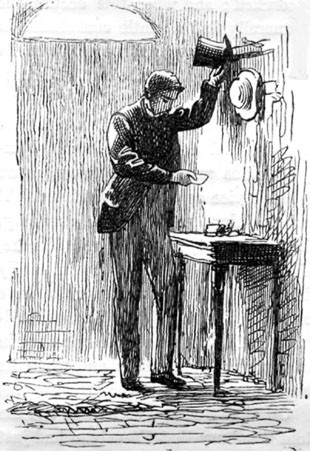
It was so certainly with Colonel Osborne when he became aware that his intimacy with Mrs. Trevelyan had caused her husband uneasiness. He was not especially a vicious man, and had now, as we know, reached a time of life when such vice as that in question might be supposed to have lost its charm for him. A gentleman over fifty, popular in London, with a seat in Parliament, fond of good dinners, and possessed of everything which the world has to give, could hardly have wished to run away with his neighbour's wife, or to have destroyed the happiness of his old friend's daughter. Such wickedness had never come into his head; but he had a certain pleasure in being the confidential friend of a very pretty woman; and when he heard that that pretty woman's husband was jealous, the pleasure was enhanced rather than otherwise. On that Sunday, as he had left the house in Curzon Street, he had told Stanbury that Trevelyan had just gone off in a huff, which was true enough, and he had walked from thence down Clarges Street, and across Piccadilly to St. James's Street, with a jauntier step than usual, because he was aware that he himself had been the occasion of that trouble. This was very wrong; but there is reason to believe that many such men as Colonel Osborne, who are bachelors at fifty, are equally malicious.
He thought a good deal about it on that evening, and was still thinking about it on the following morning. He had promised to go up to Curzon Street on the Monday,—really on some most trivial mission, on a matter of business which no man could have taken in hand whose time was of the slightest value to himself or any one else. But now that mission assumed an importance in his eyes, and seemed to require either a special observance or a special excuse. There was no real reason why he should not have stayed away from Curzon Street for the next fortnight; and had he done so he need have made no excuse to Mrs. Trevelyan when he met her. But the opportunity for a little excitement was not to be missed, and instead of going he wrote to her the following note:—
Albany, Monday.
Dear Emily,
What was it all about yesterday? I was to have come up with the words of that opera, but perhaps it will be better to send it. If it be not wicked, do tell me whether I am to consider myself as a banished man. I thought that our little meetings were so innocent,—and so pleasant! The green-eyed monster is of all monsters the most monstrous,—and the most unreasonable. Pray let me have a line, if it be not forbidden.
Yours always heartily,
F. O.
Putting aside all joking, I beg you to remember that I consider myself always entitled to be regarded by you as your most sincere friend.
When this was brought to Mrs. Trevelyan, about twelve o'clock in the day, she had already undergone the infliction of those words of wisdom which her husband had prepared for her, and which were threatened at the close of the last chapter. Her husband had come up to her while she was yet in her bed-room, and had striven hard to prevail against her. But his success had been very doubtful. In regard to the number of words, Mrs. Trevelyan certainly had had the best of it. As far as any understanding, one of another, was concerned, the conversation had been useless. She believed herself to be injured and aggrieved, and would continue so to assert, let him implore her to listen to him as loudly as he might. "Yes;—I will listen, and I will obey you," she had said, "but I will not endure such insults without telling you that I feel them." Then he had left her, fully conscious that he had failed, and went forth out of his house into the City, to his club, to wander about the streets, not knowing what he had best do to bring back that state of tranquillity at home which he felt to be so desirable.
Mrs. Trevelyan was alone when Colonel Osborne's note was brought to her, and was at that moment struggling with herself in anger against her husband. If he laid any command upon her, she would execute it; but she would never cease to tell him that he had ill-used her. She would din it into his ears, let him come to her as often as he might with his wise words. Wise words! What was the use of wise words when a man was such a fool in nature? And as for Colonel Osborne,—she would see him if he came to her three times a day, unless her husband gave some clearly intelligible order to the contrary. She was fortifying her mind with this resolution when Colonel Osborne's letter was brought to her. She asked whether any servant was waiting for an answer. No,—the servant, who had left it, had gone at once. She read the note, and sat working, with it before her, for a quarter of an hour; and then walked over to her desk and answered it.
My dear Colonel Osborne,
It will be best to say nothing whatever about the occurrence of yesterday; and if possible, not to think of it. As far as I am concerned, I wish for no change;—except that people should be more reasonable. You can call of course whenever you please; and I am very grateful for your expression of friendship.
Yours most sincerely,
Emily Trevelyan.
Thanks for the words of the opera.
When she had written this, being determined that all should be open and above board, she put a penny stamp on the envelope, and desired that the letter should be posted. But she destroyed that which she had received from Colonel Osborne. In all things she would act as she would have done if her husband had not been so foolish, and there could have been no reason why she should have kept so unimportant a communication.
In the course of the day Trevelyan passed through the hall to the room which he himself was accustomed to occupy behind the parlour, and as he did so saw the note lying ready to be posted, took it up, and read the address. He held it for a moment in his hand, then replaced it on the hall table, and passed on. When he reached his own table he sat down hurriedly, and took up in his hand some Review that was lying ready for him to read. But he was quite unable to fix his mind upon the words before him. He had spoken to his wife on that morning in the strongest language he could use as to the unseemliness of her intimacy with Colonel Osborne; and then, the first thing she had done when his back was turned was to write to this very Colonel Osborne, and tell him, no doubt, what had occurred between her and her husband. He sat thinking of it all for many minutes. He would probably have declared himself that he had thought of it for an hour as he sat there. Then he got up, went up-stairs and walked slowly into the drawing-room. There he found his wife sitting with her sister. "Nora," he said, "I want to speak to Emily. Will you forgive me, if I ask you to leave us for a few minutes?" Nora, with an anxious look at Emily, got up and left the room.
"Why do you send her away?" said Mrs. Trevelyan.
"Because I wish to be alone with you for a few minutes. Since what I said to you this morning, you have written to Colonel Osborne."
"Yes;—I have. I do not know how you have found it out; but I suppose you keep a watch on me."
"I keep no watch on you. As I came into the house, I saw your letter lying in the hall."
"Very well. You could have read it if you pleased."
"Emily, this matter is becoming very serious, and I strongly advise you to be on your guard in what you say. I will bear much for you, and much for our boy; but I will not bear to have my name made a reproach."
"Sir, if you think your name is shamed by me, we had better part," said Mrs. Trevelyan, rising from her chair, and confronting him with a look before which his own almost quailed.
"It may be that we had better part," he said, slowly. "But in the first place I wish you to tell me what were the contents of that letter."
"If it was there when you came in, no doubt it is there still. Go and look at it."
"That is no answer to me. I have desired you to tell me what are its contents."
"I shall not tell you. I will not demean myself by repeating anything so insignificant in my own justification. If you suspect me of writing what I should not write, you will suspect me also of lying to conceal it."
"Have you heard from Colonel Osborne this morning?"
"I have."
"And where is his letter?"
"I have destroyed it."
Again he paused, trying to think what he had better do, trying to be calm. And she stood still opposite to him, confronting him with the scorn of her bright angry eyes. Of course, he was not calm. He was the very reverse of calm. "And you refuse to tell me what you wrote," he said.
"The letter is there," she answered, pointing away towards the door. "If you want to play the spy, go and look at it for yourself."
"Do you call me a spy?"
"And what have you called me? Because you are a husband, is the privilege of vituperation to be all on your side?"
"It is impossible that I should put up with this," he said;—"quite impossible. This would kill me. Anything is better than this. My present orders to you are not to see Colonel Osborne, not to write to him or have any communication with him, and to put under cover to me, unopened, any letter that may come from him. I shall expect your implicit obedience to these orders."
"Well;—go on."
"Have I your promise?"
"No;—no. You have no promise. I will make no promise exacted from me in so disgraceful a manner."
"You refuse to obey me?"
"I will refuse nothing, and will promise nothing."
"Then we must part;—that is all. I will take care that you shall hear from me before to-morrow morning."
So saying, he left the room, and, passing through the hall, saw that the letter had been taken away.
CHAPTER XI.
LADY MILBOROUGH AS AMBASSADOR.
"Of course, I know you are right," said Nora to her sister;—"right as far as Colonel Osborne is concerned; but nevertheless you ought to give way."
"And be trampled upon?" said Mrs. Trevelyan.
"Yes; and be trampled upon, if he should trample on you;—which, however, he is the last man in the world to do."
"And to endure any insult and any names? You yourself—you would be a Griselda, I suppose."
"I don't want to talk about myself," said Nora, "nor about Griselda. But I know that, however unreasonable it may seem, you had better give way to him now and tell him what there was in the note to Colonel Osborne."
"Never! He has ordered me not to see him or to write to him, or to open his letters,—having, mind you, ordered just the reverse a day or two before; and I will obey him. Absurd as it is, I will obey him. But as for submitting to him, and letting him suppose that I think he is right;—never! I should be lying to him then, and I will never lie to him. He has said that we must part, and I suppose it will be better so. How can a woman live with a man that suspects her? He cannot take my baby from me."
There were many such conversations as the above between the two sisters before Mrs. Trevelyan received from her husband the communication with which she had been threatened. And Nora, acting on her own judgment in the matter, made an attempt to see Mr. Trevelyan, writing to him a pretty little note, and beseeching him to be kind to her. But he declined to see her, and the two women sat at home, with the baby between them, holding such pleasant conversations as that above narrated. When such tempests occur in a family, a woman will generally suffer the least during the thick of the tempest. While the hurricane is at the fiercest, she will be sustained by the most thorough conviction that the right is on her side, that she is aggrieved, that there is nothing for her to acknowledge, and no position that she need surrender. Whereas her husband will desire a compromise, even amidst the violence of the storm. But afterwards, when the wind has lulled, but while the heavens around are still all black and murky, then the woman's sufferings begin. When passion gives way to thought and memory, she feels the loneliness of her position,—the loneliness, and the possible degradation. It is all very well for a man to talk about his name and his honour; but it is the woman's honour and the woman's name that are, in truth, placed in jeopardy. Let the woman do what she will, the man can, in truth, show his face in the world;—and, after awhile, does show his face. But the woman may be compelled to veil hers, either by her own fault, or by his. Mrs. Trevelyan was now told that she was to be separated from her husband, and she did not, at any rate, believe that she had done any harm. But, if such separation did come, where could she live, what could she do, what position in the world would she possess? Would not her face be, in truth, veiled as effectually as though she had disgraced herself and her husband?
And then there was that terrible question about the child. Mrs. Trevelyan had said a dozen times to her sister that her husband could not take the boy away from her. Nora, however, had never assented to this, partly from a conviction of her own ignorance, not knowing what might be the power of a husband in such a matter, and partly thinking that any argument would be good and fair by which she could induce her sister to avoid a catastrophe so terrible as that which was now threatened.
"I suppose he could take him, if he chose," she said at last.
"I don't believe he is wicked like that," said Mrs. Trevelyan. "He would not wish to kill me."
"But he will say that he loves baby as well as you do."
"He will never take my child from me. He could never be so bad as that."
"And you will never be so bad as to leave him," said Nora after a pause. "I will not believe that it can come to that. You know that he is good at heart,—that nobody on earth loves you as he does."
So they went on for two days, and on the evening of the second day there came a letter from Trevelyan to his wife. They had neither of them seen him, although he had been in and out of the house. And on the afternoon of the Sunday a new grievance, a very terrible grievance, was added to those which Mrs. Trevelyan was made to bear. Her husband had told one of the servants in the house that Colonel Osborne was not to be admitted. And the servant to whom he had given this order was the—cook. There is no reason why a cook should be less trustworthy in such a matter than any other servant; and in Mr. Trevelyan's household there was a reason why she should be more so,—as she, and she alone, was what we generally call an old family domestic. She had lived with her master's mother, and had known her master when he was a boy. Looking about him, therefore, for some one in his house to whom he could speak,—feeling that he was bound to convey the order through some medium,—he called to him the ancient cook, and imparted to her so much of his trouble as was necessary to make the order intelligible. This he did with various ill-worded assurances to Mrs. Prodgers that there really was nothing amiss. But when Mrs. Trevelyan heard what had been done,—which she did from Mrs. Prodgers herself, Mrs. Prodgers having been desired by her master to make the communication,—she declared to her sister that everything was now over. She could never again live with a husband who had disgraced his wife by desiring her own cook to keep a guard upon her. Had the footman been instructed not to admit Colonel Osborne, there would have been in such instruction some apparent adherence to the recognised usages of society. If you do not desire either your friend or your enemy to be received into your house, you communicate your desire to the person who has charge of the door. But the cook!
"And now, Nora, if it were you, do you mean to say that you would remain with him?" asked Mrs. Trevelyan.
Nora simply replied that anything under any circumstances would be better than a separation.
On the morning of the third day there came the following letter:—
Wednesday, June 1, 12 midnight.
Dearest Emily,
You will readily believe me when I say that I never in my life was so wretched as I have been during the last two days. That you and I should be in the same house together and not able to speak to each other is in itself a misery, but this is terribly enhanced by the dread lest this state of things should be made to continue.
I want you to understand that I do not in the least suspect you of having as yet done anything wrong,—or having even said anything injurious either to my position as your husband, or to your position as my wife. But I cannot but perceive that you are allowing yourself to be entrapped into an intimacy with Colonel Osborne which if it be not checked, will be destructive to my happiness and your own. After what had passed before, you cannot have thought it right to receive letters from him which I was not to see, or to write letters to him of which I was not to know the contents. It must be manifest to you that such conduct on your part is wrong as judged by any of the rules by which a wife's conduct can be measured. And yet you have refused even to say that this shall be discontinued! I need hardly explain to you that if you persist in this refusal you and I cannot continue to live together as man and wife. All my hopes and prospects in life will be blighted by such a separation. I have not as yet been able to think what I should do in such wretched circumstances. And for you, as also for Nora, such a catastrophe would be most lamentable. Do, therefore, think of it well, and write me such a letter as may bring me back to your side.
There is only one friend in the world to whom I could endure to talk of this great grief, and I have been to her and told her everything. You will know that I mean Lady Milborough. After much difficult conversation I have persuaded her to see you, and she will call in Curzon Street to-morrow about twelve. There can be no kinder-hearted, or more gentle woman in the world than Lady Milborough; nor did any one ever have a warmer friend than both you and I have in her. Let me implore you then to listen to her, and be guided by her advice.
Pray believe, dearest Emily, that I am now, as ever, your most affectionate husband, and that I have no wish so strong as that we should not be compelled to part.
Louis Trevelyan.
This epistle was, in many respects, a very injudicious composition. Trevelyan should have trusted either to the eloquence of his own written words, or to that of the ambassador whom he was about to despatch; but by sending both he weakened both. And then there were certain words in the letter which were odious to Mrs. Trevelyan, and must have been odious to any young wife. He had said that he did not "as yet" suspect her of having done anything wrong. And then, when he endeavoured to explain to her that a separation would be very injurious to herself, he had coupled her sister with her, thus seeming to imply that the injury to be avoided was of a material kind. She had better do what he told her, as, otherwise, she and her sister would not have a roof over their head! That was the nature of the threat which his words were supposed to convey.
The matter had become so serious, that Mrs. Trevelyan, haughty and stiff-necked as she was, did not dare to abstain from showing the letter to her sister. She had no other counsellor, at any rate, till Lady Milborough came, and the weight of the battle was too great for her own unaided spirit. The letter had been written late at night, as was shown by the precision of the date, and had been brought to her early in the morning. At first she had determined to say nothing about it to Nora, but she was not strong enough to maintain such a purpose. She felt that she needed the poor consolation of discussing her wretchedness. She first declared that she would not see Lady Milborough. "I hate her, and she knows that I hate her, and she ought not to have thought of coming," said Mrs. Trevelyan.
But she was at last beaten out of this purpose by Nora's argument, that all the world would be against her if she refused to see her husband's old friend. And then, though the letter was an odious letter, as she declared a dozen times, she took some little comfort in the fact that not a word was said in it about the baby. She thought that if she could take her child with her into any separation, she could endure it, and her husband would ultimately be conquered.
"Yes; I'll see her," she said, as they finished the discussion. "As he chooses to send her, I suppose I had better see her. But I don't think he does much to mend matters when he sends the woman whom he knows I dislike more than any other in all London."
Exactly at twelve o'clock Lady Milborough's carriage was at the door. Trevelyan was in the house at the time and heard the knock at the door. During those two or three days of absolute wretchedness, he spent most of his hours under the same roof with his wife and sister-in-law, though he spoke to neither of them. He had had his doubts as to the reception of Lady Milborough, and was, to tell the truth, listening with most anxious ear, when her ladyship was announced. His wife, however, was not so bitterly contumacious as to refuse admittance to his friend, and he heard the rustle of the ponderous silk as the old woman was shown up-stairs. When Lady Milborough reached the drawing-room, Mrs. Trevelyan was alone.
"I had better see her by myself," she had said to her sister.
Nora had then left her, with one word of prayer that she would be as little defiant as possible.
"That must depend," Emily had said, with a little shake of her head.
There had been a suggestion that the child should be with her, but the mother herself had rejected this.
"It would be stagey," she had said, "and clap-trap. There is nothing I hate so much as that."
She was sitting, therefore, quite alone, and as stiff as a man in armour, when Lady Milborough was shown up to her.
And Lady Milborough herself was not at all comfortable as she commenced the interview. She had prepared many wise words to be spoken, but was not so little ignorant of the character of the woman with whom she had to deal, as to suppose that the wise words would get themselves spoken without interruption. She had known from the first that Mrs. Trevelyan would have much to say for herself, and the feeling that it would be so became stronger than ever as she entered the room. The ordinary feelings between the two ladies were cold and constrained, and then there was silence for a few moments when the Countess had taken her seat. Mrs. Trevelyan had quite determined that the enemy should fire the first shot.
"This is a very sad state of things," said the Countess.
"Yes, indeed, Lady Milborough."
"The saddest in the world;—and so unnecessary;—is it not?"
"Very unnecessary, indeed, as I think."
"Yes, my dear, yes. But, of course, we must remember—"
Then Lady Milborough could not clearly bring to her mind what it was that she had to remember.
"The fact is, my dear, that all this kind of thing is too monstrous to be thought of. Goodness, gracious, me; two young people like you and Louis, who thoroughly love each other, and who have got a baby, to think of being separated! Of course it is out of the question."
"You cannot suppose, Lady Milborough, that I want to be separated from my husband?"
"Of course not. How should it be possible? The very idea is too shocking to be thought of. I declare I haven't slept since Louis was talking to me about it. But, my dear, you must remember, you know, that a husband has a right to expect some—some—some—a sort of—submission from his wife."
"He has a right to expect obedience, Lady Milborough."
"Of course; that is all one wants."
"And I will obey Mr. Trevelyan—in anything reasonable."
"But, my dear, who is to say what is reasonable? That, you see, is always the difficulty. You must allow that your husband is the person who ought to decide that."
"Has he told you that I have refused to obey him, Lady Milborough?"
The Countess paused a moment before she replied. "Well, yes; I think he has," she said. "He asked you to do something about a letter,—a letter to that Colonel Osborne, who is a man, my dear, really to be very much afraid of; a man who has done a great deal of harm,—and you declined. Now in a matter of that kind of course the husband—"
"Lady Milborough, I must ask you to listen to me. You have listened to Mr. Trevelyan, and I must ask you to listen to me. I am sorry to trouble you, but as you have come here about this unpleasant business, you must forgive me if I insist upon it."
"Of course I will listen to you, my dear."
"I have never refused to obey my husband, and I do not refuse now. The gentleman of whom you have been speaking is an old friend of my father's, and has become my friend. Nevertheless, had Mr. Trevelyan given me any plain order about him, I should have obeyed him. A wife does not feel that her chances of happiness are increased when she finds that her husband suspects her of being too intimate with another man. It is a thing very hard to bear. But I would have endeavoured to bear it, knowing how important it is for both our sakes, and more especially for our child. I would have made excuses, and would have endeavoured to think that this horrid feeling on his part is nothing more than a short delusion."
"But my dear—"
"I must ask you to hear me out, Lady Milborough. But when he tells me first that I am not to meet the man, and so instructs the servants; then tells me that I am to meet him, and go on just as I was going before, and then again tells me that I am not to see him, and again instructs the servants,—and, above all, the cook!—that Colonel Osborne is not to come into the house, then obedience becomes rather difficult."
"Just say now that you will do what he wants, and then all will be right."
"I will not say so to you, Lady Milborough. It is not to you that I ought to say it. But as he has chosen to send you here, I will explain to you that I have never disobeyed him. When I was free, in accordance with Mr. Trevelyan's wishes, to have what intercourse I pleased with Colonel Osborne, I received a note from that gentleman on a most trivial matter. I answered it as trivially. My husband saw my letter, closed, and questioned me about it. I told him that the letter was still there, and that if he chose to be a spy upon my actions he could open it and read it."
"My dear, how could you bring yourself to use the word spy to your husband?"
"How could he bring himself to accuse me as he did? If he cares for me let him come and beg my pardon for the insult he has offered me."
"Oh, Mrs. Trevelyan,—"
"Yes; that seems very wrong to you, who have not had to bear it. It is very easy for a stranger to take a husband's part, and help to put down a poor woman who has been ill-used. I have done nothing wrong, nothing to be ashamed of; and I will not say that I have. I never have spoken a word to Colonel Osborne that all the world might not hear."
"Nobody has accused you, my dear."
"Yes; he has accused me, and you have accused me, and you will make all the world accuse me. He may put me out of his house if he likes, but he shall not make me say I have been wrong, when I know I have been right. He cannot take my child from me."
"But he will."
"No," shouted Mrs. Trevelyan, jumping up from her chair, "no; he shall never do that. I will cling to him so that he cannot separate us. He will never be so wicked,—such a monster as that. I would go about the world saying what a monster he had been to me." The passion of the interview was becoming too great for Lady Milborough's power of moderating it, and she was beginning to feel herself to be in a difficulty. "Lady Milborough," continued Mrs. Trevelyan, "tell him from me that I will bear anything but that. That I will not bear."
"Dear Mrs. Trevelyan, do not let us talk about it."
"Who wants to talk about it? Why do you come here and threaten me with a thing so horrible? I do not believe you. He would not dare to separate me and my—child."
"But you have only to say that you will submit yourself to him."
"I have submitted myself to him, and I will submit no further. What does he want? Why does he send you here? He does not know what he wants. He has made himself miserable by an absurd idea, and he wants everybody to tell him that he has been right. He has been very wrong; and if he desires to be wise now, he will come back to his home, and say nothing further about it. He will gain nothing by sending messengers here."
Lady Milborough, who had undertaken a most disagreeable task from the purest motives of old friendship, did not like being called a messenger; but the woman before her was so strong in her words, so eager, and so passionate, that she did not know how to resent the injury. And there was coming over her an idea, of which she herself was hardly conscious, that after all, perhaps, the husband was not in the right. She had come there with the general idea that wives, and especially young wives, should be submissive. She had naturally taken the husband's part; and having a preconceived dislike to Colonel Osborne, she had been willing enough to think that precautionary measures were necessary in reference to so eminent, and notorious, and experienced a Lothario. She had never altogether loved Mrs. Trevelyan, and had always been a little in dread of her. But she had thought that the authority with which she would be invested on this occasion, the manifest right on her side, and the undeniable truth of her grand argument, that a wife should obey, would carry her, if not easily, still successfully through all difficulties. It was probably the case that Lady Milborough when preparing for her visit, had anticipated a triumph. But when she had been closeted for an hour with Mrs. Trevelyan, she found that she was not triumphant. She was told that she was a messenger, and an unwelcome messenger; and she began to feel that she did not know how she was to take herself away.
"I am sure I have done everything for the best," she said, getting up from her chair.
"The best will be to send him back, and make him feel the truth."
"The best for you, my dear, will be to consider well what should be the duty of a wife."
"I have considered, Lady Milborough. It cannot be a wife's duty to acknowledge that she has been wrong in such a matter as this."
Then Lady Milborough made her curtsey and got herself away in some manner that was sufficiently awkward, and Mrs. Trevelyan curtseyed also as she rang the bell; and, though she was sore and wretched, and, in truth, sadly frightened, she was not awkward. In that encounter, so far as it had gone, she had been the victor.
As soon as she was alone and the carriage had been driven well away from the door, Mrs. Trevelyan left the drawing-room and went up to the nursery. As she entered she clothed her face with her sweetest smile. "How is his own mother's dearest, dearest, darling duck?" she said, putting out her arms and taking the boy from the nurse. The child was at this time about ten months old, and was a strong, hearty, happy infant, always laughing when he was awake and always sleeping when he did not laugh, because his little limbs were free from pain and his little stomach was not annoyed by internal troubles. He kicked, and crowed, and sputtered, when his mother took him, and put up his little fingers to clutch her hair, and was to her as a young god upon the earth. Nothing in the world had ever been created so beautiful, so joyous, so satisfactory, so divine! And they told her that this apple of her eye was to be taken away from her! No;—that must be impossible. "I will take him into my own room, nurse, for a little while—you have had him all the morning," she said; as though the "having baby" was a privilege over which there might almost be a quarrel. Then she took her boy away with her, and when she was alone with him, went through such a service in baby-worship as most mothers will understand. Divide these two! No; nobody should do that. Sooner than that, she, the mother, would consent to be no more than a servant in her husband's house. Was not her baby all the world to her?
On the evening of that day the husband and wife had an interview together in the library, which, unfortunately, was as unsatisfactory as Lady Milborough's visit. The cause of the failure of them all lay probably in this,—that there was no decided point which, if conceded, would have brought about a reconciliation. Trevelyan asked for general submission, which he regarded as his right, and which in the existing circumstances he thought it necessary to claim, and though Mrs. Trevelyan did not refuse to be submissive she would make no promise on the subject. But the truth was that each desired that the other should acknowledge a fault, and that neither of them would make that acknowledgment. Emily Trevelyan felt acutely that she had been ill-used, not only by her husband's suspicion, but by the manner in which he had talked of his suspicion to others,—to Lady Milborough and the cook, and she was quite convinced that she was right herself, because he had been so vacillating in his conduct about Colonel Osborne. But Trevelyan was equally sure that justice was on his side. Emily must have known his real wishes about Colonel Osborne; but when she had found that he had rescinded his verbal orders about the admission of the man to the house,—which he had done to save himself and her from slander and gossip,—she had taken advantage of this and had thrown herself more entirely than ever into the intimacy of which he disapproved! When they met, each was so sore that no approach to terms was made by them.
"If I am to be treated in that way, I would rather not live with you," said the wife. "It is impossible to live with a husband who is jealous."
"All I ask of you is that you shall promise me to have no further communication with this man."
"I will make no promise that implies my own disgrace."
"Then we must part; and if that be so, this house will be given up. You may live where you please,—in the country, not in London; but I shall take steps that Colonel Osborne does not see you."
"I will not remain in the room with you to be insulted thus," said Mrs. Trevelyan. And she did not remain, but left the chamber, slamming the door after her as she went.
"It will be better that she should go," said Trevelyan, when he found himself alone. And so it came to pass that that blessing of a rich marriage, which had as it were fallen upon them at the Mandarins from out of heaven, had become, after an interval of but two short years, anything but an unmixed blessing.
CHAPTER XII.
MISS STANBURY'S GENEROSITY.
On one Wednesday morning early in June, great preparations were being made at the brick house in the Close at Exeter for an event which can hardly be said to have required any preparation at all. Mrs. Stanbury and her elder daughter were coming into Exeter from Nuncombe Putney to visit Dorothy. The reader may perhaps remember that when Miss Stanbury's invitation was sent to her niece, she was pleased to promise that such visits should be permitted on a Wednesday morning. Such a visit was now to be made, and old Miss Stanbury was quite moved by the occasion. "I shall not see them, you know, Martha," she had said, on the afternoon of the preceding day.
"I suppose not, ma'am."
"Certainly not. Why should I? It would do no good."
"It is not for me to say, ma'am, of course."
"No, Martha, it is not. And I am sure that I am right. It's no good going back and undoing in ten minutes what twenty years have done. She's a poor harmless creature, I believe."
"The most harmless in the world, ma'am."
"But she was as bad as poison to me when she was young, and what's the good of trying to change it now? If I was to tell her that I loved her, I should only be lying."
"Then, ma'am, I would not say it."
"And I don't mean. But you'll take in some wine and cake, you know."
"I don't think they'll care for wine and cake."
"Will you do as I tell you? What matters whether they care for it or not? They need not take it. It will look better for Miss Dorothy. If Dorothy is to remain here I shall choose that she should be respected." And so the question of the cake and wine had been decided overnight. But when the morning came Miss Stanbury was still in a twitter. Half-past ten had been the hour fixed for the visit, in consequence of there being a train in from Lessboro', due at the Exeter station at ten. As Miss Stanbury breakfasted always at half-past eight, there was no need of hurry on account of the expected visit. But, nevertheless, she was in a fuss all the morning; and spoke of the coming period as one in which she must necessarily put herself into solitary confinement.
"Perhaps your mamma will be cold," she said, "and will expect a fire."
"Oh, dear, no, Aunt Stanbury."
"It could be lighted of course. It is a pity they should come just so as to prevent you from going to morning service; is it not?"
"I could go with you, aunt, and be back very nearly in time. They won't mind waiting a quarter of an hour."
"What; and have them here all alone! I wouldn't think of such a thing. I shall go up-stairs. You had better come to me when they are gone. Don't hurry them. I don't want you to hurry them at all; and if you require anything, Martha will wait upon you. I have told the girls to keep out of the way. They are so giddy, there's no knowing what they might be after. Besides,—they've got their work to mind."
All this was very terrible to poor Dorothy, who had not as yet quite recovered from the original fear with which her aunt had inspired her,—so terrible that she was almost sorry that her mother and sister were coming to her. When the knock was heard at the door, precisely as the cathedral clock was striking half-past ten,—to secure which punctuality, and thereby not to offend the owner of the mansion, Mrs. Stanbury and Priscilla had been walking about the Close for the last ten minutes,—Miss Stanbury was still in the parlour.
"There they are!" she exclaimed, jumping up. "They haven't given a body much time to run away, have they, my dear? Half a minute, Martha,—just half a minute!" Then she gathered up her things as though she had been ill-treated in being driven to make so sudden a retreat, and Martha, as soon as the last hem of her mistress's dress had become invisible on the stairs, opened the front door for the visitors.
"Do you mean to say you like it?" said Priscilla, when they had been there about a quarter of an hour.
"H—u—sh," whispered Mrs. Stanbury.
"I don't suppose she's listening at the door," said Priscilla.
"Indeed, she's not," said Dorothy. "There can't be a truer, honester woman, than Aunt Stanbury."
"But is she kind to you, Dolly?" asked the mother.
"Very kind; too kind. Only I don't understand her quite, and then she gets angry with me. I know she thinks I'm a fool, and that's the worst of it."
"Then, if I were you, I would come home," said Priscilla.
"She'll never forgive you if you do," said Mrs. Stanbury.
"And who need care about her forgiveness?" said Priscilla.
"I don't mean to go home yet, at any rate," said Dorothy. Then there was a knock at the door, and Martha entered with the cake and wine. "Miss Stanbury's compliments, ladies, and she hopes you'll take a glass of sherry." Whereupon she filled out the glasses and carried them round.
"Pray give my compliments and thanks to my sister Stanbury," said Dorothy's mother. But Priscilla put down the glass of wine without touching it, and looked her sternest at the maid.
Altogether, the visit was not very successful, and poor Dorothy almost felt that if she chose to remain in the Close she must lose her mother and sister, and that without really making a friend of her aunt. There had as yet been no quarrel,—nothing that had been plainly recognised as disagreeable; but there had not as yet come to be any sympathy, or assured signs of comfortable love. Miss Stanbury had declared more than once that it would do, but had not succeeded in showing in what the success consisted. When she was told that the two ladies were gone, she desired that Dorothy might be sent to her, and immediately began to make anxious inquiries.
"Well, my dear, and what do they think of it?"
"I don't know, aunt, that they think very much."
"And what do they say about it?"
"They didn't say very much, aunt. I was very glad to see mamma and Priscilla. Perhaps I ought to tell you that mamma gave me back the money I sent her."
"What did she do that for?" asked Miss Stanbury very sharply.
"Because she says that Hugh sends her now what she wants." Miss Stanbury, when she heard this, looked very sour. "I thought it best to tell you, you know."
"It will never come to any good, got in that way,—never."
"But, Aunt Stanbury, isn't it good of him to send it?"
"I don't know. I suppose it's better than drinking, and smoking, and gambling. But I dare say he gets enough for that too. When a man, born and bred like a gentleman, condescends to let out his talents and education for such purposes, I dare say they are willing enough to pay him. The devil always does pay high wages. But that only makes it so much the worse. One almost comes to doubt whether any one ought to learn to write at all, when it is used for such vile purposes. I've said what I've got to say, and I don't mean to say anything more. What's the use? But it has been hard upon me,—very. It was my money did it, and I feel I've misused it. It's a disgrace to me which I don't deserve."
For a couple of minutes Dorothy remained quite silent, and Miss Stanbury did not herself say anything further. Nor during that time did she observe her niece, or she would probably have seen that the subject was not to be dropped. Dorothy, though she was silent, was not calm, and was preparing herself for a crusade in her brother's defence.
"Aunt Stanbury, he's my brother, you know."
"Of course he's your brother. I wish he were not."
"I think him the best brother in the world,—and the best son."
"Why does he sell himself to write sedition?"
"He doesn't sell himself to write sedition. I don't see why it should be sedition, or anything wicked, because it's sold for a penny."
"If you are going to cram him down my throat, Dorothy, you and I had better part."
"I don't want to say anything about him, only you ought—not—to abuse him—before me." By this time Dorothy was beginning to sob, but Miss Stanbury's countenance was still very grim and very stern. "He's coming home to Nuncombe Putney, and I want to—see—see him," continued Dorothy.
"Hugh Stanbury coming to Exeter! He won't come here."
"Then I'd rather go home, Aunt Stanbury."
"Very well, very well," said Miss Stanbury, and she got up and left the room.
Dorothy was in dismay, and began to think that there was nothing for her to do but to pack up her clothes and prepare for her departure. She was very sorry for what had occurred, being fully alive to the importance of the aid not only to herself, but to her mother and sister, which was afforded by the present arrangement, and she felt very angry with herself, in that she had already driven her aunt to quarrel with her. But she had found it to be impossible to hear her own brother abused without saying a word on his behalf. She did not see her aunt again till dinner-time, and then there was hardly a word uttered. Once or twice Dorothy made a little effort to speak, but these attempts failed utterly. The old woman would hardly reply even by a monosyllable, but simply muttered something, or shook her head when she was addressed. Jane, who waited at table, was very demure and silent, and Martha, who once came into the room during the meal, merely whispered a word into Miss Stanbury's ear. When the cloth was removed, and two glasses of port had been poured out by Miss Stanbury herself, Dorothy felt that she could endure this treatment no longer. How was it possible that she could drink wine under such circumstances?

"Not for me, Aunt Stanbury," said she, with a deploring tone.
"Why not?"
"I couldn't drink it to-day."
"Why didn't you say so before it was poured out? And why not to-day? Come, drink it. Do as I bid you." And she stood over her niece, as a tragedy queen in a play with a bowl of poison. Dorothy took it and sipped it from mere force of obedience. "You make as many bones about a glass of port wine as though it were senna and salts," said Miss Stanbury. "Now I've got something to say to you." By this time the servant was gone, and the two were seated alone together in the parlour. Dorothy, who had not as yet swallowed above half her wine, at once put the glass down. There was an importance in her aunt's tone which frightened her, and made her feel that some evil was coming. And yet, as she had made up her mind that she must return home, there was no further evil that she need dread. "You didn't write any of those horrid articles?" said Miss Stanbury.
"No, aunt; I didn't write them. I shouldn't know how."
"And I hope you'll never learn. They say women are to vote, and become doctors, and if so, there's no knowing what devil's tricks they mayn't do. But it isn't your fault about that filthy newspaper. How he can let himself down to write stuff that is to be printed on straw is what I can't understand."
"I don't see how it can make a difference as he writes it."
"It would make a great deal of difference to me. And I'm told that what they call ink comes off on your fingers like lamp-black. I never touched one, thank God; but they tell me so. All the same; it isn't your fault."
"I've nothing to do with it, Aunt Stanbury."
"Of course you've not. And as he is your brother it wouldn't be natural that you should like to throw him off. And, my dear, I like you for taking his part. Only you needn't have been so fierce with an old woman."
"Indeed—indeed I didn't mean to be—fierce, Aunt Stanbury."
"I never was taken up so short in my life. But we won't mind that. There; he shall come and see you. I suppose he won't insist on leaving any of his nastiness about."
"But is he to come here, Aunt Stanbury?"
"He may if he pleases."
"Oh, Aunt Stanbury!"
"When he was here last he generally had a pipe in his mouth, and I dare say he never puts it down at all now. Those things grow upon young people so fast. But if he could leave it on the door-step just while he's here I should be obliged to him."
"But, dear aunt, couldn't I see him in the street?"
"Out in the street! No, my dear. All the world is not to know that he's your brother; and he is dressed in such a rapscallion manner that the people would think you were talking to a house-breaker." Dorothy's face became again red as she heard this, and the angry words were very nearly spoken. "The last time I saw him," continued Miss Stanbury, "he had on a short, rough jacket, with enormous buttons, and one of those flipperty-flopperty things on his head, that the butcher-boys wear. And, oh, the smell of tobacco! As he had been up in London I suppose he thought Exeter was no better than a village, and he might do just as he pleased. But he knew that if I'm particular about anything, it is about a gentleman's hat in the streets. And he wanted me—me!—to walk with him across to Mrs. MacHugh's! We should have been hooted about the Close like a pair of mad dogs;—and so I told him."
"All the young men seem to dress like that now, Aunt Stanbury."
"No, they don't. Mr. Gibson doesn't dress like that."
"But he's a clergyman, Aunt Stanbury."
"Perhaps I'm an old fool. I dare say I am, and of course that's what you mean. At any rate I'm too old to change, and I don't mean to try. I like to see a difference between a gentleman and a house-breaker. For the matter of that I'm told that there is a difference, and that the house-breakers all look like gentlemen now. It may be proper to make us all stand on our heads, with our legs sticking up in the air; but I for one don't like being topsy-turvey, and I won't try it. When is he to reach Exeter?"
"He is coming on Tuesday next, by the last train."
"Then you can't see him that night. That's out of the question. No doubt he'll sleep at the Nag's Head, as that's the lowest radical public-house in the city. Martha shall try to find him. She knows more about his doings than I do. If he chooses to come here the following morning before he goes down to Nuncombe Putney, well and good. I shall wait up till Martha comes back from the train on Tuesday night, and hear." Dorothy was of course full of gratitude and thanks; but yet she felt almost disappointed by the result of her aunt's clemency on the matter. She had desired to take her brother's part, and it had seemed to her as though she had done so in a very lukewarm manner. She had listened to an immense number of accusations against him, and had been unable to reply to them because she had been conquered by the promise of a visit. And now it was out of the question that she should speak of going. Her aunt had given way to her, and of course had conquered her.
Late on the Tuesday evening, after ten o'clock, Hugh Stanbury was walking round the Close with his aunt's old servant. He had not put up at that dreadfully radical establishment of which Miss Stanbury was so much afraid, but had taken a bed-room at the Railway Inn. From there he had walked up to the Close with Martha, and now was having a few last words with her before he would allow her to return to the house.
"I suppose she'd as soon see the devil as see me," said Hugh.
"If you speak in that way, Mr. Hugh, I won't listen to you."
"And yet I did everything I could to please her; and I don't think any boy ever loved an old woman better than I did her."
"That was while she used to send you cakes, and ham, and jam to school, Mr. Hugh."
"Of course it was, and while she sent me flannel waistcoats to Oxford. But when I didn't care any longer for cakes or flannel then she got tired of me. It is much better as it is, if she'll only be good to Dorothy."
"She never was bad to anybody, Mr. Hugh. But I don't think an old lady like her ever takes to a young woman as she does to a young man, if only he'll let her have a little more of her own way than you would. It's my belief that you might have had it all for your own some day, if you'd done as you ought."
"That's nonsense, Martha. She means to leave it all to the Burgesses. I've heard her say so."
"Say so; yes. People don't always do what they say. If you'd managed rightly you might have it all;—and so you might now."
"I'll tell you what, old girl; I shan't try. Live for the next twenty years under her apron strings, that I may have the chance at the end of it of cutting some poor devil out of his money! Do you know the meaning of making a score off your own bat, Martha?"
"No, I don't; and if it's anything you're like to do, I don't think I should be the better for learning,—by all accounts. And now if you please, I'll go in."
"Good night, Martha. My love to them both, and say I'll be there to-morrow exactly at half-past nine. You'd better take it. It won't turn to slate-stone. It hasn't come from the old gentleman."
"I don't want anything of that kind, Mr. Hugh;—indeed I don't."
"Nonsense. If you don't take it you'll offend me. I believe you think I'm not much better than a schoolboy still."
"I don't think you're half so good, Mr. Hugh," said the old servant, sticking the sovereign which Hugh had given her in under her glove as she spoke.
On the next morning that other visit was made at the brick house, and Miss Stanbury was again in a fuss. On this occasion, however, she was in a much better humour than before, and was full of little jokes as to the nature of the visitation. Of course, she was not to see her nephew herself, and no message was to be delivered from her, and none was to be given to her from him. But an accurate report was to be made to her as to his appearance, and Dorothy was to be enabled to answer a variety of questions respecting him after he was gone. "Of course, I don't want to know anything about his money," Miss Stanbury said, "only I should like to know how much these people can afford to pay for their penny trash." On this occasion she had left the room and gone up-stairs before the knock came at the door, but she managed, by peeping over the balcony, to catch a glimpse of the "flipperty-flopperty" hat which her nephew certainly had with him on this occasion.
Hugh Stanbury had great news for his sister. The cottage in which Mrs. Stanbury lived at Nuncombe Putney, was the tiniest little dwelling in which a lady and her two daughters ever sheltered themselves. There was, indeed, a sitting-room, two bed-rooms, and a kitchen; but they were all so diminutive in size that the cottage was little more than a cabin. But there was a house in the village, not large indeed, but eminently respectable, three stories high, covered with ivy, having a garden behind it, and generally called the Clock House, because there had once been a clock upon it. This house had been lately vacated, and Hugh informed his sister that he was thinking of taking it for his mother's accommodation. Now, the late occupants of the Clock House, at Nuncombe Putney, had been people with five or six hundred a year. Had other matters been in accordance, the house would almost have entitled them to consider themselves as county people. A gardener had always been kept there,—and a cow!
"The Clock House for mamma!"
"Well, yes. Don't say a word about it as yet to Aunt Stanbury, as she'll think that I've sold myself altogether to the old gentleman."
"But, Hugh, how can mamma live there?"
"The fact is, Dorothy, there is a secret. I can't tell you quite yet. Of course, you'll know it, and everybody will know it, if the thing comes about. But as you won't talk, I will tell you what most concerns ourselves."
"And am I to go back?"
"Certainly not,—if you will take my advice. Stick to your aunt. You don't want to smoke pipes, and wear Tom-and-Jerry hats, and write for the penny newspapers."
Now Hugh Stanbury's secret was this;—that Louis Trevelyan's wife and sister-in-law were to leave the house in Curzon Street, and come and live at Nuncombe Putney, with Mrs. Stanbury and Priscilla. Such, at least, was the plan to be carried out, if Hugh Stanbury should be successful in his present negotiations.
CHAPTER XIII.
THE HONOURABLE MR. GLASCOCK.

As to the quarrel between Trevelyan and his wife things went from bad to worse. Lady Milborough continued to interfere, writing letters to Emily which were full of good sense, but which, as Emily said herself, never really touched the point of dispute. "Am I, who am altogether unconscious of having done anything amiss, to confess that I have been in the wrong? If it were about a small matter, I would not mind, for the sake of peace. But when it concerns my conduct in reference to another man I would rather die first." That had been Mrs. Trevelyan's line of thought and argument in the matter; but then old Lady Milborough in her letters spoke only of the duty of obedience as promised at the altar. "But I didn't promise to tell a lie," said Mrs. Trevelyan. And there were interviews between Lady Milborough and Trevelyan, and interviews between Lady Milborough and Nora Rowley. The poor dear old dowager was exceedingly busy and full of groans, prescribing Naples, prescribing a course of extra prayers, prescribing a general course of letting by-gones be by-gones,—to which, however, Trevelyan would by no means assent without some assurance, which he might regard as a guarantee,—prescribing retirement to a small town in the west of France if Naples would not suffice; but she could effect nothing.
Mrs. Trevelyan, indeed, did a thing which was sure of itself to render any steps taken for a reconciliation ineffectual. In the midst of all this turmoil,—while she and her husband were still living in the same house, but apart because of their absurd quarrel respecting Colonel Osborne, she wrote another letter to that gentleman. The argument by which she justified this to herself, and to her sister after it was done, was the real propriety of her own conduct throughout her whole intimacy with Colonel Osborne. "But that is just what Louis doesn't want you to do," Nora had said, filled with anger and dismay. "Then let Louis give me an order to that effect, and behave to me like a husband, and I will obey him," Emily had answered. And she had gone on to plead that in her present condition she was under no orders from her husband. She was left to judge for herself, and,—judging for herself,—she knew, as she said, that it was best that she should write to Colonel Osborne. Unfortunately there was no ground for hoping that Colonel Osborne was ignorant of this insane jealousy on the part of her husband. It was better, therefore, she said, that she should write to him,—whom on the occasion she took care to name to her sister as "papa's old friend,"—and explain to him what she would wish him to do, and what not to do. Colonel Osborne answered the letter very quickly, throwing much more of demonstrative affection than he should have done into his "Dear Emily," and his "Dearest Friend." Of course Mrs. Trevelyan had burned this answer, and of course Mr. Trevelyan had been told of the correspondence. His wife, indeed, had been especially careful that there should be nothing secret about the matter,—that it should be so known in the house that Mr. Trevelyan should be sure to hear of it. And he had heard of it, and been driven almost mad by it. He had flown off to Lady Milborough, and had reduced his old friend to despair by declaring that, after all, he began to fear that his wife was—was—was—infatuated by that d—— scoundrel. Lady Milborough forgave the language, but protested that he was wrong in his suspicion. "To continue to correspond with him after what I have said to her!" exclaimed Trevelyan. "Take her to Naples at once,"—said Lady Milborough;—"at once!" "And have him after me?" said Trevelyan. Lady Milborough had no answer ready, and not having thought of this looked very blank. "I should find it harder to deal with her there even than here," continued Trevelyan. Then it was that Lady Milborough spoke of the small town in the west of France, urging as her reason that such a man as Colonel Osborne would certainly not follow them there; but Trevelyan had become indignant at this, declaring that if his wife's good name could be preserved in no other manner than that, it would not be worth preserving at all. Then Lady Milborough had begun to cry, and had continued crying for a very long time. She was very unhappy,—as unhappy as her nature would allow her to be. She would have made almost any sacrifice to bring the two young people together;—would have willingly given her time, her money, her labour in the cause;—would probably herself have gone to the little town in the west of France, had her going been of any service. But, nevertheless, after her own fashion, she extracted no small enjoyment out of the circumstances of this miserable quarrel. The Lady Milboroughs of the day hate the Colonel Osbornes from the very bottoms of their warm hearts and pure souls; but they respect the Colonel Osbornes almost as much as they hate them, and find it to be an inestimable privilege to be brought into some contact with these roaring lions.
But there arose to dear Lady Milborough a great trouble out of this quarrel, irrespective of the absolute horror of the separation of a young husband from his young wife. And the excess of her trouble on this head was great proof of the real goodness of her heart. For, in this matter, the welfare of Trevelyan himself was not concerned;—but rather that of the Rowley family. Now the Rowleys had not given Lady Milborough any special reason for loving them. When she had first heard that her dear young friend Louis was going to marry a girl from the Mandarins, she had been almost in despair. It was her opinion that had he properly understood his own position, he would have promoted his welfare by falling in love with the daughter of some English country gentleman,—or some English peer, to which honour, with his advantages, Lady Milborough thought that he might have aspired. Nevertheless, when the girl from the Mandarins had been brought home as Mrs. Trevelyan, Lady Milborough had received her with open arms,—had received even the sister-in-law with arms partly open. Had either of them shown any tendency to regard her as a mother, she would have showered motherly cares upon them. For Lady Milborough was like an old hen, in her capacity for taking many under her wings. The two sisters had hardly done more than bear with her,—Nora, indeed, bearing with her more graciously than Mrs. Trevelyan; and in return, even for this, the old dowager was full of motherly regard. Now she knew well that Mr. Glascock was over head and ears in love with Nora Rowley. It only wanted the slightest management and the easiest discretion to bring him on his knees, with an offer of his hand. And, then, how much that hand contained!—how much, indeed, as compared with that other hand, which was to be given in return, and which was,—to speak the truth,—completely empty! Mr. Glascock was the heir to a peer, was the heir to a rich peer, was the heir to a very, very old peer. He was in Parliament. The world spoke well of him. He was not, so to say, by any means an old man himself. He was good-tempered, reasonable, easily led, and yet by no means despicable. On all subjects connected with land, he held an opinion that was very much respected, and was supposed to be a thoroughly good specimen of an upper-class Englishman. Here was a suitor! But it was not to be supposed that such a man as Mr. Glascock would be so violently in love as to propose to a girl whose nearest known friend and female relation was misbehaving herself.
Only they who have closely watched the natural uneasiness of human hens can understand how great was Lady Milborough's anxiety on this occasion. Marriage to her was a thing always delightful to contemplate. Though she had never been sordidly a match-maker, the course of the world around her had taught her to regard men as fish to be caught, and girls as the anglers who ought to catch them. Or, rather, could her mind have been accurately analysed, it would have been found that the girl was regarded as half-angler and half-bait. Any girl that angled visibly with her own hook, with a manifestly expressed desire to catch a fish, was odious to her. And she was very gentle-hearted in regard to the fishes, thinking that every fish in the river should have the hook and bait presented to him in the mildest, pleasantest form. But still, when the trout was well in the basket, her joy was great; and then came across her unlaborious mind some half-formed idea that a great ordinance of nature was being accomplished in the teeth of difficulties. For,—as she well knew,—there is a difficulty in the catching of fish.
Lady Milborough, in her kind anxiety on Nora's behalf,—that the fish should be landed before Nora might be swept away in her sister's ruin,—hardly knew what step she might safely take. Mrs. Trevelyan would not see her again,—having already declared that any further interview would be painful and useless. She had spoken to Trevelyan, but Trevelyan had declared that he could do nothing. What was there that he could have done? He could not, as he said, overlook the gross improprieties of his wife's conduct, because his wife's sister had, or might possibly have, a lover. And then as to speaking to Mr. Glascock himself,—nobody knew better than Lady Milborough how very apt fish are to be frightened.
But at last Lady Milborough did speak to Mr. Glascock,—making no allusion whatever to the hook prepared for himself, but saying a word or two as to the affairs of that other fish, whose circumstances, as he floundered about in the bucket of matrimony, were not as happy as they might have been. The care, the discretion, nay, the wisdom with which she did this were most excellent. She had become aware that Mr. Glascock had already heard of the unfortunate affair in Curzon Street. Indeed, every one who knew the Trevelyans had heard of it, and a great many who did not know them. No harm, therefore, could be done by mentioning the circumstance. Lady Milborough did mention it, explaining that the only person really in fault was that odious destroyer of the peace of families, Colonel Osborne, of whom Lady Milborough, on that occasion, said some very severe things indeed. Poor dear Mrs. Trevelyan was foolish, obstinate, and self-reliant;—but as innocent as the babe unborn. That things would come right before long no one who knew the affair,—and she knew it from beginning to end,—could for a moment doubt. The real victim would be that sweetest of all girls, Nora Rowley. Mr. Glascock innocently asked why Nora Rowley should be a victim. "Don't you understand, Mr. Glascock, how the most remote connection with a thing of that kind tarnishes a young woman's standing in the world?" Mr. Glascock was almost angry with the well-pleased Countess as he declared that he could not see that Miss Rowley's standing was at all tarnished; and old Lady Milborough, when he got up and left her, felt that she had done a good morning's work. If Nora could have known it all, Nora ought to have been very grateful, for Mr. Glascock got into a cab in Eccleston Square and had himself driven direct to Curzon Street. He himself believed that he was at that moment only doing the thing which he had for some time past resolved that he would do; but we perhaps may be justified in thinking that the actual resolution was first fixed by the discretion of Lady Milborough's communication. At any rate he arrived in Curzon Street with his mind fully resolved, and had spent the minutes in the cab considering how he had better perform the business in hand.
He was at once shown into the drawing-room, where he found the two sisters, and Mrs. Trevelyan, as soon as she saw him, understood the purpose of his coming. There was an air of determination about him, a manifest intention of doing something, an absence of that vagueness which almost always flavours a morning visit. This was so strongly marked that Mrs. Trevelyan felt that she would have been almost justified in getting up and declaring that, as this visit was paid to her sister, she would retire. But any such declaration on her part was unnecessary, as Mr. Glascock had not been in the room three minutes before he asked her to go. By some clever device of his own, he got her into the back room and whispered to her that he wanted to say a few words in private to her sister.
"Oh, certainly," said Mrs. Trevelyan, smiling.
"I dare say you may guess what they are," said he. "I don't know what chance I may have."
"I can tell you nothing about that," she replied, "as I know nothing. But you have my good wishes."
And then she went.
It may be presumed that gradually some idea of Mr. Glascock's intention had made its way into Nora's mind by the time that she found herself alone with that gentleman. Why else had he brought into the room with him that manifest air of a purpose? Why else had he taken the very strong step of sending the lady of the house out of her own drawing-room? Nora, beginning to understand this, put herself into an attitude of defence. She had never told herself that she would refuse Mr. Glascock. She had never acknowledged to herself that there was another man whom she liked better than she liked Mr. Glascock. But had she ever encouraged any wish for such an interview, her feelings at this moment would have been very different from what they were. As it was, she would have given much to postpone it, so that she might have asked herself questions, and have discovered whether she could reconcile herself to do that which, no doubt, all her friends would commend her for doing. Of course, it was clear enough to the mind of the girl that she had her fortune to make, and that her beauty and youth were the capital on which she had to found it. She had not lived so far from all taint of corruption as to feel any actual horror at the idea of a girl giving herself to a man,—not because the man had already, by his own capacities in that direction, forced her heart from her,—but because he was one likely to be at all points a good husband. Had all this affair concerned any other girl, any friend of her own, and had she known all the circumstances of the case, she would have had no hesitation in recommending that other girl to marry Mr. Glascock. A girl thrown out upon the world without a shilling must make her hay while the sun shines. But, nevertheless, there was something within her bosom which made her long for a better thing than this. She had dreamed, if she had not thought, of being able to worship a man; but she could hardly worship Mr. Glascock. She had dreamed, if she had not thought, of leaning upon a man all through life with her whole weight, as though that man had been specially made to be her staff, her prop, her support, her wall of comfort and protection. She knew that if she were to marry Mr. Glascock and become Lady Peterborough, in due course she must stand a good deal by her own strength, and live without that comfortable leaning. Nevertheless, when she found herself alone with the man, she by no means knew whether she would refuse him or not. But she knew that she must pluck up courage for an important moment, and she collected herself, braced her muscles, as it were, for a fight, and threw her mind into an attitude of contest.
Mr. Glascock, as soon as the door was shut behind Mrs. Trevelyan's back, took a chair and placed it close beside the head of the sofa on which Nora was sitting. "Miss Rowley," he said, "you and I have known each other now for some months, and I hope you have learned to regard me as a friend."
"Oh, yes, indeed," said Nora, with some spirit.
"It has seemed to me that we have met as friends, and I can most truly say for myself, that I have taken the greatest possible pleasure in your acquaintance. It is not only that I admire you very much,"—he looked straight before him as he said this, and moved about the point of the stick which he was holding in both his hands,—"it is not only that,—perhaps not chiefly that, though I do admire you very much; but the truth is, that I like everything about you."
Nora smiled, but she said nothing. It was better, she thought, to let him tell his story; but his mode of telling it was not without its efficacy. It was not the simple praise which made its way with her but a certain tone in the words which seemed to convince her that they were true. If he had really found her, or fancied her to be what he said, there was a manliness in his telling her so in the plainest words that pleased her much.
"I know," continued he, "that this is a very bald way of telling—of pleading—my cause; but I don't know whether a bald way may not be the best, if it can only make itself understood to be true. Of course, Miss Rowley, you know what I mean. As I said before, you have all those things which not only make me love you, but which make me like you also. If you think that you can love me, say so; and, as long as I live, I will do my best to make you happy as my wife."
There was a clearness of expression in this, and a downright surrender of himself, which so flattered her and so fluttered her that she was almost reduced to the giving of herself up because she could not reply to such an appeal in language less courteous than that of agreement. After a moment or two she found herself remaining silent, with a growing feeling that silence would be taken as conveying consent. There floated quickly across her brain an idea of the hardness of a woman's lot, in that she should be called upon to decide her future fate for life in half a minute. He had had weeks to think of this,—weeks in which it would have been almost unmaidenly in her so to think of it as to have made up her mind to accept the man. Had she so made up her mind, and had he not come to her, where would she have been then? But he had come to her. There he was, still poking about with his stick, waiting for her, and she must answer him. And he was the eldest son of a peer,—an enormous match for her, very proper in all respects; such a man, that if she should accept him, everybody around her would regard her fortune in life as miraculously successful. He was not such a man that any one would point at her and say,—"There; see another of them who has sold herself for money and a title!" Mr. Glascock was not an Apollo, not an admirable Crichton; but he was a man whom any girl might have learned to love. Now he had asked her to be his wife, and it was necessary that she should answer him. He sat there waiting for her very patiently, still poking about the point of his stick.
Did she really love him? Though she was so pressed by consideration of time, she did find a moment in which to ask herself the question. With a quick turn of an eye she glanced at him, to see what he was like. Up to this moment, though she knew him well, she could have given no details of his personal appearance. He was a better-looking man than Hugh Stanbury,—so she told herself with a passing thought; but he lacked—he lacked; what was it that he lacked? Was it youth, or spirit, or strength; or was it some outward sign of an inward gift of mind? Was it that he was heavy while Hugh was light? Was it that she could find no fire in his eye, while Hugh's eyes were full of flashing? Or was it that for her, especially for her, Hugh was the appointed staff and appropriate wall of protection? Be all that as it might, she knew at the moment that she did love, not this man, but that other who was writing articles for the Daily Record. She must refuse the offer that was so brilliant, and give up the idea of reigning as queen at Monkhams.
"Oh, Mr. Glascock," she said, "I ought to answer you more quickly."
"No, dearest; not more quickly than suits you. Nothing ever in this world can be more important both to you and to me. If you want more time to think of it, take more time."
"No, Mr. Glascock; I do not. I don't know why I should have paused. Is not the truth best?"
"Yes,—certainly the truth is best."
"I do not—love you. Pray, pray understand me."
"I understand it too well, Miss Rowley." The stick was still going, and the eyes more intently fixed than ever on something opposite.
"I do like you; I like you very much. And I am so grateful! I cannot understand why such a man as you should want to make me your wife."
"Because I love you better than all the others; simply that. That reason, and that only, justifies a man in wanting to marry a girl." What a good fellow he was, and how flattering were his words! Did he not deserve what he wanted, even though it could not be given without a sacrifice? But yet she did not love him. As she looked at him again she could not there recognise her staff. As she looked at him she was more than ever convinced that that other staff ought to be her staff. "May I come again,—after a month, say?" he asked, when there had been another short period of silence.
"No, no. Why should you trouble yourself? I am not worth it."
"It is for me to judge of that, Miss Rowley."
"All the same, I know that I am not worth it. And I could not tell you to do that."
"Then I will wait, and come again without your telling me."
"Oh, Mr. Glascock, I did not mean that; indeed I did not. Pray do not think that. Take what I say as final. I like you more than I can say; and I feel a gratitude to you that I cannot express,—which I shall never forget. I have never known any one who has seemed to be so good as you. But— It is just what I said before." And then she fairly burst into tears.
"Miss Rowley," he said, very slowly, "pray do not think that I want to ask any question which it might embarrass you to answer. But my happiness is so greatly at stake; and, if you will allow me to say so, your happiness, too, is so greatly concerned, that it is most important that we should not come to a conclusion too quickly. If I thought that your heart were vacant I would wait patiently. I have been thinking of you as my possible wife for weeks past,—for months past. Of course you have not had such thoughts about me." As he said this she almost loved him for his considerate goodness. "It has sometimes seemed to me odd that girls should love men in such a hurry. If your heart be free, I will wait. And if you esteem me, you can see, and try whether you cannot learn to love me."
"I do esteem you."
"It depends on that question, then?" he said, slowly.
She sat silent for fully a minute, with her hands clasped; and then she answered him in a whisper. "I do not know," she said.
He also was silent for a while before he spoke again. He ceased to poke with his stick, and got up from his chair, and stood a little apart from her, not looking at her even yet.
"I see," he said at last. "I understand. Well, Miss Rowley, I quite perceive that I cannot press my suit any further now. But I shall not despair altogether. I know this, that if I might possibly succeed, I should be a very happy man. Good-bye, Miss Rowley."
She took his offered hand and pressed it so warmly, that had he not been manly and big-hearted, he would have taken such pressure as a sign that she wished him to ask her again. But such was his nature.
"God bless you," he said, "and make you happy, whatever you may choose to do."
Then he left her, and she heard him walk down the stairs with heavy slow steps, and she thought that she could perceive from the sound that he was sad at heart, but that he was resolved not to show his sadness outwardly.
When she was alone she began to think in earnest of what she had done. If the reader were told that she regretted the decision which she had been forced to make so rapidly, a wrong impression would be given of the condition of her thoughts. But there came upon her suddenly a strange capacity for counting up and making a mental inventory of all that might have been hers. She knew,—and where is the girl so placed that does not know?—that it is a great thing to be an English peeress. Now, as she stood there thinking of it all, she was Nora Rowley without a shilling in the world, and without a prospect of a shilling. She had often heard her mother speak fearful words of future possible days, when colonial governing should no longer be within the capacity of Sir Marmaduke. She had been taught from a very early age that all the material prosperity of her life must depend on matrimony. She could never be comfortably disposed of in the world, unless some fitting man who possessed those things of which she was so bare, should wish to make her his wife. Now there had come a man so thoroughly fitting, so marvellously endowed, that no worldly blessing would have been wanting. Mr. Glascock had more than once spoken to her of the glories of Monkhams. She thought of Monkhams now more than she had ever thought of the place before. It would have been a great privilege to be the mistress of an old time-honoured mansion, to call oaks and elms her own, to know that acres of gardens were submitted to her caprices, to look at herds of cows and oxen, and be aware that they lowed on her own pastures. And to have been the mother of a future peer of England, to have the nursing, and sweet custody and very making of a future senator,—would not that have been much? And the man himself who would have been her husband was such a one that any woman might have trusted herself to him with perfect confidence. Now that he was gone she almost fancied that she did love him. Then she thought of Hugh Stanbury, sitting as he had described himself, in a little dark closet at the office of the "D. R.," in a very old inky shooting-coat, with a tarnished square-cut cloth cap upon his head, with a short pipe in his mouth, writing at midnight for the next morning's impression, this or that article according to the order of his master, "the tallow-chandler;"—for the editor of the Daily Record was a gentleman whose father happened to be a grocer in the City, and Hugh had been accustomed thus to describe the family trade. And she might certainly have had the peer, and the acres of garden, and the big house, and the senatorial honours; whereas the tallow-chandler's journeyman had never been so out-spoken. She told herself from moment to moment that she had done right; that she would do the same a dozen times, if a dozen times the experiment could be repeated; but still, still, there was the remembrance of all that she had lost. How would her mother look at her, her anxious, heavily-laden mother, when the story should be told of all that had been offered to her and all that had been refused?
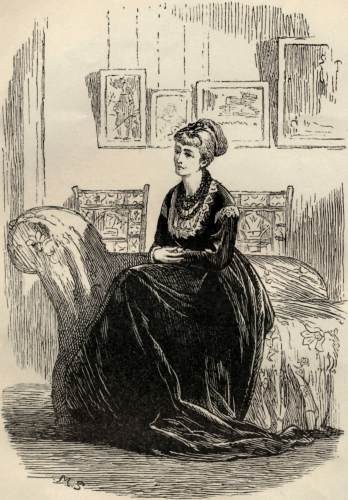
As she was thinking of this Mrs. Trevelyan came into the room. Nora felt that though she might dread to meet her mother, she could be bold enough on such an occasion before her sister. Emily had not done so well with her own affairs, as to enable her to preach with advantage about marriage.
"He has gone?" said Mrs. Trevelyan, as she opened the door.
"Yes, he has gone."
"Well? Do not pretend, Nora, that you will not tell me."
"There is nothing worth the telling, Emily."
"What do you mean? I am sure he has proposed. He told me in so many words that it was his intention."
"Whatever has happened, dear, you may be quite sure that I shall never be Mrs. Glascock."
"Then you have refused him,—because of Hugh Stanbury!"
"I have refused him, Emily, because I did not love him. Pray let that be enough."
Then she walked out of the room with something of stateliness in her gait,—as might become a girl who had had it in her power to be the future Lady Peterborough; but as soon as she reached the sacredness of her own chamber, she gave way to an agony of tears. It would, indeed, be much to be a Lady Peterborough. And she had, in truth, refused it all because of Hugh Stanbury! Was Hugh Stanbury worth so great a sacrifice?
CHAPTER XIV.
THE CLOCK HOUSE AT NUNCOMBE PUTNEY.
It was not till a fortnight had passed after the transaction recorded in the last chapter, that Mrs. Trevelyan and Nora Rowley first heard the proposition that they should go to live at Nuncombe Putney. From bad to worse the quarrel between the husband and the wife had gone on, till Trevelyan had at last told his friend Lady Milborough that he had made up his mind that they must live apart. "She is so self-willed,—and perhaps I am the same," he had said, "that it is impossible that we should live together." Lady Milborough had implored and called to witness all testimonies, profane and sacred, against such a step,—had almost gone down on her knees. Go to Naples,—why not Naples? Or to the quiet town in the west of France, which was so dull that a wicked roaring lion, fond of cities and gambling, and eating and drinking, could not live in such a place! Oh, why not go to the quiet town in the west of France? Was not anything better than this flying in the face of God and man? Perhaps Trevelyan did not himself like the idea of the quiet dull French town. Perhaps he thought that the flying in the face of God and man was all done by his wife, not by him; and that it was right that his wife should feel the consequences. After many such entreaties, many such arguments, it was at last decided that the house in Curzon Street should be given up, and that he and his wife live apart.
"And what about Nora Rowley?" asked Lady Milborough, who had become aware by this time of Nora's insane folly in having refused Mr. Glascock.
"She will go with her sister, I suppose."
"And who will maintain her? Dear, dear, dear! It does seem as though some young people were bent upon cutting their own throats, and all their family's."
Poor Lady Milborough just at this time went as near to disliking the Rowleys as was compatible with her nature. It was not possible to her to hate anybody. She thought that she hated the Colonel Osbornes; but even that was a mistake. She was very angry, however, with both Mrs. Trevelyan and her sister, and was disposed to speak of them as though they had been born to create trouble and vexation.
Trevelyan had not given any direct answer to that question about Nora Rowley's maintenance, but he was quite prepared to bear all necessary expense in that direction, at any rate till Sir Marmaduke should have arrived. At first there had been an idea that the two sisters should go to the house of their aunt, Mrs. Outhouse. Mrs. Outhouse was the wife,—as the reader may perhaps remember,—of a clergyman living in the east of London. St. Diddulph's-in-the-East was very much in the east indeed. It was a parish outside the City, lying near the river, very populous, very poor, very low in character, and very uncomfortable. There was a rectory-house, queerly situated at the end of a little blind lane, with a gate of its own, and a so-called garden about twenty yards square. But the rectory of St. Diddulph's cannot be said to have been a comfortable abode. The neighbourhood was certainly not alluring. Of visiting society within a distance of three or four miles there was none but what was afforded by the families of other East-end clergymen. And then Mr. Outhouse himself was a somewhat singular man. He was very religious, devoted to his work, most kind to the poor; but he was unfortunately a strongly-biased man, and at the same time very obstinate withal. He had never allied himself very cordially with his wife's brother, Sir Marmaduke, allowing himself to be carried away by a prejudice that people living at the West-end, who frequented clubs, and were connected in any way with fashion, could not be appropriate companions for himself. The very title which Sir Marmaduke had acquired was repulsive to him, and had induced him to tell his wife more than once that Sir this or Sir that could not be fitting associates for a poor East-end clergyman. Then his wife's niece had married a man of fashion,—a man supposed at St. Diddulph's to be very closely allied to fashion; and Mr. Outhouse had never been induced even to dine in the house in Curzon Street. When, therefore, he heard that Mr. and Mrs. Trevelyan were to be separated within two years of their marriage, it could not be expected that he should be very eager to lend to the two sisters the use of his rectory.
There had been interviews between Mr. Outhouse and Trevelyan, and between Mrs. Outhouse and her niece; and then there was an interview between Mr. Outhouse and Emily, in which it was decided that Mrs. Trevelyan would not go to the parsonage of St. Diddulph's. She had been very outspoken to her uncle, declaring that she by no means intended to carry herself as a disgraced woman. Mr. Outhouse had quoted St. Paul to her; "Wives, obey your husbands." Then she had got up and had spoken very angrily. "I look for support from you," she said, "as the man who is the nearest to me, till my father shall come." "But I cannot support you in what is wrong," said the clergyman. Then Mrs. Trevelyan had left the room, and would not see her uncle again.
She carried things altogether with a high hand at this time. When old Mr. Bideawhile called upon her, her husband's ancient family lawyer, she told that gentleman that if it was her husband's will that they should live apart, it must be so. She could not force him to remain with her. She could not compel him to keep up the house in Curzon Street. She had certain rights, she believed. She spoke then, she said, of pecuniary rights,—not of those other rights which her husband was determined, and was no doubt able, to ignore. She did not really know what those pecuniary rights might be, nor was she careful to learn their exact extent. She would thank Mr. Bideawhile to see that things were properly arranged. But of this her husband, and Mr. Bideawhile, might be quite sure;—she would take nothing as a favour. She would not go to her uncle's house. She declined to tell Mr. Bideawhile why she had so decided; but she had decided. She was ready to listen to any suggestion that her husband might make as to her residence, but she must claim to have some choice in the matter. As to her sister, of course she intended to give Nora a home as long as such a home might be wanted. It would be very sad for Nora, but in existing circumstances such an arrangement would be expedient. She would not go into details as to expense. Her husband was driving her away from him, and it was for him to say what proportion of his income he would choose to give for her maintenance,—for hers and for that of their child. She was not desirous of anything beyond the means of decent living, but of course she must for the present find a home for her sister as well as for herself. When speaking of her baby she had striven hard so to speak that Mr. Bideawhile should find no trace of doubt in the tones of her voice. And yet she had been full of doubt,—full of fear. As Mr. Bideawhile had uttered nothing antagonistic to her wishes in this matter,—had seemed to agree that wherever the mother went thither the child would go also,—Mrs. Trevelyan had considered herself to be successful in this interview.
The idea of a residence at Nuncombe Putney had occurred first to Trevelyan himself, and he had spoken of it to Hugh Stanbury. There had been some difficulty in this, because he had snubbed Stanbury grievously when his friend had attempted to do some work of gentle interference between him and his wife; and when he began the conversation, he took the trouble of stating, in the first instance, that the separation was a thing fixed,—so that nothing might be urged on that subject. "It is to be. You will understand that," he said; "and if you think that your mother would agree to the arrangement, it would be satisfactory to me, and might, I think, be made pleasant to her. Of course, your mother would be made to understand that the only fault with which my wife is charged is that of indomitable disobedience to my wishes."
"Incompatibility of temper," suggested Stanbury.
"You may call it that if you please;—though I must say for myself that I do not think that I have displayed any temper to which a woman has a right to object." Then he had gone on to explain what he was prepared to do about money. He would pay, through Stanbury's hands, so much for maintenance and so much for house rent, on the understanding that the money was not to go into his wife's hands. "I shall prefer," he said, "to make myself, on her behalf, what disbursements may be necessary. I will take care that she receives a proper sum quarterly through Mr. Bideawhile for her own clothes,—and for those of our poor boy." Then Stanbury had told him of the Clock House, and there had been an agreement made between them;—an agreement which was then, of course, subject to the approval of the ladies at Nuncombe Putney. When the suggestion was made to Mrs. Trevelyan,—with a proposition that the Clock House should be taken for one year, and that for that year, at least, her boy should remain with her,—she assented to it. She did so with all the calmness that she was able to assume; but, in truth, almost everything seemed to have been gained, when she found that she was not to be separated from her baby. "I have no objection to living in Devonshire if Mr. Trevelyan wishes it," she said, in her most stately manner; "and certainly no objection to living with Mr. Stanbury's mother." Then Mr. Bideawhile explained to her that Nuncombe Putney was not a large town,—was, in fact, a very small and a very remote village. "That will make no difference whatsoever as far as I am concerned," she answered; "and as for my sister, she must put up with it till my father and my mother are here. I believe the scenery at Nuncombe Putney is very pretty." "Lovely!" said Mr. Bideawhile, who had a general idea that Devonshire is supposed to be a picturesque county. "With such a life before me as I must lead," continued Mrs. Trevelyan, "an ugly neighbourhood, one that would itself have had no interest for a stranger, would certainly have been an additional sorrow." So it had been settled, and by the end of July, Mrs. Trevelyan, with her sister and baby, was established at the Clock House, under the protection of Mrs. Stanbury. Mrs. Trevelyan had brought down her own maid and her own nurse, and had found that the arrangements made by her husband had, in truth, been liberal. The house in Curzon Street had been given up, the furniture had been sent to a warehouse, and Mr. Trevelyan had gone into lodgings. "There never were two young people so insane since the world began," said Lady Milborough to her old friend, Mrs. Fairfax, when the thing was done.
"They will be together again before next April," Mrs. Fairfax had replied. But Mrs. Fairfax was a jolly dame who made the best of everything. Lady Milborough raised her hands in despair, and shook her head. "I don't suppose, though, that Mr. Glascock will go to Devonshire after his lady love," said Mrs. Fairfax. Lady Milborough again raised her hands, and again shook her head.
Mrs. Stanbury had given an easy assent when her son proposed to her this new mode of life, but Priscilla had had her doubts. Like all women, she thought that when a man was to be separated from his wife, the woman must be in the wrong. And though it must be doubtless comfortable to go from the cottage to the Clock House, it would, she said, with much prudence, be very uncomfortable to go back from the Clock House to the cottage. Hugh replied very cavalierly,—generously, that is, rashly, and somewhat impetuously,—that he would guarantee them against any such degradation.
"We don't want to be a burden upon you, my dear," said the mother.
"You would be a great burden on me," he replied, "if you were living uncomfortably while I am able to make you comfortable."
Mrs. Stanbury was soon won over by Mrs. Trevelyan, by Nora, and especially by the baby; and even Priscilla, after a week or two, began to feel that she liked their company. Priscilla was a young woman who read a great deal, and even had some gifts of understanding what she read. She borrowed books from the clergyman, and paid a penny a week to the landlady of the Stag and Antlers for the hire during half a day of the weekly newspaper. But now there came a box of books from Exeter, and a daily paper from London, and,—to improve all this,—both the new comers were able to talk with her about the things she read. She soon declared to her mother that she liked Miss Rowley much the best of the two. Mrs. Trevelyan was too fond of having her own way. She began to understand, she would say to her mother, that a man might find it difficult to live with Mrs. Trevelyan. "She hardly ever yields about anything," said Priscilla. As Miss Priscilla Stanbury was also very fond of having her own way, it was not surprising that she should object to that quality in this lady, who had come to live under the same roof with her.
The country about Nuncombe Putney is perhaps as pretty as any in England. It is beyond the river Teign, between that and Dartmoor, and is so lovely in all its variations of rivers, rivulets, broken ground, hills and dales, old broken, battered, time-worn timber, green knolls, rich pastures, and heathy common, that the wonder is that English lovers of scenery know so little of it. At the Stag and Antlers old Mrs. Crocket, than whom no old woman in the public line was ever more generous, more peppery, or more kind, kept two clean bed-rooms, and could cook a leg of Dartmoor mutton and make an apple pie against any woman in Devonshire. "Drat your fish!" she would say, when some self-indulgent and exacting traveller would wish for more than these accustomed viands. "Cock you up with dainties! If you can't eat your victuals without fish, you must go to Exeter. And then you'll get it stinking mayhap." Now Priscilla Stanbury and Mrs. Crocket were great friends, and there had been times of deep want, in which Mrs. Crocket's friendship had been very serviceable to the ladies at the cottage. The three young women had been to the inn one morning to ask after a conveyance from Nuncombe Putney to Princetown, and had found that a four-wheeled open carriage with an old horse and a very young driver could be hired there. "We have never dreamed of such a thing," Priscilla Stanbury had said, "and the only time I was at Princetown I walked there and back." So they had called at the Stag and Antlers, and Mrs. Crocket had told them her mind upon several matters.
"What a dear old woman!" said Nora, as they came away, having made their bargain for the open carriage.
"I think she takes quite enough upon herself, you know," said Mrs. Trevelyan.
"She is a dear old woman," said Priscilla, not attending at all to the last words that had been spoken. "She is one of the best friends I have in the world. If I were to say the best out of my own family, perhaps I should not be wrong."
"But she uses such very odd language for a woman," said Mrs. Trevelyan. Now Mrs. Crocket had certainly "dratted" and "darned" the boy, who wouldn't come as fast as she had wished, and had laughed at Mrs. Trevelyan very contemptuously, when that lady had suggested that the urchin, who was at last brought forth, might not be a safe charioteer down some of the hills.
"I suppose I'm used to it," said Priscilla. "At any rate I know I like it. And I like her."
"I dare say she's a good sort of woman," said Mrs. Trevelyan, "only—"
"I am not saying anything about her being a good woman now," said Priscilla, interrupting the other with some vehemence, "but only that she is my friend."
"I liked her of all things," said Nora. "Has she lived here always?"
"Yes; all her life. The house belonged to her father and to her grandfather before her, and I think she says she has never slept out of it a dozen times in her life. Her husband is dead, and her daughters are married away, and she has the great grief and trouble of a ne'er-do-well son. He's away now, and she's all alone." Then after a pause, she continued; "I dare say it seems odd to you, Mrs. Trevelyan, that we should speak of the innkeeper as a dear friend; but you must remember that we have been poor among the poorest—and are so indeed now. We only came into our present house to receive you. That is where we used to live," and she pointed to the tiny cottage, which now that it was dismantled and desolate, looked to be doubly poor. "There have been times when we should have gone to bed very hungry if it had not been for Mrs. Crocket."
Later in the day Mrs. Trevelyan, finding Priscilla alone, had apologized for what she had said about the old woman. "I was very thoughtless and forgetful, but I hope you will not be angry with me. I will be ever so fond of her if you will forgive me."
"Very well," said Priscilla, smiling; "on those conditions I will forgive you." And from that time there sprang up something like a feeling of friendship between Priscilla and Mrs. Trevelyan. Nevertheless Priscilla was still of opinion that the Clock House arrangement was dangerous, and should never have been made; and Mrs. Stanbury, always timid of her own nature, began to fear that it must be so, as soon as she was removed from the influence of her son. She did not see much even of the few neighbours who lived around her, but she fancied that people looked at her in church as though she had done that which she ought not to have done, in taking herself to a big and comfortable house for the sake of lending her protection to a lady who was separated from her husband. It was not that she believed that Mrs. Trevelyan had been wrong; but that, knowing herself to be weak, she fancied that she and her daughter would be enveloped in the danger and suspicion which could not but attach themselves to the lady's condition, instead of raising the lady out of the cloud,—as would have been the case had she herself been strong. Mrs. Trevelyan, who was sharpsighted and clear-witted, soon saw that it was so, and spoke to Priscilla on the subject before she had been a fortnight in the house. "I am afraid your mother does not like our being here," she said.
"How am I to answer that?" Priscilla replied.
"Just tell the truth."
"The truth is so uncivil. At first I did not like it. I disliked it very much."
"Why did you give way?"
"I didn't give way. Hugh talked my mother over. Mamma does what I tell her, except when Hugh tells her something else. I was afraid, because, down here, knowing nothing of the world, I didn't wish that we, little people, should be mixed up in the quarrels and disagreements of those who are so much bigger."
"I don't know who it is that is big in this matter."
"You are big,—at any rate by comparison. But now it must go on. The house has been taken, and my fears are over as regards you. What you observe in mamma is only the effect, not yet quite worn out, of what I said before you came. You may be quite sure of this,—that we neither of us believe a word against you. Your position is a very unfortunate one; but if it can be remedied by your staying here with us, pray stay with us."
"It cannot be remedied," said Emily; "but we could not be anywhere more comfortable than we are here."
CHAPTER XV.
WHAT THEY SAID ABOUT IT IN THE CLOSE.
When Miss Stanbury, in the Close at Exeter, was first told of the arrangement that had been made at Nuncombe Putney, she said some very hard words as to the thing that had been done. She was quite sure that Mrs. Trevelyan was no better than she should be. Ladies who were separated from their husbands never were any better than they should be. And what was to be thought of any woman, who, when separated from her husband, would put herself under the protection of such a Paladin as Hugh Stanbury? She heard the tidings of course from Dorothy, and spoke her mind even to Dorothy plainly enough; but it was to Martha that she expressed herself with her fullest vehemence.
"We always knew," she said, "that my brother had married an addle-pated, silly woman, one of the most unsuited to be the mistress of a clergyman's house that ever a man set eyes on; but I didn't think she'd allow herself to be led into such a stupid thing as this."
"I don't suppose the lady has done anything amiss,—any more than combing her husband's hair, and the like of that," said Martha.
"Don't tell me! Why, by their own story, she has got a lover."
"But he ain't to come after her down here, I suppose. And as for lovers, ma'am, I'm told that the most of 'em have 'em up in London. But it don't mean much, only just idle talking and gallivanting."
"When women can't keep themselves from idle talking with strange gentlemen, they are very far gone on the road to the devil. That's my notion. And that was everybody's notion a few years ago. But now, what with divorce bills, and women's rights, and penny papers, and false hair, and married women being just like giggling girls, and giggling girls knowing just as much as married women, when a woman has been married a year or two she begins to think whether she mayn't have more fun for her money by living apart from her husband."
"Miss Dorothy says—"
"Oh, bother what Miss Dorothy says! Miss Dorothy only knows what it has suited that scamp, her brother, to tell her. I understand this woman has come away because of a lover; and if that's so, my sister-in-law is very wrong to receive her. The temptation of the Clock House has been too much for her. It's not my doing; that's all."
That evening Miss Stanbury and Dorothy went out to tea at the house of Mrs. MacHugh, and there the matter was very much discussed. The family of the Trevelyans was known by name in these parts, and the fact of Mrs. Trevelyan having been sent to live in a Devonshire village, with Devonshire ladies who had a relation in Exeter so well esteemed as Miss Stanbury of the Close, were circumstances of themselves sufficient to ensure a considerable amount of prestige at the city tea-table for the tidings of this unfortunate family quarrel. Some reticence was of course necessary because of the presence of Miss Stanbury and of Dorothy. To Miss Stanbury herself Mrs. MacHugh and Mrs. Crumbie, of Cronstadt House, did not scruple to express themselves very plainly, and to whisper a question as to what was to be done should the lover make his appearance at Nuncombe Putney; but they who spoke of the matter before Dorothy, were at first more charitable, or, at least, more forbearing. Mr. Gibson, who was one of the minor canons, and the two Miss Frenches from Heavitree, who had the reputation of hunting unmarried clergymen in couples, seemed to have heard all about it. When Mrs. MacHugh and Miss Stanbury, with Mr. and Mrs. Crumbie, had seated themselves at their whist-table, the younger people were able to express their opinions without danger of interruption or of rebuke. It was known to all Exeter by this time, that Dorothy Stanbury's mother had gone to the Clock House, and that she had done so in order that Mrs. Trevelyan might have a home. But it was not yet known whether anybody had called upon them. There was Mrs. Merton, the wife of the present parson of Nuncombe, who had known the Stanburys for the last twenty years; and there was Mrs. Ellison of Lessboro', who lived only four miles from Nuncombe, and who kept a pony-carriage. It would be a great thing to know how these ladies had behaved in so difficult and embarrassing a position. Mrs. Trevelyan and her sister had now been at Nuncombe Putney for more than a fortnight, and something in that matter of calling must have been done,—or have been left undone. In answer to an ingeniously-framed question asked by Camilla French, Dorothy at once set the matter at rest. "Mrs. Merton," said Camilla French, "must find it a great thing to have two new ladies come to the village, especially now that she has lost you, Miss Stanbury?"
"Mamma tells me," said Dorothy, "that Mrs. Trevelyan and Miss Rowley do not mean to know anybody. They have given it out quite plainly, so that there should be no mistake."
"Dear, dear," said Camilla French.
"I dare say it's for the best," said Arabella French, who was the elder, and who looked very meek and soft. Miss French almost always looked meek and soft.
"I'm afraid it will make it very dull for your mother,—not seeing her old friends," said Mr. Gibson.
"Mamma won't feel that at all," said Dorothy.
"Mrs. Stanbury, I suppose, will see her own friends at her own house just the same," said Camilla.
"There would be great difficulty in that, when there is a lady who is to remain unknown," said Arabella. "Don't you think so, Mr. Gibson?" Mr. Gibson replied that perhaps there might be a difficulty, but he wasn't sure. The difficulty, he thought, might be got over if the ladies did not always occupy the same room.
"You have never seen Mrs. Trevelyan, have you, Miss Stanbury?" asked Camilla.
"Never."
"She is not an old family friend, then,—or anything of that sort?"
"Oh, dear, no."
"Because," said Arabella, "it is so odd how different people get together sometimes." Then Dorothy explained that Mr. Trevelyan and her brother Hugh had long been friends.
"Oh!—of Mr. Trevelyan," said Camilla. "Then it is he that has sent his wife to Nuncombe, not she that has come there?"
"I suppose there has been some agreement," said Dorothy.
"Just so; just so," said Arabella, the meek. "I should like to see her. They say that she is very beautiful; don't they?"
"My brother says that she is handsome."
"Exceedingly lovely, I'm told," said Camilla. "I should like to see her,—shouldn't you, Mr. Gibson?"
"I always like to see a pretty woman," said Mr. Gibson, with a polite bow, which the sisters shared between them.
"I suppose she'll go to church," said Camilla.
"Very likely not," said Arabella. "Ladies of that sort very often don't go to church. I dare say you'll find that she'll never stir out of the place at all, and that not a soul in Nuncombe will ever see her except the gardener. It is such a thing for a woman to be separated from her husband! Don't you think so, Mr. Gibson?"
"Of course it is," said he, with a shake of his head, which was intended to imply that the censure of the church must of course attend any sundering of those whom the church had bound together; but which implied also by the absence from it of any intense clerical severity, that as the separated wife was allowed to live with so very respectable a lady as Mrs. Stanbury, there must probably be some mitigating circumstances attending this special separation.
"I wonder what he is like?" said Camilla, after a pause.
"Who?" asked Arabella.
"The gentleman," said Camilla.
"What gentleman?" demanded Arabella.
"I don't mean Mr. Trevelyan," said Camilla.
"I don't believe there really is,—eh,—is there?" said Mr. Gibson, very timidly.
"Oh, dear, yes," said Arabella.
"I'm afraid there's something of the kind," said Camilla. "I've heard that there is, and I've heard his name." Then she whispered very closely into the ear of Mr. Gibson the words, "Colonel Osborne," as though her lips were by far too pure to mention aloud any sound so full of iniquity.
"Indeed!" said Mr. Gibson.
"But he's quite an old man," said Dorothy, "and knew her father intimately before she was born. And, as far as I can understand, her husband does not suspect her in the least. And it's only because there's a misunderstanding between them, and not at all because of the gentleman."
"Oh!" exclaimed Camilla.
"Ah!" exclaimed Arabella.
"That would make a difference," said Mr. Gibson.
"But for a married woman to have her name mentioned at all with a gentleman,—it is so bad; is it not, Mr. Gibson?" And then Arabella also had her whisper into the clergyman's ear,—very closely. "I'm afraid there's not a doubt about the Colonel. I'm afraid not. I am indeed."
"Two by honours and the odd, and it's my deal," said Miss Stanbury, briskly, and the sharp click with which she put the markers down upon the table was heard all through the room. "I don't want anybody to tell me," she said, "that when a young woman is parted from her husband, the chances are ten to one that she has been very foolish."
"But what's a woman to do, if her husband beats her?" said Mrs. Crumbie.
"Beat him again," said Mrs. MacHugh.
"And the husband will be sure to have the worst of it," said Mr. Crumbie. "Well, I declare, if you haven't turned up an honour again, Miss Stanbury!"
"It was your wife that cut it to me, Mr. Crumbie." Then they were again at once immersed in the play, and the name neither of Trevelyan nor Osborne was heard till Miss Stanbury was marking her double under the candlestick; but during all pauses in the game the conversation went back to the same topic, and when the rubber was over they who had been playing it lost themselves for ten minutes in the allurements of the interesting subject. It was so singular a coincidence that the lady should have gone to Nuncombe Putney of all villages in England, and to the house of Mrs. Stanbury of all ladies in England. And then was she innocent, or was she guilty; and if guilty, in what degree? That she had been allowed to bring her baby with her was considered to be a great point in her favour. Mr. Crumbie's opinion was that it was "only a few words." Mrs. Crumbie was afraid that she had been a little light. Mrs. MacHugh said that there was never fire without smoke. And Miss Stanbury, as she took her departure, declared that the young women of the present day didn't know what they were after. "They think that the world should be all frolic and dancing, and they have no more idea of doing their duty and earning their bread than a boy home for the holidays has of doing lessons."
Then, as she went home with Dorothy across the Close, she spoke a word which she intended to be very serious. "I don't mean to say anything against your mother for what she has done as yet. Somebody must take the woman in, and perhaps it was natural. But if that Colonel What's-his-name makes his way down to Nuncombe Putney, your mother must send her packing, if she has any respect either for herself or for Priscilla."
CHAPTER XVI.
DARTMOOR.

"I never knew one like her," said Miss Stanbury, "who, when she'd got away from one man, didn't want to have another dangling after her."
A week had hardly passed after the party at Mrs. MacHugh's, and Mrs. Trevelyan had hardly been three weeks at Nuncombe Putney, before the tidings which Miss Stanbury almost expected reached her ears.
"The Colonel's been at the Clock House, ma'am," said Martha.
Now, it was quite understood in the Close by this time that "the Colonel" meant Colonel Osborne.
"No!"
"I'm told he has though, ma'am, for sure and certain."
"Who says so?"
"Giles Hickbody was down at Lessboro', and see'd him hisself,—a portly, middle-aged man,—not one of your young scampish-like lovers."
"That's the man."
"Oh, yes. He went over to Nuncombe Putney, as sure as anything;—hired Mrs. Clegg's chaise and pair, and asked for Mrs. Trevelyan's house as open as anything. When Giles asked in the yard, they told him as how that was the married lady's young man."
"I'd like to be at his tail,—so I would,—with a mop-handle," said Miss Stanbury, whose hatred for those sins by which the comfort and respectability of the world are destroyed, was not only sincere, but intense. "Well; and what then?"
"He came back and slept at Mrs. Clegg's that night,—at least, that was what he said he should do."
Miss Stanbury, however, was not so precipitate or uncharitable as to act strongly upon information such as this. Before she even said a word to Dorothy, she made further inquiry. She made very minute inquiry, writing even to her very old and intimate friend Mrs. Ellison, of Lessboro',—writing to that lady a most cautious and guarded letter. At last it became a fact proved to her mind that Colonel Osborne had been at the Clock House, had been received there, and had remained there for hours,—had been allowed access to Mrs. Trevelyan, and had slept the night at the inn at Lessboro'. The thing was so terrible to Miss Stanbury's mind, that even false hair, Dr. Colenso, and penny newspapers did not account for it.
"I shall begin to believe that the Evil One has been allowed to come among us in person because of our sins," she said to Martha;—and she meant it.
In the meantime, Mrs. Trevelyan, as may be remembered, had hired Mrs. Crocket's open carriage, and the three young women, Mrs. Trevelyan, Nora, and Priscilla, made a little excursion to Princetown, somewhat after the fashion of a picnic. At Princetown, in the middle of Dartmoor, about nine miles from Nuncombe Putney, is the prison establishment at which are kept convicts undergoing penal servitude. It is regarded by all the country round with great interest, chiefly because the prisoners now and again escape, and then there comes a period of interesting excitement until the escaped felon shall have been again taken. How can you tell where he may be, or whether it may not suit him to find his rest in your own cupboard, or under your own bed? And then, as escape without notice will of course be the felon's object, to attain that he will probably cut your throat, and the throat of everybody belonging to you. All which considerations give an interest to Princetown, and excite in the hearts of the Devonians of these parts a strong affection for the Dartmoor prison. Of those who visit Princetown comparatively few effect an entrance within the walls of the gaol. They look at the gloomy place with a mysterious interest, feeling something akin to envy for the prisoners who have enjoyed the privilege of solving the mysteries of prison life, and who know how men feel when they have their hair cut short, and are free from moral responsibility for their own conduct, and are moved about in gangs, and treated like wild beasts.
But the journey to Princetown, from whatever side it is approached, has the charm of wild and beautiful scenery. The spot itself is ugly enough; but you can go not thither without breathing the sweetest, freshest air, and encountering that delightful sense of romance which moorland scenery always produces. The idea of our three friends was to see the Moor rather than the prison, to learn something of the country around, and to enjoy the excitement of eating a sandwich sitting on a hillock, in exchange for the ordinary comforts of a good dinner with chairs and tables. A bottle of sherry and water and a paper of sandwiches contained their whole banquet; for ladies, though they like good things at picnics, and, indeed, at other times, almost as well as men like them, very seldom prepare dainties for themselves alone. Men are wiser and more thoughtful, and are careful to have the good things, even if they are to be enjoyed without companionship.
Mrs. Crocket's boy, though he was only about three feet high, was a miracle of skill and discretion. He used the machine, as the patent drag is called, in going down the hills with the utmost care. He never forced the beast beyond a walk if there was the slightest rise in the ground; and as there was always a rise, the journey was slow. But the three ladies enjoyed it thoroughly, and Mrs. Trevelyan was in better spirits than she herself had thought to be possible for her in her present condition. Most of us have recognised the fact that a dram of spirits will create,—that a so-called nip of brandy will create hilarity, or, at least, alacrity, and that a glass of sherry will often "pick up" and set in order the prostrate animal and mental faculties of the drinker. But we are not sufficiently alive to the fact that copious draughts of fresh air,—of air fresh and unaccustomed,—will have precisely the same effect. We do know that now and again it is very essential to "change the air;" but we generally consider that to do that with any chance of advantage, it is necessary to go far afield; and we think also that such change of the air is only needful when sickness of the body has come upon us, or when it threatens to come. We are seldom aware that we may imbibe long potations of pleasure and healthy excitement without perhaps going out of our own county; that such potations are within a day's journey of most of us; and that they are to be had for half-a-crown a head, all expenses told. Mrs. Trevelyan probably did not know that the cloud was lifted off her mind, and the load of her sorrow made light to her, by the special vigour of the air of the Moor; but she did know that she was enjoying herself, and that the world was pleasanter to her than it had been for months past.
When they had sat upon their hillocks, and eaten their sandwiches,—regretting that the basket of provisions had not been bigger,—and had drunk their sherry and water out of the little horn mug which Mrs. Crocket had lent them, Nora started off across the moorland alone. The horse had been left to be fed in Princetown, and they had walked back to a bush under which they had rashly left their basket of provender concealed. It happened, however, that on that day there was no escaped felon about to watch what they had done, and the food and the drink had been found secure. Nora had gone off, and as her sister and Priscilla sat leaning against their hillocks with their backs to the road, she could be seen standing now on one little eminence and now on another, thinking, doubtless, as she stood on the one how good it would be to be Lady Peterborough, and, as she stood on the other, how much better to be Mrs. Hugh Stanbury. Only,—before she could be Mrs. Hugh Stanbury it would be necessary that Mr. Hugh Stanbury should share her opinion,—and necessary also that he should be able to maintain a wife. "I should never do to be a very poor man's wife," she said to herself; and remembered as she said it, that in reference to the prospect of her being Lady Peterborough, the man who was to be Lord Peterborough was at any rate ready to make her his wife, and on that side there were none of those difficulties about house, and money, and position which stood in the way of the Hugh Stanbury side of the question. She was not, she thought, fit to be the wife of a very poor man; but she conceived of herself that she would do very well as a future Lady Peterborough in the drawing-rooms of Monkhams. She was so far vain as to fancy that she could look, and speak, and move, and have her being after the fashion which is approved for the Lady Peterboroughs of the world. It was not clear to her that Nature had not expressly intended her to be a Lady Peterborough; whereas, as far as she could see, Nature had not intended her to be a Mrs. Hugh Stanbury, with a precarious income of perhaps ten guineas a week when journalism was doing well. So she moved on to another little eminence to think of it there. It was clear to her that if she should accept Mr. Glascock she would sell herself, and not give herself away; and she had told herself scores of times before this, that a young woman should give herself away, and not sell herself;—should either give herself away, or keep herself to herself as circumstances might go. She had been quite sure that she would never sell herself. But this was a lesson which she had taught herself when she was very young, before she had come to understand the world and its hard necessities. Nothing, she now told herself, could be worse than to hang like a mill-stone round the neck of a poor man. It might be a very good thing to give herself away for love,—but it would not be a good thing to be the means of ruining the man she loved, even if that man were willing to be so ruined. And then she thought that she could also love that other man a little,—could love him sufficiently for comfortable domestic purposes. And it would undoubtedly be very pleasant to have all the troubles of her life settled for her. If she were Mrs. Glascock, known to the world as the future Lady Peterborough, would it not be within her power to bring her sister and her sister's husband again together? The tribute of the Monkhams' authority and influence to her sister's side of the question would be most salutary. She tried to make herself believe that in this way she would be doing a good deed. Upon the whole, she thought that if Mr. Glascock should give her another chance she would accept him. And he had distinctly promised that he would give her another chance. It might be that this unfortunate quarrel in the Trevelyan family would deter him. People do not wish to ally themselves with family quarrels. But if the chance came in her way she would accept it. She had made up her mind to that, when she turned round from off the last knoll on which she had stood, to return to her sister and Priscilla Stanbury.

They two had sat still under the shade of a thorn bush, looking at Nora as she was wandering about, and talking together more freely than they had ever done before on the circumstances that had brought them together. "How pretty she looks," Priscilla had said, as Nora was standing with her figure clearly marked by the light.
"Yes; she is very pretty, and has been much admired. This terrible affair of mine is a cruel blow to her."
"You mean that it is bad for her to come and live here—without society."
"Not exactly that,—though of course it would be better for her to go out. And I don't know how a girl is ever to get settled in the world unless she goes out. But it is always an injury to be connected in any way with a woman who is separated from her husband. It must be bad for you."
"It won't hurt me," said Priscilla. "Nothing of that kind can hurt me."
"I mean that people say such ill-natured things."
"I stand alone, and can take care of myself," said Priscilla. "I defy the evil tongues of all the world to hurt me. My personal cares are limited to an old gown and bread and cheese. I like a pair of gloves to go to church with, but that is only the remnant of a prejudice. The world has so very little to give me, that I am pretty nearly sure that it will take nothing away."
"And you are contented?"
"Well, no; I can't say that I am contented. I hardly think that anybody ought to be contented. Should my mother die and Dorothy remain with my aunt, or get married, I should be utterly alone in the world. Providence, or whatever you call it, has made me a lady after a fashion, so that I can't live with the ploughmen's wives, and at the same time has so used me in other respects, that I can't live with anybody else."
"Why should not you get married, as well as Dorothy?"
"Who would have me? And if I had a husband I should want a good one,—a man with a head on his shoulders, and a heart. Even if I were young and good-looking, or rich, I doubt whether I could please myself. As it is I am as likely to be taken bodily to heaven, as to become any man's wife."
"I suppose most women think so of themselves at some time, and yet they are married."
"I am not fit to marry. I am often cross, and I like my own way, and I have a distaste for men. I never in my life saw a man whom I wished even to make my intimate friend. I should think any man an idiot who began to make soft speeches to me, and I should tell him so."
"Ah; you might find it different when he went on with it."
"But I think," said Priscilla, "that when a woman is married there is nothing to which she should not submit on behalf of her husband."
"You mean that for me."
"Of course I mean it for you. How should I not be thinking of you, living as you are under the same roof with us? And I am thinking of Louey." Louey was the baby. "What are you to do when after a year or two his father shall send for him to have him under his own care?"
"Nothing shall separate me from my child," said Mrs. Trevelyan eagerly.
"That is easily said; but I suppose the power of doing as he pleased would be with him."
"Why should it be with him? I do not at all know that it would be with him. I have not left his house. It is he that has turned me out."
"There can, I think, be very little doubt what you should do," said Priscilla, after a pause, during which she had got up from her seat under the thorn bush.
"What should I do?" asked Mrs. Trevelyan.
"Go back to him."
"I will to-morrow if he will write and ask me. Nay; how could I help myself? I am his creature, and must go or come as he bids me. I am here only because he has sent me."
"You should write and ask him to take you."
"Ask him to forgive me because he has ill-treated me?"
"Never mind about that," said Priscilla, standing over her companion, who was still lying under the bush. "All that is twopenny-halfpenny pride, which should be thrown to the winds. The more right you have been hitherto the better you can afford to go on being right. What is it that we all live upon but self-esteem? When we want praise it is only because praise enables us to think well of ourselves. Every one to himself is the centre and pivot of all the world."
"It's a very poor world that goes round upon my pivot," said Mrs. Trevelyan.
"I don't know how this quarrel came up," exclaimed Priscilla, "and I don't care to know. But it seems a trumpery quarrel,—as to who should beg each other's pardon first, and all that kind of thing. Sheer and simple nonsense! Ask him to let it all be forgotten. I suppose he loves you?"
"How can I know? He did once."
"And you love him?"
"Yes. I love him certainly."
"I don't see how you can have a doubt. Here is Jack with the carriage, and if we don't mind he'll pass us by without seeing us."
Then Mrs. Trevelyan got up, and when they had succeeded in diverting Jack's attention for a moment from the horse, they called to Nora, who was still moving about from one knoll to another, and who showed no desire to abandon the contemplations in which she had been engaged.
It had been mid-day before they left home in the morning, and they were due to be at home in time for tea,—which is an epoch in the day generally allowed to be more elastic than some others. When Mrs. Stanbury lived in the cottage her hour for tea had been six; this had been stretched to half-past seven when she received Mrs. Trevelyan at the Clock House; and it was half-past eight before Jack landed them at their door. It was manifest to them all as they entered the house that there was an air of mystery in the face of the girl who had opened the door for them. She did not speak, however, till they were all within the passage. Then she uttered a few words very solemnly. "There be a gentleman come," she said.
"A gentleman!" said Mrs. Trevelyan, thinking in the first moment of her husband, and in the second of Colonel Osborne.
"He be for you, miss," said the girl, bobbing her head at Nora.
Upon hearing this Nora sank speechless into the chair which stood in the passage.
CHAPTER XVII.
A GENTLEMAN COMES TO NUNCOMBE PUTNEY.
It soon became known to them all as they remained clustered in the hall that Mr. Glascock was in the house. Mrs. Stanbury came out to them and informed them that he had been at Nuncombe Putney for the last five hours, and that he had asked for Mrs. Trevelyan when he called. It became evident as the affairs of the evening went on, that Mrs. Stanbury had for a few minutes been thrown into a terrible state of amazement, thinking that "the Colonel" had appeared. The strange gentleman, however, having obtained admittance, explained who he was, saying that he was very desirous of seeing Mrs. Trevelyan,—and Miss Rowley. It may be presumed that a glimmer of light did make its way into Mrs. Stanbury's mind on the subject; but up to the moment at which the three travellers arrived, she had been in doubt on the subject. Mr. Glascock had declared that he would take a walk, and in the course of the afternoon had expressed high approval of Mrs. Crocket's culinary skill. When Mrs. Crocket heard that she had entertained the son of a lord, she was very loud in her praise of the manner in which he had eaten two mutton chops and called for a third. He had thought it no disgrace to apply himself to the second half of an apple pie, and had professed himself to be an ardent admirer of Devonshire cream. "It's them counter-skippers as turns up their little noses at the victuals as is set before them," said Mrs. Crocket.
After his dinner Mr. Glascock had returned to the Clock House, and had been sitting there for an hour with Mrs. Stanbury, not much to her delight or to his, when the carriage was driven up to the door.
"He is to go back to Lessboro' to-night," said Mrs. Stanbury in a whisper.
"Of course you must see him before he goes," said Mrs. Trevelyan to her sister. There had, as was natural, been very much said between the two sisters about Mr. Glascock. Nora had abstained from asserting in any decided way that she disliked the man, and had always absolutely refused to allow Hugh Stanbury's name to be mixed up with the question. Whatever might be her own thoughts about Hugh Stanbury she had kept them even from her sister. When her sister had told her that she had refused Mr. Glascock because of Hugh, she had shown herself to be indignant, and had since that said one or two fine things as to her capacity to refuse a brilliant offer simply because the man who had made it was indifferent to her. Mrs. Trevelyan had learned from her that her suitor had declared his intention to persevere; and here was perseverance with a vengeance! "Of course you must see him,—at once," said Mrs. Trevelyan. Nora for a few seconds had remained silent, and then had run up to her room. Her sister followed her instantly.
"What is the meaning of it all?" said Priscilla to her mother.
"I suppose he is in love with Miss Rowley," said Mrs. Stanbury.
"But who is he?"
Then Mrs. Stanbury told all that she knew. She had seen from his card that he was an Honourable Mr. Glascock. She had collected from what he had said that he was an old friend of the two ladies. Her conviction was strong in Mr. Glascock's favour,—thinking, as she expressed herself, that everything was right and proper,—but she could hardly explain why she thought so.
"I do wish that they had never come," said Priscilla, who could not rid herself of an idea that there must be danger in having to do with women who had men running after them.
"Of course I'll see him," said Nora to her sister. "I have not refused to see him. Why do you scold me?"
"I have not scolded you, Nora; but I do want you to think how immensely important this is."
"Of course it is important."
"And so much the more so because of my misfortunes! Think how good he must be, how strong must be his attachment, when he comes down here after you in this way."
"But I have to think of my own feelings."
"You know you like him. You have told me so. And only fancy what mamma will feel! Such a position! And the man so excellent! Everybody says that he hasn't a fault in any way."
"I hate people without faults."
"Oh, Nora, Nora, that is foolish! There, there; you must go down. Pray,—pray do not let any absurd fancy stand in your way, and destroy everything. It will never come again, Nora. And, only think; it is all now your own, if you will only whisper one word."
"Ah!—one word,—and that a falsehood!"
"No,—no. Say you will try to love him, and that will be enough. And you do love him?"
"Do I?"
"Yes, you do. It is only the opposition of your nature that makes you fight against him. Will you go now?"
"Let me be for two minutes by myself," said Nora, "and then I'll come down. Tell him that I'm coming." Mrs. Trevelyan stooped over her, kissed her, and then left her.
Nora, as soon as she was alone, stood upright in the middle of the room and held her hands up to her forehead. She had been far from thinking, when she was considering the matter easily among the hillocks, that the necessity for an absolute decision would come upon her so instantaneously. She had told herself only this morning that it would be wise to accept the man, if he should ever ask a second time;—and he had come already. He had been waiting for her in the village while she had been thinking whether he would ever come across her path again. She thought that it would have been easier for her now to have gone down with a "yes" in her mouth, if her sister had not pressed her so hard to say that "yes." The very pressure from her sister seemed to imply that such pressure ought to be resisted. Why should there have been pressure, unless there were reasons against her marrying him? And yet, if she chose to take him, who would have a right to complain of her? Hugh Stanbury had never spoken to her a word that would justify her in even supposing that he would consider himself to be ill-used. All others of her friends would certainly rejoice, would applaud her, pat her on the back, cover her with caresses, and tell her that she had been born under a happy star. And she did like the man. Nay;—she thought she loved him. She withdrew her hands from her brow, assured herself that her lot in life was cast, and with hurrying fingers attempted to smooth her hair and to arrange her ribbons before the glass. She would go to the encounter boldly and accept him honestly. It was her duty to do so. What might she not do for brothers and sisters as the wife of Lord Peterborough of Monkhams? She saw that that arrangement before the glass could be of no service, and she stepped quickly to the door. If he did not like her as she was, he need not ask her. Her mind was made up, and she would do it. But as she went down the stairs to the room in which she knew that he was waiting for her, there came over her a cold feeling of self-accusation,—almost of disgrace. "I do not care," she said. "I know that I'm right." She opened the door quickly, that there might be no further doubt, and found that she was alone with him.
"Miss Rowley," he said, "I am afraid you will think that I am persecuting you."
"I have no right to think that," she answered.
"I'll tell you why I have come. My dear father, who has always been my best friend, is very ill. He is at Naples, and I must go to him. He is very old, you know,—over eighty; and will never live to come back to England. From what I hear, I think it probable that I may remain with him till everything is over."
"I did not know that he was so old as that."
"They say that he can hardly live above a month or two. He will never see my wife,—if I can have a wife; but I should like to tell him, if it were possible,—that,—that—"
"I understand you, Mr. Glascock."
"I told you that I should come to you again, and as I may possibly linger at Naples all the winter, I could not go without seeing you. Miss Rowley, may I hope that you can love me?"
She did not answer him a word, but stood looking away from him with her hands clasped together. Had he asked her whether she would be his wife, it is possible that the answer which she had prepared would have been spoken. But he had put the question in another form. Did she love him? If she could only bring herself to say that she could love him, she might be lady of Monkhams before the next summer had come round.
"Nora," he said, "do you think that you can love me?"
"No," she said, and there was something almost of fierceness in the tone of her voice as she answered him.
"And must that be your final answer to me?"
"Mr. Glascock, what can I say?" she replied. "I will tell you the honest truth:—I will tell you everything. I came into this room determined to accept you. But you are so good, and so kind, and so upright, that I cannot tell you a falsehood. I do not love you. I ought not to take what you offer me. If I did, it would be because you are rich, and a lord; and not because I love you. I love some one else. There;—pray, pray do not tell of me; but I do." Then she flung away from him and hid her face in a corner of the sofa out of the light.
Her lover stood silent, not knowing how to go on with the conversation, not knowing how to bring it to an end. After what she had now said to him it was impossible that he should press her further. It was almost impossible that he should wish to do so. When a lady is frank enough to declare that her heart is not her own to give, a man can hardly wish to make further prayer for the gift. "If so," he said, "of course I have nothing to hope."
She was sobbing, and could not answer him. She was half repentant, partly proud of what she had done,—half repentant in that she had lost what had seemed to her to be so good, and full of remorse in that she had so unnecessarily told her secret.
"Perhaps," said he, "I ought to assure you that what you have told me shall never be repeated by my lips."
She thanked him for this by a motion of her head and hand, not by words;—and then he was gone. How he managed to bid adieu to Mrs. Stanbury and her sister, or whether he saw them as he left the house, she never knew. In her corner of the sofa, weeping in the dark, partly proud and partly repentant, she remained till her sister came to her. "Emily," she said, jumping up, "say nothing about it; not a word. It is of no use. The thing is done and over, and let it altogether be forgotten."
"It is done and over, certainly," said Mrs. Trevelyan.
"Exactly;—and I suppose a girl may do what she likes with herself in that way. If I choose to decline to take anything that is pleasant, and nice, and comfortable, nobody has a right to scold me. And I won't be scolded."
"But, my child, who is scolding you?"
"You mean to scold me. But it is of no use. The man has gone, and there is an end of it. Nothing that you can say or I can think will bring him back again. I don't want anybody to tell me that it would be better to be Lady Peterborough, with everything that the world has to give, than to live here without a soul to speak to, and to have to go back to those horrible islands next year. You can't think that I am very comfortable."
"But what did you say to him, Nora?"
"What did I say to him? What could I say to him? Why didn't he ask me to be his wife without saying anything about love? He asked me if I loved him. Of course I don't love him. I would have said I did, but it stuck in my throat. I am willing enough, I believe, to sell myself to the devil, but I don't know how to do it. Never mind. It's done, and now I'll go to bed."
She did go to bed, and Mrs. Trevelyan explained to the two ladies as much as was necessary of what had occurred. When Mrs. Stanbury came to understand that the gentleman who had been closeted with her would, probably, in a few months be a lord himself, that he was a very rich man, a member of Parliament, and one of those who are decidedly born with gold spoons in their mouths, and understood also that Nora Rowley had refused him, she was lost in amazement. Mr. Glascock was about forty years of age, and appeared to Nora Rowley, who was nearly twenty years his junior, to be almost an old man. But to Mrs. Stanbury, who was over sixty, Mr. Glascock seemed to be quite in the flower of his age. The bald place at the top of his head simply showed that he had passed his boyhood, and the grey hairs at the back of his whiskers were no more than outward signs of manly discretion. She could not understand why any girl should refuse such an offer, unless the man were himself bad in morals, or in temper. But Mrs. Trevelyan had told her while Nora and Mr. Glascock were closeted together, that he was believed by them all to be good and gentle. Nevertheless she felt a considerable increase of respect for a young lady who had refused the eldest son of a lord. Priscilla, when she heard what had occurred, expressed to her mother a moderated approval. According to her views a girl would much more often be right to refuse an offer of marriage than to accept it, let him who made the offer be who he might. And the fact of the man having been sent away with a refusal somewhat softened Priscilla's anger at his coming there at all.
"I suppose he is a goose," said she to her mother, "and I hope there won't be any more of this kind running after them while they are with us."
Nora, when she was alone, wept till her heart was almost broken. It was done, and the man was gone, and the thing was over. She had quite sufficient knowledge of the world to realise perfectly the difference between such a position as that which had been offered to her, and the position which in all probability she would now be called upon to fill. She had had her chance, and Fortune had placed great things at her disposal. It must be said of her also that the great things which Fortune had offered to her were treasures very valuable in her eyes. Whether it be right and wise to covet or to despise wealth and rank, there was no doubt but that she coveted them. She had been instructed to believe in them, and she did believe in them. In some mysterious manner of which she herself knew nothing, taught by some preceptor the nobility of whose lessons she had not recognised though she had accepted them, she had learned other things also,—to revere truth and love, and to be ambitious as regarded herself of conferring the gift of her whole heart upon some one whom she could worship as a hero. She had spoken the simple truth when she had told her sister that she had been willing to sell herself to the devil, but that she had failed in her attempt to execute the contract. But now as she lay weeping on her bed, tearing herself with remorse, picturing to herself in the most vivid colours all that she had thrown away, telling herself of all that she might have done and all that she might have been, had she not allowed the insane folly of a moment to get the better of her, she received little or no comfort from the reflection that she had been true to her better instincts. She had told the man that she had refused him because she loved Hugh Stanbury;—at least, as far as she could remember what had passed, she had so told him. And how mean it was of her to allow herself to be actuated by an insane passion for a man who had never spoken to her of love, and how silly of her afterwards to confess it! Of what service could such a passion be to her life? Even were it returned, she could not marry such a one as Hugh Stanbury. She knew enough of herself to be quite sure that were he to ask her to do so to-morrow, she would refuse him. Better go and be scorched, and bored to death, and buried at the Mandarins, than attempt to regulate a poor household which, as soon as she made one of its number, would be on the sure road to ruin!
For a moment there came upon her, not a thought, hardly an idea,—something of a waking dream that she would write to Mr. Glascock and withdraw all that she had said. Were she to do so he would probably despise her, and tell her that he despised her;—but there might be a chance. It was possible that such a declaration would bring him back to her;—and did it not bring him back to her she would only be where she was, a poor lost, shipwrecked creature, who had flung herself upon the rocks and thrown away her only chance of a prosperous voyage across the ocean of life; her only chance, for she was not like other girls, who at any rate remain on the scene of action, and may refit their spars and still win their way. For there were to be no more seasons in London, no more living in Curzon Street, no renewed power of entering the ball-rooms and crowded staircases in which high-born wealthy lovers can be conquered. A great prospect had been given to her, and she had flung it aside! That letter of retractation was, however, quite out of the question. The reader must not suppose that she had ever thought that she could write it. She thought of nothing but of coming misery and remorse. In her wretchedness she fancied that she had absolutely disclosed to the man who loved her the name of him whom she had been mad enough to say that she loved. But what did it matter? Let it be as it might, she was destroyed.
The next morning she came down to breakfast pale as a ghost; and they who saw her knew at once that she had done that which had made her a wretched woman.
CHAPTER XVIII.
THE STANBURY CORRESPONDENCE.
Half an hour after the proper time, when the others had finished their tea and bread and butter, Nora Rowley came down among them pale as a ghost. Her sister had gone to her while she was dressing, but she had declared that she would prefer to be alone. She would be down directly, she had said, and had completed her toilet without even the assistance of her maid. She drank her cup of tea and pretended to eat her toast; and then sat herself down, very wretchedly, to think of it all again. It had been all within her grasp,—all of which she had ever dreamed! And now it was gone! Each of her three companions strove from time to time to draw her into conversation, but she seemed to be resolute in her refusal. At first, till her utter prostration had become a fact plainly recognised by them all, she made some little attempt at an answer when a direct question was asked of her; but after a while she only shook her head, and was silent, giving way to absolute despair.
Late in the evening she went out into the garden, and Priscilla followed her. It was now the end of July, and the summer was in its glory. The ladies, during the day, would remain in the drawing-room with the windows open and the blinds down, and would sit in the evening reading and working, or perhaps pretending to read and work, under the shade of a cedar which stood upon the lawn. No retirement could possibly be more secluded than was that of the garden of the Clock House. No stranger could see into it, or hear sounds from out of it. Though it was not extensive, it was so well furnished with those charming garden shrubs which, in congenial soils, become large trees, that one party of wanderers might seem to be lost from another amidst its walls. On this evening Mrs. Stanbury and Mrs. Trevelyan had gone out as usual, but Priscilla had remained with Nora Rowley. After a while Nora also got up and went through the window all alone. Priscilla, having waited for a few minutes, followed her; and caught her in a long green walk that led round the bottom of the orchard.
"What makes you so wretched?" she said.
"Why do you say I am wretched?"
"Because it's so visible. How is one to go on living with you all day and not notice it?"
"I wish you wouldn't notice it. I don't think it kind of you to notice it. If I wanted to talk of it, I would say so."
"It is better generally to speak of a trouble than to keep it to oneself," said Priscilla.
"All the same, I would prefer not to speak of mine," said Nora.
Then they parted, one going one way and one the other, and Priscilla was certainly angry at the reception which had been given to the sympathy which she had proffered. The next day passed almost without a word spoken between the two. Mrs. Stanbury had not ventured as yet to mention to her guest the subject of the rejected lover, and had not even said much on the subject to Mrs. Trevelyan. Between the two sisters there had been, of course, some discussion on the matter. It was impossible that it should be allowed to pass without it; but such discussions always resulted in an assertion on the part of Nora that she would not be scolded. Mrs. Trevelyan was very tender with her, and made no attempt to scold her,—tried, at last, simply to console her; but Nora was so continually at work scolding herself, that every word spoken to her on the subject of Mr. Glascock's visit seemed to her to carry with it a rebuke.
But on the second day she herself accosted Priscilla Stanbury. "Come into the garden," she said, when they two were for a moment alone together; "I want to speak to you." Priscilla, without answering, folded up her work and put on her hat. "Come down to the green walk," said Nora. "I was savage to you last night, and I want to beg your pardon."
"You were savage," said Priscilla, smiling, "and you shall have my pardon. Who would not pardon you any offence, if you asked it?"
"I am so miserable!" she said.
"But why?"
"I don't know. I can't tell. And it is of no use talking about it now, for it is all over. But I ought not to have been cross to you, and I am very sorry."
"That does not signify a straw; only so far, that when I have been cross, and have begged a person's pardon,—which I don't do as often as I ought,—I always feel that it begets kindness. If I could help you in your trouble I would."
"You can't fetch him back again."
"You mean Mr. Glascock. Shall I go and try?"
Nora smiled and shook her head. "I wonder what he would say if you asked him. But if he came I should do the same thing."
"I do not in the least know what you have done, my dear. I only see that you mope about, and are more down in the mouth than any one ought to be, unless some great trouble has come."
"A great trouble has come."
"I suppose you have had your choice,—either to accept your lover or to reject him."
"No; I have not had my choice."
"It seems to me that no one has dictated to you; or, at least, that you have obeyed no dictation."
"Of course, I can't explain it to you. It is impossible that I should."
"If you mean that you regret what you have done because you have been false to the man, I can sympathise with you. No one has ever a right to be false, and if you are repenting a falsehood, I will willingly help you to eat your ashes and to wear your sackcloth. But if you are repenting a truth—"
"I am."
"Then you must eat your ashes by yourself, for me; and I do not think that you will ever be able to digest them."
"I do not want anybody to help me," said Nora proudly.
"Nobody can help you, if I understand the matter rightly. You have got to get the better of your own covetousness and evil desires, and you are in the fair way to get the better of them if you have already refused to be this man's wife because you could not bring yourself to commit the sin of marrying him when you did not love him. I suppose that is about the truth of it; and indeed, indeed, I do sympathise with you. If you have done that, though it is no more than the plainest duty, I will love you for it. One finds so few people that will do any duty that taxes their self-indulgence."
"But he did not ask me to marry him."
"Then I do not understand anything about it."
"He asked me to love him."
"But he meant you to be his wife?"
"Oh yes;—he meant that of course."
"And what did you say?" asked Priscilla.
"That I didn't love him," replied Nora.
"And that was the truth?"
"Yes;—it was the truth."
"And what do you regret?—that you didn't tell him a lie?"
"No;—not that," said Nora slowly.
"What then? You cannot regret that you have not basely deceived a man who has treated you with a loving generosity?" They walked on silent for a few yards, and then Priscilla repeated her question. "You cannot mean that you are sorry that you did not persuade yourself to do evil?"
"I don't want to go back to the islands, and to lose myself there, and to be nobody;—that is what I mean. And I might have been so much! Could one step from the very highest rung of the ladder to the very lowest and not feel it?"
"But you have gone up the ladder,—if you only knew it," said Priscilla. "There was a choice given to you between the foulest mire of the clay of the world, and the sun-light of the very God. You have chosen the sun-light, and you are crying after the clay! I cannot pity you; but I can esteem you, and love you, and believe in you. And I do. You'll get yourself right at last, and there's my hand on it, if you'll take it." Nora took the hand that was offered to her, held it in her own for some seconds, and then walked back to the house and up to her own room in silence.
The post used to come into Nuncombe Putney at about eight in the morning, carried thither by a wooden-legged man who rode a donkey. There is a general understanding that the wooden-legged men in country parishes should be employed as postmen, owing to the great steadiness of demeanour which a wooden leg is generally found to produce. It may be that such men are slower in their operations than would be biped postmen; but as all private employers of labour demand labourers with two legs, it is well that the lame and halt should find a refuge in the less exacting service of the government. The one-legged man who rode his donkey into Nuncombe Putney would reach his post-office not above half an hour after his proper time; but he was very slow in stumping round the village, and seldom reached the Clock House much before ten. On a certain morning two or three days after the conversation just recorded it was past ten when he brought two letters to the door, one for Mrs. Trevelyan, and one for Mrs. Stanbury. The ladies had finished their breakfast, and were seated together at an open window. As was usual, the letters were given into Priscilla's hands, and the newspaper which accompanied them into those of Mrs. Trevelyan, its undoubted owner. When her letter was handed to her, she looked at the address closely and then walked away with it into her own room.
"I think it's from Louis," said Nora, as soon as the door was closed. "If so, he is telling her to come back."
"Mamma, this is for you," said Priscilla. "It is from Aunt Stanbury. I know her handwriting."
"From your aunt? What can she be writing about? There is something wrong with Dorothy." Mrs. Stanbury held the letter but did not open it. "You had better read it, my dear. If she is ill, pray let her come home."
But the letter spoke of nothing amiss as regarded Dorothy, and did not indeed even mention Dorothy's name. Luckily Priscilla read the letter in silence, for it was an angry letter. "What is it, Priscilla? Why don't you tell me? Is anything wrong?" said Mrs. Stanbury.
"Nothing is wrong, mamma,—except that my aunt is a silly woman."
"Goodness me! what is it?"
"It is a family matter," said Nora smiling, "and I will go."
"What can it be?" demanded Mrs. Stanbury again as soon as Nora had left the room.
"You shall hear what it can be. I will read it you," said Priscilla. "It seems to me that of all the women that ever lived my Aunt Stanbury is the most prejudiced, the most unjust, and the most given to evil thinking of her neighbours. This is what she has thought fit to write to you, mamma." Then Priscilla read her aunt's letter, which was as follows:—
The Close, Exeter, July 31, 186—.
Dear Sister Stanbury,
I am informed that the lady who is living with you because she could not continue to live under the same roof with her lawful husband, has received a visit at your house from a gentleman who was named as her lover before she left her own. I am given to understand that it was because of this gentleman's visits to her in London, and because she would not give up seeing him, that her husband would not live with her any longer.
"But the man has never been here at all," said Mrs. Stanbury, in dismay.
"Of course he has not been here. But let me go on."
I have got nothing to do with your visitors, [continued the letter] and I should not interfere but for the credit of the family. There ought to be somebody to explain to you that much of the abominable disgrace of the whole proceeding will rest upon you, if you permit such goings on in your house. I suppose it is your house. At any rate you are regarded as the mistress of the establishment, and it is for you to tell the lady that she must go elsewhere. I do hope that you have done so, or at least that you will do so now. It is intolerable that the widow of my brother,—a clergyman,—should harbour a lady who is separated from her husband and who receives visits from a gentleman who is reputed to be her lover. I wonder much that your eldest daughter should countenance such a proceeding.
Yours truly,
Jemima Stanbury.
Mrs. Stanbury, when the letter had been read to her, held up both her hands in despair. "Dear, dear," she exclaimed. "Oh, dear!"
"She had such pleasure in writing it," said Priscilla, "that one ought hardly to begrudge it her." The blackest spot in the character of Priscilla Stanbury was her hatred for her aunt in Exeter. She knew that her aunt had high qualities, and yet she hated her aunt. She was well aware that her aunt was regarded as a shining light by very many good people in the county, and yet she hated her aunt. She could not but acknowledge that her aunt had been generous to her brother, and was now very generous to her sister, and yet she hated her aunt. It was now a triumph to her that her aunt had fallen into so terrible a quagmire, and she was by no means disposed to let the sinning old woman easily out of it.
"It is as pretty a specimen," she said, "as I ever knew of malice and eaves-dropping combined."
"Don't use such hard words, my dear."
"Look at her words to us," said Priscilla. "What business has she to talk to you about the credit of the family and abominable disgrace? You have held your head up in poverty, while she has been rolling in money."
"She has been very good to Hugh,—and now to Dorothy."
"If I were Dorothy I would have none of her goodness. She likes some one to trample on,—some one of the name to patronise. She shan't trample on you and me, mamma."
Then there was a discussion as to what should be done; or rather a discourse in which Priscilla explained what she thought fit to do. Nothing, she decided, should be said to Mrs. Trevelyan on the subject; but an answer should be sent to Aunt Stanbury. Priscilla herself would write this answer, and herself would sign it. There was some difference of opinion on this point, as Mrs. Stanbury thought that if she might be allowed to put her name to it, even though Priscilla should write it, the wording of it would be made, in some degree, mild,—to suit her own character. But her daughter was imperative, and she gave way.
"It shall be mild enough in words," said Priscilla, "and very short."
Then she wrote her letter as follows:—
Nuncombe Putney, August 1, 186—.
Dear Aunt Stanbury,
You have found a mare's nest. The gentleman you speak of has never been here at all, and the people who bring you news have probably hoaxed you. I don't think that mamma has ever disgraced the family, and you can have no reason for thinking that she ever will. You should, at any rate, be sure of what you are saying before you make such cruel accusations.
Yours truly,
Priscilla Stanbury.
P.S.—Another gentleman did call here,—not to see Mrs. Trevelyan; but I suppose mamma's house need not be closed against all visitors.
Poor Dorothy had passed evil hours from the moment in which her aunt had so far certified herself as to Colonel Osborne's visit to Nuncombe as to make her feel it to be incumbent on her to interfere. After much consideration Miss Stanbury had told her niece the dreadful news, and had told also what she intended to do. Dorothy, who was in truth horrified at the iniquity of the fact which was related, and who never dreamed of doubting the truth of her aunt's information, hardly knew how to interpose. "I am sure mamma won't let there be anything wrong," she had said.
"And you don't call this wrong?" said Miss Stanbury, in a tone of indignation.
"But perhaps mamma will tell them to go."
"I hope she will. I hope she has. But he was allowed to be there for hours. And now three days have passed and there is no sign of anything being done. He came and went and may come again when he pleases." Still Dorothy pleaded. "I shall do my duty," said Miss Stanbury.
"I am quite sure mamma will do nothing wrong," said Dorothy. But the letter was written and sent, and the answer to the letter reached the house in the Close in due time.
When Miss Stanbury had read and re-read the very short reply which her niece had written, she became at first pale with dismay, and then red with renewed vigour and obstinacy. She had made herself, as she thought, quite certain of her facts before she had acted on her information. There was some equivocation, some most unworthy deceit in Priscilla's letter. Or could it be possible that she herself had been mistaken? Another gentleman had been there;—not, however, with the object of seeing Mrs. Trevelyan! So said Priscilla. But she had made herself sure that the man in question was a man from London, a middle-aged man from London, who had specially asked for Mrs. Trevelyan, and who had at once been known to Mrs. Clegg, at the Lessboro' inn, to be Mrs. Trevelyan's lover. Miss Stanbury was very unhappy, and at last sent for Giles Hickbody. Giles Hickbody had never pretended to know the name. He had seen the man and had described him, "Quite a swell, ma'am; and a Lon'oner, and one as'd be up to anything; but not a young 'un; no, not just a young 'un, zartainly." He was cross-examined again now, and said that all he knew about the man's name was that there was a handle to it. This was ended by Miss Stanbury sending him down to Lessboro' to learn the very name of the gentleman, and by his coming back with that of the Honourable George Glascock written on a piece of paper. "They says now as he was arter the other young 'ooman," said Giles Hickbody. Then was the confusion of Miss Stanbury complete.
It was late when Giles returned from Lessboro', and nothing could be done that night. It was too late to write a letter for the next morning's post. Miss Stanbury, who was as proud of her own discrimination as she was just and true, felt that a day of humiliation had indeed come for her. She hated Priscilla almost as vigorously as Priscilla hated her. To Priscilla she would not write to own her fault; but it was incumbent on her to confess it to Mrs. Stanbury. It was incumbent on her also to confess it to Dorothy. All that night she did not sleep, and the next morning she went about abashed, wretched, hardly mistress of her own maids. She must confess it also to Martha, and Martha would be very stern to her. Martha had pooh-poohed the whole story of the lover, seeming to think that there could be no reasonable objection to a lover past fifty.
"Dorothy," she said at last, about noon, "I have been over hasty about your mother and this man. I am sorry for it, and must—beg—everybody's—pardon."
"I knew mamma would do nothing wrong," said Dorothy.
"To do wrong is human, and she, I suppose, is not more free than others; but in this matter I was misinformed. I shall write and beg her pardon; and now I beg your pardon."
"Not mine, Aunt Stanbury."
"Yes, yours and your mother's, and the lady's also,—for against her has the fault been most grievous. I shall write to your mother and express my contrition." She put off the evil hour of writing as long as she could, but before dinner the painful letter had been written, and carried by herself to the post. It was as follows:—
The Close, August 3, 186—.
Dear Sister Stanbury,
I have now learned that the information was false on which my former letter was based. I am heartily sorry for any annoyance I may have given you. I can only inform you that my intentions were good and upright. Nevertheless, I humbly beg your pardon.
Yours truly,
Jemima Stanbury.
Mrs. Stanbury, when she received this, was inclined to let the matter drop. That her sister-in-law should express such abject contrition was to her such a lowering of the great ones of the earth, that the apology conveyed to her more pain than pleasure. She could not hinder herself from sympathising with all that her sister-in-law had felt when she had found herself called upon to humiliate herself. But it was not so with Priscilla. Mrs. Stanbury did not observe that her daughter's name was scrupulously avoided in the apology; but Priscilla observed it. She would not let the matter drop, without an attempt at the last word. She therefore wrote back again as follows;—
Nuncombe Putney, August 4, 186—.
Dear Aunt Stanbury,
I am glad you have satisfied yourself about the gentleman who has so much disquieted you. I do not know that the whole affair would be worth a moment's consideration, were it not that mamma and I, living as we do so secluded a life, are peculiarly apt to feel any attack upon our good name,—which is pretty nearly all that is left to us. If ever there were women who should be free from attack, at any rate from those of their own family, we are such women. We never interfere with you, or with anybody; and I think you might abstain from harassing us by accusations.
Pray do not write to mamma in such a strain again, unless you are quite sure of your ground.
Yours truly,
Priscilla Stanbury.
"Impudent!" said Miss Stanbury to Martha, when she had read the letter. "Ill-conditioned, impudent vixen!"
"She was provoked, miss," said Martha.
"Well; yes; yes;—and I suppose it is right that you should tell me of it. I dare say it is part of what I ought to bear for being an old fool, and too cautious about my own flesh and blood. I will bear it. There. I was wrong, and I will say that I have been justly punished. There,—there!"
How very much would Miss Stanbury's tone have been changed had she known that at that very moment Colonel Osborne was eating his breakfast at Mrs. Crocket's inn, in Nuncombe Putney!
CHAPTER XIX.
BOZZLE, THE EX-POLICEMAN.

So he lived on a wretched life in London. He could hardly endure to show himself at his club, fearing that every one would be talking of him as the man who was separated from his wife,—perhaps as the man of whose wife Colonel Osborne was the dear friend. No doubt for a day or two there had been much of such conversation; but it had died away from the club long before his consciousness had become callous. At first he had gone into a lodging in Mayfair; but this had been but for a day or two. After that he had taken a set of furnished chambers in Lincoln's Inn, immediately under those in which Stanbury lived; and thus it came to pass that he and Stanbury were very much thrown together. As Trevelyan would always talk of his wife this was rather a bore; but our friend bore with it, and would even continue to instruct the world through the columns of the D. R. while Trevelyan was descanting on the peculiar cruelty of his own position.
"I wish to be just, and even generous; and I do love her with all my heart," he said one afternoon, when Hugh was very hard at work.
"'It is all very well for gentlemen to call themselves reformers,'" Hugh was writing, "'but have these gentlemen ever realised to themselves the meaning of that word? We think that they have never done so as long as—' Of course you love her," said Hugh, with his eyes still on the paper, still leaning on his pen, but finding by the cessation of sound that Trevelyan had paused, and therefore knowing that it was necessary that he should speak.
"As much as ever," said Trevelyan, with energy.
"'As long as they follow such a leader, in such a cause, into whichever lobby he may choose to take them—' Exactly so,—exactly," said Stanbury; "just as much as ever."
"You are not listening to a word," said Trevelyan.
"I haven't missed a single expression you have used," said Stanbury. "But a fellow has to do two things at a time when he's on the daily press."
"I beg your pardon for interrupting you," said Trevelyan, angrily, getting up, taking his hat, and stalking off to the house of Lady Milborough. In this way he became rather a bore to his friends. He could not divest his mind of the injury which had accrued to him from his wife's conduct, nor could he help talking of the grief with which his mind was laden. And he was troubled with sore suspicions, which, as far as they concerned his wife, had certainly not been merited. It had seemed to him that she had persisted in her intimacy with Colonel Osborne in a manner that was not compatible with that wife-like indifference which he regarded as her duty. Why had she written to him and received letters from him when her husband had plainly told her that any such communication was objectionable? She had done so, and as far as Trevelyan could remember her words, had plainly declared that she would continue to do so. He had sent her away into the most remote retirement he could find for her; but the post was open to her. He had heard much of Mrs. Stanbury, and of Priscilla, from his friend Hugh, and thoroughly believed that his wife was in respectable hands. But what was to prevent Colonel Osborne from going after her, if he chose to do so? And if he did so choose, Mrs. Stanbury could not prevent their meeting. He was racked with jealousy, and yet he did not cease to declare to himself that he knew his wife too well to believe that she would sin. He could not rid himself of his jealousy, but he tried with all his might to make the man whom he hated the object of it, rather than the woman whom he loved.
He hated Colonel Osborne with all his heart. It was a regret to him that the days of duelling were over, so that he could not shoot the man. And yet, had duelling been possible to him, Colonel Osborne had done nothing that would have justified him in calling his enemy out, or would even have enabled him to do so with any chance of inducing his enemy to fight. Circumstances, he thought, were cruel to him beyond compare, in that he should have been made to suffer so great torment without having any of the satisfaction of revenge. Even Lady Milborough, with all her horror as to the Colonel, could not tell him that the Colonel was amenable to any punishment. He was advised that he must take his wife away and live at Naples because of this man,—that he must banish himself entirely if he chose to repossess himself of his wife and child;—and yet nothing could be done to the unprincipled rascal by whom all his wrongs and sufferings were occasioned! Thinking it very possible that Colonel Osborne would follow his wife, he had a watch set upon the Colonel. He had found a retired policeman,—a most discreet man, as he was assured,—who, for a consideration, undertook the management of interesting jobs of this kind. The man was one Bozzle, who had not lived without a certain reputation in the police courts. In these days of his madness, therefore, he took Mr. Bozzle into his pay; and after a while he got a letter from Bozzle with the Exeter post-mark. Colonel Osborne had left London with a ticket for Lessboro'. Bozzle also had taken a place by the same train for that small town. The letter was written in the railway carriage, and, as Bozzle explained, would be posted by him as he passed through Exeter. A further communication should be made by the next day's post, in a letter which Mr. Bozzle proposed to address to Z. A., Post-office, Waterloo Place.
On receiving this first letter, Trevelyan was in an agony of doubt, as well as misery. What should he do? Should he go to Lady Milborough, or to Stanbury; or should he at once follow Colonel Osborne and Mr. Bozzle to Lessboro'? It ended in his resolving at last to wait for the letter which was to be addressed to Z. A. But he spent an interval of horrible suspense, and of insane rage. Let the laws say what they might, he would have the man's blood, if he found that the man had even attempted to wrong him. Then, at last, the second letter reached him. Colonel Osborne and Mr. Bozzle had each of them spent the day in the neighbourhood of Lessboro', not exactly in each other's company, but very near to each other. "The Colonel" had ordered a gig, on the day after his arrival at Lessboro', for the village of Cockchaffington; and, for all Mr. Bozzle knew, the Colonel had gone to Cockchaffington. Mr. Bozzle was ultimately inclined to think that the Colonel had really spent his day in going to Cockchaffington. Mr. Bozzle himself, knowing the wiles of such men as Colonel Osborne, and thinking at first that that journey to Cockchaffington might only be a deep ruse, had walked over to Nuncombe Putney. There he had had a pint of beer and some bread and cheese at Mrs. Crocket's house, and had asked various questions, to which he did not receive very satisfactory answers. But he inspected the Clock House very minutely, and came to a decided opinion as to the point at which it would be attacked, if burglary were the object of the assailants. And he observed the iron gates, and the steps, and the shape of the trees, and the old pigeon-house-looking fabric in which the clock used to be placed. There was no knowing when information might be wanted, or what information might not be of use. But he made himself tolerably sure that Colonel Osborne did not visit Nuncombe Putney on that day; and then he walked back to Lessboro'. Having done this, he applied himself to the little memorandum book in which he kept the records of these interesting duties, and entered a claim against his employer for a conveyance to Nuncombe Putney and back, including driver and ostler; and then he wrote his letter. After that he had a hot supper, with three glasses of brandy and water, and went to bed with a thorough conviction that he had earned his bread on that day.
The letter to Z. A. did not give all these particulars, but it did explain that Colonel Osborne had gone off, apparently, to Cockchaffington, and that he,—Bozzle,—had himself visited Nuncombe Putney. "The hawk hasn't been nigh the dovecot as yet," said Mr. Bozzle in his letter, meaning to be both mysterious and facetious.
It would be difficult to say whether the wit or the mystery disgusted Trevelyan the most. He had felt that he was defiling himself with dirt when he first went to Mr. Bozzle. He knew that he was having recourse to means that were base and low,—which could not be other than base or low, let the circumstances be what they might. But Mr. Bozzle's conversation had not been quite so bad as Mr. Bozzle's letters; as it may have been that Mr. Bozzle's successful activity was more insupportable than his futile attempts. But, nevertheless, something must be done. It could not be that Colonel Osborne should have gone down to the close neighbourhood of Nuncombe Putney without the intention of seeing the lady whom his obtrusive pertinacity had driven to that seclusion. It was terrible to Trevelyan that Colonel Osborne should be there, and not the less terrible because such a one as Mr. Bozzle was watching the Colonel on his behalf. Should he go to Nuncombe Putney himself? And if so, when he got to Nuncombe Putney what should he do there? At last, in his suspense and his grief, he resolved that he would tell the whole to Hugh Stanbury.
"Do you mean," said Hugh, "that you have put a policeman on his track?"
"The man was a policeman once."
"What we call a private detective. I can't say I think you were right."
"But you see that it was necessary," said Trevelyan.
"I can't say that it was necessary. To speak out, I can't understand that a wife should be worth watching who requires watching."
"Is a man to do nothing then? And even now it is not my wife whom I doubt."
"As for Colonel Osborne, if he chooses to go to Lessboro', why shouldn't he? Nothing that you can do, or that Bozzle can do, can prevent him. He has a perfect right to go to Lessboro'."
"But he has not a right to go to my wife."
"And if your wife refuses to see him; or having seen him,—for a man may force his way in anywhere with a little trouble,—if she sends him away with a flea in his ear, as I believe she would—"
"She is so frightfully indiscreet."
"I don't see what Bozzle can do."
"He has found out at any rate that Osborne is there," said Trevelyan. "I am not more fond of dealing with such fellows than you are yourself. But I think it is my duty to know what is going on. What ought I to do now?"
"I should do nothing,—except dismiss Bozzle."
"You know that that is nonsense, Stanbury."
"Whatever I did I should dismiss Bozzle." Stanbury was now quite in earnest, and, as he repeated his suggestion for the dismissal of the policeman, pushed his writing things away from him. "If you ask my opinion, you know, I must tell you what I think. I should get rid of Bozzle as a beginning. If you will only think of it, how can your wife come back to you if she learns that you have set a detective to watch her?"
"But I haven't set the man to watch her."
"Colonel Osborne is nothing to you, except as he is concerned with her. This man is now down in her neighbourhood; and, if she learns that, how can she help feeling it as a deep insult? Of course the man watches her as a cat watches a mouse."
"But what am I to do? I can't write to the man and tell him to come away. Osborne is down there, and I must do something. Will you go down to Nuncombe Putney yourself, and let me know the truth?"
After much debating of the subject, Hugh Stanbury said that he would himself go down to Nuncombe Putney alone. There were difficulties about the D. R.; but he would go to the office of the newspaper and overcome them. How far the presence of Nora Rowley at his mother's house may have assisted in bringing him to undertake the journey, perhaps need not be accurately stated. He acknowledged to himself that the claims of friendship were strong upon him; and that as he had loudly disapproved of the Bozzle arrangement, he ought to lend a hand to some other scheme of action. Moreover, having professed his conviction that no improper visiting could possibly take place under his mother's roof, he felt bound to shew that he was not afraid to trust to that conviction himself. He declared that he would be ready to proceed to Nuncombe Putney to-morrow;—but only on condition that he might have plenary power to dismiss Bozzle.
"There can be no reason why you should take any notice of the man," said Trevelyan.
"How can I help noticing him when I find him prowling about the place? Of course I shall know who he is."
"I don't see that you need know anything about him."
"My dear Trevelyan, you cannot have two ambassadors engaged in the same service without communication with each other. And any communication with Mr. Bozzle, except that of sending him back to London, I will not have." The controversy was ended by the writing of a letter from Trevelyan to Bozzle, which was confided to Stanbury, in which the ex-policeman was thanked for his activity and requested to return to London for the present. "As we are now aware that Colonel Osborne is in the neighbourhood," said the letter, "my friend Mr. Stanbury will know what to do."
As soon as this was settled, Stanbury went to the office of the D. R. and made arrangement as to his work for three days. Jones could do the article on the Irish Church upon a pinch like this, although he had not given much study to the subject as yet; and Puddlethwaite, who was great in City matters, would try his hand on the present state of society in Rome, a subject on which it was essential that the D. R. should express itself at once. Having settled these little troubles Stanbury returned to his friend, and in the evening they dined together at a tavern.
"And now, Trevelyan, let me know fairly what it is that you wish," said Stanbury.
"I wish to have my wife back again."
"Simply that. If she will agree to come back, you will make no difficulty."
"No; not quite simply that. I shall desire that she shall be guided by my wishes as to any intimacies she may form."
"That is all very well; but is she to give any undertaking? Do you intend to exact any promise from her? It is my opinion that she will be willing enough to come back, and that when she is with you there will be no further cause for quarrelling. But I don't think she will bind herself by any exacted promise; and certainly not through a third person."
"Then say nothing about it. Let her write a letter to me proposing to come,—and she shall come."
"Very well. So far I understand. And now what about Colonel Osborne? You don't want me to quarrel with him I suppose?"
"I should like to keep that for myself," said Trevelyan, grimly.
"If you will take my advice you will not trouble yourself about him," said Stanbury. "But as far as I am concerned, I am not to meddle or make with him? Of course," continued Stanbury, after a pause, "if I find that he is intruding himself in my mother's house, I shall tell him that he must not come there."
"But if you find him installed in your mother's house as a visitor,—how then?"
"I do not regard that as possible."
"I don't mean living there," said Trevelyan, "but coming backwards and forwards;—going on in habits of intimacy with,—with—?" His voice trembled so as he asked these questions, that he could not pronounce the word which was to complete them.
"With Mrs. Trevelyan, you mean."
"Yes; with my wife. I don't say that it is so; but it may be so. You will be bound to tell me the truth."
"I will certainly tell you the truth."
"And the whole truth."
"Yes; the whole truth."
"Should it be so I will never see her again,—never. And as for him;—but never mind." Then there was another short period of silence, during which Stanbury smoked his pipe and sipped his whisky toddy. "You must see," continued Trevelyan, "that it is absolutely necessary that I should do something. It is all very well for you to say that you do not like detectives. Neither do I like them. But what was I to do? When you condemn me you hardly realise the difficulties of my position."
"It is the deuce of a nuisance certainly," said Stanbury, through the cloud of smoke,—thinking now not at all of Mrs. Trevelyan, but of Mrs. Trevelyan's sister.
"It makes a man almost feel that he had better not marry at all," said Trevelyan.
"I don't see that. Of course there may come troubles. The tiles may fall on your head, you know, as you walk through the streets. As far as I can see, women go straight enough nineteen times out of twenty. But they don't like being,—what I call looked after."
"And did I look after my wife more than I ought?"
"I don't mean that; but if I were married,—which I never shall be, for I shall never attain to the respectability of a fixed income,—I fancy I shouldn't look after my wife at all. It seems to me that women hate to be told about their duties."
"But if you saw your wife, quite innocently, falling into an improper intimacy,—taking up with people she ought not to know,—doing that in ignorance, which could not but compromise yourself;—wouldn't you speak a word then?"
"Oh! I might just say, in an off-hand way, that Jones was a rascal, or a liar, or a fool, or anything of that sort. But I would never caution her against Jones. By George, I believe a woman can stand anything better than that."
"You have never tried it, my friend."
"And I don't suppose I ever shall. As for me, I believe Aunt Stanbury was right when she said that I was a radical vagabond. I dare say I shall never try the thing myself, and therefore it's very easy to have a theory. But I must be off. Good night, old fellow. I'll do the best I can; and, at any rate, I'll let you know the truth."
There had been a question during the day as to whether Stanbury should let his sister know by letter that he was expected; but it had been decided that he should appear at Nuncombe without any previous notification of his arrival. Trevelyan had thought that this was very necessary, and when Stanbury had urged that such a measure seemed to imply suspicion, he had declared that in no other way could the truth be obtained. He, Trevelyan, simply wanted to know the facts as they were occurring. It was a fact that Colonel Osborne was down in the neighbourhood of Nuncombe Putney. That, at least, had been ascertained. It might very possibly be the case that he would be refused admittance to the Clock House,—that all the ladies there would combine to keep him out. But,—so Trevelyan urged,—the truth on this point was desired. It was essentially necessary to his happiness that he should know what was being done.
"Your mother and sister," said he, "cannot be afraid of your coming suddenly among them."
Stanbury, so urged, had found it necessary to yield, but yet he had felt that he himself was almost acting like a detective policeman, in purposely falling down upon them without a word of announcement. Had chance circumstances made it necessary that he should go in such a manner he would have thought nothing of it. It would simply have been a pleasant joke to him.
As he went down by the train on the following day, he almost felt ashamed of the part which he had been called upon to perform.
CHAPTER XX.
SHEWING HOW COLONEL OSBORNE
WENT TO COCKCHAFFINGTON.
Together with Miss Stanbury's first letter to her sister-in-law a letter had also been delivered to Mrs. Trevelyan. Nora Rowley, as her sister had left the room with this in her hand, had expressed her opinion that it had come from Trevelyan; but it had in truth been written by Colonel Osborne. And when that second letter from Miss Stanbury had been received at the Clock House,—that in which she in plain terms begged pardon for the accusation conveyed in her first letter,—Colonel Osborne had started on his deceitful little journey to Cockchaffington, and Mr. Bozzle, the ex-policeman who had him in hand, had already asked his way to Nuncombe Putney.
When Colonel Osborne learned that Louis Trevelyan had broken up his establishment in Curzon Street, and had sent his wife away into a barbarous retirement in Dartmoor,—for such was the nature of the information on the subject which was spread among Trevelyan's friends in London;—and when he was made aware also that all this was done on his account,—because he was so closely intimate with Trevelyan's wife, and because Trevelyan's wife was, and persisted in continuing to be, so closely intimate with him,—his vanity was gratified. Although it might be true,—and no doubt was true,—that he said much to his friends and to himself of the deep sorrow which he felt that such a trouble should befall his old friend and his old friend's daughter; nevertheless, as he curled his grey whiskers before the glass, and made the most of such remnant of hair as was left on the top of his head, as he looked to the padding of his coat, and completed a study of the wrinkles beneath his eyes, so that in conversation they might be as little apparent as possible, he felt more of pleasure than of pain in regard to the whole affair. It was very sad that it should be so, but it was human. Had it been in his power to set the whole matter right by a word, he would probably have spoken that word; but as this was not possible, as Trevelyan had in his opinion made a gross fool of himself, as Emily Trevelyan was very nice, and not the less nice in that she certainly was fond of himself, as great tyranny had been used towards her, and as he himself had still the plea of old family friendship to protect his conscience,—to protect his conscience unless he went so far as to make that plea an additional sting to his conscience,—he thought that, as a man, he must follow up the matter. Here was a young, and fashionable, and very pretty woman banished to the wilds of Dartmoor for his sake. And, as far as he could understand, she would not have been so banished had she consented to say that she would give up her acquaintance with him. In such circumstances as these was it possible that he should do nothing? Various ideas ran through his head. He began to think that if Trevelyan were out of the way, he might,—might perhaps be almost tempted to make this woman his wife. She was so nice that he almost thought that he might be rash enough for that, although he knew well the satisfaction of being a bachelor; but as the thought suggested itself to him, he was well aware that he was thinking of a thing quite distant from him. The reader is not to suppose that Colonel Osborne meditated any making-away with the husband. Our Colonel was certainly not the man for a murder. Nor did he even think of running away with his friend's daughter. Though he told himself that he could dispose of his wrinkles satisfactorily, still he knew himself and his powers sufficiently to be aware that he was no longer fit to be the hero of such a romance as that. He acknowledged to himself that there was much labour to be gone through in running away with another man's wife; and that the results, in respect to personal comfort, are not always happy. But what if Mrs. Trevelyan were to divorce herself from her husband on the score of her husband's cruelty? Various horrors were related as to the man's treatment of his wife. By some it was said that she was in the prison on Dartmoor,—or, if not actually in the prison, an arrangement which the prison discipline might perhaps make difficult,—that she was in the custody of one of the prison warders who possessed a prim cottage and a grim wife, just outside the prison walls. Colonel Osborne did not himself believe even so much as this, but he did believe that Mrs. Trevelyan had been banished to some inhospitable region, to some dreary comfortless abode, of which, as the wife of a man of fortune, she would have great ground to complain. So thinking, he did not probably declare to himself that a divorce should be obtained, and that, in such event, he would marry the lady,—but ideas came across his mind in that direction. Trevelyan was a cruel Bluebeard; Emily,—as he was studious to call Mrs. Trevelyan,—was a dear injured saint. And as for himself, though he acknowledged to himself that the lumbago pinched him now and again, so that he could not rise from his chair with all the alacrity of youth, yet, when he walked along Pall Mall with his coat properly buttoned, he could not but observe that a great many young women looked at him with admiring eyes.
It was thus with no settled scheme that the Colonel went to work, and made inquiries, and ascertained Mrs. Trevelyan's address in Devonshire. When he learned it, he thought that he had done much; though, in truth, there had been no secrecy in the matter. Scores of people knew Mrs. Trevelyan's address besides the newsvendor who supplied her paper, from whose boy Colonel Osborne's servant obtained the information. But when the information had been obtained, it was expedient that it should be used; and therefore Colonel Osborne wrote the following letter:—
Acrobats Club, July 31, 186—.
Dear Emily,
Twice the Colonel wrote Dearest Emily, and twice he tore the sheet on which the words were written. He longed to be ardent, but still it was so necessary to be prudent! He was not quite sure of the lady. Women sometimes tell their husbands, even when they have quarrelled with them. And, although ardent expressions in writing to pretty women are pleasant to male writers, it is not pleasant for a gentleman to be asked what on earth he means by that sort of thing at his time of life. The Colonel gave half an hour to the consideration, and then began the letter, Dear Emily. If prudence be the soul of valour, may it not be considered also the very mainspring, or, perhaps, the pivot of love?
Dear Emily,
I need hardly tell you with what dismay I have heard of all that has taken place in Curzon Street. I fear that you must have suffered much, and that you are suffering now. It is an inexpressible relief to me to hear that you have your child with you, and Nora. But, nevertheless, to have your home taken away from you, to be sent out of London, to be banished from all society! And for what? The manner in which the minds of some men work is quite incomprehensible.
As for myself, I feel that I have lost the company of a friend, whom indeed I can very ill spare. I have a thousand things to say to you, and among them one or two which I feel that I must say,—that I ought to say. As it happens, an old schoolfellow of mine is Vicar of Cockchaffington, a village which I find by the map is very near to Nuncombe Putney. I saw him in town last spring, and he then asked me to pay him a visit. There is something in his church which people go to see, and though I don't understand churches much, I shall go and see it. I shall run down on Wednesday, and shall sleep at the inn at Lessboro'. I see that Lessboro' is a market town, and I suppose there is an inn. I shall go over to my friend on the Thursday, but shall return to Lessboro'. Though a man be ever so eager to see a church door-way, he need not sleep at the parsonage. On the following day, I will get over to Nuncombe Putney, and I hope that you will see me. Considering my long friendship with you, and my great attachment to your father and mother, I do not think that the strictest martinet would tell you that you need hesitate in the matter.
I have seen Mr. Trevelyan twice at the club, but he has not spoken to me. Under such circumstances I could not of course speak to him. Indeed, I may say that my feelings towards him just at present are of such a nature as to preclude me from doing so with any appearance of cordiality.
Dear Emily,
Believe me now, as always, your affectionate friend,
Frederic Osborne.
When he read that letter over to himself a second time he felt quite sure that he had not committed himself. Even if his friend were to send the letter to her husband, it could not do him any harm. He was aware that he might have dilated more on the old friendship between himself and Sir Marmaduke, but he experienced a certain distaste to the mention of things appertaining to years long past. It did not quite suit him in his present frame of mind to speak of his regard in those quasi-paternal terms which he would have used had it satisfied him to represent himself simply as her father's friend. His language therefore had been a little doubtful, so that the lady might, if she were so minded, look upon him in that tender light in which her husband had certainly chosen to regard him.
When the letter was handed to Mrs. Trevelyan, she at once took it with her up to her own room, so that she might be alone when she read it. The handwriting was quite familiar to her, and she did not choose that even her sister should see it. She had told herself twenty times over that, while living at Nuncombe Putney, she was not living under the guardianship of Mrs. Stanbury. She would consent to live under the guardianship of no one, as her husband did not choose to remain with her and protect her. She had done no wrong, and she would submit to no other authority, than that of her legal lord and master. Nor, according to her views of her own position, was it in his power to depute that authority to others. He had caused the separation, and now she must be the sole judge of her own actions. In itself, a correspondence between her and her father's old friend was in no degree criminal or even faulty. There was no reason, moral, social, or religious, why an old man, over fifty, who had known her all her life, should not write to her. But yet she could not say aloud before Mrs. Stanbury, and Priscilla, and her sister, that she had received a letter from Colonel Osborne. She felt that the colour had come to her cheek, and that she could not even walk out of the room as though the letter had been a matter of indifference to her.
And would it have been a matter of indifference had there been nobody there to see her? Mrs. Trevelyan was certainly not in love with Colonel Osborne. She was not more so now than she had been when her father's friend, purposely dressed for the occasion, had kissed her in the vestry of the church in which she was married, and had given her a blessing, which was then intended to be semi-paternal,—as from an old man to a young woman. She was not in love with him,—never would be, never could be in love with him. Reader, you may believe in her so far as that. But where is the woman, who, when she is neglected, thrown over, and suspected by the man that she loves, will not feel the desire of some sympathy, some solicitude, some show of regard from another man? This woman's life, too, had not hitherto been of such a nature that the tranquillity of the Clock House at Nuncombe Putney afforded to her all that she desired. She had been there now a month, and was almost sick from the want of excitement. And she was full of wrath against her husband. Why had he sent her there to break her heart in a disgraceful retirement, when she had never wronged him? From morning to night she had no employment, no amusement, nothing to satisfy her cravings. Why was she to be doomed to such an existence? She had declared that as long as she could have her boy with her, she would be happy. She was allowed to have her boy; but she was anything but happy. When she received Colonel Osborne's letter,—while she held it in her hand still unopened, she never for a moment thought that that could make her happy. But there was in it something of excitement. And she painted the man to herself in brighter colours now than she had ever given to him in her former portraits. He cared for her. He was gracious to her. He appreciated her talents, her beauty, and her conduct. He knew that she deserved a treatment very different from that accorded to her by her husband. Why should she reject the sympathy of her father's oldest friend, because her husband was madly jealous about an old man? Her husband had chosen to send her away, and to leave her, so that she must act on her own judgment. Acting on her own judgment, she read Colonel Osborne's letter from first to last. She knew that he was wrong to speak of coming to Nuncombe Putney; but yet she thought that she would see him. She had a dim perception that she was standing on the edge of a precipice, on broken ground which might fall under her without a moment's warning, and yet she would not retreat from the danger. Though Colonel Osborne was wrong, very wrong in coming to see her, yet she liked him for coming. Though she would be half afraid to tell her news to Mrs. Stanbury, and more than half afraid to tell Priscilla, yet she liked the excitement of the fear. Nora would scold her; but Nora's scolding she thought she could answer. And then it was not the fact that Colonel Osborne was coming down to Devonshire to see her. He was coming as far as Lessboro' to see his friend at Cockchaffington. And when at Lessboro', was it likely that he should leave the neighbourhood without seeing the daughter of his old ally? And why should he do so? Was he to be unnatural in his conduct, uncivil and unfriendly, because Mr. Trevelyan had been foolish, suspicious, and insane?
So arguing with herself, she answered Colonel Osborne's letter before she had spoken on the subject to any one in the house,—and this was her answer:—
My dear Colonel Osborne,
I must leave it to your own judgment to decide whether you will come to Nuncombe Putney or not. There are reasons which would seem to make it expedient that you should stay away,—even though circumstances are bringing you into the immediate neighbourhood. But of these reasons I will leave you to be the judge. I will never let it be said that I myself have had cause to dread the visit of any old friend. Nevertheless, if you stay away, I shall understand why you do so.
Personally, I shall be glad to see you,—as I have always been. It seems odd to me that I cannot write in warmer tones to my father's and mother's oldest friend. Of course, you will understand that though I shall readily see you if you call, I cannot ask you to stay. In the first place, I am not now living in my own house. I am staying with Mrs. Stanbury, and the place is called the Clock House.
Yours very sincerely,
Emily Trevelyan.
The Clock House, Nuncombe Putney, Monday.
Soon after she had written it, Nora came into her room, and at once asked concerning the letter which she had seen delivered to her sister that morning.
"It was from Colonel Osborne," said Mrs. Trevelyan.
"From Colonel Osborne! How very wrong!"
"I don't see that it is wrong at all. Because Louis is foolish and mad, that cannot make another man wrong for doing the most ordinary thing in the world."
"I had hoped it had been from Louis," said Nora.
"Oh dear, no. He is by no means so considerate. I do not suppose I shall hear from him, till he chooses to give some fresh order about myself or my child. He will hardly trouble himself to write to me, unless he takes up some new freak to show me that he is my master."
"And what does Colonel Osborne say?"
"He is coming here."
"Coming here?" almost shouted Nora.
"Yes; absolutely here. Does it sound to you as if Lucifer himself were about to show his face? The fact is, he happens to have a friend in the neighbourhood whom he has long promised to visit; and as he must be at Lessboro', he does not choose to go away without the compliment of a call. It will be as much to you as to me."
"I don't want to see him in the least," said Nora.
"There is his letter. As you seem to be so suspicious, you had better read it."
Then Nora read it.
"And there is a copy of my answer," said Mrs. Trevelyan. "I shall keep both, because I know so well what ill-natured things people will say."
"Dear Emily, do not send it," said Nora.
"Indeed I shall. I will not be frightened by bugbears. And I will not be driven to confess to any man on earth that I am afraid to see him. Why should I be afraid of Colonel Osborne? I will not submit to acknowledge that there can be any danger in Colonel Osborne. Were I to do so I should be repeating the insult against myself. If my husband wished to guide me in such matters, why did he not stay with me?"
Then she went out into the village and posted the letter. Nora meanwhile was thinking whether she would call in the assistance of Priscilla Stanbury; but she did not like to take any such a step in opposition to her sister.
CHAPTER XXI.
SHEWING HOW COLONEL OSBORNE
WENT TO NUNCOMBE PUTNEY.
Colonel Osborne was expected at Nuncombe Putney on the Friday, and it was Thursday evening before either Mrs. Stanbury or Priscilla was told of his coming. Emily had argued the matter with Nora, declaring that she would make the communication herself, and that she would make it when she pleased and how she pleased. "If Mrs. Stanbury thinks," said she, "that I am going to be treated as a prisoner, or that I will not judge myself as to whom I may see, or whom I may not see, she is very much mistaken." Nora felt that were she to give information to those ladies in opposition to her sister's wishes, she would express suspicion on her own part by doing so; and she was silent. On that same Thursday Priscilla had written her last defiant letter to her aunt,—that letter in which she had cautioned her aunt to make no further accusations without being sure of her facts. To Priscilla's imagination that coming of Lucifer in person, of which Mrs. Trevelyan had spoken, would hardly have been worse than the coming of Colonel Osborne. When, therefore, Mrs. Trevelyan declared the fact on the Thursday evening, vainly endeavouring to speak of the threatened visit in an ordinary voice, and as of an ordinary circumstance, it was as though a thunderbolt had fallen upon them.
"Colonel Osborne coming here!" said Priscilla, mindful of the Stanbury correspondence,—mindful of the evil tongues of the world.
"And why not?" demanded Mrs. Trevelyan, who had heard nothing of the Stanbury correspondence.
"Oh dear, oh dear!" ejaculated Mrs. Stanbury, who, of course, was aware of all that had passed between the Clock House and the house in the Close, though the letters had been written by her daughter.
Nora was determined to stand up for her sister, whatever might be the circumstances of the case. "I wish Colonel Osborne were not coming," said she, "because it makes a foolish fuss; but I cannot understand how anybody can suppose it to be wrong that Emily should see papa's very oldest friend in the world."
"But why is he coming?" demanded Priscilla.
"Because he wants to see an acquaintance at Cockchaffington," said Mrs. Trevelyan; "and there is a wonderful church-door there."
"A church-fiddlestick!" said Priscilla.
The matter was debated throughout all the evening. At one time there was a great quarrel between the ladies, and then there was a reconciliation. The point on which Mrs. Trevelyan stood with the greatest firmness was this,—that it did not become her, as a married woman whose conduct had always been good and who was more careful as to that than she was even of her name, to be ashamed to meet any man. "Why should I not see Colonel Osborne, or Colonel anybody else who might call here with the same justification for calling which his old friendship gives him?" Priscilla endeavoured to explain to her that her husband's known wishes ought to hinder her from doing so. "My husband should have remained with me to express his wishes," Mrs. Trevelyan replied.
Neither could Mrs. Stanbury nor could Priscilla bring herself to say that the man should not be admitted into the house. In the course of the debate, in the heat of her anger, Mrs. Trevelyan declared that were any such threat held out to her, she would leave the house and see Colonel Osborne in the street, or at the inn.
"No, Emily; no," said Nora.
"But I will. I will not submit to be treated as a guilty woman, or as a prisoner. They may say what they like; but I won't be shut up."
"No one has tried to shut you up," said Priscilla.
"You are afraid of that old woman at Exeter," said Mrs. Trevelyan; for by this time the facts of the Stanbury correspondence had all been elicited in general conversation; "and yet you know how uncharitable and malicious she is."
"We are not afraid of her," said Priscilla. "We are afraid of nothing but of doing wrong."
"And will it be wrong to let an old gentleman come into the house," said Nora, "who is nearly sixty, and who has known us ever since we were born?"
"If he is nearly sixty, Priscilla," said Mrs. Stanbury, "that does seem to make a difference." Mrs. Stanbury herself was only just sixty, and she felt herself to be quite an old woman.
"They may be devils at eighty," said Priscilla.
"Colonel Osborne is not a devil at all," said Nora.
"But mamma is so foolish," said Priscilla. "The man's age does not matter in the least."
"I beg your pardon, my dear," said Mrs. Stanbury, very humbly.
At that time the quarrel was raging, but afterwards came the reconciliation. Had it not been for the Stanbury correspondence the fact of Colonel Osborne's threatened visit would have been admitted as a thing necessary—as a disagreeable necessity; but how was the visit to be admitted and passed over in the teeth of that correspondence? Priscilla felt very keenly the peculiar cruelty of her position. Of course Aunt Stanbury would hear of the visit. Indeed, any secrecy in the matter was not compatible with Priscilla's ideas of honesty. Her aunt had apologised humbly for having said that Colonel Osborne had been at Nuncombe. That apology, doubtless, had been due. Colonel Osborne had not been at Nuncombe when the accusation had been made, and the accusation had been unjust and false. But his coming had been spoken of by Priscilla in her own letters as an occurrence which was quite out of the question. Her anger against her aunt had been for saying that the man had come, not for objecting to such a visit. And now the man was coming, and Aunt Stanbury would know all about it. How great, how terrible, how crushing would be Aunt Stanbury's triumph!
"I must write and tell her," said Priscilla.
"I am sure I shall not object," said Mrs. Trevelyan.
"And Hugh must be told," said Mrs. Stanbury.
"You may tell all the world, if you like," said Mrs. Trevelyan.
In this way it was settled among them that Colonel Osborne was to be received. On the next morning, Friday morning, Colonel Osborne, doubtless having heard something of Mrs. Crocket from his friend at Cockchaffington, was up early, and had himself driven over to Nuncombe Putney before breakfast. The ever-watchful Bozzle was, of course, at his heels,—or rather, not at his heels on the first two miles of the journey; for Bozzle, with painful zeal, had made himself aware of all the facts, and had started on the Nuncombe Putney road half an hour before the Colonel's fly was in motion. And when the fly passed him he was lying discreetly hidden behind an old oak. The driver, however, had caught a glimpse of him as he was topping a hill, and having seen him about on the previous day, and perceiving that he was dressed in a decent coat and trousers, and that, nevertheless, he was not a gentleman, began to suspect that he was—somebody. There was a great deal said afterwards about Bozzle in Mrs. Clegg's yard at Lessboro'; but the Lessboro' mind was never able to satisfy itself altogether respecting Bozzle and his mission. As to Colonel Osborne and his mission, the Lessboro' mind did satisfy itself with much certainty. The horse was hardly taken from out of Colonel Osborne's fly in Mrs. Crocket's yard when Bozzle stepped into the village by a path which he had already discovered, and soon busied himself among the tombs in the churchyard. Now, one corner of the churchyard was immediately opposite to the iron gate leading into the Clock House. "Drat 'un," said the wooden-legged postman, still sitting on his donkey, to Mrs. Crocket's ostler, "if there be'ant the chap as was here yesterday when I was a starting, and I zeed 'un in Lezbro' street thick very morning." "He be'ant arter no good, that 'un," said the ostler. After that a close watch was kept upon the watcher.

In the meantime, Colonel Osborne had ordered his breakfast at the Stag and Antlers, and had asked questions as to the position of the Clock House. He was altogether ignorant of Mr. Bozzle, although Mr. Bozzle had been on his track now for two days and two nights. He had determined, as he came on to Nuncombe Putney, that he would not be shame-faced about his visit to Mrs. Trevelyan. It is possible that he was not so keen in the matter as he had been when he planned his journey in London; and, it may be, that he really tried to make himself believe that he had come all the way to the confines of Dartmoor to see the porch of Cockchaffington Church. The session in London was over, and it was necessary for such a man as Colonel Osborne that he should do something with himself before he went down to the Scotch grouse. He had long desired to see something of the most picturesque county in England; and now, as he sat eating his breakfast in Mrs. Crocket's parlour, he almost looked upon his dear Emily as a subsidiary attraction. "Oh, that's the Clock House," he said to Mrs. Crocket. "No, I have not the pleasure of knowing Mrs. Stanbury; very respectable lady, so I have heard; widow of a clergyman; ah, yes; son up in London; I know him;—always writing books is he? Very clever, I dare say. But there's a lady,—indeed two ladies,—whom I do know. Mrs. Trevelyan is there, I think,—and Miss Rowley."
"You be'ant Muster Trevelyan, be you?" said Mrs. Crocket, looking at him very hard.
"No, I'm not Mr. Trevelyan."
"Nor yet 'the Colonel' they doo be talking about?"
"Well, yes, I am a colonel. I don't know why anybody should talk about me. I'll just step out now, however, and see my friends."
"It's madam's lover," said Mrs. Crocket to herself, "as sure as eggs is eggs." As she said so, Colonel Osborne boldly walked across the village and pulled the bell at the iron gate, while Bozzle, crouching among the tombs, saw the handle in his hand. "There he is," said Priscilla. Everybody in the Clock House had known that the fly, which they had seen, had brought "the Colonel" into Nuncombe Putney. Everybody had known that he had breakfasted at the Stag and Antlers. And everybody now knew that he was at the gate ringing the bell. "Into the drawing-room," said Mrs. Stanbury, with a fearful, tremulous whisper, to the girl who went across the little garden in front to open the iron gate. The girl felt as though Apollyon were there, and as though she were called upon to admit Apollyon. Mrs. Stanbury having uttered her whisper, hurried away up-stairs. Priscilla held her ground in the parlour, determined to be near the scene of action if there might be need. And it must be acknowledged that she peeped from behind the curtain, anxious to catch a glimpse of the terrible man, whose coming to Nuncombe Putney she regarded as so severe a misfortune.
The plan of the campaign had all been arranged. Mrs. Trevelyan and Nora together received Colonel Osborne in the drawing-room. It was understood that Nora was to remain there during the whole visit. "It is horrible to think that such a precaution should be necessary," Mrs. Trevelyan had said, "but perhaps it may be best. There is no knowing what the malice of people may not invent."
"My dear girls," said the Colonel, "I am delighted to see you," and he gave a hand to each.
"We are not very cheerful here," said Mrs. Trevelyan, "as you may imagine."
"But the scenery is beautiful," said Nora, "and the people we are living with are kind and nice."
"I am very glad of that," said the Colonel. Then there was a pause, and it seemed, for a moment or two, that none of them knew how to begin a general conversation. Colonel Osborne was quite sure, by this time, that he had come down to Devonshire with the express object of seeing the door of the church at Cockchaffington, and Mrs. Trevelyan was beginning to think that he certainly had not come to see her. "Have you heard from your father since you have been here?" asked the Colonel.
Then there was an explanation about Sir Marmaduke and Lady Rowley. Mr. Trevelyan's name was not mentioned; but Mrs. Trevelyan stated that she had explained to her mother all the painful circumstances of her present life. Sir Marmaduke, as Colonel Osborne was aware, was expected to be in England in the spring, and Lady Rowley would, of course, come with him. Nora thought that they might probably now come before that time; but Mrs. Trevelyan declared that it was out of the question that they should do so. She was sure that her father could not leave the islands except when he did so in obedience to official orders. The expense of doing so would be ruinous to him. And what good would he do? In this way there was a great deal of family conversation, in which Colonel Osborne was able to take a part; but not a word was said about Mr. Trevelyan.
Nor did "the Colonel" find an opportunity of expressing a spark of that sentiment, for the purpose of expressing which he had made this journey to Devonshire. It is not pleasant to make love in the presence of a third person, even when that love is all fair and above board; but it is quite impracticable to do so to a married lady, when that married lady's sister is present. No more futile visit than this of Colonel Osborne's to the Clock House was ever made. And yet, though not a word was spoken to which Mr. Trevelyan himself could have taken the slightest exception, the visit, futile as it was, could not but do an enormous deal of harm. Mrs. Crocket had already guessed that the fine gentleman down from London was the lover of the married lady at the Clock House, who was separated from her husband. The wooden-legged postman and the ostler were not long in connecting the man among the tombstones with the visitor to the house. Trevelyan, as we are aware, already knew that Colonel Osborne was in the neighbourhood. And poor Priscilla Stanbury was now exposed to the terrible necessity of owning the truth to her aunt. "The Colonel," when he had sat an hour with his young friends, took his leave; and, as he walked back to Mrs. Crocket's, and ordered that his fly might be got ready for him, his mind was heavy with the disagreeable feeling that he had made an ass of himself. The whole affair had been a failure; and though he might be able to pass off the porch at Cockchaffington among his friends, he could not but be aware himself that he had spent his time, his trouble, and his money for nothing. He became aware, as he returned to Lessboro', that had he intended to make any pleasant use whatever of his position in reference to Mrs. Trevelyan, the tone of his letter and his whole mode of proceeding should have been less patriarchal. And he should have contrived a meeting without the presence of Nora Rowley.
As soon as he had left them, Mrs. Trevelyan went to her own room, and Nora at once rejoined Priscilla.
"Is he gone?" asked Priscilla.
"Oh, yes;—he has gone."
"What would I have given that he had never come!"
"And yet," said Nora, "what harm has he done? I wish he had not come, because, of course, people will talk! But nothing was more natural than that he should come over to see us when he was so near us."
"Nora!"
"What do you mean?"
"You don't believe all that? In the neighbourhood! I believe he came on purpose to see your sister, and I think that it was a dastardly and most ungentleman-like thing to do."
"I am quite sure you are wrong, then,—altogether wrong," said Nora.
"Very well. We must have our own opinions. I am glad you can be so charitable. But he should not have come here,—to this house, even though imperative business had brought him into the very village. But men in their vanity never think of the injury they may do to a woman's name. Now I must go and write to my aunt. I am not going to have it said hereafter that I deceived her. And then I shall write to Hugh. Oh dear; oh dear!"
"I am afraid we are a great trouble to you."
"I will not deceive you, because I like you. This is a great trouble to me. I have meant to be so prudent, and with all my prudence I have not been able to keep clear of rocks. And I have been so indignant with Aunt Stanbury! Now I must go and eat humble-pie."
Then she eat humble-pie,—after the following fashion:—
Dear Aunt Stanbury,
After what has passed between us, I think it right to tell you that Colonel Osborne has been at Nuncombe Putney, and that he called at the Clock House this morning. We did not see him. But Mrs. Trevelyan and Miss Rowley, together, did see him. He remained here perhaps an hour.
I should not have thought it necessary to mention this to you, the matter being one in which you are not concerned, were it not for our former correspondence. When I last wrote, I had no idea that he was coming,—nor had mamma. And when you first wrote, he was not even expected by Mrs. Trevelyan. The man you wrote about was another gentleman;—as I told you before. All this is most disagreeable and tiresome;—and would be quite nonsensical, but that circumstances seem to make it necessary.
As for Colonel Osborne, I wish he had not been here; but his coming would do no harm,—only that it will be talked about.
I think you will understand how it is that I feel myself constrained to write to you. I do hope that you will spare mamma, who is disturbed and harassed when she gets angry letters. If you have anything to say to myself, I don't mind it.
Yours truly,
Priscilla Stanbury.
The Clock House, Friday, August 5.
She wrote also to her brother Hugh; but Hugh himself reached Nuncombe Putney before the letter reached him.
Mr. Bozzle watched the Colonel out of the house, and watched him out of the village. When the Colonel was fairly started, Mr. Bozzle walked back to Lessboro'.
CHAPTER XXII.
SHEWING HOW MISS STANBURY BEHAVED
TO HER TWO NIECES.

"About what, aunt? I don't know who the letter is from."
"Nobody writes to me now so constant as your sister Priscilla. The letter is from Priscilla. Colonel Osborne has been at the Clock House, after all. I knew that he would be there. I knew it! I knew it!"
Dorothy, when she heard this, was dumbfounded. She had rested her defence of her mother and sister on the impossibility of any such visit being admitted. According to her lights the coming of Colonel Osborne, after all that had been said, would be like the coming of Lucifer himself. The Colonel was, to her imagination, a horrible roaring lion. She had no idea that the erratic manœuvres of such a beast might be milder and more innocent than the wooing of any turtle-dove. She would have asked whether the roaring lion had gone away again, and, if so, whether he had taken his prey with him, were it not that she was too much frightened at the moment to ask any question. That her mother and sister should have been wilfully concerned in such iniquity was quite incredible to her, but yet she did not know how to defend them. "But are you quite sure of it, Aunt Stanbury? May there not be another mistake?"
"No mistake this time, I think, my dear. Any way, Priscilla says that he is there." Now in this there was a mistake. Priscilla had said nothing of the kind.
"You don't mean that he is staying at the Clock House, Aunt Stanbury?"
"I don't know where he is now. I'm not his keeper. And, I'm glad to say, I'm not the lady's keeper either. Ah, me! It's a bad business. You can't touch pitch and not be defiled, my dear. If your mother wanted the Clock House, I would sooner have taken it for her myself than that all this should have happened,—for the family's sake."
But Miss Stanbury, when she was alone, and when she had read her niece's three letters again and again, began to understand something of Priscilla's honesty, and began also to perceive that there might have been a great difficulty respecting the Colonel, for which neither her niece nor her sister-in-law could fairly be held to be responsible. It was perhaps the plainest characteristic of all the Stanburys that they were never wilfully dishonest. Ignorant, prejudiced, and passionate they might be. In her anger Miss Stanbury, of Exeter, could be almost malicious; and her niece at Nuncombe Putney was very like her aunt. Each could say most cruel things, most unjust things, when actuated by a mistaken consciousness of perfect right on her own side. But neither of them could lie,—even by silence. Let an error be brought home to either of them,—so as to be acknowledged at home,—and the error would be assuredly confessed aloud. And, indeed, with differences in the shades, Hugh and Dorothy were of the same nature. They were possessed of sweeter tempers than their aunt and sister, but they were filled with the same eager readiness to believe themselves to be right,—and to own themselves to others to be wrong, when they had been constrained to make such confession to themselves. The chances of life, and something probably of inner nature, had made Dorothy mild and obedient; whereas, in regard to Hugh, the circumstances of his life and disposition had made him obstinate and self-reliant. But in all was to be found the same belief in self,—which amounted almost to conceit,—the same warmth of affection, and the same love of justice.
When Miss Stanbury had again perused the correspondence, and had come to see, dimly, how things had gone at Nuncombe Putney,—when the conviction came upon her mind that Priscilla had entertained a horror as to the coming of this Colonel equal to that which she herself had felt,—when her imagination painted to her all that her niece had suffered, her heart was softened somewhat. She had declared to Dorothy that pitch, if touched, would certainly defile; and she had, at first, intended to send the same opinion, couched in very forcible words, to her correspondents at the Clock House. They should not continue to go astray for want of being told that they were going astray. It must be acknowledged, too, that there was a certain amount of ignoble wrath in the bosom of Miss Stanbury because her sister-in-law had taken the Clock House. She had never been told, and had not even condescended to ask Dorothy, whether the house was taken and paid for by her nephew on behalf of his mother, or whether it was paid for by Mr. Trevelyan on behalf of his wife. In the latter case, Mrs. Stanbury would, she thought, be little more than an upper servant, or keeper,—as she expressed it to herself. Such an arrangement appeared to her to be quite disgraceful in a Stanbury; but yet she believed that such must be the existing arrangement, as she could not bring herself to conceive that Hugh Stanbury could keep such an establishment over his mother's head out of money earned by writing for a penny newspaper. There would be a triumph of democracy in this which would vanquish her altogether. She had, therefore, been anxious enough to trample on Priscilla and upon all the affairs of the Clock House; but yet she had been unable to ignore the nobility of Priscilla's truth, and having acknowledged it to herself she found herself compelled to acknowledge it aloud. She sat down to think in silence, and it was not till she had fortified herself by her first draught of beer, and till she had finished her first portion of bread and cheese, that she spoke. "I have written to your sister herself, this time," she said. "I don't know that I ever wrote a line to her before in my life."
"Poor Priscilla!" Dorothy did not mean to be severe on her aunt, either in regard to the letters which had not been written, or to the one letter which now had been written. But Dorothy pitied her sister, whom she felt to be in trouble.
"Well; I don't know about her being so poor. Priscilla, I'll be bound, thinks as well of herself as any of us do."
"She'd cut her fingers off before she'd mean to do wrong," said Dorothy.
"But what does that come to? What's the good of that? It isn't meaning to do right that will save us. For aught I know, the Radicals may mean to do right. Mr. Beales means to do right—perhaps."
"But, aunt,—if everybody did the best they could?"
"Tush, my dear! you are getting beyond your depth. There are such things still, thank God! as spiritual pastors and masters. Entrust yourself to them. Do what they think right." Now if aught were known in Exeter of Miss Stanbury, this was known,—that if any clergyman volunteered to give to her, unasked and uninvited, counsel, either ghostly or bodily, that clergyman would be sent from her presence with a wigging which he would not soon forget. The thing had been tried more than once, and the wigging had been complete. There was no more attentive listener in church than Miss Stanbury; and she would, now and again, appeal to a clergyman on some knotty point. But for the ordinary authority of spiritual pastors and masters she shewed more of abstract reverence than of practical obedience.
"I'm sure Priscilla does the best she can," said Dorothy, going back to the old subject.
"Ah,—well,—yes. What I want to say about Priscilla is this. It is a thousand pities she is so obstinate, so pig-headed, so certain that she can manage everything for herself better than anybody else can for her." Miss Stanbury was striving to say something good of her niece, but found the task to be difficult and distasteful to her.
"She has managed for mamma ever so many years; and since she took it we have hardly ever been in debt," said Dorothy.
"She'll do all that, I don't doubt. I don't suppose she cares much for ribbons and false hair for herself."
"Who? Priscilla! The idea of Priscilla with false hair!"
"I dare say not;—I dare say not. I do not think she'd spend her mother's money on things of that kind."
"Aunt Stanbury, you don't know her."
"Ah; very well. Perhaps I don't. But, come, my dear, you are very hard upon me, and very anxious to take your sister's part. And what is it all about? I've just written to her as civil a letter as one woman ever wrote to another. And if I had chosen, I could have,—could have,—h—m—m." Miss Stanbury, as she hesitated for words in which to complete her sentence, revelled in the strength of the vituperation which she could have poured upon her niece's head, had she chosen to write her last letter about Colonel Osborne in her severe strain.
"If you have written kindly to her, I am so much obliged to you," said Dorothy.
"The truth is, Priscilla has meant to be right. Meaning won't go for much when the account is taken, unless the meaning comes from a proper source. But the poor girl has done as well as she has known how. I believe it is Hugh's fault more than anybody else's." This accusation was not pleasant to Dorothy, but she was too intent just now on Priscilla's case to defend her brother. "That man never ought to have been there; and that woman never ought to have been there. There cannot be a doubt about that. If Priscilla were sitting there opposite to me, she would own as much. I am sure she would." Miss Stanbury was quite right if she meant to assert that Priscilla had owned as much to herself. "And because I think so, I am willing to forgive her part in the matter. To me, personally, she has always been rude,—most uncourteous,—and,—and,—and unlike a younger woman to an older one, and an aunt, and all that. I suppose it is because she hates me."
"Oh, no, Aunt Stanbury!"
"My dear, I suppose it is. Why else should she treat me in such a way? But I do believe of her that she would rather eat an honest, dry crust, than dishonest cake and ale."
"She would rather starve than pick up a crumb that was dishonest," said Dorothy, fairly bursting out into tears.
"I believe it. I do believe it. There; what more can I say? Clock House, indeed! What matter what house you live in, so that you can pay the rent of it honestly?"
"But the rent is paid—honestly," said Dorothy, amidst her sobs.
"It's paid, I don't doubt. I dare say the woman's husband and your brother see to that among them. Oh, that my boy, Hugh, as he used to be, should have brought us all to this! But there's no knowing what they won't do among them. Reform, indeed! Murder, sacrilege, adultery, treason, atheism;—that's what Reform means; besides every kind of nastiness under the sun." In which latter category Miss Stanbury intended especially to include bad printer's ink, and paper made of straw.
The reader may as well see the letter which was as civil a letter as ever one woman wrote to another, so that the collection of the Stanbury correspondence may be made perfect.
The Close, August 6, 186—.
My Dear Niece,
Your letter has not astonished me nearly as much as you expected it would. I am an older woman than you, and, though you will not believe it, I have seen more of the world. I knew that the gentleman would come after the lady. Such gentlemen always do go after their ladies. As for yourself, I can see all that you have done, and pretty nearly hear all that you have said, as plain as a pike-staff. I do you the credit of believing that the plan is none of your making. I know who made the plan, and a very bad plan it is.
As to my former letters and the other man, I understand all about it. You were very angry that I should accuse you of having this man at the house; and you were right to be angry. I respect you for having been angry. But what does all that say as to his coming,—now that he has come?
If you will consent to take an old woman's advice, get rid of the whole boiling of them. I say it in firm love and friendship, for I am,—
Your affectionate aunt,
Jemima Stanbury.
The special vaunted courtesy of this letter consisted, no doubt, in the expression of respect which it contained, and in that declaration of affection with which it terminated. The epithet was one which Miss Stanbury would by no means use promiscuously in writing to her nearest relatives. She had not intended to use it when she commenced her letter to Priscilla. But the respect of which she had spoken had glowed, and had warmed itself into something of temporary love; and feeling at the moment that she was an affectionate aunt, Miss Stanbury had so put herself down in her letter. Having done such a deed she felt that Dorothy, though Dorothy knew nothing about it, ought in her gratitude to listen patiently to anything that she might now choose to say against Priscilla.
But Dorothy was in truth very miserable, and in her misery wrote a long letter that afternoon to her mother,—which, however, it will not be necessary to place entire among the Stanbury records,—begging that she might be informed as to the true circumstances of the case. She did not say a word of censure in regard either to her mother or sister; but she expressed an opinion in the mildest words which she could use, that if anything had happened which had compromised their names since their residence at the Clock House, she, Dorothy, had better go home and join them. The meaning of which was that it would not become her to remain in the house in the Close, if the house in the Close would be disgraced by her presence. Poor Dorothy had taught herself to think that the iniquity of roaring lions spread itself very widely.
In the afternoon she made some such proposition to her aunt in ambiguous terms. "Go home!" said Miss Stanbury. "Now?"
"If you think it best, Aunt Stanbury."
"And put yourself in the middle of all this iniquity and abomination! I don't suppose you want to know the woman?"
"No, indeed!"
"Or the man?"
"Oh, Aunt Stanbury!"
"It's my belief that no decent gentleman in Exeter would look at you again if you were to go and live among them at Nuncombe Putney while all this is going on. No, no. Let one of you be saved out of it, at least."
Aunt Stanbury had more than once made use of expressions which brought the faintest touch of gentle pink up to her niece's cheeks. We must do Dorothy the justice of saying that she had never dreamed of being looked at by any gentleman, whether decent or indecent. Her life at Nuncombe Putney had been of such a nature, that though she knew that other girls were looked at, and even made love to, and that they got married and had children, no dim vision of such a career for herself had ever presented itself to her eyes. She had known very well that her mother and sister and herself were people apart,—ladies, and yet so extremely poor, that they could only maintain their rank by the most rigid seclusion. To live, and work unseen, was what the world had ordained for her. Then her call to Exeter had come upon her, and she had conceived that she was henceforth to be the humble companion of a very imperious old aunt. Her aunt, indeed, was imperious, but did not seem to require humility in her companion. All the good things that were eaten and drunk were divided between them with the strictest impartiality. Dorothy's cushion and hassock in the church and in the cathedral were the same as her aunt's. Her bed-room was made very comfortable for her. Her aunt never gave her any orders before company, and always spoke of her before the servants as one whom they were to obey and respect. Gradually Dorothy came to understand the meaning of this;—but her aunt would sometimes say things about young men which she did not quite understand. Could it be that her aunt supposed that any young man would come and wish to marry her,—her, Dorothy Stanbury? She herself had not quite so strong an aversion to men in general as that which Priscilla felt, but she had not as yet found that any of those whom she had seen at Exeter were peculiarly agreeable to her. Before she went to bed that night her aunt said a word to her which startled her more than she had ever been startled before. On that evening Miss Stanbury had a few friends to drink tea with her. There were Mr. and Mrs. Crumbie, and Mrs. MacHugh of course, and the Cheritons from Alphington, and the Miss Apjohns from Helion Villa, and old Mr. Powel all the way from Haldon, and two of the Wrights from their house in the Northernhay, and Mr. Gibson;—but the Miss Frenches from Heavitree were not there. "Why don't you have the Miss Frenches, aunt?" Dorothy had asked.
"Bother the Miss Frenches! I'm not bound to have them every time. There's Camilla has been and got herself a band-box on the back of her head a great deal bigger than the place inside where her brains ought to be." But the band-box at the back of Camilla French's head was not the sole cause of the omission of the two sisters from the list of Miss Stanbury's visitors on this occasion.
The party went off very much as usual. There were two whist tables, for Miss Stanbury could not bear to cut out. At other houses than her own, when there was cutting out, it was quite understood that Miss Stanbury was to be allowed to keep her place. "I'll go away, and sit out there by myself, if you like," she would say. But she was never thus banished; and at her own house she usually contrived that there should be no system of banishment. She would play dummy whist, preferring it to the four-handed game; and, when hard driven, and with a meet opponent, would not even despise double-dummy. It was told of her and of Mrs. MacHugh that they had played double-dummy for a whole evening together; and they who were given to calumny had declared that the candles on that evening had been lighted very early. On the present occasion a great many sixpenny points were scored, and much tea and cake were consumed. Mr. Gibson never played whist,—nor did Dorothy. That young John Wright and Mary Cheriton should do nothing but talk to each other was a thing of course, as they were to be married in a month or two. Then there was Ida Cheriton, who could not very well be left at home; and Mr. Gibson made himself pleasant to Dorothy and Ida Cheriton, instead of making himself pleasant to the two Miss Frenches. Gentlemen in provincial towns quite understand that, from the nature of social circumstances in the provinces, they should always be ready to be pleasant at least to a pair at a time. At a few minutes before twelve they were all gone, and then came the shock.
"Dolly, my dear, what do you think of Mr. Gibson?"
"Think of him, Aunt Stanbury?"
"Yes; think of him;—think of him. I suppose you know how to think?"
"He seems to me always to preach very drawling sermons."
"Oh, bother his sermons! I don't care anything about his sermons now. He is a very good clergyman, and the Dean thinks very much about him."
"I am glad of that, Aunt Stanbury."
Then came the shock. "Don't you think it would be a very good thing if you were to become Mrs. Gibson?"
It may be presumed that Miss Stanbury had assured herself that she could not make progress with Dorothy by "beating about the bush." There was an inaptitude in her niece to comprehend the advantages of the situations, which made some direct explanation absolutely necessary. Dorothy stood half-smiling, half-crying, when she heard the proposition, her cheeks suffused with that pink colour, and with both her hands extended with surprise.
"I've been thinking about it ever since you've been here," said Miss Stanbury.
"I think he likes Miss French," said Dorothy, in a whisper.
"Which of them? I don't believe he likes them at all. Maybe, if they go on long enough, they may be able to toss up for him. But I don't think it of him. Of course they're after him, but he'll be too wise for them. And he's more of a fool than I take him to be if he don't prefer you to them." Dorothy remained quite silent. To such an address as this it was impossible that she should reply a word. It was incredible to her that any man should prefer herself to either of the young women in question; but she was too much confounded for the expression even of her humility. "At any rate you're wholesome, and pleasant and modest," said Miss Stanbury.
Dorothy did not quite like being told that she was wholesome; but, nevertheless, she was thankful to her aunt.
"I'll tell you what it is," continued Miss Stanbury; "I hate all mysteries, especially with those I love. I've saved two thousand pounds, which I've put you down for in my will. Now, if you and he can make it up together, I'll give you the money at once. There's no knowing how often an old woman may alter her will; but when you've got a thing, you've got it. Mr. Gibson would know the meaning of a bird in the hand as well as anybody. Now those girls at Heavitree will never have above a few hundreds each, and not that while their mother lives." Dorothy made one little attempt at squeezing her aunt's hand, wishing to thank her aunt for this affectionate generosity; but she had hardly accomplished the squeeze, when she desisted, feeling strangely averse to any acknowledgment of such a boon as that which had been offered to her. "And now, good night, my dear. If I did not think you a very sensible young woman, I should not trust you by saying all this." Then they parted, and Dorothy soon found herself alone in her bedroom.
To have a husband of her own, a perfect gentleman too, and a clergyman;—and to go to him with a fortune! She believed that two thousand pounds represented nearly a hundred a year. It was a large fortune in those parts,—according to her understanding of ladies' fortunes. And that she, the humblest of the humble, should be selected for so honourable a position! She had never quite known, quite understood as yet, whether she had made good her footing in her aunt's house in a manner pleasant to her aunt. More than once or twice she had spoken even of going back to her mother, and things had been said which had almost made her think that her aunt had been angry with her. But now, after a month or two of joint residence, her aunt was offering to her—two thousand pounds and a husband!
But was it within her aunt's power to offer to her the husband? Mr. Gibson had always been very civil to her. She had spoken more to Mr. Gibson than to any other man in Exeter. But it had never occurred to her for a moment that Mr. Gibson had any special liking for her. Was it probable that he would ever entertain any feeling of that kind for her? It certainly had occurred to her before now that Mr. Gibson was sometimes bored by the Miss Frenches;—but then gentlemen do get bored by ladies.
And at last she asked herself another question,—had she any special liking for Mr. Gibson? As far as she understood such matters everything was blank there. Thinking of that other question, she went to sleep.
CHAPTER XXIII.
COLONEL OSBORNE AND MR. BOZZLE
RETURN TO LONDON.
Hugh Stanbury went down on the Saturday, by the early express to Exeter, on his road to Lessboro'. He took his ticket through to Lessboro', not purposing to stay at Exeter; but, from the exigencies of the various trains, it was necessary that he should remain for half an hour at the Exeter Station. This took place on the Saturday, and Colonel Osborne's visit to the Clock House had been made on the Friday. Colonel Osborne had returned to Lessboro', had slept again at Mrs. Clegg's house, and returned to London on the Saturday. It so happened that he also was obliged to spend half an hour at the Exeter Station, and that his half-hour, and Hugh Stanbury's half-hour, were one and the same. They met, therefore, as a matter of course, upon the platform. Stanbury was the first to see the other, and he found that he must determine on the spur of the moment what he would say, and what he would do. He had received no direct commission from Trevelyan as to his meeting with Colonel Osborne. Trevelyan had declared that, as to the matter of quarrelling, he meant to retain the privilege of doing that for himself; but Stanbury had quite understood that this was only the vague expression of an angry man. The Colonel had taken a glass of sherry, and had lighted a cigar, and was quite comfortable,—having thrown aside, for a time, that consciousness of the futility of his journey which had perplexed him,—when Stanbury accosted him.
"What! Mr. Stanbury,—how do you do? Fine day, isn't it? Are you going up or down?"
"I'm going to see my own people at Nuncombe Putney, a village beyond Lessboro'," said Hugh.
"Ah;—indeed." Colonel Osborne of course perceived at once that as this man was going to the house at which he had just been visiting, it would be better that he should himself explain what he had done. If he were to allow this mention of Nuncombe Putney to pass without saying that he himself had been there, he would be convicted of at least some purpose of secrecy in what he had been doing. "Very strange," said he; "I was at Nuncombe Putney myself yesterday."
"I know you were," said Stanbury.
"And how did you know it?" There had been a tone of anger in Stanbury's voice which Colonel Osborne had at once appreciated, and which made him assume a similar tone. As they spoke there was a man standing in a corner close by the bookstall, with his eye upon them, and that man was Bozzle, the ex-policeman,—who was doing his duty with sedulous activity by seeing "the Colonel" back to London. Now Bozzle did not know Hugh Stanbury, and was angry with himself that he should be so ignorant. It is the pride of a detective ex-policeman to know everybody that comes in his way.
"Well, I had been so informed. My friend Trevelyan knew that you were there,—or that you were going there."
"I don't care who knew that I was going there," said the Colonel.
"I won't pretend to understand how that may be, Colonel Osborne; but I think you must be aware, after what took place in Curzon Street, that it would have been better that you should not have attempted to see Mrs. Trevelyan. Whether you have seen her I do not know."
"What business is it of yours, Mr. Stanbury, whether I have seen that lady or not?"
"Unhappily for me, her husband has made it my business."
"Very unhappily for you, I should say."
"And the lady is staying at my mother's house."
"I presume the lady is not a prisoner in your mother's house, and that your mother's hospitality is not so restricted but that her guest may see an old friend under her roof." This Colonel Osborne said with an assumed look of almost righteous indignation, which was not at all lost upon Bozzle. They had returned back towards the bookstall, and Bozzle, with his eyes fixed on a copy of the "D. R." which he had just bought, was straining his ears to the utmost to catch what was being said.
"You best know whether you have seen her or not."
"I have seen her."
"Then I shall take leave to tell you, Colonel Osborne, that you have acted in a most unfriendly way, and have done that which must tend to keep an affectionate husband apart from his wife."
"Sir, I don't at all understand this kind of thing addressed to me. The father of the lady you are speaking of has been my most intimate friend for thirty years." After all, the Colonel was a mean man when he could take pride in his youth, and defend himself on the score of his age, in one and the same proceeding.
"I have nothing further to say," replied Stanbury.
"You have said too much already, Mr. Stanbury."
"I think not, Colonel Osborne. You have, I fear, done an incredible deal of mischief by going to Nuncombe Putney; and, after all that you have heard on the subject, you must have known that it would be mischievous. I cannot understand how you can force yourself about a man's wife against the man's expressed wish."
"Sir, I didn't force myself upon anybody. Sir, I went down to see an old friend,—and a remarkable piece of antiquity. And, when another old friend was in the neighbourhood, close by,—one of the oldest friends I have in the world,—wasn't I to go and see her? God bless my soul! What business is it of yours? I never heard such impudence in my life!" Let the charitable reader suppose that Colonel Osborne did not know that he was lying,—that he really thought, when he spoke, that he had gone down to Lessboro' to see the remarkable piece of antiquity.
"Good morning," said Hugh Stanbury, turning on his heels and walking away. Colonel Osborne shook himself, inflated his cheeks, and blew forth the breath out of his mouth, put his thumbs up to the armholes of his waistcoat, and walked about the platform as though he thought it to be incumbent on him to show that he was somebody,—somebody that ought not to be insulted,—somebody, perhaps, whom a very pretty woman might prefer to her own husband, in spite of a small difference in age. He was angry, but not quite so much angry as proud. And he was safe, too. He thought that he was safe. When he should come to account for himself and his actions to his old friend, Sir Marmaduke, he felt that he would be able to show that he had been, in all respects, true to friendship. Sir Marmaduke had unfortunately given his daughter to a jealous, disagreeable fellow, and the fault all lay in that. As for Hugh Stanbury,—he would simply despise Hugh Stanbury, and have done with it.
Mr. Bozzle, though he had worked hard in the cause, had heard but a word or two. Eaves-droppers seldom do hear more than that. A porter had already told him who was Hugh Stanbury,—that he was Mr. Hugh Stanbury, and that his aunt lived at Exeter. And Bozzle, knowing that the lady about whom he was concerned was living with a Mrs. Stanbury at the house he had been watching, put two and two together with his natural cleverness. "God bless my soul! what business is it of yours?" Those words were nearly all that Bozzle had been able to hear; but even those sufficiently indicated a quarrel. "The lady" was living with Mrs. Stanbury, having been so placed by her husband; and young Stanbury was taking the lady's part! Bozzle began to fear that the husband had not confided in him with that perfect faith which he felt to be essentially necessary to the adequate performance of the duties of his great profession. A sudden thought, however, struck him. Something might be done on the journey up to London. He at once made his way back to the ticket-window and exchanged his ticket,—second-class for first-class. It was a noble deed, the expense falling all upon his own pocket; for, in the natural course of things, he would have charged his employers with the full first-class fare. He had seen Colonel Osborne seat himself in a carriage, and within two minutes he was occupying the opposite place. The Colonel was aware that he had noticed the man's face lately, but did not know where.
"Very fine summer weather, sir," said Bozzle.
"Very fine," said the Colonel, burying himself behind a newspaper.
"They is getting up their wheat nicely in these parts, sir."
The answer to this was no more than a grunt. But Bozzle was not offended. Not to be offended is the special duty of all policemen, in and out of office; and the journey from Exeter to London was long, and was all before him.
"A very nice little secluded village is Nuncombe Putney," said Bozzle, as the train was leaving the Salisbury Station.
At Salisbury two ladies had left the carriage, no one else had got in, and Bozzle was alone with the Colonel.
"I dare say," said the Colonel, who by this time had relinquished his shield, and who had begun to compose himself for sleep, or to pretend to compose himself, as soon as he heard Bozzle's voice. He had been looking at Bozzle, and though he had not discovered the man's trade, had told himself that his companion was a thing of dangers,—a thing to be avoided, by one engaged, as had been he himself, on a special and secret mission.
"Saw you there,—calling at the Clock House," said Bozzle.
"Very likely," said the Colonel, throwing his head well back into the corner, shutting his eyes, and uttering a slight preliminary snore.
"Very nice family of ladies at the Clock House," said Bozzle. The Colonel answered him by a more developed snore. "Particularly Mrs. T——" said Bozzle.
The Colonel could not stand this. He was so closely implicated with Mrs. Trevelyan at the present moment that he could not omit to notice an address so made to him. "What the devil is that to you, sir?" said he, jumping up and confronting Bozzle in his wrath.
But policemen have always this advantage in their difficulties, that they know to a fraction what the wrath of men is worth, and what it can do. Sometimes it can dismiss a policeman, and sometimes break his head. Sometimes it can give him a long and troublesome job, and sometimes it may be wrath to the death. But in nineteen out of twenty cases it is not a fearful thing, and the policeman knows well when he need not fear it. On the present occasion Bozzle was not at all afraid of Colonel Osborne's wrath.
"Well, sir, not much, indeed, if you come to that. Only you was there, sir."
"Of course I was there," said the Colonel.
"And a very nice young gentleman is Mr. Stanbury," said Bozzle.
To this Colonel Osborne made no reply, but again had resort to his newspaper in the most formal manner.
"He's going down to his family, no doubt," continued Bozzle.
"He may be going to the devil for what I know," said the Colonel, who could not restrain himself.
"I suppose they're all friends of Mrs. T.'s?" asked Bozzle.
"Sir," said the Colonel, "I believe that you're a spy."
"No, Colonel, no; no, no; I'm no spy. I wouldn't demean myself to be such. A spy is a man as has no profession, and nothing to justify his looking into things. Things must be looked into, Colonel; or how's a man to know where he is? or how's a lady to know where she is? But as for spies, except in the way of evidence, I don't think nothing of 'em." Soon after this two more passengers entered the train, and nothing more was said between Bozzle and the Colonel.
The Colonel, as soon as he reached London, went home to his lodgings, and then to his club, and did his best to enjoy himself. On the following Monday he intended to start for Scotland. But he could not quite enjoy himself,—because of Bozzle. He felt that he was being watched; and there is nothing that any man hates so much as that, especially when a lady is concerned. Colonel Osborne knew that his visit to Nuncombe Putney had been very innocent; but he did not like the feeling that even his innocence had been made the subject of observation.
Bozzle went away at once to Trevelyan, whom he found at his chambers. He himself had had no very deep-laid scheme in his addresses to Colonel Osborne. He had begun to think that very little would come of the affair,—especially after Hugh Stanbury had appeared upon the scene,—and had felt that there was nothing to be lost by presenting himself before the eyes of the Colonel. It was necessary that he should make a report to his employer, and the report might be made a little more full after a few words with the man whom he had been "looking into." "Well, Mr. Trewillian," he said, seating himself on a chair close against the wall, and holding his hat between the knees,—"I've seen the parties, and know pretty much all about it."
"All I want to know, Mr. Bozzle, is, whether Colonel Osborne has been at the Clock House?"
"He has been there, Mr. Trewillian. There is no earthly doubt about that. From hour to hour I can tell you pretty nearly where he's been since he left London." Then Bozzle took out his memorandum-book.
"I don't care about all that," said Trevelyan.
"I dare say not, sir; but it may be wanted all the same. Any gentleman acting in our way can't be too particular,—can't have too many facts. The smallest little,—tiddly things,"—and Bozzle as he said this seemed to enjoy immensely the flavour of his own epithet,—"the smallest little 'tiddly' things do so often turn up trumps when you get your evidence into court."
"I'm not going to get any evidence into court."
"Maybe not, sir. A gentleman and lady is always best out of court as long as things can hang on any way;—but sometimes things won't hang on no way."
Trevelyan, who was conscious that the employment of Bozzle was discreditable, and whose affairs in Devonshire were now in the hands of, at any rate, a more honourable ally, was at present mainly anxious to get rid of the ex-policeman. "I have no doubt you've been very careful, Mr. Bozzle," said he.
"There isn't no one in the business could be more so, Mr. Trewillian."
"And you have found out what it was necessary that I should know. Colonel Osborne did go to the Clock House?"
"Was let in at the front door on Friday the 5th, by Sarah French, the housemaid, at 10.37 a.m., and was let out again by the same young woman at 11.41 a.m. Perhaps you'd like to have a copy of the entry, Mr. Trewillian?"
"No, no, no."
"It doesn't matter. Of course it'll be with me when it's wanted. Who was with him, exactly, at that time, I can't say. There is things, Mr. Trewillian, one can't see. But I don't think as he saw neither Mrs. Stanbury, nor Miss Stanbury,—not to speak to. I did just have one word, promiscuous, with Sarah French, after he was gone. Whether the other young lady was with 'em or not, and if so for how long, I—can't—say. There is things, Mr. Trewillian, which one can't see."
How Trevelyan hated the man as he went on with his odious details,—details not one of which possessed the slightest importance. "It's all right, I dare say, Mr. Bozzle. And now about the account."
"Quite so, Mr. Trewillian. But there was one question;—just one question."
"What question?" said Trevelyan, almost angrily.
"And there's another thing I must tell you, too, Mr. Trewillian. I come back to town in the same carriage with the Colonel. I thought it better."
"You did not tell him who you were?"
"No, Mr. Trewillian; I didn't tell him that. I don't think he'd say if you was to ask him that I told him much of anything. No, Mr. Trewillian, I didn't tell him nothing. I don't often tell folks much till the time comes. But I thought it better, and I did have a word or two with the gent,—just a word or two. He's not so very downy, isn't the Colonel;—for one that's been at it so long, Mr. Trewillian."
"I dare say not. But if you could just let me have the account, Mr. Bozzle,—"
"The account? Oh, yes;—that is necessary; ain't it? These sort of inquiries do come a little expensive, Mr. Trewillian; because time goes for so much; and when one has to be down on a thing, sharp, you know, and sure, so that counsel on the other side can't part you from it, though he shakes you like a dog does a rat,—and one has to get oneself up ready for all that, you know, Mr. Trewillian,—as I was saying, one can't count one's shillings when one has such a job as this in hand. Clench your nail;—that's what I say; be it even so. Clench your nail;—that's what you've got to do."
"I dare say we shan't quarrel about the money, Mr. Bozzle."
"Oh dear no. I find I never has any words about the money. But there's that one question. There's a young Mr. Stanbury has gone down, as knows all about it. What's he up to?"
"He's my particular friend," said Trevelyan.
"Oh—h. He do know all about it, then?"
"We needn't talk about that, if you please, Mr. Bozzle."
"Because there was words between him and the Colonel upon the platform;—and very angry words. The young man went at the Colonel quite open-mouthed,—savage-like. It's not the way such things should be done, Mr. Trewillian; and though of course it's not for me to speak;—she's your lady,—still, when you has got a thing of this kind in hand, one head is better than a dozen. As for myself, Mr. Trewillian, I never wouldn't look at a case,—not if I knew it,—unless I was to have it all to myself. But of course there was no bargain, and so I says nothing."
After considerable delay the bill was made out on the spot, Mr. Bozzle copying down the figures painfully from his memorandum-book, with his head much inclined on one side. Trevelyan asked him, almost in despair, to name the one sum; but this Bozzle declined to do, saying that right was right. He had a scale of pilfering of his own, to which he had easily reconciled his conscience; and beyond that he prided himself on the honesty of his accounts. At last the bill was made out, was paid, and Bozzle was gone. Trevelyan, when he was alone, threw himself back on a sofa, and almost wept in despair. To what a depth of degradation had he not been reduced!
CHAPTER XXIV.
NIDDON PARK.
As Hugh Stanbury went over to Lessboro', and from thence to Nuncombe Putney, he thought more of himself and Nora Rowley than he did of Mr. and Mrs. Trevelyan. As to Mrs. Trevelyan and Colonel Osborne, he felt that he knew everything that it was necessary that he should know. The man had been there, and had seen Mrs. Trevelyan. Of that there could be no doubt. That Colonel Osborne had been wickedly indifferent to the evil consequences of such a visit, and that all the women concerned had been most foolish in permitting him to make it, was his present conviction. But he did not for a moment doubt that the visit had in itself been of all things the most innocent. Trevelyan had sworn that if his wife received the man at Nuncombe Putney, he would never see her again. She had seen him, and this oath would be remembered, and there would be increased difficulties. But these difficulties, whatever they might be, must be overcome. When he had told himself this, then he allowed his mind to settle itself on Nora Rowley.
Hitherto he had known Miss Rowley only as a fashionable girl living with the wife of an intimate friend of his own in London. He had never been staying in the same house with her. Circumstances had never given to him the opportunity of assuming the manner of an intimate friend, justifying him in giving advice, and authorising him to assume that semi-paternal tone which is by far the easiest preliminary to love-making. When a man can tell a young lady what she ought to read, what she ought to do, and whom she ought to know, nothing can be easier than to assure her that, of all her duties, her first duty is to prefer himself to all the world. And any young lady who has consented to receive lessons from such a teacher, will generally be willing to receive this special lesson among others. But Stanbury had hitherto had no such opportunities. In London Miss Rowley had been a fashionable young lady, living in Mayfair, and he had been,—well, anything but a fashionable young man. Nevertheless, he had seen her often, had sat by her very frequently, was quite sure that he loved her dearly, and had, perhaps, some self-flattering idea in his mind that had he stuck to his honourable profession as a barrister, and were he possessed of some comfortable little fortune of his own, he might, perhaps, have been able, after due siege operations, to make this charming young woman his own. Things were quite changed now. For the present, Miss Rowley certainly could not be regarded as a fashionable London young lady. The house in which he would see her was, in some sort, his own. He would be sleeping under the same roof with her, and would have all the advantages which such a position could give him. He would have no difficulty now in asking, if he should choose to ask; and he thought that she might be somewhat softer, somewhat more likely to yield at Nuncombe Putney, than she would have been in London. She was at Nuncombe in weak circumstances, to a certain degree friendless; with none of the excitement of society around her, with no elder sons buzzing about her and filling her mind, if not her heart, with the glories of luxurious primogeniture. Hugh Stanbury certainly did not dream that any special elder son had as yet been so attracted as to have made a journey to Nuncombe Putney on Nora's behalf. But should he on this account,—because she would be, as it were, without means of defence from his attack,—should he therefore take advantage of her weakness? She would, of course, go back to her London life after some short absence, and would again, if free, have her chance among the favoured ones of the earth. What had he to offer to her? He had taken the Clock House for his mother, and it would be quite as much as he could do, when Mrs. Trevelyan should have left the village, to keep up that establishment and maintain himself in London,—quite as much as he could do, even though the favours of the "D. R." should flow upon him with their fullest tides. In such circumstances, would it be honourable in him to ask a girl to love him because he found her defenceless in his mother's house?
"If there bain't another for Nuncombe," said Mrs. Clegg's Ostler to Mrs. Clegg's Boots, as Stanbury was driven off in a gig.
"That be young Stanbury, a-going of whome."
"They be all a-going for the Clock House. Since the old 'ooman took to thick there house, there be folk a-comin' and a-goin' every day loike."
"It's along of the madam that they keeps there, Dick," said the Boots.
"I didn't care if there'd be madams allays. They're the best as is going for trade anyhow," said the ostler. What the ostler said was true. When there comes to be a feeling that a woman's character is in any way tarnished, there comes another feeling that everybody on the one side may charge double, and that everybody on the other side must pay double, for everything. Hugh Stanbury could not understand why he was charged a shilling a mile, instead of ninepence, for the gig to Nuncombe Putney. He got no satisfactory answer, and had to pay the shilling. The truth was, that gigs to Nuncombe Putney had gone up, since a lady, separated from her husband, with a colonel running after her, had been taken in at the Clock House.
"Here's Hugh!" said Priscilla, hurrying to the front door. And Mrs. Stanbury hurried after her. Her son Hugh was the apple of her eye, the best son that ever lived, generous, noble, a thorough man,—almost a god!
"Dear, dear, oh dear! Who'd have expected it? God bless you, my boy! Why didn't you write? Priscilla, what is there in the house that he can eat?"
"Plenty of bread and cheese," said Priscilla, laughing, with her hand inside her brother's arm. For though Priscilla hated all other men, she did not hate her brother Hugh. "If you wanted things nice to eat directly you got here, you ought to have written."
"I shall want my dinner, like any other Christian,—in due time," said Hugh. "And how is Mrs. Trevelyan,—and how is Miss Rowley?"
He soon found himself in company with those two ladies, and experienced some immediate difficulty in explaining the cause of his sudden coming. But this was soon put aside by Mrs. Trevelyan.
"When did you see my husband?" she asked.
"I saw him yesterday. He was quite well."
"Colonel Osborne has been here," she said.
"I know that he has been here. I met him at the station at Exeter. Perhaps I should not say so, but I wish he had remained away."
"We all wish it," said Priscilla.
Then Nora spoke. "But what could we do, Mr. Stanbury? It seemed so natural that he should call when he was in the neighbourhood. We have known him so long; and how could we refuse to see him?"
"I will not let any one think that I'm afraid to see any man on earth," said Mrs. Trevelyan. "If he had ever in his life said a word that he should not have said, a word that would have been an insult, of course it would have been different. But the notion of it is preposterous. Why should I not have seen him?"
"I think he was wrong to come," said Hugh.
"Of course he was wrong;—wickedly wrong," said Priscilla.
Stanbury, finding that the subject was openly discussed between them, declared plainly the mission that had brought him to Nuncombe. "Trevelyan heard that he was coming, and asked me to let him know the truth."
"Now you can tell him the truth," said Mrs. Trevelyan, with something of indignation in her tone, as though she thought that Stanbury had taken upon himself a task of which he ought to be ashamed.
"But Colonel Osborne came specially to pay a visit to Cockchaffington," said Nora, "and not to see us. Louis ought to know that."
"Nora, how can you demean yourself to care about such trash?" said Mrs. Trevelyan. "Who cares why he came here? His visit to me was a thing of course. If Mr. Trevelyan disapproves of it, let him say so, and not send secret messengers."
"Am I a secret messenger?" said Hugh Stanbury.
"There has been a man here, inquiring of the servants," said Priscilla. So that odious Bozzle had made his foul mission known to them! Stanbury, however, thought it best to say nothing of Bozzle,—not to acknowledge that he had ever heard of Bozzle. "I am sure Mrs. Trevelyan does not mean you," said Priscilla.
"I do not know what I mean," said Mrs. Trevelyan. "I am so harassed and fevered by these suspicions that I am driven nearly mad." Then she left the room for a minute and returned with two letters. "There, Mr. Stanbury; I got that note from Colonel Osborne, and wrote to him that reply. You know all about it now. Can you say that I was wrong to see him?"
"I am sure that he was wrong to come," said Hugh.
"Wickedly wrong," said Priscilla, again.
"You can keep the letters, and show them to my husband," said Mrs. Trevelyan; "then he will know all about it." But Stanbury declined to keep the letters.
He was to remain the Sunday at Nuncombe Putney and return to London on the Monday. There was, therefore, but one day on which he could say what he had to say to Nora Rowley. When he came down to breakfast on the Sunday morning he had almost made up his mind that he had nothing to say to her. As for Nora, she was in a state of mind much less near to any fixed purpose. She had told herself that she loved this man,—had indeed done so in the clearest way, by acknowledging the fact of her love to another suitor, by pleading to that other suitor the fact of her love as an insuperable reason why he should be rejected. There was no longer any doubt about it to her. When Priscilla had declared that Hugh Stanbury was at the door, her heart had gone into her mouth. Involuntarily she had pressed her hands to her sides, and had held her breath. Why had he come there? Had he come there for her? Oh! if he had come there for her, and if she might dare to forget all the future, how sweet,—sweetest of all things in heaven or earth,—might be an August evening with him among the lanes! But she, too, had endeavoured to be very prudent. She had told herself that she was quite unfit to be the wife of a poor man,—that she would be only a burden round his neck, and not an aid to him. And in so telling herself, she had told herself also that she had been a fool not to accept Mr. Glascock. She should have dragged out from her heart the image of this man who had never even whispered a word of love in her ears, and should have constrained herself to receive with affection a man in loving whom there ought to be no difficulty. But when she had been repeating those lessons to herself, Hugh Stanbury had not been in the house. Now he was there;—and what must be her answer if he should whisper that word of love? She had an idea that it would be treason in her to disown the love she felt, if questioned concerning her heart by the man to whom it had been given.
They all went to church on the Sunday morning, and up to that time Nora had not been a moment alone with the man. It had been decided that they should dine early, and then ramble out, when the evening would be less hot than the day had been, to a spot called Niddon Park. This was nearly three miles from Nuncombe, and was a beautiful wild slope of ground, full of ancient, blighted, blasted, but still half-living oaks,—oaks that still brought forth leaves,—overlooking a bend of the river Teign. Park, in the usual sense of the word, there was none, nor did they who lived round Nuncombe Putney know whether Niddon Park had ever been enclosed. But of all the spots in that lovely neighbourhood, Priscilla Stanbury swore that it was the loveliest; and, as it had never yet been seen by Mrs. Trevelyan or her sister, it was determined that they would walk there on this August afternoon. There were four of them,—and, as was natural, they fell into parties of two and two. But Priscilla walked with Nora, and Hugh Stanbury walked with his friend's wife. Nora was talkative, but demure in her manner, and speaking now and again as though she were giving words and not thoughts. She felt that there was something to hide, and was suffering from disappointment that their party should not have been otherwise divided. Had Hugh spoken to her and asked her to be his wife, she could not have accepted him, because she knew that they were both poor, and that she was not fit to keep a poor man's house. She had declared to herself most plainly that that must be her course;—but yet she was disappointed, and talked on with the knowledge that she had something to conceal.

When they were seated beneath an old riven, withered oak, looking down upon the river, they were still divided in the same way. In seating herself she had been very anxious not to disarrange that arrangement,—almost equally anxious not to seem to adhere to it with any special purpose. She was very careful that there should be nothing seen in her manner that was in any way special,—but in the meantime she was suffering an agony of trouble. He did not care for her in the least. She was becoming sure of that. She had given all her love to a man who had none to give her in return. As she thought of this she almost longed for the offer of that which she knew she could not have accepted had it been offered to her. But she talked on about the scenery, about the weather,—descanting on the pleasure of living where such loveliness was within reach. Then there came a pause for a moment. "Nora," said Priscilla, "I do not know what you are thinking about, but it is not of the beauty of Niddon Park." Then there came a faint sound as of an hysterical sob, and then a gurgle in the throat, and then a pretence at laughter.
"I don't believe I am thinking of anything at all," said Nora.
After which Hugh insisted on descending to the bank of the river, but, as the necessity of re-climbing the slope was quite manifest, none of the girls would go with him. "Come, Miss Rowley," said he, "will you not show them that a lady can go up and down a hill as well as a man?"
"I had rather not go up and down the hill," said she.
Then he understood that she was angry with him; and in some sort surmised the cause of her anger. Not that he believed that she loved him; but it seemed possible to him that she resented the absence of his attention. He went down, and scrambled out on the rocks into the bed of the river, while the girls above looked down upon him, watching the leaps that he made. Priscilla and Mrs. Trevelyan called to him, bidding him beware; but Nora called not at all. He was whistling as he made his jumps, but still he heard their voices, and knew that he did not hear Nora's voice. He poised himself on the edge of a rock in the middle of the stream, and looked up the river and down the river, turning himself carefully on his narrow foothold; but he was thinking only of Nora. Could there be anything nobler than to struggle on with her, if she only would be willing? But then she was young; and should she yield to such a request from him, she would not know what she was yielding. He turned again, jumping from rock to rock till he reached the bank, and then made his way again up to the withered oak.
"You would not have repented it if you had come down with me," he said to Nora.
"I am not so sure of that," she answered.
When they started to return she stepped on gallantly with Priscilla; but Priscilla was stopped by some chance, having some word to say to her brother, having some other word to say to Mrs. Trevelyan. Could it be that her austerity had been softened, and that in kindness she contrived that Nora should be left some yards behind them with her brother? Whether it were kindness, or an unkind error, so it was. Nora, when she perceived what destiny was doing for her, would not interfere with destiny. If he chose to speak to her she would hear him and would answer him. She knew very well what answer she would give him. She had her answer quite ready at her fingers' ends. There was no doubt about her answer.
They had walked half a mile together and he had spoken of nothing but the scenery. She had endeavoured to appear to be excited. Oh, yes, the scenery of Devonshire was delightful. She hardly wanted anything more to make her happy. If only this misery respecting her sister could be set right!
"And you, you yourself," said he, "do you mean that there is nothing you want in leaving London?"
"Not much, indeed."
"It sometimes seemed to me that that kind of life was,—was very pleasant to you."
"What kind of life, Mr. Stanbury?"
"The life that you were living,—going out, being admired, and having the rich and dainty all around you."
"I don't dislike people because they are rich," she said.
"No; nor do I; and I despise those who affect to dislike them. But all cannot be rich."
"Nor all dainty, as you choose to call them."
"But they who have once been dainty,—as I call them,—never like to divest themselves of their daintiness. You have been one of the dainty, Miss Rowley."
"Have I?"
"Certainly; I doubt whether you would be happy if you thought that your daintiness had departed from you."
"I hope, Mr. Stanbury, that nothing nice and pleasant has departed from me. If I have ever been dainty, dainty I hope I may remain. I will never, at any rate, give it up of my own accord." Why she said this, she could never explain to herself. She had certainly not intended to rebuff him when she had been saying it. But he spoke not a word to her further as they walked home, either of her mode of life or of his own.
CHAPTER XXV.
HUGH STANBURY SMOKES HIS PIPE.

While she was sobbing in bed, he was sitting, with a short, black pipe stuck into his mouth, on the corner of the churchyard wall opposite. Before he had left the house he and Priscilla had spoken together for some minutes about Mrs. Trevelyan. "Of course she was wrong to see him," said Priscilla. "I hesitate to wound her by so saying, because she has been ill-used,—though I did tell her so, when she asked me. She could have lost nothing by declining his visit."
"The worst of it is that Trevelyan swears that he will never receive her again if she received him."
"He must unswear it," said Priscilla, "that is all. It is out of the question that a man should take a girl from her home, and make her his wife, and then throw her off for so little of an offence as this. She might compel him by law to take her back."
"What would she get by that?"
"Little enough," said Priscilla; "and it was little enough she got by marrying him. She would have had bread, and meat, and raiment without being married, I suppose."
"But it was a love-match."
"Yes;—and now she is at Nuncombe Putney, and he is roaming about in London. He has to pay ever so much a year for his love-match, and she is crushed into nothing by it. How long will she have to remain here, Hugh?"
"How can I say? I suppose there is no reason against her remaining as far as you are concerned?"
"For me personally, none. Were she much worse than I think she is, I should not care in the least for myself, if I thought that we were doing her good,—helping to bring her back. She can't hurt me. I am so fixed, and dry, and established, that nothing anybody says will affect me. But mamma doesn't like it."
"What is it she dislikes?"
"The idea that she is harbouring a married woman, of whom people say, at least, that she has a lover."
"Is she to be turned out because people are slanderers?"
"Why should mamma suffer because this woman, who is a stranger to her, has been imprudent? If she were your wife, Hugh—"
"God forbid!"
"If we were in any way bound to her, of course we would do our duty. But if it makes mamma unhappy I am sure you will not press it. I think Mrs. Merton has spoken to her. And then Aunt Stanbury has written such letters!"
"Who cares for Aunt Jemima?"
"Everybody cares for her,—except you and I. And now this man who has been here asking the servant questions has upset her greatly. Even your coming has done so, knowing, as she does, that you have come, not to see us, but to make inquiries about Mrs. Trevelyan. She is so annoyed by it, that she does not sleep."
"Do you wish her to be taken away at once?" asked Hugh, almost in an angry tone.
"Certainly not. That would be impossible. We have agreed to take her, and must bear with it. And I would not have her moved from this, if I thought that if she stayed awhile it might be arranged that she might return from us direct to her husband."
"I shall try that, of course;—now."
"But if he will not have her;—if he be so obstinate, so foolish, and so wicked, do not leave her here longer than you can help." Then Hugh explained that Sir Marmaduke and Lady Rowley were to be in England in the spring, and that it would be very desirable that the poor woman should not be sent abroad to look for a home before that. "If it must be so, it must," said Priscilla. "But eight months is a long time."
Hugh went out to smoke his pipe on the church-wall in a moody, unhappy state of mind. He had hoped to have done so well in regard to Mrs. Trevelyan! Till he had met Colonel Osborne, he felt sure, almost sure, that she would have refused to see that pernicious troubler of the peace of families. In this he found that he had been disappointed; but he had not expected that Priscilla would have been so much opposed to the arrangement which he had made about the house, and then he had been buoyed up by the anticipation of some delight in meeting Nora Rowley. There was, at any rate, the excitement of seeing her to keep his spirits from flagging. He had seen her, and had had the opportunity of which he had so long been thinking. He had seen her, and had had every possible advantage on his side. What could any man desire better than the privilege of walking home with the girl he loved through country lanes of a summer evening? They had been an hour together,—or might have been, had he chosen to prolong the interview. But the words which had been spoken between them had had not the slightest interest,—unless it were that they had tended to make the interval between him and her wider than ever. He had asked her,—he thought that he had asked,—whether it would grieve her to abandon that delicate, dainty mode of life to which she had been accustomed; and she had replied, that she would never abandon it of her own accord. Of course she had intended him to take her at her word.
He blew forth quick clouds of heavy smoke, as he attempted to make himself believe that this was all for the best. What would such a one as he was do with a wife? Or, seeing as he did see, that marriage itself was quite out of the question, how could it be good either for him or her that they should be tied together by a long engagement? Such a future would not at all suit the purpose of his life. In his life absolute freedom would be needed;—freedom from unnecessary ties, freedom from unnecessary burdens. His income was most precarious, and he certainly would not make it less so by submission to any closer literary thraldom. And he believed himself to be a Bohemian,—too much of a Bohemian to enjoy a domestic fireside with children and slippers. To be free to go where he liked, and when he liked; to think as he pleased; to be driven nowhere by conventional rules; to use his days, Sundays as well as Mondays, as he pleased to use them; to turn Republican, if his mind should take him that way,—or Quaker, or Mormon, or Red Indian, if he wished it, and in so turning to do no damage to any one but himself;—that was the life which he had planned for himself. His Aunt Stanbury had not read his character altogether wrongly, as he thought, when she had once declared that decency and godliness were both distasteful to him. Would it not be destruction to such a one as he was, to fall into an interminable engagement with any girl, let her be ever so sweet?
But yet, he felt as he sat there, filling pipe after pipe, smoking away till past midnight, that though he could not bear the idea of trammels, though he was totally unfit for matrimony, either present or in prospect,—he felt that he had within his breast a double identity, and that that other division of himself would be utterly crushed if it were driven to divest itself of the idea of love. Whence was to come his poetry, the romance of his life, the springs of clear water in which his ignoble thoughts were to be dipped till they should become pure, if love was to be banished altogether from the list of delights that were possible to him? And then he began to speculate on love,—that love of which poets wrote, and of which he found that some sparkle was necessary to give light to his life. Was it not the one particle of divine breath given to man, of which he had heard since he was a boy? And how was this love to be come at, and was it to be a thing of reality, or merely an idea? Was it a pleasure to be attained, or a mystery that charmed by the difficulties of the distance,—a distance that never could be so passed that the thing should really be reached? Was love to be ever a delight, vague as is that feeling of unattainable beauty which far-off mountains give, when you know that you can never place yourself amidst their unseen valleys? And if love could be reached,—the love of which the poets sing, and of which his own heart was ever singing,—what were to be its pleasures? To press a hand, to kiss a lip, to clasp a waist, to hear even the low voice of the vanquished, confessing loved one as she hides her blushing cheek upon your shoulder,—what is it all but to have reached the once mysterious valley of your far-off mountain, and to have found that it is as other valleys,—rocks and stones, with a little grass, and a thin stream of running water? But beyond that pressure of the hand, and that kissing of the lips,—beyond that short-lived pressure of the plumage which is common to birds and men,—what could love do beyond that? There were children with dirty faces, and household bills, and a wife who must, perhaps, always darn the stockings,—and be sometimes cross. Was love to lead only to this,—a dull life, with a woman who had lost the beauty from her cheeks, and the gloss from her hair, and the music from her voice, and the fire from her eye, and the grace from her step, and whose waist an arm should no longer be able to span? Did the love of the poets lead to that, and that only? Then, through the cloud of smoke, there came upon him some dim idea of self-abnegation,—that the mysterious valley among the mountains, the far-off prospect of which was so charming to him,—which made the poetry of his life, was, in fact, the capacity of caring more for other human beings than for himself. The beauty of it all was not so much in the thing loved as in the loving. "Were she a cripple, hunchbacked, eyeless," he said to himself, "it might be the same. Only she must be a woman." Then he blew off a great cloud of smoke, and went into bed lost amidst poetry, philosophy, love, and tobacco.
It had been arranged over-night that he was to start the next morning at half-past seven, and Priscilla had promised to give him his breakfast before he went. Priscilla, of course, kept her word. She was one of those women who would take a grim pleasure in coming down to make the tea at any possible hour,—at five, at four, if it were needed,—and who would never want to go to bed again when the ceremony was performed. But when Nora made her appearance,—Nora, who had been called dainty,—both Priscilla and Hugh were surprised. They could not say why she was there,—nor could Nora tell herself. She had not forgiven him. She had no thought of being gentle and loving to him. She declared to herself that she had no wish of saying good-bye to him once again. But yet she was in the room, waiting for him, when he came down to his breakfast. She had been unable to sleep, and had reasoned with herself as to the absurdity of lying in bed awake, when she preferred to be up and out of the house. It was true that she had not been out of her bed at seven any morning since she had been at Nuncombe Putney; but that was no reason why she should not be more active on this special morning. There was a noise in the house, and she never could sleep when there was a noise. She was quite sure that she was not going down because she wished to see Hugh Stanbury, but she was equally sure that it would be a disgrace to her to be deterred from going down, simply because the man was there. So she descended to the parlour, and was standing near the open window when Stanbury bustled into the room, some quarter of an hour after the proper time. Priscilla was there also, guessing something of the truth, and speculating whether these two young people, should they love each other, would be the better or the worse for such love. There must be marriages,—if only that the world might go on in accordance with the Creator's purpose. But, as far as Priscilla could see, blessed were they who were not called upon to assist in the scheme. To her eyes all days seemed to be days of wrath, and all times, times of tribulation. And it was all mere vanity and vexation of spirit. To go on and bear it till one was dead,—helping others to bear it, if such help might be of avail,—that was her theory of life. To make it pleasant by eating, and drinking, and dancing, or even by falling in love, was, to her mind, a vain crunching of ashes between the teeth. Not to have ill things said of her and of hers, not to be disgraced, not to be rendered incapable of some human effort, not to have actually to starve,—such was the extent of her ambition in this world. And for the next,—she felt so assured of the goodness of God that she could not bring herself to doubt of happiness in a world that was to be eternal. Her doubt was this, whether it was really the next world which would be eternal. Of eternity she did not doubt;—but might there not be many worlds? These things, however, she kept almost entirely to herself. "You down!" Priscilla had said.
"Well, yes; I could not sleep when I heard you all moving. And the morning is so fine, and I thought that perhaps you would go out and walk after your brother has gone." Priscilla promised that she would walk, and then the tea was made.
"Your sister and I are going out for an early walk," said Nora, when she was greeted by Stanbury. Priscilla said nothing, but thought she understood it all.
"I wish I were going with you," said Hugh. Nora, remembering how very little he had made of his opportunity on the evening before, did not believe him.
The eggs and fried bacon were eaten in a hurry, and very little was said. Then there came the moment for parting. The brother and sister kissed each other, and Hugh took Nora by the hand. "I hope you make yourself happy here," he said.
"Oh, yes;—if it were only for myself I should want nothing."
"I will do the best I can with Trevelyan."
"The best will be to make him, and every one, understand that the fault is altogether his, and not Emily's."
"The best will be to make each think that there has been no real fault," said Hugh.
"There should be no talking of faults," said Priscilla. "Let the husband take his wife back,—as he is bound to do."
These words occupied hardly a minute in the saying, but during that minute Hugh Stanbury held Nora by the hand. He held it fast. She would not attempt to withdraw it, but neither would she return his pressure by the muscle of a single finger. What right had he to press her hand; or to make any sign of love, any pretence of loving, when he had gone out of his way to tell her that she was not good enough for him? Then he started, and Nora and Priscilla put on their hats and left the house.
"Let us go to Niddon Park," said Nora.
"To Niddon Park again?"
"Yes; it is so beautiful! And I should like to see it by the morning light. There is plenty of time."
So they walked to Niddon Park in the morning, as they had done on the preceding evening. Their conversation at first regarded Trevelyan and his wife, and the old trouble; but Nora could not keep herself from speaking of Hugh Stanbury.
"He would not have come," she said, "unless Louis had sent him."
"He would not have come now, I think."
"Of course not;—why should he?—before Parliament was hardly over, too? But he won't remain in town now,—will he?"
"He says somebody must remain,—and I think he will be in London till near Christmas."
"How disagreeable! But I suppose he doesn't care. It's all the same to a man like him. They don't shut the clubs up, I dare say. Will he come here at Christmas?"
"Either then or for the New Year;—just for a day or two."
"We shall be gone then, I suppose?" said Nora.
"That must depend on Mr. Trevelyan," said Priscilla.
"What a life for two women to lead;—to depend upon the caprice of a man who must be mad! Do you think that Mr. Trevelyan will care for what your brother says to him?"
"I do not know Mr. Trevelyan."
"He is very fond of your brother, and I suppose men friends do listen to each other. They never seem to listen to women. Don't you think that, after all, they despise women? They look on them as dainty, foolish things."
"Sometimes women despise men," said Priscilla.
"Not very often;—do they? And then women are so dependent on men. A woman can get nothing without a man."
"I manage to get on somehow," said Priscilla.
"No, you don't, Miss Stanbury,—if you think of it. You want mutton. And who kills the sheep?"
"But who cooks it?"
"But the men-cooks are the best," said Nora; "and the men-tailors, and the men to wait at table, and the men-poets, and the men-painters, and the men-nurses. All the things that women do, men do better."
"There are two things they can't do," said Priscilla.
"What are they?"
"They can't suckle babies, and they can't forget themselves."
"About the babies, of course not. As for forgetting themselves,—I am not quite so sure that I can forget myself.—That is just where your brother went down last night."
They had at this moment reached the top of the steep slope below which the river ran brawling among the rocks, and Nora seated herself exactly where she had sat on the previous evening.
"I have been down scores of times," said Priscilla.
"Let us go now."
"You wouldn't go when Hugh asked you yesterday."
"I didn't care then. But do come now,—if you don't mind the climb." Then they went down the slope and reached the spot from whence Hugh Stanbury had jumped from rock to rock across the stream. "You have never been out there, have you?" said Nora.
"On the rocks? Oh, dear, no! I should be sure to fall."
"But he went; just like a goat."
"That's one of the things that men can do, I suppose," said Priscilla. "But I don't see any great glory in being like a goat."
"I do. I should like to be able to go, and I think I'll try. It is so mean to be dainty and weak."
"I don't think it at all dainty to keep dry feet."
"But he didn't get his feet wet," said Nora. "Or if he did, he didn't mind. I can see at once that I should be giddy and tumble down if I tried it."
"Of course you would."
"But he didn't tumble down."
"He has been doing it all his life," said Priscilla.
"He can't do it up in London. When I think of myself, Miss Stanbury, I am so ashamed. There is nothing that I can do. I couldn't write an article for a newspaper."
"I think I could. But I fear no one would read it."
"They read his," said Nora, "or else he wouldn't be paid for writing them." Then they climbed back again up the hill, and during the climbing there were no words spoken. The slope was not much of a hill,—was no more than the fall from the low ground of the valley to the course which the river had cut for itself; but it was steep while it lasted; and both the young women were forced to pause for a minute before they could proceed upon their journey. As they walked home Priscilla spoke of the scenery, and of the country, and of the nature of the life which she and her mother and sister had passed at Nuncombe Putney. Nora said but little till they were just entering the village, and then she went back to the subject of her thoughts. "I would sooner," said she, "write for a newspaper than do anything else in the world."
"Why so?"
"Because it is so noble to teach people everything! And then a man who writes for a newspaper must know so many things himself! I believe there are women who do it, but very few. One or two have done it, I know."
"Go and tell that to Aunt Stanbury, and hear what she will say about such women."
"I suppose she is very,—prejudiced."
"Yes; she is; but she is a clever woman. I am inclined to think women had better not write for newspapers."
"And why not?" Nora asked.
"My reasons would take me a week to explain, and I doubt whether I have them very clear in my own head. In the first place there is that difficulty about the babies. Most of them must get married you know."
"But not all," said Nora.
"No; thank God; not all."
"And if you are not married you might write for a newspaper. At any rate, if I were you, I should be very proud of my brother."
"Aunt Stanbury is not at all proud of her nephew," said Priscilla, as they entered the house.
CHAPTER XXVI.
A THIRD PARTY IS SO OBJECTIONABLE.
Hugh Stanbury went in search of Trevelyan immediately on his return to London, and found his friend at his rooms in Lincoln's Inn.
"I have executed my commission," said Hugh, endeavouring to speak of what he had done in a cheery voice.
"I am much obliged to you, Stanbury; very much;—but I do not know that I need trouble you to tell me anything about it."
"And why not?"
"I have learned it all from that—man."
"What man?"
"From Bozzle. He has come back, and has been with me, and has learned everything."
"Look here, Trevelyan;—when you asked me to go down to Devonshire, you promised me that there should be nothing more about Bozzle. I expect you to put that rascal, and all that he has told you, out of your head altogether. You are bound to do so for my sake, and you will be very wise to do so for your own."
"I was obliged to see him when he came."
"Yes, and to pay him, I do not doubt. But that is all done, and should be forgotten."
"I can't forget it. Is it true or untrue that he found that man down there? Is it true or untrue that my wife received Colonel Osborne at your mother's house? Is it true or untrue that Colonel Osborne went down there with the express object of seeing her? Is it true or untrue that they had corresponded? It is nonsense to bid me to forget all this. You might as well ask me to forget that I had desired her neither to write to him, nor to see him."
"If I understand the matter," said Trevelyan, "you are incorrect in one of your assertions."
"In which?"
"You must excuse me if I am wrong, Trevelyan; but I don't think you ever did tell your wife not to see this man, or not to write to him?"
"I never told her! I don't understand what you mean."
"Not in so many words. It is my belief that she has endeavoured to obey implicitly every clear instruction that you have given her."
"You are wrong;—absolutely and altogether wrong. Heaven and earth! Do you mean to tell me now, after all that has taken place, that she did not know my wishes?"
"I have not said that. But you have chosen to place her in such a position, that though your word would go for much with her, she cannot bring herself to respect your wishes."
"And you call that being dutiful and affectionate!"
"I call it human and reasonable; and I think that it is compatible with duty and affection. Have you consulted her wishes?"
"Always!"
"Consult them now then, and bid her come back to you."
"No;—never! As far as I can see, I will never do so. The moment she is away from me this man goes to her, and she receives him. She must have known that she was wrong,—and you must know it."
"I do not think that she is half so wrong as you yourself," said Stanbury. To this Trevelyan made no answer, and they both remained silent some minutes. Stanbury had a communication to make before he went, but it was one which he wished to delay as long as there was a chance that his friend's heart might be softened;—one which he need not make if Trevelyan would consent to receive his wife back to his house. There was the day's paper lying on the table, and Stanbury had taken it up and was reading it,—or pretending to read it.
"I will tell you what I propose to do," said Trevelyan.
"Well."
"It is best both for her and for me that we should be apart."
"I cannot understand how you can be so mad as to say so."
"You don't understand what I feel. Heaven and earth! To have a man coming and going—. But, never mind. You do not see it, and nothing will make you see it. And there is no reason why you should."
"I certainly do not see it. I do not believe that your wife cares more for Colonel Osborne, except as an old friend of her father's, than she does for the fellow that sweeps the crossing. It is a matter in which I am bound to tell you what I think."
"Very well. Now, if you have freed your mind, I will tell you my purpose. I am bound to do so, because your people are concerned in it. I shall go abroad."
"And leave her in England?"
"Certainly. She will be safer here than she can be abroad,—unless she should choose to go back with her father to the islands."
"And take the boy?"
"No;—I could not permit that. What I intend is this. I will give her £800 a year, as long as I have reason to believe that she has no communication whatever, either by word of mouth or by letter, with that man. If she does, I will put the case immediately into the hands of my lawyer, with instructions to him to ascertain from counsel what severest steps I can take."
"How I hate that word severe, when applied to a woman."
"I dare say you do,—when applied to another man's wife. But there will be no severity in my first proposition. As for the child,—if I approve of the place in which she lives, as I do at present,—he shall remain with her for nine months in the year till he is six years old. Then he must come to me. And he shall come to me altogether if she sees or hears from that man. I believe that £800 a year will enable her to live with all comfort under your mother's roof."
"As to that," said Stanbury, slowly, "I suppose I had better tell you at once, that the Nuncombe Putney arrangement cannot be considered as permanent."
"Why not?"
"Because my mother is timid and nervous, and altogether unused to the world."
"That unfortunate woman is to be sent away,—even from Nuncombe Putney!"
"Understand me, Trevelyan."
"I understand you. I understand you most thoroughly. Nor do I wonder at it in the least. Do not suppose that I am angry with your mother, or with you, or with your sister. I have no right to expect that they should keep her after that man has made his way into their house. I can well conceive that no honest, high-minded lady would do so."
"It is not that at all."
"But it is that. How can you tell me that it isn't? And yet you would have me believe that I am not disgraced!" As he said this Trevelyan got up, and walked about the room, tearing his hair with his hands. He was in truth a wretched man, from whose mind all expectation of happiness was banished, who regarded his own position as one of incurable ignominy, looking upon himself as one who had been made unfit for society by no fault of his own. What was he to do with the wretched woman who could be kept from the evil of her pernicious vanity by no gentle custody, whom no most distant retirement would make safe from the effects of her own ignorance, folly, and obstinacy? "When is she to go?" he asked in a low, sepulchral tone,—as though these new tidings that had come upon him had been fatal—laden with doom, and finally subversive of all chance even of tranquillity.
"When you and she may please."
"That is all very well;—but let me know the truth. I would not have your mother's house—contaminated; but may she remain there for a week?"
Stanbury jumped from his seat with an oath. "I tell you what it is, Trevelyan;—if you speak of your wife in that way, I will not listen to you. It is unmanly and untrue to say that her presence can—contaminate any house."
"That is very fine. It may be chivalrous in you to tell me on her behalf that I am a liar,—and that I am not a man."
"You drive me to it."
"But what am I to think when you are forced to declare that this unfortunate woman can not be allowed to remain at your mother's house,—a house which has been especially taken with reference to a shelter for her? She has been received,—with the idea that she would be discreet. She has been indiscreet, past belief, and she is to be turned out,—most deservedly. Heaven and earth! Where shall I find a roof for her head?" Trevelyan as he said this was walking about the room with his hands stretched up towards the ceiling; and as his friend was attempting to make him comprehend that there was no intention on the part of any one to banish Mrs. Trevelyan from the Clock House, at least for some months to come,—not even till after Christmas unless some satisfactory arrangement could be sooner made,—the door of the room was opened by the boy, who called himself a clerk, and who acted as Trevelyan's servant in the chambers, and a third person was shown into the room. That third person was Mr. Bozzle. As no name was given, Stanbury did not at first know Mr. Bozzle, but he had not had his eye on Mr. Bozzle for half a minute before he recognised the ex-policeman by the outward attributes and signs of his profession. "Oh, is that you, Mr. Bozzle?" said Trevelyan, as soon as the great man had made his bow of salutation. "Well;—what is it?"
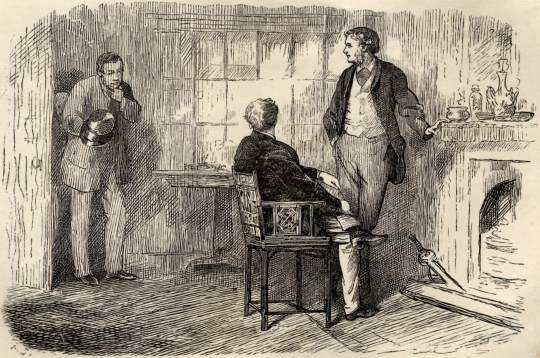
"Mr. Hugh Stanbury, I think," said Bozzle, making another bow to the young barrister.
"That's my name," said Stanbury.
"Exactly so, Mr. S. The identity is one as I could prove on oath in any court in England. You was on the railway platform at Exeter on Saturday when we was waiting for the 12 express 'buss;—wasn't you now, Mr. S.?"
"What's that to you?"
"Well;—as it do happen, it is something to me. And, Mr. S., if you was asked that question in hany court in England or before even one of the metropolitan bekes, you wouldn't deny it."
"Why the devil should I deny it? What's all this about, Trevelyan?"
"Of course you can't deny it, Mr. S. When I'm down on a fact, I am down on it. Nothing else wouldn't do in my profession."
"Have you anything to say to me, Mr. Bozzle?" asked Trevelyan.
"Well;—I have; just a word."
"About your journey to Devonshire?"
"Well;—in a way it is about my journey to Devonshire. It's all along of the same job, Mr. Trewillian."
"You can speak before my friend here," said Trevelyan. Bozzle had taken a great dislike to Hugh Stanbury, regarding the barrister with a correct instinct as one who was engaged for the time in the same service with himself, and who was his rival in that service. When thus instigated to make as it were a party of three in this delicate and most confidential matter, and to take his rival into his confidence, he shook his head slowly and looked Trevelyan hard in the face,—"Mr. Stanbury is my particular friend," said Trevelyan, "and knows well the circumstances of this unfortunate affair. You can say anything before him."
Bozzle shook his head again. "I'd rayther not, Mr. Trewillian," said he. "Indeed I'd rayther not. It's something very particular."
"If you take my advice," said Stanbury, "you will not hear him yourself."
"That's your advice, Mr. S.?" asked Mr. Bozzle.
"Yes;—that's my advice. I'd never have anything to do with such a fellow as you as long as I could help it."
"I dare say not, Mr. S.; I dare say not. We're hexpensive, and we're haccurate;—neither of which is much in your line, Mr. S., if I understand about it rightly."
"Mr. Bozzle, if you've got anything to tell, tell it," said Trevelyan angrily.
"A third party is so objectionable," pleaded Bozzle.
"Never mind. That is my affair."
"It is your affair, Mr. Trewillian. There's not a doubt of that. The lady is your wife."
"Damnation!" shouted Trevelyan.
"But the credit, sir," said Bozzle. "The credit is mine. And here is Mr. S. has been down a interfering with me, and doing no 'varsal good, as I'll undertake to prove by evidence before the affair is over."
"The affair is over," said Stanbury.
"That's as you think, Mr. S. That's where your information goes to, Mr. S. Mine goes a little beyond that, Mr. S. I've means as you can know nothing about, Mr. S. I've irons in the fire, what you're as ignorant on as the babe as isn't born."
"No doubt you have, Mr. Bozzle," said Stanbury.
"I has. And now if it be that I must speak before a third party, Mr. Trewillian, I'm ready. It ain't that I'm no ways ashamed. I've done my duty, and knows how to do it. And let a counsel be ever so sharp, I never yet was so 'posed but what I could stand up and hold my own. The Colonel, Mr. Trewillian, got,—a letter,—from your lady,—this morning."
"I don't believe it," said Stanbury, sharply.
"Very likely not, Mr. S. It ain't in my power to say anything whatever about you believing or not believing. But Mr. T.'s lady has wrote the letter; and the Colonel,—he has received it. You don't look after these things, Mr. S. You don't know the ways of 'em. But it's my business. The lady has wrote the letter, and the Colonel,—why, he has received it." Trevelyan had become white with rage when Bozzle first mentioned this continued correspondence between his wife and Colonel Osborne. It never occurred to him to doubt the correctness of the policeman's information, and he regarded Stanbury's assertion of incredulity as being simply of a piece with his general obstinacy in the matter. At this moment he began to regret that he had called in the assistance of his friend, and that he had not left the affair altogether in the hands of that much more satisfactory, but still more painful, agent, Mr. Bozzle. He had again seated himself, and for a moment or two remained silent on his chair. "It ain't my fault, Mr. Trewillian," continued Bozzle, "if this little matter oughtn't never to have been mentioned before a third party."
"It is of no moment," said Trevelyan, in a low voice. "What does it signify who knows it now?"
"Do not believe it, Trevelyan," said Stanbury.
"Very well, Mr. S. Very well. Just as you like. Don't believe it. Only it's true, and it's my business to find them things out. It's my business, and I finds 'em out. Mr. Trewillian can do as he likes about it. If it's right, why, then it is right. It ain't for me to say nothing about that. But there's the fact. The lady, she has wrote another letter; and the Colonel,—why, he has received it. There ain't nothing wrong about the post-office. If I was to say what was inside of that billydou,—why, then I should be proving what I didn't know; and when it came to standing up in court, I shouldn't be able to hold my own. But as for the letter, the lady wrote it, and the Colonel,—he received it."
"That will do, Mr. Bozzle," said Trevelyan.
"Shall I call again, Mr. Trewillian?"
"No;—yes. I'll send to you, when I want you. You shall hear from me."
"I suppose I'd better be keeping my eyes open about the Colonel's place, Mr. Trewillian?"
"For God's sake, Trevelyan, do not have anything more to do with this man!"
"That's all very well for you, Mr. S.," said Bozzle. "The lady ain't your wife."
"Can you imagine anything more disgraceful than all this?" said Stanbury.
"Nothing; nothing; nothing!" answered Trevelyan.
"And I'm to keep stirring, and be on the move?" again suggested Bozzle, who prudently required to be fortified by instructions before he devoted his time and talents even to so agreeable a pursuit as that in which he had been engaged.
"You shall hear from me," said Trevelyan.
"Very well;—very well. I wish you good-day, Mr. Trewillian. Mr. S., yours most obedient. There was one other point, Mr. Trewillian."
"What point?" asked Trevelyan, angrily.
"If the lady was to join the Colonel—"
"That will do, Mr. Bozzle," said Trevelyan, again jumping up from his chair. "That will do." So saying, he opened the door, and Bozzle, with a bow, took his departure. "What on earth am I to do? How am I to save her?" said the wretched husband, appealing to his friend.
Stanbury endeavoured with all his eloquence to prove that this latter piece of information from the spy must be incorrect. If such a letter had been written by Mrs. Trevelyan to Colonel Osborne, it must have been done while he, Stanbury, was staying at the Clock House. This seemed to him to be impossible; but he could hardly explain why it should be impossible. She had written to the man before, and had received him when he came to Nuncombe Putney. Why was it even improbable that she should have written to him again? Nevertheless, Stanbury felt sure that she had sent no such letter. "I think I understand her feelings and her mind," said he; "and if so, any such correspondence would be incompatible with her previous conduct." Trevelyan only smiled at this,—or pretended to smile. He would not discuss the question; but believed implicitly what Bozzle had told him in spite of all Stanbury's arguments. "I can say nothing further," said Stanbury.
"No, my dear fellow. There is nothing further to be said, except this, that I will have my unfortunate wife removed from the decent protection of your mother's roof with the least possible delay. I feel that I owe Mrs. Stanbury the deepest apology for having sent such an inmate to trouble her repose."
"Nonsense!"
"That is what I feel."
"And I say that it is nonsense. If you had never sent that wretched blackguard down to fabricate lies at Nuncombe Putney, my mother's repose would have been all right. As it is, Mrs. Trevelyan can remain where she is till after Christmas. There is not the least necessity for removing her at once. I only meant to say that the arrangement should not be regarded as altogether permanent. I must go to my work now. Good-bye."
"Good-bye, Stanbury."
Stanbury paused at the door, and then once more turned round. "I suppose it is of no use my saying anything further; but I wish you to understand fully that I regard your wife as a woman much ill-used, and I think you are punishing her, and yourself, too, with a cruel severity for an indiscretion of the very slightest kind."
CHAPTER XXVII.
MR. TREVELYAN'S LETTER TO HIS WIFE.
Trevelyan, when he was left alone, sat for above a couple of hours contemplating the misery of his position, and endeavouring to teach himself by thinking what ought to be his future conduct. It never occurred to him during these thoughts that it would be well that he should at once take back his wife, either as a matter of duty, or of welfare, for himself or for her. He had taught himself to believe that she had disgraced him; and, though this feeling of disgrace made him so wretched that he wished that he were dead, he would allow himself to make no attempt at questioning the correctness of his conviction. Though he were to be shipwrecked for ever, even that seemed to be preferable to supposing that he had been wrong. Nevertheless, he loved his wife dearly, and, in the white heat of his anger endeavoured to be merciful to her. When Stanbury accused him of severity, he would not condescend to defend himself; but he told himself then of his great mercy. Was he not as fond of his own boy as any other father, and had he not allowed her to take the child because he had felt that a mother's love was more imperious, more craving in its nature, than the love of a father? Had that been severe? And had he not resolved to allow her every comfort which her unfortunate position,—the self-imposed misfortune of her position,—would allow her to enjoy? She had come to him without a shilling; and yet, bad as her treatment of him had been, he was willing to give enough not only to support her, but her sister also, with every comfort. Severe! No; that, at least, was an undeserved accusation. He had been anything but severe. Foolish he might have been, in taking a wife from a home in which she had been unable to learn the discretion of a matron; too trusting he had been, and too generous,—but certainly not severe. But, of course, as he said to himself, a young man like Stanbury would take the part of a woman with whose sister he was in love. Then he turned his thoughts upon Bozzle, and there came over him a crushing feeling of ignominy, shame, moral dirt, and utter degradation, as he reconsidered his dealings with that ingenious gentleman. He was paying a rogue to watch the steps of a man whom he hated, to pry into the home secrets, to read the letters, to bribe the servants, to record the movements of this rival, this successful rival, in his wife's affections! It was a filthy thing,—and yet what could he do? Gentlemen of old, his own grandfather, or his father, would have taken such a fellow as Colonel Osborne by the throat and have caned him, and afterwards would have shot him, or have stood to be shot. All that was changed now,—but it was not his fault that it was changed. He was willing enough to risk his life, could any opportunity of risking it in this cause be obtained for him. But were he to cudgel Colonel Osborne, he would be simply arrested, and he would then be told that he had disgraced himself foully by striking a man old enough to be his father!
How was he to have avoided the employment of some such man as Bozzle? He had also employed a gentleman, his friend, Stanbury; and what was the result? The facts were not altered. Even Stanbury did not attempt to deny that there had been a correspondence, and that there had been a visit. But Stanbury was so blind to all impropriety, or pretended such blindness, that he defended that which all the world agreed in condemning. Of what use had Stanbury been to him? He had wanted facts, not advice. Stanbury had found out no facts for him; but Bozzle, either by fair means or foul, did get at the truth. He did not doubt but that Bozzle was right about that letter written only yesterday, and received on that very morning. His wife, who had probably been complaining of her wrongs to Stanbury, must have retired from that conversation to her chamber, and immediately have written this letter to her lover! With such a woman as that what can be done in these days otherwise than by the aid of such a one as Bozzle? He could not confine his wife in a dungeon. He could not save himself from the disgrace of her misconduct, by any rigours of surveillance on his own part. As wives are managed now-a-days, he could not forbid to her the use of the post-office,—could not hinder her from seeing this hypocritical scoundrel, who carried on his wickedness under the false guise of family friendship. He had given her every chance to amend her conduct: but, if she were resolved on disobedience, he had no means of enforcing obedience. The facts, however, it was necessary that he should know.
And now, what should he do? How should he go to work to make her understand that she could not write even a letter without his knowing it; and that if she did either write to the man or see him he would immediately take the child from her, and provide for her only in such fashion as the law should demand from him? For himself, and for his own life, he thought that he had determined what he would do. It was impossible that he should continue to live in London. He was ashamed to enter a club. He had hardly a friend to whom it was not an agony to speak. They who knew him, knew also of his disgrace, and no longer asked him to their houses. For days past he had eaten alone, and sat alone, and walked alone. All study was impossible to him. No pursuit was open to him. He spent his time in thinking of his wife, and of the disgrace which she had brought upon him. Such a life as this, he knew, was unmanly and shameful, and it was absolutely necessary for him that he should in some way change it. He would go out of England, and would travel,—if only he could so dispose of his wife that she might be safe from any possible communication with Colonel Osborne. If that could be effected, nothing that money could do should be spared for her. If that could not be effected he would remain at home,—and crush her.
That night before he went to bed he wrote a letter to his wife, which was as follows;—
Dear Emily,
I have learned, beyond the shadow of a doubt, that you have corresponded with Colonel Osborne since you have been at Nuncombe Putney, and also that you have seen him there. This has been done in direct opposition to my expressed wishes, and I feel myself compelled to tell you that such conduct is disgraceful to you, and disgracing to me. I am quite at a loss to understand how you can reconcile to yourself so flagrant a disobedience of my instructions, and so perverse a disregard to the opinion of the world at large.
But I do not write now for the sake of finding fault with you. It is too late for me to have any hope that I can do so with good effect, either as regards your credit or my happiness. Nevertheless, it is my duty to protect both you and myself from further shame; and I wish to tell you what are my intentions with that view. In the first place, I warn you that I keep a watch on you. The doing so is very painful to me, but it is absolutely necessary. You cannot see Colonel Osborne, or write to him, without my knowing it. I pledge you my word that in either case,—that is, if you correspond with him or see him,—I will at once take our boy away from you. I will not allow him to remain, even with a mother, who shall so misconduct herself. Should Colonel Osborne address a letter to you, I desire that you will put it under an envelope addressed to me.
If you obey my commands on this head I will leave our boy with you nine months out of every year till he shall be six years old. Such, at least, is my present idea, though I will not positively bind myself to adhere to it. And I will allow you £800 per year for your own maintenance and that of your sister. I am greatly grieved to find from my friend Mr. Stanbury that your conduct in reference to Colonel Osborne has been such as to make it necessary that you should leave Mrs. Stanbury's house. I do not wonder that it should be so. I shall immediately seek for a future home for you, and when I have found one that is suitable, I will have you conveyed to it.
I must now further explain my purposes,—and I must beg you to remember that I am driven to do so by your direct disobedience to my expressed wishes. Should there be any further communication between you and Colonel Osborne, not only will I take your child away from you, but I will also limit the allowance to be made to you to a bare sustenance. In such case, I shall put the matter into the hands of a lawyer, and shall probably feel myself driven to take steps towards freeing myself from a connection which will be disgraceful to my name.
For myself, I shall live abroad during the greater part of the year. London has become to me uninhabitable, and all English pleasures are distasteful.
Yours affectionately,
Louis Trevelyan.
When he had finished this he read it twice, and believed that he had written, if not an affectionate, at any rate a considerate letter. He had no bounds to the pity which he felt for himself in reference to the injury which was being done to him, and he thought that the offers which he was making, both in respect to his child and the money, were such as to entitle him to his wife's warmest gratitude. He hardly recognised the force of the language which he used when he told her that her conduct was disgraceful, and that she had disgraced his name. He was quite unable to look at the whole question between him and his wife from her point of view. He conceived it possible that such a woman as his wife should be told that her conduct would be watched, and that she should be threatened with the Divorce Court, with an effect that should, upon the whole, be salutary. There be men, and not bad men either, and men neither uneducated, or unintelligent, or irrational in ordinary matters, who seem to be absolutely unfitted by nature to have the custody or guardianship of others. A woman in the hands of such a man can hardly save herself or him from endless trouble. It may be that between such a one and his wife, events shall flow on so evenly that no ruling, no constraint is necessary,—that even the giving of advice is never called for by the circumstances of the day. If the man be happily forced to labour daily for his living till he be weary, and the wife be laden with many ordinary cares, the routine of life may run on without storms;—but for such a one, if he be without work, the management of a wife will be a task full of peril. The lesson may be learned at last; he may after years come to perceive how much and how little of guidance the partner of his life requires at his hands; and he may be taught how that guidance should be given;—but in the learning of the lesson there will be sorrow and gnashing of teeth. It was so now with this man. He loved his wife. To a certain extent he still trusted her. He did not believe that she would be faithless to him after the fashion of women who are faithless altogether. But he was jealous of authority, fearful of slights, self-conscious, afraid of the world, and utterly ignorant of the nature of a woman's mind.
He carried the letter with him in his pocket throughout the next morning, and in the course of the day he called upon Lady Milborough. Though he was obstinately bent on acting in accordance with his own views, yet he was morbidly desirous of discussing the grievousness of his position with his friends. He went to Lady Milborough, asking for her advice, but desirous simply of being encouraged by her to do that which he was resolved to do on his own judgment.
"Down,—after her,—to Nuncombe Putney!" said Lady Milborough, holding up both her hands.
"Yes; he has been there. And she has been weak enough to see him."
"My dear Louis, take her to Naples at once,—at once."
"It is too late for that now, Lady Milborough."
"Too late! Oh, no. She has been foolish, indiscreet, disobedient,—what you will of that kind. But, Louis, don't send her away; don't send your young wife away from you. Those whom God has joined together, let no man put asunder."
"I cannot consent to live with a wife with whom neither my wishes nor my word have the slightest effect. I may believe of her what I please, but, think what the world will believe! I cannot disgrace myself by living with a woman who persists in holding intercourse with a man whom the world speaks of as her lover."
"Take her to Naples," said Lady Milborough, with all the energy of which she was capable.
"I can take her nowhere, nor will I see her, till she has given proof that her whole conduct towards me has been altered. I have written a letter to her, and I have brought it. Will you excuse me if I ask you to take the trouble to read it?"
Then he handed Lady Milborough the letter, which she read very slowly, and with much care.
"I don't think I would—would—would—"
"Would what?" demanded Trevelyan.
"Don't you think that what you say is a little,—just a little prone to make,—to make the breach perhaps wider?"
"No, Lady Milborough. In the first place, how can it be wider?"
"You might take her back, you know; and then if you could only get to Naples!"
"How can I take her back while she is corresponding with this man?"
"She wouldn't correspond with him at Naples."
Trevelyan shook his head and became cross. His old friend would not at all do as old friends are expected to do when called upon for advice.
"I think," said he, "that what I have proposed is both just and generous."
"But, Louis, why should there be any separation?"
"She has forced it upon me. She is headstrong, and will not be ruled."
"But this about disgracing you. Do you think that you must say that?"
"I think I must, because it is true. If I do not tell her the truth, who is there that will do so? It may be bitter now, but I think that it is for her welfare."
"Dear, dear, dear!"
"I want nothing for myself, Lady Milborough."
"I am sure of that, Louis."
"My whole happiness was in my home. No man cared less for going out than I did. My child and my wife were everything to me. I don't suppose that I was ever seen at a club in the evening once throughout a season. And she might have had anything that she liked,—anything! It is hard, Lady Milborough; is it not?"
Lady Milborough, who had seen the angry brow, did not dare to suggest Naples again. But yet, if any word might be spoken to prevent this utter wreck of a home, how good a thing it would be! He had got up to leave her, but she stopped him by holding his hand. "For better, for worse, Louis; remember that."
"Why has she forgotten it?"
"She is flesh of your flesh, bone of your bone. And for the boy's sake! Think of your boy, Louis. Do not send that letter. Sleep on it, Louis, and think of it."
"I have slept on it."
"There is no promise in it of forgiveness after a while. It is written as though you intended that she should never come back to you."
"That shall be as she behaves herself."
"But tell her so. Let there be some one bright spot in what you say to her, on which her mind may fix itself. If she be not altogether hardened, that letter will drive her to despair."
But Trevelyan would not give up the letter, nor indicate by a word that he would reconsider the question of its propriety. He escaped as soon as he could from Lady Milborough's room, and almost declared as he did so, that he would never enter her doors again. She had utterly failed to see the matter in the proper light. When she talked of Naples she must surely have been unable to comprehend the extent of the ill-usage to which he, the husband, had been subjected. How was it possible that he should live under the same roof with a wife who claimed to herself the right of receiving visitors of whom he disapproved,—a visitor,—a gentleman,—one whom the world called her lover? He gnashed his teeth and clenched his fist as he thought of his old friend's ignorance of the very first law in a married man's code of laws.
But yet when he was out in the streets he did not post his letter at once; but thought of it throughout the whole day, trying to prove the weight of every phrase that he had used. Once or twice his heart almost relented. Once he had the letter in his hand, that he might tear it. But he did not tear it. He put it back into his pocket, and thought again of his grievance. Surely it was his first duty in such an emergency to be firm!
It was certainly a wretched life that he was leading. In the evening he went all alone to an eating-house for his dinner, and then, sitting with a miserable glass of sherry before him, he again read and re-read the epistle which he had written. Every harsh word that it contained was, in some sort, pleasant to his ear. She had hit him hard, and should he not hit her again? And then, was it not his bounden duty to let her know the truth? Yes; it was his duty to be firm.
So he went out and posted the letter.
CHAPTER XXVIII.
GREAT TRIBULATION.

"Disgraced him! I have never disgraced him. It is he that has disgraced me. Correspondence! Yes;—he shall see it all. Unjust, ignorant, foolish man! He does not remember that the last instructions he really gave me, were to bid me see Colonel Osborne. Take my boy away! Yes. Of course, I am a woman and must suffer. I will write to Colonel Osborne, and will tell him the truth, and will send my letter to Louis. He shall know how he has ill-treated me! I will not take a penny of his money;—not a penny. Maintain you! I believe he thinks that we are beggars. Leave this house because of my conduct! What can Mrs. Stanbury have said? What can any of them have said? I will demand to be told. Free himself from the connection! Oh, Nora, Nora! that it should come to this!—that I should be thus threatened, who have been as innocent as a baby! If it were not for my child, I think that I should destroy myself!"
Nora said what she could to comfort her sister, insisting chiefly on the promise that the child should not be taken away. There was no doubt as to the husband's power in the mind of either of them; and though, as regarded herself, Mrs. Trevelyan would have defied her husband, let his power be what it might, yet she acknowledged to herself that she was in some degree restrained by the fear that she would find herself deprived of her only comfort.
"We must just go where he bids us,—till papa comes," said Nora.
"And when papa is here, what help will there be then? He will not let me go back to the islands,—with my boy. For myself I might die, or get out of his way anywhere. I can see that. Priscilla Stanbury is right when she says that no woman should trust herself to any man. Disgraced! That I should live to be told by my husband that I had disgraced him,—by a lover!"
There was some sort of agreement made between the two sisters as to the manner in which Priscilla should be interrogated respecting the sentence of banishment which had been passed. They both agreed that it would be useless to make inquiry of Mrs. Stanbury. If anything had really been said to justify the statement made in Mr. Trevelyan's letter, it must have come from Priscilla, and have reached Trevelyan through Priscilla's brother. They, both of them, had sufficiently learned the ways of the house to be sure that Mrs. Stanbury had not been the person active in the matter. They went down, therefore, together, and found Priscilla seated at her desk in the parlour. Mrs. Stanbury was also in the room, and it had been presumed between the sisters that the interrogations should be made in that lady's absence; but Mrs. Trevelyan was too hot in the matter for restraint, and she at once opened out her budget of grievance.
"I have a letter from my husband," she said,—and then paused. But Priscilla, seeing from the fire in her eyes that she was much moved, made no reply, but turned to listen to what might further be said. "I do not know why I should trouble you with his suspicions," continued Mrs. Trevelyan, "or read to you what he says about—Colonel Osborne." As she spoke she was holding her husband's letter open in her hands. "There is nothing in it that you do not know. He says I have corresponded with him. So I have;—and he shall see the correspondence. He says that Colonel Osborne visited me. He did come to see me and Nora."
"As any other old man might have done," said Nora.
"It was not likely that I should openly confess myself to be afraid to see my father's old friend. But the truth is, my husband does not know what a woman is."
She had begun by declaring that she would not trouble her friend with any statement of her husband's complaints against her; but now she had made her way to the subject, and could hardly refrain herself. Priscilla understood this, and thought that it would be wise to interrupt her by a word that might bring her back to her original purpose. "Is there anything," said she, "which we can do to help you?"
"To help me? No;—God only can help me. But Louis informs me that I am to be turned out of this house, because you demand that we should go."
"Who says that?" exclaimed Mrs. Stanbury.
"My husband. Listen; this is what he says:—'I am greatly grieved to hear from my friend Mr. Stanbury that your conduct in reference to Colonel Osborne has been such as to make it necessary that you should leave Mrs. Stanbury's house.' Is that true? Is that true?" In her general mode of carrying herself, and of enduring the troubles of her life, Mrs. Trevelyan was a strong woman; but now her grief was too much for her, and she burst out into tears. "I am the most unfortunate woman that ever was born!" she sobbed out through her tears.
"I never said that you were to go," said Mrs. Stanbury.
"But your son has told Mr. Trevelyan that we must go," said Nora, who felt that her sense of injury against Hugh Stanbury was greatly increased by what had taken place. To her mind he was the person most important in the matter. Why had he desired that they should be sent away from the Clock House? She was very angry with him, and declared to herself that she hated him with all her heart. For this man she had sent away that other lover,—a lover who had really loved her! And she had even confessed that it was so!
"There is a misunderstanding about this," said Priscilla.
"It must be with your brother, then," said Nora.
"I think not," said Priscilla. "I think that it has been with Mr. Trevelyan." Then she went on to explain, with much difficulty, but still with a slow distinctness that was peculiar to her, what had really taken place. "We have endeavoured," she said, "to show you,—my mother and I,—that we have not misjudged you; but it is certainly true that I told my brother that I did not think the arrangement a good one,—quite as a permanence." It was very difficult, and her cheeks were red as she spoke, and her lips faltered. It was an exquisite pain to her to have to give the pain which her words would convey; but there was no help for it,—as she said to herself more than once at the time,—there was nothing to be done but to tell the truth.
"I never said so," blurted out Mrs. Stanbury, with her usual weakness.
"No, mother. It was my saying. In discussing what was best for us all, with Hugh, I told him,—what I have just now explained."
"Then of course we must go," said Mrs. Trevelyan, who had gulped down her sobs and was resolved to be firm,—to give way to no more tears, to bear all without sign of womanly weakness.
"You will stay with us till your father comes," said Priscilla.
"Of course you will," said Mrs. Stanbury,—"you and Nora. We have got to be such friends, now."
"No," said Mrs. Trevelyan. "As to friendship for me, it is out of the question. We must pack up, Nora, and go somewhere. Heaven knows where!"
Nora was now sobbing. "Why your brother—should want to turn us out,—after he has sent us here—!"
"My brother wants nothing of the kind," said Priscilla. "Your sister has no better friend than my brother."
"It will be better, Nora, to discuss the matter no further," said Mrs. Trevelyan. "We must go away,—somewhere; and the sooner the better. To be an unwelcome guest is always bad; but to be unwelcome for such a reason as this is terrible."
"There is no reason," said Mrs. Stanbury; "indeed there is none."
"Mrs. Trevelyan will understand us better when she is less excited," said Priscilla. "I am not surprised that she should be indignant now. I can only say again that we hope you will stay with us till Sir Marmaduke Rowley shall be in England."
"That is not what your brother means," said Nora.
"Nor is it what I mean," said Mrs. Trevelyan. "Nora, we had better go to our own room. I suppose I must write to my husband; indeed, of course I must, that I may send him—the correspondence. I fear I cannot walk out into the street, Mrs. Stanbury, and make you quit of me, till I hear from him. And if I were to go to an inn at once, people would speak evil of me;—and I have no money."
"My dear, how can you think of such a thing!" said Mrs. Stanbury.
"But you may be quite sure that we shall be gone within three days,—or four at the furthest. Indeed, I will pledge myself not to remain longer than that,—even though I should have to go to the poor-house. Neither I nor my sister will stay in any family,—to contaminate it. Come, Nora." And so speaking she sailed out of the room, and her sister followed her.
"Why did you say anything about it? Oh dear, oh dear! why did you speak to Hugh? See what you have done!"
"I am sorry that I did speak," replied Priscilla slowly.
"Sorry! Of course you are sorry; but what good is that?"
"But, mother, I do not think that I was wrong. I feel sure that the real fault in all this is with Mr. Trevelyan, as it has been all through. He should not have written to her as he has done."
"I suppose Hugh did tell him."
"No doubt;—and I told Hugh; but not after the fashion in which he has told her. I blame myself mostly for this,—that we ever consented to come to this house. We had no business here. Who is to pay the rent?"
"Hugh insisted upon taking it."
"Yes;—and he will pay the rent; and we shall be a drag upon him, as though he had been fool enough to have a wife and a family of his own. And what good have we done? We had not strength enough to say that that wicked man should not see her when he came;—for he is a wicked man."
"If we had done that she would have been as bad then as she is now."
"Mother, we had no business to meddle either with her badness or her goodness. What had we to do with the wife of such a one as Mr. Trevelyan, or with any woman who was separated from her husband?"
"It was Hugh who thought we should be of service to them."
"Yes;—and I do not blame him. He is in a position to be of service to people. He can do work and earn money, and has a right to think and to speak. We have a right to think only for ourselves, and we should not have yielded to him. How are we to get back again out of this house to our cottage?"
"They are pulling the cottage down, Priscilla."
"To some other cottage, mother. Do you not feel while we are living here that we are pretending to be what we are not? After all, Aunt Stanbury was right, though it was not her business to meddle with us. We should never have come here. That poor woman now regards us as her bitter enemies."
"I meant to do for the best," said Mrs. Stanbury.
"The fault was mine, mother."
"But you meant it for the best, my dear."
"Meaning for the best is trash. I don't know that I did mean it for the best. While we were at the cottage we paid our way and were honest. What is it people say of us now?"
"They can't say any harm."
"They say that we are paid by the husband to keep his wife, and paid again by the lover to betray the husband."
"Priscilla!"
"Yes;—it is shocking enough. But that comes of people going out of their proper course. We were too humble and low to have a right to take any part in such a matter. How true it is that while one crouches on the ground, one can never fall."
The matter was discussed in the Clock House all day, between Mrs. Stanbury and Priscilla, and between Mrs. Trevelyan and Nora, in their rooms and in the garden; but nothing could come of such discussions. No change could be made till further instructions should have been received from the angry husband; nor could any kind of argument be even invented by Priscilla which might be efficacious in inducing the two ladies to remain at the Clock House, even should Mr. Trevelyan allow them to do so. They all felt the intolerable injustice, as it appeared to them,—of their subjection to the caprice of an unreasonable and ill-conditioned man; but to all of them it seemed plain enough that in this matter the husband must exercise his own will,—at any rate till Sir Marmaduke should be in England. There were many difficulties throughout the day. Mrs. Trevelyan would not go down to dinner, sending word that she was ill, and that she would, if she were allowed, have some tea in her own room. And Nora said that she would remain with her sister. Priscilla went to them more than once; and late in the evening they all met in the parlour. But any conversation seemed to be impossible; and Mrs. Trevelyan, as she went up to her room at night, again declared that she would rid the house of her presence as soon as possible.
One thing, however, was done on that melancholy day. Mrs. Trevelyan wrote to her husband, and enclosed Colonel Osborne's letter to herself, and a copy of her reply. The reader will hardly require to be told that no such further letter had been written by her as that of which Bozzle had given information to her husband. Men whose business it is to detect hidden and secret things, are very apt to detect things which have never been done. What excuse can a detective make even to himself for his own existence if he can detect nothing? Mr. Bozzle was an active-minded man, who gloried in detecting, and who, in the special spirit of his trade, had taught himself to believe that all around him were things secret and hidden, which would be within his power of unravelling if only the slightest clue were put in his hand. He lived by the crookednesses of people, and therefore was convinced that straight doings in the world were quite exceptional. Things dark and dishonest, fights fought and races run that they might be lost, plants and crosses, women false to their husbands, sons false to their fathers, daughters to their mothers, servants to their masters, affairs always secret, dark, foul, and fraudulent, were to him the normal condition of life. It was to be presumed that Mrs. Trevelyan should continue to correspond with her lover,—that old Mrs. Stanbury should betray her trust by conniving at the lover's visit,—that everybody concerned should be steeped to the hips in lies and iniquity. When, therefore, he found at Colonel Osborne's rooms that the Colonel had received a letter with the Lessboro' post-mark, addressed in the handwriting of a woman, he did not scruple to declare that Colonel Osborne had received, on that morning, a letter from Mr. Trevelyan's "lady." But in sending to her husband what she called with so much bitterness, "the correspondence," Mrs. Trevelyan had to enclose simply the copy of one sheet note from herself.
But she now wrote again to Colonel Osborne, and enclosed to her husband, not a copy of what she had written, but the note itself. It was as follows:—
Nuncombe Putney, Wednesday, August 10.
My dear Colonel Osborne,
My husband has desired me not to see you, or to write to you, or to hear from you again. I must therefore beg you to enable me to obey him,—at any rate till papa comes to England.
Yours truly,
Emily Trevelyan.
And then she wrote to her husband, and in the writing of this letter there was much doubt, much labour, and many changes. We will give it as it was written when completed:—
I have received your letter, and will obey your commands to the best of my power. In order that you may not be displeased by any further unavoidable correspondence between me and Colonel Osborne, I have written to him a note, which I now send to you. I send it that you may forward it. If you do not choose to do so, I cannot be answerable either for his seeing me, or for his writing to me again.
I send also copies of all the correspondence I have had with Colonel Osborne since you turned me out of your house. When he came to call on me, Nora remained with me while he was here. I blush while I write this;—not for myself, but that I should be so suspected as to make such a statement necessary.
You say that I have disgraced you and myself. I have done neither. I am disgraced;—but it is you that have disgraced me. I have never spoken a word or done a thing, as regards you, of which I have cause to be ashamed.
I have told Mrs. Stanbury that I and Nora will leave her house as soon as we can be made to know where we are to go. I beg that this may be decided instantly, as else we must walk out into the street without a shelter. After what has been said, I cannot remain here.
My sister bids me say that she will relieve you of all burden respecting herself as soon as possible. She will probably be able to find a home with my aunt, Mrs. Outhouse, till papa comes to England. As for myself, I can only say that till he comes, I shall do exactly what you order.
Emily Trevelyan.
Nuncombe Putney, August 10.
CHAPTER XXIX.
MR. AND MRS. OUTHOUSE.
Both Mr. Outhouse and his wife were especially timid in taking upon themselves the cares of other people. Not on that account is it to be supposed that they were bad or selfish. They were both given much to charity, and bestowed both in time and money more than is ordinarily considered necessary, even from persons in their position. But what they gave, they gave away from their own quiet hearth. Had money been wanting to the daughters of his wife's brother, Mr. Outhouse would have opened such small coffer as he had with a free hand. But he would have much preferred that his benevolence should be used in a way that would bring upon him no further responsibility and no questionings from people whom he did not know and could not understand.
The Rev. Oliphant Outhouse had been Rector of St. Diddulph's-in-the-East for the last fifteen years, having married the sister of Sir Marmaduke Rowley,—then simply Mr. Rowley, with a colonial appointment in Jamaica of £120 per annum,—twelve years before his promotion, while he was a curate in one of the populous borough parishes. He had thus been a London clergyman all his life; but he knew almost as little of London society as though he had held a cure in a Westmoreland valley. He had worked hard, but his work had been altogether among the poor. He had no gift of preaching, and had acquired neither reputation nor popularity. But he could work;—and having been transferred because of that capability to the temporary curacy of St. Diddulph's,—out of one diocese into another,—he had received the living from the bishop's hands when it became vacant.
A dreary place was the parsonage of St. Diddulph's-in-the-East for the abode of a gentleman. Mr. Outhouse had not, in his whole parish, a parishioner with whom he could consort. The greatest men around him were the publicans, and the most numerous were men employed in and around the docks. Dredgers of mud, navvies employed on suburban canals, excavators, loaders and unloaders of cargo, cattle drivers, whose driving, however, was done mostly on board ship,—such and such like were the men who were the fathers of the families of St. Diddulph's-in-the-East. And there was there, not far removed from the muddy estuary of a little stream that makes its black way from the Essex marshes among the houses of the poorest of the poor into the Thames, a large commercial establishment for turning the carcasses of horses into manure. Messrs. Flowsem and Blurt were in truth the great people of St. Diddulph's-in-the-East; but the closeness of their establishment was not an additional attraction to the parsonage. They were liberal, however, with their money, and Mr. Outhouse was disposed to think,—custom perhaps having made the establishment less objectionable to him than it was at first,—that St. Diddulph's-in-the-East would be more of a Pandemonium than it now was, if by any sanitary law Messrs. Flowsem and Blurt were compelled to close their doors. "Non olet," he would say with a grim smile when the charitable cheque of the firm would come punctually to hand on the first Saturday after Christmas.
But such a house as his would be, as he knew, but a poor residence for his wife's nieces. Indeed, without positively saying that he was unwilling to receive them, he had, when he first heard of the breaking up of the house in Curzon Street, shewn that he would rather not take upon his shoulders so great a responsibility. He and his wife had discussed the matter between them, and had come to the conclusion that they did not know what kind of things might have been done in Curzon Street. They would think no evil, they said; but the very idea of a married woman with a lover was dreadful to them. It might be that their niece was free from blame. They hoped so. And even though her sin had been of ever so deep a dye, they would take her in,—if it were indeed necessary. But they hoped that such help from them might not be needed. They both knew how to give counsel to a poor woman, how to rebuke a poor man,—how to comfort, encourage, or to upbraid the poor. Practice had told them how far they might go with some hope of doing good;—and at what stage of demoralisation no good from their hands was any longer within the scope of fair expectation. But all this was among the poor. With what words to encourage such a one as their niece Mrs. Trevelyan,—to encourage her or to rebuke her, as her conduct might seem to make necessary,—they both felt that they were altogether ignorant. To them Mrs. Trevelyan was a fine lady. To Mr. Outhouse, Sir Marmaduke had ever been a fine gentleman, given much to worldly things, who cared more for whist and a glass of wine than for anything else, and who thought that he had a good excuse for never going to church in England because he was called upon, as he said, to show himself in the governor's pew always once on Sundays, and frequently twice, when he was at the seat of his government. Sir Marmaduke manifestly looked upon church as a thing in itself notoriously disagreeable. To Mr. Outhouse it afforded the great events of the week. And Mrs. Outhouse would declare that to hear her husband preach was the greatest joy of her life. It may be understood therefore that though the family connection between the Rowleys and the Outhouses had been kept up with a semblance of affection, it had never blossomed forth into cordial friendship.
When therefore the clergyman of St. Diddulph's received a letter from his niece, Nora, begging him to take her into his parsonage till Sir Marmaduke should arrive in the course of the spring, and hinting also a wish that her uncle Oliphant should see Mr. Trevelyan and if possible arrange that his other niece should also come to the parsonage, he was very much perturbed in spirit. There was a long consultation between him and his wife before anything could be settled, and it may be doubted whether anything would have been settled, had not Mr. Trevelyan himself made his way to the parsonage, on the second day of the family conference. Mr. and Mrs. Outhouse had both seen the necessity of sleeping upon the matter. They had slept upon it, and the discourse between them on the second day was so doubtful in its tone that more sleeping would probably have been necessary had not Mr. Trevelyan appeared and compelled them to a decision.
"You must remember that I make no charge against her," said Trevelyan, after the matter had been discussed for about an hour.
"Then why should she not come back to you?" said Mr. Outhouse, timidly.
"Some day she may,—if she will be obedient. But it cannot be now. She has set me at defiance; and even yet it is too clear from the tone of her letter to me that she thinks that she has been right to do so. How could we live together in amity when she addresses me as a cruel tyrant?"
"Why did she go away at first?" asked Mrs. Outhouse.
"Because she would compromise my name by an intimacy which I did not approve. But I do not come here to defend myself, Mrs. Outhouse. You probably think that I have been wrong. You are her friend; and to you, I will not even say that I have been right. What I want you to understand is this. She cannot come back to me now. It would not be for my honour that she should do so."
"But, sir,—would it not be for your welfare, as a Christian?" asked Mr. Outhouse.
"You must not be angry with me, if I say that I will not discuss that just now. I did not come here to discuss it."
"It is very sad for our poor niece," said Mrs. Outhouse.
"It is very sad for me," said Trevelyan, gloomily;—"very sad, indeed. My home is destroyed; my life is made solitary; I do not even see my own child. She has her boy with her, and her sister. I have nobody."
"I can't understand, for the life of me, why you should not live together just like any other people," said Mrs. Outhouse, whose woman's spirit was arising in her bosom. "When people are married, they must put up with something;—at least, most always." This she added, lest it might be for a moment imagined that she had had any cause for complaint with her Mr. Outhouse.
"Pray excuse me, Mrs. Outhouse; but I cannot discuss that. The question between us is this,—can you consent to receive your two nieces till their father's return;—and if so, in what way shall I defray the expense of their living? You will of course understand that I willingly undertake the expense not only of my wife's maintenance and of her sister's also, but that I will cheerfully allow anything that may be required either for their comfort or recreation."
"I cannot take my nieces into my house as lodgers," said Mr. Outhouse.
"No, not as lodgers; but of course you can understand that it is for me to pay for my own wife. I know I owe you an apology for mentioning it;—but how else could I make my request to you?"
"If Emily and Nora come here they must come as our guests," said Mrs. Outhouse.
"Certainly," said the clergyman. "And if I am told they are in want of a home they shall find one here till their father comes. But I am bound to say that as regards the elder I think her home should be elsewhere."
"Of course it should," said Mrs. Outhouse. "I don't know anything about the law, but it seems to me very odd that a young woman should be turned out in this way. You say she has done nothing?"
"I will not argue the matter," said Trevelyan.
"That's all very well, Mr. Trevelyan," said the lady, "but she's my own niece, and if I don't stand up for her I don't know who will. I never heard such a thing in my life as a wife being sent away after such a fashion as that. We wouldn't treat a cookmaid so; that we wouldn't. As for coming here, she shall come if she pleases, but I shall always say that it's the greatest shame I ever heard of."
Nothing came of this visit at last. The lady grew in her anger; and Mr. Trevelyan, in his own defence, was driven to declare that his wife's obstinate intimacy with Colonel Osborne had almost driven him out of his senses. Before he left the parsonage he was brought even to tears by his own narration of his own misery;—whereby Mr. Outhouse was considerably softened, although Mrs. Outhouse became more and more stout in the defence of her own sex. But nothing at last came of it. Trevelyan insisted on paying for his wife, wherever she might be placed; and when he found that this would not be permitted to him at the parsonage, he was very anxious to take some small furnished house in the neighbourhood, in which the two sisters might live for the next six months under the wings of their uncle and aunt. But even Mr. Outhouse was moved to pleasantry by this suggestion, as he explained the nature of the tenements which were common at St. Diddulph's. Two rooms, front and back, they might have for about five-and-sixpence a week in a house with three other families. "But perhaps that is not exactly what you'd like," said Mr. Outhouse. The interview ended with no result, and Mr. Trevelyan took his leave, declaring to himself that he was worse off than the foxes, who have holes in which to lay their heads;—but it must be presumed that his sufferings in this respect were to be by attorney; as it was for his wife, and not for himself, that the necessary hole was now required.
As soon as he was gone Mrs. Outhouse answered Nora's letter, and without meaning to be explicit, explained pretty closely what had taken place. The spare bedroom at the parsonage was ready to receive either one or both of the sisters till Sir Marmaduke should be in London, if one or both of them should choose to come. And though there was no nursery at the parsonage,—for Mr. and Mrs. Outhouse had been blessed with no children,—still room should be made for the little boy. But they must come as visitors,—"as our own nieces," said Mrs. Outhouse. And she went on to say that she would have nothing to do with the quarrel between Mr. Trevelyan and his wife. All such quarrels were very bad,—but as to this quarrel she could take no part either one side or the other. Then she stated that Mr. Trevelyan had been at the parsonage, but that no arrangement had been made, because Mr. Trevelyan had insisted on paying for their board and lodging.
This letter reached Nuncombe Putney before any reply was received by Mrs. Trevelyan from her husband. This was on the Saturday morning, and Mrs. Trevelyan had pledged herself to Mrs. Stanbury that she would leave the Clock House on the Monday. Of course, there was no need that she should do so. Both Mrs. Stanbury and Priscilla would now have willingly consented to their remaining till Sir Marmaduke should be in England. But Mrs. Trevelyan's high spirit revolted against this after all that had been said. She thought that she should hear from her husband on the morrow, but the post on Sunday brought no letter from Trevelyan. On the Saturday they had finished packing up,—so certain was Mrs. Trevelyan that some instructions as to her future destiny would be sent to her by her lord.
At last they decided on the Sunday that they would both go at once to St. Diddulph's; or perhaps it would be more correct to say that this was the decision of the elder sister. Nora would willingly have yielded to Priscilla's entreaties, and have remained. But Emily declared that she could not, and would not, stay in the house. She had a few pounds,—what would suffice for her journey; and as Mr. Trevelyan had not thought proper to send his orders to her, she would go without them. Mrs. Outhouse was her aunt, and her nearest relative in England. Upon whom else could she lean in this time of her great affliction? A letter, therefore, was written to Mrs. Outhouse, saying that the whole party, including the boy and nurse, would be at St. Diddulph's on the Monday evening, and the last cord was put to the boxes.
"I suppose that he is very angry," Mrs. Trevelyan said to her sister, "but I do not feel that I care about that now. He shall have nothing to complain of in reference to any gaiety on my part. I will see no one. I will have no—correspondence. But I will not remain here after what he has said to me, let him be ever so angry. I declare, as I think of it, it seems to me that no woman was ever so cruelly treated as I have been." Then she wrote one further line to her husband.
Not having received any orders from you, and having promised Mrs. Stanbury that I would leave this house on Monday, I go with Nora to my aunt, Mrs. Outhouse, to-morrow.
E. T.
On the Sunday evening the four ladies drank tea together, and they all made an effort to be civil, and even affectionate, to each other. Mrs. Trevelyan had at last allowed Priscilla to explain how it had come to pass that she had told her brother that it would be better both for her mother and for herself that the existing arrangements should be brought to an end, and there had come to be an agreement between them that they should all part in amity. But the conversation on the Sunday evening was very difficult.
"I am sure we shall always think of you both with the greatest kindness," said Mrs. Stanbury.
"As for me," said Priscilla, "your being with us has been a delight that I cannot describe;—only it has been wrong."
"I know too well," said Mrs. Trevelyan, "that in our present circumstances we are unable to carry delight with us anywhere."
"You hardly understand what our life has been," said Priscilla; "but the truth is that we had no right to receive you in such a house as this. It has not been our way of living, and it cannot continue to be so. It is not wonderful that people should talk of us. Had it been called your house, it might have been better."
"And what will you do now?" asked Nora.
"Get out of this place as soon as we can. It is often hard to go back to the right path; but it may always be done,—or at least attempted."
"It seems to me that I take misery with me wherever I go," said Mrs. Trevelyan.
"My dear, it has not been your fault," said Mrs. Stanbury.
"I do not like to blame my brother," said Priscilla, "because he has done his best to be good to us all;—and the punishment will fall heaviest upon him, because he must pay for it."
"He should not be allowed to pay a shilling," said Mrs. Trevelyan.
Then the morning came, and at seven o'clock the two sisters, with the nurse and child, started for Lessboro' Station in Mrs. Crocket's open carriage, the luggage having been sent on in a cart. There were many tears shed, and any one looking at the party would have thought that very dear friends were being torn asunder.
"Mother," said Priscilla, as soon as the parlour door was shut, and the two were alone together, "we must take care that we never are brought again into such a mistake as that. They who protect the injured should be strong themselves."
CHAPTER XXX.
DOROTHY MAKES UP HER MIND.
It was true that most ill-natured things had been said at Lessboro' and at Nuncombe Putney about Mrs. Stanbury and the visitors at the Clock House, and that these ill-natured things had spread themselves to Exeter. Mrs. Ellison of Lessboro', who was not the most good-natured woman in the world, had told Mrs. Merton of Nuncombe that she had been told that the Colonel's visit to the lady had been made by express arrangement between the Colonel and Mrs. Stanbury. Mrs. Merton, who was very good-natured, but not the wisest woman in the world, had declared that any such conduct on the part of Mrs. Stanbury was quite impossible. "What does it matter which it is,—Priscilla or her mother?" Mrs. Ellison had said. "These are the facts. Mrs. Trevelyan has been sent there to be out of the way of this Colonel; and the Colonel immediately comes down and sees her at the Clock House. But when people are very poor they do get driven to do almost anything."
Mrs. Merton, not being very wise, had conceived it to be her duty to repeat this to Priscilla; and Mrs. Ellison, not being very good-natured, had conceived it to be hers to repeat it to Mrs. MacHugh at Exeter. And then Bozzle's coming had become known.
"Yes, Mrs. MacHugh, a policeman in mufti down at Nuncombe! I wonder what our friend in the Close here will think about it! I have always said, you know, that if she wanted to keep things straight at Nuncombe, she should have opened her purse-strings."
From all which it may be understood, that Priscilla Stanbury's desire to go back to their old way of living had not been without reason.
It may be imagined that Miss Stanbury of the Close did not receive with equanimity the reports which reached her. And, of course, when she discussed the matter either with Martha or with Dorothy, she fell back upon her own early appreciation of the folly of the Clock House arrangement. Nevertheless, she had called Mrs. Ellison very bad names, when she learned from her friend Mrs. MacHugh what reports were being spread by the lady from Lessboro'.
"Mrs. Ellison! Yes; we all know Mrs. Ellison. The bitterest tongue in Devonshire, and the falsest! There are some people at Lessboro' who would be well pleased if she paid her way there as well as those poor women do at Nuncombe. I don't think much of what Mrs. Ellison says."
"But it is bad about the policeman," said Mrs. MacHugh.
"Of course it's bad. It's all bad. I'm not saying that it's not bad. I'm glad I've got this other young woman out of it. It's all that young man's doing. If I had a son of my own, I'd sooner follow him to the grave than hear him call himself a Radical."
Then, on a sudden, there came to the Close news that Mrs. Trevelyan and her sister were gone. On the very Monday on which they went, Priscilla sent a note on to her sister, in which no special allusion was made to Aunt Stanbury, but which was no doubt written with the intention that the news should be communicated.
"Gone; are they? As it is past wishing that they hadn't come, it's the best thing they could do now. And who is to pay the rent of the house, now they have gone?" As this was a point on which Dorothy was not prepared to trouble herself at present, she made no answer to the question.
Dorothy at this time was in a state of very great perturbation on her own account. The reader may perhaps remember that she had been much startled by a proposition that had been made to her in reference to her future life. Her aunt had suggested to her that she should become—Mrs. Gibson. She had not as yet given any answer to that proposition, and had indeed found it to be quite impossible to speak about it at all. But there can be no doubt that the suggestion had opened out to her altogether new views of life. Up to the moment of her aunt's speech to her, the idea of her becoming a married woman had never presented itself to her. In her humility it had not occurred to her that she should be counted as one among the candidates for matrimony. Priscilla had taught her to regard herself,—indeed, they had both so regarded themselves,—as born to eat and drink, as little as might be, and then to die. Now, when she was told that she could, if she pleased, become Mrs. Gibson, she was almost lost in a whirl of new and confused ideas. Since her aunt had spoken, Mr. Gibson himself had dropped a hint or two which seemed to her to indicate that he also must be in the secret. There had been a party, with a supper, at Mrs. Crumbie's, at which both the Miss Frenches had been present. But Mr. Gibson had taken her, Dorothy Stanbury, out to supper, leaving both Camilla and Arabella behind him in the drawing-room! During the quarter of an hour afterwards in which the ladies were alone while the gentlemen were eating and drinking, both Camilla and Arabella continued to wreak their vengeance. They asked questions about Mrs. Trevelyan, and suggested that Mr. Gibson might be sent over to put things right. But Miss Stanbury had heard them, and had fallen upon them with a heavy hand.
"There's a good deal expected of Mr. Gibson, my dears," she said, "which it seems to me Mr. Gibson is not inclined to perform."
"It is quite indifferent to us what Mr. Gibson may be inclined to perform," said Arabella. "I'm sure we shan't interfere with Miss Dorothy."
As this was said quite out loud before all the other ladies, Dorothy was overcome with shame. But her aunt comforted her when they were again at home.
"Laws, my dear; what does it matter? When you're Mrs. Gibson, you'll be proud of it all."
Was it then really written in the book of the Fates that she, Dorothy Stanbury, was to become Mrs. Gibson? Poor Dorothy began to feel that she was called upon to exercise an amount of thought and personal decision to which she had not been accustomed. Hitherto, in the things which she had done, or left undone, she had received instructions which she could obey. Had her mother and Priscilla told her positively not to go to her aunt's house, she would have remained at Nuncombe without complaint. Had her aunt since her coming given her orders as to her mode of life,—enjoined, for instance, additional church attendances, or desired her to perform menial services in the house,—she would have obeyed, from custom, without a word. But when she was told that she was to marry Mr. Gibson, it did seem to her to be necessary to do something more than obey. Did she love Mr. Gibson? She tried hard to teach herself to think that she might learn to love him. He was a nice-looking man enough, with sandy hair, and a head rather bald, with thin lips, and a narrow nose, who certainly did preach drawling sermons; but of whom everybody said that he was a very excellent clergyman. He had a house and an income, and all Exeter had long since decided that he was a man who would certainly marry. He was one of those men of whom it may be said that they have no possible claim to remain unmarried. He was fair game, and unless he surrendered himself to be bagged before long, would subject himself to just and loud complaint. The Miss Frenches had been aware of this, and had thought to make sure of him among them. It was a little hard upon them that the old maid of the Close, as they always called Miss Stanbury, should interfere with them when their booty was almost won. And they felt it to be the harder because Dorothy Stanbury was, as they thought, so poor a creature. That Dorothy herself should have any doubt as to accepting Mr. Gibson, was an idea that never occurred to them. But Dorothy had her doubts. When she came to think of it, she remembered that she had never as yet spoken a word to Mr. Gibson, beyond such little trifling remarks as are made over a tea-table. She might learn to love him, but she did not think that she loved him as yet.
"I don't suppose all this will make any difference to Mr. Gibson," said Miss Stanbury to her niece, on the morning after the receipt of Priscilla's note stating that the Trevelyans had left Nuncombe.
Dorothy always blushed when Mr. Gibson's name was mentioned, and she blushed now. But she did not at all understand her aunt's allusion. "I don't know what you mean, aunt," she said.
"Well, you know, my dear, what they say about Mrs. Trevelyan and the Clock House is not very nice. If Mr. Gibson were to turn round and say that the connection wasn't pleasant, no one would have a right to complain."
The faint customary blush on Dorothy's cheeks which Mr. Gibson's name had produced now covered her whole face even up to the roots of her hair. "If he believes bad of mamma, I'm sure, Aunt Stanbury, I don't want to see him again."
"That's all very fine, my dear, but a man has to think of himself, you know."
"Of course he thinks of himself. Why shouldn't he? I dare say he thinks of himself more than I do."
"Dorothy, don't be a fool. A good husband isn't to be caught every day."
"Aunt Stanbury, I don't want to catch any man."
"Dorothy, don't be a fool."