


автордың кітабын онлайн тегін оқу Everyday Objects; Or, Picturesque Aspects of Natural History
EVERYDAY OBJECTS
MURRAY AND GIBB, EDINBURGH,
PRINTERS TO HER MAJESTY'S STATIONERY OFFICE.
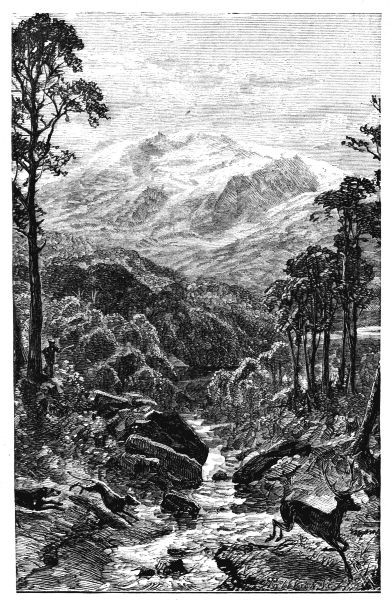
EVERYDAY OBJECTS.
(Frontispiece.)
Everyday Objects
or

WITH NUMEROUS ILLUSTRATIONS.
EDITED AND ENLARGED BY
W. H. DAVENPORT ADAMS,
AUTHOR OF "THE CIRCLE OF THE YEAR," "SWORD AND PEN,"
"BEFORE THE CONQUEST," ETC.
"To know
That which about us lies in daily life,
Is the prime wisdom."
Milton.
WILLIAM P. NIMMO:
LONDON: 14 KING WILLIAM STREET, STRAND;
AND EDINBURGH.
1876.
PREFACE.
———◇———
I have called this volume "Everyday Objects," not because those which it describes may be seen every day, but because they mostly belong to the region of the commonplace and familiar; and I have called it "Picturesque Aspects of Natural History," because I have endeavoured, in companionship with my French collaborateur, to indicate the poetical side of the various sciences into which I have presumed to penetrate. If it should awaken a love of nature in any breast, or develop a spirit of inquiry, which may lead the student further and further on the path of knowledge, the labour bestowed upon these pages will not have been in vain.
The instinct of curiosity,—says M. Hoefer, in his preface to the first series of "Les Saisons,"—is the awakening of the intellectual life: it commences with the lisping of the child, accompanies the adult in every phase of his existence, and, far from becoming extinct with the last throb of the heart, revives before the unknown shadows of the grave. What, then, is there in the whole world of greater importance to follow and direct than the movements and impulses of this curiosity, of these uncertain pulsations of the soul? In this lies the secret of all education; and upon education depends the future of humanity.
Unfortunately, he continues, the methods hitherto employed have been absolutely insufficient. And the insufficiency is most notable as regards the imperfect and defective training given to the instinct of curiosity. Observe the child. Of everything which excites his attention, he never fails to ask you the reason why. It is thus that he enters into the connexion of "cause" and "effect." It is a sign. But instead of following up this natural indication, and developing the thought by the exercise of the reason, we proceed as if the being under our charge were incapable of reason; we overload the memory of the child with a multitude of words, whose value he cannot understand until later in life, and perhaps never. The true direction of the mind is to proceed from the thought to the word, and not from the word to the thought. It is for want of having recognised and applied this principle that our educational systems have failed so utterly.
Let us take, for example, the study of nature. No science, assuredly, ought to prove more attractive to the mind than natural history. Yet mark how repulsive zoology, botany, and mineralogy are made at the very outset, by the dryness of their nomenclatures and the dreariness of their classifications. Undoubtedly, it is necessary to lay down a course of study in the midst of the marvels which everywhere surround us; undoubtedly names are required for the objects which attract our notice. But are not the methods we employ directly opposed to the end we set before ourselves?
I address myself to parents and teachers; and I say to them, Do you wish to inculcate a love of science, and yet put into the hands of your children or pupils books which differ as widely from the book of nature as human brotherhood—(a fiction!)—differs from universal gravitation? Instead of familiarising us at first with the animals and plants within our everyday reach, you collect, under the same irrevocable iron "form," genera and species never intended to meet in any one particular zone, and many of which are so rare that few persons will ever be fortunate enough to see them except in collections and engravings. And, curious to state, the rarest species nearly always obtain your preferences; judging, at least, from the minute descriptions which you consecrate to them. Monstrous absurdity! You seek at a distance that which lies close to your hands, as if the Everyday Objects above, beneath, and around, were unworthy of the science you profess.
But here we must pause. Upon the principles thus laid down by M. Hoefer, have been founded the two unpretending companion volumes, of which the second is now submitted to the lenient judgment of the public.
W. H. DAVENPORT ADAMS.
CONTENTS.
———◇———
BOOK I.—WINTER.
CHAP.
PAGE
I.
What may be Seen in the Heavens:—
The Number of the Stars, 4 The Great Bear and the Little Bear, 8 Orion, 13 Diurnal Movement, 15 Determination of the Cardinal Points, 17II.
What may be Seen upon the Earth:—
The Snow, 32 Red Snow, 39 The Eternal Snow, 44 The Inhabitants of the Eternal Snows, 48 The Arvicola Leucurus, 49 The Marmot, 53 The Chamois, 56 The Eagle and the Wren, 57 The Snow Bunting, 66 The Red-billed Crow, 68 Reptiles, 70 Inferior Animals, 71 Herbaceous Plants which best endure the Cold of Winter, 75 The Dog Mercury, 77 The Garden Nightshade, 82 The Dog's-tooth Grass, 88BOOK II.—SPRING.
I.
What may be Seen in the Heavens:—
The Earth's Figure is seen in the Sky as in a Mirror, 102II.
What may be Seen on the Earth:—
Causes of the Circulation of the Sap, 132 The Daisy, 138 The Tulip, 152 The Heliotrope, 156 The Anemones, 157 The Arum, 161 The Ranunculaceæ, 165 The Wood-louse, 169 The Dragon-flies, 174BOOK III.—SUMMER.
I.
What may be Seen in the Heavens:—
The Adumbrated Sphere, 191II.
What may be Seen on the Earth:—
The Perianth, 208 The Calyx, 208 The Corolla, 223 The Prunella, 230 The Scutellaria, 235 The Lilies, 241 The Gentians, 250 An Alpine Excursion, 256 The Pimpernel, 260 The Mole—The Staphylinus—The Mole Cricket, 265 The Earwig, 278BOOK IV.—AUTUMN.
I.
What may be Seen in the Heavens:—
The Circle, and the uniform Movement of the Stars (according to the Theory of the Ancients destroyed by Kepler), 289 The Solar Constitution, 292 Result of recent Astronomical Researches, 296II.
What may be Seen on the Earth:—
Chemical action of Light,
312 Action of Heat, 313 Arable Land, 318 Mushrooms or Agarics, 325 The Number of Vegetable Species distributed over the whole Surface of the Globe, 337 The Harvest Bug, 349 The Cheese Mite, 354 The Number of Animal Species distributed over the whole Surface of the Globe, 356 What is Chlorophyll? 366 Carnations and Pinks, 371 The Eglantine and the Convolvulus, 379 Metamorphosis: a Physico-philosophical Meditation, 384 Appendix,
405BOOK I.
——♦——
WINTER.
Lastly, came Winter clothèd all in frieze,
Chattering his teeth for cold that did him chill;
Whilst on his hoary beard his breath did freeze,
And the dull drops, that from his purpled bill
As from a limbeck did adown distil:
In his right hand a tippèd staff he held,
With which his feeble steps he stayèd still;
For he was faint with cold, and weak with eld;
That scarce his loosèd limbs he able was to wield.
—Spenser, The Faerie Queene, Canto vi.
(Of Mutability).
You naked trees, whose shady leaves are lost,
Wherein the birds were wont to build their bower,
And now are clothed with moss and hoary frost,
Instead of blossoms, wherewith your buds did flower;
I see your tears that from your boughs do rain,
Whose drops in dreary icicles remain.
—Spenser, The Shepherd's Calendar,
Eclogue I.
CHAPTER I.
WHAT MAY BE SEEN IN THE HEAVENS.
Skies flower'd with stars,
Violet, rose, or pearl-hued, or soft blue,
Golden, or green, the light now blended, now
Alternate.
—P. J. Bailey, Festus.
The Number of the Stars.
How many are the stars?
To such a question comes the immediate answer, They are infinite in number.
But, after a little meditation, we begin to perceive that the question, apparently so simple, is, in reality, one of very great complexity. Let us endeavour to disentangle its various threads.
We must not forget that, in every scientific analysis, it is important we should, in the first place, separate two intimately united elements,—the individual who observes, and the product of the observation. The former, the "sensorial factor," is subject to every condition of space and time; the second, the "intellectual factor," tends, by its generalisations, to free itself from those very conditions which are the inseparable co-efficients of matter and movement. The individual passes; save from an outer standpoint, we know not whence he comes, nor whither he goes. The product of the observation remains; transmissible from generation to generation, it will gradually expand and increase, if it be founded upon truth; but, on the contrary, its splendour will wane, and will eventually disappear, if it be founded upon error. Eternal is this spectacle of actors and puppets succeeding one another uninterruptedly upon the same stage! As one falls, another steps forward into his place, and so the great army marches forward with unbroken ranks.
He who, "in cities pent," sees the sky only through a garret window, or in the narrow intervals between house and house, can form no accurate idea of the magnificence of the firmament. The peasant, the shepherd, or the labourer, spent with his daily work, prefers sleep to astronomical vigils; and even amongst those more favoured sons of fortune, who enjoy sufficient leisure, but few are found who feel a genuine pleasure in the study of the stars. Though they are the poetry of heaven, their music is inaudible to the majority of souls. We content ourselves with an occasional careless glance at their serene loveliness, and then turn again to the pleasures or avocations of commonplace life.
But, come; let us arouse ourselves! Let us quit the city for awhile; let us throw off all thought of its too-engrossing pursuits; let us find time to count the stars. Gentle readers, I ask you to follow me.
Ah, me! how small is the train of followers! How great my delusion in supposing that a complete phalanx of students of the celestial wonders would reply to my invitation!
We have now arrived in the open country; and here, on the summit of this gentle ascent, crowned with a clump of leafless trees, we pause. The sky glitters with a cold, keen light, which is reflected back by the snowy plains. While the eye ranges delightedly over the starry vault, the ear is struck by the distant sound of bells, which, at the midnight hour, ring in the infant year—ring in so many hopes and expected joys, and unexpected sorrows—ring out so many passing pleasures and rudely dissipated visions.
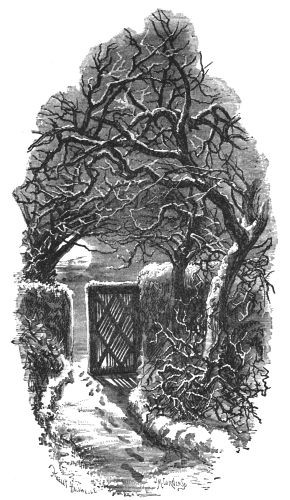
Fig. 1.
As the chime glides softly over the meadows, and along the resounding vales, and through the leafless woods, repeated by echo after echo, until its music dies away in the distance, like our recollections of the dreams of youth, we murmur to ourselves that solemn song of the poet, which so aptly blends the regrets of the past with the anticipations of the future; we exclaim—
"Ring out, wild bells, to the wild sky,
The flying cloud, the frosty light:
The year is dying in the night;
Ring out, wild bells, and let him die.
"Ring out false pride in place and blood,
The civic slander and the spite;
Ring in the love of truth and right,
Ring in the common love of good.
"Ring out old shapes of foul disease;
Ring out the harrowing lust of gold;
Ring out the thousand wars of old,
Ring in the thousand years of peace.
"Ring in the valiant man and free,
The larger heart, the kindlier hand;
Ring out the darkness of the land,
Ring in the Christ that is to be."[1]
The spectacle is majestic and impressive. Let us seek, in the first place, to ascertain our position in reference to the four points of the compass—the four cardinal points. But how is this to be done? By day it is easy enough. I have only to turn myself towards the sun when it has reached the highest point of its diurnal course, and there, in front of me, lies the south, in my rear the north, the east on my left, and on my right the west.
But is it possible to ascertain one's position during the absence of the "orb of day?"
Both possible and easy, provided the sky be clear and cloudless.
But this condition is as necessary by day as by night. How can we determine in which direction lies the south, if the sun be hidden from our gaze by an uniformly opaque atmosphere, and if objects, lit up by a diffuse light, project no shadow at any time of the day?
Endeavour to group together the stars which more particularly strike your gaze; and be careful, in these groupings, to define every fantastic figure which is suggested by your vivid imagination. Undoubtedly, our earliest ancestors, the "world's gray forefathers," proceeded in this manner, in their anxiety to lay hold of some definite guiding-marks in yonder ocean of sparkling atoms. And to study a science by its history is to follow up its successive development.
The Great and the Little Bear.
Observe yonder very remarkable group of seven stars; nearly all are of the same splendour, and they are so arranged as to figure an antique chariot, provided with a somewhat curved axle pole.
Observe it carefully. And not far from this group you will detect another, by no means so conspicuous, but exactly resembling it in form. This second chariot is turned in an inverse direction, and the stars composing it, with three exceptions, are much less brilliant.
Here, then, are two groups of stars, clearly distinguished by their configuration—two constellations, for such is the scientific name given to all the stellar groups.
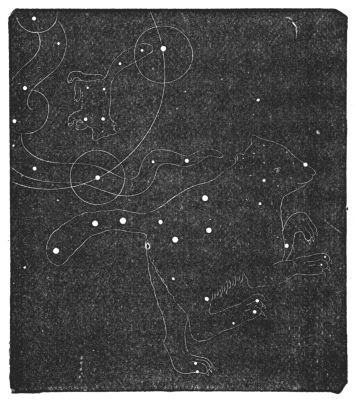
Fig. 2.—The Great Bear and Little Bear.
It has been the fortune of the first of these two groups to strike the eye of the most indifferent observer from the remotest antiquity; and its likeness to a quadriga early procured it the name of a car or chariot. For those Christians who pleased themselves in studding the sky with Biblical personages, it is David's Chariot. This species of apotheosis was borrowed from the Pagans. They placed in the skies their divinities, their demigods, their heroes, and the principal facts and stories of their mythology. For the Greeks and Romans the "Chariot of David" was the female of the Bear, an ursa, or ἀρκτὸς. Whence came this transfiguration? Listen to the fanciful old myth.
Callisto was the most beautiful of the daughters of the King Lycaon. Jupiter, who may appropriately be styled the "Don Juan" or "Lovelace" of the heathen Olympus, fell in love with her; and she bore him a son, named Arcas, who gave his name to Arcadia, that land of song and fable, groves and streams, where Lycaon exercised his sovereign sway. Juno, the queen of heaven, and wife of the so-called king of gods and men, transported by her jealous rage, changed Callisto into a she-bear; who, one day, would have been unwittingly slain by Arcas, if Jupiter, opportunely appearing on the scene, had not metamorphosed the hunter into another animal, Ursa Minor, or the Little Bear. According to this myth, the Little Bear will be but a transformation of the former, who was the Great Bear, or, before all and above all, the Bear.
It is somewhat surprising, according to certain writers, that Homer should refer to only one of these constellations:—
Ἄρκτοιθ᾿ ἥν καὶ ἄμαξαν ἐπίκλησιν καλέουσιν.[2]
(The Bear, which men the Chariot also name).
But the learned commentators who have censured the poet for making no distinction between Ursa Major and Ursa Minor, probably never looked at the starry vault with an attentive eye; otherwise, like all the world, they might have convinced themselves that the seven stars, septem triones (whence the word "septentrion"), forming the beautiful constellation, which, undoubtedly, long before Homer's time, was known as "The Bear" or "The Celestial Chariot," were all that could be seen. With a single exception, these stars are of the second magnitude—that is to say, they, so far as regards their brilliancy, rank next to the most brilliant stars of the firmament. The least conspicuous star in the group—one of the third magnitude—occupies the base of the pole of the Celestial Chariot, or of the Bear's tail; it is the fourth star counting from the extremity of the tail. On celestial charts, it is particularised by the fourth letter of the Greek alphabet, δ (delta).
Observe, in passing, that the first of these charts, wherein the stars of a constellation were indicated by Greek characters, appeared in 1603, at Augsburg, under the title of "Uranometria." Its author, Jean Bayer, an amateur astronomer, who died in 1660, conceived the idea of designating by the first letters of the Greek alphabet—α, β, γ, δ, and so on—the most noticeable stars. The animals bearing the names of the constellations are drawn in this map with very considerable care; but it requires, let us hasten to add, much imagination and good-will to recognise, in the form of a stellar group, the animal shown in the drawing.
Thus far Ursa Major. The four stars of the quadriga, or chariot, have been employed to form the dorso-lumbar region of the animal; the three others define its tail; and, finally, twenty-four little stars, some of which are hardly visible to the naked eye, compose the head and paws of the celestial "plantigrade."
As for Ursa Minor, it is impossible to distinguish it immediately when you are unaccustomed to surveying or examining the celestial vault. To detect its position, you require to be forewarned of it; to know, in the first place, that there exists in the vicinity of the Bear an exactly similar stellar group. The point of the tail—α in Ursa Minor—alone possesses a splendour comparable to that of the principal stars in Ursa Major. But how construct a figure with one star? The four other stars, two of which mark the anterior part of the animal's body, and two others the tail, properly so called, are only of the third magnitude: they are marked β, γ, δ, ε. Finally, the stars which define the posterior portion, marked ζ and η on Bayer's chart, are only of the fourth magnitude--in other words, are scarcely visible. The eye, to detect them, must be wholly free from any gleam of light.
Many generations passed before they succeeded in discovering what a single individual solved during his brief career. All Homer's contemporaries, and, prior to these, tens of millions of mortals, had contemplated the sky, and yet none of them had detected the difference between Ursa Major and Ursa Minor. The distinction, therefore, is of a comparatively recent date; probably does not date back earlier than the sixth century before the Christian era.
Let us recall ourselves, now, to the question propounded. The first impression produced by the aspect of the sky during a beautiful winter night is, we repeat, that the number of the stars is infinite. This wholly spontaneous thought, which, to some extent, imposes itself on the mind long before the reason attempts any calculation, is, strange to say, both false and true.
But how can a thought be both false and true? Nothing is easier than to explain the seeming contradiction. We shall return to it hereafter, after we have indulged in some indispensable digressions.
Orion.
One of the finest and loftiest flights of Longfellow's imagination is to be found in his poem on the occultation of Orion. He has seldom, if ever, sounded a more vigorous strain. After alluding to that music of the spheres which Pythagoras dreamed of, and which Shakespeare has described in a passage of great beauty, he continues:—
To hear our professors of astronomy invariably repeating, that "the spectator of the starry vault may see, every moment, new stars rising above the horizon,—may see them mount the sky,—halt in their upward march when they have attained a certain elevation,—afterwards re-descend, and pass below the horizon;"—to hear, we say, these words incessantly reproduced, one would think that a cursory glance at the sky would suffice to reveal the general movement, and that what is within the ken of the first comer, should not be called a discovery.
In the polar regions (we quote from Dr Child) snow supplies the ever-ready material out of which the Esquimaux construct their houses, and hardy explorers extemporise the huts in which they find shelter when absent from their ships on distant expeditions. Nor are the ships themselves considered "snug winter quarters" until their sides have been banked up in walls of snow, and the roof raised over the deck has been thickly covered with it. Snow huts are warmer than might have been expected. If built upon ice over the sea, their temperature is sensibly influenced by the heat of the unfrozen water below, which is said seldom to fall much under 40° F. in any part of the ocean. Even where the external temperature has sunk to 20° or 30° below zero, sufficient warmth is produced in a snow hut by the huddling together of three or four persons within it. When Dr Elisha Kane, the American explorer, passed a cold arctic winter's night in a hut beyond Smith's Sound, the temperature produced by its complement of lodgers, and two or three oil lamps, reached 90° F.; so that he was compelled by the heat to follow the example of the rest of the party, and partially to divest himself of his clothing. Yet in lat. 79° N., Dr Kane marked a temperature of 75° below zero in the month of February. No fluid could resist it. Even chloric ether became solid, and the air was pungent and acrid in respiration.
If men have the faculty of living under all climates, they make use of that faculty, as we know, with extreme reserve. They have never permanently inhabited the polar regions and the perpetually snowy summits of the mountains: it is only at intervals that a few pioneers have temporarily ventured thither. Starting from this fact, it was long believed that the zone of eternal snows was not inhabited by any living being. Even men of science admitted, as an article of faith, that where man could not fix his residence no animal could live. They made, however, a concession with respect to vegetables, and particularly as regarded the lichens and the mosses.
Which of all these names shall prevail? We cannot say, and it matters very little to us. Perhaps the nomenclators may in time agree among themselves upon the appellation of the genus. However this may be, we know—and it is an important fact—that a mammal exists at altitudes where men could not live, and that he is found in the Alps, above even the lower limit of the perpetual snows. Is it the only mammal which can live at such a height?
This was their origin:—The subterranean dwellings which certain species of marmots construct with so much skill, are each composed of two galleries, which unite together like the arms of a Y, and terminate in a cul-de-sac. There are found the globules of clay known as "Graetz's balls." They are an industrial product of our rodents, as M. Oscar Schmidt established in 1866, by close observation of the Arctomys bobac of the Zoological Garden of Vienna. The marmot creates these balls by scratching up the earth, and appears to amuse himself—a child's amusement!—by rolling them to and fro in his galleries.
The chamois is one of those animal species which, before a century, perhaps, will have disappeared; his bones will then figure in the palæontological museums by the side of the skeletons of extinct species. There, too, will be displayed the famous chamois balls, each of the size of a nut, covered with a shining substance resembling leather, of an agreeable odour, and seeming to be a morbid dejection, composed of roots and other undigested matter. These balls, the bezoars of the old physicians, were regarded as a remedy against every ill the human flesh is heir to; it was even professed that they rendered soldiers invulnerable, and were a better defence against bullets than the finest armour ever wrought by the smiths of Milan. How precious a remedy for this epoch of civilisation, when man—is he much wiser than his supposed progenitor, the ape?—seeks to replace the cholera and the pestilence by the most terrific engines of destruction!
Our crowned knight is very partial to the society of the tits, and, like them, he is easily caught with birdlime. He is so fond of the company of other birds, that, when he finds himself alone, he becomes disquieted; his prolonged tiny chirp grows plaintive; and he flies to and fro in quest of comrades. He may be regarded as a trustworthy barometer, for, prior to rainy weather, his song is very loud and incessant. Devoted to the pursuit of insects or their larvæ, he seems to pay no attention to the passer-by; he flutters vivaciously from branch to branch, and puts himself in all imaginable positions, sometimes with his head upwards, sometimes with his head downwards. We have often watched, with extreme gratification, the acrobatic tricks of our Lilliputian gymnast. Occasionally, before he perches, you will see him, in a frenzy of indecision, rapidly agitating his wings, and revolving them like a wheel. If you look at him, while thus engaged, against the light, you will think you see a tiny, ethereal, diaphanous spinning-top. After "assisting" at such a spectacle, which the first wood will furnish, you will not be indisposed to admit with us, that the bird designated by the Greeks τροχιλος, or "little wheel," and whose identity has so often been discussed, was, in reality, our golden-crested knight. Moreover, he is a true cosmopolite, in every acceptation of the word. Not only does he never quit us, not only does he remain faithful to us throughout the year, but we meet with him over all Europe. He is also found in Asia, and even, it is said, in America, from the West Indies to Canada. His flight being very short, it is supposed that he passed from one hemisphere to another by way of Behring's Strait. It is certain, at all events, that he discovered the New World before Christopher Columbus.
The snow-bunting's favourite localities, where he loves to build his nest, are the crests of inaccessible rocks, surrounded by vast fields of snow, in whose midst the sun and tempest have created a few oases. The most he does is to approach the hospices of Monts St Bernard and St Gothard, and construct his nest under the eaves of their roofs. This nest, made of long blades of grass, is lined internally with hair and the feathers of poultry. At the beginning of May, the female lays six eggs of a snowy whiteness, and the male assists in hatching them, and bringing up the young. The bill of the latter is, at first, of a bright yellow, which turns black, like that of the parents, as they grow older.
If caught when young, these birds are easily domesticated. M. Tschudi, in his "Life among the Alps," relates the history of one who had been tamed. He would himself go in quest of the bread, cheese, and fruits which composed his repast; then, holding in his claws the prize he had coveted, devour it with avidity. What remained of his meal he carefully concealed in paper, and would gallantly defend the hidden treasure against whomsoever dared to approach it, against dogs as well as man. Fire had a singular attraction for him; he would extract from a lamp the burning wick, and swallow it without sustaining any injury; he would swallow even the débris of the charcoal as he fluttered about the chimney. He showed an excessive joy at the sight of smoke, and loudly clapped his wings. Whenever he caught sight of any burning coal, he did not fail to pick up immediately all the paper, rags, or twigs he could lay his claws on; these he would place in the stove, and amuse himself by watching the smoke they gave forth. If a stranger entered the room, he gave vent to the most deafening cries, though he was exceedingly gentle and familiar towards persons with whom he was acquainted. His friends and favourites he distinguished in a peculiar manner; he ran in front of them, displayed his joy by expanding his wings, and alternately perched himself on their hands, their head, their shoulders, eyeing them all over, and bending his head as if to kiss them. Every morning he entered his master's bedroom, called him by his name, posted himself on his pillow, and waited tranquilly until he awoke; then he expressed his satisfaction by all kinds of gestures and noises.
The frigid zone is so far the natural habitat of these lizards, that they would rather die of hunger than live in the more genial regions to which men have wished to transplant them. In length they nearly equal our common lizards, but they are not quite so big; their back is of a chesnut brown, marked with black streaks and dots; the throat is bluish; the belly of the male is of a greenish blue, spotted with black, while that of the female is of so lively a red as to have suggested the name of the species, Pyrrhogastra; just as the name of the genus is derived from the circumstance that the young are hatched in the mother's belly, and are born alive like the young of a mammal. This statement, too, holds good with respect to the viper, which also endures the cold of elevated regions.
On comparing these two species, we remark, first, that the Podura plumbea is somewhat longer and thicker in body than the flea of the glaciers (see Fig. 16; a, natural size; b, enlarged); but it is more particularly by the length of its antennæ that we distinguish it. It owes its specific name of Plumbea to the livid blue or leaden colour of the scales which cover its body. These scales resemble those of butterflies; only they are much smaller, more finely situated, and very variable in form and size (Fig. 17). In catching it great care is required, for it is so easily crushed; it is, besides, very soft to the touch, though, when examined with a microscope, it is seen to bristle all over with hairs, apparently very hard.
It is among the weeds and noxious plants that we shall find the species capable of enduring longest the cold of winter. What part, then, do they fulfil in the economy of creation? An ambitious, but not a novel question, which has often been propounded in reference to our parasitical insects.
How singular a contrast! The plants most destructive in our kitchen gardens are frequently the most useful in medicine. There are no drugs more popular than the weeds which we call Herb Mercury, Garden Nightshade, and Dog's-tooth grass. All belong to families whose properties are strongly marked. As already stated, the Mercury ranks among the Euphorbiaceæ, remarkable for their acrid and more or less purgative juice. In this family occur the most violent drastics, such as the Croton tiglium, whose oil (expressed from the seeds) has long been considered an efficacious medicine. The Garden Nightshade is one of the Solanaceæ, and cousin-german of the useful potato; and the Dog's-tooth grass, whose roots compose three-fourths of our possets, is of the same family as our cereals.
It may be doubted whether many of the patrons of Mudie's are acquainted with the works of a philosopher, who, in his day, enjoyed no little fame—I mean, Robert Boyle (1627-1691),—and yet there are passages in them well worth attentive perusal, from the lucidity of their style and the soundness of their reflections. He has, for instance, some observations in his "Considerations on the Usefulness of Experimental Philosophy," which are germane to the general purport and tone of our little book. He remarks, that the contemplation of the vastness, beauty, and regular motions of the heavenly bodies, the excellent structure of animals and plants, besides a multitude of other phenomena of nature, and the subserviency of most of these to man, ought, certainly, to induce him, as a rational creature, to conclude that this vast, beautiful, orderly, and, in a word, many ways admirable, system of things, that we call the world, was framed by an Author supremely powerful, wise, and good.
But it was not so much a love of flowers as a lust of speculation which lay at the bottom of this famous mania. For example, a gentleman engaged a merchant to deliver, at the end of six months, a bulb worth 1000 florins. When the time came, the price of the bulb had either gone up or down, and the contractor paid only the difference; as for delivering the wares, neither party cared about it. It was, therefore, the exact equivalent of a speculation in the funds or in railway shares. The transactions took place on the public exchanges, as well as in coffee-houses, inns, and on the promenades. They originated a fertile crop of abuses, and to put an end to them the intervention of the Government was required.
With the Heliotrope every lover of flowers is familiar; it is not less prized for its delicate fragrance than the tulip for its glowing colours. No doubt exists as to the country from which we have imported the cultivated heliotrope, nor as to the epoch when it was introduced: it came from Peru, whence the name given to it by Linnæus, Heliotropium Peruvianium; and was brought into Europe, in 1740, by Joseph de Jussieu. Although not known in Europe above a hundred and thirty years, it is now an "old, familiar face" in every garden. Now, by the side of the cultivated species, a native of the New World, we can place a wild variety, indigenous to the Old World, common in our own country, and, indeed, in all the countries of temperate Europe; whence it has received the appellation of Heliotropium Europæum.
"The red, the dainty white, the gaudy Damask Rose,
The brave Carnation, then, of sweet and sovereign power
(So of his colour called, although a July flower),
With the other of his kind, the speckled and the pale;
Then the odoriferous Pink that sends forth such a gale
Of sweetness, yet in scents as various as in sorts;
The purple Violet then the Pansy there supports;
The Marigold above t' adorn the arched bar;
The double Daisy, Thrift, the Button-Bachelor;
Sweet William, Sops in Wine, the Campion, and to these
Some Lavender they put, and Rosemary, and Bays;
Sweet Marjoram with her like, sweet Basil rare for smell,
With many a flower whose name were now too long to tell."
Another, and not less interesting species, is the Arum arisarum. (See Fig. 34, a.) It loves to display its exquisite leafage on the rocks bordering the "sea-marge," and is found in profusion along almost the entire littoral of the Mediterranean. It is a precocious flower—making its appearance about the end of December, and flourishing until the beginning of Spring. The spathe, which in the Arum maculatum has all the aspect of an etiolated leaf, assumes, in the Arum arisarum, the tints of a corolla,—is of a beautiful warm red violet, streaked with white. The fleshy axis, which ought rather to be called gynandrous (both male and female) than a spadix, is of a red colour; naked in its upper portion, which terminates with a kind of apple. It would remind a drummer-boy of the formidable staff carried by his drum-major (see Fig. 34, b.); the stamens, reduced to the condition of bilobed anthers, are mounted around the central part; and the ovaries, less numerous than the stamens, occupy the base of the axis. Each monocular ovary is crowned by a sessile stigma, and each lobe contains a great number of erect ovules. In the Arum maculatum, the number of ovules does not exceed six. Some botanists have laid hold of this characteristic as an excuse for withdrawing the Mediterranean species from the arums, and creating a new genus, arisarum. The variety we have just described is, in that case, denominated the Arisarum vulgare.
Finally, our order comprises the Hepatica, with its blue or pink blossoms and three-lobed leaves, which, from their fancied resemblance to the form of the liver, procured the plant its English name of liverwort; the Flos Adonis, or pheasant's eye,—the goutte-de-sang of the French,—so called because the ancients fabled that it sprang from the blood of Adonis, when wounded by the bear; the marsh marigold; the gay and vivacious larkspur; the deadly wolfsbane, or aconite, which secretes so potent a poison; and the aromatic love-in-a-mist, or French flower.[55]
That the warning is true, all history attests. It is only, so to speak, from yesterday that the discovery of the sex of plants is to be dated; the tiny organs occupying the centre of the flower having always appeared so insignificant that they had passed, for some thousands of years, completely unnoticed. The eye of the spectator was caught by the calyx and the corolla; these envelopes, though of secondary importance so far as the reproduction of the vegetable is concerned, seemed to eyes dazzled by their glowing colours the true flower,—in fact, the entire flower. Science, which is the slow elaboration of thought matured by the study of objects of no human origin, has completely swept aside this premature judgment.
Finally, the calyx may even contribute to the dissemination of the seed. We may cite, as an example, a Brazilian species of Urticaceæ, which Saint-Hilaire named the Elasticaria. The fleshy and cylindrical parts of the calyx are curved inwards, and thus defend, as one might do with one's bended fingers, the young fruit until it is completely developed; as soon as the fruit is ripe, they spring up erect, and launch it to a distance.
1. Tulipeæ, tulip tribe; bulbous plants, with the segments of the perianth scarcely adherent in a tube.
2. Hemerocallideæ, day-lily tribe; bulbous plants, with a tubular perianth.
3. Scilleæ, or Alliæ, squill or onion tribe; bulbous, with black and brittle testa.
4. Anthericeæ or Asphodeleæ, asphodel tribe; roots fascicled or fibrous, leaves neither coriaceous nor permanent.
5. Convollarieæ, lily of the valley tribe; stem developed as a rhizome or tuber.
6. Asparageæ, asparagus tribe; stem usually fully developed, arborescent, branched in some cases, and leaves frequently permanent and coriaceous.
7. Alonieæ, aloes tribe; stem usually developed, arborescent, with succulent leaves.
8. Aphyllantheæ, grass-tree tribe; characterised by a rush-like habit and membranous imbricated bracts.
The Gentiana verna and the Gentiana nivalis, with a corolla of the finest azure, inhabit the loftiest points of the Alps, where all vegetation begins to disappear. The former, or the gentian of spring, flowers, in these frozen regions, in June and July; it is one of twenty-four phanerogamous plants of the last vegetable station of Mont Blanc. This station is formed by a series of vertical layers of protogene, which separates the upper part of the Glacier des Bossons from that of Taconay. The débris of the rock, decomposed under the influence of atmospheric agencies, form, in the midst of the nevé, tiny flowering parterres—oases in the desert, islands in the vast ocean of ice and snow. There, sheltered by the rocks, and warmed by the sun, and refreshed by the snow, which rapidly melts in summer, these pretty plants thrive and grow beautiful, though their brief existence is summed up in a few short weeks.
If, I say, this be a true picture, we cannot wonder at the means employed by the farmer to clear his fields of such dangerous tenants. The plan generally adopted is to dig, at intervals, a number of little trenches, which are filled up with cow-dung, well trodden down. The supposed root-eaters assemble in these warm nests; and every fourth or fifth day, a labourer, armed with a pitchfork, scoops up the manure at a single stroke, and scatters it over the ground, while another crushes the unfortunate Gryllotalpæ as fast as they make their appearance.
It was Hipparchus. At least it was he who, confidently relying upon his observations, was the first to affirm that the sun remains longer in the northern than in the southern hemispheres; or, more accurately speaking, that its passage from the spring to the autumn equinox occupies 187 days, while from the autumn to the spring equinox the duration of its course is only 178 days 6 hours (nearly). The year of 365-1/4 days—that is, the Egyptian year, which was universally adopted by the ancient astronomers—was thus discovered to be really divided into two unequal portions, although, theoretically, the sun ought to occupy exactly the same space of time in passing from the spring to the autumn, as from the autumn to the spring equinox.
What a coup-de-théâtre it was for the observer who first established experimentally that the apparent diameter of the sun is greater in winter than in summer—that we are nearer the sun in the cold season, than in the hot!
The uppermost stratum of our globe undergoes the direct action of the light and heat of the all-vivifying "orb of day." This action, very unequal in its effects, and most important to understand, has scarcely been touched as yet by scientific research. Our geologists, having been more busily engaged with the inside than the outside of the earth, have broached certain plausible theories—for the most part of a very dubious character—respecting the central fire, Plutonism and Neptunism, the stratification of the planets, the formation of mountains, valleys, and basins. Our mineralogists, thinking far less of the chemical molecular constitution of the different formations than of their crystalline constitution, have minutely studied the physical qualities and geometrical forms of the integral parts of the rocks; but neither have condescended to direct their inquiries to the layer of soil trodden underneath their feet. Yet this very layer of arable earth, to which all bodies must return after death what they have taken from it during life,—this much despised humus, furnishes all our agricultural products, the very foundation and support of our material existence.
It is no easy study to investigate the modifications and chemical effects which the terrestrial surface is capable of receiving or undergoing, either from the direct rays of the sun, or from diffused light. It requires new methods of inquiry,—methods frequently of extreme delicacy, as the labours of Bunsen and Roscoe, of Kirchhofer and Tyndall, have abundantly demonstrated. Let us here confine ourselves to establishing the fact that the chemical action of light varies according to the geological constitution of the soil,—according to the diurnal and annual obliquity of the solar rays,—according to the hours of the day,—according to the latitudes and seasons. The maximum of effects is manifested about the times of the solstices.
Thus, the red, oval, six-legged animalcules, whose mobile heads are furnished with a proboscis shaped like an angular beak, and whose two palpi are large and semi-transparent,—the singular animalcules which, in June or July, are hatched in the spongy stems of certain aquatic vegetables,—notably the Potamogeton natans,—have been described[83] as forming a peculiar genus of Arachnidæ, the genus Achlysia; and this genus, created by Audouin, was ranked along with the Leptus and Ocypete in the family of Microphthiræ. Yet nothing is less exact. These Achlysia are simply the larvæ of a kind of Hydrachna or water-acarus. To be convinced of this, you have but to watch their development. At first very small and pear-shaped, these larvæ, deprived, like all larvæ, of the reproductive organs, rapidly increase in size. At the end of a few weeks you will see them adhering to a leaf of potamogeton; they thrust their proboscis into the stem, and cling to it with their palpi. Little by little, the legs, the proboscis, and the palpi, are drawn back towards the body, abandoning the skin which has hitherto formed for each of these organs a kind of horny sheath. From the larva state, the animal passes into that of the nymph. But this nymph continues to feed and enlarge; proboscis, legs, and palpi grow thinner and harder; claws, ciliæ, and hairs are developed; and, finally, through a fissure in the skin emerges the perfect animal, red as wine, with eight feet, and about two millimetres in length. This animal, placed in the family of the Hydrachnellæ, has been described by De Geer under the name of Acarus aquaticus globosus, and by Dugès under that of Hydrachna globosa, on account of its globular form.
Let us continue our observation of this cheese-worm. The well-defined thorax forms nearly one-third of the fore-part of the body, which is of a shining whitish-red or reddish-white. The proboscis, shaped like a conical tube, is armed with two projecting mandibles, which, like true pincers, can be brought close together, or moved wide apart, thrust forward singly or simultaneously. Our animal, which a small lens makes very distinct, has been more than once confounded with the Sarcoptes scabiei.
Add, then,—let us say, in conclusion,—to this last great total the aggregate of the Vertebrates, the Articulates, and the Molluscs, and for our grand whole we have a minimum of half a million of animal species! This is the very figure, observe, at which we arrived as representing the lowest limit of the totality of vegetable species, living and moving, flourishing, and dying, and reproducing, on the surface of the globe.
MM. Prillieux, Brongniart, and Roze (Comptes Rendus, Jan. 3 and 17) have made some important observations on the apparently spontaneous movements of the grains of chlorophyll within the leaves of plants. These had been observed by Böhm to congregate under the direct action of the sun; Famitzin, confirmed by Borodine, had also recorded very marked movements in the leaves of a moss under the influence of light. This class of plants offer great facilities for these observations, inasmuch as the movements can be observed in them under the microscope without dissection. M. Prillieux kept a moss in the dark for several days, when the cells presented the appearance of a green network, between the meshes of which was a clear transparent ground. All the grains of chlorophyll were applied to the walls which separate the cells from one another; there were none on the upper or under walls which form the surfaces of the leaf. Under the influence of light the grains change their position from the lateral to the superficial walls; under favourable circumstances this change takes place in about a quarter of an hour. On attaining their new position, the grains do not remain absolutely immovable, but continually approach and separate from one another. If again darkened, they leave their new position and return to the lateral walls. Artificial light produces the same effect as daylight. M. Brongniart further observed that this movement of the chlorophyll, under the influence of light, does not consist in the change of position of isolated grains, but of masses of network, each containing a certain number of grains. In addition, M. E. Roze states that, besides the grains of chlorophyll which coat the walls of the cell, each cell is lined with a transparent mucous plasma formed of very fine threads, the extremities of which unite together the grains of chlorophyll. This protoplasm exhibits, under a high magnifying power, a very slow motion, and carries the grains of chlorophyll along with it. M. Roze believes, therefore, that the motion is a plasmic one, the protoplasm being the vital and animating part of the cell.
"The juice of the soapwort," says Miss Pratt, "is one of those vegetable substances which, by making a lather with water, will cleanse linen, and remove grease as effectually as soap. It grows more generally in the neighbourhood of villages than in any other situation, as if providence had placed it there especially for the service of the cottager; yet it is very little used, either from ignorance of its properties, or because it would require some cultivation to render it sufficiently plentiful for household purposes. It needs the addition of ashes to make it a good soap for washing linen; but it is of much service to the shepherds on the Alps, who wash their flocks, previously to shearing them, with soapsuds made by boiling this plant in water. The large fruit of the horse-chestnut has similar cleansing properties, and may be used by cutting it into small pieces, or scraping it into water. It has even been suggested that if the nuts were reduced to powder, and made into balls, with some unctuous substance, they would answer all the purposes of our manufactured soap; and yet numbers of poor people see these nuts lying decaying in their neighbourhood, and have no idea of making them of any service."
The convolvulus, or white bindweed (Convolvulus sepium, or Calystegia sepium), is one of the most elegant, though one of the commonest climbing plants which festoon our willows, or creep over our grassy banks, or wind in and about our hedges. Its large white bells, which the country people unpoetically call "old men's nightcaps," are remarkable for their purity of hue and exquisite beauty of outline; and the leaves, which are heart-shaped, equally claim our admiration. Like the pink field-convolvulus (Convolvulus arvensis), or the rosy-hued seaside bindweed (Calystegia soldanella), it is very tenacious of life, and if it once secures a footing, is eradicated with difficulty. Hence it is dearer to the poet and artist than to the farmer and gardener, each of whom pursues it with a determined hostility.
[1] Tennyson, "In Memoriam," cvi.
[2] Homer, "Odyssey," v. 273.
"Beneath the sky's triumphal arch
This music sounded like a march,
And with its chorus seemed to be
Preluding some great tragedy.
Sirius was rising in the east;
And, slow ascending one by one,
The kindling constellations shone.
Begirt with many a blazing star,
Stood the great giant Algebar,
Orion, hunter of the beast!
His sword hung gleaming by his side;
And, on his arm, the lion's hide
Scattered across the midnight air
The golden radiance of its hair."
The most ancient observer who wished, with his own eyes, to assure himself whether the number of the stars was infinite, must have quickly perceived that, in spite of an apparent impossibility, it is no difficult task to complete their enumeration. To execute this operation conveniently, however, we must invent a process; and of all processes, the simplest, and that which first occurs to the mind, is to group the stars by configurations which, to a certain degree, are mnemo-technical. Such, in our belief, is the true origin—a point so often and laboriously discussed—of the asterisms or constellations. Their fanciful, mythological, or poetical embellishments, are of later date.
The census or enumeration of the stars, which we suppose to have commenced during our winter nights, must at first have been limited to the most characteristic groups, composed of the most brilliant points. In this scientific labour the first rank would necessarily be occupied by Arctos (or Ursa Major) and Orion. Why? Because these two constellations attract and rivet everybody's gaze.
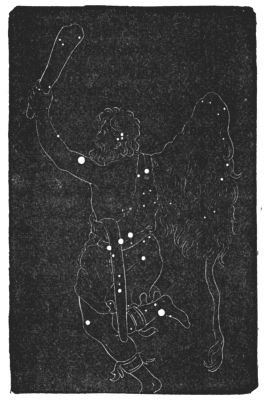
Fig. 3.—Orion.
Orion is situated on the side opposite to the Great Bear. It is the most beautiful constellation in our western sky. You may easily recognise it by three stars, very close together, which are inscribed, as it were, in the centre of a great trapezium of four stars, two of which are of the first magnitude. Beneath the three first stars, called the Three Kings, or Orion's Belt, is visible a small stellar group of the fourth and fifth magnitude, near which, with a good average glass, may be distinguished the largest and most remarkable of the nebulæ.
Here we find the mythologists—those theologians of the Greco-Roman polytheism—at disagreement. According to an ancient legend, immortalised by Homer—
"Aurora sought Orion's love,...
Till, in Ortygia, Dian's wingèd dart
Had pierced the hapless hunter to the heart."[3]
The giant, in the lower world, is still animated by a burning passion for the chase—
"There huge Orion, of portentous size,
Swift through the gloom a giant-hunter flies;
A ponderous mace of brass, with direful sway,
Aloft he whirls, to crush the savage prey;
Stern beasts in trains that by his truncheon fell,
Now, grisly forms, shoot o'er the lawns of hell."[4]
According to later traditions, the giant Orion, son of Tura and Neptune, was endowed by his father with the faculty of walking upon the sea as well as upon earth. He abandoned himself to the fierce joys of the chase in the wooded isle of Crete, to whose shades he had accompanied Diana and Latona. Swollen with pride, he defied to combat all the monsters of the universe, and was slain by a scorpion which the earth had engendered under his feet. But, through the intercession of Diana, a place was given to him in the firmament opposite Scorpio.
Diurnal Movement.
Let us put aside these dreams of the world's youth, and return to the reality.
Nature, transformed by the ancients into a multiple divinity, never fails to overwhelm with surprise the observer who interrogates her with simplicity and without any preconcerted system. And it was thus that he who first undertook to enumerate the stars, by the help of the constellations, made at once the greatest and most unexpected discovery. What, in fact, was not his astonishment on seeing the gradual displacement of objects which, at the first glance, appeared immovable!
To this very natural astonishment soon succeeded, we doubt not, a desire to analyse the phenomenon. The most beautiful constellations of the firmament, Ursa and Orion, will have their points of repery on the star-gemmed sphere. An attentive study, eagerly pursued through a certain lapse of time, would teach him that Orion rises and sets like the sun and the moon, while the Bear, remaining perpetually above the horizon, neither rises nor sets. Stimulated by curiosity, the observer would afterwards assure himself that the whole of the celestial vault revolved upon an axis, while the stars divided into groups; remain fixed, fixed in this sense, that they constantly maintain among themselves the same relations of distance. The idea of a solid sphere, to which the stars were attached like golden nails, then came quite naturally to the human mind. Such, undoubtedly, was the origin of the discovery of diurnal movement; of that general movement which carries all the stars from west to east, to bring them back to the same points in the course of one complete day.
To hear our professors of astronomy invariably repeating, that "the spectator of the starry vault may see, every moment, new stars rising above the horizon,—may see them mount the sky,—halt in their upward march when they have attained a certain elevation,—afterwards re-descend, and pass below the horizon;"—to hear, we say, these words incessantly reproduced, one would think that a cursory glance at the sky would suffice to reveal the general movement, and that what is within the ken of the first comer, should not be called a discovery.
But we see in this another of those illusions which blind contemporaries as to the time-long efforts of their predecessors to discover the very results which long ago became our common patrimony. Unquestionably, if you have eyes, you cannot fail to see the apparent movement of the earth and moon; but from thence to the relation of the whole celestial sphere is a wide interval. How many men are there who possess, on the one hand, sufficient patience to fix their gaze only for a couple of hours on the same point of the starry firmament; and, on the other, sufficient intelligence to estimate the relation of this point to a fixed point of the horizon, and to measure, by the thought, the interval separating these two points? Let each one ask himself.
Determination of the Cardinal Points.
However it may be, the discovery of the rotation of the celestial system must have been rapidly brought to perfection as it was transmitted from one generation to another. It must soon have been recognised that this sphere is inclined in such a manner that one of its poles—the poles of the world, which, in reality, are simply the prolonged extremities of the axis of terrestrial rotation—is always above the horizon, while the other remains below. And this phenomenon would lead to the geometrical conception of an axis of rotation of the celestial sphere. Thus we may explain, with perfect ease, why the Bear and the neighbouring constellations should describe perfect circles, and the other and more distant constellations only arcs of circles, of a greater or lesser diameter; finally, without even looking at the sky, we can understand that some stars there are which show themselves on the horizon, only to disappear immediately, and others which remain completely invisible to the inhabitants of our climates. By a singularly fortunate coincidence, the pole, that geometrical point around which revolve those circumpolar constellations that are continually above our horizon, is occupied by a star "well known to fame," and hence, on the faith of its renown, supposed by many people to be a star of peculiar brilliancy.[5] It is named the Polar Star (α in Ursa Minor), and is between the second and third magnitude.
Now if, with arms extended, we so place ourselves that our back shall be turned to Polaris, we shall have opposite to us the point of the arc occupied by the sun at noon; on our left the east, and on our right the west. It is thus we may easily learn our position in the absence of the orb of day.
The discovery of this simple mode of guidance was, nevertheless, an epoch in history. From thence the mariner grew bold enough to quit the coast, which he had hitherto hugged with timorous prudence, and venture out into the open sea. Thenceforth, the darkness disappeared; new countries were revealed to one another, and nations, which from time immemorial had remained apart, were brought into frequent communication.
It was with eyes fixed upon the Bear, which alone does not bathe itself in the waters of Ocean, that Ulysses set out from Calypso's enchanted island.
According to Homer, who reflects in his immortal work the condition of scientific knowledge among his contemporaries, the ocean was a great broad river, surrounding the earth with circumfluent volume, and in its waves the stars were bathed or extinguished in the evening, to be rekindled in the morning on the opposite side.
By saying that the Bear alone does not bathe in the waters of Ocean[6]—
Οῖη δʹ ἄμμορός ἐστι λοετρῶν ᾿Ωκεανοῑο—
the poet plainly shows that Ursa Minor, and the other circumpolar constellations, were unknown in his time.
If the knowledge of these constellations was from the beginning so useful and so necessary to navigation, the constellation nearest to the pole could not, at first, have served as a guide to any but a people essentially maritime. And here we find the Phœnicians, or Tyrians, in the foremost rank.
After reminding us that Ursa Major was also called Helice, or "the spiral," as in the famous passage in the "Argonauta" of Apollonius Rhodius,—
"Night in the east poured darkness; on the sea
The wakeful sailor to Orion's star
And Helicè turned heedful,"—
and Ursa Minor, Cynosura,—that is, the dog's tail,—Manilius,[7] a Latin poet, who wrote at the beginning of the Christian era, goes on to say:—
"At one of the extremities of the world's axis are two constellations, well known to the hapless mariner: they are his guides when the bait of gain impels him across the ocean. Helice is the larger, and describes the larger circle: it is recognised by its seven stars, which rival one another in splendour; and by this it is that the Greeks steer their barks. The smaller, Cynosura, describes a lesser circle: it is inferior both in size and lustre; but, according to the witness of the Tyrians, is of greater importance. For the Phœnicians no safer guide exists when they seek to approach a coast invisible from the high seas."
The testimony of Manilius is confirmed by that of Aratus and Strabo. The pseudo-Eratosthenes, in his book on the constellations, refers to Ursa Minor under the name of Φοινίκη, the "Phœnician." It appears, then, to be established that the Phœnicians were the first to group a constellation of the same general outline as Helice, the Little Bear, or Ursa Minor. But that, as we have already explained, the two constellations do not lie in the same direction, every one may see:
"Nec paribus positæ sunt frontibus; utraque caudam
Vergit in alterius rostrum, sequiturque sequentem."[8]
Not in the same direction do they face:
The one its tail towards the other's snout
Turns, and they thus, pursuing, each pursue.
Certain it is that the Phœnicians, as experienced seamen, would guide their course by the constellation lying nearest to the pole. But was this constellation the same which we now-a-days call Ursa Minor? It is quite allowable for us to put such a question, because everybody knows that, owing to the movement of the terrestrial axis around the poles of the ecliptic, the axis of the world (the terrestrial axis prolonged) is displaced to an extent which becomes perfectly appreciable at the end of a certain time.[9] We may calculate, therefore, that the pole, now situated, as we have already said, near the star Polaris (α in Ursa Minor), was formerly at some distance from it. So, at the epoch of the greatest prosperity of the Phœnician people, or about three thousand years ago, the north pole would nearly correspond with a star in Draco, now 24° 52' distant.
[This constellation is shown in fig. 2, between Ursa Major and Ursa Minor; the α in Draco is a star surrounded by a circle, like the Polar Star, α in Ursa Minor.]
That the constellation of Draco was well known to the ancients, we may gather from a passage in the "Phenomena" of Aratus, a work partly translated by Cicero:—
"The Dragon, like the sinuous course of a river, uncoils his long scaly body, and surrounds with undulating folds the two constellations of Ursa Major and Ursa Minor."
Bringing together these different facts for the sake of comparison, we arrive at the conclusion that the Polar Star, by whose scintillating light the early mariners steered their tiny keels, was not the Polaris of to-day—α in Ursa Minor—but α in the constellation of the Dragon.
The Arabs, those navigators of the Waterless Sea (as they poetically designate the desert of Sahara), have bestowed particular appellations on several stars; but they guide themselves rather by their radiance than by their position. Thus, such stars as α Draco, α Cepheus, α Cygnus, which have occupied, and, in the course of centuries, will again occupy the place of Polaris, have received no special denomination; while the stars of Ursa Major, α and β (occupying the posterior angles of the chariot), are called Dubke and Merak;[10] γ, δ, ε, ζ, η, which follow in due succession—Phegæa, or Phad, Megrez, Alioth, Mizar, and Ackaïr, or Benetnasch. Certain stars in the same constellation, which are barely visible, have also received distinctive names: such is Alcor, a star between the fifth and sixth magnitude, in the tail of Ursa Major, between Mizar and Benetnasch. This star, it is true, had a special use: it served the Arabs as the test of a good eyesight.
A further proof that the Arabs founded their stellar nomenclature almost exclusively upon the lustre and colour of the stars, is obvious in the names which they gave to the stars forming the constellation of Orion. (See Fig. 2.) Thus, α and β, two stars of the first magnitude, occupying the right or eastern shoulder, and the left or western foot of the giant-hunter, are called respectively, Betelguese and Rigel; the star γ, named Bellatrix, in the left shoulder, is of the second magnitude, like the stars δ, ε, ζ, which represent Orion's Belt, and bear the names of "the Three Kings" and "St James's Staff." Now the star η marking the right knee or inferior eastern angle of the brilliant trapezium, is only of the third magnitude; therefore, it has received no special designation.
The colour by which some stars are distinguished could not have failed to be remarked by those observers who first began to enumerate, or take census of, the celestial bodies. Thus Sirius, the most refulgent of the stars of heaven, situated in Canis Major, is of a bluish-white, like Rigel; and Arcturus, situated on the prolongation of the tail of Ursa Major, is reddish-yellow, like Betelguese.
Sirius, or the Dog-star, rose heliacally at the hottest time of the year, and hence the Greeks were accustomed to ascribe all the diseases of the season to its influence. It was—
"The star
Autumnal; of all stars, in dead of night,
Conspicuous most, and named Orion's dog:
Brightest it shines, but ominous, and dire
Disease portends to miserable man."
To sum up: the figurative grouping of the stars, the variety of their luminous magnificence, their position towards Polaris, the determination of that position by the longitudinal circles passing through the axis of the world, and twisted perpendicularly to this axis by the circles parallel to the Equator,—such is the aggregate of the elements which must, at a very early period, have presided over the enumeration of those sparkling points, each of which is the centre of a system.
Finally, are there any stars which the eye cannot perceive? Such a question would never have been propounded to the ancients. And why? Because no reasoning would have drawn from them an admission that it was possible by artificial means to enlarge the range of our eyesight. They would have deemed it madness to pretend to improve and develope what is not of human creation; the visual apparatus, as it is bestowed on us by nature, they supposed to be the most perfect instrument which man could imagine. And, in truth, nothing could fairly be objected to this way of looking at things.
The 48 constellations (21 northern, 12 zodiacal, and 15 austral) indicated by
Ptolemæus
, contain a total of 1026 stars, whose relative positions had been determined by Hipparchus. To undertake an enumeration of the stars, and to transmit the result to posterity, appeared to Pliny an audacity before which even a god would have recoiled (Hipparchus—ausus, rem etiam Deo improbam, annumerare posteris stellas).[11]Yet numerous doubts had already risen in the mind of Hipparchus as to the accuracy of the number recognised. In the first place, the ancients undoubtedly knew, as we do, that the visual faculty is not the same in all individuals; that there are some who, in the same celestial space, see more stars than others. Many persons can discern up to stars of the seventh magnitude, while with others the sight fails far within that limit. The ancients must also have known, as we do, that, for the enumeration to be complete, the sky must be observed from all the points of the terrestrial surface on which man is planted. Even in our own days the catalogues of the southern heavens are far from being perfect. Finally, more than two thousand years before the time of Galileo, Democritus had already enunciated the opinion that the Milky Way was a mass of innumerable stars. All these signs should have been accepted as warnings against premature affirmations.
The invention of telescopes suddenly enlarged the question, and it became necessary to establish a line of demarcation between the number of stars visible to the naked eye and the number visible through the agency of the telescope. Argelander, the author of the "Uranometria," has found that the stars visible to the naked eye, over the entire surface of the heavens, range from 5000 to 5800. Otto Struve, employing Herschel's method of computation, has estimated at upwards of twenty millions (20,374,034) the number of stars visible with the Herschel 20-feet telescope.
But, in presence of all the nebulæ resolvable into stellar masses, and before the development of the artificial range of our sight,—in presence, finally, of that hopeless perspective which the more we discover the more we perceive how much there remains to discover,—are we not forcibly carried back to our point of departure?
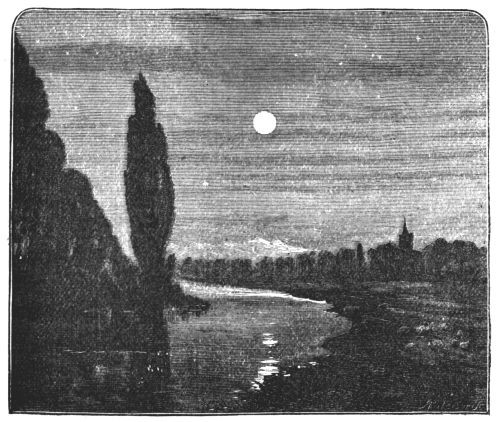
Fig. 4.
Ought not the imagination which, at the first glance, led us to believe the number of stars to be infinite,—ought it not to draw us nearer to the truth?
How should the imagination reveal to us, without difficulty, what the intellect, assisted by the senses, can only discover after ages of assiduous exertion?
These questions, it seems to us, are worthy of our studious consideration.
We subjoin a table of the constellations in both hemispheres, with the number of stars in each, for the convenience of our younger readers.
Northern Constellations.Ursa Minor, the Lesser Bear,
24
Ursa Major, the Great Bear,
87
Perseus, and Head of Medusa,
59
Auriga, the Charioteer,
66
Boötes, the Herdsman,
54
Draco, the Dragon,
80
Cepheus,
35
Canes Venatici, the Greyhounds Asteria and Chara,
28
Cor Caroli (Heart of Charles II.),
3
Triangulum, the Triangle,
16
Triangulum Minus, the Lesser Triangle,
10
Musca, the Fly,
6
Lynx,
44
Leo Minor, the Lesser Lion,
53
Coma Berenicis, Hair of Queen Berenice,
43
Cameleopardalis, the Giraffe,
58
Mons Menelaus, Mt. Menelaus,
4
Corona Borealis, the Northern Crown,
21
Serpens, the Serpent,
64
Scutum Sobieski, Sobieski's Shield,
8
Hercules, with the Dog Cerberus,
113
Serpentarius, or Ophiuchus, the Serpent-Bearer,
74
Taurus Poniatowski, Poniatowski's Bull,
7
Lyra, the Harp,
22
Vulpeculus et Anser, the Fox and Goose,
37
Sagitta, the Arrow,
18
Aquila, the Eagle, with Antinous,
71
Delphinus, the Dolphin,
18
Cygnus, the Swan,
81
Cassiopeia, the Lady in her Chair,
55
Equulus, the Horse's Head,
10
Lacerta, the Lizard,
16
Pegasus, the Flying Horse,
89
Andromeda,
11
Tarandus, the Rein-deer,
12
Southern Constellations.Phœnix,
13
Apparatus Sculptoris, the Sculptor's Tools,
12
Eridanus Fluvius, the River Po,
84
Hydrus, the Water-Snake,
10
Cetus, the Whale,
97
Fornax Chemica, the Chemical Furnace,
19
Horologium, the Clock,
12
Rheticulus Rhomboidialus,
10
Xiphias Dorado, the Sword-Fish,
7
Celapraxitellis, the Engraver's Tools,
16
Lepus, the Hare,
19
Columba Noachi, Noah's Dove,
10
Orion,
78
Argo Navis, the Ship Argo,
64
Canis Major, the Great Dog,
31
Equulus Pictoris,
8
Monoceros, the Unicorn,
31
Canis Minor, the Lesser Dog,
14
Chameleon,
10
Pyxis Nautica, the Mariner's Compass,
4
Piscis Volans, the Flying-Fish,
8
Hydra, the Serpent,
60
Sextans, the Sextant,
41
Robur Carolinum (Charles II.'s Oak),
12
Antlia Pneumatica, the Air-Pump,
3
Crater, the Cup,
31
Corvus, the Crow,
9
Crux, the Cross,
6
Apis Musca, the Bee or Fly,
4
Avis Indica, the Bird of Paradise,
11
Circinus, the Mariner's Compass,
4
Centaurus, the Centaur,
35
Lupus, the Wolf,
24
Norma, or Euclid's Square,
12
Triangulum Australe, the Southern Triangle,
5
Ara, the Altar,
9
Telescopium, the Telescope,
9
Corona Australis, the Southern Crown,
12
Pavo, the Peacock,
14
Indus, the Indian,
12
Microscopium, the Microscope,
10
Octans Hadliensis, Hadley's Octant,
43
Grus, the Crane,
14
Toucan, the American Goose,
9
Piscis Australis, the Southern Fish,
24
Mons Mensa, the Table Mountain,
30
Zodiacal Constellations.Aries, the Ram,
66
Taurus, the Bull,
141
Gemini, the Twins,
85
Cancer, the Crab,
83
Leo, the Lion,
95
Virgo, the Virgin,
110
Libra, the Balance,
51
Scorpio, the Scorpion,
44
Sagittarius, the Archer,
69
Capricornus, the Goat,
51
Aquarius, the Water-Bearer,
108
Pisces, the Fishes,
113
CHAPTER II.
WHAT MAY BE SEEN UPON THE EARTH.
Ah, bitter chill it was!
The owl, for all his feathers, was a-cold;
The hare limped trembling through the frozen grass,
And silent was the flock in woolly fold.
—Keats.
What are we to think of the supposed influence of the moon upon the weather?
This question, so constantly revived, is here not out of place. The exceptionally prolonged cold, during which the thermometer remained for three weeks below zero, the barometer oscillating between 76° and 76°·5, commenced on the 22d of December, three days before the new moon; now, it is on Christmas-day, at 48 min. past 11 p.m., that the moon is found in conjunction,—that is to say, has become completely invisible to us by passing between the earth and the sun. And the thaw, which terminated this period of frost, commenced on the 12th of the following January, just three days after the full moon; the exact moment of its opposition, when the moon reflected upon us the whole hemisphere of its borrowed lustre, took place on the 9th, at 2 min. past 11 in the evening. It is then in the neighbourhood of the syzygies (conjunction and opposition) of the moon that we must place the commencement and termination of the cold period to which we have been alluding.
We should not have thought of recalling these coincidences, if it had not occurred to us that some meteorologists, in accordance with the popular belief, have attributed to the syzygies a marked influence on the changes of the weather. Toaldo has deduced from half-a-century's observations, taken at Padua, this general fact, that the maximum of influence manifests itself at the syzygies, and somewhat more at the new than at the full moon; that the minimum coincides with the first and second quarter; that the action of the perigee (minima distance of the moon from the earth) is equal to that of the full moon; and that the action of the apogee (maxima distance of the moon from the earth) is double that of the quarters. Observe that the Italian meteorologist extended this influence to three days before and three days after a phase, for the moon's passage through the syzygies; while he restricted it to a day before and a day after, for the quadratures.
The work which Toaldo did for the climate of Padua, Pilgram had already executed for that of Vienna. But the result at which he arrived, after five-and-twenty years of observation (from 1763 to 1788), was the contrary to that of Toaldo: namely, that the new moon is the least active of all the phases in reference to changes of weather. What, then, are we to conclude? That the problem is one of extreme difficulty, and that there are probably several elements necessary to its solution, which at present escape us. Then, too, we ought to have a clear understanding of what is meant by "changes of weather;" we must eliminate all vagueness from the word, and not allow it to be governed by any preconceived theory.
The Snow.
Thick clouds ascend, in whose capacious womb
A vapoury deluge lies, to snow congealed.
Heavy they roll their fleecy world along,
And the sky saddens with the gathered storm.
Through the hushed air the whitening shower descends;
At first thin wavering; till at last the flakes
Fall broad, and wide, and fast, dimming the day
With a continual flow.
—Thomson, The Seasons.
The earth is covered with snow; it is enveloped, as the poets say, in a shroud of white. But this phrase, poetical as it may appear, is, in reality, inadmissible. A shroud is used to wrap round a dead body, a corpse, whose elements, since they are no longer maintained united by the undefinable principle of life, go to form other compounds,—more permanent and lasting,—which will mingle with the earth, the water, and the air. But the earth which the snow covers preserves, on the contrary, the germ of life in the seeds and roots of plants; it rests itself, only for the purpose of communicating, at the return of spring, a new impulse to the sap, whose circulation sleeps during winter.
The moment is propitious for studying the snow: come, then, let us examine it.
And, first, what is snow? Put a little into the hollow of your hand, and see what transpires.
It melts, and leaves nothing but water as a residuum.
Snow, then, is frozen water,—water which existed in the atmosphere in the state of vapour, and which, to speak the language of physicists, has passed from the gaseous state into the liquid, and thence into the solid. If you doubt its identity with water, let a chemist analyse a portion of it for you: he will tell you that it is composed, like distilled water, of hydrogen and oxygen, in the proportion of two parts of the former to one part of the latter. The reader will, of course, understand that we abstract all foreign substances which may accidentally have got mixed up with it.
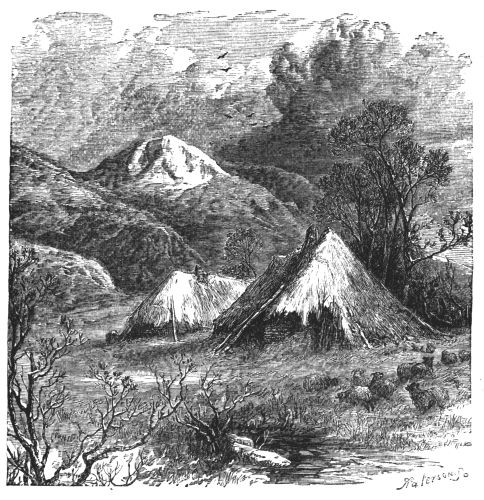
Fig. 5.—A Snowy Landscape.
It was once a wide-spread opinion that snow is favourable to vegetation, on account of the salts which it contains. Analysis, however, gave a negative result; it demonstrated the absence of these salts. Recourse was then had to another hypothesis: it was supposed that the air contained in snow is richer in oxygen than the free air, and that to the action of this gas must be attributed its fertilising property. Another error! The truth really is, that snow maintains the soil which it covers at a perceptibly constant temperature, and that, when thawing, it mellows it by its aqueous infiltrations; so that if, before a fall of snow, the earth has experienced the action of a strong frost capable of killing injurious insects, all the chances will be in favour of a fertile year.
Snow forms crystals. To observe them clearly, you must examine the snow which falls in very cold and dry weather. It then appears to be a dust composed of little thin plates. Look at the small flake which has fallen on your coat-sleeve; it is isolated; hasten to examine it before it melts, or before other flakes become amalgamated with it. What a graceful star! (Fig. 6, a). It is formed of six regular rays. There are others which have only three, four, or five rays. But on inspecting these more closely, you see that many of these rays are broken or abortive, and that, when finally analysed, each star possesses the same number of rays.
Why are there continually six rays? Why are there never more nor fewer than this number? One might suspect in nature a peculiar affection for the number six; as, for example, in the cells of the bees and the wasps, which form a regular hexagon (Fig. 6, b). Why, in the infinity of polygons, has the instinct of these insects only chosen one hexagon? What is the reason for this preference?
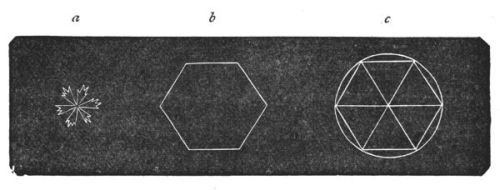
Fig. 6.
If you interrogate geometry, it will reply to you that, of all the polygons inscribed in a circle (Fig. 6, c), there is but one whose sides are equal to the radius of that circle; and this polygon is exactly that of the bee and wasp's cell. Here, then, is a very singular coincidence. If you afterwards examine very minutely the work of the bee, you will find in each cell of the honeycomb a pyramidal base, composed of three equal rhombs, whose angles solve a grand geometrical problem, that of giving the maximum of space with the minimum of matter. The papier-maché combs of the wasp are formed of a single row of cells, each of which has a nearly level bottom. This is all that is required; for these cells are destined, not for the reception of honey, but only of the larvæ, the offspring of their architects.
Do not think that you have but to pick up a thumbful of snow to procure your crystals! These change their form very quickly, and it is almost impossible to detect it in snow which has remained for any length of time upon the ground. The great flakes which fall in relatively mild weather, when the temperature borders upon freezing-point, are often nothing better than masses of small amorphous atoms of ice; to get at the crystals, you must remove the kind of icy varnish which encases them.
For the accurate observation of the crystallisation of water which precipitates itself in the air, we have at our disposal a means as simple as convenient—a pane of glass. All we have to do is to arrange everything in such a manner that the congelation shall be both slow and certain; on this condition alone can we obtain well-defined crystals. A cold room is best adapted for this kind of experimentation; and thus you will frequently see deposited upon the window-glass, in an uninhabited chamber, some exceedingly graceful designs, as follow.
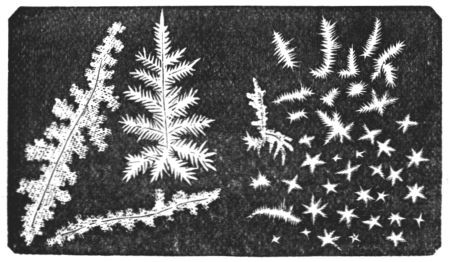
Fig. 7.
These are asteriæ,—arborescent, and leaf-like crystals,—imitating the beautiful foliage of ferns and mosses. The severer the cold, the more regular, be it understood, is the formation of these crystals.
Owing to its dazzling whiteness, snow is a great reflector of light, and singularly illuminates the darkness of the winter nights. The long dreary nights of the polar world are lit up by the glories of the magnetic auroras, joined to the radiancy of the snow. This induces us to repeat a question which we have often addressed to ourselves, namely,—under what aspect must the very varied changes which the solar light experiences on the surface of our planet be presented to the inhabitants of Mars and Venus? A more attentive observation of the ashen-gray light of the moon, which appears to be principally produced by the reflection of the more or less luminous face of the earth, may perhaps one day provide us with an answer to our question.
Before quitting this subject, let us remember that both snow and frost are of great utility to the husbandman. The latter, by expanding the humidity with which the hard clods are penetrated, crumbles them into powder, and renders stiff land porous, friable, and mellow. It also clears the soil from the plague of insect life, which, if it increased without so powerful a check, would probably prove a terrible injury to the crops. Moreover, it so hardens in winter the moist soft ground as to permit of the necessary field operations being carried on. Snow, as Dr Child remarks,[12] is even more useful. It covers up the tender plants with a thick mantle, which defends them against the attacks of excessive cold. "God giveth snow like wool," and for somewhat the same purposes as wool. The mantle which so closely wraps about the gaunt limbs of the winter-stricken earth neither allows the internal heat to escape nor the external cold to enter in. It has been found that the inner surface of the snow seldom falls much below 32° F., although the temperature of the external air may be many degrees under the freezing-point; and it is known that this amount of cold can be endured by the crops without injury, so long as their covering protects them from the raking influence of the wind. In climates where the winter's cold is longer and more intense than in England, the protective influence of snow is much more plainly shown. Where it lies long and deep, it opens out routes that were impracticable in summer on account of their ruggedness, and prepares a smooth path for the sledge, or for the "lumberer," over which the largest trunks of the forest may be carried with ease to the river or canal.
In the polar regions (we quote from Dr Child) snow supplies the ever-ready material out of which the Esquimaux construct their houses, and hardy explorers extemporise the huts in which they find shelter when absent from their ships on distant expeditions. Nor are the ships themselves considered "snug winter quarters" until their sides have been banked up in walls of snow, and the roof raised over the deck has been thickly covered with it. Snow huts are warmer than might have been expected. If built upon ice over the sea, their temperature is sensibly influenced by the heat of the unfrozen water below, which is said seldom to fall much under 40° F. in any part of the ocean. Even where the external temperature has sunk to 20° or 30° below zero, sufficient warmth is produced in a snow hut by the huddling together of three or four persons within it. When Dr Elisha Kane, the American explorer, passed a cold arctic winter's night in a hut beyond Smith's Sound, the temperature produced by its complement of lodgers, and two or three oil lamps, reached 90° F.; so that he was compelled by the heat to follow the example of the rest of the party, and partially to divest himself of his clothing. Yet in lat. 79° N., Dr Kane marked a temperature of 75° below zero in the month of February. No fluid could resist it. Even chloric ether became solid, and the air was pungent and acrid in respiration.
Red Snow.
As if it had been ordained that there should be nothing absolute in nature, snow itself, the very type of whiteness, sometimes exhibits the most curious colouring. Who, for instance, has not heard tell of red snow? Its existence was even known to Pliny, the great Roman naturalist, and he attributed it to a dust with which the snow became covered after it had lain several days on the ground. "Snow itself," he says[13] "reddens with old age" (Ipsa nix vetustate rubescit).
Benedict de Saussure was the first who described red snow like a naturalist.[14] He observed it on the occasion of his ascent of Mont Breven, near Chamounix, in 1760; and was greatly astonished at seeing the snow tinted in various places of an extremely vivid red. "In the middle of each patch," he says, "was the greatest intensity of colour, and the middle, moreover, was of a lower level than the edges. On examining this red snow closely, I saw that its colour depended upon a fine powder which mingled with it, and which penetrated to a depth of two or three inches. This powder could not have descended from the summit of the mountain, since it was found in localities isolated and even remote from the rocks; nor did it seem to have been deposited by the winds, since it did not lie in drifts. One would have said that it was a production of the snow itself, a residuum of its thaw.... What at first suggested this opinion was the fact that the colour, extremely weak on the edges of each concave patch, gradually grew deeper as it approached the bottom, where the trickling water had carried down a greater quantity of residuum."
The learned Swiss naturalist found this red snow on many other mountains, and during a certain period of thaw, subjected it to various experiments, which led him to the conclusion that it was a vegetable matter, "a dust, or pollen, of the stamens of plants." Slightly odorous, it exhaled, during combustion, a scent not unlike that of sealing-wax.
Ramond met with red snow in the Pyrenees, at an elevation of 7800 feet. He discovered in it, when burnt on incandescent coals, the odour of opium or of chicory. He supposed that the little deep red lamellæ which coloured the snow were mica, and looked upon the mica as a product of the decomposition of the rocks by the action of the sun and breezes of spring. But this opinion was overthrown by Captain Ross, who, in 1819, found red snow in Baffin's Bay (lat. 85° 54' N.), to a depth of thirteen feet, over a soil perfectly free from mica. Other explorers affirm that in those regions they have never met with the red snow more than three to four inches deep. Captain Parry, in his Polar voyage, found this coloured snow principally in the track of his sledges; and, agreeing with Sir John Ross, he supposed it to derive its redness from the presence of a kind of mushroom, of the genus Uredo, to which Bauer has given the name of Uredo nivalis.[15] According to experiments made by Bauer on specimens brought from the Polar regions, these tiny mushrooms are, on the average, a fiftieth of a millimètre in diameter; they develop themselves like vegetables; the youngest are sometimes colourless; when entirely freed from snow, they grow black under the influence of an intense cold, without losing their germinative faculty, and give birth, under the influence of a higher temperature, to a green matter.
Let us continue to examine the difference of opinion between naturalists.
De Candolle declared the red snow of the polar regions to be identical with that of the Alps, after having carefully compared the two. But he saw in it a genus of cryptogams, differing from the genus Uredo.[16] Robert Brown asserted that it was a kind of alga, allied to the Tremella cruenta. Azara was of this same opinion, except that, instead of a tremella, he recognised in it an alga of the genus Protococcus, which he called Protococcus kermesinus, because its colour resembled that of the kermes, or cochineal.
In the opinion of the observers whom we have cited, the colouring corpuscles of the snow belong to the vegetable kingdom. This opinion was supported by numerous adherents, and soon acquired so great an authority, that, in an assembly of naturalists at Lausanne, De Candolle overwhelmed with sarcasm a communication from Lamont, Prior of the Hospice of St Bernard, on the "animality of red snow." And yet this last hypothesis was not so rash as might have been supposed; for Dr Scoresby, to whom we owe a profound study on the crystalline forms of snow, had already attributed to an animal matter the colouring of the snow and polar ice.
Now-a-days, however, it may be regarded as finally settled that this phenomenon is due to the immense aggregation of minute plants belonging to the species called Protococcus nivalis;[17] so called in allusion to the extreme simplicity of its organisation, and the peculiar nature of its habitat. If we place a portion of the snow coloured with this plant upon a piece of white paper, says Mr Macmillan,[18] and allow it to melt and evaporate, we find a residuum of granules just sufficient to give a faint crimson tinge to the paper. Placed under the microscope, these granules resolve themselves into spherical purple cells, from the 1/1000th to the 1/3000th part of an inch in diameter. Each of these cells has an opening, surrounded by serrated or indented lines, whose smallest diameter does not exceed the 1/5000th part of an inch! When perfect, the plant is not unlike a red-currant berry; as it decays, the red colouring matter fades into a deep orange, and the deep orange changes into a dull brown. The thickness of the wall of the cell does not exceed the 1/20000th part of an inch! Each cell may be considered a distinct individual plant, since it is perfectly independent of others with which it may be aggregated, and performs for and by itself all the functions of growth and reproduction, having a containing membrane which absorbs liquids and gases from the surrounding matrix or elements, a contained fluid of peculiar character, formed out of these materials, and a number of excessively minute granules, equivalent to spores, or, as some would say, to cellular buds, which are to become the genus of new plants. There is something, adds Mr Macmillan, extremely mysterious in the performance of these widely different functions, by an organism which appears so excessively simple. That one and the same primitive cell should thus minister equally to absorption, nutrition, and reproduction, is an extraordinary illustration of the fact, that the smallest and simplest organised object is, in itself, and for the part it was created to perform in the operations of nature, as admirably adapted as the largest and most complicated.
[3] Homer, "Odyssey," Book v., 121-124.
[4] Ibid., Book xi., 571-574.
[5] The pole-star, however, is not the true polar point, but distant from it about 1° 32', which, in A.D. 2100, will be decreased to 26' 30".
[6] Homer, "Odyssey," Book v., 275.
[7] Manilius, "Astronomicon," Book i., 291-300.
[8] Manilius, "Astronomicon," i., 308, 309.
[9] This displacement amounts to about fifty seconds annually, or, more accurately, to 50".3. It is easy, therefore, to calculate that the complete rotation of the terrestrial axis around the poles of the ecliptic will occupy 25,765 years.
[10] These are also called the Pointers, because an imaginary line from the lower to the upper, prolonged in the same direction, passes nearly over the Polar Star.
[11] Pliny, "Historia Naturalis," Book ii., 24.
[12] Chaplin Child, "Beredici," p. 171.
[13] Pliny, "Historia Naturalis," Book xi.
[14] De Saussure, "Voyage dans les Alpes," Book iii., p. 45 (ed. 1803, Neufchâtel).
[15] Annales de Chimie et de Physique, vol. xxvii., p. 134.
[16] Philosophical Transactions, 1820, vol. ii., p. 165.
[17] It is but fair to add, however, that Vogt and others contend for the animal origin of this substance, and regard the Protococcus nivalis as simply a development of the infusoria, Disceræa nivalis.
[18] Macmillan, "Footnotes from the Page of Nature," pp. 141-143.

Fig. 8.—Protococcus nivalis.
The Eternal Snows.
The epithet "eternal" or "perpetual," applied to snow, would appear to savour of the ambitious, if not of the profane. Can we say of anything which belongs to earth that it is "eternal?" Assuredly not. The earth has not always worn the aspect which it now wears, and, at a period not far distant from its origin, could not in any region have been covered with snow. Now, whatever has had a beginning cannot be eternal. Many authors have, for this reason, substituted for the word eternal the word perpetual. But the latter is equally inapplicable. Who will venture to affirm that our globe or its system will endure perpetually?
This difficulty, however, is one which need not particularly embarrass us. We have been long accustomed to look upon language as a simple mask, or, at least, as a very dubious interpreter of thought. And we shall, therefore, continue to use indifferently the words "eternal" and "perpetual."
Let us suppose that two travellers set out from the equator, that plane of separation between the northern and the southern hemispheres. Let us also suppose that each proceeds in a diametrically opposite direction to the other, pursuing his route along one of those meridian lines which divide the earth into longitudinal portions, like the slices of a melon (to compare great things with small). The following will be their climatic stages:—
At first the two travellers will each traverse a moiety of the torrid zone, limited below and above the Equator by two parallel circles,—in the northern hemisphere by the Tropic of Cancer, and in the southern by the Tropic of Capricorn. Do not let these appellations alarm you: they show, once more, the narrow connexity of the heaven with the earth; tropic, coming from the Greek τροπή signifies a return—the sun returns from his apparent excursions, after having passed from the tropics to the zenith. For these circles form the extreme limits of the sun's march towards the north and towards the south: they are the two solstices—the summer solstice, when the sun enters the zodiacal sign of Cancer, and the winter solstice, when it enters the sign of Capricorn. The torrid zone is the only one which is thus divided into two portions by the Equinoctial, and which the sun passes twice a year to the zenith, that is, to the point directly above the heads of the inhabitants.
After having crossed the tropics, one of our two travellers will enter the North Temperate Zone, bounded by the Arctic Polar Circle—the other, the South Temperate Zone, bounded by the Antarctic Polar Circle. Having passed the polar circles, they will find themselves speedily arrested by ice and snow which never melt—by eternal ice and snow. These inhospitable regions compose the two frigid zones, which cover, like two immense hoods (forming the 0·82 parts of the terrestrial surface), the one, the northern hemisphere, the other, the southern.[19]
In their progress through these various climates, our two travellers will arrive at a very curious comparative result,—that the southern hemisphere is colder than the northern. This difference becomes especially recognisable below the 50th degree of south latitude; so that, after passing the Antarctic Circle, the ice opposes the voyager's course with nearly insurmountable obstacles; while, in the northern hemisphere, the whaler frequently penetrates to Spitzbergen, situated much nearer to the Pole than to the Polar Circle. This is a general fact; we confine ourselves to putting it forward.
Let us now suppose that our two travellers, always ready to compare the results of their inquiries, accomplish the ascent of a very lofty mountain situated under the Equator, such as Chimborazo. In the course of their ascent, they will traverse the same climates and the same zones which had marked the stages of their journey from the Equator to the Poles: at their starting-point they will find themselves in the Torrid zone, then will come the Temperate and the Frigid zones, the latter rendered inaccessible by glaciers and eternal snows. These vertical zones of the mountain are characterised by vegetables and animals whose types are found in the corresponding horizontal zones of the terrestrial surface. But what is most remarkable is, that there exists between the northern and the southern slopes of the mountain the same difference as between the southern and northern hemispheres: the line of the eternal snows descends much lower on the northern than on the southern slope, in the same manner as, in the southern hemisphere, the polar ice advances much nearer the Equator than in the northern.
Such is the general view-point which we must adopt for the clearer comprehension of the details of observation. Of course, when speaking of the limit of the eternal snows, we refer only to the lower limit, that is to say, to the greatest elevation attained by the snow-line in the course of a single year. As for the upper limit, it entirely escapes us; for the summits of the loftiest mountains do not reach the atmospheric strata which, by virtue of their refraction, cannot contain any vesicular, aqueous, or condensable vapour.
The line of eternal snow which, at the poles, is found on the level of the ground, gradually rises as we approach the torrid zone, where it attains its maximum of elevation, from 13,000 to 17,000 feet. This phenomenon does not exclusively depend upon the geographical latitude, nor on the mean annual temperature of the locality: it is the result of an aggregate of diverse circumstances which we have not the space here to enumerate and discuss. We shall content ourselves with placing before the reader a table which will show the remarkable differences existing in the height of the perpetual snow-line in various places.
The Line of Perpetual Snow.
Latitude.
Place.
Height of Snow-Line.
(Degs.)79 N.
Spitzbergen
0
71
Mageroe (Norway)
2,350
70 to 60
Norway (Interior of)
3,500 to 5,100
65
Iceland
3,050
54
Oonalashka (W. America)
3,510
50
Altai Mountains
7,034
45
Alps, The, N. declivity
8,885
45
Do., S. declivity
9,150
43
The Caucasus
11,863
43
The Pyrenees
9,000
40
Mount Ararat
14,150
36
Karakorum, N. side
17,500
36
Do., S. side
19,300
36
Kuen-luen, N. side
15,000
35
Do., S. side
15,680
29
Himalaya, N. side
19,560
28
Do., N. side
15,500
17
Cordilleras of Mexico
14,650
13
Ethiopian Mountains
14,075
1 S.
Andes, in Quito
15,680
16
Do., in Bolivia, E.
15,800
18
Do., in Bolivia, W.
18,400
33
Do., in Chili
14,600
43
Do., in Patagonia
6,300
54
Strait of Magelhaens
3,700
The Inhabitants of the Eternal Snows.
If men have the faculty of living under all climates, they make use of that faculty, as we know, with extreme reserve. They have never permanently inhabited the polar regions and the perpetually snowy summits of the mountains: it is only at intervals that a few pioneers have temporarily ventured thither. Starting from this fact, it was long believed that the zone of eternal snows was not inhabited by any living being. Even men of science admitted, as an article of faith, that where man could not fix his residence no animal could live. They made, however, a concession with respect to vegetables, and particularly as regarded the lichens and the mosses.
Well, observation and research conjointly, have erased this article of faith from the scientific code. It has been demonstrated that the icy regions, which man visits only at rare intervals, and where he sojourns but for a time, are the home of a certain number of animal species, more or less allied to the human species. The scientific exploration of these regions dates only from our own time. Spitzbergen, and the summit of the Alps,—such are our points of comparison.
It is difficult to conceive of anything more interesting than the historical exposition of the limited Fauna glacialis. First, let us take the discovery, comparatively recent, of a small rodent of the mouse order.
The Arvicola Leucurus, or Arctic Vole.
On the 8th of January 1832, a Swiss naturalist, M. Hugi, started from Soleure to study the winter condition of the classic glacier of Grindelwald. The undertaking was in many respects a difficult one; the sides of the Mettenberg, bordering on this glacier, were covered with an uniform stratum of hardened snow; a pathway had to be cut out with the pickaxe. M. Hugi and his companions did not arrive at the Stierreg until towards evening.
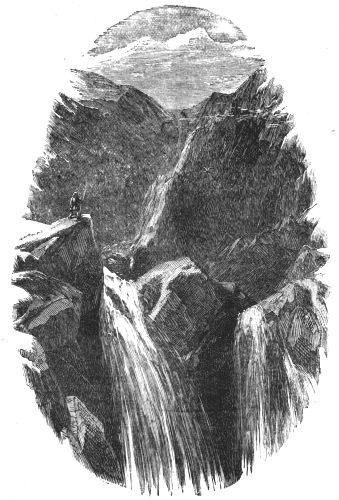
Fig. 9.—Among the Alps.
A goatherd lives there during the summer. They sought around and about for his little cabin, but, on the uniform white carpet of snow which covered everything, no sign of it could be detected. At length they came upon a little mound, which they immediately proceeded to excavate; and late in the night they discovered the roof of the hut. They then redoubled their efforts to sweep away the snow obstructing the door. On opening it a score of mice emerged from the cabin, some of which they killed.
For a picture of the poor victims we are indebted to M. Hugi. "These little rodents are of a yellowish gray, and very slender; from the head to the tip of the tail they measure about nine inches. The hind paws are of a length wholly disproportionate to the fore paws. The tail and ears are naked; their transparency is remarkable.... This animal," adds M. Hugi, "appeared to me completely unknown, and I do not remember to have seen it in any zoological collection."
After determining its genus and species, the intrepid explorer of the Alps was entitled to have given it a name; but this honour escaped him.
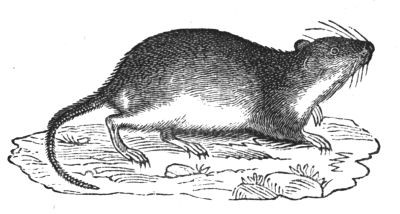
Fig. 10.—The Arctic Vole.
The same little rodent has since been found in many other parts of the Alps; notably among the rocks of the Grands-Mulets, some 12,500 feet above the sea-level.
Desirous of comparing the climate of Spitzbergen with that of the summit of the Alps, M. Martins established himself, in 1841, with his friend, A. Bravais, on the Faulhorn. "While," he says, "we were engaged in our experiments, we often perceived a little animal passing swiftly by us, and stealthily gliding into its burrow. We remarked that it was also found in the auberge, or inn, and that it fed upon Alpine plants. At the first glance, its resemblance to the common mouse led us to think that this inconvenient guest had followed man into his abode on the Faulhorn, as it had formerly crossed the seas on board ship. But a more attentive examination showed me that, far from being a mouse, it was a species of vole, which had hitherto escaped the researches of naturalists. I designated it by the name of the snow-vole, Arvicola nivalis."
It was the same animal which M. Hugi had discovered nine years before. The ice was broken, and names, both generic and specific, afterwards fell like hail on the body of our poor little rodent. Some would have had it called—
Hypudæus alpinus.
Hypudæus petrophilus.
Hypudæus nivicola.
Hypudæus Hugei.
Others, and fewer in number, preferred the designation of "White-tailed Vole,"—
Arvicola leucurus.
Others again, "the Lebrun vole,"—
Arvicola Lebrunii.
Which of all these names shall prevail? We cannot say, and it matters very little to us. Perhaps the nomenclators may in time agree among themselves upon the appellation of the genus. However this may be, we know—and it is an important fact—that a mammal exists at altitudes where men could not live, and that he is found in the Alps, above even the lower limit of the perpetual snows. Is it the only mammal which can live at such a height?
The Marmot.
Who, in the wide world of London, where so many waifs and strays are drifting with the great current of human life, has not observed the Savoyard wanderer with his dancing marmot? If the man did not attract our notice, his curious companion would. In form he belongs partly to the bear, and partly to the rat. Naturalists have, therefore, expressly created for him the genus Arctomys,—a Latinised Greek name, signifying "The Bear-Rat."
In fact, the marmot resembles Harlequin's cloak, or rather, if it be permissible to compare little things with great, the Austrian Empire,—a composite of territories and races; and Buffon has described him very aptly. He has, he says, the nose, the lips, and the shape of the head of the hare; the hair and nails of the badger; the teeth of the beaver; the cat's whiskers; the eyes of the dormouse; the feet of the bear, with a short tail and truncated ears.
Add to this that the marmot—he is a little larger than a rabbit—is omnivorous like man and the bear, with whom he shares his aptitude for dance and sport. While he eats any and everything, he nevertheless prefers vegetable food to all other kinds; and with his orange-coloured incisors gnaws the bark of shrubs. He rarely drinks, but when he does drink takes a hearty draught; is particularly fond of milk; drinks it by raising his head at each mouthful, like a hen, and giving utterance to an audible murmur of contentment, just as if he were reciting his Benedicite. Will it be in allusion to this characteristic that the common French phrase has originated, Marmotter des prières?[20]
During the summer the marmots inhabit the snowy summits of the Alps. At the beginning of autumn they descend to a lower level, for the purpose of excavating the burrows in which they pass the winter, completely benumbed by the frost. This is the time when the hunters easily capture them; they have nothing to do but to dig (creuser is the technical word); and frequently they are found as many as ten or twelve in the same burrow, rolled up like balls, and buried in a litter of hay. Their sleep, says De Saussure, is so profound, that the hunter deposits them in his sack and carries them away without awakening them. The Chamounix hunters, he adds, have already entirely expelled or destroyed the goats formerly so abundant on their mountains; and it is probable that, in less than a century, we shall see neither chamois nor marmots.
This prophecy of De Saussure's is on the point of being realised. Still, even at the present day, marmots are not very rare in the Valais and the canton of Ticino (du Tissin), where they are called Mure montane (mountain rats); a phrase from which is derived, without doubt, the appellation marmot. They prefer as their abode the stony islets which rise here and there in the midst of the rocks. The ears of travellers who venture into the barrenest recesses of the Alps of the Bernese Oberland are sometimes struck by a very sharp whistling, for which, at first, they find it difficult to account. It is the young marmot's cry of alarm; for the old appear to be deprived of this strident faculty.
For a considerable period only a single species was known—the marmot properly so called (Arctomys marmotta, Gmelin); but four others must now be added:—1st, The marmot of the Caucasus (Arctomys musicus), still imperfectly known; 2d, The marmot of Canada (Arctomys empetra), who clambers up the trees like a cat, and is distributed throughout all North America, particularly in Hudson's Bay, and Alaska, on the north-west coast; 3d, The Arctomys monax, who appears to be peculiar to Maryland; 4th, The Russian marmot (Arctomys citillus), of the size of a field-mouse, and of a brown colour, spotted with white; 5th, The marmot of Siberia (Arctomys bobac), smaller than the common species, of a yellow gray, and building vast burrows shaped like a funnel.
Will the reader permit us an allusion, in passing, to a question which we do not see discussed in books of natural history? Formerly among the treasures of ancient druggists figured a kind of panacea, called "Graetz's balls." What were these "Graetz's balls," at one time esteemed as a universal medicine, but no longer included in our pharmacopeia?
This was their origin:—The subterranean dwellings which certain species of marmots construct with so much skill, are each composed of two galleries, which unite together like the arms of a Y, and terminate in a cul-de-sac. There are found the globules of clay known as "Graetz's balls." They are an industrial product of our rodents, as M. Oscar Schmidt established in 1866, by close observation of the Arctomys bobac of the Zoological Garden of Vienna. The marmot creates these balls by scratching up the earth, and appears to amuse himself—a child's amusement!—by rolling them to and fro in his galleries.
The Chamois.
"Even so
This way the chamois leapt."[21]
Must we omit this graceful ruminant from the number of mammals inhabiting the eternal snows? No; for it is not of his own will that the chamois has taken refuge upon the snowy peaks of the Alps. If we meet with him there, it is because he seeks to shelter himself from the destructive instincts of man.
The chamois is one of those animal species which, before a century, perhaps, will have disappeared; his bones will then figure in the palæontological museums by the side of the skeletons of extinct species. There, too, will be displayed the famous chamois balls, each of the size of a nut, covered with a shining substance resembling leather, of an agreeable odour, and seeming to be a morbid dejection, composed of roots and other undigested matter. These balls, the bezoars of the old physicians, were regarded as a remedy against every ill the human flesh is heir to; it was even professed that they rendered soldiers invulnerable, and were a better defence against bullets than the finest armour ever wrought by the smiths of Milan. How precious a remedy for this epoch of civilisation, when man—is he much wiser than his supposed progenitor, the ape?—seeks to replace the cholera and the pestilence by the most terrific engines of destruction!
The birds inhabiting the inhospitable region of the snows are more numerous than the mammals. Let us briefly refer to a few of the more important.
The Eagle and the Wren.
In speaking of the eagle, Tennyson's noble lines to that "imperial bird" will occur to every reader, from the force and clearness of the picture which they present:—
"He clasps the crag with hookèd hands;
Close to the sun in lonely lands,
Ringed with the azure world, he stands.
"The wrinkled sea beneath him crawls;
He watches from his mountain walls,
And like a thunderbolt he falls."
The affection of the eagle for his "mountain walls" may be easily understood. This giant bird, with his carnivorous instincts, is endowed with a remarkable tenacity of life, and can exist in habitats wholly inaccessible to man. But it is strange that a bird, which is as common a type of humility as the eagle is of ambition, and which we almost always cite as a contrast to the eagle—we mean, the delicate little wren—should also be found among the snow and ice, the silence and solitude, of the loftiest mountain regions.
To study the flight of the eagle, we should repair to Alpine highlands. When he has reached a certain altitude of the atmosphere, the royal bird descends obliquely, as upon an inclined plane, with a rush and a din of wings, and at a speed of upwards of thirty-six yards per second. We assured ourselves of the accuracy of this fact during an ascent of Mount Hochkœrpf, in the canton of Glaris. The bird traversed in six minutes a space of 40,000 Swiss feet, which is equal to about forty yards per second. This result agrees, on the whole, with the observations of a traveller, who wrote in the Nouvelle Gazette de Zurich, on the 26th of August 1863:—
"A society of tourists set out from Corri to climb the Stützerhorn, which is 8400 feet in height. From the summit they perceived an enormous eagle, which, having taken his flight from Calanda, beyond the Rhine, directed his course towards the Stützerhorn, for the purpose of halting, after a certain inflection, on the side of the Rothhorn."
The duration of the flight was five minutes; the interval between the starting-point and the point of arrival, two French leagues and a half. In three hundred seconds, therefore, the eagle must have traversed a space of 3000 Swiss feet, which is equal to a speed of forty-five yards per second. Hence, the swiftness of the eagle's flight is nearly equal to the velocity of sound.
One of the most admirable descriptions of the habits of this bird with which we are acquainted, is furnished by the well-known naturalist Macgillivray:—
"There he stands"—on his lonely crag—"nearly erect, with his tail depressed, his large wings half raised by his side, his neck stretched out, and his eye glistening as he glances around. Like other robbers of the desert, he has a noble aspect, an imperative mien, a look of proud defiance; but his nobility has a cast of clownishness, and his falconship a vulturine tinge. Still he is a noble bird, powerful, independent, proud, and ferocious, regardless of the weal or woe of others, and intent only on the gratification of his own appetite; without generosity, without honour; bold against the defenceless, but ever ready to sneak from danger. Such is his nobility, about which men have so raved.
"Suddenly he raises his wings, for he has heard the whistle of the shepherd on the crag, and bounding forward, he springs into the air. Hardly do those vigorous flaps serve at first to prevent his descent, but now curving upwards, he glides majestically along. As he passes the corner of that buttressed and battlemented crag, forth rush two ravens from their nest, croaking fiercely. While one flies above him, the other steals beneath, and they essay to strike him, but dare not, for they have an instinctive knowledge of the power of his grasp; and, after following him a little way, they return to their home, vainly exulting in the thought of having driven him from their neighbourhood.
"But on a far journey, he advances in a direct line, flapping his great wings at regular intervals, then shooting along without seeming to move them. In ten minutes he has progressed three miles, although he is in no haste, and now disappears behind the shoulder of the hill. But we may follow him in imagination, for his habits being well known to us, we may be allowed the ornithological license of tracing them in continuance."
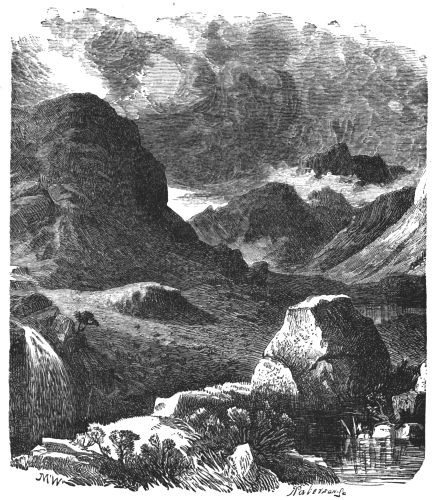
Fig. 11.—The Eagle's Habitat.
Homeward bound,—Mr Macgillivray continues,—after having supplied his own wants, he knows that his young must be provided with food. Therefore he sweeps across the moor, at a height of two or three hundred feet, bending his course to either side, his wings wide-spread, his neck and feet retracted, now beating the air, and again sailing smoothly along. Suddenly he halts, poises himself for a moment, stoops, but recovers himself without touching the ground. The object of his regards, a golden plover, which he spied on her nest, has contrived to elude him, and he does not care to pursue her. Now, then, he ascends a little, wheels in short abrupt curves, presently rushes down headlong, assumes the horizontal position when close to the ground, prevents himself from being dashed against it by expanding his wings and tail, thrusts forth his talons, and grasping a poor, terrified ptarmigan that sat cowering among the gray lichens, squeezes it to death, raises his head exultingly, utters a clear, shrill cry, and, rising from the ground, pursues his journey.
As he passes a tall cliff overhanging a silent lake, he is attacked by a fierce peregrine falcon, which darts and plunges at him, as if resolved to deprive him of his booty, or drive him headlong to the ground. A more formidable foe is this than the raven; and the eagle, with a scream and a yelp, throws himself into postures of defence, until, at length, the hawk, perceiving that the tyrant has no intention of plundering his nest, leaves him to pursue his course without further molestation. Over dense woods, and green fields, and scattered hamlets, the eagle speeds; and now he enters the long river-valley, near whose upper end, cradled in mist, rises the rock of his eyrie. About a mile from it he meets his mate, who has been abroad on a similar design, and is returning with a white hare as her spoil. With loud strident cries they congratulate each other, cries that alarm the drowsy shepherd on the green strath below, who, remembering the lambs carried off in spring-time, discharges at them a volley of maledictions.
Their nest is of considerable size, but rudely constructed; a pile of twigs and heather and dead sticks, somewhat hollow in the middle, where lies a thin deposit of wool and feathers. Here repose the eaglets, two in number, and clothed in soft white down.
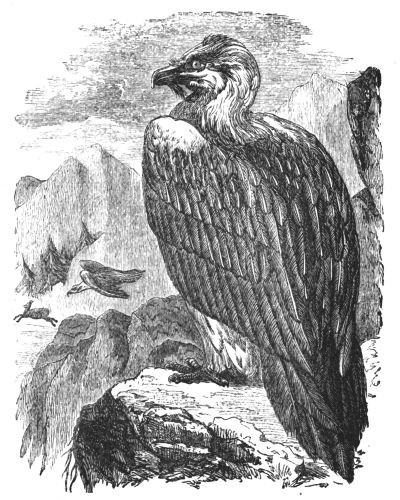
Fig. 12.—The Lammergeier.
Independently of the species which, like the Pandion haliætus, and the Aquila nævia, inhabit the lower regions, the eagles which visit the Alps are very remarkable. Thus, the species of Gypaëtos, which the inhabitants designate under the name of the Lammergeier, or "Lamb-slayer," is the European condor. The spread of his wings is about ten feet; he weighs from eighteen to twenty-four pounds, and can easily carry off in his talons kids, lambs, and even children.
The Steinadler, which, like the preceding, belongs to the inaccessible mountains of the cantons of Glaris, Schwyz, the Grisons, Appenzell, and Berne, would seem to be a variety or sub-species of the Aquila imperialis. The inhabitants of Eblingen, a village on the borders of the Lake of Brienz, hunt him vigorously. Finally, some eagles there are which only sojourn in the Alps temporarily; they appear to be astray; such are—
The Circæetus leucopsis, which has a particular affection for serpent-haunted districts;
The Haliætus leucocephala, with head and tail of a milky white, belonging to the north of Europe and America; and
The Neophron percnopterus, or Egyptian eagle, of carrion-like odour, which is sometimes met with in the neighbourhood of Geneva.
The tawny-headed vulture (Vultur fulvus), and the ashy vulture (Vultur cinereus), with gray-brown mouth, and a brownish collar round his bare neck, are extremely rare in Switzerland.
But we now take leave of the eagle, and turn our attention to the lowly wren, whose charming but simple music has been described in charming but simple verse by Bishop Mant:—
"The quick note of the russet wren,
Familiar to the haunts of men;
He quits in hollowed wall his bower,
And through the winter's gloomy hour
Sings cheerily; nor yet hath lost
His blitheness, chilled by pinching frost,
Nor yet is forced for warmth to cleave
To caverned nook or straw-built cave,—
Sing, gentle bird! sing on, designed
A lesson for our anxious kind,
That we, like thee, with hearts content"——
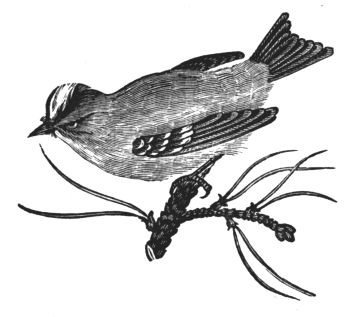
Fig. 13.—The Wren.
The wren here referred to is a British species, the common wren, or Troglodytes vulgaris, one of the smallest of our British songsters; a restless, lively bird, which twitters about the hedgerows in summer, and about the garden and shrubbery in winter, and chanting his mellow song even under the gloomy sky of December. Allied to this familiar bird is the Gold-crowned Knight,[22] or Sylvia regulus, which is found in the Alpine deserts at an elevation of 9000 to 10,000 feet. Like our own Jenny Wren, he has a very fine, slender bill, which denotes his insectivorous propensities. He is easily known by the little crest of silky feathers which he wears on his head, like a diadem, and also by his peculiar cry of souci-î-î-î.
Our crowned knight is very partial to the society of the tits, and, like them, he is easily caught with birdlime. He is so fond of the company of other birds, that, when he finds himself alone, he becomes disquieted; his prolonged tiny chirp grows plaintive; and he flies to and fro in quest of comrades. He may be regarded as a trustworthy barometer, for, prior to rainy weather, his song is very loud and incessant. Devoted to the pursuit of insects or their larvæ, he seems to pay no attention to the passer-by; he flutters vivaciously from branch to branch, and puts himself in all imaginable positions, sometimes with his head upwards, sometimes with his head downwards. We have often watched, with extreme gratification, the acrobatic tricks of our Lilliputian gymnast. Occasionally, before he perches, you will see him, in a frenzy of indecision, rapidly agitating his wings, and revolving them like a wheel. If you look at him, while thus engaged, against the light, you will think you see a tiny, ethereal, diaphanous spinning-top. After "assisting" at such a spectacle, which the first wood will furnish, you will not be indisposed to admit with us, that the bird designated by the Greeks τροχιλος, or "little wheel," and whose identity has so often been discussed, was, in reality, our golden-crested knight. Moreover, he is a true cosmopolite, in every acceptation of the word. Not only does he never quit us, not only does he remain faithful to us throughout the year, but we meet with him over all Europe. He is also found in Asia, and even, it is said, in America, from the West Indies to Canada. His flight being very short, it is supposed that he passed from one hemisphere to another by way of Behring's Strait. It is certain, at all events, that he discovered the New World before Christopher Columbus.
During the severe cold of the winter of 1867-8, we saw our knight—a very rare circumstance—haunt the vicinity of our houses, though he prefers the green shade of the forests, and especially of the forests of pine and fir. He who has seen him pecking at the bark and leaves of these trees, while the ground was covered with snow, and during a frost of 10° below zero (C.), will feel no astonishment at meeting him upon the snowy summits of the Alps.
Yet this pet bird of ours, this Lilliputian warbler, does not weigh more, with all his feathers, than a quarter of an ounce, or the two thousandth part of an eagle. Away with the hunter who would attempt such tiny game! A bird so small that he glides through the meshes of a net,—so delicate, that if you would not irreparably injure your "specimen," you must shoot him with a few grains of finest shot,—a bird of such frail appearance, withstanding all climates, and distributed over the entire surface of the globe,—here is a subject worthy the meditation of man, who pretends to be the "lord of creation!"
The Snow-Bunting—(Emberiza plectrophanes nivalis).
This is the snow-lark-bunting of Macgillivray, and a species of the genus Plectrophanes. In Scotland, he is frequently called the Snow-flake, and, in other parts of Great Britain, the Snow or Oat-fowl. His weight does not exceed an ounce and a half. His bill and legs are black; his forehead and crown white, with an admixture of black on the hind part of the head; black are the back and sides, but each wing is marked by a broad belt of white; the quill feathers are black, with white bases; the secondaries are white, with black spots on the interior webs.
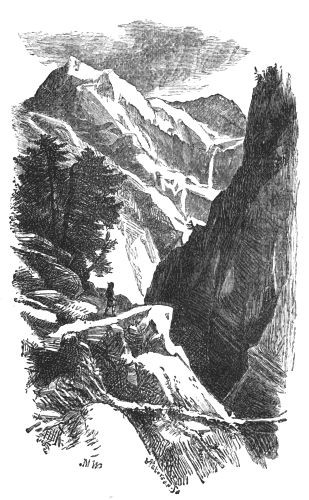
Fig. 14.—The Crests of Inaccessible Rocks.
The snow-bunting's favourite localities, where he loves to build his nest, are the crests of inaccessible rocks, surrounded by vast fields of snow, in whose midst the sun and tempest have created a few oases. The most he does is to approach the hospices of Monts St Bernard and St Gothard, and construct his nest under the eaves of their roofs. This nest, made of long blades of grass, is lined internally with hair and the feathers of poultry. At the beginning of May, the female lays six eggs of a snowy whiteness, and the male assists in hatching them, and bringing up the young. The bill of the latter is, at first, of a bright yellow, which turns black, like that of the parents, as they grow older.
The snow-bunting rarely descends into the wooded region. Of a very sprightly disposition, he spends nearly all his life in the midst of the snows and the ice. His song somewhat resembles that of the finch, which he also resembles in size and social instincts; for he may frequently be seen in numerous bands hovering above the highest mountains.
The snow-bunting is also met with in the northern districts of Asia and America.
The Red-Billed Crow—(Corvus pyrrhocorax).
The familiar cry of this bird, who resembles the thrush,—the krapp-krapp of the red-billed crow (la corneille des nieges),—agreeably falls on the ear of the traveller, when wandering through solitudes devoid of any other living being. By their cries and their presence these birds animate the denuded rocks which rise like promontories in seas of ice. They are easily distinguished from other species by their coral-red bills; whence their name of Pyrrhocorax. They nest in troops in the crevices of the most inaccessible rocks, and propagate there from generation to generation. Their presence is indicated by enormous heaps of ordure, veritable guano, which might well be used for manure. Their abrupt ascents and strident cries are signs of bad weather, which the mountaineer knows how to profit by.
If caught when young, these birds are easily domesticated. M. Tschudi, in his "Life among the Alps," relates the history of one who had been tamed. He would himself go in quest of the bread, cheese, and fruits which composed his repast; then, holding in his claws the prize he had coveted, devour it with avidity. What remained of his meal he carefully concealed in paper, and would gallantly defend the hidden treasure against whomsoever dared to approach it, against dogs as well as man. Fire had a singular attraction for him; he would extract from a lamp the burning wick, and swallow it without sustaining any injury; he would swallow even the débris of the charcoal as he fluttered about the chimney. He showed an excessive joy at the sight of smoke, and loudly clapped his wings. Whenever he caught sight of any burning coal, he did not fail to pick up immediately all the paper, rags, or twigs he could lay his claws on; these he would place in the stove, and amuse himself by watching the smoke they gave forth. If a stranger entered the room, he gave vent to the most deafening cries, though he was exceedingly gentle and familiar towards persons with whom he was acquainted. His friends and favourites he distinguished in a peculiar manner; he ran in front of them, displayed his joy by expanding his wings, and alternately perched himself on their hands, their head, their shoulders, eyeing them all over, and bending his head as if to kiss them. Every morning he entered his master's bedroom, called him by his name, posted himself on his pillow, and waited tranquilly until he awoke; then he expressed his satisfaction by all kinds of gestures and noises.
Reptiles.
Close to the line of perpetual snow a black variety of vipers has been met with; but none of the serpent race ever cross that line.
The only reptile found within the boundaries of the snowy region is a kind of lizard (Zootoca pyrrhogastra), the only one, perhaps, of all the vertebrata which could live at an elevation above the sea-level of more than 9500 feet, buried in the snow for upwards of ten months.
During the few bright summer weeks, he feeds upon some rare insects and spiders.
The frigid zone is so far the natural habitat of these lizards, that they would rather die of hunger than live in the more genial regions to which men have wished to transplant them. In length they nearly equal our common lizards, but they are not quite so big; their back is of a chesnut brown, marked with black streaks and dots; the throat is bluish; the belly of the male is of a greenish blue, spotted with black, while that of the female is of so lively a red as to have suggested the name of the species, Pyrrhogastra; just as the name of the genus is derived from the circumstance that the young are hatched in the mother's belly, and are born alive like the young of a mammal. This statement, too, holds good with respect to the viper, which also endures the cold of elevated regions.
Inferior Animals.
Our information is still very incomplete so far as relates to the molluscs, the arachnida, and the insects which inhabit the frigid zone. The Alpine snail (Helix Alpicola), so remarkable for its transparency, appears to be the sole mollusc which, in certain localities, attains to an elevation of 7000 feet. It is, however, surpassed by the earthworm, which is not only distributed over the surface of every country, but ascends to the snowy summits of the loftiest mountains. Few animals have their geographical distribution so extended both horizontally and vertically; and only some species of spiders and millepeds keep company with the earthworm.
Among the other inhabitants of the snows have also been observed a dozen species of butterflies,—nearly all diurnal,—for the phalænæ (?), or nocturnal Lepidoptera, appear to be much more sensible to the cold. M. Agassiz saw the "Little Vulcan" (Vanessa urticæ) fluttering in the snowy desert which borders on the glacier of Aar, as if it were completely in its element. The wings of the majority of these butterflies are sombre-coloured; their caterpillars live upon the auriculas, and seem to accomplish their metamorphoses in regions uninhabitable to us. The leaf-wasp (Tenthredo spinacula) appears to deposit its larvæ, at a height of nearly 10,000 feet, in the galls of the Alpine rose (rhododendron ferrugineum and rhododendron hirsutum.)
The coleoptera have also numerous representatives in the region of perpetual snows, with this difference—equally characteristic of other animals—that, upon the southern declivity, they ascend 1000 to 1500 feet higher than on the northern. We may mention, as specially distributed in the topmost zone of the Alpine world:—
The Chrysomela salicina, a pretty little beetle, sometimes blue, sometimes deep green, and finely punctuated, which lives almost exclusively upon a species of dwarf willow (Salix retusa).
The Nebria Escheri, a black beetle, about two thirds of an inch long, with feet and antennæ of a brownish red; and
The Nebria Chevrierii, with rust-coloured feet and antennæ, common in the sources of the Rhine.
Special mention must be made of the Snow-Flea. Do not think we are referring to an insect of the same species as our common fleas: the snow-flea approximates much more closely to the lice family than to the fleas, though it hops like the latter. The history of its discovery dates back as far as 1839. At this epoch, M. Desor, a learned Swiss naturalist, had undertaken some researches upon the glaciers. Accompanied by some friends, he set out from the hospice of the Grimsel, and arrived in the vicinity of the glacier of the Lower Aar. He had commenced his observations, when suddenly he heard Agassiz calling him, and shouting, "Come, come, make haste; here are your Mont Rosa fleas." Desor ran to the spot, and saw under a stone the little creatures whom Agassiz persisted in taking to be veritable lice, pretending they had been accidentally brought to these heights.
"I recognised with extreme joy," says M. Desor, "the little creatures whose loss I had regretted a year before. They are not pretty, but, on the contrary, very ugly. However, they showed, in opposition to the opinion of Agassiz, that they really inhabited the glacier, and were not merely chance visitors. We found them by thousands under other stones. ... Our guide, with whom the glaciers were old acquaintances, had never seen them before, and the tiny creatures excited his astonishment. What surprised us most was the rapidity with which they penetrated into even the most compact ice, till they resembled blood-corpuscles circulating in their vessels. This fact shows that there exist, in the hardest and most transparent ice, certain capillary fissures which escape an unskilled eye: it also proves that the glaciers, on their surface, and down to a certain depth, are by no means incompatible with the development of organised beings."[23]
The tiny insect in question was at first baptized by the name of Desoria saltans (order of the Thysanouræ of Latreille), but has since received definitively the name of Desoria glacialis. It belongs to the family of the Poduræ, singular creatures which, by virtue of their form, are a link between the earwigs and the spiders.
These are its generic characters:—
[19] The two temperate zones together represent perceptibly the half, or 0.520, and the torrid zone, two-fifths, or, more exactly, 0.398, of the terrestrial surface.
[20] That is, muttering, marmot-wise, one's prayers.
[21] Byron.
[22] Also called the Golden-crested Wren.
[23] C. Vogt, Agassiz, und seiner Freunde geologische Alpenreisen, p. 181. Frankfort, 1847.
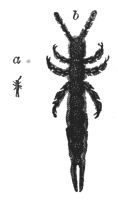
Fig. 15.—Desoria glacialis; a, natural size; b, enlarged.
The body elongated, cylindrical, garnished with long setiform hairs, and composed of eight segments, six of which are perfectly distinct, and two (the two latter) very short, and scarcely perceptible; four-jointed antennæ, longer than the head; long, slender, cylindrical feet; forked tail, silky, and transversely wrinkled; seven eyes, laterally grouped at the base of each antenna; body without scales.
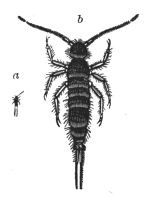
Fig. 16.—Podura plumbea; a, natural size; b, enlarged.
The Desoria glacialis, a species at present unique, is of a velvety black, and about one-sixth of an inch in length.
The Podura plumbea (or "Spring Tail"), common enough in England, and found under all kinds of stones, will give the reader an idea of the flea of the glaciers.
On comparing these two species, we remark, first, that the Podura plumbea is somewhat longer and thicker in body than the flea of the glaciers (see Fig. 16; a, natural size; b, enlarged); but it is more particularly by the length of its antennæ that we distinguish it. It owes its specific name of Plumbea to the livid blue or leaden colour of the scales which cover its body. These scales resemble those of butterflies; only they are much smaller, more finely situated, and very variable in form and size (Fig. 17). In catching it great care is required, for it is so easily crushed; it is, besides, very soft to the touch, though, when examined with a microscope, it is seen to bristle all over with hairs, apparently very hard.
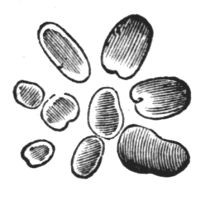
Fig. 17.
Our poduræ have also the faculty of leaping, and cling by thousands to humid places, especially to mosses and the under-surface of stones. The mechanism of their leap is explained by the presence of a forked, flexible, and elastic appendage, lodged in a kind of ventral groove beneath the last segments; by projecting this rapidly behind, the whole body of the animal is thrown forward. At the slightest contact the insect folds up its caudal appendage under its belly, and you would then suppose it did not possess one. This circumstance explains why, in many books of natural history of good repute, the poduræ, and especially so common a species as the Podura plumbea, are represented without this characteristic instrument.
Herbaceous Plants which best endure the cold of Winter.
The "way to look at things," which is the true foundation of science, varies, not only according to a man's degree of intellectual cultivation, but according to his social condition or profession. The herborist has eyes only for the plants in which he deals,—the "simples" which, as we read in old Gerarde, wrought such wonderful cures in the days of our forefathers,—and from the most exquisite flowers he turns with indifference. The gardener, on the other hand, is wholly absorbed by his love and his hate,—his charming exotics, and his troublesome weeds. The latter he regards with much the same feelings as a society wholly composed of honest men would regard an infusion of the "dangerous elements;" for weeds, like rogues, take what is not their own, and deprive others of their means of sustenance. But to classify plants according to their virtues or vices is not worthy of science, exclaims the rigid botanist. Would you mingle vile self-interest with the pure study of the vegetable kingdom? Remember that all selfish feelings ought to be banished from the sublime sanctuary of analysis and synthesis.
This sounds exceedingly well. Disinterested words, from whatever quarter they come, always produce—perhaps, on account of their comparative rarity—an admirable effect. But what is their real value? To ascertain it, the listener must be able to seize, like so many luminous threads, all the emotions which are acting upon the heart and tongue of the speaker. But we are very far from having arrived at this degree of perfection. Shall we ever attain to it? Yes, because we can conceive its possibility. But, until that golden epoch, the pure love of science will always remain a myth, and we shall not have universally understood the necessity of seeking in the profound study of nature the grand destiny of man.
It is among the weeds and noxious plants that we shall find the species capable of enduring longest the cold of winter. What part, then, do they fulfil in the economy of creation? An ambitious, but not a novel question, which has often been propounded in reference to our parasitical insects.
The best answer which we can make to it is this: Everything invites us to work. Labour is imposed even upon him who least desires it. Earth will yield a return only in proportion to the care we bestow upon her.
If, after having toiled and sown, we had nothing to do but to gather in the harvest, every person would become an agriculturist. But a soil which is not manured will soon grow exhausted; and if it be neither ploughed nor harrowed, instead of barley or vegetables, it will soon be covered with tares; rank weeds will flourish in every field. Such is the chastisement reserved for sloth,—the true "original sin" of the human race.
Well, then, it is among the weeds, everywhere so common, that we meet with the plants best able to brave the rigours of frost.
The Dog Mercury.
The annual Dog Mercury (Mercurialis annua) is one of the most tenacious. It attracts the passer-by, if he condescend to bestow a glance upon it, only by its extreme abundance; it propagates very largely, though it is by no means partial to all localities. For instance, it avoids the woods as persistently as its congener, the common Dog Mercury (Mercurialis perennis) seeks them. It prefers the vicinity of human habitations and uncultivated fields. If let alone, it spreads with a dangerous rapidity, and invades every garden which is not kept in the most exquisite order. Still, we must not deal too harshly with it. It is not altogether unfriendly to man. In truth, owing to its laxative properties, it renders him invaluable services. The country people have great faith in fomentations of Dog Mercury and honey. Understand, we pray you, that not an atom of mercury enters into it, despite its significant name; but a decoction of the annual Dog Mercury, mixed with a little thick honey, answers all the purposes of those lenitive clysters which are so beneficial to excitable temperaments. The leaves of the plant are eaten in Germany like spinach.
Of the Mercurialis perennis Mr Sowerby writes:—"This plant was formerly used in medicine, but has long been abandoned as a remedy. It is extremely acrid, and even poisonous, though recommended in some old books as a good pot-herb, probably from being confounded with the annual species. When steeped in water, the leaves give out a fine blue colour resembling indigo. This colouring matter is turned red by acids, and destroyed by alkalis, but is otherwise permanent; it might possibly prove valuable as a dye, if any means could be discovered of fixing it, and the herb has been introduced into this work with the view of drawing the attention of chemists to the subject; no experiments seem to have been lately made upon it."
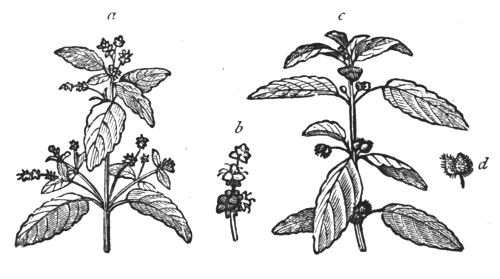
Fig. 18.
Let us now advise you how to distinguish our medicinal plant from the "ill weeds" with which it loves to associate. Its ovate, rough, irregularly-dentated, and petiolated leaves would not give it a sufficiently marked character, had it no other features peculiar to itself. But observe the yellowish-green glomerules, arranged, like millet, on a long frail spike. (Fig. 18, a.) They exhale, as your nose will inform you, a peculiar aroma, like that of spiced bread: no other plant but our Dog Mercury is gifted with this odour. Now, bring your magnifying-glass to bear upon it; with the point of a knife or a feather open one of the grains which form the glomerules of the spike; out of it will leap, as if impelled by an invisible spring, a large number of stamens, easily distinguished by their elastic thread-like anthers, covered with tiny yellow beads. Each greenish grain is a flower; the calyx, which also serves as the corolla, is represented by three little petals, forming the external envelope of the little flower. (Fig. 18, b.) But something essential is still wanting; in the centre of the stamens you do not find any pistil. Why is so important an organ wanting? Because our little rounded flowers, with their spice-bread odour, have but one sex, are unisexual; they are male flowers, since they are furnished only with stamens. In vain do you hunt on the same stem for their companions, the female flowers. You will find them only upon other stems, distinct from those which bear the male flowers. The Dog Mercury, then, is a plant whose two sexes are lodged in two different houses, οἴκοι—is, in fact, a dioecious species.
But you are sure to find the female flowers in the immediate neighbourhood of the stems with the male flowers. They are easily recognised by their larger and darker leaves (Fig. 18, c); and especially by their little twin pods, green, wrinkled, and pedicellate,[24] which garnish the axil of the leaves. (Fig. 18, d.) From this characteristic the female mercury was formerly mistaken for the male; and many centuries elapsed before naturalists recognised, what now-a-days seems so simple, that the little pods, joined in couples, and containing each a grain, composed the fruit of a single plant; that every fruit proceeds from an ovary; and that every ovary is a sign of the feminine sex.
In the Historia Naturalis of Pliny, who was at once so acute and so credulous an observer, we first meet with the name of Mercurialis.
"The plant is so denominated," he says,[25] "because it was discovered by Mercury. Its juice, mingled with that of the hibiscus (a species of the Malvaceæ) and the purslain, forms a kind of unguent, with which, if you thoroughly rub the hands, they can touch molten lead without being injured."
The description which Dioscorides[26] gives of the Linozosis, which he also calls Parthenion, or Mercury's Plant (Ἑρμου βοτάνιον) applies, in the main, to our Dog Mercury. It is true that its leaves "are not like those of the basilic" (φίλλα ὄμοια ὁκίμῳ); but they resemble in all respects those of the smooth variety of cultivated mint; and, apparently, the basilic of Dioscorides was one of our mints. The fruit of the female, he adds,—evidently meaning the male flowers,—are disposed in clusters.
Both species of the Herb or Dog Mercury belong to the family Euphorbiaceæ.
Our attention must now be directed to another point. It is a fact, that in winters of moderate severity the Mercury continues to infest our gardens and cultivated fields. It only succumbs to a frost equal to six to ten degrees below freezing-point; then its congealed stem totters, and grows black, and its leaves mingle so completely with the soil that it is difficult to discover any vestiges.
How singular a contrast! The plants most destructive in our kitchen gardens are frequently the most useful in medicine. There are no drugs more popular than the weeds which we call Herb Mercury, Garden Nightshade, and Dog's-tooth grass. All belong to families whose properties are strongly marked. As already stated, the Mercury ranks among the Euphorbiaceæ, remarkable for their acrid and more or less purgative juice. In this family occur the most violent drastics, such as the Croton tiglium, whose oil (expressed from the seeds) has long been considered an efficacious medicine. The Garden Nightshade is one of the Solanaceæ, and cousin-german of the useful potato; and the Dog's-tooth grass, whose roots compose three-fourths of our possets, is of the same family as our cereals.
The Garden Nightshade.
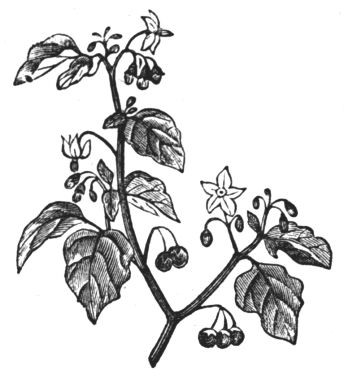
Fig. 19.
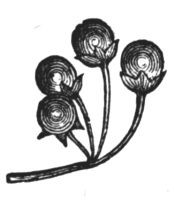
Fig. 20.
If you have seen—and who has not?—the flowers of the potato-plant, you will immediately recognise the flowers of the Garden or Black Nightshade. (Fig. 19.) This noxious herb—noxious in some, but useful in other respects, and, therefore, not to be visited with too hasty a condemnation—flowers and fructifies throughout the year. Its fertility is extreme; only the severest winter-frosts can crush out its prolific life. The fruits which succeed to the flowers are smaller berries or "apples" than those of the potato. (See Fig. 20.)
In the history of botany, and even in that of philosophy, the Black Nightshade (Solanum nigrum) has a certain interest. Thus, says M. Hoefer, both Cordus and Jean Bauhin, botanists of the sixteenth century, have described the flower of this plant as if its corolla were composed of five distinct petals.
Where were the eyes of those great botanists? The corolla of the nightshade, like that of all the Solanaceæ, is plainly and obviously monopetalous,—that is, composed of a single piece; to assure yourself of this, you have but to open it out. (See Fig. 21, b.) It was the sharp-pointed, ovate divisions of the limb which imposed on the old observers; a fresh proof that seeing and observing are two very distinct things. Our vision enters into full exercise from earliest infancy; observation is not acquired until after much labour and many years.
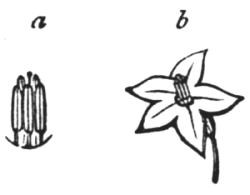
Fig. 21.
Do not forget to add, that the five stamens are brought very closely together by their elongated anthers, as is also seen in the flower of the potato-plant. (Fig. 21, a.)
The same botanists who took our solanum for a plant with a polypetalous corolla, considered the Bitter-sweet (Solanum dulcamara) to be a metamorphosis of the Garden Nightshade! The former they christened the red-berried solanum (Solanum baccis rubris), and the latter, the black-berried solanum (Solanum baccis nigris).
But if we once launch into the hypothetical, we shall be unable to stop half-way. If the species of one and the same genus are the result of a transformation, why may we not assert as much of the genera of a family, or the families of an order?
Thus we should arrive, step by step, at an unique type, not only for the vegetable kingdom, but for vegetables and animals, including man himself, and realise, to some extent, the ideal of the Greeks,—unity in variety.
Be it acknowledged, however, that we have no desire to rise to so lofty an elevation. The potato-plant—unknown to the ancients, inasmuch as it is a native of the New World—has not been found to lose its character since its introduction into the ancient continent; its congener, the nightshade—an old native, like every bad herb—accompanies it everywhere; but its fibrous roots are absolutely virgin of every farinaceous tubercule.
Though the nightshade is common everywhere, Tournefort was the first to describe it with complete accuracy. That great observer even specifies various peculiarities which most of our botanists omit from their descriptions. Thus, he rightly remarks, that the peduncles branch out so as to form a kind of umbel, and do not emerge, as is usually the case, from the axils of the leaves, but a little below, from the very branches of the stem. He was also the first to note—and it was a veritable discovery—that the white flowers of the nightshade, grouped in threes to eights, are each formed of a single cup-shaped leaf,—in other words, that the corolla is monophyllous, and slightly bell-like or campanulated. Nor does he forget to describe the disposition of the five stamens, set close around the pistil, which, as it develops, forms a globular bacciform fruit, embraced by a five-lobed calyx. This fruit, which changes in colour from green to black, is filled with a great number of grains in a thick liquid, exhaling a nauseous odour. As for the leaves, they resemble those of spinach, for which, in some countries, they serve as a substitute.
Like all plants found by the wayside, and among heaps of refuse, the nightshade loves to vary its form, and of its various forms some nomenclators have made as many different species. The typical variety, the Solanum nigrum, has glabrous stems and leaves, that is, they are covered with short, but hardly visible hairs; its berries are black.
The smooth variety, or Solanum villosum, is rather rare, and has swollen or bulging leaves and stems; its berries are red or of a reddish yellow. The two varieties seem able, by sowing, to be transformed into one another. A sub-variety of the Solanum villosum has been described as a peculiar species, under the name of Solanum miniatum, so named on account of its vermilion-coloured berries. The Solanum ochroleucum and Solanum luteovirens, the first with yellowish, and the second with greenish berries, are simply varieties, and the same may be said of the dwarf form, known by the name of Solanum humile.
But the physician is more interested in the solanum than either the gardener or botanist. For him it is no useless or noxious weed, but, on the contrary, is an eminently precious herb. And, in fact, if it possessed only one-half the virtues formerly attributed to it, we ought to bow to the ground every time we encounter it.
Listen to our authorities even if you do not respect them.
Cæsalpin asserts that the decoction or juice of the nightshade is a sovereign remedy for complaints of the stomach and the bladder, and regards nightshade-water, mixed with an equal quantity of absinthe-water, as one of the best sudorifics.
Tragus, a physician and botanist like Cæsalpin, recommends the juice of the nightshade as anti-choleraic, as well as efficacious in inflammation of the liver and stomach. And yet, at the same time, he grows emphatic in reference to its poisonous properties. "Do not," he says, "employ this herb immoderately, lest it should happen to you as, in 1541, I saw it happen to an inhabitant of Erbach, near Hohenburg. After having eaten a few nightshade-berries, he was seized, on the following day, by a furious monomania, which led his neighbours to believe him possessed of a devil. After having uselessly employed every kind of exorcism, they sent for me. I made my patient swallow some very strong wine; he fell into a profound slumber; and, when he awoke, was cured."[27]
Withering affirms that a couple of grains of the dried leaves will act as a powerful sudorific, and that they have also been found useful in some cutaneous disorders.
Here is another authority, before whom naturalists are accustomed to give way. We make use of the Solanum nigrum, says Tournefort,[28] when it is necessary to subdue inflammation, or soften and relax the fibres. The pounded herb is applied to hæmorrhoids. The juice, with a sixth-part of rectified spirit-of-wine, is advantageous in cases of erysipelas, ringworm, wildfire, and all diseases of the skin. Nightshade is also employed in anodyne cataplasms.
Tournefort did not confine himself to simple botanical descriptions; he did, what our modern botanists neglect doing,—he made experiments, both physiological and chemical, on the plants employed in medicine. Thus, he began by tasting the different parts of the plant.
"The root," he says, "is almost insipid; the leaves taste like a saltish herb; there is something sharp and vinegary in the fruit; the whole plant has a narcotic odour. The leaves do not redden turnsole,[29] but the ripe fruit reddens it greatly; whence we may conjecture that the sal-ammoniac contained in this plant is moderated in the leaves by a very considerable portion of fœtid oil and earth, but that the acid portion of the salt is strongly developed in the ripe fruit; so that we must choose our part of the plant according to the purposes we wish to employ it for. The fruits, for instance, are more refreshing, but more repellant, than the leaves, which soften while resolving, cleansing, and absorbing."
We admit that these data leave much to be desired from a chemical point of view. We may well ask, for example, how the illustrious philosopher ascertained the presence of sal-ammoniac in nightshade? But it is not fair to criticise the science of the past, by judging it through the deceitful prism of the science of to-day. We must adopt the methods of our predecessors, when discussing natural productions from all the view-points of their applications.
Dog's-tooth Grass.
In clearing an uncultivated field we uproot a great number of herbaceous plants of different families; but those of the Gramineæ, or Grasses, invariably predominate. They are the trailing roots, or rhizomes, of certain species which have been included under the general denomination of Dog's-tooth. These tenacious and vigorous roots,—so wholesome in various maladies, so injurious to cultivation,—are, whatever certain botanists may say, far from tracing their origin in all cases to the Triticum repens (couch-grass) and Panicum dactylon—those terrible enemies of the corn-field, which, once established in the soil, are with difficulty extirpated, and prove very injurious to the "golden crops." Nearly every grass which puts forth rhizomes will furnish the Dogs-tooth. We may cite, for instance, several species of Festuca (as Festuca rubra and Festuca pinnata), or fescue grass; at least two kinds of meadow grass (Poa compressa and Poa pratensis), a species of wild-oats (Avena elatior), to say nothing of the weeds Arundo phragmites and Arundo epigeios. The long rhizomes of these vivacious plants possess nearly the same properties, due to their saccharine principles.
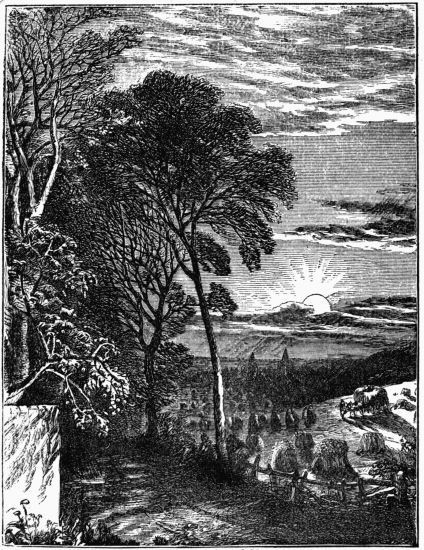
Fig. 22.—A Corn-field.
How shall we distinguish these plants from one another? Their leaves have almost exactly the same configuration; they are linear;[30] and their flowers are not apparent,—they do not attract the gaze of the passer-by. Yet they possess all the organs necessary for the reproduction of their species:—three stamens, each composed of an anther and a characteristic filament; on this anther, whose two lobes are arranged like the branches of an X, the pistil softly and tenderly balances itself on the summit of a frail thread, to which it is attached by the back. Remark, too, the two styles with feathery stigmata,[31] like the barbs of feathers. Nothing is wanting to constitute a complete flower.
There is even a perianth, or calyx, represented by a couple of tiny membraneous scales, scientifically known as glumellulæ; then at the base of each spikelet, composed of one or two of these bright green lilliputian flowers, are two other and larger scales, called glumellæ: they represent an involucre.[32] It is almost unnecessary to add, that the free, unilocular ovary, or seed vessel, forms, as a result of its development, the seed, whose embryo adheres laterally to a farinaceous kernel, or perisperm. The union of one or more of these flowers composes a spikelet, and the union of the spikelets constitutes the spike, which may be disposed on a simple or ramified axis. Such are, in general, the characters we must keep before us in the difficult study of the Gramineæ.
Let us now see, more closely, the two plants which, according to the botanists, furnish the root of the Dog's-tooth.
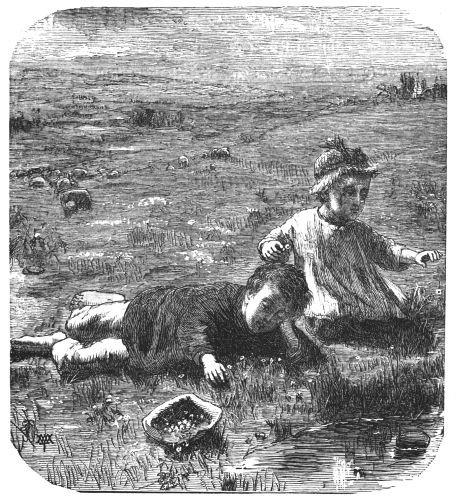
Fig. 23.—A River's Sandy Bank.
When walking along the sandy bank of a river, you must frequently have trodden under foot a low, almost crawling herb, remarkable for its violet-red spikes, which, three to five in number, are arranged like the fingers of a hand, on the summit of a short curving stem.
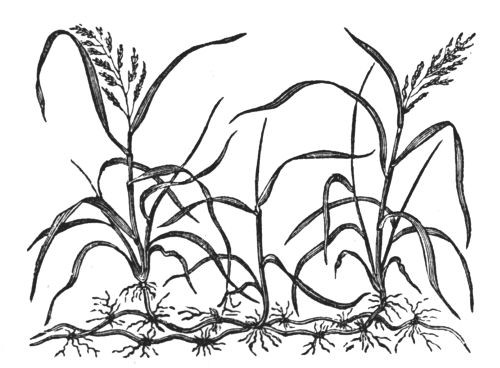
Fig. 24.—(P. 93.)
This glaucous-leaved herb is the Panicum dactylon (i.e., fingered-millet) of Linnæus. The long trailing rhizomes, joined to some less prominent characters, have been sufficient for some botanists to create a special genus, Cynodon, or Kynodon (a Greek word, signifying literally "Dog's-tooth"), and to change the Linnean denomination of our grass into Cynodon dactylon. It is seldom met with in cultivated land; but in such a locality as we have already described, and sometimes on open sandy shores, where the summer sea comes with a gentle ripple and a subdued music, it may frequently be found. Its long, tough runners creep through and over the loose soil for many yards, rooting at every joint, and furnished with flat, rather short leaves, of a glaucous hue. The flowers grow in narrow, linear spikes, arranged at the top of a short leafy stem in the form of an umbel, and give the grass, when in bloom, a very peculiar and characteristic aspect.
But if the Cynodon dactylon is rare in cultivated fields, the Triticum repens—commonly called couch-grass, but, in our opinion, the true and genuine dog's-tooth—is particularly abundant. (See Fig. 23.) Its long subterranean stems increase with astonishing rapidity, and if the smallest fragment be left in the soil, it will vegetate, and speedily extend itself, until it becomes almost impossible to extirpate it. It is a kind of wild barley, with stiff leaves of a moderate length, and of a bluish tint, and a double spike, composed of clusters of four to six flowers, each crowned by a narrow ridge. We must not confound the Triticum repens with the Elymus caninus of Linnæus, which has no trailing underground roots like the former. It differs also from the latter in the roughness of each side of its leaves,—only one side of the leaf of the Triticum repens being rough,—and in the crests which rise above the flowers.
Was the dog's-tooth known to the ancients? Undoubtedly, for the dog's-tooth flourishes in all climates,—is truly cosmopolitan. But it is difficult to decide whether their Agrostis and their Gramen apply to the above-mentioned species.
According to Diodorus, the primitive Egyptians lived upon herbs. "They also eat," he says,[33] "the stems and roots which grow in the marshes. Especially did they hunt after the Agrostis, a plant remarkable for its sweet savour and the sufficient nourishment which it offers to the wants of man. It is likewise considered an excellent provision for cattle, from its fattening properties. It is in remembrance of these benefits that the inhabitants of Egypt, when worshipping their gods, carry this plant in their hand."
The Agrostis of Diodorus would apply to all the Graminaceæ whose stems and roots contain nutritive and saccharine principles. Let us here remind the reader that the sugar-cane belongs to the same family as barley and the dog's-tooth.
Pliny is much more explicit. What he says of the Gramen (or grass), the "commonest of herbs"—inter herbas vulgatissimum—and of the geniculated spaces between its knots (geniculatis serpit internodiis), applies with tolerable accuracy to our Triticum repens. He also speaks of the diuretic properties of a decoction from its trailing roots.[34] As for his Gramen aculeatum (or needle-like grass), it is positively our Cynodon dactylon. "The five spurs or needles which shoot out," he says, "from the top of the stem, have procured it the name of Dactylon." To these digitiform spikes he attributes the property of checking the bleeding of the nose, when they are introduced into the nostrils. But a thorn is much better fitted to produce this effect; the spikes of the digitated panicle of the Cynodon dactylon are much too soft to determine epistaxis by a mechanical action. So it is not improbable that they owe their putative virtue to their colouring, which is not unlike that of blood, and which has even procured for the species the name of Digitaria sanguinalis. In the same manner the capricious mediæval imagination pronounced liverwort, with its marbled leaves, a sovereign remedy for diseases of the lungs,—organs remarkable for their marbled appearance.
Dioscorides is quite as explicit as Pliny. What the latter names Gramen, he, however, calls Agrostis. After having particularised the nodosities of the stem—a feature common to nearly all the Graminaceæ—he describes very clearly the long creeping roots put forth by the said stem; and he does not forget to mention the sugary savour, so characteristic of the rhizomes (ῥίζας γλυκείας) of the Triticum repens.[35] Theophrastus confines himself to indicating the Agrostis as a herb which infests the fields.[36]
The Cynodon dactylon is, at the present day, very common in Greece, where it is specially partial to low grounds, which are somewhat damp and sandy. The inhabitants call it Agriada, a name derived from ἄγριος, "wild." But if we may believe Fraas, the author of a Flora Classica, the genuine dog's-tooth, Triticum repens, is, on the contrary, very rare in the land of Socrates. This is a curious fact, if a fact, for geographical botany.
Throughout the Middle Ages, and down to the eighteenth century, were confounded, under the generic name of Gramina, or grasses, the most diversely-featured herbs, including the dog's-tooth. Tabernæmontanus, Dodonné, Mathiole, Jean and Gaspard Bauhin, were the first to attempt the clearing of a path through this intricate wilderness. They eulogised, at the same time, the emollient properties of the dog's-tooth.
Tournefort[37] and Bernard de Jussieu, who appear to have made a chemical analysis of it, pretend that the roots of the dog's-tooth contain a large quantity of oil, earth, and several acid liquids, as well as a little fixed salt. "According to all appearance," they add, "the roots act by means of a salt analogous to salt of coral, enveloped in a great deal of sulphur."
Instead of mocking us with such fantastic analyses, which can only excite the laughter of our modern chemists, Tournefort and Bernard de Jussieu would have deserved better of science if they had applied themselves to the task of introducing light and order into the cloudy chaos of the Graminaceæ of the botanists of their age.
But winter is passing away, and the time for the singing of birds is at hand. Already the earth is awakening from her prolonged lethargy; the hedgerows are green with budding leaves; the purple crocuses shine in many a sheltered field; on bank and brae, in glen and vale, the glory of the primrose makes glad the heart of man; the wood anemone hangs its delicate head in the woodlands; and it seems as if a gladder feeling animated the universal nature.
And the heart and the brain and the soul sympathise in this apparent delight of material things; the heart beating more freely, the brain feeling a stronger working power, and the soul rising to purer views of life and its duties:—
"Oh, who can speak the joys of spring's young morn,
When wood and pasture open on his view,
When tender green buds blush upon the thorn,
And the first primrose dips its leaves in dew!"
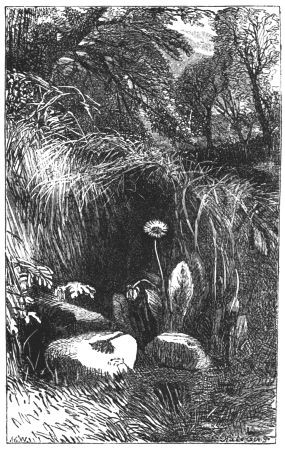
Fig. 25.—On bank and brae, in glen and vale.
BOOK II.
——♦——
SPRING-TIME.
Now that the Winter's gone, the earth hath lost
Her snow-white robes, and now no more the frost
Candies the grass, or calls an icy cream
Upon the silver lake or crystal stream;
But the warm sun thaws the benumbèd earth,
And makes it tender; gives a sacred birth
To the glad swallow; wakes in hollow tree
The drowsy cuckoo, and the humble bee;
Now do a choir of chirping minstrels bring
In triumph to the world the youthful Spring;
And valleys, hills, and woods, in rich array,
Welcome the coming of the longed-for May.
—Thomas Carew.
'Tis silence all,
And pleasing expectation.
Even mountains, vales,
And forests, seem impatient to demand
The promised sweetness. Man superior walks
Amid the glad creation, musing praise,
And looking lively gratitude.
—Thomson.
CHAPTER I.
WHAT MAY BE SEEN IN THE HEAVENS.
"Blue the sky,
Spreads like an ocean hung on high."
—Byron.
The works of God, he adds, are so worthy of their Author, that, besides the impresses of His wisdom and goodness that are left, as it were, upon their surfaces, there are a great many more curious and excellent tokens and effects of Divine artifice in the hidden and innermost recesses of them; and these are not to be discovered by the perfunctory looks of oscitant and unskilful beholders; but require, as well as deserve, the most attentive and prying inspection of inquisitive and well-instructed considerers. It is not by a slight survey, but by a diligent and skilful scrutiny of the works of God, that a man must be, by a rational and affective conviction, engaged to acknowledge, with the prophet, that the Author of nature is "wonderful in counsel, and excellent in working."
That He is wonderful in counsel and excellent in working must be the conclusion of every devout student of the celestial phenomena; and to those we shall, therefore, devote the first portion of our Spring meditations.
What reception would formerly have been given to any poet who had dared to exclaim—
"The bright face of the heavens contemplate,
And then, as in a mirror, you shall see,
Outlined, the figure of the rounded earth"?
Would he not have been met with the reproach which Horace, in his Ars Poetica, so epigrammatically formulates?—
"Pictoribus atque poetis
Quidlibet audendi semper fuit æqua potestas."
An equal licence ever was accorded
To poet as to painter, that he might
The boldest sweeps of fancy still essay!
As for men of science, they would not have condescended to honour even with a smile such strange and fantastic words.
Let us suppose, now, that our poetical astronomer, thus contemned, had addressed his scientific censors in some such language as the following:—
Do not think, illustrious sirs, that it is by a purely poetical licence I call the firmament a mirror in which the earth may be seen reflected. Only, to prevent all equivoque, we must understand one another. The mirror to which I am alluding does not reflect light, but movement. It is in a particular movement of the stars that the true figure of our planet is reflected, is revealed to us. But before the human mind can appreciate this movement,—especially before it can discover the cause,—we must be prepared to devote ourselves to centuries of assiduous effort. In this long interval, philosophers of every class will allow unrestricted scope to their imagination.
Shall we, then, recall some of these opinions,—some of these truly poetical licences?
Homer and Hesiod represented the earth as a disc, or as a flat rondel, surrounded on all sides by a winding river which they called the Ocean, and which, in the extreme East, communicated with the Phasis, in Colchis. Above this terrestrial disc the outspread sky was arched like a vast dome; a dome supported by two massive pillars, resting on the shoulders of the god Atlas.
Surely the ancient poets must have evolved the earth-disc from their own prolific imagination. Can they never have seen a far-off vessel, showing, as it approached them, at first the tops of its masts, then its swelling sails, and finally its hull? They might have made so simple an observation in any seaport; if they did, why did it not suggest to them the idea that the earth, instead of being level, must be round? Because it is easier to let the imagination speak than the reason.
The fiction of the earth-disc remained long unshaken, with the exception of a few modifications. Thales figured to himself the earth as floating on a humid element. And, six centuries later, we find Seneca still adopting the opinion of the Greek philosopher. "This humid element (humor)," he says, "which sustains the disc of the earth like a ship, may be, perhaps, the ocean, or a liquid of simpler nature than water."[38]
But how, then, was the rising or setting of the stars explained? The ancients supposed that they were extinguished at sunset, and rekindled at sunrise. Thus, an unfounded hypothesis has for its consequence a still more baseless hypothesis; and in this manner we glide down the slope of fiction to fall eventually into an abyss of contradictions. Such is the true punishment of error.
Let us continue.—According to the Chaldeans, who were thought to be profoundly versed in astronomy, the earth was hollow, and shaped like an egg-shell. And,—adds Diodorus, from whom we have this detail,—they adduce numerous and plausible proofs of this assertion.
Yet was this idea in direct opposition to the evidence of our senses when we travel over a wide plain, or navigate the great deep; at least, unless we admit that the earth has the form of a reversed egg-shell, with its convex face uppermost, and its concave one beneath. Heraclitus of Ephesus introduced the Chaldean doctrine into Greece.
Anaximander represents the earth as a cylinder, whose upper face alone is inhabited. This cylinder, adds the philosopher, is a third of its diameter in height, and floats freely in the midst of the celestial vault, because there is no reason why it should move more to one side than the other. Leucippus, Democritus, Heraclitus, and Anaxagoras,—names of high repute in the history of philosophy,—adopted Anaximander's system, though it was neither more nor less than a wild phantasy.
Anaximenes and Zenophanes, without pronouncing dogmatically on the form of the earth, represented it as resting,—the one upon compressed air, the other upon roots which were prolonged ad infinitum. But upon what was the compressed air supported? And of what nature were these mysterious roots?
Plato, with a nearer approximation to the probable, gave to the earth the form of a cube. The cube, bounded by six square equal surfaces, appeared to him the most perfect geometrical solid, and consequently the most suitable for the earth, supposed to be the centre of the universe.
Eudoxes, who, in his long travels in Greece and Egypt, must have seen new constellations rising in the south, while others disappeared in the north, never ventured to adduce from his astronomical observations the sphericity of the earth.
Aristotle, bolder than Eudoxes, was led to the conception of this sphericity by simple consideration of mechanics. The earth, he said, must be a sphere, because each particle of matter is carried, by gravity, towards the centre; and as this fact is general, the superficial particles must be at an equal distance from the centre. This theoretical view was adopted by Archimedes, who applied it to the waters covering the terrestrial surface. Aristotle went further; he saw the rotundity of the earth in the shadow thrown by the latter on the bright face of the moon during its eclipses.
It is a noteworthy fact that the arguments of Aristotle, founded on a method to which all the progress of science is due, remained unaccepted for two thousand years. And why?
We shall attempt to explain.
Among those subjects whose comprehension seems to have been specially difficult to the mind of man, we must include the fact that the earth floats without any solid support in the infinity of space, and carries its denizens on its surface, both above and below.
Our creeds, which have ever pretended to explain everything in the physical as well as in the moral order, have here endeavoured to come to the assistance of the weakness of the human mind. And as each creed asserts itself to be the best, to the exclusion of every other, men began to imagine for the earth a navel, and placed it where it was supposed pleasing to the divinity.
The Greek priests dismissed a couple of eagles, one towards the west, the other towards the east; the place where these favourite birds of Jove, of the "Father of gods and men," encountered each other, was to be considered the "navel" of the earth. It chanced to be Delphos, whose oracle was the most esteemed in the ancient world; the sacerdotal caste accumulated there immense wealth. The Greek priests prudently refrained from dealing with the difficult problem of the earth's solid support.
The Hebrew pontiffs, however, were not so reserved. After having made Jerusalem the "navel of the world," they allowed for the earth itself seven solid columns as a foundation. The question of the Antipodes, in which the greatest intellects of antiquity believed,—Pythagoras, Plato, and Aristotle,—was thus pontifically judged and condemned. And Christians who preferred to follow the Judaical observance of external ceremonies to a true comprehension of the spirit of the Gospels, exaggerated the application of this sentence.
The dogmatic condemnation of the existence of the Antipodes long arrested man in his search for that fourth quarter of the world whose inhabitants should have their feet directed towards ours. It was one of the principal obstacles which Columbus was called upon to surmount in the realisation of his sublime idea. When cited before the Council of Salamanca,—composed of prelates and men of science,—he had to meet the revived objection of Lactantius, a Christian apologist of the third century:[39]—"Can there be anything more absurd than a belief in the existence of Antipodes, of inhabitants with their feet opposite to our feet, of people who walk with their feet in the air, and their heads on the ground?—that there is a part of the world where everything is inverted, where trees throw out their branches from top to bottom, while it rains, and hails, and snows, from bottom to top?"
Columbus admirably demonstrated, from an artificial globe, that flies walked as easily on the lower as on the upper surface, and hence pointed out that men, compared with the size of the earth, are much smaller still than flies. But his judges persisted in their conviction, and did not fail to cast in his face the jesting words of Plutarch: "Philosophers, rather than renounce a favourite hypothesis, would make human beings crawl on the lower face of the earth like worms or lizards." But it was principally the authority of St Augustine which they invoked to condemn a belief in the Antipodes. St Augustine had declared such a belief incompatible with the dogmas of the faith; for to admit the existence of inhabitable lands, in the opposite hemisphere, would be to admit the existence of peoples not descended from Adam, since it would have been impossible for him to traverse the ocean lying between Asia and the Antipodes!
Some authorities denied the Antipodes on the ground taken by certain classic writers, that the regions of the opposite hemisphere were uninhabitable under the tropics, on account of the extreme heat, and near the Poles, on account of the extreme cold. Others cited Epicurus, affirming that the earth was inhabitable and roofed with a celestial vault only in our western hemisphere, the other half being an inaccessible chaos. Others pretended that no traveller could reach the east by way of the west, because the earth, being pear-shaped, he would encounter on his road an insurmountable tuberosity,—undoubtedly the tail or stalk of the pear! Finally, there were some who dwelt upon the magnitude of the earth, whose circuit would occupy a voyage of upwards of three years.
It was to this objection, as the most serious, that Columbus principally addressed his reply. And he replied by discovering the New World. But had not this daring genius been supported in his projects by the Spanish sovereigns, Ferdinand and Isabella, he would have been handed over to the Inquisition, and condemned as a heretic. It was then so dangerous to believe in the Antipodes, that a Bishop of Salzburg was deposed from his episcopal throne, and deprived of his ecclesiastical dignity, by the Pope Zacharias, for having countenanced the heresy.
We now know why, for a whole series of centuries, men would not follow in the footsteps of Aristotle, who was the first to establish theoretically the sphericity of the earth.
The discovery of the New World, and the voyages of circumnavigation which rapidly succeeded one another, demonstrated, not only that inhabitants there are whose feet are opposite to ours, but that the earth does not rest upon any species of support; that it floats, like a star, freely in space.
The ice was broken. The question of the earth's figure was revived, and, this time, discussed in a new light.
Is the earth perfectly round?
Copernicus never doubted it; he who was the first, after Pythagoras, to represent our planet as revolving round the sun. The geometrical sphericity of the earth wonderfully harmonised with the perfect circles in which he supposed the planets to move. Kepler, who had first laid a sacrilegious hand on the holy figure of the circle, and on the circular orbits of the stars, never ventured, however, to dispute the perfect rotundity of the earth; it appeared to him a matter beyond all controversy. Galileo was the first to hazard a doubt. But this doubt became a certainty only through the labours of Huygens.
Galileo, who died in the very year that Newton was born (1642), had discovered, as we know, that all bodies, in falling, obey an uniformly accelerative force, called gravitation, and that the space traversed increases as the square of the time occupied in their descent. Huygens perceived that gravity varies according to the parallels of latitude, and it was not long before he demonstrated, by the number of oscillations which a pendulum of a certain length performs in a certain time, that it diminishes in a regular ratio as we approach the Equator, where it reaches its minimum, and that it augments, on the contrary, in due proportion as we approach the Poles, where it must attain its maximum. Strong in this knowledge, and knowing, moreover, that the material molecules, uniformly distributed in the volume of a sphere, act upon a point of its surface as if they were all reunited in the centre of that sphere, Huygens deduced from it the inequality of the equatorial and the polar radius; he attempted even to determine how much the former exceeded the latter. We know, now-a-days, that this difference is 139,670 feet (41,848,380—41,708,710 feet).
Newton admits, with Huygens, that the earth bulges out at the Equator and is flattened at the Poles; that, in a word, it is a spheroid of revolution. He went much farther: he made the precession of the Equinoxes depend upon this flattening; but he did not furnish its mathematical demonstration. What has been the result? A free skirmishing ground for all opinions.
[24] A flower with a stalk is called pedunculate or pedicellate; without a stalk, it is sessile.
[25] Pliny, "Historia Naturalis," xxv. 18.
[26] Dioscorides, "Materia Medica," iv. 191.
[27] Tragus, "Historia Stirpium" (ed. 1552).
[28] Tournefort, "Histoire des Plantes" (ed. 1727), i. 74, 75.
[29] Turnsole, a colouring substance made of coarse linen rags, which, after being cleaned and bleached, are dipped into a mixture of ammoniacal matter, and the juice of the Crozophora tinctoria.
[30] Leaves are said to be linear, when the veins do not spread out, but run from the base to the extreme point.
[31] A stigma is the continuation of the cellular tissue of the style, and has sometimes projecting cellules of hairs.
[32] A whorl, or ring, of bracts (floral leaves) is so called.
[33] Diodorus, i. 43.
[34] Pliny, "Historia Naturalis," xxiv. 188.
[35] Dioscorides, iv. 30.
[36] Theophrastus, "Historia Plantarum," i. 10; xi. 2, 4.
[37] Tournefort, "Histoire des Plantes," ii. 54.
[38] Seneca, "Quæstiones Naturales," vi. 6.
[39] Lactantius, "De Falsa Sapientia," iii. 24.
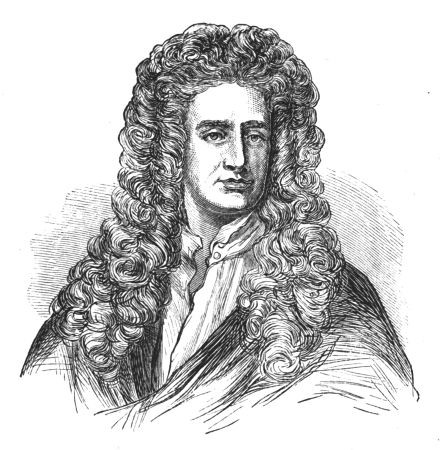
Fig. 26.—Sir Isaac Newton.
While Newton maintained that the form of the earth was that of a spheroid flattened at the poles, as a necessary sequence of the great natural law which bears his name, Jacques Cassini declared himself in favour of an elongated spheroid. The difference between these two illustrious teachers originated a controversy which lasted for upwards of fifty years. The Academy of Sciences of Paris pronounced, not unnaturally, in favour of the opinion of their colleague, though it was far from having the authority of Dominique Cassini, father of Jacques, and, still less, that of the illustrious President of the Royal Society of London. But patriotic ardour supplemented the weakness of their arguments. The flattened spheroid and Newton's law were rejected by France, because they were an English invention. Undoubtedly, no one openly acknowledged so paltry a reason, but it was certainly true as a sentiment. As everybody knows, it was Voltaire who first removed the prohibition, and popularised the Newtonian philosophy in France.
How did our astronomers finally succeed in demonstrating mathematically the veritable form of our planet?
To obtain a clear and accurate conception, we are obliged to transport ourselves back two thousand years. Let us recall, in the first place, that, owing to the diurnal movement, all the stars progress from east to west; that they rise and set, to recommence the same rotation. This is a general and conspicuous fact, which everybody can confirm for himself. But now for another, whose observation requires a little more time and patience. During the diurnal movement, which carries on all the stars and the sun himself, the latter progresses independently, in the inverse direction of the celestial vault, as a fly might do upon a revolving globe. But this second fact is complicated with a third: While advancing on his own account, from west to east, the circle which the sun traverses is not parallel to the Equator; the radiant luminary transports himself alternatively into the northern and southern hemispheres, accomplishing this rotation in 365 days and a fraction of a day, in an oblique plane, which cuts that of the Equator under an angle of about 23½°.
Let us here take advantage of a parenthesis to explain a few astronomical technicalities, necessary for the due comprehension of our subject.
It is in the plane, or oblique circle,—ὁ κῦκλος λοξός;, as Ptolemæus called it,—that eclipses occur, owing to the relative positions of the sun, earth, and moon; and it is for this reason modern astronomers have denominated it the Ecliptic. The Ecliptic is the Equator of the oblique sphere (σφαῖρα ἐγκεκλιμμένη), properly so called, as the Equator is that of the sphere of the world, or the right sphere (σφαῖρα ὀρθή). The circles parallel to the Ecliptic, which continue to diminish in diameter up to the poles of the oblique sphere, bear the name of parallels of latitude; and we give that of meridians of longitude or oblique ascensions (ἀναφοραὶ λοξαί) to the great circles which cut the first rectangularly as they all pass through the axis and the poles of the Ecliptic. The same division by circles cutting each other rectangularly has been made on the right sphere, or sphere of the world. Only, there the latitudes are named declinations, and the longitudes right ascensions. The general diurnal movement is a movement in right ascension; it is measured upon the Equator. The individual annual movement of the sun is a movement in longitude; it is measured upon the Ecliptic.
The zone, or belt, which the sun seems to trace in its annual march, from the limit of its southern excursion (the winter solstice) to the limit of its boreal excursion (the summer solstice), and in returning from that limit to the other, after having twice passed through the equinoctial line (or Equator),—this zone is marked on the firmament by a belt of constellations known as the Zodiac.
These constellations are named, according to the figurative grouping of the stars (on which we have commented in Book I.),—the Ram, the Bull, the Twins, the Crab, the Lion, the Virgin, the Balance, the Scorpion, the Archer, the Cow, the Water-bearer, the Fishes. There are twelve, three for each season. The constellations represented by these figures, so singularly chosen, spread over the whole celestial vault,—that is, over an extent of 360°.
To resume.
The heavens, like earth, have their annals: everything changes there as in the human world. In the age of Hipparchus,—or some two thousand years ago,—the sun entered, at the spring equinox, into the zodiacal sign of Aries; in the summer solstice, it entered into that of Cancer; at the autumnal equinox, into Libra; and at the winter solstice, into Capricorn. These signs then corresponded exactly to the constellations which they represent.
Now, whatever Aristotle and his disciples may say, the firmament is not incorruptible (ἀφθαρτός) and immovable; even the fixed stars, as we call them, change their place in time. We have seen that the whole celestial vault or "right sphere" runs, from east to west, around the poles of the world; we have seen also that the sun moves, on his own account, from west to east, around the poles of the oblique sphere, or the Ecliptic. Well, this does not suffice; there is a third movement to be observed,—that of the right sphere itself round the poles of the Ecliptic; and this, not like that of the sun, from west to east, but inversely, from east to west. Only, this movement of the starry sphere in longitude, or parallel to the plane of the Ecliptic, is extremely slow, compared with the movement of the same sphere in right ascension, or parallel to the Equator of the world. While the former traverses in twenty-four hours the 360° of the circle, the latter occupies (in round numbers) 25,000 years.
Who was the first discoverer of the slow movement of the heavens? Hipparchus. This great astronomer, on comparing his own observations with the more ancient ones of Aristillus and Timocharis, succeeded in ascertaining that the constellation which, 150 years before him, corresponded to the spring equinox, did not, in his time, any longer coincide exactly with the same equinoctial point, but had outstripped or preceded it about 2°. This is what we mean by the precession of the equinoxes.
Hipparchus was at first of opinion that this movement affected only the constellations of the Zodiac; but he soon became assured of its universality. He perceived that if it does not alter the parallels of latitude; because it has occurred parallel with the Ecliptic, it makes the position of the equinox retrograde from east to west, and the sun pass slowly through the same constellations in the reverse of the order in which he annually traverses them.
We know this movement now to nearly the fraction of a second. By an inappreciable daily quantity, it rises, at the end of the year, to 50".3,—in a century, to about 1½°,—in twenty centuries, to 30°, or the twelfth part of the Zodiac. It is for this reason the Ram, which, in the days of Hipparchus, was occupied by the sun in spring, has no longer any value as a commemorative sign; it gives place now-a-days to the constellation of the Fishes, and corresponds to the constellation of Taurus, or the Bull; the constellation of Taurus to Gemini, or the Twins; the constellation of the Twins to Cancer, and so on. But little more than a month, then (a month of 2000 years!), of the great year (a year of 25,000 years!) has elapsed since the epoch of Hipparchus. It is to astronomy especially that, with a slight variation, we may apply the aphorism of Hippocrates—"Brevis vita, ars longa" (Life is short, and art long).
The precession of the equinoxes explains why the pole of our starry vault does not occupy invariably the same point of the firmament, and why the constellations which we now see shining during the nights of a given season change their places as time glides by.
But what is the cause of this movement?
Before this question, as before a sovereign tribunal, appear the two opposite doctrines which have been enunciated on the value of the earth and the sun in the world's system. According to the doctrine at once the oldest and most intolerant, the earth occupies immovably the centre of the world; the sun and the planets are only its satellites; they, like the moon, revolve around the earth; finally, all the starry sphere, the whole celestial vault, rotates upon its own axis in four-and-twenty hours. We have been speaking as if this were really and truly the condition of things. If we admit this doctrine, which bears the name of the Ptolemean system,—though, in truth, it is probably as old as humanity itself,—how shall we explain the precession of the equinoxes? We cannot do otherwise than suppose, that while the celestial sphere executes its diurnal movement round the poles of the world, it executes another and much slower movement round the poles of the Ecliptic.
But this assuredly is a most singular supposition. What! the same starry sphere revolves at one and the same time parallel to the plane of the Equator, and parallel to another plane (the Ecliptic) inclined upon the first? After having imagined eight spheres of crystal to explain the movements of the moon, the sun, the planets (Mercury, Venus, Mars, Jupiter, Saturn), and the stars, do we require a ninth? Where will you stop, if you begin to discover additional movements? You are condemned to wander from hypothesis to hypothesis, until you fall into an abyss of contradictions!
Such is the language employed by the tribunal of posterity, in addressing itself to the error which would substitute appearance for reality.
According to the other theory, it is the sun which occupies the centre of the system, and it is the earth which, accompanied by the remainder of the planets, revolves around it. This theory is likewise of considerable antiquity, though generally known as the Copernican system. But four-and-twenty centuries prior to the epoch of Nicholas Copernicus, it was taught by the "Samian sage," Pythagoras, and his disciples. The system then in acceptance, however, imposed upon them the necessity of silence. Ptolemæus was acquainted with it, but endeavoured to turn it into ridicule. "There are people," he says, "who pretend that heaven is immovable, and that it is earth which revolves on its own axis; evidently these individuals are unaware how supremely absurd is their opinion (πάνμ γελοιότατον)." And it was in the name of logic and mathematics that Ptolemæus thus treated the Pythagoreans!
In the system of Copernicus,—the diurnal movement of the right sphere,—it is the earth's rotation upon its own axis which, being prolonged into the heavens, marks there, by its extremities, what are called the Poles of the world, just as the Equator of the world is simply the prolongation of the terrestrial Equator. As for the Equator of the oblique sphere (the Ecliptic), in which the sun apparently moves, it is, in reality, the identical plane in which the earth moves during its annual revolution round the sun. Now, in this movement of translation, the axis of the earth does not remain constantly parallel to itself; it deviates,—very slightly, it is true,—and so as to be scarcely perceptible to several generations of men. It is then quite natural that our successors should see, for a long time to come, the northern pole of the starry sphere near the extremity of the tail of Ursa Minor. But, two thousand years hence, this slow deviation will have become very perceptible; astronomers will then see the pole of the world in another constellation, and, as this displacement is continuous, the prolonged axis of the earth will have traced on the firmament, in 25,000 to 26,000 years, a circle parallel to the plane of the Ecliptic, and having for its centre the pole of that plane. This circle is the base of a cone whose summit rests upon the earth. (Fig. 27, a.)
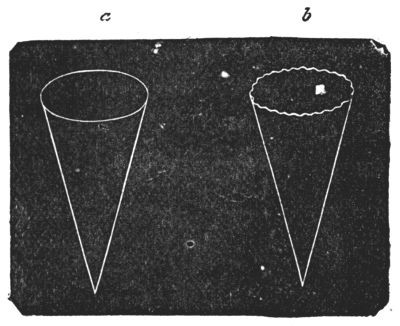
Fig. 27.
But this imaginary defined circle (which appears elliptic on account of the perspective) is but the mean of a series of oscillations around the pole of the world, which changes its position, as we have just shown. (Fig. 27, b.) These oscillations originate in the circumstance that the axis of the earth inclines alternately forward and backward, in such wise, that a star, after having approached the Pole, immediately afterwards recedes from it; they cause the terrestrial globe to resemble the head of a man who, by an alternation of gesture, says alternately yes and no. Only, while man (the puppet!) occupies but a second or two in affirming and denying the same thing, the earth employs about eighteen years and a half in inclining once forward to say yes (in Latin, adnuere), and once backward to say no (in Latin, abnuere). This is scientifically denominated the nutation of the earth.
Who was the fortunate mortal to discover a phenomenon so singular? Bradley, the English astronomer; the same who discovered the aberration of light. It was in the course of his researches to determine the annual parallax or distance of the stars that, at an interval of nineteen years, he made, in 1728, the discovery of the aberration of light, and, in 1747, that of nutation.
The reader may not be displeased to know under what circumstances he accomplished the latter discovery. While observing, for several successive years, the circumpolar stars, and notably the star γ in Draco,—a constellation situated between Ursa Major and Ursa Minor (see Fig. 2, p. 9),—Bradley noticed that this star changed its position by a movement constantly directed towards the north, from 1727 to 1736, or for a period of nine years. When it had reached the latter limit, the star appeared stationary for a moment, and then retraced its course in a southerly direction. Would it also occupy a period of nine years to arrive at the limit of this contrary excursion? Bradley affirmed that it would, and communicated his prediction to a French astronomer, Le Monnier.
How was Bradley led to appear in the new character of a seer?
By two special circumstances—the universality, and the duration of the phenomenon.
If the star γ in Draco had been the only one to direct its course towards the north, Bradley would probably have been led to believe that the Pole exercised upon it a peculiar attraction; but he perceived that many other stars rose in like manner towards the Pole with an uniform and constant march; it was, therefore, more natural to suppose that the Pole advanced towards them. And what strengthened the probability of this hypothesis was, that the stars situated in the neighbourhood of the course of the solstices exhibited a corresponding displacement. But there was already recognised as in existence a peculiar movement which explained the precession of the equinoxes. Was it necessary, therefore, to suppose a second, a kind of rotatory movement? Newton had already thought of it, by imagining a nutation, through which the Pole might alternately rise and sink on the plane of the Ecliptic in the space of a year. But the displacement which occurs in that interval is too slight to be perceptible to observation. There might, therefore, be a reasonable doubt of the accuracy of Newton's idea.
Bradley resumed the idea of his illustrious compatriot. He recognised in the northward movement of the stars the effect of a similar rotation, but one which took much longer in its accomplishment. By doubling the interval of nine years, to the term of which he had seen the movement become stationary, he obtained a period nearly approaching that which the moon employs in returning to the same nodes. This coincidence flashed upon him like a ray of light.
We must here remind the reader,—who, we hope, is not weary of our scientific or semi-scientific disquisition,—that the lunar nodes,—i.e., the points of the Ecliptic through which the moon passes when it proceeds from south to north (the ascending node), and from north to south (the descending node),—are the analogues of the solar equinoxes; the equatorial points through which the sun passes on its course from south to north (the spring equinox), and in returning from north to south (the autumn equinox),—points of intersection whose retrogradation constitutes, as we have seen, the precession of the equinoxes. Well, the moon's nodes retrograde in a similar manner by a movement directed from east to west; only it is a much slower movement. While the equinoxes are displaced but fifty seconds (50") in a year, the lunar nodes, during the same period, and in the same direction, move over a space of 19° 20' 29"; so that, in less than nineteen years, they have made the complete circuit of the heavens, to return to exactly the same point, after traversing 360°.
Thus, then, we have explained the data on which Bradley rested his prediction. It was confirmed by Le Monnier, who observed, in fact, that the star γ in Draco, and the neighbouring stars, observed by Bradley from 1727 to 1736, moving from south to north, occupied the same period of time, from 1736 to 1745, in accomplishing an equal excursion in a contrary direction, from north to south. These observations enabled him to fix approximatively the quantity of the nutation.
To sum up; it was recognised that the angle made by the axis of the terrestrial poles with the axis of the poles of the Ecliptic, far from remaining constantly equal to itself (the amount was 23° 27' 30" in the middle of the present century), varies by 0".48 yearly, and that this angle itself experiences a variation whose mean value is 48" in a century. It sometimes exceeds this mean value, and sometimes falls below it, by an amount which rises to nearly 9".65. Thus, while describing, in an interval of 25,000 to 26,000 years, its curve around the poles of the Ecliptic, the earth's axis describes, from east to west, a small ellipsis in the space of about eighteen and two-third years, and imperceptibly changes, moreover, its angle of inclination.
But, in fine, what is the true cause of all these movements?
Were the earth a perfect sphere, were all its radii of equal length, the effect of the universal ponderation would make itself felt as if all the material molecules were concentrated at a single point—the centre; and, apart from this ponderation, which exercises itself in the direct ratio of the masses, and in the inverse ratio of the square of the distances, nothing exists which would sway our globe in one direction rather than in another,—no precession of the equinoxes would take place, the plane of the Ecliptic would invariably coincide with the plane of the Equator, and an eternal spring would smile on the fortunate earth. The dream of the poet would be realised, and light would spread
"Through all the seasons of the golden year."
But, as observation shows, the contrary has taken place, since, besides its movements of diurnal rotation and annual revolution, the earth has its mobile axis, which is independently inclined and displaced. Thus, the material molecules of the planetary surface are not all at an equal distance from the centre; and, consequently, the earth is not a perfect sphere. It is, as D'Alembert has demonstrated, the bulging, equatorial portion which experiences, owing to the solar attraction, a retrograde movement, carrying onward the rest of the globe in a general march, called the precession of the equinoxes.
But this general movement, as we have seen, is, in itself, simply the mean of a series of oscillations, which D'Alembert has also connected with gravitation. He has shown that the nutation of the earth's axis results from the moon's attraction on the bulging portion of our globe. Finally, it has been mathematically demonstrated that the said bulging portion of the earth produces, under the continuous action of the sun, the precession of the equinoxes; just as this portion determines, by its continuous action, the nutation of the lunar axis. As in this universal ponderation all the wheelwork of the world catches (tous les rouages du monde s'engrènent), and the planets, such as Mars and Venus, must also have their share in the action, however weak it may be, we have contrived to render an exact account of the slow changes of the obliquity of the Ecliptic.
Let us resume. Movement and matter, all is ponderated.
Inasmuch as matter is unequally distributed around the earth's centre, being flattened at the Poles and bulging at the Equator, it follows that the sun's enormous weight makes it vacillate, so that it describes at its axis a cone around the poles of the plane of its orbit. Its movement we see in the heavens in the precession of the equinoxes. But the terrestrial axis traces it tremblingly, because the moon, owing to its vicinity, exercises a perturbing action on our planet, which, in its turn, exercises on the moon a still more energetic influence.
CHAPTER II.
WHAT MAY BE SEEN UPON THE EARTH.
"There lives and works
A soul in all things, and that soul is God."
—Cowper.
A solemn moment is it when the sap—that life-blood of the plant—arrested by the icy grasp of winter in its circulatory movement—receives a new impulse through the vivifying action of the central luminary of our system. What a subject for study and reflection!
It has been very finely dealt with by Longfellow.
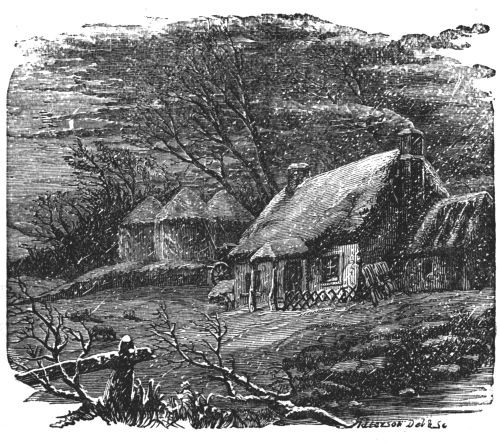
Fig. 28.—Landscape in Winter.
How wonderful! he exclaims,—and we only regard the wonder with indifference, because it is repeated annually,—how wonderful is the advent of spring!—the great annual miracle, as he calls it, of the blossoming of Aaron's rod, repeated on myriads and myriads of branches!—the gentle progression and growth of herbs, flowers, trees,—gentle, and yet irrepressible,—which no force can stay, no violence restrain,—like the influence of love, which wins its way, and cannot be withstood by any human power, because itself is divine power. True enough it is, that if spring came but once in a century, or burst forth with the terror of an earthquake, and not in silence, what wonder and expectation there would be in all hearts to behold the miraculous change! But now the silent succession suggests nothing but necessity. To most men, only the cessation of the miracle would be miraculous, and the perpetual exercise of God's power seems less wonderful than its withdrawal would be.
May we venture on another quotation? We take it, gentle reader, from a living poet, whose works are not so widely read as their genuine poetical feeling and wealth of language deserve—I mean Sydney Dobell.
After describing the return of Spring, and her grief and astonishment at the spectacle of earth, pale, frozen, seemingly dead, he continues,—
"She fell upon
The corse, and warmed it. The natural earth,
Which was not dead but slept, unclosed her eyes;
Then Spring, o'erawed at her own miracle,
Fell on her knees.
Meanwhile the attendant birds,—her haste outstript,—
Chasing her voice, crowd round, and fill the air
With jocund loyalty.
With flowers Spring dressed the Earth;
Then did her mother, Earth, rejoice in her;
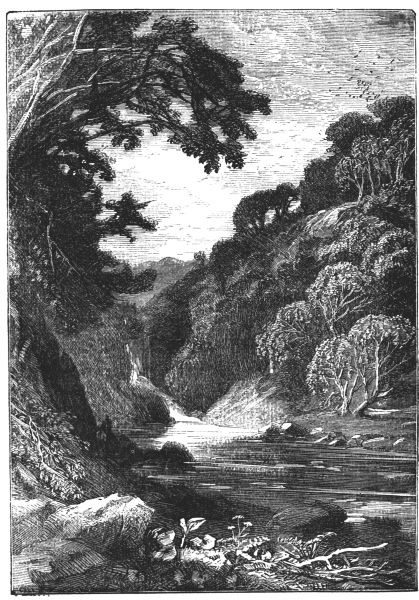
Fig. 29.—"The attendant birds crowd round, and fill the air."
And she, with filial love and joy, admired,
Weeping and trembling, in the wont of maids.
Meantime her pious fame had filled the skies.
He that begat her, the almighty Sun,
Passing in regal state, did call her 'child,'
And blessed her and her mother where they sat—
Her by the imposition of bright hands,
The Earth with kisses. Then the Spring would go,
Abashed with bliss,—decorous in the face
Of love parental. But the Earth stood up,
And held her there; and, these encircling, came
All kind of happy shapes that wander space,
Brightening the air. And they two sang like gods
Under the answering heavens."
We think that the ancients, if they had seriously reflected upon the important part played by the sun in the economy of nature; how it is the heart, and spring, and inner power of every movement and manifestation of life; how it is, as Sir David Brewster says, the centre and soul of our world, the lamp that lights it, the fire that heats it, the magnet that guides and controls it, the fountain of colour, which gives its azure to the sky, its verdure to the fields, its rainbow-hues to the gay world of flowers, and the purple light of love to the marble cheek of youth and beauty;—we think that the ancients, if they had thought upon, or had known, all this, would not have given the earth a chief place in our system. And that they did so is all the more strange when we remember that they attributed to the world a soul (the "soul of the world" is a favourite idea with the great philosophers of antiquity), and looked upon the planets as living creatures.
But they were swayed by that egotistical instinct which leads man to refer everything to himself, even the very gods which he has created after his own image. The Bible teaches us that there is but one God. Alas! are there not as many gods as there are men? Does not each of us create a deity in accordance with his own inclinations, his mode of thought, his degree of mental culture, the sphere of his ideas? Is the God of a tolerant philosopher identical with that of a bigoted fanatic? It is not so much due to a deceitful appearance, an optical illusion, as to a kind of innate infatuation, that the human race have come to consider the planet they inhabit as the centre of the universe.
Causes of the Circulation of the Sap.
Let us return to the sap, the life-blood of vegetation.
How is it that its movement does not recommence at the same time in all plants? Why are some clothed with leaves when the others are scarcely budding? Wherefore, in certain genera, do the flowers appear before the leaves?
Some authorities assert,—but facts show it to be a purely gratuitous supposition,—that the flower, which, with the fruit, seems to be the goal or object of vegetation, demands a greater activity on the part of the sap. But, in truth, many trees and shrubs, such as the poplar, the willow, and the hazel, flourish at an epoch when the sap is barely aroused from its protracted lethargy.
These are questions which have still to be answered.
But upon yet another question we may dwell at some detail. What is the cause of the circulation of the sap?
To the best of our knowledge, this important problem has never been propounded as it should have been. And for this reason: all observers who have taken up its consideration have had in view only the rising sap, and the cause of its rising. Evidently this is but a part of the problem. The ascending sap, after undergoing an important modification in the leaves, becomes the descending sap; just as the venous blood is transformed, on coming into contact with the air in the lungs, into arterial blood. It is this alternative movement of going and coming which constitutes the circulation both of the sap and the blood, and which ceases completely only with the life of the plant or the animal. We must, therefore, bear in mind,—which has not been hitherto done,—these two opposite, yet indissolubly connected, movements, before we can approach with advantage the solution of the proposed question.[40]
Science consists in discovering, among the different ways of looking at things which present themselves to the mind, the one which appears to explain most clearly the phenomena submitted to observation. He who doubts the accuracy of our remark need only join us in reviewing the different opinions enunciated up to the present time on the cause of the rise of the sap.
Grew, an English botanist, a contemporary of Newton, and his fellow-member in the Royal Society of London, attributed the rise of the sap to the play of the utricles of which the plant is composed. These utricles, he said, maintain a close intercommunication; through their contraction, the sap passes from the lower to the upper, and thus arrives almost at the top of the plant. Grew's authority carried conviction to the minds of many botanists, particularly to those of his compatriots. Yet was his opinion altogether imaginary; the supposed contraction of the utricles does not exist.
La Hire, a French botanist, who flourished at the beginning of the eighteenth century,—son of the geometrician of the same name,—pretended that he could account for the rise of the sap by the play of the little valves with which the interior of the sap-vessels was furnished; at the same time he assigned a very active rôle to the fibres of the roots. The fibres elevate, he said, the whole column of superimposed liquid, incessantly introducing, by a kind of suction, new fluids into the organs.
Unfortunately, the "play of the little valves, with which the interior of the sap-vessels is furnished," is a pure invention of La Hire's. Instead of growing wise by experiment, he suffered himself to be led astray by a false analogy. Valves are found in the veins of man and the mammals; but no one has ever seen the sides of the vessels of a plant garnished with valves to induce a circulation of the sap.
Mariotte, so well known by his researches into the compressibility of air, represented the rise of the sap as dependent upon what he called "the attraction taking place in the narrow tubes"—upon what, in fact, we now term capillarity. "This first entrance of water into the roots is in obedience," he said, "to a law of nature; for wherever very narrow tubes exist which touch the water, it enters into them, and even rises, contrary to its natural inclination."
Many botanists adopted the opinion of Mariotte. But if it were well founded, all capillary bodies, even inorganic ones, ought to present a circulatory movement analogous to that of the sap. Now, this is not the case. A body must be animated, must be living, for attraction to take place in the narrow tubes, and to produce a movement comparable to that of the nutritive liquid.
Malpighi attributed the rise of the sap to the alternating rarefaction and condensation of this liquid by heat; Perrault, to a kind of fermentation; De Saussure, to a peculiar irritability of the vessels. Of these three hypotheses, the first is purely physical; the second, chemical; the third, vital. So, as we see, there is something for everybody—chacun à son gout!
The same question has, in our own day, been taken up from a new point of view, on the occasion of Dutrochet's discovery of the endosmose. This philosopher was one of the first to perceive that two liquids, separated from one another by a membrane, quickly effect or induce a current which always carries the thinner liquid towards the denser, and ends by mingling the two completely. "It is endosmose," he said, "which produces at one and the same time the progression of the sap by impulsion, and its progression by affluxion. The sap would receive its impulse in the spongioles of the roots; thence would be carried towards the upper parts by the turgescence of the organs—by the affluxion, which would thus act as a forcible mode of suction."
The basis of this theory is, that the sap contained in the upper parts will be more concentrated or denser than that in the lower portions of the same plant. But this is a mere supposition. And even this supposition has been swept away by the recent experiments of Hartig and others, which show that the difference in density between the two saps is not only almost null, but in many ligneous plants the lower sap is, on the contrary, denser than the upper.[41]
Finally, and more recently, M. Joseph Boehm has put forth a theory which offers some points of analogy with that of Grew. According to Boehm, the rise of the sap is the effect of a suction, the cause of which must be sought both in the atmospheric pressure and in the transpiration which takes place through the organs, and notably through the leaves of the plant. The part which he attributes to the cellules, of which the organs are composed, he thus describes:—"When the superficial cellules of the plant lose water by transpiration," he says, "of two things, one will happen: either these cellules will contract and shrivel, or they carry up, by a kind of aspiration, to the neighbouring cellules, situated in deeper layers, a quantity of water equivalent to what they had lost. In the normal condition, the latter is always the result; each cellule takes from its neighbour what itself has lost, and this action, becoming more and more general, is continued from the leaves to the extremities of the roots. The cellules of the spongioles replace the water which they have yielded, from the humid medium surrounding them."
In support of this theory,[42] M. Boehm has made several experiments, which, we fear, will not carry conviction to every mind.
In the different theories which we have been attempting to explain, their authors, as it seems to us, have neglected an essential element—the life of the plant. Then, the experiments undertaken by way of proof, have been made upon cut stems or branches, which, consequently, did not enjoy their integral vitality. In fact, the results indicated could just as well have been obtained with inert as with living matter.
Taking into account all these considerations, we are doubtful whether any value can be placed on the theories just enunciated. Undoubtedly, physical causes, such as capillarity, heat, evaporation, atmospheric pressure, electricity, have a certain marked and constant action. But this action is here complex; it is found combined with a new force, whose effects constitute precisely the profound difference which exists between the massive mineral framework of the globe and the transitory beings peopling its surface. It matters little whether we call it vital force, or otherwise; sufficient that it exists. We must, therefore, allow for its influence when endeavouring to explain the varied movements of which plants, as well as animals, may be the seat.
A.—Plants.
The Daisy (Bellis perennis).
"Wel by reason men it call maie
The daisie, or els the eye of the daie."[43]
Among all the treasures of the floral world, that which should excite in each of us the tenderest emotion, and most readily stir up in our minds thoughts too deep for tears, is the Daisy,—that favourite of our innocent and happy childhood.
Ah! would we were now as content with simple joys as in the days when that wee, modest, crimson-tipped flower was to us a beauty, a prize, and a charm!
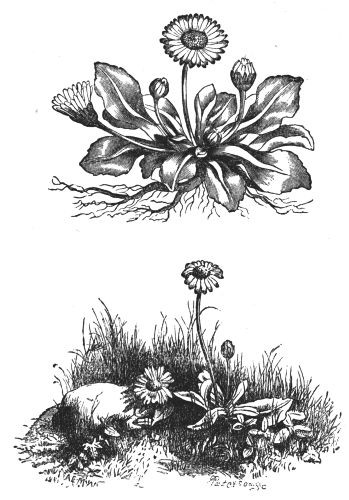
Fig. 30.—"The Daisie scattered in each mead and down."
We wonder how many of our poets have done homage to the sweet and simple "nursling," or rather, whether by any true poet it has been neglected. Cowper reminds us that in
"The spring and play-time of the year"
the village-wife and her little ones go forth to
"Prank their hair with daisies."
James Montgomery, whose admiration of nature is somewhat frigid, can yet remind us that—
"The rose has but a summer reign,
The daisy never dies."
Chaucer warms into enthusiasm when he thinks of its pastoral, innocent gracefulness ("simplex munditiis"):—
"So glad am I when in the Daisy's presence,
That I am fain to do her reverence;
For she of all sweet flowers is the flower
With virtue filled, and honourable power;
For ever fair alike, and fresh of hue,
As well in winter as in summer new."
Let us not omit a reference to quaint but genial William Browne:—
"The Daisie, scattered on each meade and down,
A golden tuft within a silver crowne:
Fair fall that dainty flower! and may there be
No shepherd graced that does not honour thee!"
Yes! let no poet be taken to your heart of hearts who has no love for the "flower white and rede,"—in French, called "La Belle Marguerite,"—
"The op'ning gowan, wet wi' dew,"
—Burns's "bonnie gem,"—the flower of the meadow and the lea, of the woodland and the vale.
A modest, unassuming flower, destined to be trodden under the feet of the thoughtless, it withstands the rigorous breath of winter, is beautiful throughout the circle of the year—Bellis perennis, as the Swedish botanist not infelicitously called it. Its vegetation is arrested only during the harshest frosts; but it resumes its living growth as soon as it becomes sensible of the first rays of the spring-time sun.
It is at the moment of nature's awakening, about "the solemn Easter-tide," that this "sweet nursling of the vernal year" displays all the simple coquettishness of its chaplet of flowers,—that chaplet which has also procured for it the name of the tiny "Marguerite,"—that is, "little pearl,"—a name which the French have adopted from the Latin—Margarita.
Here let us pause, and propound a question.
How would you propose to test the real character, the genuine nature, of friend or acquaintance?
Your answers, dear readers (believe me, I hear them clearly!), are very various. Some of you say, that the best means of sounding the depths of the human heart is by bringing before it a misery which needs to be relieved. Others recommend the bestowal of a benefit. But such processes of analysis appear to me far from being infallible; too wide a margin is left for the operation of sentiments of pride or vanity. Why not conduct the man whose real character you wish to discover into a meadow enamelled with sparkling daisies? Thus you would impose upon nature the task of interrogating him. If he manifest feelings of indifference, you will do well to regard him with suspicion: take care how you admit him into your intimacy; for his heart must be cold, and his mind troubled—
[40] The best means of ascertaining the coexistence of an ascending and descending sap have been indicated in "The Circle of the Year," pp. 163-8.
[41] See the Botanische Zeitung ("Botanical Gazette") for the years 1853, 1856, 1859, and 1861.
[42] Boehm, "Sur la Cause de l'Ascension de la Séve," Mémoire communiqué à l'Académie des Sciences de Vienne, juillet 1863.
[43] Chaucer.
"The man that takes not daisies to his soul
Is fit for treasons, stratagems, and spoils."
But to return to our daisy. Observe how, by its organs, it yields itself—in anticipation, as it were—to its fate. And, first, its long and fibrous roots anchor it so solidly in the soil that the cattle which browse it cannot tear it up. Next, its stem is so short that it seems to be blended with the roots; one might almost doubt whether any existed. But, if you look at it more closely, you may readily assure yourself that the stem is the point whence issue the recumbent branches which bear the leaves. Why does not the daisy boast of stems erect and free? Would they not be incessantly bent or broken by the merry troops of children who love to play and dance upon Nature's carpet, the soft green sward?
The leaves of our daisy, then, seem to issue directly from the roots, without the intermediary of an apparent stem, which must not be confounded—recollect this, dear reader!—with the stalk or peduncle that bears the crown of petals. These leaves in form resemble tiny crenelated spatules, with the handles flattened, and the edges trimmed with little hairs or fibres. The peduncle, too, seems to start immediately from the roots. The principal part of the peduncle is surmounted, as already hinted, by the flower, to which we next direct our inquisitive and searching gaze.
What shall we call it? To what shall we liken it? To a gilded button framed in a pearl. This button, this "yellow eye," as Tabernæmontanus, a botanist of the sixteenth century, named it,—the "eye of day" of our old poets,—a drop of gold in a rim of silver,—is not like any other flower; is quite a world or system of Lilliputian blossoms, each of which is represented by a miniature tube, yellow at the summit, and of a greenish white at the base,—the said tube being the union, or combination, of the tops or summits forming the central gem, the gilded button, the drop of gold. You may readily note this arrangement in the larger variety of daisy, the Chrysanthemum leucanthum of Linnæus,—two Latinised Greek words which signify, literally, "golden-blossomed white flower."
If you doubt whether each of these tiny tubes be a flower, you have only to analyse them with the assistance of your ever-useful lens. The analysis of one will suffice; for all the others resemble it. Now, with your penknife, split the tube throughout its entire length: you will thus lay bare all the parts which enter into the composition of a veritable flower, commencing with the most conspicuous. Through the magnifying glass you can see five stamens,—free as regards their short filaments, but united by their elongated anthers; a characteristic which gives name to the great family of the Synantheraceæ, of which family our daisy is an honoured member;—a bifid (i.e., cloven in two) style traversing the middle of the anthers, which form for it a kind of sheath (see Fig. 31, a);—a monopetalous, tubular, and obscurely bilabiated (two-lipped) corolla, inserted at the summit of an unilocular (one-lobed) ovary, which is attached to the calyx (see Fig. 31, b). In these tiny flowers, then, which we call in Latin flosculi, in French fleurons, in English florets, nothing is deficient. As they are shaped like tubes, we call them, by way of distinction, tubulifloral.
But what are these white rays, lightly shaded with pink, which enclose or encircle the florets? (See Fig. 32, a.) Examine them at their points of insertion. You will perceive there some traces of reproductive organs, among which the style is most prominent. As for the corolla, it is represented only by its brown lip, which is immeasurably developed. It is this exaggerated development which constitutes the white rays, or petals, that prove so attractive to the eye. (See Fig. 32, b.) Do not forget to observe, by the way, that they are rose-tinted only on the side which directly undergoes the action of the light. To distinguish them from the tubular florets,—the tubulifloræ,—these "white rays" have been called ligulate florets, or ligulifloræ.
The complete flowers (or the florets) and the rays (or partially abortive flowers) form, in their aggregate, what our botanists have agreed to call an inflorescence of the capitula. Disposed quincuncially on an ovoid receptacle, or phoranth, both are grouped (Fig. 32, c) in alternating rows.
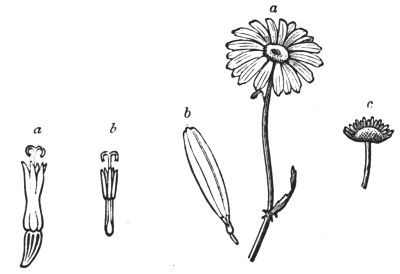
Fig. 31.Fig. 32.
To explain thoroughly this species of inflorescence, we will venture upon an hypothesis. Let us suppose that we could elongate the said ovoid receptacle as if it were a ball of wax,—it would be changed into a sheath-like inflorescence; all our smaller florets, whose union composes what is improperly called the flower of the daisy, would be ranged around an elongated, instead of being placed upon a flattened axis. This axis characterises all the Synantheraceæ of the family of the Compositæ (a sub-order); sometimes naked, sometimes garnished with varied hairs, either shrunken or persistent, it has furnished several characters useful in the classification of genera and species. But possessed with a mania for complicating everything, botanists designate it indifferently receptacle, phoranthe, clinanthe, etc. Why not employ one and the same word to distinguish one and the same thing? Why not have preserved the name axis, and have attached to it such qualifying terms as might be necessary to indicate simple differences of forms?
The ancients looked upon nature,—I cannot sufficiently insist upon this theme,—with quite other eyes than we do. The study and description of characters, so indispensable to our classifications and nomenclatures, appeared to them a useless labour; they had not even an idea of its value. But it was of signal importance to them to investigate the virtues and properties of plants, so far as they might be rendered available for the preservation of health and the cure of disease.
Our daisy is common in Greece. Theophrastus, therefore, ought to have known it, though he does not refer to it. It is common also in the plains of Italy. Pliny was the first to describe it, under the name of bellis; he attributes to it the properties of the St John's wort.[44] And it is noteworthy that the daisy belongs to the same family as the latter; a circumstance certainly not known in the days of Pliny.
The botanists of the sixteenth and seventeenth centuries are by no means niggards in the eulogiums which they lavish on the medicinal properties of our graceful Synantheracea. Bock (better known, perhaps, under the name of Tragus, a Goat), who mistook the yellow anthers for the seeds, recommended the leaves of the Gänzeblume (goose-flower, as he called it) as a laxative. Tabernæmontanus prescribed them as a remedy for cramps in the stomach and the spitting of blood.
Ray, who expresses his astonishment that the Greeks had not spoken of it, looked upon the daisy as an excellent vulnerary. "Externally," says he, "we employ it with success in the form either of a poultice or a fomentation; for internal treatment, we mix its juice with vulnerary potions."—These properties procured it the name of Consolida minor, which would make it the pendant of the larger Consolida, Symphytum officinale, a species of the Boraginaceæ, very common in damp and shady localities.
Ruel recommended cataplasms of daisies and cowslips for gout and scrofulous tumours. Chomel affirmed that he knew by experience that the flowers of the daisy and the herb robert[45] (Geranium Robertianum), if dried in a hot dish, and applied to the head, considerably relieved headache.[46]
Wepfer set great value on a mixture of daisy, cress, and rummularia in the treatment of pneumonia; and Michaelis assures us that he had cured dropsies by the use of the flowers of the daisy cooked as a broth.
Tournefort, who was very partial to this kind of observation,—now repudiated by our botanists,—says, that the daisy, taken as a warm drink or a decoction, quickens the blood when congealed by a very severe attack of cold, as happens in pneumonia; it removes obstructions, facilitates the circulation, and gives the fibres an opportunity of recovering their elasticity.[47]
Garidel sums up in the following words the result of his personal observations:—"I have frequently remarked that the juice of the daisy acts as a laxative, and even as a purgative; the decoction does not have that effect so often as Schroeder observes, who says that mothers frequently give the leaves as a gentle aperient to their children.... Care should be taken not to administer this remedy indifferently to all pleuretics, nor at any season; for if we give it when the expectoration is easy, we run the risk, by the employment of a laxative at a wrong time, of spoiling everything, and checking the expectoration. This I have seen occur in several cases, where the remedy had been administered by a hermit."[48]
Can it be true that the commonest plants are the most useful? Nature is quite capable of affording us these surprises; nature, who, by her shifting and proteiform movements, never ceases to laugh at human theories. But men, as was said long ago, have eyes, though not to see; and everybody also knows, from his own experience, that he has ears, not to understand!
However this may be, the daisy, which, as we have seen, was formerly so extolled for its officinal properties, is now-a-days completely ignored by physicians. What, then, are we to conclude? That all the remedies in vogue—melancholy to confess!—are an affair of fashion. When men shall have resumed perukes, and women abandoned chignons for furbelows, we shall remember, perhaps, the virtues of the lowly, tender daisy.
We cannot take leave of our favourite wild-flower without repeating Wordsworth's beautiful stanzas. He takes as his motto a fine passage from Wither, quaint old George Wither:—
"Her [the Muse's] divine skill taught me this,
That from everything I saw
I could some instruction draw,
And raise pleasure to the height
Through the meanest object's sight.
By the murmur of a spring
Or the least bough's rustelling;
By a daisy whose leaves spread
Shut when Titan goes to bed;...
She could more infuse in me
Than all Nature's beauties can
In some other wiser man."
On this hint our great meditative poet speaks, and speaks most tenderly and truly:—
"In youth from rock to rock I went,
From hill to hill, in discontent
Of pleasure high and turbulent,
Most pleased when most uneasy;
But now my own delights I make,—
My thirst at every rill can slake,
And gladly Nature's love partake
Of thee, sweet daisy!...
"By violets in their secret mews
The flowers the wanton zephyrs choose;
Proud be the rose, with rains and dews
Her head impearling;
Thou liv'st with less ambitious aim,
Yet hast not gone without thy fame;
Thou art, indeed, by many a claim,
The poet's darling.
"If to a rock from rains he fly,
Or, some bright day of April sky,
Imprison'd by hot sunshine lie,
Near the green holly,
And wearily at length should fare;
He need but look about, and there
Thou art! a friend at hand, to scare
His melancholy.
"A hundred times, by rock or bower,
Ere thus I have lain couch'd an hour,
Have I derived from thy sweet power
Some apprehension;
Some steady love; some brief delight;
Some memory that had taken flight;
Some chime of fancy, wrong or right,
Or stray invention....
"Oft do I sit by thee at ease,
And weave a web of similes,
And weave a web of similes,
Loose types of things through all degrees.
Thoughts of thy raising;
And many a fond and idle name
I give to thee, for praise or blame,
As is the humour of the game,
While I am gazing.
"A nun demure, of lowly port,
Or sprightly maiden of Love's court,
In thy simplicity the sport
Of all temptations;
A queen in crown of rubies dress'd;
A starveling in a scanty vest;
Are all, as seem to suit thee best,
Thy appellations.
"A little cyclops, with one eye
Staring to threaten and defy,—
That thought comes next; and instantly
The freak is over;
The shape will vanish, and, behold!
A silver shield with boss of gold,
That spreads itself, some fairy bold
In fight to cover.
"I see thee glittering from afar,
And there thou art a pretty star;
Not quite so fair as many are
In heaven above thee!
Yet like a star, with glittering crest,
Self-pois'd in air, thou seem'st to rest:
May peace come never to his breast
Who shall reprove thee!"
We may add that we know but of four references to the daisy in Shakspeare. In Cymbeline, act iv., scene 2:—
"Let us
Find out the prettiest daisied plot we can."
In Love's Labour's Lost, act v., scene 2:—
"Where daisies pied[49] and violets blue
Do paint the meadows with delight."
Again, in Hamlet, act iv., scene 7:—
"There with fantastic garlands did she come
Of crow-flowers, nettles, daisies, and long purples."
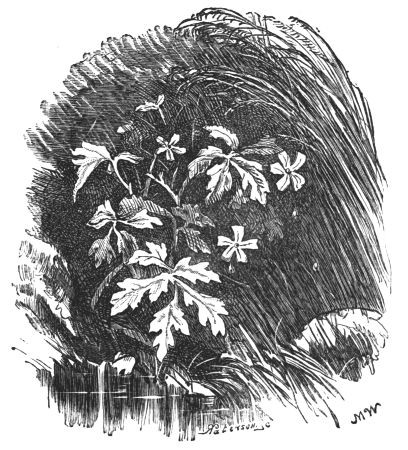
Fig. 33.
And, lastly, in Hamlet, act iv., scene 5:—
"There's a daisy; I would give you some violets, but they withered all when my father died."
In Milton there are but two allusions. In the Masque of Comus:—
"By dimpled brook and fountain-brim,
The wood-nymphs, deck'd with daisies trim,
Their merry wakes and pastimes keep."
And in L'Allegro:[50]—
"Meadows trim with daisies pied."
The Tulip.
"The pied windflowers and the tulip tall."
—Shelley.
It is probable that, for the majority of floral amateurs, the name of the tulip is inseparable from a plant which, with the hyacinth and the lily, becomes, in the merry spring-time, the ornament of our gardens. Yet, towards the end of March, the observer will occasionally discover, in the woods and groves, the wild tulip,[51] the Tulipa sylvestris of Linnæus, which may, perhaps, be very properly taken for the type of a small tribe of the Liliaceæ. It is easily recognised by its flower, which resembles a large yellow campanula, slightly green on the exterior. Like all plants of the same family, it has but a single floral envelope or perianth, which may be either a corolla or a calyx as you will. The initiated protest and asseverate that it is a calyx; but the profanum vulgus, who compose the majority, will have it to be a corolla, on account of its colouring. To cut the knot, and please all parties, our beautiful floral envelope has been denominated a petaloid perianth.
The divisions of this perianth, six in number, may, in truth, be considered as petals; they are detached down to the base, and full in proportion as the pistil is developed. The latter is composed of three stigmata, attached, without the intermediary of a stylus (sessile stigmata), to a free ovary (that is, an ovary not joined to the perianth), which, as it develops, forms a capsule with three angular projections marking so many lobes; each of these lobes includes a great number of compressed seeds. As in all the Liliaceæ, and in many other vegetable families, the stamens, six in number, are hypogynous,—that is to say, inserted at the base of the division of the perianth. The stem, nearly two feet in height, bears a single flower only: the leaves are lanceolate, like all of the family, and the root is formed of a bulb, with thin and brownish-coloured external tunicæ.
Is the wild tulip an original species, or only a degenerate variety of the cultivated tulip (Tulipa Gesneriana)? The question is one not very easily solved.
It is generally admitted that the cultivated tulip,—which everybody knows,—was introduced into Europe from the East, towards the middle of the sixteenth century. It is, at all events, certain that none of our older botanists speak of our wild tulip. Dodonnée himself refers to the Eastern tulip only, of which he was the first to give, in his "Historia Stirpium," a tolerable delineation.
A circumstance which would favour the belief that the tulip was imported from the East is the Oriental derivation of its name: tulipa, in Italian tulipano, comes to us, it is said, from the Turkish tuliband, or the Persian dulbend, whence is obtained, by corruption, turban, the characteristic head-gear of the Orientals. Thus, at bottom, tulip and turban are the same word, only altered in form.
Who does not know with what a glory of colours the skill of our horticulturists has succeeded in clothing the tulip?
Inasmuch as the cultivated species bears the distinctive addition of Gesneriana,—and of this species all existing tulips are but varieties,—we might reasonably suppose that Gesner, the celebrated Swiss naturalist (who died at Zurich, aged sixty-nine, in 1565), was the first to speak of it. But he makes no allusion to it in his "Historia Plantarum" (printed at Bâle in 1541); he only refers to it in his "Additions" to the works of Valerius Cordus, published in 1561.
We subjoin a literal translation of the words of Conrad Gesner:—
"In the year 1559, at the beginning of April, I saw at Augsburg, in the garden of F. H. Herwart, magistrate of that town, a plant whose seed had been brought from Constantinople, or, according to some, from Cappadocia. It was called tulip."
About the same epoch, this plant was cultivated at Vienna, in the gardens of some wealthy amateurs; whence several tulip-bulbs were afterwards sent into England.
This ornamental plant, whose splendour is of such brief duration, became, towards the middle of the sixteenth century, the object of a commercial speculation, which marks an epoch in horticultural annals. The towns of Amsterdam, Haarlem, Utrecht, Alkmar, Leyden, and Rotterdam, were the head-quarters of the new trade.
The years 1634 to 1637 marked its apogee, its culmination; it was the reign of the tulipomania,—a malady which, notwithstanding its severity, does not figure among our pathological nomenclatures. Bulbs of the variety called Viceroy were sold for 3000 florins (£235) each; and amateurs paid even as high as 5000 florins (£430) for the Semper Augustus variety! Those who had not the needful amount of ready money disposed of their goods, their cattle, and their furniture. And not only the horticulturists, but the seamen, and artisans, and servants, plunged headlong, into this frantic gambling. Tulip bulbs were then as eagerly sought after as shares in the company of the Mississippi in the days of Law,—or in the South Sea Stocks, also set afloat by that ingenious financier.
But it was not so much a love of flowers as a lust of speculation which lay at the bottom of this famous mania. For example, a gentleman engaged a merchant to deliver, at the end of six months, a bulb worth 1000 florins. When the time came, the price of the bulb had either gone up or down, and the contractor paid only the difference; as for delivering the wares, neither party cared about it. It was, therefore, the exact equivalent of a speculation in the funds or in railway shares. The transactions took place on the public exchanges, as well as in coffee-houses, inns, and on the promenades. They originated a fertile crop of abuses, and to put an end to them the intervention of the Government was required.
However, we may cite several examples of distinguished men who have cherished a partiality for the tulip, in the better sense of the word. Among these was Justus Lipsius, the great philologist. In his garden he cultivated with his own hands, it is said, the rarest varieties, and his floricultural tastes were shared by two of his intimate friends, Dodonée (Diodati) and L'Écluse, the two most illustrious botanists of their time.
But all these details, however curious and interesting, do not teach us whether our wild tulip has sprung from the cultivated germs. As it is impossible to solve this problem experimentally, we are forced to be satisfied with a simple conjecture.
And, for our own part, we are strongly of opinion that the wild and cultivated tulips may, from their very origin, have co-existed independently of one another. And now to put forward a fact in support of this statement.
The Heliotrope.
With the Heliotrope every lover of flowers is familiar; it is not less prized for its delicate fragrance than the tulip for its glowing colours. No doubt exists as to the country from which we have imported the cultivated heliotrope, nor as to the epoch when it was introduced: it came from Peru, whence the name given to it by Linnæus, Heliotropium Peruvianium; and was brought into Europe, in 1740, by Joseph de Jussieu. Although not known in Europe above a hundred and thirty years, it is now an "old, familiar face" in every garden. Now, by the side of the cultivated species, a native of the New World, we can place a wild variety, indigenous to the Old World, common in our own country, and, indeed, in all the countries of temperate Europe; whence it has received the appellation of Heliotropium Europæum.
The European species, let me state, is in every respect similar to the Peruvian species, except that its flowers are inodorous and of a paler blue. Yet it was known before the discovery of America,—before the discovery of those regions from which we have obtained the cultivated heliotrope. Thus, the two varieties have existed contemporaneously, and have flourished independently of each other, from their very origin. Why should not such be the case with the wild and cultivated tulip?
The Anemones.
From our Spring posy the delicate Anemones must not be omitted. More than twenty species are cultivated in Great Britain, and I hardly know to which I would give the preference. They are called by that most unmeaning term, "florist's flowers," and from the attention bestowed upon them, the cultivated varieties have been greatly improved. But you and I, dear reader, will go forth into the "wild woods," and enjoy the rich gifts of nature untampered by horticultural science. It is towards the end of March that the wood anemone (Anemone nemorosa) begins to expand its graceful leaves and snow-white buds to the stray sunbeams that force their way through the embowering branches of stately elms and spreading beeches, and in April it has attained its full glory, contributing largely to the beauty and the show which then embellish the forest glade. Snow-white, and faint rose-red, and soft delicate lilac,—these are the prevailing hues of its tender petals.
It is said that the wood anemone never blossoms earlier than March 16, and never later than April 2. It opens out its loveliness to the sun about the same time as the swallow returns from the genial South to our land of pleasant verdure. Country children associate it with the appearance of the cuckoo, and call it the "cuckoo flower," but the "wandering voice" is later than the woodland blossom in its welcome to the spring.
Why is it called Anemone? Of course, the English name is derived from the Greek άνεμος, "wind;" but what connexion is there between the wind and the flower? Credulous old Pliny asserted that it never bloomed except when the wind blew. Some of our botanical writers explain that it shivers and bends before the winds of March and the breezes of April. Others remind us that though generally found in the shelter of the groves, it will thrive lustily in windy and exposed localities. But I suspect the true reason of the name is its peculiar sensitiveness to atmospheric changes. As a foreteller of the storm it is not less trustworthy than a barometer, never failing to fold up its exquisite petals when the winds are gathering over the distant hills.
Our plant is considered injurious food for cattle; and it was on account of its unwholesome properties, perhaps, that the Egyptians regarded it as an emblem of sickness; or the idea may have been suggested by its frail and feeble appearance.
The yellow wood anemone is a rare and beautiful variety, which I have sometimes met with among the chalky downs of Kent. Its botanical designation is Anemone ranunculoides.
A still richer species is the Anemone pulsatilla, or Pasque Flower Anemone; a silky downy plant, easily recognised by its blossom of glowing purple. The blue mountain anemone (Anemone Apennina) is only to be found, as its name indicates, on the bold rugged sides of lofty mountain-heights.
The Anemones belong to a very important order,—the Ranunculaceæ, or Crowfoot family,—which is divided into five sub-orders: 1. Clematidæ; 2. Anemoneæ; 3. Ranunculaceæ; 4. Helliboreæ; and 5. Actœæ, or Pœniæ. Linnæus distinguishes forty-one known genera, comprising a thousand species. There are nine British genera of Anemoneæ.
In Drayton's "Poly-Olbion" occurs a rich descriptive passage,—an exquisite "flower-piece,"—which, on account of its beauty, deserves to be better known, and more frequently quoted. The poet is enlarging upon the floral rites which were celebrated at the espousals of the rivers Thame and Isis, and sets before us a bright bevy of Nymphs and Naiads; engaged in twining "dainty chaplets" to deck the persons of the bride and bridegroom. The stalwart Thame,—so it seems to them,—should not be "dressed with flowers to gardens that belong," but with blossoms plucked from his own meads and pastures. As most of those selected are fit for a spring-time nosegay, we may well enrich our pages with quaint old Drayton's enumeration of them:—
"The Primrose placing first, because that in the Spring
It is the first appears; then only flourishing;
The azured Harebell next with them they neatly mixt,
T' allay whose luscious smell they Woodbine placed betwixt.
Among those things of scent there prick they in the Lily,
And near to that again her sister Daffodilly.
To sort these flowers of show with others that were sweet,
The Cowslip there they couch, and the Oxlip for her meet;
The Columbine amongst them they sparingly do set,
The yellow King-cup, wrought in many a curious fret;[52]
And now and then among, of Eglantine a spray,
By which again a course of Lady-mocks they lay;
The Crow-flower, and thereby the Clorra-flower they stick,
The Daisy over all those sundry sweets so thick,
As Nature doth herself to imitate her right;
Who seems in that her 'pearl' so greatly to delight,
That every plain therewith she powdereth to behold.
The crimson Darnel-flower, the Blue-bottle and gold,
Which, though esteemed but weeds, yet, for their dainty hues,
And for their scent, not ill, they for their purpose choose.
Thus, having told you how the Bridegroom Thames was drest,
I'll show you how the Bride, fair Isis, they invest."
Here the poet resorts to the garden for his decorative wreath, but is careful, as we shall see, to eschew "florist's flowers," and to select only our dear old favourites:—
"The red, the dainty white, the gaudy Damask Rose,
The brave Carnation, then, of sweet and sovereign power
(So of his colour called, although a July flower),
With the other of his kind, the speckled and the pale;
Then the odoriferous Pink that sends forth such a gale
Of sweetness, yet in scents as various as in sorts;
The purple Violet then the Pansy there supports;
The Marigold above t' adorn the arched bar;
The double Daisy, Thrift, the Button-Bachelor;
Sweet William, Sops in Wine, the Campion, and to these
Some Lavender they put, and Rosemary, and Bays;
Sweet Marjoram with her like, sweet Basil rare for smell,
With many a flower whose name were now too long to tell."
If our space permitted, we should like to gossip awhile about each of the flowers commemorated by our old poet, for to each attaches some legend, or romantic tradition, some rural observance, or sweet poetical association. But we must continue our researches, and they bring us now to the Arum.
The Arum.
To the French the Arum is commonly known as the Calf's foot (Pied de veau). It is a common enough plant, growing on the borders of the wood, and delighting especially in the shade of the hazel trees, but it bears not the slightest resemblance to the hoof of any quadruped whatsoever, unless, indeed, to a very fervid imagination there should be visible a shadowy similitude in its leaf.
And it is, in truth, asserted—but, not having the eye of faith, the editor cannot see any ground for the assertion—that its sagillate or arrow-headed leaves, marked by a strongly-defined midrib, bear a certain likeness to the "under bi-ungulated face" of the foot of a young ruminant. Appearing in the early days of spring, they contrast agreeably, by their shining verdure, with the colour of the dead leaves heaped up at the base of the hedgerows. Simultaneously with its leaves comes forth a curious organ,—rare in vegetables of temperate regions, common in the tropical palms, and characteristic of the family of the Aroidaceæ, to which our Arum belongs. This organ, rolled up in a coil or spiral, is named the spathe. It protects the flowers in their young state, and, as they are developed, gradually falls off. Its colour is a greenish yellow; at the summit it is sometimes streaked with purplish veins, and at the base it swells out in a globose fashion.
A small thermometer, introduced into the interior of the rolled-up spathe, indicates a rise of temperature equal to one or two degrees above that of the external atmosphere. Whence comes this difference? Because in the spathe is frequently found imprisoned another organ, the seat of the mystery of reproduction. This organ is a fleshy axis, on which are arranged the flowers in two distinct rings; the upper is occupied by the stamens, reduced to simple anthers (sessile stamens); observe the filamentous appendages—they are abortive ovaries. These same appendages also surmount the lower ring, where several rows are set of sessile ovaries; each ovary composed of a single lobe, containing a very small number of ovules, the majority of which miscarry as the ovaries become metamorphosed into bright red berries: these are the fruits which appear in autumn; they form a spike or ear of coral, each containing, ordinarily, a single seed. The flowers, as a consequence of this separation of the two sexes, are monœcious; the succulent axis which bears them is called a spadix.[53] On tearing open the spathe, our glance first rests upon the apex of the spadix, which has a club-like form, and is of a beautiful violet-red colour. The two rings of sexual organs have much less attraction for the profane; the lower ring, loaded with female flowers, is more prominent than the upper ring, which bears the male flowers.
The root of our Arum also deserves a particular examination. It is a white tubercular stock or stem, containing a quantity of fecula, mixed, as in the West Indian manioc, with an acrid poisonous principle which produces a burning painful heat in the throat. This injurious principle is destroyed by exposure to the fire, and by repeatedly boiling the plant in water. After being thus heated, there remains only the fecula, in the form of a white powder, which, in times of scarcity, supplies a very nutritious food. "I made use of it," says Bosc, "during the storms of the Revolution, when I had taken refuge in the solitudes of the forest of Montmorency. This plant is so abundant in this forest, and in many other localities, that, at the epoch I speak of, it would have ensured the subsistence of several thousands of men, if they had known its alimentary properties. I was seriously counting on the resources which it would place at my disposal, when the death of Robespierre relieved me from my difficulties."[54]
Our arum, which we have taken as a type of the family of the Aroidaceæ, is called maculatum, or "spotted," in allusion to the white and violet spots with which its leaves are besprinkled.
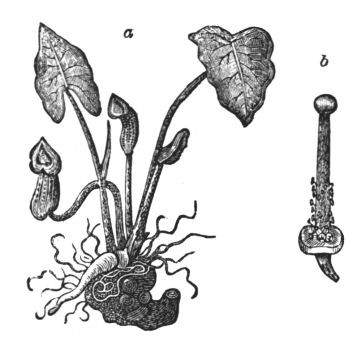
Fig. 34.—The Arum arisarum.
Another, and not less interesting species, is the Arum arisarum. (See Fig. 34, a.) It loves to display its exquisite leafage on the rocks bordering the "sea-marge," and is found in profusion along almost the entire littoral of the Mediterranean. It is a precocious flower—making its appearance about the end of December, and flourishing until the beginning of Spring. The spathe, which in the Arum maculatum has all the aspect of an etiolated leaf, assumes, in the Arum arisarum, the tints of a corolla,—is of a beautiful warm red violet, streaked with white. The fleshy axis, which ought rather to be called gynandrous (both male and female) than a spadix, is of a red colour; naked in its upper portion, which terminates with a kind of apple. It would remind a drummer-boy of the formidable staff carried by his drum-major (see Fig. 34, b.); the stamens, reduced to the condition of bilobed anthers, are mounted around the central part; and the ovaries, less numerous than the stamens, occupy the base of the axis. Each monocular ovary is crowned by a sessile stigma, and each lobe contains a great number of erect ovules. In the Arum maculatum, the number of ovules does not exceed six. Some botanists have laid hold of this characteristic as an excuse for withdrawing the Mediterranean species from the arums, and creating a new genus, arisarum. The variety we have just described is, in that case, denominated the Arisarum vulgare.
The ancients have mentioned numerous species of the arum. But it is a very difficult task to bring their nomenclature into any kind of agreement with the species described by modern botanists. However, we may, I think, regard the arisarum of Pliny and Dioscorides as positively identical with our Arum arisarum. But we are unable to admit that the aron, the hepha, the dracunculus, the dracontium, can be, as commentators represent, one and the same plant; still less can we admit that this plant is our Arum maculatum, which is very much rarer in the south than in the north and centre of Europe. In the solution of such problems as these, geographical botany is an element which must not be neglected. Unfortunately it has never been taken into account by the commentators on the great classical authorities.
Let me advance a simple proposition. Since the potatoe has become diseased, and the species tends to degenerate, may we not find a substitute for it,—at least, a partial one,—among our Aroids, and, notably, in the Arum maculatum?
The Ranunculaceæ.
Let us return for a while to the order of Ranunculaceæ, of which the Anemones have already furnished us with a specimen. Several very poisonous plants are members of this order; and, in truth, very few can be pronounced wholly innocent. I do not think there is much harm in the Lesser Celandine, however—the glossy, starry flower, yellow as a buttercup, with heart-shaped leaves, which Wordsworth has celebrated:—
"Ere a leaf is on the bush,
In the time before the thrush
Has a thought about its nest,
Thou wilt come with half a call,
Spreading out thy glossy breast,
Like a careless prodigal;
Telling tales about the sun,
When we've little warmth or none."
There cannot be much harm in it, for in the north of Europe the peasantry boil its leaves, and eat them as greens. It thrives in all parts of England, in green woods and meadows, and on wild furzy wastes and open commons; under leafy hedges, and even in the gay pastures, among the primroses and hepaticas. A number of small, grain-like tubers lie around it, close to the surface of the earth; whence it was a common saying in "the days of old" that this plant showered down wheat in its vicinity.
To the same order belongs the Buttercup (Ranunculus bulbosus), whose bulbous root procured for it from our forefathers the name of "St Anthony's turnip."
If the good saint ever partook of buttercup-corms, we do not envy him his sensations; when boiled, they disorder the stomach, and if eaten raw, act as an emetic.
It was formerly thought, says a pleasing writer, that crowfoot (the buttercup is a species of crowfoot), mingled with the pasture, improved its nature, and that the butter yielded by cows which fed upon this mixture was of a superior quality. Nous avons changé tout cela; we are wiser now; and have discovered that cows carefully avoid eating buttercups, and that several kinds of crowfoot are even poisonous to cattle. On some pasture-lands, in those countries where the produce of the dairy receives particular attention, women and children are employed to destroy the crowfoot, which they do either by pulling up the root, or by plucking off the flower, and preventing it from dispersing its seed. The root of the buttercup is of a highly stimulating property if taken in an uncooked state, and its juice will occasion sneezing; but boiling deprives this, as well as many other vegetable productions, of its injurious properties. A similar effect is produced by drying it in the sun; wherefore the hay crop is not at all deteriorated by its acrid nature.
A very beautiful ornament of still pools and gently-flowing streams is the Water-ranunculus (Ranunculus aqua atilis), whose leaves vary according to the depth, or calmness, or swiftness of their watery habitat, and are thus adapted to permit the passage of water without suffering any injury from its force. The leaves on the surface have a round lobed shape; those immersed hang down in thin small fibres, which offer but little resistance to the current.
The Ranunculaceæ also include the Black Hellebore, or Christmas rose (Helleborus niger), one of our most splendid winter-garden decorations, whose juice the ancients considered a wonderful remedy for mental disorders. In whiteness it rivals the snow, which often accumulates around it, and the snow-drop, which is frequently bound up in the same wreath. It is called the Black Hellebore, to distinguish it from the two wild species which grow in our woods, its root being covered with a thick black skin.
The fragrant white Clematis must not be omitted; its starry drops are "things of beauty," which every true poetic eye will know how to appreciate. It is sometimes called "Traveller's Joy," and sometimes "Virgin's Bower;" either name is richly suggestive of pleasant fancies. Do you remember the beautiful picture in Keats's "Endymion," of the shady sacred retreat where Adonis lay and slumbered? The clematis was one of the precious flowers that adorned it:—
[44] Pliny, "Historia Naturalis," xxvi. 5.
[45] See "The Circle of the Year."
[46] Chomel, "Histoire des Plantes Usuelles," ii. 282.
[47] Tournefort, "Histoire des Plantes," i. 103.
[48] Garidel, "Histoire des plantes qui naissent aux environs d'Aix," p. 56.
[49] "Pied," that is, vari-coloured, motley-coated.
[50] See also Shelley's "Sensitive Plant," &c.
[51] This is common enough in Germany and France, especially in the vineyards, but very rare in England.
[52] So we say, "fretted roof."
[53] When the spike bears numerous flowers, surrounded by a spathe, or sheathing bract, it is called a spadix.
[54] Bosc, a distinguished naturalist, died in 1828, aged 69. In the ministry of Roland, he accepted the delicate post of administrator of prisons; was proscribed after the terrible events of May 31, 1793; and lay concealed, along with Laréveillière-Lépaux, for several weeks in the forest of Montmorency.
"Above his head
Four lily stalks did their white honours wed,
To make a coronal, and round him grew
All tendrils green, of every bloom and hue,
Together intertwined and trammelled fresh;
The vine of glossy sprout,—the ivy mesh,
Shading its Ethiop berries,—and woodbine,
Of velvet leaves and bugle blooms divine;—
Convolvulus in streakèd vases blush,
The creeper mellowing for an autumn flush,—
And Virgin's Bower trailing airily,
With others of the sisterhood."
Finally, our order comprises the Hepatica, with its blue or pink blossoms and three-lobed leaves, which, from their fancied resemblance to the form of the liver, procured the plant its English name of liverwort; the Flos Adonis, or pheasant's eye,—the goutte-de-sang of the French,—so called because the ancients fabled that it sprang from the blood of Adonis, when wounded by the bear; the marsh marigold; the gay and vivacious larkspur; the deadly wolfsbane, or aconite, which secretes so potent a poison; and the aromatic love-in-a-mist, or French flower.[55]
B.—Animals.
Under the soft moss, under the stones, in all localities where mouldiness is easily developed, under the closed doors of cellars, you must certainly have more than once observed a tiny creature of the form of a horse-bean, of a gray leaden colour, and supplied with a considerable number of feet. This last characteristic will induce you immediately to abandon the idea that you have before you an insect.
Catch hold of it, and count its feet.
Well said; but it runs much more quickly than I would have suspected from its previously dilatory movements.
Because it knows that danger threatens it, instinct impels it to escape at its utmost speed. Do not be afraid to handle it; the poor creature can do you no harm.
Unable to escape, it counterfeits death, and remains perfectly immovable.
Now examine it. It has fourteen feet, symmetrically arranged in couples; their size perceptibly increases from the first to the last. When the animal is at rest, they are coiled inside, so as to form an angle whose opening faces the medial line. But here is something much more curious; its body, which does not possess the vestige of a wing, is also without those segments which would divide it visibly, as in the case of insects, into head, thorax, and abdomen; but is composed of rings, hard and scaly, like those of a shrimp.
Can it be a crustacean?
Yes; the animal you hold in your hand, and which everybody knew by the name of wood-louse long before our naturalists knew how to classify it, belongs to the great animal division of the Articulata, which, instead of having their skeleton inside the body, like the Vertebrates, have it externally. The Crustacea form a class of this division, to which also belong the Insects, the Arachnida, and the Myriapoda.
Let us continue to anatomise our crustacean.
In front of its first ring (a transversal segment) you see a little black head, with two lateral bead-like eyes, and a couple of antennæ. The latter are each composed of three joints, which are extremely mobile; their base is covered by the edges of the sloping head. The most conspicuous rings of the body are seven in number; their lateral borders are pointed in front, and rounded behind. But, if you look closely, you will see some other rings, a little less projecting than the former; they circumscribe the abdominal region, the belly, properly so called, in which the intestines are lodged. These rings, or abdominal segments, are six in number; but they have not all the same form. The one which occupies the tail is triangular, pointed, and surrounded by four (caudal) appendages. The three next segments, counting from the front to the rear, are prolonged laterally in a very marked manner; the two anterior, on the contrary, have no such distinction. As for the caudal appendages, the two outer ones are very strong, conical, and composed of two articulations, while the inner, situated above the former, are frail, cylindrical, and terminated by a tuft of hairs, whence issues a viscous liquid. (See Fig. 35, a.)
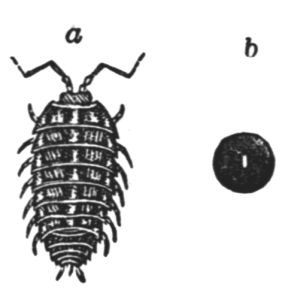
Fig. 35. The Wood-Louse.
An enumeration of these characteristics is tedious, but necessary for the determination of the genus and the species. They belong to the Oniscus asellus, or common wood-louse. But why, you ask, why such a strange conjunction of names,—one Greek, ὀνίσκος, the other Latin, asellus? Both carry the same meaning: why not, then, have called our tiny crustacean an ass-ass (if such a compound be possible)? Why, neither close at hand nor at a distance, has it the slightest resemblance to an ass; and to say that we have only borrowed these names from the ancients, is neither an explanation nor a justification.
But we have not yet done with the wood-lice. Are these interesting little creatures (they are interesting, are they not?) oviparous or viviparous? I defy you to show me anywhere a single wood-louse's egg. Have the patience to observe our crustaceans more nearly. Among the crowd, you will remark some—they are the females—with a kind of membraneous pouch underneath the body, stretching from the head to the fifth pair of legs. The pellicle which forms this pouch is so thin, and so transparent, that you can distinguish the eggs within it. These eggs, instead of being expelled for incubation, remain in the mother's pouch until they are hatched. At that felicitous moment, the membranous bag splits cross-wise, longitudinally and transversally, to permit the emergence of the young wood-lice. The latter are extremely small, and in form resemble nothing in the world so much as a little white line (Fig. 35, b). They differ from their parents only in having one pair of feet, and one ring less than they have. They undergo no metamorphoses. After their birth, the little ones, which have proportionally very large antennæ, do not immediately separate from their mother. By a wonderful act of forethought on the part of Nature,[56] they keep themselves concealed in the middle of the respiratory laminæ, which garnish the under part of the tail.
The specific characters of the Oniscus asellus are tolerably well defined. By its rings of dark gray, a little lighter at the edges, which form for it an articulated, glossy carapace, marked with white spots, longitudinally arranged; by the uniform pale gray colour of its belly and its legs, covered with scattered hairs; and, particularly, by its habits, our wood-louse, which the Germans call cellar-louse (Kellerlaus), is distinguished from its kindred species, of which naturalists have made distinct genera. Thus, the asellus found generally under stones, which counterfeits death by rolling itself up in a ball like a hedgehog, and will rather suffer itself to be crushed than unfold, is the Oniscus armadillo, which some naturalists transform into the Armadillo vulgaris. (See Fig. 36.) This species prefers the solitude of the field to inhabited places. Its body is considerably expanded, and its rings do not terminate in a point on their lateral and posterior edges.
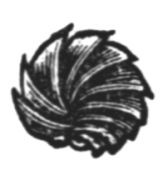
Fig. 36. Oniscus armadillo.
Another species, equally common underneath stones, has its head and tail covered over with granulations; its antennæ are composed of seven joints, of which the fourth and fifth are perceptibly situated lengthwise. This is the Oniscus granulatus of some entomologists; others have designated it the Porcellio scaber. Why not simplify the study of species?
The wood-lice seem to live upon decomposed vegetable matter. But in default of other food, they devour their own kind; in this respect resembling beings who are supposed to rank much higher in the animal hierarchy.
In the pharmacopœia of the ancients our wood-lice found a place. Reduced into powder, and mixed with various substances, they were prescribed as diuretic and aperient; but they were long ago abandoned in medicine.
The Dragon-Flies (Libellulæ).
In walking along the banks of a river, you must frequently have seen hovering around you a cloud of insects, whom you would readily take to be butterflies, were not you arrested in your conjecture by the largeness of their head, the length of their body, the form of their vivid, diaphanous, gauze-like wings, and, generally,—which will most astonish you,—by their carnivorous instincts. You have about you and before, then, not butterflies, but Dragon-flies—the Libellulæ of naturalists. They are the demoiselles, or "ladies," of the French; so called, perhaps, in allusion to their airy and graceful flight.
Among these Libellulæ, one is called Eleanora. If she does not shine so brightly as the others—if her colours are less brilliant—she has, at least, the advantage of being so common that you can easily obtain a specimen.
But, first, let us pause to think of the strange dissimilarity in the names bestowed on the Libellulæ by the English and French respectively. They are the Dragon-flies of the former,—fierce, rapacious, formidable; the Ladies of the latter,—elegant, light, and radiant. Here we have a glimpse of national character. With the Frenchman, "appearance" counts for so much; with the Englishman, everything depends upon the "reality." Yet our English poets can appreciate their gay exterior. Moore speaks of them as—
"Those bright things which have their dwelling
Where the little streams are welling!"
Poor Clare, the Northamptonshire poet, correctly studied—
"The great dragon-fly with gauzy wings,
In gilded coat of purple, green, and brown,
That on broad leaves of hazel basking clings."
And Mary Howitt has seen them—
"Here and there they dart,
And flush like gleams of green and azure light."
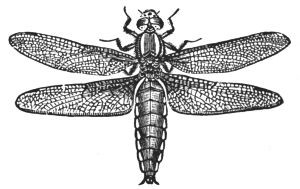
Fig. 37.—The Common Dragon-fly.
Beautiful as they are, they must be ranked among Nature's fiercest and most insatiable destroyers. They are the terror of the insect world. On this point we shall hereafter enlarge, but before I forget it, I would fain relate an anecdote, in illustration of their voracity, which I have read somewhere or other. A naturalist recounts with what interest he has often watched the proceedings of the dragon-fly. He has seen it, in a locality where white butterflies were numerous, dart down as a hawk upon a quarry, seize with its legs a firm hold of a butterfly, and carry it to a branch of an adjoining tree. In a moment one of the white wings would drop from the boughs, and then another would come wavering downwards, and so on, until all four had fallen; and the dragon-fly, after a short pause, would again dart forth in pursuit of a fresh victim. He never launched himself on his prey when on a perfect horizontal line with it; but took care to be either somewhat higher, or somewhat lower, so that he could seize it with his feet.
But now let us consider by what characteristics the reader is to recognise his Libellulæ.
The eyes are very large, the size of the insect considered; of a brown colour, and nearly joined together at the top of the head; in front of this point of junction a tiny vesicle is visible, carrying three ocelli (i.e., little, simple, glossy eyes), two on each side, and the third on the anterior margin: the thorax is large, hairy, and composed of two yellow plates; the abdomen laterally depressed, in such a manner as to give great prominence to the medial line. This last and well-marked feature it is which has procured for the Eleanora the scientific name of Libellula depressa,—a name proposed by Linnæus, and unanimously adopted; such unanimity being a rare occurrence among naturalists, though, to parody a phrase of Sheridan's, when naturalists do agree, it is something wonderful!
In the male Libellulæ, the upper surface of the abdomen is bluish in hue, and covered as it were with an ashy dust, while in the female it is olive; in both sexes the first and last abdominal segment are of a deeper shade than the other segments. The feet are black, and bristle all over with stiff hairs; the thighs are of a brownish red. The two pairs of wings, each strongly reticulated, present, towards the extremity of the upper border, a black rectangular spot; their base, moreover, is edged with brown spots; the spots of the lower pair are triangular and larger than those of the upper pair, which are nearly linear. They form, to a certain extent, the reservoir of the liquid which nourishes and maintains the circulation of the network of the wings.
The Libellula, which Geoffroy calls (in his "Histoire des Insectes") the Philinta, is simply the male of the species we have just been describing. You may see them
"Where water-lilies mount their snowy buds,"
pursuing one another with an abrupt, jerking—I had almost said staccato—flight.
A species less common than the preceding, but closely resembling it, is the Françoise of Geoffroy, the Libellula quadrimaculata of Linnæus. It owes its descriptive or specific designation to the colours which diversify its wings. On the outer edge of each, two brown marginal spots are conspicuous: the first at the place where in the Eleanora (and other species) the black spot is found, and the second nearly in the centre of the external border, which, at this point, is considerably compressed; moreover, the lower wings are marked, beneath their yellow base, with a kind of triangular spot of blackish brown, finely reticulated with yellow. Externally, there is no difference of appearance between male and female, except that the abdomen of the latter is somewhat the larger.
Now we come to the Sylvia, the Libellula cancellata of Linnæus. Its eyes and thorax wear a greenish hue; the diaphanous wings are spotted with brown near the outer margin; the abdomen is of a bluish-gray; the extremity of the sixth segment, and the following segments, are wholly black.
The Julia, or Libellula grandis (Linn.), has been separated from the Libellulæ by the great entomologists, such as Fabricius and Latreille, and included in the genus Aeshna (Phœbus, what a name!), preserving the descriptive adjective grandis. What are the reasons put forward to justify this separation? Principally, the form of the abdomen, and the position of those little smooth and simple eyes, like tiny pearls or pearlets, which we call ocelli. In the Libellulæ, properly so called, the ocelli, three in number, are situated on either side and on the exterior margin of a kind of semi-triangular vesicle, and the abdomen is slightly depressed, and not unlike a club; while in the Aeshnæ elongated, and almost cylindrical.
The Aeshna grandis (or the "Julia") is one of the largest of the British species. Its head is large, and its eyes are of a brown colour shading into blue; the yellow thorax has two bright yellow bands or stripes obliquely painted on each side. The abdomen is of a reddish or even rusty brown; generally spotted with white and yellow at the top and bottom of each wing. This species haunts the vicinity of streams and "silent pools."
We come, in due order, to the Aeshna forcipata, or "Carolina," with its dirty yellow head, and its greenish-yellow thorax, the latter marked on each side with three oblique lines of black: the abdomen is black, and composed of segments laterally spotted with yellow.
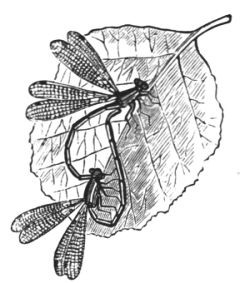
Fig. 38.—Male and Female of the Agarion virgo.
The Libellula, which the illustrious Geoffroy designates "Louisa," is, according to modern entomologists, neither a Libellula nor a Aeshna, but a species of Agarion,—the Agarion virgo (Libellula virgo, Linn.) The Agarions are distinguishable from the Libellula and the Aeshna by their remarkably thin, filiform, and exceedingly elongated abdomen, and by the three ocelli arranged triangle-wise on the top of the head.
The "Louisa" (AgarionAgarion virgo) is by no means uncommon in England, and may be found along the upper course of the Thames, the Avon, and other rivers. It is easily recognised by its frail slender body, shining with metallic blue reflexes. There are numerous varieties, distinguished by their varieties of "light and shade." The spotless green-winged species is the "Ulrica" of Geoffroy. The two sexes are not alike. In the centre of their delicately-reticulated wings the males have a large bluish-brown spot, which is wanting in the females.
The genera Libellula, Aeshna, and Agarion compose the small family of the Libellulites—a family plainly and conspicuously characterised by the size of their head, and by the two pairs of diaphanous wings of almost equal dimensions (the posterior pair is a little shorter than the anterior), which, while the animal is at rest, are kept horizontally extended.
Fig. 39.—"A sunny pool, half-fringed with trees."
These are the characteristics which present themselves to the observant eye at the first glance. Do you doubt me? Betake yourself, when
"The bird is building in the tree,
And the flower has opened to the bee,"—
betake yourself, I say, to any sunny pool, half-fringed with trees, or pleasant river-margin; go, armed with net and microscope, and, having secured a specimen of these terrors of the insect world, where
"The strong on weak, cunning on simple, prey,"
devote yourself to its patient examination.
It is only such an examination that can reveal to us some equally important, but less obvious features of the insect. But to catch a Dragon-fly is not always an easy task; the Libellulæ are very timorous, or else they are suspicious of the prowling naturalist who seeks what he can entrap. Their flight is livelier and swifter than even that of the butterfly: when disturbed in their repose, they fly away abruptly, their wings rustling or crackling like a sheet of parchment; if obstinately pursued, they grow irritated, and in their quick jerking movements exhibit all the rage of the Carnivora.
But can our Libellulæ be carnivorous? Most undoubtedly. To convince yourself of it, you have but to glance at their mouth, which is wholly unlike a butterfly's. What an arsenal of weapons adapted for seizing and crushing a victim! How strong are those saw-toothed scaly mandibles! How strong their auxiliaries, the jaws, which terminate in that dentated spring projection, furnished internally with ciliæ! Surely, such instruments testify to their ferocious instincts, and should induce our French neighbours to deny them the graceful name of "les demoiselles." What a libel on tender woman,—on man's "ministering angel!" Do but observe them. They do not rest upon the blossom to extract its nectared sweets; in truth, they could not do so, for they are not furnished with a proboscis. Warlike as the Amazons,—the only portion of the female sex they can justly be said to resemble,—they hover in the air to pounce, like vultures, upon whatever insects may come within their reach; they quickly transfix, and as quickly devour them. If they love to fly about the pools, the marshes, and the streams, it is because they are sure of prey in these localities. And, in fact, they there encounter and devour an innumerable quantity of flies, moths, gnats, and the like.
But there is another reason why the Dragon-flies, obeying the secret impulse of nature, resort to the haunts we have been describing. They were their cradles or nurseries, and they become, in due time, the scenes of their espousals.
Before speaking of the singular metamorphosis they afterwards accomplish, we must touch lightly on the subject of the mode of reproduction of our brilliant demoiselles.
It is laid down as a law that, in the insect world, the males are invariably smaller or weaker than the females. Yet this law does not hold good with reference to the Libellulæ, whose males are, on the contrary, larger and stronger than their females. Man may lay down laws, and extort obedience to them, within his own domain; but nature laughs at human rules, and gives up her secrets only to the free thought, unshackled by the fetters of authority.
But why is the male Dragon-fly stronger than the female? Because the former must make the first advances, and carry off his aërial companion to celebrate their bridal. For this purpose, he holds her tightly by the neck, and continues to fly in this way for some few minutes. At length, he perches himself on the branch of a willow, or the leaf of an aquatic plant, along with his companion.
The eggs laid by the female are oblong in shape, and sometimes united together in clusters: the female deposits them in the water, or on some water-floated leaf plant, shortly after their fecundation.
Metamorphosis of the Dragon-fly.
"To-day I saw the Dragon-fly
Come from the wells where he did lie;
An inner impulse rent the veil
By his old husk: from head to tail
Came out clear plates of sapphire mail.
He dried his wings: like gauze they grew,
Through croft and pasture wet with dew,
A living flash of light he flew."
—Tennyson.
If in your walks abroad you should meet with a pool of turbid water, do not object to linger for a moment on its brink. Nature, as a reward for your trouble, will gratify you with an extraordinary surprise. Stir up the mud with a stick, or, better still, with your hand; and then, as the children say, you shall see—what you shall see!
Oh, what an ugly creature is struggling in this handful of slime! It looks like a large spider!
Nay, examine it more attentively; it can do you no harm.
Well, it is a singular animal; greenish in colour, bristling with hairs, and covered with mud. It is not a spider, for it has only six legs and these are exactly like the legs of insects. I can distinctly make out three joints (articulations) to each tarsus, which terminates in a simple hook. The belly is formed of regular segments; is rounded above, and flat underneath. What do I see? On the top, and nearly in the middle, each ring is armed with a spine, so that the row of spiny projections remind one of the back of a crocodile. Pray tell me, what is this curious creature?
Before I tell you, I would have you more thoroughly acquainted with it. Continue your examination.
The face has a strange expression; it looks—the insect, I mean—like a masked knight. Its mask, formed of a scaly substance and thoroughly compact, is composed of two pieces, which are separated from one another by a transversal suture: the upper, which is broader than it is high, we may call the vizor; it consists of two lobes, soldered together longitudinally; the lower, which is higher than it is broad, will be the chin-piece; it is triangular in shape, and its base rests against the vizor, while the summit is jointed or articulated with a support, which acts as a hinge when the mask is raised or lowered.
These movements, let me tell you, are voluntary; the animal raises its mask to arrest on their way the Infusoria and other animalcules on which it feeds. For crushing them, it is provided with strong mandibles, which you can detect by lowering the mask with a pin, or the point of a penknife. The eyes, which resemble little mammillary protuberances, are situated above and outside of the vizor. On the animal's back, where the belly joins the thorax, do you observe those four little sheath-like or scabbard-like tongues? The extremity of the body, the tail, is marked by three conspicuous triangular points, lying close to the opening, through which the water enters and issues, as if it were alternately sucked in and poured out by a piston. This, you must understand, is the respiratory apparatus. (See Fig. 40.)
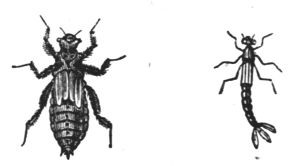
Fig. 40.—Larva of the Fig. 41.—Larva of Libellula depressa. the Agarion virgo.
Well, then, what is the name of this most singular creature, this masked knight?
It is the larva of the Libellula depressa; the dismal envelope whence will issue the gaudy Dragon-fly. Listen to a graphic description of the mask you are looking at:—
"Conceive your under-lip to be horny instead of fleshy, and to be elongated perpendicularly downwards, so as to wrap over your chin and extend to its bottom; that this elongation is there expanded into a triangular convex plate attached to it by a joint, so as to bend upwards again and fold over the face as high as the nose, concealing not only the chin and the first-mentioned elongation, but the mouth and part of the cheeks; conceive, moreover, that to the end of this last-mentioned plate are fixed two other convex ones, so broad as to cover the nose and temples; that these can open at pleasure transversely, like a pair of jaws, so as to expose the nose and mouth, and that their inner edges, where they meet, are cut into numerous short teeth, or spines, or armed with one or more sharp claws;—you will then have as accurate an idea as any powers of description can give you of the strange conformation of the under-lip of the larva of those insects, which conceals the mouth and face precisely as I have supposed a similar construction of your lip would do yours. When at rest, this mask applies closely to and covers the face; when they would make use of it, they unfold it like an arm, catch the prey at which they aim by means of the mandibuliform plates, and then partly refold it, so as to hold the prey to the mouth in the most convenient position for the operation of the two pairs of jaws with which they are provided."
And so the creature I have been examining is only a larva! How strange to compare it,—thick, ugly, unwieldy,—with the insect that issues from it, so aërial, so graceful, so light, so beautiful! The more I think of the contrast, the more it interests me.
This larva, however, has all the characteristics of a perfect insect, and I will wager that more than one observer has described it as such, and classified it among aquatic insects. Yet it is but a larva! And each species has its own special larva (see Figs. 40 and 41).
This seems to me as difficult to believe as if you told me that John, James, Peter,—in fact, all men,—were only temporary bodies from which more perfect beings would one day emerge. For the medium in which these masked creatures live,—the troubled and muddy medium for which they are adapted by their organisation, and in which they seem destined to live out their life,—differs wholly and absolutely from the aërial medium wherein, you tell me, they will one day rejoice.
Do you see, on the brink of the pond, those dried-up bodies? They are those of your aquatic insects, the mortal remains of Libellulites; they have rent open their vest, as you would do a garment which had become too narrow; the rent is very conspicuous along the back; and through the fissure issue the winged and aërial resuscitated Dragon-flies, summoned to live in a world differing so widely from their former one! Under the tongues were folded up the wings, and the mask that puzzled you so greatly is split open on the level of the sutures, so as to represent a ⟙, wanting only a handle to reproduce one of those hieroglyphics (☥) which are found so frequently on the Egyptian monuments, and which, according to some Egyptologists, signify eternal life.
And here, my friend and companion, we may take leave of
"The great Dragon-fly with gauzy wings."
BOOK III.
——♦——
SUMMER.
Blessed, thrice blessed is the man with whom
The generous prodigality of nature,
The balm, the bliss, the beauty, and the bloom,
The bounteous providence in every feature,
Recall the good Creator to His creature,
Making all earth a fane, all heaven its dome!...
The sod's a cushion for his pious want,
And consecrated by the heaven within it,
The sky-blue pool, a font;
Each cloud-capped mountain is a holy altar;
An organ breathes in every grove,
And the full heart's a psalter,
Rich in deep hymns of gratitude and love.
—Thomas Hood.
The poetry of Earth is never dead....
A thing of beauty is a joy for ever.
—Keats.
CHAPTER I.
WHAT MAY BE SEEN IN THE HEAVENS.
"And God said, Let there be light; and there was light."
—Genesis.
"A sound of song
Beneath the vault of Heaven is blown."
—Goethe.
Permit us here a parenthesis, or, shall we say, a digression?
The whole secret of science, the whole secret of human knowledge—in truth, the whole future of humanity—lies in these two words—Enlightened Thought.
And here, gentle reader, I solicit your assistance in endeavouring to elucidate a question which has a for a long time puzzled me. Why do we apply the word "light" to that which sets in motion the eye of the body, and to that which induces the operation of the eye of the mind,—to the singularly mysterious physical agent without whose intervention all the external world would be to man a dream or a void, as well as to the still more mysterious moral agent which illuminates the world within?
I anticipate your answer. "The light," you say, "which opens up to me the material world is a reality; the other is only an image."
And it is true that this is the solution which first presents itself to the mind. But the longer you reflect upon it, the more you will be inclined to agree with me that it is unsatisfactory. What, then, means this agreement among all peoples, past and present, to designate by the same words—as
Light
To illuminate
Obscurity
To obscure
Shadow
To overshadow
Morning
To darken
Day
To clear away
Twilight
To blind
Gloom
To cloud
—those actions, processes, or operations which take place or are produced in the outer world, physical or material, and in the inner world, intellectual or moral.
Were your pretended "image" the result of purely personal impressions,—all persons are not equally apt in apprehending those fictitious relations which are the food of poetry,—were it, in a word, no more than an individual conception, and, therefore, eminently variable, I should not hesitate to accept your opinion: we should simply be discussing what are called, in scholastic language, the individual sense (sens propre) and the imaginative sense (sens figuré). But there exists upon this point an unanimous and universal agreement: all languages, living or dead, attest it; it embraces the aggregate of the members of the human family.
This is the first point which induces me to doubt the legitimacy of the proposed explanation. But I am confirmed in my hesitation by numerous other facts.
Let us emerge from the domain of rhetoric to enter that of experimental physiology and psychology. Too powerful a light blinds the organs of seeing. No mortal eye, unless with the aid of artificial appliances, can gaze upon the sun, the great source of light. If the vision is to act clearly, we must proceed step by step. If from a very light apartment we pass rapidly, and without transition, into a darkened room, or vice versâ, we feel temporarily blinded: the eye demands a short time to recover, as it were, from its astonishment. If we fix our gaze for one or two minutes on a star of the first magnitude, as, for example, Sirius, and afterwards turn away abruptly, the eye will for a while remain insensible to stars of a less intense splendour.
These are incontestable physiological facts, which anybody may easily verify for himself.
Well, in the psychological order facts exist which are in all respects analogous. Take one of those truths which the human thought, labouring generation after generation, has taken centuries to discover or elucidate; place it suddenly before an unprepared mind; however luminous may be this truth, it will be simply shadow and darkness to the mind we speak of; it will not comprehend an iota of it. Why? For the very obvious reason that it lies outside its sphere of ideas, in every respect comparable to the sphere of vision, beyond which and within which there is no more room for the sensorial impressions. There, as here, we must proceed gradually, and arrange the transitions so as to produce the desired results.
It would be easy for me to develop this parallel by other and still more remarkable facts; but what I have just said will suffice to show that the line of demarcation which philosophers have, upon principle, desired to trace between the physical and moral order, has turned the mind aside from many fertile fields of research and speculation. Let us cite an example. The sun is the visible centre of light, heat, organic life; in fine, of all the movements of our material world. Yet it is but a relative focus, since the sun, with its planetary train, revolves, probably, in company with other suns or systems, around a centre as yet unknown; and as there is no reason why we should pause in this cycloidal progression, this second centre or focus of systems may revolve around a third, the third around a fourth, and so on. Thus we shall have an indeterminate series of relative centres; for the term does not exist of which we can say,—there is the beginning, or here is the end of the series.
We do not meet with the absolute in the material, any more than in the intellectual world. Truth, by its power of attraction, sets in motion all the wheels of our understanding; we seek after it eagerly, in the doubt which torments us, in the obscurity which surrounds us; we all feel the need of being enlightened by it, and warmed, and revivified; we all are in need of belief, and, at the same time, of possessing—let there be no illusion in this respect—a certainty or demonstration of what we believe.
But the truth which we think our own does not leave the mind at rest; a slight effort suffices, in fact, to teach us that the truth we accept depends upon another and remoter truth, and that the world of thought is thus carried onward in an interminable series of relative truths; unless we find it more convenient to pause here at a primary cause, as elsewhere at a primordial centre, which we may ever identify with the primary cause. But is this truth, supposed to be final, capable of satisfying equally every mind? With this question, dear reader, I close my parenthesis.
To understand clearly the variable duration of the day at all points of the terrestrial surface, let us so place ourselves as to see our planet distinctly in front. I need hardly say that this invitation is not addressed to the visual organs of the body, but to the "mind's eye, Horatio." With the former, fixed as we are on the surface of the globe, we can only see the shadows of objects standing out in relief upon it, and still, with the sun at our back, can perceive but a comparatively insignificant portion. With the second, on the contrary, we may detach ourselves from the earth, may mount afar into space, may plant ourselves on some aërial height, whence we may embrace, at a single glance, all the illuminated hemisphere of our globe: we shall have but a single shadow on the prospect,—that which our brightened planet casts behind it, and which, in four-and-twenty hours, traverses the entire surface of the globe, producing light wherever it passes.
Having completed our preparations, let us note what we perceive with our eye thus disjoined from our body,—an eye equally well adapted to fix every moving object, and to see at any distance bodies extremely small, or bodies extremely large. What a marvellous eye! And it is for us to develop its power, and freely to increase its range. What an arduous task!
The luminous envelope, the photosphere of the sun, simultaneously darts its rays in all directions, with an intensity which diminishes with the square of the distance.
Let us follow those which direct their course towards our planet.
So long as the rays do not come into collision, or strike against resistant matter, they neither warm nor enlighten. Confirming the Newtonian hypothesis of emission, they travel straight as arrows through the icy space, the shadowy ocean in which the waves of the terrestrial atmosphere are lost. But the moment they encounter a material obstacle, the rays partly penetrate it, and are partly thrown back, in such a manner as to form a series of undulations like those which the falling of a stone into a pond produces. As they recede from these repeated shocks, the rays come under that theory of undulation which Huygens promoted.[57]
Let us trace the rays of light back to their origin. These encounter first the globes nearest to the sun: the almost imperceptible asteroids, which, on account of the solar splendour, can scarcely be detected, and which, as yet, have received no baptismal names. Yonder beams illuminate other revolving globes,—Mercury, Venus, the Earth. If we here arrest our gaze, we are influenced by a vague and mournful recollection; the Earth was our place of sojourn at an epoch when thought, formerly shackled, had become free. It is thus that a seed, removed from the stem which nourished it, wanders afar to diffuse and perfect its species. Our planet, of an ochreous yellow, relieved with green and white, possesses no special privileges; it shares in the ponderated movements of the spheres; it is neither the largest, nor the smallest, nor the heaviest, nor the lightest, nor the nearest to, nor the farthest from, the sun. And shall Earth alone, of all the planets, nourish that kind of "thinking seed" which we name the human race? It seems improbable.
But let us return to the great orb of light. It illuminates exactly one half of our earth; the other half lies in shade. And as the earth rotates upon its own axis, every point of its surface is necessarily exposed to the action of the solar rays. This action varies in duration and intensity.
All this I was taught, when I was still at school on our revolving planet. I remember, too, as a lesson learned by heart, that, under the Equator, or, more exactly, in 0° 0´ latitude, as well as at the Poles, or under 90° latitude; the duration of the day is equal to that of the night, with this difference, that, while under the Equator, a day of twelve hours alternates invariably with a night of the same duration, at the Poles a day of six months succeeds continually to a night of six months. I also recollect that, at a given moment, namely, at the spring and autumn equinoxes, the duration of the day, over all the terrestrial surface, is equal to that of the night, just as under the Equator; and that, after these two epochs, under the intermediary latitudes, between the Equator and the Poles, the length of the days and their corresponding nights varies according to the seasons; that, in our northern hemisphere, after the spring equinox, the days increase while the nights diminish, to such an extent that, at the summer solstice,—21-22 June,—they attain their maximum of length (and the nights their minimum), the reverse taking place during the period that elapses between the autumn equinox and the winter solstice.
I remember that I learned these data when I was living rooted to or anchored upon the earth; but the explanation which my masters gave me was not so clear as I could have wished. Their considerations on the declensions of the sun, on the obliquity of the ecliptic, on the necessity of exactly reducing the earth to a simple point in relation to the distance of the stars, to the end that the phenomena occurring (rapportés) on parallel planes would be nearly identical with those observed from the centre of the globe, or from a point situated on its surface; all these fine things, which demanded a certain faculty of geometrical intuition, left a curious vagueness of idea upon my mind. I accepted them, under the influence of authority, as beyond discussion, but I was by no means satisfied whenever I wished to ascertain their foundation.
But now—in the regions of space—everything grows simple before the mind, in which, apparently, all my power of thought is concentrated.
Behold the illuminated atmosphere; it reminds me vividly of the disc of the full moon. Ah, what exquisite iris colours! They mark the meeting-points of the bright with the obscured hemisphere: a circular line carried through all these points would exactly separate day and night. On the one side, motion and life and glow; on the other, silence and shade and calm. This line moves, carrying with it in its movement day and night, the illuminated and the darkened hemisphere; it moves from east to west, so that the bright hemisphere and the shadowy one, whose union forms what may be called the photo-adumbrated sphere, revolves, in four-and-twenty hours, round an axis which coincides at this moment—the 21st day of March, according to the "terrestrial worms,"—with the axis of the earth rotating on itself in an inverse direction, that is to say, from west to east. Let us note this coincidence: it is remarkable; inasmuch as, at the equinoxes, the terrestrial equator divides exactly the illuminated and the obscured hemisphere into two equal parts, one of which is situated to the north, the other to the south, and their line of separation coincides with a meridian circle.
But I see another, and much slower movement, very clearly defined. The axis of rotation of the photo-adumbrated sphere does not remain parallel with the terrestrial axis of rotation; it retires from it little by little, so as to form with it an angle which attains its maximum at the summer solstice (21-22 June); afterwards, returning upon itself, it coincides anew with the terrestrial axis of rotation (the autumn equinox), to make an angle in the contrary direction, whose maximum, of the same value as the former, corresponds to the winter solstice (21-22 December). This movement, which is annual, complicates itself with the diurnal. It is rendered visible by the displacement of the polar shroud of snow: the portion which, at the moment of the spring equinox, belonged, in the northern hemisphere, to the obscured hemisphere, moves onward, as a result of the inclination of its axis, to become an integral part of the illuminated hemisphere; while, at the same time, the portion which, in the southern hemisphere, belonged to the illuminated hemisphere, moves onward to become an integral part of the darkened hemisphere. Owing to this displacement, the sun shows itself for six consecutive months above the horizon, for the North Pole; at the spring equinox it begins to rise, at the summer solstice it attains its maximum elevation, and from the summer solstice it begins to decline. Thus, then, we have in reality a day six months long, of which the morning and the evening are the two equinoxes, its noon the summer solstice.
In the same periods an exactly opposite order of things prevails in the southern hemisphere.
Everything, even to the minutest detail, is in this way very clearly explained. Two facts—like the touches of a painter's brush—suffice to impress the whole upon the mind, namely:—
That, first, one half of the terrestrial surface is constantly illuminated by the sun, while the other half remains in darkness;
That, secondly, the rotation of the earth upon its axis produces day and night, by carrying from east to west the illuminated hemisphere, always diametrically opposite to the darkened hemisphere.
This being thoroughly understood, let us place ourselves in the equatorial plane, so as to embrace at a single glance a quarter of the illuminated and a quarter of the darkened hemisphere. If the equator of the photo-adumbrated sphere perpetually coincided with the terrestrial equator,—if, in other words, the earth, in revolving round the sun, invariably occupied the plane of the Equator, which, when prolonged, would pass through the centre of the illuminating orb,—the diurnal rotation would not cease to divide equally the light and the darkness over the earth's surface, as is shown in Fig. 42 a, where S indicates the sun, EE the terrestrial equator, and N S the extremities (or North and South Poles) of the axis which divides the globe into an illuminated and a darkened half. This phenomenon of coincidence exists; but only for a very brief period, and is only repeated twice a year,—that is, at the equinoxes. At all other times, the equator of the photo-adumbrated sphere, in whose plane the orb of light is situated, passes sometimes above and sometimes below the terrestrial equator.
[55] The seeds of the latter are used in the East, where they are more pungent than in our cold climates, instead of pepper. "They are thought to be the cummin alluded to in Scripture, where our Saviour reproved the Pharisees for their singularity in minor things, and their neglect of important duties."
[56] That is, the Creative Power which, in common parlance, we choose to call Nature.
[57] No one, I think, has ever before attempted to reconcile, in this way, the two principal theories which have been put forth on the propagation of light.
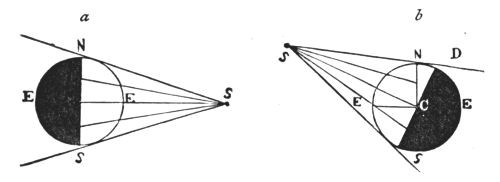
Fig. 42.—S, the Sun; EE, the Equator; N, North Pole; S, South Pole.
But this alternate movement of northern and southern declination has its limits; it stops at 23° 27' 30" on either side of the Equator; this, too, is the maximum of the distance which the imaginary axis of the photo-adumbrated sphere retires from the axis of terrestrial rotation; it is at the same time the value of the obliquity of the ecliptic, or of the inclined plane which the earth traverses in its annual movement of revolution.
Fig. 42 b, which represents the photo-adumbrated sphere at the summer solstice, will enable the reader to comprehend with the utmost facility the six months' day of the North Pole, coinciding with the six months' night of the South Pole; for the triangle N C D indicates the amount by which the illuminated moiety increases in the northern hemisphere between the spring equinox and the summer solstice, the amount being equal to that by which the adumbrated moiety overspreads in a contrary direction the South Pole in the southern hemisphere. The superfluous quantity of the photo-adumbrated sphere is nil at the apex of the two opposite triangles, or in the equinoctial region. And then, in effect, both day and night are always twelve hours long. Starting from the equinoctial line, we see how easy it is to calculate for each locality the variable dimensions of the arc which the sun, in its apparent course, traces above the horizon.
To see very distinctly the portion of the illuminated hemisphere, which, passing beyond the North Pole, forms a luminous course on the darkened moiety of our globe, I have but to place myself at midnight, on the 21st of June, in the prolongation of the terrestrial equator; in the same way, to see the corresponding portion of the darkened hemisphere, which advances beyond the South Pole to invade the illuminated, I have but to occupy at noon, on the 21st of June, a point of the same equatorial prolongation. Six months later, the same spectacle will be presented, inversely, on the 21st of December, in the southern hemisphere. See Fig. 43 a, where the pole N indicates the six months' day of the northern hemisphere (from the spring to the autumn equinox); while in Fig. 43 b, the pole S indicates the six months' night of the northern hemisphere (during the same period).
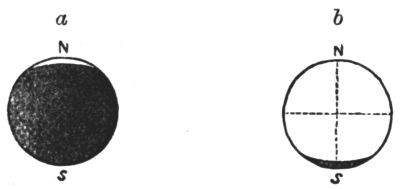
Fig. 43.—The Six Months' Day and Night.
Now, no effort of the imagination is required to understand why the inhabitants of the northern hemisphere enjoy summer while those of the southern are enduring winter; why it is "blossoming spring" to the former when it is "purple autumn" to the latter, and vice versâ. Equally easy is it to comprehend why, after the equinox, day, or the duration of the sun above the horizon, gradually diminishes in one hemisphere and increases in the other; why, in summer, and in both hemispheres, the longest days alternate with the shortest nights, and in winter, the longest nights with the shortest days. It will not be more difficult to explain the cause of the prevailing cold in the polar zones, despite the prolonged sojourn of the sun above the horizon for a great part of the year. Observe how obliquely the solar rays are directed towards yonder shrouds of ice and snow: how can they warm them? They nearly all vanish into space. (See Fig. 42.)
Finally, there is not a phenomenon, even to that of dawn and twilight, which cannot, on these principles, be very fully and clearly explained. I have indicated, in a preceding paragraph, the rainbow-glories of colour noticeable on the line of demarcation between the illuminated and the darkened hemispheres. They are wanting where the rays of light strike vertically or nearly vertically. It is this circumstance which explains why, in the intertropical regions, the crepuscular phenomena are nearly null; why the sun, so to speak, sets and rises abruptly, like a taper which we extinguish or rekindle. These iris-gleams increase, on the other hand, in intensity, in proportion as we recede from tropical regions: the red touches the horizon, while the violet blends with the azure of the sky; between these two extremes, which are always very clearly marked, are arranged in less perceptible fashion, and in the order of refraction, the other colours of the rainbow.
What time and labour does it not require for the mind to disengage, to free itself from the fetters and incumbrances of sensorial appearances, the illusions of the senses, and to rise sufficiently high to seize at a glance all the dynamics of the world!
It is this faculty, however, which distinguishes the intellect from the imagination.
That he may abandon himself to the enjoyment of those pleasures which, like Dead Sea apples, crumble to ashes on his lips, the fool puts aside all mental toil, and disregards the shortness of his time,—ignores the brief period allowed for the development of the understanding. But, at least, let Imagination abstain from substituting its idle dreams for the assured results which can be only the reward of reason, conscientiousness, and labour! Unfortunately, here as elsewhere, it is vox clamantis, and we preach in the desert!
CHAPTER II.
WHAT MAY BE SEEN ON THE EARTH.
"Now the shining meads
Do boast the pansy, lily, and the rose,
And every flower doth laugh as zephyr blows."
—Ben Jonson.
That the warning is true, all history attests. It is only, so to speak, from yesterday that the discovery of the sex of plants is to be dated; the tiny organs occupying the centre of the flower having always appeared so insignificant that they had passed, for some thousands of years, completely unnoticed. The eye of the spectator was caught by the calyx and the corolla; these envelopes, though of secondary importance so far as the reproduction of the vegetable is concerned, seemed to eyes dazzled by their glowing colours the true flower,—in fact, the entire flower. Science, which is the slow elaboration of thought matured by the study of objects of no human origin, has completely swept aside this premature judgment.
The Perianth.
We have already, and more than once, employed the word perianth[58] to designate the calyx or corolla, whether taken separately or together. In the former case, the perianth is simple; in the latter, it is double. A more appropriate word could not be made use of. It is derived from the Greek πεσὶ, around, and ἃνθος, flower; and literally signifies, "floral envelope." Simple or double, this envelope is the metamorphosis of several leaves, never of a solitary one, inserted upon planes so closely brought together that they seem confounded. Observe, in fact, how the leaves tend to efface their intervals on the blossom-bearing spray; they draw towards each other, they are apparently in eager haste to accomplish their destined transformation. What eloquence there is in this simple language of nature!
The Calyx.—The outermost whorl, or verticle, of the flower is called the calyx. And why? Out of a notion altogether incorrect. It is true that this foliaceous envelope may often assume the shape of a cup (in Latin, calix), and hence that the name has about it a semi-poetical air. But this only occurs when the calyx is composed of a single leaf, which has procured for it the special designations of monosepalous, gamopetalous, and monophyllous,—three different words expressing one and the same thing! The violet and the primrose are examples of a monophyllous, monosepalous, or gamopetalous calyx.
I see, dear reader, that you are puzzled by the word sepal. Certainly you would look for it in vain in any classical dictionary; it is neither Greek nor Latin. It was only invented, scarce a century ago, by a Swiss botanist, whose works have chiefly remained in manuscript,—by Necker, brother of the celebrated minister of Louis XVI., and uncle of the illustrious Madame de Staël. Let me explain the circumstance which determined, I suspect, the choice of this fanciful word,—a word belonging to no language but that of modern botanists.
The botanists of antiquity called the coloured leaflets of the corolla, petals. In this they were doubly right; for, first, they are, in reality, nothing but metamorphosed leaves; second, the word petal (in Greek, πέταλον) signified "a leaf" as early as the days of Homer, who, when speaking of the nightingale, says, like a keen observer of nature, that this bird, on the return of spring, sings—
"Couched among the thick leaves of the grove."
(Δενδρέων ἐν πετάλοισι καθεζομένη πυκινοῖσιν.)[59]
The word petal was preserved by Tournefort, handed down by Linnæus and the two De Jussieus, and afterwards adopted by all botanists with the signification given to it by the ancients. Now, as the calyx may also consist of leaflets, which are generally green, Necker conceived the idea of applying to them the same term, after substituting an s for the initial letter p. Thus was created the word sepal. The innovation, I must point out, was not unanimously adopted. Many botanists continued to use the words "calicinal leaflets," introduced by Linnæus; others, though they adopted the innovation, protested against it.
But leaving the word, let us return to the thing.
The calyx consists originally of several leaflets. Is the monophyllous or monosepalous calyx a transformation due to the junction of the primitive leaflets? Observation replies in the affirmative.
In the formation of junctures or adhesions nature proceeds from beneath to above. Our language proceeds inversely to nature: we speak of a lobed, dentated, or partite calyx, as if it were primarily monophyllous, and its more or less profound divisions (indicated by the words "lobed," "dentated," "partite") were but consecutive results, produced from above to below.
The truth is, that the calicinal divisions, which we call lobes, lacinias, and the like, are but the tops of leaflets united at their base. The monophyllous calyx (formed of one piece) is, therefore, simply the result of a more or less complete union of the leaflets composing, properly speaking, the calicinal whorl. This whorl is originally polyphyllous; that is to say, formed of several distinct parts. If it were, in the first place, monophyllous, it would be impossible to understand how its divisions are made from top to bottom, since nature, in its developments, proceeds from bottom to top. In the final analysis, then, it is an error to consider the calyx as a cup, primarily formed of a single piece.
Grew, an English botanist of the eighteenth century, seems to have been the first who made use of the word calyx. "I call a calyx," he says,[60] "the external portion of the flower, which enfolds the others, whether it be all in one piece, as in the violets, or divided, as in the roses."
If we wish to conform to the truth, as brought before us by nature, we must revolutionize our terminology. Instead of speaking of bipartite, tripartite, quadripartite, or of bilobed and trilobed calices,—terms all signifying that the monophyllous calyx is cloven more or less deeply from top to bottom, we must say that the calyx in such and such a species has its leaflets united at the base, or one third, fourth, or half of its height; the polyphyllous or polysepalous calyx will be that whose leaflets remain detached, as was the case in the monophyllous or monosepalous calyx. This language, recommended by the authority of Auguste Saint-Hilaire, would be more precise and exact: therefore, it will not be very quickly adopted. One would say that the human mind condemns itself to pass through the purgatory of what is false and complex, before resolving to adopt the simple and the true.
If we admit the theory according to which all the organs of the vegetable are the result of a metamorphosis of the leaf, we shall ask what place is to be given to the calyx in the series of these transformations?—Answer: The calyx is a foliaceous transformation, intermediary between the bracts and the corolla.
It is particularly in the study of the calyx that the attentive eye is struck by those proteiform movements in which nature makes sport of our absolute rules.
For example: in the Berberis vulgaris, the young calicinal leaflets have less resemblance to the bracts than to the petals of the corolla, and hence they have received the name of petaloid sepals. In other flowers this morphogenic wavering inclines towards the bracts rather than towards the corolla. We hesitate, therefore, whether we must give the name of calyx or bracts to the three under leaflets which are visible beneath the petaloid envelope of the Anemone nemorosa, or wood anemone. The calyx of the Celandine (Ranunculus ficaria), which also flowers in spring, is exactly like a whorl or involucre formed by the union of the bracts.
A similar embarrassment takes place when the calyx, in its metamorphosis, inclines too visibly in the direction of the corolla. Thus, in the Polygala vulgaris,—a little, vivacious, and very abundant plant,—the two inner leaflets of the calyx are not only larger than the three other outer leaves, but they are coloured like the petals, and become, towards the close of their flowering time, membranous, herbaceous, and marked with three strong veins: they resemble the wings of a butterfly, and have been called wings.
These peculiarities are useful in the distinction of certain species, which, at bottom, are simply varieties. Thus, in the Polygala Austriaca (Polygala amara of Keoch, Polygala uliginosa of Reichenbach),—a plant with small white or bluish leaves, which is sometimes met with on the borders of peaty swamps,—the central vein or ridge of the wings is simple, and never anastomoses with the lateral veins; while, in the Polygala vulgaris, as well as in the Polygala depressa and Polygala amarella, the vein is ramified, and anastomoses more or less widely with the laterals.
But since we are upon this subject, why should we not seize the opportunity of familiarising ourselves, under the form of a digression, with the little family of the Polygalaceæ? But no; we will adjourn the episode, since it would cut the thread of our discourse upon the calyx, our calicology.
Some calices there are, which, by their colouring, approximate so closely to the second floral envelope, that one is always tempted to call them corollas.
Such are:—The red calyx of the fuchsia;
The yellow calyx of the furze (Ulex Europæus), and of a kind of hellebore (Helleborus hyemalis);
The rosy calyx of the Christmas rose (Helleborus niger);
The blue calyx of the larkspur (Delphinium Ajacis); and the Napel aconite (Aconitum Napellus).
In the Aquilegia vulgaris, and in the Trollius Europæus, the calyx, by the form and colouring of its leaflets, is confounded with the second whorl so completely, that Linnæus gave it the name of corolla.
Nevertheless, in the midst of these waverings, which lead us to mistake the calicinal leaflets sometimes for bracts, sometimes for petals, we recognise perfectly the foliaceous type. Independently of its colour, which is generally green, the calyx has the same organisation as the leaf; we find in it the same tracheæ and the same stomata, the same glands and the same hairs; the veins and ramifications are also the same; and, in more than one instance, the calicinal leaflet resumes the character of a veritable leaf. Look, for example, at the five leaflets, united so strongly at the base but so free at the top, arranged in the form of a quincunx, of the hundred-leaved rose. The two external, enlarged, and lanceolate pieces are garnished on the right and left, and often at the point, with tiny foliaceous appendages, which, in every respect, imitate the composite leaf that carries the slender stem. And if we move aside the external or bearded parts of the calyx, we see that the internal bear less and less resemblance to a leaf. Thus, the part which comes next is semi-bearded; that is to say, it is furnished with foliaceous appendages only on one side; and the two upper pieces are beardless, that is, reduced to the dilated central vein.
It was these metamorphic forms of the free portion of the calicinal foliola (united below) of the rose, which originated a well-known enigma, conveyed in the following Latin distich:—
"Quique sumus fratres, unus barbatus et alter,
Imberbes duo, sum semi-berbes duo, sum semi-berbes ego."
("We are brothers, both bearded, two beardless; I am two half-bearded, and I myself am half-bearded.")
They are specially noticeable in a variety of the Rose of Bengal, in which all the petals seem to be transformed into calicinal leaves. (Fig. 44.)
The part of the calyx formed by the union of the sepals is called the tube: it is invariably the lower part. The upper portion, where the sepals are free, is the limb.
Throughout the vegetable kingdom you will not find a calyx in which the union of the sepals takes place at the top.
This time, at all events, we have found—what is exclusively rare in nature—a rule without an exception.
Generally, it is almost impossible to disunite, without rending, the foliola composing the tube of the calyx, their union is so complete. This circumstance prevented the first observers from accurately apprehending the composition and true development of the calyx. There are cases, nevertheless, in which Nature—the coquette!—suffers herself to be surprised, if her lover have patience. As an example we shall cite the monophyllous calyx of the Œnotheræ.
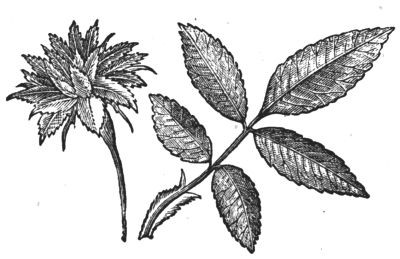
Fig. 44.—Rose of Bengal.
Let us take the species known as Œnothera biennis. It belongs, with the fuchsia, circæa, trapa, and others, to the Evening Primrose family, or Onograceæ.
Its pale yellow blossoms are unfolded during the hush of evening-time in almost every garden, shedding abroad on the breeze its delicate but delicious odour. Its petals open in a remarkable manner. The calyx, as we shall see, has small hooks attached to its upper extremity, by which it holds the flower together before expansion. The calicinal divisions gradually unfold at the lower part, and reveal the yellow flower, which remains awhile closed at the upper parts of the hooks. The flower then suddenly opens half-way, when it stops; afterwards completing its expansion gradually, and finally opening with a loud noise.
This curious plant is of American origin, and was unknown in our country until 1674, when it was introduced by some French floriculturists.
It opens generally at about six or seven o'clock in the evening.
And this statement induces me to digress. Where can I better introduce to the reader's notice a Floral Dial? It is not so complete as it might be made if I had space to enlarge upon the subject. My object, however, is simply to suggest; and this brief allusion to the hours at which flowers fold and unfold may induce the reader to study in more detail a very pleasant branch of botanical science. He will find full particulars in Mr Loudon's excellent "Encyclopædia of Gardening."
It is generally stated that the first Floral Dial, or clock, which showed the time by the opening or shutting up of blossoms throughout the day, was a fancy or invention of the great Swedish naturalist, Linnæus. But there is a distinct allusion to this poetical measurement of the "fleeting hours" in Marvell's poem on "The Garden:"—
"How well the skilful gardener drew
By flowers and herbs this dial new!
Where, from above, the milder sun
Does through a fragrant zodiac run;
And, as it works, the industrious bee
Computes its time as well as we.
How could such sweet and wholesome hours
Be reckoned but with herbs and flowers?"
Whether the idea first occurred to Englishman or Swede, poet or botanist, matters but little; it is a graceful, a suggestive, a beautiful idea, and might well be reproduced in some of our large public gardens.
"'Twas a lovely thought to mark the hours,
As they floated in light away,
By the opening and the folding flowers,
As they laugh to the summer's day.
"Thus had each moment its own rich hue,
And its graceful cup and bell,
In whose coloured vase might sleep the dew,
Like a pearl in an ocean shell."
FLORAL DIAL.
TIME AT WHICH THE FOLLOWING FLOWERS FOLD AND UNFOLD.
Open.
Close.
H. M.
H. M.
P.M.
A.M.
Goat's Beard (Lat. syn.
Tragopogon luteum),
9.10
3.5
Late-flowering Dandelion (
Leontodon serotinum),
12.1
4.0
Hawkweed (
Picris echioides),
12.0
4.5
Alpine Hawk's-beard (
Crepis Alpina),
12.0
4.5
Wild Succory (
Cichorium intybus),
7.0
5.0
Naked-stalked Poppy (
Papaver nudicaule),
7.8
5.0
Copper-coloured Day-lily (
Hemerocallis fulva),
11.12
5.0
Smooth Sow-thistle (
Sonchus lævis),
12.0
5.0
Blue-flowered Sow-thistle (
Sonchus Alpinus),
4.5
5.6
Field Bindweed (
Convolvulus arvensis),
10.0
5.6
Common Nipplewort (
Lapsana communis),
4.5
6.7
Spotted Cat's-ear (
Hypochæris maculata),
5.0
7.0
White Water-lily (
Nymphæa alba),
10.0
7.0
Garden Lettuce (
Lactuca sativa),
3.4
7.0
African Marigold (
Tagetes erecta),
2.0
8.0
Mouse-ear Hawkweed (
Hieracium piloscella),
2.0
8.0
Proliferous Pink (
Dianthus proliferus),
1.0
8.0
Field Marigold (
Calendula arvensis),
3.0
9.0
Purple Sandwort (
Arenaria purpurea),
2.3
9.10
Creeping Mallow (
Malva Caroliniana),
12.1
9.10
Chickweed (
Stellaria media),
9.10
9.10
After this long digression, we return to our Evening Primrose.
Its large yellow flowers are disposed in clusters at the top of a stem often twenty inches long. The Pythagorean tetrad (i.e., the number 4 and its double) predominates in all its organs: 4 stigmata crowning a filiform stylus; quadrangular capsule with 4 polyspermous lobes; opening at top by the separation of 4 valves; twice 4 stamens; 4 petals on a large, emarginated limb; 4 sepals. These are united at the base, but not so as to prevent the observer from distinguishing their number.
The general terms "regular" and "irregular," applied to the calyx, as to every other organ, require to be employed with considerable reserve. The delicate shades, which ought to separate regularity from irregularity, are often so inappreciable that it is almost impossible to say where one begins and the other ends. See, for example, the Labiatæ. In most genera and species of this family, the two lips, one of which consists of two and the other of three foliola, bring out very completely the inequality of the calyx. But there are also Labiatæ, the inequality of whose sepals completely effaces the character of the irregular bilabiated calyx.
In certain inflorescences, where the flowers comprising them are very close together, as, for example, in the capitules of the Synantheraceæ, the free upper portions of the calyx may take the most irregular forms; as, sometimes, a tuft, simple or feathery; sometimes, membranous or scarious spangles; and, sometimes, bristles of greater or less stiffness. What elements of the calyx do these transformations represent? The veins, and notably the midrib of the limb of the sepals, united underneath.
The free foliola of the polyphyllous calyx may vary in form, like the caulinary leaves whence they issue by way of metamorphosis; they may be oval, elliptical, linear, &c. Yet none have ever been observed of a heart-shape (cordiform).
Certain foliola of the polyphyllous calyx affect fantastic outlines. In the Delphinium, the upper sepal is prolonged into a spur. In the aconites it is hollow like a helmet. The spur of the calyx of the monk's-hood (Capucine) is the result of the united prolongation of these foliola. The buckler (Scutellum), from which is named the Scutellaria, a genus of Labiatæ, is a demi-orbicular boss formed below the inferior lip of the calyx.
The union of the calicinal foliola sometimes forms a conical calyx, as in the Silena conica, and sometimes a cup-shaped calyx, as in the orange; sometimes, moreover, an urceolate calyx, as in the henbane (Hyosciamus niger). These forms may vary singularly. The calyx of the black alder (Rhamnus frangula) is shaped like a top; that of the haricot (Phaseolus vulgaris), like a bell; that of the tobacco-plant, or the Mollucella spinosa, is infundibuliform (or funnel-shaped).
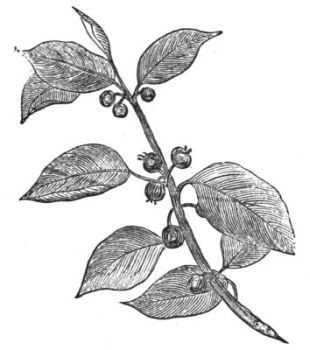
Fig. 45.—The Henbane.
The observer is sometimes embarrassed in deciding to which whorl he should refer the foliola he is examining. Thus, the tiny foliola which, in the strawberry and the potentilla, alternate with others and larger ones, are stipules rather than sepals. Ought the sepals of the calyx in the Malvaceæ to be assimilated in like manner to the stipules? It is difficult to reply to this question satisfactorily. Take, for example, the Hibiscus Syriacus, an ornamental shrub, better known by the name of the garden-hemp. The inner calyx, or calyx properly so called, of this Malvacea has five sepals, while the outer calyx, or calicule, has twelve. Now, a leaf cannot have more than two stipules, one on each side. For an outer calyx, then, the proper number of foliola is ten, not twelve. To look upon the second calyx as a "supernumerary development," would be to hazard a supposition contrary to the unity of plan of the floral organs.
The calyx, like the corolla, is not an absolutely indispensable organ. Sometimes, therefore, it is caducous—that is, falls off before the flower expands,—as in poppies; sometimes, persistent, or remains after flowering,—as in roses and the majority of plants. In some cases it is persistent only until after the act of fecundation, but this act accomplished, it falls with the corolla in most of the Cruciferæ and Ranunculaceæ. This is a deciduous calyx.
The "caducity" and "persistency" of floral envelopes furnish some valuable characteristics for the distinction of species. Thus, two closely-allied Cruciferæ, the Alyssum calicinum, so common in spring upon stony soils, and the Alyssum montanum, can only be distinguished from one another by the fact that the calyx of the former is persistent, of the latter caducous. It is true that the flowers of the Alyssum calicinum are of a yellow which easily passes into white, while those of the Alyssum montanum are of a beautiful permanent yellow. But this latter distinction is not so good as the former.
The persistent calyx sometimes assumes a considerable increase of very common appearance. For example, take the Physalis alkekengi, a member of the Nightshade family or Solanaceæ. The red bladder-like accrescence surrounding the scarlet fruit is the calyx, which, after flowering, has grown much larger than it was before. And these bright flowers which resemble large strawberries, and abound on the borders of meadow-paths, if you look at them closely, you find to be the accrescent calices of the Trifolium fragiferum. The very word fragiferum reminds us of the strawberry.
The calyx may change in consistency and texture in proportion as the ovary, to which it adheres, changes into fruit. The fleshy pulpy substance of the apple, and, in general, of the fruits of the Pomaceæ, is simply an excessive development of the calicinal tube united all around the ovary, and recognisable in the pips, imprisoned, towards the centre, in horny lobes. In other plants, as the flower develops into fruit, the calyx becomes woody: such is the case with the Water Chestnut (Trappa natans).
Finally, the calyx may even contribute to the dissemination of the seed. We may cite, as an example, a Brazilian species of Urticaceæ, which Saint-Hilaire named the Elasticaria. The fleshy and cylindrical parts of the calyx are curved inwards, and thus defend, as one might do with one's bended fingers, the young fruit until it is completely developed; as soon as the fruit is ripe, they spring up erect, and launch it to a distance.
The Corolla.—If from the circumference we proceed to the centre of the flower, the calyx being the first, the corolla will be its second envelope.
If, on the contrary, we proceed from the centre to the circumference, the corolla will form the fourth whorl; the pistil (consisting of stigmata, stylus, and ovary) being the first; the nectariferous disc (often wanting) the second; and the stamens the third whorl. Remarkable for its varied tints, the corolla, to indifferent or ignorant eyes, seems the entire flower.
A black or blackish colour is exceedingly rare. Out of 300 vegetable species which compose the flora of Central Europe, there are not six with blackish or even grayish flowers. No hypothesis has yet been put forward to explain this mark-worthy rarity.
Species with a yellow corolla are the most numerous, forming more than a sixth of the European flora: then come, in their order of frequency, species with green, white, red, and blue flowers; the white increasing in number as we approach the Pole.
Dividing the flora into twenty parts, we may ascribe to each colour, and its various tints, the following proportion:—
Yellow,
6.0
Green,
4.50
White,
4.0
Red,
3.50
Blue,
1.50
Black,
0.50
The analogy between the parts or petals of the corolla and the leaf, is perhaps not quite so striking as between the leaf and the sepals of the calyx. The phrase "rose-leaves" is an expression consecrated by immemorial usage. Why not prefer the term "corollary leaves or leaflets (foliola)" to that of petals?
The corollary leaves, or petals, are organised like true leaves. They have the same system of venation; their lamina correspond to the "limb," or "blade;" and their unguis, or "claw," to the "petiole," or stalk. (See Fig. 46, a.) The upper margin of petals is frequently more obtuse than the overspreading margin of the blade of a leaf, which, in most cases, is pointed. Non-unguiculate petals represent the sessile leaves. (Fig. 46, b.) Their form is much more varied than that of the calicinal foliola, which are never unguiculate or petiolated.
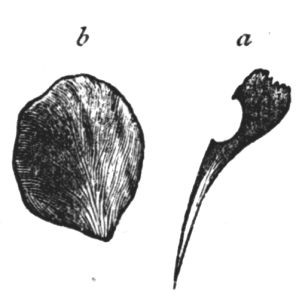
Fig. 46, a.—Unguis of the Corolla.
Fig. 46, b.—A Sessile Petal.
The petal is defined as regular when its two halves, folded one upon another at the midrib, exactly cover each other; in the opposite case it is called irregular. In certain species, the petals are furnished with characteristic appendages. But observe, these appendages, which generally affect the form of a spur, have no character of generality. Thus, for example, in the violet, a single petal is prolonged into a spur below its point of attachment; in larkspur, and the other Delphiniums, there are two which terminate in the same manner; in the Aquilegia vulgaris, all the petals are calcarate (calcar, a spur).
According as the veins of the petal proceed in a straight or curved direction, its limb may be flat, or concave, or hollowed like a boat—i.e., cymbiform (cymba, a boat), or naviculate (navis, a ship), or like a spoon, cochleariform (cochleare, a spoon). When the spur is very short, as in Antirrhinum and Valerian, the corolla or petal is termed gibbous (gibbus, a swelling), or saccate at the base.
If a petal continue narrow, so as to seem formed by the prolongation of the claw, it is called linear; if the limb be prolonged below, so as to form two lobes, it is cordate, as in Genista caudicans; or if the lobes be acute, it may be sagittate or hastate.
The number of petals varies from two to twelve, and more. A corolla with a single petal, unipetalous, which we must not confound with the monopetalous corolla, is a monstrosity, created by defective development; the other petals or foliola are abortive. A corolla with two petals, or dipetalous, as in Circæa Lutetiana, is rare. A tripetalous corolla occurs only when the calyx has likewise three foliola. But in this instance opinions are divided: the majority will not admit more than a single floral envelope,—a perianth of six foliola, of which three, herbaceous and internal, alternate with three petaloid and external.
Many of our aquatic plants may be quoted as examples: such as the Butomus umbellatus, or flowering rush; the little frog-bit, or Hydrocharis morsus ranæ; and the water plantain, Alisma plantago.
The tetrapetalous (or four-petalled) corolla is usually arranged like a cross, and is much more frequent than the dipetalous or tripetalous; for examples, we need only refer to the large and important family of the Cruciferæ.
The number five (pentapetalous) is still more common; but we meet with it in other organs besides petals, and it seems particularly characteristic of the vegetable kingdom.
Thus, all the Umbelliferæ have five sepals, five petals, and five stamens; in all the Crassulaceæ, the number five applies, not only to the sepals and the petals, as well as to the stamens, but also to the carpels which compose the ovary.
Corollas with six, eight, nine, ten, or twelve petals are relatively rarer; and when the petals become so numerous that we cannot count them, we have to deal with transformations of stamens into petals, with those monstrosities of cultivation which we call double flowers, flores pleni, where all the male organs have disappeared,—flowers wholly unfit for fructification.
The petals of the corolla are not always free. Like those of the calyx, they may be attached to one another by their edges, but this union invariably takes place, as in the former, from bottom to top. Therefore, we never see any petals united at the top, and disengaged at the bottom (see Fig. 47, a.) But the reader must take careful note that this invariable characteristic is not peculiar only to the floral envelopes; it is not met with in the stamens, for these may be united, either by their anthers, as in the whole family of the Synantheræ, or by their filaments, as in the Leguminosæ. And what we have said of the stamens applies also to the parts constituting the pistil. This radical difference between the perianth and the true reproductive organs ought, from the beginning, to have fixed the attention of botanists on the centripetal and centrifugal metamorphosis of the leaf, which we have spoken of in "The Circle of the Year."
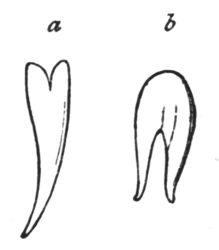
Fig. 47, a.—Natural junction of Petal.
Fig. 47, b.—Unnatural (and impossible) junction.
In many plants we are permitted to follow step by step, as it were, the union of the petals, and their definitive transformation into what is called the monopetalous corolla. The term monopetaloid ought then to be rejected, if we are to believe that the monopetalous corolla is the result of the metamorphosis of a single leaf. The word gamopetalous, or, rather, gamophyllous, is preferable. As we have remarked in reference to the calyx, we shall here repeat that the expressions bilobed, trilobed, quadrilobed, or bipartite, tripartite, quadripartite corollas, are radically vicious, because they are the consequence of a false point of view, according to which the monopetalous corolla will be simply a single metamorphosed leaf, susceptible of being more or less deeply divided from top to bottom.
The polypetalous corolla, as well as the gamophyllous corolla, may be regular or irregular, according as the foliola are equally or unequally united. But here again we must be careful not to lay down too absolute rules. Examine, for instance, the gamophyllous corolla of the gentians; their two lobes are very unequal, and yet the corolla is regular: five very large lobes alternate with five very small, in such wise that each of the latter is situated between two larger lobes. Each division of the corolla of the periwinkle is irregular, and yet the aggregate of their divisions is regular: these are all of the same form and the same size.
In the gamophyllous corolla we are able to discern, through the different forms it assumes, the form of the parts which compose the union. Thus, for example, the tubulate corolla supposes the pre-existence of unguiculate petals.
Inequality of union produces the bilabiate corolla, which is invariably tubular. This is the case in the natural family of the Labiatæ. The upper lip is composed of two petals, and the lower of three. The parts of the upper are sometimes so closely joined that they appear to be but one, as in the Lamium; and the lower often becomes quadrilobed by the division of the middle petal, as in the Stæcha.
In the labiated corolla, the mouth of the tube is open, while in the personate or masked (persona, a mask) it is closed by the pressure of the lower lip against the upper; as in Snapdragon and Frogsmouth, the projection of the lower lip being called the palate. By this feature the family of the Scrophulariaceæ is easily distinguished from that of the Labiatæ.
In some corollas, the two lips are hollowed out in a very singular fashion, as in the Calceolaria; assuming a "slipper-like appearance," similar to what takes place in the labellum of certain orchids,—to wit, the Cypripedium. These calceolate (calceolus, a slipper) corollas may be looked upon as consisting of two slipper-like lips.
The forms of the bilabiate, tubular, and ligulose florets, of the capitula of the Synantheræ, are likewise due to simple differences of union. The floscular capitulum comprises the tubular florets, and the semi-floscular capitulum, the ligulate florets; the radiate capitulum consists of florets ligulate or bilabiate at the circumference, and of tubular florets over the rest of the receptacle. By considering the capitula, as the vulgar do, to be flowers, Tournefort introduced considerable confusion into the nomenclature of the Synantheræ.
SUMMER FLOWERS.
[58] "The term perianth is usually confined to the flowers of Endogens, whatever colours they present, whether green, as in asparagus, or coloured, as in tulip. Some use the term as a general one, and restrict the use of perigone to cases where a pistil is present, not applying it to unisexual flowers, in which stamens only are produced."—Professor Balfour, "Manual of Botany," p. 169.
[59] Homer, "Odyssey," Book xix., line 520.
[60] Grew, "Anatomy of Plants," p. 147.
"Dawn, gentle flower,
From the morning earth!
We will gaze and wonder
At thy wondrous birth!
"Bloom, gentle flower,
Lover of the light,
Sought by wind and shower,
Fondled by the night!"[61]
The Prunella, or Self-Heal.
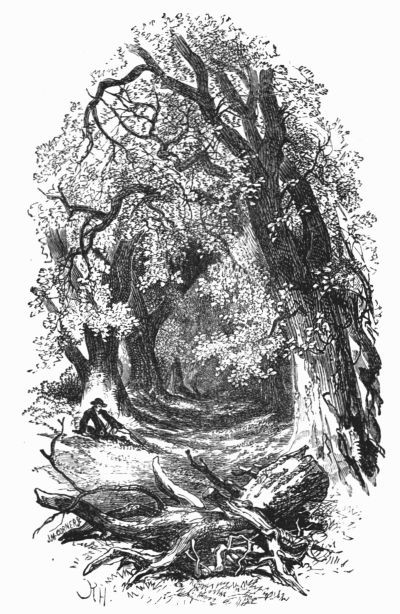
Fig. 48.—"Rejoicing in the shade of over-arching elms."
In your summer-walks, dear reader,—summer-walks through green lanes rejoicing in the shade of over-arching elms, or along woodland glades, carpeted with odorous turf,—you must frequently have met with an herbaceous plant, whose purple-blue flowers, arranged in regular succession, form the prettiest coloured cones imaginable at the extremity of the stem and branches. To this plant, the self-heal, we shall return immediately. Perhaps you have passed it by somewhat indifferently, for we pay little heed to common things, and on the threshold of woods, and in their winding avenues, the self-heal is very common. The celebrated German botanist, Bock (or Tragus) bestowed upon it, two centuries before the epoch of Linnæus, the name of Prunella vulgaris. The specific appellation, vulgaris, is here employed very appropriately, but we should commit a grave error if we supposed every species qualified as vulgaris to be "common." For example, the Lysimachia vulgaris, a species of Primulaceæ, is far from being found everywhere.
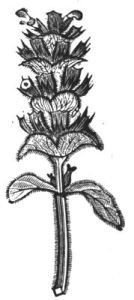
Fig. 49.—The Prunella.
Pray, take the trouble to pick one lowly specimen; being specially careful to take up the whole plant, stem, root, and branch. Lying along the ground, it seems larger than it really is. Its root is a creeper; at the level of the insection of the leaves some small shoots project, the fibrous radicles which compel the lower part of the stem to crawl like the bugle, Ajuga reptans.
Does the prunella belong to the family of Labiatæ, like the bugle?
See for yourself. The stem is quadrangular; the branches and leaves composed of two lips. The stamens are four in number, two of which are longer than the others; finally, by means of a lens, you can easily distinguish, at the very bottom of the calyx, four tiny seeds (a tetrachænium) grouped around the style. These features indicate that our plant belongs, in effect, like the bugle, to the Labiatæ family.
But mark the difference. In the bugle, as in all the species of the same genus (Ajuga), as well as in all the Teucriums—of which wild sage (Teucrium scorodonia) is the most widely-diffused type—in all the Labiatæ, the corolla is apparently unilabiate,—that is to say, the upper lip is so shortened that only the lower is prominently visible. This is not the case with our self-heal: it is distinctly bilabiate. The upper lip of the corolla here forms a positive hood, sufficiently ample to protect the didynamous stamens (two long and two short), as in Fig. 50, a; the lower lip is three-lobed, and the central lobe is largest of the three. By separating the two lips, you can see the two short stamens fixed to the base of the lower one, and the two long attached to the central part of the upper. (See Fig. 50, b.)
Let us pursue the analysis of the flowery cone you hold in your hand.
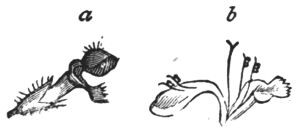
Fig. 50.—The Lips of the Prunella vulgaris.
The least practical eye is immediately struck by the arrangement of the parts and the variety of the colours. To recognise these things more thoroughly, please to cast your glances alternately from the top to the base, and from the base to the apex of its terminal flower. A little below the base you will see a pair of opposite, entire, and sinuous leaves, with shorter stalks than any of the others. The base is defined by two opposite, whitish, and nearly triangular leaves, with green points. The top of the floral spike is likewise marked by a couple of bracts; but these are much smaller, and red-coloured, like the two leaves of the calyx. The interval is occupied by bracts, which diminish in size from the base to the top of the spike; on a level with each pair six flowers are inserted, three for each bract.
The flowers, thus arranged by whorls, present some interesting peculiarities. The lower and upper show only their reddish calices; the middle, for the most part, display both a calyx and a corolla, varying from blue to pale-rose, which gives the plant a very peculiar appearance. In the under flowers, the corolla has already fallen; by separating the lips of the calyx, you may catch sight of the tetrachænium, that is, the four-seeded fruit, which is developed at the bottom of the tube. In the upper flowers, the corolla is not yet expanded. It resembles a small deep-coloured globe; you may say an eye, a bull's-eye, which, from the depths of the calyx, regards you with a piercing glance. Hence, perhaps, the French name for this plant, prunelle, an eye.
We often meet with a variety of self-heal with a white corolla, green calyx, and pinnatifid leaves, a variety of which some botanists have erroneously made a separate species, under the name of Prunella alba. It is equally wrong, in our opinion, to convert the large-flowered variety into a distinct species, by taking as its specific character the lateral cleft of the upper lip of the calyx overlapping the middle cleft; for this same characteristic is found in many individuals of the common species. The dentiform appendage which the two longest stamens exhibit at the top of their filaments is also an uncertain feature; you must have recourse to your magnifying-glass to see if this appendage is obtuse and very short, as in the large-flowered prunella, or sharp, as in the common species. As for the size of the corolla, it is, in fact, very marked; but, as a characteristic, is wholly insufficient. The creation of the varieties Pinnatifida, Laciniifolia, and Integrifolia is no better justified. For it is no rare thing to see on the same stalk, at different heights, pinnatifid, whole, and laciniate leaves.
The prunella is remarkable for the long hairs which garnish the calyx, and, principally, the edges of the bracts. Examined in the microscope, they assume the form of tiny, pointed bamboos; the knots bulge out a little, and the intervals are punctuated.
The botanists of the sixteenth and seventeenth centuries are by no means sparing in their eulogiums on the marvellous virtues of our flower, which, by the way, Bock (Tragus) was the first to figure with tolerable accuracy.[62]
Tournefort thus dwells upon its medicinal properties:—
"It forms an ingredient in arquebusade water and vulnerary potions. It is ordered in possets and broths, in apozèmes for the spitting of blood, dysentery, hæmorrhages, and the like. It has also been used for ulcers in the mouth, and a remedy against headaches; after being mixed with rose-oil and vinegar, the temples were bathed with it."
In the Pharmacopœia of to-day, however, it finds no place.
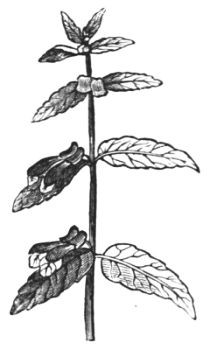
Fig. 51.—Scutellaria galericulata.
The Scutellaria.
At the first glance, the Scutellaria has no resemblance to the prunella. Yet the classificators have united these plants in one small tribe, under the name of Scutellarinaceæ. These are the characters which they give to them: Lower or anterior stamens longer than the superior or posterior; calyx closed at maturity by the approximation of the two lips. The latter character is not nearly so marked in the prunella as in the scutellaria.
The two commonest species of scutellaria in England are the Scutellaria galericulata and Scutellaria minor. They do not inhabit the same localities. The former, which is at the same time the commonest, grows on the river-banks, and especially delights in the mould accumulated in the hollow trunks of old willows. It is easily known by its tender blue corolla, but especially by its calyx, which, after the fall of the corolla, develops itself in a singular manner. If you compress its sides, it will open so as to disclose, at the bottom of its throat, its seeds, which are white, red, or brown, according to their degrees of maturity. (Fig. 52, a.) Now look at these two jaws: the upper resembles a small helmet (Lat. galericula), or, if you prefer it, a judge's cap. As for the lower, it has exactly the shape of a shield (Lat. scutum),—whence its name, scutellaria. (Fig. 52, b.) Thus, the emblems of military and judicial rank are found united in the calyx of our pretty labiate.
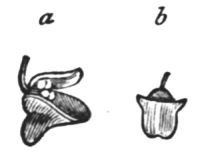
Fig. 52.—Calyx of the Scutellaria.
The second species (Scutellaria minor), rarer than the former, is met with on the banks of ponds and in damp woodland paths. It attracts your gaze by its tiny caps or helmets: the moment you see it, you exclaim, "That's a scutellaria!" More diminutive in all its parts than its congener, it is also distinguished by its whole leaves (they are crenelated or dentate in the Scutellaria galericulata), by its soft, rose-hued corolla, with brown lips coquettishly pointed with red, and by its hairy calyx.
The Scutellaria Columnæ[63] is very rare. It may be recognised by its erect stems and flowers of a bright violet hue, arranged in terminal spikes and garnished with bracts; while the flowers are axillary, and form no spike, in the two species above described.
The Scutellariæ were first described with accuracy and classified by Linnæus, who included them among his Didynamia, a class of vegetables distinguished by the unequal length of the stamens.
THE FORGET-ME-NOT.
"Ye field flowers! the gardens eclipse you, 'tis true;
Yet, wildlings of nature, I dote upon you,
For ye waft me to summers of old,
When the earth beamed around me with fairy delight,
And daisies and buttercups gladdened my sight,
Like treasures of silver and gold.
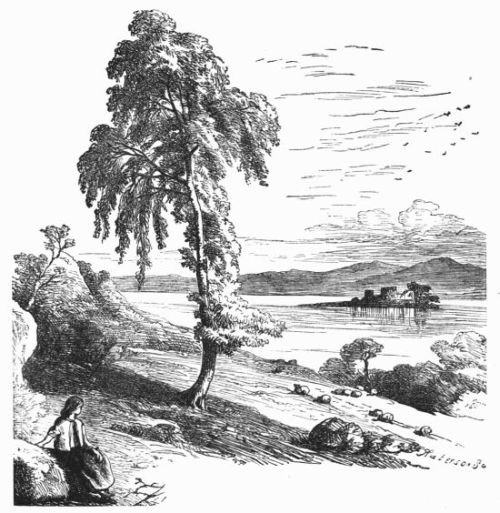
Fig. 53.—"A loved little island, far seen in the lake."
"Even now, what affections the violet awakes!
What loved little islands, far seen in the lakes,
Can the wild water-lily restore!
What landscapes I read in the primrose's looks!
What pictures of pebbles and minnowy brooks
In the vetches that tangle the shore!"[64]
"How beautiful," says Miss Pratt, in one of her agreeable little books,[65]—"how beautiful are the little islands of the stream, edged with the tall white meadow sweet, which sends its perfume far up over the green lands that lie around, and contrasts with the deep blue colour of the purple loose-strife! The willow herb, or codlins-and-cream, as the children call it, grows in perfection there; and there, too, bloom the little yellow water-flag, and the vetches, and the rich water-lily, which, seated on its round leaf, seems to swim over the crystal stream. The water-plantain, with its numerous small pink blossoms, grows in thick clusters quite down in the water, mingling with the white flowers and large spear-shaped leaves of the arrow-head, or half shading the large cup of the yellow water-lily. Then, too, the blue-eyed forget-me-not covers the little isles in such abundance that many of them well deserve the name of azure islands. The water-rat hides among the flowers, nibbling with much glee at the arrow-head, or rushing out from under its broad green leaves; and the water-fowl, followed by her young, sails across the stream in all the stateliness of matron dignity; and the little meek-eyed daisy grows beside the yellow velvet flower of the silver-weed, or the blue blossoms and succulent leaves of the brook-lime."
The true Forget-me-not, Myosotis palustris, is invariably found in marshy localities or on the banks of streams; but the Meadow Scorpion-grass, Myosotis arvensis, is frequently mistaken for it. The "genuine article" has a bright blue blossom, much smaller than, but in shape something resembling, the primrose; in its bract it has a drop of gold, and on each segment of the coloured portion of the flower is a small streak or fleck of white.
Both the true forget-me-not and the false belong to the Borage family, or Boraginaceæ, which includes sixty-seven known genera, and nearly nine hundred species.
It is said that after the battle of Waterloo, a remarkable number of forget-me-nots sprung up all over the fatal field. The circumstance might well be made the theme of a poet's lay, were it not for a suspicion that the little blue flowers belonged to the Myosotis arvensis species, and not to the Myosotis palustris.
But why Myosotis? This Greek compound surely means "mouse-ear," and what have these plants to do with the auricular organs of mice? Why, their leaves were supposed to resemble in form the ear of Mus domesticus. The name of "scorpion-grass" originated in the fact that the top of the stem coils round while the buds are unblown, like a scorpion's tail. It is strange how quick the common people have been to detect these analogies, and to perpetuate them in the appellations they have bestowed on the flowers of the meadow, the wood, and the green lane.
The singularly beautiful name of the Myosotis palustris—we mean its common and non-scientific name,—is ascribed, in a well-known German legend, to the dying knight who, having ventured at a dangerous spot to pluck a handful of the bright blue blossoms for his lady-love, fell into the stream, and as he sank, flung the dear-bought spoil towards her, exclaiming, "Forget me not!"
A more probable origin is suggested by Miss Strickland. "Henry of Lancaster (Henry IV.)," she says, "appears to have been the person who gave it its emblematical and poetical meaning, by uniting it, at the period of his exile, with the initial letters of his watchword, Souveigne vous de moi; thus rendering it the symbol of remembrance, and, like the subsequent fatal roses of York and Lancaster and Stuart, the lily of Bourbon, and the violet of Napoleon, an historical flower."
We have said that the scorpion-grass belongs to the natural family Boraginaceæ, which receives its name from the common borage, a bright blue flower with very rough leaves. All its members are rough or hairy, except those which, like the forget-me-not, become smooth from living partly under water. The black stalks of the borage burn, it is said, like match-paper, and its root enters largely into the composition of rouge. Its flowers were at one time held in great respect as a wholesome bitter ingredient for a tankard of ale. According to Pliny, "if the leaves and flowers of the borage be immersed in wine, and that wine drunken, the potion will make men blithe and merry, and drive away all heavy sadness and dull melancholy."
Burton, in his "Anatomy of Melancholy," also says of it—
"Borage and hellebore fill two scenes,
Sovereign plants to purge the veins
Of melancholy, and cheer the heart
Of those black fumes which make it smart."
Most of the Boraginaceæ are weeds, but they include a few ornamental garden-flowers; as, for example, the Peruvian heliotrope—the "cherry-pie" of the children—which is well known for the fragrance of its blue blossoms. Its Greek name refers to an ancient belief that it always "turned" to meet the sun; but neither heliotrope nor sunflower exhibits any such devotedness towards the great "orb of day." The poet's comparison—
"As the sunflower turns to his God, when he sets,
The same look that he turned when he rose"—
is very pretty and suggestive, but unfortunately it is not true.
The Lilies.
Are we justified in classing these among our summer flowers? Well, the lily of the valley may, perhaps, be more justly claimed by Spring, as it generally unveils its beauty in the month of May; but the water-lily belongs to Summer; and, at all events, it will be most convenient to speak of them in this category.
The lily of the valley (Convallaria majalis),—the May-lily of old writers,—has long been a favourite type of retiring modesty and tender loveliness. It affects the silence and solitude of the woodlands, where, in the shadow of broad leaves and sweeping branches, the inquiring botanist discovers—
"Like detected light,
Its little green-tipt lamps of white."
Shakspeare, who neglected nothing, refers to its gentle humility of attitude:—
"Shipwrecked upon a kingdom where no pity,
No friends, no hope, no kindred weep for me;
Almost no grave allowed me! like the lily
That once was mistress of the field, and flourished,
I'll hang my head and perish."
Our lily is a native of cold and temperate countries, and never shakes its pendant bells at the bidding of a hot Eastern breeze. It is very abundant in Norway. That agreeable writer and observant traveller, Henry Inglis, says:—"It stood everywhere around, scenting the air, and in such profusion, that it was scarcely possible to step without bruising its tender stalks and blossoms. I have not seen this flower mentioned in any enumeration of Norwegian plants, but it grows in all the western parts of Norway in latitude 59° and 60°, wherever the ground is free from forest, in greater abundance than any other wild-flower."
As it will not live in hot countries, it cannot be the "lily of the field" which furnished our Saviour with so fruitful a text for warning and instruction. This, in all probability, was the yellow amaryllis, or Amaryllis lutea, a flower bearing some resemblance to our yellow crocus, but much larger, and with broader leaves. Its delicate blossoms escape from an undivided spathe, or sheath, and are bell-shaped, with six clefts and six stamens, which are alternately short and long. The flower seldom rises more than three or four inches above the soil, accompanied by green leaves, which, after the flowering has passed, continue to preserve their freshness throughout the winter.
But some authorities are not content with the yellow amaryllis, and put forth as the true "lily of the field," either the narcissus, or the golden lily, or the stately crinum, according to their several tastes.
Not connected with these flowers by any botanical relationship, and surpassing them all in beauty, is the Water-lily (Nymphæa alba), whose large round leaves and full white blossoms are the glory of so many of our secluded lakes and quiet streams. Everybody knows old Izaak Walton's quaint eulogium on the strawberry: "Doubtless God could have made a better fruit, but doubtless He never hath." In like manner I am inclined to say: "Doubtless God might have created a fairer flower, but doubtless He never hath." Alas! like most things rare and beautiful, its existence is very brief! pluck it, and straightway it vanishes,—like a poet's dream, the moment he attempts to realise it.
It is sometimes asserted of our wild water-lily that it retires below the surface of the stream shortly after noon, remaining in the liquid depths during night, and rising again into the light of day at early dawn. Those who are acquainted with the haunts and habits of these beautiful flowers know that this is not strictly correct, as they may often be seen, "by the pale moonlight," lying folded above the water. It is not impossible, however, that some may sink; and certain it is, that as the sun sets they close their silver vases.
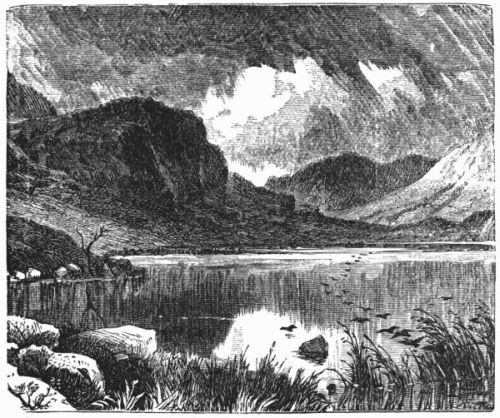
Fig. 54.—"Brightened by the uplifted cups of our delicate naiads."
"Broad-leaved are they, and their white canopies
Are upward turned to catch the heaven's dew."
So says Keats; but this is true only while the sun is asserting his supremacy in the azure sky. And then, the spectacle of a calm, rush-fringed pool, nestling in the shadow of some ancient elms or drooping willows, and brightened by the uplifted cups of our delicate naiads, is a scene of surpassing beauty. We turn from this favourite flower regretfully, "murmuring," as novelists say, Mrs Hemans's graceful apostrophe:—
"Oh! beautiful thou art,
Thou sculpture-like and stately river queen,
Crowning the depths as with the light serene
Of a pure heart!
"Bright lily of the wave!
Rising in fearless grace with every swell,
Thou seem'st as if a spirit meekly brave
Dwelt in thy cell!"
Permit me, reader, another quotation. I take it from your and my favourite, Wordsworth:—
"Rapturously we gather flowery spoils
From land and water; lilies of each hue,
Golden and white, that float upon the waves,
And court the wind."
The lily of golden hue, the yellow water-lily, is the Nuphar lutea of botanists. The country people, on account of its peculiar scent, most unpoetically call it "brandy-bottle." It is far more plentiful than the regal nymphæa; its flower is not so full of petals; and it is by no means so handsome. Yet, with its smooth, glossy leaves, and golden cups, and long floating stems, it favourably attracts the eye. We are told that "its roots are nutritious, and are frequently powdered and eaten for bread in Sweden;" that, mixed with the bark of the Scotch fir, they form a cake much relished by the Swedes; in which case the Swedish palate certainly cannot be censured as fastidious. "These roots are also burnt on the hearths of farmhouses, because their smoke is reputed to drive away the crickets, whose chirping is sometimes too loud and shrill to be deemed musical." Assuredly this is untrue of many parts of England, as the cricket is popularly supposed to be "lucky," and no old country-wife would allow it to be driven away from her sanctum.
The water-lily of the East, the beautiful Lotus,—the Nelumbium speciosum, which is figured on so many Egyptian and Indian monuments,—is rich in blue and red, as well as in white blossoms. These are said to sink quite below the surface in the evening and during the night shadows; whence Moore says of them, with his artificial prettiness—
"Those virgin lilies, all the night
Bathing their beauties in the lake,
That they may rise more fresh and bright
When their beloved sun's awake."
It was formerly abundant on the Nile, and the Egyptians consecrated it to their supreme god, Osiris; but, with the splendour and mysticism of ancient Egypt, it has completely passed away.
But it is scarcely less prized by the Hindus, who have also consecrated it to one of their deities. A traveller thus speaks of the sacred Ganges in connexion with it:—"The rich and luxuriant clusters of the lotus float in quick succession upon the silvery current. Nor is it the sacred lotus alone which embellishes the wavelets of the Ganges; large white, yellow, and scarlet flowers pay an equal tribute; and the prows of the numerous native vessels navigating the stream are garlanded by long wreaths of the most brilliant daughters of the parterre. India may be called a paradise of flowers: the most beautiful lilies grow spontaneously upon the sandy shores of the rivers, and from every projecting cliff some shrub dips its flowers in the waters below."
No reader of English poetry but is familiar with Tennyson's "Lotus-Eaters"—a poem founded on the old myth of a people who lived upon the insane root that takes the reason prisoner, and, beguiled by its sweet intoxication, abandoned themselves to a state of dreamy repose.
"And round about the keel with faces pale,
Dark faces, pale against that rosy flame,
The mild-eyed, melancholy Lotus-eaters came.
"Branches they bore of that enchanted stem,
Laden with flower and fruit, whereof they gave
To each, but whoso did receive of them,
And taste, to him the gushing of the wave
Far, far away did seem to mourn and rave
On alien shores; and if his fellow spake,
His voice was thin, as voices from the grave;
And deep asleep he seemed, yet all awake,
And music in his ears his beating heart did make.
"They sat them down upon the yellow sand,
Between the sun and moon upon the shore;
And sweet it was to dream of Fatherland,
Of wife, and child, and slave; but evermore
Most weary seemed the sea, weary the oar,
Weary the wandering fields of barren foam.
Then some one said, 'We will return no more;'
And all at once they sang, 'Our island home
Is far beyond the wave; we will no longer roam.'"
But the lotus of poetry is not the Nelumbium speciosum. There is some difficulty in identifying it with any modern plant; but the general opinion seems to be, that it was the Zizyphus lotus, a species allied to the Zizyphus jujuba, and included in the Buckthorn family (Rhamnaceæ).
The reader will be by this time aware that of the plants called by the general English name of "lily," some have very little kinship to each other, and others none at all. The little garden flowers named Lilium (from the Celtic word lis, "whiteness") are mostly very handsome. Ben Jonson, speaking of the ordinary lily, says, very finely—
"It is not growing like a tree
In bulk, doth make man better be,
Or standing long, an oak, three hundred year,
To fall a log at last, dry, bald, and sear:
A lily of a day
Is fairer far in May,
Although it fall and die that night,—
It was the plant and flower of light."
The white garden-lily is a native of the Levant, but has become thoroughly naturalised in England, and is one of the commonest but most admired ornaments of our cottage-gardens. The old herbalists thought highly of its medicinal properties, and pronounced it a certain remedy for the bite of a serpent. It is true, at all events, that its bruised petals are an excellent cure for any ordinary wound or bruise.
Our ancestors, among their other superstitious fancies, entertained the extraordinary belief that the price of a bushel of wheat in the ensuing season was foretold by the number of white cups which crowned the white lily's stem, each cup being estimated at one shilling. I opine that our modern farmers would feel dissatisfied if the Mark Lane averages were regulated by this simple standard.
The common Turk's-cap lily (Lilium martagon) is identified with the ancient hyacinth, the "sanguine flower inscribed with woe." The orange lily (Lilium bulbiferum) is a native of Southern Europe. When the Dutch were at feud with the House of Orange, they were accustomed to root up this flower from their gardens, as some solace to their indignant feelings.
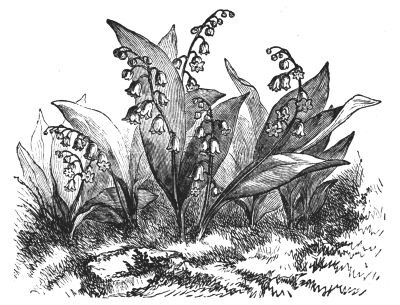
Fig. 55.—Lily of the Valley.
The garden lilies belong to the natural family of the Liliaceæ, which includes the following sub-orders:—
1. Tulipeæ, tulip tribe; bulbous plants, with the segments of the perianth scarcely adherent in a tube.
2. Hemerocallideæ, day-lily tribe; bulbous plants, with a tubular perianth.
3. Scilleæ, or Alliæ, squill or onion tribe; bulbous, with black and brittle testa.
4. Anthericeæ or Asphodeleæ, asphodel tribe; roots fascicled or fibrous, leaves neither coriaceous nor permanent.
5. Convollarieæ, lily of the valley tribe; stem developed as a rhizome or tuber.
6. Asparageæ, asparagus tribe; stem usually fully developed, arborescent, branched in some cases, and leaves frequently permanent and coriaceous.
7. Alonieæ, aloes tribe; stem usually developed, arborescent, with succulent leaves.
8. Aphyllantheæ, grass-tree tribe; characterised by a rush-like habit and membranous imbricated bracts.
The Gentians.
Let me now direct your attention, reader, to a pretty plant, of very elegant appearance: crowned, as it is, by a cluster of rosy flowers, it would not disgrace our well-kept parterres. It is called the common Centaury (Erythræa centaurium). You will never see it in the fields side by side with the Delphinium; but in July and August will meet with it frequently on the borders of woodland paths and open glades.
Would you create for yourself by the study of nature a source of enjoyment equally pure and inexhaustible, adopt a method of classification for your own use, and, to facilitate you in the task, take for your types those plants which are at once the commonest and most characteristic of each season. Quite at your ease, you may begin your analysis by examining the parts which, like the calyx and the corolla, most attract your attention. The most rational plan, however, would be, to commence with the seed, and to follow it through all the wonderful phases of its life, from the development of the embryo to the maturity of the fruit. Unfortunately, we are all compelled to take time into account; time is so much more precious than money,—it is the measurement of our existence. Undoubtedly, the mind, with its gigantic strides, like those of an Homeric god, tends to overleap the confines both of time and space. But the senses, without whose co-operation the intellect could not create science, never fail to remind us that we are, alas! but mortals. By this incessant appeal to order, we are under the necessity of doing, not what we would, but what we can. And the part we really play is, consequently, much more modest than that which we love to imagine ourselves as playing.
But to return to our flowers.
What see you in the little centaury which you hold in your hand? (Fig. 56.)
In the first place, a corolla with five petals of a delicate rose-hue, very pleasant to the sight.
Take care! those foliola are not petals, if you give that name to the free parts of the corolla. Look at them thoroughly. Your foliola are prolonged at their base in a narrow tube, which is easily removed. If you had begun here,—if, instead of proceeding from the top to the bottom, you had, in your analysis, proceeded from the bottom to the top, you would have acquired a wholly different view of things. You would have said that the corolla is tubular, greenish, with a rosy limb, deeply divided into five lobes. And in so doing, you would have run no risk of deceiving yourself. The indications given by Nature herself are the most precious; they are the lessons of a teacher who cannot err: never pass them by with indifference or neglect. In your study of the different parts of a vegetable, follow, as far as possible, the actual movement of the sap.

Fig.
56.
—The Common Centaury.The calyx of our gentian has, like its corolla, the form of a five-divided tube; which, indeed, is one of the usual characters of the Gentian family.
But it is important here to take notice of this fact, because it is not, as at first sight you would suppose, the corolla, but the calyx, which encircles the base of the ovary. The tube of the corolla stops towards the middle of the latter organ, and nearly on a level with the linear divisions of the calyx. You must be careful not to confound with these calycine divisions the green foliola which lie around the base of the flower, and which are neither more nor less than abortive leaves.
Now call to mind that the flower is an union of concentric whorls, or of rings set one within another. The staminal whorl and the carpellary whorl, surrounded by a double perianth (corolla and calyx), are here composed—the first, of five stamens, and the second of a bilobed ovary, surmounted by a twisted style. We may now examine more closely the reproductive organs.
The stamens are inserted upon the top of the tube of the corolla, and if you look at the base of their filaments you would be inclined to pronounce it a foliaceous expansion, or, rather, a metamorphic doubling of the corolla. Suppose the stamens to be the result of the transformation of the petals, the filament would be the "claw," and the anther the "limb" of a foliole. At least, theory would tell you so. But observation will show that these are not petals changing into stamens, but, on the contrary, stamens changing into petals; as is seen in the sterile (or "double") flowers of many of our ornamental plants, and even of some of our fruit trees. How, then, shall we conciliate theory with observation? Look, and you shall find.
Observe the anthers which surmount the filaments. There is something peculiarly characteristic in them. As they open and spread abroad the pollen, they visibly coil themselves up in the form of a spiral. (Fig. 58.) Owing to this twisting, they are found more or less inclined upon their filaments, and are gifted with a considerable mobility. Thoroughly to understand the relation between the continuous anther and the filament, we must examine the stamens before their expansion, while they are still folded up within the floral bud, their matrix. The anthers are then quite straight, and, with a magnifying-glass, you can easily see how they are inserted, by the lower part of their back, upon the top of the filament, whose (so-called) connective prolongation separates the two lobes of the pollen receptacle. The anthers are then introrse (introrsum, inwardly)—that is to say, their face being inclined inwards, they look towards the centre of the flower, occupied by the style, a filiform prolongation of the ovary; the apex of the style (stigma) is thick, globulose, and of a glandular structure. The fruit, resulting from the metamorphosis of the ovary, is an elongated fusiform capsule, composed of two lobes, each containing a very large number of extremely small seeds.
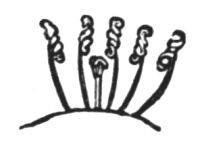
Fig.
58
.—Anthers of the Centaury.The characters we have just enumerated apply, or the majority of them, to the interesting family of the Gentianaceæ—a natural group of plants, nearly all remarkable for their bitter, febrifugal, and anti-scrofulous properties. The flowering cymes of the common centaury are very frequently employed as a substitute for the medicinal gentian, so well known as a valuable tonic.
The medicinal gentian is the Gentiana lutea,—a plant growing about three feet high,—which thrives abundantly on the Pyrenees, and the Alps of Switzerland and Austria, at an elevation of 3000 to 5000 feet. It is not, however, so common now as formerly on the Alpine heights, owing probably to its great consumption, but it is spreading into many districts of Central Europe.
Frequent enough in the vicinity of Paris is the Chlora perforata, a gentian remarkable for its glaucous leaves and yellow terminal flowers.
The Gentiana kurroo of the Himalayas, and the British species, Gentiana campestris and Gentiana amarella, possess the tonic properties of the family. The Cheritta of the pharmacopœia is the herb and root of Agathotes chirayta (Ophelia chirata), a herbaceous plant which flourishes in the Himalayas.
We must not omit a reference to a Lilliputian gentian, the filiform gentian of Linnæus, and the Exacum filiforme or Cicendia filiformis of other botanical authorities.
Its stem, from two and a half to four inches in length, is embellished with radical oblong leaves, disposed in fours, and short caulinary leaves, opposite and linear; the corolla is yellow, the calyx has four triangular lobes; the stamens also are four. It is this predominant number which has induced some botanists to elevate our little gentian into a species of Exacum or Cicendia,—two genera, of which the first was named by Adamson, the second by De Candolle. As for the tiny Gentiana pusilla, or Exacum pusillum, we may look upon it as a simple variety of the Exacum filiforme, differing from the latter only in its shorter and feebler stem, in the somewhat narrower divisions of its calyx, and the tint of its corolla, which is of a paler yellow, sometimes inclining to rose.
Botanists, or lovers of flowers, may grow as passionately fond of gentians as some persons do of tulips or hyacinths. But it is not in England or Scotland, it is in the Alpine pastures of Switzerland only, that you can hope to satisfy your Gentianomania.
An Alpine Excursion.
Permit me, dear reader, to set down a few hints, in case you should at any time be disposed to make a pilgrimage into the Golden Land, or El Dorado, of botanists and geologists.

Fig. 59.—An Alpine Landscape.
Before you plunge into the Alps, you will meet, in the sub-alpine regions, among the valleys which intersect and the meadows which clothe the lower spurs of the Jura, the Gentiana campestris. It is a plant of from five to six inches in height, whose blue, five-lobed corolla, with its velvety gorge, changes into yellow when dried; the two outer teeth of the calyx are elliptical, and much larger than the others. Your attention will hardly be drawn to this tiny gentian among the crowd of more beautiful and attractive plants blooming around it.
One excursion which you should not fail to make is the ascent of the Dent de Jaman,—the hieroglyphic summit of one of those charming mountains which mirror themselves in the Lake of Geneva. This classical, and, moreover, very easy ascent, has the advantage of carrying you up a series of terraces, so that the character of the vegetation changes rapidly. The acclivity begins at the little town of Montreux, situated near the point where the blue arrowy Rhone pours its waters into the enchanted lake. From Montreux to the village of Glion, you will be delighted to greet your old acquaintances: the familiar faces of your native fields, meadows, and woodlands. But soon a difference in the character of the flora forces itself upon you. Species which are rarer at home become tolerably common, as, for instance, the yellow digitalis (Digitalis lutea), so easily recognised by its cymes of tiny flowers. The vulneraria (Anthyllis vulneraria) is as widely diffused as the trefoil in our English pastures.
A little above Glion,—a picturesque village apparently hung over the lake—the sub-alpine region commences. Around villas and mansions, nearly all inhabited by English families, you will find in abundance the English mercury (Chenopodium Bonus Henricus), and in the shady hedges the narcotic Herb-Paris (Paris quadrifolia).
The apparition of the Astrantia major, which resembles an artificial or fancy-created flower, warns us that we are passing beyond the limits of the ordinary flora. I believe that we have no representative in England of that singular umbellifer. The Alpine pastures of the narrow-ridged Mount Caü, which resembles the back of a dromedary, exhale a fragrance like that of the famous Swiss tea, so much extolled as a remedy against cholera. The odour of the hay-lofts attached to the châlets—true shepherd's huts—which rise at intervals along the back of Mont Dromedary, is so penetrating as to produce headache. The hay owes its aromatic fragrance to the musk-chervil (Myrrhis odorata), whose strong stems form such thick luxuriant pasturages; to various orchideæ, particularly to the Nigritella suaveolens, remarkable for the intense colour—nearly black—of its flowers; and finally, to the gentians, whose scent is strongly brought out by drying.
The rich close sward which borders on the Dent de Jaman provides the herboriser with more than one agreeable surprise. You will be struck by the beauty of the flowery tufts of the Linaria Alpina, rejoicing in a deep sapphire blue. You will also have an opportunity of making acquaintance with a campanula which is abundant on Mont Cenis (Campanula Cœnisia); its beautiful terminal flower, of a pale blue, is characterised by the long hairs which line the opening of the corolla.
Among the gentians, those great ornaments of the Alpine pasturages, we shall direct the attention of our readers to—
The purple gentian (Gentiana purpurea), and the spotted gentian (Gentiana punctata). These are distinguished by their plentiful appearance: their large oval leaves, and the height of their vigorous stems, recall those of the yellow gentian. The features which separate these two species are not very distinct: the corolla of the former is purple without and yellow within; that of the latter is of a bright yellow, marked by spots of deep purple, which, however, are not permanent; the calyx is campanulated, with upright and lanceolate foliola.
The Gentiana acaulis contrasts singularly with the preceding species, its stem being so short that one is almost tempted to deny the existence of any; its large corollas, of a bright celestial blue, lie on the ground as if they had fallen fresh from a bouquet. We must not confound this species with the Gentiana pumila, a much smaller plant, with a very elongated calyx, which grows abundantly on the turf of Mont St Bernard.
The Gentiana verna and the Gentiana nivalis, with a corolla of the finest azure, inhabit the loftiest points of the Alps, where all vegetation begins to disappear. The former, or the gentian of spring, flowers, in these frozen regions, in June and July; it is one of twenty-four phanerogamous plants of the last vegetable station of Mont Blanc. This station is formed by a series of vertical layers of protogene, which separates the upper part of the Glacier des Bossons from that of Taconay. The débris of the rock, decomposed under the influence of atmospheric agencies, form, in the midst of the nevé, tiny flowering parterres—oases in the desert, islands in the vast ocean of ice and snow. There, sheltered by the rocks, and warmed by the sun, and refreshed by the snow, which rapidly melts in summer, these pretty plants thrive and grow beautiful, though their brief existence is summed up in a few short weeks.
According to Charles Martins, the phanerogamous plants which flourish at an elevation of 10,000 feet are the following:—
Mean temperature, 47° to 36°.
- Gentiana verna.
- Silena acaulis.
- Draba frigida.[66]
- Draba fladnizensis.
- Cardamine bellidifolia.
- Cardamine resedifolia.
- Potentilla frigida.
- Phyteuma hemisphericum.
- Pyrethrum Alpinum.
- Erigeron uniflorum.
- Saxifraga bryoides.
- Saxifraga Groenlandica.
- Saxifraga muscoides.
- Saxifraga oppositifolia.
- Androsace Helvetica.
- Androsace pubescens.
- Lazula spicata.
- Festuca Halleri.
- Poa laxa.[67]
- Poa cæsia.
- Poa Alpina.
- Trisetum subspicatum.
- Agrostis rupestris.
- Carex nigra (Cariceæ).
The Pimpernel.
Accompany me to the corn-field; not for any discourse upon the state and prospect of the crops, or on the comparative value to man of wheat or barley, but for the sake of the little red flower which shines like a star among the growing harvest.
You cannot mistake it, for, with the exception of the tiny chaff-weed, the smallest wild plant which bears a distinct flower, it is the only scarlet blossom in the wheat-field, except, indeed, the red poppy, which every good farmer seeks to banish from his land. Mark me,—I say the only scarlet flower; for there are several—as, for instance, the pheasant's eye, or Adonis—of a deep crimson.
The pimpernel belongs to the Primrose family, or Primulaceæ. It has a five-cleft calyx, and a monopetalous corolla. Its stamens, of an equal number, are inserted on the corolla, opposite its segments. It is a meteoric flower; so-called, because it keeps itself shut during wet or cloudy weather. Hence, it is known among country people as "the shepherd's warning" or "poor man's weather-glass." And Darwin, enumerating the various signs of rain, says of it—
[61] Barry Cornwall.
[62] Tragus, "Historia Stirpium," p. 310 (ed. 1552).
[63] Fabius Columna (Fabio Colonna), an Italian man of science, who died in 1650, at the age of eighty-three.
[64] Thomas Campbell.
[65] Anne Pratt, "Flowers and their Associations" (ed. 1846).
[66] Draba aretoides has been found on Chimborazo at 16,000 feet.
[67] Poa annua grows at an elevation of 7400 feet.

