автордың кітабын онлайн тегін оқу Folk-Lore of West and Mid-Wales
FOLK-LORE
OF
WEST AND MID-WALES
BY
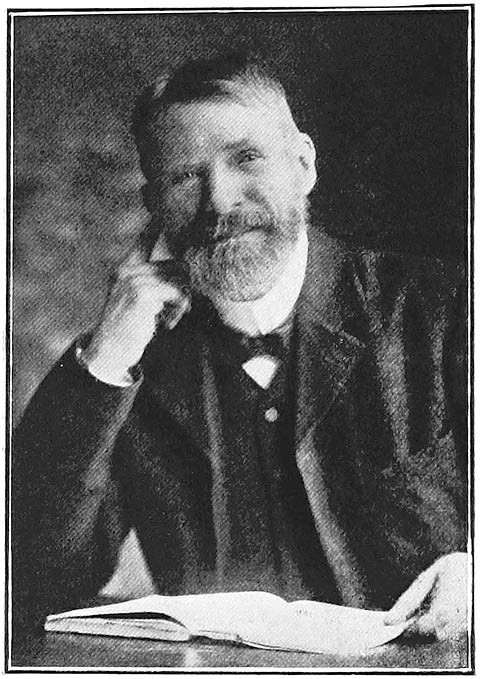
JONATHAN CEREDIG DAVIES
Member of the Folk-Lore Society, Author of “Adventures in the Land of Giants,” “Western Australia,” &c.
With a Preface
BY
ALICE, COUNTESS AMHERST.
“Cared doeth yr encilion.”
ABERYSTWYTH:
PRINTED AT THE “WELSH GAZETTE” OFFICES, BRIDGE STREET.
1911.
This book is respectfully dedicated by the Author
to
COUNTESS OF LISBURNE, CROSSWOOD.
ALICE, COUNTESS AMHERST.
LADY ENID VAUGHAN.
LADY WEBLEY-PARRY-PRYSE, GOGERDDAN.
LADY HILLS-JOHNES OF DOLAUCOTHY.
MRS. HERBERT DAVIES-EVANS, HIGHMEAD.
MRS. WILLIAM BEAUCLERK POWELL, NANTEOS.
PREFACE
BY
ALICE, COUNTESS AMHERST.
The writer of this book lived for many years in the Welsh Colony, Patagonia, where he was the pioneer of the Anglican Church. He published a book dealing with that part of the world, which also contained a great deal of interesting matter regarding the little known Patagonian Indians, Ideas on Religion and Customs, etc. He returned to Wales in 1891; and after spending a few years in his native land, went out to a wild part of Western Australia, and was the pioneer Christian worker in a district called Colliefields, where he also built a church. (No one had ever conducted Divine Service in that place before.)
Here again, he found time to write his experiences, and his book contained a great deal of value to the Folklorist, regarding the aborigines of that country, quite apart from the ordinary account of Missionary enterprise, history and prospects of Western Australia, etc.
In 1901, Mr. Ceredig Davies came back to live in his native country, Wales.
In Cardiganshire, and the centre of Wales, generally, there still remains a great mass of unrecorded Celtic Folk Lore, Tradition, and Custom.
Thus it was suggested that if Mr. Ceredig Davies wished again to write a book—the material for a valuable one lay at his door if he cared to undertake it. His accurate knowledge of Welsh gave him great facility for the work. He took up the idea, and this book is the result of his labours.
The main object has been to collect “verbatim,” and render the Welsh idiom into English as nearly as possible these old stories still told of times gone by.
The book is in no way written to prove, or disprove, any of the numerous theories and speculations regarding the origin of the Celtic Race, its Religion or its Traditions. The fundamental object has been to commit to writing what still remains of the unwritten Welsh Folk Lore, before it is forgotten, and this is rapidly becoming the case.
The subjects are divided on the same lines as most of the books on Highland and Irish Folk Lore, so that the student will find little trouble in tracing the resemblance, or otherwise, of the Folk Lore in Wales with that of the two sister countries.
ALICE AMHERST.
Plas Amherst, Harlech,
North Wales, 1911.
INTRODUCTION.
Welsh folk-lore is almost inexhaustible, and of great importance to the historian and others. Indeed, without a knowledge of the past traditions, customs and superstitions of the people, the history of a country is not complete.
In this book I deal chiefly with the three counties of Cardiganshire, Carmarthenshire, and Pembrokeshire, technically known in the present day as “West Wales”; but as I have introduced so many things from the counties bordering on Cardigan and Carmarthen, such as Montgomery, Radnor, Brecon, etc., I thought proper that the work should be entitled, “The Folk-Lore of West and Mid-Wales.”
Although I have been for some years abroad, in Patagonia, and Australia, yet I know almost every county in my native land; and there is hardly a spot in the three counties of Carmarthen, Cardigan, and Pembroke that I have not visited during the last nine years, gathering materials for this book from old people and others who were interested in such subject, spending three or four months in some districts. All this took considerable time and trouble, not to mention of the expenses in going about; but I generally walked much, especially in the remote country districts, but I feel I have rescued from oblivion things which are dying out, and many things which have died out already. I have written very fully concerning the old Welsh Wedding and Funeral Customs, and obtained most interesting account of them from aged persons. The “Bidder’s Song,” by Daniel Ddu, which first appeared in the “Cambrian Briton” 1822, is of special interest. Mrs. Loxdale, of Castle Hill, showed me a fine silver cup which had been presented to this celebrated poet. I have also a chapter on Fairies; but as I found that Fairy Lore has almost died out in those districts which I visited, and the traditions concerning them already recorded, I was obliged to extract much of my information on this subject from books, though I found a few new fairy stories in Cardiganshire. But as to my chapters about Witches, Wizards, Death Omens, I am indebted for almost all my information to old men and old women whom I visited in remote country districts, and I may emphatically state that I have not embellished the stories, or added to anything I have heard; and care has been taken that no statement be made conveying an idea different from what has been heard. Indeed, I have in nearly all instances given the names, and even the addresses of those from whom I obtained my information. If there are a few Welsh idioms in the work here and there, the English readers must remember that the information was given me in the Welsh language by the aged peasants, and that I have faithfully endeavoured to give a literal rendering of the narrative.
About 350 ladies and gentlemen have been pleased to give their names as subscribers to the book, and I have received kind and encouraging letters from distinguished and eminent persons from all parts of the kingdom, and I thank them all for their kind support.
I have always taken a keen interest in the History and traditions of my native land, which I love so well; and it is very gratifying that His Royal Highness, the young Prince of Wales, has so graciously accepted a genealogical table, in which I traced his descent from Cadwaladr the Blessed, the last Welsh prince who claimed the title of King of Britain.
I undertook to write this book at the suggestion and desire of Alice, Countess Amherst, to whom I am related, and who loves all Celtic things, especially Welsh traditions and legends; and about nine or ten years ago, in order to suggest the “lines of search,” her Ladyship cleverly put together for me the following interesting sketch or headings, which proved a good guide when I was beginning to gather Folk-Lore:—
(1) Traditions of Fairies. (2) Tales illustrative of Fairy Lore. (3) Tutelary Beings. (4) Mermaids and Mermen. (5) Traditions of Water Horses out of lakes, if any? (6) Superstitions about animals:—Sea Serpents, Magpie, Fish, Dog, Raven, Cuckoo, Cats, etc. (7) Miscellaneous:—Rising, Clothing, Baking, Hen’s first egg; Funerals; Corpse Candles; On first coming to a house on New Year’s Day; on going into a new house; Protection against Evil Spirits; ghosts haunting places, houses, hills and roads; Lucky times, unlucky actions. (8) Augury:—Starting on a journey; on seeing the New Moon. (9) Divination; Premonitions; Shoulder Blade Reading; Palmistry; Cup Reading. (10) Dreams and Prophecies; Prophecies of Merlin and local ones. (11) Spells and Black Art:—Spells, Black Art, Wizards, Witches. (12) Traditions of Strata Florida, King Edward burning the Abbey, etc. (13) Marriage Customs.—What the Bride brings to the house; The Bridegroom. (14) Birth Customs. (15) Death Customs. (16) Customs of the Inheritance of farms; and Sheep Shearing Customs.
Another noble lady who was greatly interested in Welsh Antiquities, was the late Dowager Lady Kensington; and her Ladyship, had she lived, intended to write down for me a few Pembrokeshire local traditions that she knew in order to record them in this book.
In an interesting long letter written to me from Bothwell Castle, Lanarkshire, dated September 9th, 1909, her Ladyship, referring to Welsh Traditions and Folk-Lore, says:—“I always think that such things should be preserved and collected now, before the next generation lets them go! ... I am leaving home in October for India, for three months.” She did leave home for India in October, but sad to say, died there in January; but her remains were brought home and buried at St. Bride’s, Pembrokeshire. On the date of her death I had a remarkable dream, which I have recorded in this book, see page 277.
I tender my very best thanks to Evelyn, Countess of Lisburne, for so much kindness and respect, and of whom I think very highly as a noble lady who deserves to be specially mentioned; and also the young Earl of Lisburne, and Lady Enid Vaughan, who have been friends to me even from the time when they were children.
I am equally indebted to Colonel Davies-Evans, the esteemed Lord Lieutenant of Cardiganshire, and Mrs. Davies-Evans, in particular, whose kindness I shall never forget. I have on several occasions had the great pleasure and honour of being their guest at Highmead.
I am also very grateful to my warm friends the Powells of Nanteos, and also to Mrs. A. Crawley-Boevey, Birchgrove, Crosswood, sister of Countess Lisburne.
Other friends who deserve to be mentioned are, Sir Edward and Lady Webley-Parry-Pryse, of Gogerddan; Sir John and Lady Williams, Plas, Llanstephan (now of Aberystwyth); General Sir James and Lady Hills-Johnes, and Mrs. Johnes of Dolaucothy (who have been my friends for nearly twenty years); the late Sir Lewis Morris, Penbryn; Lady Evans, Lovesgrove; Colonel Lambton, Brownslade, Pem.; Colonel and Mrs. Gwynne-Hughes, of Glancothy; Mrs. Wilmot Inglis-Jones; Capt. and Mrs. Bertie Davies-Evans; Mr. and Mrs. Loxdale, Castle Hill, Llanilar; Mr. and Mrs. Lloyd, Waunifor; Mrs. Webley-Tyler, of Glanhelig; Archdeacon Williams, of Aberystwyth; Professor Tyrrell Green, Lampeter; Dr. Hughes, and Dr. Rees, of Llanilar; Rev. J. F. Lloyd, vicar of Llanilar, the energetic secretary of the Cardiganshire Antiquarian Society; Rev. Joseph Evans, Rector of Jordanston, Fishguard; Rev. W. J. Williams, Vicar of Llanafan; Rev. H. M. Williams, Vicar of Lledrod; Rev. J. N. Evans, Vicar of Llangybi; Rev. T. Davies, Vicar of Llanddewi Brefi; Rev. Rhys Morgan, C. M. Minister, Llanddewi Brefi; Rev. J. Phillips, Vicar of Llancynfelyn; Rev. J. Morris, Vicar, Llanybyther; Rev. W. M. Morgan-Jones (late of Washington, U.S.A.); Rev. G. Eyre Evans, Aberystwyth; Rev. Z. M. Davies, Vicar of Llanfihangel Geneu’r Glyn; Rev. J. Jones, Curate of Nantgaredig; Rev. Prys Williams (Brythonydd) Baptist Minister in Carmarthenshire; Rev. D. G. Williams, Congregational Minister, St. Clears (winner of the prize at the National Eisteddfod, for the best essay on the Folk-Lore of Carmarthen); Mr. William Davies, Talybont (winner of the prize at the National Eisteddfod for the best essay on the Folk-Lore of Merioneth); Mr. Roderick Evans, J. P., Lampeter; Rev. G. Davies, Vicar of Blaenpenal; Mr. Stedman-Thomas (deceased), Carmarthen, and others in all parts of the country too numerous to be mentioned here. Many other names appear in the body of my book, more especially aged persons from whom I obtained information.
JONATHAN CEREDIG DAVIES.
Llanilar, Cardiganshire.
March 18th, 1911.
CONTENTS.
PAGE.
DedicationIII.
PrefaceV.
IntroductionVII.
I.
Love Customs, etc.1
II.
Wedding Customs16
III.
Funeral Customs39
IV.
Other Customs59
V.
Fairies and Mermaids88
VI
. Ghost Stories148
VII.
Death Portents192
VIII.
Miscellaneous Beliefs, Birds, etc.215
IX.
Witches and Wizards, etc.230
X.
Folk-Healing281
XI.
Fountains, Lakes, and Caves ...298
XII.
Local Traditions315
Index335
CHAPTER I.
LOVE CUSTOMS AND OMEN SEEKING.
“Pwy sy’n caru, a phwy sy’n peidio,
A phwy sy’n troi hen gariad heibio.”
Who loves, and who loves not,
And who puts off his old love?
Undoubtedly, young men and young women all over the world from the time of Adam to the present day, always had, and still have, their modes or ways of associating or keeping company with one another whilst they are in love, and waiting for, and looking forward to, the bright wedding day. In Wales, different modes of courting prevail; but I am happy to state the old disgraceful custom of bundling, which was once so common in some rural districts, has entirely died out, or at least we do not hear anything about it nowadays. I believe Wirt Sikes is right in his remarks when he says that such a custom has had its origin in primitive times, when, out of the necessities of existence, a whole household lay down together for greater warmth, with their usual clothing on.
Giraldus Cambrensis, 700 years ago, writes of this custom in these words:—
“Propinquo concubantium calore multum adjuti.”
Of course, ministers of religion, both the Clergy of the Church of England and Nonconformist ministers condemned such practice very sternly, but about two generations ago, there were many respectable farmers who more or less defended the custom, and it continued to a certain extent until very recently, even without hardly any immoral consequences, owing to the high moral standard and the religious tendencies of the Welsh people.
One reason for the prevalence of such custom was that in times past in Wales, both farm servants and farmers’ sons and daughters were so busy, from early dawn till a late hour in the evening that they had hardly time or an opportunity to attend to their love affairs, except in the night time. Within the memory of hundreds who are still alive, it was the common practice of many of the young men in Cardiganshire and other parts of West Wales, to go on a journey for miles in the depth of night to see the fair maidens, and on their way home, perhaps, about 3 o’clock in the morning they would see a ghost or an apparition! but that did not keep them from going out at night to see the girls they loved, or to try to make love. Sometimes, several young men would proceed together on a courting expedition, as it were, if we may use such a term, and after a good deal of idle talk about the young ladies, some of them would direct their steps towards a certain farmhouse in one direction, and others in another direction in order to see their respective sweethearts, and this late at night as I have already mentioned.
It was very often the case that a farmer’s son and the servant would go together to a neighbouring farm house, a few miles off, the farmer’s son to see the daughter of the house, and the servant to see the servant maid, and when this happened it was most convenient and suited them both. After approaching the house very quietly, they would knock at the window of the young woman’s room, very cautiously, however, so as not to arouse the farmer and his wife.
I heard the following story when a boy:—A young farmer, who lived somewhere between Tregaron and Lampeter, in Cardiganshire, rode one night to a certain farm-house, some miles off, to have a talk with the young woman of his affection, and after arriving at his destination, he left his horse in a stable and then entered the house to see his sweetheart. Meanwhile, a farm servant played him a trick by taking the horse out of the stable, and putting a bull there instead. About 3 o’clock in the morning the young lover decided to go home, and went to the stable for his horse. It was very dark, and as he entered the stable he left the door wide open, through which an animal rushed wildly out, which he took for his horse. He ran after the animal for hours, but at daybreak, to his great disappointment, found that he had been running after a bull!
Another common practice is to meet at the fairs, or on the way home from the fairs. In most of the country towns and villages there are special fairs for farm servants, both male and female, to resort to; and many farmers’ sons and daughters attend them as well. These fairs give abundant opportunity for association and intimacy between young men and women.
Indeed, it is at these fairs that hundreds of boys and girls meet for the first time. A young man comes in contact with a young girl, he gives her some “fairings” or offers her a glass of something to drink, and accompanies her home in the evening. Sometimes when it happens that there should be a prettier and more attractive maiden than the rest present at the fair, occasionally a scuffle or perhaps a fight takes place, between several young men in trying to secure her society, and on such occasions, of course, the best young man in her sight is to have the privilege of her company.
As to whether the Welsh maidens are prettier or not so pretty as English girls, I am not able to express an opinion; but that many of them were both handsome and attractive in the old times, at least, is an historical fact; for we know that it was a very common thing among the old Norman Nobles, after the Conquest, to marry Welsh ladies, whilst they reduced the Anglo-Saxons almost to slavery. Who has not heard the beautiful old Welsh Air, “Morwynion Glan Meirionydd” (“The Pretty Maidens of Merioneth”)?
Good many men tell me that the young women of the County of Merioneth are much more handsome than those of Cardiganshire; but that Cardiganshire women make the best wives.
Myddfai Parish in Carmarthenshire was in former times celebrated for its fair maidens, according to an old rhyme which records their beauty thus:—
“Mae eira gwyn ar ben y bryn,
A’r glasgoed yn y Ferdre,
Mae bedw mân ynghanol Cwm-bran,
A merched glân yn Myddfe.”
Principal Sir John Rhys translates this as follows:—
“There is white snow on the mountain’s brow,
And greenwood at the Verdre,
Young birch so good in Cwm-bran wood,
And lovely girls in Myddfe.”
In the time of King Arthur of old, the fairest maiden in Wales was the beautiful Olwen, whom the young Prince Kilhwch married after many adventures. In the Mabinogion we are informed that “more yellow was her hair than the flowers of the broom, and her skin was whiter than the foam of the wave, and fairer were her hands and her fingers than the blossoms of the wood-anemone, amidst the spray of the meadow fountain. The eye of the trained hawk, the glance of the three-mewed falcon, was not brighter than hers. Her bosom was more snowy than the breast of the white swan; her cheek was redder than the reddest roses. Those who beheld her were filled with her love. Four white trefoils sprang up wherever she trod. She was clothed in a robe of flame-coloured silk, and about her neck was a collar of ruddy gold, on which were precious emeralds and rubies.”
A good deal of courting is done at the present day while going home from church or chapel as the case may be. The Welsh people are very religious, and almost everybody attends a place of worship, and going home from church gives young people of both sexes abundant opportunities of becoming intimate with one another. Indeed, it is almost a general custom now for a young man to accompany a young lady home from church.
The Welsh people are of an affectionate disposition, and thoroughly enjoy the pleasures of love, but they keep their love more secret, perhaps, than the English; and Welsh bards at all times have been celebrated for singing in praise of female beauty. Davydd Ap Gwilym, the chief poet of Wales, sang at least one hundred love songs to his beloved Morfudd.
This celebrated bard flourished in the fourteenth century, and he belonged to a good family, for his father, Gwilym Gam, was a direct descendant from Llywarch Ap Bran, chief of one of the fifteen royal tribes of North Wales; and his mother was a descendant of the Princes of South Wales. According to the traditions of Cardiganshire people, Davydd was born at Bro-Gynin, near Gogerddan, in the Parish of Llanbadarn-Fawr, and only a few miles from the spot where the town of Aberystwyth is situated at present.
An ancient bard informs us that Taliesin of old had foretold the honour to be conferred on Bro-Gynin, in being the birthplace of a poet whose muse should be as the sweetness of wine:—
“Am Dafydd, gelfydd goelin—praff awdwr,
Prophwydodd Taliesin,
Y genid ym mro Gynin,
Brydydd a’i gywydd fel gwin.”
The poet, Davydd Ap Gwilym, is represented as a fair young man who loved many, or that many were the young maidens who fell in love with him, and there is one most amusing tradition of his love adventures. It is said that on one occasion he went to visit about twenty young ladies about the same time, and that he appointed a meeting with each of them under an oak-tree—all of them at the same hour. Meanwhile, the young bard had secretly climbed up the tree and concealed himself among the branches, so that he might see the event of this meeting. Every one of the young girls was there punctually at the appointed time, and equally astonished to perceive any female there besides herself. They looked at one another in surprise, and at last one of them asked another, “What brought you here?” “to keep an appointment with Dafydd ap Gwilym” was the reply. “That’s how I came also” said the other “and I” added a third girl, and all of them had the same tale. They then discovered the trick which Dafydd had played with them, and all of them agreed together to punish him, and even to kill him, if they could get hold of him. Dafydd, who was peeping from his hiding-place amongst the branches of the tree, replied as follows in rhyme:—
“Y butein wen fain fwynnf—o honoch
I hono maddeuaf,
Tan frig pren a heulwen haf,
Teg anterth, t’rawed gyntaf!”
The words have been translated by someone something as follows:—
“If you can be so cruel,
Let the kind wanton jade,
Who oftenest met me in this shade,
On summer’s morn, by love inclined,
Let her strike first, and I’m resigned.”
Dafydd’s words had the desired effect. The young women began to question each other’s purity, which led to a regular quarrel between them, and, during the scuffle, the poet escaped safe and sound.
After this the Poet fell in love with the daughter of one Madog Lawgam, whose name was Morfudd, and in her honour he wrote many songs, and it seems that he ever remained true to this lady. They were secretly married in the woodland; but Morfudd’s parents disliked the Poet so much for some reason or other, that the beautiful young lady was taken away from him and compelled to marry an old man known as Bwa Bach, or Little Hunchback. Dafydd was tempted to elope with Morfudd, but he was found, fined and put in prison; but through the kindness of the men of Glamorgan, who highly esteemed the Poet, he was released. After this, it seems that Dafydd was love-sick as long as he lived, and at last died of love, and he left the following directions for his funeral:—
“My spotless shroud shall be of summer flowers,
My coffin from out the woodland bowers:
The flowers of wood and wild shall be my pall,
My bier, light forest branches green and tall;
And thou shalt see the white gulls of the main
In thousands gather then to bear my train!”
One of Dafydd’s chief patrons was his kinsman, the famous and noble Ivor Hael, Lord of Macsaleg, from whose stock the present Viscount Tredegar is a direct descendant, and, in judging the character of the Poet we must take into consideration what was the moral condition of the country in the fourteenth century.
But to come to more modern times, tradition has it that a young man named Morgan Jones of Dolau Gwyrddon, in the Vale of Teivi, fell in love with the Squire of Dyffryn Llynod’s daughter. The young man and the young woman were passionately in love with each other; but the Squire, who was a staunch Royalist, refused to give his consent to his daughter’s marriage with Morgan Jones, as the young man’s grandfather had fought for Cromwell. The courtship between the lovers was kept on for years in secret, and the Squire banished his daughter to France more than once. At last the young lady fell a victim to the small pox, and died. Just before her death, her lover came to see her, and caught the fever from her, and he also died. His last wish was that he should be buried in the same grave as the one he had loved so dearly, but this was denied him.
In Merionethshire there is a tradition that many generations ago a Squire of Gorsygedol, near Harlech, had a beautiful daughter who fell in love with a shepherd boy. To prevent her seeing the young man, her father locked his daughter in a garret, but a secret correspondence was carried on between the lovers by means of a dove she had taught to carry the letters. The young lady at last died broken-hearted, and soon after her burial the dove was found dead upon her grave! And the young man with a sad heart left his native land for ever.
More happy, though not less romantic, was the lot of a young man who was shipwrecked on the coast of Pembrokeshire, and washed up more dead than alive on the seashore, where he was found by the daughter and heiress of Sir John de St. Bride’s, who caused him to be carried to her father’s house where he was hospitably entertained. The young man, of course, was soon head and ears in love with his fair deliverer, and the lady being in nowise backward in response to his suit, they married and founded a family of Laugharnes, and their descendants for generations resided at Orlandon, near St. Bride’s.
The Rev. D. G. Williams in his interesting Welsh collection of the Folk-lore of Carmarthenshire says that in that part of the county which borders on Pembrokeshire, there is a strange custom of presenting a rejected lover with a yellow flower, or should it happen at the time of year when there are no flowers, to give a yellow ribbon.
This reminds us of a curious old custom which was formerly very common everywhere in Wales; that of presenting a rejected lover, whether male or female, with a stick or sprig of hazel-tree. According to the “Cambro Briton,” for November, 1821, this was often done at a “Cyfarfod Cymhorth,” or a meeting held for the benefit of a poor person, at whose house or at that of a neighbour, a number of young women, mostly servants, used to meet by permission of their respective employers, in order to give a day’s work, either in spinning or knitting, according as there was need of their assistance, and, towards the close of the day, when their task was ended, dancing and singing were usually introduced, and the evening spent with glee and conviviality. At the early part of the day, it was customary for the young women to receive some presents from their several suitors, as a token of their truth or inconstancy. On this occasion the lover could not present anything more odious to the fair one than the sprig of a “collen,” or hazel-tree, which was always a well-known sign of a change of mind on the part of the young man, and, consequently, that the maiden could no longer expect to be the real object of his choice. The presents, in general, consisted of cakes, silver spoons, etc., and agreeably to the respectability of the sweetheart, and were highly decorated with all manner of flowers; and if it was the lover’s intention to break off his engagement with the young lady, he had only to add a sprig of hazel. These pledges were handed to the respective lasses by the different “Caisars,” or Merry Andrews,—persons dressed in disguise for the occasion, who, in their turn, used to take each his young woman by the hand to an adjoining room where they would deliver the “pwysi,” or nose-gay, as it was called, and afterwards immediately retire upon having mentioned the giver’s name.
When a young woman also had made up her mind to have nothing further to do with a young man who had been her lover, or proposed to become one, she used to give him a “ffon wen,” (white wand) from an hazel tree, decorated with white ribbons. This was a sign to the young man that she did not love him.
The Welsh name for hazel-tree is “collen.” Now the word “coll” has a double meaning; it means to lose anything, as well as a name for the hazel, and it is the opinion of some that this double meaning of the word gave the origin to the custom of making use of the hazel-tree as a sign of the loss of a lover.
It is also worthy of notice, that, whilst the hazel indicated the rejection of a lover, the birch tree, on the other hand, was used as an emblem of love, or in other words that a lover was accepted. Among the Welsh young persons of both sexes were able to make known their love to one another without speaking, only by presenting a Birchen-Wreath. This curious old custom of presenting a rejected lover with a white wand was known at Pontrhydfendigaid, in Cardiganshire until only a few years ago. My informant was Dr. Morgan, Pontrhydygroes. Mrs. Hughes, Cwrtycadno, Llanilar, also informed me that she had heard something about such custom at Tregaron, when she was young.
It was also the custom to adorn a mixture of birch and quicken-tree with flowers and a ribbon, and leave it where it was most likely to be found by the person intended on May-morning. Dafydd ap Gwilym, the poet, I have just referred to, mentions of this in singing to Morfudd.
Young people of both sexes, are very anxious to know whether they are to marry the lady or the gentleman they now love, or who is to be their future partner in life, or are they to die single. Young people have good many most curious and different ways to decide all such interesting and important questions, by resorting to uncanny and romantic charms and incantations. To seek hidden information by incantation was very often resorted to in times past, especially about a hundred years ago, and even at the present day, but not as much as in former times. It was believed, and is perhaps, still believed by some, that the spirit of a person could be invoked, and that it would appear, and that young women by performing certain ceremonies could obtain a sight of the young men they were to marry.
Such charms were performed sometimes on certain Saints’ Days, or on one of the “Three Spirits’ Nights,” or on a certain day of the moon; but more frequently on “Nos Calan Gauaf” or All Hallows Eve—the 31st. of October. All Hallows was one of the “Three Spirits’ Nights,” and an important night in the calendar of young maidens anxious to see the spirits of their future husbands.
In Cardiganshire, divination by means of a ball of yarn, known as “coel yr edau Wlan” is practised, and indeed in many other parts of Wales. A young unmarried woman in going to her bedroom would take with her a ball of yarn, and double the threads, and then she would tie small pieces of wool along these threads, so as to form a small thread ladder, and, opening her bedroom window threw this miniature ladder out to the ground, and then winding back the yarn, and at the same time saying the following words:—
“Y fi sy’n dirwyn
Pwy sy’n dal”
which means:
“I am winding,
Who is holding?”
Then the spirit of the future husband of the girl who was performing the ceremony was supposed to mount this little ladder and appear to her. But if the spirit did not appear, the charm was repeated over again, and even a third time. If no spirit was to be seen after performing such ceremony three times, the young lady had no hope of a husband. In some places, young girls do not take the trouble to make this ladder, but, simply throw out through the open window, a ball of yarn, and saying the words:
“I am winding, who is holding.”
Another custom among the young ladies of Cardiganshire in order to see their future husbands is to walk nine times round the house with a glove in the hand, saying the while—“Dyma’r faneg, lle mae’r llaw.”—“Here’s the glove, where is the hand?” Others again would walk round the dungheap, holding a shoe in the left hand, and saying “Here’s the shoe, where is the foot?” Happy is the young woman who sees the young man she loves, for he is to be her future husband.
In Carmarthenshire young girls desirous of seeing their future partners in life, walk round a leek bed, carrying seed in their hand, and saying as follows:—
“Hadau, hadau, hau,
Sawl sy’n cam, doed i grynhoi.”
“Seed, seed, sowing.
He that loves, let him come to gather.”
It was also the custom in the same county for young men and young women to go round a grove and take a handful of moss, in which was found the colour of the future wife or husband’s hair.
In Pembrokeshire, it is the custom for young girls to put under their pillow at night, a shoulder of mutton, with nine holes bored in the blade bone, and at the same time they put their shoes at the foot of the bed in the shape of the letter T, and an incantation is said over them. By doing this, they are supposed to see their future husbands in their dreams, and that in their everyday clothes. This curious custom of placing shoes at the foot of the bed was very common till very recently, and, probably, it is still so, not only in Pembrokeshire, but with Welsh girls all over South Wales. A woman who is well and alive told me once, that many years ago she had tried the experiment herself, and she positively asserted that she actually saw the spirit of the man who became her husband, coming near her bed, and that happened when she was only a young girl, and some time before she ever met the man. When she was telling me this, she had been married for many years and had grown-up children, and I may add that her husband was a particular friend of mine.
Another well-known form of divination, often practised by the young girls in Carmarthenshire, Cardiganshire and Pembrokeshire, is for a young woman to wash her shirt or whatever article of clothing she happens to wear next to the skin, and having turned it inside out, place it before the fire to dry, and then watch to see who should come at midnight to turn it. If the young woman is to marry, the spirit of her future husband is supposed to appear and perform the work for the young woman, but if she is to die single, a coffin is seen moving along the room, and many a young girl has been frightened almost to death in performing these uncanny ceremonies. The Rev. D. G. Williams in his excellent Welsh essay on the Folk-lore of Carmarthenshire, mentions a farmer’s daughter who practised this form of divination whilst she was away from home at school. A young farmer had fallen in love with her, but she hated him with all her heart. Whilst she was performing this ceremony at midnight, another girl, from mere mischief dressed herself in man’s clothing, exactly the same kind as the clothes generally worn by the young farmer I have mentioned, and, trying to appear as like him as possible, entered the room at the very moment when the charm of invoking the spirit of a future husband was being performed by the farmer’s daughter, who went half mad when she saw, as she thought, the very one whom she hated so much, making his appearance.
The other girls had to arouse their schoolmistress from her bed immediately so that she might try and convince the young girl that she had seen nothing, but another girl in man’s clothes. But nothing availed. The doctor was sent for, but he also failed to do anything to bring her to herself, and very soon the poor young woman died through fright and disappointment.
Another common practice in West Wales is for a young woman to peel an apple at twelve o’clock, before a looking glass in order to see the spirit of her future husband. This also is done on All Hallow’s Eve. Sowing Hemp Seed is also a well-known ceremony among the young ladies of Wales, as well as England.
THE CANDLE AND PIN DIVINATION.
It was also the custom, at least many years ago, if not now, for a young woman, or two of them together to stick pins at midnight in a candle, all in a row, right from its top to the bottom, and then to watch the candle burning and the pins dropping one by one, till the last pin had dropped, and then the future husband of the girl to whom the pin belonged, was supposed to appear; but if she was destined to die single, she would see a coffin.
Another form of Divination, was to put the plates on the dining-room table upside down, and at midnight the spirit of the future husband was supposed to come and arrange them in their proper order.
Another custom resorted to in Cardiganshire and other parts in order to see a future husband, or rather to dream of him, was to eat a hen’s first egg; but no one was to know the secret, and absolute silence was to be observed, and the egg was to be eaten in bed.
GOING ROUND THE CHURCH.
This kind of divination was perhaps of a more uncanny character than anything I have hitherto mentioned, and a custom which both young men and young women very commonly practised, even within the last 50 years as I have been told by old people. This weird practice was to go round the parish church seven times, some say nine times, whilst others again say nine times-and-half, and holding a knife in the hand saying the while:—
“Dyma’r twca, lle mae’r wain?”
“Here’s the knife, where is the sheath?”
It was also the practice to look in through the key-hole of the church door each time whilst going round, and many people assert to this very day that whoever performed this mode of divination in proper order, that the spirit of his or her future wife or husband would appear with a sheath to fit the knife; but, if the young man or woman was to die single, a coffin would meet him or her. Mr. John Jones, of Pontrhydfendigaid, an intelligent old man of 95, with a wonderful memory, told me that, when a boy, he had heard his mother giving a most sad account of what happened to a young woman who did this at Ystrad Meurig in Cardiganshire about the year 1800. She was the daughter of a public house in the village, and the name of her mother was Catherine Dafydd Evan. Mr. Jones’s mother knew the family well; some of them emigrated to America.
This young woman was in love with one of the students of St. John’s College, in the neighbourhood, and being anxious to know whether he was to be her husband or not, she resorted to this uncanny practice of walking nine times round Ystrad Meurig Church. Around and round she went, holding the knife in her hand and repeating the words of incantation, “Here’s the knife, where is the sheath?” And whilst she was performing her weird adventure, to her great alarm, she perceived a clergyman coming out to meet her through the church door with his white surplice on, as if coming to meet a funeral procession. The frightened young woman fell down in a swoon, almost half dead, as she imagined that the one she met with a surplice on was an apparition or the spirit of a clergyman officiating at the phantom funeral of herself, which prognosticated that instead of going to be married, she was doomed to die.
It turned out that the apparition she had seen was only one of the students, who, in order to frighten her, had secretly entered the Church for the purpose. But the poor girl recovered not, and she died very soon afterwards.
I heard the following story from my mother when I was a boy. A girl had determined to obtain a sight of her future husband by going round the parish church nine times at All Hallows’ Eve in the same manner as the young woman I mentioned in the above story, but with more fortunate results. This also happened somewhere in Cardiganshire or Carmarthenshire. Just as the young woman was walking round the ninth time, she saw, to her great surprise, her own master (for she was a servant maid) coming to meet her. She immediately ran home and asked her mistress why she had sent her master after her to frighten her. But the master had not gone out from the house. On hearing the girl’s account, the mistress was greatly alarmed and was taken ill, and she apprehended that she herself was doomed to die, and that her husband was going to marry this servant girl, ultimately. Then the poor woman on her death bed begged the young woman to be kind to her children, “For you are to become the mistress here,” said she, “when I am gone.”
It was also a custom in Wales once for nine young girls to meet together to make a pancake, with nine different things, and share it between them, that is, each of the girls taking a piece before going to bed in order to dream of their future husbands.
Another practice among young girls was to sleep on a bit of wedding cake.
WATER IN DISH DIVINATION.
I remember the following test or divination resorted to in Cardiganshire only about twelve years ago. It was tried by young maidens who wished to know whether their husbands were to be bachelors, and by young men who wished to know whether their wives were to be spinsters. Those who performed this ceremony were blindfolded. Then three basins or dishes were placed on the table, one filled with clean water, the other with dirty water, and the third empty. Then the young man or young woman as the case might be advanced to the table blindfolded and put their hand in the dish; and the one who placed his hands in the clean water was to marry a maiden; if into the foul water, a widow; but if into the empty basin, he was doomed to remain single all his life. Another way for a young maiden to dream of her future husband was to put salt in a thimble, and place the same in her stockings, laying them under her pillow, and repeat an incantation when going to bed. Meyrick in his History of Cardiganshire states that “Ivy leaves are gathered, those pointed are called males, and those rounded are females, and should they jump towards each other, then the parties who had placed them in the fire will be believed by and married by their sweethearts; but should they jump away from one another, then, hatred will be the portion of the anxious person.”
Testing a lover’s love by cracking of nuts is also well known in West and Mid-Wales.
It was also a custom in the old times for a young girl on St. John’s Eve to go out at midnight to search for St. John’s Wort in the light of a glow worm which they carried in the palm of their hand. After finding some, a bunch of it was taken home and hung in her bedroom. Next morning, if the leaves still appeared fresh, it was a good omen; the girl was to marry within that same year; but, on the other hand, if the leaves were dead, it was a sign that the girl should die, or at least she was not to marry that year.
THE BIBLE AND KEY DIVINATION.
The Bible and Key Divination, or how to find out the two first letters of a future Wife’s or Husband’s name is very commonly practised, even now, by both young men and young women. A small Bible is taken, and having opened it, the key of the front door is placed on the 16th verse of the 1st Chapter of Ruth:—“And Ruth said, intreat me not to leave thee, or to return from following after thee; for whither thou goest, I will go; and where thou lodgest I will lodge; thy people shall be my people, and thy God my God.” Some take Solomon’s Songs, Chapter viii., verses 6 and 7 instead of the above verse from the Book of Ruth. Then the Bible is closed, and tied round with the garter taken off the left leg of him or her who wishes to know his or her future wife or husband’s initials. A person cannot perform this ceremony himself; he must get a friend with him to assist him. The young man must put the middle finger of his right hand on the key underneath the loop, and take care to keep the Bible steady. Then the man, who does not consult the future, repeats the above verse or verses, and when he comes to the appointed letter, that is the first letter of the future wife’s name, the Bible will turn round under the finger. I was told at Ystrad Meurig, that a few years ago, a young woman, a farmer’s daughter, tried this Bible and key divination; and whilst the ceremony was going on, and her sister assisting her to hold the key under the Bible and repeating the words, instead of the book turning round as she expected, she saw a coffin moving along the room, which was a sign that she was doomed to die single; and so it came to pass! The farmhouse where this young woman lived is situated in the neighbourhood of Strata Florida, Cardiganshire; but I do not wish to name the house. I have myself once or twice witnessed this divination practised, but I never heard of a coffin appearing, except in the case of the young woman just mentioned.
DIVINATION BY THE TEA-CUP.
Tea-cup divination is also very much practised by young girls in Wales in order to find out some future events concerning love affairs, future husbands, etc. There was a woman, who only died a few years ago, in the parish of Llandyssul, near a small village called Pontshan in Cardiganshire, who was considered an expert in the art of fortune telling by a tea cup, at least young women and young men thought so, and many of them resorted to her, especially those who were in love or intending to marry. There was another one near Llandovery in Carmarthenshire, and there are a few even at present to whom the maidens go for consultation.
But Welsh women, who are so fond of tea, can find out many things themselves by means of the tea cup without resorting to those who are considered experts in the art. When several of them meet together to tea they help one another in divining their cups, and tea drinking or sipping is the order of the day among the females of Wales. After having emptied the cup, it is turned round three times in the left hand, so that the tea-leaves may cover the surface of the whole cup. Then the cup is placed in the saucer, bottom upwards, to drain, for a few minutes before inspection. If the leaves are scattered evenly round the sides of the cup, leaving the bottom perfectly clear, it is considered a very good sign; but on the other hand when the bottom of the cup appears very black with leaves, it is a very bad sign: some trouble or some misfortune is near. When the leaves form a ring on the side of the cup, it means that the girl who consults is to marry very soon; but if the ring is at the bottom of the cup, disappointment in love awaits her, or she is doomed to die single. When the tea leaves form a cross or a coffin, that also is considered a bad sign; but as a rule, a horse, a dog, or a bird portends good. Two leaves seen in close proximity on the side of the cup foretell a letter bringing good news. When there is a speck floating on the surface of a cup of tea before drinking, some people say it means a letter, a parcel, or a visitor, but a young girl takes it to represent her lover, and she proves his faithfulness by placing the speck on the back of her left hand, and striking it with the back of her right hand. Should the speck or the small tea leaves stick to the back of the left hand and cling or stick fast to the right hand when striking it, it means that the young man is faithful; but on the other hand, should it happen that the tea still remain on the left hand where it was first placed, especially after striking it three times, the young man is not to be depended upon. Some women can even tell by means of the tea-cup what trade their admirer follows, the colour of their future husband’s hair, and many other such things.
A lily is considered a most lucky emblem, if it be at the top, or in the middle of the cup, for this is considered a sign that the young man, or the young woman who consults, will have a good and kind wife, or husband, who will make him or her happy in the marriage estate, but on the other hand, a lily at the bottom of the cup, portends trouble, especially if clouded, or in the thick.
A heart, especially in the clear, is also a very good sign, for it signifies joy and future happiness. Two hearts seen together in the cup, the young man, or the young woman’s wedding is about to take place. Tea-cup divination is well-known all over the Kingdom; and in the Colonies, especially Australia, it is by far more popular than in England.
DIVINATION BY CARDS.
Divination by cards is not so much known in Wales as in England, and this is more popular in towns than country places.
CHAPTER II.
WEDDING CUSTOMS.
In times past, Wales had peculiar and most interesting, if not excellent, Wedding Customs, and in no part of the country were these old quaint customs more popular, and survived to a more recent date than in Cardiganshire and Carmarthenshire. Therefore this book would be incomplete without giving a full description of them.
When a young man and a young woman had agreed together to marry “for better for worse,” they were first of all to inform their parents of the important fact. Then in due time, the young man’s father, taking a friend with him, proceeded to interview the young woman’s father, so as to have a proper understanding on the subject and to arrange different matters, especially concerning dowry, etc. I am writing more especially of a rural wedding among the farmers.
The young woman’s father would agree to give with his daughter, as her portion, household goods of so much value, a certain sum of money, and so many cows, pigs, etc.; and the young man’s father, on his part, would agree to grant his son so much money, horses, sheep, hay, wheat and other things, so that the young couple might have a good start in the married life, “i ddechreu eu byd,”—to begin their world, as we say in Welsh. Sometimes the young man’s father on such occasions met with opposition on the part of the young woman’s father or mother or other relations, at least we read that it happened so in the case of the heir of Ffynonbedr, near Lampeter, long ago; for it seems that when he tried to secure the daughter of Dyffryn Llynod, in the parish of Llandyssul, as his bride, the reply was in Welsh rhyme as follow:—
“Deunaw gwr a deunaw cledde,
Deunaw gwas yn gwisgo lifre,
Deunaw march o liw’r scythanod,
Cyn codi’r ferch o Ddyffryn Llynod.”
Anglicised, this meant that she could not be secured without coming for her with eighteen gentlemen bearing eighteen swords; eighteen servants wearing livery; and eighteen horses of the colour of the woodpigeon.
But such opposition was not often to be met with.
After the parents had arranged these matters satisfactorily, the next preliminary and important step was to send forth a gwahoddwr, or Bidder, from house to house, to bid or invite the guests to the Bidding and the Wedding.
In connection with these old interesting customs, there were the Bidding or invitation to the wedding; the Bidder, whose duty it was formally to invite the guests; the Ystafell, or the bride’s goods and presents; the purse and girdle; the Pwython; and the Neithior.
The Bidding was a general invitation to all the friends of the bride and bridegroom-elect to meet them at the houses of their respective parents or any other house appointed for the occasion. All were welcomed to attend, even a stranger who should happen to be staying in the neighbourhood at the time, but it was an understood thing that every person who did attend, whether male or female, contributed something, however small, in order to make a purse for the young couple, who, on the other hand, naturally expected donations from those whose weddings they had attended themselves. So it was to the advantage of the bride and bridegroom-elect to make their wedding as public as possible, as the greater the number of guests, the greater the donation, so it was the custom to send the “Gwahoddwr,” or Bidder all round the surrounding districts to invite the neighbours and friends about three weeks, more or less, before the wedding took place. The banns were, of course, published as in England.
The Gwahoddwr or Bidder’s circuit was one of the most pleasant and merry features of the rural weddings in South Wales in times past, and he was greeted everywhere, especially when it happened that he was, as such often was the case, a merry wag with fluent speech and a poet; but it was necessary that he should be a real friend to the young couple on whose behalf he invited the guests. This important wedding official as he went from house to house, carried a staff of office in his hand, a long pole, or a white wand, as a rule a willow-wand, from which the bark had been peeled off. This white stick was decorated with coloured ribbons plying at the end of it; his hat also, and often his breast was gaily decorated in a similar manner.
The Gwahoddwr, thus attired, knocked at the door of each guest and entered the house amidst the smiles of the old people and the giggling of the young. Then he would take his stand in the centre of the house, and strike the floor with his staff to enforce silence, and announce the wedding, and the names of bride and bridegroom-elect, their place of abode, and enumerate the great preparations made to entertain the guests, etc. As a rule, the Gwahoddwr made this announcement in a set speech of prose, and often repeated a rhyme also on the occasion.
The following was the speech of a Gwahoddwr in Llanbadarn Fawr, Cardiganshire in 1762, quoted in Meyrick’s “History of Cardiganshire,” from the miscellaneous papers of Mr. Lewis Morris:—
“Speech of the Bidder in Llanbadarn Fawr, 1762.”
“The intention of the bidder is this; with kindness and amity, with decency and liberality for Einion Owain and Llio Ellis, he invites you to come with your good will on the plate; bring current money; a shilling, or two, or three, or four, or five; with cheese and butter. We invite the husband and wife, and children, and man-servants, and maid-servants, from the greatest to the least. Come there early, you shall have victuals freely, and drink cheap, stools to sit on, and fish if we can catch them; but if not, hold us excusable; and they will attend on you when you call upon them in return. They set out from such a place to such a place.”
The following which appeared in a Welsh Quarterly “Y Beirniad,” for July, 1878, gives a characteristic account of a typical Bidder of a much later date in Carmarthenshire:—
“Am Tomos fel gwahoddwr, yr wyf yn ei weled yn awr o flaen llygaid fy meddwl.
“Dyn byr, llydan, baglog, yn gwisgo coat o frethyn lliw yr awyr, breeches penglin corduog, gwasgod wlanen fraith, a rhuban glas yn hongian ar ei fynwes, yn dangos natur ei swydd a’i genadwri dros y wlad a dramwyid ganddo; hosanau gwlan du’r ddafad am ei goesau, a dwy esgid o ledr cryf am ei draed; het o frethyn garw am ei ben haner moel; dwy ffrwd felingoch o hylif y dybaco yn ymlithro dros ei en; pastwn cryf a garw yn ei ddeheulaw. Cerddai yn mlaen i’r ty lle y delai heb gyfarch neb, tarawai ei ffon deirgwaith yn erbyn y llawr, tynai ei het a gosodai hi dan y gesail chwith, sych besychai er clirio ei geg, a llefarai yn debyg i hyn:—‘At wr a gwraig y ty, y plant a’r gwasanaethyddion, a phawb o honoch sydd yma yn cysgu ac yn codi. ‘Rwy’n genad ac yn wahoddwr dros John Jones o’r Bryntirion, a Mary Davies o Bantyblodau; ‘rwy’n eich gwahodd yn hen ac yn ifanc i daith a phriodas y par ifanc yna a enwais, y rhai sydd yn priodi dydd Mercher, tair wythnos i’r nesaf, yn Eglwys Llansadwrn. Bydd y gwr ifanc a’i gwmp’ni yn codi ma’s y bore hwnw o dy ei dad a’i fam yn Bryntirion, plwyf Llansadwrn; a’r ferch ifanc yn codi ma’s y bore hwnw o dy ei thad a’i mam, sef Pantyblodau, yn mhlwyf Llanwrda. Bydd gwyr y “shigouts” yn myned y bore hwnw dros y mab ifanc i ‘mofyn y ferch ifanc; a bydd y mab ifanc a’i gwmp’ni yn cwrdd a’r ferch ifanc a’i chwmp-ni wrth ben Heolgelli, a byddant yno ar draed ac ar geffylau yn myned gyda’r par ifanc i gael eu priodi yn Eglwys Llansadwrn. Wedi hyny bydd y gwr a’r wraig ifanc, a chwmp’ni y bobol ifanc, yn myned gyda’u gilydd i dy y gwr a’r wraig ifanc, sef Llety’r Gofid, plwyf Talyllechau, lle y bydd y gwr ifanc, tad a mam y gwr ifanc, a Daniel Jones, brawd y gwr ifanc, a Jane Jones, chwaer y gwr ifanc, yn dymuno am i bob rhoddion a phwython dyledus iddynt hwy gael eu talu y prydnawn hwnw i law y gwr ifanc; a bydd y gwr ifanc a’i dad a’i fam, a’i frawd a’i chwaer, Dafydd Shon William Evan, ewyrth y gwr ifanc, yn ddiolchgar am bob rhoddion ychwanegol a welwch yn dda eu rhoddi yn ffafr y gwr ifanc ar y diwrnod hwnw.
“‘Hefyd, bydd y wraig ifanc, yn nghyd a’i thad a’i mam, Dafydd a Gwenllian Davies, yn nghyd a’i brodyr a’i chwiorydd, y wraig ifanc a Dafydd William Shinkin Dafydd o’r Cwm, tadcu y wraig ifanc, yn galw mewn bob rhoddion a phwython, dyledus iddynt hwy, i gael eu talu y prydnawn hwnw i law y gwr a’r wraig ifanc yn Llety’r Gofid. Y mae’r gwr a’r wraig ifanc a’r hwyaf fo byw, yn addo talu ’nol i chwithau bob rhoddion a weloch yn dda eu rhoddi i’r tylwyth ifanc, pryd bynag y bo galw, tae hyny bore dranoeth, neu ryw amser arall.’”
Rendered into English the above reads as follows:—
“I can see Thomas, in the capacity of a Gwahoddwr,—Bidder,—before me now in my mind’s eye. A short man, broad, clumsy, wearing a coat of sky-blue cloth, corduroy breeches to the knee, a motley woollen waistcoat, and a blue ribbon hanging on his breast, indicating the nature of his office and message through the country which he tramped; black-woollen stockings on his legs, and two strong leathern boots on his feet; a hat made of rough cloth on his half-bare head; two yellow-red streams of tobacco moisture running down his chin; a rough, strong staff in his right hand. He walked into the house he came to without saluting any one, and struck the floor three times with his staff, took off his hat, and put it under his left arm, and having coughed in order to clear his throat, he delivered himself somewhat as follows:—
“To the husband and wife of the house, the children and the servants, and all of you who are here sleeping and getting up. I am a messenger and a bidder for John Jones of Bryntirion and Mary Davies of Pantyblodau; I beg to invite you, both old and young, to the bidding and wedding of the young couple I have just mentioned, who intend to marry on Wednesday, three weeks to the next, at Llansadwrn Church. The young man and his company on that morning will be leaving his father and mother’s house at Bryntirion, in the parish of Llansadwrn; and the young woman will be leaving that same morning from the house of her father and mother, that is Pantyblodau, in the parish of Llanwrda. On that morning the shigouts (seekouts) men will go on behalf of the young man to seek for the young woman; and the young man and his company will meet the young woman and her company at the top of Heolgelli, and there they will be, on foot and on horses, going with the young couple who are to be married at Llansadwrn Church. After that, the young husband and wife, and the young people’s company, will be going together to the house of the young husband and wife, to wit, Llety’r Gofid, in the parish of Tally, where the young man, the young man’s father and mother, and Daniel Jones, brother of the young man, and Jane Jones, the young man’s sister, desire that all donations and pwython due to them be paid that afternoon to the hands of the young man; and the young man, his father and mother, his brother and sister, and Dafydd Shon William Evan, uncle of the young man, will be very thankful for every additional gifts you will be pleased to give in favour of the young man that day.
“Also, the young wife, together with her father and mother, Dafydd and Gwenllian Davies, together with her brothers and sisters, the young wife and Dafydd William Shinkin Dafydd of Cwm, the young wife’s grandfather, desire that all donations and pwython, due to them, be paid that afternoon to the hand of the young husband and wife at Llety’r Gofid.
“The young husband and wife and those who’ll live the longest, do promise to repay you every gift you will be pleased to give to the young couple, whenever called upon to do so, should that happen next morning or at any other time?”
The Bidder then repeated in Welsh a most comic and humorous song for the occasion.
Another well-known “Gwahoddwr,” or Bidder in Cardiganshire was an old man named Stephen, who flourished at the end of the eighteenth, and the beginning of the nineteenth century.

THE BIDDER, OR GWAHODDWR,
(Reproduced from an old picture in the “Hynafion Cymreig,” published in 1823).
He was commonly known as Stephen Wahoddwr, or Stephen the Bidder, and concerning whom the celebrated poet “Daniel Ddu o Geredigion,” wrote to the “Cambrian Briton,” in March, 1822, as follows:—
“There is an old man in this neighbourhood of the name of Stephen, employed in the vocation of ‘Gwahoddwr,’ who displayed, in my hearing, so much comic talent and humour in the recitation of his Bidding-song (which he complained, was, by repetition, become uninteresting to his auditors) as to induce me to furnish him with some kind of fresh matter. My humble composition, adapted, in language and conceptions, as far as I could make it, to common taste and capacities, this man now delivers in his rounds; and I send it you as a specimen of a Bidder’s Song, hoping that your readers will be in some measure amused by its perusal:—
“Dydd da i chwi, bobl, o’r hynaf i’r baban,
Mae Stephan Wahoddwr a chwi am ymddiddan,
Gyfeillion da mwynaidd, os felly’ch dymuniad,
Cewch genyf fy neges yn gynhes ar gariad.
Y mae rhyw greadur trwy’r byd yn grwydredig,
Nis gwn i yn hollol ai glanwedd ai hyllig,
Ag sydd i laweroedd yn gwneuthur doluriad,
Ar bawb yn goncwerwr, a’i enw yw Cariad.
Yr ifanc yn awchus wna daro fynycha’,
A’i saeth trwy ei asen mewn modd truenusa’;
Ond weithiau a’i fwa fe ddwg yn o fuan
O dan ei lywodraeth y rhai canol oedran.
Weithiau mae’n taro yn lled annaturiol,
Nes byddant yn babwyr yn wir yr hen bobl,
Mi glywais am rywun a gas yn aflawen
Y bendro’n ei wegil yn ol pedwar ugain.
A thyma’r creadur trwy’r byd wrth garwyro
A d’rawodd y ddeu-ddyn wyf trostynt yn teithio,
I hel eich cynorthwy a’ch nodded i’w nerthu,
Yn ol a gewch chwithau pan ddel hwn i’ch brathu.
Ymdrechwch i ddala i fyny yn ddilys,
Bawb oll yr hen gystwm, nid yw yn rhy gostus—
Sef rhoddi rhyw sylltach, rai ‘nol eu cysylltu,
Fe fydd y gwyr ifainc yn foddgar o’u meddu.
Can’ brynu rhyw bethau yn nghyd gan obeithio
Byw yn o dawel a’u plant yn blodeuo;
Dwyn bywyd mor ddewis wrth drin yr hen ddaear,
A Brenhin y Saeson, neu gynt yr hen Sesar.
Can’s nid wyf i’n meddwl mae golud a moddion
Sy’n gwneuthur dedwyddwch, dyweden hwy wedo’n;
Mae gofid i’r dynion, sy’n byw mewn sidanau,
Gwir mae’r byd hawsaf yw byw heb ddim eisiau.
‘Roedd Brenhin mawr Lloegr a’i wraig yn alluog,
A chig yn eu crochan, ond eto’n byw’n ‘ysgrechog;
Pe cawsai y dwliaid y gaib yn eu dwylo,
Yr wyf yn ystyried y buasai llai stwrio.
Cynal rhyw gweryl yr aent am y goron,
Ac ymladd a’u gilydd a hyny o’r galon;
‘Rwy’n barod i dyngu er cymaint eu hanghen
Nad o’ent hwy mor ddedwydd a Stephen a Madlen.
Yr wyf yn attolwg i bob un o’r teulu,
I gofio fy neges wyf wedi fynegu;
Rhag i’r gwr ifanc a’i wraig y pryd hyny,
Os na chan’ ddim digon ddweyd mai fi fu’n diogi.
Chwi gewch yno roeso, ‘rwy’n gwybod o’r hawsaf,
A bara chaws ddigon, onide mi a ddigiaf,
Caiff pawb eu hewyllys, dybacco, a phibelli,
A diod hoff ryfedd, ‘rwyf wedi ei phrofi.
Gwel’d digrif gwmpeini wy’n garu’n rhagorol,
Nid gwiw ini gofio bob amser ei gofol;
Mae amser i gwyno mae amser i ganu,
Gwir yw mae hen hanes a ddywed in’ hyny.
Cwpanau da fawrion a dynion difyrus,
I mi sy’n rhyw olwg o’r hen amser hwylus;
Ac nid wyf fi’n digio os gwaeddi wna rhywun,
Yn nghornel y ‘stafell, “A yfwch chwi, Styfyn?”
Dydd da i chwi weithian, mae’n rhaid i mi deithio
Dros fryniau, a broydd, a gwaunydd, dan gwyno;
Gan stormydd tra awchus, a chan y glaw uchel,
Caf lawer cernod, a chwithau’n y gornel.”
The above has been translated into English by one Mair Arfon as follows, and appeared in “Cymru Fu,” Cardiff, August 9th, 1888:—
“Here’s Stephen the Bidder! Good day to you all,
To baby and daddy, old, young, great and small;
Good friends if you like, in a warm poet’s lay
My message to you I’ll deliver to-day.
Some creature there is who roams the world through
Working mischief to many and joy to a few,
But conquering all, whether hell or above
Be his home, I am not certain; his name though is love.
The young he most frequently marks as his game,
Strikes them straight through the heart with an unerring aim;
Though the middle age, too, if he gets in his way,
With his bow he will cover and bend to his sway.
And sometimes the rogue with an aim somewhat absurd,
Makes fools of old people. Indeed, I have heard
Of one hapless wight, who, though over four score,
He hit in the head, making one victim more.
And this is the creature, who, when on his way
Through the world, struck the couple in whose cause to-day,
I ask for your help and your patronage, too;
And they’ll give you back when he comes to bite you.
And now let each one of us struggle to keep
The old custom up, so time-honoured and cheap;
Of jointly, or singly, some small trifle giving,
To start the young pair on their way to a living.
They’ll buy a few things, with a confidence clear,
Of living in peace as their children they rear;
Stealing and content, out of Mother Earth’s hand,
Blest as Cæsar of old, or the King of our land.
I do not consider that riches or gold
Ensure contentment; a wise man of old
Tells us men in soft raiment of grief have their share,
And a life without wants is the lightest to bear.
Once a great English King1 and his talented wife,
Though they had meat in their pan, led a bickering life;
Were the dullards compelled to work, him and her,
With a hoe in their hands it would lessen their stir.
The quarrel arose from some fight for the Crown
And at it they went like some cats of renown;
And although we are poor, I am ready to swear
That Stephen and Madlen are freer from care.
Now let me impress on this whole family,
To think on the message delivered by me;
Lest the youth and his wife, through not getting enough,
Should say that my idleness caused lack of stuff.
A welcome you’ll get there I guarantee you,
With bread and cheese plenty, and prime beer, too;
I know, for I have tried it, and everybody there
Can have ‘bacco and pipes enough and to spare.
It delights me a jovial assembly to see,
For it is wiser sometimes to forget misery;
There are times for complaining and song, too we’re told,
In the proverb of old, which is true as it’s old.
A bumping big cup and a lot of bright men,
Bring before me the jolly old times o’er again,
And I wouldn’t be angry if some one now even
Would shout from some corner “Will you have a glass Stephen?”
Good day to you now, for away I must hie,
Over mountains and hillocks with often a sigh,
Exposed as I am to keen storms, rain, and sleet,
While you cosily sit in your warm corner seat.”
Another well-known Gwahoddwr about 50 years ago was Thomas Parry, who lived at the small village of Pontshan in the parish of Llandyssul. A short time ago, when I was staying in that neighbourhood in quest for materials for my present work, I came across a few old people who well-remembered him, especially Mr. Thomas Evans, Gwaralltyryn, and the Rev. T. Thomas, J.P., Greenpark, both of whom, as well as one or two others, told me a good deal about him.
Like a good many of the Gwahoddwyr or Bidders, he seemed to have been a most eccentric character, of a ready wit and full of humour, especially when more or less under the influence of a glass of ale. Mr. Rees Jones, Pwllffein, a poet of considerable repute in the Vale of Cletwr, composed for T. Parry, a “Can y Gwahoddwr,” or the Bidder’s Song, which song in a very short time, became most popular in that part of Cardiganshire, and the adjoining districts of Carmarthenshire. This Parry the Bidder, whenever he was sent by those intending to marry, went from house to house, through the surrounding districts, proclaiming the particulars, and inviting all to the Bidding and the Weddings, and he was greeted with smiles wherever he went, especially by the young men and young women, who always looked forward to a wedding with great delight, as it was an occasion for so much merriment and enjoyment, and where lovers and sweethearts met. Food was set before the Gwahoddwr almost in every house, bread and cheese and beer, so that it is not to be wondered at that he felt a bit merry before night. He tramped through his circuit through storms and rain, but like most Bidders, he was but poorly paid, so he was often engaged as a mole trapper as well.
On one occasion, he had set down a trap in a neighbouring field in the evening expecting to find a mole entrapped in it next morning. Next morning came, and off went the old man to see the trap, but when he arrived on the spot, to his great surprise, instead of a mole in the trap, there was a fish in it! The famous entrapper of moles could not imagine how a fish could get into a trap on dry land, but he found out afterwards that some mischievous boys had been there early in the morning before him, who, to have a bit of fun at the expense of the old man, had taken out the mole from the trap and put a fish in it instead.
Thus we see that the modern Gwahoddwr was generally a poor man; but in the old times, on the other hand, he was a person of importance, skilled in pedigrees and family traditions, and himself of good family; for, undoubtedly, these old wedding customs which have survived in some localities in Cardiganshire and Carmarthenshire and other parts of Wales even down almost to the present time, are of a very ancient origin, coming down even from the time of the Druids, and this proves the wisdom and knowledge of the original legislators of the Celtic tribes; for they were instituted in order to encourage wedlock so as to increase the population of the country, and to repair the losses occasioned by plagues and wars. A chieftain would frequently assume the character of a Bidder on behalf of his vassal, and hostile clans respected his person as he went about from castle to castle, or from mansion to mansion.
Old people who well remember the time when the quaint old wedding customs were very general throughout West Wales, informed me that it was in some localities the custom sometimes to have two or more Gwahoddwyr to invite to the wedding; this was especially the case when the bride and bridegroom-elect did not reside in the same part of the country; for it happened sometimes that the young man engaged to be married lived in a certain part of Carmarthenshire, whilst his bride perhaps lived some way off in Cardiganshire or Pembrokeshire.
In such cases it was necessary to appoint two Bidders, one for the young man, and another for the young woman, to go round the respective districts in which each of them lived.
An old man in Carmarthenshire informed me that many years ago a friend of his, a farmer in the parish of Llanycrwys married a young lady from Pencarreg, two Bidders were sent forth to tramp the country; one going round the parish of Llanycrwys where the bridegroom lived, and the other’s circuit was the parish of Pencarreg, the native parish of the bride.
Another custom in some places, especially round Llandyssul and Llangeler, which took place before appointing the Gwahoddwr, was for the neighbours and friends to come together of an evening to the house of the bride or bridegroom’s parents, or any other place fixed upon for that purpose. On such occasion a good deal of drinking home-brewed beer was indulged in, “Er lles y par ifanc,” that is, for the benefit of the young couple. All the profit made out of this beer drinking at a private house went to the young man and the young woman as a help to begin their married life. At such a meeting also very often the day of the wedding was fixed, and the Bidder appointed, and should he happen to be an inexperienced one he was urged to repeat his Bidding speech before the company present, in order to test him whether he had enough wit and humour to perform his office satisfactorily in going round to invite to the wedding.
When the young people engaged to be married were sons and daughters of well-to-do farmers, it was the custom to send by this Bidder in his rounds, a circular letter, or a written note in English; and this note or circular in course of time became so fashionable that the occupation of a Bidder gradually fell to decay; that is, it became a custom to send a circular letter instead of a Bidder. The following Bidding Letter, which is not a fictitious one, but a real document, appeared in an interesting book, entitled “The Vale of Towy,” published in 1844:—
“Being betrothed to each other, we design to ratify the plighted vow by entering under the sanction of wedlock; and as a prevalent custom exists from time immemorial amongst “Plant y Cymry” of making a bidding on the occurrence of a hymeneal occasion, we have a tendency to the manner of the oulden tyme, and incited by friends as well as relations to do the same, avail ourselves of this suitableness of circumstances of humbly inviting your agreeable and pleasing presence on Thursday, the 29th day of December next, at Mr. Shenkin’s, in the parish of Llangathen, and whatever your propensities then feel to grant will meet with an acceptance of the most grateful with an acknowledgement of the most warmly, carefully registered, and retaliated with promptitude and alacrity, whenever an occurrence of a similar nature present itself, by
“Your most obedient servants,
William Howells,
Sarah Lewis.
“The young man, with his father and mother (David and Ann Howells), his brother (John Howells), and his cousin (Edward Howells), desire that all claims of the above nature due to them be returned to the young man on the above day, and will feel grateful for the bestowments of all kindness conferred upon him.
“The young woman, with her father and mother (Thomas and Letice Lewis), her sisters (Elizabeth and Margaret Lewis), and her cousins (William and Mary Morgan), desire that all claims of the above nature due to them be returned to the young woman on the above day, and will feel grateful for the bestowments of all kindness conferred upon her.”
The following Bidding Letter I copied from an old manuscript in possession of that eminent Antiquarian, the Rev. D. H. Davies, once Vicar of Cenarth, but who lives at present at Newcastle Emlyn:—
“To Mr. Griffith Jenkins.
“Sir,—As my daughter’s Bidding is fixed to be the Eighth day of February next, I humbly beg the favour of your good company according to custom, on the occasion, which shall be most gratefully acknowledged and retaliated by
“Yours most obedient and humble Servant,
Joshua Jones.
“Penrallt,
Jan. 23rd, 1770.”
The following also is another specimen of such circular, a copy of which came into my possession through the kindness of the esteemed lady, Mrs. Webley-Tyler, Glanhelig, near Cardigan:—
“February 1, 1841.
“As we intend to enter the Matrimonial State, on Thursday, the 11th day of February instant, we purpose to make a Bidding on the occasion, the same day, at the young woman’s Father and Mother’s House, called Llechryd Mill; When and where the favour of your good company is most humbly solicited, and whatever donation you will be pleased to confer on us that day, will be thankfully received and cheerfully repaid whenever called for on a similar occasion,
“By your obedient humble Servants,
John Stephens,
Ann Davies.
“The young man’s Father and Mother (John and Elizabeth Stephens, Pen’rallt-y-felin), together with his brother (David Stephens), desire that all gifts of the above nature due to them be returned to the Young Man, on the said day, and will be thankful for all favours granted.—Also the Young Woman’s Father and Mother (David and Hannah Davies, Llechryd Mill), desire that all gifts of the above nature due to them, be returned to the young woman on the said day, and will be thankful for all favours granted.”
The day before the Wedding was once allotted to bringing home the “Ystafell,” or household goods and furniture, of the young couple; but these customs varied considerably in different parts of the country. The furniture of the bride, as a rule, consisted of a feather bed and bed clothes, one or two large oaken chests to keep clothes in, and a few other things; and it was customary for the bridegroom to find or provide tables, chairs, bedstead, and a dresser. The dresser was perhaps the most interesting relic of family property, and is still to be seen in Welsh farm-houses, and is greatly valued as a thing which has been an heirloom in the family for generations. It consists of two or more stages, and the upper compartments, which are open, are always decked with specimens of useful and ornamental old Welsh ware, which are getting very rare now, and people offer a high price for them as curiosities.
It was also customary on the same day for the young man and the young woman to receive gifts of various kinds, such as money, flour, cheese, butter, bacon, hens, and sometimes even a cow or a pig, also a good many useful things for house-keeping. This was called “Pwrs a Gwregys”—a purse and a girdle. But these gifts were to be re-paid when demanded on similar occasions; and, upon a refusal, were even recoverable by law; and sometimes this was done.
About a hundred years ago, and previous to that date, the day before the wedding, as a rule, was allotted to the “Ystafell,” or bringing home of the furniture, etc.; but more recently it became the custom to appoint a day for that purpose at other times in some districts, that is, it took place whenever the young married couple went to live at a house of their own; this would be perhaps three or six months after the wedding. In Wales it is very common to see a young married couple among the farmers remaining with the parents of the young man, or with the young wife’s parents until it is a convenient time for them to take up a farm of their own.
I have already noticed that these customs varied in different parts of the country. In some districts, the day preceding the Wedding was a great time for feasting, whilst in other localities people came together to drink for the benefit of the young couple, and when cakes were prepared for the Neithior which was to follow the wedding on the next day.
THE WEDDING DAY.
At the present time, Welsh people marry on any day of the week, but about fifty years ago Wednesday was a favourite day in some places, and Friday in other places. I am writing more especially, of course, of West Wales. Indeed, in some parishes old men informed me that when they were young they did not remember any one marrying, except on a Friday. This fact, undoubtedly, is likely to surprise many English readers, who regard Friday as an unlucky day for anything.
Meyrick, writing about one hundred years ago in his History of Cardiganshire, says Saturday was the Wedding Day, and other writers mention the same thing, and it is evident that Saturday was the day on which most people did marry, except in a few districts, about three generations ago, as well as in older times. Whether this day, that is, Saturday, was commonly fixed upon from a belief that it was a lucky day for marriage, or from the convenience of Sunday intervening between it and a working day, is rather difficult to know, but it seems that the following old English Marrying Rhyme was either unknown to the Welsh, or that they did not give heed to it:—
To marry on
“Monday wealth, Tuesday for health,
Wednesday the best day of all;
Thursday for crosses, Friday for losses,
Saturday no luck at all!”
THE HORSE WEDDING.
The rural weddings in South Wales until very recently were Horse Weddings; that is, it was the custom of the whole party, both men and women to ride, and generally at full speed. Poor people generally managed to obtain the loan of horses for the happy occasion from their richer neighbours. On the wedding morning the invited guests, both men and women, married and unmarried, came on their horses and ponies, some of them from a long distance. The men proceeded to the bridegroom’s house, about a hundred or a hundred and fifty in number and honourably paid their pwython; whilst the women at the same time went to the house of the bride, and paid to her their pwython.
“Pwython” was the term used in connection with these weddings to denote the gifts presented to the young bride and bridegroom respectively, in return for what the invited guests themselves had received on the occasion of their own weddings from the young man and the young woman, or their relations or friends. Of course, a large number of those who gave gifts were young and unmarried, so that they were not all under an obligation to give; but still they gave, and they were expected to give to help the young couple, and by so giving, they were placing the latter under an obligation to them in the future, that is, in such cases, the giver gave under the expectation of receiving back gifts of equal value, whenever his or her own, or one of his or her relations’ wedding took place, even should that happen on the very next day.
After depositing their offerings and taking something to eat, it was then the custom for ten, twelve, or sometimes even twenty young men, headed by a bard, a harper, or some fluent speaker, to mount their horses, and drive away full speed in the direction of the bride’s house to demand her in marriage for the bridegroom. But on the morning of the wedding, the young woman, that is, the bride-elect, was not to be got possession of without much trouble and argument, and searching. When the bridegroom’s procession halted at the house of the bride’s parents, the leader of the party, finding the door barred against their entrance, would formally demand the bride, generally in rhyme appropriate to the occasion, delivered something as follows:—
“Open windows, open doors,
And with flowers strew the floors;
Heap the hearth with blazing wood,
Load the spit with festal food;
The “crochon2” on its hook be placed,
And tap a barrel of the best!
For this is Catty’s wedding day!
Now bring the fair one out, I pray.”
Then one of the bride’s party from within made a reply as follows, with the door still closed:—
“Who are ye all? ye noisy train!
Be ye thieves or honest men?
Tell us now what brings you here,
Or this intrusion will cost you dear?”
Then the one from without rejoins:—
“Honest men are we, who seek
A dainty maid both fair and meek,
Very good and very pretty,
And known to all by name of Catty;
We come to claim her for a bride;
Come, father, let the fair be tied
To him who loves her ever well.”
The one within again answers:—
“So ye say, but time will tell;
My daughter’s very well at home
So ye may pack and homeward roam.”
Again the one without exclaims in resolute tones:—
“Your home no more she’s doomed to share
Like every marriageable fair,
Her father’s roof she quits for one
Where she is mistress; wooed and won.
It now remains to see her wedded,
And homeward brought and safely bedded.
Unless you give her up, we swear
The roof from off your house to tear,
Burst in the doors and batter walls,
To rescue her whom wedlock calls.”
Another of the bridegroom’s party then calls aloud, in a voice of authority:—
“Ho! peace in the King’s name, here, peace!
Let vaunts and taunting language cease;
While we the bridesmen, come to sue
The favour to all bridesmen due,
The daughter from the father’s hand,
And entertainment kindly bland.”
The above rhyme appeared in “Adventures of Twm Shon Catty.” There are a good many such verses composed for, or at such occasion, still extant in the Welsh language.
The party without and the party within feigned to abuse one another in such rhymes for an hour, more sometimes, till their wit was exhausted, but the whole performance was nothing but innocent fun, and the doors are opened in the end, and the bridegroom’s party are admitted into the house; but even then the trouble is not always over, for it was the custom for the bride to hide herself, when search would be made for her everywhere under the tables, beds, behind the doors and every corner in the house, and at last found, perhaps, under the disguise of a young man smoking his pipe, or of a “granny” knitting in the corner.
Whoever discovered the bride received a pint of beer and a cake as a prize in some places. All these things were done for fun or amusement, but I heard of one young woman at least, who was hiding in real earnest, and could not be found.
An old farmer near Carmarthen, Griffiths, of Rhenallt, who is 96 years of age, informed me about five years ago, that he once heard his father mention of a man called “Dafydd y Llether,” a butcher near Alltwalis, who was disappointed in this manner. This happened about 100 years ago. This butcher was engaged to be married to a farmer’s daughter who lived in the parish of Llanllwni, about eight miles off, and had made all preparations for the wedding. When the wedding morning dawned, Dafydd and his neighbours and friends, about one hundred in number, mounted their horses at Alltwalis, and galloped away full speed to Llanllwni, and having arrived at the house of the young bride’s parents, search was made for her everywhere, but she was nowhere to be found. At last the young man and his friends had to return home without finding her in great disappointment! The young woman’s parents had prevailed upon her not to marry the young man, “because” added the old man to me “he was too much of a jolly boy.” So they had contrived between them to hide her where she could not be found on the wedding morning.
But, to proceed with our account of the old wedding customs, it was the practice after finding the hidden bride, and partaking of a little refreshments, for the wedding party to mount their horses, and they were joined by the bridegroom and his friends, and made their way towards the church. The young woman was mounted on a fine and swift horse; but often she had to be content to be mounted behind her father, or a brother or a friend; and when the latter was the case, she had to sit on crupper without any pillion, and holding fast to the man. Then the whole cavalcade would gallop off to church. But during the procession the bride was seized suddenly by one of her relatives or friends, stolen away and borne off to a distance. However, this feigned attempt to run away with her was done only in sport. Then a chase ensued, when the bridegroom and his friends drove after her like madmen till they caught her and took her to church. The driving was so furious on such occasions that legs and arms were sometimes broken. Mr. D. Jones in his interesting Welsh book on the History of the Parish of Llangeler, says that in the year 1844, at the wedding of Dinah, daughter of the Rev. Thomas Jones, Saron, one James Evans, the groom of the late Colonel Lewes, drove so furiously that his horse struck against a wall with the result that both the animal and its rider were killed on the spot, near Llangeler Church! In consequence of such a melancholy event the Horse Wedding was discontinued in that part of the country, through the influence of the Vicar, the Rev. John Griffiths, who preached against the practice from II. Kings, chap. IX. verse 20 ... “And the driving is like the driving of Jehu the son of Nimshi; for he driveth furiously.”
The following account of a Horse Wedding appeared in “The Folk Lore of North Wales” by the late Rev. Elias Owen, F.S.A., whose informant was the Rev. Canon Griffith Jones, who witnessed the wedding, which took place at Tregaron, Cardiganshire. We are told that “The friends of both the young people were on horseback, and according to custom they presented themselves at the house of the young woman, the one to escort her to the church, and the other to hinder her from going there. The friends of the young man were called “Gwyr shegouts.” When the young lady was mounted, she was surrounded by the “gwyr shegouts,” and the cavalcade started. All went on peaceably until a lane was reached, down which the lady bolted, and here the struggle commenced, for her friends dashed between her and her husband’s friends and endeavoured to force them back, and thus assist her to escape. The parties, Mr. Jones said, rode furiously and madly, and the struggle presented a cavalry charge, and it was not without much apparent danger that the opposition was overcome, and the lady ultimately forced to proceed to the church, where her future husband was anxiously awaiting her arrival.”
The Lord Bishop of Huron, a native of Cardiganshire, writing to me from Canada, November 17th., 1909, says:—“I remember a wedding once when all the guests were on horse-back and there was a hunt for the bride. There could be no wedding till the bride was caught, and, Oh the wild gallop over hill and dale till she was taken captive and led to the altar! The last wedding of that kind to which I refer took place about 45 years ago. The daughter of Mr. Morgan (I think) of Maestir, near Lampeter, or his intended wife being the bride. A very severe accident happened to the bride and that ended the custom in that neighbourhood.”
Although such things as I have already said were done for sport, yet I have heard of a few cases in which the bride was borne away in earnest, and disappeared willingly in company of an old lover of hers, to the intense astonishment and disappointment of the bridegroom, who happened to be her parents’ choice, and not her own. In this case, the custom of a feigned attempt to run away with the bride had in some respects served its original purpose; for, undoubtedly, the origin of the custom of hiding, running away with, and capturing the bride could be traced back to those barbarous times when marriage by capture was a common practice. Thus in the Mabinogion, we find that when a King named Kilydd, after being for some time a widower, wanted to marry again, one of his counsellors said to him, “I know a wife that will suit thee well, and she is the wife of King Dogel.” And they resolved to go and seek her; and they slew the King and brought away his wife. When his son also named Kilhwch wanted a wife, he went to demand her from her father Yspaddaden Pencawr, the Giant, and obtained her at last after many adventures, and the help of Arthur and his men. It is probable that when the Celtic Tribes had settled in Britain that they often obtained a wife by capturing her from the Aborigines.
This calls to mind the strategy of Romulus to secure wives for his soldiers by directing them at a given signal to seize Sabine maidens and run off with them whilst the men were busy in looking at the games.
Another singular instance of wife snatching in ancient times is to be found in the Book of Judges, for when the men of the tribe of Benjamin were in difficulty in obtaining wives for themselves, their elders commanded them to “go and lie in wait in the vineyards; and see, and behold, if the daughters of Shiloh come out to dance in dances, then come ye out of the vineyards, and catch you every man his wife of the daughters of Shiloh, and go to the land of Benjamin,.... And the children of Benjamin did so, and took them wives, according to their number, of them that danced, whom they caught.” Judges XXI., verses 20, 21, and 23.
It seems that some kind of Horse Weddings is in vogue among the Calmucians, even at the present day, the young woman is first mounted on her horse and drives off full speed, then the young man, who is her intended, mounts and chases her, and when he catches her he can claim her as his wife on the spot; but should she escape him, he cannot claim her. I well remember when I lived in the Welsh Colony of Patagonia, about 20 years ago, that it was a very common custom for a young man and a young woman when in love, to mount their steeds and take a long ride of 20 miles or more in each other’s company, and whilst driving along together in such manner words of love were often whispered. Also when a wedding took place, the guests went to it on their horses, but the old custom of driving after, and capturing the bride was not observed.
Horse Weddings were very general in West Wales about sixty years ago, and even twenty years ago in some districts, but I doubt whether the custom has been continued at the present day in any part of the country. In the chase after the bride it was supposed that whoever caught her would be married without doubt within a year from that date, so it is not to be wondered at that young men drove so furiously on such occasions.
As soon as the marriage ceremony was over in church, it was once the custom for a harper in the churchyard to play “Merch Megan,” “Mentra Gwen,” “Morwynion Glan Meirionydd,” or some other beautiful old Welsh Air appropriate to the occasion.
It was also customary in some places, especially in the Northern part of Cardiganshire, for a certain number of young men to mount their steeds immediately after the ceremony, and drive off full speed, for the first who reached the house of the newly-married couple was to receive a quart of beer and a silk pocket handkerchief, especially if the young husband and wife were well-to-do.
The ceremony at the Church being over, all the company joined and returned to the young couple’s house, where dinner was provided. On their return journey again, as in going to Church, they drove fast. Indeed, it was often the custom to have a regular horse race on the way home from Church on the wedding day.
The Rev. D. G. Williams gives the following amusing story of such a race, in connection with a rural wedding which took place not far from Newcastle Emlyn. There lived a genial old country gentleman in the north-eastern part of Pembrokeshire, known as Mr. Howells, Glaspant, who had sent three of his horses to the wedding referred to, one of them was a pony, considered among the swiftest in the district; but there was one drawback in connection with the animal. He would go whichever way he pleased, especially when he was excited. The wedding procession went along from a house called Gilfach Gweision to Capel Evan, where the “knot was tied,” and as soon as the ceremony was over the homeward race began in real earnest. The Squire felt confident that his “Comet,” as the pony was named, would be sure to prove victorious in the race, if the animal could be kept to follow the road which led on to Cwm Cuch, instead of turning to another road which led to Mr. Howells’ own house, Glaspant. To make sure of this, the enthusiastic old gentleman in due time, sent all his servants, both men and women, with walking-sticks and brooms in their hands to stand where the two roads met, so as to prevent the pony turning to the one that led to the house. Onward came the wedding cavalcade at last, the pony taking the lead as Mr. Howells expected, and when “Comet” saw a rowdy crowd shouting with all their might, and with brooms and sticks, the animal was glad to pass forward in the right direction and soon proved himself the hero of the day, and the old man felt as proud of his pony as the young husband was of his wife.
Another common practice in connection with the weddings in Wales, and still prevails in some places, was known as Chaining or Halting the Wedding. As the young husband and wife were driving home from Church at the end of the wedding ceremony they would find the way obstructed by ropes stretching the road, covered with flowers, and ribbons, and evergreens, or sometimes blocked up entirely by thorns. It is said that this was intended as the first obstacle in married life. Ropes in some cases were made of straw, and the young couple were not allowed to pass without paying a footing to the obstructors, and then the barrier was removed amidst a general hurrah. This chaining or halting the wedding was known in many parts of West Wales as “codi cwinten,” or to set up a quintain.
In ancient times Guintain seems to have been some kind of a game of skill in vogue among several nations; it consisted of an upright post, on the top of which a cross bar turned on a pivot; “at one end of the cross hung a heavy sand bag, and at the other was placed a broad plank; the accomplished cavalier in his passage couched his lance, and with the point made a thrust at the broad plank, and continued his route with his usual rapidity, and only felt the “gwyntyn,” or the “air” of the sand bag, fanning his hair as he passed.... The awkward horseman in attempting to pass this terrific barrier was either unhorsed by the weight of the sand bag, or by the impulse of the animal against the bar found his steed sprawling under him on the ground.”
In some parts of the country, when the bride or the young wife reaches home after the wedding ceremony, she buys some small trifle, a pin or anything from her bridesmaid; and by taking the opportunity of buying something before her husband has a chance, she’ll be master over him for life! Sometimes the young newly-married couple resorted to a Wishing Well, and the first to drink the water became the master in their wedded life!
In Wales, it is considered unlucky to marry on a wet day. It was considered unlucky for the wedding party to go and return from the church exactly on the same path, so sometimes it was customary to go out of the way a bit so as to avoid ill-luck.
It is still customary to decorate the roads where the wedding party is to pass with arches and bannerettes, bearing mottoes appropriate to the occasion. This was done in February, 1906, at the wedding of Mr. David T. Davies, of Penlan, Llanwrda; and at the marriage of Mr. D. Barlett of Carmarthen in the same month, Llanboidy Parish Church was tastefully decorated with palms and evergreens, and the village was gay with bunting and festoons. Such decorations are very common, especially in connection with a country gentleman’s marriage, when tenants adorn their houses with garlands, and children strew flowers in the bride’s path. It was formerly the custom to pelt the bride and bridegroom with flowers, and it is still very general to throw rice at them. I remember this rice-throwing three years ago at Llanilar, Cardiganshire, at the wedding of a sister of Dr. Rees. Sometimes old boots were thrown, and I have heard that grains of wheat served the purpose once. Such things were done to ensure “Good Luck.”
In former times the bridal flowers were roses, gentle lady, lady’s fingers, lady-smock, pansy, prickles and furze, and, in order to encourage the young wife in industry, red clover bloom was strewn in her pathway.
NEITHIOR.
When the ceremony at the church and the horse racing which followed were over, the guests proceeded to the young married couple’s house to partake of some food, and in the afternoon and the evening they paid their “pwython” to the newly married couple, that is those of the guests who had not paid already. Others again gave fresh presents. There was much consumption of beer and cakes on such occasions always, and the sale of which was a further source of income to the young couple, so that between everything they were provided with the means for a good start in their married life. Very often such a large crowd attended the Neithior, that the house was often too small to accommodate them all; so a party of the men resorted to the barn or any other convenient place to drink beer.
It was also customary for the young men to treat the young maidens with cakes; so there was a good deal of love-making, and often of rivalry, especially should there be a very pretty girl among the merry company. Those young maids who were fortunate enough as to be in favour with the young men had their aprons full of cakes and biscuits, etc., to take home with them in the evening. Such festivities as a rule were very merry and kept up till a late hour, and there was a good deal of singing, harp-playing and dancing, for the Welsh were expert dancers in former times; but at the present day dancing is almost unknown, at least in country places.
On such occasions, it was customary, as a rule, to secure the presence of a harper, for the harp was from time immemorial a favourite musical instrument among the Welsh people; for Giraldus Cambrensis writing 700 years ago, says:—“Those who arrive in the morning are entertained till evening with the conversation of young women and the music of the harp; for each house has its young women and harps allotted to this purpose ... and in each family the art of playing on the harp is held preferable to any other learning.” During the last three generations, however, the dear old instrument with its sweet and melodious sounds gradually declined in popular favour in Wales, and at the present, there are but very few who can play on the harp at all, indeed, in many districts the instrument has entirely disappeared, giving place to the modern piano. This is to be greatly regretted, and every patriotic Welshman should do his best to encourage playing on the harp.
It happened once that a “Neithior” or wedding festivities took place, strange to say, without a wedding! This was about two generations ago in the Parish of Llandyssul. A man of the name of B. T. Rees, in that part of the country was engaged to be married to a young woman who was known as Sally. Two Bidders had been sent round the country to invite people to the wedding, and all other preparations had been made ready for the joyful occasion, and everything appeared most promising. But when B. T. Rees, a few days before the appointed time for the wedding ceremony, went to visit his bride-elect, she would neither receive him nor speak to him, but ordered him to depart immediately from her presence, to the great astonishment and disappointment of Rees, the bridegroom, and his friends. He endeavoured to reason with her, but to no purpose. Afterwards some of his friends were sent to speak to her, but nothing availed; it seemed as if she had suddenly made up her mind to banish him entirely from her heart.
The wedding was to take place at Henllan on a certain morning, and the “Neithior” in the afternoon at Llandyssul. When that morning arrived, the bridegroom and his friends, decided to seek the bride once more, but she had hidden herself and could not be found anywhere. Rees and his party were in a strange predicament, and did not know what to do; but they returned to Llandyssul, and in the afternoon the wedding festivities were kept up just as if the wedding had actually taken place; and when night came, Rees had come into possession of large sums of money from the sale of beer, and donations, or wedding gifts and the sincere sympathy of the guests, but he had failed to secure a wife after all! Rees and Sally were married ultimately, however.
In the last century, the Neithior took place on the wedding day; in former times, however, the festivities were continued on the Sunday, which followed. Sir S. R. Meyrick, writing about one hundred years ago says:—“Sunday being come, the bride and bridegroom’s business is to stay at home all day and receive good-will and pwython. This is called “Neithior.” They receive more money this day than Saturday, and all are written down as before, whether fresh presents, or those repaid.”
It seems from what I have been informed by old persons, that such doings on Sundays had almost disappeared, if not completely so, in Meyrick’s time, at least in most places, but it is evident that Sunday observances of the kind were common about the middle of the eighteenth century; and in the old Church Register of the parish of Llanfihangel Geneu’r Glyn, in Cardiganshire, the following record is found:—
“11 June, 1745. Whereas the parish has been notorious hitherto in upholding and continuing a wicked custom of keeping Biddings or meetings upon the Sabbath day to the dishonour of God, and contempt of religion, to prevent such irregularities for the future, it is this day ordered by the consent of a vestry legally called and kept that the said custom shall stop and be discontinued entirely hereafter, and whosoever within our said parish encourages or practices and obstinately refuses to obey this our order, we do unanimously consent and join to punish him to the utmost rigour of the law.—W. Williams, Clerk, etc.”
Such Sunday customs were by degrees discontinued entirely in every part of Wales, and the Welsh have been for some generations now, and to their credit still are, the most strict Sabbatarians in the world with the exception perhaps of the Scotch. The Methodists Revivalists in the eighteenth century, who greatly inveighed against Sabbath breaking, contributed towards bringing about this satisfactory state of things.
The curious old Welsh Weddings, which I have endeavoured to describe in this book do not prevail now; the only surviving feature of them is perhaps what is known in some parts as “Ystafell,” and in other parts as “Cwyro Ty.” “Ystafell” is rather popular now in some districts, especially between Tregaron and Lampeter, but instead of a Gwahoddwr or Bidder an aunt or some other near relative of the bride goes round the houses inviting the neighbours to bring wedding gifts so as to give the young couple a good start in life.
I have been informed that similar old wedding customs to those of the Welsh were once in vogue in Cumberland, a county where the Celtic element is very strong, and also in Brittany, another Celtic province, and the present custom of wedding gifts which is so common in connection with fashionable weddings at the present day, is only a survival of the old Welsh customs.
It seems that in China also it is customary for the friends and relations of the bride and bridegroom to present them with wedding gifts, and in Ancient Peru a dwelling was got ready for the newly-married pair at the charge of the district, and the prescribed portion of land assigned for their maintenance, and the ceremony of marriage was followed by general festivities among the friends of the parties, which lasted several days.
1 King George and Caroline. ↑
2 A pot for cooking. ↑
1 King George and Caroline. ↑
2 A pot for cooking. ↑
CHAPTER III.
FUNERAL CUSTOMS.
As the Wedding Customs differed, the Funeral Customs also differed, and still differ in many respects in Wales from those of England. In Wales funerals are public, and the day and the hour on which they are to take place are always announced both in church and chapel, and in some places the day was made known by sending a man or a woman round the houses. One or two from almost every house in the neighbourhood in which the deceased lived attend his funeral, so that funeral processions are very large, even in districts where the population is small and scattered. Both men and women come, many of them from a long distance, the majority of them on foot, others in their traps, and some on horses, and even wet and stormy weather does not prevent them, for they have a profound reverence for the dead and death from time immemorial; and the night before the funeral a prayer meeting is held in the room where the corpse is lying, and pious appeals to Heaven are made in which strong emotions are expressed, the deceased is referred to in stirring sentences, and his death made a theme for warning on the brevity of earthly life, and the importance of the future life of the soul.
This prayer meeting is called Gwylnos (wake-night), and it is the only surviving feature of the various customs which were once in vogue in connection with watching the corpse in the house, or keeping vigil over the dead.
In Wales in former times when any one died, candles were always lighted every night in the room where the corpse was, and it was customary for friends or relatives to sit up all night to watch it, and even at the present day the custom is observed by some. Some are of the opinion that this custom had its origin in pre-reformation times. But it seems more probable to have been a Pagan custom, and much older than Christianity.
The original design of the lighted candles, undoubtedly, was to give light to the spirit of the dead on its way to the other world. This is done for that purpose at the present day in China.
It was once the custom in some parts to open the windows when a person was dying. Principal Sir John Rhys, Oxford, says that he well remembers this done in the neighbourhood of Ponterwyd, in North Cardiganshire, and that a farmer near Ystrad Meurig, in the same county, informed him that when his mother (the farmer’s) was dying, a neighbour’s wife who had been acting as nurse tried to open the window of the room, and as it would not open, she deliberately smashed a pane of it; and the learned Professor remarks that “this was doubtless originally meant to facilitate the escape of the soul.”—Celtic Folk-Lore.
It was once customary in the neighbourhood of Llangennech, Carmarthenshire, to cover with muslin the looking glass in the room in which the corpse lay. But to return to the Wake Night, or keeping vigil over the dead, I have already mentioned that the only feature of the old customs in connection with it still observed is the Prayer Meeting on the night before the funeral, and even this has been almost discontinued in Pembrokeshire, though still popular in Cardiganshire and parts of Carmarthenshire, but the custom is very injurious to the health of those who attend these meetings, as people crowd together in large numbers into the room—often a small one—where the coffin is. It was once the custom for every person on entering the house to fall devoutly on his knees before the corpse, and repeat the Lord’s Prayer, or some other prayer, and then a pipe and tobacco were offered to him, but is not done now; but it was done in former times in many districts before the commencement of the prayer meeting.
The manner of conducting this prayer meeting also differs at the present day to what it used to be once. In former times, before the Nonconformists became strong in Wales, it was the custom for the clergyman to read the common service appointed for the burial of the dead, and at the conclusion of which Psalms were sung; but at the present day the custom is, as a rule, for three or four persons to offer extemporary prayers, and an address delivered on the melancholy subject by the Clergyman of the Church of England or a Nonconformist minister, and hymns are sung. And afterwards the crowd depart for their homes.
Formerly when it was customary to keep vigil over the dead, young men and women were glad to volunteer their services to watch the corpse during the night in order to enjoy the society of each other, and on some occasions, it seems, from what I have been told by old persons, some of the young men were rather merry before morning, and often went as far as to drink beer, and in order to pass the time good many stories were related about Corpse Candles, phantom funerals, etc., but the old Welsh Wake nights were never so rowdy as the Irish ones.
In Pembrokeshire, about hundred and fifty years ago there was a most curious, strange, and mysterious custom performed during the Wake Night, known as “Hir-wen-gwd” (long white bag, or shroud). The corpse was drawn up through the chimney, and the process was as follows:—A certain number of young men took out the corpse from the coffin and moved it, clad in a long white shroud, to a convenient place near the fire. Then a rope was tied round to the upper part of the body, and when this was done securely, the other end of the rope was passed up the chimney by means of a long stick for that purpose; and the next step was for a party of the men to go up to the top of the chimney from the outside of the house by means of a ladder, and take hold of the rope which had been sent up inside, and when they were ready for the ceremony, they gave a sign to those who were inside the house with the corpse, by crying in Welsh, “Hirwen-gwd,” and those who were inside the house would answer by saying, “Chware’n barod,” or we are ready. Then the party who were on top of the house pulled up the corpse slowly through the chimney by means of the rope, and brought it to the very top and lowered it again, and eventually re-placed it in the coffin. An aged person, named Mrs. Mary Thomas, Bengal, near Fishguard, told me that she had heard a good deal from her mother about this strange old custom, “Hirwen-gwd,” and that the last of such ceremonies took place at a house called Pantycnwch, in the parish of Bridell, about a hundred and forty years ago. According to Mrs. Thomas, it was customary to put a living man in the coffin whilst the ceremony of drawing up the corpse through the chimney was going on, and this was done in the case referred to at Bridell; but when the party at the end of the game approached the coffin in order to take out the living man so as to replace the corpse in it, they found him dead. This sad incident caused people after this to put an end of the old custom. When in Pembrokeshire, I enquired everywhere from very old persons as to the origin and object of such strange and mysterious ceremony, and in reply some of them informed me that it was only a game indulged in by those who were keeping vigil over the dead, to pass the time, whilst others said that there was once a superstition that another death would soon follow the funeral in the family or in the district unless the ceremony was duly performed. Hirwen-gwd, whatever might have been the origin of it, seems to have been confined to Pembrokeshire, at least I have not found any tradition of the custom among the old people of Cardiganshire and Carmarthenshire, except in one district in the latter county, situated on the very border of Pembrokeshire.
It is, however, possible that such custom was once known in other parts of South Wales, but discontinued at an earlier date.
In a series of spurious letters, known as “Llythyrau Anna Beynon,” bearing the date 1720, and pretending to give an account of the old rural customs of two hundred years ago in the Parish of Llandyssul and the surrounding districts, I found the following strange story in connection with “Hirwen-gwd,” but I cannot vouch for the truth of the account, as it is evident that the “letters” referred to are not authentic:—
“GWYLNOS.
“Fe fu farw Shann, Ty Clai yn ddiweddar, yn 90 oed. Nid oedd ganddi yr un plentyn yn y byd i alaru ar ei hol, ond yr oedd Abel ei hwyr, bachgen 18 oed, yn llefain yn dost ar ol yr unig ffrynd oedd ganddo yn y byd. Fe fu yno ryw wylnos ryfedd ar ei hol. Cafwyd cwrw yno o dafarn Nani Dan-yr-Allt, a buwyd yn adrodd hanes Twm Shon Cati, ac yn yfed hyd haner nos. Yna gollyngodd rhyw rai raff yn ddistaw i lawr trwy y simnau, tra yr oedd eu cyfeillion tu mewn yn canu can ‘Ysgyfarnog pen Crug y Balog.’ Yr oedd Abel druan, yn eistedd yn bendrwm yng nghornel yr aelwyd, a’i law dan ei ben, ac yn llefain wrtho ei hunan, ac Evan Blaen Cwm ar ei bwys, ac yn ei gysuro, a’i law dros ei gefn, gan dd’weyd, ‘Paid llefan Abel bach; yf lymaid eto; rhaid i ti ymroi i fod yn dawel, a ni a wnawn ninau ein goreu drosof ti. Gwnawn nas cyffrwy i, Abel!’ Ar yr un pryd yr oedd yr hen andras yn cylymu y rhaff am ganol yr hogyn tlawd. Yn y man dyna y cymdeithion o’r tu maes yn gwaeddi, ‘Hirwen gwd,’ ac Evan o’r tu mewn yn gwaeddi, ‘chwareu yn barod.’
“Gyda hyny, dyna Abel yn araf esgyn i fyny i’r simnai, ac Evan yn gofyn, ‘Pa le yr wyt ti yn myned, Abel bach?’ ac yntau yn ateb, ‘Wn i ddim b’le mae’r d——l yn myned a fi.’ Tyn-wyd ef i maes trwy y simnai. Hen lwfer gul ydoedd, yn llawn o huddugl, ac yr oedd golwg ofnadwy arno wedyn....
“Mae nhad a’r dynion goreu yn teimlo i’r byw fod y fath beth wedi cymeryd lle yn yr ardal, ac na fu y fath beth o’r blaen er ys pymtheg mlynedd.”
Translated into English the above reads as follows:—
“WAKE-NIGHT.
“Shann, Ty Clai died lately, at the age of 90 without leaving a child to bewail her loss, except Abel, her grandson, a lad of 18 years of age, who was crying sorrowfully after the only friend he had in the whole world. There was there a very strange Wake-night kept at the house. They got some beer there from Nanny Dan-yr-Allt’s Inn, and the time was spent until midnight in telling stories about Twm Shon Catty, and in drinking. Then a rope was let down secretly through the chimney by some fellows, while their companions inside were singing ‘Ysgyfarnog pen Crug y Balog.’ Poor Abel was sitting in the corner of the hearth in sorrow, with his hand under his head, and crying by himself, and Evan, Blaen Cwm, close by him comforting him and saying, ‘Don’t cry, dear Abel; drink a drop more; you must try and be calm, and we will do our best for thee. Yes, by jove, we shall!’ At the same time the old rascal was tying a rope around the poor lad’s waist. Then, suddenly, the party outside cried ‘Hirwen-gwd,’ and Evan from within, cried, ‘Chwareu yn barod.’
“Almost instantly, Abel found himself being dragged up the chimney, whereupon Evan asked ‘Where are you going, dear Abel?’ The latter answered, ‘I don’t know where the d——l takes me to.’ He was pulled out through the chimney—a narrow old luffer as it was, full of soot, and there was an awful sight on him afterwards....
“My father and the best men feel to the very life that such a thing has taken place in the district, and they say that no such thing has taken place before for 15 years.”
It seems that many strange and mysterious events took place sometimes at the Wake-nights in Pembrokeshire, if all the stories we hear are true. Miss Martha Davies, Fishguard, informed me that her late uncle, Mr. Howells, Cilgwyn, vouched for the truth of the following account of an event which happened about a hundred years ago or more. Saith she:—An old gentleman farmer, who was a notorious ungodly man, lived at a farmhouse called Dolgaranog, in North Pembrokeshire. He at last died, and was placed in his coffin, and the candles were lighted, and people came together to the house and the ‘gwylnos,’ or wake-night went on in the usual manner, according to the customs of those days. Some of the young men and young maidens were talking together, whispering words of love to each other, and were rather merry, it seems. As these things went on, they were suddenly surprised by hearing the sound of horses’ feet, as if a large concourse of people were approaching the house on horses and driving full speed. The next moment the sound of men’s footsteps was heard entering in through the door and into the very room where the wakenight went on; but nothing could be seen.
The invisible intruders, as they passed into the room where the dead man lay, put out all the candles. At last the same sound of footsteps could be heard departing from the house, and as this mysterious sound passed out through the room, people heard the bustle, and even felt the crush, and on leaving, the strange visitors re-lighted the candles, but nothing was to be seen, but the sound of horses’ feet was heard as if a large concourse of cavaliers were driving away from the house, in the same manner as they had approached it, and gradually the sound died away. Then the relatives and friends and others who were present at the ‘gwylnos,’ keeping vigil over the dead, were anxious to know what this sound of invisible footsteps meant, and what had happened, so they entered the room where the coffin was, and when they opened it, to their great alarm, they found that nothing but an empty coffin, for the corpse was gone, and was never found again. The people of the neighbourhood really believed that the body was taken by the Devil, or evil spirits, as the man had lived such a bad life. The coffin was afterwards filled with stones and buried.
Another strange old death custom, if it ever existed, was the “Sin Eater.”
It seems that the first to refer to the subject was Mr. John Aubrey, in 1686, who asserted that there was such a custom in Herefordshire and also in North Wales, and at the annual meeting of the Cambrian Archæological Association, which was held at Ludlow in August, 1852, Mr. Matthew Moggridge, of Swansea, made the following observation:—“When a person died, his friends sent for the Sin-eater of the district, who, on his arrival, placed a plate of salt on the breast of the defunct, and upon the salt a piece of bread. He then muttered an incantation over the bread, which he finally ate, thereby eating up all the sins of the deceased. This done, he received his fee of 2s. 6d. and vanished as quickly as possible from the general gaze; for, as it was believed that he really appropriated to his own use and behoof the sins of all those over whom he performed the above ceremony. He was utterly detested in the neighbourhood—regarded as a mere Pariah—as one irredeemably lost.” The speaker then mentioned the Parish of Llandebie, in Carmarthenshire, where the above practice was said to have prevailed to a recent period. Mr. Allen, of Pembrokeshire, said that the plate and salt were known in that county, where also a lighted candle was stuck in the salt, and that the popular notion was that it kept away the evil spirit.
A few years ago, one Rhys read at Tregaron an interesting paper on that town and district, and after referring to the custom of keeping vigil over the dead, he makes the following statement: “There was also an old custom in the town (Tregaron) connected with the ‘Sin-eater.’ Where there was a corpse in the house the ‘Sin-eater’ was invited. The relatives of the dead prepared him a meal on the coffin, he was supposed to eat the sins of the dead man so as to make the deceased’s journey upward lighter.”
The late Chancellor D. Silvan Evans, and other well-informed Welshmen, have denied that any such custom as that of the Sin-eater ever existed in Wales, and Wirt Sikes, after diligent searching, failed to find any direct corroboration of it, and I may add that, though I venture no opinion of my own upon the subject, I have never come across in any part of Wales any old persons, either men or women, who had heard any tradition about it. On the other hand, the celebrated Welsh Novelist, Allen Raine, informed me a short time ago, that she knew a man at Carmarthen who had seen a “Sin-eater”; and the Rev. G. Eyre Evans showed me a portrait of a man that had seen one long ago in the Parish of Llanwenog.
Perhaps the following, which appeared in Volume 15 of “Folk Lore,” may prove of interest in connection with the subject. The writer, Mr. Rendel Harries, who had visited Archag, an Armenian village, where he attended service, says as follows in his “Notes from Armenia:—“At the evening service, to my great surprise, I found that when the congregation dispersed, a corpse laid out for burial was lying in the midst of the building. It had, in fact, been brought in before we came, and was to lie in the Church in preparation for burial next day. I noticed that two large flat loaves of bread had been placed upon the body. Inquiry as to the meaning of this elicited no other explanation than that the bread was for the Church mice and to keep them from eating the corpse. I did not feel satisfied with the explanation. Some months later, on mentioning the incident to some intelligent Armenians in Constantinople, they frankly admitted that in former days the custom was to eat the bread, dividing it up amongst the friends of the deceased. Whether this is a case of Sin-eating, I leave Mr. Frazer and Mr. Hartland to decide.”
The question of the alleged Sin-eater in Wales and the Borders has several times been discussed in “Bye-Gones,” Oswestry, and whether there was at any time such strange custom in vogue in the country, there are at least ample proofs that it was customary in Pembrokeshire, if not in other parts of the country, to place a plate of salt on the breast of the corpse, and it was believed by some that this kept the body from swelling, and by others that it kept away the evil spirits.
Pennant, a very keen observer, noticed a similar custom in the Highlands of Scotland 140 years ago, where “the friends lay on the breast of the deceased a wooden platter containing a small quantity of salt and earth separately and unmixed; the earth an emblem of the corruptible body; the salt an emblem of the immortal spirit.”
There are several superstitions in West Wales concerning salt, but shall refer to the subject in another chapter.
It was once the custom in Wales to make the sign of the cross on the dead body or a cross was placed at or near his head; and though the ceremony was discontinued long ago, we even now occasionally hear the old saying, “Mae e dan ei grwys” (he is under his cross), when a dead body is in the house.
As a rule in West Wales, coffins are made of oak, but poor people are satisfied with elm, and the corpse is placed in it, covered in a white shroud, but good many are buried in their best clothes, both at present and in the past, and a writer in “Bye-Gones,” 1888, says that in an old book in Tregaron Vestry, dated 1636, he found that it was the rule of the Parish at that time to bury paupers without a coffin, and they were to wear their best apparel, and best hat; the charge for burial was two-pence; if any were buried in a coffin they also were to don their Sunday best, and the charge for their burial was 2s. 6d.
To bury the dead in their best clothes instead of a shroud is a custom that has been continued in Wales till the present day by some, but not without a coffin; but it seems to have been a common practice to bury paupers, and those who were in very poor circumstances, without a coffin till about 200 years ago and even at a later date, as the registers of some of the old Parish Churches prove. It was also customary in former times to “bury in woollen”—that is, in a shroud made of woollen material, and the eminent Antiquarian, Mr. John Davies, of the National Library, has found out “that this was the practice in the Parish of Llandyssul in the year 1722. Undoubtedly, burying in woollen was in vogue for some generations and a statute of the time of Queen Elizabeth provided that it should be done in order to encourage the flannel industry; and an Act of Parliament was passed in the reign of Charles the Second to promote the sale and use of English wool, and there was once a penalty of £5 for burying in a shroud not made of wool.
On the appointed day for the funeral, a large concourse of friends and neighbours come together at the house of the deceased, and all are welcomed to partake of food, as the Welsh people have always been remarkable for their hospitality on melancholy as well as joyful occasions.
In former times great preparations were made, for the day of the funeral was in reality a regular feasting day for those who attended. Meyrick, in his “History of Cardiganshire,” writing about a hundred years ago, observes:—“A profuse dinner, consisting principally of cold meat, fowls, tongues, etc., is spread on several tables, and a carver placed at the head of each, whose sole business is to carve for different parties as they alternately sit down. As the company are too numerous to be all accommodated within, the poorer people are seated on stools round the outside of the house, and are presented with cakes and warmed ale, with spice and sugar in it.”
It was once customary to prepare a special kind of drink known as a “diod ebilon,” which contained the juice of elder tree and Rosemary, in addition to the ordinary substances of ale. The custom of giving beer and cake at funerals continued in some districts till very recently, and the Rev. D. G. Williams, St. Clear’s, says that this was done at the funeral of an old gentleman farmer in the Parish of Trelech, in Carmarthenshire, about 30 years ago. Though it is not customary to give beer at the present day, but food, especially in a way of tea and cake, is given to everybody in rural districts, not only to those who have come from a distance, but even to near neighbours. The nearest relations make it a point of sitting in the death chamber, and before the coffin is nailed up, almost everybody present in the house enters the room to see the body and look on it with a sigh. Then Divine Service is conducted, at the close of which, the body is borne out of the house, by the nearest male relatives of the deceased, a custom introduced, undoubtedly, into Wales by the “Romans during their residence in this country, for the coffins of Roman citizens held in high esteem were borne by senators, but those of enemies were borne on the other hand by slaves.”
According to Pennant’s Tours in North Wales, there was formerly an old custom to distribute bread and cheese over the coffin to poor people who had been gathering flowers to decorate it. Sometimes a loaf of bread was given or a cheese with a piece of money placed inside it, and a cup of drink also was presented. Cakes were given in South Cardiganshire to those who attended the funerals of the wealthy.
I found that in Pembrokeshire in the present day, it is customary to place the coffin on chairs before the door outside before placing it on a bier. In most districts of West Wales, hearses have been until a few years ago, almost unknown, and such is the case even at the present day with few exceptions, except in those places adjoining the towns, but no doubt they are continually becoming more general every day. It is still the custom, especially in out of the way places where the funeral procession wends its way graveward on foot, to bear the corpse alternately, four men at the time, and sometimes even women carry as well as men.
In the old times when the roads were bad, especially in the mountainous parts of the country, it was customary to make use of a what was known as “elorfarch” (horse-bier). The elorfarch was carried by horses, and it consisted of two long arms or shafts into which the horses were placed, with transverse pieces of wood in the centre, on which the coffin was placed.
Before the funeral procession leaves the house, a hymn is sung, and in former times it was customary to sing on the way, especially when passing a house, and sometimes the singing continued all the way from the house to the churchyard without ceasing; and this singing along the lanes was undoubtedly one of the most beautiful of all the old Welsh funeral customs, and it is a pity that it has been discontinued.
During my recent visit to St. David’s, an old gentleman named Evans informed me that he well remembered the funeral processions singing on the way to the churchyard of St. David’s Cathedral; and that it was also the custom to march round the old stone cross, which I noticed in the centre of the town, before entering the churchyard.
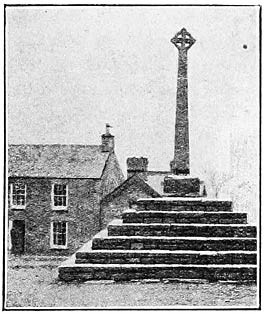
The old stone cross at St. David’s, around which funeral processions marched in former times.
When a funeral takes place at Aberystwyth, in Cardiganshire, it is customary for the Town Crier to go through the streets tolling a small hand-bell, a short time before the funeral procession. This is a survival of a very ancient custom which was once very general throughout Wales, and in pre-Reformation times this corpse-bell which was known as “bangu,” was kept in all the Welsh Churches, and when a funeral was to take place, the bellman took it to the house of the deceased. When the procession began, a psalm was sung, and then the sexton sounded his bell in a solemn manner for some time, and again at intervals, till the funeral arrived at the Church.
Giraldus Cambrensis, writing 700 years ago, mentions of such bell at “Elevein, in the Church of Glascwm, in Radnorshire; a portable bell endowed with great virtue, called Bangu, and said to have belonged to St. David. A certain woman secretly conveyed this bell to her husband who was confined in his Castle of Raidergwy (Rhaiadyrgwy) near Warthreinion (which Rhys, son of Gruffyth, had lately built), for the purpose of his deliverance.
“The keepers of the Castle not only refused to liberate him for this consideration, but seized and detained the bell; and in the same night, by divine vengeance, the whole town, except the wall on which the bell hung, was consumed by fire.”
Formerly, in all parts of Wales, the Passing Bell was tolled for the dying, just as the spirit left the body. In ancient times there was a superstition among the Welsh people that the evil spirits were hovering about the sick man’s chamber, waiting to pounce upon the soul as it left the body, but that the sound of a bell frightened away the fiends.
According to “Cymru Fu,” an interesting Welsh book published by Hughes and Son, Wrexham, another old custom in connection with Welsh funerals in former times, was to set down the bier and kneel and repeat the Lord’s Prayer, whenever the procession came to a cross road. The origin of this custom, as given by the Welsh, is to be found in the former practice of burying criminals at cross-roads. It was believed that the spirits of these criminals did not go far away from the place where their bodies lay, and in repeating the Lord’s Prayer was supposed to destroy and do away with any evil influence these spirits might have on the soul of the dear departed.
The Venerable Archdeacon Williams, Aberystwyth, informed me that he was told by the late Principal Edwards, University College of Wales, that there was once an old custom in the Parish of Llanddewi Brefi for funeral processions to pass through a bog instead of proceeding along the road which went round it. Those who bore the bier through the bog, proceeded with much difficulty and often sank in the mud. The ceremony of taking the corpse through the bog was, at least, in Pre-Reformation times, supposed to have the effect of lessening the time or suffering of the deceased’s soul in Purgatory, but the custom was continued in the said Parish for many generations after the Reformation, if not until recent times.
It was once customary at Rhayader, in Radnorshire, for funeral processions to carry small stones which were thrown to a large heap at a particular spot before arriving at the church.
When the funeral procession was nearing the churchyard a hymn was again sung. The custom was, and still is, for the clergyman, arrayed in his surplice, to meet the corpse at the entrance of the churchyard, as directed in the Prayer Book, and placing himself at the head of the procession, they proceed into the body of the church, and the bier is placed before the Altar. It was once customary for all the relations of the deceased to kneel around it until taken from the church to the place of interment. After the body has been lowered into the grave, and at the close of the funeral service one or more hymns are sung, generally those that were favourites of the deceased. When the deceased who is buried in the churchyard of the Parish Church, happened to have been a Nonconformist, it is sometimes customary to have services both in chapel and in church; in the former first, and in the latter before the interment. This was done in connection with the funeral of the late Mr. John Evans, Pontfaen, Lampeter, a few years ago, when I was present myself.
It was once customary to give the shoes of the dead man to the grave-digger, a vestry at Tregaron in Cardiganshire, about 200 years ago passed that this should be done in that place. There is no such practice at present in any part of Wales. There was once a curious old custom known as “Arian y Rhaw” (spade money) which survived in some districts of West Wales until a comparatively recent date, especially in the Northern parts of Cardiganshire, and that part of Carmarthenshire which borders Breconshire.
Mr. John Jones, Pontrhydfendigaid, an old man of 95, informed me that the custom was observed at Lledrod, a parish situated about nine miles from Aberystwyth, about eighty years ago. It was something as follows:—At the grave, the grave-digger extended his spade for donations, and received a piece of silver from each one of the people in turn.
The following account of the custom by an eye-witness appeared in the Folk-Lore Column of the “Carmarthen Journal,” July 7th, 1905:—“It was in the summer of 1887, if I remember well, that I had occasion to attend the funeral of a young child at Llangurig Church, situated on the main road leading from Aberystwyth to Llanidloes, and about five miles from the latter. After the service at the graveyard, the sexton held up an ordinary shovel into which all present cast something. The cortege was not large, as the child buried was only eight months old. When all had contributed their mites, and the sum had been counted, the sexton in an audible voice, declared the amount received, saying twenty-eight shillings and sixpence, many thanks to you all.”
Another curious old custom at Welsh funerals was the “Offrwm,” or Parson’s Penny, which was as follows: After having read the burial service in the Church, the Clergyman stood near the Altar until the nearest relation went up first to him and deposited an offertory on the table, then the other mourners, one and all followed, and presented a piece of money, and the money received by the Parson in this manner amounted sometimes to a very large sum, especially when the mourners were wealthy.
The Author of Cradock’s account of the most romantic parts of North Wales, published in 1773, makes the following observation concerning the custom: “Many popish customs are still retained in Wales; particularly offering made to the dead. These offerings must, of course, vary according to the rank of the persons deceased, as well as the affection that is borne to their memories. I was at a pauper’s funeral when the donations amounted to half-a-crown, and I met with a Clergyman afterwards who had once received 90 guineas.” This has not been practised in Cardigan and Carmarthenshire within the memory of the oldest inhabitant, but the custom was observed in former times, we have not the least doubt, and it has survived even until the present day in some form or other, in some parts of the Principality, especially in parts of North Wales, as the following correspondence which appeared in the “Oswestry Advertiser” in July, 1906, proves:
“OFFERTORIES AT FUNERALS IN WALES.”
“Sir,—A correspondent in your columns, about a fortnight ago, called attention to this subject, and expressed disapproval of the manner in which the offertories are taken in some Churches at funeral services—by laying the plate on the bier near the pulpit, and the congregation in a disorderly manner laying their offertory on the plate. I regret to observe that this practice is still pursued in two parishes in this neighbourhood, and I should like to call the attention of the proper authorities to the desirableness of changing the custom, and adopting the system suggested by your correspondent, that the offertory should be taken at the gate, or that two or more plates should be taken around the congregation. The parish clerk, too, might be instructed not to announce the amount of the offertory.”
Undoubtedly, this custom has survived from Pre-Reformation times, and was originally intended to compensate the Priest for praying for the Soul of the departed in Purgatory, but at present it only means a token of esteem towards the officiating Clergyman, or perhaps a tribute of respect to the departed. It was formerly customary in Wales to throw a sprig of rosemary into the grave on the coffin. The custom has been discontinued now, but it was done in the Vale of Towy, in Carmarthenshire as late as sixty years ago.
An excellent old Welsh Magazine, the “Gwyliedydd” for May, 1830, makes the following observation concerning the custom: “In ancient times, it was customary for all who attended a funeral to carry each a sprig of rosemary in his hand, and throw it into the grave as the minister was reading the last words of the funeral service”; and a writer in the Cambrian Quarterly Magazine, in the following year adds that a custom analogous to this prevailed amongst the ancient heathens; who used to throw cypress wood into the grave in the same manner. The reason why they made choice of the cypress was, because its branches do not bud when thrown into the earth, but perish altogether; it was thus an expressive symbol of their opinion, that the bodies of the dead would never rise again. On the other hand, the Christians threw the rosemary into the graves of their brethren to express that hope of a joyful resurrection with which their faith had inspired them.
It was once customary to read the will of deceased over the grave. Sir S. R. Meyrick mentions this in his History of Cardiganshire, a hundred years ago, and the custom has been continued to a more recent date. The Rev. T. D. Thomas, Vicar of Llangorwen, near Aberystwyth, informed me that this was done by him at Llangadock, Carmarthenshire, about the year 1897, when officiating in the absence of the Vicar of that Parish.
There was also an old custom of burying one who had been murdered, in a coffin covered with red cloth. The Rev. D. G. Williams, in his collection of Carmarthenshire Folk-Lore, says that one William Powell, of Glan Areth, Vale of Towy, was so buried in the year 1770.
In Wales in pre-Reformation times, it was sometimes the practice to bury a rich man in the garments of a monk, as a protection against evil spirits; but this could not be done without paying large sums of money to the priests.
The custom of covering the coffin with wreaths is very generally observed at the present day throughout West and Mid-Wales. The coffin of the late Sir Pryse Pryse, Bart., Gogerddan, who was buried at Penrhyncoch, Cardiganshire, April 23rd, 1906, was covered with wreaths of most beautiful flowers, sent by Dowager Lady Pryse, Sir Edward and Lady Webley-Parry-Pryse, Countess Lisburne, Viscountess Parker, Lady Evans, Lovesgrove; Mr. and Mrs. Loxdale, and many other relations and friends, as well as the tenants and servants.
In times past the Welsh always carried the association of graves and flowers to the most lavish extreme, and Shakespeare, alluding to this in “Cymbeline,” the scene of which tragedy is more especially in Pembrokeshire, says:
“Arv. With fairest flowers,
Whilst summer lasts, and I live here, Fidele,
I’ll sweeten thy sad grave. Thou shalt not lack
The flower, that’s like thy face, pale primrose; or
The azur’d harebell, like thy veins; no, nor
The leaf of eglantine, whom not to slander,
Outsweeten’d not thy breath.”
It is more generally the case at the present day to cover the coffin with wreaths than with loose flowers, and occasionally the graves are lined with moss and flowers. To decorate the graves of the departed with flowers is a very old custom amongst the Welsh, especially on Palm Sunday, which is known in Wales as “Sul y Blodau”—Flowering Sunday. The custom is very generally observed even at the present day in Glamorganshire, where the churchyards and other burial places present a very beautiful appearance; but it is to be regretted that in West Wales, during the last sixty years, the practice to a very great extent has been discontinued, at least in rural districts. But it is reviving at the present day, and likely to grow as years go on. A correspondent from Aberaeron, in one of the papers noticed that on Palm Sunday, of the year 1906, many of the graves of Henfynyw, in that district had been cleaned and flowers placed upon them, whilst on others flowers grew. Whilst staying for a short time in the Parish of Cilcennin, about five years ago, I took particular notice, that the planting of flowers and plants on the graves is renewed every year about Easter or Spring time, and that they are kept blooming through the loving care of the descendants of the departed. An old man named Jenkin Williams, a native of Llangwyryfon, a parish in the same County, who is 89 years of age, informed me that he well remembered the custom observed in his native parish, about seven miles from Aberystwyth, many years ago; but it is rarely observed at the present day. There are many parts of the country nowadays, where the practice is unknown, but there are evident signs that the beautiful old custom is reviving in parts of Carmarthenshire, Cardiganshire, and Pembrokeshire. In Glamorganshire, as I have already observed, the custom is very general.
The custom of placing tombstones on the graves is very generally observed, but very few of the stones are in the form of a cross. Indeed, crosses are remarkable for their absence in Welsh Churchyards. The Welsh people in rejecting what they consider as a too Popish a practice, have gone into the opposite extremes of adopting as monuments for their dear departed, the polytheistic obelisk of the ancient Egyptians; the Greek and Roman urns, and the chest-stone of the Druids. It has been the custom in some places to whitewash the small inscribed stones at the head and feet of poor people’s graves. Several English authors who have written about Wales remark that in nearly every churchyard in the country, the mountain ash is to be seen. It seems to me that this is a mistake; for, as far as my experience is concerned, it is rarely seen in Welsh churchyards, at least in the present day, and I have seen a good many of the churchyards; but it must be admitted that the Welsh have regarded the tree as sacred, and there are a good many superstitions in connection with it, so that it is possible that the custom of growing it in churchyards was more common in former times.
The most common tree in the churchyards of Wales is the Yew, and the Welsh people from time immemorial, have always regarded the tree with solemn veneration, probably owing to its association with the dead. The Yew is famed in Welsh song, for the poets of Cambria in their elegies for their dead friends, often mention “Ywen Werdd y Llan” (the Green Yew of the Churchyard), and the poet Ioan Emlyn in his “Bedd y Dyn Tlawd”—“The Pauper’s Grave” says:
“Is yr Ywen ddu gangenog,
Twmpath gwyrddlas gwyd ei ben.”
In former times the yew was consecrated and held sacred, and in funeral processions its branches were carried over the dead by mourners, and thrown under the coffin in the grave. With rosemary, ivy, bay, etc., branches of the trees were also used for church decorations. The following extract from the Laws of Howel Dda, King of Wales in the tenth century, shows that the yew tree was the most valuable of all trees, and also how the consecrated yew of the priests had risen in value over the reputed sacred mistletoe of the Druids:—
“A consecrated yew, its value is a pound.
A mistletoe branch, three score pence.
An oak, six score pence.
Principal branch of an oak, thirty pence.
A yew-tree (not consecrated), fifteen pence.
A sweet apple, three score pence.
A sour apple, thirty pence.
A thorn-tree, sevenpence half-penny.
Every tree after that, four pence.”
The planting of yew trees in Churchyards in Wales is as old as the Churchyards themselves; and it is probable that they were originally intended to act as a screen to the Churches by their thick foliage, from the violence of the winds, as well as a shelter to the congregation assembling before the church door was opened. The first Churches in Wales were only wooden structures, and needed such screens much more than the comfortable stone Churches of the present day.
Another important object in planting the yew was to furnish materials for bows, as these were the national weapons of defence. The Churchyards were the places where they were most likely to be preserved, and some authorities derive the English word “yeoman” from yewmen, that is, the men who used the yew bow. The yew bow was very common throughout Wales in the old times, and skill in archery was universal in the country; and as late as Tudor times, the Welsh poet, Tudur Aled, asks, in lamenting the death of a squire:—
“Who can repeat his exploits to-day?
Who knows so well the strength of yew.”
In the memorable Battle of Cressy, three thousand five hundred Welsh archers followed the Black Prince in the attack on France in the year 1346, and as many more came from the Welsh lordships, and bore such distinguished parts, for the success of this war was due to the skill of the Welsh Archers, and at the end of the battle the Prince adopted the motto, “Ich Dien,” which has been the motto of the Princes of Wales ever since.
Evelyn’s opinion is “that we find it (the yew) so numerously planted in Churchyards from its being thought a symbol of immortality, the tree being so lasting and always green.” There are at the present day in the Churchyards of Carmarthenshire and Cardiganshire, some fine specimens of the yew tree, and some of them hundreds of years, if not nearly a thousand years old. In former times when Churchyards were resorted to for recreation, seats were fixed round the trunk of the tree.
Many of the Churchyards in Wales in ancient times, before the introduction of Christianity, had been Druidical circles. This is evident from the oval form of the ground of many of them, which often resemble small embankments, or mounds. Such is the case as regards Tregaron Church, in Cardiganshire, Llanddewi Brefi also is on elevated ground, as well as several other Churchyards.
How early the practice of enclosures near the Churches or Monasteries for burial of the dead began in Wales is quite uncertain. It seems that the practice was introduced into England by Archbishop Cuthbert about 750; but the origin of Churchyards in Wales was of a much earlier date, in all probability about two or three hundred years earlier than in England. Some of the best authorities assert that a few (but few only) of the Welsh Parish Churches and consecrated Churchyards can be traced to the days of St. Garmon, or Germanus, Bishop of Auxerre, who paid two visits to this country about A.D. 429, and 447 respectively. It is possible that there were few Christians in Britain even in the first century; but Parochial Churches did not belong to the earlier ages of Christianity, and the clergy lived in towns, and undertook missionary journeys about the country, under the direction of their bishops.
Prior to the introduction of enclosures round Churches for the purpose of burial, it was customary (as it is in China to-day), to bury on high places, such as hills and mountains. Cremation had also been practised as it is evident from the urns for the preservation of the ashes of the dead, which are being discovered in various parts of Wales, from time to time. Perhaps the most recent and interesting discoveries of such urns were those found near Capel Cynon, in Cardiganshire, containing ashes and portions of small calcined bones. A labourer named John Davies, came across them accidentally in an old mound on a hill, whilst working for Evan Thomas, a contractor under the County Council of Cardiganshire, in digging out stones for road-mending. (See Archæologia Cambrensis for January, 1905.)
The introduction of Christianity put an end to the practice of cremation.
Carneddau, or cairns, and tumuli, or mounds of earth, have been preserved till the present day in different parts of Wales, but it is to be regretted that many of these interesting monuments of antiquity, which the Welsh in ancient times erected in honour of their great men have been destroyed. That Wales has been celebrated for its Carneddau, is evident from the words of Taliesin, the chief poet of King Arthur’s time, who calls the country “Cymru Garneddog” (Cairn Wales), and one the most interesting “Carnedd” is what is known as “bedd Taliesin”—Taliesin’s grave, about eight miles north of Aberystwyth, where, according to tradition, Taliesin himself was buried.
Such monumental heaps over the mortal remains of the dead were of two kinds, according to the nature of the country. In stony districts, a cairn of stones was heaped, but where stones were scarce, a mound of turf of a circular construction, called tomen (tumulus), was deemed sufficient.
In ancient times this mode of burial was considered a most honourable one, and in passing the tomb of a warrior or some great man, it was customary for every passer by to throw a stone to the cairn, out of reverence to his memory. There was a similar custom among the Indians of Patagonia, which was still observed a few years ago. A Patagonian Chief in passing the grave of an eminent chief or a great warrior, would dismount from his horse, and search for a stone to throw on the cairn.
Monumental Cairns were also common in Scotland, for in Ossian’s Poems, Shibric, in Carricthura says: “If fall I must in the field, raise high my grave, Vinvela. Grey stones, and heaped earth, shall mark me to future times.” To erect mounds seems to have been a very ancient custom, for Herodotus, in giving a full and most interesting account of the strange practices of the Ancient Scythians, in connection with the burial of their Kings, observes amongst other things, “Having done this, they all heap up a large mound, striving and vieing with each other to make it as large as possible.”
When the custom of burying in churchyards became general in Wales, in course of time, to bury in cairns and mounds, which formerly had been an honourable practice, was discontinued, and even condemned, as fit only for the great criminals; and, as Dr. Owen Pugh, observes: “when this heap became to be disgraced, by being the mark where the guilty was laid, the custom for every one that passed, to fling his stone, still continued, but now as a token of detestation”; hence originated the old Welsh sayings “Carn lleidr (a thief’s Cairn), “Carn ar dy wyneb.” (Cairn on thy face). Even at the present day throughout Wales, when any one is guilty of robbery or swindle, it is customary to call such a man a “Carn leidr” (A cairn thief). In the parish of Llanwenog, six miles from Lampeter, there is a spot called “Carn Philip Wyddyl.” an old farmer, named “Tomos, Ty-cam,” informed me that according to the traditions of the district, this Philip was a “Carn leidr,” or the ringleader of a gang of thieves, who, in an attempt to escape, jumped down from Llanwenog Steeple, and broke his leg. His pursuers stoned him to death, and buried him beneath a carn.
CHAPTER IV.
VARIOUS OTHER CUSTOMS.
CHRISTMAS AND NEW YEAR’S DAY CUSTOMS.
Christmas at the present day in Wales is not so important as it used to be in former times, though it is still the beginning of a holiday season, and also a regular feasting-day. Morning service is conducted in the Parish Church, but is not so well-attended as in former times. It is often the custom to have an Eisteddfod or a concert in the evening in Nonconformist Chapels. In towns, the children hang up their stockings the night before Christmas, expecting to find some gifts in them next morning. Christmas is also an important day for the young maidens to kiss and be kissed. A girl places a mistletoe to hang over the chair in which a young man, whom she wishes to catch, is likely to sit. Then when he comes under the mistletoe, she kisses him suddenly, and whenever she succeeds in doing so, she claims from him a new pair of gloves.
The favourite observance for a young man to kiss a girl under the branches is also well known, and it was once supposed that the maiden who missed being kissed under the mistletoe on Christmas would forfeit her chance of matrimony, at least during the ensuing twelve months. These superstitions and favourite observances have come down from the time of the Druids.
The most interesting feature of Christmas in Wales in times gone by was undoubtedly the “Plygain” which means morning twilight. The “Plygain” was a religious service held in the Parish Church, at three o’clock on Christmas morning to watch the dawn commemorative of the coming of Christ, and the daybreak of Christianity. The service consisted of song, prayer, praise, and thanksgiving, and there was at that early hour a large congregation even in remote districts, as many came from long distances, often three or four miles on a frosty night, or through snow. It was customary for each family to take their own candles with them to this early service. These candles were of various colours, and should any remain after the service was over, they became the property of the clerk. Carols were sung, and it was customary for anyone who claimed to be a bard to compose a carol; indeed, a poet was not considered a poet unless he could sing a carol. Some old people informed me that in connection with these early services there was a great deal of disorder on account of men under the influence of drink attending the Church after a night of revelry, and that this put an end to the “Plygain” in some places. In course of time the hour was changed from three to four or five, and such service is still continued in Llanddewi Brefi and other places in Cardiganshire.
After beginning Christmas morning so devoutly with Divine Service at early dawn, it was the custom in old times to spend most of the day in enjoyment, especially hunting the hare, the woodcock, but the chief sport was in connection with the squirrel.
There was a custom once at Tenby, in Pembrokeshire, for the young men of the town to escort the Rector, with lighted torches from his residence to the Church to the early service on Christmas morning. They extinguished their torches as soon as they reached the porch, and went in to the early service in the Church, and at the conclusion of it, the torches were re-lighted, and the procession returned to the Rectory, the chimes ringing till the time of the usual morning service. Lighted torches were also carried through the streets by a procession on Christmas Eve, and cow-horns were blown, and windows of houses were decorated by evergreens.
In North Pembrokeshire the holidays commenced, especially amongst the farmers, on Christmas Day, and were continued for three weeks, viz., till Epiphany Sunday. The Rev. O. Jenkin Evans, writing in “Pembrokeshire Antiquities,” page 47, says:—“On the 25th day of December, the farmers with their servants and labourers suspended all farming operations, and in every farm the plough was at once carried into the private house, and deposited under the table in the ‘Room Vord’ (i.e., the room in which they took their meals), where it remained until the expiration of “Gwyliau Calan.” During these three weeks, parties of men went about from house to house, and were invited into the “Room Vord,” where they sat around the table, regaling themselves with beer, which was always kept warm in small neat brass pans in every farm-house ready for callers. But the peculiar custom which existed amongst these holiday-makers was that they always wetted the plough which lay dormant under the table with their beer before partaking of it themselves, thus indicating that though they had dispensed with its service for the time, they had not forgotten it, and it would again, in due course, be brought out on the green sward and turn it topsy-turvy. These bands of men would sometimes carry with them the “Wren,” singing simple popular ditties. On Christmas Day, a sumptuous dinner was prepared at the principal farms in every neighbourhood to which all the others, including the cottagers, were invited. The repast consisted of geese, beef, pudding, etc.”
One of the most curious customs which was once in vogue about Christmas time was the procession known as “Mari Lwyd Lawen” (“the Merry Grey Mary”), which was a man wearing the skeleton of a horse’s head decked with ribbons and rosettes.
The man was enveloped in a large white sheet, and proceeded round the houses, followed by a merry procession, singing songs and playing merry pranks, collecting Christmas boxes:
“Mari Lwyd lawen,
Sy’n dod o Bendarren,” etc.
(Merry grey Mary,
Who comes from Pendarren.)
When a real skeleton could not be got, it was customary to make one of straw and rags. It seems that “Mari Lwyd” belonged more especially to Glamorganshire, yet it was well-known in Carmarthenshire also, not only in those places bordering on Glamorgan, but also in the Vales of Towy and Cothy. Mr. T. Davies (Eryr Glyn Cothi), and others, informed me that the “Mari” procession visited Llanegwad, and other places between Llandilo and Carmarthen only a few years ago. The curious custom was not known in Pembrokeshire, nor indeed in Cardiganshire, though I was informed that “Mari Lwyd” on one occasion at least did visit the latter county from Glamorganshire, and tramped across from Llandyssul, in the Vale of Teify, to New Quay, on the sea coast, calling at Lampeter and other places on the way.
According to the excellent Magazine, named “The Cambrian Journal” published 50 years ago, there was an old custom once at Tenby in Pembrokeshire, sometimes before, and sometimes after Christmas Day, for the fishermen to dress up one of their number, whom they called the “Lord Mayor of Penniless Cove,” with a covering of evergreens, and a mask over his face; they would then carry him about, seated on a chair, with flags flying, and a couple of violins playing before him.
Before every house, the “Lord Mayor” would address the occupants, wishing them “a Merry Christmas and a Happy New Year.” If his good wishes were responded to with money, his followers gave three cheers, the masquer would himself return thanks, and the crowd again give “three times three,” hip, hip, hurrah!
There was also in vogue once the barbarous practice of “holly beating.” This was on the day after Christmas, St. Stephen’s Day, which consisted in a furious onslaught being made by men and boys, armed with large bushes of the prickly holly, on the naked and unprotected arms of female domestics, and others of a like class.
NEW YEAR’S DAY.
In Pembrokeshire, to rise early on New Year’s morning will, it is considered, bring good luck. On that morning also it is deemed wise to bring a fresh loaf into the house as it is considered the succeeding loaves throughout the year will be influenced by that performance.
In most places throughout West Wales, even at the present day, people are very particular as to whether they see a man or a woman the first thing on New Year’s morning. Mr. Williams in his “Llen-gwerin Sir Gaerfyrddin,” says that in parts of Carmarthenshire in order to secure future luck or success during the coming year, a man must see a woman, and a woman a man. And the Rev. N. Thomas, Vicar of Llanbadarn Fawr, informed me that he has met people in his Parish who consider it lucky to see a woman first. As a rule, however, the majority of people both men and women deem it lucky to see a man, but unlucky to see a woman.
Even now in various parts of the country, good many object to the entrance of a woman before the in-coming of one of the other sex, this is particularly the case in the central parts of Cardiganshire, especially in the Parish of Llanddewi Brefi and surrounding districts between Lampeter and Tregaron. This is also true of some parts of Pembrokeshire.
According to the late Rector of Newport, Pembrokeshire, the man must needs bear one of the four lucky names—Dafydd, Ifan, Sion and Siencyn. “Supposing the man was not called by one of these names, the person first seen might as well be a woman, if she only bore one of the lucky names—Sian a Sioned, Mair a Marged. Then all would go well for that year at least. A hare or a magpie must not cross one before twelve, and the cock must not crow before supper on New Year’s Day, or some dire calamity might befall one after all.”
There was everywhere a general desire to see “the Old Year out and the New Year in.” In South Pembrokeshire some danced the old year out; some drank it out, and many walked it out. I was informed at Talybont, that once those who desired to see “the New Year in “crowded to each other’s houses in North Cardiganshire to pass the time in story-telling and feasting. The children especially, looked forward to New Year’s morning, with the greatest interest, as it was, and still is in some places, customary for them to go about from house to house, asking for “calenig,” or New Year’s gift. The children on such occasions often repeated something as follows:—
“Rhowch galenig yn galonog,
I ddyn gwan sydd heb un geiniog,
Gymaint roddwch, rhowch yn ddiddig,
Peidiwch grwgnach am ryw ychydig.
“Mi godais heddyw maes o’m ty,
A’m cwd a’m pastwn gyda mi,
A dyma’m neges ar eich traws,
Set llanw’m cwd a bara a chaws.
“Calenig i fi, calenig i’r ffon,
Calenig i fytta’r noson hon;
Calenig i mam am gwyro sane,
Calenig i nhad am dapo sgidie.
“Chwi sy’n meddi aur ac arian,
Dedwydd ydych ar Ddydd Calan,
Braint y rhai sy’n perchen moddion,
Yw cyfranu i’r tylodion,
‘Rhwn sy a chyfoeth ac ai ceidw,
Nid oes llwyddiant i’r dyn hwnw.”
“Os gwelwch yn dda ga’i g’lenig?—
Shar i ‘nhad a shar i mam,
A shar i’r gwr bonheddig.”
The following is from an old song for New Year’s Day, heard at Tregaron in Cardiganshire:—
“Rhowch i mi docyn diogel,
Fel gallo mam ei arddel,
Neu chwech gael cwart,
’Dwy’n hidio fawr,
Waeth fi yw gwas mawr Trecefel.”
In the English districts of West Wales, such as South Pembrokeshire, such verses as the following were repeated:—
Get up on New Year’s morning,
The cocks are all a-crowing;
And if you think you’re awake too soon,
Why get up and look at the stars and moon.
“The roads are very dirty,
My shoes are very thin,
I wish you a happy New Year,
And please to let me in.”
The following is another specimen from North Cardigan:—
“Mae rhew a’r eira yn bur oeredd,
Awel fain yn dod o’r gogledd,
Ambell gybydd oddi cartre,
Yn lle rhanu rhai ceinioge,
A rhai eraill yn eu caban,
Yn gwneyd eu cilwg ar Ddydd Calan.”
When boys and girls knocked at the doors of misers who refused to give anything, they went away disappointed, repeating
“Blwyddyn newydd ddrwg,
A llond y ty o fwg.”
“A bad New Year to you,
And a house full of smoke.”
But as a rule the farmers were very kind to all comers, both in Cardiganshire, Carmarthenshire, and Pembrokeshire, unless they had been disappointed by seeing a girl first that morning, which was, as I have already observed, considered an unlucky omen. Even at the present day this superstition is very strong in Llanddewi Brefi, Cardiganshire, and, indeed, many other parts of Wales, for I have taken particular notice that the first boy who comes to the door on New Year’s morning, if he happens to come before a girl is seen, he is warmly welcomed into the house and even taken upstairs and into the bedrooms so that those who are in their beds might have the satisfaction of seeing a male the first thing on New Year’s Day, to secure good-luck. Before the boy departs some money is given him, about sixpence as a rule at the present day, but in former times he got a loaf of bread instead. At the present day boys and girls, and occasionally a few poor old women continue to go round from house to house from early dawn till mid-day collecting alms, when each of the children receive a copper, in former times, however, it was more customary to give them some bread and cheese, which they took home to their parents in a bag which they carried on their backs, or a basket under their arms.
When the children had more than they could carry, they would leave some of it at a certain house and return for it the following day. In some places it was customary to keep on to collect alms in this manner for two days, but only those who were in very poor circumstances were allowed to go about on the second day.
It was once customary to carry an orange, with oats stuck in it, placed on a stick, round the houses. The visitors sang at the door and expected something to eat and drink.
Another interesting custom observed, especially in Pembrokeshire, on New Year’s Day was for children to visit the houses in the morning about 3 or 4 o’clock in the morning with a vessel filled with spring water, fresh from the well and with the aid of a sprig of evergreen, sprinkled the faces of those they met, and at the same time singing as follows:—
“Here we bring new water from the well so clear,
For to worship God with, this Happy New Year;
Sing levy dew, sing levy dew, the water and the wine,
With seven bright gold wires, and bugles that do shine;
Sing reign of fair maid, with gold upon her toe,
Open you the west door and turn the old year go;
Sing reign of fair maid, with gold upon her chin,
Open you the east door and let the New Year in.”
When the children entered into a house, it was customary for them to sprinkle every one of the family even in their beds with this fresh spring water, and they received a small fee for the performance.
There was a ceremony among the Druids and others in ancient times, of throwing spring water over the shoulder in order to command the attention of elemental spirits.
It is customary in some places, especially in parts of Carmarthenshire, for young men to sprinkle the young girls with water in their beds, and the young maidens in their turn sprinkle the young men, and this is sometimes done when the one upon whom water is thrown is fast asleep.
It is still customary for young men with musical instruments to visit the palaces of the gentry at early dawn, and play some of the beautiful old Welsh Airs, when they receive warm welcome and generous gifts.
Among Twelfth Night Custom, none was more celebrated in Pembrokeshire in the eighteenth century and the beginning of the nineteenth than the “cutty wren,” though there are hardly any traces of the custom in Cardiganshire and Carmarthenshire. The custom was something as follows:
Having procured a wren, the bird was placed in a little house of paper with glass windows, sometimes a cage or a lantern, or a box was used for that purpose, and often decorated with coloured ribbons, and “every young lady, and even old ladies, used to compete in presenting the grandest ribbon to the “wren.”
The cage or the lantern thus decorated with the little bird in it, was hoisted on four poles, one at each corner, and four men carried it about for the purpose of levying contributions, singing a long ballad or ditty such as follows on the following tune:—
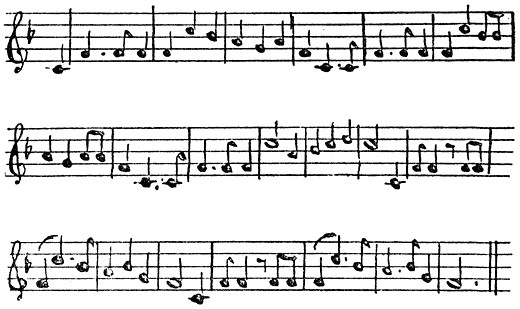
“Where are you going? says Milder to Melder,
O where are you going? says the younger to the elder;
O I cannot tell says Festel to Fose;
We’re going to the woods said John the Red Nose.
We’re going to the woods said John the Red Nose.
“O what will you do there? says Milder to Melder,
O what will you do there? says the younger to the elder;
O I do not know, says Festel to Fose;
To shoot the cutty wren, said John the Red Nose,
To shoot the cutty wren, said John the Red Nose.
“O what will you shoot her with? says Milder to Melder,
O what will you shoot her with? says the younger to the elder
O I cannot tell, says Festel to Fose;
With bows and arrows, said John the Red Nose,
With bows and arrows, said John the Red Nose.
“O that will not do! says Milder to Melder,
O that will not do says the younger to the elder;
O what will you do then? says Festel to Fose;
With great guns and cannons says John the Red Nose,
With great guns and cannons says John the Red Nose.
“O what will you bring her home in? says Milder to Melder,
O what will you bring her home in? says the younger to elder;
O I cannot tell, says Festel to Fose;
On four strong men’s shoulders, said John the Red Nose.
On four strong men’s shoulders, said John the Red Nose.
“O that will not do, says Milder to Melder,
O that will not do, says the younger to the elder;
O what will you do then? says Fester to Fose;
On big carts and waggons, said John the Red Nose,
On big carts and waggons, said John the Red Nose.
“What will you cut her up with? says Milder to Melder,
What will you cut her up with? says the younger to the elder;
O I do not know, saith Festel to Fose;
With knives and with forks, said John the Red Nose,
With knives and with forks, said John the Red Nose.
“O that will not do, says Melder to Milder,
O that will not do, says the younger to the elder;
O what will do then? says Festel to Fose;
With hatchets and cleavers, said John the Red Nose,
With hatchets and cleavers, said John the Red Nose,
“What will you boil her in? says Milder to Melder,
What will you boil her in? says the younger to the elder;
O I cannot tell thee, says Festel to Fose;
In pots and in kettles, said John the Red Nose,
In pots and in kettles, said John the Red Nose.”
For more on this interesting subject see “Manners and Customs of the People of Tenby” in “The Cambrian Journal,” Vol. IV., page 177.
I may add that I heard the above ditty sung in Welsh in several parts of South Wales, especially when I was a boy.
Another such custom was called “tooling,” and its purpose was beer. It consisted in calling at the farm-houses and pretending to look for one’s tools behind the beer cask. “I’ve left my saw behind your beer cask,” a carpenter would say; “my whip,” a carter; and received the tool by proxy, in the shape of a cup of ale. It was also customary for the women to practice what was called sowling, viz., asking for “sowl,” that is cheese, fish or meat.
It was also customary in parts of the counties of Pembroke and Carmarthen for poor people to proceed round the neighbourhood from house to house with their “Wassail bowls,” and singing outside each door something as follows—
“Taste our jolly wassail bowl,
Made of cake, apple, ale, and spice;
Good master give command,
You shall taste once or twice
Of our jolly wassail bowl.”
People who partook of the contents of the bowl were of course expected to pay, so that the invitation to “taste our jolly wassail bowl,” was not always accepted. In such cases the bearer of the bowl sung the following rhyme in disappointment:—
“Are there any maidens here,
As I suppose there’s none
Or they wouldn’t leave us here,
With our jolly wassail bowl.”
“The huge bowl was on the table, brimful of ale. William held a saucepan, into which Pally and Rachel poured the ale, and which he subsequently placed upon the fire. Leaving it to boil, the party seated round the fire began to roast some of the apples that Pally had just put upon the table. This they effected by tying long pieces of twine to their stems, and suspending them from the different “pot-hooks and hangers” with which the chimney corner abounded, twisting the cord from time to time to prevent their burning.... By the time they had all completed their trials the ale was boiling and the apples were roasted. The tempting beverage went smoking hot into the bowl, and was joined by the contents of a small, suspicious-looking, tightly-corked bottle, which I strongly suspect, contained what the French call the “water of life,” and a very strong water it undoubtedly is. Next there was a hissing and splutting greeting between the ale and the roasted apples, which was succeeded by the introduction of some of the “nices,” with which Pally’s table was covered. Different masculines of the party added to the treat by producing packets of buns, raisins, or biscuits, which they dropped singly into the bowl until it was full to overflowing. With a sufficient proportion of spices and sugar, the wassail bowl was finally prepared, and, as if by instinct, just as it was completed, in popped three or four of Pally’s ancient cronies, all dying to partake of it. The cups and glasses were speedily filled, when William proposed Pally’s health, which was cordially drunk by the whole party.” (The Vale of Towey, pages 83–87).
It was customary also, especially in parts of Carmarthenshire, on “Calan Hen” (Old New Year’s Day) to make a feast for those who had helped them with the harvest.
It was also once customary on Epiphany Night in West Wales to visit the houses of those who had been married since the Epiphany before. Those who went round the houses in this manner requested admittance in rhyme and expected food and beer to be given to them by the inmates. Epiphany, known in Wales as “Gwyl Ystwyll,” was formerly closely associated with Christmas.
Many of the old customs and festivities in connection with the New Year are of great antiquity; it was then that the Druids went to seek the mistletoe on the oak. To the Druids the oak and the mistletoe were objects of veneration; and one of the most imposing ceremonies was the cutting of the latter, some days before the New Year, with a Golden Knife, in a forest dedicated to the gods; and the distributing its branches with much ceremony as New Year’s Gifts among the people.
On the day for cutting the mistletoe, a procession of Bards, Druids, and Druidesses was formed to the forest, and singing all the while. The Arch-Druid climbed the tree and cut down the mistletoe, the other Druids spreading a sheet to receive it.
This scene was enacted with great success at the Builth Wells Pageant, August, 1909—(see illustration)—which I witnessed myself with interest.
The Romans had also their festival in honour of Janus and Strenia about the same time of the year. It is interesting to add that in England in the days of King Alfred a law respecting Feast Days was passed, in which the twelve days after the birth of Christ were made a season of holidays.
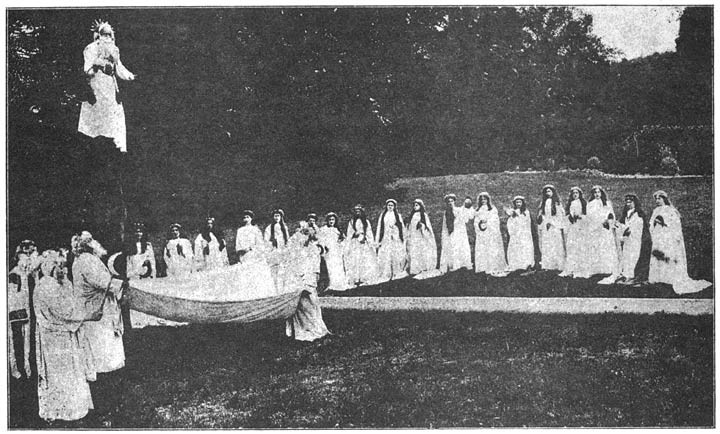
CUTTING THE MISTLETOE.
Photo by Abery Builth Wells.
ST. VALENTINE’S DAY.
The custom of sending a pretty Valentine, or an ugly one, of love, or from mere mischief, as the case might be, was very common once in Wales. We do not hear much of Valentines at the present, however, since the Picture Post Cards have become so common.
ST. DAVID’S DAY.
St. David is the Patron Saint of Wales, and strange to say the only Welsh Saint in the Calendar of the Western Church (Canonized by Calixtus II.) more than five hundred years after his death.
His day is celebrated on the 1st of March throughout the world where Welshmen are. In Wales there are in some places grand dinners, and speeches are made and songs sung, and at present it is customary to conduct Divine Service on the day even in St. Paul’s Cathedral, London. But perhaps the most characteristic feature of the day is the wearing of the Leek, though it must be admitted that wearing the Leek on St. David’s Day is not very general in the country districts of Cardiganshire and Carmarthenshire at the present day, but the interesting old custom is reviving, especially in the towns, and every true-born Welshman ought to wear on the 1st of March the Welsh National Emblem which is dedicated to St. David.
The origin of the custom is not known, there are many who positively assert that it originated in the days of St. David himself; that is, according to some traditions, during a memorable battle against the Saxons the Welsh obtained a complete victory over their enemies. During the engagement the Welsh had leeks in their hats on the occasion for their military colour and distinction of themselves, by persuasion of the said prelate St. David.
According to other traditions, the battle of Poictiers has been named; also that of Cressy, when the Welsh archers did good service with the English against the French, under Edward the Black Prince of Wales, and Shakespeare alludes to this in Henry V.:—
Fluellen says to Henry: “If your Majesty is remembered of it, the Welshmen did good service in a garden where leeks did grow, wearing leeks in their Monmouth caps; which your Majesty knows, to this hour is an honourable badge of the service; and, I do believe, your Majesty takes no scorn to wear the leek on St. Tavy’s Day.”
King Henry: “I wear it for a memorable honour; for I am Welsh, you know, good countryman.”
It seems that there was a custom in London 250 years ago of hanging effigies of Welshmen on St. David’s Day; for Pepys says:—
(March 1, 1667). In Mark Lane I do observe (it being St. David’s Day), the picture of a man dressed like a Welshman, hanging by the neck upon one of the poles that stand out at the top of one of the merchants’ houses, in full proportion and very handsomely done, which is one of the oddest sights I have seen a good while.
SHROVE TUESDAY.
Shrove Tuesday, which is called in Welsh Dydd Mawrth Ynyd, was formerly kept as a holiday; but not much notice is taken of the day now, except that the old custom of pancakes eating still survives in most places.
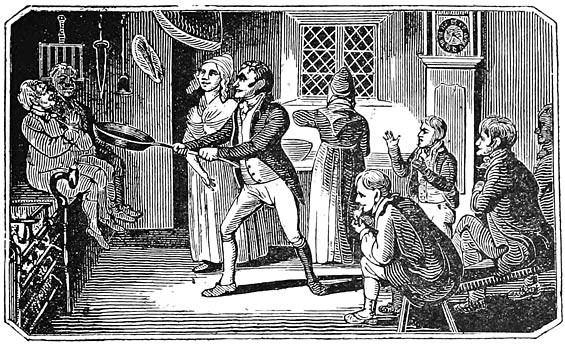
Making and Eating Pancakes on Shrove Tuesday.
(From an Old Picture.)
“Deuwch heno, fy nghyfeillion,
Merched glan a’r bechgyn mwynion,
A chydunwn heb un gofyd,
Wneyd Crammwythau ar Nos Ynyd.”
Come to-night my friends,
Fair young maidens and gentle young men;
And let us join without sorrow
To make pancakes on Shrove Tuesday.
The day was once also noted for foot-ball kicking in some districts, and also for throwing at cocks, that is hens which had laid no eggs before that day were threshed with a flail as being good for nothing.
Mr. Williams in his excellent Welsh essay on the Folk Lore of Carmarthenshire, says that he had been informed by a middle aged person of a curious old custom of playing with eggs. Mr. Williams’s informant when a child and other children with him, had been taught by an old woman how to play some peculiar game with eggs on this day, which was something as follows:—Eggs were boiled for two or three hours till they were as hard as stones. The children used to colour their eggs for the prettiest by boiling them in coffee with certain herbs, etc., then for half of the day, they kept throwing the eggs at each other. This curious kind of play reminds me of a similar practice which I noticed in South America many years ago, more especially in the Argentine Republic, where it was customary for the first half of the day for people to throw eggs, water, etc., at each other, and this was done even in the sheets of Buenos Ayres. The custom was known as “El Carnival,” that is giving way to the flesh before the beginning of Lent or Fasting Time.
In the North of England boys play with eggs on Easter Eve, and centuries ago eggs were blest by the Priest and preserved as Amulates.
It was once customary for the tenants of Nanteos, in North Cardiganshire, to give to their landlord Shrove Hens and Eggs (ieir ac wyau Ynyd). This was undoubtedly a survival of the old custom of paying rent, or a portion of it, “in kind.”
To render in kind ducks and geese, loads of coal, etc., was continued yearly, both in Cardiganshire and Carmarthenshire within living memory.
LENT.
There was an old custom once in Wales of taking an egg-shell, filled with water, little meat, flour, etc., to a house of a neighbour, and leave it on the outside of the window while all the family were having their supper, and then run away, for if they were caught in doing it, they were obliged to clean old shoes as a punishment. The egg-shell used on the occasion was called “Crochan Grawys” (Lent Cauldron). Some old people remember this in Carmarthenshire.
PALM SUNDAY.
I have already, in my Chapter on Funeral Customs, referred to the beautiful old Welsh Custom of decorating the graves on Palm Sunday.
GOOD FRIDAY.
Good Friday in Welsh is called “Dydd Gwener Groglith (The Lesson of the Cross Friday).
Not much notice is taken at present day of the day, and the services conducted in the Parish Churches in country places are as a rule poorly attended. In former times there were many interesting customs and strange superstitions in connection with the day, especially in the South of Pembrokeshire, where there was once a custom called “Making Christ’s Bed,” which was done by gathering a quantity of long reeds from the river and woven into the shape of a man. Then this was stretched on a wooden cross, and laid in a field.
It is said that it was customary in that particular part of West Wales, especially at Tenby, to walk barefooted to Church, and that such Pre-Reformation custom continued till the close of the eighteenth century, which was done so as not to disturb the earth! In returning from Church the people regaled themselves with hot cross buns, and after reaching the house they were eaten. But a certain number of them were tied up in a bag, and hung in the kitchen, where they remained till the next Good Friday, for medical purposes, for it was believed that the eating of one of them cured diseases. They were also used as a panacea for the diseases of animals, as well as serviceable to frighten away evil spirits and goblins. These hot cross buns which figured in such a peculiar manner in South Pembrokeshire, nothing is known of them in the adjoining counties of Carmarthen and Cardigan, among the country people; it is possible, however, that they were known there prior to the Reformation or even after. But perhaps the bun custom was unknown in those two counties, and it had been introduced into South Pembrokeshire (where the people are not of Welsh origin), from England or some other country. Some writers trace the origin of hot cross buns to the cakes which the pagan Saxons used to eat in honour of their goddess Eostre, and that the custom dates back to pre-historic times, and that their connection with the Cross of our Saviour is only by adoption. How far this is true it is impossible to know with certainty; but it is evident that the early Christians adopted many pagan rites and customs. According to Hone’s Year Book, the hot cross buns are the ecclesiastic Eulogiae or Consecrated Loaves bestowed in the Church as alms, and to those who could not receive the Host. It was once the custom in Wales to express abhorrence of Judas Iscariot, and the curious custom of flogging him is still in vogue in South America. In former times Good Friday was the day on which rings were blessed by Kings and given away as remedies for the cramp.
EASTER.
It is deemed essential by many people to wear some new article of dress, if only a pair of gloves or a new ribbon; for not to do so is considered unlucky, and the birds will be angry with you. It is probable that the origin of this custom is associated with Easter baptism, when a new life was assumed by the baptised, clothed in righteousness as a garment. In former times people had such respect for this day that many kept their children unbaptised till Easter Sunday, and many old men and old women went to Church to receive the Communion who were hardly to be seen in the Lord’s House on any other Sunday during the year.
There was once an old fancy in Wales that the sun used to dance for joy when it rose on Easter morning, and great care was taken in some places to get up the children and young people to see such sight of the sun dancing in honour of the rising of our Lord. The sun was sometimes aided in this performance by a bowl of clear water, into which the youth must look and see the orb dance, as it would be dangerous to look directly on the sun while thus engaged. The religious dance of the ancient Druids is believed to exist in modern times in a round dance wherein the figures imitate the motions of the sun and moon. See “British Goblins,” by Sykes, page 274.
FIRST DAY OF APRIL.
April fool, known in Wales as “Ffwl Ebrill,” was observed as in England, and still observed to a certain extent.
MAY.
The old customs and superstitions in connection with May Day are unknown in Wales in the present day, once, however, May-day dances and revelling were most popular, especially in Pembrokeshire, as the following interesting account which appeared in the “Cambrian Journal” proves:—
“On May-eve, the inhabitants would turn out in troops, bearing in their hands boughs of thorn in full blossom, which were bedecked with other flowers, and then stuck outside the windows of the houses. Maypoles were reared up in different parts of the town (of Tenby), decorated with flowers, coloured papers, and bunches of variegated ribbon. On May-day the young men and maidens would, joining hand in hand, dance round the May-poles, and “thread the needle,” as it was termed. A group of fifty to a hundred persons would wend their ways from one pole to another, till they had thus traversed the town. Meeting on their way other groups, who were coming from an opposite direction, both parties would form a “lady’s chain,” and to pass on their respective ways.”
The May-pole was once most popular in Wales, but the old custom has entirely died out, though we still hear occasionally of a May Queen being selected in some places.
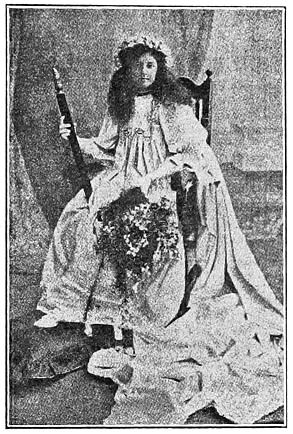
May Queen.
A PRESENT-DAY WELSH QUEEN OF MAY.
The May-pole in Wales was called Bedwen, because it was always made of birch which is called in Welsh Bedwen, a tree associated with the gentler emotions; and as I have already observed in another chapter, to give a lover a birchen branch, is for a maiden to accept his addresses. Games of various sorts were played around the bedwen. The fame of a village depended on its not being stolen away, and parties were constantly on the alert to steal the bedwen, a feat which, when accomplished, was celebrated with peculiar festivities. This rivalry for the possession of the May-pole was probably typical of the ancient idea that the first of May was the boundary day dividing the confines of winter and summer, when a fight took place between the powers of the air, on the one hand striving to continue the reign of winter on the other to establish that of summer.
Here may be cited the Mabinogi of Kilhwch and Olwen, where it speaks of the daughter of Lludd Llaw Eraint. She was the most splendid maiden in the three Islands of the mighty, and in three islands adjacent, and for her does Gwyn Ap Nudd, the fairy King, fight every first of May till the day of doom.
She was to have been the bride of Gwythyr, the son of Greidawl, when Gwyn Ap Nudd carried her off by force. The bereaved bridegroom followed, and there was a bloody struggle, in which Gwyn was victorious, and he acted most cruelly, for he slew an old warrior, took out his heart from his breast, and constrained the warrior’s son to eat the heart of his father.
When Arthur heard of this he summoned Gwyn Ap Nudd before him, and deprived him of the fruits of his victory. But he condemned the two combatants to fight for the maiden Olwen henceforth for ever on every first of May till doomsday; the victor on that day to possess the maiden.
In former times a fire of logs was kindled on the first day of May, around which it was customary for men and women, youths and maidens, to dance hand in hand, singing to the harp, and some of the men would leap over the fire, even at the peril of being burnt. The origin of such strange custom is undoubtedly to be traced to the “belltaine” fires of the Druids.
It seems these bon-fires were lighted in some parts of Wales on Midsummer Eve, and the “Glain Nadrodd” (snake-stones) were also, according to Welsh traditions, associated with the same time of the year.
It is called Glain Nadrodd from the old Welsh tradition that it is made by snakes at some special gathering among them, when one of their number is made a kind of sacrifice out of the body of which they manufacture the stone. It is of a greenish colour and of the size of an ordinary marble. To find a “Glain Nadrodd” is considered a very lucky omen and they were anciently used as charms. It was also believed in former times that the bon-fires lighted in May or Midsummer protected the lands from sorcery, so that good crops would follow. The ashes were also considered valuable as charms.
ALLHALLOW’S EVE (NOS CALAN GAEA.)
The Eve of All Saints is known in Wales as “Nos Calan Gaeaf,” and in former times there were many old customs in connection with it, most of which have now disappeared. I have already given an account of the Love Charms and spells which were performed on this eve, and amongst other strange doings, the uncanny custom of going round the Church in order to see the spirit of a future husband or wife. But there was in some places another weird ceremony of going round the church at midnight, and look in through the keyhole in order to see the spectral forms, or to hear a spirit calling the names of all those who were to die in the neighbourhood during the year; that is during the coming twelve months from that date, which seems to suggest that the new year began at this time once in old times. Many were afraid, especially children, of going out on Allhallow’s Eve as the night among the Welsh was one of the “tair nos ysprydion” (three spirits’ nights) as it was supposed that the spirits were free to roam about, and a demon at large in the form of a “Hwch ddu gwta” (black sow without a tail)
“Nos Calan Gaea’,
Bwbach ar bob camfa.”
(On Allhallow’s Eve,
A bogie on every stile.)
On this eve it was formerly the custom to kindle a bonfire, a practice which continued to a more recent date in the Northern part of the Principality than in the South.
Besides fuel, each person present used to throw into the fire a small stone, with a mark whereby he should know it again. If he succeeded in finding the stone on the morrow, the year would be a lucky one for him, but the contrary if he failed to recover it.
Those who assisted at the making of the bonfire watched until the flames were out, and then somebody would raise the usual cry, when each ran away for his life, lest he should be found last, and be overtaken by the ‘bogie.’—(See “Celtic Folk-Lore,” by Sir J. Rhys, page 225.)
When a boy, I well remember young men and boys who were full of mischief, making a hollow inside a turnip, and having put a candle in it, carried it about as a bogie to frighten timid people.
Allhallow’s Eve is known in many parts of West Wales as “Nos twco fale,” (apple snatching night), and the game of snatching apples, has been continued in some districts until only a few years ago. Apples and candles, fastened to strings, were suspended from the ceiling and the merry-makers in trying to catch the apple frequently got the candle instead, to the great amusement of those present. Another amusing custom was to try to bring up an apple with the teeth from a tub of water.
In some parts of the country, especially Carmarthenshire, it was customary to peel the apple carefully, and throw it, that is the peel, back over the head. Then when this peel had fallen on the floor behind one’s back, particular notice was taken in what form it appeared, and whenever it resembled a letter of the Alphabet, the same was supposed to be the first letter of the Christian name of the thrower’s future wife or husband.
HARVEST CUSTOMS, Etc.
“Y Gaseg Fedi, or Harvest Mare.”
In West and Mid-Wales there have been various harvest customs, the most interesting of which was probably the Harvest Mare, known in Cardiganshire and Carmarthenshire as “Y Gaseg Fedi, or Gaseg Ben-Fedi,” but in Pembrokeshire it was called “Y Wrach.” This took place at the end of the harvest.
There was a large crowd of both men and women reaping on the last day; and by working at the harvest in this manner small cottagers and other poor people paid the farmer for the privilege of planting a few rows of potatoes in the land, and for the loan of a horse and cart, or for carting home coal, etc.. By working at the harvest poor people paid their debt to the farmer, and still do so to a certain extent. To each of the women who worked at the harvest was given a candle to take home with her every evening, and to the men a little tobacco was given to those who indulged in the bad habit of smoking.
An old woman 98 years of age, who lived near Crosswood, Cardiganshire, informed me about three years ago that she well recollected when a child that a farmer who lived at Penllwyn, in the Vale of Rheidol, used to give to each of the men and women a sheaf to take home with them in the evening, and that this farmer was the only one in the country who did this within her memory, and that he did it as he had seen his father doing so. The old lady also added that the custom had been general once.
It was the custom once to “dwrn fedi” (fist reaping) a very laborious work, for our forefathers had no scythes nor machines in former times, so that the sickle was everything. It was customary once for a number of farmers in the same district to arrange together not to cut their fields on the same day so that they might be able to assist each other. A few men would come together on an appointed day from each farm in the district that they might be able to cut and bind all the corn of one farm in a single day; and it is still the custom in many places to do this in connection with hay as well as shearing sheep on the mountains.
The Gaseg Fedi (harvest mare) at the end of the harvest was a small quantity of the last corn which was left standing in the field, and tied up carefully; and great excitement existed, and much amusement was created when the last standing was reached. There was a good deal of fun in connection with cutting the mare. Each reaper in his turn was allowed to throw his sickle at the corn until it was cut, from a distance of about 15 or 20 yards. The most unskilful were allowed to try first, at last some one would succeed in cutting it down amidst cheers. After cutting it down, it was customary in some places, especially in the North of Cardiganshire for one of the men to take the mare to a neighbouring farm, where the harvest had not been completed, and where the reapers would be still busy at work. The man who took the mare in this manner was very careful to go, or crept without being observed, and stealthily stationed himself over against the foreman of his neighbour’s reapers, he watched an opportunity, when within easy distance of throwing it suddenly over the hedge into his neighbour’s field, and if possible upon the foreman’s sickle and at the same time repeating some insulting words and took to his heels with all speed to escape the flying sickle of the reapers whom he had insulted which were hurled after him, and sometimes he was in peril of his life. In some districts in Carmarthenshire, it was sometimes the practice to be as bold as to take the Gaseg even to the very house of the neighbour, but this was considered more insulting if anything than throwing it into his field.
According to old people who remembered the custom in their younger days, they informed me that it was not considered right to throw the mare into the field of a farmer who lived in another parish, or over a river or even a brook. I was also informed by some that it was not allowable to bear it up hill to a field which stood on a more elevated ground. It was often the custom especially in Carmarthenshire and Pembrokeshire, instead of throwing it into a neighbour’s field, to convey it home to the house, that is to the house of the farmer himself who had finished his harvest that day. The honour of bearing it home in this manner belonged to the one who had succeeded in cutting it, but the difficult part of it was how to take it into the house dry, for it was absolutely necessary that it should be taken into the house without being wetted. And this was not always an easy task as the servant maids at the house carefully stored water in buckets and pans ready to throw over the man and his Caseg Fedi at his entrance; and sometimes he would have a pretty rough time of it. In order to prevent this the man tried to appear as indifferent as possible so as not to be suspected by the girls. Consequently, he carefully hid the mare under his clothes, but in spite of everything he was sometimes stripped of some part of his garment or deluged with water. But when he could succeed in bringing it into the house dry and hung it up without being observed, the master had to pay the bearer a shilling or two, or to give him plenty of beer. But the master was spared to pay the shilling if the girls could succeed in wetting the mare. These curious old customs have been discontinued, but it is still the practice with some to bring a handful of corn into the house tied up under the name of the mare. At supper that evening there was a good deal of fun. John Wright, Bailiff of Stackpole in Pembrokeshire, refers to the custom as follows when writing to his master, Mr. Pryce Campbell, August, 1736:—“Whilst I was abroad (he had been in Cardiganshire) the harvest people cut the neck, and, notwithstanding all the stones about the court (this house was being rebuilt), would have a dance. The dance was the Three Shopkins. There was a noble feast, the bill of fare was as follows:—Four quarters of mutton, a side of bacon, a piece of beef weighing half a hundred-weight, twelve gallons of Buding besides, cabotch and other greens. They seemed very well pleased with their entertainment.” It was customary in some places to have a harvest queen attired in white gown decorated with ears of wheat and roses. In other places a sheaf of wheat was decorated with ribbons and taken home to the farm on the top of the last load, when the horses were also very gaily decked.
At the close of the harvest it was an universal custom to have a harvest supper, and after the feast there was a merry time. The Rev. D. G. Williams mentions “Chware Dai Shon Goch” and “Rhibo” as favourite games on such occasions.
“Chware Dai Shon Goch” was something as follows:—
Two young men, or two young women would put on some old ragged clothes kept at the farm for that purpose, and thus attired would proceed to the barn where a walking-stick was given to each of the two. Then followed a most curious dance to the great amusement of the company of beholders. At present, however, the Welshpeople in country places know nothing of dancing; but it is evident that they were much given to dancing in former times as well as singing to the harp. Owen Tudor, the Welsh gentleman who became the grandfather of Henry VII., King of England, was invited to dance some of the dances of Wales before Katherine, the beautiful widow of Henry V. While the handsome young Welshman was dancing one of his wild reels, it chanced that he fell against the Queen, and the latter with a bewitching smile, said, “that so far from offending her, it would only increase the pleasure of herself and company, if he would repeat the same false step or mistake!” Later on, Katherine and Owen Tudor were married.
Another game on such occasions was “Rhibo” which was something as follows:—
Six young men were selected for the performance, three standing face to face to the other three, and each one taking hold of the hands of the one who faced him. Then upon the arms of these six young men, a young man and a young woman were placed in a leaning posture who were thrown up and allowed to fall again into the arms of the young men, and this ceremony continued for some time, and which appeared to be rather a rough game, but it is not practised at the present day.
In former times it was customary at some farms to blow the horn at harvest time to call the reapers both to their work and their meals. Such horn was made use of for that purpose until very recently at a farm called Eurglodd, eight miles north of Aberystwyth in Cardiganshire.
CYNNOS.
“Cynnos” was a practice among the farmers of West Wales, and particularly Cardiganshire, of taking the corn to the kiln to be dried on the night before the grinding; it was customary to sit watching it all night and carefully attend to the drying operations, that is the turning of the corn on the kiln, and the sweeping of it off, when it had been sufficiently dried. The meaning of the word “Cynnos” is unknown, according to some writers it is a form of “cynwys” (contents)—that is the contents of a stack of corn; but according to others it meant “cyn-nos” (the night before) that is the night before the grinding.
It is true that the farmers sent small quantities of corn to the mill at any time of the year; but the big annual “cynnos” was prepared, as a rule, about January or February. This “Cynnos” was a night of great fun, especially for young people, as many of the friends and neighbours of those who were engaged in drying the corn came together in the evening. An old gentleman named Thomas Evans, Gwarallyryn in the parish of Llandyssul, Cardiganshire, who well remembered the old custom, gave me an interesting account of it. This meeting of young men and young women and others at the kiln during the Cynnos to enjoy themselves with games and story telling was known, said he, as “Shimli,” which often continued all night. Sometimes beer known as “Fetchin,” was sent for, and drank around the kiln fire. When the flour was taken home, it was put in chests. Previous to the beginning of the 19th century before kilns attached to the mills became general, many of the farm houses had a kiln for drying the corn at home, but of a very primitive sort. Mr. Price in his interesting little book on Llansawel, in Carmarthenshire, says that the last kiln of the sort for drying the corn at home in that parish was in use at a farm called Cilwenau isaf, worked as late as 1845. He also adds that the shape and the build of this primitive contrivance was something as follows:—
On a gentle-sloping ground a hollow, three yards long, two yards wide, and two deep, was cut, and two planks placed at right angles to each other, their ends resting on the surface outside the hollow. These served to support the sticks which were placed regularly over the kiln until covered. Over the whole clean straw was laid, upon which the corn was placed to be dried. Underneath all this and at the lower end of the kiln, the fire was placed, so that the heat and smoke went under the straw contrivance above. About the month of May, it was once customary in Pembrokeshire for farmers to bring their “Benwent,” that is, two or three loads of grain to the mill to be ground and milled, and young men and young women came together on such occasions, and indulged in a sport known as “Byng,” or dressing up a horse’s head and carrying it about, not unlike “Mari Lwyd.” The Rev. Jenkin Evans, Pontfaen, in the “Pembrokeshire Antiquities,” also adds that it was customary on May Day for women and children to go round the farmhouses with their basins to receive butter, which enabled poor people to enjoy butter on their bread for some weeks.
GLEANING.
Within living memory, farmers in Cardiganshire allowed poor people to glean in the fields at the seasons of harvest and ingathering, and indeed this seems to have been a general custom once in all parts of the Kingdom, and directed by the law of Moses.
CWRW BACH.
There was once an old custom in Carmarthenshire and Cardiganshire, of making what was known as “Cwrw Bach”; that is, people met at a house on a certain evening to drink home-brewed beer, and indulge in games, in order to give the profits from the sale of it to assist helpless old people and others who were in real poverty. This is not done now, but we still hear of some farmers in Pembrokeshire, making their own beer for those who work at the harvest.
PERAMBULATION.
Beating the Bounds of a Parish was a very old custom in Wales; and according to the Rev. George Eyre Evans, this was done at Bettws Ivan, South Cardiganshire, as late as May 22nd, 1819, when Banners were carried round the Parish on the Boundaries.
SHEEP SHEARING CUSTOMS.
The following extract which I translate from an introduction to a volume of Welsh Poems known as “Cerddi Cerngoch,” gives an interesting account of Sheep Shearing customs in West Wales fifty years ago:—
“A great day at Blaenplwyf was the sheep shearing day, The sheep were kept for the summer at Bronbyrfe, Llanddewi Brefi, with John Jenkins. During Ffair Beder (Peter’s Fair) July 10th every year there was a “cnaif” (shearing). Good many were anxious to get the “fei.” The service of about half-a-dozen neighbours was secured to look after the shearing. David Davies, Rhiwonen; John Davies, Pantfedwen; Thomas Davies, Pencoed; Daniel Davies, Gelligwenin, had been doing it; and my father, and my uncles of Trecefel, Pant, Penbryn and Clwtpatrwn, were faithful year after year. To swell the company, others from time to time took a day’s holiday and enjoyment, and amongst many others, Mr. J. E. Rogers, Abermeurig; Rev. Evan Evans, Hafod; Rev. John Davies, Llandeloy; Thos. Thomas (Norton Brewery), Carmarthen; Ben. Jenkins, solicitor; Aeronian, etc.
Llwyd, Llundain, told me: “When my father failed going to the shearing, my brother Shanco, or myself, was allowed to go, and we longed to go, for it was the very thing for us. Little work and plenty of enjoyment, and you know that not one of Shencyn Grufydd’s family had any objection to a thing of that kind. A start was made from Blaenplwyf at five o’clock in the morning. At first it was customary to proceed on horses through Llanfair and over the bog and meadow to Bronbyrfe. One or two young women went to look after the wool. It was brought home on horses. After that ‘gist cart’ and the ‘long body’ came in use, and lastly the ‘gambo.’ When going over the mountain one time (1855), and ‘Cerngoch,’ to be sure, among the foremost of the mounted band, Shencyn gave out the order to form into a rank as soldiers, and after getting things into order, he said:—“Here we are now like cavalry attacking the Russians.” “Not quite so,” said Cerngoch, “if we were in the Crimea, you my little brother, would not be so far in advance of us.”
Timothy and Benjamin were in School of Parkyvelvet, under the celebrated old tutor, Rev. Titus Evans, in 1855, and both of them and their second cousin, Mr. Thomas, Myrtle Villa, Wellfield Road, Carmarthen (now) had come on their holidays, and forming a part of the company. As Mr. Thomas was a townsman, he was not acquainted with the horse and the land, so the horse went out of the path, and into the bog, and Cerngoch sang at once:—
“’Roedd mab o dre Caerfyrddin,
Yn steilus iawn a’i ferlin;
Wrth dd’od ar ‘mynydd yn y mawn,
Bu’n isel iawn ei asyn.”
.... After reaching Bronbyrfe, those who were responsible went in for the shearing; but the others scattered along the small brooks which were close by in order to fish; each one with his favourite tackle, hands, fly, hook and bait, etc. Hywel was by far the master. When all the others had failed with the fly and bait, Hywel would have a basketful. He was so clever with the fly—the bait according to the colour of the water.... After eating the black nourishing fish, and ending the shearing, it was customary to go home through Llanddewi. The young men of Llanddewi knew when the Blaenplwyf shearing took place, and were watching them on their homeward journey with great excitement. Then (at Llanddewi) a game of ball was played on the corner of the old chapel, near the Foelallt Arms since then. Not an air ball as at present, but a ball of yarn carefully wound up, and covered with leather as tight as possible. Four were the required number intended to take part in the game, two on each side. “After drinking the health of those who won, off goes the party, each one for the first making for Bettws, about five miles nearer home. Then a game of quoits took place on the commons, as the horses were having their breath, a good excuse for the men to get a drop of “home-brewed” at the Derry Arms. Two miles more, and they reach home at Blaenplwyf at 9 p.m., after a busy and enjoyable day. A feast waited them, my grandmother having been busy all day preparing—cawl—new potatoes—white cabbages—and gooseberry tart. She could make delicious food and taught her daughters also to do so.”
TAI UNNOS (ONE NIGHT HOUSES).
In former times in Wales when the population was small, much of the land in mountainous regions was a common, and the farmers and others were at liberty to send their cattle and sheep there to graze, and people obtained peat from such places to burn on the fire. But if a poor family could succeed to erect a small rude house, or hut in one night on the outskirts of a common, or a desolate spot on the mountain side, or a dreary dingle, they claimed from ancient usage their right to the spot. Such a house was called “Ty Unnos” (one night house). If a man building a Ty Unnos of such kind was discovered in building it during the night by one of his neighbours, people would come and throw it down and scatter everything, to prevent him taking possession of a place which they regarded as belonging to all. So that any one building a Ty Unnos had to do it in one single night, and that secretly, without being detected. I recollect such a house being built on the mountain of Llanddewi Brefi many years ago when I was a boy. After securing a house in this manner the next step was to add land to it, taken and enclosed patch by patch from the surrounding common, so that quite a farm of freehold property was created in course of time, if the intrusion remained unnoticed. But it was necessary for a man to show a great deal of shrewdness to secure a farm in this manner.
In the parish of Llanarth, Cardiganshire, there is a spot known as “Mynydd Shion Cwilt.” According to tradition this Shion Cwilt was a shrewd and eccentric character who built a Ty-Unnos, and secured much land from Common.
THE CEFFYL PREN.
In former times, public sarcasm and derision did much to dispel vice and reform offenders.
In West Wales “Ceffyl Pren” was resorted to when a man was supposed to have been unfaithful to his wife whom he had promised to cherish, or a woman who had broken her marriage covenant.
It was customary to make a straw man riding a straw horse, as an effigy to represent the guilty. Such effigies were carried round the most public places in order to make those who were guilty of breaking the Seventh Commandment ashamed of themselves. The procession was a very noisy one, and accompanied by men with horns and brass, etc., and sometimes a song was composed for the occasion.
Such procession went round the neighbourhood for about three weeks, and sometimes a gun was carried to shoot the straw rider.
At last the effigies were burnt before the house or houses of the guilty, and then the crowd dispersed.
It is supposed that such custom has come down from the time of the Druids when it was customary to burn evil-doers in effigies of straw as sacrifices to the gods.
In some cases people were not satisfied in carrying an effigy, but seized the guilty man and woman, and carried them publicly on a ladder for miles round the country.
THE EMPLOYMENT OF DOGS TO TURN ROASTING-SPITS.
It was customary in former times to place a dog inside a wheel which he turned with his fore-feet, the wheel being connected by a chain with the wheel end of the spit.
There was a dog employed in turning the roasting-spit in this manner at Newcastle Emlyn about one hundred years ago.
KNAPPAN.
This ancient game takes its name from the ball used, which was some hard wood, and well greased for each occasion and just small enough to be grasped in one hand. Running with the ball was the chief method, and the distance between the goals was several miles.
George Owen, of Henllys, in Pembrokeshire, gives a full account of Knappan, and how it was played in the time of Queen Elizabeth, and it seems that the ancient game survived the longest in the northern part of that county, and the South of Cardiganshire, and on Corpus Christi Day there was a regular contest between the two districts, when 2,000 came together, and some horsemen as well. The game was regarded as the best training for war.
It is thought that the great football contests between Llandyssul and Llanwenog which were popular on Good Fridays about seventy years ago, were the outcome of the ancient game of Knappan.
THROWING THE BAR.
“Cryfder dan bwysau,” or displaying strength in hurling a stone, or throwing a bar, which was one of the ancient Welsh games.
Meyrick, in his “History of Cardiganshire,” writing one hundred years ago, says that casting of the bar was still continued in his time, particularly in Cardiganshire, “where the people have a meeting once a year at certain Chapels, Yspytty Ystwith, Yspytty Cenvyn, etc., for this purpose. They remain in the Chapel all night to try their activity in wrestling, all the benches being removed, and the spectators, different from ancient regulations, are generally young women, and old champions, who are to see fair play.”
SCHOOL CUSTOMS.
In South Wales, especially Cardiganshire and Carmarthenshire, about seventy or eighty years ago, most curious customs were in vogue, which were intended to assist the Welsh children to learn English.
In many Schools in those days, English was taught in rhymes, such as follows:—
“Hearth is aelwyd, fire is tân,
Cloth is brethyn, wool is gwlan,
Ash is onen, oak is derwen,
Holly tree is pren cerdynen,
House is ty, and mill is melin,
Fiddle is crwyth, and harp is telyn,
River is afon, brook is nant,
Twenty is ugnin, hundred is cant.”
THE WELSH “NOTE,” OR “NOT”.
In order to enforce the use of the English language in Schools the Schoolmasters of those days made use of what was called the Welsh “Note,” which was a piece of stick about three or four inches long, with the letters “W.N.” marked on it, and in some places it had the following words in full: “Welsh Note, a slap for every time you speak Welsh.” This “Welsh Note” was in reality nothing but a devise to find out the children who spoke Welsh, as it was then thought that unless the mother tongue was banished from Schools, monoglot Welsh children could not learn English.
During the night-time, of course, the “Welsh Note” was in possession of the Schoolmaster, who, when School began in the morning, gave it secretly to one of the boys with directions to keep it until he caught some one speaking Welsh, to whom he was to hand it over, and this boy in his turn was to hand it over to another delinquent, and so forth. The “Welsh Note” might during the day perhaps pass through about twenty different hands; and at the close of the School in the evening the Schoolmaster would call for it and the boy in whose possession it was found got the first taste of the cane on his naked hand; then he returned it to the boy from whom he got it, and he in like manner was caned in his turn, and so on over the twenty, more or less, each in his turn getting a taste of the cane, until the first boy is reached, whose name is on the register. Then the “Welsh Note” returns to the Schoolmaster, ready for use for the next occasion.
There is no “Welsh Note” at the present day, and the Welsh language is taught in many if not in most of the Schools.
CHAPTER V.
THE FAIRIES (TYLWYTH TEG).
“In olde dayes of King Artour,
Of which the Bretons speken gret honour,
All was this lond fulfilled of Faerie;
The elf-quene with hire joly compagnie
Danced ful oft in many a grene mede.
This was the old opinion as I rede,
I speke of many hundred yeres ago;
But now can no man see non elves mo.”
—Chaucer.
A book dealing with Superstitions and popular beliefs would be incomplete without assigning a prominent place to the Fairies, or “Tylwyth Teg,” as they are called in Welsh. It is true that in Wales, as in other places, the Fairies have become things of the past; but even in the present day many old people, and perhaps others, still believe that such beings did once exist, and that the reason why they are not now to be seen is that they have been exorcised.
Many of the Welsh Fairy Tales date from remote antiquity and are, in common with like legends of other countries, relics of the ancient mythology, in which the natural and the supernatural are blended together.
ORIGIN OF FAIRIES.
Concerning the imaginary origin of the Fairies, it was once a belief in Wales that they were the souls of the virtuous Druids, who not having been Christians, could not enter into heaven, but were too good to be cast into hell!
Another curious belief was that in our Saviour’s time there lived a woman whose fortune it was to be possessed of near a score of children, and as she saw our Blessed Lord approach her dwelling, being ashamed of being so prolific, and that He might not see them all, she concealed about half of them closely, and, after His departure, when she went in search of them, to her surprise she found they were gone. They never afterwards could be discovered, for it was supposed that as a punishment from heaven, for hiding what God had given her, she was deprived of them; and, it is said, these, her offspring, have generated the race of beings called the Fairies.
As to the realistic origin of the Fairies, according to the theories of the learned, they were either the ancient Aborigines, living in seclusion so as to hide themselves from their more powerful conquerors, or the persecuted Druids living in subterraneous places, venturing forth only at night. Whether ancient Aborigines hiding from their conquerors or the Druids who were persecuted by both Romans and Christians the Rev. P. Roberts, author of “Collectana Cambrica,” observes that they used these means to preserve themselves and their families, and whilst the country was thinly peopled, and thickly wooded did so successfully, and perhaps to a much later period than is imagined.
There are dwelling at the present day on the river-banks of the Congo, in Africa, tribes of dwarfs, whose existence, until Sir Harry Johnston’s recent discovery had been regarded as a myth; though they must have lived there from time immemorial.
They exist in caves, and in their ways recall the fairies. “Undoubtedly,” says Sir Harry, “to my thinking, most fairy myths arose from the contemplation of the mysterious habits of dwarf troglodite races lingering on still in the crannies, caverns, forests and mountains of Europe, after the invasion of neolithic man.”
FAIRY NAMES.
The Fairies are spoken of as people, or folk, not as myths or goblins, and yet as spirits they are immortal, and able to make themselves invisible.
The most general name given them in Wales is “Y Tylwyth Teg,” (the Fair Family, or Folk); but they are known sometimes as “Bendith y Mamau” (the Mothers’ Blessing); and the term “gwragedd Annwn,” (dames of the lower regions), is often applied to the Fairy Ladies who dwelt in lakes or under lakes. Sometimes such terms as “Plant Annwn,” (children of the lower regions); Ellyll an elf; Bwbach etc., were applied to them, but such appellations have never been in common use. They were also known as “Plant Rhys Ddwfn” in some parts of the Vale of Teivy, more especially in the neighbourhood of Cardigan. But the general term Tylwyth Teg, is known everywhere.