


автордың кітабын онлайн тегін оқу A History of North American Birds, Land Birds – Volume 1
Transcriber's Note:
This text includes characters that require Unicode (UTF-8) file encoding:
œ Œ (oe ligature)
ā ē ī ū è é ĕ ŏ ö ü (letters with macron, accent, breve or umlaut)
α β γ (Greek alpha, beta, and gamma)
° ′ ″ (degrees, minutes, seconds)
♂ ♀ (male and female symbols)
If any of these characters do not display properly—in particular, if the diacritic does not appear directly above the letter—or if apostrophes and quotation marks in this paragraph appear as garbage, make sure your text reader’s “character set” or “file encoding” is set to Unicode (UTF-8). You may also need to change the default font.
Additional notes are at the end of the book.
NORTH AMERICAN BIRDS.
LAND BIRDS.
VOL. I.
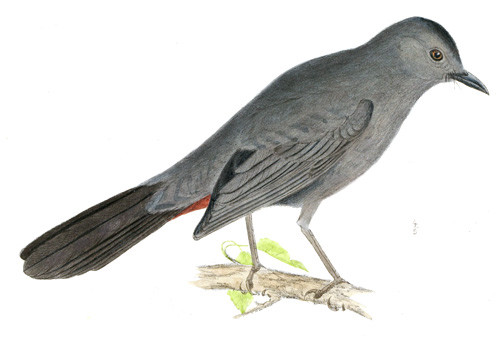
CAT BIRD.
(Galeoscoptes carolinensis.)
Adult.
A
HISTORY
OF
NORTH AMERICAN BIRDS
BY
S. F. BAIRD, T. M. BREWER, and R. RIDGWAY
LAND BIRDS
ILLUSTRATED BY 64 PLATES AND 593 WOODCUTS
VOLUME I.
BOSTON
LITTLE, BROWN, AND COMPANY
1905
Entered according to Act of Congress, in the year 1874,
BY LITTLE, BROWN, AND COMPANY,
in the Office of the Librarian of Congress, at Washington.
Printers
S. J. Parkhill & Co., Boston, U. S. A.
PREFACE.
The present work is designed to meet the want, which has long been felt, of a descriptive account of the Birds of North America, with notices of their geographical distribution, habits, methods of nesting, character of eggs, their popular nomenclature, and other points connected with their life history.
For many years past the only systematic treatises bearing upon this subject have been “The American Ornithology” of Alexander Wilson, finished by that author in 1814, and brought down to the date of 1827 by George Ord; the “Ornithological Biography” of Audubon, bearing date of 1838, with a second edition, “Birds of America,” embracing a little more of detail, and completed in 1844; and “A Manual of the Ornithology of the United States and Canada,” by Nuttall, of which a first edition was published in 1832 and a second in 1840. Since then no work relating to American Ornithology, of a biographical nature, has been presented to the public, with the exception of some of limited extent, such as those of Giraud, on the “Birds of Long Island,” in 1844; De Kay’s “Birds of New York,” 1844; Samuels’s “Ornithology and Oölogy of New England,” 1868, and a few others; together with quite a number of minor papers on the birds of particular localities, of greater or less moment, chiefly published in periodicals and the Proceedings of Societies. The reports of many of the government exploring parties also contain valuable data, especially those of Dr. Newberry, Dr. Heermann, Dr. J. G. Cooper, Dr. Suckley, Dr. Kennerly, and others.
More recently (in 1870) Professor Whitney, Chief of the Geological Survey of California, has published a very important volume on the ornithology of the entire west coast of North America, written by Dr. J. G. Cooper, and containing much original detail in reference to the habits of the western species. This is by far the most valuable contribution to the biography of American birds that has appeared since the time of Audubon, and, with its typographical beauty and numerous and excellent illustrations, all on wood and many of them colored, constitutes one of the most noteworthy publications in American Zoölogy.
Up to the time of the appearance of the work of Audubon, nearly all that was known of the great region of the United States west of the Missouri River was the result of the journey of Lewis and Clark up the Missouri and across to the Pacific Coast, and that of John K. Townsend and Mr. Nuttall, both of whom made some collections and brought back notices of the country, which, however, they were unable to explore to any great extent. The entire region of Texas, New Mexico, Colorado, Arizona, Nevada, and California was unvisited, as also a great portion of territory north of the United States boundary, including British Columbia and Alaska.
A work by Sir John Richardson, forming a volume in his series of “Fauna Boreali-Americana,” in reference to the ornithology of the region covered by the Hudson Bay Company’s operations, was published in 1831, and has been much used by Mr. Audubon, but embraces little or nothing of the great breeding-grounds of the water birds in the neighborhood of the Great Slave and Bear Lakes, the Upper Yukon, and the shores of the Arctic coast.
It will thus be seen that a third of a century has elapsed since any attempt has been made to present a systematic history of the birds of North America.
The object of the present work is to give, in as concise a form as possible, an account of what is known of the birds, not only of the United States, but of the whole region of North America north of the boundary-line of Mexico, including Greenland, on the one side, and Alaska with its islands on the other. The published materials for such a history are so copious that it is a matter of surprise that they have not been sooner utilized, consisting, as they do, of numerous scattered biographies and reports of many government expeditions and private explorations. But the most productive source has been the great amount of manuscript contained in the archives of the Smithsonian Institution in the form of correspondence, elaborate reports, and the fieldnotes of collectors and travellers, the use of which, for the present work, has been liberally allowed by Professor Henry. By far the most important of these consist of notes made by the late Robert Kennicott in British America, and received from him and other gentlemen in the Hudson Bay Territory, who were brought into intimate relationship with the Smithsonian Institution through Mr. Kennicott’s efforts. Among them may be mentioned more especially Mr. R. MacFarlane, Mr. B. R. Ross, Mr. James Lockhart, Mr. Lawrence Clark, Mr. Strachan Jones, and others, whose names will appear in the course of the work. The especial value of the communications received from these gentlemen lies in the fact that they resided for a long time in a region to which a large proportion of the rapacious and water birds of North America resort during the summer for incubation, and which until recently has been sealed to explorers.
Equally serviceable has been the information received from the region of the Yukon River and Alaska generally, including the Aleutian Islands, as supplied by Messrs. Robert Kennicott, William H. Dall, Henry M. Bannister, Henry W. Elliott, and others.
It should be understood that the remarks as to the absence of general works on American Ornithology, since the time of Audubon, apply only to the life history of the species, as, in 1858, one of the authors of the present work published a systematic account of the birds of North America, constituting Vol. IX. of the series of Pacific Railroad Reports; while from the pen of Dr. Elliott Coues, a well-known and eminent ornithologist, appeared in 1872 a comprehensive volume, entitled “A Key to North American Birds,” containing descriptions of the species and higher groups.
The technical, or descriptive, matter of the present work has been prepared by Messrs. Baird and Ridgway, that relating to the Raptores entirely by Mr. Ridgway; and all the accounts of the habits of the species are from the pen of Dr. Brewer. In addition to the matter supplied by these gentlemen, Professor Theodore N. Gill has furnished that portion of the Introduction defining the class of birds as compared with the other vertebrates; while to Dr. Coues is to be given the entire credit for the pages embracing the tables of the Orders and Families, as well as for the Glossary beginning on page 535 of Vol. III.
Nearly all the drawings of the full-length figures of birds contained in the work were made directly on the wood, by Mr. Edwin L. Sheppard, of Philadelphia, from original sketches taken from nature; while the heads were executed for the most part by Mr. Henry W. Elliott and Mr. Ridgway. Both series have been engraved by Mr. Hobart H. Nichols of Washington. The generic outlines were drawn by Anton L. Schönborn, and engraved by the peculiar process of Jewett, Chandler, & Co., of Buffalo. All of these, it is believed, speak for themselves, and require no other commendation.
A considerable portion of the illustrations were prepared, by the persons mentioned above, for the Reports of the Geological Survey of California, and published in the volume on Ornithology. To Professor Whitney, Chief of the Survey, acknowledgments are due for the privilege of including many of them in the present History of North American Birds, and also for the Explanation of Terms, page 526 of Vol. III.
A few cuts, drawn by Wolf and engraved by Whymper, first published in “British Birds in their Haunts,” and credited in their proper places, were kindly furnished by the London Society for the Diffusion of Christian Knowledge; and some others prepared for an unpublished volume by Dr. Blasius, on the Birds of Germany, were obtained from Messrs. Vieweg and Son, of Braunschweig.
The volume on the Water Birds is in an advanced state of preparation, and will be published with the least possible delay.
SPENCER F. BAIRD.
Smithsonian Institution, Washington,
January 8, 1874.
CONTENTS.
Page Preface v Introduction xiFamily
Turdidæ. The Thrushes
1Subfamily
Turdinæ 3Subfamily
Miminæ 31Family
Cinclidæ. The Dippers
55Family
Saxicolidæ. The Saxicolas
59Family
Sylviidæ. The Sylvias
69Subfamily
Sylviinæ 69Subfamily
Regulinæ 72Subfamily
Polioptilinæ 77Family
Chamæadæ. The Ground-Tits
83Family
Paridæ. The Titmice
86Subfamily
Parinæ 86Subfamily
Sittinæ 113Family
Certhiadæ. The Creepers
124Family
Troglodytidæ. The Wrens
130Family
Motacillidæ. The Wagtails
164Subfamily
Motacillinæ 165Subfamily
Anthinæ 169Family
Sylvicolidæ. The Warblers
177Subfamily
Sylvicolinæ 179Subfamily
Geothlypinæ 279Subfamily
Icterianæ 306Subfamily
Setophaginæ 311Family
Hirundinidæ. The Swallows
326Family
Vireonidæ. The Vireos
357Family
Ampelidæ. The Chatterers
395Subfamily
Ampelinæ 395Subfamily
Ptilogonatinæ 404Family
Laniidæ. The Shrikes
412Family
Cærebidæ. The Guits
425Family
Tanagridæ. The Tanagers
431Family
Fringillidæ. The Finches
446Subfamily
Coccothraustinæ 446Subfamily
Pyrgitinæ 524Subfamily
Spizellinæ 528 Index to the Plates. Plates 1-26.INTRODUCTION.
The class of Birds (Aves), as represented in the present age of the world, is composed of very many species, closely related among themselves and distinguished by numerous characters common to all. For the purposes of the present work it is hardly necessary to attempt the definition of what constitutes a bird, the veriest tyro being able to decide as to the fact in regard to any North American animal. Nevertheless, for the sake of greater completeness, we may say that, compared with other classes,[1] Birds are abranchiate vertebrates, with a brain filling the cranial cavity, the cerebral portion of which is moderately well developed, the corpora striata connected by a small anterior commissure (no corpus callosum developed), prosencephalic hemispheres large, the optic lobes lateral, the cerebellum transversely multifissured; the lungs and heart not separated by a diaphragm from the abdominal viscera; aortic arch single (the right only being developed); blood, with nucleated red corpuscles, undergoing a complete circulation, being received and transmitted by the right half of the quadrilocular heart to the lungs for aeration (and thus warmed), and afterwards returned by the other half through the system (there being no communication between the arterial and venous portions); skull with a single median convex condyle, chiefly on the basi-occipital (with the sutures for the most part early obliterated); the lower jaw with its rami ossifying from several points, connected with the skull by the intervention of a quadrate bone (homologous with the malleus); pelvis with ilia prolonged in front of the acetabulum, ischia and pubes nearly parallel with each other, and the ischia usually separated: anterior and posterior members much differentiated; the former modified for flight, with the humerus nearly parallel with the axis of the body and concealed in the muscles, the radius and ulna distinct, with two persistent carpal bones, and two to four digits; the legs with the bones peculiarly combined, (1) the proximal tarsal bones coalescing with the adjoining tibia, and (2) the distal tarsal coalescing with three (second, third, and fourth) metatarsals (the first metatarsal being free), and forming the so-called tarsometatarsus; dermal appendages developed as feathers: oviparous, the eggs being fertilized within the body, excluded with an oval, calcareous shell, and hatched at a temperature of about 104° F. (generally by the incubation upon them of the mother).[2]
Such are some of the features common to all the existing species of birds.[3] Many others might be enumerated, but only those are given which contrast with the characteristics of the mammals on the one hand and those of the reptiles on the other. The inferior vertebrates are distinguished by so many salient characters and are so widely separated from the higher that they need not be compared with the present class.
Although birds are of course readily recognizable by the observer, and are definable at once, existing under present conditions, as warm-blooded vertebrates, with the anterior members primitively adapted for flight,—they are sometimes abortive,—and covered with feathers, such characteristics do not suffice to enable us to appreciate the relations of the class. The characteristics have been given more fully in order to permit a comparison between the members of the class and those of the mammals and reptiles. The class is without exception the most homogeneous in the animal kingdom; and among the living forms less differences are observable than between the representatives of many natural orders among other classes. But still the differences between them and the other existing forms are sufficient, perhaps, to authorize the distinction of the group as a class, and such rank has always been allowed excepting by one recent naturalist.
But if we further compare the characters of the class, it becomes evident that those shared in common with the reptiles are much more numerous than those shared with the mammals. In this respect the views of naturalists have changed within recent years. Formerly the two characteristics shared with the mammals—the quadrilocular heart and warm blood—were deemed evidences of the close affinity of the two groups, and they were consequently combined as a section of the vertebrates, under the name of Warm-blooded Vertebrates. But recently the tendency has been, and very justly, to consider the birds and reptiles as members of a common group, separated on the one hand from the mammals and on the other from the batrachians; and to this combination of birds and reptiles has been given the name Sauropsida.
As already indicated, the range of variation within this class is extremely limited; and if our views respecting the taxonomic value of the subdivisions are influenced by this condition of things, we are obliged to deny to the groups of living birds the right which has generally been conceded of ranking as orders.
The greatest distinctions existing among the living members of the class are exhibited on the one hand by the Ostriches and Kiwis and the related forms, and on the other by all the remaining birds.
These contrasted groups have been regarded by Professor Huxley as of ordinal value; but the differences are so slight, in comparison with those which have received ordinal distinction in other classes, that the expediency of giving them that value is extremely doubtful; and they can be combined into one order, which may appropriately bear the name of Eurhipidura.
An objection has been urged to this depreciation of the value of the subdivisions of the class, on the ground that the peculiar adaptation for flight, which is the prominent characteristic of birds, is incapable of being combined with a wider range of form. This is, at most, an explanation of the cause of the slight range of variation, and should not therefore affect the exposition of the fact (thereby admitted) in a classification based on morphological characteristics. But it must also be borne in mind that flight is by no means incompatible with extreme modifications, not only of the organs of flight, but of other parts, as is well exemplified in the case of bats and the extinct pterodactyls.
Nor is the class of birds as now limited confined to the single order of which only we have living representatives. In fossil forms we have, if the differences assumed be confirmed, types of two distinct orders, one being represented by the genus Archæopteryx and another by the genera Ichthyornis and Apatornis of Marsh. The first has been named Saururæ by Hæckel; the second Ichthyornithides by Marsh.
Compelled thus to question the existence of any groups of ordinal value among recent birds, we proceed now to examine the grounds upon which natural subdivisions should be based. The prominent features in the classification of the class until recently have been the divisions into groups distinguished by their adaptation for different modes of life; that is, whether aerial or for progression on land, for wading or for swimming; or, again, into Land and Water Birds. Such groups have a certain value as simply artificial combinations, but we must not be considered as thereby committing ourselves to such a system as a natural one.
The time has scarcely arrived to justify any system of classification hitherto proposed, and we can only have a sure foundation after an exhaustive study of the osteology, as well as the neurology and splanchnology, of the various members. Enough, however, has already been done to convince us that the subdivision of the class into Land and Water Birds does not express the true relations of the members embraced under those heads. Enough has also been adduced to enable us to group many forms into families and somewhat more comprehensive groups, definable by osteological and other characters. Such are the Charadrimorphæ, Cecomorphæ, Alectoromorphæ, Pteroclomorphæ, Peristeromorphæ, Coracomorphæ, Cypselomorphæ, Celeomorphæ, Aëtomorphæ, and several others. But it is very doubtful whether the true clew to the affinities of the groups thus determined has been found in the relations of the vomer and contiguous bones. The families, too, have been probably, in a number of cases, especially for the passerine birds, too much circumscribed. The progress of systematic ornithology, however, has been so rapid within the last few years, that we may be allowed to hope that in a second edition of this work the means may be furnished for a strictly scientific classification and sequence of the families. (T. N. G.)
A primary division of recent birds may be made by separation of the (a) Ratitæ, or struthious birds and their allies,—in which the sternum has no keel, is developed from lateral paired centres of ossification, and in which there are numerous other structural peculiarities of high taxonomic import,—from the (b) Carinatæ, including all remaining birds of the present geologic epoch. Other primary divisions, such as that into Altrices and Præcoces of Bonaparte, or the corresponding yet somewhat modified and improved Psilopaedes and Ptilopaedes of Sundevall, are open to the serious objections that they ignore the profound distinctions between struthious and other birds, require too numerous exceptions, cannot be primarily determined by examination of adult specimens, and are based upon physiological considerations not necessarily co-ordinate with actual physical structure.
In the following scheme, without attempting to indicate positive taxonomic rank, and without committing myself finally, I present a number of higher groups into which Carinate birds may be divided, capable of approximately exact definition, and apparently of approximately equivalent taxonomic value. Points of the arrangement are freely drawn from the writings of various authors, as will be perceived by those competent to judge without special references. I am particularly indebted, however, to the late admirable and highly important work of Professor Sundevall,[4] from which very many characters are directly borrowed. The arrangement, in effect, is a modification of that adopted by me in the “Key to North American Birds,” upon considerations similar to those herewith implied. The main points of difference are non-recognition of three leading groups of aerial, terrestrial, and natatorial birds,—groups without morphological basis, resting simply upon teleological modification; a general depreciation of the taxonomic value of the several groups, conformably with the considerations presented in the preceding pages of this work; abolishing of the group Grallatores; and recognition of a primary group Sphenisci.[5]
A. PASSERES.[6] Hallux invariably present, completely incumbent, separately movable by specialization of the flexor hallucis longus, with enlarged base and its claw larger than that of the middle digit. Neither second nor fourth toe versatile; joints of toes always 2, 3, 4, 5, from first to fourth. Wing-coverts comparatively short and few; with the exception of the least coverts upon the plica alaris, arranged in only two series, the greater of which does not reach beyond the middle of the secondary remiges.[7] Rectrices twelve (with rare anomalous exceptions). Musical apparatus present in greater or less development and complexity. Palate ægithognathous. Sternum of one particular mould, single-notched. Carotid single (sinistra). Nature highly altricial and psilopædic.
a. Oscines.[8] Sides of the tarsus covered in most or all of their extent with two undivided horny plates meeting behind in a sharp ridge (except in Alaudidæ; one of the plates imperfectly divided in a few other forms). Musical apparatus highly developed, consisting of several distinct pairs of syringeal muscles. Primaries nine only, or ten with the first frequently spurious, rarely over two thirds the length of the longest, never equalling the longest.
b. Clamatores.[9] Sides of the tarsus covered with divided plates or scales variously arranged, its hinder edge blunt. Musical apparatus weak and imperfect, of few or incompletely distinguished syringeal muscles (as far as known). Primaries ten with rare exceptions, the first usually equalling or exceeding the rest.
B. PICARIÆ.[10] Hallux inconsiderable, weak or wanting, not always incumbent, not separately movable by distinction of a special muscle, its claw not longer than that of the middle toe unless of exceptional shape (e. g. Centropus). Second or fourth toe frequently versatile; third and fourth frequently with decreased number of joints. Wing-coverts for the most part larger and in more numerous series than in Passeres, the greater series reaching beyond the middle of the secondary quills (except in many Pici and some others). Rectrices commonly ten (eight to twelve). Primaries always ten, the first only exceptionally short (as in Pici). Musical apparatus wanting, or consisting of a muscular mass, or of not more than three pairs of syringeal muscles. Palate desmognathous or ægithognathous. Sternum of non-passerine character, its posterior border entire or doubly notched or fenestrate. Carotid single or double. Nature completely altricial, but young sometimes hatched with down[11] (e. g. Caprimulgidæ).
a. Cypseli. Palate ægithognathous. Wings lengthened in their terminal portions, abbreviated basally, with the first primary not reduced. Tail of ten rectrices. Bill fissirostral or tenuirostral. Feet never zygodactyle nor syndactyle, small, weak, scarcely fitted for locomotion; hallux often elevated or lateral or reversed; front toes usually webbed at base, or with abnormal ratio of phalanges in length and number, or both. Sternum deep-keeled, usually entire or else doubly notched or perforate. Syringeal muscles not more than one pair.
b. Cuculi. Palate desmognathous. Wings not peculiar in brevity of proximal or length of distal portions, and with first primary not reduced. Tail of eight to twelve rectrices. Bill of indeterminate form, never cered; tongue not extensile. Feet variously modified by versatility or reversion of either first, second, or fourth toes, or by cohesion for a great distance of third and fourth, or by absence or rudimentary condition of first or second; often highly scansorial, rarely ambulatorial. Syringeal muscles two pairs at most.
c. Pici. Palate “exhibiting a simplification and degradation of the ægithognathous structure” (Huxley); wings bearing out this passerine affinity in the common reduction of the first primary and the restriction of the greater coverts. Tail of ten perfect rectrices and usually a supplementary pair. Rostrum hard, straight, narrow, subequal to head, with commonly extensile and vermiform but not furcate tongue. Feet highly scansorial. Fourth toe permanently reversed; basal phalanges of toes abbreviated. Sternum doubly notched. Salivary glands highly developed. Hyoidean apparatus peculiar.
C. PSITTACI. Bill enormously thick, short, high, much arched from the base, the upper mandible strongly hooked at the end, cered at base, and freely movable by complete articulation with the forehead, the under mandible with short, broad, truncate symphysis. Feet permanently zygodactyle by reversion of the fourth toe, which articulates by a double facet. Tarsi reticulate. Syrinx peculiarly constructed of three pairs of intrinsic muscles. Tongue short, thick, fleshy. Sternum entire or fenestrate. Clavicles weak, defective, or wanting. Orbit more or less completed by approach or union of postorbital process and lachrymal. Altricial; psilopædic.
D. RAPTORES. Bill usually powerful, adapted for tearing flesh, strongly decurved and hooked at the end, furnished with a cere in which the nostrils open. Feet strongly flexible, with large, sharp, much curved claws gradually narrowed from base to tip, convex on the sides, that of the second toe larger than that of the fourth toe, and the hinder not smaller than the second one. Feet never permanently zygodactyle, though fourth toe often versatile; anterior toes commonly with one basal web; hallux considerable and completely incumbent (except Cathartidæ). Legs feathered to the suffrago or beyond. Rectrices twelve (with rare exceptions); primaries sinuate or emarginate (with rare exceptions). Sternum singly or doubly notched or fenestrate. Palate desmognathous. Carotids double. Syrinx wanting or developed with only one pair of muscles. Altricial; the young being weak and helpless, yet ptilopædic, being downy at birth.
E. COLUMBÆ. Bill straight, compressed, horny at the vaulted tip, which is separated by a constriction from the soft membranous basal portion. Nostrils beneath a soft, tumid valve. Tomia of the mandibles mutually apposed. Frontal feathers sweeping in strongly convex outline across base of upper mandible. Legs feathered to the tarsus or beyond. Hallux incumbent (with few exceptions), and front toes rarely webbed at base. Tarsus with small scutella in front, or oftener reticulate, the envelope rather membranous than corneous. Head very small. Plumage without after-shafts. One pair of syringeal muscles. Sternum doubly notched, or notched and fenestrate on each side. Carotids double. Palate schizognathous. Monogamous, and highly altricial and psilopædic.
F. GALLINÆ. Bill generally short, stout, convex, with an obtuse vaulted tip, corneous except in the nasal fossa, and without constriction in its continuity. Nostrils scaled or feathered. Tomia of upper mandible overlapping. Frontal feathers forming re-entrant outline at the base of upper mandible. Legs usually feathered to the tarsus or beyond. Hallux elevated, with few exceptions (e. g. Cracidæ and Megapodidæ), smaller than the anterior toes, occasionally wanting (as in the Hemipods). Tarsus, when not feathered, generally broadly scutellate. Front toes commonly webbed at base. Claws blunt, little curved. Wings strong, short, and concavo-convex. Rectrices commonly more than twelve. Head small. Plumage usually after-shafted. Carotids double (except Turnicidæ and Megapodidæ). No intrinsic syringeal muscles. Sternum very deeply, generally doubly, notched. Palate schizognathous. Chiefly polygamous. Præcocial and ptilopædic.
G. LIMICOLÆ. Tibiæ bare of feathers for a variable (sometimes very slight) distance above the suffrago. Legs commonly lengthened, sometimes excessively so, and neck usually produced in corresponding ratio. Tarsi scutellate or reticulate. Toes never coherent at base; cleft, or united for a short distance by one or two small movable basal webs (palmate only in Recurvirostra, lobate only in Phalaropodidæ). Hallux always reduced, obviously elevated and free, or wanting; giving a foot of cursorial character. Wings, with few exceptions, lengthened, pointed, and flat; the inner primaries and outer secondaries very short, forming a strong re-entrance on the posterior border of the wing. Tail shorter than the wing, of simple form, and of few feathers, except in certain Snipes. Head globose, sloping rapidly down to the contracted base of the bill, completely feathered (except Philomachus ♂). Gape of bill short and constricted; tip usually obtuse; bill weak and flexible. Rostrum commonly lengthened, and more or less terete and slender; membranous wholly or in great part, without hard cutting edges. Nostrils narrow, placed low down, entirely surrounded with soft skin; nasal fossæ extensive. Palate schizognathous. Sternum usually doubly, sometimes singly, notched. Carotids double. Pterylosis of a particular pattern. Nature præcocial and ptilopædic. Comprising the “Plover-Snipe” group; species of medium and small size, with never extremely compressed or depressed body; more or less aquatic, living on plains and in open places, usually near water, nesting on the ground, where the young run freely at birth.
H. HERODIONES. Tibiæ naked below. Legs and neck much lengthened in corresponding ratio. Toes long, slender, never coherent at base, where cleft, or with movable basal webbing. Hallux (as compared with that of the preceding and following group) lengthened, free, and either perfectly incumbent or but little elevated, with a large claw, giving a foot of insessorial character. Wings commonly obtuse, but broad and ample, without marked re-entrance on posterior border, the intermediate remiges not being much abbreviated. Tail short and few-feathered. Head narrow, conico-elongated, gradually contracting to the large, stout base of the bill; the loral and orbital region, or the whole head, naked. Gape of the bill deeply fissured; tip usually acute; tomia hard and cutting. Bill conico-elongate, always longer than the head, stout and firm. Nostrils small, placed high up, with entirely bony and horny, or only slightly membranous, surroundings. Pterylosis nearly peculiar in the presence, almost throughout the group, of powder-down tracts, rarely found elsewhere; pterylæ very narrow. Palate desmognathous. Carotids double. Altricial. Comprising the Herons, Storks, Ibises, etc. (not Cranes). Species usually of large stature, with compressed body and very long S-bent neck; perching and nesting usually in trees, bushes, or other high places near water; young hatching weak, scarcely feathered, and reared in the nest.
I. ALECTORIDES.[12] Tibiæ naked below. Neck, legs, and feet much as in the last group, but hallux reduced and obviously elevated, with small claw, the resulting foot cursorial (natatorial and lobate in Fulica). Wings and tail commonly as in Herodiones. Head less narrowed and conic than in the last, fully feathered or with extensive baldness (not with definite nakedness of loral and orbital regions). Bill of various shape, usually lengthened and obtuse, never extensively membranous. Rictus moderate. Nostrils lower than in Herodiones. Pterylosis not peculiar. Palate schizognathous. Carotids double. Nature præcocial and ptilopædic. Comprising the Cranes and Rails and their allies; the former agreeing with the Herodiones superficially in stature, etc., but highly diverse in the schizognathous palate, præcocial nature, etc.
J. LAMELLIROSTRES. Feet palmate; tibiæ feathered (except Phœnicopterus). Legs near centre of equilibrium of the body, its axis horizontal in walking; not lengthened except in Phœnicopterus. Knee-joint rarely exserted beyond general skin of the body. Wings moderate, reaching when folded to, but not beyond, the usually short and rounded (exceptionally long and cuneate) tail. Feet tetradactyle (except sometimes in Phœnicopterus); hallux reduced, elevated and free, often independently lobate. Bill lamellate, i. e., furnished along each commissural edge with a regular series of mutually adapted laminæ or tooth-like processes, with which correspond certain laciniate processes of the fleshy tongue, which ends in a horny tip. Bill large, thick, high at base, depressed towards the end, membranous to the broad obtuse tip, which is occupied by a horny “nail” of various shape. Nostrils patent, never tubular; nasal fossæ slight. No gular pouch. Plumage dense, to resist water. Eyes very small. Head high, compressed, with lengthened, sloping frontal region. Palate desmognathous. Reproduction præcocial; young ptilopædic. Eggs numerous. Carotids double. Sternum single-notched. Comprising Flamingoes and all the Anserine birds.
K. STEGANOPODES. Feet totipalmate; hallux lengthened, nearly incumbent, semilateral, completely united with the second toe by a full web. Tibiæ feathered; position of legs with reference to axis of body variable, but generally far posterior; knee-joint not free. Wings and tail variable. Bill of very variable shape, never lamellate, wholly corneous; its tomia often serrate; external nares very small or finally abortive. A prominent naked gular pouch. Tarsi reticulate. Sternum entire or nearly so; furculum confluent with its keel. Carotids double. Palate highly desmognathous. Reproduction altricial; young psilopædic or ptilopædic. Eggs three or fewer.
L. LONGIPENNES. (To most of the characters of the group here given the genus Halodroma is a signal exception, though unquestionably belonging here.) Feet palmate. Tibiæ feathered. Legs at or near centre of equilibrium, affording horizontal position of axis of body in walking. Knee scarcely buried in common integument; tibia sometimes with a long apophysis. Hallux elevated, free, functionless; very small, rudimentary, or wanting. Rostrum of variable shape, usually compressed and straight to the hooked end, sometimes entirely straight and acute, commonly lengthened, always corneous, without serration or true lamellæ. Nostrils of various forms, tubular or simply fissured, never abortive. No gular pouch. Wings very long and pointed, surpassing the base and often the end of the large, well-formed, few-feathered tail. Carotids double. Palate schizognathous. Reproduction altricial; young ptilopædic. Eggs three or fewer. Habit highly volucral.
M. PYGOPODES. Feet palmate or lobate. Tibiæ feathered, often with a long apophysis, always buried in common integument nearly to the heel-joint, necessitating a more or less erect posture of the body on land, where progression is difficult. Hallux small, elevated or wanting; feet lobate or palmate. Bill of indeterminate shape, wholly corneous, never lamellate or serrate, nor with gular pouch. Nostrils not abortive. Wings very short, reaching scarcely or not to the base, never to the tip, of the short, sometimes rudimentary, tail. Palate schizognathous. Carotid usually double, sometimes single (in Podiceps and Mergulus). Nature altricial or præcocial; young ptilopædic. Highly natatorial.
N. SPHENISCI. With general characters of the last group, but distinguished by unique ptilosis and wing-structure, etc. Plumage without apteria, of singularly modified scale-like feathers on most parts; no developed remiges. Wings unfit for flight, insusceptible of perfect flexion or extension, very short, with peculiarly flattened bones and stable articulations. Skeleton non-pneumatic. Many bones, terete in ordinary birds, here flattened. Metatarsal bone flattened transversely, doubly fenestrate. Hallux elevated, lateral, minute, free. No free pollex. Two anconal sesamoids; patella from double centres; tibia without apophysis; a free tarsal ossicle. Sternum with long lateral apophyses. Pelvic connections unstable. Carotids double. Comprising only the Penguins. Confined to the Southern Hemisphere.
Having thus presented and defined an arrangement of the higher groups into which recent Carinate birds are susceptible of division, I next proceed to the consideration of the North American Families of birds which the authors of the present work have provisionally adopted as suitable to the end they had in view. Professor Baird urges the caution that the scheme is intended merely for the convenient determination of the North American species, aware that in many instances diagnoses or antitheses of entire pertinence in such application would fail or be negatived by consideration of the exotic forms. The arrangement of the families here adopted is essentially that presented in 1858 in Professor Baird’s “Birds of North America,” modified somewhat in accordance with more recent views of Professor Sundevall and others. But before proceeding to the analysis of the families, I will introduce an artificial clew to the preceding higher groups as adopted, so far as they are represented by North American species.
ARTIFICIAL KEY TO THE FOREGOING HIGHER GROUPS,
By means of which any North American bird may be readily referred to that group to which it is held to belong.
- I. Toes 3; 2 in front, 1 behind (Pici) Picariæ.
- II. Toes 3; all in front.
- Toes cleft or semipalmate Limicolæ.
- Toes palmate.
- Nostrils tubular Longipennes.
- Nostrils not tubular Pygopodes.
- III. Toes 4; 2 in front, 2 behind.
- Bill cered and hooked Psittaci.
- Bill neither cered nor hooked. (Cuculi or Pici) Picariæ.
- IV. Toes 4; 3 in front, 1 behind.
- 1. Toes syndactyle (Cuculi) Picariæ.
- 2. Toes totipalmate (all four full-webbed) Steganopodes.
- 3. Toes palmate.
- Bill curved up Limicolæ.
- Bill not curved up;
- lamellate Lamellirostres.
- not lamellate;
- hallux lobate Pygopodes.
- hallux not lobate Longipennes.
- 4. Toes lobate.
- Tail rudimentary Pygopodes.
- Tail perfect.
- A horny frontal shield Alectorides.
- No horny frontal shield Limicolæ.
- 5. Toes semipalmate;
joined by evident movable basal web (A). - 6. Toes cleft to the base,
or there immovably coherent (B).
- A. Hind toe elevated above the level of the rest.
- Tibiæ naked below.
- Nostrils perforate Alectorides.
- Nostrils imperforate.
- Tarsi reticulate.
- Head bald Herodiones.
- Head feathered Limicolæ.
- Tarsi scutellate in front Limicolæ.
- Tarsi reticulate.
- Tibiæ feathered below.
- Nostrils perforate Raptores.
- Nostrils imperforate.
- Gape reaching below eye. (Cypseli) Picariæ.
- Gape not reaching below eye Gallinæ.
- Tibiæ naked below.
-
AA. Hind toe inserted on the level of the rest.
- Tibiæ naked below Herodiones.
- Tibiæ feathered below.
- Bill cered and hooked Raptores.
- Bill not cered.
- Nasal membrane soft and tumid Columbæ.
- Nasal scale hard and flat Gallinæ.
-
B. Hind toe elevated above the level of the rest.
- Gape reaching below eye (Cypseli) Picariæ.
- Gape not below eye.
- First primary emarginate
or about equal to 2d Limicolæ. - First primary not emarginate
and much shorter than 2d Alectorides.
- First primary emarginate
-
BB. Hind toe inserted on the level of the rest.
- Nostrils opening beneath soft swollen membrane Columbæ.
- Nostrils otherwise.
- Bill cered and hooked Raptores.
- Bill otherwise.
- Secondaries only six (Cypseli) Picariæ.
- Secondaries more than six (a) Passeres.
- (a) Primaries 10; the 1st
more than 2⁄3 as long as the longest. (Clamatores) Passeres. - Primaries 10; the 1st
not 2⁄3 as long as the longest. (Oscines) Passeres. - Primaries 9. (Oscines) Passeres.
Recurring now to consideration of the North American Families of the foregoing higher groups, I take up the latter in the natural order in which they have been presented, giving under head of each such group an analysis of the North American families by which it is represented, reiterating the caution that the characters are drawn up only with reference to the North American genera, and are, consequently, not necessarily or always applicable upon wider considerations. These analyses are made as nearly natural as the state of the case permits, but I seize upon any obvious external characters which may be afforded, without regard to their morphological significance or taxonomic value.
Analysis of the Families of PASSERES.
A. Oscines. Musical apparatus highly developed. Back of tarsus undivided, or formed of a few scutella distinct from those lapping over the front. First primary wanting, spurious, or at most not over two thirds the length of the longest.
a. Each side of tarsus covered with a plate undivided in most or all of its length, and meeting its fellow in a sharp ridge behind.
b. Primaries only nine.
c. Bill triangular, depressed, about as wide at base as long; the gape twice as long as the culmen, reaching to about opposite the eyes; tomia straight or gently curved. No obvious rictal bristles. Tarsi not longer than the lateral toe and claw. Wings long and pointed, the first primary equal to or longer than the second. Central tail-feathers not half as long as the wing … Hirundinidæ.
cc. Bill variously conico-elongate or slender, or, if depressed, with long rictal bristles; gape not nearly twice as long as culmen; tomia straight or gently curved. Nostrils not obviously nearer culmen than tomia. Tarsus longer than lateral toe and claw.
Bill very slender, acute; culmen rather concave at base. Longest secondary acuminate, nearly or quite equal to the primaries in the closed wing. Hind claw little curved, about twice as long as the middle claw. Hind toe and claw longer than middle toe and claw … Motacillidæ.
Bill variously conico-elongate and acute; culmen not concave at base. Longest secondary not acuminate, falling far short of primaries in the closed wing. Hind claw well curved, not nearly twice as long as middle claw; hind toe and claw not longer than middle toe and claw. Gape ample; tongue slightly bifid or brushy, if at all … Sylvicolidæ.
Bill lengthened, very acute, even decurved. Wings and feet as in the last. Gape constricted; tongue generally deeply bifid or brushy … Cærebidæ.
ccc. Bill more or less truly conic, usually short, thick; commissure usually more or less evidently abruptly angulated near the base, or with lobe or tooth further forward. Nostrils obviously nearer culmen than tomia. Tarsus longer than lateral toe and claw.[13]
Bill stout, tumid, convex in nearly all its outlines; tomia not angulated, but with one or more lobes or nicks in advance of the base. Nostrils placed very high. Other characters much as in Sylvicolidæ. Colors chiefly red and yellow. One genus of … Tanagridæ.
Bill truly conic, much shorter than head, usually with the angulation evident; no lobe along middle of tomia, but usually a notch at end. Nostrils placed very high. Rictal bristles usually obvious … Fringillidæ.
Bill conic, but lengthened, little if any shorter than head; the angulation of the tomia evident; no notch at end. Nostrils high. No rictal bristles … Icteridæ.
bb. Primaries ten.
Otherwise with characters much as in Icteridæ … Sturnidæ.
d. Nostrils concealed with antrorse bristly feathers (except in Psilorhinus and Gymnokitta).[
Base of bill sheathed with antrorse bristly feathers, having lateral branches to their very ends; its tip mostly notched. Basal joint of middle toe united only half-way to the lateral. Sides of tarsus occupied by a lateral groove, mostly filled in with small plates. First primary more than half as long as second. Large,—over seven inches … Corvidæ.
Base of bill with two tufts of bristly feathers, ending in simple filaments without lateral branches, its tip mostly unnotched. Basal joint of middle toe united nearly all its length with the lateral. Sides of tarsus ungrooved. First primary less than half as long as second. Small,—under seven inches … Paridæ.[15]
dd. Nostrils exposed.
e. Tail scansorial, with rigid acute feathers. Whole bill slender, compressed, acute, decurved, unnotched, unbristled. Outer toe much longer than inner … Certhiidæ.
ee. Tail not scansorial, graduated. First primary not less (generally more) than half as long as the second, and inner toe united to the middle by at least one half (usually more) of the length of its basal joint.
Tarsus with few obscure scutella. Rictal bristles present. Bill stout, but not toothed nor hooked. Wing excessively rounded (fifth, sixth, and seventh primaries longest), much shorter than the long graduated tail. Size small. Plumage brown, unbanded … Chamæadæ.
Tarsus distinctly scutellate. Nostrils wholly exposed, scaled. No rictal bristles, but loral feathers with bristly points. Bill slender, not notched nor hooked. Wings and tail moderately rounded; neither very much shorter than the other. Size small. Color brown, etc., the wings and tail barred or undulated … Troglodytidæ.
Tarsus distinctly scutellate. Nostrils overhung (not concealed) with bristly feathers. Rictal bristles present, strong. Bill powerful, compressed, strongly notched, toothed, and hooked. Wings and tail moderate. Large. Colors black, white, and gray … Laniidæ.
eee. Tail not scansorial. First primary less than half as long as the second,[16] or about half as long, in which case the inner toe is cleft nearly to its base (f and ff).
f. Basal joint of middle toe united some distance with the inner, and for half or more of its length with the outer toe.
Basal joint of middle toe shorter than that of inner toe, and wholly adherent to both inner and outer toes. Tarsus longer than middle toe and claw. Gonys more than half the length of the lower jaw. Bill stout, high, compressed; notched and abruptly hooked at tip … Vireonidæ.
Basal joint of middle toe not shorter than that of inner toe; united to the outer for about two thirds, to the inner for about one half, its length. Tarsus not longer than the middle toe and claw. Gonys less than half the length of the under jaw. Bill triangular, much depressed at base, moderately notched, and hooked at tip[17] … Ampelidæ.
Basal joint of middle toe shorter than that of the inner toe, united to the outer for about two thirds, to the inner for about one half, its length. Tarsus longer than middle toe and claw. Gonys more than half the length of the under jaw. Bill very weak and slender, little decurved or notched at tip. Very small,—under six inches long. (Tarsi booted in Regulus, distinctly scutellate in Polioptila.) … Sylviidæ.
ff. Basal joint of middle toe quite free from the inner, and not united with the outer more than half-way.
Nostrils linear, low. No bristles or bristly points whatever about the mouth. Wings short, rounded, concavo-convex. Tail very short, nearly concealed by its coverts. Tarsi booted … Cinclidæ.
Nostrils oval. Bristles or bristly points about the mouth. Wings very long and pointed, reaching, when folded, beyond the middle of the short, square, or emarginate tail, and one and a half times or more the length of the latter; tip formed by second, third, and fourth quills; outer secondary reaching only about two thirds way to end of longest primary; spurious quill very short. Tarsi booted … Saxicolidæ.
Nostrils oval. Bristles or bristly points about the mouth. Wings moderate, not reaching, when folded, beyond the middle of the tail, and not over one and a third times as long as the latter; tip formed by third to sixth quill; outer secondary reaching in closed wing three fourths or more the length of the longest primary. Spurious quill longer, sometimes one half the second. Tarsi scutellate in Miminæ, booted in Turdinæ … Turdidæ.
aa. Outside of tarsus covered with two series of scutella,—one lapping entirely around in front, the other entirely around behind, and meeting at a groove on the inside; hind edge blunt. First primary spurious or apparently wanting. Hind claw much lengthened, scarcely curved. Nostrils with antrorse bristly feathers. Bill conico-elongate … Alaudidæ.
B. Clamatores. Outside of tarsus covered with a series of plates variously arranged, lapping entirely around in front and behind, to meet at a groove on the inner side.
First primary lengthened, often longest, at least over two thirds as long as the longest. Bill broad at the base, much depressed, tapering to a fine point, which is abruptly decurved; culmen rounded or flattened; gonys flattened; commissure straight, or nearly so, to the tip. Nostrils small, circular, basal; overhung, but not concealed by bristles. Mouth capacious, with broad and deeply fissured rictus, beset with numerous long strong bristles. Feet small, weak. Tail of twelve feathers … Tyrannidæ.
Analysis of the Families of PICARIÆ.
Secondaries only six.
Bill tenuirostral, longer than head, nearly cylindrical. Gape constricted. Tongue filiform, extensile, bi-tubular. Wings long in terminal portion, abbreviated proximally, acute. Plumage compact, of metallic sheen. Size smallest of all birds. (Humming-Birds.) … Trochilidæ.
Secondaries more than six.
Feet syndactyle by connation of outer and middle toes.
Outer toe much longer than the inner, united for half its length with the middle, forming a broad sole. Tibiæ naked below. Bill longer than head, straight, acute, with hard cutting edges and ample rictus. Tongue rudimentary, fixed. Wings pointed, much longer than the short square tail. Tail-feathers twelve. Plumage compact, oily. (Kingfishers.) … Alcedinidæ.
Feet zygodactyle[18] by reversion of outer or fourth toe.
Not scansorial; tail of eight or ten long soft feathers. Bill with decurved tip, not fitted for hammering; rictus ample. Tongue not extensile nor vermiform nor barbed. Salivary glands and hyoidean apparatus not peculiar. No nasal tufts of feathers. Arboreal and terrestrial. (Cuckoos.) … Cuculidæ.
Highly scansorial; tail of twelve rigid acuminate feathers, whereof the outer pair are short and spurious, concealed between bases of next two pairs. Bill stout, straight, with the tip truncate or acute, not decurved,—an efficient chisel for hammering and boring wood. Tongue vermiform, extensile,[19] and barbed. Salivary glands large; hyoidean apparatus peculiar. Nasal tufts usually present. Arboreal. (Woodpeckers.) … Picidæ.
Feet neither syndactyle nor zygodactyle.
Feet semipalmate, of normal ratio of phalanges. Anterior toes connected at base by movable webbing. Hind toe very small, elevated, semilateral. Middle toe produced, its large claw pectinate. Bill fissirostral, with very small, triangular, depressed horny part and immense rictus, reaching below the eyes, furnished with bristles. Rather large. Plumage soft and lax, much variegated … Caprimulgidæ.
Feet scarcely or not semipalmate, of frequently abnormal ratio of phalanges (middle or outer toe, or both, with fewer joints than usual among birds). Hallux very small, elevated, frequently lateral or versatile. Middle toe not produced nor its claw pectinate. Bill much as in the last, but rictus unbristled. Small. Plumage compact, of few simple subdued colors … Cypselidæ.
Family of PSITTACI.
To characters of Psittaci add: Cere feathered, concealing the nostrils. Feet granular, rugose. Wings pointed. Tail cuneate. Plumage coarse and dry. Head feathered. Colors green, with yellow and blue … Psittacidæ.[20]
Analysis of Families of RAPTORES.
Feet highly raptorial, with large, strong, sharp, curved, contractile claws, adapted for grasping. Hallux perfectly incumbent, lengthened (more than half as long as the fourth toe), with large claw. Front toes with slight basal webbing between outer or middle ones, or none; outer toe often reversible. Nostrils imperforate. Bill short, stout, not notably contracted in its continuity, with strongly hooked tip; tomia often once-twice toothed or lobed. Head feathered wholly or in greatest part. Lower larynx developed with one pair of muscles. Plumage with or without after-shafts. Cœca present, as a rule, if not always.
Physiognomy peculiar by reason of great lateral expansion and lengthwise shortening of the cranium, causing the eyes to be directed forward. Eyes surrounded by a disc of radiating bristly feathers, in front closely appressed to and hiding the base of the bill, elsewhere bounded by a rim of differently formed feathers. Tomia never toothed or lobed. Nostrils usually at the edge of the cere. Outer toe completely versatile, shorter than the inner toe. Basal phalanx of middle toe not longer than the second, and much shorter than the next. Legs commonly feathered or bristly to or on the toes. Plumage peculiarly soft and lax, without after-shafts; flight perfectly noiseless. Cranial walls widely separated by intervention of spongy diploë. Sternum commonly doubly notched. Chiefly nocturnal … Strigidæ.
Physiognomy not peculiar in any lateral expansion of the cranium; the eyes lateral in direction. No complete facial disc; base of bill not hidden by appressed bristles. Nostrils wholly in the cere. Outer toe rarely versatile, except Pandion, etc.; not shorter than the inner. Basal phalanx of middle toe longer than the second. Legs commonly naked and scutellate or reticulate in some portion of their length; toes always bare and scaly. Plumage compact, usually with after-shafts; flight audible. Cranial walls with little diploë. Sternum commonly single-notched or fenestrate, sometimes entire. Diurnal … Falconidæ.
Feet scarcely raptorial, with lengthened, little curved or contractile, weak, short claws. Hallux elevated, shortened, not more than half as long as the fourth toe, with small claw. Front toes all webbed at base; middle toe lengthened; outer not reversible. Basal phalanx of middle toe longer than either of the succeeding. Nostrils perforate. Bill lengthened and comparatively weak, little hooked, contracted in its continuity; tomia not toothed or lobed. Head naked of feathers in greatest part; sparsely bristly. No lower larnyx developed. No cœca. After-shafts absent … Cathartidæ.
Family of COLUMBÆ.
With characters essentially as in Columbæ (exclusive of those peculiar to Diduncudidæ and Dididæ). Plumage without after-shafts; the feathers with thickened, spongy rhachis loosely inserted in the skin. Head small, completely feathered, excepting sometimes a circumorbital space. Tarsi naked or only feathered a little way above. Tail of twelve feathers, or lengthened, cuneate, and of fourteen. (Hallux not perfectly incumbent in Starnænas.) … Columbidæ.
Analysis of Families of GALLINÆ.
Hind toe lengthened, insistent. Tail-feathers twelve. Sides of head and throat with naked spaces. Color greenish … Cracidæ.
Hind toe shortened, elevated. Tail-feathers usually fourteen or more. No green.
Large. Tarsi, toes, and nasal fossæ naked. Head bare of feathers, sparsely bristly, with wattles and caruncles. A pectoral tuft of bristly feathers. Tarsi usually spurred in the male. Plumage iridescent … Meleagrididæ.
Medium. Tarsi wholly or in great part, sometimes also the toes, and always the nasal fossæ, feathered. Head completely feathered, excepting a definite papillate strip over the eye. Tail-feathers sixteen or more. Sides of neck usually with lengthened feathers, or a naked distensible area, or both. No spurs. Plumage without iridescence … Tetraonidæ.
Small. Tarsi, toes, and nasal fossæ naked. Head completely feathered. No peculiar feathers or tympanum on sides of neck. No spurs. Plumage not iridescent … Perdicidæ.
Analysis of Families of LIMICOLÆ.
Toes not lobate. Tarsi not notably compressed.
Legs extremely long; the tarsus equalling or exceeding the tail, and feet either four-toed and palmate (Recurvirostra), or three-toed and semipalmate (Himantopus); with the bill much longer than the head, very slender, acute, and curved upward … Recurvirostridæ.
Legs moderate, stout. Tarsus shorter than tail. Bill hard, more or less contracted at base, with short nasal fossa, gonydeal angle, and ascending gonys, the tip either compressed and truncate or depressed and acute. Feet three-toed and with basal webbing (Hæmatopus), or four-toed and cleft (Strepsilas) … Hæmatopodidæ.
Legs moderate. Tarsus shorter than tail, reticulate. Hind toe wanting (except in Squatarola, where very small, and in Aphriza). Bill short, straight,—not exceeding the head (generally shorter),—shaped like a pigeon’s, with short, broad, soft nasal fossæ separated by a constriction from the enlarged, obtuse, horny terminal part. Head large, globose, contracting suddenly to the bill. Neck short … Charadriidæ.
Legs moderate. Tarsus shorter than tail, scutellate. Hind toe present. Bill long,—equalling, or oftener exceeding, frequently several times longer than, the head; softish and membranous to the very tip, without constriction in its continuity; straight or variously curved … Scolopacidæ.
Toes lobate. Tarsi notably compressed.
General characters of Scolopacidæ. Body depressed; the under plumage thickened, duck-like. Habits natatorial … Phalaropodidæ.
Analysis of Families of HERODIONES.
Hallux lengthened, perfectly incumbent, with large claw. Tarsi scutellate. Middle claw pectinate. Bill perfectly straight, tapering, acute. Loral region definitely naked, continuous with covering of the bill. Head narrow, elongate, tapering … Ardeidæ.
Wings decidedly shorter than the tail, which is considerably graduated; first quill half or more than half the second.
Mr. Dall informs us that the nest found by him was built in a willow bush, about two feet from the ground, and on the top of a large mass of rubbish lodged there by some previous inundation. Other nests of the same species were met with in several places between Fort Yukon and Nulato, always on or near a river-bank and in low and secluded localities.
The European warblers of the genus Phyllopneuste are all insect-eating birds, capturing their prey while on the wing, and also feeding on their larvæ. They frequent the woodlands during their breeding-season, but at all other times are much more familiar, keeping about dwellings and sheepfolds.
In the winter it is most abundant in the Gulf States, and especially in that of Louisiana. Dr. Woodhouse found it quite abundant throughout Texas, New Mexico, and the Indian Territory. Dr. Cooper found it in Washington Territory, but did not there meet with it in summer. Dr. Suckley, however, regarded it as a transient visitor, rather than a winter resident of that region, and far more abundant from about the 8th of April to the 20th of May, when it seemed to be migrating, than at any other time.
Dr. Heermann, in his report on the birds observed in Lieutenant Williamson’s explorations, states that he first discovered this species in Southern California, at the terminus of the Mohave River. Owing to their extreme wildness, he was not able to obtain any specimens. In searching for their food, he states that they often remained suspended with their backs downward, after the manner of the Titmice. He found their nests quite abundant, though from the lateness of the season few of the birds were remaining, in the neighborhood of Fort Yuma. Dr. Heermann describes their nests as spherical, formed of twigs, and having the entrance on one side. The interior was lined with down and feathers, and contained usually from four to six eggs. These he describes as having, when fresh, a ground-color of pale blue, dashed all over with small black spots.
Subfamily MOTACILLINÆ.
According to Degland, this bird is a very abundant species in France, where it nests on the ground in the cornfields, in open fields, meadows, and amidst the standing grain. It lays from four to six eggs, of a brownish-yellow on a reddish-white ground, profusely covered with fine dots of reddish-gray, which are more or less confluent. A few zigzag lines of dark brown or black are found on the larger end. They measure .63 of an inch in length and .55 in breadth. Its food is flies, moths, small green caterpillars, and aquatic insects.
4. Wings rounded, shorter than the graduated tail.
In Southern Illinois, Mr. Ridgway cites this species as a rather rare bird among the oak barrens where it breeds. He also met with it in orchards in the wooded portions, in April, during the northward migration of the Sylvicolidæ.
Subfamily ICTERIANÆ.
These nests were usually very closely concealed, but one that he found at Santa Cruz, near the coast, was in a very open situation, only two feet above the ground. When the nest is approached, the old birds are very bold, keeping up a constant scolding, and almost flying in the face of an intruder. At other times they are very shy. The notes and sounds uttered by the Western bird Dr. Cooper states to be the same as those of the Eastern species, and with the same grotesqueness. They leave the State of California on or before the first of September.
Their nests are usually constructed late in June or early in July, and are placed in various positions, sometimes in a low bush or tree not more than three or four feet from the ground, and rarely more than twenty. Their nests are large and bulky, but strongly made of various materials. Generally they build a strong external framework, six or seven inches in diameter, composed of the ends of twigs, coarse stems of vegetables, and grasses. Within this they build a compact, well-made fabric of grasses, grapevine bark, and other finer substances, lining the whole with leaves and fine root-fibres. The cavity is large and deep for the bird. The parents are fourteen days in incubating before the young are hatched out, and all this while are remarkably silent, hardly uttering a sound, even their faintest lisping note, when the nest is meddled with, though they evince great anxiety by their fearless indifference to their own danger.
Habits. Maccown’s Lark Bunting is yet another of the various species of our birds whose history is very little known, and in regard to which the most we are able to state, at present, is that they appear in different parts of the interior plains of the United States, between the Rocky Mountains and the Missouri River and the lower tributaries of the Mississippi, extending from New Mexico and Texas northward, during the breeding-season, to the northern boundary of the United States. It was first discovered by Captain Maccown, who obtained it in Texas, where he found it in company with a flock of Shore Larks, and where it winters in considerable numbers. Mr. Dresser afterward met with it in small flocks, early in April, on the prairies near San Antonio. It was not very common, and he was only able to obtain two specimens during his stay in that section.
Apprehensions have been expressed lest these new-comers may molest and drive away our own native birds. How this may be when the Sparrows become more numerous cannot now be determined, but so far they manifest no such disposition. Since their introduction into Boston the Chipping Sparrows appear to have increased, and to associate by preference with their European visitors, feeding with them unmolested. I have been unable to detect a single instance in which they have been molested, in any manner, by their larger companions. Their predatory aggressions, however, upon the rights of the common Robin have been noticed, and deserve mention. The Sparrows appear to be extravagantly fond of earthworms, but not able to hunt for them themselves. They have learned to watch the Robin as it forages for these worms, keeping around, at a respectful distance, and as soon as one, with much toil, has dragged a worm from its place of concealment, down swoops the bird and impudently carries it off. The poor bewildered and plundered Robin essays a late and vain attempt to protect its food. The Sparrow is too nimble, and the worm is gone before its rightful owner can turn to face the robber.
[1] We are indebted to Professor Theodore N. Gill for the present account of the characteristics of the class of Birds as distinguished from other vertebrates, pages XI-XV.
[2] Dr. Coues, in his “Key to North American Birds,” gives an able and extended article on the general characteristics of birds, and on their internal and external anatomy, to which we refer our readers. A paper by Professor E. S. Morse in the “Annals of the New York Lyceum of Natural History” (X, 1869), “On the Carpus and Tarsus of Birds,” is of much scientific value.
[3] Carus and Gerstaecker (Handbuch der Zoologie, 1868, 191) present the following definition of birds as a class:—
[4] Methodi naturalis avium disponendarum tentamen. Stockholm, 1872-73.
[5] This group is insusceptible of definition. The wading birds, as usually allocated, do not possess in common one single character not also to be found in other groups, nor is the collocation of their characters peculiar.
[6] Corresponding closely with the Linnæan and earlier Sundevallian acceptation of the term. Equivalent to the later Oscines of Sundevall.
[7] As remarked by Sundevall, exceptions to the diagnostic pertinence of these two characters of hind claw and wing-coverts taken together are scarcely found. For, in those non-passerine birds, as Raptores and some Herodiones, in which the claw is enlarged, the wing-coverts are otherwise disposed; and similarly when, as in many Pici and elsewhere, the coverts are of a passerine character, the feet are highly diverse.
[8] Laminiplantares of Sundevall plus Alaudidæ.
[9] Scutelliplantares of Sundevall minus Alaudidæ.
[10] Nearly equivalent to the Linnæan Picæ. Equal to the late (1873) Volucres of Sundevall.
[11] A polymorphic group, perfectly distinguished from Passeres by the above characters in which, for the most part, it approximates to one or another of the following lower groups, from which, severally, it is distinguished by the inapplicability of the characters noted beyond. My divisions of Picariæ correspond respectively to the Cypselomorphæ, Coccygomorphæ, and Celeomorphæ of Huxley, from whom many of the characters are borrowed.
[12] Groups G., H., and I. are respectively equal to the Charadriomorphæ, Pelargomorphæ, and Geranomorphæ of Huxley.
[13] In the true conirostral or fringilliform genera the under mandible has high strong tomia, bent at an angle near the base; the corresponding portion of the upper mandible is deep, so that the nostrils are nearer the culmen than the tomia. The whole bill is more or less bent in its axis from the axis of the cranial base, so that the palate curves down, or is excavated or, as it were, is broken into two planes meeting at an angle,—one plane the anterior hard imperforate roof of the mouth, the other the back palate where the internal nares are situate (Sundevall). The single North American genus of Tanagridæ (Pyranga) is here conventionally ranged on account of its high nostrils and conic bill, although it does not show angulation of the tomia. The Icteridæ, with obviously angulated tomia, shade into the Fringillidæ in shortness and thickness of bill, and into other families in its length and slenderness.
[14] These two genera, Psilorhinus and Gymnokitta, of the family Corvidæ, have naked nostrils, as under dd, but otherwise show the characters of Corvidæ.
[15] With the Paridæ the authors of this work include the Nuthatches as a subfamily Sittinæ, which I prefer to dissociate and place as a group of equal grade next to Certhiidæ.
[16] In the genus Ampelis and part of the Vireonidæ it is so extremely short as to appear absent, and is displaced, lying concealed outside the second (apparently first) primary, like one of the primary coverts; however, it may always be detected on close examination, differing from the coverts with which it is associated in some points of size and shape, if not also of color.
[17] In Ampelis there is tendency to subdivision of the lateral plates; in Myiadestes the anterior scutella are obsolete.
[18] Excepting Picoides, in which the true hind toe (hallux) is wanting; the outer or fourth toe being, however, reversed as usual, and taking the place of the hind toe.
[19] Excepting Sphyrapicus, in which the tongue is not more protrusible than in ordinary birds.
[20] Our species falls rather in a restricted family Aridæ, as distinguished from Psittacidæ proper.
Hallux somewhat reduced, less perfectly incumbent. Tarsi commonly reticulate. Middle claw not pectinate. Lores, gular space and usually more of the head, naked. Bill variously curved or with expanded tip. (Genera Tantalus, Ibis, Mycteria, and Platalea.) … Tantalidæ.
Analysis of Families of ALECTORIDES.
Of great stature, with extremely long neck and legs. Part or all of the head bare. Toes much shorter than the tarsi; with basal webbing, but without lobation; hallux very short, highly elevated. Bill equalling or exceeding the head, compressed, perfectly straight, contracted about the middle, with enlarged acute terminal portion; nasal fossæ wide and deep, with large perforate nostrils … Gruidæ.
Size moderate and small; neck and legs comparatively short. Head completely feathered, excepting, in the Coots and Gallinules, a broad horny frontal plate. Toes equalling or exceeding the tarsi, simple or lobate. Bill not constricted in the middle, rather shorter than the head, straight and quite stout; or much longer, regularly slender and decurved, with long nasal fossæ. Nostrils incompletely or not perforate … Rallidæ.
Analysis of Families of LAMELLIROSTRES.
Of great stature, with extraordinarily lengthened neck and legs. Bill of unique shape, bent abruptly down from the middle. Tibiæ naked below. Hind toe minute or absent. Wings rounded. Red the chief color … Phœnicopteridæ.
Of moderate size; the neck short, or, when lengthened, not accompanied by co-ordinately lengthened legs, these being always shorter than the wing. Bill straight. Tibiæ feathered below. Hind toe present; well developed and functional, though short … Anatidæ.
[Pg xxviii] Analysis of Families of STEGANOPODES.
Bill rather longer than head, cleft to eyes, very stout at base, tapering to the decurved, but not hooked, tip. Nostrils abortive. Gular sac moderate, naked. Wings rather long, pointed. Tail long, stiff, cuneate, twelve to fourteen feathered. Feet nearly beneath centre of equilibrium. General configuration goose-like … Sulidæ.
Bill several times longer than head, slender but strong, depressed, perfectly straight, with small distinct hooked nail at end. Nostrils very small. Gular sac enormous. Mandibular rami meeting only at tip. Wings extremely long, with upward of forty remiges. Tail short, rounded, of twenty or more feathers. Legs beneath centre of equilibrium, extremely short and stout … Pelicanidæ.
Bill about as long as head, stout, straight, scarcely tapering, strongly hooked. Nostrils abortive. Gular sac moderate, but evident; mostly naked. Wings short. Tail large, fan-shaped, scansorial, of twelve to fourteen broad stiff feathers, exposed to the base. Legs inserted far behind centre of equilibrium … Graculidæ.
Bill rather longer than head, slender, perfectly straight, tapering to an acute tip. Gular sac small. Nostrils minute. Wings and tail, and general configuration, as in the last … Plotidæ.
Bill much longer than head, straight, stout, strongly hooked. Nostrils very small. Gular sac well developed. Wings exceedingly long, strong, and pointed. Tail exceedingly long, deeply forked. Feet extraordinarily short; tarsi partly feathered … Tachypetidæ.
Bill about as long as head, straight, stout, tapering to an acute tip. Nostrils small. Gular sac rudimentary, feathered. Wings moderate, pointed. Tail short, but with two central feathers extraordinarily prolonged and filamentous. Feet small, beneath centre of equilibrium … Phæthontidæ.
Analysis of Families of LONGIPENNES.
Nostrils not tubular, lateral, perforate. Bill with continuous covering, or only broken by a sort of cere, hooked or straight to the end. Hallux small and elevated, but always present … Laridæ.
Nostrils tubular, disjoined and lateral, or oftenest superior and united in one double-barrelled tube. Covering of bill in several pieces; bill always hooked. Hallux minute, rudimentary, or absent … Procellariidæ.
Analysis of Families of PYGOPODES.
Feet four-toed, palmate. Hallux lobate, connected at base with base of inner toe. Tail perfect. Head closely and completely feathered. Nostrils with a depending lobe or flap. Bill straight, compressed, acute … Colymbidæ.
Feet four-toed, lobate. Hallux lobate, free. Tail rudimentary. Head with a naked loral strip and bristly or variously lengthened feathers. Nostrils simple. Bill straight or decurved at end, compressed, acute … Podicipidæ.
Feet three-toed, palmate. Hallux absent. Tail perfect. Head closely feathered or variously crested. Nostrils simple. Bill of indeterminate shape … Alcidæ.
NORTH AMERICAN BIRDS.
Family TURDIDÆ.—The Thrushes.
The Turdidæ, with the Saxicolidæ and Cinclidæ, form a group closely related, by common characters, and appreciably different from the other Oscines with slender bills and specially insectivorous habits, having, like them, ten primaries (the first much shorter than the second, but nearly always appreciable), and the nostrils uncovered. The great family of Sylvicolidæ, with similar characters of the bill, never present more than nine primaries. The most striking of these common characters is seen in the deeply cleft toes, of which the outer is united by the basal joint alone to the middle toe, while the inner is separated almost to the very base of its first joint.[21] The frontal feathers extend, with rare exceptions, to the very nostrils. The bill is elongated and subulate, moderately slender, and usually notched at tip; the culmen moderately curved from the base, and the mouth well provided with bristles, except in a few cases. Usually the scutellæ covering the front and sides of the tarsus are fused into one continuous plate, or else scarcely appreciable, except on the inner edge only; in the Mocking Thrushes they are, however, distinctly marked. The lateral toes are nearly equal, the outer rather the longer. With these as some of the principal characteristics, they may be distinguished from each other as follows:—
Note.—In the present work the length of the tail is measured from the coccyx, inside of the skin, and not, as usually the case, from the base of the quills at their insertion. The wings are measured from the carpal joint, with dividers.
A. Nostrils oval. Loral and frontal feathers with bristly points, or interspersed with bristles; rictus with longer or shorter bristles.
Saxicolidæ. Wings very long and much pointed, reaching beyond the middle of the short square or emarginated tail, and one and a half times or more the length of the latter. The spurious primary very short, the second quill longer than the fourth. In the closed wing the outer secondary reaches only about two thirds the length of longest primary.
Turdidæ. Wings moderate, more rounded, not reaching beyond middle of the often rounded tail, and not more than one and a third the latter, usually more nearly equal. Spurious primary sometimes half the length of second quill; the second quill shorter than the fourth. In the closed wing the outer secondary reaches three fourths or more the length of longest primary.
B. Nostrils linear, in lower edge of nasal membrane. Loral and frontal feathers soft and downy, and no bristles or bristly points whatever about the mouth.
Cinclidæ. Body very short and broad. Wings short, rounded, and concave.
The American Sylviidæ are in some respects very closely related to the Saxicolidæ, but may be distinguished by their much smaller size, more slender and depressed bill, more strongly bristled rictus, etc.; on which account they are more strictly “fly-catchers,” taking their prey in great part on the wing.
Of the three families, the Turdidæ contain a great variety of forms, and exhibit widely different characters, rendering it exceedingly difficult to arrange them in any systematic or regular sequence, or to accurately define their boundaries. In the Birds of North America, the Mocking Thrushes were placed among the Wrens, on account of the distinct tarsal scutellæ, and other characters. We are now, however, inclined to believe, with Dr. Sclater, that their place is with the recognized Turdidæ; and, among other reasons, on the ground of their more deeply cleft toes, and greater extension forward of frontal feathers. The following synopsis of the North American forms will serve the purpose of determining the genera, even if these are not arranged or combined in a strictly natural manner.
A. Turdinæ.—Tarsus covered anteriorly with a continuous plate without scales.
Wings decidedly longer than the tail, which is nearly even. Bill considerably shorter than the head.
First quill usually not one fourth the second. Wings pointed. Tarsus hardly the length of head, but yet longer than middle toe; outstretched toes falling short of tip of tail … Turdus.
B. Miminæ.—Tarsi scutellate anteriorly; scales seven.
Wings decidedly longer than the tail, which is nearly even. Tarsus as long as the head.
Bill decidedly shorter than the head, scarcely notched; wings pointed; first quill less than half the second, third and fourth longest. Claws not peculiar. Bristles prominent. Tarsus considerably longer than middle toe and claw … Oreoscoptes.
Wings decidedly shorter than the tail, which is considerably graduated; first quill half or more than half the second.
Bill notched at tip, shorter than head; straight.
Scutellæ very distinct; gonys straight, or even declining at tip … Mimus.
Scutellæ more or less obsolete; gonys convex, ascending at tip … Galeoscoptes.
Bill not notched at tip, lengthened; sometimes much decurved … Harporhynchus.
Note.—In the Review of American Birds, I., May, 1866, 409, I have advanced the suggestion that the N. American genus Myiadestes, usually placed under the Ampelidæ, really belongs under Turdidæ in a group Myiadestinæ. The relationships are certainly very close, as is shown by the characters given below.
Common Characters.—Tarsi without regular transverse scutellæ, except at lower end. Wings acute, pointed, as long as or longer than tail, which is but slightly graduated. First primary rarely half second, which exceeds the secondaries. Base of quills buffy yellow, as are inner edges. Tail spotted or varied at the end. Young birds with many light spots. Very melodious singers.
Myiadestinæ. Bill short, much depressed; mouth deeply cleft; width at base about equal to the distance from nostril to tip, or greater; commissure more than twice distance from nostrils to tip of bill, and nearly two and a half times length of gonys. Legs weak; tarsi rather longer than middle toe and claw. Tail feathers tapering slightly from base to near tip, giving a slightly cuneate appearance to the tail.
Turdinæ. Bill stouter, more lengthened; narrow at base and more compressed; width at base less than distance from nostril to tip; commissure not more than twice distance from nostrils to tip of bill, and about twice length of gonys. Tarsi stouter, longer than middle toe and claw. Tail feathers widening slightly from base to near tip, giving a parallel-sided or slightly fan-shaped appearance to the tail.
The Miminæ differ, as already mentioned, in the scutellate tarsi: more rounded wings, etc.—S. F. B.
Subfamily TURDINÆ.
There are several American genera of Turdinæ not found north of Mexico as yet, although it is not impossible that one of these (Catharus) may hereafter be detected within the limits of the United States. The species of Catharus resemble the North American wood-thrushes (Hylocichla); but the spurious or first primary quill is longer (from one half to one third the second quill), the wings are rounded, not pointed, the tarsus is longer than the head, and the outstretched toes extend beyond the tail. The species to be looked for are C. melpomene and occidentalis.[22]
The North American species of Turdinæ, while retained under the single genus Turdus, yet constitute several distinct groups, which we may call subgenera.
Genus TURDUS, Linnæus.
Turdus, Linnæus, Syst. Nat., ed. 10, 1758, 168. (Type, Turdus viscivorus of Europe.)—Baird, Rev. Am. Birds.
Gen. Char. Bill conical, subulate, shorter than the head; the tip gently decurved and notched (except in Hesperocichla); the rictus with moderate bristles; the wings rather long and pointed, with small first primary (less than one fourth the second); wings considerably longer than the tail, which is firm, nearly even, with broad feathers. Tarsi variable, seldom as long as the skull, the scutellæ fused into a continuous plate, only in rare individual instances showing indications of the lines of separation.
The genus Turdus is very cosmopolitan, occurring nearly throughout the globe, excepting in Australia, and embraces species of highest perfection as singers. In the large number of species known there are many variations in external form, but the transition from one to the other is so gradual as to render it very difficult to separate them into different genera. The sections of the group we adopt are the following:—
Sexes similar.
Hylocichla. Smallest species. Bill short, broad at base; much depressed. Tarsi long and slender, longer than middle toe and claw, by the additional length of the claw; outstretched legs reaching nearly to tip of tail. Body slender. Color: above olivaceous or reddish, beneath whitish; breast spotted; throat without spots.
Turdus. Bill stouter and higher. Tarsi stout and short, scarcely longer than middle toe and claw. Body stout, generally whitish beneath and spotted. (Second quill longer than fifth?)
Planesticus. Similar to preceding. (Second quill shorter than fifth?) Beneath mostly uni-colored; unstreaked except the throat, which is whitish with dark streaks.
Sexes dissimilar.
Merula. Similar to Turdus. Male usually more or less black, especially on the head; females brownish, often with streaked throats. Bill distinctly notched.
Hesperocichla. Similar to Turdus. Male reddish beneath, with a black collar. Bill without notch.
Subgenus HYLOCICHLA, Baird.
Hylocichla, Baird (s. g.), Rev. Am. Birds, 1864, 12. (Type, Turdus mustelinus.)
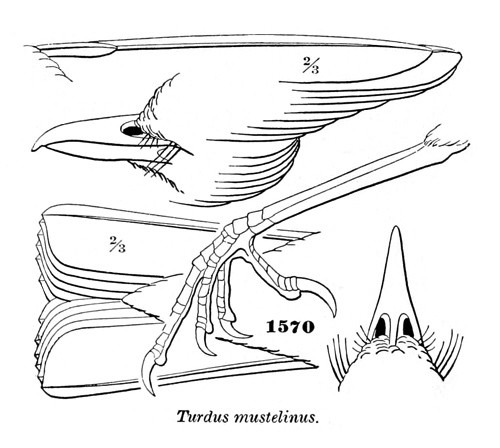
Turdus mustelinus.
1570
The essential characters of Hylocichla have already been given. The subgenus includes the small North American species, with Turdus mustelinus, Gm., at the head as type, which are closely connected on the one side with Catharus, by their lengthened tarsi, and with Turdus by the shape of the wing. The bills are shorter, more depressed, and broader at base than in typical Turdus, so much so that the species have frequently been described under Muscicapa.
It is not at all improbable that naturalists may ultimately conclude to consider the group as of generic rank.
In this group there appears to be five well-marked forms or “species.” They are, mustelinus, Gm., pallasi, Caban., fuscescens, Steph., swainsoni, Caban., and aliciæ, Baird. The first-named is totally unlike the rest, which are more closely related in appearance.
In studying carefully a very large series of specimens of all the species, the following facts become evident:—
1. In autumn and winter the “olive” color of the plumage assumes a browner cast than at other seasons; this variation, however, is the same in all the species (and varieties), so that in autumn and winter the several species differ from each other as much as they do in spring and summer.
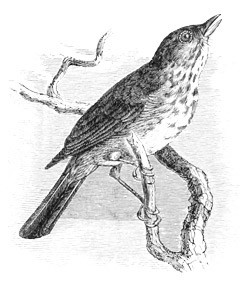
Turdus ustulatus.
Of these five species, two only (pallasi and swainsoni) inhabit the whole breadth of the continent; and they, in the three Faunal Provinces over which they extend, are modified into “races” or “varieties” characteristic of each region. The first of these species, as the pallasi var. pallasi, extends westward to the Rocky Mountains, and migrates in winter into the South; specimens are very much browner in the winter than in spring; but in the Rocky Mountain region is a larger, grayer race, the var. auduboni. This, in its migrations, extends along the central mountain region through Mexico to Guatemala; specimens from the northern and southern extremes of this range are identical in all the specific characters; but the southern specimens, being in the fall and winter dress, are browner in color than northern ones (spring birds); an autumnal example from Cantonment Burgwyn, N. M., is as brown as any Central American specimen. Along the Pacific Province, from Kodiak to Western Mexico, and occasionally straggling eastward toward the Rocky Mountain system, there is the var. nanus, a race smaller than the var. pallasi, and with much the same colors as var. auduboni, though the rufous of the tail is deeper than in either of the other forms. In this race, as in the others, there is no difference in size between specimens from north and south extremes of its distribution, because the breeding-place is in the North, all Southern specimens being winter sojourners from their Northern birthplace.
The T. swainsoni is found in abundance westward to the western limit of the Rocky Mountain system; in the latter region specimens at all seasons have the olive of a clearer, more greenish shade than in any Eastern examples; this clearer tint is analogous with that of the Rocky Mountain form of pallasi (auduboni). In precisely the same region inhabited by the pallasi var. nanus the swainsoni also has a representative form,—the var. ustulatus. This resembles in pattern the var. swainsoni, but the olive above is decidedly more rufescent,—much as in Rocky Mountain specimens of T. fuscescens; the spots on jugulum and breast are also narrower, as well as hardly darker in color than the back; and the tail is longer than in Rocky Mountain swainsoni, in which latter it is longer than in Eastern examples. The remaining species—mustelinus, fuscescens, and aliciæ—extend no farther west than the Rocky Mountains; the first and last only toward their eastern base, while the second breeds abundantly as far as the eastern limit of the Great Basin.
The T. fuscescens, from the Rocky Mountains, is considerably darker in color above, while the specks on the throat and jugular are sparser or more obsolete than in Eastern birds.
In T. mustelinus, the only two Western specimens in the collection (Mount Carroll, Ills., and Fort Pierre) have the rump of a clearer grayish than specimens from the Atlantic Coast; in all other respects, however, they appear to be identical. Some Mexican specimens, being in winter plumage, have the breast more buffy than Northern (spring or summer) examples, and the rufous of the head, etc. is somewhat brighter.
In aliciæ, no difference is observed between Eastern and Western birds; the reason is, probably, that the breeding-ground of all is in one province, though their migrations may extend over two. There is, however, a marked difference between the spring and autumn plumage; the clear grayish of the former being replaced, in the latter, by a snuffy brown, or sepia tint,—this especially noticeable on wings and tail.
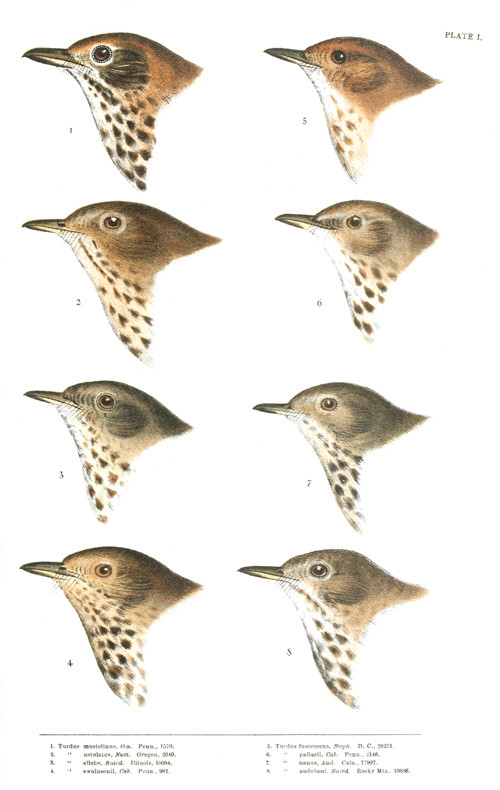
PLATE I.
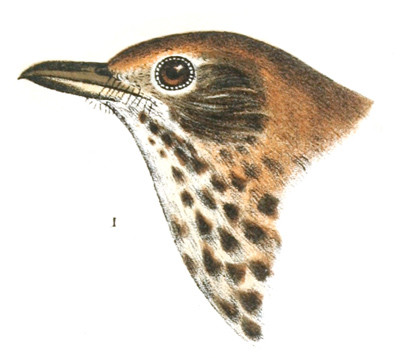
1. Turdus mustelinus, Gm. Pa., 1570.
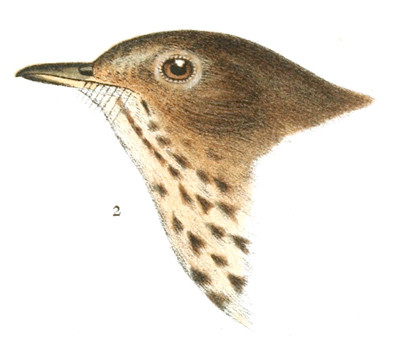
2. Turdus ustulatus, Nutt. Oregon, 2040.
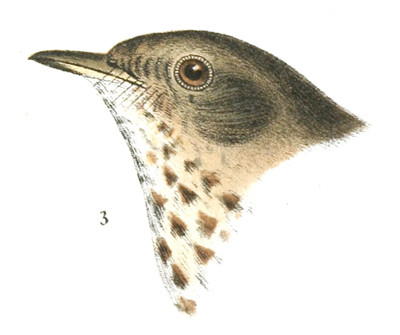
3. Turdus aliciæ, Baird. Illinois, 10084.
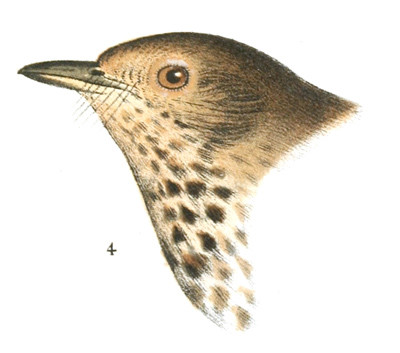
4. Turdus swainsoni, Cab. Penn., 981.
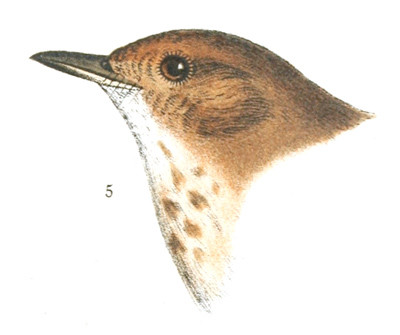
5. Turdus fuscescens, Steph., D. C., 28231.
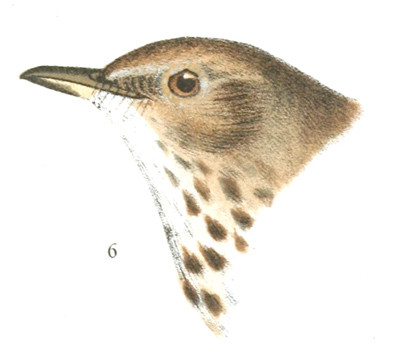
6. Turdus pallasii, Cab. Penn., 2146.
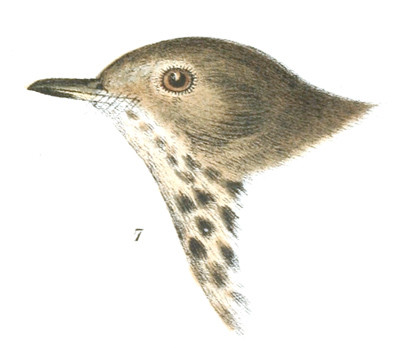
7. Turdus nanus, Aud. Cala., 17997.
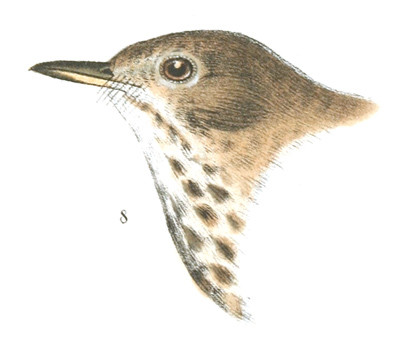
8. Turdus auduboni, Baird. Rocky Mts., 10886.
The following synopsis is intended to show the characters of the different species and varieties.
1. Spots beneath rounded, covering breast and sides.
A. Rufous brown above, becoming much brighter toward the bill, and more olivaceous on the tail. Beneath white; whole breast with rounded spots. Nest on tree; eggs pale blue.
1. T. mustelinus. Beneath nearly pure white, with rounded blackish spots over the whole breast, sides, and upper part of abdomen; wing, 4.25; tail, 3.05; culmen, .80; tarsus, 1.26. Hab. Eastern Province United States, south to Guatemala and Honduras. Cuba and Bermuda of West Indies.
2. Spots beneath triangular, on breast only.
B. Entirely uniform in color above,—olivaceous, varying to reddish or greenish with the species. Beneath whitish, with a wash of brownish across the breast and along sides. Spots triangular, and confined to the breast. Nest on trees or bushes; eggs blue spotted with brownish; except in T. fuscescens, which nests on the ground, and lays plain blue eggs.
a. No conspicuous light orbital ring.
2. T. fuscescens. Yellowish-rufous or olive-fulvous above; a strong wash of pale fulvous across the throat and jugulum, where are very indistinct cuneate spots of same shade as the back. Wing, 4.10; tail, 3.00; culmen, .70; tarsus, 1.15. Hab. Eastern Province of North America. North to Nova Scotia and Fort Garry. West to Great Salt Lake. South (in winter) to Panama and Brazil. Cuba.
3. T. aliciæ. Grayish clove-brown above; breast almost white, with broad, blackish spots; whole side of head uniform grayish. Wing, 4.20; tail, 3.20; culmen, .77; tarsus, 1.15. Hab. Eastern Province North America from shore of Arctic Ocean, Fort Yukon, and Kodiak to Costa Rica. West to Missouri River. Cuba.
b. A conspicuous orbital ring of buff.
4. T. swainsoni.
Greenish-olive above, breast and sides of head strongly tinged with buff. Spots on breast broad, distinct, nearly black. Length, 7.00; wing, 3.90; tail, 2.90; culmen, .65; tarsus, 1.10. Hab. Eastern and Middle Provinces of North America. North to Slave Lake, south to Ecuador, west to East Humboldt Mountains … var. swainsoni.
Brownish-olive above, somewhat more rufescent on wing; breast and head strongly washed with dilute rufous. Spots on breast narrow, scarcely darker than back. Wing, 3.85; tail, 3.00; culmen, .70; tarsus, 1.10. Hab. Pacific Province of United States. Guatemala … var. ustulatus.
C. Above olivaceous, becoming abruptly more reddish on upper tail-coverts and tail. Spots as in swainsoni, but larger and less transverse,—more sharply defined. An orbital ring of pale buff. Nest on ground; eggs blue, probably unspotted.
5. T. pallasi.
Olivaceous of upper parts like ustulatus. Reddish of upper tail-coverts invading lower part of rump; no marked difference in tint between the tail and its upper coverts. Flanks and tibiæ yellowish olive-brown; a faint tinge of buff across the breast. Eggs plain. Wing, 3.80; tail, 3.00; culmen, .70; tarsus, 1.20. Hab. Eastern Province of United States (only?) … var. pallasi.
Olivaceous of upper parts like swainsoni. Reddish of tail not invading the rump, and the tail decidedly more castaneous than the upper coverts. Beneath almost pure white; scarcely any buff tinge on breast; flanks and tibiæ grayish or plumbeous olive. Size smaller than swainsoni; bill depressed. Wing, 3.50; tail, 2.60; culmen, .60; tarsus, 1.15. Hab. Western Province of North America, from Kodiak to Cape St. Lucas. East to East Humboldt Mountains … var. nanus.
Olivaceous above, like preceding; the upper tail-coverts scarcely different from the back. Tail yellowish-rufous. Beneath like nanus. Size larger than swainsoni. Wing, 4.20; tail, 3.35; culmen, .80; tarsus, 1.30. Hab. Rocky Mountains. From Fort Bridger, south (in winter) to Southern Mexico … var. auduboni.
Turdus mustelinus, Gmelin.
THE WOOD THRUSH.
Turdus mustelinus, Gmelin, Syst. Nat. I, 1788, 817.—Audubon, Orn. Biog. I, 1832, 372, pl. 73.—Ib. Birds Am. III, 1841, 24, pl. 144.—D’Orb. La Sagra’s Cuba Ois. 1840, 49.—Baird, Birds N. Am. 1858, 212.—Ib. Rev. Am. Birds, 1864, 13.—Sclater, P. Z. S. 1856, 294, and 1859, 325.—Jones, Nat. in Bermuda, 26.—Gundlach, Repertorio, 1865, 228.—Maynard.—Samuels, 146. Turdus melodus, Wils. Am. Orn. I, 1808, 35, pl. ii. Turdus densus, Bonap. Comptes Rendus, XXVIII, 1853, 2.—Ib. Notes Delattre, 1854, 26 (Tabasco).
Additional figures: Vieillot, Ois. Am. Sept. II, pl. lxii.—Wilson, Am. Orn. I, pl. ii.
Sp. Char. Above clear cinnamon-brown, on the top of the head becoming more rufous, on the rump and tail olivaceous. The under parts are clear white, sometimes tinged with buff on the breast or anteriorly, and thickly marked beneath, except on the chin and throat and about the vent and tail-coverts, with sub-triangular, sharply defined spots of blackish. The sides of the head are dark brown, streaked with white, and there is also a maxillary series of streaks on each side of the throat, the central portion of which sometimes has indications of small spots. Length, 8.10 inches; wing, 4.25; tail, 3.05; tarsus, 1.26. Young bird similar to adult, but with rusty yellow triangular spots in the ends of the wing coverts.
Hab. U. S. east of Missouri plains, south to Guatemala. Bermuda (not rare). Cuba, La Sagra; Gundlach. Honduras, Moore. Cordova, Scl. Orizaba (winter), Sumichr.
Habits. The Wood Thrush, without being anywhere a very abundant species, is common throughout nearly every portion of the United States between the Mississippi River and the Atlantic. It breeds in every portion of the same extended area, at least as far as Georgia on the south and Massachusetts on the north. Beyond the last-named State, it rarely, if ever, breeds on the coast. In the interior it has a higher range, nesting around Hamilton, C. W. So far as I am aware it is unknown, or very rare, in the States of Vermont, New Hampshire, and Maine.
It makes its appearance early in April in the Middle States, but in New England not until four or five weeks later, appearing about the 10th of May. Their migrations in fall are more irregular, being apparently determined by the abundance of their food. At times they depart as early as the first of September, but sometimes not until the last of October. It winters in Central America, where it is quite abundant at that season.
The favorite localities of the Wood Thrush are the borders of dense thickets, or low damp hollows shaded by large trees. Yet its habits are by no means so retiring, or its nature so timid, as these places of resort would lead us to infer. A small grove in Roxbury, now a part of Boston, in close proximity to a dwelling-house, was for many years the favorite resort of these birds, where several pairs nested and reared their young, rarely even leaving their nests, which were mostly in low bushes, wholly unmindful of the curious children who were their frequent visitors. The same fearless familiarity was observed at Mount Auburn, then first used as a public cemetery. But in the latter instance the nest was always placed high up on a branch of some spreading tree, often in conspicuous places, but out of reach. Mr. J. A. Allen refers to several similar instances where the Wood Thrush did not show itself to be such a recluse as many describe it. In one case a pair built their nest within the limits of a thickly peopled village, where there were but few trees, and a scanty undergrowth. In another a Wood Thrush lived for several successive summers among the elms and maples of Court Square in the city of Springfield, Mass., undisturbed by the passers by or the walkers beneath, or the noise and rattle of the vehicles on the contiguous streets.
The song of this thrush is one of its most remarkable and pleasing characteristics. No lover of sweet sounds can have failed to notice it, and, having once known its source, no one can fail to recognize it when heard again. The melody is one of great sweetness and power, and consists of several parts, the last note of which resembles the tinkling of a small bell, and seems to leave the conclusion suspended. Each part of its song seems sweeter and richer than the preceding.
The nest is usually built on the horizontal branch of a small forest-tree, six or eight feet from the ground, and, less frequently, in the fork of a bush. The diameter is about 5 inches, and the depth 3¾, with a cavity averaging 3 inches across by 2¼ in depth. They are firm, compact structures, chiefly composed of decayed deciduous leaves, closely impacted together, and apparently thus combined when in a moistened condition, and afterward dried into a firmness and strength like that of parchment. These are intermingled with, and strengthened by, a few dry twigs, and the whole is lined with fine roots and a few fine dry grasses. Occasionally, instead of the solid frame of impacted leaves, we find one of solidified mud.
The eggs of the Wood Thrush, usually four in number, sometimes five, are of a uniform deep-blue tint, with but a slight admixture of yellow, which imparts a greenish tinge. Their average measurements are 1.00 by .75 inch.
Turdus fuscescens, Stephens.
TAWNY THRUSH; WILSON’S THRUSH.
Turdus mustelinus, Wilson, Amer. Ornithology, V, 1812, 98, pl. 43 (not of Gmelin).
Turdus fuscescens, Stephens, Shaw’s Gen. Zoöl. Birds, X, I, 1817, 182. Cab. Jour. 1855, 470 (Cuba).—Baird, Birds N. Am. 1858, 214.—Ib. Rev. Am. B. 1864, 17.—Gundi. Repertorio, 1865, 228 (Cuba, not rare). Pelzeln, Orn. Bras. II, 1868, 92. (San Vicente, Brazil, December.)—Samuels, 150.—Sclater, P. Z. S. 1859, 326.—Ib. Catal. Am. Birds, 1861, 2, No. 10. Turdus silens, Vieill. Encyclop. Méth. II, 1823, 647 (based on T. mustelinus, Wils.). Turdus wilsonii, Bon. Obs. Wils. 1825, No. 73. Turdus minor, D’Orb. La Sagra’s Cuba, Ois. 1840, 47, pl. v (Cuba).
Sp. Char. Above, and on sides of head and neck, nearly uniform light reddish-brown, with a faint tendency to orange on the crown and tail. Beneath, white; the fore part of the breast and throat (paler on the chin) tinged with pale brownish-yellow, in decided contrast to the white of the belly. The sides of the throat and the fore part of the breast, as colored, are marked with small triangular spots of light brownish, nearly like the back, but not well defined. There are a few obsolete blotches on the sides of the breast (in the white) of pale olivaceous; the sides of the body tinged with the same. Tibiæ white. The lower mandible is brownish only at the tip. The lores are ash-colored, the orbital region grayish. Length, 7.50; wing, 4.25; tail, 3.20; tarsus; 1.20.
Hab. Eastern North America, Halifax to Fort Bridger, and north to Fort Garry. Cuba, Panama, and Brazil (winter). Orizaba (winter), Sumichrast.
Habits. This species is one of the common birds of New England, and is probably abundant in certain localities throughout all the country east of the Rocky Mountains, as far to the north as the 50th parallel, and possibly as far as the wooded country extends. Mr. Maynard did not meet with it in Northern New Hampshire. Mr. Wm. G. Winton obtained its nest and eggs at Halifax, N. S.; Mr. Boardman found them also on the Gulf of St. Lawrence, and at St. Stephen’s, N. B.; Mr. Couper at Quebec; Mr. Krieghoff at Three Rivers, Canada; Donald Gunn at Selkirk and Red River; and Mr. Kumlien and Dr. Hoy in Wisconsin. Mr. McIlwraith also gives it as common at Hamilton, West Canada. It breeds as far south as Pennsylvania, and as far to the west as Utah, and occurs, in the breeding season, throughout Maine, New Brunswick, Nova Scotia, and Canada.
Mr. Ridgway found this thrush very abundant among the thickets in the valleys of the Provo, Weber, and Bear rivers, in Utah, and very characteristic of those portions of the country.
It arrives in Massachusetts early in May, usually with the first blossoms of the pear, ranging from the 5th to the 20th. It is strictly of woodland habits, found almost entirely among clumps of trees, and obtaining its food from among their branches, or on the ground among the fallen leaves. It moves south from the 10th to the 25th of September, rarely remaining till the first week in October.
It is timid, distrustful, and retiring; delighting in shady ravines, the edges of thick close woods, and occasionally the more retired parts of gardens; where, if unmolested, it will frequent the same locality year after year.
The song of this thrush is quaint, but not unmusical; variable in its character, changing from a prolonged and monotonous whistle to quick and almost shrill notes at the close. Their melody is not unfrequently prolonged until quite late in the evening, and, in consequence, in some portions of Massachusetts these birds are distinguished with the name of Nightingale,—a distinction due rather to the season than to the high quality of their song. Yet Mr. Ridgway regards it, as heard by himself in Utah, as superior in some respects to that of all others of the genus, though far surpassed in mellow richness of voice and depth of metallic tone by that of the Wood Thrush (T. mustelinus). To his ear there was a solemn harmony and a beautiful expression which combined to make the song of this surpass that of all the other American Wood Thrushes. The beauty of their notes appeared in his ears “really inspiring; their song consisting of an inexpressibly delicate metallic utterance of the syllables ta-weel´ ah, ta-weel´ ah, twil´ ah, twil´ ah, accompanied by a fine trill which renders it truly seductive.” The last two notes are said to be uttered in a soft and subdued undertone, producing thereby, in effect, an echo of the others.
The nest is always placed near the ground, generally raised from it by a thick bed of dry leaves or sticks; sometimes among bushes, but never in the fork of a bush or tree, or if so, in very rare and exceptional cases. When incubation has commenced, the female is reluctant to leave her nest. If driven off she utters no complaint, but remains close at hand and returns at the first opportunity.
They construct their nest early in May, and the young are hatched in the latter part of that month, or the first of June. They raise two broods in the season. The nest, even more loosely put together than that of the Ground Swamp Robin (T. pallasi), is often with difficulty kept complete. It is about 3 inches in height, 4½ in diameter, with a cavity 1½ inches deep and 3 in width, and composed of dry bark, dead leaves, stems, and woody fibres, intermingled with grasses, caricas, sedges, etc., and lined with soft skeleton leaves. A nest from Wisconsin was composed entirely of a coarse species of Sparganeum; the dead stalks and leaves of which were interwoven with a very striking effect.
The eggs, usually four, sometimes five in number, are of a uniform green color, with a slight tinge of blue, and average .94 by .66 of an inch in diameter.
Turdus aliciæ, Baird.
GRAY-CHEEKED THRUSH; ALICE’S THRUSH.
Turdus aliciæ, Baird, Birds N. Am. 1858, 217, plate 81, f. 2.—Ib. Review Am. Birds, I, 1864, 21.—Coues, Pr. Ac. N. Sc. Aug. 1861, 217 (Labrador).—Ib. Catal. Birds of Washington.—Gundlach, Repertorio, 1865, 229 (Cuba).—Lawr. Ann. N. Y. Lyc. IX, 91 (Costa Rica).—Dall and Bannister, Birds Alaska.—Ridgway, Report.
Sp. Char. Above nearly pure dark olive-green; sides of the head ash-gray; the chin, throat, and under parts white; purest behind. Sides of throat and across the breast with arrow-shaped spots of dark plumbeous-brown. Sides of body and axillaries dull grayish-olivaceous. Tibiæ plumbeous; legs brown. Length, nearly 8 inches; wing, 4.20; tail, 3.20; tarsus, 1.15.
Hab. Eastern North America to shores of Arctic Ocean, and along northern coast from Labrador to Kodiak, breeding in immense numbers between the mouths of Mackenzie and Coppermine. West to Fort Yukon and Missouri River States. Winters south to Costa Rica. Chiriqui, Salvin; Cuba, Gundlach.
As originally described, this species differs from swainsoni in larger size, longer bill, feet, and wings especially, straighter and narrower bill. The back is of a greener olive. The breast and sides of the head are entirely destitute of the buff tinge, or at best this is very faintly indicated on the upper part of the breast. The most characteristic features are seen on the side of the head. Here there is no indication whatever of the light line from nostril to eye, and scarcely any of a light ring round the eye,—the whole region being grayish-olive, relieved slightly by whitish shaft-streaks on the ear-coverts. The sides of body, axillars, and tibiæ are olivaceous-gray, without any of the fulvous tinge seen in swainsoni. The bill measures .40 from tip to nostril, sometimes more; tarsi, 1.21; wing, 4.20; tail, 3.10,—total, about 7.50. Some specimens slightly exceed these dimensions; few, if any, fall short of them.
In autumn the upper surface is somewhat different from that in spring, being less grayish, and with a tinge of rich sepia or snuff-brown, this becoming gradually more appreciable on the tail.
A specimen from Costa Rica is undistinguishable from typical examples from the Eastern United States.
Habits. This species, first described in the ninth volume of the Pacific Railroad Surveys, bears so strong a resemblance to the Olive-backed Thrush (T. swainsoni), that its value as a species has often been disputed. It was first met with in Illinois. Since then numerous specimens have been obtained from the District of Columbia, from Labrador, and the lower Mackenzie River. In the latter regions it was found breeding abundantly. It was also found in large numbers on the Anderson River, but was rare on the Yukon, as well as at Great Slave Lake, occurring there only as a bird of passage to or from more northern breeding-grounds.
In regard to its general habits but little is known. Dr. Coues, who found it in Labrador, breeding abundantly, speaks of meeting with a family of these birds in a deep and thickly wooded ravine. The young were just about to fly. The parents evinced the greatest anxiety for the safety of their brood, endeavoring to lead him from their vicinity by fluttering from bush to bush, constantly uttering a melancholy pheugh, in low whistling tone. He mentions that all he saw uttered precisely the same note, and were very timid, darting into the most impenetrable thickets.
This thrush is a regular visitant to Massachusetts, both in its spring and in its fall migration. It arrives from about the first to the middle of May, and apparently remains about a week. It passes south about the first of October. Occasionally it appears and is present in Massachusetts at the same time with the Turdus swainsoni. From this species I hold it to be unquestionably distinct, and in this opinion I am confirmed by the observations of two very careful and reliable ornithologists, Mr. William Brewster of Cambridge, one of our most promising young naturalists, and Mr. George O. Welch of Lynn, whose experience and observations in the field are unsurpassed. They inform me that there are observable between these two forms certain well-marked and constant differences, that never fail to indicate their distinctness with even greater precision than the constant though less marked differences in their plumage.
The Turdus aliciæ comes a few days the earlier, and is often in full song when the T. swainsoni is silent. The song of the former is not only totally different from that of the latter, but also from that of all our other Wood Thrushes. It most resembles the song of T. pallasi, but differs in being its exact inverse, for whereas the latter begins with its lowest notes and proceeds on an ascending scale, the former begins with its highest, and concludes with its lowest note. The song of the T. swainsoni, on the other hand, exhibits much less variation in the scale, all the notes being of nearly the same altitude.
I am also informed that while the T. swainsoni is far from being a timid species, but may be easily approached, and while it seems almost invariably to prefer the edges of the pine woods, and is rarely observed in open grounds or among the bare deciduous trees, the habits of the T. aliciæ are the exact reverse in these respects. It is not to be found in similar situations, but almost always frequents copses of hard wood, searching for its food among their fallen leaves. It is extremely timid and difficult to approach. As it stands or as it moves upon the ground, it has a peculiar erectness of bearing which at once indicates its true specific character so unmistakably that any one once familiar with its appearance can never mistake it for T. swainsoni nor for any other bird.
The nests measure about 4 inches in diameter and 2¾ in height. The cavity is 2 inches deep, and its diameter 2½ inches. They are unusually compact for the nest of a thrush, and are composed chiefly of an elaborate interweaving of fine sedges, leaves, stems of the more delicate Equisetaceæ, dry grasses, strips of fine bark, and decayed leaves, the whole intermingled with the paniculated inflorescence of grasses. There is little or no lining other than these materials. These nests were all found, with but few exceptions, on the branches of low trees, from two to seven feet from the ground. In a few exceptional cases the nests were built on the ground.
Occasionally nests of this species are found constructed with the base and sides of solid mud, as with the common Robin (Turdus migratorius). In these, as also in some other cases, their nests are usually found on or near the ground. So far as I am aware neither its occasional position on the ground, nor its mud frames, are peculiarities ever noticeable in nests of T. swainsoni.
The eggs were usually four in number. Their color is either a deep green tint, or green slightly tinged with blue; and they are marked with spots of russet and yellowish-brown, varying both in size and frequency. Their mean length is .92 of an inch, and their mean breadth .64. The maximum length is .94 and the minimum .88 of an inch. There is apparently a constant variation from the eggs of the T. swainsoni; those of the aliciæ having a more distinctly blue ground color. The nests are also quite different in their appearance and style of structure. The Hypnum mosses, so marked a feature in the nests of T. swainsoni, as also in those of T. ustulatus, are wholly wanting in those of T. aliciæ.
This bird and the robin are the only species of our thrushes that cross the Arctic Circle to any distance, or reach the shore of the Arctic Ocean. It occurs from Labrador, all round the American coast, to the Aleutian Islands, everywhere bearing its specific character as indicated above. It is extremely abundant on and near the Arctic coast, between the mouth of the Mackenzie River and the Coppermine, more than 200 specimens (mostly with their eggs) having been sent thence to the Smithsonian Institution by Mr. MacFarlane. In all this number there was not a single bird that had any approach to the characters of T. swainsoni, as just given. From the Slave Lake region, on the other hand, T. swainsoni was received in nearly the same abundance, and unmixed during the breeding season with T. aliciæ.
Turdus swainsoni, Cabanis.
OLIVE-BACKED THRUSH; SWAINSON’S THRUSH.
Turdus swainsoni, Cab. Tschudi, Fauna Peruana, 1844-46, 188.—? Sclater & Salvin, Ibis, 1859, 6 (Guatemala).—Sclater, P. Z. S. 1858, 451 (Ecuador); 1859, 326.—Ib. Catal. 1861, 2, No. 11.—Baird, Birds N. Am. 1858, 216; Rev. Am. B., 1864, 19.—Gundlach, Cab. Jour. 1861, 324 (Cuba).—Ib. Repert. 1865, 229.—Pelzeln, Orn. Brazil. II. 1868, 92 (Marambitanas, Feb. and March).—Lawr. N. Y. Lyc. IX, 91 (Costa Rica).—Ridgway.—Maynard.—Samuels, 152.—Cooper, Birds Cal. 6.—Dall & Bannister. Turdus minor, Gmelin, Syst. Nat. I, 1788, 809 (in part). Turdus olivaceus, Giraud, Birds L. Island, 1843-44, 92 (not of Linn.). (?) Turdus minimus, Lafresnaye, Rev. Zoöl. 1848, 5.—Sclater, P. Z. S. 1854, 111.—Bryant, Pr. Bost. Soc. VII, 1860, 226 (Bogota).—Lawrence, Ann. N. Y. Lyc. 1863. (Birds Panama, IV, No. 384.)
Sp. Char. Upper parts uniform olivaceous, with a decided shade of green. The fore part of breast, the throat and chin, pale brownish-yellow; rest of lower parts white; the sides washed with brownish-olive. Sides of the throat and fore part of the breast with sub-rounded spots of well-defined brown, darker than the back; the rest of the breast (except medially) with rather less distinct spots that are more olivaceous. Tibiæ yellowish-brown. Broad ring round the eye, loral region, and a general tinge on the side of the head, clear reddish buff. Length, 7.00; wing, 4.15; tail, 3.10; tarsus, 1.10.
Hab. Eastern North America; westward to Humboldt Mountain and Upper Columbia; perhaps occasionally straggling as far as California; north to Slave Lake and Fort Yukon; south to Ecuador and Brazil. Cuba, Gundlach; Costa Rica, Lawr.
Specimens examined from the northern regions (Great Slave Lake, Mackenzie River, and Yukon) to Guatemala; from Atlantic States to East Humboldt Mountains, Nevada, and from intervening localities. The extremes of variation are the brownish-olive of eastern and the clear dark greenish-olive of remote western specimens. There is no observable difference between a Guatemalan skin and one from Fort Bridger, Utah.
Habits. The Olive-backed Thrush, or “Swamp Robin,” has very nearly the same habitat during the breeding season as that of the kindred species with which it was so long confounded. Although Wilson seems to have found the nest and eggs among the high lands of Northern Georgia, it is yet a somewhat more northern species. It does not breed so far south as Massachusetts, or if so, the cases must be exceptional and very rare, nor even in Western Maine, where the “Ground Swamp Robin” (T. pallasi) is quite abundant. It only becomes common in the neighborhood of Calais. It is, however, most widely distributed over nearly the entire continent, breeding from latitude 44° to high Arctic regions. It winters in Guatemala and southward as far as Ecuador and Brazil.
In its habits this thrush is noticeably different from the T. pallasi, being much more arboreal, frequenting thick woods; rarely seen, except during its migrations, in open ground, and seeking its food more among the branches of the trees.
Mr. Ridgway found this species very abundant among the Wahsatch Mountains, where it was one of the most characteristic summer birds of that region. It was breeding plentifully in the cañons, where its song could be heard almost continually. It inhabited an intermediate position between T. auduboni and T. fuscescens, delighting most in the shrubbery along the streams of the cañons and passes, leaving to the T. auduboni the secluded ravines of the pine regions higher up, and to the T. fuscescens the willow thickets of the river valleys. He did not meet with it farther west than the East Humboldt Mountains. The song, in his opinion, resembles that of the Wood Thrush (T. mustelinus) in modulations; but the notes want the power, while they possess a finer and more silvery tone.
The song of this species has a certain resemblance to that of T. pallasi, being yet quite distinct, and the differences readily recognized by a familiar ear. It is more prolonged; the notes are more equal and rise with more regularity and more gradually, are richer, and each note is more complete in itself. Its song of lamentation when robbed of its young is full of indescribable pathos and beauty, haunting one who has once heard it long after.
When driven from the nest, the female always flies to a short distance and conceals herself; making no complaints, and offering no resistance.
These birds, in a single instance, have been known to reach Eastern Massachusetts early in April, in an unusually early season, but they generally pass north a few weeks later. They make no prolonged stay, and are with us rarely more than three or four days. Their return in the fall appears to be, at times, by a more inland route. They are then not so numerous near the coast, but occasionally are abundant.
Their nests in Nova Scotia, wherever observed, were among the thick woods, on horizontal branches of a forest-tree, usually about five feet from the ground. Those observed in the Arctic regions by Mr. Kennicott were frequently not more than two feet from the ground.
The nests average about four inches in diameter and two in height, the cavity being three inches wide by about one and a half deep. They are more elaborately and neatly constructed than those of any other of our thrushes, except perhaps of T. ustulatus. conspicuous among the materials are the Hypnum mosses, which by their dark fibrous masses give a very distinctive character to these nests, and distinguish them from all except those of the T. ustulatus, which they resemble. Besides these materials are found fine sedges, leaves, stems of equisetaceous plants, red glossy vegetable fibres, the flowering steins of the Cladonia mosses, lichens, fine strips of bark, etc.
The eggs, which are four or five in number, exhibit noticeable variations in size, shape, and shades of coloring, bearing some resemblance to those of T. ustulatus and to the eggs asserted to be those of T. nanus, but are sufficiently distinct, and are still more so from those of T. aliciæ. They range in length from .83 to .94, with a mean of .88, their mean breadth is .66, the maximum .69, and the minimum .63. Their ground color is usually bluish-green, sometimes light blue with hardly a tinge of green, and the spots are of a yellowish-brown, or russet-brown, or a mixture of both colors, more or less confluent, with marked variations in this respect.
Turdus swainsoni, var. ustulatus, Nuttall.
OREGON THRUSH.
Turdus ustulatus, Nuttall, Man. I, 1840, 400 (Columbia River).—Baird, Birds N. Am. 1858, 215, pl. lxxxi, fig. 1.—Ib. Rev. Am. B. 1864, 18.—Cooper & Suckley, P. R. Rep. XII, II, 1860, 171.—Ridgway, Pr. A. N. S. Philad. 1869, 127.—Dall & Bannister, Tr. Chic. Acad.—Cooper, Birds Cal., 5.
Sp. Char. General appearance of fuscescens, but with pattern of swainsoni; the buff orbital ring as conspicuous as in latter. The olive above is more brown than in this, and less yellowish than in fuscescens, becoming decidedly more rufescent on wings and less observably so on tail. Pectoral aspect different from fuscescens, the spots narrower and cuneate, sharply defined, and arranged in longitudinal series; in color they are a little darker than the crown. Length, 7.50; wing, 3.75; tail, 3.00; tarsus, 1.12.
Hab. Pacific Province of United States. Tres Marias Isl., Guatemala (winter), Mus. S. I.
This well-marked race is to be compared with swainsoni, not with fuscescens, as has generally been done; the latter, except in shade of colors, it scarcely resembles at all; still greater evidence that such is its affinity is that the T. ustulatus builds its nest on a tree, and lays a spotted egg, like swainsoni, while fuscescens nests on or near the ground, perhaps never in a tree, and lays a plain blue egg. The song of the present bird is also scarcely distinguishable from that of swainsoni. Upon the whole, we see no reason why this should not be considered as a Pacific Province form of the Turdus swainsoni; at least it becomes necessary to do so, after referring to T. pallasi as geographical races, the T. auduboni and T. nanus.
Habits. So far as we are aware, this thrush has a very limited distribution, being mainly restricted to the Pacific coast region from California to Alaska in the breeding season, though migrating southward in winter to Guatemala. Dr. Kennerly found it in great abundance breeding at Chiloweyuck Depot, July 3, 1859. Dr. Cooper also found it one of the most abundant of the summer residents in Washington Territory, arriving there in May and remaining until the beginning of September. Three specimens of this thrush were obtained at Sitka, by Mr. Bischoff. Mr. Ridgway met with only a single specimen east of the Sierra Nevada, though on that range he found it an abundant summer bird.
In its general appearance it has a marked resemblance to Wilson’s Thrush (T. fuscescens), but its habits and notes, as well as its nest and eggs, clearly point its nearer affinity to Swainson’s Thrush (T. swainsoni), its song being scarcely different from that of the latter species. Like this species, it frequents the thickets or brushwood along the mountain streams, and, except just after its arrival, it is not at all shy. In crossing the Sierra Nevada in July, 1867, Mr. Ridgway first met with this species. He describes it as an exquisite songster. At one of the camps, at an altitude of about 5,000 feet, they were found unusually plentiful. He speaks of their song as consisting of “ethereal warblings,—outbursts of wild melody.” “Although its carols were heard everywhere in the depth of the ravine, scarcely one of the little musicians could be seen.” “The song of this thrush,” he adds, “though possessing all the wild, solemn melody of that of the Wood Thrush (T. mustelinus) is weaker, but of a much finer or more silvery tone, and more methodical delivery. It is much like that of the T. swainsoni, but in the qualities mentioned is even superior.”
Dr. Cooper found its nests with eggs about the middle of June. These were most usually built on a small horizontal branch, and were very strongly constructed of twigs, grasses, roots, and leaves, usually covered on the outside entirely with the bright green Hypnum mosses peculiar to that region, which in the damp climate near the coast continue to grow in that position, and form large masses. The number of eggs is usually five.
Dr. Cooper states that these thrushes sing most in the early morning and in the evening, when numbers may be heard answering one another on all sides. They do not affect the darkest thickets so much as the Hermit Thrush, but are often seen feeding in the gardens in the open sunshine.
Dr. Suckley, who found them quite abundant in the neighborhood of Fort Steilacoom, on the edge of the forest, and in swampy land, describes the song as a low, soft, sad, and lively whistle, confined to one note, and repeated at regular intervals. Mr. Nuttall, the first to describe this form, speaks of it as shy and retiring, and as in the habit of gathering insects from the ground. His ear, so quick to appreciate the characteristics of the songs of birds, which showed a close resemblance between the notes of this bird and that of Wilson’s Thrush (T. fuscescens), enabled him to detect very distinct and easily recognizable differences. It is much more interrupted and is not so prolonged. The warble of this bird he describes as resembling wit-wit t´villia, and wit-wit, t´villia-t´villia. His call when surprised was wit-wit.
All the nests of this species that have fallen under my observation are large, compact, strongly constructed, and neat. They measure about 5 inches in their external diameter, with a depth externally of 3; the cavity is comparatively shallow, being rarely 2 inches in depth. The external portions are constructed almost entirely of Hypnum mosses, matted together and sparingly interwoven with dry leaves and fine fibrous roots, and are lined with finer materials of the same kind. These nests most nearly resemble in their material and in their position those of Swainson’s Thrush.
Mr. Hepburn found these birds very abundant about Victoria. It does not usually breed there before the last of May, though in one exceptional instance he found a nest with young birds on the 24th of that month.
The eggs vary in size and shape, ranging from .77 to .94 in length, and from .65 to .69 in breadth. They also vary in their ground color and in the tints of the spots and markings. The ground color is light green or light blue, and the markings are variously yellowish-brown and lilac, or dark brown and slate.
Mr. Grayson found this thrush very abundant in the month of January, in the thickest of the woods, in the islands of the Three Marias, on the Pacific coast of Mexico. They were very timid and shy, more so than any bird that he saw on those islands. It frequently uttered a low plaintive whistle, and seemed solitary in its habits.
Turdus pallasi, Cabanis.
RUFOUS-TAILED THRUSH; HERMIT THRUSH.
Turdus pallasii, Cabanis, Wiegmann’s Archiv, 1847 (I), 205.—Baird, Birds N. Am. 1858, 212.—Ib. Rev. Am. B. 1864, 14.—Sclater, P. Z. S. 1859, 325 ??.—Ib. Catal. 1861, 2, No. 7.—Ridgway.—Maynard.—Samuels, 148. Turdus solitarius, Wilson, Amer. Orn. V, 1812, 95 (not of Linnæus).—Sclater, P. Z. S. 1857, 212. Turdus minor, Bon. Obs. Wilson, 1825, No. 72. Turdus guttatus, Cabanis, Tschudi, Fauna Peruana, 1844, 187 (not Muscicapa guttata of Pallas).
Additional figures: Aud. Birds Am. III, pl. cxlvi.—Ib. Orn. Biog. I, pl. lviii.
Sp. Char. Tail slightly emarginate. Above light olive-brown, with a scarcely perceptible shade of reddish, passing, however, into decided rufous on the rump, upper tail-coverts, and tail, and to a less degree on the outer surface of the wings. Beneath white, with a scarcely appreciable shade of pale buff across the fore part of the breast, and sometimes on the throat; the sides of the throat and the fore part of the breast with rather sharply defined subtriangular spots of dark olive-brown; the sides of the breast with paler and less distinct spots of the same. Sides of the body under the wings of a paler shade than the back. A whitish ring round the eye; ear-coverts very obscurely streaked with paler. Length, 7.50 inches; wing, 3.84; tail, 3.25; tarsus, 1.16; No. 2,092.
[21] In a perfectly fresh specimen of Turdus mustelinus, the basal half of the first phalanx of the inner toe is connected with the first joint of the middle toe by a membrane which stretches across to within two fifths of the end of the latter; there appears, however, to be no ligamentous adhesion. The basal joint of the outer toe is entirely adherent, and a membrane extends from nearly the basal half of the second joint to the distal end of the first joint of the middle toe. When this connecting membrane becomes dried the division of the toes appears considerably greater.
[22] See Baird, Review American Birds, I, 1864, 7, 8.
Hab. Eastern North America. Mexico? Not found in Cuba, fide Gundlach.
In spring the olive above is very much that of eastern specimens of swainsoni; in winter specimens it is much browner, and almost as much so as in fuscescens. Young birds have the feathers of the head, back, and wing coverts streaked centrally with drop-shaped spots of rusty yellowish.
Habits. Until quite recently the “Ground Swamp Robin,” or Hermit Thrush, has not been distinguished from the closely allied species T. swainsoni, and all accounts of writers have blended both in singular confusion. My colleague, Professor Baird, in the summer of 1844, was the first to suggest the distinctness of the two species. By the common people of Maine and the British Provinces this difference has long been generally recognized, this species being known as the “Ground Swamp Robin,” and the other as the “Swamp Robin.”
The present species is found throughout Eastern North America to the Mississippi, and breeds from Massachusetts to high arctic regions. It is only occasionally found breeding so far south as Massachusetts; through which State it passes in its spring migrations, sometimes as early as the 10th of April; usually reaching Calais, Maine, by the 15th of the same month.
It is a very abundant bird throughout Maine, where it begins to breed during the last week of May, and where it also probably has two broods in a season.
The greater number appear to pass the winter in the Southern States; it being common in Florida, and even occasionally seen during that season as far north as latitude 38° in Southern Illinois, according to Mr. Ridgway.
It rarely, if ever, sings during its migrations; appears in small straggling companies, frequents both thickets and open fields, and is unsuspicious and easily approached.
The song of this species is very fine, having many of the characteristics of that of the Wood Thrush (T. mustelinus). It is as sweet, has the same tinkling sounds, as of a bell, but is neither so powerful nor so prolonged, and rises more rapidly in its intonations. It begins with low, sweet notes, and ends abruptly with its highest, sharp ringing notes.
Taken from the nest they are easily tamed, and are quite lively and playful; but their want of cleanliness renders them very undesirable pets. When their nest is visited they make no complaints, but retire to a distance. Not so, however, when their natural enemy, the hawk, appears; these they at once assail and seek to drive away, uttering loud and clear chirps, and peculiar twittering sounds.
The nest of this thrush is always built on the ground, most generally either under low bushes or in the open ground, rarely, if ever, among thick trees, and for the most part in low swampy places. Both nest and eggs closely resemble those of Wilson’s Thrush (T. fuscescens). In Parsboro, Nova Scotia, I found one of the nests built in the very midst of the village, close to a dwelling, though on a spot so marshy as to be almost unapproachable. The nests are 3 inches in height and 5 in diameter, with a cavity 3¼ inches wide by 1¾ deep. They are composed of decayed deciduous leaves, remnants of dried plants, sedges and grasses, intermingled with twigs, and lined with finer grasses, sedges, and strips of bark.
The eggs are of a uniform bluish-green color, and range in length from .88 to .94, with an average of .63 of an inch.
Turdus pallasi, var. nanus, Audubon.
DWARF HERMIT THRUSH.
Turdus nanus, Aud. Orn. Biog. V, 1839, 201, pl. cci.—Baird, Birds N. A. 1858, 213; Rev. Am. B. 1864, 15.—Sclater, P. Z. S. 1859.—Ib. Catal. 1861.—Dall & Bannister.—Cooper, Birds Cal., p. 4. Turdus pallasi, var. nanus, Ridgway, Rep. Kings Exped. V, 1872. ? Turdus aonalaschkæ, Gmelin, S. N. I, 1788, 808. ?? Muscicapa guttata, Pallas, Zoög. Rosso-Asiat. II, 1811, 465.
Sp. Char. Above with the clear dark olive of swainsoni, but this even purer and more plumbeous. Upper tail-coverts (but not lower part of rump) becoming more rufous, the tail abruptly darker, richer, and more purplish-rufous, approaching to chestnut. The clear olive of the neck passes into brownish-plumbeous along sides; pectoral spots more sparse and less pure black than in T. pallasi. The white beneath is of an almost snowy purity, appreciably different from the cottony-white of T. pallasi. Wing, 3.30; tail, 3.00; bill, .36; tarsus, 1.07.
A very tangible and constant character possessed by this bird is the more slender and depressed bill, as compared with that of T. pallasi. Specimens vary only in intensity of colors; these variations very limited, and corresponding with those of T. pallasi. In all cases, however, their precise pattern and peculiar distribution is retained.
Hab. Western Province of North America, eastward from Kodiak to Cape St. Lucas. Arizona, Coues.
Habits. This small race of the Hermit Thrush was first noticed by Dr. Pickering, and described by Mr. Audubon from an imperfect skin. It has since been obtained abundantly on the Pacific slope, and Mr. Ridgway procured a specimen as far east as the East Humboldt Mountains, which he considers its eastern limit.
In its habits it is said to be, like T. pallasi, almost exclusively terrestrial. Dr. Heermann mentions finding it abundant in California, and breeding among the stunted oaks covering the sand-hills of San Francisco. Dr. Coues found it in Arizona, but speaks of it as rare and migratory, occurring chiefly in spring and autumn, and as a shy and retiring species. Dr. Cooper, in his Report on the Birds of California, describes it as shy and timid, preferring dark and shady thickets, feeding chiefly on the ground, running rapidly, and searching for insects among the leaves.
Near San Diego they began to sing about the 25th of April. The song, consisting of a few low ringing notes, resembles that of Wilson’s Thrush (T. fuscescens), and also that of T. ustulatus, but is not so loud. Their note of alarm is a loud and ringing chirp, repeated and answered by others at a long distance.
At Santa Cruz, on the first of June, Dr. Cooper met with several of their nests, which, though probably erroneously, he supposed to belong to the Dwarf Hermit Thrush. They were all built in thickets under the shade of cottonwood-trees. Each nest was about five feet from the ground, and all contained eggs, from two to four in number, in differing stages of incubation. The nests were built of dry leaves, roots, fibres, grasses, and bark, without any mud, and were lined with decayed leaves. Their height and external diameter measured 4 inches. The diameter of the cavity was 2½ inches and the depth 2¼. The eggs measured .90 by .70 of an inch. They are of a pale bluish-green, speckled with cinnamon-brown, chiefly at the larger end.
The nest, supposed to be of this species, supplied by Dr. Cooper, is large for the bird; constructed of a base loosely made up of mosses, lichens, and coarse fibres of plants. It is a strong and compact structure of matted leaves, put together when in a moist and decaying condition; with these there are interwoven roots, twigs, and strong fibres, surrounding the nest with a stout band and strengthening the rim. In fact, it corresponds so well—as do the eggs also—with those of T. ustulatus, that it is extremely probable that they really belong to that species. The only observable difference is the absence of the Hypnum mosses characteristic of northern ustulatus.
Dall and Bannister mention in their list of Alaska birds that the species is not common there. It was also taken at Sitka and Kodiak by Bischoff.
The fact that this thrush builds its nest above the ground, and lays spotted eggs, if verified, would at once warrant our giving it independent rank as a species, instead of considering it as a local race of pallasi.
Turdus pallasi, var. auduboni, Baird.
ROCKY MOUNTAIN HERMIT THRUSH.
Turdus auduboni, Baird, Rev. Am. Birds, 1864, 16.—Ridgway, P. A. N. S. 1869, 129.—Elliot, Illust. (fig.). Merula silens, Swainson, Philos. Mag. I, 1827, 369 (not Turdus silens of Vieillot, Encycl. Méth. II, 1823, 647, based on T. mustelinus, Wils. = T. fuscescens).—Ib. Fauna Bor.-Amer. II, 1831, 186.—Baird, Birds N. Amer. 1858, 213, and 922.—Sclater, P. Z. S. 1858, 325 (La Parada), and 1859, 325 (Oaxaca).—Ib. Catal. Am. Birds, 1861, 2, No. 9.
Sp. Char. Colors much as in Turdus nanus, but the upper tail-coverts scarcely different from the back. Tail yellowish-rufous. Length of wing, 4.18; tail, 3.60; bill from nostril, .45; tarsus, 1.26.
Hab. Rocky Mountains, from Fort Bridger south into Mexico. Orizaba (Alpine regions), Sumichrast.
This is a very distinct race of thrushes, although it may be questioned whether it be truly a species. It is, however, sufficiently distinct from the eastern and western Hermit Thrushes to warrant our giving it a place of some kind in the systems.
The young plumage differs from that of pallasi as do the adults of the two, and in about the same way. The olive is very much purer, with a greenish instead of a brownish cast, and the tail is very much lighter, inclining to dull ochraceous instead of rufous; this yellowish instead of rufous cast is apparent on the wings also. The yellowish “drops” on head, back, etc., are very much narrower than in pallasi, while the greater coverts, instead of being distinctly tipped with yellowish, merely just perceptibly fade in color at tips.
Habits. At present we have but little knowledge of the habits of this form of T. pallasi, and no information whatever regarding its nesting or eggs.
In its distribution it is confined to the central range of mountains from Fort Bridger to Southern Mexico. This species, there known as “Solitario,” is common in the Alpine region of Vera Cruz (as well as in all the elevated regions of Central Mexico), frequenting the pine woods in the district of Orizaba. Mr. Sumichrast obtained it at all seasons of the year at Moyoapam, in that vicinity; a locality the height of which approximates 2,500 metres. It is also found at a height of 1,200 metres, near the city of Orizaba.
Mr. Ridgway calls this bird the “Rocky Mountain Hermit Thrush.” He states that he found it common in the Wahsatch Mountains, but that, on account of its retiring habits, it was seldom seen. It there lives chiefly in the deep ravines in the pine region, exhibiting an attachment to these solitudes rather than to the thickets along the watercourses lower down; the latter it leaves to the T. swainsoni. Owing to the reserved manners of this bird, as well as to the great difficulty of reaching its abode, there were few opportunities presented for learning much concerning its habits, nor did he hear its song. In its flight the pale ochraceous band across the bases of its quills was a very conspicuous feature in the appearance of its species, leading Mr. Ridgway to mistake it at first for the Myiadestes townsendii,—also an inhabitant of the same localities,—so much did it look like that bird, which it further resembled in its noiseless, gliding flight.
Subgenus TURDUS, Linn.
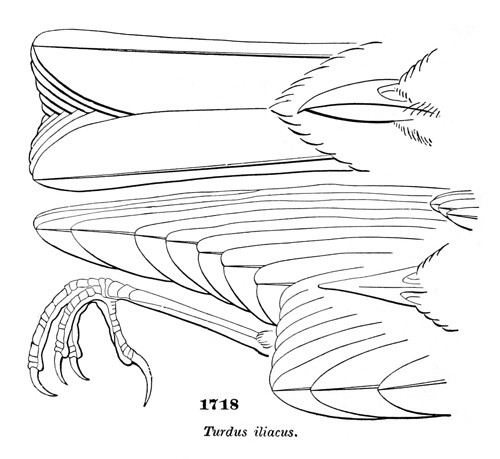
Turdus iliacus.
1718
Of Turdus, in its most restricted sense, we have no purely American representatives, although it belongs to the fauna of the New World in consequence of one species occurring in Greenland, that meeting-ground of the birds of America and Europe; which, however, we include in the present work, as related much more closely to the former.
This Greenland species, Turdus iliacus, is closely related to T. viscivorus, the type of the genus, and comes much closer to the American Robins (Planesticus) than to the Wood Thrushes (Hylocichla).
Turdus iliacus, Linn.
REDWING THRUSH.
Turdus iliacus, Linn. Syst. Nat. 10th ed. 1758, 168, and of European authors.—Reinhardt, Ibis, 1861, 6 (Greenland). Baird, Rev. Am. B. 1864, 23 (Greenland).
Sp. Char. This species is smaller than our Robin (T. migratorius), but of a similar grayish-olive above, including the head. The under parts are white; the feathers of the lower throat and breast streaked with brown. The sides, axillars, and inner wing-covert are reddish-cinnamon. A conspicuous white streak over the eye and extending as far back as the nape. Bill black, yellow at base of lower jaw. Legs pale-colored. Second quill longer than fifth. Length, about 8.25; wing, 4.64; tail, 3.45; bill, from gape, 1.07; from nostril, .44; tarsus, 1.16; middle toe and claw, 1.15. Specimen described: 18,718, ♂, a British specimen received from the Royal Artillery Institution, Woolwich.
Hab. Greenland, in the New World.
The occurrence of this well-known European species in Greenland brings it within the limits of the American Fauna. Two Greenland specimens are recorded by Dr. Reinhardt: one of them shot at Frederickshaab, October 20, 1845.
Habits. The Redwing can probably only claim a place in the fauna of North America as an occasional visitant. Of the two specimens observed in Greenland, one was shot late in October. It is not known to breed there.
This species, during its breeding season, is found only in the more northern portions of Europe; only occasionally, and very rarely, breeding so far south as England. It makes its appearance in that kingdom on its southern migrations, coming in large flocks from Northern and Northeastern Europe, and arriving usually before the end of October. During their stay in England they frequent parks and pleasure-grounds that are ornamented with clumps of trees. During mild and open weather they seek their subsistence in pasture lands and moist meadows, feeding principally on worms and snails. In severe winters, when the ground is closed by frost or covered by snow, the Redwings are among the first birds to suffer, and often perish in large numbers.
During the winter they extend their migrations to the more southern portions of Europe, to Sicily, Malta, and even to Smyrna. In early spring they return to the more central portions of the continent, and leave in May for their more northern places of resort.
They nest in trees in the moist woods of Norway and Sweden. Their nests resemble those of the common Fieldfare, T. pilaris. The outside is composed of sticks, weeds, and coarse grass, gathered wet, and matted with a small quantity of moist clay. They are lined with a thick bed of fine grass.
The Redwing is said to possess a delightful note, and is called the Nightingale of Norway. Linnæus, speaking of this bird, claims that its high and varied notes rival even those of that far-famed vocalist.
During the summer the Redwing advances to the extreme north, visiting the Faroe Islands, Iceland, and Northern Russia. The general character of its food, its inability to feed exclusively on berries, and the fact that it perishes from starvation in severe winters, would seem to prove that its occurrence in Greenland so late as October must have been purely accidental. It is not probable that its presence in North America will be found to be a common event.
The eggs measure 1.06 inches in length by .81 in breadth. The ground color is a light green with a bluish tinge thickly covered with russet or reddish-brown spots, confluent at the larger end.
Subgenus PLANESTICUS, Bonap.
Planesticus, Bonap. Comptes Rendus, 1854. (Type Turdus jamaicensis, Gmelin.)
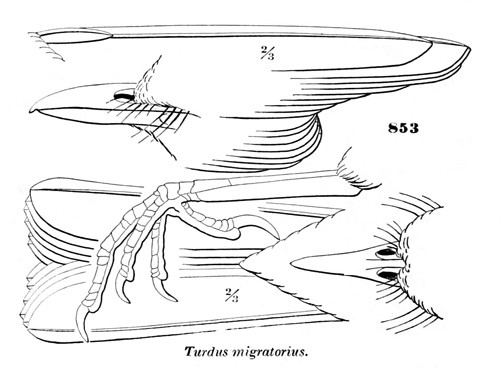
Turdus migratorius.
853
This section of the Thrushes is well represented in America, especially in its middle and southern portions, and its members have a close resemblance to the typical European species in the full form, stout legs, etc., as already stated. The spots on the throat, and their absence elsewhere on the under part of the body, are sufficient to distinguish them.
Of the two North American species one is the well-known Robin, the other a closely related form from Cape St. Lucas; which indeed is probably only a local race or variety, although nothing exactly like it has yet been found away from Lower California. The following diagnosis may serve to distinguish the two birds:—
Common Characters. Throat white with dark streaks. Rest of under parts, including lining of wing, reddish or ochraceous; the anal region whitish; lower eyelid white. Nest on trees. Eggs plain blue.
Above slaty-olive, approaching to black on the head. Beneath rufous-chestnut. Spot in lore and on upper eyelid of white. Tail, 4.25. Hab. Whole of North America; Mexico, south to Oaxaca and Cordova; Cuba (very rare) and Tobago, of West Indies … var. migratorius.
Above dull grayish-ash, not darker on the head. Beneath pale yellowish-buff; tinged with ashy across breast; a continuous white stripe from the lores over and a quarter of an inch behind the eye. More white on belly and flanks than in T. migratorius. Bill stouter; tail only 3.75, while the wing is the same. Hab. Cape St. Lucas, Lower California … var. confinis.
Turdus migratorius, var. migratorius, Linn.
ROBIN; AMERICAN REDBREAST.
Turdus migratorius, Linn. S. N. 12th ed. 1766, 292.—Sclater, P. Z. S. 1856, 294; 1859, 331; 1864, 172.—Ib. Catal. Am. Birds, 1861, 4.—Sclater & Salvin, Ibis, 1860, 396 (Coban).—Baird, Birds N. Am. 1858, 218; Rev. Am. B. 1864, 28.—Cooper & Suckley, P. R. R. R. XII, II, 1859, 172.—Dresser, Ibis, 1865, 475. (Texas, winter).—Coues, Pr. A. N. S. 1866, 64 (Arizona).—Dall & Bannister (Alaska).—Cooper, Birds Cal.—Samuels, 154.
Figures: Vieillot, Ois. Am. Sept. II, pl. lx, lxi.—Wilson, Am. Orn. I, 1808, pl. ii.—Doughty, Cab. N. H. I, 1830, pl. xii.—Audubon, Birds Am. III, pl. cxlii; Orn. Biog. II, pl. cxxxi.
Sp. Char. Tail slightly rounded. Above olive-gray; top and sides of the head black. Chin and throat white, streaked with black. Eyelids, and a spot above the eye anteriorly, white. Under parts and inside of the wings, chestnut-brown. The under tail-coverts and anal region, with tibiæ, white, showing the plumbeous inner portions of the feathers. Wings dark brown, the feathers all edged more or less with pale ash. Tail still darker, the extreme feathers tipped with white. Bill yellow, dusky along the ridge and at the tip. Length, 9.75; wing, 5.43; tail, 4.75; tarsus, 1.25.
Hab. The whole of North America; Mexico, Oaxaca, and Cordova; Guatemala; Cuba, very rare, Gundlach; Tobago, Kirk; Bermuda, Jones; Orizaba (Alpine regions, breeding abundantly), Sumichrast.
Young birds have transverse blackish bars on the back, and blackish spots beneath. The shafts of the lesser coverts are streaked with brownish-yellow; the back feathers with white.
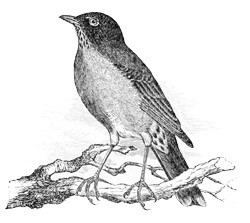
Turdus migratorius.
There are some variations, both of color and proportions, between eastern and western specimens of the Robin. In the latter there is a tendency to a longer tail, though the difference is not marked; and, as a rule, they slightly exceed eastern specimens in size. The broad white tip to the lateral tail-feather—so conspicuous a mark of eastern birds—is scarcely to be found at all in any western ones; and in the latter the black of the head is very sharply defined against the lighter, clearer ash of the back, there hardly ever being a tendency in it to continue backward in the form of central spots to the feathers, as is almost constantly seen in eastern examples; of western specimens, the rufous, too, is appreciably lighter than in eastern. As regards the streaks on the throat, the black or the white may either largely predominate in specimens from one locality.
In autumn and winter each rufous feather beneath is bordered by a more or less conspicuous crescent of white; in addition to this, most of the lighter individuals (♀?), at this season, have an ashy suffusion over the breast and flanks; and this, we have observed, is more general and more noticeable in western than in eastern specimens. In fall and winter the color of the bill, too, changes, becoming at this season either partially or wholly dusky, instead of almost entirely yellow, as seen in spring and summer examples.
Mexican specimens, found breeding in the Alpine regions as far south as Orizaba and Mirador, most resemble the western series; one, however (No. 38,120 ♂, Orizaba), but in the autumnal plumage, and therefore very possibly a migrant from the North, is hardly distinguishable from No. 32,206, Georgia; it is about identical in proportions, and the rufous is of a castaneous shade, like the deepest colored eastern examples; the white tip to the outer tail-feather is as broad and conspicuous as is ever seen in the latter.
Habits. Scarcely any American bird has a wider range of geographical distribution, or is more numerous wherever found, than this thrush. From Greenland on the extreme northeast to the plateau of Mexico, and from the Atlantic to the Pacific, the Robin is everywhere a very abundant species. Single specimens have been obtained as far south as Coban, Guatemala. Its distribution in the breeding season is hardly less restricted, occurring alike on the shores of the Arctic Seas and on the high lands of Vera Cruz. In the winter months it is most abundant in the Southern States, while in the Middle and even the Northern States, in favorable localities, it may be found throughout the year; its migrations being influenced more by the question of food than of climate. In the valleys among the White Mountains, where snow covers the ground from October to June, and where the cold reaches the freezing-point of mercury, flocks of the Robin remain during the entire winter, attracted by the abundance of berries.
On the Pacific Coast the Robin is only a winter visitant in California; a very few remaining to breed, and those only among the hills. They reach Vancouver Island early in March, and are very abundant.
In New England, where the Robins are held in great esteem, and where they exist under very favorable circumstances, their numbers have very largely increased, especially in the villages. They cause not a little annoyance to fruit cultivators by their depredations upon the productions of the garden, especially cherries and strawberries. They are a voracious bird, and no doubt destroy a large quantity of small fruit, but there is abundant evidence that this is more than compensated by their destruction of the most injurious insects, upon which they wage an incessant war. The investigations of Mr. J. W. P. Jenks and Professor Treadwell establish conclusively their great services in this direction.
The experiments of the latter gentleman show that the nestlings of the Robin require a vast amount of animal food, forty per cent more than their own weight being consumed by the young bird within twenty-four hours, and, what is more, demonstrated to be necessary to its existence.
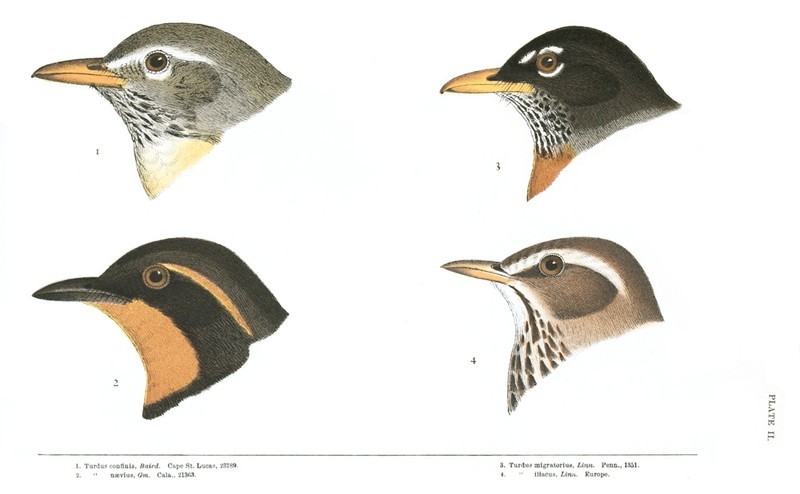
PLATE II.
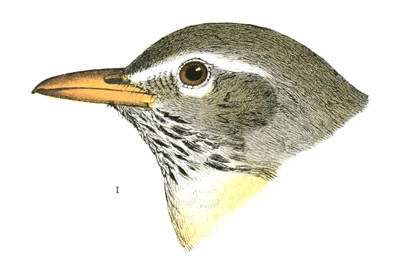
1. Turdus confinis, Baird., Cape St. Lucas, 23789.
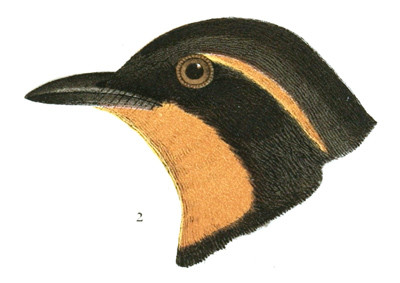
2. Turdus nævius, Gm. Cala., 21363.
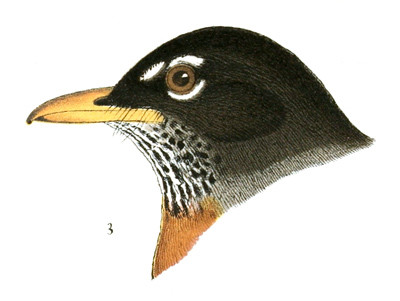
3. Turdus migratorius, Linn., Penn., 1851.
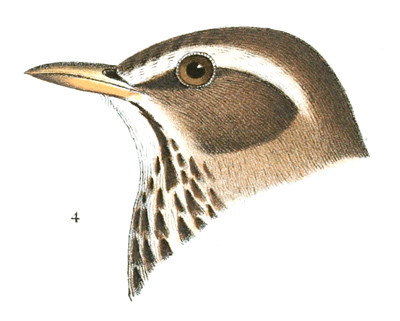
4. Turdus iliacus, Linn., Europe.
In Massachusetts a few Robins remain throughout the year, but the greater proportion leave early in November, returning late in February or early in March.
The song of the Robin is deservedly popular. While many of our birds possess far superior powers of melody, and exhibit a much greater variety in their song, there are none that exceed it in its duration or extent. It is the first bird in spring to open and one of the last to close the great concert of Nature. Their song is earnest, simple, and thrilling, and is said by Audubon to resemble that of the European Blackbird, Turdus merula.
The Robin, when taken young, may be readily tamed, and soon becomes contented and accustomed to confinement. They are devoted to their young, watchful, attentive, and provident. They begin to construct their nest in early spring before the trees put forth their leaves, and often in very exposed positions. The size of the nest, in fact, makes concealment impossible. These nests are sometimes placed in quite remarkable positions, such as the beams of a ship partly finished, and where the carpenters were every day at work, and similar situations indicating a great familiarity. Their favorite place is the horizontal branch of an apple-tree, about ten feet from the ground.
The nest of the Robin is a large and coarsely constructed combination of rude materials. It is composed of a base of straw, leaves, mosses, stems, and dry grasses, upon which a cup-shaped fabric of clay or mud is built. The whole is lined with finer dry grasses and vegetable fibres. They average 5 inches in height and the same in diameter. Their cavity is 2¾ inches deep, with a diameter of 2½ inches.
The eggs of the Robin, which are usually five and sometimes six in number, are of a uniform bright greenish-blue color, liable to fade when exposed to light, but when fresh exhibiting a very distinct and bright tint. They vary in size from 1.25 to 1.12 inches in length, and in breadth from .88 to .75 of an inch. Their mean measurement is 1.18 by .81.
Turdus migratorius, var. confinis, Baird.
CAPE ST. LUCAS ROBIN.
Turdus confinis, Baird, Rev. Am. B. 1864, 29.—Elliot, Birds America.—Cooper, Birds Cal., 9.
Sp. Char. No. 23,789. Entire upper parts and sides of head and neck uniform grayish-ash, with perhaps a faint tinge of olivaceous, less than in eastern specimens of T. migratorius. The central portions of the feathers of the top of head are rather darker than the edges, though almost inappreciably so, and not imparting a general dusky appearance. The chin and throat are white, streaked with ashy-brown. The jugulum and breast are pale yellowish-buff; the axillars, inner wing-coverts, and sides of the breast similarly, but rather more decidedly colored. The belly and edges of the crissal feathers are white, the hinder parts of the flanks ashy. There is a distinct whitish stripe from the lores over and a quarter of an inch behind the eye; the lower eyelid is also white. The tail-feathers are worn, but there is an indication of a narrow white tip. The feathers of the jugulum, especially of the sides, are tipped with ashy like the back, as in immature specimens of T. migratorius. The greater wing-coverts are tipped with dull white. The bill is yellowish; the upper mandible and the tip of lower tinged with dusky. The feet are pale brown.
The length cannot be given accurately, as the skin is much drawn up. The wing, however, measures 5.10 inches, its tip reaching 1.40 beyond the longest secondary; tail, 4.10; tarsus, 1.20; middle toe and claw, 1.07; exposed portion of culmen, .92; from tip to open portion of nostrils, .60.
Hab. Todos Santos, Cape St. Lucas.
The specimen with a general resemblance to an immature T. migratorius (especially the western variety) in the white superciliary streak and general markings, is much lighter beneath than in any of the many skins of T. migratorius examined; there being none of the dark chestnut or cinnamon shade, but rather a light buff; the belly and flanks are much more purely white. The superciliary stripe extends farther behind the eye; indeed, in most specimens of migratorius the white is nearly confined to the eyelids. The bill and wings are rather longer than usual in migratorius; the middle toe, on the other hand, appears shorter. Nothing is on record in regard to the habits of this bird.
Subgenus HESPEROCICHLA, Baird.
Hesperocichla, Baird, Rev. Am. Birds, I, 1864, 12. (Type Turdus nævius, Gm.)
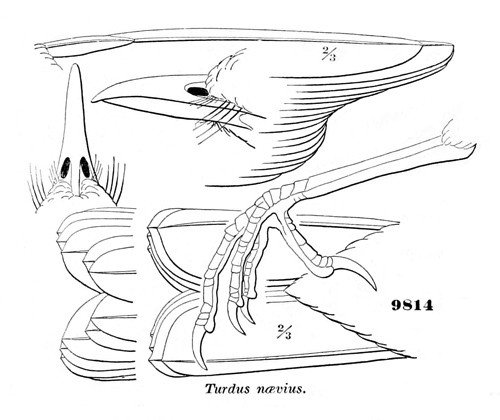
Turdus nævius.
9814
The single species of this subgenus differs in form from the Robins (Planesticus), in the more awl-shaped bill, the curved commissure, and the absence of a notch at the end; the longer, slenderer, and straighter claws; and in the dissimilarity in color of the sexes. In the latter respects it agrees with Merula of Europe and Middle America; in which, however, the bill is distinctly notched, and less attenuated. The tail is shorter and broader than in Planesticus, more as in true Turdus or Hylocichla.
Turdus nævius, Gmel.
OREGON ROBIN; VARIED THRUSH.
Turdus nævius, Gm. S. N. I, 1788, 817.—Sclater, P. Z. S. 1857, 4; 1859, 331.—Baird, Birds N. Am. 1858, 219; Rev. Am. B. 1864, 32.—Cooper & Suckley, P. R. R. R. XII, II, 1859, 172.—Coues, Pr. A. N. S. 1866, 65. (Quotes occurrence on Colorado River, above Fort Mohave, as exceptional.)—Maynard (Massachusetts!).—Turnbull (N. Jersey!).—Dall & Bannister (Alaska).—Cooper, Birds Cal. 10. Orpheus meruloides, Rich. F. B. A. II, 1831, 187, pl. xxxviii.
Other figures: Vieillot, Ois. Am. Sept. II, 1807, pl. lxvi.—Aud. Orn. Biog. IV, 1838, pl. ccclxix, and ccccxxxiii.—Ib. Birds Am. III, pl. cxliii.
Sp. Char. Tail nearly even; the lateral feather shorter. Above, rather dark bluish slate; under parts generally, a patch on the upper eyelids continuous with a stripe behind it along the side of the head and neck, the lower eyelids, two bands across the wing coverts and the edges of the quills, in part, rufous orange-brown; middle of belly white. Sides of the head and neck, continuous with a broad pectoral transverse band, black. Most of tail feathers with a terminal patch of brownish white. Bill black. Feet yellow. Female more olivaceous above; the white of the abdomen more extended; the brown beneath paler; the pectoral band obsolete. Length, 9.75 inches; wing, 5.00; tail, 3.90; tarsus, 1.25.
Young (45,897, Sitka, Aug. 1866; F. Bischoff). Exactly resembling the adult female, having no spots other than seen in the adult plumage; but the pectoral collar is composed only of badly defined blackish transverse crescents, and the upper parts anterior to the rump are of an umber brown tint. The markings about the head and on the wings are precisely as in the adult.
This species does not appear to be liable to any noticeable variation.
Hab. West coast of North America, from Behring Straits to California; straggling to Great Bear Lake. Accidental on Long Island (Cab. G. N. Lawrence), New Jersey (Cab. Dr. Samuel Cabot), and Ipswich, Mass. (Cab. Boston Society Natural History); Iowa (Allen).
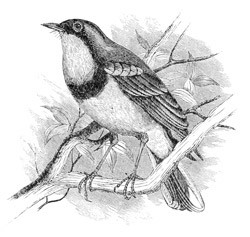
Turdus nævius.
Habits. The accidental occurrence of a few specimens of this well-marked bird in the Eastern States is its only claim to a place in that fauna, it being strictly a western species, belonging to the Pacific Coast. It was first discovered by the naturalists of Captain Cook’s expedition, who met with it as far to the north as Nootka Sound. It is only very recently that we have become possessed of reliable information in regard to its breeding and its nest and eggs. Sir John Richardson was informed that it nested in bushes in a manner similar to that of the common robin.
Nuttall and Townsend found it abundant among the western slopes of the Rocky Mountains, near the Columbia River, in October. In the winter it became still more numerous, passing the season in that region as well as in more southern localities, associating with the robin. From this bird it may be readily distinguished by the difference of its notes, which are louder, sharper, and delivered with greater rapidity. In the spring, before leaving for their breeding-places, they are described as having a very sweet warble.
On the Columbia River they were not resident, arriving there in October, continuing throughout the winter, and leaving early in May. During their stay they moved through the forest in small flocks, frequenting low trees, and for the most part keeping perfect silence. They were timorous and difficult of approach.
Its habits are said to resemble those of the robin, but in some of them the descriptions given appear to correspond more with those of the Fieldfares and Redwings of Europe. Like those species it is a summer resident of high northern latitudes, affects secluded forests and thickets bordering upon streams, and is found only in unfrequented localities.
Dr. Cooper was of the opinion that a few of these thrushes remained in Washington Territory throughout the summer, as he frequently met with them in the dark spruce forests of that region as late as June and July. He describes the song as consisting of five or six notes in a minor key, and in a scale regularly descending. It was heard continually throughout the summer, among the tops of the trees, but only in the densest forests. Dr. Suckley states that after a fall of snow they would be found along the sandy beaches near the salt water, where they were both abundant and tame. We are indebted to Mr. W. H. Dall for our first authentic knowledge of its nest and eggs. The former measures 6 inches in diameter with a depth of 2½ inches. It has but a very slight depression, apparently not more than half an inch in depth. The original shape of the nest had, however, been somewhat flattened in transportation. The materials of which it was composed were fine dry mosses and lichens impacted together, intermingled with fragments of dry stems of grasses.
A nest of this thrush obtained by Dr. Minor, in Alaska, is a much more finished structure. Its base and periphery are composed of an elaborate basket-work of slender twigs. Within these is an inner nest consisting of an interweaving of fine dry grasses and long gray lichens.
The eggs in size, shape, ground color, and markings are not distinguishable from those of the Turdus musicus of Europe. They measure 1.13 inches in length by .80 in breadth, are of a light blue with a greenish shading, almost exactly similar to the ground color of the T. migratorius. They are very distinctly marked and spotted with a dark umber-brown approaching almost to blackness.
Mr. Dall informs us that the nest found by him was built in a willow bush, about two feet from the ground, and on the top of a large mass of rubbish lodged there by some previous inundation. Other nests of the same species were met with in several places between Fort Yukon and Nulato, always on or near a river-bank and in low and secluded localities.
They arrive at Nulato about May 15, and prefer the vicinity of water, frequenting the banks of small streams in retired places. Mr. Dall states that he has seen the male bird on a prostrate log near the nest, singing with all his might, suddenly cease and run up and down the log for a few minutes, strutting in a singular manner, then stopping and singing again; and keeping up this curious performance. Specimens were received from Sitka, Kodiak, Cook’s Inlet and Admiralty Islands.
Subfamily MIMINÆ.
Birds of this section have a somewhat thrush-like appearance, but (except in Oreoscoptes) with longer, much more graduated, and broader tail; short concave wings, about equal to or shorter than the tail, usually lengthened, sometimes decurved bill without notch, and strongly marked scutellæ on the anterior face of the tarsus. The loral feathers are soft, and not ending in bristly points. The colors are dull shades of brown, gray, or plumbeous. Most of the species, in addition to a melodious native song, possess the power of imitating the notes of other birds; sometimes, as in the American Mocking Bird, to an eminent degree. All are peculiar to the New World, and the species are much less vagrant than those of the Turdinæ,—those of the United States scarcely going beyond its northern boundary; others, again, restricted to small islands in the West Indies or in the Pacific Ocean.
Genus OREOSCOPTES, Baird.
Oreoscoptes, Baird, Birds N. Am. 1858, 346. (Type Orpheus montanus, Towns.)
Oreoscoptes, Baird, Rev. Am. Birds, 42.
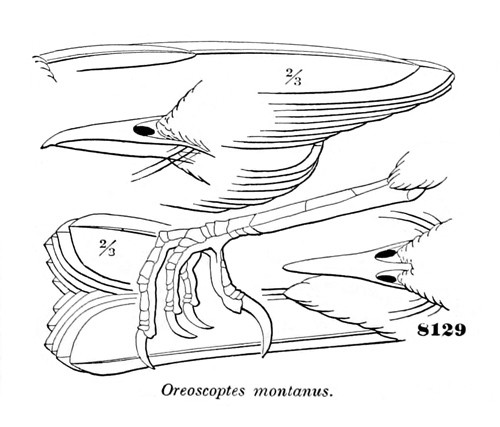
Oreoscoptes montanus.
8129
Sp. Char. Bill shorter than the head, without distinct notch. Bristles prominent, their tips reaching beyond the nostrils. Wings pointed, equal to, or a little longer than the tail. First quill not half the second, about two fifths the longest; third, fourth, and fifth quills equal and longest; second between sixth and seventh. Tail but slightly graduated; the feathers narrow. Tarsus longer than middle toe and claw by an additional claw; scutellæ distinct anteriorly.
Of this genus only one species is at present known. This belongs to the Middle and Western provinces of the United States and extends from the Pacific coast eastward to Fort Laramie and the Black Hills (in winter to San Antonio, Texas); south to Fort Yuma and Cape St. Lucas.
Oreoscoptes montanus, Baird.
SAGE THRASHER; MOUNTAIN MOCKER.
Orpheus montanus, Townsend, Jour. Acad. Nat. Sci. Phila. VII, II, 1837, 192.—Aud. Birds Amer. II, 1841, 194, pl. cxxxix. Turdus montanus, Aud. Orn. Biog. IV, 1838, 437, pl. ccclxix, fig. 1. Mimus montanus, Bonap. Consp. 1850, 276. Oreoscoptes montanus, Baird, Birds N. Amer. 1858, 347; Rev. Am. B. 1864, 42.—Sclater, P. Z. S. 1859, 340.—Ib. Catal. 1861, 8, No. 30.—Cooper, Birds Cal. 1, 12.
Sp. Char. First quill rather shorter than the sixth. Tail slightly graduated. Above brownish-ash; each feather obsoletely darker in the centre. Beneath dull white, thickly marked with triangular spots, except on the under tail-coverts and around the anus, which regions are tinged with yellowish-brown. Wing-coverts and quills edged with dull white. Tail feathers brown; the outer edged, and all (except, perhaps, the middle) tipped with white. Length, 8 inches; wing, 4.85; tail, 4.00; tarsus, 1.21.
Young. Similar, but spots beneath less sharply defined, and the upper parts quite conspicuously streaked with dusky.
Hab. Rocky Mountains of United States, west to Pacific, south to Cape St. Lucas.
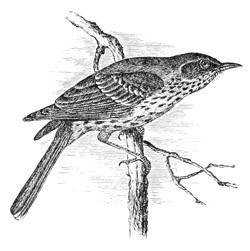
Oreoscoptes montanus.
The careful observations of Mr. Robert Ridgway have led him to the conviction that the name bestowed upon this species of “Mountain Mocking-Bird” is doubly a misnomer. It is not at all imitative in its notes, and it is almost exclusively a resident of the artemisia plains. It seems to be chiefly confined to the great central plateau of North America, from Mexico almost to Washington Territory. Specimens have been procured from Cape St. Lucas, the Lower Colorado, Mexico, and Texas, on the south, and Nuttall met with it nearly as far north as Walla-Walla. It probably occupies the whole extent of the Great Basin.
Dr. Kennerly, who met with it while crossing the arid mesas west of the Rio Grande, says that while singing it was usually perched upon some bush or low tree. It was frequently seen seeking its food upon the ground, and when approached, instead of flying away, it ran very rapidly, and disappeared among the low bushes.
During the winter months it was observed near San Antonio, Texas, by Mr. Dresser; and was also found by him to be common about Eagle Pass. He noticed the same peculiarity of their running instead of their flying away when disturbed. They preferred the flat, bush-covered plains. A few remained to breed, as he obtained the eggs there, although he did not himself meet with one of the birds in summer.
It is generally represented as keeping chiefly on the ground, and obtaining its food in this position. General Couch speaks of it as Sparrow-like in its habits.
Mr. Nuttall describes its song as cheering, and the notes of which it is composed as decidedly resembling those of the Brown Thrush (Harporhynchus rufus). He claims for it some of the imitative powers of the Mocking-Bird (Mimus polyglottus), but in this he is not supported by the observations of others. He met with its nest in a wormwood (Artemisia) bush on the border of a ravine; it contained four eggs of emerald green, spotted with dark olive, the spots being large, roundish, and more numerous at the larger end. The nest was composed of small twigs and rough stalks, and lined with strips of bark and bison-wool. The female flew off to a short distance, and looked at her unwelcome visitors without uttering any complaint.
The nests of this bird, so far as I have seen them, are all flat, shallow structures, with very slight depression, and loosely and rudely constructed of an intermingling of strips of bark with rootlets and the finer stems of herbaceous plants. Their eggs, usually four in number, do not vary essentially in size, shape, or marking. They measure 1 inch in length, and from .73 to .75 in breadth. Their ground color is a bright greenish-blue, marked with deep olive-brown spots, intermingled with blotches of a light lilac. There are slight variations in the proportion of green in the shade of the ground color, and also in the number and size of the spots, but these variations are unimportant.
The following are Mr. Ridgway’s observations upon the habits of this species. They are full, valuable, and very carefully made:—
The Oreoscoptes montanus is a bird peculiar to the artemisia wastes of the Great Basin, being a characteristic species of the region between the Sierra Nevada and the Rocky Mountains. It is exclusively an inhabitant of the “sage brush,” and is partial to the lower portions of the country, though it is not unfrequent on the open slope of the mountains. A more unappropriate term than “Mountain Mocking-Bird” could hardly have been chosen for this species, as its predilection for the valleys, and the fact that its song is entirely its own, will show. In my opinion, the term “Sage Thrasher” would be more appropriate.
In the neighborhood of Carson City, Nevada, these birds arrived about the 24th of March, and immediately upon their arrival began singing. At this time, with the Sturnella neglecta and Poospiza belli, they made sweet music in the afternoon and early morning, in the open wastes of “sage brush,” around the city. The birds when singing were generally seen sitting upon the summit of a “sage” bush, faintly warbling, in the course of the song turning the head from side to side in a watchful manner. Upon being approached, they would dart downward, seemingly diving into the bush upon which they had perched, but upon a close search the bird could not be found, until it was heard again singing a hundred yards or more in the direction from which I had approached. This peculiar, circuitous, concealed flight is a very characteristic trait of this bird, and one sure to excite attention.
As the season advanced, or about the 10th of April, when the pairing season was at hand, the songs of the males became greatly improved, increasing in sweetness and vivacity, and full of rapturous emotion; their manners, also, became changed, for they had lost all their wariness. In paying their attentions to their mates, the males would fly from bush to bush, with a peculiar, tremulous fluttering of the wings, which, when the bird alighted, were raised above the back apparently touching each other; all the while vibrating with the emotion and ecstasy that agitated the singer.
The song of this bird, though very deficient in power,—in this respect equalling no other species of Miminæ with which I am acquainted,—is nevertheless superior to most of them in sweetness, vivacity, and variety. It has a wonderful resemblance to the beautiful subtle warbling of the Regulus calendula, having in fact very much the same style, with much of the tone, and about the power of the song of the Pyranga rubra.
When the birds are engaged in incubation, the males become very silent, and one not familiar with their habits earlier in the season would think they never had a voice; in fact, they make no protestations even when the nest is disturbed, for, while blowing the eggs, I have had the parent birds running around me, in the manner of a robin, now and then halting, stretching forward their heads, and eying me in the most anxious manner, but remaining perfectly silent. When the young are hatched the parents become more solicitous, signifying their concern by a low, subdued chuck. At all times when the nest is approached, the bird generally leaves it slyly before one approaches very near it.
The nest is very bulky, composed externally of rough sticks, principally the thorny twigs of the various “sage bush” plants. Nearer the centre the principal material is fine strips of inner bark of these plants; and the lining consists of finer strips of bark, mingled with fine roots, and bits of rabbit fur. The situation of the nest varies but little, being generally placed near the middle of a bush, that is, about eighteen inches from the ground. It is generally supported against the main trunk, upon a horizontal branch. Several were found upon the ground beneath the bush, one, in fact, embedded in the soil, like that of a Pipilo; or as sometimes the case with the Harporhynchus rufus, others, again, were found in brush-heaps. In all cases, the nest was very artfully concealed, the situation being so well selected.
This bird is almost equally common in all parts of its habitat, within the limits indicated. In June, we found it abundant on the large islands in the Great Salt Lake, where many nests were found.
In autumn, it feeds, in company with many other birds, upon berries, “service berries” being its especial favorite.
Genus HARPORHYNCHUS, Cabanis.
Toxostoma, Wagler, Isis, 1831, 528. (Type T. vetula, Wagl., not Toxostoma, Raf. 1816.)
Harpes, Gambel, Pr. A. N. S. Phila. II. 1845, 264. (Type Harpes redivivus, Gamb., not of Goldfuss, 1839.)
Harporhynchus, Cabanis, Archiv f. Naturg. 1848, I. 98. (Type Harpes redivivus, Gamb.)
Methriopterus, Reich. Av. Syst. Nat. 1850, pl. iv. (Type said by Gray to be H. rufus.)
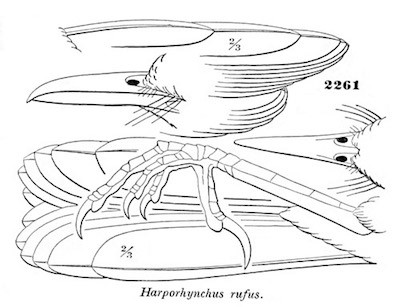
Harporhynchus rufus.
2261
Gen. Char. Bill from forehead as long as, or much longer than the head; becoming more and more decurved in both jaws as lengthened. No indication of a notch. Rictus with the bristles extending beyond the nostrils. Tarsus long and stout, appreciably exceeding the middle toe and claw, strongly scutellate anteriorly. Wings considerably shorter than tail, much rounded; the first quill more than half the second; fourth or fifth longest. Tail large, much graduated; the feathers firm.
The species of this genus are all of large size, in fact, embracing the largest of the American slender-billed oscine birds. All the species differ in structure, varying especially in the length of the bill, as above stated.
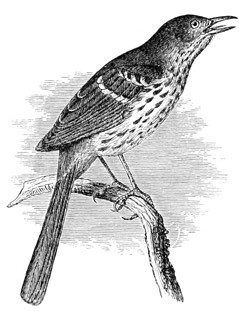
Harporhynchus rufus.
It is useless to attempt a division of this genus, for there is such a gradual chain of characters between the two extremes of form (rufus and crissalis), that they even seem almost one species, when the numerous intermediate forms, shading so insensibly into each other, are considered. However, as this view would be rather extreme, in view of the really great difference of form between the species mentioned, we may consider the following as good species, several of them with one or more varieties: rufus, with longicauda and longirostris as varieties, the former scarcely appreciably different, the latter ranking as a permanent race; ocellatus, cinereus, curvirostris, the latter with one well-marked variety, palmeri; redivivus, with most probably lecontei as a well-marked variety, and crissalis.
The seasonal differences in the plumage often make it difficult to determine these several forms; but if the following facts are borne in mind, the trouble will be greatly lessened. In every species there is a more or less decided ochraceous tinge to the crissal region (sometimes extending forward over the flanks); except in crissalis, in which the lower tail-coverts and anal region are deep chestnut. In autumn and winter this ochraceous tint becomes very much deeper, as well as more prevalent, than in spring and summer; the whole plumage becomes softer, the colors more pronounced, and the markings more distinct, than when faded and worn in summer.
Synopsis of Species of Harporhynchus.
A. Spots beneath sharply defined and conspicuous,—much darker in color than the upper parts.
1. H. rufus. The markings lineo-cuneate; wing bands sharply defined.
Above rufous; markings below dark brown; outer tail-feathers diluted at tip; wing, 4.00; tail, 5.20; bill from nostril, .79, nearly straight; tarsus, 1.30; middle toe, .90 (1,377 ♂ Carlisle, Penn.). Hab. Eastern Province United States … var. rufus.
Wing, 4.40; tail, 5.70; bill, .79; tarsus, 1.35; middle toe, .90 (5,652 ♂ Republican River). Hab. Plains between Missouri River to Rocky Mountains … var. longicauda.
Above umber brown; markings beneath black; tail-feathers not paler at tip; wing, 3.90; tail, 4.90; bill, .85, slightly curved; tarsus, 1.40; middle toe, .94 (4,016 ♂ Brownsville, Tex.) Hab. Eastern Mexico, north to Rio Grande of Texas … var. longirostris.
2. H. ocellatus.[23] The markings circular; wing bands conspicuous.
Above grayish-brown; markings beneath black; tail-feathers broadly tipped with white; wing, 4.10; tail, 5.60; bill, from rictus, 1.50, moderately curved; tarsus, 1.50. Hab. Oaxaca, Mex.
3. H. cinereus. The markings deltoid; wing bands narrow, but sharply defined.
Above brownish-cinereous; markings beneath blackish-brown; tail-feathers broadly tipped with white; wing, 4.00; tail, 4.60; bill, .88, much curved; tarsus, 1.30; middle toe, .85 (12,960 “♀”—♂? Cape St. Lucas). Hab. Cape St. Lucas, Lower California.
B. Spots beneath obsolete, not darker than the plumage above; roundish in form.
4. H. curvirostris.
Above cinereous; wing bands distinct; spots below distinct, upon a white ground; femoral region and crissum very pale ochraceous; tail-feathers broadly and sharply tipped with pure white; wing, 4.30; tail, 4.50; bill, 1.00, stout, moderately curved; tarsus, 1.40; middle toe, 1.12 (7,200 ♂ Ringgold Barracks, Texas). Hab. from Rio Grande valley in Texas to Cordova, Orizaba, Oaxaca, Colima, and Mazatlan … var. curvirostris.
Wing bands obsolete, and tail spots very narrow and obsolete; spots below just discernible upon a grayish ground; femoral region and crissum dilute ochraceous-brown; wing, 4.30; tail, 5.20; bill, 1.00, slender, moderately curved; tarsus, 1.30; middle toe, 1.00 (8,128 ♂ “New Mexico”—probably Eastern Arizona). Hab. Arizona (Camp Grant) … var. palmeri.
C. Entirely unspotted beneath.
5. H. redivivus. Anal region and lower tail-coverts light ochraceous.
Above soft brownish-cinereous, tail considerably darker; wing bands almost obsolete, and tail-feathers merely diluted at tips. Beneath paler than above,—almost white on throat and abdomen; anal region and lower tail-coverts yellowish-ochraceous. A distinct “bridle” formed by the hair-like tips of the feathers, bordering the throat; maxillary stripe white with transverse bars of dusky; wing, 3.90; tail, 5.25; bill, 1.05, slender, moderately curved; tarsus, 1.25; middle toe, .86 (40,718 ♂ 20 miles from Colorado River, near Fort Mojave). Hab. Arizona (Gila River, Fort Yuma, and Fort Mojave) … var. lecontei.
Above ashy drab, tail darker and more brownish; wing bands inconspicuous, and tail-feathers hardly diluted at tips. Beneath, the ochraceous covers the abdomen, and the throat inclines to the same. No “bridle.” Cheeks and ear-coverts blackish, with conspicuous shaft-streaks of white; wing, 4.30; tail, 5.60; bill, 1.40, stout, very much bowed,—the arch regular; tarsus, 1.55; middle toe, 1.00 (3,932 ♂, California). Hab. Coast region of California … var. redivivus.
6. H. crissalis. Anal region and lower tail-coverts deep chestnut.
Above, brownish-ashy with a slight purplish cast, tail not darker; no trace of wing bands; tail-feathers diluted, and tinged with rusty at tips. Beneath, of a uniform, paler tint than the upper plumage, not lighter medially; throat white, with a conspicuous “bridle”; from this up to the eye whitish, with transversely angular bars of dusky; wing, 4.00; tail, 6.50; bill, 1.25, very slender, bowed from the middle; tarsus, 1.30; middle toe, .90 (11,533 ♂ Fort Yuma). Hab. Region of Gila River to Rocky Mountains; north to Southern Utah (St. George, breeding; Dr. Palmer).
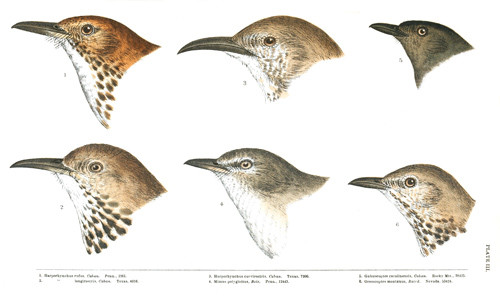
PLATE III.
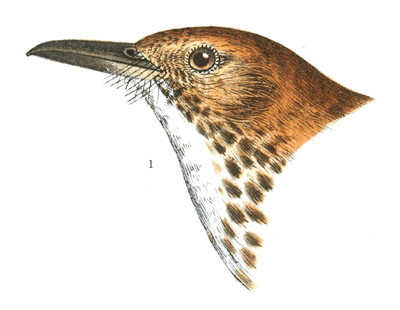
1. Harporhynchus rufus, Caban. Penn., 2261.
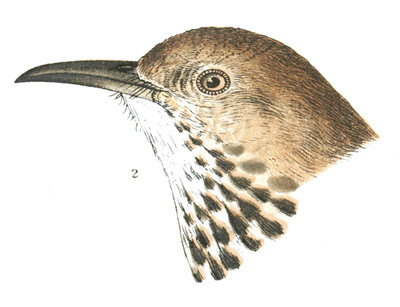
2. Harporhynchus longirostris, Caban. Texas, 4016.
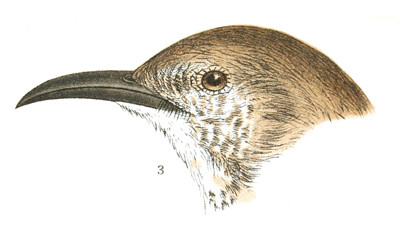
3. Harporhynchus curvirostris, Caban. Texas, 7200.
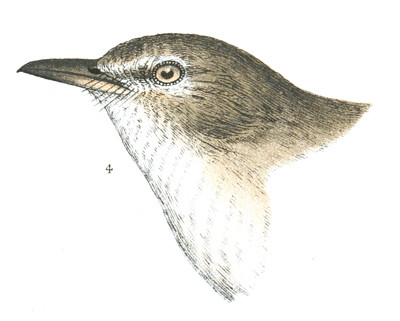
4. Mimus polyglottus, Boie. Penn., 12445.
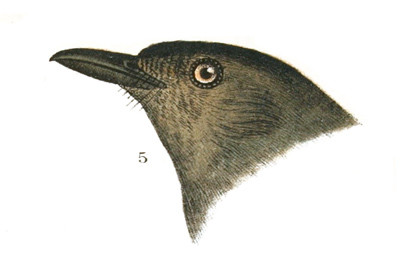
5. Galeoscoptes carolinensis, Caban. Rocky Mts., 38425.
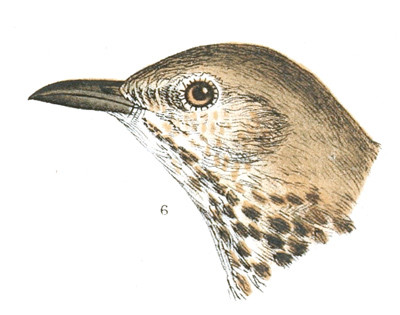
6. Oreoscoptes montanus, Baird. Nevada, 53424.
Harporhynchus rufus, Cabanis.
BROWN THRASHER.
Turdus rufus, Linn. Syst. Nat. 10th ed. 1758, 169, based on Catesby, tab. 19.—Ib. Syst. Nat. I, 1766, 293.—Gätke, Naumannia, 1858, 424 (Heligoland, Oct. 1837). Harporhynchus rufus, Cab. Mus. Hein. 1850, 82.—Baird, Birds N. Am. 1858, 353.—Ib. Rev. Am. Birds, 44.—Sclater, P. Z. S. 1859, 340.—Ib. Catal. 1861, 8, no. 48.—Samuels, 163. Mimus rufus, Pr. Max. Cab. Jour. 1858, 180.
Figures: Vieillot, Ois. Am. Sept. II, pl. lix.—Wilson, Am. Orn. II, pl. xiv.—Aud. Orn. Biog. pl. cxvi.
Sp. Char. Exposed portion of the bill shorter than the head. Outline of lower mandible straight. Above light cinnamon-red; beneath pale rufous-white with longitudinal streaks of dark brown, excepting on the chin, throat, middle of the belly, and under tail-coverts. These spots anteriorly are reddish-brown in their terminal portion. The inner surface of the wing and the inner edges of the primaries are cinnamon; the concealed portion of the quills otherwise is dark brown. The median and greater wing-coverts become blackish-brown towards the end, followed by white, producing two conspicuous bands. The tail-feathers are all rufous, the external ones obscurely tipped with whitish; the shafts of the same color with the vanes. Length, 11.15; wing, 4.15; tail, 5.20; tarsus, 1.30.
Hab. Eastern North America to Missouri River, and perhaps to high central plains United States, east of Rocky Mountains, north to Lake Winnipeg.
As stated in “Birds of North America” some specimens (var. longicauda) from beyond the Missouri River are larger than eastern birds, with longer tails, more rufous beneath; the breast spots darker. But, in passing from east to west, the change is so insensible that it is impossible to divide the series.
Habits. This Thrush is a common species throughout a widely extended area, from the Rocky Mountains to the Atlantic, and from the Red River country, in British America, to the Rio Grande. And nearly throughout this entire territory it also resides and breeds, from Texas to the 54th parallel of latitude.
It reaches New England early in May and leaves it in the latter part of September or the first week of October, its stay varying with the season and the supply of its food. It is somewhat irregularly distributed, common in some portions of this section, and rare or even unknown in others. It is not found near the sea-coast beyond Massachusetts. It passes the winter in the Southern States, even as far to the north as Virginia, and is in full song in the neighborhood of Savannah as early as the first of March.
The song of this Thrush is one of great beauty, and is much admired by all who appreciate woodland melody of the sweetest and liveliest type. It is loud, clear, emphatic, full of variety and charm. Its notes are never imitative and cannot be mistaken by any one who is familiar with them, for those of any other bird, unless it may be some one of its western congeners. It is a very steady performer, singing for hours at a time. Its notes are given in a loud tone, and its song may often be heard to quite a distance.
In obtaining its food the Brown Thrush is at times almost rasorial in its habits. In the early spring it scratches among the leaves of the forest for worms, coleopterous grubs, and other forms of insect food. By some it is charged with scratching up the hills of early corn, but this is not a well-founded accusation. Berries of various kinds also form a large part of its food, and among these the small fruit of our gardens must be included.
This Thrush is a very affectionate and devoted bird, especially to its young. It is also prompt in going to the assistance of others of its species when in trouble. Whenever intruders approach their nests, especially if their young are far advanced, they manifest the deepest anxiety, sometimes even making a vigorous defence. The writer has a very distinct recollection of having encountered, together with a younger brother, an ignominious defeat, when making his first attempt to inspect the nest of one of these birds.
The Brown Thrush is jealous of the intrusion of other birds of its own species to a too close proximity to its nesting-place, and will assert its love of seclusion by stout battles. In Louisiana the construction of the nest is commenced quite early in March; in Pennsylvania, not until May; and in the New England States in the latter part of that month. The nest is usually not more than two or three feet from the ground. It is built in a low bush, on a cluster of briers or among vines. I have known it to be placed in the interior of a heap of brushwood loosely thrown together. I have never met with the nest built upon the ground, but in Springfield, and in other dry and sandy localities, this is by no means an uncommon occurrence. These nests are frequently placed in close proximity to houses, and sometimes in the very midst of villages.
The nest of the Thrasher is large, and roughly but strongly built. The base is usually made of coarse twigs, sticks, and ends of branches, firmly interwoven. Within this is constructed an inner nest, composed of dried leaves, strips of bark, and strong black fibrous roots. These are lined with finer roots, horse-hair, an occasional feather, etc.
The eggs are usually four, sometimes five, and rarely six, in number. They vary both in the tints of the ground color, in those of their markings, and slightly in their shape. Their length varies from .99 to 1.12 inches, with a mean of 1.05. Their breadth ranges from .76 to .87 of an inch; mean breadth, .81. The ground color is sometimes white, marked with fine reddish-brown dots, confluent at the larger end, or forming a broad ring around the crown. In others the markings have a yellowish-brown tint. Sometimes the ground color is a light green.
Harporhynchus rufus, var. longirostris, Caban.,
TEXAS THRASHER.
Orpheus longirostris, Lafr. R. Z. 1838, 55.—Ib. Mag. de Zool. 1839, Ois. pl. i. Toxostoma longirostre, Cab. Wiegm. Arch. 1847, I. 207. Mimus longirostris, Sclater, P. Z. S. 1856, 294 (Cordova). Harporhynchus longirostris, Cab. Mus. Hein. 1850, 81.—Baird, Birds N. Am. 1858, 352, pl. lii.—Ib. Rev. 44.—Sclater, P. Z. S. 1859, 339; Ib. 1864, 172 (City of Mex.); Ib. Catal. 1861, 8, No. 47.
Sp. Char. Similar to H. rufus, the rufous of back much darker. Wings much rounded; second quill shorter than the secondaries. Exposed portion of the bill as long as the head; the lower edge decidedly decurved or concave. Above rather dark brownish-rufous; beneath pale rufous-white; streaked on the sides of the neck and body, and across the breast, with very dark brownish-black, nearly uniform throughout, much darker than in rufus. Two rather narrow white bands on the wings. The concealed portion of the quills dark brown. Length, 10.50; wing, 4.00; tail, 5.00; tarsus, 1.40.
Hab. Eastern Mexico; north to Rio Grande, Texas. Cordova, Scl. Orizaba (temperate region), Sumichrast.
Specimens from the Rio Grande to Mirador and Orizaba are quite identical, with, of course, differences among individuals. This “species” is not, in our opinion, separable from the H. rufus specifically; but is a race, representing the latter in the region given above, where the rufus itself is never found. The relations of these two forms are exactly paralleled in the Thryothorus ludovicianus and T. berlandieri, the latter being nothing more than the darker Southern representation of the former.
The Texas Thrasher appears to belong only to the Avifauna of the Southwest. It first appears as a bird of the valley of the Rio Grande, and extends from thence southward through Eastern Mexico to Cordova and Orizaba. In Arizona it is replaced by H. palmeri, H. lecontei, and H. crissalis, in California by H. redivivus, and at Cape St. Lucas by H. cinereus, while in the United States east of the Rocky Mountains it is represented by its nearer ally H. rufus.
Habits. The eggs of this species are hardly distinguishable from those of the common Brown Thrasher (H. rufus), of the Atlantic States. The color of their ground is a greenish-white, which is thickly, and usually completely, covered with fine markings of a yellowish-brown. They have an average length of 1.13 inches, by .79 in breadth. So far as I have had an opportunity of observing, they do not vary from these measurements more than two per cent in length or one per cent in breadth. Their nests are usually a mere platform of small sticks or coarse stems, with little or no depression or rim, and are placed in low bushes, usually above the upper branches.
In regard to the distinctive habits of this species I have no information.
Harporhynchus cinereus, Xantus.
CAPE ST. LUCAS THRASHER.
Harporhynchus cinereus, Xantus, Pr. A. N. Sc. 1859, 298.—Baird, Ib., 303; Review, 46.—Sclater, Catal. 1861, 8, No. 49.—Elliot, Illust., I. pl. i.—Cooper, Birds Cal. 1, 19.
Sp. Char. Bill as long as the head; all the lateral outlines gently decurved from the base. Bristles not very conspicuous, but reaching to the nostrils. Wings considerably shorter than the tail, much rounded. First primary broad, nearly half the length of the second; the third to the seventh quills nearly equal, their tips forming the outline of a gentle curve; the second quill shorter than the ninth. Tail considerably graduated, the lateral feathers more than an inch the shorter. Legs stout; tarsi longer than middle toe, distinctly scutellate, with seven scales.
Above ashy brown, with perhaps a tinge of rusty on the rump; beneath fulvous-white, more fulvous on the flanks, inside of wing, and crissum. Beneath, except chin, throat, and from middle of abdomen to crissum, with well-defined V-shaped spots of dark brown at the ends of the feathers, largest across the breast. Loral region hoary. Wings with two narrow whitish bands across the tips of greater and middle coverts; the quills edged externally with paler. Outer three tail-feathers with a rather obsolete white patch in the end of inner web, and across the tips of the outer.
Spring specimens are of rather purer white beneath, with the spots more distinct than as described.
Length of 12,960 (skin), 10.00; wing, 4.10; tail, 4.65; first primary, 1.60; second, 2.50; bill from gape, 1.40, from above, 1.15, from nostril, .90; tarsus, 1.26; middle toe and claw, 1.12; claw alone, .30.
Hab. Cape St. Lucas, Lower California.
This species is curiously similar in coloration to Oreoscoptes montanus, from which its much larger size, much longer and decurved bill, and the graduated tail, of course readily distinguish it. It agrees in some respects with H. rufus and H. longirostris, but is smaller, the bill longer and more curved; the upper parts are ashy olivaceous-brown instead of rufous, etc.
Habits. So far as is at present known in regard to this species it appears to be confined exclusively to the peninsula of Lower California. It has, at least, been met with nowhere else. Mr. Xantus found it quite numerous in the vicinity of Cape St. Lucas, in a region which, as he describes it, was singularly unpropitious. This was a sandy shore, extending about a quarter of a mile inland, whence a cactus desert stretched about six miles up to a high range of mountains. Throughout this tract the ground is covered with a saline efflorescence. There is no fresh water within twenty-eight miles.
Mr. Xantus speaks of the habits of this bird as being similar to those of the Oreoscoptes montanus. It was a very abundant species at this cape, where he found it breeding among the cactus plants in large numbers. He mentions that as early as the date of his arrival at the place, April 4, he found them already with full-fledged young, and states that they continued to breed until the middle of July.
He was of the impression that the eggs of this species more nearly resemble those of the common Mocking-Bird than any others of this genus. The aggravatingly brief notes that accompanied his collections show that the general position of the nest of this species was on low trees, shrubs, and most usually, cactus plants, and in no instance at a greater elevation from the ground than four feet. Their nests were flat structures, having only a very slight depression in or near their centre. They were about 5 inches in diameter, and were very little more than a mere platform.
The eggs vary somewhat in their ground color, but exhibit only slight variations in size or shape. Their greatest length is 1.13 inches, and their average 1.12 inches. Their mean breadth is .77 inch, and their maximum .79 inch. The ground color is a greenish-white, profusely marked with spots of mingled purple and brown. In others the ground color is a bluish-green. In some specimens the spots are of a yellowish-brown, and in some the markings are much lighter.
Harporhynchus curvirostris, Caban.
GRAY CURVE-BILL THRASHER.
Orpheus curvirostris, Swainson, Philos. Mag. 1827, 369 (Eastern Mexico).—M’Call, Pr. A. N. Sc. May, 1848, 63. Mimus curvirostris, Gray, Genera, 1844-49. Toxostoma curvirostris, Bonap. Conspectus, 1850, 277.—Sclater, P. Z. S. 1857, 212. Harporhynchus curvirostris, Cab. Mus. Hein. I. 1850, 81.—Baird, Birds N. Am. 1858, 351, pl. li.; Ib. Rev. 45.—Heermann, P. R. R. Rep. X, Parke’s Rep. 1859, 11.—Sclater, P. Z. S. 1859, 339; Ib. Catal. 1861, 7, No. 46.—Dresser, Ibis, 1865, 483. Pomatorhinus turdinus, Temm. Pl. Col. 441. ? Toxostoma vetula, Wagler, Isis, 1831, 528.
Sp. Char. Exposed portion of the bill about as long as the head; considerably decurved. Above uniform grayish-brown, or light ash; beneath dull white; the anal region and under tail-coverts tinged with brownish-yellow. The under parts generally, except the chin, throat, middle of the belly, and under coverts, with rounded sub-triangular, quite well-defined spots, much like the back. These are quite confluent on the breast. Two narrow bands on the wing-coverts, and the edges of primaries and alulæ, are white. The tail-feathers, except the middle, are conspicuously tipped with white. Length of female, 10 inches; wing, 4.00; tail, 4.55; tarsus, 1.20.
Hab. Adjacent regions of United States and Mexico, southward. Cordova, Orizaba, Mirador; Mazatlan, Colima, Oaxaca.
Specimens from the Rio Grande across to Mazatlan represent one species; but those from the latter locality are somewhat darker in colors, though this may be owing, in part, to the fact that they are winter birds. Considerable differences in proportions may often be noticed between individuals, but nothing strikingly characteristic of any particular region.
The specimens of the Mazatlan series (37,326 ♂, 51,523, and 51,525 ♂) have tails considerably longer than any of those from the Rio Grande, the excess amounting in the longest to nearly an inch; but one from the same locality has it shorter than any of the Texas specimens.
In its perfect plumage, this species has both rows of coverts distinctly tipped with white; but in the faded condition of midsummer, the bands thus produced are hardly discernible, and the spots below become very obsolete.
Habits. This interesting species appears to be common in Western Texas, the valley of the Rio Grande, and Western Mexico. It was met with in these regions on the several railroad surveys, and is described by Dr. Heermann as possessing musical powers surpassed by few other birds. When alarmed it immediately hides itself in a thick covert of underbrush, whence it is almost impossible to dislodge it. Its food consists of fruit and berries when in their season, of insects and their larvæ, and of worms. These it collects both among the trees and from the ground, on the latter of which it spends much of its time. Mr. J. H. Clark states that the nest of this bird is very similar to that of the Mocking-Bird, but is finer and much more compact. He adds that it is oftener found among the Opuntia than elsewhere. It is a quiet bird, rather shy, and keeps closely within the clumps of the chaparral. For a bird of its size it makes an unusual noise in flying. At Ringgold Barracks Mr. Clark’s tent was pitched under a como-tree in which there was a nest of these birds. They were at first shy and seemed quite disposed to abandon their nest, but, however, soon became accustomed to their new neighbor, and went on with their parental duties. The position of their nest had been very judiciously selected, for it was during the season of the black fruit of the como, which is somewhat in the shape and size of a thimble, with a pleasant milky pulp. These constituted their principal food. The eggs in this nest were five in number. Lieutenant Couch met with it from Brownsville to Durango, where it had already paired as early as February. He describes it as exceedingly tame and gentle in its habits, and with a song remarkably melodious and attractive. Perched on the topmost bough of a flowering mimosa, in the presence of his consort, the male will pour forth a volume of most enchanting music. Their nest is generally very nearly flat, measuring nearly six inches in circumference, and scarcely more than an inch in its greatest thickness. It has hardly any distinct cavity, and hollows but very slightly from the rim to the centre, its greatest depression having barely the depth of half an inch. The nests are composed of long coarse fibrous roots, rudely, but somewhat compactly interwoven. The inner framework is constructed of the same materials intermixed with the finer stems of grasses.
Mr. H. E. Dresser states that in the vicinity of Matamoras these birds are fond of frequenting small villages, and that he frequently found their nests within the gardens and court-yards of the houses, and near the road.
The eggs of this Thrush vary considerably in size, ranging from 1.20 to 1.03 inches in length, and from .84 to .77 of an inch in breadth. Their mean length is 1.12 inches, and their average breadth .80. They have a light green ground-color, generally, though not thickly, covered with fine brown spots.
Harporhynchus curvirostris, var. palmeri, Ridgway.
PALMER’S THRASHER.
Harporhynchus curvirostris, var. palmeri, Ridgway, Report King’s Expedition, V, 1872.
Sp. Char. Bill slender, moderately curved; fifth quill longest; fourth and sixth just perceptibly shorter, and equal; second equal to ninth; first 1.55 shorter than longest. General plumage uniform grayish-umber, paler below, becoming almost dirty whitish on the throat and abdomen; lower part of the breast and abdomen with a very few just discernible irregular specks of a darker tint; lower tail-coverts dilute isabella-brown, more ochraceous at their margins; anal region and lower part of abdomen light ochraceous. No bands on wings, and tail-feathers only diluted at the tips. Maxillary stripe whitish with transverse bars of dusky. “Iris orange.”
♂ (No. 8,128, “New Mexico” = Arizona, Dr. Heermann): wing, 4.30; tail, 5.00; bill (from nostril), 1.00; tarsus, 1.30; middle toe (without claw), 1.00. ♀(49,723, Camp Grant, Tucson, Arizona, March 12, 1867; Dr. E. Palmer; with eggs): wing, 4.15; tail, 4.85; bill, .95; tarsus, 1.25; middle toe, .90.
Hab. Eastern Arizona (Tucson).
This very curious race seems to unite the characters of curvirostris and lecontei; in fact, it is so exactly intermediate between the two, that we are almost in doubt as to which it is most nearly related. Having the stout form and larger size, as well as the spots on the abdomen, of the former, it has also the uniform colors and general appearance of lecontei. Were it not that the nest and eggs, with the parent accompanying, had been received from Dr. Palmer, we might be tempted to consider it a hybrid between these two species, its habitat being exactly between them, too. We have great pleasure in dedicating this curious form to Dr. Edward Palmer, who has added very much to our knowledge of the Natural History of the interesting region where the present bird is found.
Description of nest and eggs.—(13,311, Camp Grant, Arizona; Dr. E. Palmer). Nest very bulky,—9 inches in height by 6 in width. Very elaborately constructed. The true nest, of symmetrical form, and composed of thin grass-stalks and flax-like fibres, is enclosed in an outer case of thorny sticks, thinly but strongly put together. This inner nest has a deep cavity measuring 4 inches in diameter by 3 in depth.
Eggs (two in number) measure 1.16 by .85; in shape exactly like those of C. curvirostris; pale blue (deeper than in curvirostris), rather thinly sprinkled with minute, but distinct dots of pale sepia-brown. Markings more distinct than those of curvirostris. R. R.
The nest was situated in a cactus-bush, four and a half feet above the ground.
Dr. Palmer remembers nothing special concerning its habits, except that the bird was very shy, and kept much on the ground, where it was seen running beneath the bushes.
Harporhynchus redivivus, var. lecontei, Bonap.
LECONTE’S THRASHER.
Toxostoma lecontei, Lawr. Ann. N. Y. Lyc. V, Sept. 1851, 109 (Fort Yuma). Harporhynchus lecontei, Bonap. C. R. XXVIII, 1854, 57.—Ib. Notes Delattre, 39.—Baird, Birds N. Am. 1858, 350, pl. 1; Ib. Review, 47.—Cooper, Birds Cal. 1, 17.
Sp. Char. Bill much curved. Second quill about equal to the tenth; exposed portion of the first more than half the longest; outer tail-feather an inch shortest. General color above light grayish-ash, beneath much paler; the chin and throat above almost white; the sides behind brownish-yellow or pale rusty-yellow ash, of which color is the crissum and anal region. Tail-feathers rather dark brown on the under surface, lighter above; the outer edges and tips of exterior ones obscurely paler. Quills nearly like the back.
Hab. Gila River; Fort Yuma; Fort Mojave.
Since the description of the type, a second specimen (40,718 ♂, Fort Mojave, 20 miles from Colorado River, Sept. 30, 1865) has been obtained by Dr. Coues. This skin differs slightly from the type in size, being somewhat larger, measuring, wing 3.90, tail 5.30, bill (from nostril) 1.05; while the other measures, wing 3.70, tail 4.70, bill .98. This difference in size very probably represents that between the sexes, the type most likely being a female, though the sex is not stated. Owing to the different seasons in which the two specimens were obtained, they differ somewhat in plumage also. Dr. Coues’s specimen is somewhat the darker, and the plumage has a softer, more blended aspect, and a more ashy tinge of color; the ochraceous of the crissal region is also slightly deeper. No other differences are appreciable.
Habits. Leconte’s Thrasher is a new and comparatively little known species. A single specimen was obtained by Dr. Leconte near Fort Yuma, and described by Mr. Lawrence in 1851, and remained unique for many years. In 1861 Dr. Cooper presented a paper to the California Academy of Sciences, in which this bird is given among a list of those new to that State. He then mentions that he found it common about the Mojave River, and that he procured two specimens.
Dr. Coues, in his valuable paper on the birds of Arizona, speaks of obtaining, in 1865, a specimen of this rare species on a dry plain covered thickly with mesquite and cactus, near Fort Mojave. This bird was very shy and restless, fluttered hurriedly from one cactus to another, until he at last shot it where it seemed to fancy itself hidden among the thick fronds of a large yucca. Its large stout feet admirably adapt it for its partially terrestrial life, and it apparently spends much of its life upon the ground, where it runs rapidly and easily. Its flight he describes as swift but desultory, and accompanied by a constant flirting of the tail. He considers this species as inhabiting the whole valley of the Colorado and Gila, and thinks that it does not leave the vicinity of these streams for the mountains.
Dr. Cooper found a nest of this species, but without eggs, built in a yucca, and similar to that of H. redivivus. In his Report on the Birds of California, Dr. Cooper speaks of finding this bird common on the deserts, along the route between the Colorado Valley, wherever there was a thicket of low bushes surrounded by sand-hills. Its notes, habits, and general appearance were like those of H. redivivus.
Harporhynchus redivivus, Caban.
CALIFORNIA THRASHER.
Harpes rediviva, Gambel, Pr. A. N. S. II, Aug. 1845, 264. Toxostoma rediviva, Gambel, J. A. N. Sc. 2d ser. I, 1847, 42.—Cassin, Illust. I, 1855, 260, pl. xlii. Harporhynchus redivivus, Cabanis, Archiv Naturg. 1848, 98.—Baird, Birds N. Am. 1858, 349; Rev. 48.—Sclater, P. Z. S. 1859, 339.—Cooper, Birds Cal. 1, 15.
Sp. Char. Wing much rounded; the second quill shorter than the secondaries. Tail much graduated. Bill much decurved, longer than the head. Above brownish-olive, without any shade of green; beneath pale cinnamon, lightest on the throat, deepening gradually into a brownish-rufous on the under tail-coverts. The fore part of the breast and sides of the body brown-olive, lighter than the back. An obscure ashy superciliary stripe, and another lighter beneath the eye. Ear-coverts and an indistinct maxillary stripe dark brown; the shafts of the former whitish. Ends and tips of tail-feathers obsoletely paler. Length, 11.50 inches; wing, 4.20; tail, 5.75; tarsus, 1.55.
Hab. Coast region of California.
Habits. The California Thrasher appears to have a somewhat restricted distribution, being confined to the coast region of California, where, however, it is quite abundant. It was first met with by Dr. Gambel, near Monterey. The specimens were obtained on the ground where they were searching for coleopterous insects. Dr. Heermann afterwards found this bird abundant in the southern part of California. It was difficult of approach, diving into the thick bushes, running some distance on the ground, and becoming afterwards unapproachable. He speaks of its song as a flood of melody equalled only by the song of the Mocking-Bird (Mimus polyglottus). Colonel McCall also describes its song as of exquisite sweetness, “placing it almost beyond rivalry among the countless songsters that enliven the woods of America.” He also states that it is as retiring and simple in its manners as it is brilliant in song.
In the character of its flight it is said to strongly resemble the Brown Thrasher (H. rufus) of the Eastern States. Their harsh, scolding notes, when their nest is approached, their motions and attitudes, are all very similar to those of H. rufus under like circumstances. Colonel McCall ranks the song of this species as far superior to that of any other Thrush. Without possessing the powerful voice or imitative faculties of the Mocking-Bird, its notes are described as having a liquid mellowness of tone, with a clearness of expression and volubility of utterance that cannot be surpassed.
A nest of this bird found by Dr. Heermann was composed of coarse twigs, and lined with slender roots, and not very carefully constructed. Mr. Hepburn writes that a nest found by him was in a thick bush about five feet from the ground. It was a very untidy affair, a mere platform of sticks, almost as carelessly put together as that of a pigeon, in which, though not in the centre, was a shallow depression about 4 inches in diameter, lined with fine roots and grass. It contained two eggs with a blue ground thickly covered with soot-colored spots confluent at the larger end, and in coloring not unlike those of the Turdus ustulatus. The eggs measured 1.19 inches by .81 of an inch. Dr. Cooper gives their measurement as 1.10 of an inch by .85. Two eggs belonging to the Smithsonian Institution (2,040, a and b) measure, one 1.19 by .81, the other 1.14 by .93. The former has a bluish-green ground sparsely spotted with olive-brown markings; the other has a ground of a light yellowish-green, with numerous spots of a russet brown.
The general character of their nest is, as described, a coarse, rudely constructed platform of sticks and coarse grass and mosses, with but a very slight depression. Occasionally, however, nests of this bird are more carefully and elaborately made. One (13,072) obtained near Monterey, by Dr. Canfield, has a diameter of 6 inches, a height of 3, with an oblong-oval cavity 2 inches in depth. Its outside was an interweaving of leaves, stems, and mosses, and its lining fine long fibrous roots.
These birds are chiefly found frequenting the dense chaparral that lines the hillsides of California valleys, forming thickets, composed of an almost impenetrable growth of thorny shrubs, and affording an inviting shelter. In such places they reside throughout the year, feeding upon insects, for the procuring of which their long curved bills are admirably adapted, as also upon the berries which generally abound in these places. Their nests usually contain three eggs. Dr. Cooper states that their loud and varied song is frequently intermingled with imitations of other birds, though the general impression appears to be that they are not imitative, and do not deserve to be called, as they often are, a mocking-bird.
[23] Harporhynchus ocellatus, Sclater, P. Z. S. 1862, p. 18, pl. iii.