автордың кітабын онлайн тегін оқу O May I Join the Choir Invisible! / and Other Favorite Poems
O May I Join the Choir Invisible!, by George Eliot
The Project Gutenberg eBook, O May I Join the Choir Invisible!, by George
Eliot
This eBook is for the use of anyone anywhere at no cost and with
almost no restrictions whatsoever. You may copy it, give it away or
re-use it under the terms of the Project Gutenberg License included
with this eBook or online at www.gutenberg.org
Title: O May I Join the Choir Invisible!
and Other Favorite Poems
Author: George Eliot
Release Date: March 4, 2007 [eBook #20742]
Language: English
Character set encoding: ISO-646-US (US-ASCII)
***START OF THE PROJECT GUTENBERG EBOOK O MAY I JOIN THE CHOIR INVISIBLE!***
Transcribed from the 1884 D. Lothrop and Company edition by David Price, email ccx074@pglaf.org
O MAY I JOIN
THE CHOIR INVISIBLE!
by
GEORGE ELIOT
and other favorite poems
ILLUSTRATED
BOSTON
D. LOTHROP AND COMPANY
franklin and hawley streets
Copyright by
D. Lothrop and Company
1884
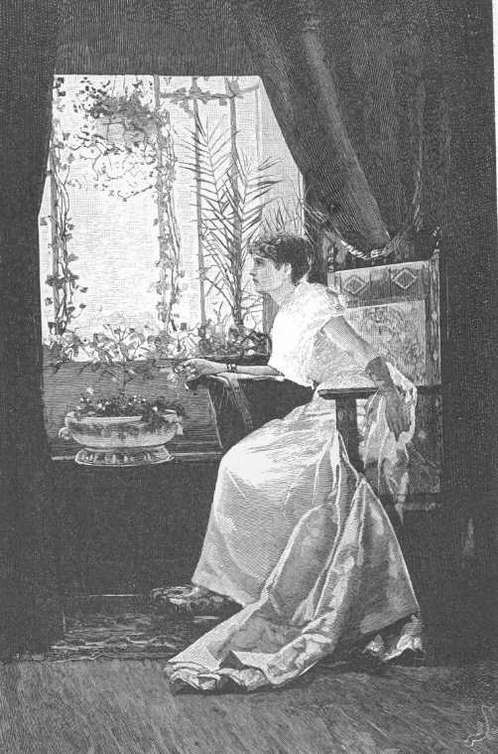
O MAY I JOIN THE CHOIR INVISIBLE!
O may I join the choir invisible
Of those immortal dead who live again
In minds made better by their presence; live
In pulses stirred to generosity,
In deeds of daring rectitude, in scorn
Of miserable aims that end with self,
In thoughts sublime that pierce the night like stars,
And with their mild persistence urge men’s minds
To vaster issues.
So to live is heaven:
To make undying music in the world,
Breathing a beauteous order that controls
With growing sway the growing life of man.
So we inherit that sweet purity
For which we struggled, failed and agonized
With widening retrospect that bred despair.
Rebellious flesh that would not be subdued,
A vicious parent shaming still its child,
Poor, anxious penitence is quick dissolved;
Its discords, quenched by meeting harmonies,
Die in the large and charitable air;
And all our rarer, better, truer self,
That sobbed religiously in yearning song,
That watched to ease the burden of the world,
Laboriously tracing what must be,
And what may yet be better—saw rather
A worthier image for the sanctuary
And shaped it forth before the multitude,
Divinely human, raising worship so
To higher reverence more mixed with love—
That better self shall live till human Time
Shall fold its eyelids, and the human sky
Be gathered like a scroll within the tomb
Unread forever.
This is life to come,
Which martyred men have made more glorious
For us who strive to follow.
May I reach
That purest heaven—be to other souls
The cup of strength in some great agony,
Enkindle generous ardor, feed pure love,
Beget the smiles that have no cruelty,
Be the sweet presence of a good diffused,
And in diffusion ever more intense!
So shall I join the choir invisible
Whose music is the gladness of the world.
HOW THEY BROUGHT THE GOOD NEWS FROM GHENT TO AIX.
I sprang to the stirrup, and Joris and he:
I galloped, Dirck galloped, we galloped all three;
“Good speed!” cried the watch as the gate-bolts undrew,
“Speed!” echoed the wall to us galloping through.
Behind shut the postern, the lights sank to rest,
And into the midnight we galloped abreast.
Not a word to each other; we kept the great pace—
Neck by neck, stride by stride, never changing our place;
I turned in my saddle and made its girths tight,
Then shortened each stirrup and set the pique right,
Rebuckled the check-strap, chained slacker the bit,
Nor galloped less steadily Roland a whit.
’Twas moonset at starting; but while we drew near
Lokeren, the cocks crew and twilight dawned clear;
At Boom a great yellow star came out to see;
At Düffeld ’twas morning as plain as could be;
And from Mecheln church-steeple we heard the half-chime—
So Joris broke silence with “Yet there is time!”
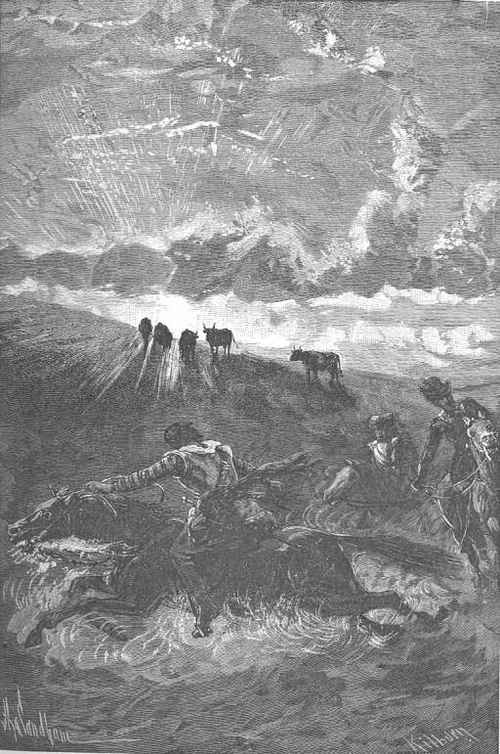
At Aerschot up leaped of a sudden the sun,
And against him the cattle stood black every one,
To stare through the mist at us galloping past;
And I saw my stout galloper Roland at last
With resolute shoulders, each butting away
The haze, as some bluff river headland its spray;
And his low head and crest, just one sharp ear bent back
For my voice, and the other pricked out on his track,
And one eye’s black intelligence—ever that glance
O’er its white edge at me, his own master, askance;
And the thick heavy spume-flakes, which aye and anon
His fierce lips shook upwards in galloping on.
By Hasselt, Dirck groaned; and cried Joris, “Stay spur!
Your Roos galloped bravely, the fault’s not in her;
“We’ll remember at Aix”—for one heard the quick wheeze
Of her chest, saw the stretched neck and staggering knees,
And sunk tail, and horrible heave of the flank,
As down on her haunches she shuddered and sank.
So we were left galloping, Joris and I,
Past Looz and past Tongres, no cloud in the sky;
The broad sun above laughed a pitiless laugh;
’Neath our feet broke the brittle bright stubble like chaff;
Till over by Delhem a dome spire sprung white,
And “Gallop,” gasped Joris, “for Aix is in sight!
“How they’ll greet us!”—and all in a moment his roan
Rolled neck and croup over, lay dead as a stone;
And there was my Roland to bear the whole weight
Of the news which alone could save Aix from her fate,
With his nostrils like pits full of blood to the brim,
And with circles of red for his eye-sockets’ rim.
Then I cast loose my buff-coat, each holster let fall,
Shook off both my jack-boots, let go belt and all,
Stood up in the stirrup, leaned, patted his ear,
Called my Roland his pet name, my horse without peer—
Clapped my hands, laughed and sung, any noise, bad or good,
Till at length into Aix Roland galloped and stood.
And all I remember is friends flocking around,
As I sate with his head twixt my knees on the ground;
And no voice but was praising this Roland of mine
As I poured down his throat our last measure of wine,
Which (the burgesses voted by common consent)
Was no more than his due who brought good news from Ghent.
MOTHER AND POET.
Dead! one of them shot by the sea in the east,
And one of them shot in the west by the sea.
Dead! both my boys! When you sit at the feast
And are wanting a great song for Italy free,
Let none look at me!
Yet I was a poetess only last year,
And good at my art for a woman, men said,
But this woman, this, who is agonized here,
The east sea and west sea rhyme on in her head
Forever instead.
What art can woman be good at? Oh, vain!
What art is she good at, but hurting her breast
With the milk-teeth of babes, and a smile at the pain?
Ah, boys, how you hurt! you were strong as you pressed,
And I proud by that test.
What’s art for a woman? To hold on her knees
Both darlings! to feel all their arms round her throat
Cling, strangle a little! To sew by degrees,
And ’broider the long clothes and neat little coat!
To dream and to dote.
To teach them . . . It stings there. I made them indeed
Speak plain the word ‘country.’ I taught them, no doubt,
That a country’s a thing men should die for at need.
I prated of liberty, rights, and about
The tyrant turned out.
And when their eyes flashed, oh, my beautiful eyes!
I exulted! nay, let them go forth at the wheels
Of the guns, and denied not. But then the surprise,
When one sits quite alone! Then one weeps, then one kneels!
—God! how the house feels.
At first happy news came, in gay letters moiled
With my kisses, of camp-life and glory, and how
They both loved me, and soon, coming home to be spoiled,
In return would fan off every fly from my brow
With their green laurel bough.
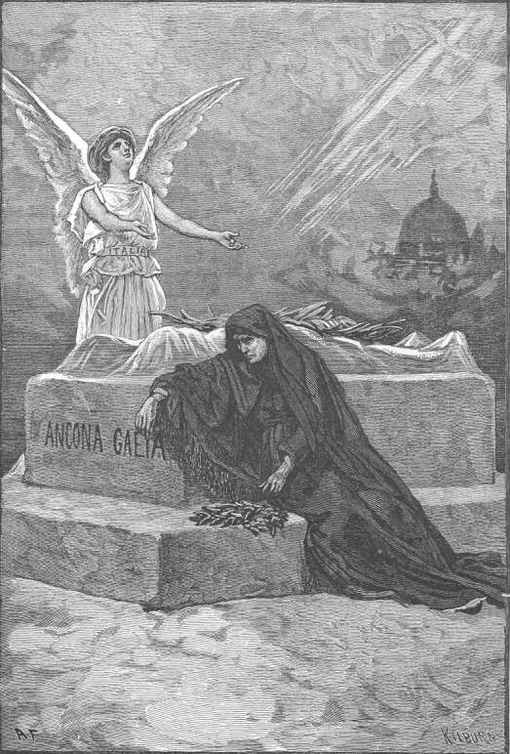
Then was triumph at Turin. ‘Ancona was free!’
And some one came out of the cheers in the street,
With a face pale as stone to say something to me.
My Guido was dead! I fell down at his feet
While they cheered in the street.
I bore it—friends soothed me: my grief looked sublime
As the ransom of Italy. One boy remained
To be leant on and walked with, recalling the time
When the first grew immortal, while both of us strained
To the height he had gained.
And letters still came—shorter, sadder, more strong,
Writ now but in one hand. I was not to faint,
One loved me for two . . . would be with me ere long,
And ‘Viva Italia’ he died for, our saint,
Who forbids our complaint.
My Nanni would add, ‘he was safe and aware
Of a presence that turned off the balls . . . was imprest
It was Guido himself, who knew what I could bear,
And how ’twas impossible, quite dispossessed,
To live on for the rest.’
On which, without pause, up the telegraph line,
Swept smoothly the next news from Gaeta—Shot.
Tell his mother. Ah, ah! ‘his,’ ‘their’ mother: not ‘mine.’
No voice says ‘my mother’ again to me. What!
You think Guido forgot?
Are souls straight so happy that, dizzy with Heaven,
They drop earth’s affection, conceive not of woe?
I think not. Themselves were too lately forgiven
Through that Love and Sorrow which reconciled so
The Above and Below.
O Christ of the seven wounds, who look’dst through the dark
To the face of thy mother! consider, I pray,
How we common mothers stand desolate, mark,
Whose sons, not being Christs, die with eyes turned away,
And no last word to say!
Both boys dead! but that’s out of nature. We all
Have been patriots, yet each house must always keep one.
’Twere imbecile hewing out roads to a wall,
And when Italy’s made, for what end is it done
If we have not a son?
Ah! ah! ah! when Gaeta’s taken, what then?
When the fair, wicked queen sits no more at her sport
Of the fire-balls of death crashing souls out of men?
When your guns of Cavalli, with final retort,
Have cut the game short—
When Venice and Rome keep their new jubilee,
When your flag takes all Heaven for its white, green, and red,
When you have your country from mountain to sea,
When King Victor has Italy’s crown on his head,
(And I have my dead)
What then? Do not mock me! Ah, ring your bells low!
And burn your lights faintly. My country is there,
Above the star pricked by the last peak of snow.
My Italy’s there—with my brave civic Pair,
To disfranchise despair.
Forgive me. Some women bear children in strength,
And bite back the cry of their pain in self-scorn,
But the birth-pangs of nations will wring us at length
Into wail such as this! and we sit on forlorn
When the man-child is born.
Dead! one of them shot by the sea in the west!
And one of them shot in the east by the sea!
Both! both my boys! If, in keeping the feast,
You want a great song for your Italy free,
Let none look at me!
NATURE’S LADY.
Three years she grew in sun and shower,
Then Nature said, “A lovelier flower
On earth was never sown;
This child I to myself will take,
She shall be mine, and I will make
A lady of my own.
“Myself will to my darling be
Both law and impulse: and with me
The Girl, in rock and plain,
In earth and heaven, in glade and bower,
Shall feel an overseeing power
To kindle or restrain.
“She shall be sportive as the fawn
That wild with glee across the lawn
Or up the mountain springs;
And hers shall be the breathing balm,
And hers the silence and the calm,
Of mute insensate things.
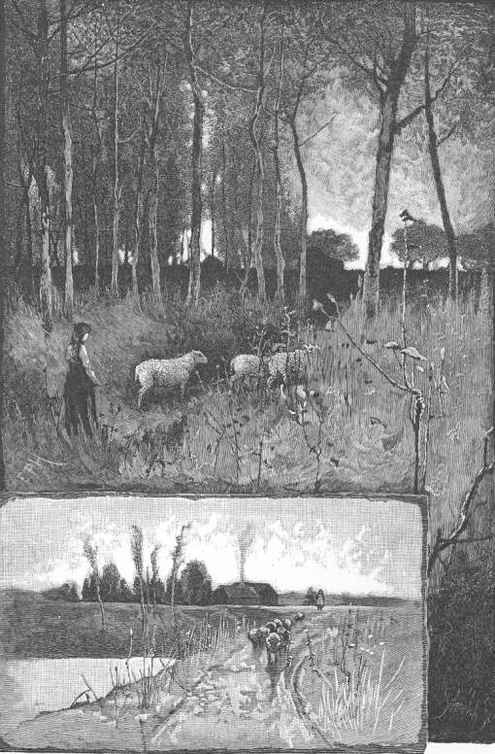
“The floating clouds their state shall lend
To her; for her the willows bend;
Nor shall she fail to see
Even in the motions of the storm
Grace that shall mould the maiden’s form
By silent sympathy.
“The stars of midnight shall be dear
To her; and she shall lean her ear
In many a secret place
Where rivulets dance their wayward round,
And beauty born of murmuring sound
Shall pass into her face.”
TO A SKYLARK.
Hail to thee, blithe spirit—
Bird thou never wert—
That from heaven or near it
Pourest thy full heart
In profuse strains of unpremeditated art.
Higher still and higher
From the earth thou springest,
Like a cloud of fire;
The blue deep thou wingest,
And singing still dost soar, and soaring ever singest.
In the golden lightning
Of the sunken sun,
O’er which clouds art bright’ning,
Thou dost float and run,
Like an unbodied joy whose race is just begun.
The pale purple even
Melts around thy flight;
Like a star of heaven,
In the broad daylight
Thou art unseen, but yet I hear thy shrill delight—
Keen as are the arrows
Of that silver sphere
Whose intense lamp narrows
In the white dawn clear
Until we hardly see, we feel, that it is there.
All the earth and air
With thy voice is loud,
As, when night is bare,
From one lonely cloud
The moon rains out her beams, and heaven is overflowed.
What thou art we know not;
What is most like thee?
From rainbow-clouds there flow not
Drops so bright to see
As from thy presence showers a rain of melody:—
Like a poet hidden
In the light of thought,
Singing hymns unbidden,
Till the world is wrought
To sympathy with hopes and fears it heeded not;
Like a high-born maiden
In a palace tower,
Soothing her love-laden
Soul in secret hour
With music sweet as love which overflows her bower;
Like a glow-worm golden
In a dell of dew,
Scattering unbeholden
Its aerial hue
Among the flowers and grass which screen it from the view;
Like a rose embowered
In its own green leaves,
By warm winds deflowered,
Till the scent it gives
Makes faint with too much heat these heavy-winged thieves;
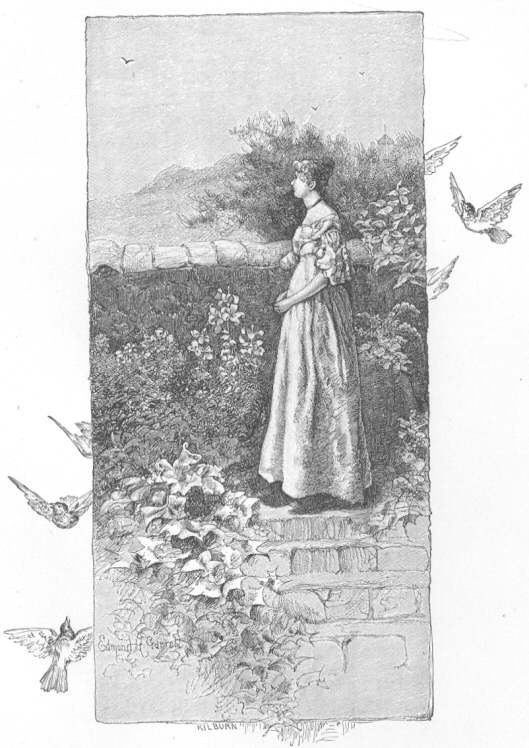
Sound of vernal showers
On the twinkling grass,
Rain-awakened flowers—
All that ever was
Joyous and clear and fresh—thy music doth surpass.
Teach us, sprite or bird,
What sweet thoughts are thine:
I have never heard
Praise of love or wine
That panted forth a flood of rapture so divine.
Chorus hymeneal,
Or triumphal chaunt,
Matched with thine, would be all
But an empty vaunt—
A thing wherein we feel there is some hidden want.
What objects are the fountains
Of the happy strain?
What fields, or waves or mountains?
What shapes of sky or plain?
What love of thine own kind? what ignorance of pain?
With thy clear keen joyance
Languor cannot be:
Shadow of annoyance
Never came near thee:
Thou lovest, but ne’er knew love’s sad satiety.
Waking or asleep,
Thou of death must deem
Things more true and deep
Than we mortals dream,
Or how could thy notes flow in such a crystal stream?
We look before and after,
And pine for what is not;
Our sincerest laughter
With some pain is fraught;
Our sweetest songs are those that tell of saddest thought.
Yet, if we could scorn
Hate and pride and fear,
If we were things born
Not to shed a tear,
I know not how thy joy we ever should come near.
Better than all measures
Of delightful sound,
Better than all treasures
That in books are found,
Thy skill to poet were, thou scorner of the ground!
Teach me half the gladness
That thy brain must know,
Such harmonious madness
From my lips would flow
The world should listen then as I am listening now.
***END OF THE PROJECT GUTENBERG EBOOK O MAY I JOIN THE CHOIR INVISIBLE!***
***** This file should be named 20742-h.htm or 20742-h.zip******
This and all associated files of various formats will be found in:
http://www.gutenberg.org/dirs/2/0/7/4/20742
Updated editions will replace the previous one--the old editions
will be renamed.
Creating the works from public domain print editions means that no
one owns a United States copyright in these works, so the Foundation
(and you!) can copy and distribute it in the United States without
permission and without paying copyright royalties. Special rules,
set forth in the General Terms of Use part of this license, apply to
copying and distributing Project Gutenberg-tm electronic works to
protect the PROJECT GUTENBERG-tm concept and trademark. Project
Gutenberg is a registered trademark, and may not be used if you
charge for the eBooks, unless you receive specific permission. If you
do not charge anything for copies of this eBook, complying with the
rules is very easy. You may use this eBook for nearly any purpose
such as creation of derivative works, reports, performances and
research. They may be modified and printed and given away--you may do
practically ANYTHING with public domain eBooks. Redistribution is
subject to the trademark license, especially commercial
redistribution.
*** START: FULL LICENSE ***
THE FULL PROJECT GUTENBERG LICENSE
PLEASE READ THIS BEFORE YOU DISTRIBUTE OR USE THIS WORK
To protect the Project Gutenberg-tm mission of promoting the free
distribution of electronic works, by using or distributing this work
(or any other work associated in any way with the phrase "Project
Gutenberg"), you agree to comply with all the terms of the Full Project
Gutenberg-tm License (available with this file or online at
http://www.gutenberg.org/license).
Section 1. General Terms of Use and Redistributing Project Gutenberg-tm
electronic works
1.A. By reading or using any part of this Project Gutenberg-tm
electronic work, you indicate that you have read, understand, agree to
and accept all the terms of this license and intellectual property
(trademark/copyright) agreement. If you do not agree to abide by all
the terms of this agreement, you must cease using and return or destroy
all copies of Project Gutenberg-tm electronic works in your possession.
If you paid a fee for obtaining a copy of or access to a Project
Gutenberg-tm electronic work and you do not agree to be bound by the
terms of this agreement, you may obtain a refund from the person or
entity to whom you paid the fee as set forth in paragraph 1.E.8.
1.B. "Project Gutenberg" is a registered trademark. It may only be
used on or associated in any way with an electronic work by people who
agree to be bound by the terms of this agreement. There are a few
things that you can do with most Project Gutenberg-tm electronic works
even without complying with the full terms of this agreement. See
paragraph 1.C below. There are a lot of things you can do with Project
Gutenberg-tm electronic works if you follow the terms of this agreement
and help preserve free future access to Project Gutenberg-tm electronic
works. See paragraph 1.E below.
1.C. The Project Gutenberg Literary Archive Foundation ("the Foundation"
or PGLAF), owns a compilation copyright in the collection of Project
Gutenberg-tm electronic works. Nearly all the individual works in the
collection are in the public domain in the United States. If an
individual work is in the public domain in the United States and you are
located in the United States, we do not claim a right to prevent you from
copying, distributing, performing, displaying or creating derivative
works based on the work as long as all references to Project Gutenberg
are removed. Of course, we hope that you will support the Project
Gutenberg-tm mission of promoting free access to electronic works by
freely sharing Project Gutenberg-tm works in compliance with the terms of
this agreement for keeping the Project Gutenberg-tm name associated with
the work. You can easily comply with the terms of this agreement by
keeping this work in the same format with its attached full Project
Gutenberg-tm License when you share it without charge with others.
1.D. The copyright laws of the place where you are located also govern
what you can do with this work. Copyright laws in most countries are in
a constant state of change. If you are outside the United States, check
the laws of your country in addition to the terms of this agreement
before downloading, copying, displaying, performing, distributing or
creating derivative works based on this work or any other Project
Gutenberg-tm work. The Foundation makes no representations concerning
the copyright status of any work in any country outside the United
States.
1.E. Unless you have removed all references to Project Gutenberg:
1.E.1. The following sentence, with active links to, or other immediate
access to, the full Project Gutenberg-tm License must appear prominently
whenever any copy of a Project Gutenberg-tm work (any work on which the
phrase "Project Gutenberg" appears, or with which the phrase "Project
Gutenberg" is associated) is accessed, displayed, performed, viewed,
copied or distributed:
This eBook is for the use of anyone anywhere at no cost and with
almost no restrictions whatsoever. You may copy it, give it away or
re-use it under the terms of the Project Gutenberg License included
with this eBook or online at www.gutenberg.org
1.E.2. If an individual Project Gutenberg-tm electronic work is derived
from the public domain (does not contain a notice indicating that it is
posted with permission of the copyright holder), the work can be copied
and distributed to anyone in the United States without paying any fees
or charges. If you are redistributing or providing access to a work
with the phrase "Project Gutenberg" associated with or appearing on the
work, you must comply either with the requirements of paragraphs 1.E.1
through 1.E.7 or obtain permission for the use of the work and the
Project Gutenberg-tm trademark as set forth in paragraphs 1.E.8 or
1.E.9.
1.E.3. If an individual Project Gutenberg-tm electronic work is posted
with the permission of the copyright holder, your use and distribution
must comply with both paragraphs 1.E.1 through 1.E.7 and any additional
terms imposed by the copyright holder. Additional terms will be linked
to the Project Gutenberg-tm License for all works posted with the
permission of the copyright holder found at the beginning of this work.
1.E.4. Do not unlink or detach or remove the full Project Gutenberg-tm
License terms from this work, or any files containing a part of this
work or any other work associated with Project Gutenberg-tm.
1.E.5. Do not copy, display, perform, distribute or redistribute this
electronic work, or any part of this electronic work, without
prominently displaying the sentence set forth in paragraph 1.E.1 with
active links or immediate access to the full terms of the Project
Gutenberg-tm License.
1.E.6. You may convert to and distribute this work in any binary,
compressed, marked up, nonproprietary or proprietary form, including any
word processing or hypertext form. However, if you provide access to or
distribute copies of a Project Gutenberg-tm work in a format other than
"Plain Vanilla ASCII" or other format used in the official version
posted on the official Project Gutenberg-tm web site (www.gutenberg.org),
you must, at no additional cost, fee or expense to the user, provide a
copy, a means of exporting a copy, or a means of obtaining a copy upon
request, of the work in its original "Plain Vanilla ASCII" or other
form. Any alternate format must include the full Project Gutenberg-tm
License as specified in paragraph 1.E.1.
1.E.7. Do not charge a fee for access to, viewing, displaying,
performing, copying or distributing any Project Gutenberg-tm works
unless you comply with paragraph 1.E.8 or 1.E.9.
1.E.8. You may charge a reasonable fee for copies of or providing
access to or distributing Project Gutenberg-tm electronic works provided
that
- You pay a royalty fee of 20% of the gross profits you derive from
the use of Project Gutenberg-tm works calculated using the method
you already use to calculate your applicable taxes. The fee is
owed to the owner of the Project Gutenberg-tm trademark, but he
has agreed to donate royalties under this paragraph to the
Project Gutenberg Literary Archive Foundation. Royalty payments
must be paid within 60 days following each date on which you
prepare (or are legally required to prepare) your periodic tax
returns. Royalty payments should be clearly marked as such and
sent to the Project Gutenberg Literary Archive Foundation at the
address specified in Section 4, "Information about donations to
the Project Gutenberg Literary Archive Foundation."
- You provide a full refund of any money paid by a user who notifies
you in writing (or by e-mail) within 30 days of receipt that s/he
does not agree to the terms of the full Project Gutenberg-tm
License. You must require such a user to return or
destroy all copies of the works possessed in a physical medium
and discontinue all use of and all access to other copies of
Project Gutenberg-tm works.
- You provide, in accordance with paragraph 1.F.3, a full refund of any
money paid for a work or a replacement copy, if a defect in the
electronic work is discovered and reported to you within 90 days
of receipt of the work.
- You comply with all other terms of this agreement for free
distribution of Project Gutenberg-tm works.
1.E.9. If you wish to charge a fee or distribute a Project Gutenberg-tm
electronic work or group of works on different terms than are set
forth in this agreement, you must obtain permission in writing from
both the Project Gutenberg Literary Archive Foundation and Michael
Hart, the owner of the Project Gutenberg-tm trademark. Contact the
Foundation as set forth in Section 3 below.
1.F.
1.F.1. Project Gutenberg volunteers and employees expend considerable
effort to identify, do copyright research on, transcribe and proofread
public domain works in creating the Project Gutenberg-tm
collection. Despite these efforts, Project Gutenberg-tm electronic
works, and the medium on which they may be stored, may contain
"Defects," such as, but not limited to, incomplete, inaccurate or
corrupt data, transcription errors, a copyright or other intellectual
property infringement, a defective or damaged disk or other medium, a
computer virus, or computer codes that damage or cannot be read by
your equipment.
1.F.2. LIMITED WARRANTY, DISCLAIMER OF DAMAGES - Except for the "Right
of Replacement or Refund" described in paragraph 1.F.3, the Project
Gutenberg Literary Archive Foundation, the owner of the Project
Gutenberg-tm trademark, and any other party distributing a Project
Gutenberg-tm electronic work under this agreement, disclaim all
liability to you for damages, costs and expenses, including legal
fees. YOU AGREE THAT YOU HAVE NO REMEDIES FOR NEGLIGENCE, STRICT
LIABILITY, BREACH OF WARRANTY OR BREACH OF CONTRACT EXCEPT THOSE
PROVIDED IN PARAGRAPH F3. YOU AGREE THAT THE FOUNDATION, THE
TRADEMARK OWNER, AND ANY DISTRIBUTOR UNDER THIS AGREEMENT WILL NOT BE
LIABLE TO YOU FOR ACTUAL, DIRECT, INDIRECT, CONSEQUENTIAL, PUNITIVE OR
INCIDENTAL DAMAGES EVEN IF YOU GIVE NOTICE OF THE POSSIBILITY OF SUCH
DAMAGE.
1.F.3. LIMITED RIGHT OF REPLACEMENT OR REFUND - If you discover a
defect in this electronic work within 90 days of receiving it, you can
receive a refund of the money (if any) you paid for it by sending a
written explanation to the person you received the work from. If you
received the work on a physical medium, you must return the medium with
your written explanation. The person or entity that provided you with
the defective work may elect to provide a replacement copy in lieu of a
refund. If you received the work electronically, the person or entity
providing it to you may choose to give you a second opportunity to
receive the work electronically in lieu of a refund. If the second copy
is also defective, you may demand a refund in writing without further
opportunities to fix the problem.
1.F.4. Except for the limited right of replacement or refund set forth
in paragraph 1.F.3, this work is provided to you 'AS-IS', WITH NO OTHER
WARRANTIES OF ANY KIND, EXPRESS OR IMPLIED, INCLUDING BUT NOT LIMITED TO
WARRANTIES OF MERCHANTIBILITY OR FITNESS FOR ANY PURPOSE.
1.F.5. Some states do not allow disclaimers of certain implied
warranties or the exclusion or limitation of certain types of damages.
If any disclaimer or limitation set forth in this agreement violates the
law of the state applicable to this agreement, the agreement shall be
interpreted to make the maximum disclaimer or limitation permitted by
the applicable state law. The invalidity or unenforceability of any
provision of this agreement shall not void the remaining provisions.
1.F.6. INDEMNITY - You agree to indemnify and hold the Foundation, the
trademark owner, any agent or employee of the Foundation, anyone
providing copies of Project Gutenberg-tm electronic works in accordance
with this agreement, and any volunteers associated with the production,
promotion and distribution of Project Gutenberg-tm electronic works,
harmless from all liability, costs and expenses, including legal fees,
that arise directly or indirectly from any of the following which you do
or cause to occur: (a) distribution of this or any Project Gutenberg-tm
work, (b) alteration, modification, or additions or deletions to any
Project Gutenberg-tm work, and (c) any Defect you cause.
Section 2. Information about the Mission of Project Gutenberg-tm
Project Gutenberg-tm is synonymous with the free distribution of
electronic works in formats readable by the widest variety of computers
including obsolete, old, middle-aged and new computers. It exists
because of the efforts of hundreds of volunteers and donations from
people in all walks of life.
Volunteers and financial support to provide volunteers with the
assistance they need, is critical to reaching Project Gutenberg-tm's
goals and ensuring that the Project Gutenberg-tm collection will
remain freely available for generations to come. In 2001, the Project
Gutenberg Literary Archive Foundation was created to provide a secure
and permanent future for Project Gutenberg-tm and future generations.
To learn more about the Project Gutenberg Literary Archive Foundation
and how your efforts and donations can help, see Sections 3 and 4
and the Foundation web page at http://www.gutenberg.org/fundraising/pglaf.
Section 3. Information about the Project Gutenberg Literary Archive
Foundation
The Project Gutenberg Literary Archive Foundation is a non profit
501(c)(3) educational corporation organized under the laws of the
state of Mississippi and granted tax exempt status by the Internal
Revenue Service. The Foundation's EIN or federal tax identification
number is 64-6221541. Contributions to the Project Gutenberg
Literary Archive Foundation are tax deductible to the full extent
permitted by U.S. federal laws and your state's laws.
The Foundation's principal office is located at 4557 Melan Dr. S.
Fairbanks, AK, 99712., but its volunteers and employees are scattered
throughout numerous locations. Its business office is located at
809 North 1500 West, Salt Lake City, UT 84116, (801) 596-1887, email
business@pglaf.org. Email contact links and up to date contact
information can be found at the Foundation's web site and official
page at http://www.gutenberg.org/about/contact
For additional contact information:
Dr. Gregory B. Newby
Chief Executive and Director
gbnewby@pglaf.org
Section 4. Information about Donations to the Project Gutenberg
Literary Archive Foundation
Project Gutenberg-tm depends upon and cannot survive without wide
spread public support and donations to carry out its mission of
increasing the number of public domain and licensed works that can be
freely distributed in machine readable form accessible by the widest
array of equipment including outdated equipment. Many small donations
($1 to $5,000) are particularly important to maintaining tax exempt
status with the IRS.
The Foundation is committed to complying with the laws regulating
charities and charitable donations in all 50 states of the United
States. Compliance requirements are not uniform and it takes a
considerable effort, much paperwork and many fees to meet and keep up
with these requirements. We do not solicit donations in locations
where we have not received written confirmation of compliance. To
SEND DONATIONS or determine the status of compliance for any
particular state visit http://www.gutenberg.org/fundraising/donate
While we cannot and do not solicit contributions from states where we
have not met the solicitation requirements, we know of no prohibition
against accepting unsolicited donations from donors in such states who
approach us with offers to donate.
International donations are gratefully accepted, but we cannot make
any statements concerning tax treatment of donations received from
outside the United States. U.S. laws alone swamp our small staff.
Please check the Project Gutenberg Web pages for current donation
methods and addresses. Donations are accepted in a number of other
ways including checks, online payments and credit card donations.
To donate, please visit:
http://www.gutenberg.org/fundraising/donate
Section 5. General Information About Project Gutenberg-tm electronic
works.
Professor Michael S. Hart is the originator of the Project Gutenberg-tm
concept of a library of electronic works that could be freely shared
with anyone. For thirty years, he produced and distributed Project
Gutenberg-tm eBooks with only a loose network of volunteer support.
Project Gutenberg-tm eBooks are often created from several printed
editions, all of which are confirmed as Public Domain in the U.S.
unless a copyright notice is included. Thus, we do not necessarily
keep eBooks in compliance with any particular paper edition.
Most people start at our Web site which has the main PG search facility:
http://www.gutenberg.org
This Web site includes information about Project Gutenberg-tm,
including how to make donations to the Project Gutenberg Literary
Archive Foundation, how to help produce our new eBooks, and how to
subscribe to our email newsletter to hear about new eBooks.